Bottoms Up!

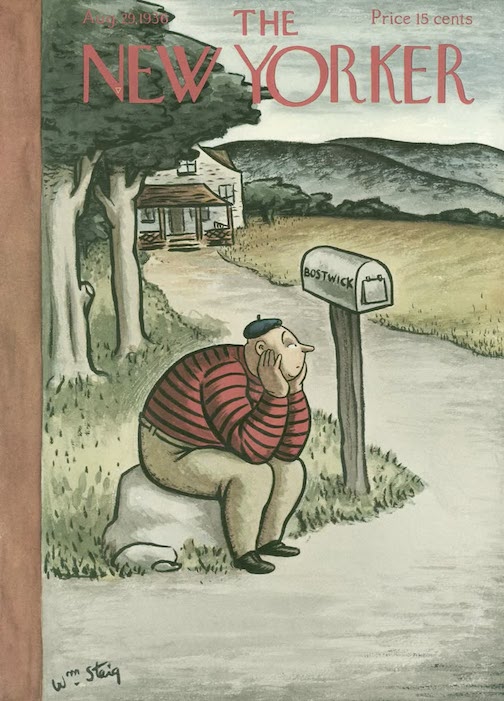
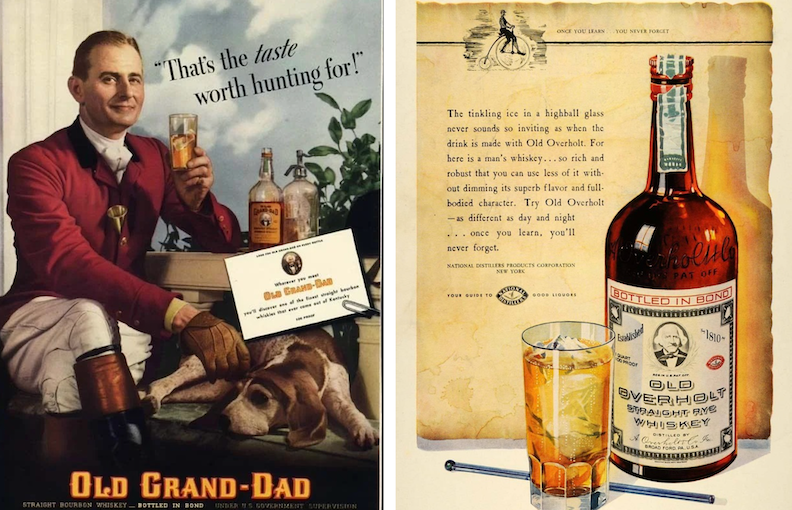
Above: E.B. White had a bone to pick with whiskey distillers who tried to establish "quick antiquity" by naming their products "Old Something-or-Other." That was not true for these two brands—Old Grand-Dad was introduced in Kentucky in 1840, while Old Overholt debuted in Pennsylvania in 1810, making it America's oldest continually maintained whiskey brand. Both are now subsidiaries of Japan's Suntory Global Spirits. (alcohol professor.com/pinterest)

With the official end of Prohibition on December 5, 1933, brewers and distillers raced to ramp up production and revive brands that had lain dormant for more than a decade. Distillers of aged spirits like rye and whiskey were especially keen to invoke history and tradition when marketing their tipple.

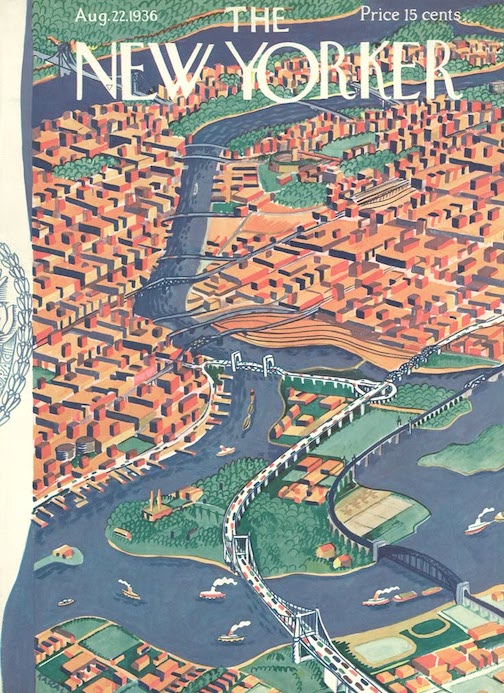
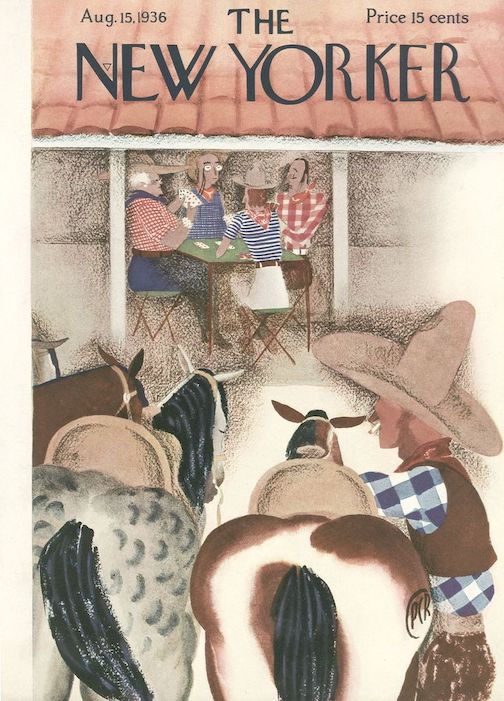
August 15, 1936 cover by Paul C. Robertson. 

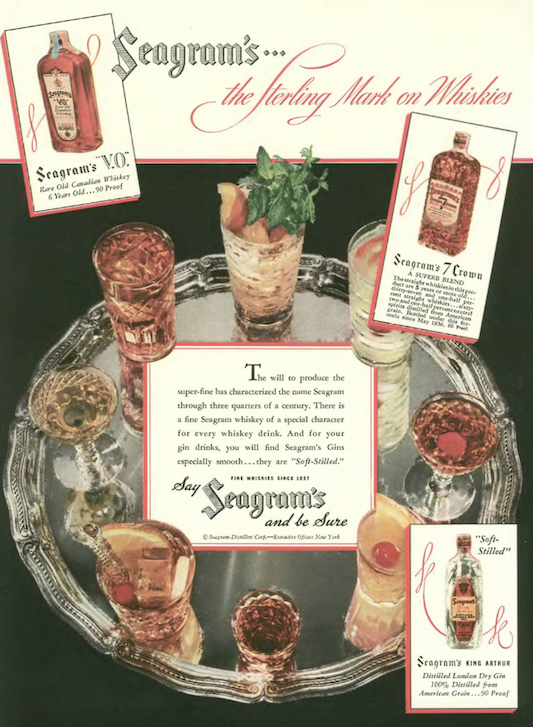
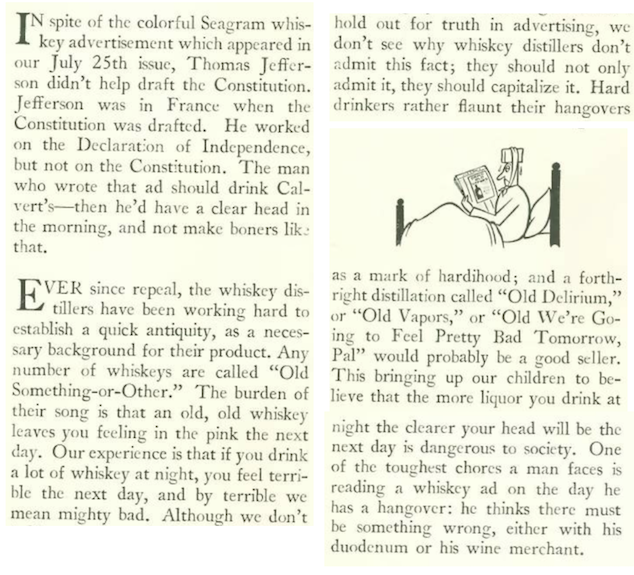
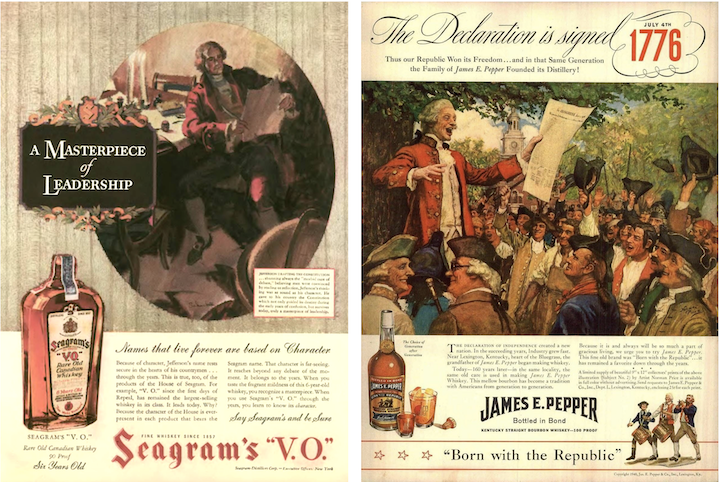
In some cases newer distilleries made generous use of the word “Old” in their branding, according to E.B. White in his “Notes and Comment.” White also called out the folks at Seagram’s, who compared the character of Thomas Jefferson to that of their “V.O.” whisky (no “e” in spirits tied to British distilling traditions—Scotland, Canada, Japan, Wales, India). Most egregious, however, was the ad’s claim that Jefferson helped to draft the Constitution. White explained:

HE DID WHAT?…E.B. White called out the Seagram’s ad (left, from the July 25 issue of The New Yorker) for its historic inaccuracy (the distiller erroneously credited Thomas Jefferson for the Constitution; at right, the character and leadership of the Founding Fathers (and other early American leaders) were oft-employed metaphors for a number of whiskey brands, including James E. Pepper. (facebook.com)
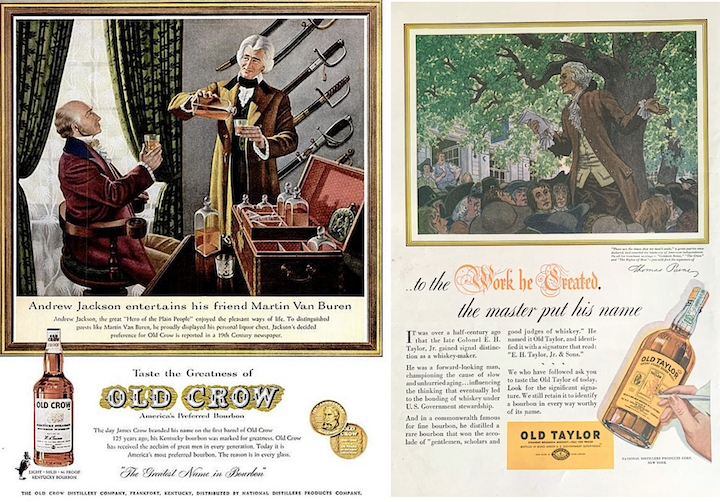
GOLDEN OLDIES…Here are more examples of historic figures being associated with fine spirits…at left, in 1960 the makers of Old Crow (founded 1835) depicted the genocidal Andrew Jackson pouring a glass of the stuff for Martin Van Buren; at right, in 1937 the makers of Old Taylor (1887) used quotes and themes from Thomas Paine’s revolutionary writings to promote their Kentucky Straight Bourbon. (bourbonbanter.com/etsy.com)

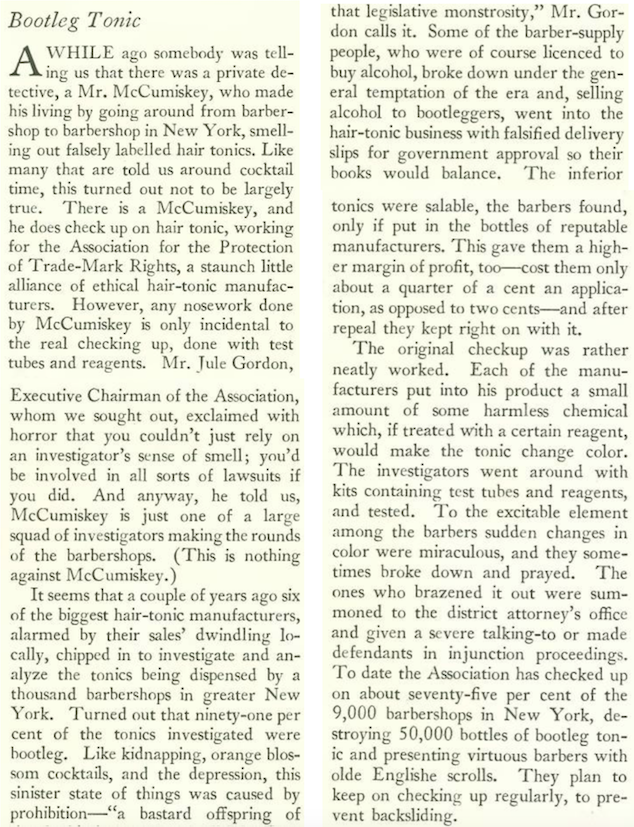
While we are on the subject of ardent spirits, let’s take a look at these excerpts from “The Talk of the Town” (attributed to Eugene Kinkead and Russell Maloney), which told the story of a private detective who had a nose for liquor— disguised as hair tonic.

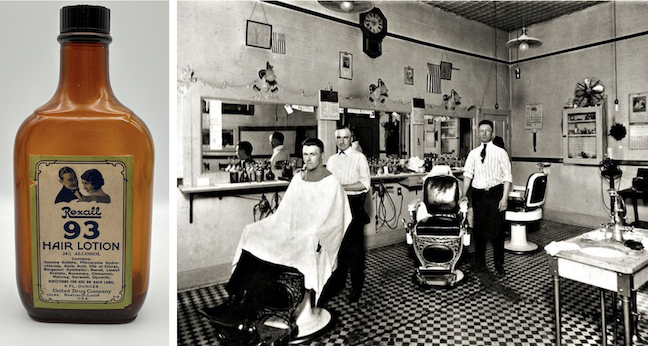
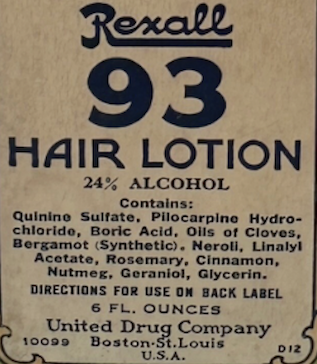
A SIP WITH YOUR SHAVE…During Prohibition (1920–1933), high-alcohol hair tonics like Rexall 93 (containing up to 24% alcohol) were legally sold as cosmetics but were frequently bought and consumed by people seeking a cheap, accessible substitute for bootleg liquor. The photo at right is of a 1930s barbershop—it is not implied that these fine gentlemen were involved in such illicit activities. (ebay.com/pinterest.com)

A closer look at the Rexall label—the makers made sure “24% Alcohol” was clearly visible. Folks known as “strainers” would run hair tonics like these through bread, cloth, or charcoal to filter out poisonous additives, obviously a dangerous practice.

 * * *

Doggy Downer

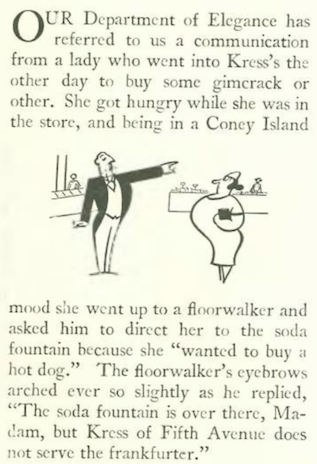
The legendary Kress “five-and-dime” stores, with more than 250 locations across twenty-nine states, served the needs of regular folks, but the designs of its stores were anything but pedestrian. This was especially true of its Fifth Avenue location, a 1935 Art Deco masterpiece. Given its lofty address, it was no place for one to order a lowly hot dog. E.B. White explained:

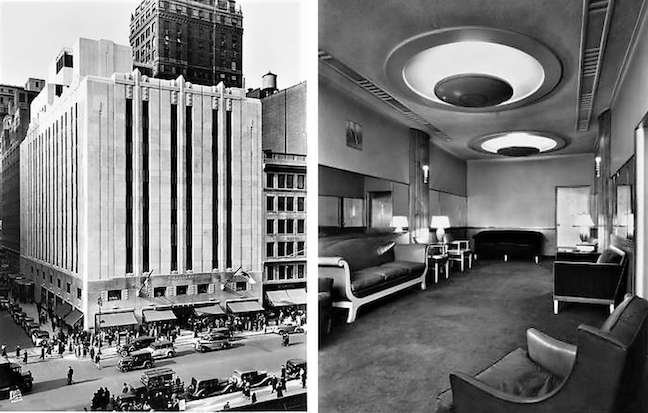
DECO EDIFICE…Samuel Henry Kress believed his department stores should function as works of public art that elevate the shopping experience for ordinary people. The company maintained an in-house architectural division, under the leadership of architect Edward F. Sibbert, that designed iconic, custom buildings, including the 1935 flagship S. H. Kress & Co. store on Fifth Avenue and 39th Street, an Art Deco masterpiece rendered in granite, bronze, and stainless steel; at right, a view of the store’s Ladies Lounge. Sadly, the building was razed in 1983. (Museum of the City of New York/New York Public Library)

 * * *

Merely Mortal

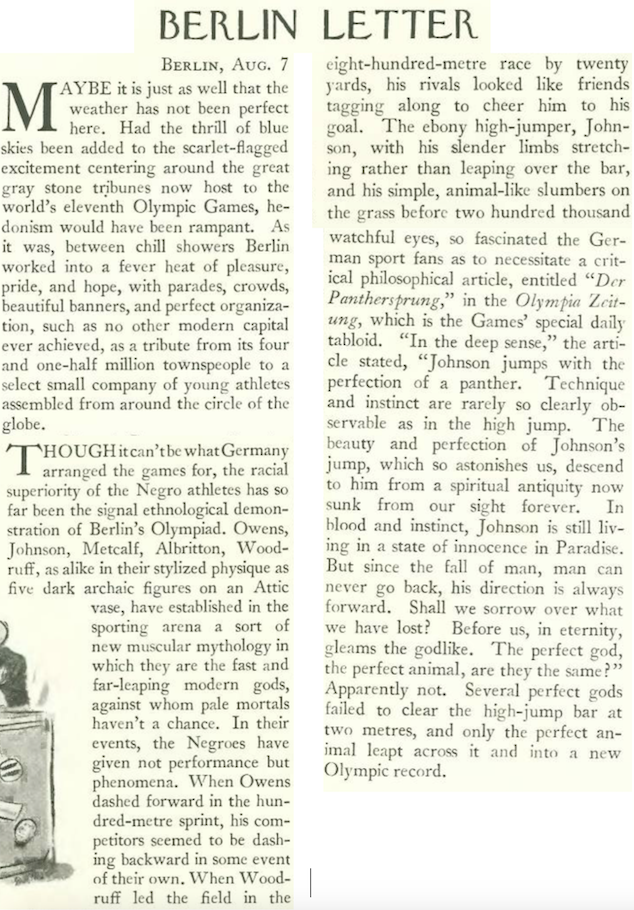
Janet Flanner filed her second report from the Berlin Olympics, where America’s Black athletes dominated the track and field events (ESPN’s Larry Schwartz credits Jesse Owens for “single-handedly crushing Hitler’s myth of Aryan supremacy”). Flanner noted attempts by propagandists to make sense of the beating they received, including likening the American athletes to wild animals “living in a state of innocence.” Excerpts:

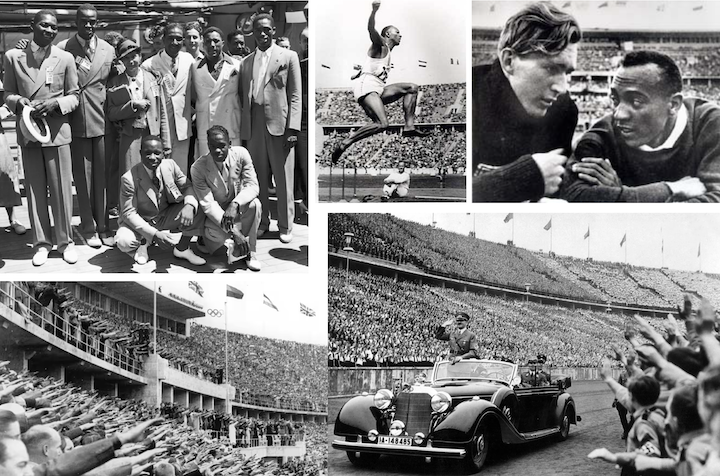
CONQUERING HEROES…Eighteen Black athletes went to Berlin as part of the U.S. team in 1936. Clockwise, from top left: Standing are high jumpers Dave Albritton and Cornelius Johnson, hurdler Tidye Pickett, sprinter Ralph Metcalfe, boxer Jim Clark, and sprinter Mack Robinson…in front, weightlifter John Terry (left) and long jumper John Brooks; Jesse Owens captured four gold medals and became the hero of the Olympics—his long jump (26 feet 5-1/2 inches) was an Olympic record; the American press reported widely on the friendship between Owens and his German long jump competitor Carl Ludwig (“Luz”) Long…Long was killed in action during World War II; the faithful offer their ugly salutes at the opening of the games. (webs.org/Bundesarchiv Koblenz/ushmm.org/history.com)

Flanner also reported on the great fanfare at the opening of the games, including “seventeen searchlights, from far outside the arena…a lofty birdcage of streaming light beams.” One wonders if those same searchlights were deployed during the war four years later, when RAF Lancaster bombers began their night bombing campaign of Berlin.

 * * *

At the Movies

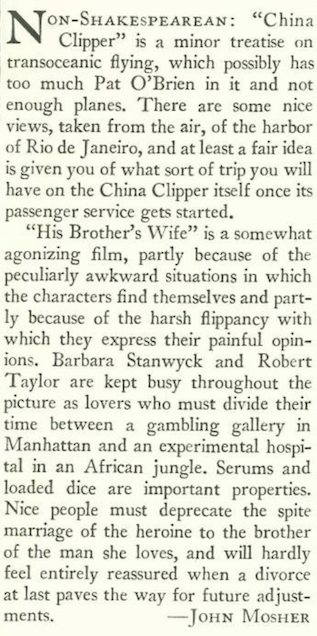
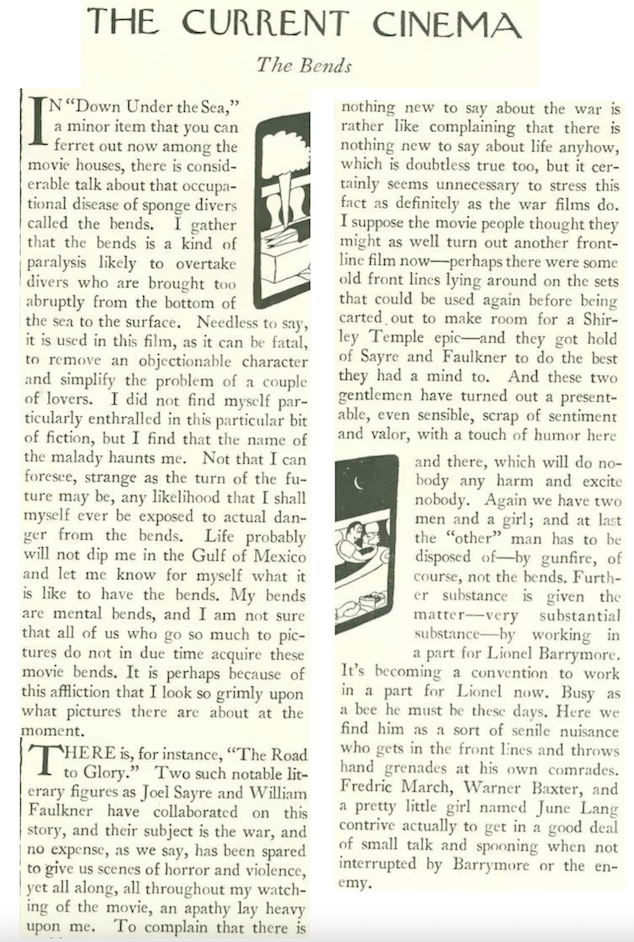
Last week we saw Lionel Barrymore in drag (as an old woman) in The Devil Doll. This week he resurfaces as a senile old warhorse in The Road to Glory, a Howard Hawks war film with a screenplay co-written by William Faulkner (the film also featured Frederic March, who had star billing in three major films in 1936). John Mosher found the film “presentable,” but nothing special. The same went for Down Under the Sea, a film concerning sponge divers who battle over the affections of a woman (Ann Rutherford).

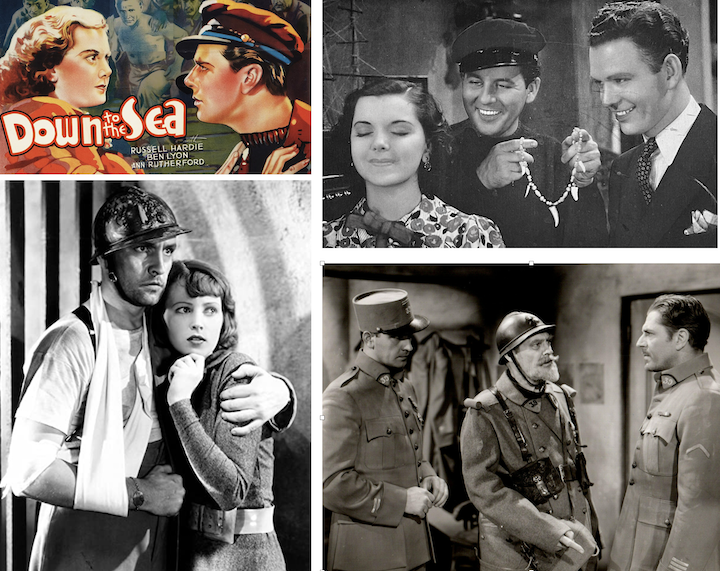
WERE THEY SPONGE WORTHY?…Clockwise, from top left: Ann Rutherford finds herself torn between two sponge divers vying for her affections in Down Under the Sea (aka Down to the Sea); divers Ben Lyon and Russell Hardie surprise Rutherford with a “native necklace” in the film; Frederic March, Lionel Barrymore, and Warner Baxter in The Road to Glory; June Lang with March in The Road to Glory. (eBay/silverscenesblog)

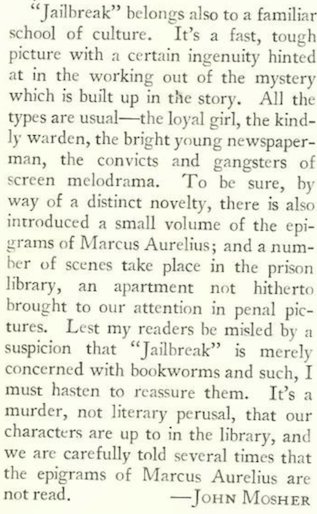
Mosher also took in Jailbreak, a minor noir picture about racketeers, cops and newspaper reporters.

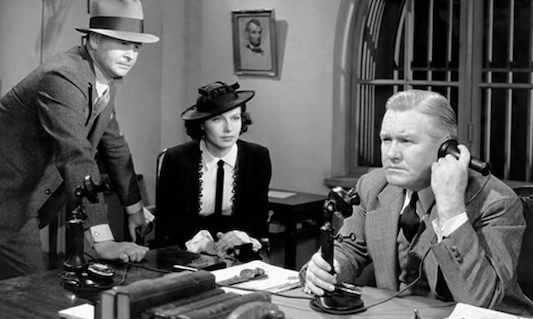
SERIOUS BUSINESS…Barton MacLane, June Travis and Joseph Crehan in Jailbreak. (IMDb.com)

 * * *

From Our Advertisers

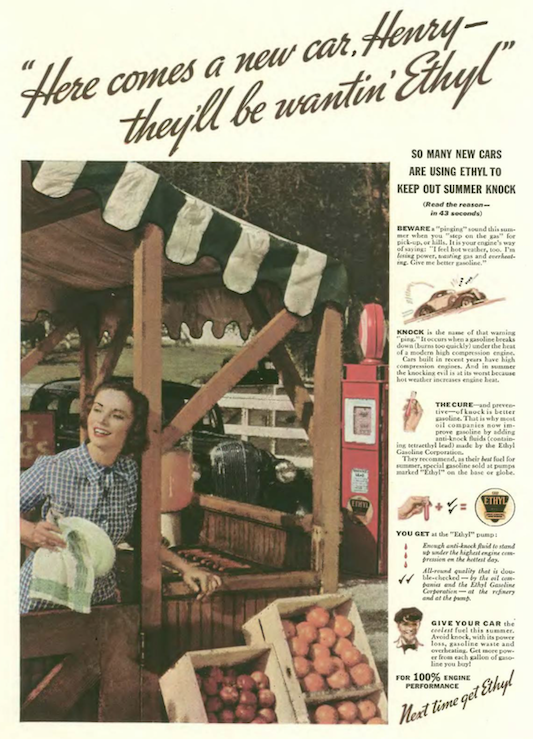
The inside front cover featured a wholesome image of a roadside stand on behalf of leaded gasoline…the makers of Ethyl, which boosted octane ratings and stopped engine knocking, deliberately hid or omitted the word “lead” in their advertising…I don’t miss the Ethyl, but I do miss those roadside stands…

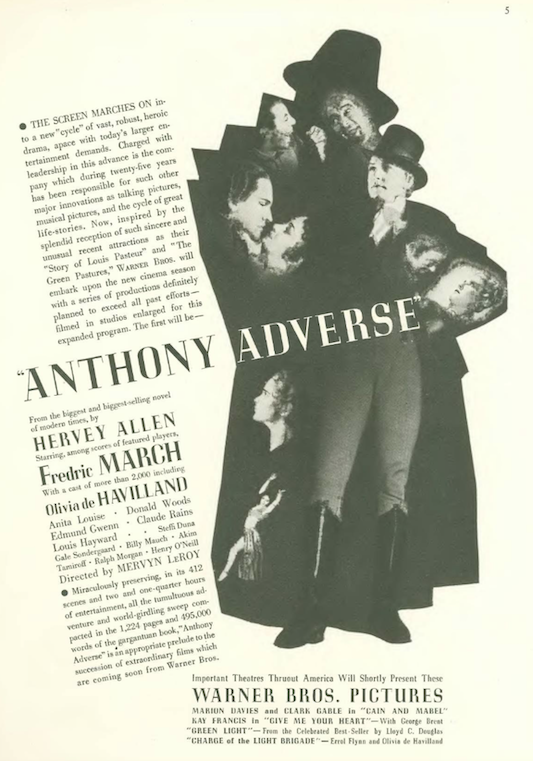
…Warner Brothers took out a full-page ad to trumpet the East Coast release of their epic drama Anthony Adverse, which would go on to win four Academy Awards…

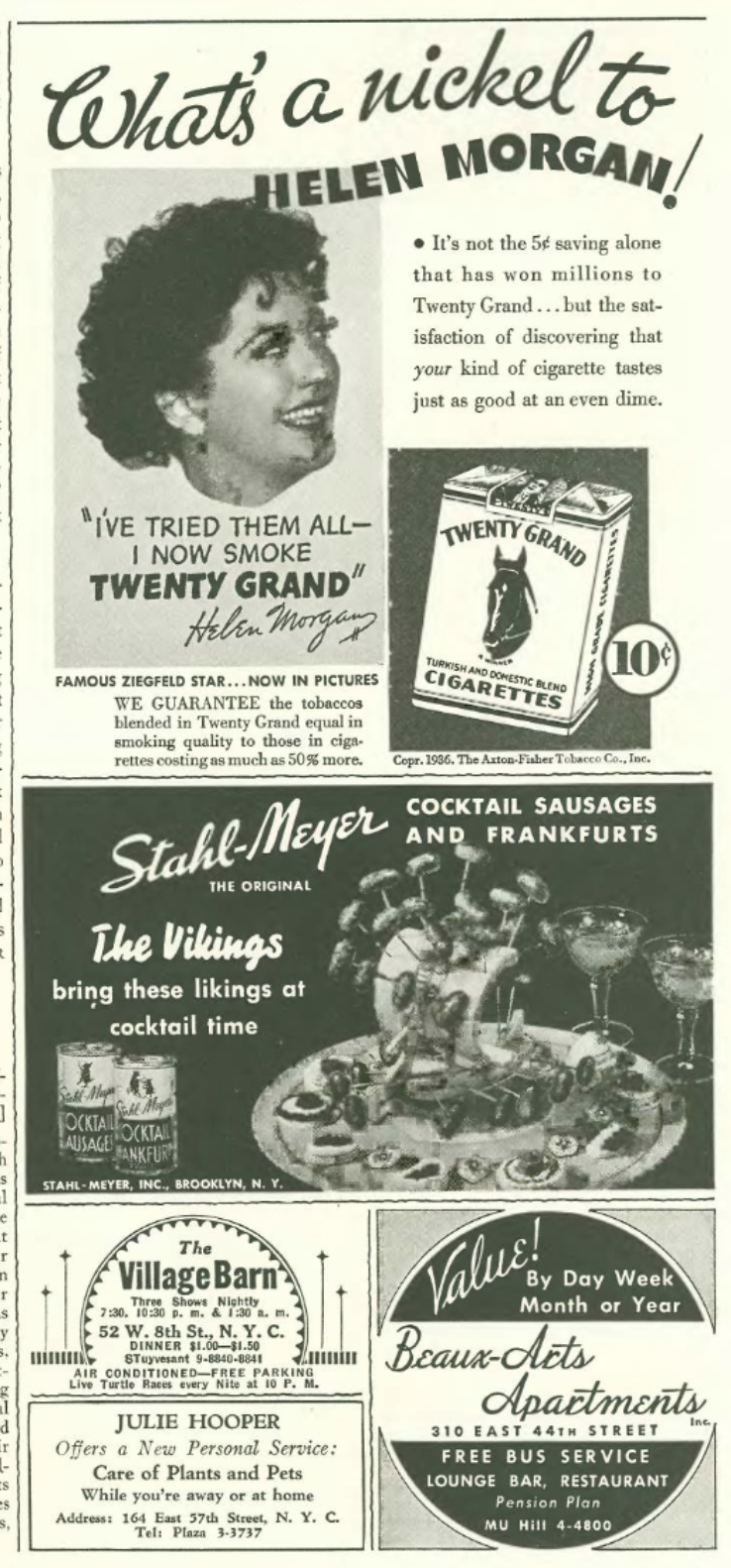
…the original torch singer Helen Morgan lent her endorsement to a budget cigarette brand in this back of the book ad…at this point her career would be headed on a downward spiral, ending with her death in 1941…

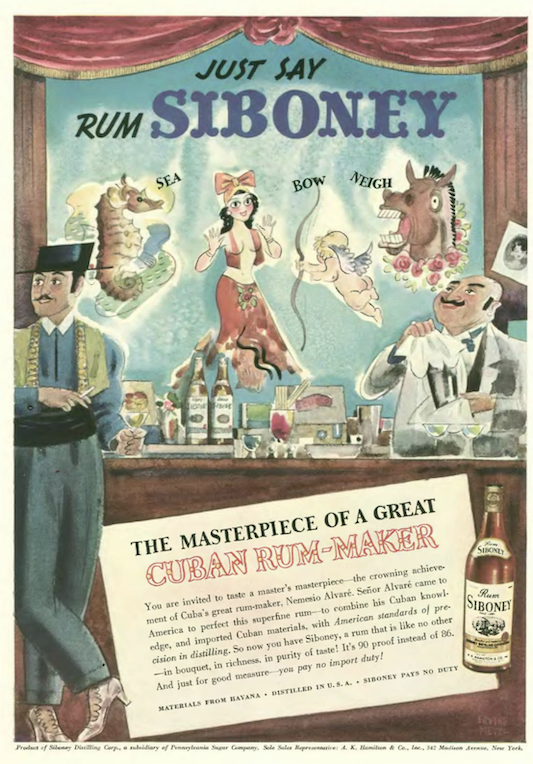
…the makers of the Dominican rum Siboney competed with Cuban rival Barcardi with this colorful full-page ad illustrated by American graphic artist Ervine Metzl

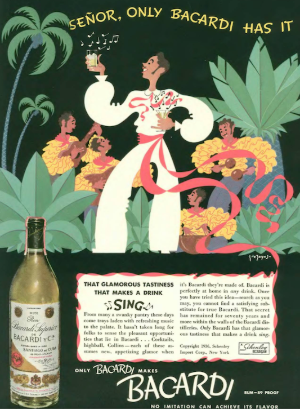
…Barcardi placed this front cover advertisement in Aug. 1, 1936 New Yorker (illustrated by George de Zayas)…

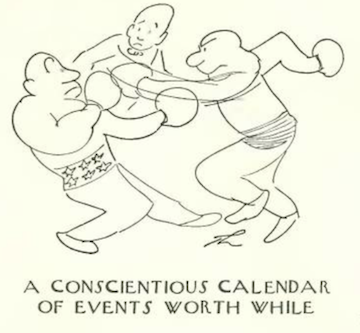
James Thurber kicks off the cartoons with two terrific spot drawings…

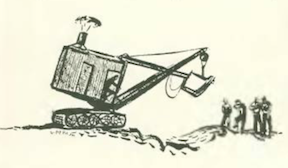
…this spot drawing by Victor de Pauw recalls my favorite childhood book, Mike Mulligan and His Steam Shovel (1939), by Virginia Lee Burton

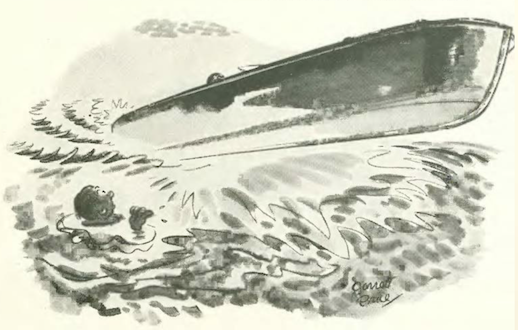
…I’m not sure if one would call this a spot drawing or a caption-less cartoon, at any  rate, Garrett Price aptly illustrated the dangers of swimming beyond the bouys…

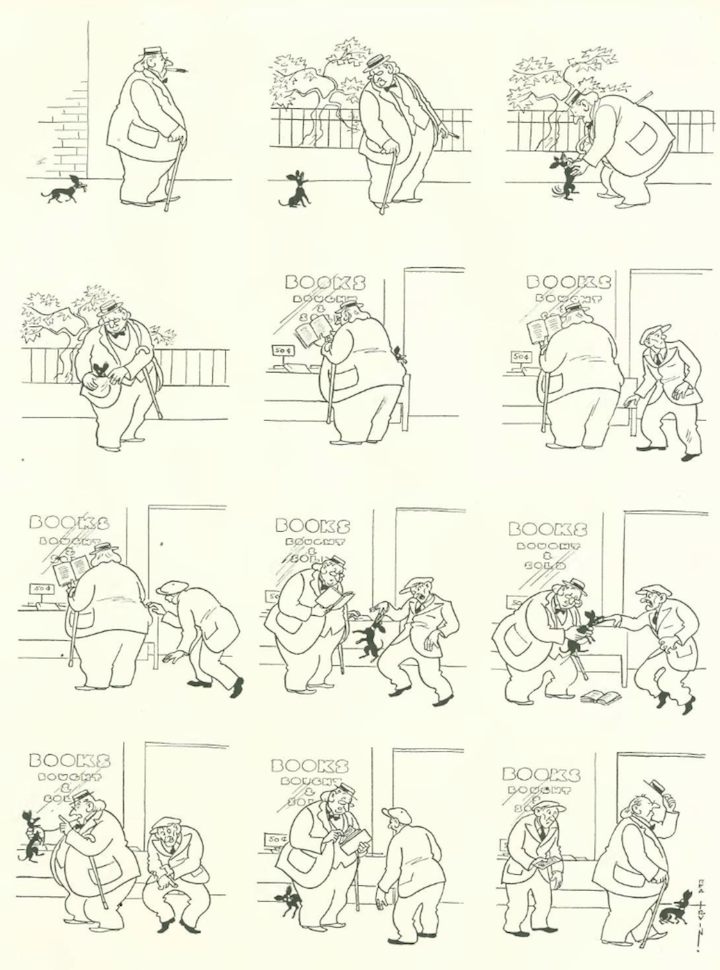
Rea Irvin demonstrated the perils of dognapping in this multi-panel entry…

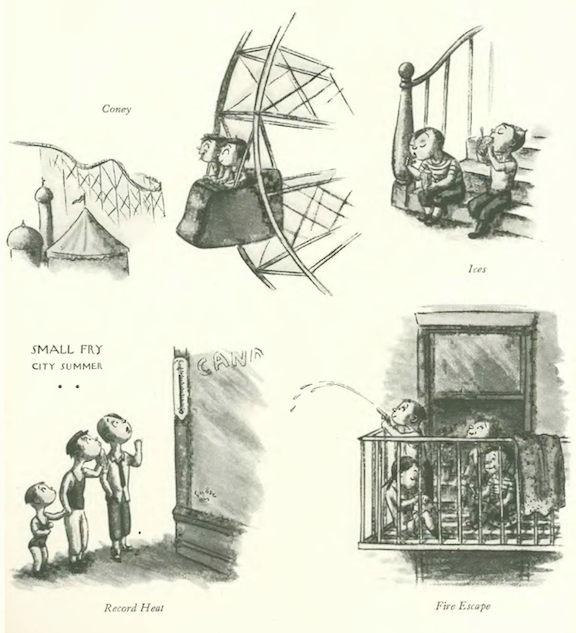
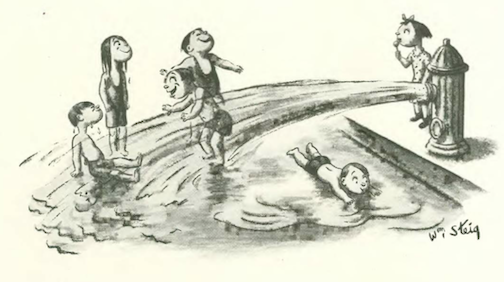
William Steig celebrated summer in the city…
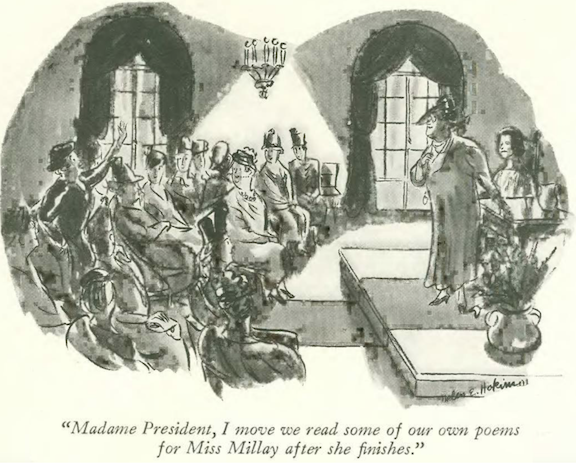
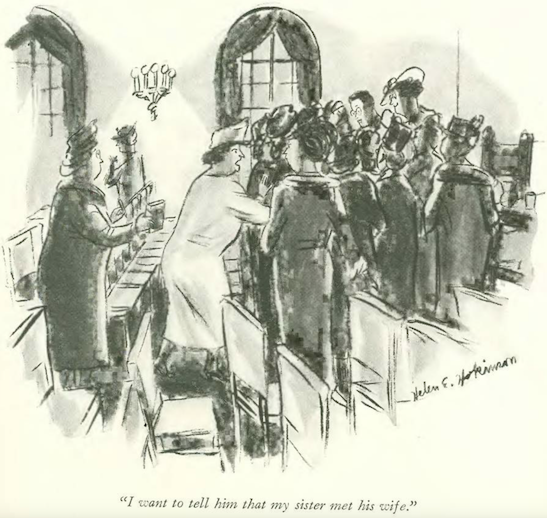
Helen Hokinson drew up an urgent social connection…

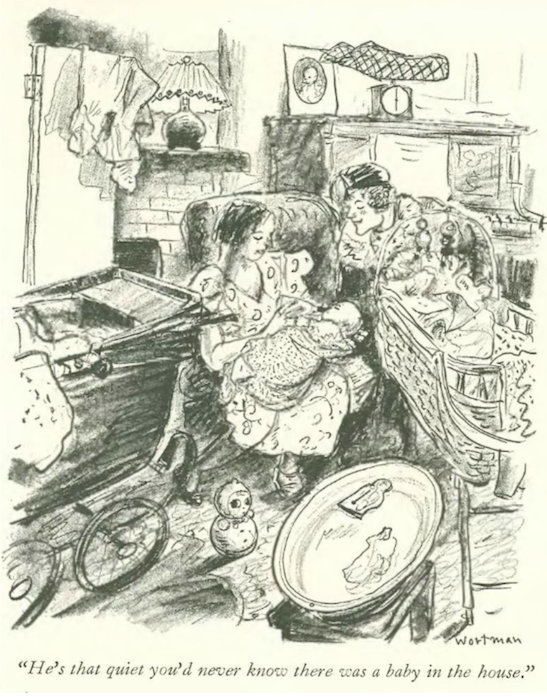
Denys Wortman looked in on the trappings of motherhood…

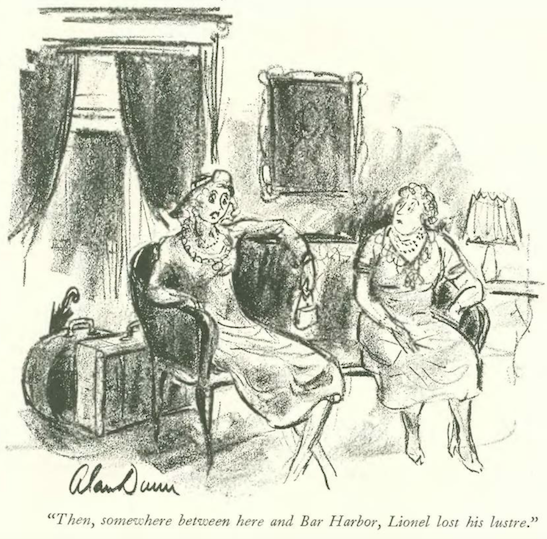
Alan Dunn showed us one effect of long-distance travel…

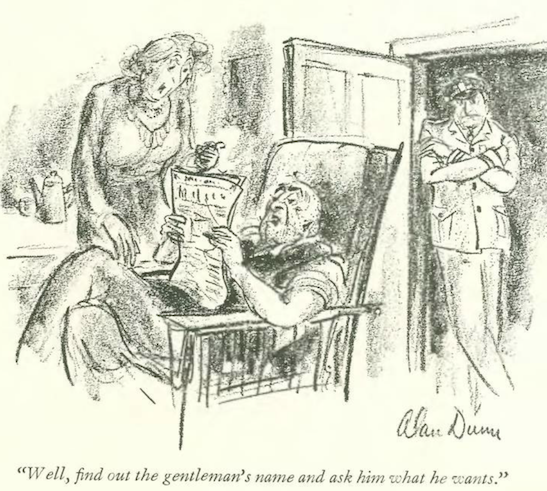
…and Dunn again, with a man who’d rather not ask questions…

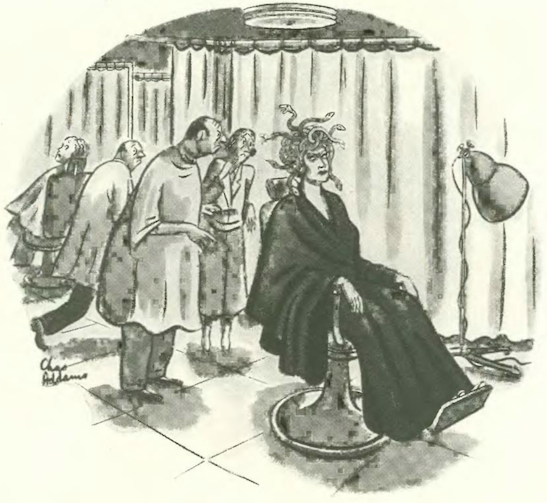
…and leave it to Charles Addams to draw up The New Yorker’s first Medusa-themed cartoon…

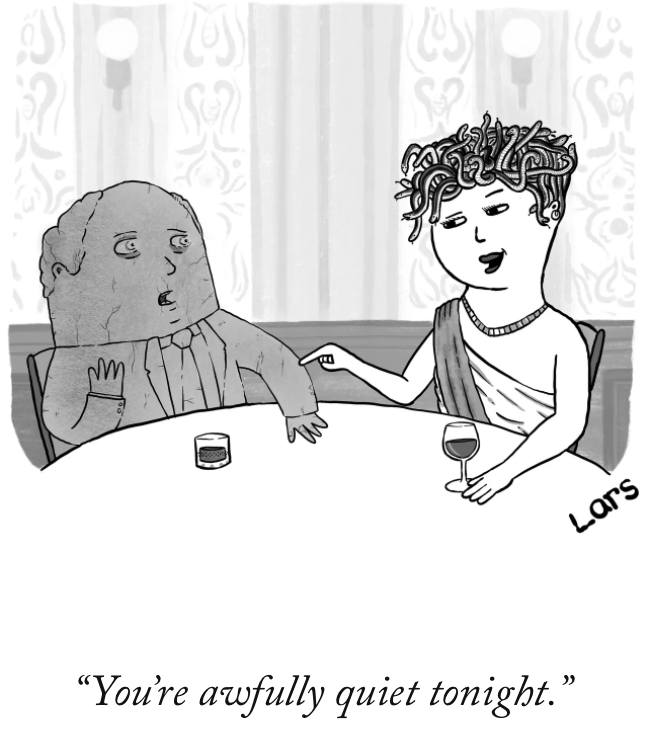
…before we continue, here are other interpretations of the mythic Gorgon from The New Yorker…this one by Lars Kenseth is from Jan. 21, 2019…

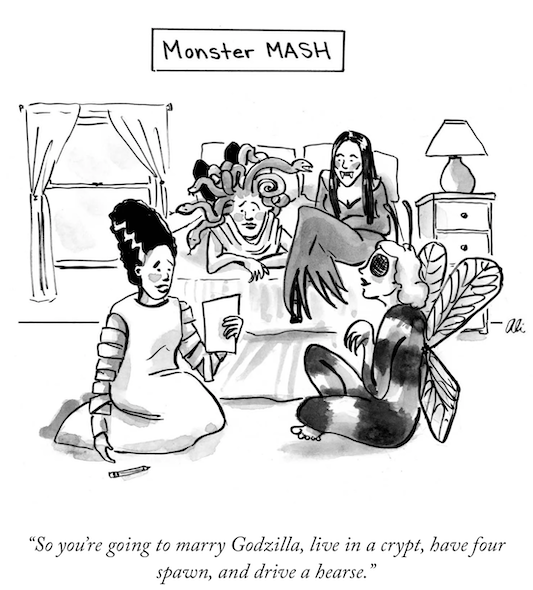
…this is by Ali Solomon (Oct. 29, 2025)…

…and from May 3, 2025, this terrific caption contest cartoon by Jason Adam Katzenstein (and the winning caption by Peter Sergison, Durham, NC)…

…and here’s a timely cartoon by Daryl Seitchik that was rejected by the magazine…

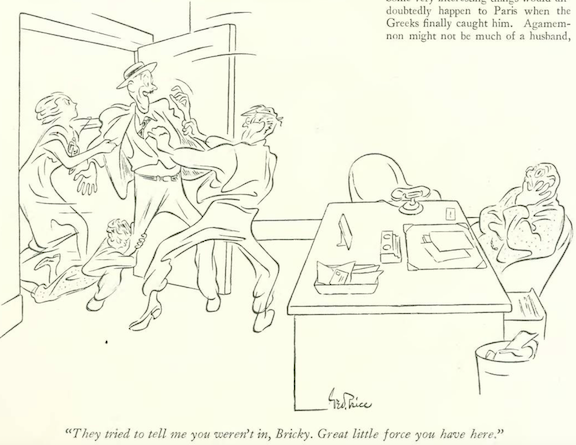
…we go back to 1936 with George Price and a plucky salesman…

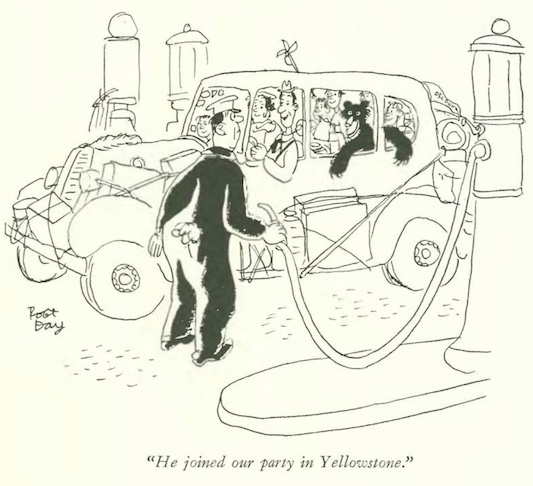
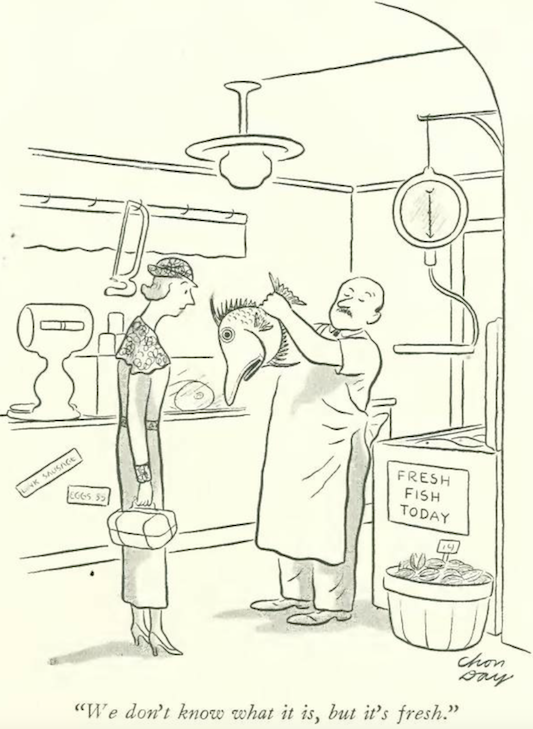
Chon Day made an unappetizing find at the fish market…

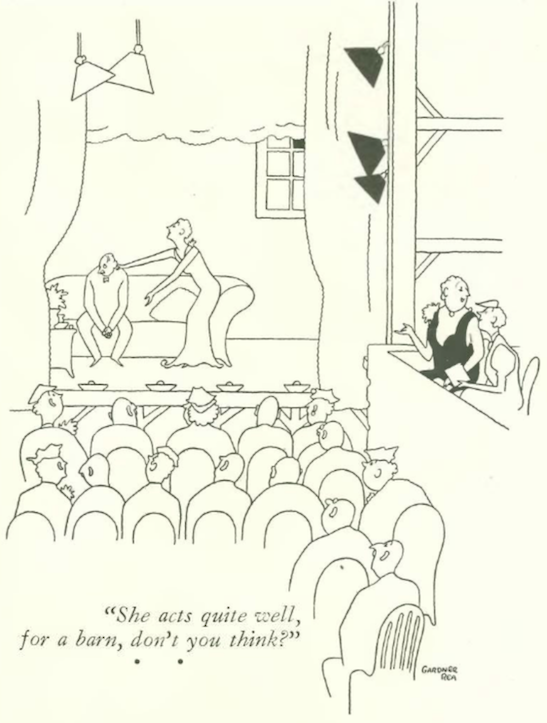
Gardner Rea looked in on a summer stock performance…

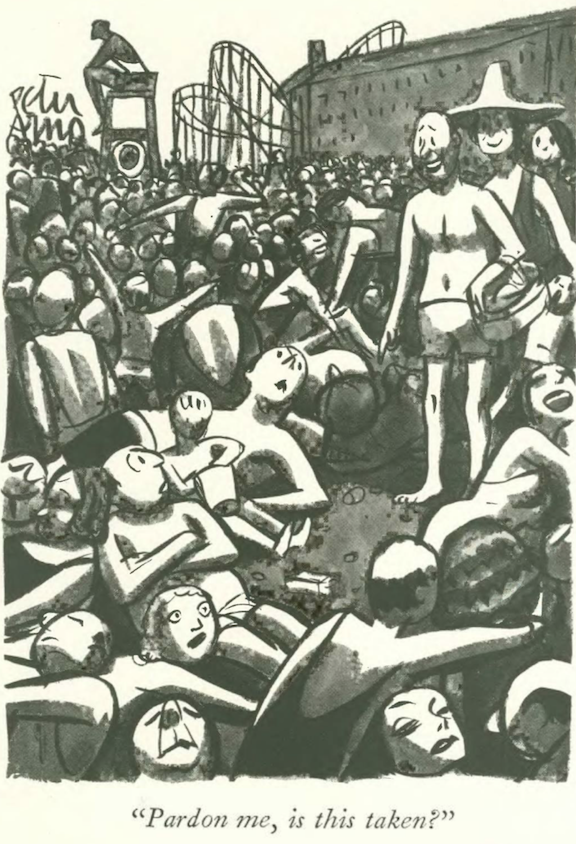
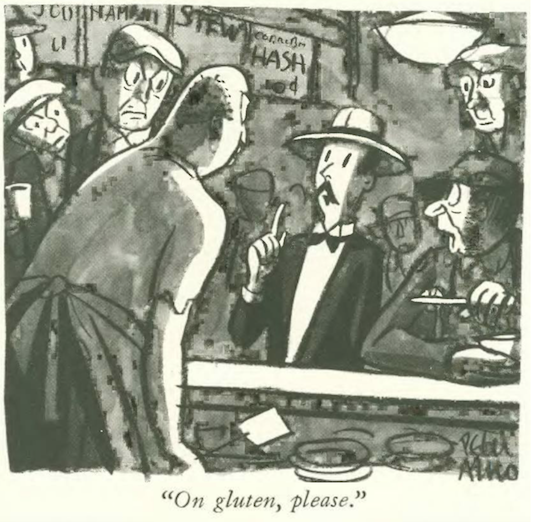
Peter Arno drew up a Milquetoast unwittingly ordering a knuckle sandwich…

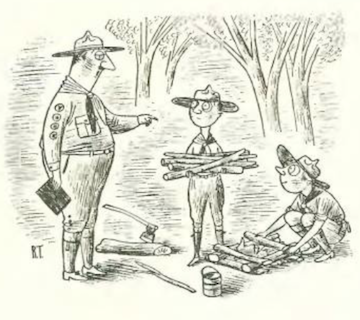
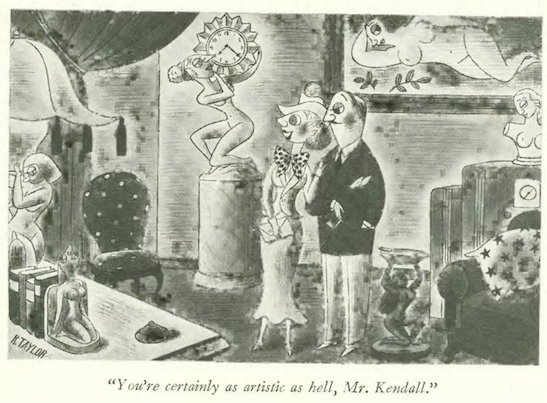
…and we close with some racy decor, courtesy Richard Taylor

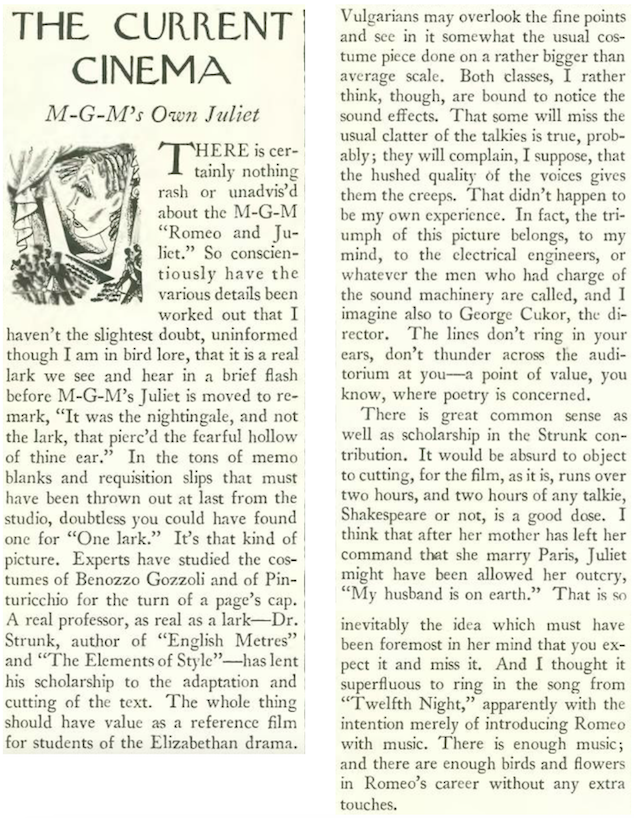
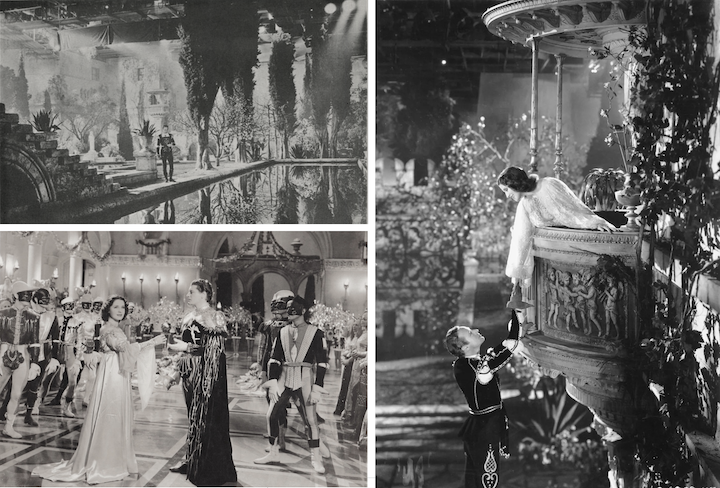
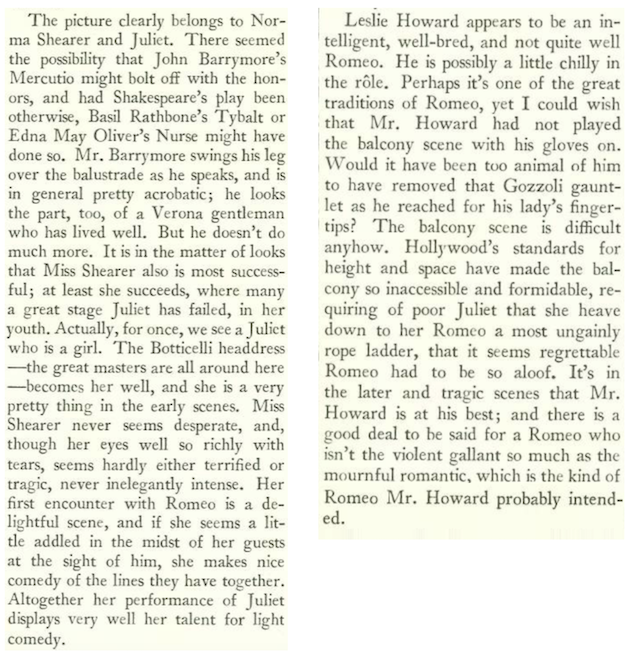
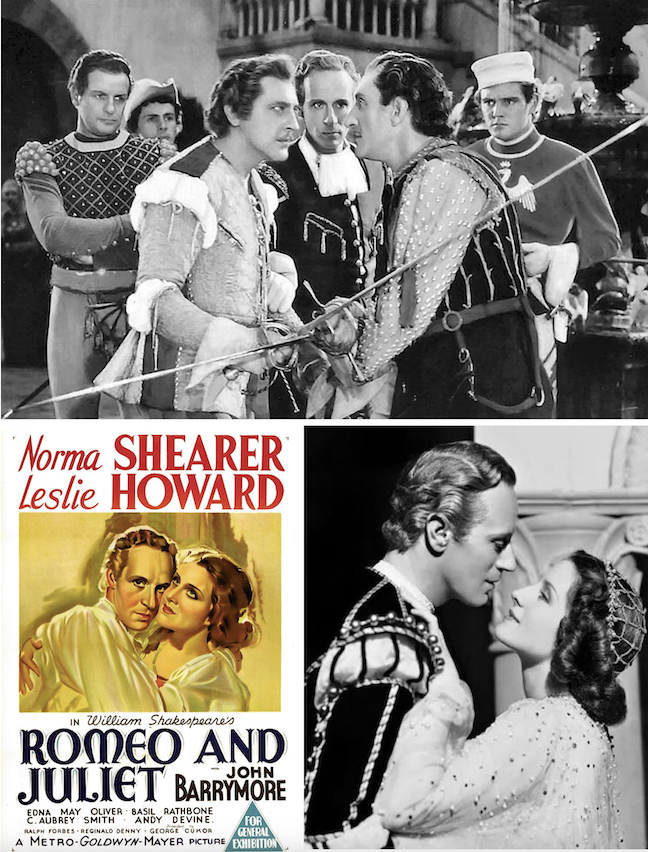
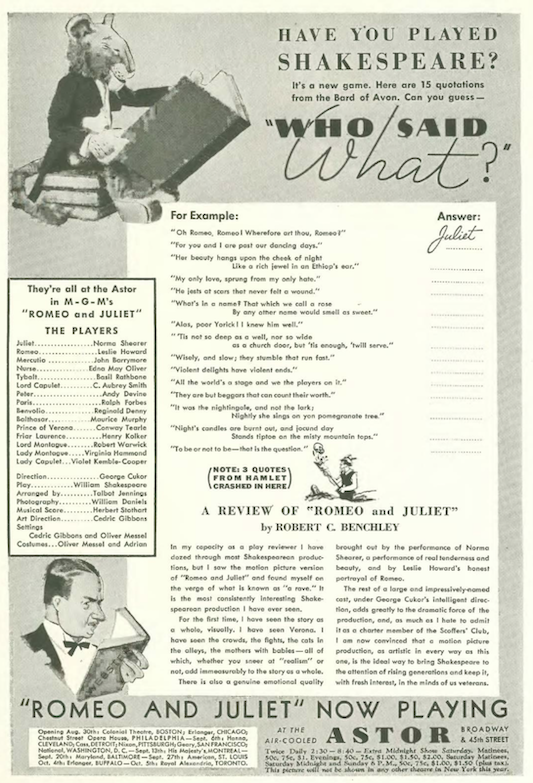
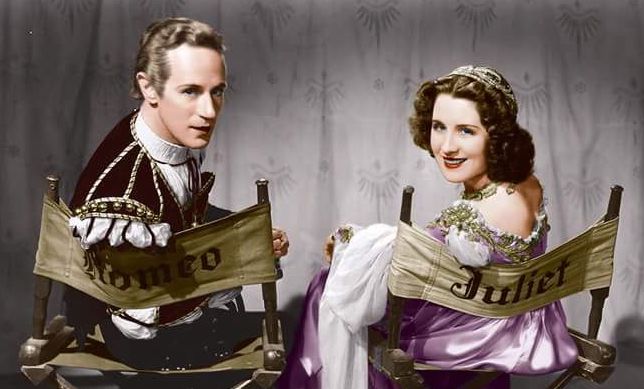
Next Time: Wherefore, Old Romeo?…

A Letter From Berlin

Above: Nineteen-thirties dance class sponsored by Kraft durch Freude (Strength Through Joy), a sub-organization of the German Labour Front that sought to fulfill the totalitarian ambitions of the Nazi regime by "forming a genuine national and performance-based community of all Germans," in other words, keep them busy and distracted from reality. (bundesarchiv.de)

Paris correspondent Janet Flanner visited Berlin to check on that city’s preparations for the 1936 Olympic Games, an event Nazi leaders saw as a prime opportunity for some big-time propaganda.

August 1, 1936 cover by Constantin Alajalov with a wry twist on the upcoming Berlin Olympic games (note the strap along the left edge bearing some of flags of competing nations).

Flanner noted Propaganda Minister Joseph Goebbels’ charge to the German people, instructing them to show the world that the German Volk were “more charming than Parisians, more lively than the Romans, more worldly than the Londoners, and more efficient than the New Yorkers.”

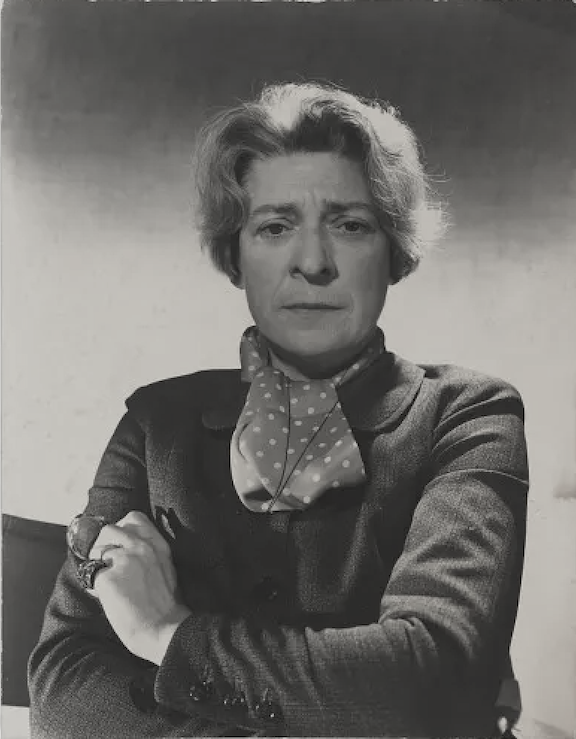
EYE ON BERLIN…Janet Flanner, who wrote under the pen name Genêt, in 1940. (National Portrait Gallery)

There was an ambiguous quality to Flanner’s early writings about Nazi Germany and Adolf Hitler in particular. As The New Yorker’s Andrew Marantz noted in “Takes” (Aug. 10, 2025) regarding Flanner’s 1936 profile of Hitler, “Instead of telling readers what they needed to know—that was what newspapers were for—she focused on what they might want to know…” Rather than taking sides, she reported in a cool and ironic tone. In her biography Genêt, Brenda Wineapple wrote that Flanner in her early writings “thought of herself as a high-class gossip columnist.”

Here are excerpts from the first part of Flanner’s “Berlin Letter.”

FASCIST FEVER DREAM…The Nazis spent large sums in preparation for the Olympic games, seeing them as the ultimate propaganda opportunity. Clockwise, from top left: Nazi officials show the extent of the Olympic village using a scale model in July 1936; a street scene with displays of the Olympic and swastika flags in Berlin, August 1936— the regime temporarily toned down public anti-Semitic displays and cleaned up the streets to impress international visitors; lively café scene on the Kurfürstendamm, known colloquially as the Ku’damm, in 1936. (Robert Hunt Library/Sueddeutscher Verlag Bilderdienst/tripadvisor.com)
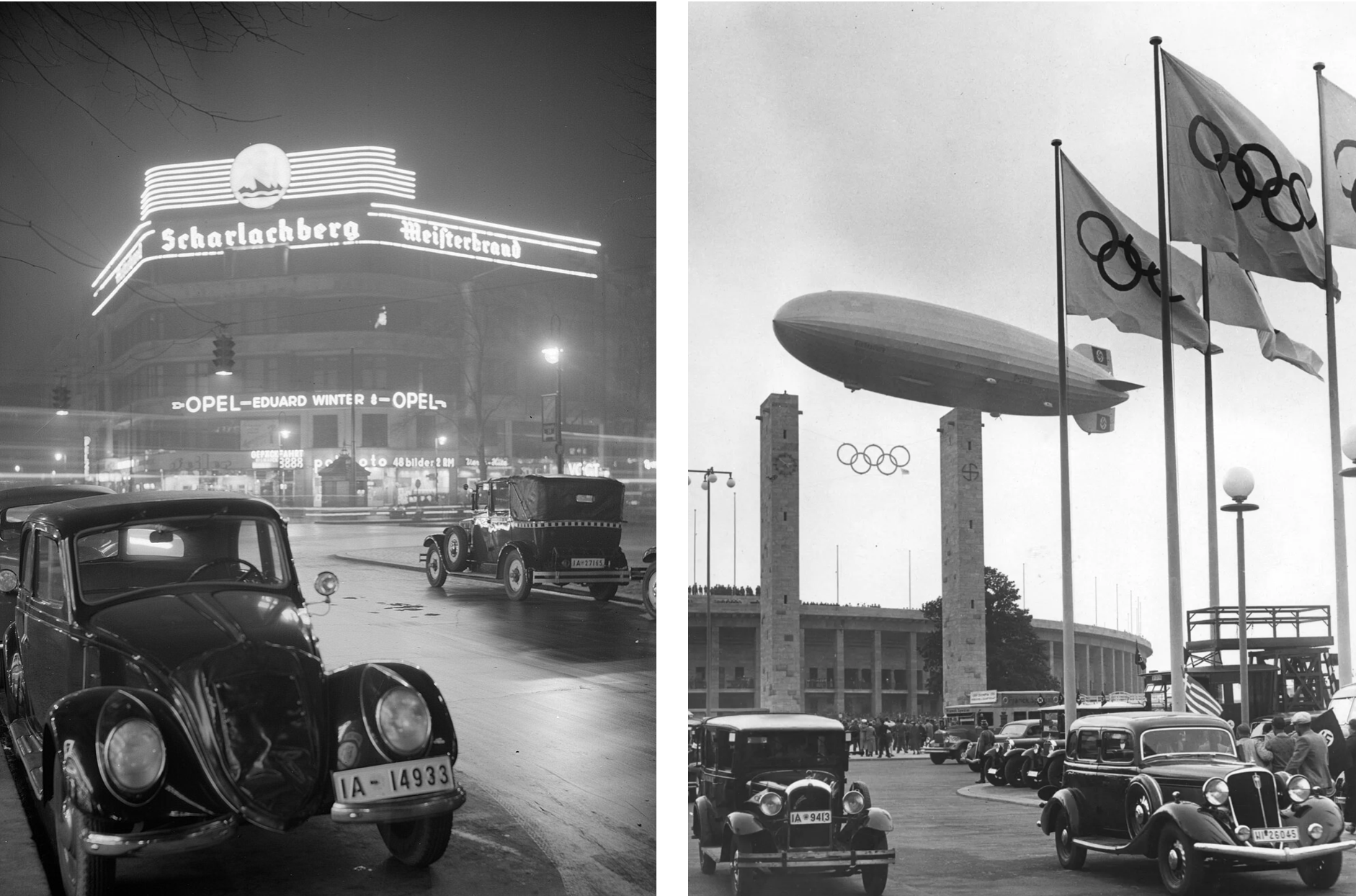
BEFORE IT ALL WENT DARK…In 1936 the Kurfürstendamm was a bustling Berlin boulevard, temporarily masking the oppressive Nazi regime with a veneer of normalcy for the 1936 Summer Olympics—shown at left is the Scharlachberg House at the corner of Kurfürstendamm/Uhlandstraße in Berlin, where the Maison de France stands today; at right, the Hindenburg flies over the Olympic Stadium in Berlin, August 1936. (Wikipedia/Encyclopædia Britannica)

In these excerpts, Flanner wrote that the arts were overseen by Joseph Goebbels and Hermann Göring (of all people). She also noted the absence from the opera (which she rated poor under Goebbels) of the world-renowned conductor Wilhelm Furtwängler, who was in seclusion “writing an opera,” but probably wanted to be out of the limelight due to his controversial decision to stay in the Reich rather than flee like other artists and musicians. Furtwängler detested Hitler, but believed his art would wither if he left his homeland.

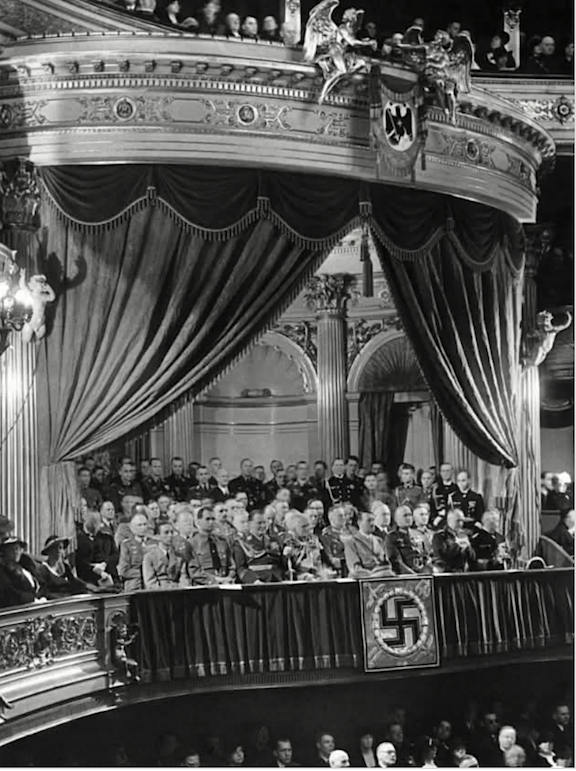
HORROR SHOW…Adolf Hitler and his Nazi thugs at the opera in Berlin in 1936. Hitler often appeared in carefully staged public settings like this one and the one in the photo below. (archaeohistories.via Facebook.com)
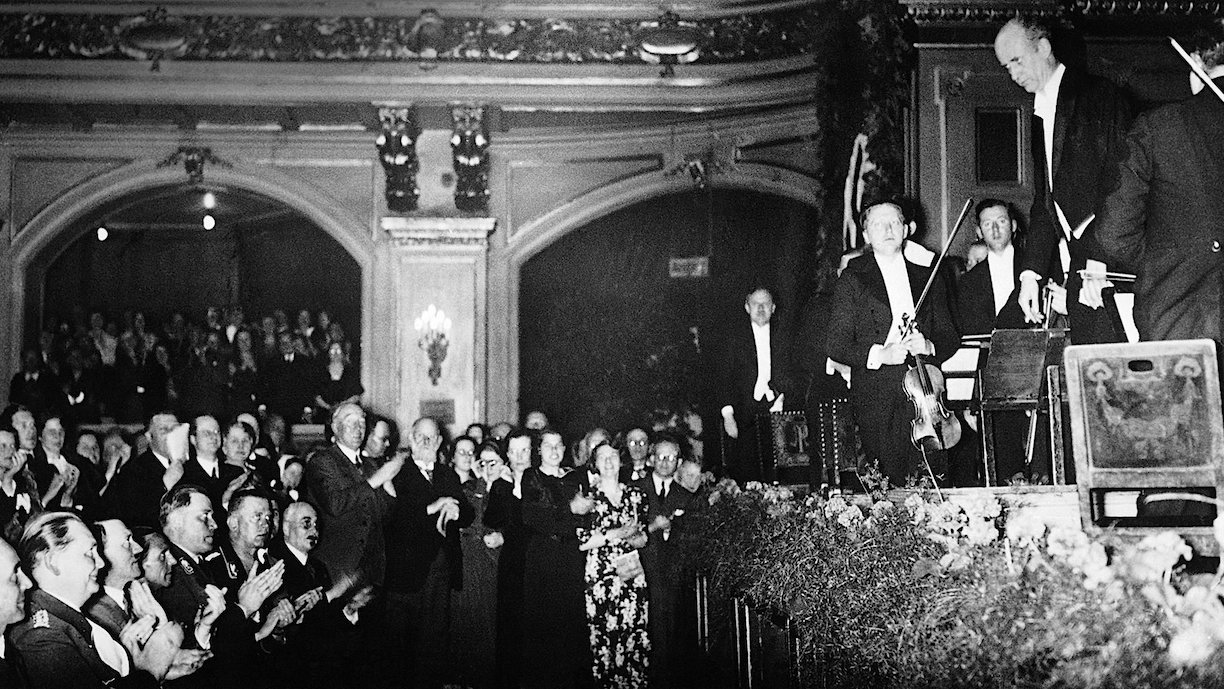
MUSICAL STRAIN…Conductor Wilhelm Furtwängler acknowledges the audience following a 1935 performance by the Berlin Philharmonic Orchestra—visible in the left corner of the photo are Hermann Göring, Adolf Hitler, and Joseph Goebbels, among other Nazi leaders. (Archiv Berliner Philharmoniker)
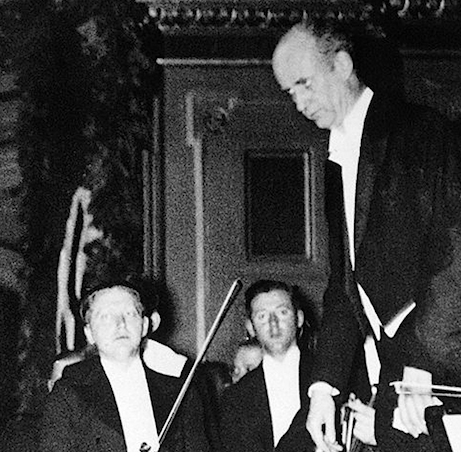
A closer look at the photo—a combination of hatred and fear in Furtwängler’s eyes? The first and second violinists don’t look too thrilled either.

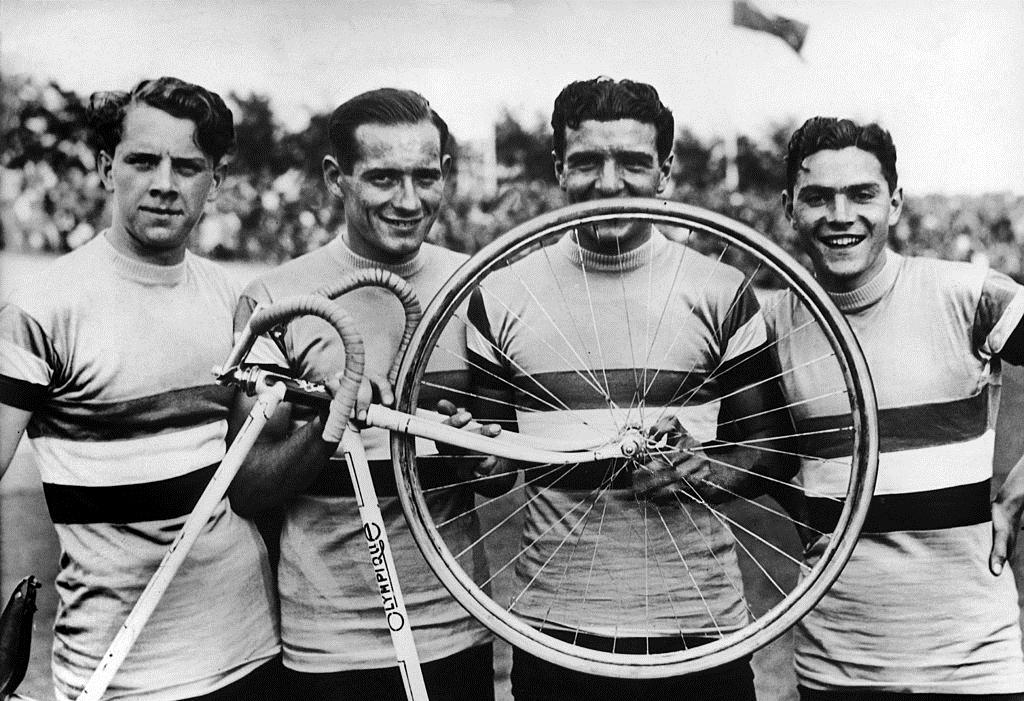
In a related item, Howard Brubaker (in his “Of All Things” column), had this to say about Germany’s Olympics preparations.

 * * *

A Friendly Shakedown

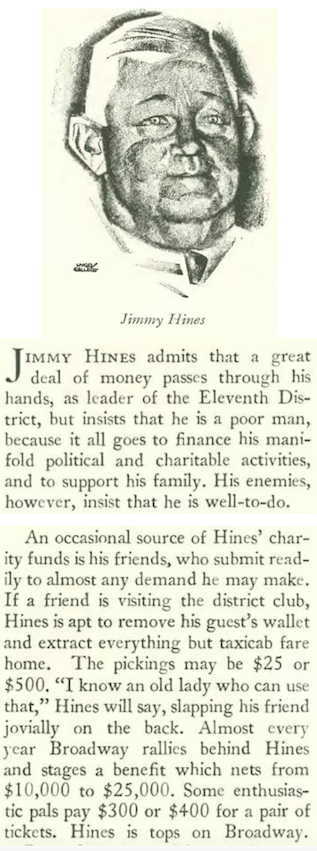
In Part Two of his profile on Tammany powerbroker Jimmy Hines, journalist Jack Alexander noted Hines’ unorthodox habit of soliciting contributions from his friends (illustration by Hugo Gellert). Excerpts:

 * * *

At the Movies

“In the dreadful summer of 1932, [The New Yorker] paid me ten dollars for an anecdote. I was ripe for seduction…,” Russell Maloney once recalled. “[Then] I sent in an account of a situation that I thought would make a good Helen Hokinson picture…and got paid for that: seven dollars.”

Maloney (1910–1948) proceeded to send more ideas to The New Yorker, and enough were accepted that in 1935 he packed his bags and moved to Manhattan for a job at The New Yorker. In his ten years at the magazine he would contribute thousands of anecdotes to “The Talk of Town” as well as casuals, profiles, and countless cartoon captions. His interest in theater as well as celebrity gossip suited him well when he substituted for John Mosher as the magazine’s film critic.

So let’s see what Maloney—who would later call 1939’s The Wizard of Oz a “stinkeroo,” had to say about the latest fare from Hollywood.

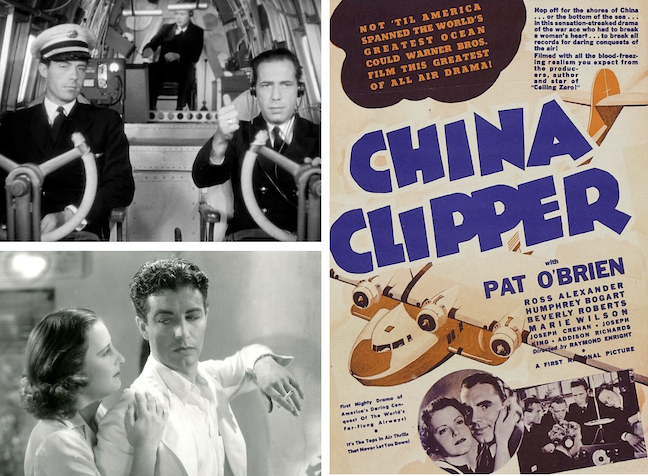
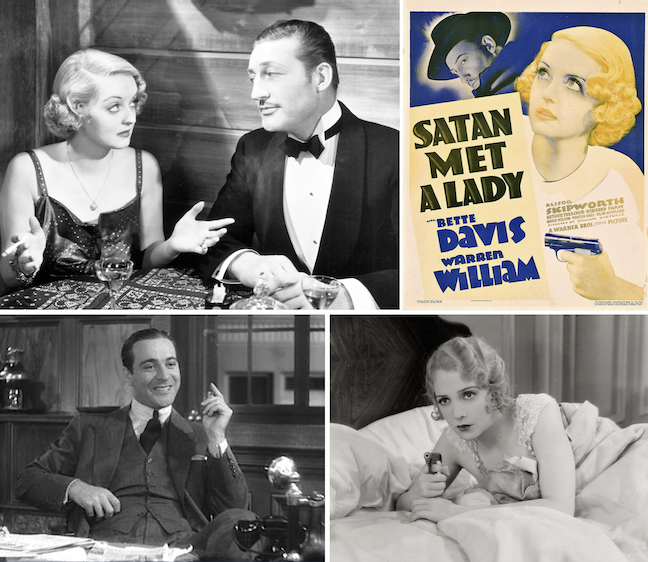
BUT THEY PAID ME THIS MUCH…Top: Russell Maloney wrote that both Bette Davis and Warren William seemed “embarrassed” to be appearing in Satan Met a Lady, which was a loose adaptation of Dashiell Hammet’s 1930 novel The Maltese Falcon—Maloney found Satan to be vastly inferior to the 1931 film The Maltese Falcon (below), which starred Ricardo Cortez and Bebe Daniels. In 1941 Humphrey Bogart and Mary Astor would appear in yet another adaptation of the Hammet novel. (imdb.com/facebook.com/jbkaufman.com)

Maloney “enjoyed” The Return of Sophie Lang, with actors “baffling one another  with the greatest suavity”…

IS THIS SUAVE ENOUGH FOR YOU?…Ray Milland and Gertrude Michael get close in The Return of Sophie Lang. (Pinterest.com)

…while Spendthrift, featuring actors speaking in various accents, was “perfectly dreadful.” Fortunately Suzy managed to lift the reviewer’s spirits, especially with the appearance of Jean Harlow.

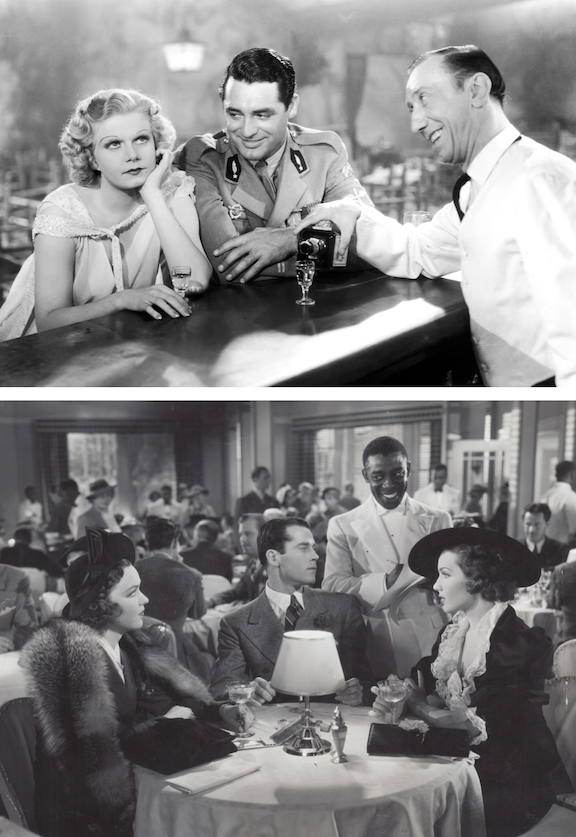
A WINNER AND A WIENER…Top, Jean Harlow, Cary Grant, and George Davis in Suzy; bottom: Henry Fonda is flanked by Pat Paterson (left) and Mary Brian in Spendthrift. (tcm.com/eBay.com)

See this post from Michael Maslin’s Inkspill about Maloney’s contributions to The New Yorker. Also, check out this photo below that includes Maloney (standing next to James Thurber):

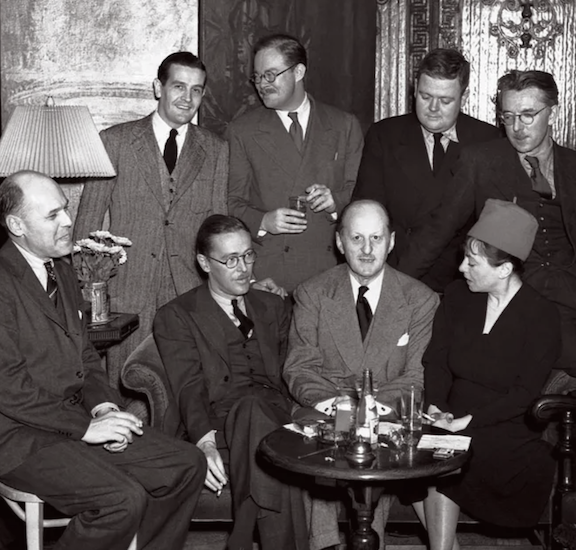
LITERARY CLUBHOUSE…Familiar New Yorker faces gathered for a cocktail party at the Hotel Algonquin to celebrate the success of Frank Case’s 1938 memoir, Tales Of a Wayward Inn. Seated, from left, are Fritz Foord, Wolcott Gibbs, Case and Dorothy Parker; standing, left to right, are Alan Campbell, St. Clair McKelway, Russell Maloney and James Thurber (untappedcities.com)

 * * *

From Our Advertisers

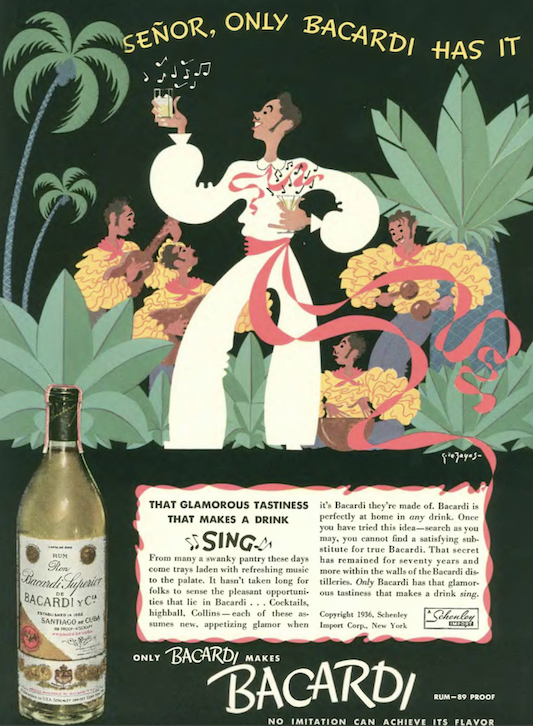
We begin with this colorful inside front cover advertisement for Bacardi rum, illustrated by George de Zayas, the younger brother of Marius de Zayas. Born in Mexico, these talented brothers took different artistic paths—Marius became a prominent avant-garde artist who collaborated with Alfred Stieglitz and others in New York, while George focused on commercial art and popular media…

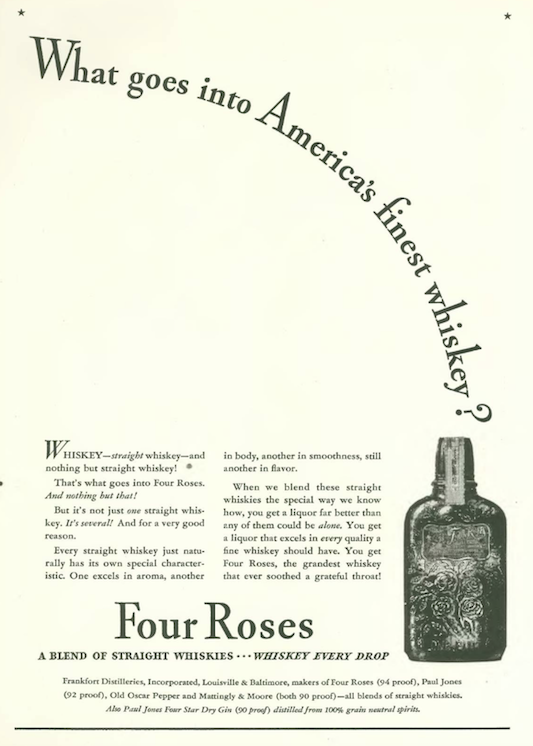
…this isn’t exactly avant-garde, but the makers of Four Roses added a modern twist to their usual traditional style…

…United Airlines offered overnight flights as well as “scenic” daylight flights from coast to coast (New York to San Francisco)…this flight typically took seventeen to nineteen hours, with refueling stops in Cleveland, Omaha, and Cheyenne/Salt Lake City…the planes were not pressurized, so they flew through the weather rather than above it…at least this plane (Boeing 247), according to the ad, had air-conditioning…

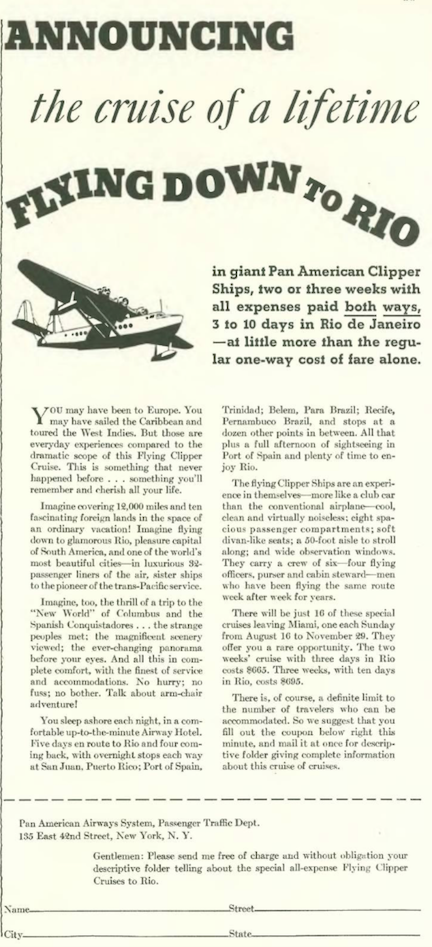
…for the more adventurous (and perhaps wealthier) traveler, you could hop aboard a Pan Am Clipper and head for Rio de Janeiro…in 1936, this flight from Miami to Rio took five days (flying in daylight only)…

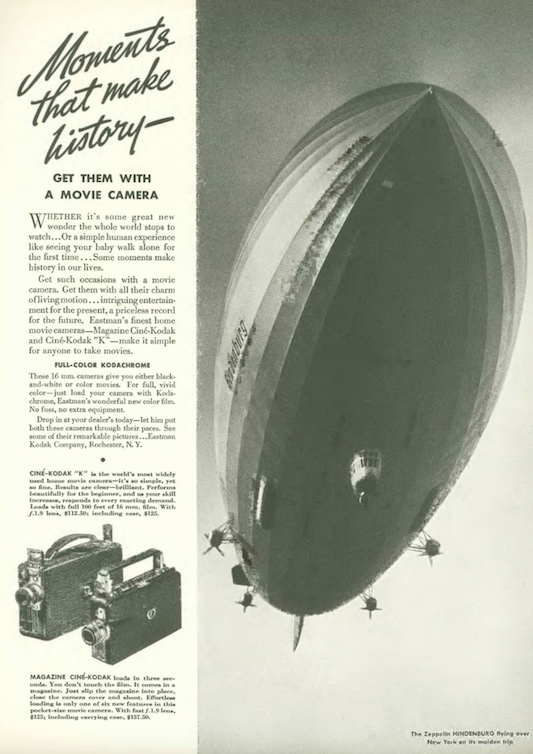
…a one-way ticket to Rio would have cost close to $11,000 in today’s dollars, while the equivalent $9,000 would get you a one-way ticket to Europe on the Hindenburg

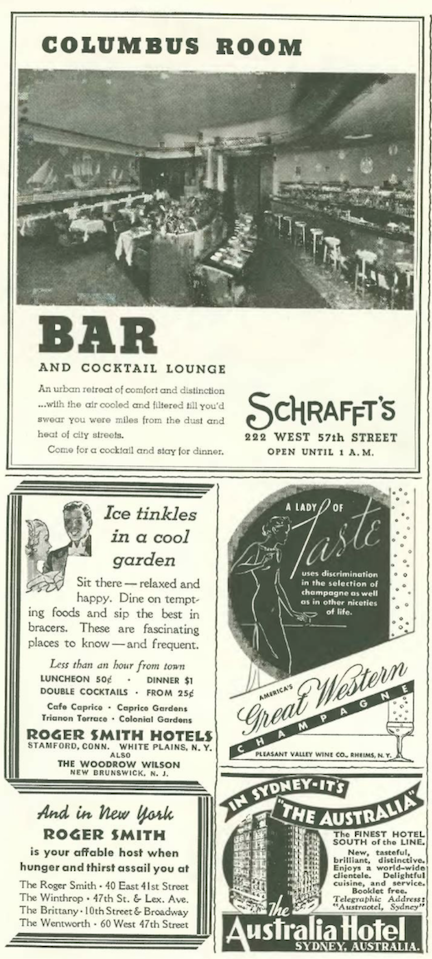
…in the back of the book we find various food and cocktail diversions…

…and some one-column tennis-themed ads…”Johnson’s Tennis Gut” referred to the material used in the Thirties to string rackets…the strings were almost exclusively made from natural animal gut—commonly called “catgut,” though they were actually made from processed and twisted sheep intestines…

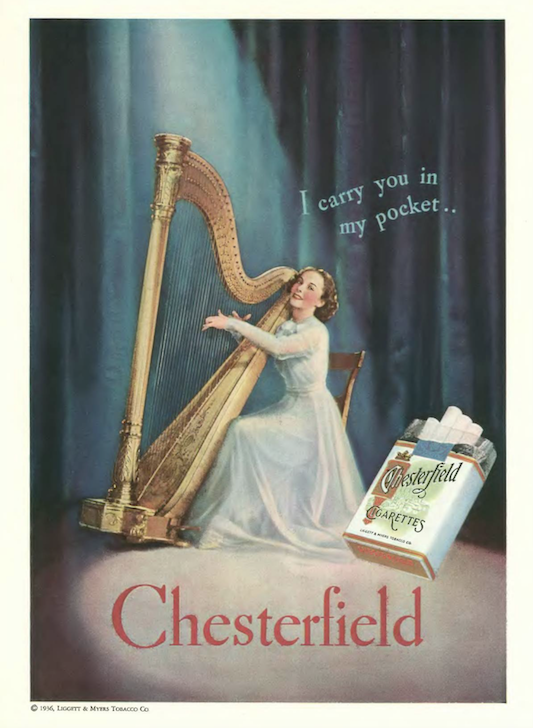
…Liggett & Myers claimed the back page to promote their Chesterfields to women smokers…one wonders if a racking cough interfered with her playing…

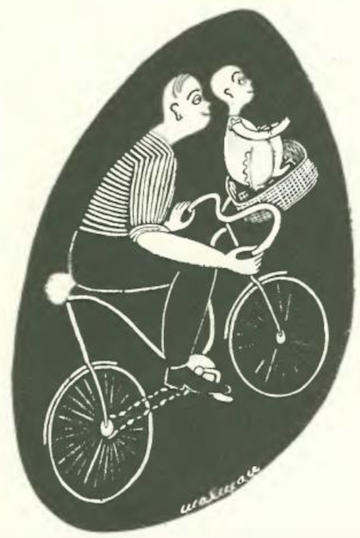
…on to our illustrators and cartoonists, we kick things off with spots by Adolph K. Kronengold

John Groth

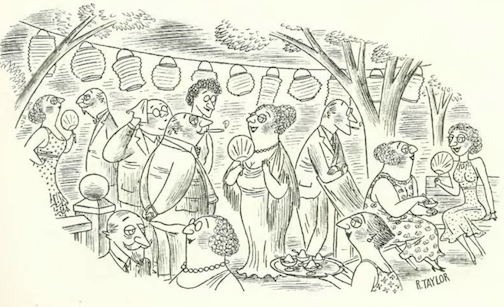
Richard Taylor

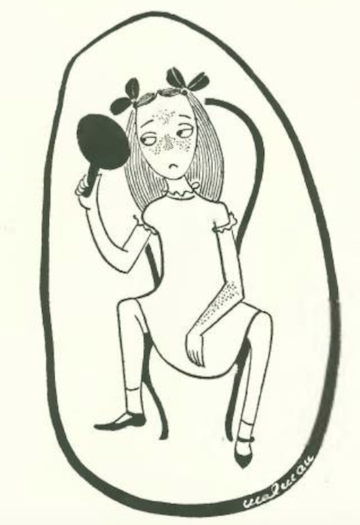
Christina Malman

…and Victor de Pauw

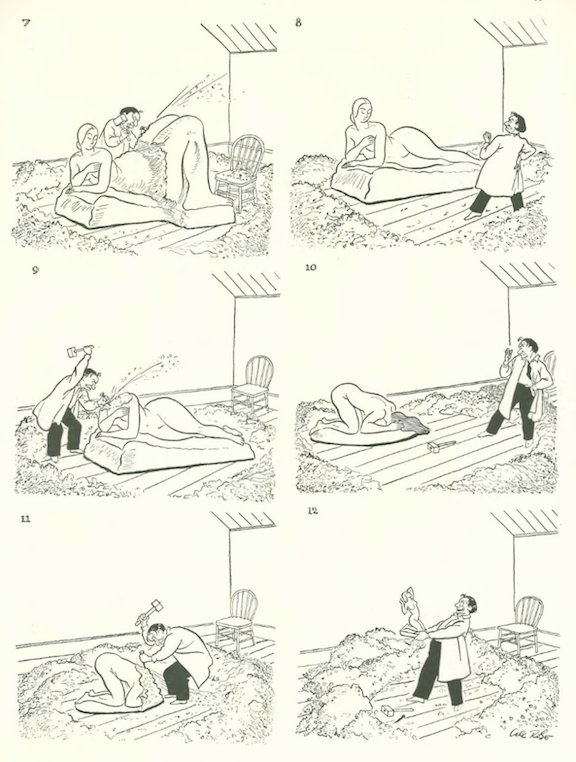
Carl Rose took us through a sculptor’s creative stages…

Helen Hokinson pondered a recipe for the day’s catch…

…and she checked out some summer reading (Warwick Deeping was a British writer of historical romances as well as books that defended the lifestyles of the bourgeoisie)…

…this was F.E. Smith’s sole contribution to The New Yorker, and it’s pretty good…beyond that, I came up empty trying to find out more about the cartoonist…

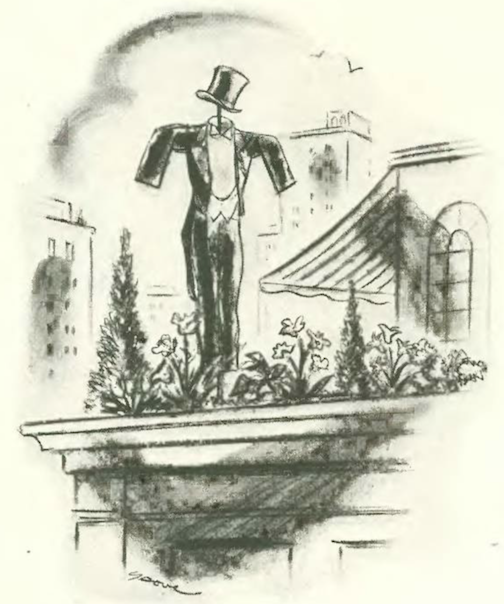
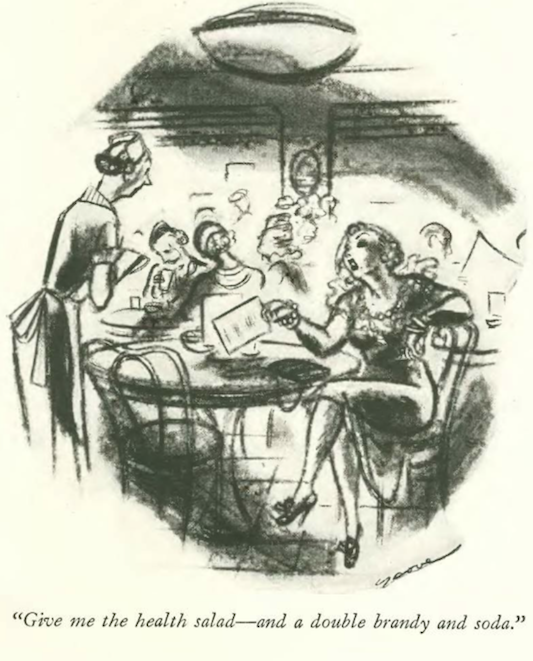
…but we all know Leonard Dove (who contributed fifty-seven New Yorker covers and 717 cartoons)…here he’s keeping things quiet on the tennis court…

…and, of course, we have the great Charles Addams

…we close with one of my favorite cartoonists, Barbara Shermund, keeping things light after the wedding…

Next Time: Men in Kilts…