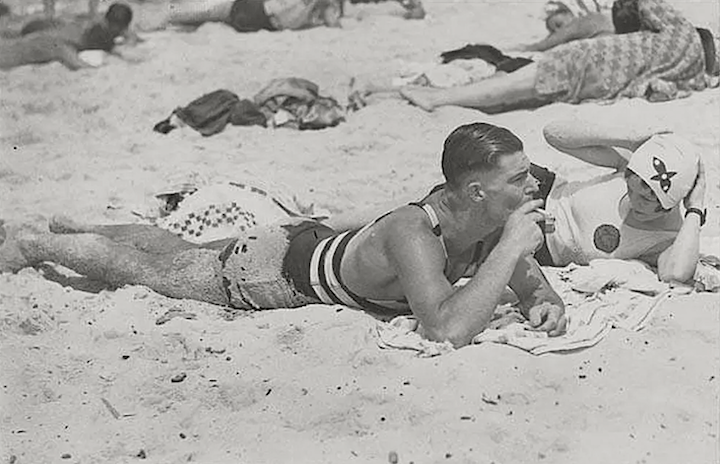
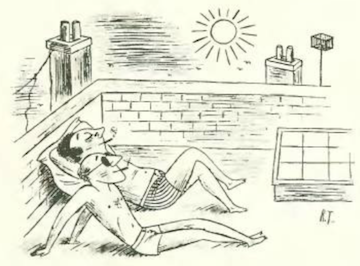
E.B. White grew up along the coast of Maine and had a lifelong love of sailing. He did not, however, have much regard for those who came to the water simply to bask in the sun.
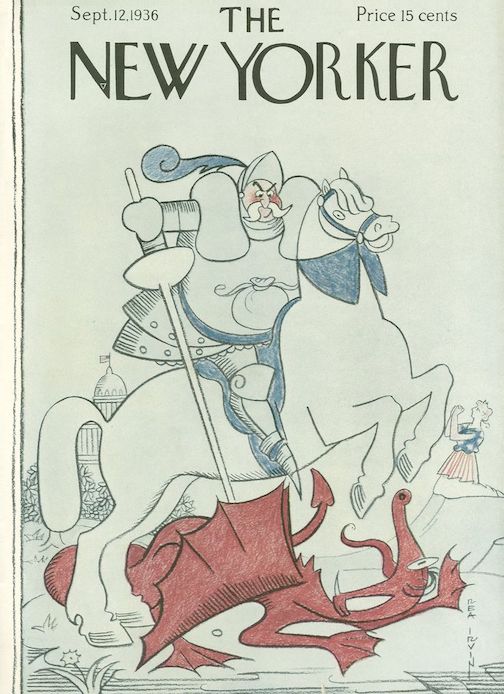
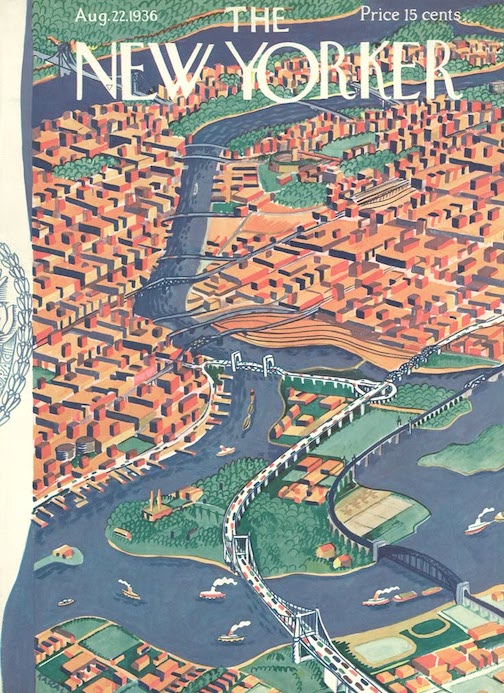
September 12, 1936 cover by Rea Irvin.
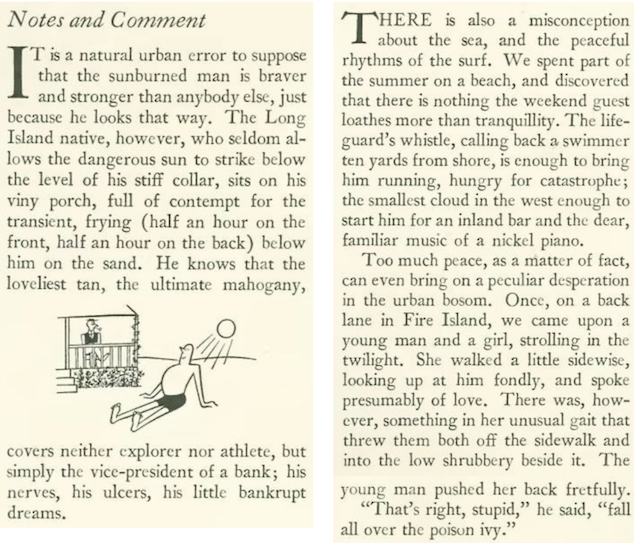
White led off his column with some sharp words about the “sunburned man” who did not come by his tan honestly, like an athlete or explorer, but rather spent his weekends “frying” to cover his “bankrupt dreams.” White was also critical of “the weekend guest” who brought noise rather than tranquility to the seaside.
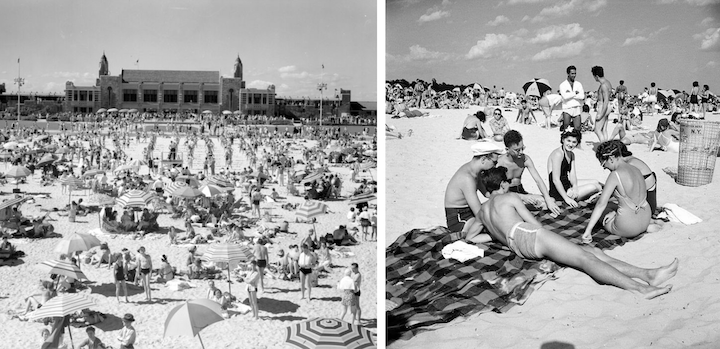
E.B. WHITE’S NIGHTMARE…At left, the West Bathhouse at Jones Beach is the backdrop for this circa 1930s image of New York beachgoers; at right, sunbathers play cards on Orchard Beach, known as the “Riviera of the Bronx,” circa 1930. (facebook.com/Patchogue-Medford Library)
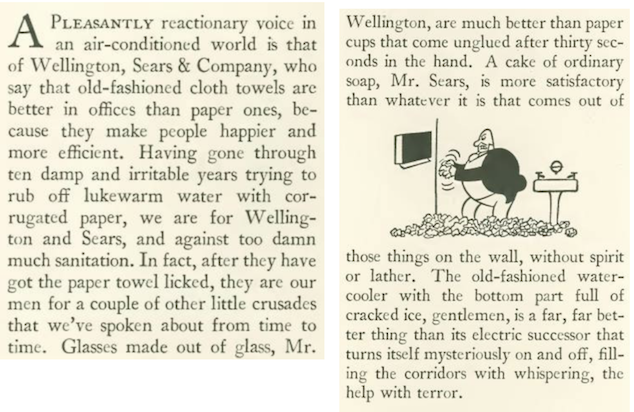
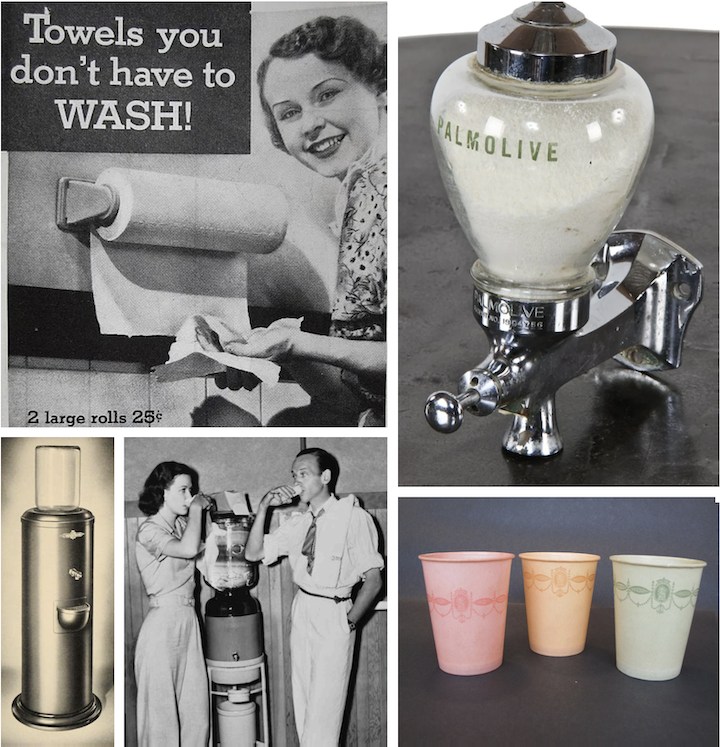
Ever critical of innovation, E.B. White also lamented the rise of such “conveniences” as paper towels and powdered soap dispensers.
A FEW OF MY LEAST FAVORITE THINGS…Always wary of the newfangled, E.B. White preferred cloth over paper towels, bar soap over powdered; glass rather than Dixie Cups, and old-fashioned water coolers glittering with cracked ice. Clockwise, from top left: Ad for Scot paper towels, 1935; 1930s powdered soap dispenser; Dixie Cups, 1931; Eleanor Powell and Fred Astaire take a break at an old-fashioned water cooler during filming of Broadway Melody of 1940; detail from an ad for a Frigidaire electric water cooler, 1936. (witness2fashion/urbanremainschicago.com/lafayette.edu/tcm.com)
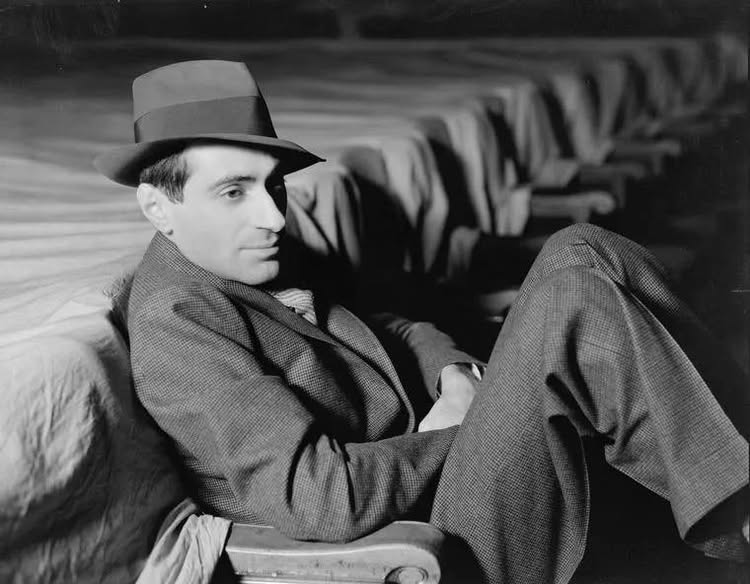
One more item from “Notes,” this referring to theatrical producer and director Jed Harris, who was peeved when a nostalgic reference in his new comedy, Spring Dance, failed to elicit laughter from a first-night audience at the Empire Theatre. E.B. White sided with the audience, and wondered if playwrights in the “television theatre of 1950” would someday reference “Greta Garbo and the Sixth Avenue elevated.”
RELAX, JED…Learning that Broadway producer and director Jed Harris was upset about an audience’s lack of reaction to a nostalgic reference, E.B. White suggested that the director’s protest was a mere “squeak.” (History of Cinema via Facebook)
* * *
At the Movies
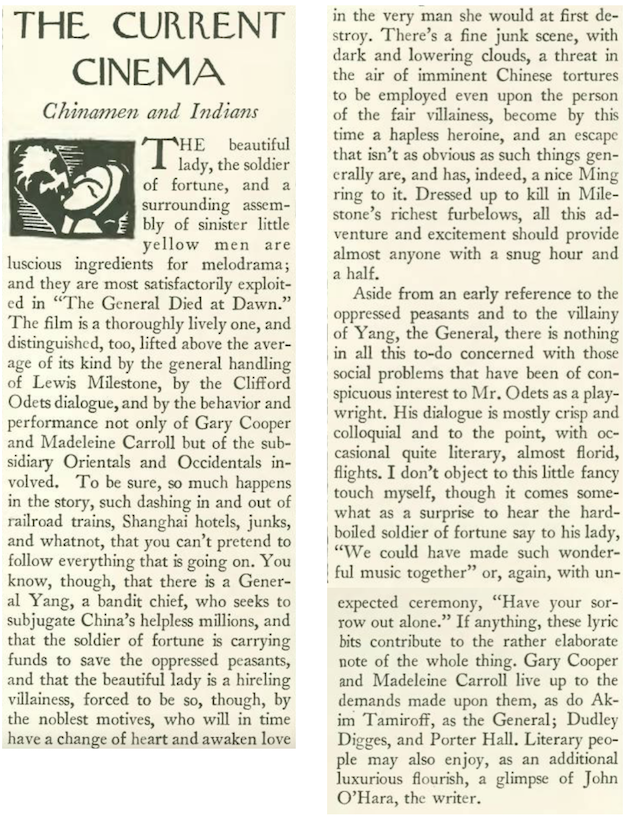
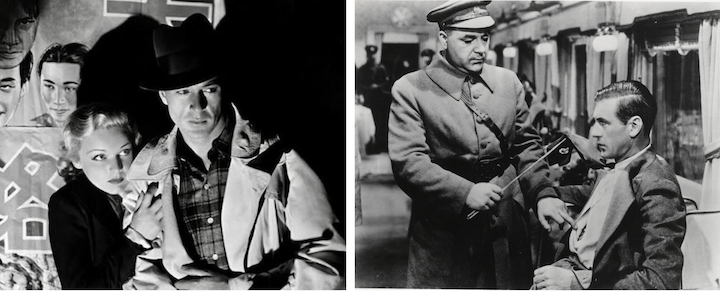
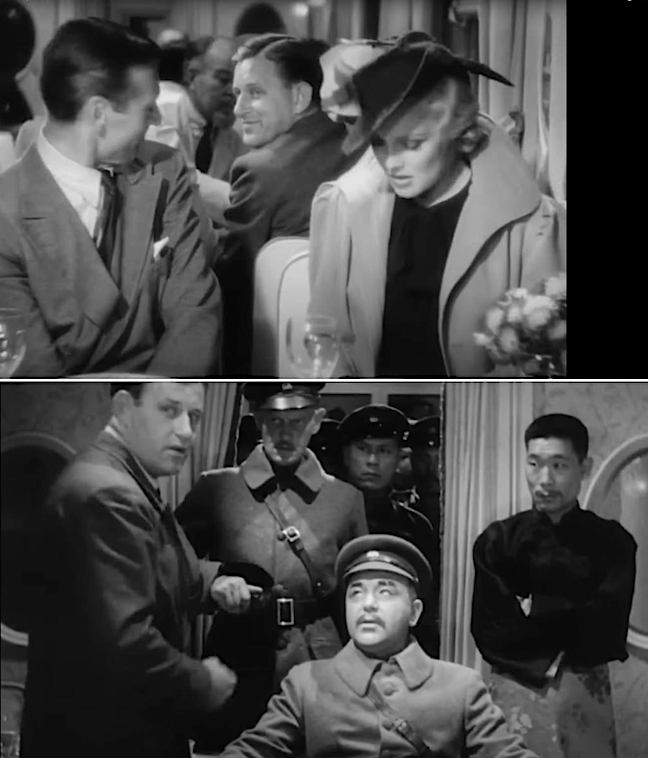
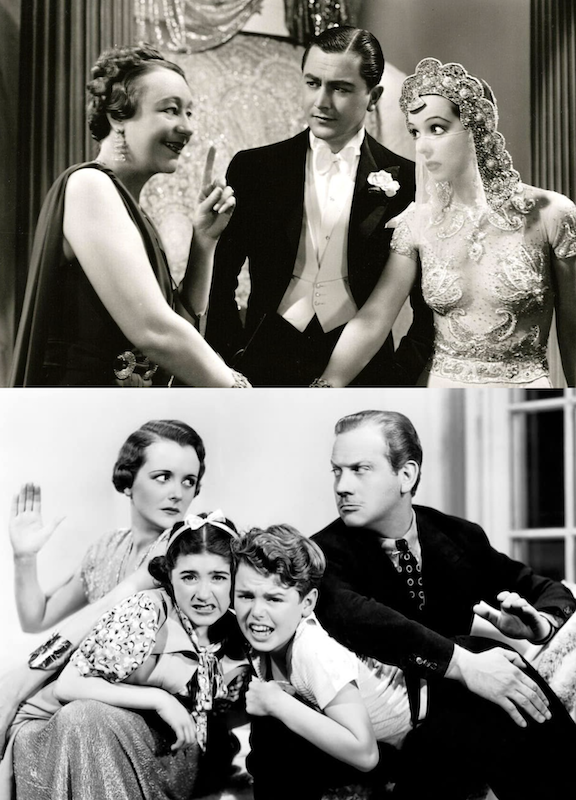
Gary Cooper finally showed off his gift for gab in Paramount’s drama The General Died at Dawn. Critic John Mosher called the film “lively,” and noted a “glimpse” of New Yorker short story writer John O’Hara in a cameo appearance.
TROUBLE IN CHINA…Gary Cooper and Madeleine Carroll portrayed lovers in war-torn China who seek to stop an arms shipment in The General Died at Dawn; at right, Cooper in a scene with Akin Tamiroff, who portrayed warlord General Yang. The film was directed by Lewis Milestone and written by Charles G. Booth and Clifford Odets. (imdb.com/ebay.com)CAMEO…New Yorker short story writer and novelist John O’Hara played a minor role as a newspaper reporter in The General Died at Dawn. (John Fronza via Facebook and YouTube)
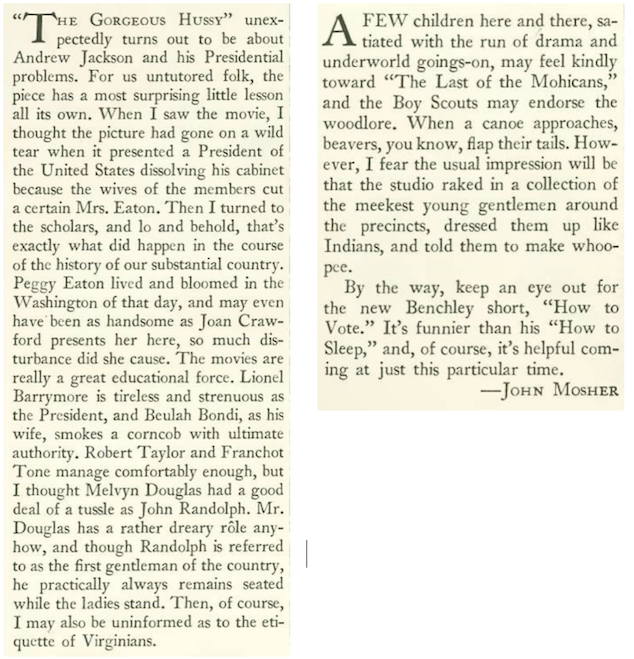
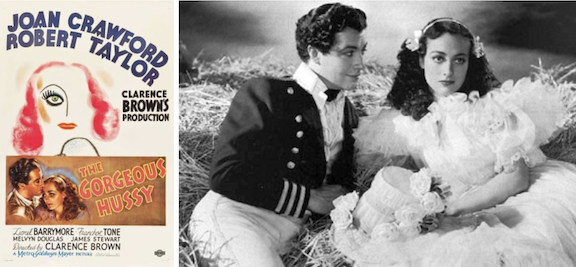
The title of MGM’s The Gorgeous Hussy suggested something racy, but as Mosher noted, it “unexpectedly turns out to be about Andrew Jackson.”
SEX SELLS…MGM played up Joan Crawford’s role as a “hussy” in this theatrical poster for The Gorgeous Hussy, but these were the days of the Hays Code and things wouldn’t get more racy than the scene at right, with Robert Taylor as Andrew Jackson and Crawford as the “hussy,” Peggy Eaton. (imdb.com/mubi.com)
* * *
From Our Advertisers
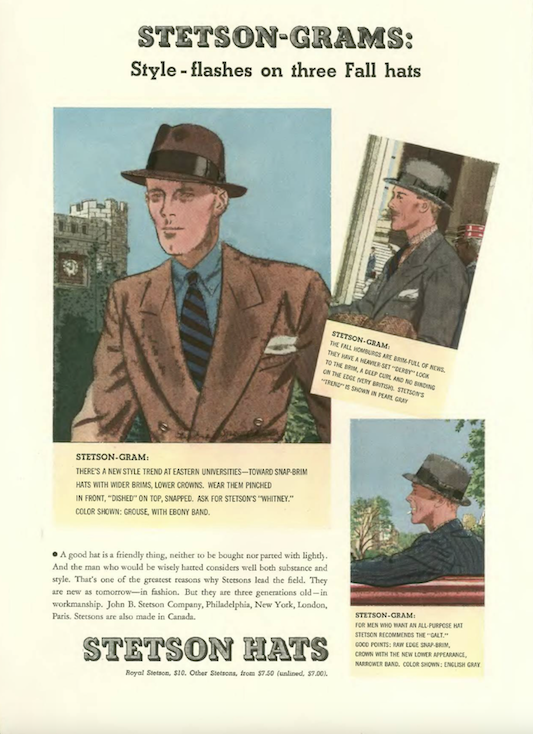
It was time to get that fall hat, and Stetson had three smart-looking lids for the man about town…
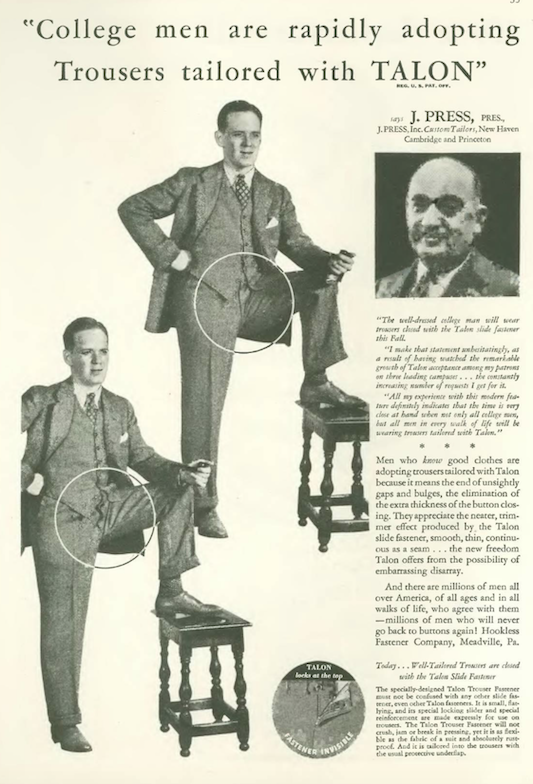
…and here’s a not-so-smart ad from the makers of Talon zippers…no doubt some of the wags on The New Yorker’s editorial side got a kick out of this…
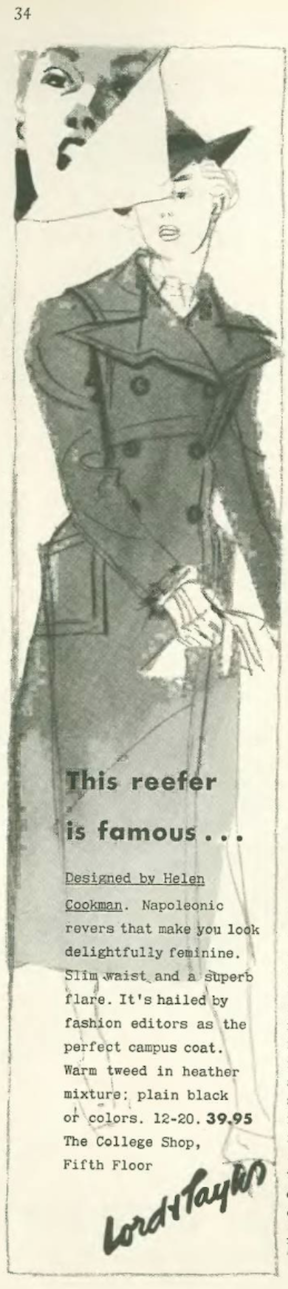
…and this strange ad from Lord & Taylor…not sure what they were trying to convey with that peeled-back corner…
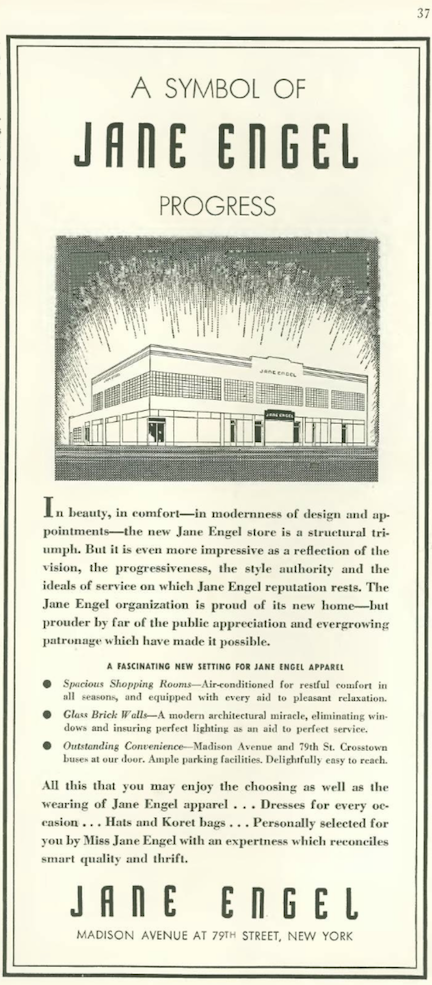
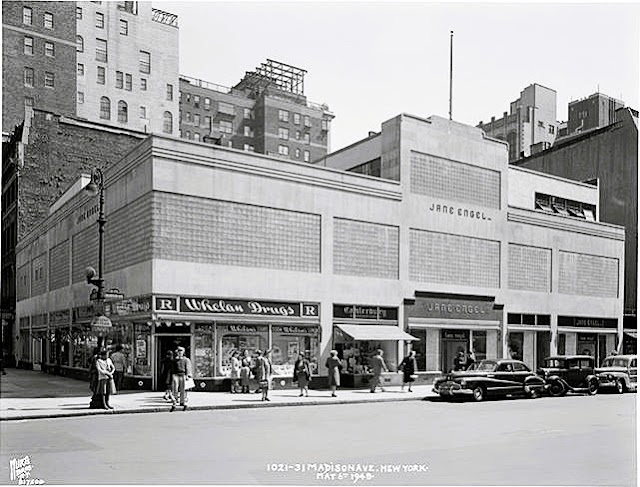
…Jane Engel founded a popular women’s and children’s apparel shop during the Great Depression (in 1930) with just $400 to her name. She grew the business from a single shop on Madison into a successful chain of more than thirty locations…
JEWEL BOX…The flagship Jane Engel Building at Madison and 79th was designed by Roy C. Morris in the Art Moderne style—the generous use of glass brick filled the interior with soft, diffused light. The shop closed in 1955 and was demolished two years later. (New York Public Library)
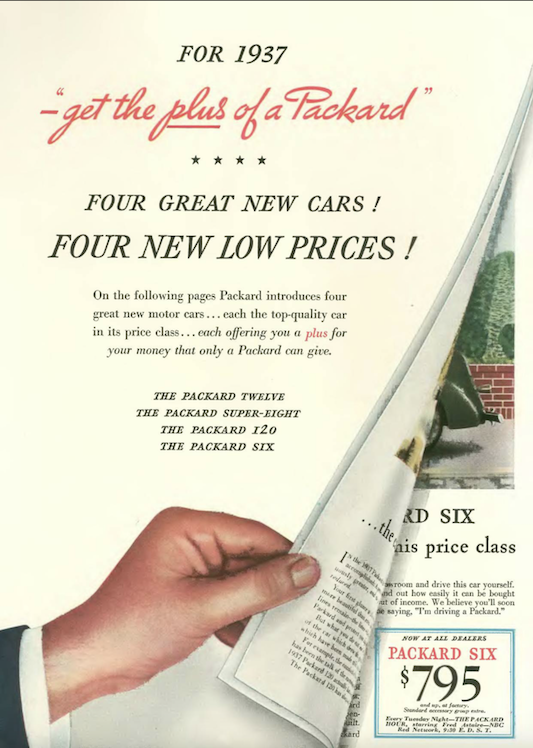
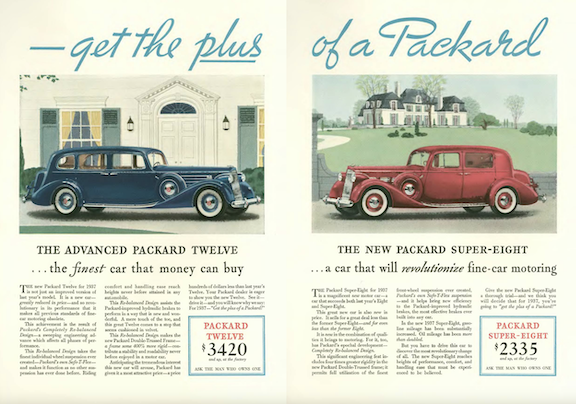
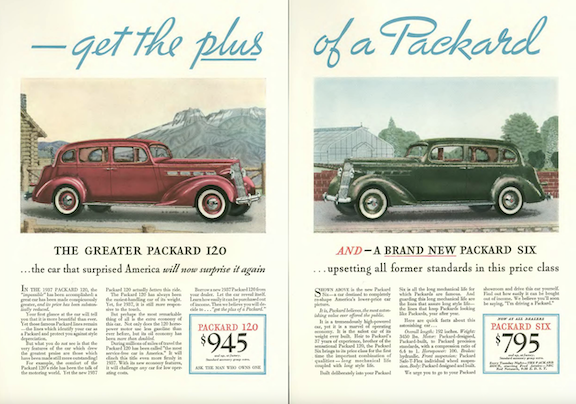
…the makers of the luxury brand Packard made sure Depression-strapped buyers could still afford one of their automobiles, which ranged in price from $795 to $3,420 (in 2026 equivalent to roughly $19,000 and $83,000, respectively)…no doubt The New Yorker’s bean counters appreciated the revenue from these five consecutive full-page color ads…
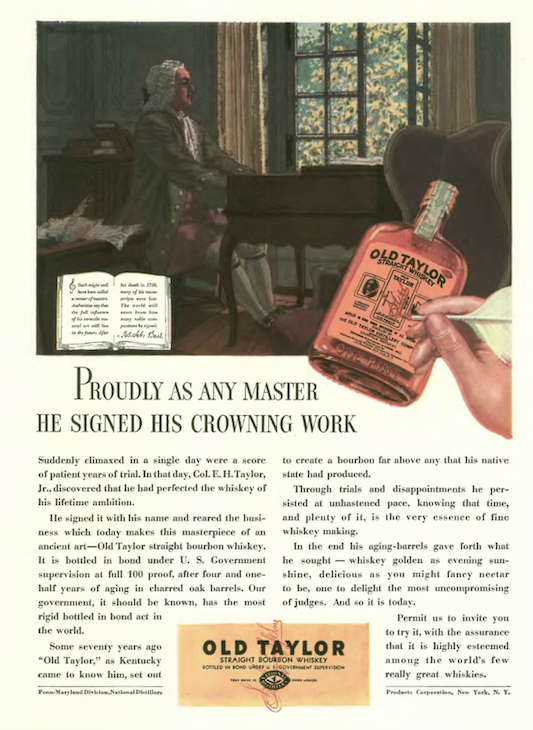
…bourbon distillers continued to compare the accomplishments of famous men to the quality of their tipple…
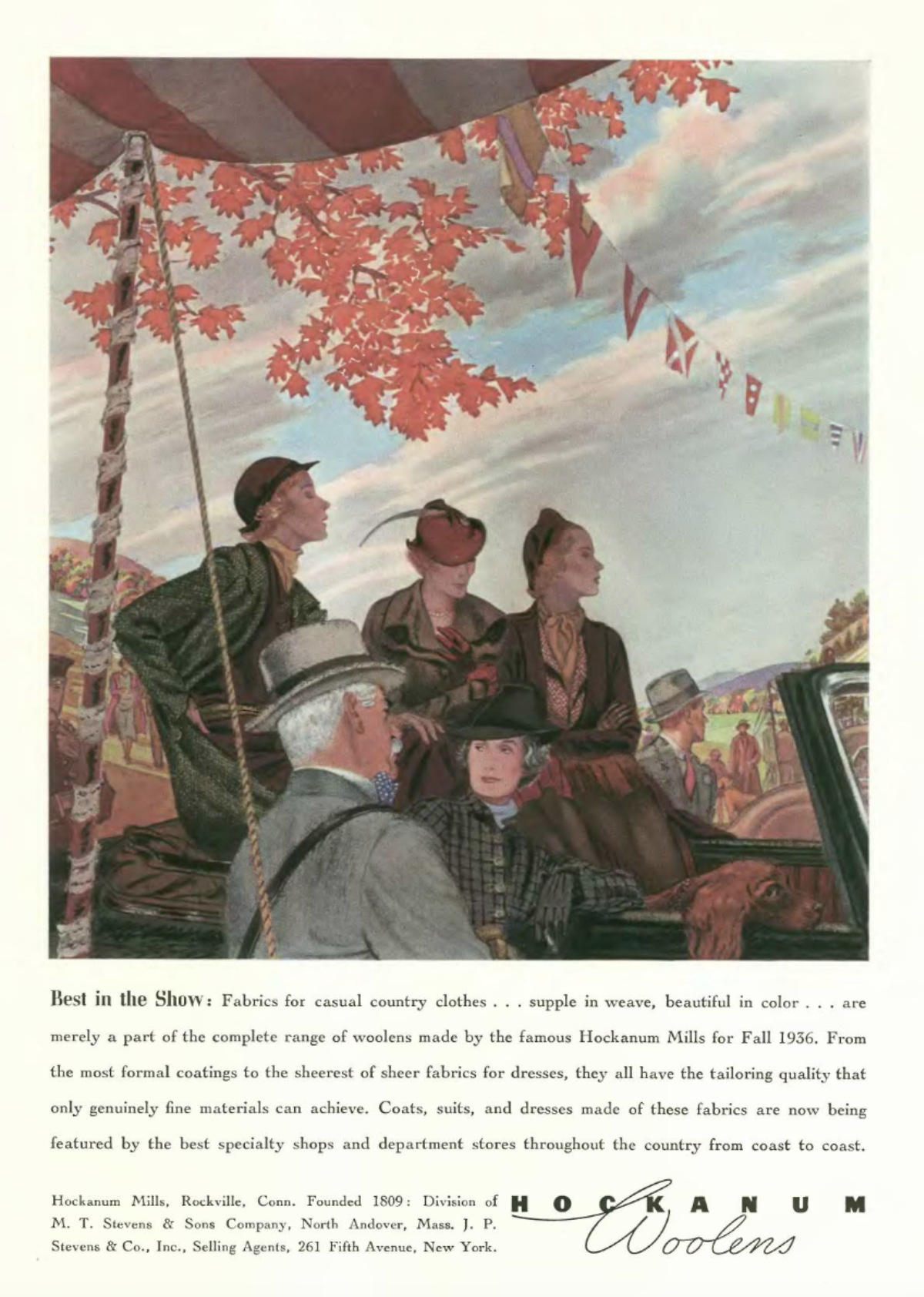
…as the folks at Hockanum Mills continued featuring fine woolens in upscale, seasonal settings…
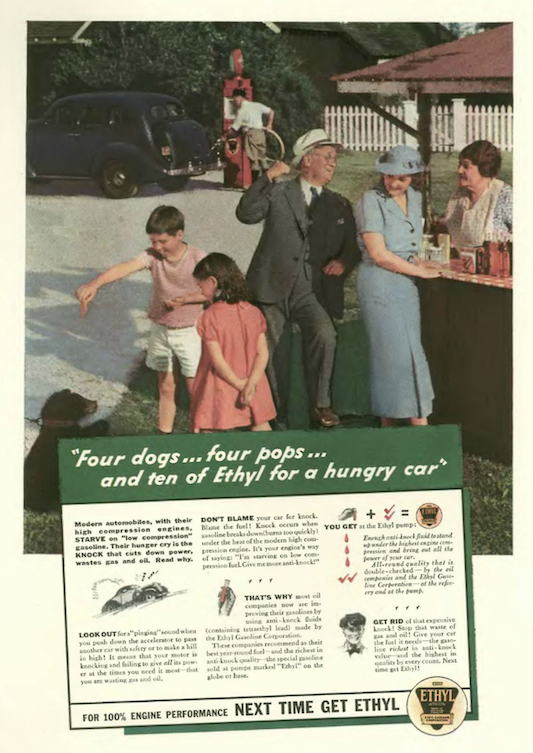
…and the makers of leaded gasoline continued their series featuring homespun images juxtaposed with attendants gassing up cars in the background…at first I thought this was one image superimposed over another, but more likely the gas pump is a prop…also, an odd detail on the left where children appear to be feeding (or teasing) a baby bear restrained by a leash…
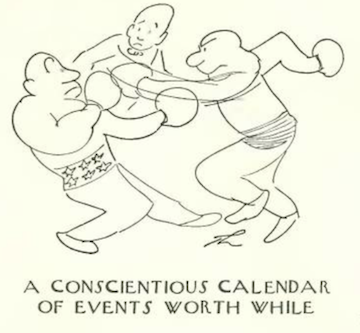
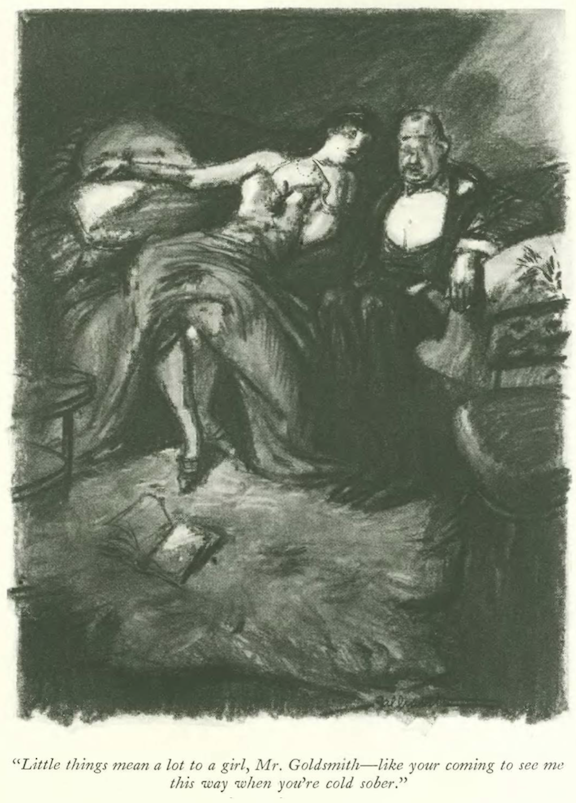
…we move on to our cartoonists, beginning with Richard Decker…
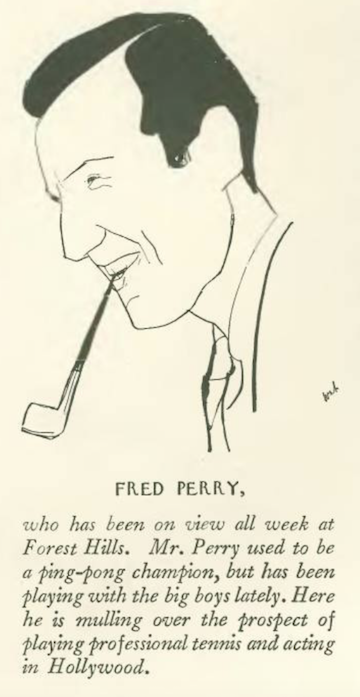
…also in the calendar section was this illustration by William Auerbach-Levy for the mini bio of Fred Perry (1909–1995), British tennis star who won ten Majors, including three consecutive Wimbledon Championships from 1934 to 1936…he was the first player to win a “Career Grand Slam” which he completed at the tender age of 26 in 1935…Perry was also the world champion ping-pong champion in 1929…
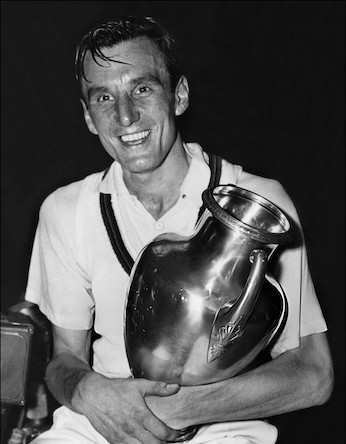
FRISKY FRED…Fred Perry was one of the leading bachelors of the 1930s and his off-court romances were reported in the world press—including one with actress Marlene Dietrich. Perry was also known for his popular line of sports attire. Above: Perry hugs the championship cup after his U.S. Open victory at Forest Hills, 1936. (Wikipedia)
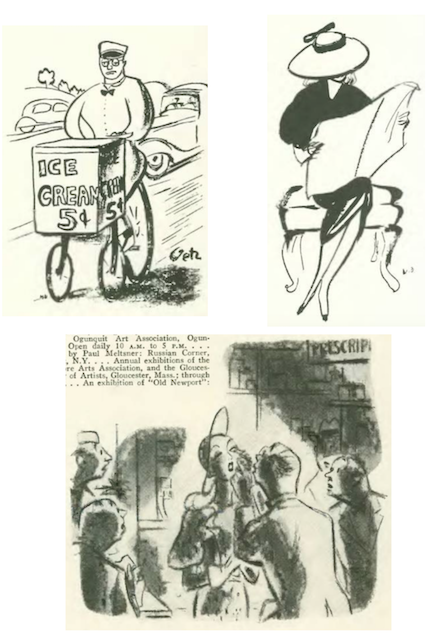
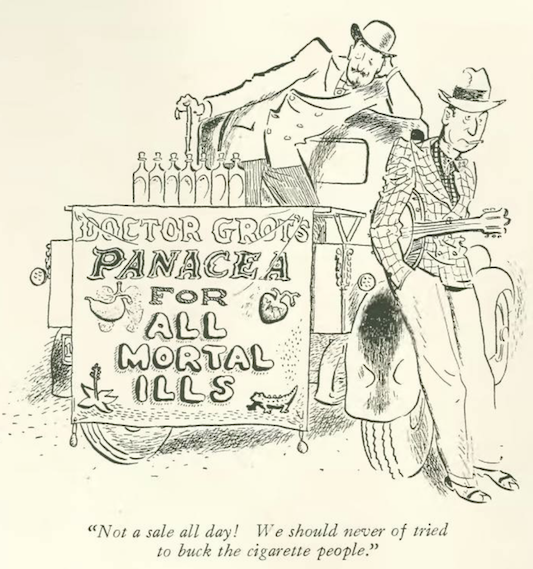
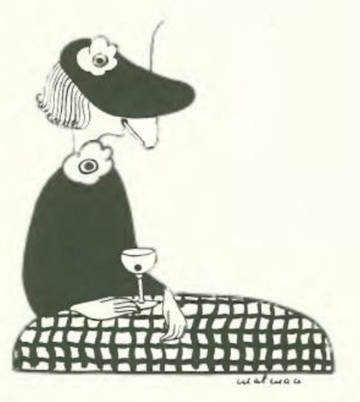
…an assortment of spot drawings…clockwise, from top left, Arthur Getz, Victor de Pauw, and Barbara Shermund (arguably not a spot drawing, but not really a cartoon either)…
…no signature on this, but it appears to be the work of Perry Barlow, which always reminded me of another artist known for his rural types, Robert McCloskey…
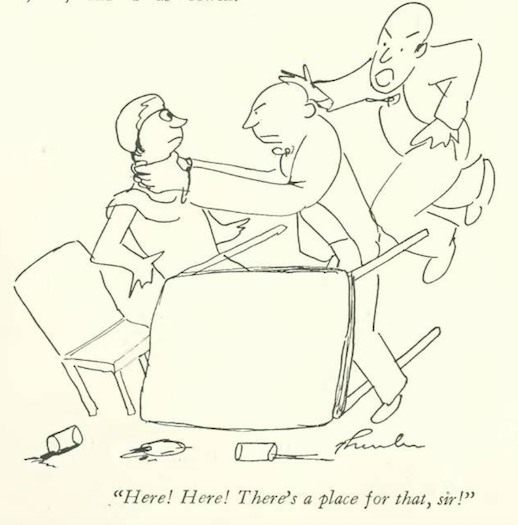
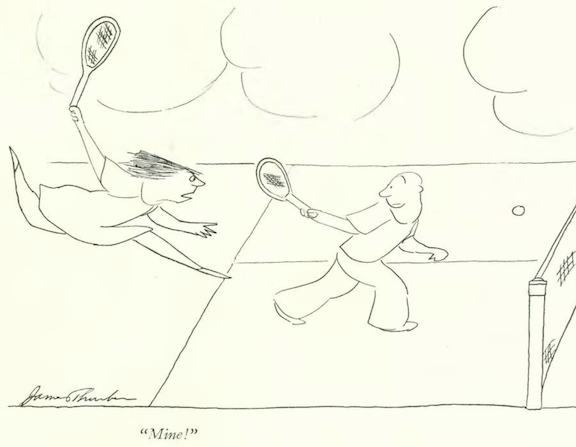
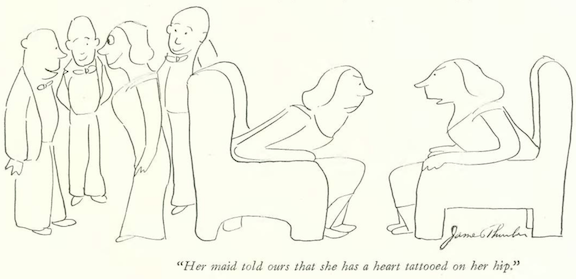
…James Thurber illustrated a public display of disaffection…interesting use of perspective here…Thurber seems to violate all the rules yet the effect is masterful…
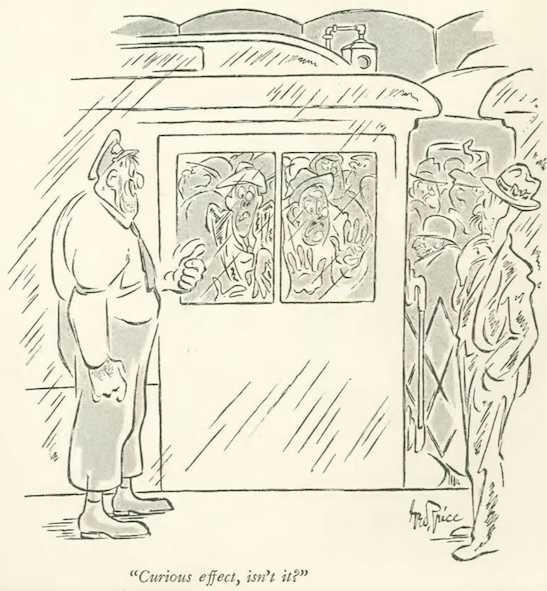
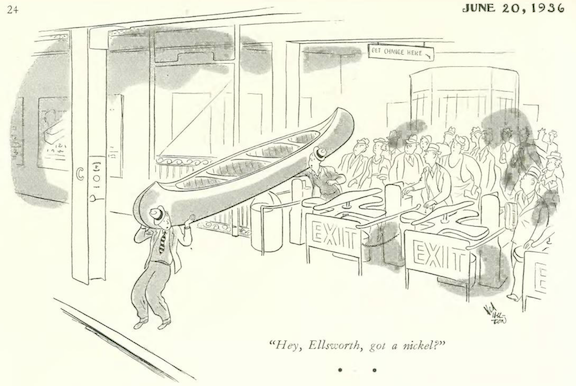
…speaking of effect, George Price in the subway…
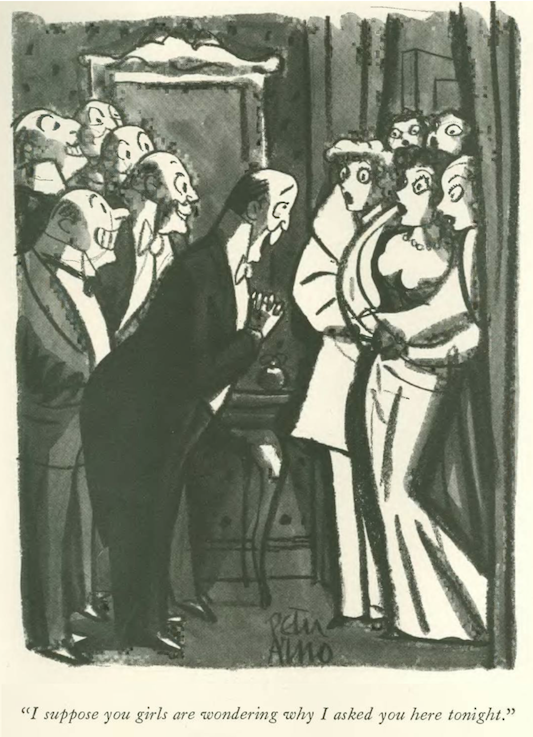
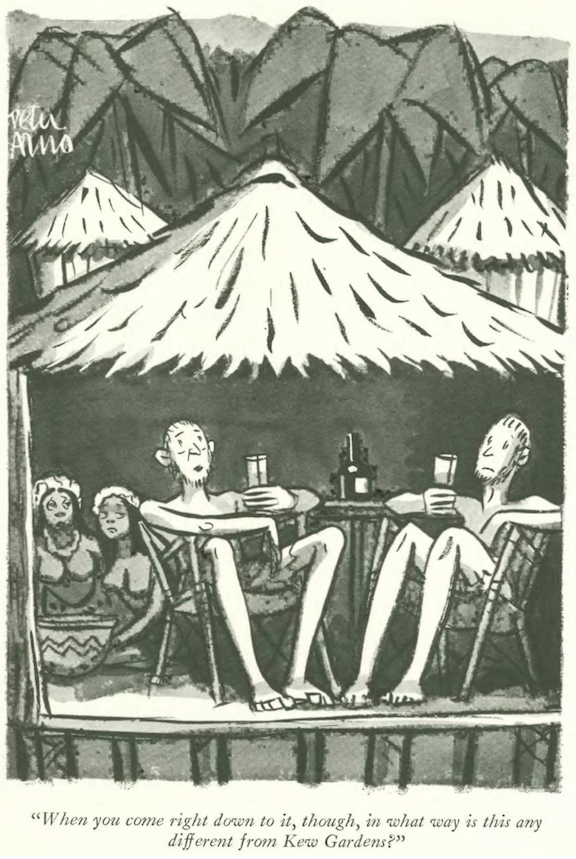
…Peter Arno continued to explore a familiar theme…
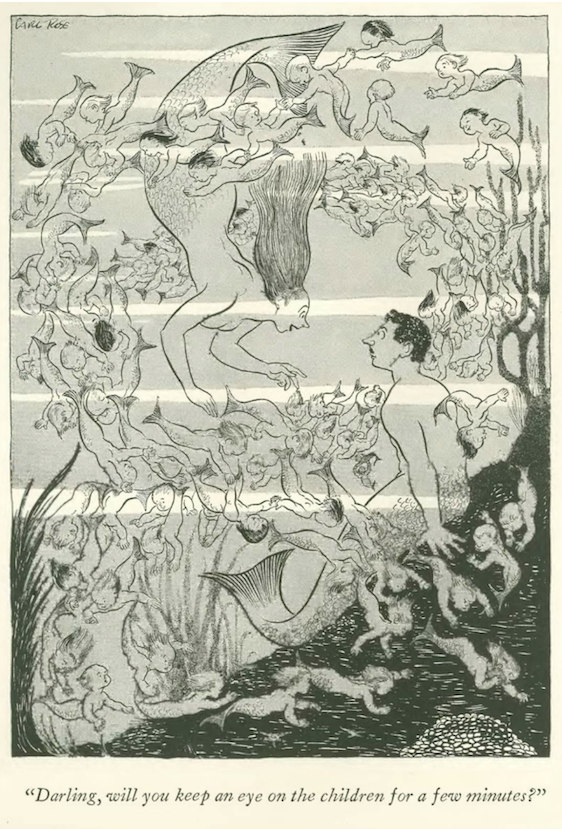
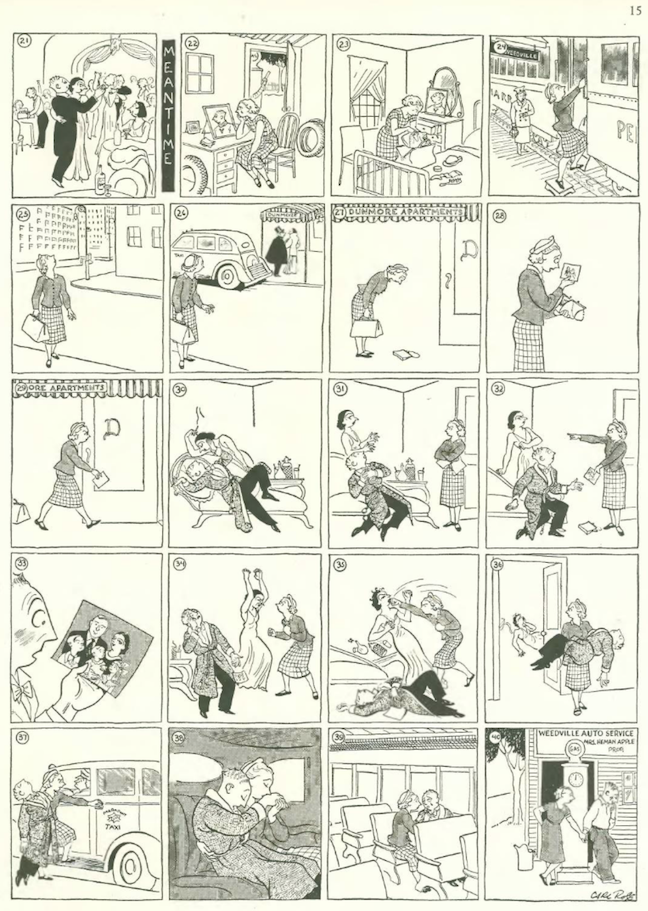
…Carl Rose imagined the home life of a mermaid…
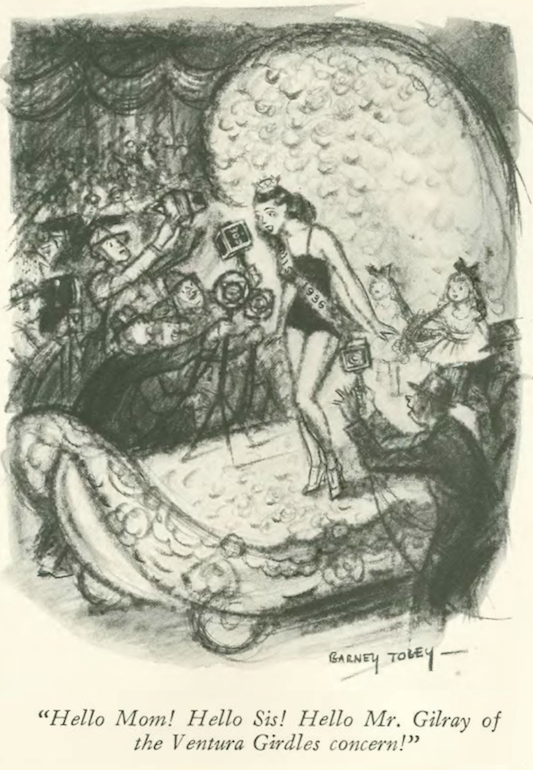
…Barney Tobey’s Miss America gave a plug to her sponsors…
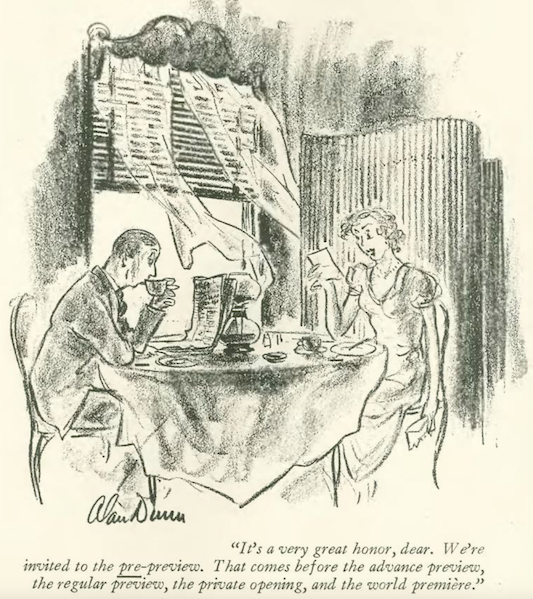
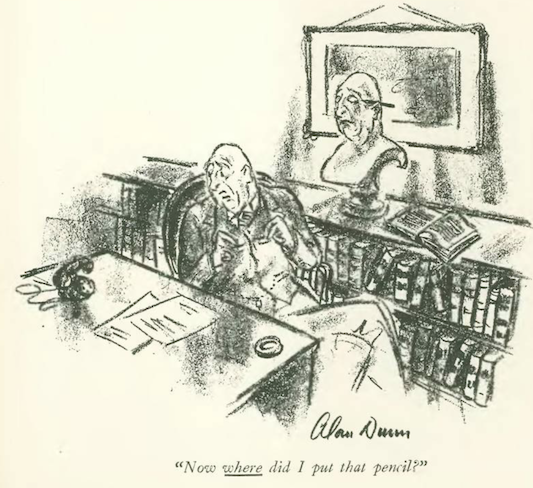
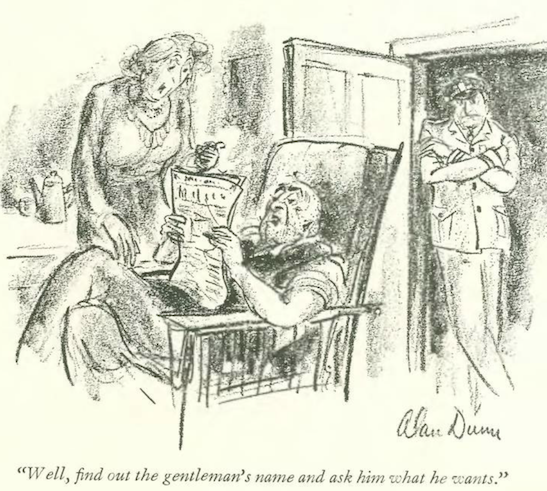
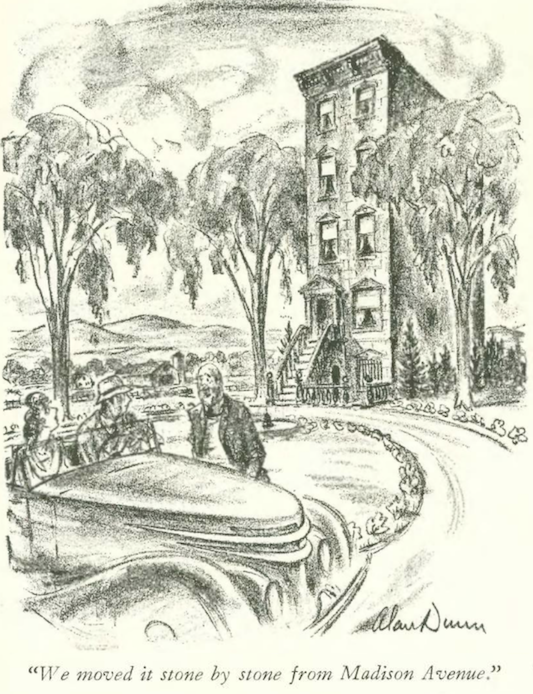
…Alan Dunn gave us a view of a pre-preview…
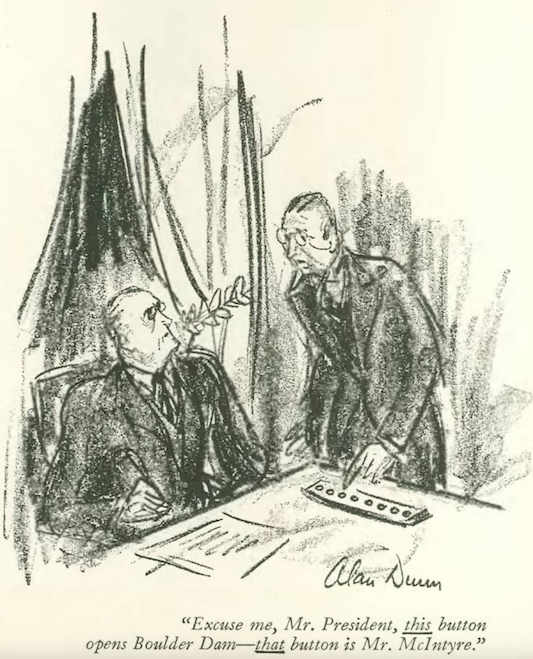
…Dunn again, with a rare cartoon featuring a known personage…
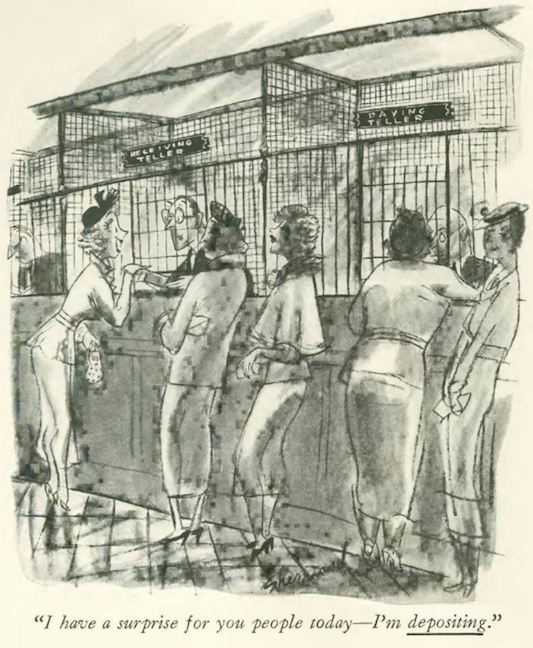
…Barbara Shermund revealed a surprise at the teller window…
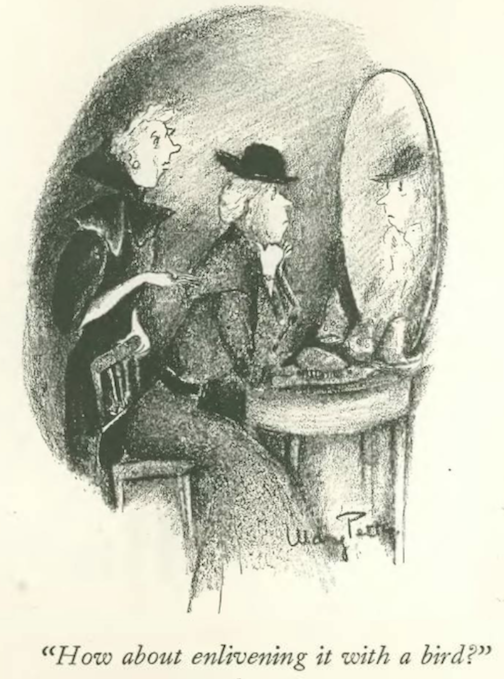
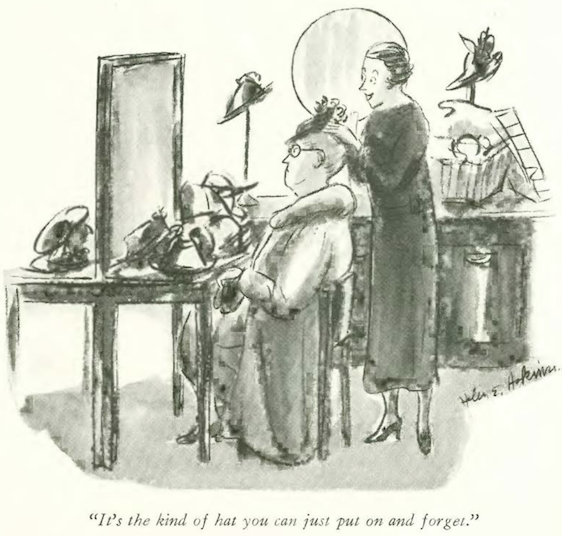
…Mary Petty got creative at the hat shop…
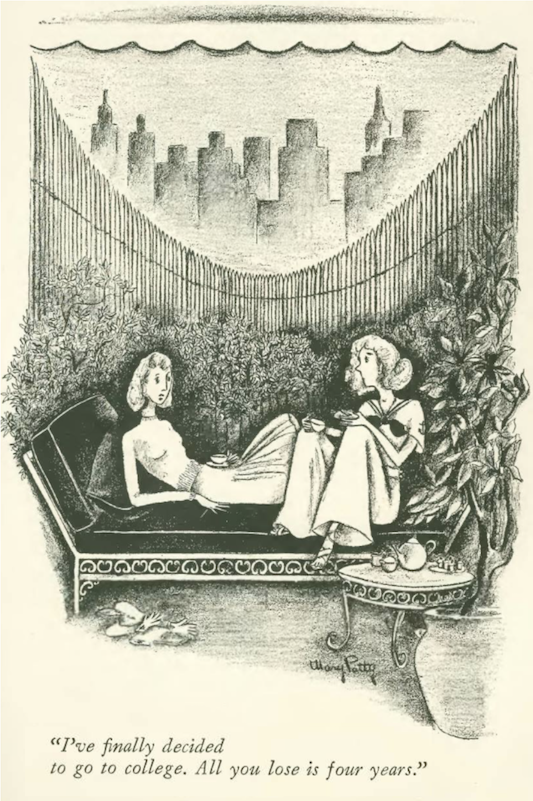
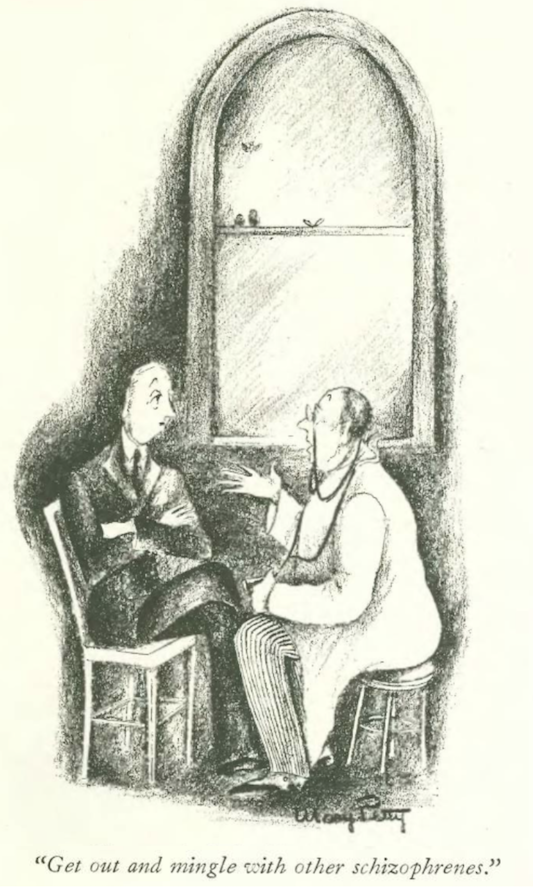
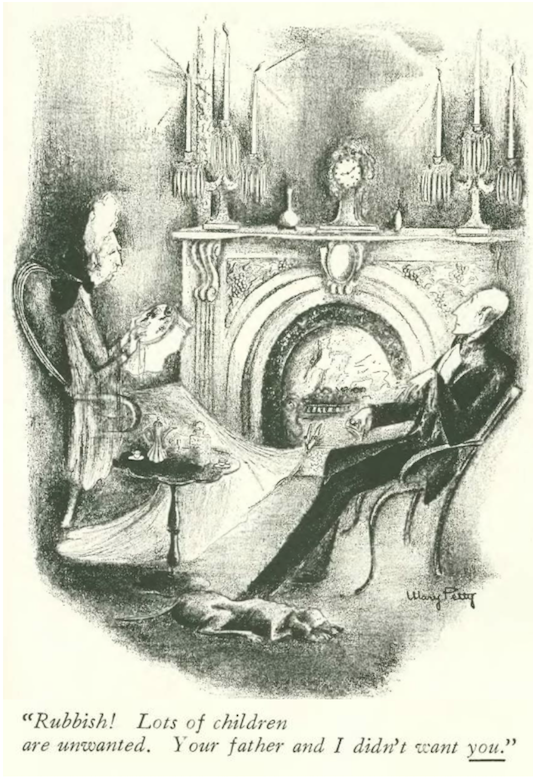
…and Petty again, as we close with her modern take on higher education…
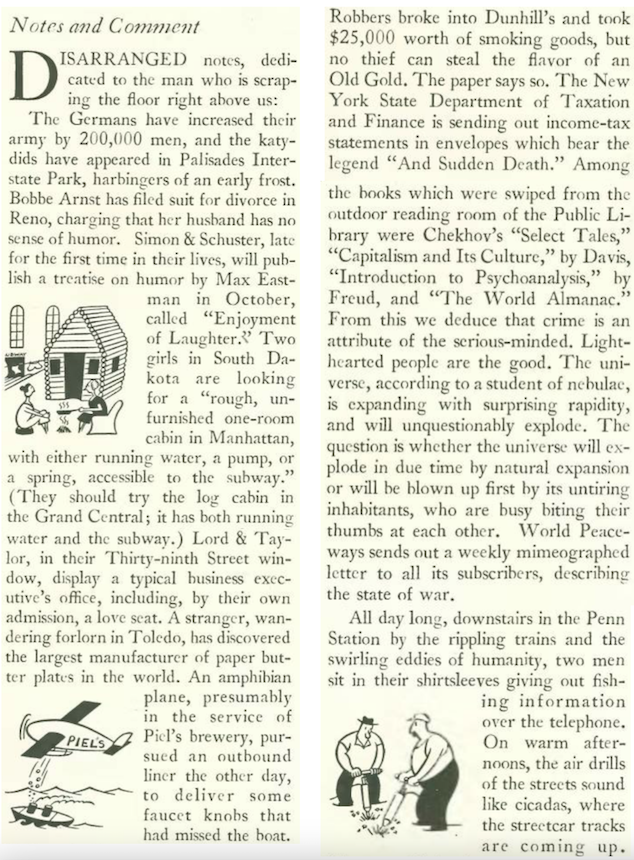
Above: E.B. White noted the sounds of late summer ranging from jackhammers (that sounded like cicadas) to the songs of katydids predicting an early frost. (pafa.org/Ellyn B/Flickr/nwf.org)
For roughly four decades E.B. White’s “Notes and Comment” set the tone for each issue of The New Yorker, offering observations on daily life that sometimes were compiled from his “disarranged notes.”
September 5, 1936 cover by Adolph K. Kronengold.
For the September 5 issue White offered brief comments on everything from the German military buildup to the romantic life of singer Bobby Arnst.
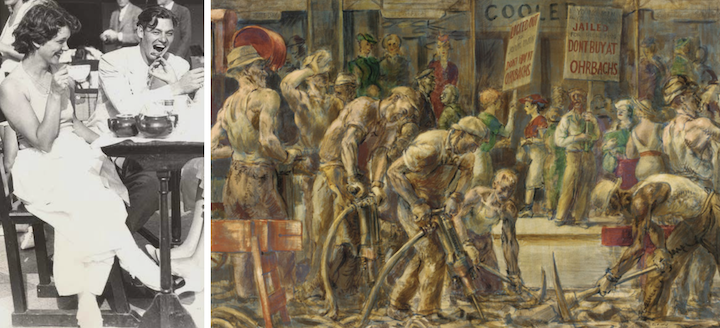
SHE WENT APE OVER TARZAN…Photo at left: Singer/dancer Bobbe Arnst shares a laugh with her first husband, Tarzan star Johnny Weissmuller—apparently her second marriage to divorce attorney Robert Cavenaugh wasn’t so full of yuks; White also noted the cicada-like sounds of air drills tearing up old trolley car lines—at right is the 1936 painting “End of 14th Street Crosstown Line” by early New Yorker contributor Reginald Marsh. The urban realist Marsh juxtaposed workers tearing up tracks with picketers demonstrating against Ohrbach’s, which would not allow employees to unionize. (whosdatedwho.com/pafa.org)
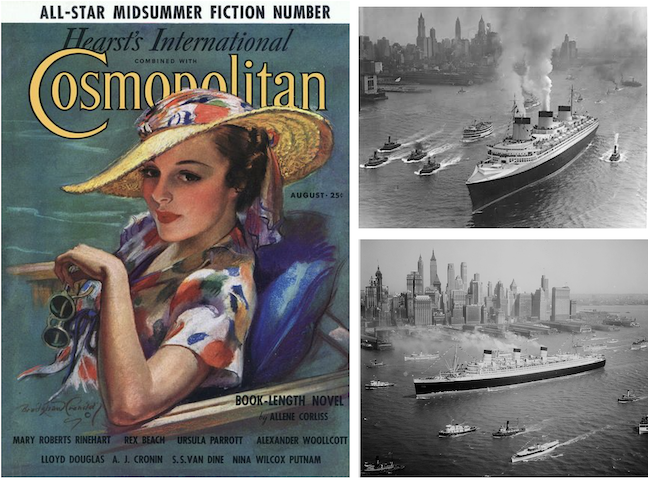
White also cited Cosmopolitan magazine regarding “the age of accumulation” (twenty-five to thirty-five), and noted the average speed of rival ocean liners for “New Yorkers hastening to the Scottish moors for the grouse shooting…”
CONSUMER REPORT…White cited Cosmopolitan regarding “the age of accumulation,” and considered the average speeds of the world’s fastest ocean liners, France’s SS Normandie (top), and Great Britain’s RMS Queen Mary. (instagram.com/ucla.edu)
* * *
Sounds of Music
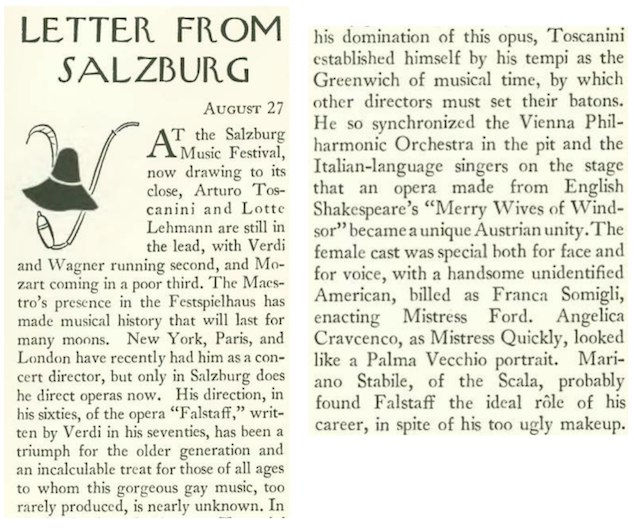
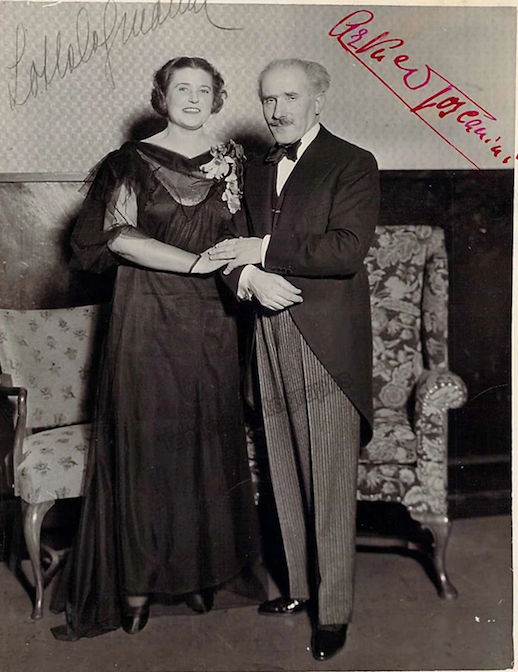
Paris correspondent Janet Flanner moved on from the Nazi Olympics in Berlin to the foothills of the Alps for the Salzburg Music Festival, where German dramatic soprano Lotte Lehmann and Italian conductor Arturo Toscanini made music together.
DRAMATIC DUO…Dramatic soprano Lotte Lehmann and conductor Arturo Toscanini were the big draw at the 1936 Salzburg Music Festival, which also featured the debut of the Trapp Family Singers, who were encouraged by Lehmann to enter the Salzburg Festival contest. (taminoautographs.com via stolpersteine-salzburg.at/en)
In August 1936 Lehmann discovered the Trapp Family Singers (made famous in 1965’s The Sound of Music). While approaching a villa available to let, Lehmann overheard the Trapp children singing in their garden. Due to her fame, Lehmann was able to persuade Captain Georg Von Trapp to allow his children to perform at Salzburg Festival.
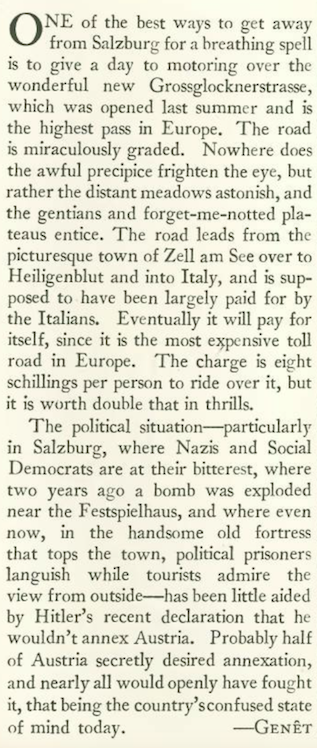
Flanner also marveled at the Austria’s Grossglockner High Alpine Road—with the highest pass in Europe—and noted the bitter struggle between Nazis and Social Democrats that was dividing Austrians less than two years before the Anschluss, the German annexation of Austria.
GETTING HIGH…At left, the Grossglockner High Alpine Road (Grossglockner Hochalpenstrasse); at right, the Hohensalzburg Fortress (Festung Hohensalzburg) a large medieval fortress that is a prominent landmark in the city of Salzburg, Austria. Flanner noted that unbeknownst to gawking tourists, the fortress contained political prisoners. (Wikipedia)
* * *
At the Movies
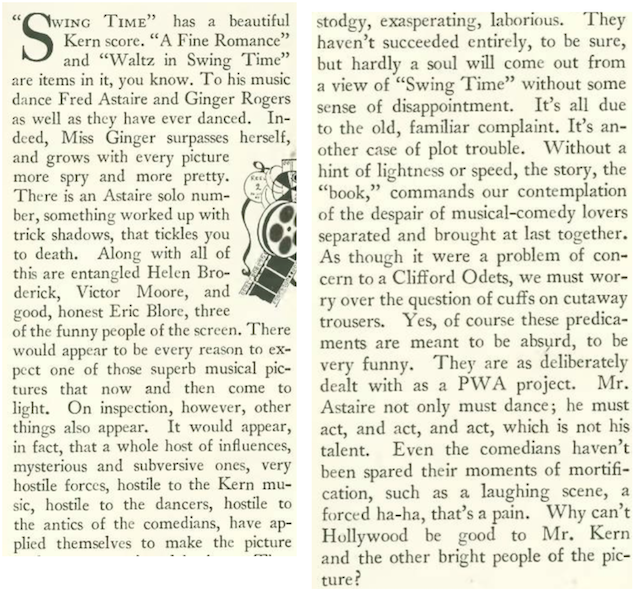
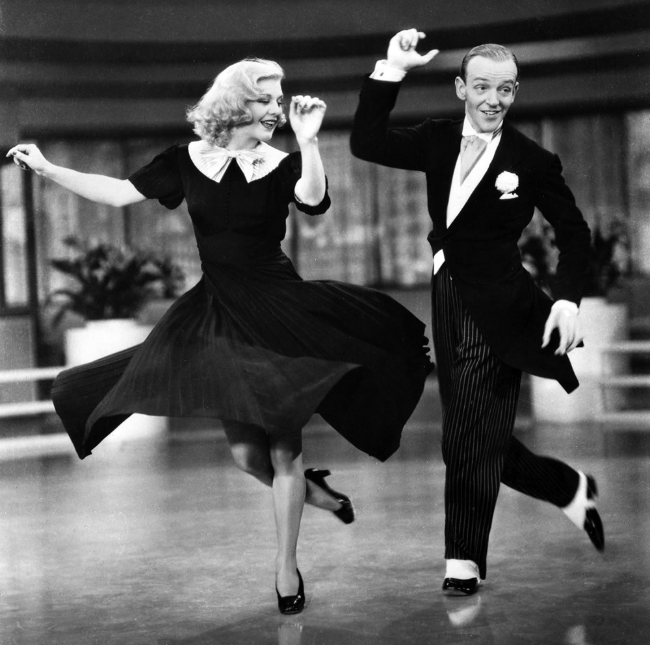
John Mosher found Fred Astaire and Ginger Rogers at the top of their game in the musical comedy Swing Time, but lamented the stodgy and laborious plot that burdened the non-dancing scenes.
BUSTING SOME MOVES are Ginger Rogers and Fred Astaire in Swing Time. The film was the sixth of ten films starring Astaire and Rogers. (goldenageofcinemasite.wordpress.com)
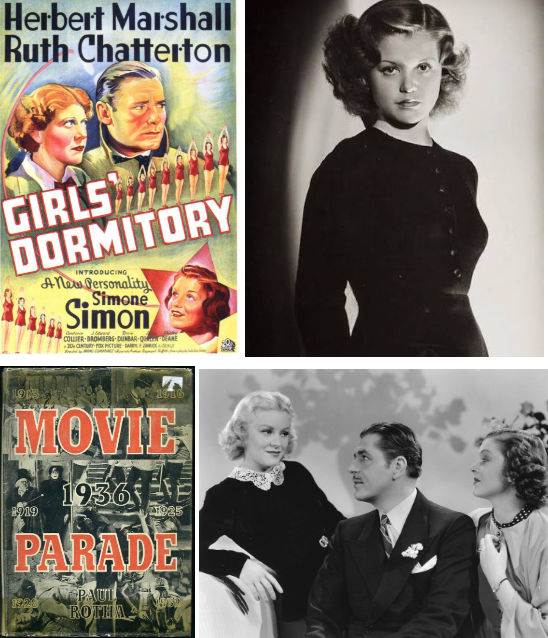
Mosher also had a look at Girl’s Dormitory, which introduced audiences to the young French actress Simone Simon, and also checked out the latest Myrna Loy flick.
THINGS THAT MAKE YOU GO HMMM…Clockwise from top left: Set at a Swiss boarding school, Girl’s Dormitory is a story about a middle-aged school director (Herbert Marshall) who resists the attentions of a forty-something professor (Ruth Chatterton) and instead hooks up with a 19-year-old student (Simone Simon);1936 photo of Simon by George Hurrell—Simon is is perhaps best remembered for her role in the 1942 American horror film Cat People and its sequel; Claire Trevor, Warner Baxter, and Myrna Loy in To Mary—with Love; cover of Movie Parade, a book on movie history when the history of film was just three decades old. (imdb.com/facebook.com)
* * *
From Our Advertisers
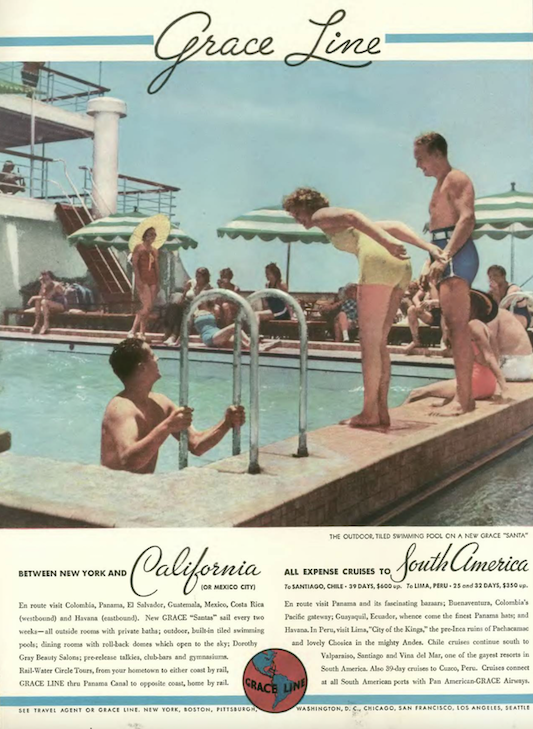
The magazine opened with another enticing photo from Grace Line depicting an ocean cruise before the days of water slides, buffet lines and norovirus…
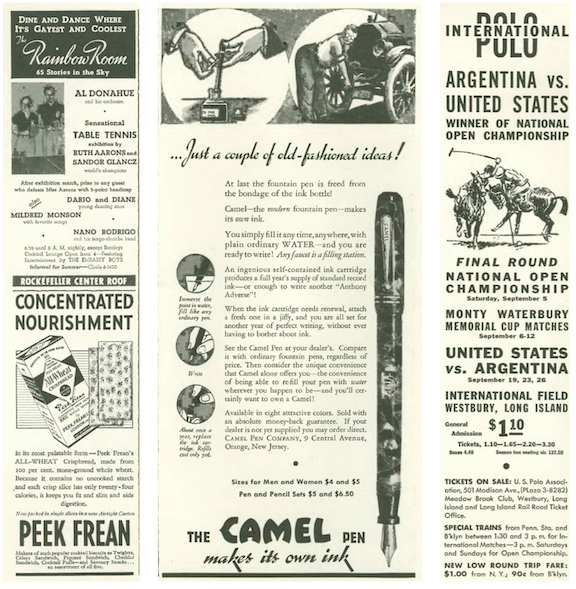
…some one-column selections from the back of the book, including an ad from the Camel Pen Company introducing an innovative fountain pen that contained a dry ink pellet—the user added water to dissolve the pellet into a year’s supply of ink…
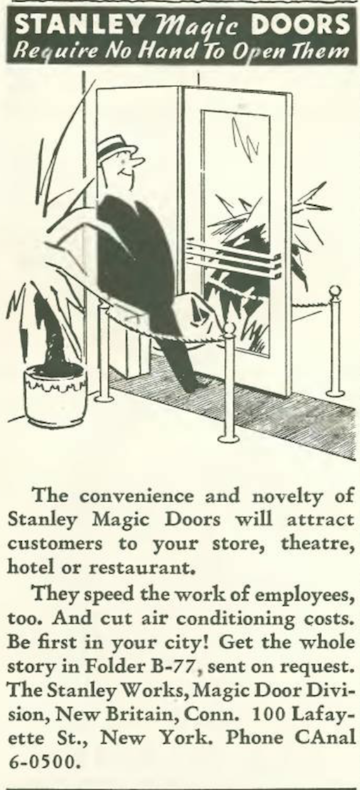
…these days most of us use ball-point pens, and we are also so accustomed to automatic doors that they no longer seem “magic” as they did in the 1930s…
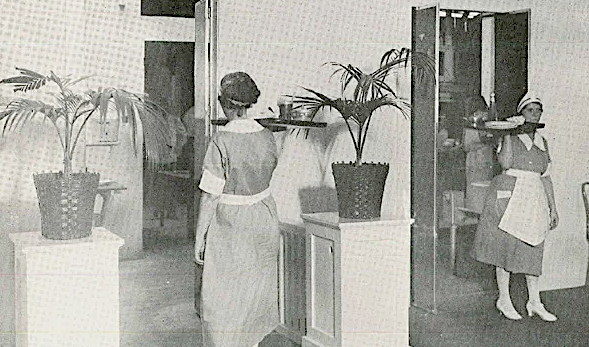
WONDERS NEVER CEASE…In 1931, Wilcox’s Pier Restaurant in West Haven, Connecticut featured the first automatic doors in America, invented by Stanley. (cbsnews.com)
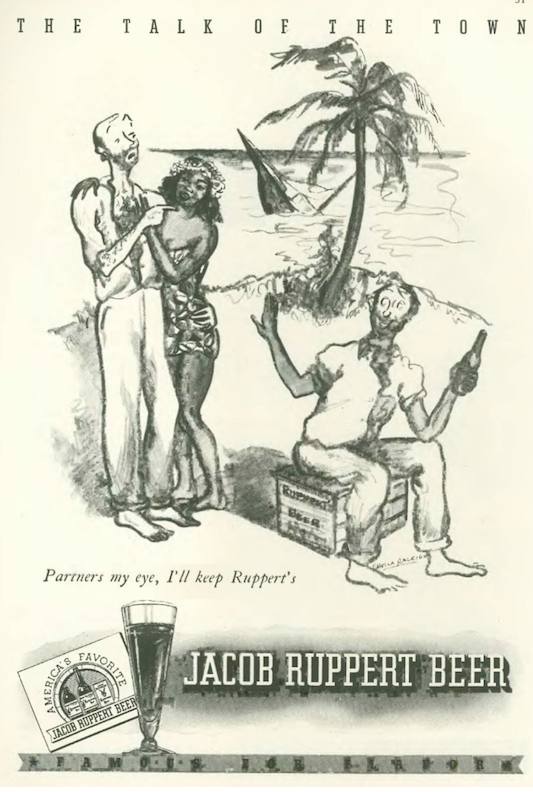
…New York artist Sheila Raleigh employed the desert island trope to sell some beer for Jacob Ruppert…
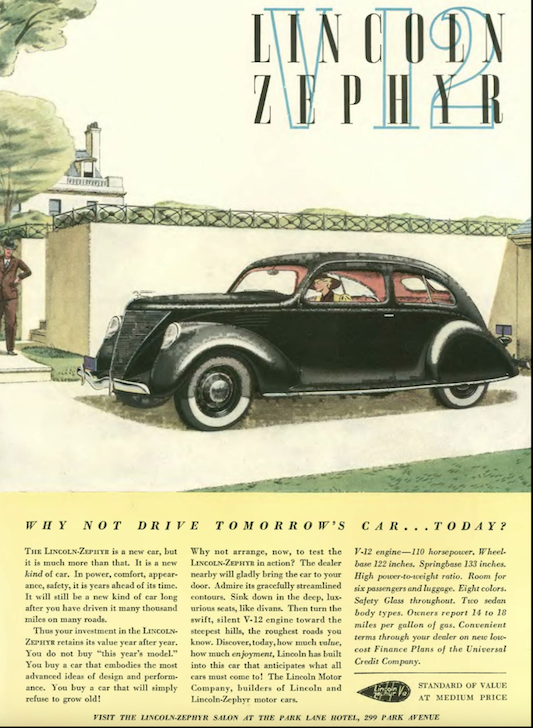
…the inside back cover popped with this ad for the streamlined V-12 Lincoln Zephyr…
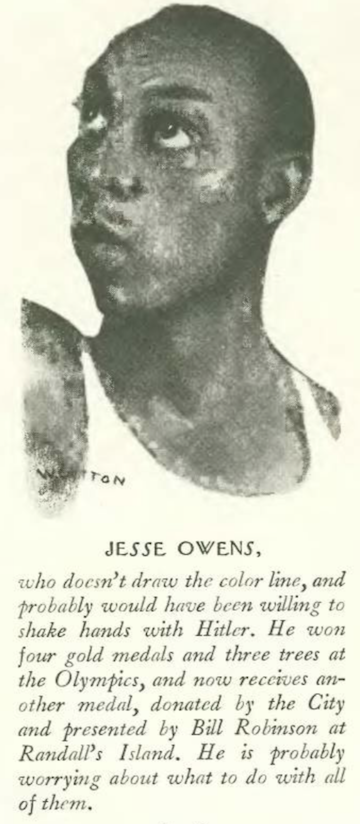
…the “Talk of the Town” occasionally featured these illustrated mini-bios, here highlighting Jesse Owens’ record-setting performance at the 1936 Olympics (illustration by William Cotton)…
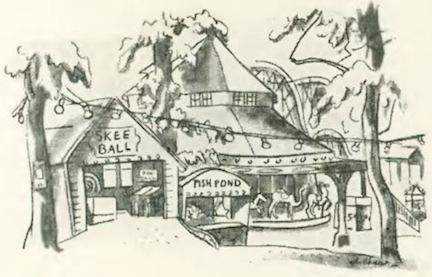
…a couple of spots by George Shellhase…
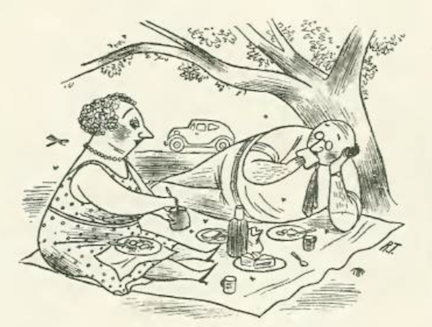
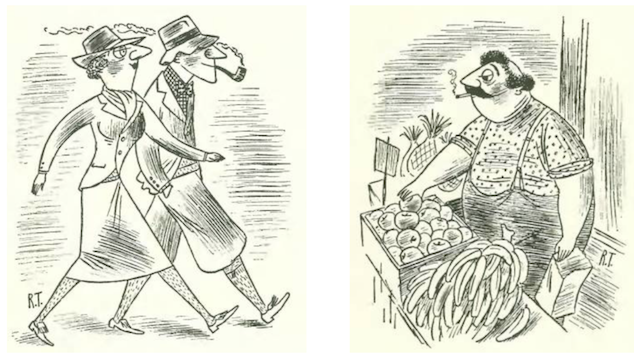
…and Richard Taylor…
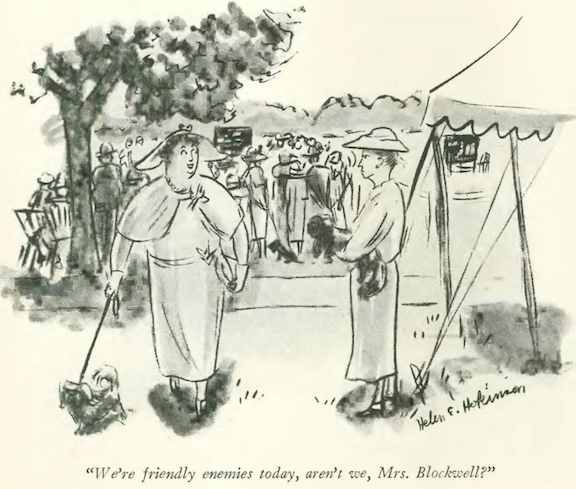
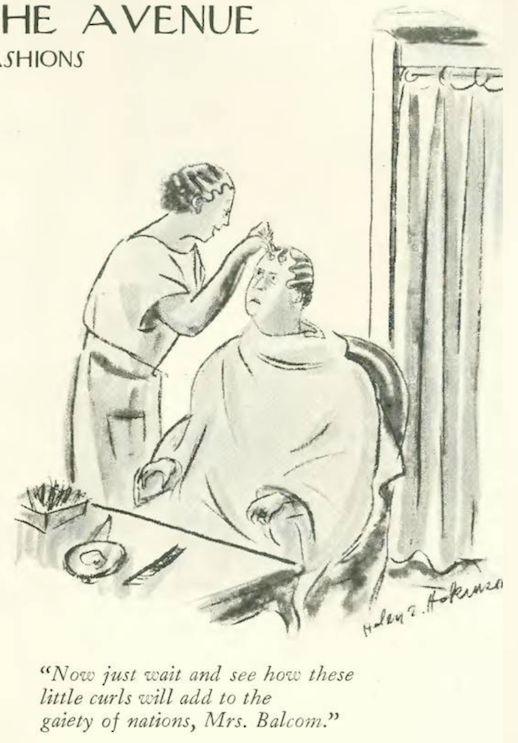
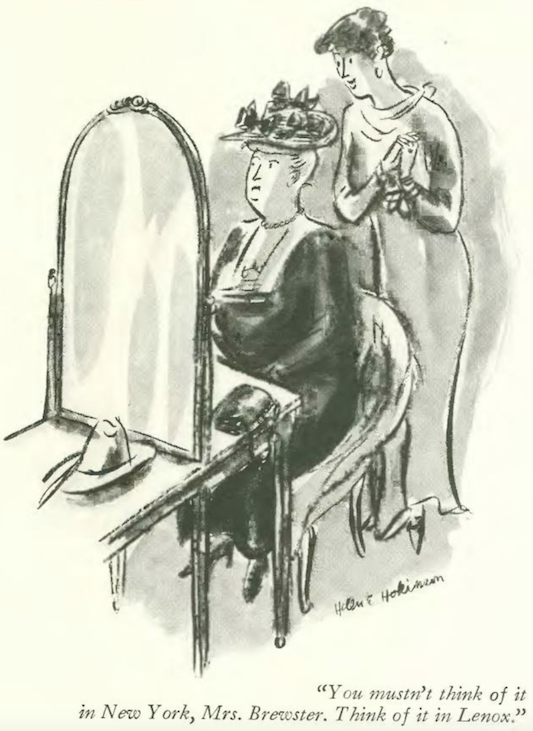
…Helen Hokinson gave us frenemies at a dog show…
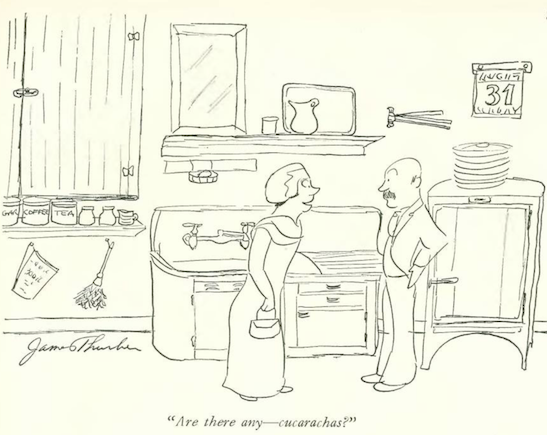
…James Thurber looked out for cockroaches…
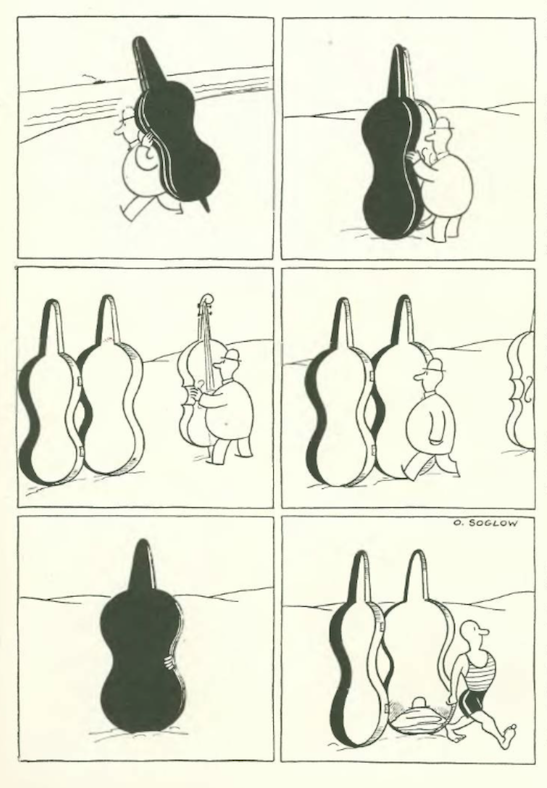
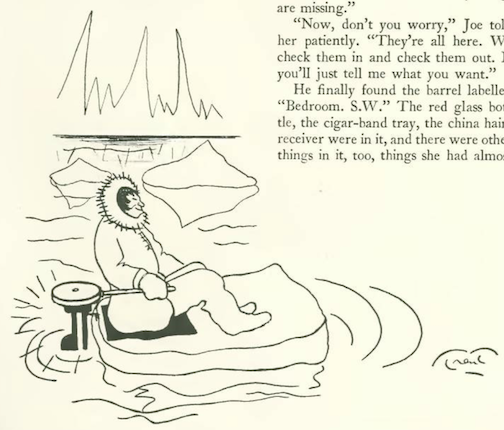
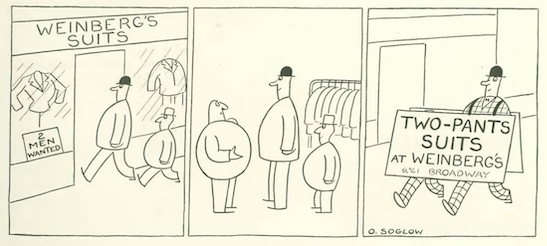
…Otto Soglow found a new use for a bass case…
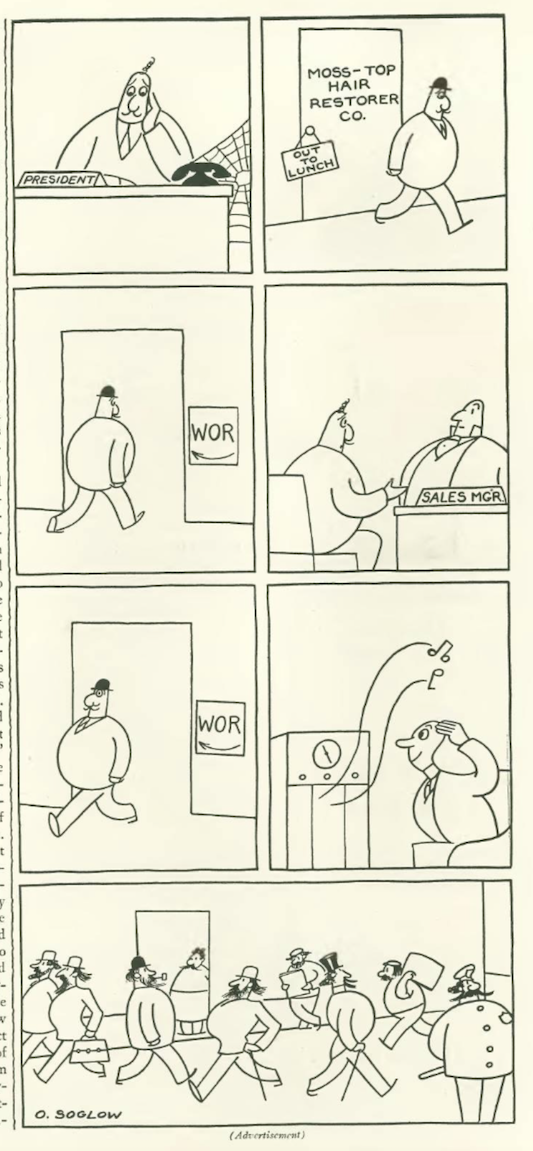
…Soglow again, demonstrating the wonders of radio advertising…
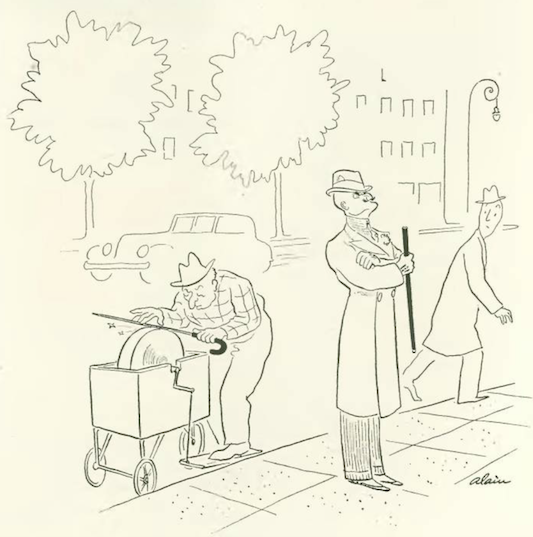
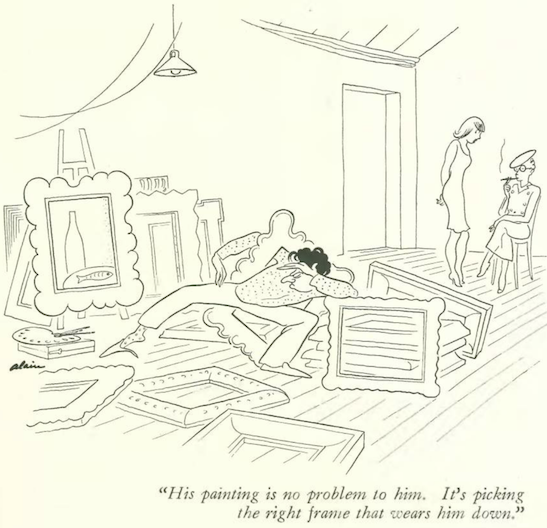
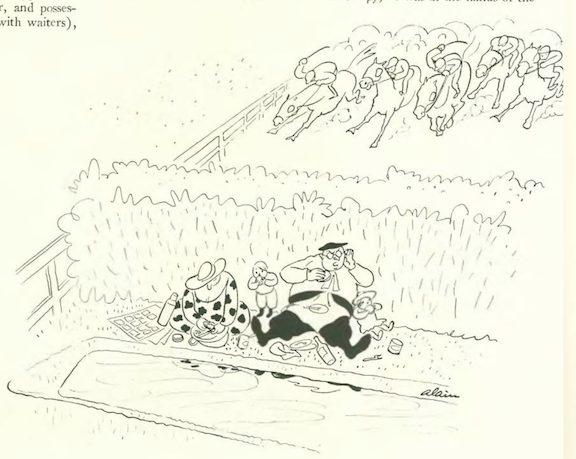
…Alain showed us a man with a cagey cane…
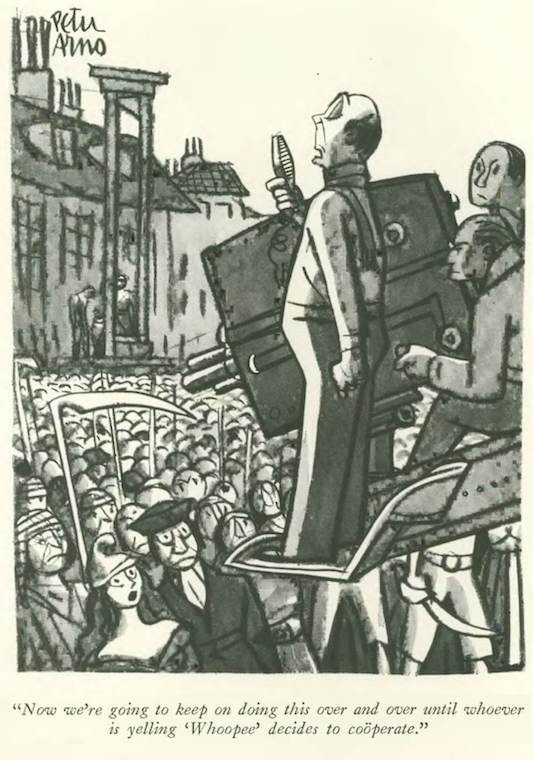
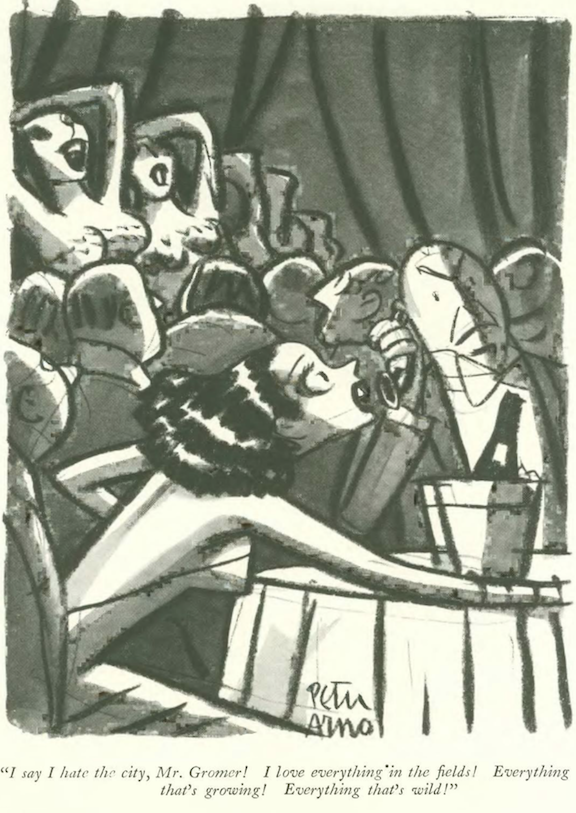
…Peter Arno illustrated the trials of working with extras…
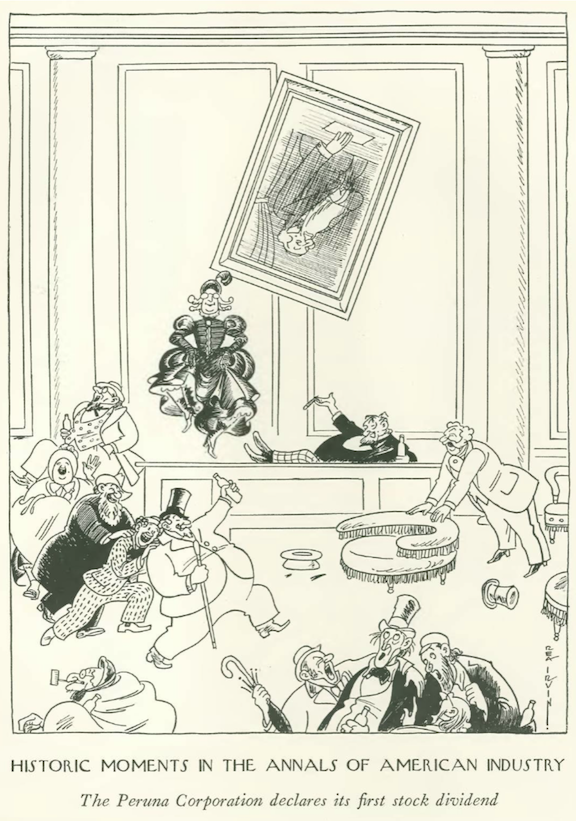
…Rea Irvin continued to chronicle achievements in industry (Peruna was a well-known patent medicine sold from the late-19th to mid-20th century—with its high alcohol content, Americans drank large amounts of Peruna during Prohibition)…
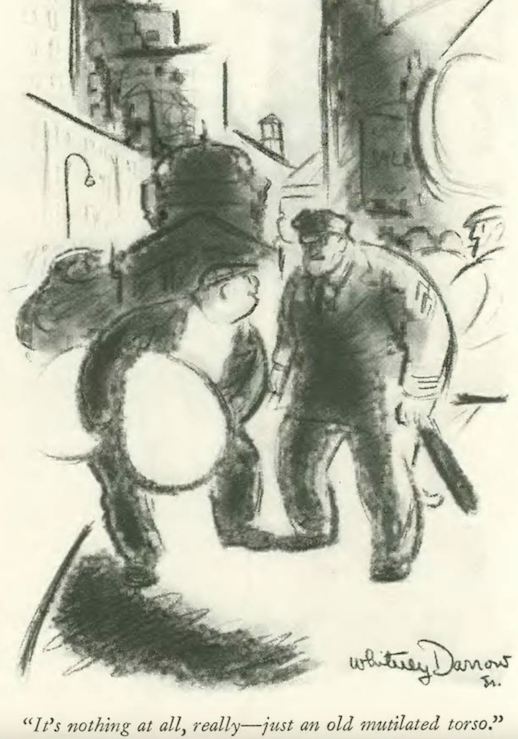
…a beat cop receives an unlikely confession, per Whitney Darrow Jr…
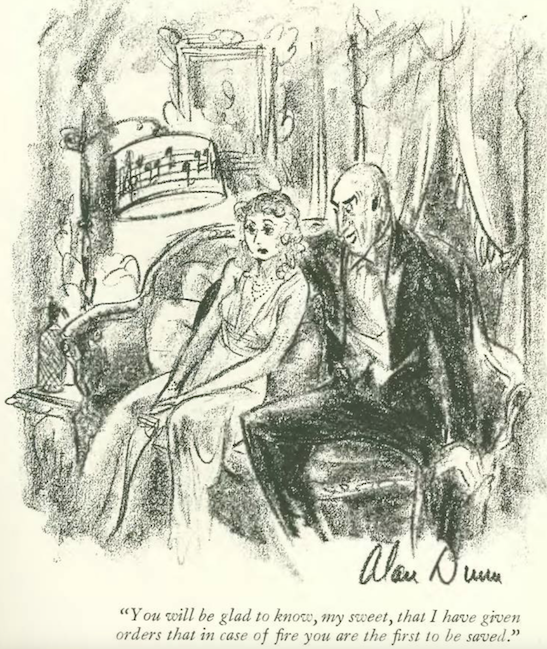
…and we close with Alan Dunn, in a forgettable situation…
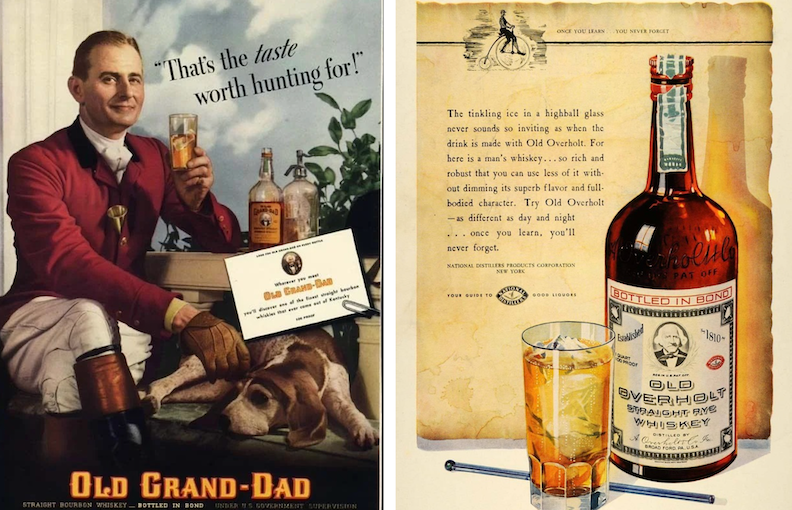
Above: E.B. White had a bone to pick with whiskey distillers who tried to establish "quick antiquity" by naming their products "Old Something-or-Other." That was not true for these two brands—Old Grand-Dad was introduced in Kentucky in 1840, while Old Overholt debuted in Pennsylvania in 1810, making it America's oldest continually maintained whiskey brand. Both are now subsidiaries of Japan's Suntory Global Spirits. (alcohol professor.com/pinterest)
With the official end of Prohibition on December 5, 1933, brewers and distillers raced to ramp up production and revive brands that had lain dormant for more than a decade. Distillers of aged spirits like rye and whiskey were especially keen to invoke history and tradition when marketing their tipple.
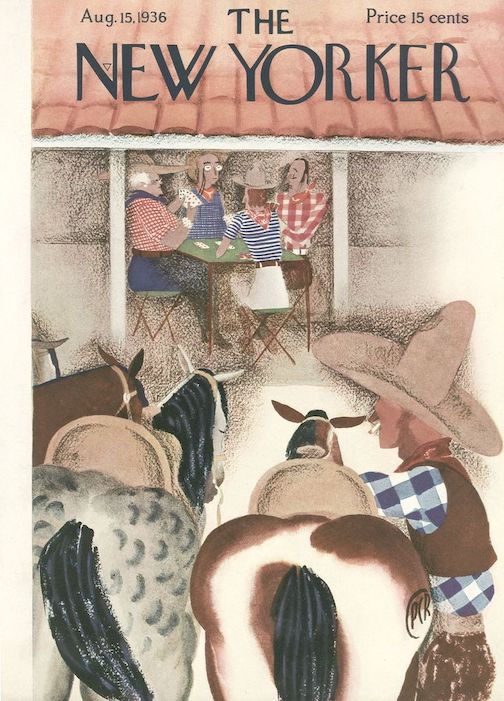
August 15, 1936 cover by Paul C. Robertson.
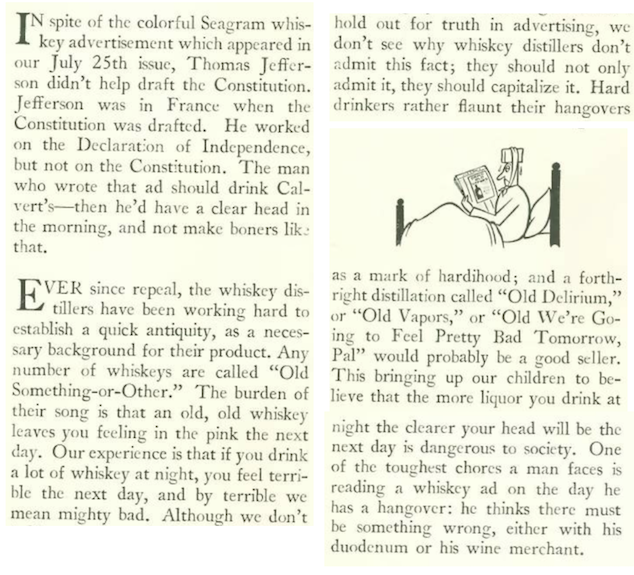
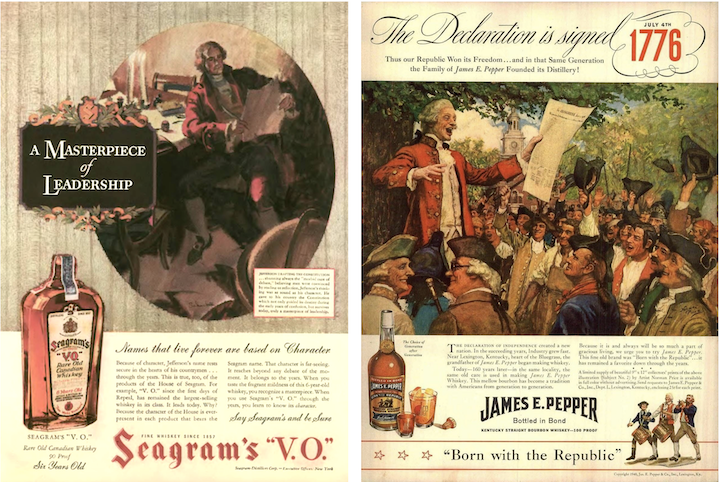
In some cases newer distilleries made generous use of the word “Old” in their branding, according to E.B. White in his “Notes and Comment.” White also called out the folks at Seagram’s, who compared the character of Thomas Jefferson to that of their “V.O.” whisky (no “e” in spirits tied to British distilling traditions—Scotland, Canada, Japan, Wales, India). Most egregious, however, was the ad’s claim that Jefferson helped to draft the Constitution. White explained:
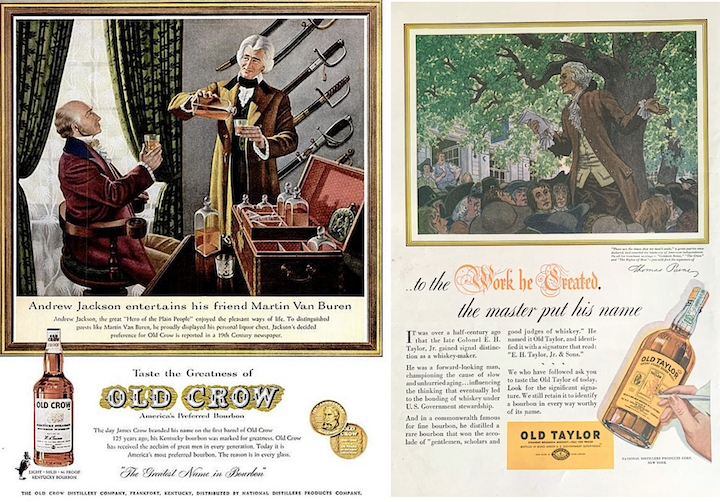
HE DID WHAT?…E.B. White called out the Seagram’s ad (left, from the July 25 issue of The New Yorker) for its historic inaccuracy (the distiller erroneously credited Thomas Jefferson for the Constitution; at right, the character and leadership of the Founding Fathers (and other early American leaders) were oft-employed metaphors for a number of whiskey brands, including James E. Pepper. (facebook.com)GOLDEN OLDIES…Here are more examples of historic figures being associated with fine spirits…at left, in 1960 the makers of Old Crow (founded 1835) depicted the genocidal Andrew Jackson pouring a glass of the stuff for Martin Van Buren; at right, in 1937 the makers of Old Taylor (1887) used quotes and themes from Thomas Paine’s revolutionary writings to promote their Kentucky Straight Bourbon. (bourbonbanter.com/etsy.com)
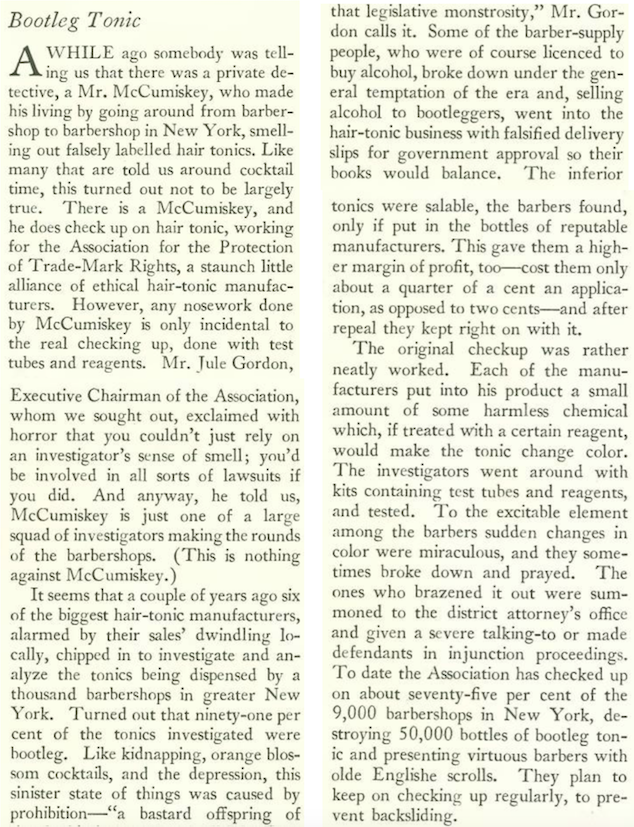
While we are on the subject of ardent spirits, let’s take a look at these excerpts from “The Talk of the Town” (attributed to Eugene Kinkead and Russell Maloney), which told the story of a private detective who had a nose for liquor— disguised as hair tonic.
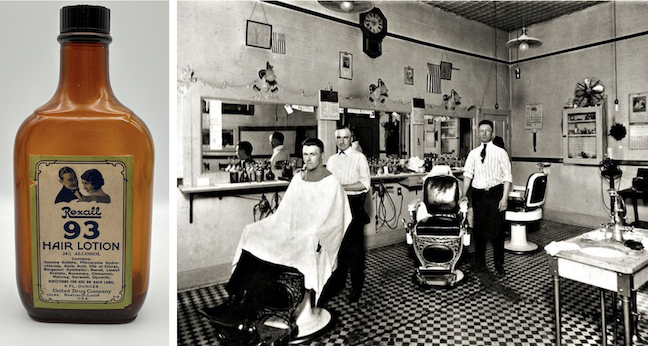
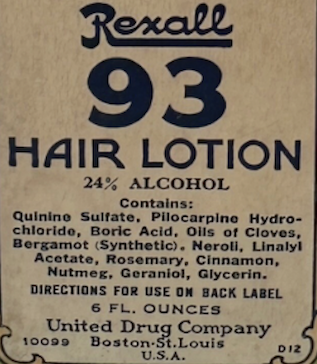
A SIP WITH YOUR SHAVE…During Prohibition (1920–1933), high-alcohol hair tonics like Rexall 93 (containing up to 24% alcohol) were legally sold as cosmetics but were frequently bought and consumed by people seeking a cheap, accessible substitute for bootleg liquor. The photo at right is of a 1930s barbershop—it is not implied that these fine gentlemen were involved in such illicit activities. (ebay.com/pinterest.com)
A closer look at the Rexall label—the makers made sure “24% Alcohol” was clearly visible. Folks known as “strainers” would run hair tonics like these through bread, cloth, or charcoal to filter out poisonous additives, obviously a dangerous practice.
* * *
Doggy Downer
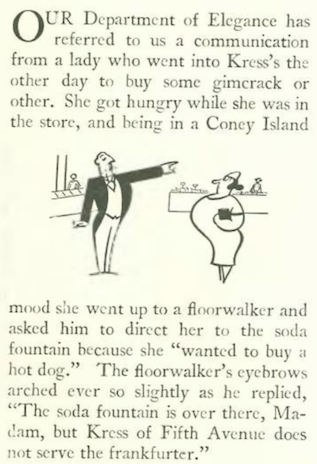
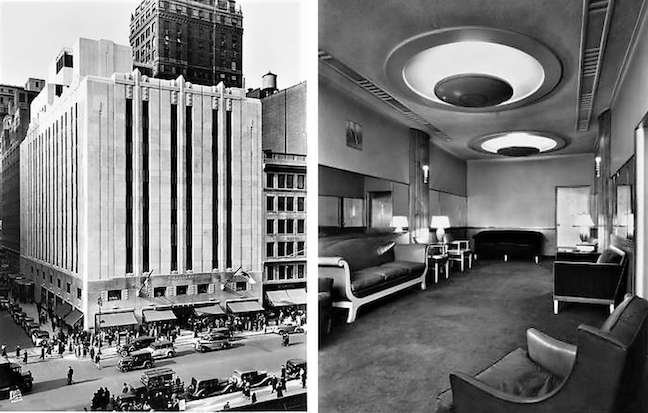
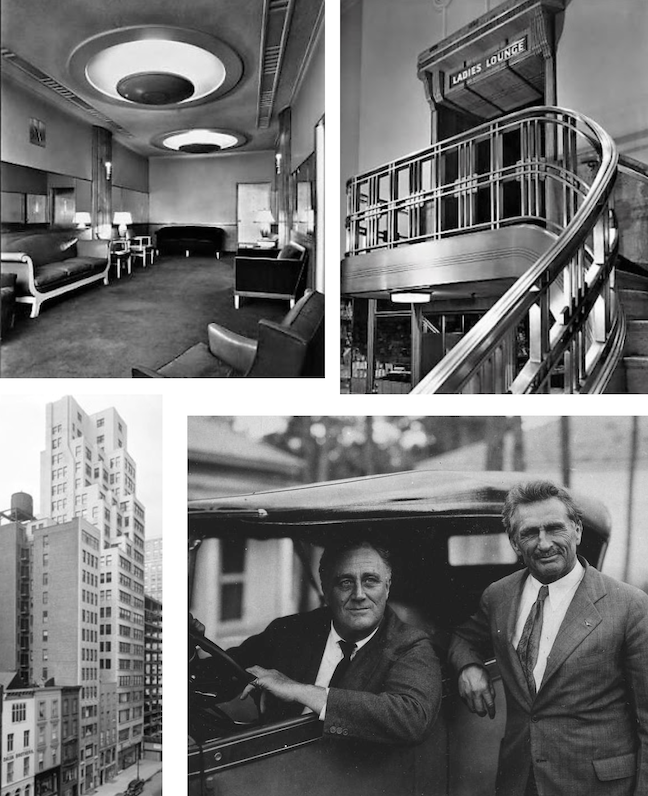
The legendary Kress “five-and-dime” stores, with more than 250 locations across twenty-nine states, served the needs of regular folks, but the designs of its stores were anything but pedestrian. This was especially true of its Fifth Avenue location, a 1935 Art Deco masterpiece. Given its lofty address, it was no place for one to order a lowly hot dog. E.B. White explained:
DECO EDIFICE…Samuel Henry Kress believed his department stores should function as works of public art that elevate the shopping experience for ordinary people. The company maintained an in-house architectural division, under the leadership of architect Edward F. Sibbert, that designed iconic, custom buildings, including the 1935 flagship S. H. Kress & Co. store on Fifth Avenue and 39th Street, an Art Deco masterpiece rendered in granite, bronze, and stainless steel; at right, a view of the store’s Ladies Lounge. Sadly, the building was razed in 1983. (Museum of the City of New York/New York Public Library)
* * *
Merely Mortal
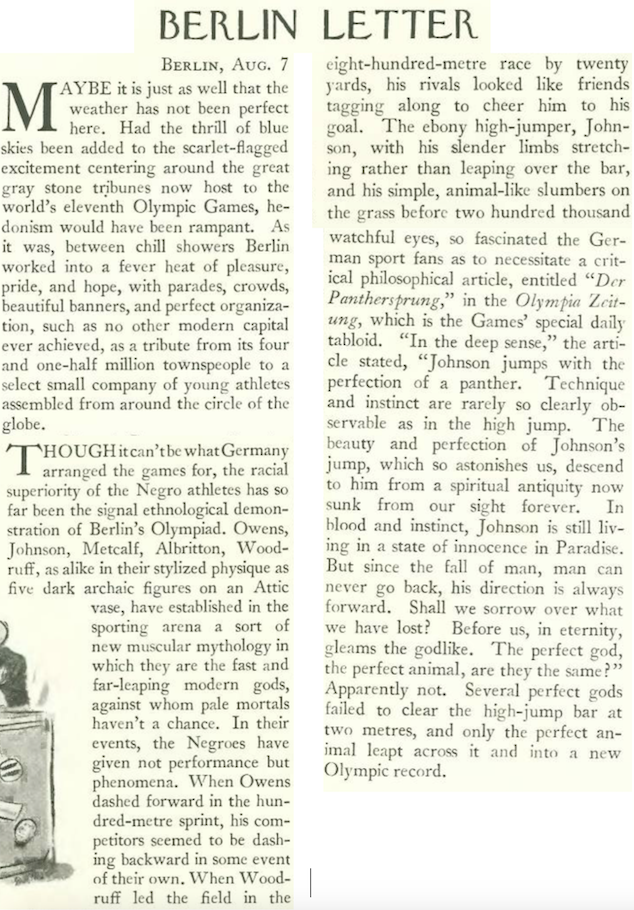
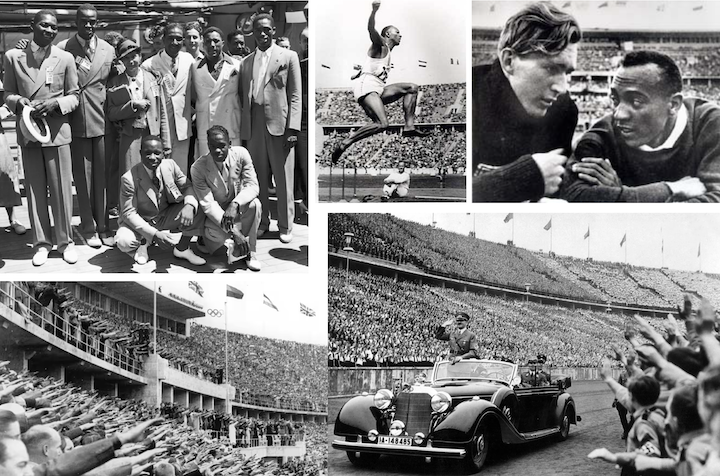
Janet Flanner filed her second report from the Berlin Olympics, where America’s Black athletes dominated the track and field events (ESPN’s Larry Schwartz credits Jesse Owens for “single-handedly crushing Hitler’s myth of Aryan supremacy”). Flanner noted attempts by propagandists to make sense of the beating they received, including likening the American athletes to wild animals “living in a state of innocence.” Excerpts:
CONQUERING HEROES…Eighteen Black athletes went to Berlin as part of the U.S. team in 1936. Clockwise, from top left: Standing are high jumpers Dave Albritton and Cornelius Johnson, hurdler Tidye Pickett, sprinter Ralph Metcalfe, boxer Jim Clark, and sprinter Mack Robinson…in front, weightlifter John Terry (left) and long jumper John Brooks; Jesse Owens captured four gold medals and became the hero of the Olympics—his long jump (26 feet 5-1/2 inches) was an Olympic record; the American press reported widely on the friendship between Owens and his German long jump competitor Carl Ludwig (“Luz”) Long…Long was killed in action during World War II; the faithful offer their ugly salutes at the opening of the games. (webs.org/Bundesarchiv Koblenz/ushmm.org/history.com)
Flanner also reported on the great fanfare at the opening of the games, including “seventeen searchlights, from far outside the arena…a lofty birdcage of streaming light beams.” One wonders if those same searchlights were deployed during the war four years later, when RAF Lancaster bombers began their night bombing campaign of Berlin.
* * *
At the Movies
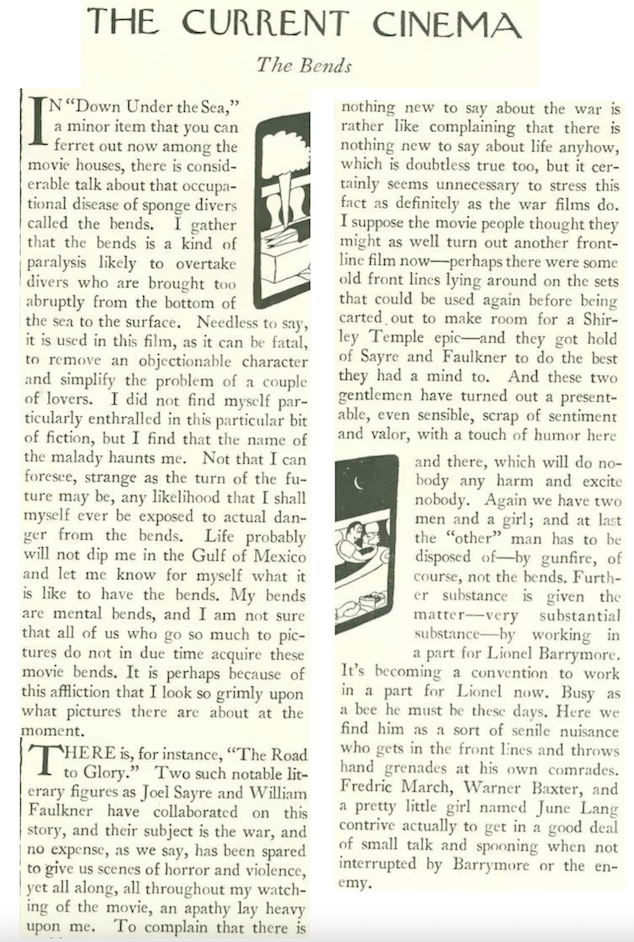
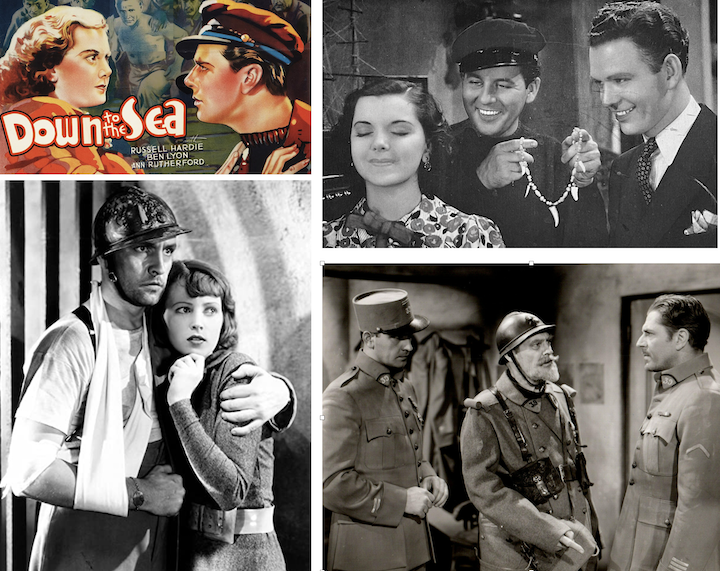
Last week we saw Lionel Barrymore in drag (as an old woman) in The Devil Doll. This week he resurfaces as a senile old warhorse in The Road to Glory, a Howard Hawks war film with a screenplay co-written by William Faulkner (the film also featured Frederic March, who had star billing in three major films in 1936). John Mosher found the film “presentable,” but nothing special. The same went for Down Under the Sea, a film concerning sponge divers who battle over the affections of a woman (Ann Rutherford).
WERE THEY SPONGE WORTHY?…Clockwise, from top left: Ann Rutherford finds herself torn between two sponge divers vying for her affections in Down Under the Sea (aka Down to the Sea); divers Ben Lyon and Russell Hardie surprise Rutherford with a “native necklace” in the film; Frederic March, Lionel Barrymore, and Warner Baxter in The Road to Glory; June Lang with March in The Road to Glory. (eBay/silverscenesblog)
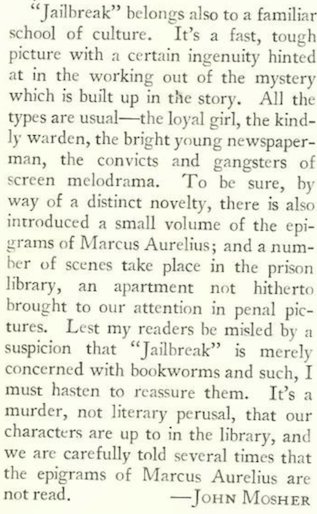
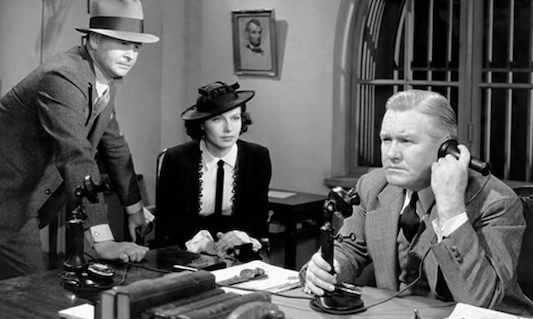
Mosher also took in Jailbreak, a minor noir picture about racketeers, cops and newspaper reporters.
SERIOUS BUSINESS…Barton MacLane, June Travis and Joseph Crehan in Jailbreak. (IMDb.com)
* * *
From Our Advertisers
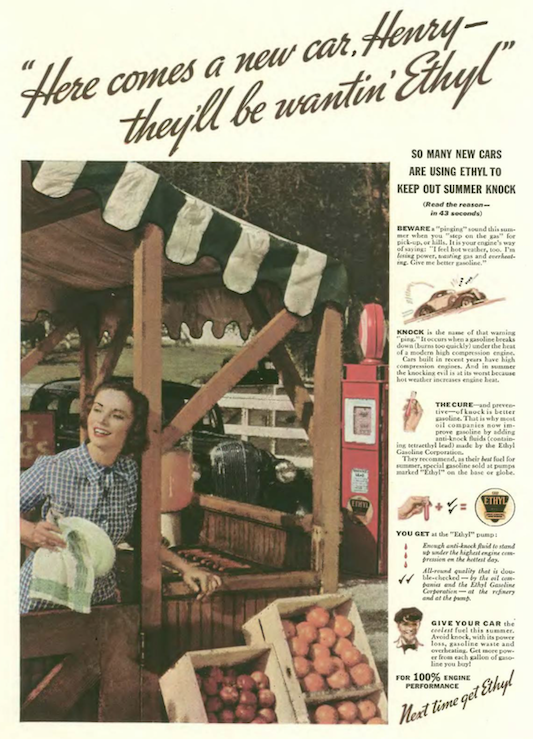
The inside front cover featured a wholesome image of a roadside stand on behalf of leaded gasoline…the makers of Ethyl, which boosted octane ratings and stopped engine knocking, deliberately hid or omitted the word “lead” in their advertising…I don’t miss the Ethyl, but I do miss those roadside stands…
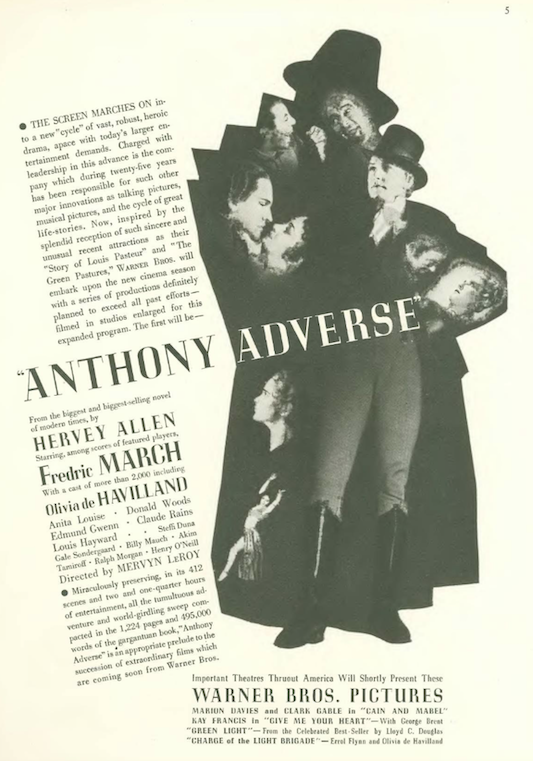
…Warner Brothers took out a full-page ad to trumpet the East Coast release of their epic drama Anthony Adverse, which would go on to win four Academy Awards…
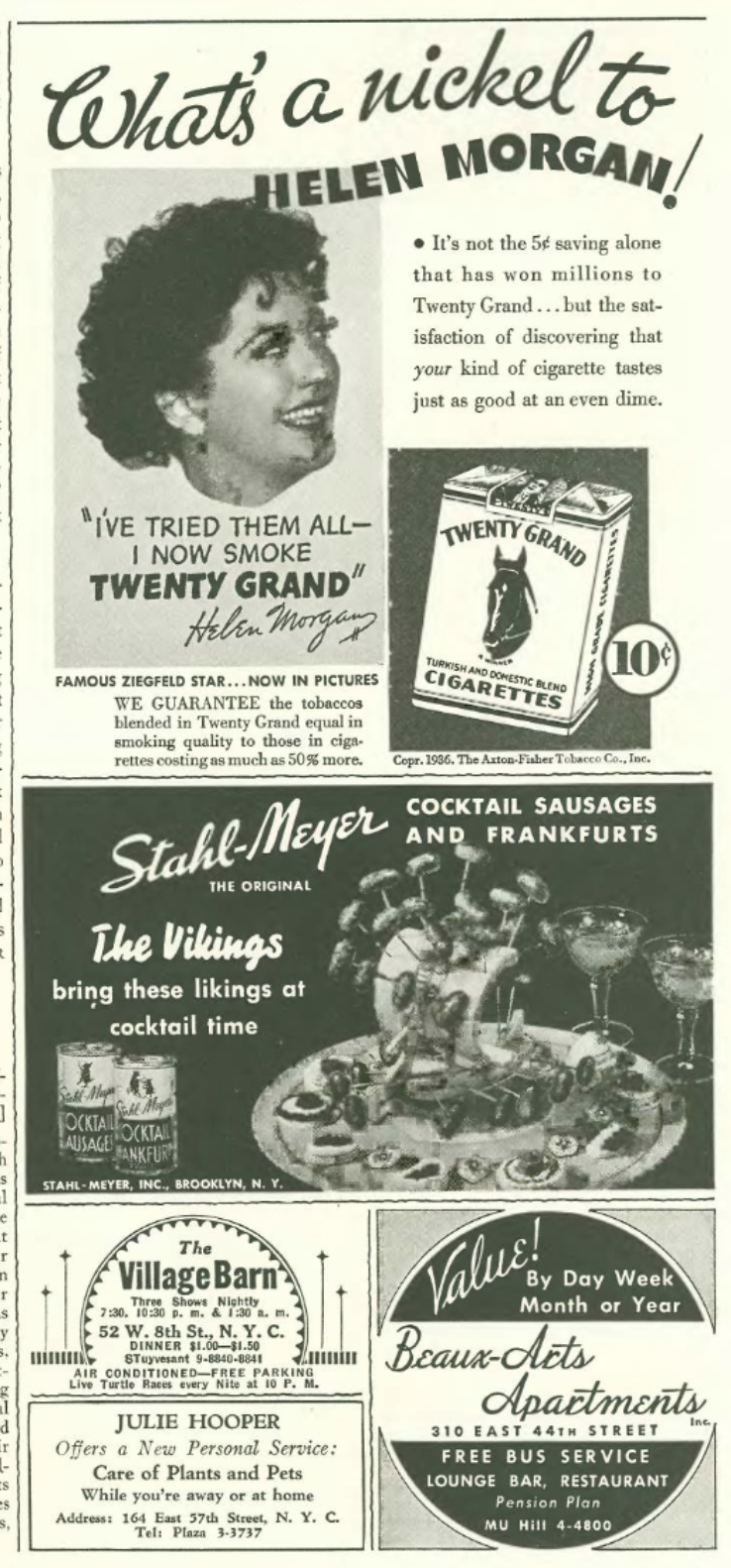
…the original torch singer Helen Morgan lent her endorsement to a budget cigarette brand in this back of the book ad…at this point her career would be headed on a downward spiral, ending with her death in 1941…
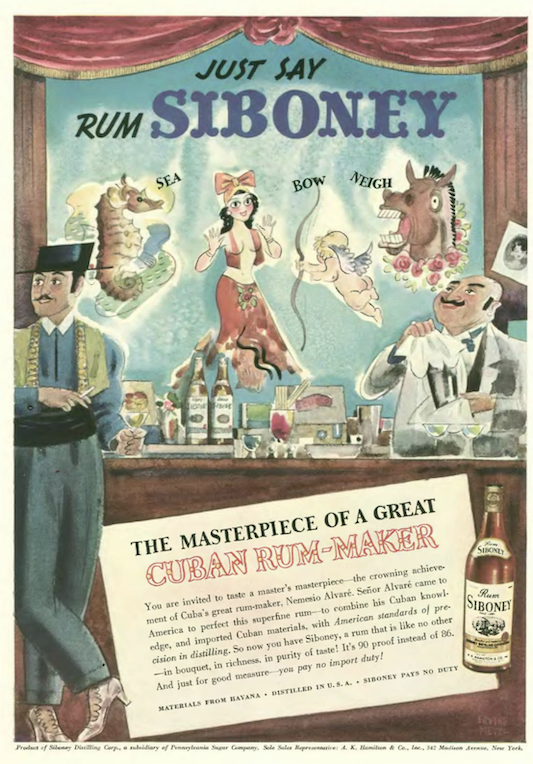
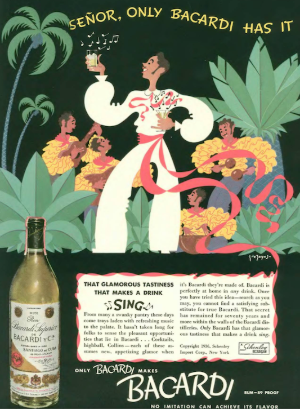
…the makers of the Dominican rum Siboney competed with Cuban rival Barcardi with this colorful full-page ad illustrated by American graphic artist Ervine Metzl…
…Barcardi placed this front cover advertisement in Aug. 1, 1936 New Yorker (illustrated by George de Zayas)…
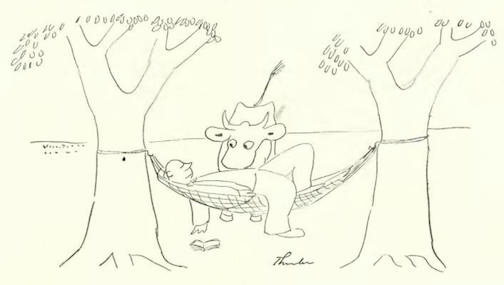
…James Thurber kicks off the cartoons with two terrific spot drawings…
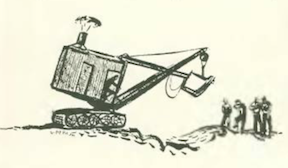
…this spot drawing by Victor de Pauw recalls my favorite childhood book, Mike Mulligan and His Steam Shovel (1939), by Virginia Lee Burton…
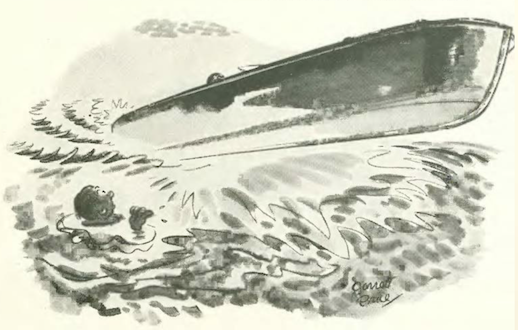
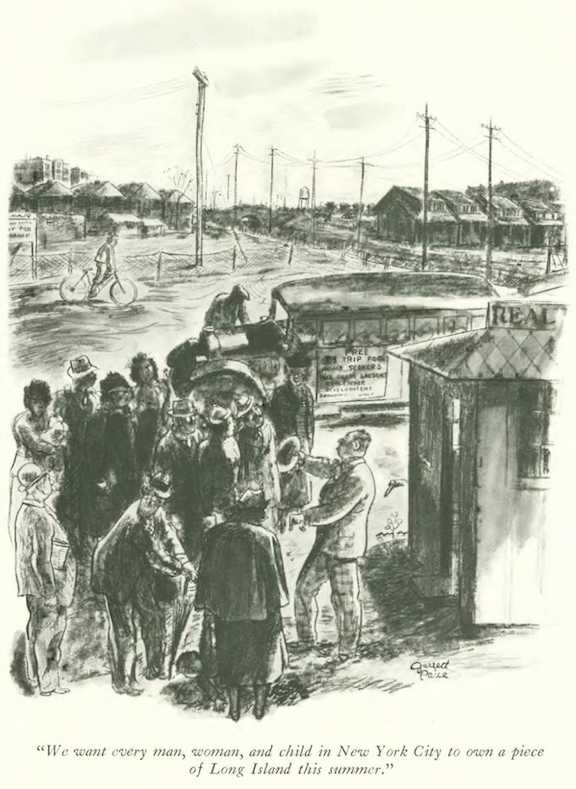
…I’m not sure if one would call this a spot drawing or a caption-less cartoon, at any rate, Garrett Price aptly illustrated the dangers of swimming beyond the bouys…
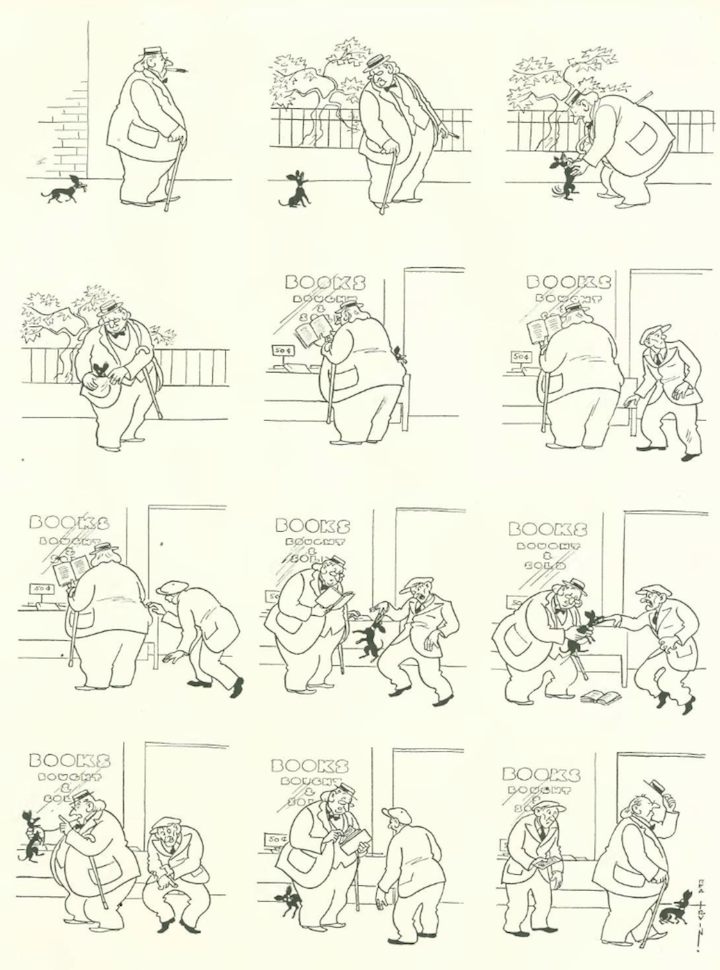
…Rea Irvin demonstrated the perils of dognapping in this multi-panel entry…
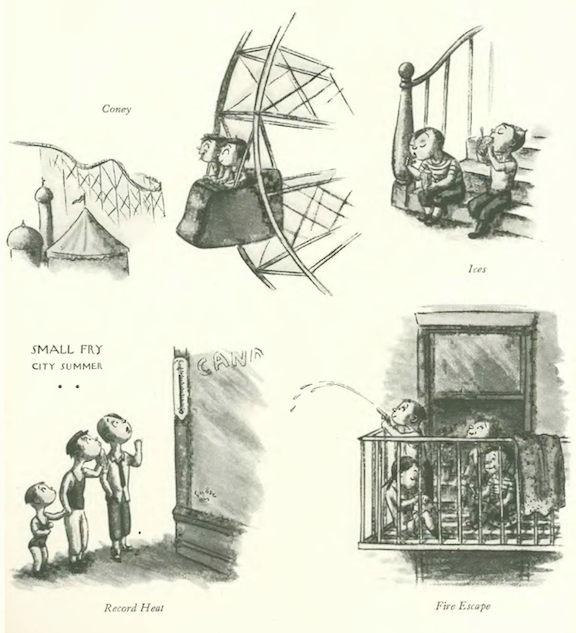
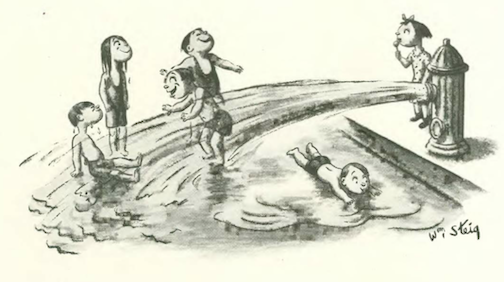
…William Steig celebrated summer in the city…
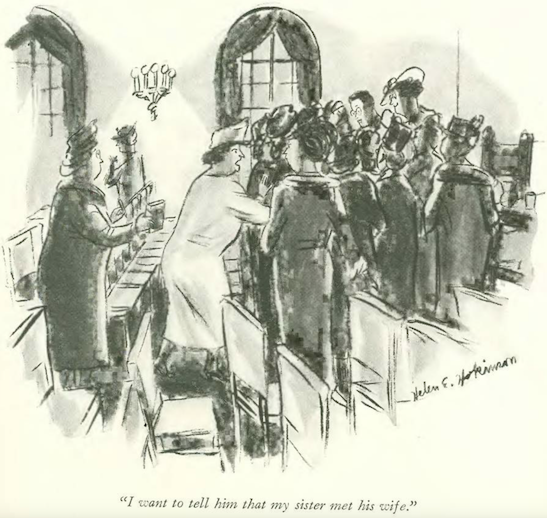
…Helen Hokinson drew up an urgent social connection…
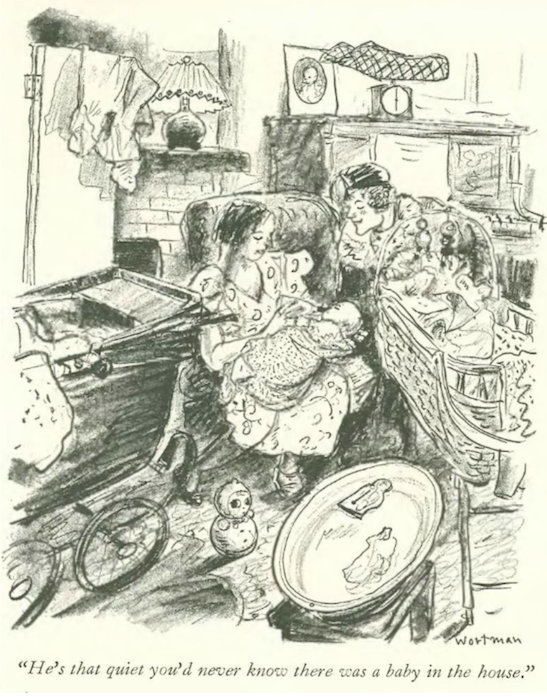
…Denys Wortman looked in on the trappings of motherhood…
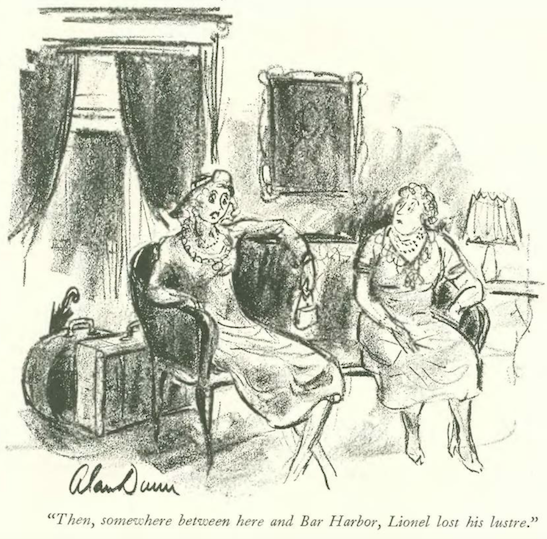
…Alan Dunn showed us one effect of long-distance travel…
…and Dunn again, with a man who’d rather not ask questions…
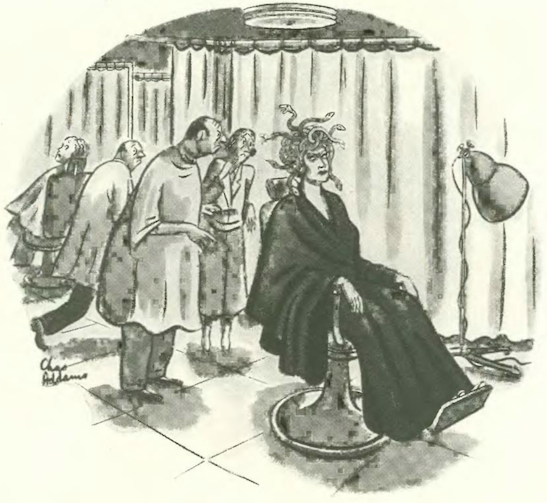
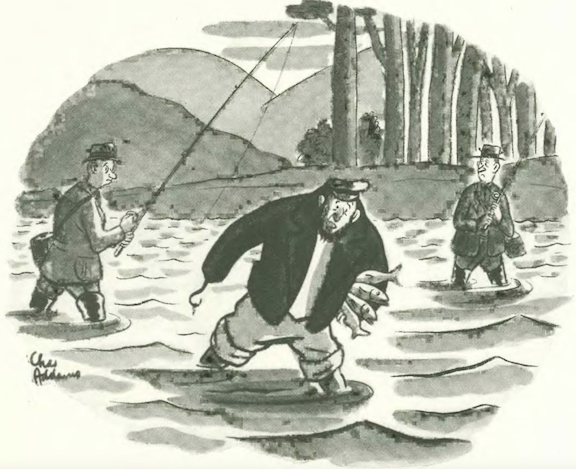
…and leave it to Charles Addams to draw up The New Yorker’s first Medusa-themed cartoon…
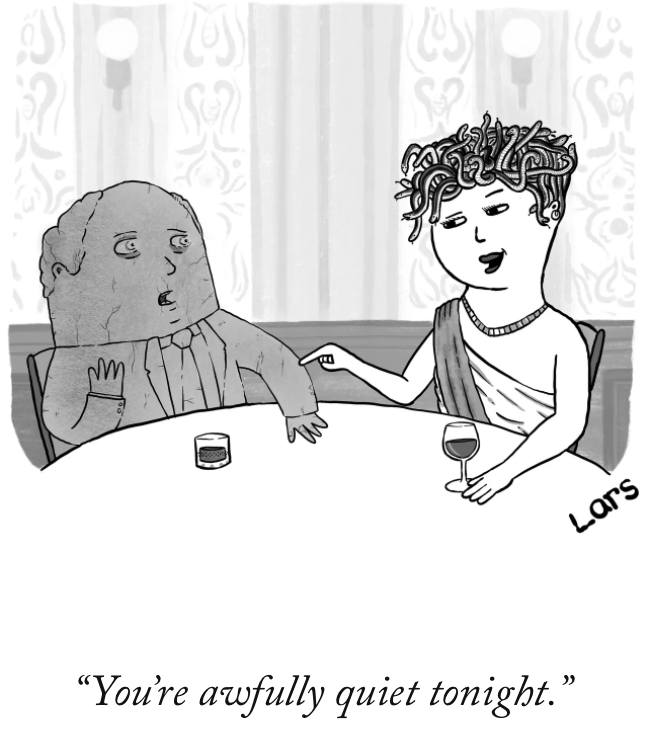
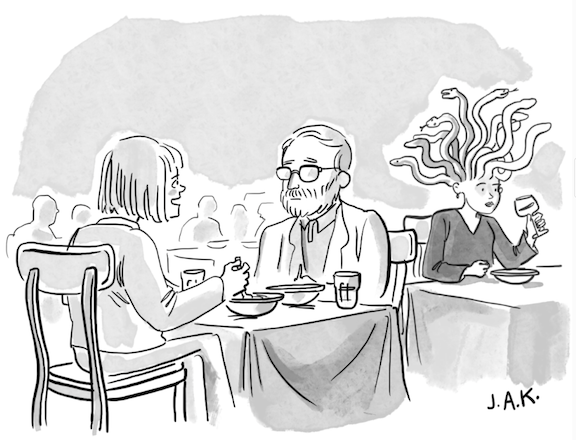
…before we continue, here are other interpretations of the mythic Gorgon from The New Yorker…this one by Lars Kenseth is from Jan. 21, 2019…
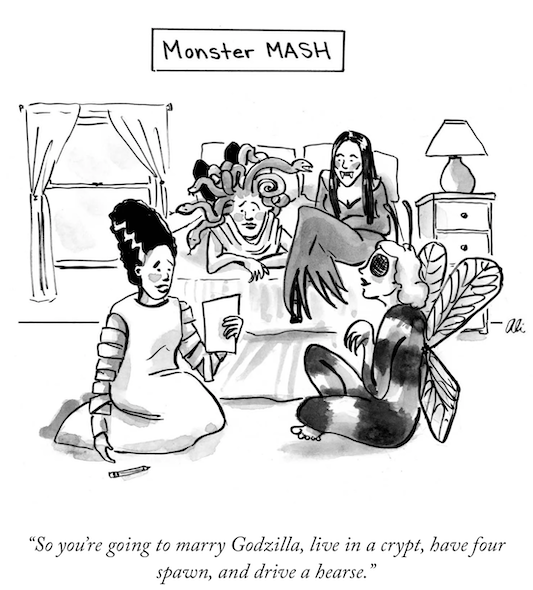
…this is by Ali Solomon (Oct. 29, 2025)…
…and from May 3, 2025, this terrific caption contest cartoon by Jason Adam Katzenstein (and the winning caption by Peter Sergison, Durham, NC)…
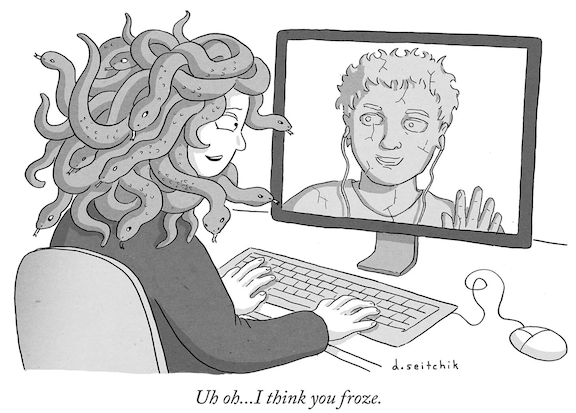
…and here’s a timely cartoon by Daryl Seitchik that was rejected by the magazine…
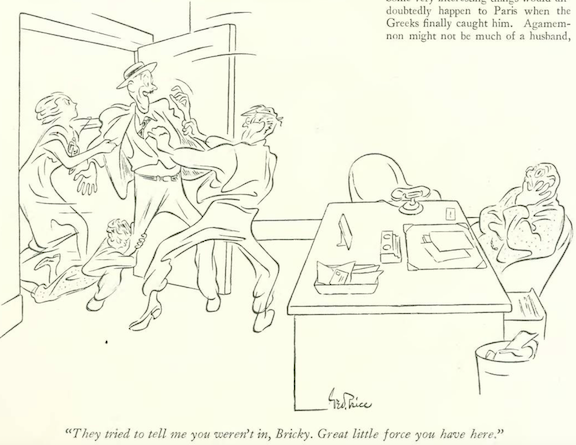
…we go back to 1936 with George Price and a plucky salesman…
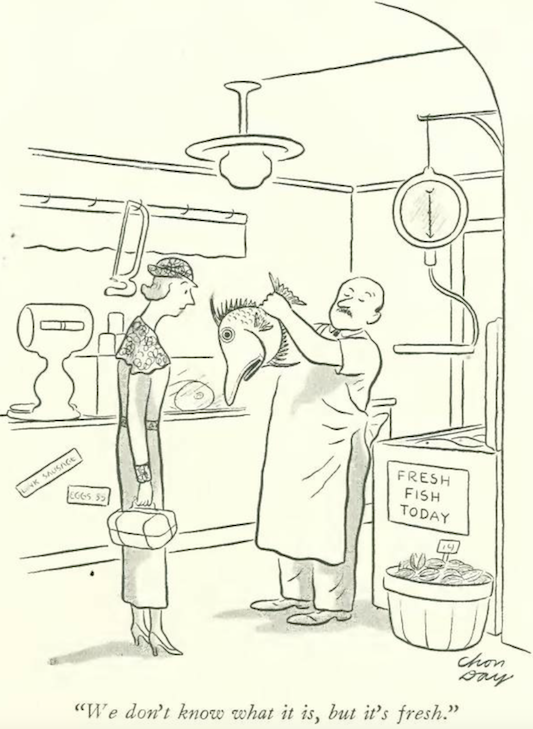
…Chon Day made an unappetizing find at the fish market…
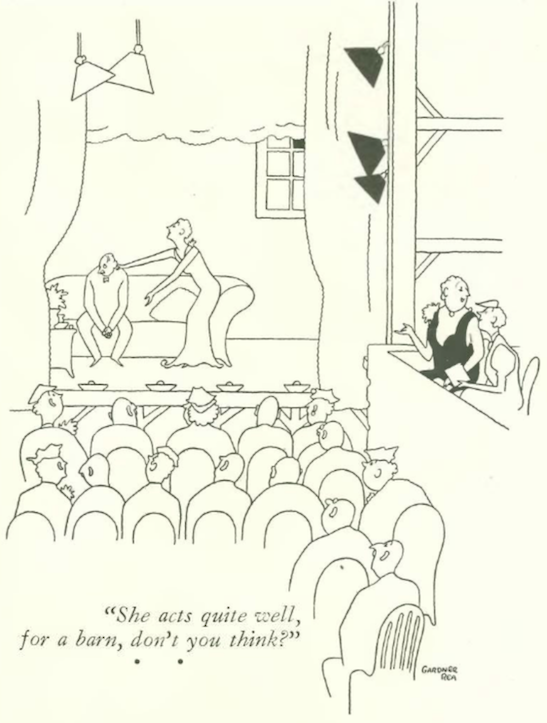
…Gardner Rea looked in on a summer stock performance…
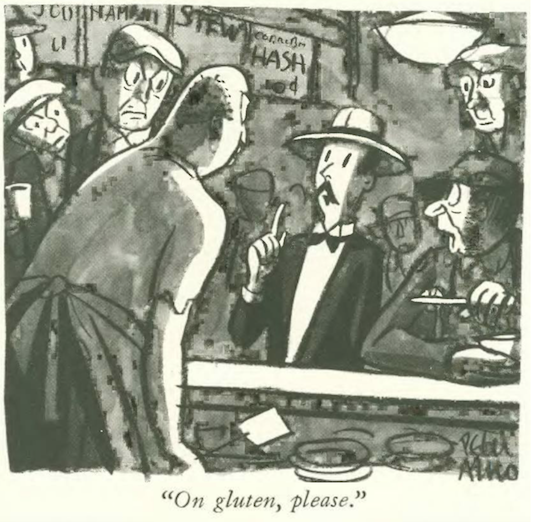
…Peter Arno drew up a Milquetoast unwittingly ordering a knuckle sandwich…
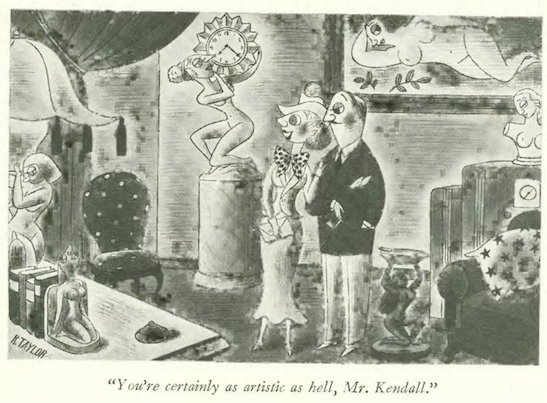
…and we close with some racy decor, courtesy Richard Taylor…
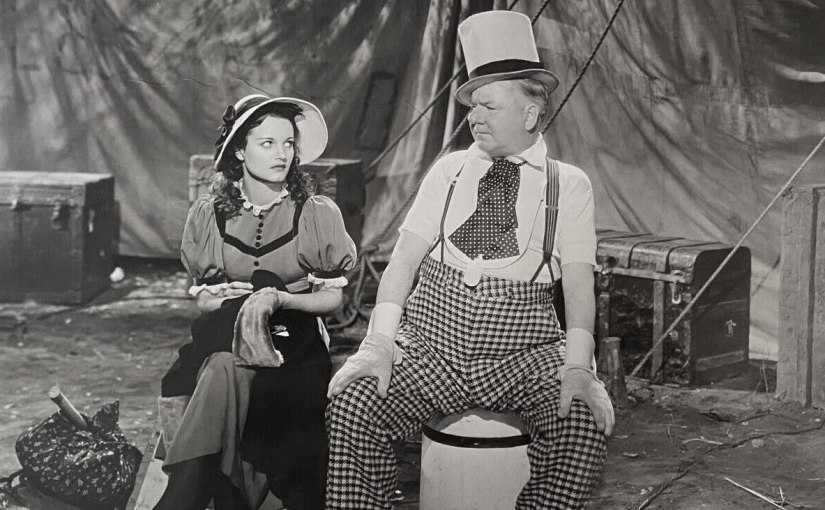
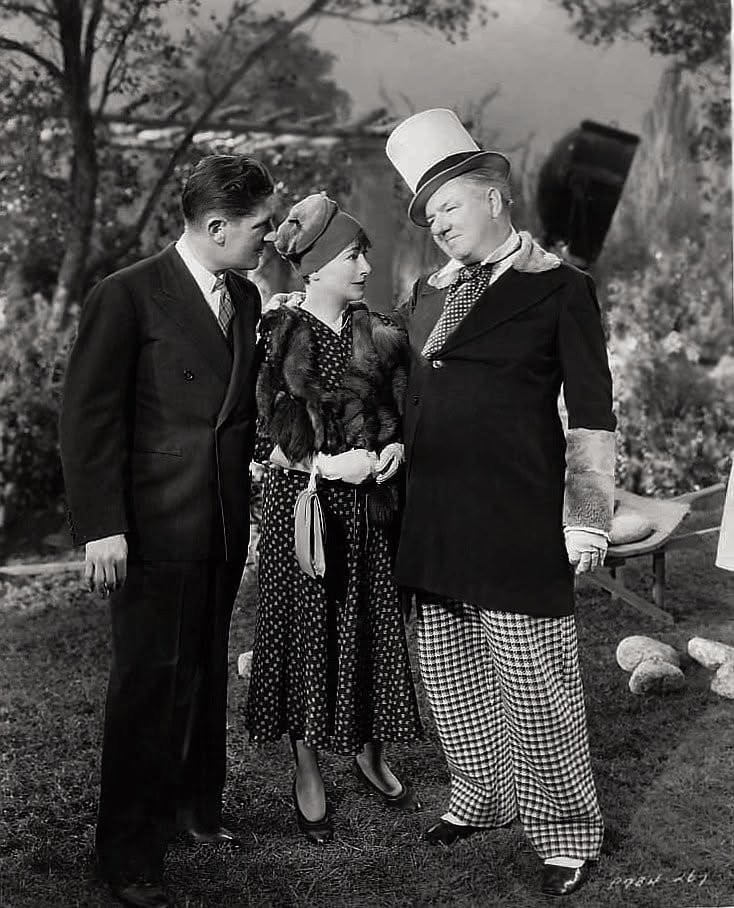
Above: Rochelle Hudson and W.C. Fields in scene from Poppy. Fields reprised his vaudeville character Professor McGargle (from the hit 1923 stage revue of the same name), who learns about a million-dollar inheritance meant for a long-lost local heiress and concocts a plan to pass off his daughter, Poppy, as the true heiress. (Facebook.com)
Eighty years after his death W.C. Fields is still recognized as one of the America’s great comic geniuses. When he made a sound film version of his hit Broadway play, Poppy, in 1936, many thought it would be his last, since he suffered from a variety of ailments including a bad back and chronic lung congestion. Doubtless two quarts of liquor a day also had a few people wondering.
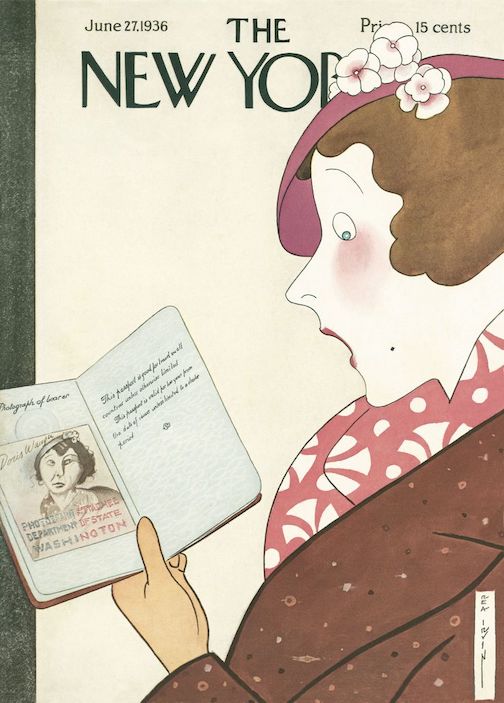
June 27, 1936 cover by Rea Irvin.
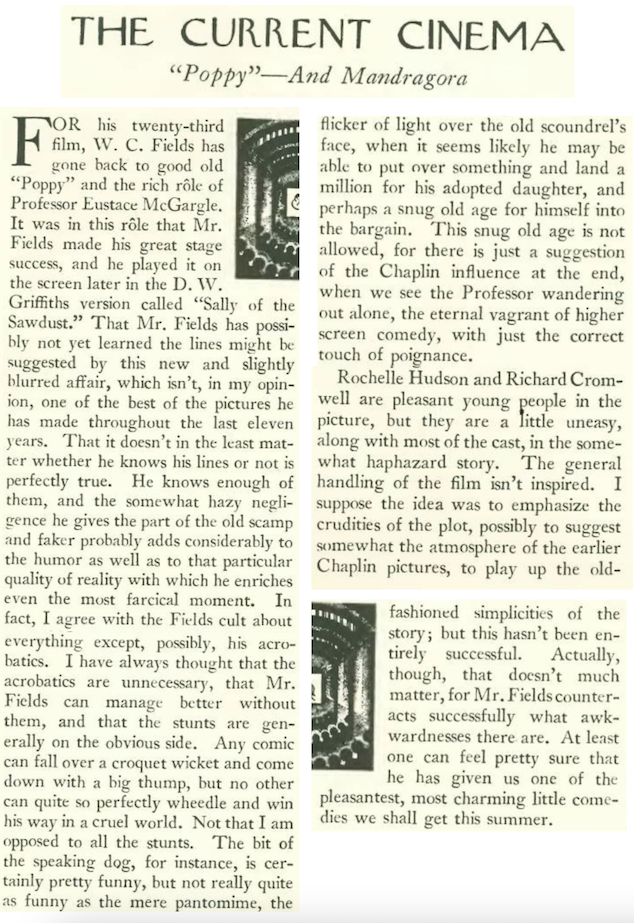
It would have been an appropriate, if premature ending to Field’s career, since it was the Poppy stage play that launched him into national stardom (along with the play’s first adaptation into film, the 1925 silent Sally of the Sawdust). The play and the silent film introduced audiences to the lovable snake oil salesman “Professor” Eustace McGargle, who returned in the 1936 film, “a slightly blurred affair” according to critic John Mosher.
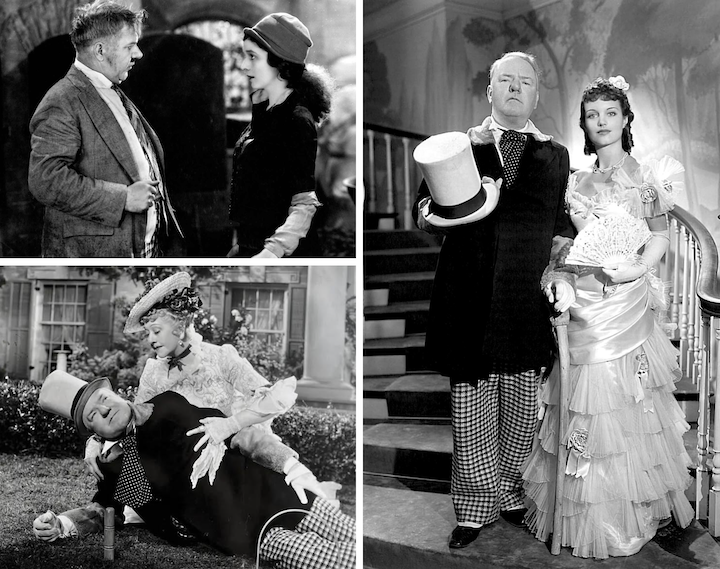
THE PROFESSOR RETURNS…Clockwise, from top left: W.C. Fields and Carole Dempster in 1925’s Sally of the Sawdust, which was based on the stage play Poppy and was directed by D.W. Griffith; Fields as Professor Eustace McGargle and Rochelle Hudson as Poppy in 1936’s Poppy; Fields and Catherine Doucet, who portrayed Countess Maggi Tubbs DePuizzi.(filmforum.org/doctormacro.com/facebook.com)
The “blurred” performance by Fields (1880–1946), the result of his various ills, didn’t seem to affect most critics—the New York Times, for example, called the film “a glorious victory.” Remarkably, Fields would live another ten years and go on to star in such classics as 1940’s My Little Chickadee, (with Mae West), 1940’s The Bank Dick, and 1941’s Never Give a Sucker an Even Break.
HELLO FRIENDS…W.C. Fields chats with his close friend and Poppy director Eddie Sutherland, who was accompanied by writer Dorothy Parker during a visit to the set of Poppy. (Facebook.com)
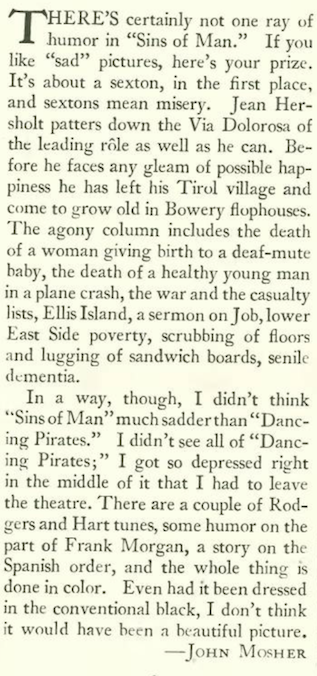
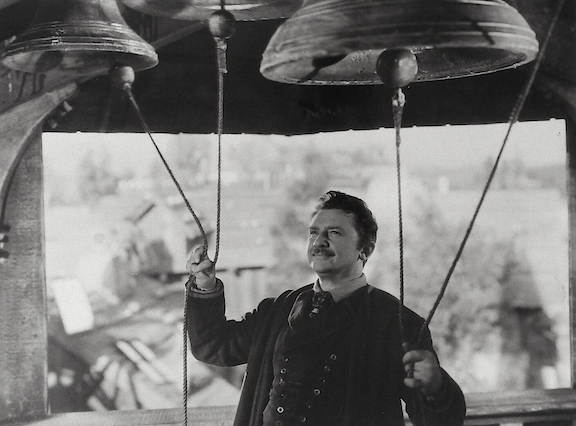
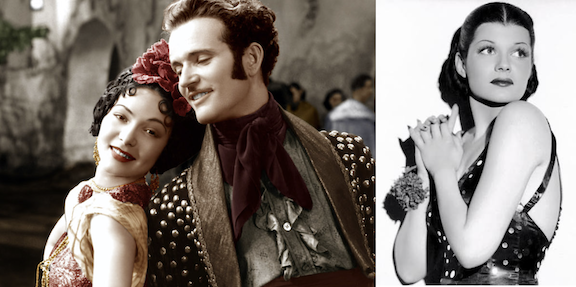
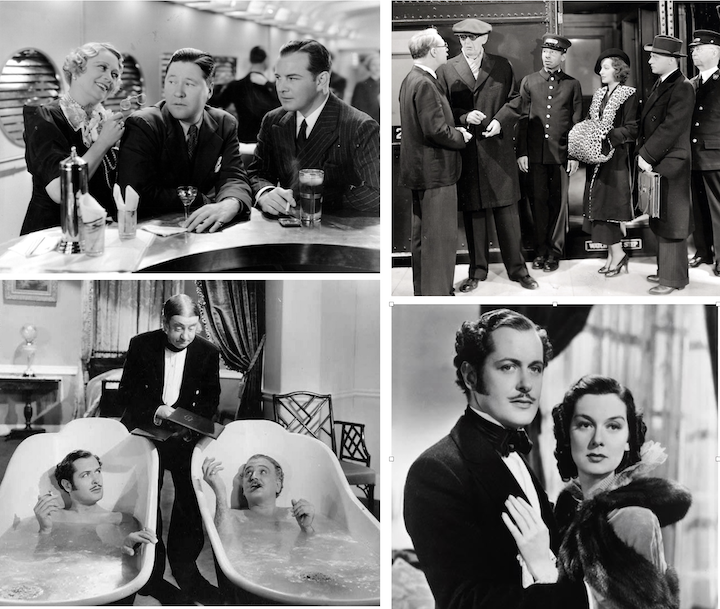
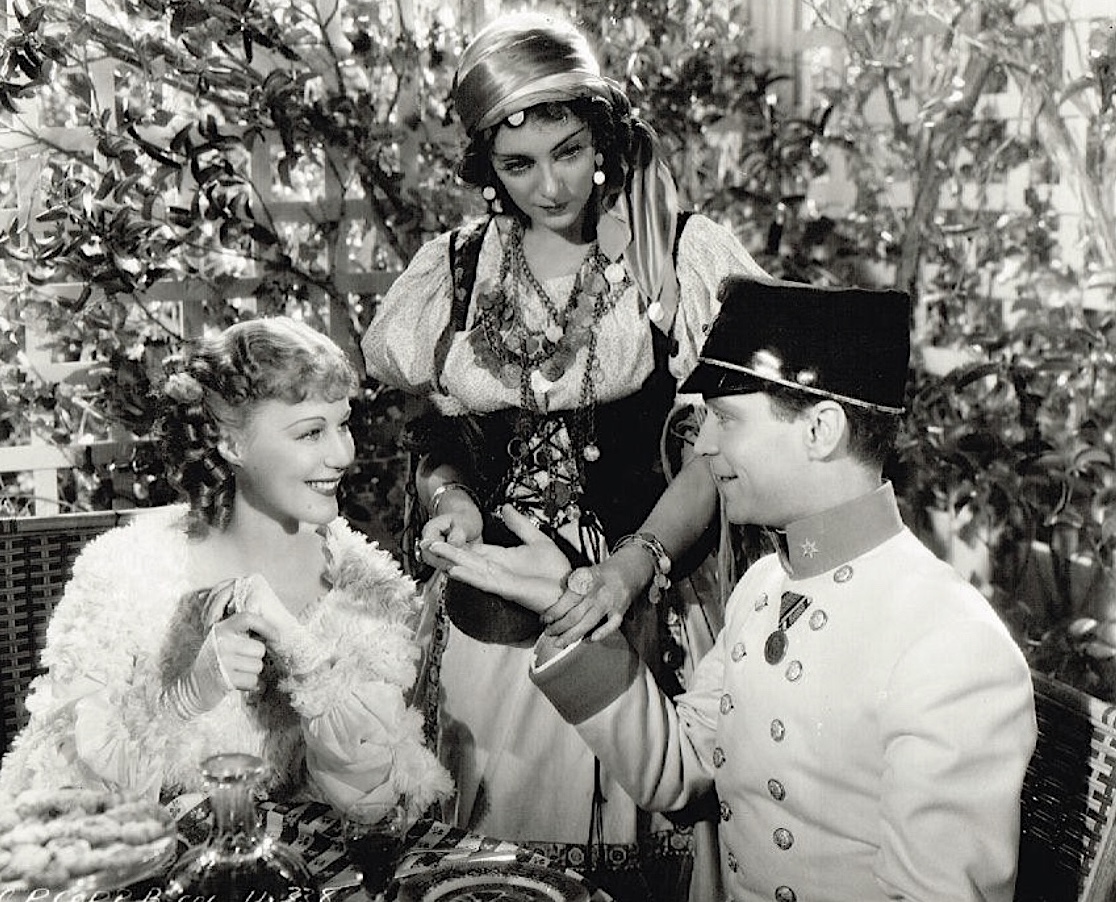
Mosher also reviewed a “sad” picture about the tragic life of a Tyrolean sexton, Sins of Man, and the musical comedy Dancing Pirate, which he deemed even sadder because it was so terrible (Mosher walked out during the middle of the picture).
The origin of the music video? See reader comment at the end of the post.
FROM BELLS TO THE BOWERY…Jean Hersholt played a Tyrolian sexton with an American dream that goes awry in Sins of Man. (eBay.com)SEEING RED…Not even Technicolor could spare Dancing Pirate from John Mosher’s wrath. At left, Steffi Duna and Charles Collins in a dance scene; eighteen-year-old Rita Hayworth (right) appeared as an uncredited dancer in the film—here she poses in a publicity photo for 1936’s Human Cargos.(mediaplaynews.com/facebook.com)
* * *
All Aboard
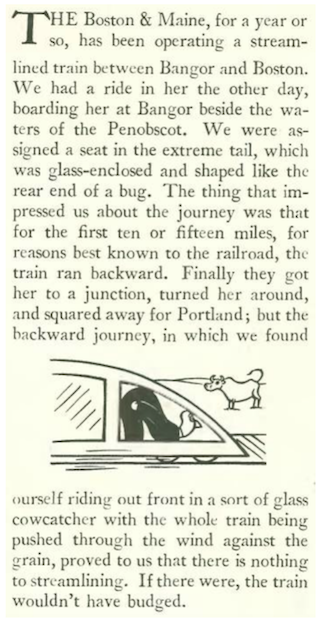
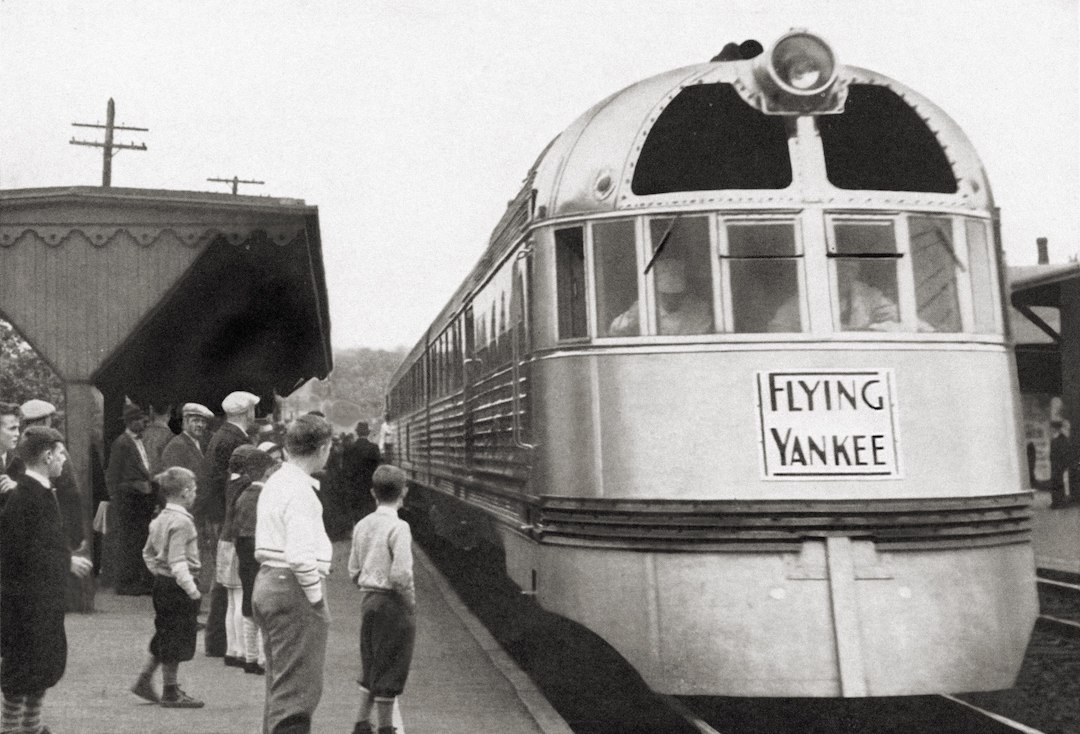
In his “Notes and Comment,” E.B. White described a trip on a Boston & Main streamliner that traveled along a branch line. Lacking a turning loop, the train had to run in reverse for half of the round trip.
TWO-WAY TICKET…The Boston & Main streamlined Flying Yankee (seen here in 1938) would run both forward and backward when traveling along a branch line that lacked a turning loop. (Wikipedia)
* * *
Furies Al Fresco
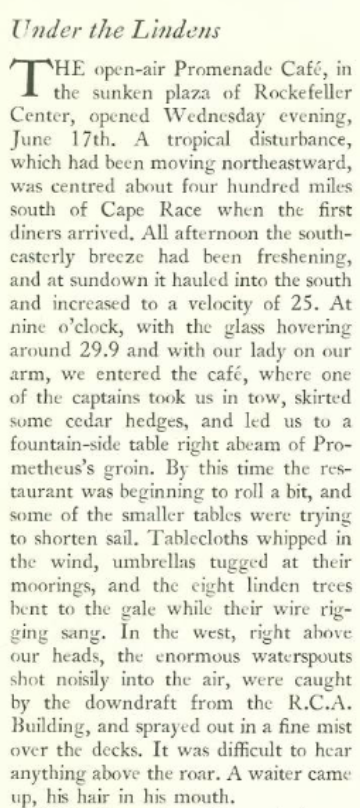
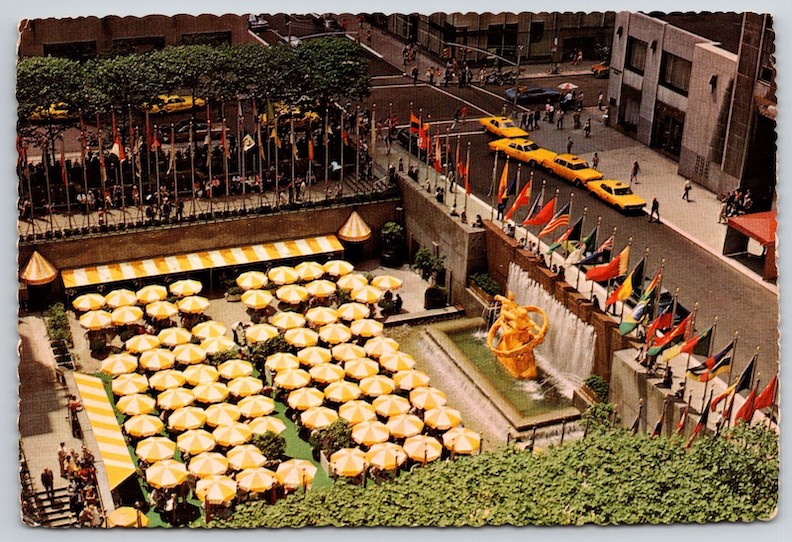
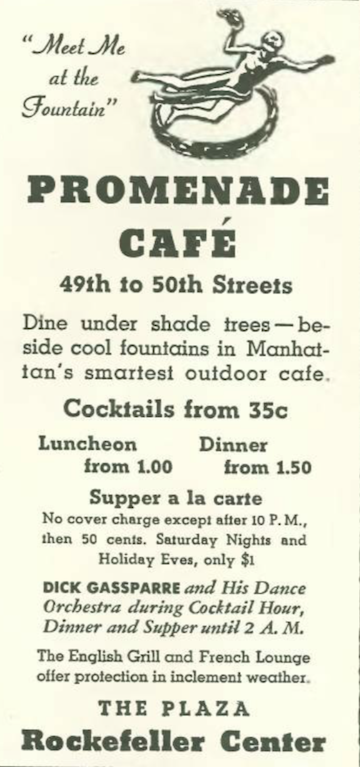
On June 17, 1936 Rockefeller Center opened the Promenade Café in the plaza surrounding the Prometheus Fountain (later that year a temporary ice skating rink took the spot, now a permanent, iconic feature of the plaza). Writing for “The Talk of the Town,” E.B. White commented on the breezy dining experience he shared with wife, Katharine Sergeant White. Excerpt:
FIRE AND ICE…Patrons enjoy dining with the god of fire in the plaza beneath 30 Rock, circa 1970. The plaza is converted to an ice skating rink in the winter. (eBay.com)
The magazine’s next issue (July 4) advertised dinner, dancing and thirty-five cent cocktails at the Promenade Café…
* * *
From Our Advertisers
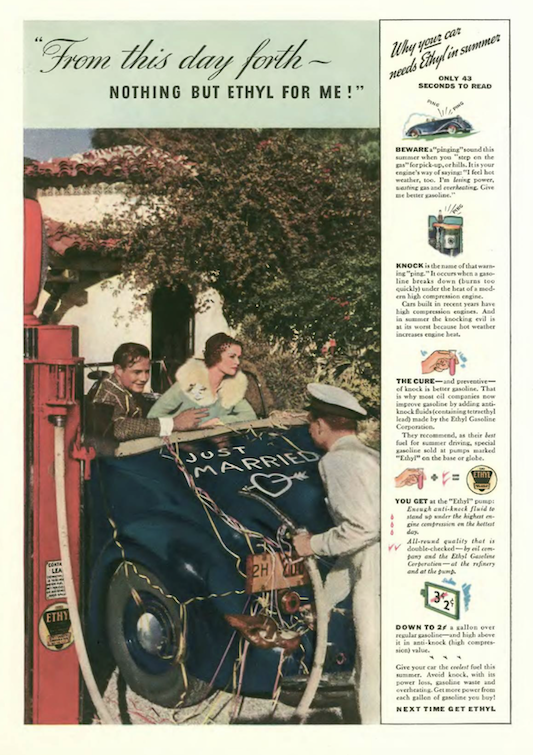
We open with a June Bride and hubby tanking up on some leaded gas before heading to Niagara Falls…
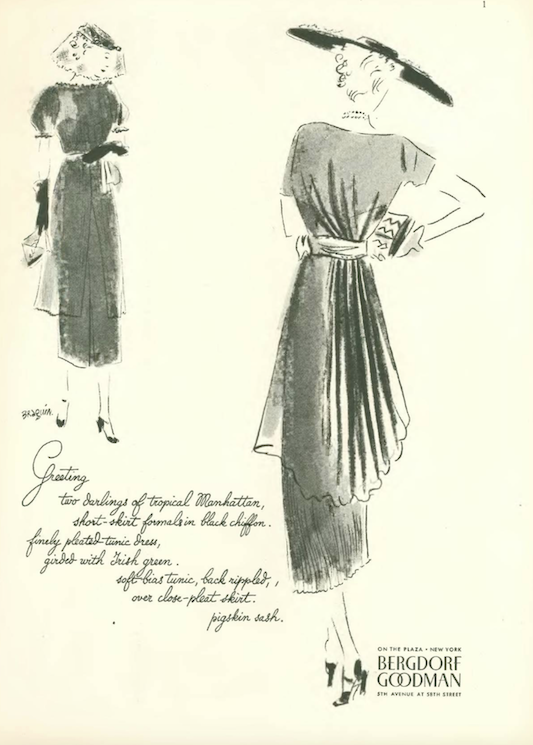
…opposite the Ethyl ad was this Simeon Braguin-illustrated spot for Bergdorf…
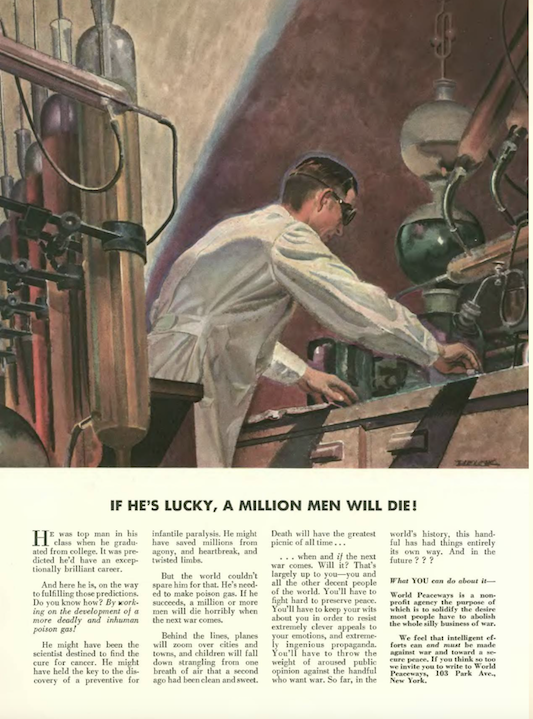
…the pacifists behind the World Peaceways ads pulled no punches when delivering their anti-war message…
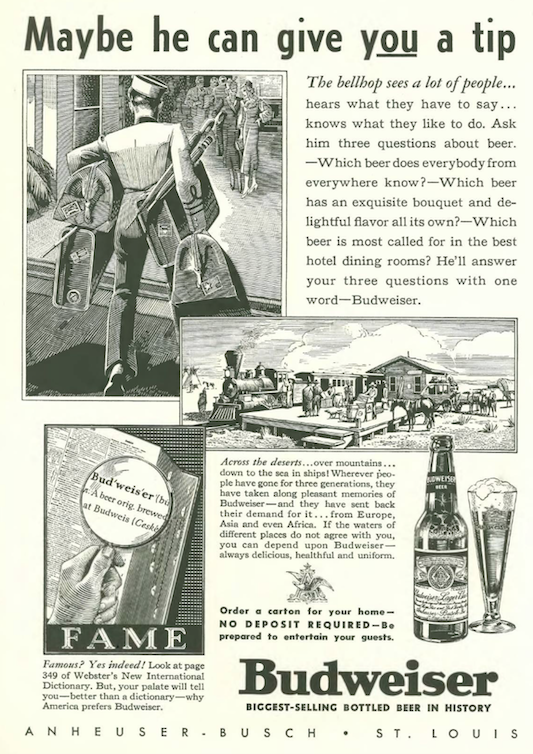
…Budweiser continued its laborious series of ads that employed analogies and metaphors to promote its best-selling suds…
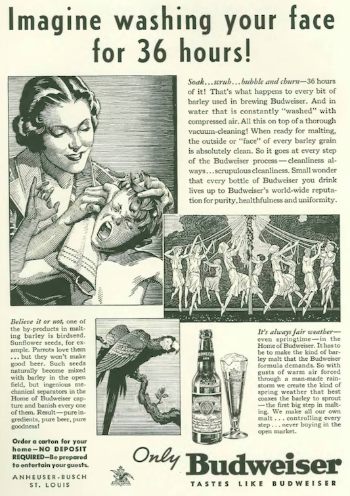
…recall the ad from the April 18 issue of The New Yorker, when the brewer used this disagreeable analogy to tout its “vacuum-cleansing” process…
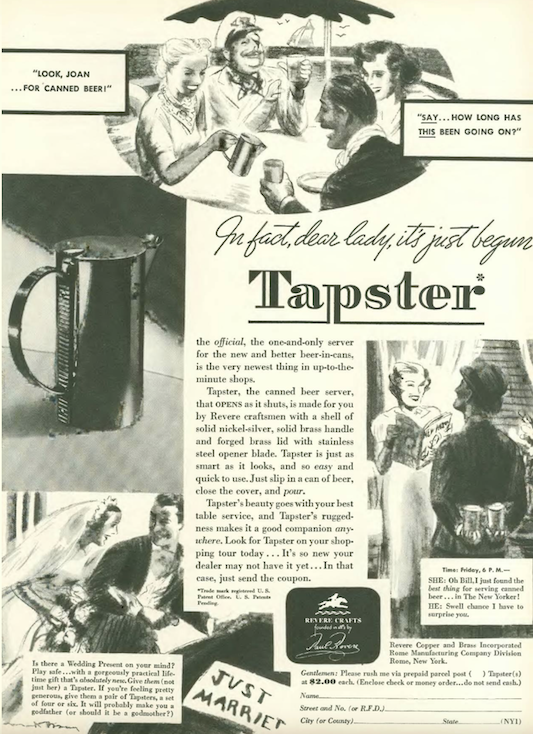
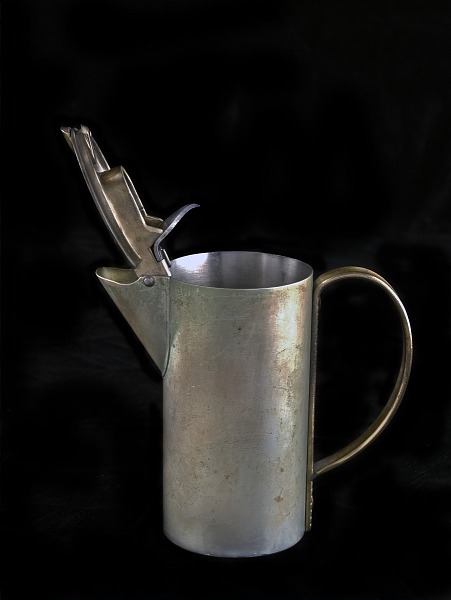
…the Revere Copper and Brass company responded to the recent invention of canned beer with an invention of its own…the Tapster, an elegant nickel and brass pitcher with a built-in punch on the underside of the lid…just insert a can, push down on the lid, and pour…great for the yacht, or as a gift to some newlyweds…
The nickel-silver and brass “Tapster” is highly sought by collectors today. (americanhistory.si.edu)
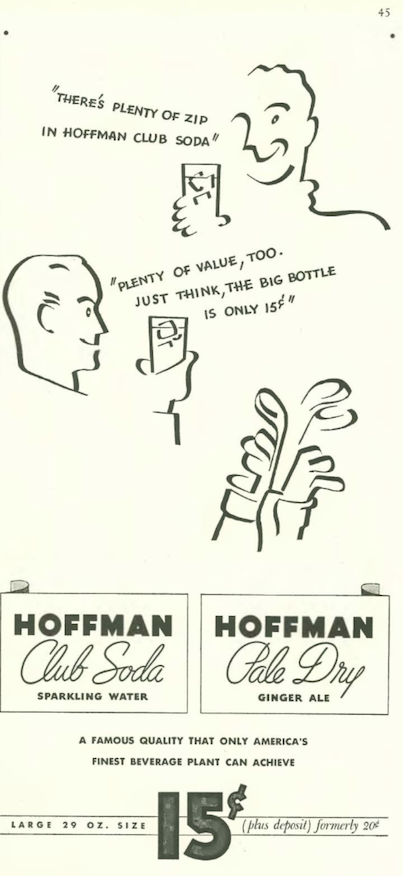
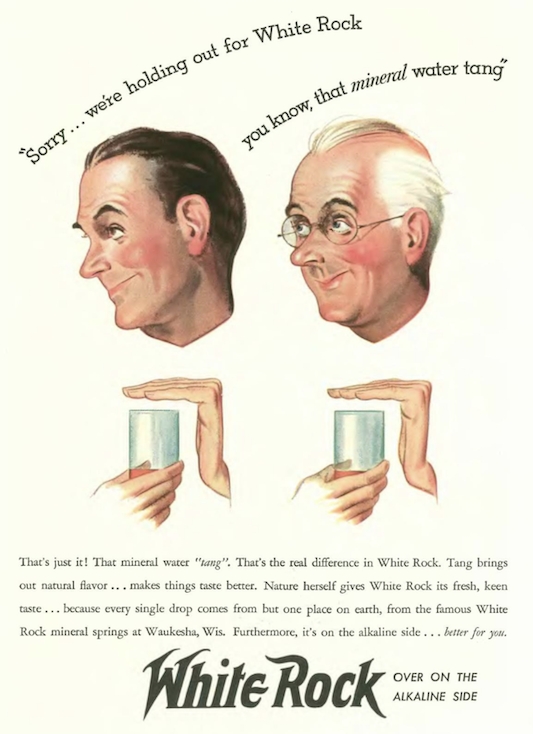
…in contrast to Budweiser’s wordy ads (or to White Rock’s colorful ones), the folks at Hoffman advertised their products with just a few lines of black ink…
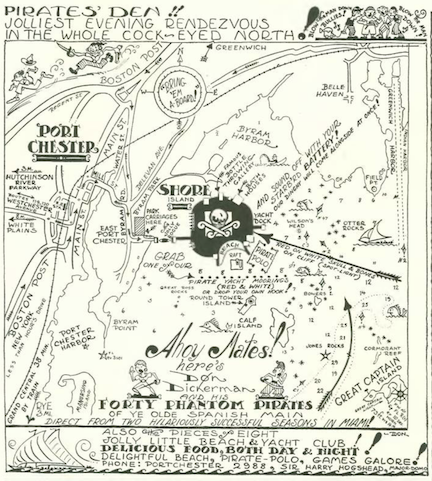
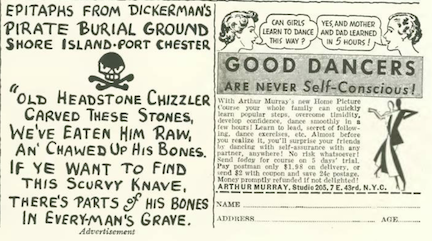
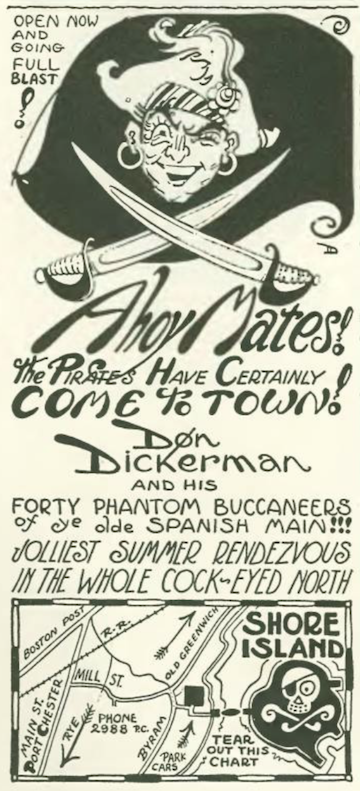
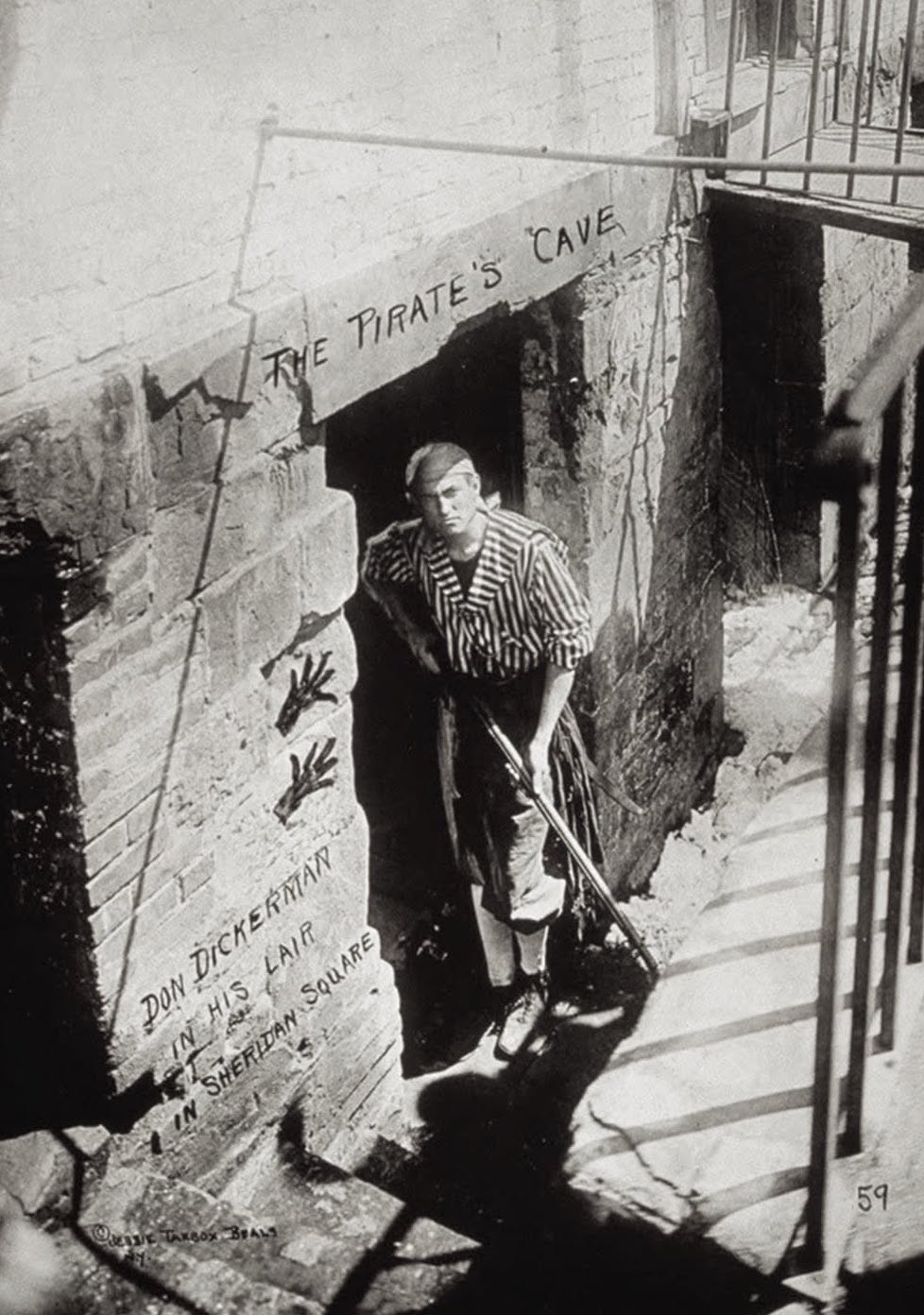
…Don Dickerman continued to promote his latest “Pirates Den” near Port Chester…note that among many other talents, Dickerman was also an artist…he illustrated the ads for all of his enterprises, including this one…
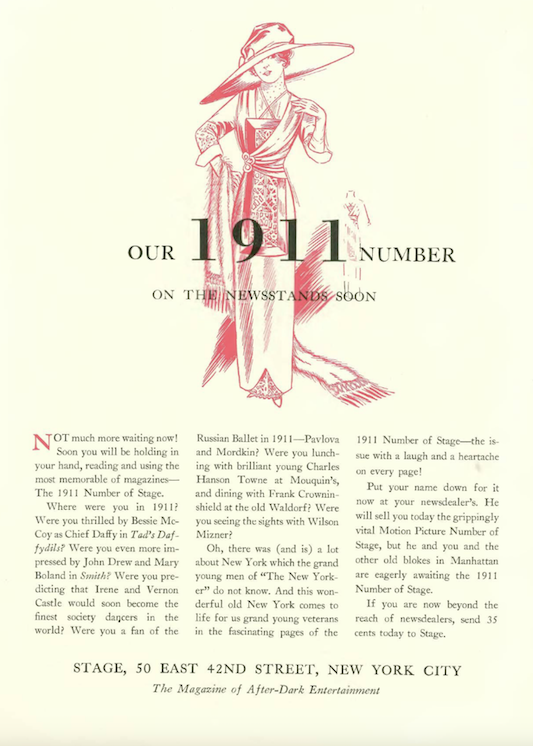
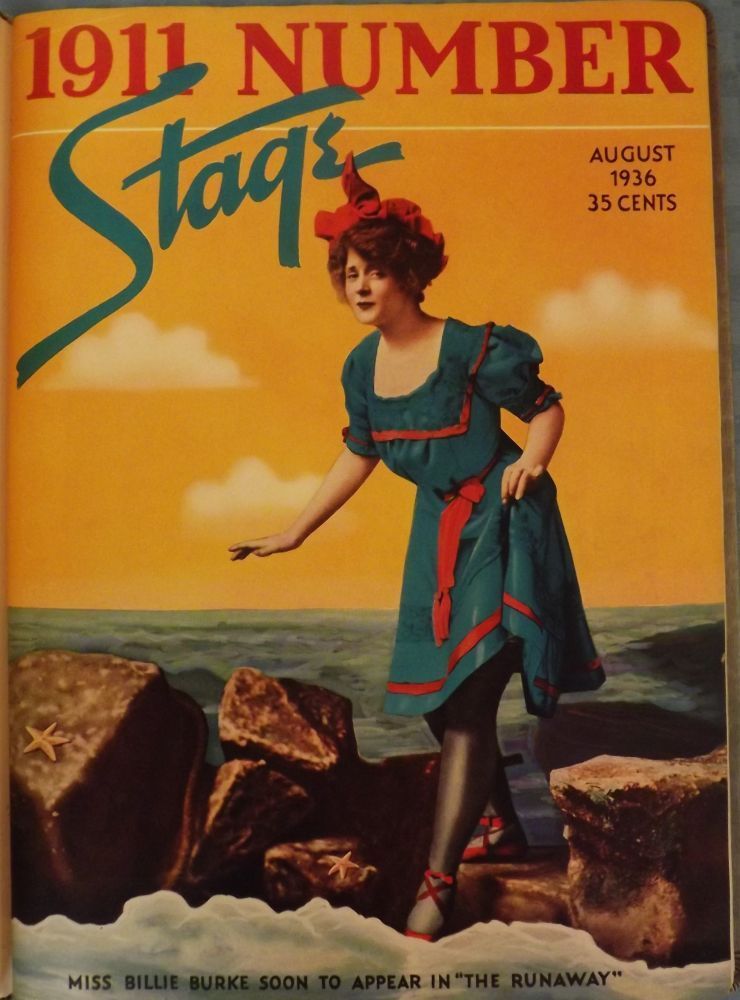
…John Hanrahan, publisher and editor of Stage theater magazine (and who also helped put The New Yorker on solid financial footing), set aside the August 1936 issue as a special edition, the “1911 Number,” a nostalgic, tongue-in-cheek look back to the founding of Stage’s predecessor, The Theatre Guild Magazine. The magazine marked its 25th anniversary by examining the striking differences between 1911 and 1936 in the world of theater as well as in fashion and cultural mores.
…here is the cover of that issue, featuring Billie Burke, a leading Broadway actress who would marry producer and impresario Florenz Ziegfeld Jr in 1914…she is still known today for her portrayal of Glinda the Good Witch of the North in 1939’s The Wizard of Oz…
(eBay.com)
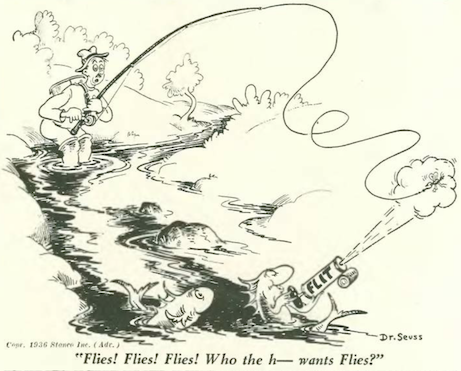
…and Dr. Seuss was still at it, finding new and clever ways to deploy the insecticide Flit…
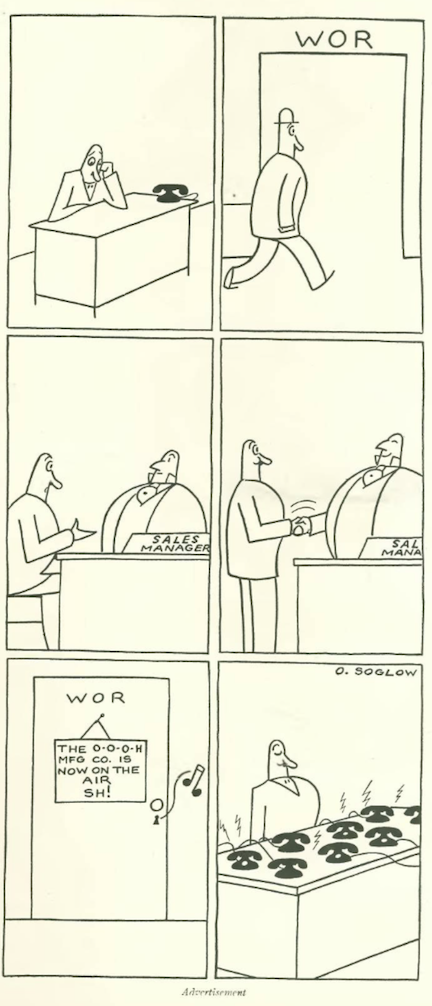
…the New York radio station WOR employed Otto Soglow to drum up some business for their ad department…WOR began broadcasting in early 1922, and is one of the oldest continuously operating radio stations in the U.S. (the three–letter call sign is characteristic of stations dating from the 1920s)…
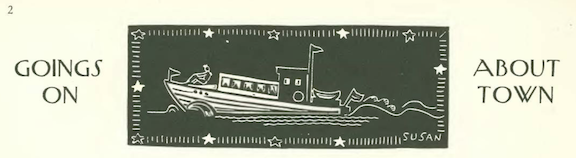
…Soglow gives us a nice segue to our cartoonists and illustrators, beginning with a Susan Willard Flint woodcut…
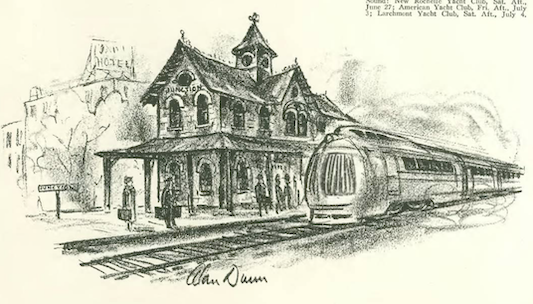
…Alan Dunn contributed this spot drawing…
…as did Richard Taylor…
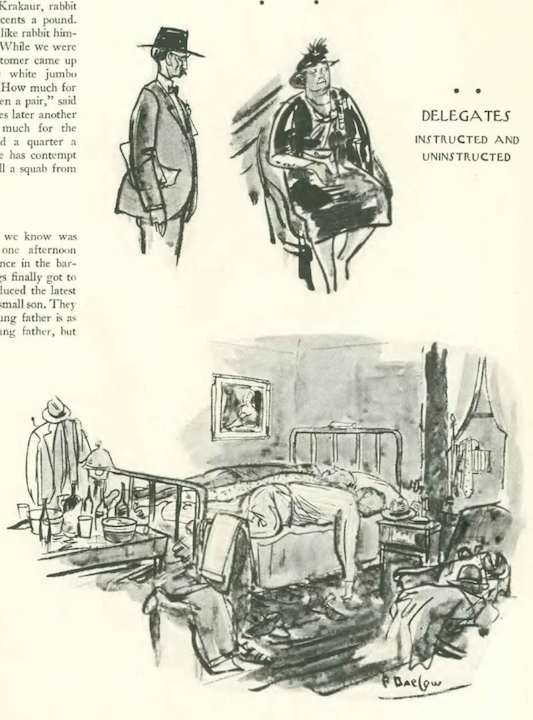
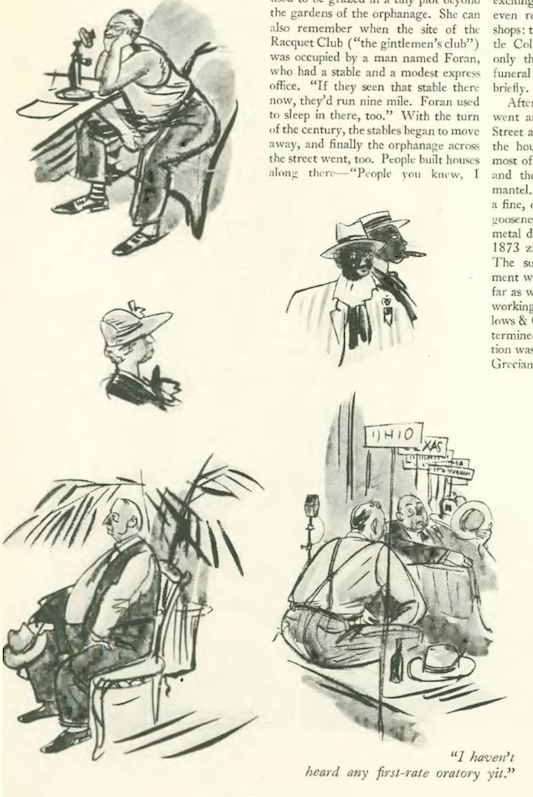
…Perry Barlow offered some sketches from the summer convention scene…
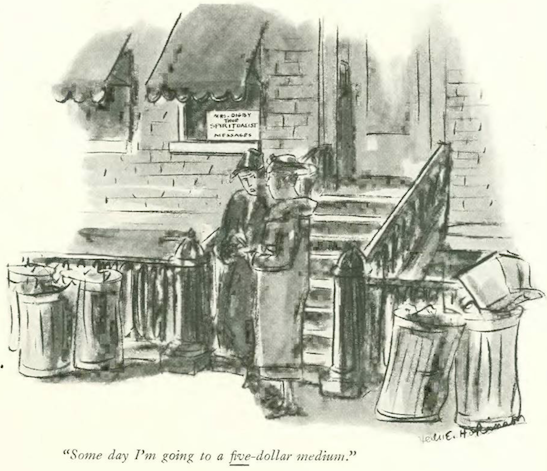
…Helen Hokinson considered the value of fortune-teller…
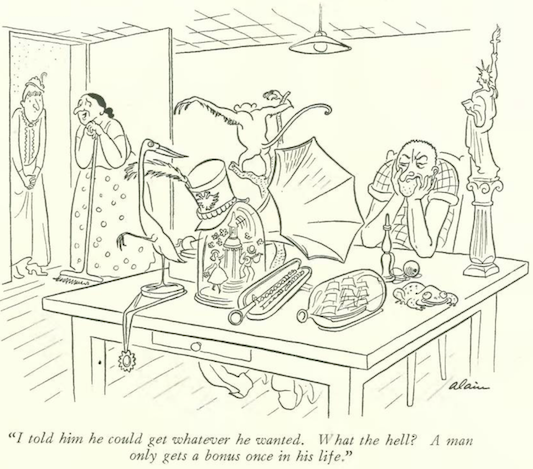
…Alain illustrated what dreams are made of, at least for one man…
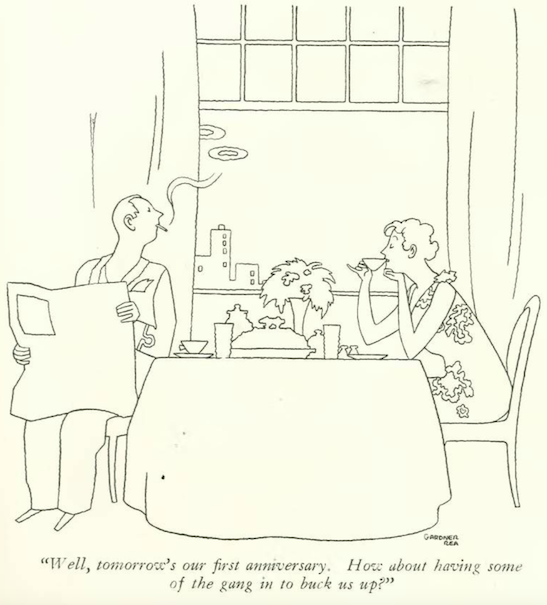
…and what are friends for? Gardner Rea had an idea…
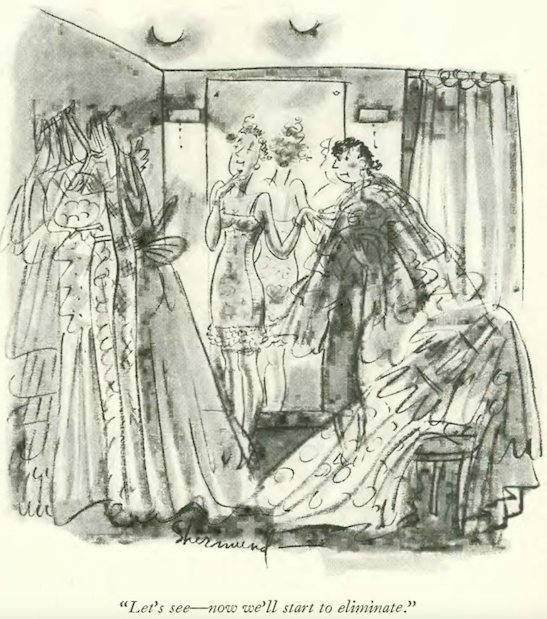
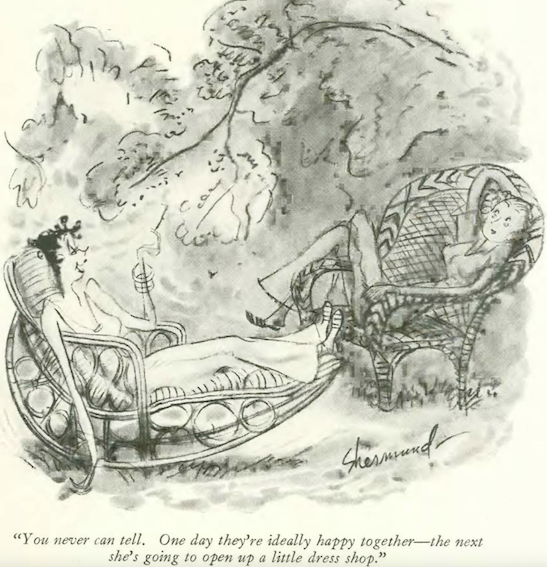
…Barbara Shermund offered a challenge at a dress shop…
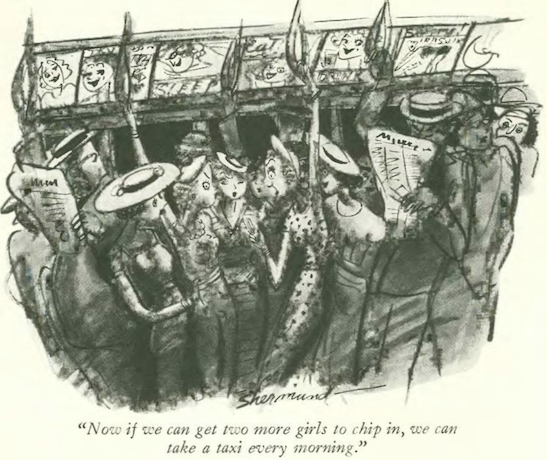
…and Shermund again, with an enterprising commuter…
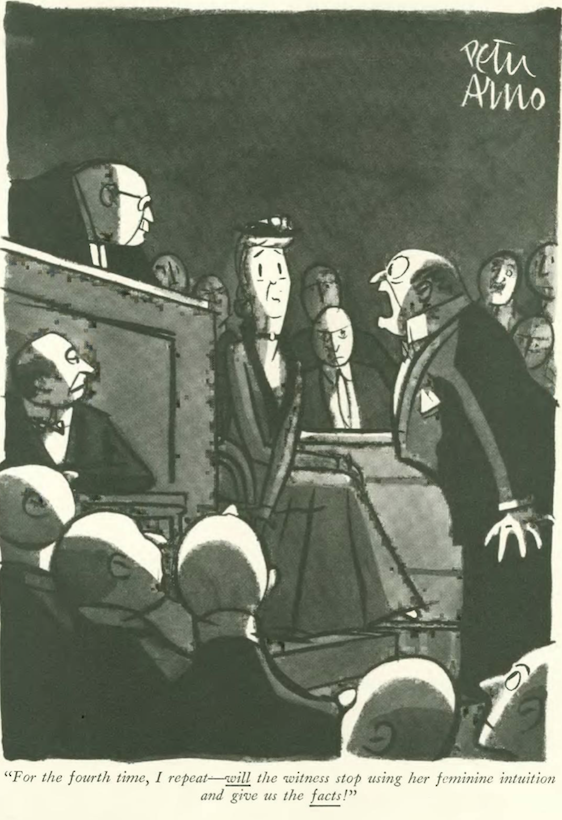
…just the facts ma’am, with Peter Arno in the court of law…
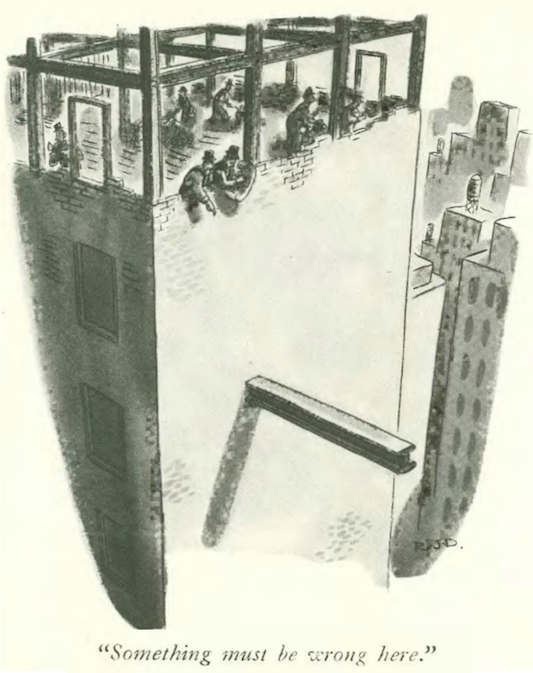
…Robert Day presented a construction conundrum…
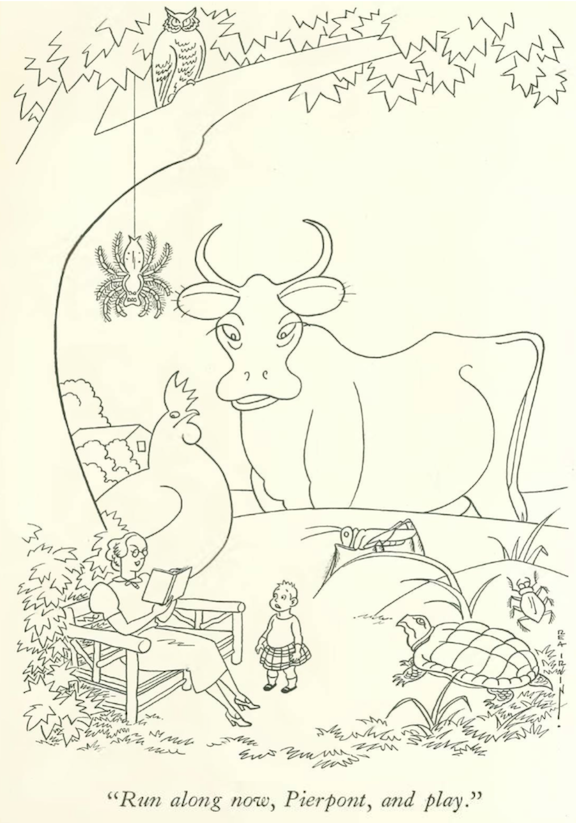
…Rea Irvin took a child’s perspective of the wild world…
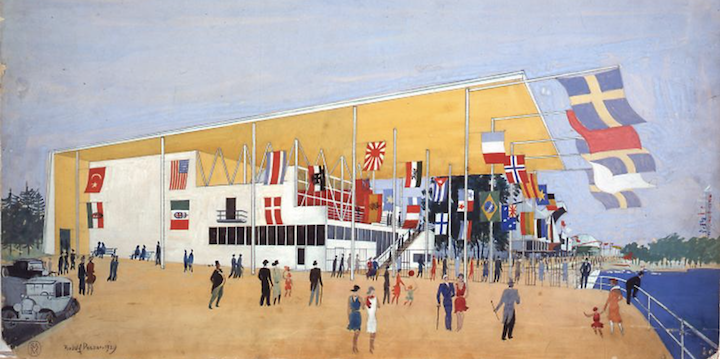
Above: Rudolf Persson's rendering of the main entrance to the Stockholm Exhibition of 1930, designed by Swedish architect Gunnar Asplund. The exhibition was a landmark event that introduced Functionalism to Swedish architecture and design.(Svensk Form)
Architecture critic Lewis Mumford turned his exacting eye on exhibitions at the Museum of Modern Art that looked to the future of building design. Of particular interest was an exhibit on those world expositions that have given us everything from theEiffel Tower (1889 Exposition Universelle) to the car-dominated landscape that inspired millions of Depression-weary visitors at New York’s 1939 World’s Fair.
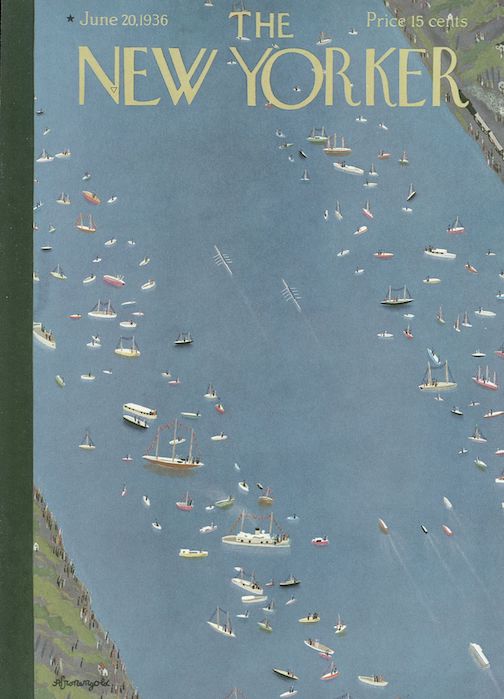
June 20, 1936 cover by Adolph K. Kronengold. Kronengold (1900–1986) created twenty-three covers for the New Yorker from 1928 to 1947. Born and raised in New Orleans, he frequently used watercolors and often painted scenes honoring his hometown. The June 20 cover was Kronengold’s seventeenth for the magazine.
Mumford made passing mention to the museum’s exhibit on government housing (he noted it was below MoMA’s standard) and then turned his attention to a review of world’s fairs, examining how they have inspired both waves of architectural achievement and “counterfeits of civic grandeur…”
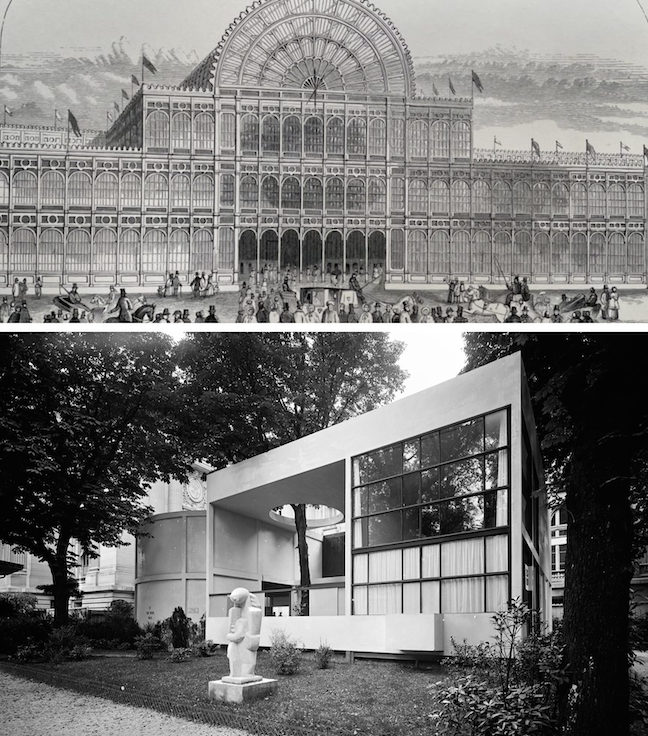
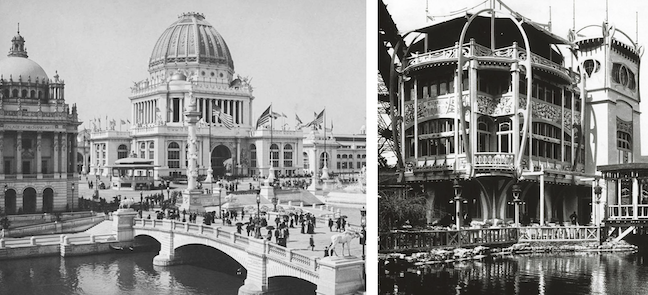
BREAK FROM THE PAST…Images from the covers of MoMA’s exhibition catalogs depict the 1934-35 Carl Mackley Houses in Philadelphia (top, from the government housing exhibit) and the 1930 Stockholm Exposition. (MoMA.org)STILL SERVING…the 1934-35 Carl Mackley Houses in Philadelphia have been on the National Register of Historic Places since 1998. (Wikipedia)PONDERING what a modern exhibition should be, Lewis Mumford cited the granddaddy of them, the London Exhibition of 1851 (top), with its Crystal Palace, which he called “the first definitive monument of modern architecture,” as definitive and challenging as the Pavillon L’Esprit Nouveau (bottom), designed by Le Corbusier and Pierre Jeanneret for the 1925 International Exhibition of Modern Decorative and Industrial Arts in Paris. (devonandexeterinstitution.org/Wikipedia)SHAM AESTHETIC…Mumford referred to buildings in the 1893 Chicago World’s Fair (left) as “laborious limestone counterfeits of civic grandeur,” while praising the 1893 and 1900 Paris expositions for design innovations including the Art Nouveau style—at right is Le Pavillon Bleu, a lavish restaurant once located at the foot of the Eiffel Tower. It was built by French architect René Dulong in collaboration with Belgian architect and designer Gustave Serrurier-Bovy, one of the founders of the Art Nouveau movement. (getzen.com/messynessychic.com)
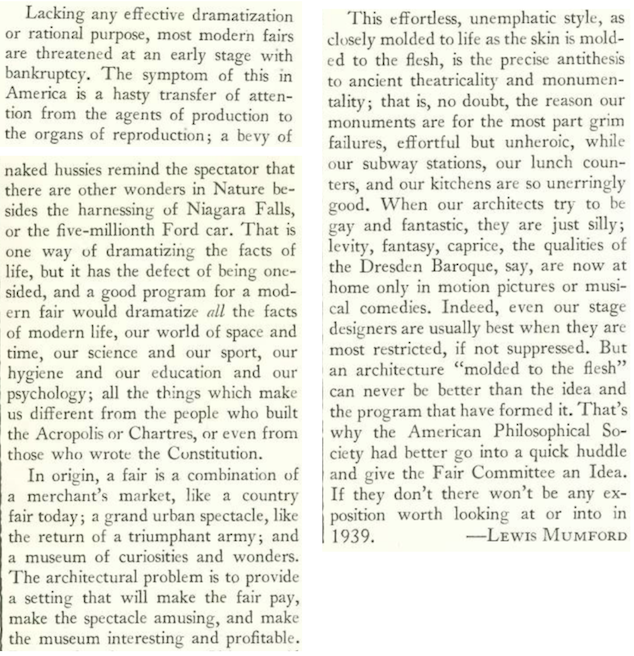
Looking ahead to the planned 1939 World’s Fair at Flushing Meadows, Mumford believed the age of grand world expositions had passed, especially those that moved the needle on design innovation. Moreover, he observed that the lack of real drama or rational purpose would threaten bankruptcy to future fairs, a symptom especially acute in America: “…a hasty transfer of attention from the agents of production to the organs of reproduction; a bevy of naked hussies remind the spectator that there are other wonders in Nature besides the harnessing of Niagara Falls, or the five-millionth Ford car.”
POINTING TO THE FUTURE..Rosalie Fairbanks, a guide to the 1939 New York World’s Fair, points to the theme of the exposition—the Trylon and Perisphere—after the entire sheath of scaffolding was removed for the first time on February 22, 1939. (Associated Press)
Earth-movers were already at work sculpting the fair’s site from the swampland and ash heaps along the Flushing River when Mumford assembled a self-anointed advisory group in 1936. This group— the “Fair of the Future Committee”—urged the fair’s leaders to abandon superficial commercialism and instead demonstrate how technology could serve the public good and restore ecological balance in American communities. That did not come to pass; when the fair opened in 1939, Mumford wrote in his “Sky Line” column (titled “Genuine Bootleg”) that the committee’s “hopes and proposals for a major contribution to urban design were progressively defeated. Today their wreckage is strewed about the Fair, so thoroughly smashed and disfigured that their own fathers could scarcely identify the corpses.”
FUTURAMA was a popular exhibit and ride at the 1939 New York World’s Fair. Designed by Norman Bel Geddes for the General Motors pavilion, it proposed a sprawling car-based future that was the antitheses of Lewis Mumford’s vision of human-scaled, ecologically balanced development. (Wikipedia)
Mumford got one thing right. Although the 1939 fair attracted more than 45 million visitors, it lost a lot of money, recouping only 32 percent of its original cost.
* * *
Only a Memory
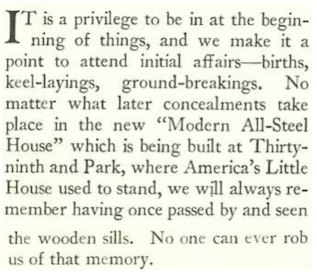
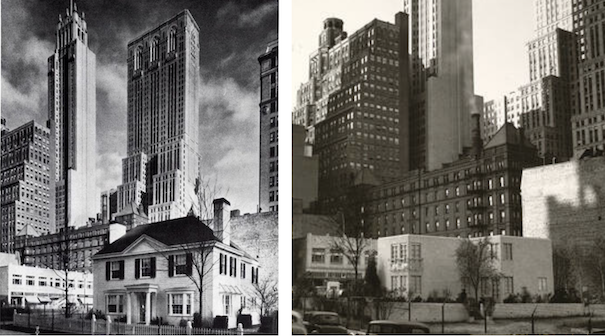
In “Notes and Comment,” E.B. White recalled the brief life of “America’s Little House” at 39th and Park in the Murray Hill neighborhood. The eight-room Georgian colonial was built in 1934 during the “Better Homes in America” campaign that promoted single-family home ownership as well as design innovations. The CBS radio network (which contributed $50,000 to the project) installed a studio in the house’s garage, from which it broadcast three national radio programs to a hundred stations across the country.
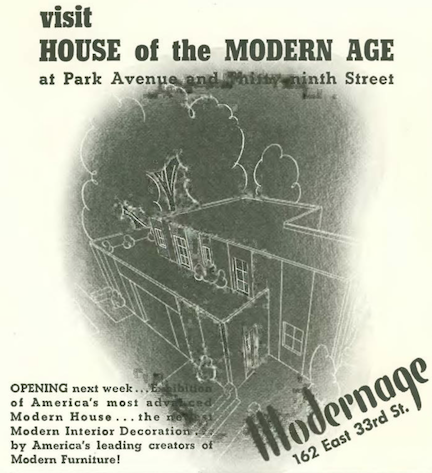
Open for about a year, the house was demolished in November 1935, its doors and interior furnishings sold to hostesses who had worked at the house. In its place William Van Alen—architect of the Chrysler Building—erected the all-steel “House of the Modern Age.”
CHANGE OF SCENE…At left, America’s Little House on Park Avenue and 39th Street, replaced by William Van Alen’s prefabricated steel house (right), “The House of the Modern Age,” detail from a photo by Berenice Abbott. (Wikipedia/cornell.edu)
…in the following week’s issue of The New Yorker, June 27, a back of the book ad from the Modernage Furniture Corporation touted the opening of “The House of the Modern Age”…
* * *
Fan Fans
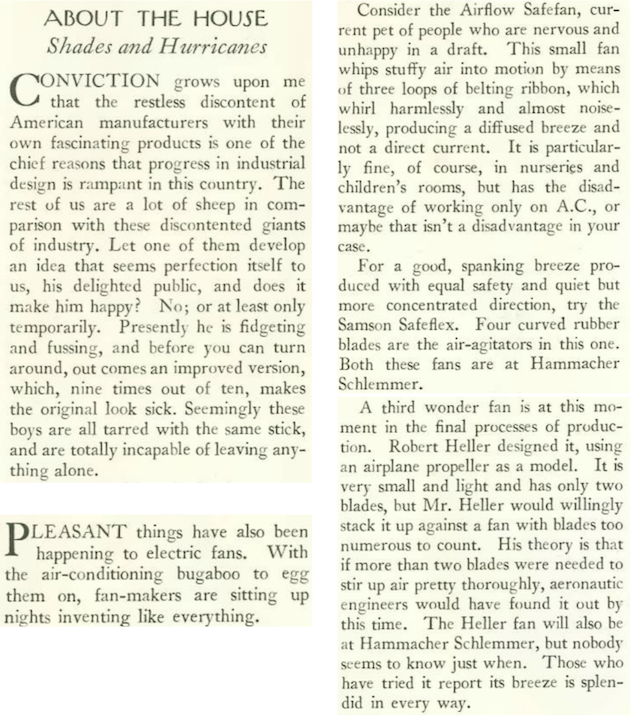
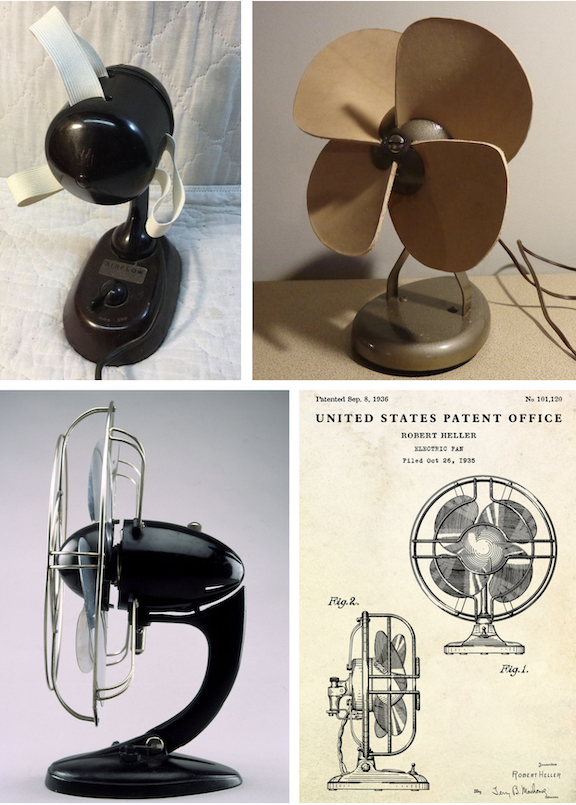
Staying on the domestic scene, here is an excerpt from Barbara Blake’s “About the House” column, where she updated readers on the latest in electric fans (air-conditioning in private homes was still a rarity).
ELECTRIC WIND…Barbara Blake highlighted the latest in electric fans including, clockwise from top left, the Airflow Safefan, which moved air with looped ribbons; the Samson Safeflex employed rubber blades as a safety feature; the noted designer Robert Heller produced these fan designs (1936 and 1937) modeled on airplane propellers. (worthpoint.com/ebay.com/Montreal Museum of Fine Arts)
* * *
Billy’s Beef
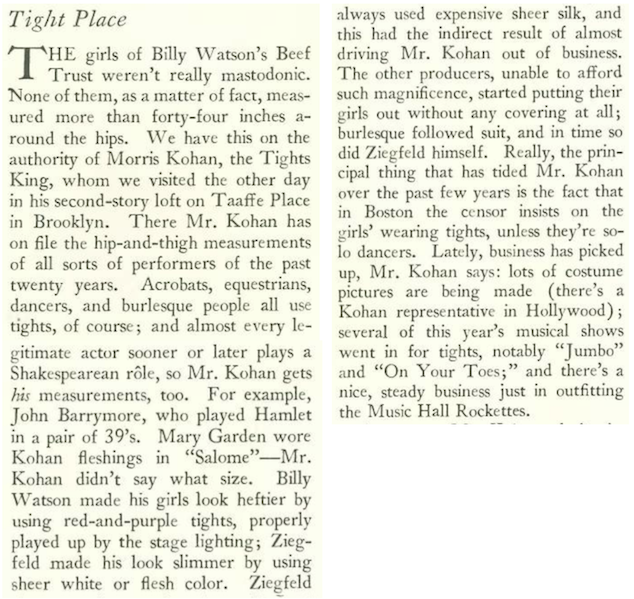
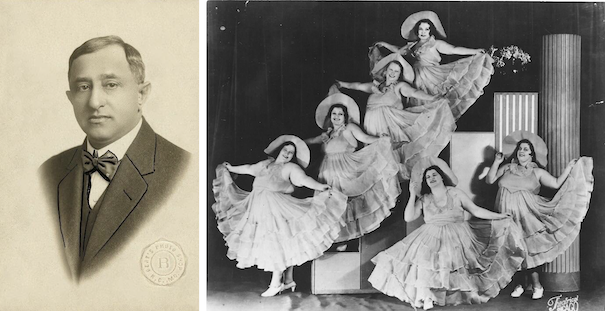
In 1899 vaudevillian Billy Watson (aka Isaac Levie) formed his Beef Trust burlesque troupe of plus-sized women. Although his shows starred women in the 200-pound range, he also relied on slight-of-hand provided by the “Tights King” Morris Kohan, who apparently could produce tights that could make a person look either heavier or slimmer. “The Talk of the Town” explains in this excerpt:
WHERE’S THE BEEF?…Billy Watson’s burlesque troupe of plus-sized women—the Beef Trust— padded their profiles with the aid of specially designed tights. (Facebook.com)
* * *
Divine Dilemma
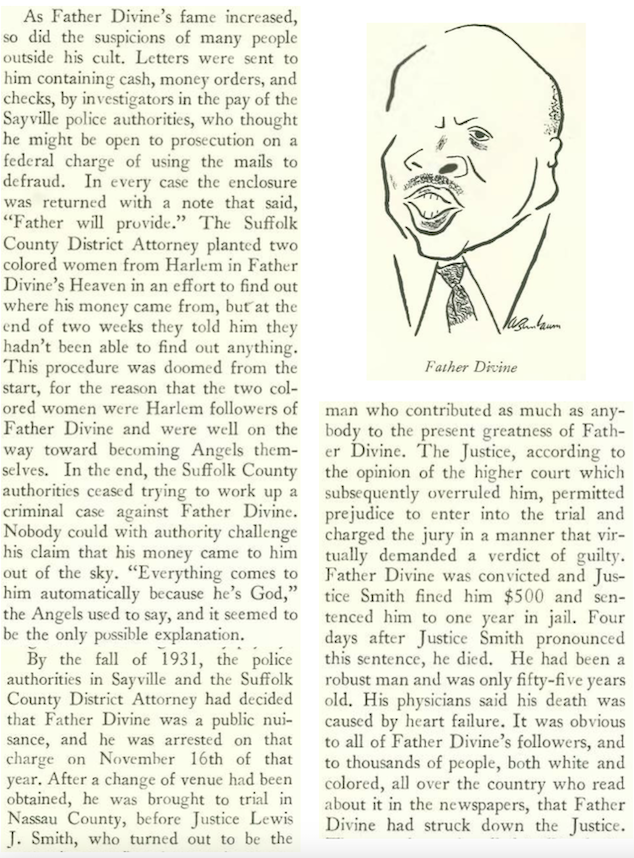
In Part Two of Father Divine’s profile, St. Clair McKelway and A.J. Liebling recounted the preacher’s 1931 arrest, prompted by ongoing complaints from the citizens of Sayville, New York about the traffic jams caused by Divine’s daily feasts as well as the noise generated by the faithful who would holler hallelujahs late into the evening. During one of these late night revivals police raided Divine’s property and fined each of the seventy-eight followers a few dollars apiece. Divine, however, insisted on a jury trial, which was held seven months later. The charge: Maintaining a public nuisance.
Jurors convicted Divine, with a request for leniency, but Justice Lewis Smith sentenced the preacher to a year in prison, calling him a “menace to society.” However, four days later the judge dropped dead of a heart attack, and Divine was freed. The notion that the judge’s death was divine retribution was naturally perpetuated by the media. A brief excerpt, with illustration by Abe Birnbaum.
GET OUT OF JAIL CARD…In 1931 Father Divine was arrested for maintaining a public nuisance. Following a jury trial and conviction, the presiding judge dropped dead, leading the preacher’s freedom a few days later. (facebook.com/nydailynews.com)
* * *
At the Movies
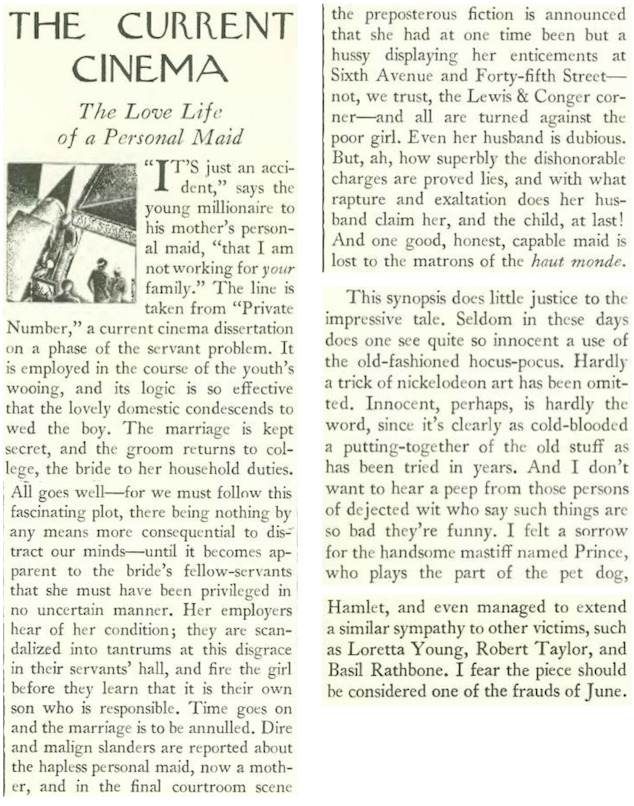
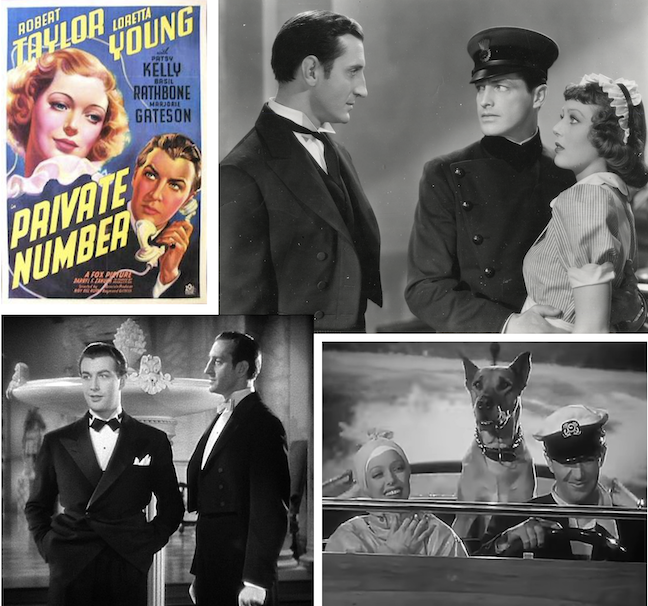
The drama film Private Number was based on the 1915 play Common Clay, which had already been made as a silent in 1919 and as a sound film in 1930. The play had a somewhat scandalous theme for the time (a young servant is fired when she becomes pregnant by her employer’s son), but thanks to the Hays Code, the more scandalous parts of the earlier films were omitted in 1936’s Private Number, leaving the viewer with little except for some “old-fashioned hocus pocus,” according to critic John Mosher.
THE BUTLER DID IT…In Private Number,Basil Rathbone portrayed a tyrannical butler with a personal interest in one of his new maids (Loretta Young). She in turn secretly marries the scion of the family (Robert Taylor) and bears his child. Clockwise from top left: Poster for the film; Rathbone, Kane Richmond, and Young; Taylor, Young, and well-known canine actor Prince; rivals for a maid’s affection—Taylor and Rathbone. (Wikipedia/imdb.com/basilrathbone.net)
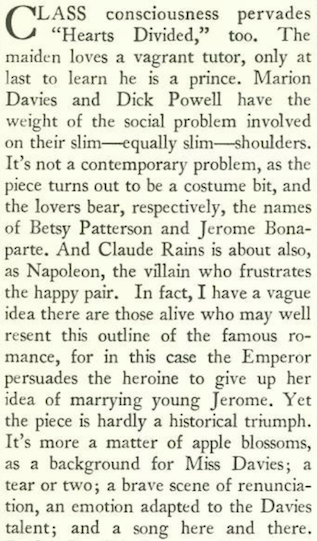
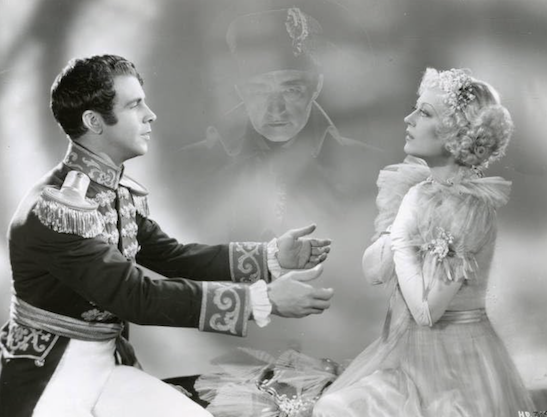
Thirty-nine-year-old Marion Davies appeared in one her final films, Hearts Divided, a musical based on the real-life marriage between American Elizabeth ‘Betsy’ Patterson and Jérôme Bonaparte, the brother of Napoleon Bonaparte. Although in real life Napoleon annulled the marriage, Hollywood gave the couple a happier ending.
THREE’S A CROWD…Napoleon (Claude Rains) comes between lovers Marion Davies and Dick Powell in Hearts Divided. The two also shared an off-screen romance behind the back of William Randolph Hearst, with whom Davies had a long-term relationship and to whom she believed she owed her career. (imdb.com)
* * *
From Our Advertisers
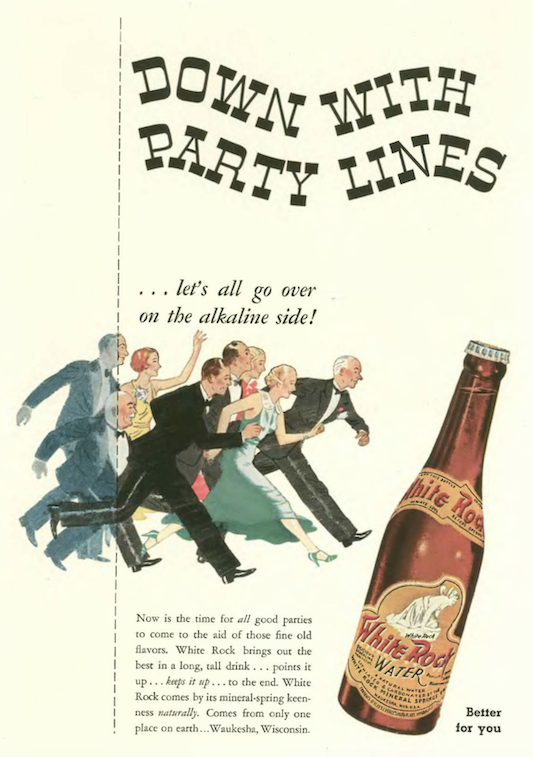
Illustrator R. John Holmgren drew up this non-partisan appeal for White Rock mineral water…
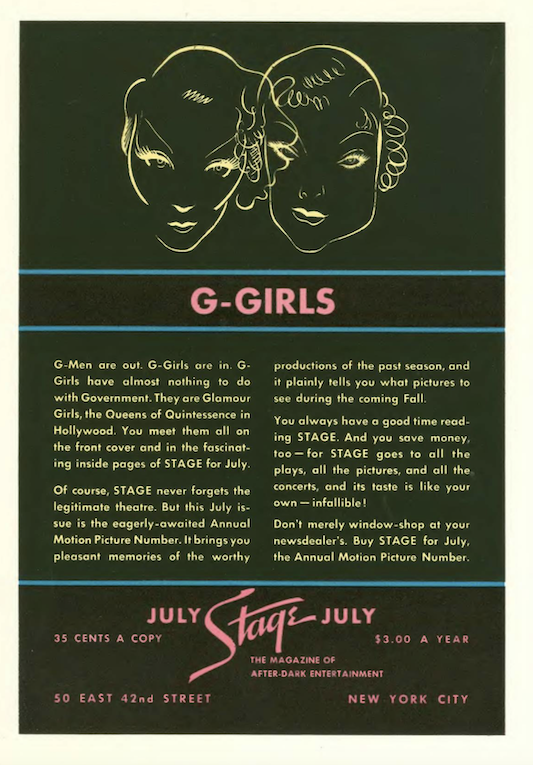
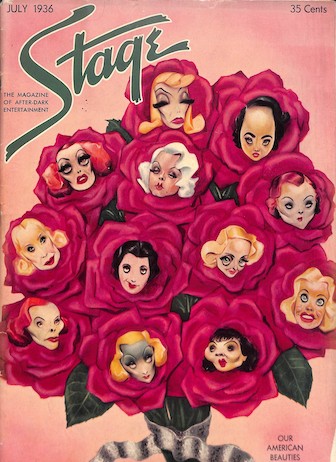
…Stage magazine touted its upcoming July issue, featuring the “Glamour Girls” of Hollywood…
…here is the cover of that July 1936 issue, illustrated by Sam Berman featuring caricatures of leading ladies including Greta Garbo, Joan Crawford, Jean Harlow, Merle Oberon, Myrna Loy, Claudette Colbert, Bette Davis, Marlene Dietrich, and Katharine Hepburn…
(abebooks.com)
…longtime member of the New Yorker coterie and contributor Alexander Woollcott appeared in this full-page ad endorsing the work of the American Civil Liberties Union…
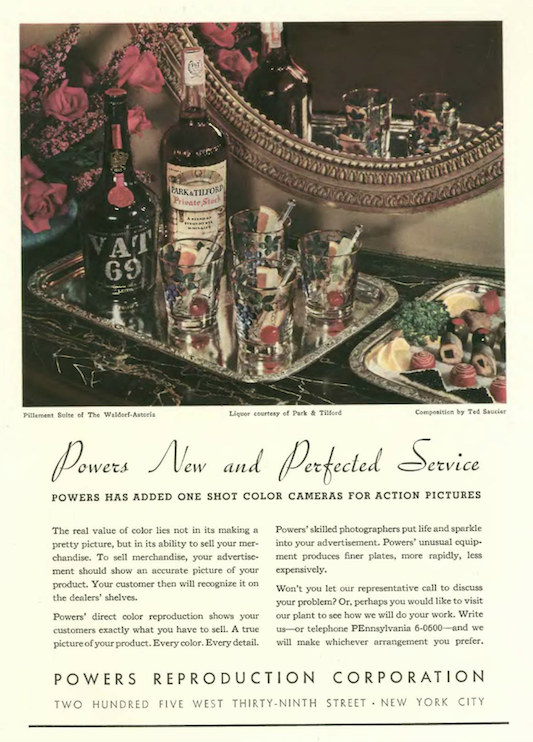
…from the 1920s to the 1940s the Powers Reproduction Corporation was a prominent, New York City photo-engraving firm that created high-quality color images for magazines and advertising agencies…
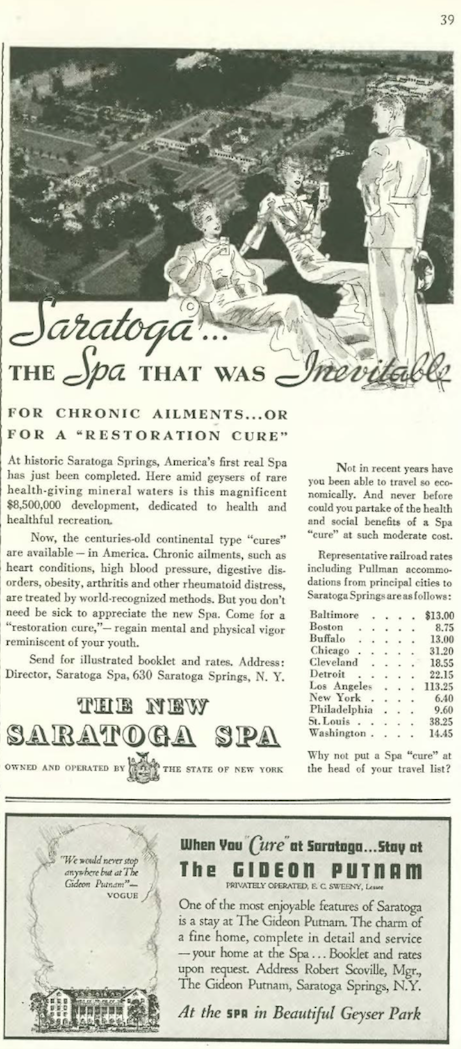
…these back of the book ads joined forces to promote the healing waters of Saratoga Springs and the Gideon Putnam hotel and spa…apparently the waters and other spa services treated everything from heart conditions to obesity…
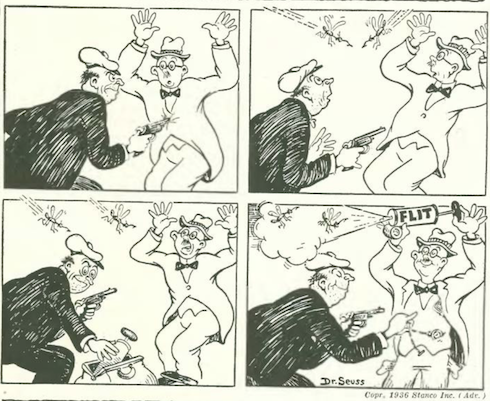
…Dr. Seuss returned with another scenario for insecticide use…
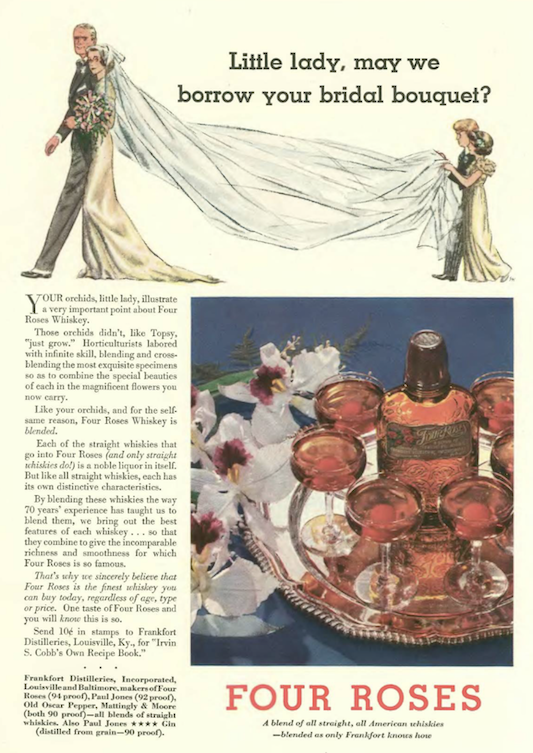
…on the inside back cover, the distillers of Four Roses Whiskey conjured up a June bride as an apt metaphor for their blending techniques…
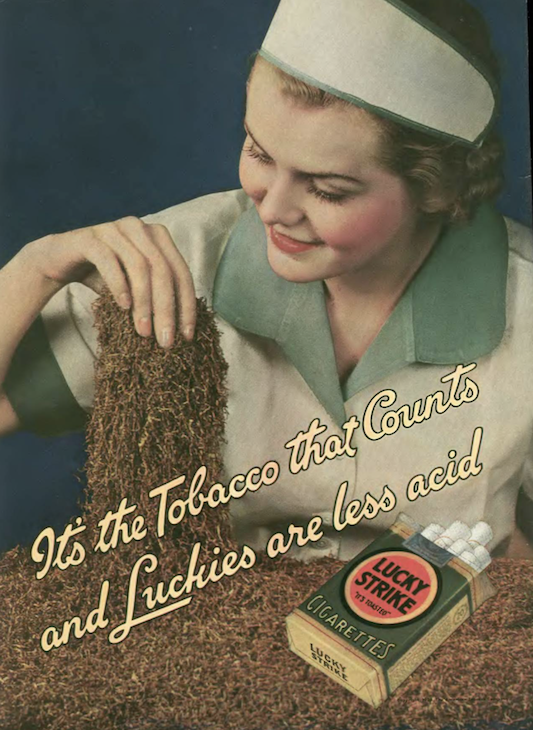
…while Lucky Strike reclaimed the back cover with an ad that promoted its low acid cigarettes, whatever that meant…
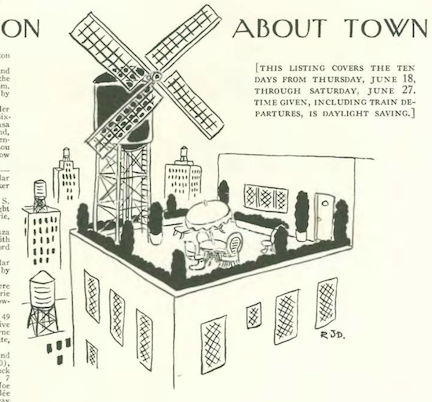
…on to our illustrators and cartoonists, we begin with Arnold Hall…
…and Robert Day…
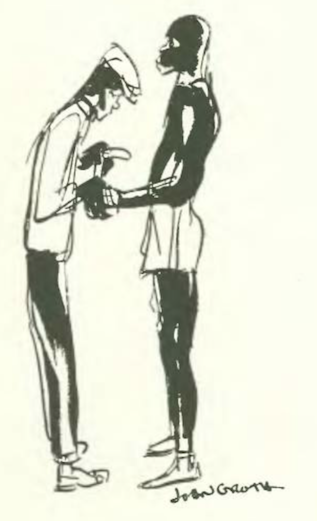
…with other featured spots from John Groth…
…Richard Taylor…
…and Otto Soglow…
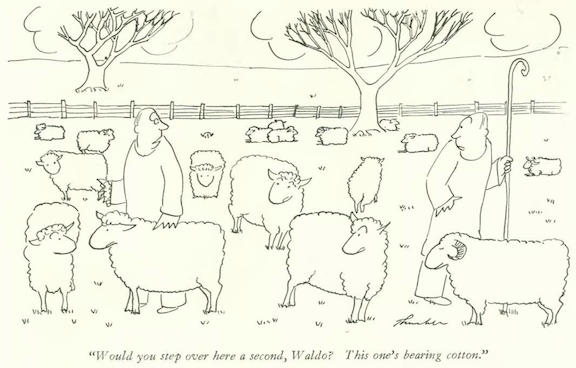
…James Thurber drew up an unusual development in the sheepfold…
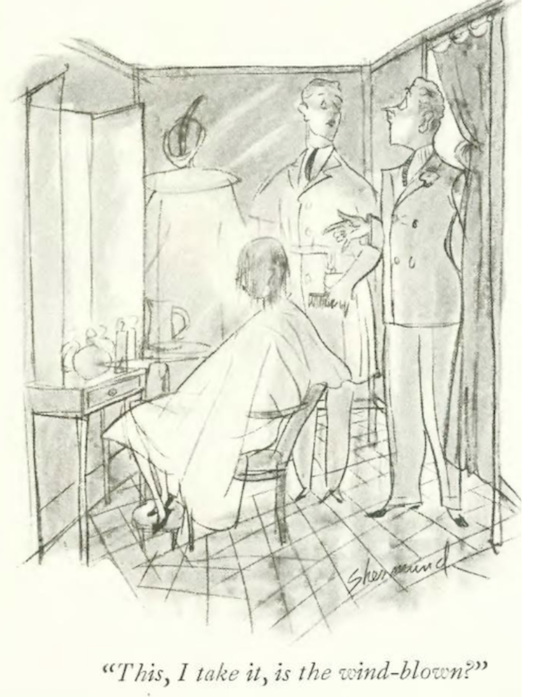
…Barbara Shermund posed a challenge for a hair dresser…
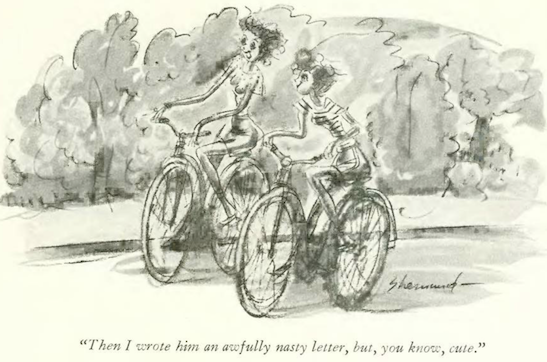
…and Shermund again, revealing a tactic of the modern woman…
…Carl Rose commanded a two-page spread to tell his tale of sin and redemption…
…Ned Hilton needed a hand at the subway station…
…Mary Petty gave us a patient in need of a second opinion…
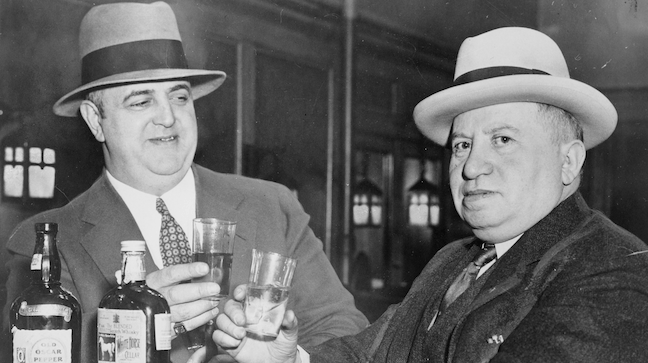
Above: Former Prohibition agents Isidor "Izzy" Einstein (right) and Moe W. Smith meet at a New York City bar in 1935. Known for their clever disguises and unorthodox tactics, from 1920 to 1925 the duo confiscated roughly five million bottles of illicit liquor and arrested 4,932 people. (Wikipedia)
Legendary Americans come from all walks of life—sports stars, movie actors, political and business leaders—and they also come from unlikely places; take for example a pushcart peddler and a cigar store owner who became national celebrities for their exploits during the first years of Prohibition.
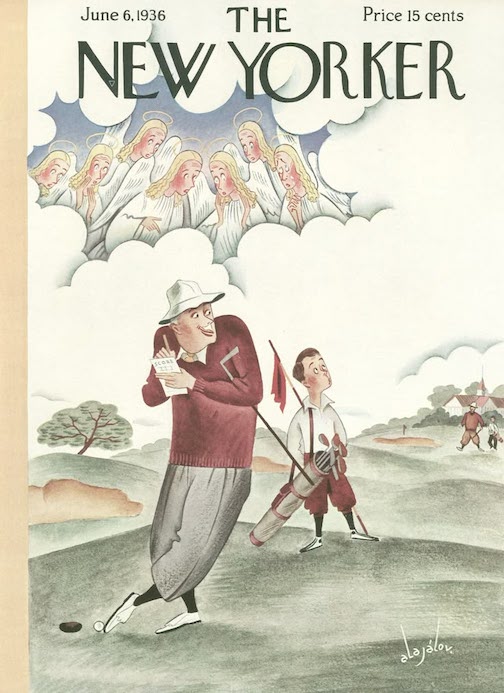
June 6, 1936 cover by Constantin Alajalov.
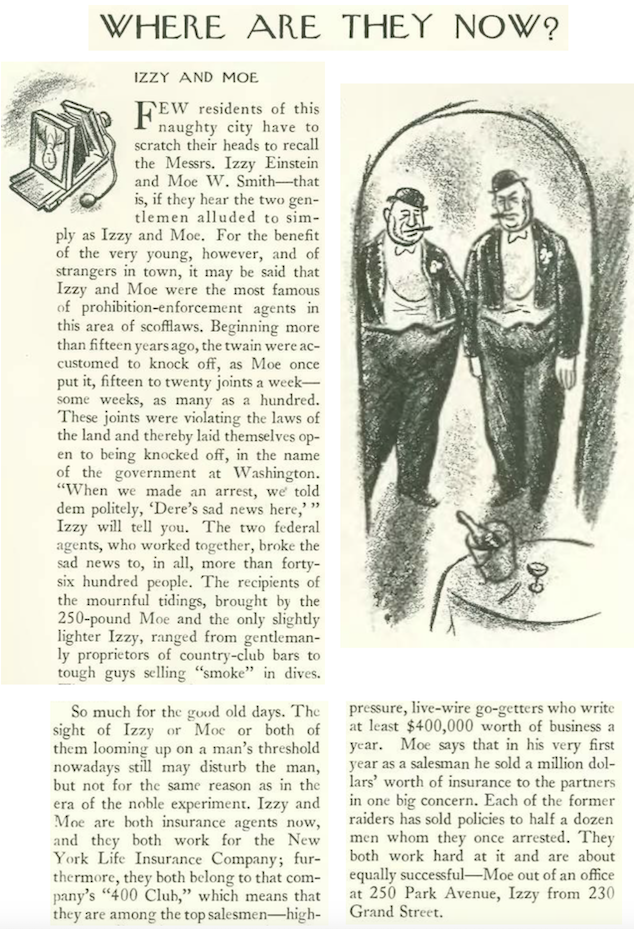
Prohibition agents Isidor “Izzy” Einstein (1880–1938) and Moe W. Smith (1887–1960) were known for their clever disguises, but the author of their “Where Are They Now?” profile was also in disguise—the piece was written by James Thurber under the pseudonym Jared L. Manley.
Einstein was 40-year-old pushcart peddler and postal clerk when he applied for a job as an enforcement agent at forty dollars a week. Although the 5-foot-5, 225 pound Einstein wasn’t the agency’s “type,” he convinced the feds that there was an advantage to not looking the part (the Austrian-born Einstein also spoke six languages). After landing the job, he asked if his friend, cigar store owner Moe Smith, could join him, since “he doesn’t look like an agent, either.” Some brief excerpts from part one of “Where Are They Now?”
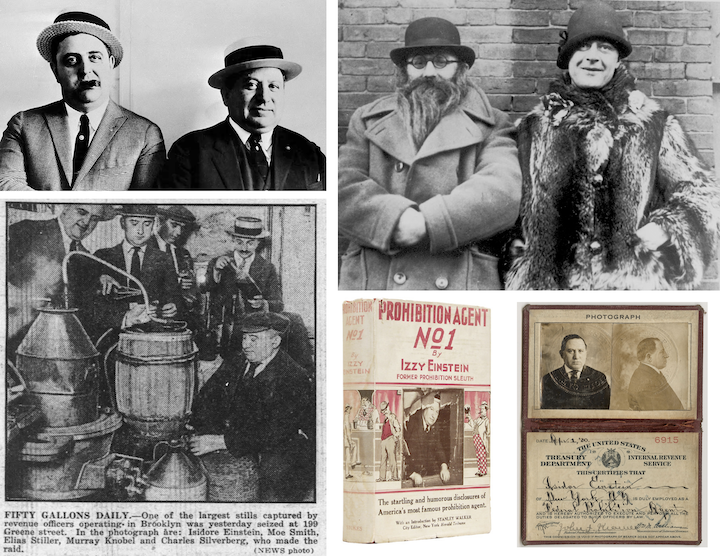
TRICKSTERS…Clockwise, from top left: Isidor “Izzy” Einstein (right) and Moe W. Smith; the pair sported hundreds of disguises (Einstein on the left); Einstein’s badge and his bestselling 1932 book Prohibition Agent No 1; Daily News clipping from September 1920 showing results of a raid—Izzy and Moe are at right and left. (history.com/Library of Congress/Wikipedia/goodreads.com/nydailynews.com)
In her 2012 article for Smithsonianmagazine (“Prohibition’s Premier Hooch Hounds”), Abbott Kahler notes that the agents were victims of their own success. “Superiors grew to resent their headlines, and other agents complained that their productivity made their own records look bad…In November 1925, Izzy and Moe were among 35 agents to be dropped from the force.” Both men went on to successful careers as insurance salesmen. Want to know more? Read Kahler’s excellent account of the duo at the Smithsonian magazine’s website.
TRIBUTE ON THE TUBE…In 1985 Art Carney and Jackie Gleason starred in CBS’s made-for-television film, Izzy & Moe, which was loosely based on the exploits of Izzy Einstein and Moe Smith. (imdb.com)
* * *
At the Movies
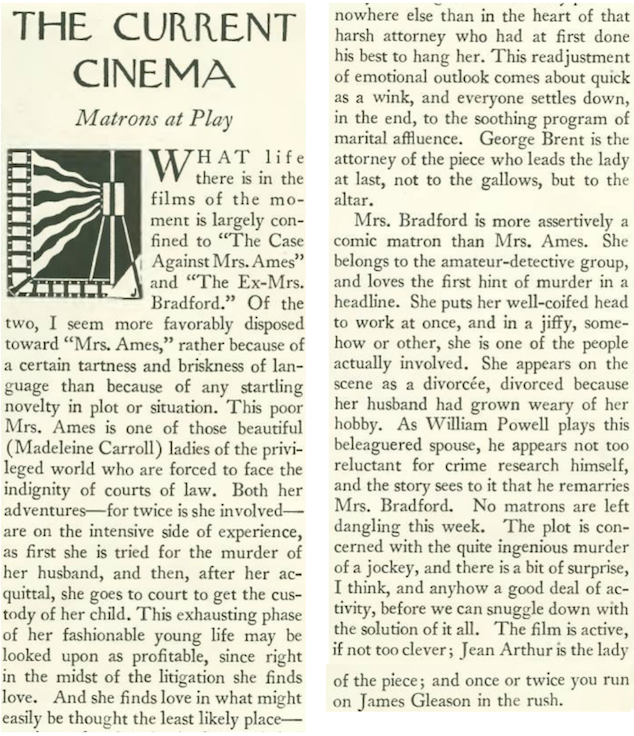
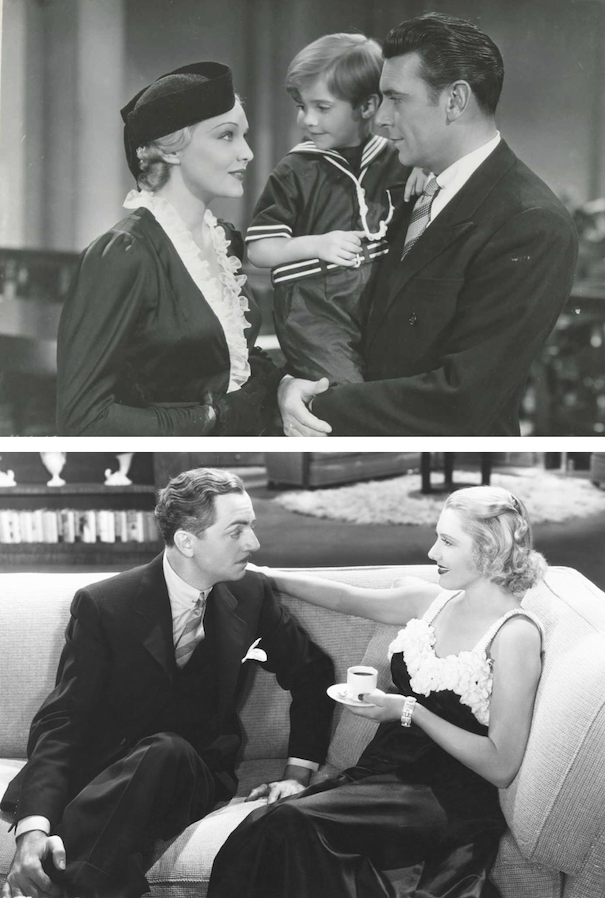
Two of the better films playing in Manhattan cinemas featured murders and matrons, the matrons played by Britain’s top female screen star, Madeleine Carroll, and America’s queen of screwball comedy, Jean Arthur. Critic John Mosher observed that their films were the only ones with any “life.”
TRADING GALLOWS FOR A GROOM…Top, Madeleine Carroll portrayed a “lady of privilege,” accused of murder, who falls in love with the prosecuting district attorney (George Brent) in The Case Against Mrs. Ames—Scotty Beckett played Carroll’s son; below, Jean Arthur and William Powell in the comedy-mystery The Ex-Mrs. Bradford.(imdb.com/mikestakeonthemovies.com)
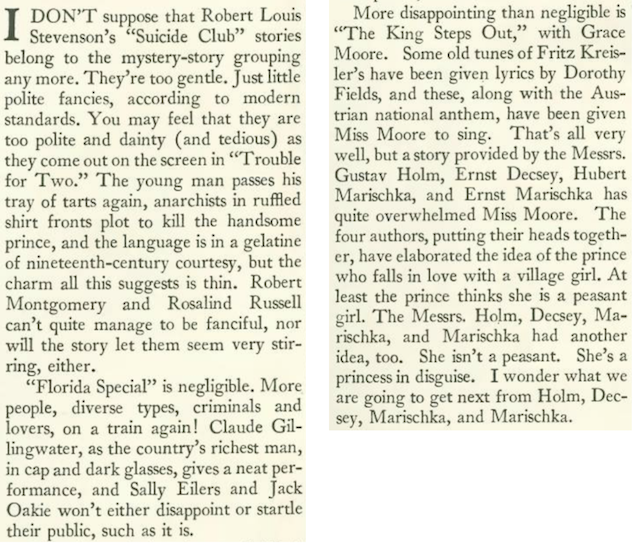
Other films reviewed by Mosher were rated as “negligible” and “disappointing,” despite their talented casts…
TRAIN SPOTTING…Clockwise from top left: Esther Howard portrayed a “flirtatious dowager” who worked her charms on Jack Oakie (center) in Florida Special; Sally Eilers prepares to board the Florida Special with Dwight Frye and Claude Gillingwater; Robert Montgomery and Rosalind Russell in Trouble for Two; Montgomery (left), Leonard Carey, and Frank Morgan in Trouble for Two. (pinterest.com/imdb.com)THE OLD PRINCESS IN DISGUISE TRICK…From left, Grace Moore, Eve Southern, and Franchot Tone in The King Steps Out. (IMDb.com)
* * *
From Our Advertisers
Last week Lois Long mentioned the return of famed Greenwich Village restaurateur and Sheridan Square funboy Don Dickerman. The June 6 issue featured two back-of-the-book ads placed by Dickerman that promoted his latest venture at Port Chester…this ad was on the bottom of page 75…
…and turning the page, you’d find this at the bottom of page 76…
WHERE IT ALL BEGAN…In 1916 Don Dickerman (1893–1981) opened a tearoom called the Pirate’s Cave at 133 Washington Place in Greenwich Village. The 6-foot-6 artist and entrepreneur was famous for his many themed establishments as well as for his eccentricities. Obsessed with pirate life, he dressed in full pirate gear in both public and private life. (facebook.com)
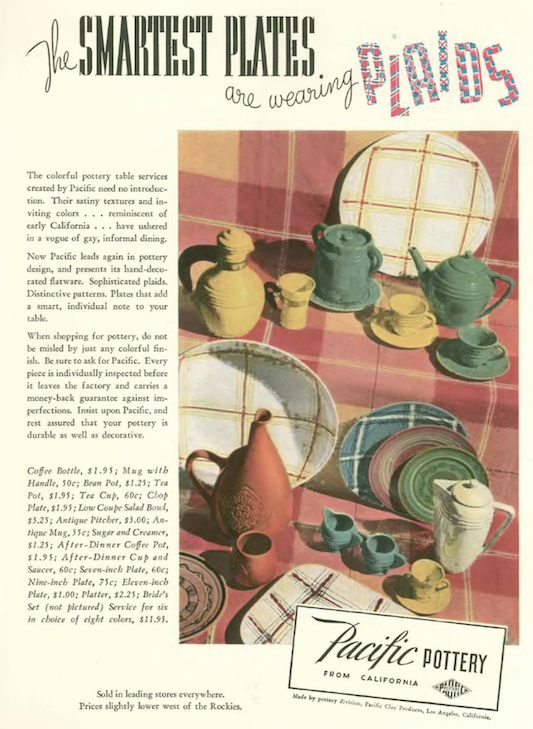
…Pacific Pottery was among firms in the 1930s marketing informal dinnerware featuring vibrant glazes and Art Deco streamline designs…
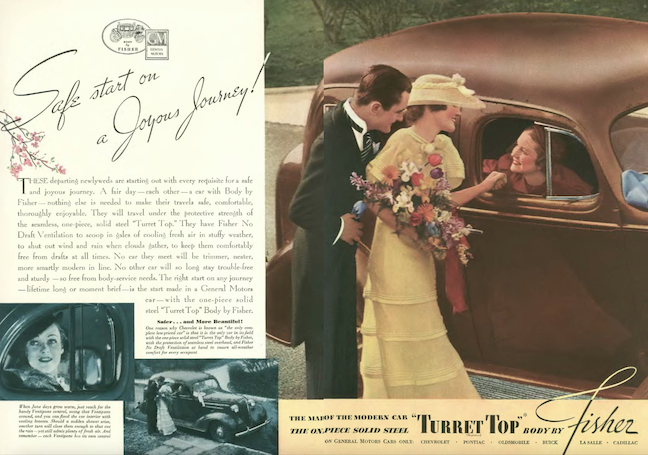
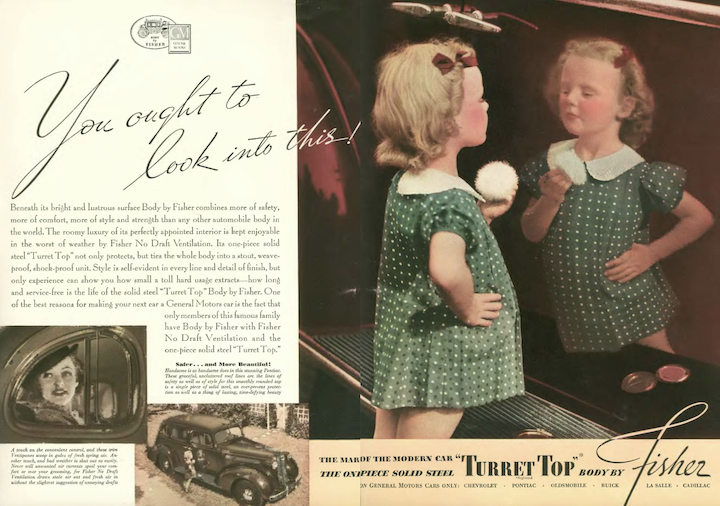
…you don’t hear much about the “June Bride” these days, but 1930s advertisers played up the tradition to sell everything from fashions to refrigerators…here the folks at Fisher made sure they connected their solid steel “Turret Top” to the safety of newlyweds…
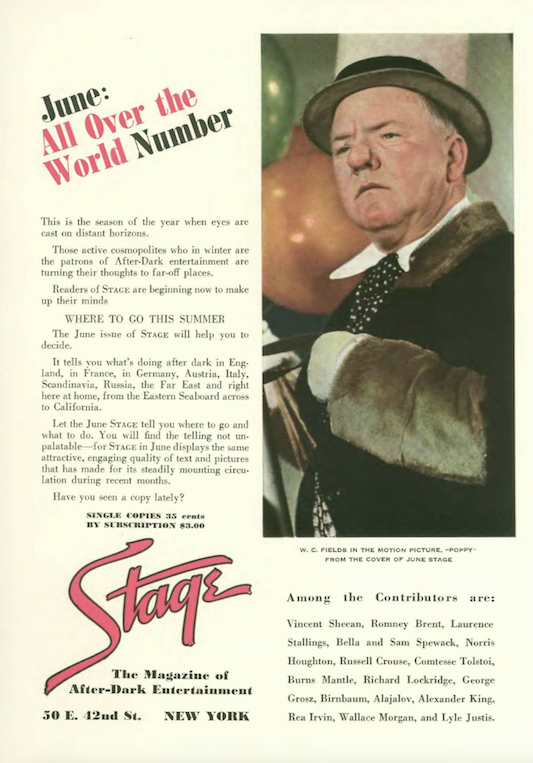
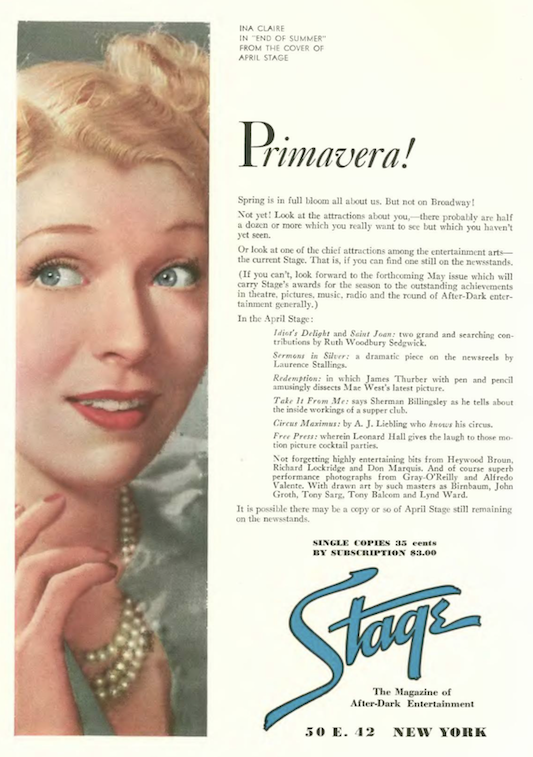
…Stage magazine promoted its extensive coverage of “After-Dark” entertainments at home and abroad…
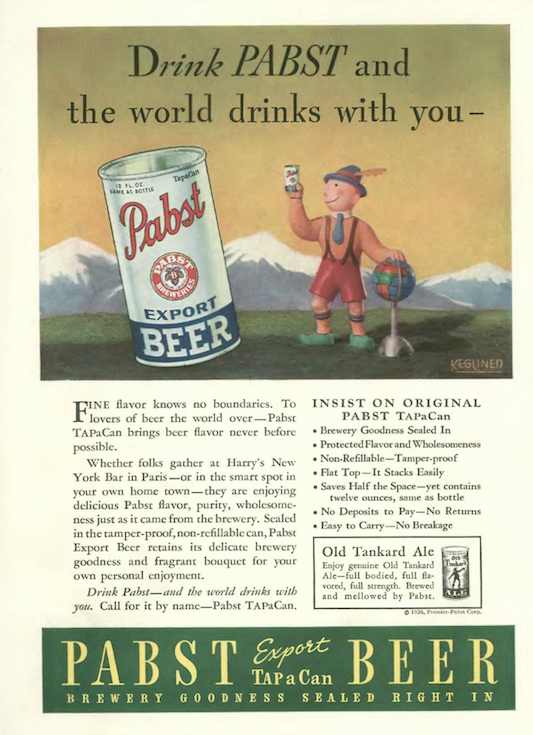
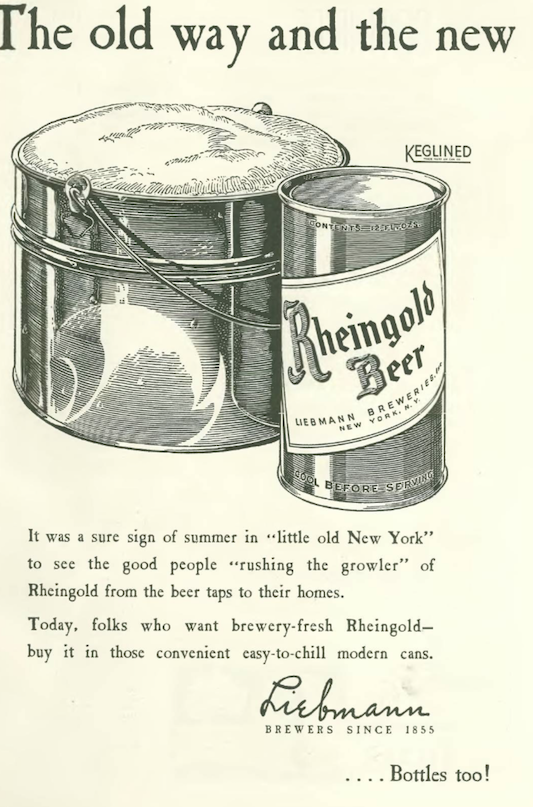
…the brewers of Pabst joined a handful of other beer companies promoting their product in newfangled cans…
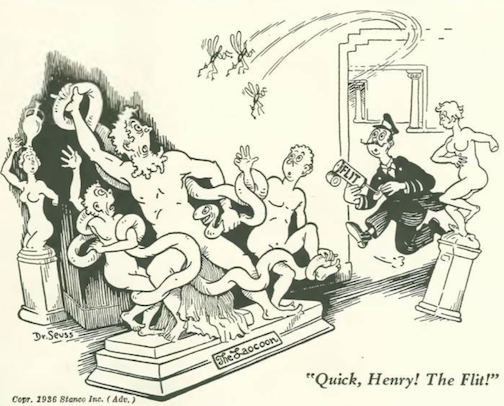
…Dr. Seuss continued to find new gags to promote Flit insecticide…
…James Thurber kicked things off for the issue’s cartoonists…
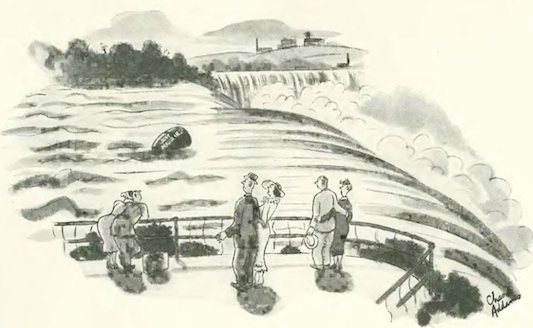
…Charles Addams took in the sites along with some June brides at Niagara Falls (the barrel in the water reads “Just Married”)…
…W.P. Trent contributed this caption-less cartoon…
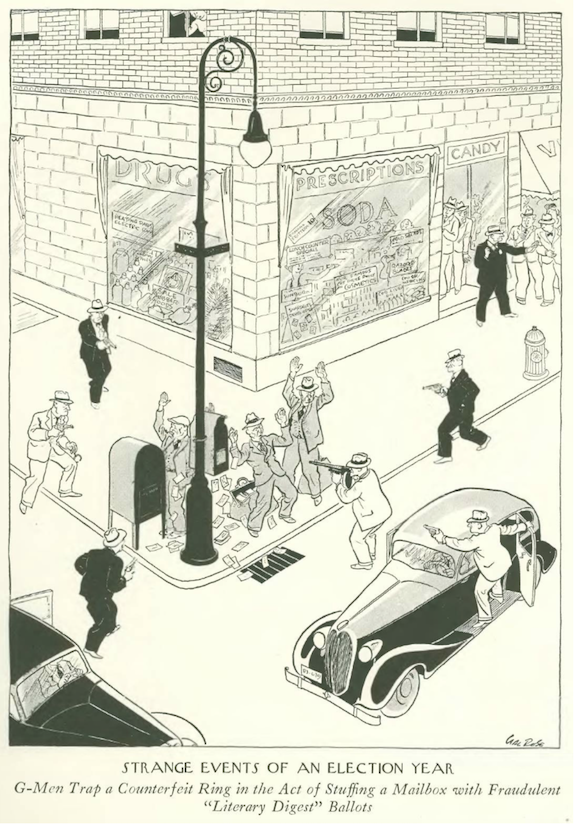
…Carl Rose continued to document the strange happenings of an election year…
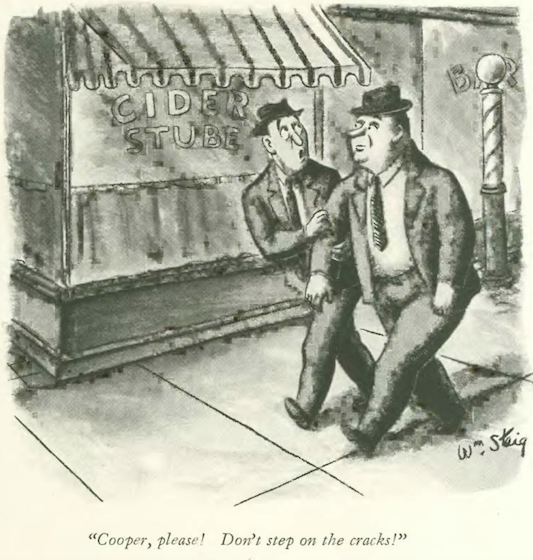
…William Steig got superstitious…
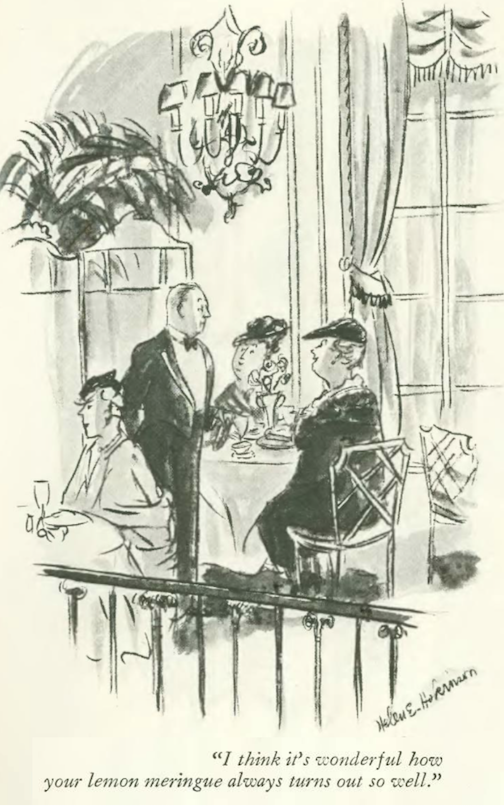
…one of Helen Hokinson’s “girls” gave props to lemon meringue…
…and Hokinson again, and an unlikely claim at the salon…
…Alain presented an artist’s greatest challenge…
…Otto Soglow gave us an ideal sandwich board duo…
…Alan Dunn illustrated a “selfless” act…
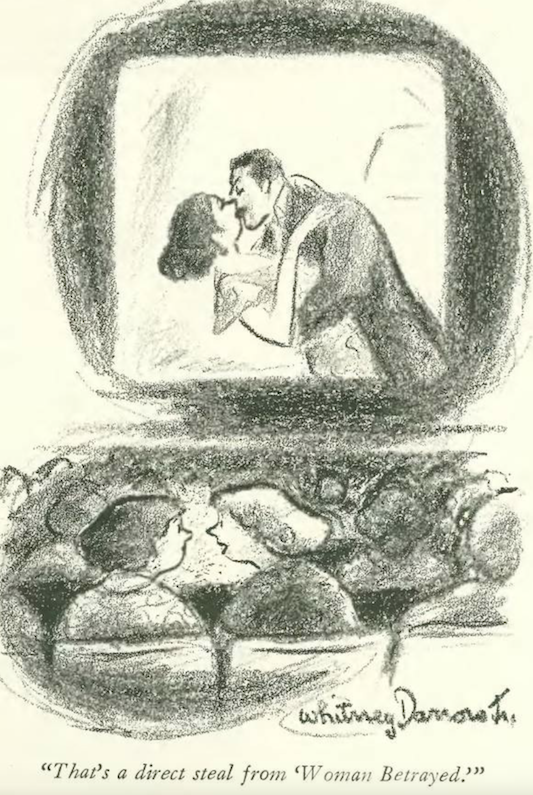
…a moviegoer found a derivative moment at the cinema, per Whitney Darrow Jr…
…and we close with some idle chat, courtesy of Barbara Shermund…
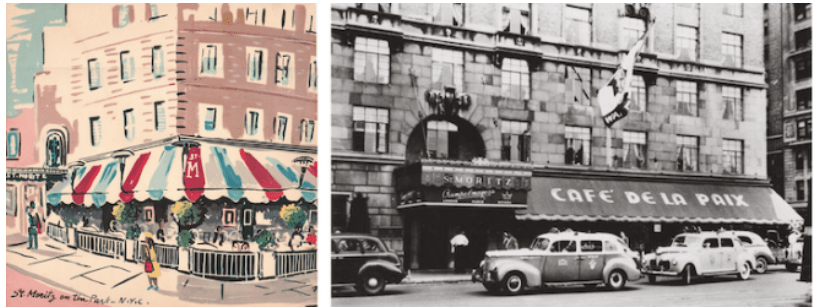
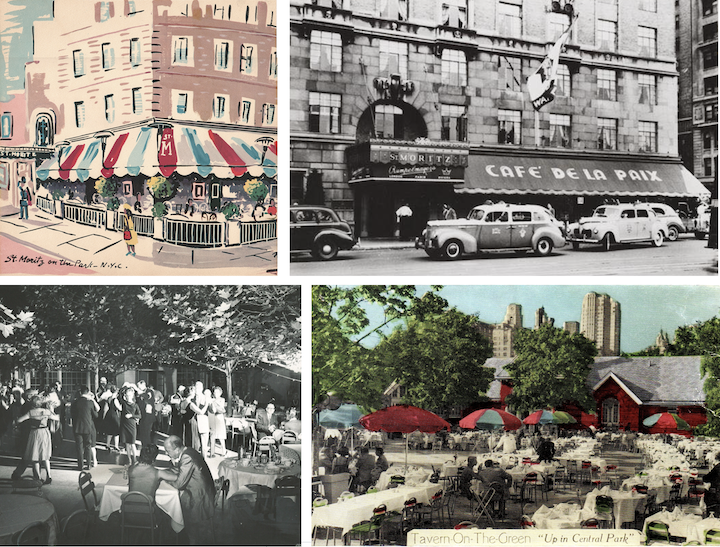
Above: Pierre Lelong painting (circa 1950s) of the outdoor café at New York's Hotel St. Moritz (left); view of the St. Moritz and Café de la Paix, 1944.
After the repeal of Prohibition in 1933, nightlife in Manhattan slowly picked up steam. By 1936 things were swinging, and although the club scene wasn’t as heady as the Roaring Twenties, there was still plenty to entice New Yorkers into the night air.
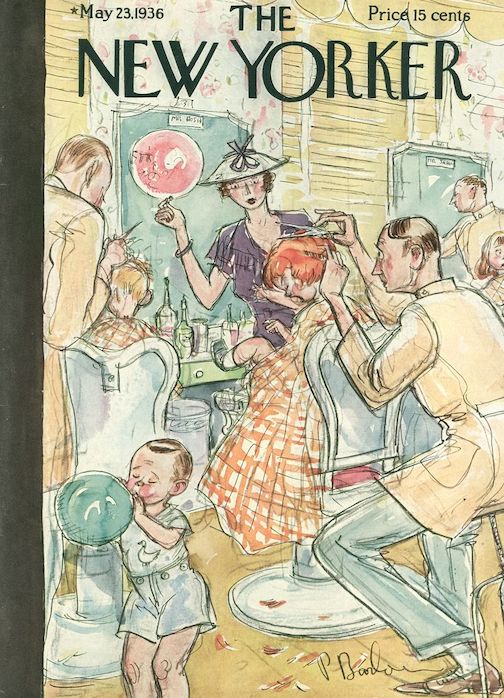
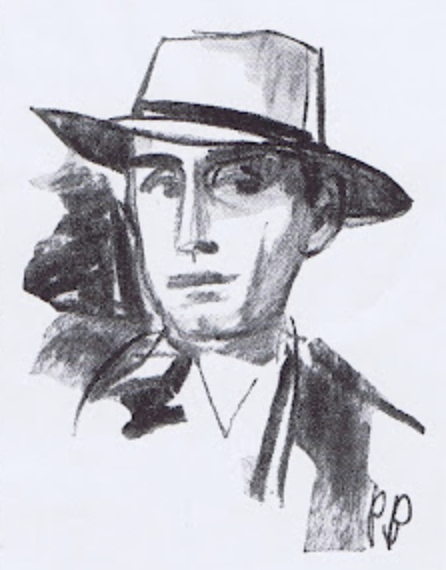
May 23, 1936 cover by Perry Barlow. The Texas-born Barlow (1892–1977) published 135 covers and 1,574 drawings in The New Yorker from 1926 to 1974. According to the late Lee Lorenz, Barlow’s drawings were elegant and deceptively casual, “delineating the absurdities and frustrations of the suburban middle class.” Barlow’s wife, Dorothy Hope Smith (also a successful artist) collaborated with her husband on many of his covers. Lorenz noted that “being partly color-blind, [Barlow] depended on his wife to provide the color for his drawings.”Before we get to our top story, here is a self portrait of Barlow featured in the April 26, 1941 issue of Colliers (via Mike Lynch Cartoons):
Lee Lorenz described Perry Barlow as a modest man: “Tall, lean, and soft-spoken, he seemed to many of his friends the image of the laconic Texan…(his) drawings remain fresh, and the generous and civilized sensibility behind them is a reminder of a quieter, kinder world.”
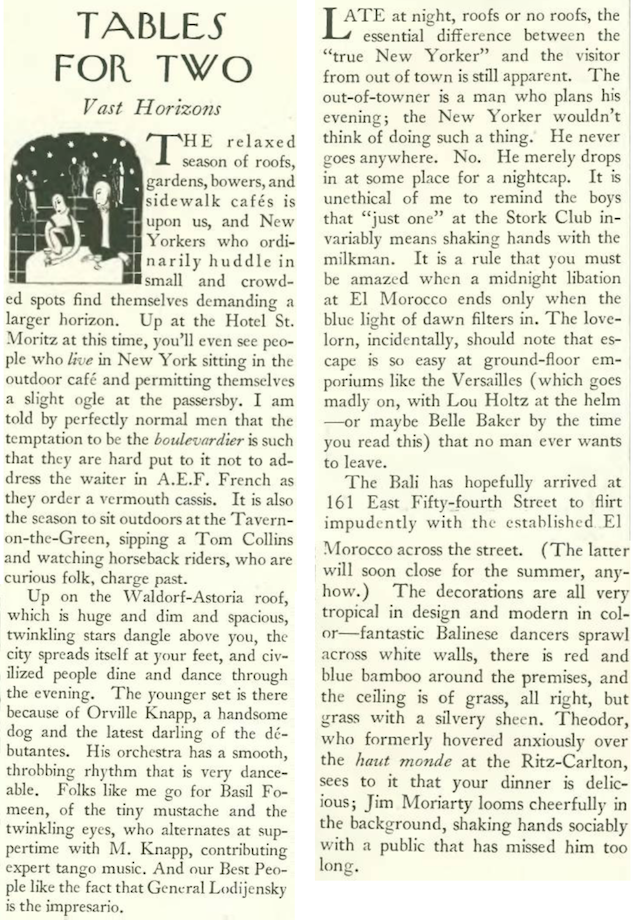
Now let’s enjoy a relaxing evening with the world’s greatest nightlife correspondent, Lois Long, who checked out the latest outdoor drinking and dining options in Manhattan. Excerpts:
AL FRESCO…Clockwise from top left: Whimsical illustration of the outdoor cafe at the Hotel St. Moritz by French Post-Impressionist painter Pierre Lelong, circa 1950s; view of St. Moritz Hotel and Cafe’ de la Paix, 1944 (in 1997 Donald Trump planned to gut the St. Moritz and cover it in glass; fortunately it was sold before that could happen); circa 1940s postcard depicting outdoor dining/dancing area at Tavern on the Green; dancing and drinks at Tavern on the Green, 1963. (scan by author/mcny.org/ephemeralnewyork.com/nytimes.com)
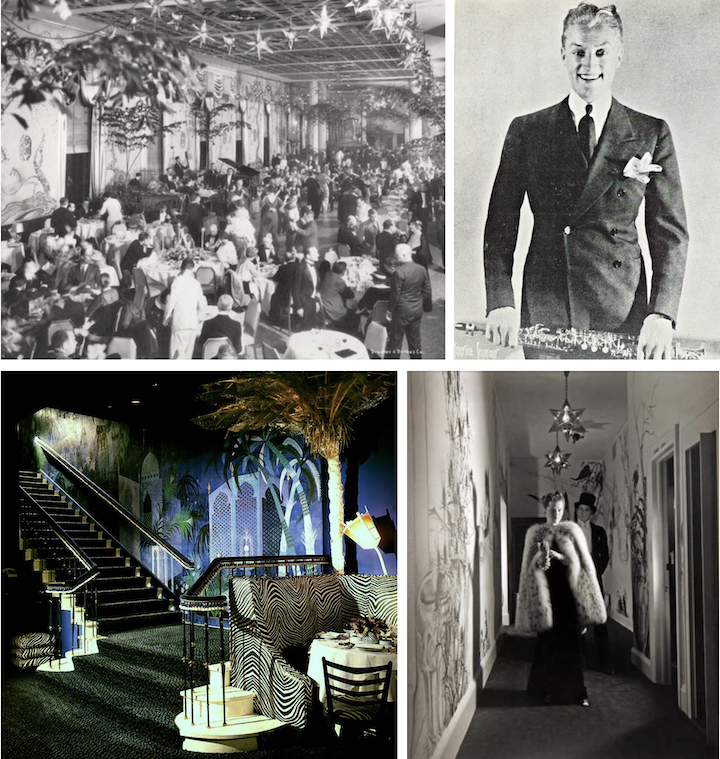
DANCING WITH THE STARS…Clockwise, from top left: The Waldorf’s Starlight Rooftop in the 1930s; Lois Long referred to the Waldorf’s multi-talented bandleader Orville Knapp as a “handsome dog”; actress Mary Taylor makes an entrance at the El Morocco in the 1930s; color image of the El Morocco’s Champagne Room, 1960. (notjustalabel.com/findagrave.com/facebook.com/life.com)
* * *
Keeping the Flame
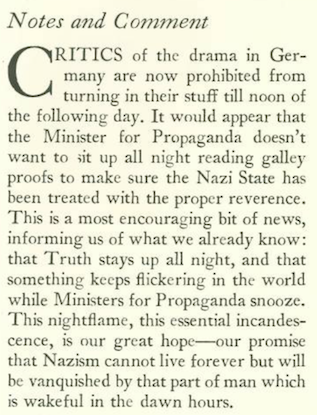
E.B. White began his column with a hopeful message regarding the power of truth in the face of Nazism:
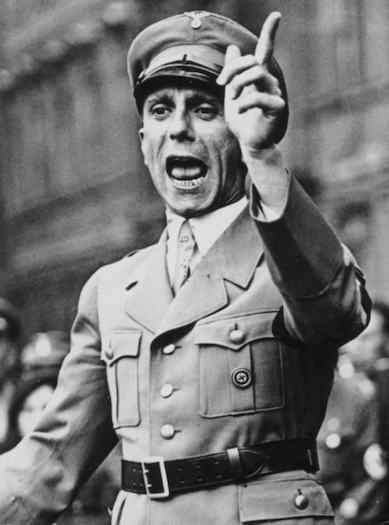
OH SHUT UP…Reich Minister of Propaganda Joseph Goebbels giving a speech in Lustgarten, Berlin, August 1934. (Wikipedia)
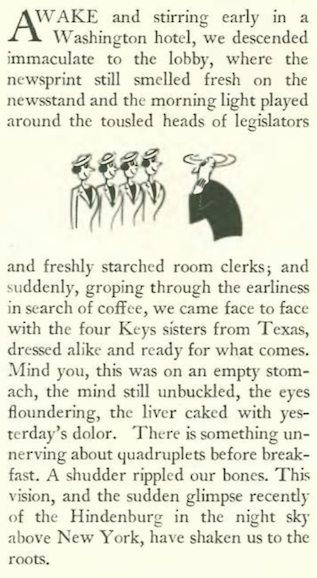
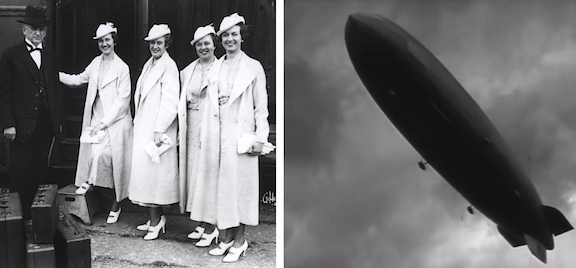
…White also commented on some “unnerving” moments while encountering quadruplets and a Nazi dirigible…
SISTER ACT…At left, the Keys Sisters circa 1936—Leota, Mary, Mona, and Roberta—were a national sensation and America’s most famous set of quadruplets. They were the first quadruplets in history to graduate from college (Baylor 1937), and they traveled thousands of miles on “goodwill tours” to promote Baylor University and the Texas Centennial Exposition of 1936; at right, the Hindenburg looms in the night sky just minutes before it was destroyed while attempting to dock in Lakehurst, N.J. (baylor.edu/British Pathé)
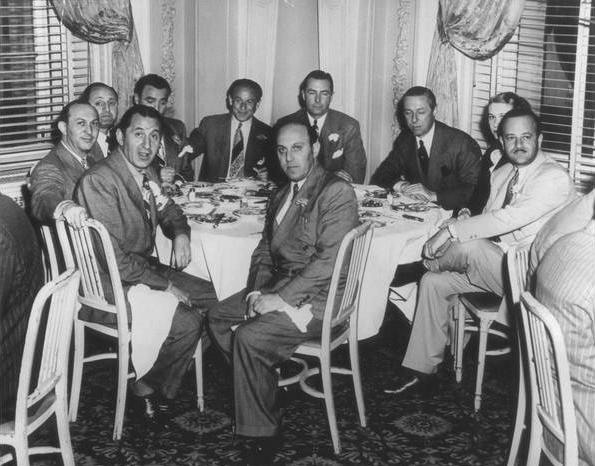
…and one more from White, here musing about Lucky Luciano’s residence at the Waldorf (Penthouse 39C, where Luciano was registered as “Charles Ross”)…
WALDORF ROUND TABLE…Lucky Luciano (back, center) with associates at the Waldorf-Astoria, circa 1936. Luciano regularly entertained prominent mobsters like Meyer Lansky and Frank Costello at the hotel. (dc.lib.jjay.cuny.edu)
* * *
Headline Acts
From 1935 to 1939, the WPA’s Federal Theatre Project gave work to more than 12,000 unemployed actors, directors, writers, designers, stagehands, and seamstresses while staging more than 1,200 productions across twenty-nine states. Although Wolcott Gibbs wasn’t too impressed with the project’s “Living Newspaper” performance, he deemed it worth seeing as the best thing on stage in the waning days of the theater season.
TOO SUCCESSFUL…As the director of the WPA’s Federal Theatre Project from 1935 to 1939, Hallie Flanagan (left) oversaw the hiring of thousands of unemployed theater workers and the production of nearly 64,000 theatrical performances. At right, a scene from a “Living Newspaper” performance in the 1930s. Despite its enormous success, the project was abruptly shut down by Congress on June 30, 1939, due to its progressive social commentary. (nara.gov/loc.gov)
* * *
At the Movies
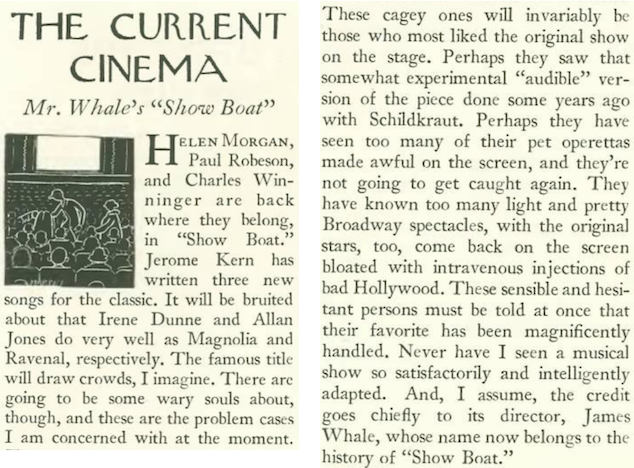
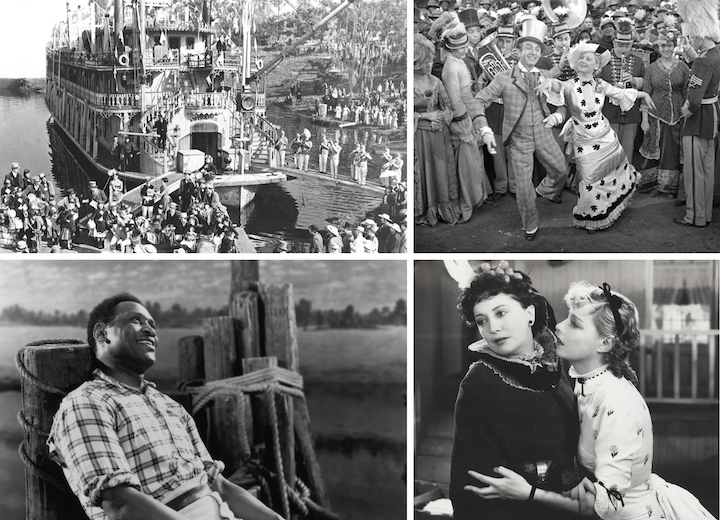
The romantic musical Showboat was a big hit with Broadway audiences after it premiered in 1927, but the play’s first film adaptation in 1929 fell flat; it was shot as a silent and then partially re-shot to incorporate sound dialogue and singing. Film critic John Mosher referred to that version as something “made awful on the screen,” and wanted his readers to know that the new 1936 adaptation had been “magnificently handled” by director James Whale (perhaps best remembered for 1931’s Frankenstein).
THE OLD MAN…Clockwise, from top left: the show boat Cotton Palace sets out on the Mississippi River to much fanfare in 1936’s Show Boat; Jeanette Dickson and Jimmy Jackson kick up their heels before the boat departs; Irene Dunne (right) and Helen Morgan in a dramatic scene; Paul Robeson performing his iconic rendition of “Ol’ Man River.” (collider.com/criterion.com/nystagereview.com)
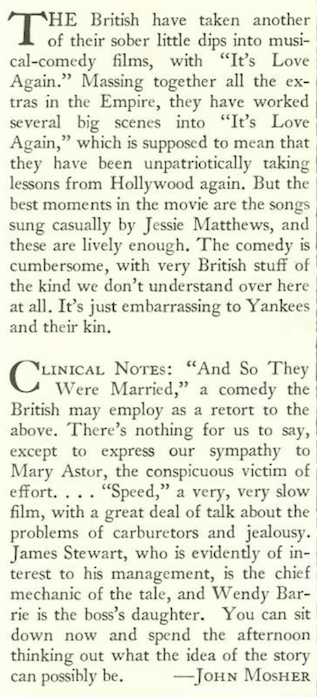
Mosher also reviewed the musical It’s Love Again, finding the comedy “cumbersome,” filled with “very British stuff of the kind we don’t understand over here at all.” He also had little to say about And So They Were Married, expressing sympathy to actress Mary Astor as “the conspicuous victim of effort…”
NOT PLAYING DOCTOR…Folks of certain age will recognize Robert Young from the 1970s TV series Marcus Welby, M.D. Prior to that he appeared in more than one hundred films. Top photo, Athene Seyler, Robert Young, and Jessie Matthews in It’s Love Again; Below, Mary Astor and Melvyn Douglas with child actors Edith Fellows and Jackie Moran in And So They Were Married. (imdb.com)
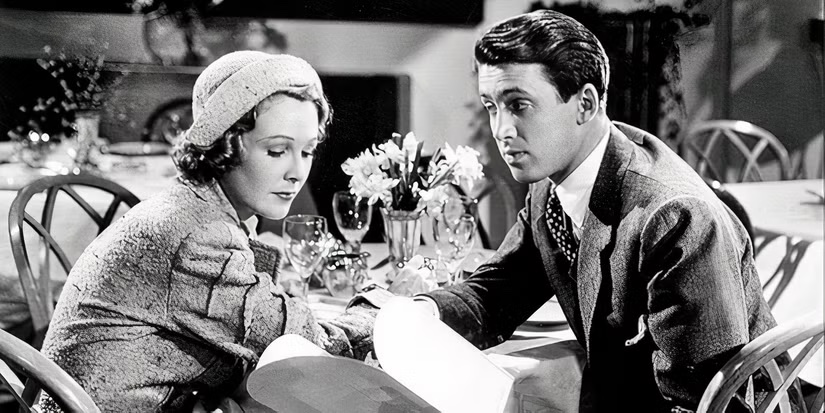
And then there was Speed, Jimmy Stewart’s first leading role. Mosher couldn’t make sense of it, but the film did launch Stewart into bigger roles.
OUT OF GAS…Jimmy Stewart as race car driver Terry Martin in Speed.Wendy Barrie played the love interest Jane Mitchell, who was secretly the heiress Jane Emery. The film received tepid reviews, but it helped launch Stewart to stardom. (collider.com)
* * *
From Our Advertisers
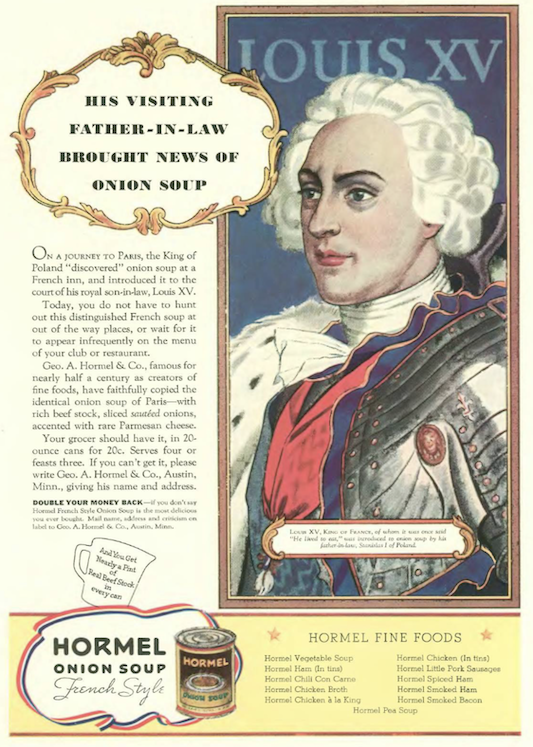
The folks at Hormel were back on the inside front cover with another tale from the annals of onion soup…
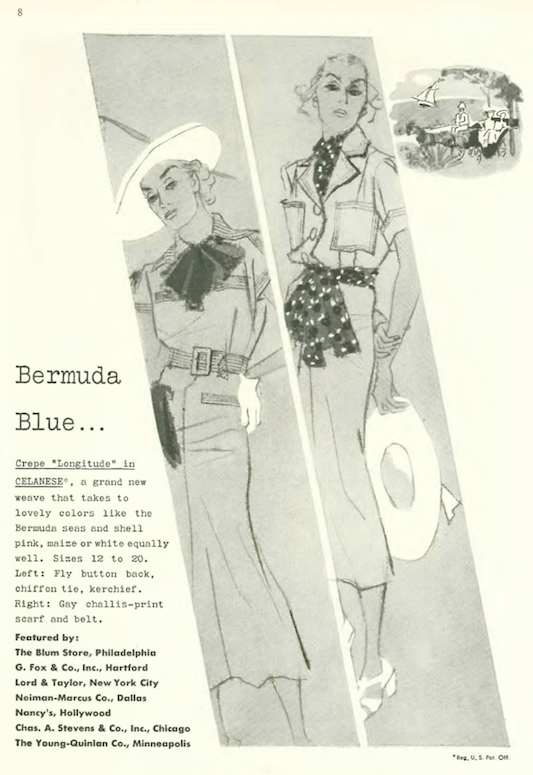
…and summer fashions once again dominated the opening pages of the magazine…
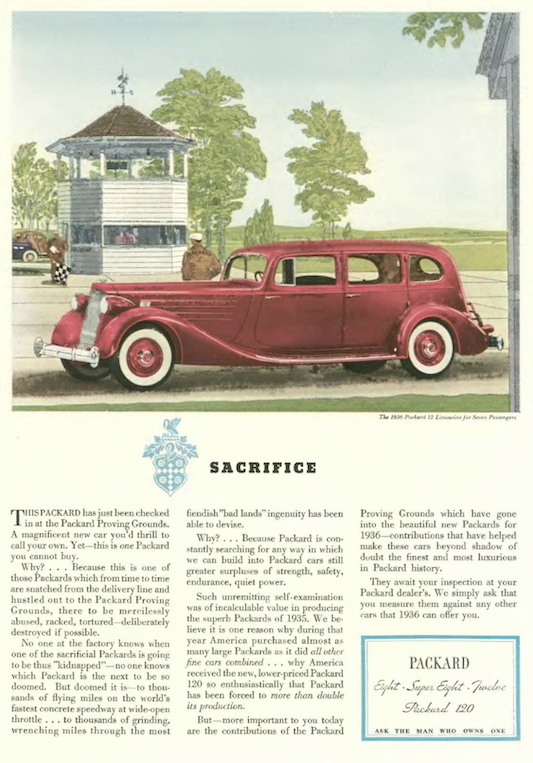
…Packard answered Cadillac’s pastoral ads with one of its own…
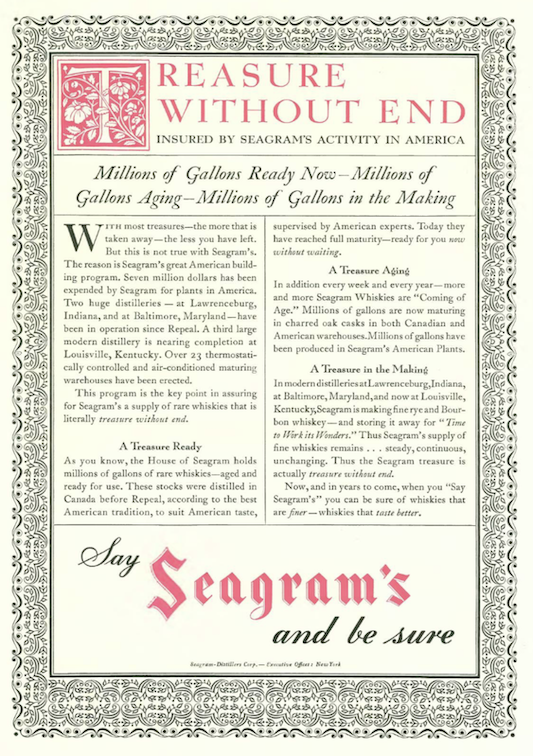
…while the distillers at Seagram’s wanted to reassure thirsty Americans that there was plenty of the hard stuff to go around…
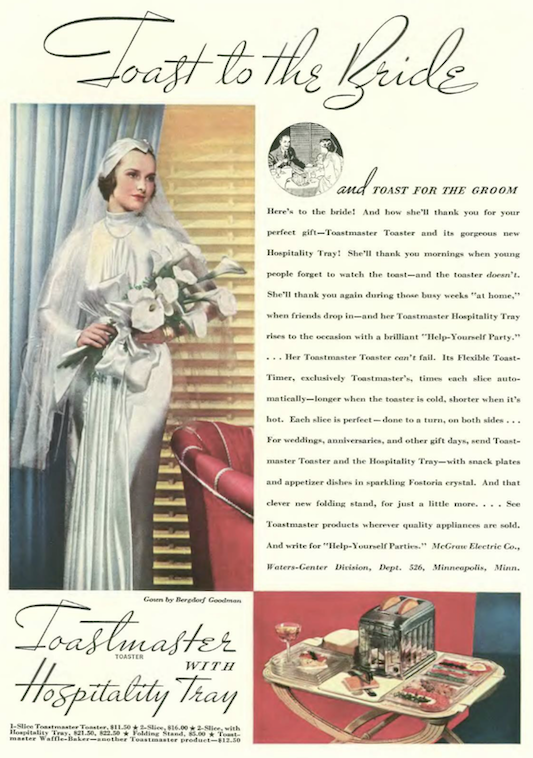
…anticipating the season of the June bride, this ad helpfully suggested the Toastmaster toaster (and accessories) as the ideal gift for the newlywed…
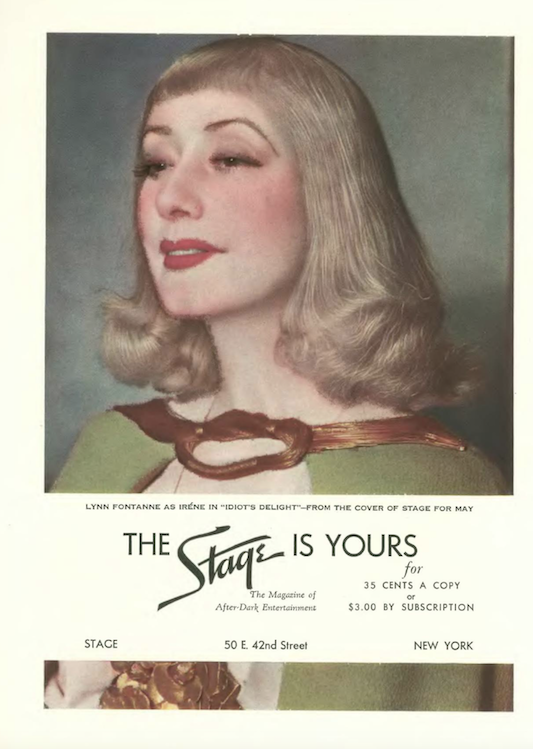
…this ad for Stage magazine featured actress Lynn Fontanne as the mysterious countess Iréne in Idiot’s Delight…
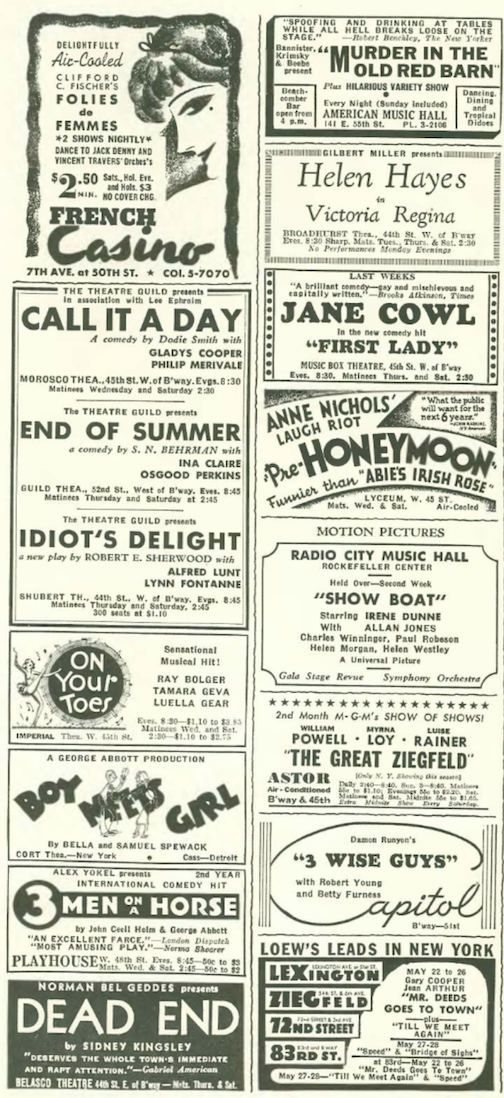
…Fontanne’s play, along with several other stage and screen diversions, were advertised in the back of the book…
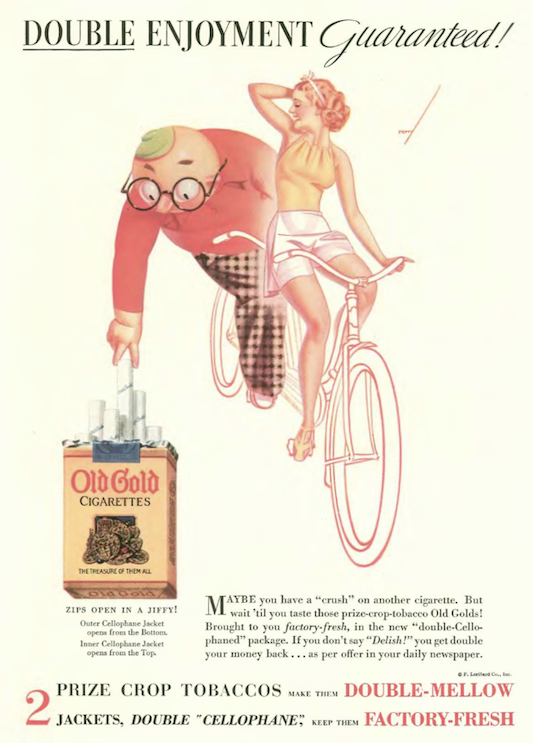
…pin-up artist George Petty drew up another odd couple for Old Gold cigarettes…
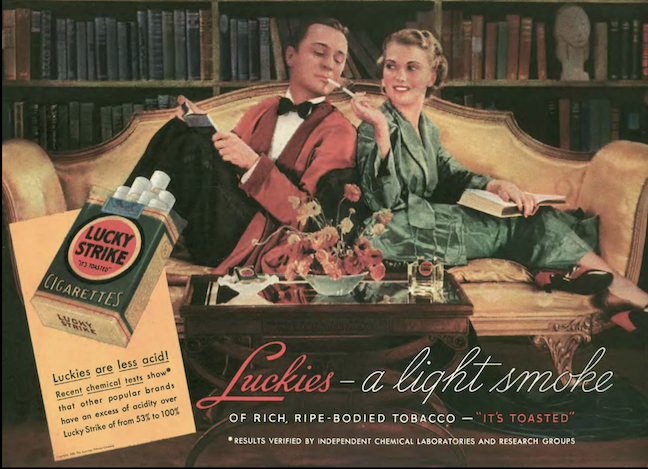
…While the makers of Lucky Strike cigarettes gave their smokes a homey appeal…
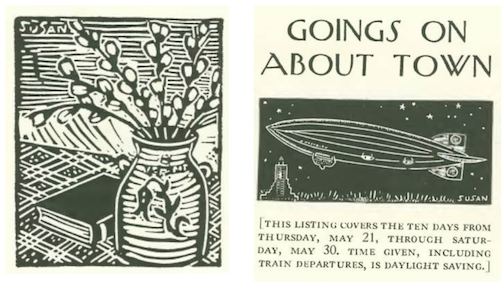
…on to our illustrators and cartoonists, we have spot art from Susan Willard Flint…
…and Christina Malman…
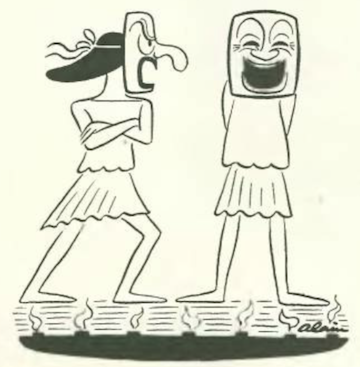
…and Daniel ‘Alain’ Brustlein (for the “Theatre” section)…
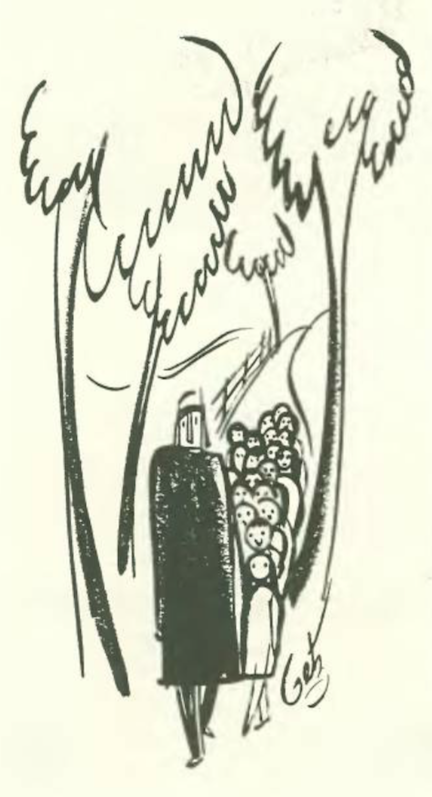
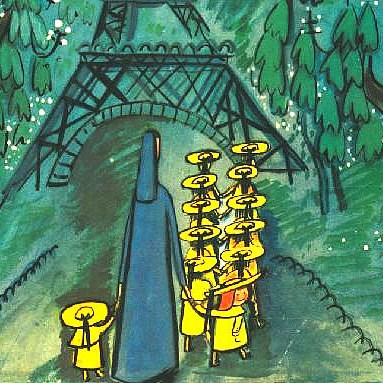
…this next bit of spot art has me confused…the signature appears to belong to Arthur Getz, yet the image suggests an early drawing by Ludwig Bemelmans…Getz and Bemelmans were contemporaries at the New Yorker, and both were prolific spot art contributors…
…the drawing seems to anticipate Bemelmans’ 1939 children’s book Madeline…
…Richard Taylor found inspiration on the Broadway stage…
…Peter Arno showed us a sugar daddy receiving an earful (via ear trumpet)…
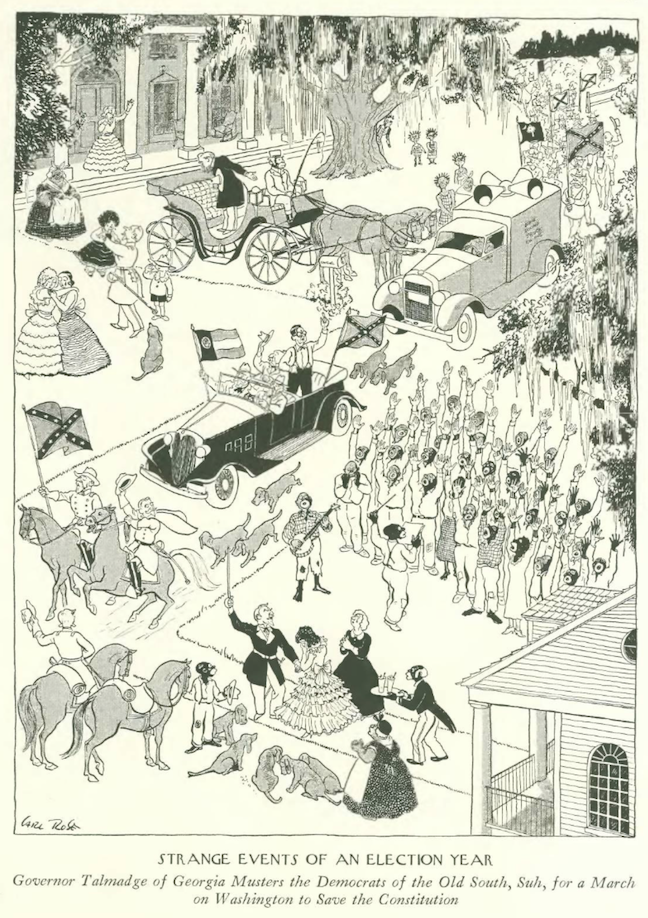
…Carl Rose offered some Southern-style electioneering in this lively illustration…
…by contrast, James Thurber’s spare lines told us everything we needed to know about this couple…
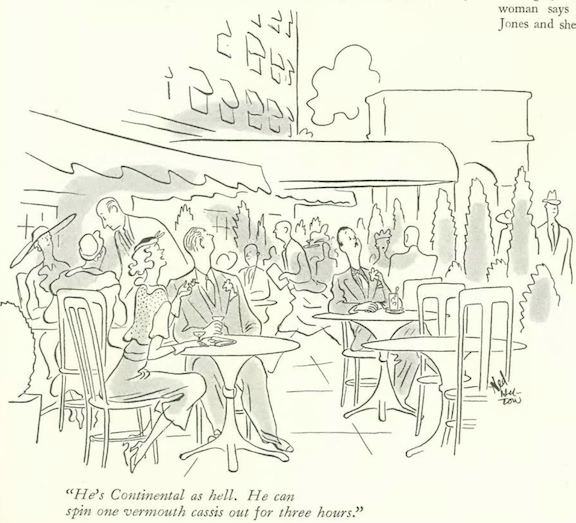
…Ned Hilton spotted an outlier at an outdoor café...
…Alain again, here anticipating a big surprise…
…Helen Hokinson offered a helpful fashion tip…
…and we close with Mary Petty, and a motherly retort…
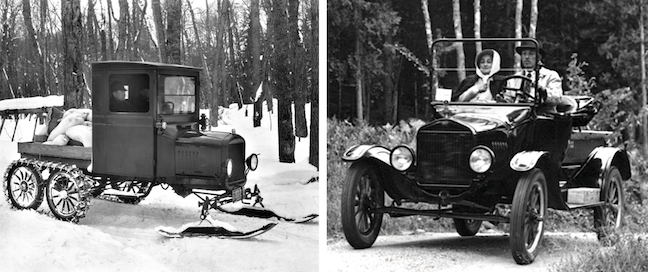
Above: Undated image (left) demonstrates the versatility of the Model T Ford. At right, E.B. White and Katharine Sergeant White take a spin in a Model T Roadster. (freep.com/whistlestoppers.com)
E.B. White often shared anachronistic views on progress, decrying everything from streamlined cars to fully-enclosed city buses that removed passengers from the open air.
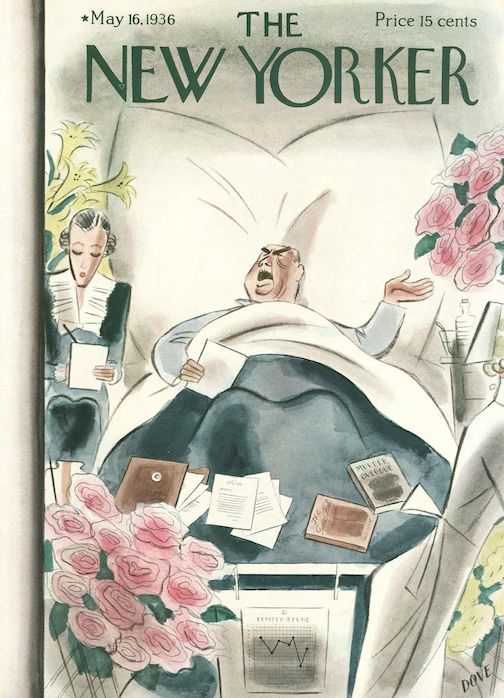
May 16, 2026 cover by Leonard Dove. Note the star next to the date. On older New Yorker magazine covers, the star was a printer’s mark indicating a split run or a specific newsstand edition.
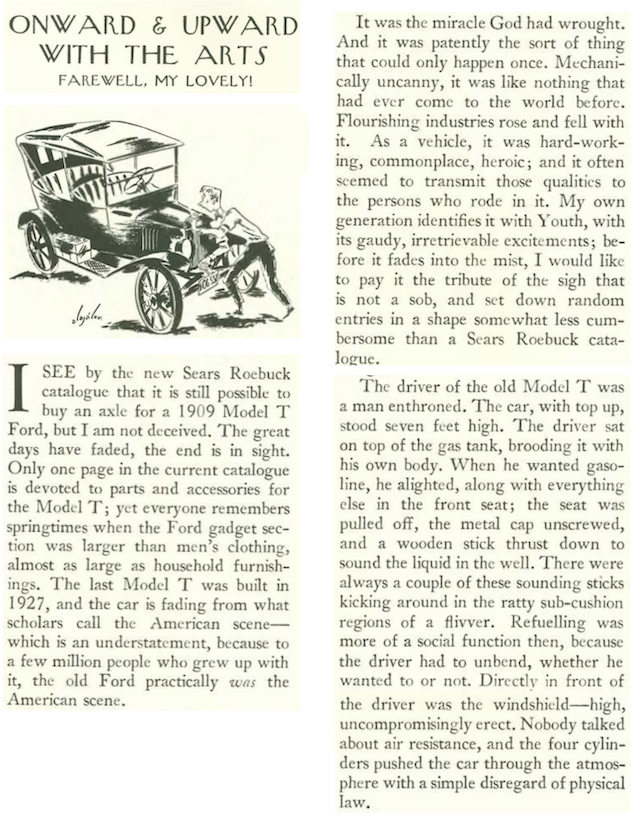
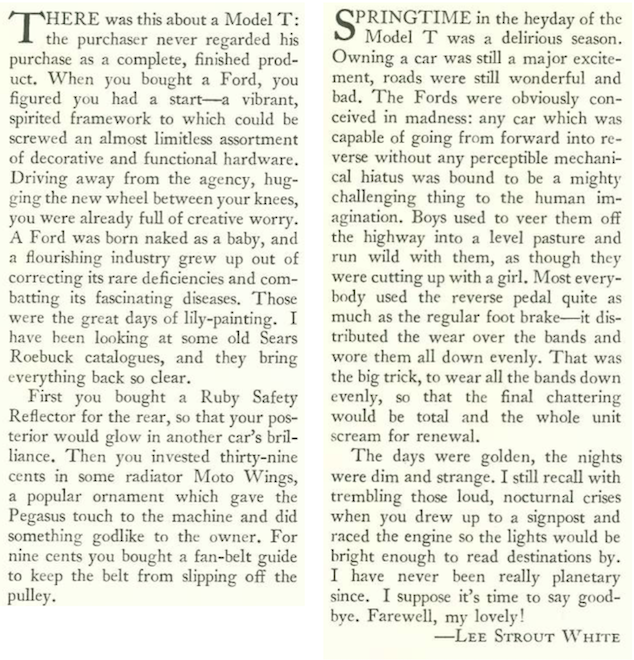
Instead, White celebrated the simplicity and mechanical quirks of earlier motor vehicles, including his beloved Ford Model T. For the May 16 issue White collaborated with journalist Richard Lee Strout on a homage to the old motorcar, “Farewell, My Lovely!” Strout’s contribution is important here, since it was he who originally submitted a manuscript to editor Harold Ross about the Model T. Either White rewrote Strout’s submission or used it as inspiration for “Farewell, My Lovely!” At any rate, that explains the blended byline, “Lee Strout White.” Here are some excerpts (spot art by Constantin Alajalov):
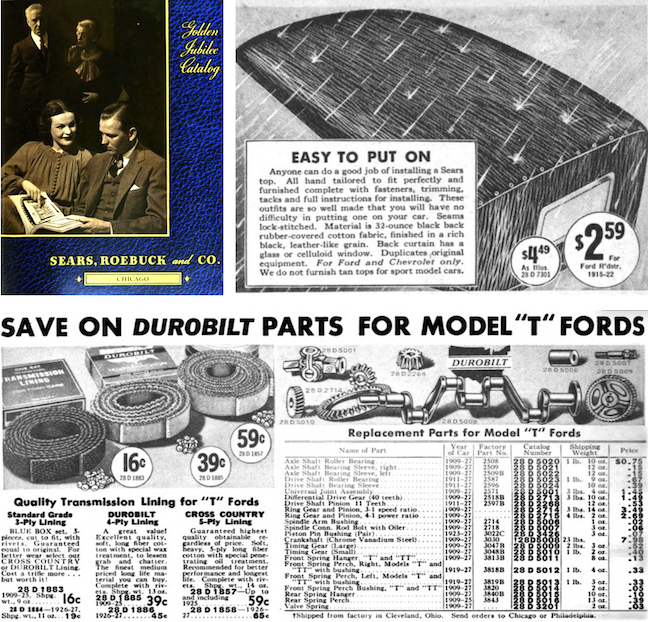
MIX AND MATCH…E.B. White’s famous Model T was a 1917 Roadster like the one pictured at top left. He purchased the car shortly after college and famously drove it across the country in 1922; at top right, the dash featured the ignition key and nothing else, however you could add such extras as radiator “Moto Wings” or a Ruby Safety Reflector. (volocars.com/ebay.com)KEEPING IT HUMMING…As E.B. White noted in his opening lines, you could buy an axle as well as a number of other parts for the Model T from the Sears catalog. Clockwise, from top left: Cover of the 1936 “Golden Jubilee” catalog; replacement parts featured in the catalog included new car tops and an array of replacement parts. (archive.org/babel.hathitrust.org)
Model T owners developed all sorts of hacks to keep their Lizzies running. White wrote that “Dropping a camphor ball into the gas tank was a popular expedient; it seemed to have a tonic effect on both man and machine.” He also noted that the Ford driver “flew blind,” given that on earlier models the dashboard was bare save for an ignition key. Those cars lacked speedometers, fuel gauges, as well as gauges for engine temperature and oil pressure. “Whatever the driver learned of his motor,” White wrote, “he learned not through instruments but through sudden developments.” He concluded his piece with some thoughts on the golden days of the automobile.
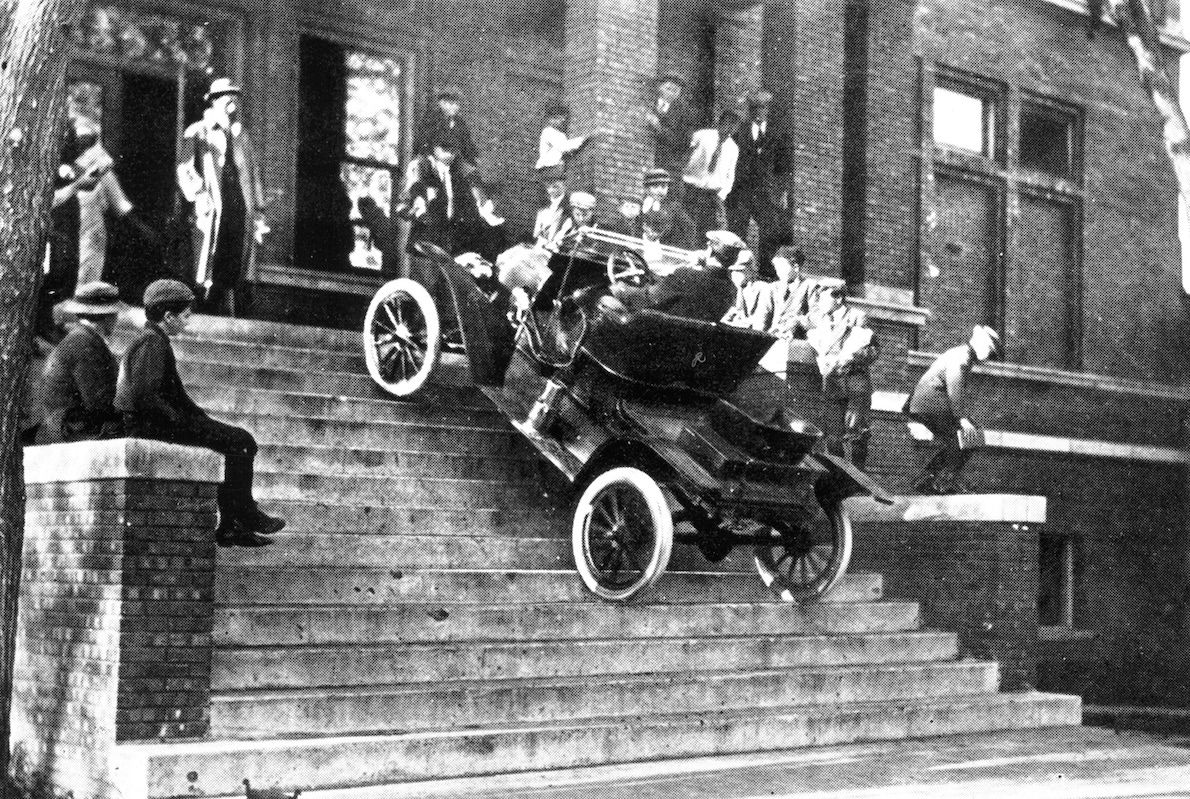
SHOWOFF…The Model T’s unique transmission and gravity-fed fuel system were key to the rugged car’s many stunts. In scaling Scotland’s Ben Nevis mountain, the driver often had to go backwards up inclines to maintain fuel flow. Above is a photo of a Model T climbing the stairs of the Tennessee State Capitol in 1911. (media.lincoln.com)
* * *
Total Recall
E.B. White also filed a lengthy “Notes and Comment” comprised entirely of brief dispatches from around the country:
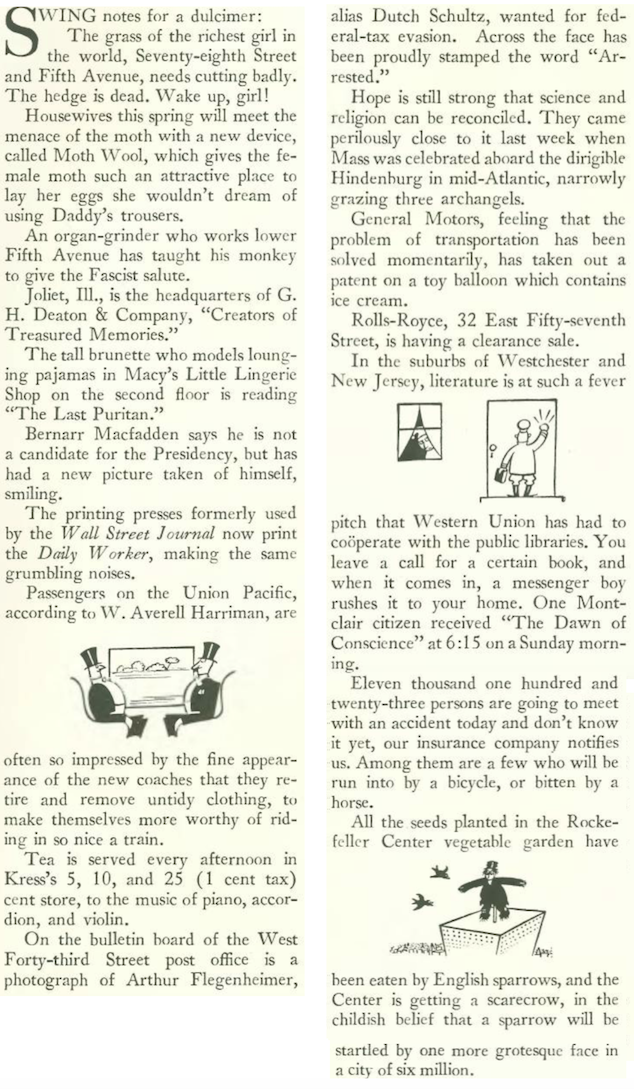
CIVILIZED SHOPPING…Tea time was observed every afternoon at Kress’s department store—images above are of the store’s ladies lounge; body builder and fitness magazine publisher Benarr Macfadden (seen here with President Franklin Roosevelt circa mid-1930s) said he had no plans to run for president; bottom left, a sale was in progress at the Rolls-Royce building on East 57th. (nypl.org/public domain/mcny.org)
Here are the rest of White’s notes on the passing scene:
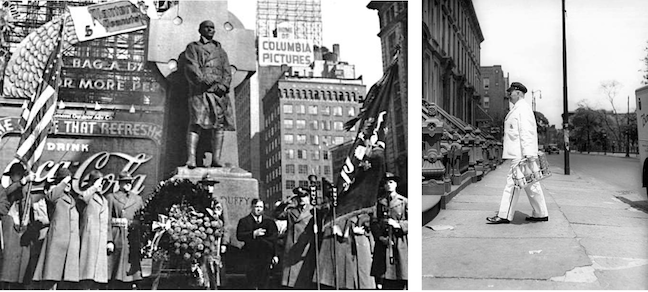
LIMITATION OF STATUES…At left, Mayor Fiorello LaGuardia presides over the dedication ceremonies of a Times Square statue honoring Father Francis Patrick Duffy, May 2, 1937—apparently some folks were opposed to a statue honoring the most decorated chaplain in Army history; at right, a Borden’s milkman making a delivery in New York City, 1936. (facebook.com/photo army.mil)
* * *
Not Playing in Peoria
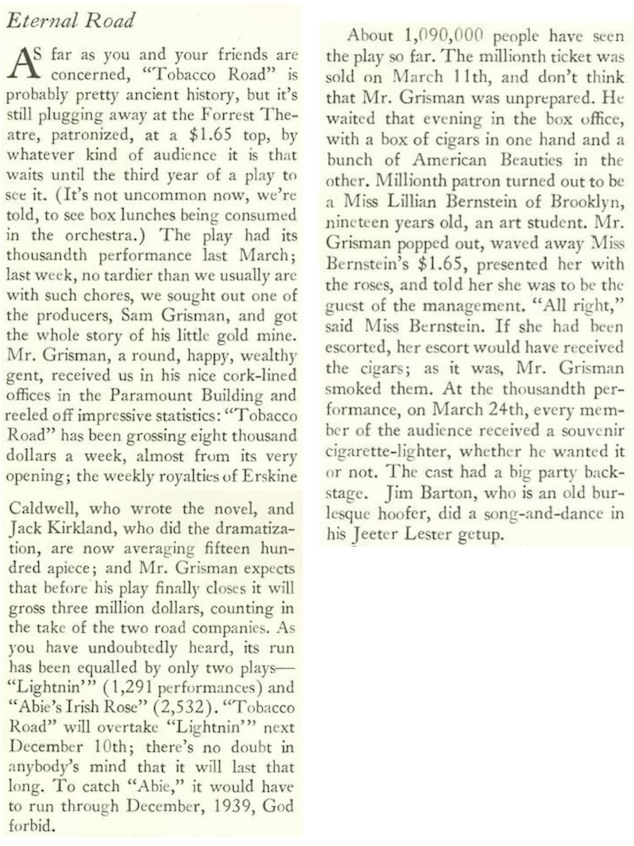
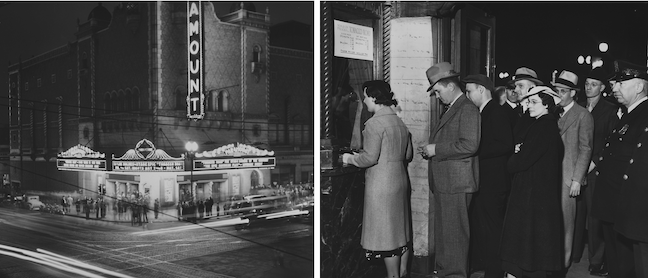
Jack Kirkland’s play Tobacco Road, based on the 1932 novel by Erskine Caldwell, was one of the longest-running plays in theater history, with 3,182 performances from 1933 to 1941. Although banned in major cities such as Chicago and Detroit for being sensational and immoral (and panned by critics), it nevertheless saw huge success on Broadway and with its touring company. “The Talk of the Town” checked the status of the play at the Forrest Theatre, where it had exceeded the millionth ticket mark.
WORD GETS AROUND…Folks queue up in 1937 to see Tobacco Road at Omaha’s Paramount Theater. Despite being banned in many cities, the play ran until 1941. (Wikipedia)
* * *
At the Movies
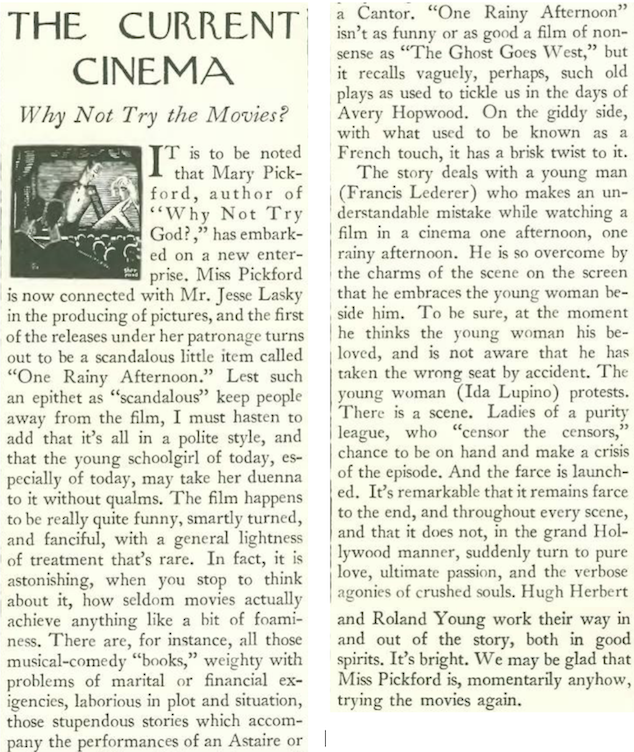
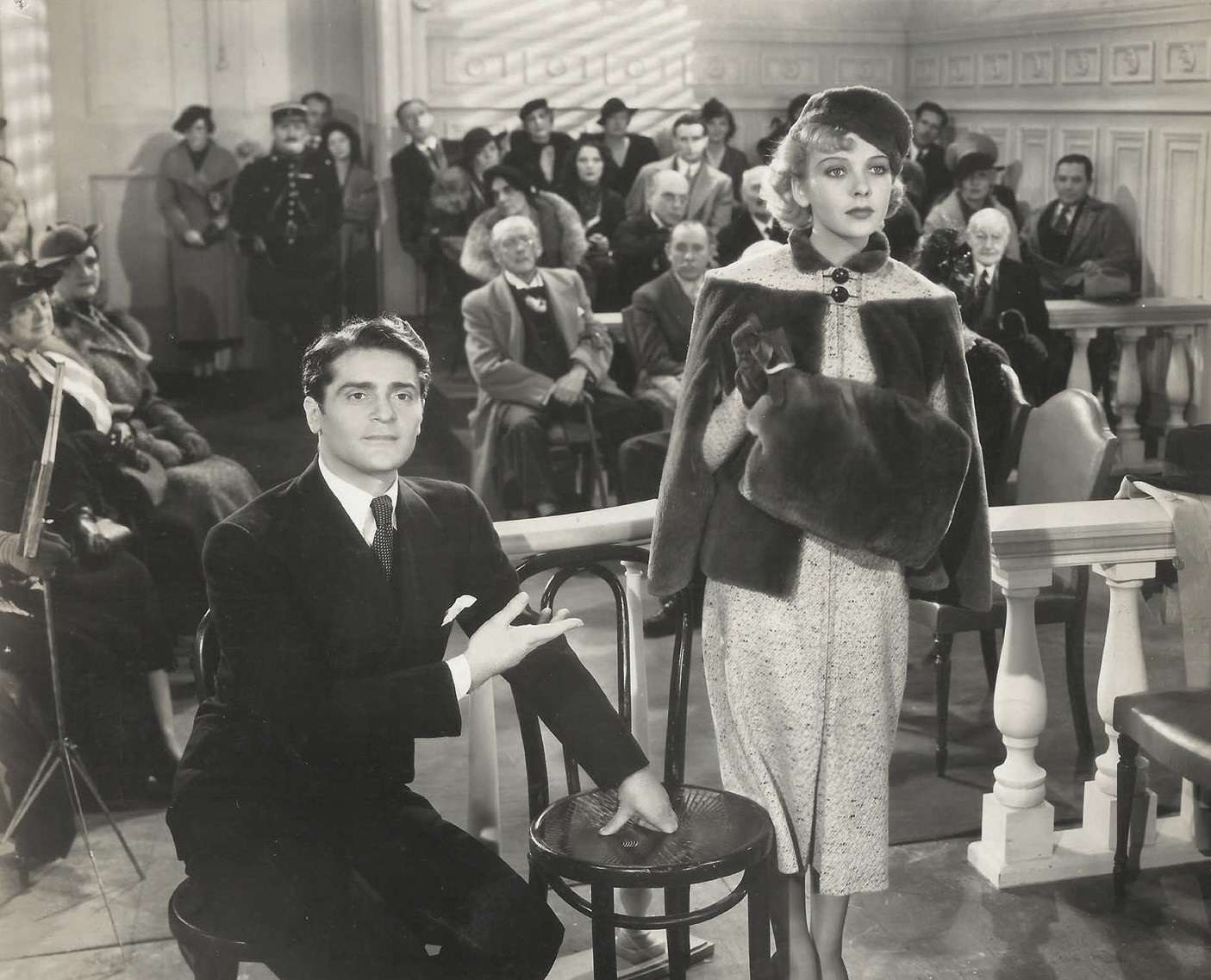
One Rainy Afternoon was the first of a small number of films from United Artists produced by its vice-president, Mary Pickford, through her Pickford-Lasky production company. In his opening lines critic John Mosher alluded to Pickford’s popular 1934 essay, Why Not Try God?
HONEST MISTAKE…Francis Lederer played a debonair actor who accidentally kisses young socialite Ida Lupino in a darkened theatre in One Rainy Afternoon. Hilarity and romance follow. Lederer (1899–2000) would enjoy a successful stage, film and television career while becoming wealthy as an L.A. real estate investor. Lupino (1918–1995) was an actress, director, writer, and producer, appearing in 59 films and directing eight. She is regarded as the most prominent woman filmmaker working during the Hollywood studio system of the 1950s. (Wikipedia)
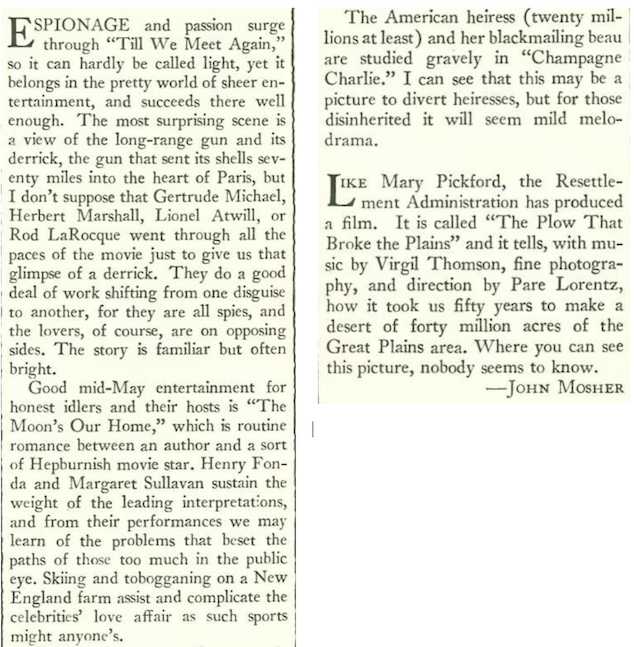
Mosher also reviewed some “Good mid-May entertainment for honest idlers” and a documentary about the Dust Bowl.
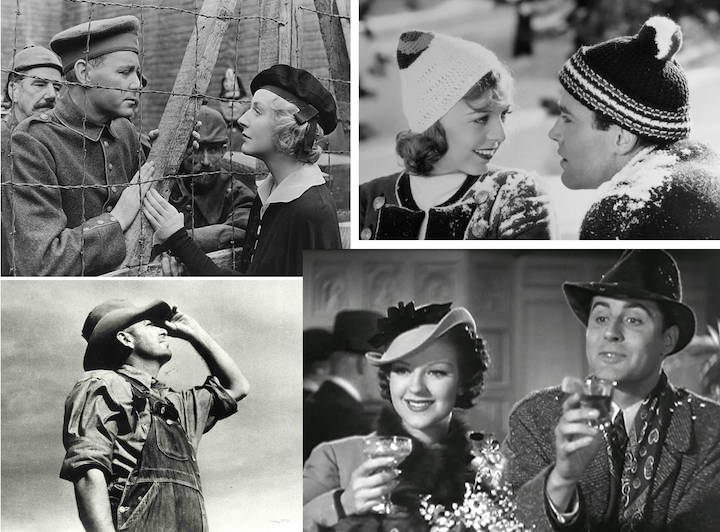
MAY DIVERSIONS…Clockwise, from top left: Herbert Marshall and Gertrude Michael in Till We Meet Again; Margaret Sullavan and Henry Fonda in The Moon’s Our Home; Thomas Beck and Helen Wood in Champagne Charlie; a farmer looks to the sky in the Dust Bowl documentary The Plow That Broke the Plains. (csfd.cz,pinterest.com/imdb.com)
* * *
From Our Advertisers
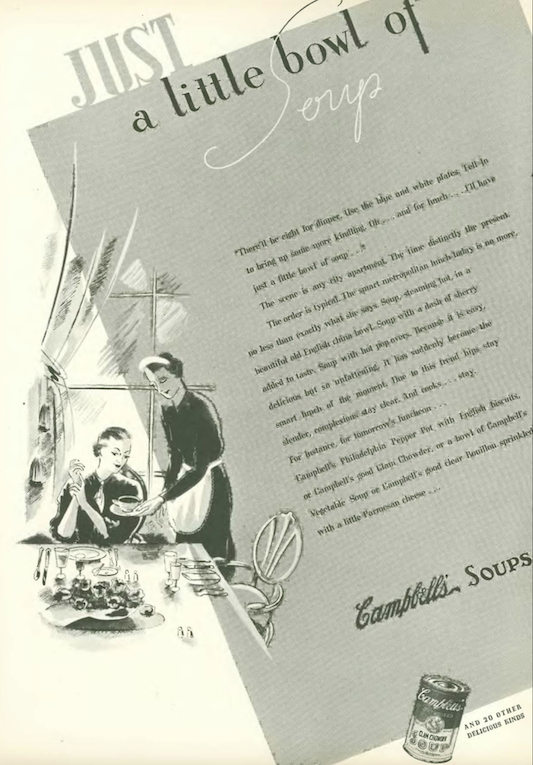
The makers of Campbell’s soups continued to market their product as an upscale starter for dinner…or perhaps a time-saver for the cook, Madam none the wiser…
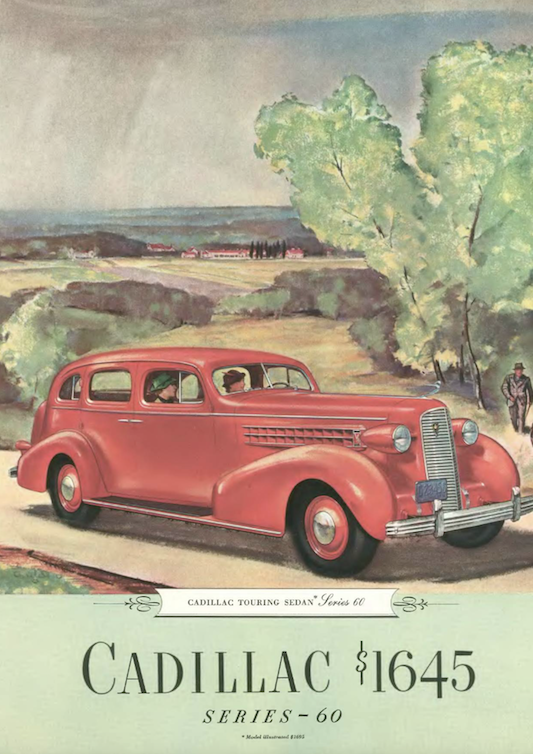
…Cadillac continued to entice buyers with bucolic scenes dominated by their luxury sedans…the price isn’t outrageous, roughly equivalent to $40K today…
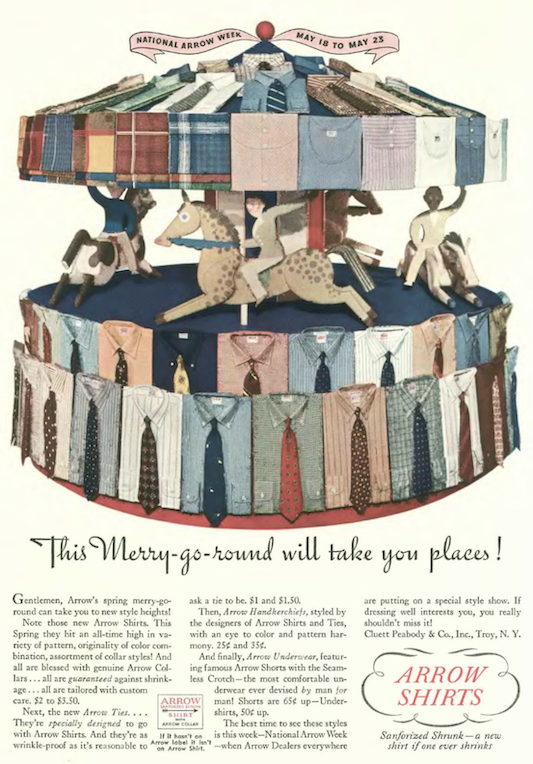
…we experience much of 1930s history in black and white, but according to this ad things were quite colorful…
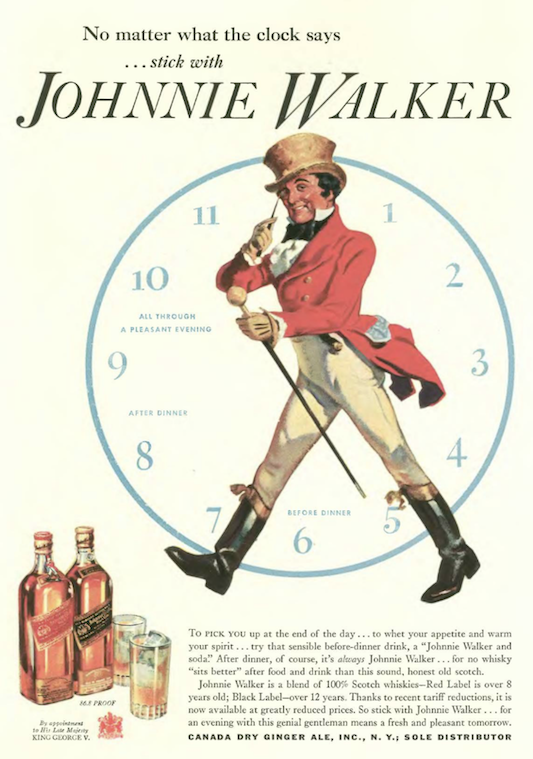
…now a couple of ads with an eye on the clock…here we have a suggestion that Johnnie Walker can be enjoyed before dinner and up to bedtime…
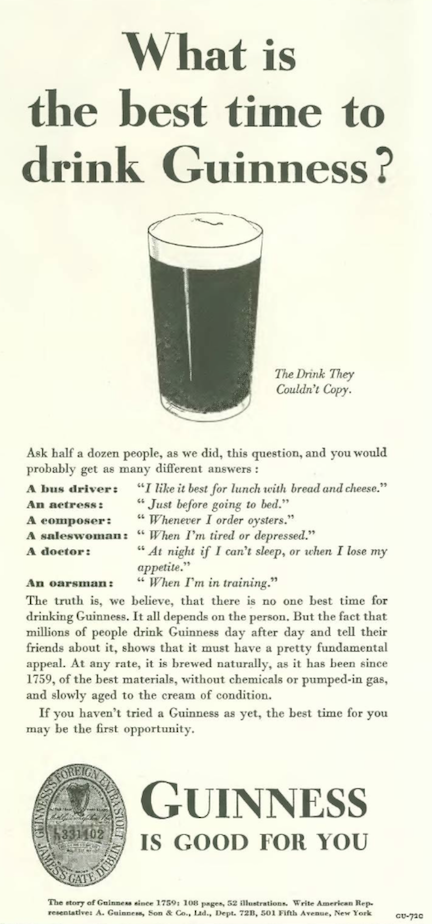
…the brewers of Guinness suggested their tipple was suitable for lunchtime, before bed, or when one is “tired or depressed”…
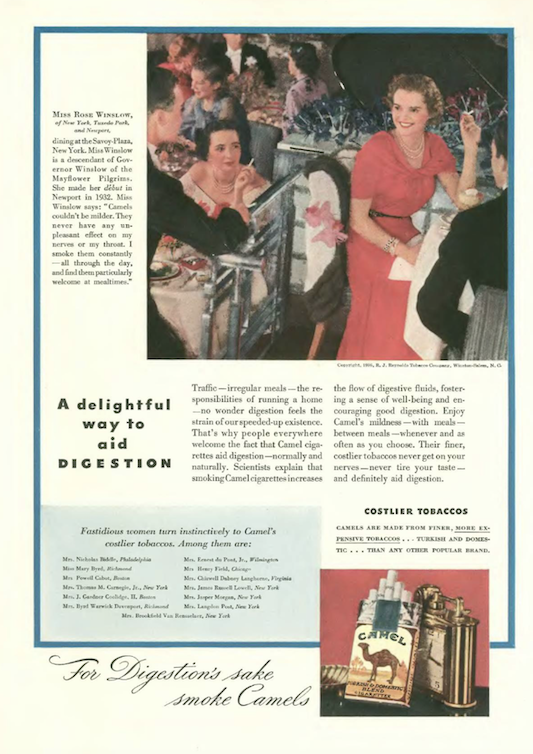
…as we already know, R.J. Reynolds encouraged folks to smoke from morning to night, with the added benefit of improved digestion…
…on to our cartoonists, we begin with a spot by Abe Birnbaum…
…and spots from frequent contributors Richard Taylor…
…and Christina Malman…
…and a spot drawing on the opening pages by James Thurber…
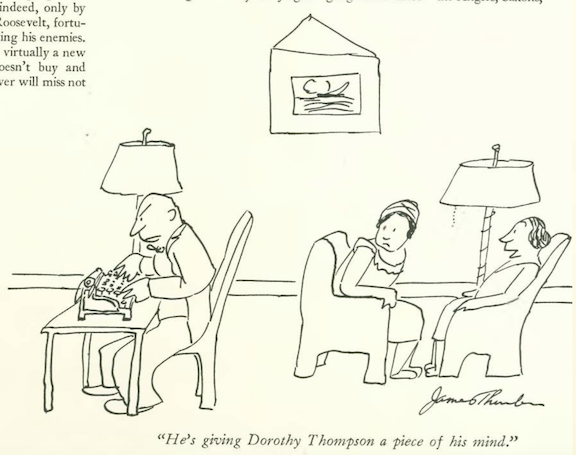
…who also contributed this cartoon to the issue…
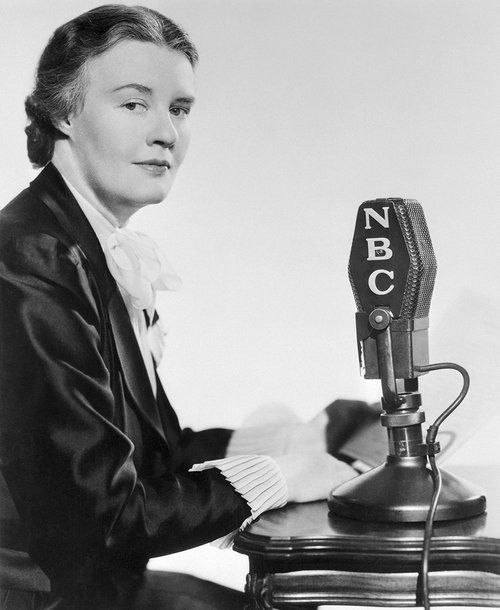
…Thurber’s caption refers to journalist and radio broadcaster Dorothy Thompson. One of the few women radio news commentators of the 1930s, she was the first American journalist to be expelled from Nazi Germany in 1934. In 1936 Thompson launched her “On the Record” column, syndicated nationwide by the New York Herald Tribune…
Dorothy Thompson in 1937. (Wikipedia)
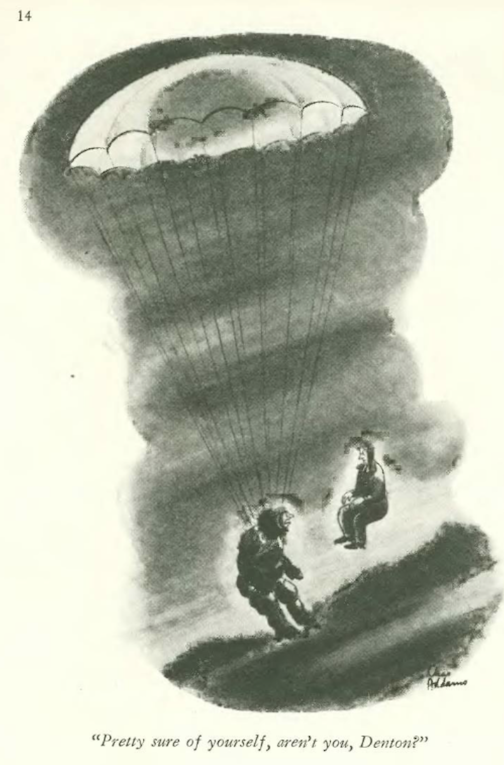
…we continue our cartoons with Charles Addams (apologies for the quality) floating to earth…
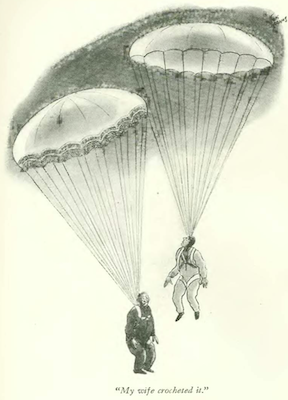
…which recalled another Addams cartoon from the Aug 3, 1935 issue (caption reads “My wife crocheted it.”)…
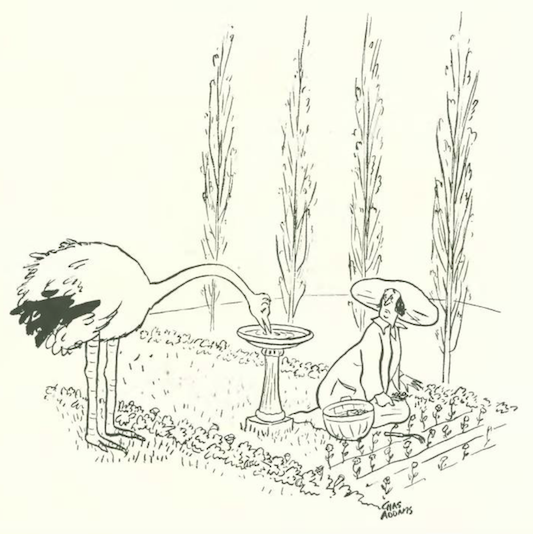
…and Addams again, this time down to earth…
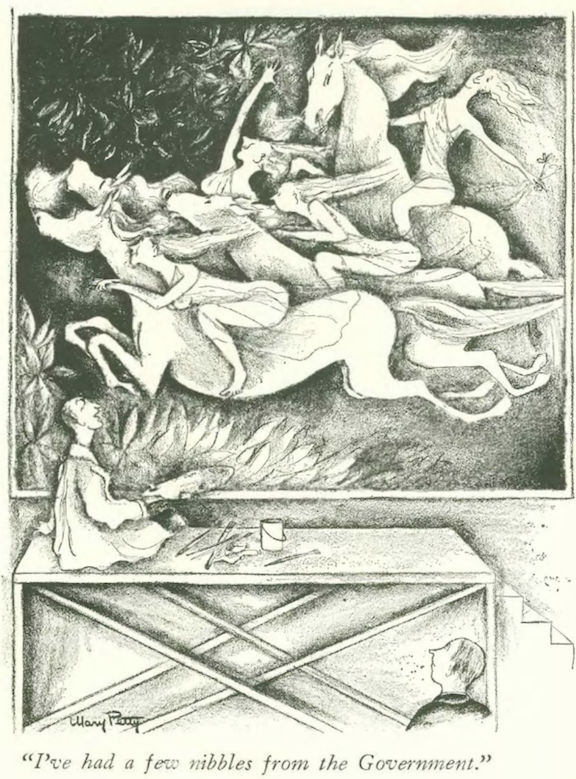
…Mary Petty looked in on the art world…
…William Crawford Galbraith continued to explore lives and loves of sugar daddies…
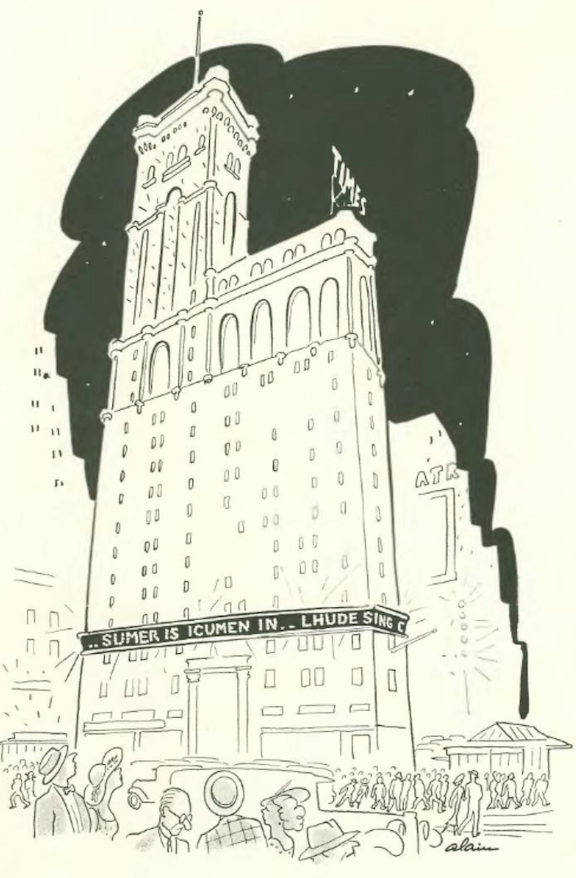
…Alain had folks deciphering the news crawler at Times Square…
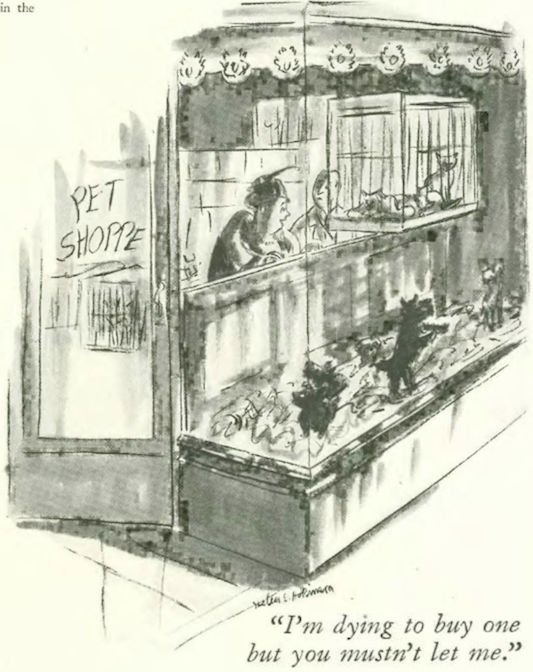
…Helen Hokinson avoided temptation at the pet shop…
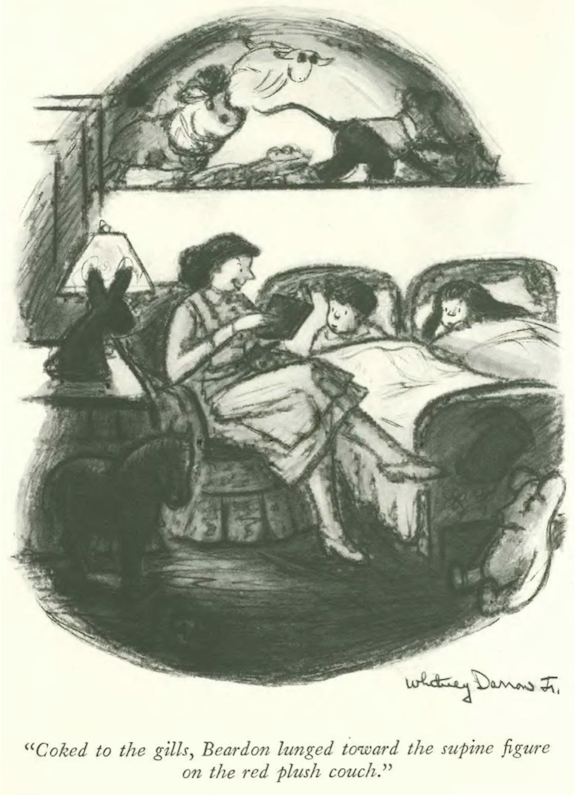
…and we close with Whitney Darrow Jr, and a bedtime story that would keep the sandman at bay…
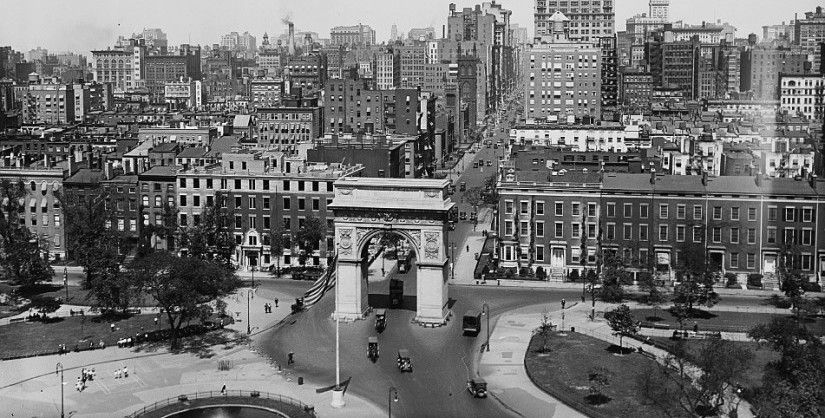
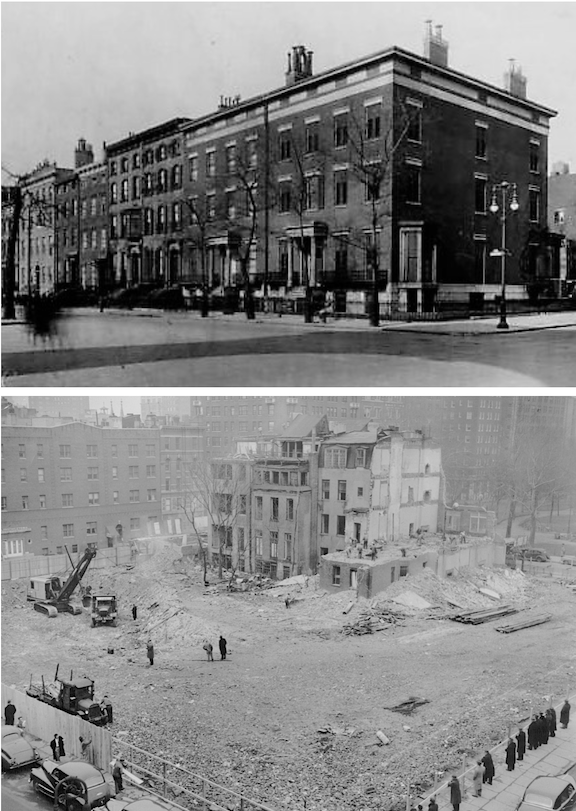
Above: Washington Square North circa 1930. (nypap.org)
In the first decades of the 20th century very few buildings in New York City were considered sacred, especially during the building boom of the Twenties when large swaths of the old city were erased to make way for massive skyscrapers and more than 740,000 new housing units.
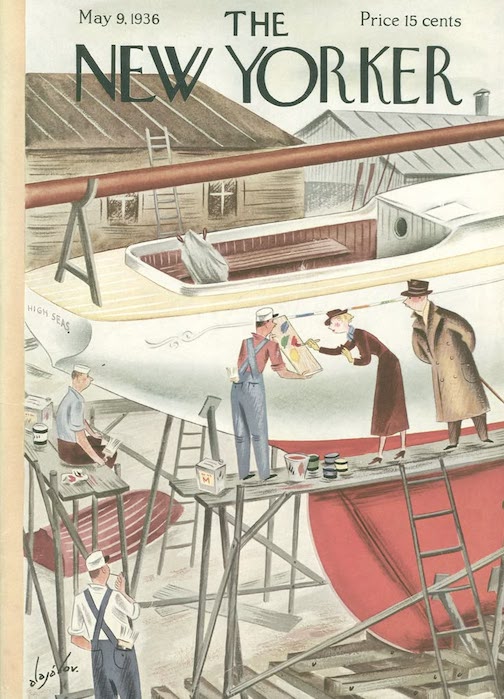
May 9, 1936 cover by Constantin Alajalov.
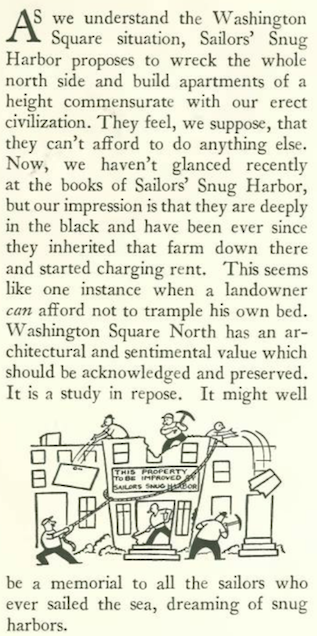
To keep anything historic from the wrecking ball required constant vigilance as well as political savvy. Such was the case at Washington Square, where in response to a 27-story building erected at 1 Fifth Avenue a campaign was organized to create height limits around the square itself. The land for 1 Fifth Avenue was leased by Sailors’ Snug Harbor—a foundation dedicated to assisting retired mariners and one of the largest owners of land in Greenwich Village. The threat to Washington Square became even greater in 1936 when the same foundation announced plans to demolish several of the structures facing the north side of Washington Square, known as “The Row.” In his “Notes and Comment,” E.B.White explained:
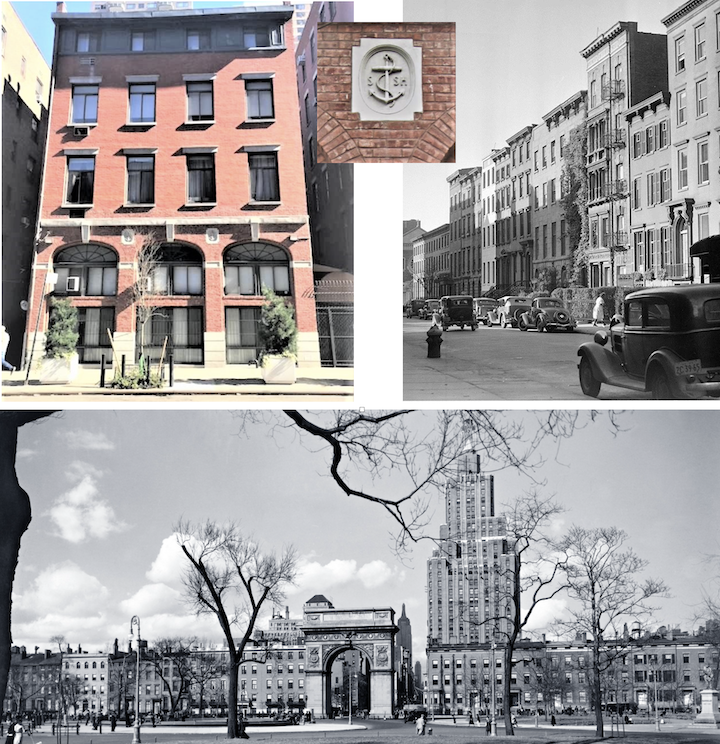
INTERLOPER…The Sailors’ Snug Harbor Foundation had already altered the scale of Washington Square with the erection of 1 Fifth Avenue (1926-27), seen to the right of the arch in the bottom photo (by Berenice Abbott, 1936); above left, facade of Sailors’ Snug Harbor Foundation building as it appears today (inset: the foundation’s monogram set within the spandrels of the arched windows); top right, looking west down Washington Square North, 1937. (daytoninmanhattan.blogspot.com/geographicguide.com)
Fortunately the demolition did not proceed, with Sailors’ Snug Harbor deciding to retain the character of “The Row”—numbers 1-13 Washington Square North. Not so fortunate were the adjacent Rhinelander Houses that were demolished in the mid-1940s, and “Genius Row” on Washington Square South, which was demolished in 1948 to make room for the NYU Law Center.
NOT SO FORTUNATE…The Rhinelander Houses at Washington Square North (top photo, from 1922) were demolished in 1951 to make way for an apartment house; photo below, the “Genius Row” on Washington Square South was demolished in 1948 to make room for the NYU Law Center. Occupants of Genius Row included writers Stephen Crane, O. Henry, and Willa Cather.(nypl.org/Village Preservation–GVSHP)
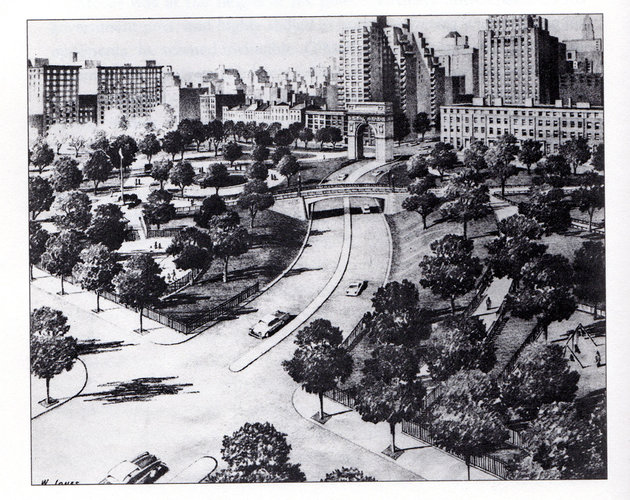
Beginning in the 1940s, Parks Commissioner Robert Moses would try many times to ram a highway through Washington Square Park, including a proposal in the early 1950s (below) that would bisect the park with a 48-foot-wide highway connecting Fifth Avenue to West Broadway.
PAVING PARADISE…Opposition was so great to Robert Moses’s Washington Square proposals that he finally abandoned plans for a highway through the park. (MTA Archives)
* * *
Farewell Artie
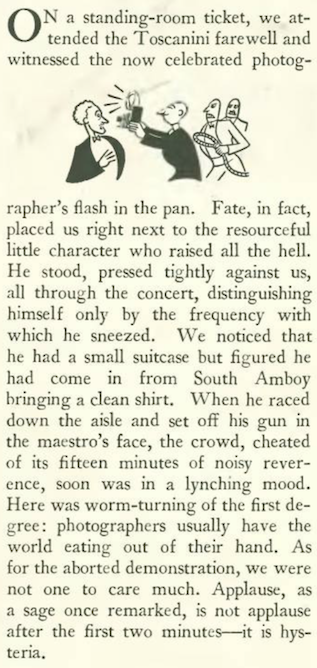
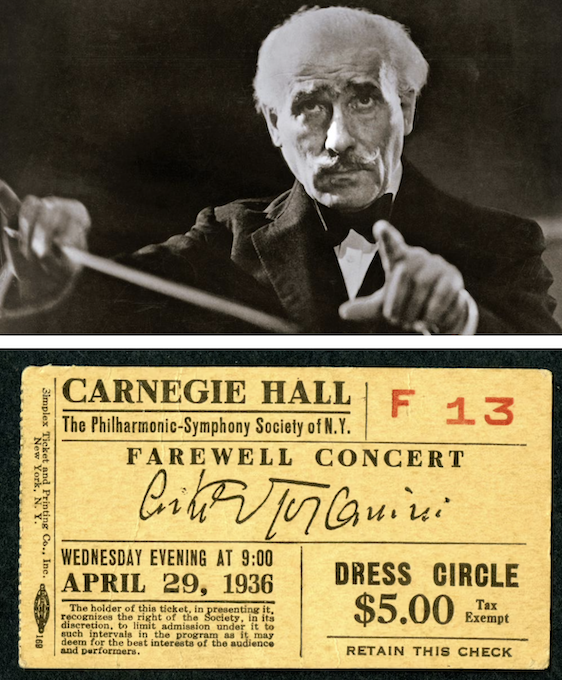
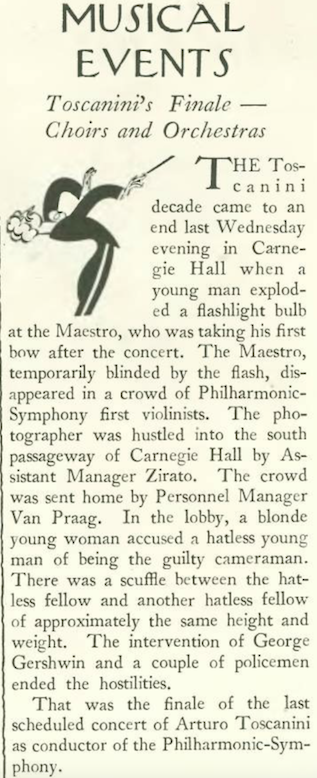
Legendary conductor Arturo Toscanini (1867–1957) transformed the New York Philharmonic into a world-class ensemble during his stint as music director from 1928 to 1936. Unfortunately, his stellar career with the Philharmonic ended rather ignominiously: When the Maestro turned to take a bow at the conclusion of his Carnegie Hall farewell concert, a young photographer exploded a flash bulb directly in his face, causing the great conductor to flee the stage. E.B. White was there to take it all in:
I SAW THE LIGHT…a photographer’s flash temporarily blinded legendary conductor Arturo Toscanini (top) following his farewell concert at Carnegie Hall. Below, a ticket stub from the historic evening. Five bucks seems like a bargain, but it is roughly equivalent to nearly $120 today. (wfimc.org/carnegiehall.org)
The New Yorker’s music critic Robert A. Simon also shared some thoughts on the evening, which included a scuffle between a “hatless fellow” and another fellow (also hatless) that followed the photographer incident:
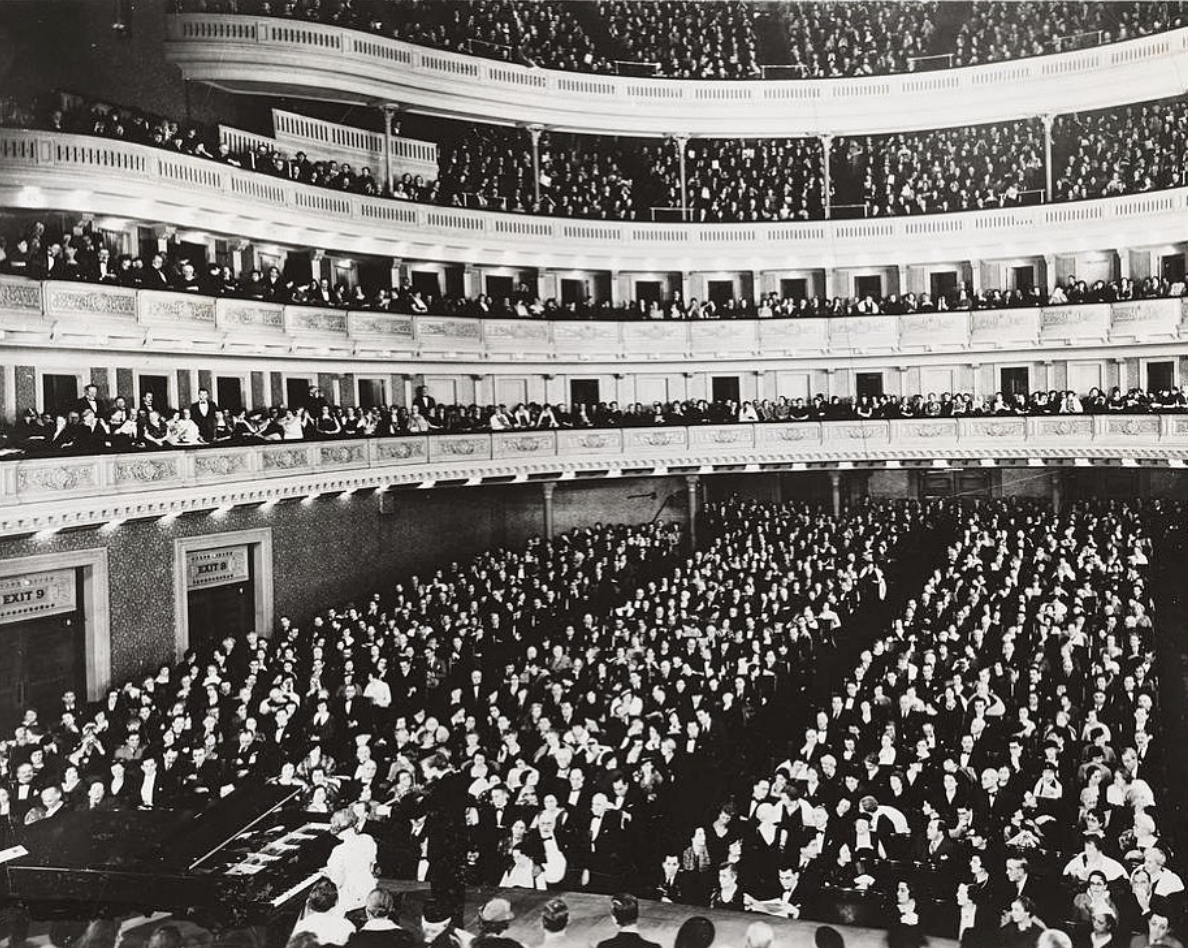
PLEASE BEHAVE…A view from the Carnegie Hall stage in 1930. Following Arturo Toscanini’s farewell concert in 1936, a scuffle broke out in the lobby, the result of a row over the temporary blinding of the Maestro by a photographer’s flash bulb. (nypap.org)
* * *
Lah-Dee-Dy
“The Talk of the Town” looked into the fuss over the toy industry’s first practical “drink-and-wet” baby doll, Effanbee’s Dy-Dee doll. Marketed as “The Almost Human Doll”, the “Talk” correspondents (Helen and Charles Cooke) found a demonstration at Macy’s a bit too real (included with this excerpt is spot art by Abe Birnbaum).
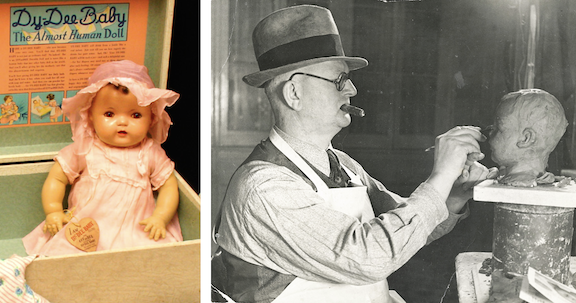
UNCANNY…The Effanbee Doll Company marketed their “Almost Human” Dy-Dee doll as the first workable “drink-and-wet” baby doll. The doll was designed by German-born Bernard Lipfert (1886–1974), who sculpted dolls for prominent American toy manufacturers from the 1920s to the 1960s, including the famous Patsy and Shirley Temple dolls. (collectornet.net/Linda Lipfert White via catskilldolls.com)
* * *
At the Movies
Many film critics in the 1930s, including The New Yorker’sJohn Mosher, admired the Soviet film industry for its cinematic innovations and often brutal realism, even if deployed as propaganda. Such was the case with We Are From Kronstadt, which depicted heroic Red sailors defending the city of Petrograd from counterrevolutionary forces. “It’s a film to be respected,” Mosher wrote.
NO BLONDES, JUST BOMBSHELLS…Clockwise from top left: Russian poster for We Are From Kronstadt; actor Georgi Bushuyev; battle scene from the film; actress Raisa Yesipova. (Wikipedia/imdb.com)
Mosher also reviewed the lighter fare coming out of Hollywood, including two films featuring the actress Joan Bennett.
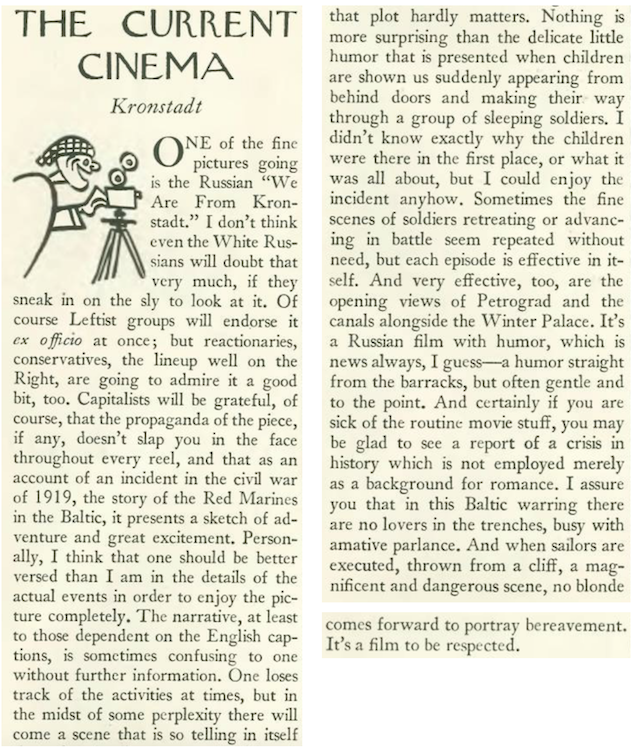
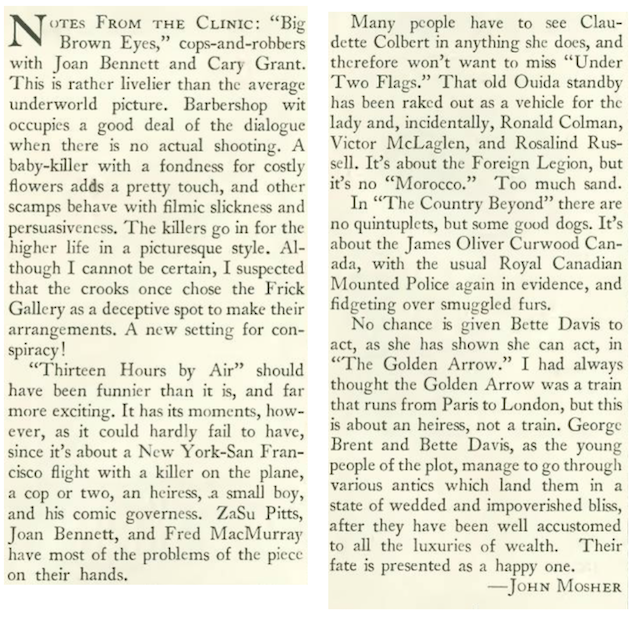
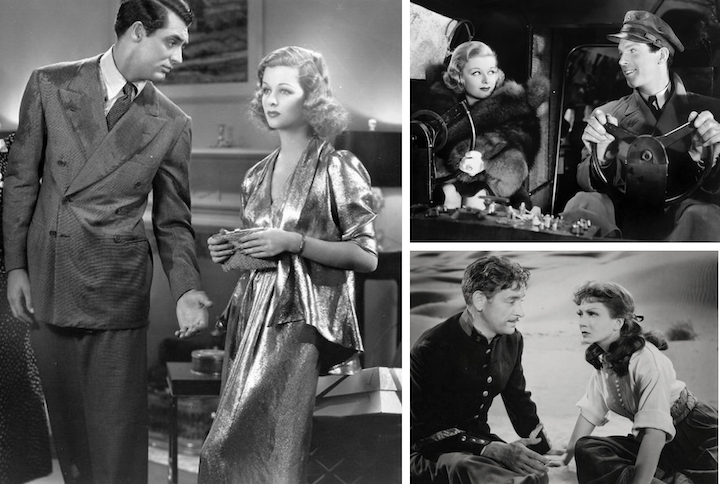
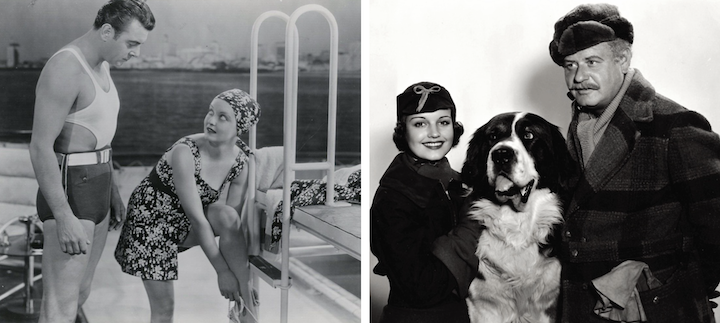
SEEING DOUBLE…Joan Bennett shared top billing in two new releases—with Cary Grant in Big Brown Eyes (left); and with Fred MacMurray in 13 Hours by Air (top right); Claudette Colbert was paired with Ronald Colman in Under Two Flags (below). (csfd.cz/imdb.com)WET AND COLD…Bette Davis and George Brent went through the motions in The Golden Arrow (left); at right, Rochelle Hudson and Alan Hale braved the wilds of Canada in The Country Beyond. Hale was the father of Alan Hale Jr., who was also a film actor but is best known today for playing the Skipper on TV’s Gilligan’s Island. (pinterest.com/20th Century Fox)
* * *
Swing Time
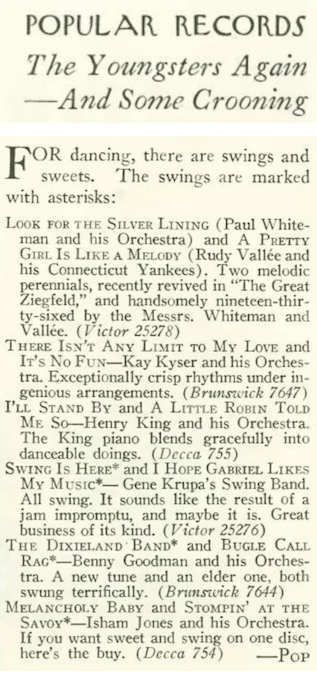
Ninety years ago America’s youth primarily listened to (and danced to) swing music and big band jazz. The New Yorker kept readers up to date on the latest hits.
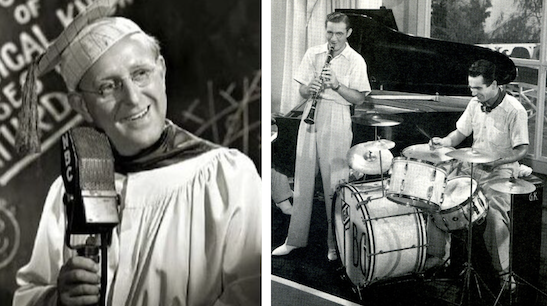
RHYTHM SECTION…”The Ol’ Perfessor” Kay Kyser’s band (the “Kollege of Musical Knowledge”) kept the kids in rhythm in the 1930s; at right, Benny Goodman (left) and Gene Krupa both released records with some new “swings.” (jimramsburg.com/grampsblog.wordpress.com)
* * *
From Our Advertisers
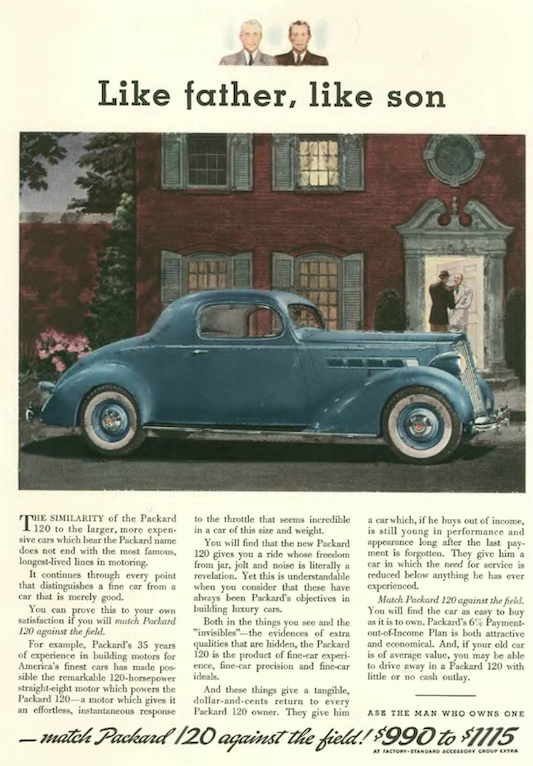
The makers of Packard automobiles were big into the idea of continuity, emphasizing the quality and longevity of their product over gimmicky style changes…
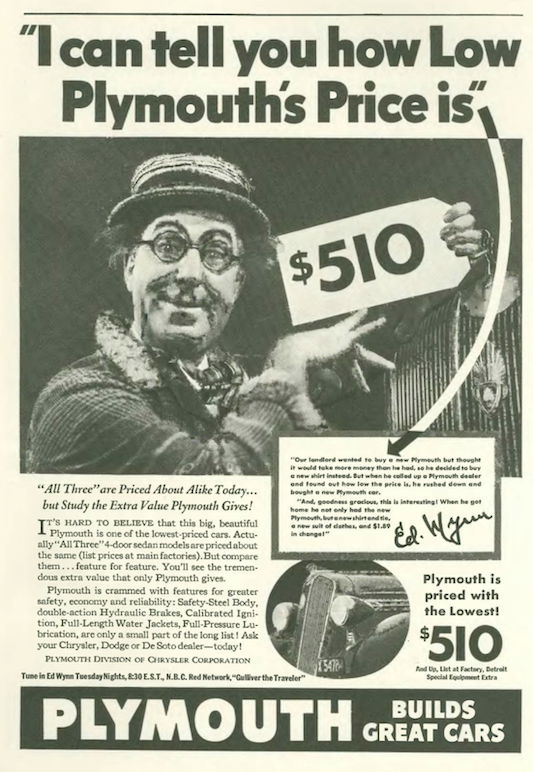
…in the mid-1930s (and especially in 1936) Chrysler employed the comedic talents of Ed Wynn to sell its low-priced Plymouths…
…the makers of Fisher car bodies (a division of General Motors) continued their campaign of two-page ads pairing cute kids with their “Turret Top” safety feature…
…canned beer was a recent innovation in 1936, with New York breweries leading the way (Krueger Brewing Company was first, its canned beer officially debuting in January 1935)…
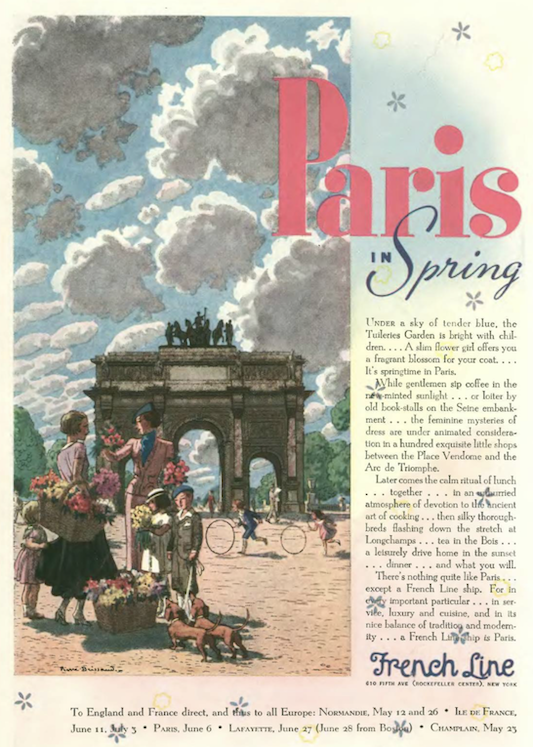
…the French Line enticed New Yorkers to see Paris in the springtime…
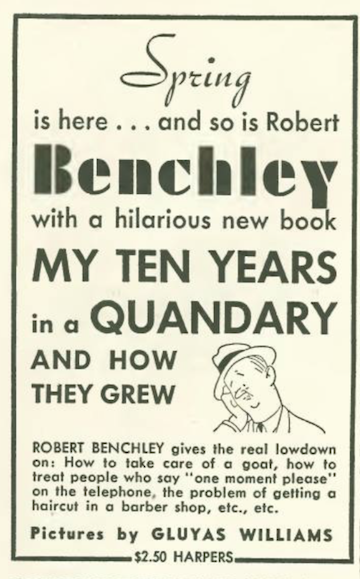
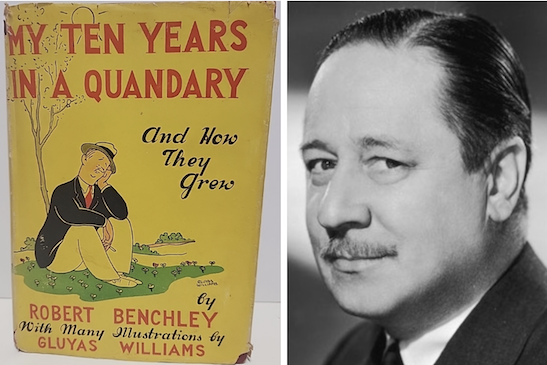
…Harper’s ran this ad on the top left corner of page 95 to promote Robert Benchley’sMy Ten Years in a Quandary…and How They Grew, illustrated by Benchley’s New Yorker colleague Gluyas Williams…
BENCHLEY IN A BIND…Robert Benchley and the cover of My Ten Years in a Quandary…and How They Grew. (ebay.com/ebooktakeaway.com)
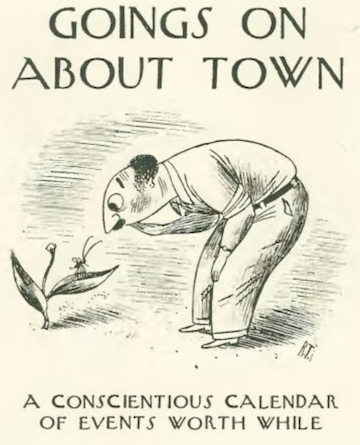
…on to our cartoonists, we begin with Richard Taylor in the calendar section…
…and a nice bit of spot art by Christina Malman…
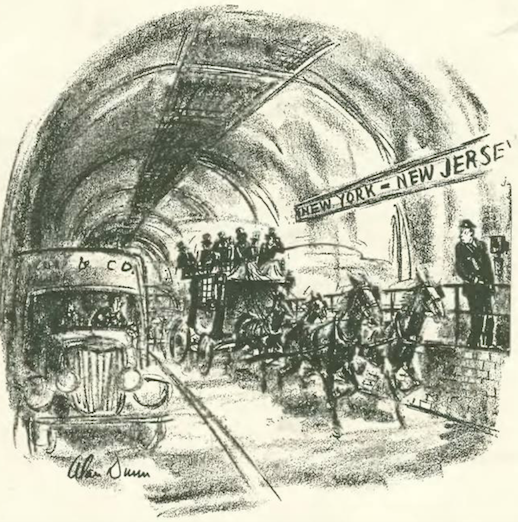
…Alan Dunn revealed a time tunnel under the Hudson…
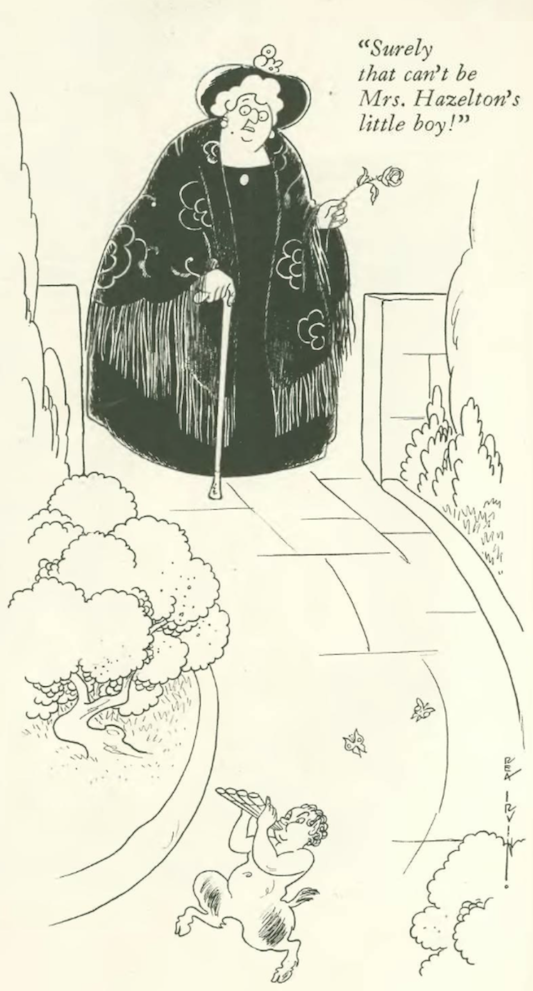
…Rea Irvin drew up an odd sight along a garden path…
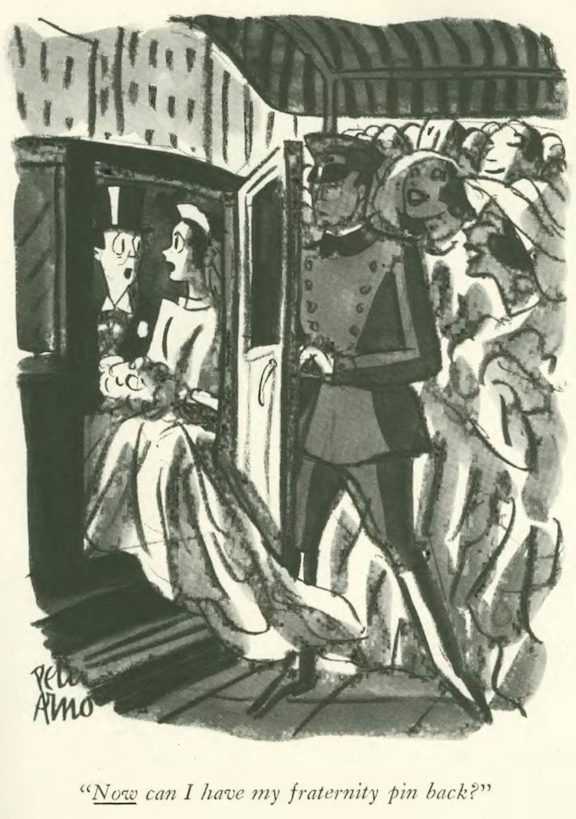
…this honeymoon was over before it even started, per Peter Arno…
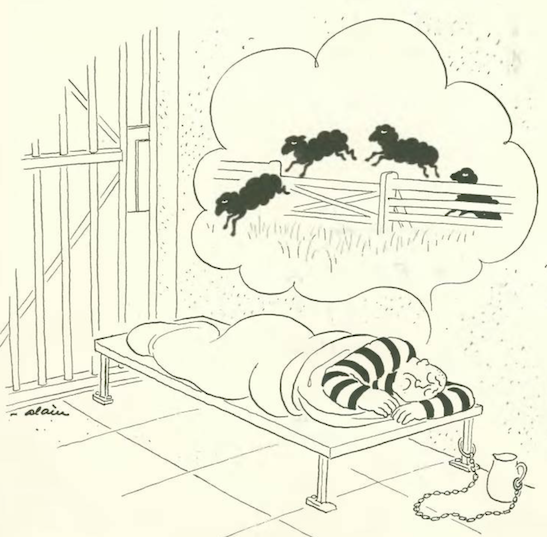
…Alain showed us the troubled dreams of a jailbird…
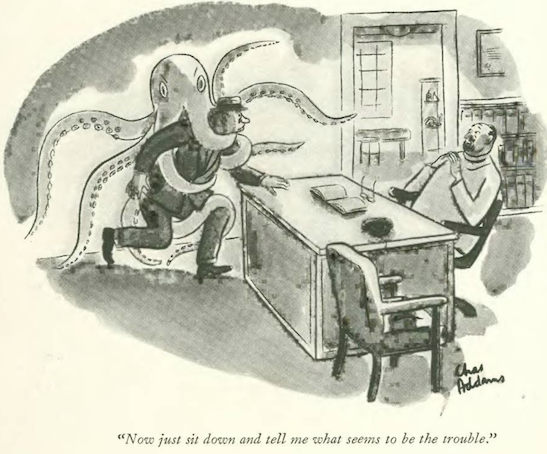
…Charles Addams at his best, taking the daily horrors in stride…
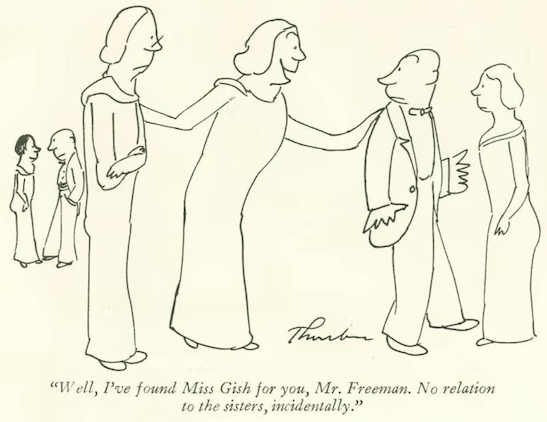
…James Thurber gave us a Gish, but not of silent movie fame…
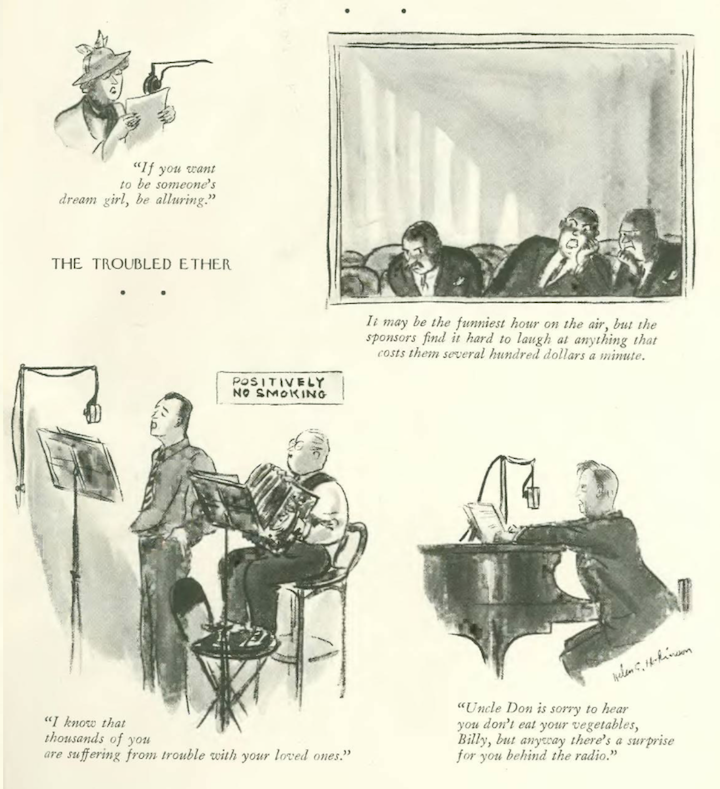
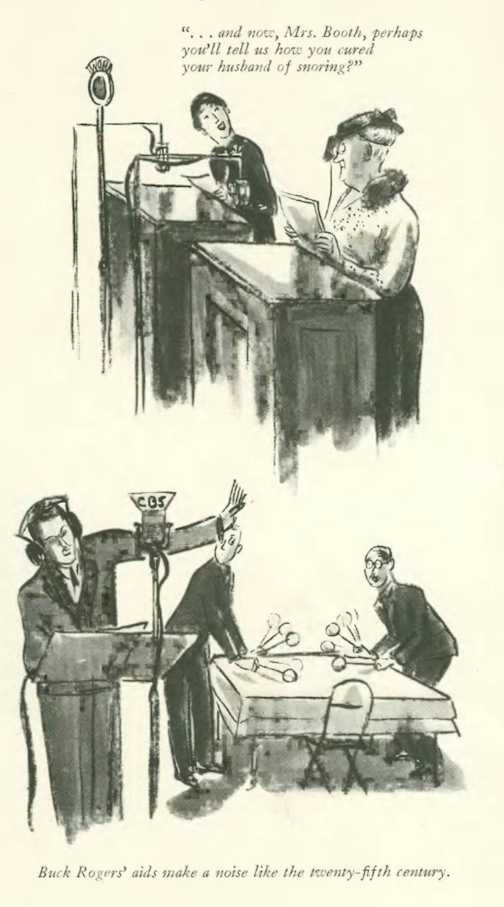
…Helen Hokinson illustrated a day at the radio station across pages 22-23…
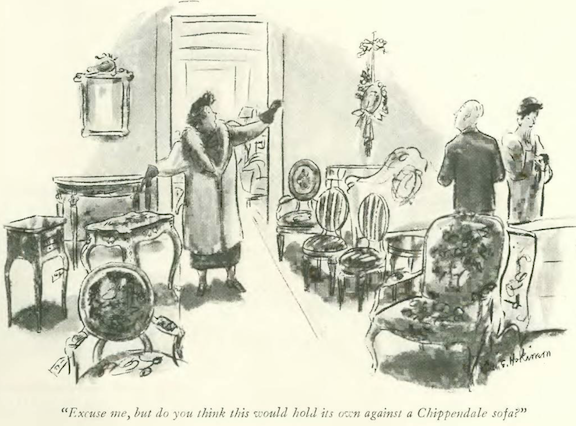
…Hokinson again, weighing the competition between a sofa and table…
…and we close with Kemp Starrett, and a helpful husband…
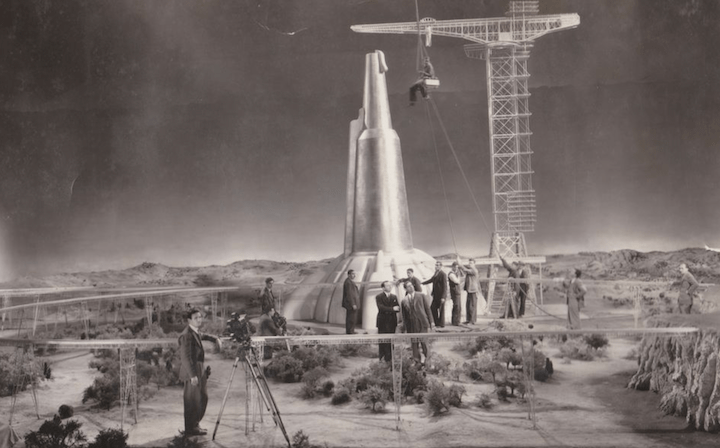
Above: Behind the scenes production photo of the space gun used to launch a manned projectile to the moon in Things to Come. (Instagram)
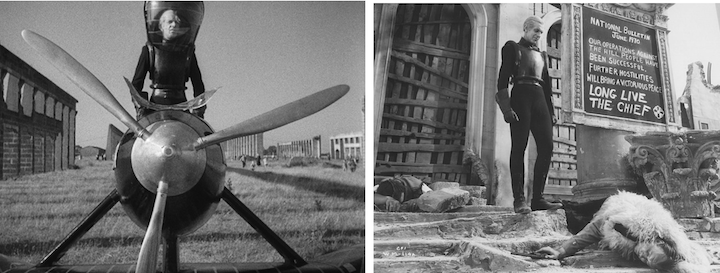
One of the most anticipated films of the 1930s was the British production of Things to Come. Loosely based on the 1933 science fiction novel by H.G. Wells,The Shape of Things to Come, the film was an extraordinarily ambitious and expensive production featuring a huge cast and elaborate sets, both full-scale and in miniature.
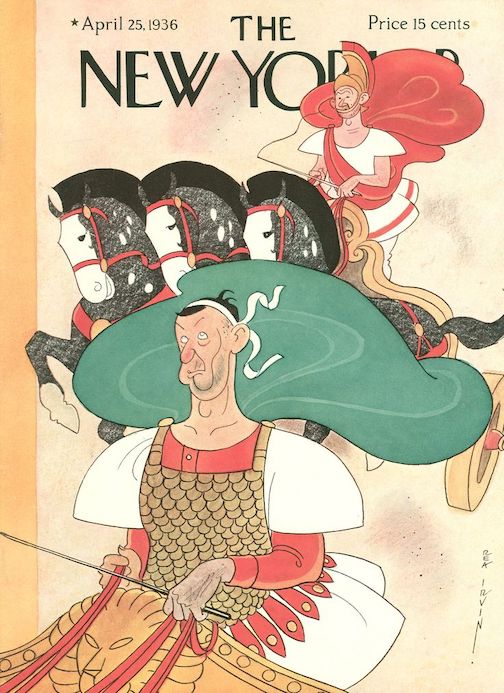
April 25, 1936 cover by Rea Irvin.
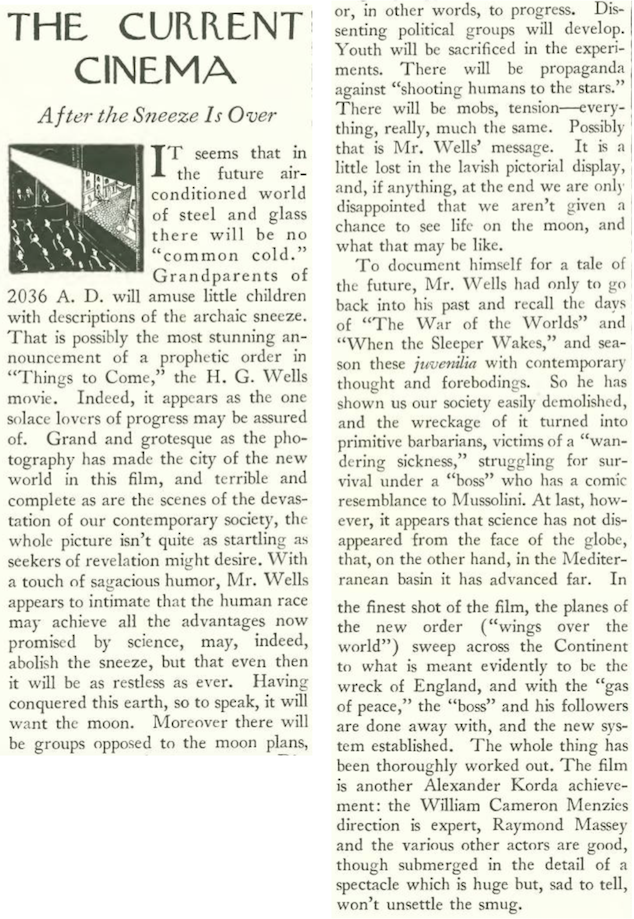
Critic John Mosher wasn’t quite sure what to make of Things to Come, seizing on the film’s promise to end the common cold.
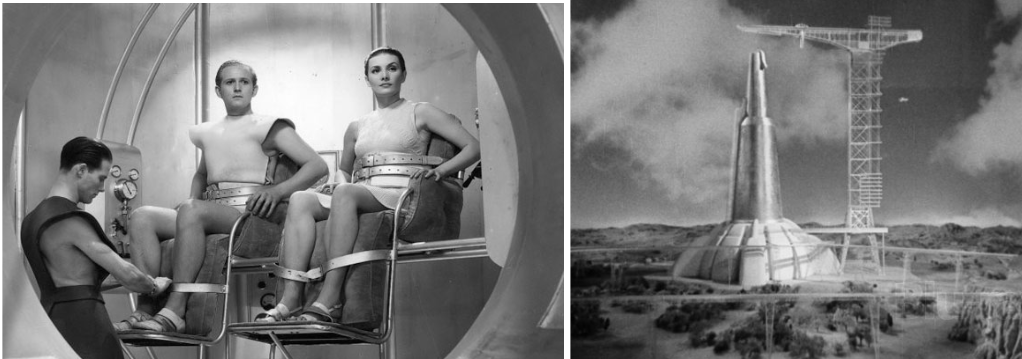
CLEANING CREW…A businessman in Everytown in the 1940s, John Cabal (Raymond Massey) returns in the 1970s to find his city in ruin and governed by a warlord. As a member of a secret organization called “Wings Over the World” (comprised of the last surviving band of engineers and mechanics), Cabal orders his organization to send giant flying wings over Everytown and saturate the population with a “Gas of Peace.” Not only does the gas make the population tranquil, it also kills the warlord, played by Ralph Richardson (right). (midnightonly.com/instagram.com)
In a review for The Criterion Collection, Geoffrey O’Brien notes that the film’s shocking scenes of war were shown to an audience “in active denial, many of them, of the possibility of such things coming to pass in the near future.”
But an antiseptic city with a population made docile by a “Gas of Peace” didn’t appear to be something one would look forward to either. O’Brien points to Jorge Luis Borges’ remarks regarding Things to Come: “The heaven of Wells and Alexander Korda, like that of so many other eschatologists and set designers, is not much different than their hell, though even less charming.” Borges dismissed the notion that science and technology would be the rallying force against tyranny: “In 1936, the power of almost all tyrants arises from their control of technology.”
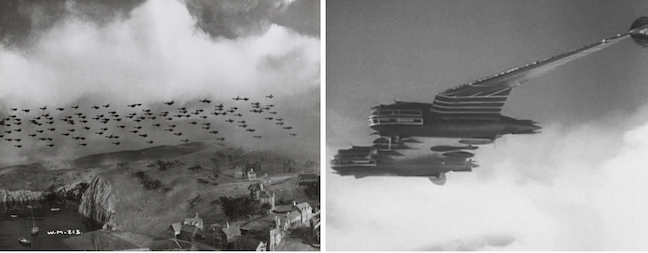
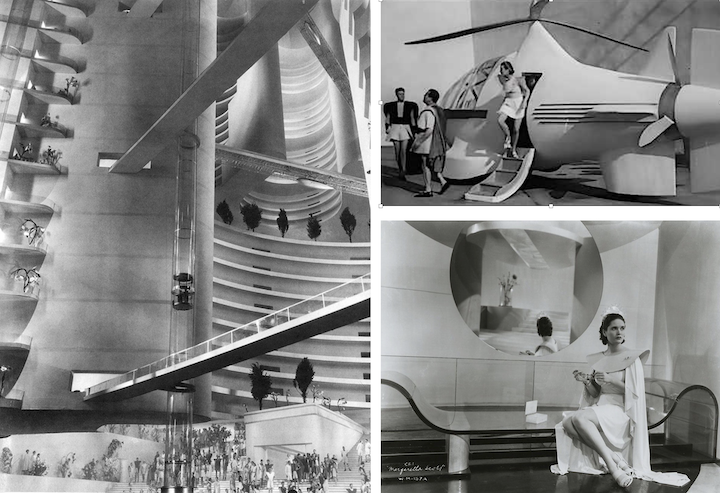
WAR AND PEACE…At left, bombers lay waste to Everytown in the 1940s, seemingly forecasting The Blitz of London in 1940-41; at right, decades later, “Wings Over the World” sends giant flying wings (right) over Everytown to saturate the population with a “Gas of Peace.” (Illinois.edu/facebook.com)UTOPIA?…After years of rebuilding, a new, underground Everytown emerges in 2036. The set (left) was designed by director William Cameron Menzies and Bauhaus artist Laszlo Moholy-Nagy. Above, transportation included autogyros; both men and women wore futuristic togas, including John Cabal’s great-granddaughter Catherine Cabal (Pearl Argyle). Note the acrylic furniture, ubiquitous in the future scenes of the film. (midnightonly.com/facebook.com/YouTube)
O’Brien concludes: “There is no way any audience, in the 1930s or now, would be likely to accept Raymond Massey’s Oswald Cabal as an empathetic spokesperson for the human race. He is essentially the chairman of the board of a quasi-fascist ruling elite—and not so very far from the idea that Wells, at best ambivalent about democracy, in fact had in mind.”
In all fairness, I should note that Massey did not like his character’s “heavy-handed speeches” that lacked human emotion. He complained H.G. Wells prioritized cold scientific ideals over personal character depth. “For heart interest, Mr. Wells hands you an electric switch,” Massey stated.
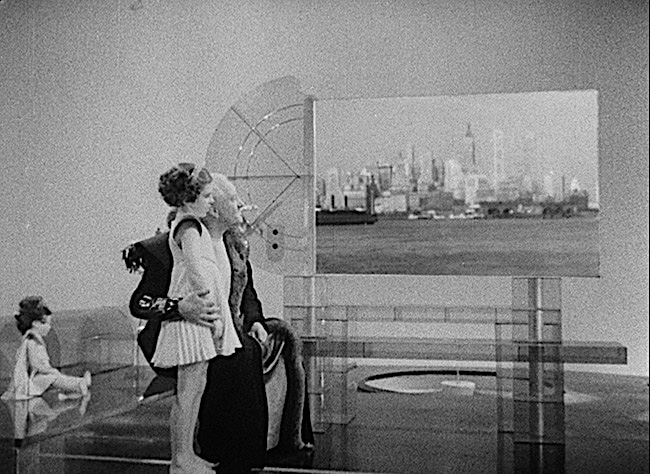
WISHES SOMETIMES COME TRUE…In the movie, a little girl in the year 2036 receives a history lesson from her great grandfather (including a video of 1936 New York), and she expresses delight that people will “keep on inventing things and making life lovelier and lovelier.” The little girl was played by eight-year-old Anne McLaren. The great grandfather was played by Charles Carson (1885–1977). (midnightonly.com)DAME McLAREN…In real life that little girl, Anne McLaren (1927–2007), did make life better, becoming a leading figure in developmental biology and paving the way for other women in science. Her work also helped lead to the development of human invitrofertilization. Dame Anne Laura Dorinthea McLaren received many honors for her research and ethical contributions. (YouTube.com/Wikipedia)POW! TO THE MOON…At left, Catherine Cabal (Pearl Argyle) and fellow scientist Maurice Passworthy (Kenneth Villiers) prepare to fly around the moon, launched from a gigantic space gun (right). (theguardian.com/YouTube)
Interestingly, Raymond Massey (1896–1983) and most of the film’s cast would live to see an actual moon landing in just 33 years. Most of them would also be involved in some way in the Second World War, Massey being wounded as part of the Canadian regiment.
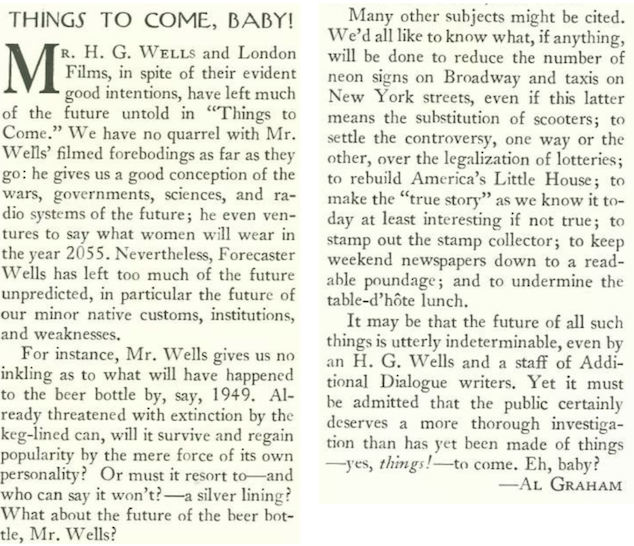
American writer and editor Al Graham (1905–1972), who contributed a number of poems and “Talk of the Town” pieces to The New Yorker in the Thirties and Forties, offered some thoughts regarding Things to Come. Here are excerpts of the first and last parts of his piece:
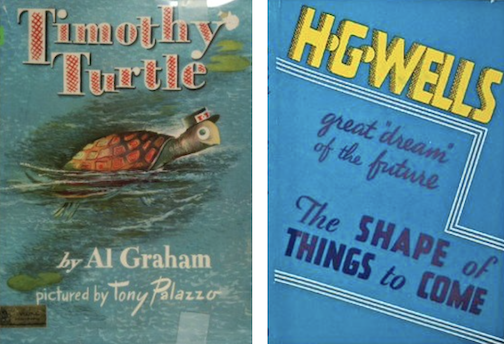
SLOW AND STEADY…Al Graham is perhaps best known for his 1930s humorous verse and children’s literature such as Timothy Turtle (1946) and The Rhymes of Squire O’Squirrel (1963). At right is a cover of the first edition of H.G. Wells’The Shape of Things to Come. (Wikipedia)
Incidentally, the British automaker Triumph used Wells’ title in a 1970s ad campaign for the TR-7…
(The Daily Drive)
While we are talking movies, Mosher also reviewed Frank Capra’sMr. Deeds Goes to Town. Films such as Mr. Deeds and It’s a Wonderful Life were Capra’s “love letters to an idealized America—a cinematic landscape of his own invention,” wrote social critic Morris Dickstein. Or as actor/director John Cassavetes once observed: “Maybe there really wasn’t an America, it was only Frank Capra.” Whatever it was, Mr. Deeds would win Capra his second Oscar for Best Director (he would win three in all, plus a fourth for a World War II documentary).
HAPPY ENDING…Mr. Deeds (Gary Cooper) finds love and salvation with Jean Arthur in Mr. Deeds Goes to Town. (britannica.com)
* * *
Ah-Choo!
Those familiar with E.B. White’s writings are likely also familiar with his lifelong struggle with hay fever, or “catarrh” as it was also referred to in those days. White notably wrote about his condition in a 1938 New Yorker essay, “Daniel Webster, the Hay Fever, and Me.” He addresses the malady in his April 25, 1936 “Notes and Comment” column:
SNEEZING AND HONKING…Despite his allergies, E.B. White had a deep love for the countryside and nature. Although he grew up just outside New York City, he cultivated a love of rural life that was finally realized when he and wife Katharine bought a farm near Brooklin, Maine. Above is a 1974 photo (by Jill Krementz) of White at his Maine farm. (cornell.edu)
One of the more common and effective treatments for allergies in the Thirties was the benzedrine inhaler. The active ingredient was amphetamine. It was safe if inhaled, however some folks got the idea to crack open the inhaler and swallow the contents, which would induce a mind-altering effect (the amount of amphetamine in the inhaler was 250 milligrams, much greater than the five or ten milligrams in tablets prescribed for depression).
NOT SHIRLEY TEMPLE, however the marketers of the inhaler probably wanted consumers to make the connection. (mcgill.ca)
* * *
Before the Internet
What did some folks do in the evening before modern-day distractions? According to “The Talk of the Town,” at least one man and his family loved to gawk at the new Wrigley sign in Times Square.
CHEW ON THIS…The Wrigley sign spanned the block on Broadway from 44th Street to 45th Street. Designed by artist Dorothy Shepard, the display featured fish blowing bubbles and was lit by 29,608 lamps and 1,084 feet of neon tubing. It was so large that its electrical power usage was estimated to be equivalent to a small city of ten thousand people. (Wikipedia)
* * *
From Our Advertisers
White Rock continued its series of brightly illustrated ads, this most likely the work of noted illustrator John Holmgren…
…Stage magazine continued to promote its star-studded content in full-page color ads…this one featured American stage and film actress Ina Claire…
Ina Claire, center, with Osgood Perkins and Doris Dudley in End of Summer.(jacksonupperco.com)
…ah, the pleasure of an after-dinner Lucky back in the day when you could still smoke indoors…
…another ad for Green Giant Niblets featuring a rich old toff who’s just over the moon about canned corn…
…these surreal Lyse Darcy ads for Guerlain really stood out in the magazine…
…speaking of standing out, who could resist the distraction of a tabloid, especially with the Gray Lady folded in one’s lap?…Alain illustrates…
…and per James Thurber, who was immune to the charms of a woman with a heart tattooed on her hip?…
…Charles Addams showed us a man with a built-in fishing advantage…
…Gregory d’Alessio gave us an understandable marital mix-up…
…Helen Hokinson offered a dose of “meh” in the hat department…
…Garrett Price showed us the consequences of Robert Moses’s transformation of Long Island from a rural area for the rich into a suburban landscape for the hoi polloi…
…and we close with Peter Arno, who wondered what’s the fun of drinking in the tropics when you can do the same thing in Queens?…