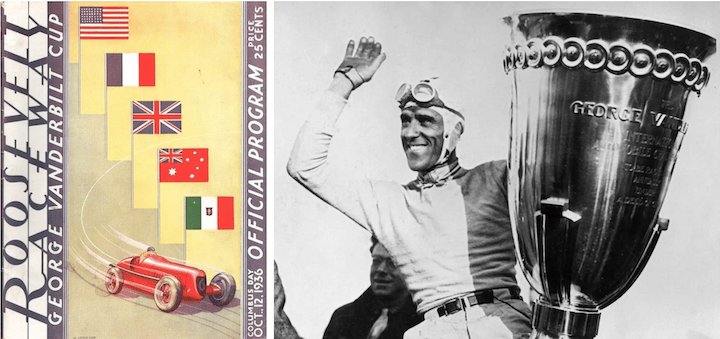
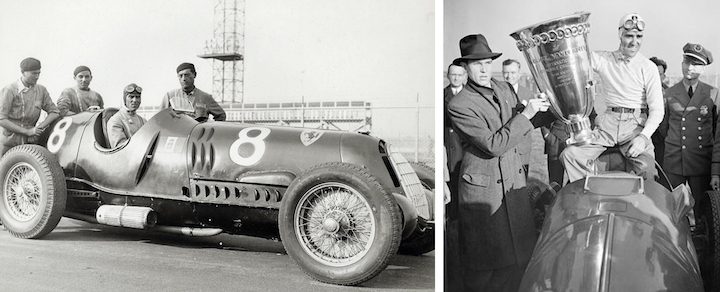
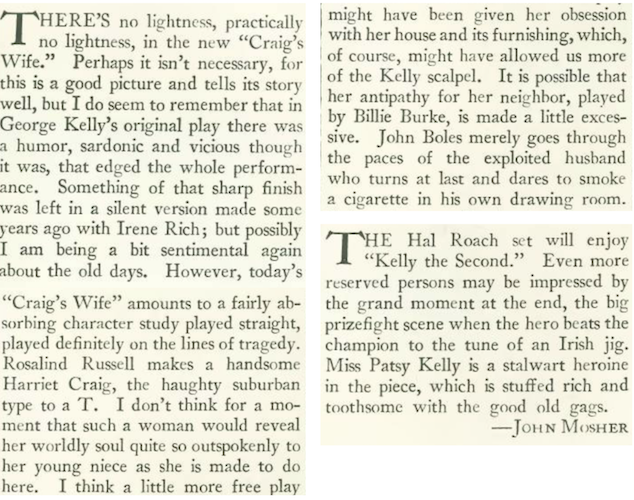
Above: 1936 Vanderbilt Cup program cover and the winner of the race, Italy's Tazio Nuvolari. (Wikipedia)
When William K. Vanderbilt II founded the Vanderbilt Cup Race in 1904, Long Island’s Nassau County was mostly farmland, its North Shore dotted with the luxurious country estates of wealthy New Yorkers. The Vanderbilt Cup would help crack open the door to the eventual suburbanization of Long Island, now home to more than eight million people.
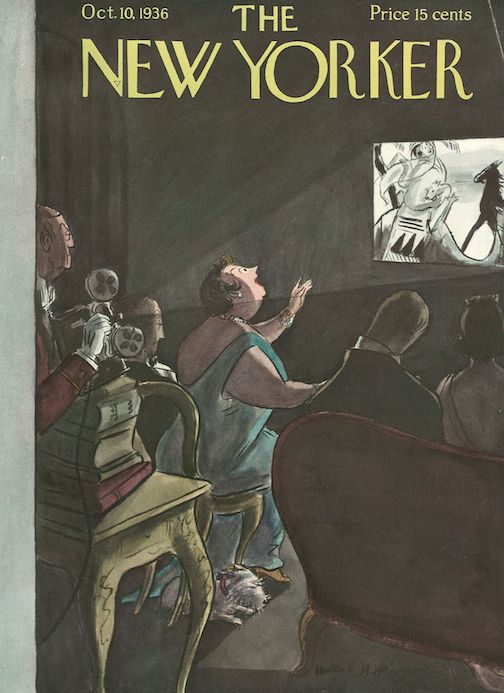
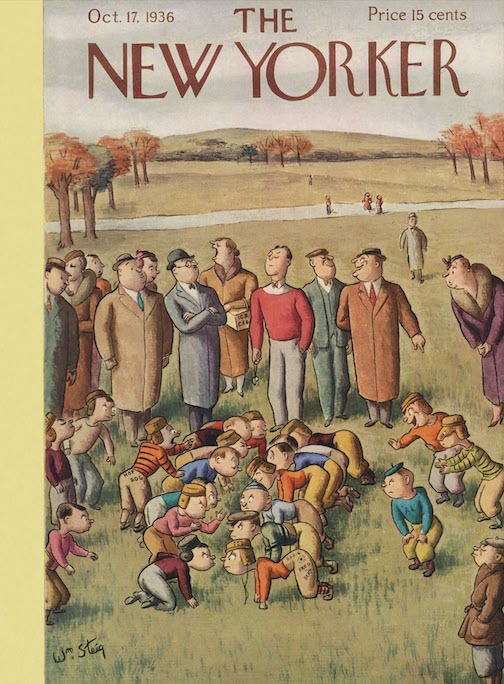
October 10, 1936 cover by Helen Hokinson.
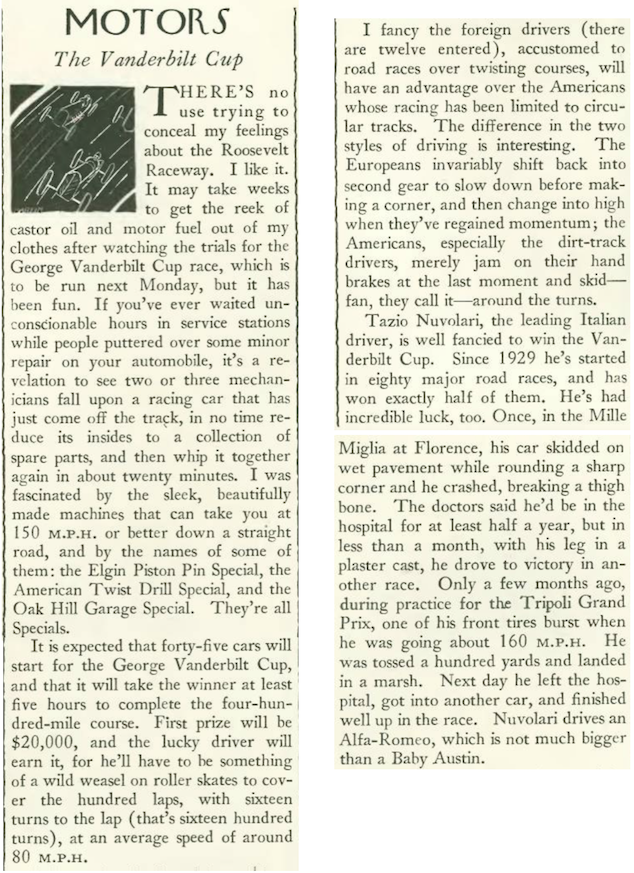
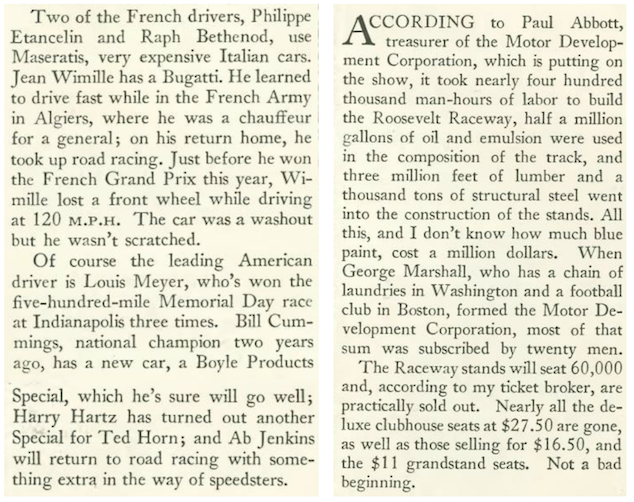
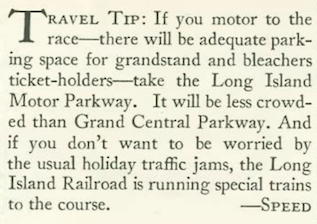
The race was cancelled after just three years—a spectator was killed in 1906— but it was revived in 1908 with the opening of the Long Island Motor Parkway. That nine-mile (14.4 km) private toll road, combined with fourteen miles (22.5 km) of public dirt roads, served as the Vanderbilt Cup course until the race was suspended in 1916 with the U.S. entry into World War I. The race would not be revived until Oct. 12, 1936, when the new Roosevelt Raceway opened in Westbury, welcoming 50,000 spectators. New Yorker correspondent G.F.T. Ryall (aka “Speed”) looked forward to the big race:
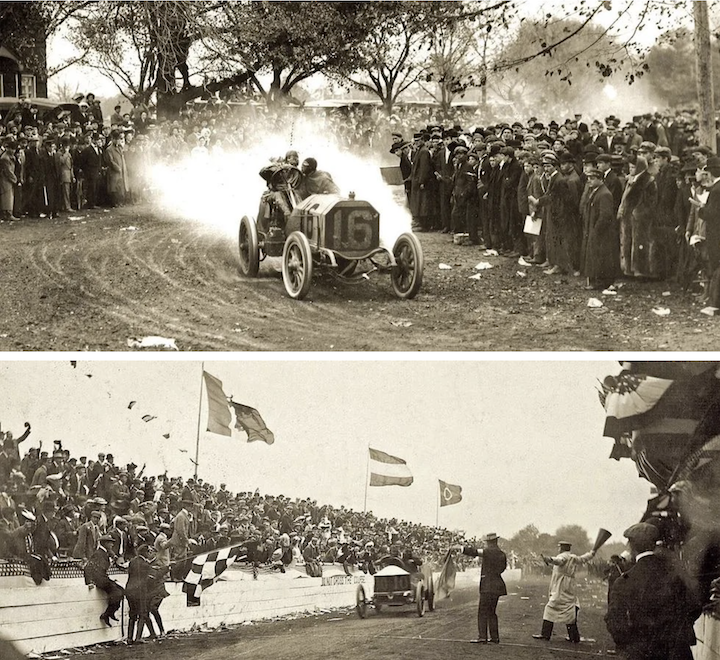
EAT MY DUST…Top photo: Averaging sixty-five miles per hour (104.6 kph), with a top speed exceeding one hundred mph (161 kph), George Robertson’s 1906 Locomobile is shown rounding a turn in the 1908 Vanderbilt Cup race—the crowd, estimated at more than 250,000—often stood dangerously close to the action (a spectator was killed in the 1906 race); Below: The 1906 finish saw the first-ever use of a checkered flag to signal the winner of an automobile race. (hemmings.com)
The 1936 race was revived by William K’s nephew George Washington Vanderbilt III, NFL founder George Preston Marshall, and famed World War I flying ace Eddie Rickenbacker. The three hundred-mile (482.8 km) race, featuring seventy-five laps on a twisting, four-mile (6.4. km) circuit, was won by Italy’s Tazio Nuvolari driving a twelve-cylinder Alfa Romeo. The best American driver, William Cummings, finished almost twenty-five minutes behind Nuvolari.
STEERING COMMITTEE…At left, 1936 Vanderbilt Cup winner Tazio Nuvolari and his mechanics prior to the race—his average speed was similar to the winner of the 1908 race due to the twisty, maze-like design of Roosevelt Raceway; at right, George Washington Vanderbilt III presents the winning trophy to Nuvolari. The massive sterling silver cup, crafted by Cartier, is now housed at the Museo Nicolis in Verona, Italy. (vanderbiltcupraces.com)
Ryall noted that the leading American driver was Louis Meyer, but Meyer would not compete due to a crash on a practice run. Also noted was the labor and materials involved in the construction of Roosevelt Raceway, where the winning average speed (65.998 mph or 106.2 km/h), was nearly the same as the 1908 race. This lack of speed was later mocked by spectators and the press, who criticized the many twisty hair-pin turns on the course.
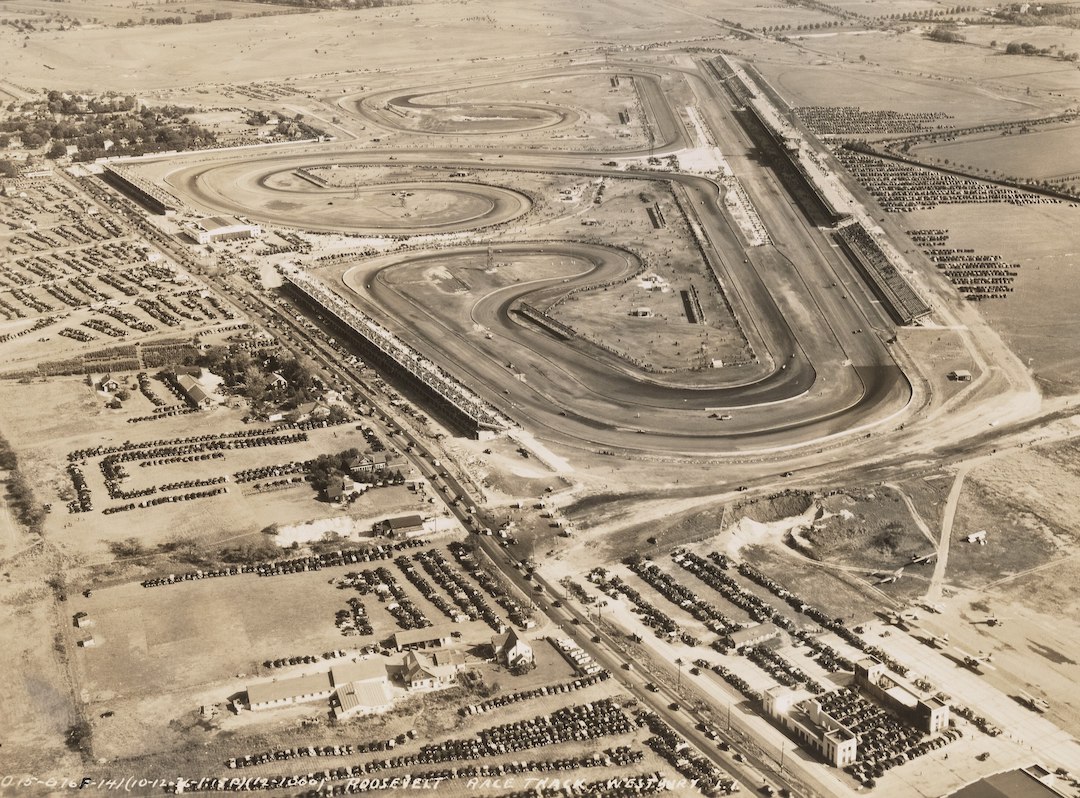
LOTS OF CURVES, YOU BET…Army Air Forces aerial photograph of the new Roosevelt Raceway taken during the 1936 Vanderbilt Cup Race Oct. 12, 1936. Deluxe clubhouse seats were sold for $27.50, or about $700 today. The four-mile (6.4. km) layout featuring sixteen unbanked corners (many with tight hairpins), a layout that kept average speeds disappointingly low. (Wikipedia)
The revived race lasted only two years, both won by Europeans. Check out the website Vanderbilt Cup Racesfor more photos and information on the race. This final note by Ryall suggested that travelers use the Long Island Motor Parkway to get to the race—the very same road that was originally constructed for the 1908 race.
* * *
A Gentler Pastime
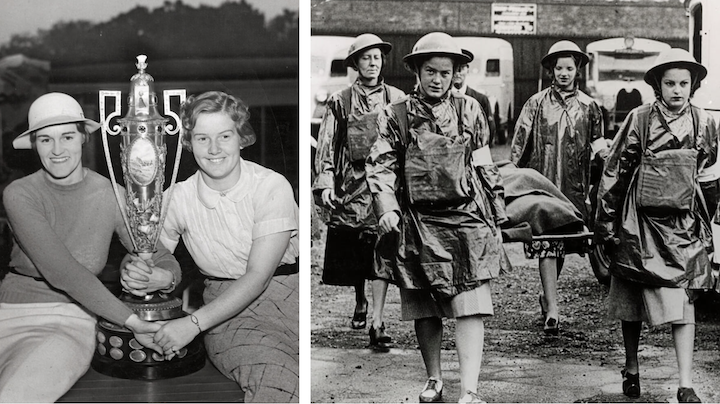
Noel F. Busch reported from the 1936 U.S. Women’s Amateur Championship, where the young British golfer Pamela Barton won her second major tournament of the year.
KING AND COUNTRY…Photo at left: Pamela Barton (right) defeated Maureen Orcutt (left) to win the 1936 U.S. Women’s Amateur Championship, becoming the youngest, at age nineteen, to win the U.S. and British women’s amateur titles in the same year—Barton was considered the best female golfer in the world in the late 1930s; photo at right: Barton takes part in training for the Volunteer Ambulance Service in England during WWII—sadly, the crash of a Royal Air Force Tiger Moth on November 13, 1943, claimed Barton’s life at age twenty-six. (USGA Archives)
* * *
At the Movies
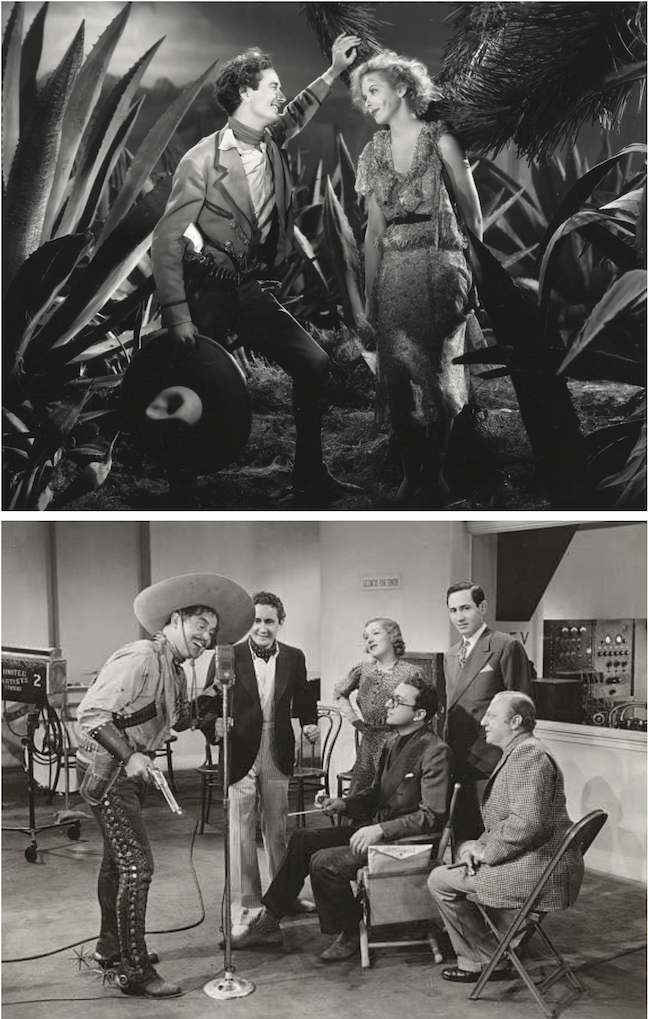
Italian tenor Nino Martini took top billing in the second film produced by Mary Pickford and Jesse Lasky for United Artists, the musical comedy The Gay Desperado. Critic John Mosher gave a thumbs up to this spoof of the gangster genre.
LIGHT AND EASY…Top photo: Italian operatic tenor Nino Martini took top billing in The Gay Desperado, seen here with co-star Ida Lupino; below: the film’s other co-star, Leo Carrillo, performs in costume in front of (from left) Martini, producer Mary Pickford, director Rouben Mamoulian, Mexican Consular Ricardo G. Hill, and producer Jesse L. Lasky. (Citizen Screen via Facebook/just watch.com)
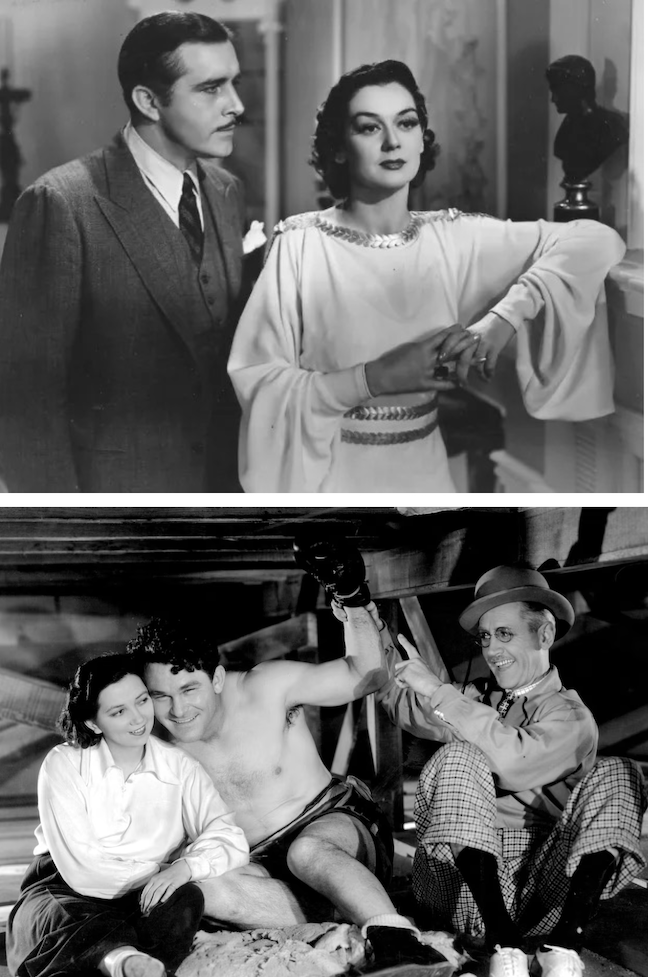
Not so light was Craig’s Wife, starring Rosalind Russell as a domineering woman who drives everyone from her life, including her husband. Mosher found some relief in the “toothsome” comedy Kelly the Second.
MOTHER MAY I?…Top photo: Rosalind Russell portrayed the domineering wife of Walter Craig (John Boles) in Craig’s Wife; Below: Patsy Kelly, Guinn ‘Big Boy’ Williams and Charley Chase in Kelly the Second. (melanienovak.com/tcm.com)
* * *
Whining for Winesburg
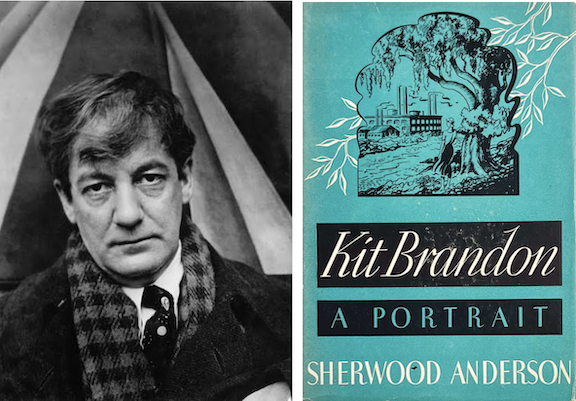
Book critic Clifton Fadiman found himself “stymied” by Sherwood Anderson’s latest novel, Kit Brandon: A Portrait, in which the author seemed “to be asking himself questions about a dozen things at once.”
A LOT ON HIS MIND…Sherwood Anderson’sKit Brandon: A Portrait, would be his eighth novel. (neh.gov/abebooks.com)
* * *
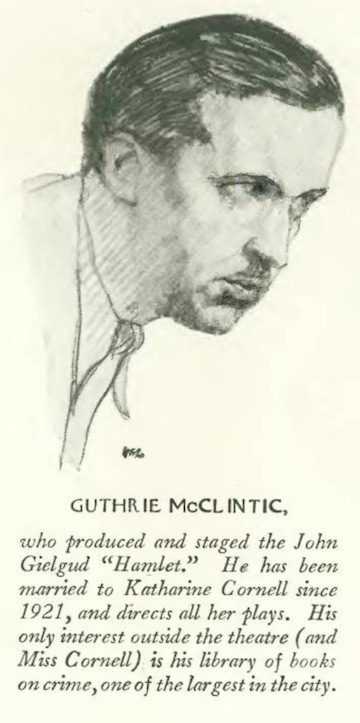
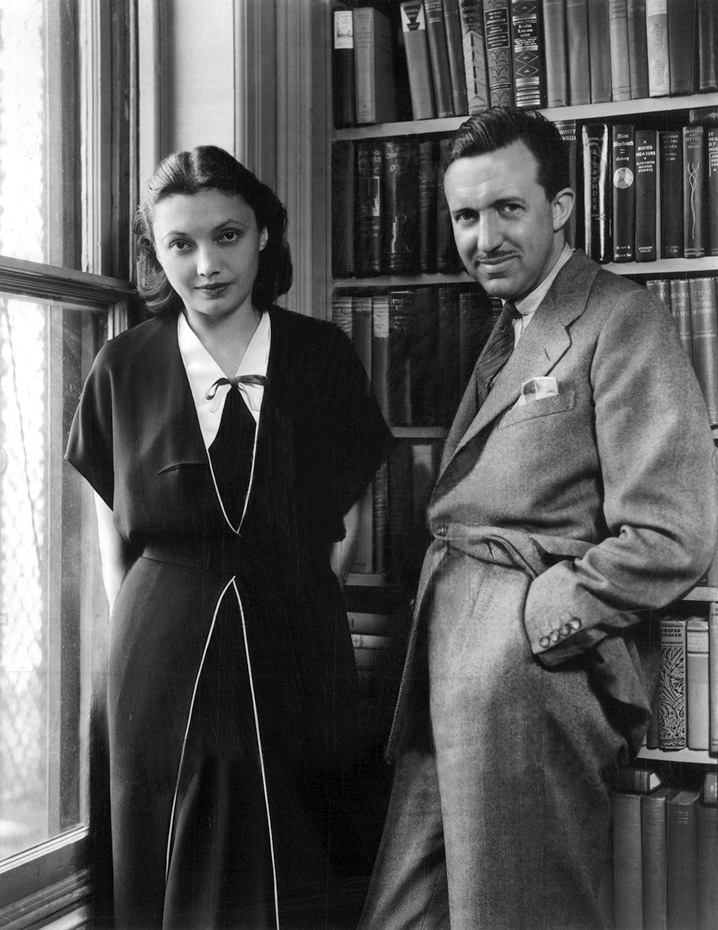
The calendar pages continued to feature mini-bios of celebrities, this week theater producer and director Guthrie McClintic…
THEATER ROYALTY…Katharine Cornell and Guthrie McClintic in the library of their home at 23 Beekman Place in Manhattan, 1933. (Wikipedia)
* * *
From Our Advertisers
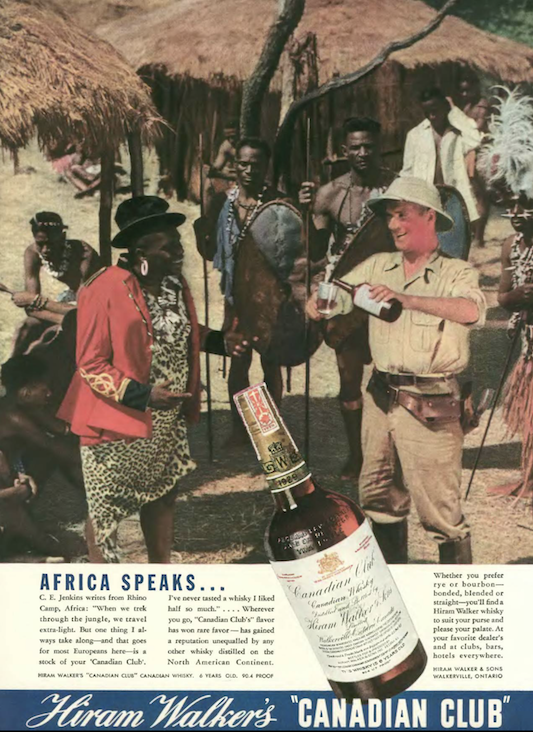
We begin with this antediluvian image from Hiram Walker, which greeted readers on the inside front cover…the ad was part of series showcasing the consumption of Canadian Club around the world…
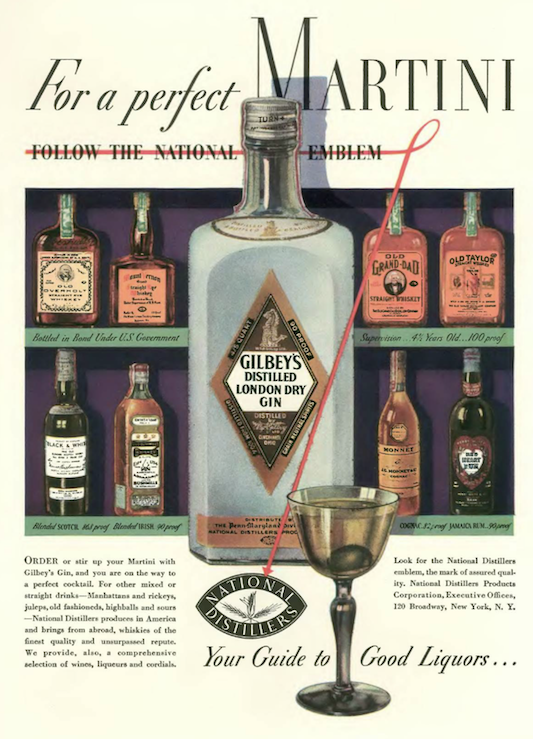
…National Distillers lined up their domestic and imported brands to promote a “perfect martini”…
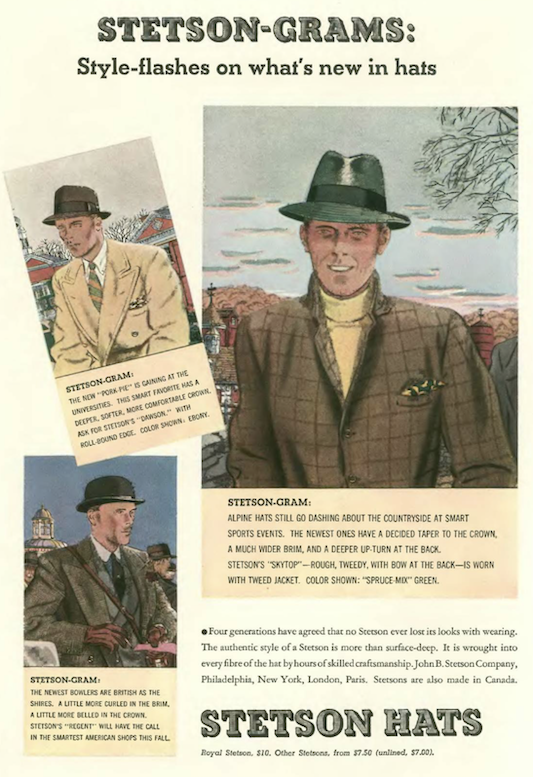
…and we have more stylish lids from Stetson, which included a “new pork-pie” that was apparently popular among university students…
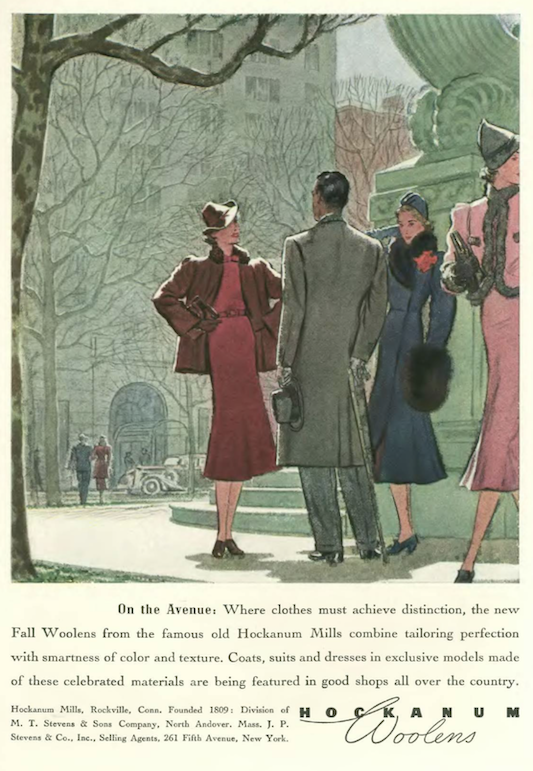
…and Hockanum Woolens continued its series celebrating the seasons in fashion…
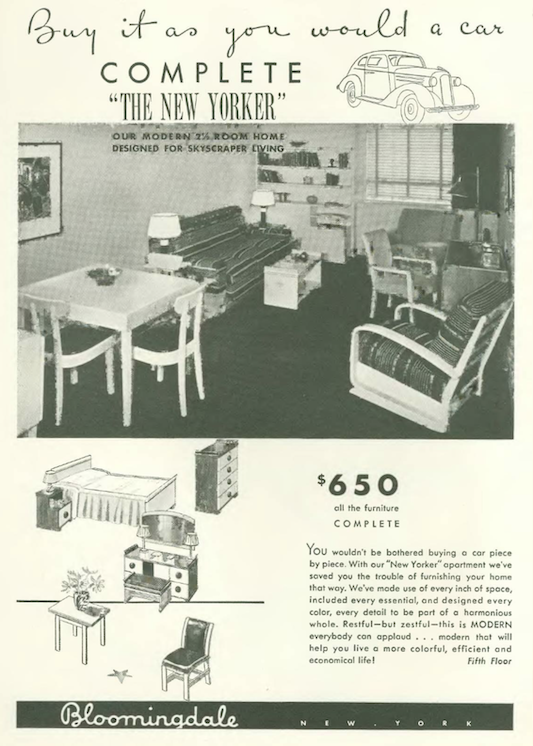
…there were numerous ads in the issue touting the latest in modern furniture, including Bloomingdale’s…
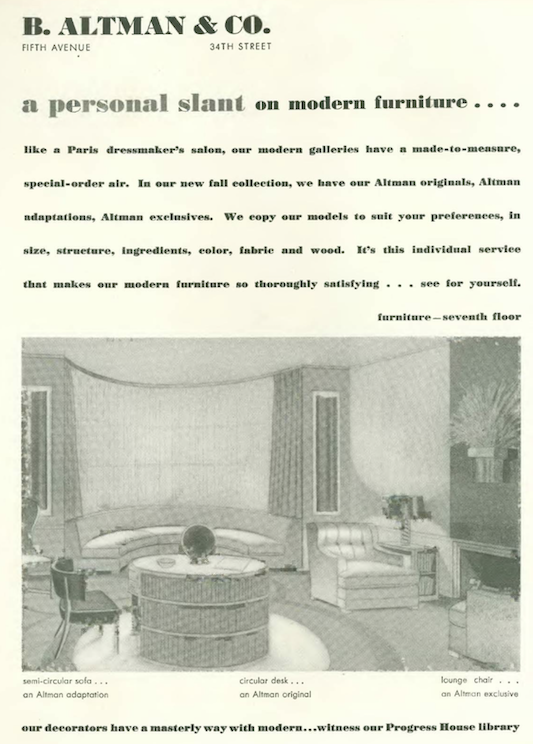
…and B. Altman…
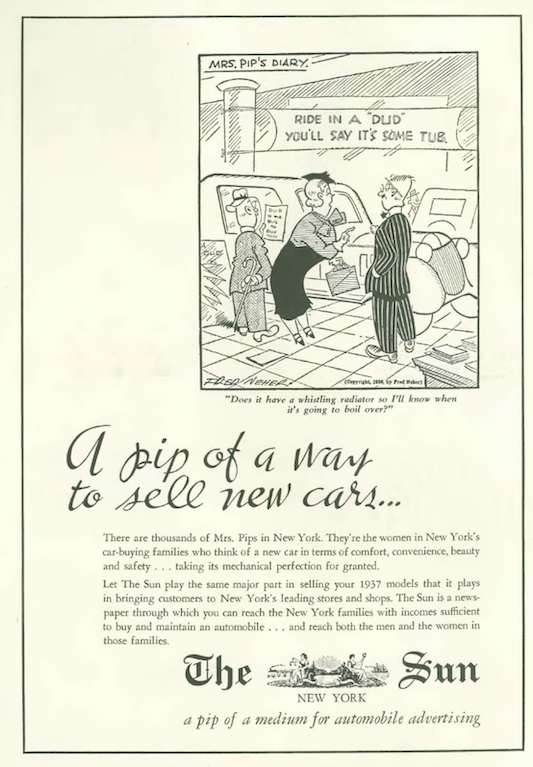
…The New York Sun hired cartoonist Fred Neher to tout the newspaper’s advertising reach…
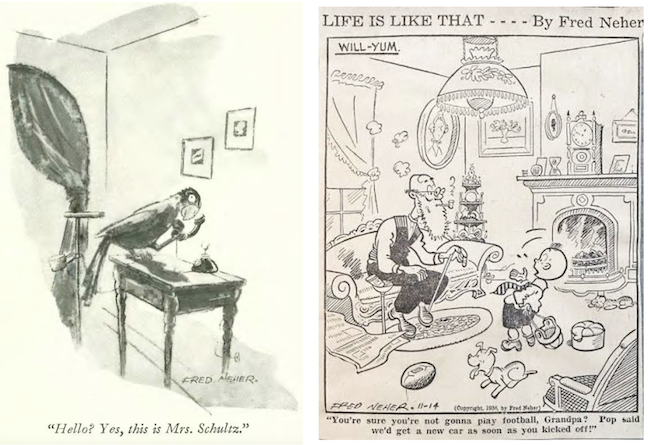
…Neher (1903–2001) was best known for his long-running syndicated cartoon Life Is Like That, which ran from 1934 to 1977…he also published one cartoon in TheNew Yorker, Jan. 21, 1933…
Left, Fred Neher’s sole New Yorker cartoon (Jan. 21, 1933), and at right, an example of his long-running gag panel from 1936. (Thanks to Ink Spill for the always invaluable reference!)
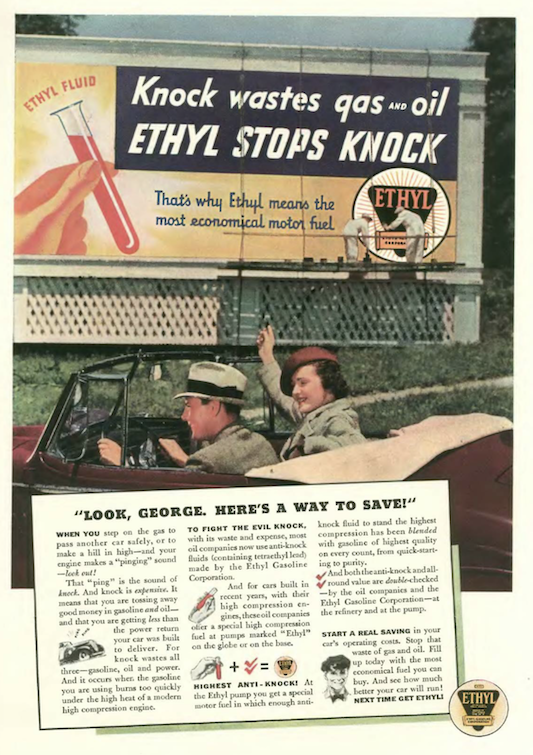
…the inside back cover featured an appeal to motorists to make the switch to leaded gasoline (during the 20th century, leaded gasoline released millions of tons of toxic lead particles into the air, soil, and water, and even today persists throughout ecosystems, including human bloodstreams)…
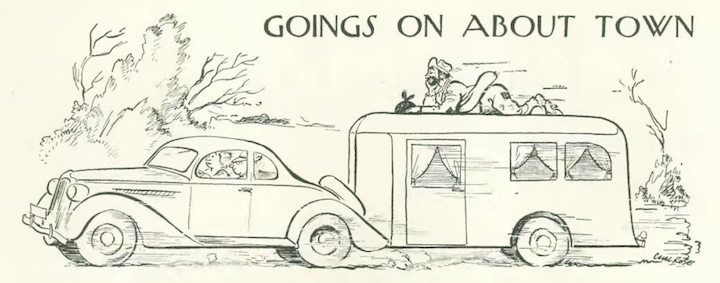
…on a cheerier note, we have a bunch of cartoons, beginning with spots by Carl Rose…
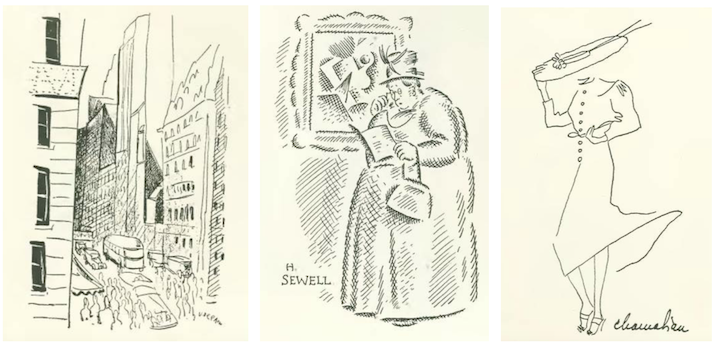
…Victor de Pauw, Helen Moore Sewell, and Alice Chamalian…
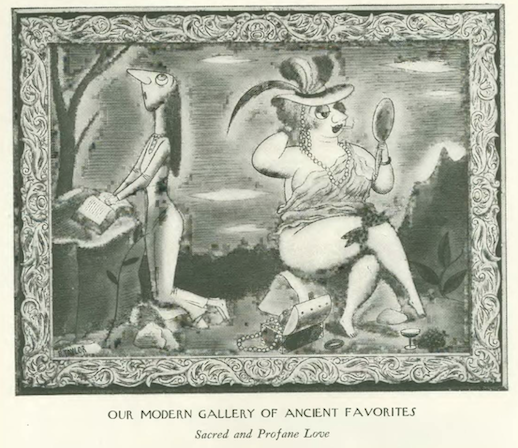
…Richard Taylor began his series of “Ancient Favorites”…
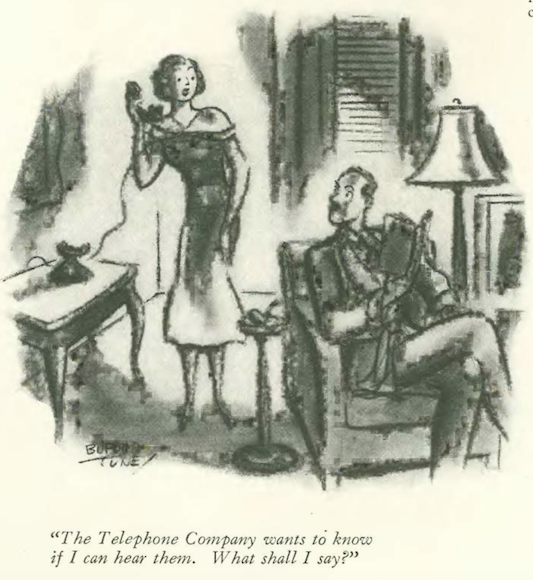
…Barney Tobey gave us a 1930s version of “can you hear me now?”…
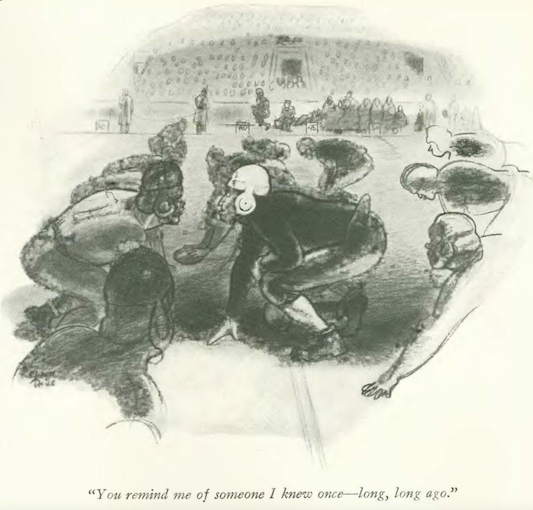
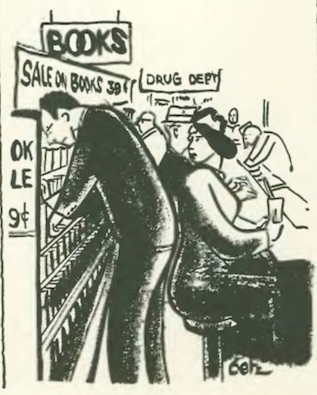
…Garrett Price recognized a face in the crowd…
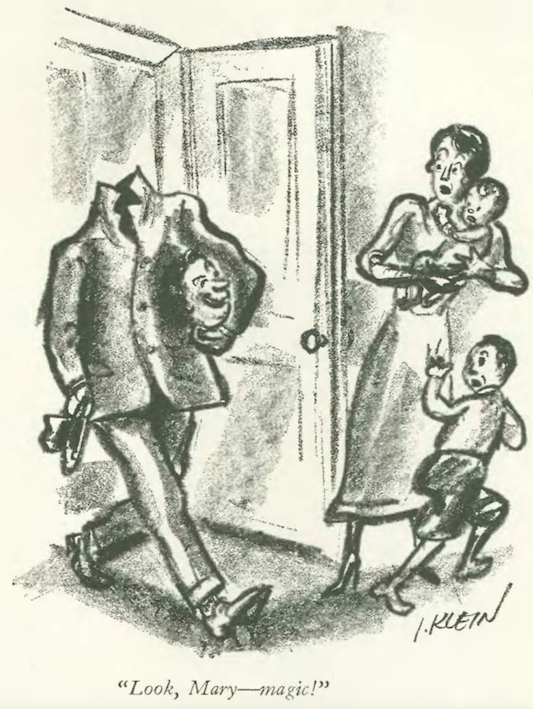
…after a long absence, Isadore “Izzy” Klein returned to The New Yorker with this contribution (in 1935 Klein (1897–1986) resumed his work as an animator for major studios including Screen Gems and Disney)…
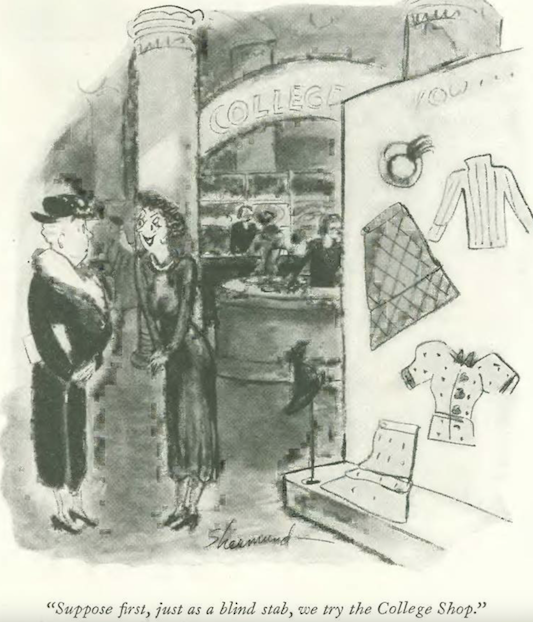
…Barbara Shermund got creative at a department store…
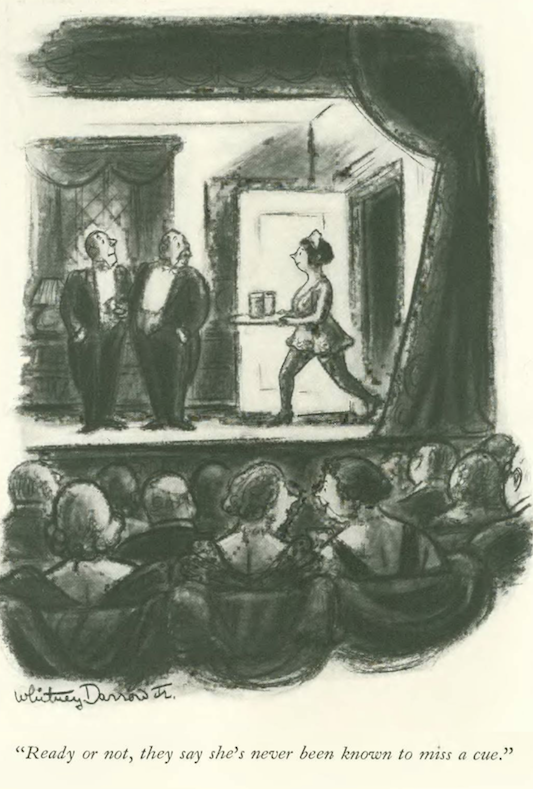
…Whitney Darrow Jr overheard some inside scoop at the theater…
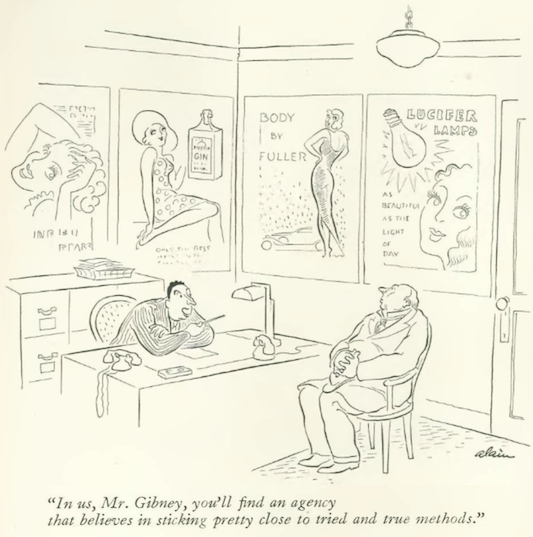
…Alain offered up some timeless advice from the advertising world…
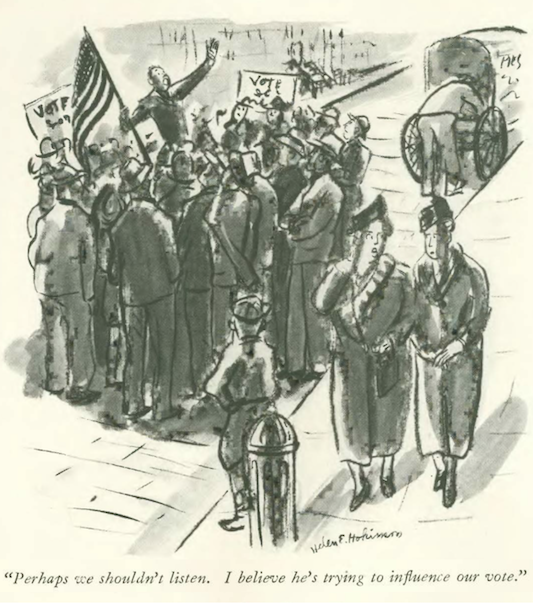
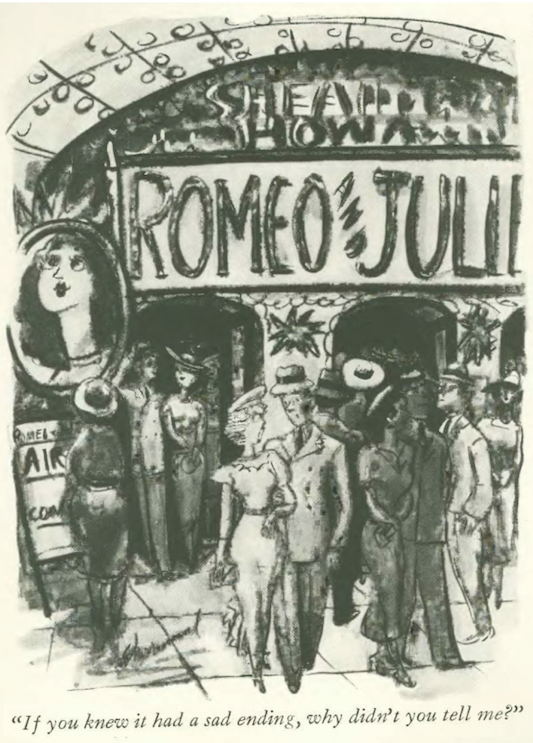
…Helen Hokinson’s “girls” steered clear of some political rhetoric…
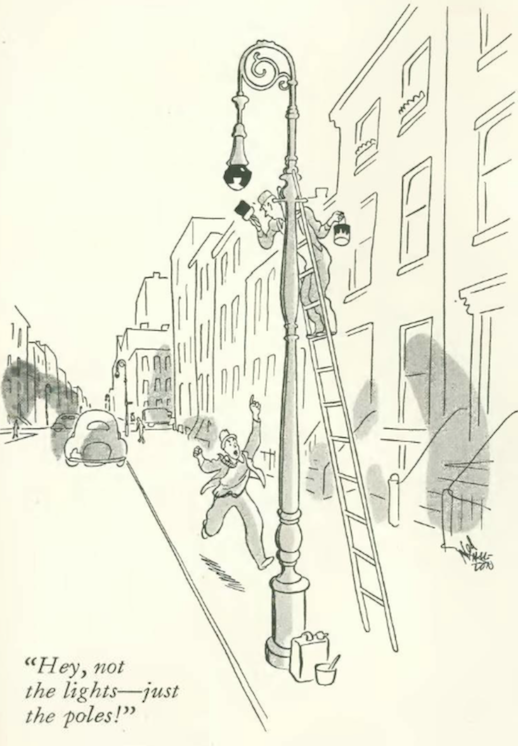
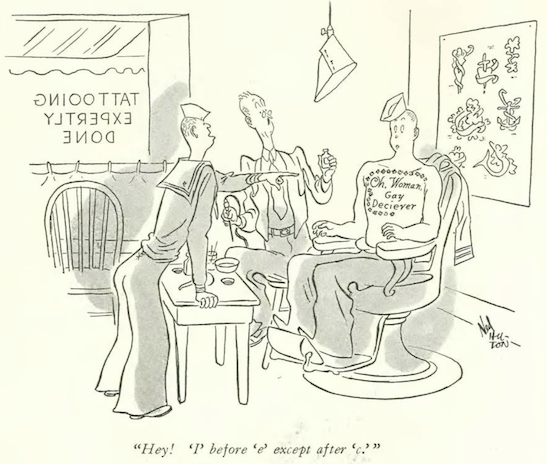
…Ned Hilton had an urgent change order…
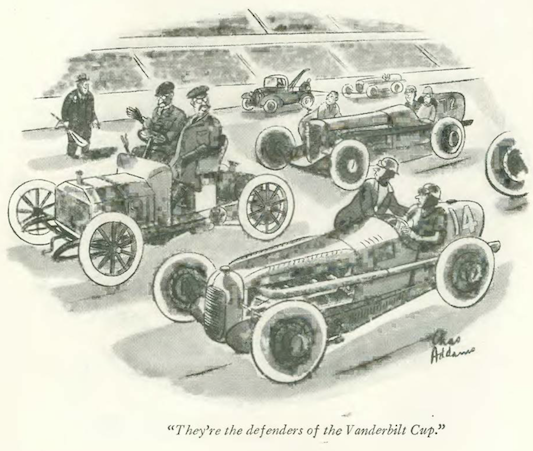
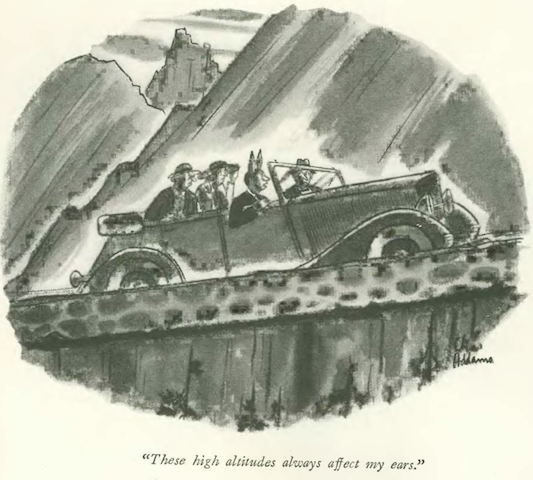
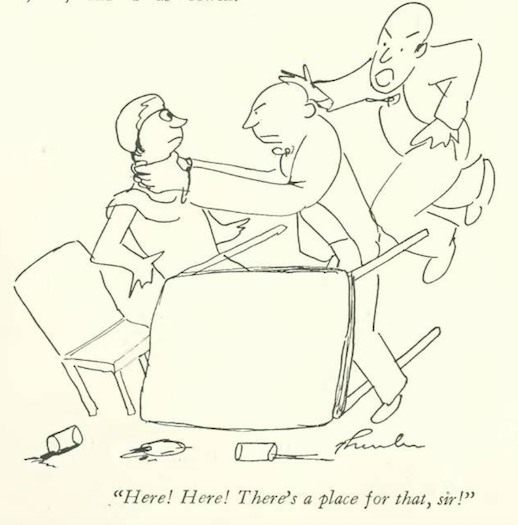
…and we close where we began, at the races, this time with Charles Addams…
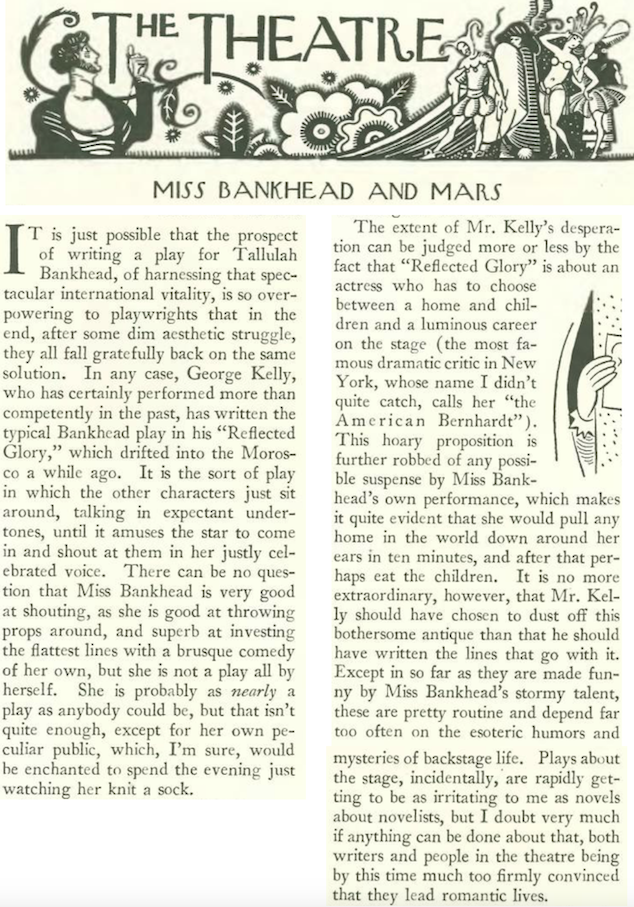
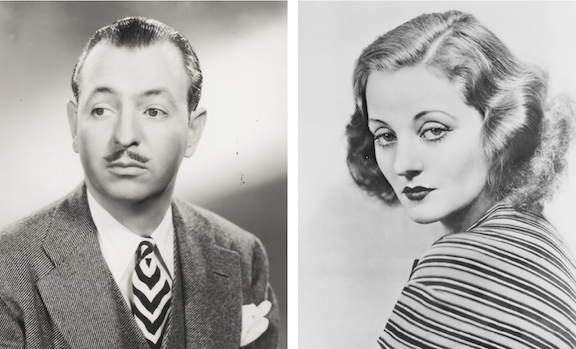
Above: In his review of Tallulah Bankhead's performance in "Reflected Glory," Wolcott Gibbs noted that she was a force to be reckoned with: ..."she would pull any home in the world down around her ears in ten minutes, and after that perhaps eat the children." (newyorker.com/facebook.com)
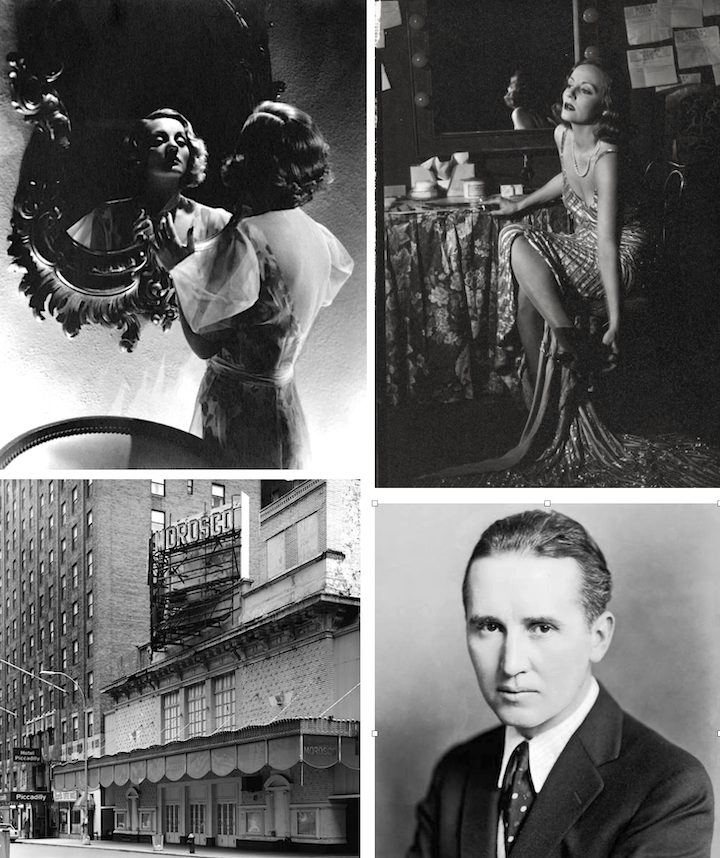
Broadway’s fall season was still young when the Morosco Theatre staged Reflected Glory, featuring Tallulah Bankhead in a role that mimicked her famously flamboyant lifestyle.
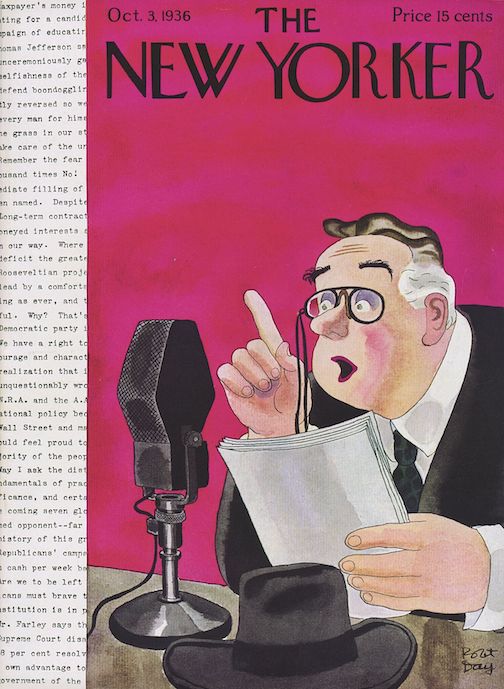
October 3, 1936 cover by Robert Day.
The play, which ran for 127 performances, was not well-received by the critics, but audiences loved it, and especially those who, in the words of critic Wolcott Gibbs, “would be enchanted to spend the evening just watching (Bankhead) knit a sock.”
Bankhead (1902–1968) also appeared in films (she won a New York Film Critics Circle award in 1944 for her performance in Alfred Hitchcock’sLifeboat), but she was mostly known for her stage acting and her wild lifestyle—drugs, alcohol, and lots of sex with both men and women; she was candid about her vices, including the claim she smoked 120 cigarettes a day.
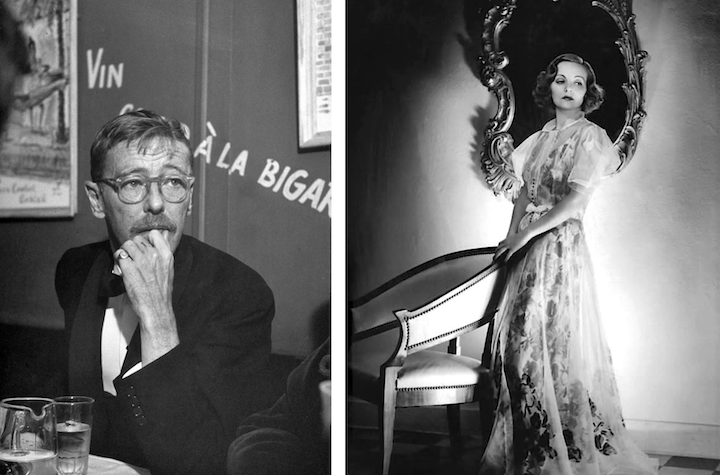
ART IMITATES LIFE…Clockwise, from top left: Tallulah Bankhead in promotional photo for Reflected Glory; Bankhead played Muriel Flood, a flamboyant, self-absorbed actress who constantly dramatizes her own life both on and off stage; author and director George Kelly wrote Reflected Glory specifically for Bankhead; Broadway’s Morosco Theatre (demolished 1982). (cinemaclassico.com/jacksonupperco.com/Wikipedia)
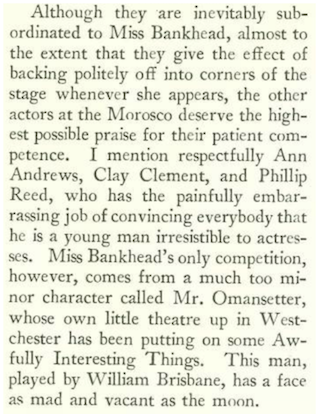
Early in her career Bankhead, an Alabama native, moved into the Algonquin Hotel and quickly made her way into the orbit of the famed Algonquin Round Table—so, she was well-known to Gibbs, who noted in this excerpt that Bankhead’s only competition in Reflected Glory was William Brisbane, a man with a face “as mad and vacant as the moon.”
MAD MATCH…Wolcott Gibbs noted that William Brisbane was Tallulah Bankhead’s only competition in Reflected Glory.(themovieb.org/npg.org.uk)
* * *
The Yankee Clipper
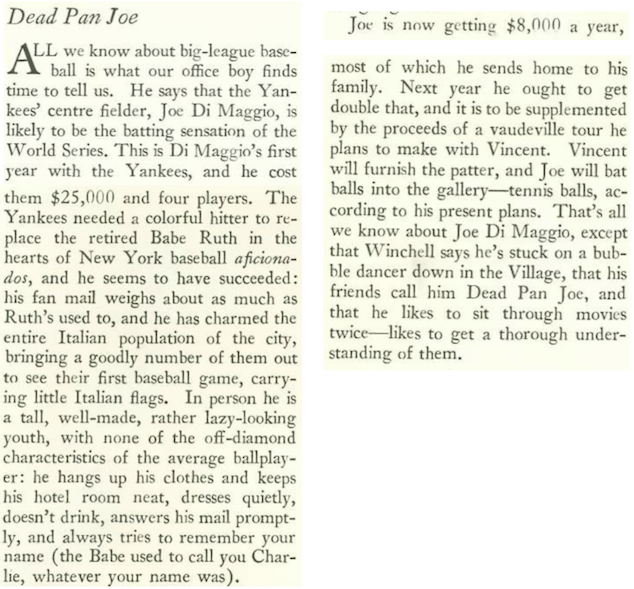
Baseball was mostly ignored in the early years of the New Yorker, but every now and then the magazine would feature a famous personality from the game, in this case Joe DiMaggio, who in 1936 would set a franchise record for rookies by hitting twenty-nine home runs (in just 138 games).
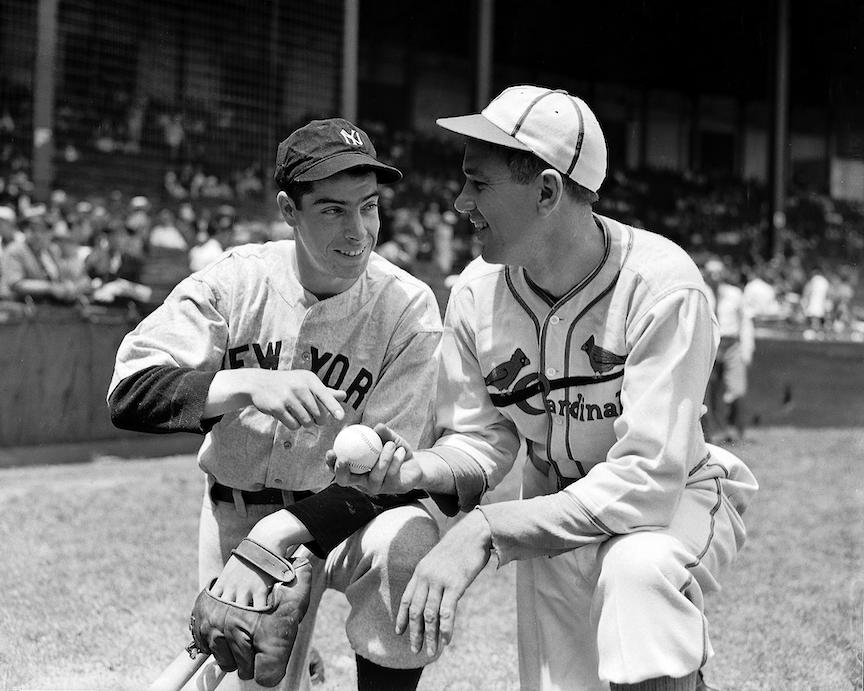
DIZZY AND JOE D…Yankees rookie Joe DiMaggio meets with Cardinals pitcher Dizzy Dean at the All-Star Game in Boston July 7, 1936. (AP Photo)
* * *
Right of the Right
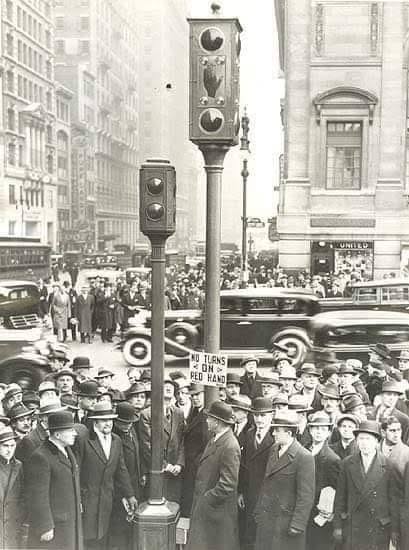
In his “Notes and Comment,” E.B. White took issue with a proposal by the New York Board of Aldermen to ban right-hand turns against a red light (the board ultimately approved the ban).
SEEING THE LIGHT…City officials examine new traffic lights on Fifth Avenue, 1933. (Golden Age Of Travel via facebook.com)
* * *
At the Movies
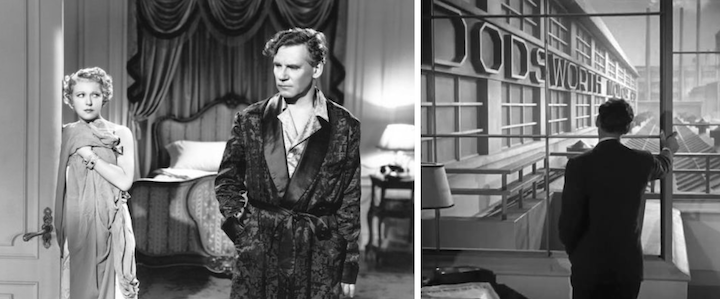
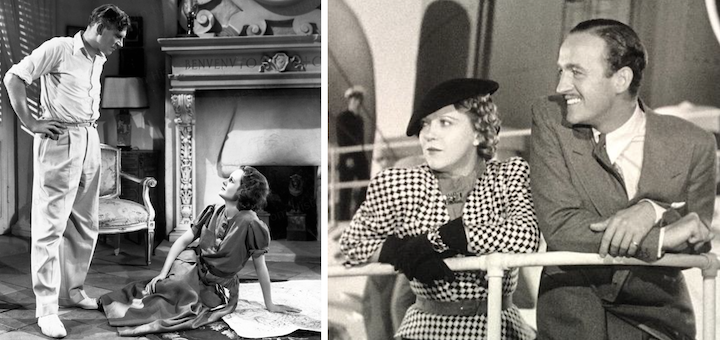
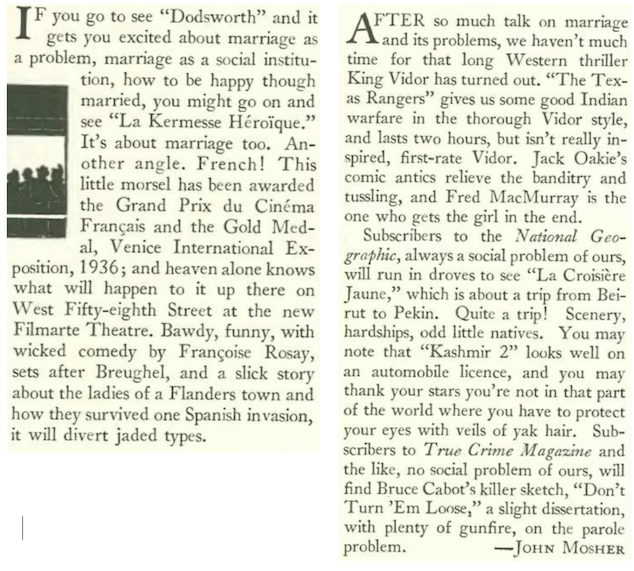
Based on a 1929 novel by Sinclair Lewis, the William Wyler-directed Dodsworth was acclaimed by critics as one of the best films of the year. New Yorker critic John Mosher wholeheartedly agreed:
SHE SAID, HE SAID…At left, Ruth Chatterton and Walter Huston portrayed a couple in a declining marriage in Dodsworth; at right, retired auto magnate Sam Dodsworth (Huston) reconsiders the life he has made for himself. (torontofilmsociety.com/YouTube.com)COMPLICATIONS…While travelling on the RMS Queen Mary to England, the Dodsworths find romantic companions—at left, Sam finds a soulmate in Edith Cortright (Mary Astor), while Fran flirts with a younger Englishman, Captain Lockert, played by David Niven. It was Niven’s first sizable role—he was a lieutenant in the British Army before coming to Hollywood in 1935. (eBay.com/film-foundation.org)
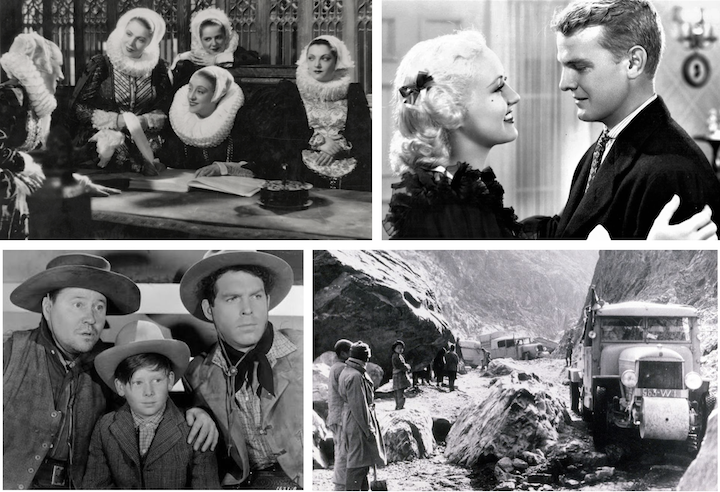
Mosher also reviewed a mixed bag of films, including the “wicked comedy” La Kermesse héroïque (Carnival in Flanders) featuring French opera star Françoise Rosay as a mayor’s wife who cleverly thwarts potential troubles from visiting Spanish soldiers.
BAWDY FUN was how John Mosher described the schemes of a mayor’s wife in La Kermesse héroïque (Carnival in Flanders)—clockwise, from left: Françoise Rosay (seated) organizes the village women to tame some visiting soldiers; Betty Grable and John Arledge in the crime drama Don’t Turn ’em Loose; La Croisière Jaune (Yellow Expedition) documented a 1931-32 French trans-Asian expedition organized by Citroën to promote its rugged Kégresse track vehicles; Jack Oakie, Bennie Bartlett and Fred MacMurray in The Texas Rangers. (mubi.com/imdb.com/radiofrance.fr/csfd.cz)
* * *
From Our Advertisers
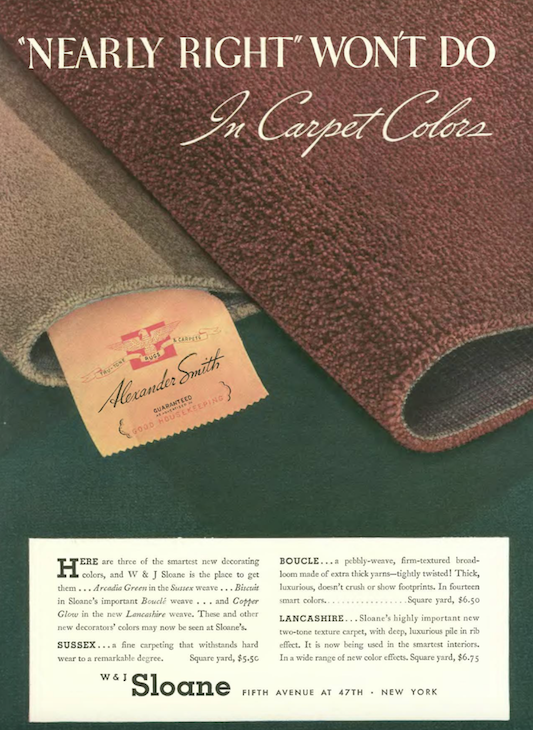
Fall advertising continued its uptick in the magazine, with many splashes of color including this carpet ad that greeted readers on the inside front cover…
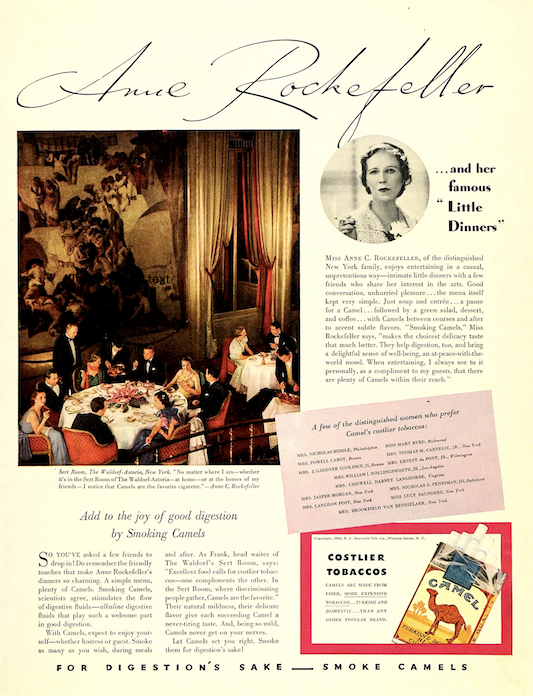
…R.J. Reynolds continued to roll out endorsements from society mavens…here Anne C. Rockefeller stated that Camels gave her “a delightful sense of well-being”…
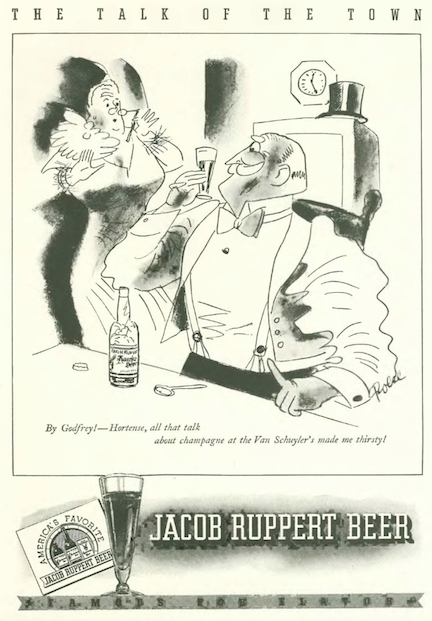
…more Colonel and Duchess archetypes turn up in this issue, on behalf of Ruppert beer…
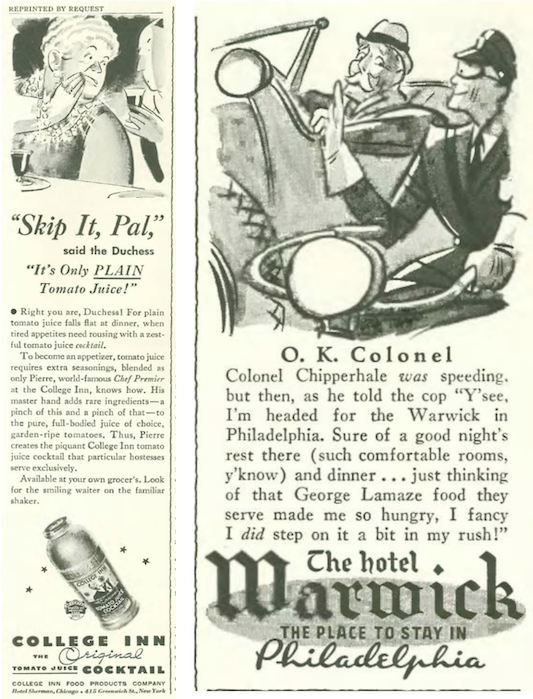
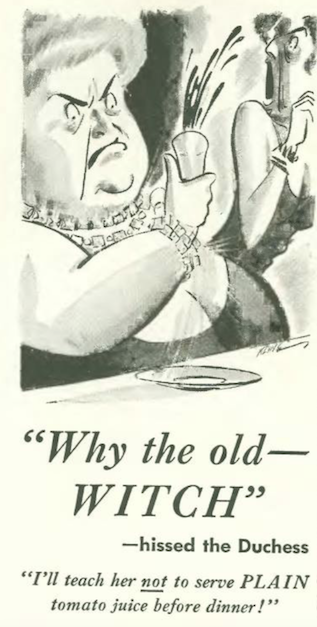
…the Warwick Hotel (Philadelphia), and College Inn tomato juice “cocktail”…College Inn had softened the appearance of their Duchess…
…since she was last spotted in The New Yorker in 1935 (detail)…
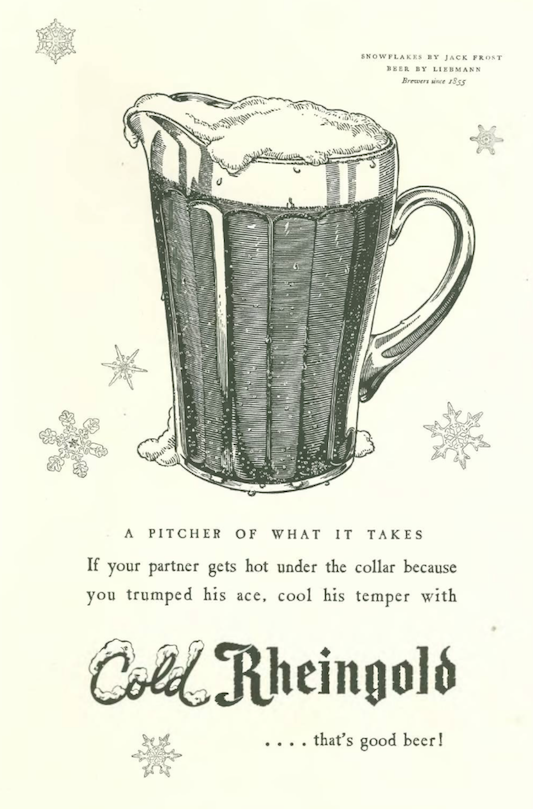
…after a blazing hot summer, the brewers of Rheingold figured this image would still appeal to parched New Yorkers…
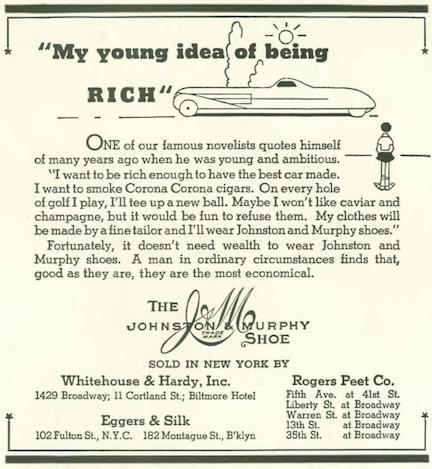
…a back of the book ad from Johnston & Murphy, quoting an unidentified author regarding some childhood wishes…
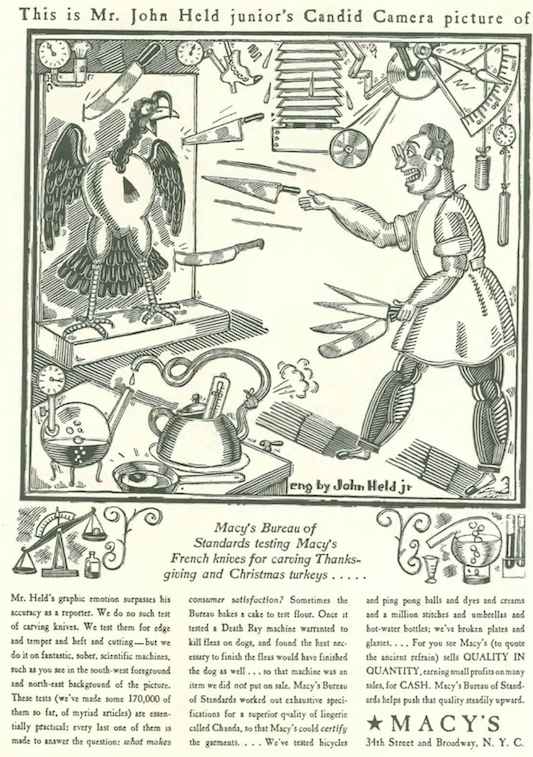
…John Held Jr. was one of the earliest contributors to The New Yorker—from 1925 to 1932 his woodcut-style cartoons and fanciful maps were frequent features…by 1936 Held had turned his talents to painting, book illustration, and the occasional advertisement, here on behalf of Macy’s…
…our illustrators and cartoonists for this issue include Christina Malman…
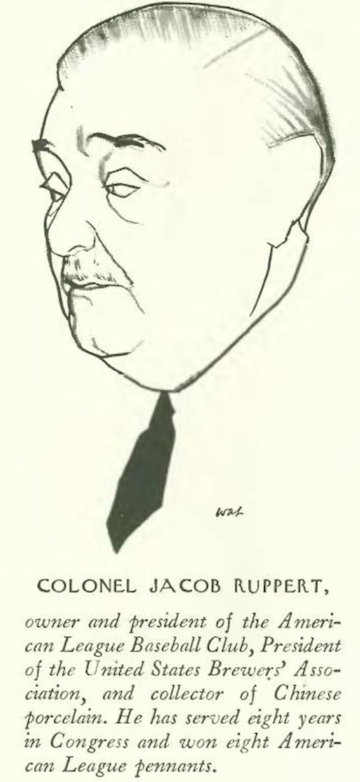
…a caricature by William Auerbach-Levy for the calendar section’s mini bio…
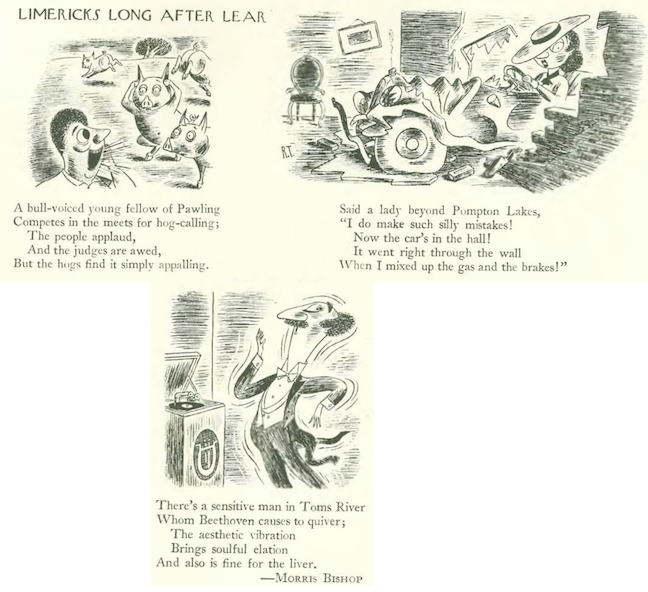
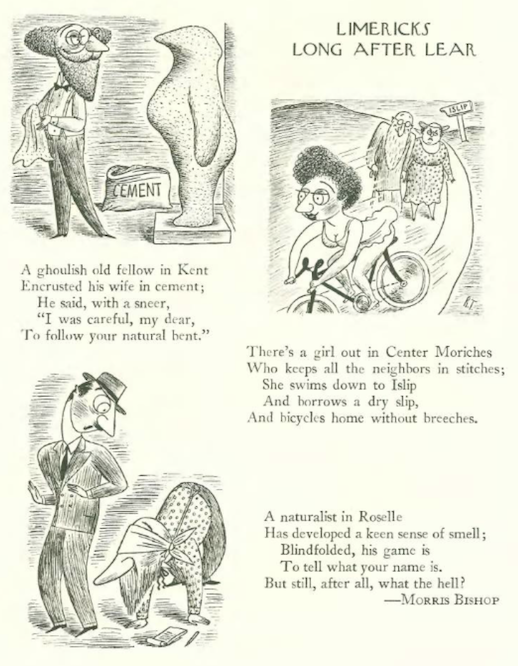
…another Richard Taylor–Morris Bishop collaboration…
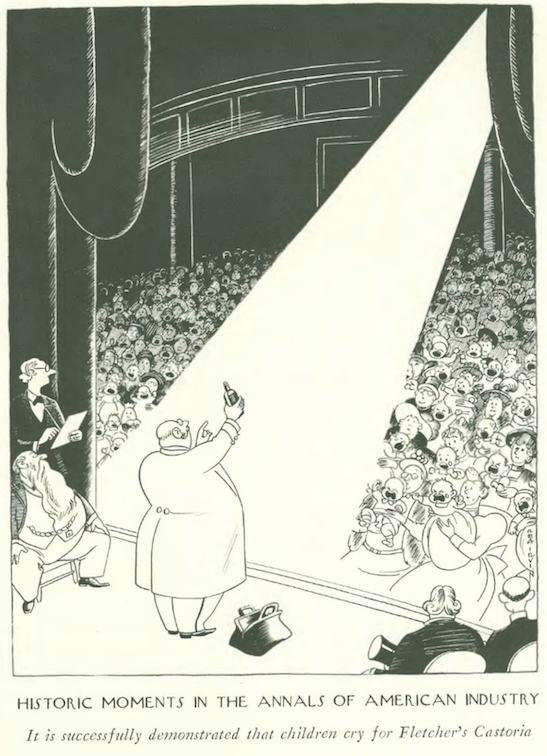
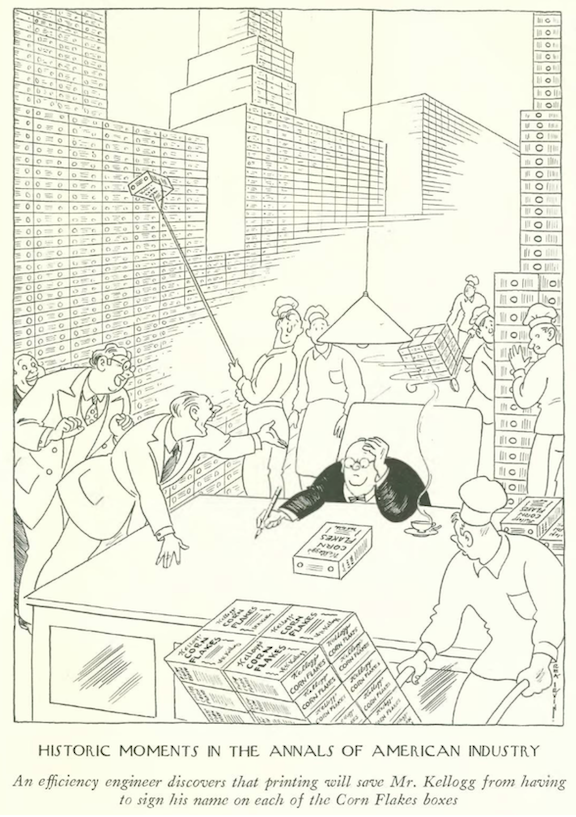
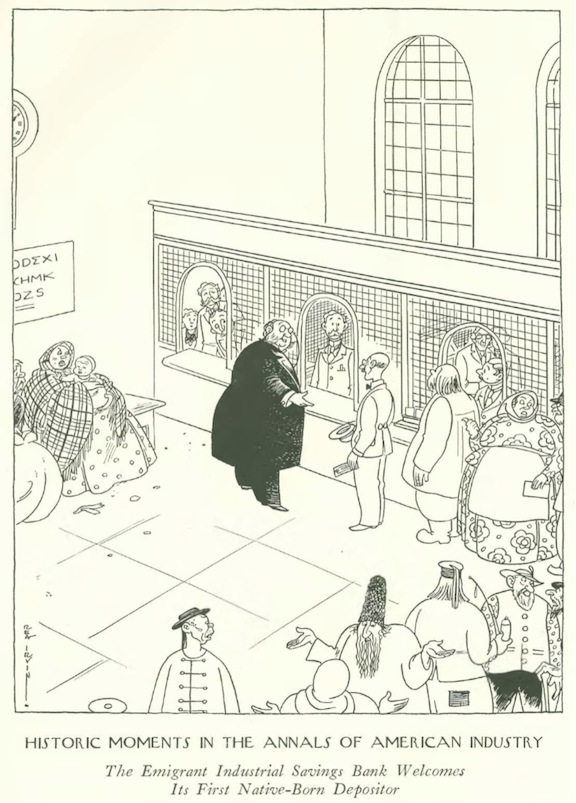
…more historic moments from American Industry, with Rea Irvin…
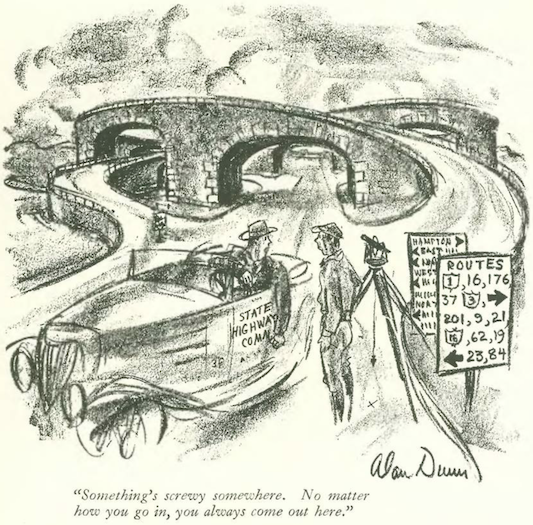
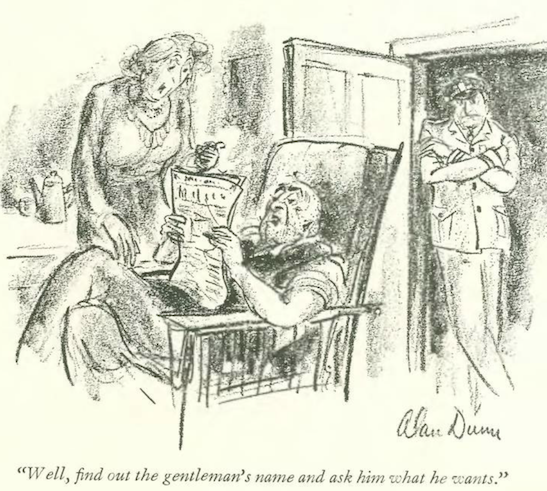
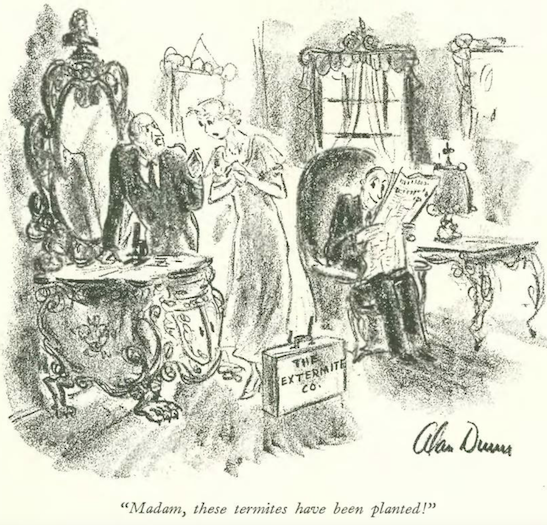
…Alan Dunn had an M.C. Escher moment on the turnpike…
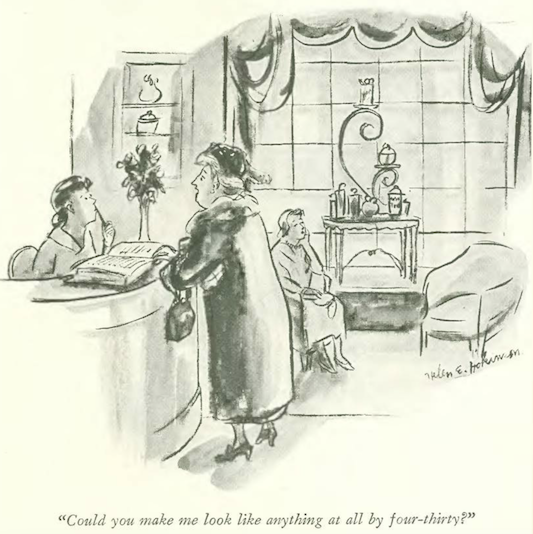
…Helen Hokinson made a big ask at the beauty parlor…
…Ned Hilton drew up a big man with a big complex…
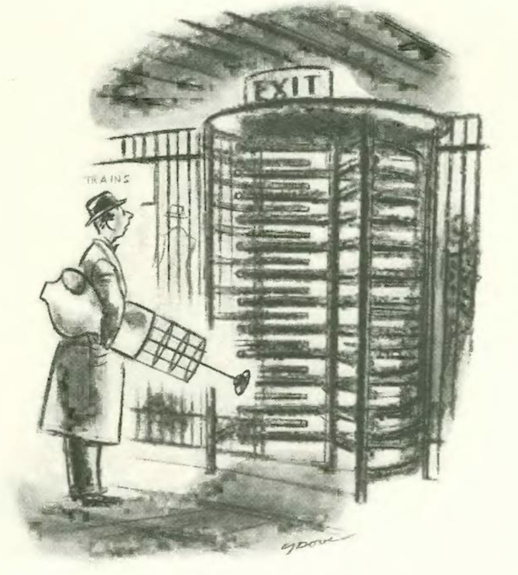
…Leonard Dove offered a challenge and a unique perspective at the subway station…
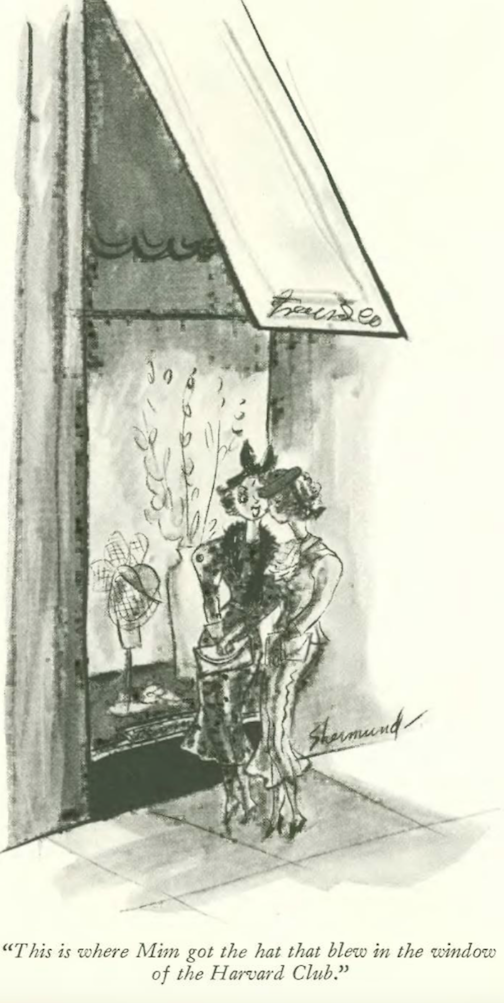
….Barbara Shermund’s modern women thrilled to the sights of Manhattan…
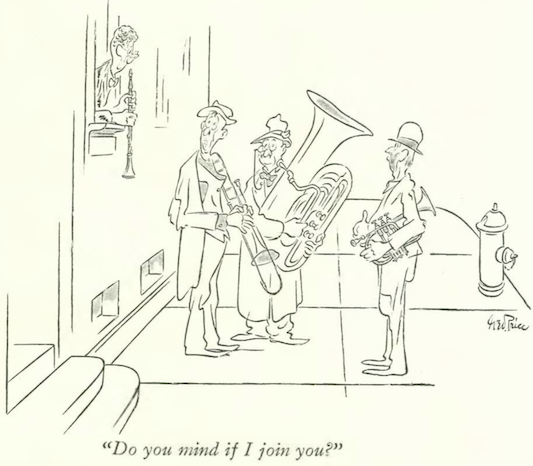
…George Price turned this trio into a quartet…
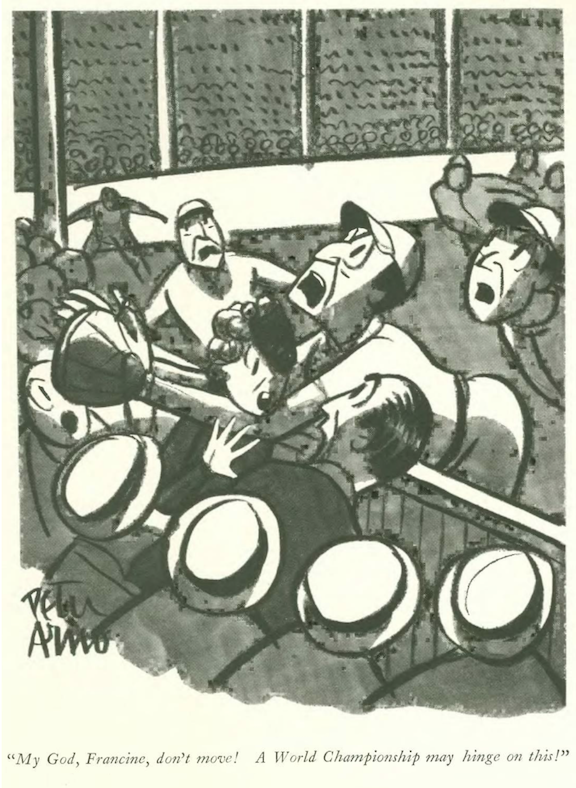
…and we close with a terrific, terrifying moment at the World Series, courtesy Peter Arno…
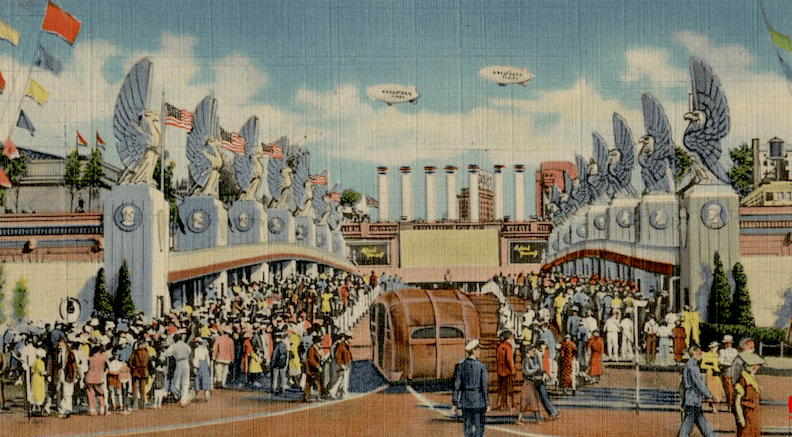
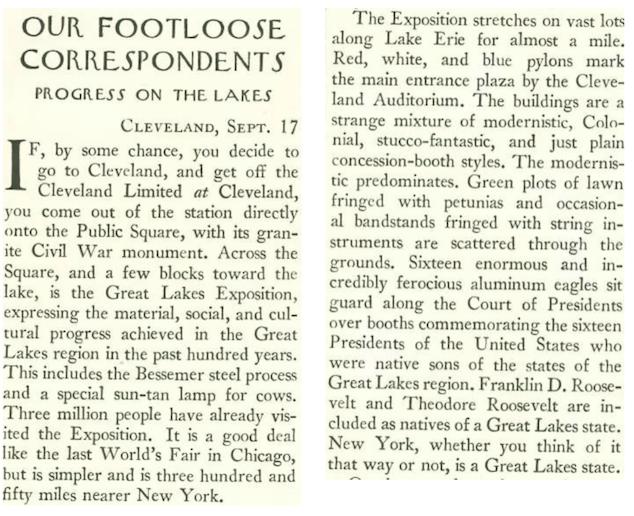
Above: Postcard image of the "Avenue of Presidents" at the 1936 Great Lakes Exposition in Cleveland, Ohio. (youtube.com)
Before the days of mass communications, millions would flock to various world’s fairs and expositions to see the latest inventions, experience the boosterism of the host city, and seek out the thrills of a carnival ride or peep show.
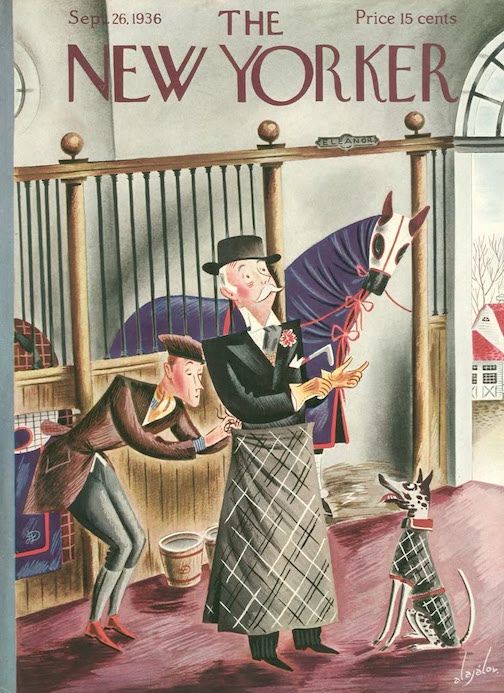
September 26, 1936 cover by Constantin Alajalov.
Along with the major world’s fairs such as Chicago’s 1893 World’s Columbian Exposition, smaller cities also hosted expositions to “boom” their standing in the world—Omaha’s 1898 Trans-Mississippi and International Exposition attracted 2.6 million people, including President William McKinley, and three years later Buffalo’s 1901 Pan-American Exposition would draw eight million—McKinley was there, too, but his visit (and life) would be cut short by an assassin’s bullet.
In many cases these expositions commemorated anniversaries that marked the progress of a particular city or geographic area. Such was the case of Cleveland’s Great Lakes Exposition, which was created to commemorate the centennial of Cleveland’s incorporation as a city while giving a boost to a region hit hard by the Depression. The exposition was visited by The New Yorker’sEugene Kinkead, who was an editor and writer of the magazine’s “The Talk of the Town” section for many years. Here are brief excerpts from his visit:
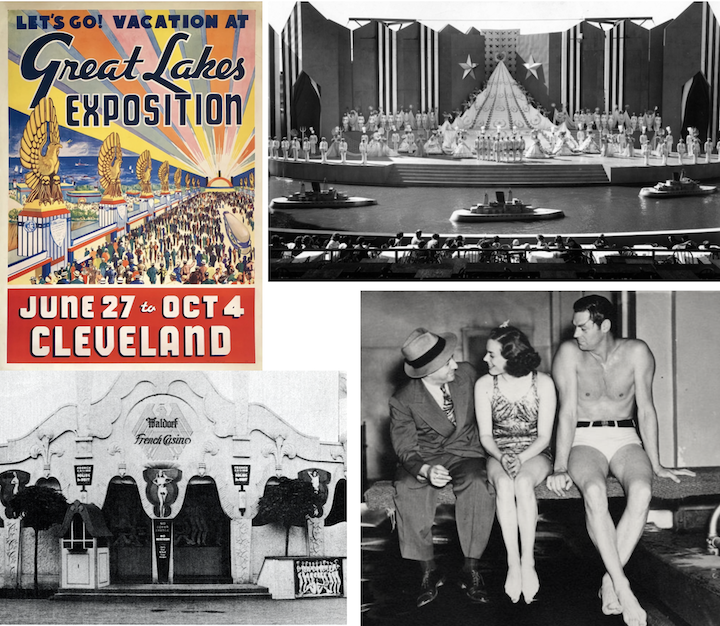
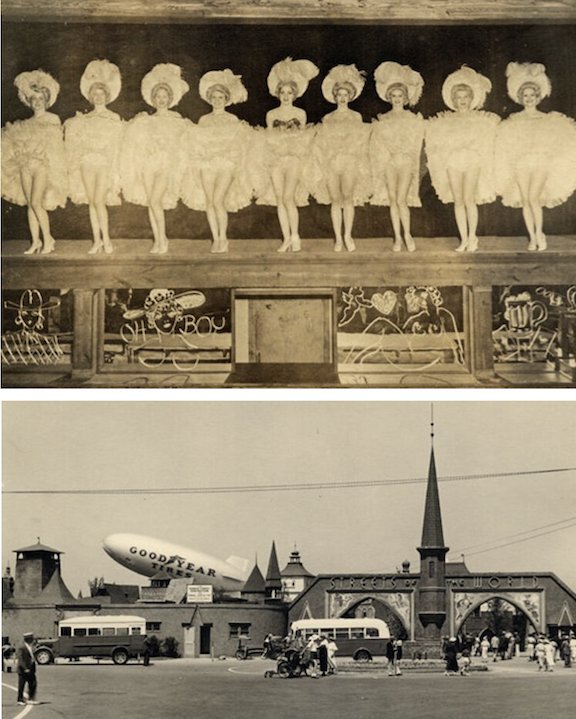
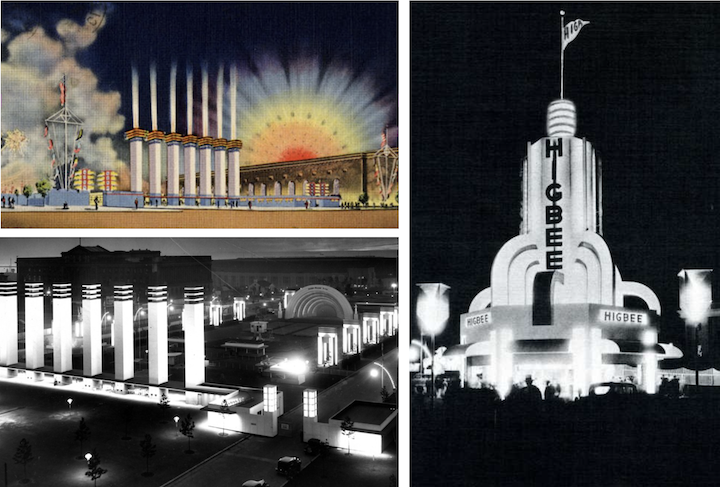
SOMETHING FOR EVERYONE…Clockwise from top left: Poster for the Great Lakes Exposition; the most popular attraction was Billy Rose’s Aquacade, a 5,000-seat theater-restaurant that featured diving and synchronized swimming (the Aquacade was also a hit at the 1939 New York Wold’s Fair); star attractions at the Aquacade were Olympic champion swimmers Eleanor Holm and Johnny Weissmuller, pictured here with Billy Rose; the “Streets of the World” showcased the cultures of more than forty different countries—it also featured the “French Casino,” a restaurant/nightclub that drew massive crowds to its “Girl Revues”—naturally, the scantily clad performances and nude can-can dancers created a major stir among more modest expo attendees. (chicagovintageposters.com/clevelandmemory.org)OTHER DIVERSIONS…Above: the can-can dancers who caused quite a stir at the French Casino, located in the “Streets of the World” section. Below: One of the blimps the Goodyear Tire & Rubber Company featured at the exposition rises in the background of “Streets of the World.” Visitors could purchase tickets for three dollars (roughly $65 today) to take a scenic flight over downtown Cleveland, the exposition, and Lake Erie. (clevelandmemory.org)EXPO BY NIGHT…Clockwise, from top left: Postcard view of the main entrance to the Great Lakes Exposition, backlit by the “Aurora Borealis”—a spectacular light display created by powerful searchlights and colored beams; a tower sponsored by Cleveland’s famed Higbee’s Department Store; photograph of the main entrance at night. (clevelandmemory.org/clevelandhistorical.org)
* * *
Relax, Joan
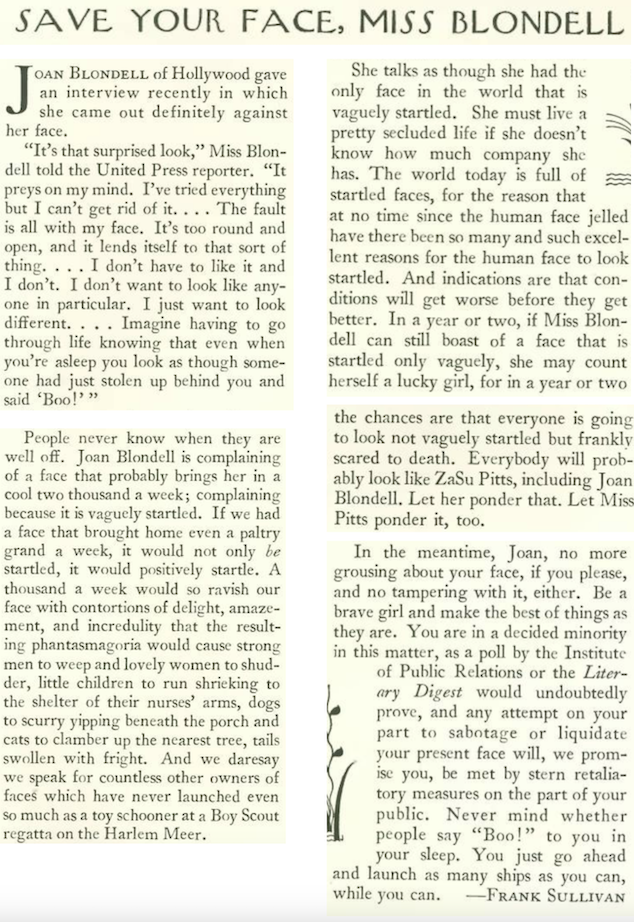
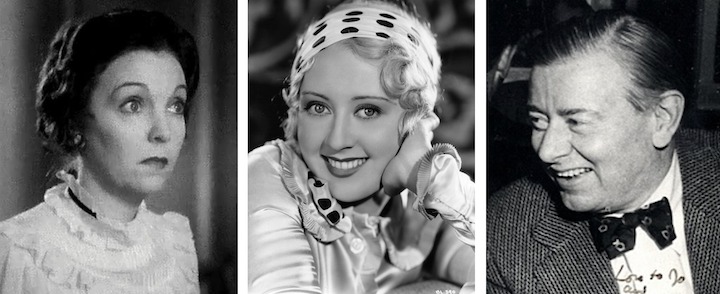
New Yorker regular Frank Sullivan found inspiration in a newspaper article featuring actress Joan Blondell lamenting the “surprised look” she thought was permanently fixed on her face. Sullivan suggested that Blondell “must live a pretty secluded life” not to notice a world “full of startled faces.” Alluding to the coming war in Europe, he suggested that in a year or two “everyone will probably look like ZaSu Pitts.”
PUT ON YOUR WAR FACE…Frank Sullivan reassured Joan Blondell (center) that soon everyone would wear the expression of actress ZaSu Pitts (left). (imdb.com/sspl.org)
* * *
At the Movies
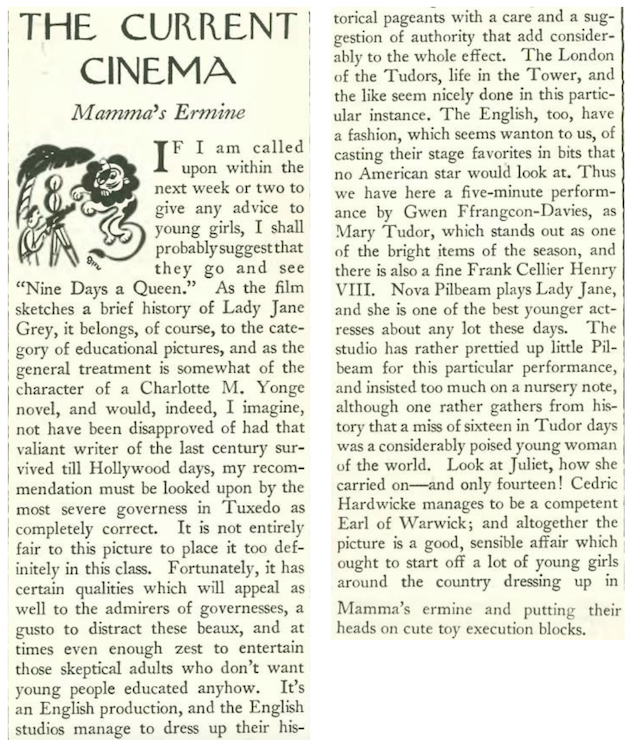
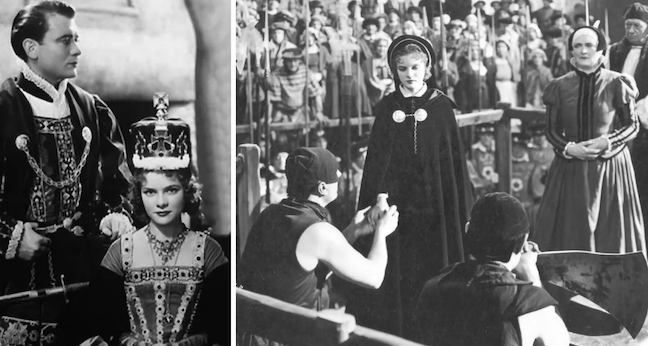
As previously noted, costume dramas were big in 1936, and critic John Mosher was less than enthusiastic about many of them, but he found Nine Days a Queen (Tudor Rose in the British release) a sensible affair, noting that “English studios manage to dress up their historical pageants with a care and a suggestion of authority…”
TEMPORARY CROWN…Nine Days a Queen (aka Tudor Rose) tells the story of Lady Jane Grey’s brief reign as the queen of England before she loses her head. Left: John Mills as Lord Guilford Dudley and Nova Pilbeam as Lady Jane Grey. At right, executioners seek forgiveness from Lady Jane ahead of their grisly task. Critic John Mosher liked the film, but Graham Greene (critic for The Spectator), wrote that he had “seldom listened to more inchoate rubbish…” (oldhollywooddiary via instagram.com)
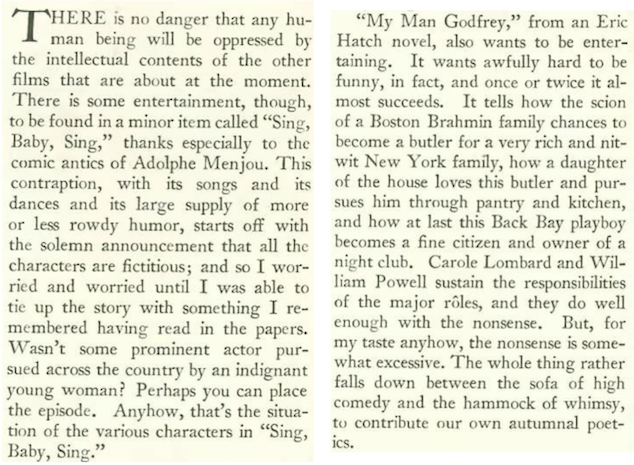
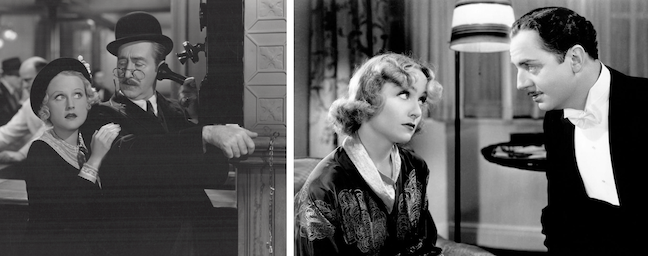
Mosher found the musical comedy Sing, Baby, Sing a minor entertainment, and dismissed the screwball comedy My Man Godfrey as “nonsense.” Mosher was in the minority on that latter opinion: Godfrey was one of the most acclaimed comedies of 1936, nominated for six Oscars. In 1999 the film was selected for preservation in the National Film Registry.
PAIRING OFF…Alice Faye and Adolphe Menjou in Sing, Baby, Sing.Carole Lombard and William Powell in My Man Godfrey. Lombard and Powell were briefly married from 1931 to 1933, but remained close friends after their divorce. (eBay.com/pbs.org)
* * *
From Our Advertisers
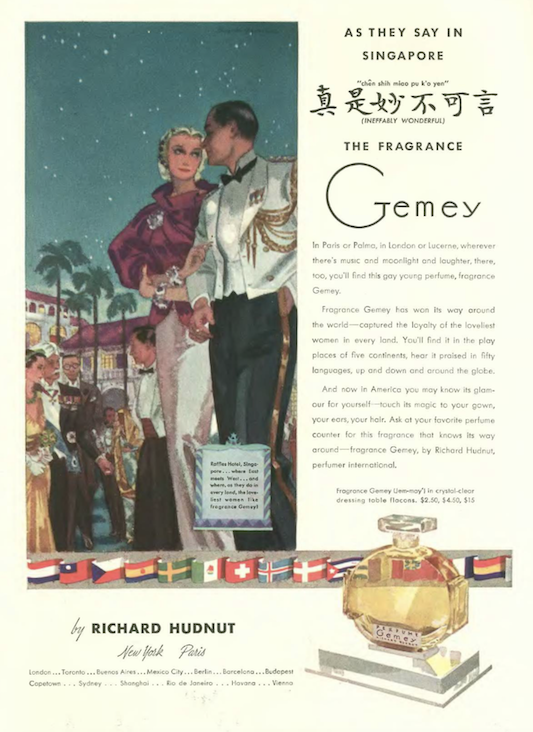
The inside front cover greeted readers with this romantic image from Richard Hudnut cosmetics…
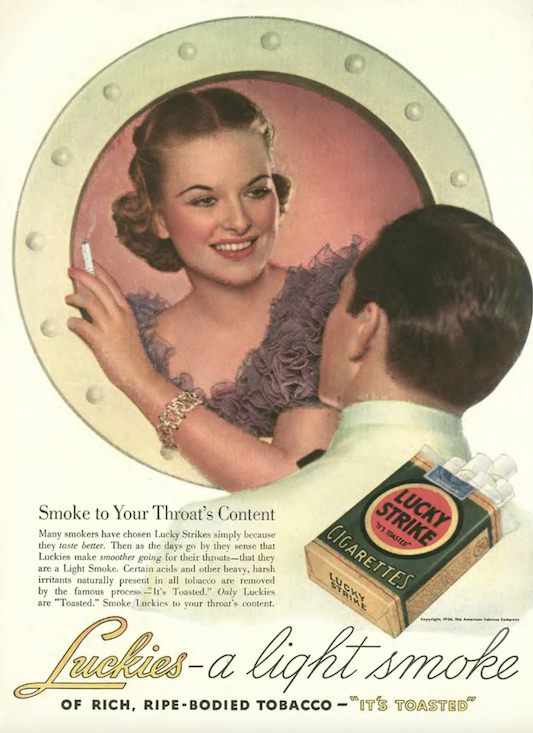
…the makers of Lucky Strikes used a bit of romance themselves to inspire more women smokers…
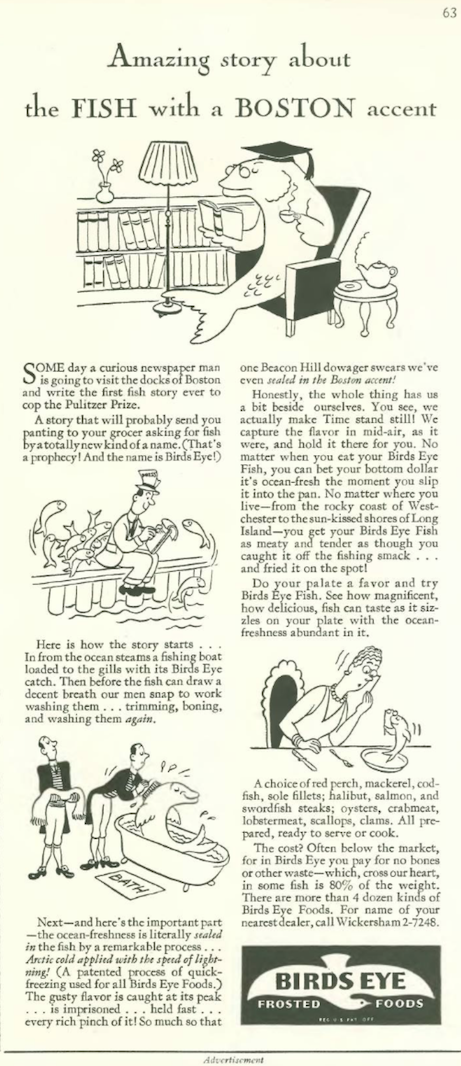
…the folks at Birds Eye took out this advertisement to extol the virtues of frozen fish…
…an odd ad from Green Giant, using the image of an annoying little man to sell peas…one imagines the woman calling “Pa, git yer shotgun”…
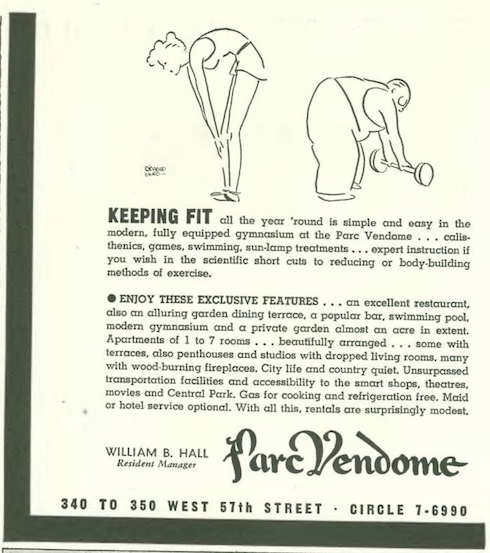
…the Parc Vendome advertised its apartments as a great place to keep fit, everything from calisthenics to sun-lamp treatments…
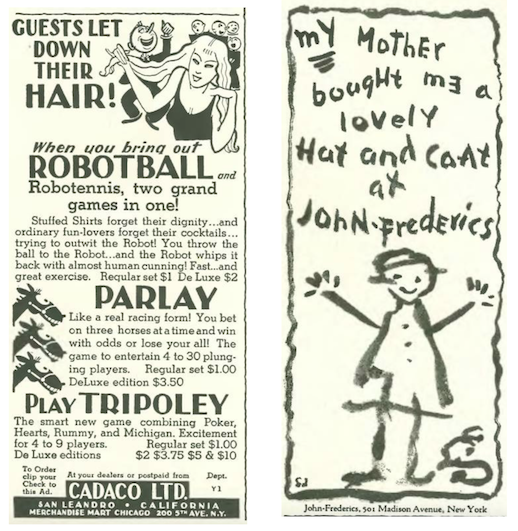
…a couple of one-column ads from the back of the book…at left: founded in 1935, Cadaco was known for transforming real-world sports into table-top versions…on the right: John-Frederics was a partnership between hat designer “Mr John” Harberger and Frederic Hirst…John-Frederics hats were famous in Hollywood, including the green velvet bonnet worn by Vivien Leigh in 1939’s Gone with the Wind…
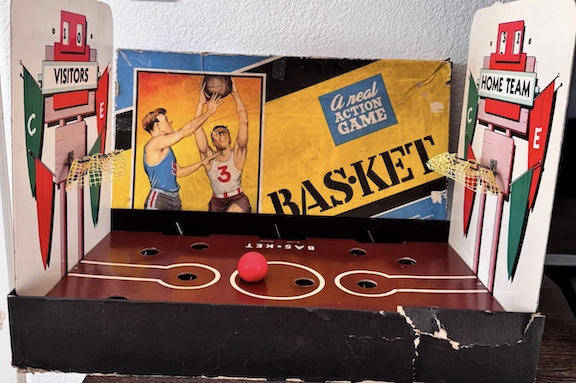
This 1938 edition of Cadaco’s Bas-Ket featured spring-loaded levers that propelled a ping-pong-like ball toward a basket. (etsy.com)
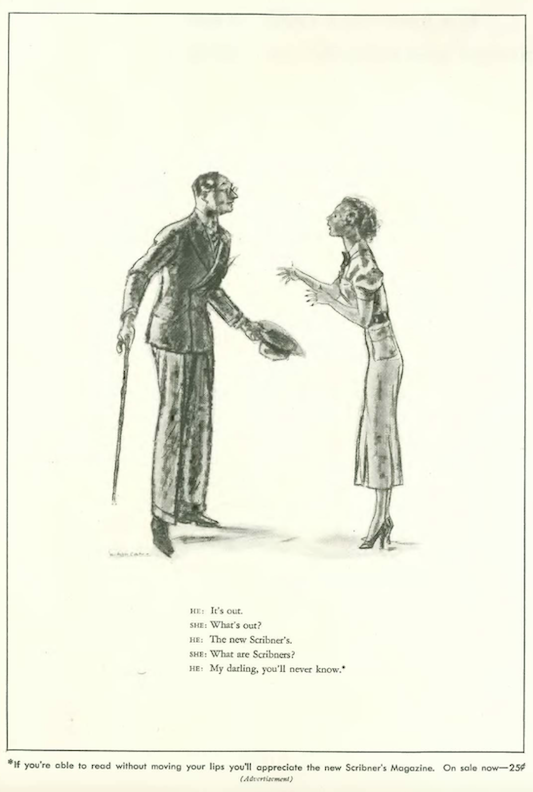
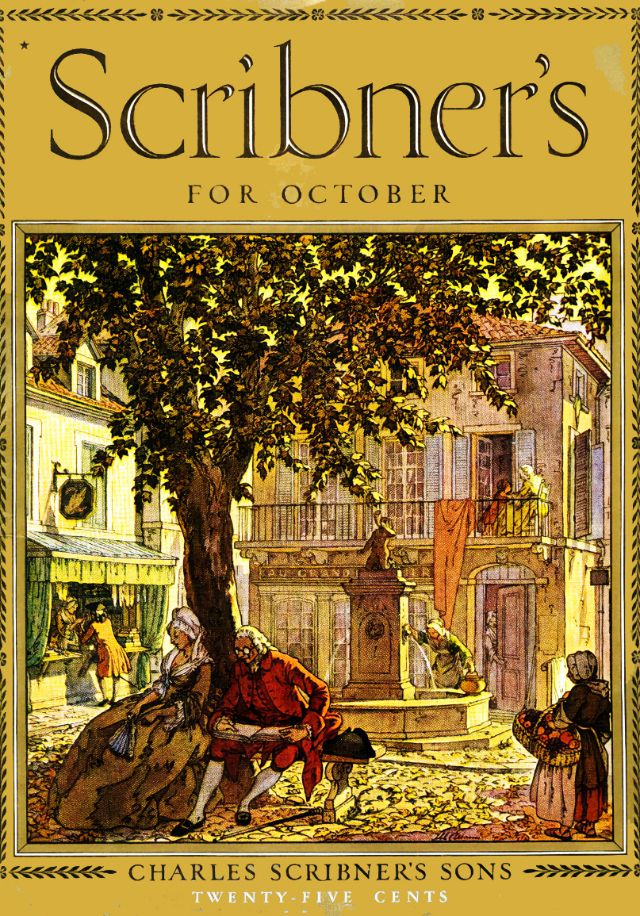
…Scribner’s magazine, a product of publisher Charles Scribner’s Sons, tried to head off declining circulation by hiring a new editor-in-chief, Harlan D. Logan, who sought to modernize the format to compete with contemporary lifestyle magazines…the publisher took out this cheeky full-page ad to draw attention to the “new” Scribner’s…
…founded in January 1887, the magazine saw its strongest sales when Teddy Roosevelt was a contributor from the 1890s to about 1910…despite Logan’s efforts, the magazine folded in May 1939…
The October 1936 issue of Scribner’s marked a change in editorship and design of the magazine. This cover was by American graphic designer Thomas Cleland. (vintage.es)
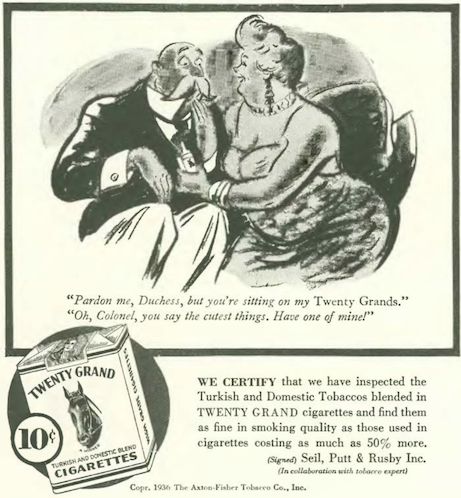
…archetypes like the pompous British Colonel and the haughty Duchess seemed to be everywhere in the 1930s, whether they were foils in screwball comedies or wealthy aristocrats laughably out-of-touch and obsessed with past glories (Peter Arno knew that trick well)…if you’ve followed these posts for awhile you know they are often seen in New Yorker advertising as well…
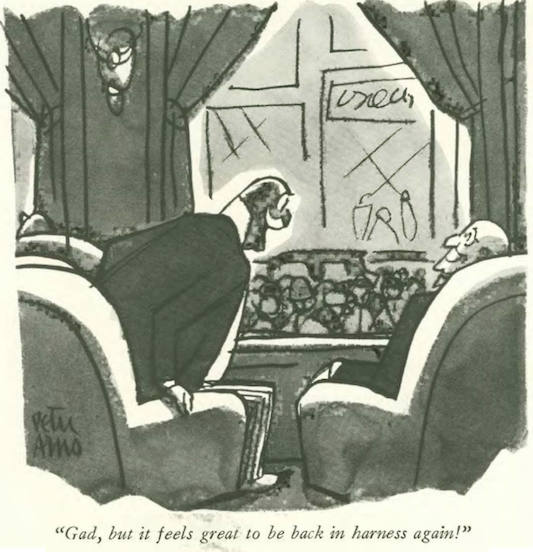
…which makes a nice segue to our cartoons, starting with Arno…
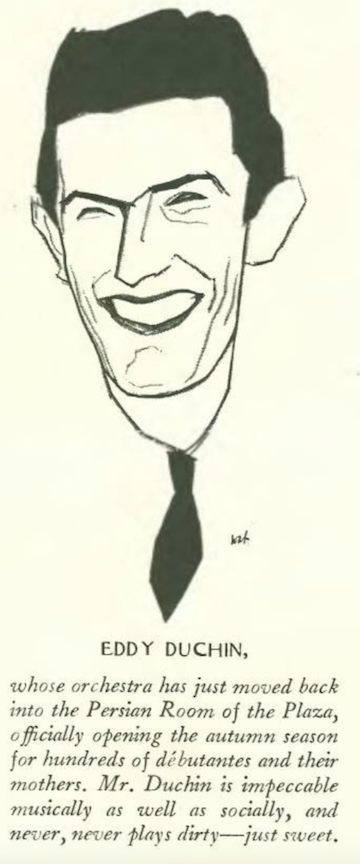
…the calendar section featured this illustration by William Auerbach-Levy for the mini bio of popular bandlander and pianist Eddy Duchin…
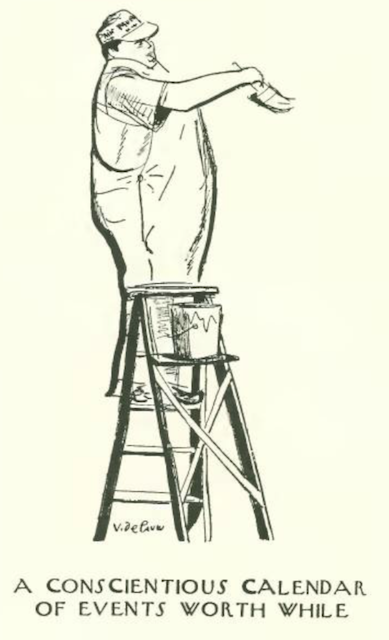
…Victor de Pauw opened up the magazine with this painterly illustration…
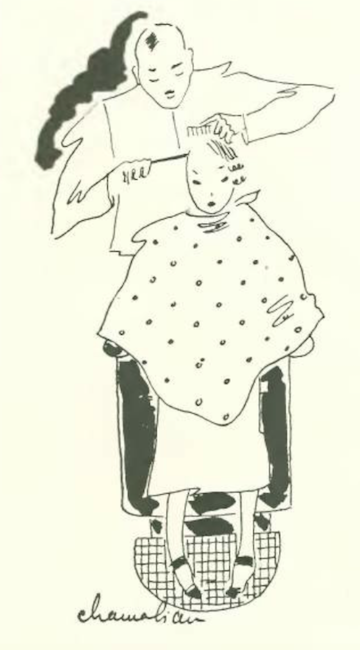
…some spot art from fashion illustrator Alice Chamalian…
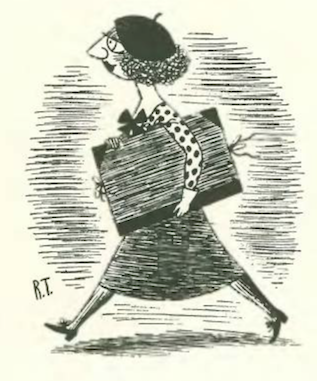
…and Richard Taylor…
…caption-less entries from Alain…
…and Robert Day…
…Leonard Dove supplied a clarification for this sugar daddy…
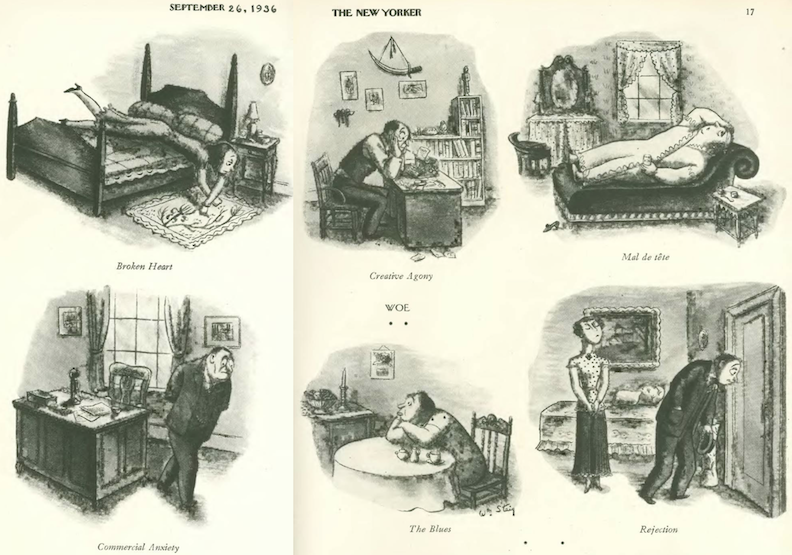
…William Steig gave us various types of “woe”…
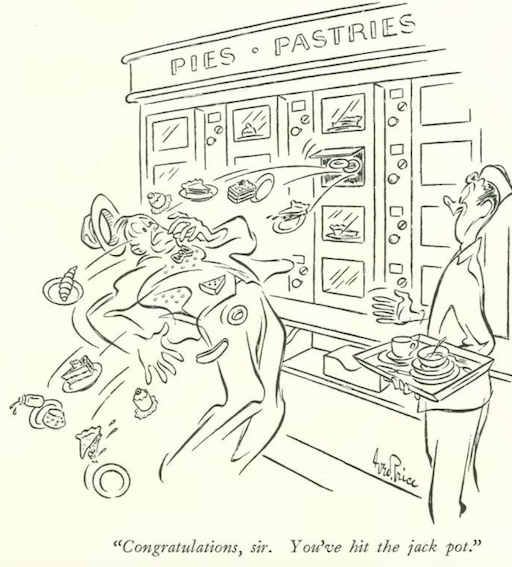
…George Price delivered a surprise at the Automat…
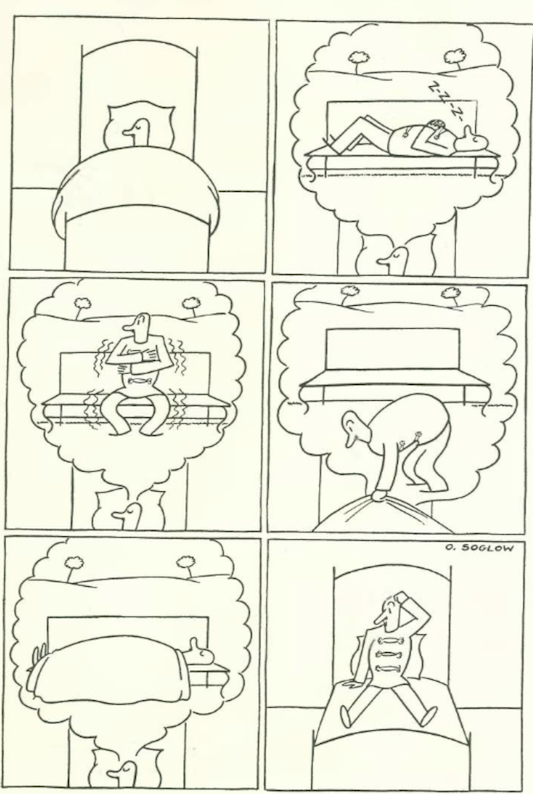
…Otto Soglow pondered the meaning of dreams…
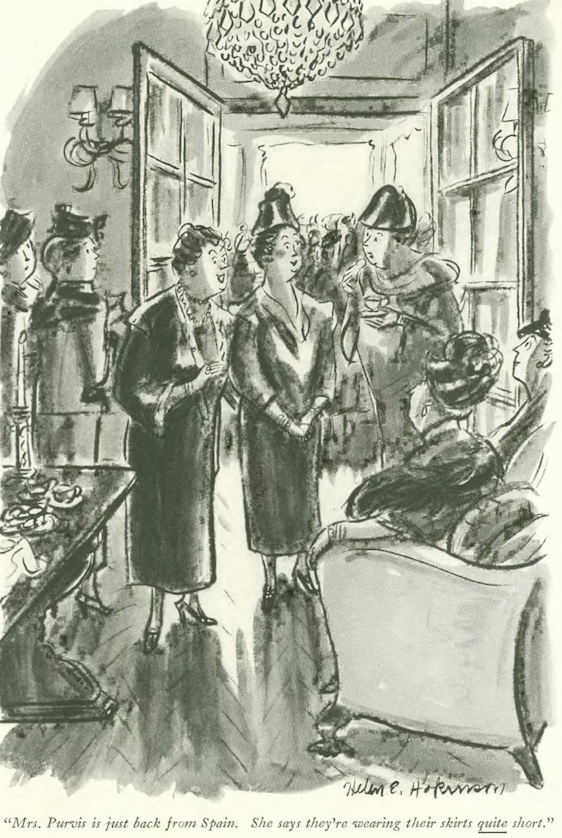
…and we close with some scandalous fashion gossip, courtesy Helen Hokinson…
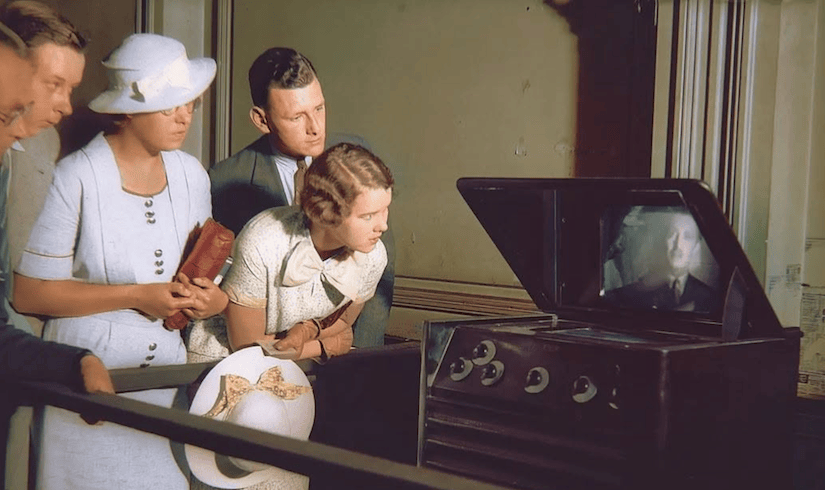
Above: The BBC offered a public demonstration of television at Waterloo Station, London, in 1936. (Colorized image via Facebook)
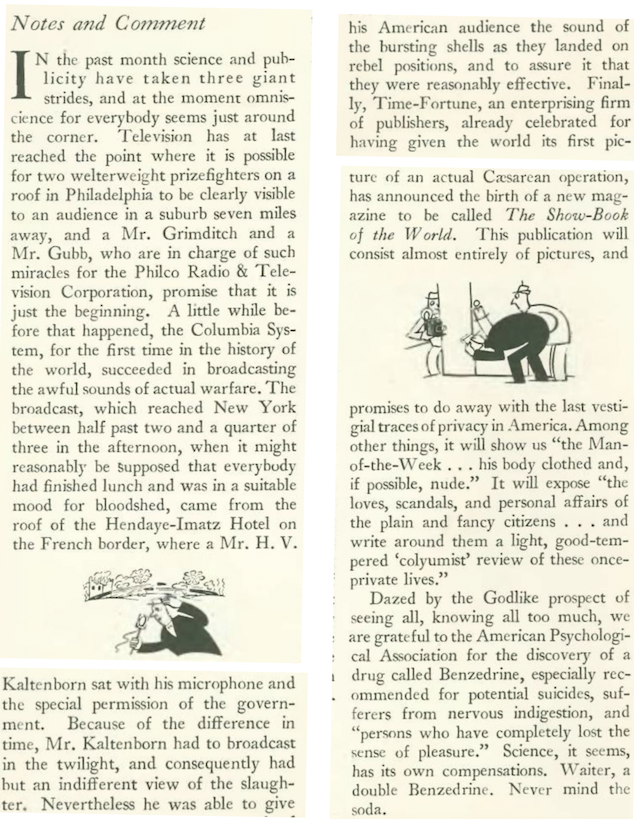
E.B. White was ever wary of new technology (except for aviation—he loved to fly), so television posed yet another thing to fear in the coming age of “omniscience.”
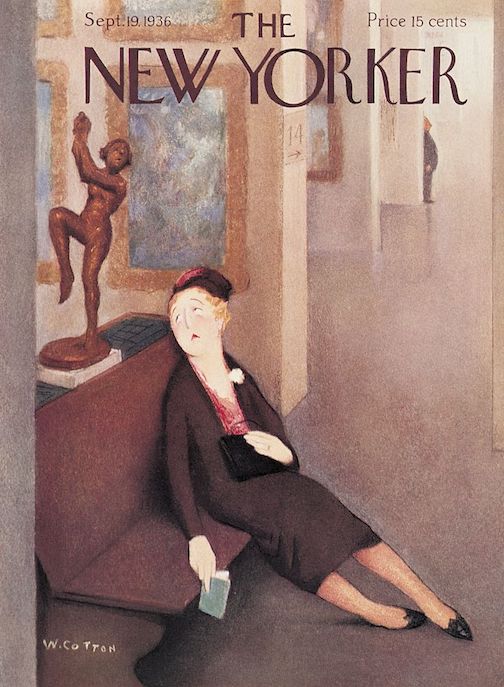
September 19, 1936 cover by William Cotton.
In addition to television, White noted two other “giant strides” in the world of science and publicity: a live radio broadcast featuring sounds from the Spanish Civil War, and the launch of a new magazine that would “consist almost entirely of pictures.”
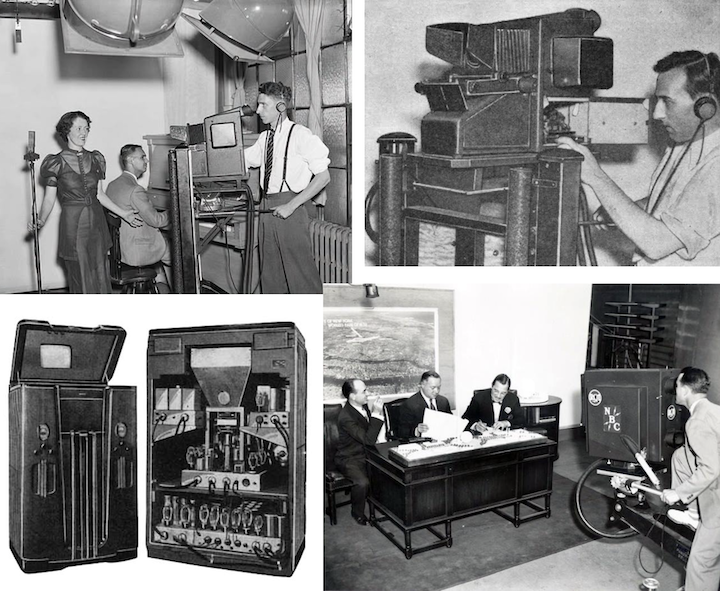
ONE-EYED MONSTER…Clockwise, from top left: On Aug. 11, 1936, Philco Radio and Television demonstrated the transmitting end of a television with the help of camera operator R.E. Waggener and singer Betty McNellis—the sound and picture were projected seven miles to a receiving set; a close-up of a 1936 television camera; photo taken in 1936 during a “live broadcast” from America’s first television studio, NBC Studio 3H—from left, NBC President Lenox Lohr, RCA President David Sarnoff and Fair Committee head Grover Whalen sign a contract for an RCA pavilion at the upcoming 1939 World’s Fair; front and rear view of a 1936 television receiver. (eyesofageneration.com/facebook.com)
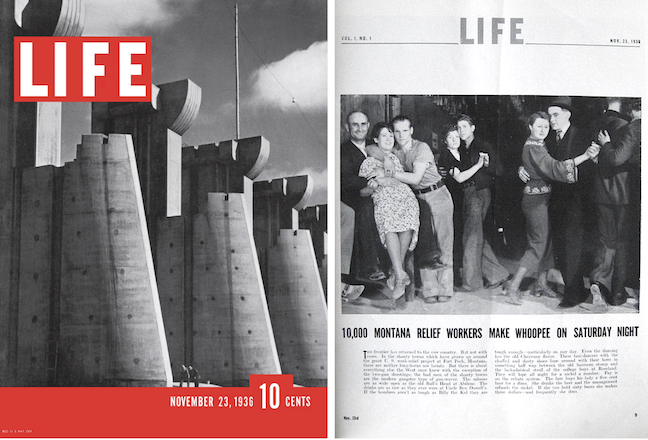
White also noted the upcoming launch of a new magazine, The Show-Book of the World,which was the working title of a publication that would become Life magazine. White did not like the idea of a magazine consisting mostly of pictures that graphically expose “once-private lives,” believing it would “do away with the last vestiges of privacy in America.”
MONUMENTAL…The photo on the first cover of Life magazine, Nov. 23, 1936, was shot by one of Life‘s original four photographers, Margaret Bourke-White, who covered the construction of the Fort Peck Dam, a Public Works Administration endeavor to build the largest earth dam in the world during the Great Depression. At right, a Bourke-White photo of Fort Peck workers enjoying some down time. (npr.org/life.com/worthpoint.com)
* * *
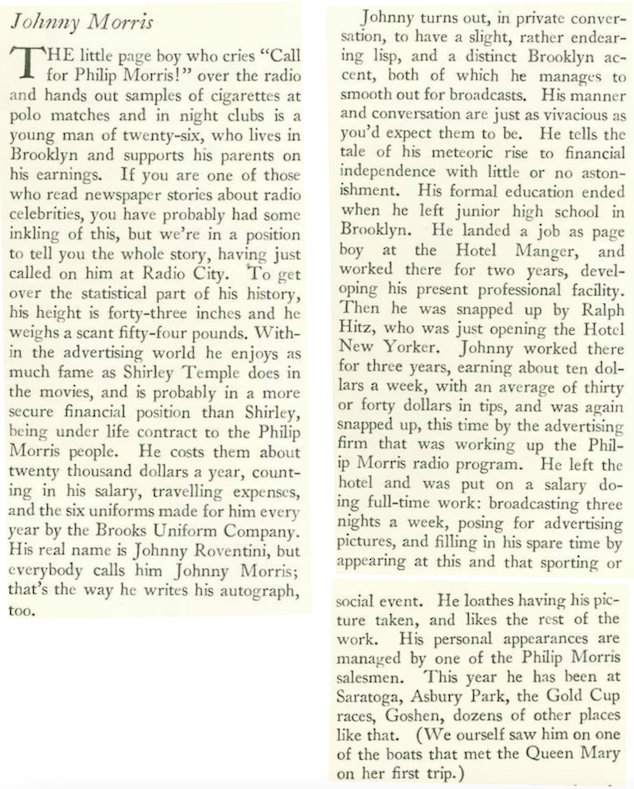
Call for Johnny Roventini!
“The Talk of the Town” featured a brief profile of Johnny Roventini (aka Johnny Morris or Johnny the Bellboy), the famous “living trademark” for the Philip Morris tobacco company. Roventini (1910–1998), who represented the company for more than forty years, was working as a bellboy at the New Yorker Hotel in 1933 when he was discovered by an advertising agent. Excerpts:
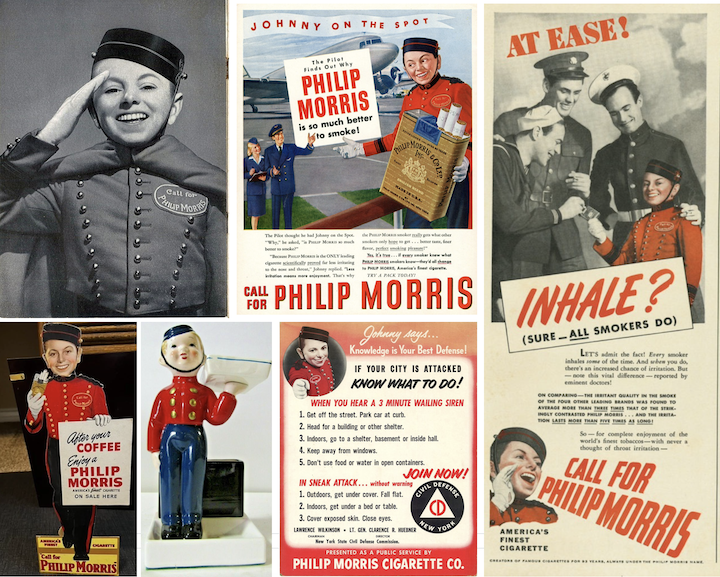
THEY’RE SELLING YOU…In mid-century America the image of Johnny Roventini, known to the public as Johnny Morris or Johnny the Bellboy, seemed to be everywhere. Clockwise, from top left: Publicity photo, 1937; magazine ad, 1947; ad promoting the armed services, 1941; civil defense-themed ad, 1940s; cigarette match holder; promotional stand-up sign. (cats.ua.edu/standford.edu/worthpoint.com)
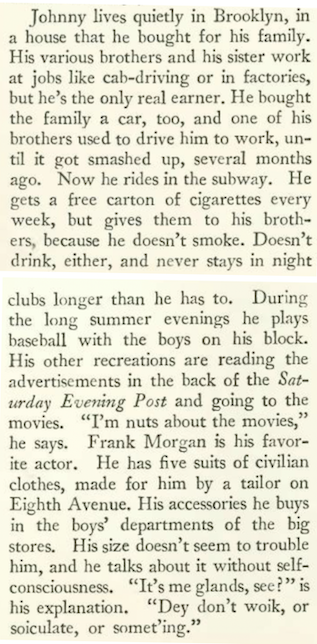
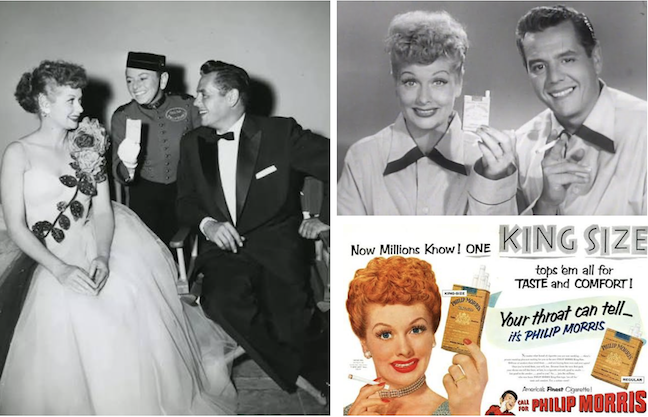
Roventini was probably best known for his Philip Morris promos on I Love Lucy. The new show was challenged to find a sponsor (due to the Cuban character played by Desi Arnaz) until Arnaz arranged a deal that made Philip Morris the exclusive sponsor of I Love Lucy from its premiere on October 15, 1951 through Christmas of 1954. Roventini gained unprecedented national TV exposure and became fast friends with Arnaz and Lucille Ball. Here is one more excerpt from “Talk” regarding the quiet life of Philip Morris’s “living trademark.”
I LOVE PHILIP MORRIS…Lucille Ball, Johnny Roventini and Desi Arnaz formed a lucrative trio for the tobacco company Philip Morris when I Love Lucy went on the air in 1951. Roventini was an occasional, social smoker, while Ball and Arnaz were heavy smokers (although Lucy preferred Chesterfields). (facebook.com/instagram.com)
* * *
At the Movies
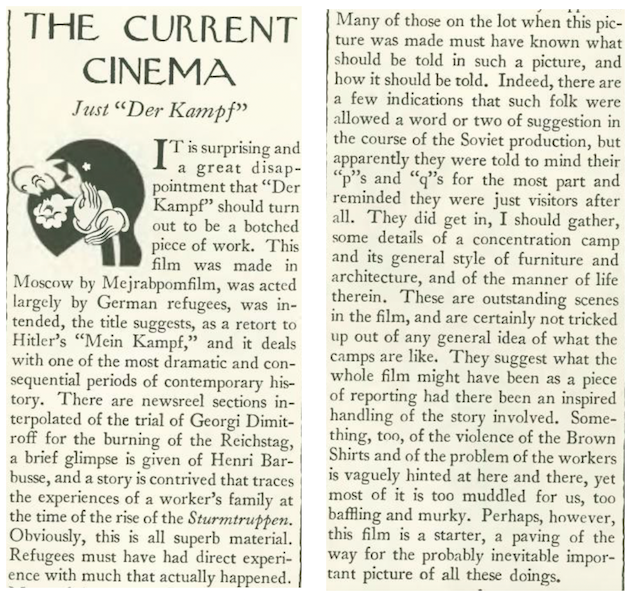
A Soviet film featuring exiled German communists proved to be a disappointment for critic John Mosher, but in retrospect the 1936 German-Soviet film The Struggle (aka Kämpfer or Der Kampf) reveals the strange and terrifying climate artists had to navigate in Stalin’s Russia.
Set in Germany after 1933, the film depicted the resistance of workers against the rise of the Nazi Party. One of the earliest films to depict Nazi terror and concentration camps, ironically many of those who worked on the film became victims of Joseph Stalin’s terror and the Gulag.
DEFIANCE…German actress Lotte Loebinger in a scene from the 1936 German-Soviet movie The Struggle (“Kämpfer”). Loebinger (1905-1995) managed to survive Stalin’s purges and had a long career on the stage in East Berlin following World War II. Loebinger’s lover, a German refugee physician with whom she bore a daughter, was not so fortunate, dying in a Soviet Gulag camp. (YouTube)
Shortly after The Struggle was completed, Stalin purged the community of exiled German communists living in Moscow, and the film was quickly banned by Soviet authorities. A large number of the film’s cast and crew were arrested, sent to the Gulag, or killed, including lead actor Bruno Schmidtsdorf, who was executed by firing squad near Moscow in 1938. Composer Hans Hauska, who wrote the film’s musical score, perished in a Soviet prison camp.
* * *
Playing the Ponies
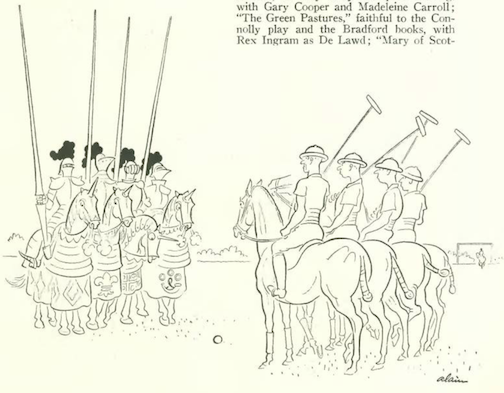
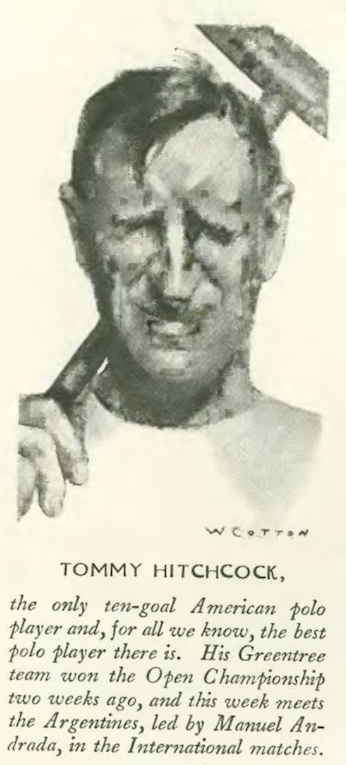
The calendar section continued its series of illustrated mini-bios, this week featuring Tommy Hitchcock, widely regarded as the greatest polo player in the history of the sport. A dashing figure in high society, Hitchcock (1900–1944) was also an aviator and decorated war hero. Illustration by William Cotton.
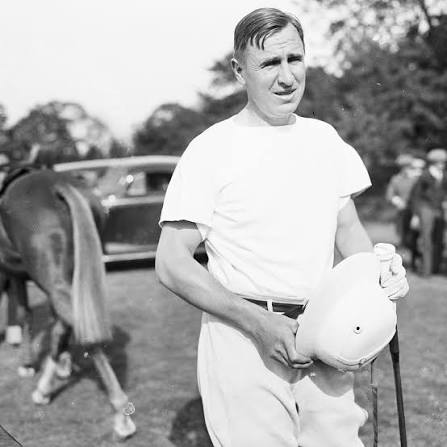
POLO PLAYING PILOT…Tommy Hitchcock flew as a volunteer pilot for the French Air Force in World War I, and was later instrumental in the development of the P-51 Mustang fighter plane. Hitchcock was killed in 1944 while piloting a P-51 on a test flight near Salisbury, England. (instagram.com)
* * *
From Our Advertisers
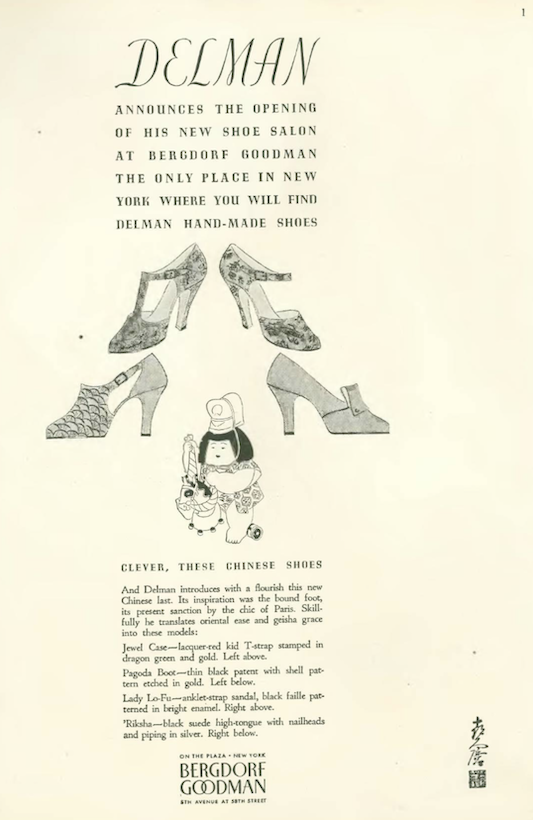
A strange advertisement from Bergdorf, announcing the opening of a salon that featured a line of shoes inspired by the Chinese “bound foot”…
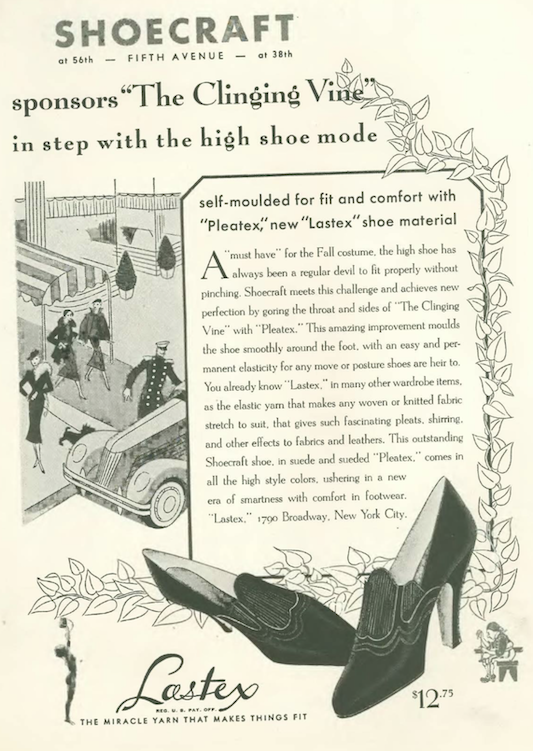
…if a bound foot wasn’t your thing, you could wiggle your toes in an elastic shoe fashioned from “Pleatex”…
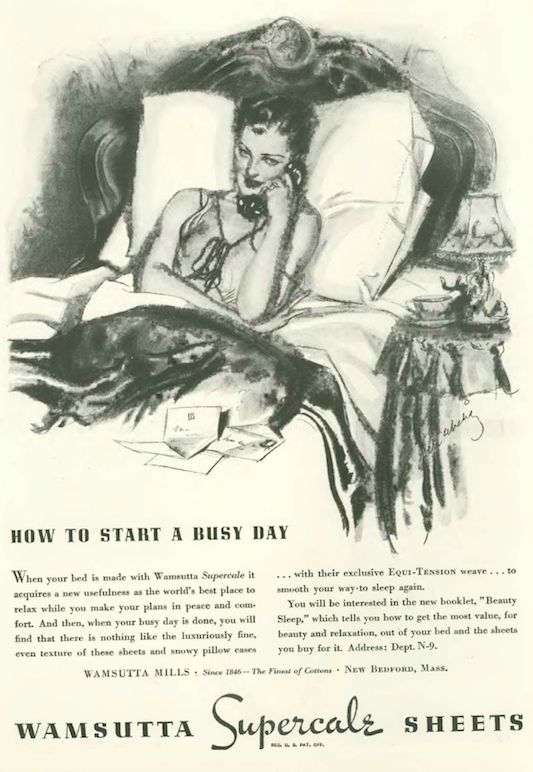
…Wamsutta continued to promote its high thread-count sheets with these somewhat seductive advertisements…
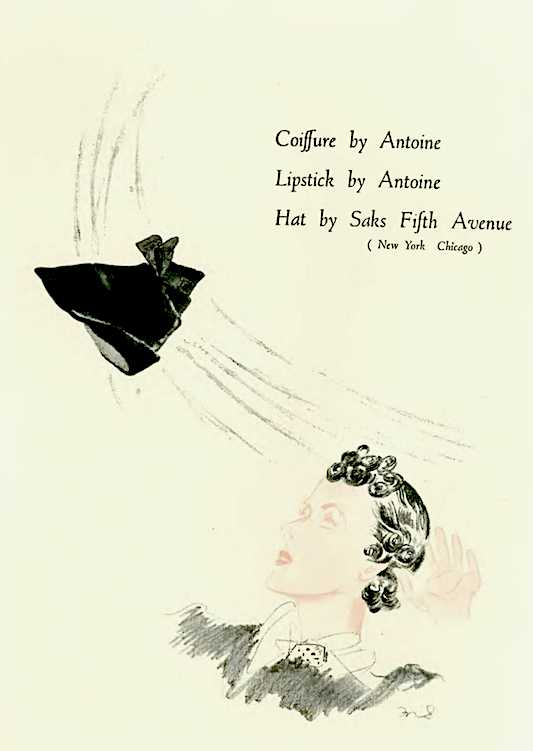
…oddly composed advertisement for Saks Fifth Avenue by fashion illustrator Margaret Sommerfeld, who produced promotional artwork for Saks…
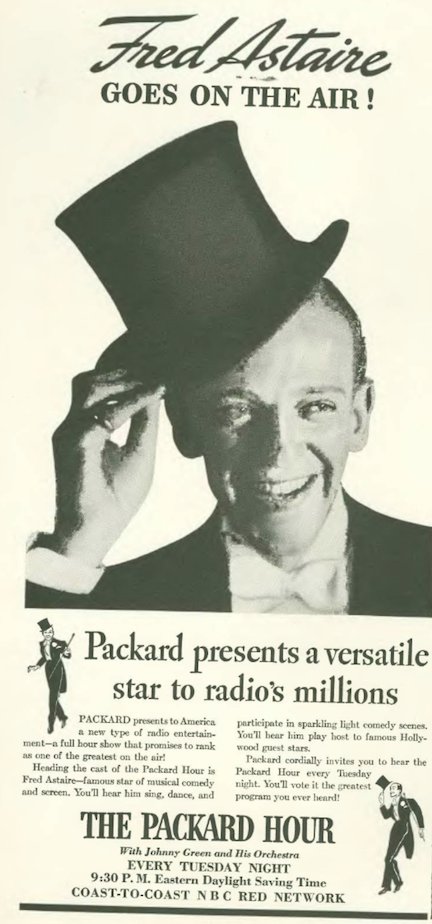
…Fred Astaire managed to hang on to his hat in this advertisement for “The Packard Hour” on NBC’s nationwide “Red Network”…the ad proclaimed “you’ll hear him sing and dance“…on the radio, that is…
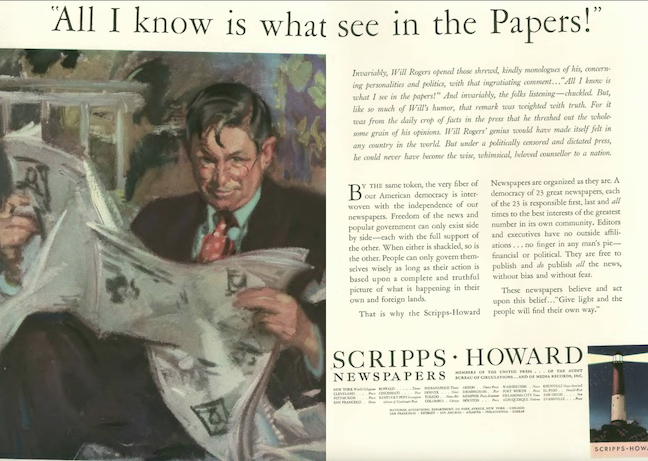
…Scripps-Howard featured this image of the late Will Rogers to promote newspaper advertising…
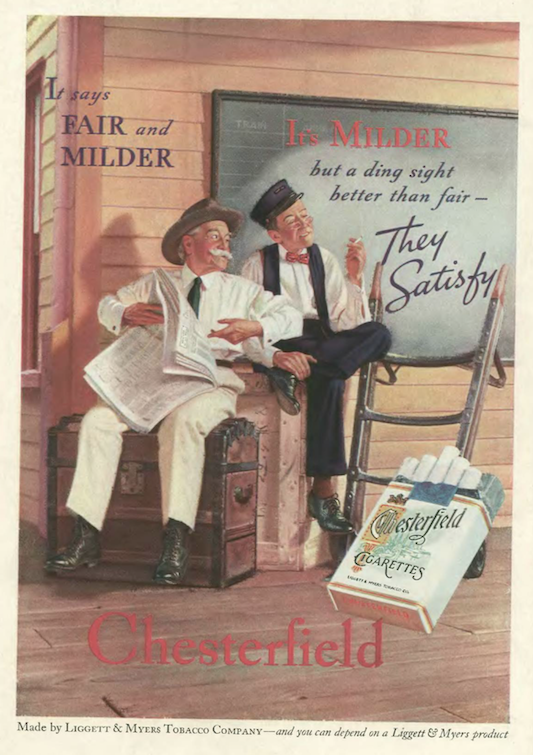
…this back cover ad also featured a newspaper reader, enjoying a smoke while waiting for the train…
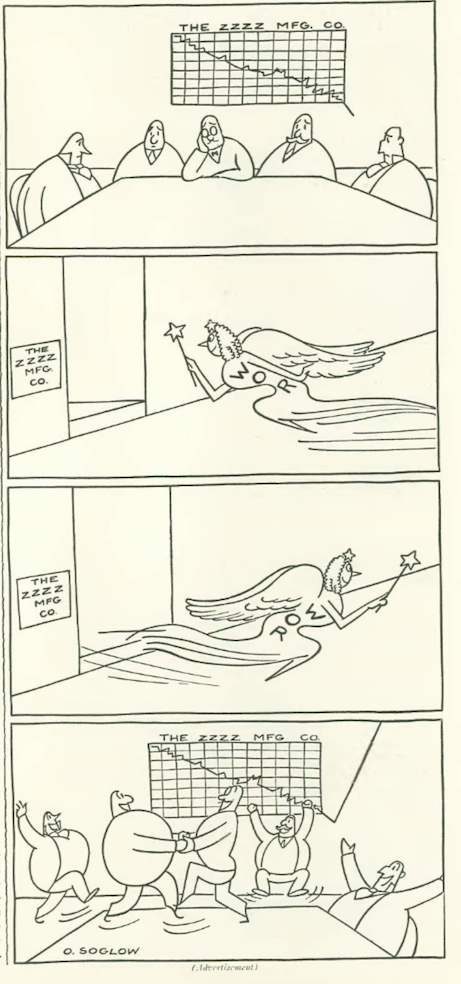
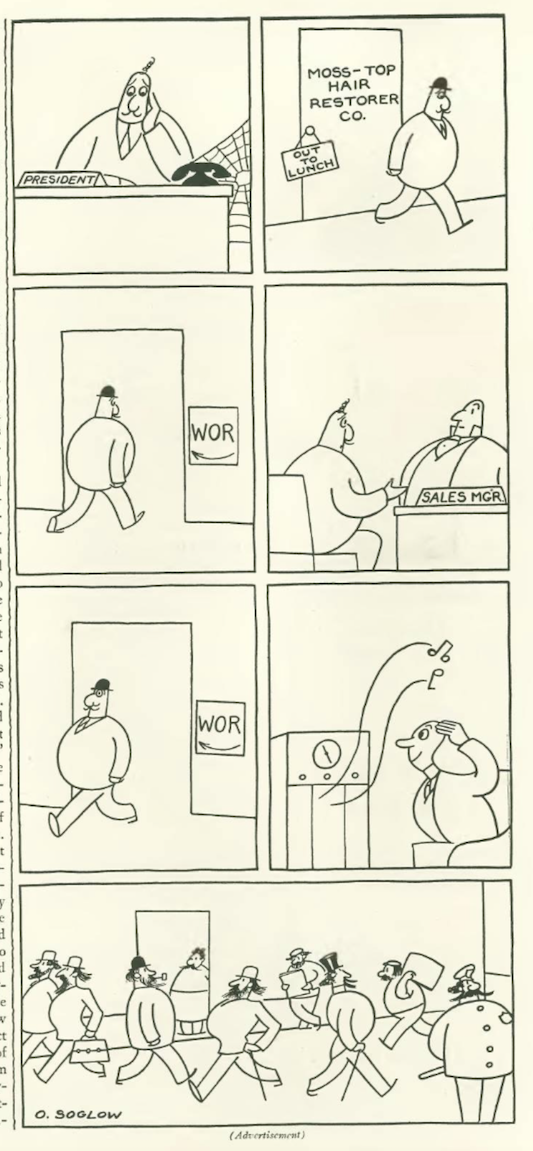
…best known for creating The Little King,Otto Soglow drew hundreds of cartoons and spot drawings for The New Yorker as well as for a variety of advertisers including Pepsi-Cola, Benson & Hedges cigarettes, and here, one from a series of ads he created for WOR radio…
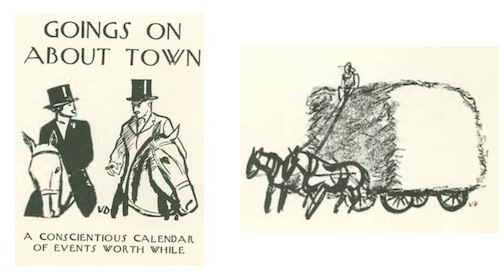
…speaking of spots, here are two by Victor de Pauw…
…biographies of prolific New Yorker cover artist Arthur Getz give his start date at the magazine as 1938, but this might be one of his early spot drawings (although the signature style differs from Getz’s other works)…
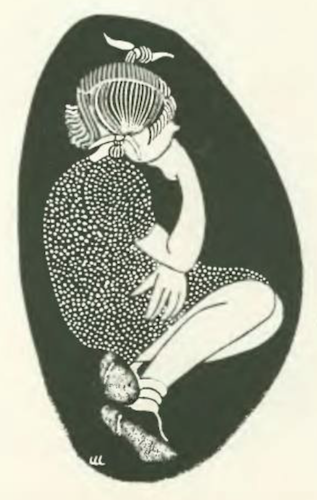
…no mistaking this spot by Christina Malman…
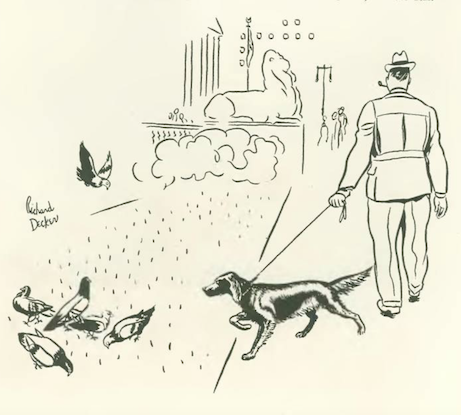
…or this one by Richard Decker…
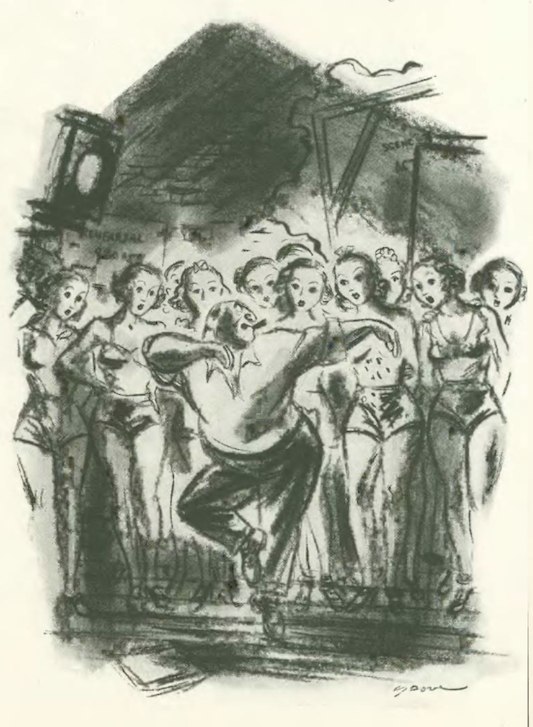
…Leonard Dove demonstrated some moves for a chorus line…
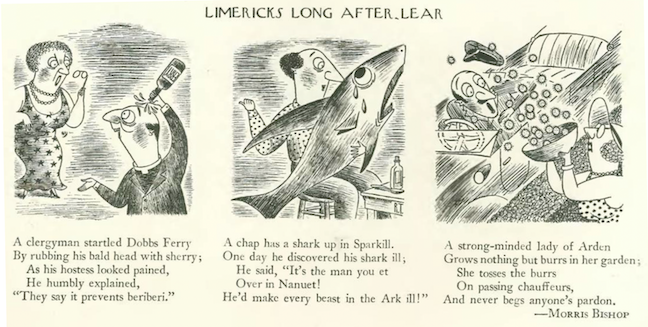
…and more wonderful Richard Taylor illustrations for Morris Bishop’s limericks…
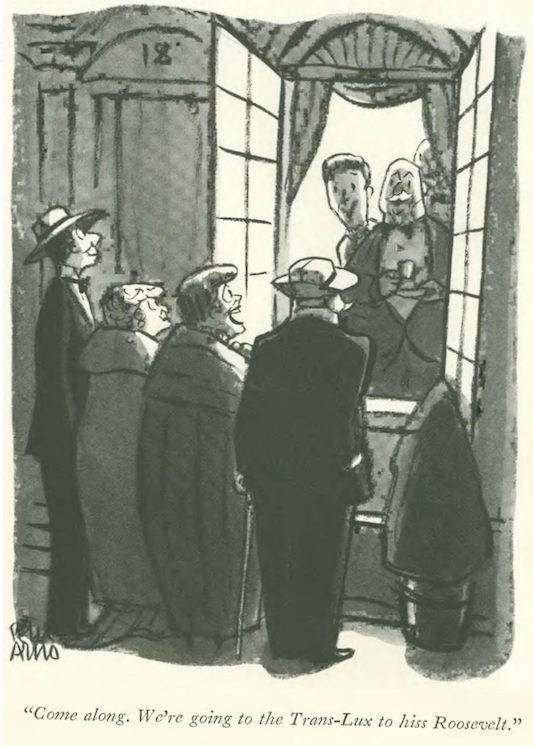
…the well-heeled prepared to engage in a favorite sport, per Peter Arno…
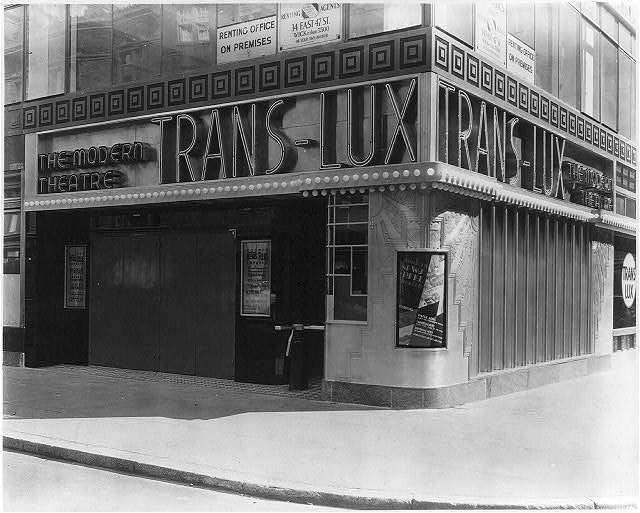
…”Trans-Lux” theaters were conversions of storefronts and retail offices that seated smaller audiences than traditional theaters. Rather than feature films, the Trans-Lux theaters showed continuous 45-to-60-minute loops of newsreels (like The March of Time), short subjects, travelogues, and cartoons from 10 a.m. to midnight—people could come and go as they pleased. The theaters pioneered rear-screen projection, using a specialized, wide-angled lens placed just eight feet behind a translucent screen…
POP IN, POP OUT…The very first Trans-Lux cinema opened in 1931 at 58th and Madison as a unique venue that played newsreels and shorts. According to The New York Times, “by the late 1940s, the rise of television began to kill the newsreel format entirely. By 1949, Trans-Lux stopped expanding its boutique newsreel footprint and pivoted its existing houses toward showing standard feature-length films.” (Library of Congress)
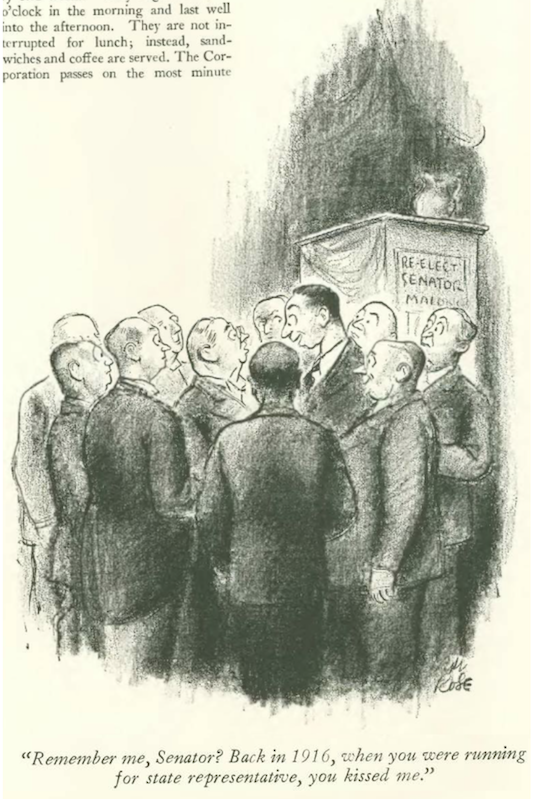
…back to our cartoons, Carl Rose conjured up an unwelcome reminder…
…Charles Addams was up to his old tricks…
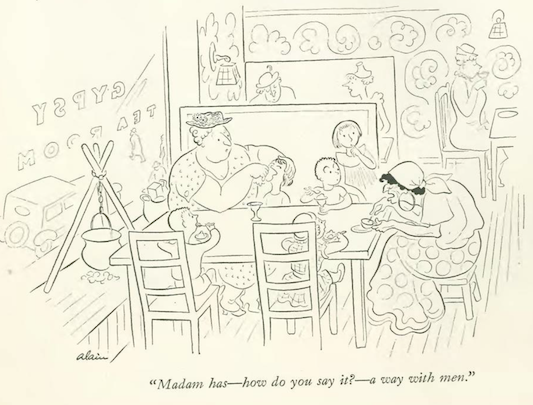
…Alain read the obvious from some tea leaves…
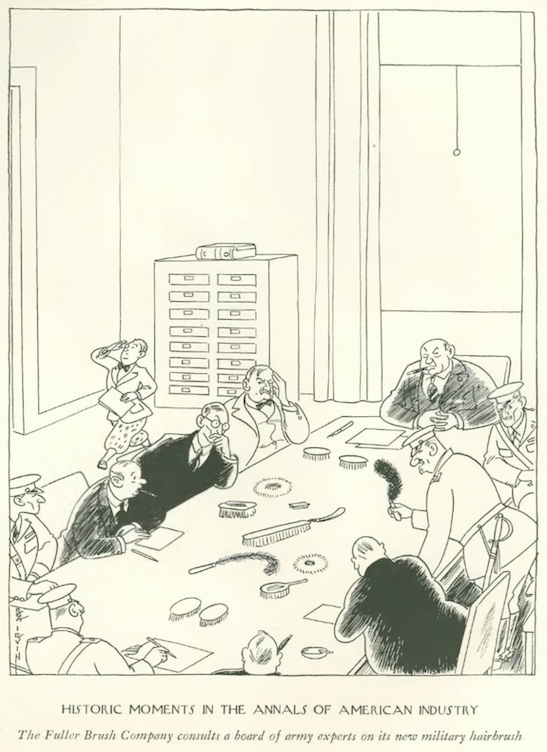
…Rea Irvin showed us some strategic thinking by military brass…
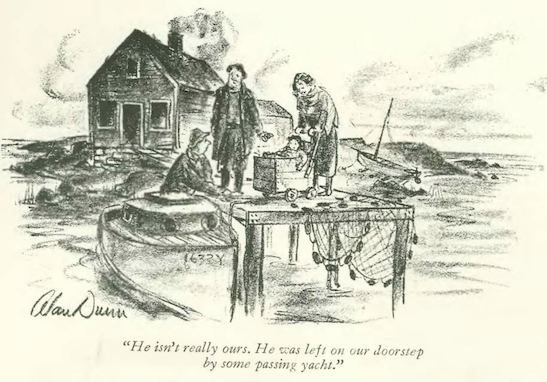
…Alan Dunn considered the mysteries of the sea…
…this guy should have suggested a comedy, per Barbara Shermund…
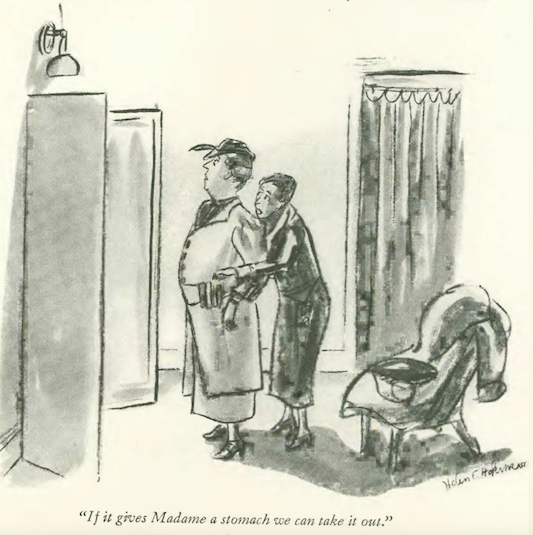
…Helen Hokinson continued to probe the delicate work of the dress shop…
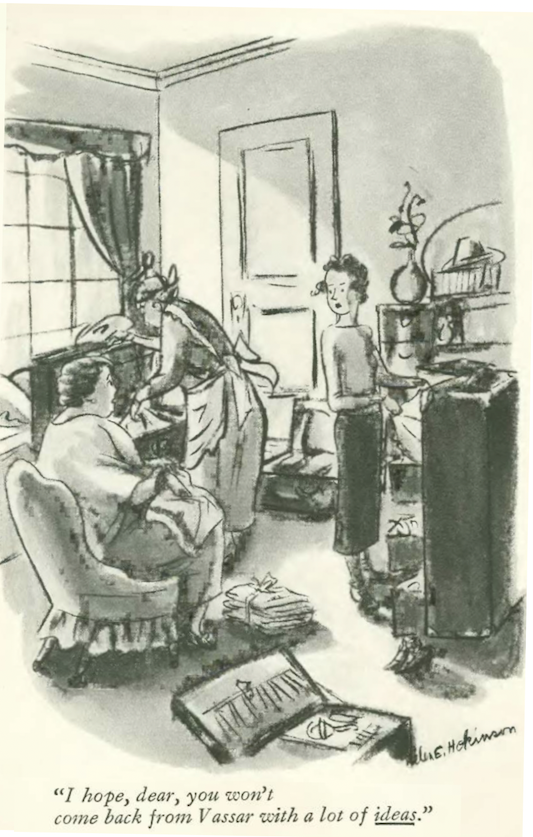
…and we close with another by dear Helen, and the fear of too much thinking…
E.B. White grew up along the coast of Maine and had a lifelong love of sailing. He did not, however, have much regard for those who came to the water simply to bask in the sun.
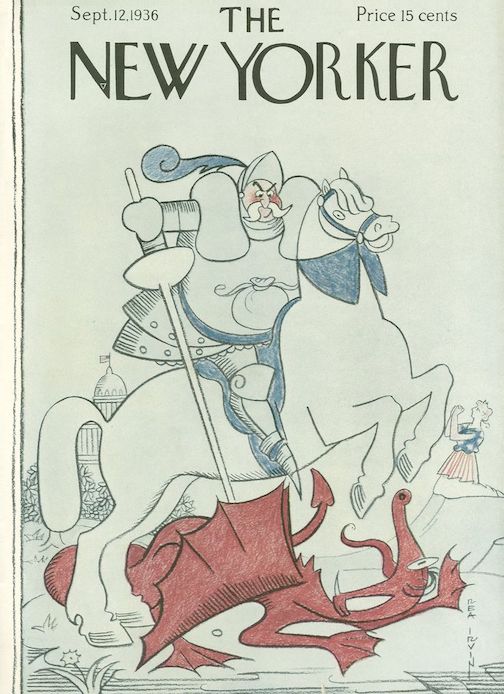
September 12, 1936 cover by Rea Irvin.
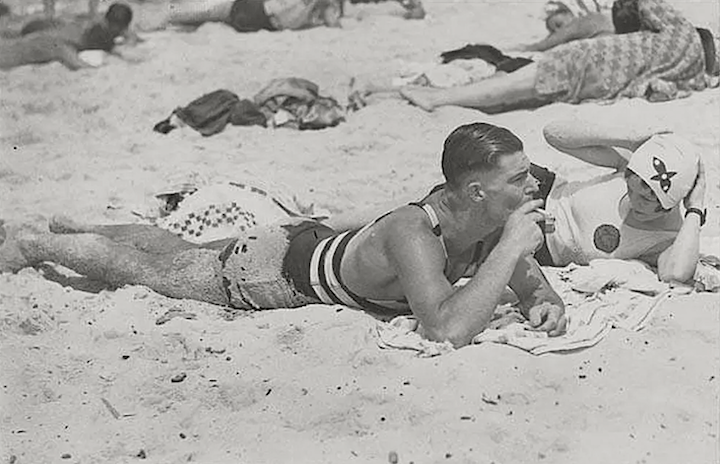
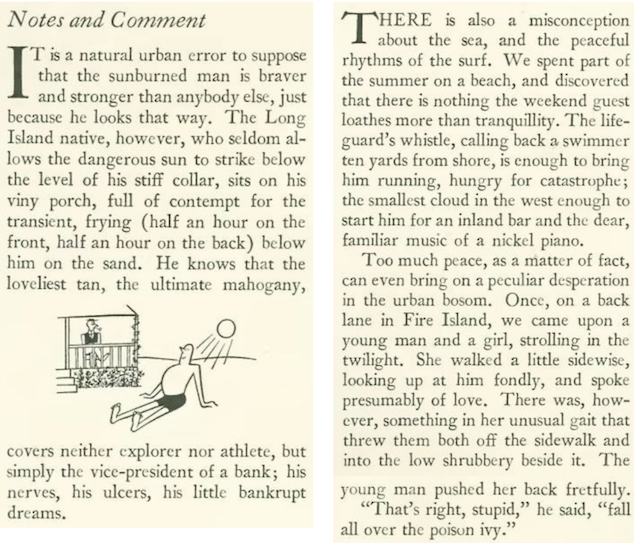
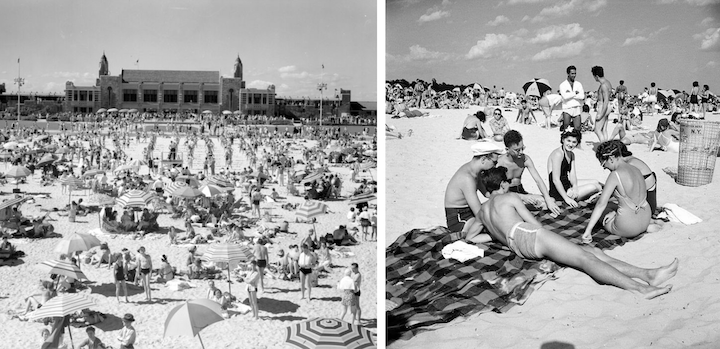
White led off his column with some sharp words about the “sunburned man” who did not come by his tan honestly, like an athlete or explorer, but rather spent his weekends “frying” to cover his “bankrupt dreams.” White was also critical of “the weekend guest” who brought noise rather than tranquility to the seaside.
E.B. WHITE’S NIGHTMARE…At left, the West Bathhouse at Jones Beach is the backdrop for this circa 1930s image of New York beachgoers; at right, sunbathers play cards on Orchard Beach, known as the “Riviera of the Bronx,” circa 1930. (facebook.com/Patchogue-Medford Library)
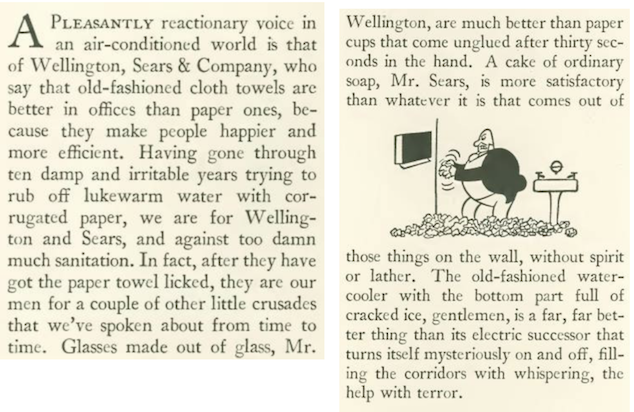
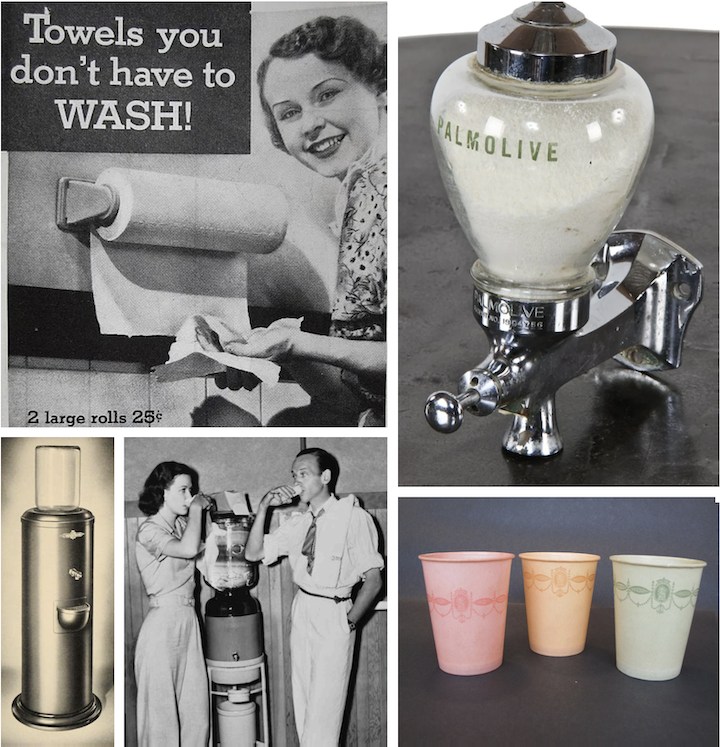
Ever critical of innovation, E.B. White also lamented the rise of such “conveniences” as paper towels and powdered soap dispensers.
A FEW OF MY LEAST FAVORITE THINGS…Always wary of the newfangled, E.B. White preferred cloth over paper towels, bar soap over powdered; glass rather than Dixie Cups, and old-fashioned water coolers glittering with cracked ice. Clockwise, from top left: Ad for Scot paper towels, 1935; 1930s powdered soap dispenser; Dixie Cups, 1931; Eleanor Powell and Fred Astaire take a break at an old-fashioned water cooler during filming of Broadway Melody of 1940; detail from an ad for a Frigidaire electric water cooler, 1936. (witness2fashion/urbanremainschicago.com/lafayette.edu/tcm.com)
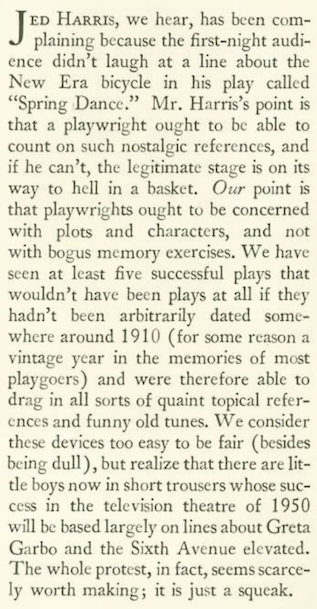
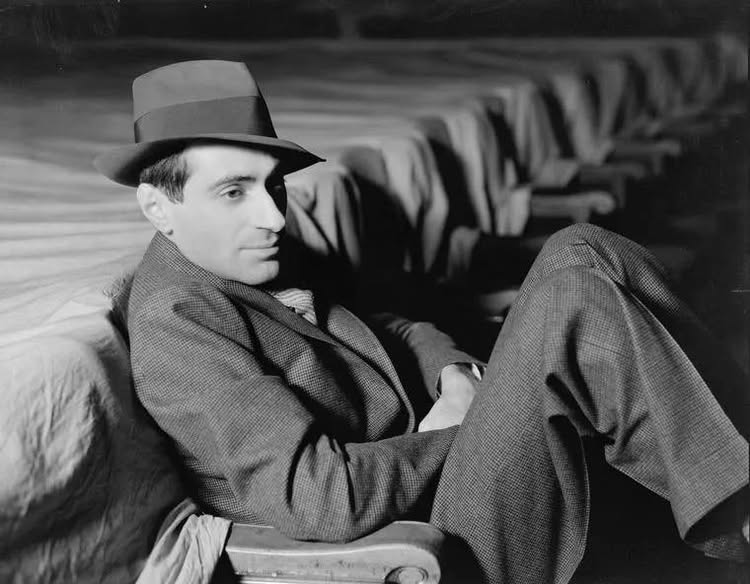
One more item from “Notes,” this referring to theatrical producer and director Jed Harris, who was peeved when a nostalgic reference in his new comedy, Spring Dance, failed to elicit laughter from a first-night audience at the Empire Theatre. E.B. White sided with the audience, and wondered if playwrights in the “television theatre of 1950” would someday reference “Greta Garbo and the Sixth Avenue elevated.”
RELAX, JED…Learning that Broadway producer and director Jed Harris was upset about an audience’s lack of reaction to a nostalgic reference, E.B. White suggested that the director’s protest was a mere “squeak.” (History of Cinema via Facebook)
* * *
At the Movies
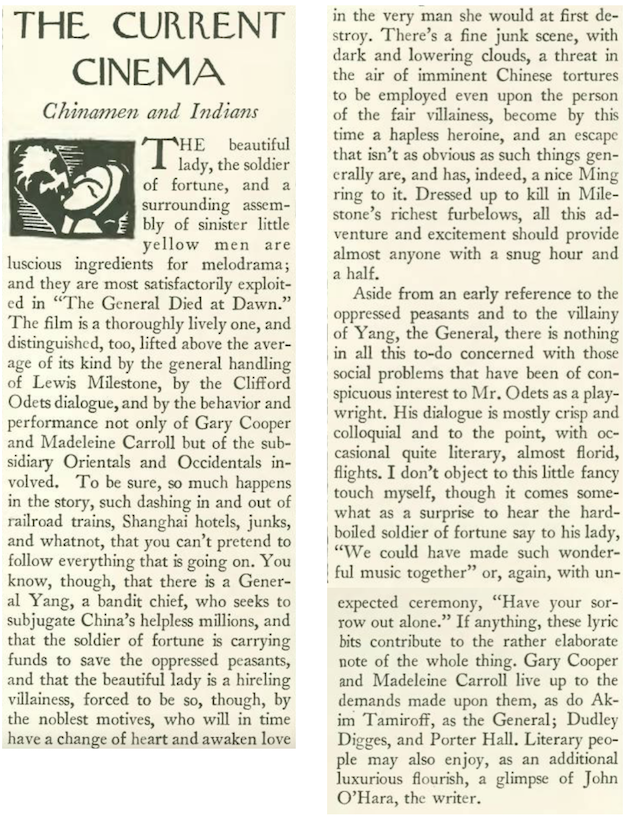
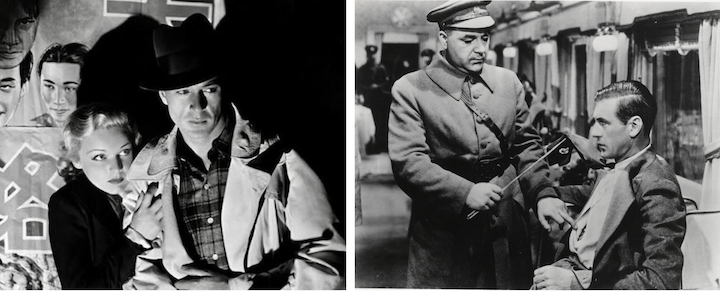
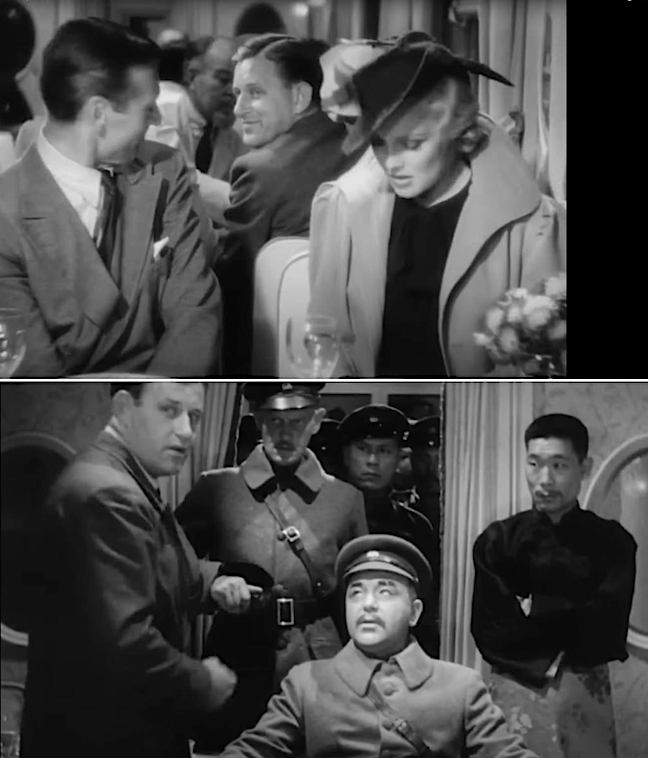
Gary Cooper finally showed off his gift for gab in Paramount’s drama The General Died at Dawn. Critic John Mosher called the film “lively,” and noted a “glimpse” of New Yorker short story writer John O’Hara in a cameo appearance.
TROUBLE IN CHINA…Gary Cooper and Madeleine Carroll portrayed lovers in war-torn China who seek to stop an arms shipment in The General Died at Dawn; at right, Cooper in a scene with Akin Tamiroff, who portrayed warlord General Yang. The film was directed by Lewis Milestone and written by Charles G. Booth and Clifford Odets. (imdb.com/ebay.com)CAMEO…New Yorker short story writer and novelist John O’Hara played a minor role as a newspaper reporter in The General Died at Dawn. (John Fronza via Facebook and YouTube)
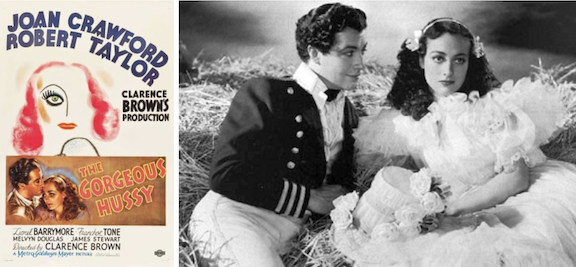
The title of MGM’s The Gorgeous Hussy suggested something racy, but as Mosher noted, it “unexpectedly turns out to be about Andrew Jackson.”
SEX SELLS…MGM played up Joan Crawford’s role as a “hussy” in this theatrical poster for The Gorgeous Hussy, but these were the days of the Hays Code and things wouldn’t get more racy than the scene at right, with Robert Taylor as Andrew Jackson and Crawford as the “hussy,” Peggy Eaton. (imdb.com/mubi.com)
* * *
From Our Advertisers
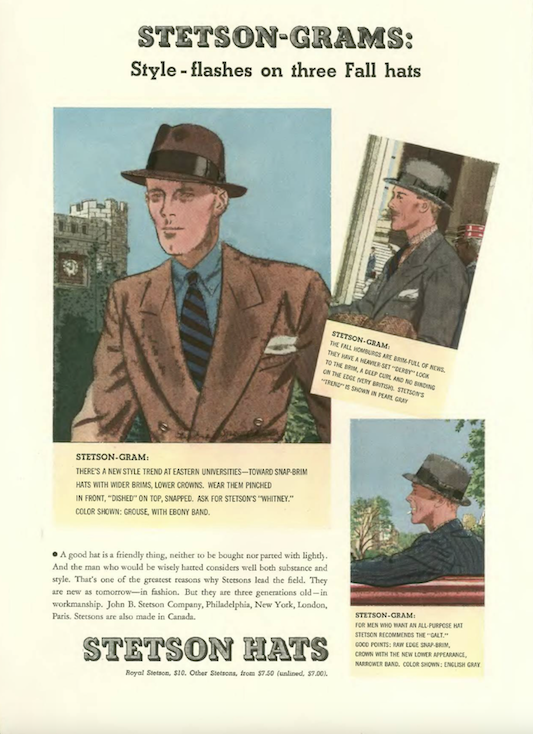
It was time to get that fall hat, and Stetson had three smart-looking lids for the man about town…
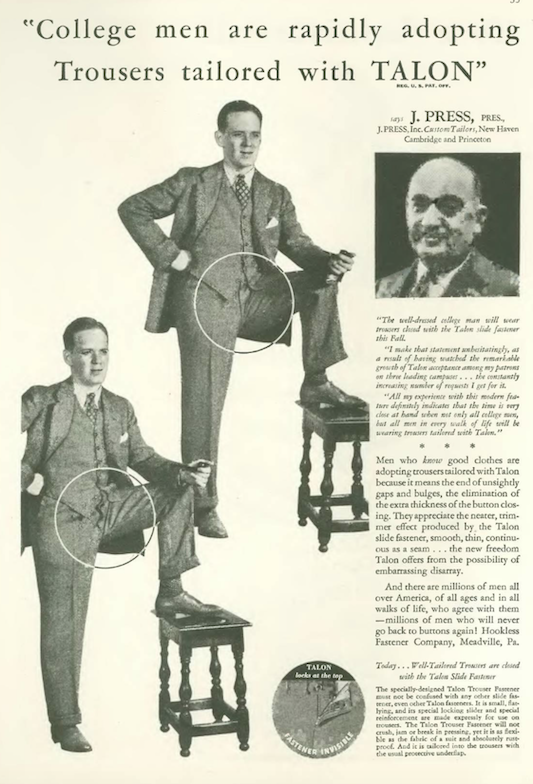
…and here’s a not-so-smart ad from the makers of Talon zippers…no doubt some of the wags on The New Yorker’s editorial side got a kick out of this…
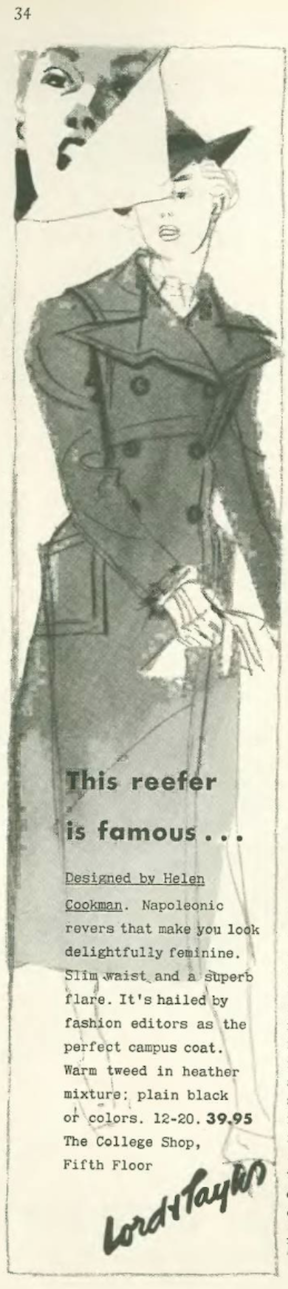
…and this strange ad from Lord & Taylor…not sure what they were trying to convey with that peeled-back corner…
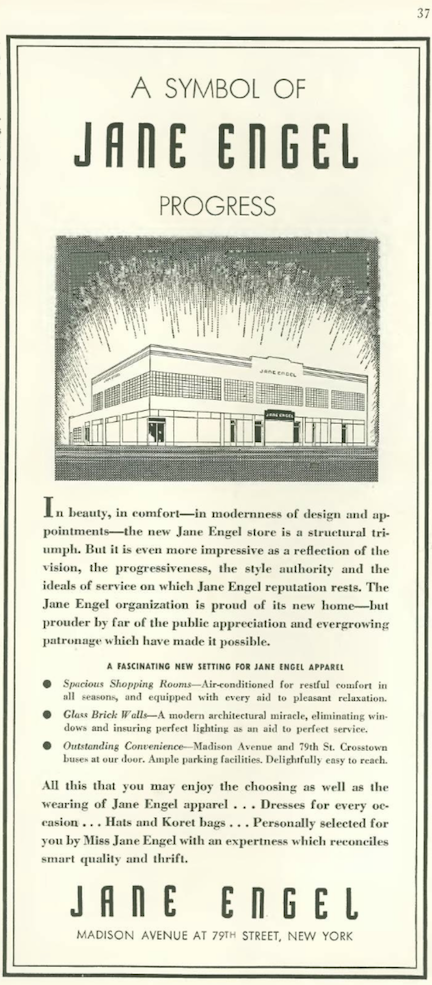
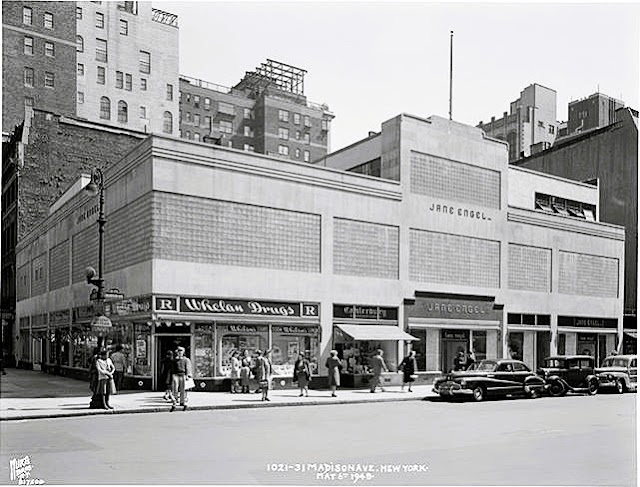
…Jane Engel founded a popular women’s and children’s apparel shop during the Great Depression (in 1930) with just $400 to her name. She grew the business from a single shop on Madison into a successful chain of more than thirty locations…
JEWEL BOX…The flagship Jane Engel Building at Madison and 79th was designed by Roy C. Morris in the Art Moderne style—the generous use of glass brick filled the interior with soft, diffused light. The shop closed in 1955 and was demolished two years later. (New York Public Library)
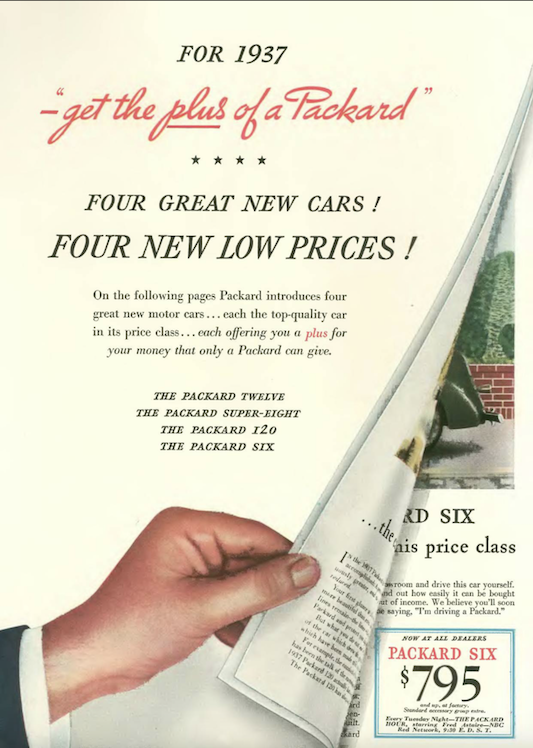
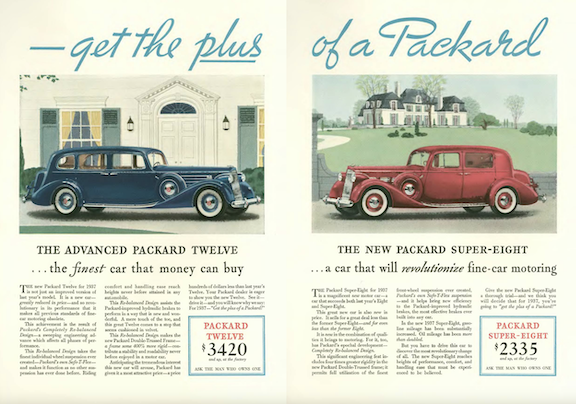
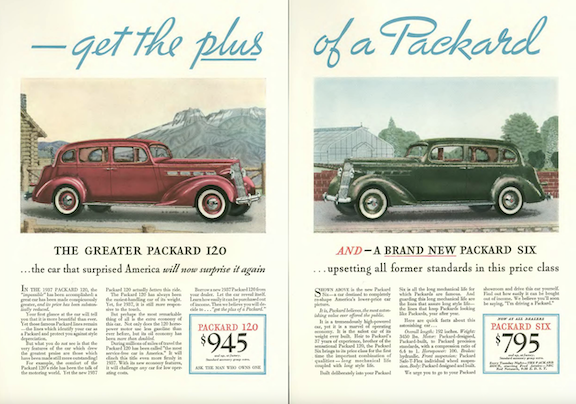
…the makers of the luxury brand Packard made sure Depression-strapped buyers could still afford one of their automobiles, which ranged in price from $795 to $3,420 (in 2026 equivalent to roughly $19,000 and $83,000, respectively)…no doubt The New Yorker’s bean counters appreciated the revenue from these five consecutive full-page color ads…
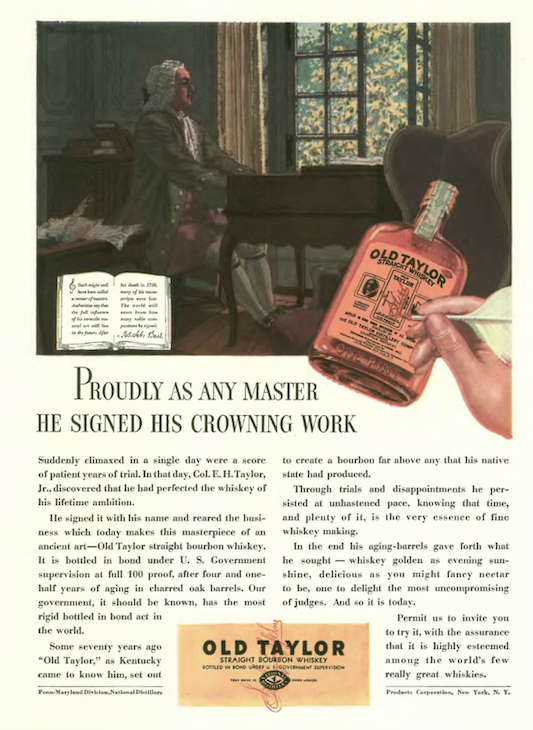
…bourbon distillers continued to compare the accomplishments of famous men to the quality of their tipple…
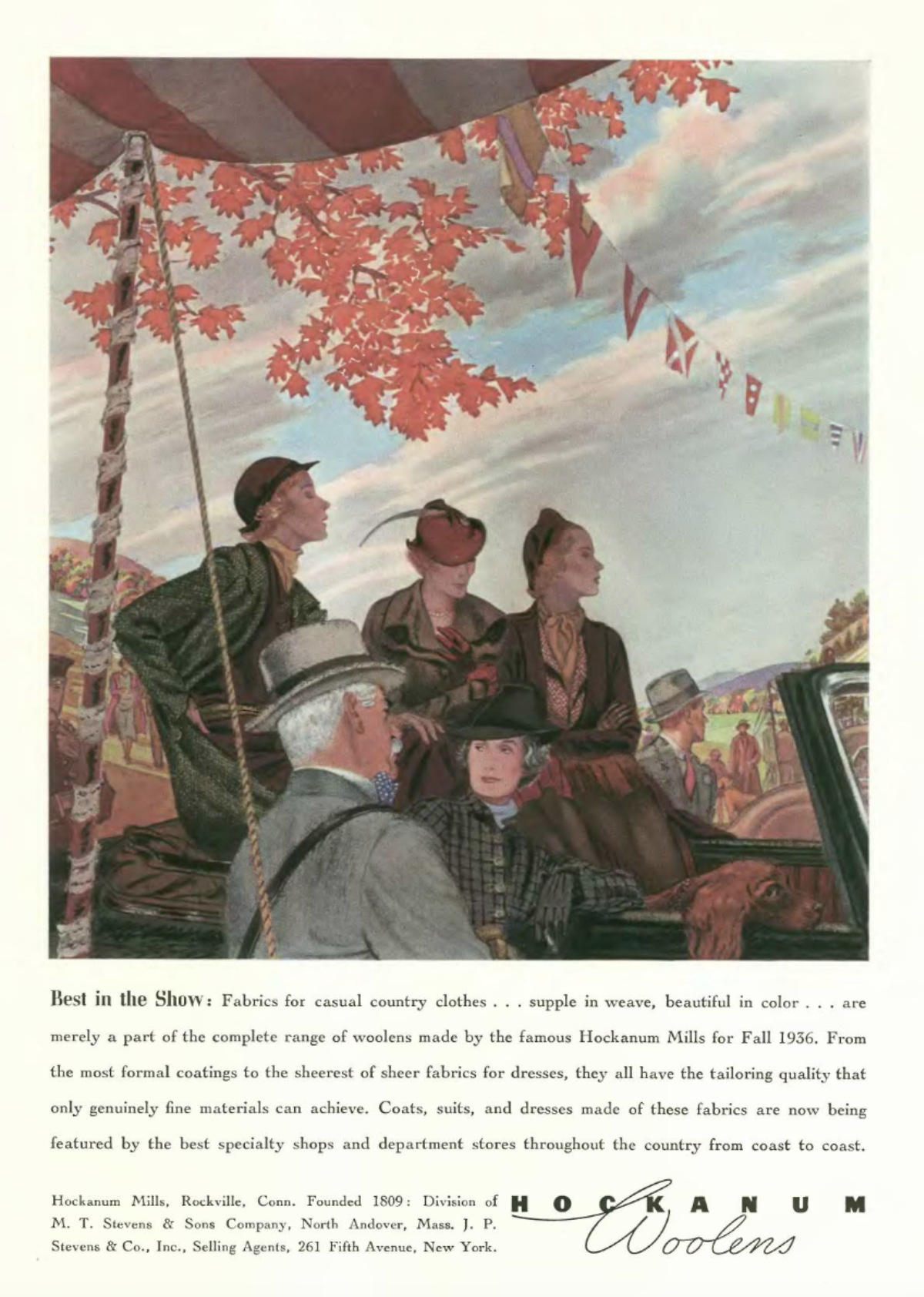
…as the folks at Hockanum Mills continued featuring fine woolens in upscale, seasonal settings…
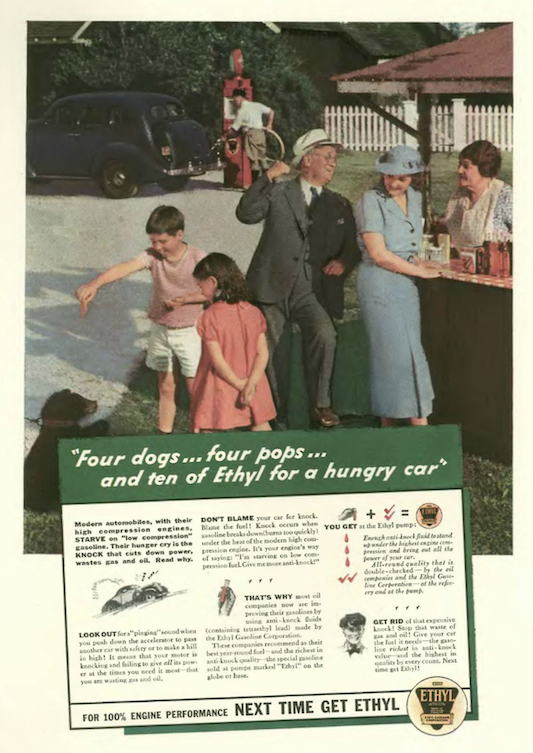
…and the makers of leaded gasoline continued their series featuring homespun images juxtaposed with attendants gassing up cars in the background…at first I thought this was one image superimposed over another, but more likely the gas pump is a prop…also, an odd detail on the left where children appear to be feeding (or teasing) a baby bear restrained by a leash…
…we move on to our cartoonists, beginning with Richard Decker…
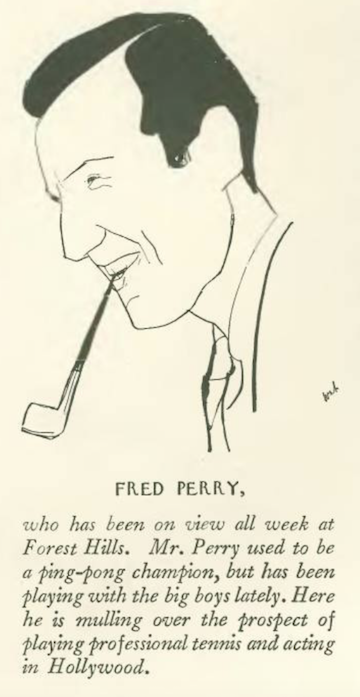
…also in the calendar section was this illustration by William Auerbach-Levy for the mini bio of Fred Perry (1909–1995), British tennis star who won ten Majors, including three consecutive Wimbledon Championships from 1934 to 1936…he was the first player to win a “Career Grand Slam” which he completed at the tender age of 26 in 1935…Perry was also the world champion ping-pong champion in 1929…
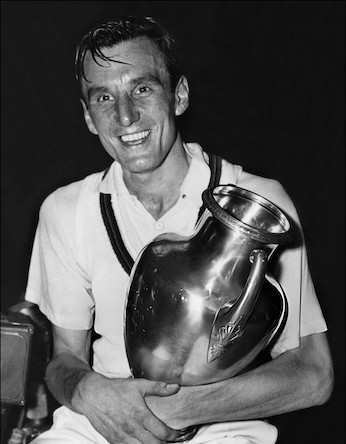
FRISKY FRED…Fred Perry was one of the leading bachelors of the 1930s and his off-court romances were reported in the world press—including one with actress Marlene Dietrich. Perry was also known for his popular line of sports attire. Above: Perry hugs the championship cup after his U.S. Open victory at Forest Hills, 1936. (Wikipedia)
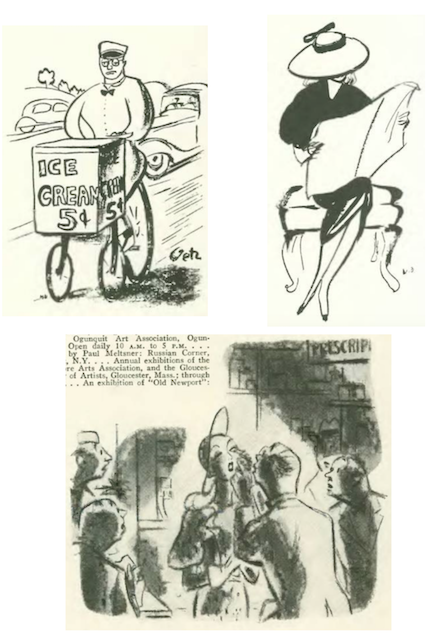
…an assortment of spot drawings…clockwise, from top left, Arthur Getz, Victor de Pauw, and Barbara Shermund (arguably not a spot drawing, but not really a cartoon either)…
…no signature on this, but it appears to be the work of Perry Barlow, which always reminded me of another artist known for his rural types, Robert McCloskey…
…James Thurber illustrated a public display of disaffection…interesting use of perspective here…Thurber seems to violate all the rules yet the effect is masterful…
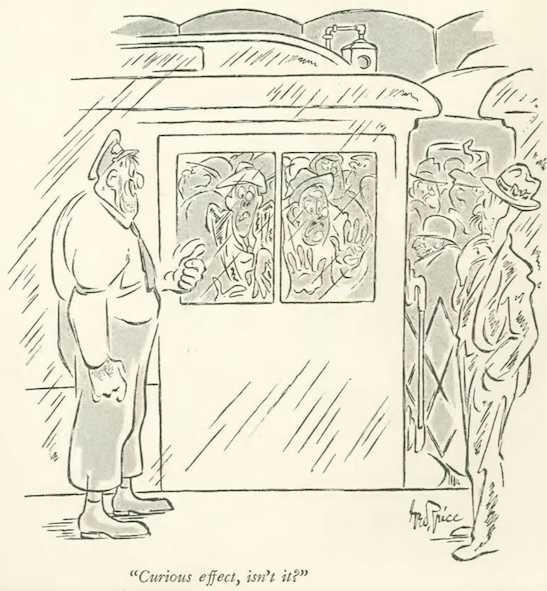
…speaking of effect, George Price in the subway…
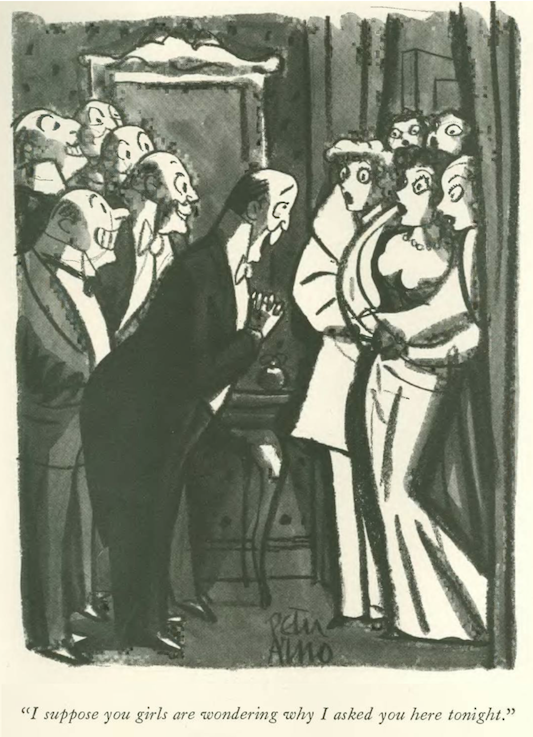
…Peter Arno continued to explore a familiar theme…
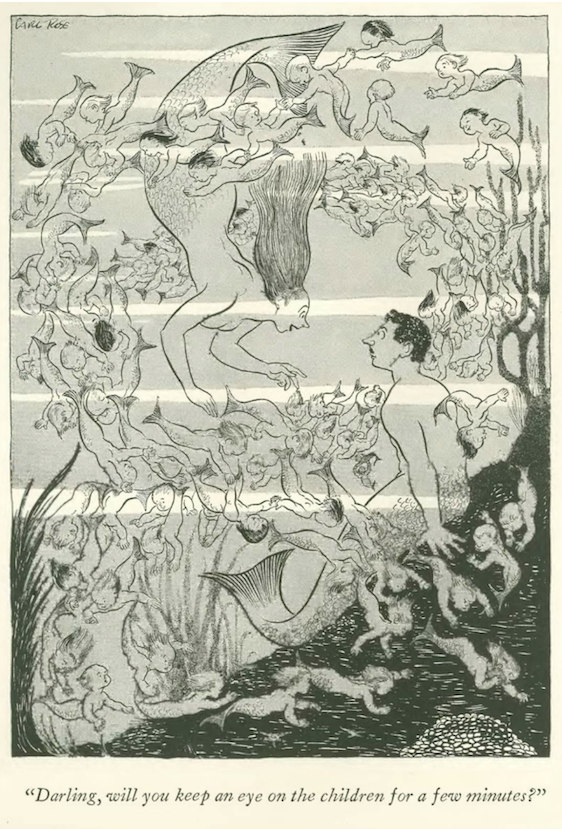
…Carl Rose imagined the home life of a mermaid…
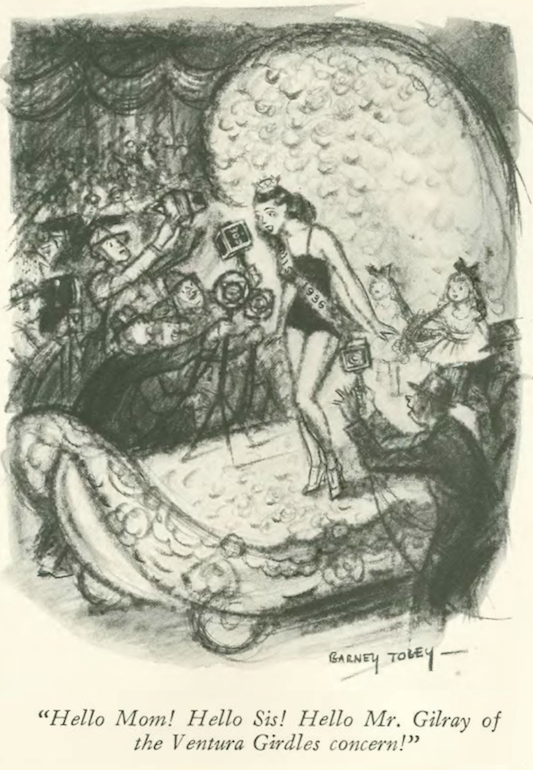
…Barney Tobey’s Miss America gave a plug to her sponsors…
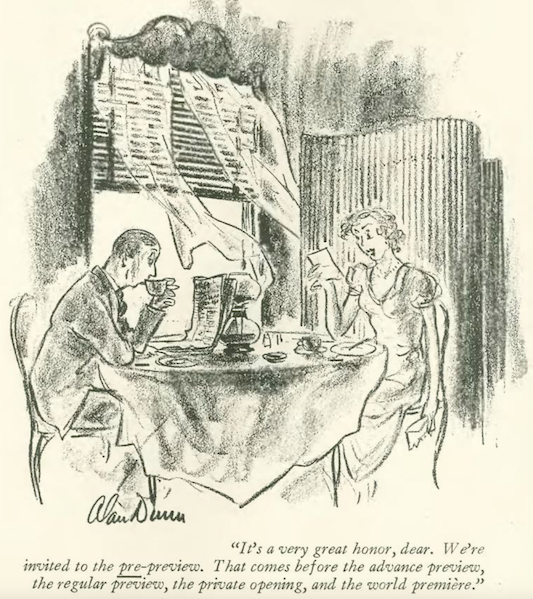
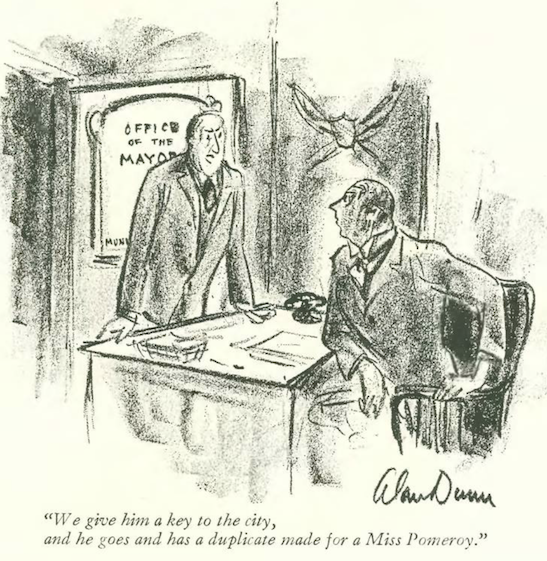
…Alan Dunn gave us a view of a pre-preview…
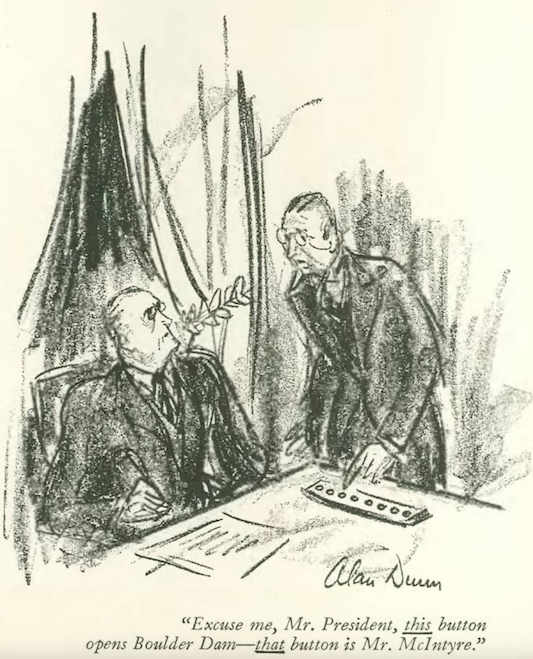
…Dunn again, with a rare cartoon featuring a known personage…
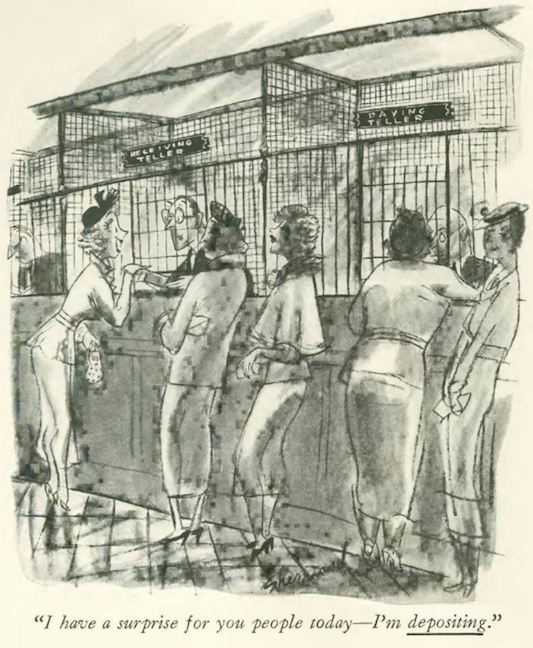
…Barbara Shermund revealed a surprise at the teller window…
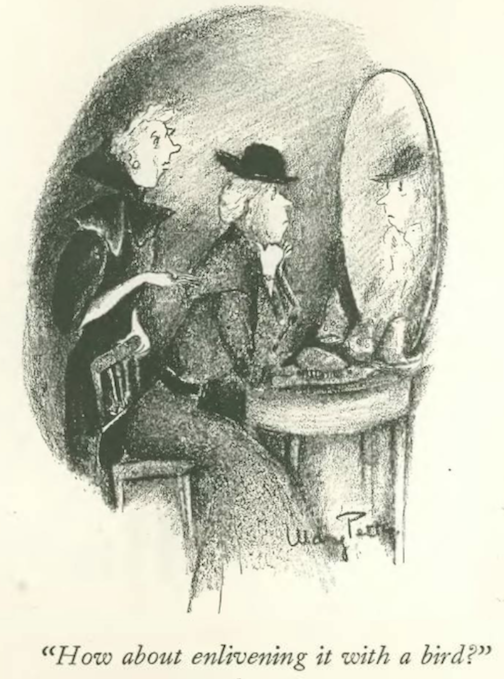
…Mary Petty got creative at the hat shop…
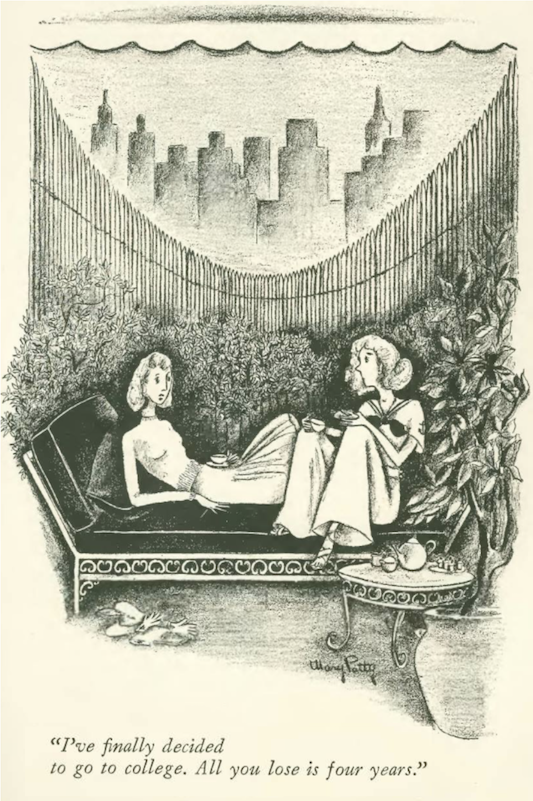
…and Petty again, as we close with her modern take on higher education…
Above: E.B. White noted the sounds of late summer ranging from jackhammers (that sounded like cicadas) to the songs of katydids predicting an early frost. (pafa.org/Ellyn B/Flickr/nwf.org)
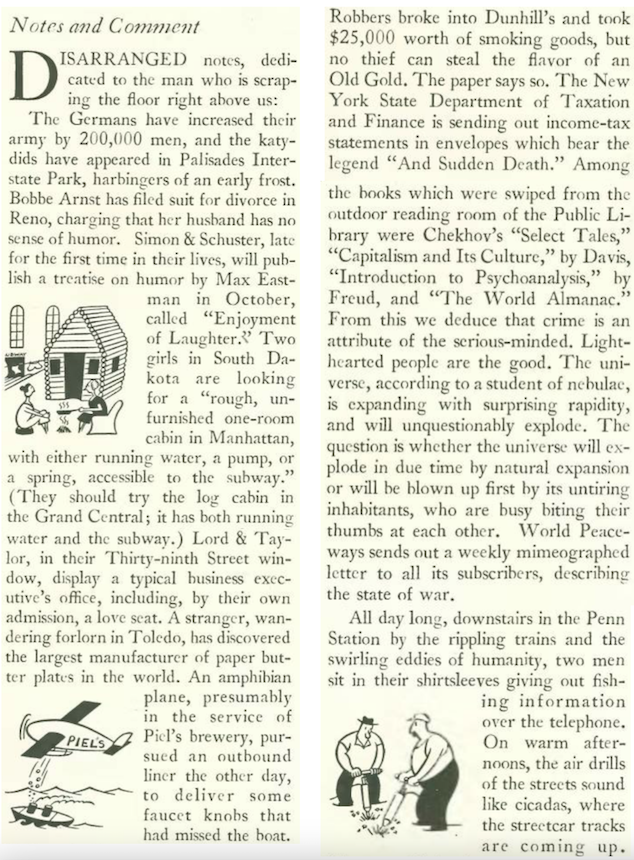
For roughly four decades E.B. White’s “Notes and Comment” set the tone for each issue of The New Yorker, offering observations on daily life that sometimes were compiled from his “disarranged notes.”
September 5, 1936 cover by Adolph K. Kronengold.
For the September 5 issue White offered brief comments on everything from the German military buildup to the romantic life of singer Bobby Arnst.
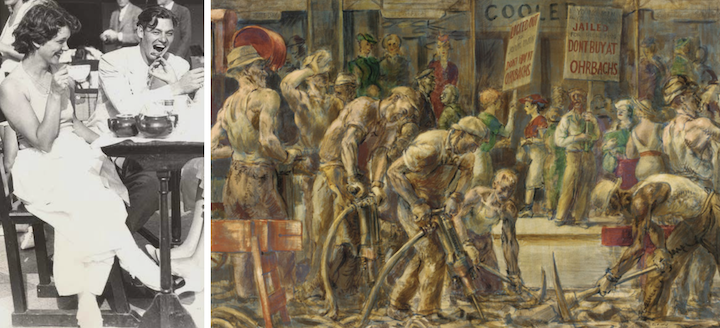
SHE WENT APE OVER TARZAN…Photo at left: Singer/dancer Bobbe Arnst shares a laugh with her first husband, Tarzan star Johnny Weissmuller—apparently her second marriage to divorce attorney Robert Cavenaugh wasn’t so full of yuks; White also noted the cicada-like sounds of air drills tearing up old trolley car lines—at right is the 1936 painting “End of 14th Street Crosstown Line” by early New Yorker contributor Reginald Marsh. The urban realist Marsh juxtaposed workers tearing up tracks with picketers demonstrating against Ohrbach’s, which would not allow employees to unionize. (whosdatedwho.com/pafa.org)
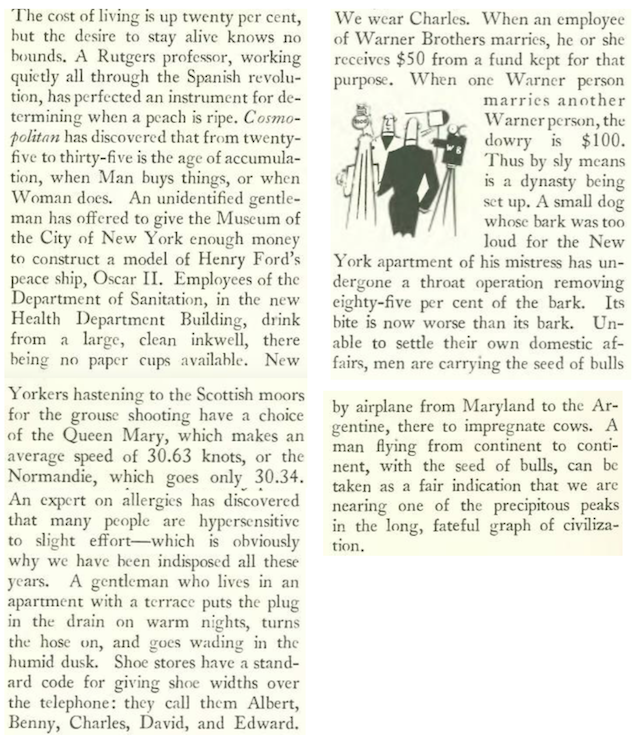
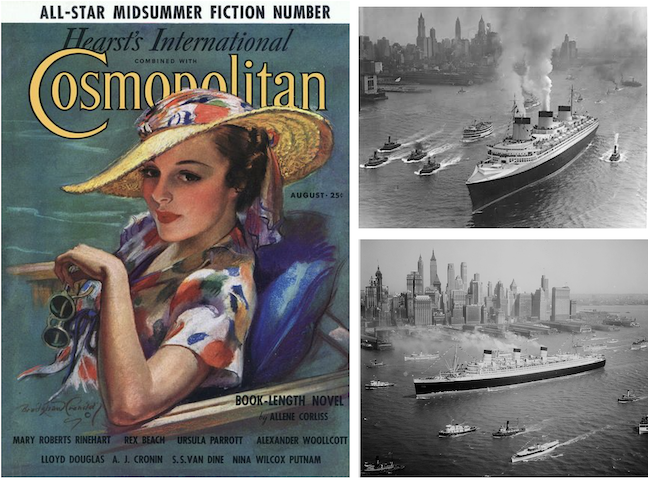
White also cited Cosmopolitan magazine regarding “the age of accumulation” (twenty-five to thirty-five), and noted the average speed of rival ocean liners for “New Yorkers hastening to the Scottish moors for the grouse shooting…”
CONSUMER REPORT…White cited Cosmopolitan regarding “the age of accumulation,” and considered the average speeds of the world’s fastest ocean liners, France’s SS Normandie (top), and Great Britain’s RMS Queen Mary. (instagram.com/ucla.edu)
* * *
Sounds of Music
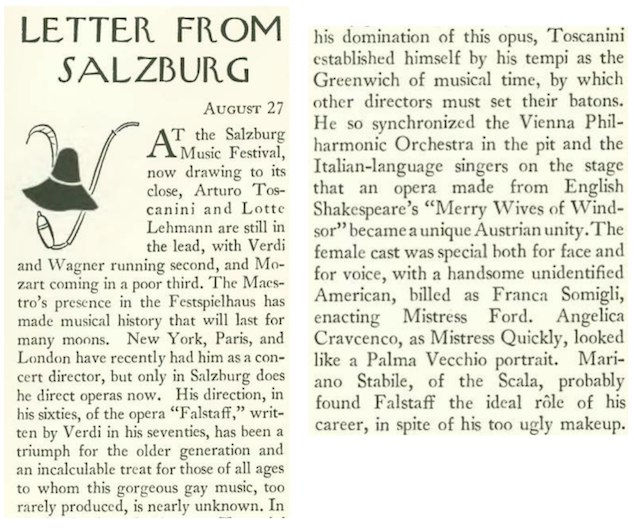
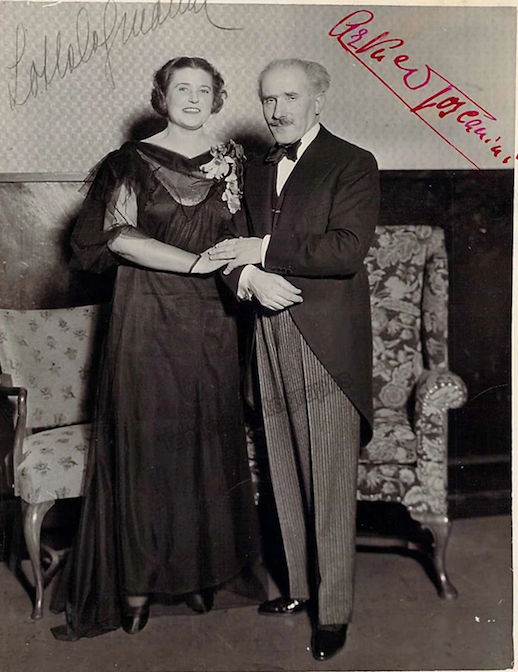
Paris correspondent Janet Flanner moved on from the Nazi Olympics in Berlin to the foothills of the Alps for the Salzburg Music Festival, where German dramatic soprano Lotte Lehmann and Italian conductor Arturo Toscanini made music together.
DRAMATIC DUO…Dramatic soprano Lotte Lehmann and conductor Arturo Toscanini were the big draw at the 1936 Salzburg Music Festival, which also featured the debut of the Trapp Family Singers, who were encouraged by Lehmann to enter the Salzburg Festival contest. (taminoautographs.com via stolpersteine-salzburg.at/en)
In August 1936 Lehmann discovered the Trapp Family Singers (made famous in 1965’s The Sound of Music). While approaching a villa available to let, Lehmann overheard the Trapp children singing in their garden. Due to her fame, Lehmann was able to persuade Captain Georg Von Trapp to allow his children to perform at Salzburg Festival.
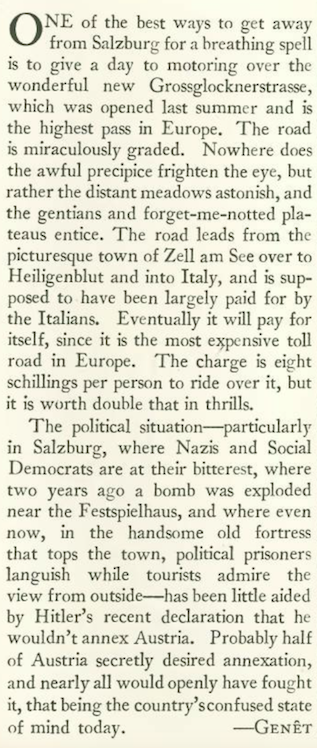
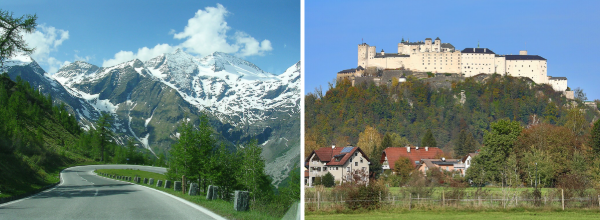
Flanner also marveled at the Austria’s Grossglockner High Alpine Road—with the highest pass in Europe—and noted the bitter struggle between Nazis and Social Democrats that was dividing Austrians less than two years before the Anschluss, the German annexation of Austria.
GETTING HIGH…At left, the Grossglockner High Alpine Road (Grossglockner Hochalpenstrasse); at right, the Hohensalzburg Fortress (Festung Hohensalzburg) a large medieval fortress that is a prominent landmark in the city of Salzburg, Austria. Flanner noted that unbeknownst to gawking tourists, the fortress contained political prisoners. (Wikipedia)
* * *
At the Movies
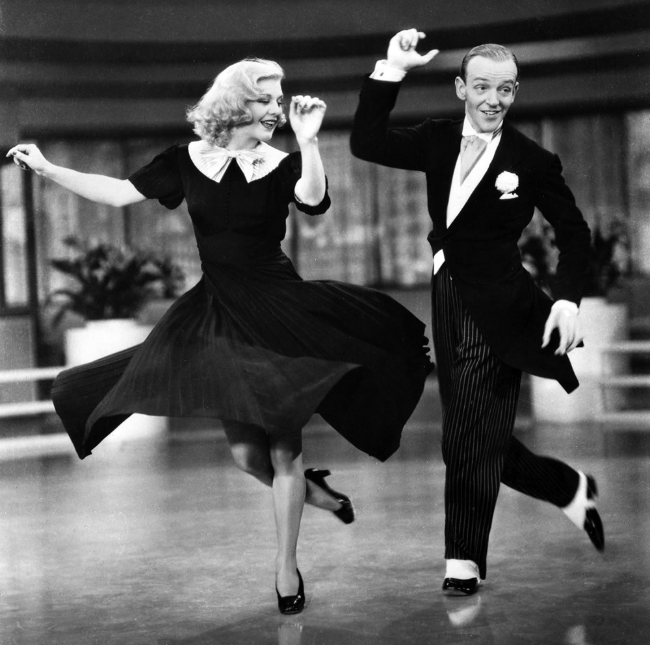
John Mosher found Fred Astaire and Ginger Rogers at the top of their game in the musical comedy Swing Time, but lamented the stodgy and laborious plot that burdened the non-dancing scenes.
BUSTING SOME MOVES are Ginger Rogers and Fred Astaire in Swing Time. The film was the sixth of ten films starring Astaire and Rogers. (goldenageofcinemasite.wordpress.com)
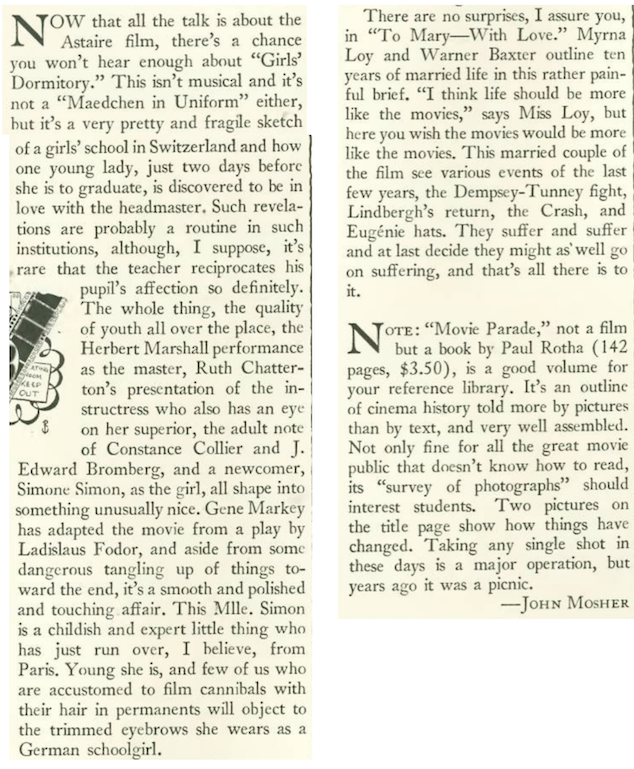
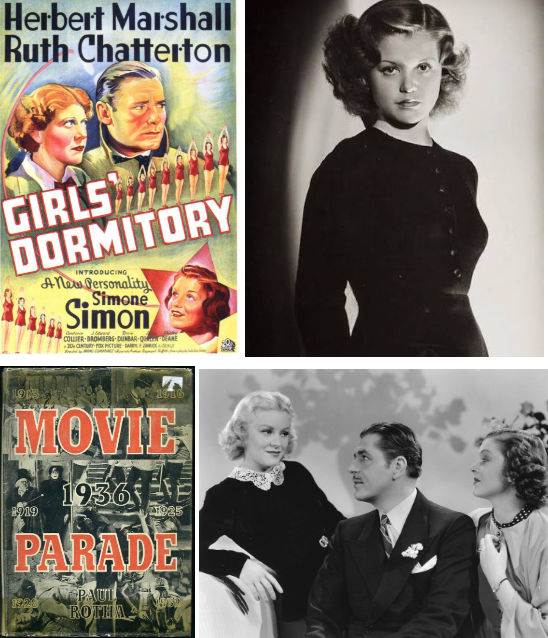
Mosher also had a look at Girl’s Dormitory, which introduced audiences to the young French actress Simone Simon, and also checked out the latest Myrna Loy flick.
THINGS THAT MAKE YOU GO HMMM…Clockwise from top left: Set at a Swiss boarding school, Girl’s Dormitory is a story about a middle-aged school director (Herbert Marshall) who resists the attentions of a forty-something professor (Ruth Chatterton) and instead hooks up with a 19-year-old student (Simone Simon);1936 photo of Simon by George Hurrell—Simon is is perhaps best remembered for her role in the 1942 American horror film Cat People and its sequel; Claire Trevor, Warner Baxter, and Myrna Loy in To Mary—with Love; cover of Movie Parade, a book on movie history when the history of film was just three decades old. (imdb.com/facebook.com)
* * *
From Our Advertisers
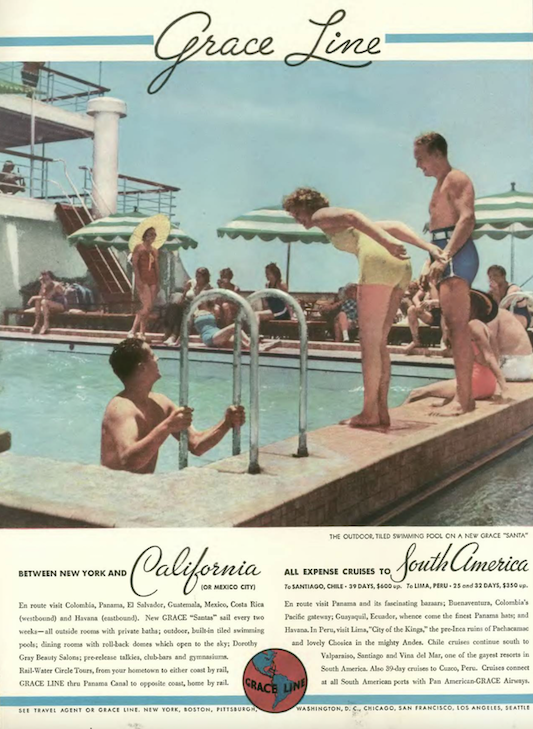
The magazine opened with another enticing photo from Grace Line depicting an ocean cruise before the days of water slides, buffet lines and norovirus…
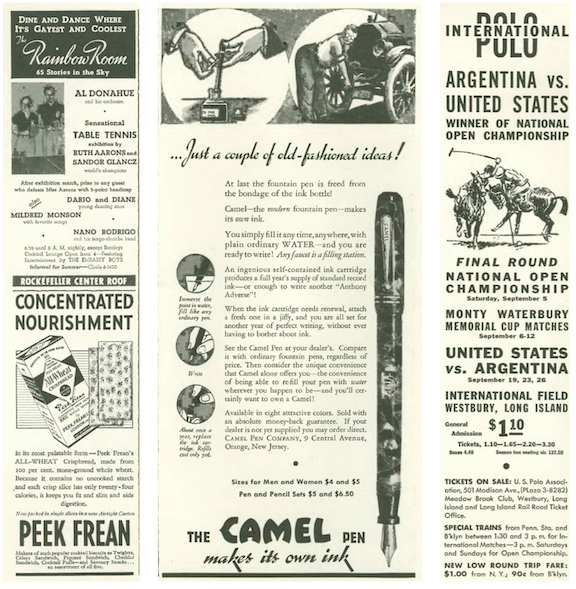
…some one-column selections from the back of the book, including an ad from the Camel Pen Company introducing an innovative fountain pen that contained a dry ink pellet—the user added water to dissolve the pellet into a year’s supply of ink…
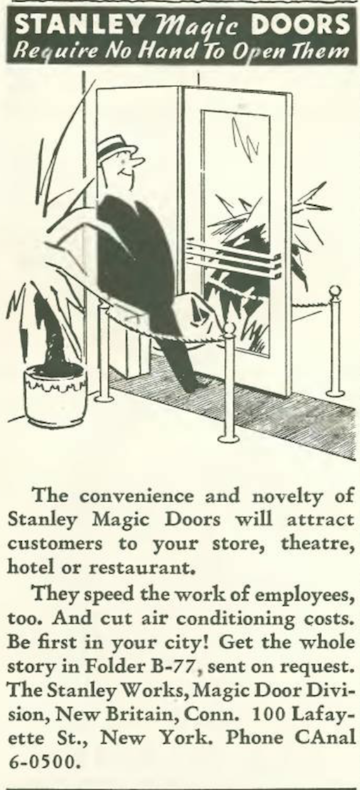
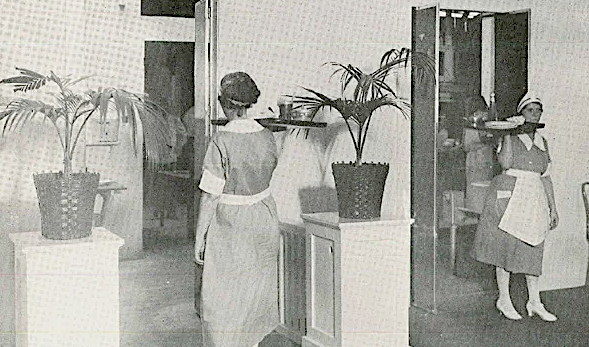
…these days most of us use ball-point pens, and we are also so accustomed to automatic doors that they no longer seem “magic” as they did in the 1930s…
WONDERS NEVER CEASE…In 1931, Wilcox’s Pier Restaurant in West Haven, Connecticut featured the first automatic doors in America, invented by Stanley. (cbsnews.com)
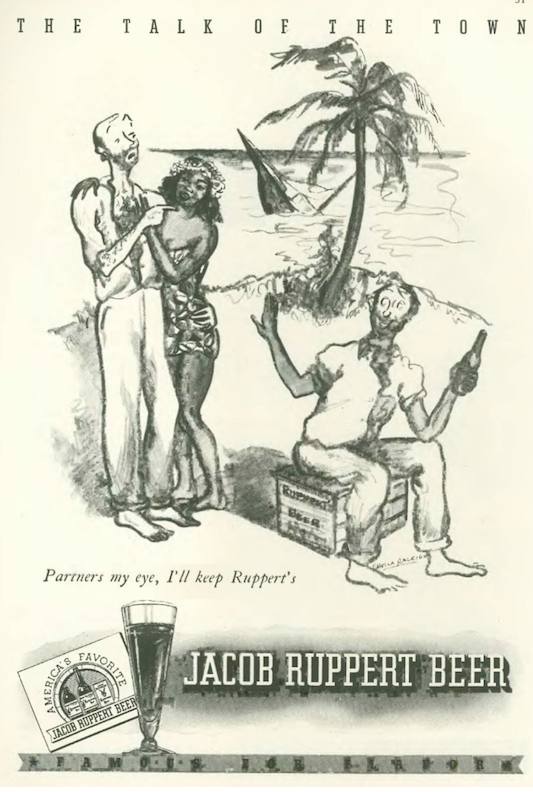
…New York artist Sheila Raleigh employed the desert island trope to sell some beer for Jacob Ruppert…
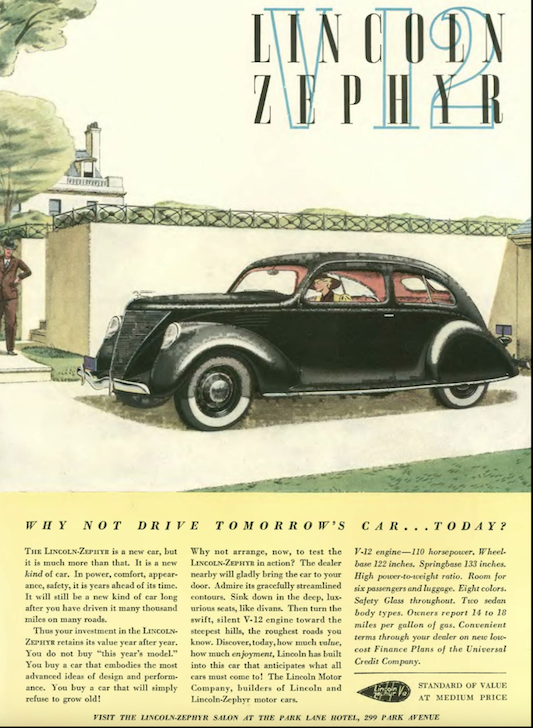
…the inside back cover popped with this ad for the streamlined V-12 Lincoln Zephyr…
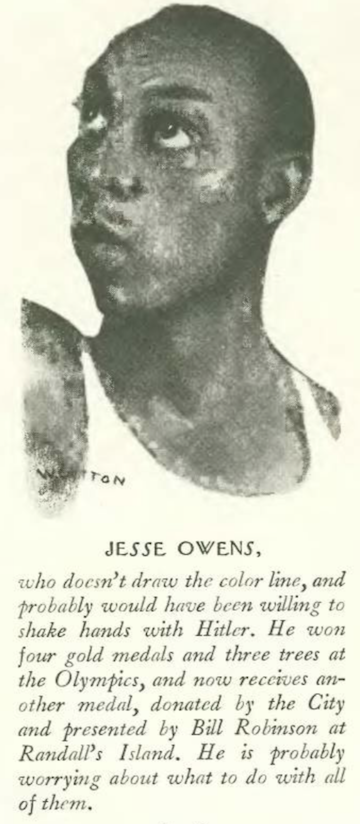
…the “Talk of the Town” occasionally featured these illustrated mini-bios, here highlighting Jesse Owens’ record-setting performance at the 1936 Olympics (illustration by William Cotton)…
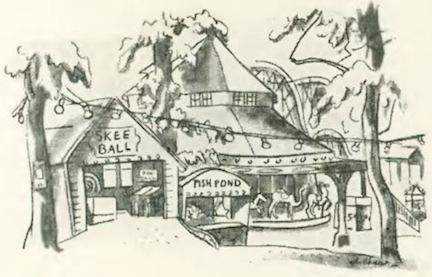
…a couple of spots by George Shellhase…
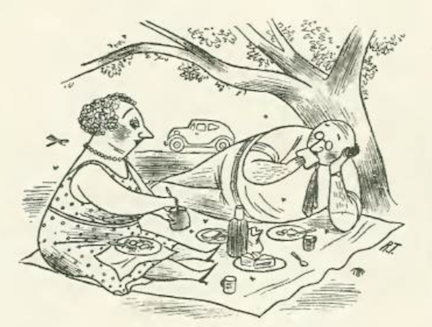
…and Richard Taylor…
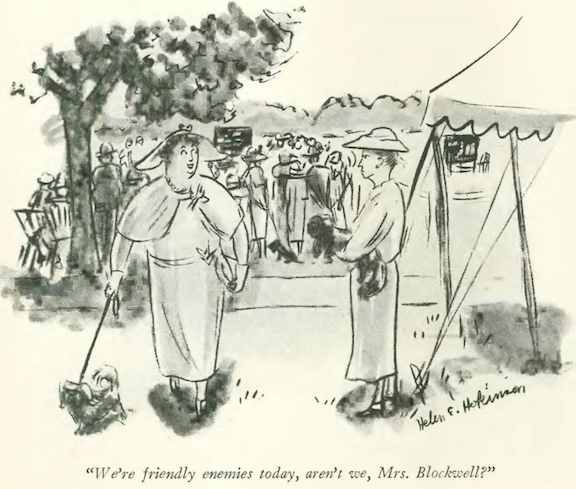
…Helen Hokinson gave us frenemies at a dog show…
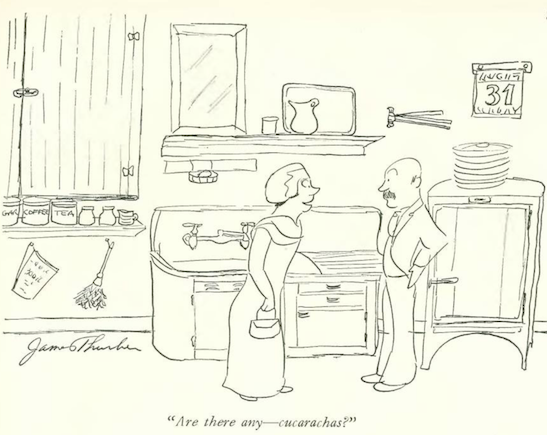
…James Thurber looked out for cockroaches…
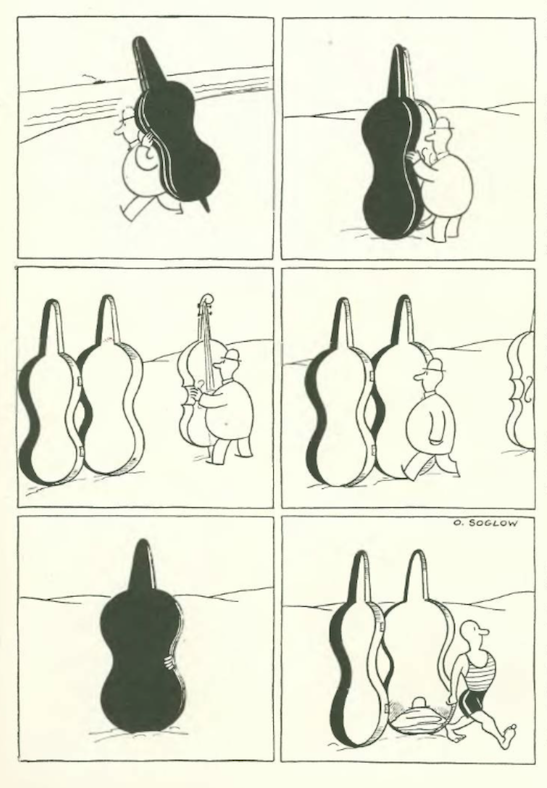
…Otto Soglow found a new use for a bass case…
…Soglow again, demonstrating the wonders of radio advertising…
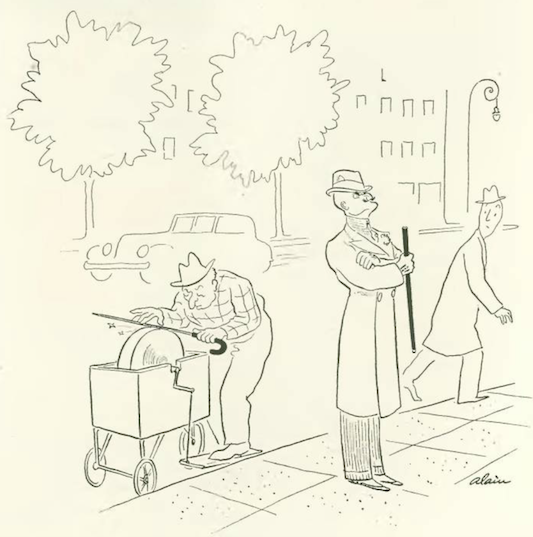
…Alain showed us a man with a cagey cane…
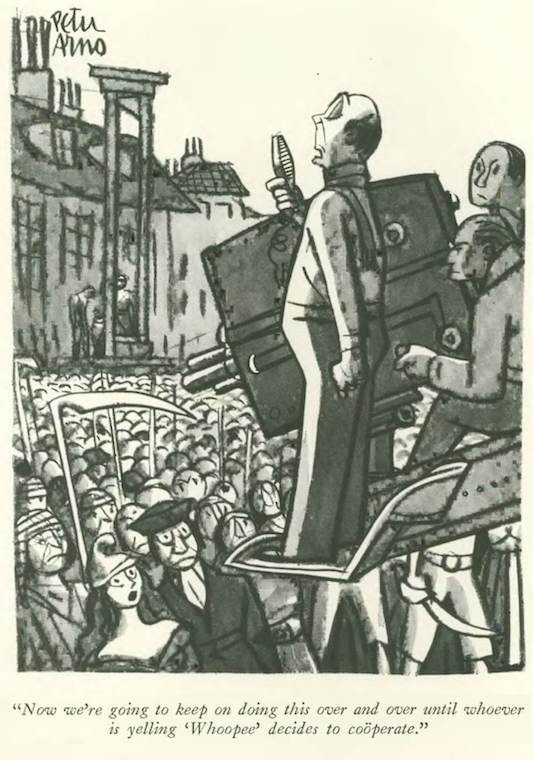
…Peter Arno illustrated the trials of working with extras…
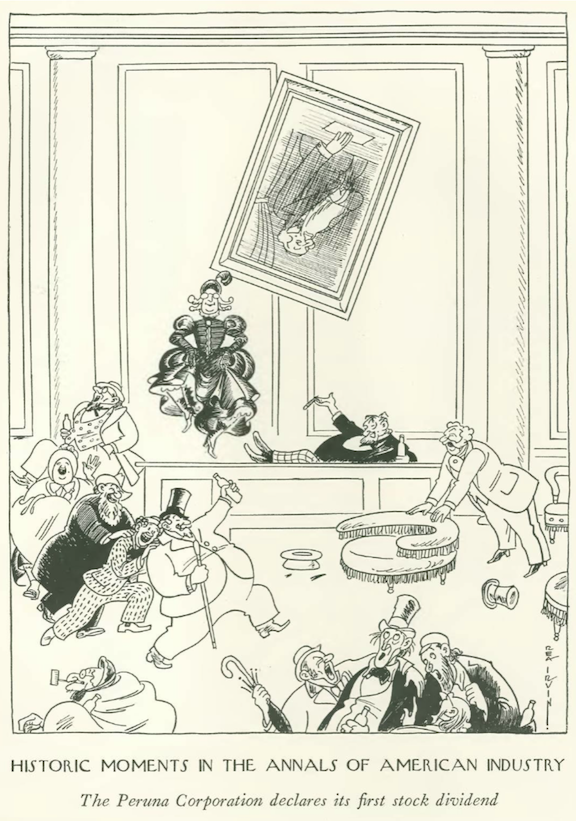
…Rea Irvin continued to chronicle achievements in industry (Peruna was a well-known patent medicine sold from the late-19th to mid-20th century—with its high alcohol content, Americans drank large amounts of Peruna during Prohibition)…
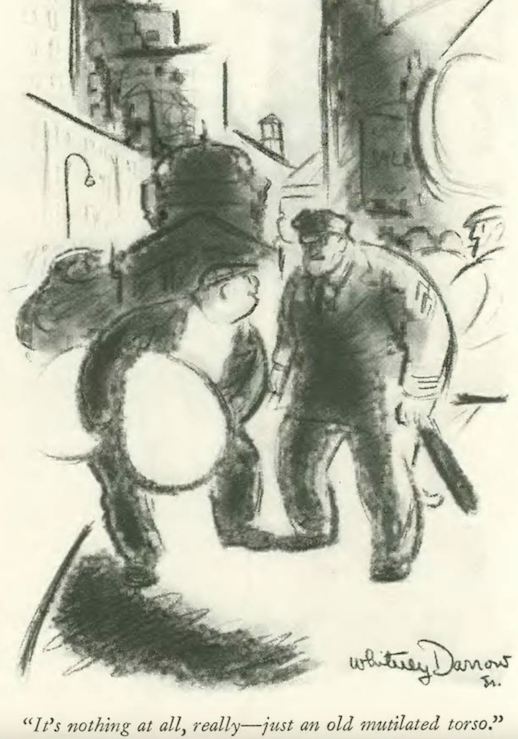
…a beat cop receives an unlikely confession, per Whitney Darrow Jr…
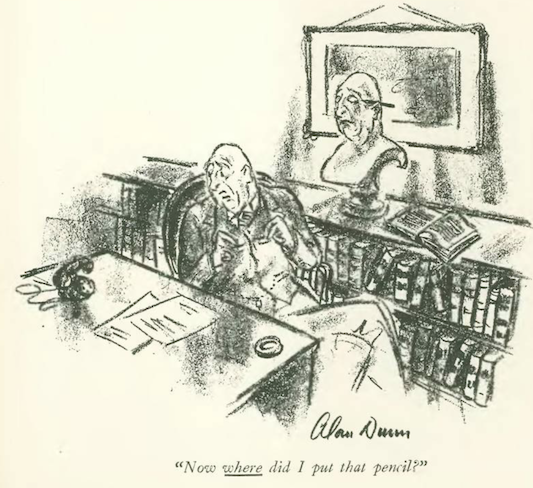
…and we close with Alan Dunn, in a forgettable situation…
Above: Fredric March and Olivia de Havilland in "Anthony Adverse". (tcm.com)
Epic costume dramas were all the rage in the 1930s, doubtless due to their escapist qualities (escape from the Depression and fears of war, among other things) and the cool comforts of a movie palace during a decade of exceptionally hot summers (yes, once again I’m leading with a movie. Nevertheless, some tasty bits ahead!).
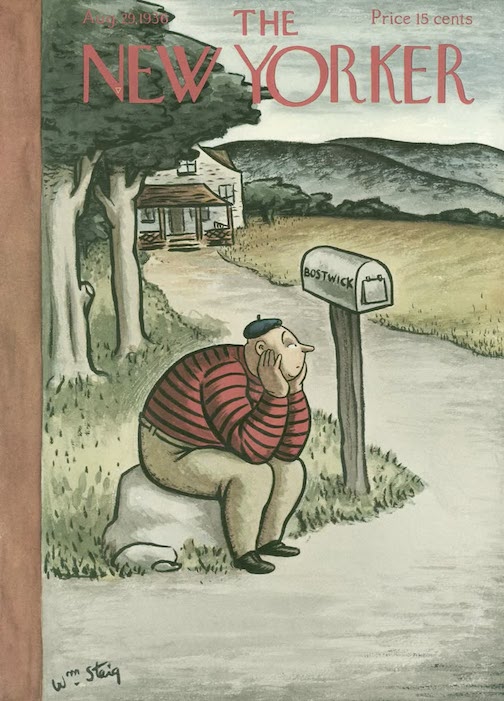
August 29, 1936 cover by William Steig.
Unlike MGM’s Romeo and Juliet, which lost money, Anthony Adverse was Warner Brothers’ most popular release in 1936, a nearly two-and-a-half-hour film featuring the seemingly ever-present Frederic March and rising star Olivia de Havilland. Based on Hervey Allen’s 1933 historical novel by the same name, New Yorker critic John Mosher gave Anthony Adverse passing marks.
COSTUMES IN MOTION…Critic John Mosher appreciated a costume drama that was also lively. Clockwise, from left: Warner Brothers promotional poster; Olivia de Havilland as Angela, the daughter of a cook who becomes Mademoiselle Georges, a famous opera star and mistress of Napoleon Bonaparte; Anita Louise portrayed sweet young Maria, betrothed to grumpy old Don Luis (Claude Rains). (frockflicks.com)WICKEDLY GOOD…Gale Sondergaard with Claude Rains in Anthony Adverse. Sondergaard would win the inaugural Academy Award for Best Actress in a Supporting Role for her performance as the villainous Faith Paleologus. In total, the film would earn four Oscars. (IMDb.com)
Mosher found other cinema diversions, including a film featuring a cameo by Robert Benchley.
WORLD OF WODEHOUSE…Madge Evans and Robert Montgomery in Piccadilly Jim; Dolores Costello and George Raft in Yours for the Asking; Ida Lupino portrayed con artist Gertie Malloy in Yours for the Asking; pioneer American film animator Mary Ellen Bute created some of the first electronically generated film images, her specialty being visual music. (imdb.com/csfd.sk/facebook.com/Wikipedia)
And lest we forget, here is The New Yorker’sRobert Benchley portraying a “barroom character” in Piccadilly Jim:
THE TWO BOBS…Robert Montgomery and Robert Benchley in Piccadilly Jim.(immortalephemera.com)
* * *
Pentameter Pickle
E.B. White expressed his annoyance with MGM’s claim regarding Norma Shearer as “the first screen Juliet” (see last week’s post on Romeo and Juliet). He also noted that after seeing Romeo and Juliet, he had the urge to speak in Shakespeare’s iambic pentameter.
White noted that either Beverly Bayne or Theda Bara were the first screen Juliets…actually both appeared in dueling films in 1916, opening just three days apart.
FILM DUEL…Top, Francis X. Bushman and Beverly Bayne (married in real life) in Metro’s 1916 adaptation of Romeo and Juliet. Below, Theda Bara and Harry Hilliard in Fox’s 1916 Romeo and Juliet. In direct competition, the Fox film was released on Oct.22, the same week as Metro’s (Oct. 19). Both silent films are considered lost. (theeverydaycinephile.com)
If White had had access to the internet, he would have learned that the very first screen Juliet was actually Florence Lawrence , who appeared in a fifteen-minute silent film short made in 1908 by Vitagraph Studios (amazingly, the film survives and can be viewed on YouTube).
THE ORIGINAL…The first screen Juliet was Florence Lawrence, who appeared in a 1908 silent film short by Vitagraph Studios. Lawrence (1886–1938) is widely referred to as the “first movie star”, appearing in almost three hundred films. She also invented a surprising list of patents, including the first “auto signaling arm.” (messynessychic.com).
* * *
He Used His Bean
“The Talk of the Town” featured a rare mention of baseball in the form of a brief profile of Jo-Jo Moore (1908–2001), a New York Giants left fielder known for his intimidating, left-handed-hitting as lead-off man; Moore batted over .300 five times in his career. Apparently he was also known for getting beaned at the plate, as this excerpt explains:
LEANING IN…Jo-Jo Moore, who batted left-handed and threw right-handed, hit over .300 five times in his career with the Giants from 1930 to 1941. When he died in 2001 at age 92, he was the last surviving member of the 1933 World Champion New York Giants. (centerfieldmaz.com)
* * *
The Bobby We Didn’t Know
Mention the name Bobby Riggs to those of a certain age and they’ll likely conjure up the cheeky grin of a 55-year-old man who in 1973 challenged 29-year-old Billie Jean King to a much-ballyhooed “Battle of the Sexes” tennis match at the Houston Astrodome—which King won in straight sets (6–4, 6–3, 6–3). What seems forgotten is the fact that Riggs was once considered the best tennis player in the world. As a 21-year-old amateur in 1939, he won Wimbledon and the U.S. Open. Even in 1936 the teenaged Riggs was already sensation, as this excerpt explains:
PROMISING BEGINNINGS…Left, Bobby Riggs (center) accepts the 1939 men’s national singles championship trophy after defeating Welby Van Horn at Forest Hills. Riggs also won the U.S. Singles Championship in 1941. At right, Billie Jean King and Bobby Riggs strike a pose in 1973, the year they competed in famed “Battle of the Sexes” tennis match. (facebook.com/Wikipedia)
* * *
From Our Advertisers
Singer Ethel Merman lit up the opening page of the August 29 issue in this colorful advertisement for Stage magazine…
…the makers of the bargain cigarette Twenty Grand used this New Yorker-style cartoon to push their brand of tobacco…
…the inside back cover featured this bright appeal from Imperial Wallpapers…
…and the makers of Luckies claimed the back page to build their base of women smokers…
…on to our cartoonists, we begin with spots by Abe Birnbaum…
…and Robert Day…
…more cartoon art from Richard Taylor to enliven Morris Bishop’s limericks…
…Birnbaum again, with a bit of hide and-seek…
…Alan Dunn confronted a moral quandary…
…Rea Irvin put up a tempting target…
…Helen Hokinson found the right words to describe a bridge party…
…Peter Arno illustrated one way to accommodate an estrangement…
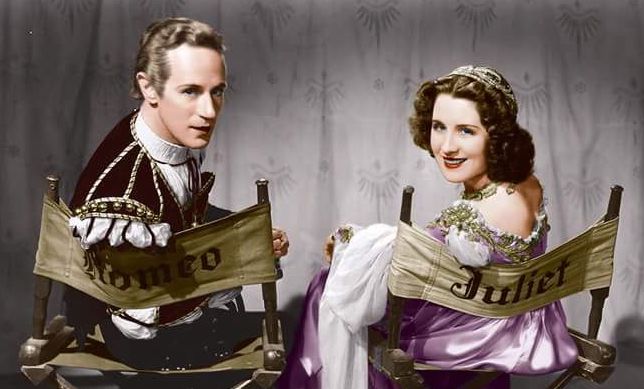
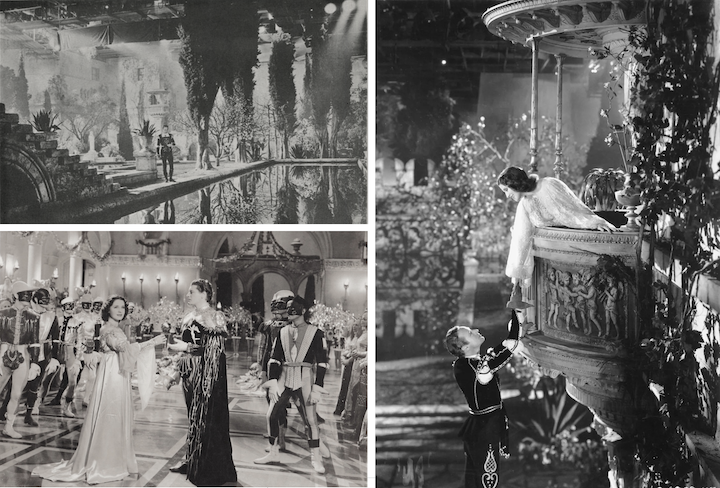
Above: Leslie Howard and Norma Shearer played the lead roles in George Cukor's 1936 adaptation of William Shakespeare's "Romeo and Juliet." In retrospect, these major stars were miscast; Shakespeare's original play identified Juliet as thirteen years old (soon to be fourteen), while scholars estimate Romeo to be around sixteen. Howard was forty-three and Shearer thirty-four when the film was released. (pinterest.com)
Although Leslie Howard and Norma Shearer were too old to play Romeo and Juliet as lovesick teenagers, in 1936 audiences and critics didn’t seem to notice or care. What did keep audiences away from the big budget Romeo and Juliet was the perception that it was too “arty.”
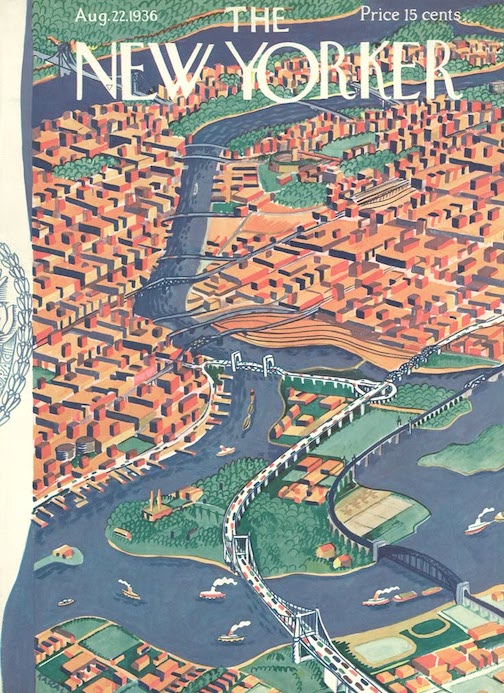
August 22, 1936 cover by Ilonka Karasz.
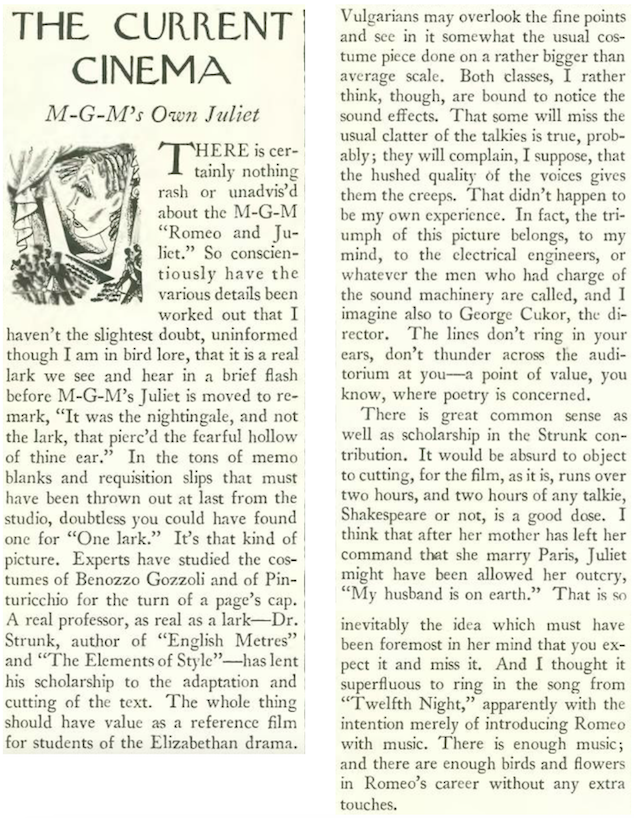
Indeed, New Yorker film critic John Mosher suggested that “vulgarians” would miss the finer points of this meticulously made film—director George Cukor even secured the services of William Strunk Jr. (of Elements of Style fame) to ensure linguistic accuracy.
This dedication to the finer points of the play obviously didn’t apply to the choice of the principal actors—a middle-aged Romeo, a thirty-something Juliet, or a 54-year-old playing Romeo’s best friend, Mercutio (John Barrymore). In the days of the studio system, it was assumed that big productions needed equally big, established actors attached to them, regardless of age. Also, Shearer was producer Irving Thalberg’s wife.
THE ART OF ARTIFICE…Clockwise from top left: Lavish sets and a star-studded cast made Romeo and Juliet MGM’s most expensive sound film up to that time; the famed balcony scene between Leslie Howard and Norma Shearer; Shearer in a scene with Ralph Forbes, who played a kinsman to the prince. (imdb.com/moviemusings.uk/britannica.com)
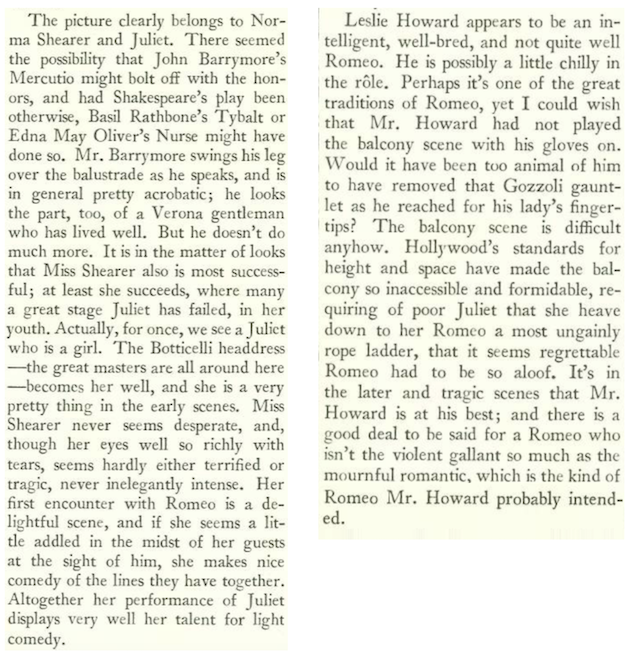
Mosher described the film as a “sensible” presentation and praised the 34-year-old Norma Shearer for her youthful appearance. “Actually, for once, we see a Juliet who is a girl,” he wrote. Writing for Literature/Film Quarterly,Allison Kellar notes that “with the help of costumes, props, and lighting, Shearer effectively appears as the young Juliet.”
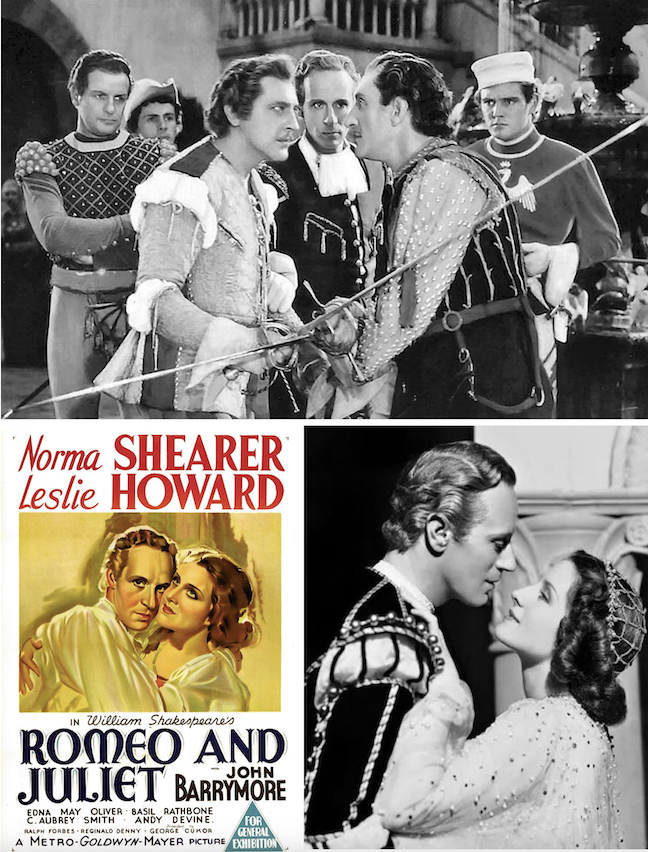
RAPIER-TONGUED…Top: Mercutio (John Barrymore, left) challenges Tybalt (Basil Rathbone) to a duel and is subsequently slain (this is when Mercutio speaks those famous words, “A plague o’ both houses!”); Leslie Howard and Norma Shearer; MGM promotional poster. (moviemusings.uk/tvtropes.org/imdb.com)
For years MGM’s “Boy Wonder,” producer Irving Thalberg, had pushed the studio to make the film, but MGM head Louis B. Mayer believed (correctly, it turned out) that the masses would consider Shakespeare too highbrow. Mayer was also concerned about a big budget picture in those lean Depression years, but somehow Thalberg won him over (the film lost almost a million dollars, roughly equivalent to $25 million today).
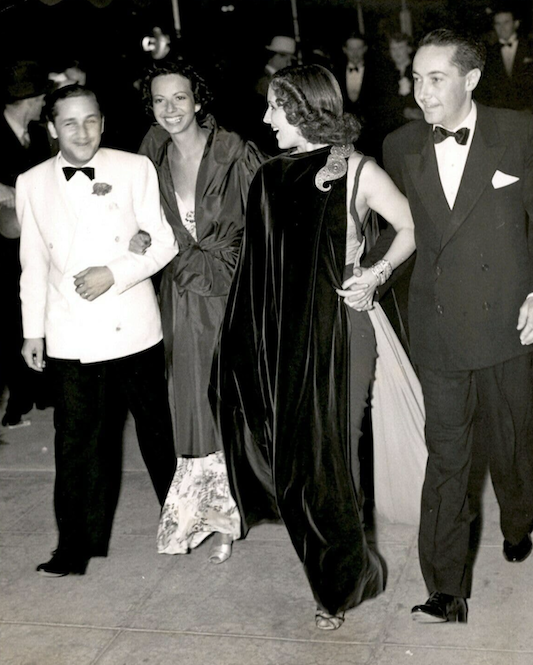
HOLLYWOOD NIGHTS…At left, Anthony Adverse director Mervyn LeRoy and his wife, Doris Warner, accompany Norma Shearer and her husband Irving Thalberg at the Los Angeles premiere of Anthony Adverse, July 29, 1936. A month and a half later Thalberg would die from a congenital heart condition at age 37. (see below). (Wikipedia)
Romeo and Juliet would have its world premiere on Aug. 20, 1936 at New York’s Astor Theatre. The West Coast premiere followed on Sept. 14—that same night legendary MGM producer, Irving Thalberg, husband of star Norma Shearer, would die suddenly at the age of 37. Needless to note, the Los Angeles opening was deeply somber.
Now, just for kicks, here are the ages of actors who have portrayed Shakespeare’s star-crossed lovers in more recent films:
FOLLIES OF YOUTH…Clockwise, from top left, with ages in parentheses: Claire Danes (17) and Leonardo DiCaprio (22) in Romeo + Juliet (1996) Hailee Steinfeld (17) and John Booth (21) in 2013’s Romeo & Juliet; Clara Rugaard (27) as Juliet and Jamie Ward (35) as Romeo in 2025’s Juliet & Romeo; Olivia Hussey (16) and Leonard Whiting (16) in Romeo & Juliet (1968). (imdb.com/heyuguys.com/wikipedia.org/reddit.com)
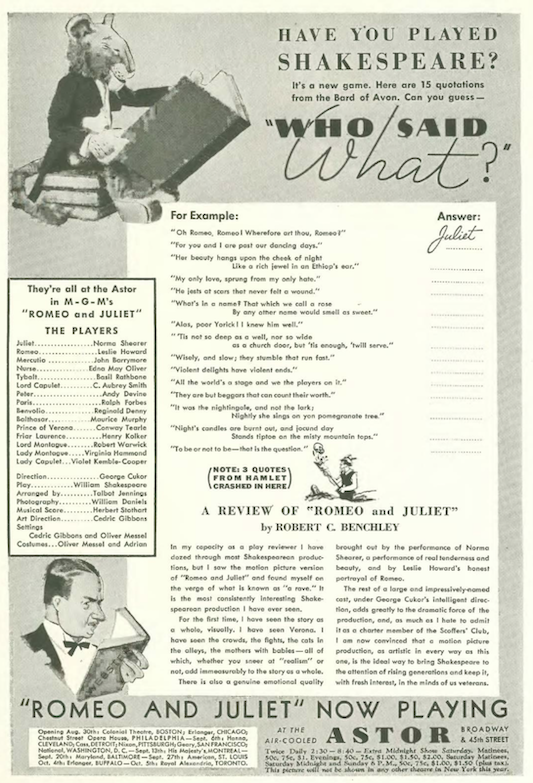
MGM spent a lot on the marketing of Romeo and Juliet, including this full-page ad in The New Yorker that included an endorsement from the magazine’s theater critic, Robert Benchley:
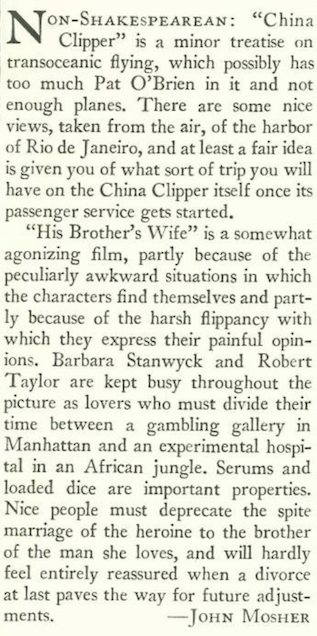
There were other, less-hyped films available for those allergic to Shakespearian drama. Mosher again:
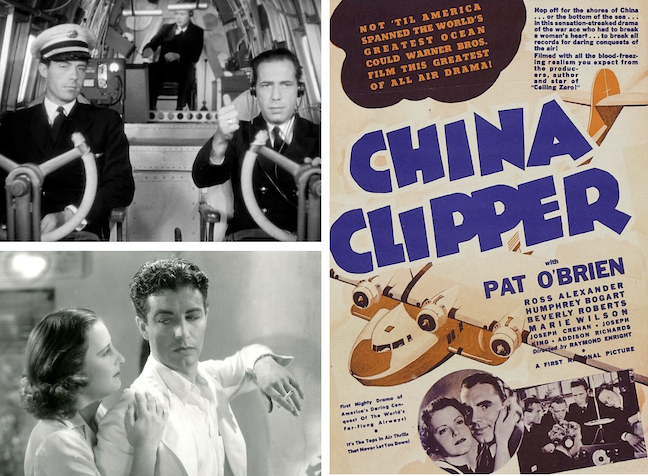
ALL SYSTEMS GO…Clockwise, from top left: Dennis Moore (left) and Humphrey Bogart prepare for a bumpy ride in China Clipper; Barbara Stanwyck and Robert Taylor in His Brother’s Wife. (dailymotion.com/blu-ray.com/imdb.com)
* * *
Getting Out of Town
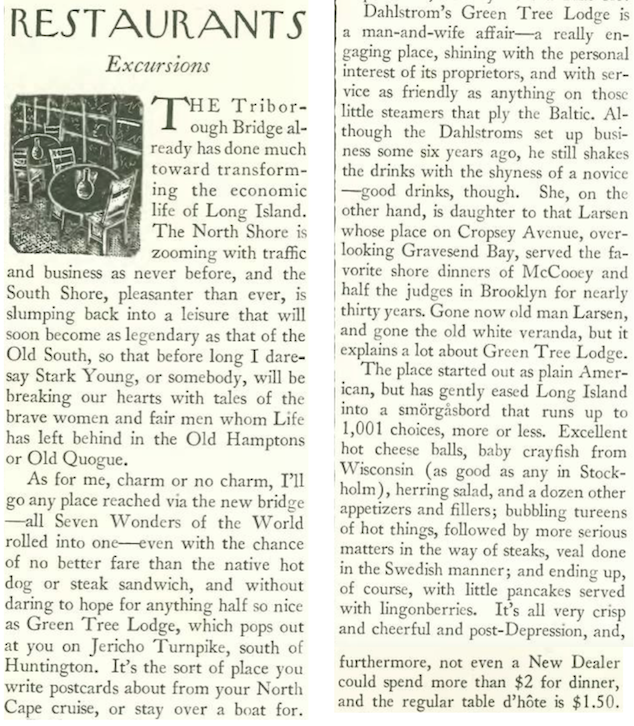
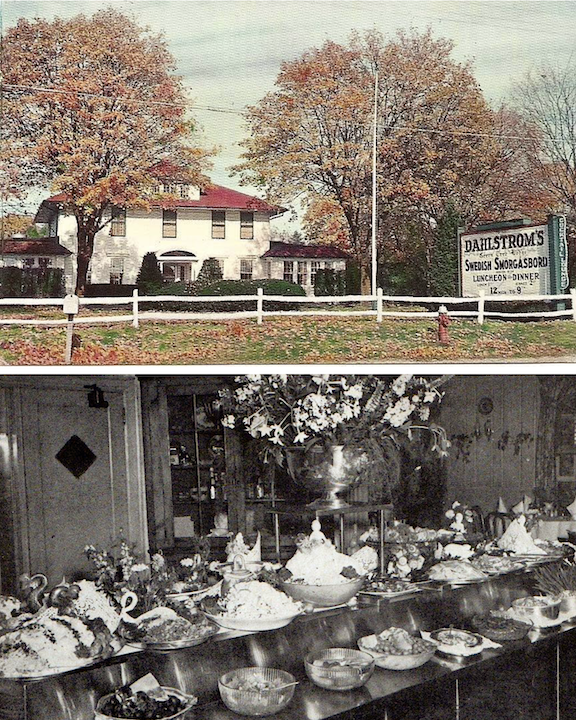
Food critic Sheila Hibben headed to Long Island to do a little restaurant-hopping, checking out Dahlstrom’s Greentree Lodge on the Jericho Turnpike. Dahlstrom’s was a popular Swedish restaurant that served food smörgåsbord-style. This concept for displaying a variety of self-serve dishes would not become widespread until the smörgåsbord was introduced to the general public in the Swedish Pavilion at the 1939 New York World’s Fair.
A RARE TREAT…Dahlstrom’s Greentree Lodge on Jericho Turnpike in Huntington, LI, was a popular Swedish restaurant that served food smörgåsbord-style from the 1930s through the 1960s. (Frank Leist via Facebook.com)
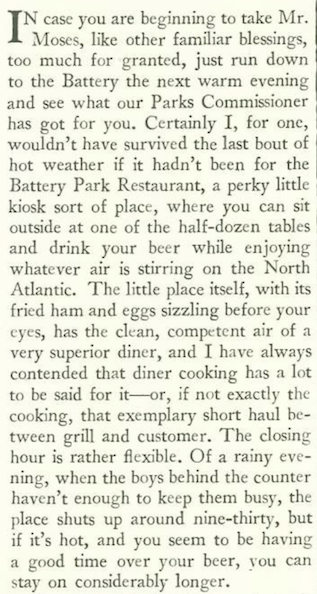
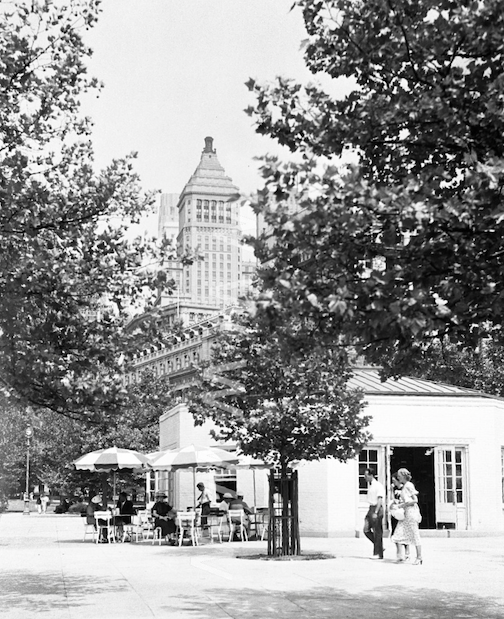
Closer to home, Hibben visited the Battery Park Restaurant, a “perky little kiosk sort of place where you can sit outside…and drink your beer while enjoying whatever air is stirring on the North Atlantic.”
MADE IN THE SHADE…The Battery Park Restaurant, circa 1936. (eBay.com)
* * *
Cheers Before Tears
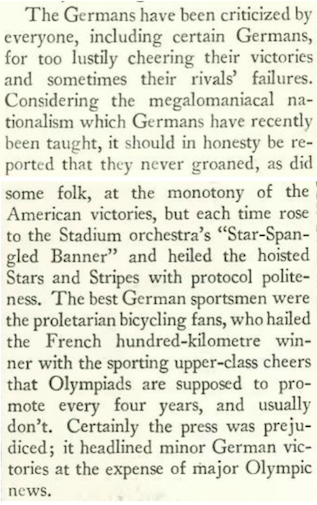
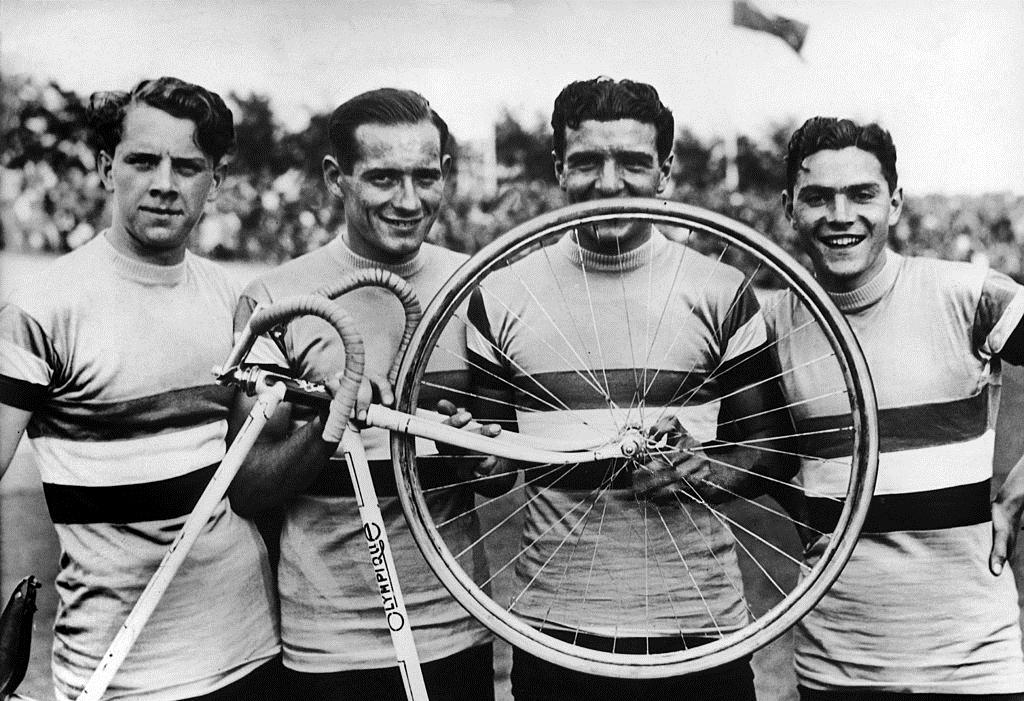
In her continuing report on the Berlin Olympics, Janet Flanner noted that some German fans—despite their country’s “megalomaniacal nationalism”—were polite about the “monotony of the American victories,” and even offered cheers for the French bicycling team (whose country would be invaded by theirs in less than four years).
CYCLING GREATS…The French cycling team (left to right) Robert Charpentier, Guy Lapebie, Jean Goujon and Roger Le Nizerhy celebrate after winning the team race at the 1936 Berlin Summer Olympics. The Frenchmen delivered a historic performance, capturing seven total medals (three Gold, two Silver, and two Bronze). Charpentier was the star of the team, becoming a triple Olympic champion across road and track disciplines. (Wikipedia)
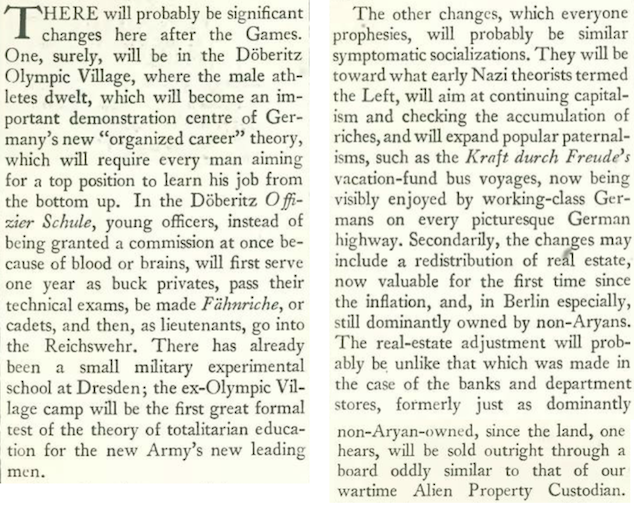
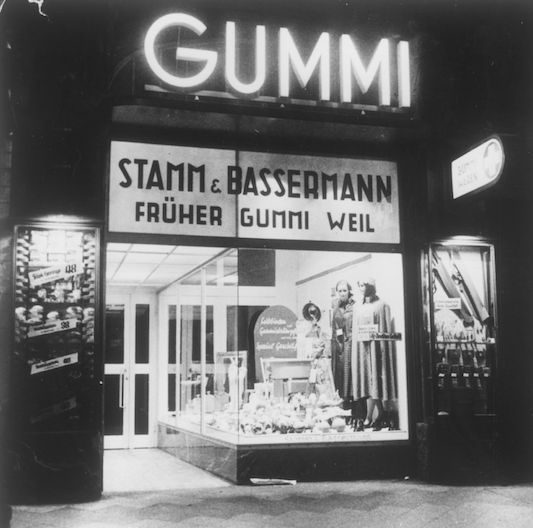
Flanner also noted some not-so-happy events that would occur following the games, including initial steps by the Nazis that would lead to the systematic seizure and forced transfer of Jewish real estate and property to the Third Reich’s leaders, citizens, and collaborators. It seems unlikely that Flanner was unaware of at least some of this plan, although she never explicitly mentions that this “real-estate adjustment” was directed solely at Jewish property owners.
THE UGLY TERM “Aryanization” referred to the forced transfer of Jewish-owned homes and businesses to the Third Reich’s leaders, citizens, and collaborators. Above, the formerly Jewish-owned store Gummi Weil was expropriated and transferred to non-Jewish ownership (Stamm and Bassermann). Frankfurt, Germany, 1938. (Bildarchiv Preussischer Kulturbesitz)
* * *
From Our Advertisers
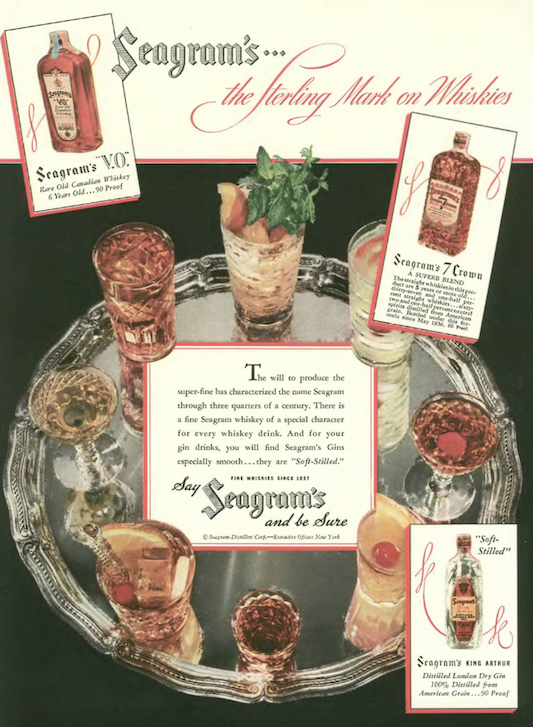
We begin with Seagram’s, promoting their signature whiskies and “soft-stilled” gin…
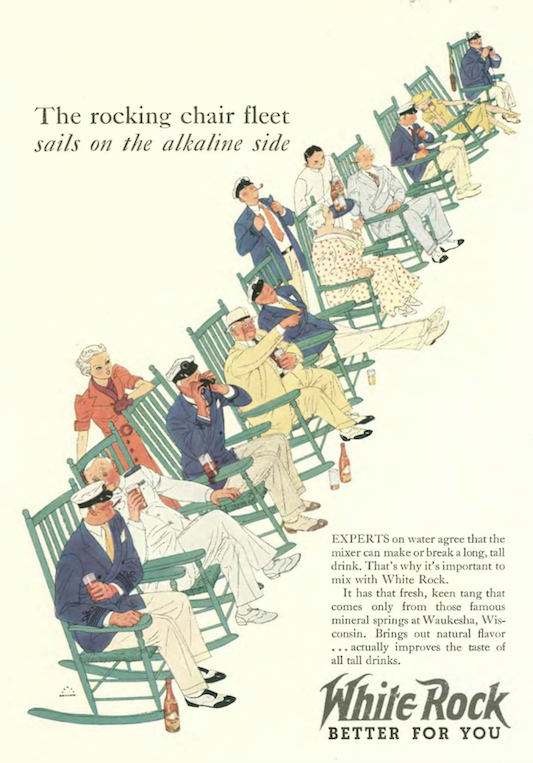
…White Rock continued to feature their clever and colorful John Holmgren-illustrated ads…
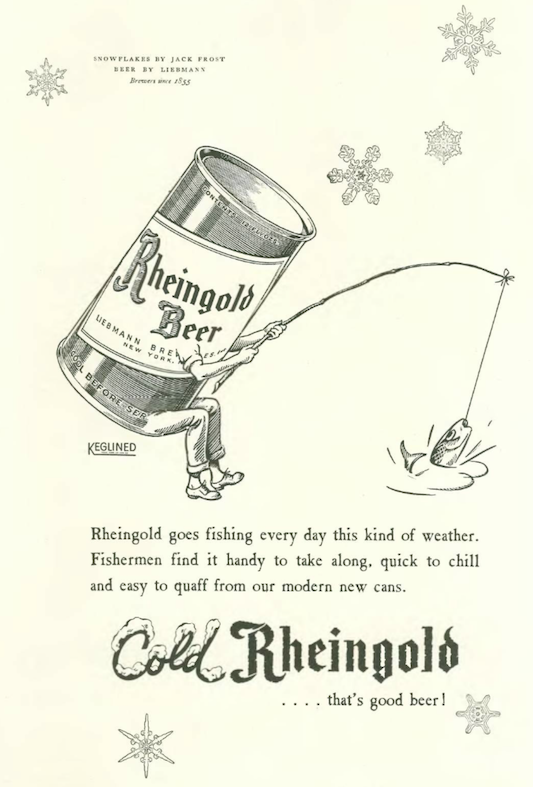
…Rheingold offered up their “Keglined” canned beer as a summer refresher…
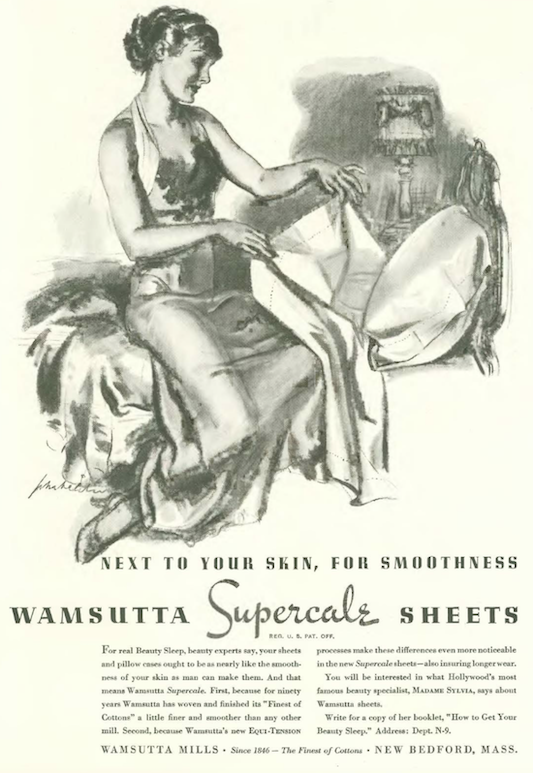
…Wamsutta Mills of New Bedford, Massachusetts became the world’s largest cotton-weaving plant by the end of the 19th century…their iconic “Supercale” sheets (introduced in 1935) typically featured a 200-thread-count…
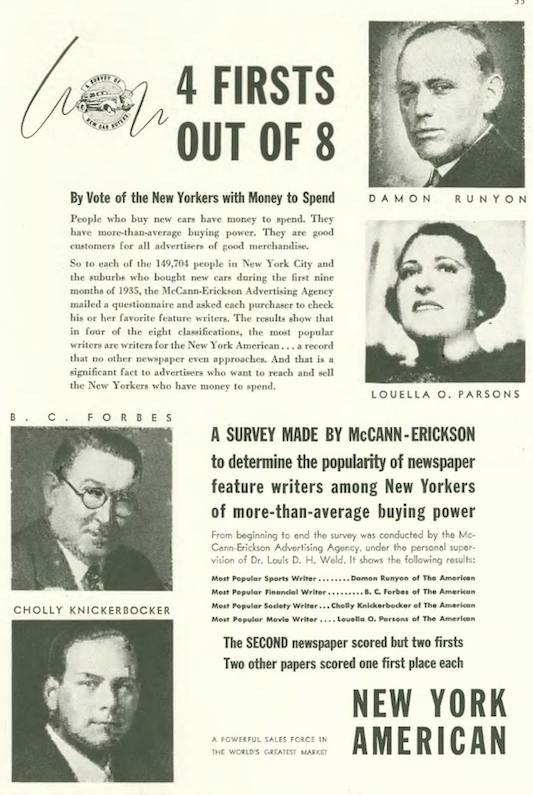
…William Randolph Hearst’sNew York American (soon to merge with Hearst’s New York Evening Journal) boasted a lineup of writers including short story writer and journalist Damon Runyon, movie gossip columnist Louella Parsons, Forbes magazine founder B.C. Forbes, and “Cholly Knickerbocker“—a pseudonym used by society writers, in this case by Maury Henry Biddle Paul…
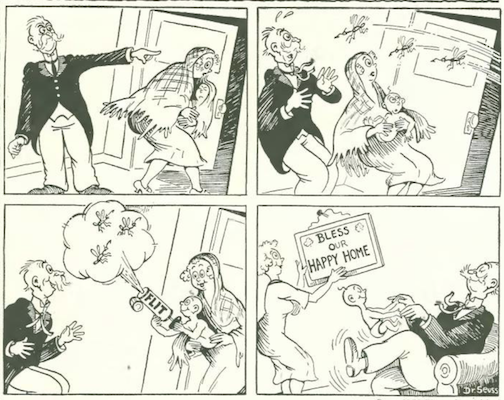
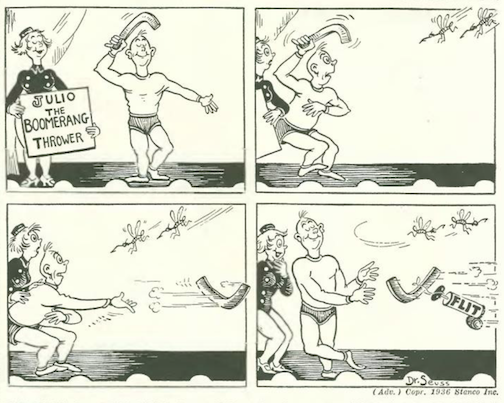
…another Flit ad by Dr. Seuss, this time an illegitimate child saves the roof over his head by whipping out some insecticide…
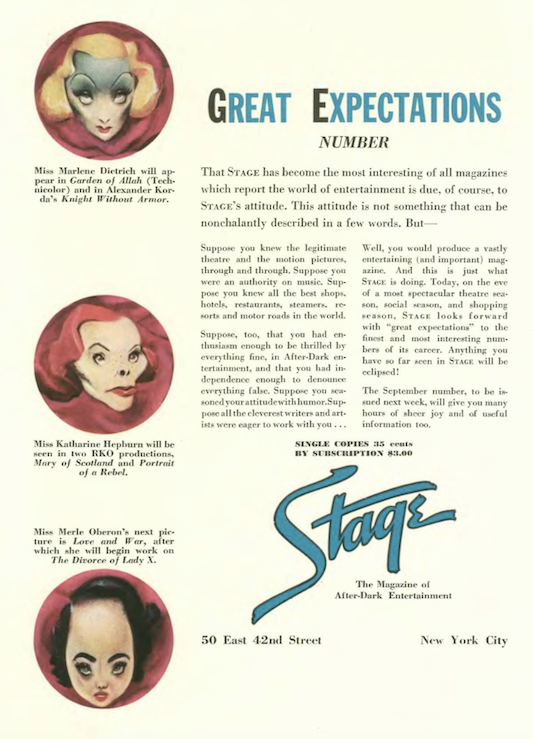
…Stage magazine featured caricatures by Sam Berman to promote its “Great Expectations” issue…
…Susan Willard Flint opens up our illustrators and cartoonists section…
…joined by James Thurber…
…and spots by Garrett Price…
…Richard Taylor…
…and Christina Malman…
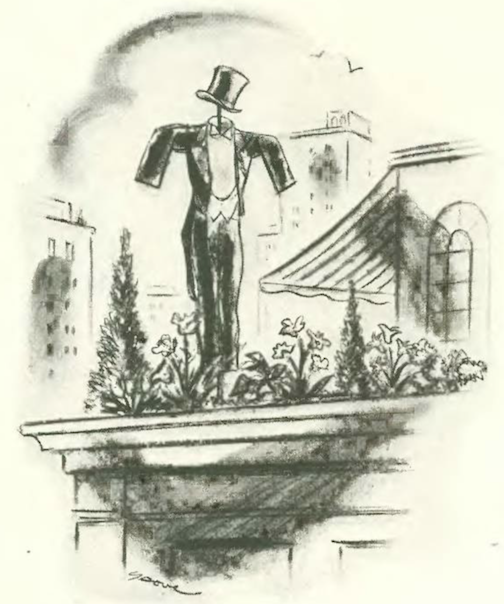
…Leonard Dove drew up a stylish scarecrow…
…and a woman who knows what she likes…
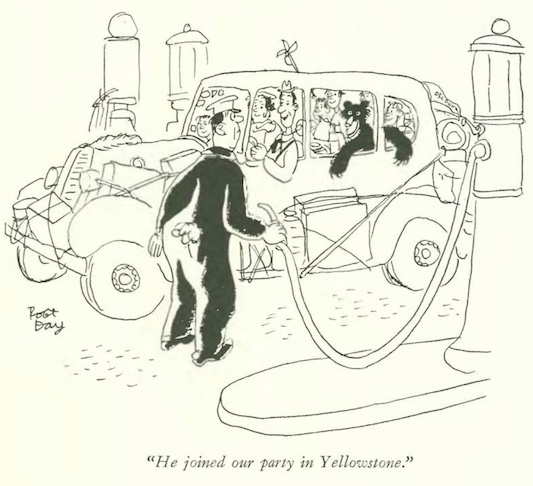
…Robert Day found more than scenery on a trip to Yellowstone…
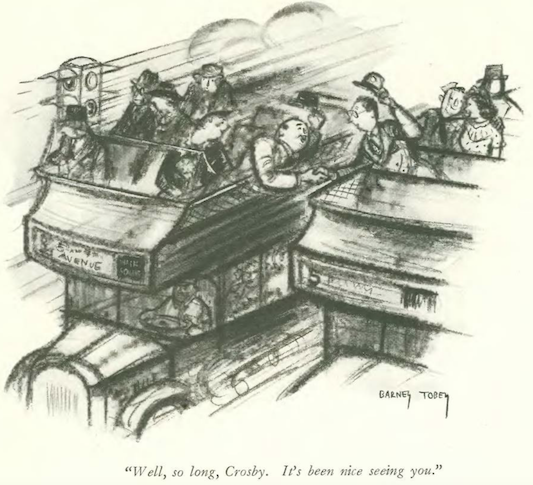
…Barney Tobey exchanged some quick greetings on the omnibus line…
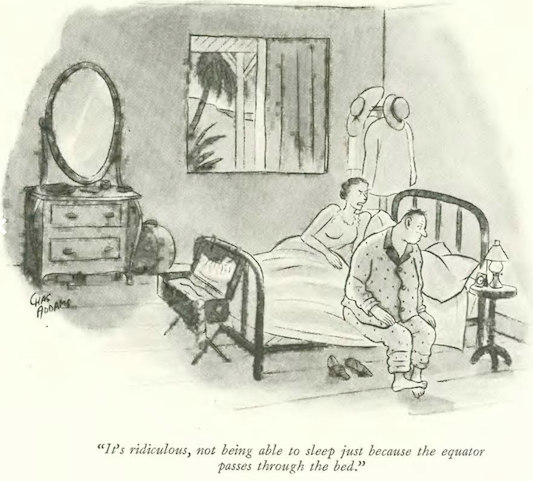
…Charles Addams gave us a case of equatorial insomnia…
…Ned Hilton’s inker had some editing to do…
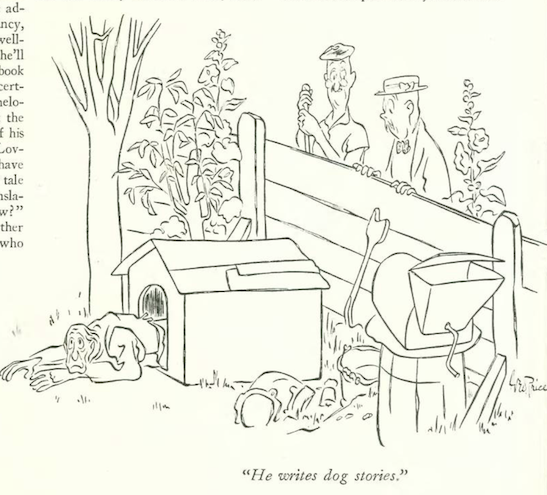
…George Price gave new meaning to being “in the doghouse”…
…Rea Irvin revealed another advance in American ingenuity…
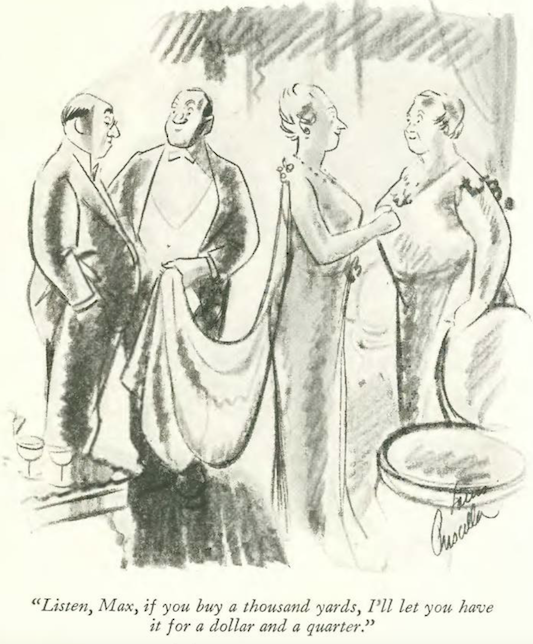
…Louis Priscilla published the third of a total of three cartoons he contributed to The New Yorker from 1933 to 1936…Priscilla was also a magazine illustrator and a teacher at the Art Students League of New York…
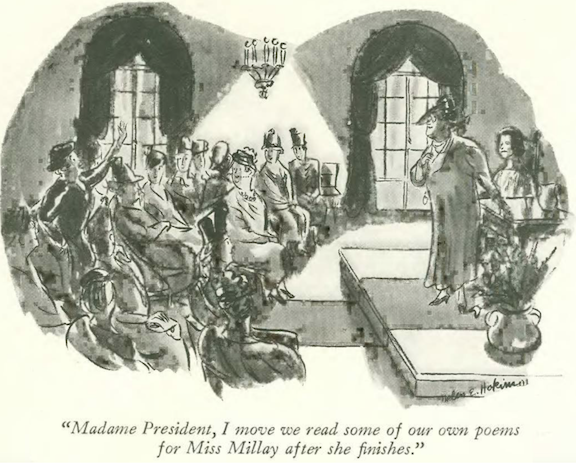
…Helen Hokinson’s club ladies hoped to wow Edna St. Vincent Millay with some of their own poetry…
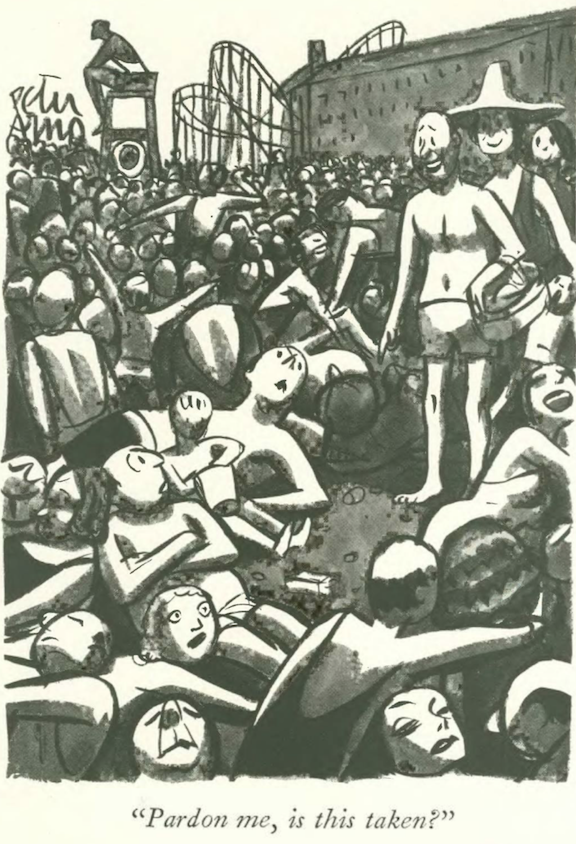
…and to close…if you’ve seen photos of Coney Island beaches in the 1930s, you know Peter Arno isn’t exaggerating much here…
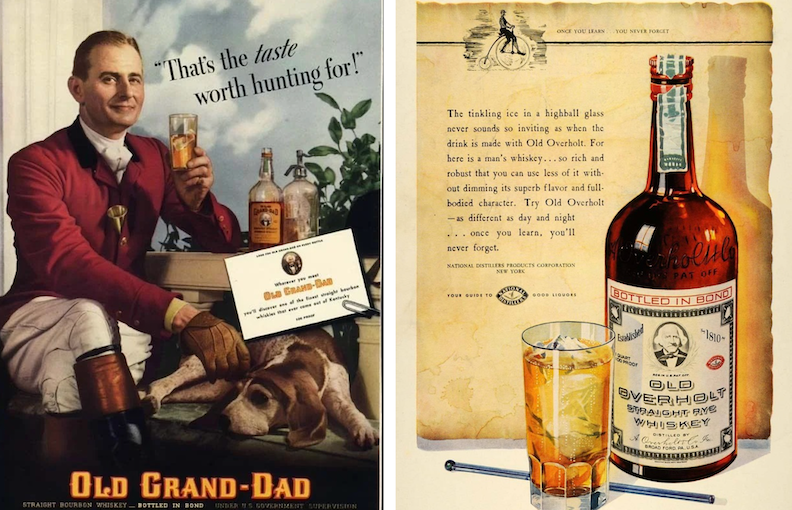
Above: E.B. White had a bone to pick with whiskey distillers who tried to establish "quick antiquity" by naming their products "Old Something-or-Other." That was not true for these two brands—Old Grand-Dad was introduced in Kentucky in 1840, while Old Overholt debuted in Pennsylvania in 1810, making it America's oldest continually maintained whiskey brand. Both are now subsidiaries of Japan's Suntory Global Spirits. (alcohol professor.com/pinterest)
With the official end of Prohibition on December 5, 1933, brewers and distillers raced to ramp up production and revive brands that had lain dormant for more than a decade. Distillers of aged spirits like rye and whiskey were especially keen to invoke history and tradition when marketing their tipple.
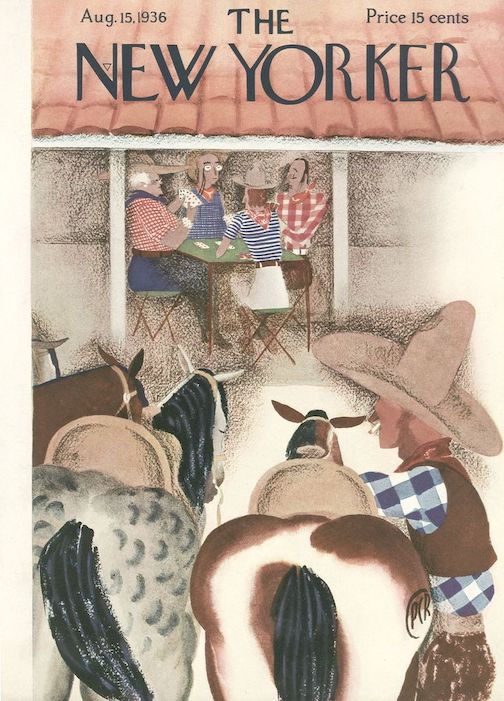
August 15, 1936 cover by Paul C. Robertson.
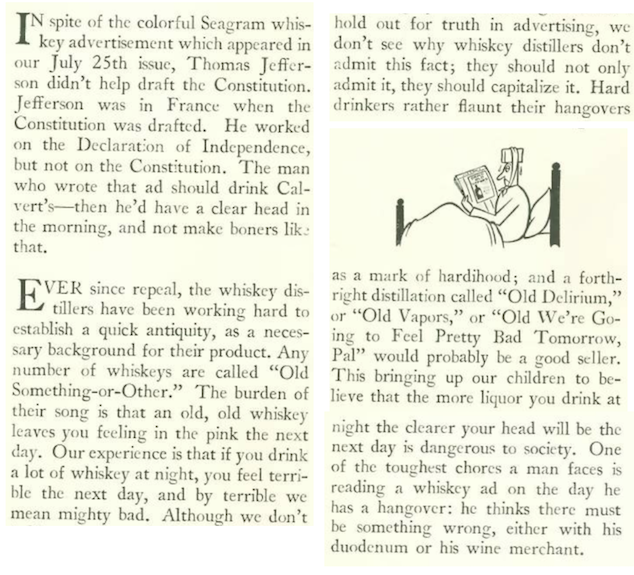
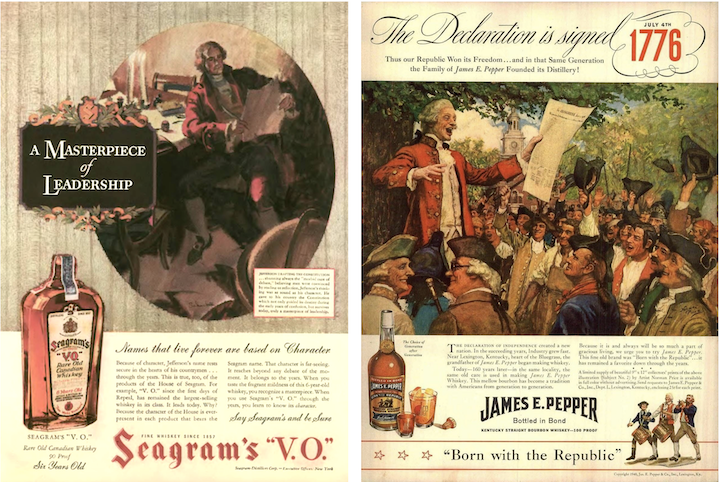
In some cases newer distilleries made generous use of the word “Old” in their branding, according to E.B. White in his “Notes and Comment.” White also called out the folks at Seagram’s, who compared the character of Thomas Jefferson to that of their “V.O.” whisky (no “e” in spirits tied to British distilling traditions—Scotland, Canada, Japan, Wales, India). Most egregious, however, was the ad’s claim that Jefferson helped to draft the Constitution. White explained:
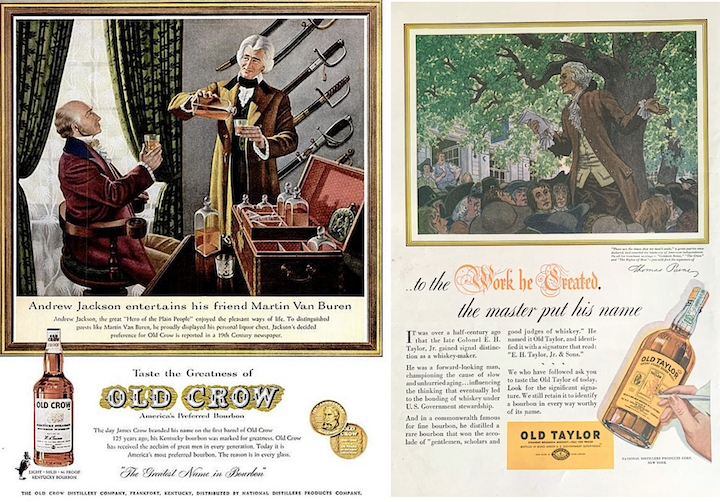
HE DID WHAT?…E.B. White called out the Seagram’s ad (left, from the July 25 issue of The New Yorker) for its historic inaccuracy (the distiller erroneously credited Thomas Jefferson for the Constitution; at right, the character and leadership of the Founding Fathers (and other early American leaders) were oft-employed metaphors for a number of whiskey brands, including James E. Pepper. (facebook.com)GOLDEN OLDIES…Here are more examples of historic figures being associated with fine spirits…at left, in 1960 the makers of Old Crow (founded 1835) depicted the genocidal Andrew Jackson pouring a glass of the stuff for Martin Van Buren; at right, in 1937 the makers of Old Taylor (1887) used quotes and themes from Thomas Paine’s revolutionary writings to promote their Kentucky Straight Bourbon. (bourbonbanter.com/etsy.com)
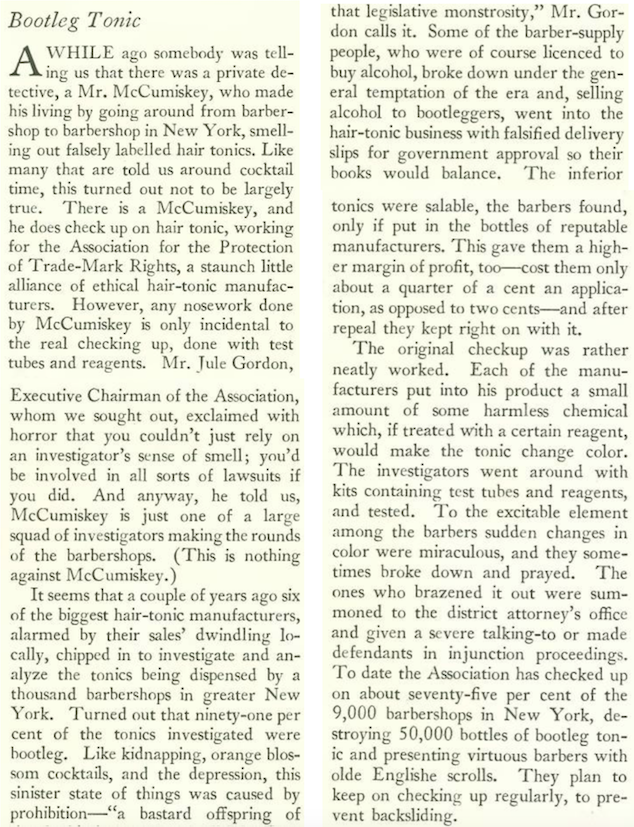
While we are on the subject of ardent spirits, let’s take a look at these excerpts from “The Talk of the Town” (attributed to Eugene Kinkead and Russell Maloney), which told the story of a private detective who had a nose for liquor— disguised as hair tonic.
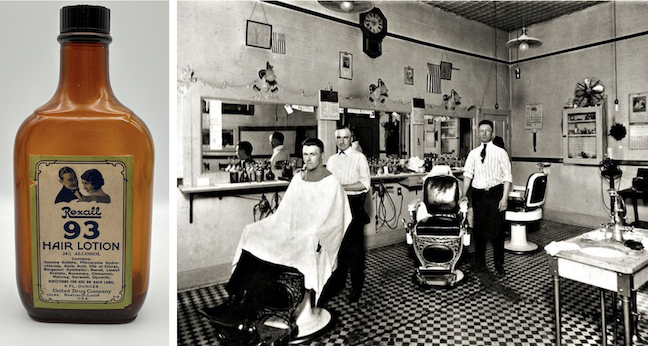
A SIP WITH YOUR SHAVE…During Prohibition (1920–1933), high-alcohol hair tonics like Rexall 93 (containing up to 24% alcohol) were legally sold as cosmetics but were frequently bought and consumed by people seeking a cheap, accessible substitute for bootleg liquor. The photo at right is of a 1930s barbershop—it is not implied that these fine gentlemen were involved in such illicit activities. (ebay.com/pinterest.com)
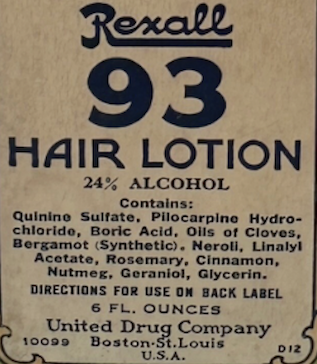
A closer look at the Rexall label—the makers made sure “24% Alcohol” was clearly visible. Folks known as “strainers” would run hair tonics like these through bread, cloth, or charcoal to filter out poisonous additives, obviously a dangerous practice.
* * *
Doggy Downer
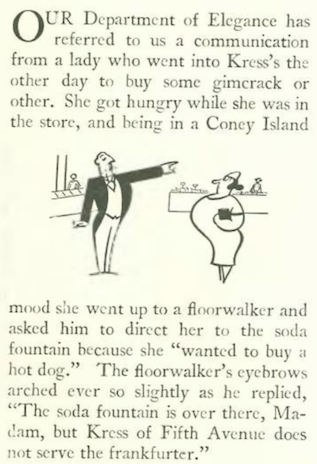
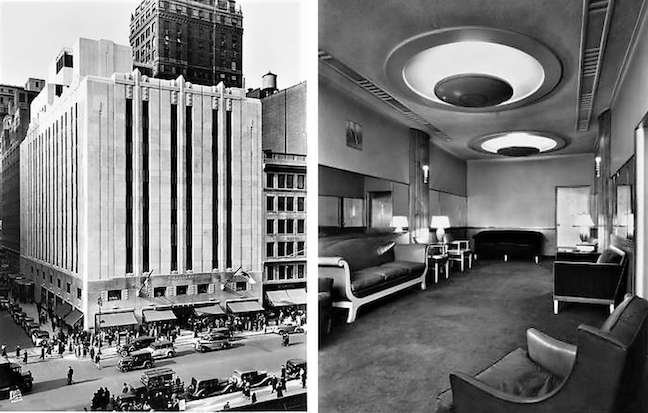
The legendary Kress “five-and-dime” stores, with more than 250 locations across twenty-nine states, served the needs of regular folks, but the designs of its stores were anything but pedestrian. This was especially true of its Fifth Avenue location, a 1935 Art Deco masterpiece. Given its lofty address, it was no place for one to order a lowly hot dog. E.B. White explained:
DECO EDIFICE…Samuel Henry Kress believed his department stores should function as works of public art that elevate the shopping experience for ordinary people. The company maintained an in-house architectural division, under the leadership of architect Edward F. Sibbert, that designed iconic, custom buildings, including the 1935 flagship S. H. Kress & Co. store on Fifth Avenue and 39th Street, an Art Deco masterpiece rendered in granite, bronze, and stainless steel; at right, a view of the store’s Ladies Lounge. Sadly, the building was razed in 1983. (Museum of the City of New York/New York Public Library)
* * *
Merely Mortal
Janet Flanner filed her second report from the Berlin Olympics, where America’s Black athletes dominated the track and field events (ESPN’s Larry Schwartz credits Jesse Owens for “single-handedly crushing Hitler’s myth of Aryan supremacy”). Flanner noted attempts by propagandists to make sense of the beating they received, including likening the American athletes to wild animals “living in a state of innocence.” Excerpts:
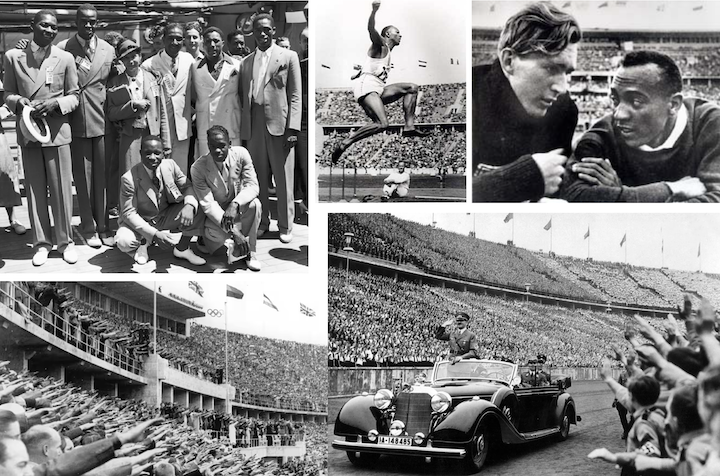
CONQUERING HEROES…Eighteen Black athletes went to Berlin as part of the U.S. team in 1936. Clockwise, from top left: Standing are high jumpers Dave Albritton and Cornelius Johnson, hurdler Tidye Pickett, sprinter Ralph Metcalfe, boxer Jim Clark, and sprinter Mack Robinson…in front, weightlifter John Terry (left) and long jumper John Brooks; Jesse Owens captured four gold medals and became the hero of the Olympics—his long jump (26 feet 5-1/2 inches) was an Olympic record; the American press reported widely on the friendship between Owens and his German long jump competitor Carl Ludwig (“Luz”) Long…Long was killed in action during World War II; the faithful offer their ugly salutes at the opening of the games. (webs.org/Bundesarchiv Koblenz/ushmm.org/history.com)
Flanner also reported on the great fanfare at the opening of the games, including “seventeen searchlights, from far outside the arena…a lofty birdcage of streaming light beams.” One wonders if those same searchlights were deployed during the war four years later, when RAF Lancaster bombers began their night bombing campaign of Berlin.
* * *
At the Movies
Last week we saw Lionel Barrymore in drag (as an old woman) in The Devil Doll. This week he resurfaces as a senile old warhorse in The Road to Glory, a Howard Hawks war film with a screenplay co-written by William Faulkner (the film also featured Frederic March, who had star billing in three major films in 1936). John Mosher found the film “presentable,” but nothing special. The same went for Down Under the Sea, a film concerning sponge divers who battle over the affections of a woman (Ann Rutherford).
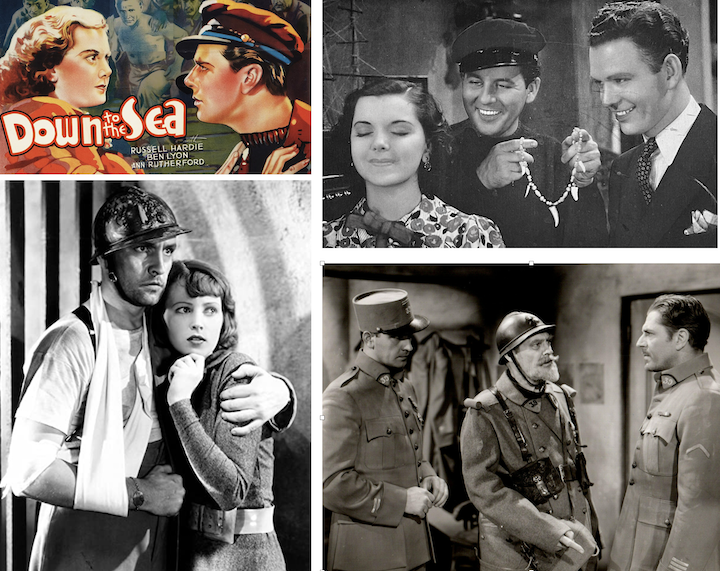
WERE THEY SPONGE WORTHY?…Clockwise, from top left: Ann Rutherford finds herself torn between two sponge divers vying for her affections in Down Under the Sea (aka Down to the Sea); divers Ben Lyon and Russell Hardie surprise Rutherford with a “native necklace” in the film; Frederic March, Lionel Barrymore, and Warner Baxter in The Road to Glory; June Lang with March in The Road to Glory. (eBay/silverscenesblog)
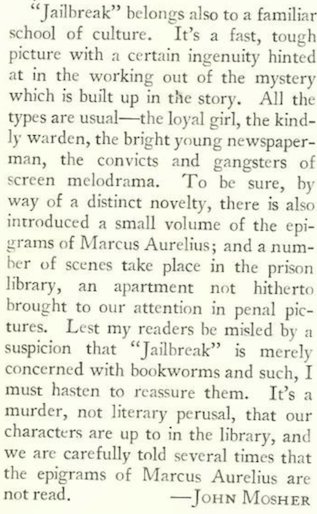
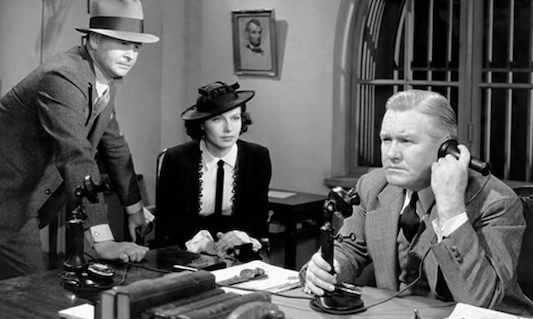
Mosher also took in Jailbreak, a minor noir picture about racketeers, cops and newspaper reporters.
SERIOUS BUSINESS…Barton MacLane, June Travis and Joseph Crehan in Jailbreak. (IMDb.com)
* * *
From Our Advertisers
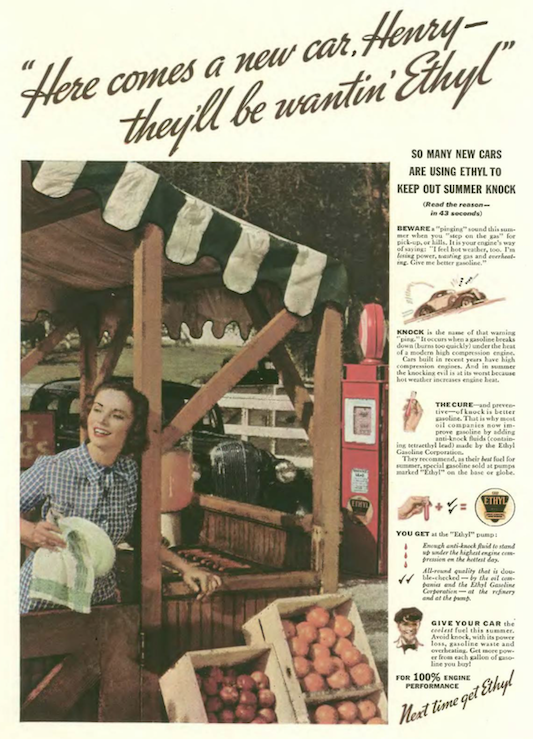
The inside front cover featured a wholesome image of a roadside stand on behalf of leaded gasoline…the makers of Ethyl, which boosted octane ratings and stopped engine knocking, deliberately hid or omitted the word “lead” in their advertising…I don’t miss the Ethyl, but I do miss those roadside stands…
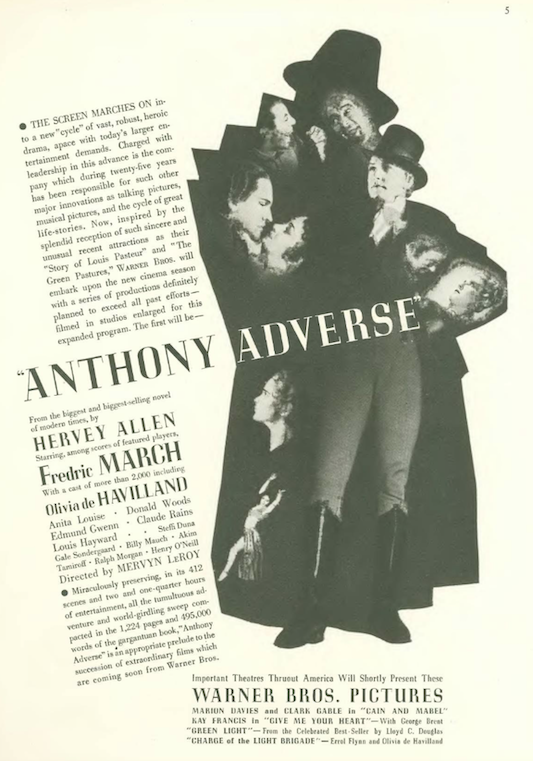
…Warner Brothers took out a full-page ad to trumpet the East Coast release of their epic drama Anthony Adverse, which would go on to win four Academy Awards…
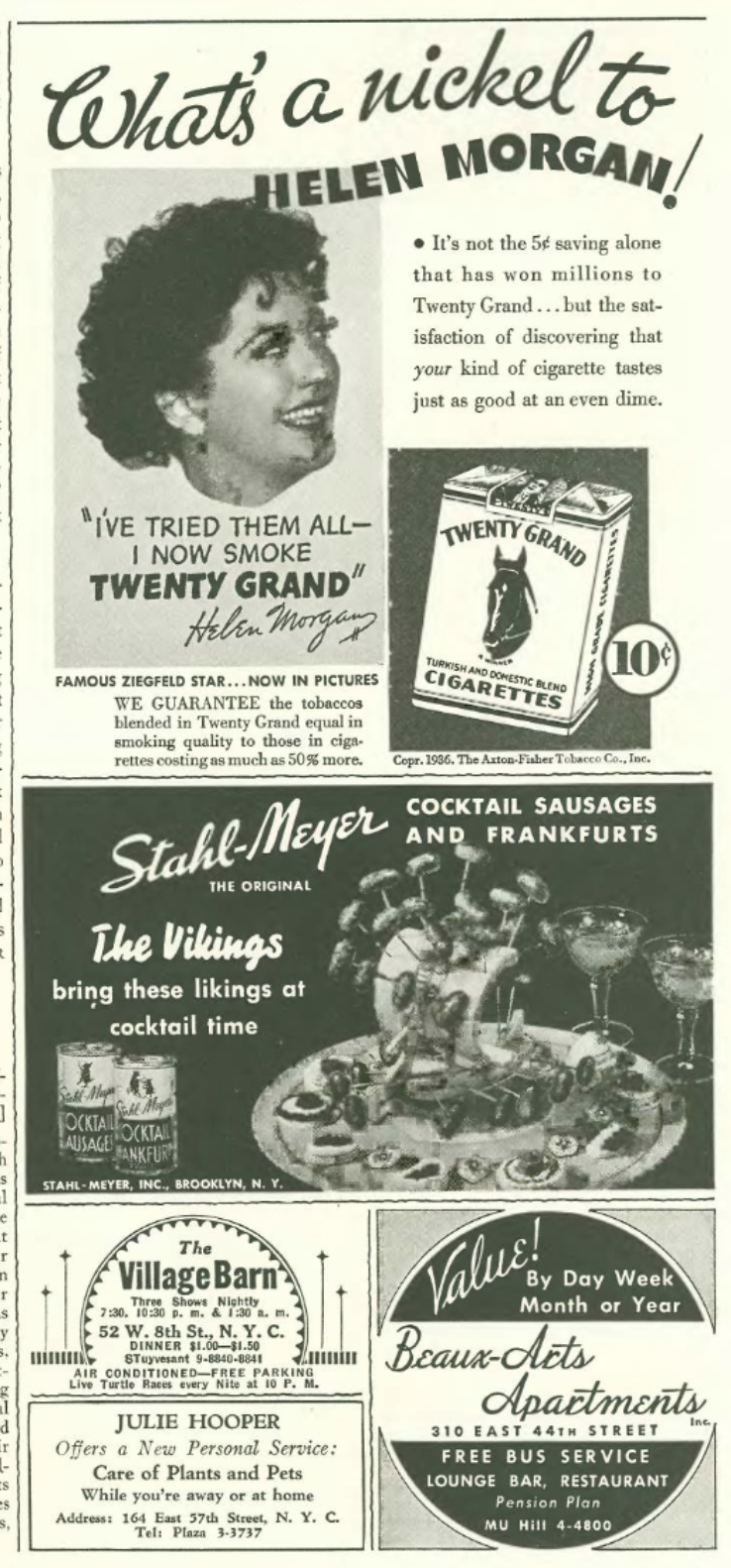
…the original torch singer Helen Morgan lent her endorsement to a budget cigarette brand in this back of the book ad…at this point her career would be headed on a downward spiral, ending with her death in 1941…
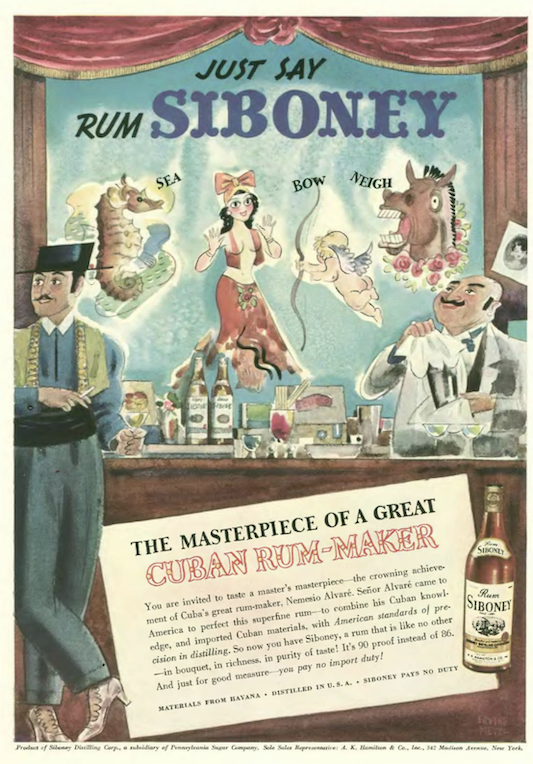
…the makers of the Dominican rum Siboney competed with Cuban rival Barcardi with this colorful full-page ad illustrated by American graphic artist Ervine Metzl…
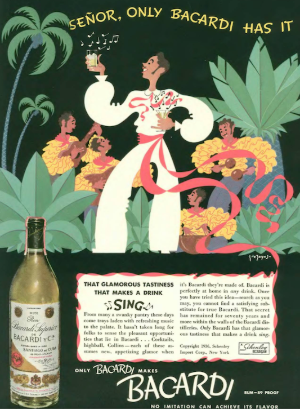
…Barcardi placed this front cover advertisement in Aug. 1, 1936 New Yorker (illustrated by George de Zayas)…
…James Thurber kicks off the cartoons with two terrific spot drawings…
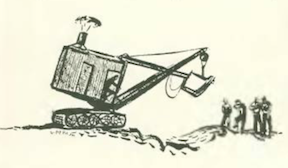
…this spot drawing by Victor de Pauw recalls my favorite childhood book, Mike Mulligan and His Steam Shovel (1939), by Virginia Lee Burton…
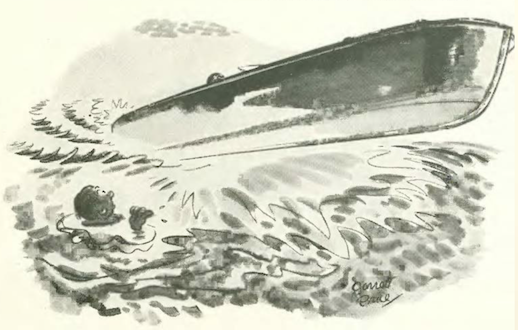
…I’m not sure if one would call this a spot drawing or a caption-less cartoon, at any rate, Garrett Price aptly illustrated the dangers of swimming beyond the bouys…
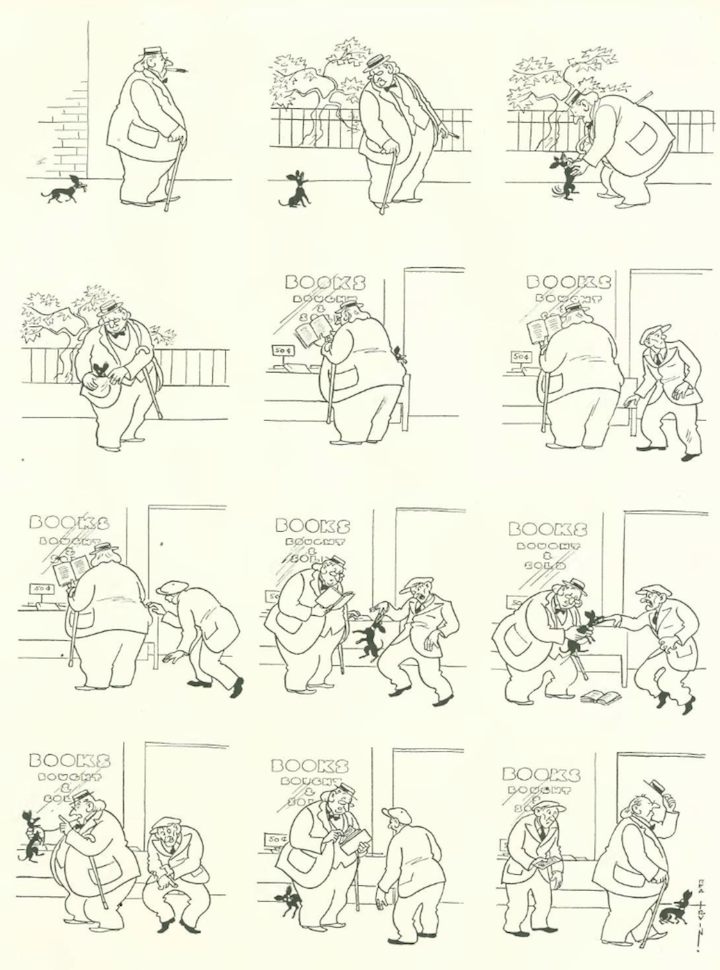
…Rea Irvin demonstrated the perils of dognapping in this multi-panel entry…
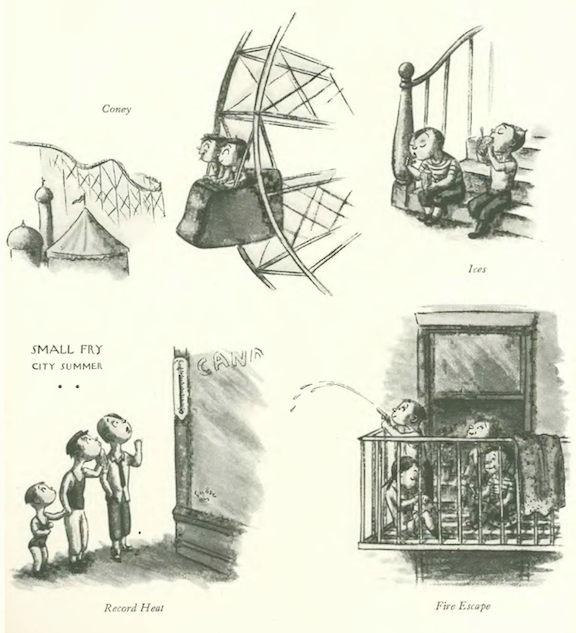
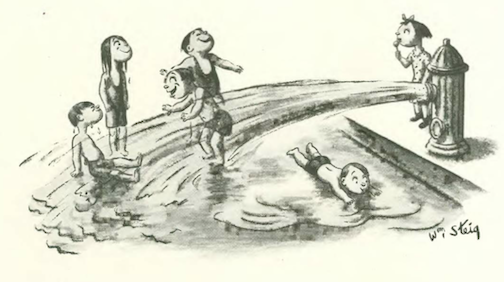
…William Steig celebrated summer in the city…
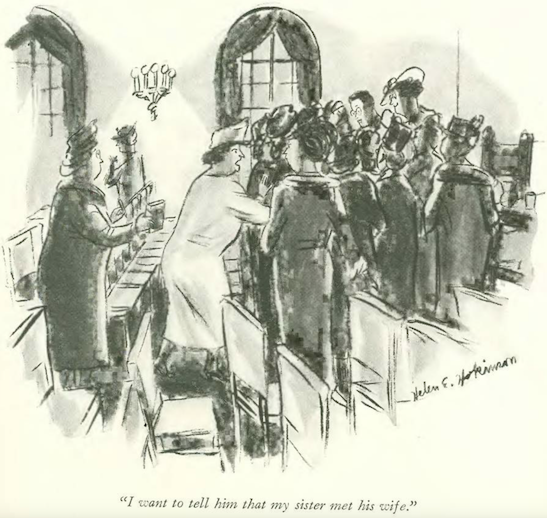
…Helen Hokinson drew up an urgent social connection…
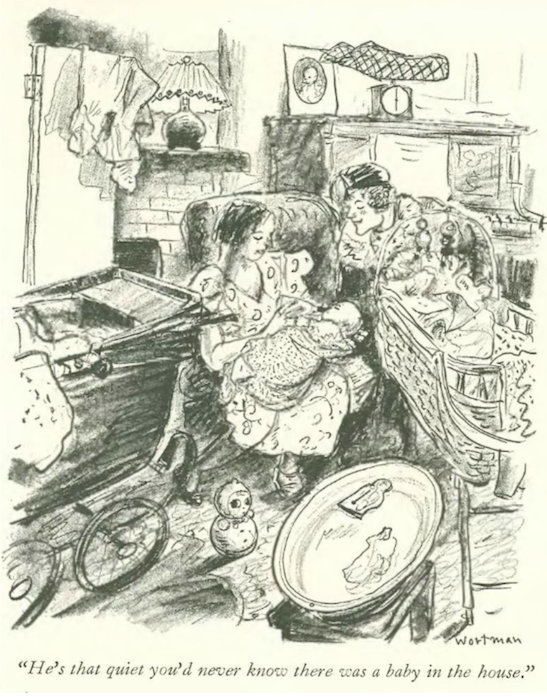
…Denys Wortman looked in on the trappings of motherhood…
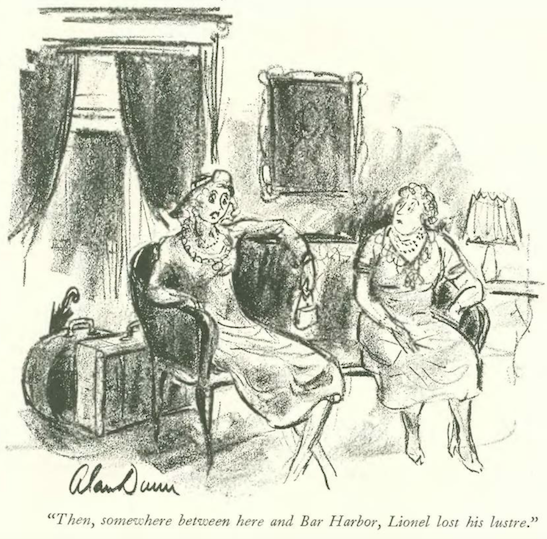
…Alan Dunn showed us one effect of long-distance travel…
…and Dunn again, with a man who’d rather not ask questions…
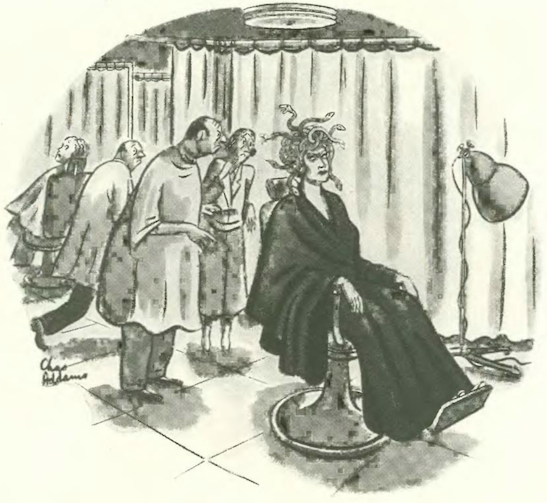
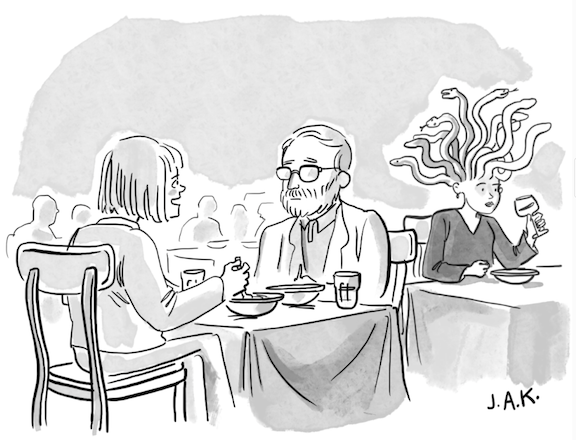
…and leave it to Charles Addams to draw up The New Yorker’s first Medusa-themed cartoon…
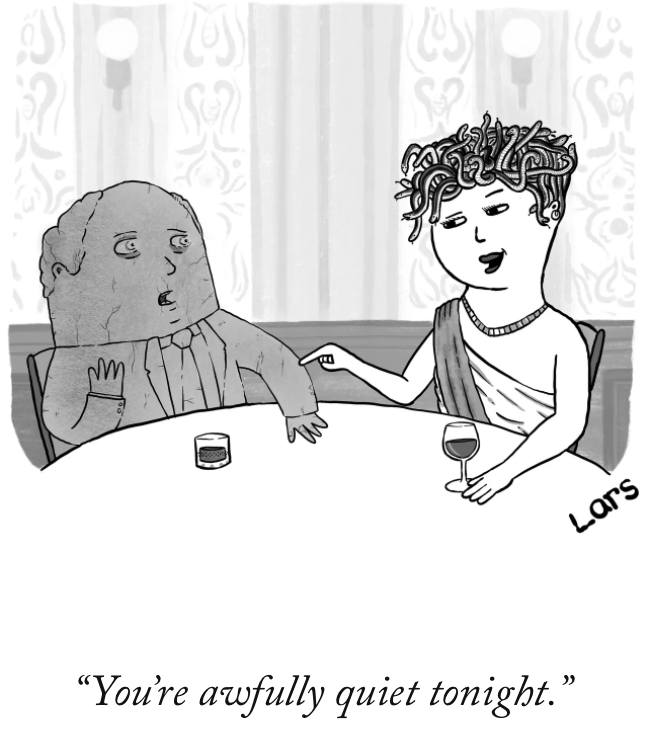
…before we continue, here are other interpretations of the mythic Gorgon from The New Yorker…this one by Lars Kenseth is from Jan. 21, 2019…
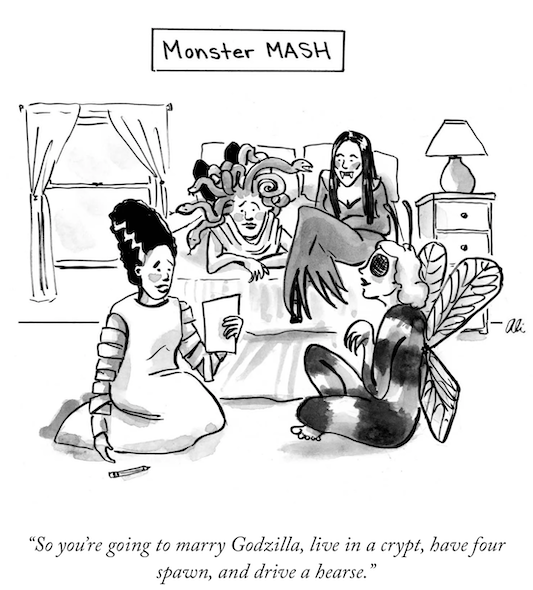
…this is by Ali Solomon (Oct. 29, 2025)…
…and from May 3, 2025, this terrific caption contest cartoon by Jason Adam Katzenstein (and the winning caption by Peter Sergison, Durham, NC)…
…and here’s a timely cartoon by Daryl Seitchik that was rejected by the magazine…
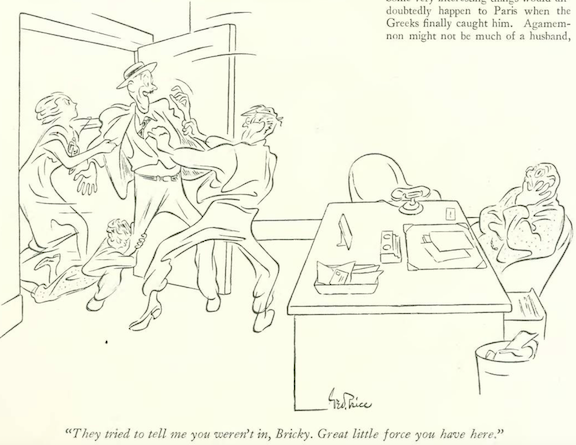
…we go back to 1936 with George Price and a plucky salesman…
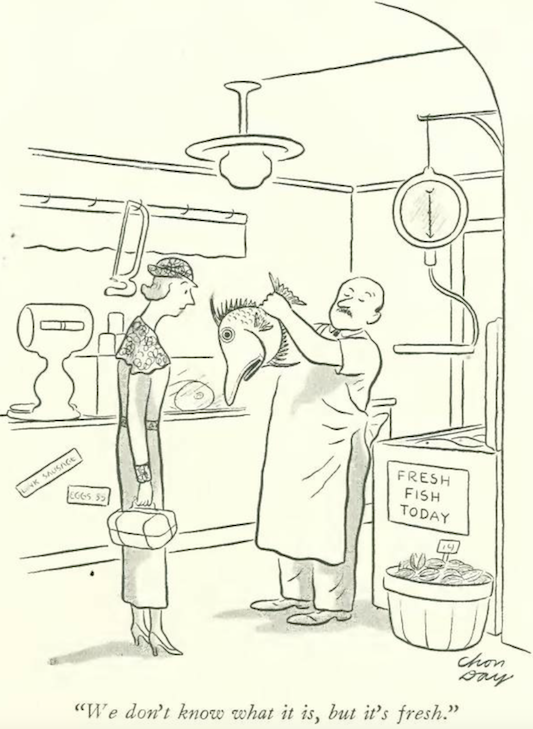
…Chon Day made an unappetizing find at the fish market…
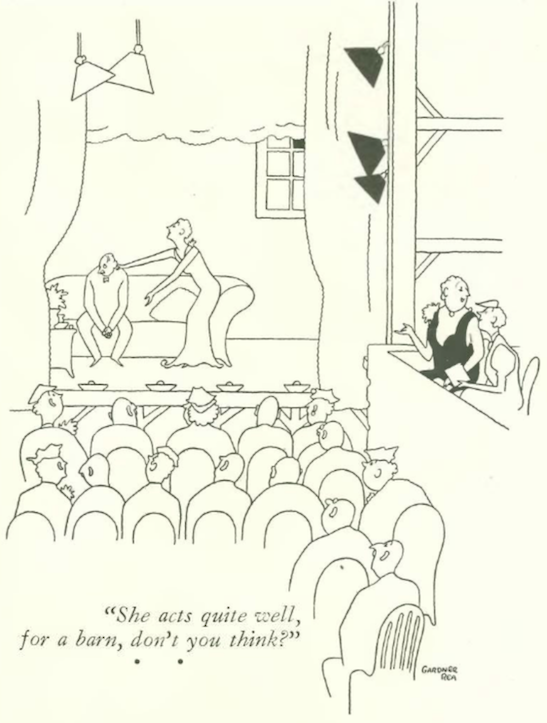
…Gardner Rea looked in on a summer stock performance…
…Peter Arno drew up a Milquetoast unwittingly ordering a knuckle sandwich…
…and we close with some racy decor, courtesy Richard Taylor…
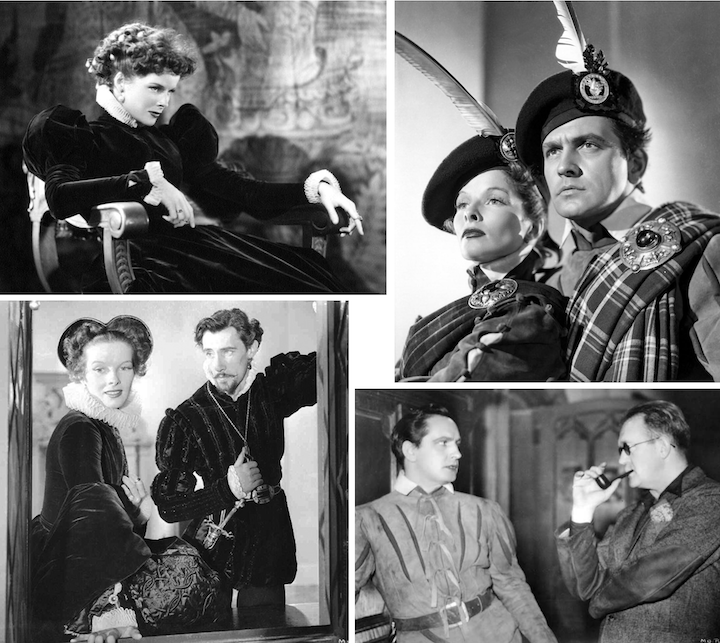
Above: Fredric March as the Earl of Bothwell in Mary of Scotland. March sported a kilt that Alex von Tunzelmann (the Guardian, May 7, 2015) calls "the bane of Scottish historical movies from here to Braveheart." Tunzelmann notes that "What we call a kilt today—the fèileadh beag, or small kilt—was invented in the mid-18th century, almost 200 years after this film is set. The Scots should be wearing belted plaid, or the rather fetching skintight tartan trews (image at right) sported by Mary’s father, James V." (eBay.com/pinterest.com)
These were truly the dog days of summer—New Yorkers had just endured one of the hottest months on record (106 F on July 9) and it remained intensely hot and dry as August rolled in. So for this post we will retreat to one of the few places that had air-conditioning—the cinema—and see what folks were enjoying in the first week of August 1936.
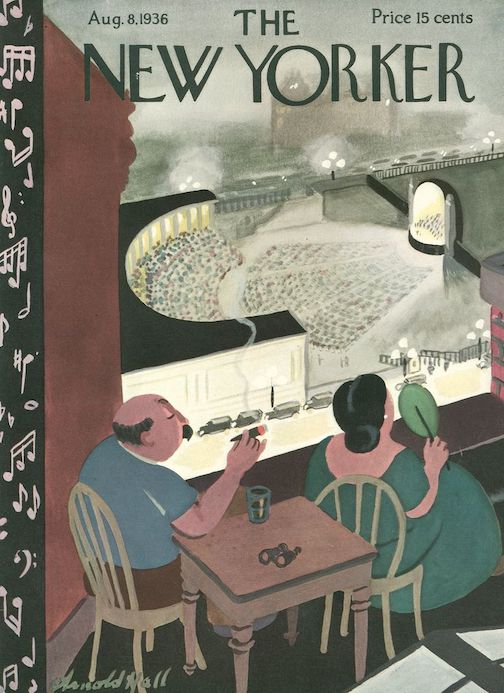
August 8, 1936 cover by Arnold Hall.
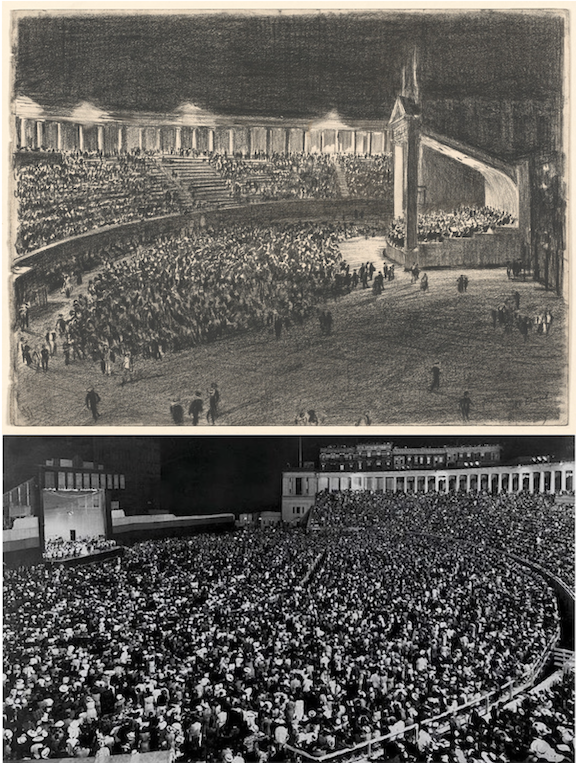
Before we jump into the movies, the wonderful cover by Arnold Hall recalled the summer night concerts at Lewisohn Stadium (although Hall took some liberties with the stadium’s design for the sake of composition).
A LITTLE NIGHT MUSIC…Top: Illustration by Scottish artist Muirhead Bone of a nighttime Lewisohn Stadium concert, circa 1920s; below: Andre Kostelanetz conducts before a crowd of thousands at Lewisohn Stadium in 1939—for an admission price of a mere twenty-five cents, concertgoers were treated to appearances by leading performers of jazz, classical music and opera. The stadium was demolished in 1973. (digitalcommonwealth.org)
On to our movies, Russell Maloney once again sat in for John Mosher as the magazine’s film critic, taking on everything from a Tudor romance to a horror film that featured Lionel Barrymore in drag.
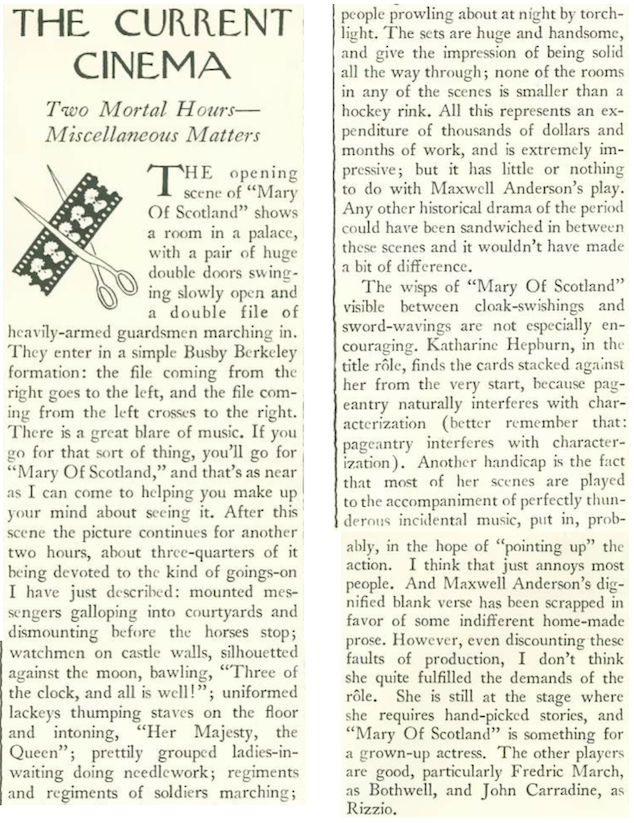
In Mary of Scotland, Maloney found Katharine Hepburn’s turn as Mary, Queen of Scots a bit wanting (the role should have gone to a “grown-up actress”), while he thought the film itself was rather tedious with “lots of goings on.” He concluded that the “wisps of Mary of Scotland visible between cloak-swishings and sword-wavings are not especially encouraging.”
NOT READY FOR PRIME TIME?…Clockwise, from top left: Critic Russell Maloney thought the 29-year-old Katharine Hepburn was not seasoned enough to portray Mary Stuart in Mary of Scotland; Fredric March as the Earl of Bothwell, with Hepburn; March visits with director John Ford, who was better known for his Westerns (Ford and Hepburn would famously have an affair during the filming); Hepburn in a scene with John Carradine, who portrayed Rizzio, the Italian courtier and private secretary to Mary. Patriarch of the Carradine acting dynasty, his children included actors David, Keith, and Robert Carradine. (imdb.com/pinterest.com/frockflicks.com)
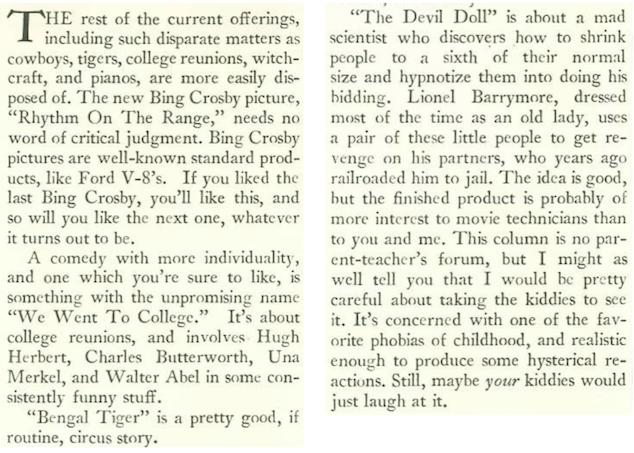
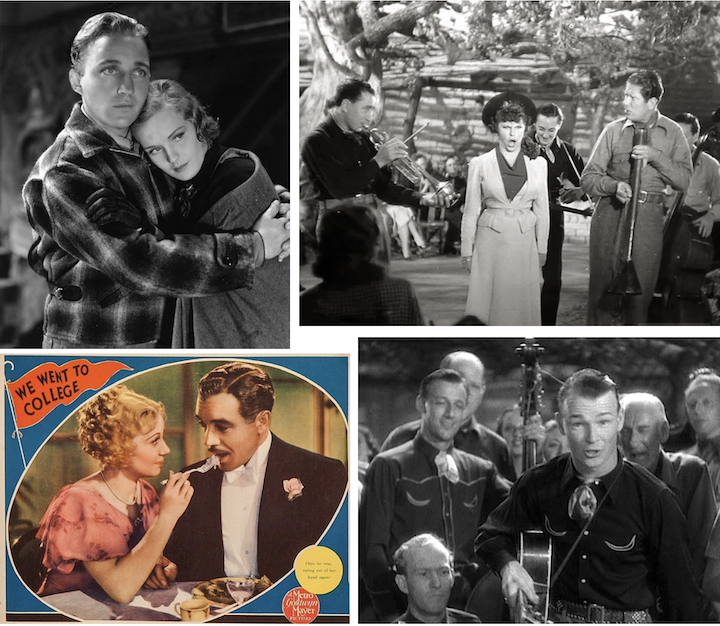
In addition to a forgettable lion-tamer flick (Bengal Tiger), Maloney also reviewed a Bing Crosby movie with a host of singing cowboys, Rhythm on the Range, and a “consistently funny” film with an “unpromising name,” We Went to College…
COWBOY CROSBY…Clockwise from top left: Bing Crosby portrayed a traveling cowboy in love with a rich girl (Frances Farmer) in Rhythm on the Range;Louis Prima, Martha Raye (in her film debut), and Bob Burns performed in the ensemble “I’m an Old Cowhand from the Rio Grande” along with Roy Rogers (uncredited and performing under his original stage name, Leonard Slye) and The Sons of the Pioneers; Una Merkel and Walter Abel in a lobby card image advertising We Went to College. (imdb.com)
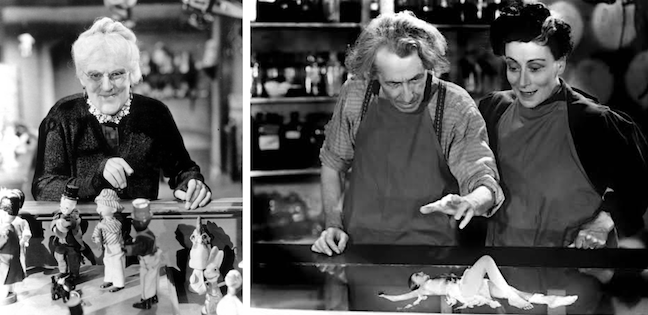
Maloney also reviewed a horror-farce, The Devil Doll, featuring Lionel Barrymore as banker Paul Lavond. A brief synopsis: Framed by his three partners and imprisoned on Devil’s Island, Lavond escapes with a fellow inmate who introduces him to his wife, Malita. The couple demonstrate a process that shrinks animals and people to the size of dolls, which then can be animated by will power. Seeing the dolls as an opportunity for revenge on his former partners, Lavond disguises himself as an old woman and sends out the shrunken people to harm his enemies.
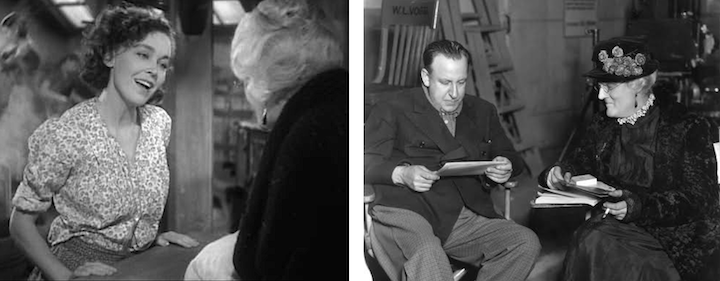
PLAYING WITH DOLLS…At left, Lionel Barrymore disguised as Madame Mandelip, preparing his demonic dollies for revenge in The Devil Doll; at right, Marcel (Henry B, Walthall) and his wife Malita (Raffaela Ottiano) with one of their shrunken people. (classic-monsters.com)MY, WHAT BIG TEETH YOU HAVE…At left, Tarzan star Maureen O’Sullivan portrayed Paul Lafond’s unsuspecting daughter—in this scene from The Devil Doll she doesn’t recognize her long-absent father, disguised as the kindly Paris toy shop owner Madame Mandelip; at right, Lionel Barrymore (dressed as Madame Mandelip) meeting with Devil Doll director Tod Browning, best known for his 1932 magnum opus, Freaks. (classic-monsters.com/moriareviews.com)
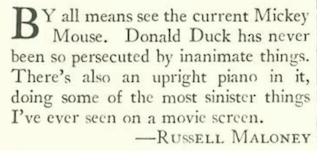
It seems there were few, if any, critics in the 1930s who didn’t like Mickey Mouse cartoons. These days we take animation for granted, but ninety years ago it was still something of a miracle, especially in color. Maloney noted the latest must-see Disney cartoon short, Donald and Pluto.
MARTYRDOM OF DONALD DUCK…Donald Duck was literally put through the wringer for our amusement in the 1936 short Donald and Pluto, one of the three installments of the Mickey Mouse series in which Mickey doesn’t appear as a character. Donald Duck was a fairly new Disney character in 1936, making his debut in 1934’s The Wise Little Hen. (disneyfandom.com)
* * *
Life Goes On
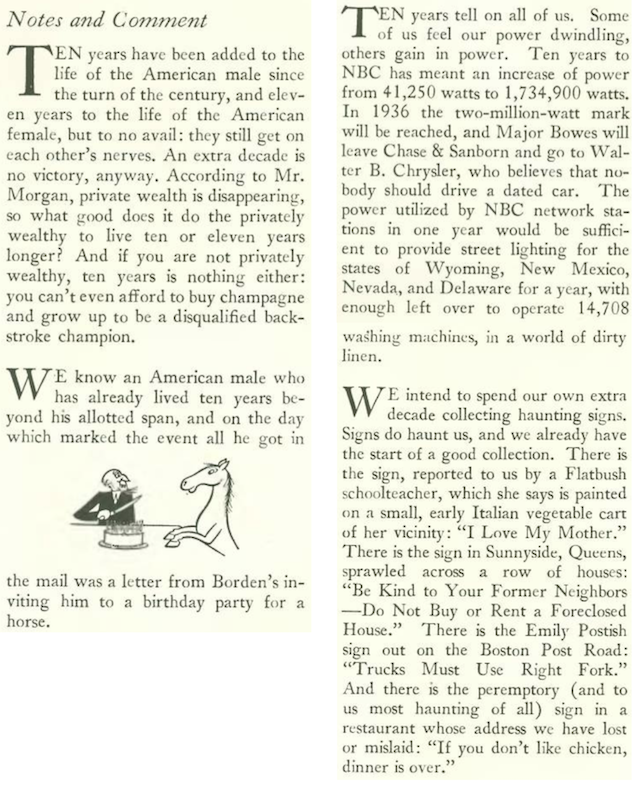
E.B. White mused about the increasing life expectancy at birth of the American male from 47 years in 1900 to 58 years in 1936 (a woman’s life expectancy was roughly 49/62, respectively). White (who would live 86 years) said he would spend his extra years collecting “haunting” signs, such as one on the Boston Post Road that read: Trucks Must Use Right Fork.
AND NO ELBOWS ON THE TABLE, EITHER…Trucker poses in front of his rig in 1936. (facebook.com)
* * *
Wartime Wardrobe
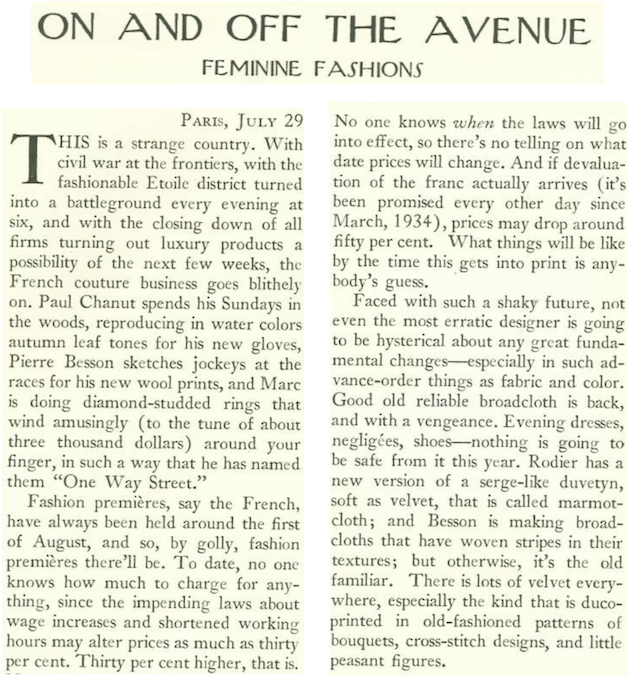
Beatrice Mathieu—the first and only Paris fashion correspondent for The New Yorker—sat in on Lois Long’s column to discuss the latest from The City of Light. Designers were soldiering on with their premieres despite the winds of war blowing from the east. Excerpts:
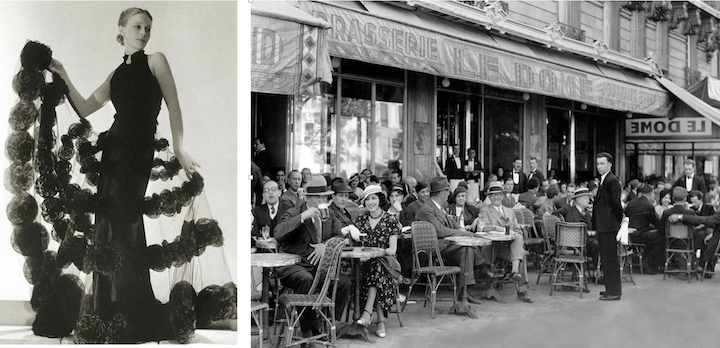
LIFE GOES ON…At left, a model shows off a “Carnival dress” by Madeleine Vionnet, 1936; a sidewalk café in Paris filled with fashionable folks, 1936. (godsandfoolishgrandeur.blogspot.com/reddit.com)
A note about Beatrice Mathieu: According to her 1976 New York Times obituary, “In an era when honest criticism in fashion writing was relatively rare, she blended humor with a kind of skepticism and honesty in writing that enhanced her reputation as a leader in the field…In 1928, when the young woman from Faribault, Minn., was making a living in Paris as a freelance writer, she received a cable from Harold Ross…asking her to do some work for him. She wired back: ‘What is The New Yorker?’ Mr. Ross replied at some length. She took the job.” Mathieu stopped writing her Paris column in 1936 but resumed after the end of World War II.
* * *
A Dose of Passos
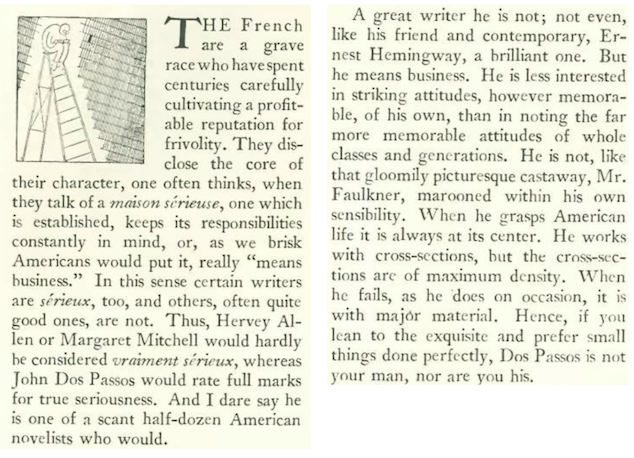
Clifton Fadiman reviewed the latest book by John Dos Passos (1896– 1970), who is known for his pioneering works of nonlinear fiction and his U.S.A. trilogy, which he completed in 1936 with The Big Money. One of the major novelists of the post-World War I “lost generation,” he is widely praised today for his timeless insights into America’s inequalities (and was also highly regarded by contemporaries including William Faulkner). Fadiman, however wrote “A great writer he is not.” Excerpts:
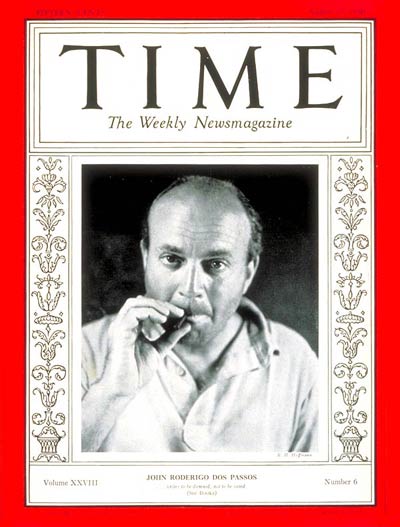
HIS TIME WOULD COME…John Dos Passos on the cover of Time, Aug. 10, 1936. Dos Passos is admired today for showing how Americans respond to the chaos and inequalities of modern life. (time.com)
* * *
From Our Advertisers
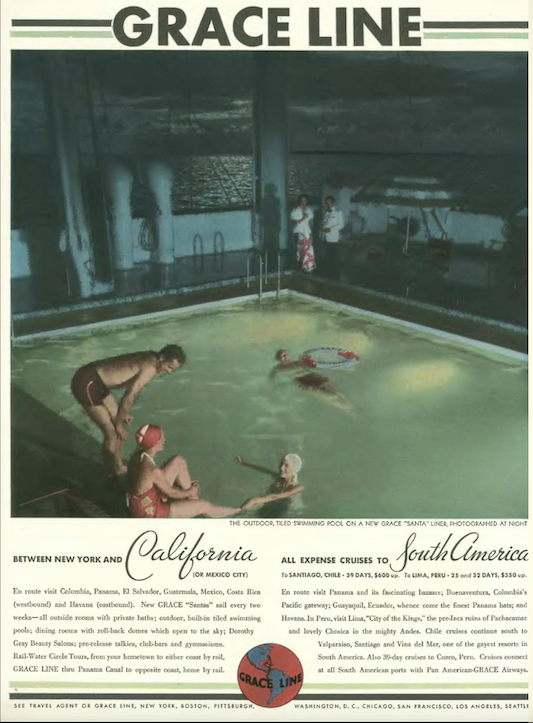
We begin our advertising section with the Grace Line, which offered this inviting image (on the inside front cover) of nighttime swimming on the deck of one of its Santa liners, en route to South America and California…
…less inviting, it would seem at the time, would be a cruise to Germany aboard a Hamburg-America Line (HAPAG) ship—beginning in 1939, U.S. and British forces would seize nearly all of HAPAG’s fleet…
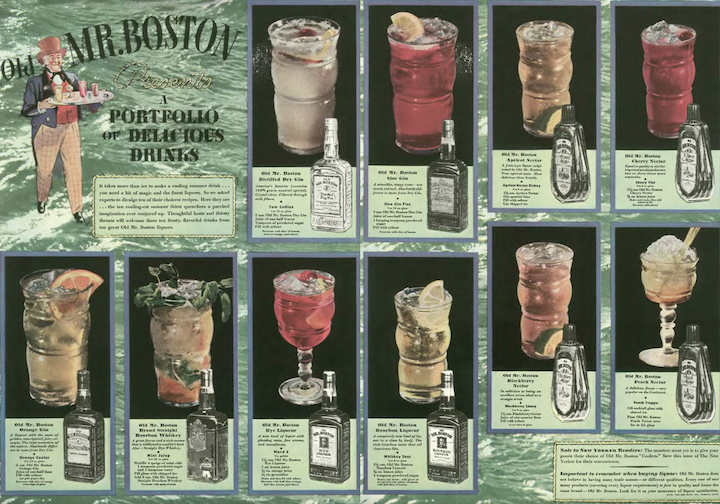
…the relatively new company Old Mr. Boston (founded in Boston in 1933, right as Prohibition ended) went big with this two-page color advertisement touting its line that included gin, rum, whiskey, and cordials…
…in the back of the book…Brown & Williamson launched its Viceroy brand in 1936 as the world’s first cork-tipped filter cigarette…at the bottom is a modest ad for Pilsner Urquell, a Czech brewer that produced the world’s first pale lager…it is still brewed in Pilsen (Czech Republic) under the ownership of Tokyo-based Asahi Group…
…Schaefer promoted their “light beer” in this rather spare advertisement…the “light” referred to its pale color, not to its calorie count…founded in New York City in 1842, Schaefer grew to be a top five brewer in America…today it is marketed by Pabst as a regional heritage brand…
…Dr. Seuss was still at it with his Flit ads…after rejections from nearly thirty publishers, in 1937 Seuss (aka Theodor Geisel) would publish his first book with Vanguard Press—And to Think That I Saw It on Mulberry Street…Seuss also illustrated ads for Schaefer beer, Esso gasoline, Holly Sugar, and General Electric, among others…
HONING A STYLE…A sampling of Dr. Seuss’s advertising art from the 1930s to the 1950s. (aoghs.org/UC San Diego/booksforgoatlings.weebly.com)
…R.J. Reynolds lined up another socialite endorsement for their Camel cigarettes…here they go to the West Coast, with a plug from Mrs. William J. Hollingsworth, Jr., aka Madeleine Ruth Piper…her marriage to Hollingsworth was over by 1937…she would marry three more times before her death in 1993…
SHE REALLY LIGHTS UP A ROOM…At left, undated photo of socialite Madeleine Ruth Piper (1916–1993), who was apparently telling the truth about her love of smoking; at right, the Victor Hugo Restaurant in Los Angeles (Beverly Hills), featured in the Camel ad. (findagrave.com/facebook.com)
…on to our illustrators and cartoonists, we begin with spots by Christina Malman…
…Helen Moore Sewell…
…Victor de Pauw…
and Aaron Sopher…
…there was another installment of Morris Bishop limericks illustrated by Richard Taylor…
…Ned Hilton’s lord of the manor took up rice farming…
…Alan Dunn showed us some devious domestic doings…
…and a complaint to the mayor…
…in contrast to Dunn’s style, the spare lines of Gardner Rea…
…Gregory d’Alessio prepared for Olympic glory…
…William Crawford Galbraith continued to plumb the creepy waters inhabited by impressionable young women and lecherous older men, in this case a woman’s personal physician…
…and Rea Irvin continued to explore historic moments in American industry…
…we close with Helen Hokinson, and some scandal brewing under a hair dryer…