Wherefore Old Romeo?

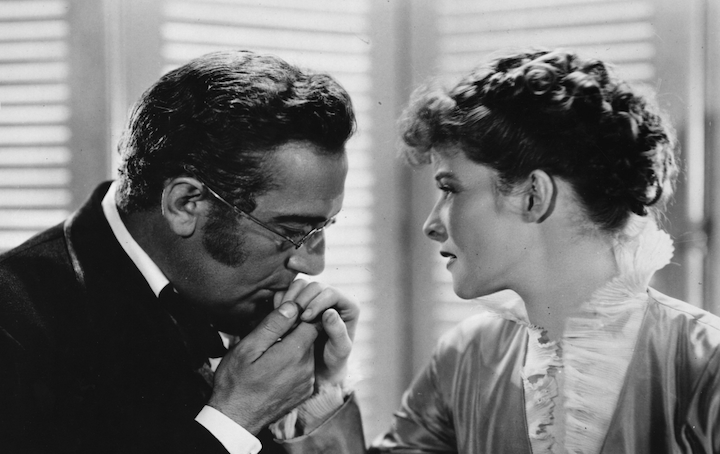
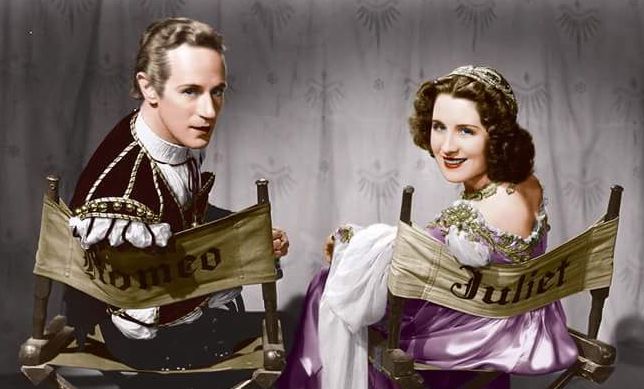
Above: Leslie Howard and Norma Shearer played the lead roles in George Cukor's 1936 adaptation of William Shakespeare's "Romeo and Juliet." In retrospect, these major stars were miscast; Shakespeare's original play identified Juliet as thirteen years old (soon to be fourteen), while scholars estimate Romeo to be around sixteen. Howard was forty-three and Shearer thirty-four when the film was released. (pinterest.com)

Although Leslie Howard and Norma Shearer were too old to play Romeo and Juliet as lovesick teenagers, in 1936 audiences and critics didn’t seem to notice or care. What did keep audiences away from the big budget Romeo and Juliet was the perception that it was too “arty.”

August 22, 1936 cover by Ilonka Karasz. 

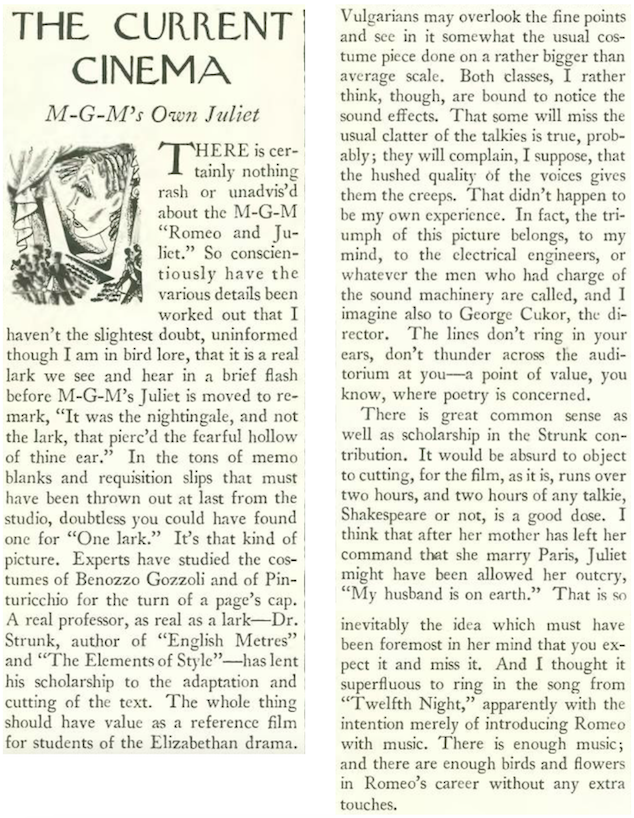
Indeed, New Yorker film critic John Mosher suggested that “vulgarians” would miss the finer points of this meticulously made film—director George Cukor even secured the services of William Strunk Jr. (of Elements of Style fame) to ensure linguistic accuracy.

This dedication to the finer points of the play obviously didn’t apply to the choice of the principal actors—a middle-aged Romeo, a thirty-something Juliet, or a 54-year-old playing Romeo’s best friend, Mercutio (John Barrymore). In the days of the studio system, it was assumed that big productions needed equally big, established actors attached to them, regardless of age. Also, Shearer was producer Irving Thalberg’s wife.
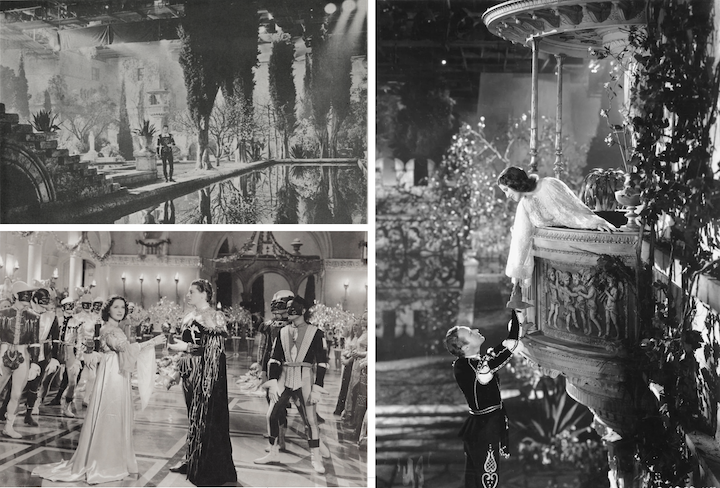
THE ART OF ARTIFICE…Clockwise from top left: Lavish sets and a star-studded cast made Romeo and Juliet MGM’s most expensive sound film up to that time; the famed balcony scene between Leslie Howard and Norma Shearer; Shearer in a scene with Ralph Forbes, who played a kinsman to the prince. (imdb.com/moviemusings.uk/britannica.com)

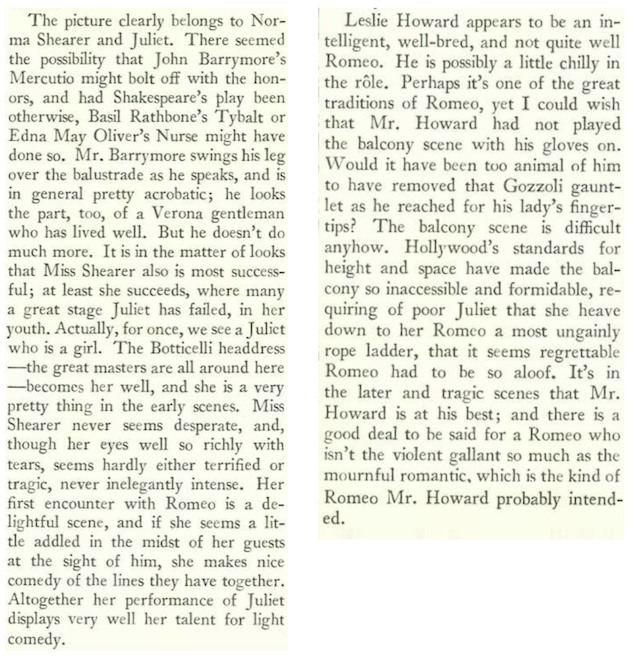
Mosher described the film as a “sensible” presentation and praised the 34-year-old Norma Shearer for her youthful appearance. “Actually, for once, we see a Juliet who is a girl,” he wrote. Writing for Literature/Film Quarterly, Allison Kellar notes that “with the help of costumes, props, and lighting, Shearer effectively appears as the young Juliet.”
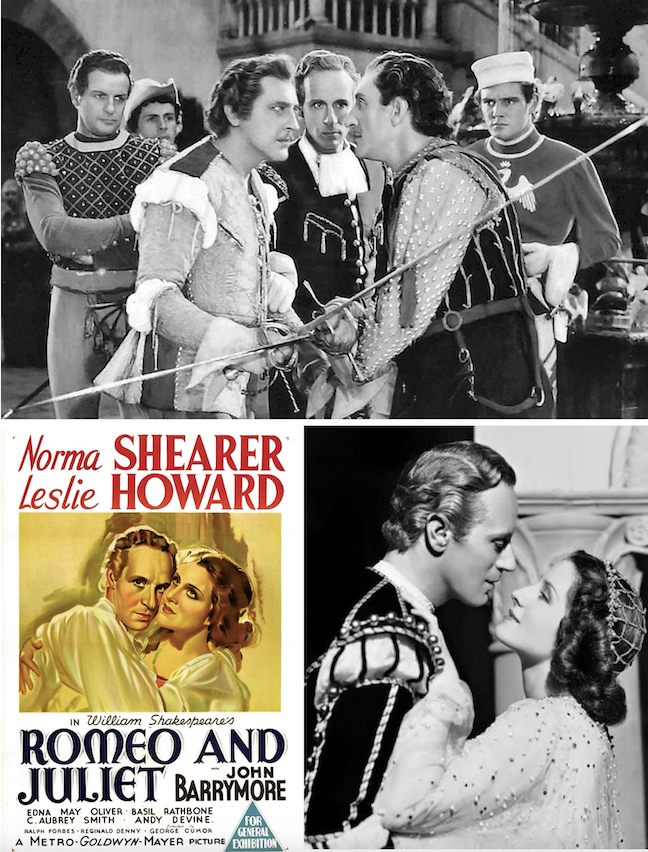
RAPIER-TONGUED…Top: Mercutio (John Barrymore, left) challenges Tybalt (Basil Rathbone) to a duel and is subsequently slain (this is when Mercutio speaks those famous words, “A plague o’ both houses!”); Leslie Howard and Norma Shearer; MGM promotional poster. (moviemusings.uk/tvtropes.org/imdb.com)

For years MGM’s “Boy Wonder,” producer Irving Thalberg, had pushed the studio to make the film, but MGM head Louis B. Mayer believed (correctly, it turned out) that the masses would consider Shakespeare too highbrow. Mayer was also concerned about a big budget picture in those lean Depression years, but somehow Thalberg won him over (the film lost almost a million dollars, roughly equivalent to $25 million today).
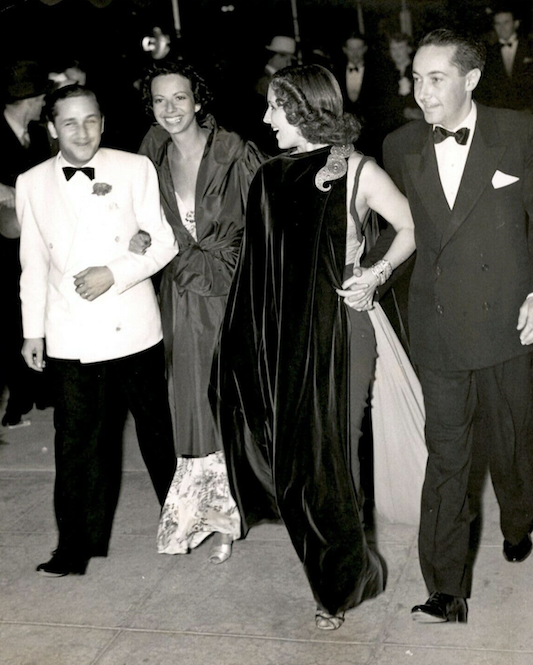
HOLLYWOOD NIGHTS…At left, Anthony Adverse director Mervyn LeRoy and his wife, Doris Warner, accompany Norma Shearer and her husband Irving Thalberg at the Los Angeles premiere of Anthony Adverse, July 29, 1936. A month and a half later Thalberg would die from a congenital heart condition at age 37. (see below). (Wikipedia)

Romeo and Juliet would have its world premiere on Aug. 20, 1936 at New York’s Astor Theatre. The West Coast premiere followed on Sept. 14—that same night legendary MGM producer, Irving Thalberg, husband of star Norma Shearer, would die suddenly at the age of 37. Needless to note, the Los Angeles opening was deeply somber.

Now, just for kicks, here are the ages of actors who have portrayed Shakespeare’s star-crossed lovers in more recent films:

FOLLIES OF YOUTH…Clockwise, from top left, with ages in parentheses: Claire Danes (17) and Leonardo DiCaprio (22) in Romeo + Juliet (1996) Hailee Steinfeld (17) and John Booth (21) in 2013’s Romeo & Juliet; Clara Rugaard (27) as Juliet and Jamie Ward (35) as Romeo in 2025’s Juliet & Romeo; Olivia Hussey (16) and Leonard Whiting (16) in Romeo & Juliet (1968). (imdb.com/heyuguys.com/wikipedia.org/reddit.com)

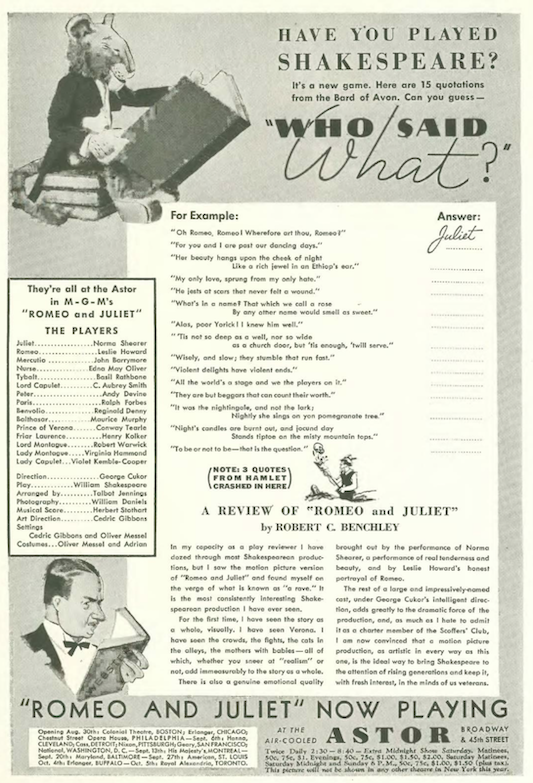
MGM spent a lot on the marketing of Romeo and Juliet, including this full-page ad in The New Yorker that included an endorsement from the magazine’s theater critic, Robert Benchley:
There were other, less-hyped films available for those allergic to Shakespearian drama. Mosher again:
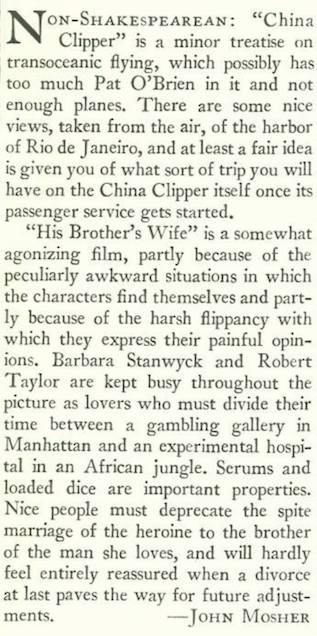
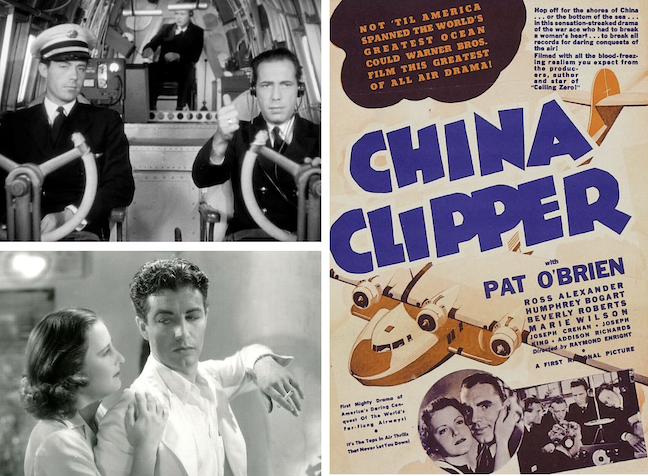
ALL SYSTEMS GO…Clockwise, from top left: Dennis Moore (left) and Humphrey Bogart prepare for a bumpy ride in China Clipper; Barbara Stanwyck and Robert Taylor in His Brother’s Wife. (dailymotion.com/blu-ray.com/imdb.com)

 * * *

Getting Out of Town

Food critic Sheila Hibben headed to Long Island to do a little restaurant-hopping, checking out Dahlstrom’s Greentree Lodge on the Jericho Turnpike. Dahlstrom’s was a popular Swedish restaurant that served food smörgåsbord-style. This concept for displaying a variety of self-serve dishes would not become widespread until the smörgåsbord was introduced to the general public in the Swedish Pavilion at the 1939 New York World’s Fair.
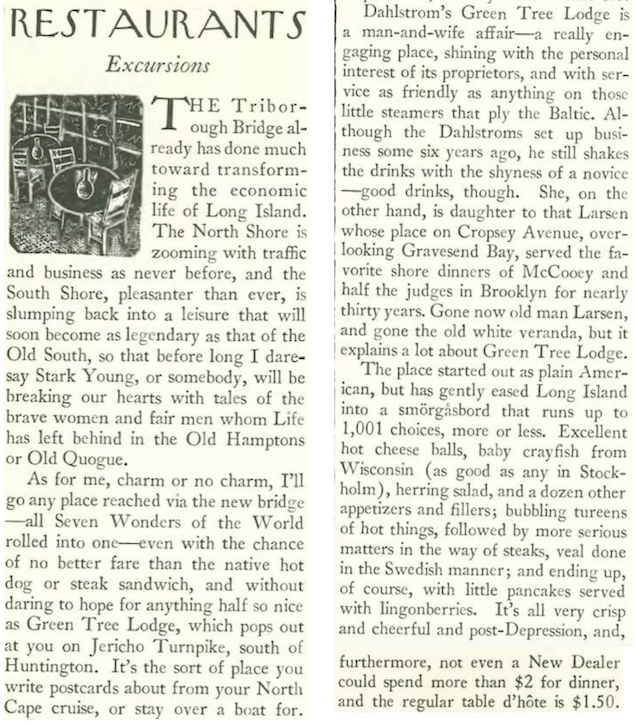
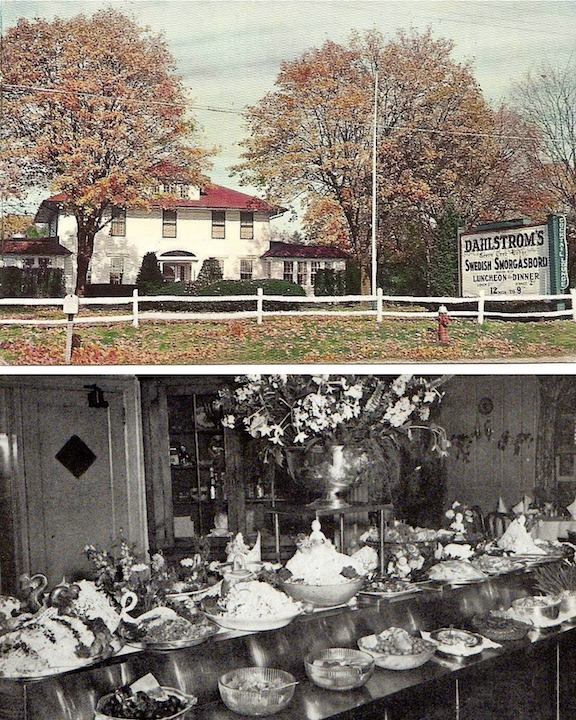
A RARE TREAT…Dahlstrom’s Greentree Lodge on Jericho Turnpike in Huntington, LI, was a popular Swedish restaurant that served food smörgåsbord-style from the 1930s through the 1960s. (Frank Leist via Facebook.com)

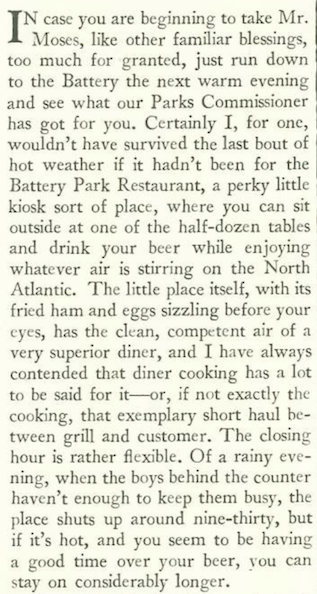
Closer to home, Hibben visited the Battery Park Restaurant, a “perky little kiosk sort of place where you can sit outside…and drink your beer while enjoying whatever air is stirring on the North Atlantic.”
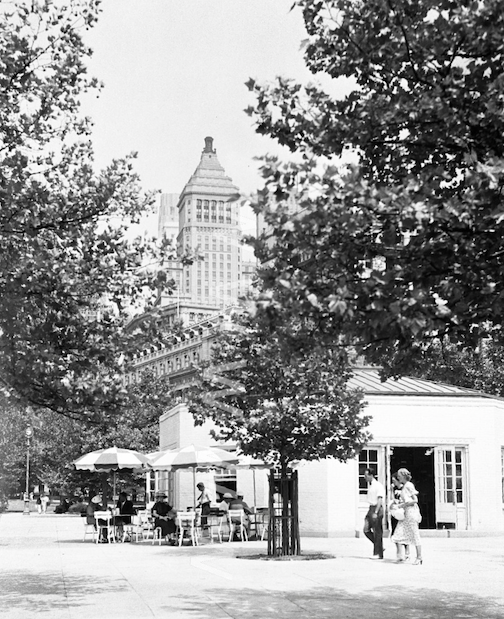
MADE IN THE SHADE…The Battery Park Restaurant, circa 1936. (eBay.com)

* * *

Cheers Before Tears

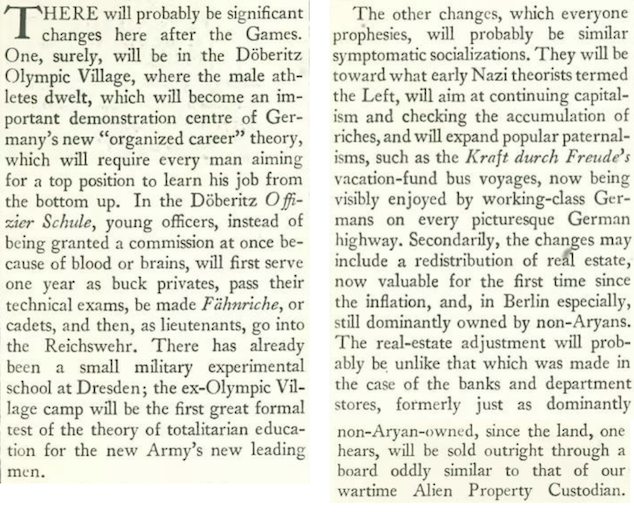
In her continuing report on the Berlin Olympics, Janet Flanner noted that some German fans—despite their country’s “megalomaniacal nationalism”—were polite about the “monotony of the American victories,” and even offered cheers for the French bicycling team (whose country would be invaded by theirs in less than four years).
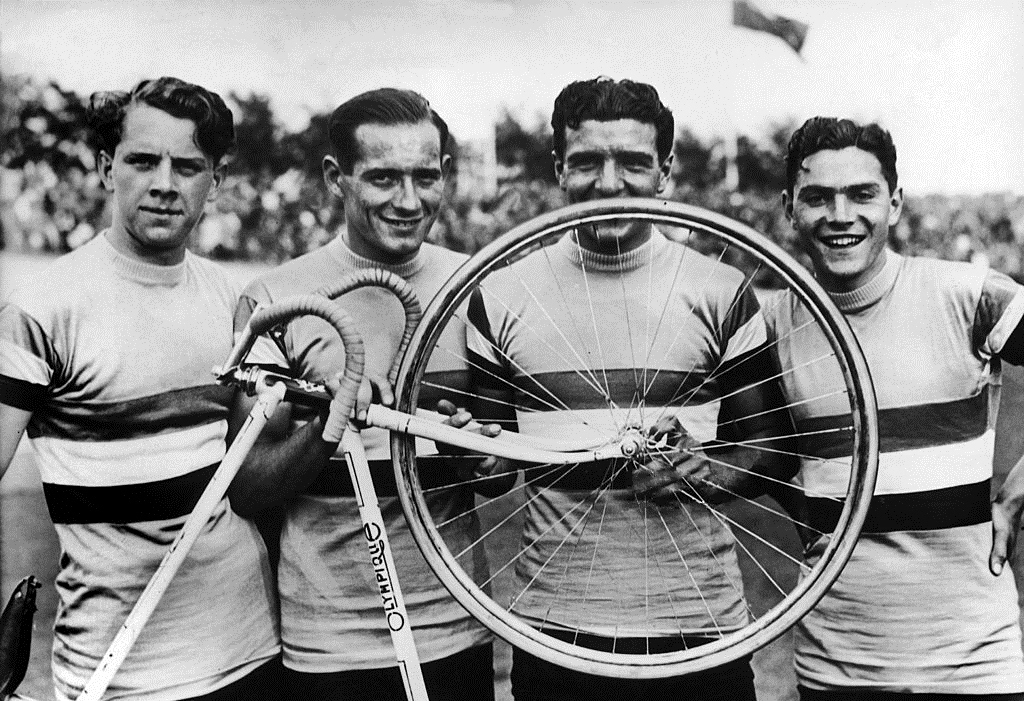
CYCLING GREATS…The French cycling team (left to right) Robert Charpentier, Guy Lapebie, Jean Goujon and Roger Le Nizerhy celebrate after winning the team race at the 1936 Berlin Summer Olympics. The Frenchmen delivered a historic performance, capturing seven total medals (three Gold, two Silver, and two Bronze). Charpentier was the star of the team, becoming a triple Olympic champion across road and track disciplines. (Wikipedia)

Flanner also noted some not-so-happy events that would occur following the games, including initial steps by the Nazis that would lead to the systematic seizure and forced transfer of Jewish real estate and property to the Third Reich’s leaders, citizens, and collaborators. It seems unlikely that Flanner was unaware of at least some of this plan, although she never explicitly mentions that this “real-estate adjustment” was directed solely at Jewish property owners.
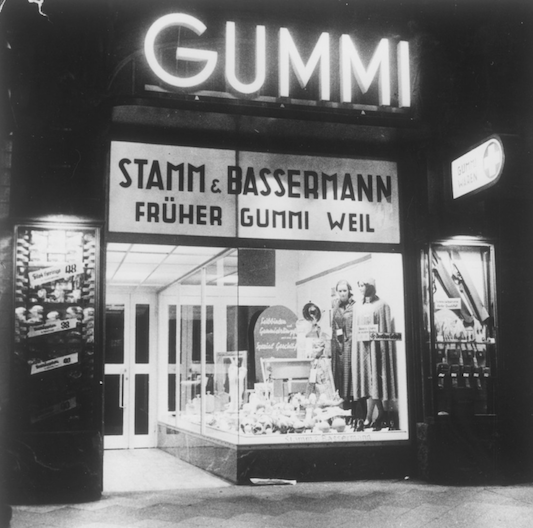
THE UGLY TERM “Aryanization” referred to the forced transfer of Jewish-owned homes and businesses to the Third Reich’s leaders, citizens, and collaborators. Above, the formerly Jewish-owned store Gummi Weil was expropriated and transferred to non-Jewish ownership (Stamm and Bassermann). Frankfurt, Germany, 1938. (Bildarchiv Preussischer Kulturbesitz)

 * * *

From Our Advertisers

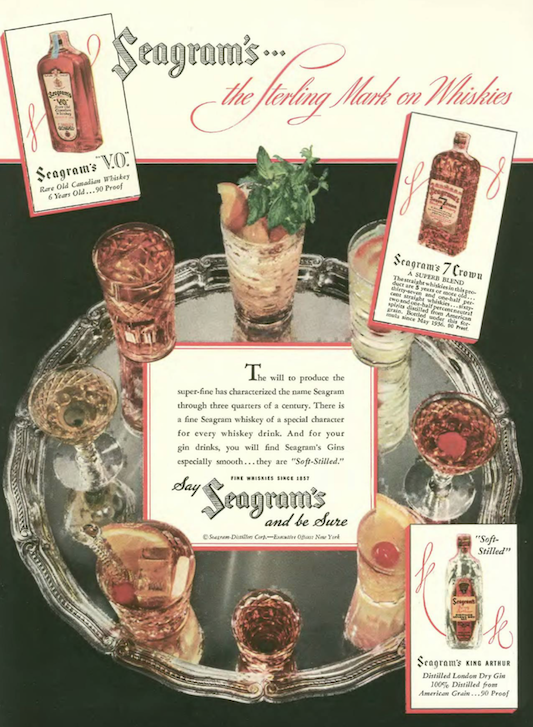
We begin with Seagram’s, promoting their signature whiskies and “soft-stilled” gin…
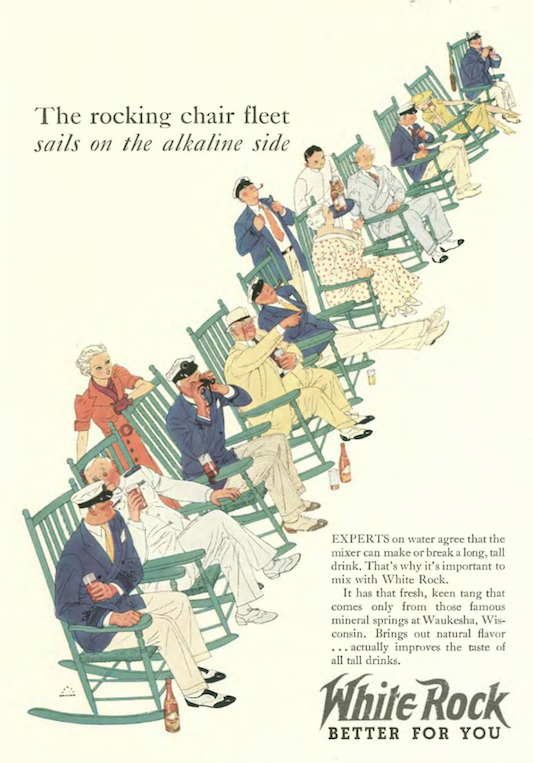
…White Rock continued to feature their clever and colorful John Holmgren-illustrated ads…
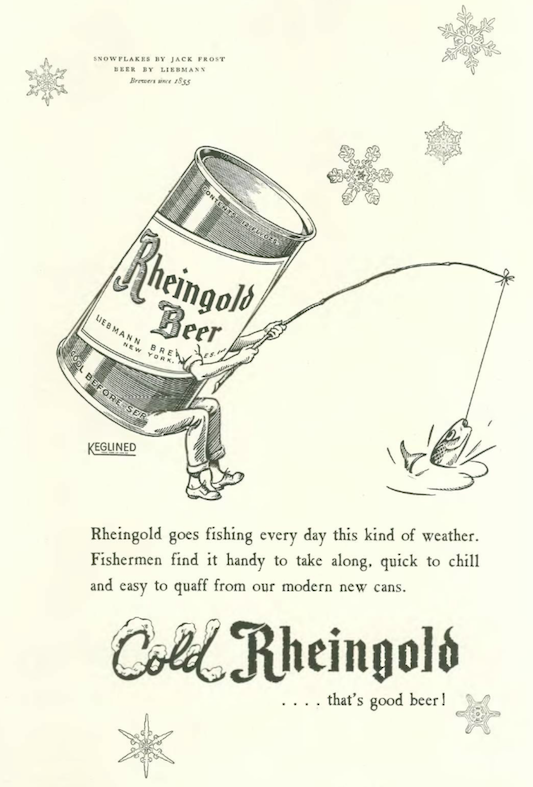
…Rheingold offered up their “Keglined” canned beer as a summer refresher…
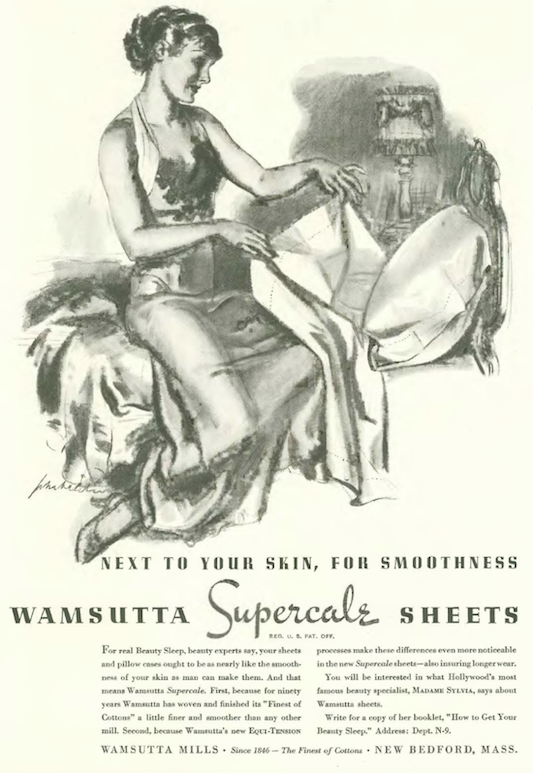
…Wamsutta Mills of New Bedford, Massachusetts became the world’s largest cotton-weaving plant by the end of the 19th century…their iconic “Supercale” sheets (introduced in 1935) typically featured a 200-thread-count…
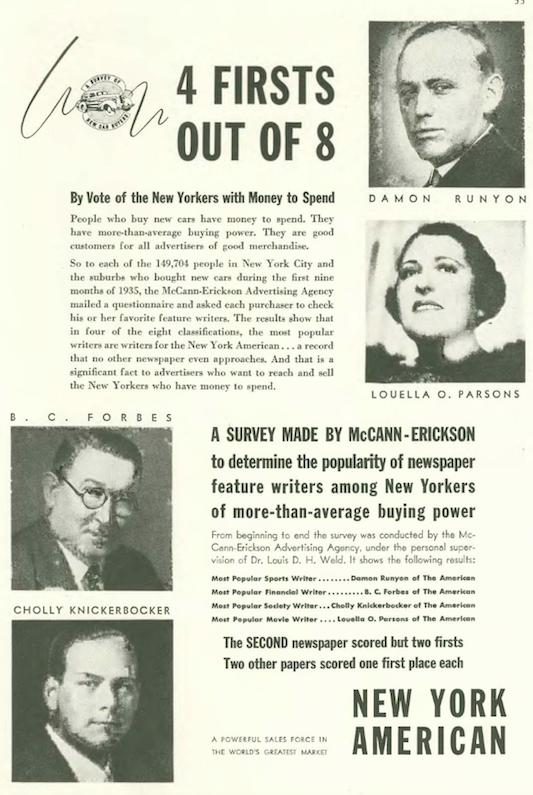
…William Randolph Hearst’s New York American (soon to merge with Hearst’s New York Evening Journal) boasted a lineup of writers including short story writer and journalist Damon Runyon, movie gossip columnist Louella Parsons, Forbes magazine founder B.C. Forbes, and “Cholly Knickerbocker“—a pseudonym used by society writers, in this case by Maury Henry Biddle Paul…
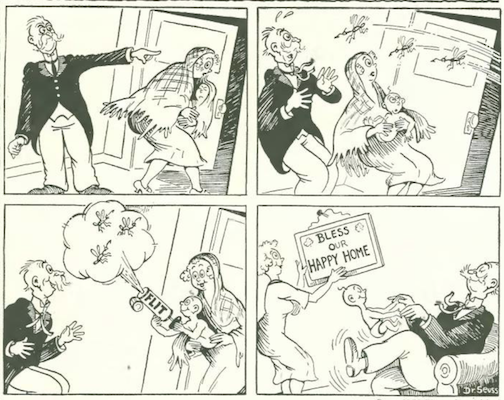
…another Flit ad by Dr. Seuss, this time an illegitimate child saves the roof over his head by whipping out some insecticide…
…Stage magazine featured caricatures by Sam Berman to promote its “Great Expectations” issue…
…Susan Willard Flint opens up our illustrators and cartoonists section…
…joined by James Thurber…
…and spots by Garrett Price…
…Richard Taylor…
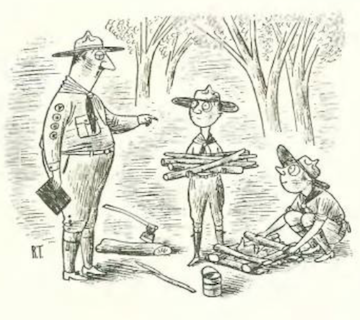
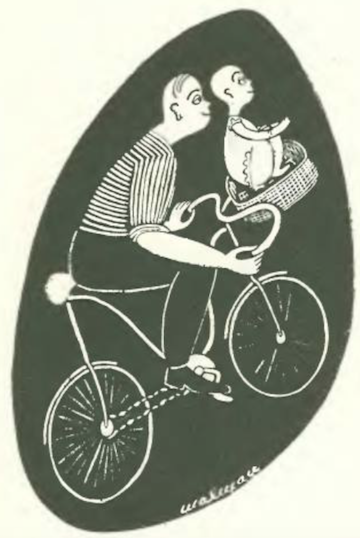
…and Christina Malman…
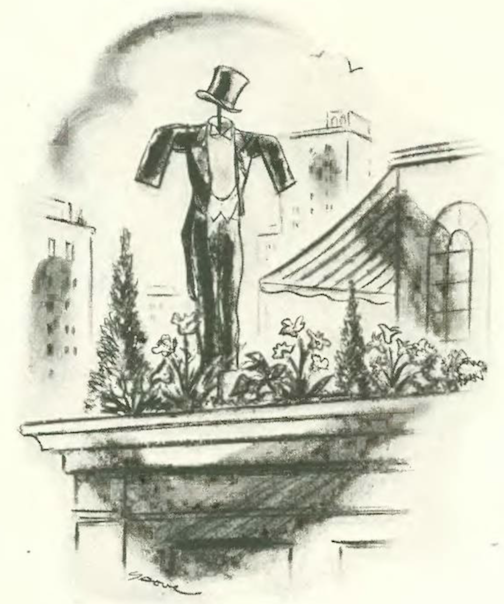
…Leonard Dove drew up a stylish scarecrow…
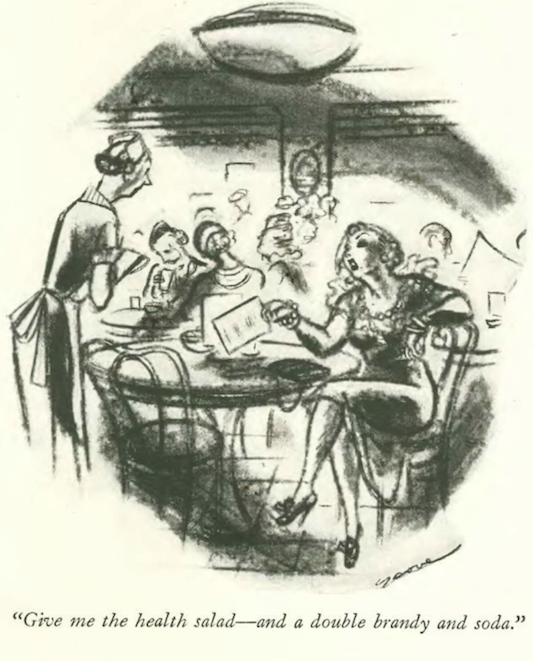
…and a woman who knows what she likes…
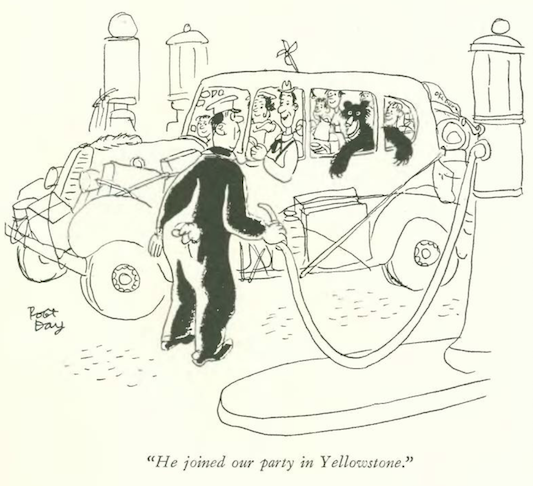
…Robert Day found more than scenery on a trip to Yellowstone…
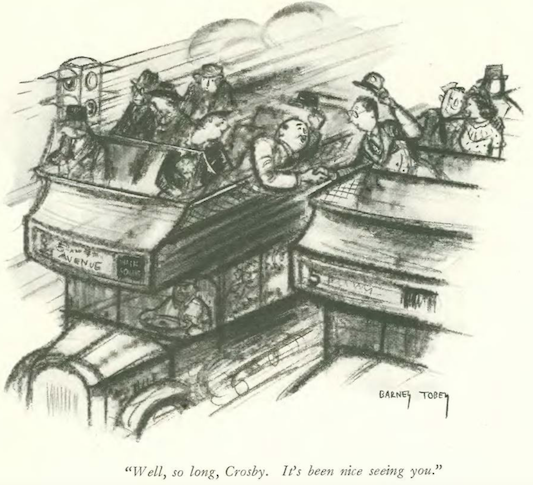
…Barney Tobey exchanged some quick greetings on the omnibus line…
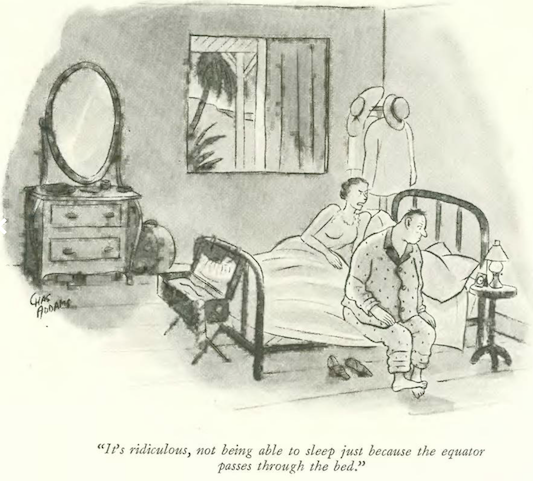
…Charles Addams gave us a case of equatorial insomnia…
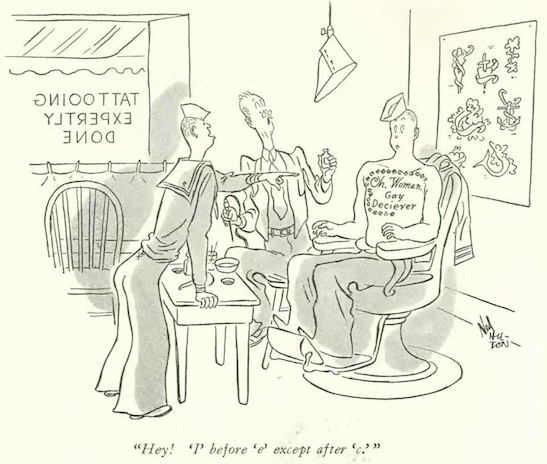
…Ned Hilton’s inker had some editing to do…
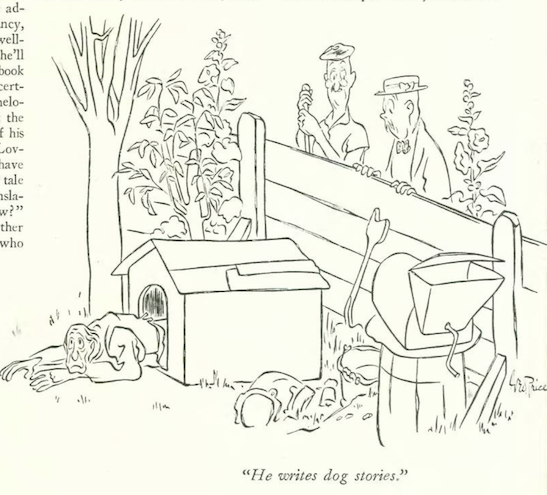
…George Price gave new meaning to being “in the doghouse”…
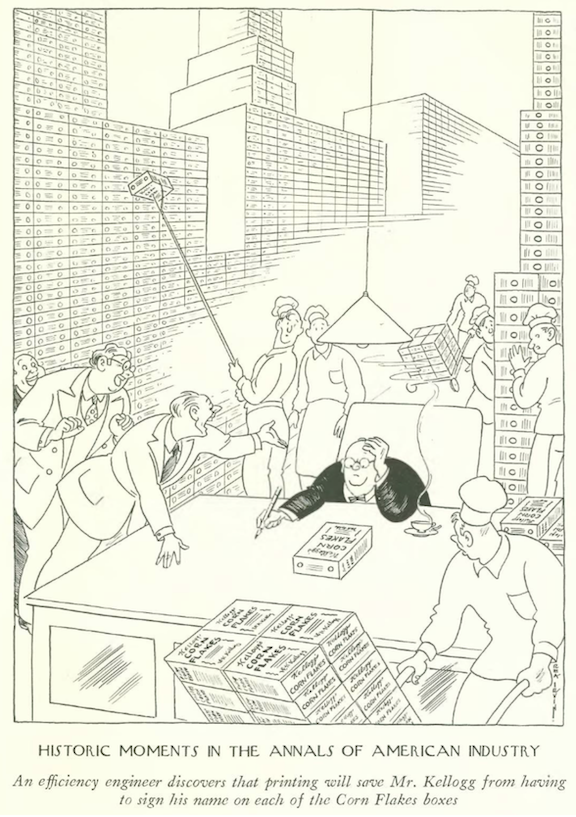
…Rea Irvin revealed another advance in American ingenuity…
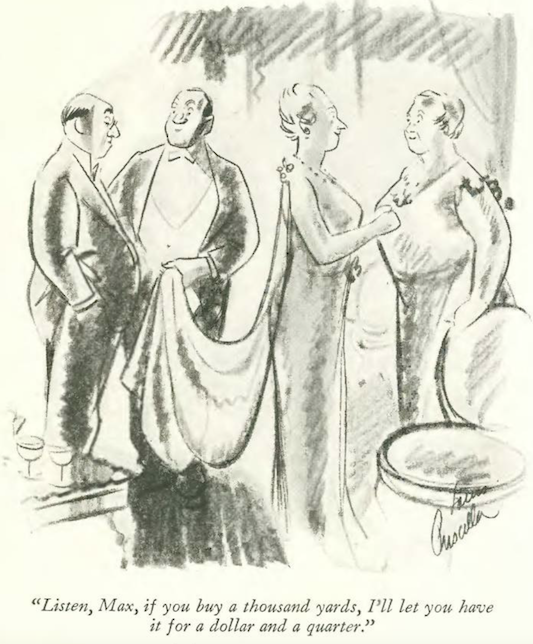
…Louis Priscilla published the third of a total of three cartoons he contributed to The New Yorker from 1933 to 1936…Priscilla was also a magazine illustrator and a teacher at the Art Students League of New York…
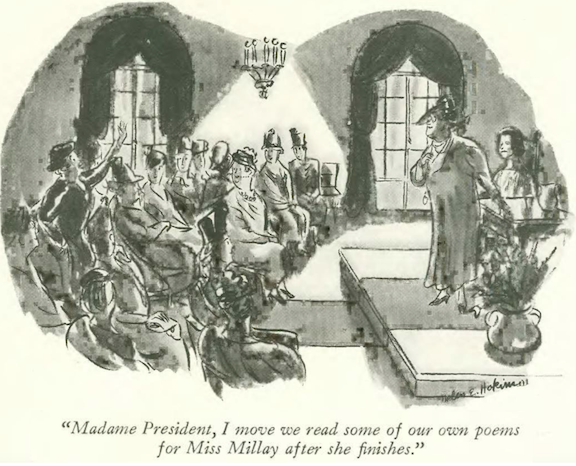
…Helen Hokinson’s club ladies hoped to wow Edna St. Vincent Millay with some of their own poetry…
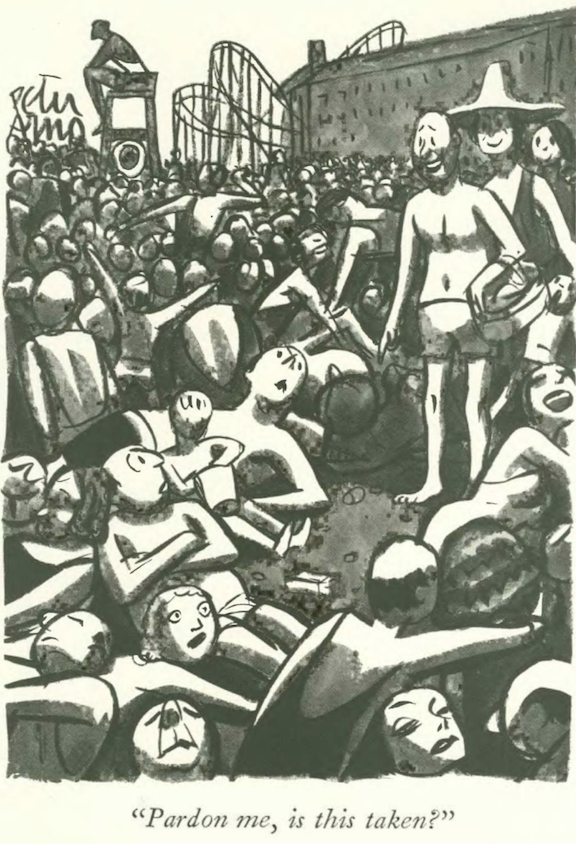
…and to close…if you’ve seen photos of Coney Island beaches in the 1930s, you know Peter Arno isn’t exaggerating much here…
Next Time: Epic Adversity…
 

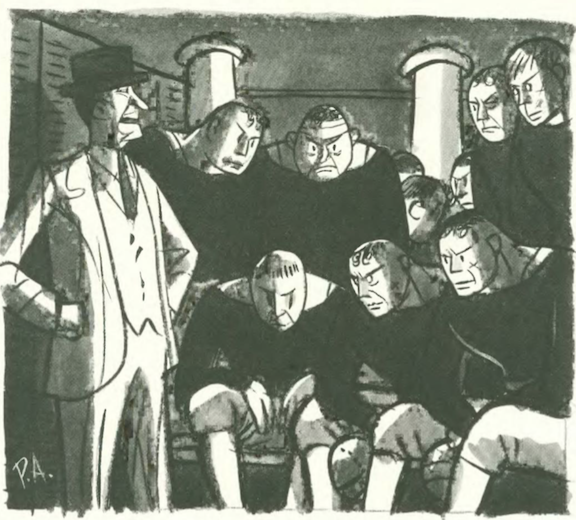
Coach Arno

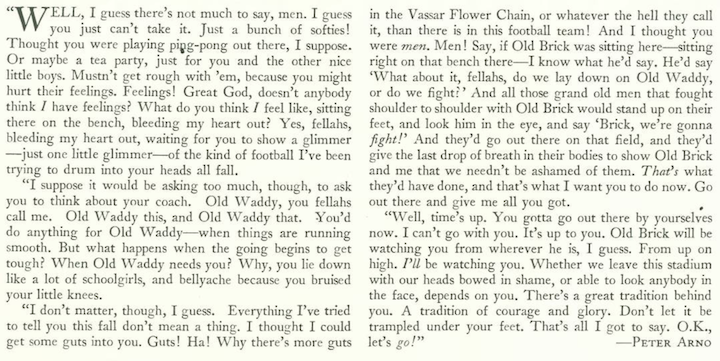
Peter Arno departed from his usual one-liners in the Nov. 18, 1933 issue with a football-themed cartoon that featured a four-paragraph caption…

Nov. 18, 1933 cover by Abner Dean.

…that consisted of a pep talk from a football coach—”Old Waddy”…

…Arno had visited the football theme before, notably in this early cover from 1928…

Arno cover from Oct. 7, 1928.

…and he referenced it again in the years ahead…

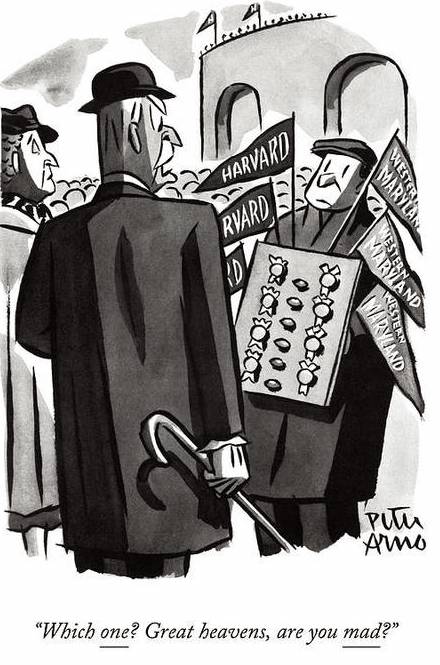
HAIL VARSITY…Peter Arno delivered another, much shorter pep talk in a cartoon (left) from the Nov. 20, 1937 issue; at right, Arno’s last football-themed gag, published in The New Yorker of November 25, 1967, just three months before the cartoonist’s death. Check out one of my favorite New Yorker sites, Attempted Bloggery, for more on the 1937 cartoon.

…and one more from Arno, a classic from September 27, 1947…

 * * *

Pre-emptive Nostalgia

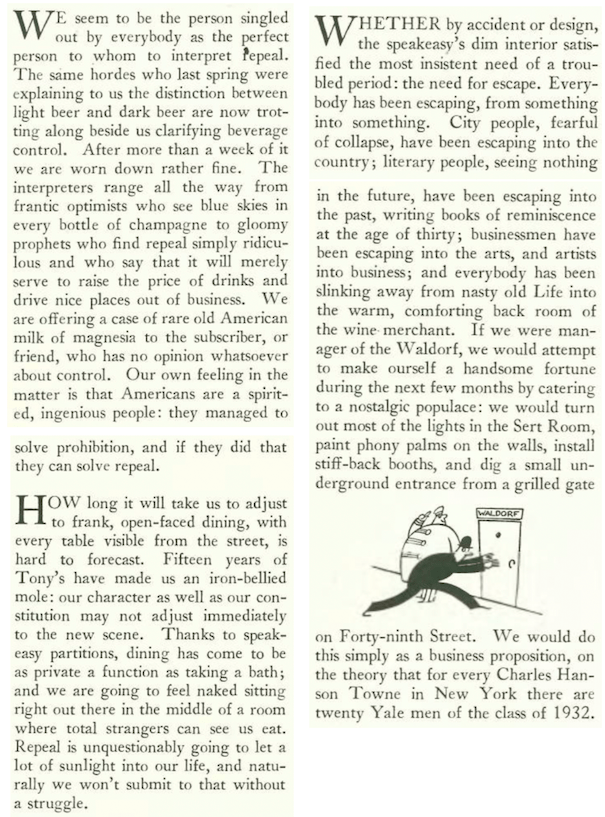
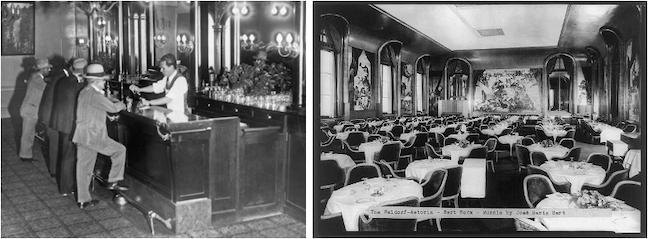
Although E.B. White welcomed the end of Prohibition with open arms, he also wondered what could be lost when drinkers emerged from the shadows of the speakeasy world…

THAT HOMEY FEELING…E.B. White suggested transforming the Waldorf-Astoria’s Sert Room (right) into a dingy dive to help ease drinkers back into the world of legal alcohol. (Britannica/Library of Congress)

White also referenced his many years at Tony’s, a speakeasy and Italian restaurant popular with writers and others in the New Yorker’s orbit. Tony Soma operated the speakeasy until 1929, when John D. Rockefeller bought Soma’s building along with other properties to make way for Rockefeller Center. Soma would later open another popular (and legit) restaurant and also become known as a yoga practitioner and the grandfather of actress Angelica Huston. You can read more about Soma at The Speakeasy King.

 * * *

The French Underground

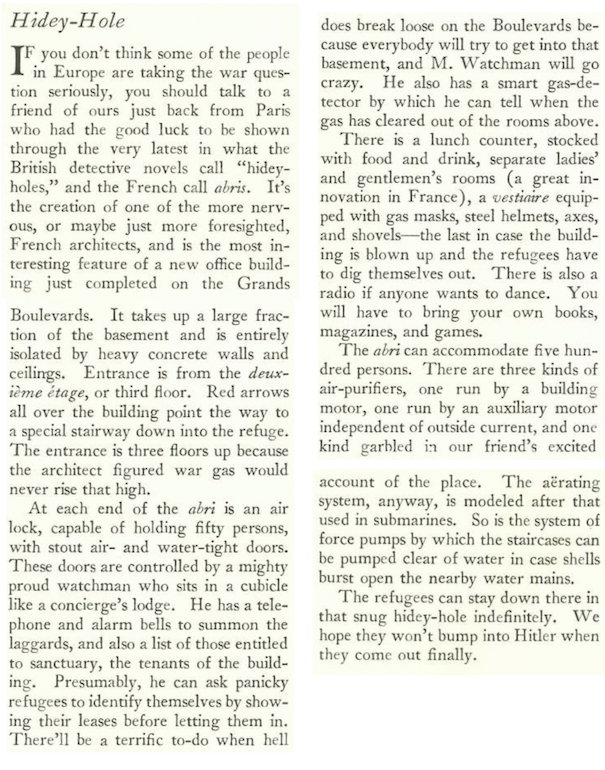
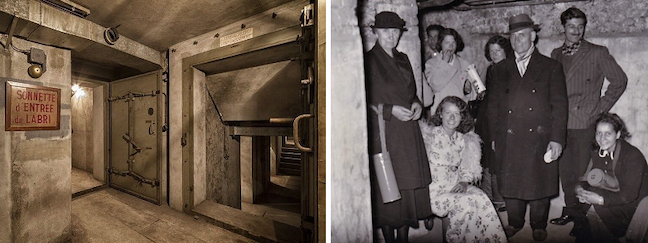
Although war seemed like a distant rumor to most Americans, the French were busy preparing for that likelihood, according to this “Talk of the Town” piece attributed to Europe-based documentary filmmaker Richard de Rochemont and New Yorker stalwart James Thurber.

LOOK OUT BELOW…At left, a preserved WWII abris can be found below platforms 2 and 3 at Paris’ Gare de l’Est; right, Parisians take shelter in an abris in 1939. (Trip Adviser/Ebay)

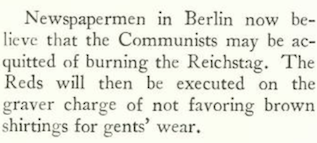
…in his column, “Of All Things,” Howard Brubaker mused on the latest rumblings from Berlin…

DEMOCRACY IN ASHES…An arson attack on the Reichstag (home of the German parliament) on February 27, 1933 was used by Adolf Hitler as pretext to suspend civil liberties and conduct a ruthless pursuit of “communists,” both real and imagined. (Wikipedia)

 * * *

Little Women, Big Film

On the brighter side, we turn to Hollywood and John Mosher’s review of George Cukor’s critically acclaimed Little Women, which featured a cast led by Katharine Hepburn and Joan Bennett.

MEINE LIEBCHEN…Impoverished German linguist Professor Bhaer (Paul Lukas) proposes to Jo (Katharine Hepburn) in 1933’s Little Women. (IMDB)
SEW WITH JO…From left, the March family as portrayed by Jean Parker (as Beth), Joan Bennett (Amy), Spring Byington (Marmee March), Frances Dee (Meg), and Katharine Hepburn (Jo) in the George Cukor-directed Little Women. (IMDB)

…Mosher also found something to like in the MGM romance The Prizefighter and the Lady, which starred Myrna Loy along with professional boxers Max Baer, Primo Carnera, and Jack Dempsey.

THE NEW “IT” MAN was how MGM publicists promoted professional boxer Max Baer in his film debut. Top right, Baer in a scene with Myrna Loy; bottom right, professional boxer Primo Carnera with Loy and Baer—Carnera was the world heavyweight boxing champion at the time of the film’s release, however Baer would defeat the Italian giant in their real-life 1934 fight; bottom center, Baer’s son, Max Baer Jr., would also find Hollywood fame in the 1960s playing Jethro Bodine on TV’s The Beverly Hillbillies. (IMDB/Wikipedia)

 * * *

Sausage Factory

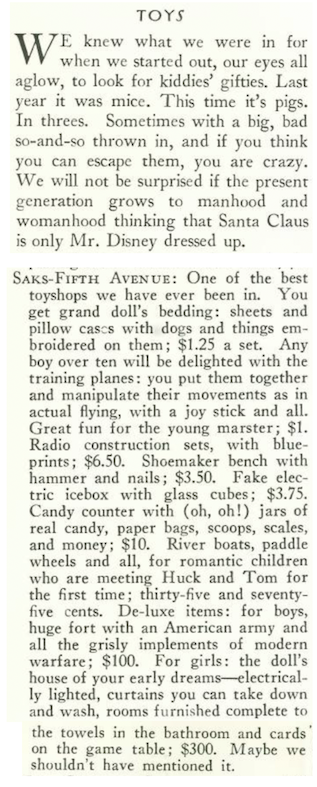
We’ve previously looked at the smashing success of Walt Disney’s Three Little Pigs cartoon and its theme song, which took the country by storm in the fall of 1933. So it was no surprise that the piggies could be found in toy departments across the metropolis as the Christmas season approached. These are brief snippets from a lengthy holiday shopping column that was appended annually to Lois Long’s “On and Off The Avenue” every November and December.

HOG HAVEN…You could help the Three Little Pigs find their way to safety in this 1933 Disney board game. As in the film, the final leg of the board game’s journey has the wolf landing in a cauldron of boiling water. As if that wasn’t bad enough, the Disney film also featured one of the pigs adding turpentine to the cauldron. (Ebay)

This being America in the 1930s, and early Disney, the Three Little Pigs cartoon contained an offensive scene in which the Big Bad Wolf disguises himself as a Jewish peddler, complete with a fake nose, glasses, and beard (accompanied by a fiddle, the wolf also adopts a Yiddish accent).* The character was included in the above board game:

* The film was finally edited in 1948 with a redesign of the Wolf’s disguise—as a Fuller Brush salesman.

 * * *

From Our Advertisers

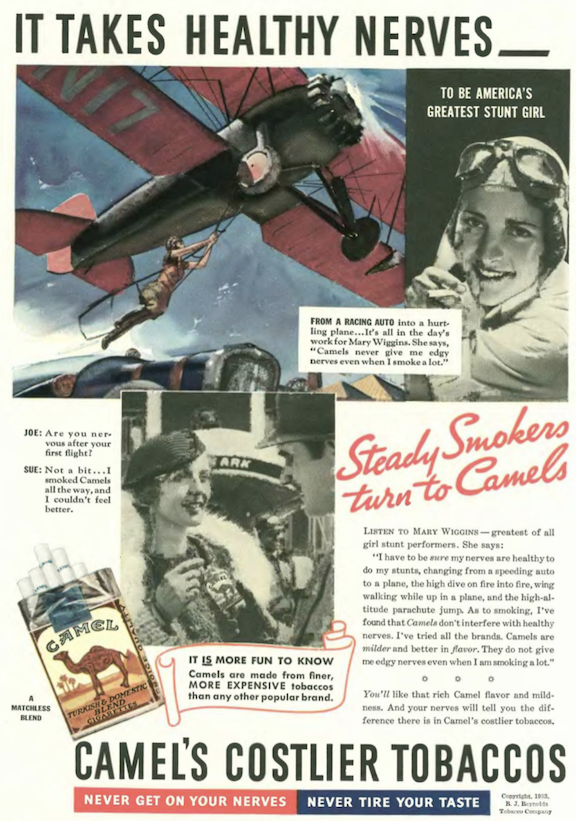
We kick off our ads with more “healthy nerves” testimonials from Camel smokers, including stuntwoman/pilot Mary Wiggins…

…Caron Paris also went aloft with one of their famed “En Avion” adverts…

…back on the ground, this hapless couple found themselves taking a slow car to a soaking…although wearing a fur coat while riding in a rumble seat probably wasn’t a good idea, regardless of the weather…

…for those rainy days, you could get yourself a Salisbury overcoat from Brooks Brothers…this sports-themed illustration was a new twist for the usually staid BB…

…and there’s always one or two really weird ads, like this one from The Sun newspaper that touted baloney sales at Gimbels as proof of advertising prowess…

…collectors of Art Deco are well-acquainted with the work of Hans Flato, who did a series of ads (and related merchandise) for New York-based Ruppert’s Beer in the early 1930s…Flato (1887-1950) worked in a variety of styles, but the characters he created for Ruppert’s stand out…for reasons known only to the Flato, the feet of the Ruppert’s characters were always attached to yellow disks, like toy dolls…

…James Thurber was keeping busy illustrating ads aimed at folks wanting to escape the cold…

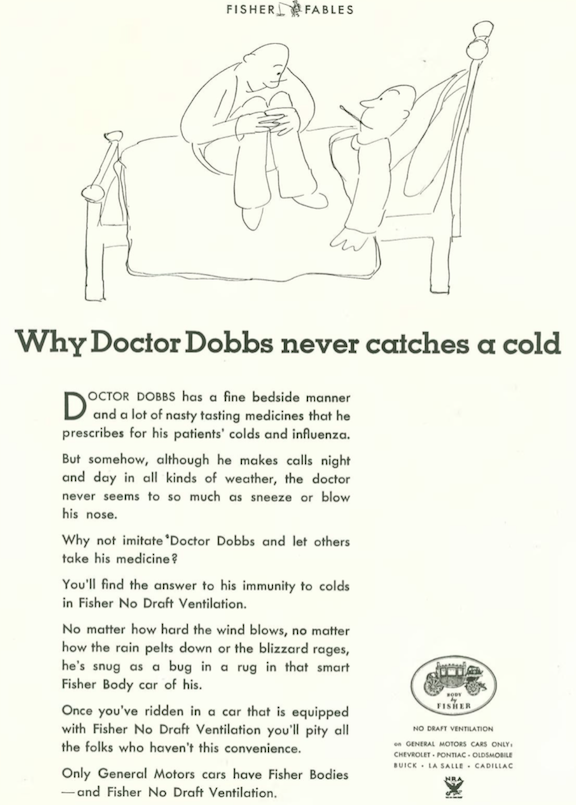
…as well as those who caught a cold in a drafty automobile…

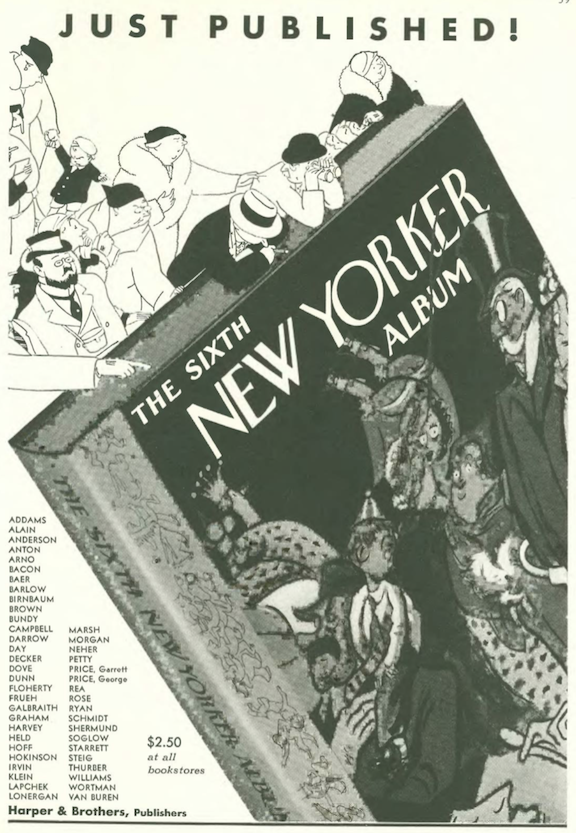
…The New Yorker announced the publication of its sixth album, with an illustration by Gluyas Williams…

…while Otto Soglow, in a much smaller back-page ad, proclaimed the publication of his first The Little King collection…Soglow had just ten months left on his contract with The New Yorker—his Little King would relocate to  William Randolph Hearst’s King Features Syndicate in September 1934…

…speaking of Soglow, we kick off the cartoons with his potentate’s latest adventure…

…William Steig gave us a sneeze and a chorus…

…and we close with Eli Garson, and a tale from the Almost Wanted…

Next Time: The Invisible Man…