Bottoms Up!

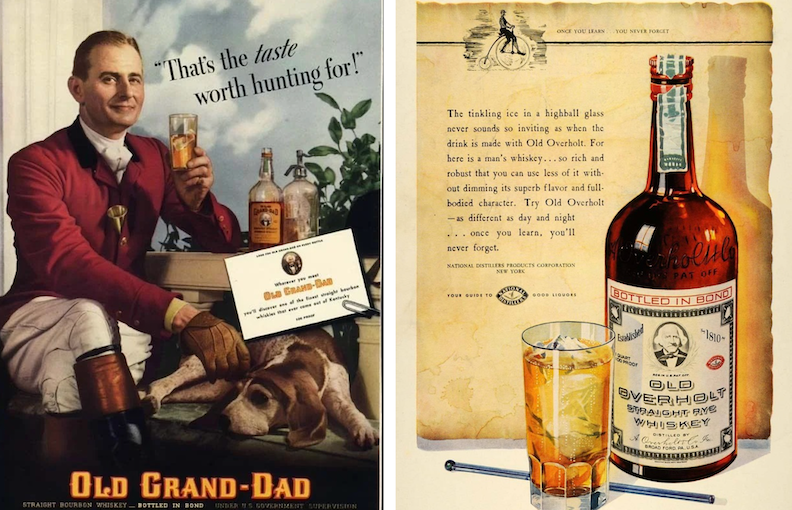
Above: E.B. White had a bone to pick with whiskey distillers who tried to establish "quick antiquity" by naming their products "Old Something-or-Other." That was not true for these two brands—Old Grand-Dad was introduced in Kentucky in 1840, while Old Overholt debuted in Pennsylvania in 1810, making it America's oldest continually maintained whiskey brand. Both are now subsidiaries of Japan's Suntory Global Spirits. (alcohol professor.com/pinterest)

With the official end of Prohibition on December 5, 1933, brewers and distillers raced to ramp up production and revive brands that had lain dormant for more than a decade. Distillers of aged spirits like rye and whiskey were especially keen to invoke history and tradition when marketing their tipple.
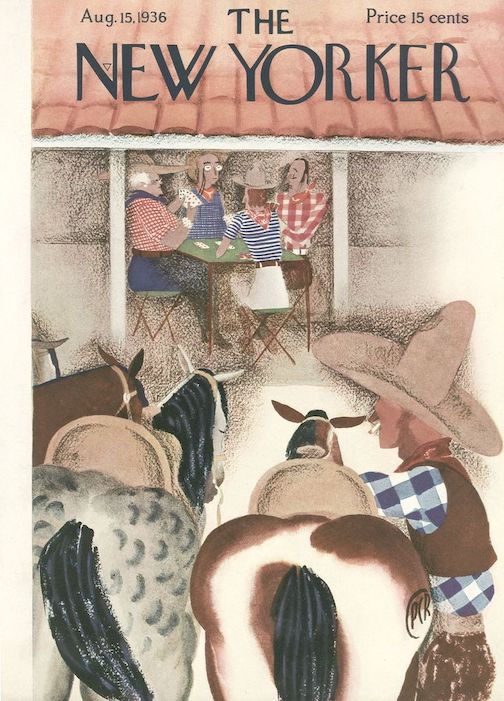
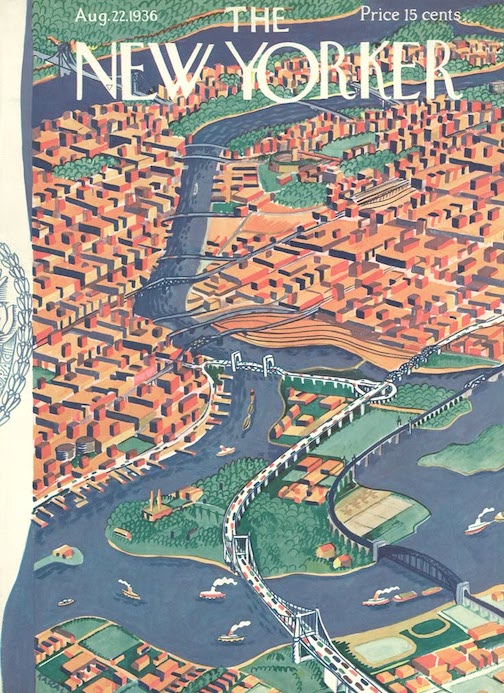
August 15, 1936 cover by Paul C. Robertson. 

In some cases newer distilleries made generous use of the word “Old” in their branding, according to E.B. White in his “Notes and Comment.” White also called out the folks at Seagram’s, who compared the character of Thomas Jefferson to that of their “V.O.” whisky (no “e” in spirits tied to British distilling traditions—Scotland, Canada, Japan, Wales, India). Most egregious, however, was the ad’s claim that Jefferson helped to draft the Constitution. White explained:
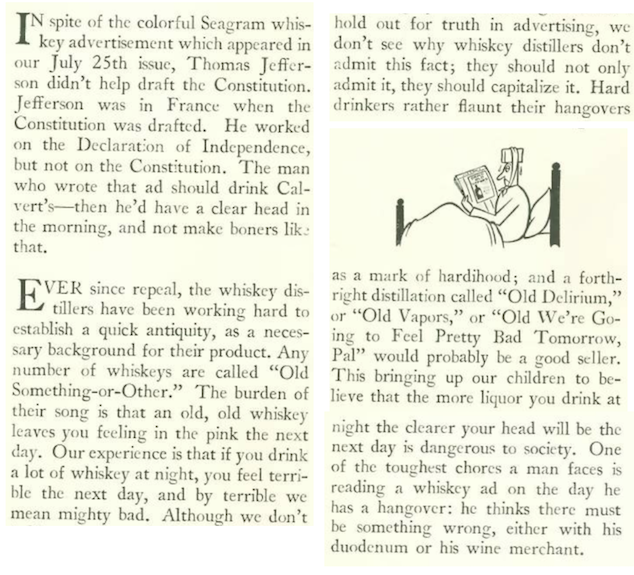
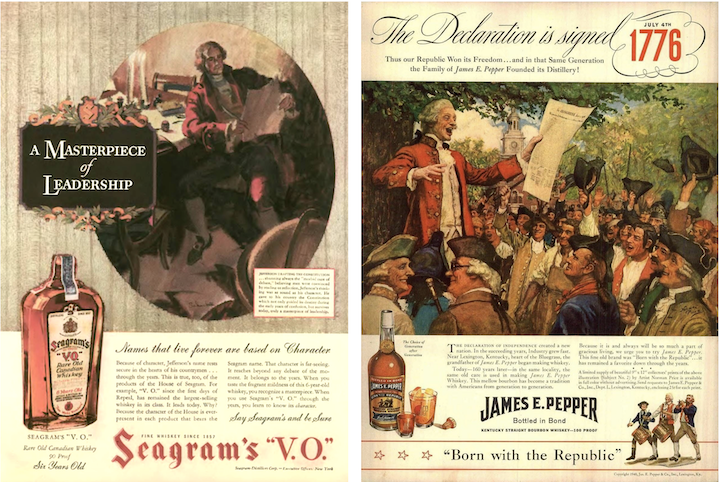
HE DID WHAT?…E.B. White called out the Seagram’s ad (left, from the July 25 issue of The New Yorker) for its historic inaccuracy (the distiller erroneously credited Thomas Jefferson for the Constitution; at right, the character and leadership of the Founding Fathers (and other early American leaders) were oft-employed metaphors for a number of whiskey brands, including James E. Pepper. (facebook.com)
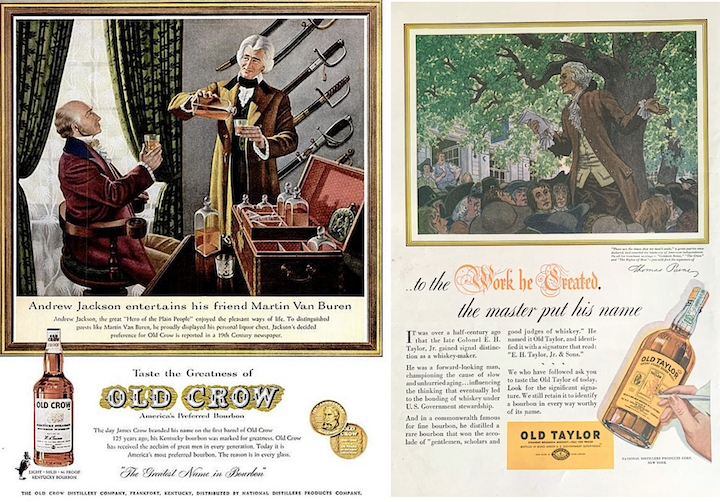
GOLDEN OLDIES…Here are more examples of historic figures being associated with fine spirits…at left, in 1960 the makers of Old Crow (founded 1835) depicted the genocidal Andrew Jackson pouring a glass of the stuff for Martin Van Buren; at right, in 1937 the makers of Old Taylor (1887) used quotes and themes from Thomas Paine’s revolutionary writings to promote their Kentucky Straight Bourbon. (bourbonbanter.com/etsy.com)

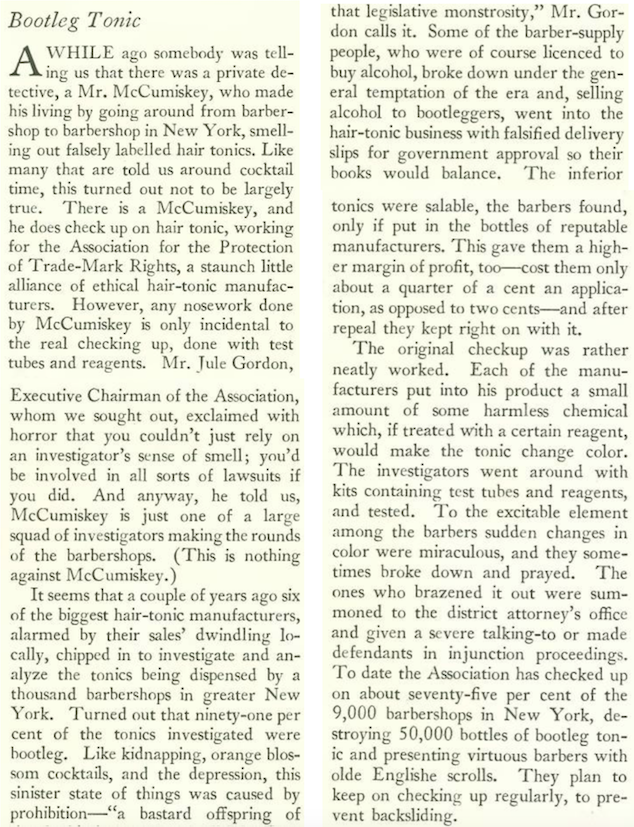
While we are on the subject of ardent spirits, let’s take a look at these excerpts from “The Talk of the Town” (attributed to Eugene Kinkead and Russell Maloney), which told the story of a private detective who had a nose for liquor— disguised as hair tonic.
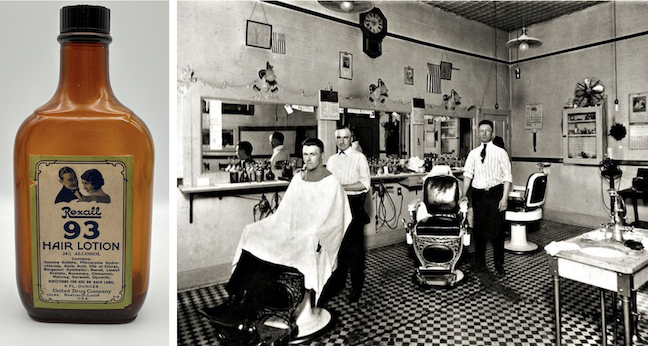
A SIP WITH YOUR SHAVE…During Prohibition (1920–1933), high-alcohol hair tonics like Rexall 93 (containing up to 24% alcohol) were legally sold as cosmetics but were frequently bought and consumed by people seeking a cheap, accessible substitute for bootleg liquor. The photo at right is of a 1930s barbershop—it is not implied that these fine gentlemen were involved in such illicit activities. (ebay.com/pinterest.com)

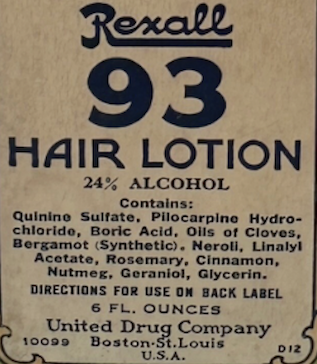
A closer look at the Rexall label—the makers made sure “24% Alcohol” was clearly visible. Folks known as “strainers” would run hair tonics like these through bread, cloth, or charcoal to filter out poisonous additives, obviously a dangerous practice.
 * * *

Doggy Downer

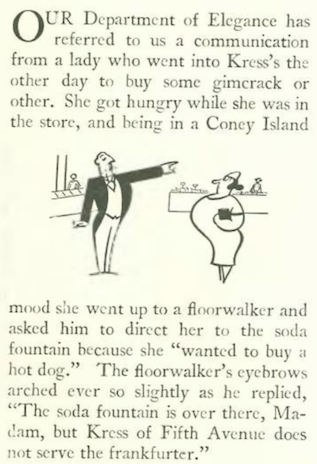
The legendary Kress “five-and-dime” stores, with more than 250 locations across twenty-nine states, served the needs of regular folks, but the designs of its stores were anything but pedestrian. This was especially true of its Fifth Avenue location, a 1935 Art Deco masterpiece. Given its lofty address, it was no place for one to order a lowly hot dog. E.B. White explained:
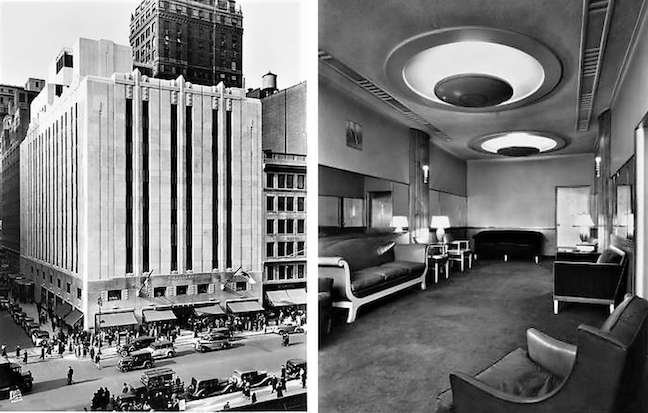
DECO EDIFICE…Samuel Henry Kress believed his department stores should function as works of public art that elevate the shopping experience for ordinary people. The company maintained an in-house architectural division, under the leadership of architect Edward F. Sibbert, that designed iconic, custom buildings, including the 1935 flagship S. H. Kress & Co. store on Fifth Avenue and 39th Street, an Art Deco masterpiece rendered in granite, bronze, and stainless steel; at right, a view of the store’s Ladies Lounge. Sadly, the building was razed in 1983. (Museum of the City of New York/New York Public Library)

 * * *

Merely Mortal

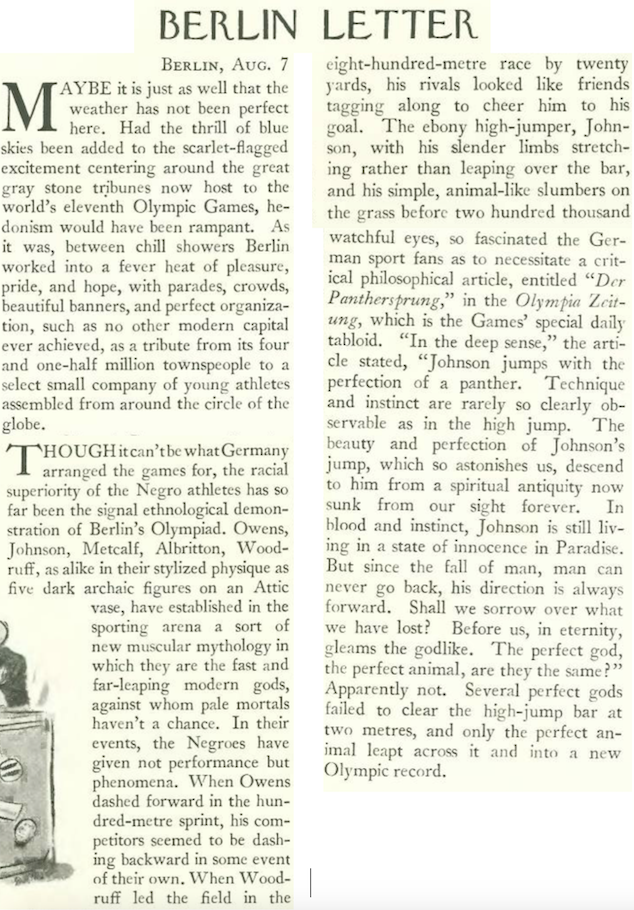
Janet Flanner filed her second report from the Berlin Olympics, where America’s Black athletes dominated the track and field events (ESPN’s Larry Schwartz credits Jesse Owens for “single-handedly crushing Hitler’s myth of Aryan supremacy”). Flanner noted attempts by propagandists to make sense of the beating they received, including likening the American athletes to wild animals “living in a state of innocence.” Excerpts:
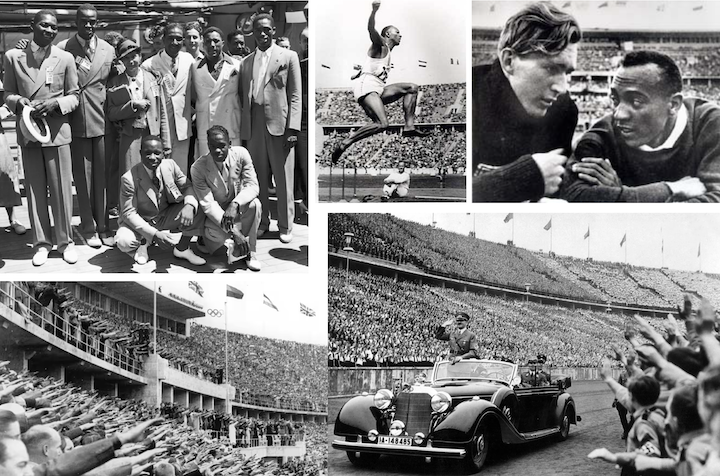
CONQUERING HEROES…Eighteen Black athletes went to Berlin as part of the U.S. team in 1936. Clockwise, from top left: Standing are high jumpers Dave Albritton and Cornelius Johnson, hurdler Tidye Pickett, sprinter Ralph Metcalfe, boxer Jim Clark, and sprinter Mack Robinson…in front, weightlifter John Terry (left) and long jumper John Brooks; Jesse Owens captured four gold medals and became the hero of the Olympics—his long jump (26 feet 5-1/2 inches) was an Olympic record; the American press reported widely on the friendship between Owens and his German long jump competitor Carl Ludwig (“Luz”) Long…Long was killed in action during World War II; the faithful offer their ugly salutes at the opening of the games. (webs.org/Bundesarchiv Koblenz/ushmm.org/history.com)

Flanner also reported on the great fanfare at the opening of the games, including “seventeen searchlights, from far outside the arena…a lofty birdcage of streaming light beams.” One wonders if those same searchlights were deployed during the war four years later, when RAF Lancaster bombers began their night bombing campaign of Berlin.

 * * *

At the Movies
Last week we saw Lionel Barrymore in drag (as an old woman) in The Devil Doll. This week he resurfaces as a senile old warhorse in The Road to Glory, a Howard Hawks war film with a screenplay co-written by William Faulkner (the film also featured Frederic March, who had star billing in three major films in 1936). John Mosher found the film “presentable,” but nothing special. The same went for Down Under the Sea, a film concerning sponge divers who battle over the affections of a woman (Ann Rutherford).

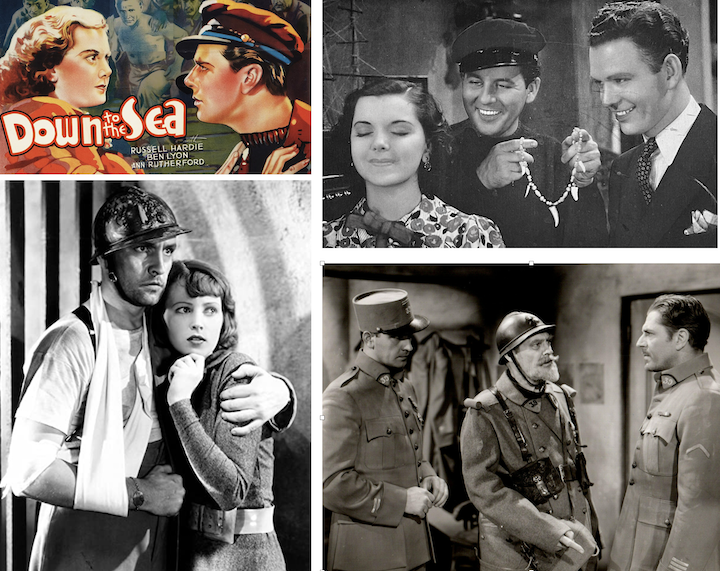
WERE THEY SPONGE WORTHY?…Clockwise, from top left: Ann Rutherford finds herself torn between two sponge divers vying for her affections in Down Under the Sea (aka Down to the Sea); divers Ben Lyon and Russell Hardie surprise Rutherford with a “native necklace” in the film; Frederic March, Lionel Barrymore, and Warner Baxter in The Road to Glory; June Lang with March in The Road to Glory. (eBay/silverscenesblog)

Mosher also took in Jailbreak, a minor noir picture about racketeers, cops and newspaper reporters.
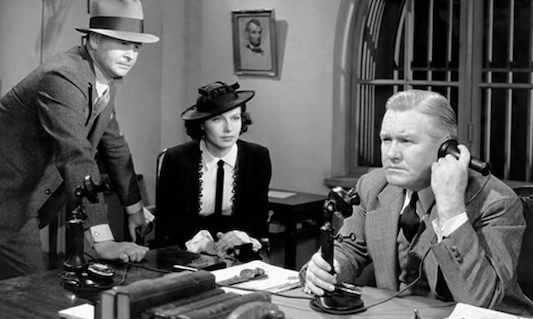
SERIOUS BUSINESS…Barton MacLane, June Travis and Joseph Crehan in Jailbreak. (IMDb.com)

 * * *

From Our Advertisers

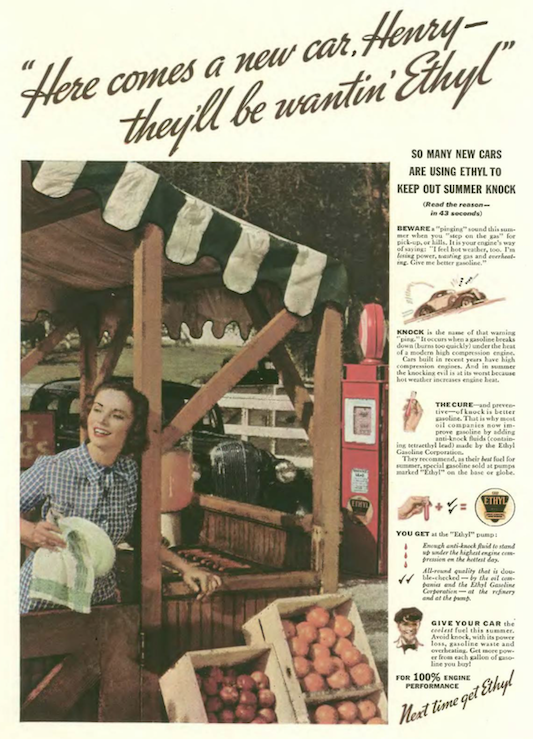
The inside front cover featured a wholesome image of a roadside stand on behalf of leaded gasoline…the makers of Ethyl, which boosted octane ratings and stopped engine knocking, deliberately hid or omitted the word “lead” in their advertising…I don’t miss the Ethyl, but I do miss those roadside stands…
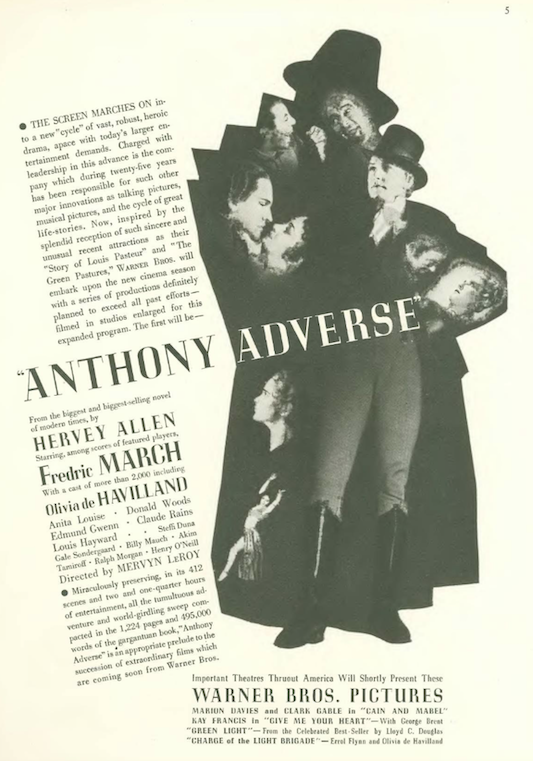
…Warner Brothers took out a full-page ad to trumpet the East Coast release of their epic drama Anthony Adverse, which would go on to win four Academy Awards…
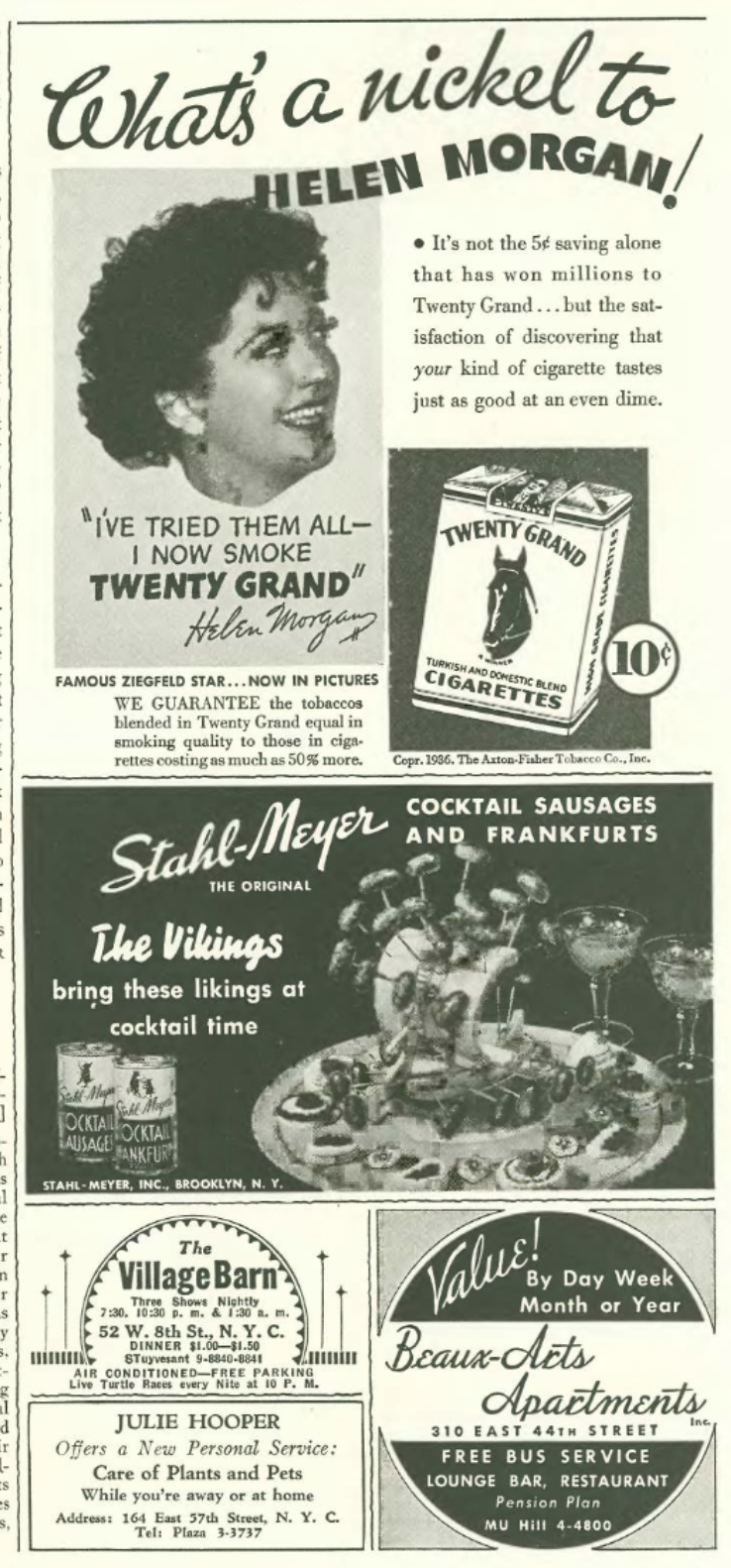
…the original torch singer Helen Morgan lent her endorsement to a budget cigarette brand in this back of the book ad…at this point her career would be headed on a downward spiral, ending with her death in 1941…
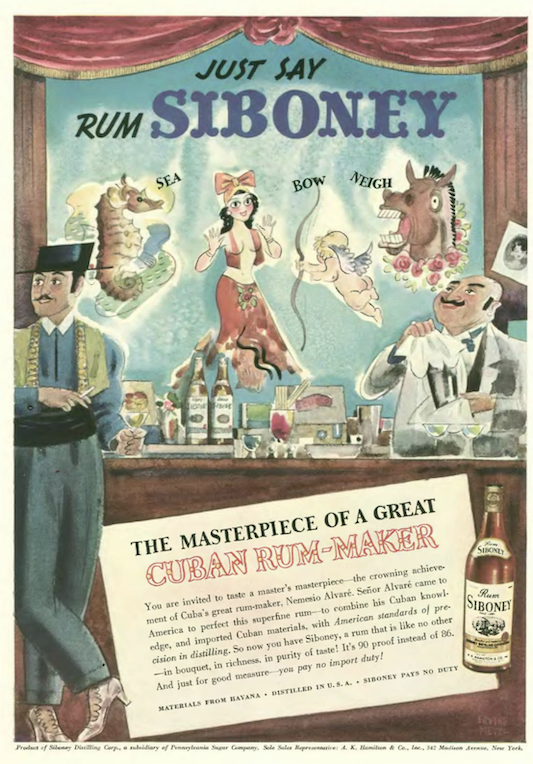
…the makers of the Dominican rum Siboney competed with Cuban rival Barcardi with this colorful full-page ad illustrated by American graphic artist Ervine Metzl

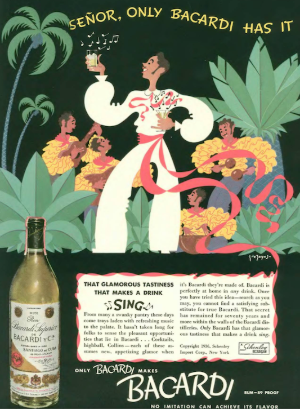
…Barcardi placed this front cover advertisement in Aug. 1, 1936 New Yorker (illustrated by George de Zayas)…
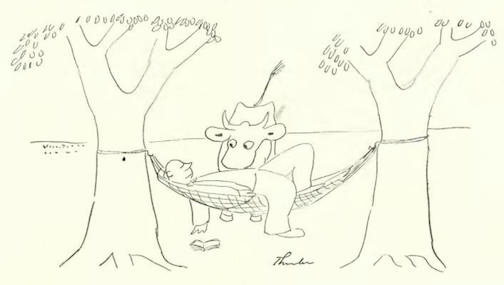
James Thurber kicks off the cartoons with two terrific spot drawings…
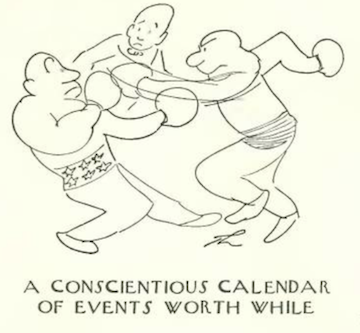
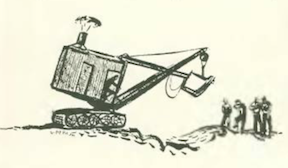
…this spot drawing by Victor de Pauw recalls my favorite childhood book, Mike Mulligan and His Steam Shovel (1939), by Virginia Lee Burton

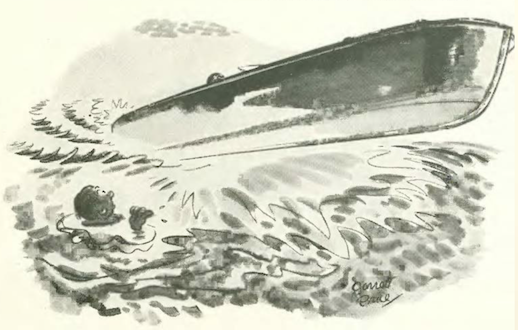
…I’m not sure if one would call this a spot drawing or a caption-less cartoon, at any  rate, Garrett Price aptly illustrated the dangers of swimming beyond the bouys…
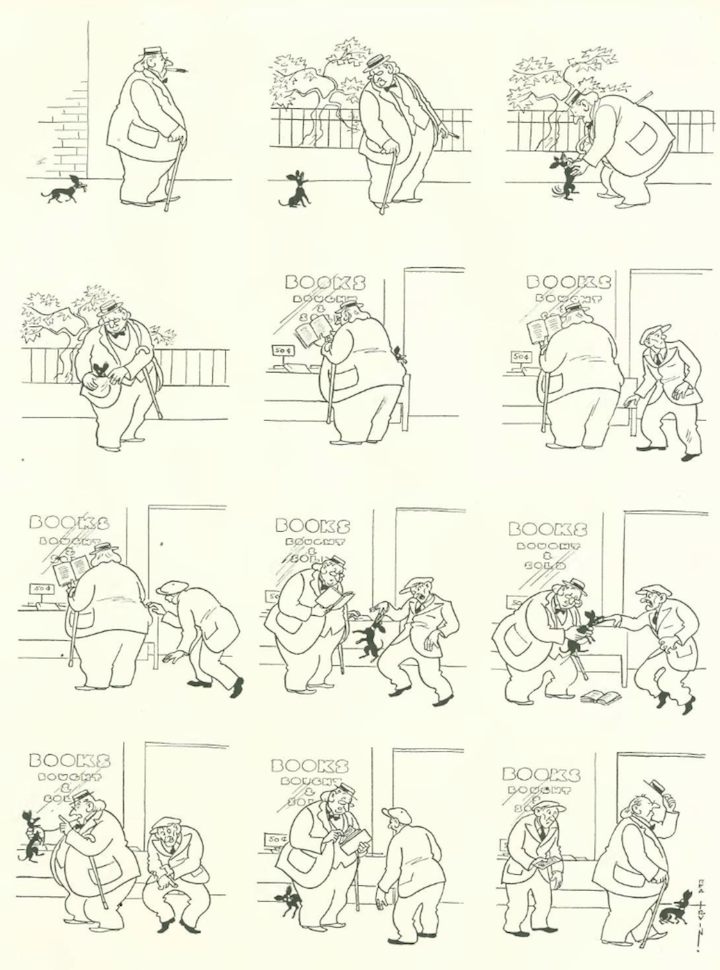
Rea Irvin demonstrated the perils of dognapping in this multi-panel entry…
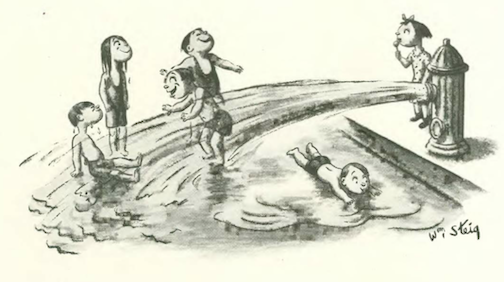
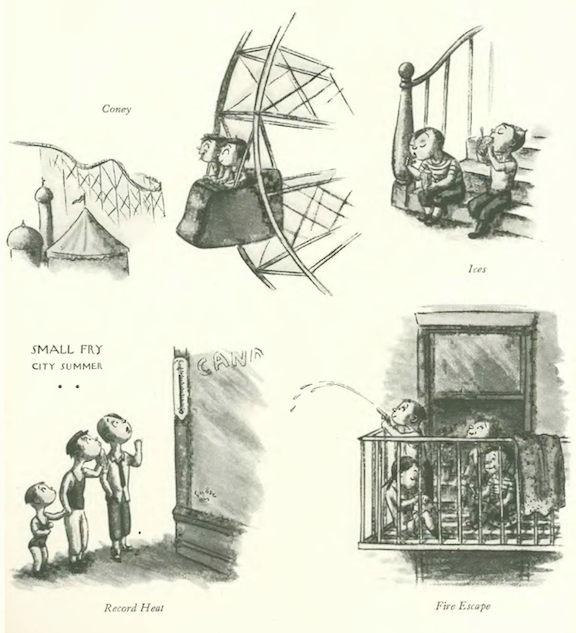
William Steig celebrated summer in the city…
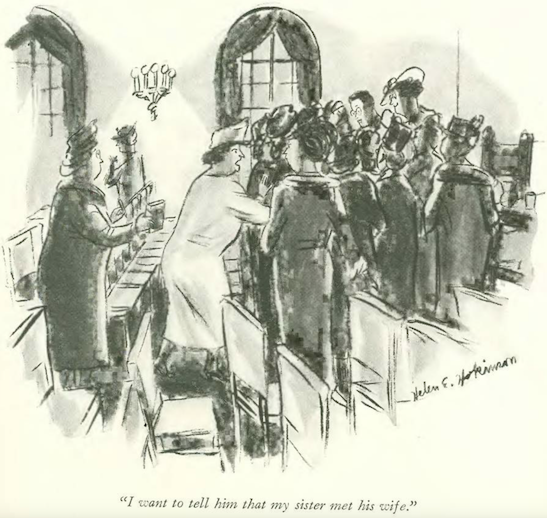
Helen Hokinson drew up an urgent social connection…
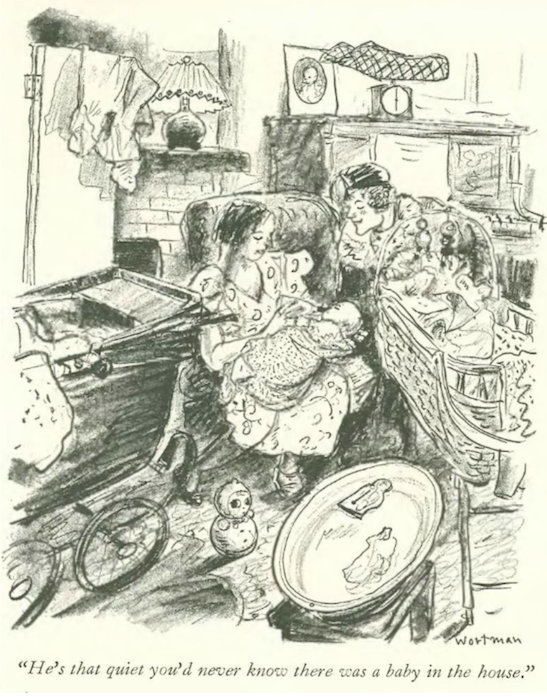
Denys Wortman looked in on the trappings of motherhood…
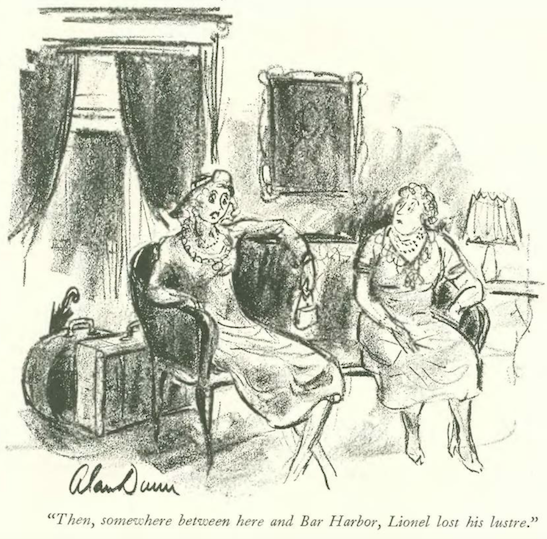
Alan Dunn showed us one effect of long-distance travel…
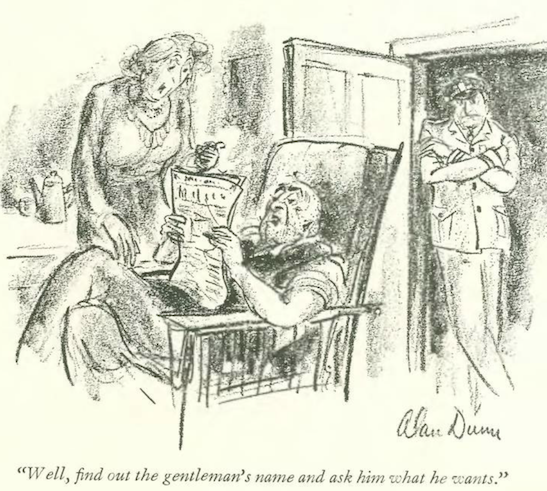
…and Dunn again, with a man who’d rather not ask questions…
…and leave it to Charles Addams to draw up The New Yorker’s first Medusa-themed cartoon…
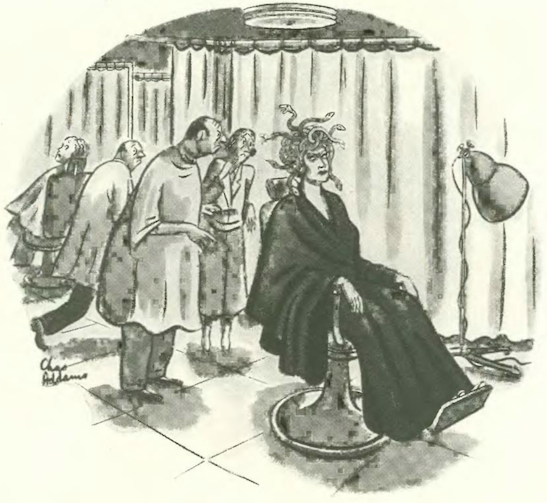
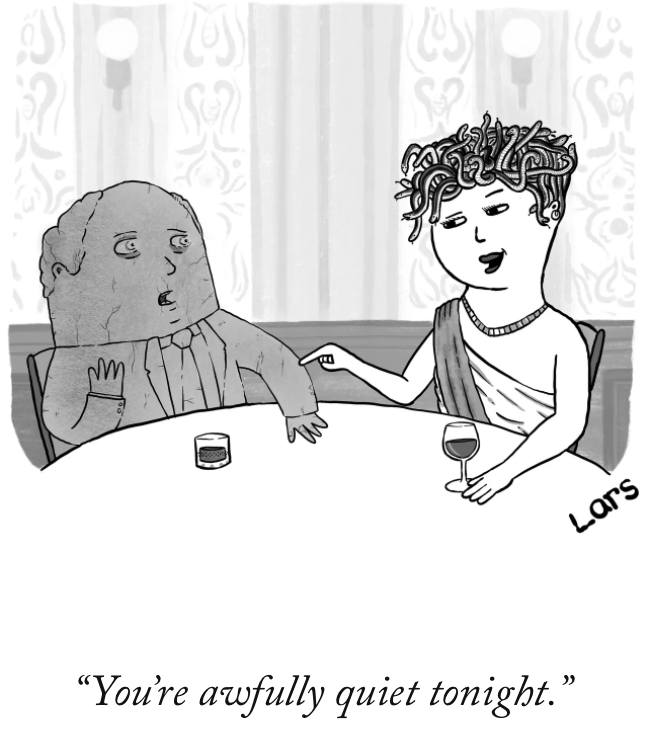
…before we continue, here are other interpretations of the mythic Gorgon from The New Yorker…this one by Lars Kenseth is from Jan. 21, 2019…
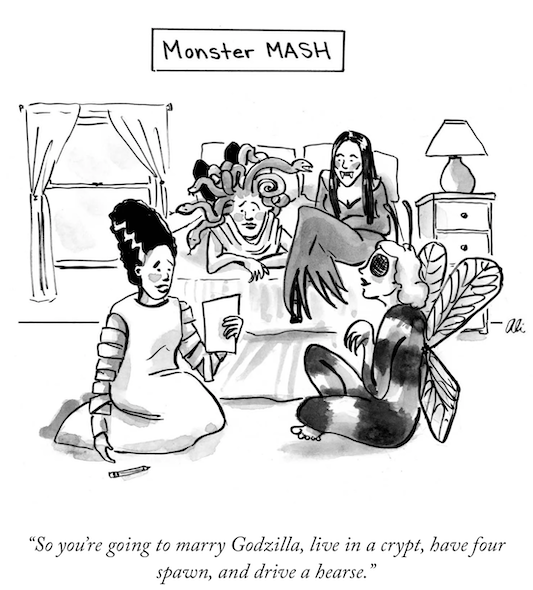
…this is by Ali Solomon (Oct. 29, 2025)…
…and from May 3, 2025, this terrific caption contest cartoon by Jason Adam Katzenstein (and the winning caption by Peter Sergison, Durham, NC)…


…and here’s a timely cartoon by Daryl Seitchik that was rejected by the magazine…

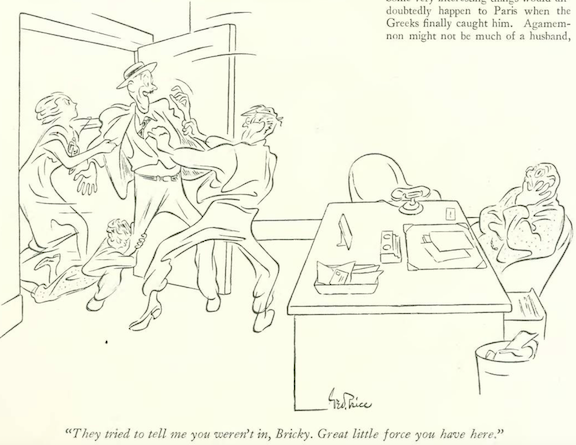
…we go back to 1936 with George Price and a plucky salesman…
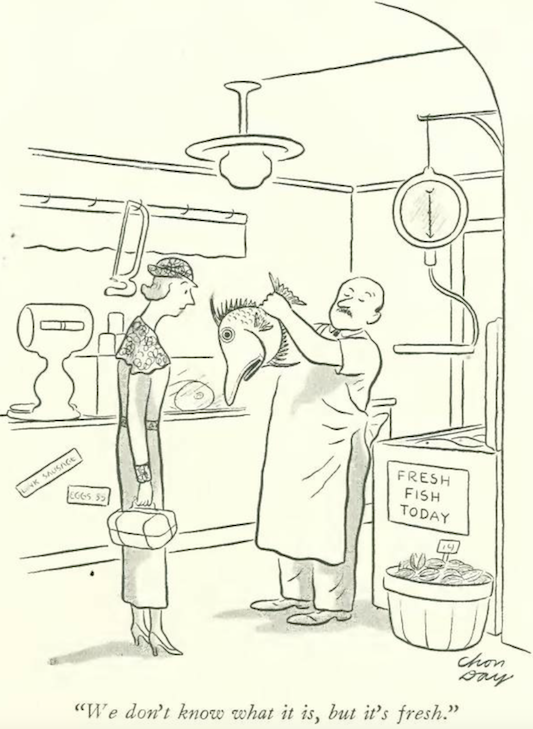
Chon Day made an unappetizing find at the fish market…
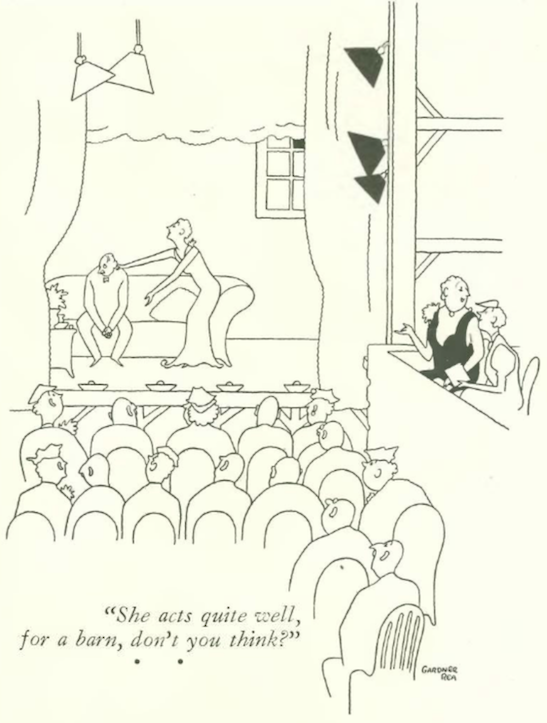
Gardner Rea looked in on a summer stock performance…
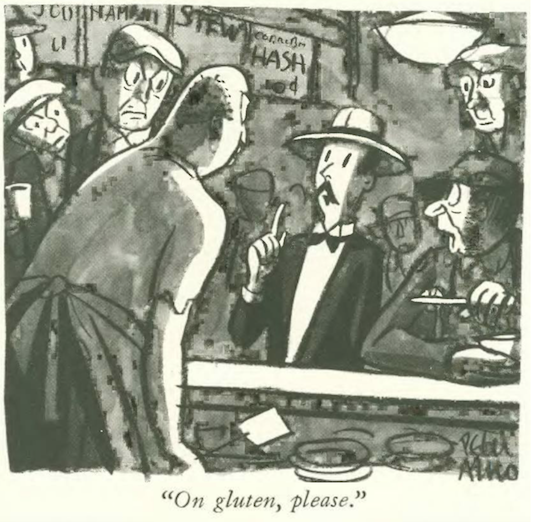
Peter Arno drew up a Milquetoast unwittingly ordering a knuckle sandwich…
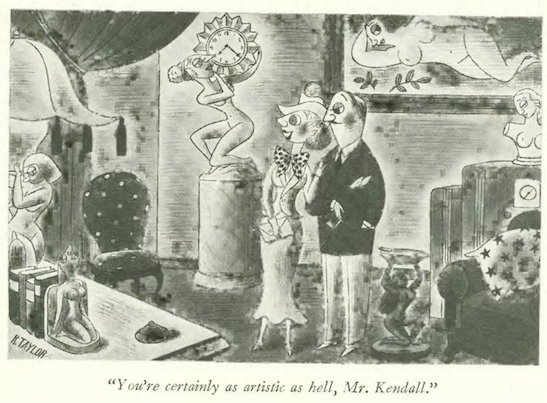
…and we close with some racy decor, courtesy Richard Taylor

Next Time: Wherefore, Old Romeo?…
Men in Kilts

Above: Fredric March as the Earl of Bothwell in Mary of Scotland. March sported a kilt that Alex von Tunzelmann (the Guardian, May 7, 2015) calls "the bane of Scottish historical movies from here to Braveheart." Tunzelmann notes that "What we call a kilt today—the fèileadh beag, or small kilt—was invented in the mid-18th century, almost 200 years after this film is set. The Scots should be wearing belted plaid, or the rather fetching skintight tartan trews (image at right) sported by Mary’s father, James V." (eBay.com/pinterest.com)

These were truly the dog days of summer—New Yorkers had just endured one of the hottest months on record (106 F on July 9) and it remained intensely hot and dry as August rolled in. So for this post we will retreat to one of the few places that had air-conditioning—the cinema—and see what folks were enjoying in the first week of August 1936.

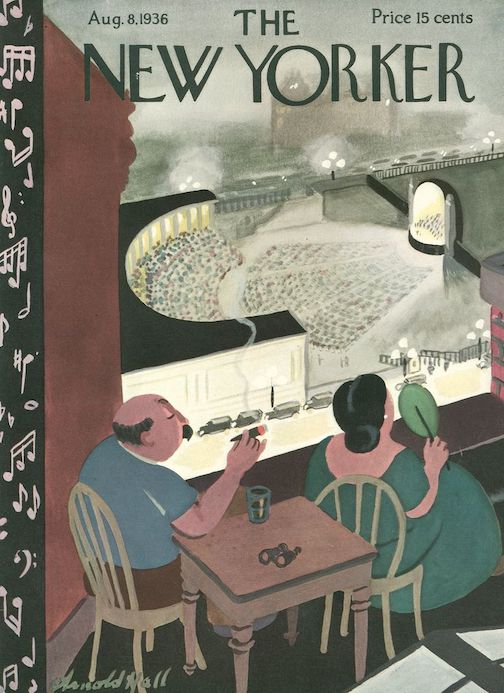
August 8, 1936 cover by Arnold Hall.

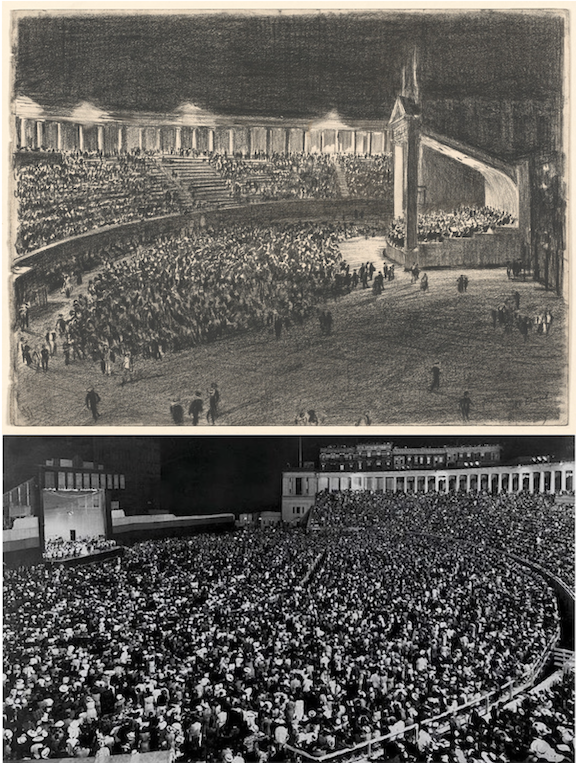
Before we jump into the movies, the wonderful cover by Arnold Hall recalled the summer night concerts at Lewisohn Stadium (although Hall took some liberties with the stadium’s design for the sake of composition).

A LITTLE NIGHT MUSIC…Top: Illustration by Scottish artist Muirhead Bone of a nighttime Lewisohn Stadium concert, circa 1920s; below: Andre Kostelanetz conducts before a crowd of thousands at Lewisohn Stadium in 1939—for an admission price of a mere twenty-five cents, concertgoers were treated to appearances by leading performers of jazz, classical music and opera. The stadium was demolished in 1973. (digitalcommonwealth.org)

On to our movies, Russell Maloney once again sat in for John Mosher as the magazine’s film critic, taking on everything from a Tudor romance to a horror film that featured Lionel Barrymore in drag.

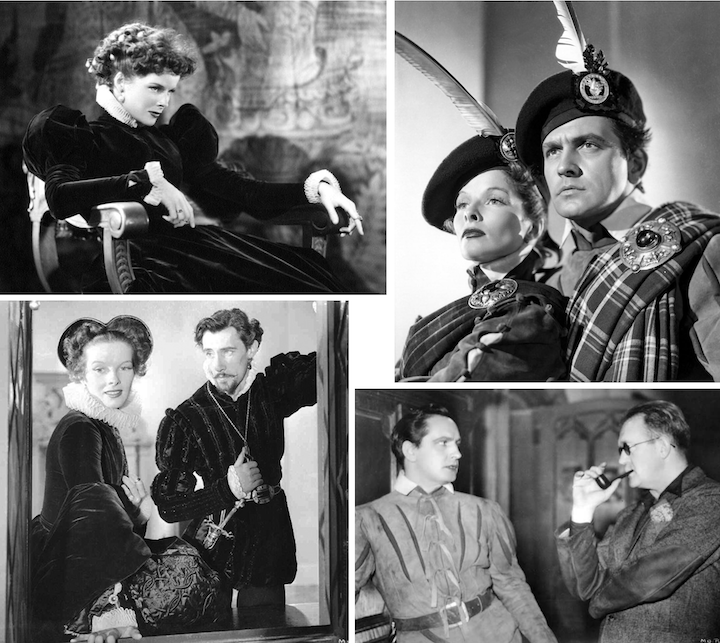
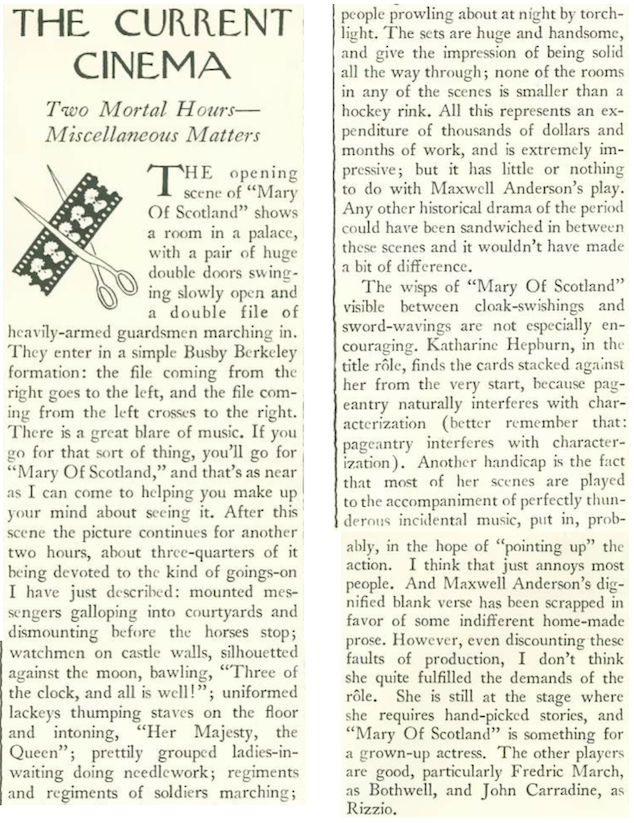
In Mary of Scotland, Maloney found Katharine Hepburn’s turn as Mary, Queen of Scots a bit wanting (the role should have gone to a “grown-up actress”), while he thought the film itself was rather tedious with “lots of goings on.” He concluded that the “wisps of Mary of Scotland visible between cloak-swishings and sword-wavings are not especially encouraging.”

NOT READY FOR PRIME TIME?…Clockwise, from top left: Critic Russell Maloney thought the 29-year-old Katharine Hepburn was not seasoned enough to portray Mary Stuart in Mary of Scotland; Fredric March as the Earl of Bothwell, with Hepburn; March visits with director John Ford, who was better known for his Westerns (Ford and Hepburn would famously have an affair during the filming); Hepburn in a scene with John Carradine, who portrayed Rizzio, the Italian courtier and private secretary to Mary. Patriarch of the Carradine acting dynasty, his children included actors David, Keith, and Robert Carradine. (imdb.com/pinterest.com/frockflicks.com)

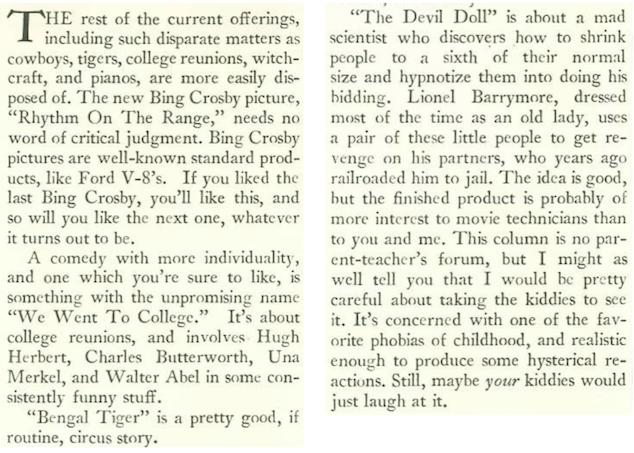
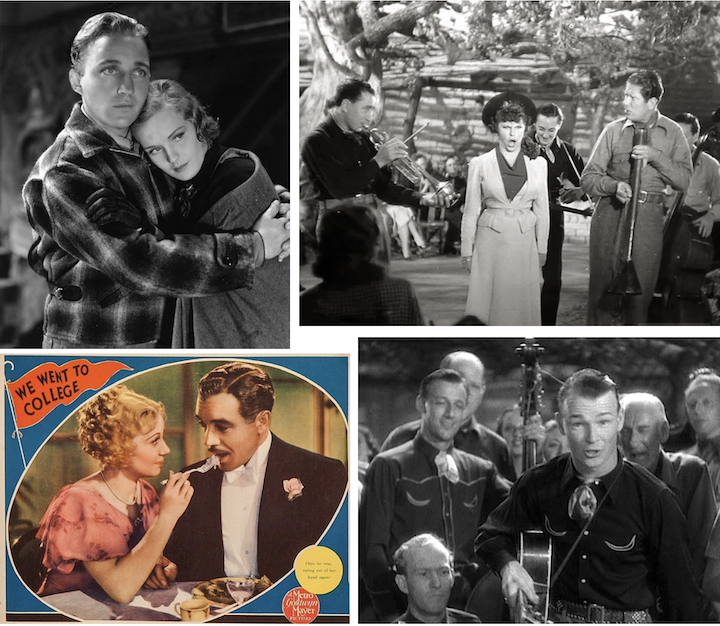
In addition to a forgettable lion-tamer flick (Bengal Tiger), Maloney also reviewed a Bing Crosby movie with a host of singing cowboys, Rhythm on the Range, and a “consistently funny” film with an “unpromising name,” We Went to College…
Bing Crosby played a humble traveling cowboy Norman Taurog Western musical film
COWBOY CROSBY…Clockwise from top left: Bing Crosby portrayed a traveling cowboy in love with a rich girl (Frances Farmer) in Rhythm on the Range; Louis Prima, Martha Raye (in her film debut), and Bob Burns performed in the ensemble “I’m an Old Cowhand from the Rio Grande” along with Roy Rogers (uncredited and performing under his original stage name, Leonard Slye) and The Sons of the Pioneers; Una Merkel and Walter Abel in a lobby card image advertising We Went to College. (imdb.com)

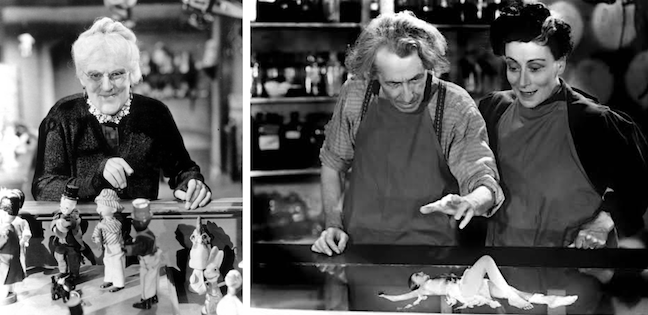
Maloney also reviewed a horror-farce, The Devil Doll, featuring Lionel Barrymore as banker Paul Lavond. A brief synopsis: Framed by his three partners and imprisoned on Devil’s Island, Lavond escapes with a fellow inmate who introduces him to his wife, Malita. The couple demonstrate a process that shrinks animals and people to the size of dolls, which then can be animated by will power. Seeing the dolls as an opportunity for revenge on his former partners, Lavond disguises himself as an old woman and sends out the shrunken people to harm his enemies.

PLAYING WITH DOLLS…At left, Lionel Barrymore disguised as Madame Mandelip, preparing his demonic dollies for revenge in The Devil Doll; at right, Marcel (Henry B, Walthall) and his wife Malita (Raffaela Ottiano) with one of their shrunken people. (classic-monsters.com)
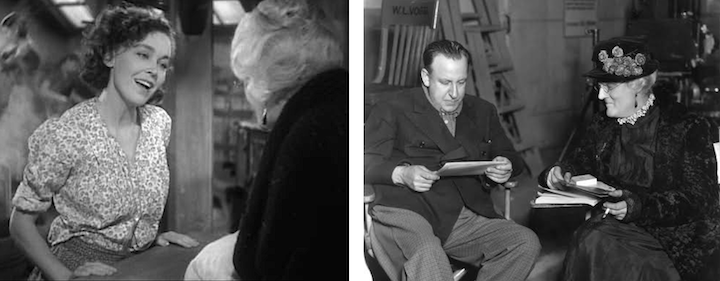
MY, WHAT BIG TEETH YOU HAVE…At left, Tarzan star Maureen O’Sullivan portrayed Paul Lafond’s unsuspecting daughter—in this scene from The Devil Doll she doesn’t recognize her long-absent father, disguised as the kindly Paris toy shop owner Madame Mandelip; at right, Lionel Barrymore (dressed as Madame Mandelip) meeting with Devil Doll director Tod Browning, best known for his 1932 magnum opus, Freaks. (classic-monsters.com/moriareviews.com)

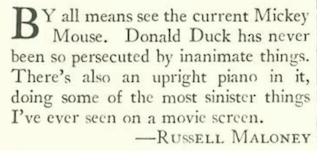
It seems there were few, if any, critics in the 1930s who didn’t like Mickey Mouse cartoons. These days we take animation for granted, but ninety years ago it was still something of a miracle, especially in color. Maloney noted the latest must-see Disney cartoon short, Donald and Pluto.

MARTYRDOM OF DONALD DUCK…Donald Duck was literally put through the wringer for our amusement in the 1936 short Donald and Pluto, one of the three installments of the Mickey Mouse series in which Mickey doesn’t appear as a character. Donald Duck was a fairly new Disney character in 1936, making his debut in 1934’s The Wise Little Hen. (disneyfandom.com)

 * * *

Life Goes On

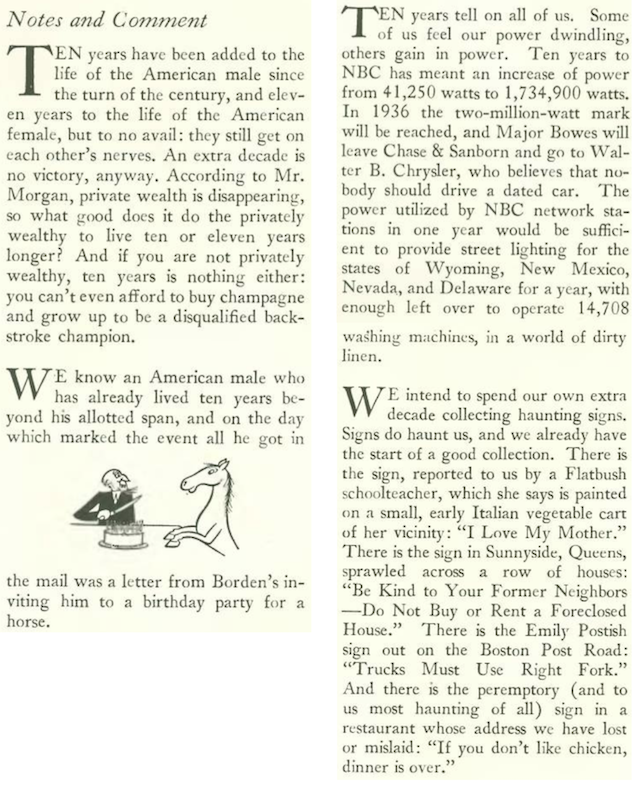
E.B. White mused about the increasing life expectancy at birth of the American male from 47 years in 1900 to 58 years in 1936 (a woman’s life expectancy was roughly 49/62, respectively). White (who would live 86 years) said he would spend his extra years collecting “haunting” signs, such as one on the Boston Post Road that read: Trucks Must Use Right Fork.

AND NO ELBOWS ON THE TABLE, EITHER…Trucker poses in front of his rig in 1936. (facebook.com)

 * * *

Wartime Wardrobe

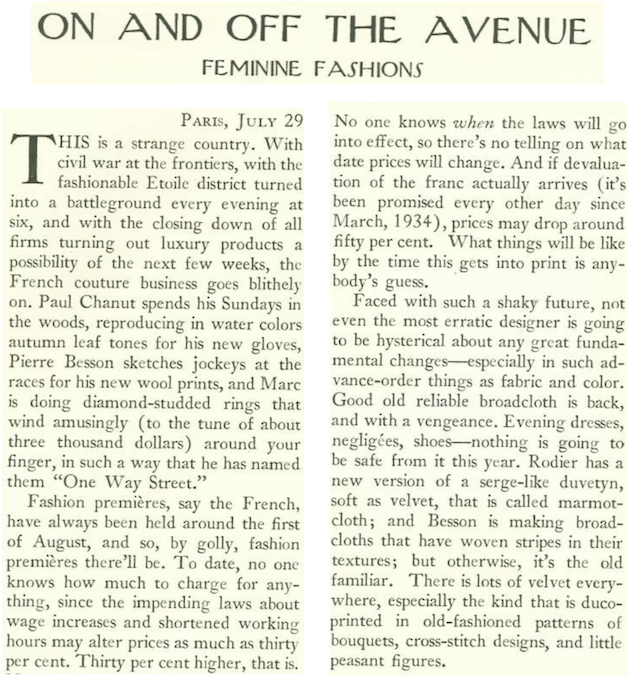
Beatrice Mathieu—the first and only Paris fashion correspondent for The New Yorker—sat in on Lois Long’s column to discuss the latest from The City of Light. Designers were soldiering on with their premieres despite the winds of war blowing from the east. Excerpts:

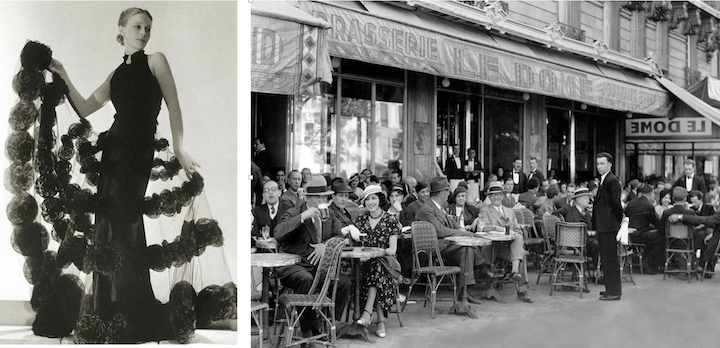
LIFE GOES ON…At left, a model shows off a “Carnival dress” by Madeleine Vionnet, 1936; a sidewalk café in Paris filled with fashionable folks, 1936. (godsandfoolishgrandeur.blogspot.com/reddit.com)

A note about Beatrice Mathieu: According to her 1976 New York Times obituary, In an era when honest criticism in fashion writing was relatively rare, she blended humor with a kind of skepticism and honesty in writing that enhanced her reputation as a leader in the field…In 1928, when the young woman from Faribault, Minn., was making a living in Paris as a freelance writer, she received a cable from Harold Ross…asking her to do some work for him. She wired back: ‘What is The New Yorker?’ Mr. Ross replied at some length. She took the job.” Mathieu stopped writing her Paris column in 1936 but resumed after the end of World War II.

 * * *

A Dose of Passos

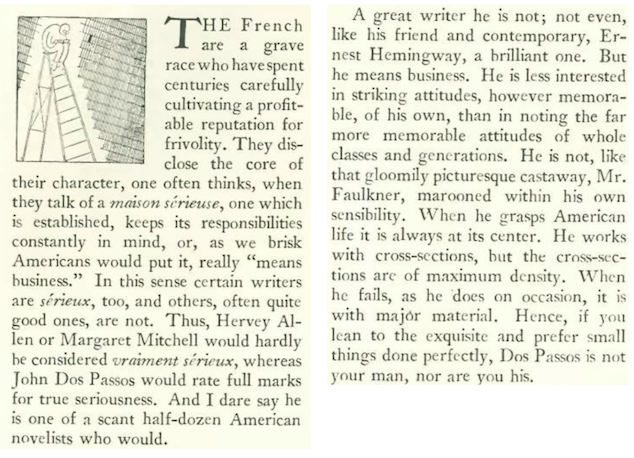
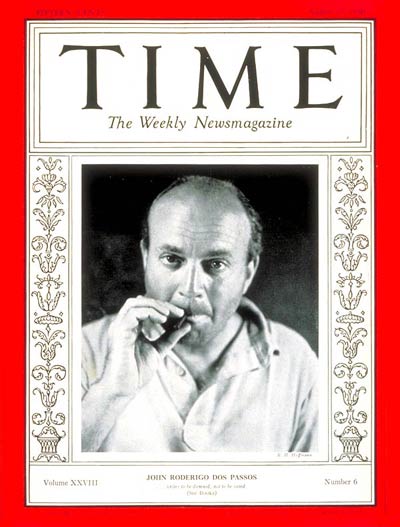
Clifton Fadiman reviewed the latest book by John Dos Passos (1896– 1970), who is known for his pioneering works of nonlinear fiction and his U.S.A. trilogy, which he completed in 1936 with The Big Money. One of the major novelists of the post-World War I “lost generation,” he is widely praised today for his timeless insights into America’s inequalities (and was also highly regarded by contemporaries including William Faulkner). Fadiman, however wrote “A great writer he is not.” Excerpts:

HIS TIME WOULD COME…John Dos Passos on the cover of Time, Aug. 10, 1936. Dos Passos is admired today for showing how Americans respond to the chaos and inequalities of modern life. (time.com)

 * * *

From Our Advertisers

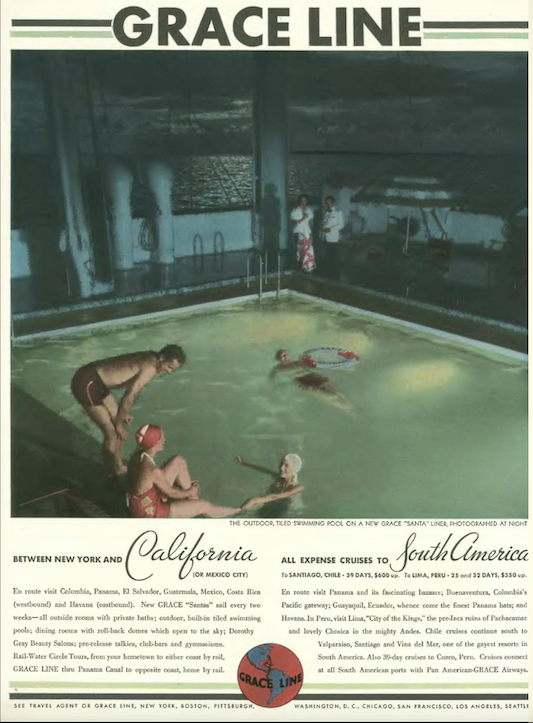
We begin our advertising section with the Grace Line, which offered this inviting image (on the inside front cover) of nighttime swimming on the deck of one of its Santa liners, en route to South America and California…

…less inviting, it would seem at the time, would be a cruise to Germany aboard a Hamburg-America Line (HAPAG) ship—beginning in 1939, U.S. and British forces would seize nearly all of HAPAG’s fleet…

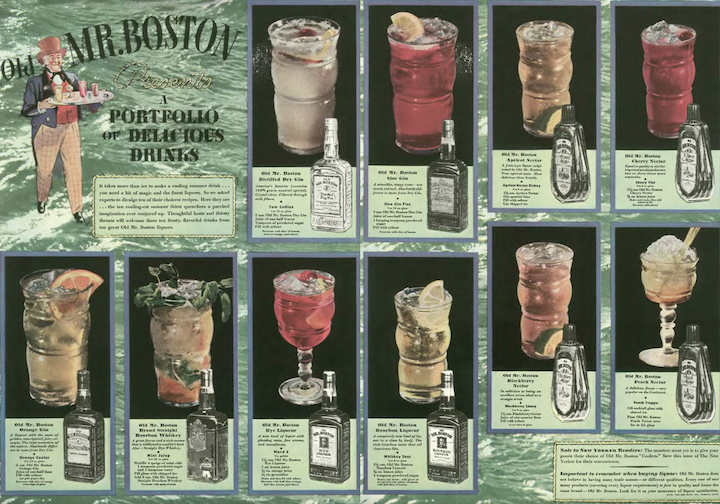
…the relatively new company Old Mr. Boston (founded in Boston in 1933, right as Prohibition ended) went big with this two-page color advertisement touting its line that included gin, rum, whiskey, and cordials…

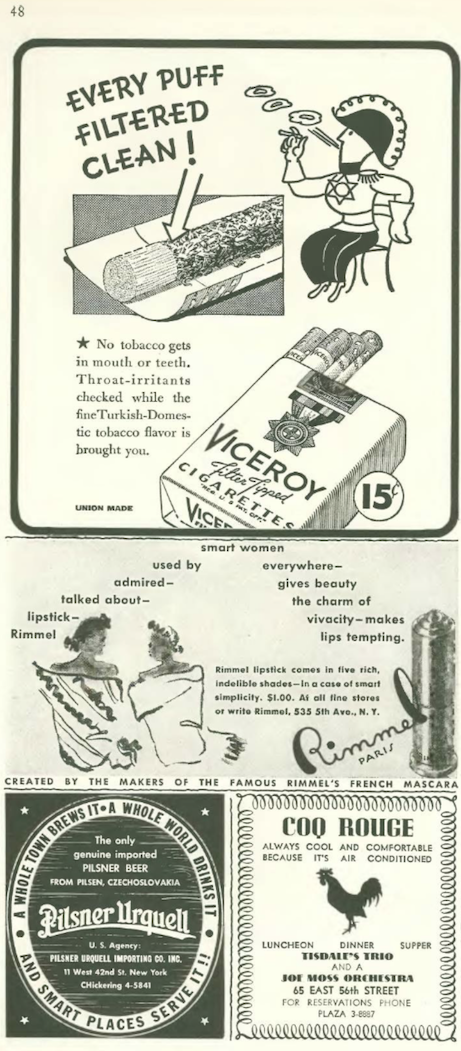
…in the back of the book…Brown & Williamson launched its Viceroy brand in 1936 as the world’s first cork-tipped filter cigarette…at the bottom is a modest ad for Pilsner Urquell, a Czech brewer that produced the world’s first pale lager…it is still brewed in Pilsen (Czech Republic) under the ownership of Tokyo-based Asahi Group…

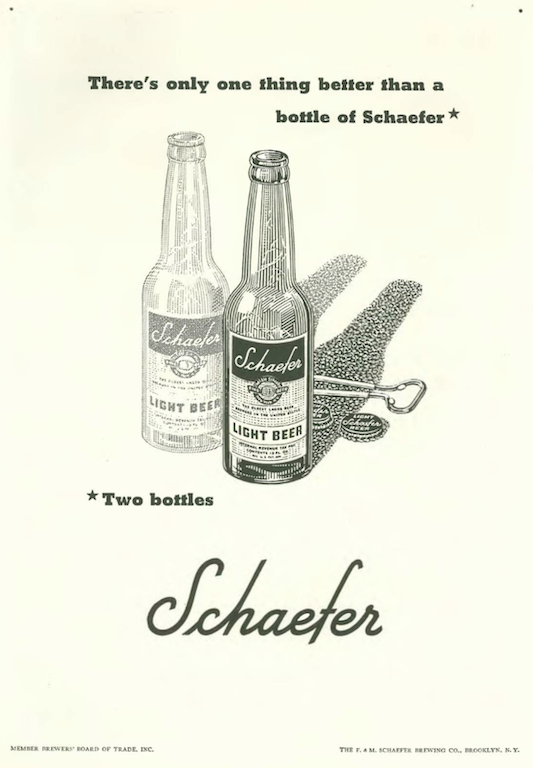
…Schaefer promoted their “light beer” in this rather spare advertisement…the “light” referred to its pale color, not to its calorie count…founded in New York City in 1842, Schaefer grew to be a top five brewer in America…today it is marketed by Pabst as a regional heritage brand…

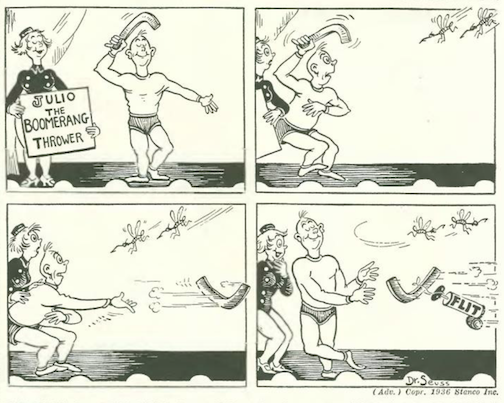
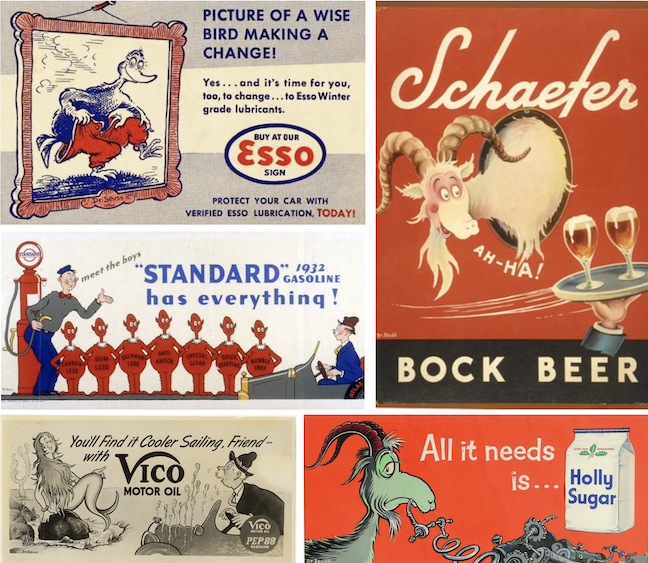
Dr. Seuss was still at it with his Flit ads…after rejections from nearly thirty publishers, in 1937 Seuss (aka Theodor Geisel) would publish his first book with Vanguard Press—And to Think That I Saw It on Mulberry Street…Seuss also illustrated ads for Schaefer beer, Esso gasoline, Holly Sugar, and General Electric, among others…

HONING A STYLE…A sampling of Dr. Seuss’s advertising art from the 1930s to the 1950s. (aoghs.org/UC San Diego/booksforgoatlings.weebly.com)

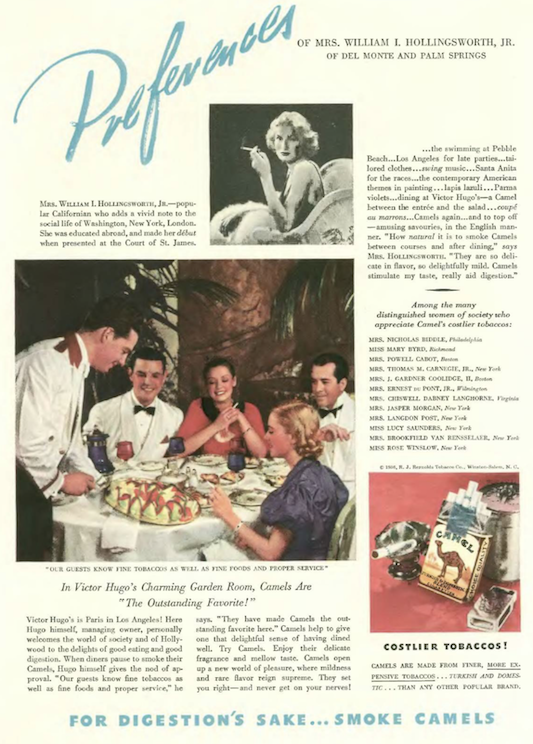
…R.J. Reynolds lined up another socialite endorsement for their Camel cigarettes…here they go to the West Coast, with a plug from Mrs. William J. Hollingsworth, Jr., aka Madeleine Ruth Piper…her marriage to Hollingsworth was over by 1937…she would marry three more times before her death in 1993…

SHE REALLY LIGHTS UP A ROOM…At left, undated photo of socialite Madeleine Ruth Piper (1916–1993), who was apparently telling the truth about her love of smoking; at right, the Victor Hugo Restaurant in Los Angeles (Beverly Hills), featured in the Camel ad. (findagrave.com/facebook.com)

…on to our illustrators and cartoonists, we begin with spots by Christina Malman

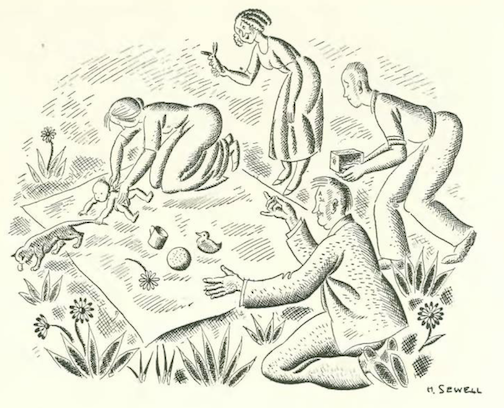
Helen Moore Sewell

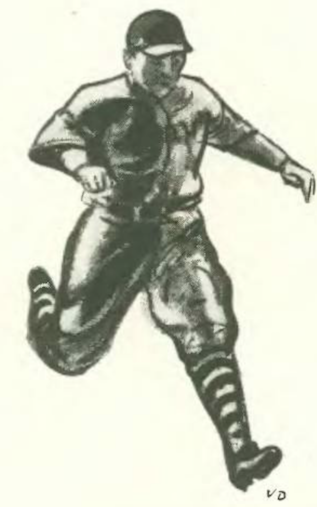
Victor de Pauw

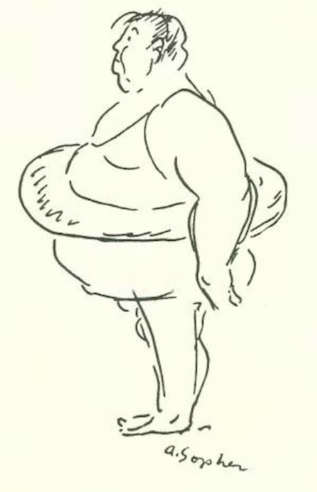
and Aaron Sopher

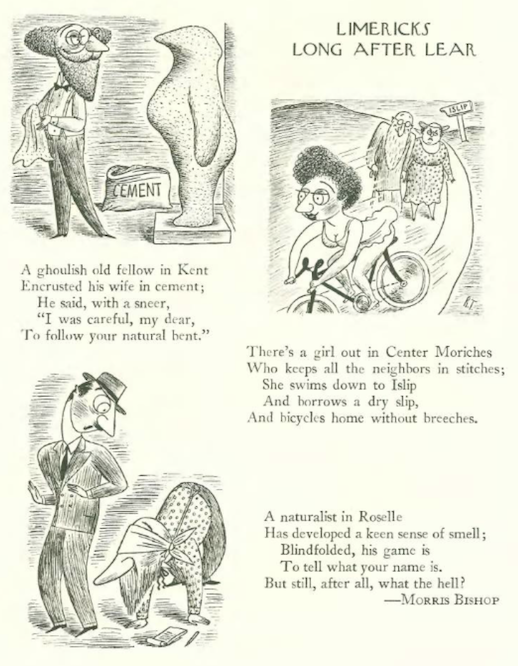
…there was another installment of Morris Bishop limericks illustrated by Richard Taylor

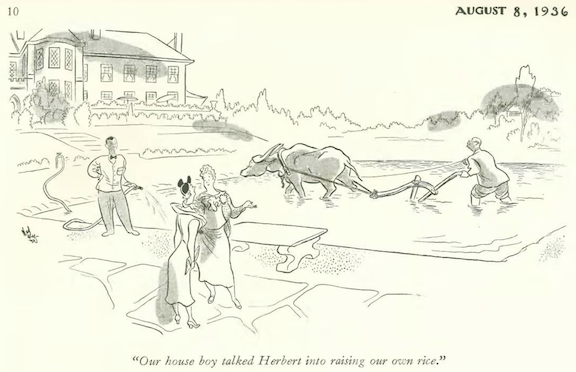
Ned Hilton’s lord of the manor took up rice farming…

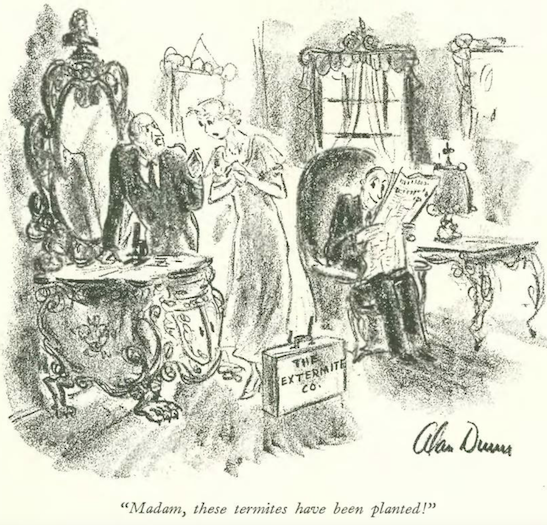
Alan Dunn showed us some devious domestic doings…

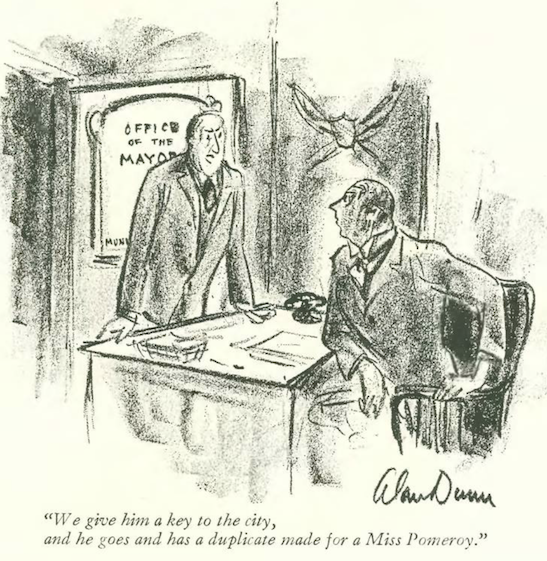
…and a complaint to the mayor…

…in contrast to Dunn’s style, the spare lines of Gardner Rea

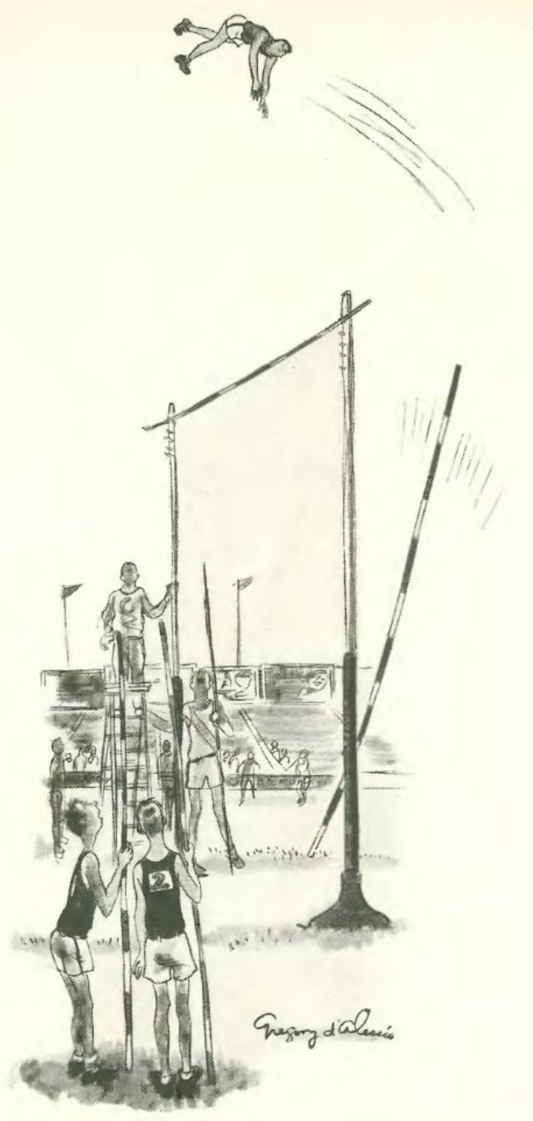
Gregory d’Alessio prepared for Olympic glory…

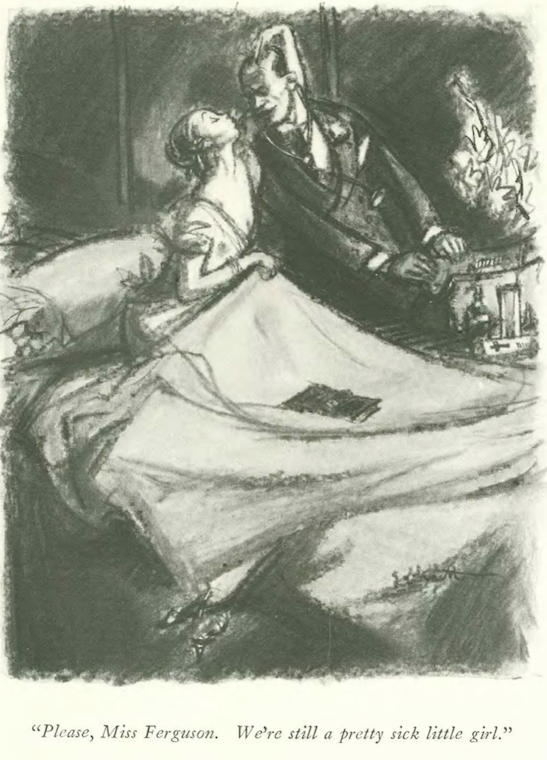
William Crawford Galbraith continued to plumb the creepy waters inhabited by impressionable young women and lecherous older men, in this case a woman’s personal physician…

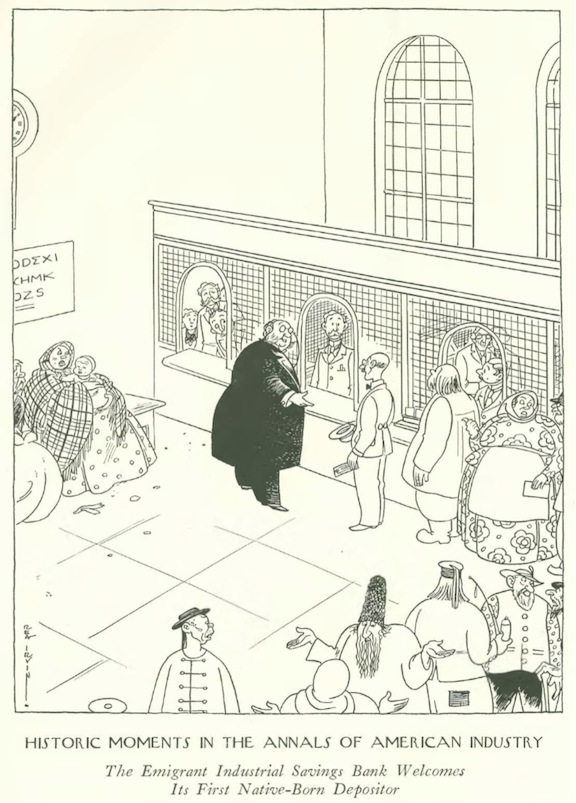
…and Rea Irvin continued to explore historic moments in American industry…

…we close with Helen Hokinson, and some scandal brewing under a hair dryer…

Next Time: Bottoms Up…