A Letter From Berlin

Above: Nineteen-thirties dance class sponsored by Kraft durch Freude (Strength Through Joy), a sub-organization of the German Labour Front that sought to fulfill the totalitarian ambitions of the Nazi regime by "forming a genuine national and performance-based community of all Germans," in other words, keep them busy and distracted from reality. (bundesarchiv.de)

Paris correspondent Janet Flanner visited Berlin to check on that city’s preparations for the 1936 Olympic Games, an event Nazi leaders saw as a prime opportunity for some big-time propaganda.

August 1, 1936 cover by Constantin Alajalov with a wry twist on the upcoming Berlin Olympic games (note the strap along the left edge bearing some of flags of competing nations).

Flanner noted Propaganda Minister Joseph Goebbels’ charge to the German people, instructing them to show the world that the German Volk were “more charming than Parisians, more lively than the Romans, more worldly than the Londoners, and more efficient than the New Yorkers.”
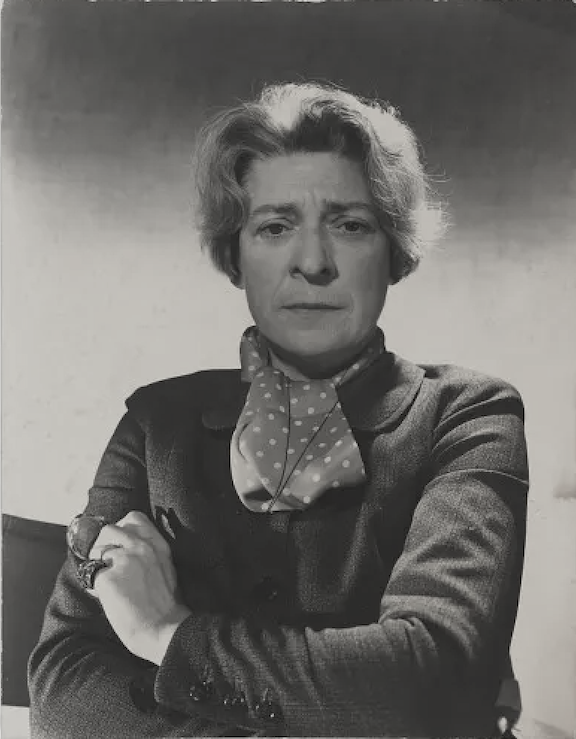
EYE ON BERLIN…Janet Flanner, who wrote under the pen name Genêt, in 1940. (National Portrait Gallery)

There was an ambiguous quality to Flanner’s early writings about Nazi Germany and Adolf Hitler in particular. As The New Yorker’s Andrew Marantz noted in “Takes” (Aug. 10, 2025) regarding Flanner’s 1936 profile of Hitler, “Instead of telling readers what they needed to know—that was what newspapers were for—she focused on what they might want to know…” Rather than taking sides, she reported in a cool and ironic tone. In her biography Genêt, Brenda Wineapple wrote that Flanner in her early writings “thought of herself as a high-class gossip columnist.”

Here are excerpts from the first part of Flanner’s “Berlin Letter.”

FASCIST FEVER DREAM…The Nazis spent large sums in preparation for the Olympic games, seeing them as the ultimate propaganda opportunity. Clockwise, from top left: Nazi officials show the extent of the Olympic village using a scale model in July 1936; a street scene with displays of the Olympic and swastika flags in Berlin, August 1936— the regime temporarily toned down public anti-Semitic displays and cleaned up the streets to impress international visitors; lively café scene on the Kurfürstendamm, known colloquially as the Ku’damm, in 1936. (Robert Hunt Library/Sueddeutscher Verlag Bilderdienst/tripadvisor.com)
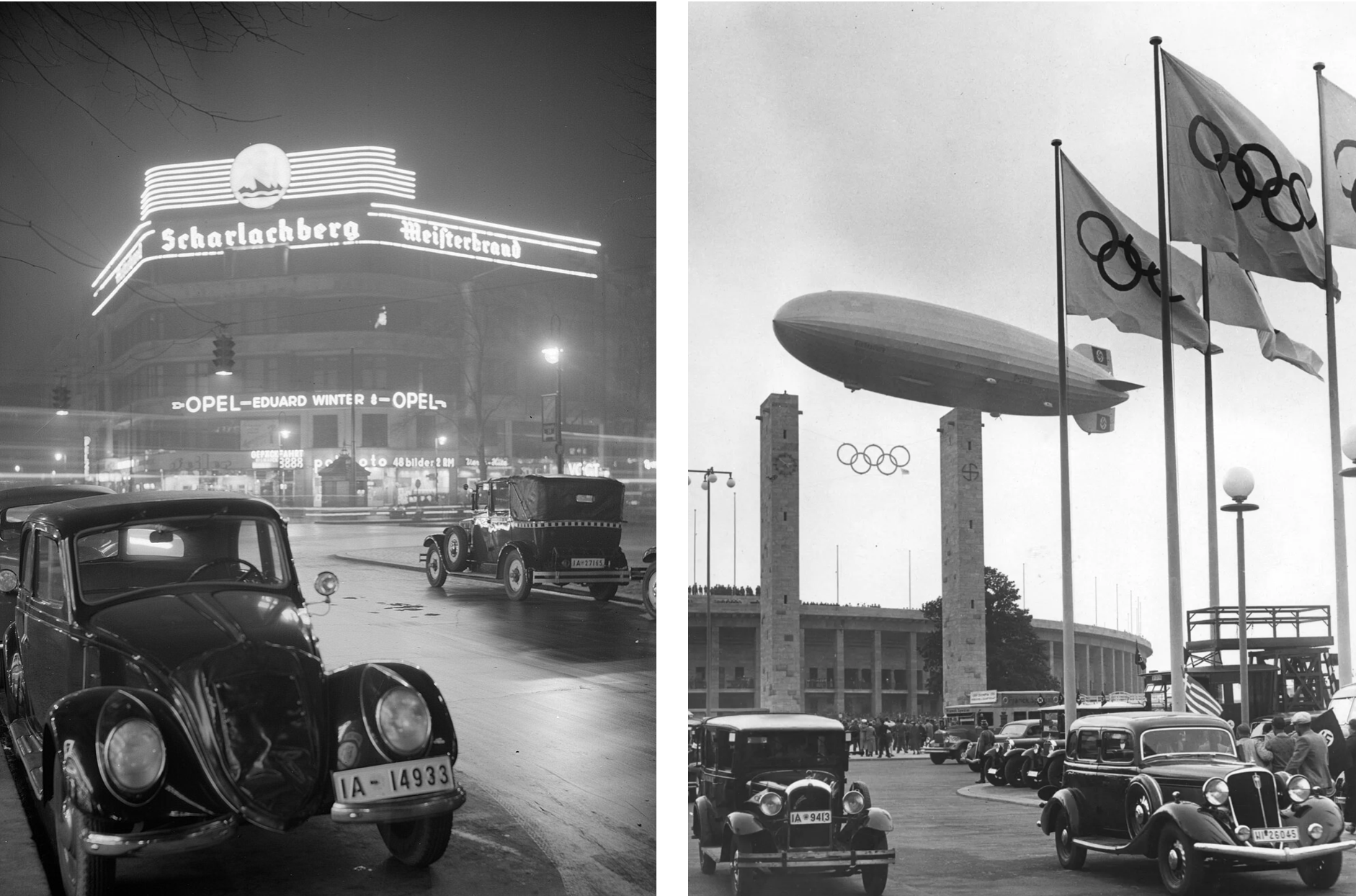
BEFORE IT ALL WENT DARK…In 1936 the Kurfürstendamm was a bustling Berlin boulevard, temporarily masking the oppressive Nazi regime with a veneer of normalcy for the 1936 Summer Olympics—shown at left is the Scharlachberg House at the corner of Kurfürstendamm/Uhlandstraße in Berlin, where the Maison de France stands today; at right, the Hindenburg flies over the Olympic Stadium in Berlin, August 1936. (Wikipedia/Encyclopædia Britannica)

In these excerpts, Flanner wrote that the arts were overseen by Joseph Goebbels and Hermann Göring (of all people). She also noted the absence from the opera (which she rated poor under Goebbels) of the world-renowned conductor Wilhelm Furtwängler, who was in seclusion “writing an opera,” but probably wanted to be out of the limelight due to his controversial decision to stay in the Reich rather than flee like other artists and musicians. Furtwängler detested Hitler, but believed his art would wither if he left his homeland.

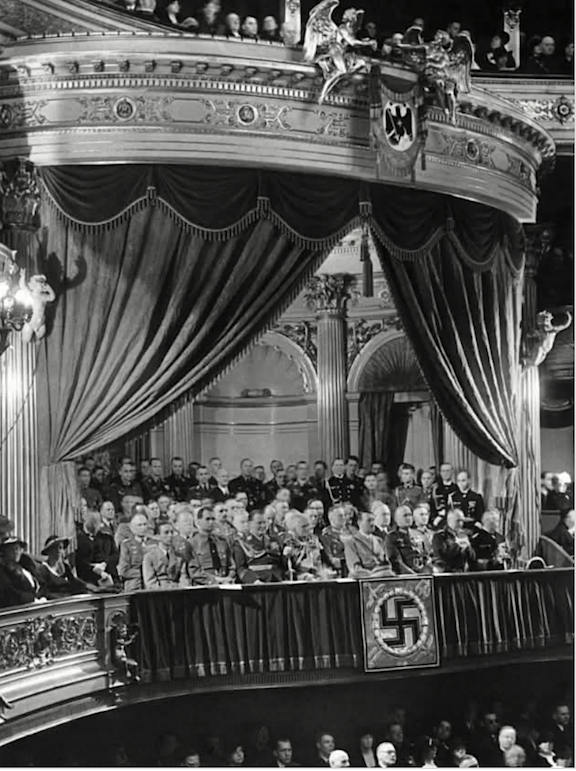
HORROR SHOW…Adolf Hitler and his Nazi thugs at the opera in Berlin in 1936. Hitler often appeared in carefully staged public settings like this one and the one in the photo below. (archaeohistories.via Facebook.com)
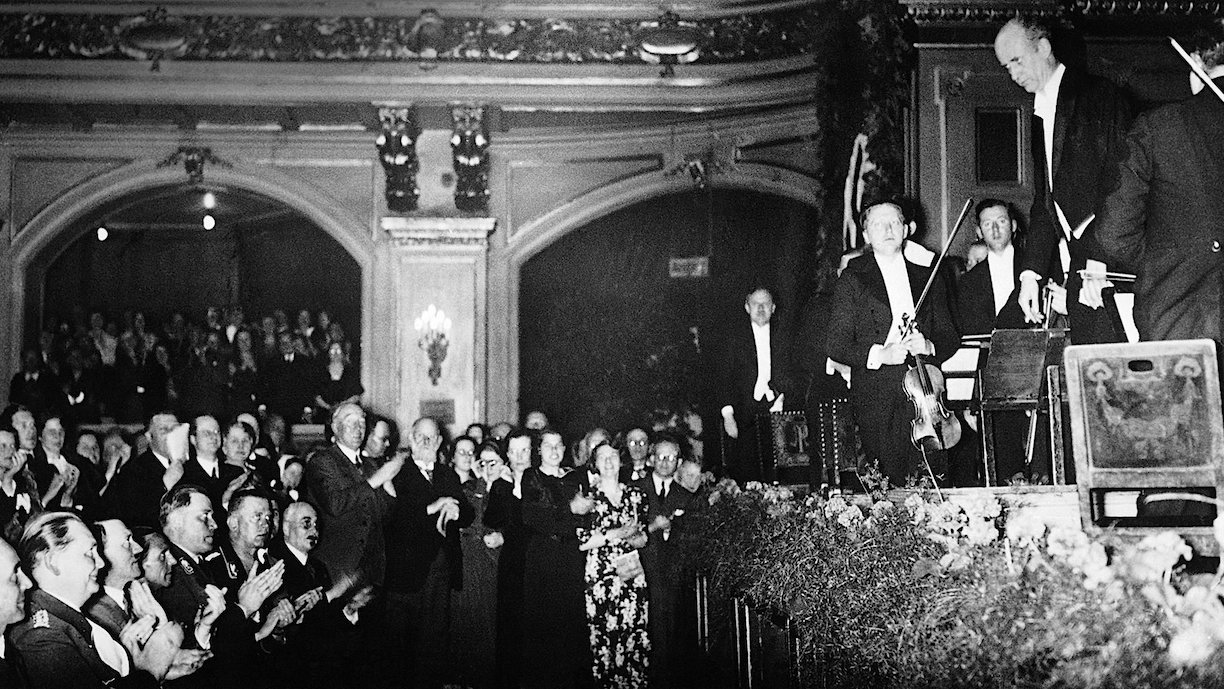
MUSICAL STRAIN…Conductor Wilhelm Furtwängler acknowledges the audience following a 1935 performance by the Berlin Philharmonic Orchestra—visible in the left corner of the photo are Hermann Göring, Adolf Hitler, and Joseph Goebbels, among other Nazi leaders. (Archiv Berliner Philharmoniker)
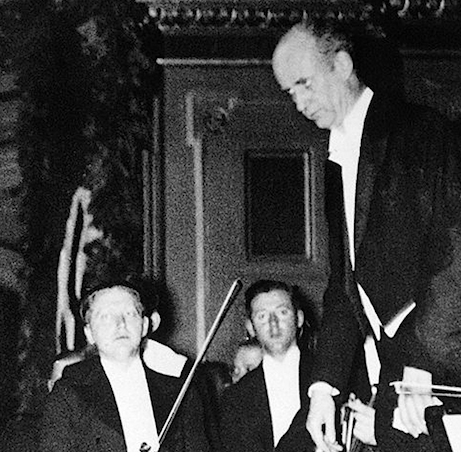
A closer look at the photo—a combination of hatred and fear in Furtwängler’s eyes? The first and second violinists don’t look too thrilled either.

In a related item, Howard Brubaker (in his “Of All Things” column), had this to say about Germany’s Olympics preparations.

 * * *

A Friendly Shakedown

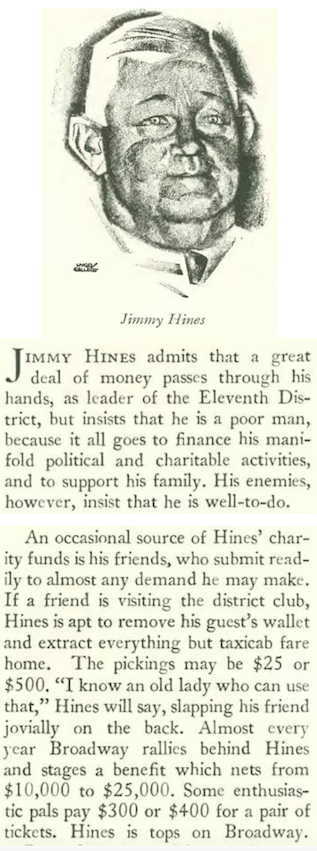
In Part Two of his profile on Tammany powerbroker Jimmy Hines, journalist Jack Alexander noted Hines’ unorthodox habit of soliciting contributions from his friends (illustration by Hugo Gellert). Excerpts:
 * * *

At the Movies

“In the dreadful summer of 1932, [The New Yorker] paid me ten dollars for an anecdote. I was ripe for seduction…,” Russell Maloney once recalled. “[Then] I sent in an account of a situation that I thought would make a good Helen Hokinson picture…and got paid for that: seven dollars.”

Maloney (1910–1948) proceeded to send more ideas to The New Yorker, and enough were accepted that in 1935 he packed his bags and moved to Manhattan for a job at The New Yorker. In his ten years at the magazine he would contribute thousands of anecdotes to “The Talk of Town” as well as casuals, profiles, and countless cartoon captions. His interest in theater as well as celebrity gossip suited him well when he substituted for John Mosher as the magazine’s film critic.

So let’s see what Maloney—who would later call 1939’s The Wizard of Oz a “stinkeroo,” had to say about the latest fare from Hollywood.

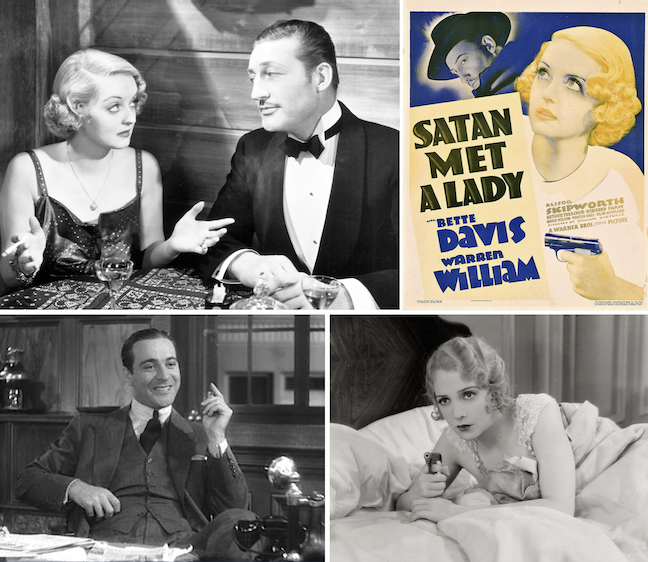
BUT THEY PAID ME THIS MUCH…Top: Russell Maloney wrote that both Bette Davis and Warren William seemed “embarrassed” to be appearing in Satan Met a Lady, which was a loose adaptation of Dashiell Hammet’s 1930 novel The Maltese Falcon—Maloney found Satan to be vastly inferior to the 1931 film The Maltese Falcon (below), which starred Ricardo Cortez and Bebe Daniels. In 1941 Humphrey Bogart and Mary Astor would appear in yet another adaptation of the Hammet novel. (imdb.com/facebook.com/jbkaufman.com)

Maloney “enjoyed” The Return of Sophie Lang, with actors “baffling one another  with the greatest suavity”…

IS THIS SUAVE ENOUGH FOR YOU?…Ray Milland and Gertrude Michael get close in The Return of Sophie Lang. (Pinterest.com)

…while Spendthrift, featuring actors speaking in various accents, was “perfectly dreadful.” Fortunately Suzy managed to lift the reviewer’s spirits, especially with the appearance of Jean Harlow.
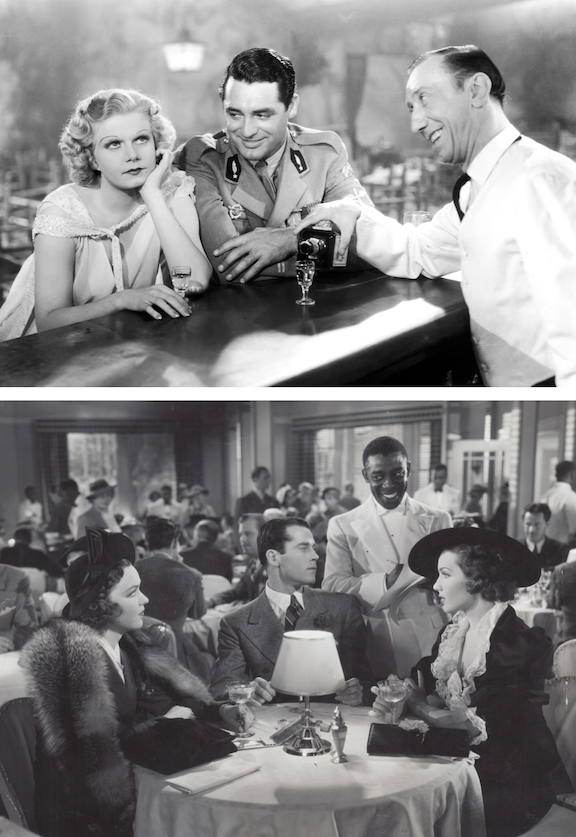
A WINNER AND A WIENER…Top, Jean Harlow, Cary Grant, and George Davis in Suzy; bottom: Henry Fonda is flanked by Pat Paterson (left) and Mary Brian in Spendthrift. (tcm.com/eBay.com)

See this post from Michael Maslin’s Inkspill about Maloney’s contributions to The New Yorker. Also, check out this photo below that includes Maloney (standing next to James Thurber):
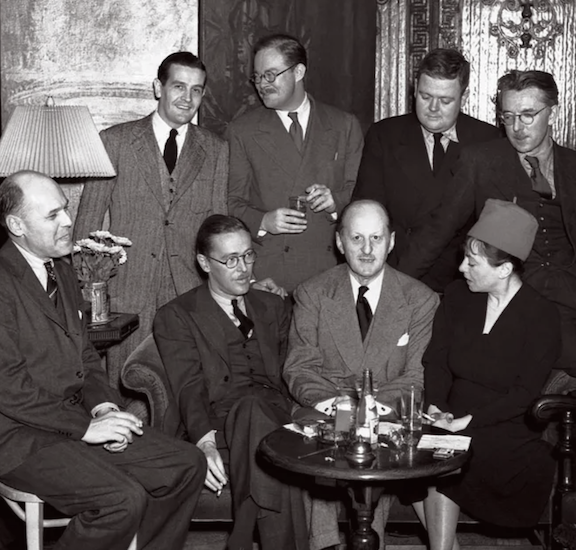
LITERARY CLUBHOUSE…Familiar New Yorker faces gathered for a cocktail party at the Hotel Algonquin to celebrate the success of Frank Case’s 1938 memoir, Tales Of a Wayward Inn. Seated, from left, are Fritz Foord, Wolcott Gibbs, Case and Dorothy Parker; standing, left to right, are Alan Campbell, St. Clair McKelway, Russell Maloney and James Thurber (untappedcities.com)

 * * *

From Our Advertisers

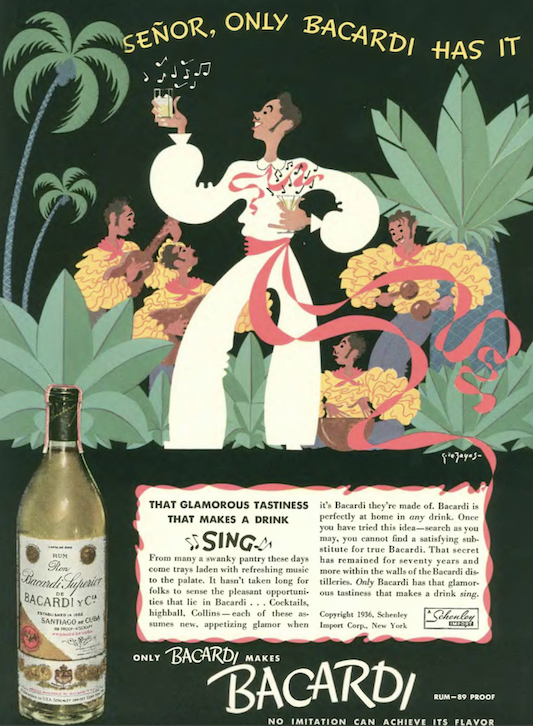
We begin with this colorful inside front cover advertisement for Bacardi rum, illustrated by George de Zayas, the younger brother of Marius de Zayas. Born in Mexico, these talented brothers took different artistic paths—Marius became a prominent avant-garde artist who collaborated with Alfred Stieglitz and others in New York, while George focused on commercial art and popular media…
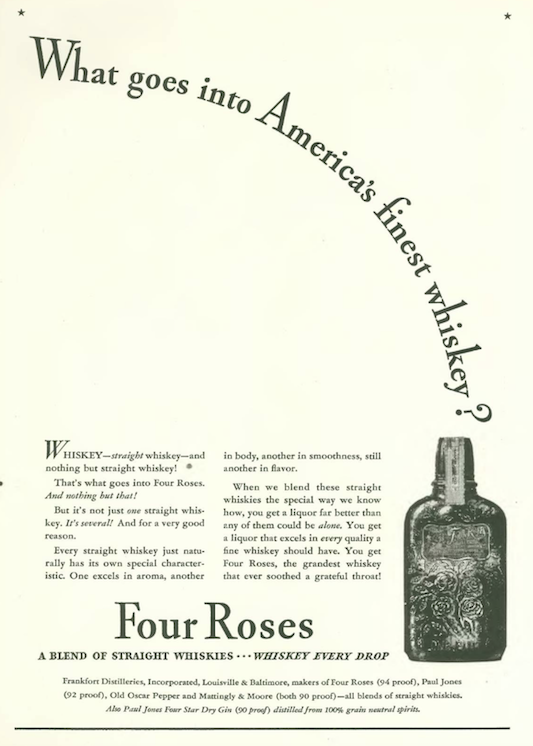
…this isn’t exactly avant-garde, but the makers of Four Roses added a modern twist to their usual traditional style…
…United Airlines offered overnight flights as well as “scenic” daylight flights from coast to coast (New York to San Francisco)…this flight typically took seventeen to nineteen hours, with refueling stops in Cleveland, Omaha, and Cheyenne/Salt Lake City…the planes were not pressurized, so they flew through the weather rather than above it…at least this plane (Boeing 247), according to the ad, had air-conditioning…

…for the more adventurous (and perhaps wealthier) traveler, you could hop aboard a Pan Am Clipper and head for Rio de Janeiro…in 1936, this flight from Miami to Rio took five days (flying in daylight only)…
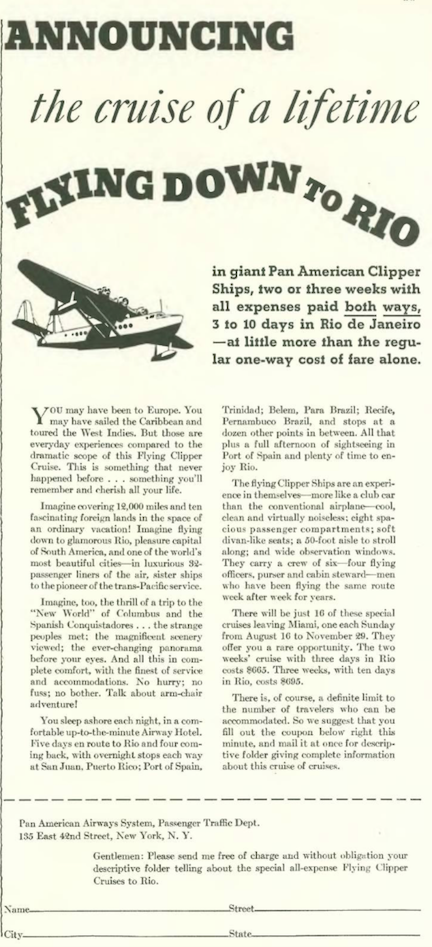
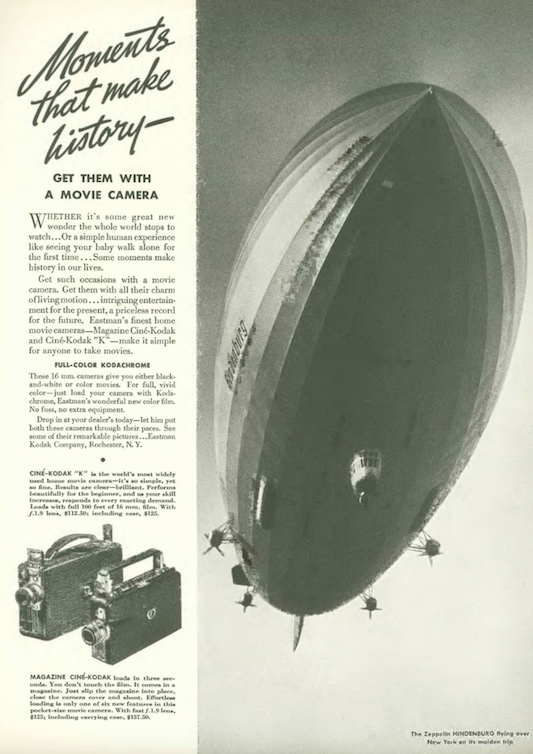
…a one-way ticket to Rio would have cost close to $11,000 in today’s dollars, while the equivalent $9,000 would get you a one-way ticket to Europe on the Hindenburg

…in the back of the book we find various food and cocktail diversions…
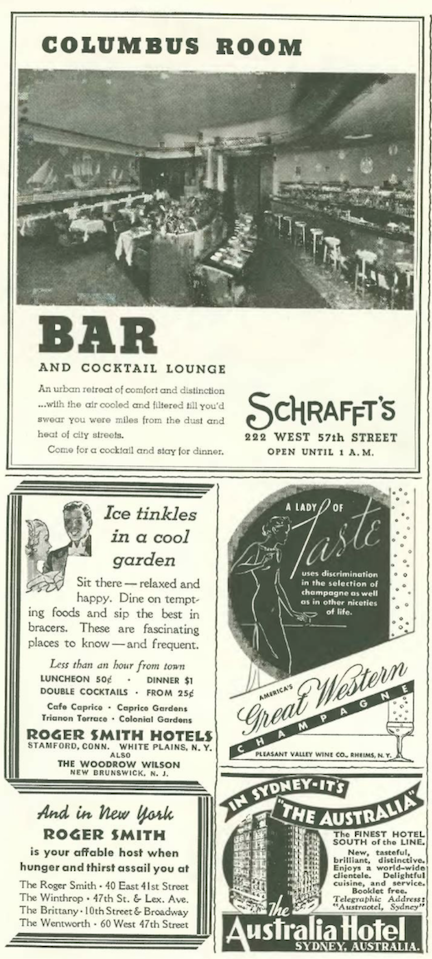
…and some one-column tennis-themed ads…”Johnson’s Tennis Gut” referred to the material used in the Thirties to string rackets…the strings were almost exclusively made from natural animal gut—commonly called “catgut,” though they were actually made from processed and twisted sheep intestines…

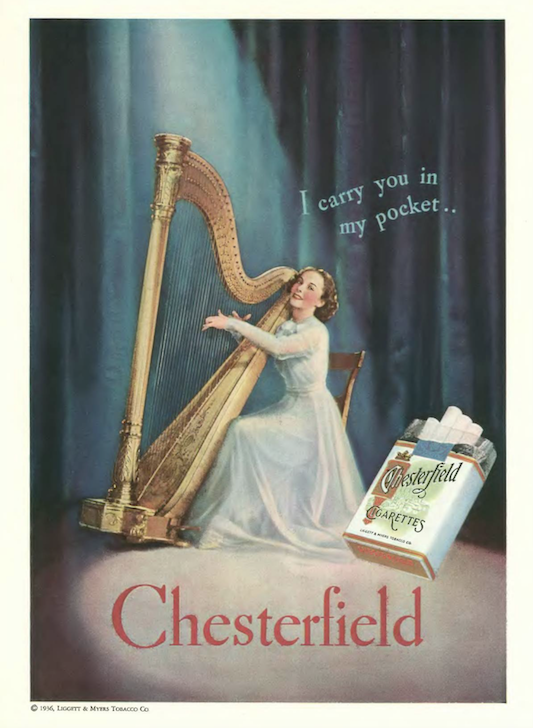
…Liggett & Myers claimed the back page to promote their Chesterfields to women smokers…one wonders if a racking cough interfered with her playing…
…on to our illustrators and cartoonists, we kick things off with spots by Adolph K. Kronengold

John Groth

Richard Taylor

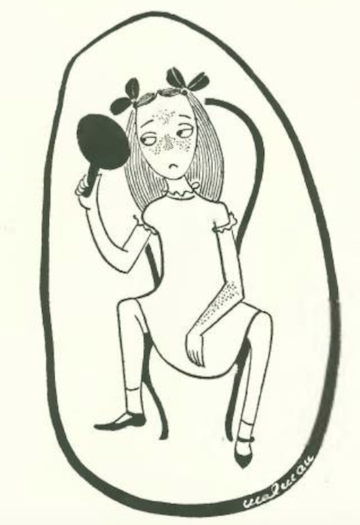
Christina Malman

…and Victor de Pauw

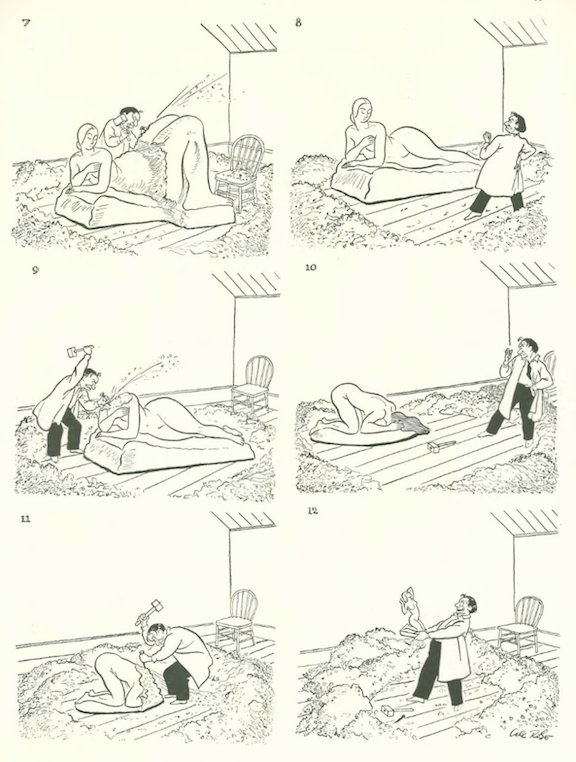
Carl Rose took us through a sculptor’s creative stages…

Helen Hokinson pondered a recipe for the day’s catch…

…and she checked out some summer reading (Warwick Deeping was a British writer of historical romances as well as books that defended the lifestyles of the bourgeoisie)…

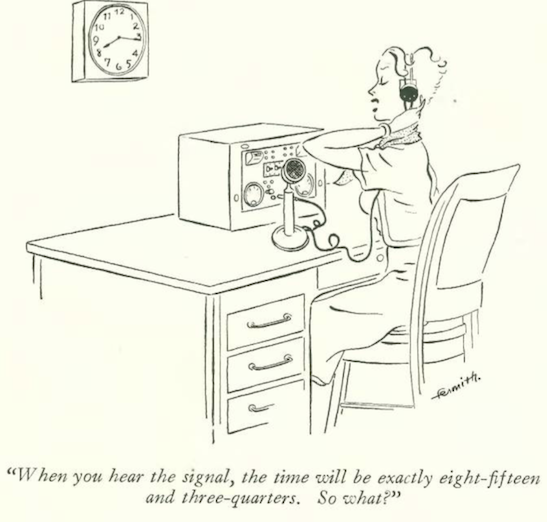
…this was F.E. Smith’s sole contribution to The New Yorker, and it’s pretty good…beyond that, I came up empty trying to find out more about the cartoonist…
…but we all know Leonard Dove (who contributed fifty-seven New Yorker covers and 717 cartoons)…here he’s keeping things quiet on the tennis court…

…and, of course, we have the great Charles Addams

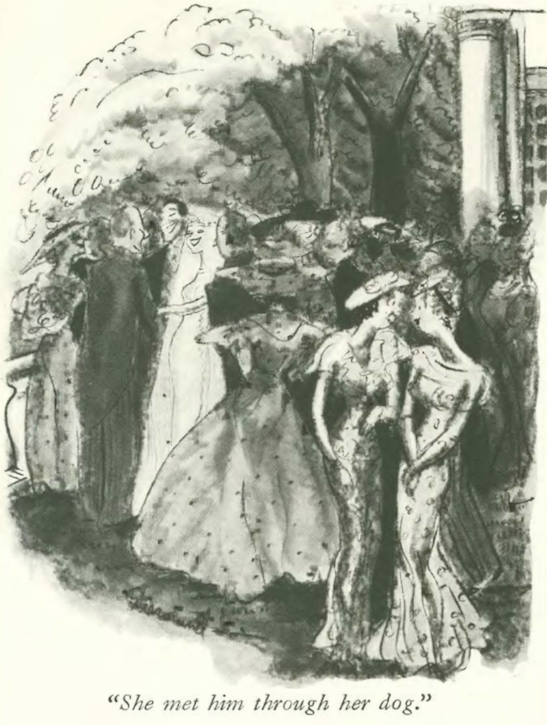
…we close with one of my favorite cartoonists, Barbara Shermund, keeping things light after the wedding…
Next Time: Men in Kilts…
That Tammany Taint

Above: The building that housed Manhattan's Democratic Party, known as Tammany Hall, circa 1935, and James Joseph "Jimmy" Hines, perhaps Tammany's most powerful leader. (wpsu.org/facebook.com)

Tammany Hall was founded more than two hundred years ago as an independent social organization serving the needs of New York City’s immigrants and Irish Catholics in particular. After the 1854 mayoral election, however, Tammany grew into a powerful political force, and for nearly a century controlled both city and state elections and the power of patronage that came with them.

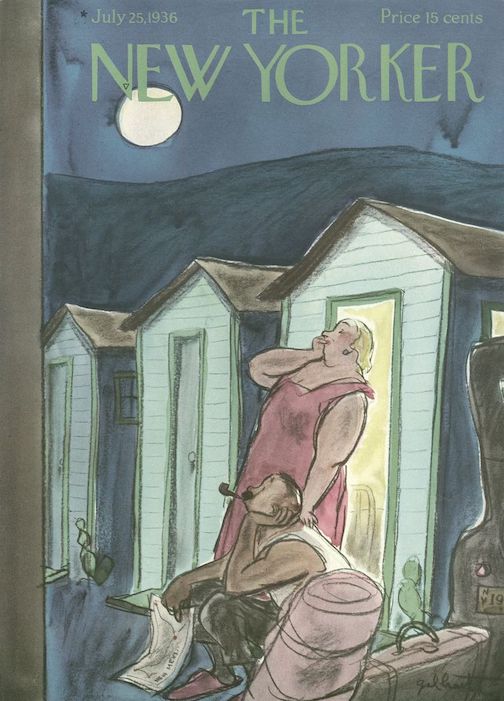
July 25, 1936 cover by William Crawford Galbraith.

It was no secret that political graft was rampant in the organization, but business leaders were happy to support Tammany’s corrupt practices as long as they served the bottom line. The same, it seems, also applied to politicians, law enforcement, and the courts, beneficiaries of political favors as well as outright bribes.

Few knew how to work Tammany’s levers better than James Joseph “Jimmy” Hines (18761957), who held absolute power over New York’s Eleventh District. Journalist Jack Alexander published Part One of a three-part profile on Hines for the July 25 issue. Excerpts:

SOBER REPORTING…Journalist Jack Alexander (1902–1975) was a reporter in St. Louis before joining New York’s Daily News in 1930. He later worked for The New Yorker and then moved to The Saturday Evening Post, where he became senior editor. He is best known for his groundbreaking 1941 article on Alcoholics Anonymous. (saturdayeveningpost.com)

Tammany was weakened when their scandal-plagued mayor, Jimmy Walker, was ousted in 1932 and eventually succeeded by reformist Mayor Fiorello LaGuardia. Hines, however, grew even more powerful as head of the U.S. Civil Service’s patronage system for Manhattan District employees. Ironically, Hines was appointed to the post by President Franklin D. Roosevelt, who saw Tammany as a liability but owed Hines a favor—in 1932 Hines split from other Democratic machine bosses (who initially favored Al Smith) to back Roosevelt’s bid for the presidency.

One person who was not tainted by Hines’ influence was Special Prosecutor Thomas E. Dewey, who in 1936 was busy going after New York’s rackets and Hines in particular.

William Auerbach-Levy provided the illustration for Part One of the Hines profile:

In these excerpts, Alexander noted Hines’ “ace in the hole” (the White House) when Tammany Leader James J. Dooling tried to oust him.

I’M GONNA GET YA…Clockwise from top left: In 1936 reformers looked to Special Prosecutor Thomas E. Dewey to fight New York’s entrenched rackets; Jimmy Hines (right) leaves the courthouse after a 1938 mistrial; Hines was accused of having close ties with mobsters Dutch Schultz and Lucky Luciano among others; Hines with his attorney, Martin Littleton, after leaving Tombs Prison on April 4, 1939—he was released on $35,000 bail pending an appeal for his conviction as a political fixer for the numbers racket. Hines would lose the appeal—convicted on thirteen counts of racketeering, he would be imprisoned at Sing Sing until 1944. (alchetron.com/facebook.com/Wikipedia)

Despite his misdeeds, Hines’ many admirers remained faithful to him until his death in 1957 at age 80. Many recalled his annual “June Walk” from the days before he went to prison. According to his New York Times obituary, the annual event in Central Park drew as many as twenty-five thousand women and children, who “listened to half a dozen brass bands, put on paper hats and gorged themselves on ice cream, hot dogs and pop furnished by Hines, who used to take part in the fun wearing the gay green bucket hat of the stage Irishman.” The obituary noted that when Hines left Sing Sing prison, a guard said, “Best of luck. Jimmy! Give my regards to the missus!”

 * * *

At the Movies

Critic John Mosher found the perfect distraction from the summer heat in the Mary Boland–Charlie Ruggles comedy Early to Bed:

SILLY SOMNAMBULIST…From left, Mary Boland, Charles Ruggles and Colin Tapley in Early to Bed. (Pinterest)

Mosher also reviewed a Nero Wolfe mystery starring Edward Arnold, and a rather “slight” romance featuring an heiress with a penchant for speeding.

HOMEBODY…Rex Stout’s portly detective Nero Wolfe loved to solve crimes without venturing from the comforts of home. Clockwise, from top left; Edward Arnold (as Wolfe) with John Qualen, Lionel Stander, and Dennie Moore in Meet Nero Wolfe; eighteen-year-old Rita Hayworth (credited as Rita Cansino) appeared in several Nero Wolfe scenes as she continued to build her résumé at Columbia; an heiress with a lead foot runs afoul of a traffic cop (Randolph Scott) who eventually falls in love with her in “And Sudden Death; Frances Drake as the heiress in a scene with Tom Brown. (dancinglady39.wordpress.com/csfd.cz)

 * * *

Genteel Sport

The New Yorker featured a variety of sports in its early years, most of them elite pastimes except for hockey, college football and boxing. Save for the occasional mention of Babe Ruth’s antics (and his 1926 “Profile”) and a scattering of cartoons and spots, the game was conspicuously absent from the magazine during the Yankees’ “Murderers’ Row” years in the late 1920s and beyond. I’ve read that editor Harold Ross hated the game, but perhaps the real reason was explained by James Thurber in his “Talk of the Town” piece titled “Peanuts and Crackerjack” (September 22, 1928). Thurber described Yankees baseball as a mass spectacle for out-of-towners who were “a bit mad.” It wasn’t cool to be a Yankees fan if you counted yourself among Manhattan’s smart set.

G.O.A.T. HERD…Less than a month after James Thurber published “Peanuts and Crackerjack,” the New York Yankees would sweep the St. Louis Cardinals in The World Series. The 1928 Yankees set a major league record by having nine players on the team who would eventually be elected to the Hall of Fame. (Wikipedia)

Basketball was also missing from those early issues of The New Yorker, even though it had been played since the 1890s. So we turn to New Yorker cartoonist and author Michael Maslin (via his essential Ink Spill), who recently noted The New Yorker’s very first basketball-themed cartoon by Robert Day (Dec. 23, 1933). The post also features Abe Birnbaum’s terrific 1951 basketball-themed cover and a hilarious MAD magazine parody of Charles Addams.

The elite sports that dominated the back half of the magazine in those early years included golf, tennis, badminton, squash, yachting, rowing, horse hunts and horse racing, and polo (both indoor and out).

Lets look at a couple from the July 25 issue, beginning with these brief excerpts from the “Polo” column authored by “Backhander”—a generic pen name that referred to a rotating cast of polo correspondents including Robert F. Kelley, George F. T. Ryall and Tom O’Reilly (who covered indoor polo).

ELECTRIC HORSEMEN…At left, the Jaipur Polo team (shown here in England in 1933) won all the open tournaments between 1930 and 1938 in India and England. From left is Maharaja Swai Man Singh of Jaipur State and Rao Raja Hanut Singh, Rao Raja Abhey Singh and Colonel Prithvi Singh of Baria; at right, international polo star Laddie Sanford was the dynamic patron and captain of the famed Hurricanes, which won the U.S. Open in three different decades. (The Rajputs via Facebook/polo museum.org)

The “Yachts and Yachtsman” column was also signed by a pen name—”Bosun”—signifying any staff writer assigned to boat races or boat shows. In this case the writer was H. K. Rigg, who covered the start of the 1936 Larchmont Race Week, one of the most successful and heavily attended spectacles in the early history of yacht racing.

ON YOUR MARK…Photo above depicts the start of the July 21, 1936 Larchmont Yacht Club Race. The 1936 event is remembered for its massive turnout—300 boats duelling through crowded waters. In the Aug. 1, 1936 issue of The New Yorker, H. K. Rigg wrote that a “sausage balloon” was needed just to see over the congested fleet. (Rosenfeld Collection via newyork32.org)

 * * *

From Our Advertisers

A couple of issues ago we looked at the Advertising Federation of America’s “truth in advertising campaign” (Better Living Through Fiction) that sought to forestall government regulation. On June 29, 1936, the AFA hosted more than a thousand ad executives in Boston, where the head of advertising at Scripps-Howard criticized competitive selling among papers (it hurt them in competition with other media). Newspaper ad executives were urged to work together as a profession, and that likely explains this lavish two-page spread in The New Yorker

…as well as this full-page appeal from the Chicago Daily News

…and this spot from the Philadelphia Evening Bulletin

Dr. Seuss was still honing his style in ads for Flit insecticide…

…this White Rock ad featured the work of two artists…the prolific R. John Holmgren famously illustrated White Rock ads in the 1930s and 40s, often featuring the “tiny Colonel,” seen below regarding the original painting of Psyche at Nature’s Mirror by German artist Paul Thumann…the owners of White Rock bought the rights to the painting after seeing it at the Chicago World’s Fair in 1893 and adopted Psyche as their trademark…Holmgren would incorporate a modernized version of Psyche in dozens of ads…

…on the inside front cover Seagram’s referenced the character of Thomas Jefferson as an apt metaphor for their product…

…and on the back cover the makers of Luckies kept it simple with this colorful appeal to the growing market for women smokers…

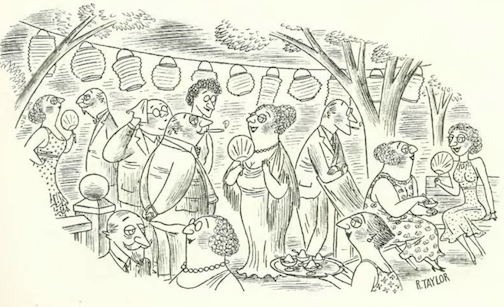
…on to our cartoonists, we begin with another installment of “Limericks” by Morris Bishop featuring the unique style of cartoonist Richard Taylor

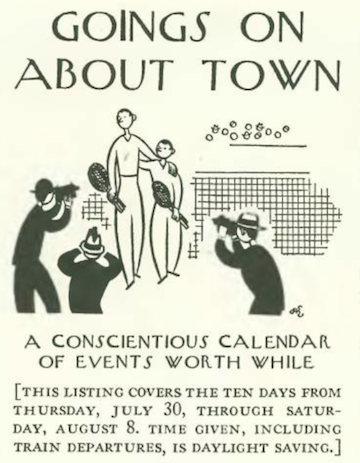
Alain helped open things up for the events calendar…

…as did Susan Willard Flint with her woodcuts…

Ned Hilton offered a new wrinkle in a familiar game of skill…

…and Hilton again, preparing for take-off…

Carl Rose used a double spread to illustrate a singles match…

Alan Dunn illustrated a familiar problem of the electric age…

…and Dunn again with some realtor trickery…

Helen Hokinson looked to an Eastern ascetic for some sage advice…

…and found one of her “girls” overdressed for an outing on the Thames…

Rea Irvin celebrated the genius of American marketing…

…and we end with Peter Arno, and his unique view of matrimony…

Next Time: A Letter From Berlin…