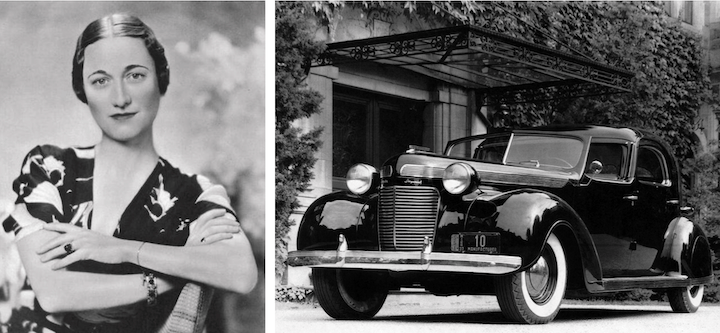
Some New Cars and Mrs. Simpson

Above: The November 14, 1936 issue of The New Yorker had something for everyone, from gossip about Wallis Simpson (soon to dethrone the King of England) to one of New York's grandest auto shows, featuring such luxury models as the 1937 Chrysler Imperial—the Imperial, along with several other models, introduced the single-piece clamshell hood, which opened from the front rather than from the sides. (thehistorypress.co.uk/eBay.com)

After some rather thin issues over the summer, The New Yorker began bulking up for the holidays, stuffed with colorful advertisements related to the New York Auto Show and the approaching holiday season. Arts, entertainment and society were also in full swing, and the overall mood seemed to be lighter as the economy saw its best year since the market crash.
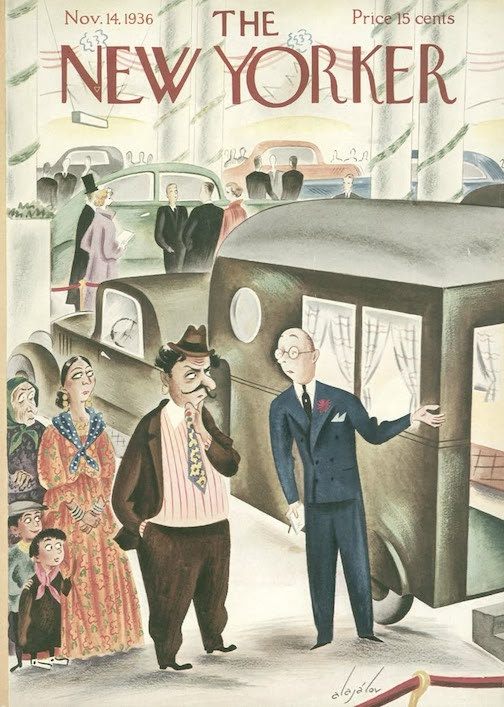
November 14, 1936 cover by Constantin Alajalov.

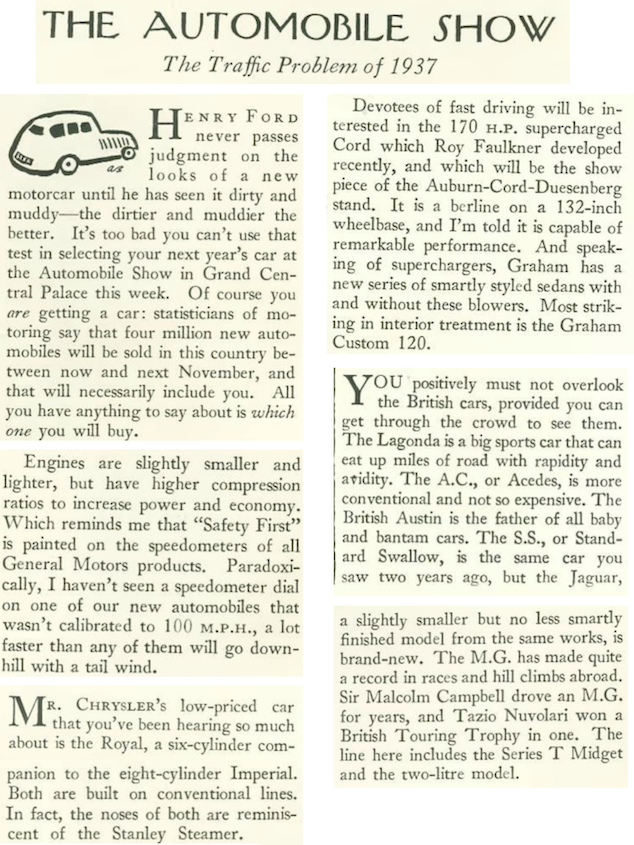
Always a big event, the Automobile Show at the Grand Central Palace drew massive crowds to Midtown, where visitors were treated to a gleaming array of foreign and domestic cars. Here are some excerpts from a lengthy review by George F.T. Ryall, using the pen name “Speed.”

SPEED DREAMERS…Clockwise, from top left, a 1937 Chrysler Royal Convertible Sedan with the newly introduced clamshell hood; detailed view of the Royal’s speedometer—Ryall noted that he hadn’t seen a speedometer at the show that wasn’t calibrated to 100 mph, “a lot faster than any of them will go downhill with a tailwind,” he noted; cars at the show actually capable of that speed included Britain’s 1937 Lagonda LG45 Rapide Tourer and the supercharged 1937 Cord 812. (Bill Gilbert via facebook.com/hemmings.com/simeonemuseum.org)
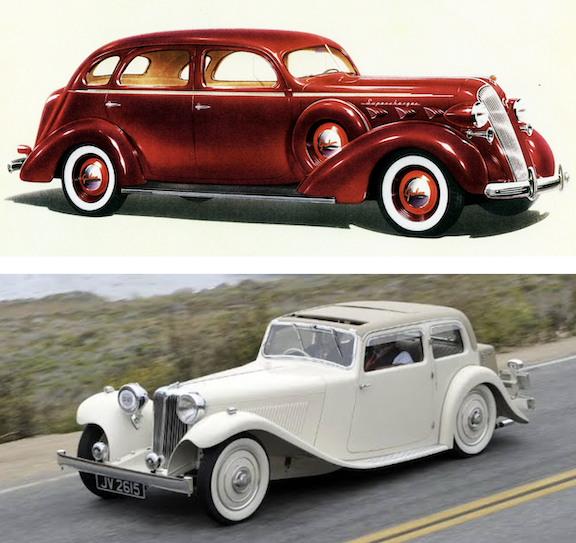
HOME AND ABROAD…Evansville, Indiana-based Graham-Paige showcased the 1937 Graham Custom Series 120 Supercharger (above) at the auto show, which also featured the 1936-37 Standard Swallow “Jaguar”—Standard Swallow, also known as SS Cars Ltd., was the direct predecessor to the Jaguar line of cars. (Wikimedia/Paul O’Brien via facebook.com)
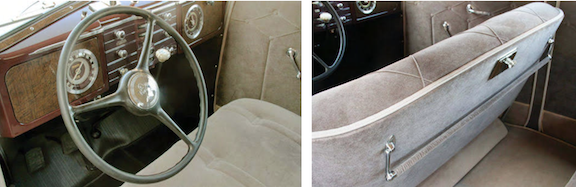
COZY…Ryall singled out the interior of the Graham-Paige, which featured a mahogany dash and quilted upholstery. (autorestorer.com)

Ryall also noted the General Motors display at the Waldorf, a Lincoln Salon at the Park Lane, and the International Salon at the Chrysler Building, which featured a revolving floor:
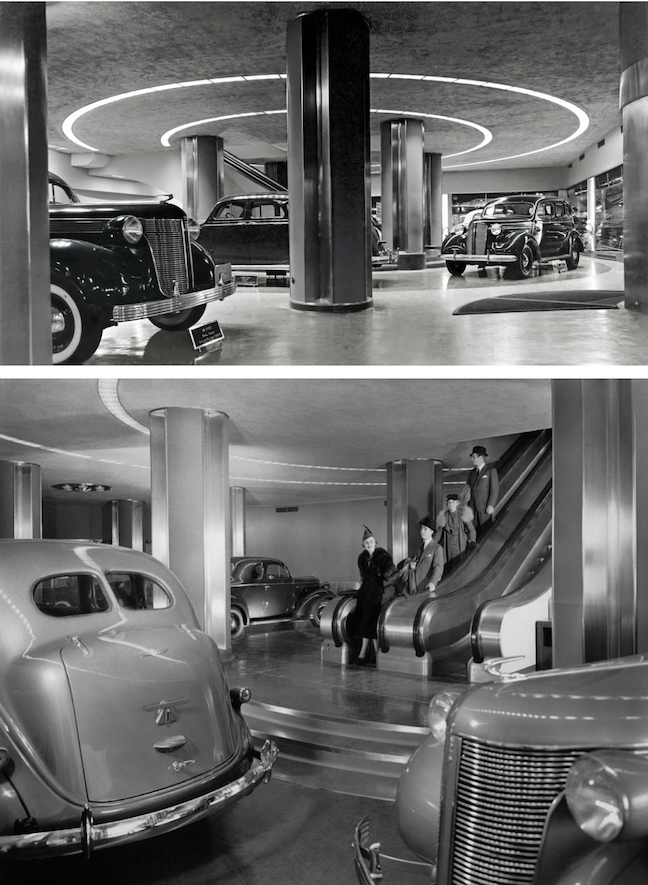
DIZZYING DELIGHTS…The Chrysler Building once had an auto showroom that occupied the first two floors of the lobby—the lower level (bottom photo) even featured a revolving floor. Both photos from 1936. (loc.gov/tumblr.com)

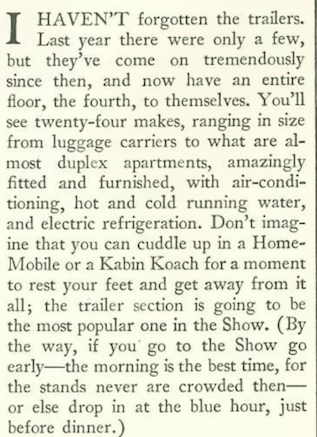
Camping trailers were coming into their own in 1936, evident in the large exhibit at the Auto Show featuring twenty-four different makes. Ryall again:
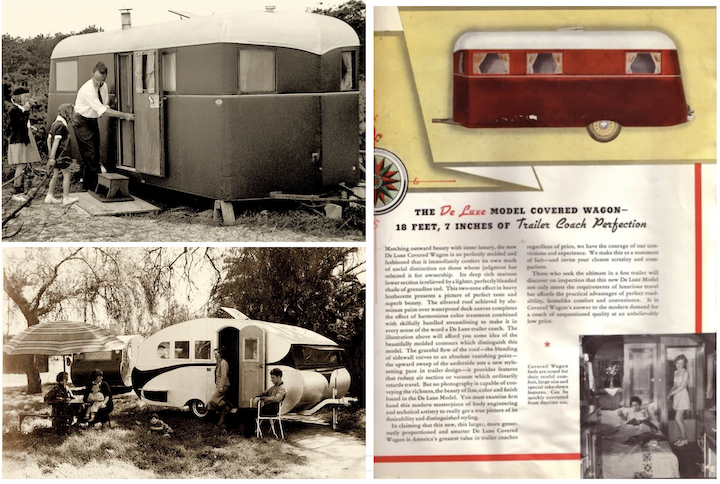
EARLY GLAMPERS…Clockwise, from top left: The market leader during the 1930s was Covered Wagon—this is a 1936 model; images from from a 1936 Covered Wagon catalog; a “canned-ham” style trailer from the 1930s. (hemming.com/thevintagetraveler.wordpress.com)

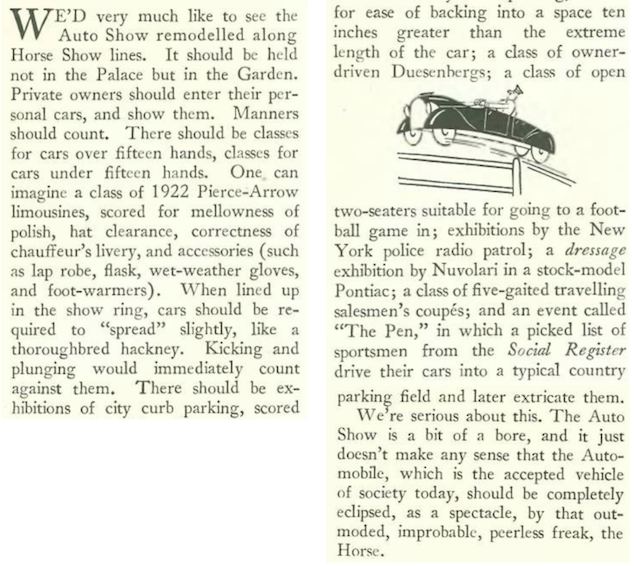
I would have been surprised if E.B. White didn’t have something to say about the auto show. He famously detested newer cars, preferring his Model T with all its quirks. In his “Notes and Comment,” White called the exhibition “a bit of a bore.”
 * * *

The Game’s Afoot

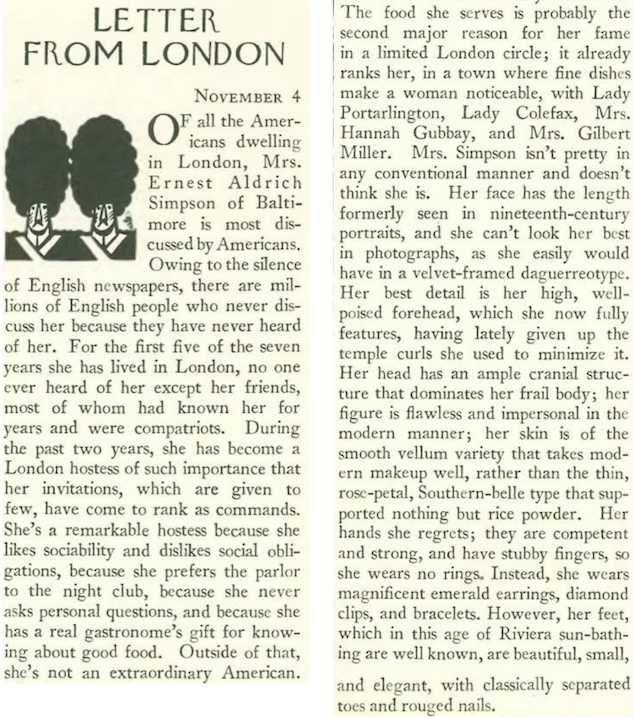
When Janet Flanner filed this gossipy report from London, Wallis Simpson was known for being an unusually prominent American in London society. Why Flanner decided to write about Simpson at this time suggests that she likely knew about the scandal brewing behind the scenes regarding Edward VIII’s desire to wed Simpson. One supposes that along with the London papers, Flanner observed a self-imposed silence on the matter.
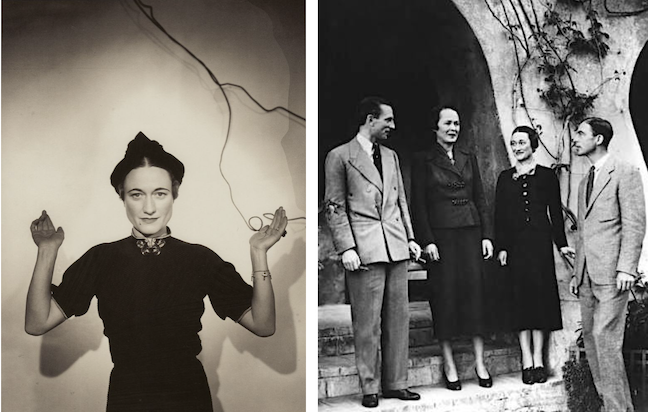
SPELLBINDER?…At left, 1936 photo of Wallis Simpson by Cecil Beaton; at right, Simpson with close friends Herman and Katherine Rogers, her hosts at the Villa Lou Viei in Cannes during Edward’s abdication crisis. On the right of the photo is Lord Brownlow. (Wikipedia/pinterest.com)

Here’s another excerpt from Flanner’s letter, detailing Simpson’s gastronomic skills.
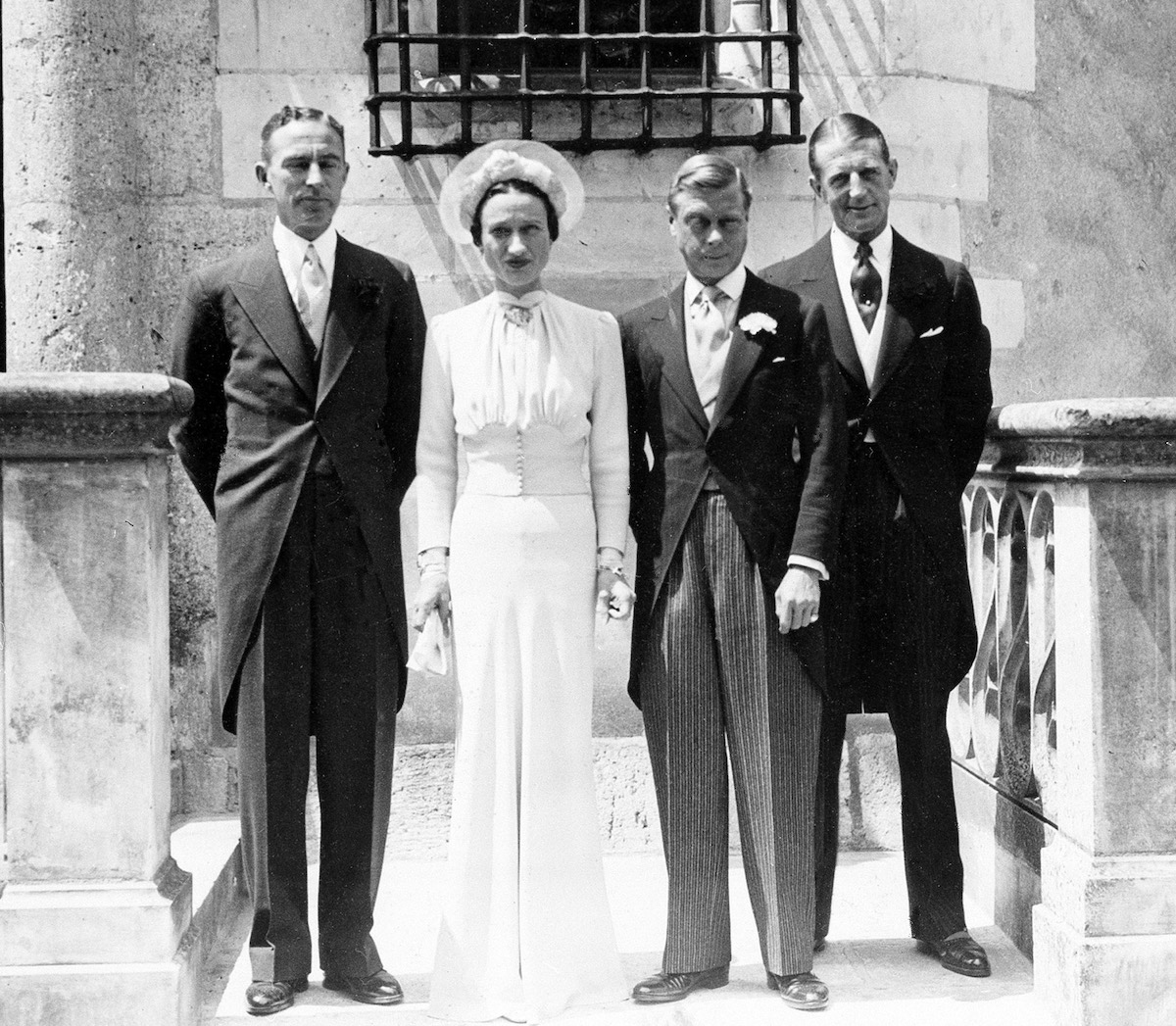
NOW HE’S GONE AND DONE IT…The Duke and Duchess of Windsor pose after their wedding at Chateau de Cande near Tours, France, on June 3, 1937. At left is Hermann Rogers Winters and at right is Major Metcalf, first former King of England’s witness. (AP Photo)

 * * *

Up In Smoke

“The Talk of the Town” commented on the soot and other pollutants that routinely befouled the air in Manhattan. In the 1930s most apartments, commercial buildings, and power plants burned coal for heat and power, and during the Depression folks turned to burning a cheaper coal that spewed forth dense, oily smoke. According to “Talk,” coal-driven air pollution deposited more than 150 tons of soot per square mile in some of the worst areas, such as along the East River where factories and power plants emitted thick plumes. Here’s an excerpt:
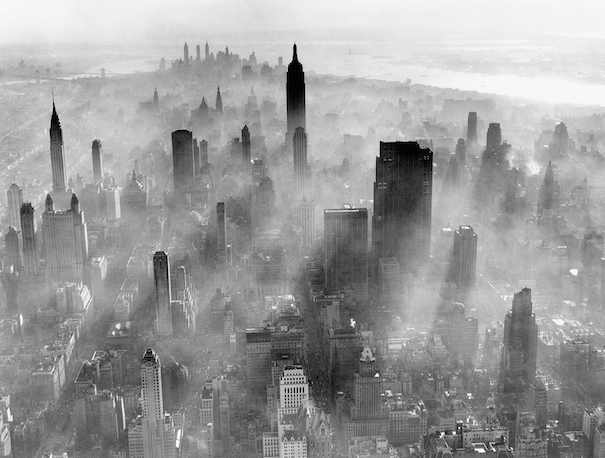
ON A CLEAR DAY YOU CAN SEE FOR MILLIMETERS…Smog over Manhattan, 1940. (airphotos.org)

 * * *

Suckers and Subscribers

Robert Benchley’s Nov. 14 “Wayward Press” column took aim at the politically slanted, sensationalized coverage by various newspapers regarding the general election, misleading voters into believing the presidential race was much closer than it turned out to be (a Franklin D. Roosevelt landslide over Alf Landon). In these excerpts Benchley called out publisher William Randolph Hearst in particular:
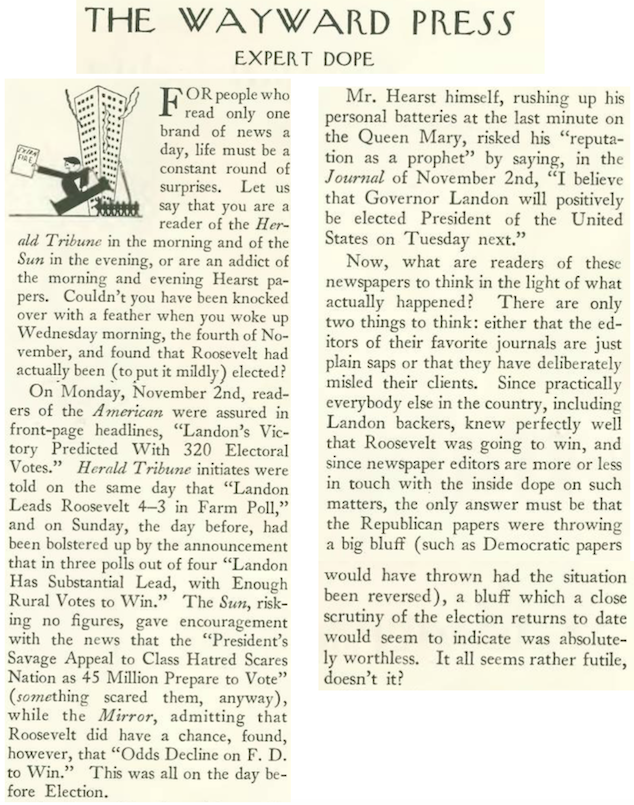
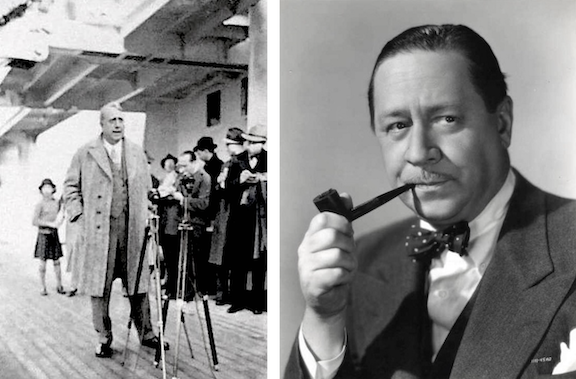
HAVING NONE OF IT…During a press conference on the deck of the HMS Queen Mary, publisher William Randolph Hearst stated that “Governor Landon will positively be elected President of the United States on Tuesday next.” Robert Benchley quipped that Hearst “risked his reputation as a prophet” with the rushed pronouncement. Benchley debuted “The Wayward Press” column on press criticism in 1927 (originally titled “The Press in Review”) and famously signed the column under the pen name “Guy Fawkes.” (Facebook.com/americanheritage.com)

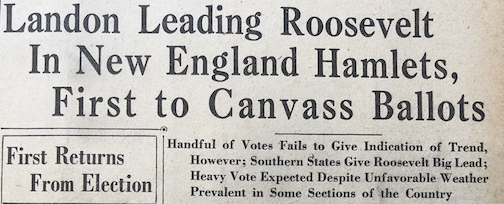
Early editions of many newspapers anticipated a Landon victory—a headline from the Amsterdam Evening Recorder:
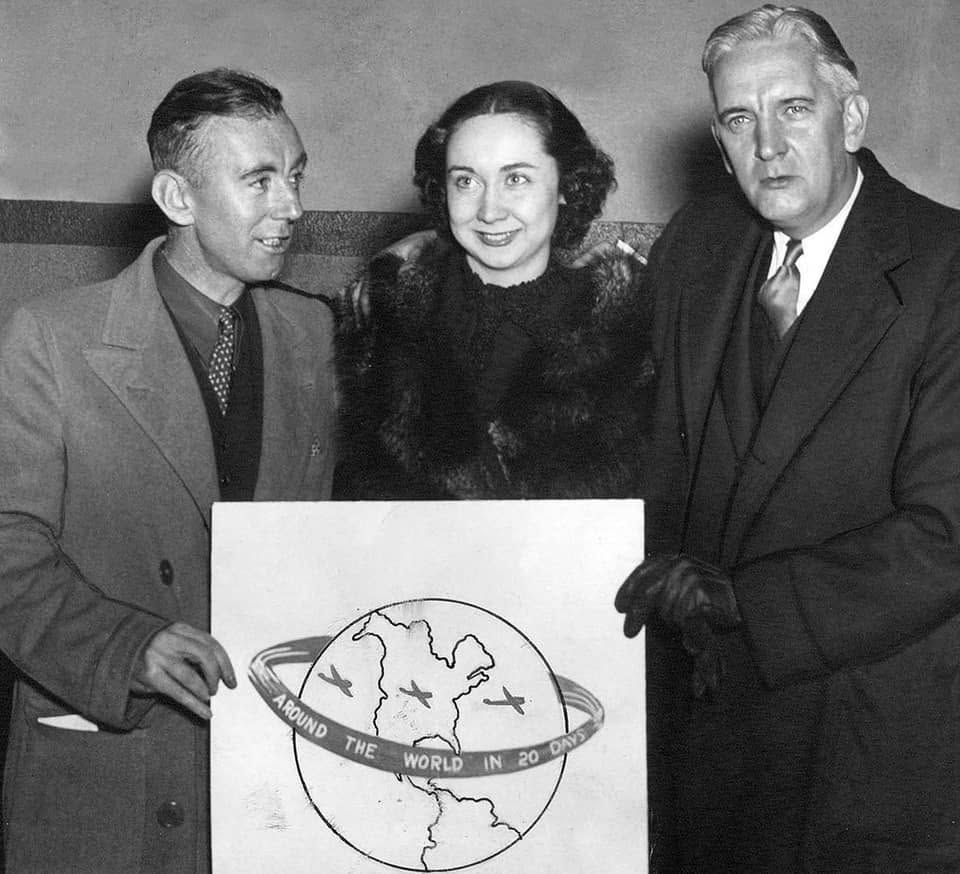
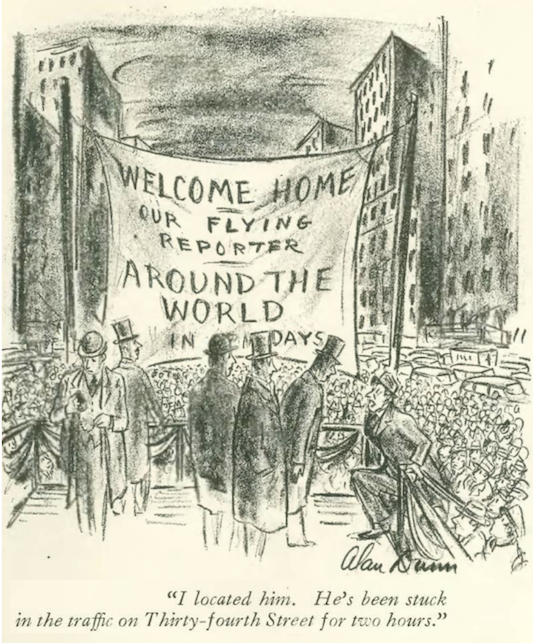
Benchley observed that “the public likes to have its leg pulled,” and noted the example of a much ballyhooed “race around the world” that featured three New York newspaper reporters competing to prove commercial air travel was fast and accessible to the public (and, of course, boost circulation for their newspapers).
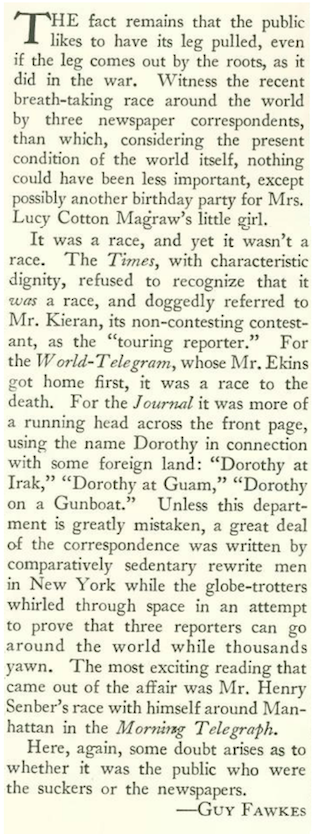
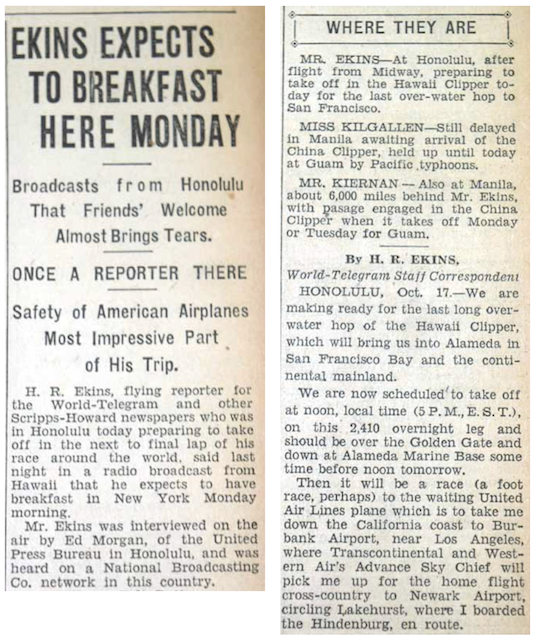
Above: Clips from the Oct. 17, 1936, edition of the New York World-Telegram heralded the arrival of reporter Herbert Roslyn “Bud” Ekins.
STUNT FLYERS…From left to right: Leo Kieran of The New York Times, Dorothy Kilgallen of the New York Evening Journal, and Herbert Roslyn “Bud” Ekins of the New York World-Telegram competed in the “1936 Race Around the World” (also known as “Around the World in 20 Days”). All three journalists started the race by departing together across the Atlantic aboard the German airship Hindenburg. Robert Benchley concluded, “…some doubt arises as to whether it is the public who were suckers or the newspapers.” (Dorothy Kilgallen Fans vis facebook.com)

 * * *

The Inevitable Picasso

Lewis Mumford checked out a couple exhibitions featuring both old and newer works by Pablo Picasso. Mumford surmised that some of these painting “will survive as art, great art” while the rest will “survive as history,” observing that Picasso was both victim and master of a fashion of his own creation.
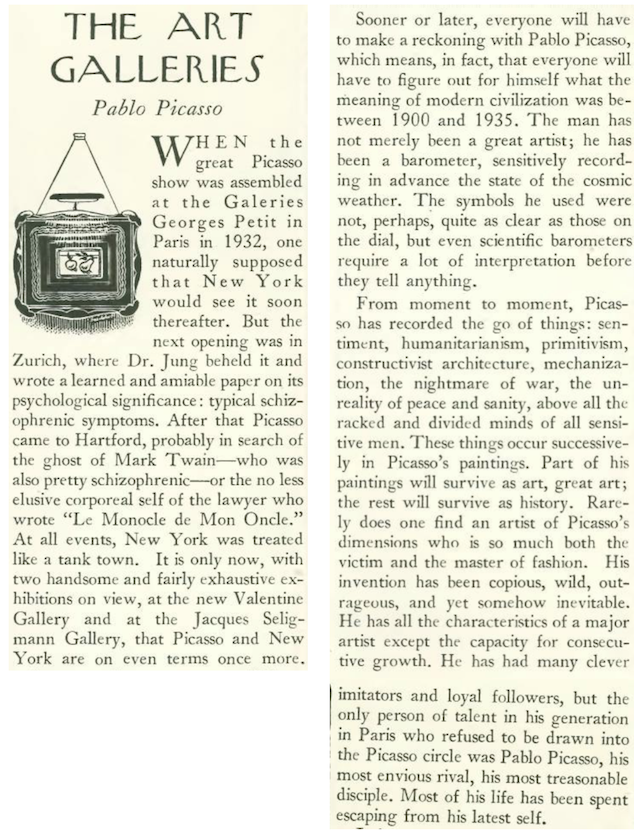
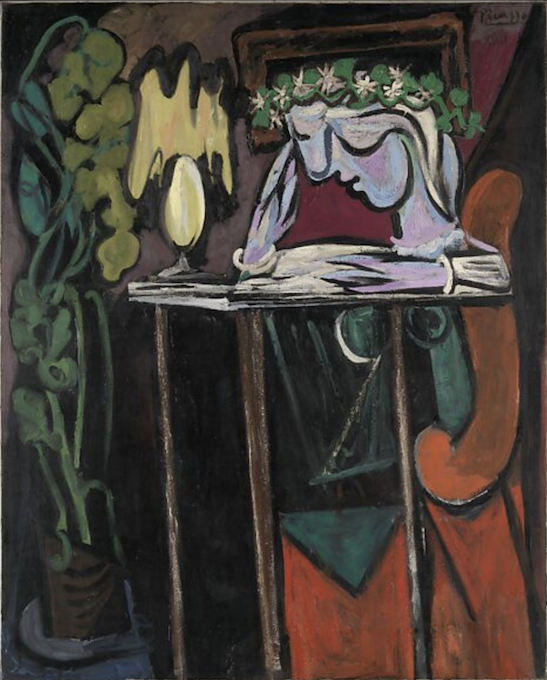
RECKONING WITH PICASSO…Pablo Picasso’s Femme écrivant (1934) was among works critic Lewis Mumford viewed at the first of three Picasso retrospectives held at the Valentine Gallery between 1936 and 1938. (Metropolitan Museum of Art)

 * * *

At the Movies

John Mosher took a look at the latest Shakespeare play adapted to film—As You Like It featured Laurence Olivier as Orlando (his first Shakespearean film role), and Elisabeth Bergner as Rosalind. Mosher praised the film’s “affable” and “unpretentious air.”
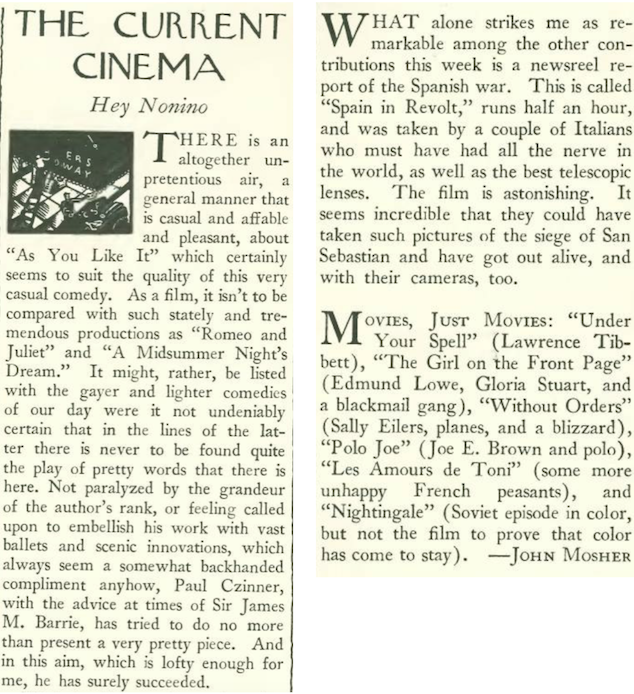
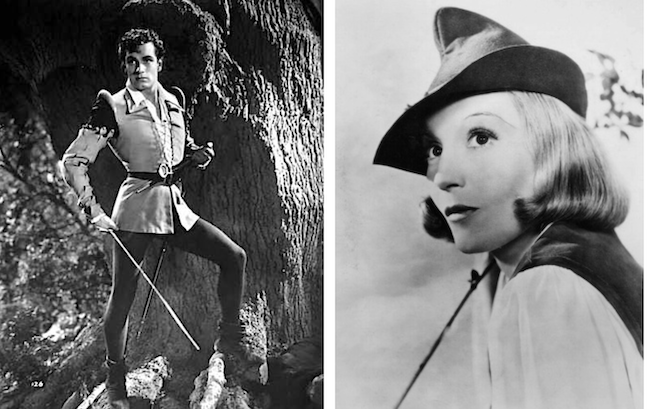
DEBUT…The role of Orlando in As You Like It was Laurence Olivier’s first Shakespearean film role—he would become famous for his Shakespeare trilogy (Henry V, Hamlet, and Richard III), but in 1936 Elizabeth Bergner (right, as Rosalind) was the bigger name in the production. (Folger Library/pinterest.com)

Mosher also reviewed the “astonishing” documentary Spain in Revolt (España 1936), which featured harrowing scenes from the civil war between Fascists and Republican government loyalists.
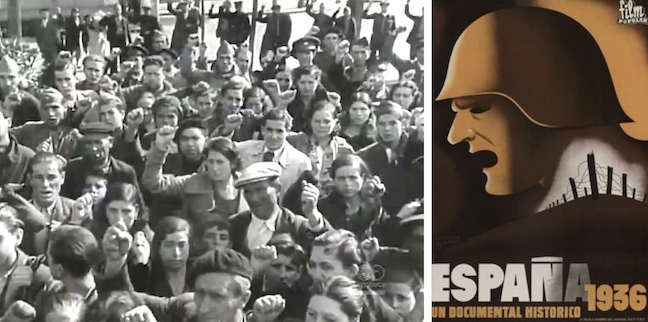
THE HELL OF WARFARE…Still image from Spain in Revolt (España 1936), which featured scenes of the Spanish resistance to Fascists and gut-wrenching images of death and destruction wrought by Nazi bombardments. (YouTube.com/imdb.com)

 * * *

From Our Advertisers

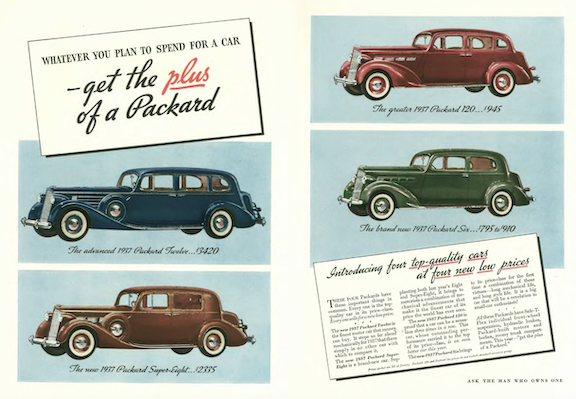
The beancounters at The New Yorker had to love this time of year…with the holidays approaching and the big car show in full swing the magazine ballooned to nearly 150 pages…there were splashy two-page ads from a number of automakers, including Packard…
…and Cadillac…
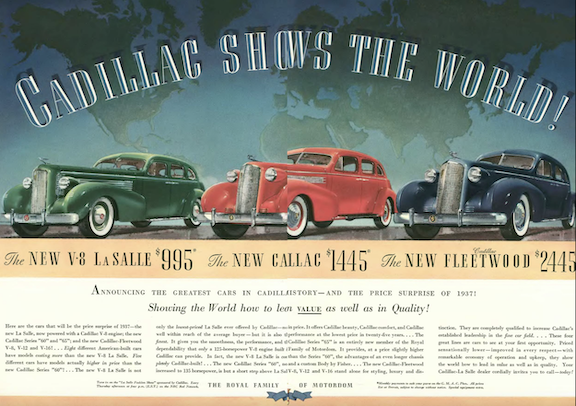
…unlike Packard and Cadillac, who offset losses on their luxury models by offering lower-priced cars (the Packard Six and LaSalle, respectively), Pierce-Arrow stuck with their pricy model (which some considered America’s answer to the Rolls Royce)…at this point Pierce-Arrow was on the brink of collapse, and that’s probably why they tacked on the ad to the right to promote their travel trailer…
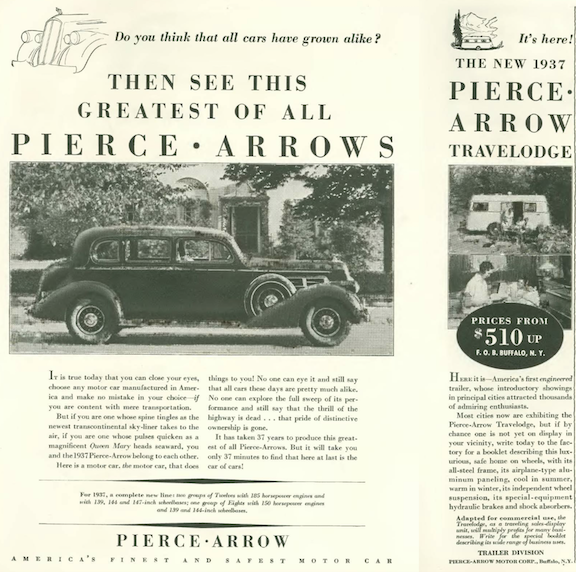
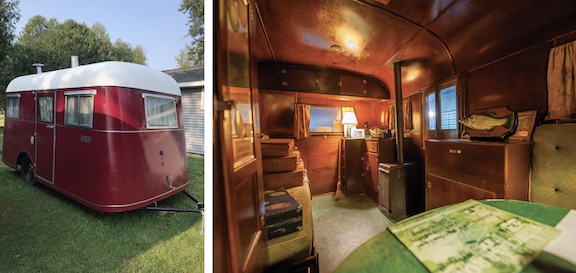
The 1937 Pierce Arrow Travelodge. (hagerty.com/tincantourists.com)

…bargain hunters could snap up a tomato-red Studebaker for a mere $665 (about 16k today)…pictured here is a “Dictator Six” coupe…for obvious reasons the company renamed the car “Director” in 1937…
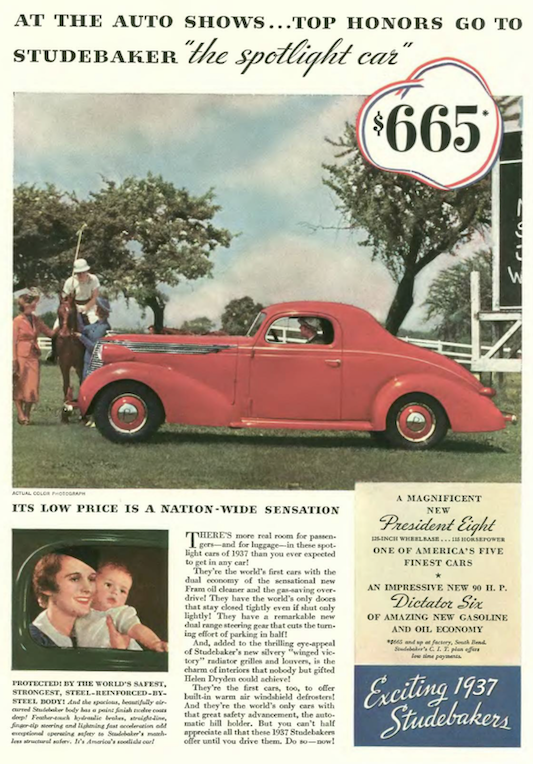
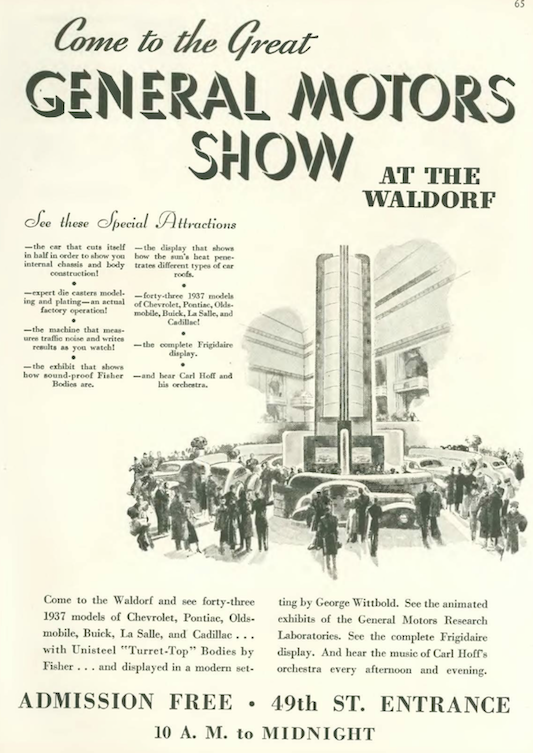
…automakers emphasized the glamour of the event, which was staged at the Grand Central Palace with satellite locations including the Waldorf…
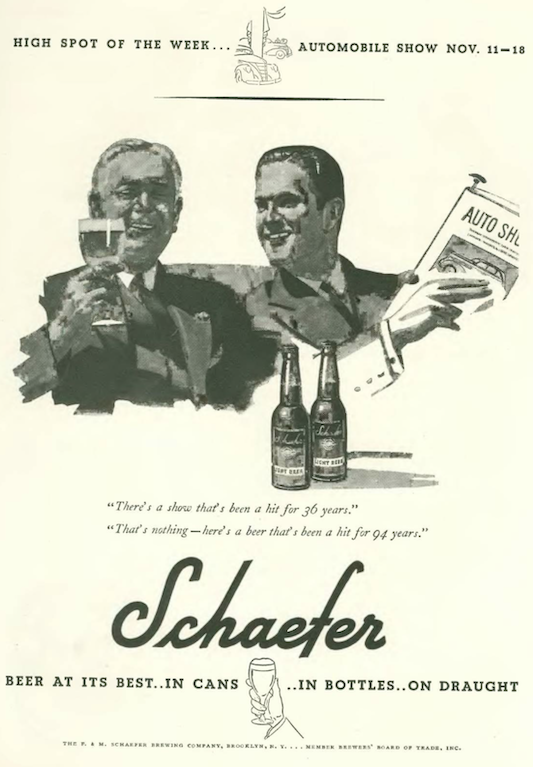
…even breweries latched on to the excitement of the auto show…
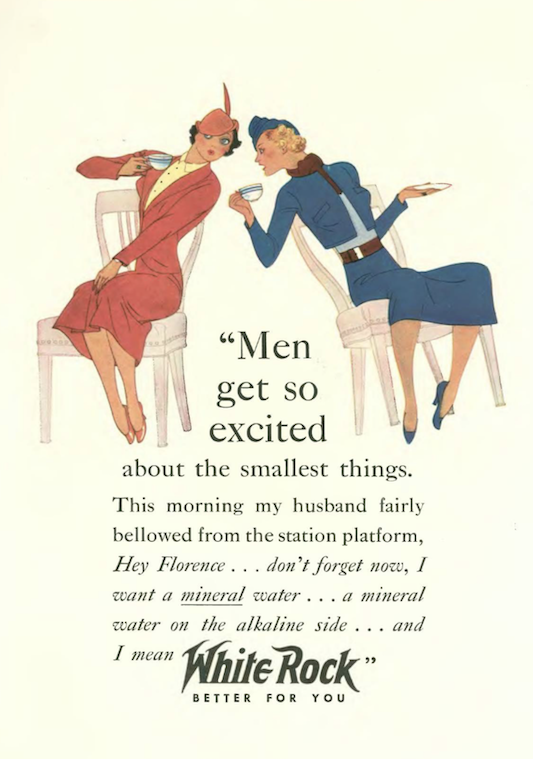
…White Rock continued to brighten the magazine with their colorful spots…
…in sharp contrast, the makers of Schick electric shavers felt the need to take out this dull, wordy full page ad to tout a recent court hearing in favor of their “basic patent”…

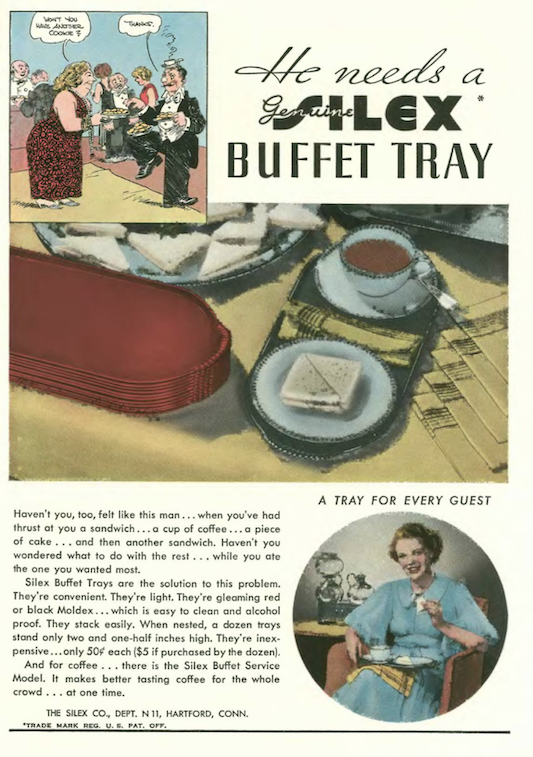
…certainly more exciting were these genuine Silex buffet trays, which seemed to suddenly be all the rage…the little cartoon in the top corner looks like it could have been drawn by Billy DeBeck (Barney Google) or someone of that ilk…
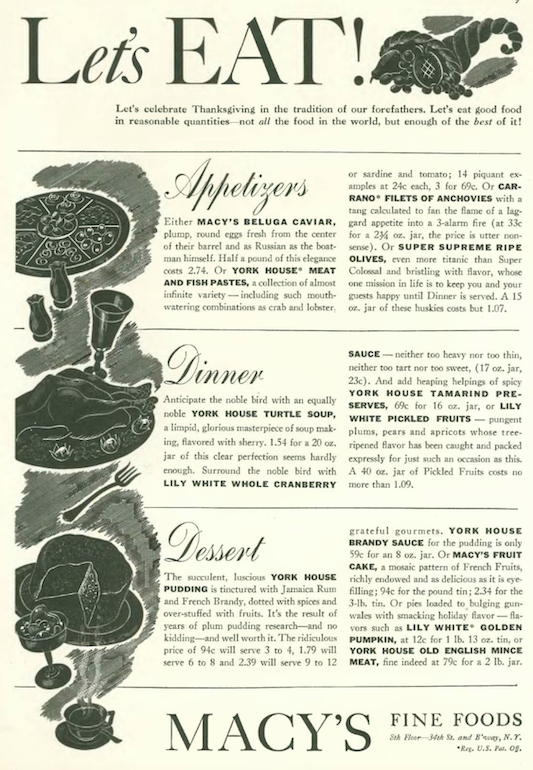
…Macy’s reminded readers that they were about more than just clothing, housewares and toys…
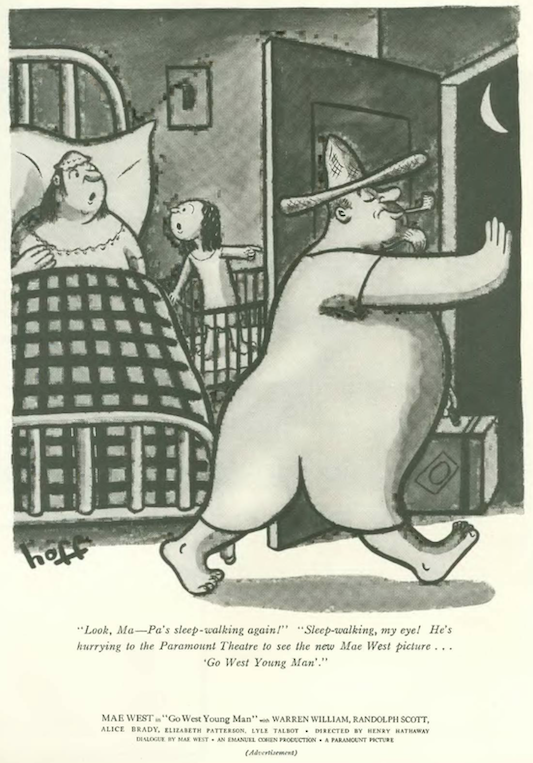
…and Syd Hoff drew up this cartoon to promote Mae West’s newest film, Go West Young Man…
…on to our illustrators and cartoonists, we open with Victor de Pauw…
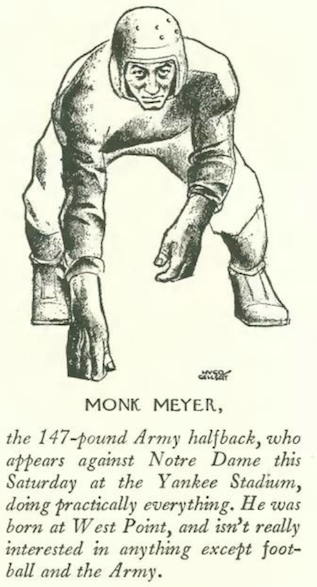
…Hugo Gellert (with a mini-bio of 147-pound halfback Monk Meyer)
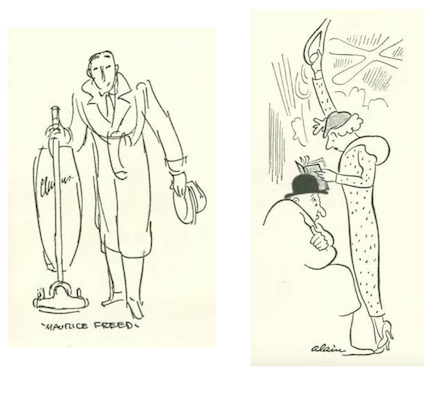
…spots by Maurice Freed and Alain…
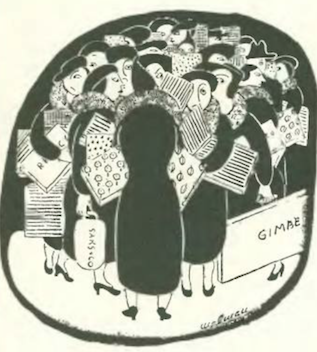
…a cluster of holiday shoppers by Christina Malman…
…and spot by an unidentified artist (still tracking down that signature)…
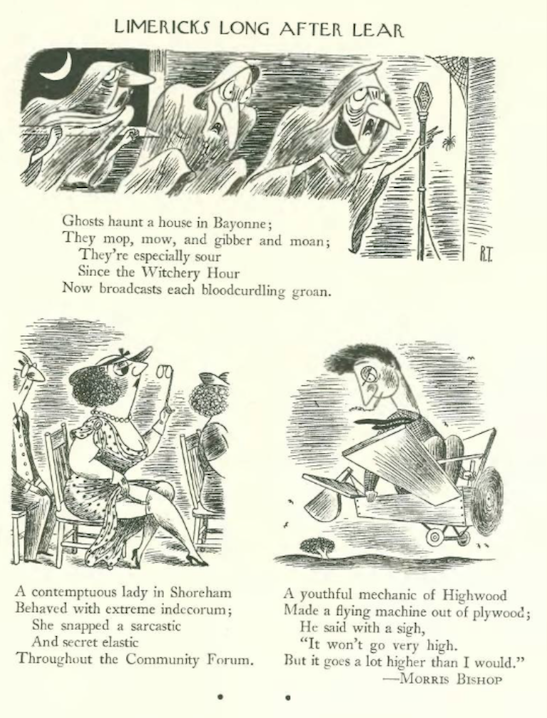
…more limericks from Morris Bishop with those great Richard Taylor illustrations…
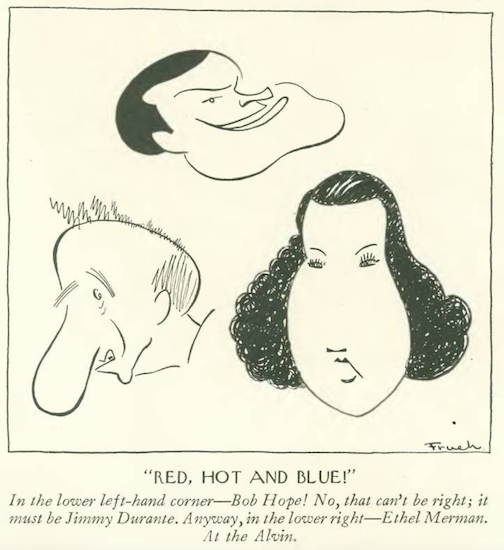
…Al Frueh served up the heads of a comedy revue…
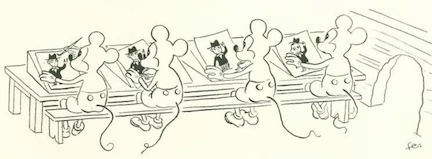
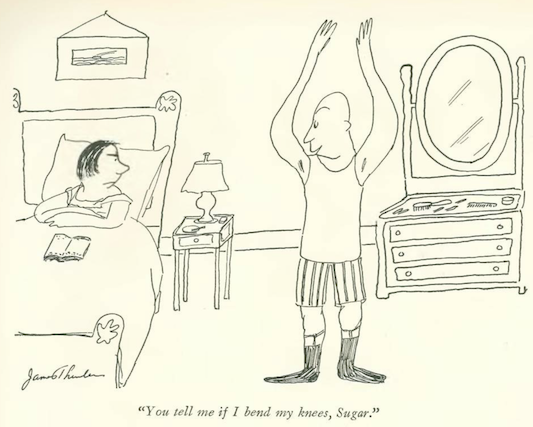
…James Thurber did some (unappreciated) stretching…
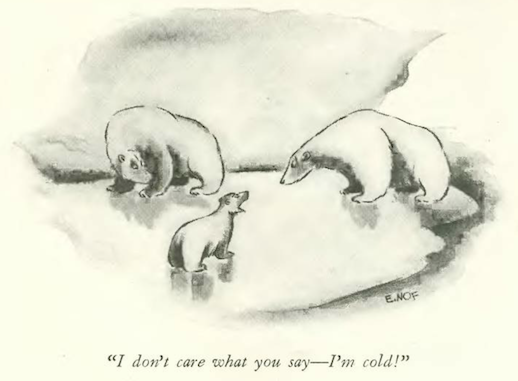
…this chilly bear was the work of Ed Nofziger, his first appearance in The New Yorker…
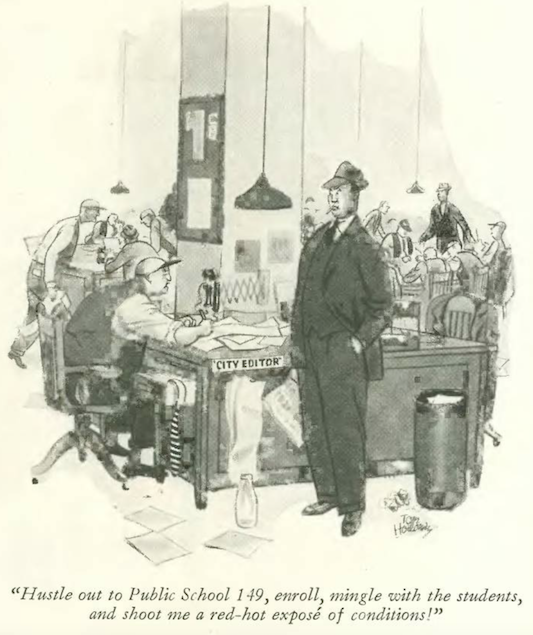
…and here’s the second of two drawings Tom Holloway contributed to the magazine in 1936…
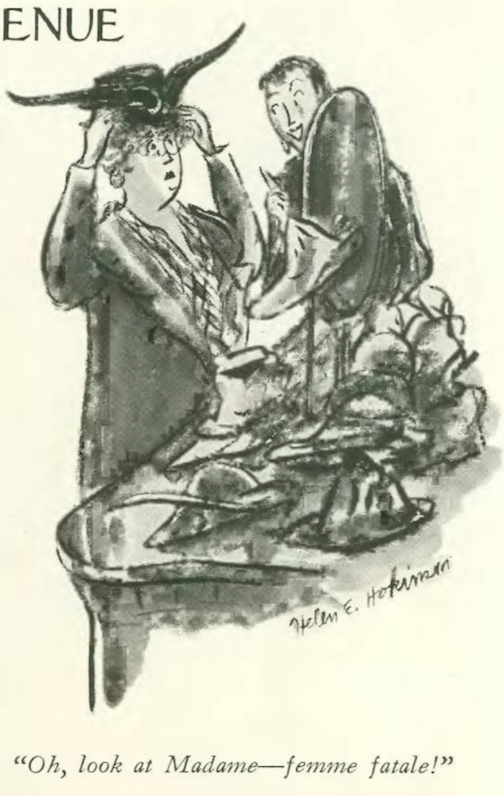
…Helen Hokinson gave us a sales clerk with an active imagination…
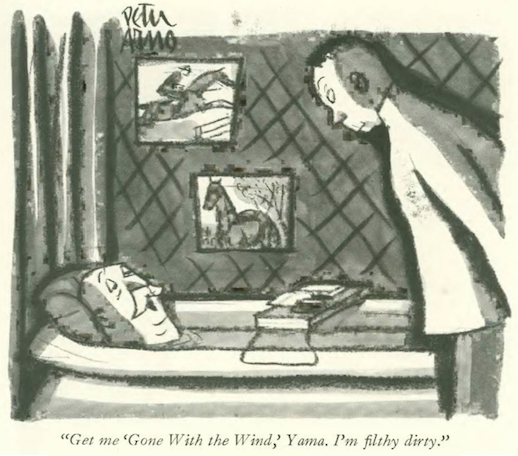
…Peter Arno’s colonel settled in for a long soak…
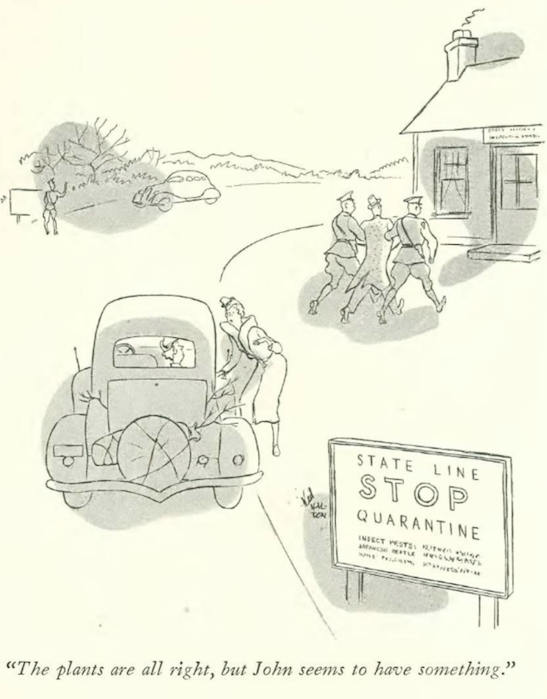
…Ned Hilton ran into some trouble at the border…
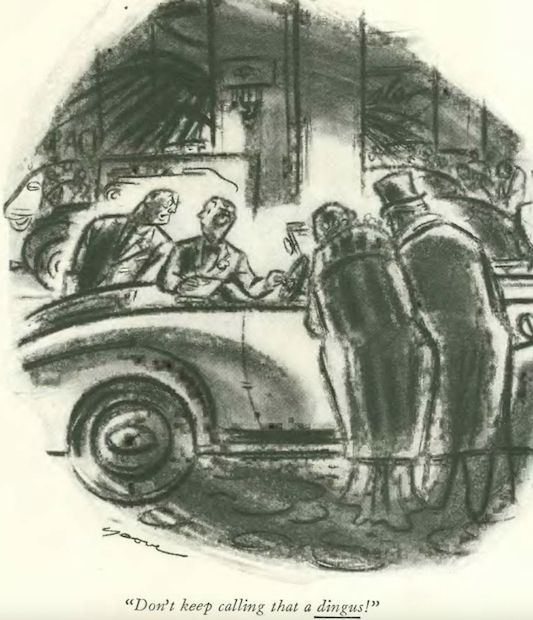
…Leonard Dove tuned in to the automobile show…
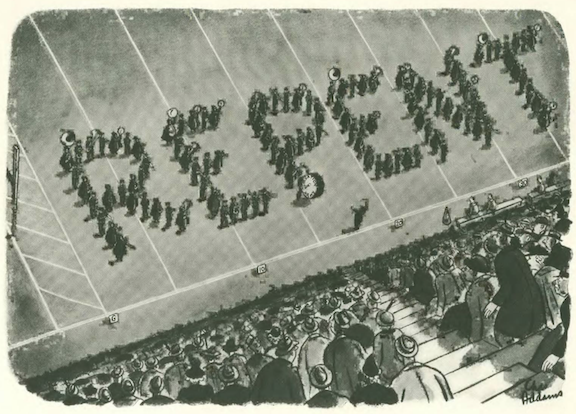
…and we close with two by Charles Addams, at the halftime show…
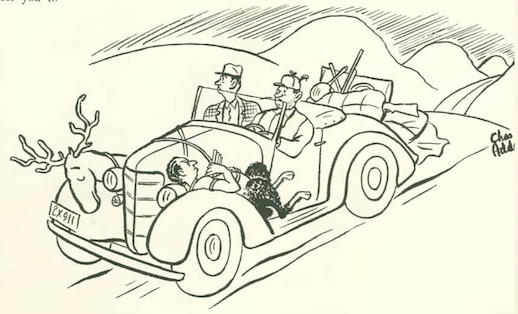
…and returning from the hunt…
Next Time: Mitchell’s Bar and Grill…
The Instant Home

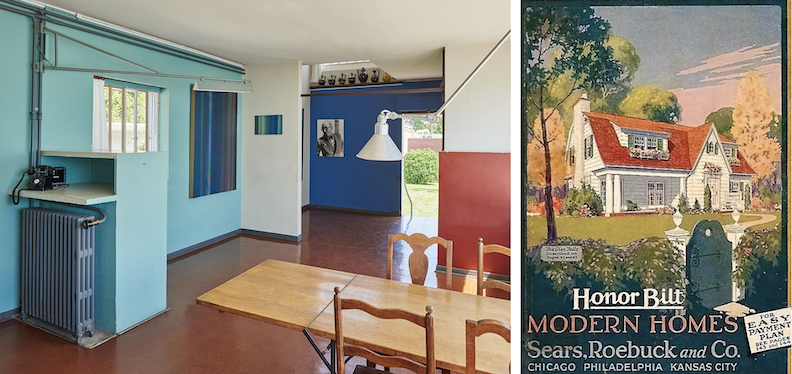
Above: The Swiss architect Le Corbusier viewed the modern house as a standardized "machine for living," and his 1923-24 Villa “Le Lac” on the shores of Lake Geneva was an early experiment in prefabrication; at right, the cover of a 1927 Sears catalog advertising its "Honor Built" prefabricated homes—from 1908 to 1942, Sears sold more than 70,000 of these high-quality houses in North America. (fondationlecorbusier.fr/Rachel Shoemaker Collection, Internet Archive)

Among the economic woes of the Great Depression was a shortage of affordable housing. The architecture profession was also hurting; private building commissions had dropped by more than 80 percent, forcing firms to downsize or even close. Some, however, pivoted to new opportunities made possible by advancements in mass production—if you could make a car with interchangeable parts on an assembly line, why not a house?

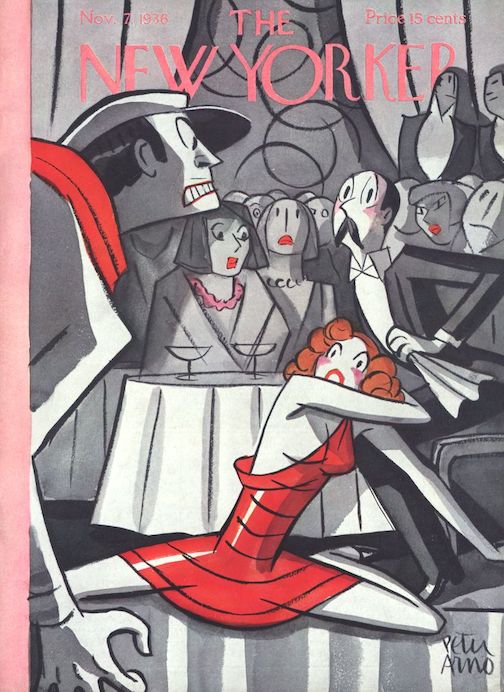
November 7, 1936 cover by Peter Arno…a scene that was likely familiar to Mr. Arno.

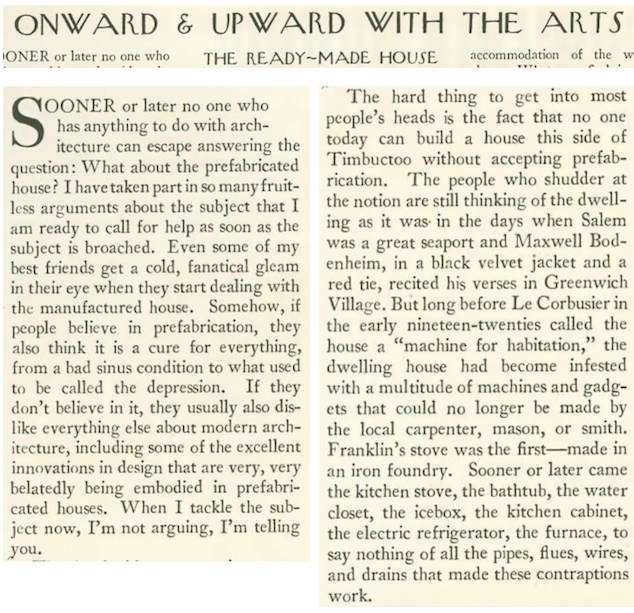
In his essay, “The Ready-Made House,” Lewis Mumford tried to clear the air about prefabrication, a subject that generated much debate but not a lot of common sense. For starters, Mumford pointed out that nearly every house built in 1936 already contained elements of prefabrication—everything from kitchen stoves, refrigerators and furnaces to “all the pipes, flues, wires, and drains that made these contraptions work.” Excerpts:

PRE-FAB PIONEERS…Clockwise, from top left: the Aluminaire House is a modernist prototype designed in April 1931 by architects A. Lawrence Kocher and Albert Frey. Considered the first all-metal house, it was erected in just ten days for the Allied Arts and Industry and Architectural League Exhibition at New York City’s Grand Central Palace (the house was permanently reconstructed on the grounds of the Palm Springs Art Museum); Buckminster Fuller’s first iteration of the Dymaxion House, 1930; one of several prefabricated houses displayed at the Madison (Wisc.) Home Show, 1935-36; cut-away of a prefabricated house developed by the Forest Products Laboratory, 1936. (Guillaume Goureau-psmuseum.org/researchgate.net/)
WRIGHT WAS RIGHT…This restored 1915 American System-Built Home is one of six modest houses on a single city block in Milwaukee, Wisconsin designed by Frank Lloyd Wright. Created around a 24-inch module, the houses utilized pre-cut standard lumber to minimize construction waste and labor costs. “I would rather solve the small house problem than build anything else I can think of,” Wright said at the time. (Wikipedia)

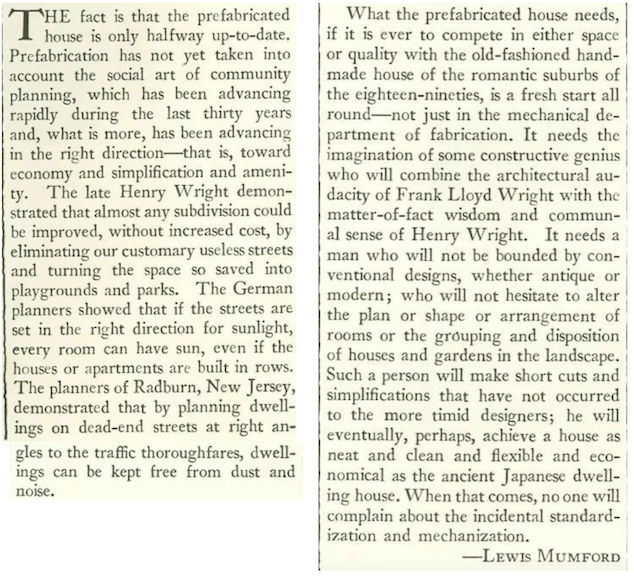
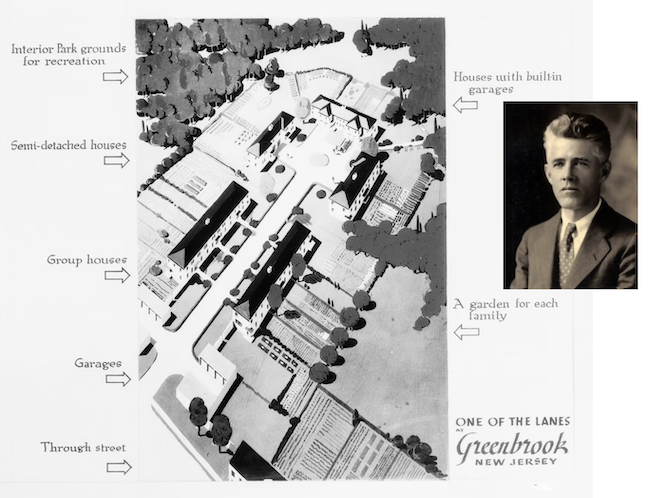
In these concluding paragraphs, Mumford noted that prefabricated houses should not be developed in isolation, but rather in a communal sense as envisioned by architect and planner Henry Wright.

COMMON SENSE…Henry Wright (inset), was a planner, architect, and major proponent of the garden city, an idea characterized by green belts and communal spaces. Wright, with Clarence Stein, collaborated on the design of the 1929 Radburn community in Fair Lawn, New Jersey. Above is their plan for Greenbrook, which was unrealized. (greenbeltmuseum.org)

 * * *

Presidential Priority

The November 7 issue came out before the November 3 general election could be fully digested, however E.B. White managed to shared this observation about the election:

White also noted a letter he received from acting coach Josephine Dillon Gable, who wrote that she used passages from “Notes and Comment” to teach her students proper pronunciation. Incidentally, Gable was the ex-wife of movie-star Clark Gable.

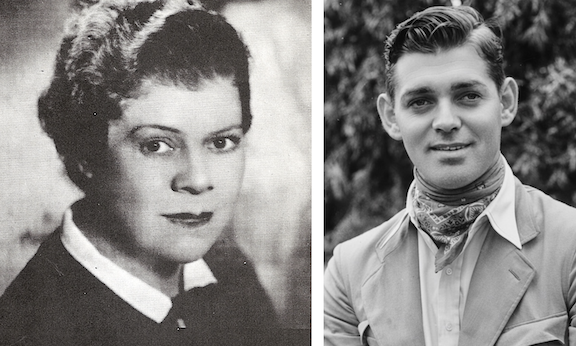
A STAR IS BORNE…In 1924 Clark Gable married his first wife, Josephine Dillon, who was seventeen years his senior. Dillon met Gable in Portland, Oregon in the early 1920s, recognizing his potential to become a star and serving as his manager, acting coach, and financial sponsor until their 1930 divorce. Dillon (1884-1971) continued to teach acting during a successful career that included students Gary Cooper, Rita Hayworth, and Donna Reed. (dearmrgable.com/thehollywoodlandrevue.com)

 * * *

Pocket Change

Ninety years ago the only broadcast medium was radio, which raked in around $2 million from political advertising during the 1936 general election (per Howard Brubaker’s column “Of All Things”). That’s about $48 million in today’s dollars. To put that into perspective, it is estimated that well over $12 billion was spent on advertising during the 2026 midterms—television’s share was nearly $6 billion, but lowly radio still raked in nearly $300 million.

 * * *

At the Movies

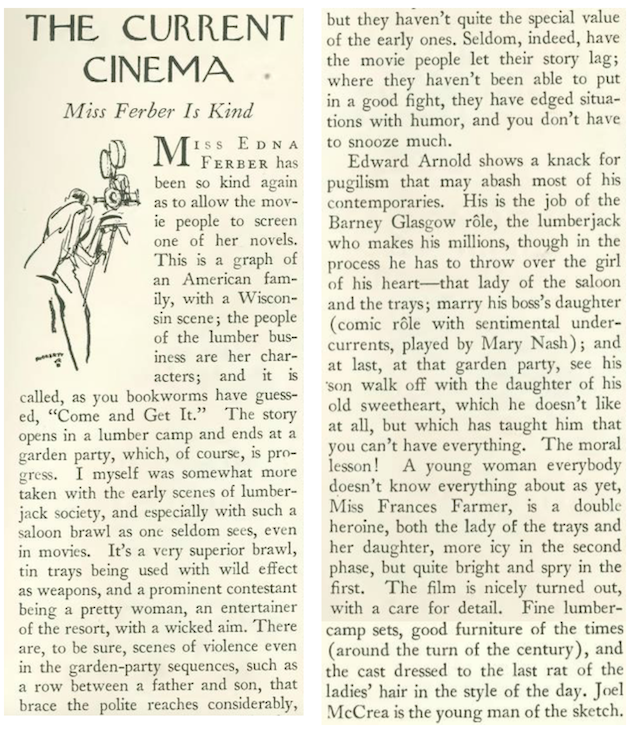
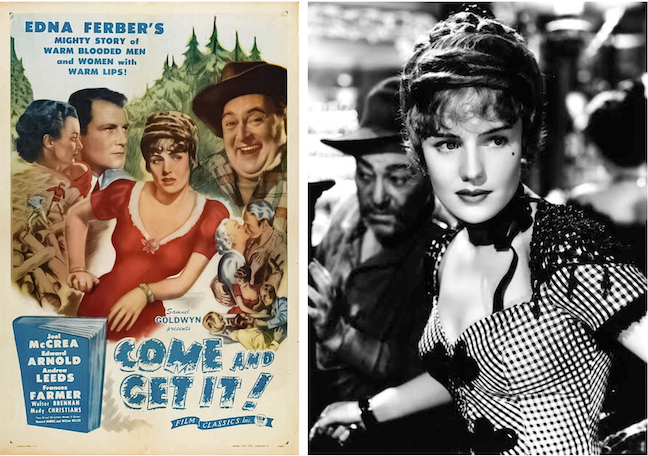
Based on a novel by Edna Ferber, the drama Come and Get It featured Edward Arnold as a ruthlessly ambitious lumberjack who ends his relationship with a saloon singer (Frances Farmer) to marry his boss’s daughter. Film critic John Mosher wrote that Farmer portrayed a “double heroine” in her role.

MOM AND SIS…Directed by Howard Hawks and William Wyler, Come and Get It featured Frances Farmer, a relative newcomer to the movies. Portraying a young woman pursued by her mother’s former lover and also the mother in the film, Farmer got along well with Hawks but famously clashed with Wyler when he replaced Hawks as director. Come and Get It earned praise from the public and critics, and some reviewers even referred to Farmer as the new Greta Garbo. (imdb.com/newyorker.com)

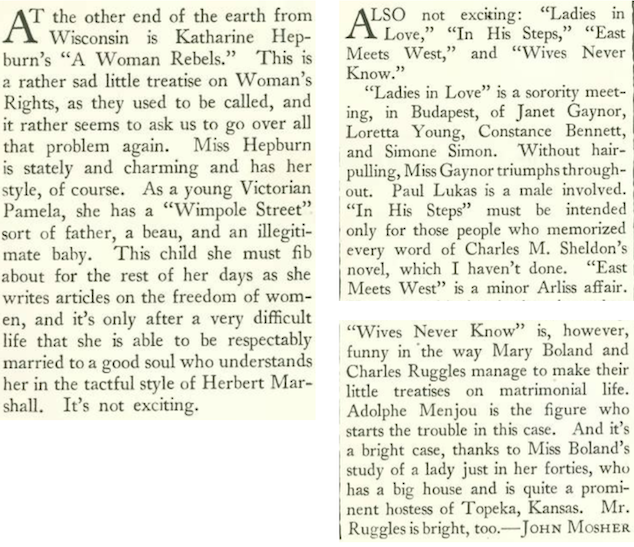
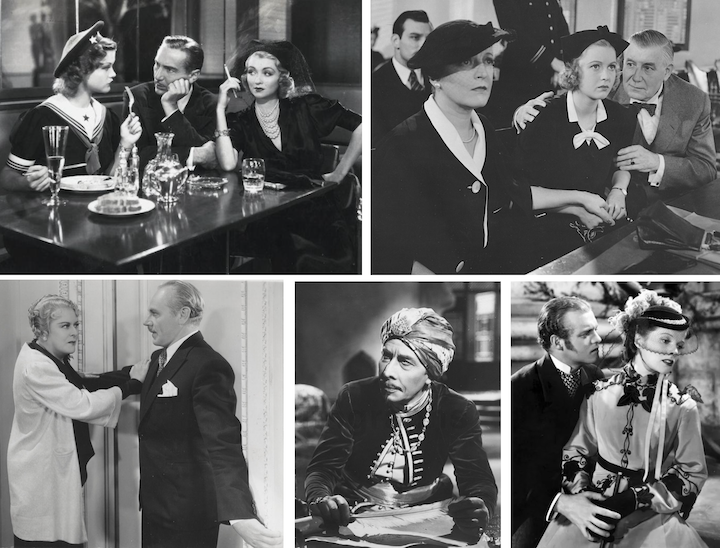
Mosher found little to cheer about with other new releases, including Katharine Hepburn’s A Woman Rebels. Hepburn was enduring a career slump in the mid-1930s, and it was not helped by this film, which Mosher called “a rather sad little treatise on Woman’s Rights…”

NOT EXCITING to critic John Mosher were, clockwise, from top left, Simone Simon, Paul Lukas, and Constance Bennett in Ladies in Love; Cecilia Parker, Olive Tell and Charles Richmond in In His Steps; Van Heflin with Katharine Hepburn in A Woman Rebels; George Arliss in East Meets West; and Mary Boland and Charles Ruggles in Wives Never Know. (imdb.com/ebay.com/frockflicks.com/csfd.sk)

  * * *

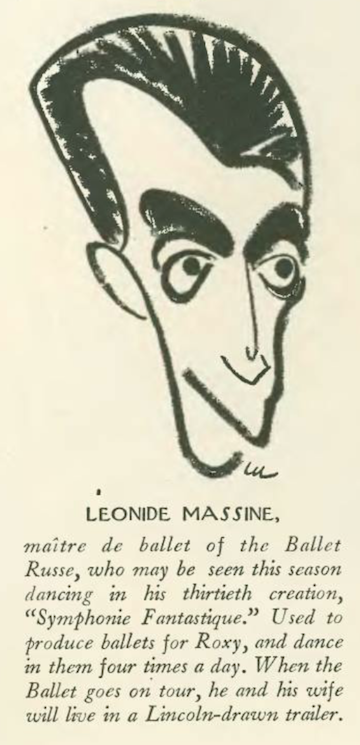
The latest mini-bio in the calendar section featured Russian choreographer and ballet dancer Leonide Massine (1896-1979):

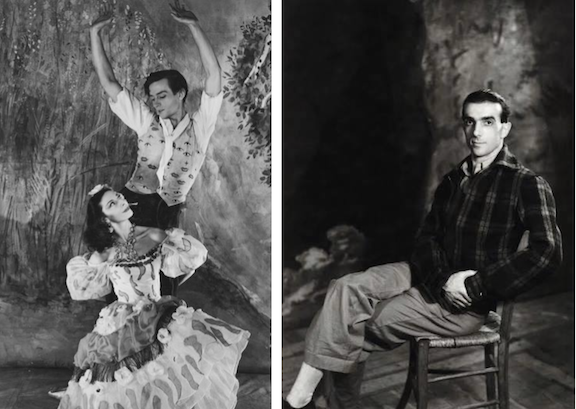
KNOWN FOR HIS COMIC WORKS, Léonide Massine (left) strikes a pose with (possibly) Tamara Karsavina in publicity photo for Le Tricorne, 1920; at right, portrait of Massine by Gordon Anthony, 1938. (instagram.com/npg.org.uk)

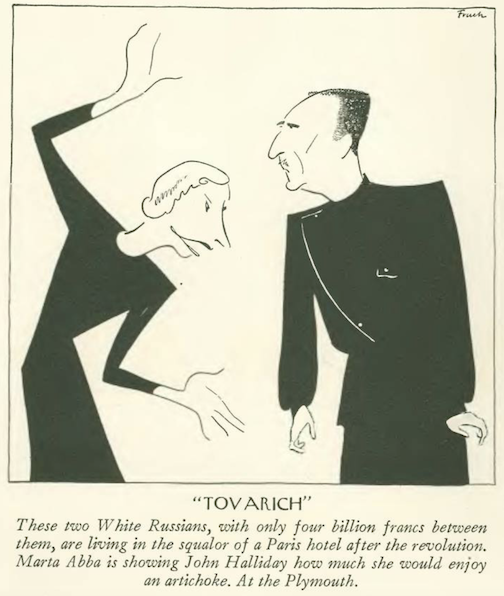
…Al Frueh contributed these caricatures of Marta Abba and John Halliday, who were appearing in the comedy Tovarich at the Plymouth Theatre…

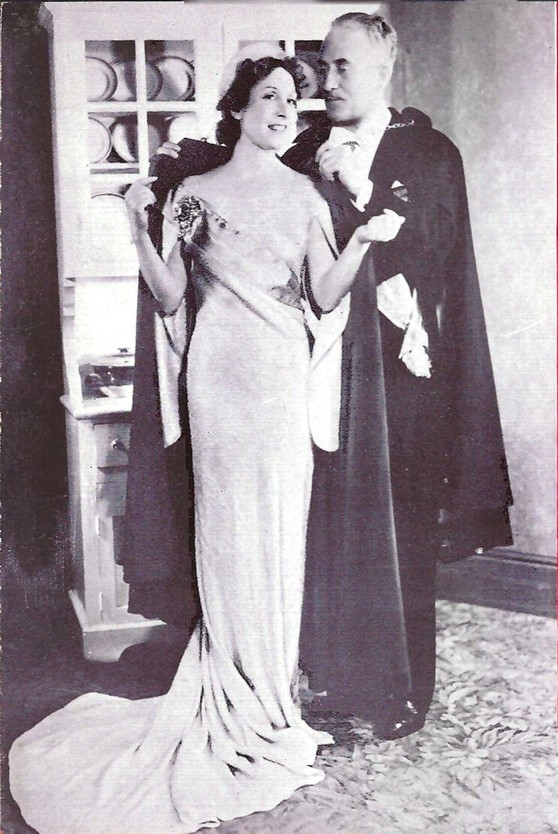
ARISTOCRATIC ANTICS…The comedy Tovarich featured Marta Abba and John Halliday as impoverished Russian aristocrats living in Paris several years after the Russian Revolution. The play ran for ten months in its first run during 1936-37. (image from a poster found on eBay.com)

 * * *

From Our Advertisers

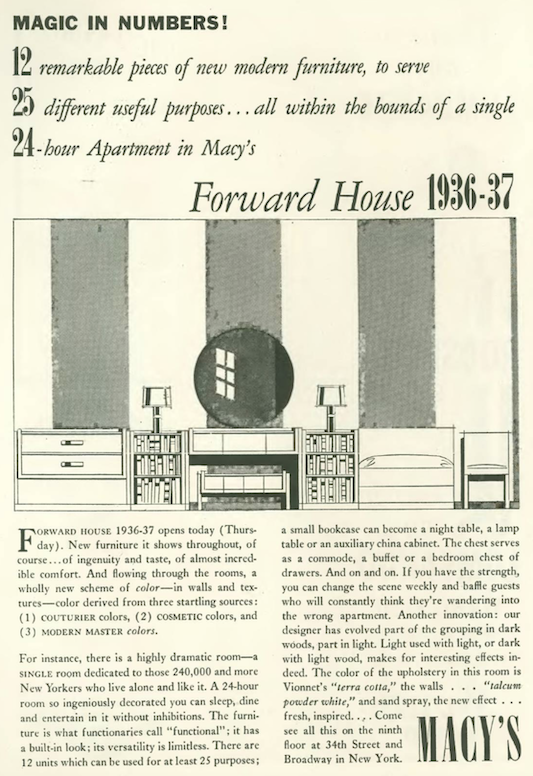
Modern decor was definitely “in” as more ads featured the sleek lines of “forward” furniture including this line at Macy’s…

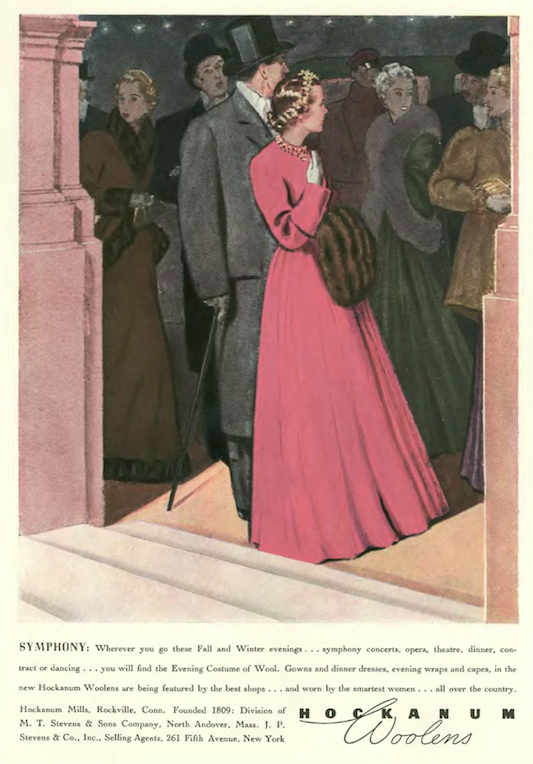
…business must have been booming at Hockanum even with the lingering Depression…these sumptuous, full-page ads appeared in nearly every issue…

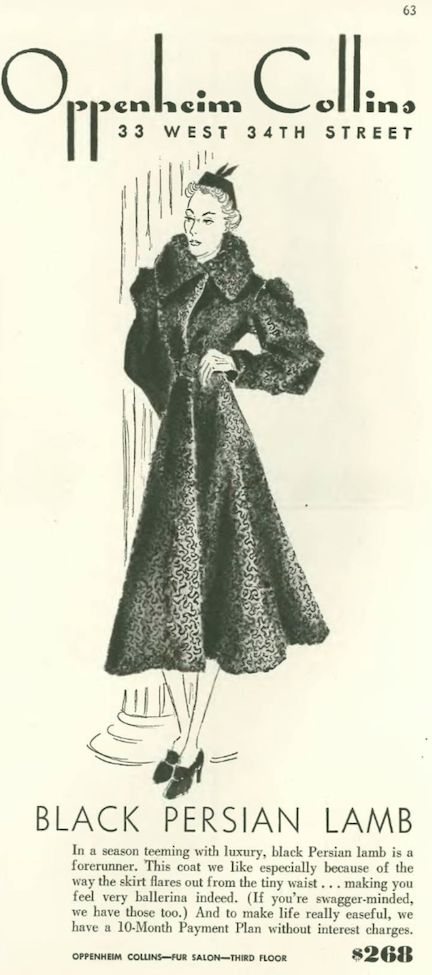
…this back-of-the-book ad from Oppenheim Collins was a real eye-catcher with its hand-lettered, dramatically elongated typography…

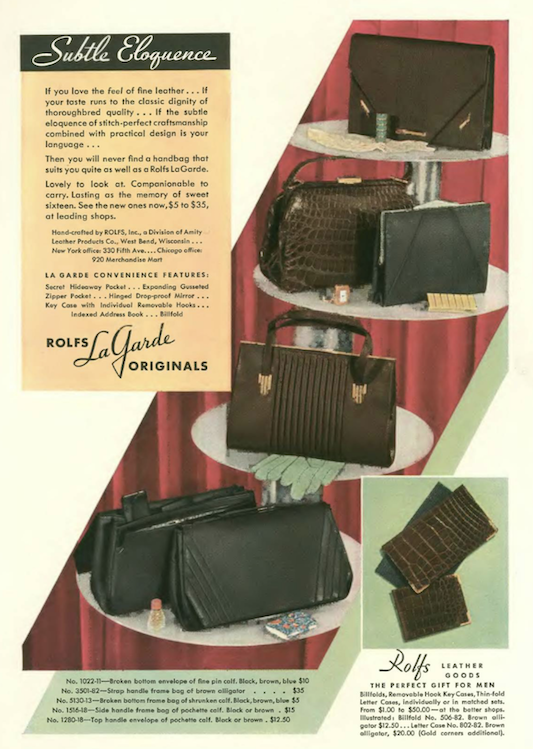
…I’m no expert in handbag design, but these look identical to the models sold in the 21st century…

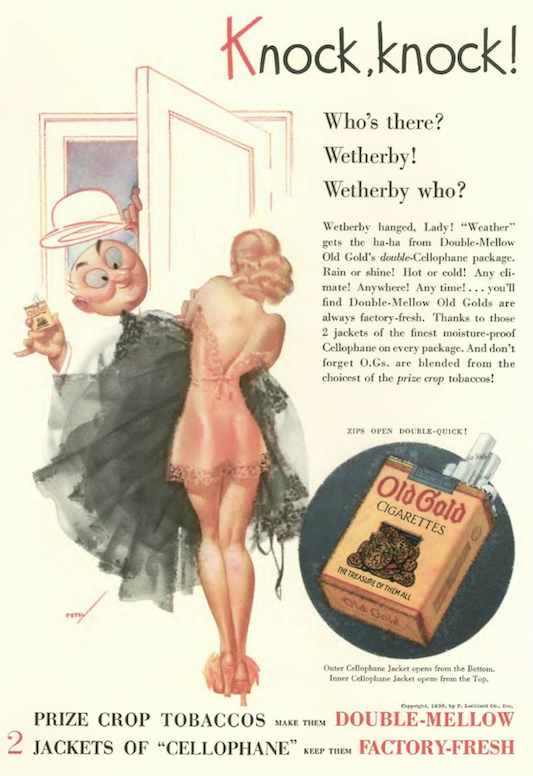
…in a previous post (Oct. 17 issue) I noted that George Petty had departed from his Old Gold theme of leering old men and pin-up women…well, they’re back…

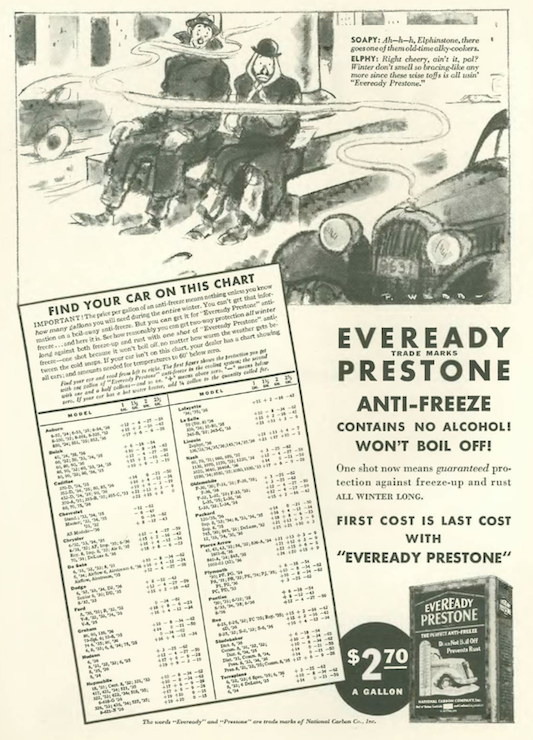
…nothing like using the homeless to promote your product…I looked up “Soapy” and “Elphy” but couldn’t find a connection to any known comic strip from that time…

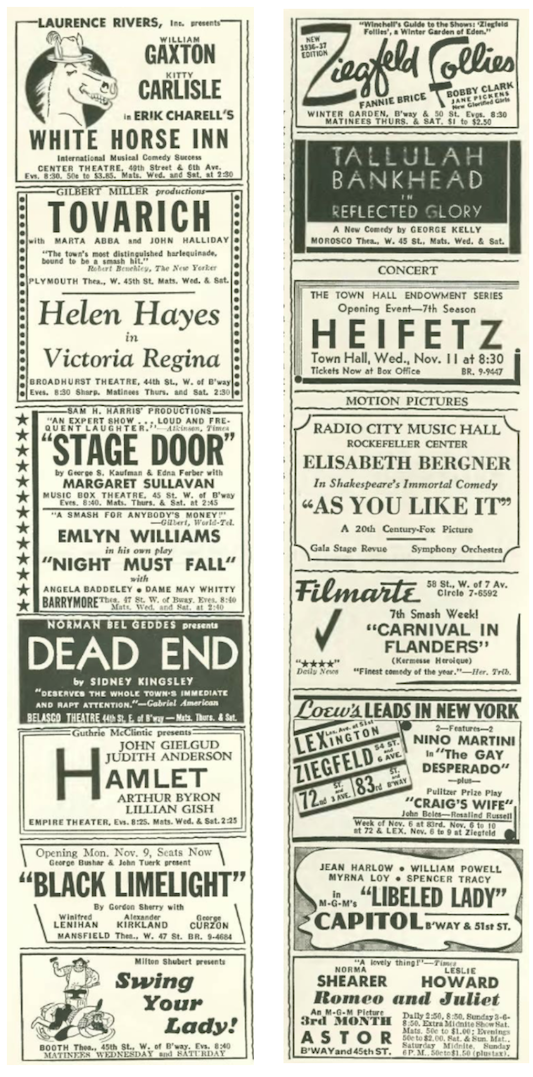
…a sampling of theater, movie and concert ads from the back pages…

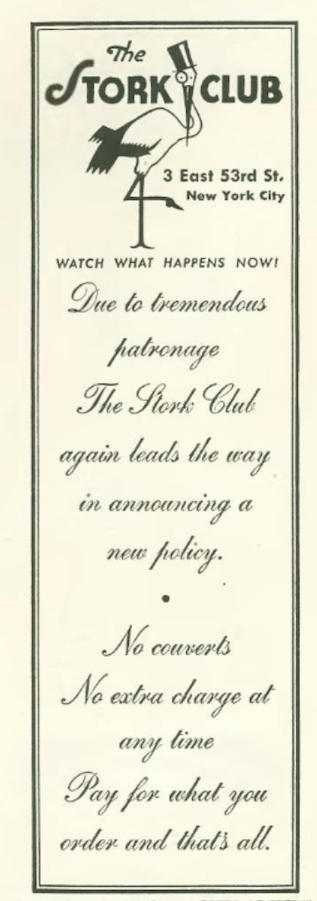
…and this modest little spot from The Stork Club announcing “No couverts” (cover charge)…apparently even this swanky location needed to appeal to the Depression-weary…

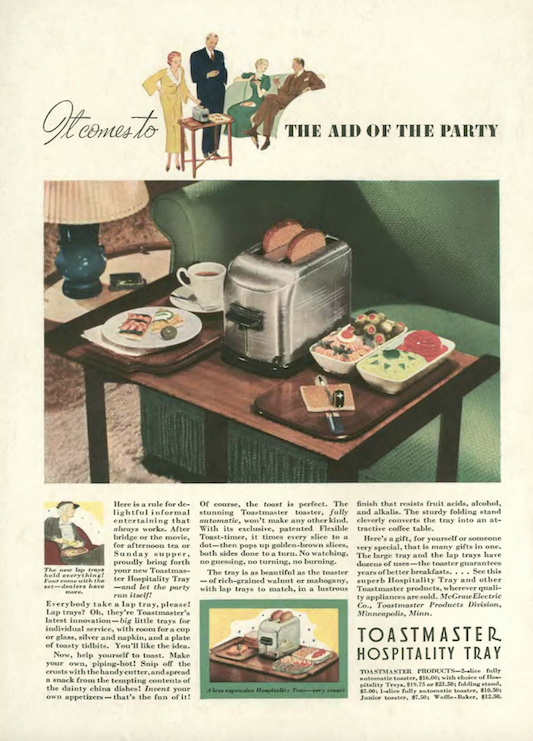
…the inside back cover was devoted to a toaster, and to a new trend in casual entertaining…the ad also touted a new “lap tray” (each toaster came with a set of four)…but don’t get too comfortable…suit and tie and evening gown were still mandatory…

…on to our cartoonists and illustrators, we begin with spot drawings by Susan Willard Flint…

…Victor de Pauw and Abe Birnbaum…

…James Thurber…

…and Margot Tomes…

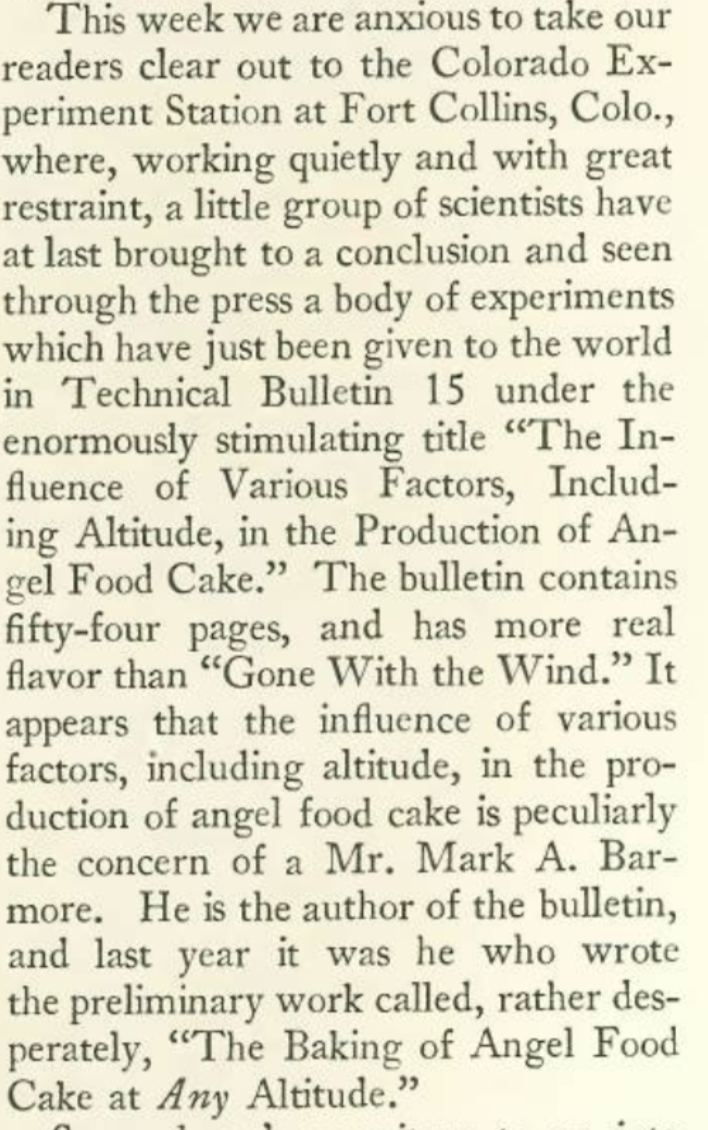
…also a spot drawing by Otto Soglow that appeared at the bottom of E.B. White’s “Notes and Comment”…White wrote about a weather station in Fort Collins, Colorado, where scientists were experimenting with cake baking at higher altitudes…

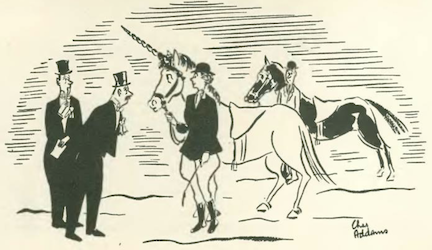
…this a caption-less cartoon by Charles Addams featured a new entry in dressage competition…

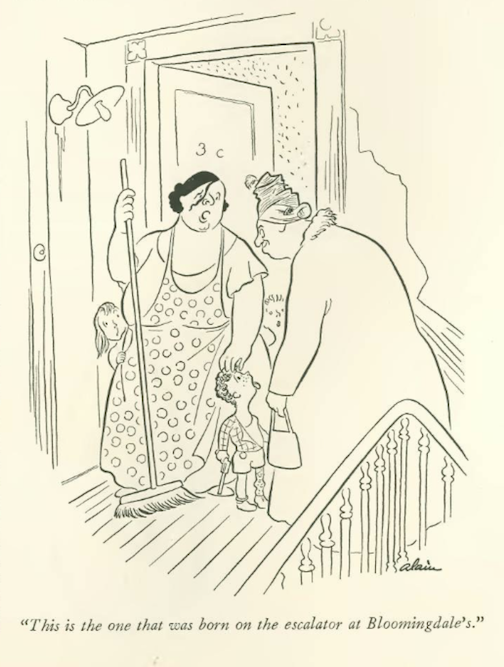
…Alain offered this perspective on the miracle of birth…

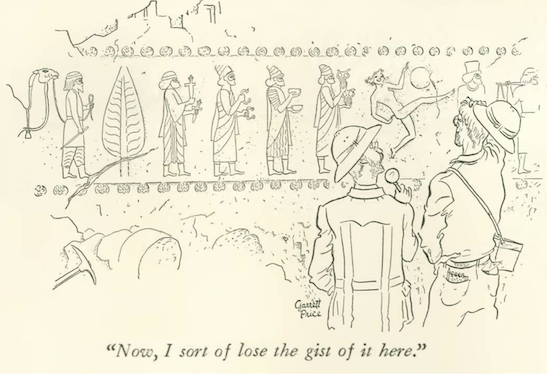
…Garrett Price offered a puzzle to a couple of epigraphers…

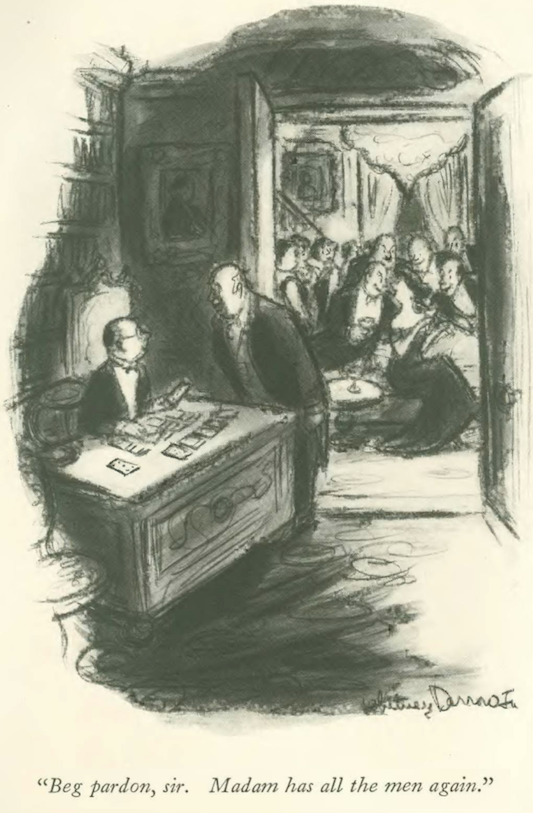
…Whitney Darrow Jr gave us a party pooper and a life of the party…

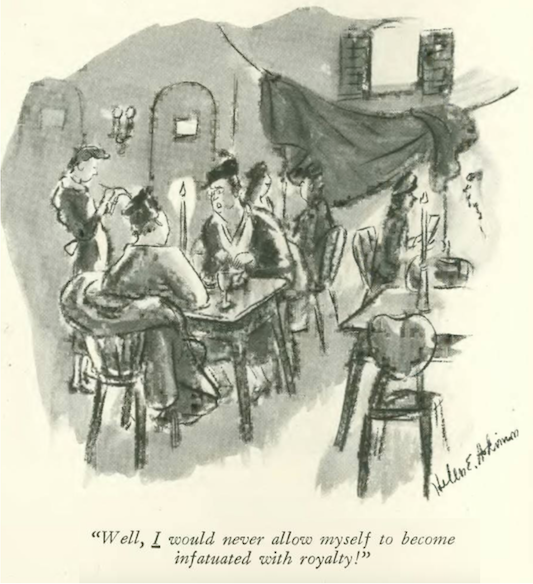
…Helen Hokinson’s “girls” discussed the upcoming coronation…the decor here suggests one of Alice Foote MacDougall’s coffee shops…

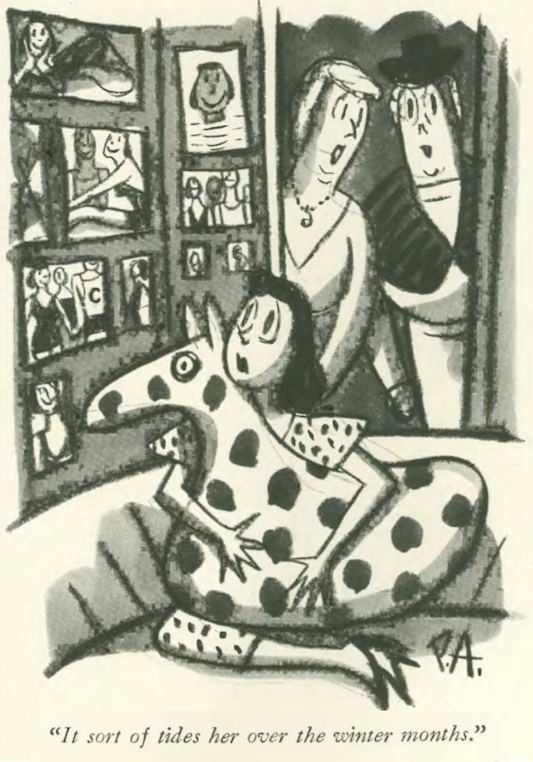
…Peter Arno’s daughter Patricia (with ex-wife Lois Long) would have been seven years old in 1936, so possibly the inspiration here…

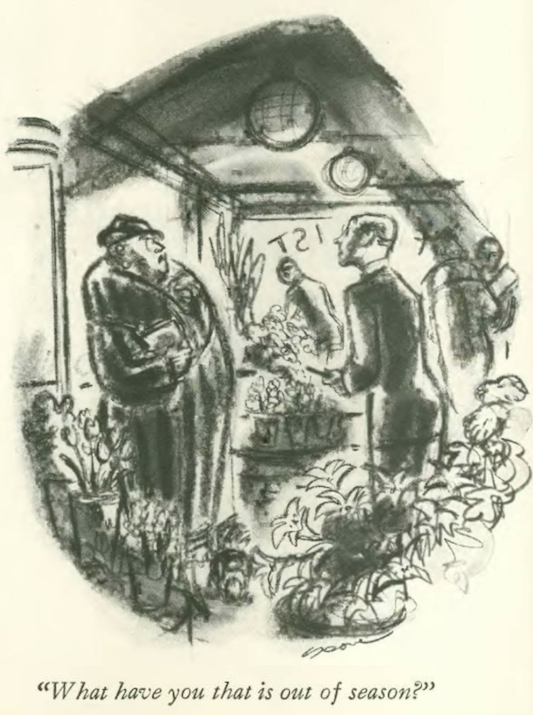
…an ill wind blows into a flower shop, per Leonard Dove…

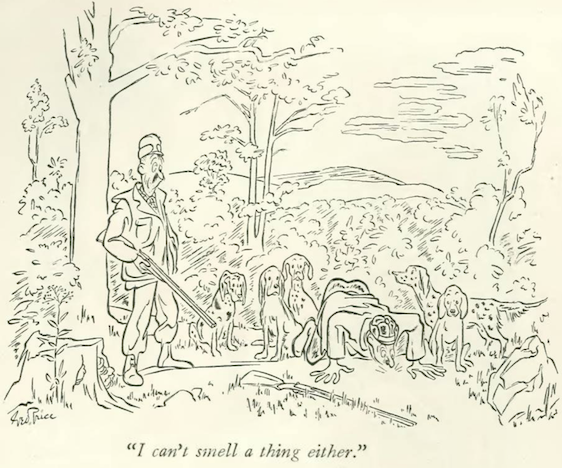
…and we close with George Price, and a trail run cold…

Next Time: New Cars and Mrs. Simpson…

Far-Fetched Faulkner

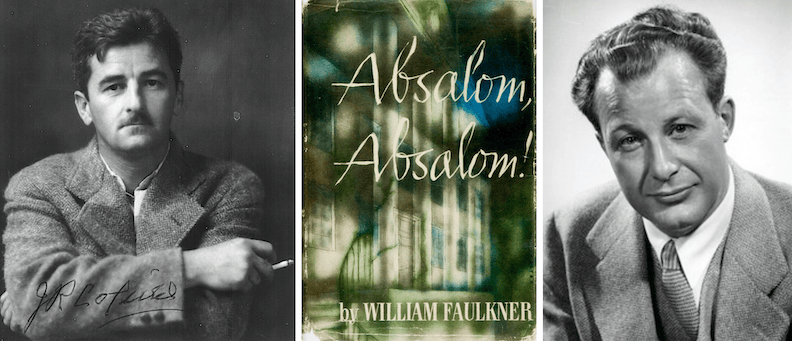
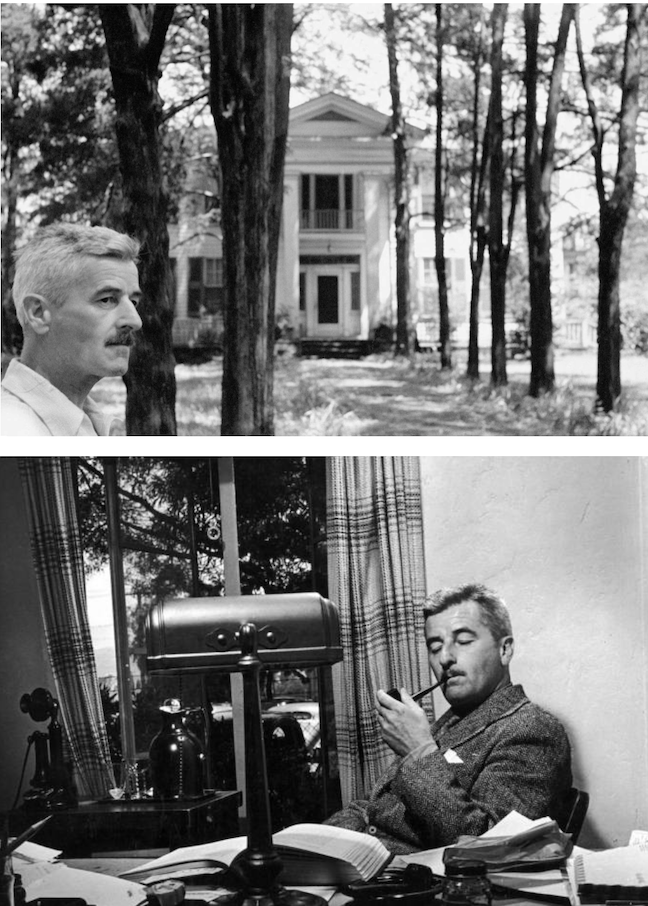
Above: New Yorker book critic Clifton Fadiman (right) characterized William Faulkner's "Absalom, Absalom!" as a "penny dreadful tricked up in fancy language." Fadiman was not alone among contemporary mainstream critics in his assessment, although today the novel is considered a masterwork of Southern Gothic literature. (Wikipedia/J.R. Cofield Collection, University of Mississippi Library)

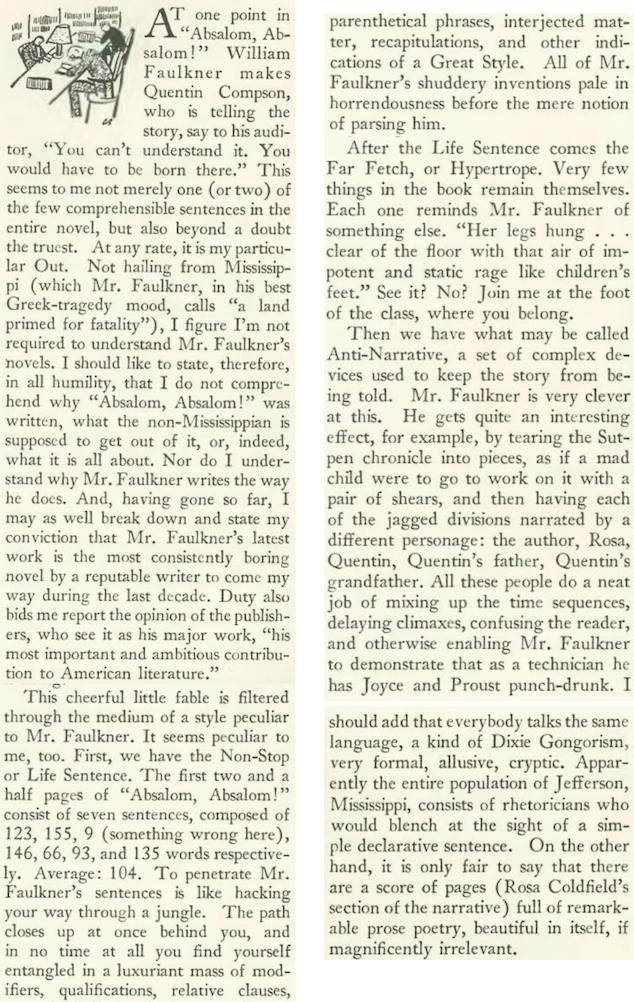
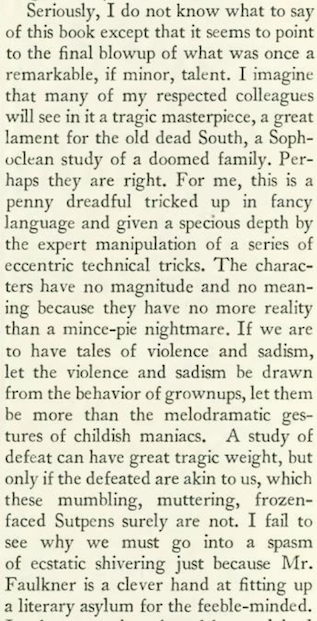
With its non-linear timeline, winding prose, and multiple unreliable narrators, William Faulkner’s Absalom, Absalom! left many critics wondering what to make of the author’s ninth novel, including The New Yorker’s Clifton Fadiman, who had a near-visceral response to Faulkner’s “shuddery inventions.”

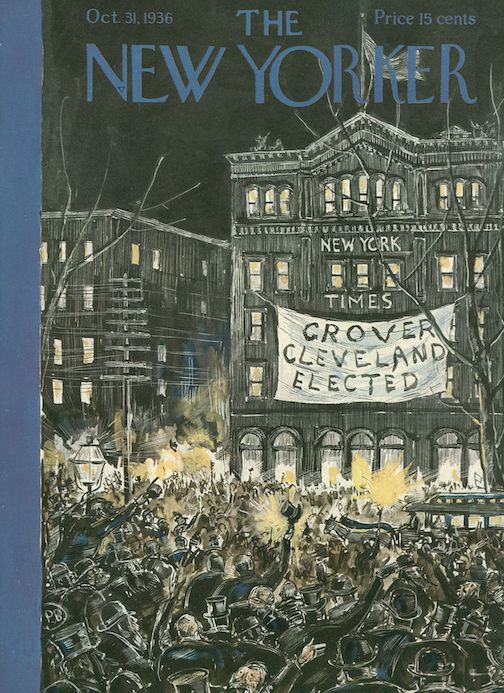
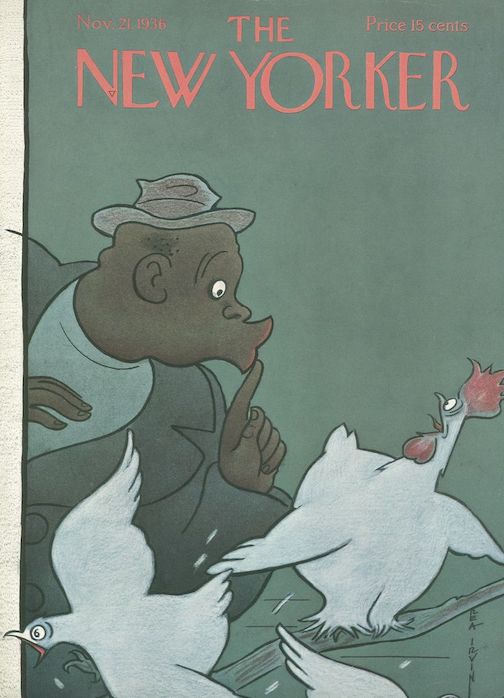
October 31, 1936 cover by Perry Barlow.

Although today the novel is widely considered a literary masterpiece, in 1936 Fadiman saw the dense, labyrinthine style of Absalom, Absalom! as nothing more than an empty facade for a melodramatic plot and characters resembling a “mince-pie nightmare.”

The novel explored the rise and fall of Thomas Sutpen, a poor man who ruthlessly carves out a plantation empire in 1830s Mississippi. Told entirely in flashbacks consisting of fragmented memories and differing perspectives, the novel is psychologically bleak and violent, with nearly every major character meeting a tragic end. Following are excerpts from Fadiman’s review:

OXFORD MAN…Above, William Faulkner at his 1844 Greek Revival home, Rowan Oak, which he purchased in Oxford, Mississippi in 1930; below, at work in his study. The mid-1930s were a difficult time for Faulkner. His writing was often interrupted by trips to Hollywood, where he sought additional income writing screenplays (Faulkner was constantly in debt), and in 1935 his brother Dean was killed in a plane crash. Consequently this period included a number of heavy drinking benders. (genteelandbard.com/life.com)

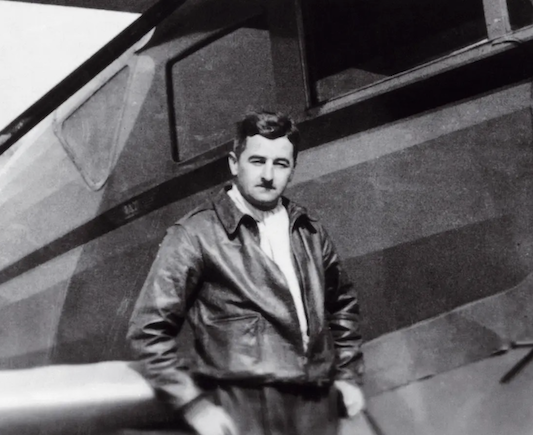
Faulkner had some history with The New Yorker: A Nov. 21, 1931 “Talk of the Town” entry titled “Oxford Man” featured a thirty-four-year-old Faulkner living in a Tudor City apartment, working on his novel Light in August. “Talk” noted his service in the Canadian air force, which he joined in 1915 (he broke both legs in a crash) and that he “sometimes flies a rather wobbly plane owned by a friend in Oxford.” As for his writing style, “Talk” offered this quote from Faulkner: “Ah write when the spirit moves me, and the spirit moves me every day.” The piece also noted that “Only a few of the townspeople know he writes at all; most of them think he’s lazy.”

Here’s a second excerpt from Fadiman’s Oct. 31, 1936 review, in which the critic concludes that Faulkner “is a clever hand at fitting up a literary asylum for the feeble-minded.”

FLYBOY…A 1931 “Talk of the Town” profile, attributed to and  noted Faulkner’s writing habits, his ties to his hometown, and his time in the Canadian Air Force. (espresso.pt)

 * * *

Chattering Mysteries

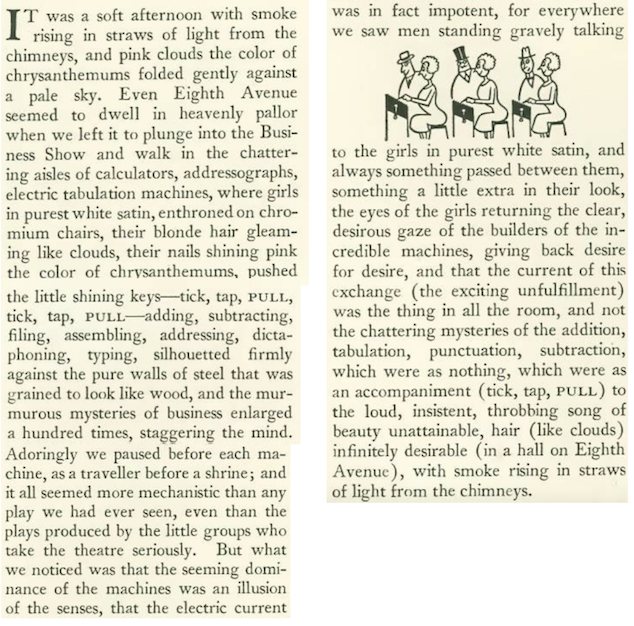
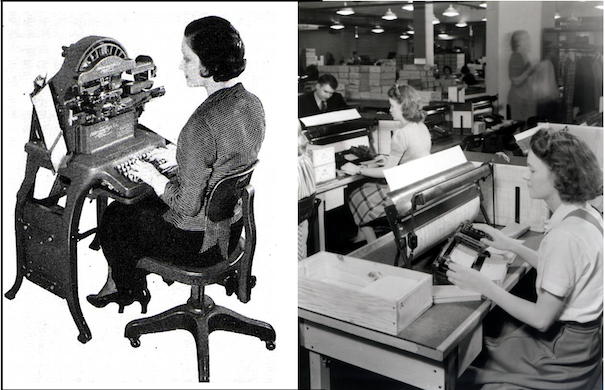
Those are the words E.B. White used to describe aisles of calculators, addressographs, and electric tabulation machines being operated by women clad “in purest white satin” at a business show on Eighth Avenue.

AN ILLUSION OF THE SENSES was achieved by scores of machines clacking away at a Manhattan business show, according to E.B. White. At left is an Addressograph machine, circa 1930s, and at right, a census worker using an IBM Type 1 mechanical key punch, 1940. (americanbusinesshistory.org/officemuseum.com)

 * * *

At the Movies

Get the Extra-large Popcorn

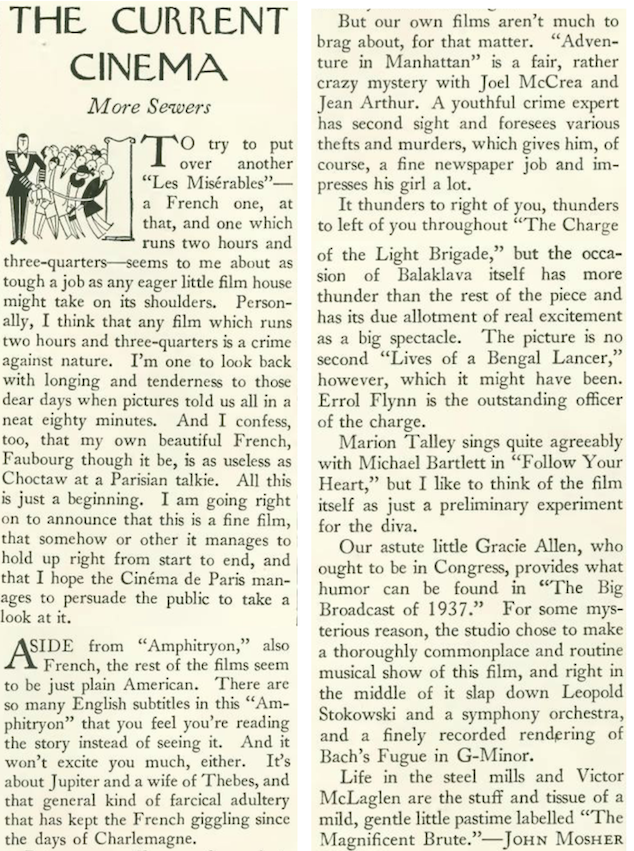
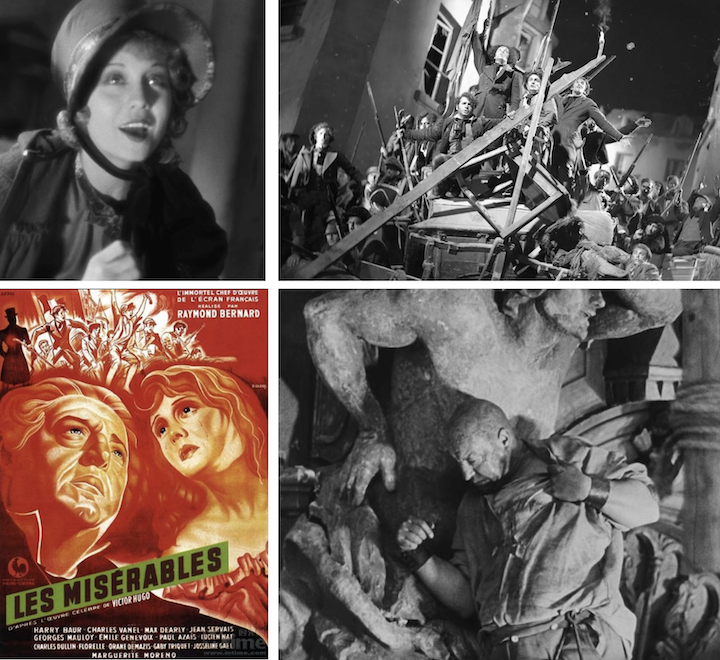
They say movies are getting longer these days, but the Thirties had its share of lengthy screen epics, including a nearly five-hour running time for the 1934 French adaptation of the Victor Hugo novel Les Misérables. Initially released as three films premiering over three consecutive weeks, the full, unedited film ran a total of 281 minutes. Apparently the 1936 American release, reviewed here by John Mosher, ran for just under three hours, which Mosher called “a crime against nature.” He did, however, pronounce it “a fine film.” He also reviewed a German musical comedy, Amphitryon, and some uninspiring “plain American” films.

GOING HUGE FOR HUGO…Clockwise, from top left: Florelle as Fantine in Les Misérables; blockade scene from the film; Harry Baur as Jean Valjean; French movie poster, 1934. (imdb.com)

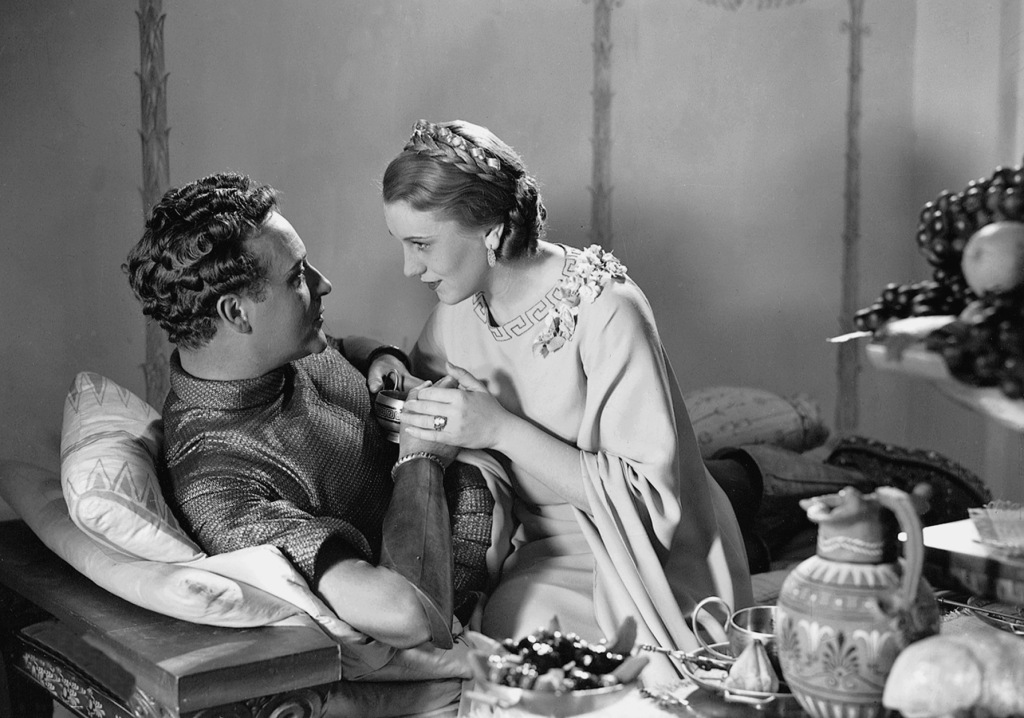
Mosher grew weary of reading the subtitles in the German film Amphitryon, a surprising satirical musical that somehow got made even after the Nazis took over the reigns of the Ufa-Atelier studio; however, the coming year would see a further tightening of domestic repression (including film) under Reich leadership.

SOME LAST LAUGHS…Willy Fritsch and Käthe Gold in the 1935 German musical comedy Amphitryon. The movie was filmed in German and French, which is probably why Mosher thought it was a French production. (en.kinorium.com)

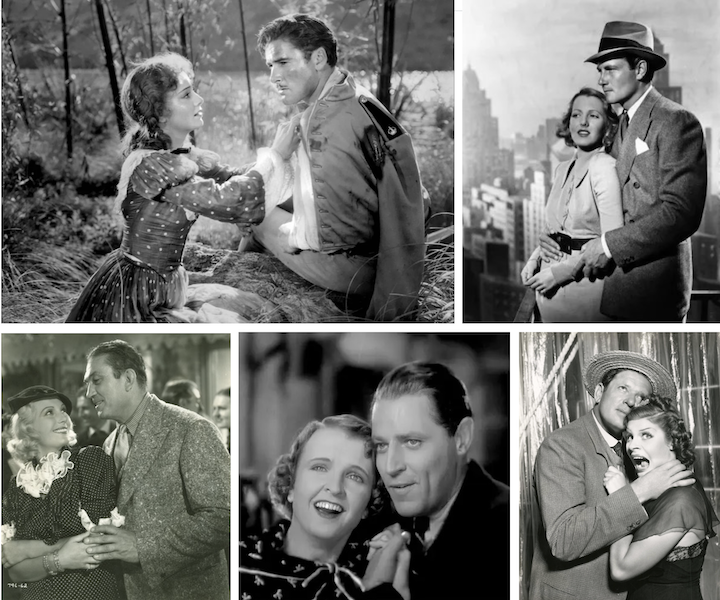
The “plain American” films reviewed by Mosher included a mystery, a revue, and a musical featuring opera singer Marion Talley, who years earlier had received some rough treatment from The New Yorker.

STANDARD FARE…Clockwise, from top left: The Charge of the Light Brigade starred Olivia de Havilland and Errol Flynn; Jean Arthur and Joel McCrea in Adventure in Manhattan; Bob Burns and Martha Raye in The Big Broadcast of 1937; Marion Talley and Michael Bartlett in Follow Your Heart; Victor McLaglen and Binnie Barnes in The Magnificent Brute. (britannica.com/theblondeatthefilm.com/imdb.com/tubitv.com/ebay.com)

 * * *

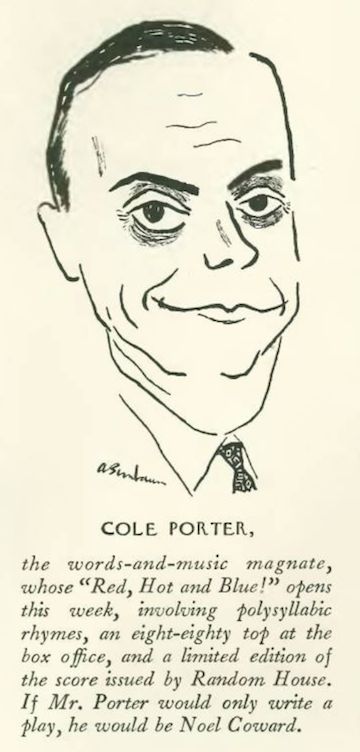
Polymath Porter

The multi-talented composer/songwriter Cole Porter was the latest celebrity to receive a mini bio in the opening pages…illustration by Abe Birnbaum…

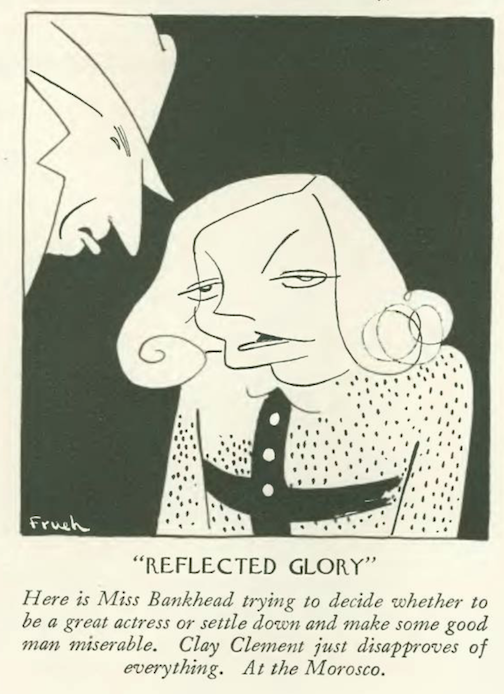
…and on the subject of theater, Al Frueh offered his impression of the Talullah Bankhead vehicle, Reflected Glory...

 * * *

From Our Advertisers

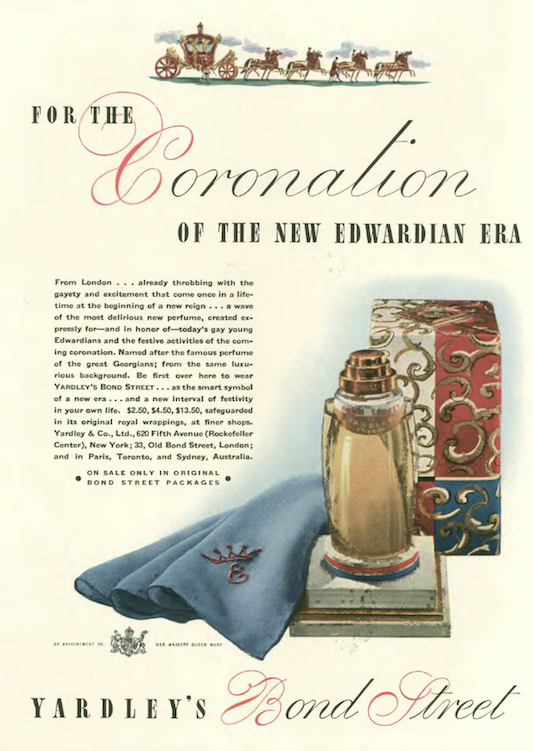
Various retailers were gearing up for the coronation of England’s King Edward VIII, and the folks at Yardley’s were busy packaging their lavender-scented soaps and perfumes for royalty-starved Americans, “safeguarded in original royal wrappings”…this “Edwardian” campaign would be scrapped just weeks later when Edward would abdicate the throne (on Dec. 10) and run off with American Wallis Simpson…

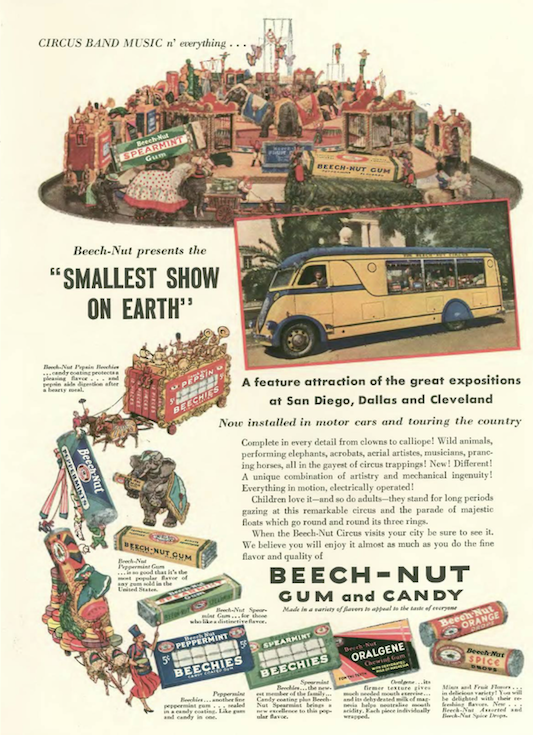
…the makers of Beech-Nut chewing gum made a splash with this full-page ad touting their traveling “Smallest Show on Earth”…

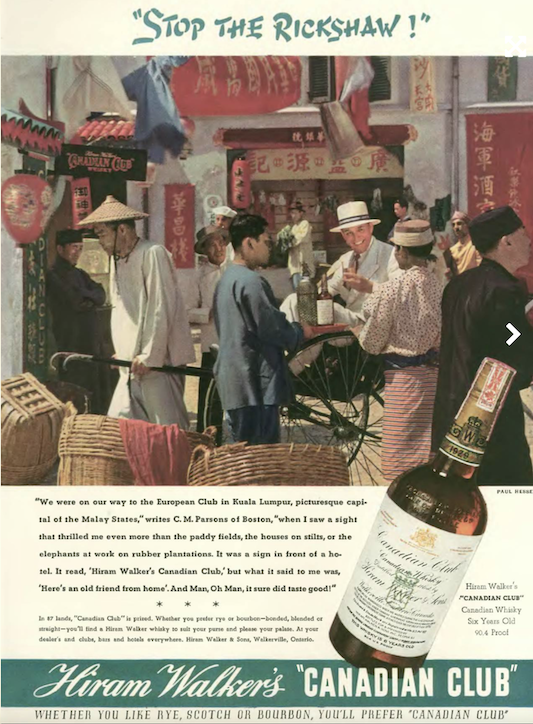
…Canadian Club continued its world tour with a stop in Kuala Lumpur…

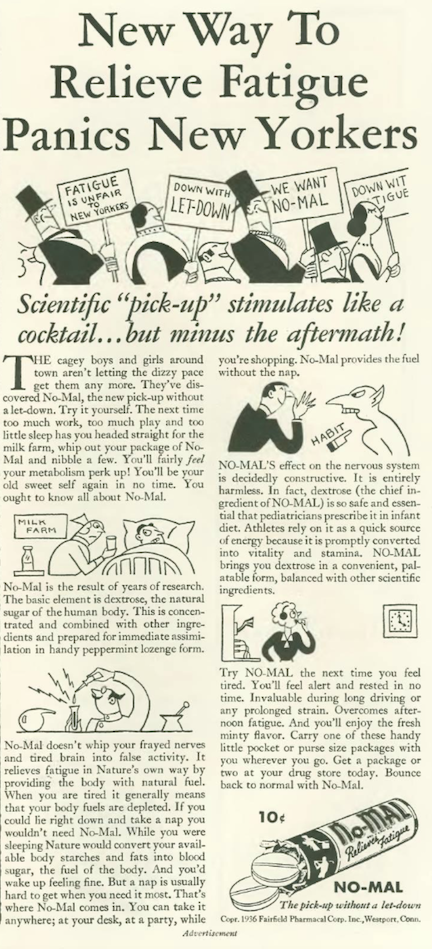
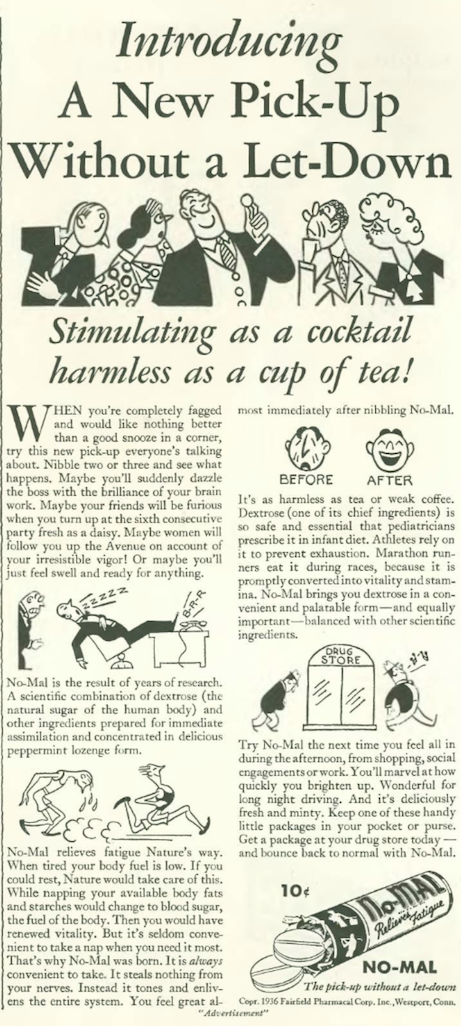
…No-Mal ran another back-of-the-book ad promoting its scientific “pick-up”…the chief ingredient, according to this spot, was dextrose (even safe for infants!), but it doubtless also contained caffeine and Lord knows what else…

…no extra stimulation needed for our cartoon section, beginning with Mary Petty…

…there were a couple of Halloween-themed spots by Susan Willard Flint…

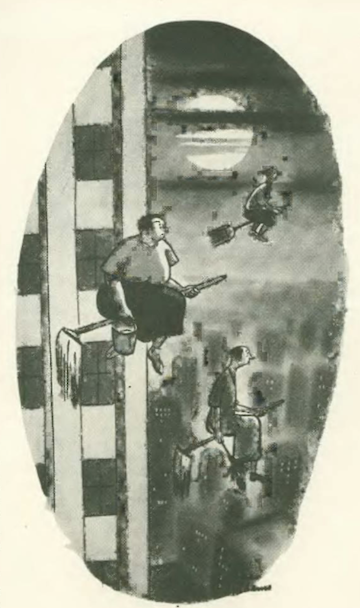
…and Charles Addams...


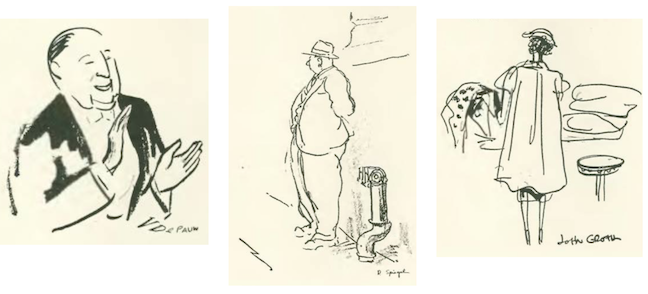
…a sampling of other spot drawings…Victor de Pauw, Doris Spiegel, and John Groth…

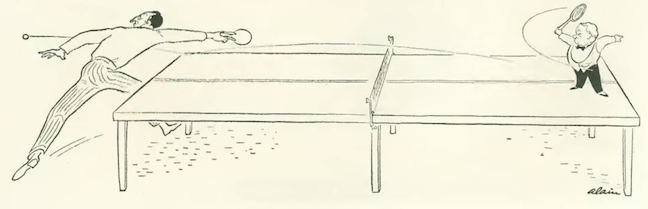
…Alain gave us the true meaning of “table tennis”…

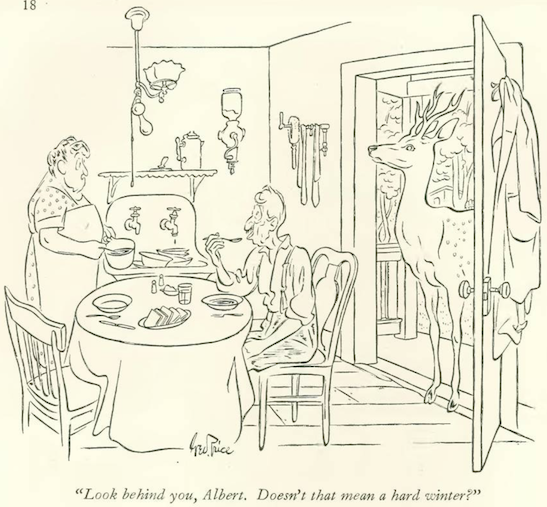
…George Price anticipated a long winter…

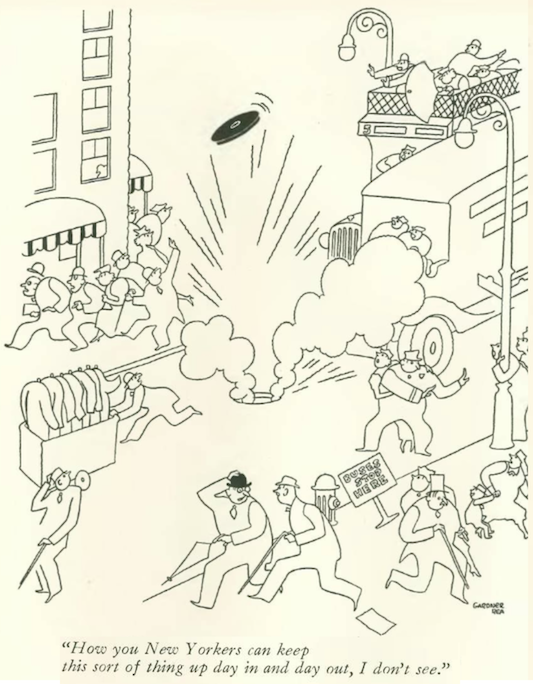
…Gardner Rea showed us an Englishman who found Manhattan life a bit too invigorating…

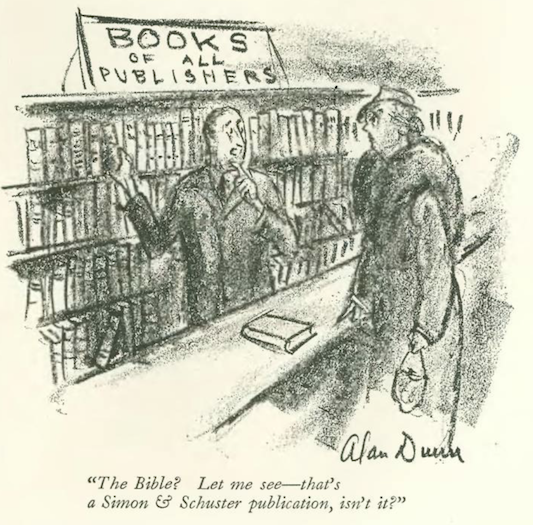
…Alan Dunn posed a question regarding authorship…

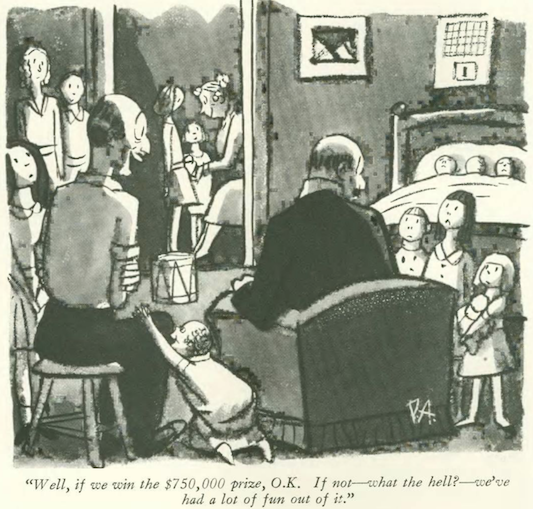
…Peter Arno might be referring to something akin to The Great Stork Derby here…

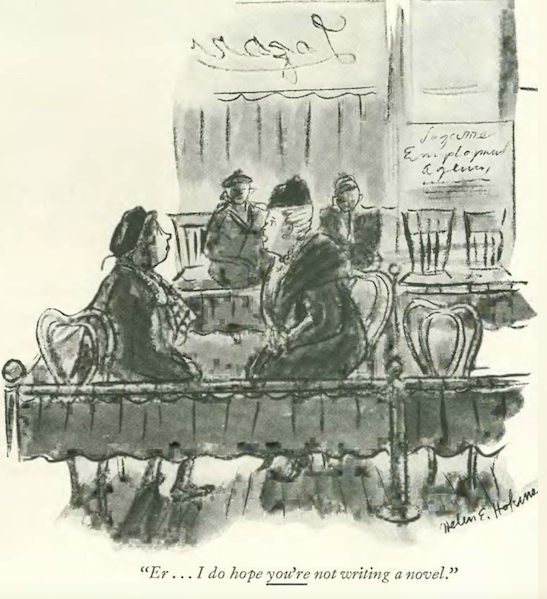
…one of Helen Hokinson’s “girls” sought to stay “off the record”…

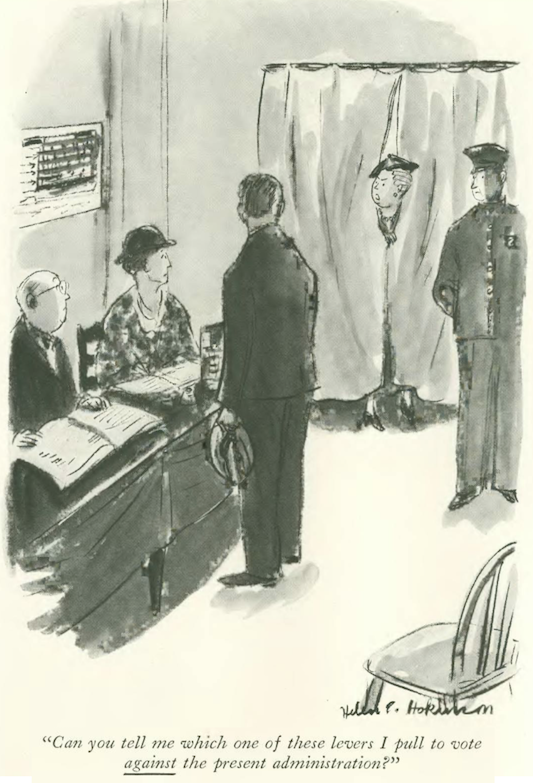
…and Hokinson again, casting a vote in the 1936 General Election…

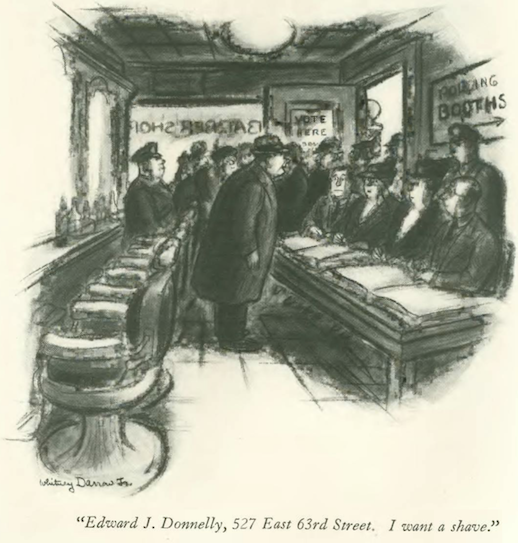
…Whitney Darrow Jr was also thinking about elections, and a clean shave…

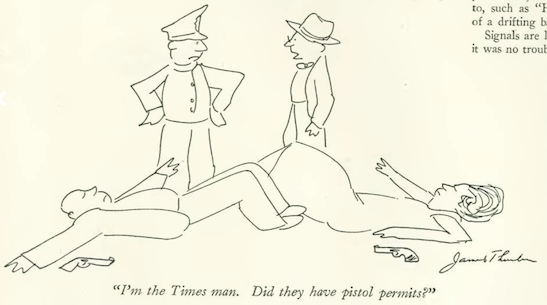
…and we close with James Thurber, and an inquiring reporter…

Next Time: The Instant Home…

The President’s Mystery

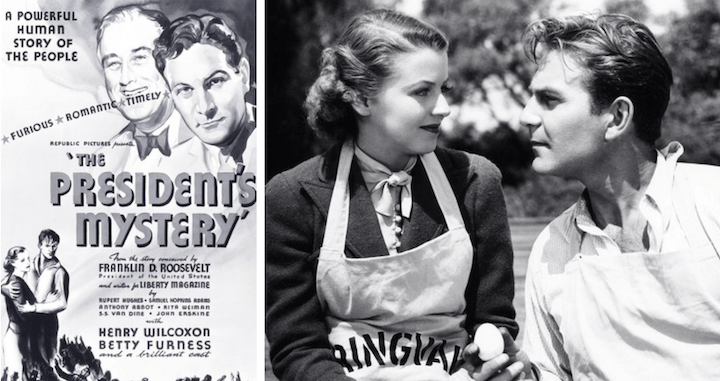
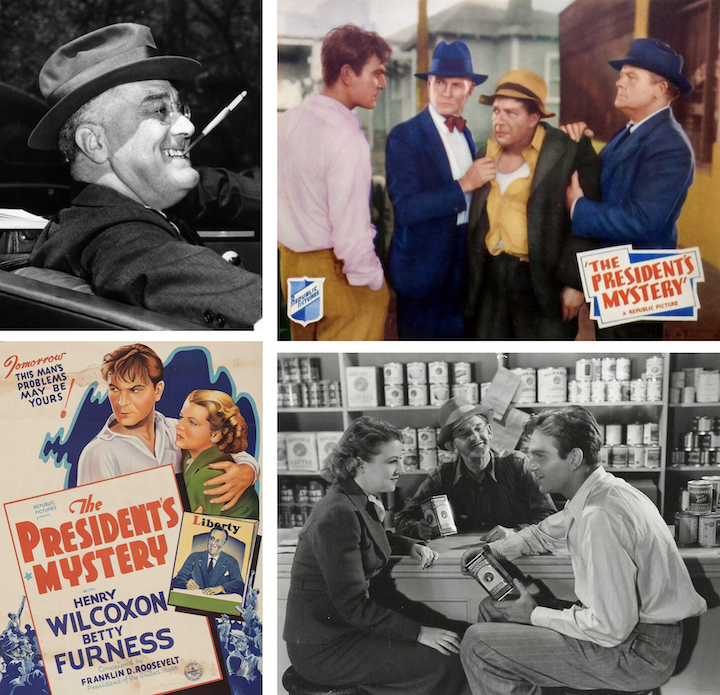
Above: President Franklin D. Roosevelt was credited as a writer on the film "The President's Mystery," although his role was more one of inspiration; at right, Betty Furness and Henry Wilcoxon starred in the film. (rottentomatoes.com)

Just one month before the 1936 general election, Republic Pictures released a film “conceived by Franklin D. Roosevelt.”

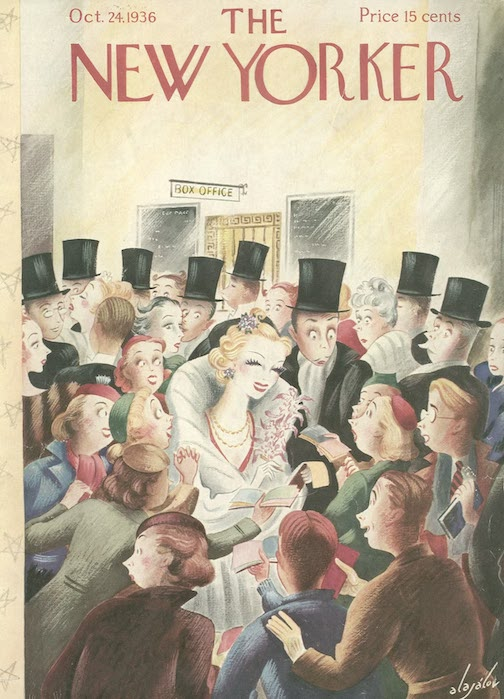
October 24, 1936 cover by Constantin Alajalov.

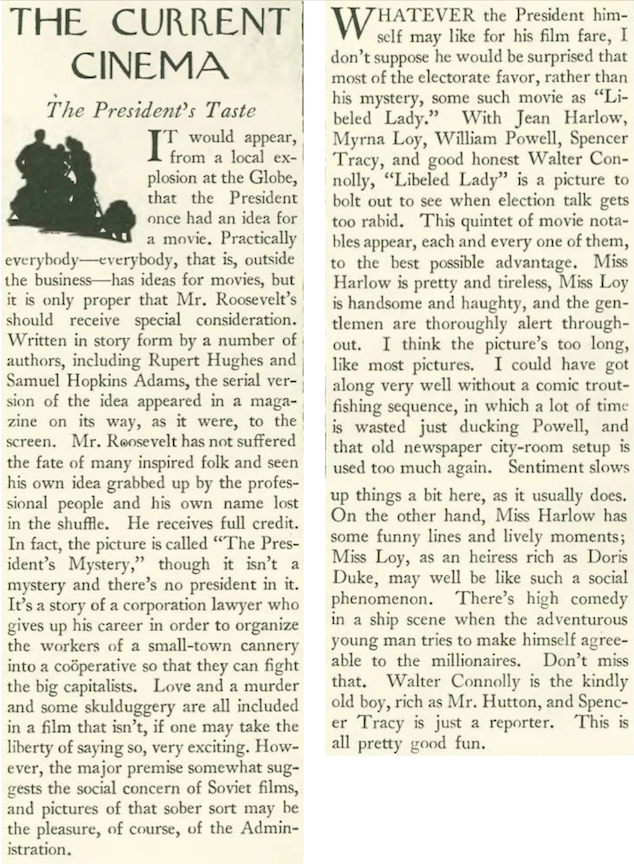
Yes, the president of the United States, standing for re-election in November (which he would win by a landslide), was actually credited as a writer for the film The President’s Mystery, although FDR’s actual role in the film was its concept. While visiting with Fulton Oursler, editor of Liberty magazine, Roosevelt posed the question: “How can a man disappear with five million dollars of his own money in negotiable form and not be traced?” Oursler, a close friend of the president’s, responded by enlisting several prominent authors to write a screenplay. New Yorker film critic John Mosher takes it from there:

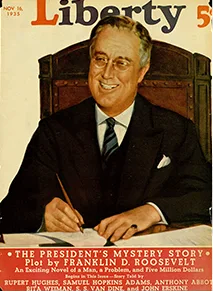
The story behind the film was first featured in the Nov. 16, 1935 issue of Liberty magazine…

(libertymagazine.com)

…and released as a movie on Sept. 28, 1936…

MAN OF MYSTERY…Clockwise, from top left, President Franklin D. Roosevelt, a fan of mysteries, conceived the idea for The President’s Mystery; Henry Wilcoxon, Frank O’Connor, an unidentified actor, and Wade Boteler featured on a lobby card promoting the film ; Betty Furness, Si Jenks, and Henry Wilcoxon in a promo shot for the film; poster for the film featured an image of FDR on the cover of Liberty magazine. (instagram.com/imdb.com/themovieb.org)

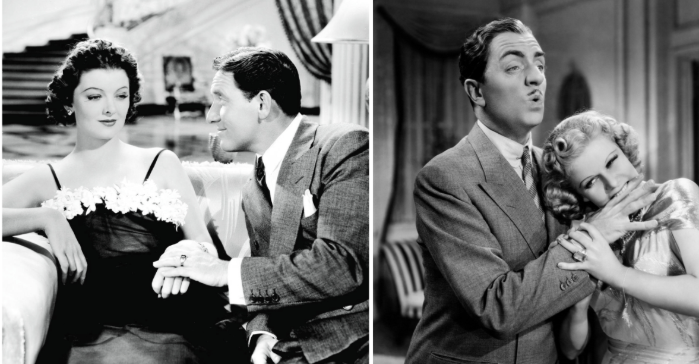
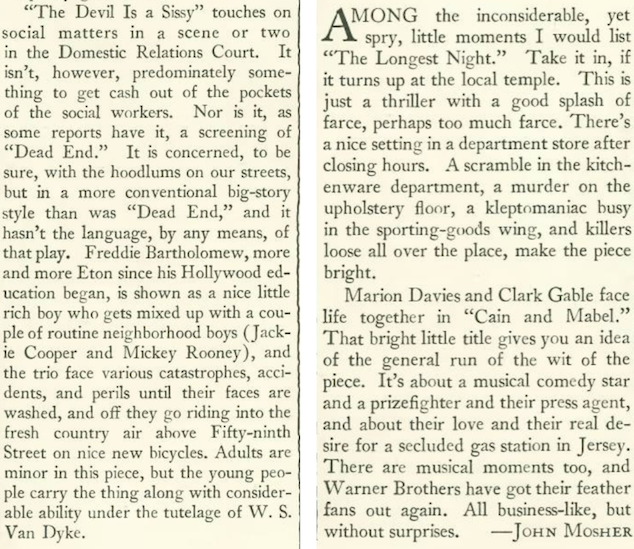
Mosher also had “pretty good fun” with the star-studded screwball comedy, Libeled Lady, which was acclaimed by critics and nominated for Best Picture:

LOVE QUADRANGLE…Lovers spats and romantic mix-ups were just part of the stew in the screwball comedy Libeled Lady. At left, Myrna Loy and Spencer Tracy; at right, William Powell and Jean Harlow. (imdb.com/movie nation.com)

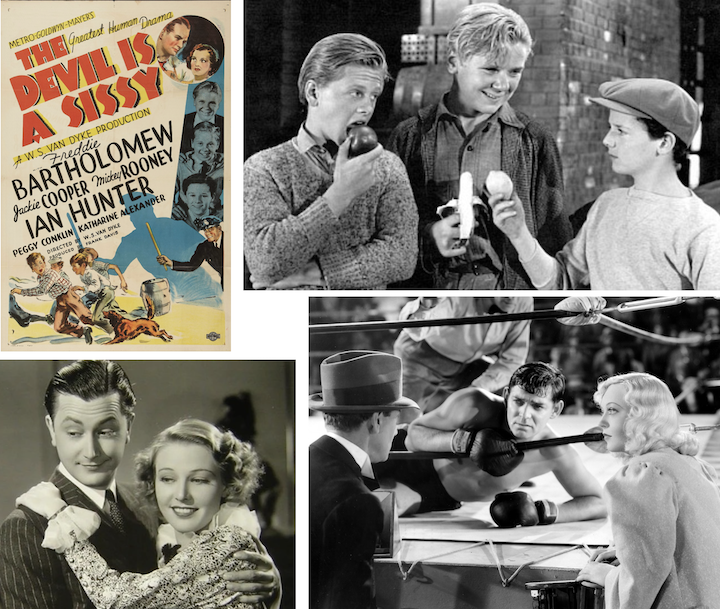
There were still other films reviewed by Mosher, including The Devil is a Sissy, starring sixteen-year-old Mickey Rooney, still emerging as a star, as well as famed child actors Jackie Cooper and Freddie Bartholomew. There was also a film featuring Clark Gable as a prize fighter, and a movie titled The Longest Night, ironically the shortest feature ever produced by MGM—just 51 minutes.

STREET SMARTS…Mickey Rooney, Jackie Cooper, and Freddie Bartholomew in The Devil is a Sissy, a story about a posh kid who befriends a couple of ruffians; Clark Gable was down for the count in Cain and Mabel, co-starring Marion Davies; Robert Young teamed up with Florence Rice in the mystery-thriller, The Longest Night—Florence Rice was the only child of sportswriter Grantland Rice. (Wikipedia/mubi.com/tcm.com)

 * * *

A Second Life

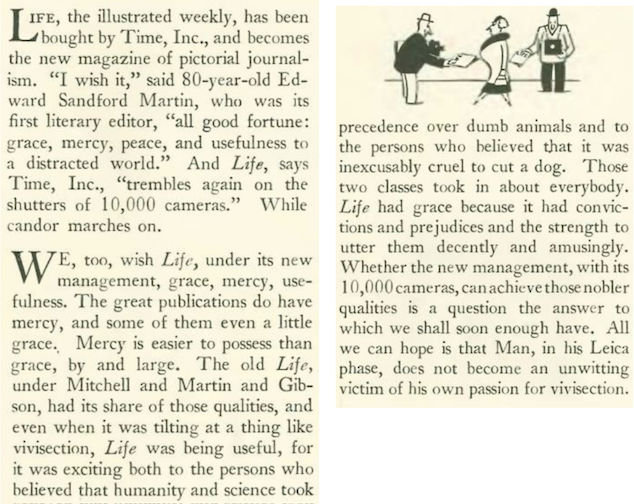
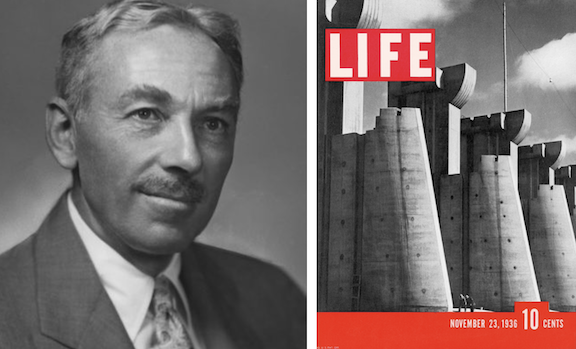
E.B. White still wasn’t done with the new Life magazine—recall his “Notes and Comment” from Sept. 19, when he lamented a magazine that would “consist almost entirely of pictures” and would “do away with the last vestiges of privacy in America.” Here White notes the purchase of Life by Time, Inc., and compares it to the old Life.

ASKING FOR MERCY…E.B. White hoped the new Life magazine would have some of the mercy and grace of its predecessor. (sunrisepoint.com/time.com)
LIFELESS…Launched in 1883, Life was an American humor and general-interest magazine. Purchased and shut down in 1936 by Henry Luce, he replaced it with his new, and very different Life. The image above is the cover of the Feb. 2, 1922 issue of the old magazine. (Wikipedia)

 * * *

A Sensitive Hamlet

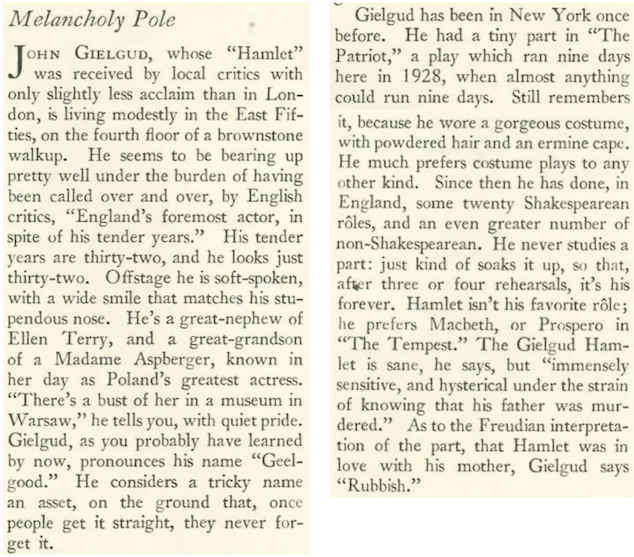
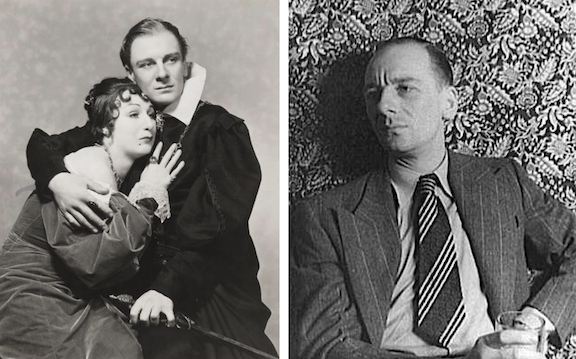
There are as many approaches to playing Hamlet as there are versions of the famous Shakespeare play, The Tragedy of Hamlet, Prince of Denmark. In the case of actor John Gielgud, as reported in “The Talk of the Town,” Hamlet was quite sane, although he was “immensely sensitive.”

MOMMY DEAREST…At left, Judith Anderson as Hamlet’s mother, Gertrude, Queen of Denmark, and John Gielgud as Hamlet in Broadway’s 1936 production of the Shakespeare play; at right, Carl Van Vechten portrait of Gielgud during the actor’s time on Broadway, December 1936. Gielgud is widely regarded as one of the definitive Hamlets of the 20th century. (newyorktheater.me/newworldencyclopedia.org)

 * * *

Safety Last

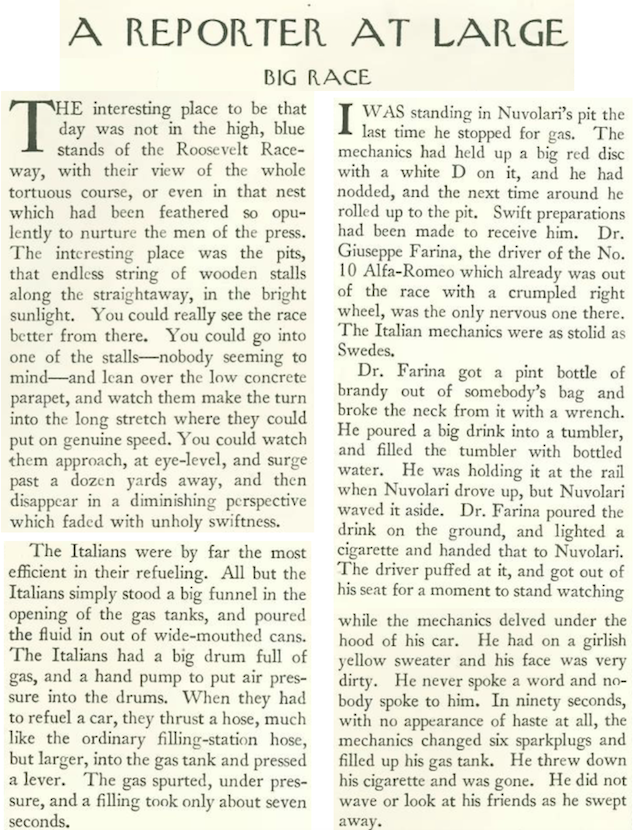
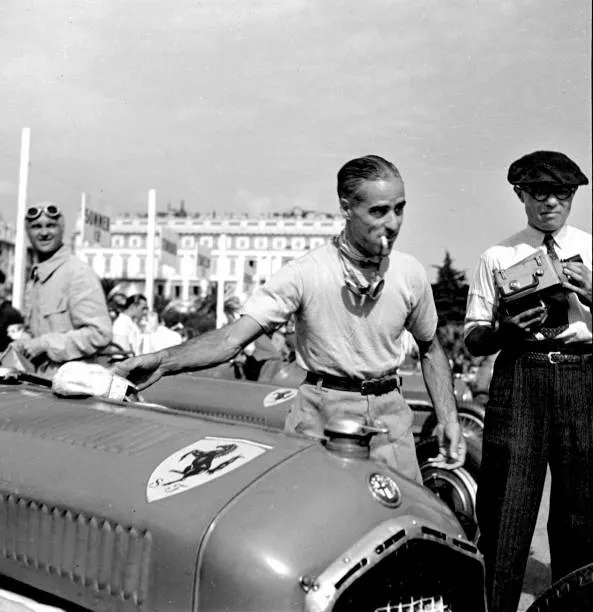
Morris Markey was on hand for the Vanderbilt Cup Race (recently featured here), offering a track-side look at the pit crews. Notable in this excerpt is the complete lack of safety protocols, from gasoline poured out of wide-mouthed cans to smoking and drinking among drivers and pit crews. The race winner, Tazio Nuvolari (who refuses some brandy but puffs on a cigarette) would eventually have to retire by 1950 due to his total deafness and other health problems—he spent years racing in an open cockpit with the manifold ends right next to his ear. Those combustion gases—containing gasoline juiced with methanol, benzene, acetone, and nitrobenzene—easily penetrated Nuvolari’s ears and nose and were absorbed directly into his skin and bloodstream.

GUTS AND GLORY…Italian racing legend Tazio Nuvolari (1892–1953) with his Alfa Romeo before the start of the 1935 Nice Grand Prix in France. Nuvolari easily won the 1936 Vanderbilt Cup on Long Island. (notenoughcylinders.com)

 * * *

Color My World

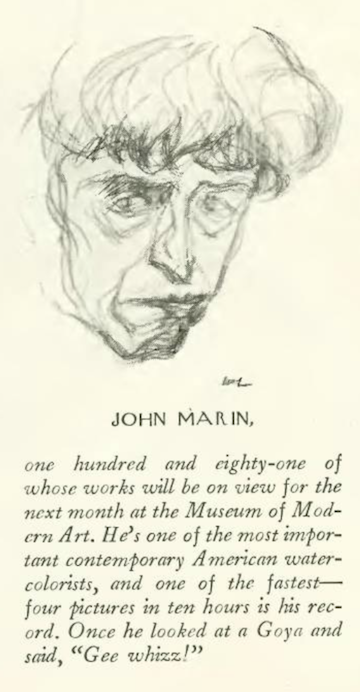
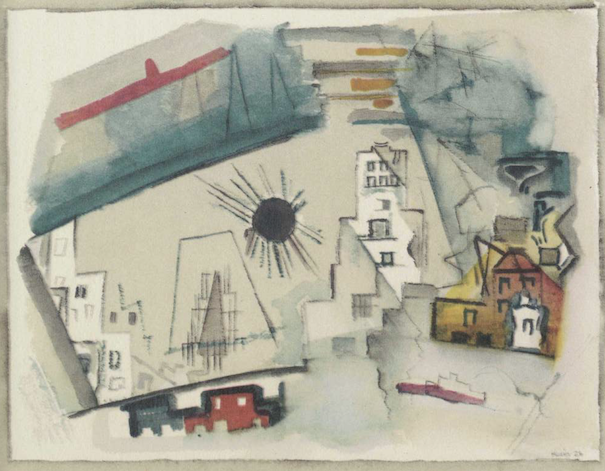
The works of John Marin, considered one of America’s finest water-colorists, were featured in a major exhibition at the Museum of Modern Art. In addition to a review by art critic Lewis Mumford, Marin was featured in this mini bio on the opening pages…caricature by William Auerbach-Levy…

MASTER WATER-COLORIST…John Marin’s Movement No. 2, Related to Downtown New York (The Black Sun), 1926. Image reproduced from the 1936 MoMA exhibition catalog. (moma.org)

 * * *

From Our Advertisers

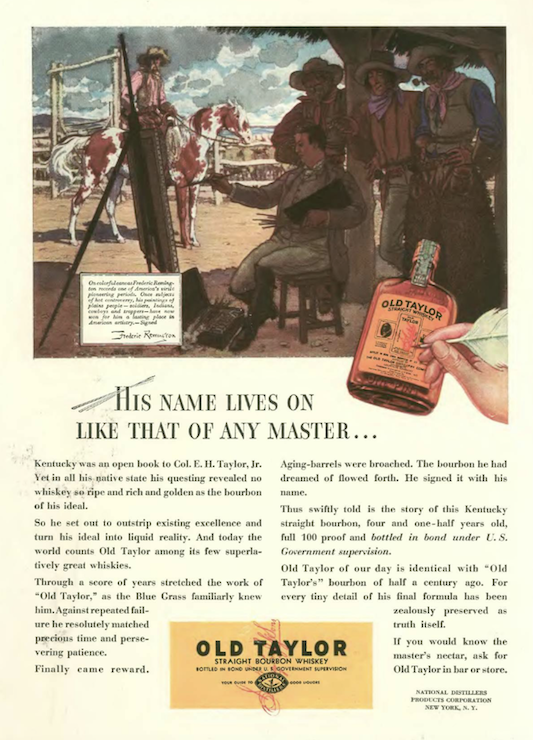
The Oct. 24 issue opened with this advertisement by the distillers of Old Taylor, who continued to compare their product to the work of “masters,” here the painter Frederic Remington…

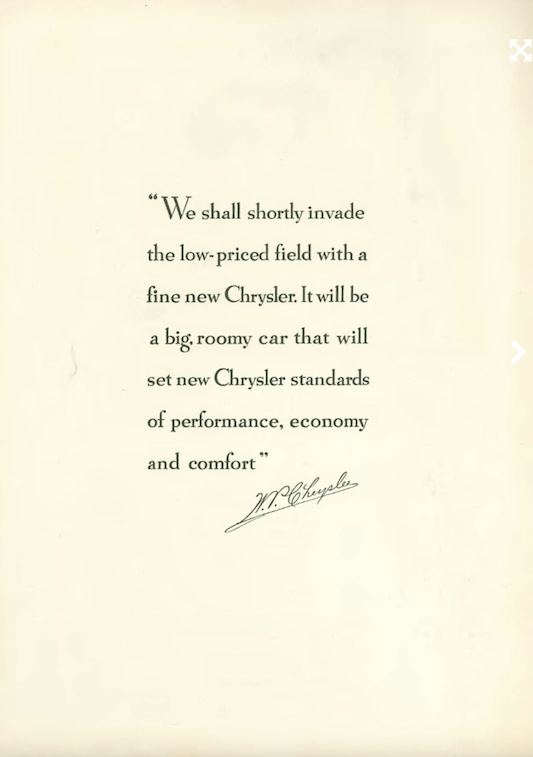
…on the opposite page, this spare ad from Chrysler, a stark contrast to their previous week’s very wordy appeal…
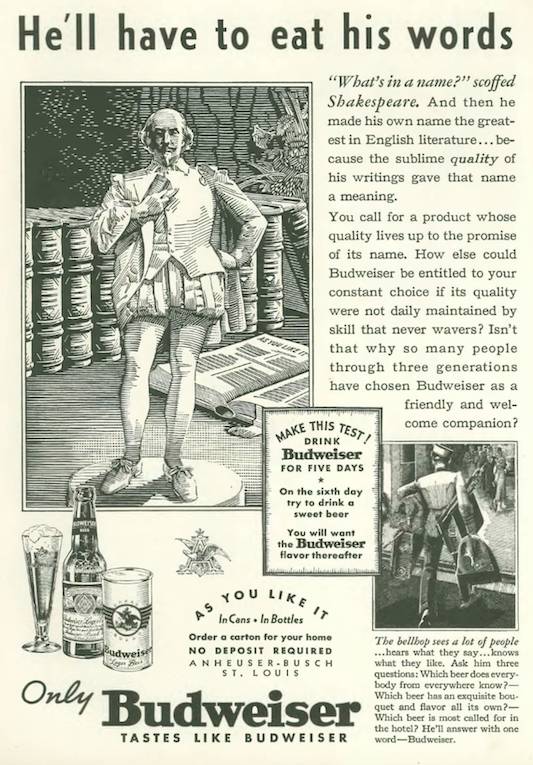
…the promoters of Budweiser took a cue from the whiskey distillers, invoking the words of an historic personage to promote their product…
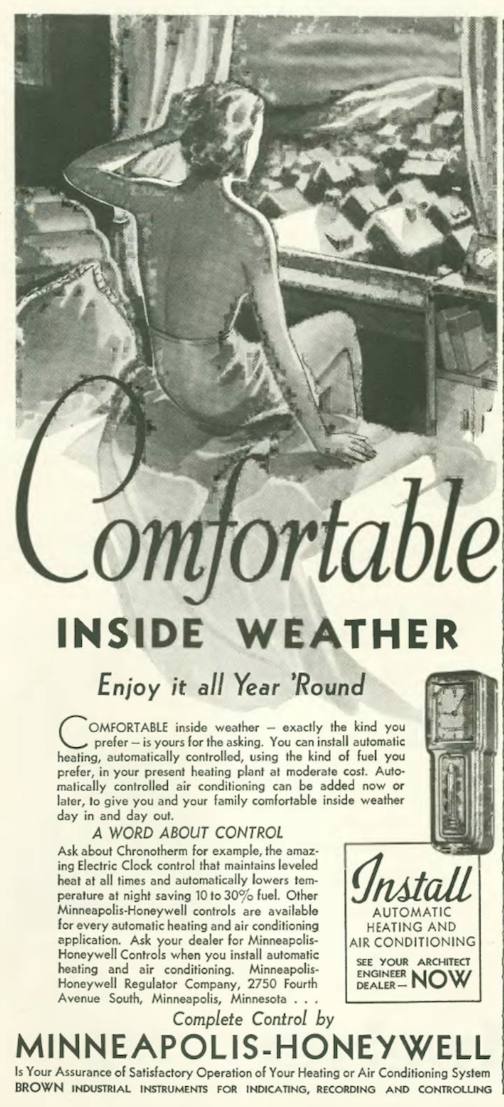
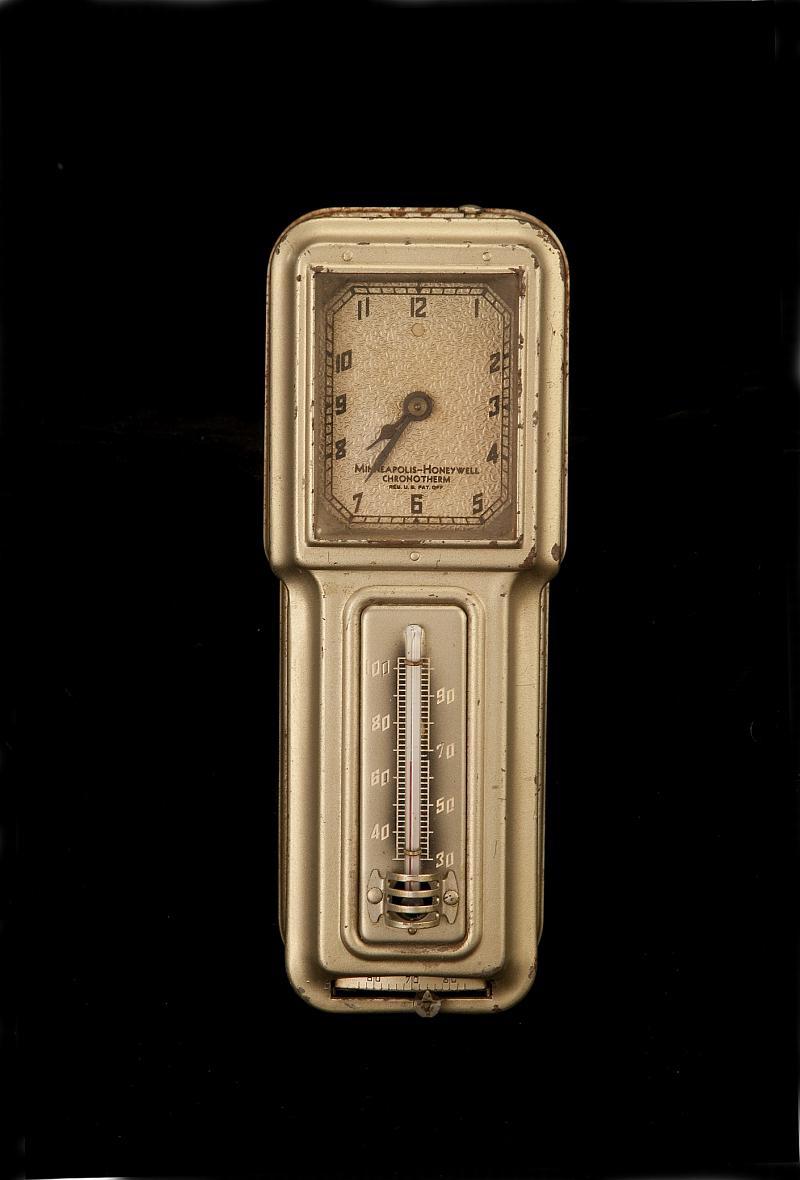
…predating modern thermostats by decades, the mechanical Chronotherm was one of the earliest automated room thermostats ever produced by the Minneapolis-Honeywell Regulator Company…it was often used to control coal or early heating systems by automatically adjusting dampers or furnaces on a schedule…
The Minneapolis-Honeywell Chronotherm retailed for about $41 in the 1930s (equivalent to roughly $970 today). It was considered a high-end luxury upgrade for the home. (si.edu)

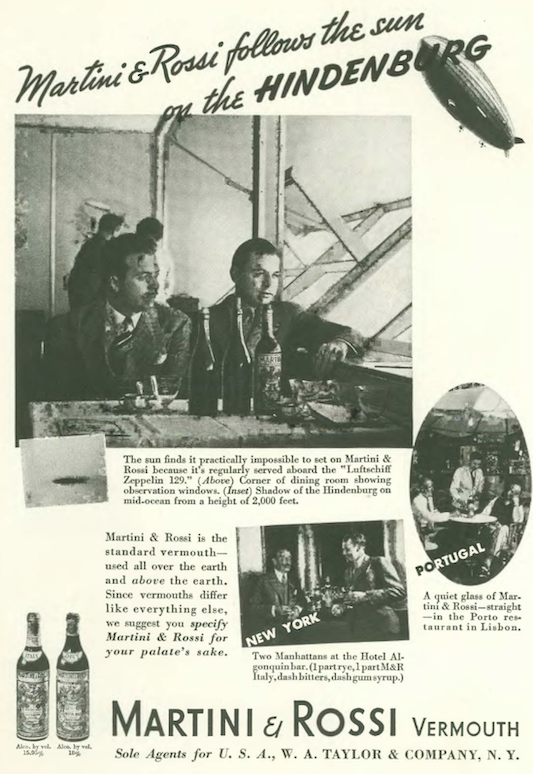
…Martini & Rossi would have about six more months to serve their vermouth on the Hindenburg before it would go down in a fireball on May 6, 1937…

…the illustrations in this No-Mal ad mimicked the style of Otto Soglow to market a new patent medicine touted as a stimulant and hangover cure, among other things…these remedies often contained heavy doses of caffeine plus aspirin, mild laxatives, and antacids, while some also contained the amphetamine Benzedrine…

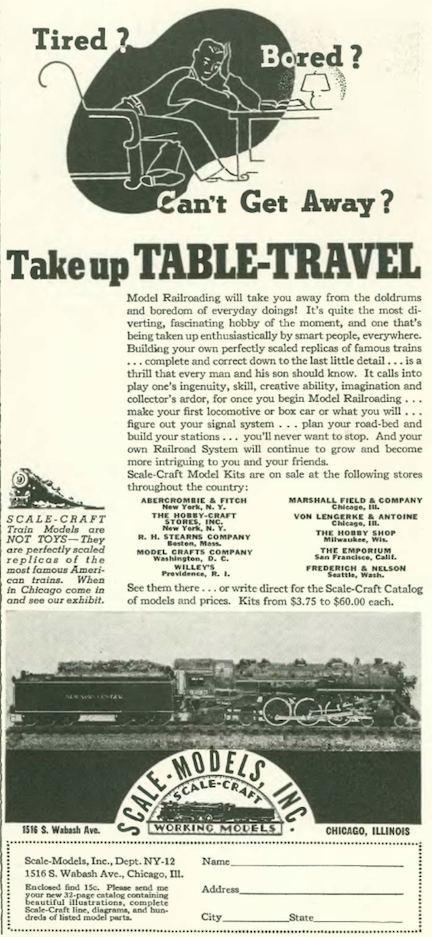
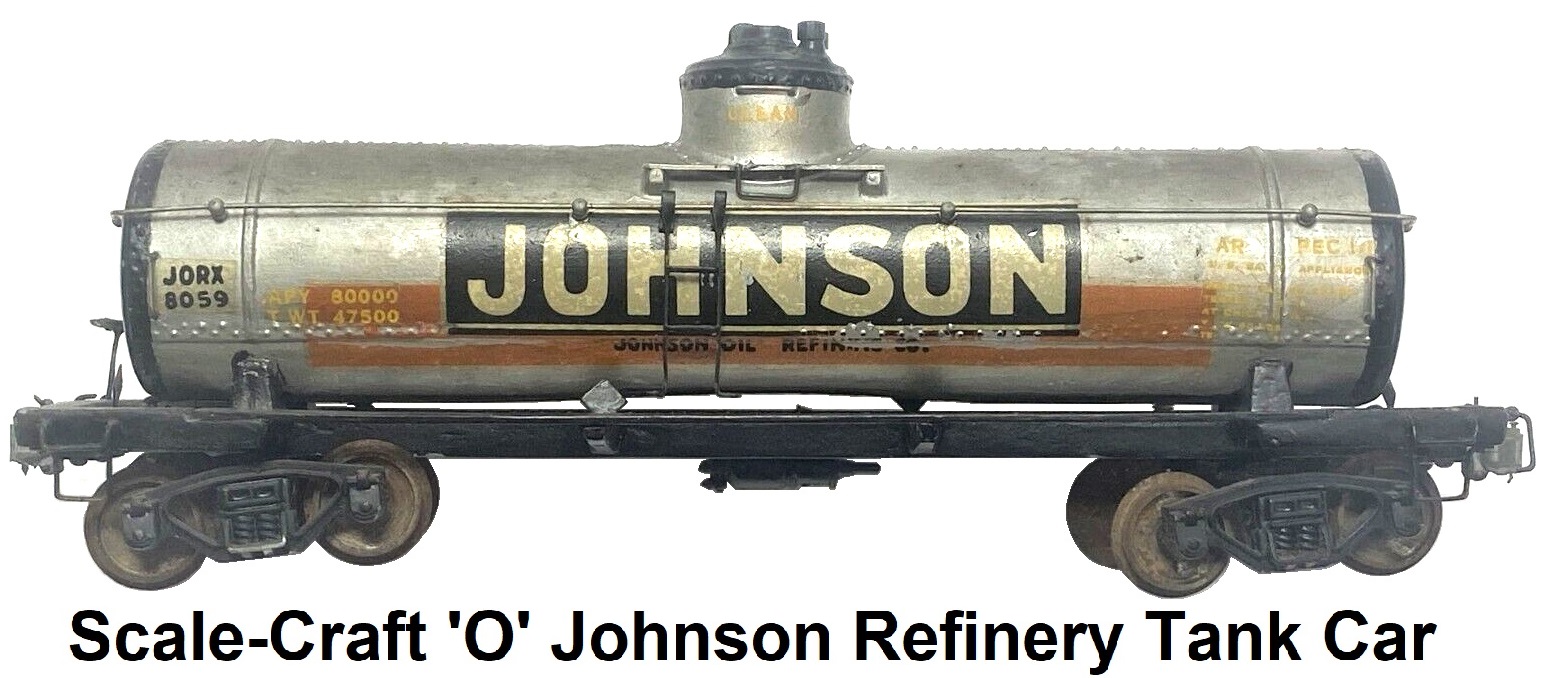
…model railroading for adults started to build up steam in the 1930s…here’s a back of the book ad aimed at those who couldn’t afford to travel but who could afford a Scale-Craft kit…

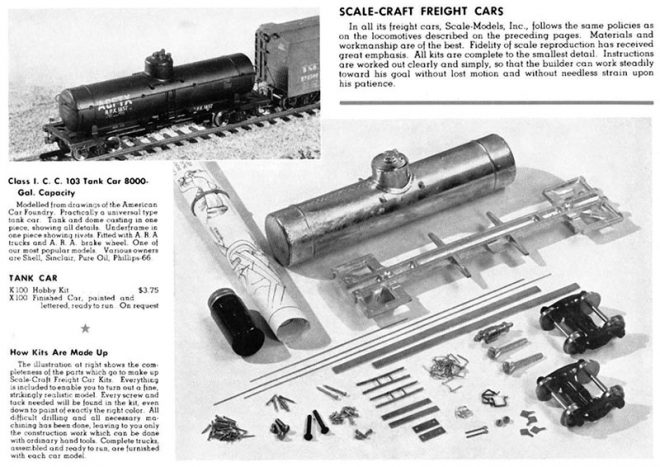
…here’s a page from the 1936 Scale-Craft catalog…

…and an example of what you could build from a kit…

(tcawestern.org/oscalemag.com)

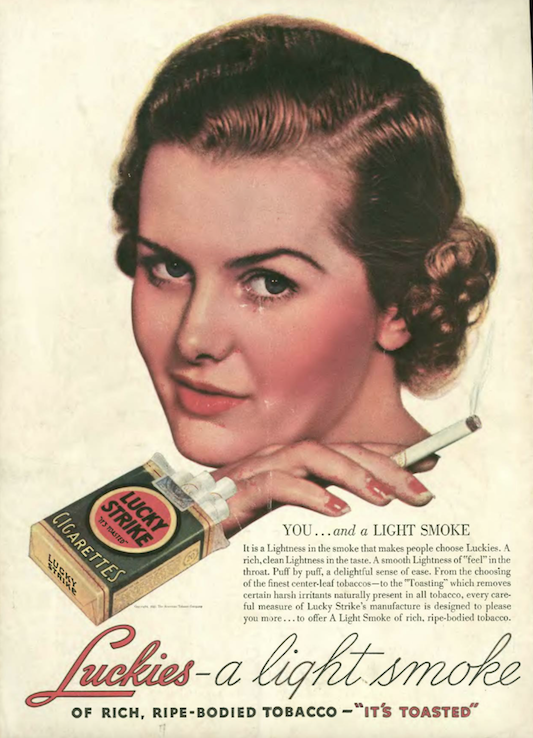
…and there’s no guessing the target audience for this brand of cigarettes…

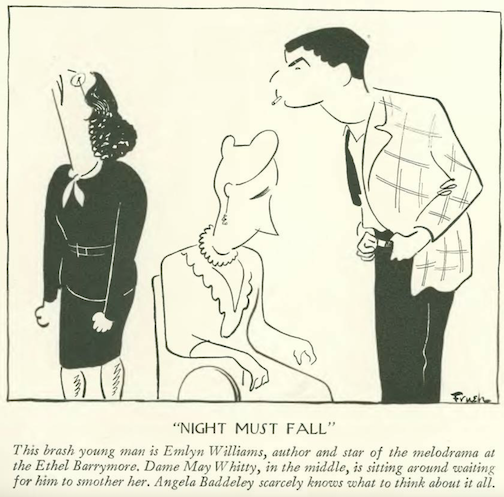
…on to our cartoonists, Al Frueh was back with illustrations for the theater review section…

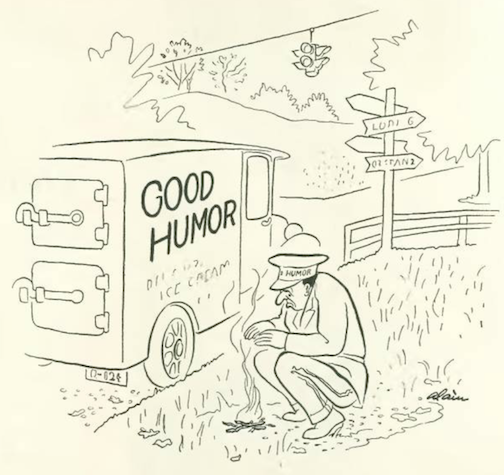
…Alain found nothing humorous about being a Good Humor man…

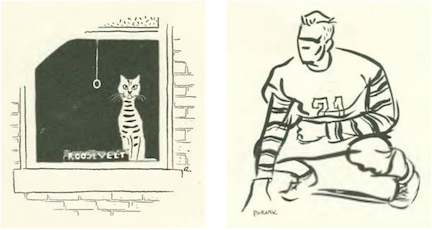
…a couple of spots by Abe Birnbaum (left) and unidentified at right (signature looks like PHRANK)…

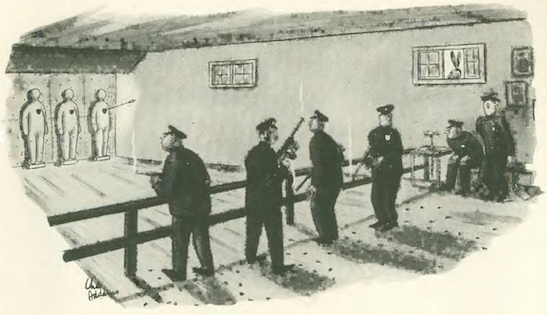
…a stray arrow found its way into this cartoon by Charles Addams…

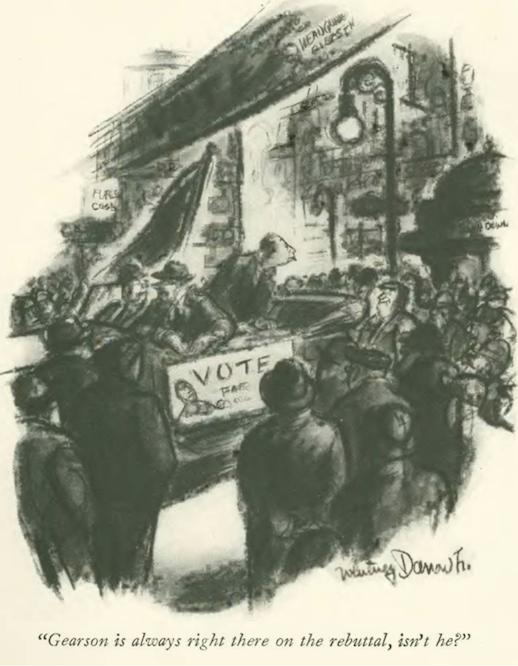
…Whitney Darrow Jr illustrated the childish side of politics…

…we zoom in for a close-up…

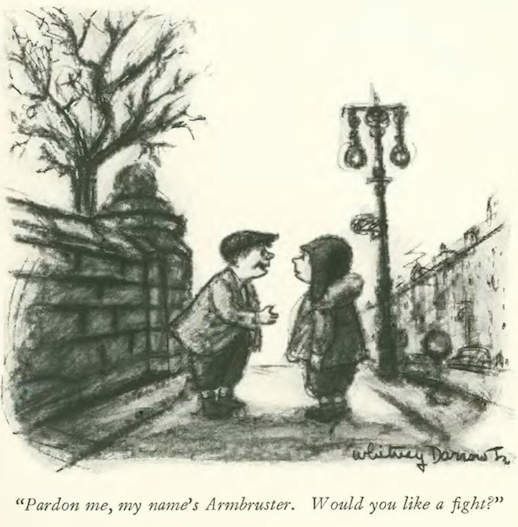
…Darrow again, making a new friends…

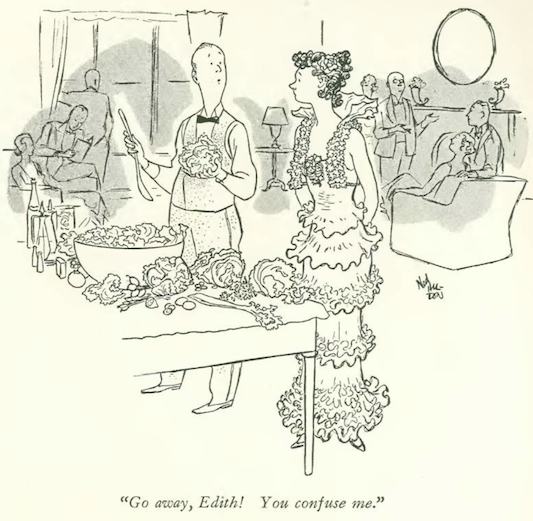
…Ned Hilton drew up an outfit that clashed with the salad course…

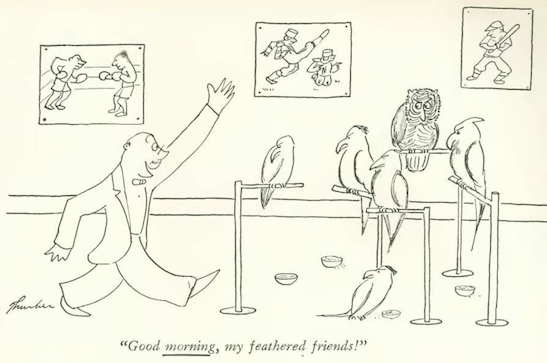
…James Thurber greeted a group of dour birds (interesting background with sporting scenes…one wonders why)…

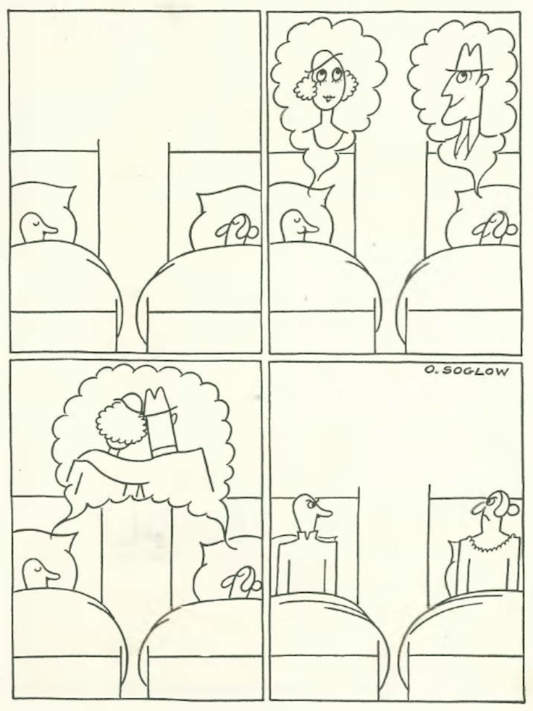
…Otto Soglow gave us some shattered dreams…

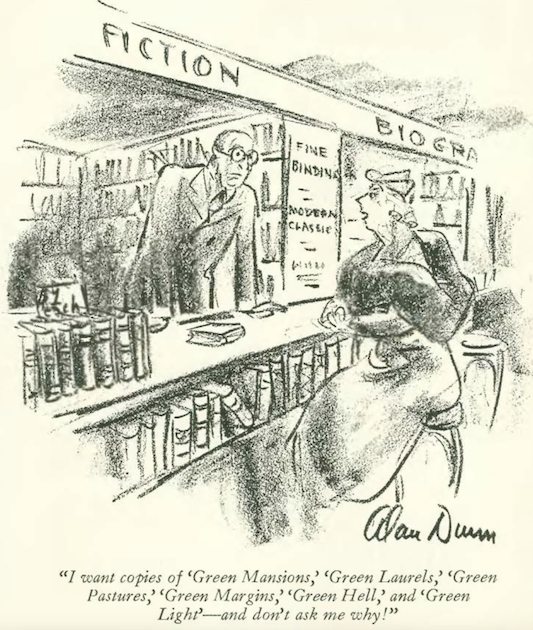
…Alan Dunn visited the fiction section, no questions asked…

…and Dunn again…with an around the world adventure stuck in traffic…

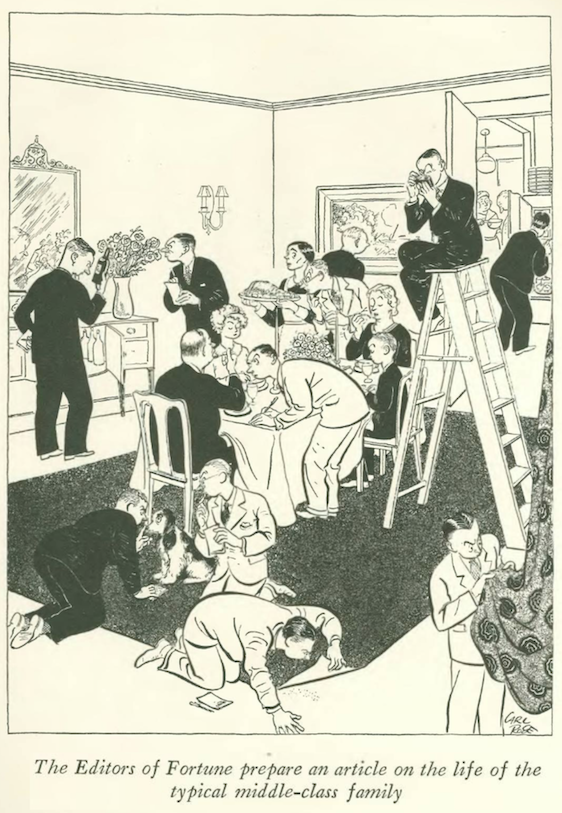
…Fortune magazine probed the mysteries of middle class life, per Carl Rose…

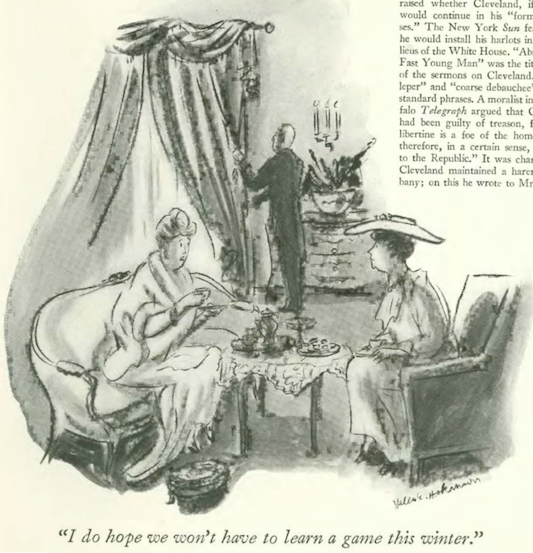
…and we close with Helen Hokinson, and the unease of an approaching winter…

Next Time: Far-Fetched Faulkner…