Far-Fetched Faulkner

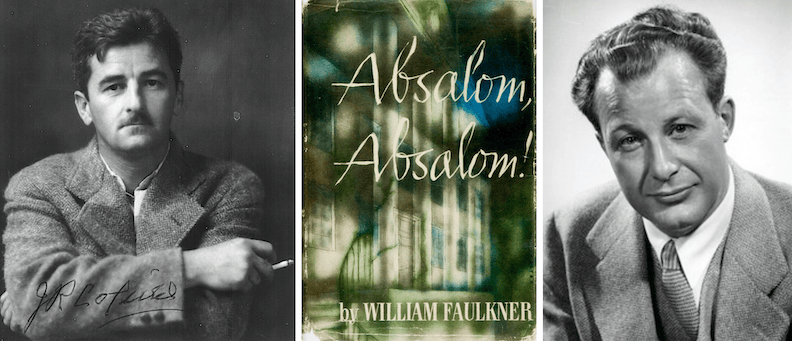
Above: New Yorker book critic Clifton Fadiman (right) characterized William Faulkner's "Absalom, Absalom!" as a "penny dreadful tricked up in fancy language." Fadiman was not alone among contemporary mainstream critics in his assessment, although today the novel is considered a masterwork of Southern Gothic literature. (Wikipedia/J.R. Cofield Collection, University of Mississippi Library)

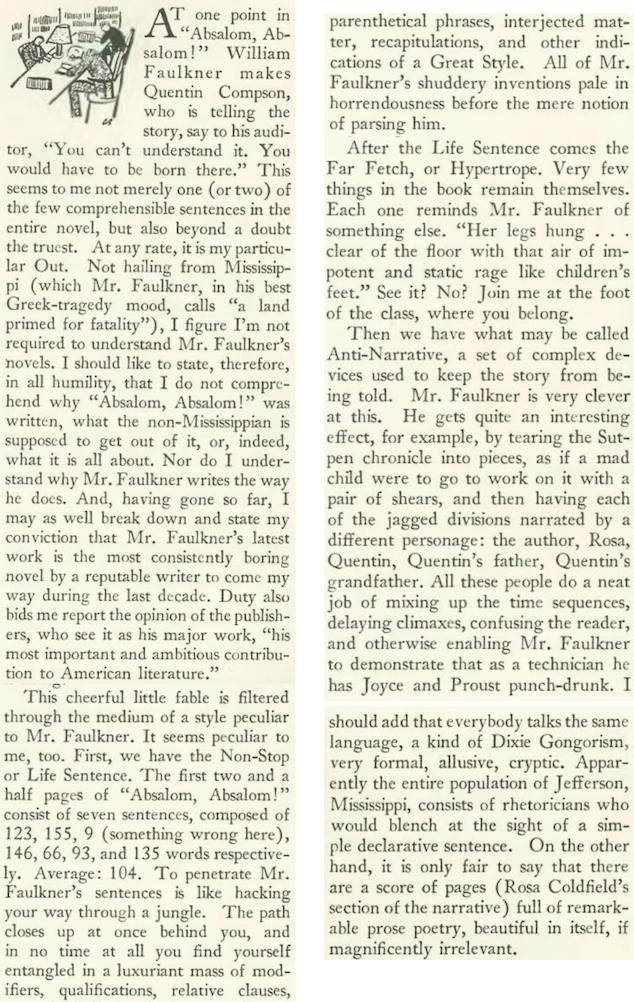
With its non-linear timeline, winding prose, and multiple unreliable narrators, William Faulkner’s Absalom, Absalom! left many critics wondering what to make of the author’s ninth novel, including The New Yorker’s Clifton Fadiman, who had a near-visceral response to Faulkner’s “shuddery inventions.”
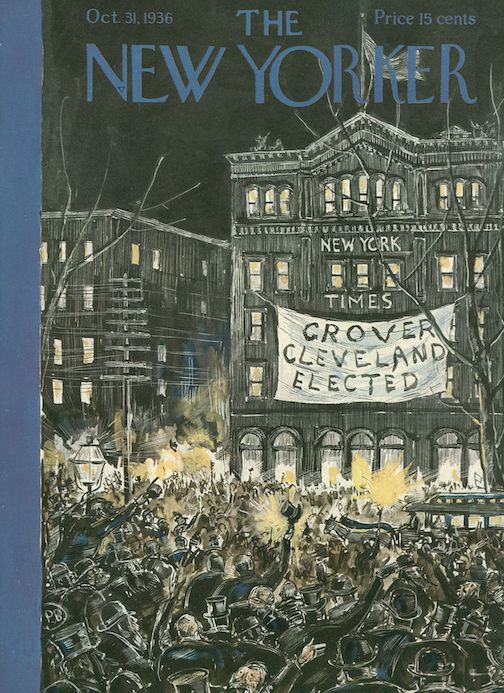
October 31, 1936 cover by Perry Barlow.

Although today the novel is widely considered a literary masterpiece, in 1936 Fadiman saw the dense, labyrinthine style of Absalom, Absalom! as nothing more than an empty facade for a melodramatic plot and characters resembling a “mince-pie nightmare.”

The novel explored the rise and fall of Thomas Sutpen, a poor man who ruthlessly carves out a plantation empire in 1830s Mississippi. Told entirely in flashbacks consisting of fragmented memories and differing perspectives, the novel is psychologically bleak and violent, with nearly every major character meeting a tragic end. Following are excerpts from Fadiman’s review:

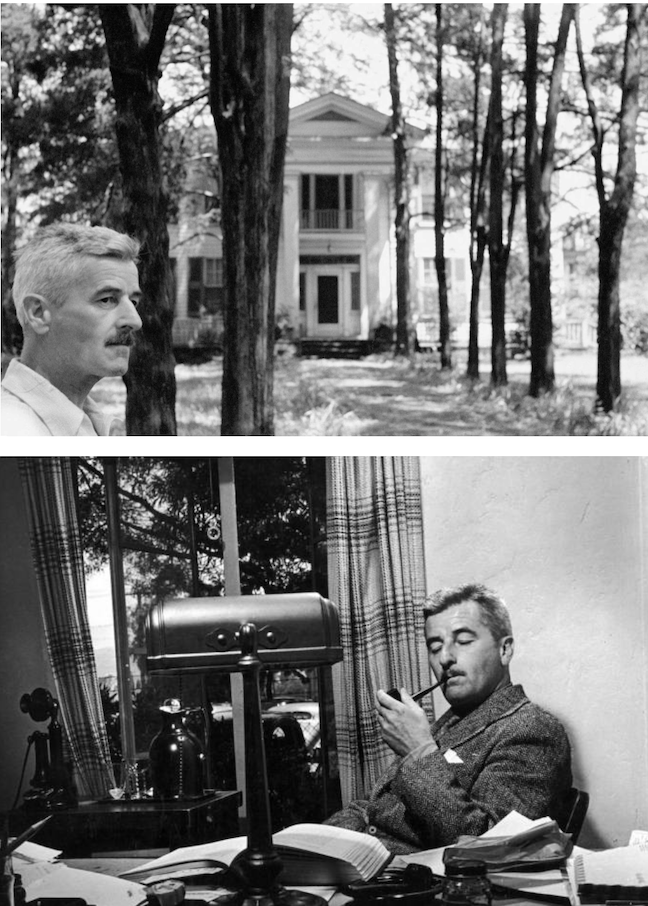
OXFORD MAN…Above, William Faulkner at his 1844 Greek Revival home, Rowan Oak, which he purchased in Oxford, Mississippi in 1930; below, at work in his study. The mid-1930s were a difficult time for Faulkner. His writing was often interrupted by trips to Hollywood, where he sought additional income writing screenplays (Faulkner was constantly in debt), and in 1935 his brother Dean was killed in a plane crash. Consequently this period included a number of heavy drinking benders. (genteelandbard.com/life.com)

Faulkner had some history with The New Yorker: A Nov. 21, 1931 “Talk of the Town” entry titled “Oxford Man” featured a thirty-four-year-old Faulkner living in a Tudor City apartment, working on his novel Light in August. “Talk” noted his service in the Canadian air force, which he joined in 1915 (he broke both legs in a crash) and that he “sometimes flies a rather wobbly plane owned by a friend in Oxford.” As for his writing style, “Talk” offered this quote from Faulkner: “Ah write when the spirit moves me, and the spirit moves me every day.” The piece also noted that “Only a few of the townspeople know he writes at all; most of them think he’s lazy.”

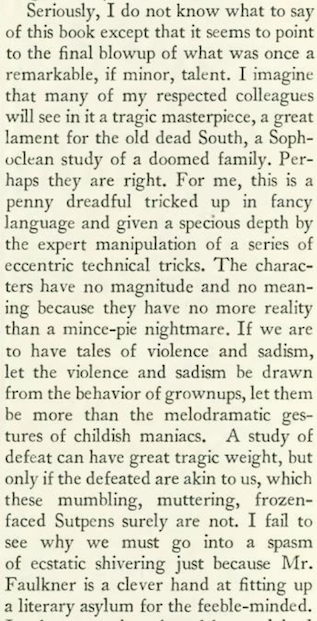
Here’s a second excerpt from Fadiman’s Oct. 31, 1936 review, in which the critic concludes that Faulkner “is a clever hand at fitting up a literary asylum for the feeble-minded.”
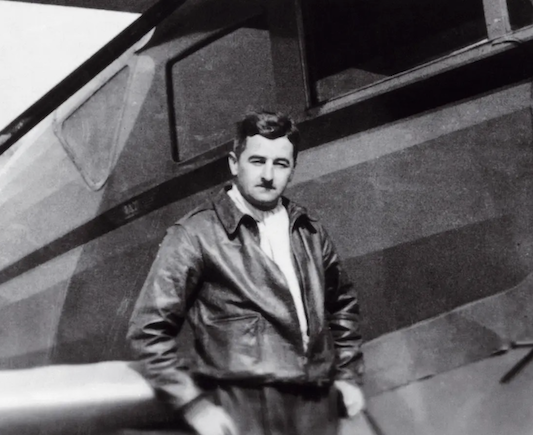
FLYBOY…A 1931 “Talk of the Town” profile, attributed to and  noted Faulkner’s writing habits, his ties to his hometown, and his time in the Canadian Air Force. (espresso.pt)

 * * *

Chattering Mysteries

Those are the words E.B. White used to describe aisles of calculators, addressographs, and electric tabulation machines being operated by women clad “in purest white satin” at a business show on Eighth Avenue.
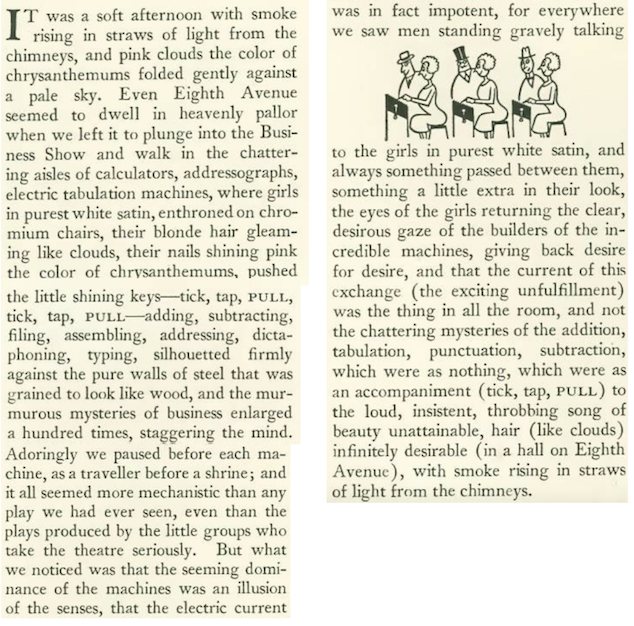
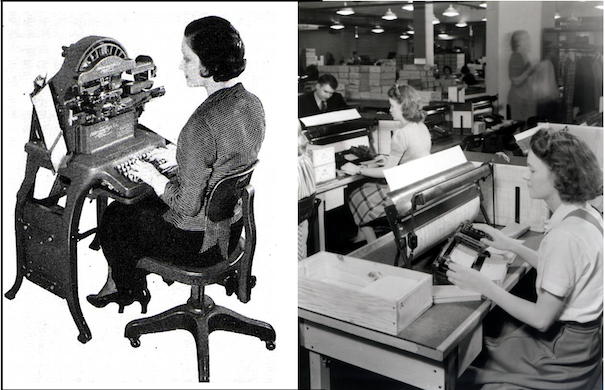
AN ILLUSION OF THE SENSES was achieved by scores of machines clacking away at a Manhattan business show, according to E.B. White. At left is an Addressograph machine, circa 1930s, and at right, a census worker using an IBM Type 1 mechanical key punch, 1940. (americanbusinesshistory.org/officemuseum.com)

 * * *

At the Movies

Get the Extra-large Popcorn

They say movies are getting longer these days, but the Thirties had its share of lengthy screen epics, including a nearly five-hour running time for the 1934 French adaptation of the Victor Hugo novel Les Misérables. Initially released as three films premiering over three consecutive weeks, the full, unedited film ran a total of 281 minutes. Apparently the 1936 American release, reviewed here by John Mosher, ran for just under three hours, which Mosher called “a crime against nature.” He did, however, pronounce it “a fine film.” He also reviewed a German musical comedy, Amphitryon, and some uninspiring “plain American” films.
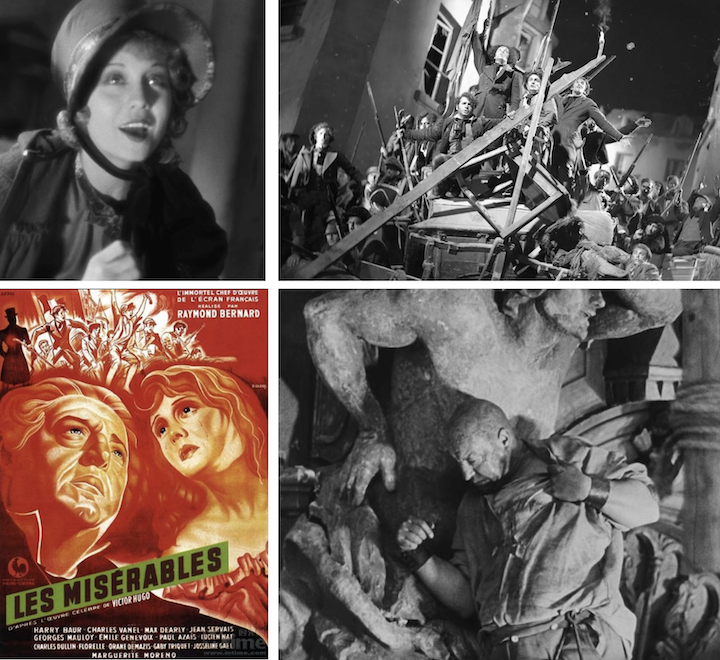
GOING HUGE FOR HUGO…Clockwise, from top left: Florelle as Fantine in Les Misérables; blockade scene from the film; Harry Baur as Jean Valjean; French movie poster, 1934. (imdb.com)

Mosher grew weary of reading the subtitles in the German film Amphitryon, a surprising satirical musical that somehow got made even after the Nazis took over the reigns of the Ufa-Atelier studio; however, the coming year would see a further tightening of domestic repression (including film) under Reich leadership.
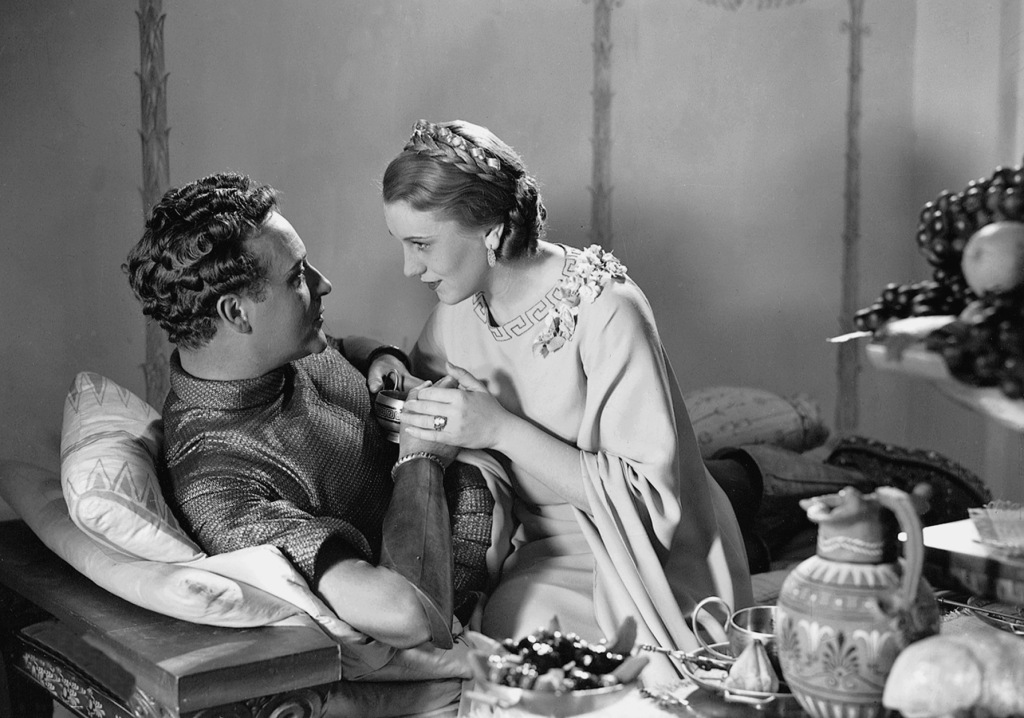
SOME LAST LAUGHS…Willy Fritsch and Käthe Gold in the 1935 German musical comedy Amphitryon. The movie was filmed in German and French, which is probably why Mosher thought it was a French production. (en.kinorium.com)

The “plain American” films reviewed by Mosher included a mystery, a revue, and a musical featuring opera singer Marion Talley, who years earlier had received some rough treatment from The New Yorker.
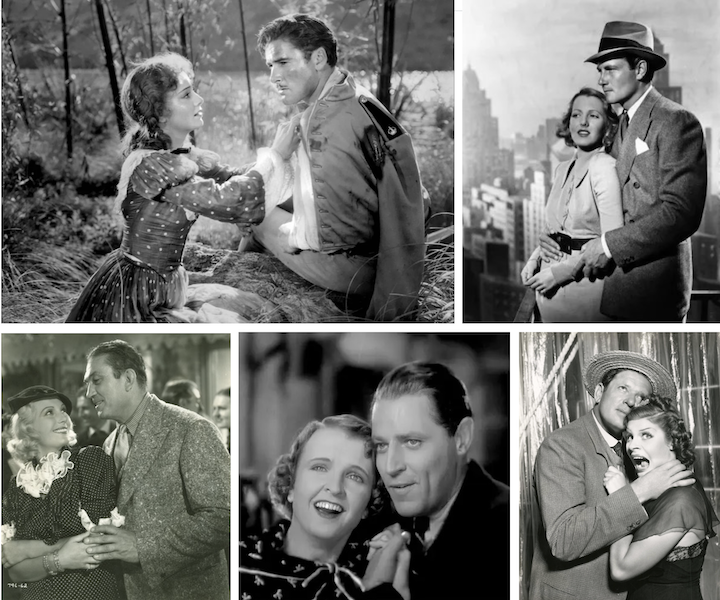
STANDARD FARE…Clockwise, from top left: The Charge of the Light Brigade starred Olivia de Havilland and Errol Flynn; Jean Arthur and Joel McCrea in Adventure in Manhattan; Bob Burns and Martha Raye in The Big Broadcast of 1937; Marion Talley and Michael Bartlett in Follow Your Heart; Victor McLaglen and Binnie Barnes in The Magnificent Brute. (britannica.com/theblondeatthefilm.com/imdb.com/tubitv.com/ebay.com)

 * * *

Polymath Porter

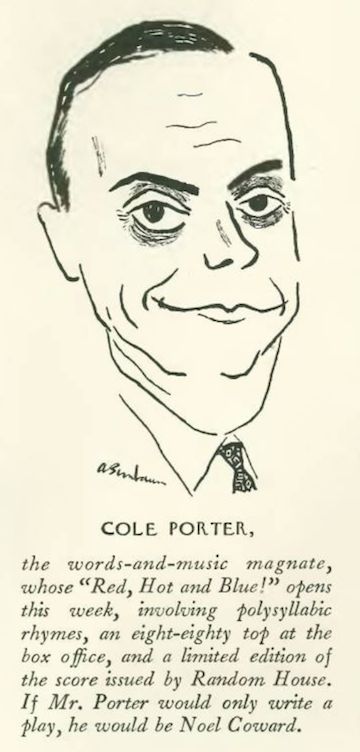
The multi-talented composer/songwriter Cole Porter was the latest celebrity to receive a mini bio in the opening pages…illustration by Abe Birnbaum…
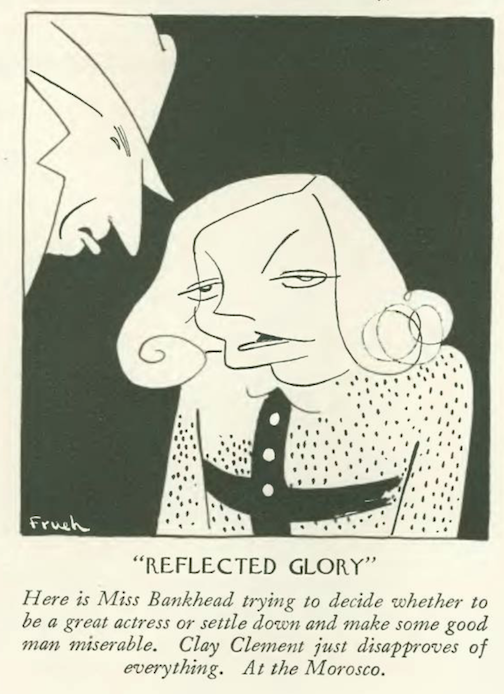
…and on the subject of theater, Al Frueh offered his impression of the Talullah Bankhead vehicle, Reflected Glory...
 * * *

From Our Advertisers

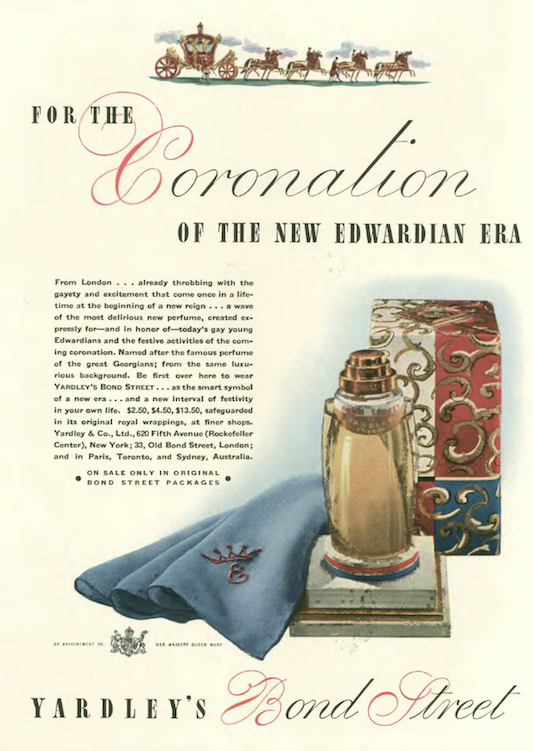
Various retailers were gearing up for the coronation of England’s King Edward VIII, and the folks at Yardley’s were busy packaging their lavender-scented soaps and perfumes for royalty-starved Americans, “safeguarded in original royal wrappings”…this “Edwardian” campaign would be scrapped just weeks later when Edward would abdicate the throne (on Dec. 10) and run off with American Wallis Simpson…
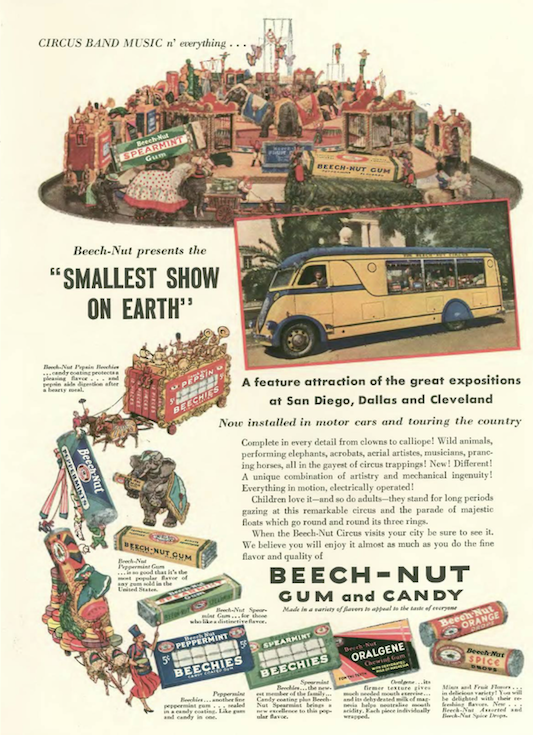
…the makers of Beech-Nut chewing gum made a splash with this full-page ad touting their traveling “Smallest Show on Earth”…
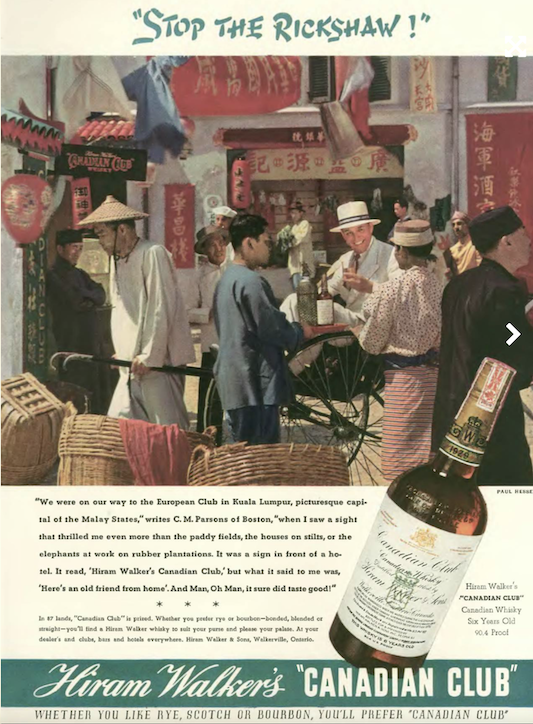
…Canadian Club continued its world tour with a stop in Kuala Lumpur…
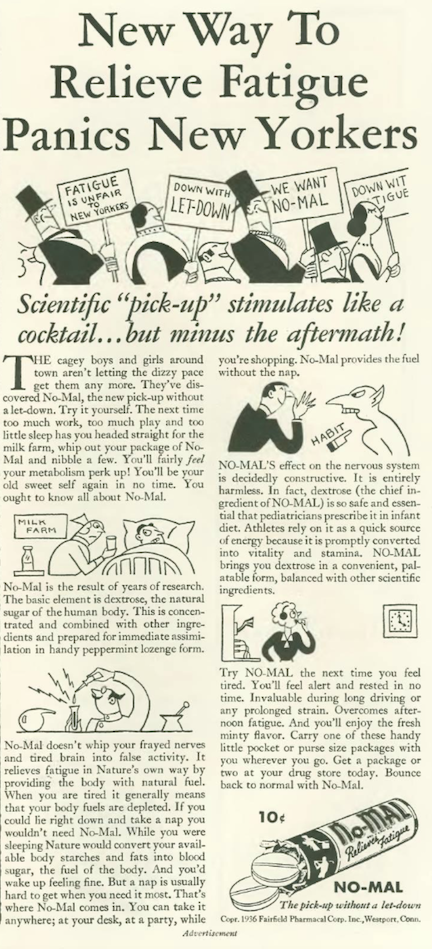
…No-Mal ran another back-of-the-book ad promoting its scientific “pick-up”…the chief ingredient, according to this spot, was dextrose (even safe for infants!), but it doubtless also contained caffeine and Lord knows what else…
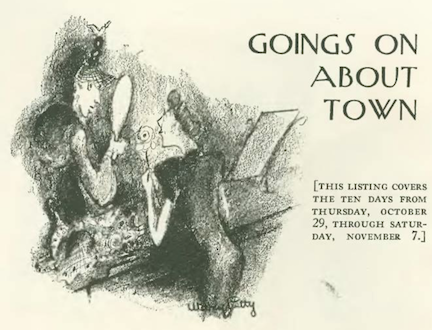
…no extra stimulation needed for our cartoon section, beginning with Mary Petty…
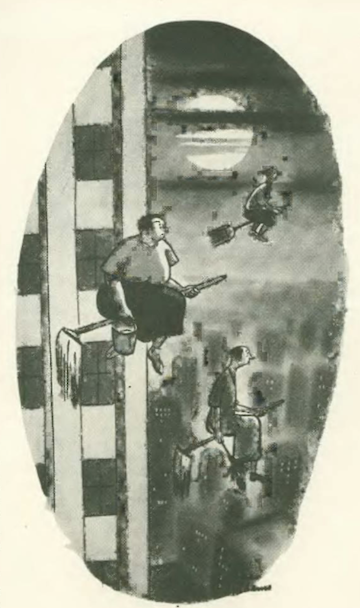
…there were a couple of Halloween-themed spots by Susan Willard Flint…
…and Charles Addams...
 

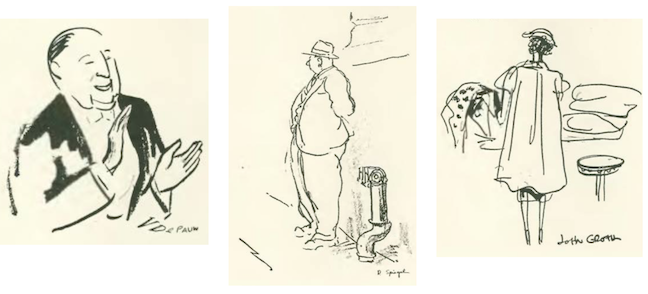
…a sampling of other spot drawings…Victor de Pauw, Doris Spiegel, and John Groth…
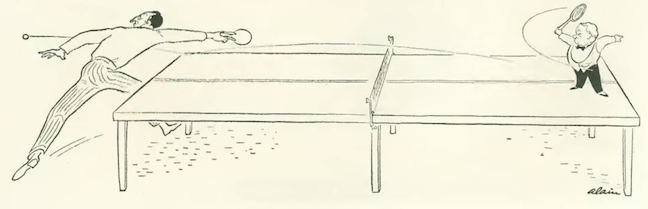
…Alain gave us the true meaning of “table tennis”…
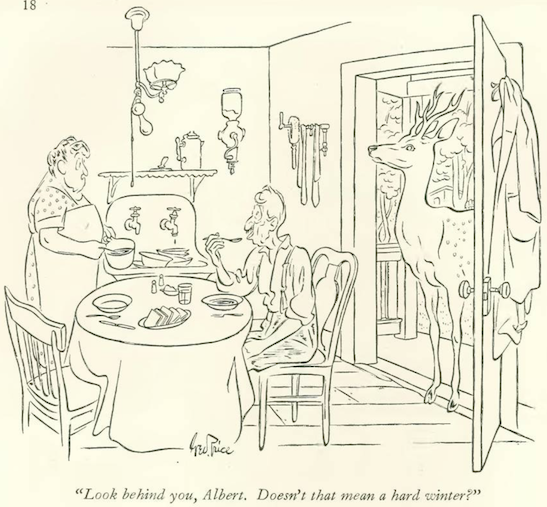
…George Price anticipated a long winter…
…Gardner Rea showed us an Englishman who found Manhattan life a bit too invigorating…
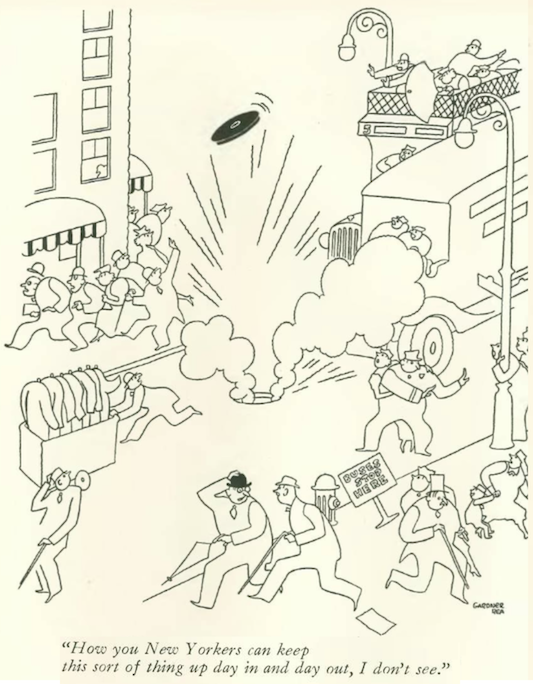
…Alan Dunn posed a question regarding authorship…
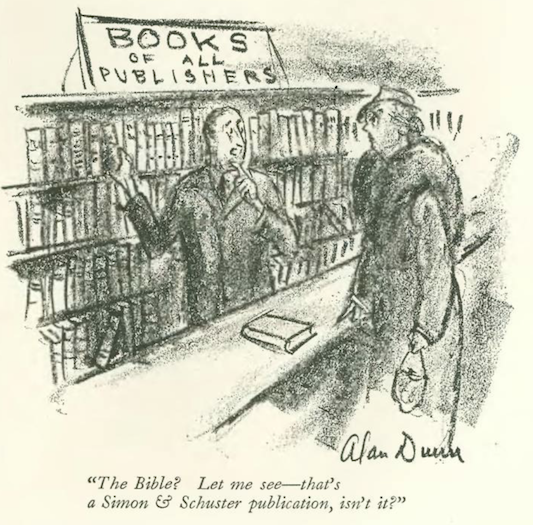
…Peter Arno might be referring to something akin to The Great Stork Derby here…
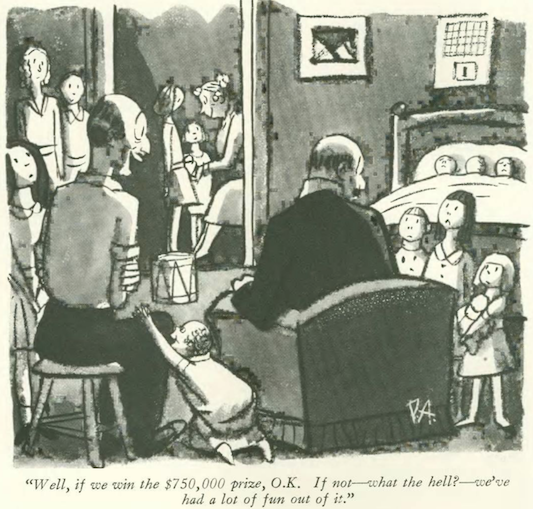
…one of Helen Hokinson’s “girls” sought to stay “off the record”…
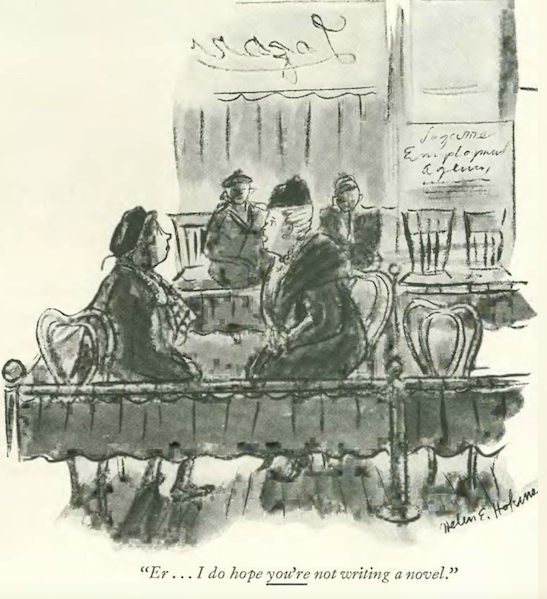
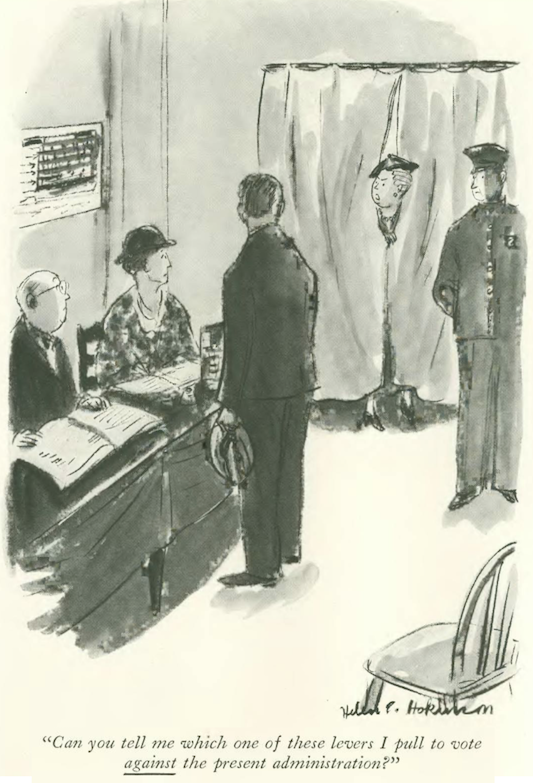
…and Hokinson again, casting a vote in the 1936 General Election…
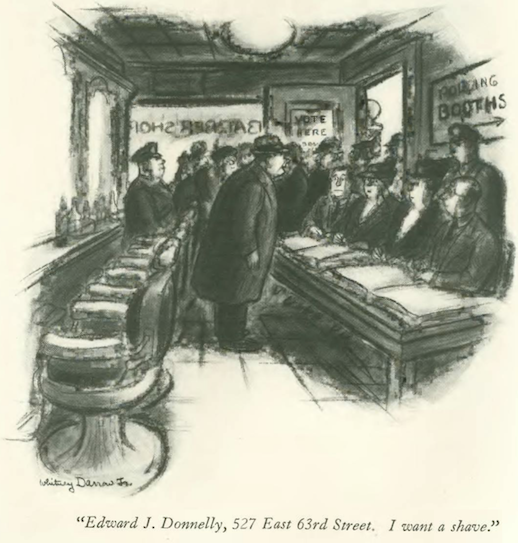
…Whitney Darrow Jr was also thinking about elections, and a clean shave…
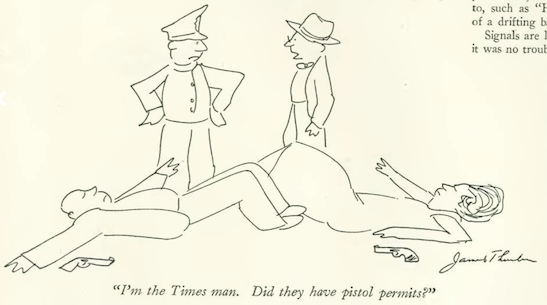
…and we close with James Thurber, and an inquiring reporter…
Next Time: The Instant Home…
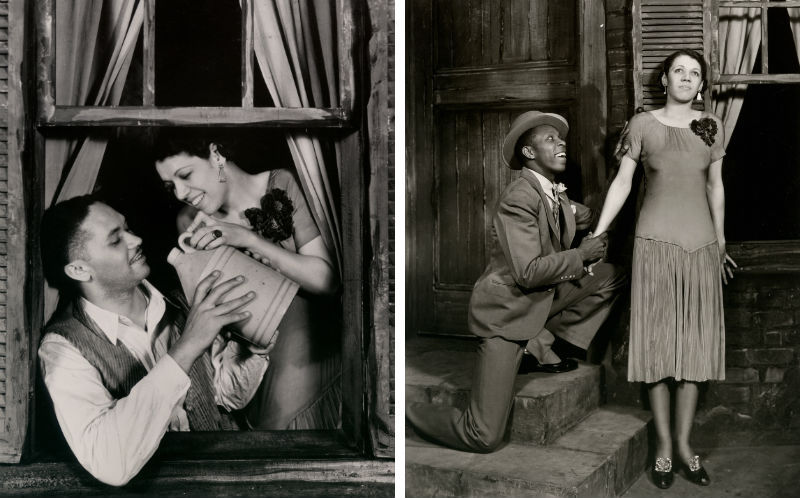
On Catfish Row

Above: Left image: Todd Duncan (Porgy) and Anne Brown (Bess), in the 1935 Broadway production of Porgy and Bess. Right image: John Bubbles (Sportin’ Life) and Brown. (Photos courtesy the Ira & Leonore Gershwin Trusts)

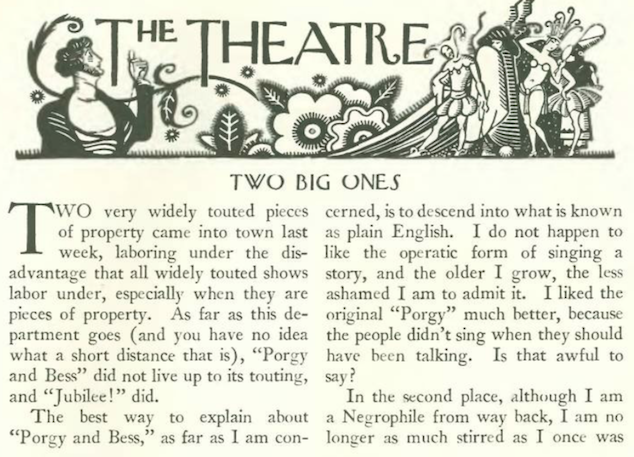
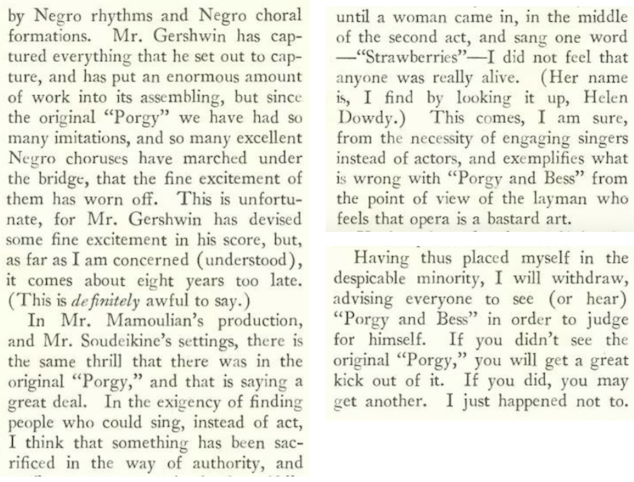
The 1935 Broadway production of Porgy and Bess is widely regarded as one of the most successful American operas of the twentieth century, but when it opened at the Alvin Theatre on Oct. 10, 1935, reviews were mixed, including the one penned by Wolcott Gibbs.

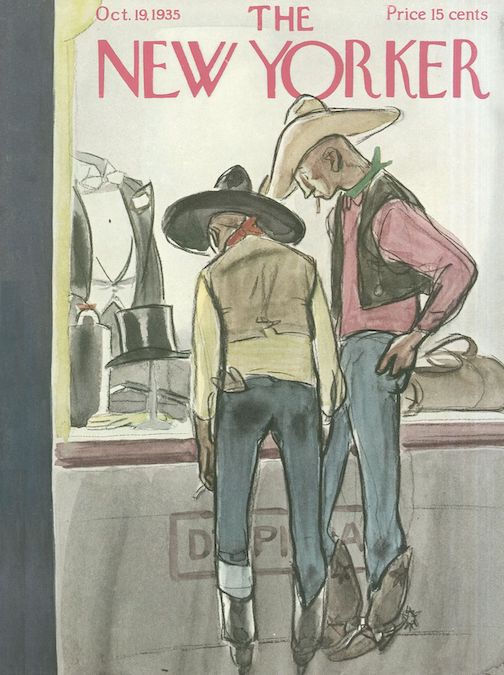
October 19, 1935 cover by William Crawford Galbraith. The New York Times (Oct. 9, 1935) made this observation about the rodeo at Madison Square Garden: “New York, which for several days has been vaguely aware of an impending rodeo because of a profusion of ten-gallon hats along Eighth Avenue and a sign in a beauty parlor, ‘Welcome, Cowgirls,’ will see the real thing this morning.”

Now you would think a work by composer George Gershwin, with a libretto written by DuBose Heyward (author of the 1925 novel Porgy) and lyricist Ira Gershwin, would be a sure hit. Some critics did praise the production, which ran for 124 performances, but others criticized themes and characterizations of Black Americans that were created by white artists.

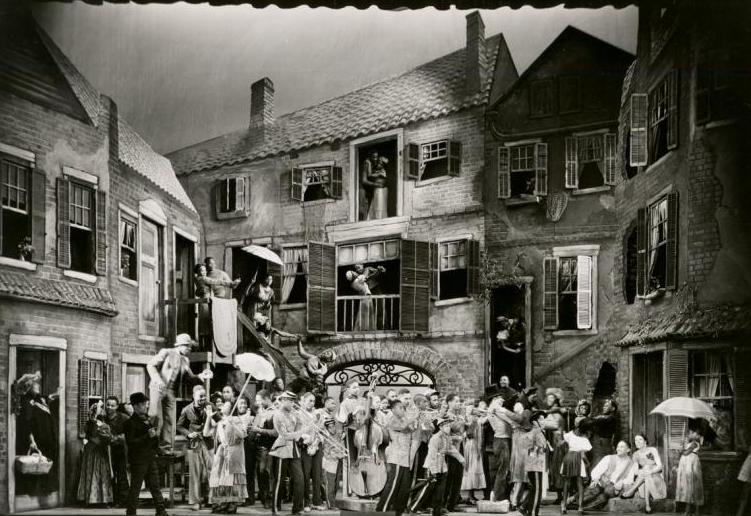
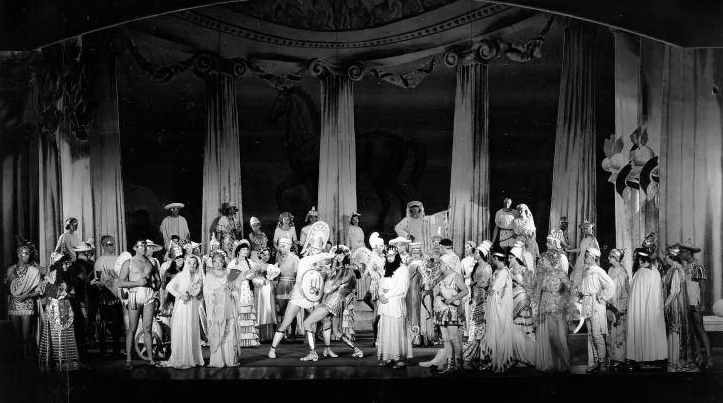
MIXED REVIEWS…The original Catfish Row set for Porgy and Bess as seen at Broadway’s Alvin Theatre (now the Neil Simon Theatre) in 1935. (Billy Rose Theatre Collection, New York Public Library Digital Gallery)

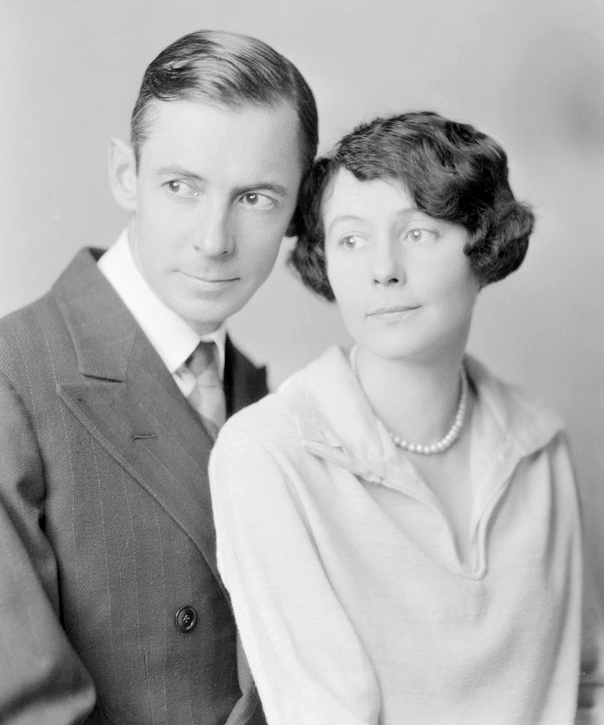
This wasn’t the first time Porgy was adapted to the stage. It was originally produced in 1927 by Heyward and his wife, Dorothy, at the Guild Theatre in New York. The Heywards insisted on an African-American cast—an unusual decision at the time—and enlisted newcomer Rouben Mamoulian to direct. The play ran a total of fifty-five weeks.

ORIGIN STORY: Porgy: A Play in Four Acts, was a 1927 play by Dorothy Heyward and DuBose Heyward, adapted from the short novel by DuBose. (Wikiwand)

Gibbs preferred the original Porgy to the Gershwin–Heyward production, admitting that he simply did not care for “the operatic form of singing a story.”

continued…

TAKING THEIR BOWS…George Gershwin greets an audience after a performance of Porgy and Bess. Behind Gershwin are his brother, Ira Gershwin (left), and librettist and Porgy author DuBose Heyward (partially hidden, at right). (umich.edu)

The Moss Hart/Cole Porter musical comedy Jubilee! premiered at Broadway’s Imperial Theatre on Oct. 12, 1935, just two days after the Porgy and Bess premiere. Gibbs dubbed this show “heat-warming and beautiful.”

THE BEGUINE BEGINS…Inspired by the Silver Jubilee of Britain’s George V, the musical comedy Jubilee! told the story of a fictional royal family. The play featured such hit songs as “Begin the Beguine” and “Just One of Those Things,” which have become part of the American Songbook. (ovrtur.com)
ROYAL HIJINKS…At left, June Knight as Karen O’Kane and Charles Walters as Prince James in Jubilee!; at right, Mary Roland (the Queen) encounters “Mowgli” (Mark Plant) in Act I. (ovrtur.com)

Note: In the last issue (Oct. 12) we saw an ad for an around-the-world luxury cruise on the Franconia. Cole Porter and Moss Hart—with their families, friends, and assistants—sailed on a previous Franconia cruise, possibly in 1934, with the intention to write a new musical while on the trip. Apparently some of the songs and scenes in Jubilee! were inspired by their ports of call.

 * * *

Steering Clear

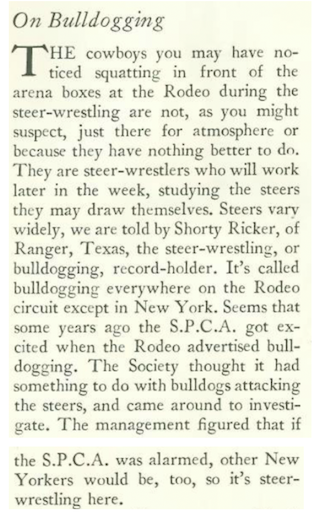
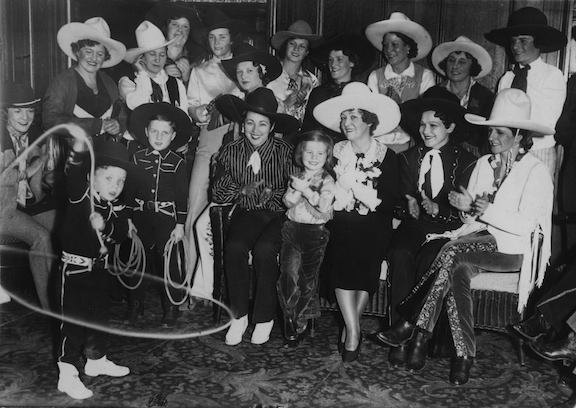
“The Talk of the Town” commented on the “steer-wrestlers” that were featured at the Madison Square Garden rodeo. Since steer-wrestling was also called “bulldogging,” it caused considerable consternation among New York animal lovers.

A BIG HOWDY…Cowgirls From the Madison Square Garden Rodeo With Millicent Hearst, 1932. (texashistory.unt.edu)

 * * *

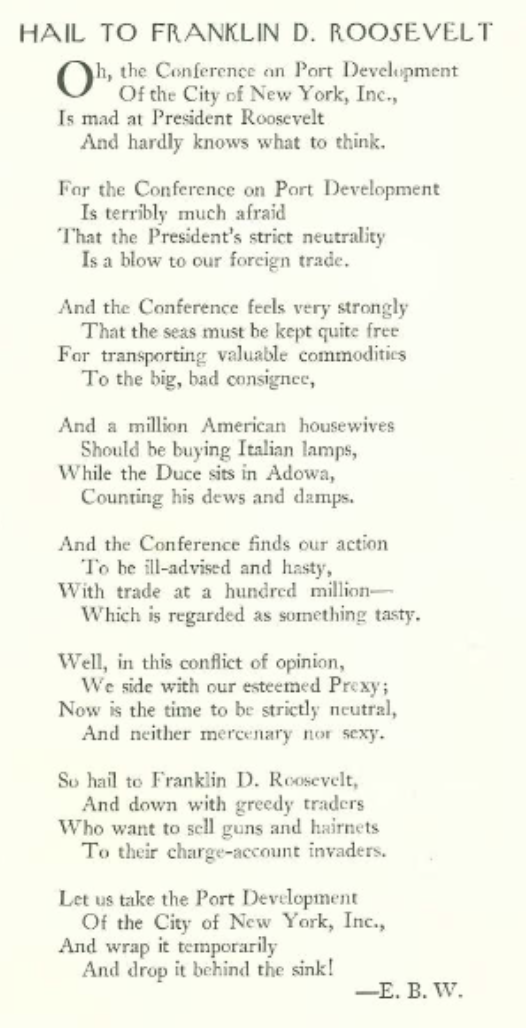
Much Ado About FDR

The Conference on Port Development of the City of New York took issue with President Franklin D. Roosevelt’s foreign trade policies, particularly his strict stance on neutrality, which the Conference believed was detrimental to foreign trade. This was likely related to the October 1935 Italian invasion of Ethiopia. E.B. White offered this satirical poem in reaction to the trade spat.

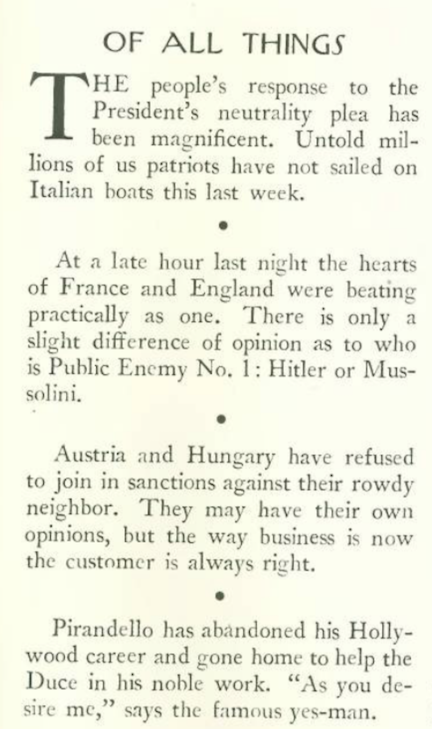
Howard Brubaker also chimed in on the trade issue, and on other unsettling developments in Europe:

 * * *

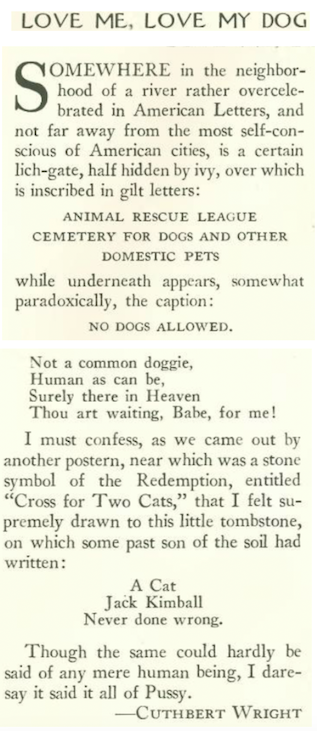
Puppy Love

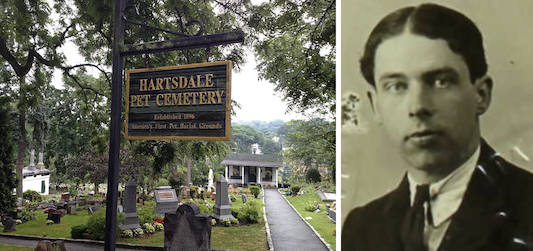
Critic and poet Cuthbert Wright (1892–1948) was moved to write poetry after visiting a dog cemetery that also welcomed animals of all stripes. Here are excerpts of the opening and closing lines:

PET PROJECT…Cuthbert Wright was moved to verse after his visit to a pet cemetery, possibly the Hartsdale Pet Cemetery in Westchester. (Wikipedia/parenthetically.blogspot.com)

 * * *

Man and Machine

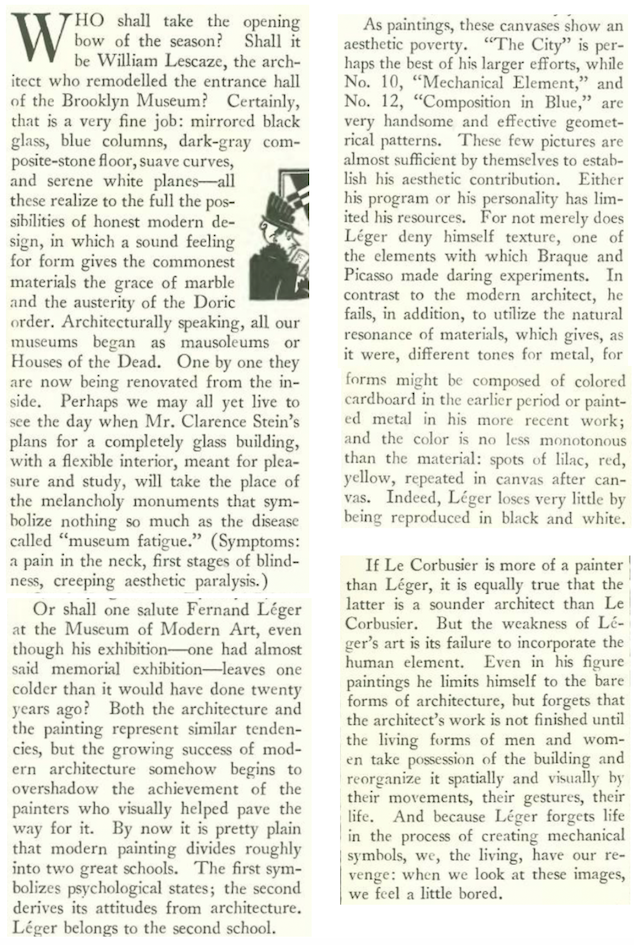
Art and culture critic Lewis Mumford is back this week, this time taking a look at the work of French artist Fernand Léger (1881–1955), who created a form of cubism known as “tubism,” regarded today as a forerunner of the pop art movement of the mid-1950s and the 1960s.

It is no surprise that the humanist Mumford, who sought an “organic balance” in everyday design, found Léger’s machine-like works alienating and sterile, representing an “aesthetic poverty.”

TOTALLY TUBULAR…Clockwise, from top left, works of Fernand Léger cited by Lewis Mumford: The City, 1919; photo of Léger, circa 1930s; from the 1918–1923 series Mechanical Elements, 1920; Composition in Blue, 1920–27. (Philadelphia Museum of Art/The Met Collection/Art Institute of Chicago, Charles H. and Mary F. S. Worcester Collection)

 * * *

Disappointment in O’Hara

That is how Clifton Fadiman titled his “Books” column after reviewing John O’Hara’s latest novel, Butterfield 8.

O’Hara (1905–1970) wasn’t just any old scribbler. A prolific short-story writer, he has often been credited with helping to invent The New Yorker’s short story style. Praised by the likes of F. Scott Fitzgerald and Ernest Hemingway, O’Hara cranked out two bestsellers before the age of thirty. One was the acclaimed Appointment in Samarra (which was praised by Fadiman). The other was BUtterfield 8, the novel Fadiman found disappointing (Hemingway, on the other hand, blurbed, “John O’Hara writes better all the time.”). Here are a couple of brief excerpts from Fadiman’s review:

Fadiman concluded his review with a note to the author: “Why not let Jean Harlow have it, Mr. O’Hara, and start a fresh page?”

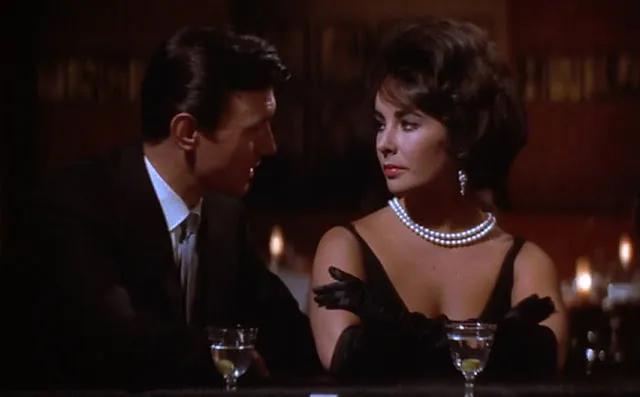
Well, Harlow didn’t get it, but twenty-five years later Elizabeth Taylor would reluctantly take on the role of Gloria Wandrous, and win the Academy Award for Best Actress.

YOU AGAIN?…Laurence Harvey and Elizabeth Taylor played on and off lovers in 1960’s Butterfield 8. John O’Hara did not participate in writing the adaptation, and the film’s plot bore only a slight resemblance to his novel. However, after the film’s release more than one million paperback copies of the novel were sold. (aiptcomics.com)

 * * *

At The Movies

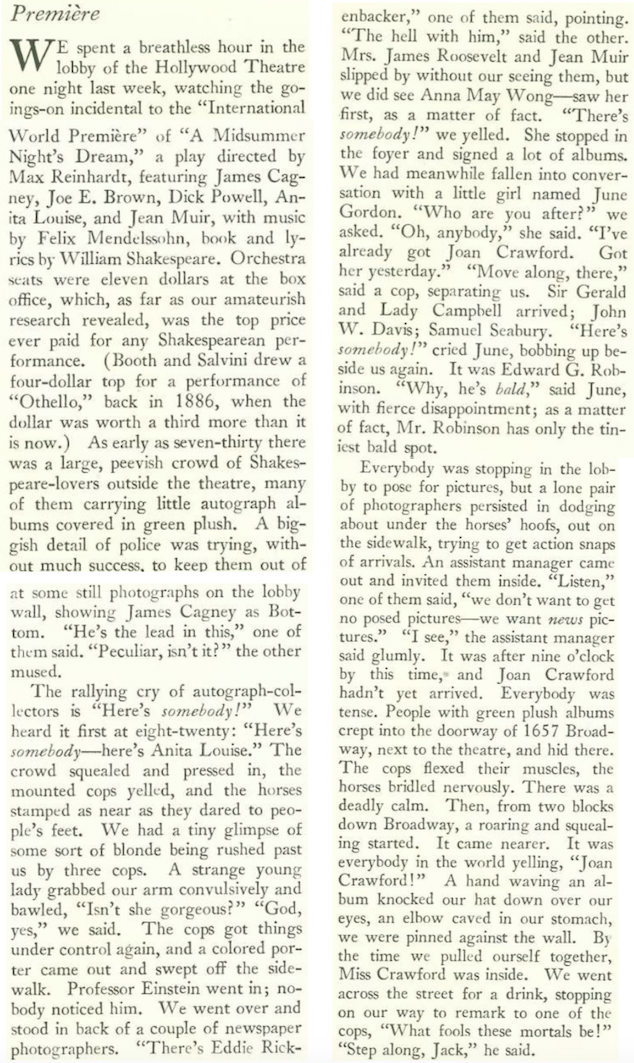
We begin this section with an excerpt from “The Talk of the Town,” which covered the “International World Première” of the Warner Brother’s adaptation of A Midsummer Night’s Dream. The film opened worldwide on October 9, 1935 in London, Sydney, Vienna and at New York’s Hollywood Theatre, where crowds turned out to get a glimpse of the stars.

RUBBERNECKERS…A Midsummer Night’s Dream premiere at the Hollywood Theatre in New York City on October 9, 1935. (britannica.com)

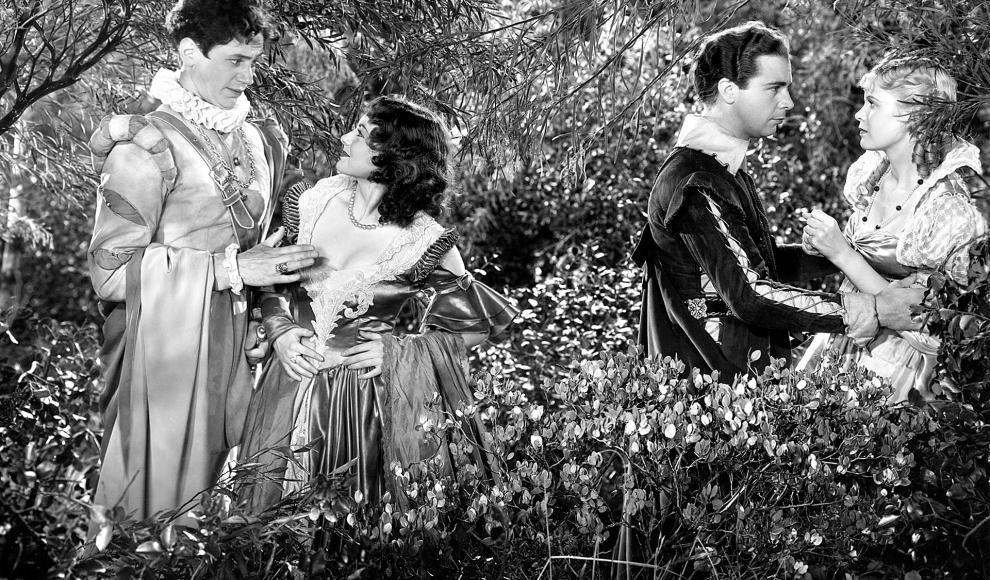
Film critic John Mosher praised Joe E. Brown’s performance as Flute, as well James Cagney’s portrayal of Bottom, and lauded the “magnificent group of clowns” that formed the remainder of The Players. Here are excerpts from his review (note I included the entirety of Otto Slogow’s delightful spot drawing):

THE LOVERS…Left to right: Ross Alexander (Demetrius), Olivia de Havilland (Hermia), Dick Powell (Lysander) and Jean Muir (Helena) meet cute and confused in A Midsummer Night’s Dream. (TCM.COM)
THE SEVEN STOOGES…Bottom (James Cagney) and his fellow Players prepare to perform a stage play about the death of Pyramus and Thisbe which turns into a farce. From left, in front, Joe E. Brown (Flute), Cagney, and Otis Harlan (Starveling); in the back are, from left, Hugh Herbert (Snout), Arthur Treacher (Epilogue) and Dewey Robinson (Snug) as The Players in A Midsummer Night’s Dream. Frank McHugh (Quince) can be seen behind the wall in back. (IMDB)
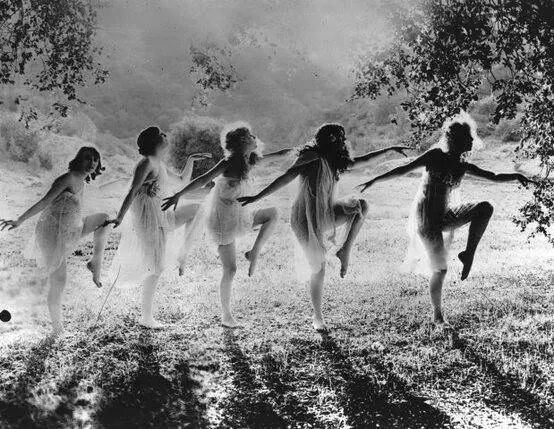
DANCING THE NIGHT AWAY…Fairie scene from A Midsummer Night’s Dream. (Facebook)

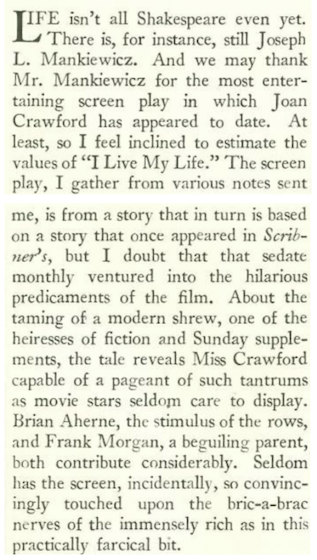
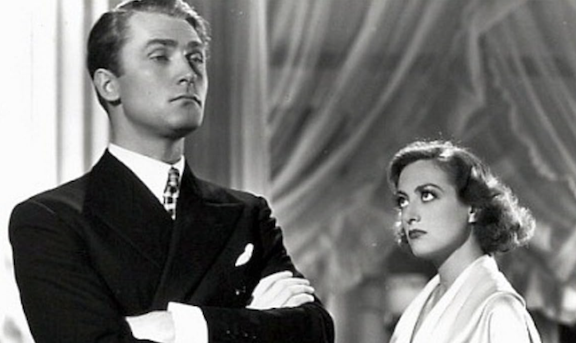
Mosher also reviewed the romantic comedy I Live My Life, which he found to be a satisfying satire on the lives of the rich.

MATCHING WITS…Bored socialite Kay Bentley (Joan Crawford) has a tempestuous romance with idealistic archaeologist Terry O’Neill (Brian Aherne) in I Live My Life. (IMDB)

 * * *

From Our Advertisers

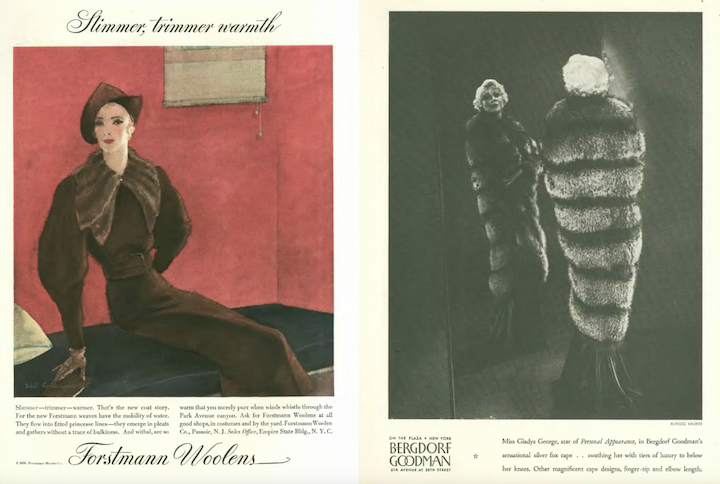
Readers ninety years ago opened the Oct. 19 issue to this two-page spread featuring the latest in fall/winter fashions…the ad on the right from Bergdorf Goodman featured stage and screen actress Gladys George donning a full-length silver fox fur…

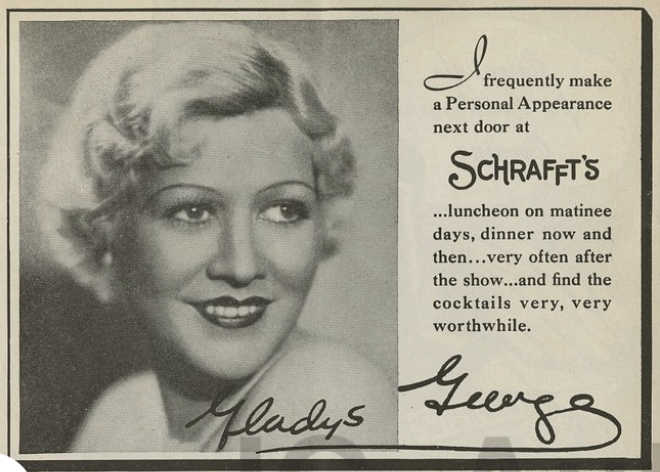
…George (1904–1954) was appearing at Henry Miller’s Theatre in the play Personal Appearance…she was featured in this testimonial ad for Schrafft’s in the theatre’s Playbill…

(playbill.com)

…the folks at Packard took out this colorful two-page spread to promote their more affordable model, the 120…the move to more affordable models helped the luxury carmaker weather the lean years of the Depression…

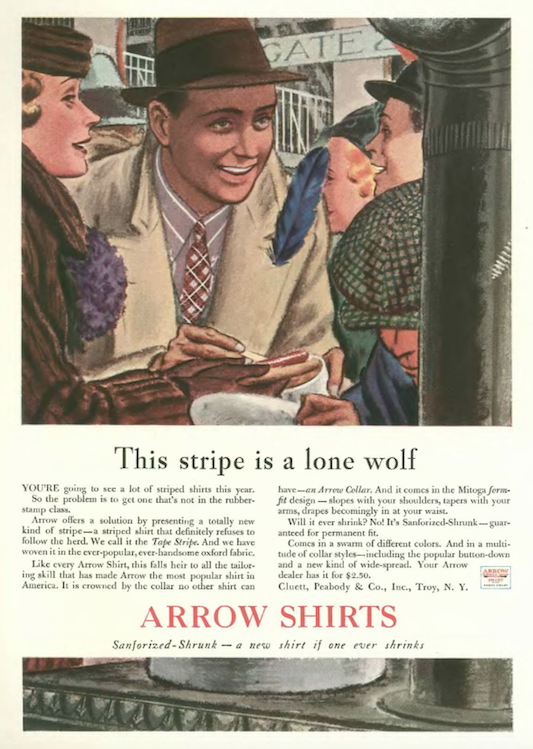
…there is a strange quality to these Arrow Shirt advertisements…what are the they looking at?…apparently something amusing as the man applies mustard to a hotdog, but it isn’t the vendor, who looks down at his cart…

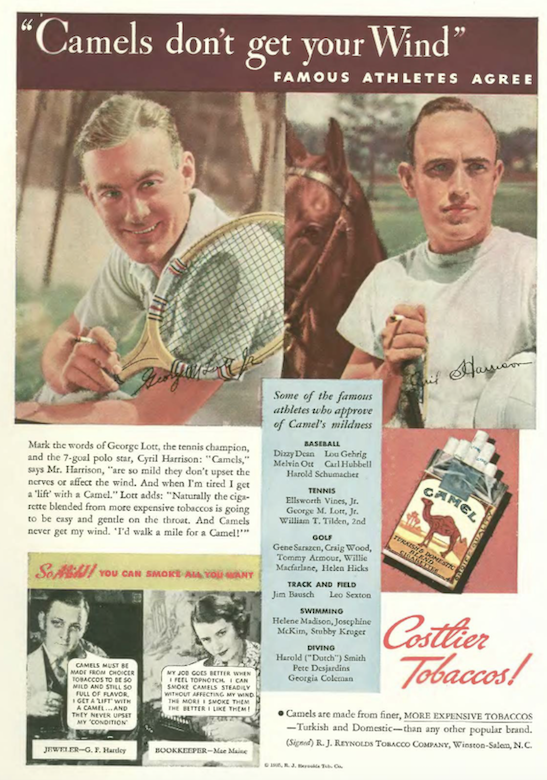
…R.J. Reynolds continued its Camel campaign featuring accomplished athletes who got a “lift” from smoking…the ad also included a couple of regular folks at the bottom, who claimed the cigarettes were so mild “You can smoke all you want”…

…Old Gold continued to enlist the talents of George Petty to illustrate their full-page ads…

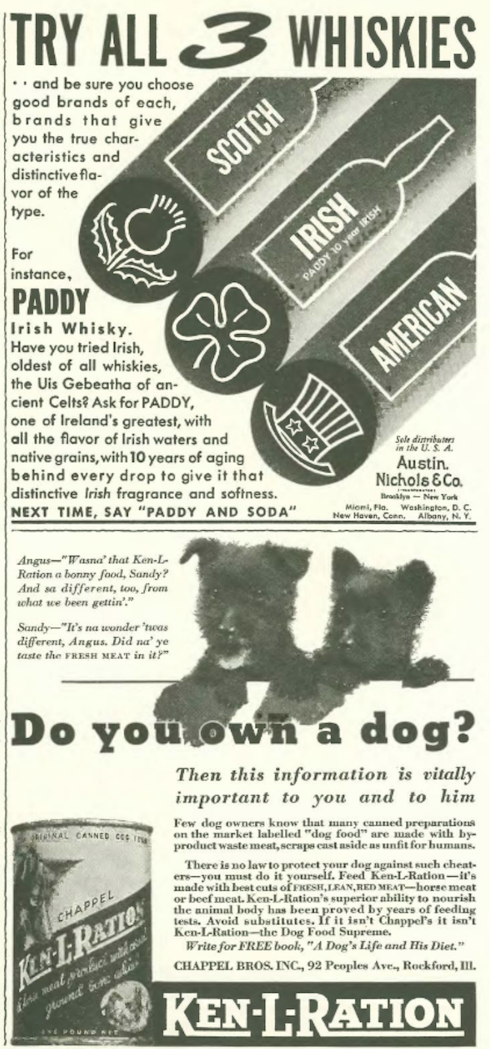
…here’s a couple of back of the book ads touting Irish whisky and Ken-L-Ration dog food…note how the Scottish terriers speak in “dialect”…Ken-L-Ration was a leading dog food brand in the 1930s, thanks to their use of horse meat rather than “waste meat”…

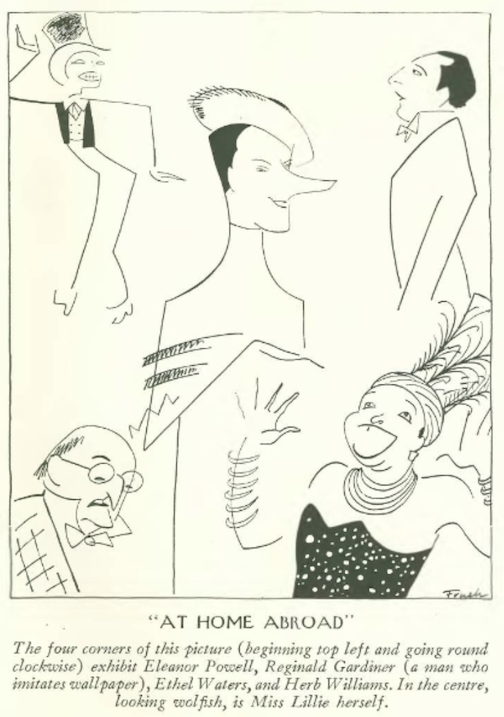
…on to our cartoonists, we start with Al Frueh enhancing the “Theatre” page…
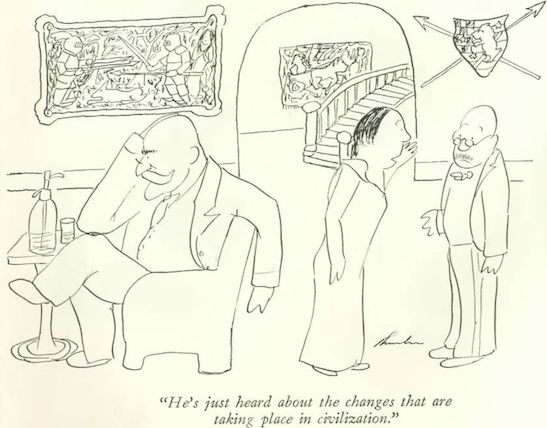
…James Thurber showed us a man at odds with the times…

…Barbara Shermund kept us up to date on the modern woman…

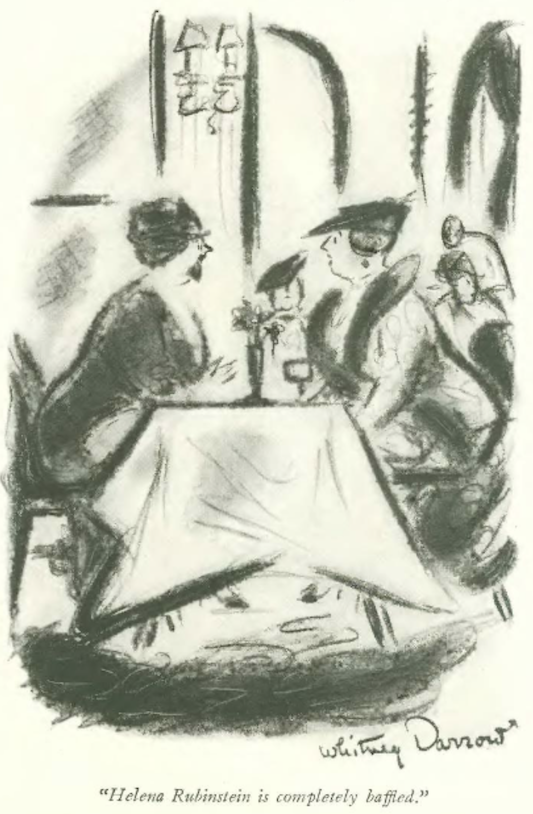
…Whitney Darrow Jr offered a challenge to Helena Rubinstein (note the woman on the right—she could have been drawn by Helen Hokinson)…

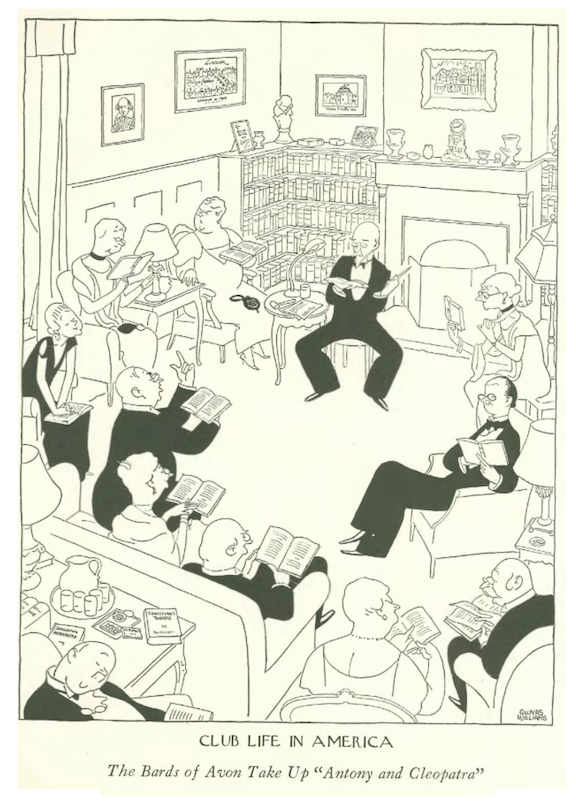
…Gluyas Williams checked in on the lively proceedings of a book club…

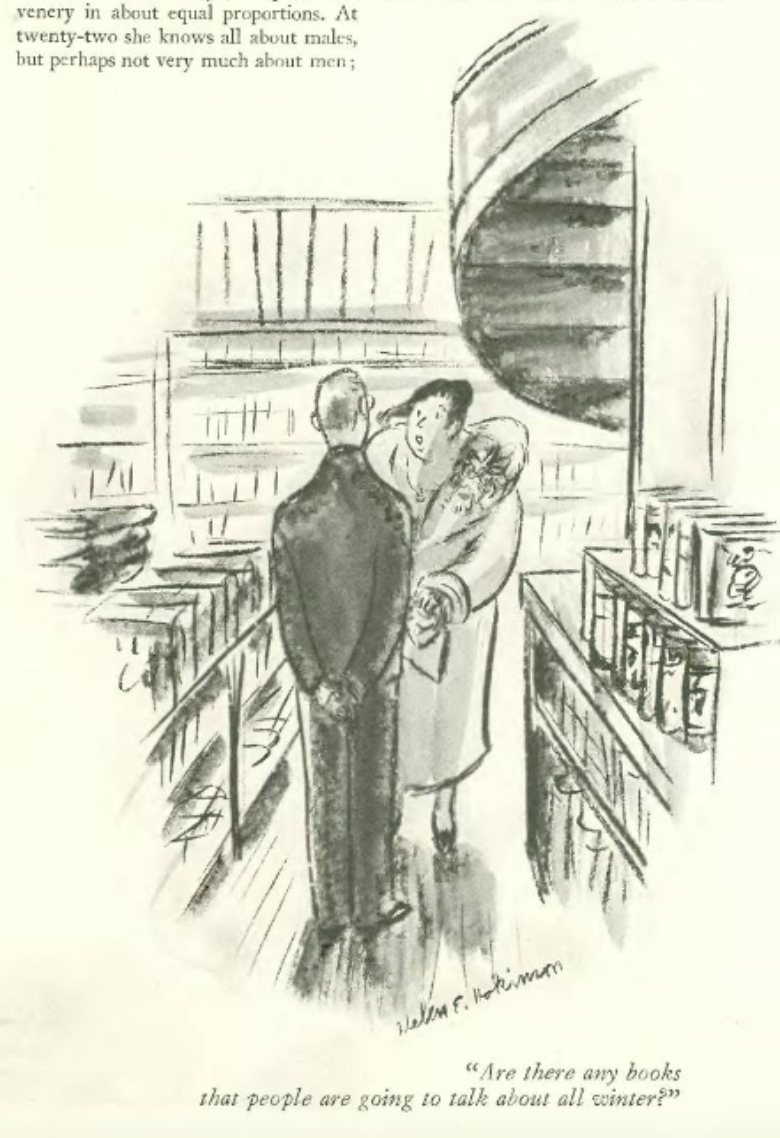
…Helen Hokinson went looking for a good winter read…

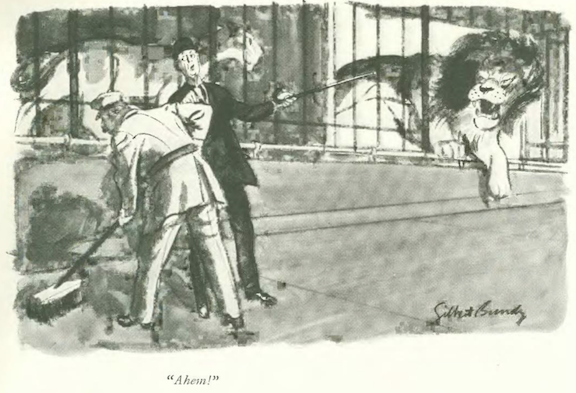
…Gilbert Bundy offered an alarming scenario on the top of p. 31…

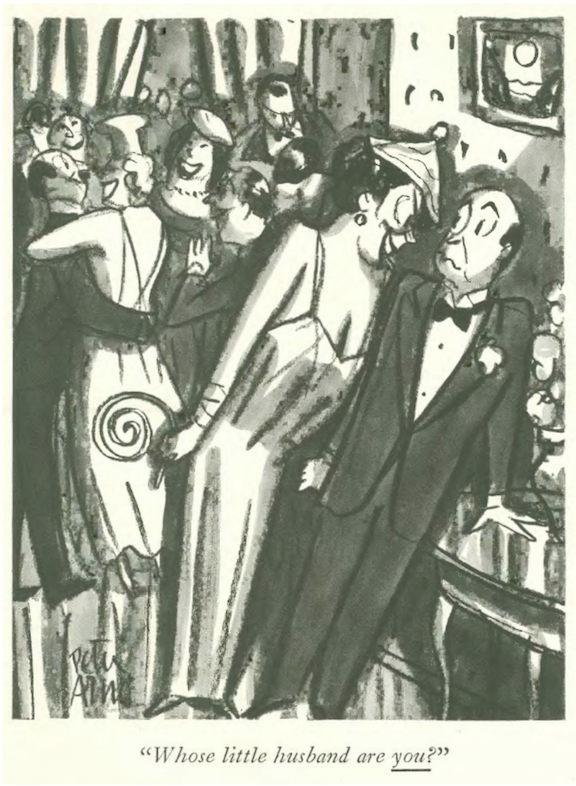
…and we close with Peter Arno, and an eye-raising encounter…

New Time: It Can’t Happen Here…