Far-Fetched Faulkner

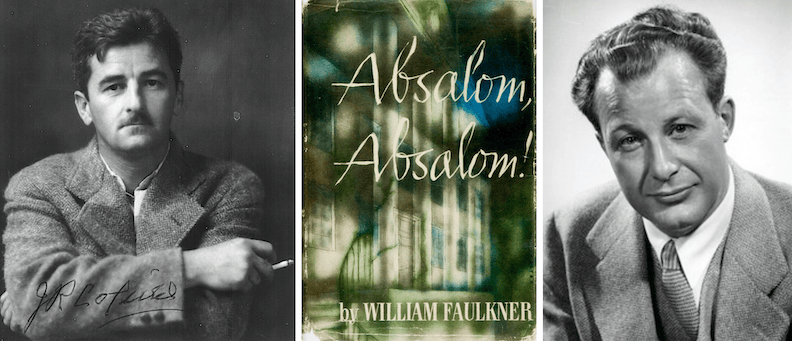
Above: New Yorker book critic Clifton Fadiman (right) characterized William Faulkner's "Absalom, Absalom!" as a "penny dreadful tricked up in fancy language." Fadiman was not alone among contemporary mainstream critics in his assessment, although today the novel is considered a masterwork of Southern Gothic literature. (Wikipedia/J.R. Cofield Collection, University of Mississippi Library)

With its non-linear timeline, winding prose, and multiple unreliable narrators, William Faulkner’s Absalom, Absalom! left many critics wondering what to make of the author’s ninth novel, including The New Yorker’s Clifton Fadiman, who had a near-visceral response to Faulkner’s “shuddery inventions.”
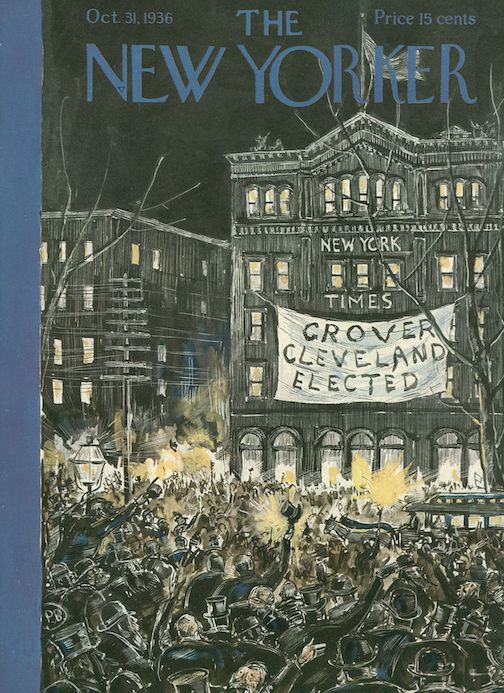
October 31, 1936 cover by Perry Barlow.

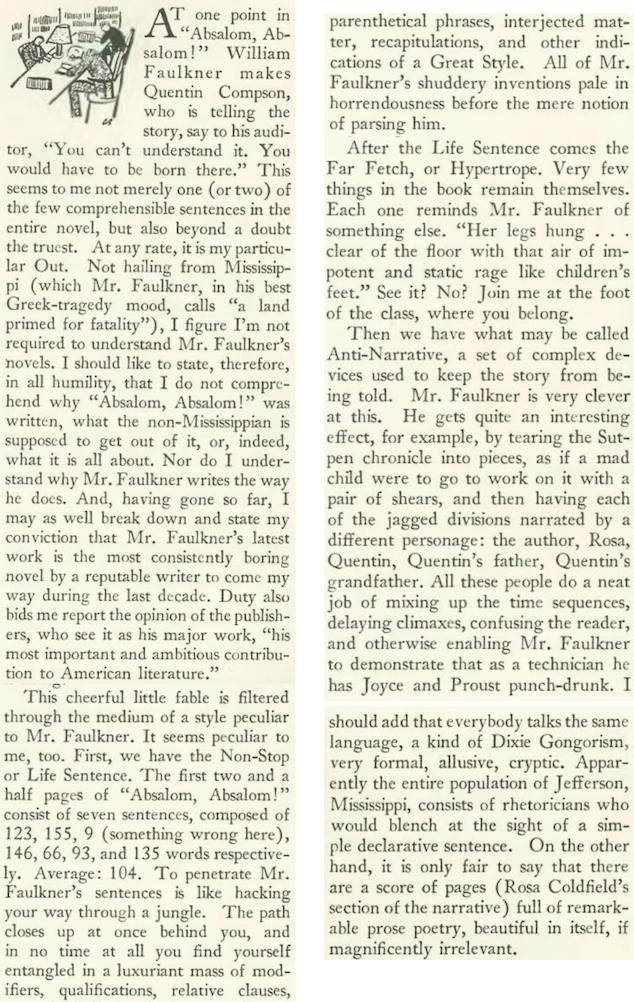
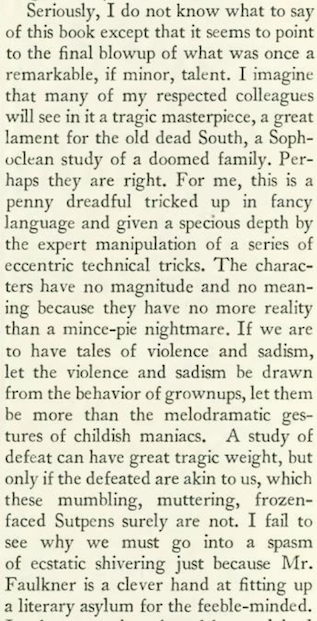
Although today the novel is widely considered a literary masterpiece, in 1936 Fadiman saw the dense, labyrinthine style of Absalom, Absalom! as nothing more than an empty facade for a melodramatic plot and characters resembling a “mince-pie nightmare.”

The novel explored the rise and fall of Thomas Sutpen, a poor man who ruthlessly carves out a plantation empire in 1830s Mississippi. Told entirely in flashbacks consisting of fragmented memories and differing perspectives, the novel is psychologically bleak and violent, with nearly every major character meeting a tragic end. Following are excerpts from Fadiman’s review:

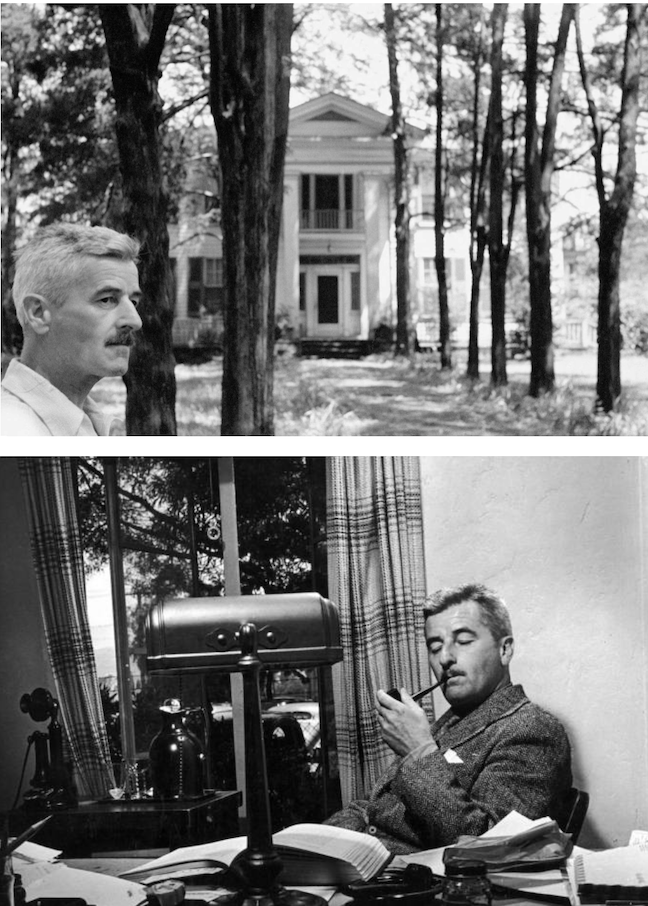
OXFORD MAN…Above, William Faulkner at his 1844 Greek Revival home, Rowan Oak, which he purchased in Oxford, Mississippi in 1930; below, at work in his study. The mid-1930s were a difficult time for Faulkner. His writing was often interrupted by trips to Hollywood, where he sought additional income writing screenplays (Faulkner was constantly in debt), and in 1935 his brother Dean was killed in a plane crash. Consequently this period included a number of heavy drinking benders. (genteelandbard.com/life.com)

Faulkner had some history with The New Yorker: A Nov. 21, 1931 “Talk of the Town” entry titled “Oxford Man” featured a thirty-four-year-old Faulkner living in a Tudor City apartment, working on his novel Light in August. “Talk” noted his service in the Canadian air force, which he joined in 1915 (he broke both legs in a crash) and that he “sometimes flies a rather wobbly plane owned by a friend in Oxford.” As for his writing style, “Talk” offered this quote from Faulkner: “Ah write when the spirit moves me, and the spirit moves me every day.” The piece also noted that “Only a few of the townspeople know he writes at all; most of them think he’s lazy.”

Here’s a second excerpt from Fadiman’s Oct. 31, 1936 review, in which the critic concludes that Faulkner “is a clever hand at fitting up a literary asylum for the feeble-minded.”
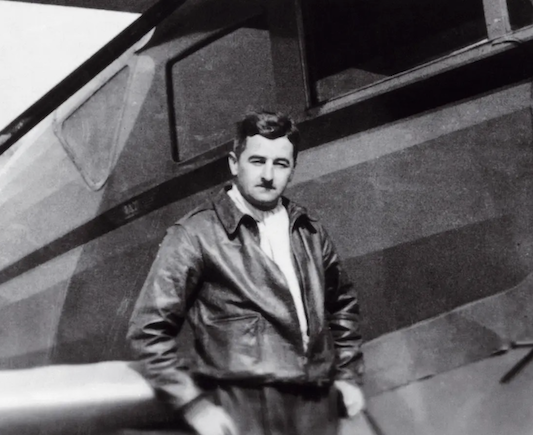
FLYBOY…A 1931 “Talk of the Town” profile, attributed to and  noted Faulkner’s writing habits, his ties to his hometown, and his time in the Canadian Air Force. (espresso.pt)

 * * *

Chattering Mysteries

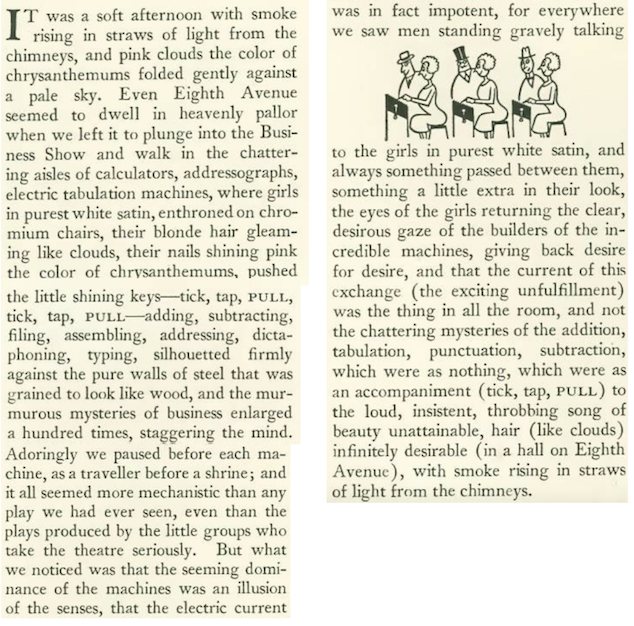
Those are the words E.B. White used to describe aisles of calculators, addressographs, and electric tabulation machines being operated by women clad “in purest white satin” at a business show on Eighth Avenue.
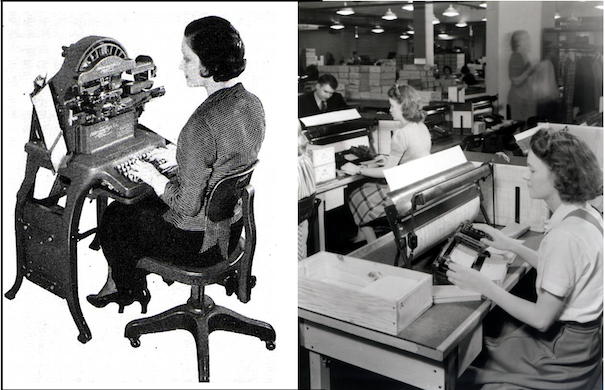
AN ILLUSION OF THE SENSES was achieved by scores of machines clacking away at a Manhattan business show, according to E.B. White. At left is an Addressograph machine, circa 1930s, and at right, a census worker using an IBM Type 1 mechanical key punch, 1940. (americanbusinesshistory.org/officemuseum.com)

 * * *

At the Movies

Get the Extra-large Popcorn

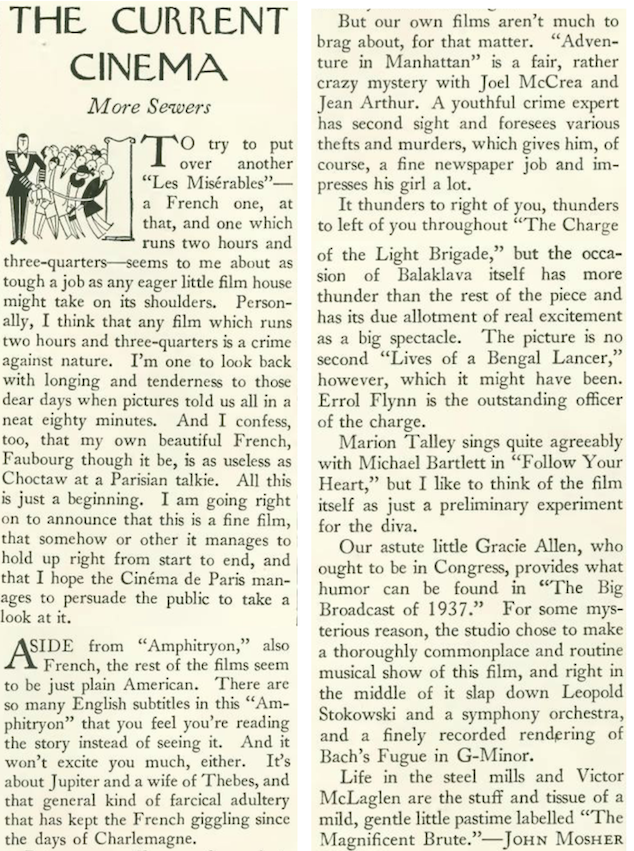
They say movies are getting longer these days, but the Thirties had its share of lengthy screen epics, including a nearly five-hour running time for the 1934 French adaptation of the Victor Hugo novel Les Misérables. Initially released as three films premiering over three consecutive weeks, the full, unedited film ran a total of 281 minutes. Apparently the 1936 American release, reviewed here by John Mosher, ran for just under three hours, which Mosher called “a crime against nature.” He did, however, pronounce it “a fine film.” He also reviewed a German musical comedy, Amphitryon, and some uninspiring “plain American” films.
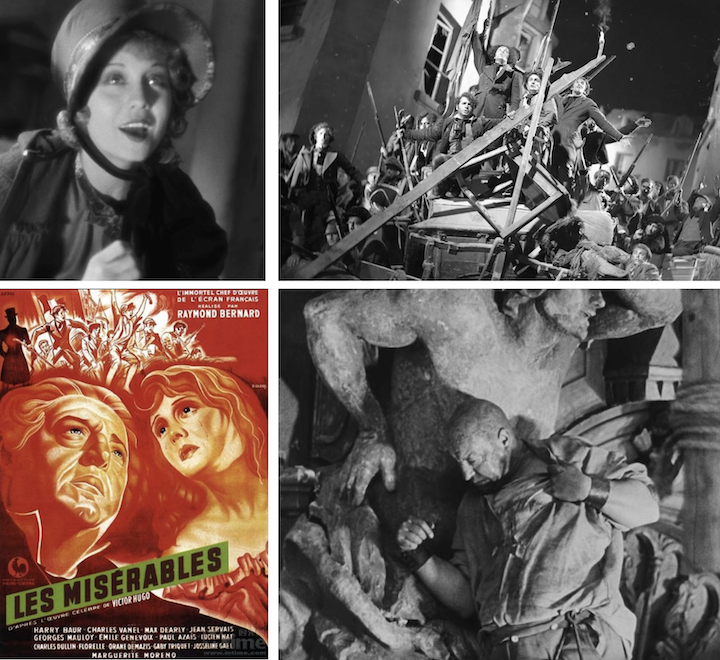
GOING HUGE FOR HUGO…Clockwise, from top left: Florelle as Fantine in Les Misérables; blockade scene from the film; Harry Baur as Jean Valjean; French movie poster, 1934. (imdb.com)

Mosher grew weary of reading the subtitles in the German film Amphitryon, a surprising satirical musical that somehow got made even after the Nazis took over the reigns of the Ufa-Atelier studio; however, the coming year would see a further tightening of domestic repression (including film) under Reich leadership.
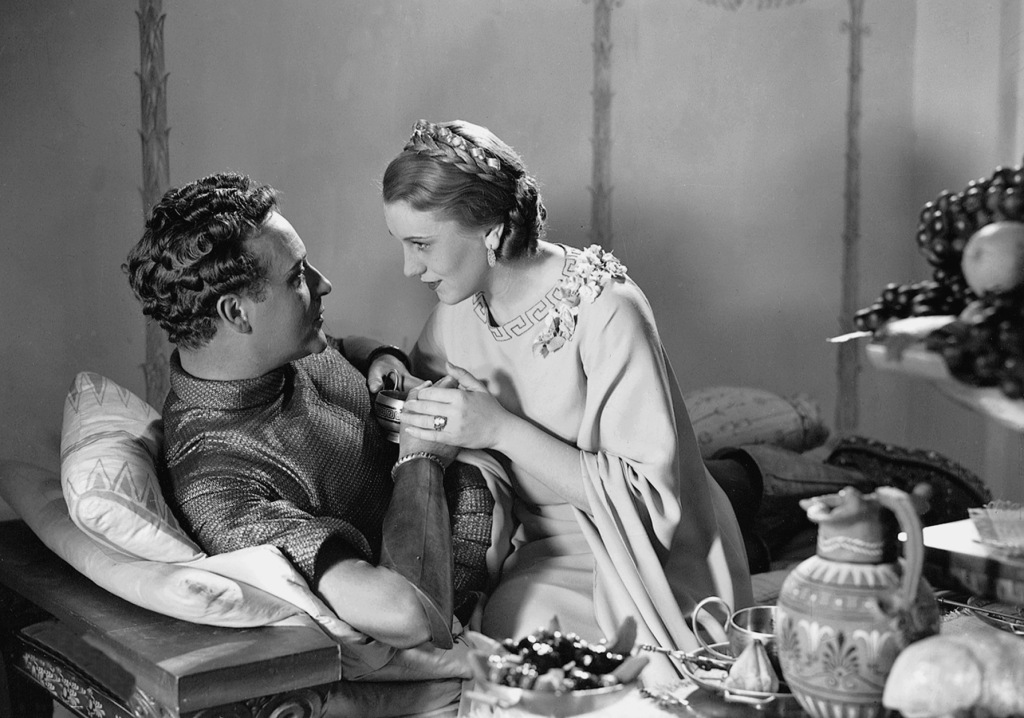
SOME LAST LAUGHS…Willy Fritsch and Käthe Gold in the 1935 German musical comedy Amphitryon. The movie was filmed in German and French, which is probably why Mosher thought it was a French production. (en.kinorium.com)

The “plain American” films reviewed by Mosher included a mystery, a revue, and a musical featuring opera singer Marion Talley, who years earlier had received some rough treatment from The New Yorker.
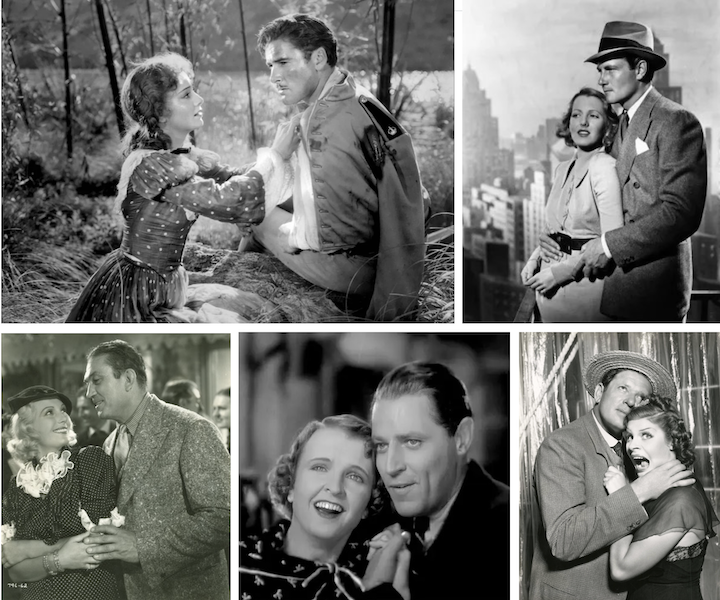
STANDARD FARE…Clockwise, from top left: The Charge of the Light Brigade starred Olivia de Havilland and Errol Flynn; Jean Arthur and Joel McCrea in Adventure in Manhattan; Bob Burns and Martha Raye in The Big Broadcast of 1937; Marion Talley and Michael Bartlett in Follow Your Heart; Victor McLaglen and Binnie Barnes in The Magnificent Brute. (britannica.com/theblondeatthefilm.com/imdb.com/tubitv.com/ebay.com)

 * * *

Polymath Porter

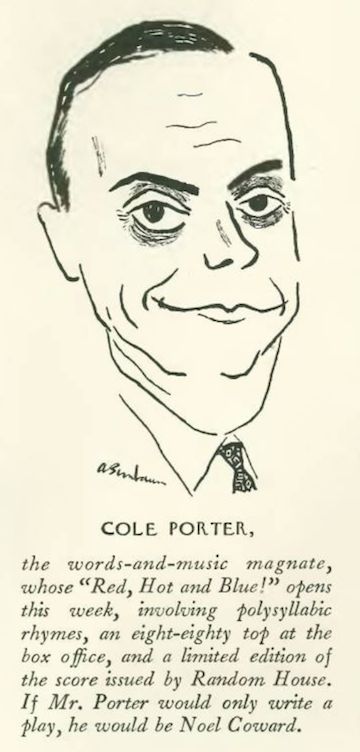
The multi-talented composer/songwriter Cole Porter was the latest celebrity to receive a mini bio in the opening pages…illustration by Abe Birnbaum…
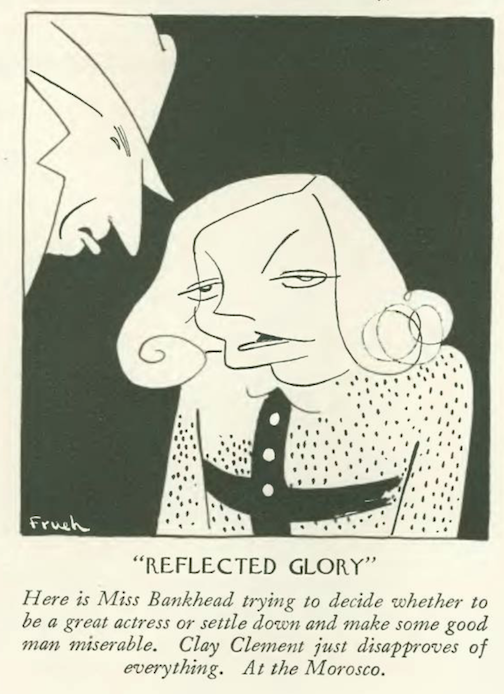
…and on the subject of theater, Al Frueh offered his impression of the Talullah Bankhead vehicle, Reflected Glory...
 * * *

From Our Advertisers

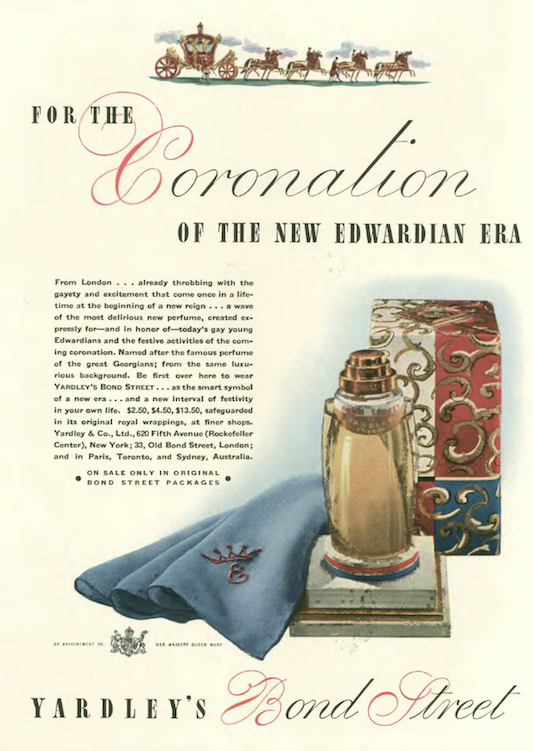
Various retailers were gearing up for the coronation of England’s King Edward VIII, and the folks at Yardley’s were busy packaging their lavender-scented soaps and perfumes for royalty-starved Americans, “safeguarded in original royal wrappings”…this “Edwardian” campaign would be scrapped just weeks later when Edward would abdicate the throne (on Dec. 10) and run off with American Wallis Simpson…
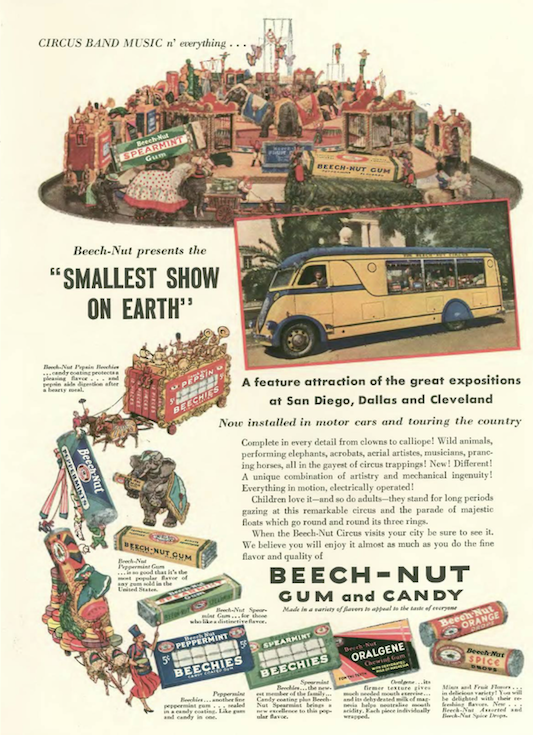
…the makers of Beech-Nut chewing gum made a splash with this full-page ad touting their traveling “Smallest Show on Earth”…
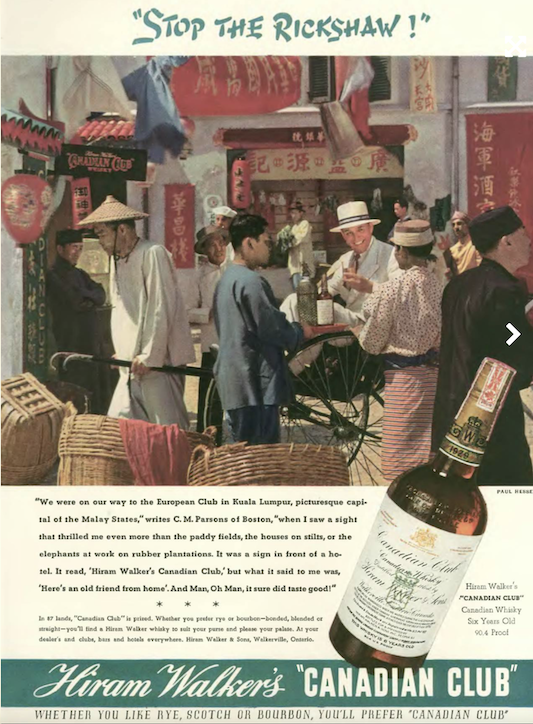
…Canadian Club continued its world tour with a stop in Kuala Lumpur…
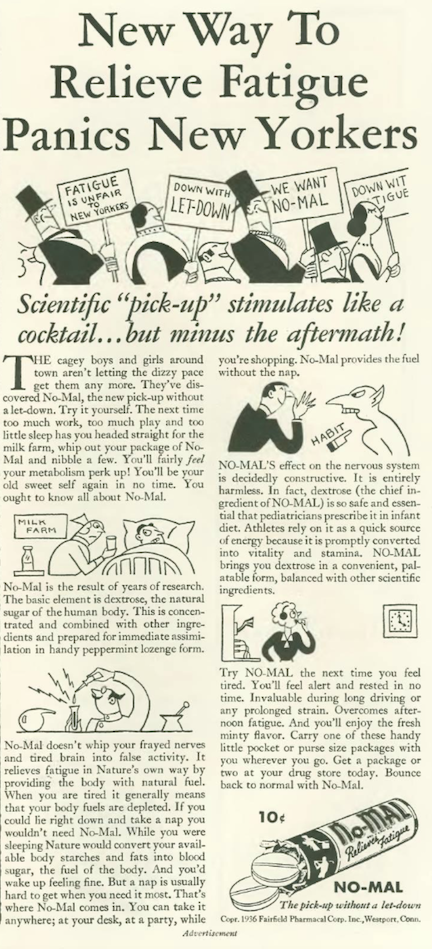
…No-Mal ran another back-of-the-book ad promoting its scientific “pick-up”…the chief ingredient, according to this spot, was dextrose (even safe for infants!), but it doubtless also contained caffeine and Lord knows what else…
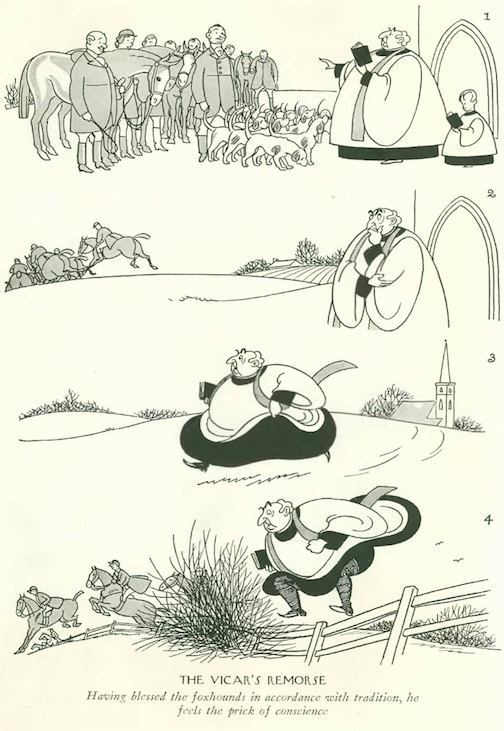
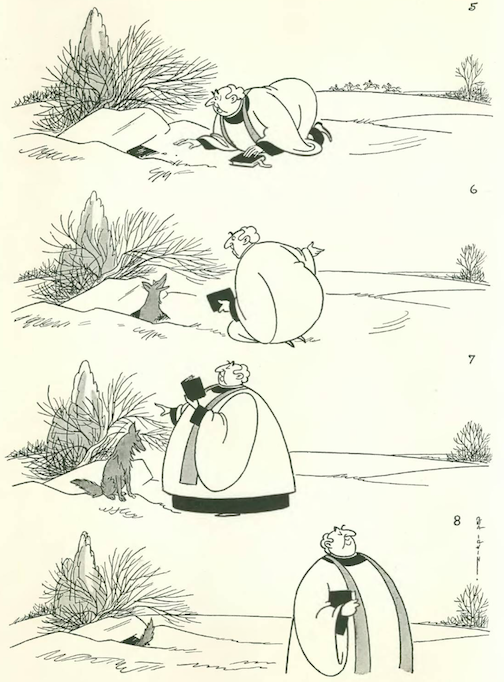
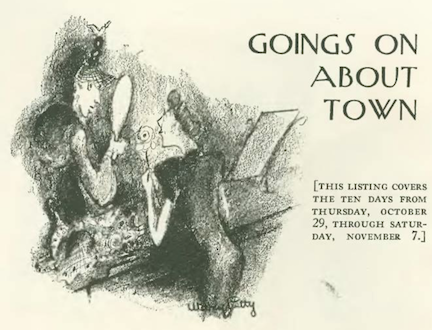
…no extra stimulation needed for our cartoon section, beginning with Mary Petty…
…there were a couple of Halloween-themed spots by Susan Willard Flint…
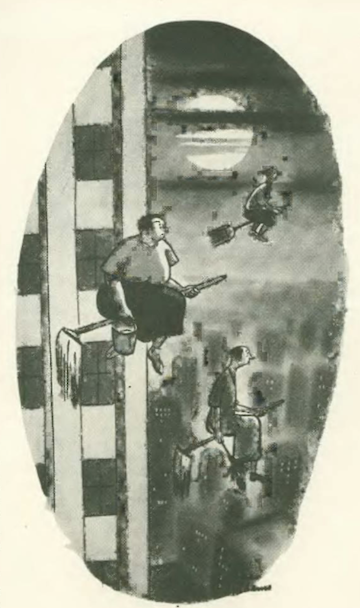
…and Charles Addams...
 

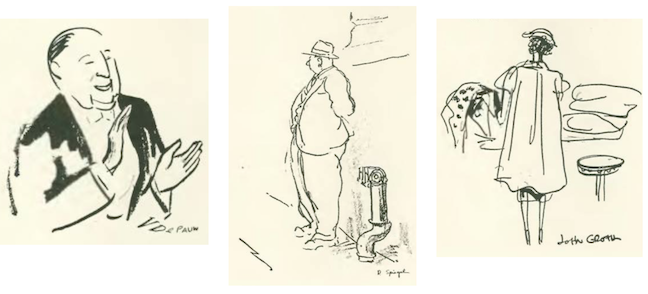
…a sampling of other spot drawings…Victor de Pauw, Doris Spiegel, and John Groth…
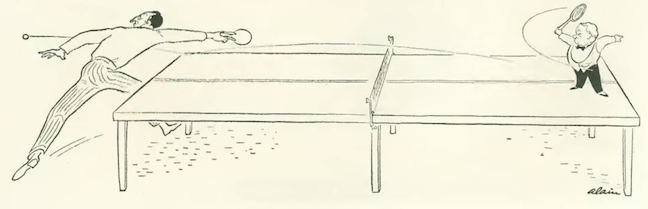
…Alain gave us the true meaning of “table tennis”…
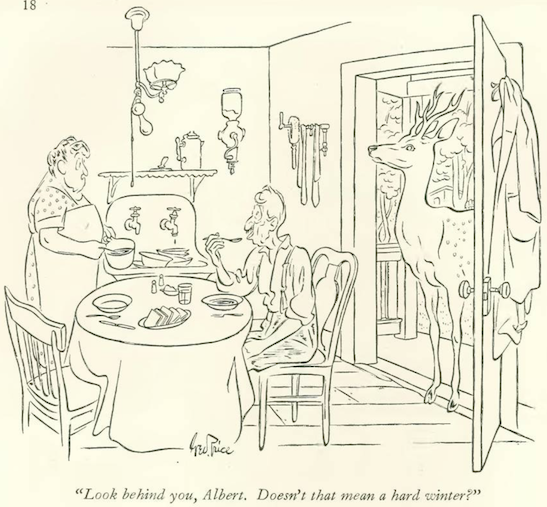
…George Price anticipated a long winter…
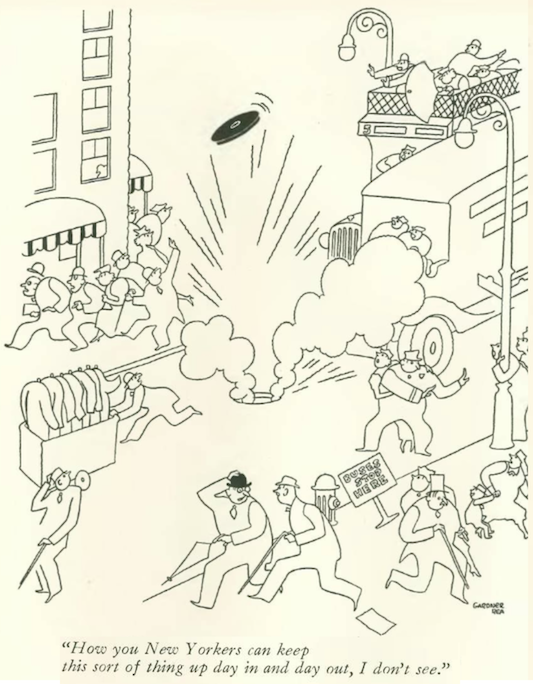
…Gardner Rea showed us an Englishman who found Manhattan life a bit too invigorating…
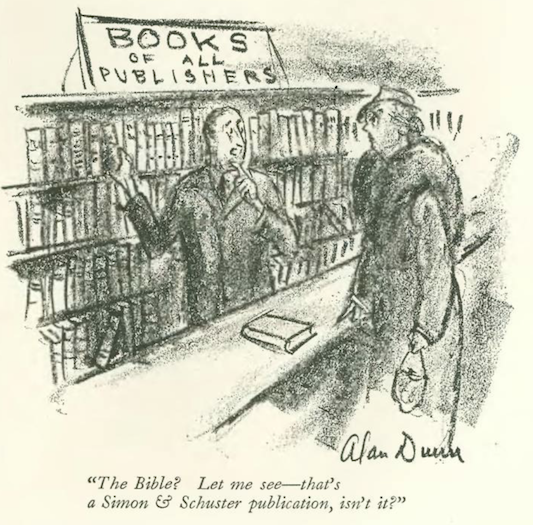
…Alan Dunn posed a question regarding authorship…
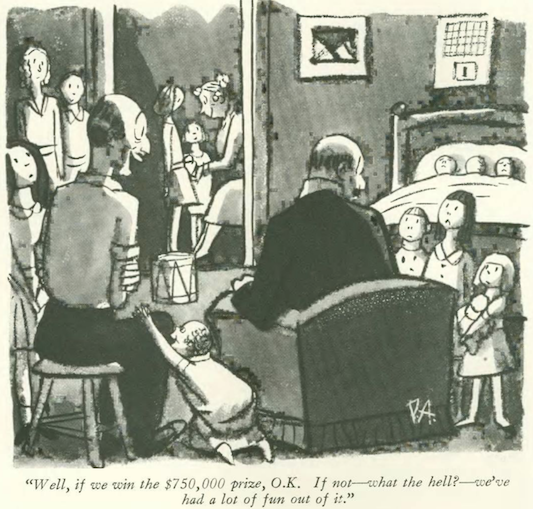
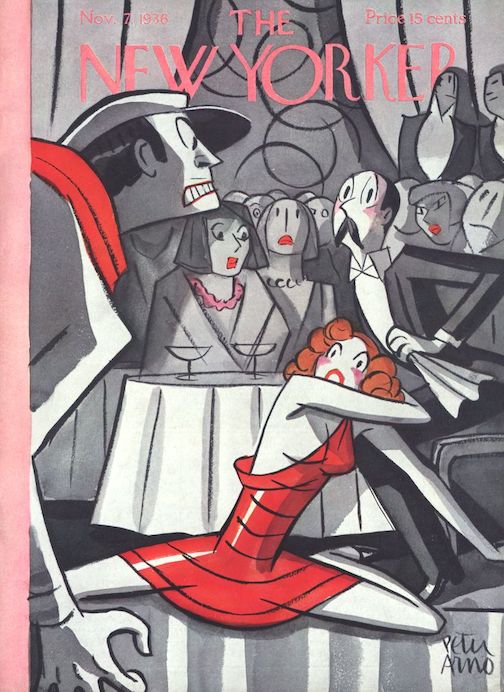
…Peter Arno might be referring to something akin to The Great Stork Derby here…
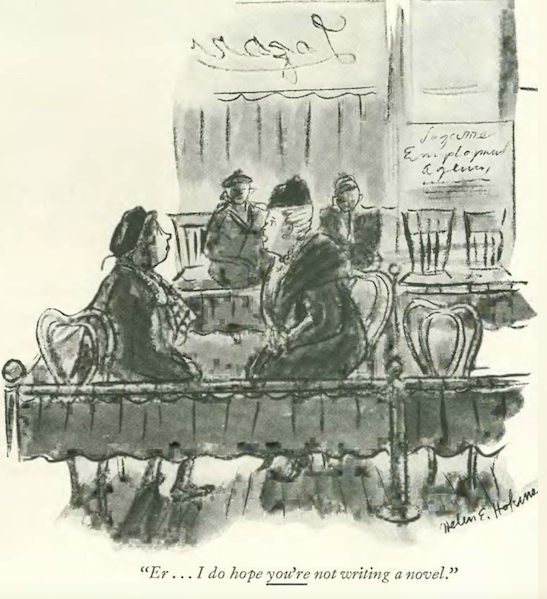
…one of Helen Hokinson’s “girls” sought to stay “off the record”…
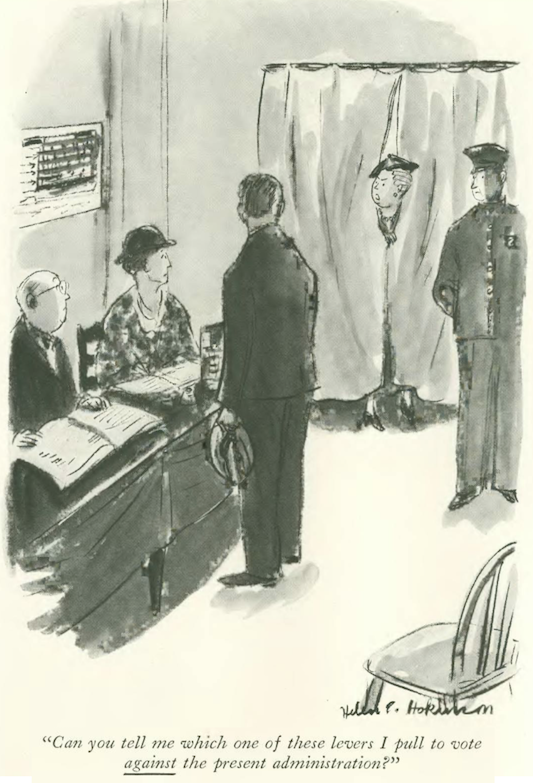
…and Hokinson again, casting a vote in the 1936 General Election…
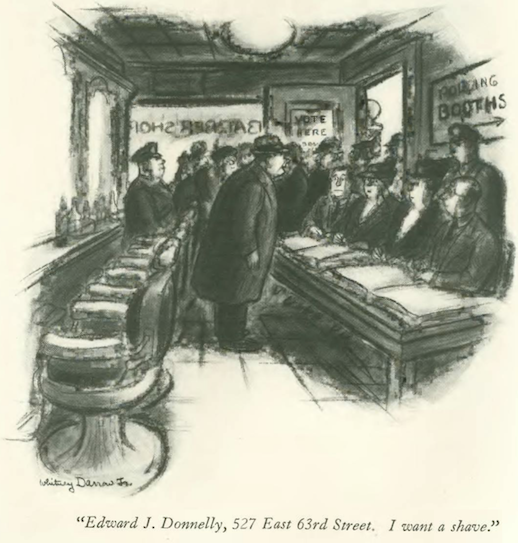
…Whitney Darrow Jr was also thinking about elections, and a clean shave…
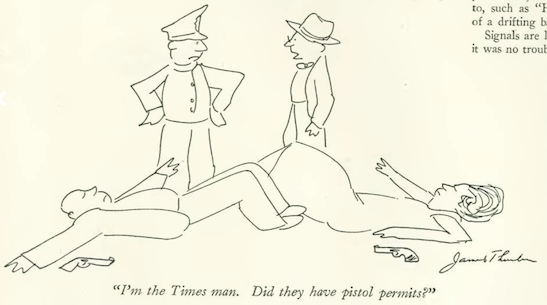
…and we close with James Thurber, and an inquiring reporter…
Next Time: The Instant Home…
Yankee Doodles

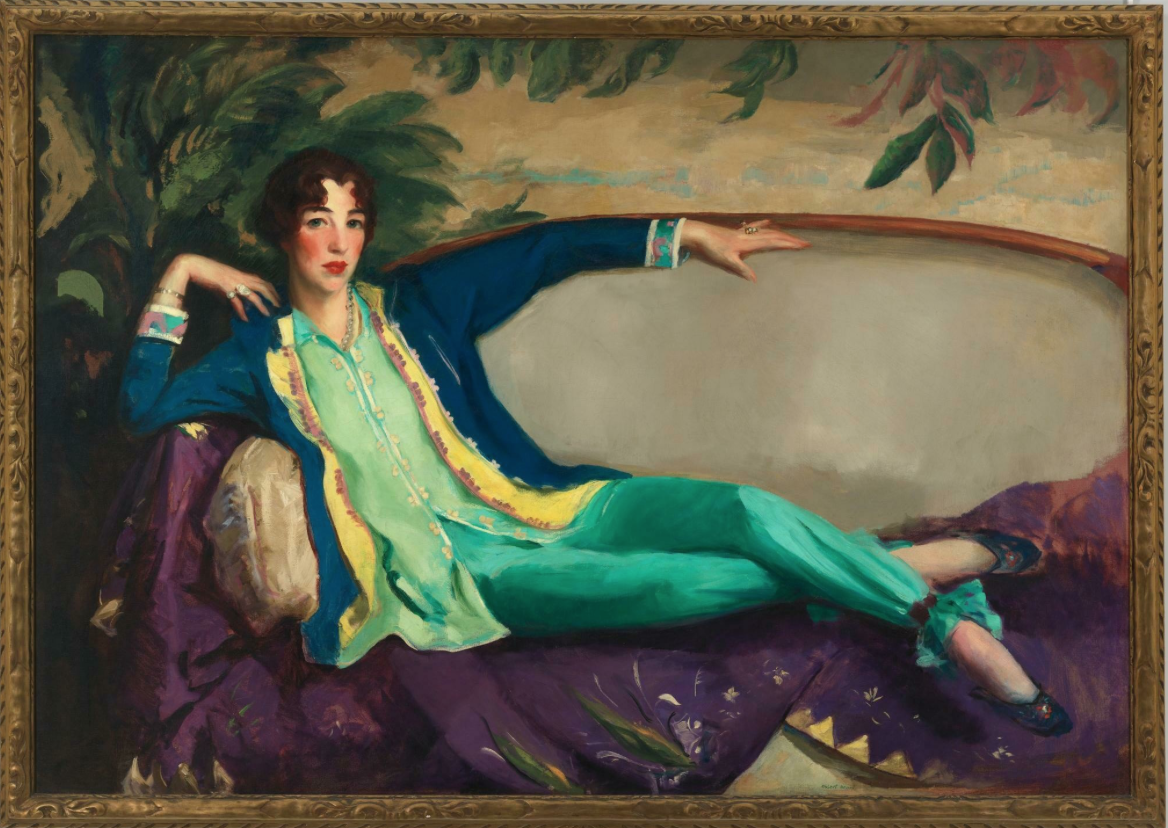
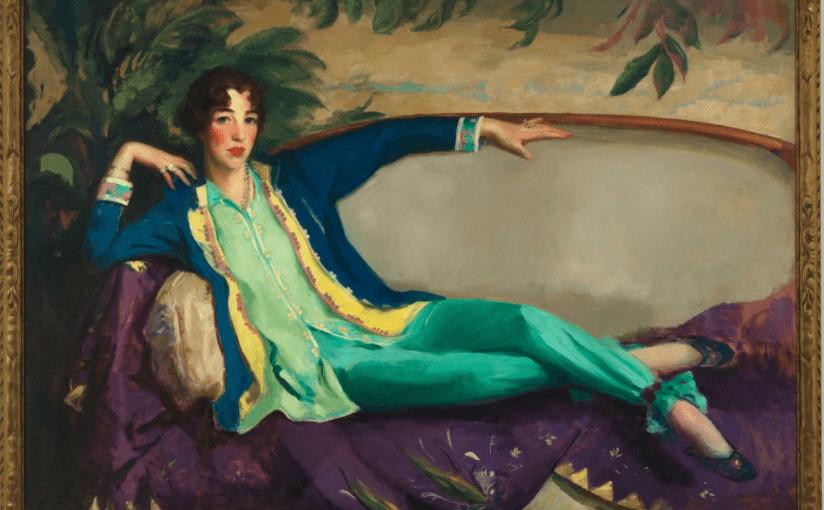
In 1931 Gertrude Vanderbilt Whitney (image above) opened a new art museum in Greenwich Village that would be unlike any other in Manhattan, one that would focus exclusively on American art and artists.

Nov. 28, 1931 cover by Harry Brown.

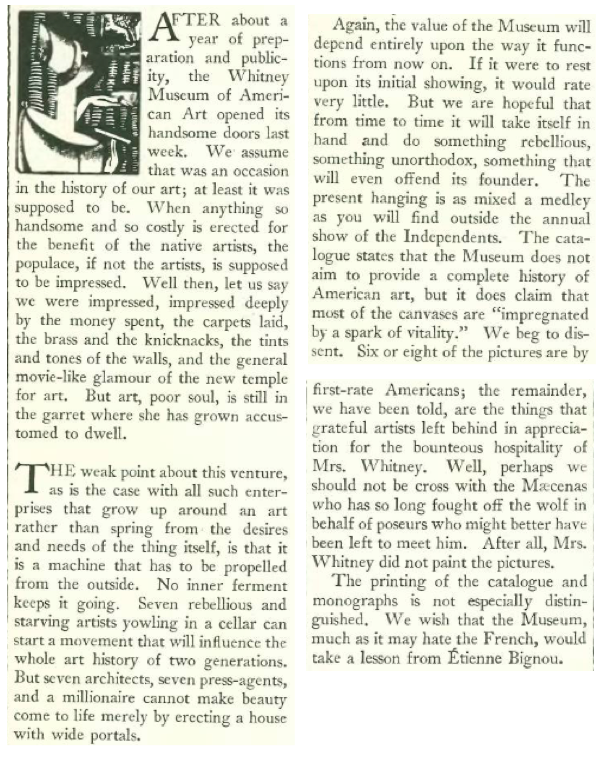
Ninety years ago American painters and sculptors were mostly considered second-rate by critics who had cut their teeth on the Old World’s “Great Masters.” An exception was The New Yorker’s first art critic, Murdock Pemberton, who accused such institutions as the Metropolitan Museum of discouraging American art. It is a bit surprising, however, that Pemberton initially gave a cool reception to the opening of the Whitney Museum of American Art, perceiving that its founders were putting the cart before the horse:

AMERICAN ORIGINAL…The original Whitney Museum of American Art was located at 8–12 West Eighth Street in Greenwich Village. Above, images from a 1937 museum catalog, and (bottom right) a view of the building’s West Eighth Street facade, circa 1940-50. (Whitney Museum/Life magazine)
SHE WORE THE PANTS…Robert Henri’s 1916 portrait of Gertrude Vanderbilt Whitney, sculptor and founder of the Whitney Museum. Gertrude’s husband, Harry Payne Whitney, would not allow his wife to hang the portrait in their Fifth Avenue town house because he didn’t want visitors to see his wife “in pants.” Instead, the portrait hung in Gertrude’s West 8th Street studio, which became the first Whitney Museum in 1931. (whitney.org)

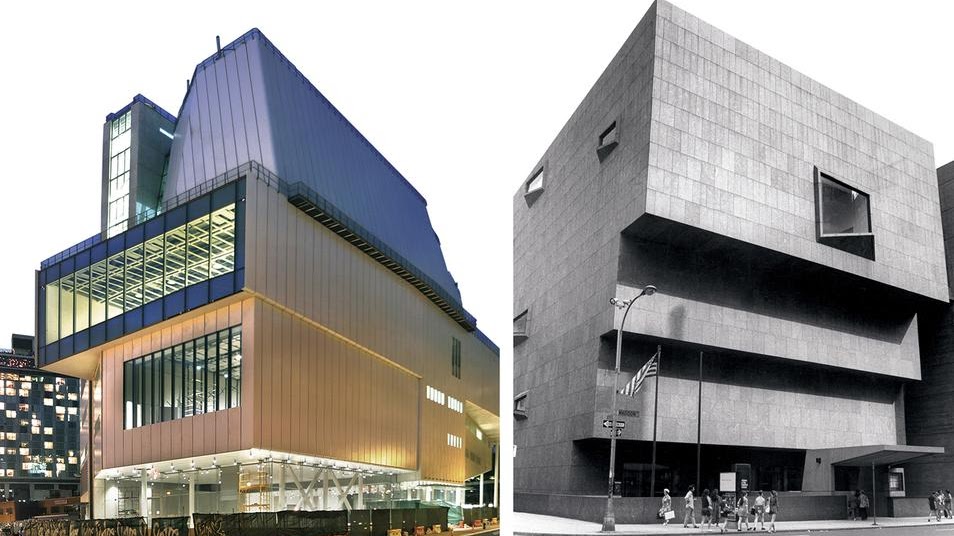
Despite Pemberton’s initial concerns, the Whitney became a beloved New York institution, moving in 1954 from the West Eighth location to a larger space on West 54th, and then to its iconic Marcel Breuer-designed building at Madison and 75th, which opened in 1966. The museum would move again in 2015 to its current location at 99 Gansevoort Street in a building designed by Renzo Piano.

IMPERMANENT COLLECTION…The Whitney would move three times after its 1931 opening, first to West 54th in 1954, then to its iconic Marcel Breuer-designed home at Madison and 75th (opened in 1966), and finally to its current location at 99 Gansevoort Street. (museuminforme.blogspot.com)

 *  *  *

Party Pooper

William Faulkner attracted much attention among literary circles during his extended visit to New York in 1931, however (as reported in “The Talk of the Town”) the author was able to dodge most of it by staying put in his Tudor City apartment.

HOME ALONE…William Faulkner spent most of his time in New York holed up in his Tudor City apartment, where he worked on the manuscript for Light in August. (LA Times/Wikipedia)

 *  *  *

This or That

While we are on the subject of literary giants, here is a poem submitted by E.B. White to the Nov. 28 issue that explored some universal half-truths:

*  *  *

From Our Advertisers

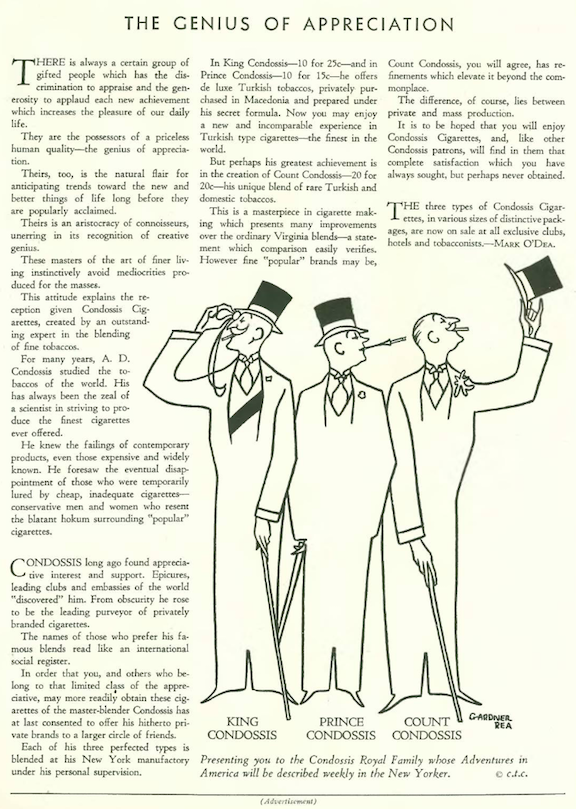
As the market for cigarettes continued to increase, so did the number of new brands launched to take advantage of all those eager young puffers. The makers of Condossis Cigarettes hoped to create some buzz for their new product through a series of ads written by Mark O’Dea and illustrated by The New Yorker’s Gardner Rea. Apparently the makers of Condossis believed that a posh backstory would lend a certain élan to their smokes. This seems all for naught—I haven’t found a record of the brand beyond 1938…

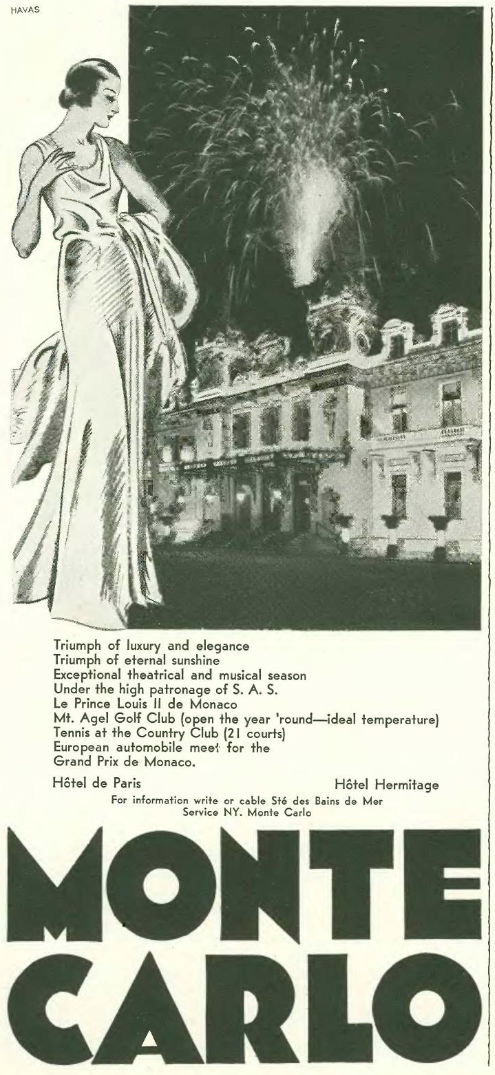
…a few of those posh smokers might have considered heading to Monte Carlo for the holidays, where they could also legally drink and gamble and forget about the jobless masses back home…

…but you needn’t go to Monte Carlo to signal your taste for the finer things, at least that is what B. Altman claimed with their lower-priced French knock-offs (although $95 was still a lot of dough in 1931)…

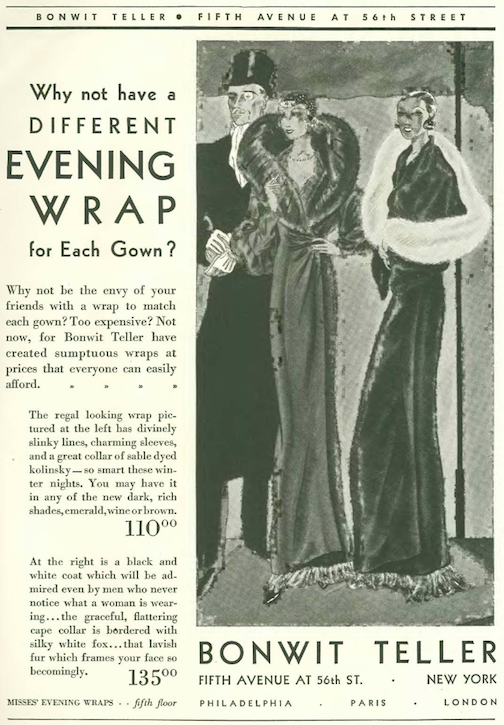
…Bonwit Teller also boasted of its low-priced evening wraps, so affordable that one could consider having a different wrap to complement every gown in one’s wardrobe ($135 in 1931 is roughly equivalent to $2,300 today)…

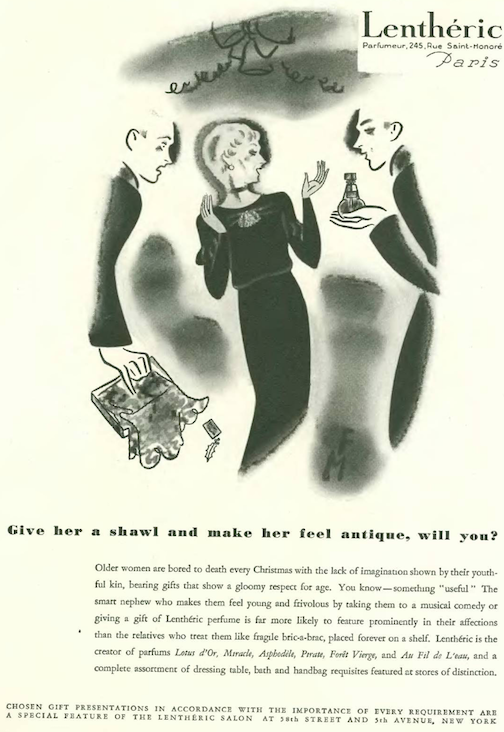
…the makers of Lenthéric perfumes offered the potential for shame and embarrassment if one didn’t choose their product for that special holiday gift…(illustration by Frank McIntosh, who contributes a cartoon in the next issue)…

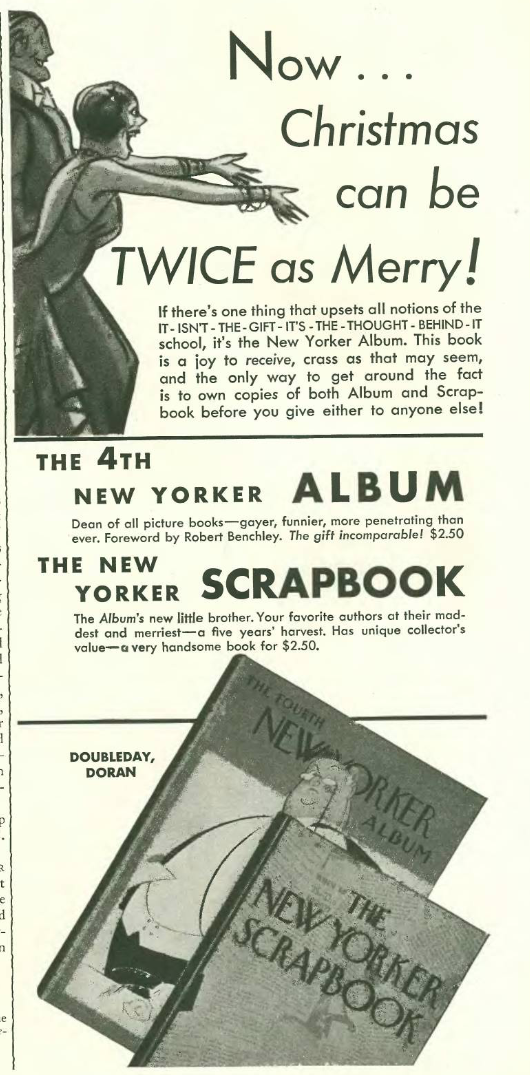
…but perhaps the happiest shopper of all could shell out a mere $2.50 for the latest editions of The Fourth New Yorker Album or The New Yorker Scrapbook (drawings of a delighted couple courtesy Peter Arno)…

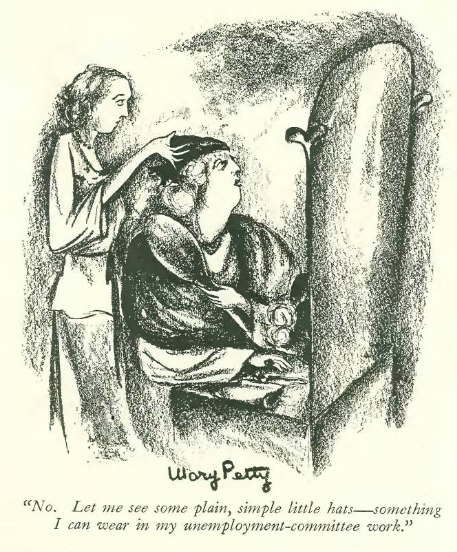
…on to our cartoons, we begin with Mary Petty and a tête-à-tête over tea…

…and Petty again with one woman’s attempt at noblesse oblige…

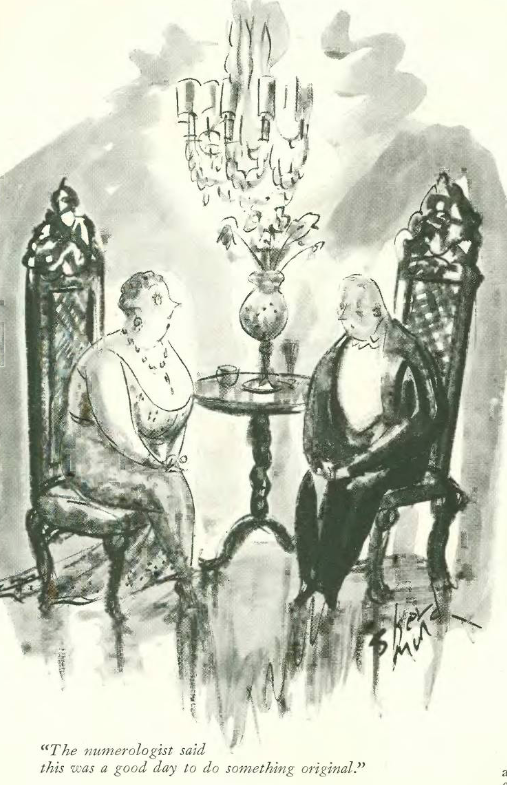
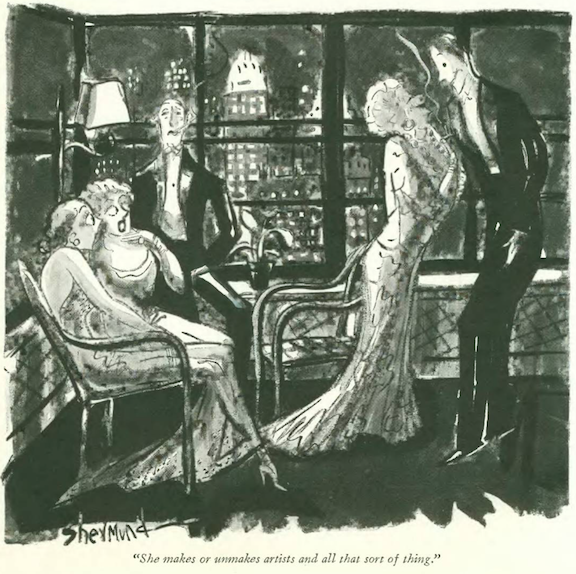
…Barbara Shermund looked in on the very idle rich…

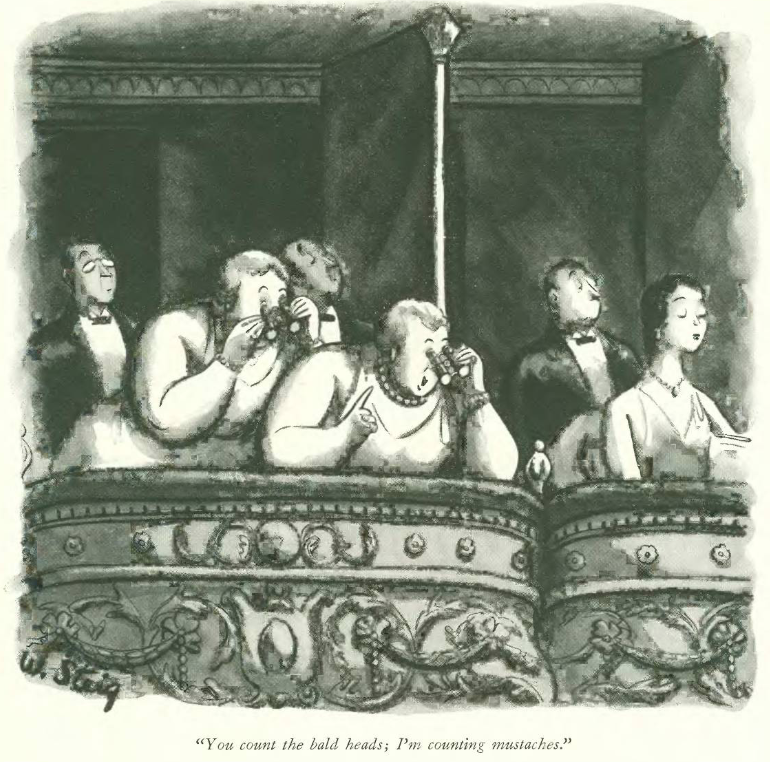
…William Steig spotted a bald-watcher…

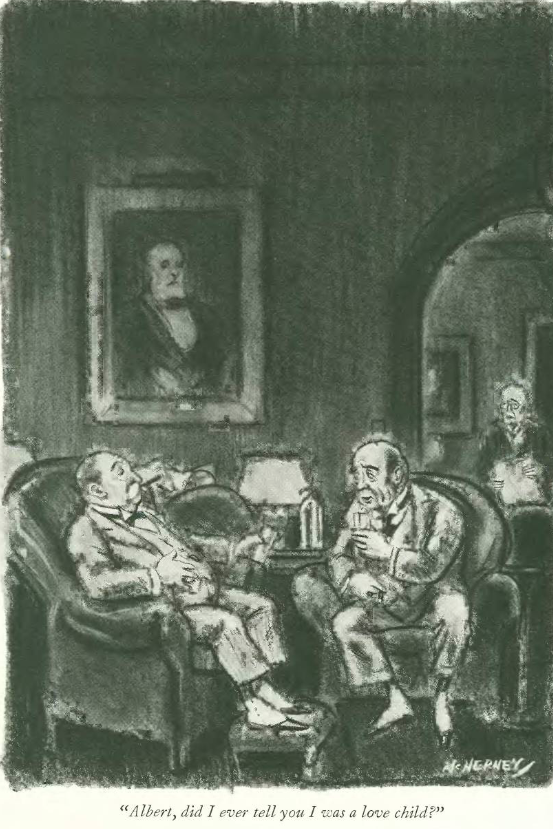
…E. McNerney revealed a secret among siblings…

…and William Crawford Galbraith gave us a backstage glimpse of a Broadway revue…

 *  *  *

On to the Dec. 5 issue…

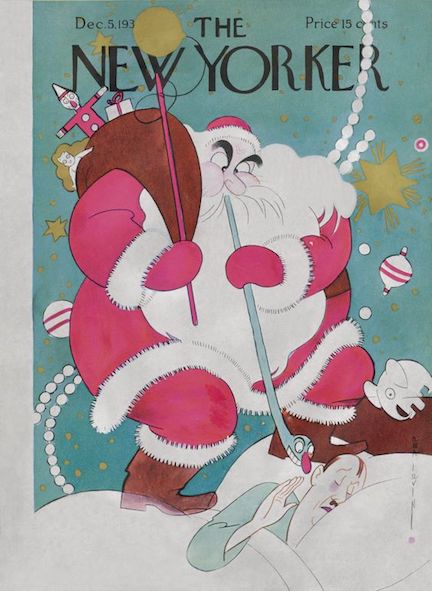
Dec. 5, 1931 cover by Rea Irvin.

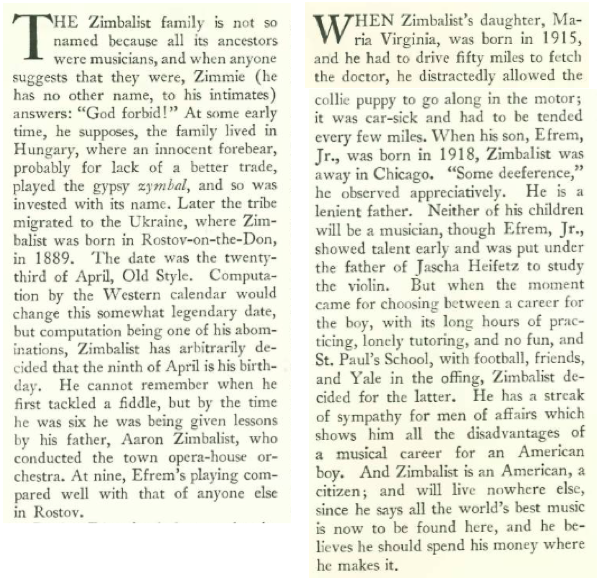
…which featured a profile of renowned violinist and composer Efrem Zimbalist (1889-1985). The son of a Russian conductor, Zimbalist was married to the famous American soprano Alma Gluck…

…and the entertainment gene continued on through the family line, as Zimbalist and Gluck’s son, Efrem Zimbalist Jr., would become a star in Hollywood, as would their granddaughter, Stephanie Zimbalist.

ALL IN THE FAMILY…Famed violinist Efrem Zimbalist and American soprano Alma Gluck (top, left) would pass on their entertainment genes to son Efrem Zimbalist Jr. (known for his starring roles in 77 Sunset Strip and The F.B.I.) and granddaughter Stephanie Zimbalist, who portrayed sleuth Laura Holt in the NBC series Remington Steele. Top right, a “Profile” caricature of Zimbalist by Al Frueh. (Wikipedia/Pinterest)

 *  *  *

From Our Advertisers

Much to the delight of The New Yorker advertising department, the makers of Condossis Cigarettes were back with their second installment of the adventures of the “Condossis Family”…

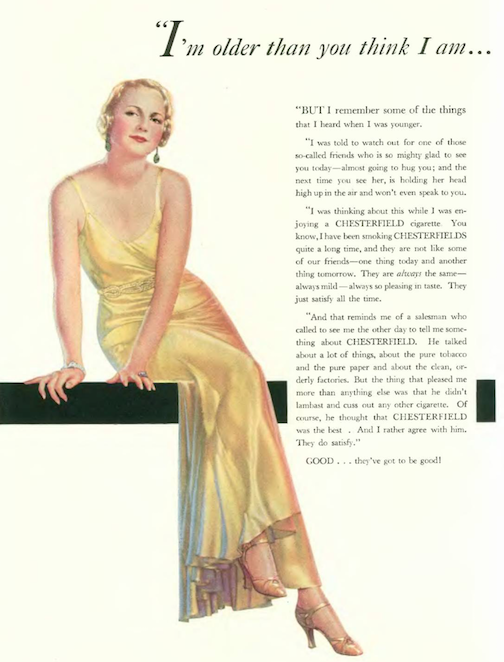
…on the other hand, the well-established Chesterfield brand didn’t have to try quite as hard — offering an attractive woman and some supporting copy that subtly suggested that a woman could credit her fine demeanor to a mere cigarette…

…on to our comics, we have this two-page entry by Rea Irvin…

…a bit of offensive driving, Helen Hokinson-style…

…Carl Rose gave us an unlikely candidate for a chaste role…

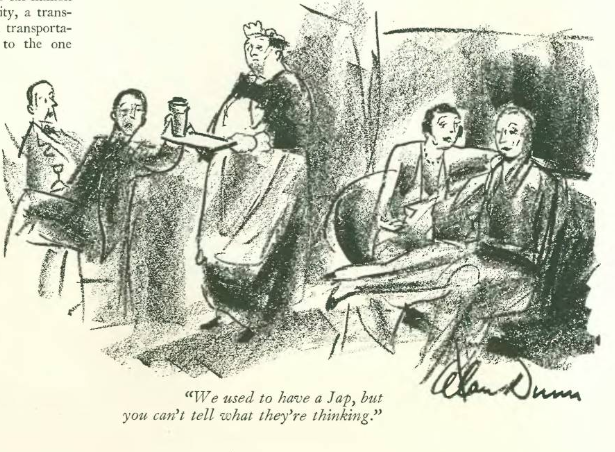
…Alan Dunn’s entry played to the stereotypes of his day…

…Frank McIntosh plied the Sugar Daddy waters to come up with this gem…

…Garrett Price gave us a gift designed to light a man’s fire…

…Barbara Shermund lit a flame of a different sort between a dowager and her latest escort…

…and we end with James Thurber, and one of my all-time favorites…

Next Time: Mosher’s Monster