Some New Cars and Mrs. Simpson

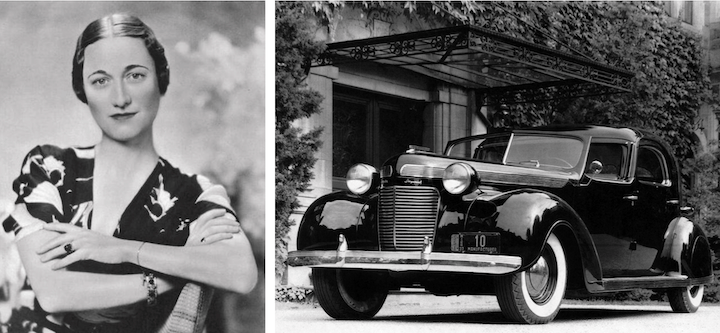
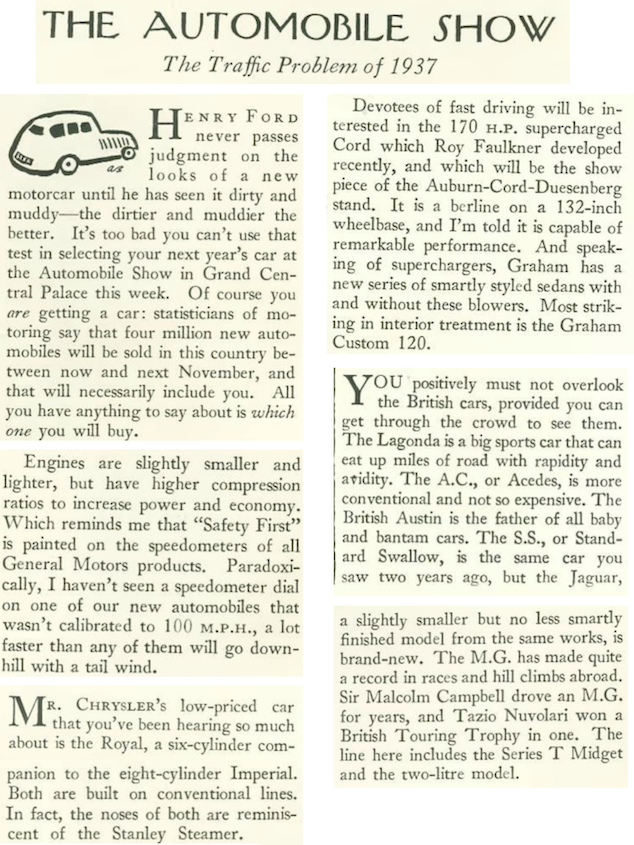
Above: The November 14, 1936 issue of The New Yorker had something for everyone, from gossip about Wallis Simpson (soon to dethrone the King of England) to one of New York's grandest auto shows, featuring such luxury models as the 1937 Chrysler Imperial—the Imperial, along with several other models, introduced the single-piece clamshell hood, which opened from the front rather than from the sides. (thehistorypress.co.uk/eBay.com)

After some rather thin issues over the summer, The New Yorker began bulking up for the holidays, stuffed with colorful advertisements related to the New York Auto Show and the approaching holiday season. Arts, entertainment and society were also in full swing, and the overall mood seemed to be lighter as the economy saw its best year since the market crash.
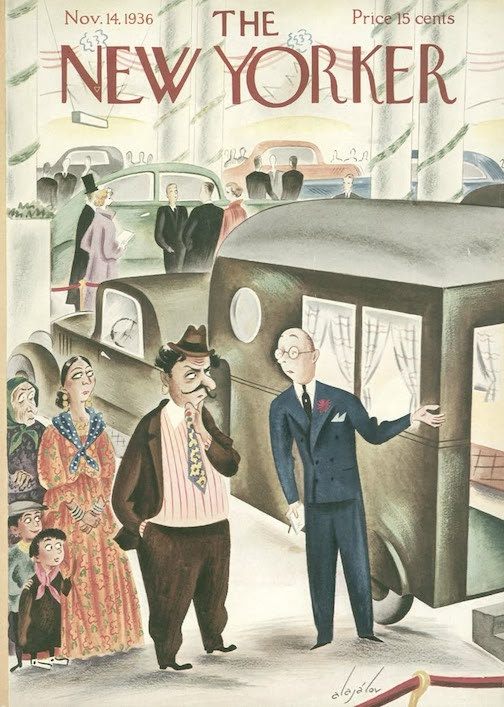
November 14, 1936 cover by Constantin Alajalov.

Always a big event, the Automobile Show at the Grand Central Palace drew massive crowds to Midtown, where visitors were treated to a gleaming array of foreign and domestic cars. Here are some excerpts from a lengthy review by George F.T. Ryall, using the pen name “Speed.”
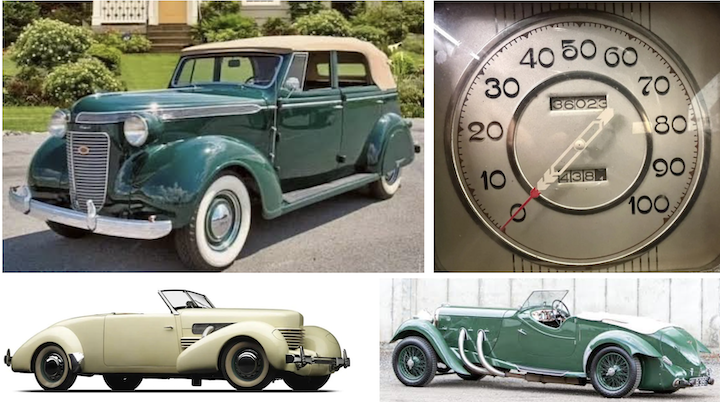
SPEED DREAMERS…Clockwise, from top left, a 1937 Chrysler Royal Convertible Sedan with the newly introduced clamshell hood; detailed view of the Royal’s speedometer—Ryall noted that he hadn’t seen a speedometer at the show that wasn’t calibrated to 100 mph, “a lot faster than any of them will go downhill with a tailwind,” he noted; cars at the show actually capable of that speed included Britain’s 1937 Lagonda LG45 Rapide Tourer and the supercharged 1937 Cord 812. (Bill Gilbert via facebook.com/hemmings.com/simeonemuseum.org)
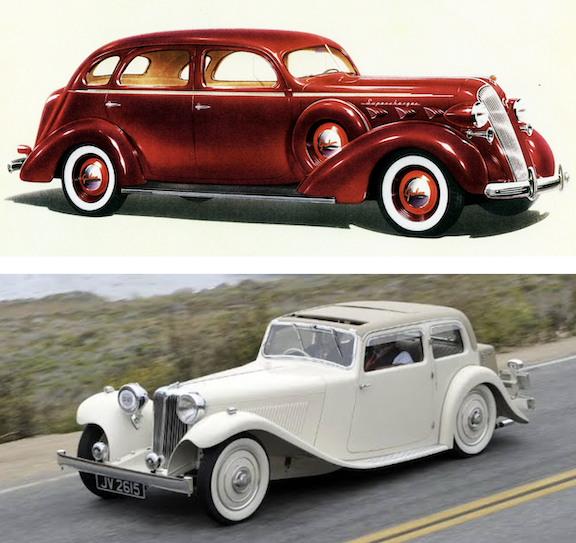
HOME AND ABROAD…Evansville, Indiana-based Graham-Paige showcased the 1937 Graham Custom Series 120 Supercharger (above) at the auto show, which also featured the 1936-37 Standard Swallow “Jaguar”—Standard Swallow, also known as SS Cars Ltd., was the direct predecessor to the Jaguar line of cars. (Wikimedia/Paul O’Brien via facebook.com)
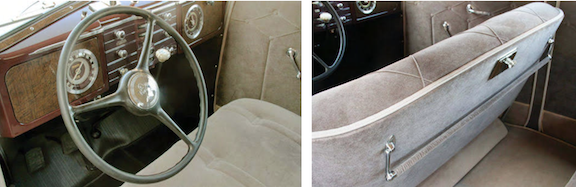
COZY…Ryall singled out the interior of the Graham-Paige, which featured a mahogany dash and quilted upholstery. (autorestorer.com)

Ryall also noted the General Motors display at the Waldorf, a Lincoln Salon at the Park Lane, and the International Salon at the Chrysler Building, which featured a revolving floor:
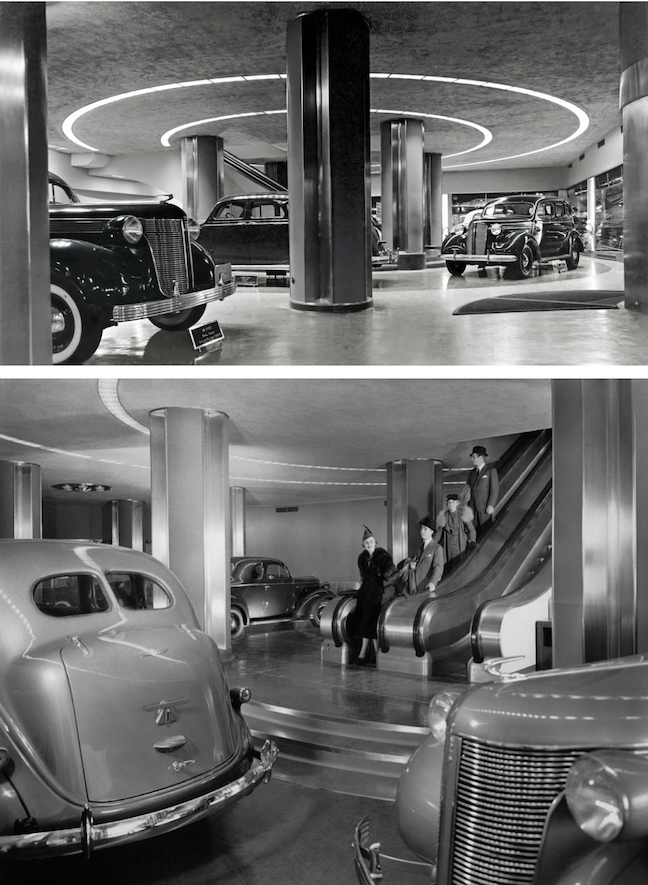
DIZZYING DELIGHTS…The Chrysler Building once had an auto showroom that occupied the first two floors of the lobby—the lower level (bottom photo) even featured a revolving floor. Both photos from 1936. (loc.gov/tumblr.com)

Camping trailers were coming into their own in 1936, evident in the large exhibit at the Auto Show featuring twenty-four different makes. Ryall again:
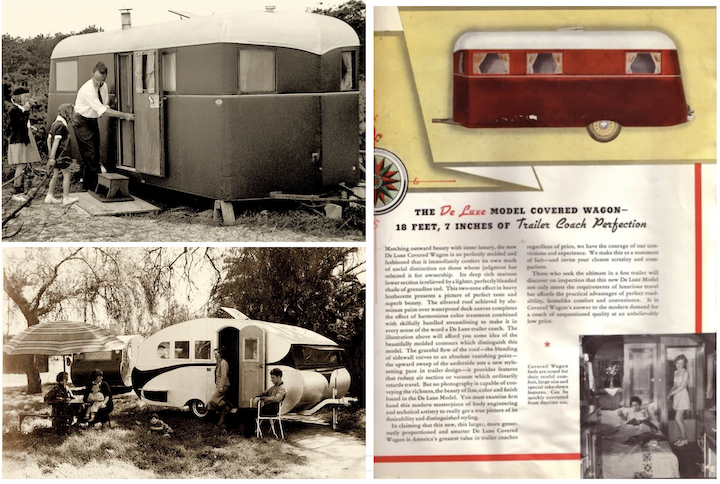
EARLY GLAMPERS…Clockwise, from top left: The market leader during the 1930s was Covered Wagon—this is a 1936 model; images from from a 1936 Covered Wagon catalog; a “canned-ham” style trailer from the 1930s. (hemming.com/thevintagetraveler.wordpress.com)

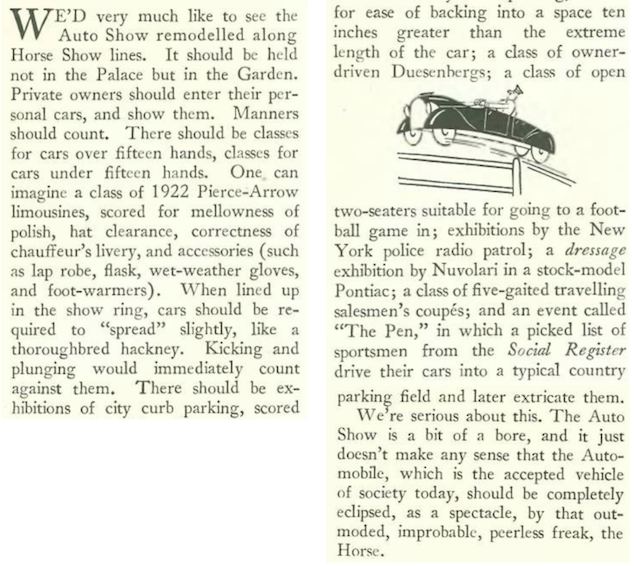
I would have been surprised if E.B. White didn’t have something to say about the auto show. He famously detested newer cars, preferring his Model T with all its quirks. In his “Notes and Comment,” White called the exhibition “a bit of a bore.”
 * * *

The Game’s Afoot

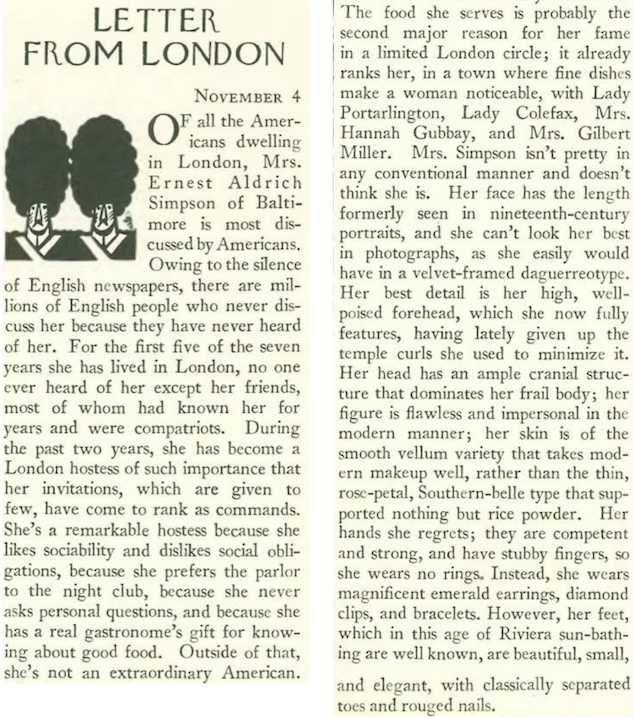
When Janet Flanner filed this gossipy report from London, Wallis Simpson was known for being an unusually prominent American in London society. Why Flanner decided to write about Simpson at this time suggests that she likely knew about the scandal brewing behind the scenes regarding Edward VIII’s desire to wed Simpson. One supposes that along with the London papers, Flanner observed a self-imposed silence on the matter.
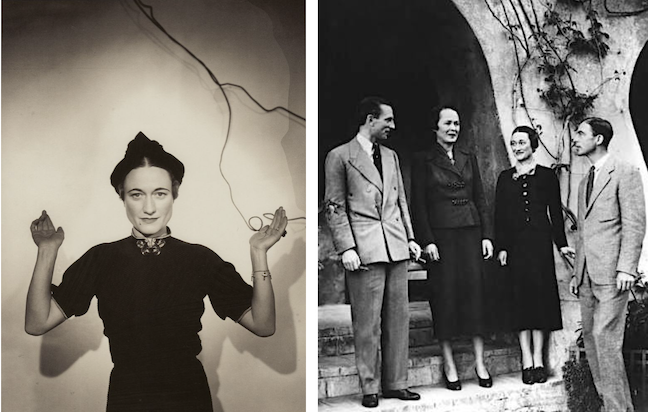
SPELLBINDER?…At left, 1936 photo of Wallis Simpson by Cecil Beaton; at right, Simpson with close friends Herman and Katherine Rogers, her hosts at the Villa Lou Viei in Cannes during Edward’s abdication crisis. On the right of the photo is Lord Brownlow. (Wikipedia/pinterest.com)

Here’s another excerpt from Flanner’s letter, detailing Simpson’s gastronomic skills.
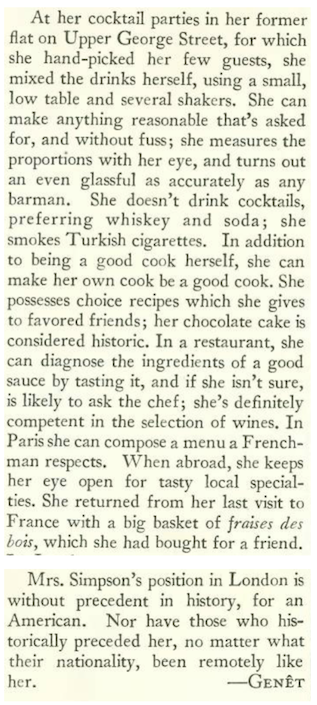
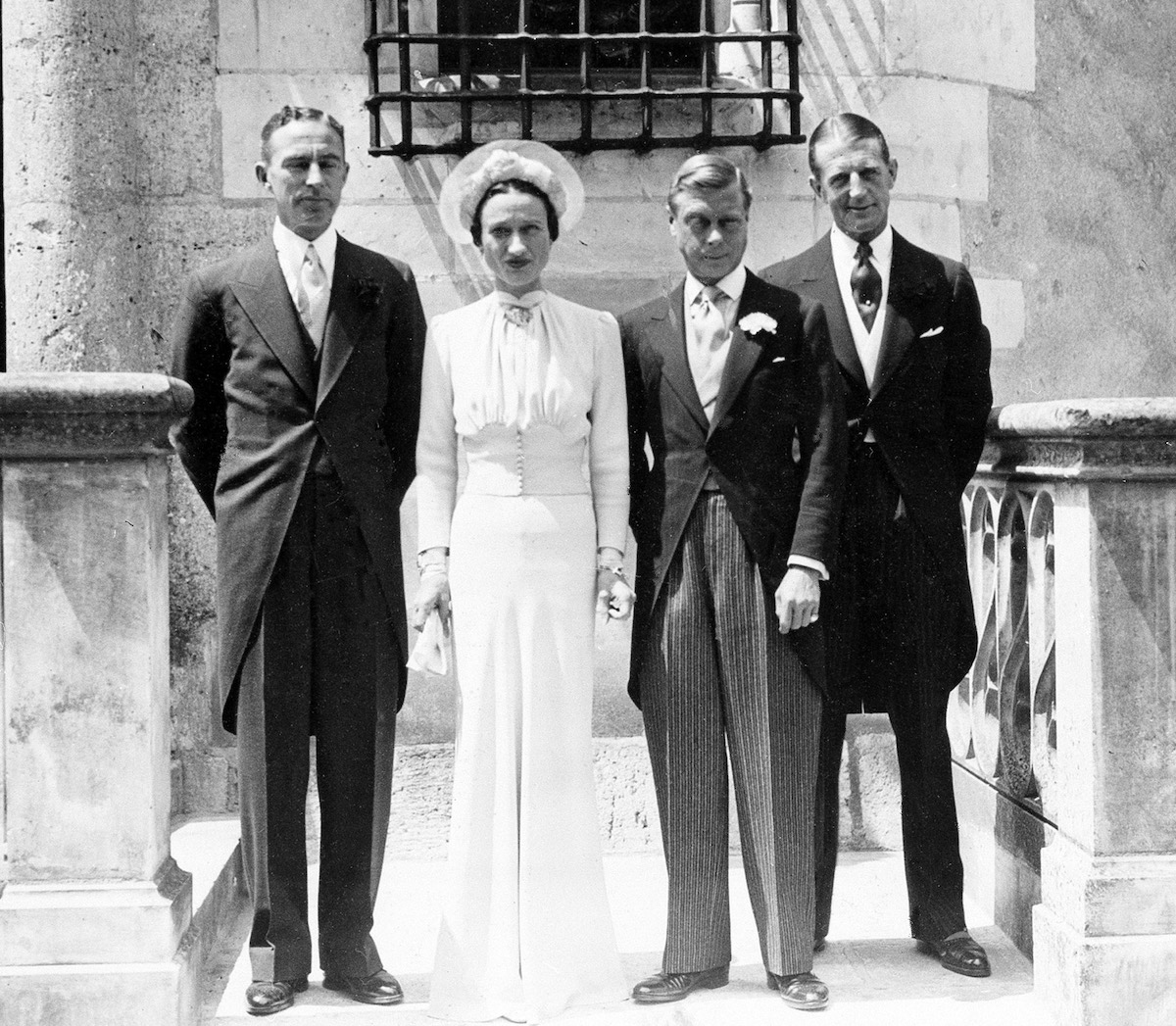
NOW HE’S GONE AND DONE IT…The Duke and Duchess of Windsor pose after their wedding at Chateau de Cande near Tours, France, on June 3, 1937. At left is Hermann Rogers Winters and at right is Major Metcalf, first former King of England’s witness. (AP Photo)

 * * *

Up In Smoke

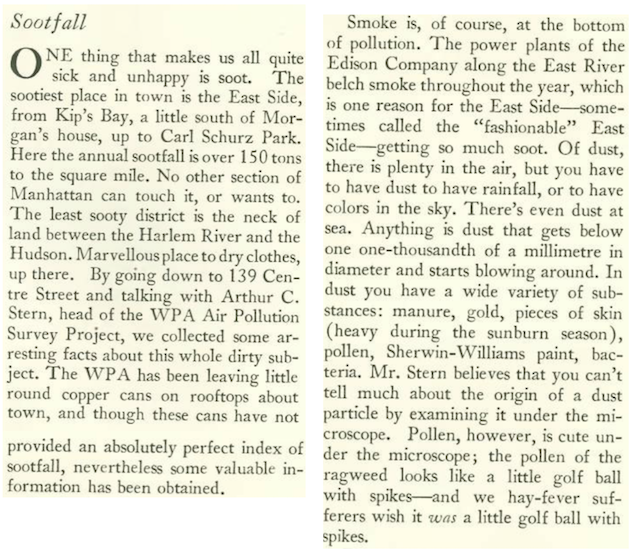
“The Talk of the Town” commented on the soot and other pollutants that routinely befouled the air in Manhattan. In the 1930s most apartments, commercial buildings, and power plants burned coal for heat and power, and during the Depression folks turned to burning a cheaper coal that spewed forth dense, oily smoke. According to “Talk,” coal-driven air pollution deposited more than 150 tons of soot per square mile in some of the worst areas, such as along the East River where factories and power plants emitted thick plumes. Here’s an excerpt:
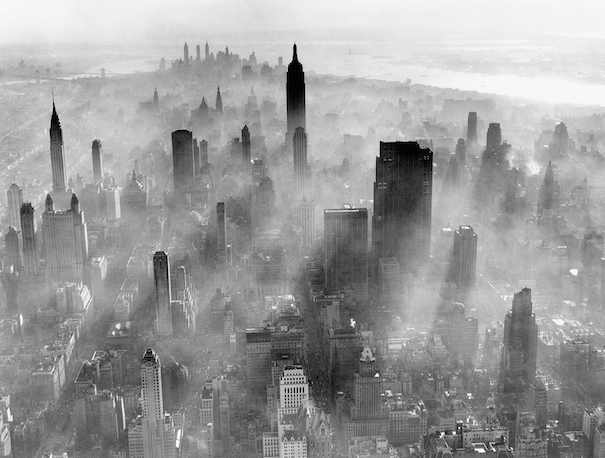
ON A CLEAR DAY YOU CAN SEE FOR MILLIMETERS…Smog over Manhattan, 1940. (airphotos.org)

 * * *

Suckers and Subscribers

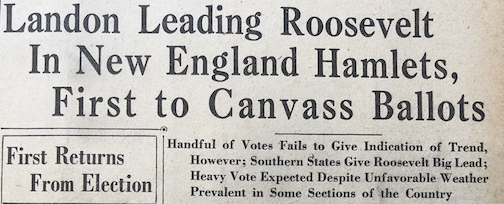
Robert Benchley’s Nov. 14 “Wayward Press” column took aim at the politically slanted, sensationalized coverage by various newspapers regarding the general election, misleading voters into believing the presidential race was much closer than it turned out to be (a Franklin D. Roosevelt landslide over Alf Landon). In these excerpts Benchley called out publisher William Randolph Hearst in particular:
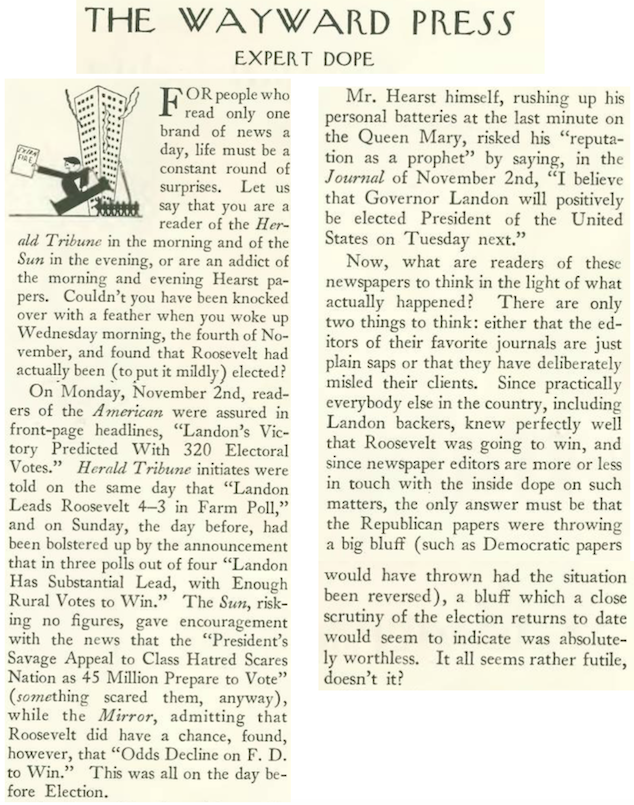
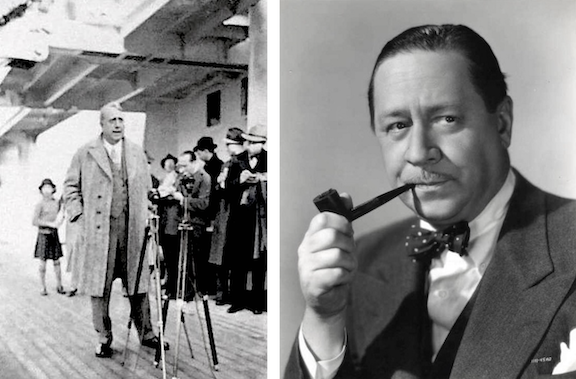
HAVING NONE OF IT…During a press conference on the deck of the HMS Queen Mary, publisher William Randolph Hearst stated that “Governor Landon will positively be elected President of the United States on Tuesday next.” Robert Benchley quipped that Hearst “risked his reputation as a prophet” with the rushed pronouncement. Benchley debuted “The Wayward Press” column on press criticism in 1927 (originally titled “The Press in Review”) and famously signed the column under the pen name “Guy Fawkes.” (Facebook.com/americanheritage.com)

Early editions of many newspapers anticipated a Landon victory—a headline from the Amsterdam Evening Recorder:
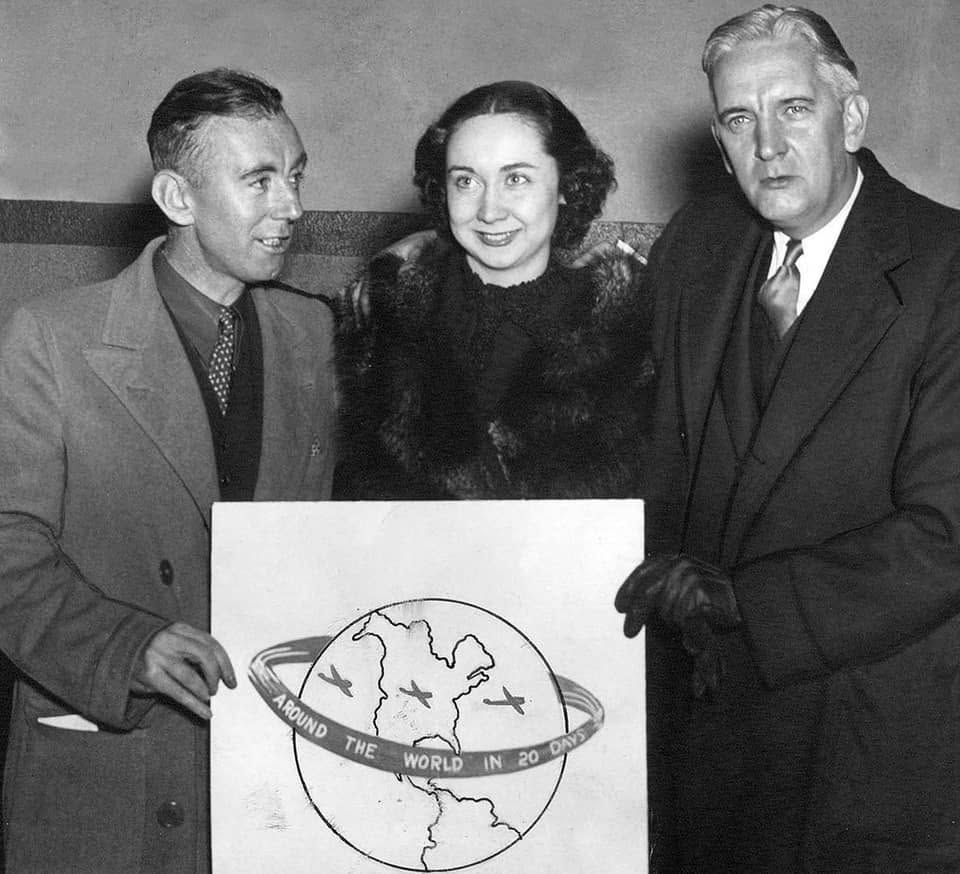
Benchley observed that “the public likes to have its leg pulled,” and noted the example of a much ballyhooed “race around the world” that featured three New York newspaper reporters competing to prove commercial air travel was fast and accessible to the public (and, of course, boost circulation for their newspapers).
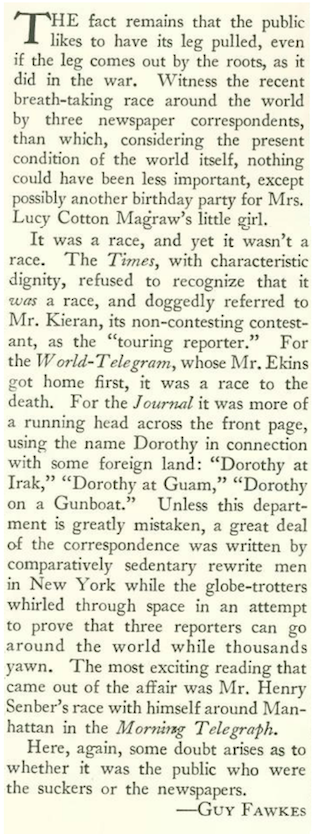
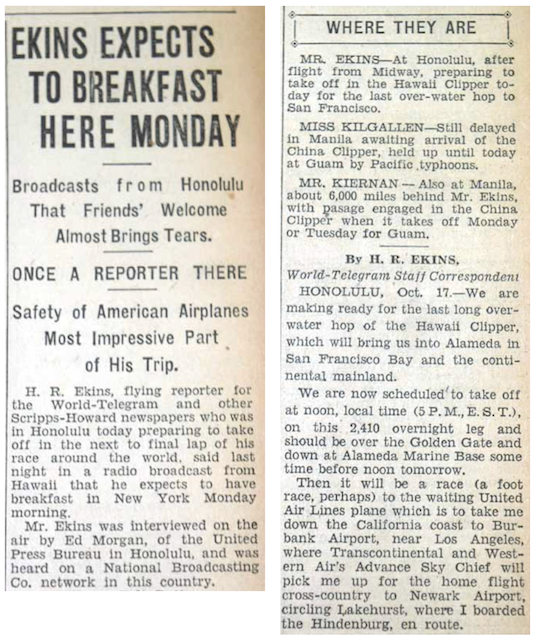
Above: Clips from the Oct. 17, 1936, edition of the New York World-Telegram heralded the arrival of reporter Herbert Roslyn “Bud” Ekins.
STUNT FLYERS…From left to right: Leo Kieran of The New York Times, Dorothy Kilgallen of the New York Evening Journal, and Herbert Roslyn “Bud” Ekins of the New York World-Telegram competed in the “1936 Race Around the World” (also known as “Around the World in 20 Days”). All three journalists started the race by departing together across the Atlantic aboard the German airship Hindenburg. Robert Benchley concluded, “…some doubt arises as to whether it is the public who were suckers or the newspapers.” (Dorothy Kilgallen Fans vis facebook.com)

 * * *

The Inevitable Picasso

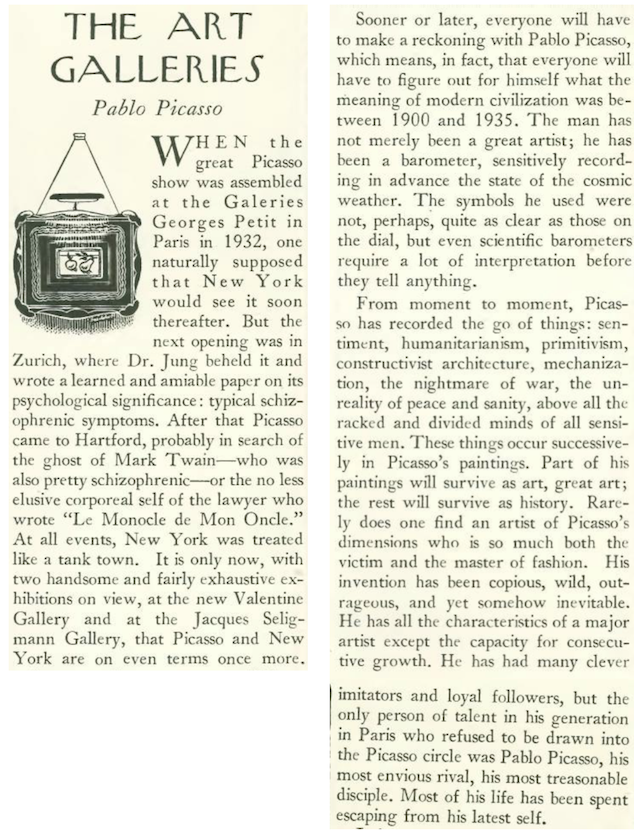
Lewis Mumford checked out a couple exhibitions featuring both old and newer works by Pablo Picasso. Mumford surmised that some of these painting “will survive as art, great art” while the rest will “survive as history,” observing that Picasso was both victim and master of a fashion of his own creation.
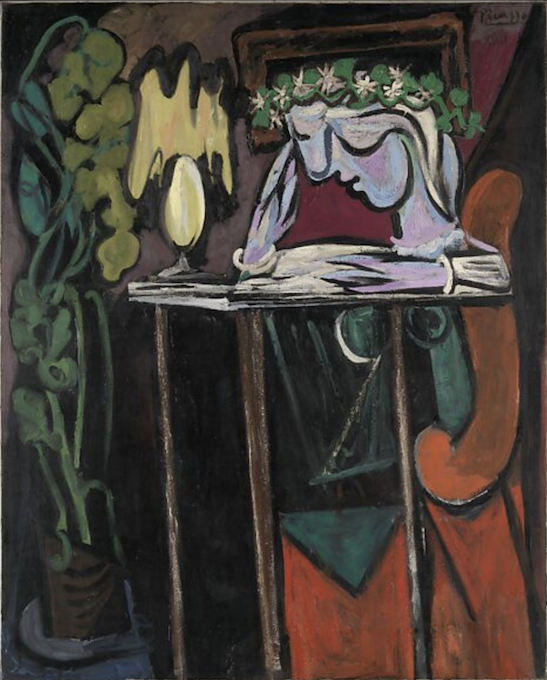
RECKONING WITH PICASSO…Pablo Picasso’s Femme écrivant (1934) was among works critic Lewis Mumford viewed at the first of three Picasso retrospectives held at the Valentine Gallery between 1936 and 1938. (Metropolitan Museum of Art)

 * * *

At the Movies

John Mosher took a look at the latest Shakespeare play adapted to film—As You Like It featured Laurence Olivier as Orlando (his first Shakespearean film role), and Elisabeth Bergner as Rosalind. Mosher praised the film’s “affable” and “unpretentious air.”
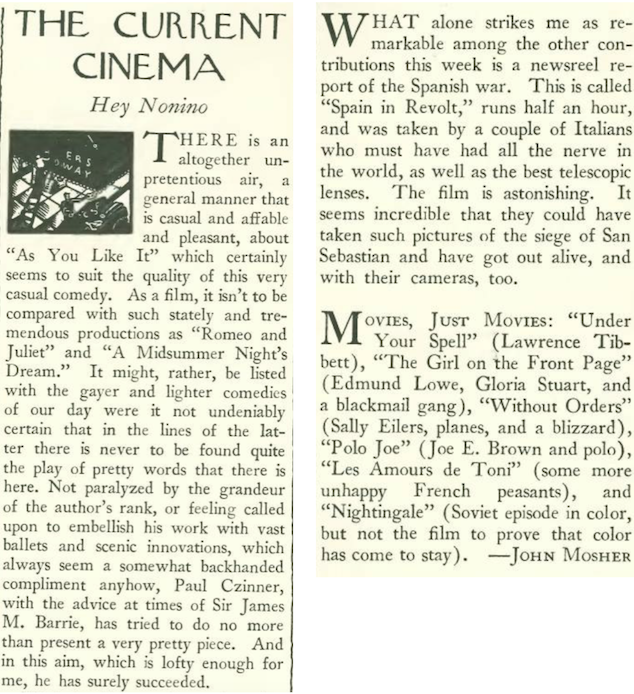
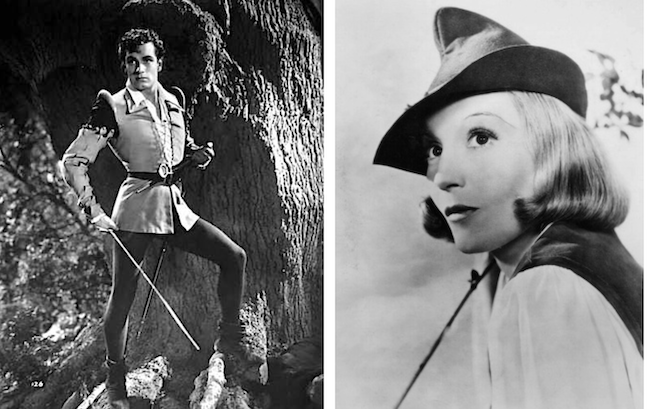
DEBUT…The role of Orlando in As You Like It was Laurence Olivier’s first Shakespearean film role—he would become famous for his Shakespeare trilogy (Henry V, Hamlet, and Richard III), but in 1936 Elizabeth Bergner (right, as Rosalind) was the bigger name in the production. (Folger Library/pinterest.com)

Mosher also reviewed the “astonishing” documentary Spain in Revolt (España 1936), which featured harrowing scenes from the civil war between Fascists and Republican government loyalists.
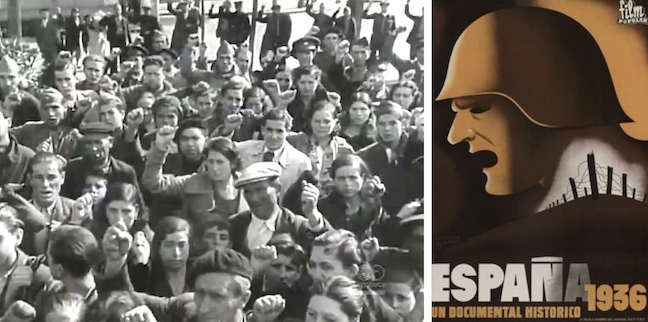
THE HELL OF WARFARE…Still image from Spain in Revolt (España 1936), which featured scenes of the Spanish resistance to Fascists and gut-wrenching images of death and destruction wrought by Nazi bombardments. (YouTube.com/imdb.com)

 * * *

From Our Advertisers

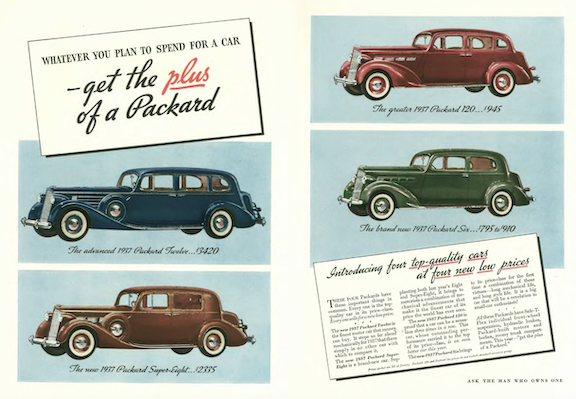
The beancounters at The New Yorker had to love this time of year…with the holidays approaching and the big car show in full swing the magazine ballooned to nearly 150 pages…there were splashy two-page ads from a number of automakers, including Packard…
…and Cadillac…
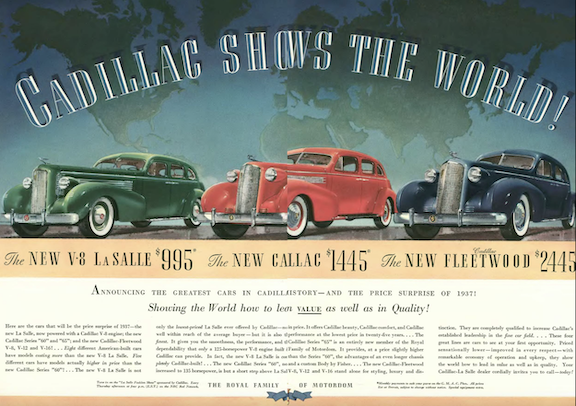
…unlike Packard and Cadillac, who offset losses on their luxury models by offering lower-priced cars (the Packard Six and LaSalle, respectively), Pierce-Arrow stuck with their pricy model (which some considered America’s answer to the Rolls Royce)…at this point Pierce-Arrow was on the brink of collapse, and that’s probably why they tacked on the ad to the right to promote their travel trailer…
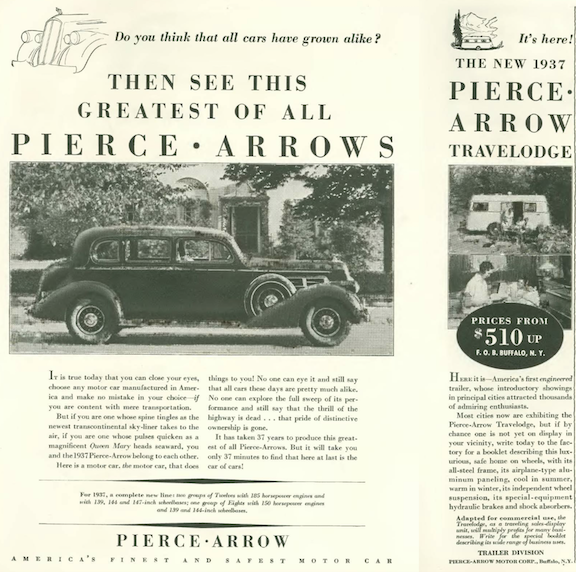
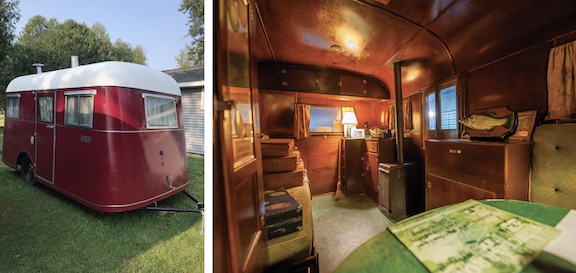
The 1937 Pierce Arrow Travelodge. (hagerty.com/tincantourists.com)

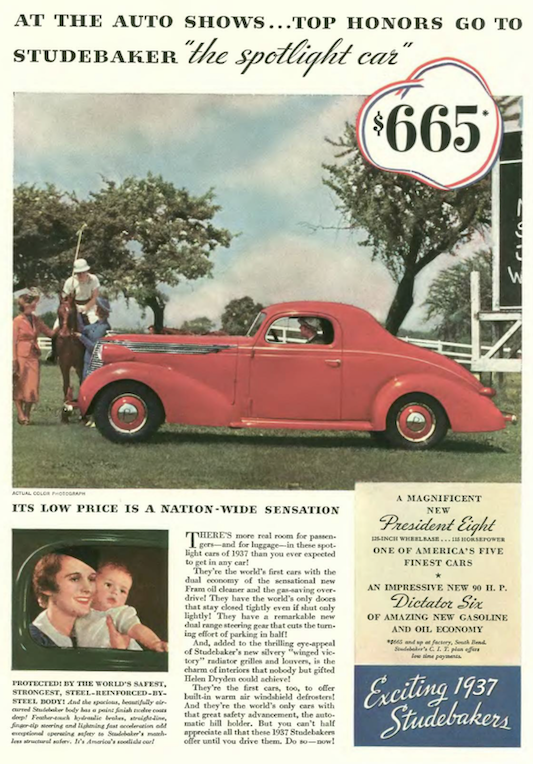
…bargain hunters could snap up a tomato-red Studebaker for a mere $665 (about 16k today)…pictured here is a “Dictator Six” coupe…for obvious reasons the company renamed the car “Director” in 1937…
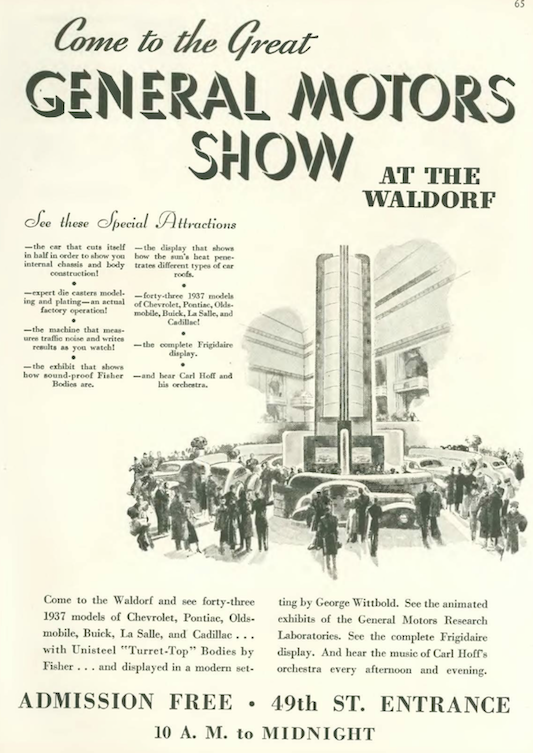
…automakers emphasized the glamour of the event, which was staged at the Grand Central Palace with satellite locations including the Waldorf…
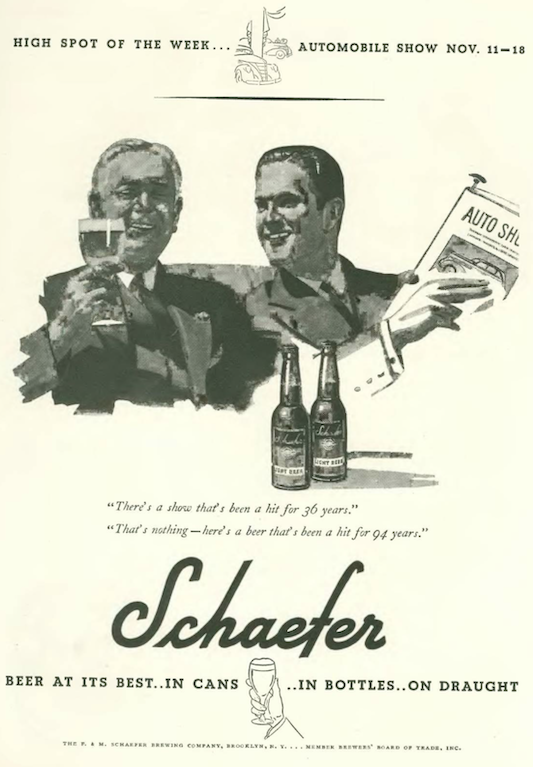
…even breweries latched on to the excitement of the auto show…
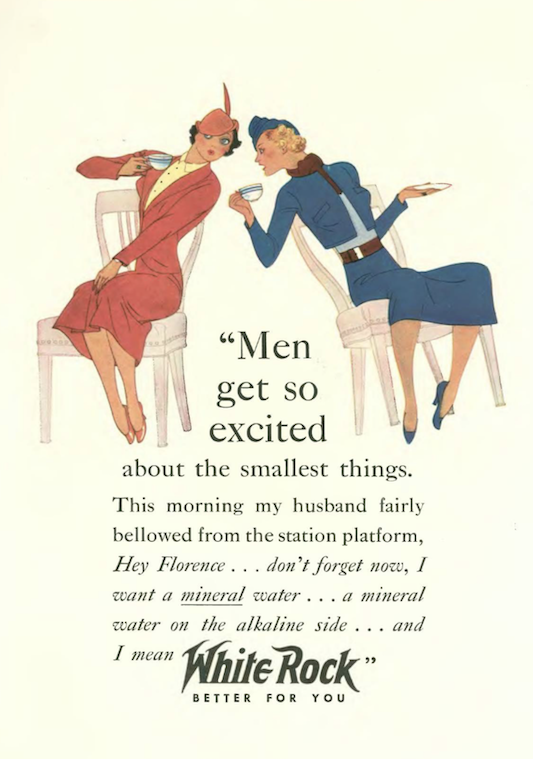
…White Rock continued to brighten the magazine with their colorful spots…
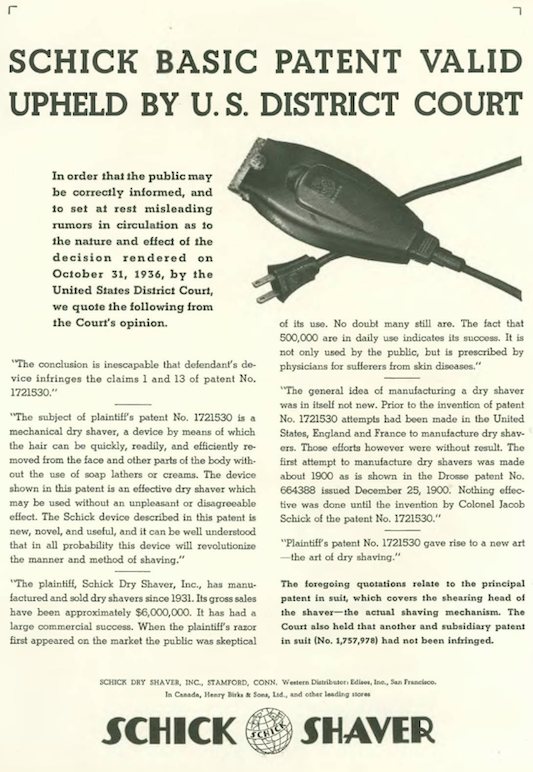
…in sharp contrast, the makers of Schick electric shavers felt the need to take out this dull, wordy full page ad to tout a recent court hearing in favor of their “basic patent”…
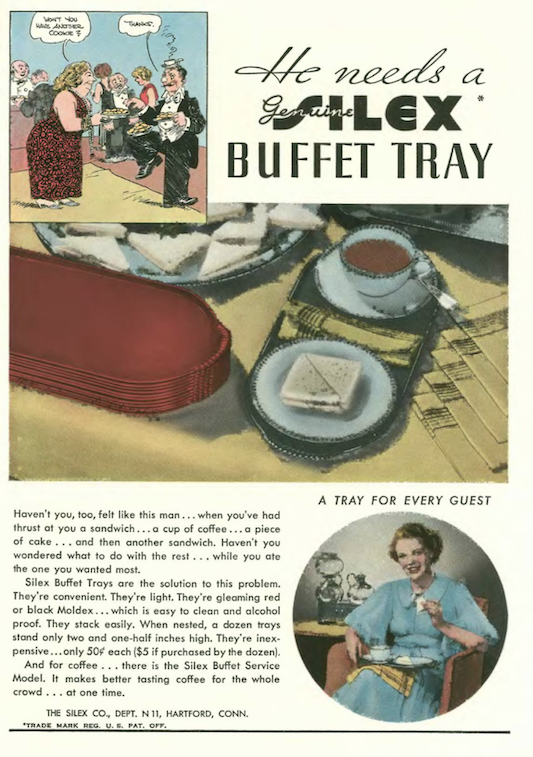
…certainly more exciting were these genuine Silex buffet trays, which seemed to suddenly be all the rage…the little cartoon in the top corner looks like it could have been drawn by Billy DeBeck (Barney Google) or someone of that ilk…
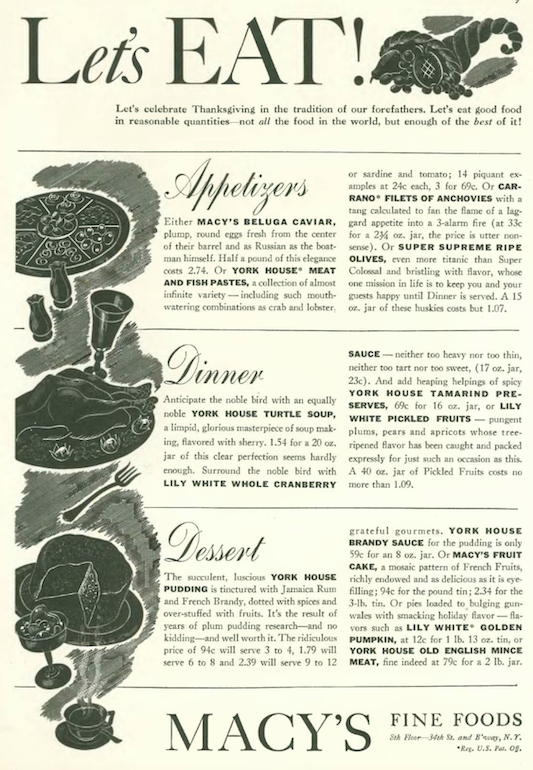
…Macy’s reminded readers that they were about more than just clothing, housewares and toys…
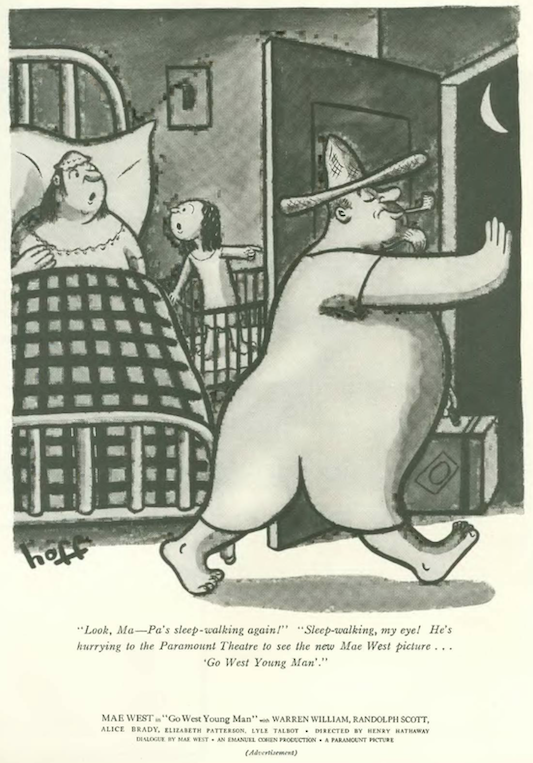
…and Syd Hoff drew up this cartoon to promote Mae West’s newest film, Go West Young Man…
…on to our illustrators and cartoonists, we open with Victor de Pauw…
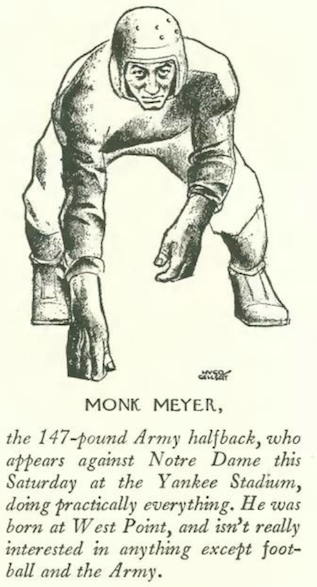
…Hugo Gellert (with a mini-bio of 147-pound halfback Monk Meyer)
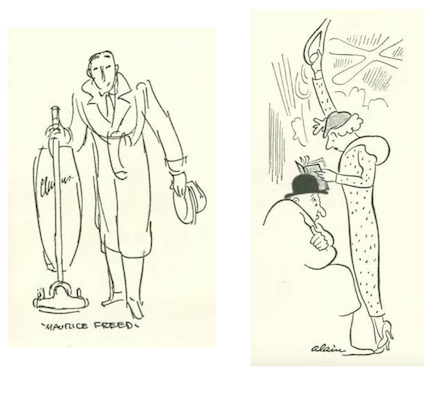
…spots by Maurice Freed and Alain…
…a cluster of holiday shoppers by Christina Malman…
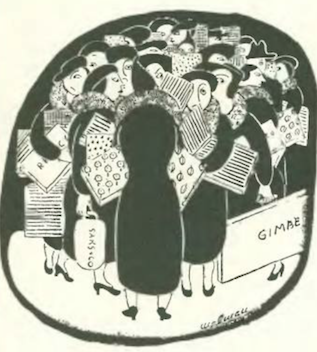
…and spot by an unidentified artist (still tracking down that signature)…
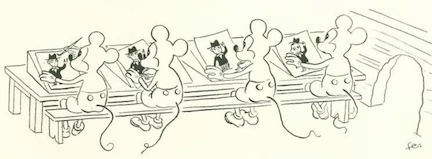
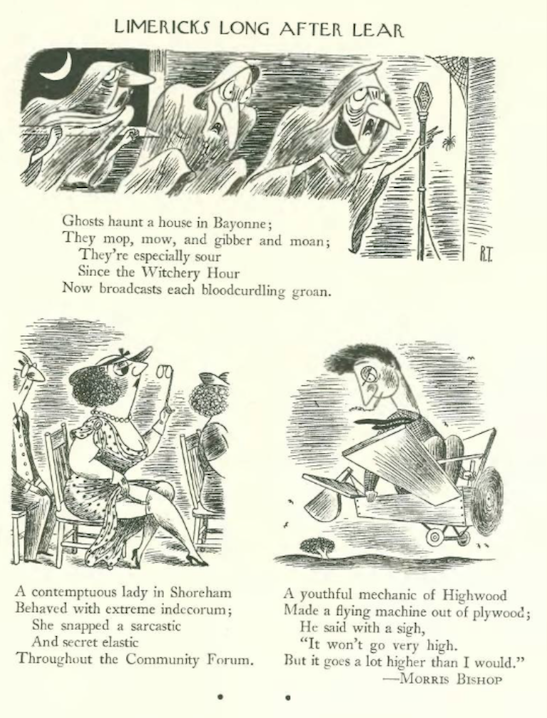
…more limericks from Morris Bishop with those great Richard Taylor illustrations…
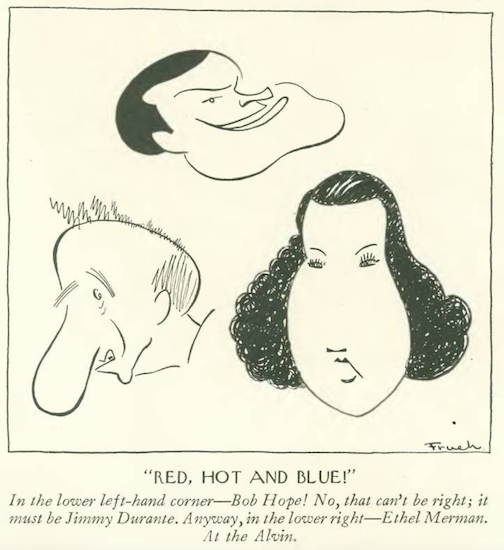
…Al Frueh served up the heads of a comedy revue…
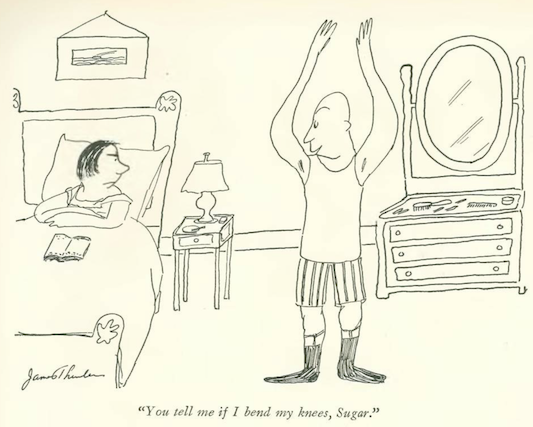
…James Thurber did some (unappreciated) stretching…
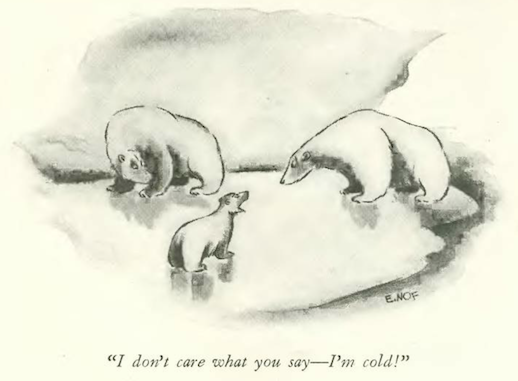
…this chilly bear was the work of Ed Nofziger, his first appearance in The New Yorker…
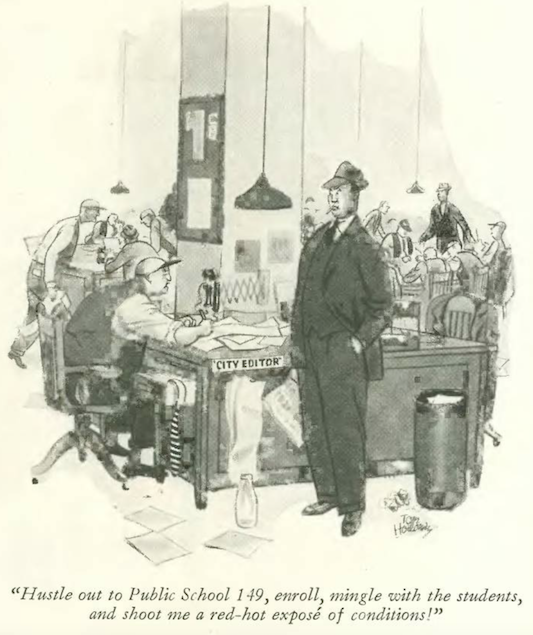
…and here’s the second of two drawings Tom Holloway contributed to the magazine in 1936…
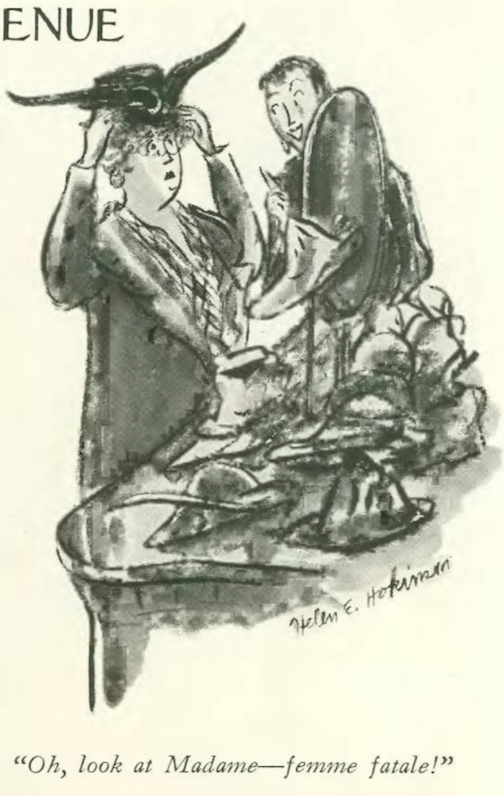
…Helen Hokinson gave us a sales clerk with an active imagination…
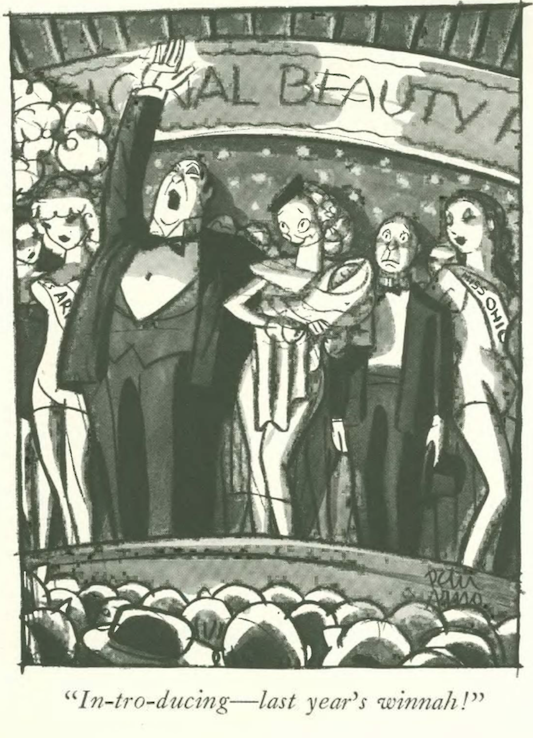
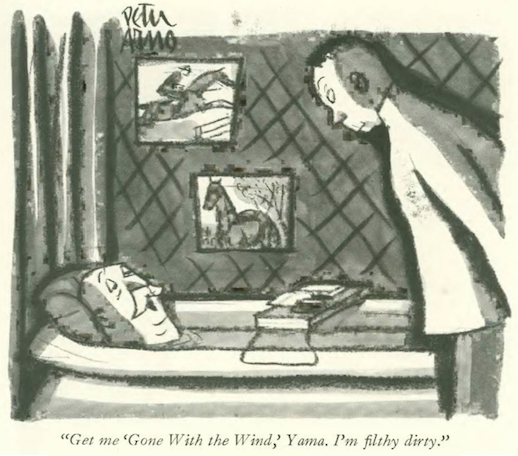
…Peter Arno’s colonel settled in for a long soak…
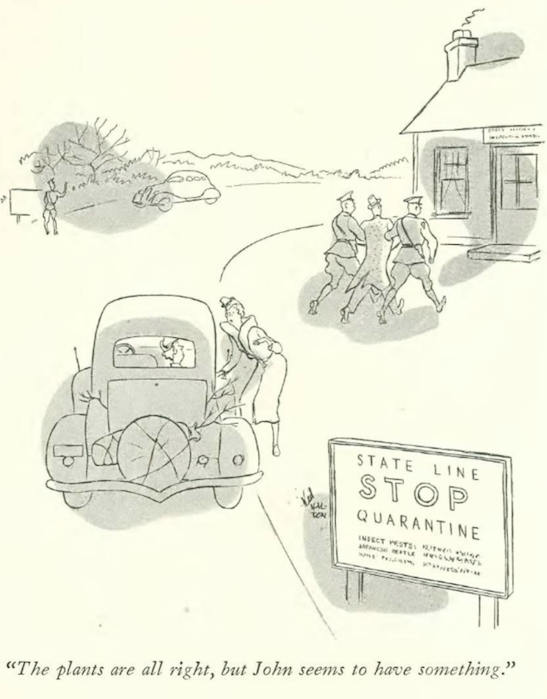
…Ned Hilton ran into some trouble at the border…
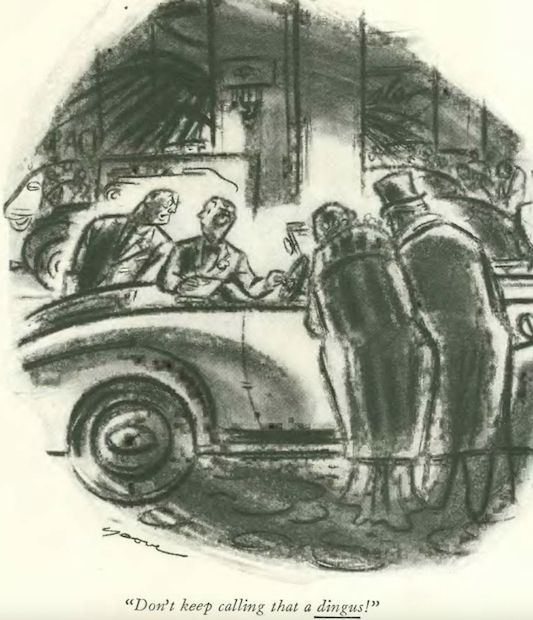
…Leonard Dove tuned in to the automobile show…
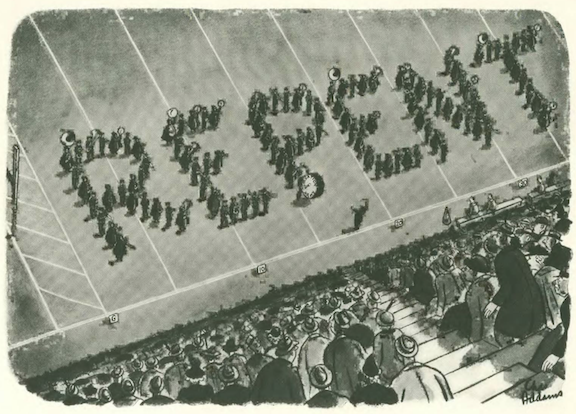
…and we close with two by Charles Addams, at the halftime show…
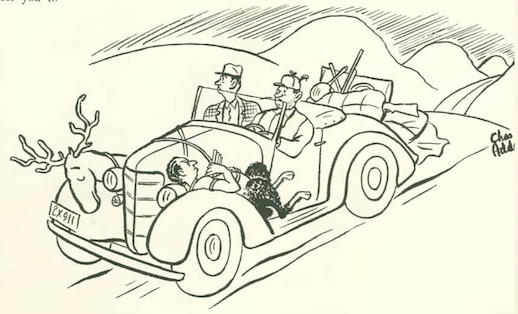
…and returning from the hunt…
Next Time: Mitchell’s Bar and Grill…
Better Living Through Fiction

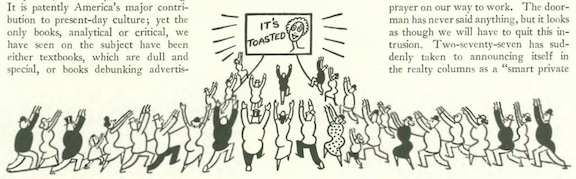
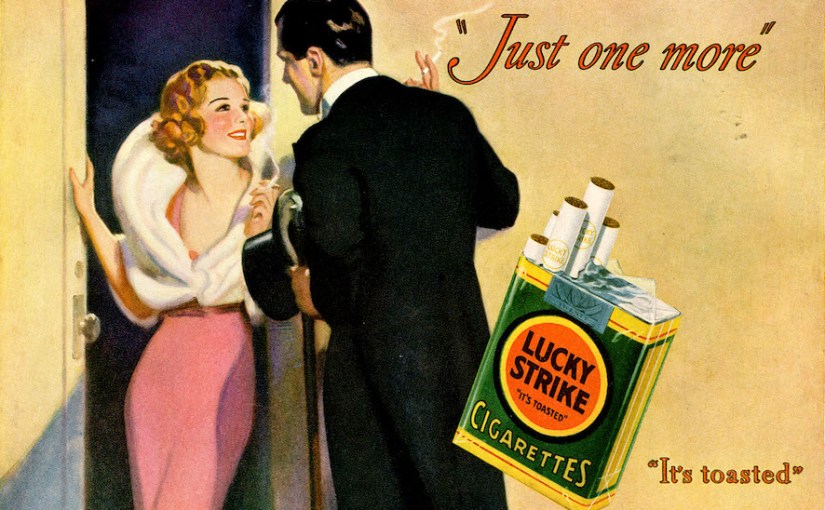
Above: Introduced by the American Tobacco Company in 1917, the iconic slogan "It's Toasted" became the cornerstone of Lucky Strike marketing in the 1930s. The company claimed their heat-curing method (as opposed to sun-drying) removed tobacco's "corrosive acids." This 1933 Lucky Strike advertisement was illustrated by Hayden Hayden. (wash.edu)

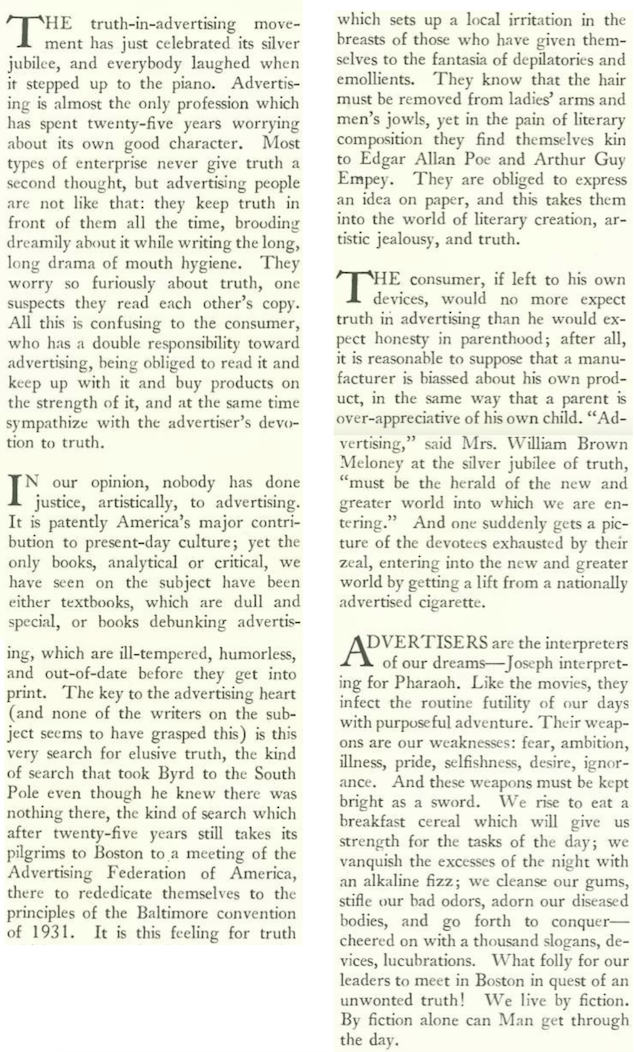
In May 1936 the Advertising Federation of America (AFA) celebrated the 25th anniversary of its “truth in advertising” movement, highlighting the work of vigilance committees that encouraged advertisers to avoid government intervention through self-regulation. As one can imagine, such voluntary efforts were largely ignored.

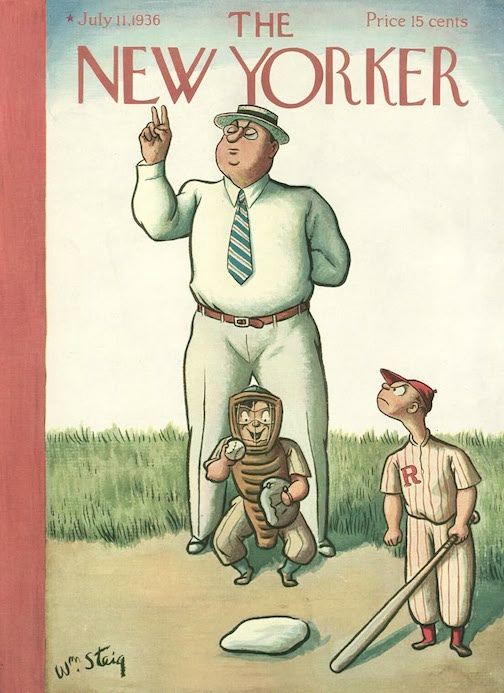
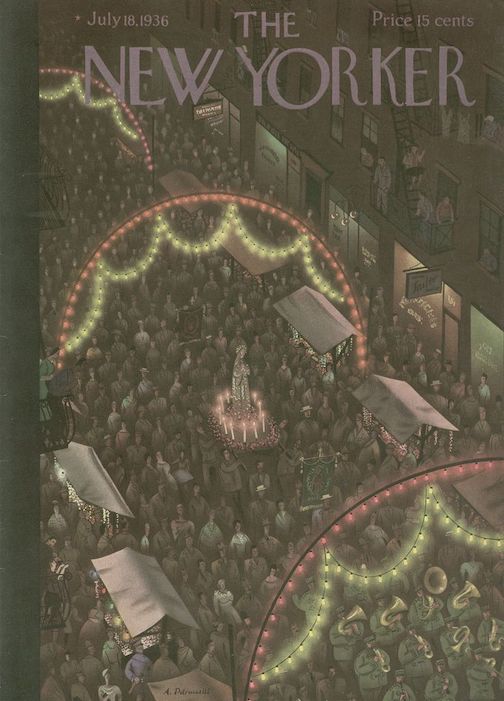
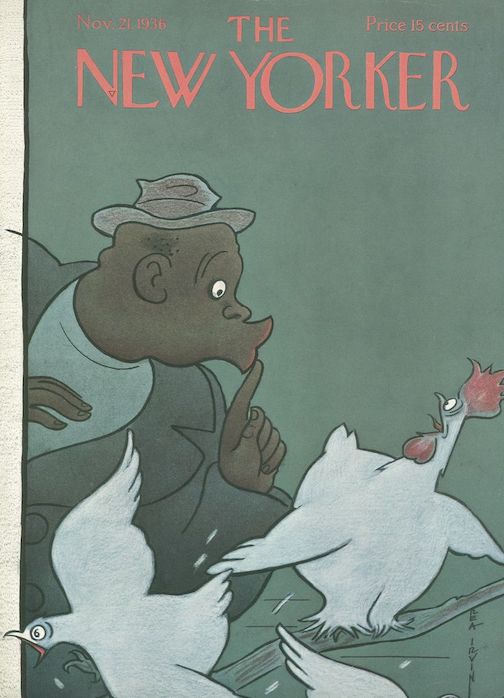
July 11, 1936 cover by William Steig.
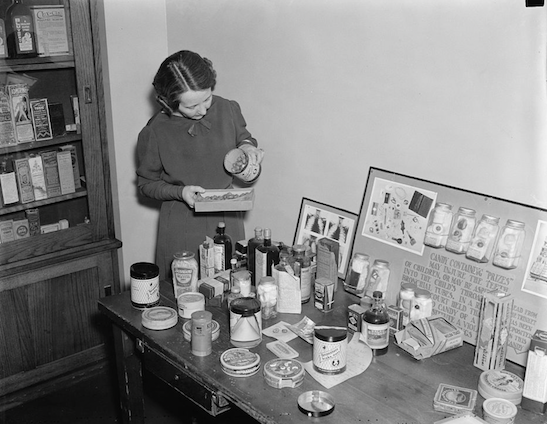
The celebration was short-lived, for later that year the Food and Drug Administration’s Ruth Lamb, published American Chamber of Horrors: The Truth About Food and Drugs. Lamb, who was head of public relations for the FDA, based her publication on a FDA traveling exhibit that exposed dangerous, poisonous, and deceptively marketed cosmetics, foods, medicine, and medical treatments. Lamb played an important role in advising Congress on new regulations that culminated in the Wheeler-Lea Act of 1938, which expanded the Federal Trade Commission’s unfair competition mandate to include consumer protections from “unfair or deceptive acts or practice.” That same year, Congress also passed the Federal Food, Drug, and Cosmetic Act, requiring pre-market safety testing and prohibiting false therapeutic claims.
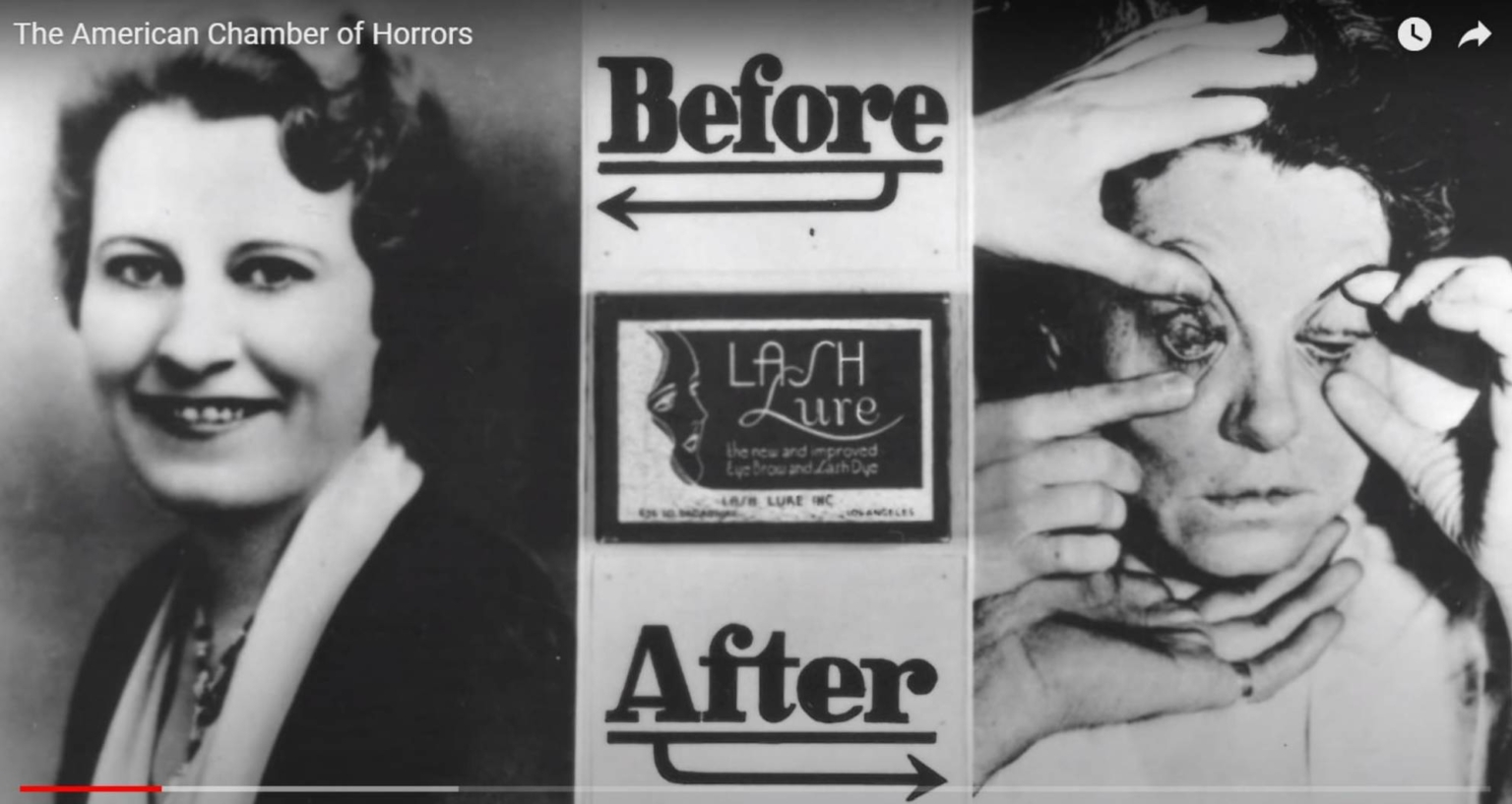
BLISTERS INSTEAD OF BEAUTY…In 1933 the makers of Lash Lure mascara promised women a permanently made-up look using aniline dye on eyelashes. Tragically, Lash Lure contained p-phenylenediamine, which caused horrific blisters, abscesses and ulcers on the face, eyelids and eyes of Lash Lure users. It even led to blindness in some women. (livingnewdeal.org)
Apparently Lamb hadn’t yet published her American Chamber of Horrors when E.B. White filed his July 11 “Notes and Comment.” He did, however, pen this satirical take on the AFA’s sanctimonious commitment to the “truth.”

…Otto Soglow provided this apt illustration along the bottom of White’s “Notes” column…

HORROR SHOW…The FDA’s Ruth Lamb displays some of the worthless and harmful products in her “Chamber of Horrors.” Lamb was instrumental in advising Congress on new drug and food legislation. (Wikipedia)
BUYER BEWARE…Clockwise, from top left: In the 1930s Othine promised to remove brown spots and lighten skin; the active ingredient was mercury; Bred-Spred was a line of beautifully colored “jellies” that did not contain the industry standard of 50 percent fruit/juice to qualify as jelly. Indeed, they had no fruit or juice at all—just artificial colors and flavors, and in the case of the “strawberry flavor” pictured above, a few hayseeds were added to simulate strawberry seeds; a circa 1930 ad claiming substantial weight loss simply by listening to a record. (fda.gov/brandingstrategyinsider.com)

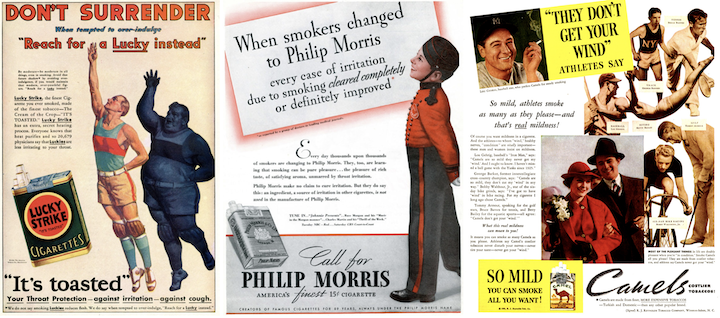
Quackery was not confined to the smaller companies. Big Tobacco made outlandish claims regarding the health benefits of smoking…

BIG MONEY from tobacco companies financed these splashy ads from the 1930s, including, from left, Lucky Strike’s weight-loss claims; Philip Morris asserted they used a different type of moistening agent that also prevented throat irritation—these ads were aimed at easing smoker anxiety about deep inhaling; R.J. Reynolds claimed their Camels did everything from aiding digestion to easing one’s nerves. Many of the ads featured famous athletes claiming they could smoke all they wanted and still perform at their peak. (Stanford.edu)

 * * *

A Quiet Place

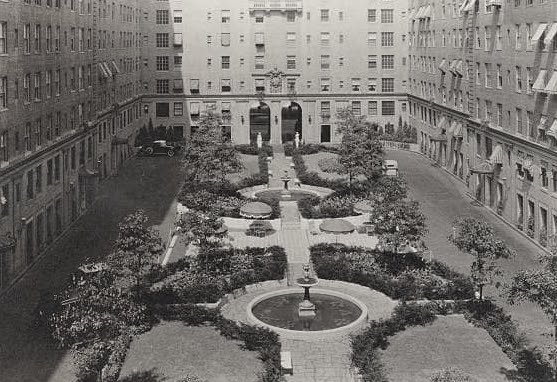
E.B. White (in “Notes and Comment”) revealed a hallowed spot in the city where he could gather his thoughts on hot summer mornings…

REFUGE FROM THE HEAT AND DIN…This apartment building’s courtyard at 277 Park Avenue offered E.B. White a place to ponder on a summer day. Built in 1905 and designed by McKim, Mead and White, the apartments were demolished in 1964 and replaced with a glass tower. (mcny.org)

 * * *

On Your Mark

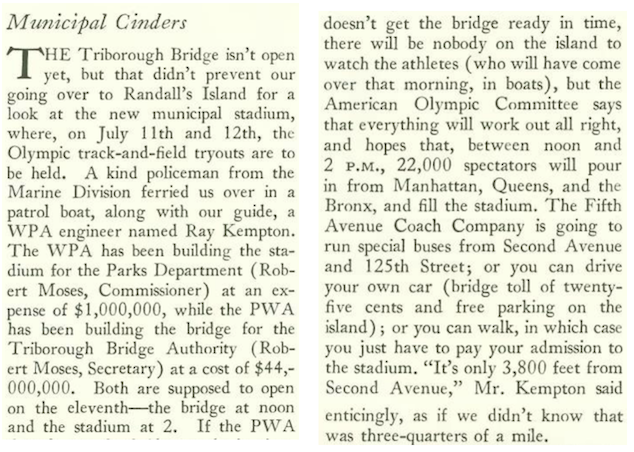
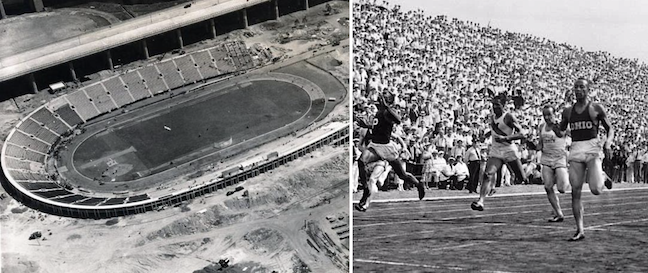
“The Talk of the Town” visited the new Randalls Island Stadium (later renamed Downing Stadium). Built with WPA funding, the stadium hosted the Men’s Olympic Track and Field Trials where Jesse Owens qualified for the Berlin Summer Games.

READY TO RUN…Aerial photo of the new Randalls Island Stadium taken on July 10, 1936, the day before the Olympic trials; at right, Jesse Owens at the stadium’s Olympic tryouts—Owens dominated the competition by winning the 100-yard dash, the 220-yard run, and the broad jump. He would go on to win four gold medals at the Berlin Games. (Associated Press/randallsisland.org)

 * * *

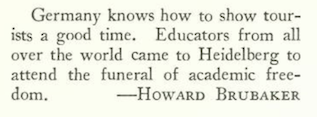
Ach Du Lieber

In his column “Of All Things,” Howard Brubaker offered his thoughts on the state of higher education in Nazi Germany:

 * * *

Haggard and Debonair

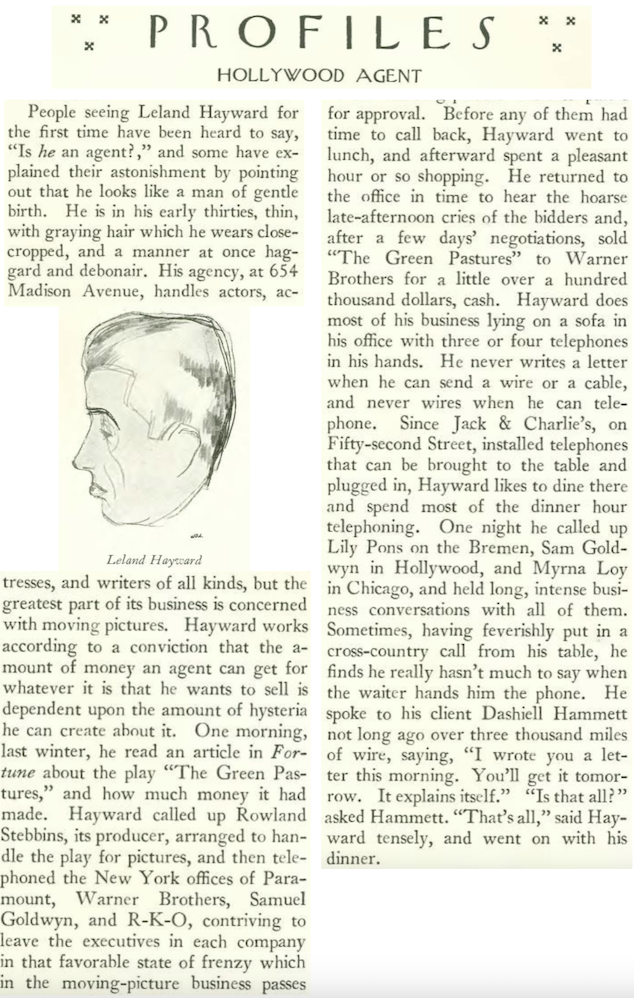
Margaret Case Harriman profiled talent agent and theatrical producer Leland Hayward (1902–1971), a kid from Nebraska City, Nebraska who would become a renowned playboy (married five times) and agent to scores of Hollywood actors. He would also produce the original Broadway stage productions of South Pacific and The Sound of Music. Excerpts:

ALL SMILES…at left, Katharine Hepburn with agent/boyfriend Leland Hayward arriving at director George Cukor’s home, circa 1936; Hayward with wife number three Margaret Sullivan⁣, circa 1940. (instagram.com/alchetron)

 * * *

Juvie Justice

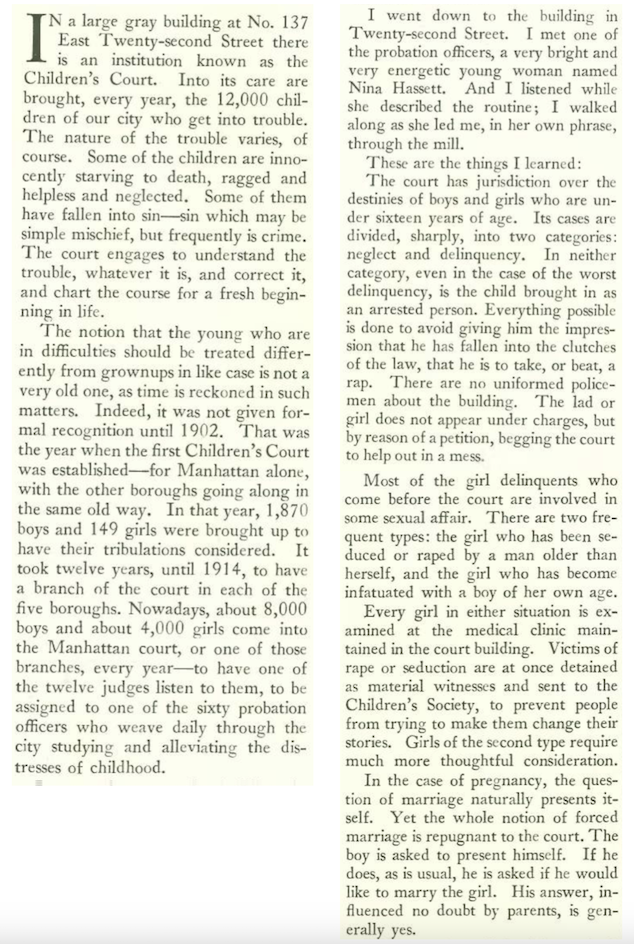
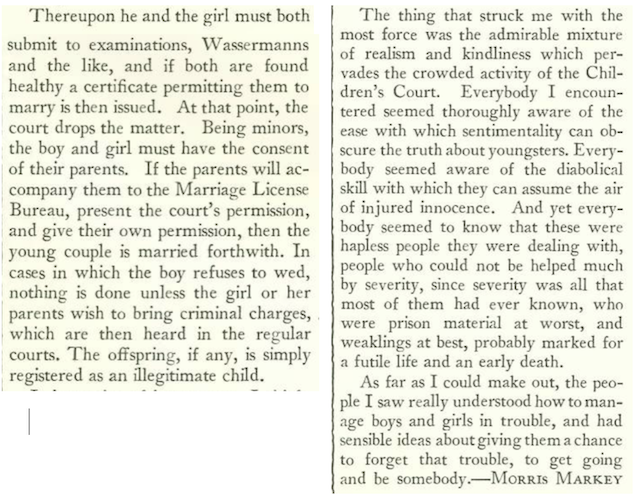
For the column⁣ “A Reporter at Large” (titled “Gamins”), Morris Markey looked in on the workings of the Children’s Court on East Twenty-second Street. Beginning with the sixth paragraph is an example of how teen pregnancies were addressed in New York ninety years ago. Excerpts:

Markey examined the possible outcomes of unwed mothers and fathers, and concluded that the Children’s Court was a realistic and kindly way to deal with these issues as well as a range of juvenile offenses. History seems to be on Markey’s side; for its time, the Children’s Court offered a progressive approach that kept minors from the horrors of the prison system.

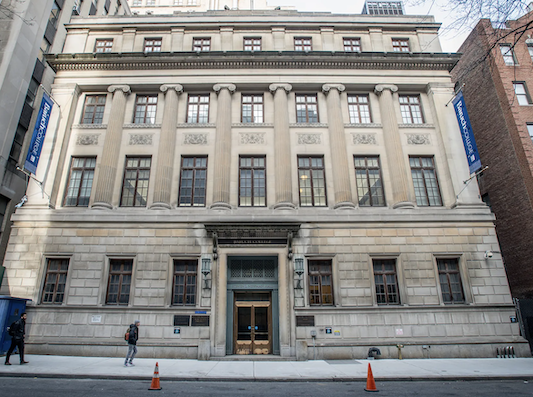
STILL STANDING…The Children’s Court building on East Twenty-second Street was visited by Morris Markey for his column. Today it serves as Newman Hall for CUNY’s Baruch College. (J.C. Rice via nypost.com)
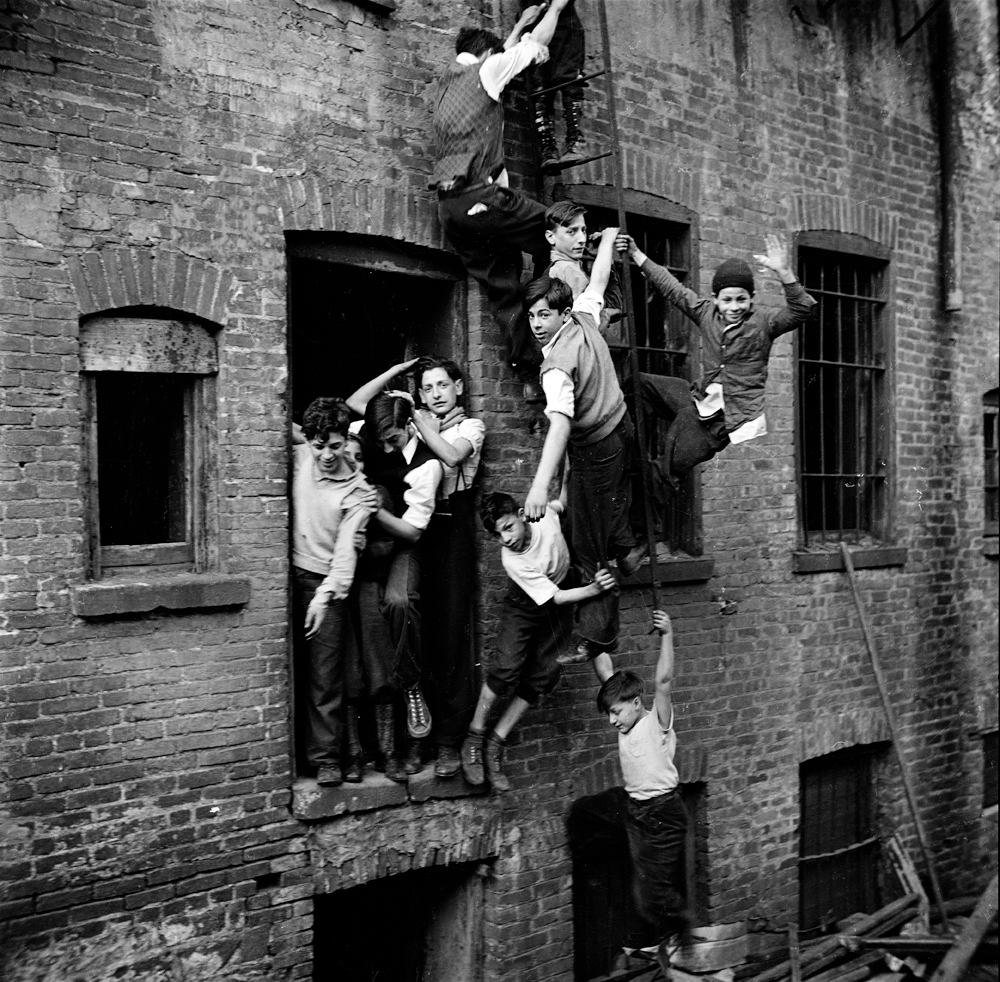
JUST SOME KIDS HANGING OUT…Arnold Eagle’s Federal Art Project photo, “Boys Climbing the Fire Escape of a Deserted Building,” 1935. (mcny.org)

 * * *

Some Lawn Tennis

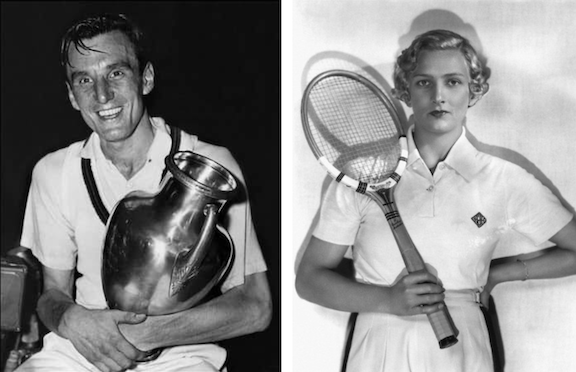
American journalist and sports radio personality Cedric E. Adams (known as “Ced,” hence the initials below) occasionally provided tennis commentary for The New Yorker. Here he takes in Wimbledon, where he found the men’s matches dull and the women’s memorable.

THREE’S A CHARM…In 1936 Fred Perry won the men’s singles title at Wimbledon for the third year in a row, while Helen Jacobs’ “cool tactics” helped her capture the women’s title. (facebook.com/findagrave.com)

 * * *

At the Movies

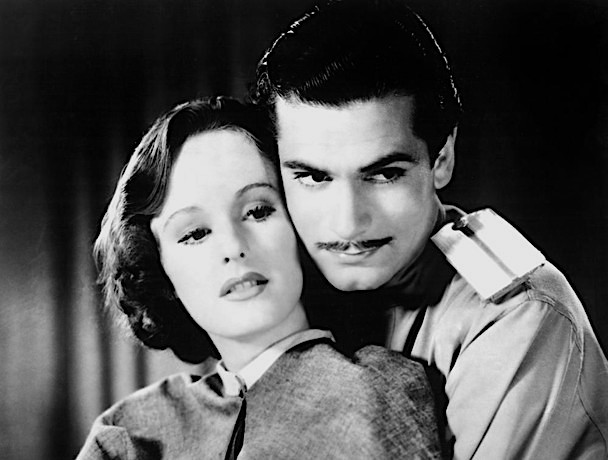
Laurence Olivier (1907–1989) was a rising star of the London stage when he moved to Hollywood in the early 1930s. Not making the breakthrough he had hoped for, he returned to London for stage and film work, including the 1935 film Moscow Nights, which was released in the U.S. in 1936 as I Stand Condemned. Critic John Mosher still wasn’t wowed by Olivier, but found the film better than average.

SPIES LIKE US…Laurence Olivier and Penelope Dudley-Ward in I Stand Condemned. Directed by Anthony Asquith, the film concerned a wounded officer who falls in love with his nurse. (rotten tomatoes.com)

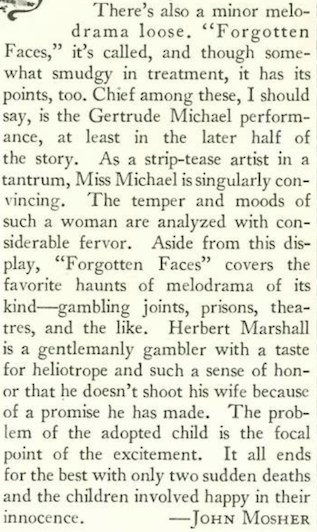
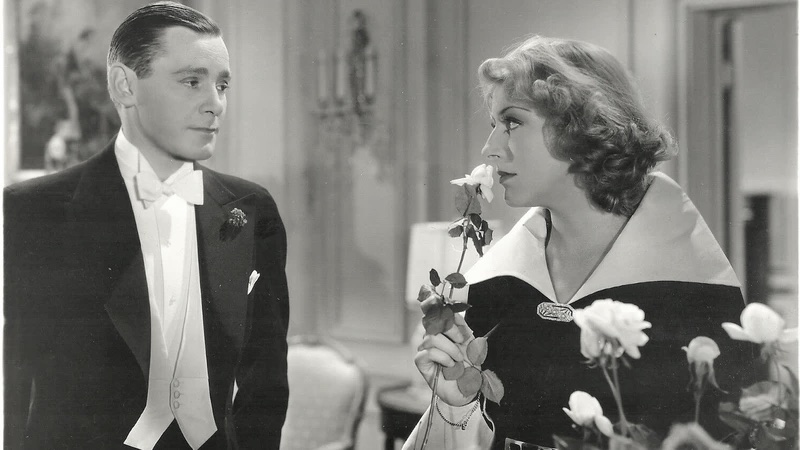
Mosher also reviewed a “minor melodrama,” Forgotten Faces.

A GAMBLER AND A STRIPPER were portrayed by Herbert Marshall and Gertrude Michael in Forgotten Faces. (mubi.com)

 * * *

From Our Advertisers

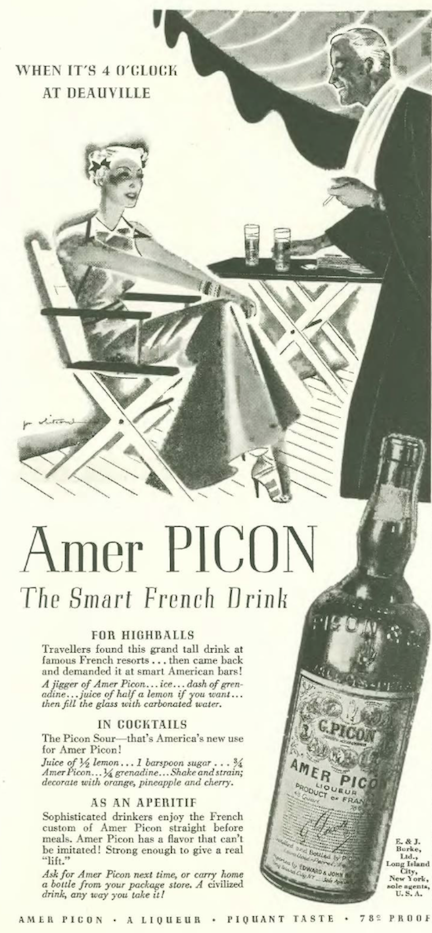
Illustrator Jon Whitcomb sketched up this happy scene to promote this “Smart French Drink”…

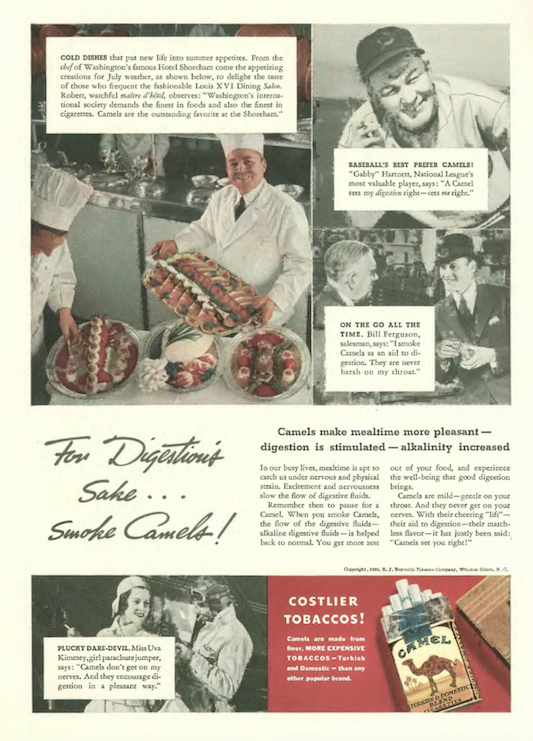
…as noted in our lead story, cigarette manufacturers made all sorts of health claims connected to heavy smoking…

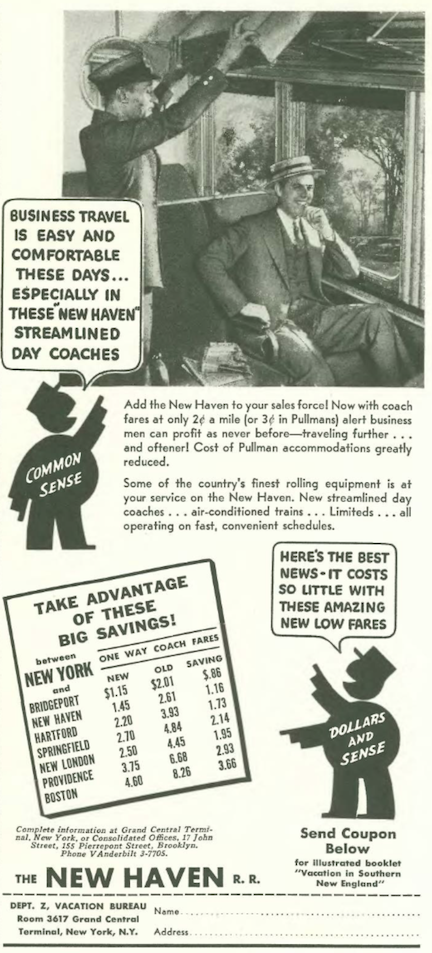
…now this was the way to travel…sadly the U.S. has largely abandoned reliable rail service…

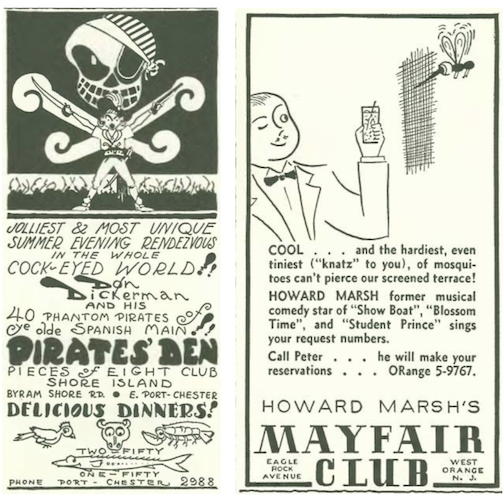
…from the back of the book, enticements to escape the city into the countryside…

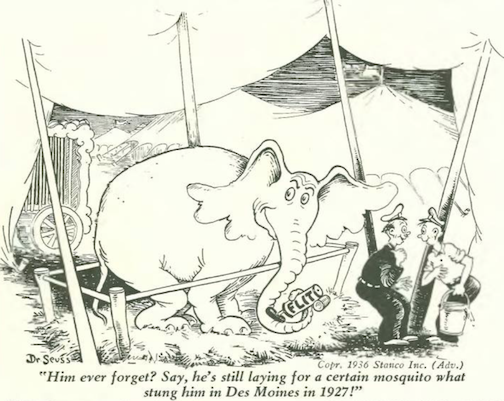
…another Dr. Seuss Flit ad, anticipating his 1954 bestseller Horton Hears a Who…

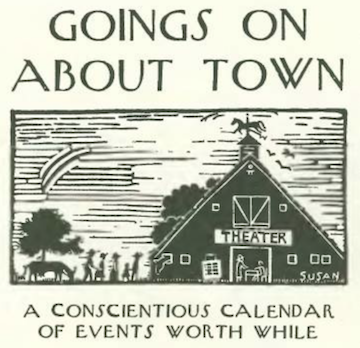
…on to our spots, we start with a summer stock-themed woodcut by Susan Willard Flint…

…escaping the heat with Christina Malman…

…on to our cartoonists, we begin with caption-less entries by Constantin Alajalov…

…Daniel ‘Alain’ Brustlein…

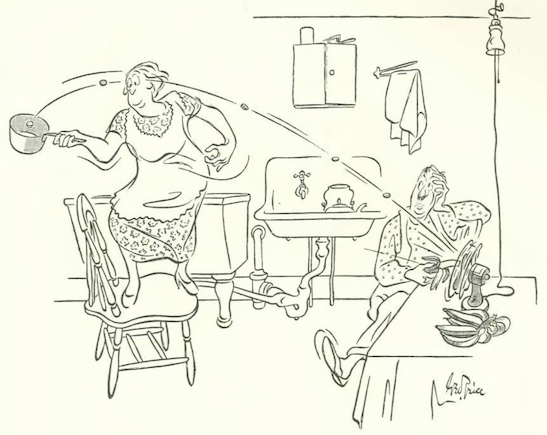
…George Price…

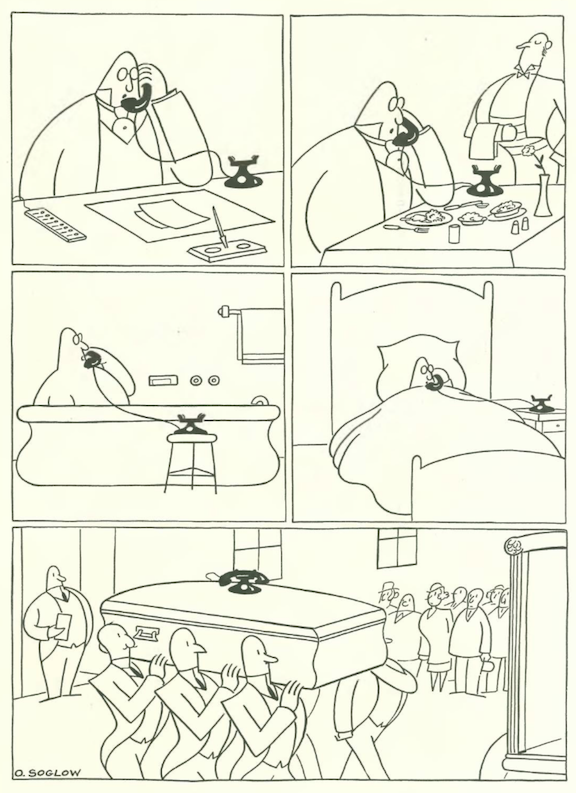
…and Otto Soglow…

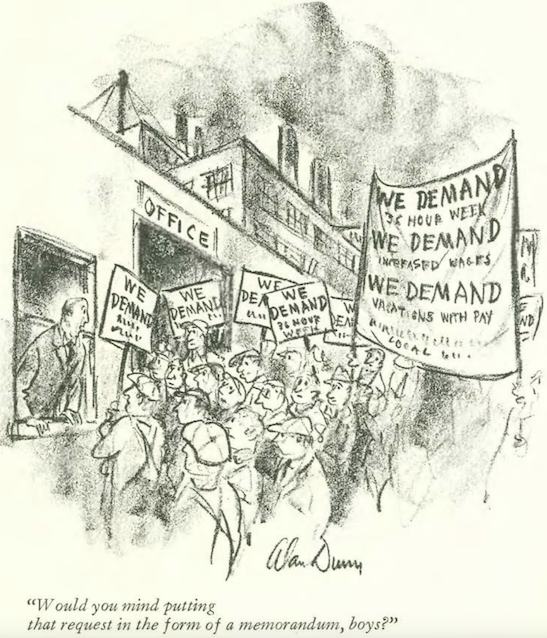
…Alan Dunn gave us a man seeking order in chaos…

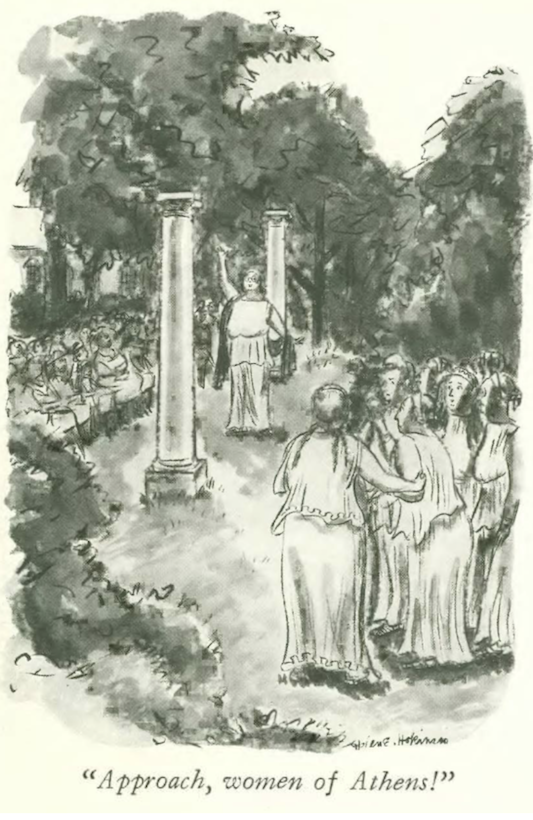
…and Helen Hokinson gave us a woman turning chaos into order…

…another from Hokinson, anticipating a scene from The Music Man…

…and we close with Peter Arno, and a surprise announcement…

Next Time: Platoon Platitudes…