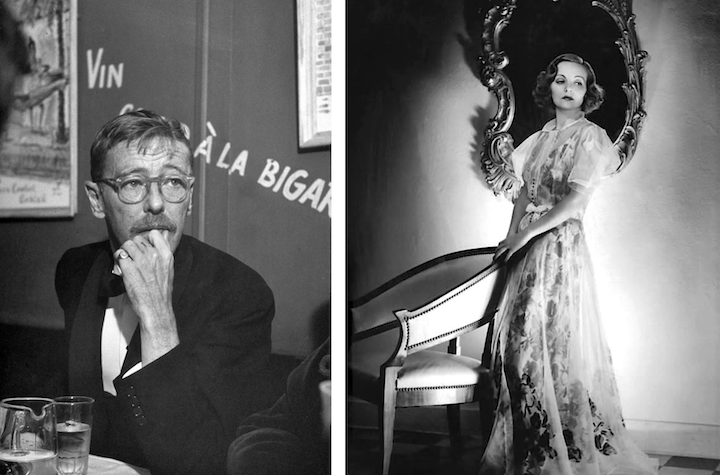
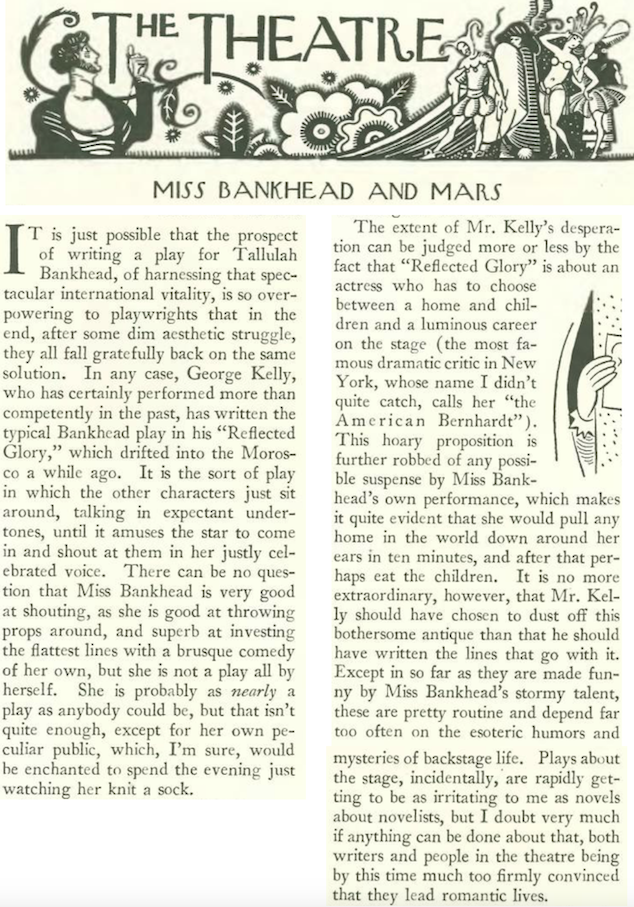
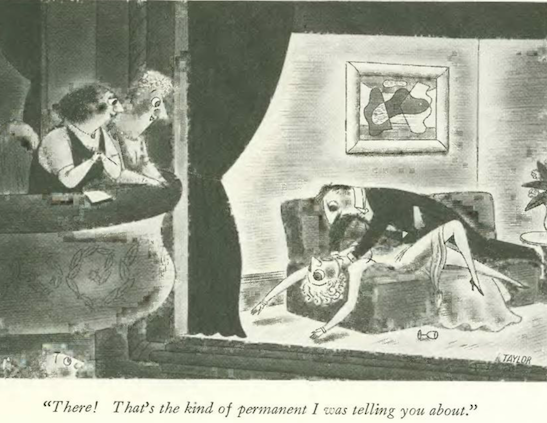
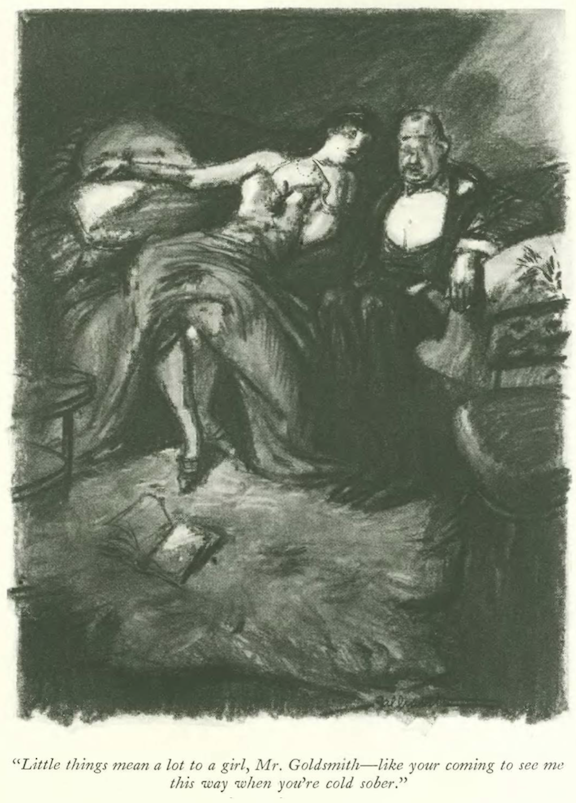
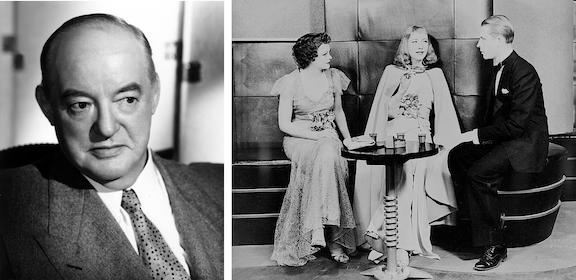
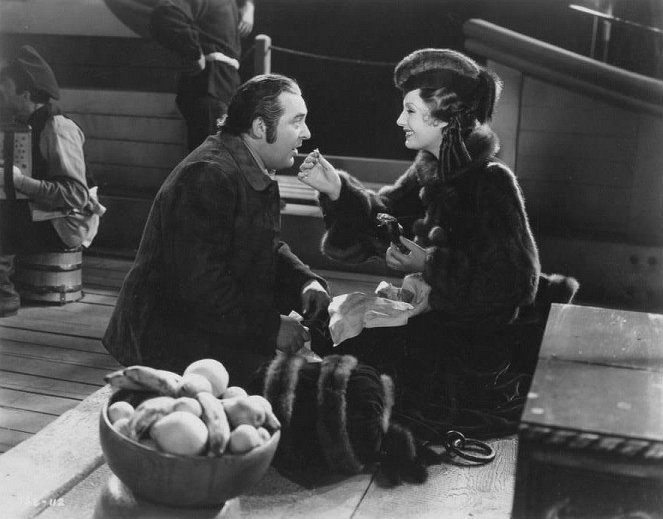
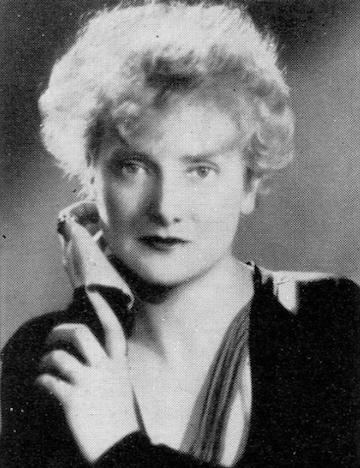
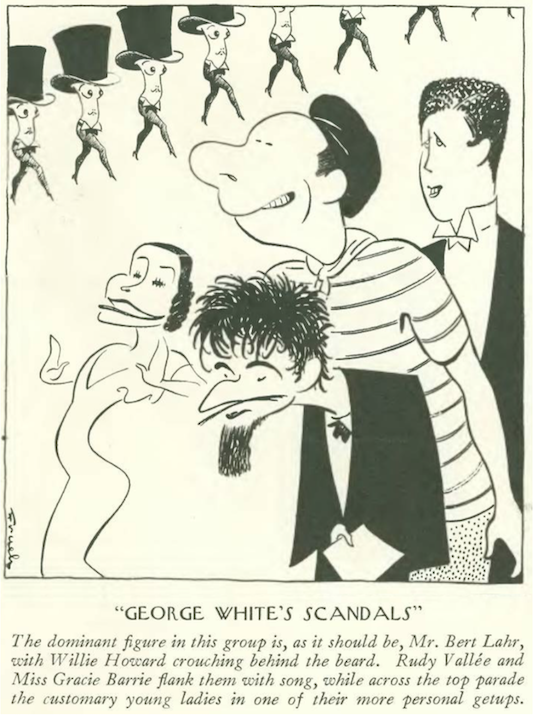
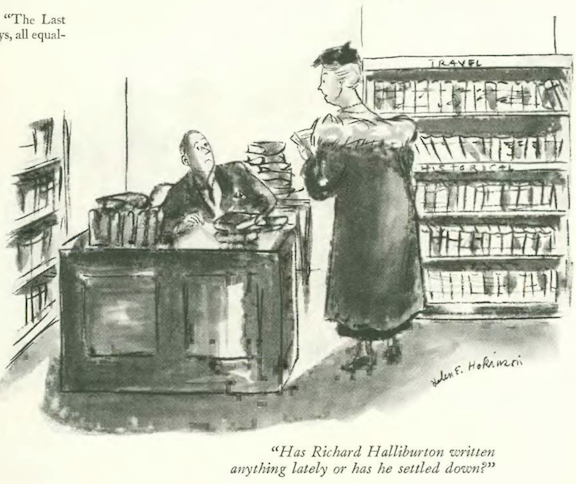
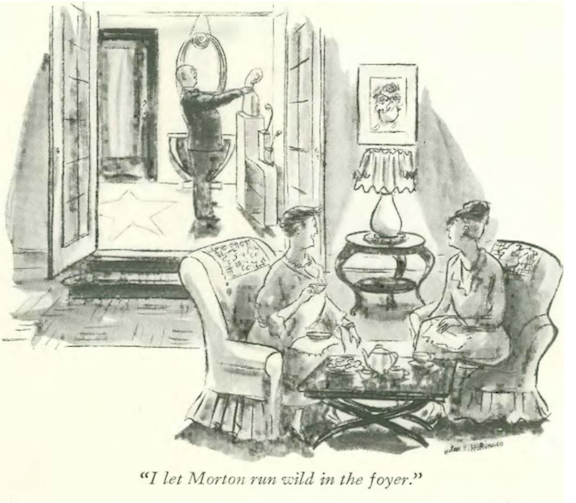
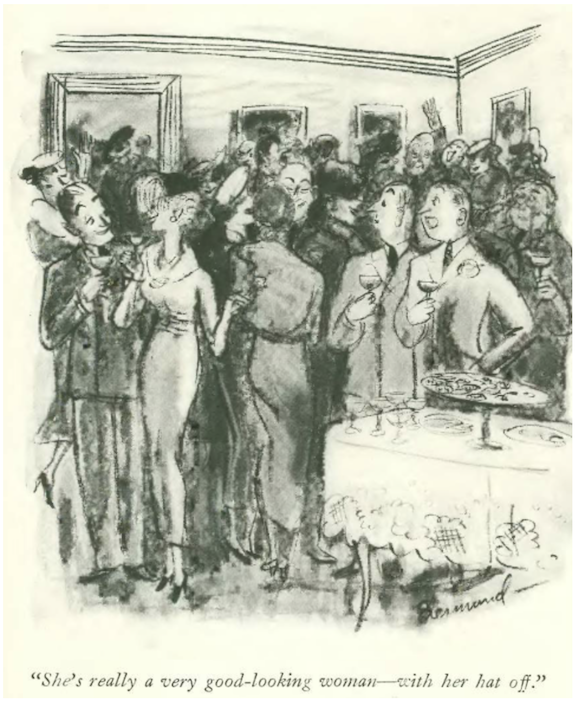
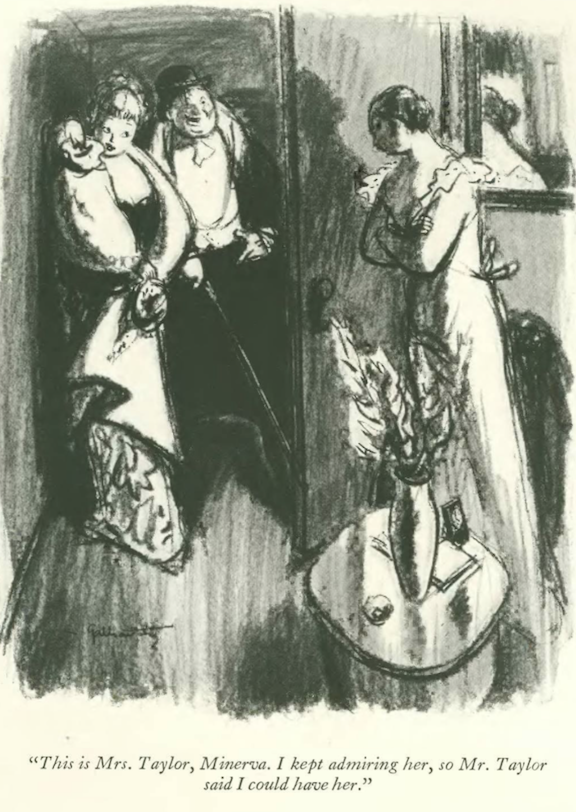
Above: In his review of Tallulah Bankhead's performance in "Reflected Glory," Wolcott Gibbs noted that she was a force to be reckoned with: ..."she would pull any home in the world down around her ears in ten minutes, and after that perhaps eat the children." (newyorker.com/facebook.com)
Broadway’s fall season was still young when the Morosco Theatre staged Reflected Glory, featuring Tallulah Bankhead in a role that mimicked her famously flamboyant lifestyle.
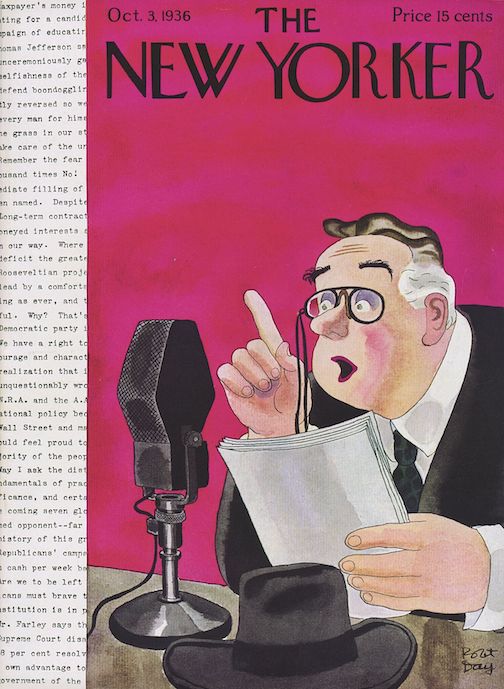
October 3, 1936 cover by Robert Day.
The play, which ran for 127 performances, was not well-received by the critics, but audiences loved it, and especially those who, in the words of critic Wolcott Gibbs, “would be enchanted to spend the evening just watching (Bankhead) knit a sock.”
Bankhead (1902–1968) also appeared in films (she won a New York Film Critics Circle award in 1944 for her performance in Alfred Hitchcock’sLifeboat), but she was mostly known for her stage acting and her wild lifestyle—drugs, alcohol, and lots of sex with both men and women; she was candid about her vices, including the claim she smoked 120 cigarettes a day.
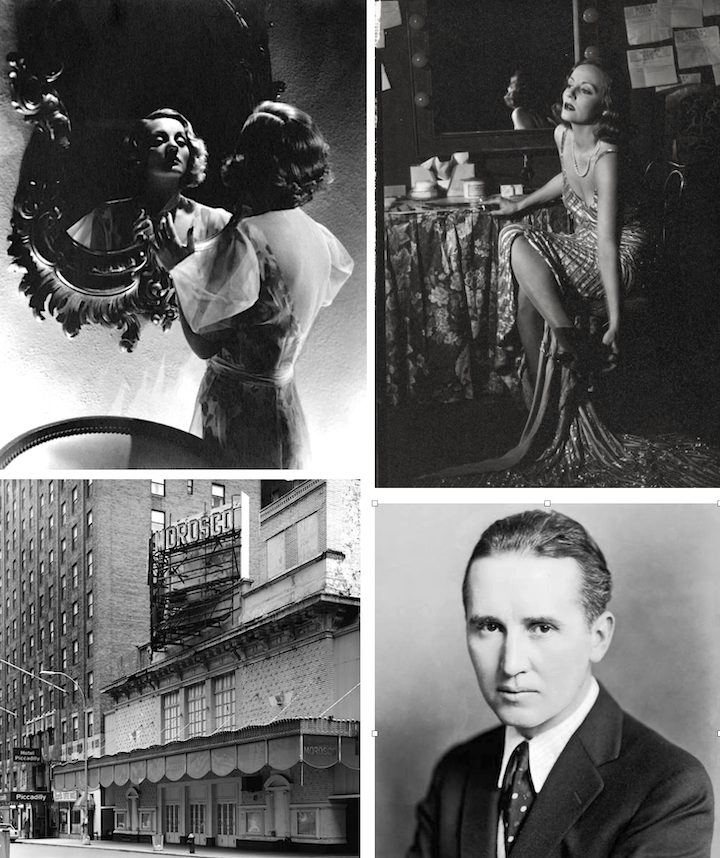
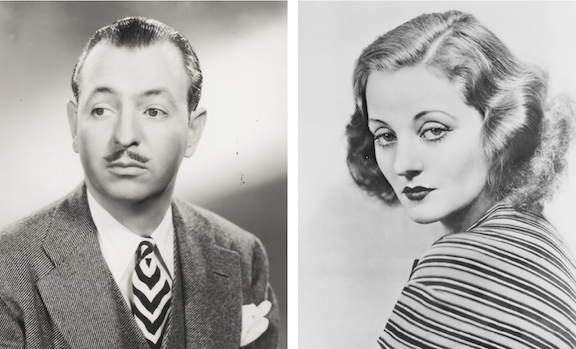
ART IMITATES LIFE…Clockwise, from top left: Tallulah Bankhead in promotional photo for Reflected Glory; Bankhead played Muriel Flood, a flamboyant, self-absorbed actress who constantly dramatizes her own life both on and off stage; author and director George Kelly wrote Reflected Glory specifically for Bankhead; Broadway’s Morosco Theatre (demolished 1982). (cinemaclassico.com/jacksonupperco.com/Wikipedia)
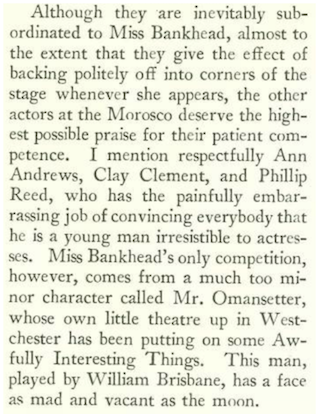
Early in her career Bankhead, an Alabama native, moved into the Algonquin Hotel and quickly made her way into the orbit of the famed Algonquin Round Table—so, she was well-known to Gibbs, who noted in this excerpt that Bankhead’s only competition in Reflected Glory was William Brisbane, a man with a face “as mad and vacant as the moon.”
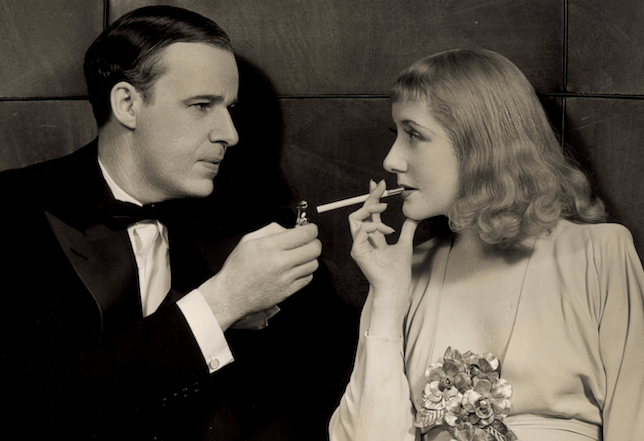
MAD MATCH…Wolcott Gibbs noted that William Brisbane was Tallulah Bankhead’s only competition in Reflected Glory.(themovieb.org/npg.org.uk)
* * *
The Yankee Clipper
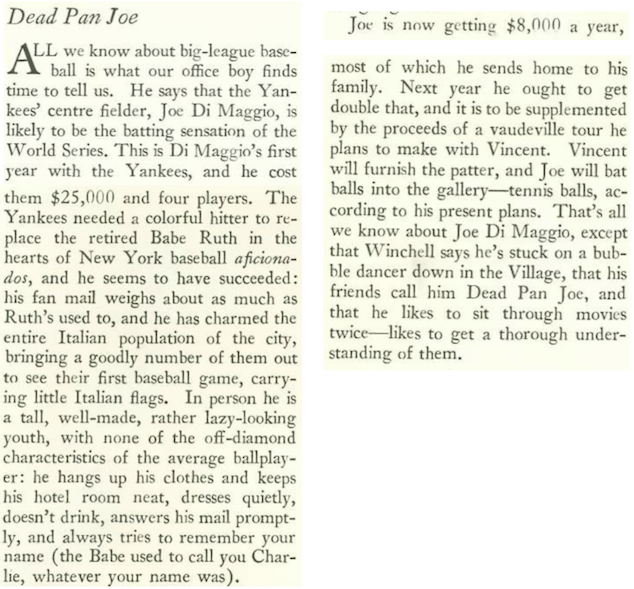
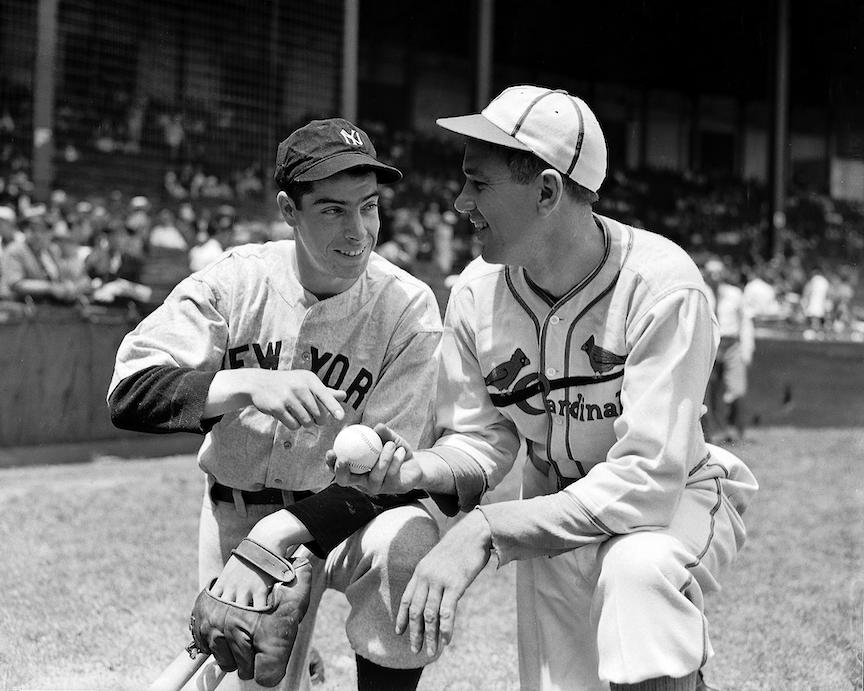
Baseball was mostly ignored in the early years of the New Yorker, but every now and then the magazine would feature a famous personality from the game, in this case Joe DiMaggio, who in 1936 would set a franchise record for rookies by hitting twenty-nine home runs (in just 138 games).
DIZZY AND JOE D…Yankees rookie Joe DiMaggio meets with Cardinals pitcher Dizzy Dean at the All-Star Game in Boston July 7, 1936. (AP Photo)
* * *
Right of the Right
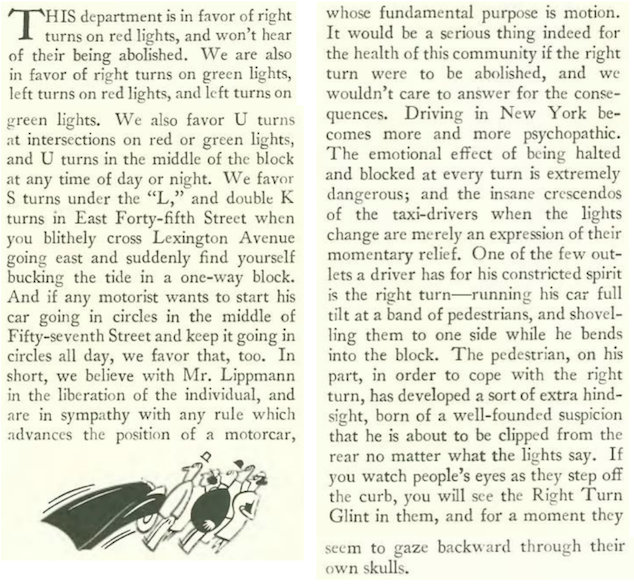
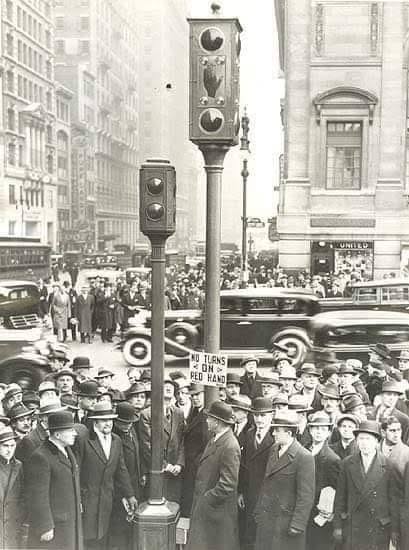
In his “Notes and Comment,” E.B. White took issue with a proposal by the New York Board of Aldermen to ban right-hand turns against a red light (the board ultimately approved the ban).
SEEING THE LIGHT…City officials examine new traffic lights on Fifth Avenue, 1933. (Golden Age Of Travel via facebook.com)
* * *
At the Movies
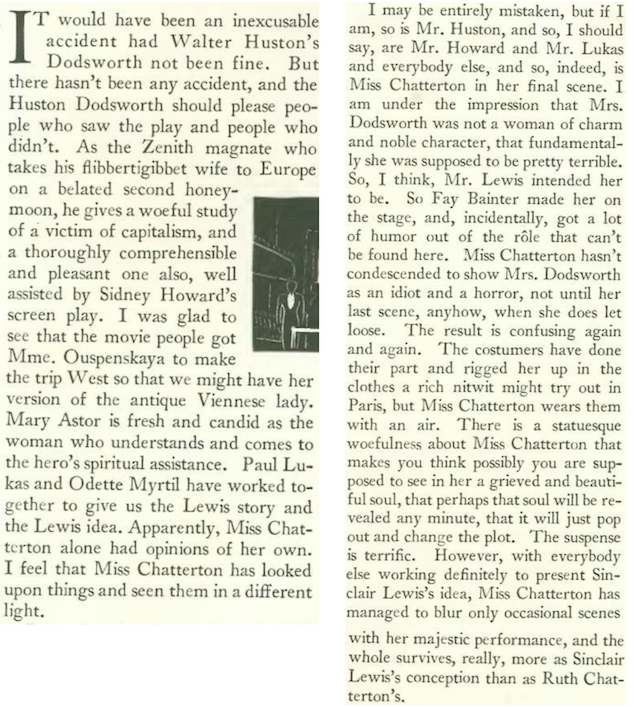
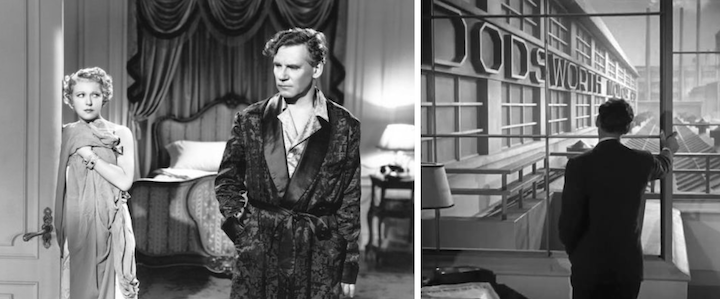
Based on a 1929 novel by Sinclair Lewis, the William Wyler-directed Dodsworth was acclaimed by critics as one of the best films of the year. New Yorker critic John Mosher wholeheartedly agreed:
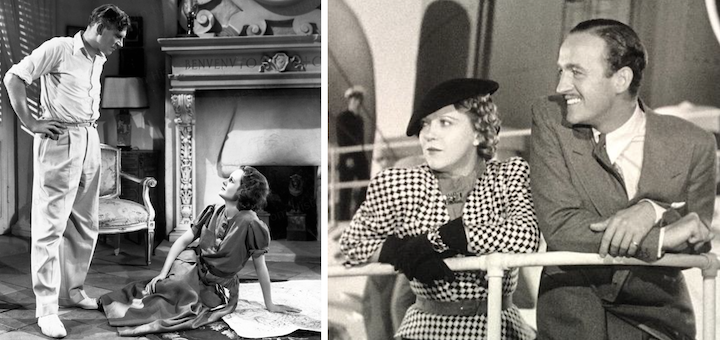
SHE SAID, HE SAID…At left, Ruth Chatterton and Walter Huston portrayed a couple in a declining marriage in Dodsworth; at right, retired auto magnate Sam Dodsworth (Huston) reconsiders the life he has made for himself. (torontofilmsociety.com/YouTube.com)COMPLICATIONS…While travelling on the RMS Queen Mary to England, the Dodsworths find romantic companions—at left, Sam finds a soulmate in Edith Cortright (Mary Astor), while Fran flirts with a younger Englishman, Captain Lockert, played by David Niven. It was Niven’s first sizable role—he was a lieutenant in the British Army before coming to Hollywood in 1935. (eBay.com/film-foundation.org)
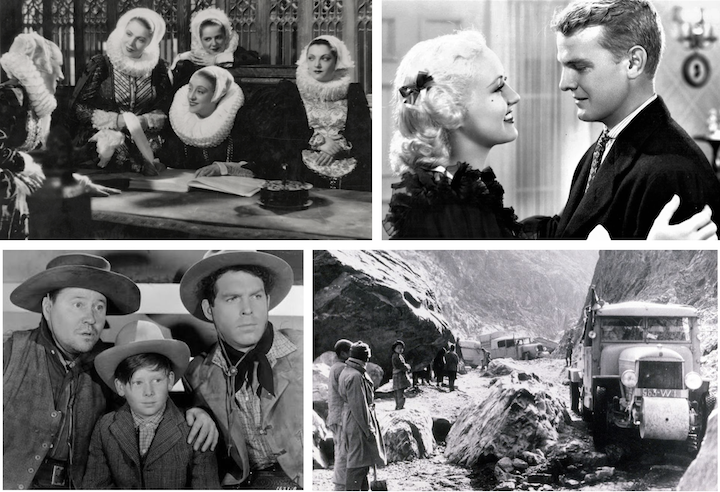
Mosher also reviewed a mixed bag of films, including the “wicked comedy” La Kermesse héroïque (Carnival in Flanders) featuring French opera star Françoise Rosay as a mayor’s wife who cleverly thwarts potential troubles from visiting Spanish soldiers.
BAWDY FUN was how John Mosher described the schemes of a mayor’s wife in La Kermesse héroïque (Carnival in Flanders)—clockwise, from left: Françoise Rosay (seated) organizes the village women to tame some visiting soldiers; Betty Grable and John Arledge in the crime drama Don’t Turn ’em Loose; La Croisière Jaune (Yellow Expedition) documented a 1931-32 French trans-Asian expedition organized by Citroën to promote its rugged Kégresse track vehicles; Jack Oakie, Bennie Bartlett and Fred MacMurray in The Texas Rangers. (mubi.com/imdb.com/radiofrance.fr/csfd.cz)
* * *
From Our Advertisers
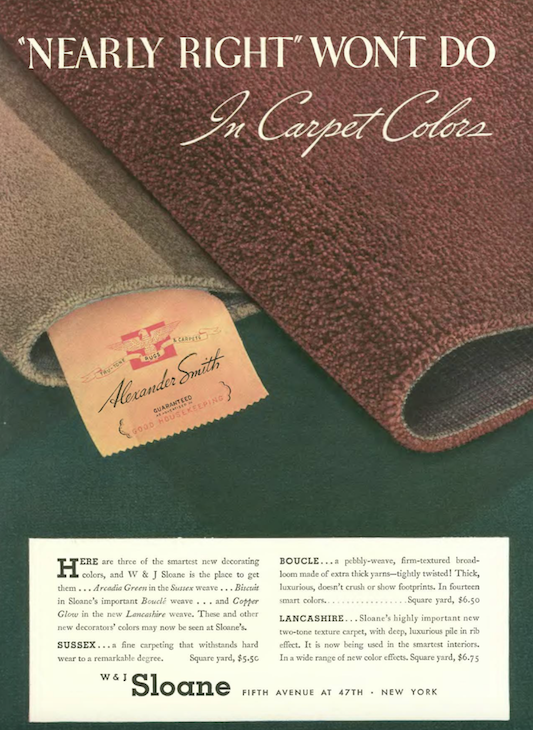
Fall advertising continued its uptick in the magazine, with many splashes of color including this carpet ad that greeted readers on the inside front cover…
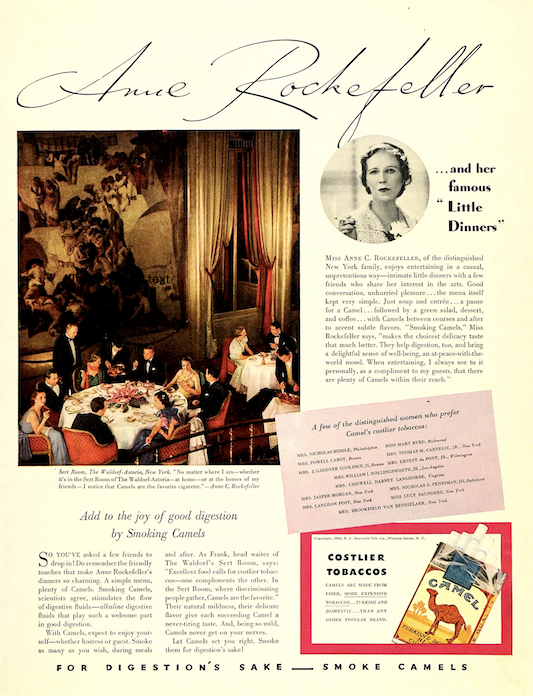
…R.J. Reynolds continued to roll out endorsements from society mavens…here Anne C. Rockefeller stated that Camels gave her “a delightful sense of well-being”…
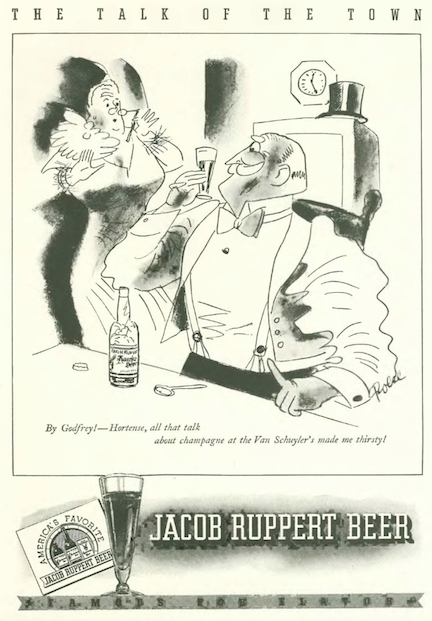
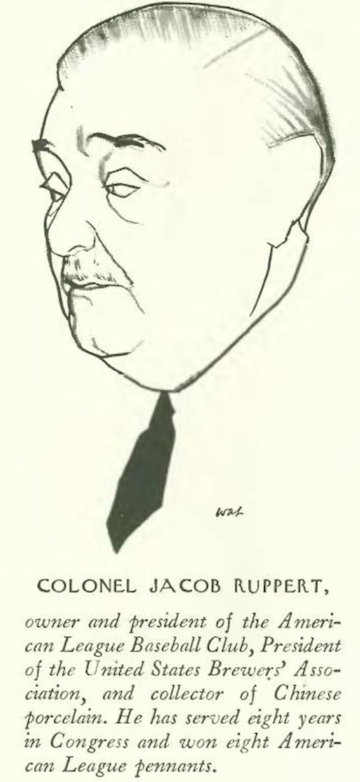
…more Colonel and Duchess archetypes turn up in this issue, on behalf of Ruppert beer…
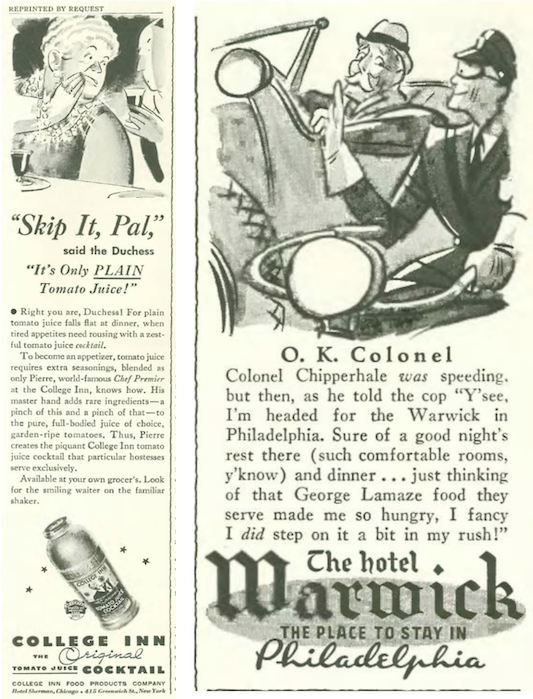
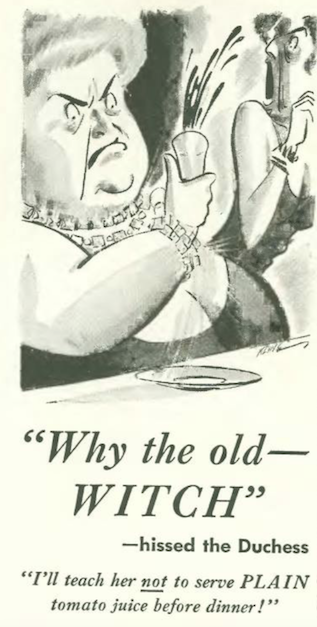
…the Warwick Hotel (Philadelphia), and College Inn tomato juice “cocktail”…College Inn had softened the appearance of their Duchess…
…since she was last spotted in The New Yorker in 1935 (detail)…
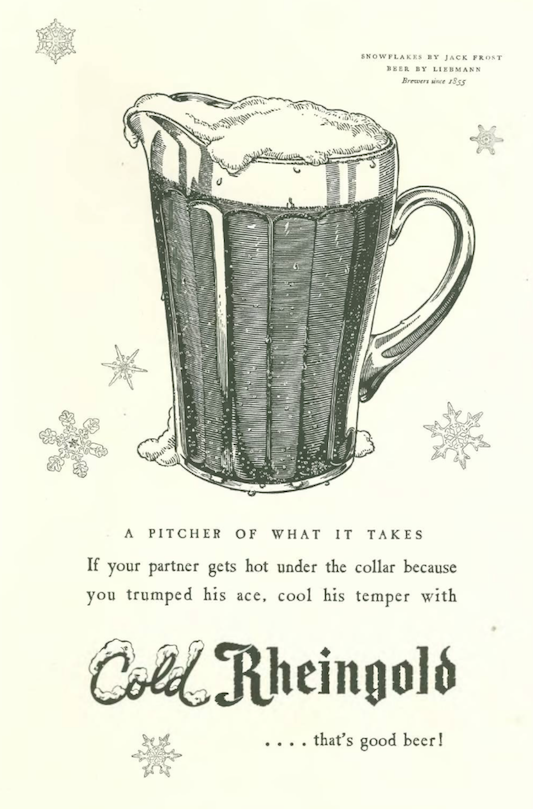
…after a blazing hot summer, the brewers of Rheingold figured this image would still appeal to parched New Yorkers…
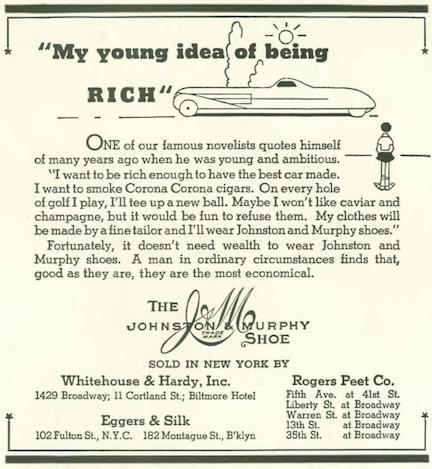
…a back of the book ad from Johnston & Murphy, quoting an unidentified author regarding some childhood wishes…
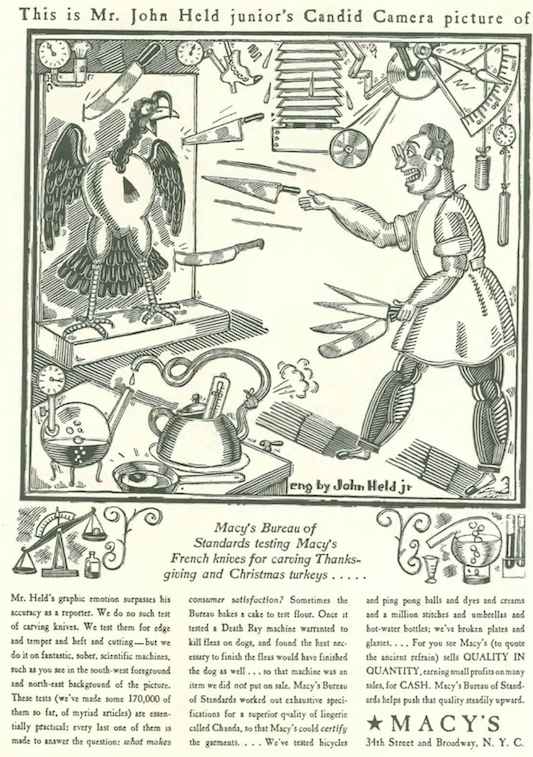
…John Held Jr. was one of the earliest contributors to The New Yorker—from 1925 to 1932 his woodcut-style cartoons and fanciful maps were frequent features…by 1936 Held had turned his talents to painting, book illustration, and the occasional advertisement, here on behalf of Macy’s…
…our illustrators and cartoonists for this issue include Christina Malman…
…a caricature by William Auerbach-Levy for the calendar section’s mini bio…
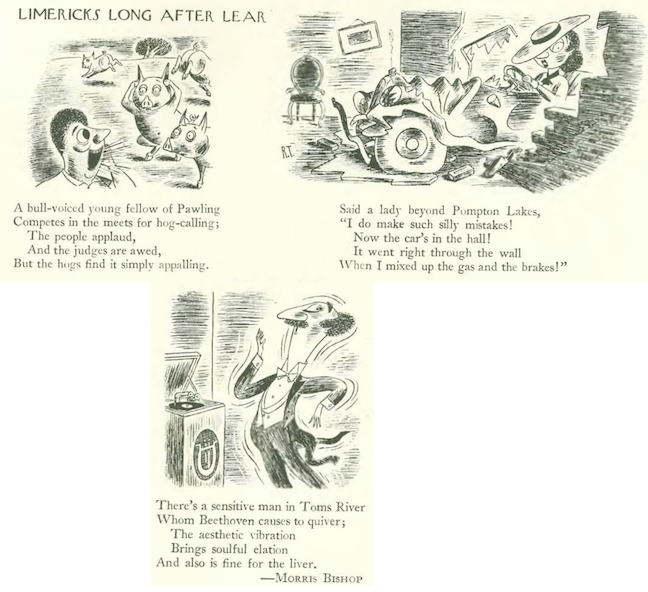
…another Richard Taylor–Morris Bishop collaboration…
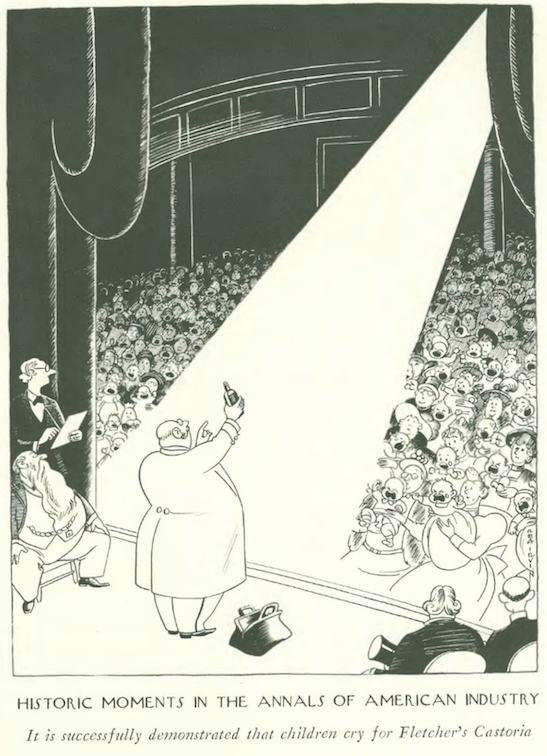
…more historic moments from American Industry, with Rea Irvin…
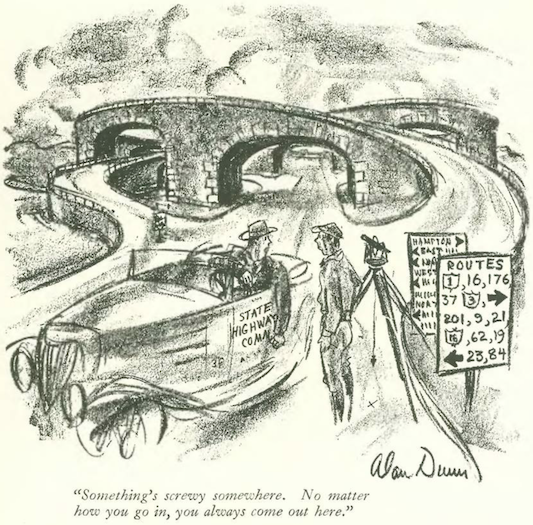
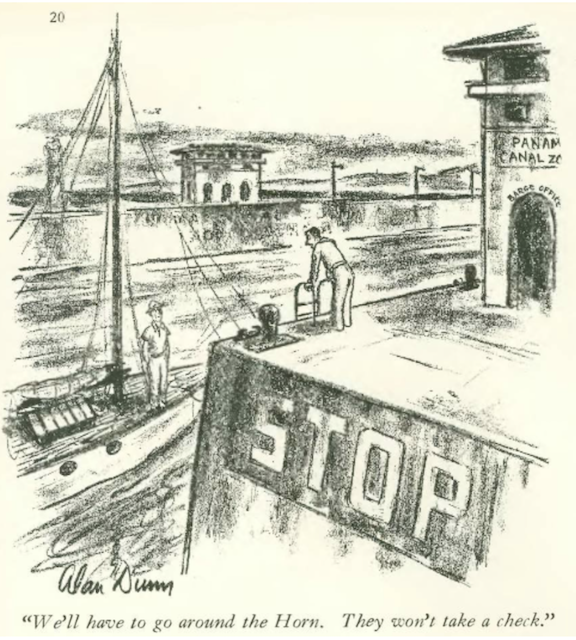
…Alan Dunn had an M.C. Escher moment on the turnpike…
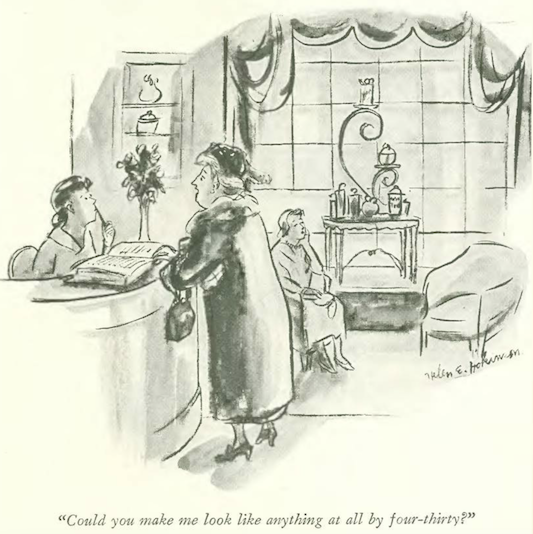
…Helen Hokinson made a big ask at the beauty parlor…
…Ned Hilton drew up a big man with a big complex…
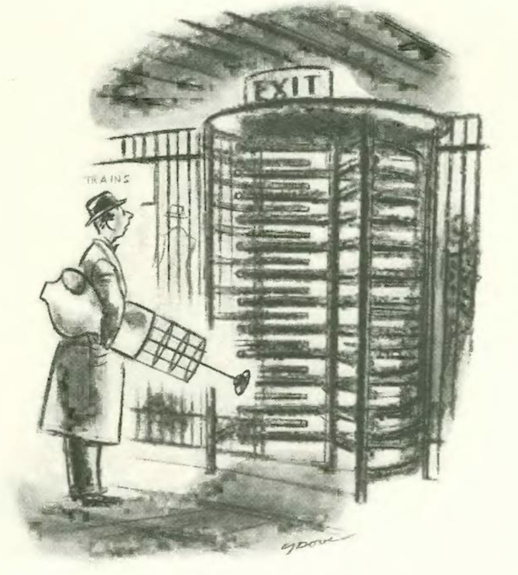
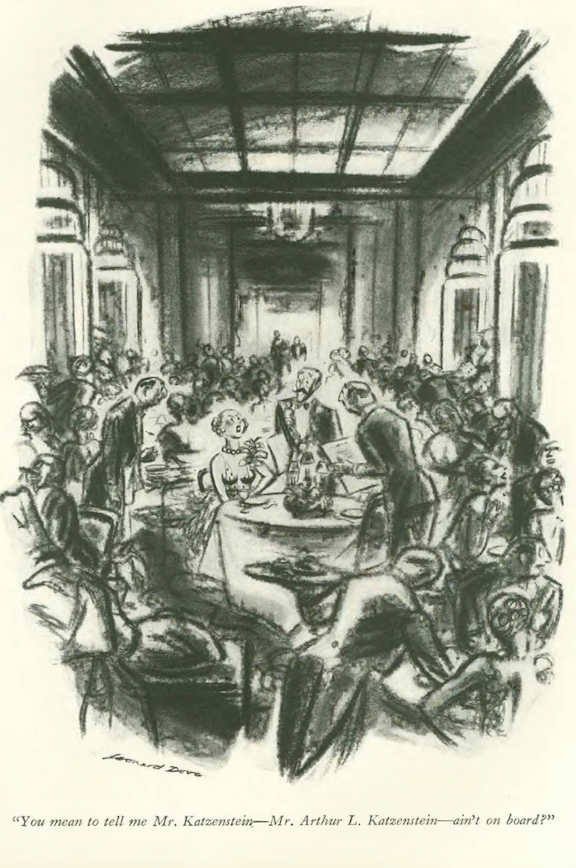
…Leonard Dove offered a challenge and a unique perspective at the subway station…
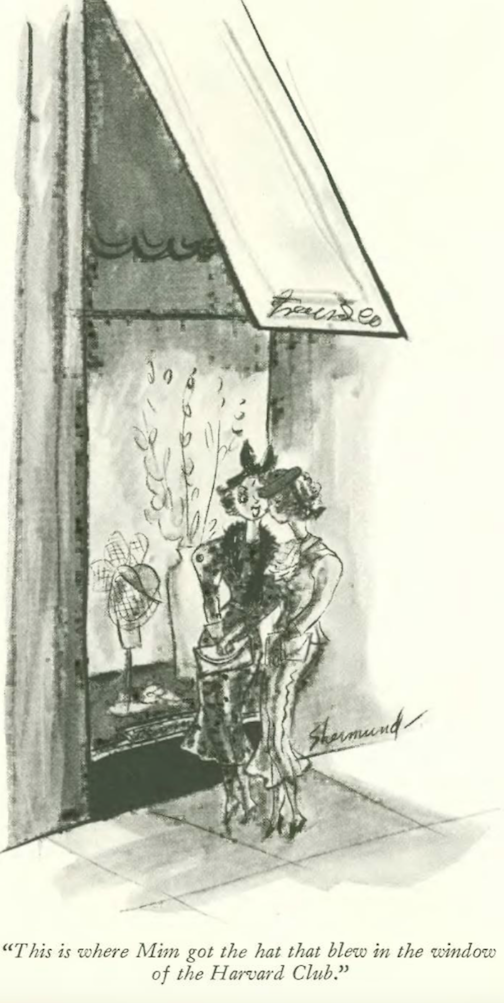
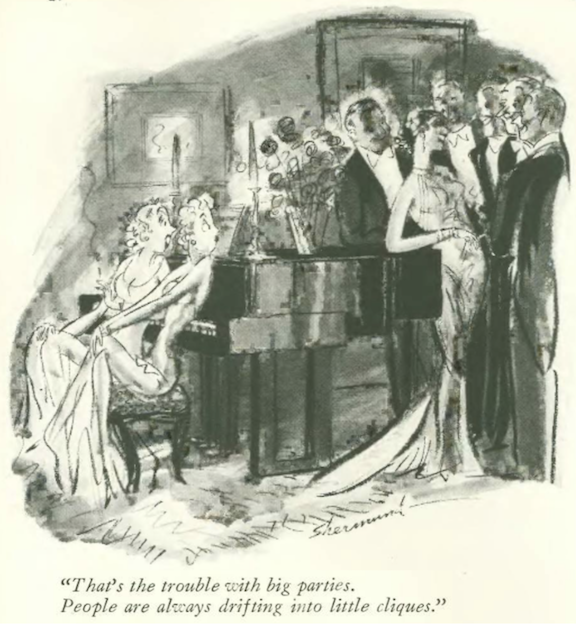
….Barbara Shermund’s modern women thrilled to the sights of Manhattan…
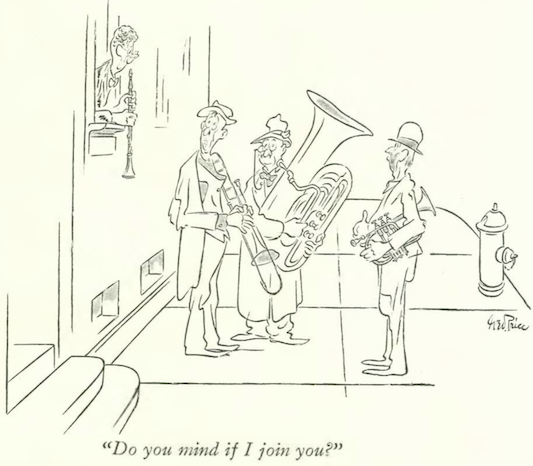
…George Price turned this trio into a quartet…
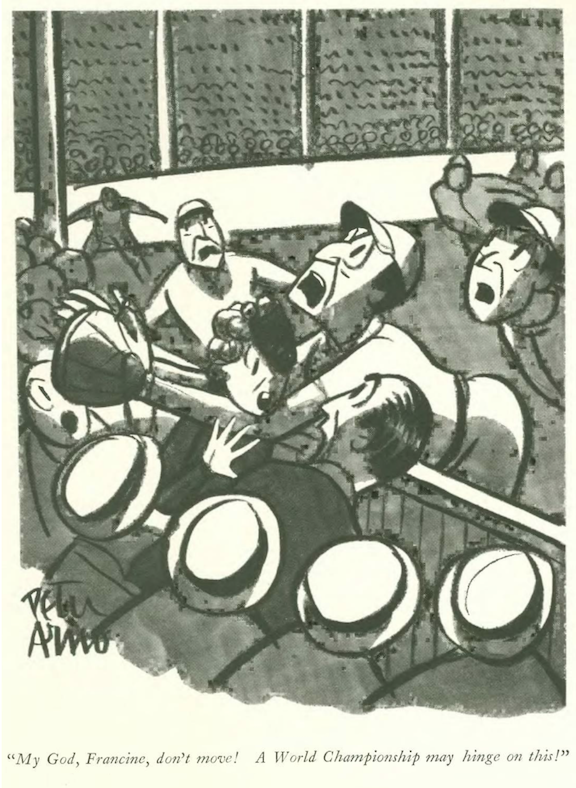
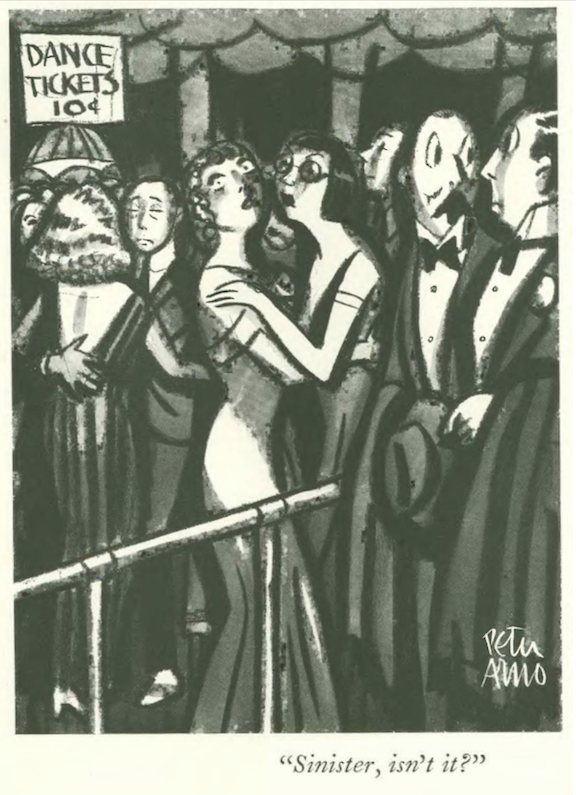
…and we close with a terrific, terrifying moment at the World Series, courtesy Peter Arno…
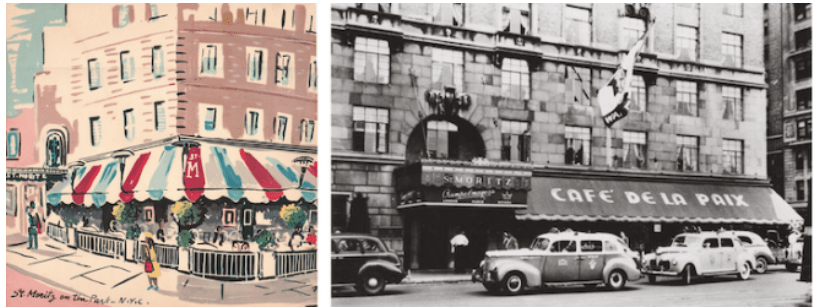
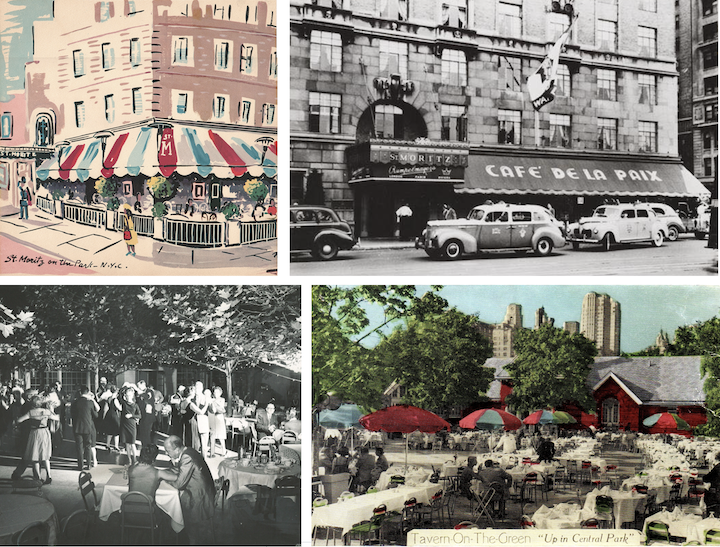
Above: Pierre Lelong painting (circa 1950s) of the outdoor café at New York's Hotel St. Moritz (left); view of the St. Moritz and Café de la Paix, 1944.
After the repeal of Prohibition in 1933, nightlife in Manhattan slowly picked up steam. By 1936 things were swinging, and although the club scene wasn’t as heady as the Roaring Twenties, there was still plenty to entice New Yorkers into the night air.
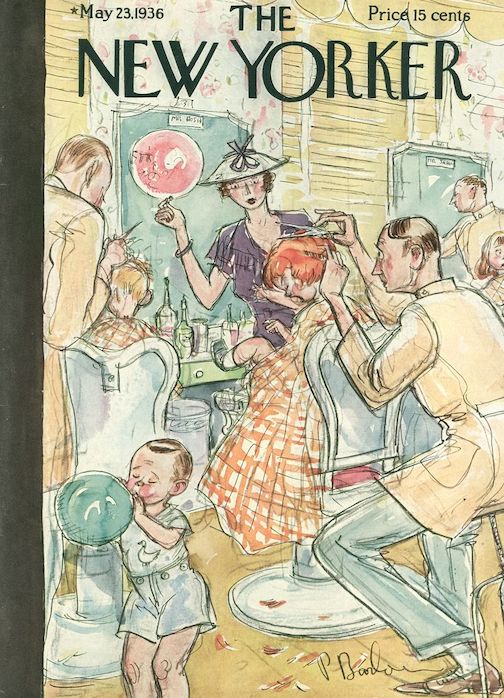
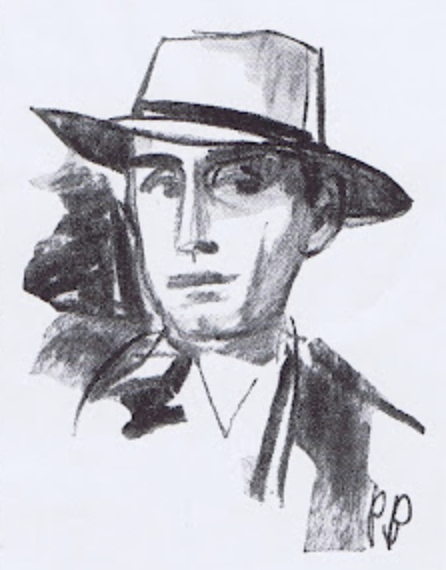
May 23, 1936 cover by Perry Barlow. The Texas-born Barlow (1892–1977) published 135 covers and 1,574 drawings in The New Yorker from 1926 to 1974. According to the late Lee Lorenz, Barlow’s drawings were elegant and deceptively casual, “delineating the absurdities and frustrations of the suburban middle class.” Barlow’s wife, Dorothy Hope Smith (also a successful artist) collaborated with her husband on many of his covers. Lorenz noted that “being partly color-blind, [Barlow] depended on his wife to provide the color for his drawings.”Before we get to our top story, here is a self portrait of Barlow featured in the April 26, 1941 issue of Colliers (via Mike Lynch Cartoons):
Lee Lorenz described Perry Barlow as a modest man: “Tall, lean, and soft-spoken, he seemed to many of his friends the image of the laconic Texan…(his) drawings remain fresh, and the generous and civilized sensibility behind them is a reminder of a quieter, kinder world.”
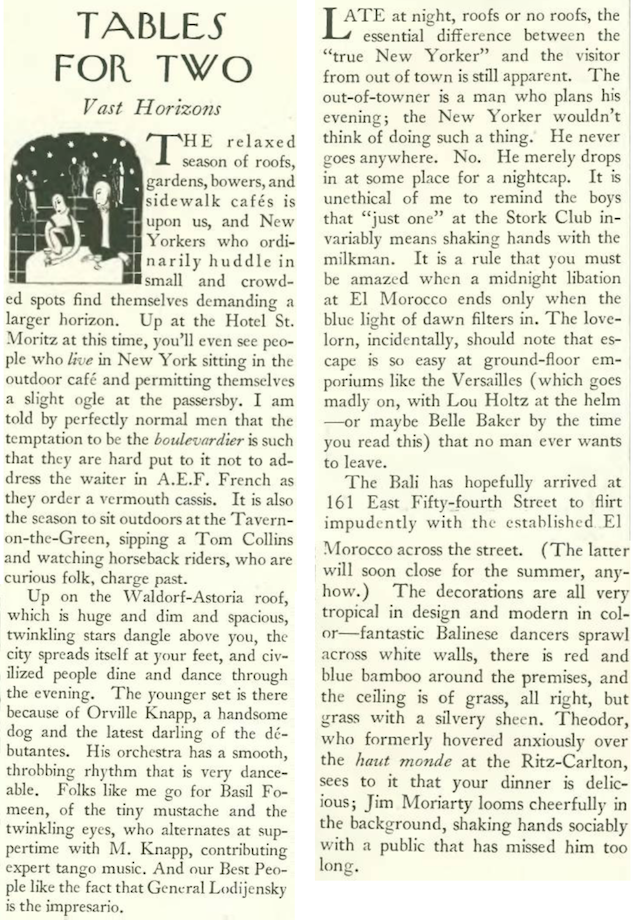
Now let’s enjoy a relaxing evening with the world’s greatest nightlife correspondent, Lois Long, who checked out the latest outdoor drinking and dining options in Manhattan. Excerpts:
AL FRESCO…Clockwise from top left: Whimsical illustration of the outdoor cafe at the Hotel St. Moritz by French Post-Impressionist painter Pierre Lelong, circa 1950s; view of St. Moritz Hotel and Cafe’ de la Paix, 1944 (in 1997 Donald Trump planned to gut the St. Moritz and cover it in glass; fortunately it was sold before that could happen); circa 1940s postcard depicting outdoor dining/dancing area at Tavern on the Green; dancing and drinks at Tavern on the Green, 1963. (scan by author/mcny.org/ephemeralnewyork.com/nytimes.com)
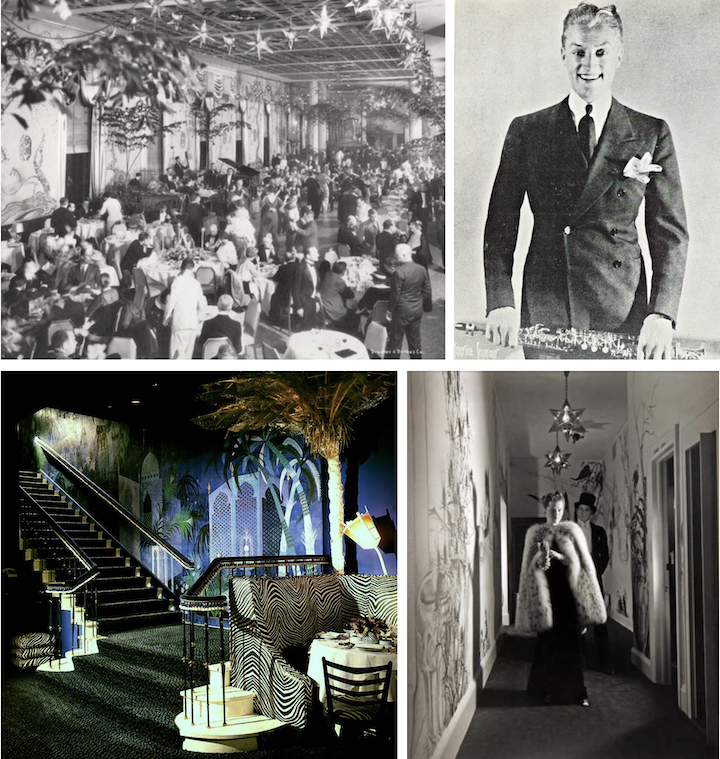
DANCING WITH THE STARS…Clockwise, from top left: The Waldorf’s Starlight Rooftop in the 1930s; Lois Long referred to the Waldorf’s multi-talented bandleader Orville Knapp as a “handsome dog”; actress Mary Taylor makes an entrance at the El Morocco in the 1930s; color image of the El Morocco’s Champagne Room, 1960. (notjustalabel.com/findagrave.com/facebook.com/life.com)
* * *
Keeping the Flame
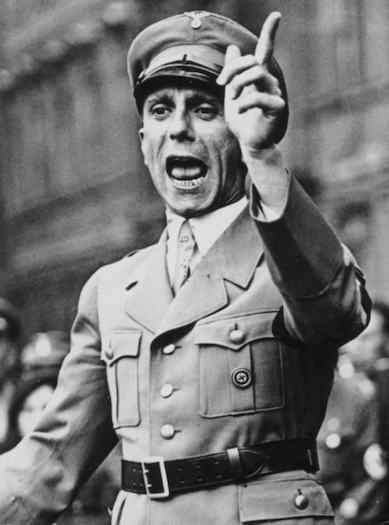
E.B. White began his column with a hopeful message regarding the power of truth in the face of Nazism:
OH SHUT UP…Reich Minister of Propaganda Joseph Goebbels giving a speech in Lustgarten, Berlin, August 1934. (Wikipedia)
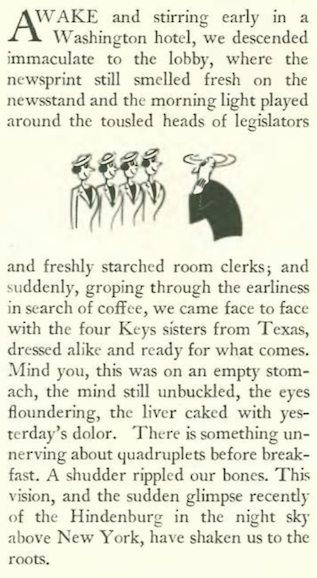
…White also commented on some “unnerving” moments while encountering quadruplets and a Nazi dirigible…
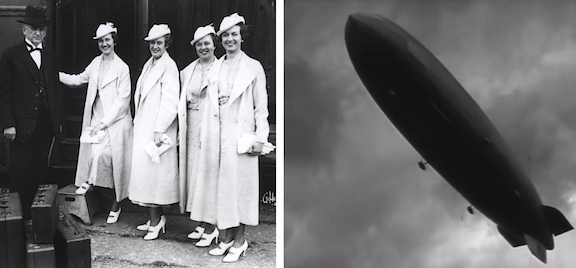
SISTER ACT…At left, the Keys Sisters circa 1936—Leota, Mary, Mona, and Roberta—were a national sensation and America’s most famous set of quadruplets. They were the first quadruplets in history to graduate from college (Baylor 1937), and they traveled thousands of miles on “goodwill tours” to promote Baylor University and the Texas Centennial Exposition of 1936; at right, the Hindenburg looms in the night sky just minutes before it was destroyed while attempting to dock in Lakehurst, N.J. (baylor.edu/British Pathé)
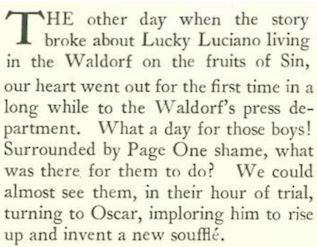
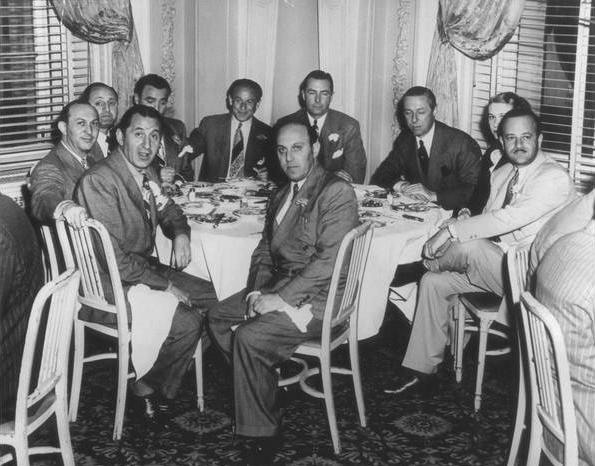
…and one more from White, here musing about Lucky Luciano’s residence at the Waldorf (Penthouse 39C, where Luciano was registered as “Charles Ross”)…
WALDORF ROUND TABLE…Lucky Luciano (back, center) with associates at the Waldorf-Astoria, circa 1936. Luciano regularly entertained prominent mobsters like Meyer Lansky and Frank Costello at the hotel. (dc.lib.jjay.cuny.edu)
* * *
Headline Acts
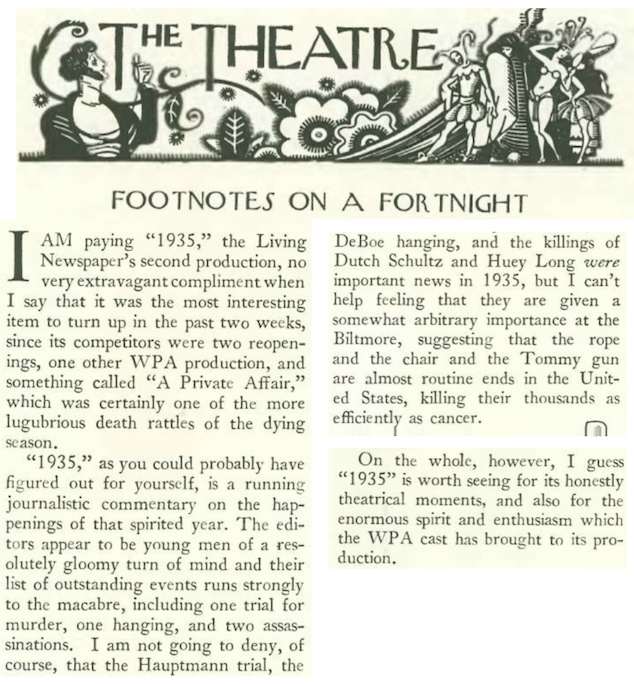
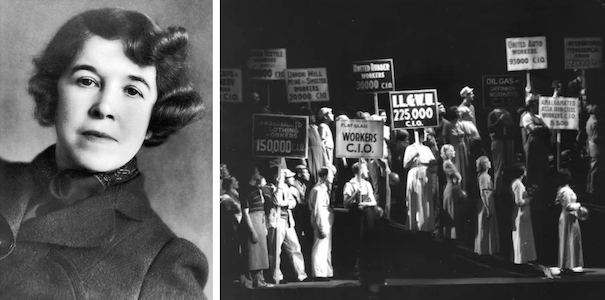
From 1935 to 1939, the WPA’s Federal Theatre Project gave work to more than 12,000 unemployed actors, directors, writers, designers, stagehands, and seamstresses while staging more than 1,200 productions across twenty-nine states. Although Wolcott Gibbs wasn’t too impressed with the project’s “Living Newspaper” performance, he deemed it worth seeing as the best thing on stage in the waning days of the theater season.
TOO SUCCESSFUL…As the director of the WPA’s Federal Theatre Project from 1935 to 1939, Hallie Flanagan (left) oversaw the hiring of thousands of unemployed theater workers and the production of nearly 64,000 theatrical performances. At right, a scene from a “Living Newspaper” performance in the 1930s. Despite its enormous success, the project was abruptly shut down by Congress on June 30, 1939, due to its progressive social commentary. (nara.gov/loc.gov)
* * *
At the Movies
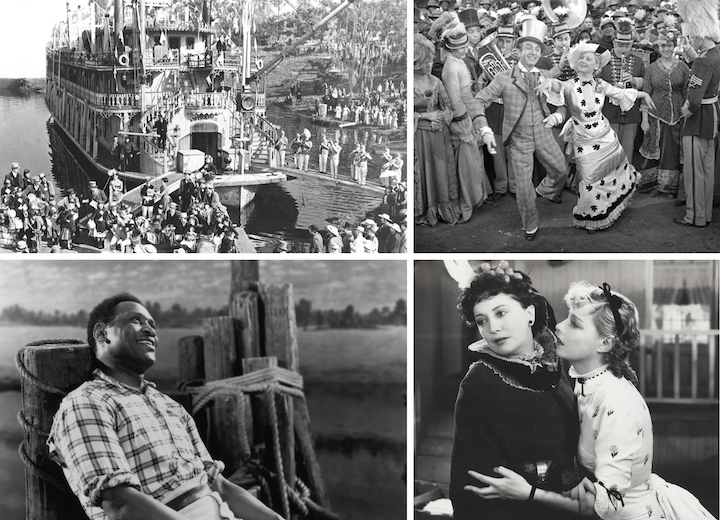
The romantic musical Showboat was a big hit with Broadway audiences after it premiered in 1927, but the play’s first film adaptation in 1929 fell flat; it was shot as a silent and then partially re-shot to incorporate sound dialogue and singing. Film critic John Mosher referred to that version as something “made awful on the screen,” and wanted his readers to know that the new 1936 adaptation had been “magnificently handled” by director James Whale (perhaps best remembered for 1931’s Frankenstein).
THE OLD MAN…Clockwise, from top left: the show boat Cotton Palace sets out on the Mississippi River to much fanfare in 1936’s Show Boat; Jeanette Dickson and Jimmy Jackson kick up their heels before the boat departs; Irene Dunne (right) and Helen Morgan in a dramatic scene; Paul Robeson performing his iconic rendition of “Ol’ Man River.” (collider.com/criterion.com/nystagereview.com)
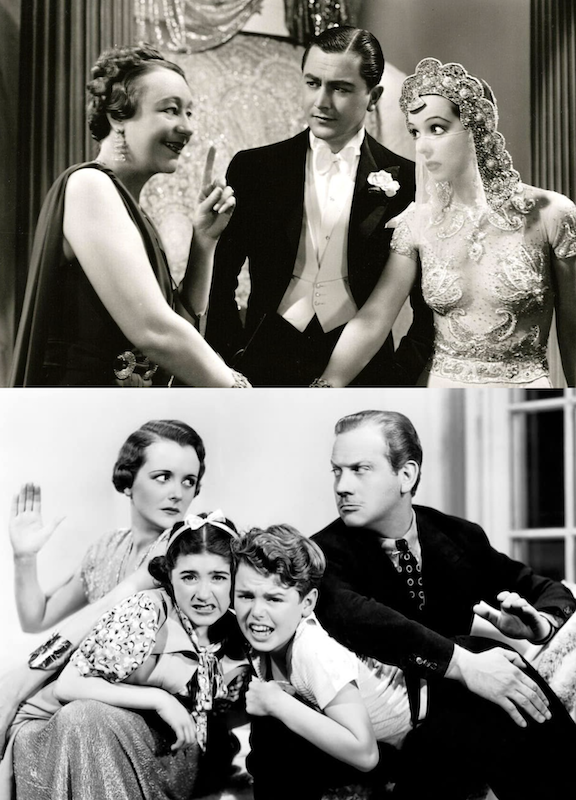
Mosher also reviewed the musical It’s Love Again, finding the comedy “cumbersome,” filled with “very British stuff of the kind we don’t understand over here at all.” He also had little to say about And So They Were Married, expressing sympathy to actress Mary Astor as “the conspicuous victim of effort…”
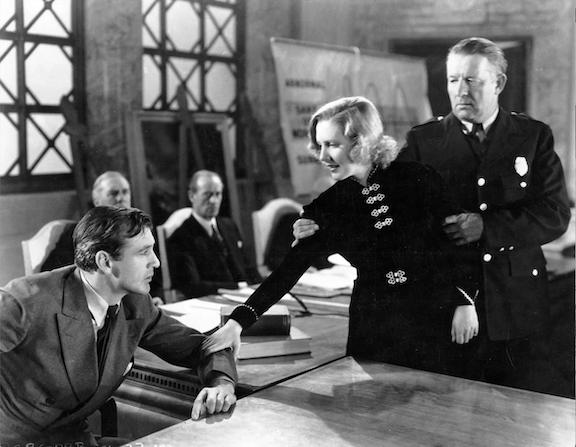
NOT PLAYING DOCTOR…Folks of certain age will recognize Robert Young from the 1970s TV series Marcus Welby, M.D. Prior to that he appeared in more than one hundred films. Top photo, Athene Seyler, Robert Young, and Jessie Matthews in It’s Love Again; Below, Mary Astor and Melvyn Douglas with child actors Edith Fellows and Jackie Moran in And So They Were Married. (imdb.com)
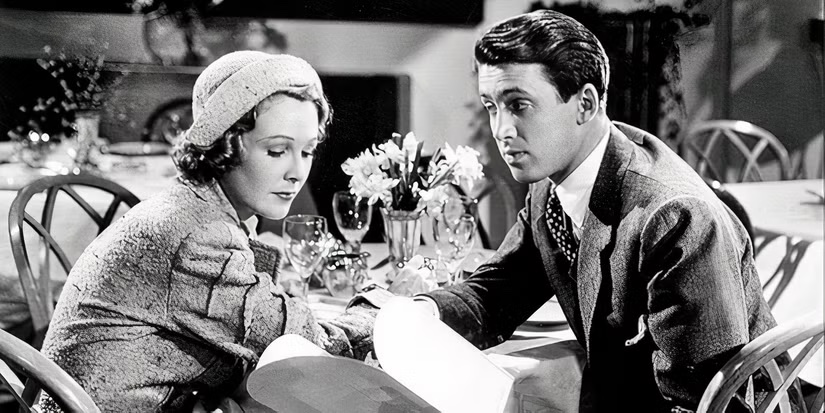
And then there was Speed, Jimmy Stewart’s first leading role. Mosher couldn’t make sense of it, but the film did launch Stewart into bigger roles.
OUT OF GAS…Jimmy Stewart as race car driver Terry Martin in Speed.Wendy Barrie played the love interest Jane Mitchell, who was secretly the heiress Jane Emery. The film received tepid reviews, but it helped launch Stewart to stardom. (collider.com)
* * *
From Our Advertisers
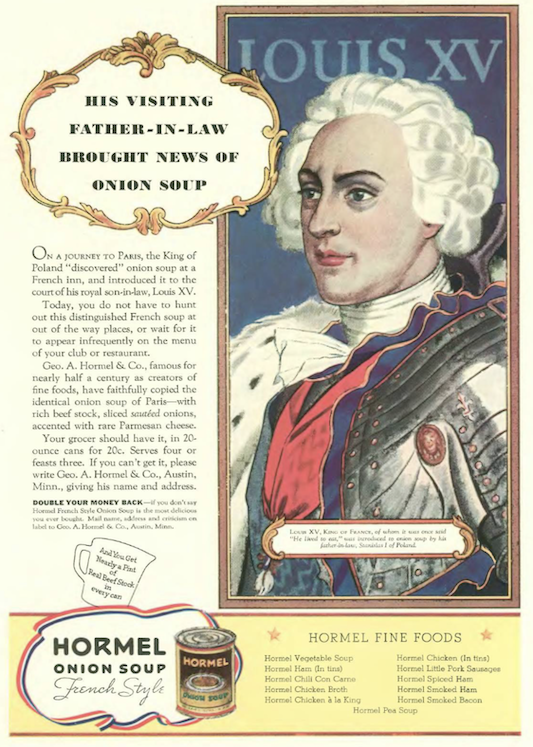
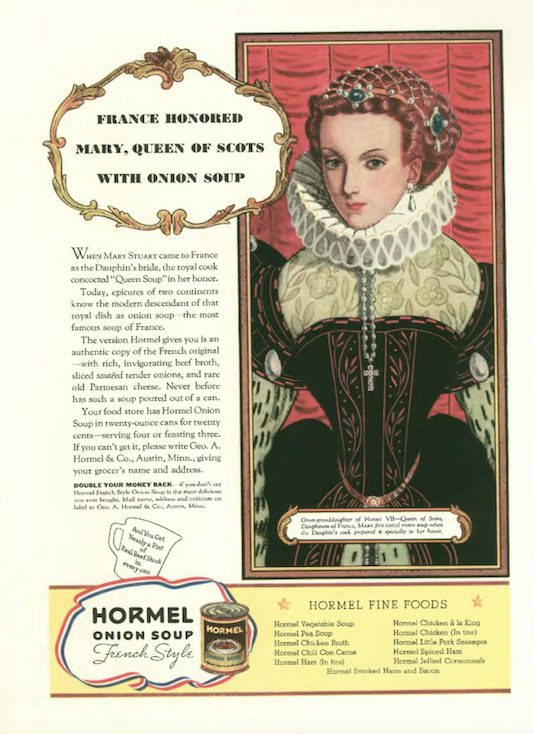
The folks at Hormel were back on the inside front cover with another tale from the annals of onion soup…
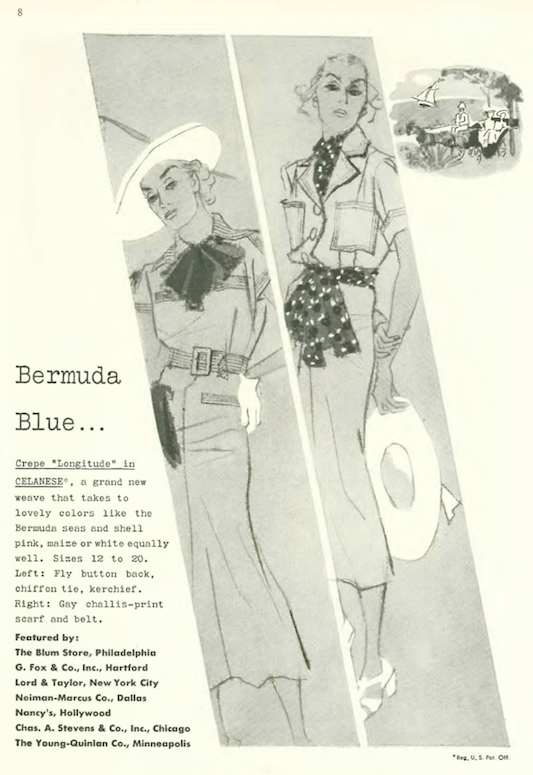
…and summer fashions once again dominated the opening pages of the magazine…
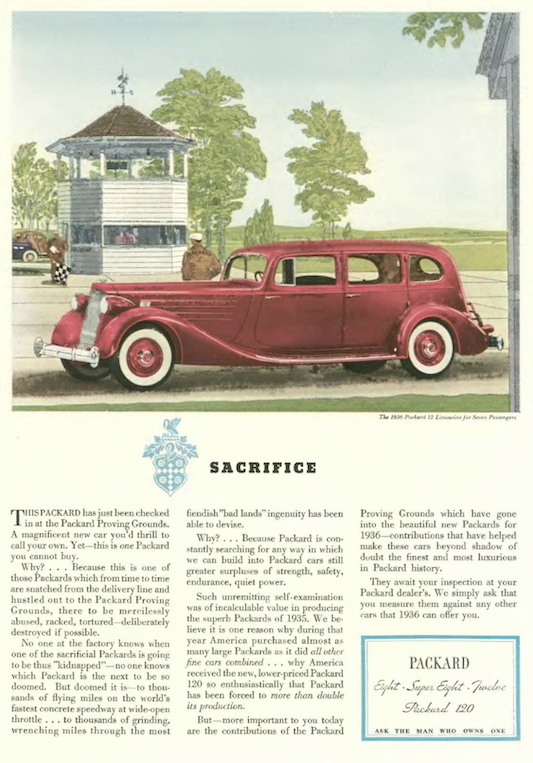
…Packard answered Cadillac’s pastoral ads with one of its own…
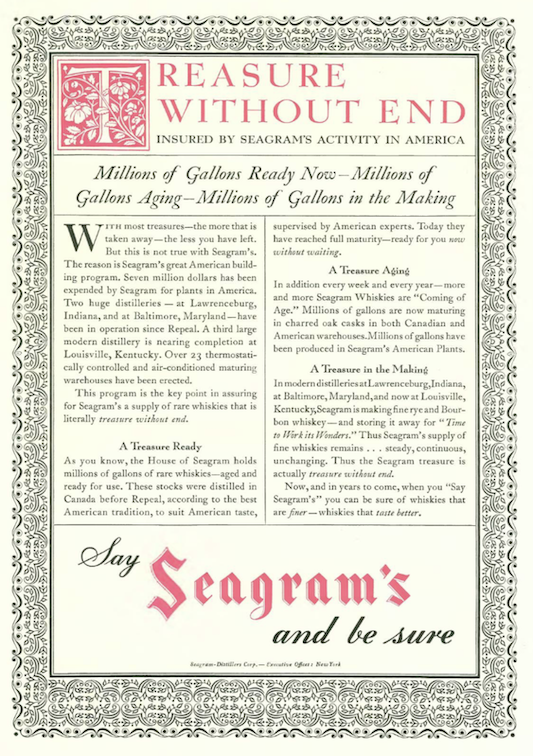
…while the distillers at Seagram’s wanted to reassure thirsty Americans that there was plenty of the hard stuff to go around…
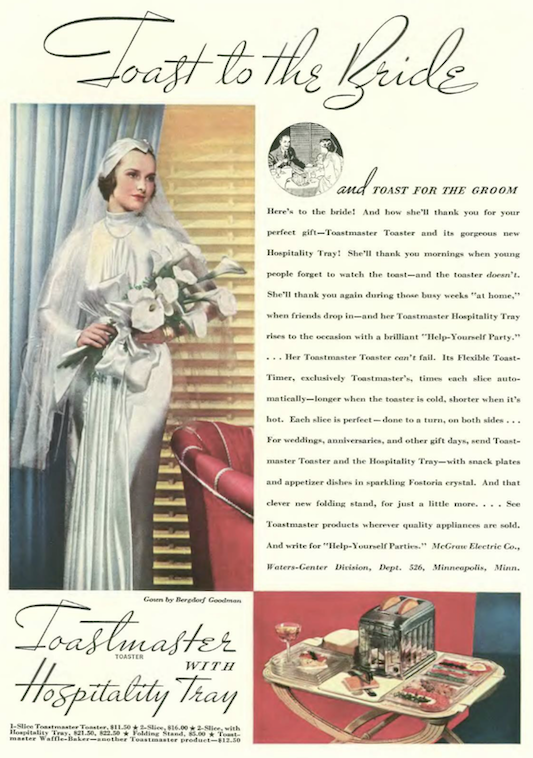
…anticipating the season of the June bride, this ad helpfully suggested the Toastmaster toaster (and accessories) as the ideal gift for the newlywed…
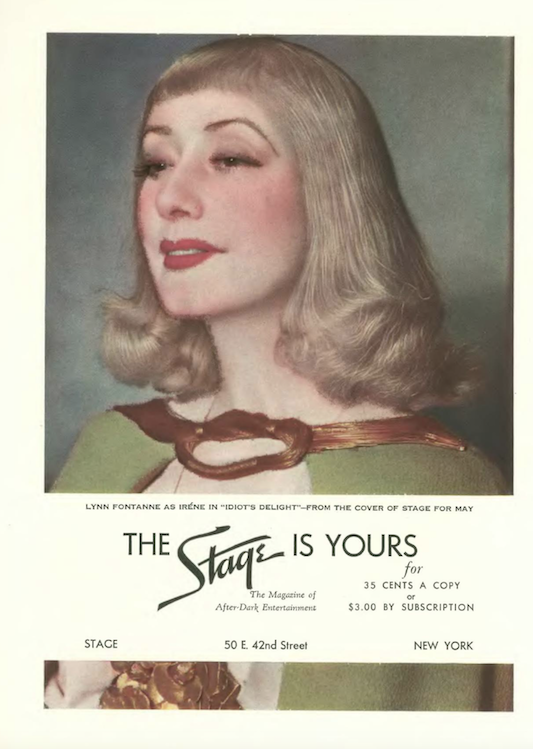
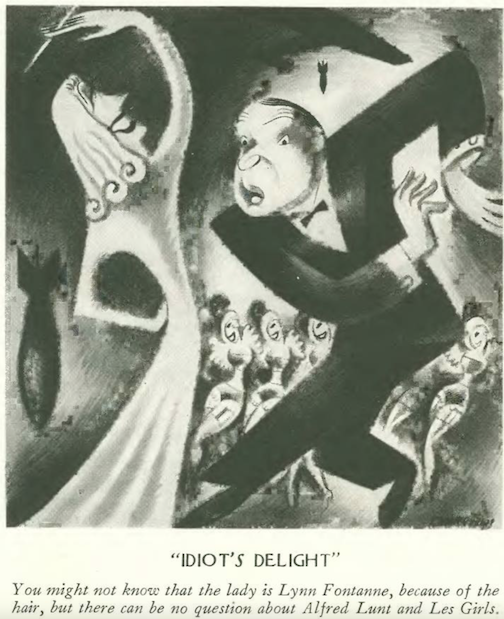
…this ad for Stage magazine featured actress Lynn Fontanne as the mysterious countess Iréne in Idiot’s Delight…
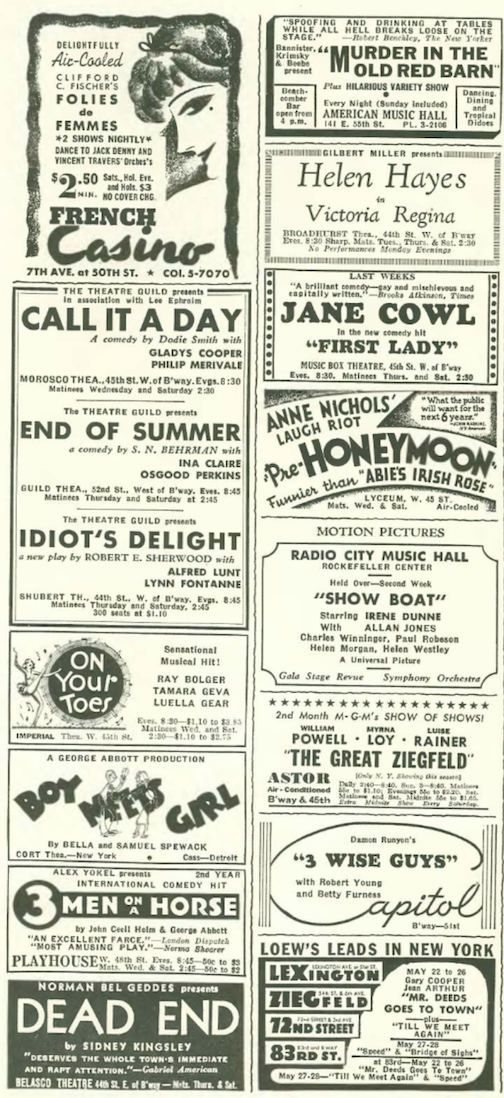
…Fontanne’s play, along with several other stage and screen diversions, were advertised in the back of the book…
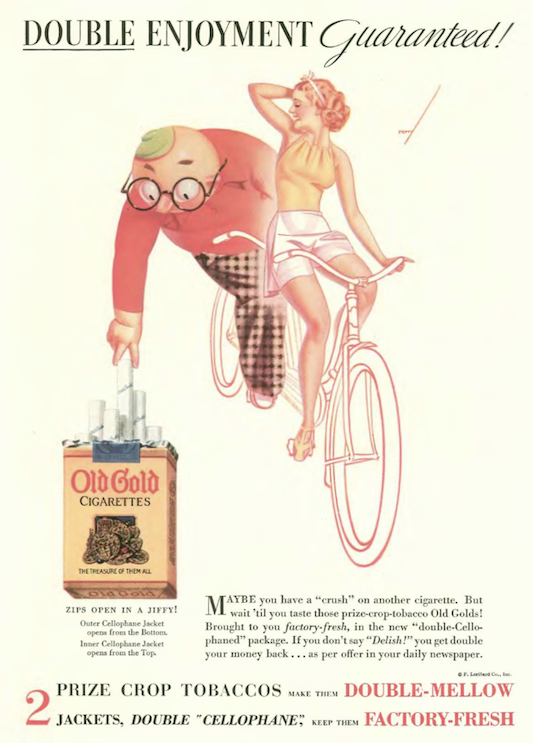
…pin-up artist George Petty drew up another odd couple for Old Gold cigarettes…
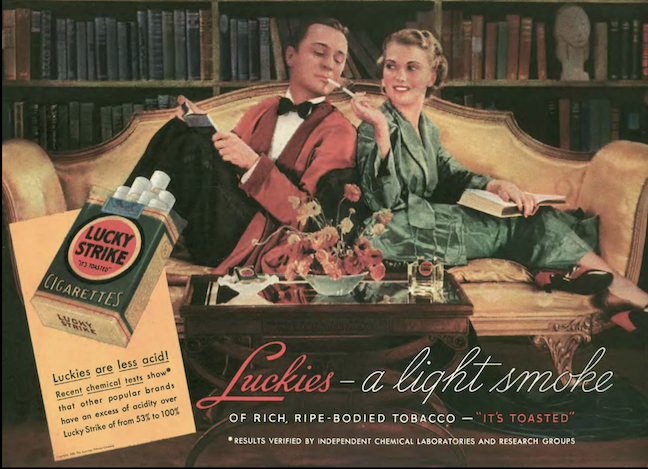
…While the makers of Lucky Strike cigarettes gave their smokes a homey appeal…
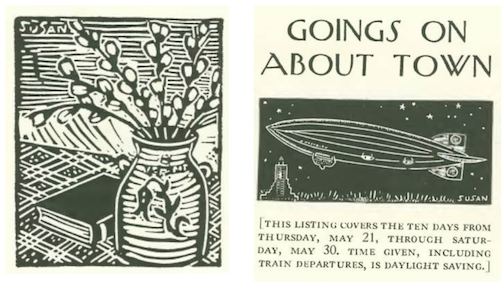
…on to our illustrators and cartoonists, we have spot art from Susan Willard Flint…
…and Christina Malman…
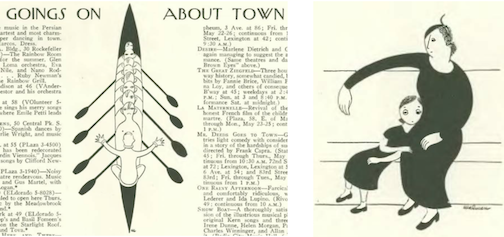
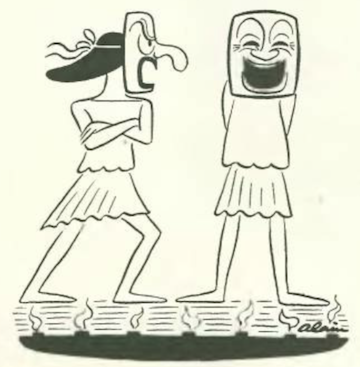
…and Daniel ‘Alain’ Brustlein (for the “Theatre” section)…
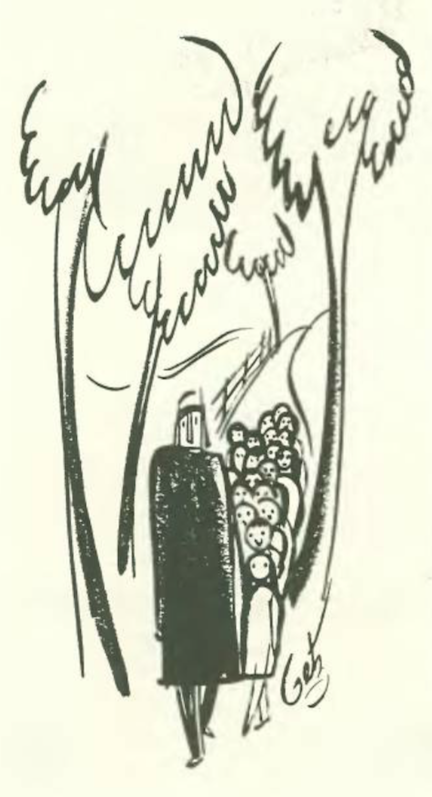
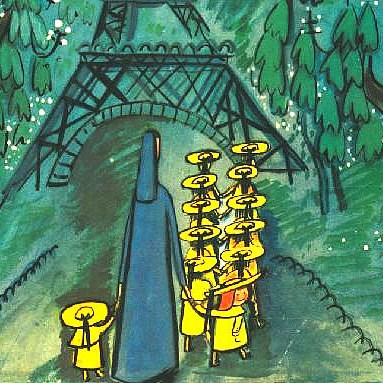
…this next bit of spot art has me confused…the signature appears to belong to Arthur Getz, yet the image suggests an early drawing by Ludwig Bemelmans…Getz and Bemelmans were contemporaries at the New Yorker, and both were prolific spot art contributors…
…the drawing seems to anticipate Bemelmans’ 1939 children’s book Madeline…
…Richard Taylor found inspiration on the Broadway stage…
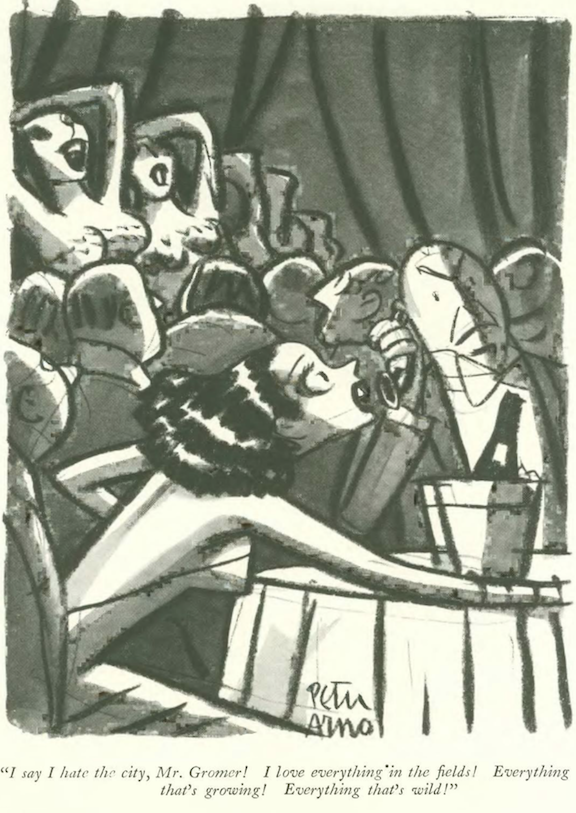
…Peter Arno showed us a sugar daddy receiving an earful (via ear trumpet)…
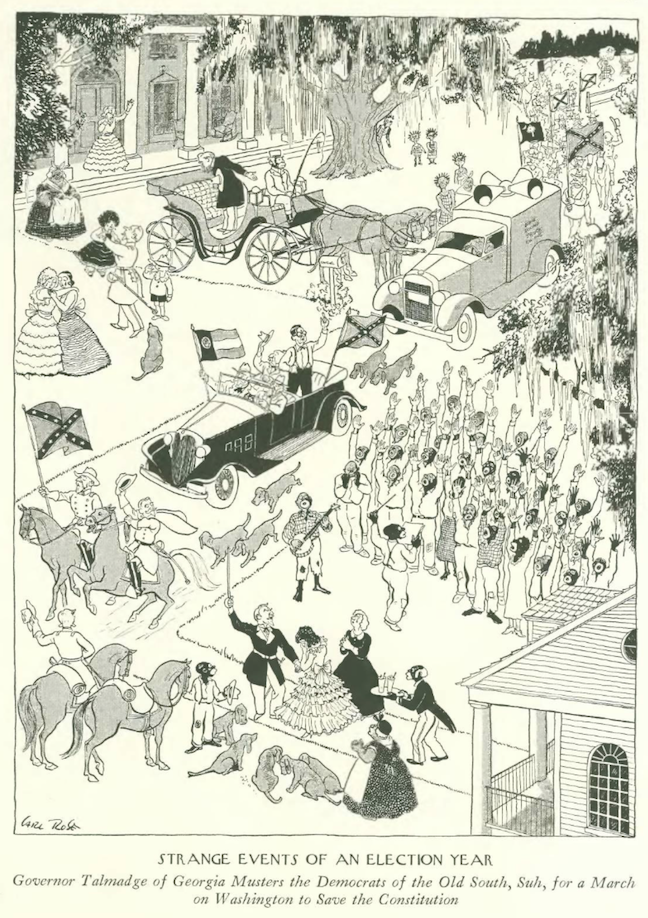
…Carl Rose offered some Southern-style electioneering in this lively illustration…
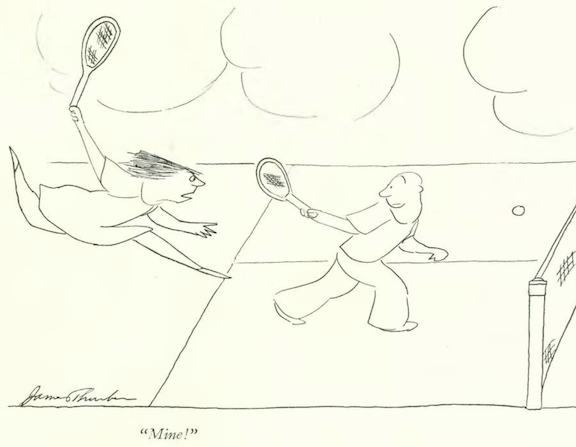
…by contrast, James Thurber’s spare lines told us everything we needed to know about this couple…
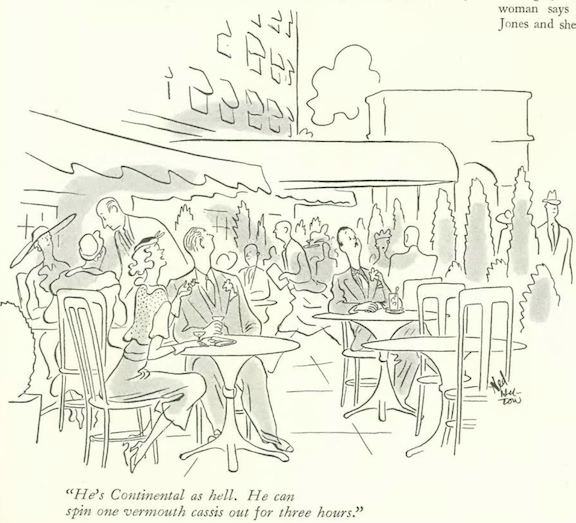
…Ned Hilton spotted an outlier at an outdoor café...
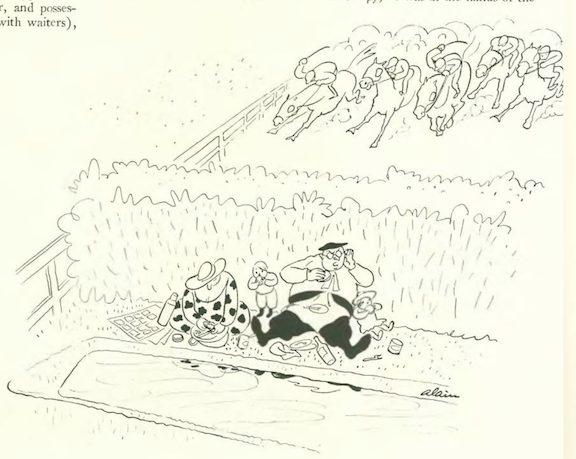
…Alain again, here anticipating a big surprise…
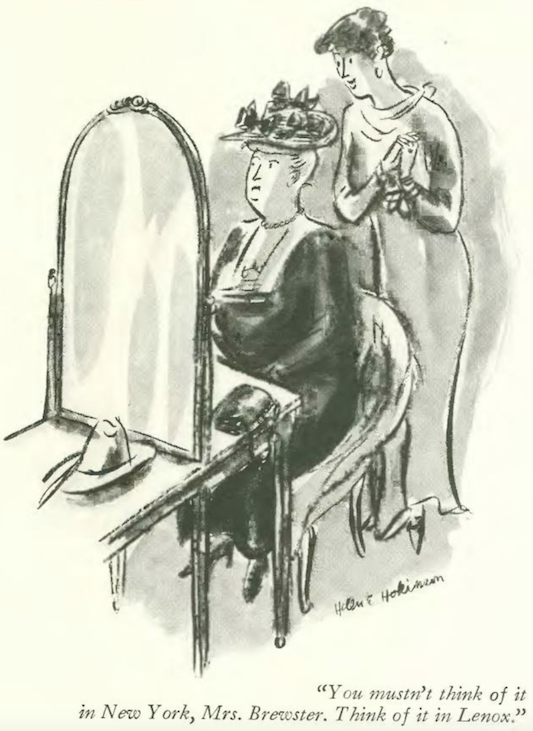
…Helen Hokinson offered a helpful fashion tip…
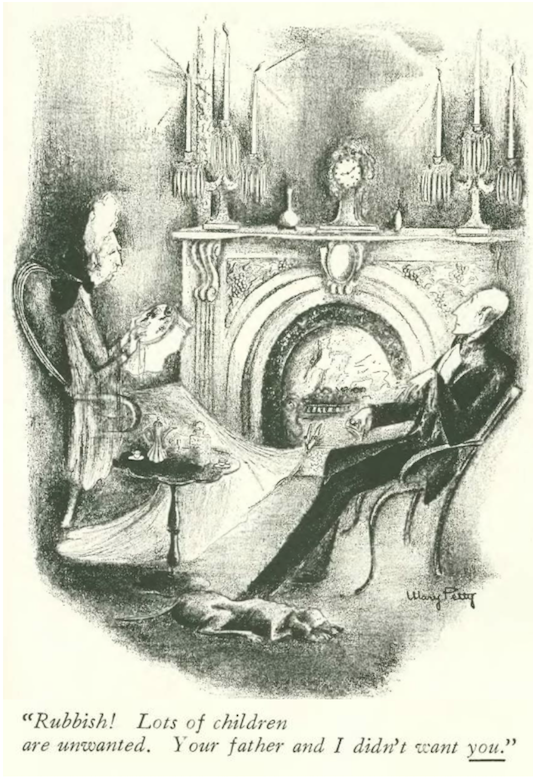
…and we close with Mary Petty, and a motherly retort…
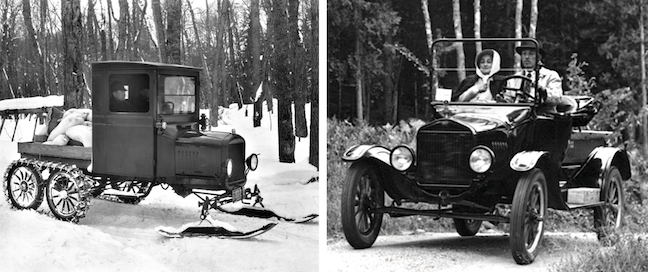
Above: Undated image (left) demonstrates the versatility of the Model T Ford. At right, E.B. White and Katharine Sergeant White take a spin in a Model T Roadster. (freep.com/whistlestoppers.com)
E.B. White often shared anachronistic views on progress, decrying everything from streamlined cars to fully-enclosed city buses that removed passengers from the open air.
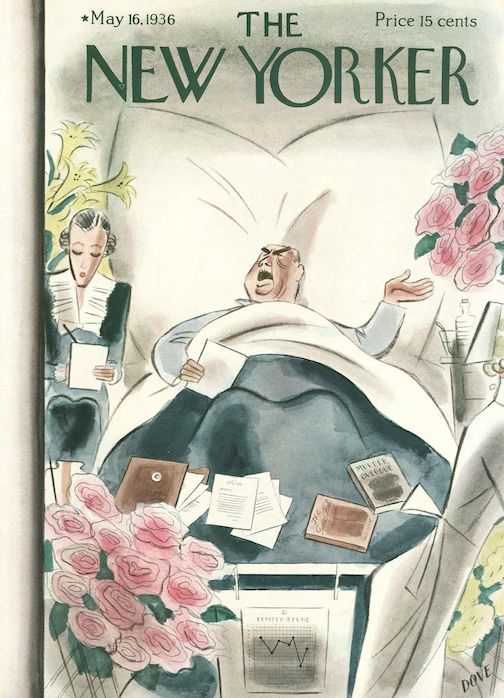
May 16, 2026 cover by Leonard Dove. Note the star next to the date. On older New Yorker magazine covers, the star was a printer’s mark indicating a split run or a specific newsstand edition.
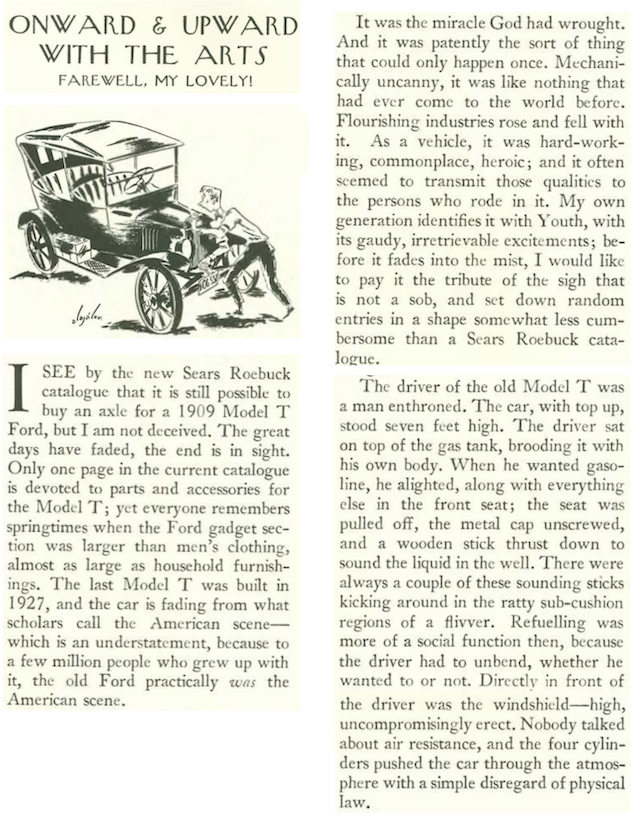
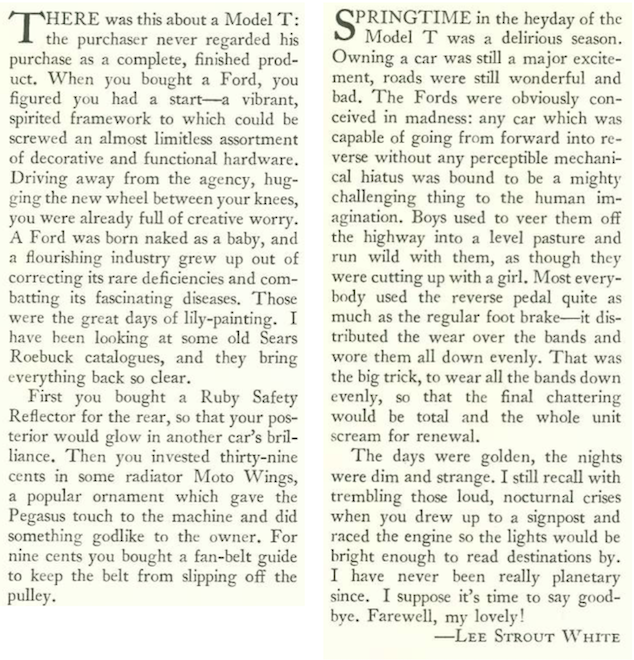
Instead, White celebrated the simplicity and mechanical quirks of earlier motor vehicles, including his beloved Ford Model T. For the May 16 issue White collaborated with journalist Richard Lee Strout on a homage to the old motorcar, “Farewell, My Lovely!” Strout’s contribution is important here, since it was he who originally submitted a manuscript to editor Harold Ross about the Model T. Either White rewrote Strout’s submission or used it as inspiration for “Farewell, My Lovely!” At any rate, that explains the blended byline, “Lee Strout White.” Here are some excerpts (spot art by Constantin Alajalov):
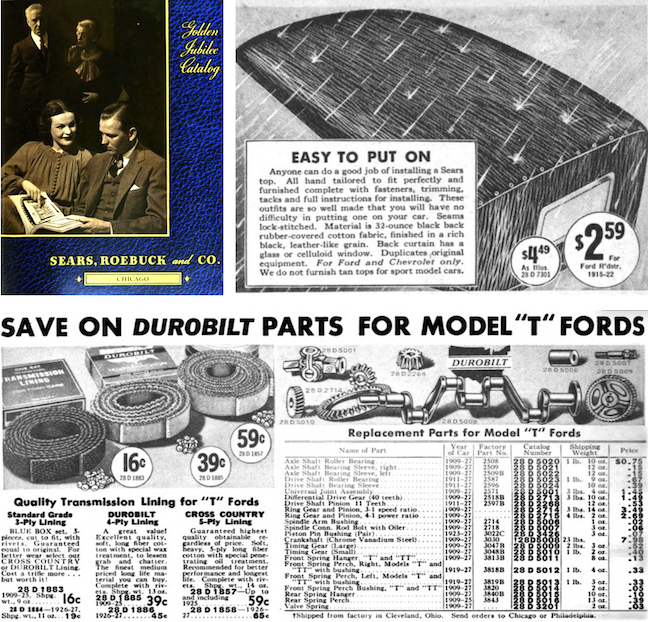
MIX AND MATCH…E.B. White’s famous Model T was a 1917 Roadster like the one pictured at top left. He purchased the car shortly after college and famously drove it across the country in 1922; at top right, the dash featured the ignition key and nothing else, however you could add such extras as radiator “Moto Wings” or a Ruby Safety Reflector. (volocars.com/ebay.com)KEEPING IT HUMMING…As E.B. White noted in his opening lines, you could buy an axle as well as a number of other parts for the Model T from the Sears catalog. Clockwise, from top left: Cover of the 1936 “Golden Jubilee” catalog; replacement parts featured in the catalog included new car tops and an array of replacement parts. (archive.org/babel.hathitrust.org)
Model T owners developed all sorts of hacks to keep their Lizzies running. White wrote that “Dropping a camphor ball into the gas tank was a popular expedient; it seemed to have a tonic effect on both man and machine.” He also noted that the Ford driver “flew blind,” given that on earlier models the dashboard was bare save for an ignition key. Those cars lacked speedometers, fuel gauges, as well as gauges for engine temperature and oil pressure. “Whatever the driver learned of his motor,” White wrote, “he learned not through instruments but through sudden developments.” He concluded his piece with some thoughts on the golden days of the automobile.
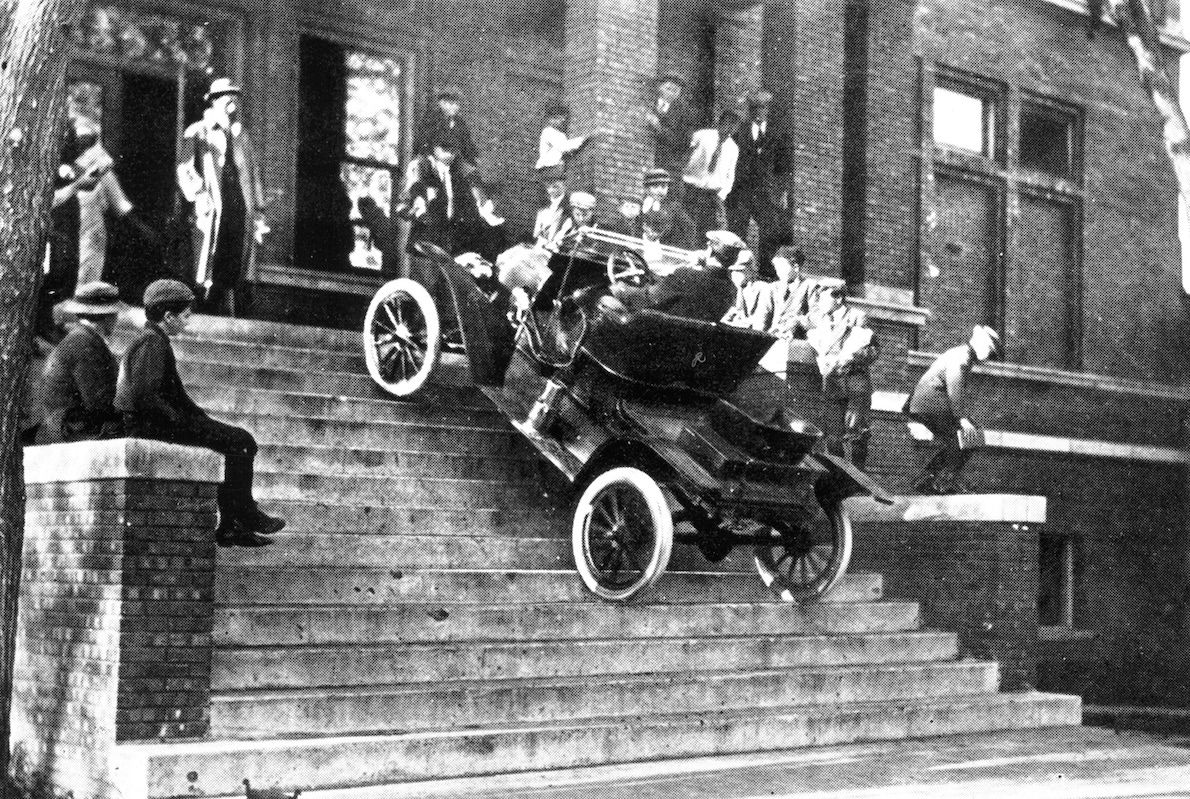
SHOWOFF…The Model T’s unique transmission and gravity-fed fuel system were key to the rugged car’s many stunts. In scaling Scotland’s Ben Nevis mountain, the driver often had to go backwards up inclines to maintain fuel flow. Above is a photo of a Model T climbing the stairs of the Tennessee State Capitol in 1911. (media.lincoln.com)
* * *
Total Recall
E.B. White also filed a lengthy “Notes and Comment” comprised entirely of brief dispatches from around the country:
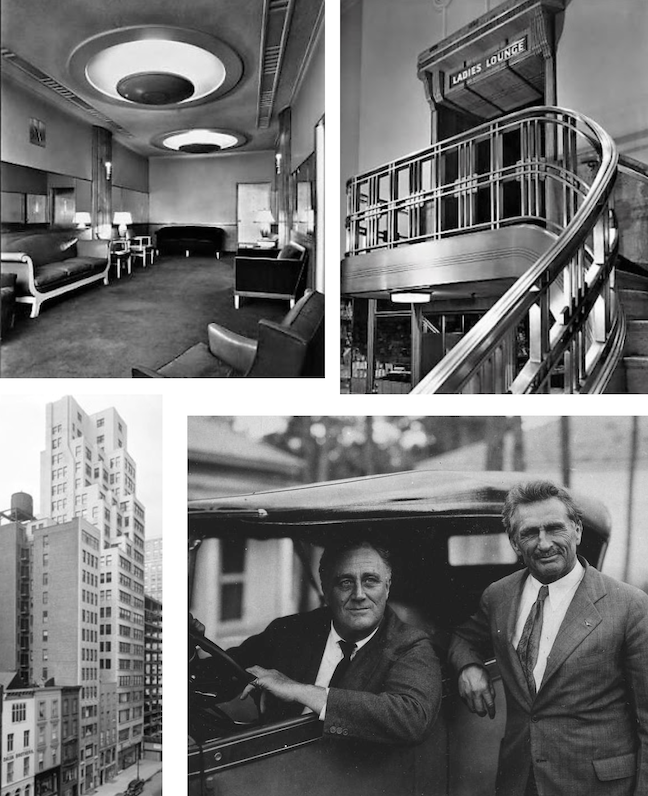
CIVILIZED SHOPPING…Tea time was observed every afternoon at Kress’s department store—images above are of the store’s ladies lounge; body builder and fitness magazine publisher Benarr Macfadden (seen here with President Franklin Roosevelt circa mid-1930s) said he had no plans to run for president; bottom left, a sale was in progress at the Rolls-Royce building on East 57th. (nypl.org/public domain/mcny.org)
Here are the rest of White’s notes on the passing scene:
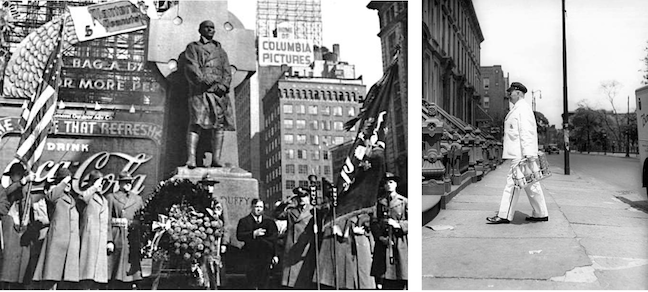
LIMITATION OF STATUES…At left, Mayor Fiorello LaGuardia presides over the dedication ceremonies of a Times Square statue honoring Father Francis Patrick Duffy, May 2, 1937—apparently some folks were opposed to a statue honoring the most decorated chaplain in Army history; at right, a Borden’s milkman making a delivery in New York City, 1936. (facebook.com/photo army.mil)
* * *
Not Playing in Peoria
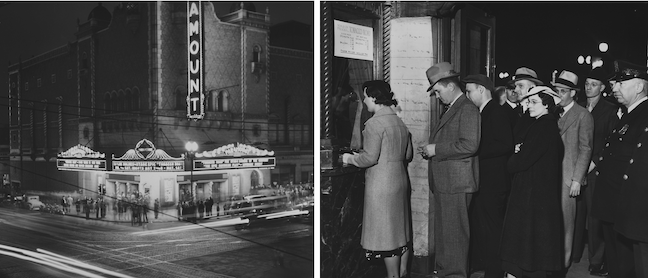
Jack Kirkland’s play Tobacco Road, based on the 1932 novel by Erskine Caldwell, was one of the longest-running plays in theater history, with 3,182 performances from 1933 to 1941. Although banned in major cities such as Chicago and Detroit for being sensational and immoral (and panned by critics), it nevertheless saw huge success on Broadway and with its touring company. “The Talk of the Town” checked the status of the play at the Forrest Theatre, where it had exceeded the millionth ticket mark.
WORD GETS AROUND…Folks queue up in 1937 to see Tobacco Road at Omaha’s Paramount Theater. Despite being banned in many cities, the play ran until 1941. (Wikipedia)
* * *
At the Movies
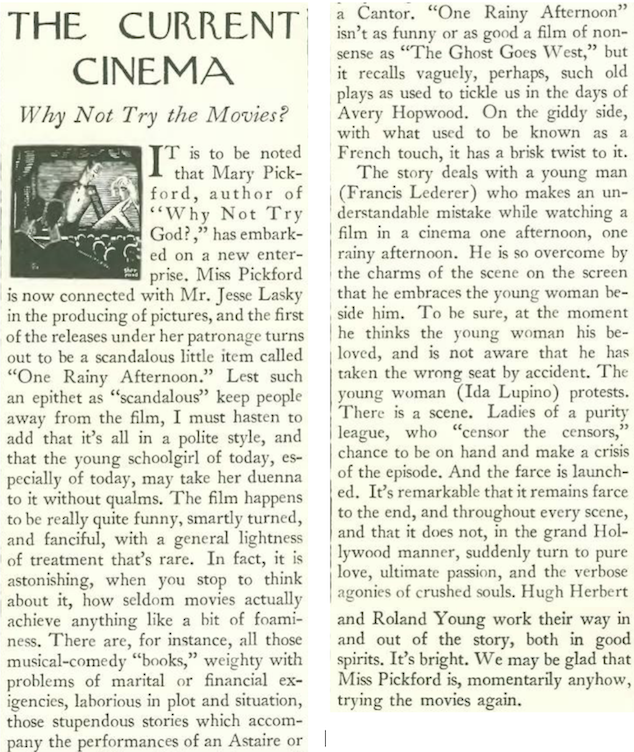
One Rainy Afternoon was the first of a small number of films from United Artists produced by its vice-president, Mary Pickford, through her Pickford-Lasky production company. In his opening lines critic John Mosher alluded to Pickford’s popular 1934 essay, Why Not Try God?
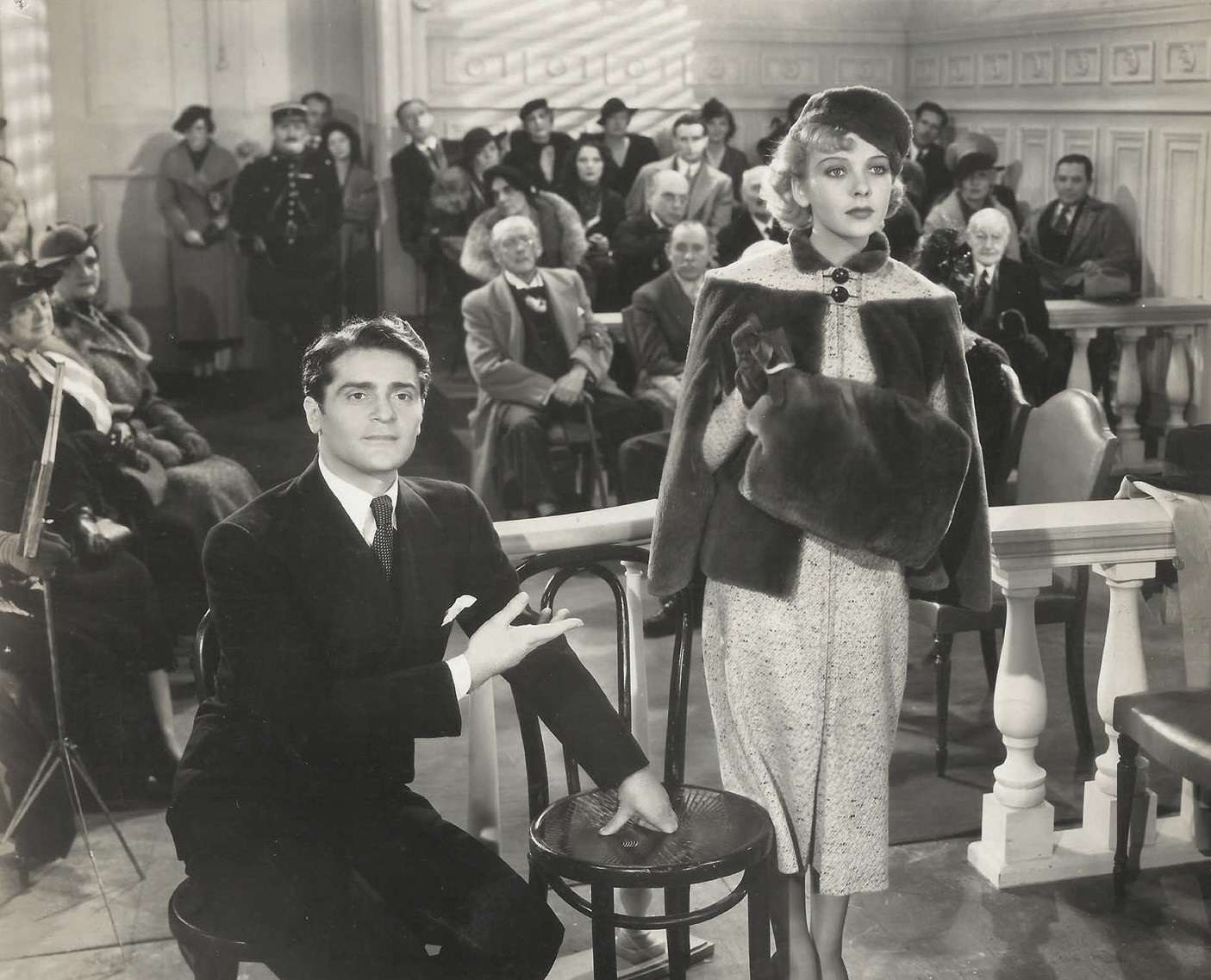
HONEST MISTAKE…Francis Lederer played a debonair actor who accidentally kisses young socialite Ida Lupino in a darkened theatre in One Rainy Afternoon. Hilarity and romance follow. Lederer (1899–2000) would enjoy a successful stage, film and television career while becoming wealthy as an L.A. real estate investor. Lupino (1918–1995) was an actress, director, writer, and producer, appearing in 59 films and directing eight. She is regarded as the most prominent woman filmmaker working during the Hollywood studio system of the 1950s. (Wikipedia)
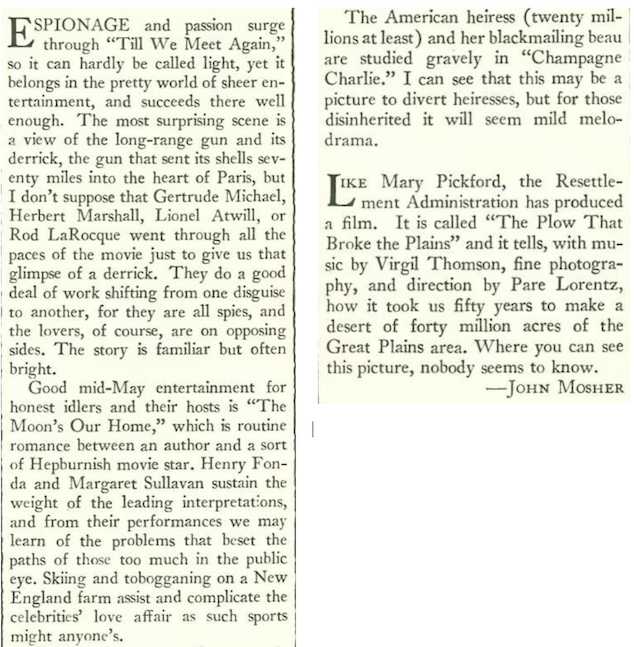
Mosher also reviewed some “Good mid-May entertainment for honest idlers” and a documentary about the Dust Bowl.
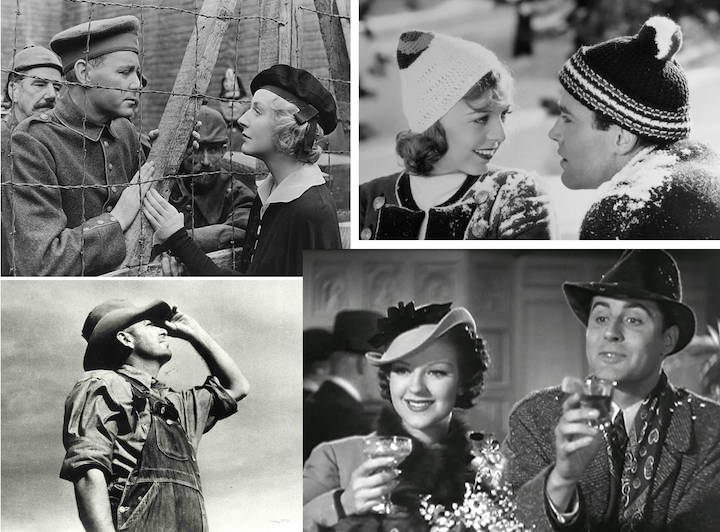
MAY DIVERSIONS…Clockwise, from top left: Herbert Marshall and Gertrude Michael in Till We Meet Again; Margaret Sullavan and Henry Fonda in The Moon’s Our Home; Thomas Beck and Helen Wood in Champagne Charlie; a farmer looks to the sky in the Dust Bowl documentary The Plow That Broke the Plains. (csfd.cz,pinterest.com/imdb.com)
* * *
From Our Advertisers
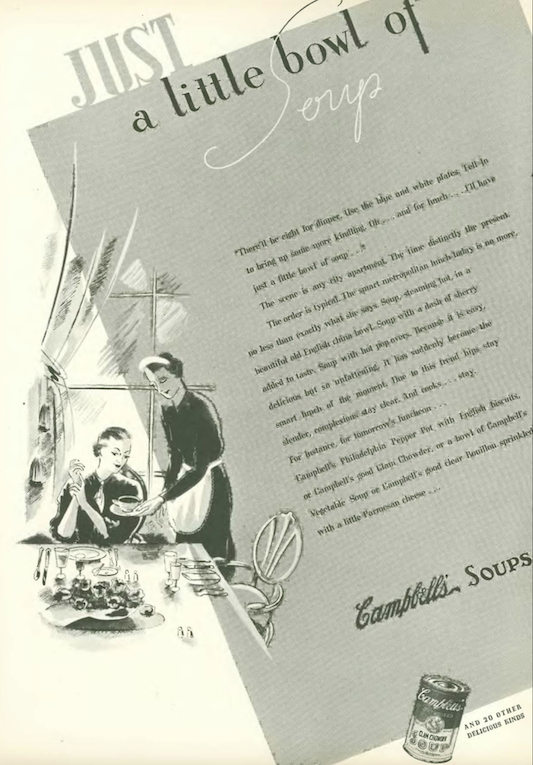
The makers of Campbell’s soups continued to market their product as an upscale starter for dinner…or perhaps a time-saver for the cook, Madam none the wiser…
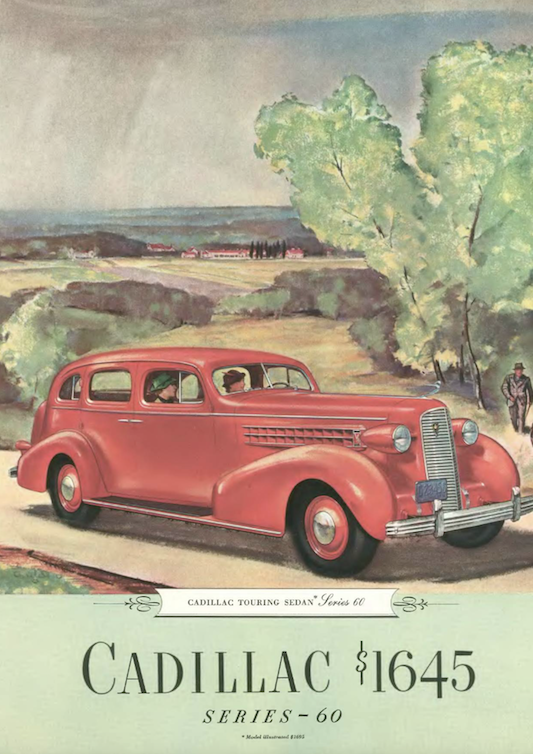
…Cadillac continued to entice buyers with bucolic scenes dominated by their luxury sedans…the price isn’t outrageous, roughly equivalent to $40K today…
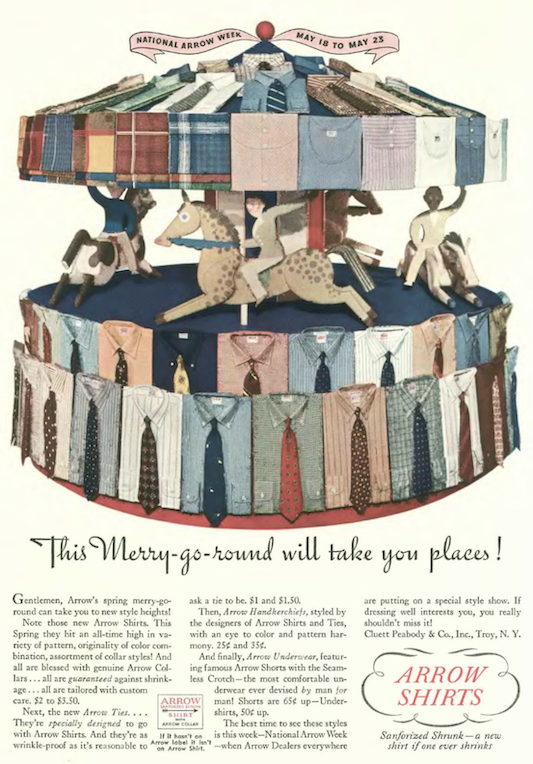
…we experience much of 1930s history in black and white, but according to this ad things were quite colorful…
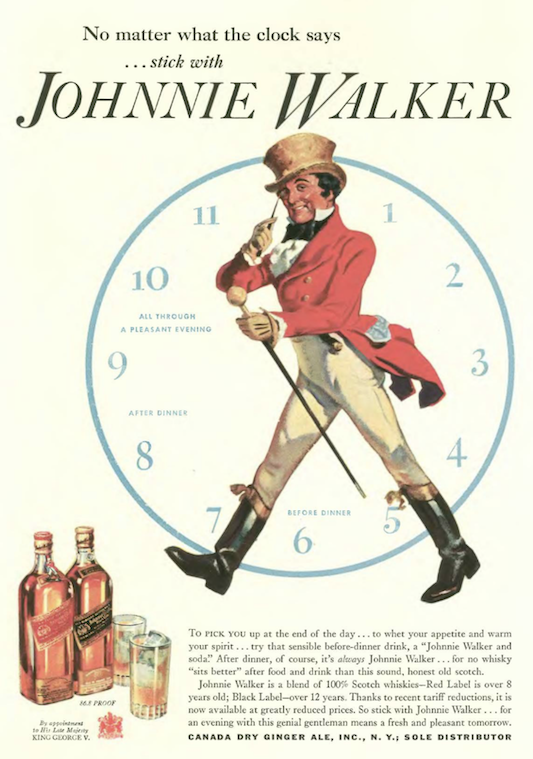
…now a couple of ads with an eye on the clock…here we have a suggestion that Johnnie Walker can be enjoyed before dinner and up to bedtime…
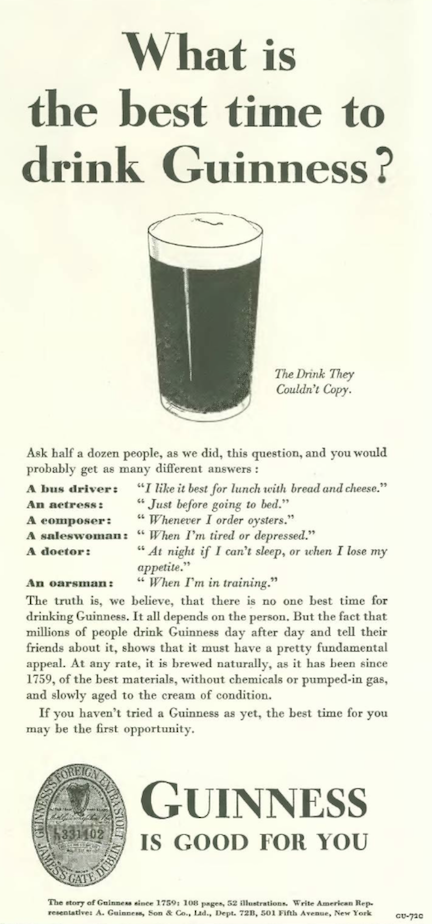
…the brewers of Guinness suggested their tipple was suitable for lunchtime, before bed, or when one is “tired or depressed”…
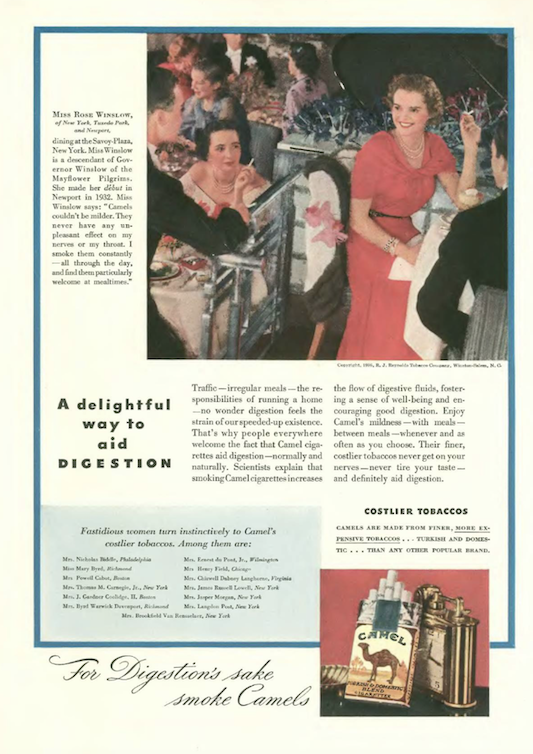
…as we already know, R.J. Reynolds encouraged folks to smoke from morning to night, with the added benefit of improved digestion…
…on to our cartoonists, we begin with a spot by Abe Birnbaum…
…and spots from frequent contributors Richard Taylor…
…and Christina Malman…
…and a spot drawing on the opening pages by James Thurber…
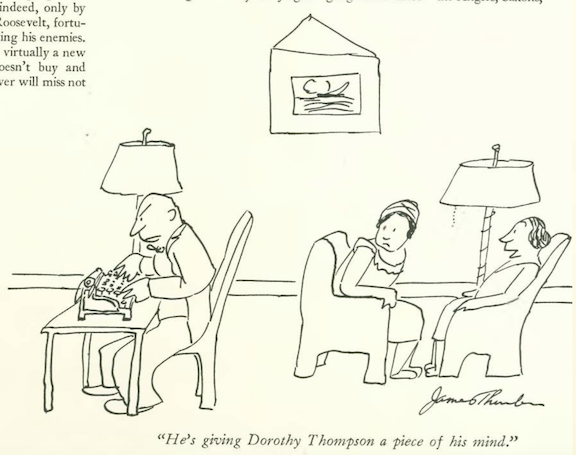
…who also contributed this cartoon to the issue…
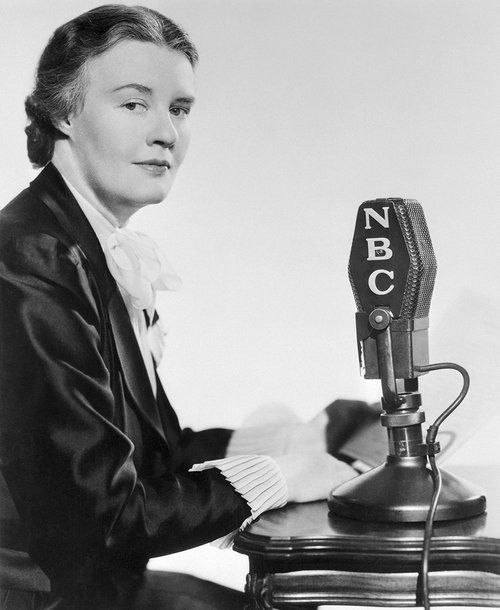
…Thurber’s caption refers to journalist and radio broadcaster Dorothy Thompson. One of the few women radio news commentators of the 1930s, she was the first American journalist to be expelled from Nazi Germany in 1934. In 1936 Thompson launched her “On the Record” column, syndicated nationwide by the New York Herald Tribune…
Dorothy Thompson in 1937. (Wikipedia)
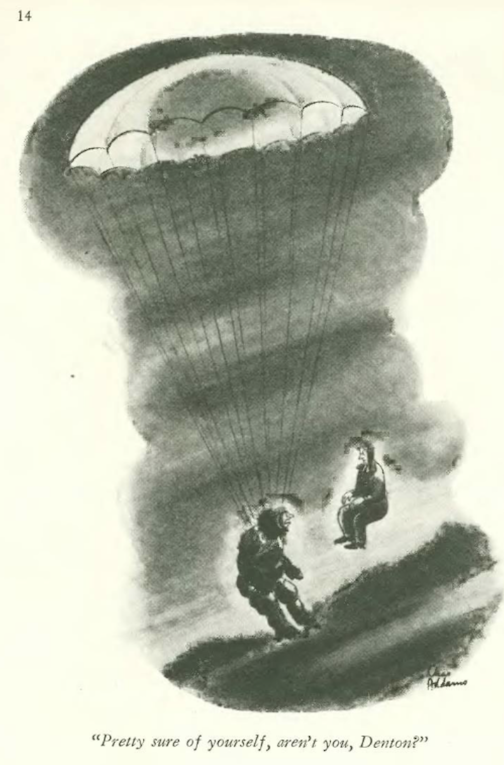
…we continue our cartoons with Charles Addams (apologies for the quality) floating to earth…
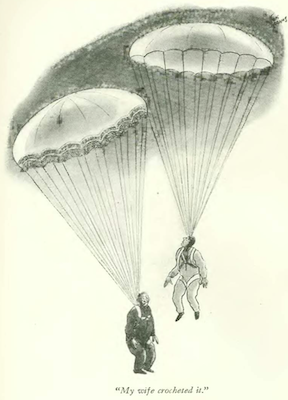
…which recalled another Addams cartoon from the Aug 3, 1935 issue (caption reads “My wife crocheted it.”)…
…and Addams again, this time down to earth…
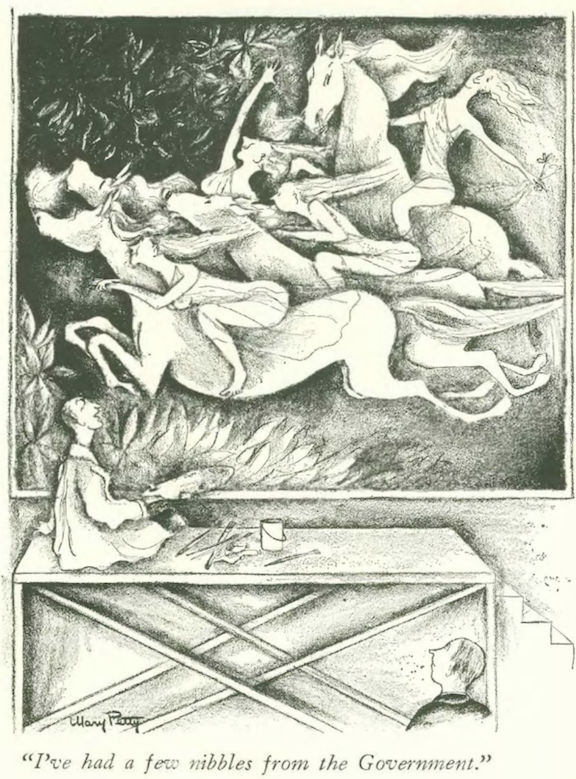
…Mary Petty looked in on the art world…
…William Crawford Galbraith continued to explore lives and loves of sugar daddies…
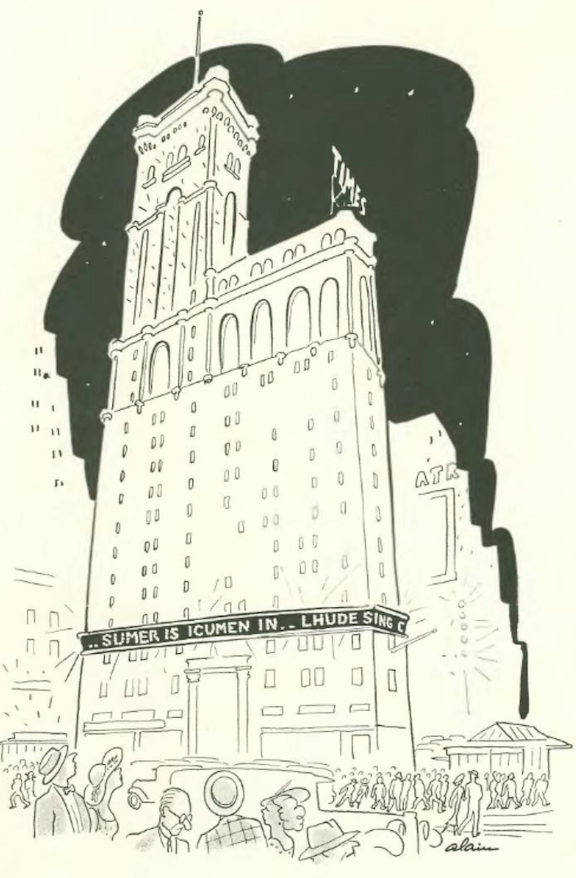
…Alain had folks deciphering the news crawler at Times Square…
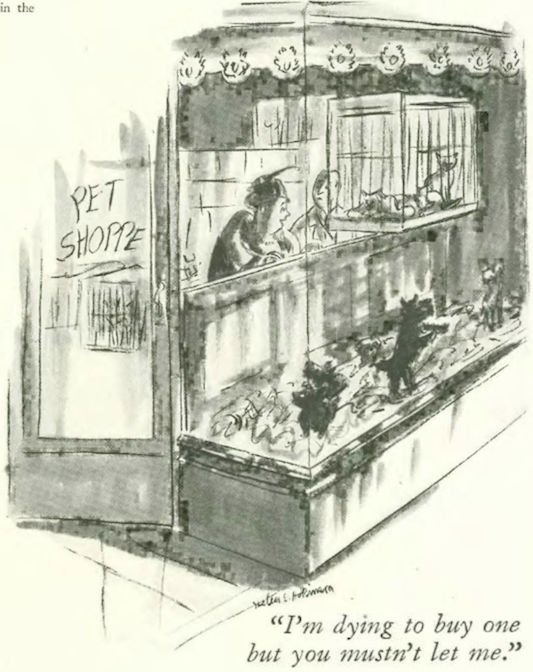
…Helen Hokinson avoided temptation at the pet shop…
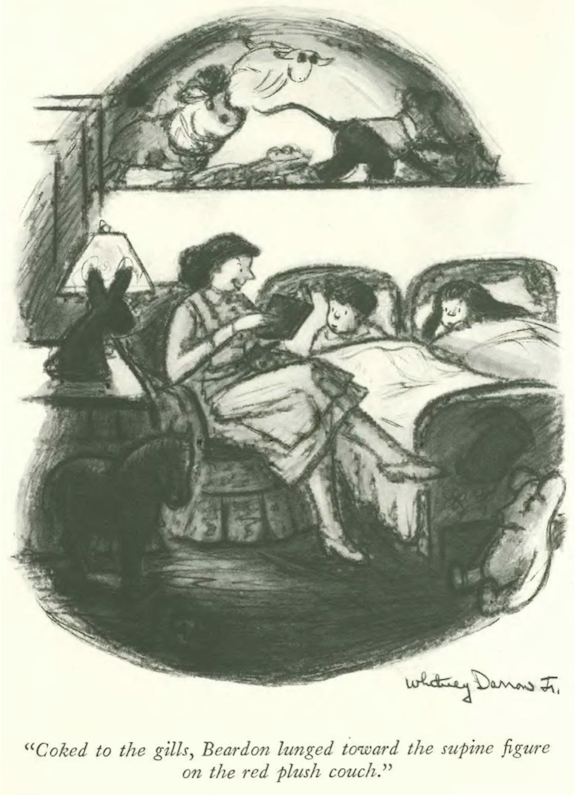
…and we close with Whitney Darrow Jr, and a bedtime story that would keep the sandman at bay…
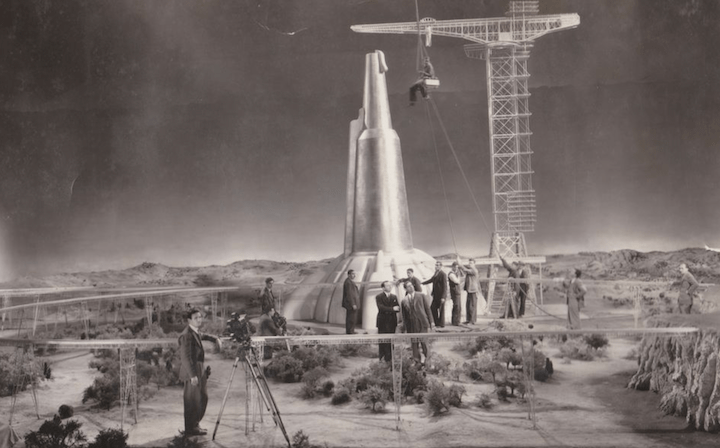
Above: Behind the scenes production photo of the space gun used to launch a manned projectile to the moon in Things to Come. (Instagram)
One of the most anticipated films of the 1930s was the British production of Things to Come. Loosely based on the 1933 science fiction novel by H.G. Wells,The Shape of Things to Come, the film was an extraordinarily ambitious and expensive production featuring a huge cast and elaborate sets, both full-scale and in miniature.
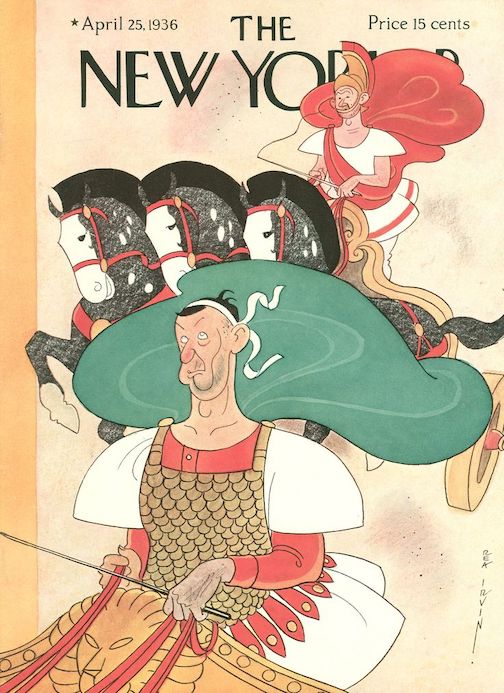
April 25, 1936 cover by Rea Irvin.
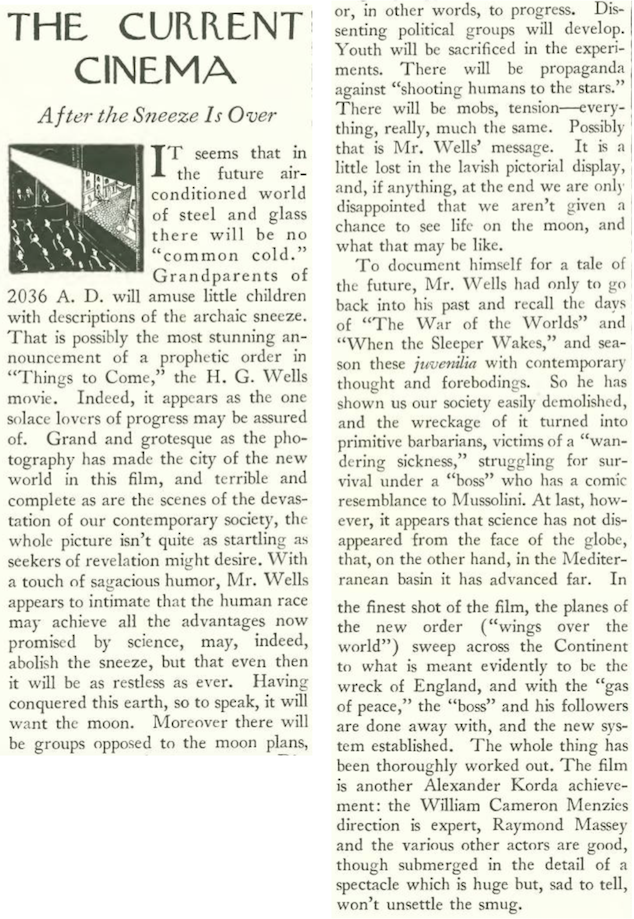
Critic John Mosher wasn’t quite sure what to make of Things to Come, seizing on the film’s promise to end the common cold.
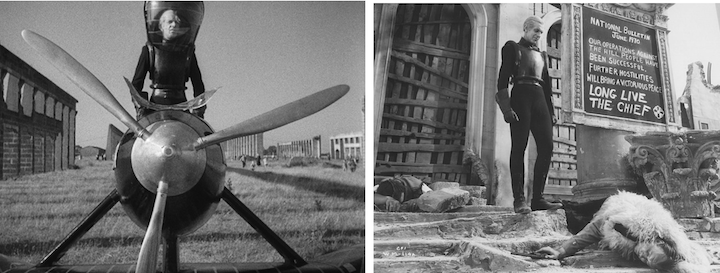
CLEANING CREW…A businessman in Everytown in the 1940s, John Cabal (Raymond Massey) returns in the 1970s to find his city in ruin and governed by a warlord. As a member of a secret organization called “Wings Over the World” (comprised of the last surviving band of engineers and mechanics), Cabal orders his organization to send giant flying wings over Everytown and saturate the population with a “Gas of Peace.” Not only does the gas make the population tranquil, it also kills the warlord, played by Ralph Richardson (right). (midnightonly.com/instagram.com)
In a review for The Criterion Collection, Geoffrey O’Brien notes that the film’s shocking scenes of war were shown to an audience “in active denial, many of them, of the possibility of such things coming to pass in the near future.”
But an antiseptic city with a population made docile by a “Gas of Peace” didn’t appear to be something one would look forward to either. O’Brien points to Jorge Luis Borges’ remarks regarding Things to Come: “The heaven of Wells and Alexander Korda, like that of so many other eschatologists and set designers, is not much different than their hell, though even less charming.” Borges dismissed the notion that science and technology would be the rallying force against tyranny: “In 1936, the power of almost all tyrants arises from their control of technology.”
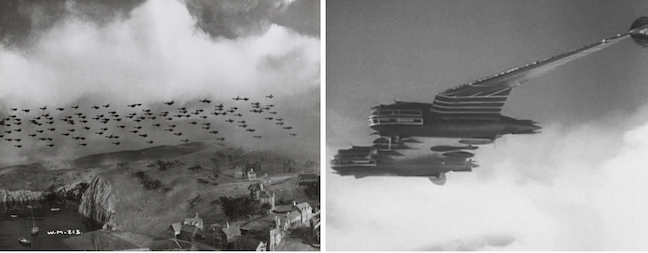
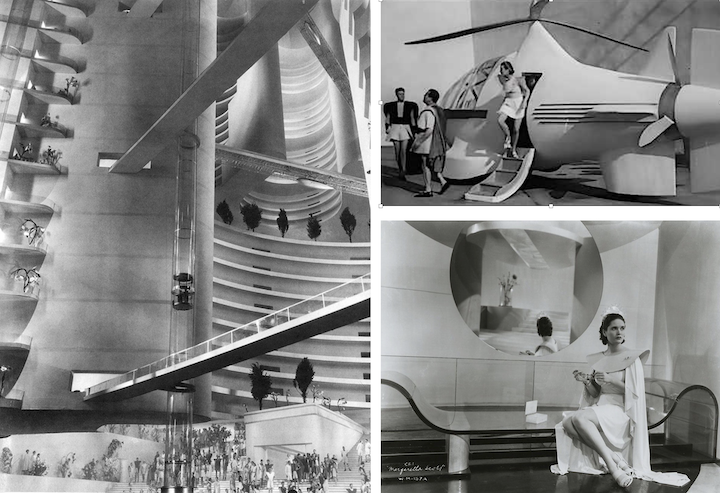
WAR AND PEACE…At left, bombers lay waste to Everytown in the 1940s, seemingly forecasting The Blitz of London in 1940-41; at right, decades later, “Wings Over the World” sends giant flying wings (right) over Everytown to saturate the population with a “Gas of Peace.” (Illinois.edu/facebook.com)UTOPIA?…After years of rebuilding, a new, underground Everytown emerges in 2036. The set (left) was designed by director William Cameron Menzies and Bauhaus artist Laszlo Moholy-Nagy. Above, transportation included autogyros; both men and women wore futuristic togas, including John Cabal’s great-granddaughter Catherine Cabal (Pearl Argyle). Note the acrylic furniture, ubiquitous in the future scenes of the film. (midnightonly.com/facebook.com/YouTube)
O’Brien concludes: “There is no way any audience, in the 1930s or now, would be likely to accept Raymond Massey’s Oswald Cabal as an empathetic spokesperson for the human race. He is essentially the chairman of the board of a quasi-fascist ruling elite—and not so very far from the idea that Wells, at best ambivalent about democracy, in fact had in mind.”
In all fairness, I should note that Massey did not like his character’s “heavy-handed speeches” that lacked human emotion. He complained H.G. Wells prioritized cold scientific ideals over personal character depth. “For heart interest, Mr. Wells hands you an electric switch,” Massey stated.
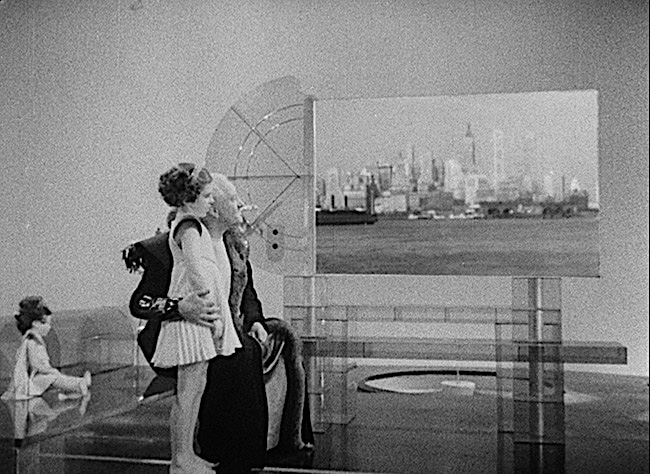
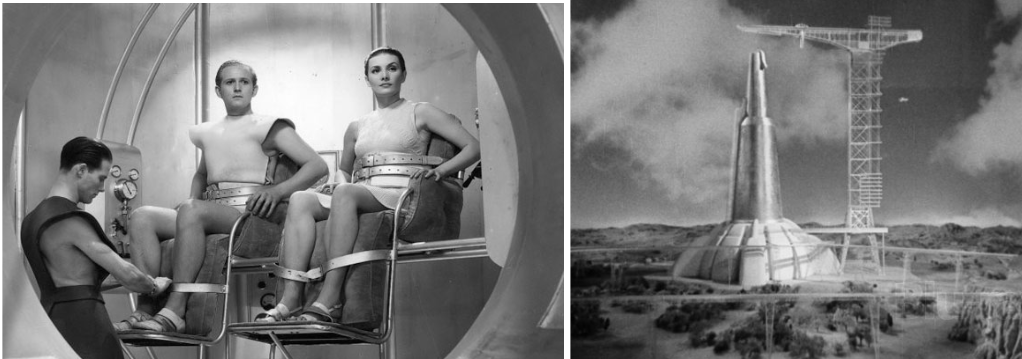
WISHES SOMETIMES COME TRUE…In the movie, a little girl in the year 2036 receives a history lesson from her great grandfather (including a video of 1936 New York), and she expresses delight that people will “keep on inventing things and making life lovelier and lovelier.” The little girl was played by eight-year-old Anne McLaren. The great grandfather was played by Charles Carson (1885–1977). (midnightonly.com)DAME McLAREN…In real life that little girl, Anne McLaren (1927–2007), did make life better, becoming a leading figure in developmental biology and paving the way for other women in science. Her work also helped lead to the development of human invitrofertilization. Dame Anne Laura Dorinthea McLaren received many honors for her research and ethical contributions. (YouTube.com/Wikipedia)POW! TO THE MOON…At left, Catherine Cabal (Pearl Argyle) and fellow scientist Maurice Passworthy (Kenneth Villiers) prepare to fly around the moon, launched from a gigantic space gun (right). (theguardian.com/YouTube)
Interestingly, Raymond Massey (1896–1983) and most of the film’s cast would live to see an actual moon landing in just 33 years. Most of them would also be involved in some way in the Second World War, Massey being wounded as part of the Canadian regiment.
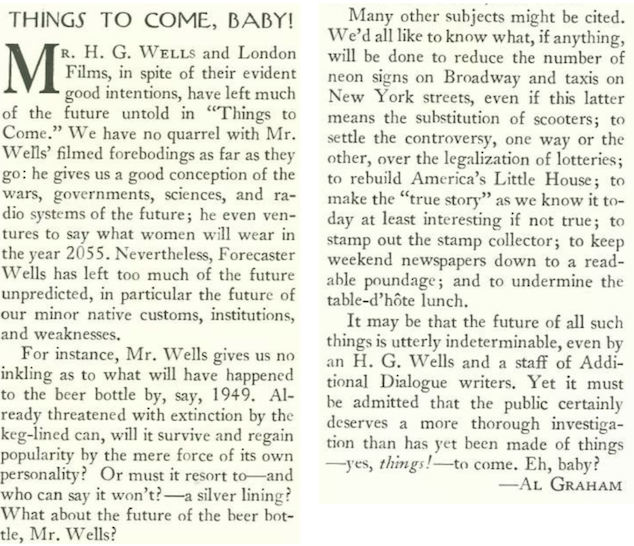
American writer and editor Al Graham (1905–1972), who contributed a number of poems and “Talk of the Town” pieces to The New Yorker in the Thirties and Forties, offered some thoughts regarding Things to Come. Here are excerpts of the first and last parts of his piece:
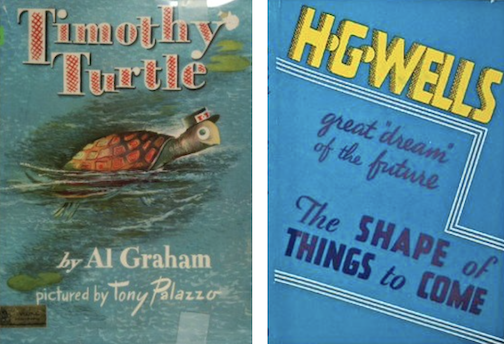
SLOW AND STEADY…Al Graham is perhaps best known for his 1930s humorous verse and children’s literature such as Timothy Turtle (1946) and The Rhymes of Squire O’Squirrel (1963). At right is a cover of the first edition of H.G. Wells’The Shape of Things to Come. (Wikipedia)
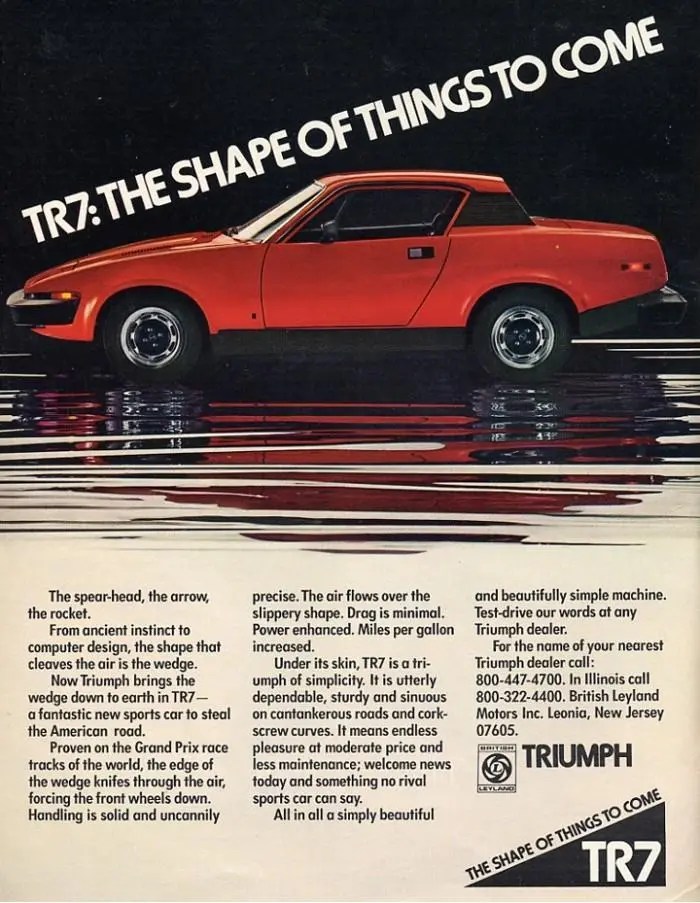
Incidentally, the British automaker Triumph used Wells’ title in a 1970s ad campaign for the TR-7…
(The Daily Drive)
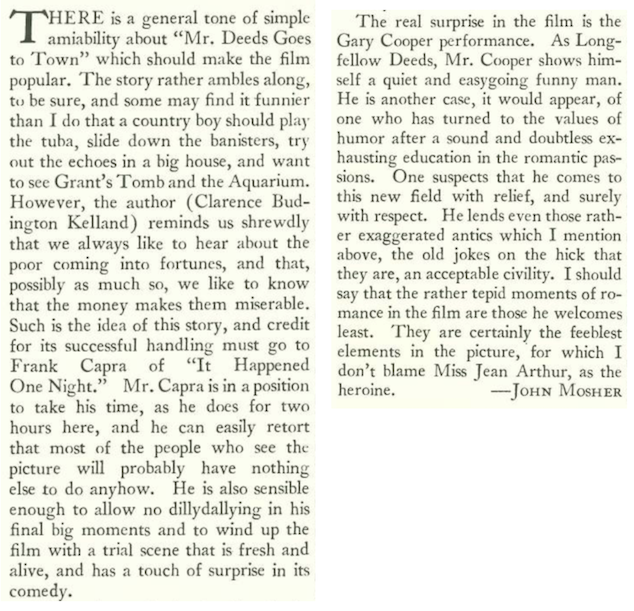
While we are talking movies, Mosher also reviewed Frank Capra’sMr. Deeds Goes to Town. Films such as Mr. Deeds and It’s a Wonderful Life were Capra’s “love letters to an idealized America—a cinematic landscape of his own invention,” wrote social critic Morris Dickstein. Or as actor/director John Cassavetes once observed: “Maybe there really wasn’t an America, it was only Frank Capra.” Whatever it was, Mr. Deeds would win Capra his second Oscar for Best Director (he would win three in all, plus a fourth for a World War II documentary).
HAPPY ENDING…Mr. Deeds (Gary Cooper) finds love and salvation with Jean Arthur in Mr. Deeds Goes to Town. (britannica.com)
* * *
Ah-Choo!
Those familiar with E.B. White’s writings are likely also familiar with his lifelong struggle with hay fever, or “catarrh” as it was also referred to in those days. White notably wrote about his condition in a 1938 New Yorker essay, “Daniel Webster, the Hay Fever, and Me.” He addresses the malady in his April 25, 1936 “Notes and Comment” column:
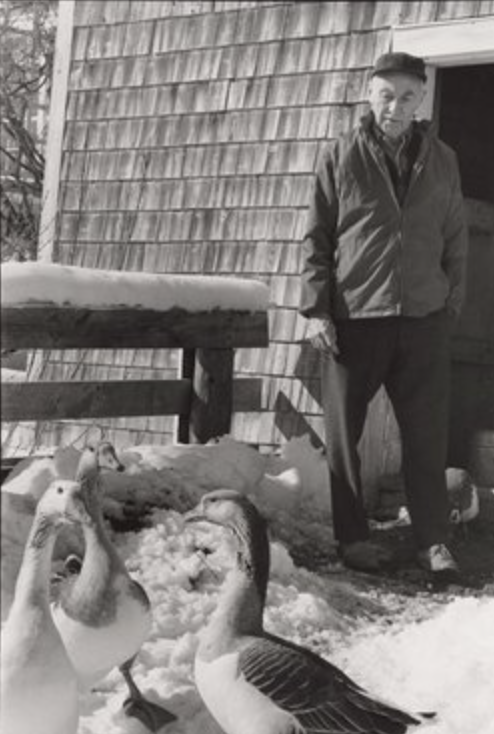
SNEEZING AND HONKING…Despite his allergies, E.B. White had a deep love for the countryside and nature. Although he grew up just outside New York City, he cultivated a love of rural life that was finally realized when he and wife Katharine bought a farm near Brooklin, Maine. Above is a 1974 photo (by Jill Krementz) of White at his Maine farm. (cornell.edu)
One of the more common and effective treatments for allergies in the Thirties was the benzedrine inhaler. The active ingredient was amphetamine. It was safe if inhaled, however some folks got the idea to crack open the inhaler and swallow the contents, which would induce a mind-altering effect (the amount of amphetamine in the inhaler was 250 milligrams, much greater than the five or ten milligrams in tablets prescribed for depression).
NOT SHIRLEY TEMPLE, however the marketers of the inhaler probably wanted consumers to make the connection. (mcgill.ca)
* * *
Before the Internet
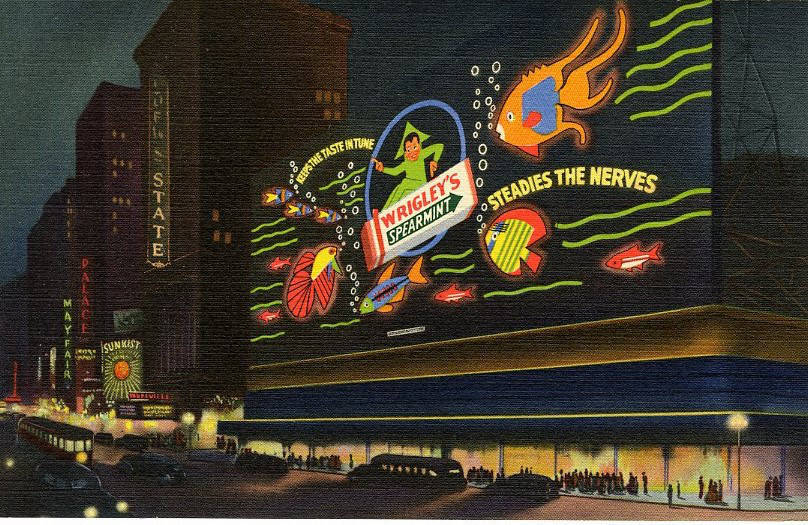
What did some folks do in the evening before modern-day distractions? According to “The Talk of the Town,” at least one man and his family loved to gawk at the new Wrigley sign in Times Square.
CHEW ON THIS…The Wrigley sign spanned the block on Broadway from 44th Street to 45th Street. Designed by artist Dorothy Shepard, the display featured fish blowing bubbles and was lit by 29,608 lamps and 1,084 feet of neon tubing. It was so large that its electrical power usage was estimated to be equivalent to a small city of ten thousand people. (Wikipedia)
* * *
From Our Advertisers
White Rock continued its series of brightly illustrated ads, this most likely the work of noted illustrator John Holmgren…
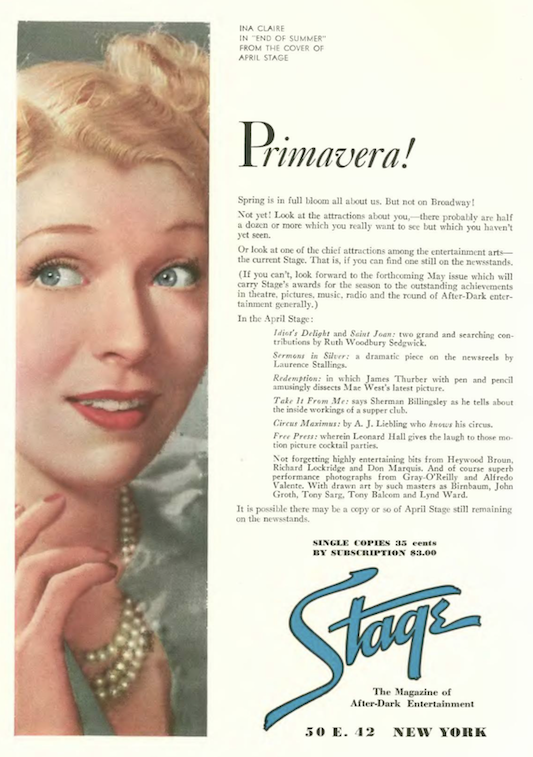
…Stage magazine continued to promote its star-studded content in full-page color ads…this one featured American stage and film actress Ina Claire…
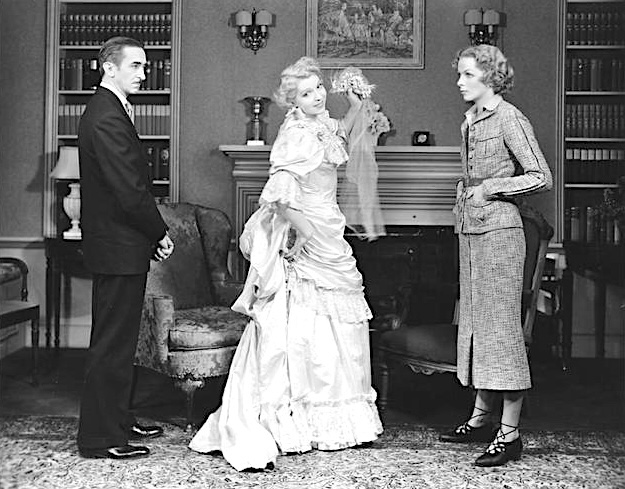
Ina Claire, center, with Osgood Perkins and Doris Dudley in End of Summer.(jacksonupperco.com)
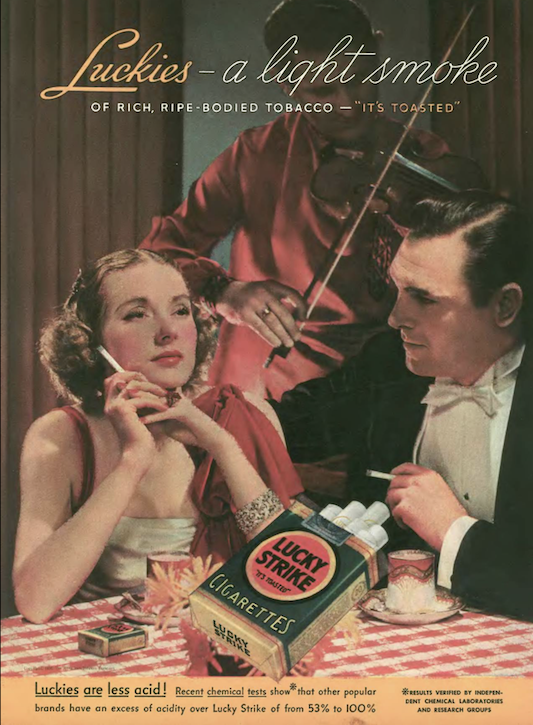
…ah, the pleasure of an after-dinner Lucky back in the day when you could still smoke indoors…
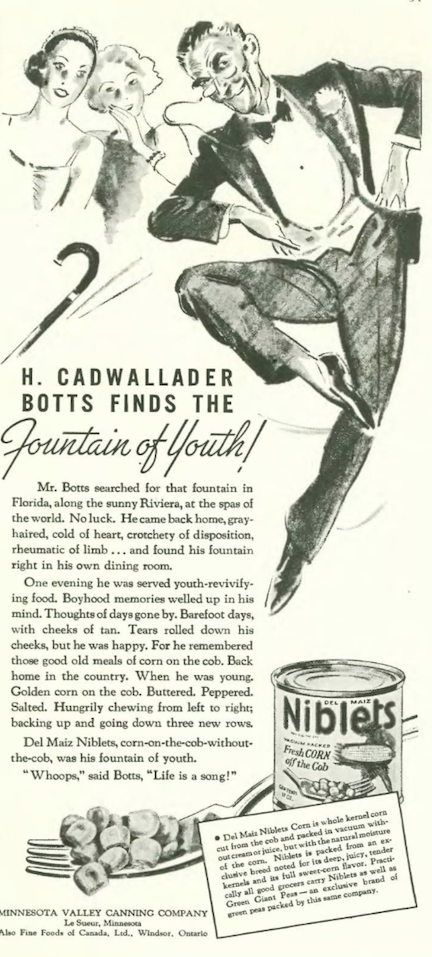
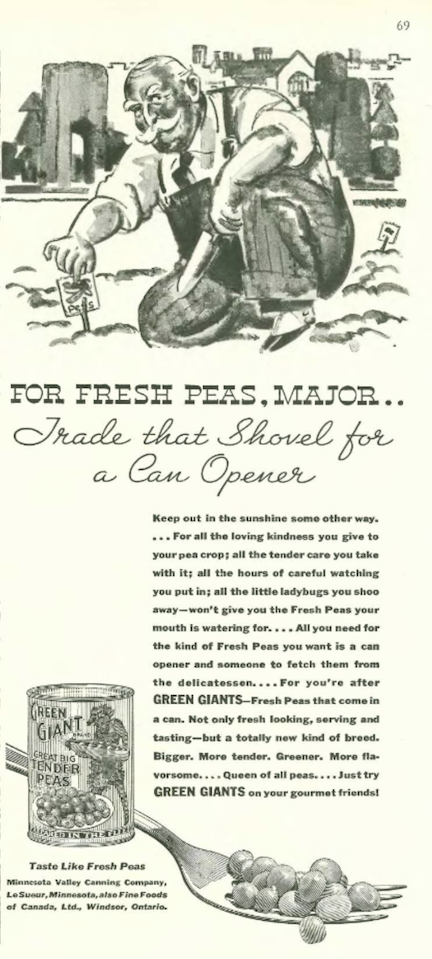
…another ad for Green Giant Niblets featuring a rich old toff who’s just over the moon about canned corn…
…these surreal Lyse Darcy ads for Guerlain really stood out in the magazine…
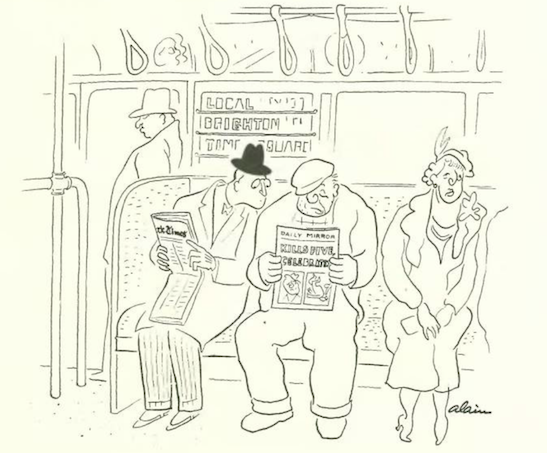
…speaking of standing out, who could resist the distraction of a tabloid, especially with the Gray Lady folded in one’s lap?…Alain illustrates…
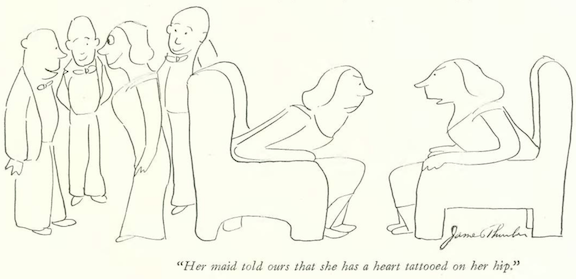
…and per James Thurber, who was immune to the charms of a woman with a heart tattooed on her hip?…
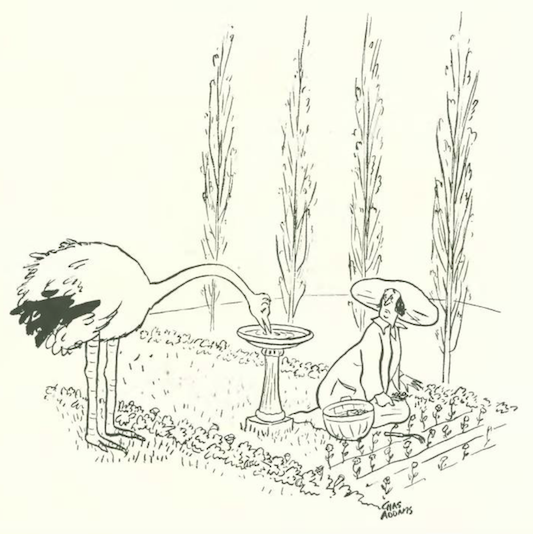
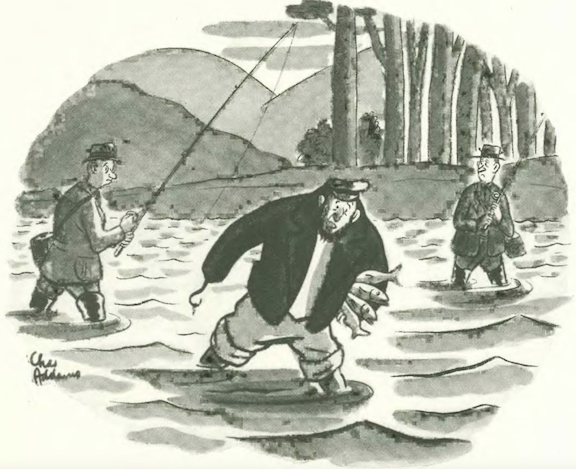
…Charles Addams showed us a man with a built-in fishing advantage…
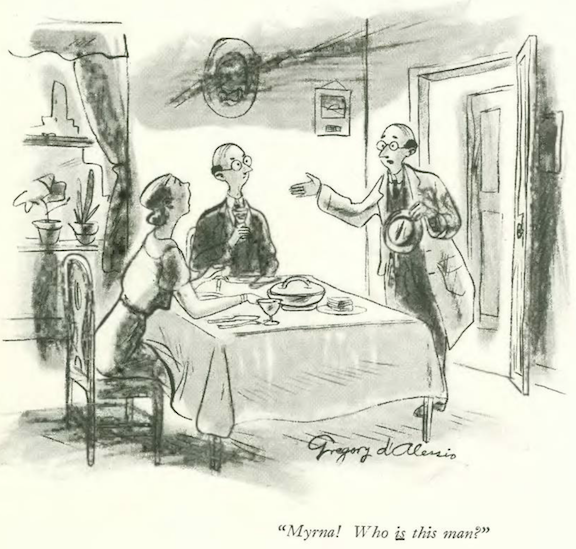
…Gregory d’Alessio gave us an understandable marital mix-up…
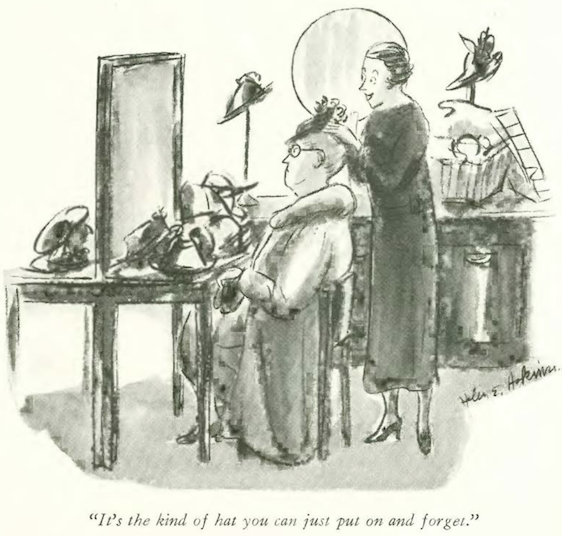
…Helen Hokinson offered a dose of “meh” in the hat department…
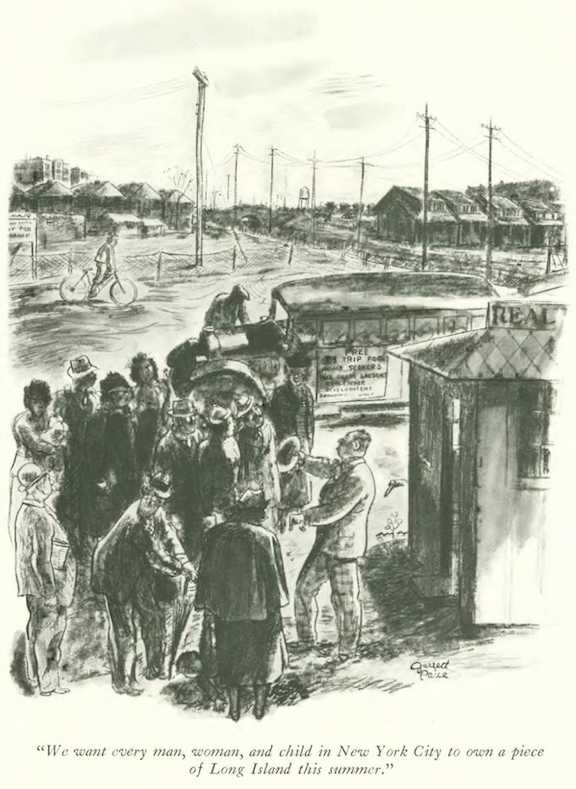
…Garrett Price showed us the consequences of Robert Moses’s transformation of Long Island from a rural area for the rich into a suburban landscape for the hoi polloi…
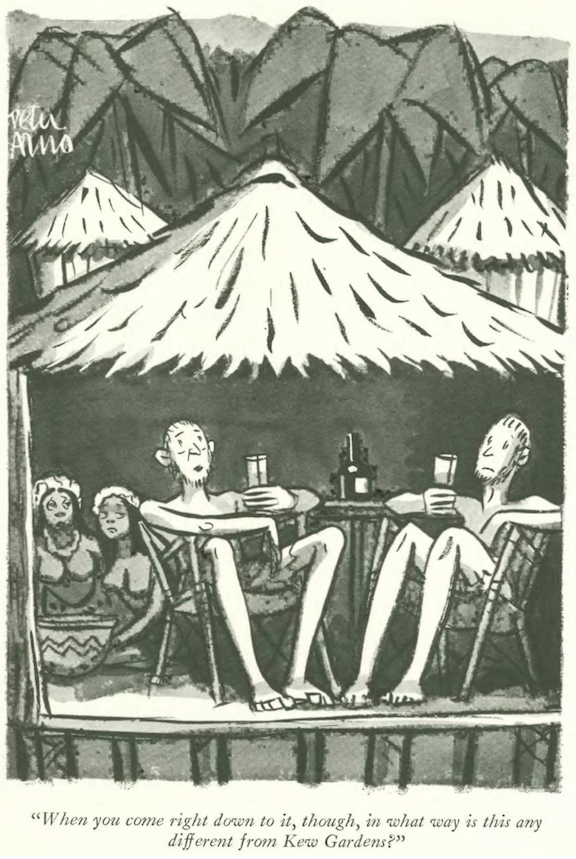
…and we close with Peter Arno, who wondered what’s the fun of drinking in the tropics when you can do the same thing in Queens?…
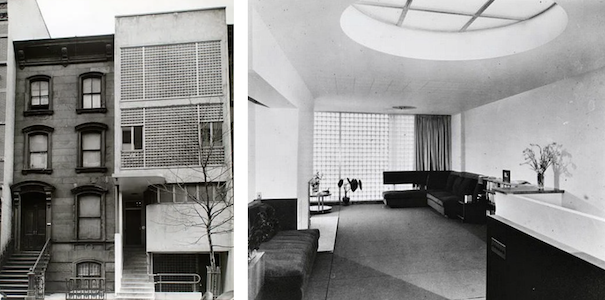
Above: The Morris B. Sanders Studio and Apartment is the second-oldest modern townhouse in Manhattan. Sanders designed the townhouse, located on 49th Street between 2nd and 3rd Avenue, in 1934 for his own use, and construction was completed in December 1935. (Wikipedia/docomomo-nytri.org)
Today we barely notice the tens of thousands of shiny glass buildings that populate our cities, not to mention the countless postwar houses that feature vast expanses of glass from floor to ceiling.
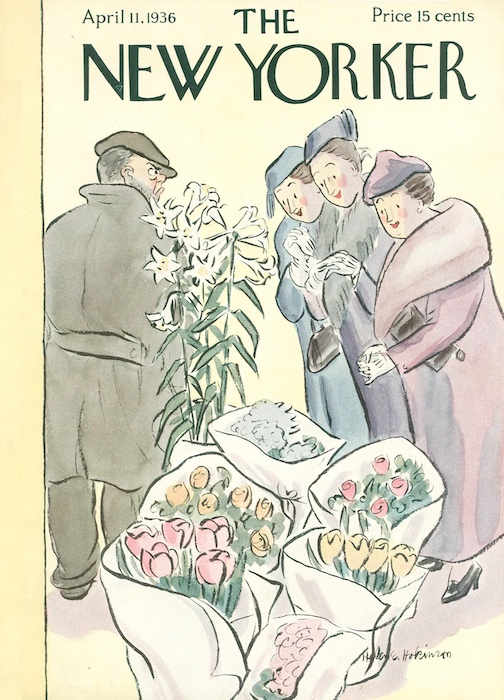
April 11, 1936 cover by Helen Hokinson.
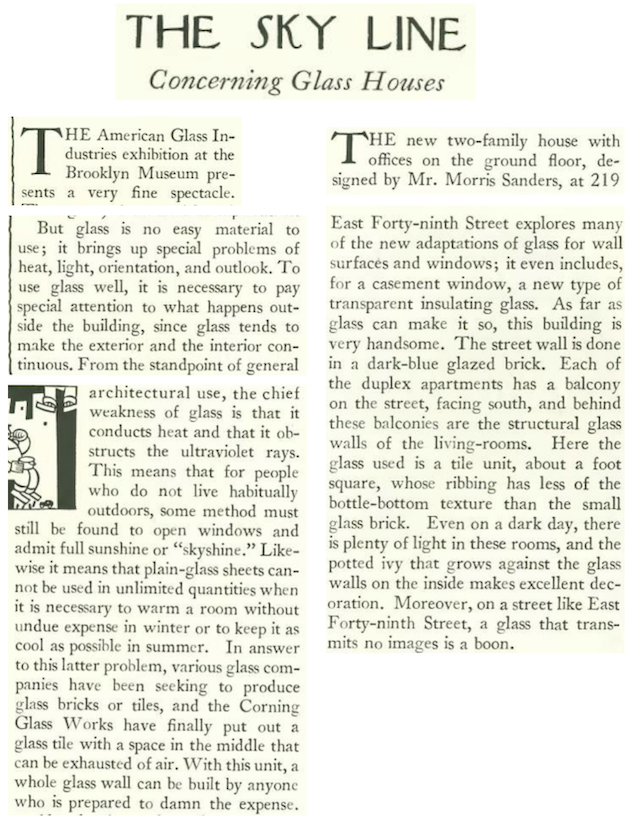
In 1936 a house made of glass, especially as a structural element, seemed unlikely to most folks, if not downright bizarre. Enter Lewis Mumford, arts and architecture critic for The New Yorker, who was critical of many modern industrial trends and often promoted his ideal of human-scaled, organic design in buildings and cities. Mumford was not opposed to new technologies, such as glass block, as long as it was employed with sensitivity and good taste. Here are some of Mumford’s observations after visiting the American Glass Industries Exhibition at the Brooklyn Museum:
NEW NEIGHBOR…Morris B. Sanders’ studio and apartment at 219 East 49th Street in Turtle Bay boldly interrupted a stodgy row of brownstones. Lewis Mumford pronounced the 1936 building “very handsome.” The New York City Landmarks Preservation Commission designated the building as an official landmark in 2008. (curbed.com/Wikipedia)
The Sanders House wasn’t the first time a brownstone was replaced by a modernist building. That honor goes to another Turtle Bay-area house, just one block from the Sanders house, designed by architect William Lescaze in 1933-34.
ODD COUPLE…Designed by William Lescaze in the International Style between 1933 and 1934 as a renovation of a 19th-century brownstone townhouse, 211 East 48th Street was one of three houses in Manhattan designed by Lescaze. (atlasobscura.com/inside inside.org)
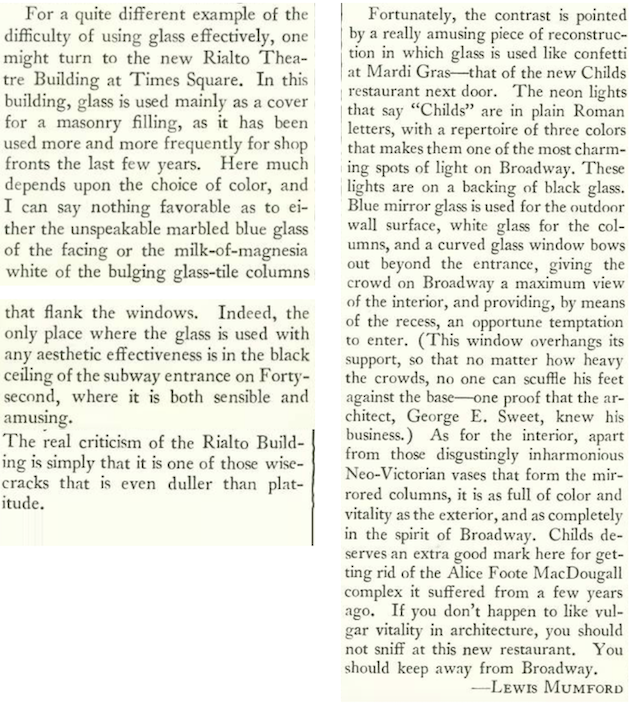
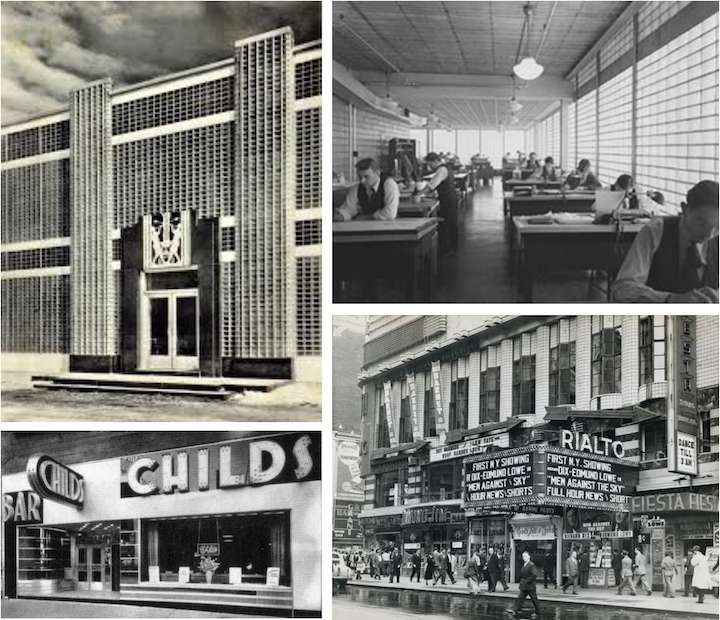
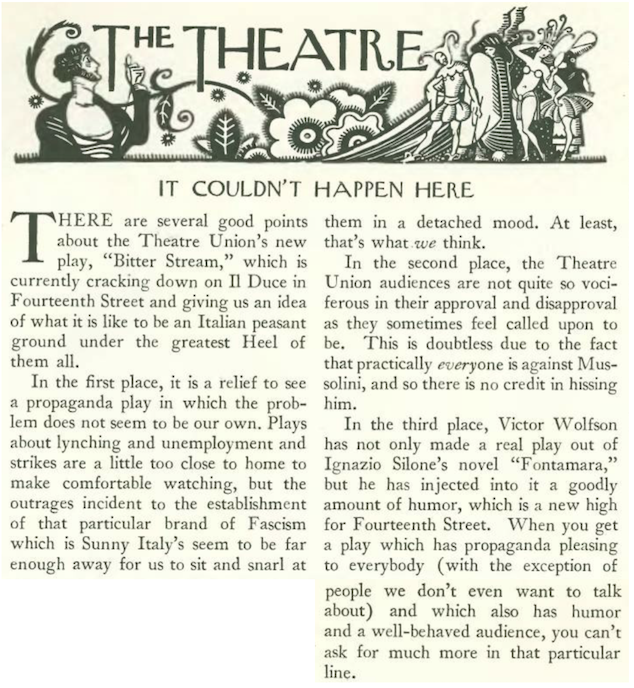
The Brooklyn Museum exhibition also included commercial examples such as one of the world’s first buildings to be completely covered in glass, the Owens-Illinois Glass Research Laboratory in Toledo, Ohio. Mumford also commented extensively on the new uses of glass in Times Square, namely the rebuilt Rialto Theatre and a Childs restaurant located next door. Excerpts:
THINGS TO COME…Clockwise, from top left, the Owens-Illinois Glass Research Laboratory in Toledo, Ohio, built between 1935 and 1936, is recognized as one of the world’s first buildings to be completely covered in glass, utilizing glass blocks for the facade; Lewis Mumford was less impressed with the use of glass by the newly rebuilt Rialto Theatre, but praised the new Childs location next door for being full of “vitality and color.” (facebook.com/dinerhunter.com)
* * *
Down on Il Duce
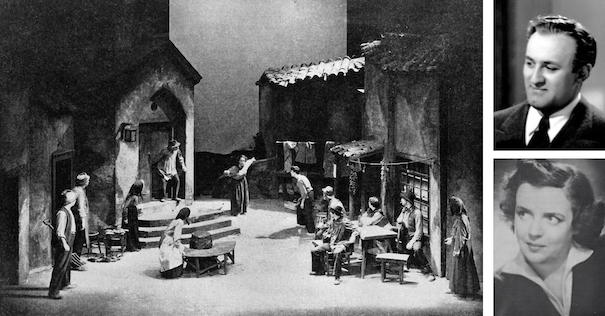
Last week we saw Robert Benchley’s review of the anti-war play, Idiot’s Delight. This week he reviews another play with themes that resonated in the moment, Bitter Stream. Written by Victor Wolfson and adapted from Ignazio Silone’s novel, Fontamara, the play depicted the horrors of fascism as Mussolini’s Black Shirts brutally seize an Italian neighborhood. It featured relative newcomer Lee J. Cobb as well as Frances Bavier, who twenty-four years later would portray Aunt Bee on The Andy Griffith Show. Excerpts:
TROUBLE IN SUNNY ITALY…A scene set in Fontamara Square in the play Bitter Stream, which ran for sixty-one performances at the Civic Repertory Theatre. At right, Lee J. Cobb portrayed Don Circonstantza, and Frances Bavier played the part of Soreanera. Bavier is best known for her portrayal of Aunt Bee on The Andy Griffith Show (1960-1968). (revolutions newsstand.com/facebook.com)
* * *
Sick Leave
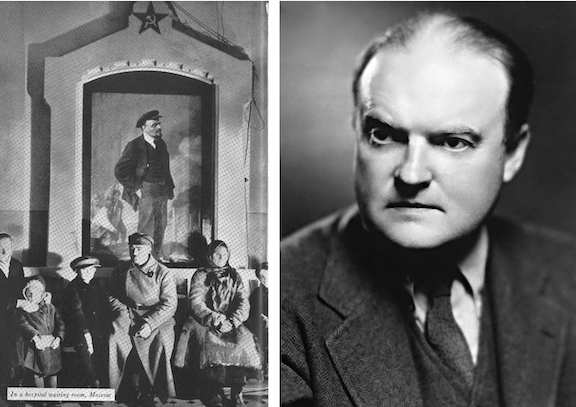
Also last week we saw the first part of Edmund Wilson’s account of his travels in the Soviet Union. For the April 11 installment of “A Reporter at Large” (titled “Scarlet Fever in Odessa”), Wilson recounted his six-week stay in a filthy Soviet hospital. Excerpts:
WANTING OUT…Edmund Wilson couldn’t wait to get out of the “terribly dirty” Odessa hospital where he was quarantined with scarlet fever for six weeks. At left, photo by Margaret Bourke White, “In a Hospital Waiting Room, Moscow,” 1932. At right, Wilson in 1936. (nyamcenterforhistory.org/Wikipedia)
* * *
Gall in Gaul
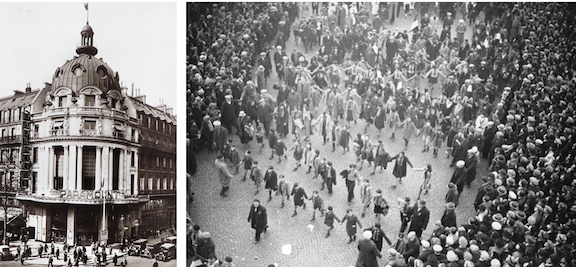
In her Paris Letter, Janet Flanner continued to share her observations about the French mood (agitated) in the wake of the German occupation of the Rhineland.
HOW ABOUT A NICE DITTY INSTEAD?…Janet Flanner reported that there was a “near riot” when a performance at the Paramount Theater (left) included “military music.” At left, the Paramount in 1927; at right, a Popular Front demonstration in Paris, 1936. (Wikimedia/Bibliothèque nationale de France)
* * *
At the Movies
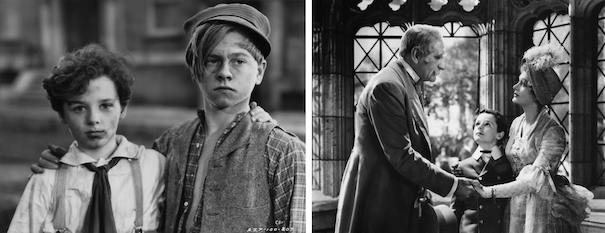
Little Lord Fauntleroy was Selznick International Pictures’ most profitable film until Gone with the Wind, and it featured one of the top child stars of the 1930s, English-American child actor Freddie Bartholomew (1924–1992). However, New Yorker film critic John Mosher was “bored to extinction” by the popular film.
SLUMMING…At left, Freddie Bartholomew and Mickey Rooney in Little Lord Fauntleroy. Rooney once said of Bartholomew: “He was one of the finest, if not the finest child stars that we had on the scene at that time”; at right, Aubrey Smith, Bartholomew and Dolores Costello in a scene from the film. (MGM/Wikipedia)
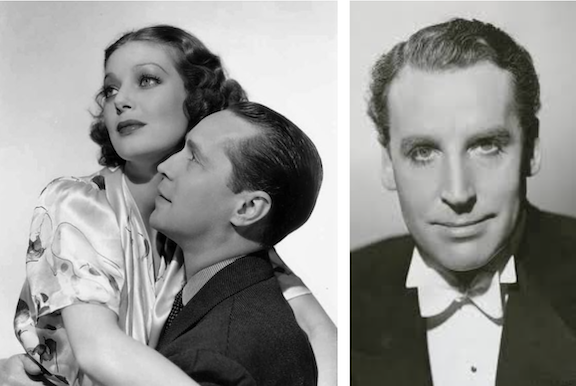
One of Hollywood’s greatest screen villains, English actor Henry Daniell, caught Mosher’s attention for his “smooth” performance as a blackmailer in The Unguarded Hour. The critic also enjoyed the thriller The House of a Thousand Candles, but was left flat by Give Us This Night.
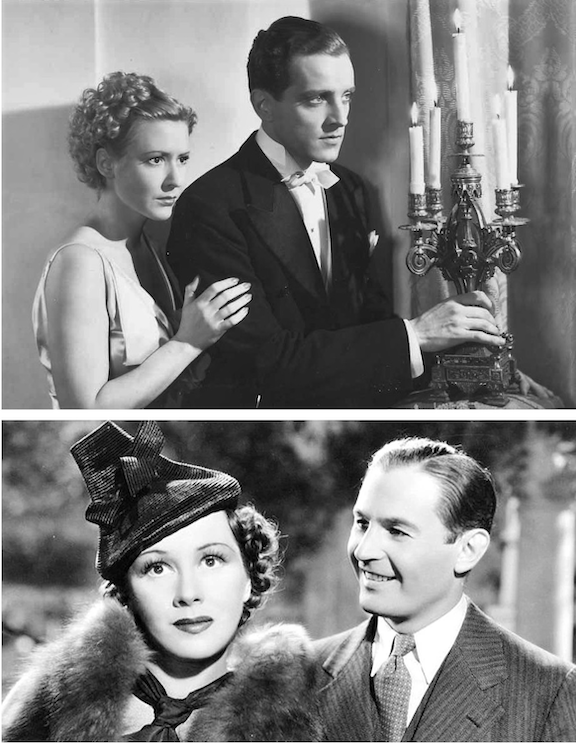
A MANNERED SCAMP was how John Mosher described one of Hollywood’s greatest screen villains, English actor Henry Daniell (right) in The Unguarded Hour, which also starred (at left) Loretta Young and Lewis Stone. (imdb.com/facebook.com)THRILLS AND TRILLS…Top photo, Mae Clarke and Phillips Holmes in the spy thriller The House of a Thousand Candles; below, Give Us This Night was one of five films produced by Paramount that featured the popular Metropolitan Opera mezzo-soprano Gladys Swarthout, seen here with Polish opera singer and actor Jan Kiepura.(imdb.com/mabumbe.com)
* * *
From Our Advertisers
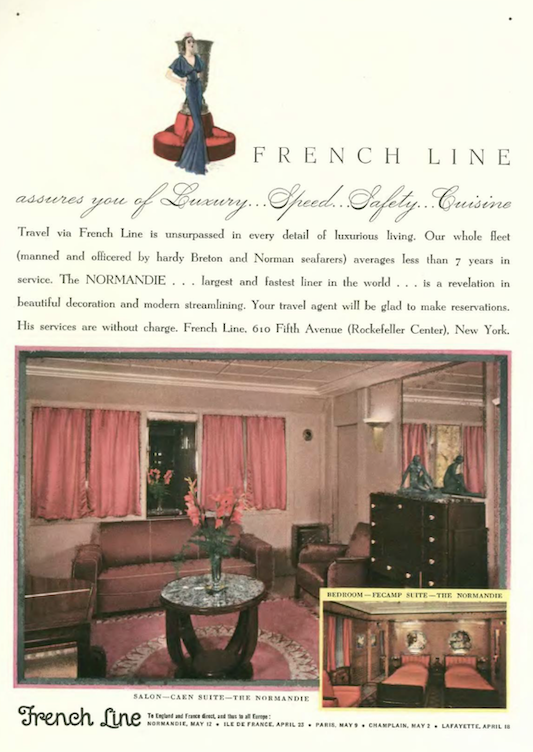
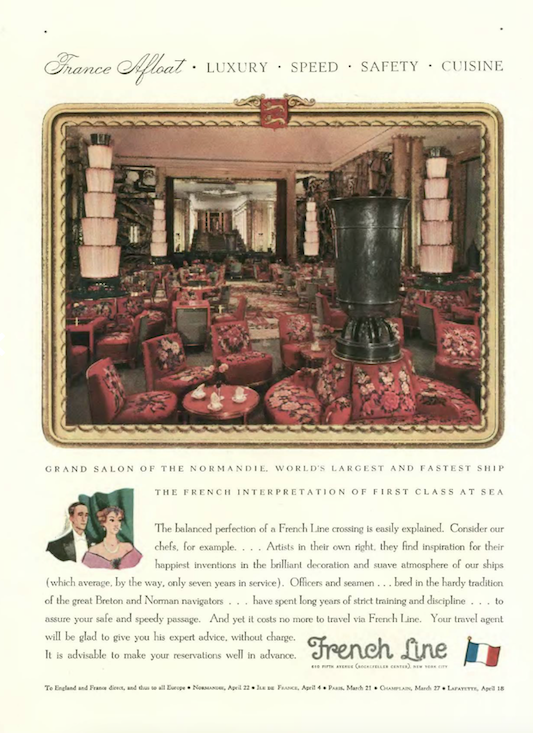
If you could afford it, a first-class salon on the Normandie sure looked like a great way to travel to France…
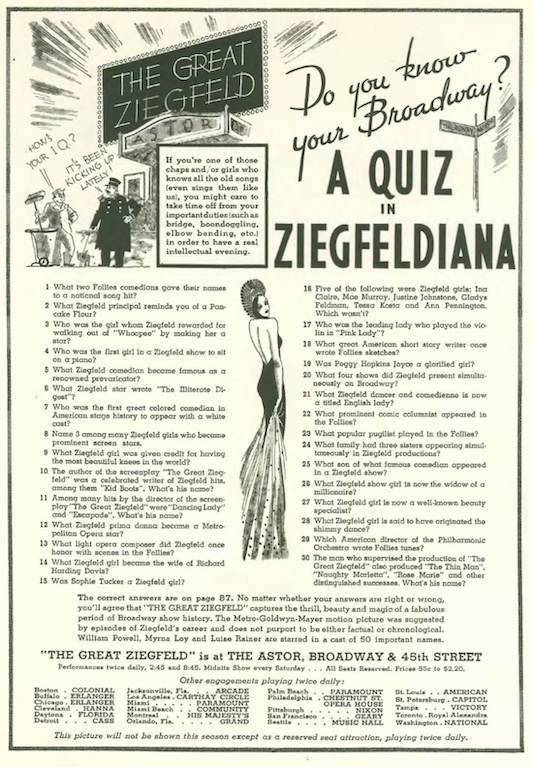
…this full-page ad enticed moviegoers with a quiz that promoted MGM’s The Great Ziegfeld…one of the most successful films of the 1930s, the movie won three Academy Awards, including Best Picture, Best Actress (Luise Rainer), and Best Dance Direction…
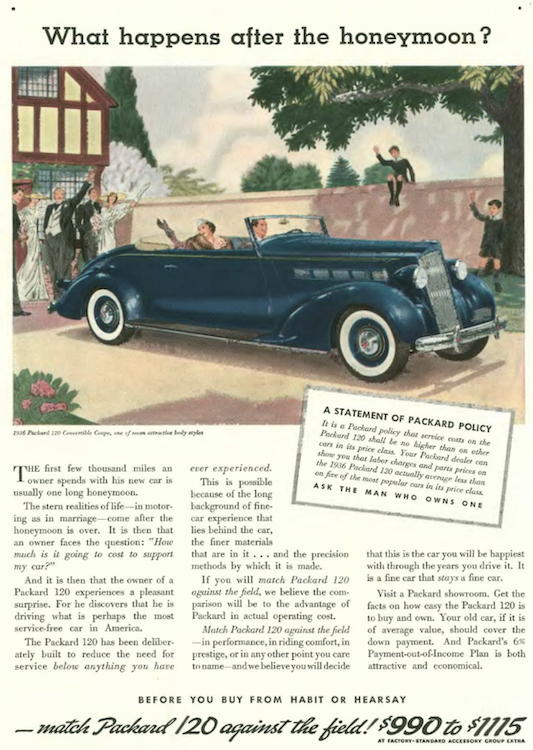
…who knows what will happen after the honeymoon, but we do know they will driving around in this swell-looking Packard 120, a lower-priced model that helped keep Packard afloat during the waning days of the Depression…
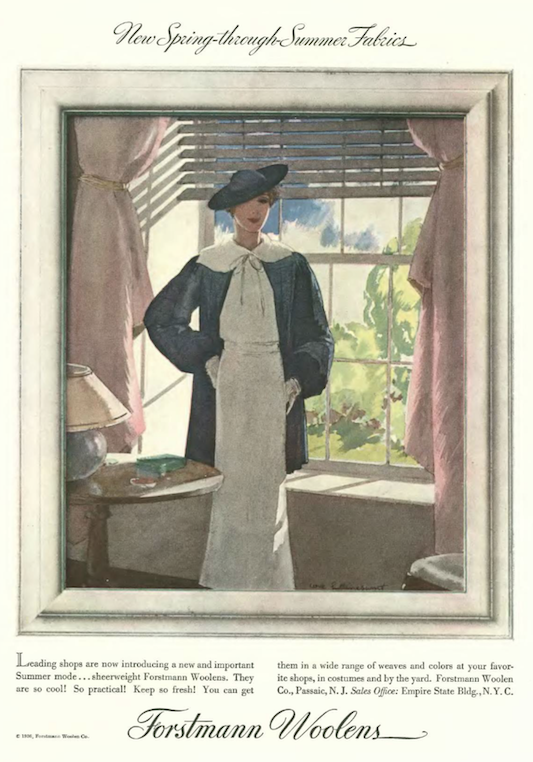
…Forstmann Woolens continued to entice buyers with their seasonal images of fine fashions…
…on to our cartoonists, we begin with the illustration for “The Theatre” section, this week Miguel Covarrubias taking over for Al Frueh…
…Richard Taylor contributed this fine spot illustration…
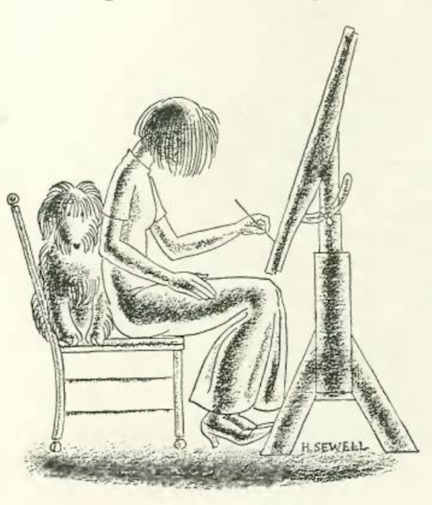
…and we have another spot by Helen Moore Sewell…
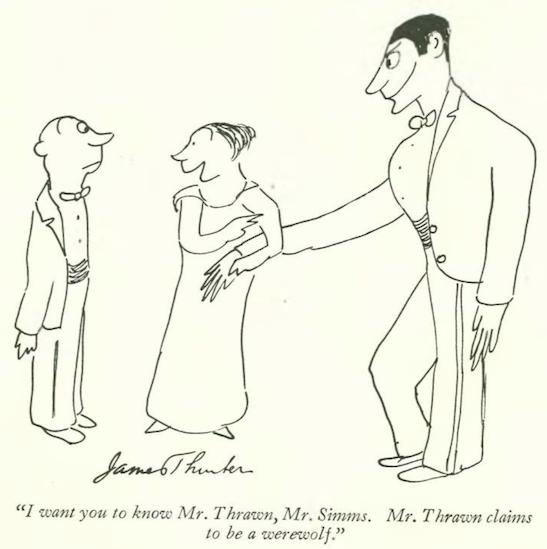
…James Thurber made an awkward introduction…
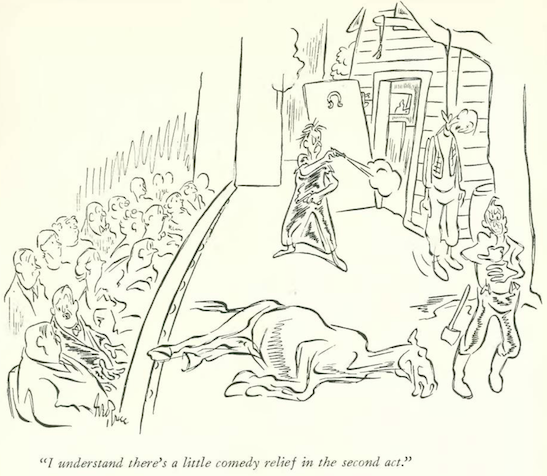
…George Price hoped for some comic relief at the theatre…
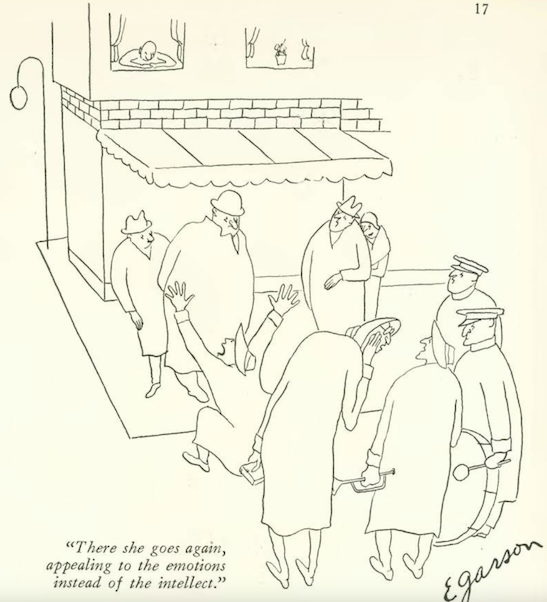
…Eli Garson found religious zeal at a street corner…
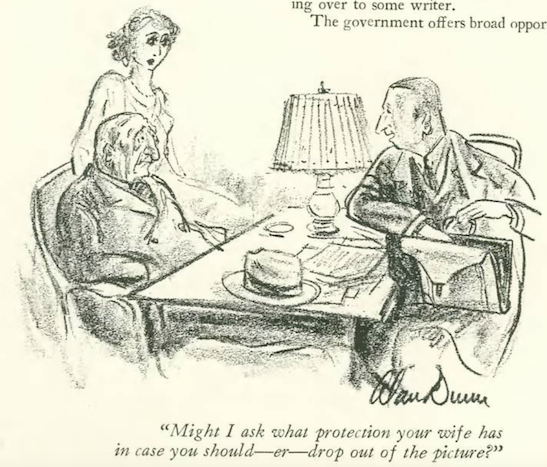
…Alan Dunn gave us a great opening line for an insurance salesman…
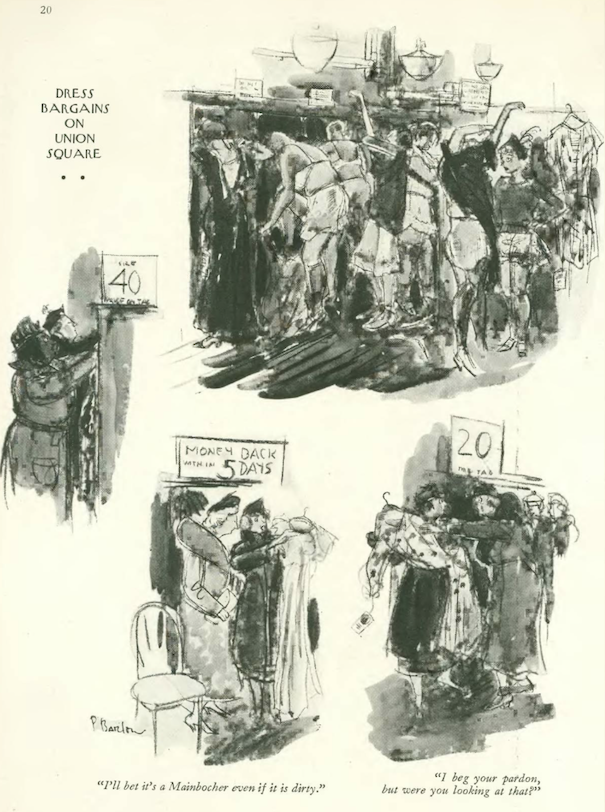
…Perry Barlow was inspired by bargains on Union Square…
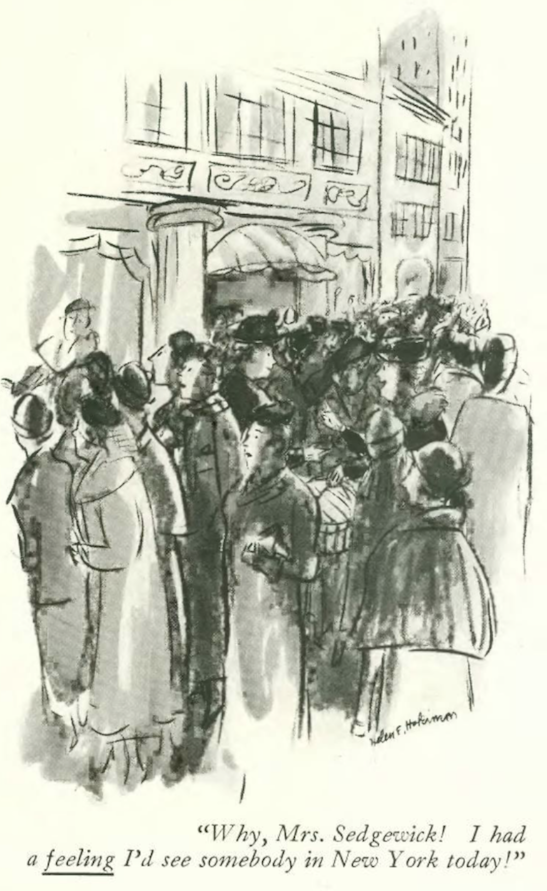
…Helen Hokinson spotted a familiar face in the crowd…
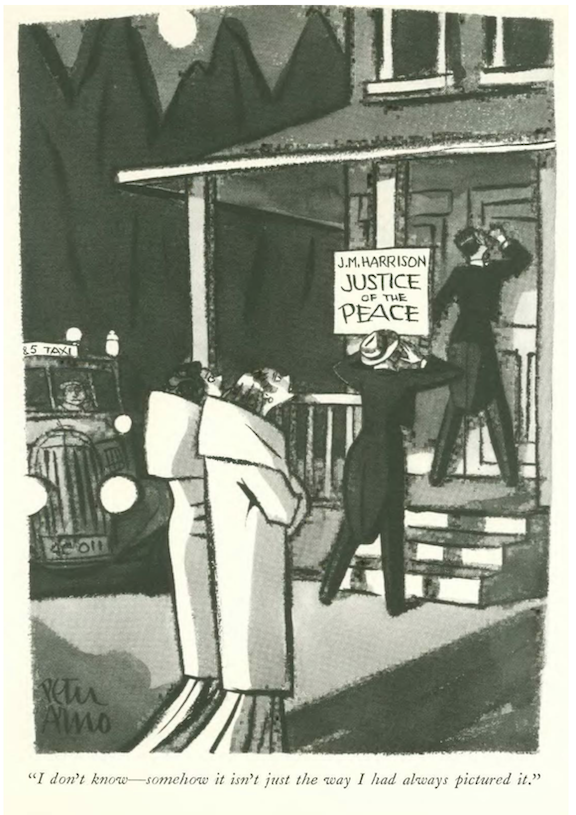
…a quickie marriage left no room for romance, per Peter Arno…
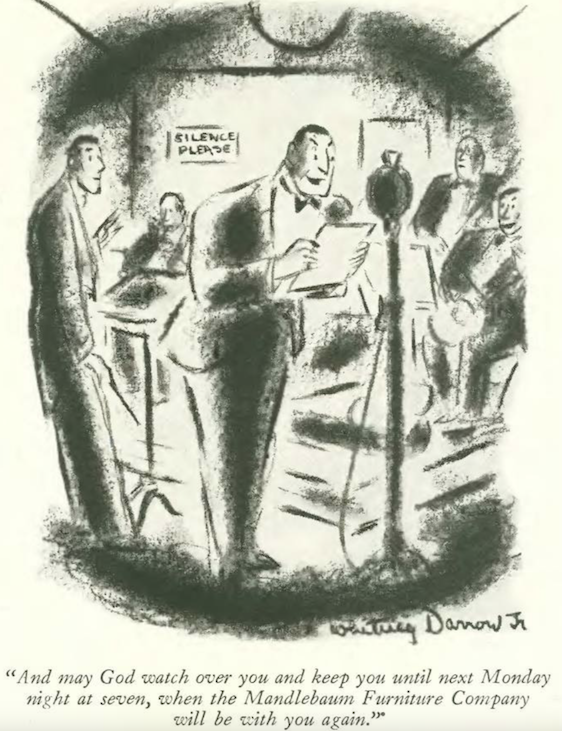
…Whitney Darrow Jr signed us off with an endorsed blessing…
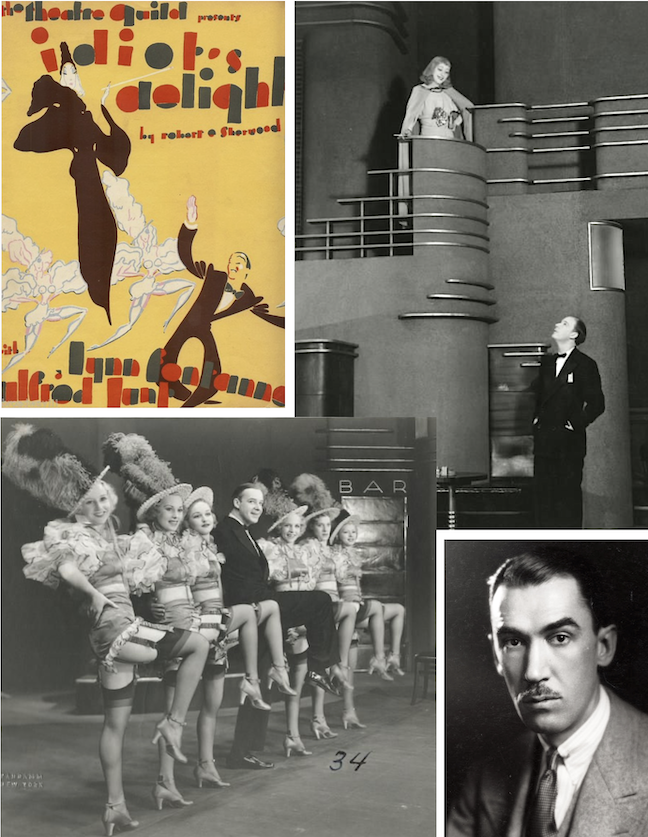
Above: Alfred Lunt and Lynn Fontanne headed the cast of Idiot's Delight, a Pulitzer-Prize-winning play by Robert E. Sherwood. The anti-war play premiered at Broadway's Shubert Theatre on March 24, 1936, and ran for three hundred performances. (latimes.com)
Set against the backdrop of impending war in Europe, Robert Sherwood’sIdiot’s Delight was a timely exploration of how individuals might respond to a major upheaval. The play’s themes about the futility of war resonate as much today as they did in 1936.
April 4, 1936 cover by Harry Brown. Although he created some distinctive, whimsical covers for The New Yorker (including today’s), there is very little biographical information available on the artist. Brown created eighteen covers for the magazine from 1931 to 1937.
Presented at Shubert Theatre, the Pulitzer Prize-winning play was set at a hotel in the Italian Alps, where the guests—among them a military captain, a German scientist, a radical socialist, and a honeymooning couple—find themselves trapped by the sudden onset of world war. The cast was led by Alfred Lunt, who played a small-time American entertainer accompanied by a troupe of chorines, and Lynn Fontanne, who portrayed a mysterious Russian woman who was traveling with an arms dealer.
The Pulitzer jury called the play first-rate, full of dramatic invention and “Molierian richness.” Critic Robert Benchley heartily agreed:
FRIVOLITY AMID THE CHAOS OF WAR…Clockwise, from top left, souvenir program for Idiot’s Delight; Alfred Lunt and Lynn Fontanne in a scene from the play; playwright Robert E. Sherwood; Lunt with a chorus line in Idiot’s Delight. The New York Times critic Brooks Atkinson wrote that the play “demonstrates Mr. Sherwood’s taste for exuberance and jovial skulduggery.”(eBay.com/nypl.org/imdb.com)
Benchley concluded that the play was at once entertaining and edifying:
FORGET ABOUT IT…In Idiot’s Delight, Sydney Greenstreet (left) portrayed a doctor who, in the face of senseless war deaths, gives up on his life-saving research; at right, Jean MacIntyre (left) portrayed Mrs. Cherry, part of a young English honeymooning couple stranded at a hotel due to the sudden closing of the border. With her in the scene are Fontanne and Lunt. (radioclassics.com/Public Domain)
Sherwood adapted the play into a 1939 film of the same name, starring Norma Shearer and Clark Gable.
* * *
Earth Gazing
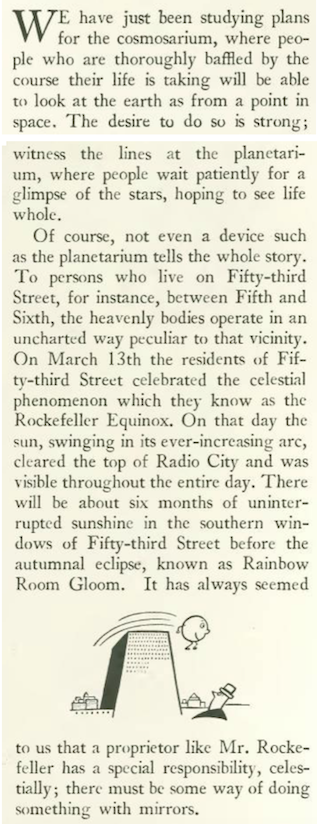
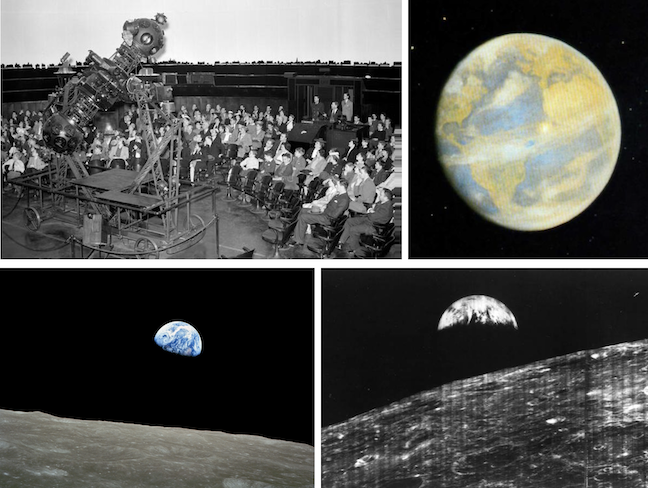
In his “Notes and Comment,” E.B. White mused about plans at the Hayden Planetarium for a program that would give visitors some idea of how earth would appear from a point in space. Earthlings would have to wait until 1968 to actually see a clear, color image of their planet.
THE WONDER OF IT ALL…Clockwise, from top left, the cosmosarium at the Hayden Planetarium, circa 1935; Howard Russell Butler’s attempt at an accurate portrayal of the earth for the American Museum of Natural History, circa 1920s; in 1966, Lunar Orbiter I sent back this image of Earth from the vicinity of the Moon; Earthrise is a famous photograph of Earth taken from lunar orbit by astronaut William Anders on December 24, 1968, during the Apollo 8 mission. (facebook.com/pinterest.com/NASA)
* * *
From Russia With Love
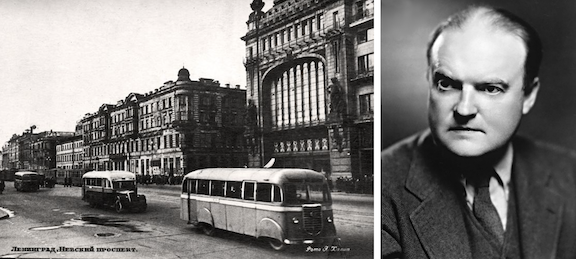
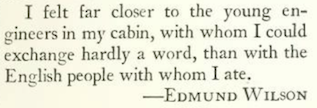
Journalist and literary critic Edmund Wilson Jr (1895–1972) traveled in Russia from May to October 1935, and later filed a couple of articles in The New Yorker detailing his travels. Writing for the column “A Reporter at Large,” Wilson described his journey by boat from London to Leningrad, finding an unexpected kinship with his Soviet cabin mates. Excerpts:
DESTINATION…Leningrad’s Nevsky Prospect 1930s; Edmund Wilson Jr in 1936. (pinterest.com/Wikipedia)
Wilson found that he preferred the company of the Soviets to a stuffy English couple who were his dining companions. He concluded:
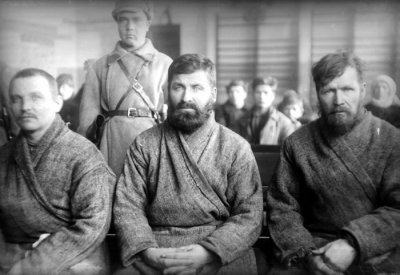
It should be noted that Wilson, despite his Marxist sympathies, would soon become disillusioned with the Soviet experiment; his travels concluded just before the onset of Josef Stalin’s “Great Purge,” which featured the notorious Moscow Show Trials that sent millions of innocent Soviet citizens to labor camps or to their deaths in prisons.
DOOMED…During the Great Terror, which included the notorious show trials of Stalin’s former Bolshevik opponents in 1936-1938 and reached its peak in 1937 and 1938, millions of innocent Soviet citizens were sent off to labor camps or killed in prison. This image from 1936 shows defendants dressed in prison clothing during one of the Moscow Show Trials. (umkc.edu)
* * *
At the Movies
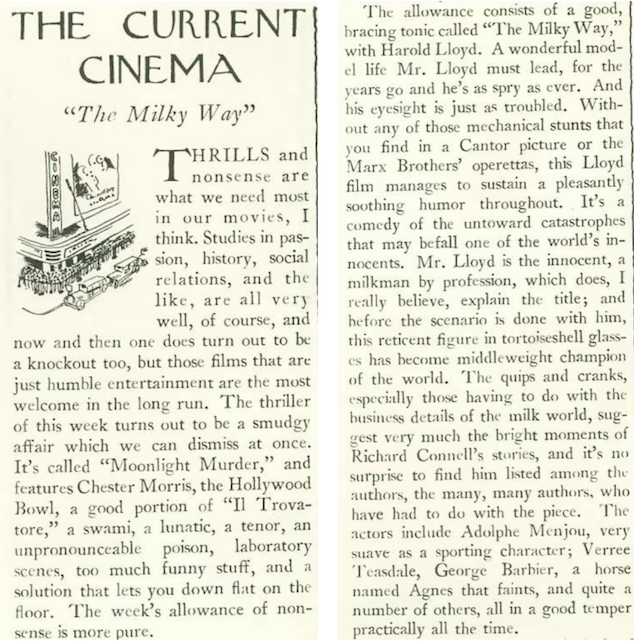
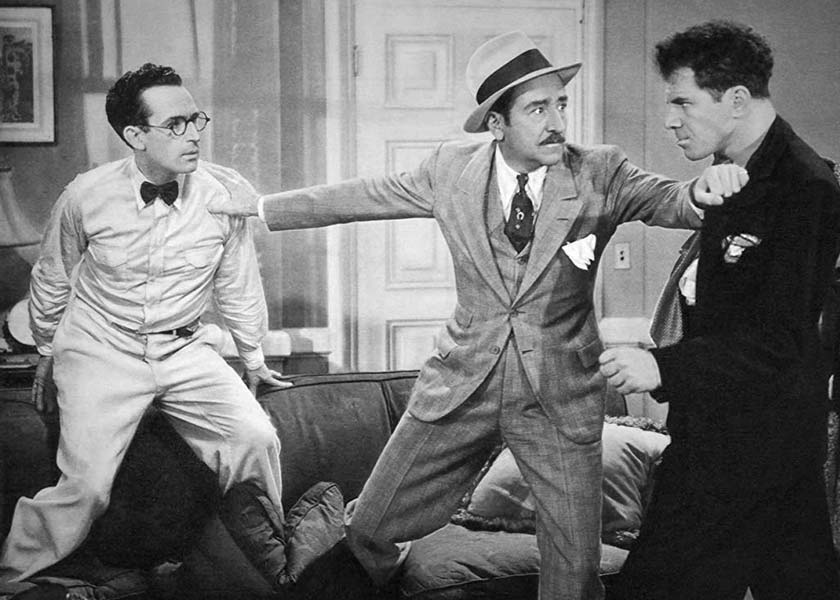
Film critic John Mosher observed that moviegoers mostly needed “thrills and nonsense” at the cinema. Thrills were not to be found, but Harold Lloyd provided the nonsense.
PUNCH LINES…Harold Lloyd (left), portrayed an unlikely middleweight boxer in The Milky Way. Above is a scene with Adolphe Menjou (center) and Lionel Stander. (obscurehollywood.net)
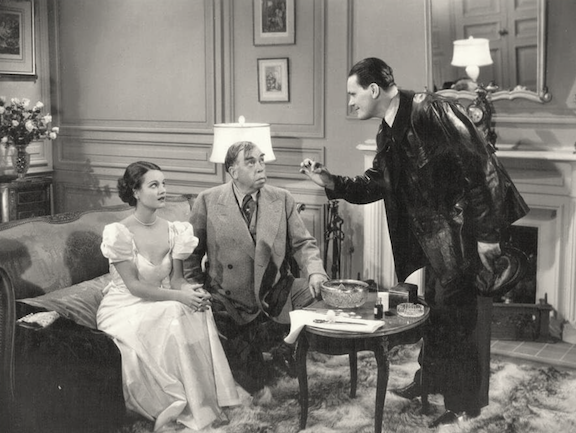
The “thriller” of the week was Moonlight Murder, which Mosher suggested audiences could “dismiss at once.”
DISMISSED…Katharine Alexander, Leo Carrillo and Benita Hume in Moonlight Murder. (rotten tomatoes.com)
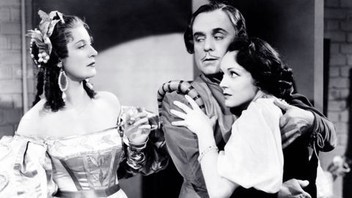
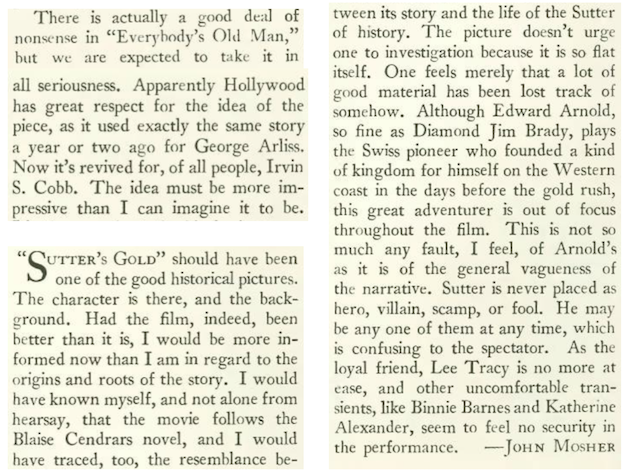
Mosher also offered tepid reviews of Everybody’s Old Man and Sutter’s Gold, despite these films featuring a popular humorist and a respected character actor, respectively.
SAY SOMETHING FUNNY…Rochelle Hudson, Irvin S. Cobb and Warren Hymer in Everybody’s Old Man. (imdb.com)WHO AM I?…A vague narrative left critic John Mosher wondering if Edward Arnold’s character was supposed to be a “hero, villain, scamp, or fool” in Sutter’s Gold. Above, Arnold in a scene with Binnie Barnes. (film booster.com)
* * *
From Our Advertisers
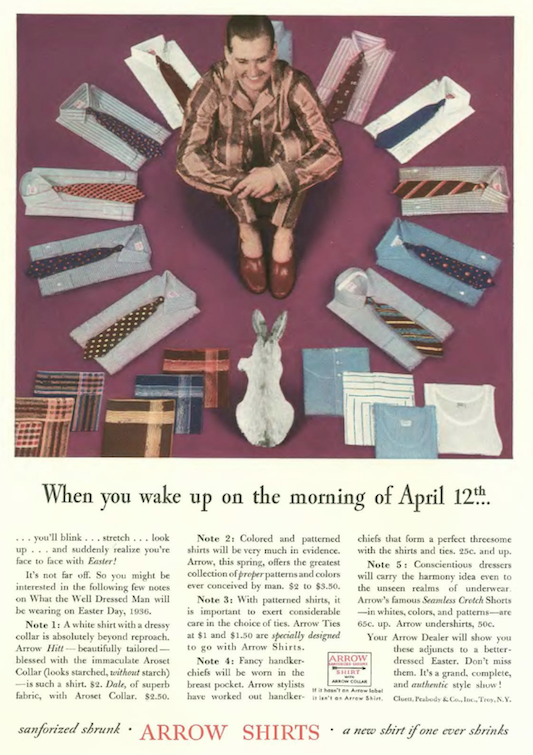
Arrow Shirts rolled out a colorful array of pre-shrunk sanforized shirts and neckties just in time for the Easter holiday…
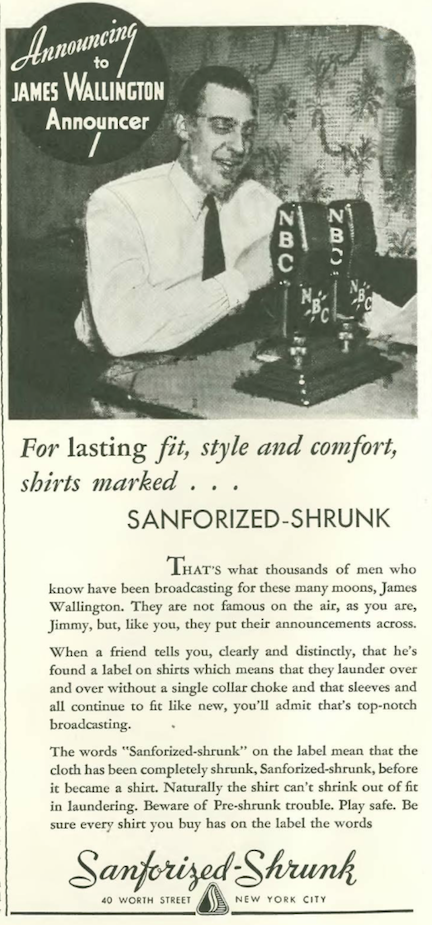
…from the 1930s through the 1950s the distinctive voice of James Wallington (1907–1972) filled the airwaves on both radio and television…here he endorses those “Sanforized Shrunk” shirts…
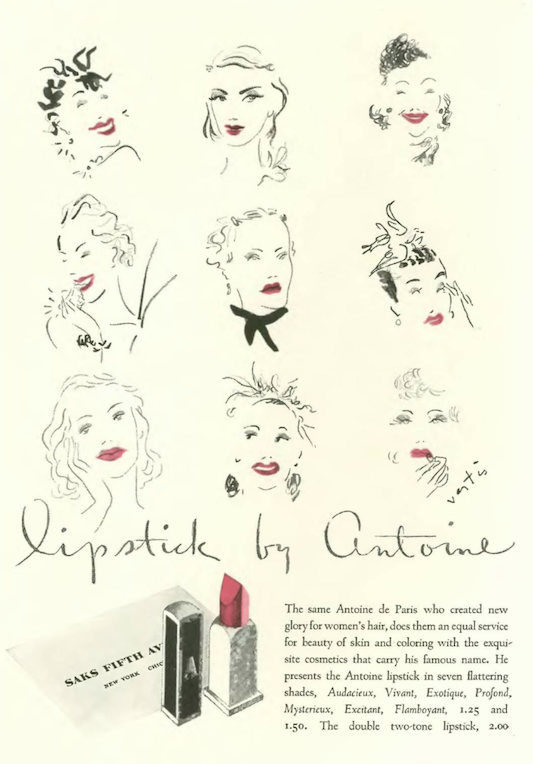
…French costume designer and illustrator Marcel Vertès (1895–1961) provided the art for the Antoine de Paris lipstick line at Saks…Vertès created the original murals in the Carlyle Hotel’s Café Carlyle and in the Waldorf-Astoria’s Peacock Alley… he also won two Academy Awards for his work on the 1952 film Moulin Rouge…
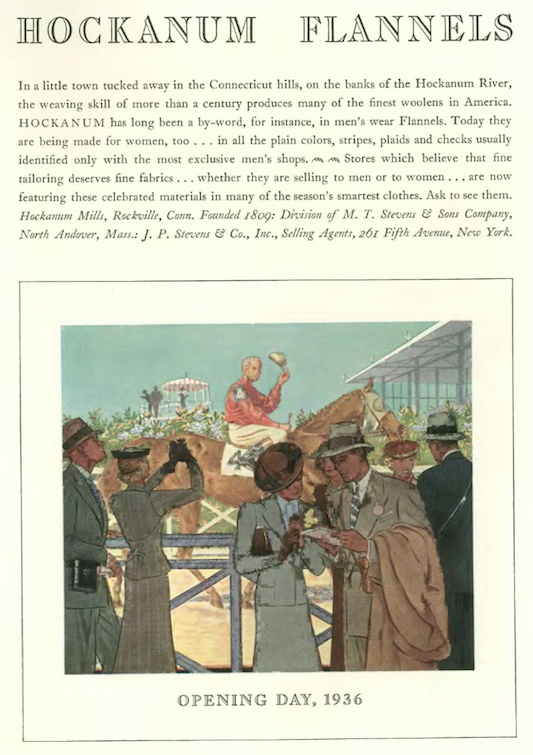
…Hockanum Mills announced its new line of woolens for the spring racing season…
Hockanum’s Rockville mills were shut down in 1951. Today the site is being redeveloped for commercial and light industrial uses as well as the site for the New England Motorcycle Museum. (historicbuildingsct.com)
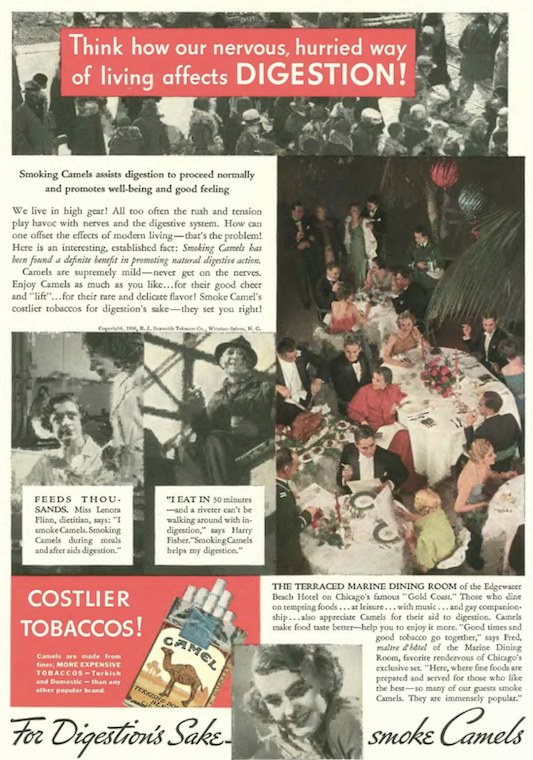
…more claims from R.J. Reynolds regarding the gastrointestinal benefits of their Camel cigarettes…
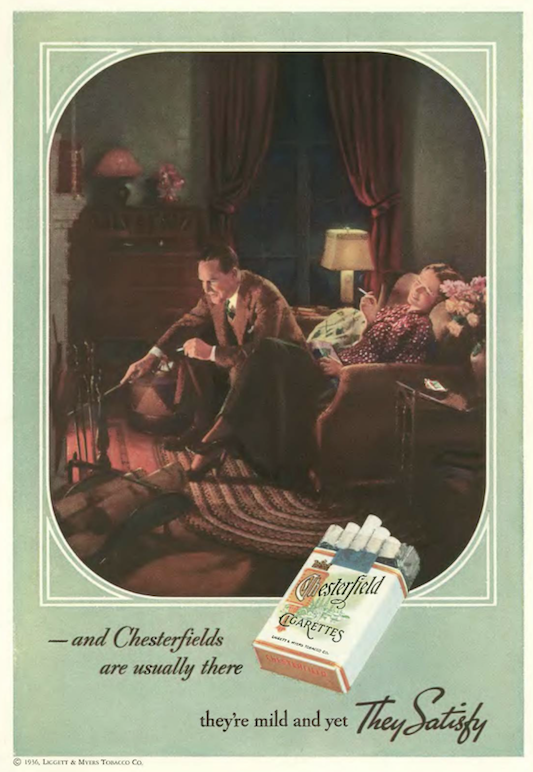
…while Liggett and Myers stuck with the pleasures of hearth and home, and a pack of Chesterfields…
…on to the cartoon section, we begin with Christina Malman…
…Richard Taylor…
…Robert Day…
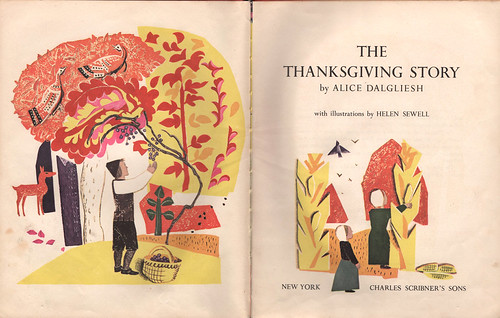
…and a wonderful spot drawing by illustrator and children’s book author Helen Moore Sewell…
…who won a Caldecott Medal for her illustrations featured in Alice Dalgliesh’sThe Thanksgiving Story (1954)…
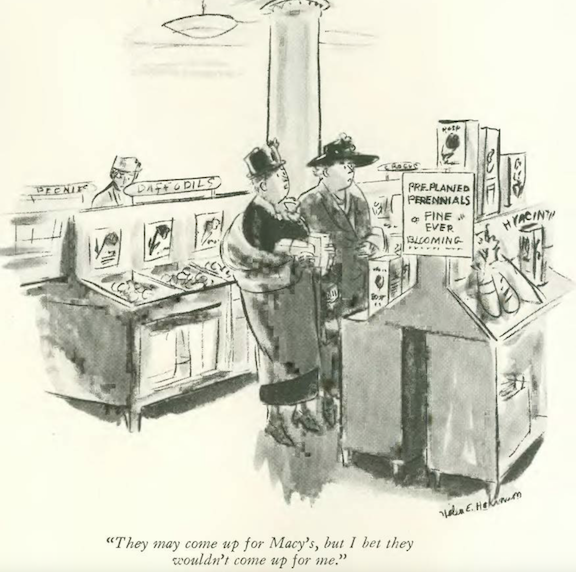
…we go shopping with Helen Hokinson in the garden section…
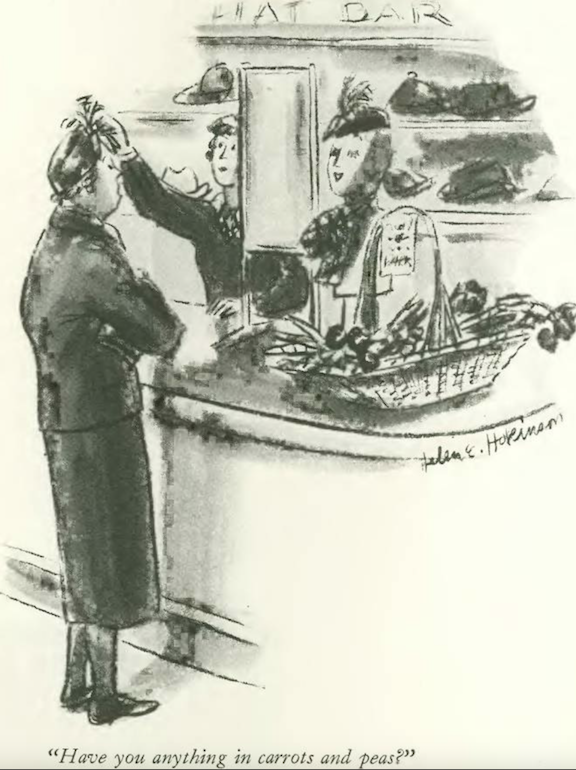
…and in the hat department…
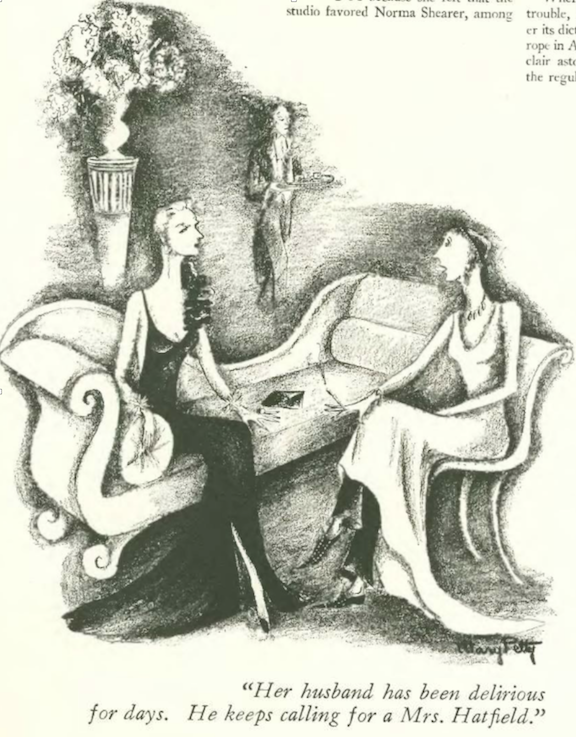
…Mary Petty caught up on the latest gossip…
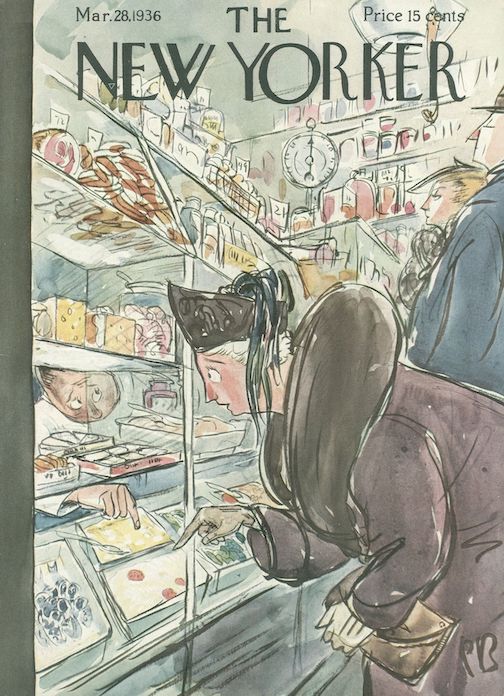
…Perry Barlow gave us a shopkeeper in need of some marketing tips…
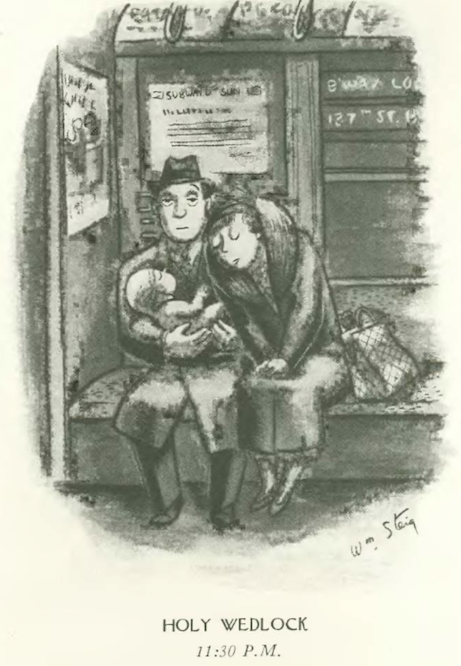
…William Steig continued to probe the joys of married life…
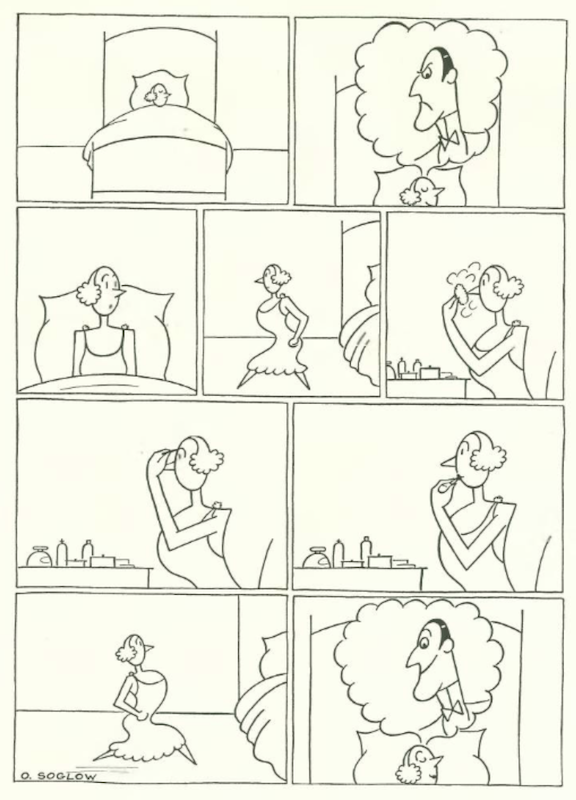
…even one’s dream world required some careful grooming, per Otto Soglow…
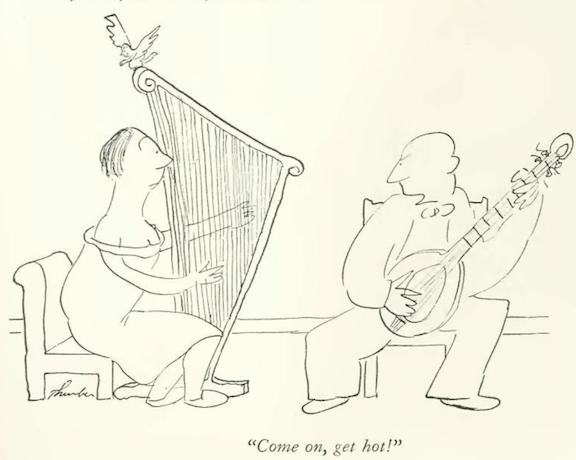
…James Thurber drew up a duet out of tune…
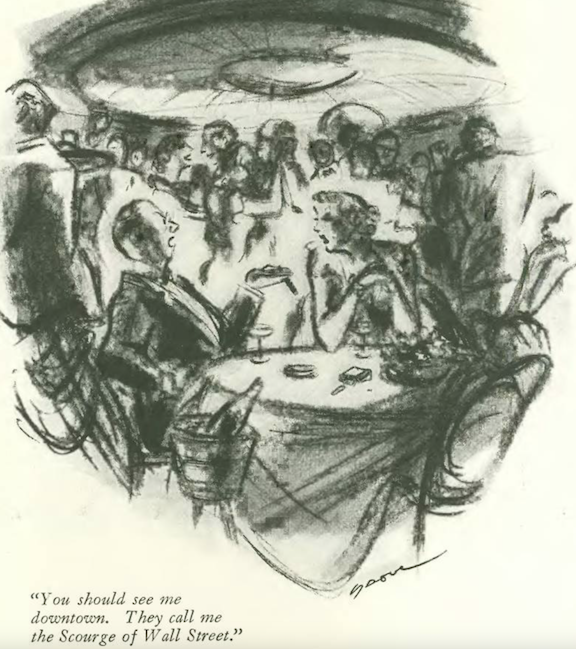
…outside of Wall Street, Leonard Dove’s titan of business was just another sugar daddy…
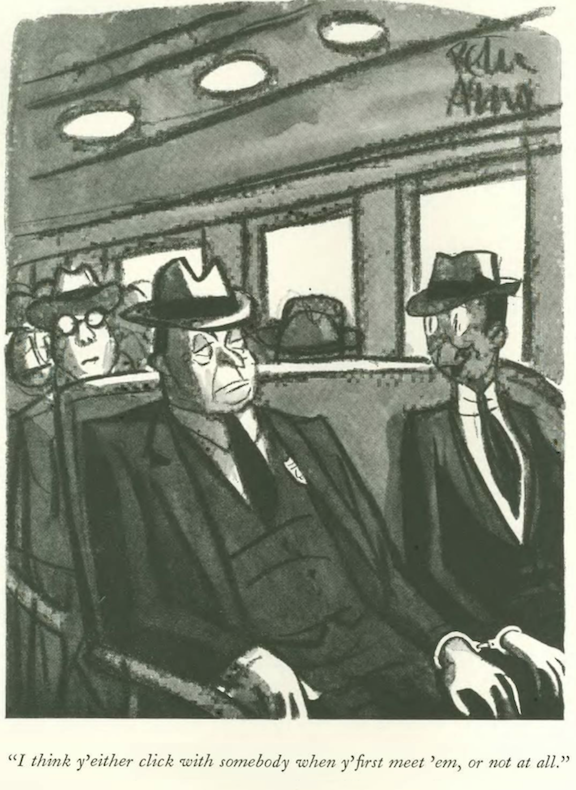
…and we close with Peter Arno, and strangers on a train…
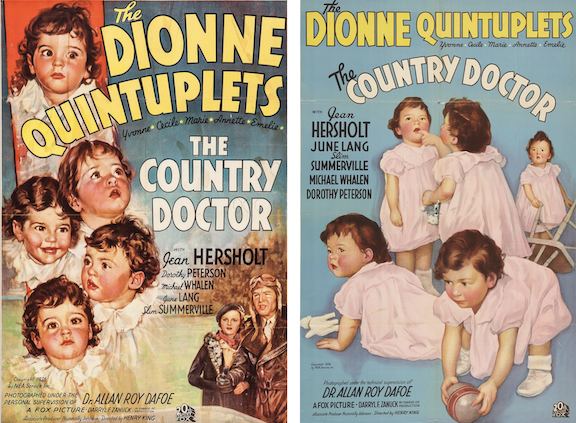
Above: Posters advertising The Country Doctor, a film featuring the Dionne Quintuplets as "The Wyatt Quintuplets." (Wikipedia/imdb.com)
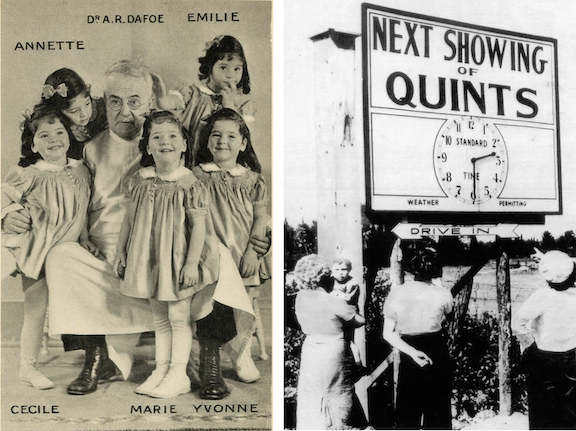
The Dionne Quintuplets, famed as the first quintuplets known to have survived infancy, appeared in a motion picture before their second birthday—The Country Doctor—just one example of the many ways the girls were exploited by the province of Ontario, their doctor, their father, and the companies who used their images to sell everything from toys to toothpaste.
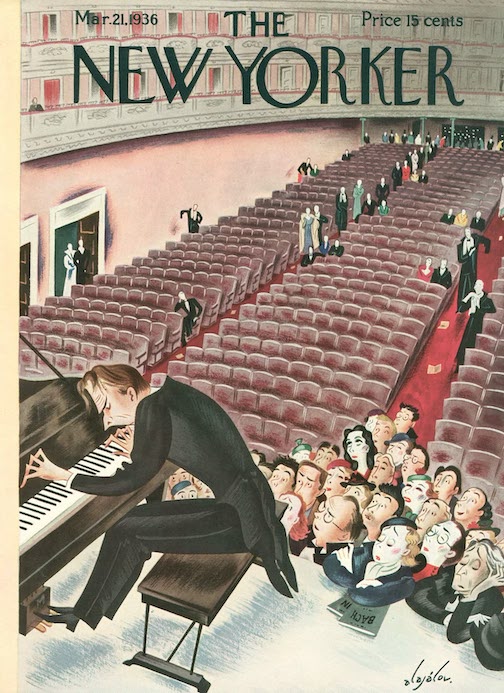
March 21, 1936 cover by Constantin Alajalov.
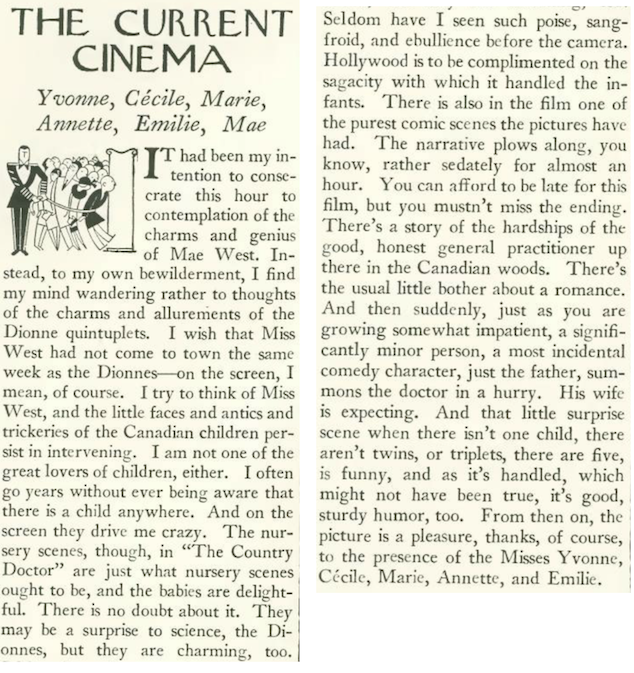
The Country Doctor was the first of three 20th Century Fox films featuring the toddlers as the “The Wyatt Quintuplets.” Actor Jean Hersholt played the country doctor (“Dr. John Luke”) in all three films, his character based on Allan Roy Dafoe, the Ontario obstetrician who successfully delivered the identical quints in 1934. It was a sign of the times that no one seemed too concerned about the children’s welfare—TheNew Yorker’s John Mosher was joined by his fellow critics in generally praising the film.
MARKETING MATERNITY…The Country Doctor was the first of three 20th Century Fox films featuring the Dionne Quintuplets. Clockwise, from top left: Slim Summerville, Jean Hersholt, and John Qualen in The Country Doctor; Ontario Premier Mitchell Hepburn with the quintuplets in 1934; a 1936 book based on the film; a 1937 ad for Karo Syrup, a major sponsor of the girls and Dr. Dafoe; an array of quintuplet-related toys included paper dolls and the much sought after Madame Alexander dolls. (Wikipedia/ebay.com/facebook.com/pbs.org)
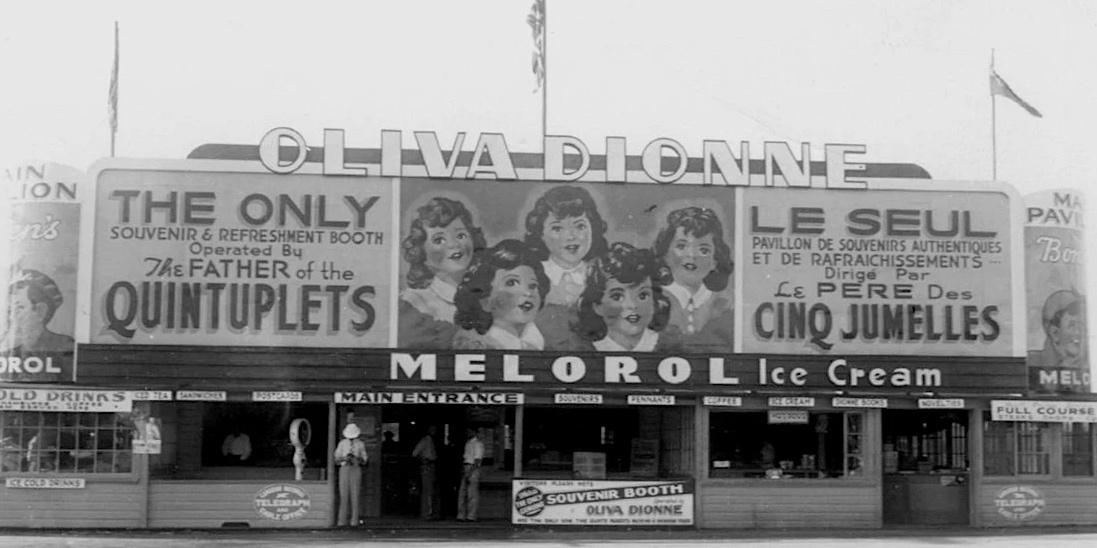
The Dionne Quintuplets were used to endorse an array of products including Quaker Oats, Colgate toothpaste, Palmolive soap, and Lysol disinfectant. Dr. Dafoe became a wealthy man due to his association with the quintuplets, while the government of Ontario saw enormous tourism potential (the girls were made wards of the province ostensibly to protect them from exploitation). At the age of four months the quintuplets were moved from the farmhouse where they were born to a compound (“Quintland”) that featured an outdoor playground designed as a public observation area.
SURROUNDED BY RICHES…at left, Allen Roy DaFoe on a postcard with the Dionne Quintuplets; tourists consult sign for the next public showing of the “Quints.”(roadtripusa.com/facebook.com)CHA-CHING…Oliva Dionne, the quintuplets’ father, ran this souvenir and refreshment stand at Quintland, where the public flocked to view the girls playing. (montrealgazette.com)
The last surviving quintuplet, Annette, died on December 24, 2025, at the age of 91. Her sister Cécile died a few months earlier, also at age of 91.
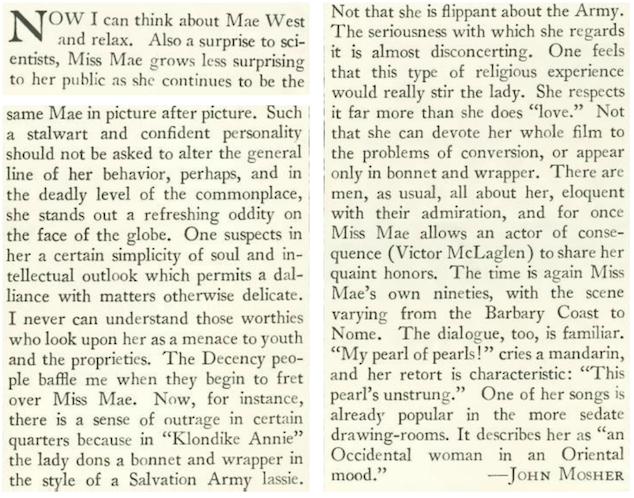
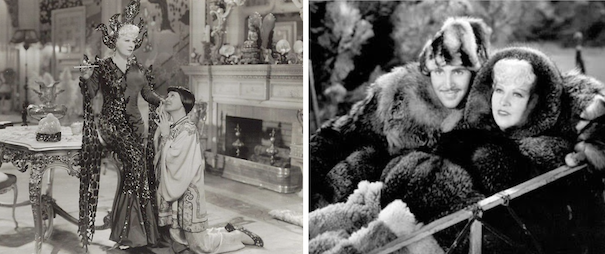
John Mosher also reviewed Mae West’s latest film, Klondike Annie. Some critics regarded it as her finest film, despite heavy censorship and the outrage of “Decency people.”
GO WEST, WEST…Mae West portrayed a kept woman who murders her keeper in self-defense and escapes to Nome, Alaska in Klondike Annie. At left, West in a scene with Son Yong; at right, with Phillip Reed. (Pinterest)
* * *
St. Katharine
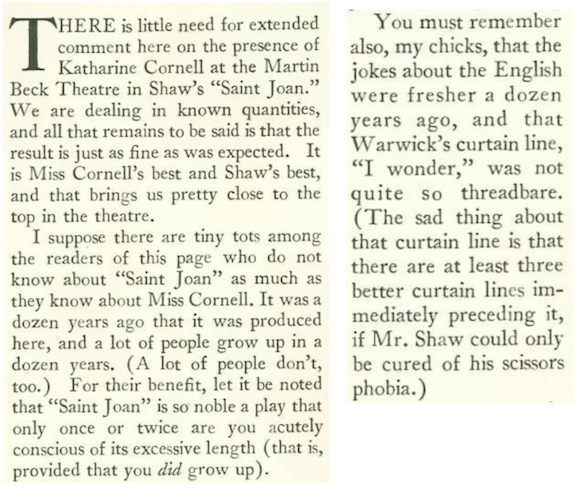
Robert Benchley found Katharine Cornell’s theatrical performance in Saint Joan to be “as fine as was expected.” An excerpt:
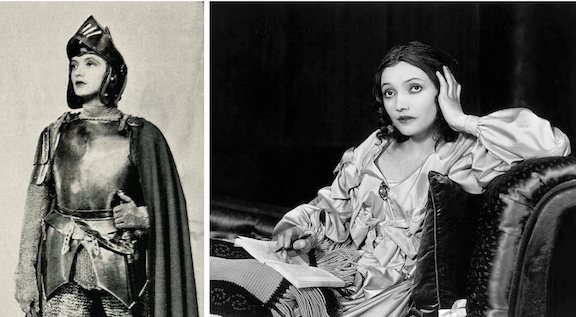
KNOWN QUANTITIES was how Robert Benchley described the talents of stage actress Katharine Cornell. At left, Cornell as Saint Joan; at right, Cornell (1893–1974) is perhaps best known in her role as Elizabeth Barrett in the 1931 Broadway production of The Barretts of Wimpole Street. (Wikipedia)
* * *
It Begins…
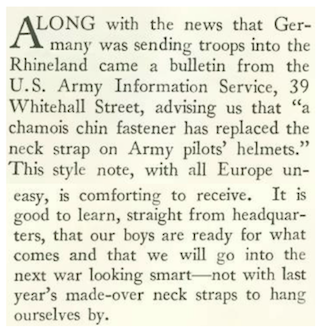
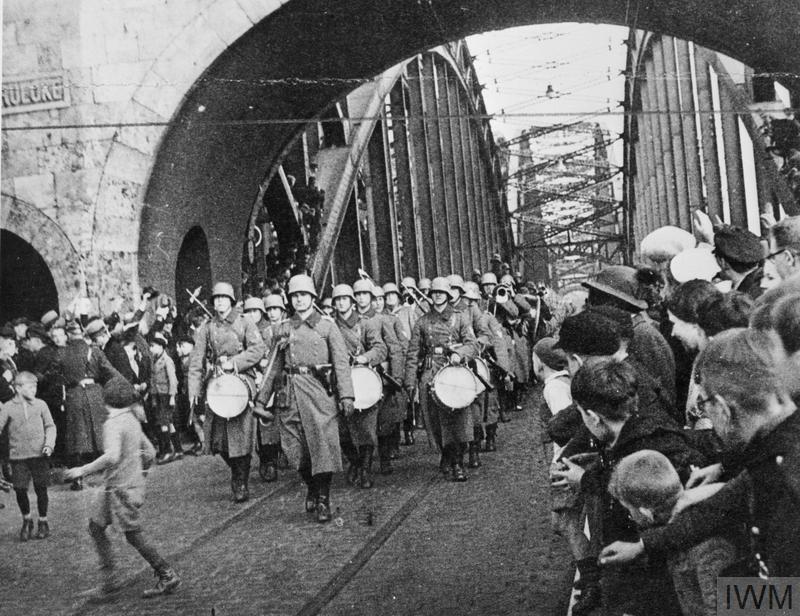
On March 7, 1936, 22,000 German army troops crossed a bridge over the Rhine River and entered the Rhineland, breaking the 1919 Treaty of Versailles, which mandated a demilitarized Rhineland to ensure French safety. Despite the violation, and the fact that the German army was still weak, France and Britain took no military action. E.B. White reported:
REOCCUPATION…On March 7, 1936, German Army troops crossed a bridge over the Rhine River and entered the Rhineland for the first time since the end of World War I. The lack of response from France and Great Britain no doubt emboldened Hitler to annex Austria and occupy Czechoslovakia in 1938. (iwm.org.uk)
Howard Brubaker, in his column “Of All Things,” also noted:
* * *
Some Pretty Things
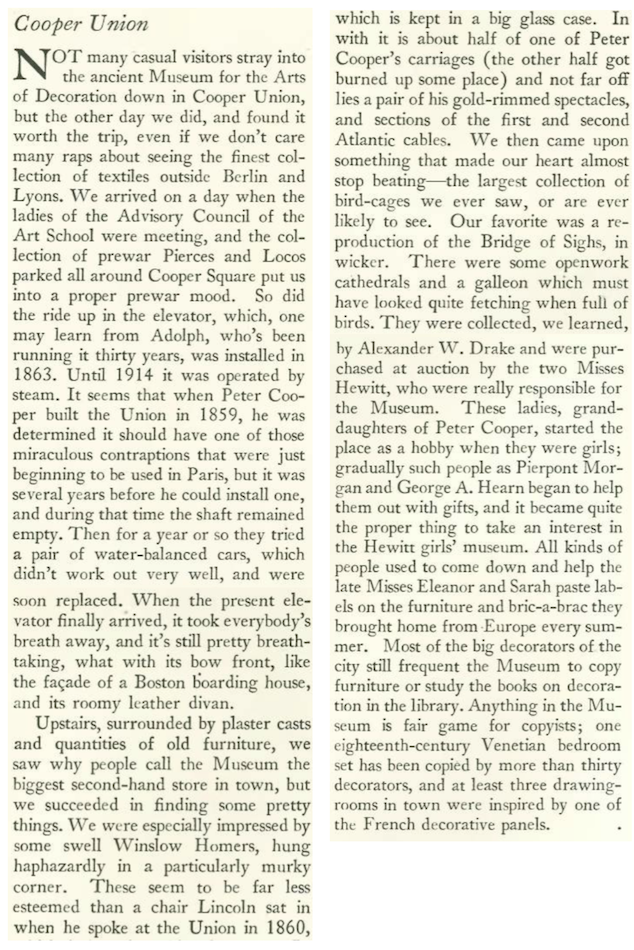
“The Talk of the Town” paid a visit to the Museum for the Arts of Decoration at the Cooper Union and found many treasures within, including a unique circular elevator.
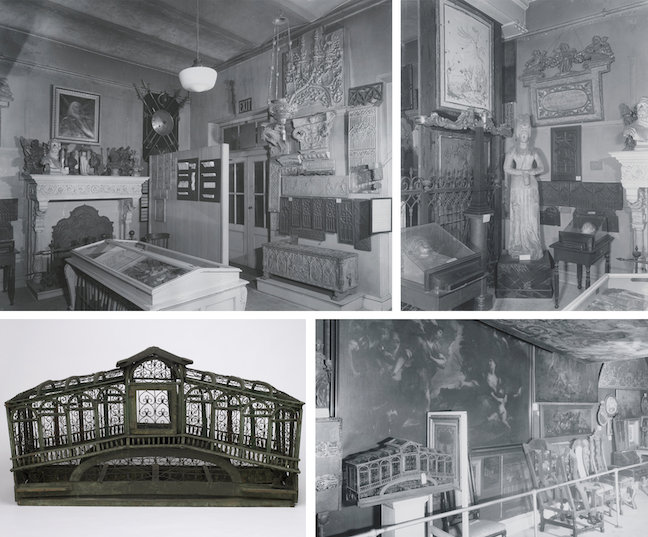
BRIDGE TO THE PAST…The Cooper Union’s Museum for the Arts of Decoration held many treasures, including (at bottom) an Italian birdcage fashioned to resemble the Rialto Bridge; at top, rooms filled with examples from the decorative arts. (cooperhewitt.org)
The “Talk” visit included a ride up a circa 1850s elevator shaft designed by inventor Peter Cooper four years before safety elevators even existed. The design was based on Cooper’s belief that the circular shape was the most efficient.
ROUND AND SOUND…At left, entrance to Peter Cooper’s circa 1850s round elevator and the elevator’s shaft at the Cooper Union Foundation Building. The round shaft remains a central feature of the building today, now housing a modern round elevator designed in 1972. (Cooper Union Library)
* * *
Commie Cutlery
American non-fiction writer Carl Carmer published the first part of a two-part essay on the revolutionary Oneida Community, which Carmer dubbed “a materially successful communist experiment…”
This polyamorous Christian utopia disbanded before the end of the 19th century and reemerged as a joint-stock company, Oneida Community Limited, which focused on making silverware. This brief excerpt is from the first paragraph.
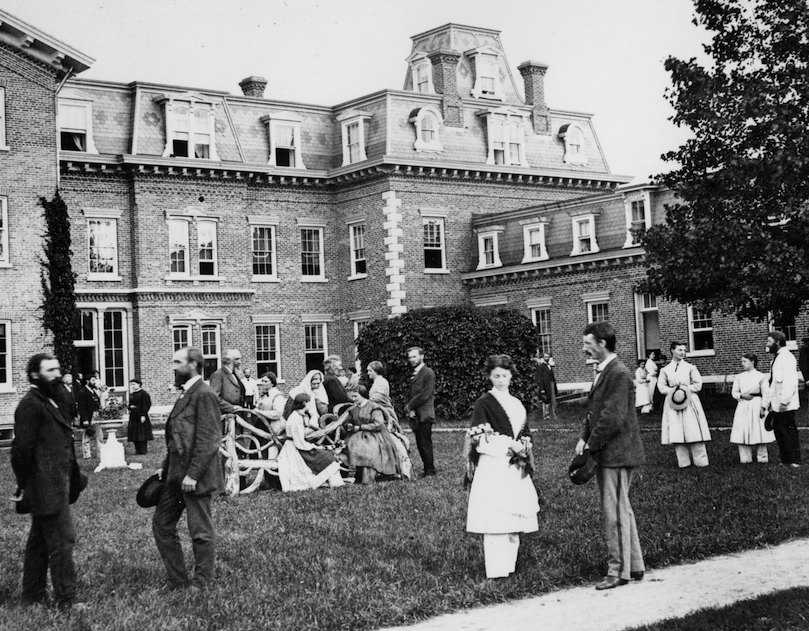
COHABITING COMRADES…Oneida commune members gather on the lawn in front of the Community Mansion House in in Madison County, New York, circa 1860s. Members of the community practiced free love, women and men had equal freedom in sexual expression and commitment, and children were raised communally. (collectorsweekly.com)
* * *
From Our Advertisers
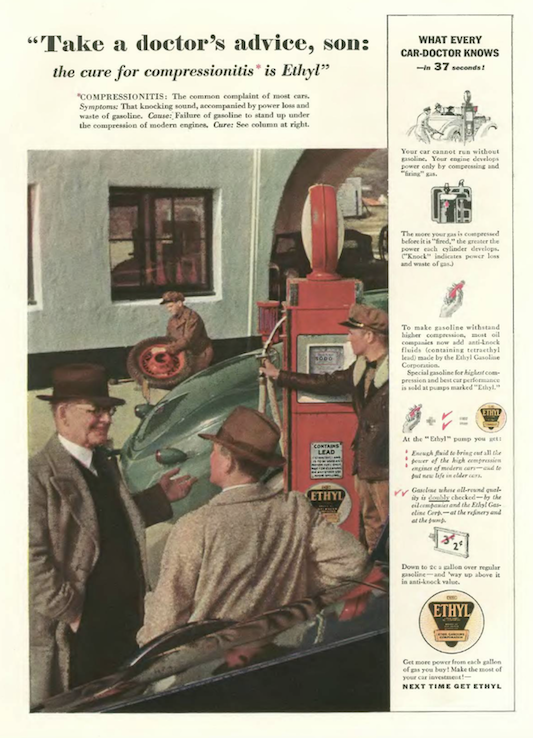
Yes, take a doctor’s advice, and put some leaded gas in your car, and into the air you breathe…
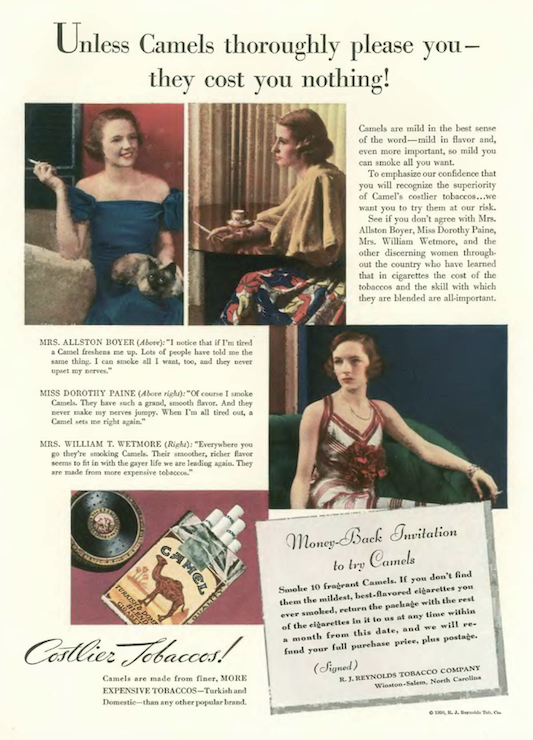
…R.J. Reynolds presented three women who exemplified the “society model” trend of the 1930s…well-known debs and socialites who provided an air of prestige to a brand…especially cigarettes…
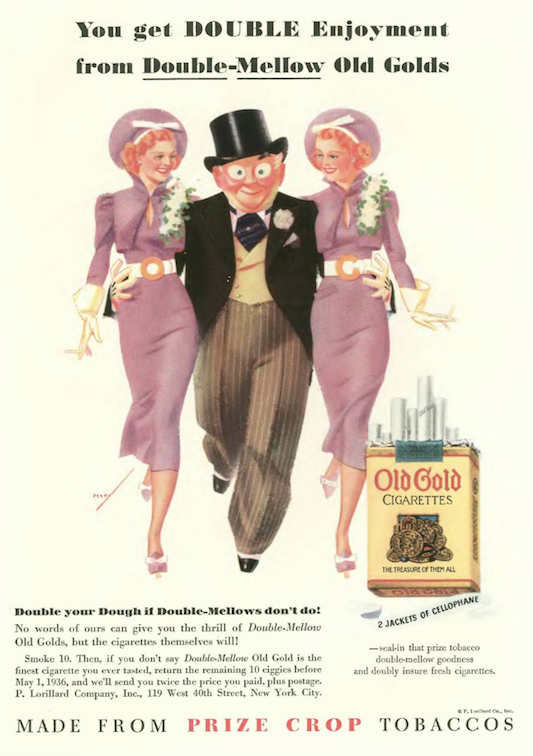
…Lorillard Tobacco Company, on the other hand, stuck with pin-up artist George Petty to push their Old Golds…
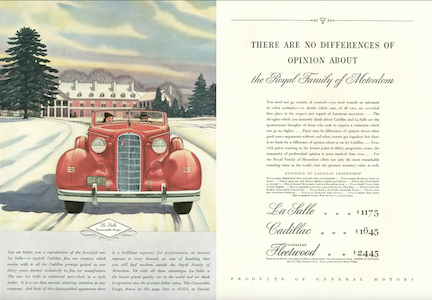
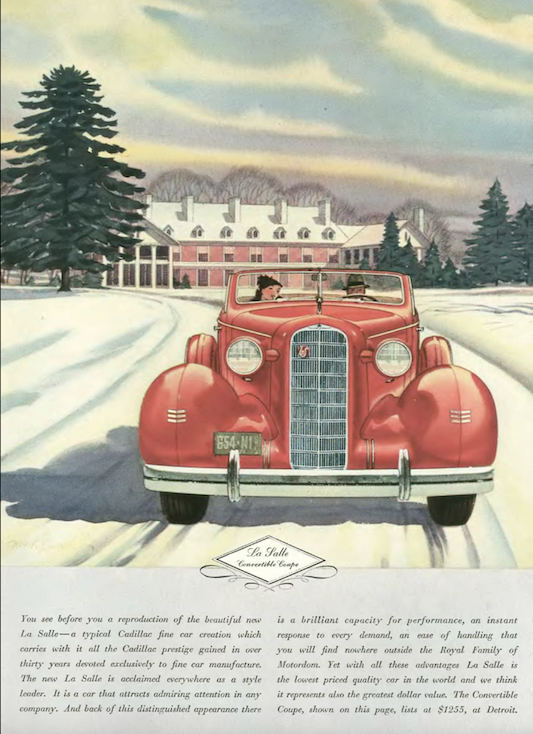
…General Motors took out the middle spread to tout their low-priced luxury automobile, the La Salle…
…the convertible La Salle looked handsome, if not a bit brisk with the top down…
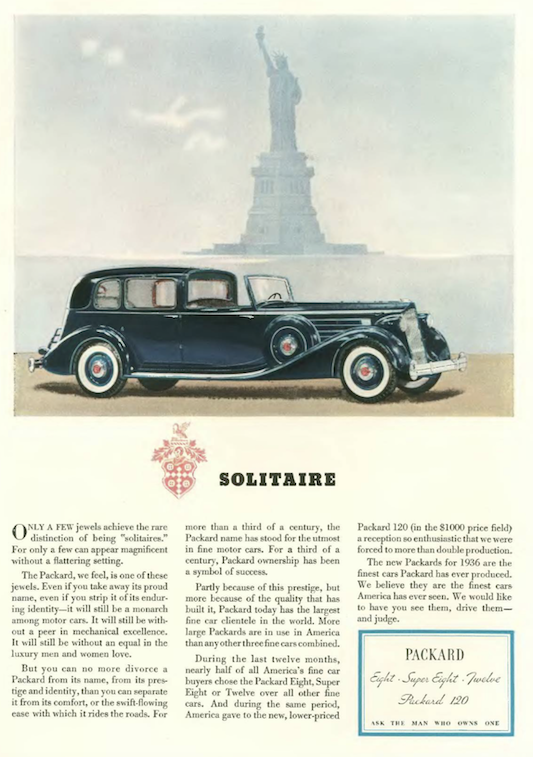
…American luxury carmaker Packard proudly displayed their twelve-cylinder luxury model, but reminded readers they could have a lesser model, the 120, for a price “in the $1,000 field”…
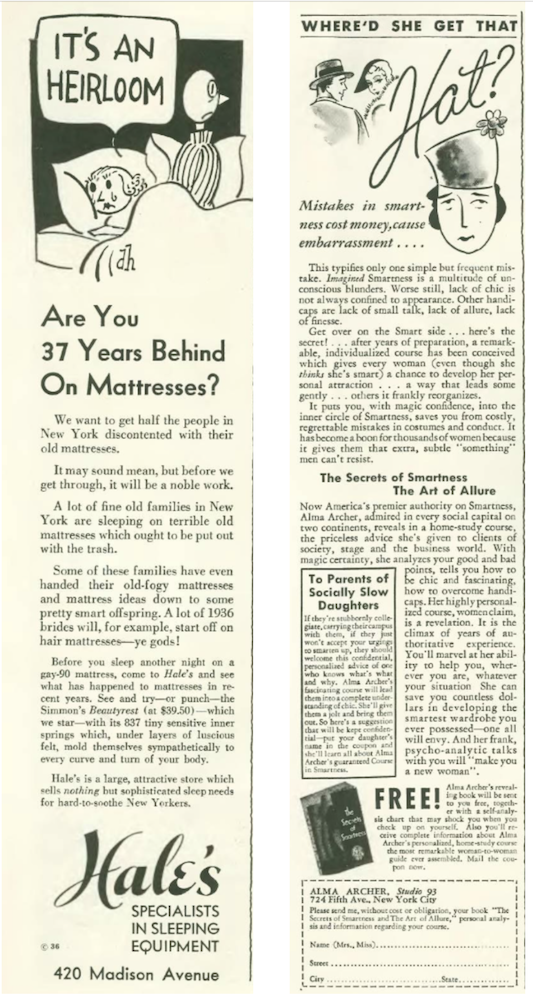
…a couple of one-column ads…Don Herold helped Hale’s move mattresses, while fashion columnist Alma Archer employed class anxiety to promote her new book, The Secrets of Smartness and the Art of Allure…
SMARTNESS AUTHORITY Alma Archer in 1937. Archer (1898–1988) wrote a widely read column for the New York Mirror that was syndicated in more than a thousand newspapers.
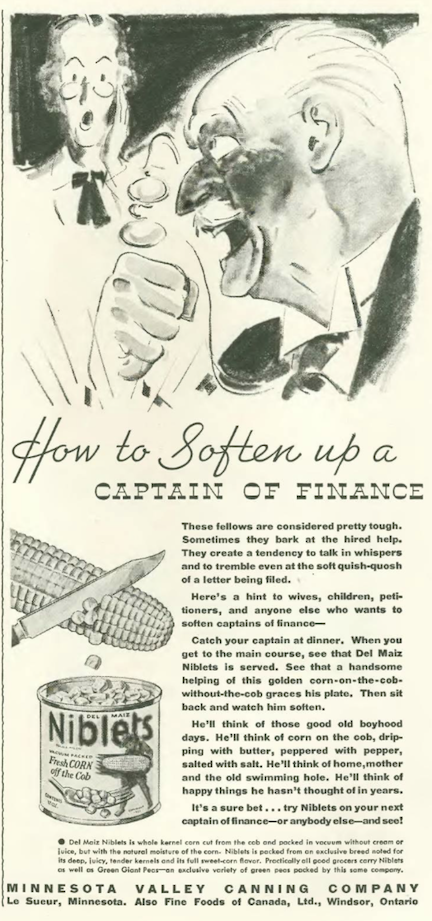
…if you have been following this blog, you’ll recall the ads with angry duchesses fuming over tomato juice and rich old men fondly recalling their countrified youth via canned corn niblets…well here is one robber baron who needed some niblets pronto to quiet his rage…maybe a snifter or two of brandy would have also helped…
…on to our cartoonists, James Thurber kicked things off on page two…
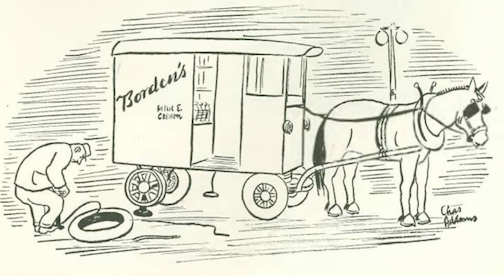
…the “Goings On” section concluded on page four with this drawing by Charles Addams…
…a couple more spot drawings from the issue by Christina Malman (left) and Richard Taylor…
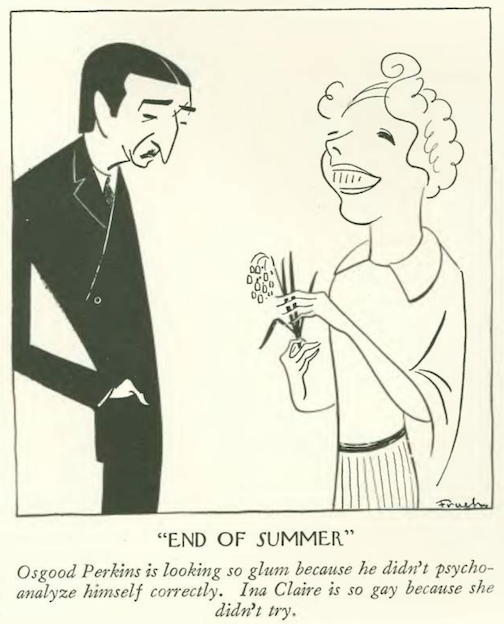
…Al Frueh offered this interpretation of the players in End of Summer…
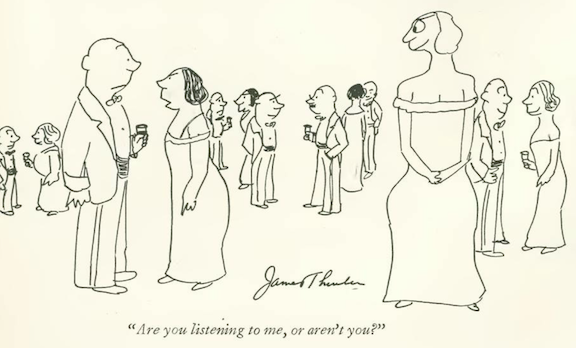
…and we have Thurber again, with a hard-to-miss distraction…
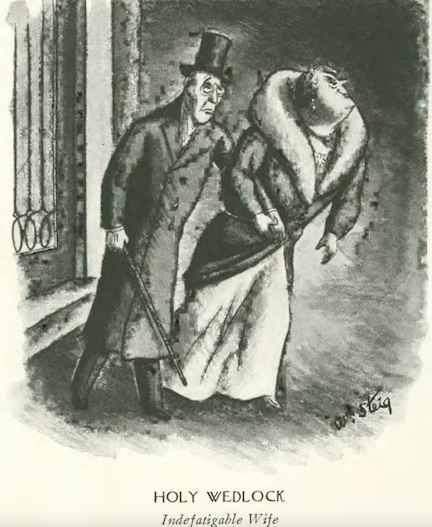
…William Steig continued to explore the varieties of “Holy Wedlock”…
…Leonard Dove gave us a golddigger stranded at sea…
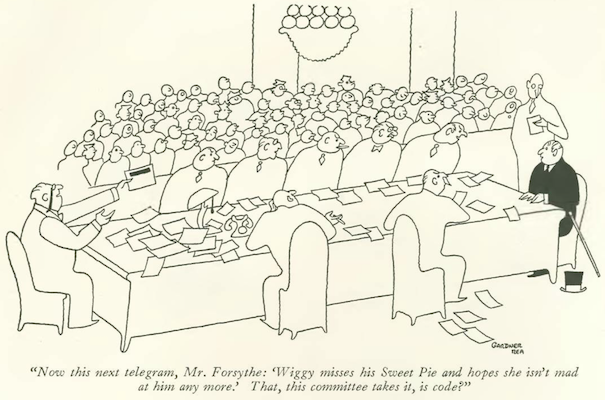
…Gardner Rea put a captain of industry in a tight spot…
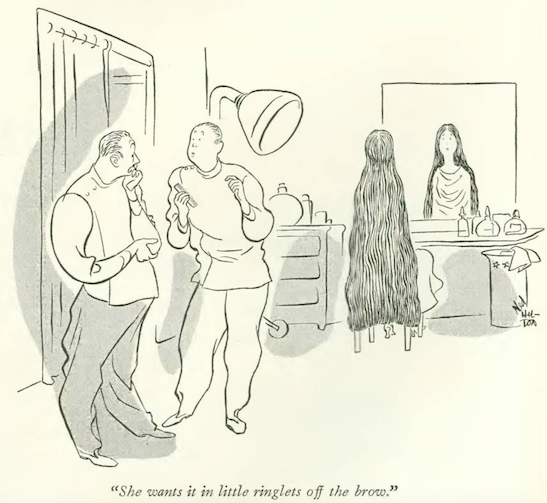
…Ned Hilton encountered a hairy challenge…
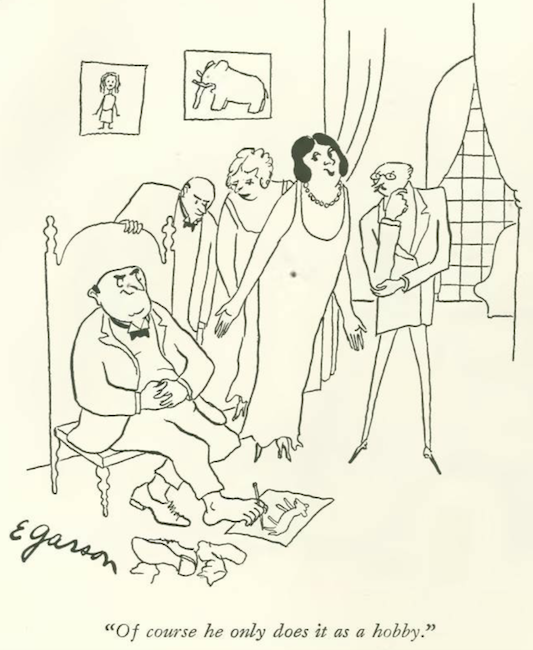
…Eli Garson demonstrated some remarkable foot dexterity…
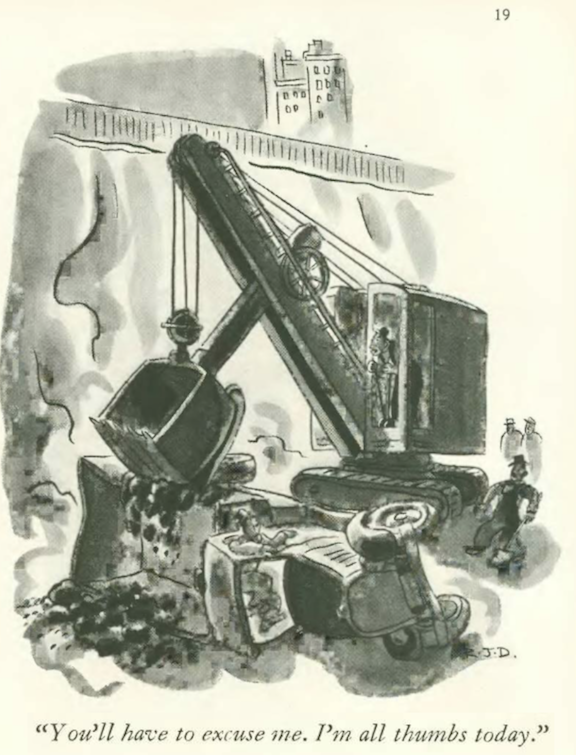
…while Robert Day showed a lack of dexterity a construction site…
…Charles Addams revealed a materialist in the brotherhood…
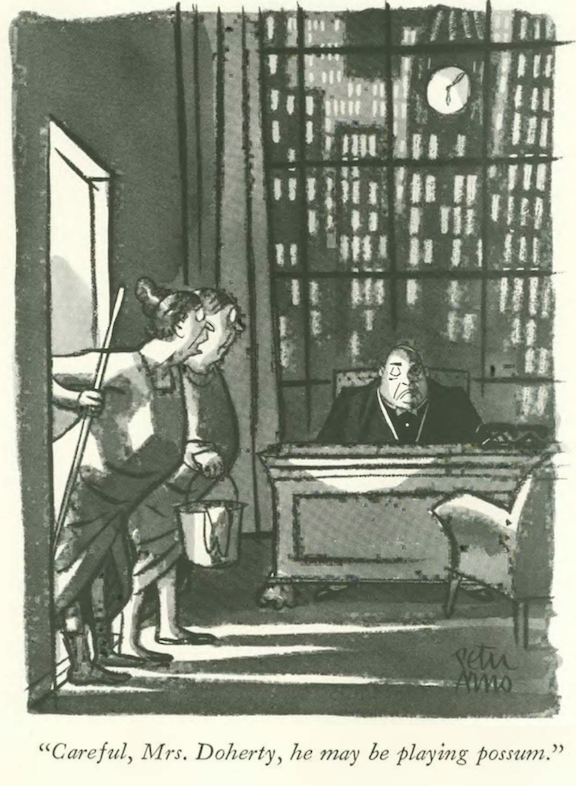
…Peter Arno’s charwomen let a sleeping dog lie…
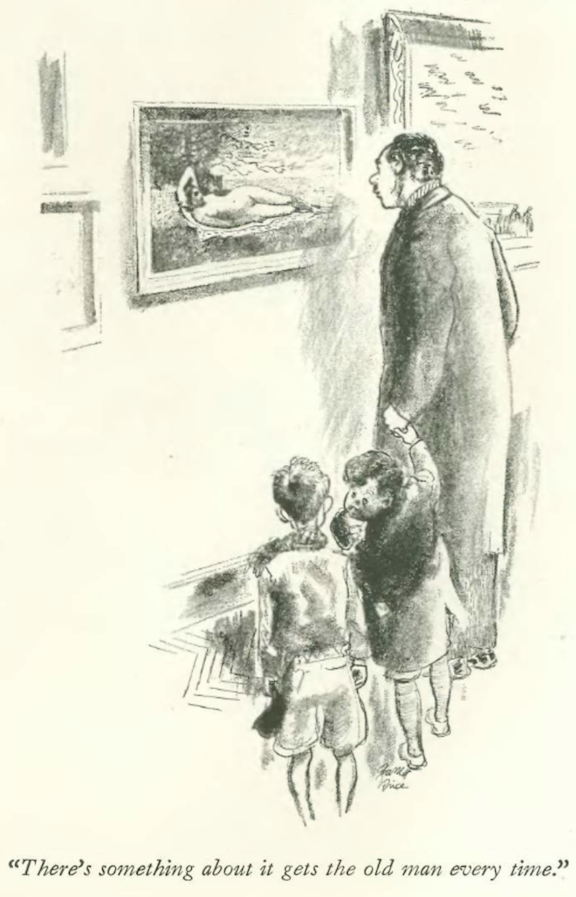
…and we close Garrett Price, and one perceptive lad…
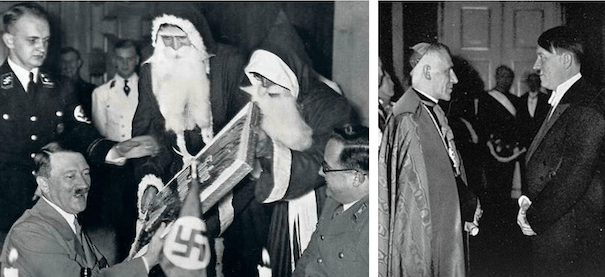
Above: At left, the Nazi Party sought to remake Christian holidays such as Christmas into Nazi-themed, pagan events, even trying to redefine St. Nicholas as Wotan, the ancient Germanic deity; at right, Adolf Hitler rejected Christianity, calling it a Jewish plot to undermine the heroic ideals of the Aryan-dominated Roman Empire. Here he is seen meeting the nuncio to Germany, Cesare Orsenigo, on January 1, 1935. (reddit.com/Wikipedia)
For the March 7 issue we look at the second part of Janet Flanner’s profile of German dictator Adolf Hitler, in which she attempted to identify the social and political influences that led to his peculiar vision of the world.
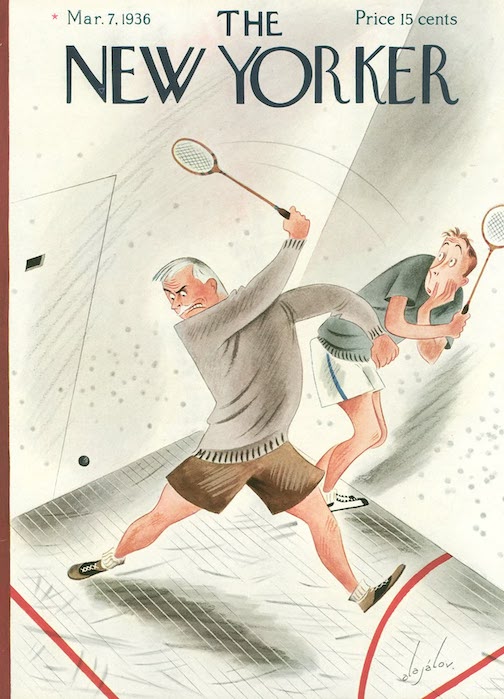
March 7, 1936 cover by Constantin Alajalov.
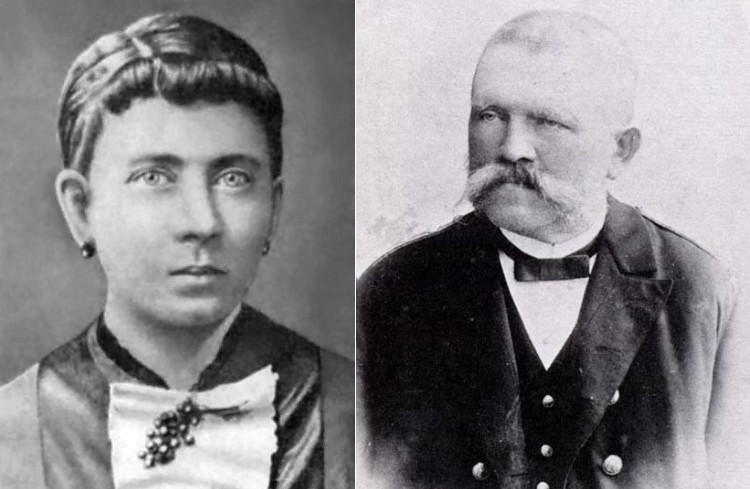
Flanner noted that Hitler’s ancestors were intermarrying, pious Roman Catholic peasants, including his parents, second cousins Klara Pölzl and Alois Hitler. While Klara was a doting parent, Alois was often abusive and distant. And so it began.
MOM AND DAD…Adolf Hitler’s parents were second cousins Klara Pölzl (1860–1907) and Alois Hitler (1837–1903). Pölzl was the third wife of the much older Hitler, who was a stern, mid-level Austrian customs official. (Wikipedia)
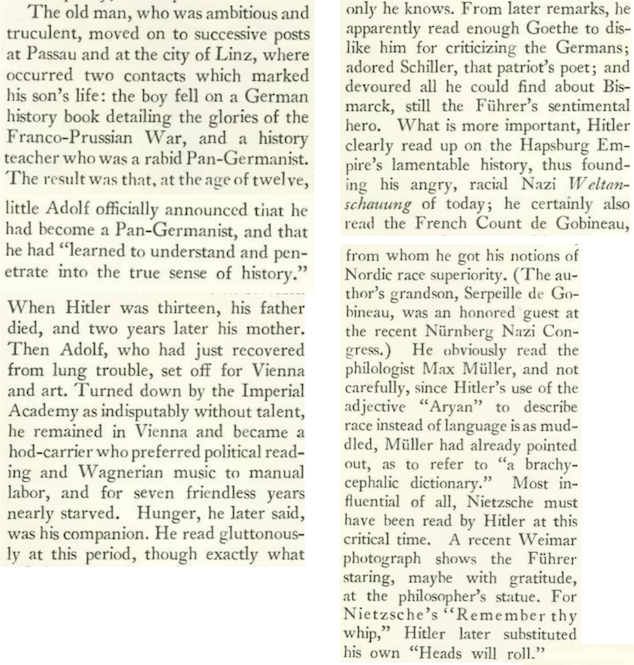
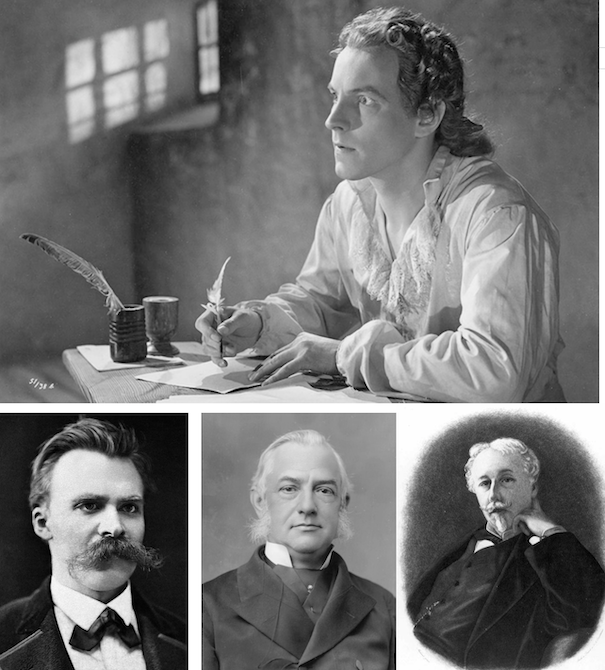
Flanner described Hitler’s struggles as an artist (rejected twice by the Vienna Academy of Fine Arts), however his real disappointment was nationalistic; serving as a courier (and wounded) in World War I, he blamed internal traitors for Germany’s defeat. To bolster his patriotic ideals, Hitler turned to books, and particularly to poet and dramatist Friedrich Schiller (1759–1805)—the Nazis would later manipulate Schiller’s works to fit the Party’s themes of nationalism, struggle, and obedience. Hitler would further hone his world view through the works of white supremacist Count de Gobineau (1816–1882), nihilist philosopher Friedrich Nietzsche (1844–1900), and philologist Max Müller (1823–1900), whose work inadvertently contributed to the idea of a superior “Aryan” race.
REWRITING HISTORY…Clockwise, from top, a 1940 Nazi propaganda film, Friedrich Schiller— Der Triumph eines Genies, portrayed Schiller (played by actor Horst Caspar) as an idealistic Übermensch; Hitler and the Nazis were also influenced by white supremacist Count de Gobineau; philologist Max Müller; and the nihilist philosopher Friedrich Nietzsche. (film portal.de/Wikipedia)
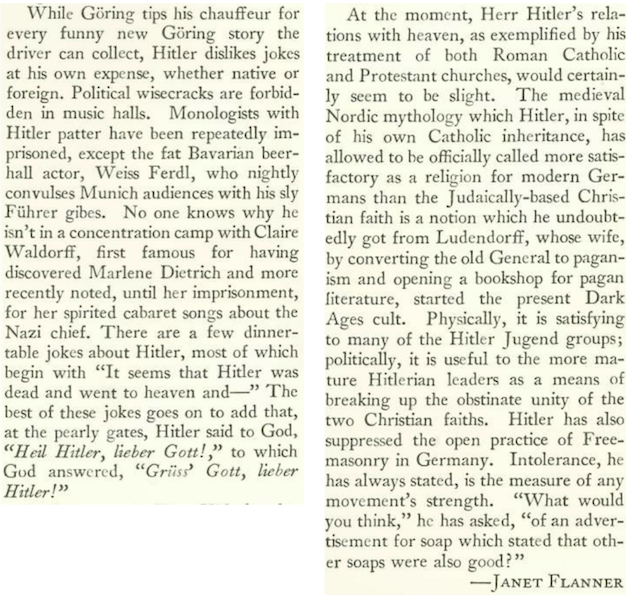
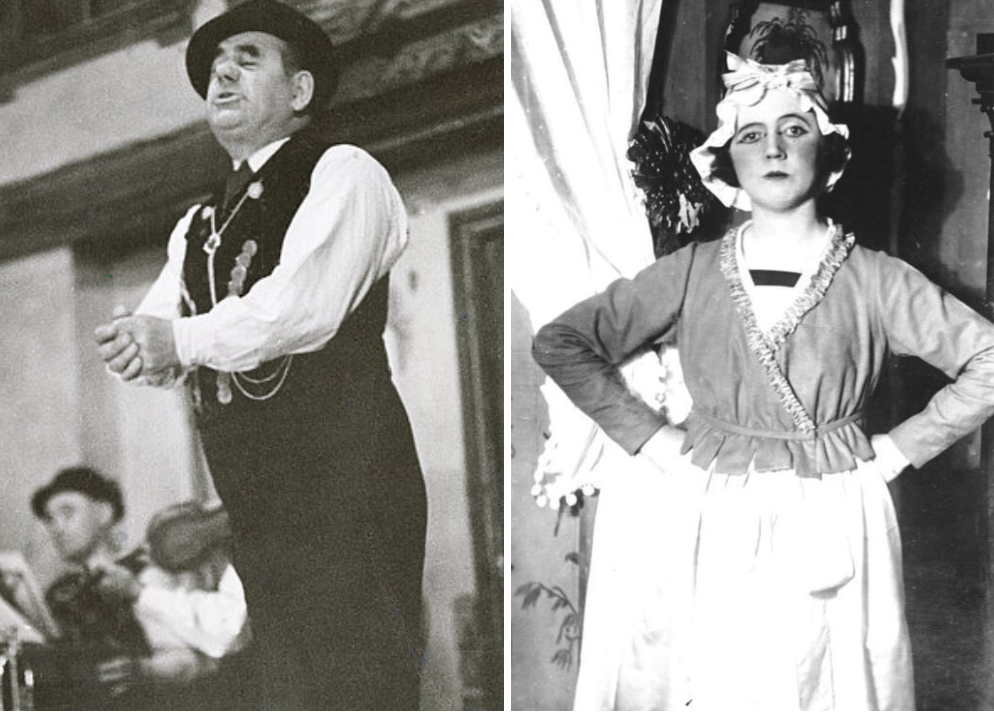
In her conclusion, Flanner noted Hitler’s dislike of jokes at his own expense, and she was surprised that German comedian Weiss Ferdl, known for his “Führer gibes,” wasn’t in a concentration camp with cabaret singer Claire Waldorff (somehow both survived the regime and the war). Flanner also touched on Hitler’s antipathy toward Christianity.
SURVIVORS…At left, Weiss Ferdl (1883-1949) was a German actor, humorous folksinger known for his jibes at Hitler; at right, Claire Waldorff (1884-1957) was a famous cabaret singer and entertainer in Berlin, known for performing ironic songs with lesbian undertones. (Wikimedia Commons)I’LL TRY TO KILL YOU LATER…German Chancellor Adolf Hitler greets (l to r) Roman Catholic Abbot Albanus Schachleiter and Protestant Reichsbischof Ludwig Müller, outside the Frauenkirche in Nuremberg, September 1934. (Wikipedia)
* * *
Thrill Ride
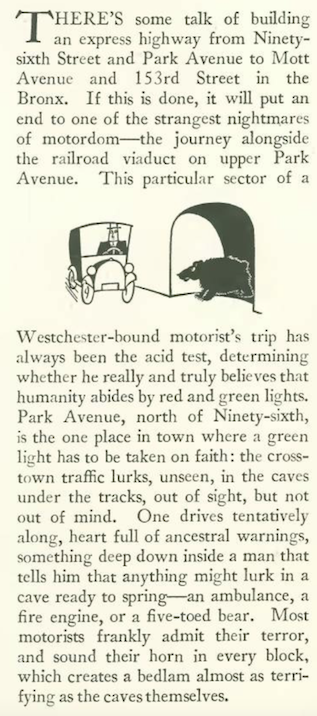
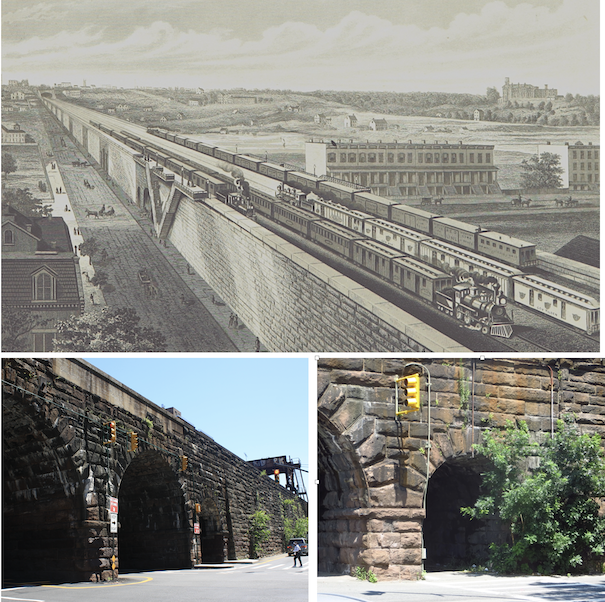
In his “Notes and Comment,” E.B. White described “one of the strangest nightmares of motordom”…
THE GREAT WALL…E.B. White feared whatever might pop out of the dark tunnels on the northern stretches of Park Avenue. Clockwise, from top, an 1876 illustration of the new viaduct through the Harlem Flats; E. 108th Street pedestrian tunnel between Lexington and Park; Park Avenue Viaduct–La Marqueta. (Wikipedia/manhattanwalkblog.com/6tocelebrate.org)
* * *
Ding-dong
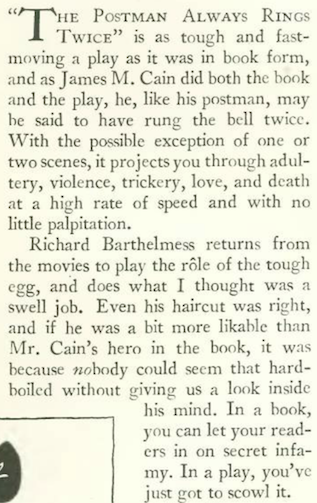
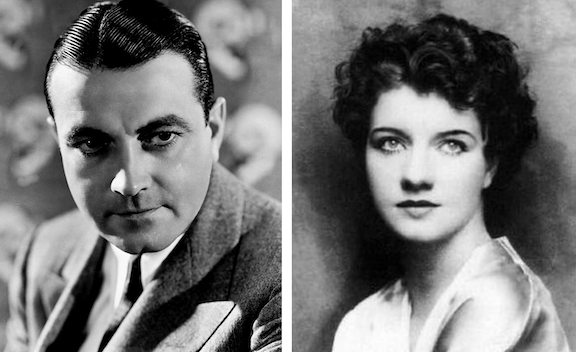
Robert Benchley filed a brief review of The Postman Always Rings Twice, a stage adaptation at the Lyceum Theatre of James M. Cain’s acclaimed novel. Although the play was well received by audiences, many reviewers found the subject matter distasteful. Cain would later describe the 1936 production as “a dreadful experience from beginning to end.”
SCHEMERS AND DREAMERS…Richard Barthelmess and Mary Philips portrayed star-crossed lovers in the 1936 stage production of The Postman Always Rings Twice. Philips was a noted Broadway performer and Humphey Bogart’s first wife. (Wikipedia/imdb.com)
* * *
At the Movies
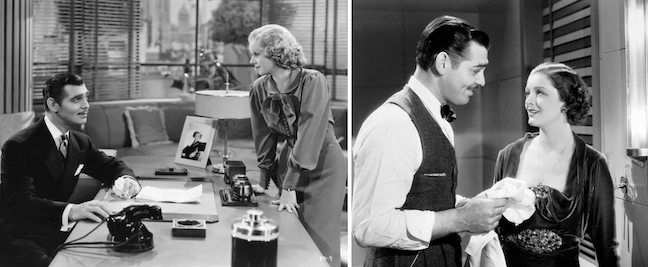
Critic John Mosher commented on familiar Hollywood tropes (doctors chasing nurses, execs pursuing secretaries etc.) and offered up the “tepid” example of Wife vs. Secretary, which featured three of Tinseltown’s top stars.
MILD HIJINKS…At left, Clark Gable and Jean Harlow in a scene from Wife vs. Secretary; at right, Gable with Myrna Loy.(faintlyfamiliar.com/facebook.com)
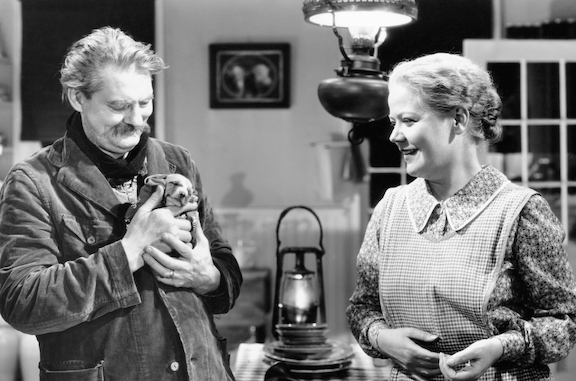
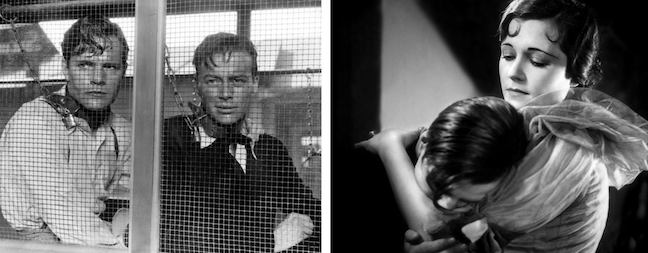
Mosher didn’t find much excitement in the dog-themed picture The Voice of Bugle Ann, and was left flat after seeing Road Gang and the German film Liebelei.
SWEET AND SOUR…Lionel Barrymore and Spring Byington were on one side of a feud over a special dog in The Voice of Bugle Ann. (tcm.com)WELL THIS SUCKS…At left, Donald Woods and Carlyle Moore Jr. find themselves behind bars in Road Gang; at right, Paul Hörbiger and Olga Tschechowa in 1933’s Liebelei (aka Playing at Love). (rotten tomatoes.com/screenslate.com)
* * *
Language Arts
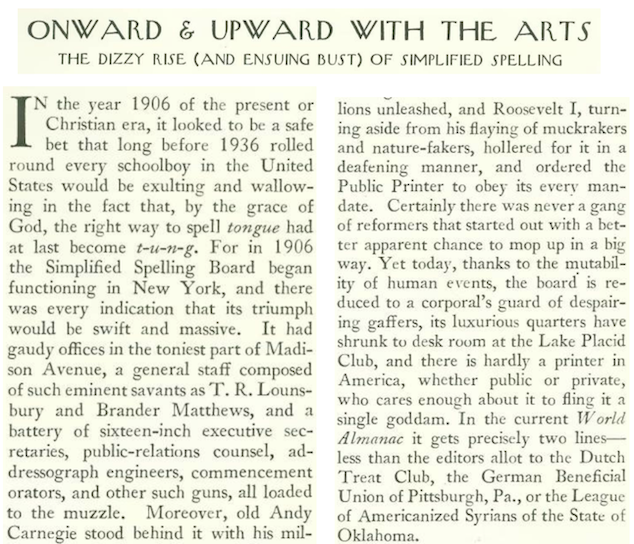
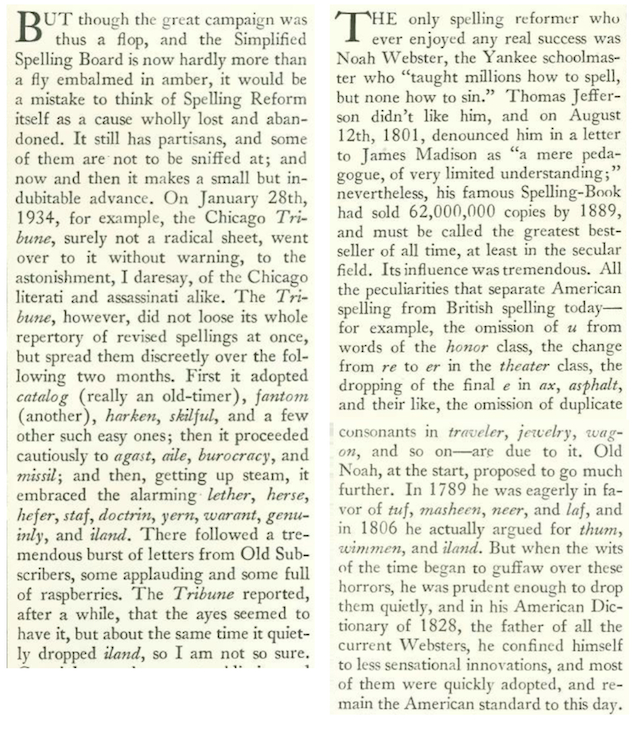
H.L. Mencken continued his exploration of American English by taking a look at past attempts to simplify spelling—most of them unsuccessful. Excerpts:
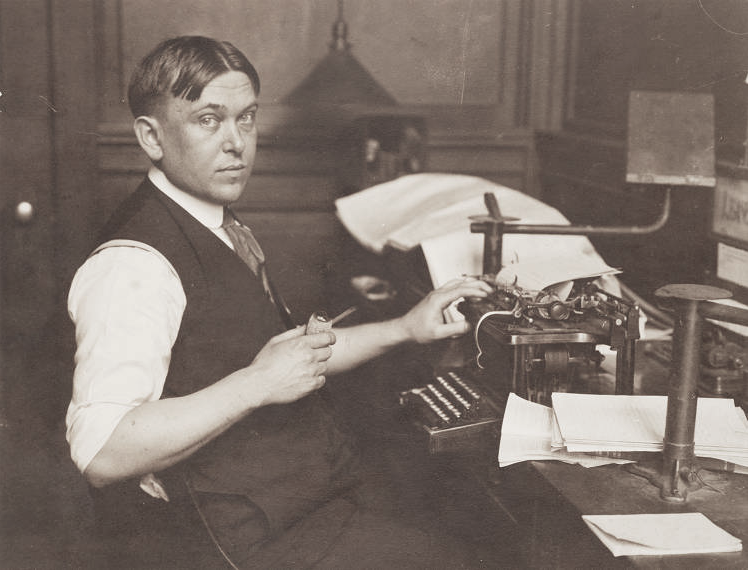
NOT ONE FOR GIMMICKS…H.L. Mencken at his desk at the Baltimore Sun.(Paris Review)
Mencken noted the Chicago Tribune’s radical approach to simplified spelling in 1934, and the lasting effects of Noah Webster’s American dictionary.
“PEDAGOGUE” was one of the milder insults cast at Noah Webster by his peers. (National Portrait Gallery)
* * *
First World Problem
Food critic Sheila Hibben looked into the complexities of tea-drinking during the cocktail hour, and vice-versa.
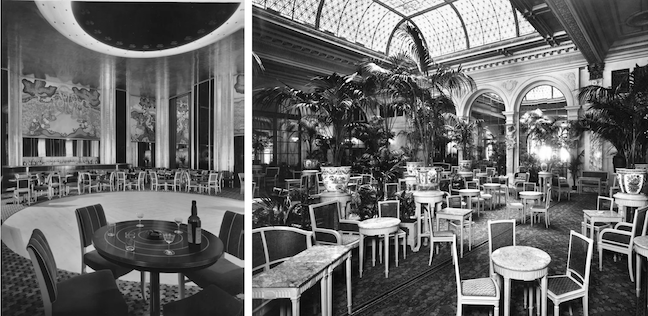
CHOOSE YOUR MOOD…The Plaza Hotel offered the ideal setting for whatever libation one chose at tea time. At left, the Plaza’s Persian Room, 1934, and the Palm Court, undated photo. (cooperhewitt.org/mcny.org)
* * *
Finer Things
Rebecca West was a brilliant journalist and gifted prose writer, and when she published something people took notice, including critic Clifton Fadiman, who noted her return with The Thinking Reed. A brief excerpt:
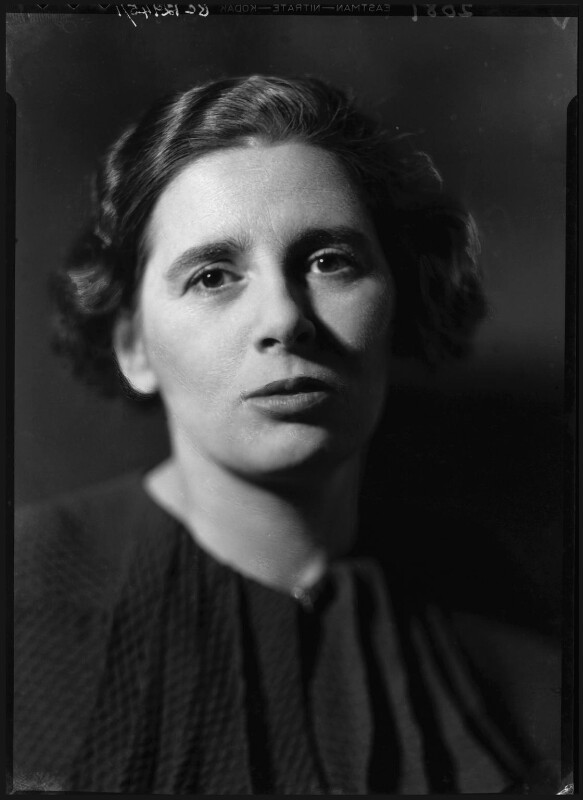
A MIGHTY PEN…Rebecca West (1892-1983) was considered one of the finest prose writers of twentieth-century England. This 1934 photograph was produced by Howard Coster. (National Portrait Gallery)
* * *
From Our Advertisers
The March 7 issue opened to this sumptuous image of luxury travel aboard the Normandie…
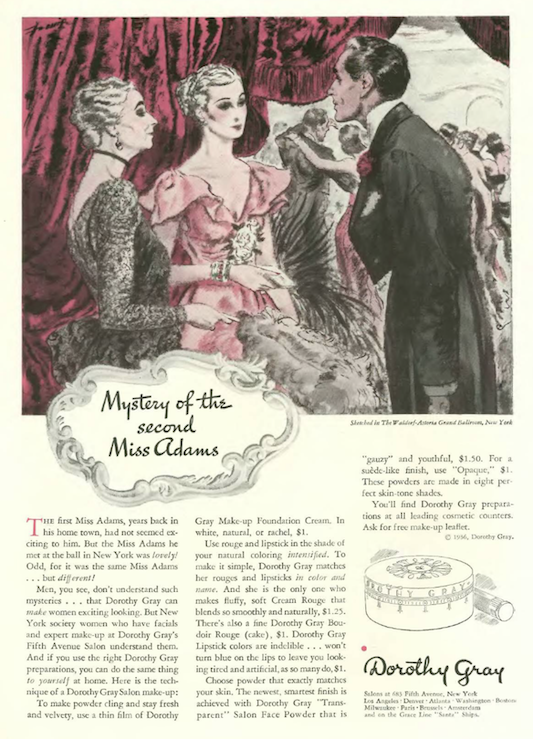
…the salons of Dorothy Gray returned with another tale of a magical transformation, here the plain “Miss Adams” suddenly becomes lovely and exciting thanks to the illusion of cosmetics…
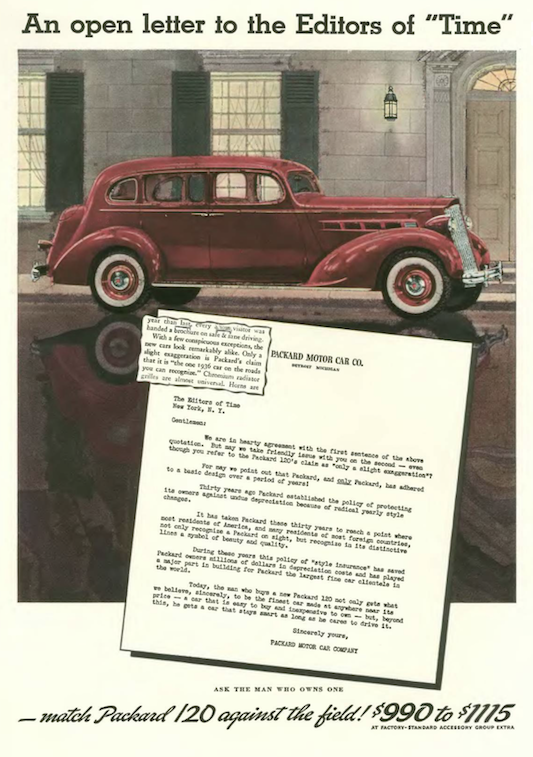
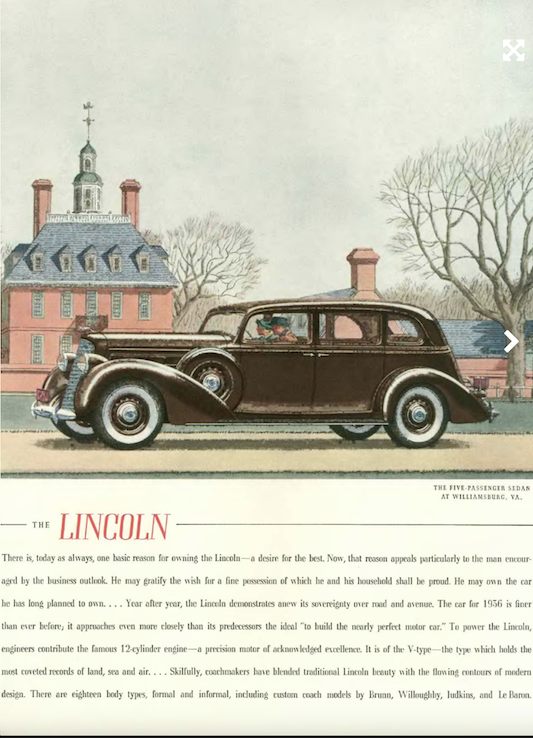
…the makers of Packard automobiles took out this full page ad to gently chastise Time magazine for questioning the carmaker’s adherence to a timeless, “basic design”…
…although in Time’s defense the Packard didn’t look much different from this Lincoln…
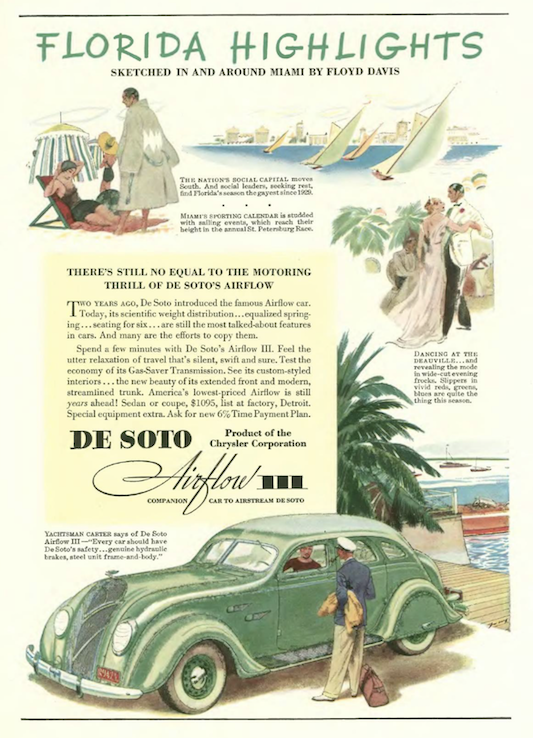
…what did look different was the Chrysler/DeSoto Airflow, which had disappointing sales due to a streamlined design that was a bit too radical for consumers…
…actress and costume designer Kate Lawson (1894-1977) made her image available to promote washable wallpaper…
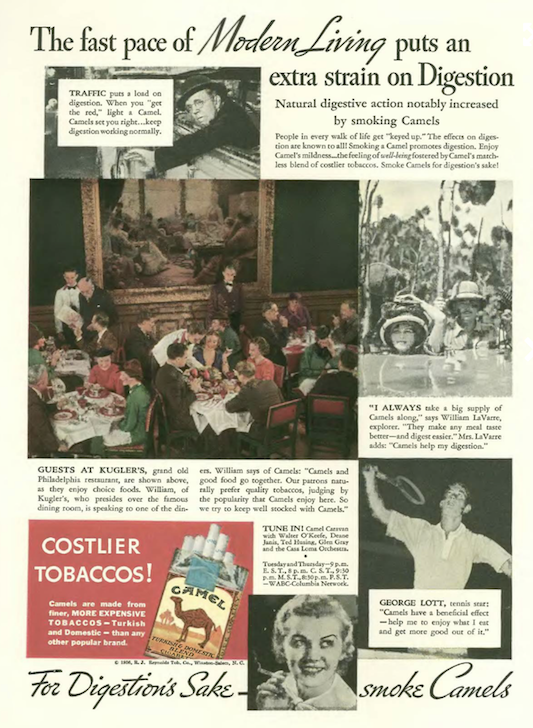
…in addition to calming nerves and boosting energy, Camels apparently aided one’s digestion, or so this ad claimed…
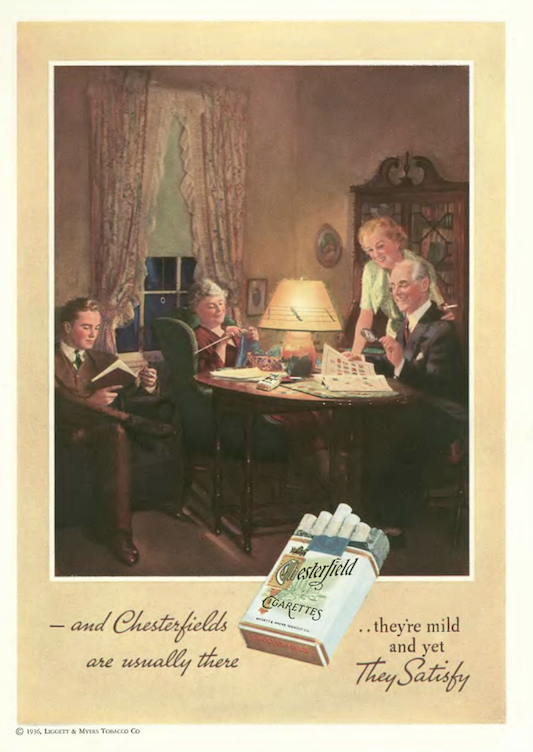
…Liggett & Myers stuck with the homespun approach, here three generations light up Chesterfields in the warm glow of the parlor…
…did you spot the cigarettes in the ad?…
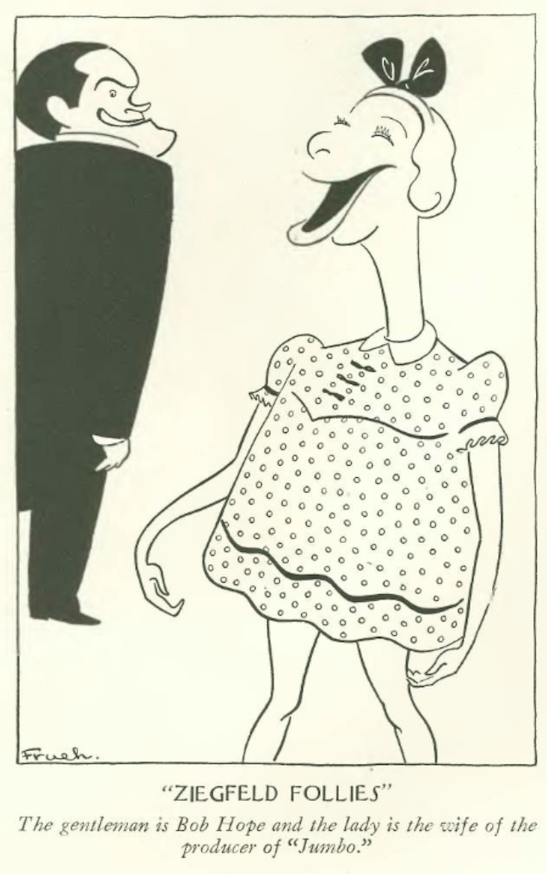
…on to the cartoons, we have Al Frueh’s take on the Ziegfeld Follies…
…James Thurber contributed this to the calendar section…
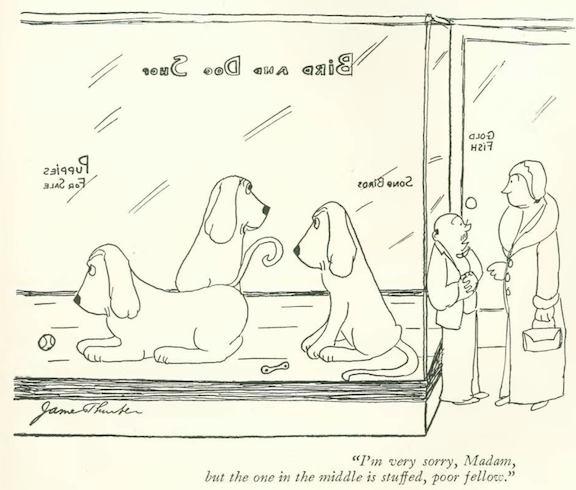
…and Thurber again with his beloved dogs…
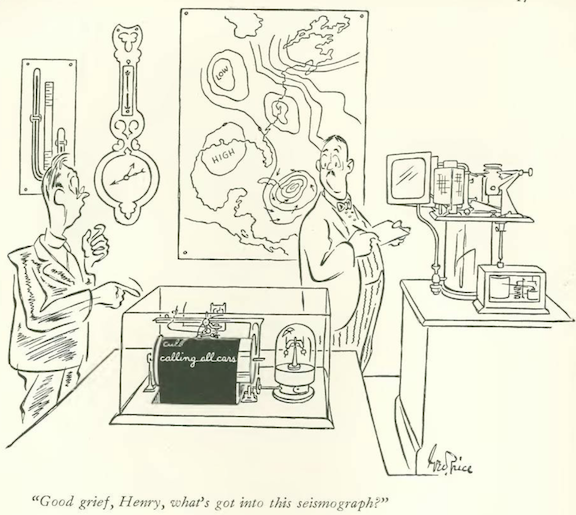
…George Price found a glitch at the weather bureau…
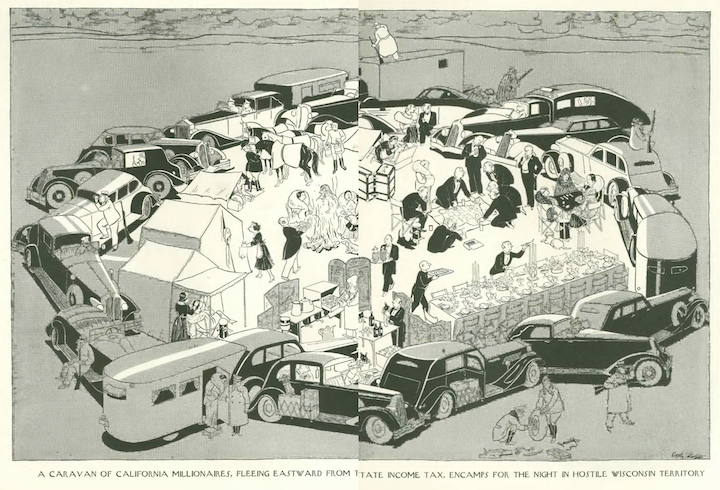
…Californians circled their wagons in the hostile Midwest, per Carl Rose…
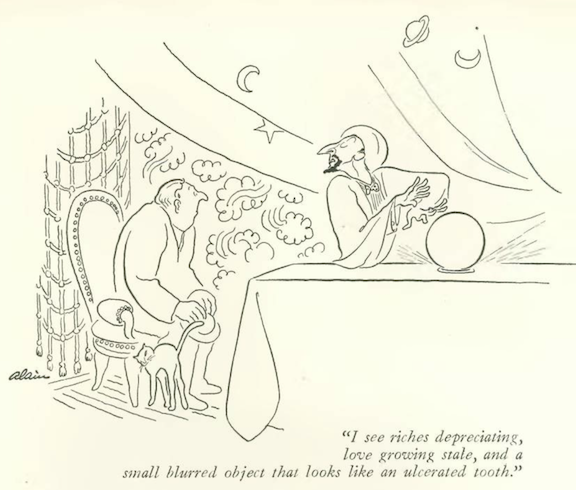
…Alain saw a trip to the dentist in this man’s future…
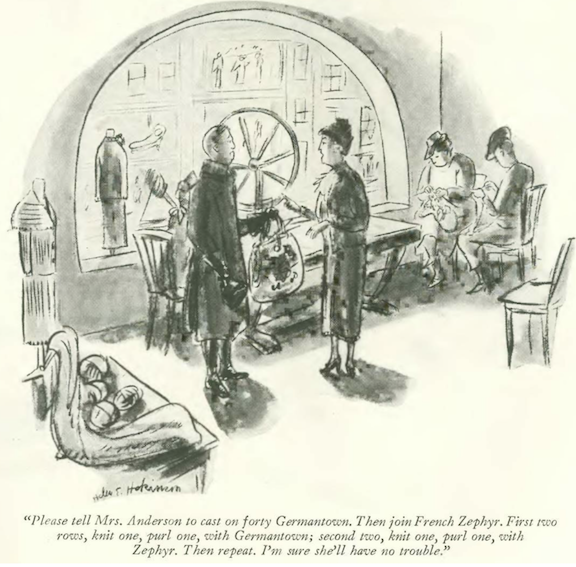
…Helen Hokinson lost us in the peculiarities of needlepoint…
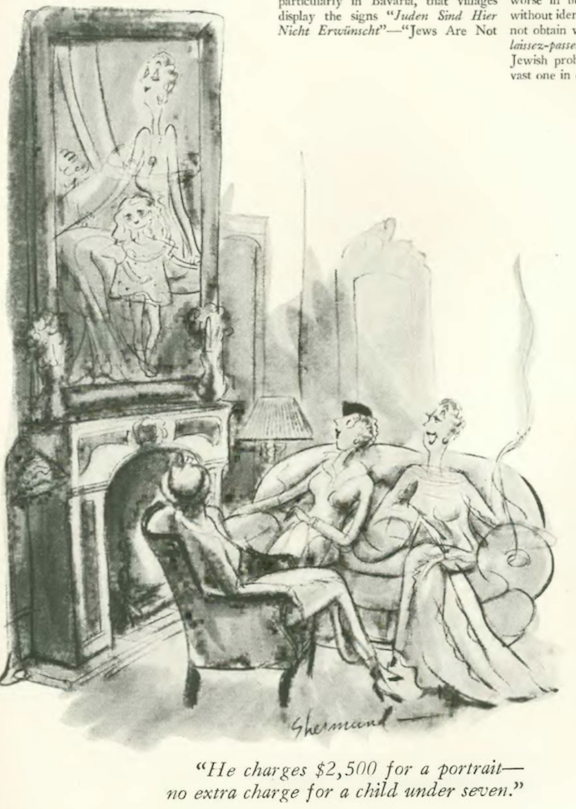
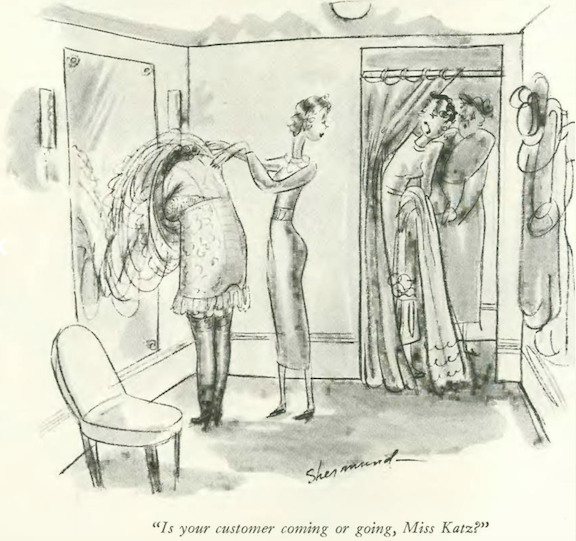
…Barbara Shermund found a bargain in portraiture…
…and Shermund again, in the dress department…
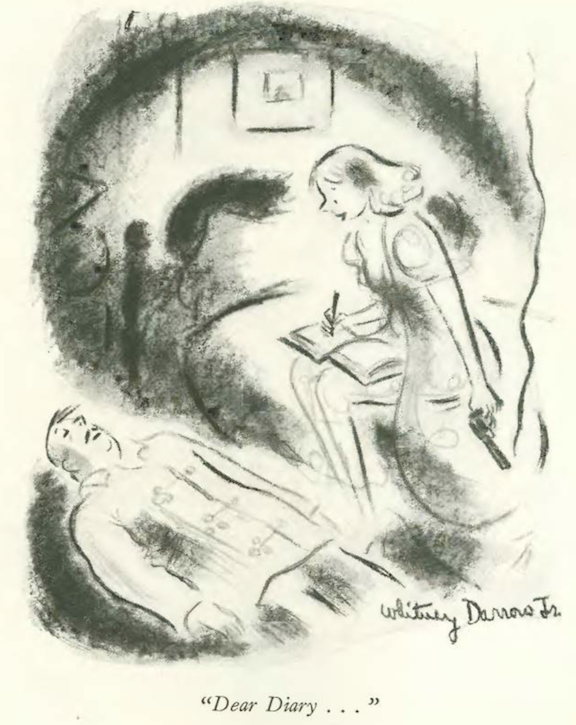
…and we close with Whitney Darrow Jr, and something to write about…
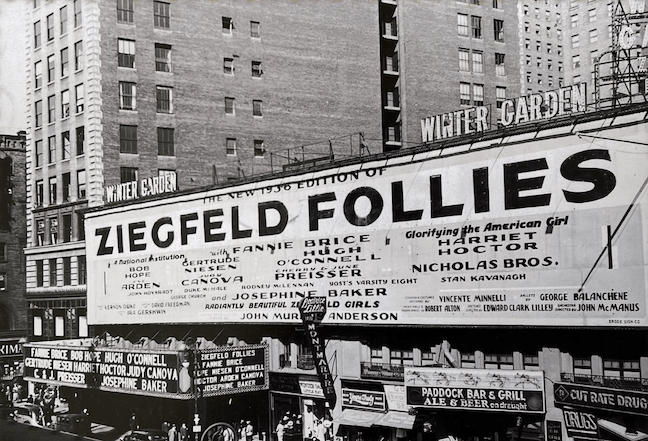
Above: The 1936 Ziegfeld Follies premiered on Broadway at the Winter Garden Theatre on January 30, 1936 and closed on May 9, 1936 after 115 performances. (Hulton Archive)
Broadway impresario Florenz Ziegfeld Jr died in 1932, but his famous theatrical revue lived on for years with revivals including one in 1936 that Robert Benchley praised for being better than the originals.
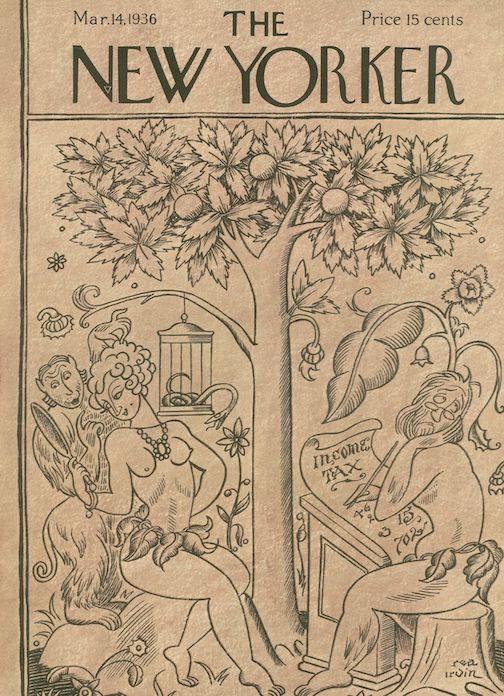
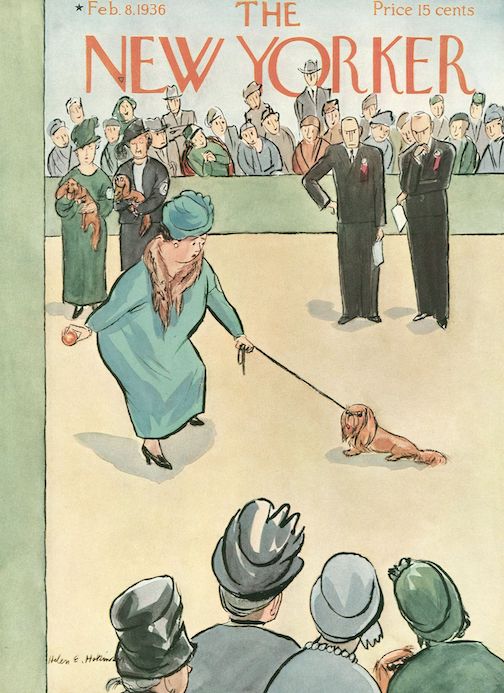
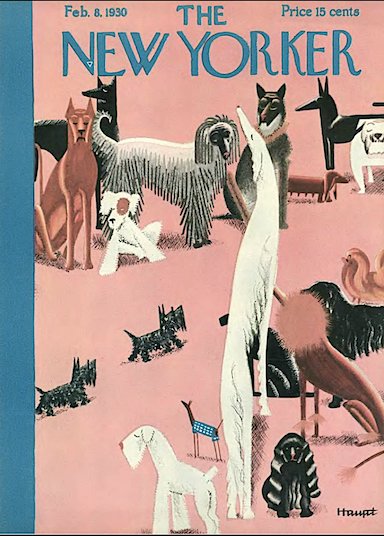
February 8, 1936 cover by Helen Hokinson, marking the opening of the Westminster Kennel Club Dog Show at Madison Square Garden. According to Michael Maslin’s always enlightening Ink Spill, the first dog-themed New Yorker cover was Feb. 8, 1930, by Theodore Haupt (below).
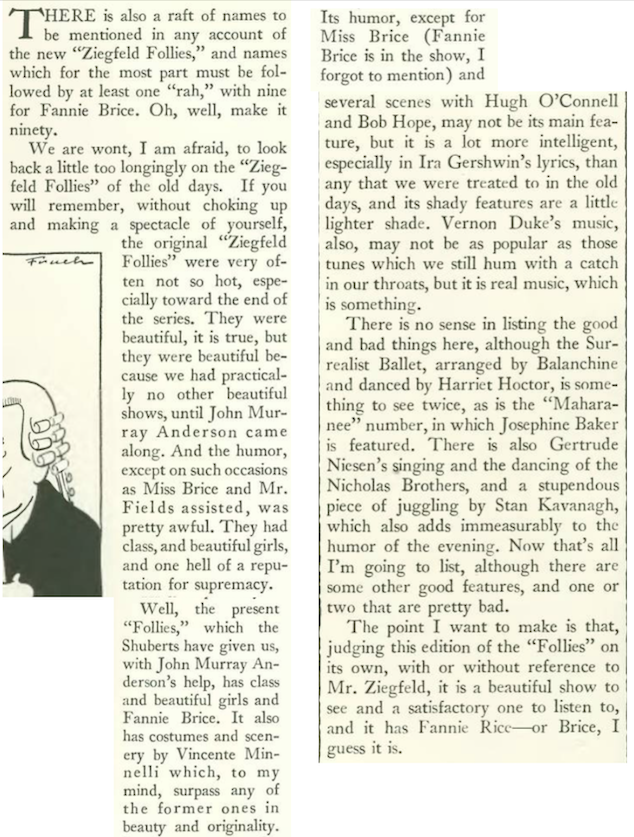
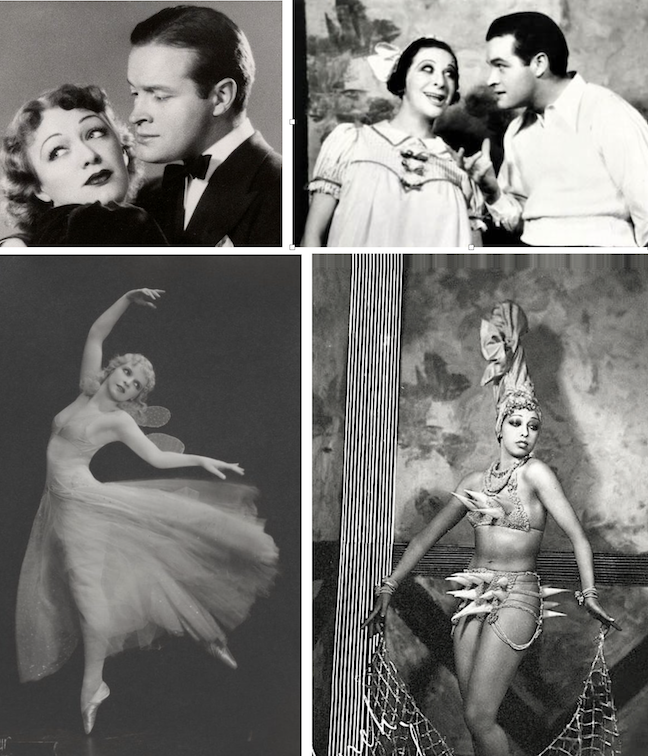
Now on with the show. Brought back to life by Ziegfeld’s widow Billie Burke and theatre operators Lee and J. J. Shubert,The Ziegfeld Follies of 1936 was loaded with talent, with lyrics by Ira Gershwin, choreography by George Balanchine, and sets and costumes by Vincente Minnelli. What really brought people in was the star of the show, Fannie Brice, who was supported by cast members Bob Hope, Eve Arden, Josephine Baker, and the Nicholas Brothers, among others. Benchley wrote:
FANNIE AND THE REST…Clockwise, from top left: Bob Hope and Eve Arden performed the popular tune “I Can’t Get Started With You”; Hope with Fannie Brice in the sketch “Baby Snooks Goes Hollywood”; Josephine Baker premiered “The Conga” at the Follies, and Harriet Hoctor performed her “Night Flight.” (gershwin.com/uneicone-josephinebaker.webador.fr/libraryofcongress,org)
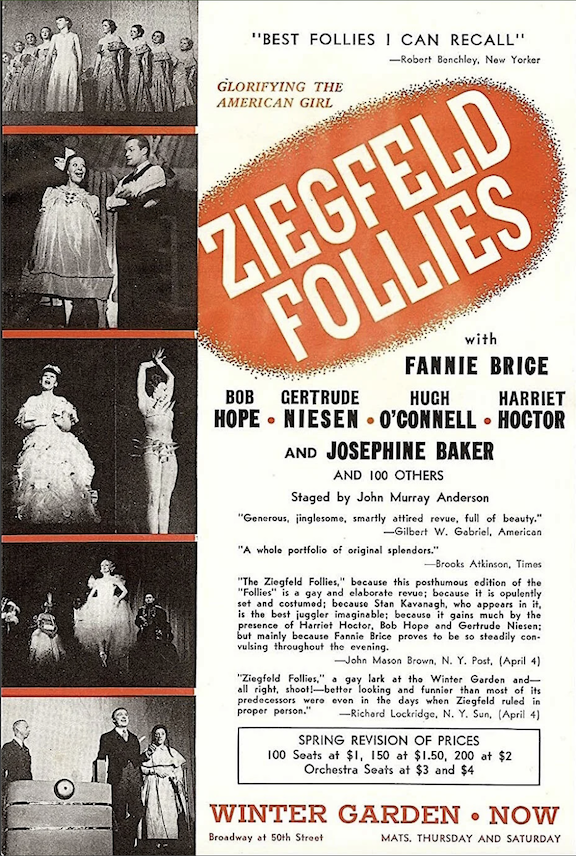
This ad for the 1936 Follies prominently featured Benchley’s endorsement:
(uneicone-josephinebaker.webador.fr)
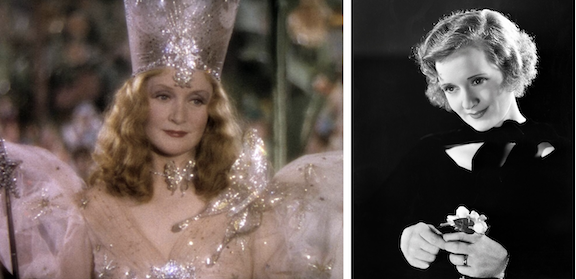
Billie Burke (1884–1970) authorized Follies revivals with the Shuberts in 1934, 1936 and 1943, with the Shubert family producing a final revival in 1957. In 1936 MGM also filmed a Ziegfeld biopic, The Great Ziegfeld (which won two Academy Awards), casting William Powell as Ziegfeld and Myrna Loy as Burke. Burke wanted to play herself in the film, but at age 51 she was deemed too old for the part.
ZIEGFELD MAGIC…Florenz Ziegfeld’s widow Billie Burke kept the Follies going after her husband’s death in 1932. She is best known today for her portrayal of Glinda the Good Witch of the North in 1939’s The Wizard of Oz. (oscars.org/Wikipedia)
Fannie Brice (1891–1951) was the biggest star of the Follies and so dominated the show that when she became ill in May 1936 the production closed. Brice returned to the Winter Garden that September for 112 more performances.
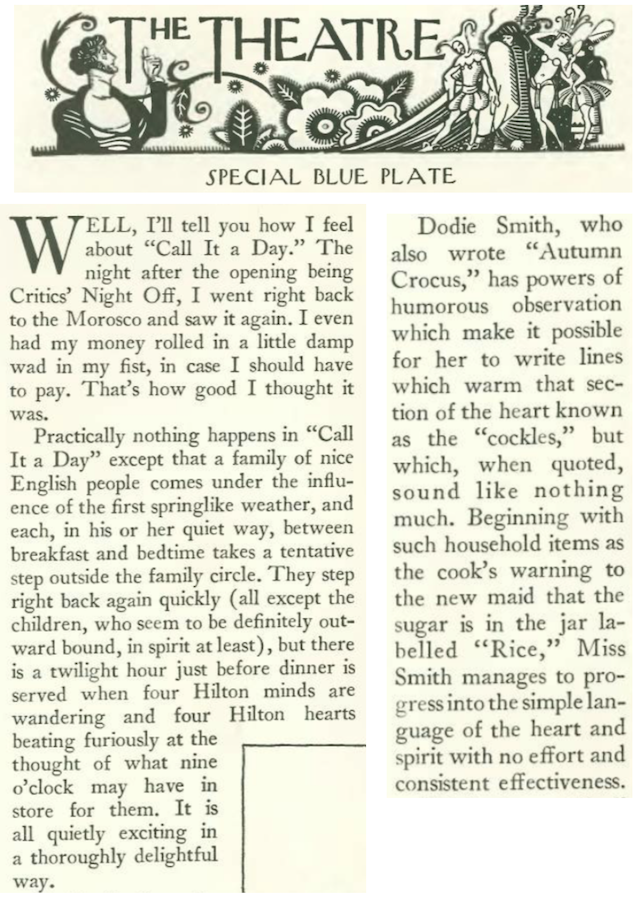
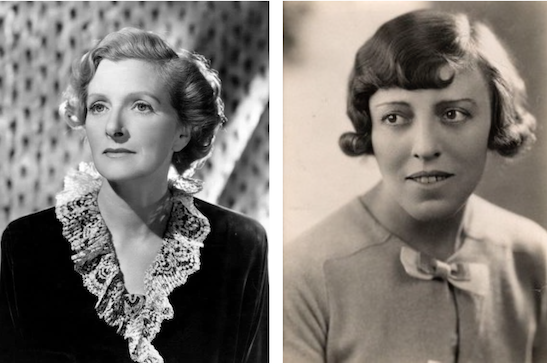
Benchley also praised Call it a Day, a 1935 play by British writer Dodie Smith that ran for 194 performances at the Morosco Theatre. Benchley thought it was so good he saw it twice.
SPRING FEVER drove the action in Dodie Smith’s (right) hit comedy Call it a Day. The play chronicles a single spring day in the lives of the Hilton family, during which each member encounters unexpected romantic temptations and complications. Gladys Cooper, left, starred as Dorothy Hilton. The play was adapted to a Hollywood film in 1937. (vocal.media/Wikipedia)
* * *
At the Movies
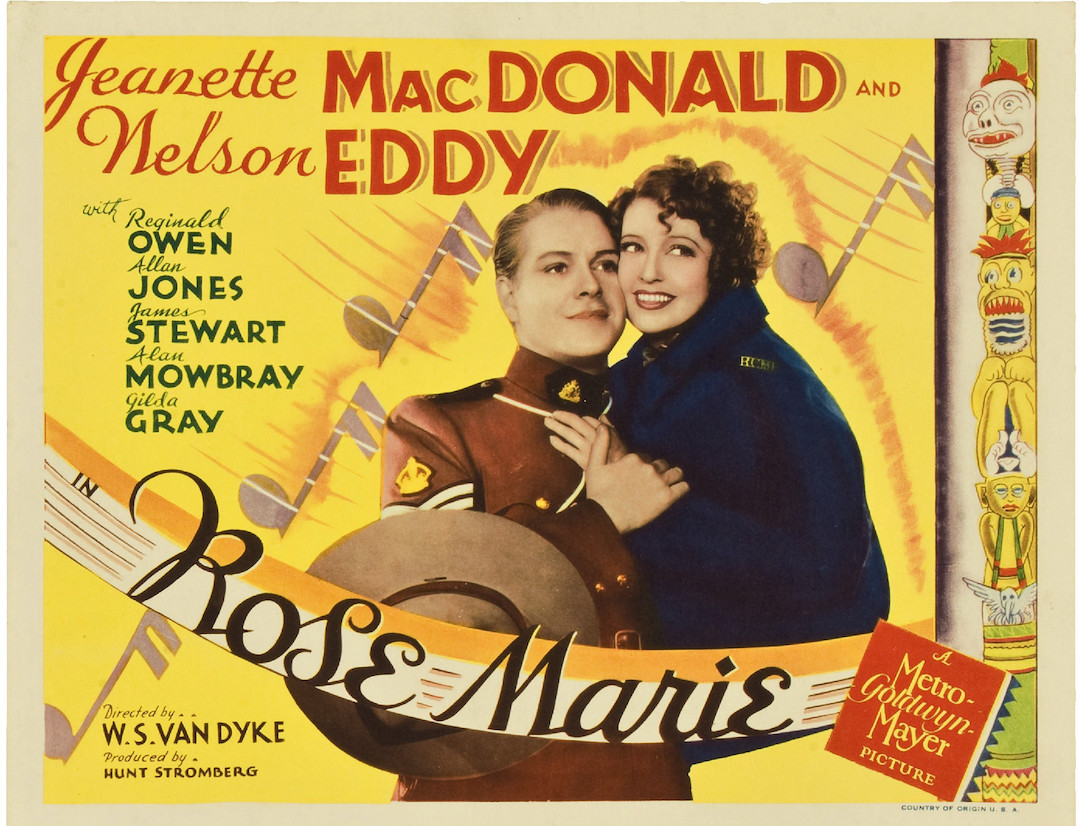
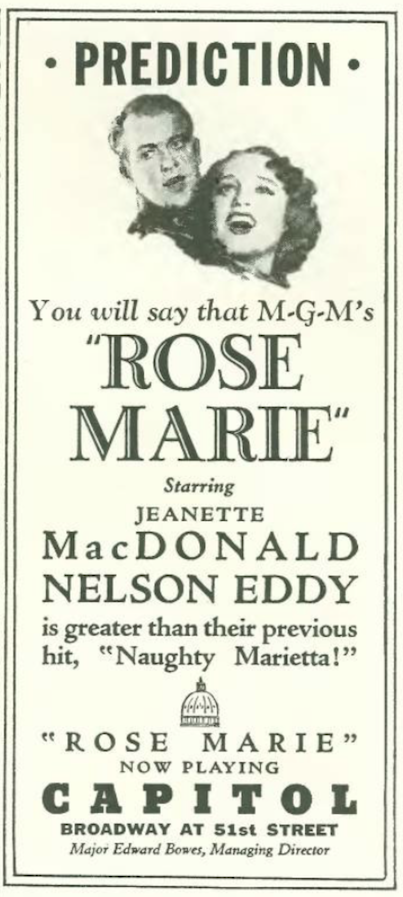
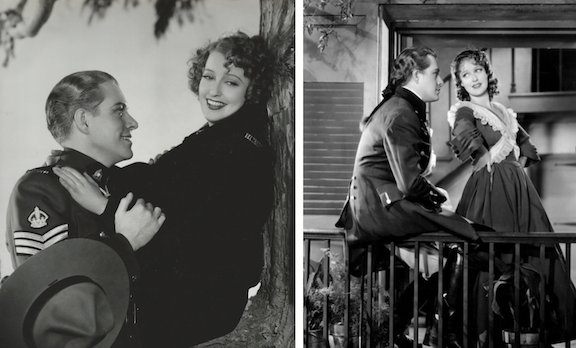
We go from the stage to the screen, where John Mosher took in Rose Marie, a musical comedy based on a popular 1924 Broadway play. The film “repolished” the old play and used it as a framework for a series of duets between Jeanette MacDonald and Nelson Eddy.
MELODIOUS MOUNTIE…Lobby card for Rose Marie, a musical romcom about a singing Mountie and a world-renowned prima donna, joined in love by a haunting “Indian mating call.” (Wikipedia)
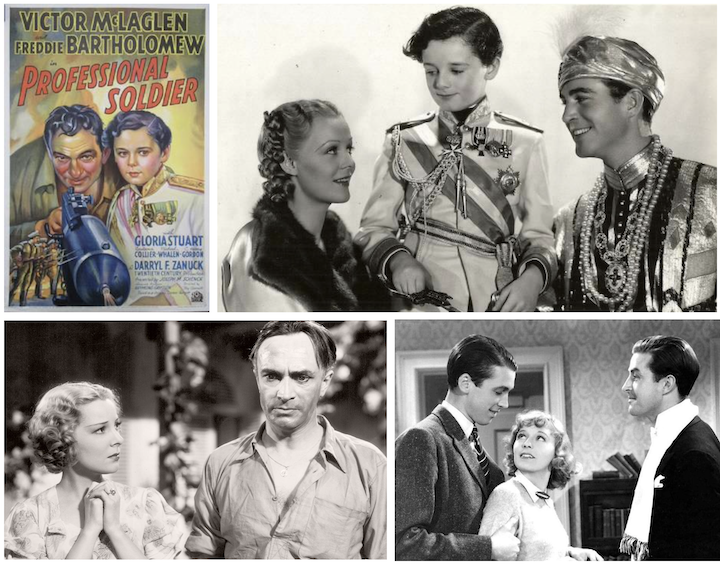
Mosher reviewed three other films that could have used some of Rose Marie’s cheer:
CHEERLESS FARE…Clockwise, from top: Gloria Stuart, Freddie Bartholomew, and Michael Whalen in Professional Soldier; James Stewart, Margaret Sullavan and Ray Milland in Next Time We Love; Helen Vinson and Conrad Veidt in King of the Damned. (Wikipedia/imdb.com/letterboxd.com/silversirens.co.uk)
* * *
Miscellany
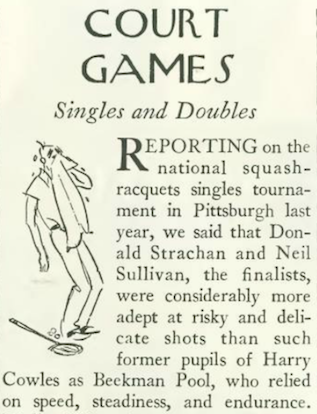
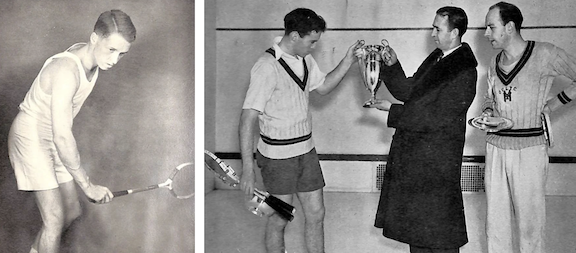
I strive to keep these posts at a readable length, and (hopefully) lively and enjoyable to read, which means that I cannot include absolutely everything that appears in each issue. For example, there are a number of regular features from the sports world—ranging from major attractions like hockey and college football (no coverage yet of baseball—which for some reason Harold Ross hated—or basketball) to more niche pursuits, such as squash (below) or indoor polo. From time to time I will include these under “Miscellany” as a way to give readers a more complete picture, and to assuage my fear that I am leaving something important out. Here is a very brief snippet of a regular feature, “Court Games,” by staff writer Geoffrey T. Hellman.
RACKETEERS…At left, Beekman Pool of the Harvard Club was the 1936 singles champion of the Metropolitan Squash Racquets Association; at right, Edwin Bigelow of the U.S. Squash Racquets Association presents the National Trophy to Germain Glidden. To the far right is runner-up Andrew Ingraham, who looks a bit miffed about getting a plate rather than a trophy cup. (thecarycollection.com)
* * *
From Our Advertisers
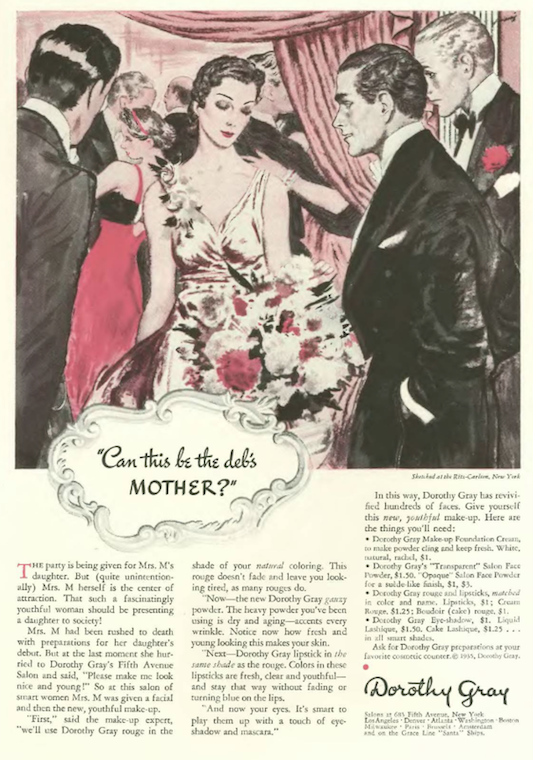
Let’s start with the inside front cover…advertisements from Dorothy Gray salons were all about the restoration of youth in older women…apparently the treatments were so successful that “Mrs. M” was a bigger attraction at a Ritz-Carlton debutante party than her society-bound daughter…note the young gents at right checking out mom, and not the deb…
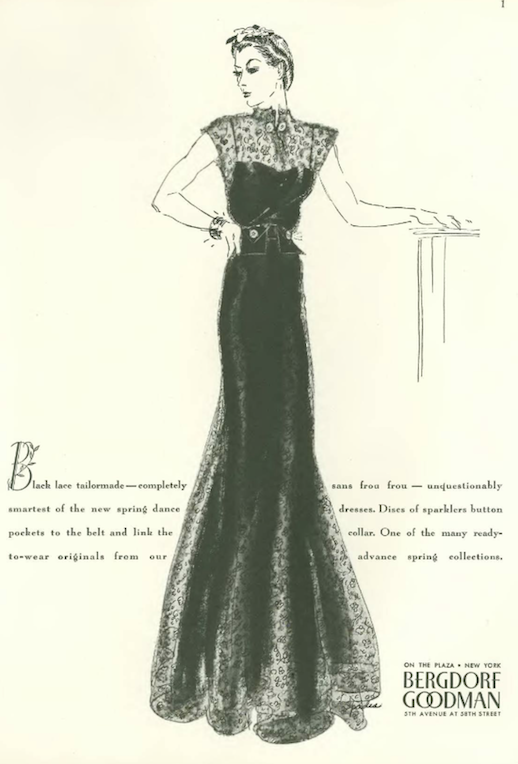
…opposite Dorothy Gray was this elegant appeal from Bergdorf Goodman…ads aimed at more refined tastes almost always featured these attenuated figures (whether they were people or luxury automobiles)…I guess I would hold onto something too with stilts like those…
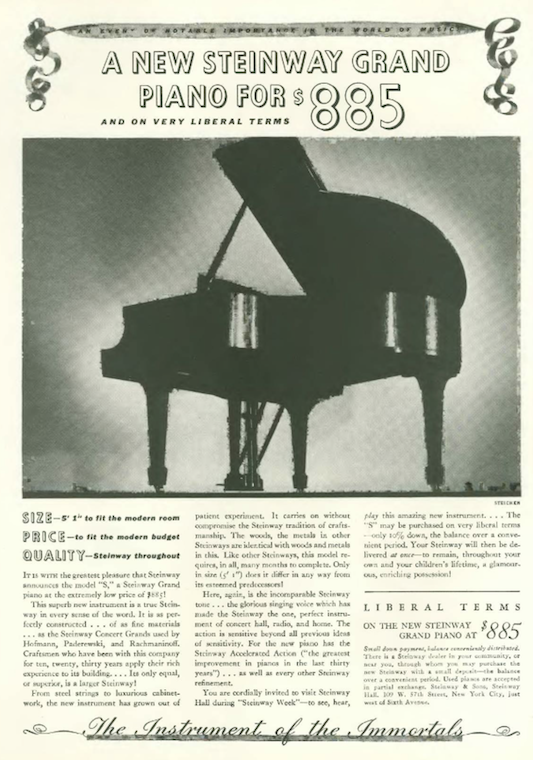
…here’s a Steinway grand for less than a grand…$885 in 1936 is roughly equivalent to $20,000 or so today, but that’s still a bargain—Steinway grand pianos currently start at around $85,000…
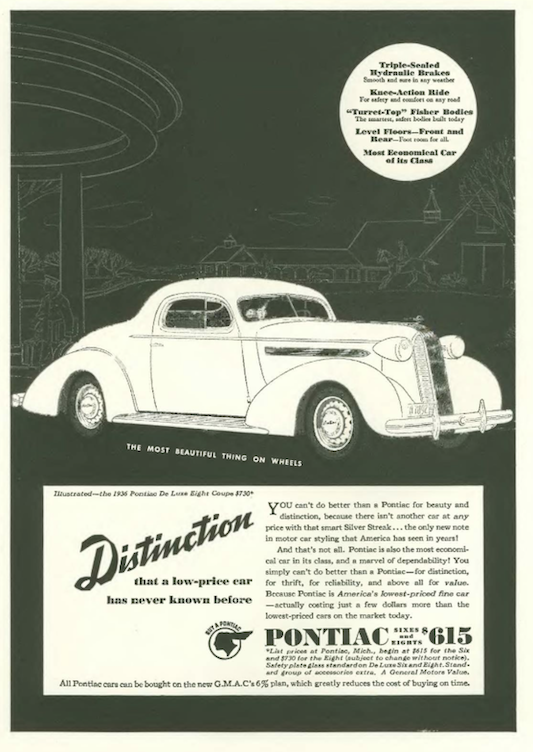
…speaking of bargains, you could own “The Most Beautiful Thing on Wheels” (according to this ad) for a mere $615…
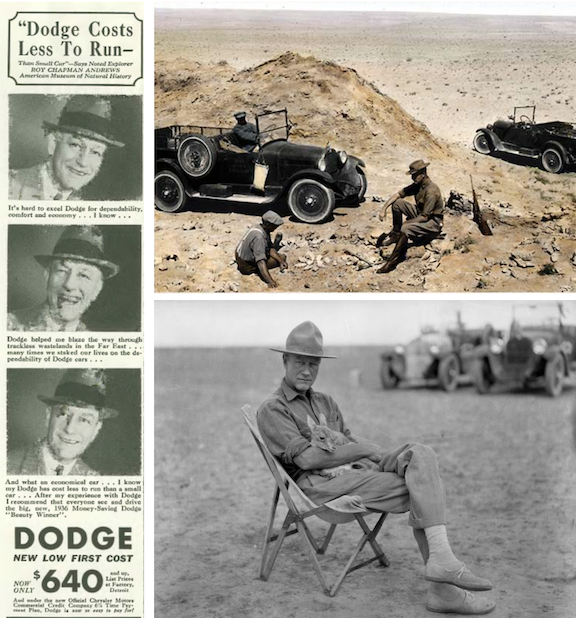
…and for an extra twenty-five bucks you could own a durable Dodge like the one endorsed by Roy Chapman Andrews (1884–1960), a globetrotting explorer who discovered fossilized dinosaur eggs in the Gobi Desert in the 1920s…
THE REAL INDY…Roy Chapman Andrews gained national fame as an explorer for New York’s American Museum of Natural History (AMNH). The discovery of a nest of complete dinosaur eggs in Mongolia in 1923 (above) provided the first proof that the critters hatched out of eggs. Named AMNH’s director in 1934, Andrews is thought to be an inspiration for the film hero Indiana Jones. (amnh.org/roychapmanandrewssociety.org)
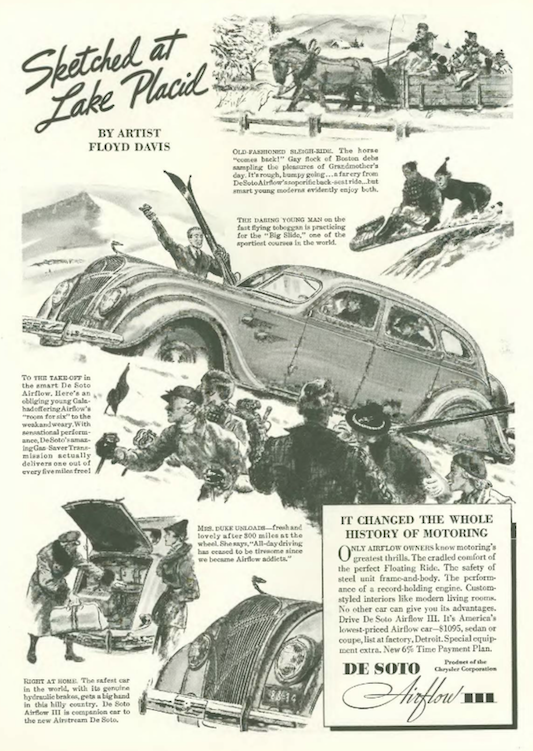
…the folks at Chrysler were doing everything they could to get people interested in buying their Airflows—despite its technological advances, the car’s streamlined design (toned down in later models) was just too radical for mass market tastes…note how the ad draws attention to the work of “Artist Floyd Davis”…
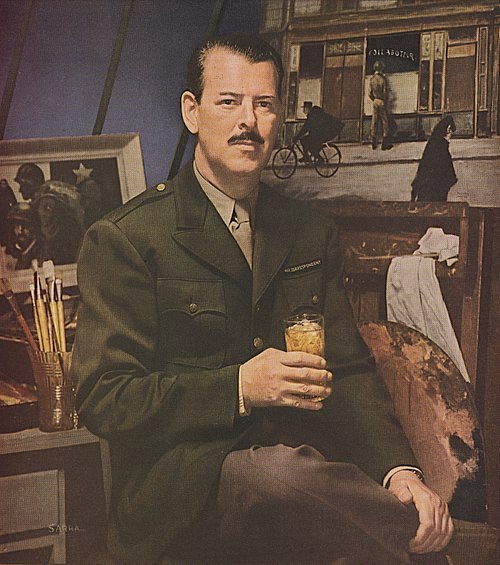
…here’s a photo of Floyd Davis…
CHEERS…Illustrator Floyd Davis (1896–1966) poses in an ad for Lord Calvert whiskey, 1946. In 1943 Life magazine called him the “#1 Illustrator in America.” (Wikipedia)
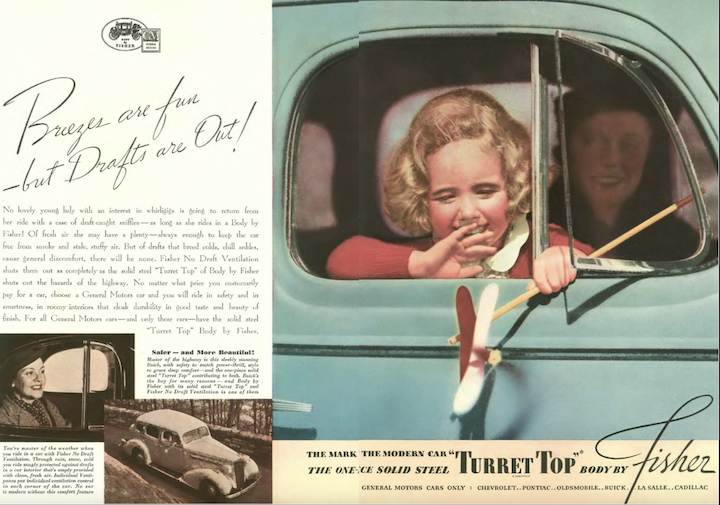
…the Fisher company, makers of car bodies for General Motors, liked to emphasize the safety of their “Turret Top,” although it didn’t seem to occur to anyone that a child dangling from a car window was problematic…
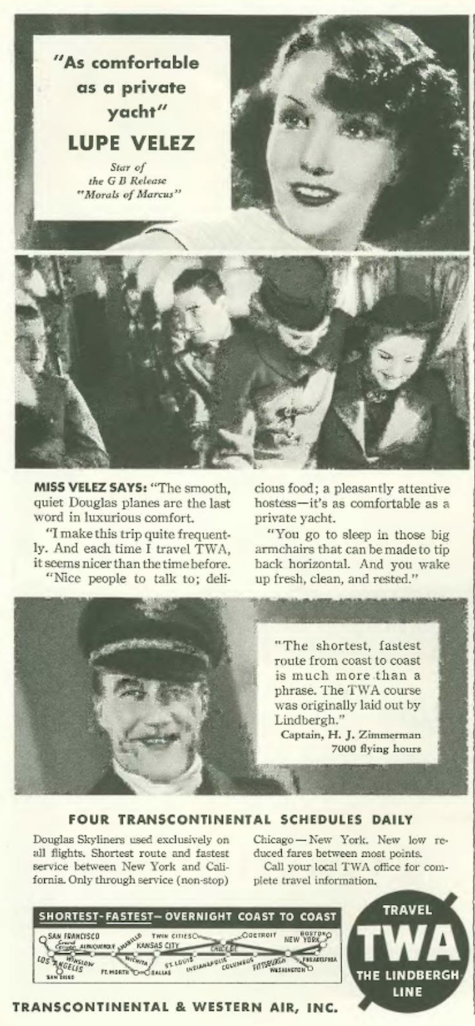
…actress Lupe Vélez made the unlikely claim that flying on a 1930s airliner was “as comfortable as a private yacht”…
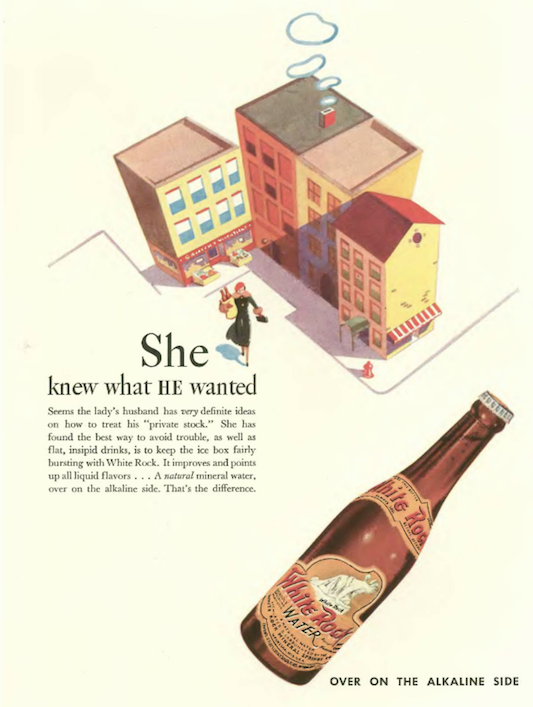
…ads for White Rock were among the more colorful found in the early New Yorker…
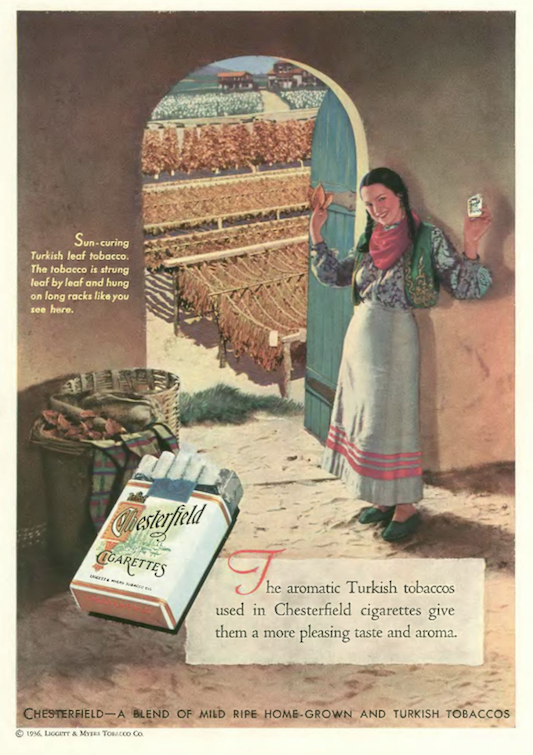
…on the back cover, Liggett & Myers tobacco company shifted gears from elegant to homespun with an ad that emphasized the high quality of Turkish leaf tobacco…
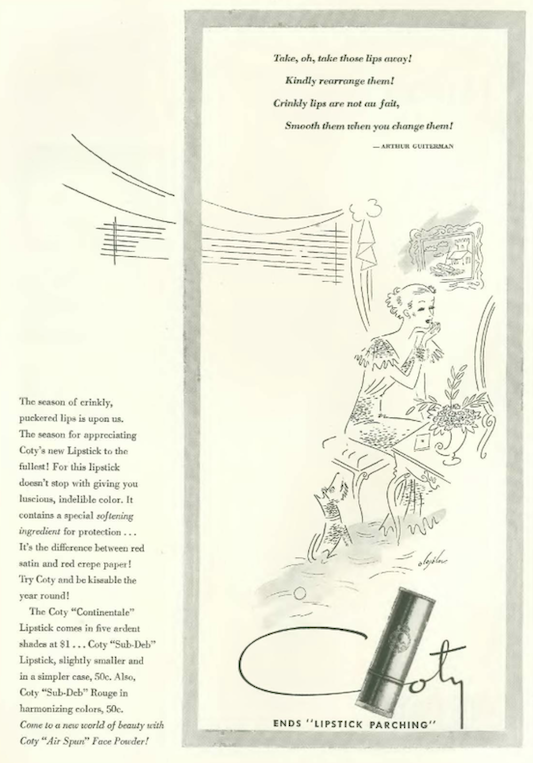
…the folks at Coty hired two New Yorker contributors, poet Arthur Guiterman and illustrator Constantin Alajalov, to promote their line of lipsticks…
…which brings us to the cartoonists, beginning with Al Frueh…
…Richard Taylor opened things up in “Goings On”…
…and George Price added this bit of action to the calendar section…
…Abe Birnbaum contributed this delightful spot drawing…
…the Westminster dog show was the talk of the town, and at Grand Central, per Perry Barlow…
…Robert Day had a fight on his hands…
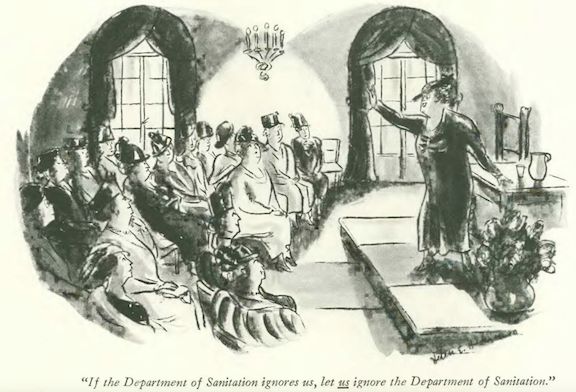
…Helen Hokinson’s “girls” were out to snub the sanitation department…
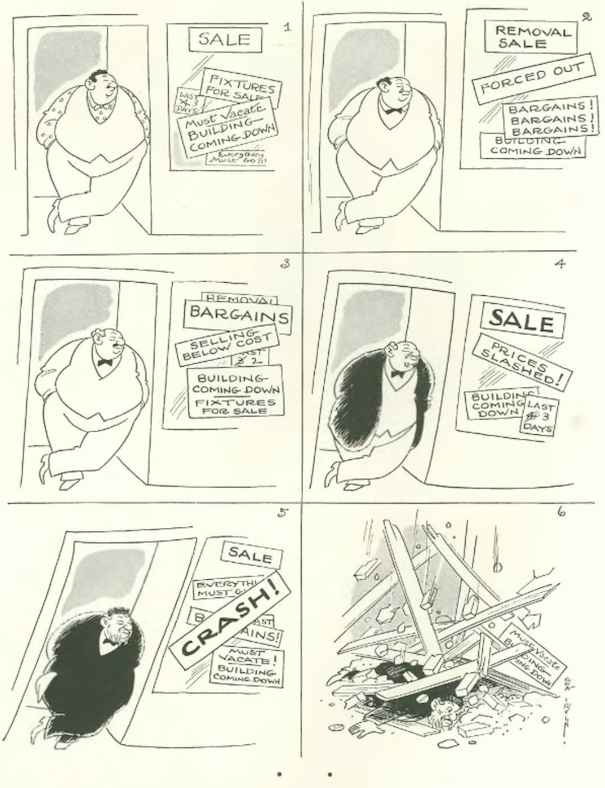
…Rea Irvin drew up the literal downfall of one business…
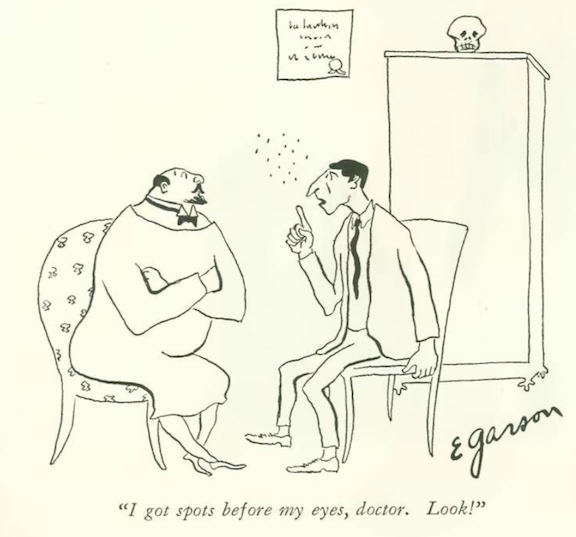
…Eli Garson had us seeing spots…
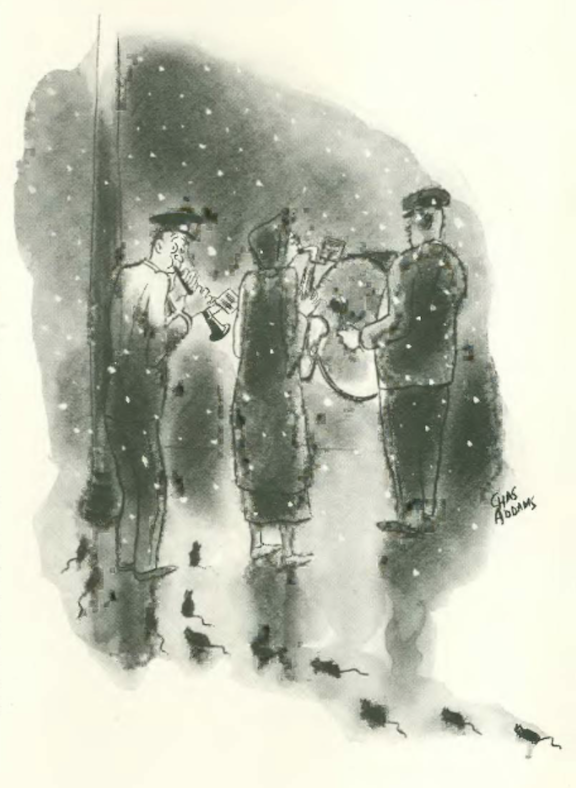
…Charles Addams found the Pied Piper in a Salvation Army band…
…Alan Dunn gave new meaning to “taking a detour”…
…Barbara Shermund illustrated one of the perils of cocktail parties…
…and we close with Peter Arno, and the sinister world of taxi dancers…
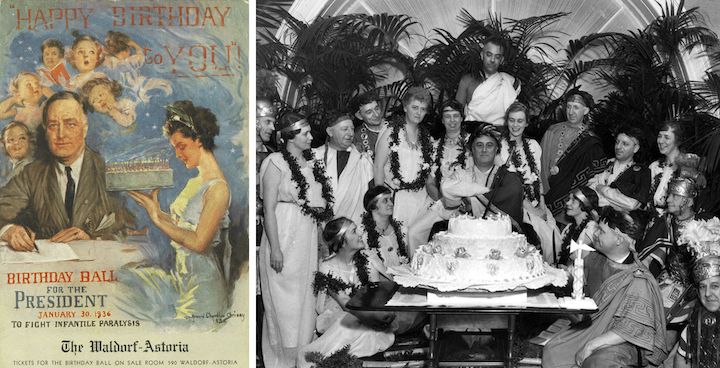
Above: Beginning in 1934, the President’s Birthday Balls became annual fundraisers for polio research. The Waldorf-Astoria's 1936 event (left) featured dance bands, celebrities, and formal dress. At right, a 1934 "Toga Party" birthday with FDR's Cuff Link Gang, Washington D.C. (fdrlibrary.org)
President Franklin D. Roosevelt’s birthday was a cause for annual celebration throughout the country, where cities and towns both large and small used the occasion to raise money for polio research.
February 1, 1936 cover by Roger Duvoisin.
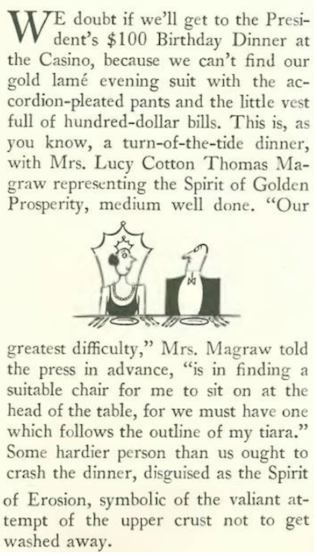
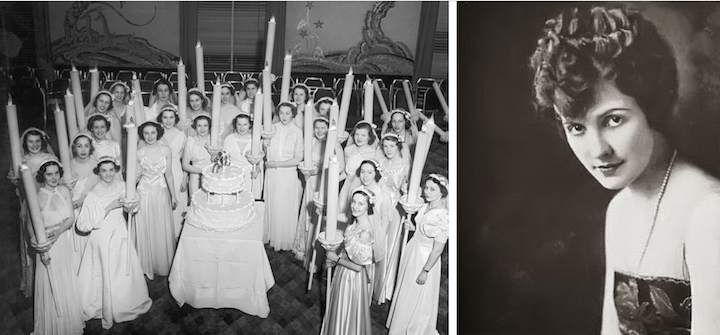
The Jan. 30, 1936 President’s Birthday Ball marked FDR’s 54th year, featuring celebrities, dances, and a national radio address. The Waldorf-Astoria hosted an event, as did the Central Park Casino, where E.B. White found the one-hundred-dollar price tag and the dress code a bit too rich for his tastes, but not too rich for Lucy Cotton Thomas Magraw, a Manhattan social climber who represented the “Spirit of Golden Prosperity” at the Casino event.
LIKE MOTHS TO FLAME…At left, debutantes mark FDR’s birthday fundraiser at the Waldorf-Astoria in the 1930s; at right, Lucy Cotton Thomas Magraw (1891–1948) was a chorus girl from Houston who appeared in several silent films, but was best known as a Manhattan social climber and for her marriages to a series of prominent men. (wwd.com/davidkfrasier.com)
FDR himself was diagnosed with polio in 1921, which left him paralyzed from the waist down. To counter the effects of the disease, Roosevelt explored the potential benefits of hydrotherapy, establishing a rehabilitation center at Warm Springs, Georgia. Proceeds from the charity balls went to Warm Springs until Roosevelt founded the National Foundation for Infantile Paralysis in 1938. Funds raised by the foundation supported the development of a vaccine by the 1950s.
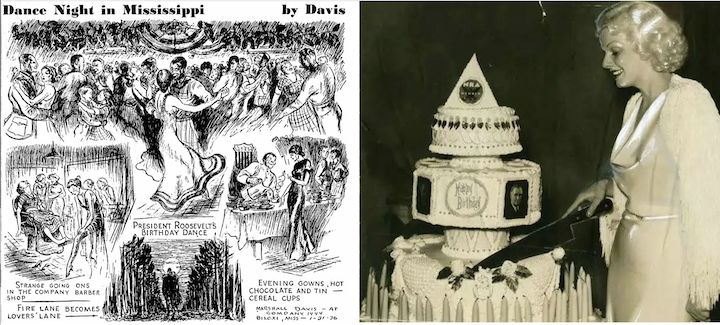
A NIGHT OF MERRIMENT…Celebrations in CCC camps in honor of FDR’s birthday became annual events, such as the one at left (illustrated by Marshall Davis) that depicted various happenings at the 1936 President’s Birthday Dance in Biloxi, Mississippi; at right, actress Jean Harlow cutting FDR’s birthday cake at the Eastbay Birthday Ball in Oakland, CA, in 1934. (newdealstories.com/facebook.com)
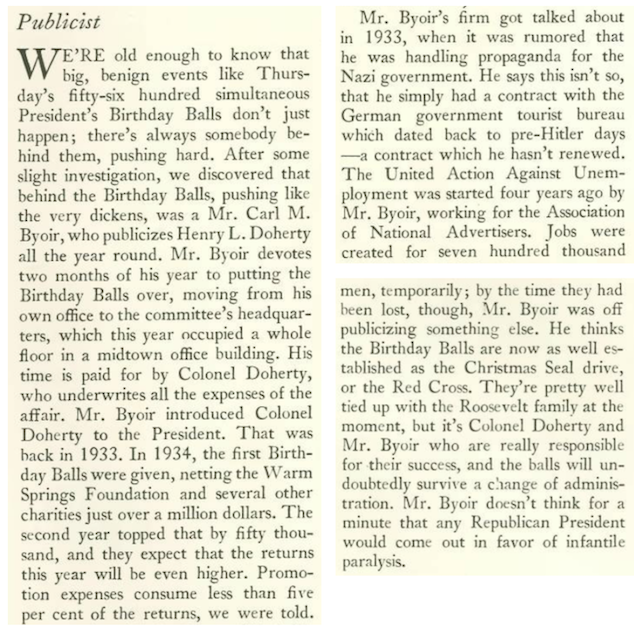
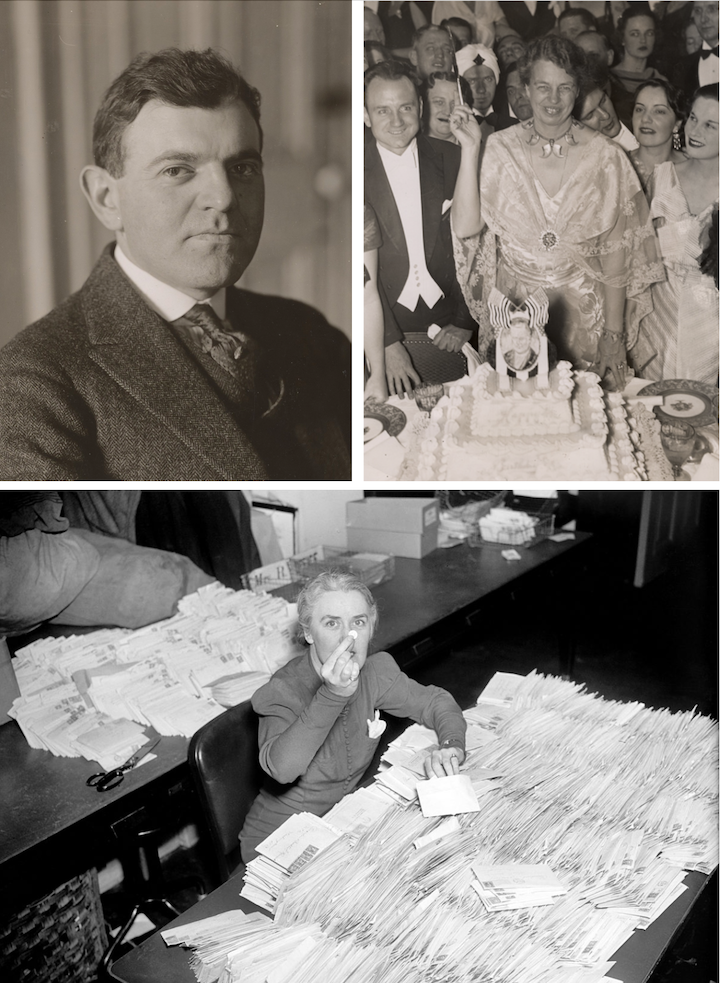
“The Talk of the Town” noted the role of Carl M. Byoir, a pioneering publicist, in creating the buzz around the yearly birthday balls.
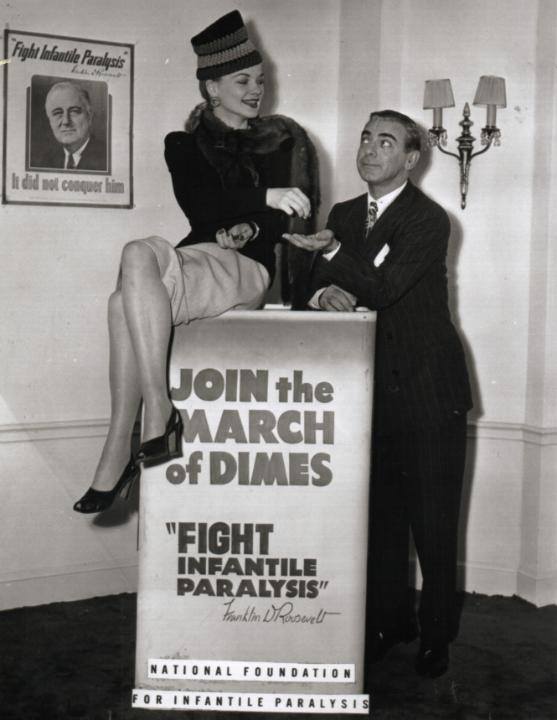
CAN YOU SPARE A DIME?…Clockwise, from top left, Carl Byoir created and organized one of the world’s largest public relations firms in 1930, and was a force behind making the FDR Birthday Balls a major national event; Eleanor Roosevelt cuts the cake at a Birthday Ball, Washington, D.C., Jan. 30, 1936; Margaret Lehand, personal secretary to President Roosevelt, holds up one of the 30,000 dimes received on the morning of Jan. 28, 1938 for FDR’s National Foundation for Infantile Paralysis, which would later become the March of Dimes. (Wikipedia)COIN FOR A CAUSE…As we saw in the previous post, it was comedian Eddie Cantor who coined the phrase “March of Dimes” for the annual fundraiser for polio research. The phrase later became the official name of the National Foundation for Infantile Paralysis. (Facebook)
The Roosevelt Dime went into circulation in 1946, commemorating FDR’s role in inspiring the March of Dimes.
* * *
Rap on Scrap
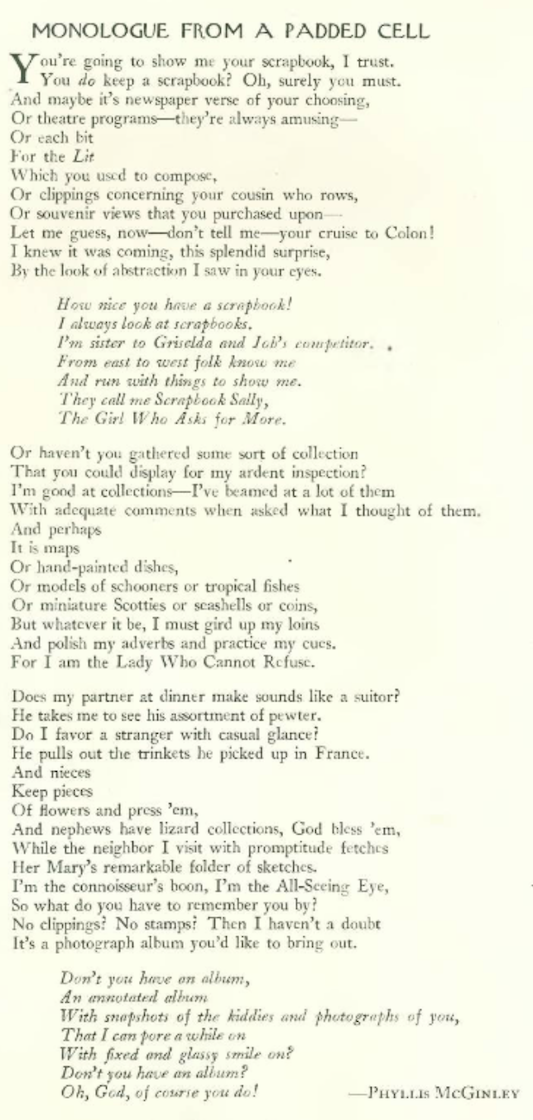
Poet and author Phyllis McGinley apparently had her fill of social occasions that included interminable, tedious viewings of the hosts’ scrapbooks, photo albums, and various tchotchkes.
SPARE ME YOUR VACATION SLIDES…Phyllis McKinley would have hated Facebook. (Wikipedia)
* * *
Wise Guy
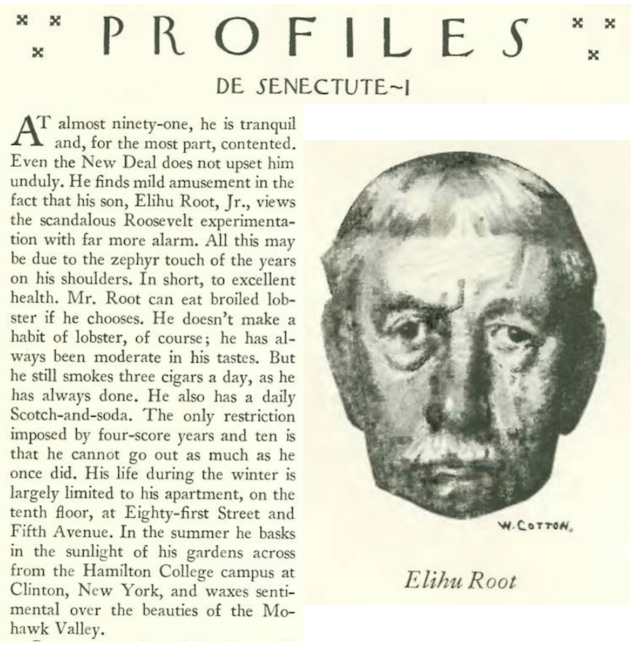
Henry F. Pringle published the first part of a three-part profile on Elihu Root, making much of the fact that Root (1845–1937) was still kicking at ninety after a lifetime of public service including two stints as Secretary of War and serving as Secretary of State under President Theodore Roosevelt. Unofficially, he advised a number of presidents and other leaders on foreign and domestic issues, giving him the imprimatur of a political “wise man.” A brief excerpt (with caricature by William Cotton):
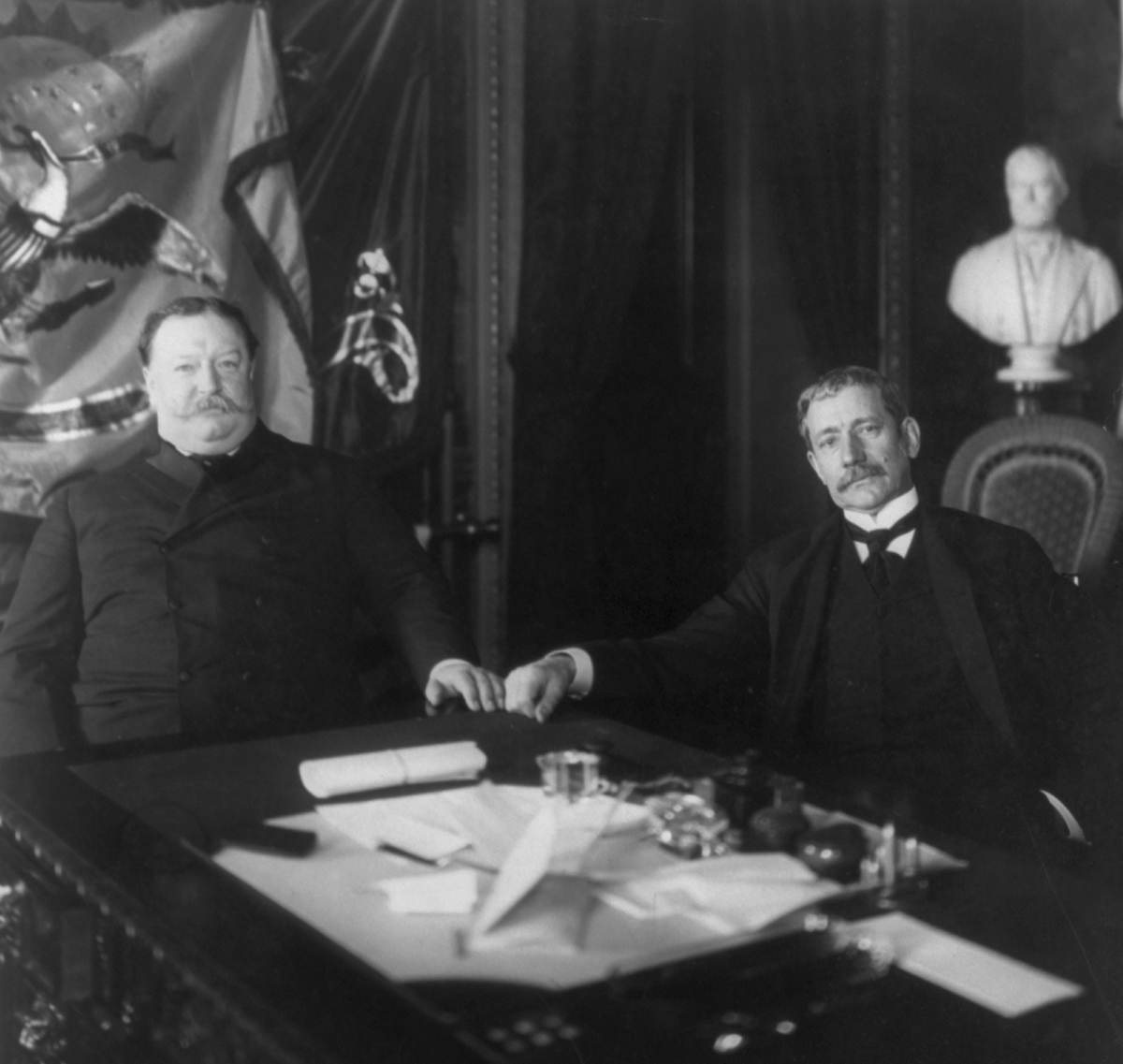
WAR BUDDIES…U.S. Secretary of War Elihu Root (right) and his successor, William Howard Taft, c. 1904. Taft was elected U.S. President in 1908, and in 1912 Root would receive the Nobel Peace Prize. (Wikipedia)
* * *
Devastating Irony
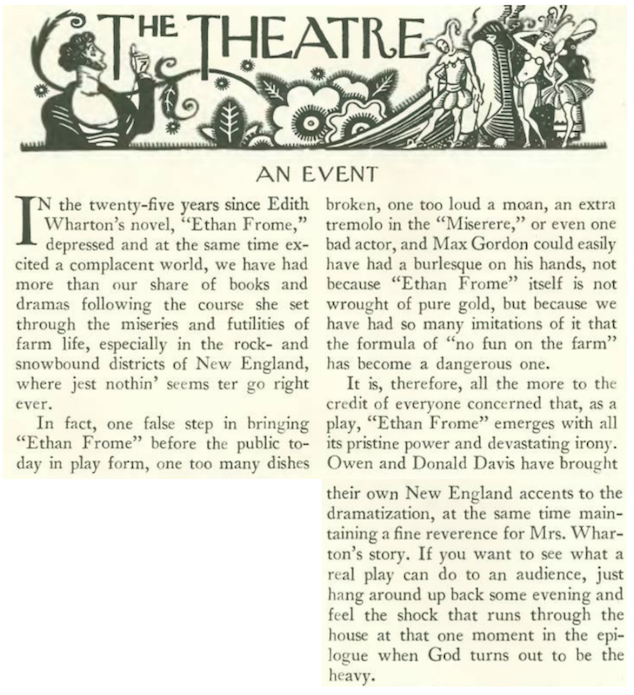
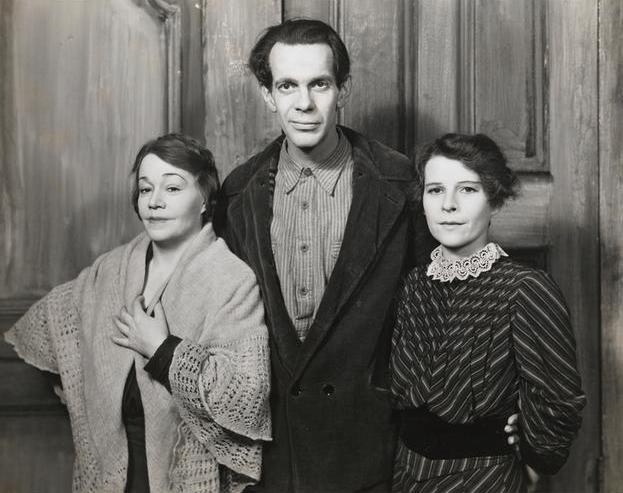
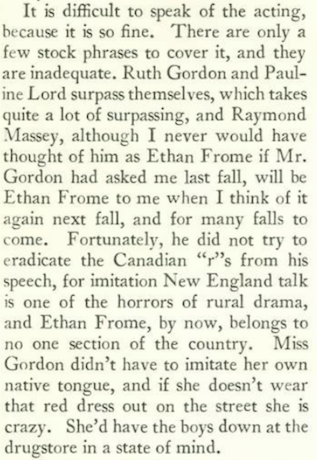
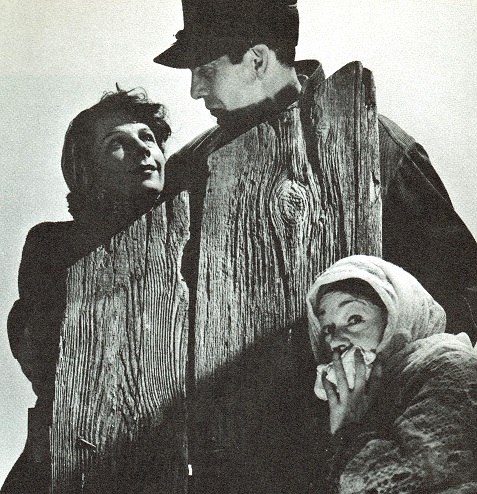
According to critic Robert Benchley, the adaptation of Edith Wharton’s novel Ethan Frome to the stage required a precise hand, and apparently director Max Gordon delivered when it opened at the National Theatre. Excerpt:
EDITH WHARTON WOULD HAVE BEEN PROUD, according to Robert Benchley, of the stage adaptation of Ethan Frome. The cast, from left, included Pauline Lord, Raymond Massey, and Ruth Gordon. Benchley would have been well acquainted with Gordon, who was a familiar face at the Algonquin Round Table. (Facebook)
Benchley praised the performances of the principal actors Pauline Lord, Raymond Massey, and Ruth Gordon.
IN FINE FORM…Pauline Lord, Raymond Massey, and Ruth Gordon in a publicity still for Ethan Frome. (witness2fashion.com)
* * *
At the Movies
We take to the air with Howard Hawks’ Ceiling Zero, which featured an odd mix of screwball dialogue and nerve-wracking flight scenes. Critic John Mosher found the film to be well done, even though most of its action took place on the ground.
GROUNDED…Shot a shoestring budget, Warner Brothers’ Ceiling Zero, directed by Howard Hawks, staged most of the action at an airline’s headquarters rather than up in the air. From left are Pat O’Brien, James Cagney, and June Travis. (Harvard Film Archive)
Mosher was also happy to welcome Myrna Loy back to the silver screen in the “agreeable” Whipsaw.
HUSTLE AND BUSTLE…Myrna Loy and Spencer Tracy starred in action-packed crime drama Whipsaw. (Letterboxd.com)
Mosher was at a loss to explain the popularity of comedian Joe Penner, whose presence in the film Collegiate inspired impatient “mobs” to crash the windows and doors of the Paramount Theatre.
INCONSEQUENTIAL was the word John Mosher used to describe Collegiate. Clockwise, from top left, Frances Langford and Jack Oakie in a scene from Collegiate—Oakie played a man who inherits an all-girls school from his aunt; Betty Grable with Joe Penner; Grable shows off her school spirit and her famous legs in a publicity photo. (rottentomatoes.com/imdb.com)
About Joe Penner (1904–1941): Broadcast historian Elizabeth McLeod sums up Penner’s popularity as “the ultimate Depression-era zany.” Mostly forgotten today, Penner was a national craze in the mid-1930s. “There is no deep social meaning in his comedy, no shades of subtlety,” writes McLeod, “just utter slapstick foolishness, delivered in an endearingly simpering style that’s the closest thing the 1930s had to Pee-wee Herman.”
WANNA BUY A DUCK? was Joe Penner’s catchphrase. Born József Pintér in what is now Serbia, he is shown here with his ubiquitous duck, Goo Goo. According to historian Elizabeth McLeod, Penner was doomed to an early decline by the sheer repetitiveness of his format. He died in his sleep, of a heart attack, at age 36. (imdb.com)
* * *
Something Completely Different
We go from Joe Penner to George Santayana, who finished the six-hundred-page The Last Puritan after laboring on the novel for fifteen years. A brief excerpt from a Clifton Fadiman review:
WHEN WRITERS MADE THE COVER…George Santayana on the cover of Time, Feb. 3, 1936. (Time.com)
* * *
From Our Advertisers
The folks at Hormel continued their ad series pairing Hormel French Style onion soup with notable historic figures…apparently Mary, Queen of Scots was honored with some onion soup when she married the Dauphin in 1558…nearly three decades later she would lose her head under the reign of Elizabeth I…
…the opening spread of the magazine sometimes offered odd juxtapositions…
…and what was this obsession with peas?…last week (and previous weeks) the makers of Green Giant canned foods featured a “Major” obsessed with fresh peas…
…in this issue, the folks at Birds Eye presented frozen peas as a fresher alternative to canned…the ad featured their own version of a “Major,” here sharing the wonderful news about frozen peas with his cronies…
…Capitol Theatre predicted that their latest feature, Rose Marie, would be even better than Naughty Marietta…
…and apparently it was…
WHEN I’M CALLING YOOOOUUUU…The Capitol Theatre’s prediction came true—Rose Marie was a big hit, as was the duet “Indian Love Call” (it remained a signature song for both actors); at left, Nelson Eddy and Jeanette MacDonald in Rose Marie; at right, Eddy and MacDonald in 1935’s Naughty Marietta. “America’s Singing Sweethearts” made eight films together. (MGM)
…only forty hours to paradise, claimed this ad on the inside back cover…
…and on the back cover, readers were greeted by a smug, almost withering look—a fashionable woman striking a pose, one that was doubtless imitated by many in the smart set who would soon realize they were hopelessly addicted to nicotine…
…on to our cartoonists, we begin with Al Frueh and his topless tribute to George White’sScandals…
…Gregory d’Alessio drew up this trio—endomorph, mesomorph, ectomorph—for the opening pages…
…here’s a spot by Robert Day, dreaming of warmer climes…
…we join Charles Addams at the Louvre…
…and on a desert island…
…a rather strange entry by Alice Harvey, with the longest caption I’ve come across so far…
…we join William Steig’s “Small Fry” during a school day, beginning on page 24…
…and continuing onto page 25…
…here is how it originally appeared…
…In 1935, Saks Fifth Avenue installed an indoor ski slope on the men’s floor of its New York City flagship store, here illustrated by Perry Barlow…
IT WAS A THING…Ski slope inside Saks Fifth Avenue, New York, 1935. (CNN.com)
…department stores such as Macy’s often featured model homes in their household departments…Alan Dunn added a bit of color, or rather, soot, to this one…
…Helen Hokinson looked for answers at a book shop…
and Hokinson again, doing a bit of home decorating…
…it appears Morton was displaying a copy of Constantin Brancusi’s Princess X…
(sheldonartmuseum.org)
…Barbara Shermund engaged in some light banter at a cocktail party…
…and we close with a surprise visit from William Crawford Galbraith…