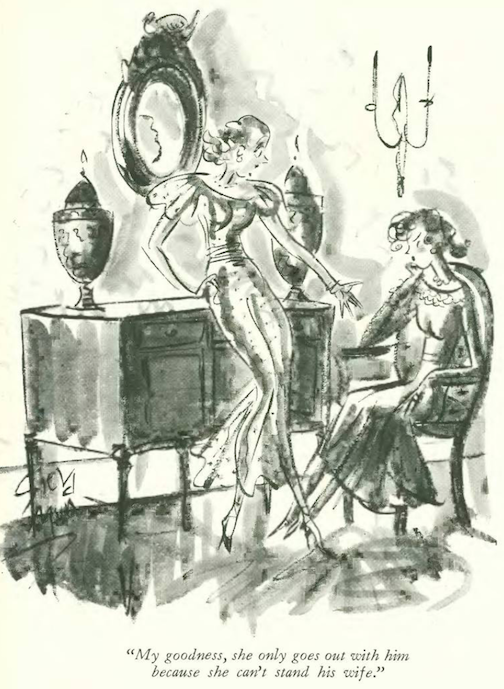
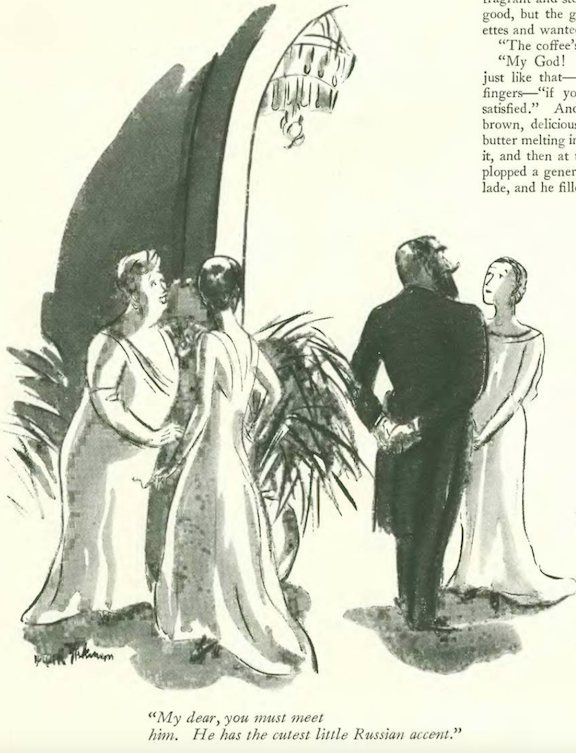
All That Glitters Is Not Gold

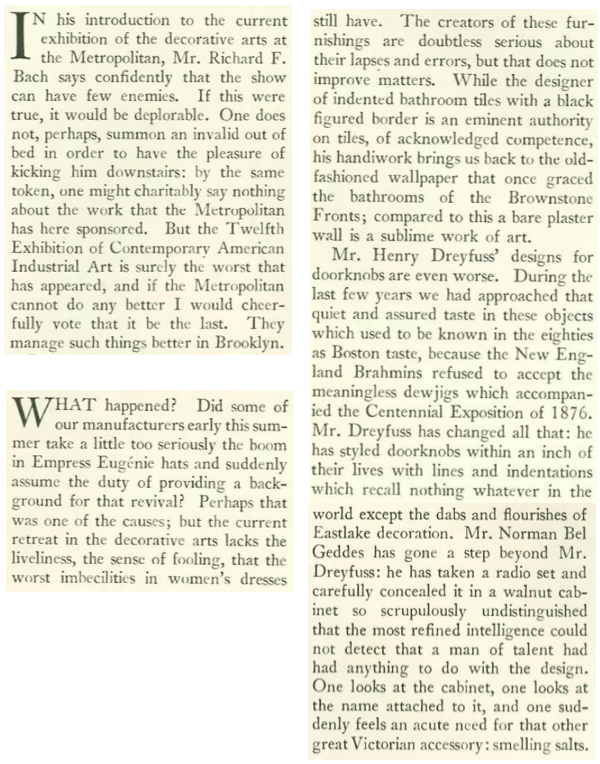
We first encountered critic Lewis Mumford in the June 30, 1931 issue of The New Yorker when he roundly excoriated plans for Rockefeller Center. The Nov. 14 issue once again found him in a surly mood, this time regarding the decorative arts and how they had been poorly displayed at the otherwise esteemed Metropolitan Museum.

Nov. 14, 1931 cover by B.H. Jackson.

To say that Mumford was displeased with the Met’s decorative arts exhibition would be an understatement:
BED, BATH AND BEYOND…Let’s just say Lewis Mumford probably needed a stiff drink after strolling through the Met’s latest displays of the decorative arts. (Library of Congress)
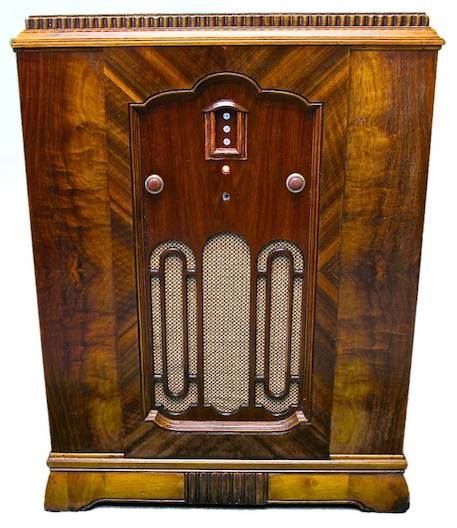
PAST IMPERFECT…Norman Bel Geddes was known for his theatrical, futuristic visions of streamlined everything, but the radio he exhibited at the Met was more Queen Victoria’s speed in Mumford’s view. (Pinterest)

Mumford pondered this sudden decline: was it the Depression, or just a streak of bad taste? And what could be done with the purveyors of bad taste, short of shooting them? Let’s read on…
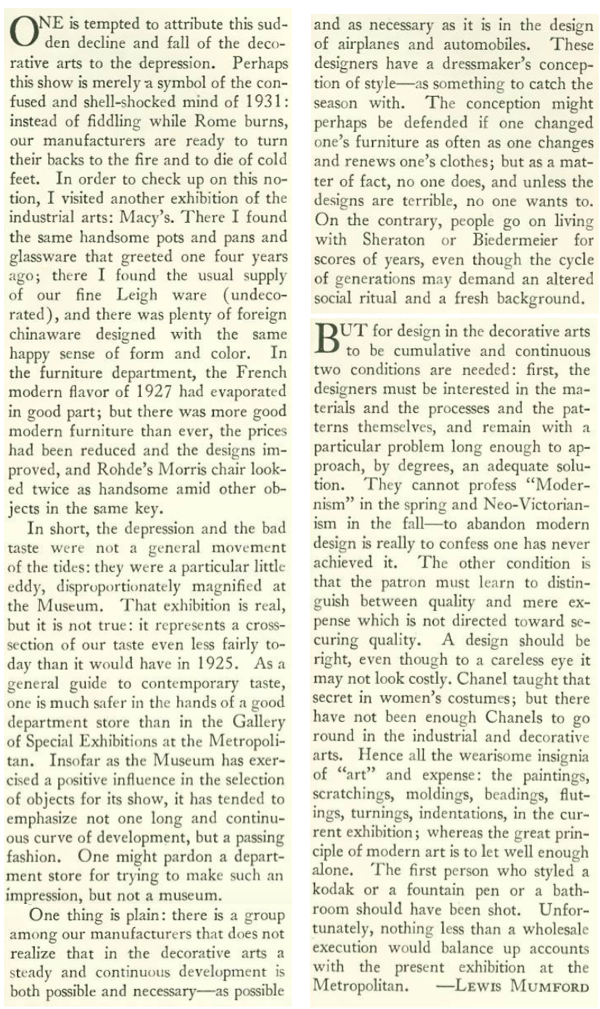
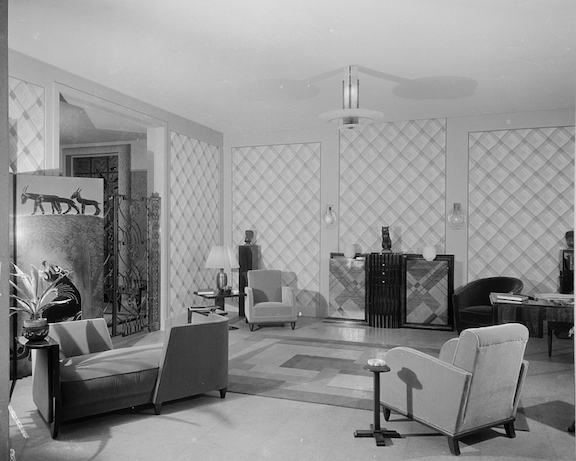
MIRACLE ON 34TH STREET…Mumford suggested that Macy’s International Exposition of Art in Industry in the late 1920’s had more vision than the Met’s 1931 offering. Above, living room furniture designed by Houbert et Petit exhibited in a showroom during the 1928 “International Exposition of Art in Industry” at Macy’s department store. (Library of Congress)
LESS THAN A PRETTY FACE?…The streamlined form of Norman Bel Geddes’ “House of Tomorrow” probably wowed a few readers of Ladies Home Journal in April 1931, but critic Lewis Mumford was likely not among them, as he often criticized Bel Geddes for his theatricality at the expense of good taste and functionality (see first excerpt above). Mumford was especially critical of Bel Geddes’ glorification of the automobile and the highway at the expense of livable cities. (Pinterest)

 *  *  *

Peter, We Have Your Back

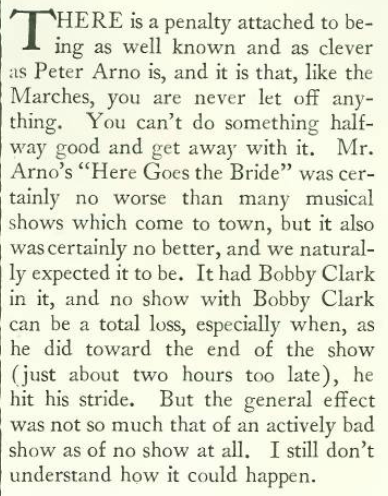
When your colleague has a play made from his book, and it closes after just seven performances, what can you say, especially if you are theater critic for The New Yorker? Well, here is what Robert Benchley did:
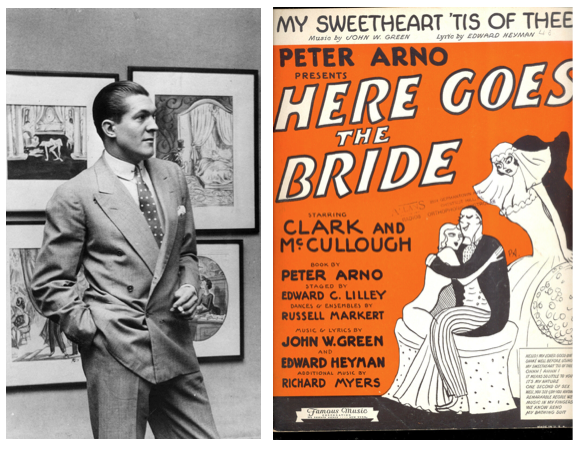
THAT’S SHOW BIZ…Here Goes The Bride, based on a Peter Arno book, closed after just seven performances. However, as a cartoonist, Arno was at the top of his game. (Britannica/Ebay)

 *  *  *

From Our Advertisers

Depression? Who needs it? If you had the means, and didn’t lose your shirt in the 1929 crash, you could get away from it all and book passage to the Bahamas, where you could drink legally, soak up some sun, and forget about those lengthening bread lines you occasionally glanced from the window of your town car…
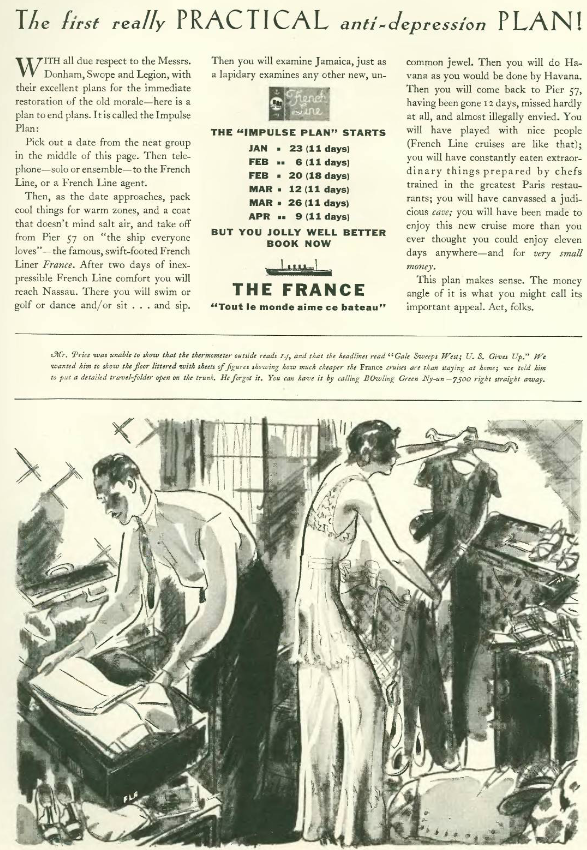
…well, that bootleg gin was a mind eraser…
Helen Hokinson continued to offer her cartooning skills to the folks at Frigidaire…

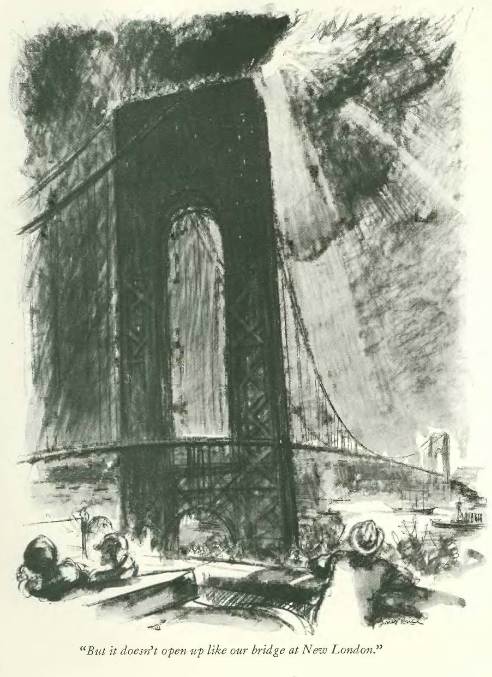
…on to our cartoons, the George Washington Bridge drew the envy of some out-of-towners, as illustrated by Garrett Price

…nearly 90 years ago folks were almost as nuts about college football as they are now, except for Perry Barlow’s lone dowager, who would rather be sitting in her parlor with a cup of tea…

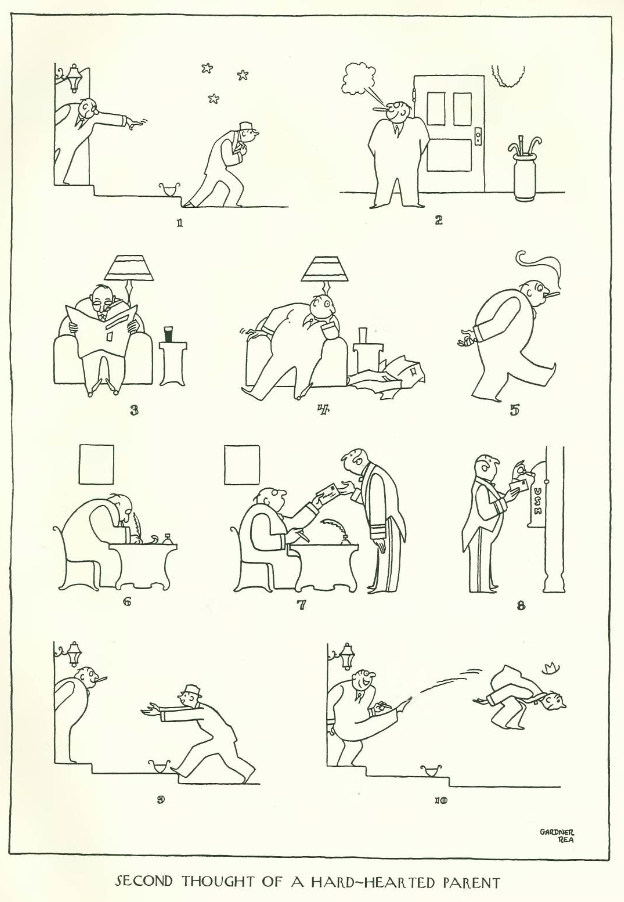
Gardner Rea explored the wonders of heredity…

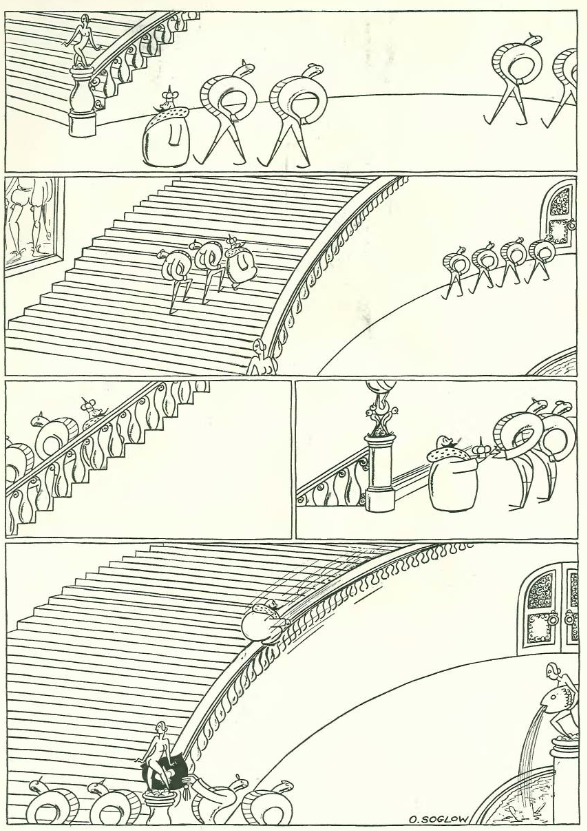
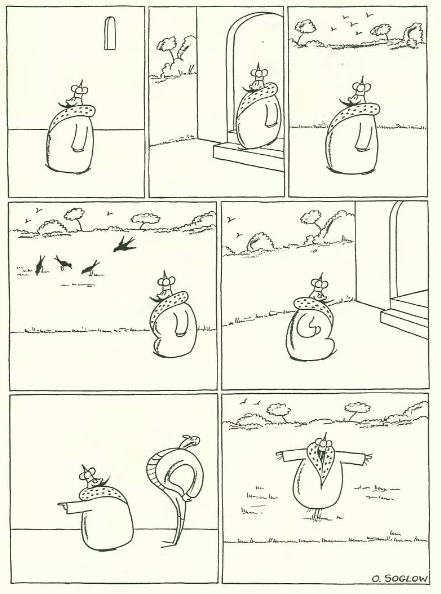
Otto Soglow’s Little King employed a guard ready for any emergency…

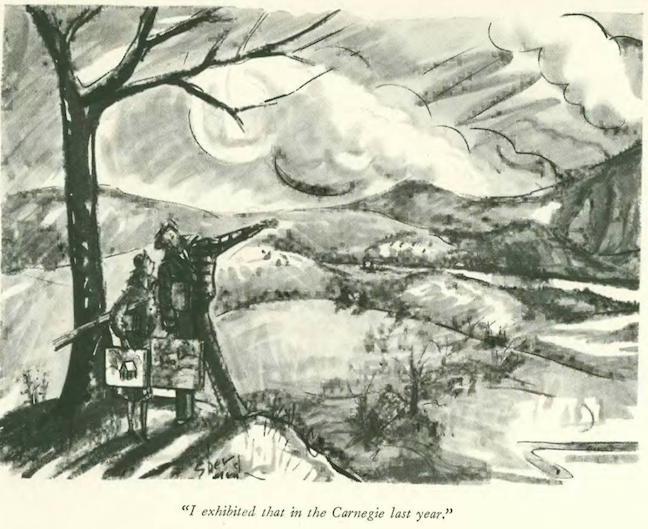
Barbara Shermund gave us an artist with a god complex…
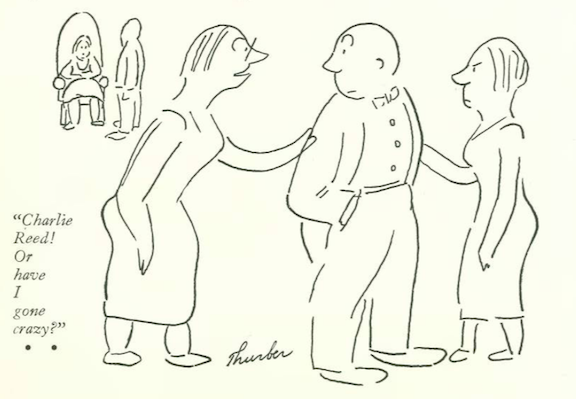
James Thurber continued to probe the nuances of the sexes…
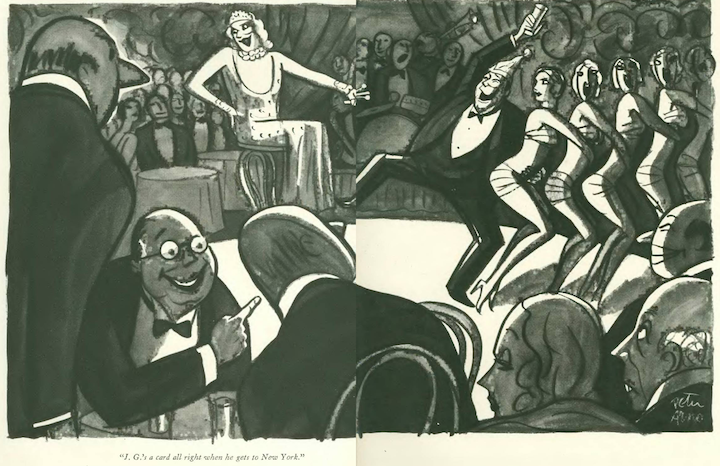
Peter Arno sketched this two-page spread with the caption: J.G’s a card all right when he gets to New York

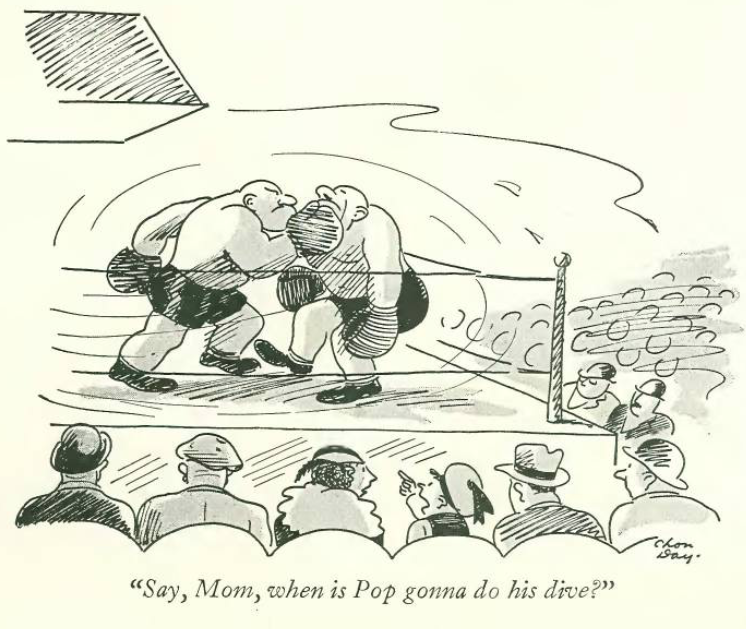
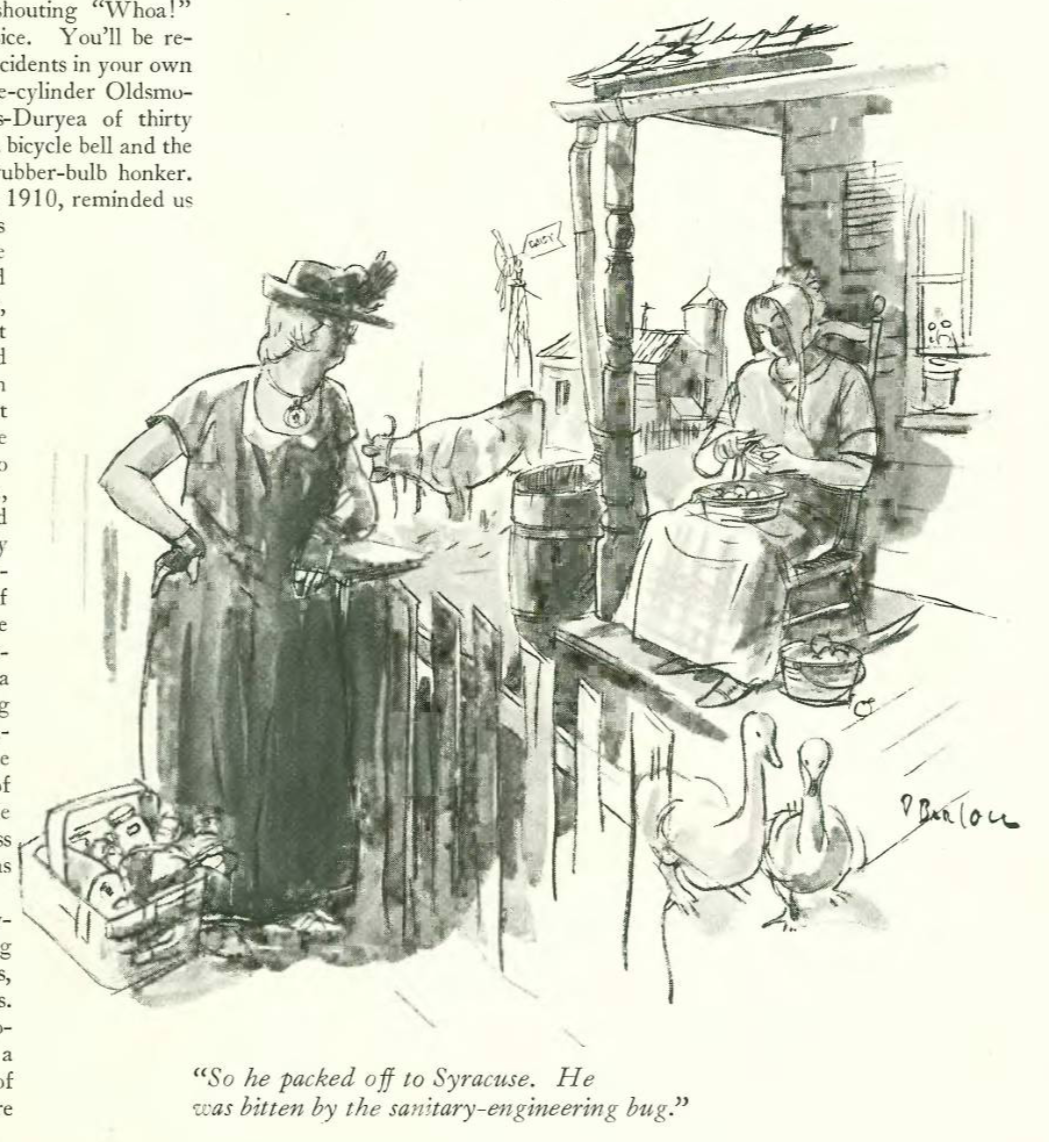
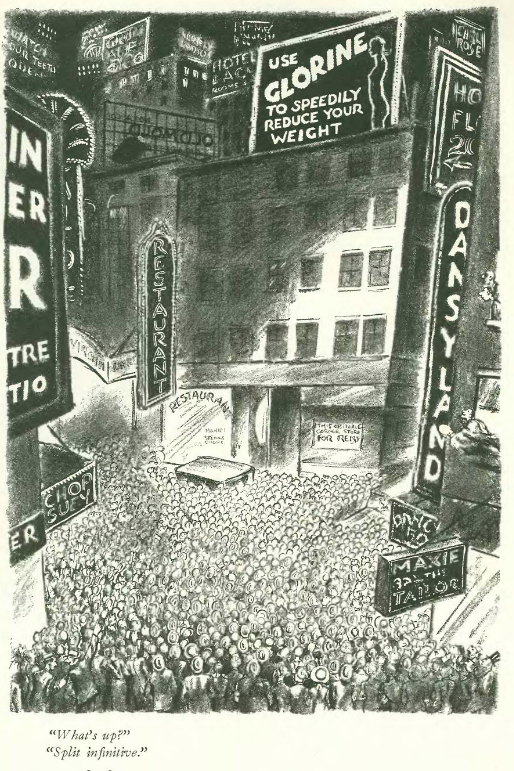
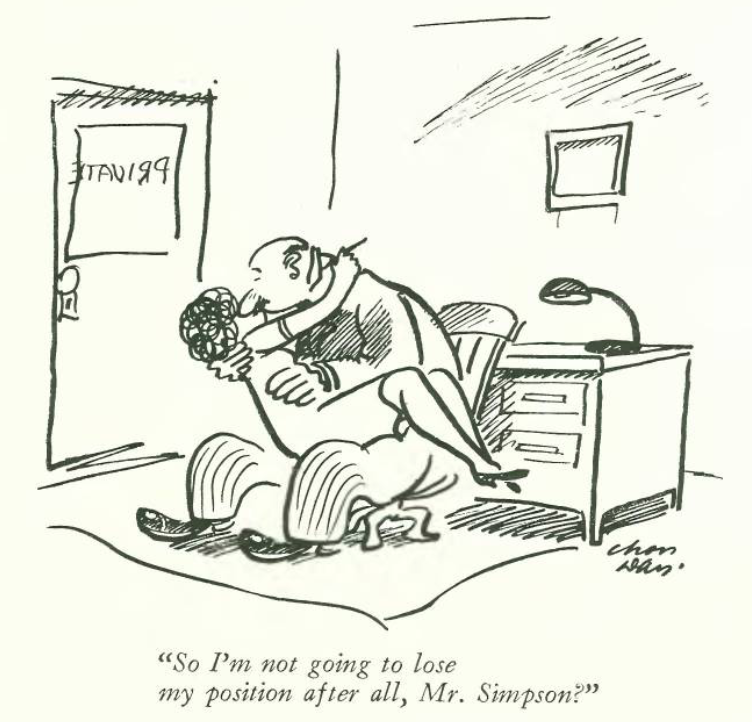
…and from the mouth of babes, we have these observations of the underworld from Chon Day

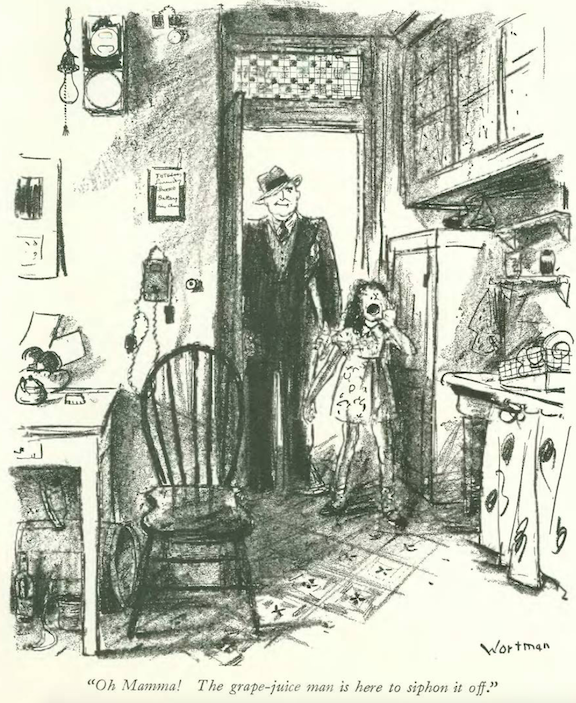
…and Denys Wortman

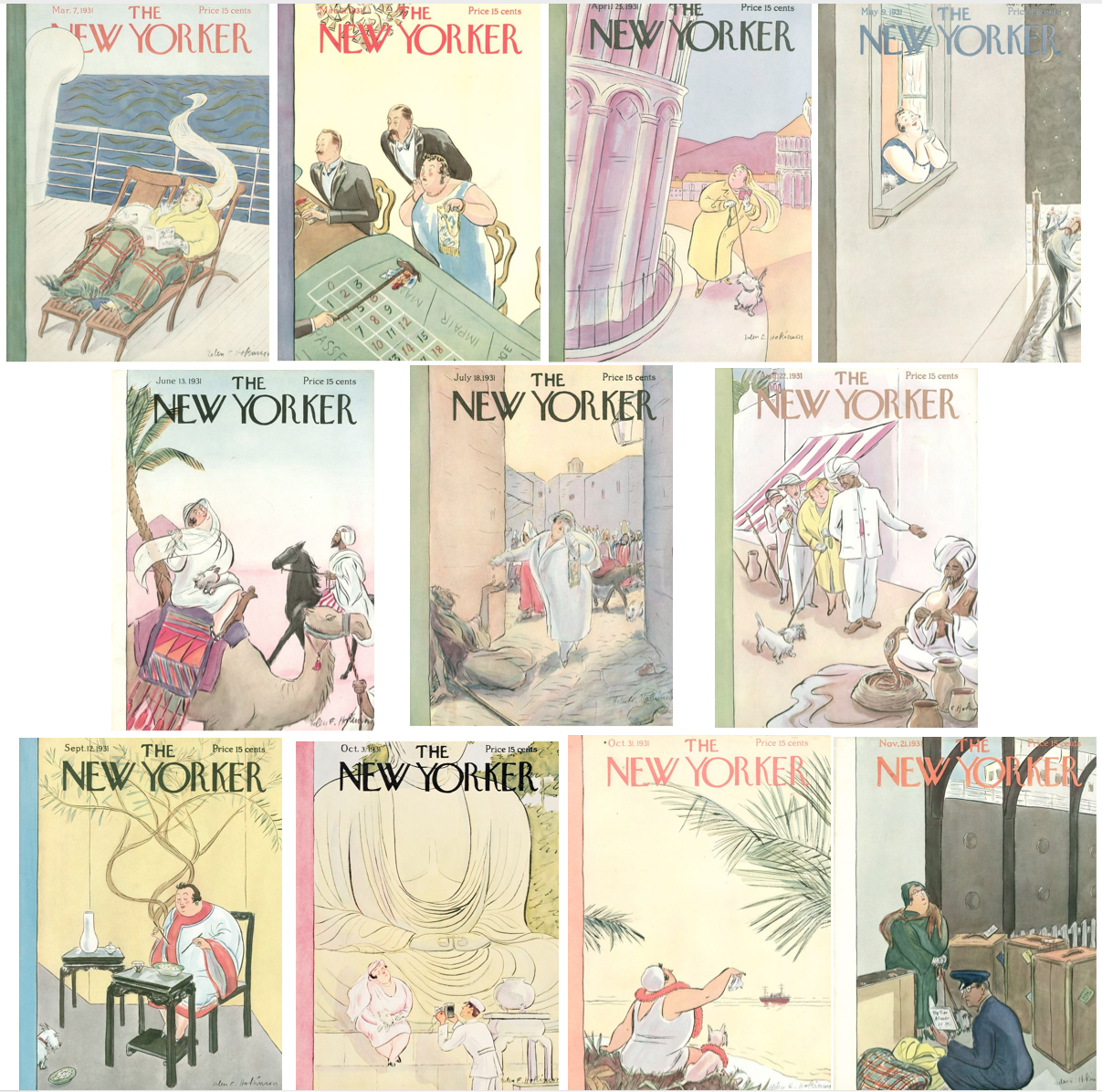
On to the Nov. 21 issue, which featured the last in a series of eleven covers Helen Hokinson contributed to The New Yorker in 1931. The covers featured one of Hokinson’s “Best Girls”—a plump, wealthy, society woman—on an around-the-world cruise, which began with the March 2 issue and ended on Nov. 21 with a stop at the customs office, and a nosy customs officer…
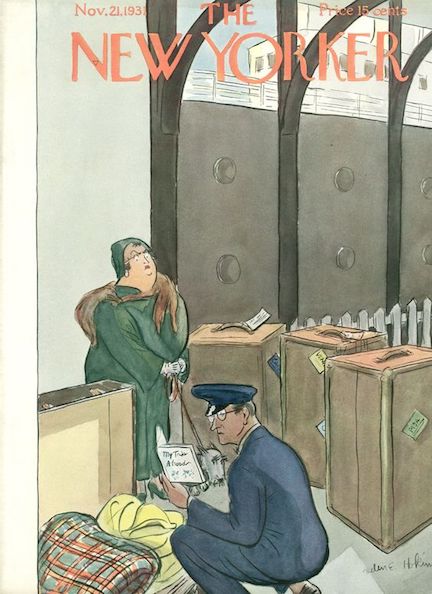
Nov. 21, 1931 cover by Helen Hokinson.

Bread & Circuses

In his “Notes and Comment,” E.B. White reported on a recent editorial in the Columbia Spectator, that university’s student newspaper, which took issue with the professionalization and “furtive hypocrisy” of college football (if only they could see us now). White observed:

In 1931, Columbia was a football power, and the Ivy League was a big-time conference. To the editors of the Spectator, this was not a point of pride, which they made clear in this 89-year-old editorial that could have been written yesterday:
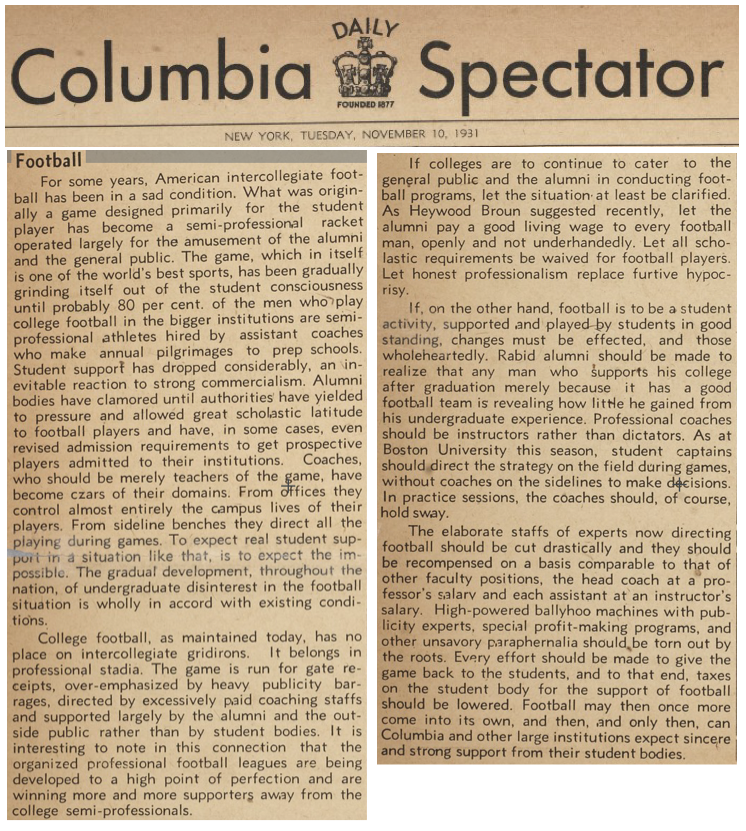
Clippings from Columbia Spectator Archive
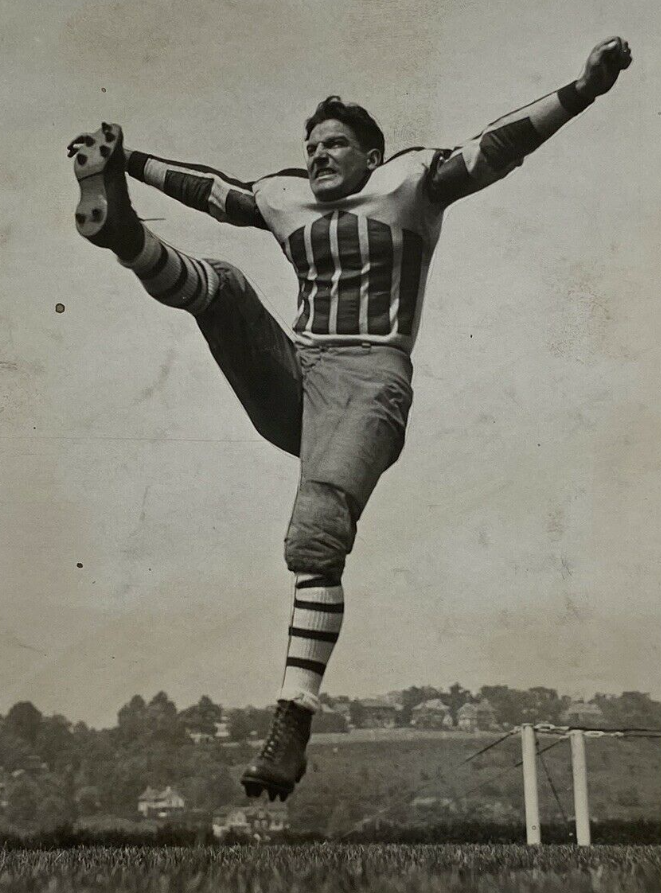
JUST GETTING MY KICKS…1931 press photo of Columbia University football star Ralph Hewitt, who still holds the school record for the longest field goal — a 53-yarder he dropped kicked in a 1930 upset victory over Cornell. Hewitt went on to coach high school sports.

 *  *  *

Sorry, Charlie

William “Billy” Haines was a top-five box-office star from 1928 to 1932, portraying arrogant but likable characters in a string of pictures that ended abruptly when Haines refused to deny his homosexuality and was cut loose by MGM. “The Talk of the Town” looked in on Haines at his Santa Barbara home, where he entertained a mysterious visitor:
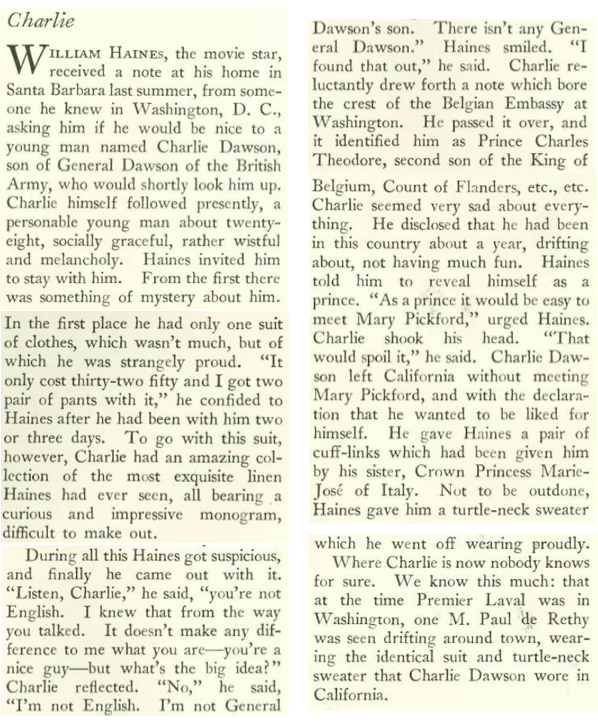
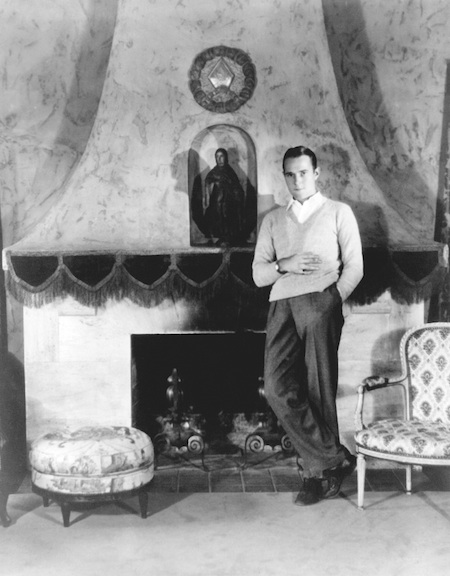
THE INTERIOR LIFE…The actor William Haines in a 1926 publicity shot taken at his Hollywood home. Haines would abandon acting in the 1930s and take up a successful career as an interior designer. (Photofest)

 *  *  *

Coveted Coiffeur

Writer Bessie Breuer wrote an admiring profile of Polish hairdresser Antoine (aka Antoni Cierplikowski), considered the world’s first celebrity hairdresser. The opening paragraph:
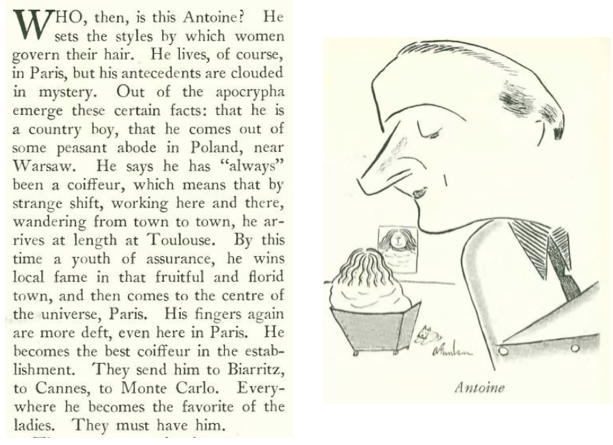
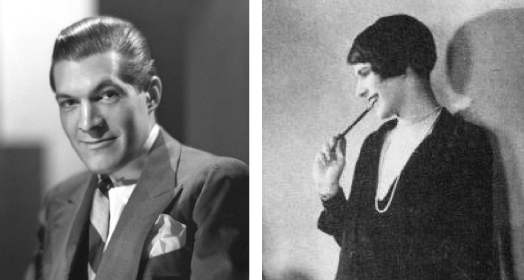
A CUT ABOVE…In 1914 famed hairdresser Antoine (aka Antoni Cierplikowski) invented the “shingle cut” (at left, sported by actress Louise Brooks in the 1920s), which was all the rage during the Roaring Twenties. (Pinterest)

 *  *  *

The Look of Relief

In “The Talk of the Town” E.B. White noted that a familiar face was gracing advertisements for President Herbert Hoover’s Unemployment Relief Agency:

I NEVER FORGET A FACE…E.B. White referred to this ad featuring an unnamed woman who had a familiar look about her. (period paper.com)

 *  *  *

More His Style

We return again to Lewis Mumford, this time cheered by the sight of the new Starrett-Lehigh Building in Chelsea, designed by Cory & Cory. An excerpt from “The Sky Line” column:
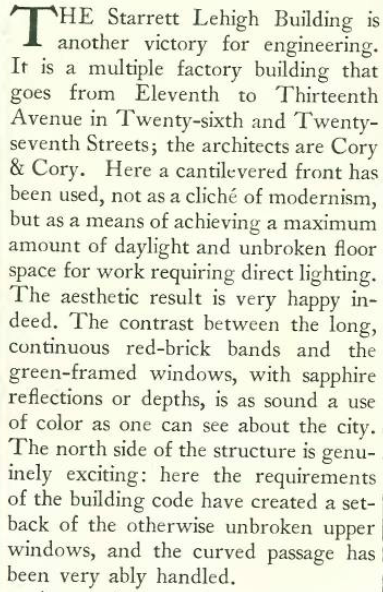
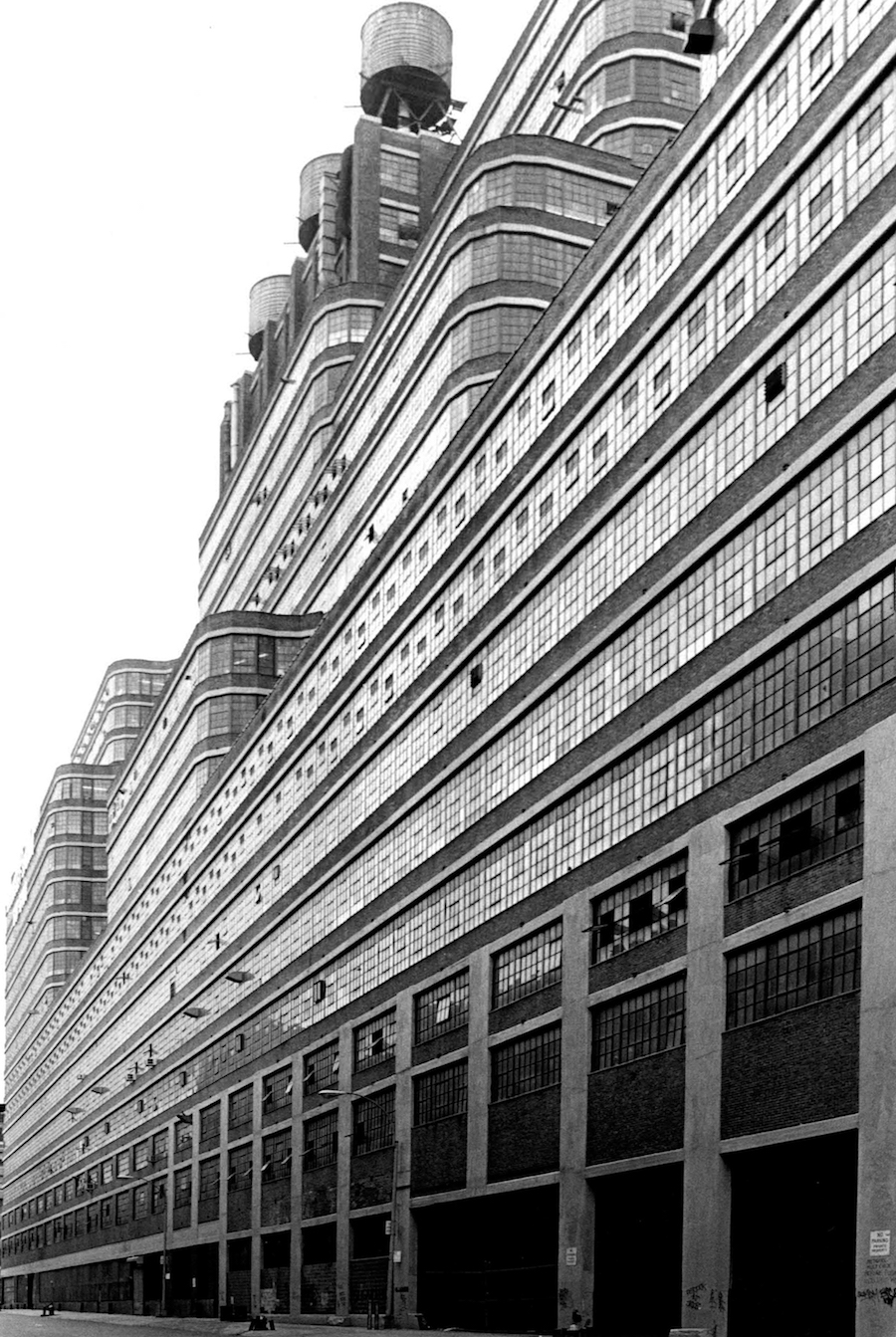
THAT’S MORE LIKE IT…Lewis Mumford praised the striking effect of the Starrett-Lehigh Building’s alternating bands of brick, concrete and steel. (Atlas of Places)

 *  *  *

The Chump

John Mosher was neither moved nor charmed by the appearance of little Jackie Cooper in The Champ, a tearjerker story of an alcoholic ex-boxer (Wallace Beery) struggling to provide for his son. He did, however, appreciate the boy’s ability to carry “on his little shoulders a heavy and tedious and lengthy story.”

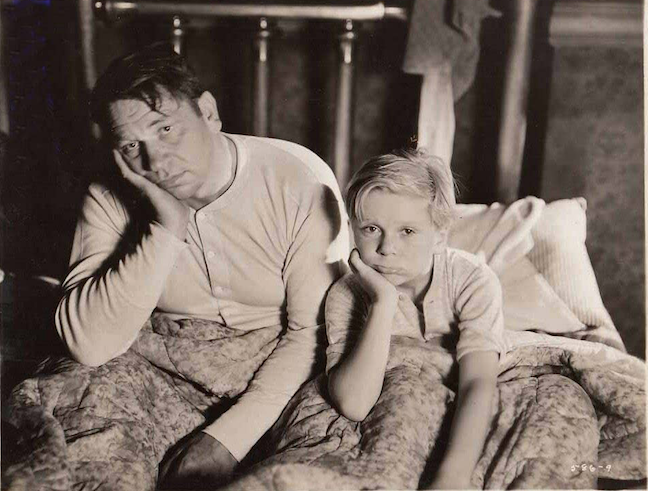
BUMMER…John Mosher had little to like about King Vidor’s The Champ, featuring Wallace Beery and Jackie Cooper. Mosher was no doubt a bit dismayed when Beery received an Academy Award for his performance. (IMDB)

 *  *  *

A Wishful Christmas List

It was that time of the year when the New Yorker began running its lengthy features on possible gifts for Christmas. This excerpt caught my eye for what might have been possible in 1931 — buying a photographic print directly from Berenice Abbott or Nickolas Muray:
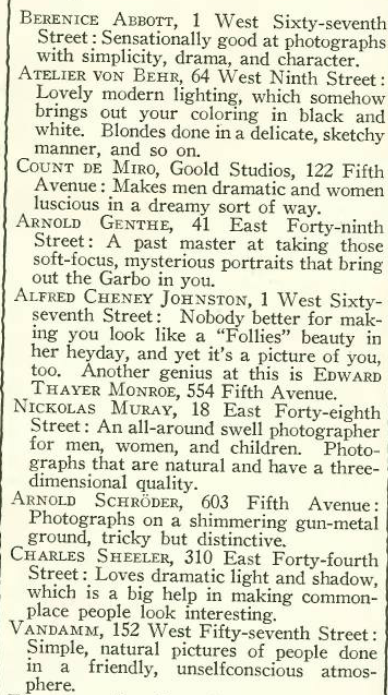
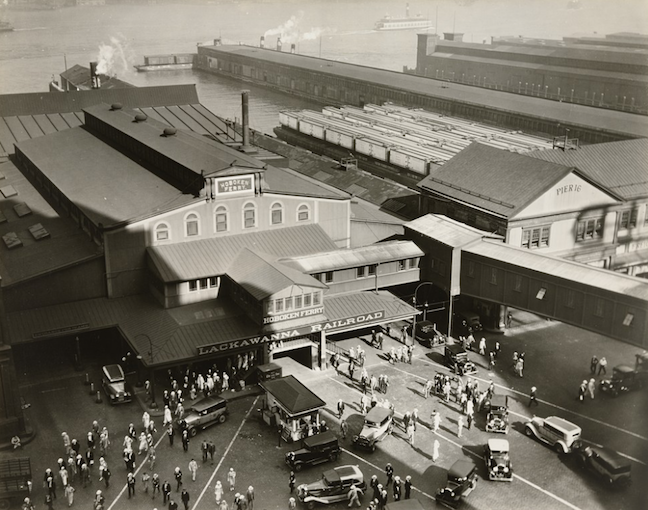
NO LUMP OF COAL, THIS…In 1931 it might have been quite possible to buy this print directly from photographer Berenice Abbott. Barclay Street, Hoboken Ferry 1931, is in MoMA’s photography collection.

*  *  *

From Our Advertisers

It has been well-established in previous posts that Anglophilia ran rampant among New York’s smart set, and this advertisement from Saks provides everything we need to underscore the point…
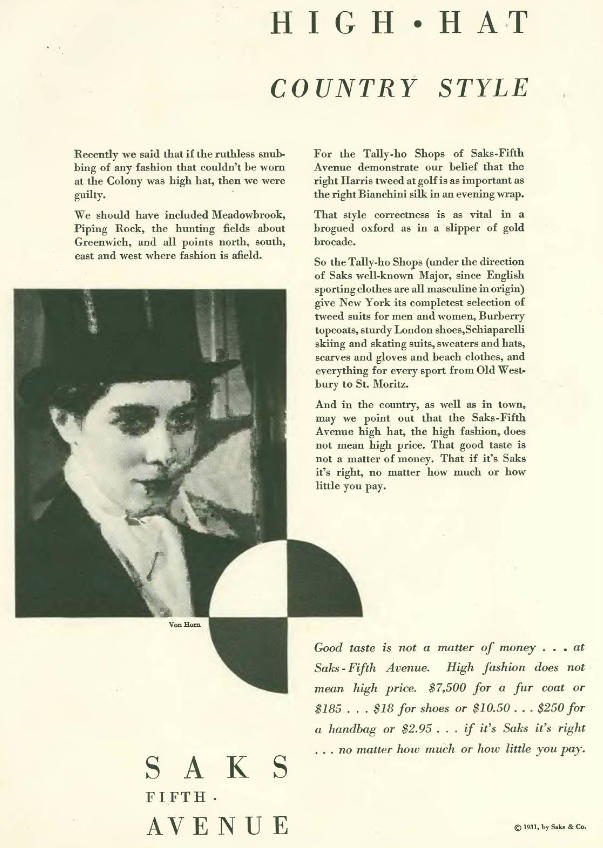
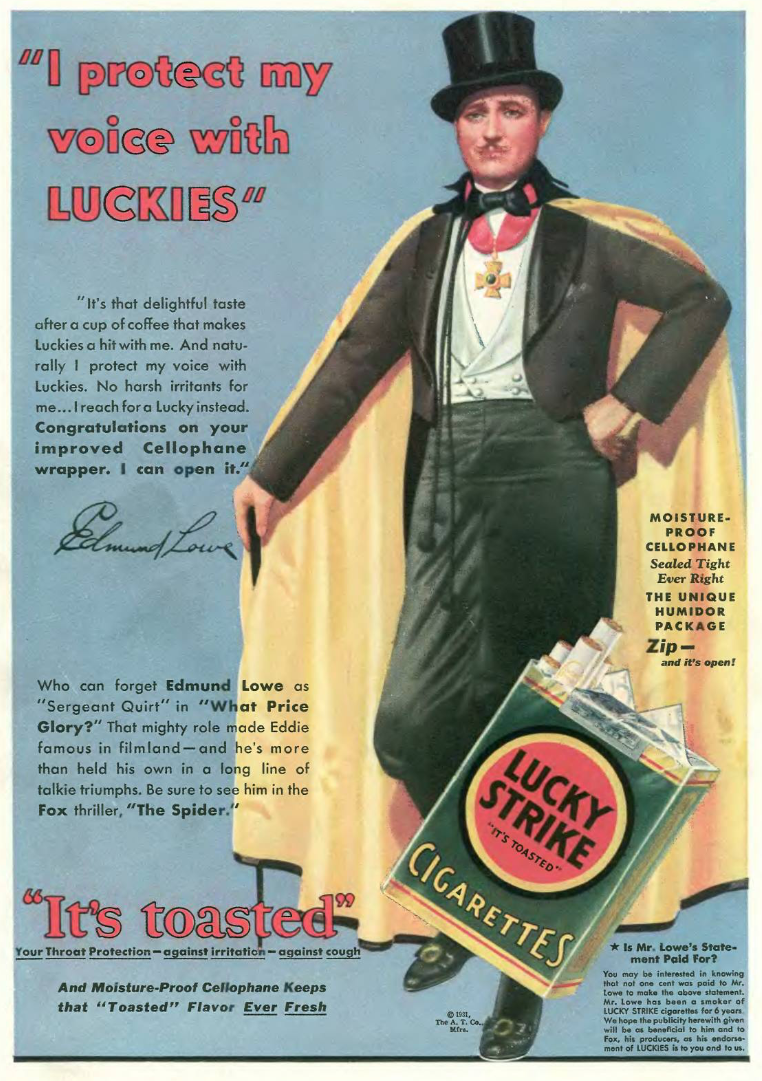
…and the top hat mades another appearance in this spot for Lucky Strike, featuring an endorsement from actor Edmund Lowe...
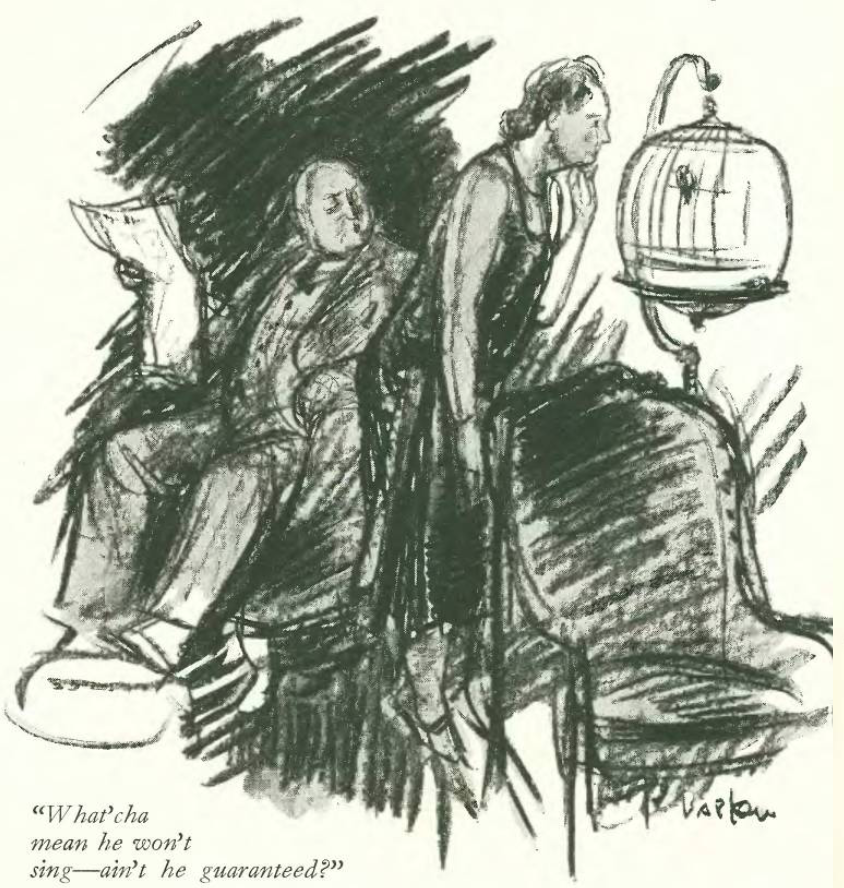
…our cartoons featured a song-less songbird courtesy of Perry Barlow

…and from James Thurber, another creature with little appetite for song, let alone wine and women…

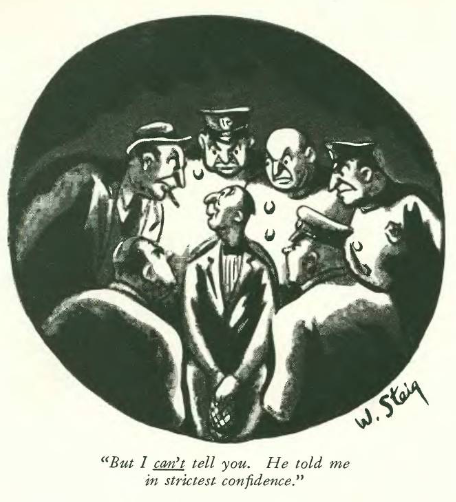
William Steig brought us back to the bleachers with another nonconformist…

Gluyas Williams gave us this sad sack all alone in the crowd…

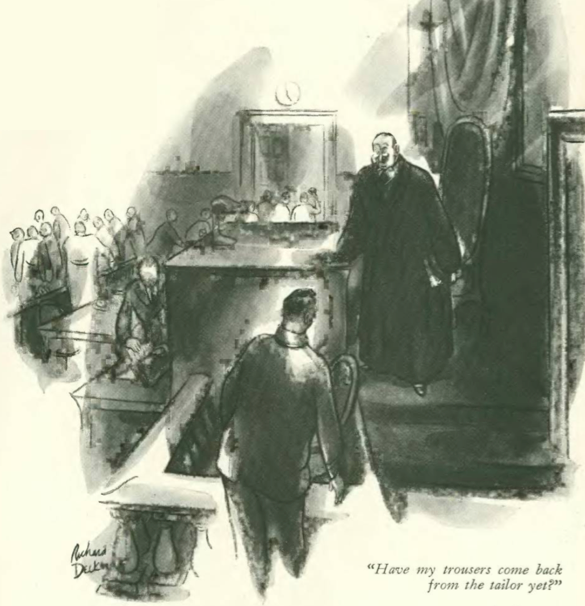
Richard Decker sought to bring order to this court…
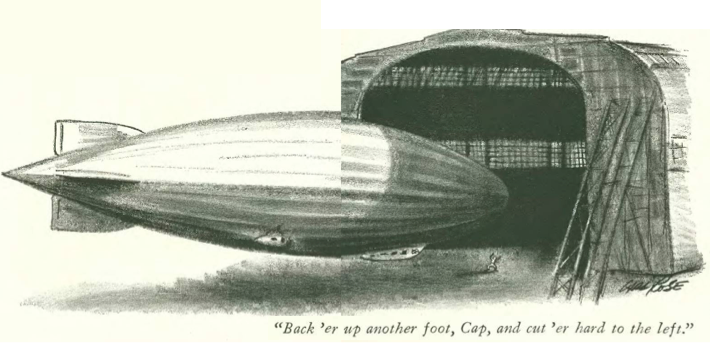
…and we end with Carl Rose, and this two-page cartoon illustrating a dicey parking challenge…
Next Time: Yankee Doodles…

 

The Tragic Pose

In an age of toe-tapping musicals and screwball comedies — which served to distract from the grim realities of the Great Depression—one playwright was content to continue mining the deep veins of tragedy and pessimism than ran through the 1930s.

Nov. 7, 1931 cover by Margaret Schloeman.

A Chekhovian realistEugene O’Neill (1888–1953) had yet to write his masterpiece, Long Day’s Journey into Night, but in 1931 he was already well established as America’s preeminent playwright. When his naturalistic Mourning Becomes Electra hit the Guild Theatre stage, New Yorker theatre critic Robert Benchley had little doubt about O’Neill’s greatness as a playwright, even if he wasn’t so sure about the play itself:

O’Neill’s tragic pose was borne from childhood, the son of an alcoholic father and a mother who became addicted to morphine after his difficult birth. His older brother, Jamie, would drink himself to death. It doesn’t end there. O’Neill’s own  two sons would commit suicide, and he would disown his remaining daughter, Oona O’Neill, when at age 18 she married silent film star Charlie Chaplin, 36 years her senior. An odd footnote: Chaplin was best friends with Ralph Barton, a cartoonist for the early New Yorker who took his own life after Eugene O’Neill married Barton’s ex, Carlotta Monterey. To close the loop, O’Neill and Monterey had a mess of a marriage between his alcoholism and her addiction to sedatives. No wonder the man rarely smiled.

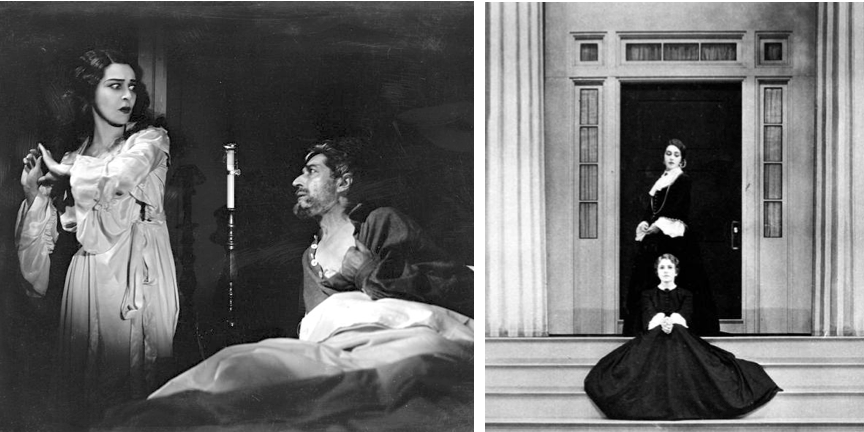
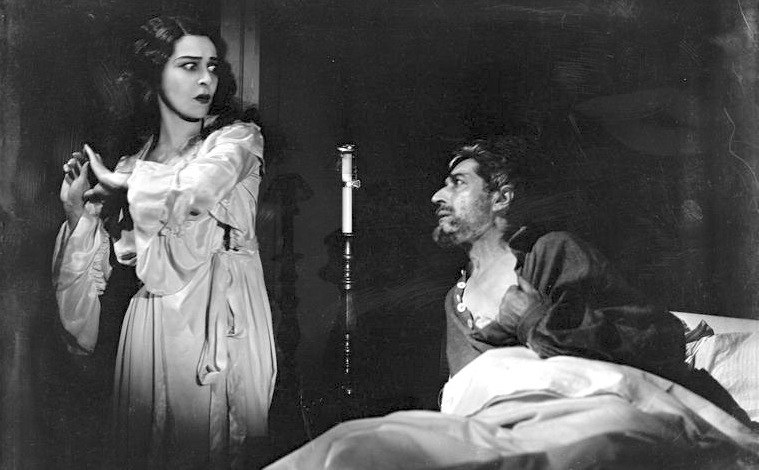
WRONG MEDS, MY DEAR…Christine Mannon (Alla Nazimova) recoils from her husband, Ezra (Lee Baker) after giving him a poison that he mistakes for his heart medicine. At right, Christine and her daughter, Lavinia (Alice Brady), await the return of Ezra from battle. All three actors were part of the original cast of Eugene O’Neill’s Mourning Becomes Electra, which was a retelling of Oresteia by Aeschylus. (allanazimova.com)
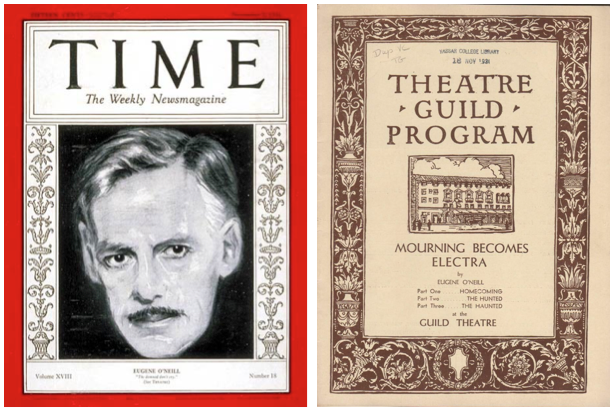
FAMILIAR FACE…Eugene O’Neill made his third appearance on the cover of Time magazine for the Nov. 2, 1931 issue. He made a total of four appearances on the magazine’s cover (1924, 1928, 1931 and 1946). At right, cover of Guild Theatre program. (Time/Pinterest)
SAY CHEESE…Eugene O’Neill wore his familiar scowl in this undated portrait with his third (and final) wife, stage and film actress Carlotta Monterey. (famousfix.com)

 *  *  *

Go West, William

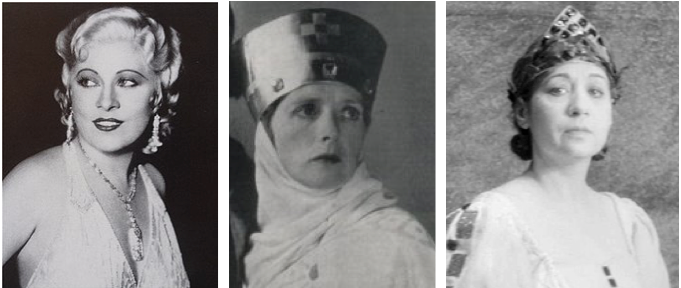
When Mae West announced she was going to present a modern version of William Shakespeare’s Macbeth and play the part of Lady Macbeth, Wolcott Gibbs went to work on possible scenarios for such a production. Here is one of them:

LADIES MACBETH?…Actually, only two of these women made the cut to play Lady Macbeth. Gladys Cooper (center) appeared as Lady Macbeth in a 1935 production at the Ethel Barrymore Theatre that lasted barely a month. The following year Edna Thomas (right) portrayed Lady Macbeth in a Federal Theatre Project production of Macbeth with an all-Black cast. Orson Welles adapted and directed the production, which was staged at Harlem’s Lafayette Theatre. It became a box office and critical sensation.

 *  *  *

Those Hats Again

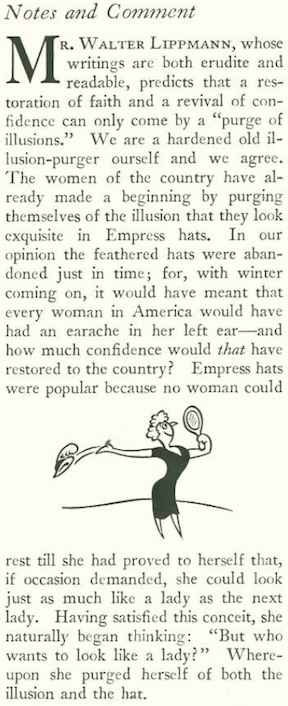
And now to E.B. White, who once again explored the mysteries of the Empress hat:

TAKE THIS, MR. LIPPMANN…Thelma Todd wearing an Empress Eugénie hat in the 1932 comedy Speak Easily. (Wikipedia)

  *  *  *

Rah, Rah, Sis Boom Bah

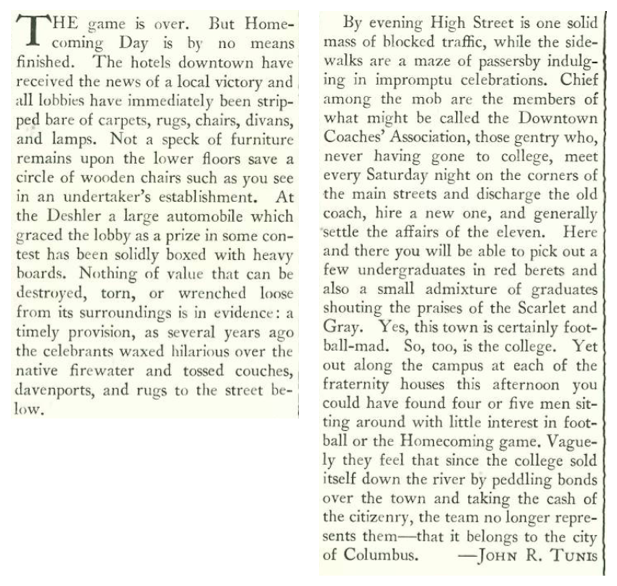
And so, in a city with one of the most storied teams in Major League Baseball, The New Yorker continued to ignore that sport as it gushed over college football, John Tunis even going the extra mile to check out homecoming at Ohio State.

HOMECOMING ROYALTY…THE Ohio State football team went 6-3 in 1931, but they blanked Navy 20-0 in their homecoming game. (elevenwarriors.com)

*  *  *

Boxing Brainiac

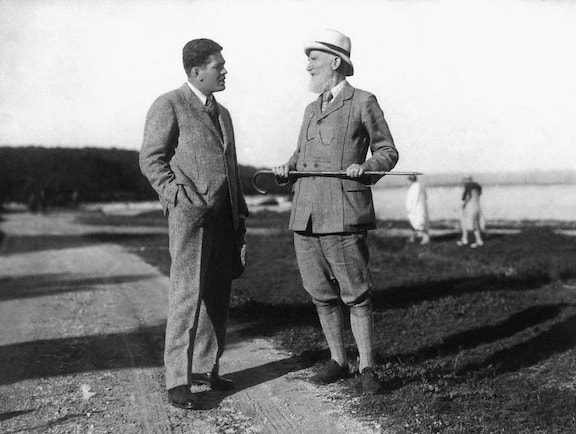
Several times before in this blog we have encountered boxing great Gene Tunney and his taste for the literary life. E.B. White gave us the latest on the Champ in “The Talk of the Town”…

THE FINER THINGS…Heavyweight Boxing Champion Gene Tunney, left, discusses things that don’t involve hitting people with writer George Bernard Shaw during a 1929 vacation to Brioni. (Associated Press)

 *  *  *

From Our Advertisers

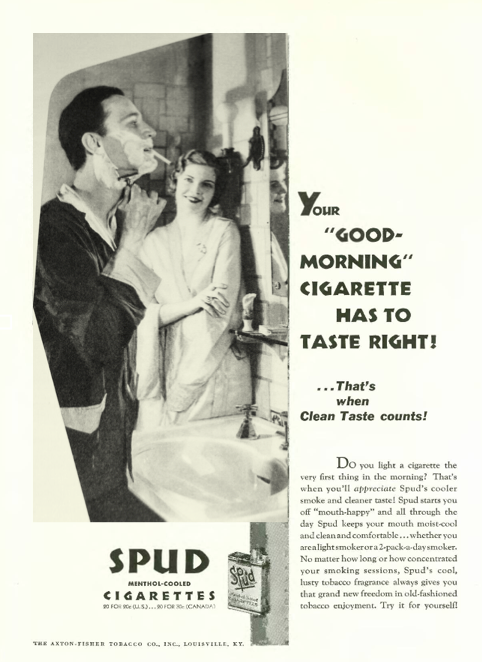
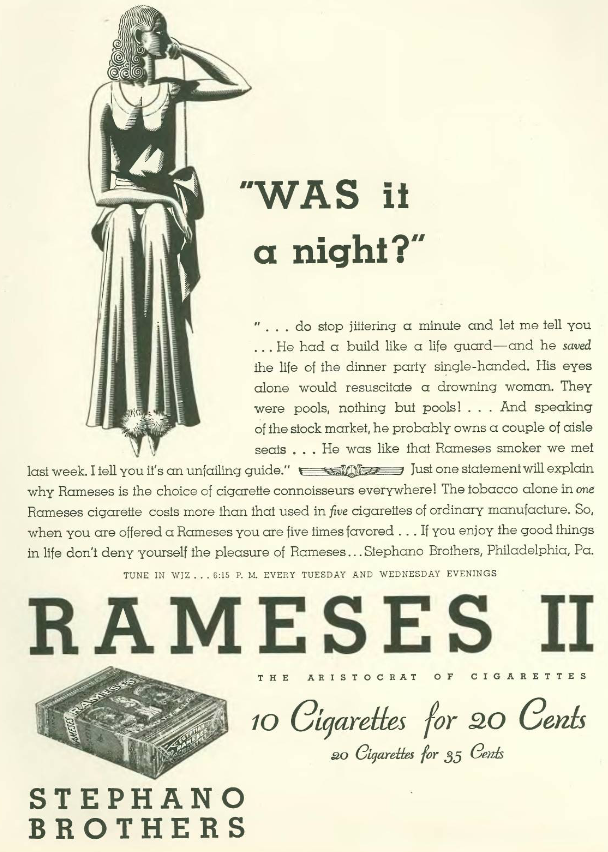
It’s the Depression, Prohibition is still in force (kind of), so what’s a body to do to blow off some steam? Well, you could take up smoking, every waking moment, at least when it came to this guy…

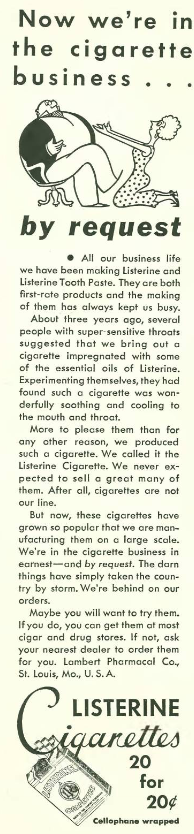
…and these were the days when tobacco companies offered competing claims about the health benefits of their cigarettes (weight loss, calmer nerves etc.). So the folks at Listerine, who were all about keeping you safe from nasty mouth germs, launched a cigarette of their own, which was “taking the country by storm,” at least in their estimation…

…and I throw this in to give you an idea of how far cigarette companies would go, and how folks would respond in the early 1930s…at left is a 1932 advertisement from the back cover of Popular Mechanics, telling us that “Everybody” is deeply inhaling their product…of course people became addicted, including this young woman (right) featured in a 1931 Popular Science news item who managed to smoke and read a book while reducing her figure…

…back to the ads from the Nov. 7 issue, here is one that offered a “scientific” way to remove nicotine from cigarettes, allowing only “pure tobacco” to enter your pink lungs…

…and now a couple of lovely color ads for Houbigant cosmetics…

…and our friends at Alcoa, diligently working to convince Americans that aluminum furniture was the modern way to keep your house “in step” with the times…
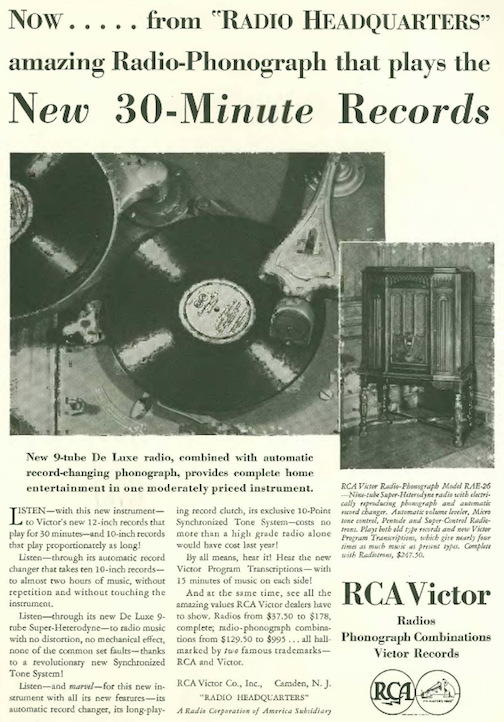
…and finally, RCA Victor was offering an early version of the LP record, so you wouldn’t have to stop necking to turn the damn record…

…on to our cartoons, we begin with Gardner Rea

…John Reehill gave us a lover who probably watched too many romance movies…

…contrasting with this fellow illustrated by Carl Rose, who doesn’t lift a finger to find some romance…

…and while we are on the subject of love, here is a modern twist offered by Barbara Shermund

William Crawford Galbraith gave us a far more detached view of the game of love…

…while Helen Hokinson found an attraction of a different sort with one of her “girls”…

Alan Dunn looked in on the baking business, industrial-sized…

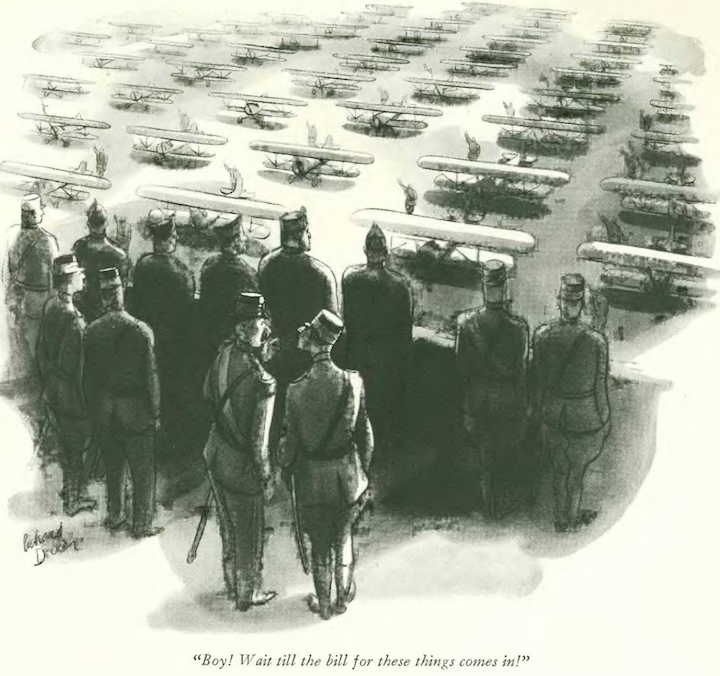
…and we end with Richard Decker, and the price of war…

Next Time: All That Glitters Is Not Gold…

Bonfire of the Vanities

When Earl Carroll’s Vanities hit the Broadway revue scene in 1923, it faced strong competition from George White’s Scandals and the long-running Ziegfeld Follies. Carroll’s answer: More of everything.

Sept. 5, 1931 cover by Theodore Haupt.

That included more nudity than the other revues. Critics, including the New Yorker’s Robert Benchley, found the nudity gratuitous, a titillating distraction from what was otherwise a mess of a show. It also landed Carroll in court from time to time on charges of public indecency. All of this, of course, was just more publicity to drive audiences to his theatre at 753 Seventh Avenue, which he built in 1922 and then partially tore down just nine years later to replace it with an even grander venue. This is where Benchley found himself on the evening of August 27 — at the grand opening of the Earl Carroll Theatre and the 1931 edition of the Vanities. Benchley found nothing grand about it:

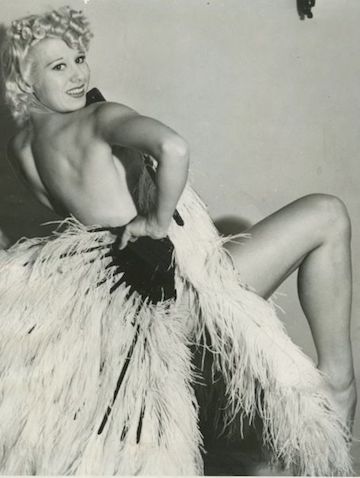
AUTOGRAPHS, ANYONE?…Accompanied by his Vanities showgirls, Earl Carroll leaves the Essex Market Police Court on July 20,1930, after appearing to answer charges of public indecency. Police raided a Vanities matinee on July 9, arresting eleven including famed burlesque dancer Faith Bacon, who performed in nothing but fans made of ostrich feathers. No doubt police were tipped off by critics who called the 1930 edition the “nudest” cast in American theatre history. From the looks on their faces, it seems even the police enjoyed the spectacle. (Worthpoint)
IS THERE A PROBLEM, OFFICER?…Faith Bacon in a less-revealing pose with the ostrich-feather fans that brought the police ‘a calling. (fanpix.net)

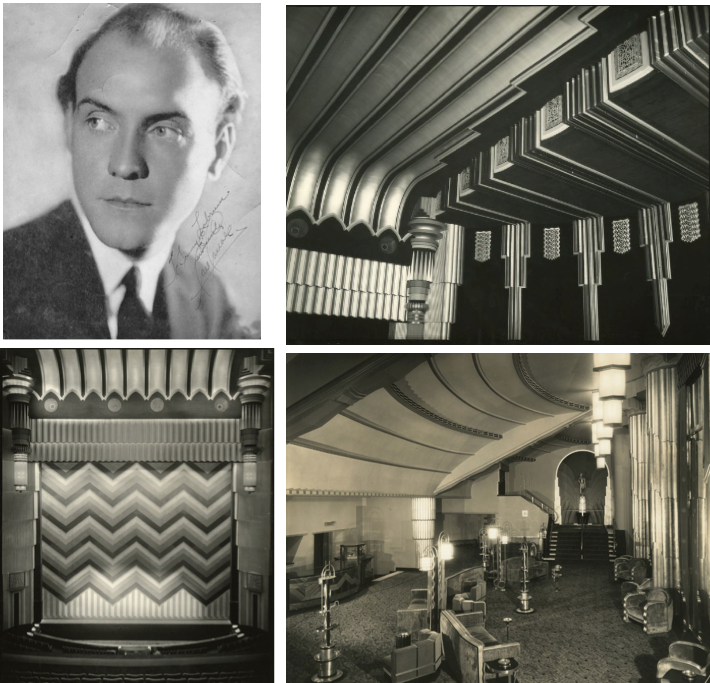
Carroll’s ambitions were always big, whether it was the size or lavishness of his stage shows or the Art Deco theatre (designed by George W. Keister) he erected in 1931 in answer to Flo Ziegfeld’s 1927 Joseph Urban-designed theatre on Sixth Avenue. With 3,000 seats, Carroll’s theatre was nearly twice the size of Ziegfeld’s.

THEY DON’T COME FOR THE SCRIPTWRITING…Earl Carroll made it clear what audiences could expect in his 1931 Art Deco-style theatre, which featured black velvet-covered walls relieved with gold and silver-colored highlights. Its 3,000 seats made it one of the largest theatres in the world. Clockwise, from top left, portrait of Carroll (a gift from the 1930 Vanities showgirls) flanked by busts of Vanities girls Doris Andrese and Beryl Wallace in the theatre lobby; sign above theatre entrance; a two-page spread from the theatre’s “Beauty Souvenir” booklet; cover of the booklet, featuring singer Lillian Roth. (New York Historical Society).
DECO DRAMA…Clockwise, from top left, Earl Carroll circa 1925; ceiling detail inside the Earl Carroll Theatre; mezzanine lounge; the stage. (New York Historical Society).

The show itself left Benchley baffled, a mishmash of lights, colors, and effects including a drooling dinosaur that dropped a naked woman on stage for a dance number…

LAUNCH SITE….The Vanities stage helped launch the careers of many entertainers. Clockwise, from top left, undated photo of a Vanities production — some shows would feature more than 100 women on stage at one time; singer Lillian Roth was a star attraction; Vanities alumni included William Demarest (Uncle Charlie!), Jack Benny and Vincente Minnelli. (assumption.edu/flickr.com/classicmoviehub.com/amazon.com/sensesofcinema.com)

This wasn’t last word from The New Yorker on the new theatre; the Sept. 12 issue featured these observations by Creighton Peet:

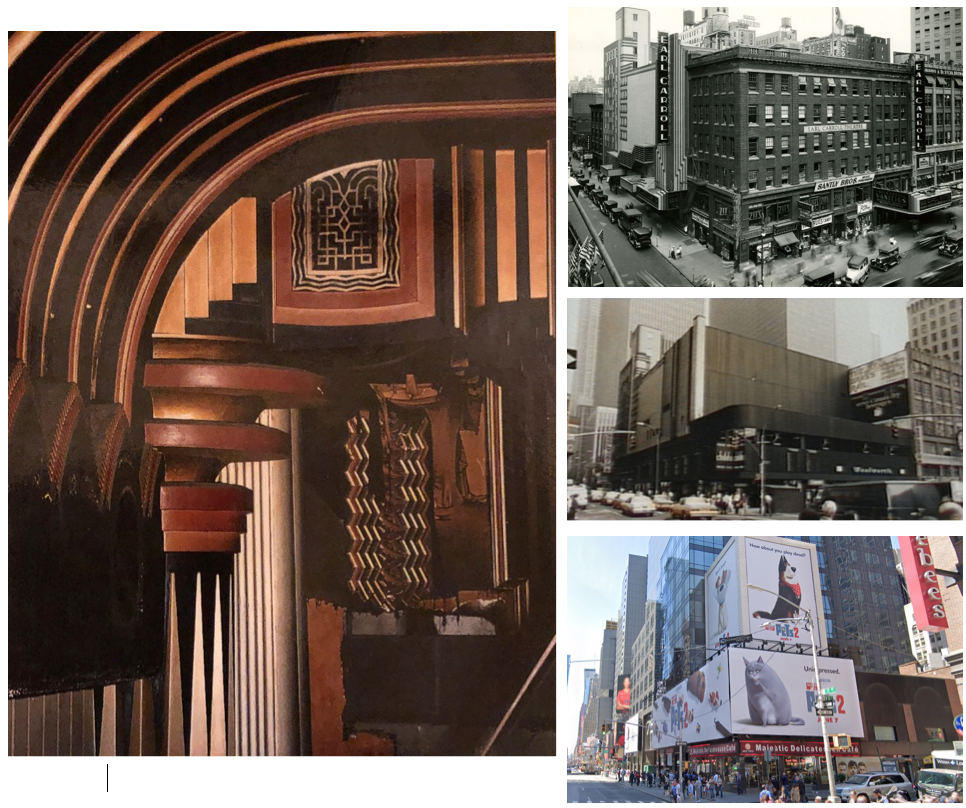
In the end, Carroll’s ambitions were too big for the deepening Depression, and just six months after his theatre’s opening he would lose it to creditors. The property would be snapped up by rival Florenz Ziegfeld and renamed the Casino, but the Ziegfeld connection would be short-lived; Ziegfeld would die a few months later in July 1932. Later that year another rival, George White, would take over the venue to stage his Music Hall Varieties, which ended in 1933 with middling results. The theatre would go through several more tenants—including Billy Rose—until 1940 when the discount “dime store” Woolworth’s would move in, demolishing the lobby and walling off the remaining ceiling and walls. Woolworth’s would close the location in the late 1980s—the store, and the last remnants of the Earl Carroll Theatre, would be demolished in 1990.

CLOSING NUMBER…At left, a sneak peek behind the false walls of Woolworth’s in 1988 shows a detail of the theatre’s proscenium, ceiling and sidewall. At right, top to bottom, the second Earl Carroll Theatre at 7th Avenue & 50th Street; the Woolworth’s store that replaced it, circa 1980; the site today. (Large image from the book Lost Broadway Theatres, via drivingfordeco.com/Google Maps)

*  *  *

From Our Advertisers

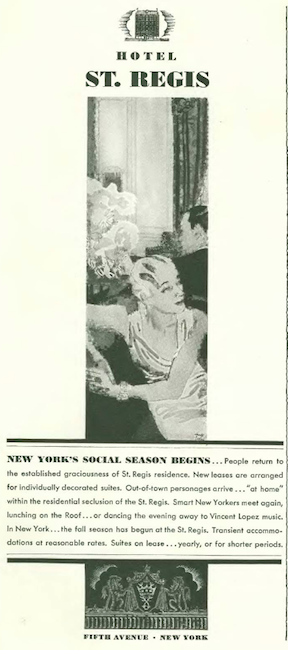
Fall is upon us, and so the social season begins, according to the Hotel St. Regis…

…and what better way to prepare for the season than to acquire a new mink coat…

…maybe politics and world affairs were more your bag, in which case you probably wanted to get a subscription to the Herald Tribune and read the latest from commentator Walter Lippmann

…the makers of Marlboro cigarettes, an upstart brand that initially targeted women, continued with their prize contests, but now they began courting men as well…

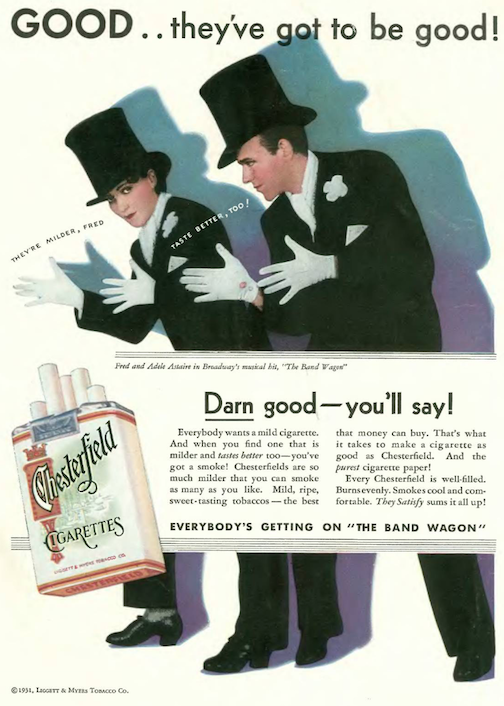
…on the other hand, the more established brand Chesterfield had the resources to run a color back-cover ad with endorsements from the brother-sister dance team Fred and Adele Astaire

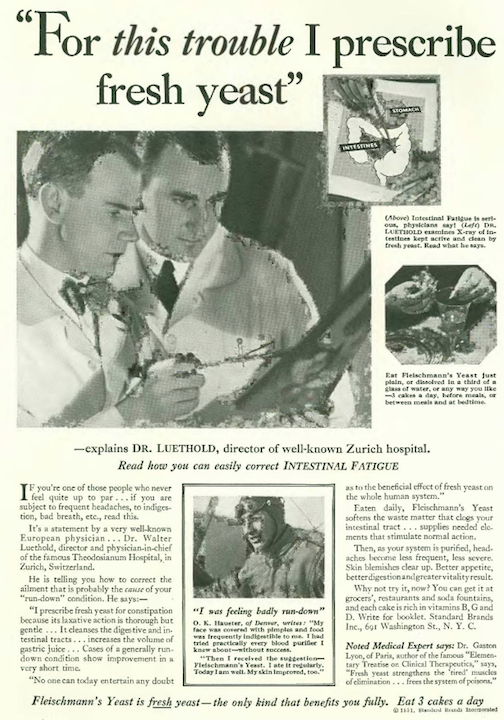
…Fleishmann’s continued to run their full-page ads touting the wonders of daily yeast consumption (“Eat three cakes a day”). The ads were there because Raoul Fleishmann used his wealth from the family baking business to keep the New Yorker afloat during its fledgling years…

…Farrar and Rinehart announced the arrival of Otto Soglow’s first book, Pretty Pictures

…here is the cover of the book…

…and we move on to the cartoons with the character that would make Soglow rich and famous…The Little King

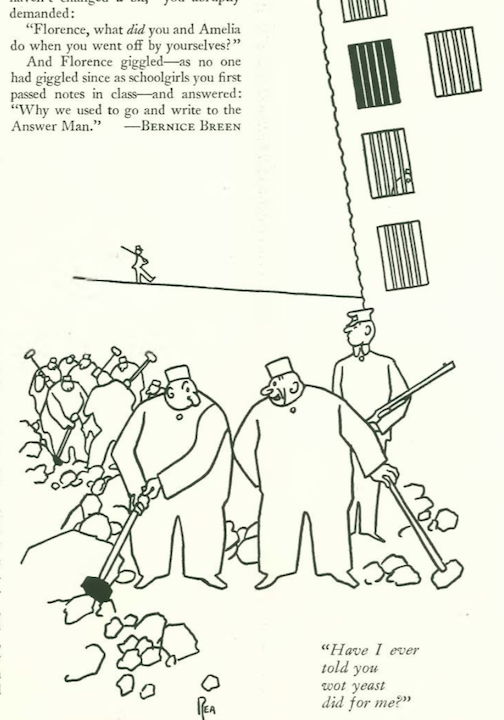
…although Fleischmann likely saved The New Yorker with large infusions of cash, its cartoonists, including Gardner Rea, still took an occasional poke at the company’s health claims…

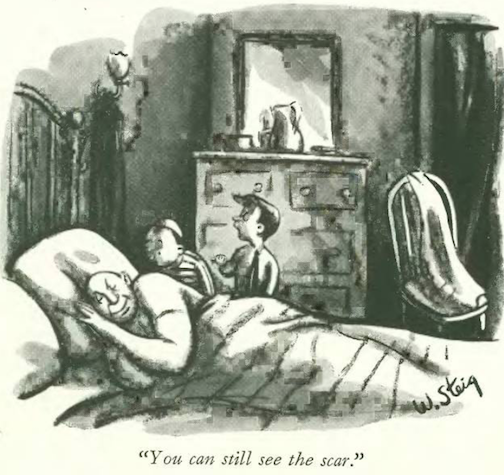
…anticipating his “Small Fry” cartoons, William Steig finds two of them examining the wonders of human physiology…

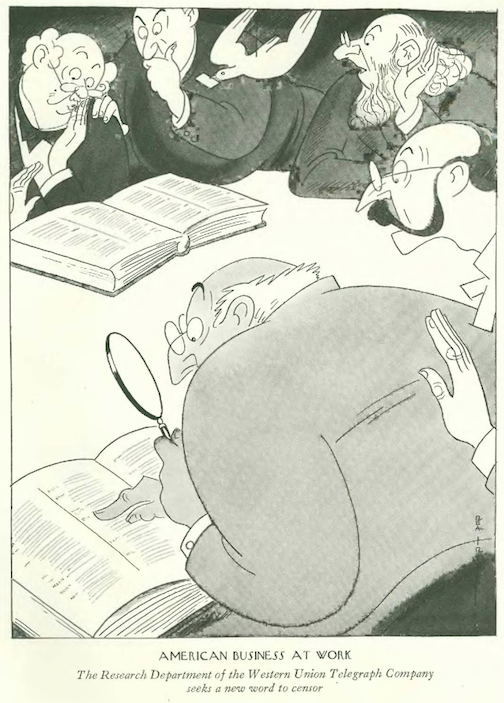
Rea Irvin looked in on some stuffy Western Union censors…

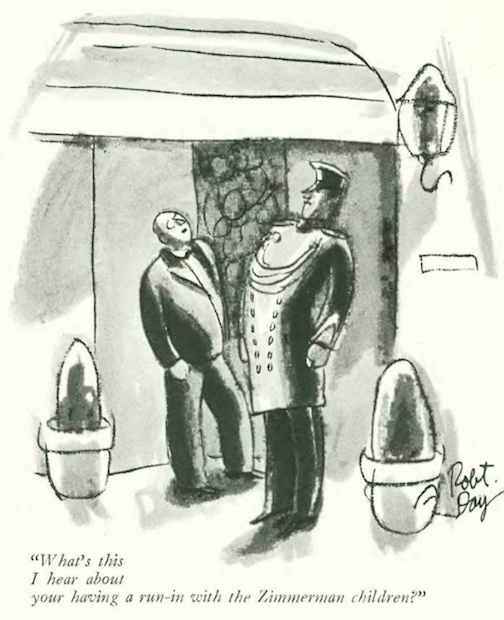
…newcomer Robert Day illustrated the challenges of a doorman (Day would be a longtime contributor)…

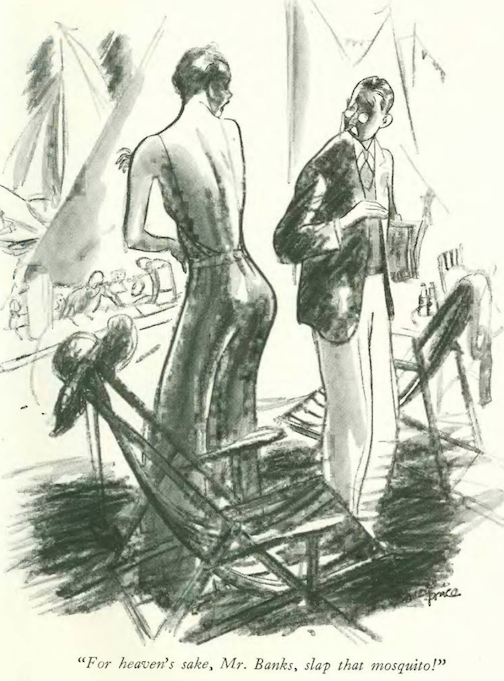
Garrett Price found humor abuzz between the bold and the meek…

Alan Dunn tracked down a clueless hunter…

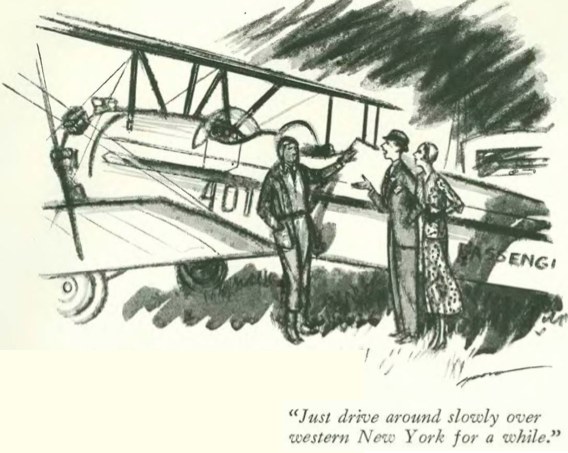
…and we end with Leonard Dove, who takes flight and anticipates our next installment…

Next Time: A Big Bird…


Unnatural History

In my last post we visited the Central Park Zoo, circa 1931, and found a collection of animals displayed as curiosities in barren enclosures that in no way resembled natural habitats.

Aug. 29, 1931 cover by Constantin Alajalov.

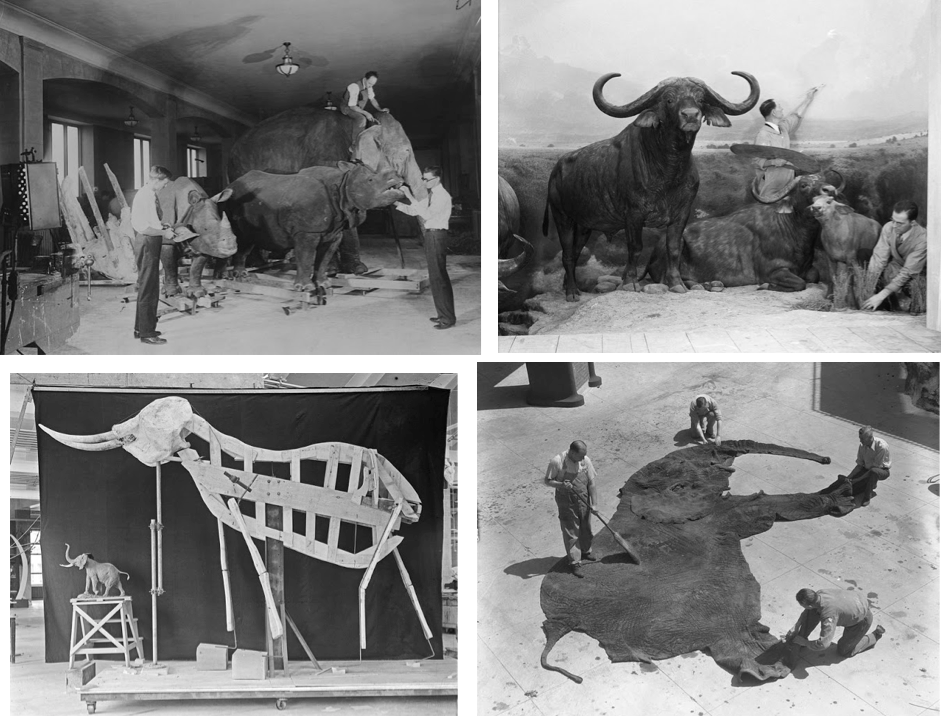
It’s hard to say if those creatures were better or worse off than their cousins at the American Museum of Natural History, a short walk across the park to the northwest. Unlike the zoo, the tigers and rhinos at the museum were displayed in naturalistic, almost dreamlike settings. But then again they were dead; indeed, all that remained of them were their skins, skillfully fitted over skeletons of wood and clay.

SIMULACRUM…Clockwise, from top left, American Museum of Natural History staff mounting rhinoceros and Indian elephant, circa 1930; preparing African buffalo group diorama; staff cleaning elephant skin in preparation for mounting on a frame consisting of a skull and some wood. This would be covered with clay before the skin is fitted. (vintag.es)

E.B. White stopped by the famed museum to take a look at its new Asiatic Hall, and filed this report for “The Talk of the Town.”

The animals pictured below came from a couple of British big game hunters, gathered during expeditions in the 1910s and 1920s…

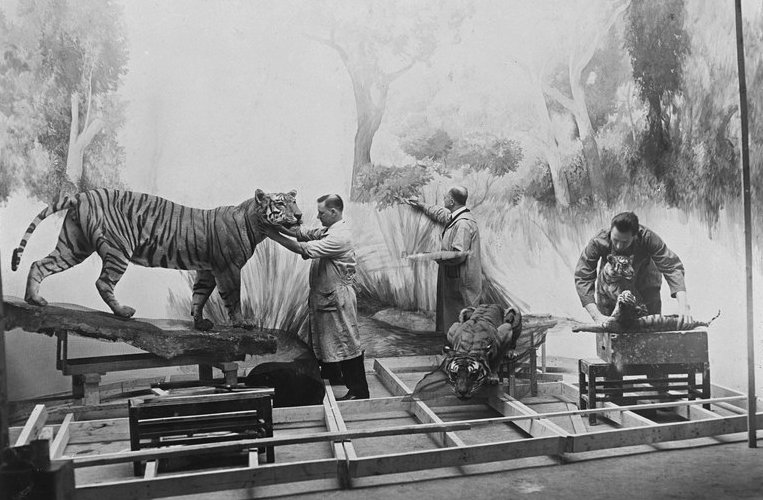
PLEASE HOLD STILL…American Museum of Natural History staff prepare the tiger group diorama in 1931. The display was in the new Asiatic Hall referred to by E.B. White. (vintage.es)
SURVIVORS OF A SORT…Nearly 90 years later, the tiger group is still on display at the American Museum of Natural History, now in the Hall of Biodiversity. (AMNH)
STILL THE SAME…This Asiatic leopard diorama, which so impressed E.B. White, also survives to this day, in the Hall of Asian Mammals at AMNH. (atlasobscura)
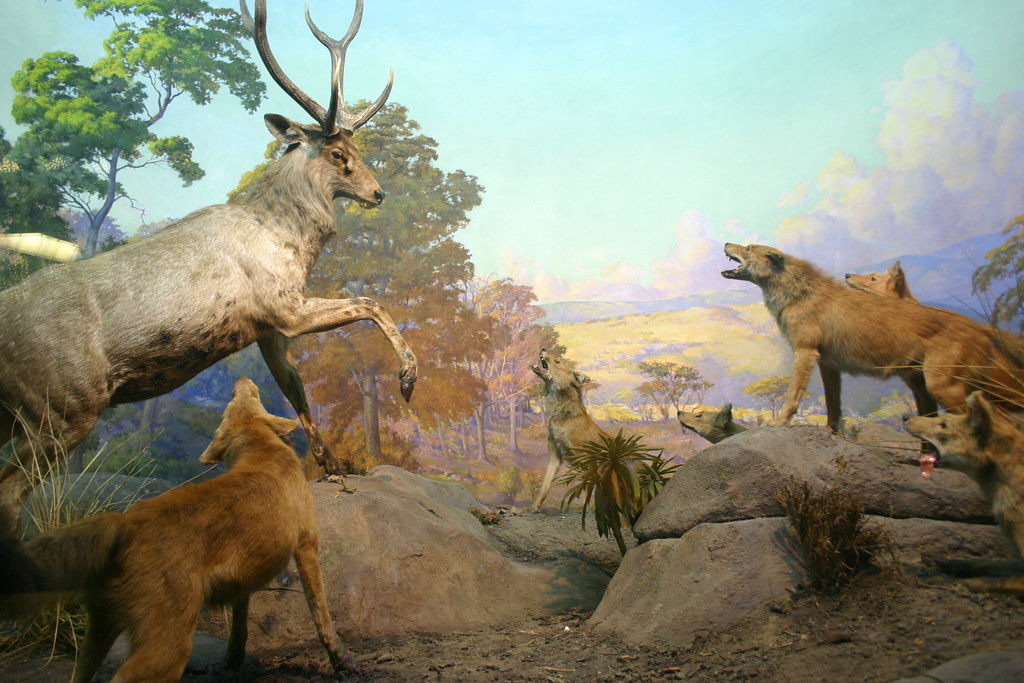
NEVER-ENDING BATTLE…The Sambar stag diorama, dating to 1911, is also mentioned by White in his article. (atlasobscura)

I am delighted that the AMNH (which I visited in December as an avid fan of diorama art) preserves these exhibits, which not only display animals—many now endangered—but also the artistry of painters, sculptors and taxidermists from a century ago. Sadly, many museums are scrapping these cultural treasures and replacing them with gaudy, interactive displays and video screens. An article in Newsweek (“Museum Dioramas Are as Endangered as the Animals They Contain,” Aug. 2, 2015) notes that around 2008 “the Smithsonian’s National Museum of Natural History in Washington, D.C., closed two diorama halls and reopened them with video screens, interactive features and stand-alone specimens where the dioramas had been.” In other words, the specimens were removed from naturalistic scenes and displayed as stand-alone curiosities, rather like those poor animals in the Central Park Zoo of yesteryear.

 *  *  *

Everyday Icons

Gilbert Seldes profiled industrial designer Henry Dreyfuss (1904–1972), who along with contemporaries Raymond Loewy and Norman Bel Geddes was among celebrity designers of the midcentury. Like Bel Geddes, Dreyfuss was a well-known Broadway set designer who would go on to become an industrial designer in the era of streamlining. But unlike Loewy and Bel Geddes, Dreyfuss went well beyond mere styling, taking a practical, scientific approach to problems that would not only make products better looking, but also safer and more comfortable to use. An excerpt:

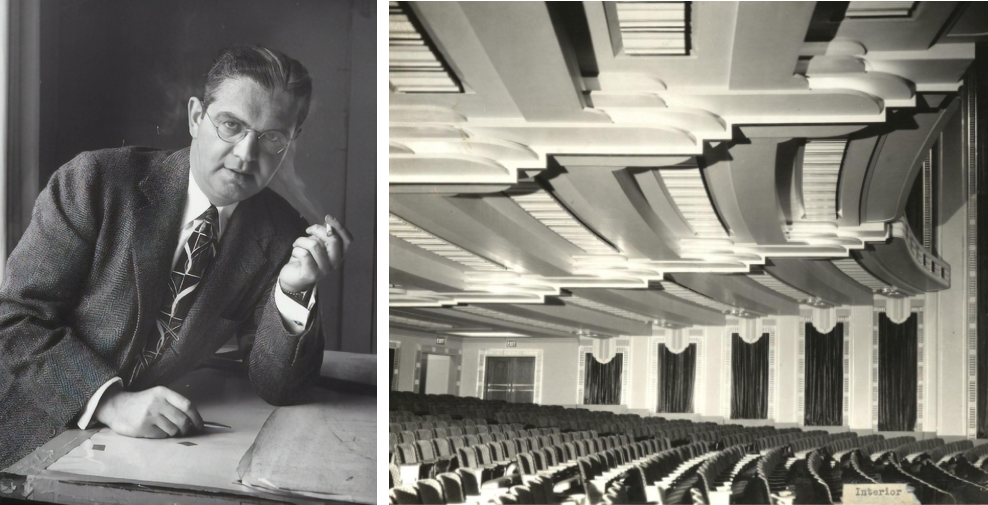
GOT MY START IN SHOW BIZ…Henry Dreyfuss in 1946, and his 1930-31 design of the RKO Theatre in Davenport, Iowa (now the Adler Theatre). (Wikipedia/qctimes.com)
ICONS OF EVERYDAY LIFE…Some of Dreyfuss’s designs included, top row: the Western Electric Model 500 telephone (center), which replaced the clunkier Model 300 (left) in 1950; the Hoover model 150 vacuum cleaner, from 1936; middle row: Dreyfuss designs for the New York Central Railroad’s streamlined Mercury train (1936); and the NYC Hudson locomotive for the Twentieth Century Limited (1938); bottom row: Dreyfuss designed things as varied as tractors for John Deere (1960); the Honeywell T87 circular wall thermostat (1953–present); and the Polaroid SX-70 Land camera (1972).

 *  *  *

Body-Building Barnum

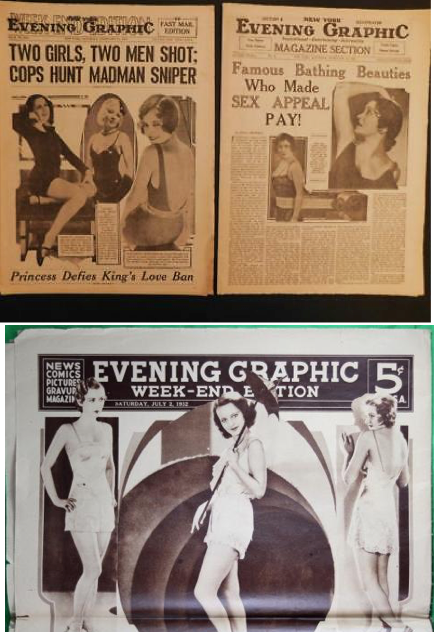
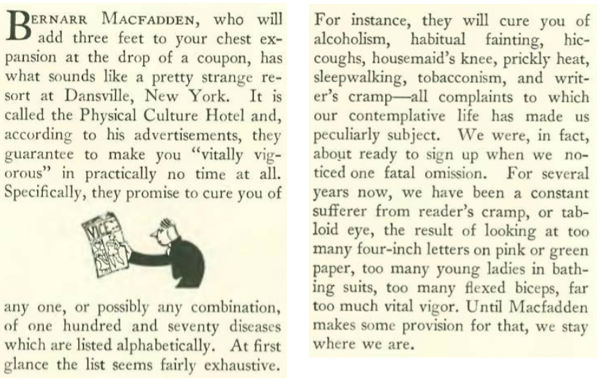
Another well-known figure of the 1930s was Bernarr Macfadden (1868–1955), an early proponent of physical culture who would prefigure such notables as Charles Atlas, Jack LaLanne, and Arnold Schwarzenegger. But none of them were quite like McFadden, who also created a pulp publishing empire (among his magazines: Liberty, True Detective, True Story, True Romances, Photoplay and the notorious tabloid newspaper The New York Evening Graphic).

READ ALL ABOUT IT…Macfadden’s Evening Graphic was all about scandal, and especially sex and murder.

Macfadden also established numerous “healthatoriums” across the East and Midwest, including (in 1931) his latest venture, the Physical Culture Hotel near Dansville, New York. E.B. White explained, in his “Notes and Comment”…

MCFADDEN SHOWS OFF HIS BOD in 1910 (left) at age 42, and at age 55 in 1923. (Wikipedia)
BEFORE AND AFTER…Mcfadden acquired the 1882 Jackson Sanatorium near Dansville, NY in 1931 and renamed it the Physical Culture Hotel. Circa 1930s images at top contrast with the condition of the property today — it fell into disrepair after MacFadden’s death in 1955, and closed for good in 1971. Known to locals as the “Castle on the Hill” in its heyday, it can still be glimpsed by motorists traveling on I-390. (bernarrmacfadden.com/abandonedplaces.livejournal.com)

 *  *  *

For the Birds

When I came across “Farewell to Birds,” on page 17, I thought for a moment it was one of James Thurber’s animal parodies (there was even a Thurber cartoon at the bottom of the page), but then I noticed our writer was Will Cuppy, (1884-1949) who wrote in the Thurber vein (Cuppy was ten years Thurber’s senior) and like Thurber, was a bit of a curmudgeon. From 1931 until his death Cuppy wrote satirical pieces for The New Yorker that were later collected into books (also like Thurber). Here is an excerpt from “Farewell to Birds.”

THE SIMPLE LIFE…Satirist Will Cuppy (center, in 1932) and two of his early books. How to be a Hermit (1929) was a humorous look at his life residing in a Jones Island seaside shack from 1921 to 1929 (he was escaping city noise and hayfever); How to Tell Your Friends from the Apes was a 1931 compilation of Cuppy’s articles, including the one above.

 *  *  *

Puttin’ on the Ritz

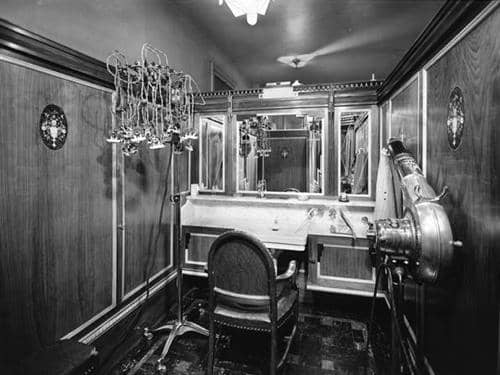
Lois Long, newly divorced from cartoonist Peter Arno, concluded her fashion column (“On and Off the Avenue”) by telling readers about her “swell new hairdo”…

HAVE A SEAT, LOIS…The perm room at Charles of the Ritz, 1932. (Museum of the City of New York)

 *  *  *

Your Majesty

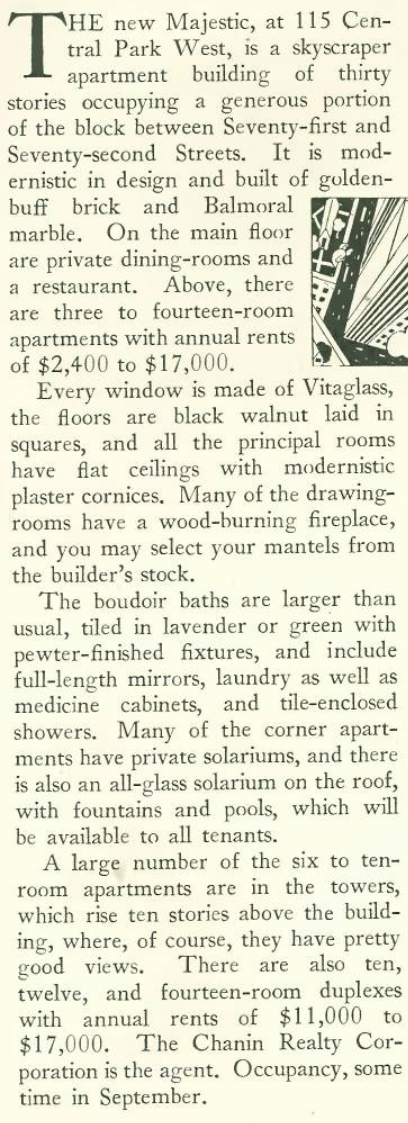
Speaking of new looks, Central Park West was boasting the addition of a new “skyscraper apartment building” called the Majestic. “The Sky Line” reported:

APTLY NAMED…The Majestic at Central Park West. (Pinterest)

Another building making its mark was the Parc Vendôme on West 57th, offering more than 600 apartments with annual rents ranging from $1,100 to $6,600. Condos in the same building today range from $495,000 to $5,495,000.

BREAD BOX INCLUDED…The Parc Vendôme on West 57th. (street easy.com)

From Our Advertisers

Henry Mandel, one of New York City’s most ambitious developers in the 1920s and early 30s, touted the Parc Vendôme in this advertisement…

…I wonder if Lois Long (see above) got one of these “dos” at the Ritz…I love the snob appeal of this ad — “The New Paris Way of Doing Your Hair”…

…which seemed to work…here is a random sample of Hollywood stars in 1931, all wearing the look…

DOING THE WAVE…From left, Tilly Losch, Constance Bennett, and Barbara Stanwyck.

…other ads appealing to the Continental lifestyle…a very understated yet elegant ad for Guerlain lipstick, and Nellie Harrington-Levine gave us a disinterested deb sporting “the wave,” a cigarette and a velvet dress…

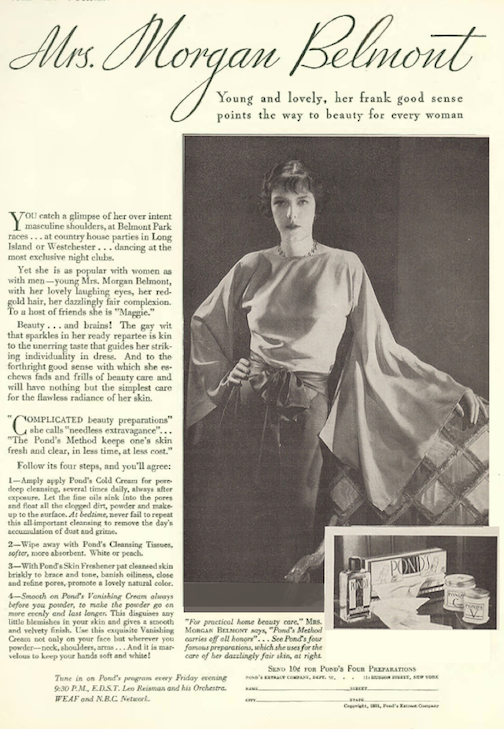
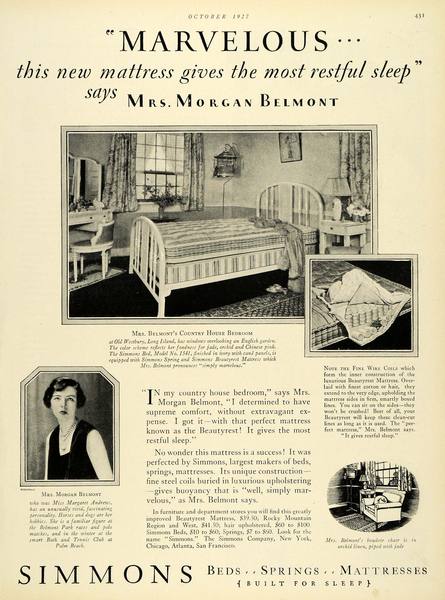
…and Pond’s continued its parade of rich society women to sell its cold cream…here we are presented with “Mrs. Morgan Belmont,” aka Margaret Frances Andrews (1894–1945), a Newport socialite and prize-winning show dog breeder…

Andrews didn’t limit herself to cold cream, here appearing in a 1927 ad for Simmons mattresses…

Margaret Frances Andrews was a noted dog breeder, seen above at the Newport Dog Show around 1915; below, Andrews had a small role in the 1920 Mary Pickford film Way Down East. Andrews—seen at left, she was credited as “Mrs. Morgan Belmont.”

…and we move on to this sad little ad from the back pages, featuring something called “Peeko,” which apparently mimicked the flavors of Rye, Gin and Rum…it must have tasted awful…

…our cartoons feature Perry Barlow, and I can’t quite tell if this guy is drinking a soda or some bootleg gin, which was often sold at select gas stations…

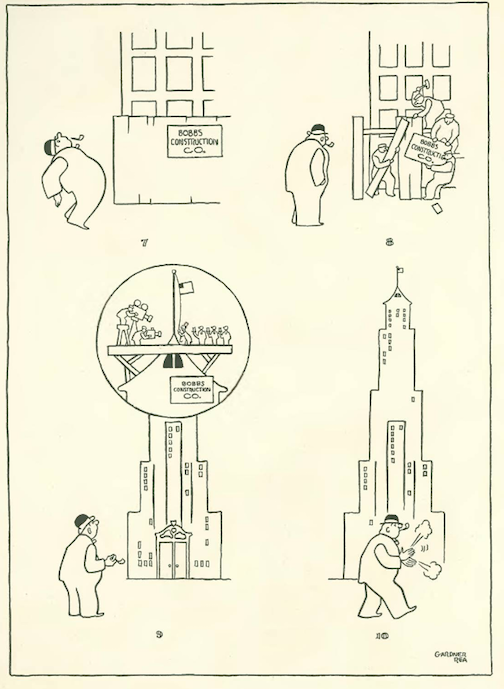
…a two-page sequence from Gardner Rea

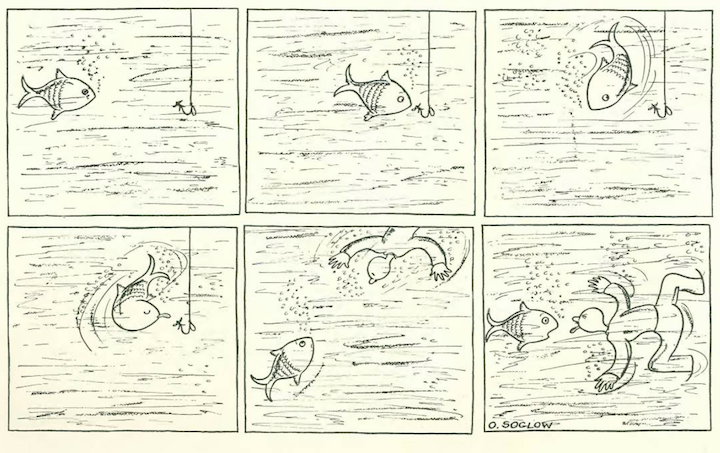
Otto Soglow went fishing…
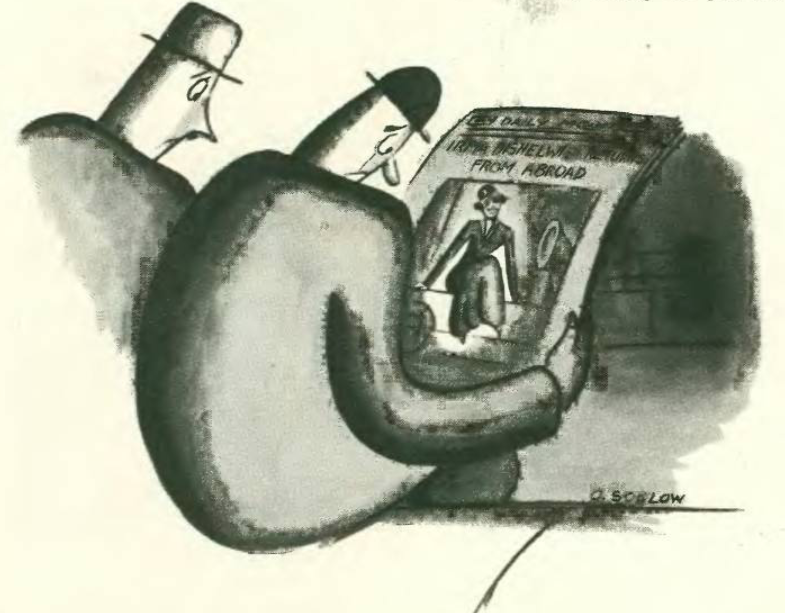
…and commiserated with a couple of unemployed guys whose plight is ignored by the celebrity-obsessed media…

Alan Dunn hit the lecture circuit…

Kemp Starrett sketched some wink-wink, nudge-nudge at the men’s store…

…and we close with James Thurber, and the trials of our elders…

Next Time: Bonfire of the Vanities…

Markey’s Road Trip

With the explosion of car ownership in the 1920s and 30s came improved highways across America, but if one were to undertake a long-distance journey, like The New Yorker’s Morris Markey, you were bound to find a wide range of conditions, from concrete highways to muddy dirt roads.

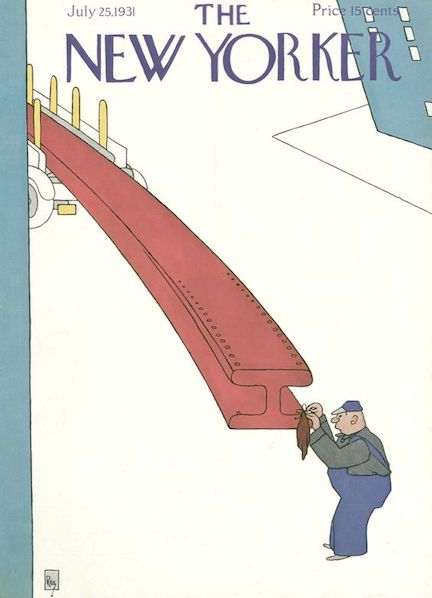
July 25, 1931 cover by Gardner Rea.

Markey wrote about his experience of driving from New York City to Atlanta for his “Reporter at Large” column, noting that stops at filling stations also offered opportunities to fill up on bootleg gin. Drunk driving, it seems, wasn’t a big concern in the early 1930s.

BLUE HIGHWAYS…Although the U.S. launched into major roadbuilding projects in the 1920s and 30s, rutted and muddy roads were still common in many areas of the country. Clockwise, from top left, Route 1 winds through Maryland in the 1920s; marker indicating the Mason and Dixon Line dividing Pennsylvania from Maryland, circa 1930; a 1930s dirt road in the Eastern U.S.; a policeman directs traffic in Richmond, Va., in the 1930s. (Library of Congress/fhwa.dot.gov/theshockoeexaminer.blogspot.com)
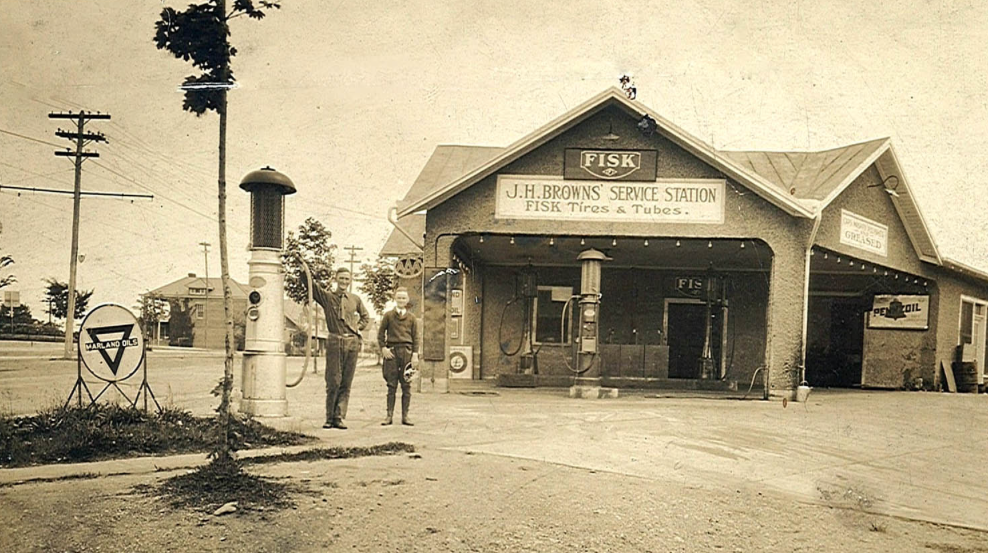
TIME TO GIN UP…James H. Brown (left), at the first of his four service stations in Richmond, Va., circa 1930. Some service stations offered Morris Markey bootleg gin during his journey to Atlanta. My use of this photo, however, does not imply that Mr. Brown offered the same service. (vintagerva.blogspot.com)

Unfortunately, Markey shared the sensibilities of many of his fellow Americans 89 years ago, and made this observation about drivers below the Mason and Dixon Line:

 *  *  *

Pale Riders

Since the mid-19th century Chelsea’s Tenth Avenue was known as “Death Avenue” due to the killing and maiming of hundreds who got in the way of freight trains that plowed through 10th and 11th Avenues in the service of warehouses and factories in the district. In the 1850s the freight line hired horsemen known as “West Side Cowboys” to warn wagons and pedestrians of oncoming trains, but even with this precaution nearly 450 people were killed by trains between 1852 and 1908, with almost 200 deaths occurring in the decade preceding 1908. Calls for an elevated railroad were finally answered with the opening of the High Line in 1934. “The Talk of the Town” looked in on the last of these urban cowboys:

WESTSIDE COWBOYS…Clockwise, from top left, a steam locomotive rumbles down 11th Avenue in the 1920s; a West Side Cowboy William Connolly rides ahead of a train to warn pedestrians in 1932; George Hayde led the final ride of the West Side cowboys up 10th Avenue on March 24, 1941; aerial view of the High Line from 18th Street heading north. Opened in 1934, the High Line lifted most train traffic 30 feet above the street. Today it serves only pedestrians, and is one of New York’s biggest tourist draws. (Forgotten NY/AP/NY Times/thehighline.org)

 *  *  *

Guys and Dolls

“The Talk of the Town” had some fun with a little-known aspect of a notorious gangster’s life; namely, the doll-filled house belonging to Jack “Legs” Diamond:

DOLL HOUSE…This house on Route 23 near Cairo, New York, once sheltered gangster Jack “Legs” Diamond, his wife, Alice, and her extensive collection of dolls and other knick-knacks. (nydailynews.com/Zillow)

“Talk” also made joking reference to the number of times Diamond had been shot and survived to tell about it.

Diamond’s luck would run out at the end of 1931 — Dec. 18, to be exact — when gunmen would break into his hotel room in Troy, NY, and put three bullets into his head.

 *  *  *

Ziggy’s Stardust

Florenz Ziegfeld (1867-1932) had a knack for show business, launching the careers of many entertainers through his Ziegfeld Follies, which got its start in 1907 during vaudeville’s heyday. The advent of sound movies signaled the end of the vaudeville era and of Ziegfeld himself, who would stage one final Follies before his death in 1932. Gilbert Seldes penned a two-part profile of Ziegfeld under the title “Glorifier” (caricature by the great Abe Birnbaum). An excerpt:

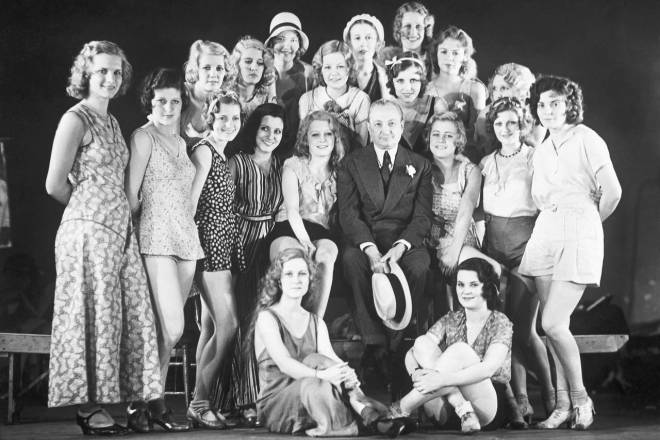
GO WITH THE FLO…Broadway impresario Florenz “Flo” Ziegfeld Jr with his Follies cast, 1931. It would prove to be his last Follies show. Revivals following his death in 1932 would prove to be much less successful. (Wall Street Journal)

 *  *  *

If Looks Could Kill

The New Yorker’s film critic John Mosher had a difficult time making sense of Murder by the Clock and its lead actress, Lilyan Tashman, who gave a tongue-in-cheek performance as the film’s femme fatale.

ARE YOU NUTS?…Irving Pichel and Lilyan Tashman in Murder by the Clock (1931). Tashman was known for her tongue-in-cheek portrayals of villainesses in films she made before her untimely death in 1934. (IMDB)

 *  *  *

Eine Kleine Nachtmusik

Open-air performances of classical music and opera were popular summertime diversions in the days before air-conditioning. In 1931 crowds gathered in Lewisohn Stadium to hear the New York Philharmonic perform under the direction of Willem van Hoogstraten, who conducted the Lewisohn summer concert series from 1922 to 1939. Here is a listing in The New Yorker’s “Goings On About Town” section:

MUSIC IN THE AIR…Cover of the 1931 program for concerts at Lewisohn Stadium, College of the City of New York. Bottom right, signed photo of Willem van Hoogstraten from 1930. (digitalcollections.nypl.org/ebay.com)

 *  *  *

From Our Advertisers

Flo Ziegfeld’s 1931 Follies were lavish productions, but his advertising in The New Yorker was anything but as evidenced in this tiny ad that appeared at the bottom of page 52…

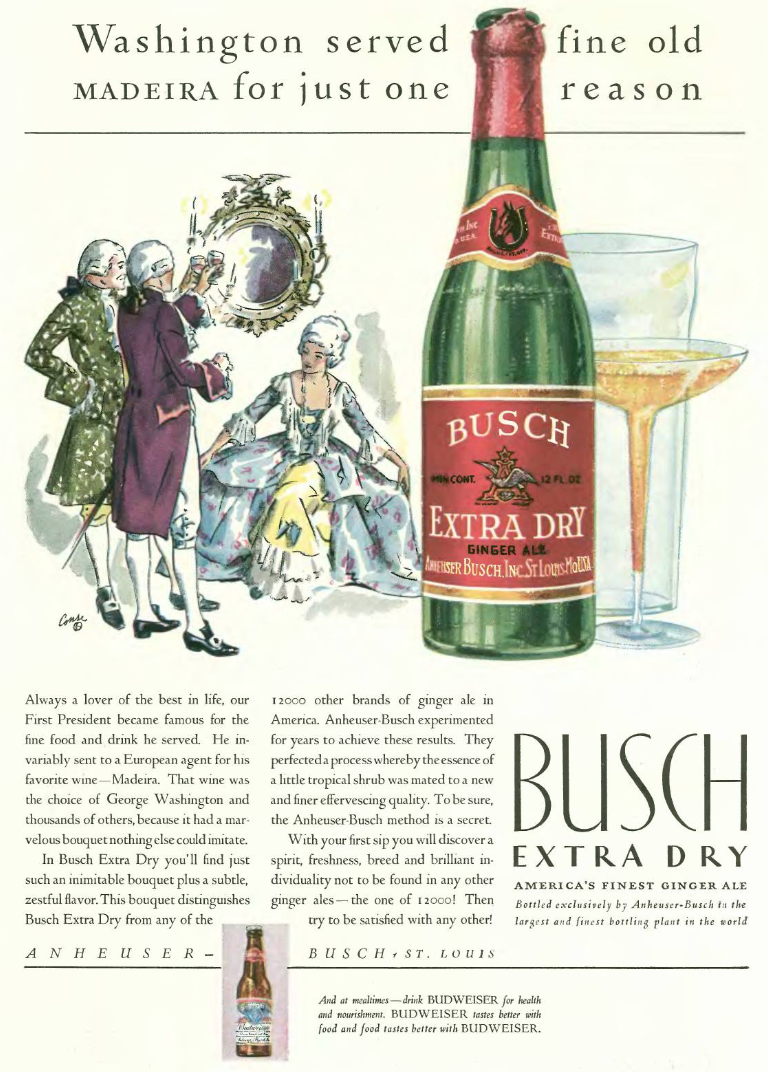
…no doubt anticipating the demise of Prohibition, the makers of Anheuser-Busch beverages ramped up the promotion of their non-alcoholic products to create associations with pre-Prohibition times…

…not to be outdone by the East Coast chocolates giant Schrafft’s, Whitman’s took out this full page ad to suggest how you might enjoy their product…

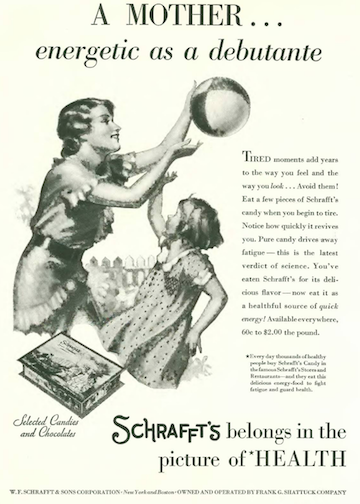
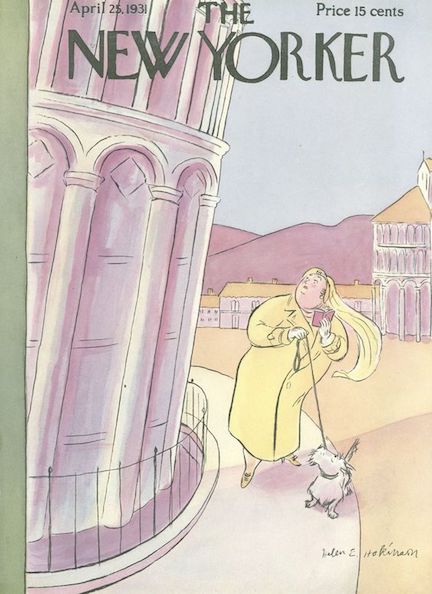
…which was in sharp contrast to the approach Schrafft’s took in this full-page ad featured in the April 25, 1931 New Yorker, which touted the health benefits of its candy…

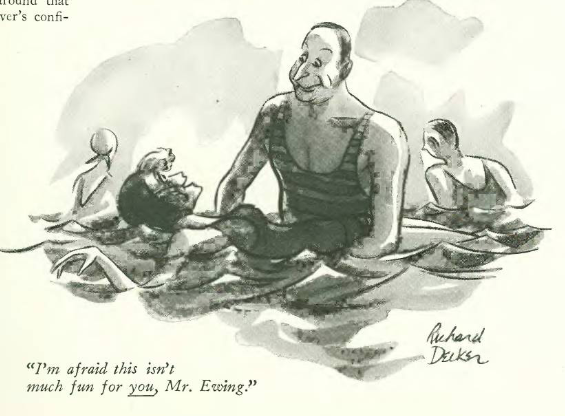
…on to our cartoons, Richard Decker took us swimming with a middle-aged man who was anything but bored…

Barbara Shermund went en plein air with a couple of her ditzy debs…

Garrett Price also went to the country to find a bit of humor…

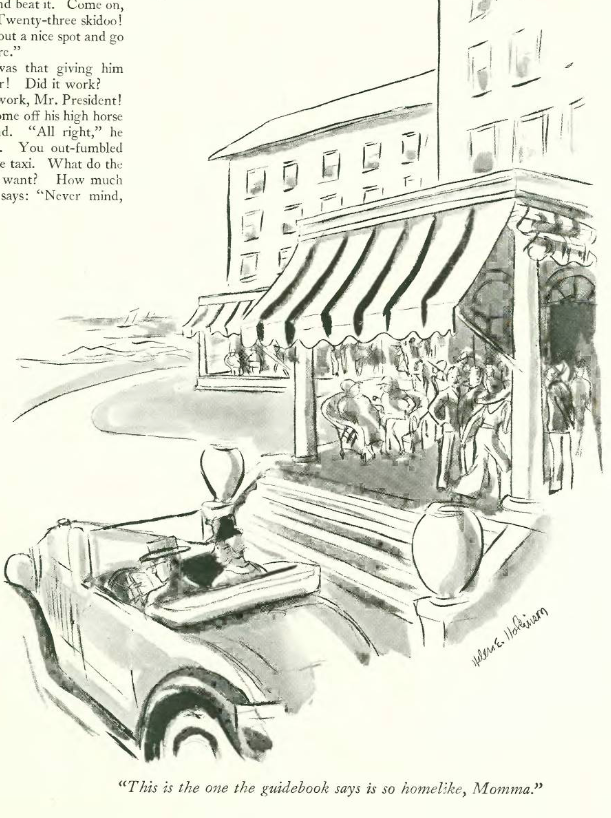
Helen Hokinson found a home away from home for a couple looking to take the sea air…

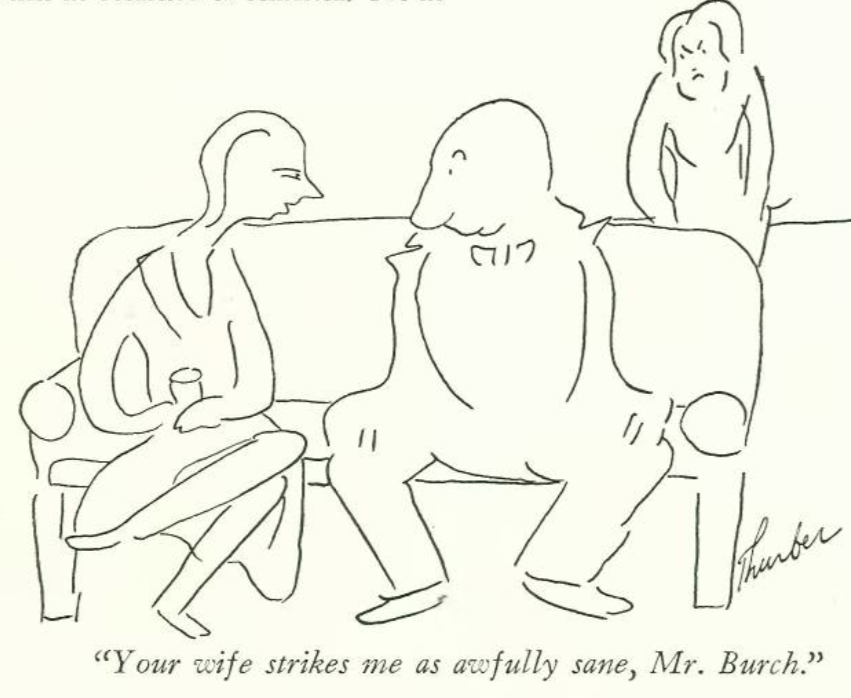
James Thurber continued to explore his brewing war between the sexes…

Harry Haenigsen gave us a novel approach to landing a trophy fish…

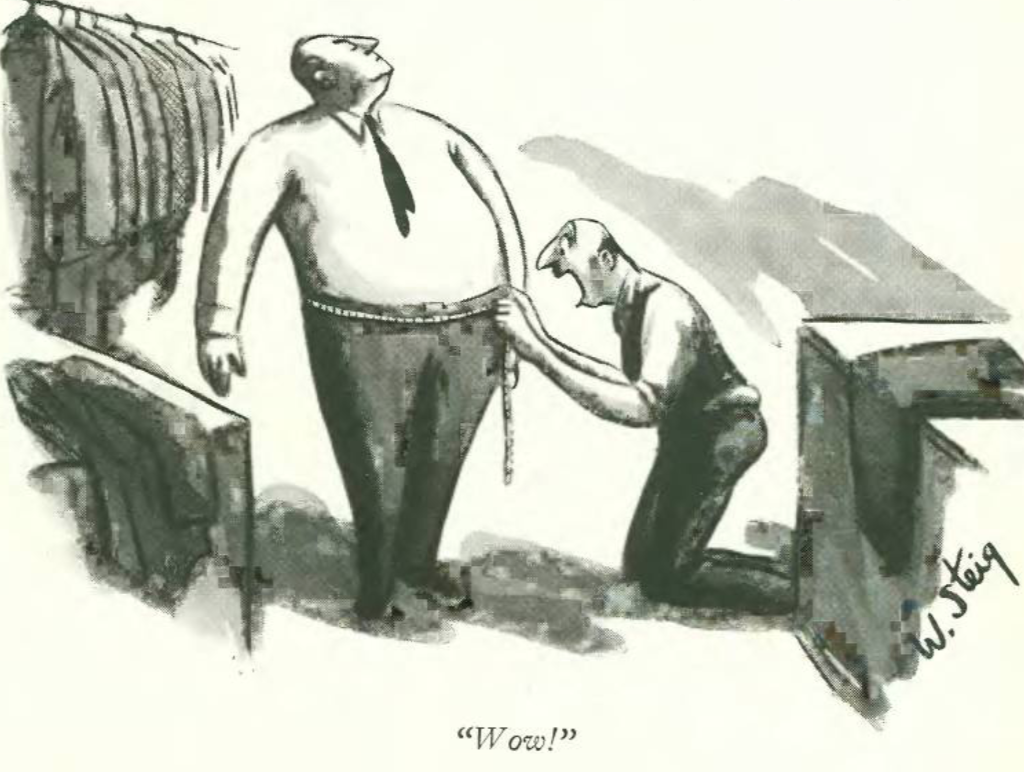
William Steig illustrated the wonders of the tailoring profession…

…and Alan Dunn aptly summed up the generation gap of the 1930s…

…on to the Aug. 1, 1931 issue…

August 1, 1931 cover by Rose Silver.

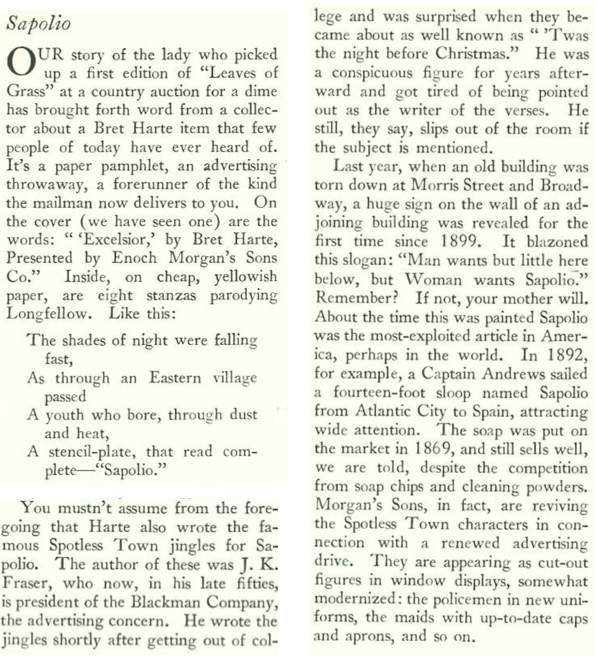
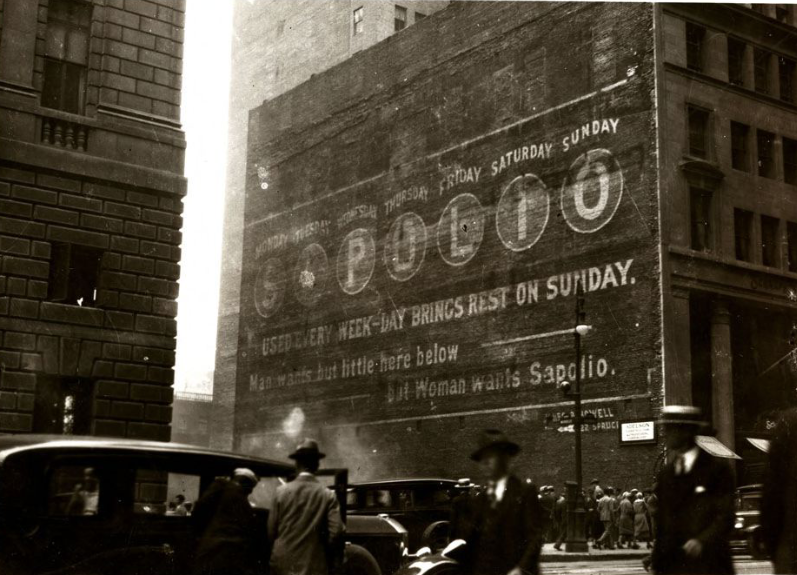
…”The Talk of the Town” mused about the advertising jingles made famous by the makers of Sapolio soap…

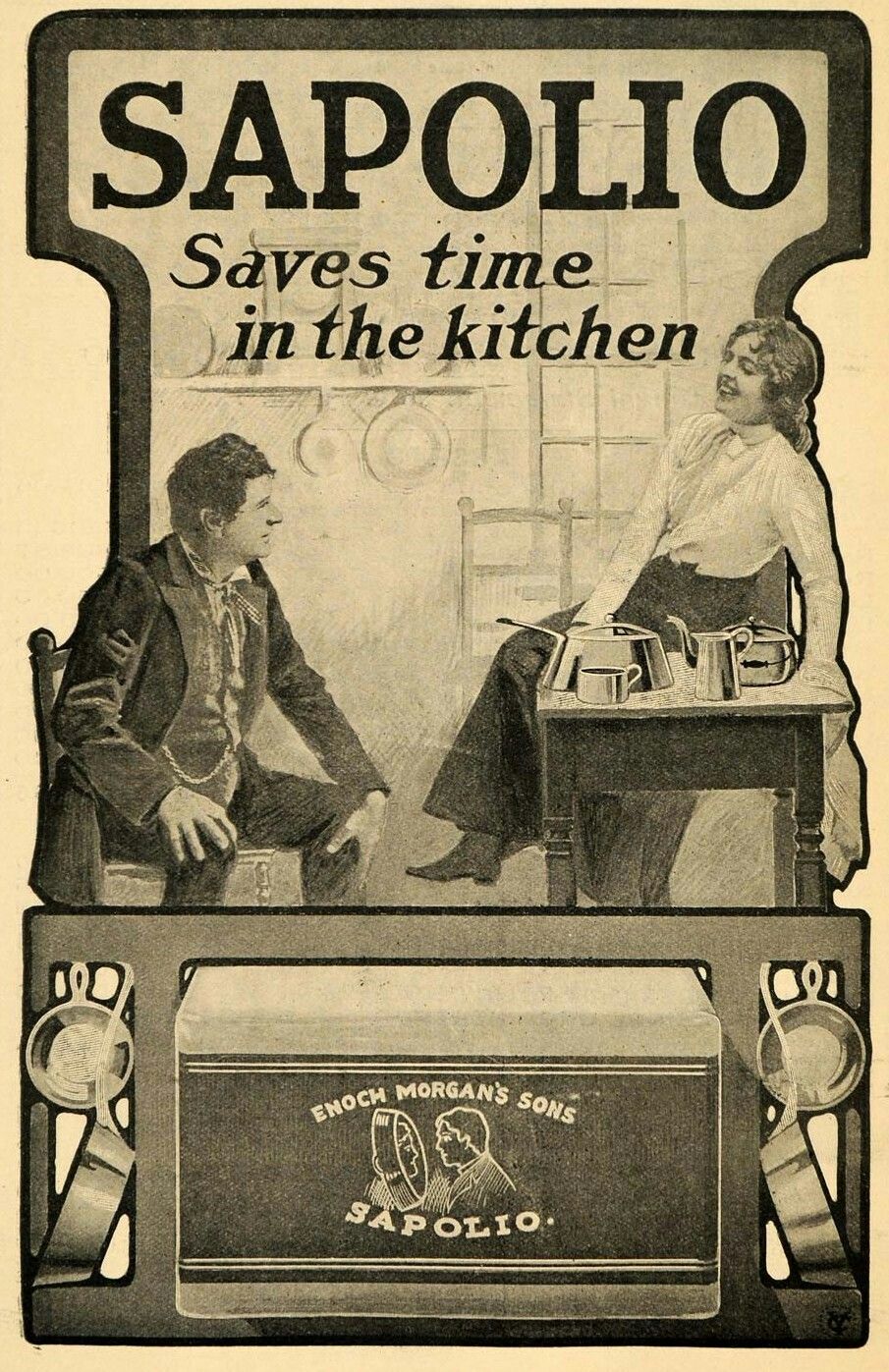
…Bret Harte actually did write jingles for the brand, once described by Time magazine as “probably the world’s best-advertised product” in its heyday. With a huge market share, Sapolio was so well known in the early 20th century that its owners decided they no longer needed to spend money on advertising. It was a poor decision, and by 1940 the product disappeared from the marketplace.

SEEING THE LIGHT OF DAY…A 19th century Sapolio sign on Broadway and Morris Street revealed after an adjoining building was demolished in 1930. (Museum of the City of New York)
MONEY WELL SPENT…Sapolio ad from its heyday in the early 20th century. (Pinterest)

 *  *  *

Tough Love

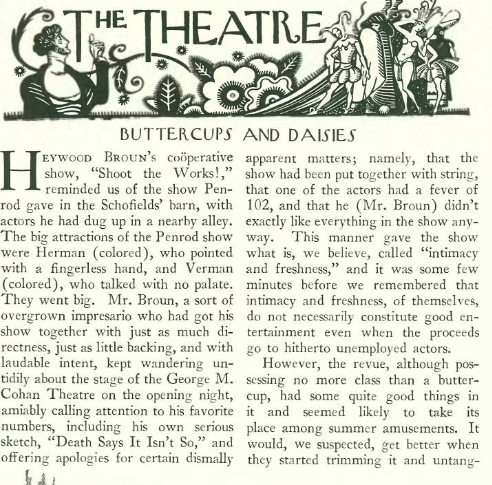
As a charter member of the famed Algonquin Round Table, Heywood Broun was a friend to many of the founding writers and editors of The New Yorker. And so it must have been quite a task to review his play, Shoot the Works, which The New Yorker found wanting in a number of aspects. And because he was so close to Broun himself, Robert Benchley left the review writing to someone who signed the column “S. Finny.” I can’t find any record of an S. Finny at The New Yorker, and I don’t believe this is a Benchley pseudonym (he used “Guy Fawkes” in The New Yorker). At any rate, here is an excerpt:

SHOOT GETS SHOT…The New Yorker wasn’t crazy about Heywood Broun’s play, which ran for 87 performances at George M. Cohan’s Theatre. (Playbill)

 *  *  *

From Our Advertisers

The makers of the “Flexo” ice cube tray continued to tout the wonders of their product with these Ripley-themed ads. This might appear rather mundane to modern eyes, but electric refrigerators with built-in freezers were still rather novel in 1931…

…another way to stay cool in the summer of 1931 was to take an excursion to the Northern climes…

…this ad for the New York American featured an illustration by Herbert Roese, whose early work strongly resembled that of Peter Arno’s

…on to our cartoons, we have the latest antics of the Little King courtesy Otto Soglow

William Steig added levity to a heavy moment…

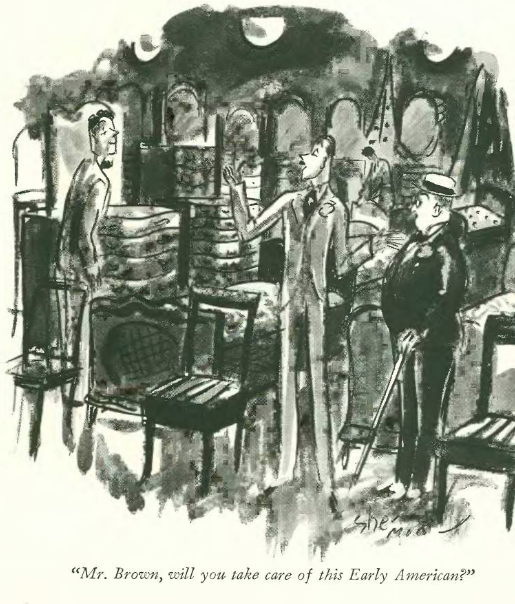
Barbara Shermund found humor at an antiques shop…

...John Held Jr continued his revels into our “naughty” Victorian past…

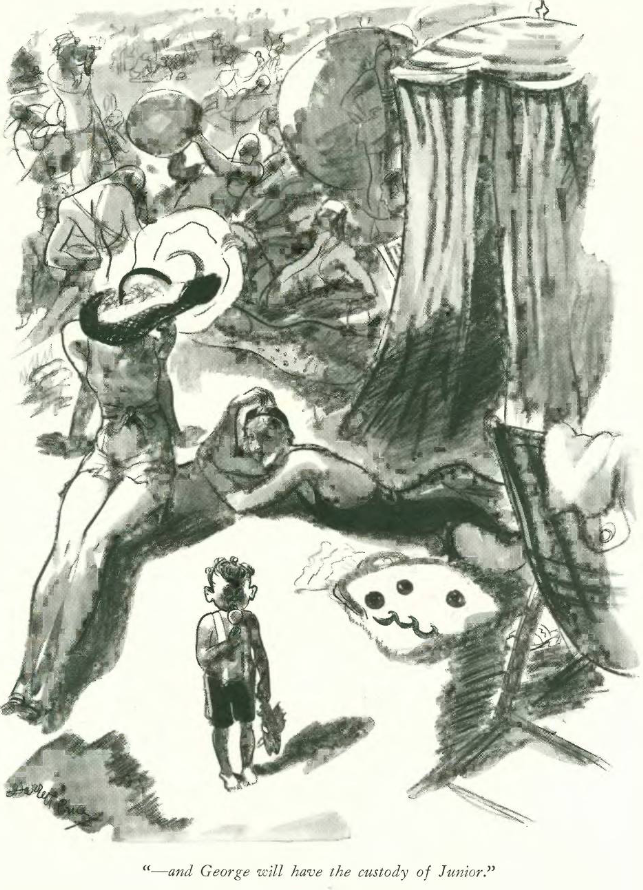
…and we end with Garrett Price, and a look at the ways of the modern family…

Next Time: An American Classic…


The Black Eagle

Charles Lindbergh gained worldwide fame when he flew solo across the Atlantic in 1927, but the staid Lindy had nothing on Hubert Fauntleroy Julian when it came to personality (and politics, as we shall see). The Trinidad-born Black aviator not only pushed the limits of early 20th century aviation, but did it all with style and pizzazz.

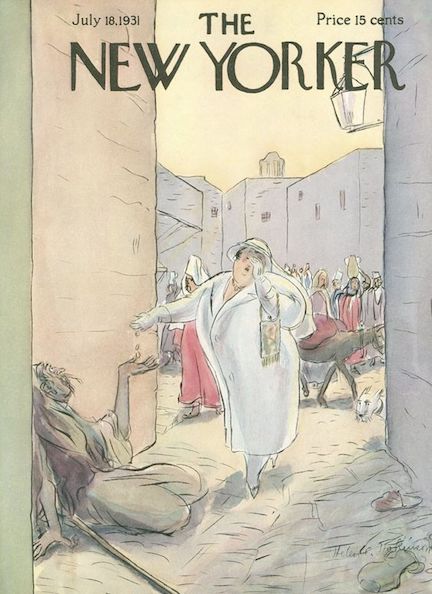
July 18, 1931 cover by Helen Hokinson. More on Helen’s 1931 travel covers in the cartoon section at the end of this blog entry.

Julian (1897-1983), known as “The Black Eagle,” left Trinidad in 1914 for Montreal, where he first learned to fly. He moved on to Harlem in 1921, where he polished his flying skills with aviator Clarence Chamberlin and practiced his parachute jumps. In the first of a two-part “Profile,” Morris Markey related Julian’s first encounter with Chamberlin:

DOING IT WITH STYLE…At left, Hugo Gellert portrait for The New Yorker “Profile;” at right, the dapper Hubert Julian in 1937 (note the monocle hanging in front of his waistcoat). (harlemworldmagazine.com)

Julian did everything with brio; during one jump in New Jersey in 1923, he played “I’m Running Wild” on the saxophone while plummeting toward the earth. Keep in mind that the first planned free-fall jump from an airplane with a packed parachute occurred just four years earlier, in 1919. Heaven only knows how Julian made it to age 85.

BRING IT ON…Julian poses with his airplane, Ethiopia I, in the 1920s. At right, a 1935 syndicated feature on Julian’s exploits. In 1931 he became the first flyer of African descent to fly coast-to-coast in the United States. (Brooklyn Eagle/Pittsburgh Courier, Feb. 2, 1935)
THIS IS HOW WE DO IT…In the early days, parachute jumpers often climbed onto a wing to make their jump. Pictured here is Leslie Irvin, who on April 28, 1919, became the first aviator to make a descent with a “free type” manually operated parachute. (wondersofworldaviation.com)

During the 1930s Julian briefly headed the Ethiopian Air Corps, then returned to the States to tour as a member of an all-Black flying troupe, “The Five Blackbirds.” Incensed over comments Nazi leaders were making about Blacks and other races during World War II, Julian famously challenged Hermann Göring, commander of the Luftwaffe, to an aerial duel above the English Channel (Göring did not respond to the challenge). By contrast, Charles Lindbergh received a medal from Göring during a dinner at the American Embassy in Berlin in 1938, and praised the Nazi regime that would later go to war against his own country.

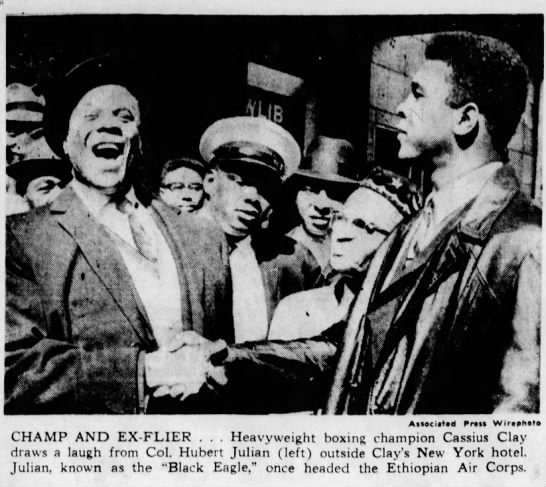
Julian was no choirboy, however, and after the war he became a licensed arms dealer, which eventually got him in trouble with the United Nations and earned him a four-month stint in jail. After his release, Julian retired, appearing on talk shows (including The Tonight Show with Johnny Carson) and hobnobbing with celebrities such as boxer Muhammad Ali.

(Louisville Courier-Journal, March 21, 1964)

 *  *  *

I’ll Take a Dozen

“The Talk of the Town” followed its sweet tooth to a Broadway storefront where Adolph Levitt’s famed doughnut-making machine was cranking out 1,200 doughnuts an hour before hungry, wondering crowds.

MR DOUGHNUT…Clockwise, top left, doughnut machine inventor Adolph Levitt (front row, dark suit) with some chums at a train station; doughnut gawkers gather before the window at Levitt’s Mayflower Doughnuts, 1933 (photo by Martin Munkácsi); ad touting one of Levitt’s machines as a form of entertainment; and an illustration by Robert McCloskey from his beloved children’s book, Homer Price, of a doughnut machine gone berserk. (ice.org/econlife.com/Pinterest)

 *  *  *

Surfing the Jersey Cliffs

Along with doughnut machine-watching, another fun summertime diversion was New Jersey’s Palisades Amusement Park, which was purchased in 1909 by brothers Nicholas and Joseph Schenck and transformed into one of the most visited amusement parks in the country. “The Talk of the Town” recalled its origins:

COME HITHER suggests the sign for Palisades Amusement Park, offering dancing, vaudeville and surf-bathing among other diversions. Circa-1940 postcards featured the mechanically generated surfing pool and the famed “Cyclone” roller-coaster. (Pinterest)

And these were the guys responsible for all of that fun…

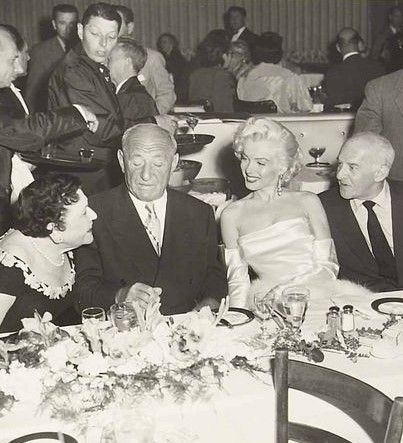
 Joseph (left) and Nicholas Schenck might not look like carefree sorts, but both had a knack for the entertainment world that would make them two of the most powerful executives in mid-century Hollywood. Among other things, Joseph played a key role in launching the career of Marilyn Monroe. He was, naturally, infatuated with her.

IS THAT YOUR GRANDDAUGHTER?…Joe Schenck and Marilyn Monroe are flanked by Walter Winchell and Louella Parsons at a birthday party for Winchell at Ciro’s Nightclub, May 13, 1953. (Pinterest)

 *  *  *

Claptrap

Robert Benchley couldn’t seem to let go of his recent experience at the revived Ziegfeld Follies. In his latest theatre column, he groused about the witless rubes in the audience who clapped over the sound of the performances, including Ruth Etting’s signature “Shine on Harvest Moon.” Take it away, Bob…

HOLD YOUR APPLAUSE…PLEASE…It was impossible to hear the trademark “cry” in Ruth Etting’s voice let alone anything else over the incessant applause at Ziegfeld Theatre.

 *  *  *

Coping With a Dry Climate

In his “Notes and Comment,” E.B. White mused over the explosion of corkscrews, flasks and other drinking accessories that were patented during Prohibition:

WHERE THERE’S A WILL…Flapper displays her garter flask in this photo from 1926. At right, a Demley “Old Snifter” corkscrew and bottle opener. (Wikipedia)

 *  *  *

From Our Advertisers

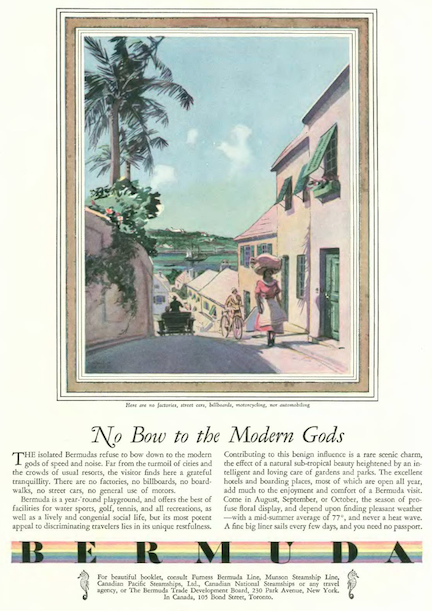
If you needed a stiff drink and an escape from the summer heat, well the heavenly shores of Bermuda might have been your (ahem) cup of tea…

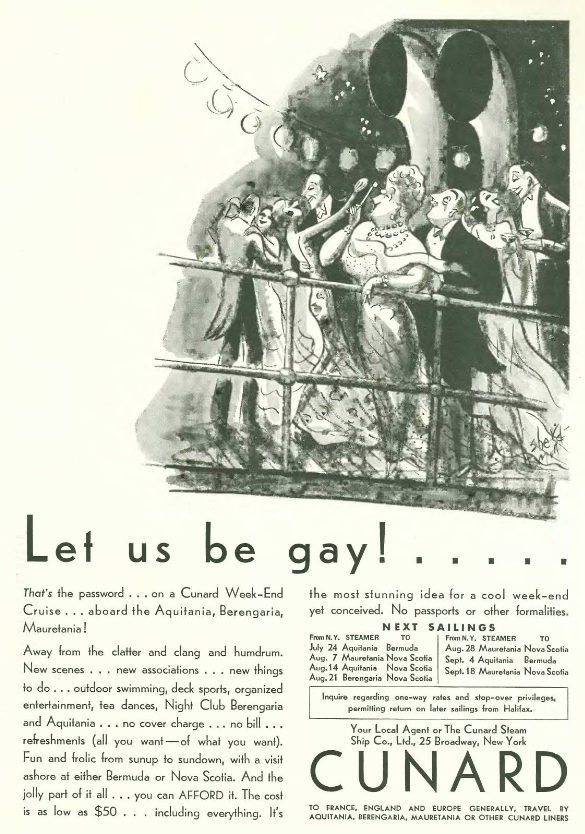
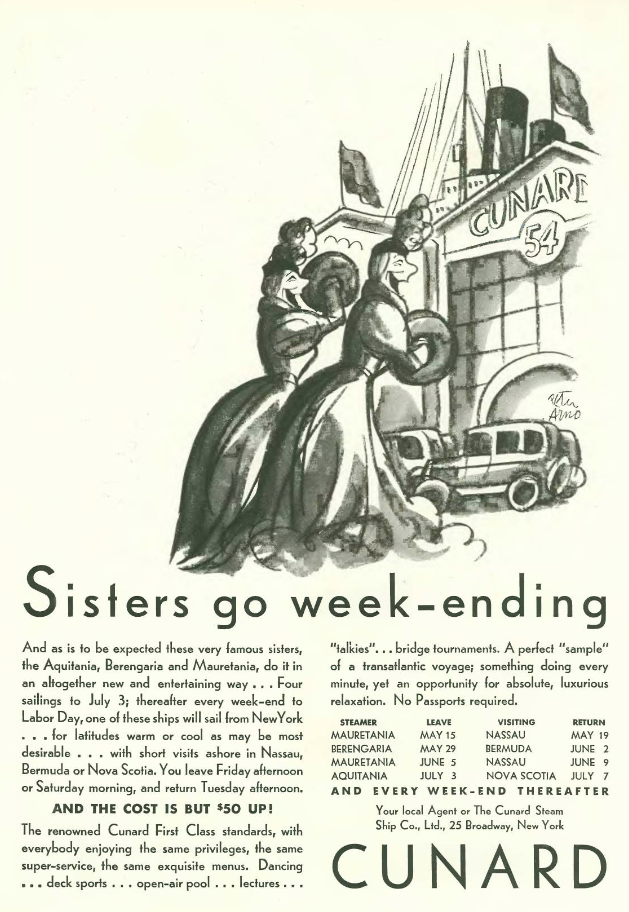
…or you could have enjoyed the merriment aboard one of Cunard’s liners, which were headed both south to Bermuda and north to Nova Scotia (note Cunard’s continuing use of New Yorker cartoonists for their ads, Peter Arno, H.O. Hofman, and this week Barbara Shermund)…

…and we have another ad from Canadian Pacific announcing its around-the-world cruise on the Empress of Britain

…which brings us to our cartoonists, or specifically, Helen Hokinson, who featured one of her “Best Girls” — a plump, wealthy, society woman — on an around-the-world cruise of her own, chronicled on a total of 11 covers in 1931.

Today’s cover marks the mid-way point of the dowager’s journey, where she encounters a situation perhaps not described in her travel folder…

…and here are the 11 covers that take us from bon voyage in March to the customs office in November…

…and appropriately, we launch into the cartoons with one of Hokinson’s “girls” being a bit naughty, even smoking a cigarette…

…one artist we don’t see much of during the summer of 1931 was Peter Arno, and for good reason: he ended a tempestuous marriage to Lois Long (relocating to Reno to obtain the divorce) in June, then immediately got involved in a sex scandal with a socialite, all the while working on a Broadway musical. Taking up the slack were cartoonists like Barbara Shermund, who for a time could be seen as a “near doppelgänger” of Arno, according to Michael Maslin in his excellent book, Peter Arno: The Mad, Mad World of The New Yorker’s Greatest Cartoonist (also see chapter six for more on Arno’s crazy summer of ’31). I feature two from Shermund in this issue:

…moving along, Garrett Price makes me wonder if drunken driving laws were enforced in 1931…

William Steig gave us a couple of buddies discussing their literary tastes…

…and yet another cartoon with precocious kids, this time by Alice Harvey

…speaking of being alone, a day at the beach would not be an option according to Gardner Rea

…and we end with A.S. Foster, and a very modern-looking cartoon not only for its style but for the fact that it features anthropomorphic animal characters, rare in the early New Yorker

Next Time: Markey’s Road Trip…


Frozen at 30 Rock

To call Lewis Mumford an architecture critic would do him a disservice. He was indeed an outspoken voice on New York’s changing skyline, informed by a keen understanding of history and aesthetics, but his criticisms were also those of a philosopher, a political commentator, a city planner, and an authority on matters concerning art, literature, society and culture.

June 20, 1931 cover by S. Liam Dunne.

The June 20, 1931 issue marks the entrance of Mumford (1895-1990) to our New Yorker story, and just in time to offer his perspectives on the Rockefeller Center project, which was about to commence.

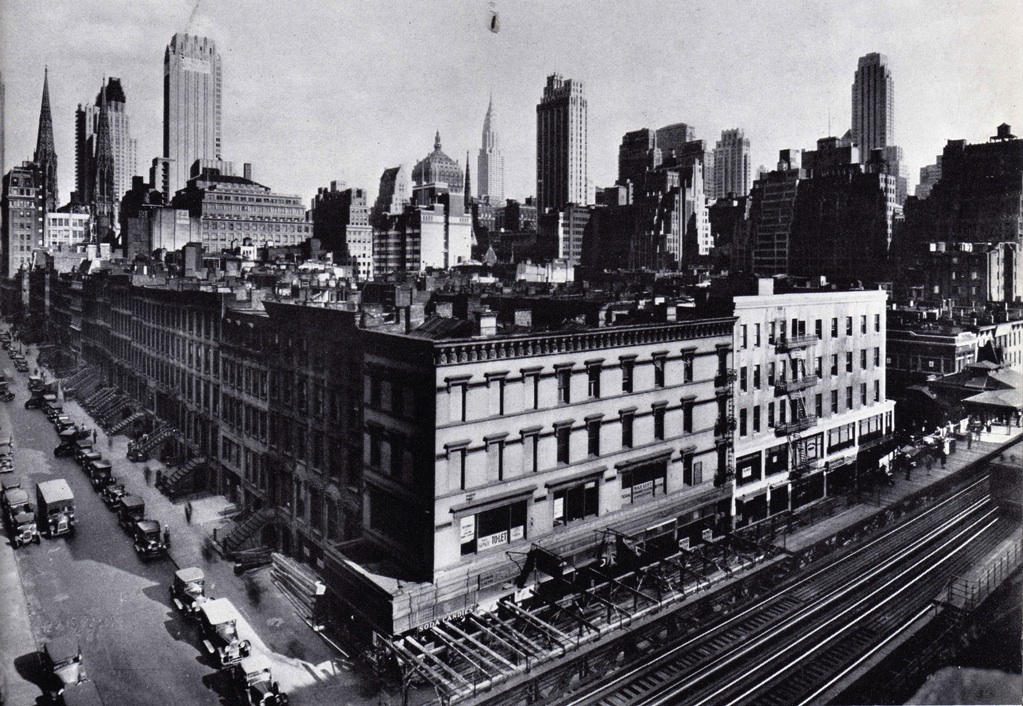
THERE GOES THE NEIGHBORHOOD…This Midtown neighborhood was torn down shortly after the photo was taken to make room for the massive Rockefeller Center project. The view is from the corner of 6th Avenue and 51st Street looking to the southeast. One of the spires of St. Patrick’s is visible at far left, and the Chrysler Building can be glimpsed in the distant center. Lewis Mumford was no fan of giant skyscrapers or other “mega” building projects, and would have preferred something more on this smaller scale for Rockefeller Center. (Museum of the City of New York)

The proposed project — then referred to as “Radio City” — received negative reviews from a number of critics, although the most pointed came from Mumford, who disliked “mega” building projects such as Rockefeller’s, labeling it as “weakly conceived, reckless, romantic chaos.”

RECKLESS, ROMANTIC CHAOS is how Lewis Mumford, left, described plans for Rockefeller Center. At right, the May 1931 issue of Popular Science featured the project’s plans. (Pinterest/Google Books)

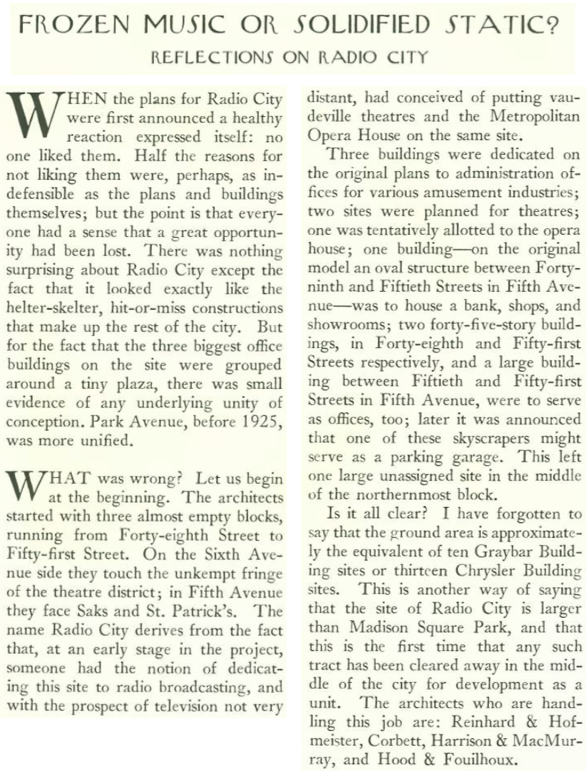
Mumford’s Emersonian temperament favored simplicity, self-sufficiency and community; he believed skyscrapers and other “megamachines” were dehumanizing and even dishonest. In this next excerpt he poses a question about the so-called pragmatic “money men” behind the project: “Are the practical men practical?” We read on…

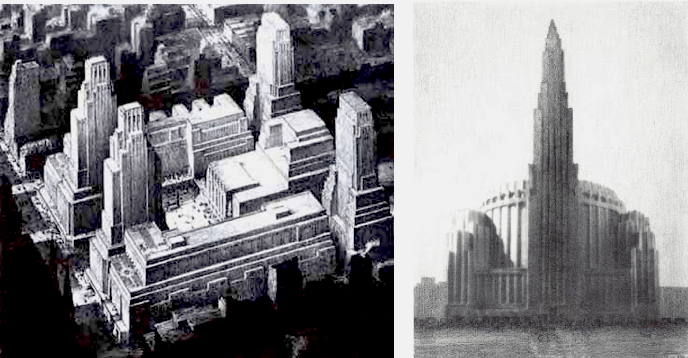
WELCOME TO CLOUDCUCKOOLAND…That was Mumford’s own term to describe plans for Rockefeller’s “Radio City.” An early rendering from 1928 (left) referred to the project as “Metropolitan Square,” and for a time it was slated to include a new Metropolitan Opera house.  Joseph Urban proposed this Fifth Avenue-facing design (right) in 1927, but plans were waylaid by the Great Depression. (ephemeralnewyork)
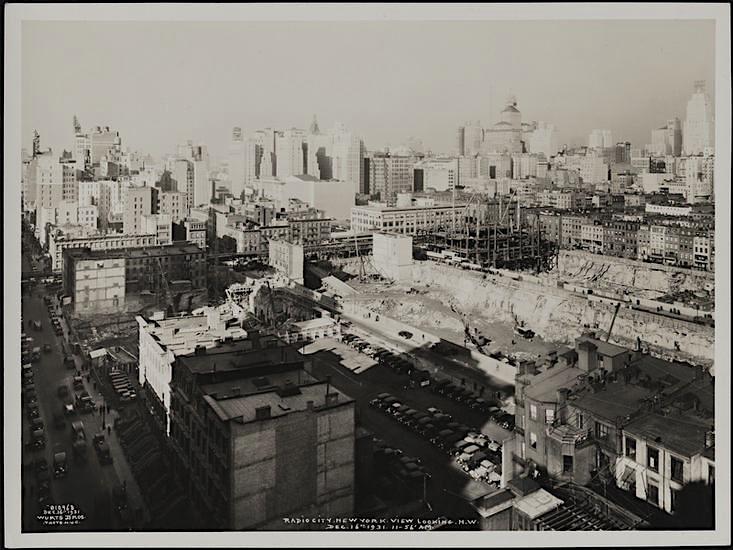
BLANK SLATE…With the site mostly cleared, construction commenced in the fall of 1931. This image is from December 16, 1931. (Museum of the City of New York)

Mumford concluded that the opportunity to create a restful respite from the clamor of the city had been lost on the project, which just promised more “razzle-dazzle” and “incongruous jangle,” an interesting observation given that other New Yorker writers were generally dazzled by the skyscrapers and other gigantic projects that were rapidly erasing the old city.

True to his beliefs, Mumford lived a simple life in an old country house in Amenia, New York, a small town in the northern reaches of the Hudson Valley region.

FAR FROM THE RAZZLE-DAZZLE…Mumford house in Amenia, NY. (Wikipedia)

Historian Daniel Okrent, author of Great Fortune, The Epic of Rockefeller Center, notes that Mumford was eventually won over by Rockefeller Center in the end, calling it “a serene eyeful” and “the most exciting mass of buildings in the city.” I have to agree.

SERENE EYEFUL…Images of Rockefeller Center from 1939 (left) and 1935. (flickr.com/(Museum of the City of New York)

 *  *  *

Summertime Reads

A quick glance at the new books listed at the end of the New Yorker’s book review column shows us a nice variety of summertime diversions, including a book about Josef Stalin written before his Great Purge that murdered a million of his own citizens…then there was the memoir Blood on the Moon written by Jim Tully, “America’s most famous hobo author”…the book Life Among the Lowbrows by Eleanor Rowland Wembridge also caught my eye…I believe I’m almost set for the summer…

A STUDY IN CONTRASTS…Misfits and lowlifes peppered the books of both “hobo writer” Jim Tully (left) and psychologist Eleanor Rowland Wembridge, although from very different perspectives. While Wembridge took a more clinical approach to the underclasses, Tully used them for material in his hardscrabble stories. Guess which one ended up in Hollywood. (scpr.org/apadivisions.org)

 *  *  *

From Our Advertisers

The makers of Jantzen swimwear took a slightly risqué approach in advertising their latest women’s line…

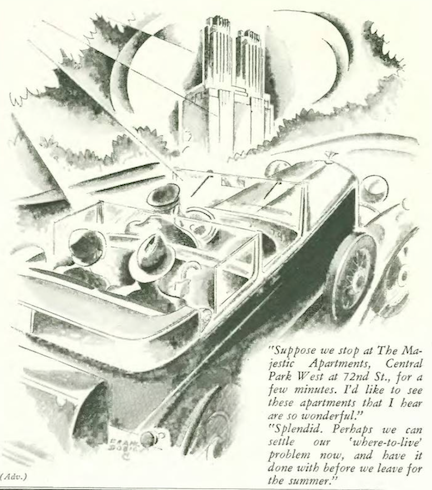
…the owners of the Majestic, on the other hand, used snob appeal and a sense of heightened grandeur to promote their Central Park West apartments…

…advertisers of non-alcoholic drinks tried their best to capture the allure of cocktails, and I imagine much of their product was mixed with something a bit more interesting…

William Steig was hitting his stride as one of the newer cartoon contributors to The New Yorker

…with two of his entries featured in the June 20 issue…Steig would live 95 years and be productive throughout his life…nearly 60 years after these cartoons appeared in The New Yorker he would publish the children’s book Shrek!, the basis for the popular movie series…

…earlier in his career, Steig would also find fame for his series of Small Fry cartoons featuring children in adult situations, anticipating Charles Schulz’s Peanuts…this next cartoon, however, is not by Steig but by Alan Dunn, perhaps anticipating Steig…

Gardner Rea continued to explore the foibles of the well-heeled…

John Held Jr amused us with another of his rustic “woodcuts”…

Garrett Price shot the rapids with a hapless suitor…

…here is one the six cartoons Crawford Young contributed to The New Yorker in 1931-32, capturing a moment in which the chicken-egg question is largely moot…

…and another look into the leisure classes courtesy Barbara Shermund

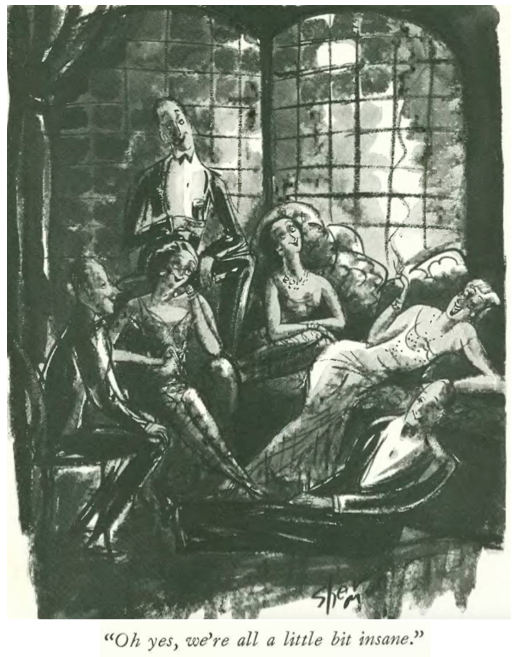
…and we close the June 20 issue with James Thurber, who showed us a fellow who probably regretted his evening out…

…Thurber also brings into the next issue, June 27…

June 27, 1931 cover by Gardner Rea

…in which he recounted his adventures in bird-watching and the mating habits of crows…

 *  *  *

A Falling (Lone) Star

In her “Letter From Paris,” Janet Flanner reported that the allure of the “Queen of the Nightclubs,” Texas Guinan, did not extend to French shores, where among other things she ran afoul of labor laws that dissuaded non-citizens from working in France.

BEGINNING OF THE END…Associated with risqué entertainments in various speakeasies during the Roaring Twenties, the Great Depression prompted Texas Guinan to take to the road with her show. After attempting (and failing) to make a tour of Europe, she returned to the States for one final road trip. Above left, Guinan in the 1933 film Broadway Through a Keyhole, which would open just three days before her death. At right, headline from the Rochester Democrat and Chronicle trumpeting Guinan’s French debacle. (pre-code.com/

Upon her return to the States, Guinan took advantage of her well-publicized dismissal from France and launched the satirical revue Too Hot for Paris. This traveling show would also mark the beginning of the end for Guinan, who would contract amoebic dysentery during a run of the show at the Chicago World’s Fair. It would claim her life on Nov. 5, 1933, at age 49.

 *  *  *

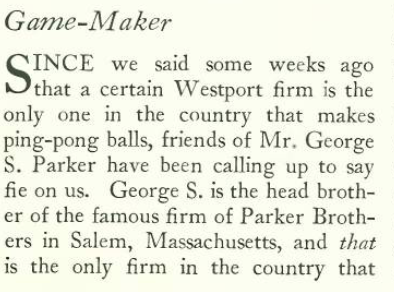
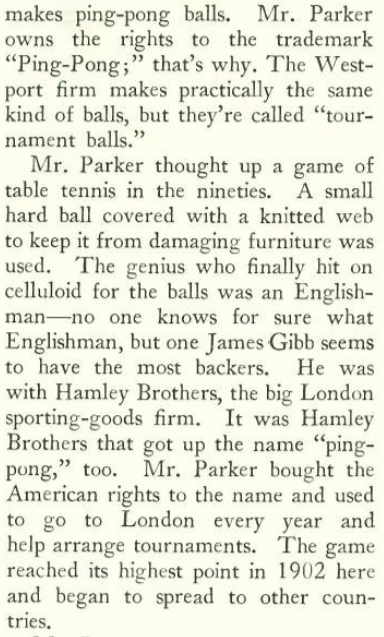
They Put the Ping Into Pong

“They” being the Parker Brothers, who took umbrage at anyone who questioned their sole right to market genuine “Ping-Pong” balls. “The Talk of the Town” explained:

The “Talk” item ended with a little surprise about Mr. George Parker himself:

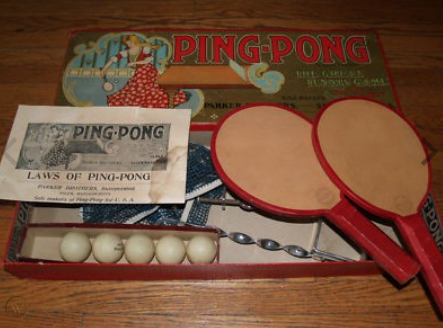
VINTAGE…A 1902 ping-pong set from Parker Brothers. (Worthpoint)

 *  *  *

From Our Advertisers

Some lovely color ads, including this message that paired playful porpoises with leaded gasoline…

…this ad was about color itself, and how Powers Reproduction Corporation could make your images pop…

…and another sad Prohibition-era ad from the makers of Budweiser, in this case, a non-alcoholic version that looks like the real thing…of course what is even sadder about this ad is the suggestion that plantation life was something one should fondly hearken back to…

…on to our cartoons, and another terrific illustration from Barbara Shermund

…and we have Otto Soglow’s Little King, who temporarily lost his crown…

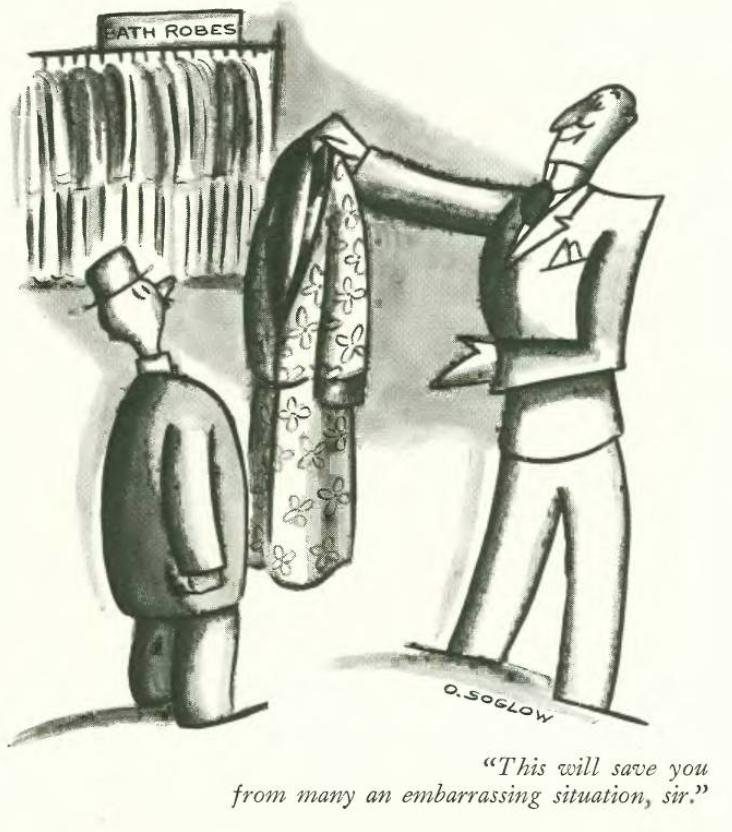
…and another from Soglow, at the men’s store…

Carl Rose gave us a chap contemplating the burdens of a Guggenheim “genius” grant…

Peter Arno revealed that his Major had two left feet…

…and in anticipation of the Fourth of July, we end as we began, with Gardner Rea

Next Time: Firecracker Lane…


Rooftop Romance

In the days before air conditioning, New Yorkers took to the higher rooftops in the city to escape the summer heat and reconnect with familiar entertainers.

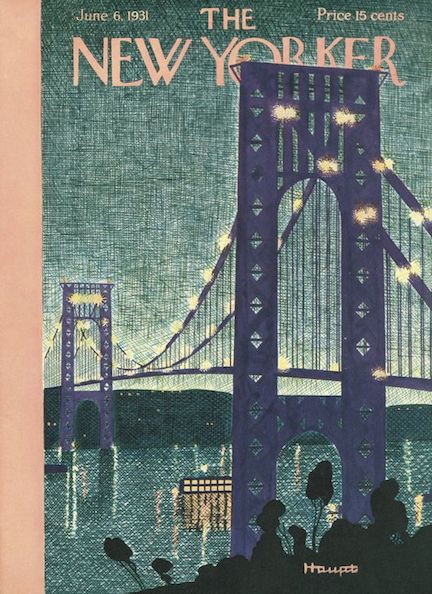
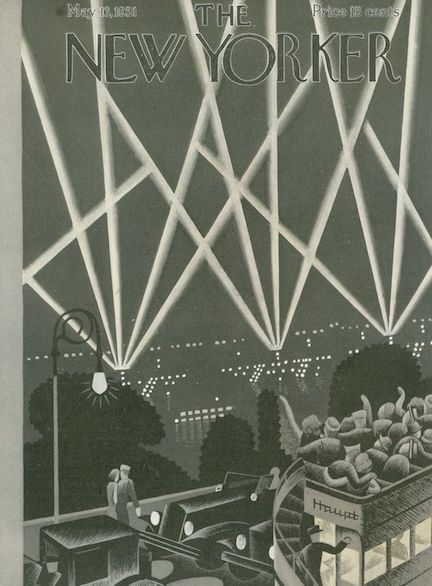
June 6, 1931 cover by Theodore Haupt. The title image is a detail from a Sept. 5, 1970 cover by Arthur Getz.

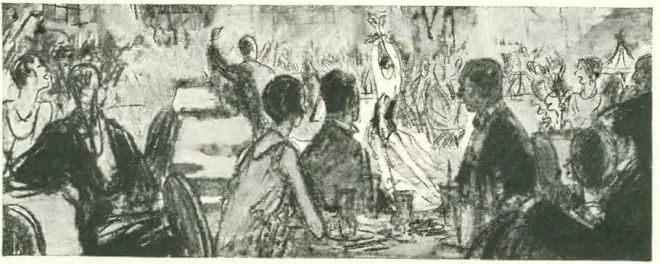
Among those reconnecting was Lois Long, who had abandoned her nightlife column “Tables for Two” the previous year but revived it in the June 6, 1931 issue, perhaps in reaction to the “boundless trouble” that had marched into her “quiet life,” namely her bitter divorce that month from cartoonist Peter Arno. Soon to be single again, Long dusted off her “Table” for another night out.

PRE-AC…As far back as the Gilded Age of the 19th century New Yorkers escaped the summer heat by seeking entertainment on one of the city’s rooftop gardens. Pictured is the Paradise roof garden atop Hammerstein’s Victoria Theatre, 1901. (MCNY)

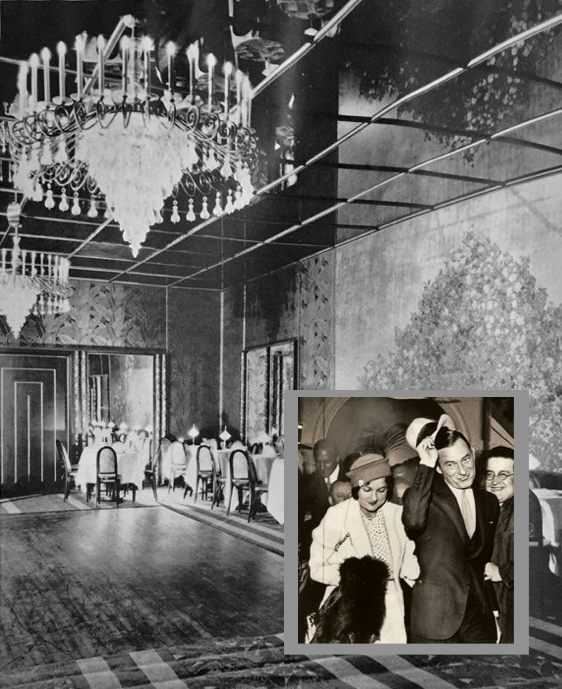
THE BUCK STARTS HERE…It wasn’t a rooftop, but the Central Park Casino was a cool retreat from city streets, especially for Mayor Jimmy Walker, who conducted much of city business there. After reform-minded Mayor Fiorello La Guardia replaced Walker in 1934, Parks Commissioner Robert Moses had the place torn down. (New York City Parks Photo Archive)
I COULD HAVE DANCED ALL NIGHT…Mayor Jimmy Walker and his mistress, showgirl Betty Compton, were often the last to leave the Casino in the wee hours of the morning, dancing in the Joseph Urban-designed black-glass ballroom (above) to the Leo Reisman Orchestra. (drivingfordeco.com)

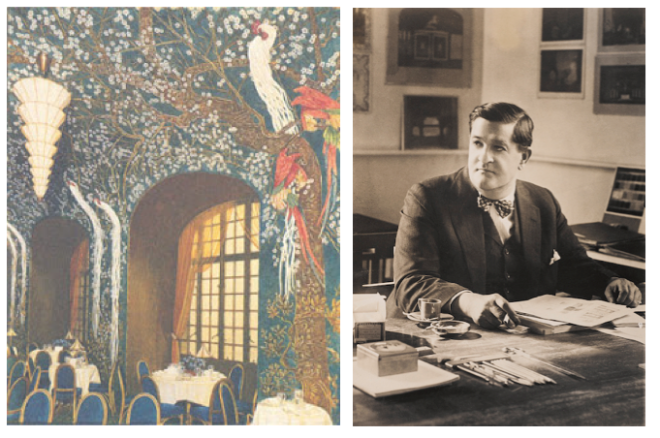
Higher up in the city, Long also paid a visit to the elegant rooftop of the St. Regis, also designed by the famed architect and theatrical designer Joseph Urban

DAZZLING…The St. Regis rooftop, designed by Joseph Urban. (flaglermuseum.us)
ANOTHER VIEW of the St. Regis rooftop as illustrated in the July 7, 1928 issue of The New Yorker by Alice Harvey. 

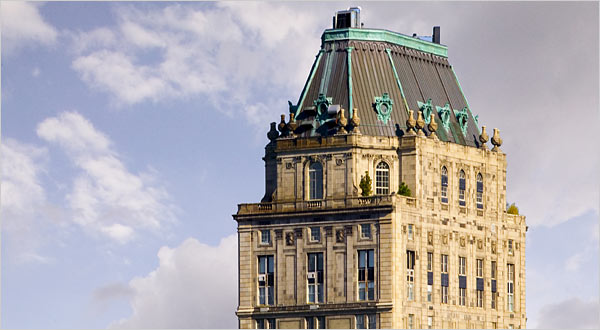
Long also visited the roof of the 42-story Hotel Pierre. The New York Sun described the top two floors as “decorated to resemble the interior of a zeppelin cabin.”

THE COOLEST…Top of the Hotel Pierre. A popular summer ballroom in the years before air-conditioning, the Pierre advertised itself as having “the highest and coolest hotel roof in Manhattan.” (NYT)

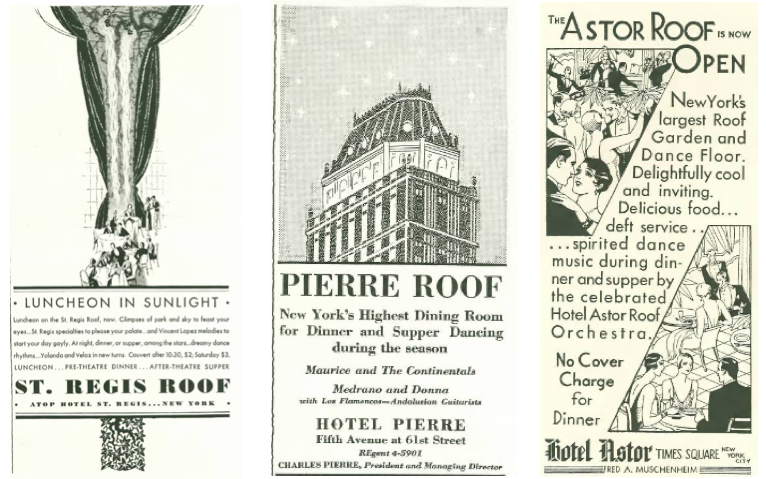
If you were in the mood for a little crooning, Rudy Vallee and his Connecticut Yankees were taking in the breeze atop the Hotel Pennsylvania, per this ad in the back pages of the June 6 New Yorker

Advertisers must have been paying attention to Long’s column, because the back pages of the following issue (June 13) had plenty of ads touting various rooftops…

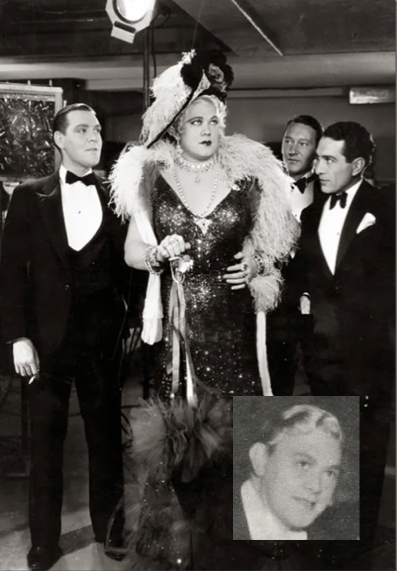
Long also sampled the offerings of less savory venues, such as the Club Argonaut, which was apparently frequented by mobsters…

NOT AMUSED…Lois Long didn’t care for the antics of Gene Malin (center, and inset) who performed in front of a tough-looking crowd at the Club Argonaut. A popular drag artist who helped ignite the “Pansy Craze” in the 1920s and 30s, Malin was one of the first openly gay performers in Prohibition-era speakeasy culture. His career ended abruptly at age 25 in a car accident. (Wikipedia)

 *  *  *

Sexy Soviet Tractors

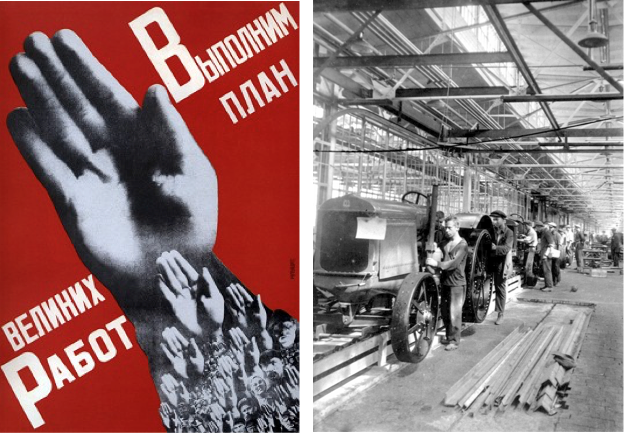
One place you could find an early form of air conditioning was at the movies (critic John Mosher referred to these theatres as “iced), and no doubt many lowered their cinematic standards just to get a few hours respite from the heat. For some unknown reason the Central Theatre thought it could entice audiences not with air-conditioning, but with a Soviet propaganda film titled The Five-Year Plan.

STAY CALM AND CARRY ON…Soviet poster for The Five Year Plan (1930), and a 1930 image of the Volograd (Stalingrad) tractor factory. You wonder how many of those chaps got wiped out by Stalin’s purges, or by the Battle of Stalingrad in 1942-43. (Wikipedia)

 *  *  *

Laughing at Death

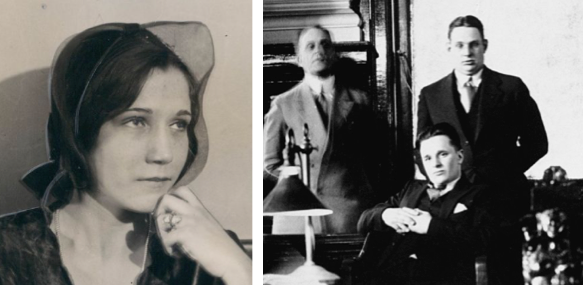
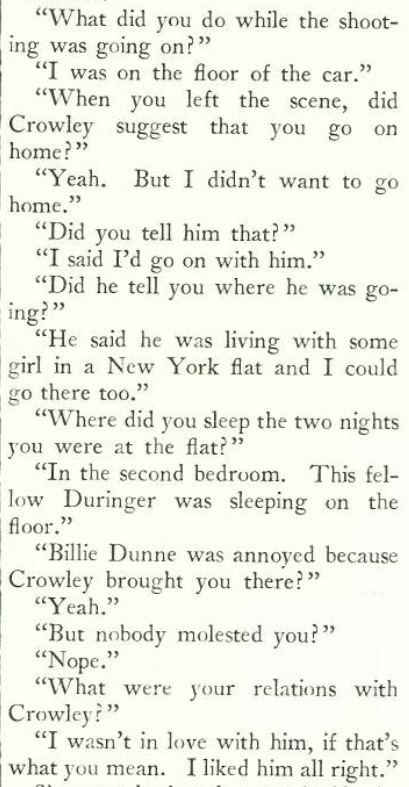
A couple of posts ago I wrote about a very public gun battle that brought diminutive killer Frances Crowley to justice (“The Short Life of Two-Gun Crowley”). In the June 6 installment of “A Reporter at Large,” Morris Markey recounted the courtroom scene where the 18-year-old Crowley winked at girls and nonchalantly chewed his gum as judge and jury determined his fate.

OH WELL…Frances Crowley’s 16-year-old girlfriend, Helen Walsh, left, was positively bored during the trial that would send her beau to Sing Sing’s electric chair. Crowley himself (shown above at the trial) seemed to be amused by the proceedings, and enjoyed the attention. (NY Daily News)

Markey also noted the unseemly behavior of Crowley’s 16-year-old girlfriend, Helen Walsh, who seemed bored by the whole thing. “She was not a creature of your world or of mine,” wrote Markey, who noted at one point that she put her hands to her face “to conceal a faint smile that sprang from some incalculable amusement within her.” Markey offered this sample of Walsh’s questioning.

 *  *  *

Summer Frost

Novelist and poet Raymond Holden penned a profile of famed poet Robert Frost, who among things apparently enjoyed apples and a bit of gossip. A brief excerpt:

 *  *  *

Dead Ball

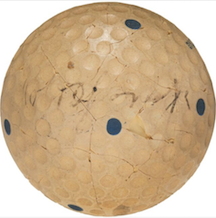
E. B. White lamented in his “Notes and Comment” the changes to the official golf ball, which was to be made slower in a time when Depression-weary businessmen could use a little lift:

GET ‘EM WHILE THEY LAST…This 1930 golf ball, signed by golf legend Bobby Jones, listed for $15,000 on eBay.

 *  *  *

From Our Advertisers

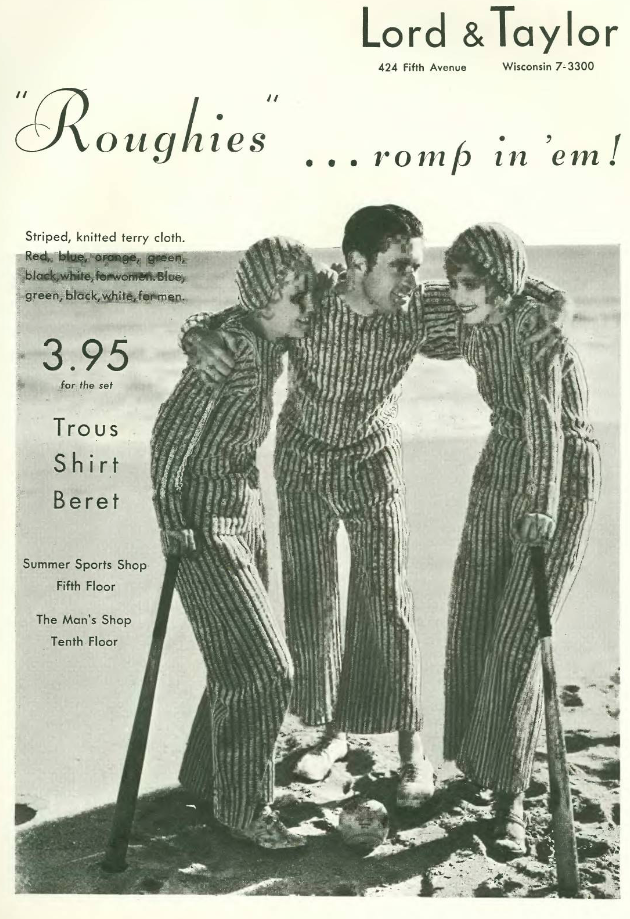
Gender-bending trends in clothing continued from the 1920s with flowing trousers for women (unthinkable a decade earlier)…

…and beach pajamas for men and women alike…

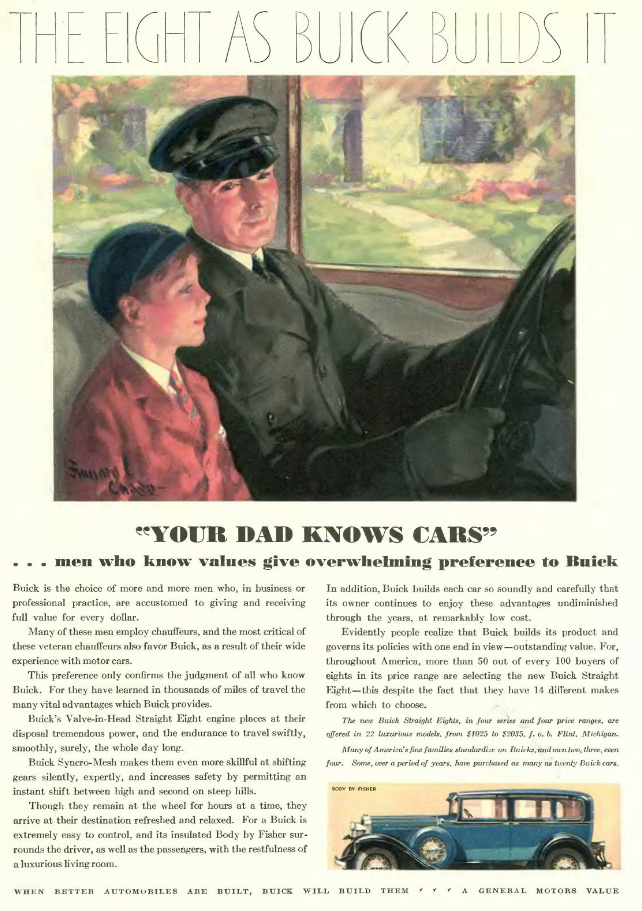
…Buick dialed up a patrician vibe with this ad that suggested a posh boy might be transported in one by the family’s driver…

…and this might be one of the first ads that linked cigarette smoking to the myth of the Western cowboy…

…on to our cartoons, we begin out in the country with Perry Barlow

…and Kemp Starrett, with this charming bucolic scene…

…back in the drawing room, we have this canine encounter from Leonard Dove

Helen Hokinson explored the violent side of bridge…

Barbara Shermund went into the garden to sample the trials of the rich…

Carl Rose pondered the art of grammar in crowded places…

Chon Day gave us yet another take on the familiar boss vs secretary trope…

…and Gardner Rea gets the last laugh with this hapless prodigal son…

Next Time: A Star is Born…


Through the Looking Glass

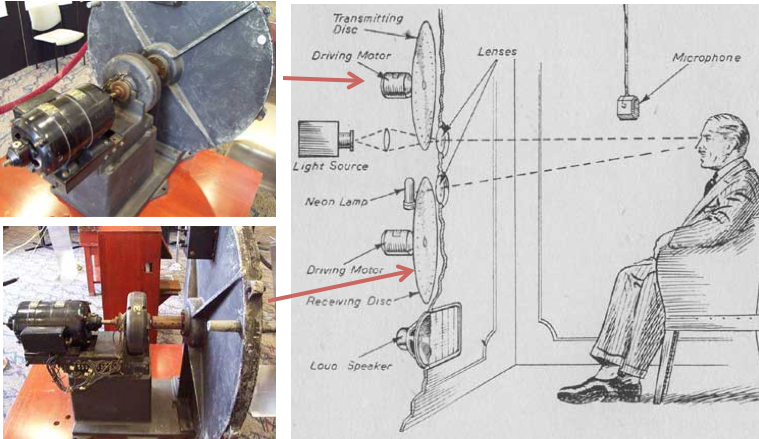
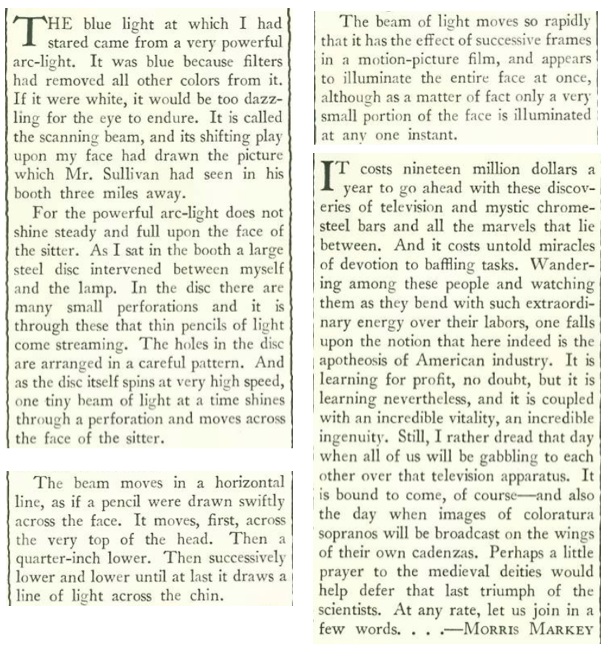
The next time you complain about a boring Zoom meeting, think about Morris Markey’s visit to New York’s Bell Laboratories in the spring of 1931, when he marveled at what was, perhaps, the “apotheosis” of American industry: a two-way video telephone.

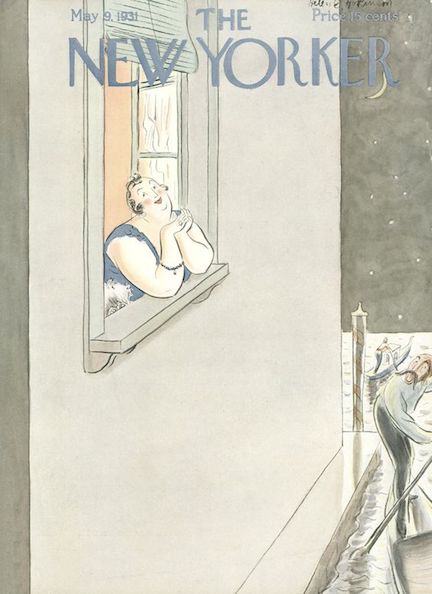
May 9, 1931 cover by Helen Hokinson.

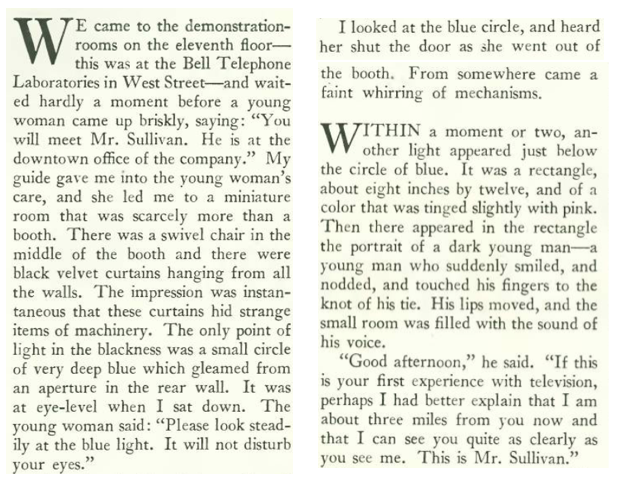
Mass-market television in the U.S. was still two decades away, but what Markey saw demonstrated in 1931 was a glimpse of the future, seeing and conversing with another man three miles away via a long wire that transmitted images from a fantastic array of spinning discs and neon tubes:

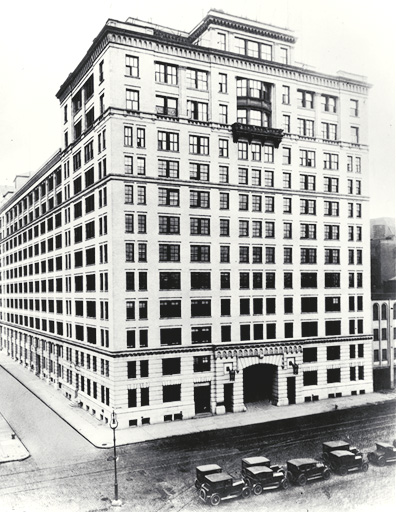
TECHNOLOGY’S MATERNITY WARD…The original Bell Labs building at 463 West Street in New York. It was the birthplace of talking movies, television, radar and the vacuum tube. (att.com)
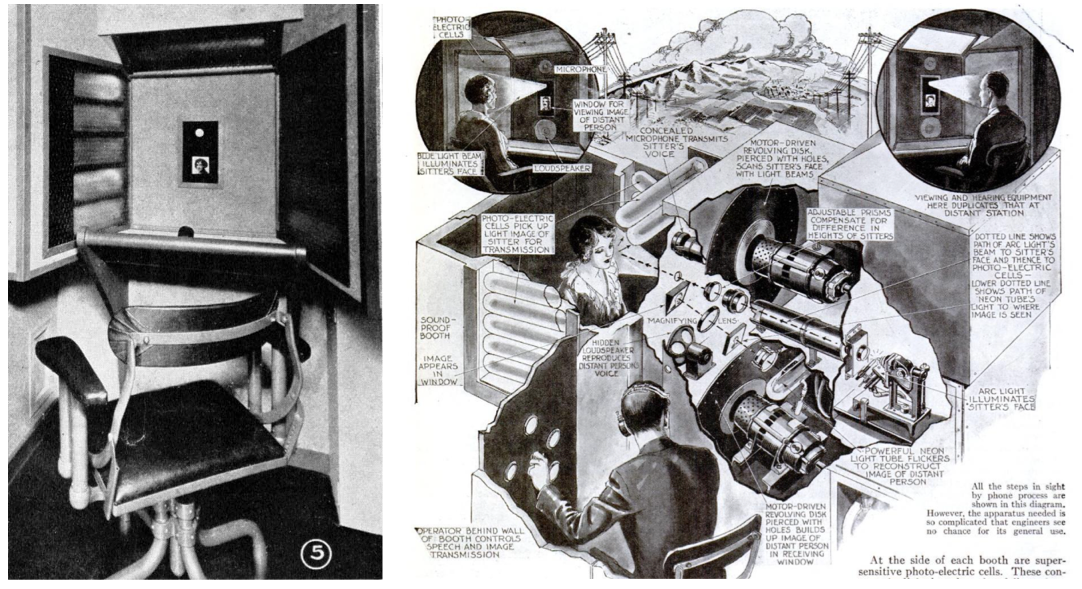
DEFINITELY NOT HI-DEF…At left, this is most likely where Morris Markey sat for the demonstration of early video phone technology. At right (click image to enlarge), a July 1930 article in Popular Science Monthly described how the transmitting apparatus worked. (earlytelevision.org/books.google.com)
BUT WILL IT SELL?…Herbert Hoover, then secretary of commerce, became the world’s first television personality in 1927 when his voice and face (inset) were transmitted to an audience at Bell Laboratories in New York City. At the time, AT&T, Bell’s parent company, was doubtful about television’s moneymaking potential. (edn.com)
SPINNING WHEELS…Whirling metal discs, pictured at left, perforated with tiny holes, cast a series of horizontal beams of light across a viewer’s face (right), which were then transmitted to a receiver. (earlytelevision.org)

Despite its gee-whiz factor, many, including the folks at Bell Labs, seemed doubtful that the technology would come into wider use or be profitable any time soon, if ever. Markey noted that his little demonstration required many millions of dollars in research and development, but he was prophetic in suggesting that such technology might come to be dreaded if it ever came into common use.

*  *  *

Uplifting Sight

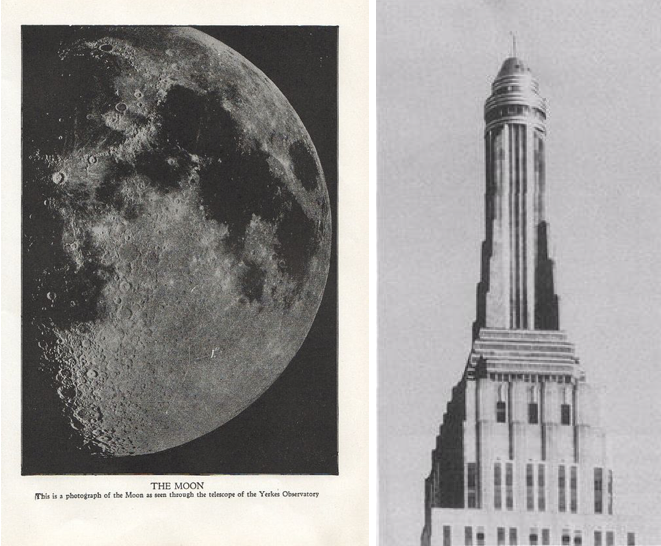
That a bra and girdle maker should become the topmost tenant at the new Empire State Building was not lost on E.B. White, who commented thusly…

…and while viewers wouldn’t actually see a giant bra atop the skyscraper, many were nevertheless interested in getting a closer look at some of the building’s details, as reported in “The Talk of the Town”…

OVER THE MOON?…The moon gained some keen competition from telescope viewers when the Empire State Building climbed its way into the sky. (Pinterest/tech-notes.tv)

 *  *  *

Channelling Marlene

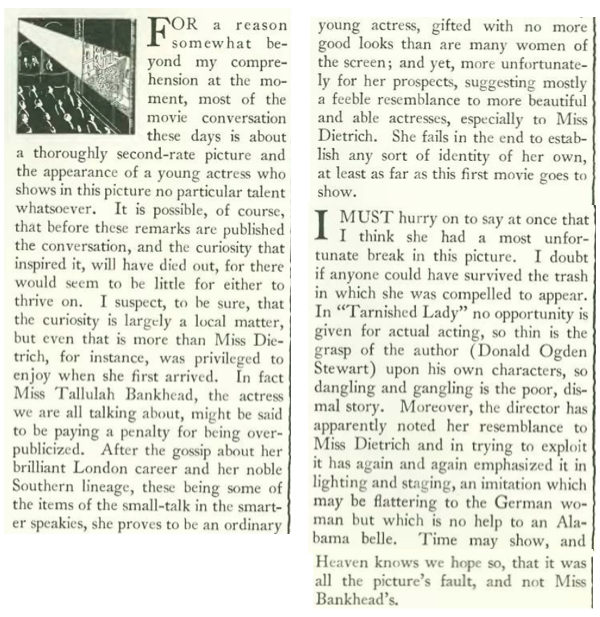
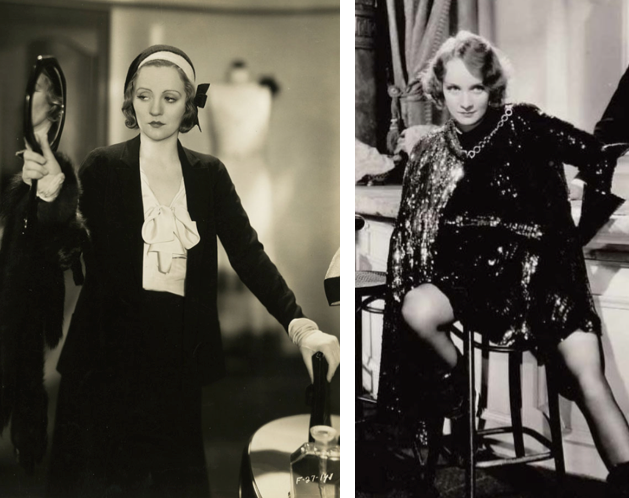
Film critic John Mosher wasn’t over the moon when it came to the acting of Tallulah Bankhead in Tarnished Lady, however he surmised it was likely the director’s fault for trying to exploit Bankhead’s passing resemblance to Marlene Dietrich. Mosher noted that lighting and staging flattering to the German actress just didn’t work with the belle from Alabama.

MIRROR, MIRROR…Tallulah Bankhead (left) might have pondered who was the fairest in the land, but The New Yorker’s John Mosher found her to be no match for German actress Marlene Dietrich (right, in 1931’s Dishonored) when it came to screen presence. (IMDB)

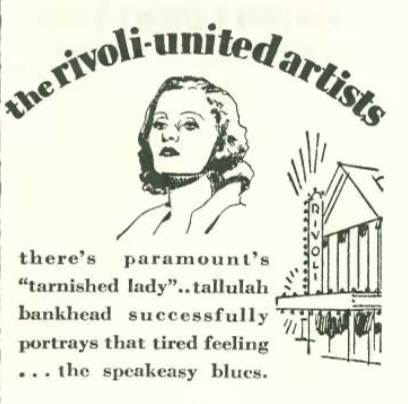
Despite Mosher’s blah review, Paramount touted Bankhead’s portrayal of a “tarnished lady” in this ad from the same issue:

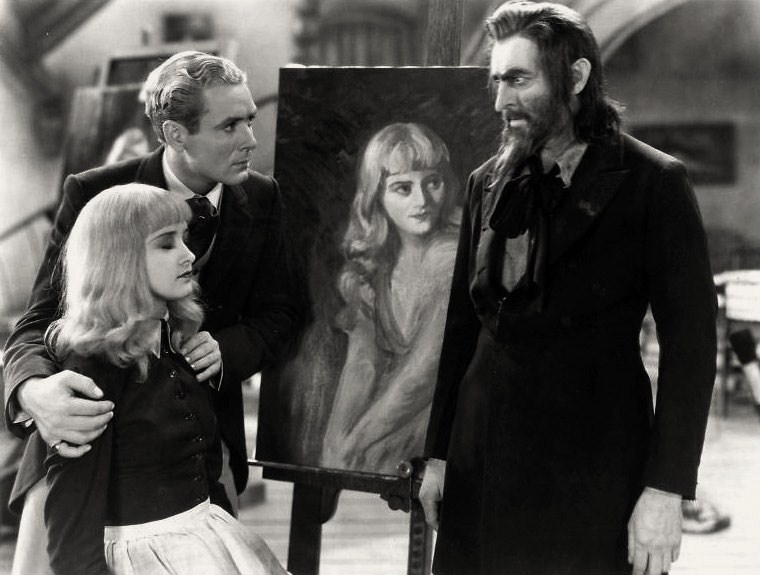
Mosher, however, found redemption in another film making the rounds, Warner Brothers’ Svengali starring John Barrymore:

YOU ARE GETTING VERRRY SLEEPY…in 1931’s Svengali, 17-year-old Marian Marsh played the artist’s model Trilby, who is transformed into a great opera star by the sinister hypnotist, Svengali, played by John Barrymore. Also pictured is Bramwell Fletcher, who portrayed Trilby’s love interest, Billee. (Wikipedia)

 *  *  *

From Our Advertisers

After a long absence, Peter Arno’s Whoops Sisters returned to the pages of The New Yorker, not as a cartoon panel but as shills for the Cunard Line…

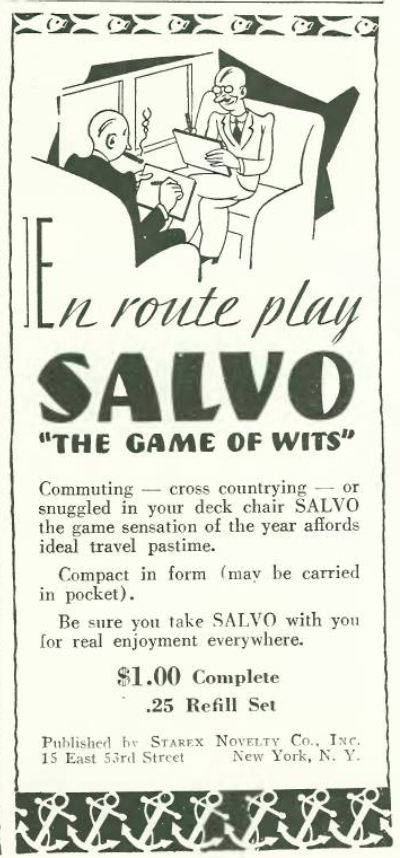
…whether traveling by boat or train, you might have considered bringing along “Salvo,” an early version of a popular game that today we call “Battleship”…

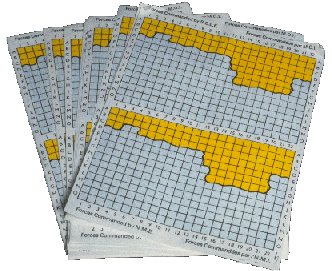
…Salvo and other Battleship-type games were originally played on pieces of paper like this…

…and here’s an ad for ice cube trays that exploited the popularity of the “Ripley’s Believe It or Not” syndicated newspaper feature…

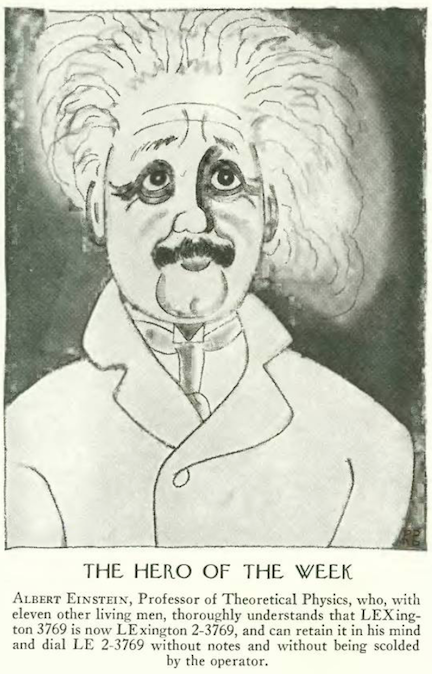
…on to our cartoonists, Ralph Barton rendered Albert Einstein as his latest “Hero”…

…and interpreted the latest headlines in his “Graphic Section”…

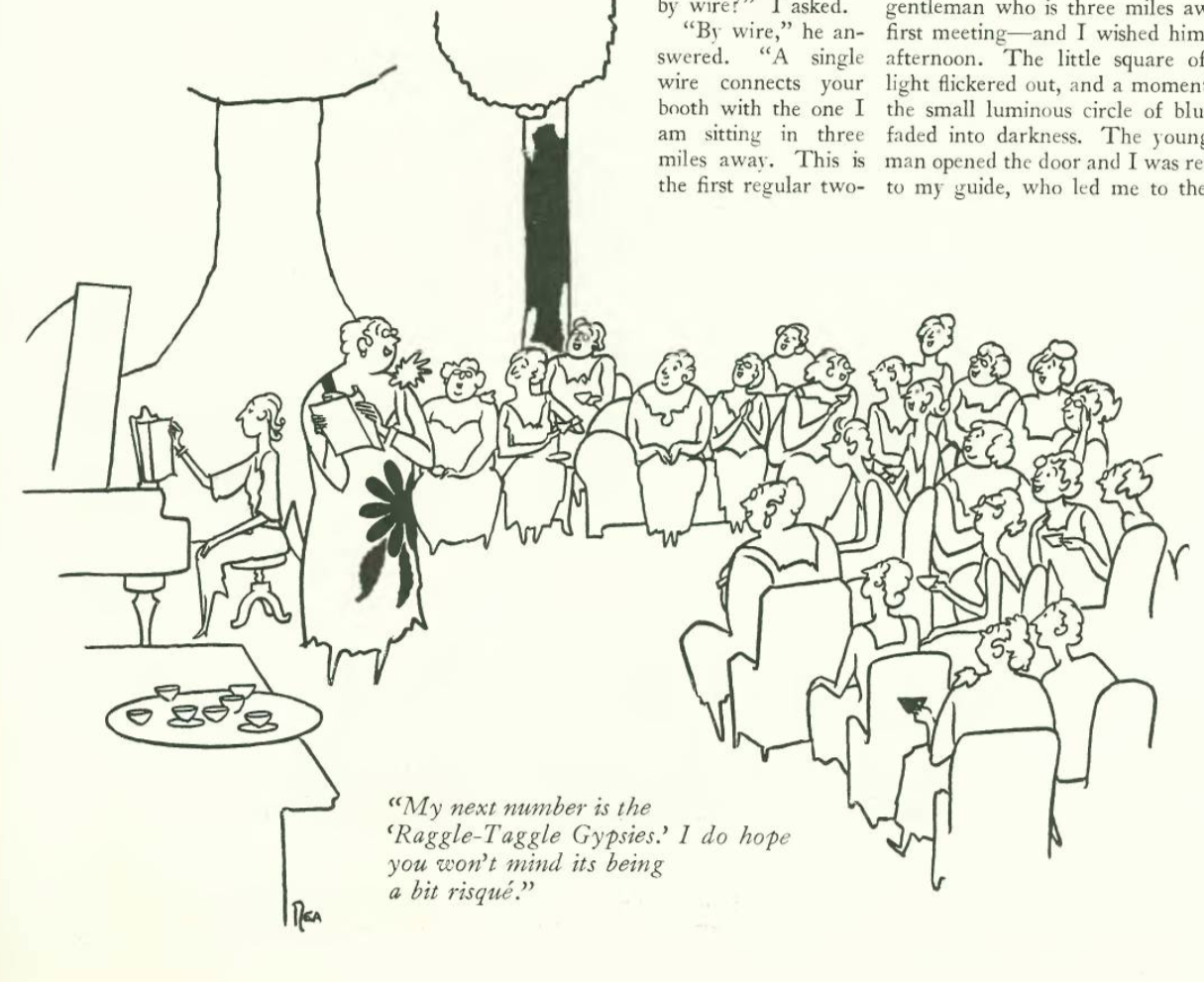
…among the delicate set, we got a bit risqué with Gardner Rea

…and nearly apoplectic with Gluyas Williams

Otto Soglow’s Little King, on the other hand, reigned with a steady hand…

…and we end with I. Klein, and a little bauble for the Missus…

Next Time: The Short Life of Two-Gun Crowley…


An Unmarried Woman

When New Yorker cartoonist Peter Arno hooked up with his colleague, nightlife columnist Lois Long, it was like twisting together two sticks of dynamite.

April 18, 1930 cover by Charles Donelan, his only cover for The New Yorker. See more about the artist at the end of this post.

Married in 1927, they were the glamour couple at The New Yorker, and each played an outsized role in giving the early magazine a distinctive, cosmopolitan voice and look. Hard-drinking hell raisers, they both loved the Roaring Twenties nightlife in what seemed like an endless party. But when the party ended, so did their brief, volatile marriage.

VOLATILE COMBINATION…Peter Arno and Lois Long were the toast of The New Yorker office and the toast of the town with their office romance, marriage (in 1927), and much-publicized split. The hard-partying couple separated in 1930 and divorced the following year.

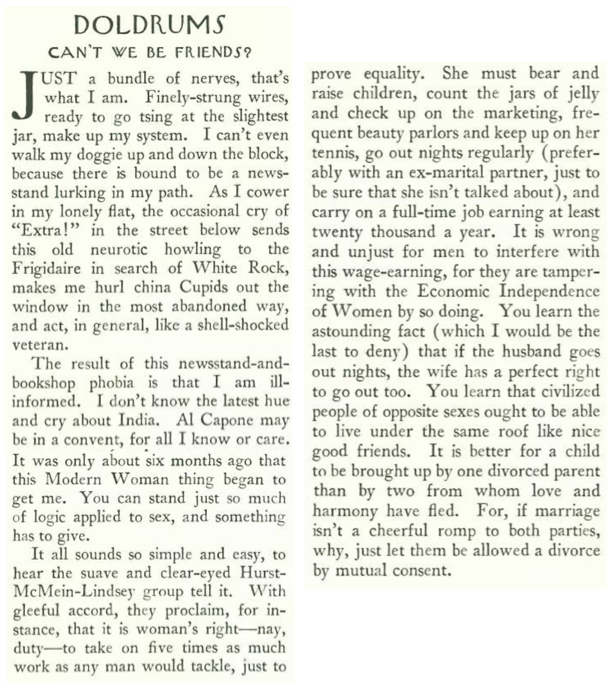
As the end of her marriage neared, the 29-year-old Long had become almost circumspect, and in a series of columns under the title “Doldrums,” she took a skeptical look at the world around her, the sad ways of the younger generation, and in this fifth installment, subtitled “Can’t We Be Friends?”, she probed the inequities of a society that encouraged women to be hard-working, super competent and attractive while men still did as they pleased (the question remains today: recall 2018, when Facebook’s Sheryl Sandberg asked women to “Lean In”).

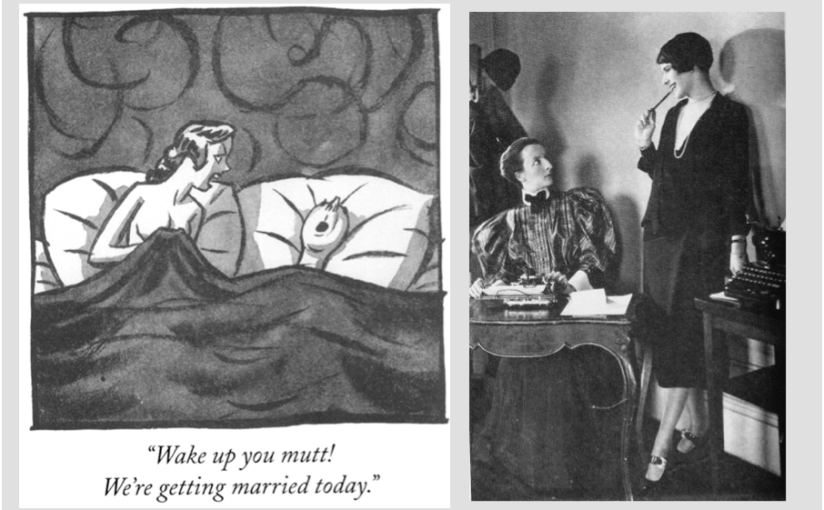
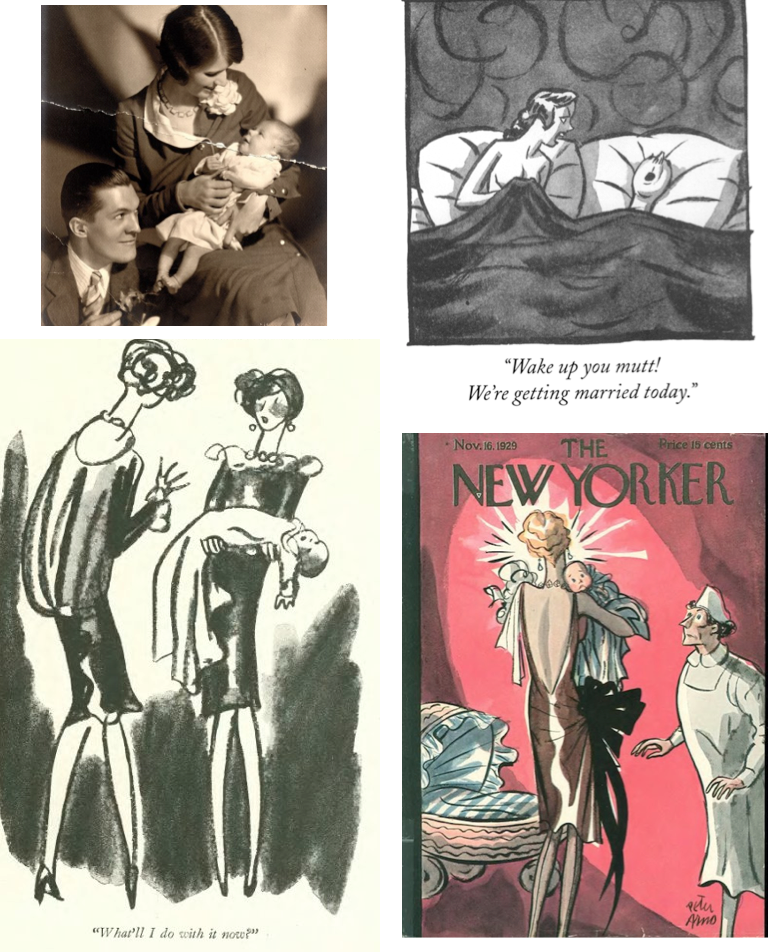
LIFE WITH LOIS…Peter Arno drew on his domestic experiences with wife Lois Long for comic inspiration. Clockwise, top left, Arno and Long with baby daughter Patricia, 1928; a wedding day wakeup call from Arno’s 1930 cartoon collection Hullabaloo; Nov. 18, 1929 cover and a Aug. 24, 1929 cartoon suggesting a lack of maternal instinct. By all accounts Long was a doting mother and grandmother.

In Vanity Fair, Ben Schwartz (“The Double Life of Peter Arno,” April 5, 2016) quotes Arno’s and Long’s daughter, Patricia (Pat) Arno, about her parents’ wild relationship: “There were lots of calls to (gossip columnist Walter) Winchell or some other columnist about nightclub fights…with my mother calling and saying, ‘Oh, please don’t print that about us,’ trying to keep their names out of the papers.”

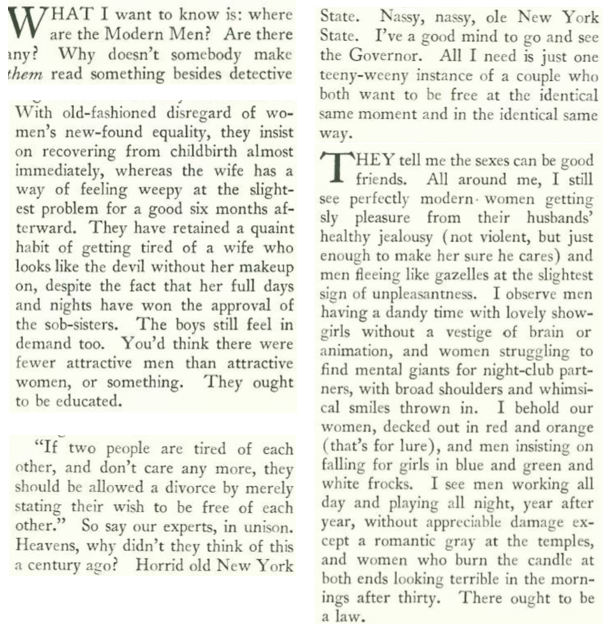
Here’s another excerpt from Long’s “Doldrums,” asking about the state of Modern Men (apologies for the missing fifth line — “novels”)…

Long had not only given up on marriage—and apparently men for the time being—but she’d also had it with the partying life. She had put her nightlife column, “Tables for Two,” on hiatus, turning her attentions to her popular fashion column, “On and Off the Avenue,” while continuing to contribute unsigned pieces to “The Talk of the Town” and occasional pieces like “Doldrums.”

In early 1931 Arno moved to Reno, Nevada, which granted quick divorces to anyone who took up residency for five months. According to a 2016 book written by New Yorker cartoonist Michael Maslin (Peter Arno: The Mad, Mad World of The New Yorker’s Greatest Cartoonist), Arno found more trouble in Reno when newspaper publisher Neely Vanderbilt accused him of having an affair with his wife, Mary, and threatened violence against Arno. Maslin writes: “Nearly lost in the whole Arno/Vanderbilt dust-up was the end of Arno and Long’s marriage. On June 29th, Lois was granted a Reno divorce on the grounds of intolerable cruelty.” I highly recommend Maslin’s book, filled with anecdotes drawn from a fascinating life lived in some of New York’s headiest times.

Vanderbilt would also divorce his wife in 1931. Mary Weir Logan Vanderbilt was the second of his seven wives.

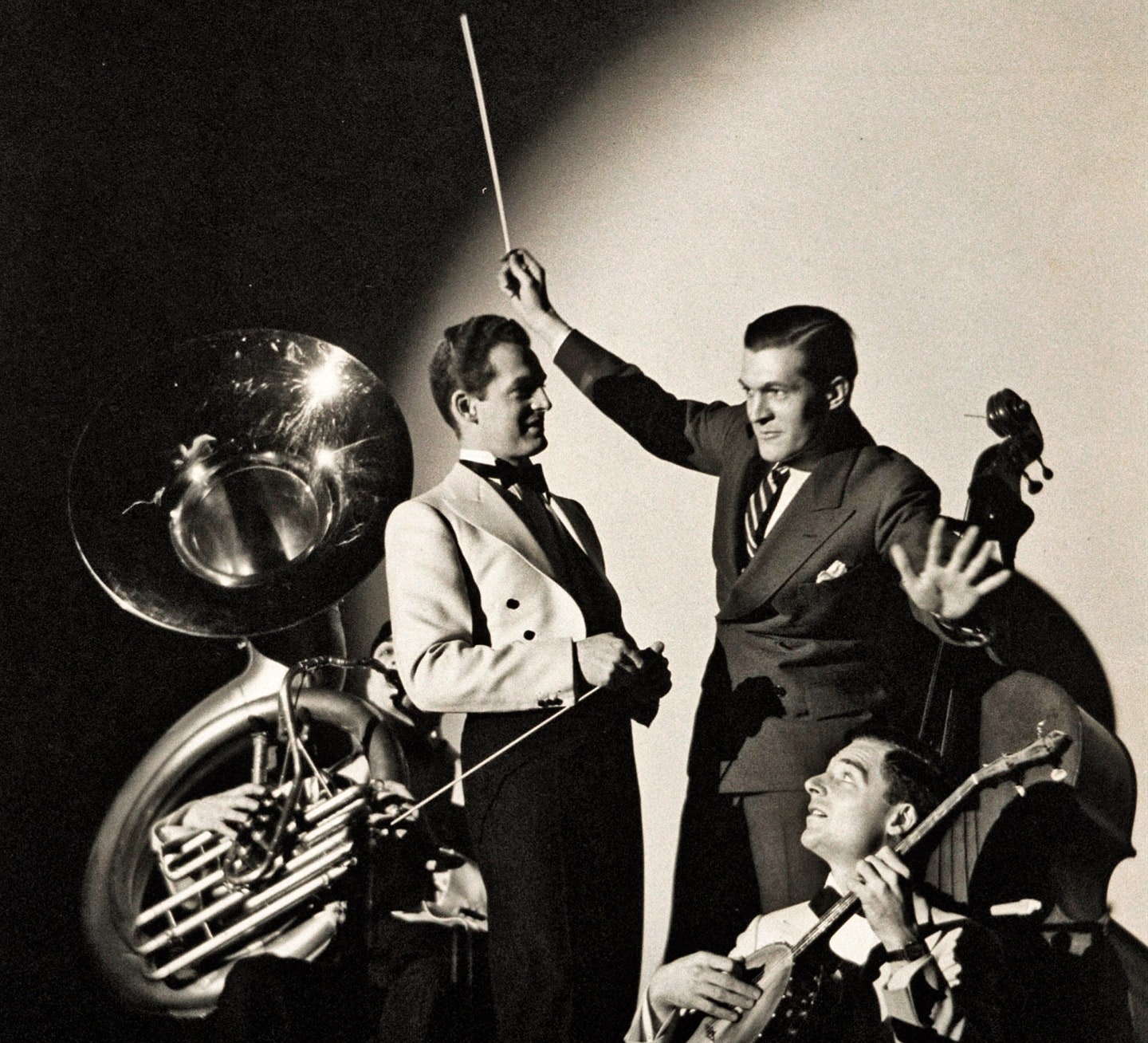
AND THE BAND PLAYED ON…On the same month as his Reno divorce (June 1931), Vanity Fair ran this photo of Arno pretending to conduct bandleader Fred Waring and two of his Pennsylvanians. (CondeNast)

Arno and Long would get joint custody of Patricia, but the child would remain living with her mother. Long had this to say about the future of her “Little Persimmon”…

 *  *  *

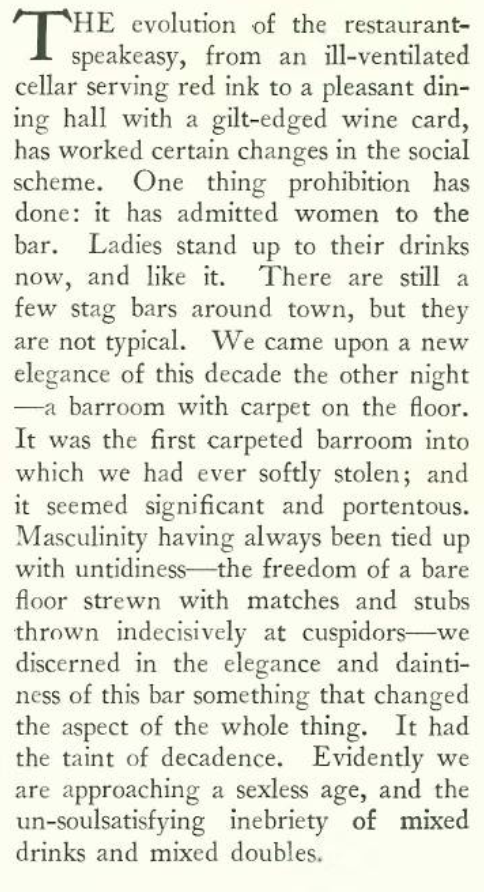
A Man’s World?

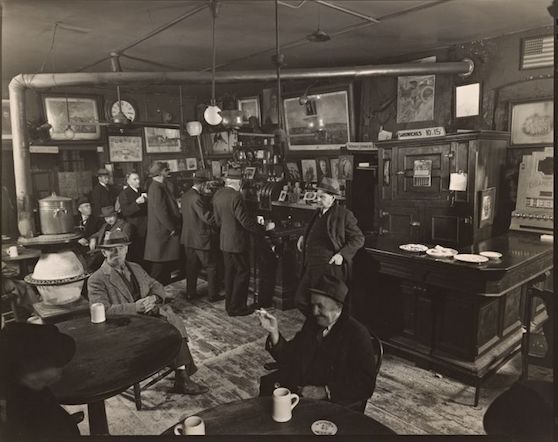
E.B. White wondered in his “Notes and Comment” after encountering a barroom (had to be a speakeasy) with a carpeted floor…

KEEPING IT REAL…Patrons relax at McSorley’s Old Ale House near Cooper Square, circa 1935. (ephemeralnewyork.wordpress.com)

 *  *  *

Long Before Social Distancing

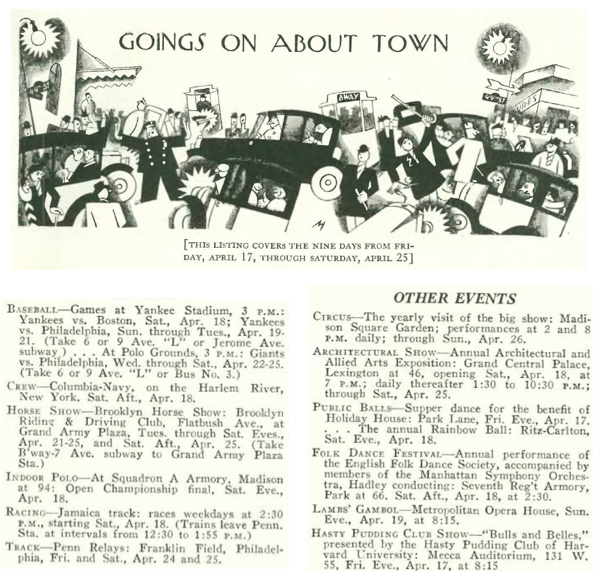
There were many diversions around the old city, including baseball games and the circus at Madison Square Garden…some clips from the “Goings On” section…

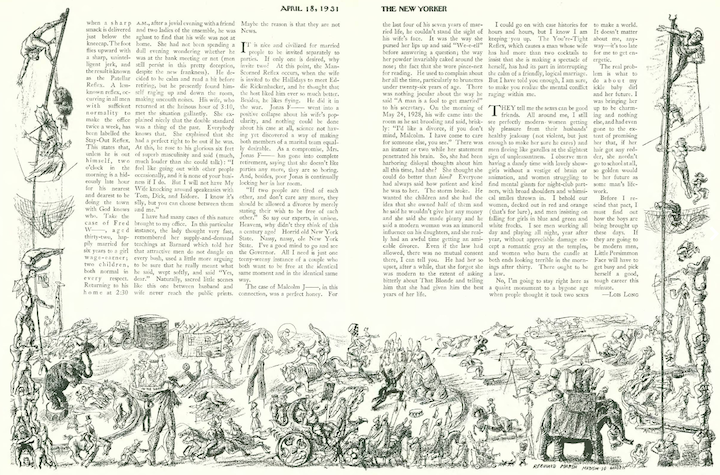
Reginald Marsh marked the arrival of the circus with a drawing that encircled pages 20-21…here is a detail…

and how the whole thing appeared…

 *  *  *

The Twain Never Met

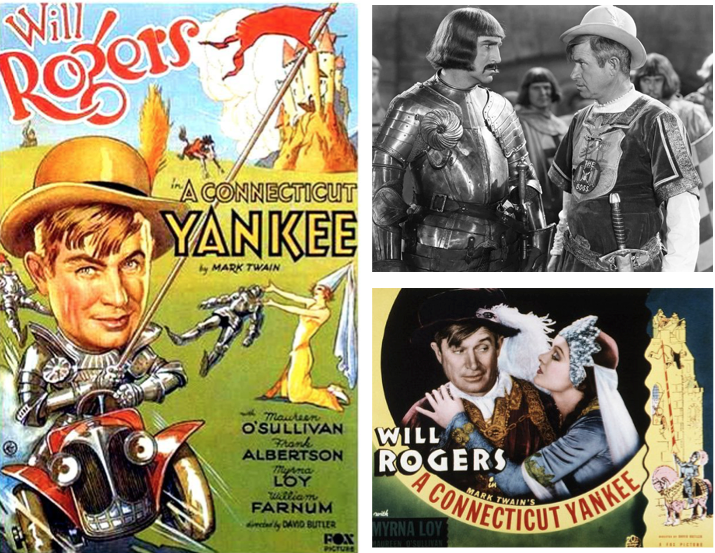
Once a star attraction with the Ziegfeld Follies, comedian Will Rogers was also finding success on radio and in the films. His latest talkie, A Connecticut Yankee, referenced Mark Twain’s 1889 novel, A Connecticut Yankee in King Arthur’s Court, in name only, as noted by reviewer John Mosher. But then again, Rogers himself was not a Yankee, but an Okie.

MARK WHO?…Inspired by a Mark Twain novel, 1931’s A Connecticut Yankee was mostly a Will Rogers vehicle. Top right, Sagramor (Mitchell Harris) confronts the “Connecticut Yankee” Hank Martin (Will Rogers). Below, the queen (Myrna Loy) tries to make nice with Hank. (IMDB)

 *  *  *

From Our Advertisers

If you had the time but not the means to travel to Europe (it was the Depression, after all), you might have considered a trip to “Old Québec,” just 500 miles up the road from New York City, although in those days you likely took the train, or possibly a boat, since routes between cities were still a uneven patchwork of roads…

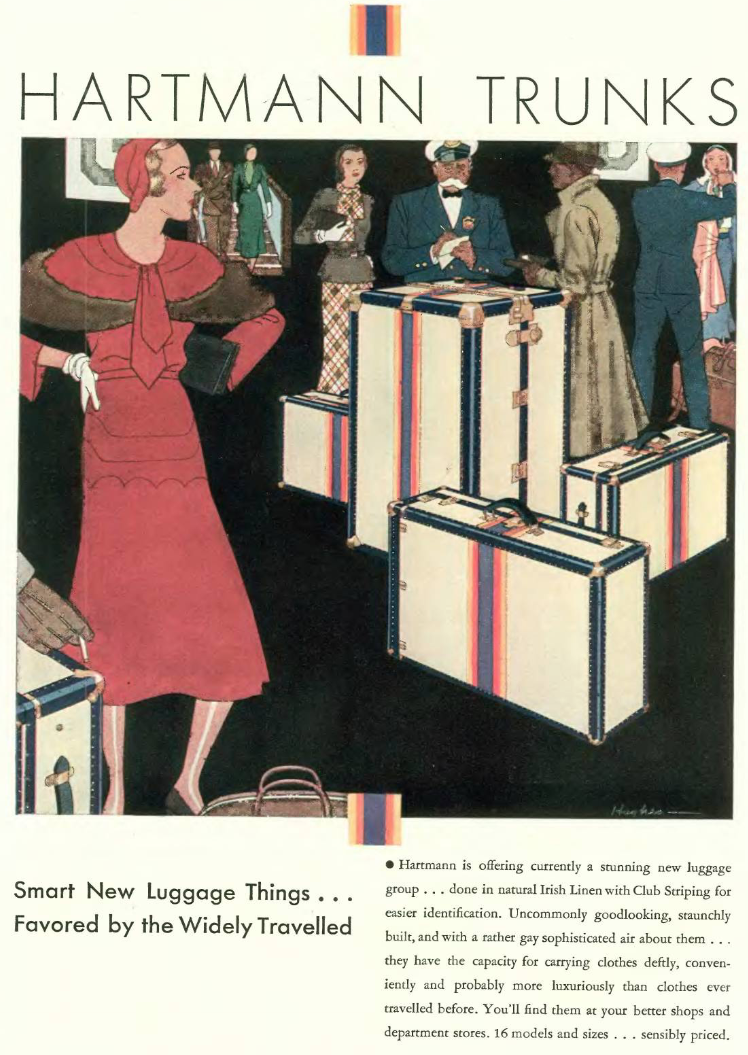
…and you could look stylish at the station or the boat dock with these handsome Hartmann trunks…

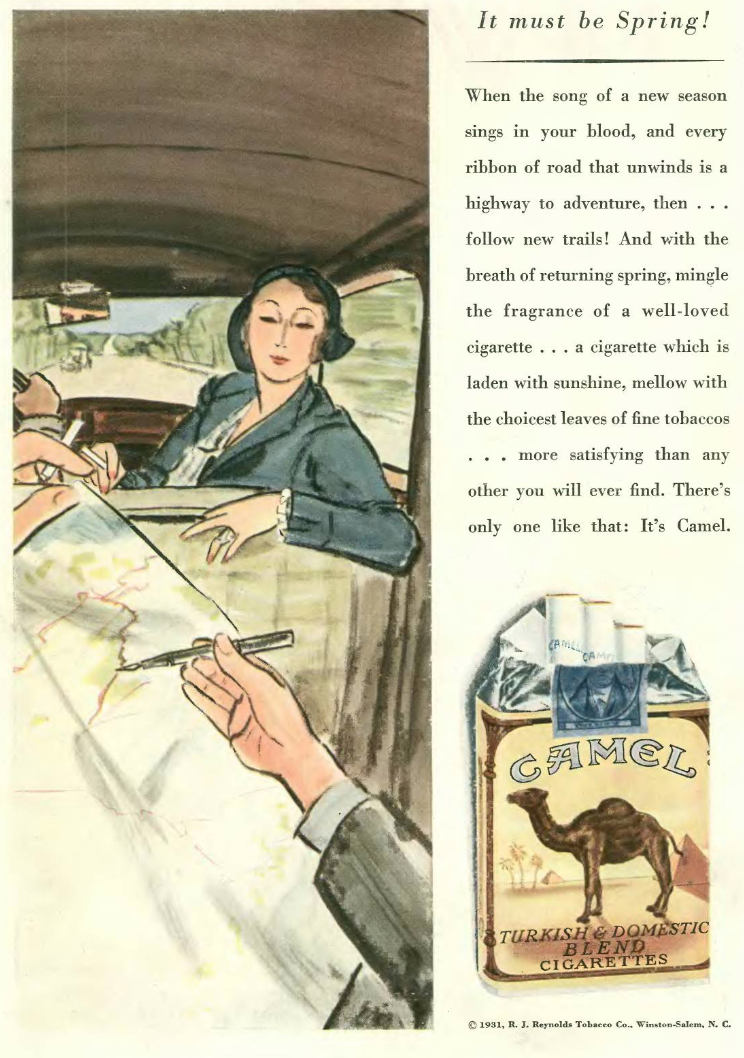
…these spring travelers opted for a car, filled with the aroma of burning tobacco…

…spring was also time for the latest Paris fashions, and Macy’s suggested you could “put one over on Paris” by donning a garment spun from from DuPont’s miracle fiber, Rayon…

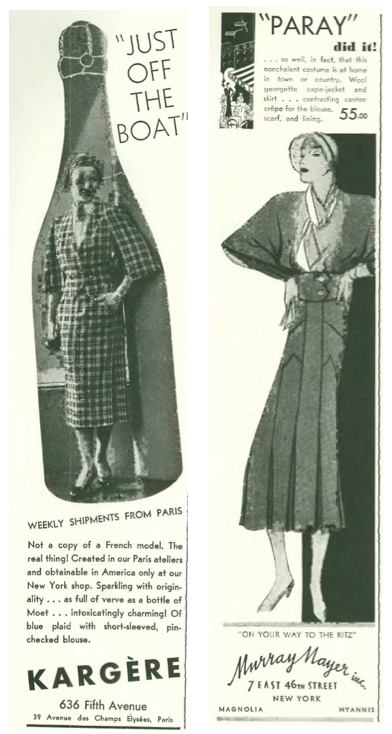
…however, those operating the finer dress shops would never consider letting any synthetic hang in their windows, or touch their skin for that matter, and proudly proclaimed the latest shipments from Paris…

…those shopping for Paris fashions might have consulted Majorie Dork to get slim in all the right places…

…on to our illustrations and cartoons, we have two by Ralph Barton, his “Hero of the Week”…

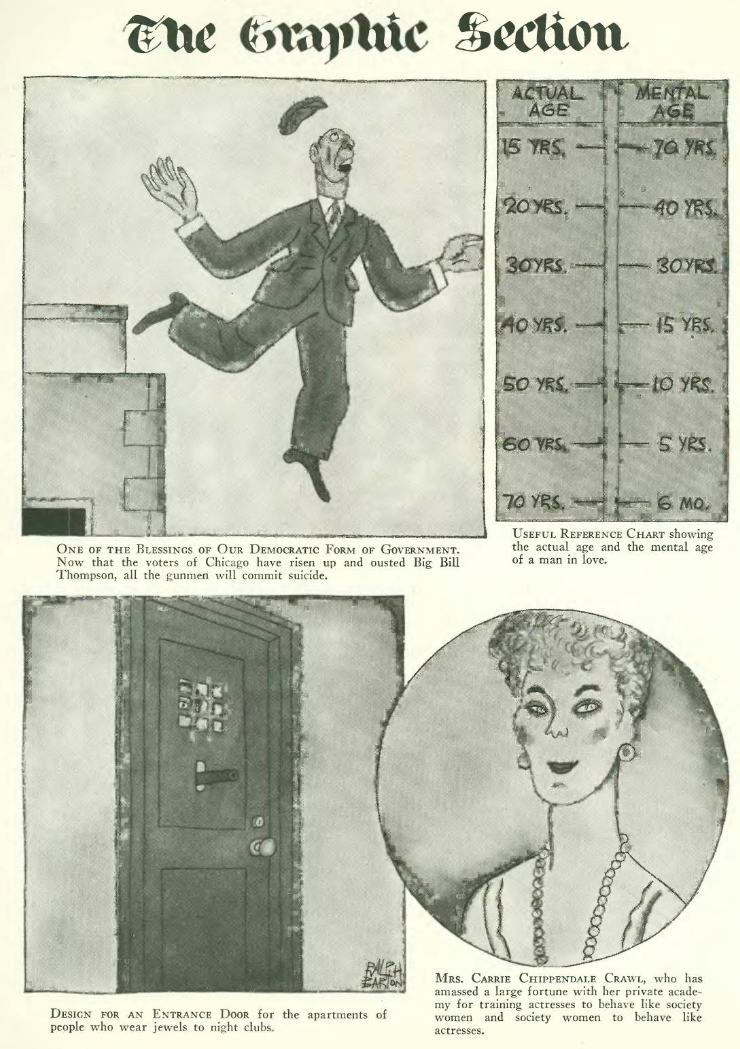
…and his “Graphic Section” take on the week’s news…

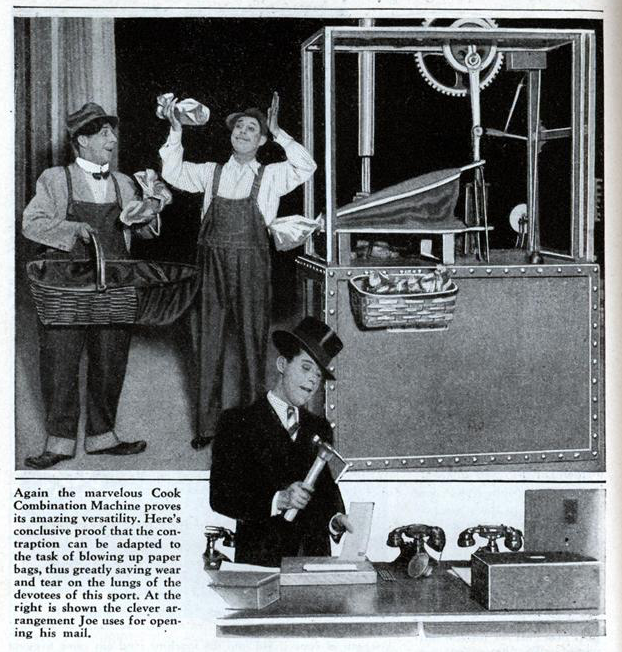
Gardner Rea kicks off our cartoons with a look at the machine age…

…Rea’s cartoon referred to the popular vaudeville comedian Joe Cook, who was known for his demonstrations of needlessly complex machines…here he is featured in the September 1931 issue of Modern Mechanics magazine…

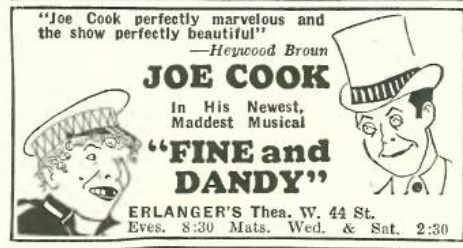
…Erlanger’s Theatre advertised Cook’s “Newest, Maddest Musical” in the back pages of The New Yorker

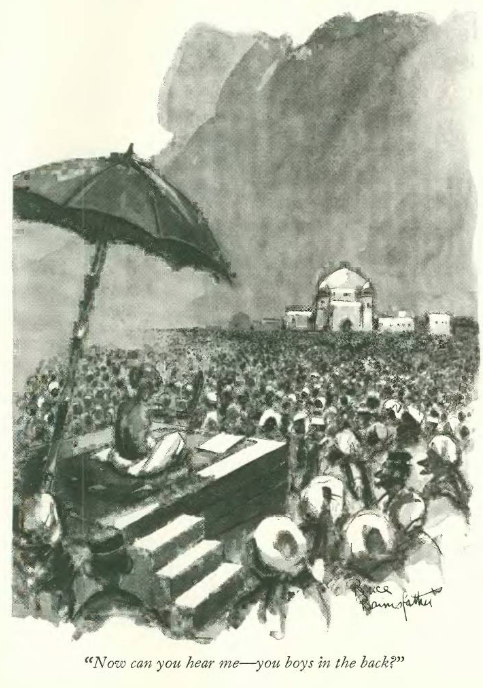
…it’s not often you find Mahatma Gandhi as the subject of a cartoon…this one is by Bruce Bairnsfather

…a unique form of stage fright was illustrated by John Floherty Jr

Jack Markow gave us a little night music…

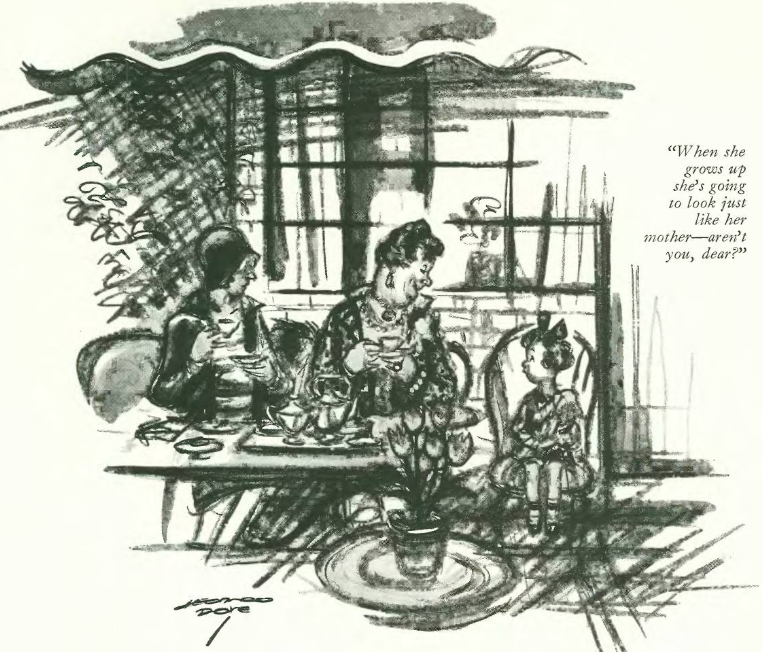
Leonard Dove and the possibly reluctant apple of someone’s eye…

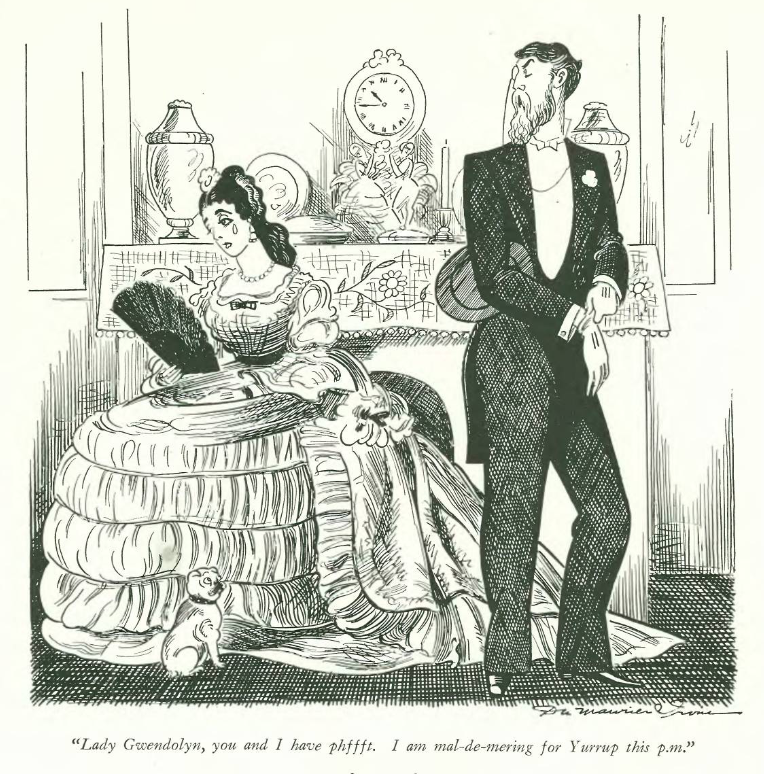
…I would love to know more about this Rea Irvin cartoon, which seems to be a parody of a cartoon from the British Punch…

John Reehill rendered a portentous moment at the barbershop…

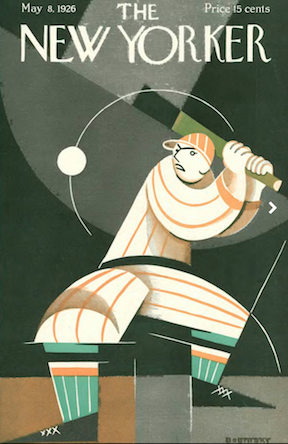
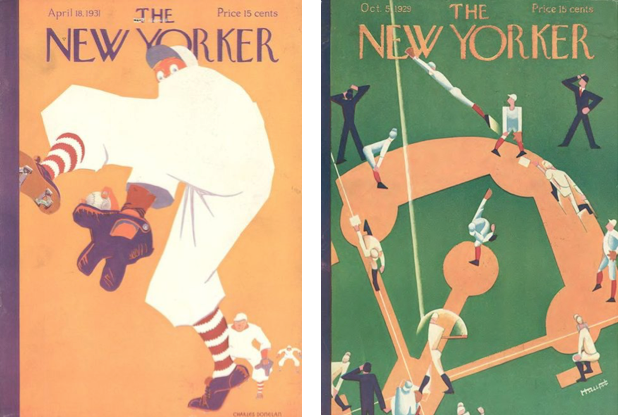
…and finally, today’s cover (bottom left) by Charles Donelan caught my eye because the early New Yorker rarely noted the existence of baseball, except in the events section. Up to this point there had been just two covers featuring baseball: May 8, 1926, by Victor Bobritsky

…and, at right, the Oct. 5, 1929 cover by Theodore Haupt...

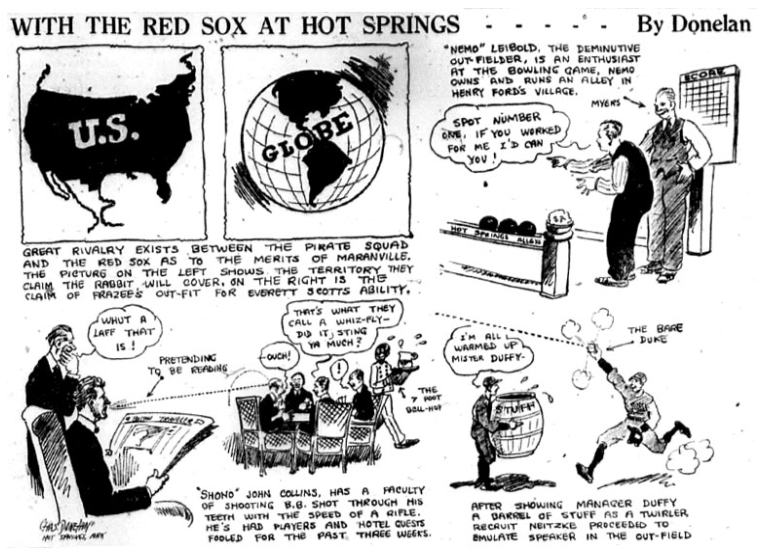
…as for the cover on the left, it would be Charles Donelan’s only New Yorker cover…throughout his career he would illustrate for various publications, including the sports section of the Boston Traveler (this is from the March 21, 1921 edition)…

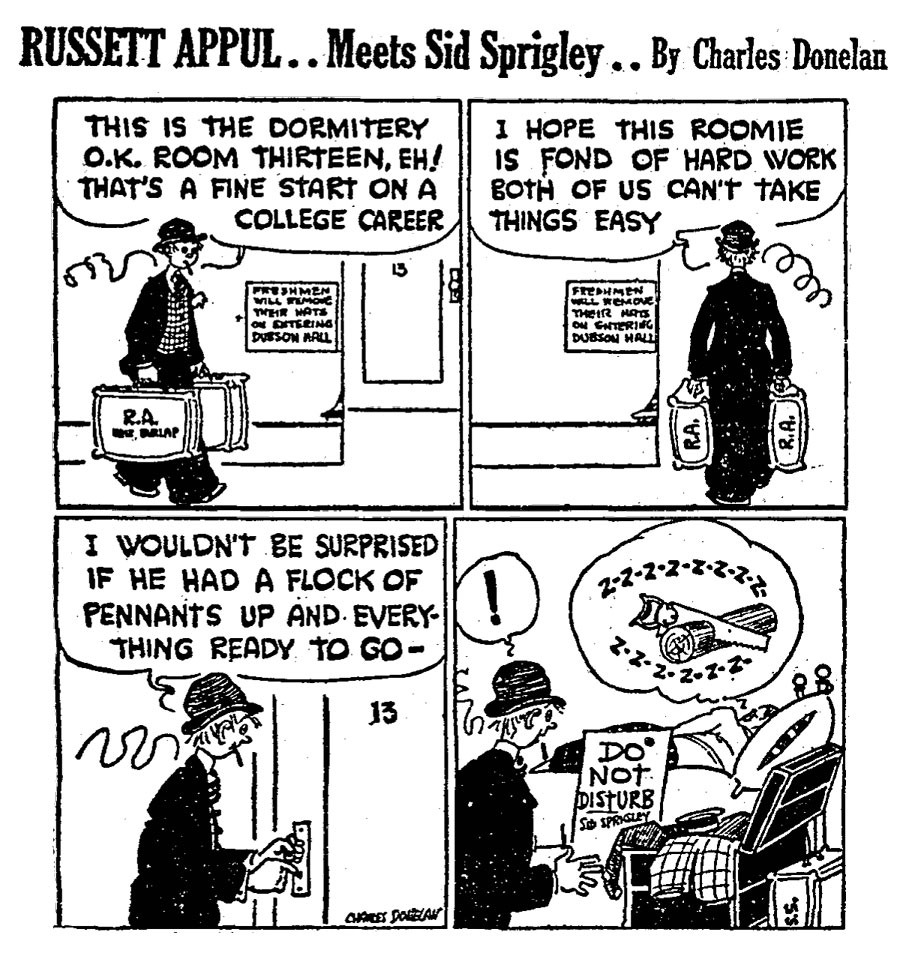
…and a comic strip featured in the Boston Globe called “Russett Appul” (this is from Oct. 11, 1929)…Donelan also performed Russett and other characters on Boston radio stations and stage shows…

Next Time: Cinema’s Underworld…