Safari Under Glass

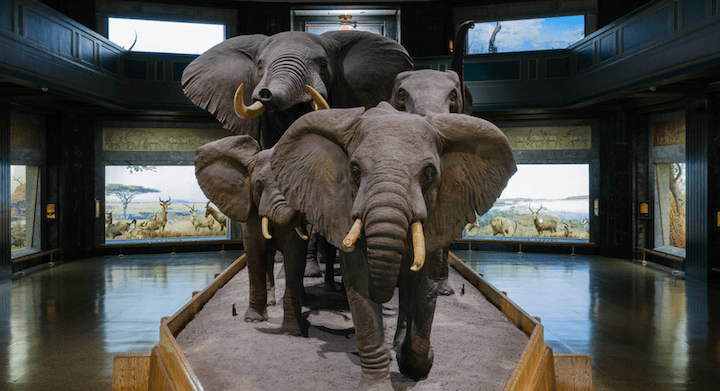
Above: A group of eight East African elephants greet visitors to the American Museum of Natural History's Akeley Hall of African Mammals, which opened in 1936. The elephants are surrounded by twenty-eight habitat dioramas. (amnh.org)

One can instantly call up a photo on an iPad of every known animal on the planet, so why are people still fascinated by dead, stuffed animals displayed in glass cases?
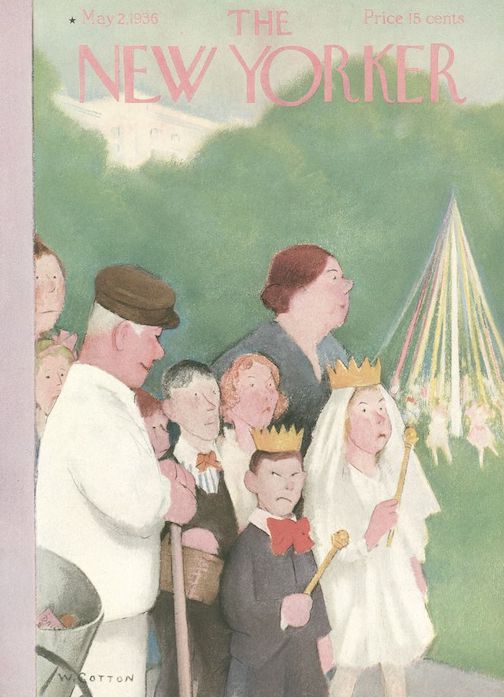
May 2, 1936 cover by William Cotton. 

To be accurate, most animals on display at natural history museums are not “stuffed;” they are an art form or sorts, anatomical sculptures covered with skins, posed in meticulous re-creations of their natural environments.

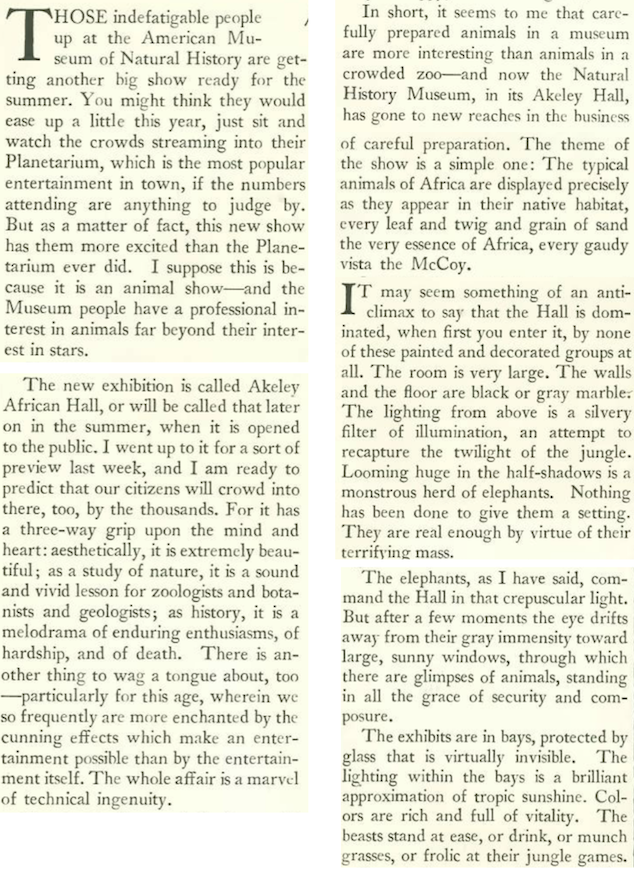
Ninety years after it opened to the public, the American Museum of Natural History’s Akeley Hall of African Mammals—named for the father of modern taxidermy Carl Akeley— still dazzles museum-goers with incredibly detailed dioramas (twenty-eight in all) that depict a range of African ecosystems. Writing for “A Reporter at Large” (titled “Africa Brought to Town”), Morris Markey marveled at the lifelike displays of flora and fauna, “every twig and grain of sand the very essence of Africa…”
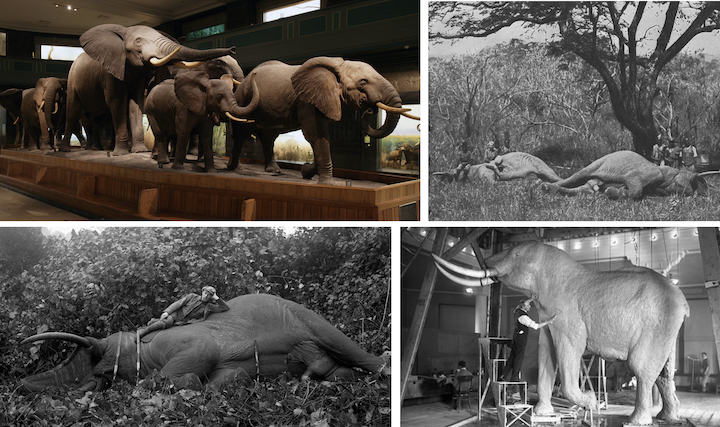
DEATH AND LIFE(LIKE)…Clockwise, from top left, procession of elephants in the American Museum of Natural History’s Akeley Hall; the downside of dioramas—elephants slain in 1911 that now comprise “The Rear Guard” (elephants in back) of AMNH’s procession of elephants; Carl Akeley models a taxidermied elephant circa 1921; Akeley reclining on a bull elephant he killed in 1910 on an AMNH expedition. (uconn.edu/public domain/amnh.org)
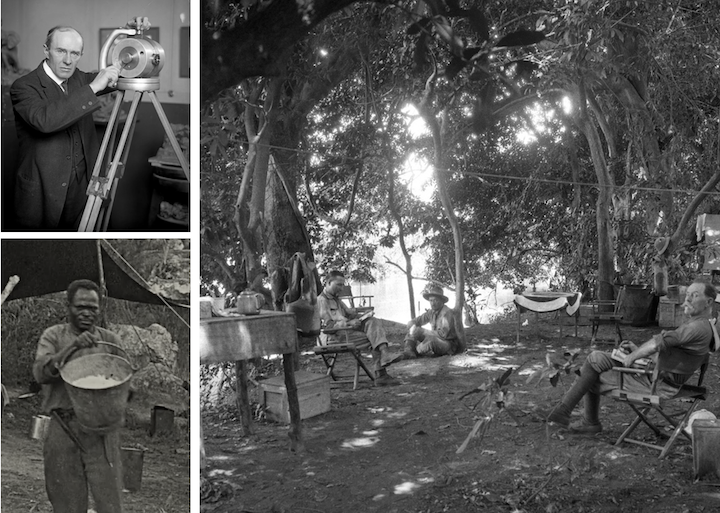
GETTING IT RIGHT…Clockwise from top left: Carl Akeley with his camera, circa 1920s—Akeley contributed hundreds of specimens and images of wildlife and plants to various American museums throughout the course of his career; James L. Clark, William R. Leigh and Richard Radatz relax during a 1926 African expedition to document the flora and fauna (through photos, sketches and paintings) for reference in creating true-to-life dioramas; unidentified expedition worker prepares plaster to make casts of collections (tree bark, leaves, rocks etc.). (amnh.org/uconn.org)
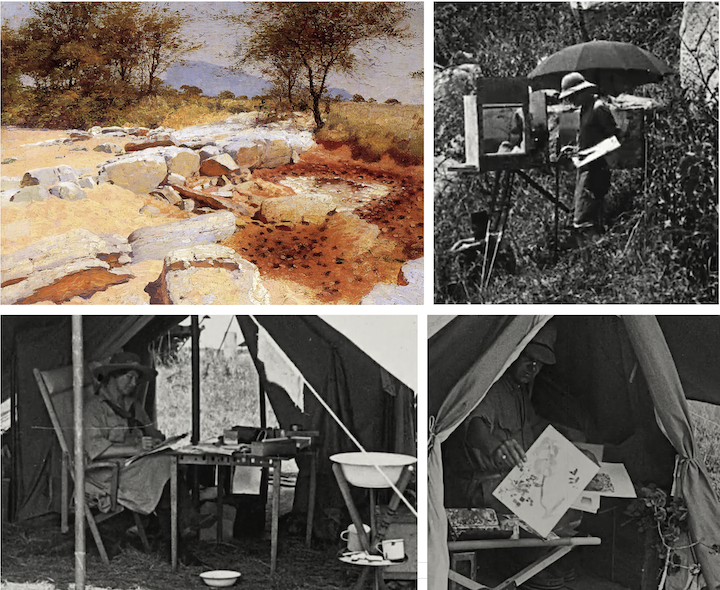
MARRIAGE OF SCIENCE AND ART…Clockwise from top left: William R. Leigh landscape study; expedition artists made paintings en plein air as well as from specimens brought back to their tents (below). At bottom left is Carl Akeley’s second wife, Mary Lee Jobe Akeley (1886–1966), a well-known explorer and naturalist. It was her first expedition to Africa and Carl’s last—he would die of dysentery before the expedition concluded—so Mary took charge of the expedition, and was later named Carl’s successor as adviser to the American Museum of Natural History. (Leigh landscape courtesy Gerald Peters Gallery via jamesperrywilson.wordpress.com/still images taken from a short film of AMNH’s 1926 African Hall expedition, courtesy University of Connecticut)

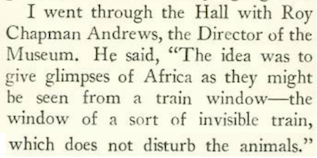
Markey visited with museum director Roy Chapman, who likened the dioramas to “glimpses of Africa as they might be seen from a train window…” Since this was 1936, no one seemed too concerned about the ethical implications of hunting and killing animals for museum displays. It should be noted that most animals we see in major natural history museums today were killed during early 20th-century expeditions such as Akeley’s; animals used in new displays are often obtained from zoos or sanctuaries after dying of natural causes.
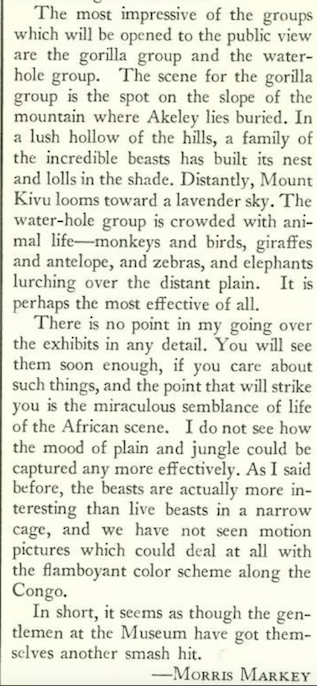
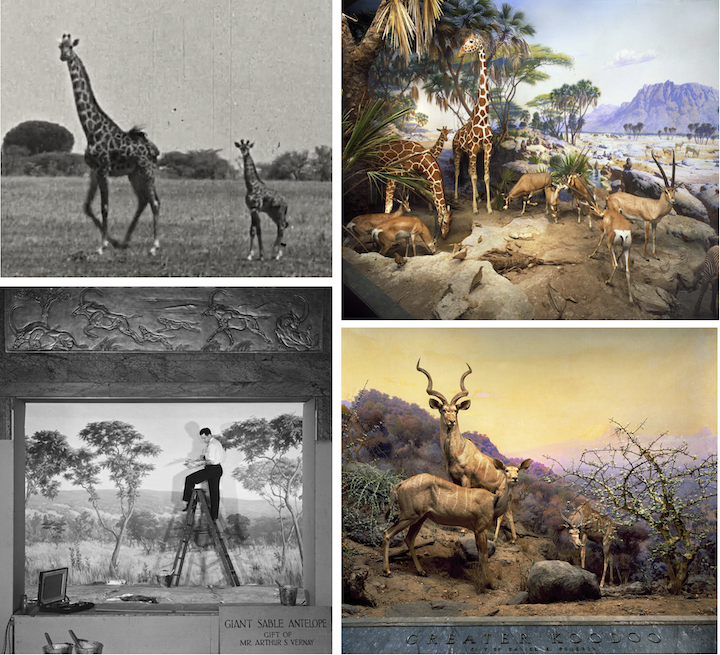
OUT OF AFRICA…Still image of giraffes taken from a short film of AMNH’s 1926 African Hall expedition; the AMNH’s “Water Hole” diorama; “Greater Koodoo” diorama; Clarence Rosenkranz working on the “Giant Sable” diorama. (amnh.org/uconn.org)

There is an undeniable appeal to these artificial environments. Although our digital age offers all sorts of them, there are still kids who like to build dioramas in shoeboxes. And for those of us who grew up in 1960s and 70s, there was the thrill of opening a new three-pack of View-Master reels, each slide revealing a three-dimensional, self-contained world.

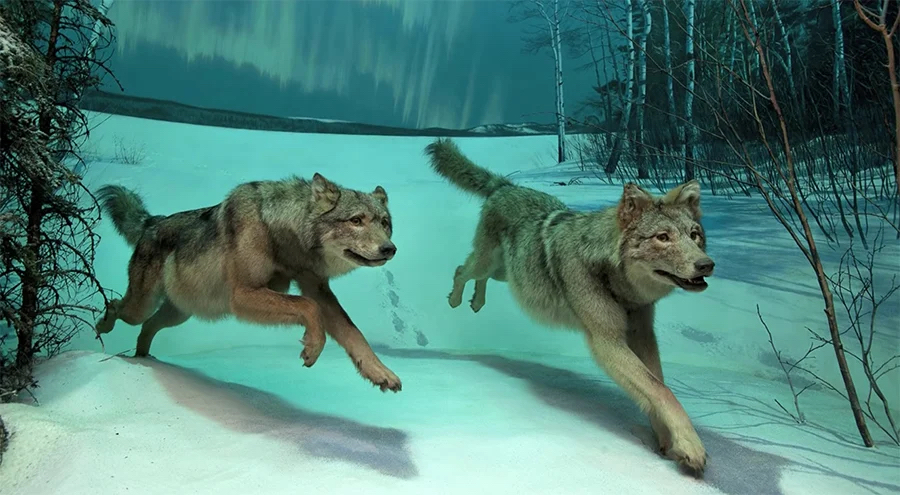
And so it is with museum dioramas. They offer a moment of wonder and calm to viewers. As the noisy world collapses around them, these displays—however artificial—might inspire in some a greater appreciation of these creatures and their fragile environments.
(amnh.org)

The AMNH has posted a video on the taxidermy process, if you are interested.

 * * *

At the Movies

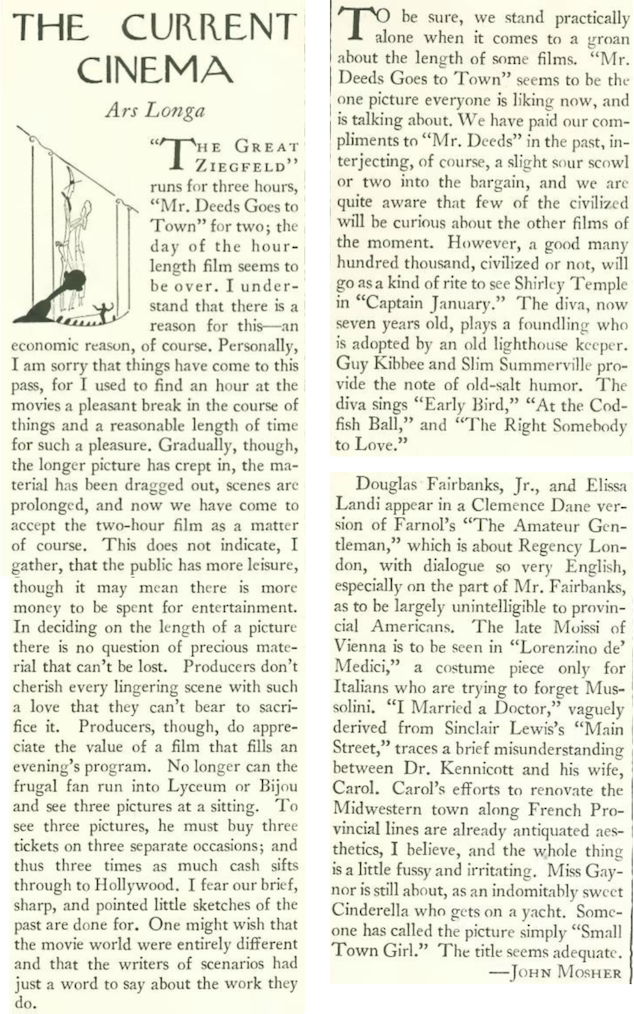
One can imagine film critic John Mosher rubbing his eyes as he pondered the reasons why Hollywood insists on making overly long movies (also lamented by critics today). He also reviewed four new films, with little enthusiasm.
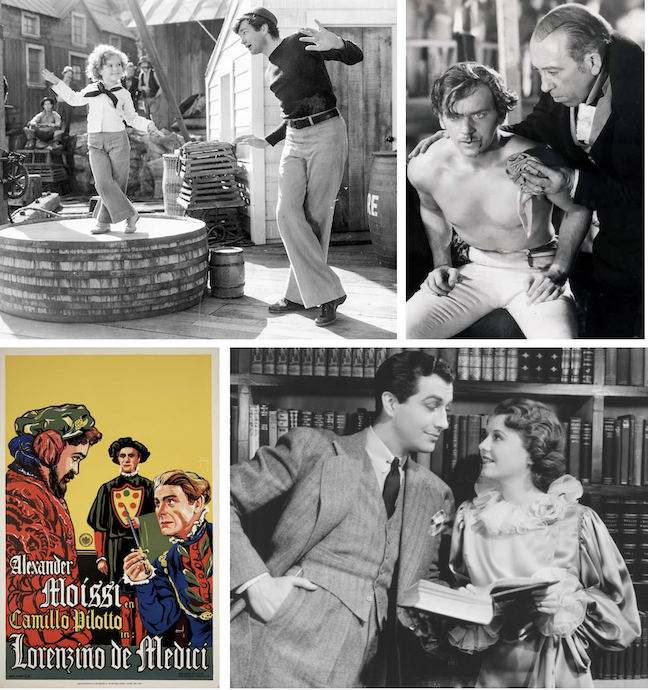
LONG IN THE TOOTH?…Clockwise from top left: Critic John Mosher seemed to imply that seven-year-old Shirley Temple (seen here with Buddy Ebsen in Captain January) was getting too old to play the precocious little healer; Douglas Fairbanks Jr. and Gordon Harker in The Amateur Gentleman; Janet Gaynor and Robert Taylor made cute in I Married a Doctor; movie poster for Lorenzino de ’Medici, which Mosher felt was best suited to Italian audiences. (letterboxd.com)

 * * *

Getting Things Done

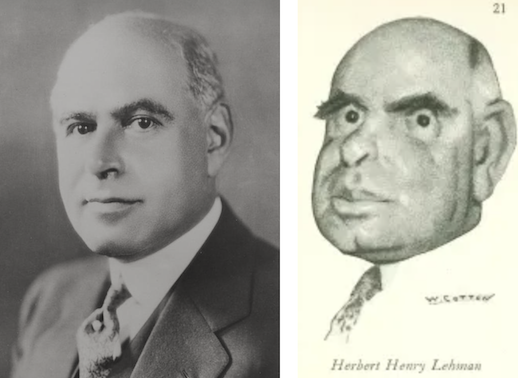
Journalist Hickman Powell filed the first part of a two-part profile of New York’s 45th Governor, Herbert Lehman (1878–1963). The first Jewish governor of New York, Lehman was a prominent liberal leader and a major philanthropist, known for implementing a “Little New Deal” that established a minimum wage, unemployment insurance, and public housing.
HMMM…William Cotton was a terrific caricaturist, but he seemed to miss the mark with this illustration of Gov. Herbert Lehman for the “Profile.” (Wikipedia)

 * * *

From Our Advertisers

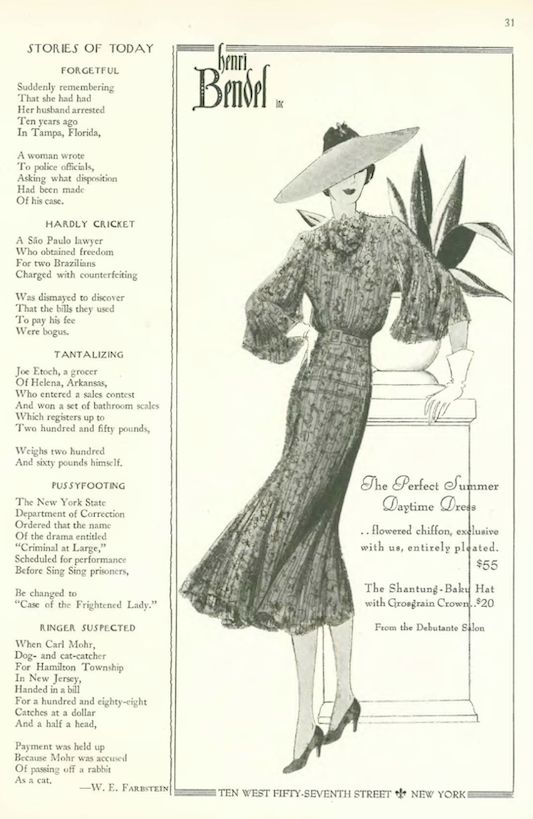
The May 2 issue was crammed with ads for women’s summer fashions, which were defined by longer, leaner silhouettes…
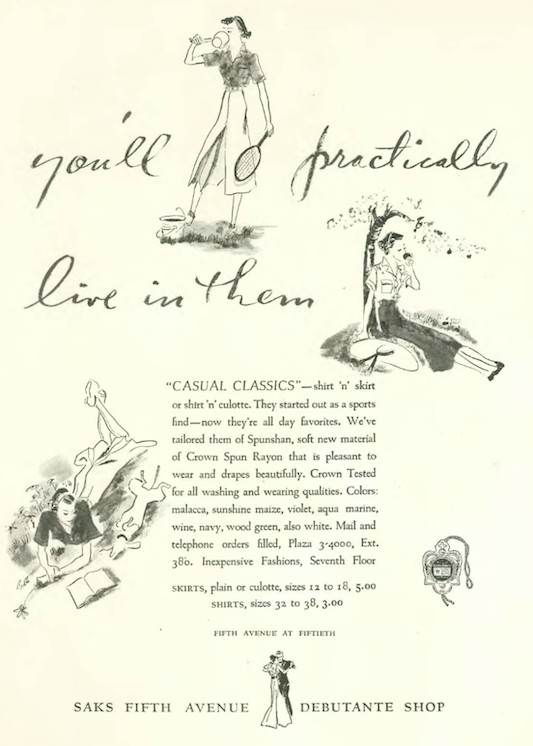
…and by the increasing popularity of practical sports and casual clothes…
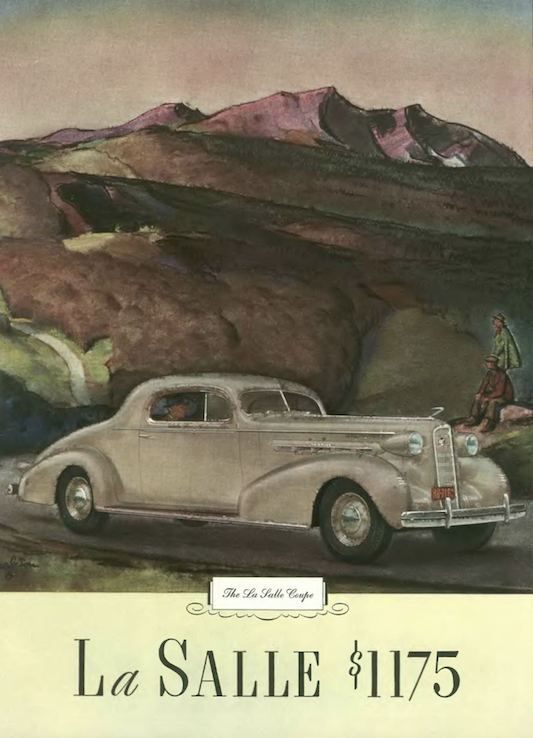
…the makers of Cadillac motorcars continued to emphasize their lower-priced LaSalle models for Depression-squeezed consumers…
…no fashion models or health claims here, just the allure of cigarette smoke courtesy Liggett and Myers…
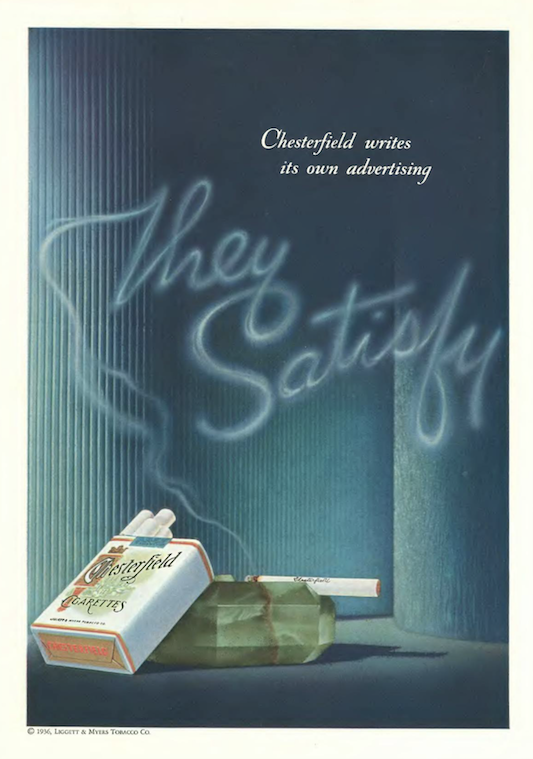
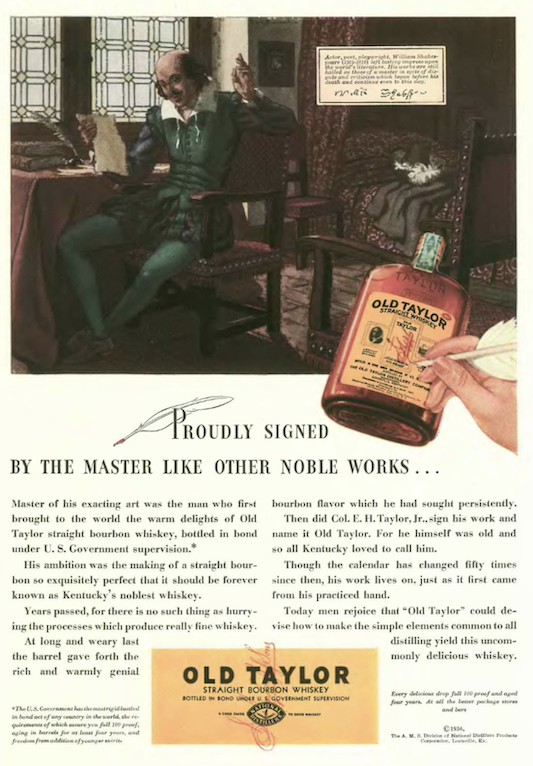
…the distillers of Old Taylor wanted you to associate their product with the timeless work of William Shakespeare…after all, who’s going to sue them over image rights?…
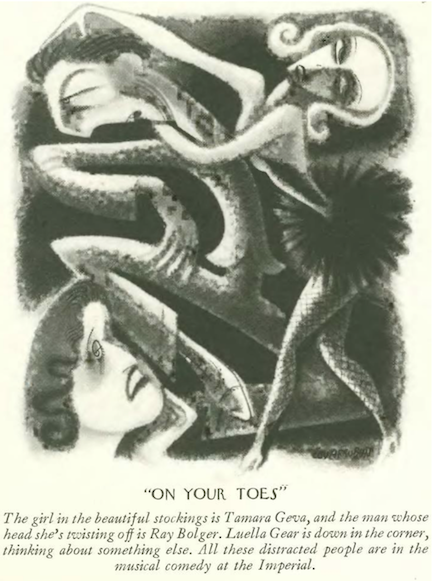
…on to our cartoonists…Miguel Covarrubias, whose work was featured in The New Yorker’s first issue and was frequent in those early days, lent his talents to the theatre review section with this rendering from On Your Toes

…something else I forgot to mention in my last post, On Your Toes also marked George Balanchine’s debut as a Broadway choreographer…
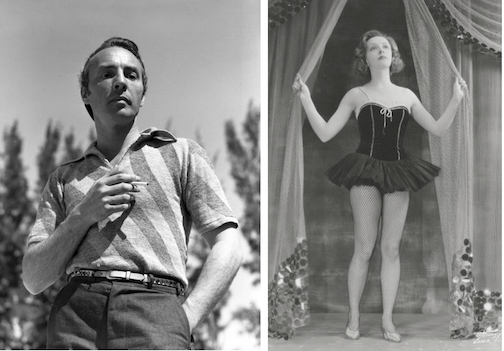
ON HIS TOES…At left, George Balanchine in 1942; at right, Tamara Geva in 1936’s Broadway production of On Your Toes. Geva, an actress, ballet dancer, and choreographer, was Balanchine’s first wife (married 1921-1926). (Wikipedia/instagram)

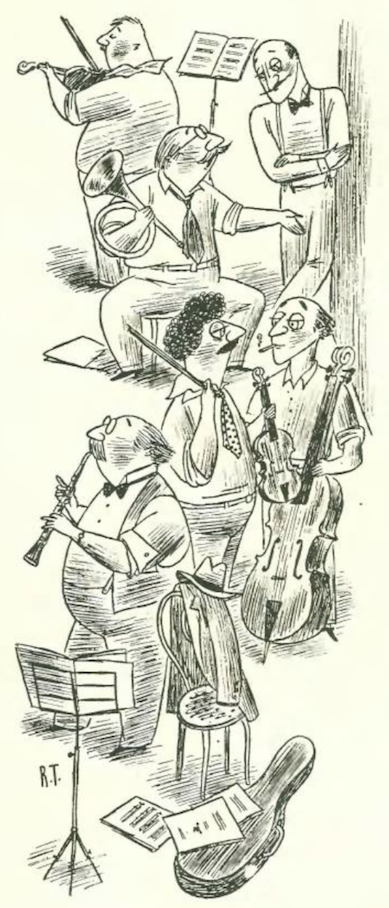
…we are seeing a lot of Richard Taylor in the 1936 issues, especially in providing spot illustrations such as this one…
Charles Addams deployed some sarcasm on the domestic front…
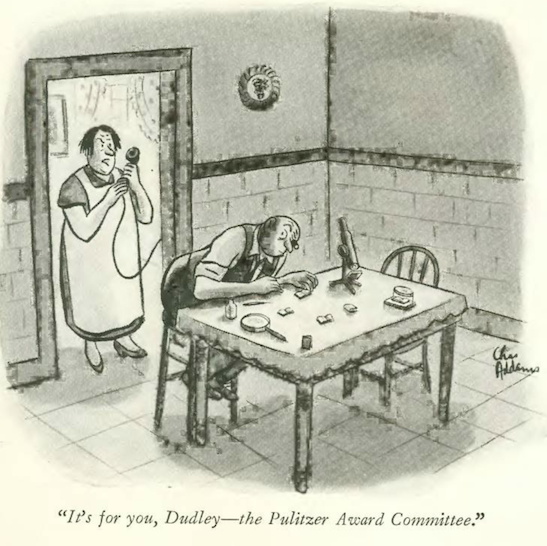
…and Addams again, commenting on the fierce rivalry between the privately owned Interborough Rapid Transit (IRT) and the municipal subway systems…
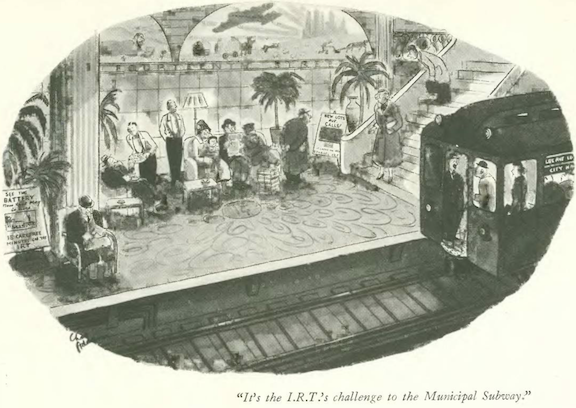
…and we have two by Helen Hokinson, having misgivings about a greenhouse variety…
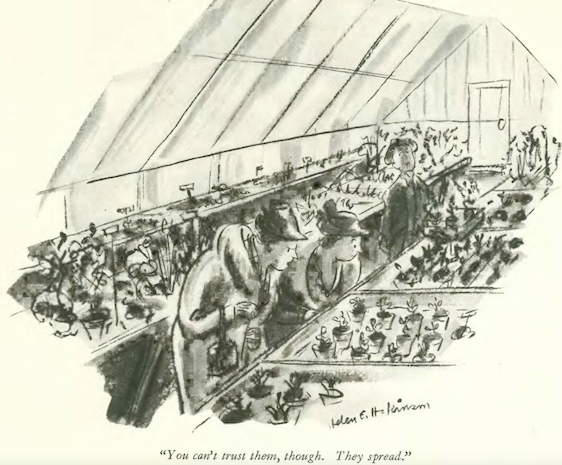
…and finding a personal commitment to a can of soup…
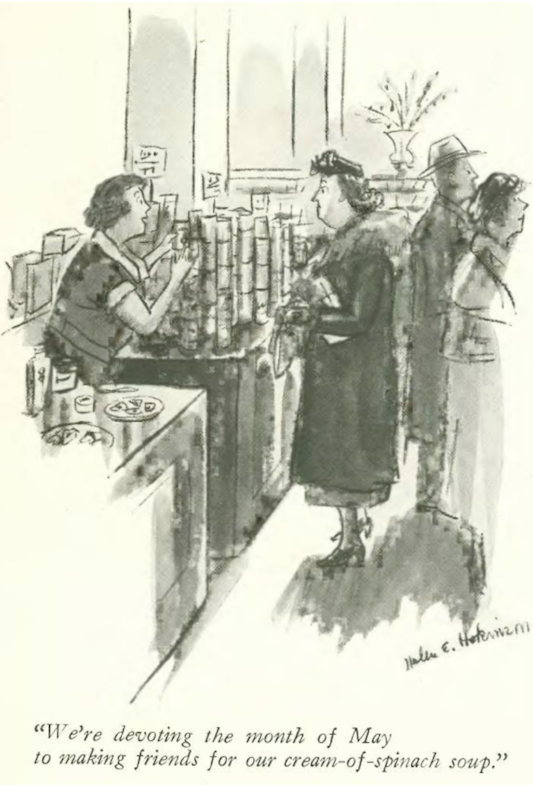
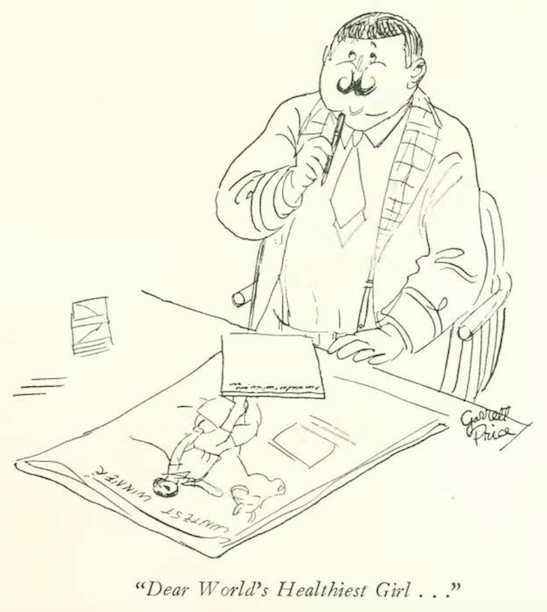
Garrett Price had this man doing some wishful thinking…
William Steig used a two-page spread to illustrate a day at the drugstore…
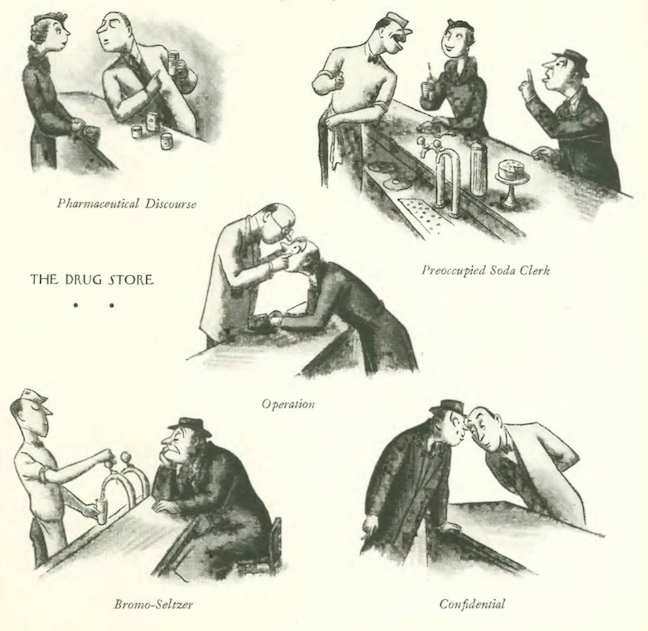
…another drawing from the group, appearing on the left-hand page…
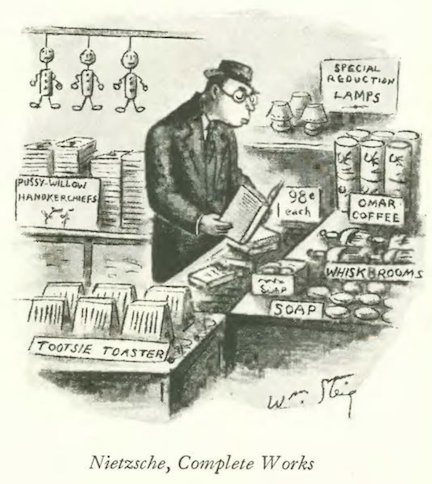
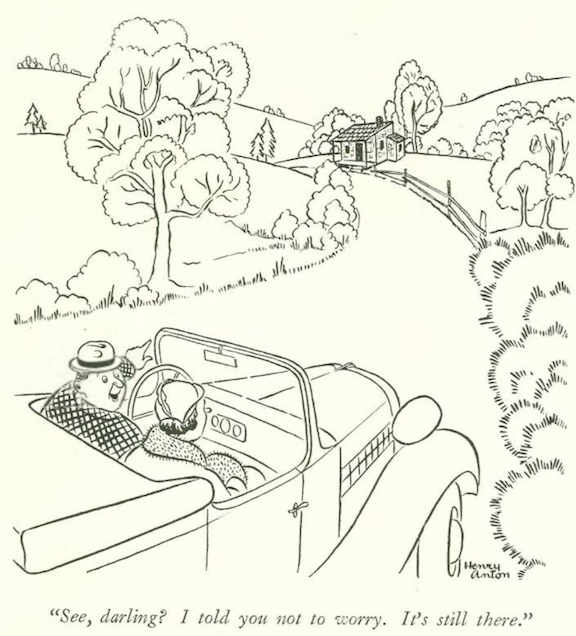
…keeping it in the family, we have one by Henry Anton Steig (William Steig’s brother)…according to Michael Maslin’s indispensable Ink Spill, Henry contributed nineteen drawings to The New Yorker from 1932 to 1936 under the name Henry Anton…this one was his final contribution…
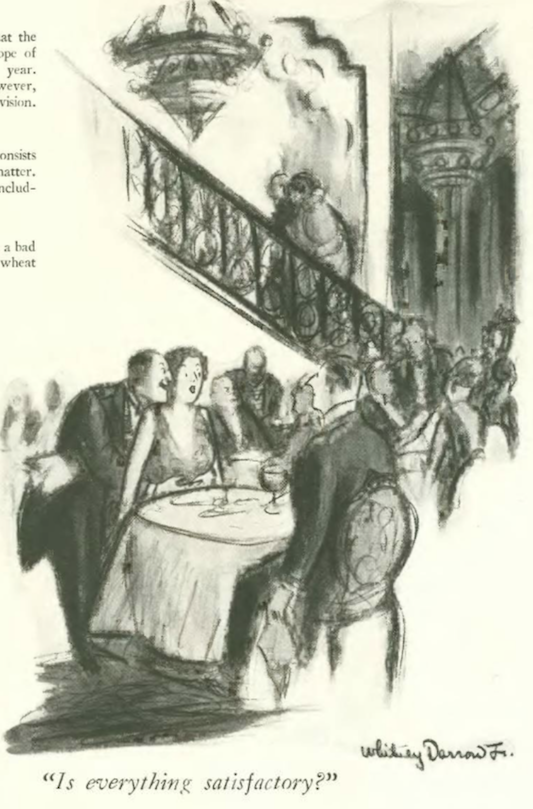
Whitney Darrow Jr drew up this over-enthusiastic maître d’…
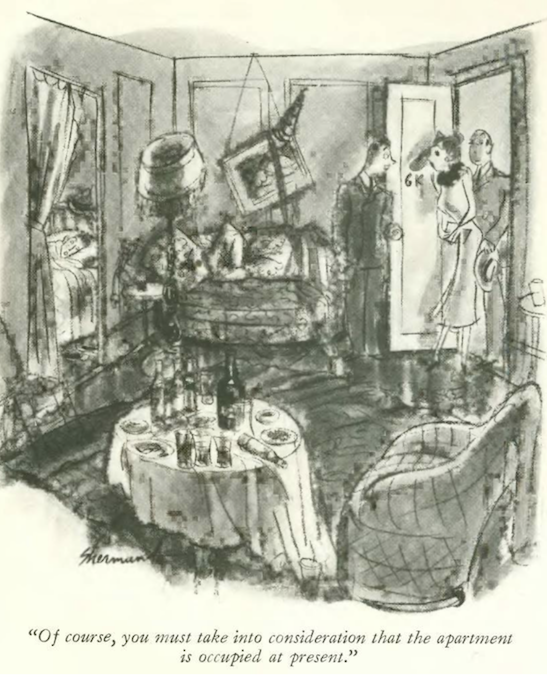
Barbara Shermund went apartment hunting…
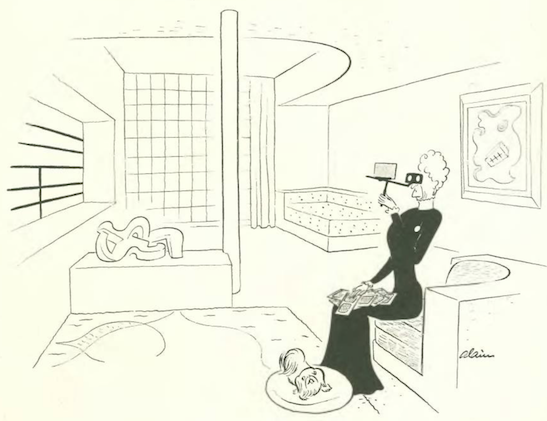
…and we close with Daniel ‘Alain’ Brustlein, and a room with a view…
Next Time: Saving the Row…
 

Unnatural History

In my last post we visited the Central Park Zoo, circa 1931, and found a collection of animals displayed as curiosities in barren enclosures that in no way resembled natural habitats.

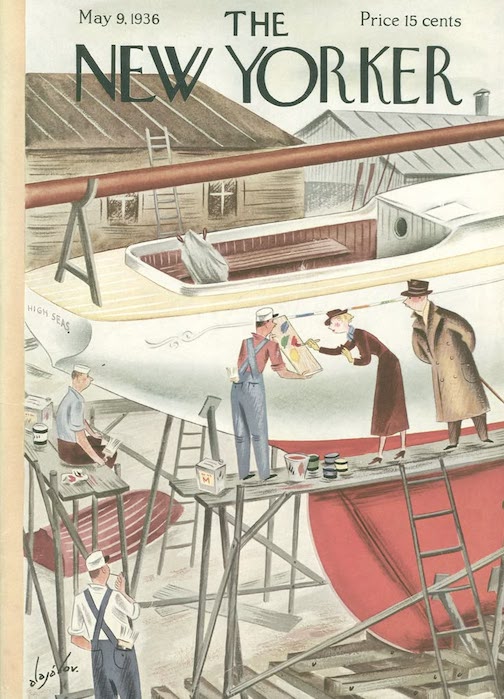
Aug. 29, 1931 cover by Constantin Alajalov.

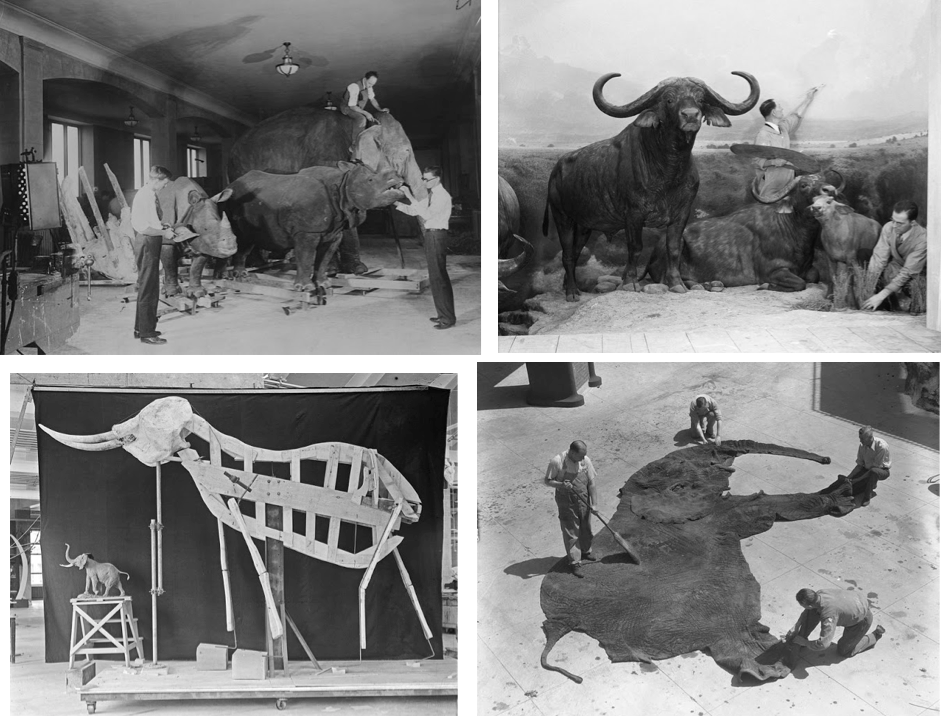
It’s hard to say if those creatures were better or worse off than their cousins at the American Museum of Natural History, a short walk across the park to the northwest. Unlike the zoo, the tigers and rhinos at the museum were displayed in naturalistic, almost dreamlike settings. But then again they were dead; indeed, all that remained of them were their skins, skillfully fitted over skeletons of wood and clay.

SIMULACRUM…Clockwise, from top left, American Museum of Natural History staff mounting rhinoceros and Indian elephant, circa 1930; preparing African buffalo group diorama; staff cleaning elephant skin in preparation for mounting on a frame consisting of a skull and some wood. This would be covered with clay before the skin is fitted. (vintag.es)

E.B. White stopped by the famed museum to take a look at its new Asiatic Hall, and filed this report for “The Talk of the Town.”

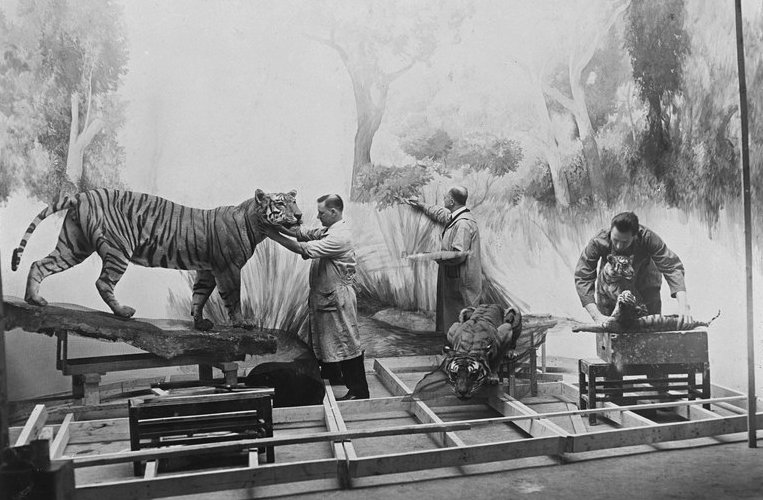
The animals pictured below came from a couple of British big game hunters, gathered during expeditions in the 1910s and 1920s…

PLEASE HOLD STILL…American Museum of Natural History staff prepare the tiger group diorama in 1931. The display was in the new Asiatic Hall referred to by E.B. White. (vintage.es)
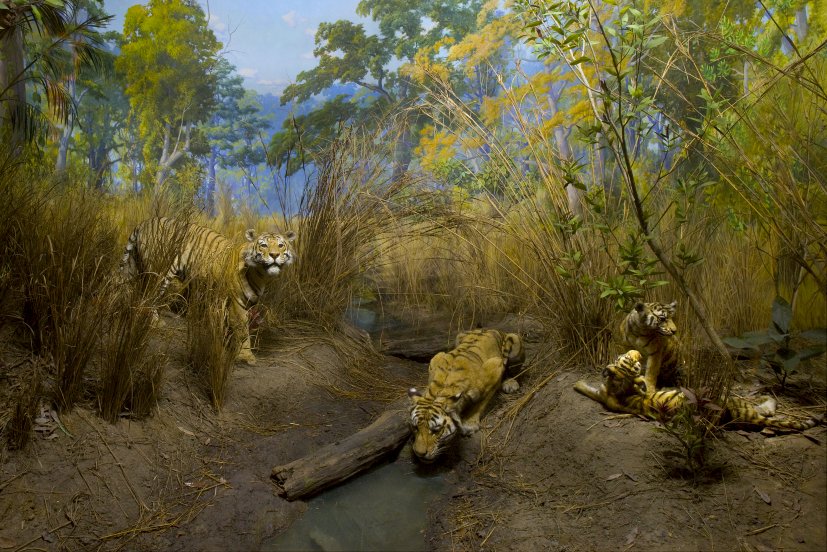
SURVIVORS OF A SORT…Nearly 90 years later, the tiger group is still on display at the American Museum of Natural History, now in the Hall of Biodiversity. (AMNH)
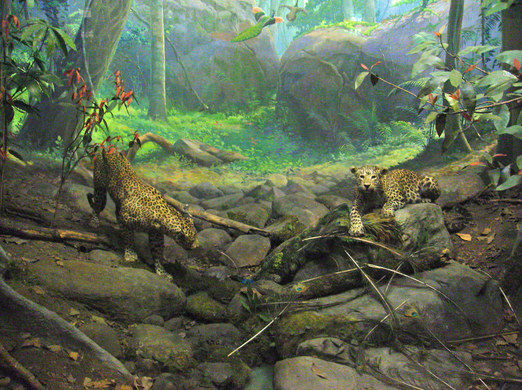
STILL THE SAME…This Asiatic leopard diorama, which so impressed E.B. White, also survives to this day, in the Hall of Asian Mammals at AMNH. (atlasobscura)
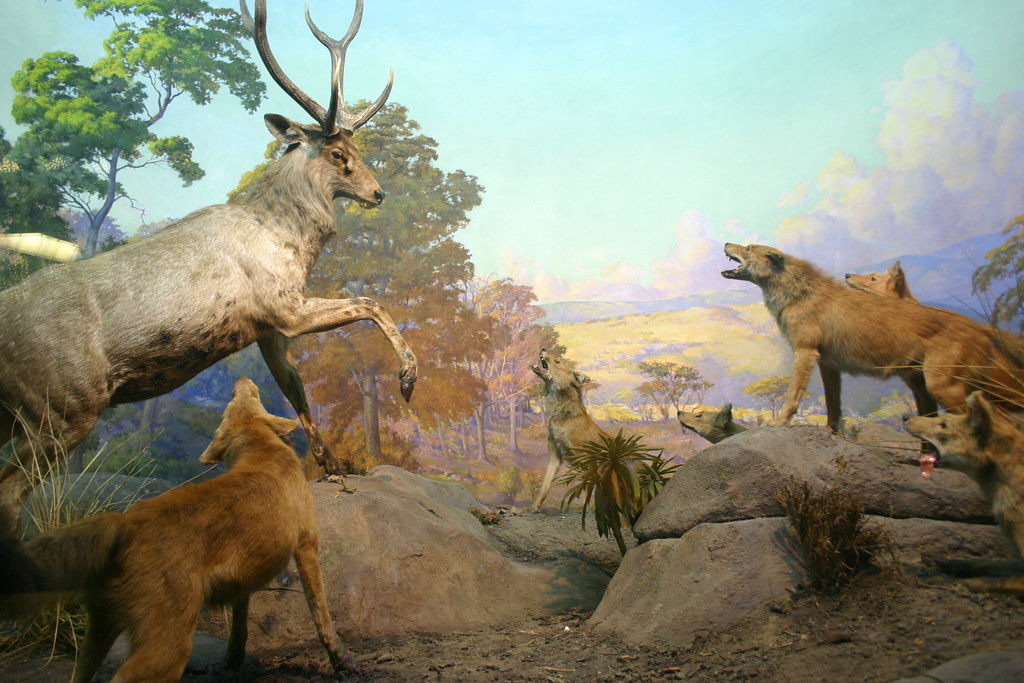
NEVER-ENDING BATTLE…The Sambar stag diorama, dating to 1911, is also mentioned by White in his article. (atlasobscura)

I am delighted that the AMNH (which I visited in December as an avid fan of diorama art) preserves these exhibits, which not only display animals—many now endangered—but also the artistry of painters, sculptors and taxidermists from a century ago. Sadly, many museums are scrapping these cultural treasures and replacing them with gaudy, interactive displays and video screens. An article in Newsweek (“Museum Dioramas Are as Endangered as the Animals They Contain,” Aug. 2, 2015) notes that around 2008 “the Smithsonian’s National Museum of Natural History in Washington, D.C., closed two diorama halls and reopened them with video screens, interactive features and stand-alone specimens where the dioramas had been.” In other words, the specimens were removed from naturalistic scenes and displayed as stand-alone curiosities, rather like those poor animals in the Central Park Zoo of yesteryear.

 *  *  *

Everyday Icons

Gilbert Seldes profiled industrial designer Henry Dreyfuss (1904–1972), who along with contemporaries Raymond Loewy and Norman Bel Geddes was among celebrity designers of the midcentury. Like Bel Geddes, Dreyfuss was a well-known Broadway set designer who would go on to become an industrial designer in the era of streamlining. But unlike Loewy and Bel Geddes, Dreyfuss went well beyond mere styling, taking a practical, scientific approach to problems that would not only make products better looking, but also safer and more comfortable to use. An excerpt:

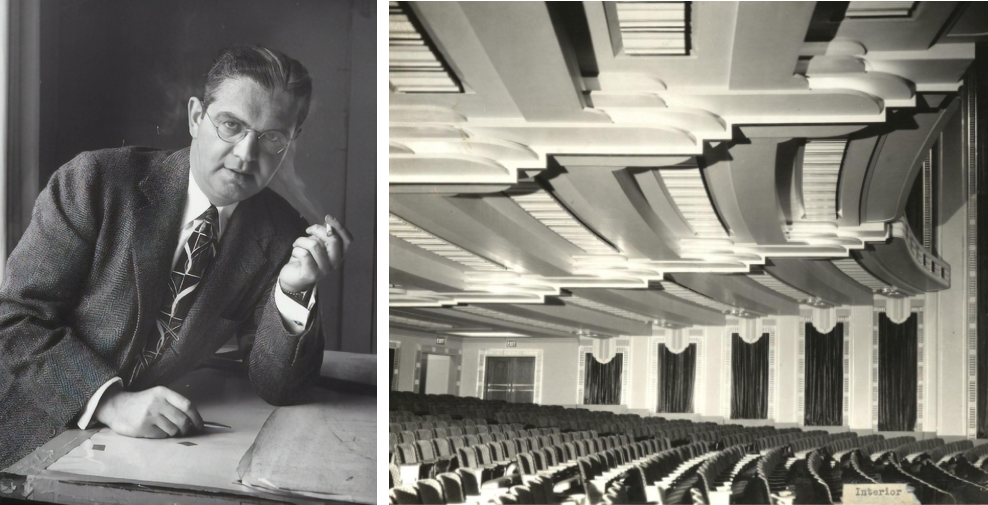
GOT MY START IN SHOW BIZ…Henry Dreyfuss in 1946, and his 1930-31 design of the RKO Theatre in Davenport, Iowa (now the Adler Theatre). (Wikipedia/qctimes.com)
ICONS OF EVERYDAY LIFE…Some of Dreyfuss’s designs included, top row: the Western Electric Model 500 telephone (center), which replaced the clunkier Model 300 (left) in 1950; the Hoover model 150 vacuum cleaner, from 1936; middle row: Dreyfuss designs for the New York Central Railroad’s streamlined Mercury train (1936); and the NYC Hudson locomotive for the Twentieth Century Limited (1938); bottom row: Dreyfuss designed things as varied as tractors for John Deere (1960); the Honeywell T87 circular wall thermostat (1953–present); and the Polaroid SX-70 Land camera (1972).

 *  *  *

Body-Building Barnum

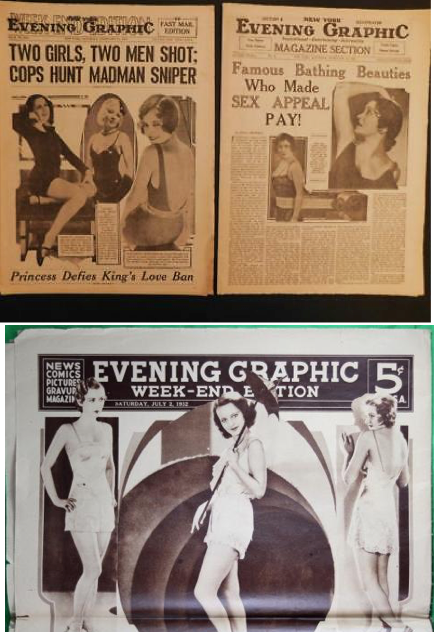
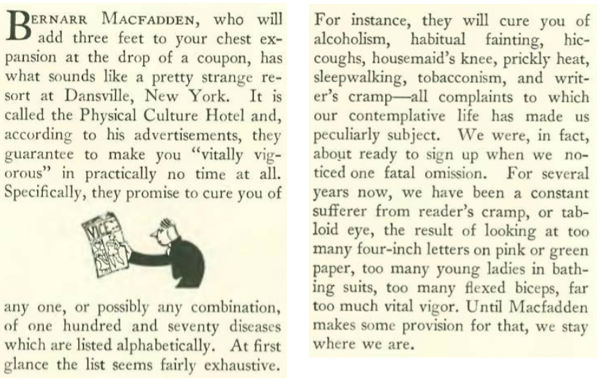
Another well-known figure of the 1930s was Bernarr Macfadden (1868–1955), an early proponent of physical culture who would prefigure such notables as Charles Atlas, Jack LaLanne, and Arnold Schwarzenegger. But none of them were quite like McFadden, who also created a pulp publishing empire (among his magazines: Liberty, True Detective, True Story, True Romances, Photoplay and the notorious tabloid newspaper The New York Evening Graphic).

READ ALL ABOUT IT…Macfadden’s Evening Graphic was all about scandal, and especially sex and murder.

Macfadden also established numerous “healthatoriums” across the East and Midwest, including (in 1931) his latest venture, the Physical Culture Hotel near Dansville, New York. E.B. White explained, in his “Notes and Comment”…

MCFADDEN SHOWS OFF HIS BOD in 1910 (left) at age 42, and at age 55 in 1923. (Wikipedia)
BEFORE AND AFTER…Mcfadden acquired the 1882 Jackson Sanatorium near Dansville, NY in 1931 and renamed it the Physical Culture Hotel. Circa 1930s images at top contrast with the condition of the property today — it fell into disrepair after MacFadden’s death in 1955, and closed for good in 1971. Known to locals as the “Castle on the Hill” in its heyday, it can still be glimpsed by motorists traveling on I-390. (bernarrmacfadden.com/abandonedplaces.livejournal.com)

 *  *  *

For the Birds

When I came across “Farewell to Birds,” on page 17, I thought for a moment it was one of James Thurber’s animal parodies (there was even a Thurber cartoon at the bottom of the page), but then I noticed our writer was Will Cuppy, (1884-1949) who wrote in the Thurber vein (Cuppy was ten years Thurber’s senior) and like Thurber, was a bit of a curmudgeon. From 1931 until his death Cuppy wrote satirical pieces for The New Yorker that were later collected into books (also like Thurber). Here is an excerpt from “Farewell to Birds.”

THE SIMPLE LIFE…Satirist Will Cuppy (center, in 1932) and two of his early books. How to be a Hermit (1929) was a humorous look at his life residing in a Jones Island seaside shack from 1921 to 1929 (he was escaping city noise and hayfever); How to Tell Your Friends from the Apes was a 1931 compilation of Cuppy’s articles, including the one above.

 *  *  *

Puttin’ on the Ritz

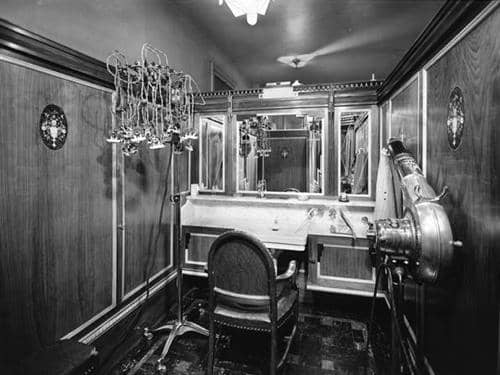
Lois Long, newly divorced from cartoonist Peter Arno, concluded her fashion column (“On and Off the Avenue”) by telling readers about her “swell new hairdo”…

HAVE A SEAT, LOIS…The perm room at Charles of the Ritz, 1932. (Museum of the City of New York)

 *  *  *

Your Majesty

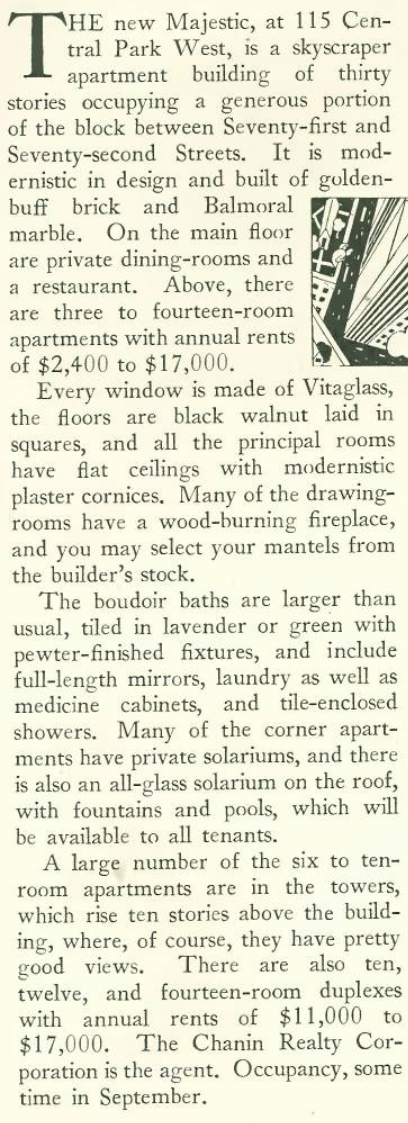
Speaking of new looks, Central Park West was boasting the addition of a new “skyscraper apartment building” called the Majestic. “The Sky Line” reported:

APTLY NAMED…The Majestic at Central Park West. (Pinterest)

Another building making its mark was the Parc Vendôme on West 57th, offering more than 600 apartments with annual rents ranging from $1,100 to $6,600. Condos in the same building today range from $495,000 to $5,495,000.

BREAD BOX INCLUDED…The Parc Vendôme on West 57th. (street easy.com)

From Our Advertisers

Henry Mandel, one of New York City’s most ambitious developers in the 1920s and early 30s, touted the Parc Vendôme in this advertisement…

…I wonder if Lois Long (see above) got one of these “dos” at the Ritz…I love the snob appeal of this ad — “The New Paris Way of Doing Your Hair”…

…which seemed to work…here is a random sample of Hollywood stars in 1931, all wearing the look…

DOING THE WAVE…From left, Tilly Losch, Constance Bennett, and Barbara Stanwyck.

…other ads appealing to the Continental lifestyle…a very understated yet elegant ad for Guerlain lipstick, and Nellie Harrington-Levine gave us a disinterested deb sporting “the wave,” a cigarette and a velvet dress…

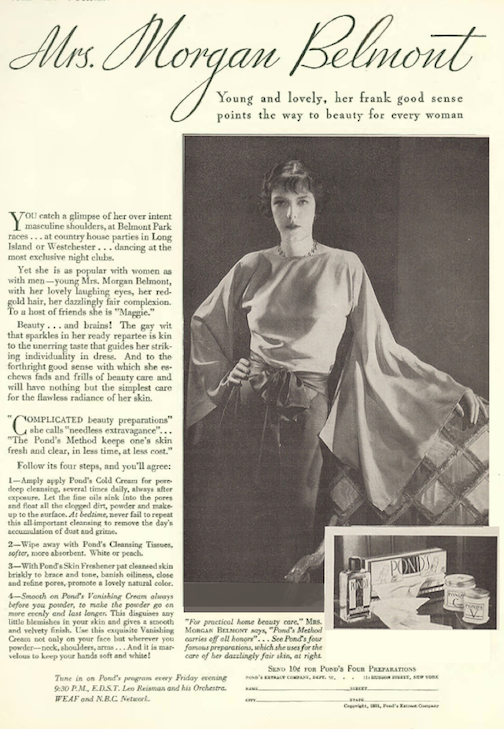
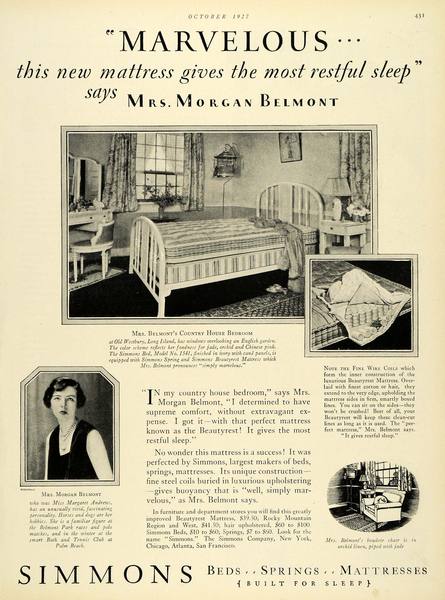
…and Pond’s continued its parade of rich society women to sell its cold cream…here we are presented with “Mrs. Morgan Belmont,” aka Margaret Frances Andrews (1894–1945), a Newport socialite and prize-winning show dog breeder…

Andrews didn’t limit herself to cold cream, here appearing in a 1927 ad for Simmons mattresses…

Margaret Frances Andrews was a noted dog breeder, seen above at the Newport Dog Show around 1915; below, Andrews had a small role in the 1920 Mary Pickford film Way Down East. Andrews—seen at left, she was credited as “Mrs. Morgan Belmont.”

…and we move on to this sad little ad from the back pages, featuring something called “Peeko,” which apparently mimicked the flavors of Rye, Gin and Rum…it must have tasted awful…

…our cartoons feature Perry Barlow, and I can’t quite tell if this guy is drinking a soda or some bootleg gin, which was often sold at select gas stations…

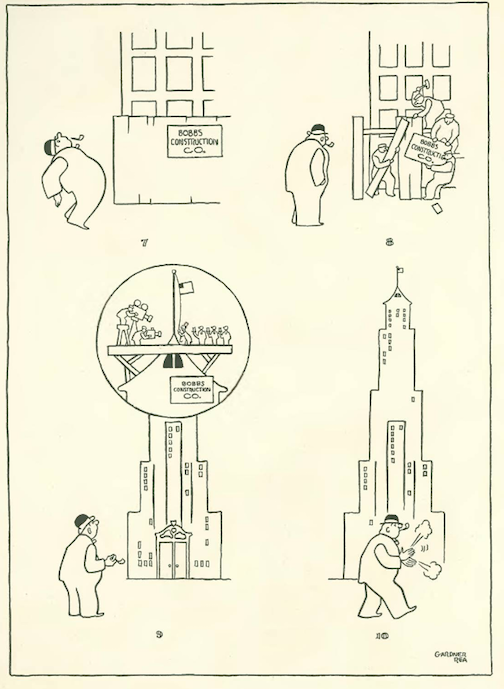
…a two-page sequence from Gardner Rea

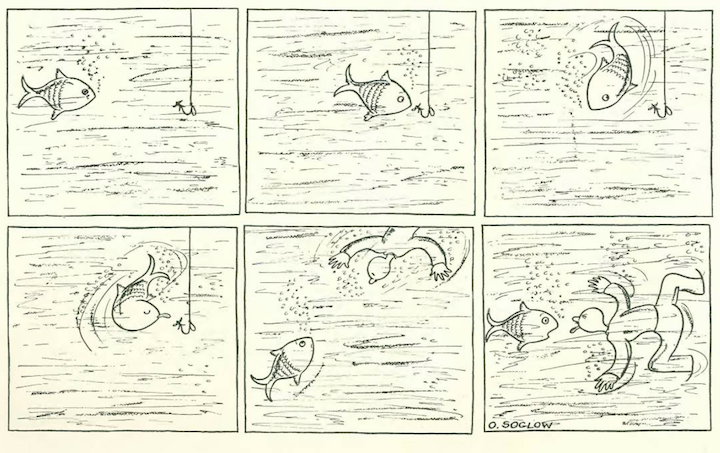
Otto Soglow went fishing…

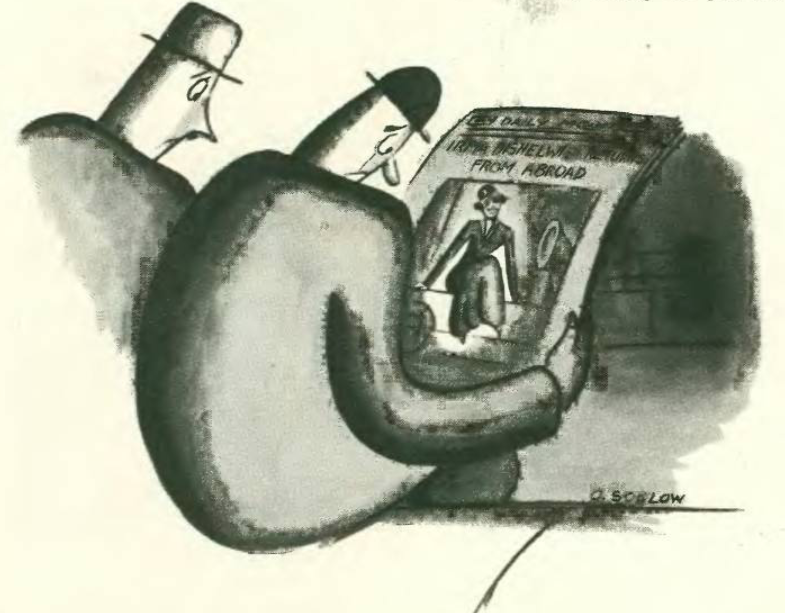
…and commiserated with a couple of unemployed guys whose plight is ignored by the celebrity-obsessed media…

Alan Dunn hit the lecture circuit…

Kemp Starrett sketched some wink-wink, nudge-nudge at the men’s store…

…and we close with James Thurber, and the trials of our elders…

Next Time: Bonfire of the Vanities…