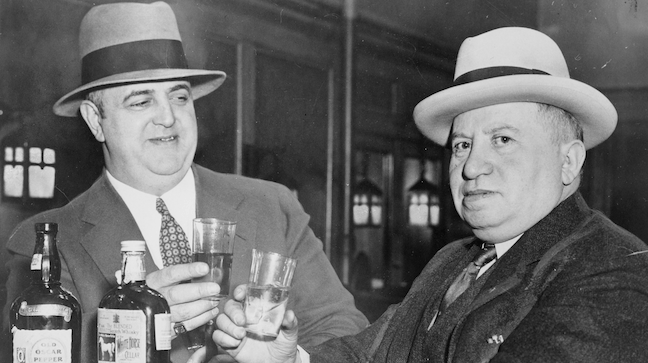
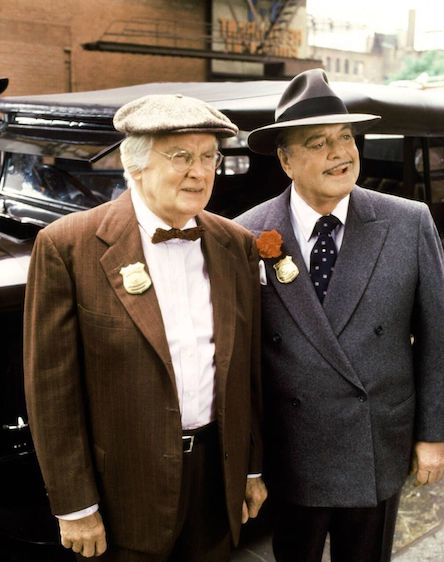
Above: Former Prohibition agents Isidor "Izzy" Einstein (right) and Moe W. Smith meet at a New York City bar in 1935. Known for their clever disguises and unorthodox tactics, from 1920 to 1925 the duo confiscated roughly five million bottles of illicit liquor and arrested 4,932 people. (Wikipedia)
Legendary Americans come from all walks of life—sports stars, movie actors, political and business leaders—and they also come from unlikely places; take for example a pushcart peddler and a cigar store owner who became national celebrities for their exploits during the first years of Prohibition.
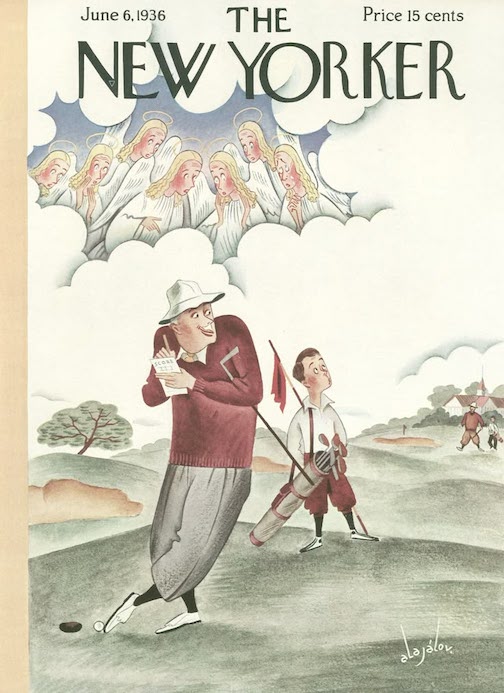
June 6, 1936 cover by Constantin Alajalov.
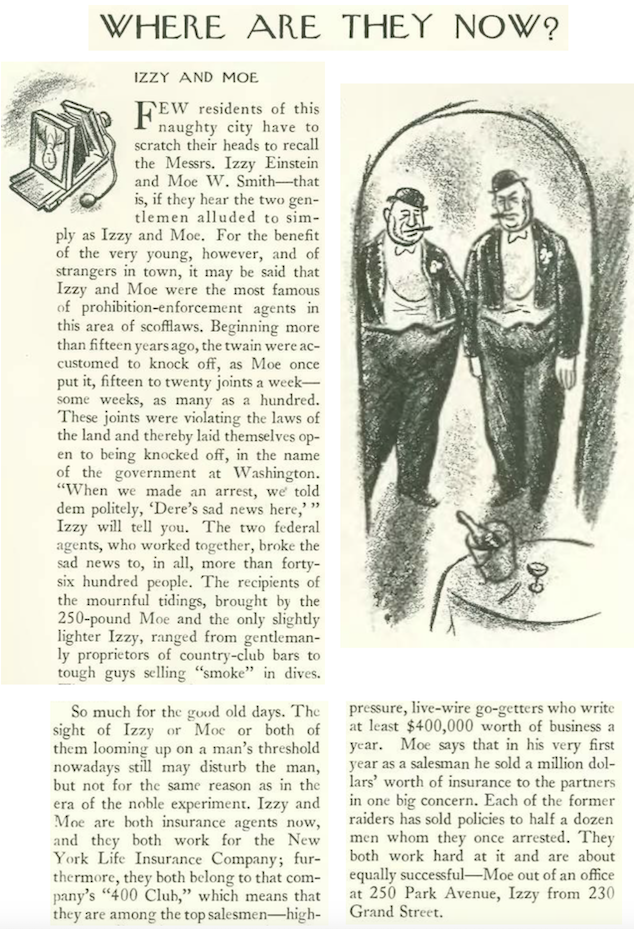
Prohibition agents Isidor “Izzy” Einstein (1880–1938) and Moe W. Smith (1887–1960) were known for their clever disguises, but the author of their “Where Are They Now?” profile was also in disguise—the piece was written by James Thurber under the pseudonym Jared L. Manley.
Einstein was 40-year-old pushcart peddler and postal clerk when he applied for a job as an enforcement agent at forty dollars a week. Although the 5-foot-5, 225 pound Einstein wasn’t the agency’s “type,” he convinced the feds that there was an advantage to not looking the part (the Austrian-born Einstein also spoke six languages). After landing the job, he asked if his friend, cigar store owner Moe Smith, could join him, since “he doesn’t look like an agent, either.” Some brief excerpts from part one of “Where Are They Now?”
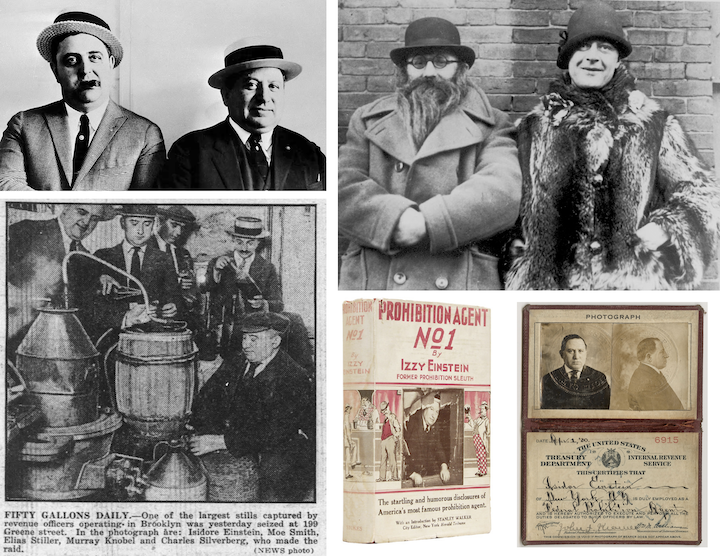
TRICKSTERS…Clockwise, from top left: Isidor “Izzy” Einstein (right) and Moe W. Smith; the pair sported hundreds of disguises (Einstein on the left); Einstein’s badge and his bestselling 1932 book Prohibition Agent No 1; Daily News clipping from September 1920 showing results of a raid—Izzy and Moe are at right and left. (history.com/Library of Congress/Wikipedia/goodreads.com/nydailynews.com)
In her 2012 article for Smithsonianmagazine (“Prohibition’s Premier Hooch Hounds”), Abbott Kahler notes that the agents were victims of their own success. “Superiors grew to resent their headlines, and other agents complained that their productivity made their own records look bad…In November 1925, Izzy and Moe were among 35 agents to be dropped from the force.” Both men went on to successful careers as insurance salesmen. Want to know more? Read Kahler’s excellent account of the duo at the Smithsonian magazine’s website.
TRIBUTE ON THE TUBE…In 1985 Art Carney and Jackie Gleason starred in CBS’s made-for-television film, Izzy & Moe, which was loosely based on the exploits of Izzy Einstein and Moe Smith. (imdb.com)
* * *
At the Movies
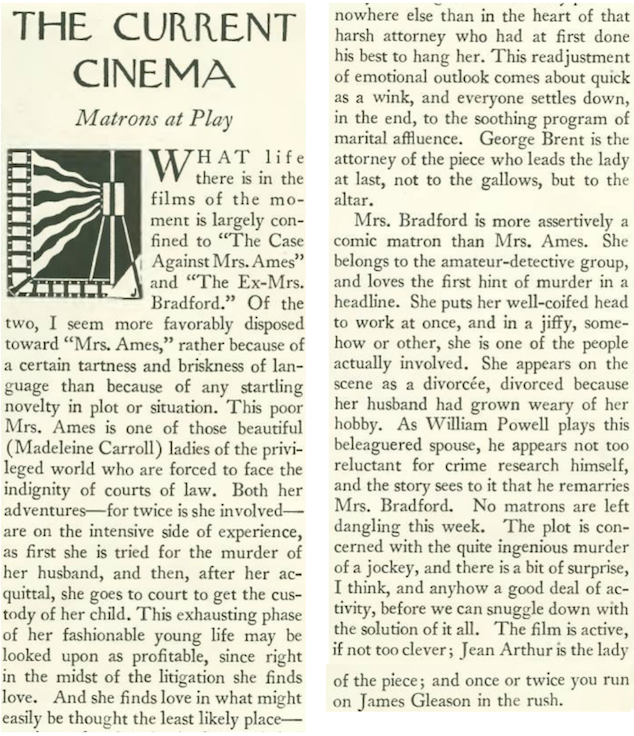
Two of the better films playing in Manhattan cinemas featured murders and matrons, the matrons played by Britain’s top female screen star, Madeleine Carroll, and America’s queen of screwball comedy, Jean Arthur. Critic John Mosher observed that their films were the only ones with any “life.”
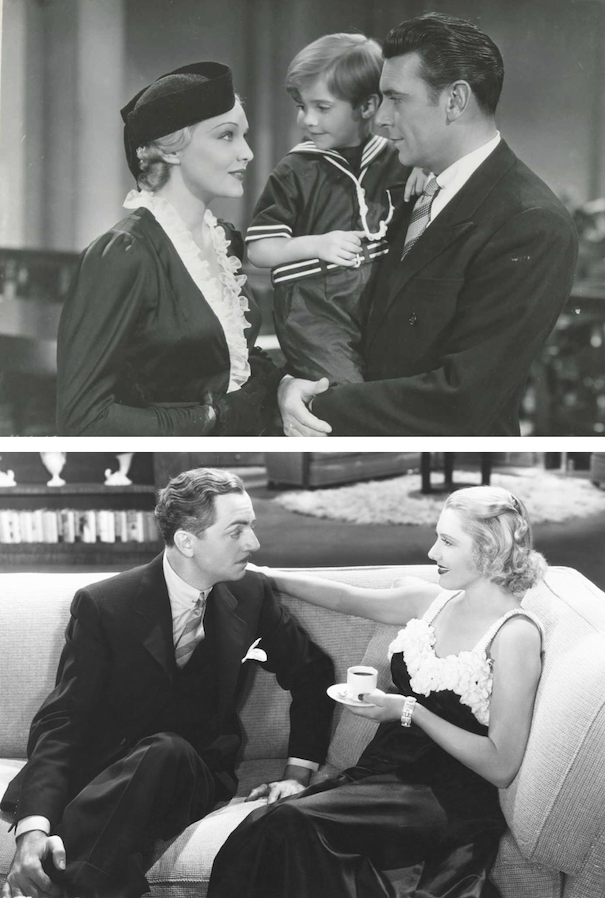
TRADING GALLOWS FOR A GROOM…Top, Madeleine Carroll portrayed a “lady of privilege,” accused of murder, who falls in love with the prosecuting district attorney (George Brent) in The Case Against Mrs. Ames—Scotty Beckett played Carroll’s son; below, Jean Arthur and William Powell in the comedy-mystery The Ex-Mrs. Bradford.(imdb.com/mikestakeonthemovies.com)
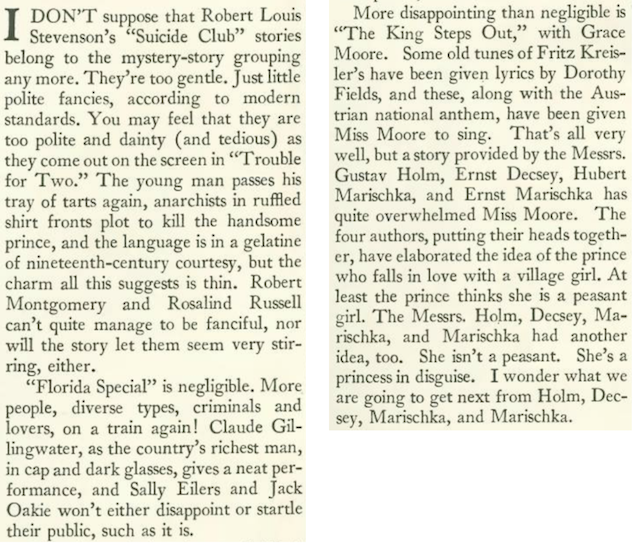
Other films reviewed by Mosher were rated as “negligible” and “disappointing,” despite their talented casts…
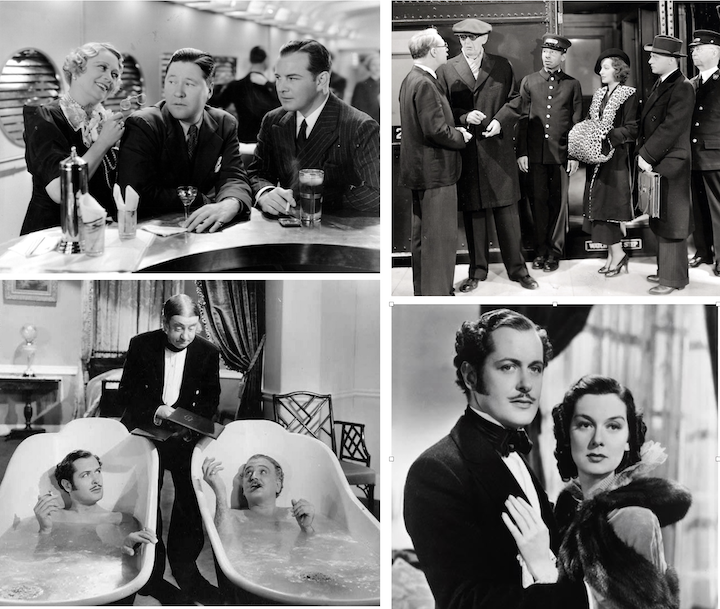
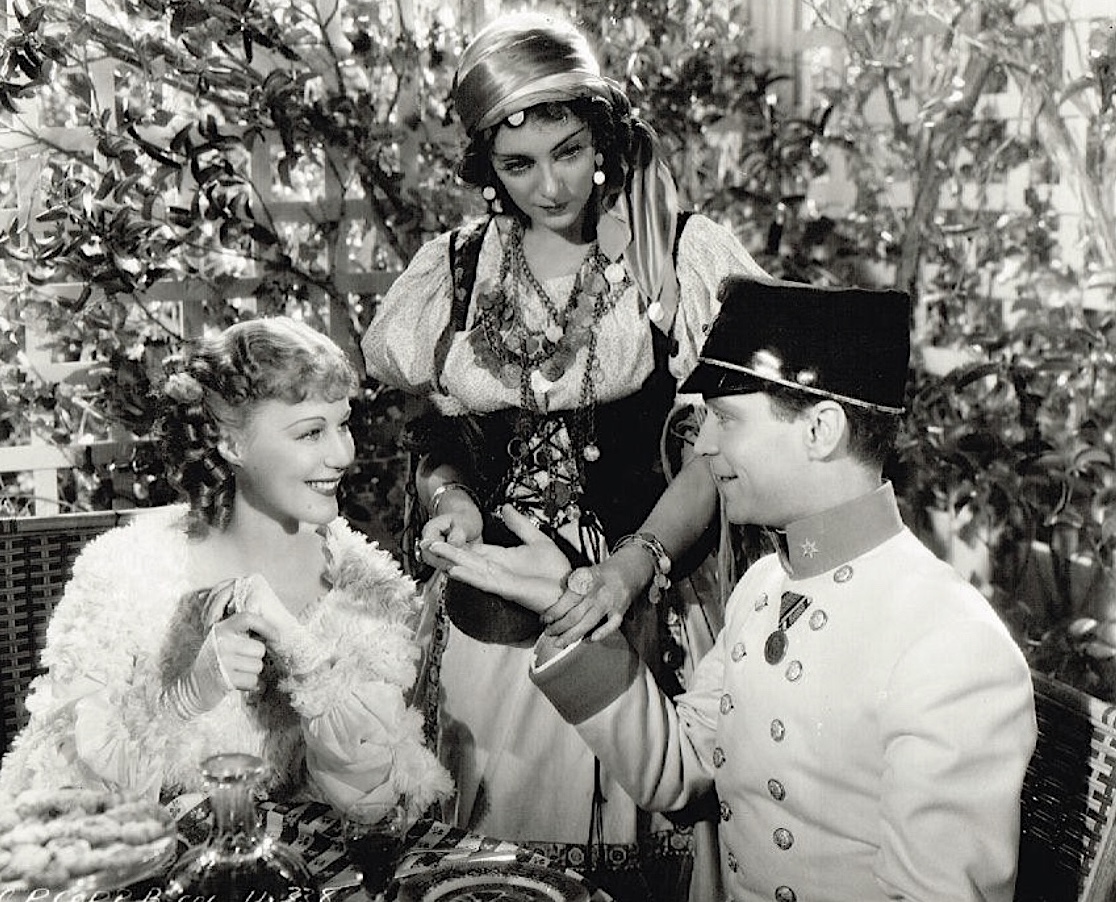
TRAIN SPOTTING…Clockwise from top left: Esther Howard portrayed a “flirtatious dowager” who worked her charms on Jack Oakie (center) in Florida Special; Sally Eilers prepares to board the Florida Special with Dwight Frye and Claude Gillingwater; Robert Montgomery and Rosalind Russell in Trouble for Two; Montgomery (left), Leonard Carey, and Frank Morgan in Trouble for Two. (pinterest.com/imdb.com)THE OLD PRINCESS IN DISGUISE TRICK…From left, Grace Moore, Eve Southern, and Franchot Tone in The King Steps Out. (IMDb.com)
* * *
From Our Advertisers
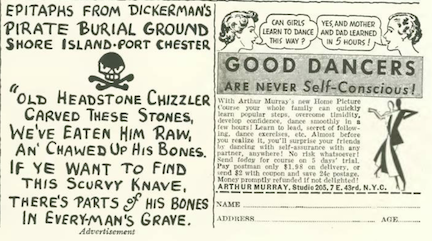
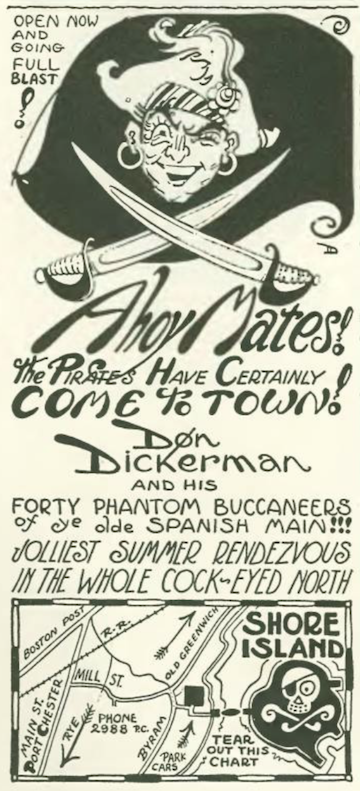
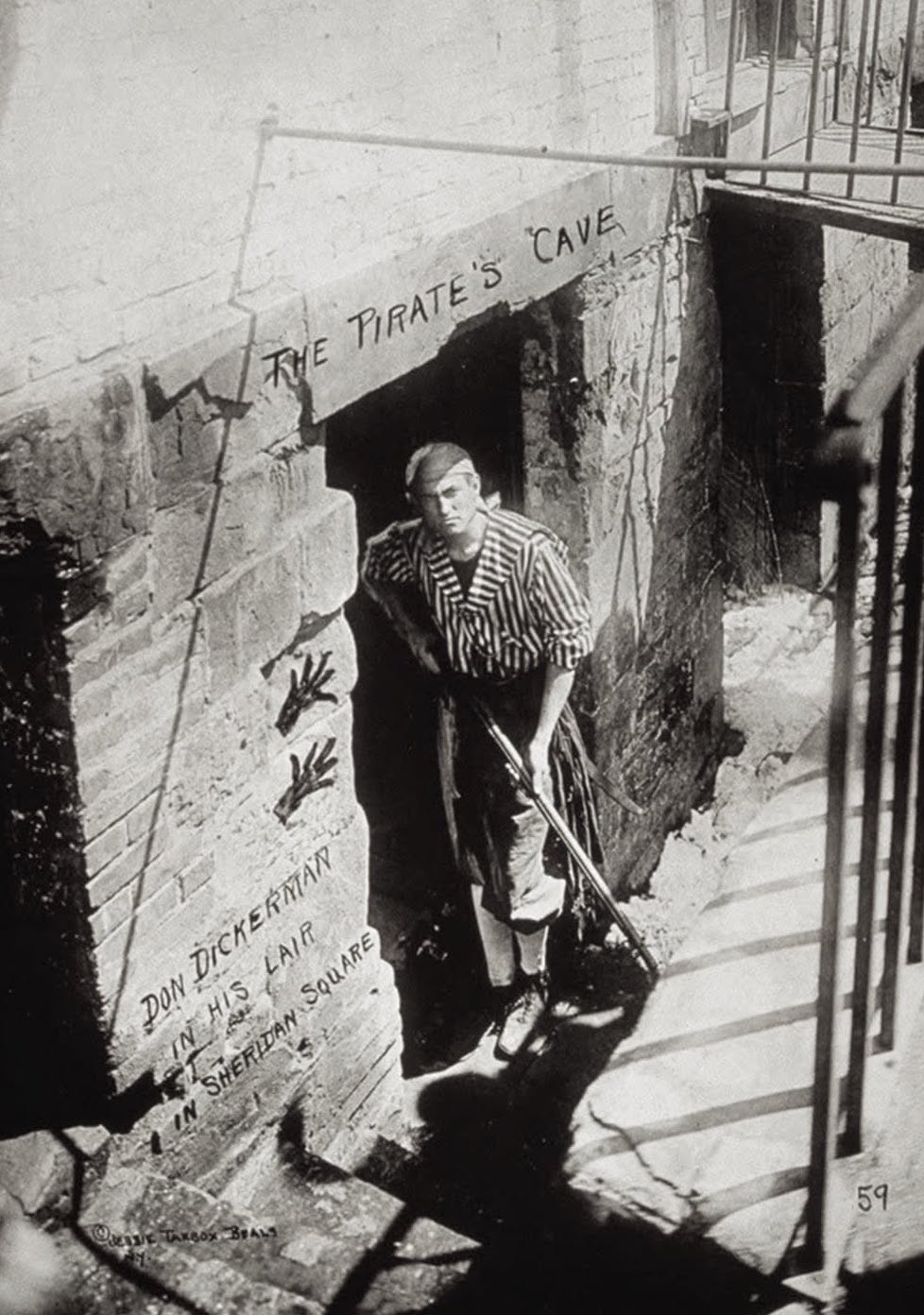
Last week Lois Long mentioned the return of famed Greenwich Village restaurateur and Sheridan Square funboy Don Dickerman. The June 6 issue featured two back-of-the-book ads placed by Dickerman that promoted his latest venture at Port Chester…this ad was on the bottom of page 75…
…and turning the page, you’d find this at the bottom of page 76…
WHERE IT ALL BEGAN…In 1916 Don Dickerman (1893–1981) opened a tearoom called the Pirate’s Cave at 133 Washington Place in Greenwich Village. The 6-foot-6 artist and entrepreneur was famous for his many themed establishments as well as for his eccentricities. Obsessed with pirate life, he dressed in full pirate gear in both public and private life. (facebook.com)
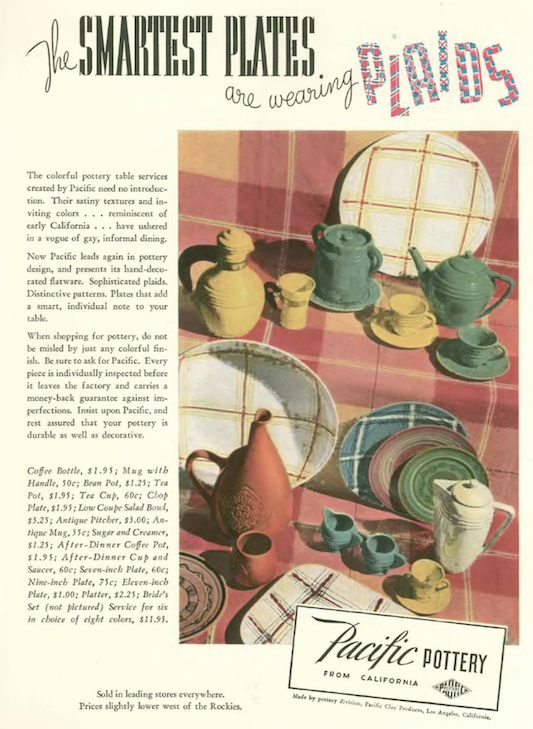
…Pacific Pottery was among firms in the 1930s marketing informal dinnerware featuring vibrant glazes and Art Deco streamline designs…
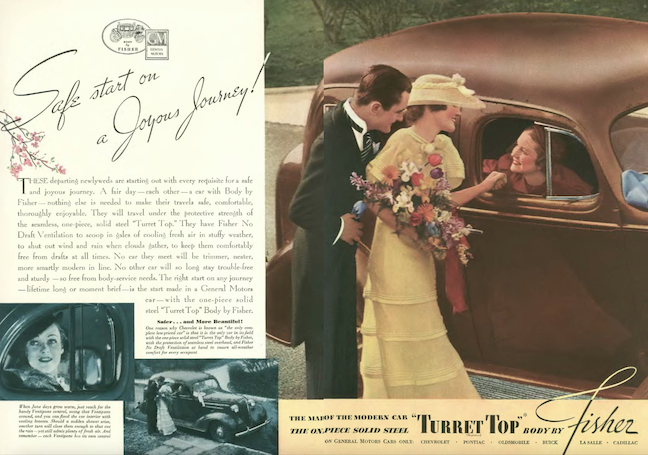
…you don’t hear much about the “June Bride” these days, but 1930s advertisers played up the tradition to sell everything from fashions to refrigerators…here the folks at Fisher made sure they connected their solid steel “Turret Top” to the safety of newlyweds…
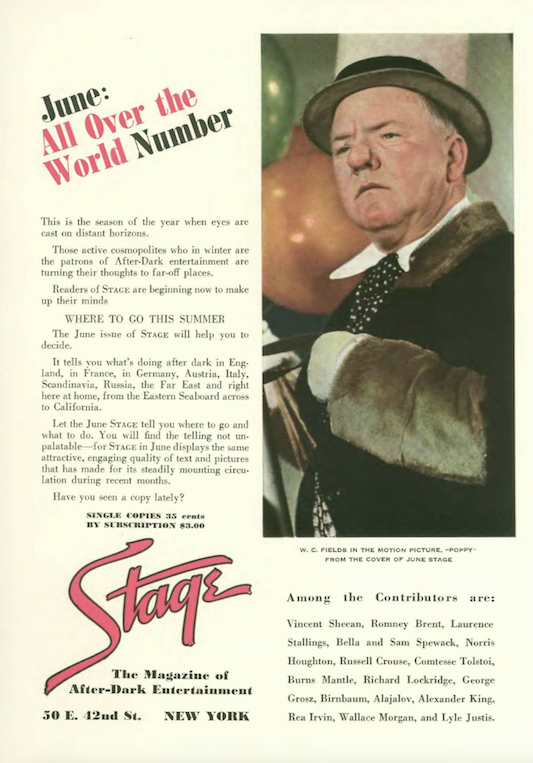
…Stage magazine promoted its extensive coverage of “After-Dark” entertainments at home and abroad…
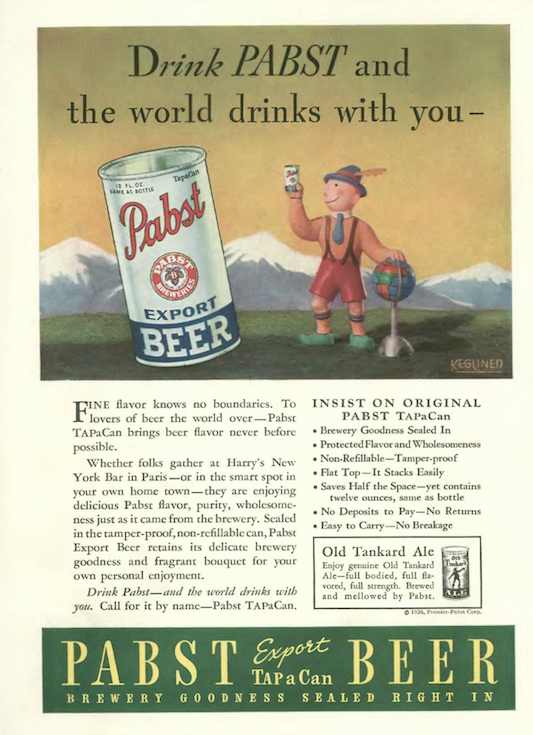
…the brewers of Pabst joined a handful of other beer companies promoting their product in newfangled cans…
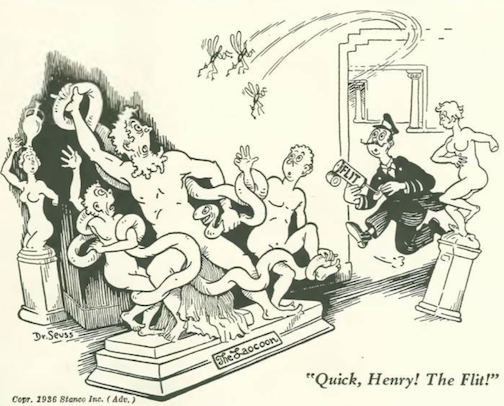
…Dr. Seuss continued to find new gags to promote Flit insecticide…
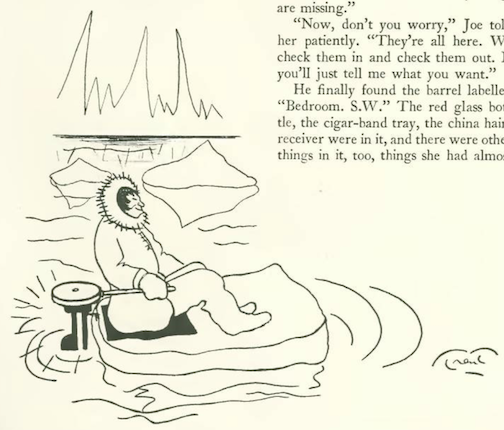
…James Thurber kicked things off for the issue’s cartoonists…
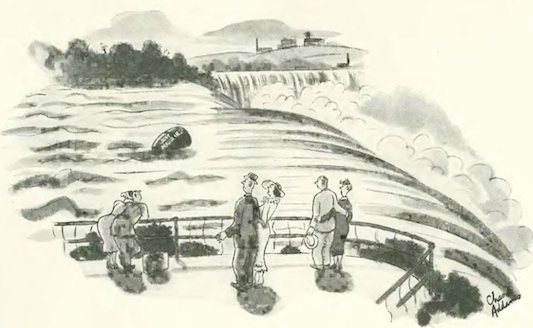
…Charles Addams took in the sites along with some June brides at Niagara Falls (the barrel in the water reads “Just Married”)…
…W.P. Trent contributed this caption-less cartoon…
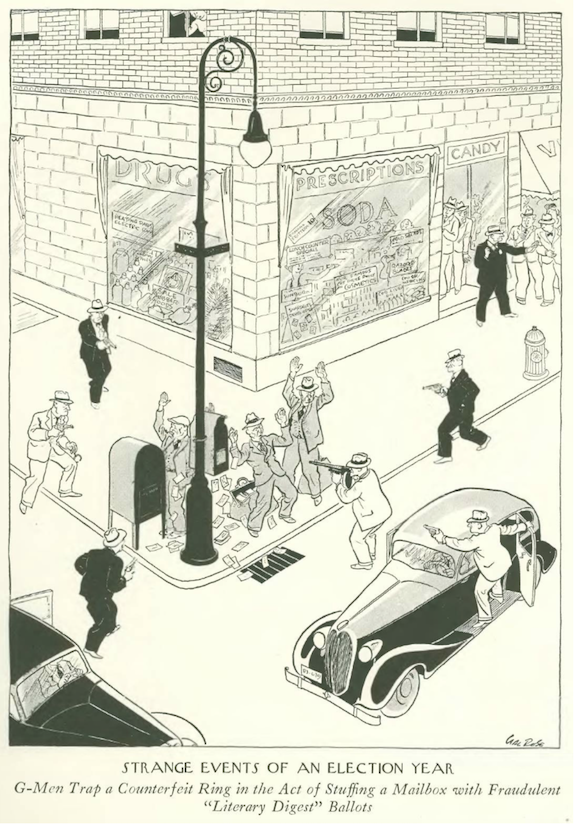
…Carl Rose continued to document the strange happenings of an election year…
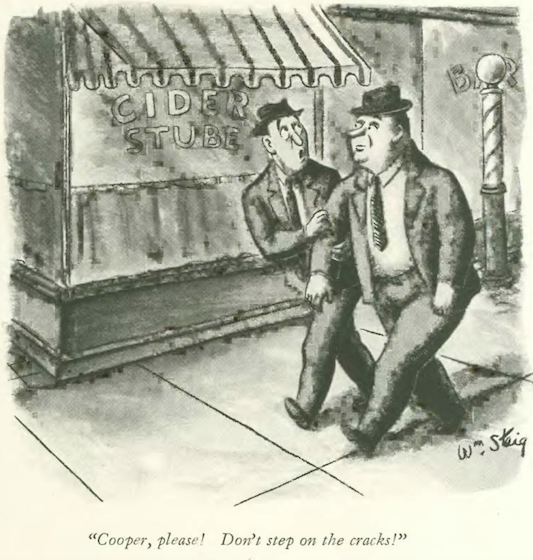
…William Steig got superstitious…
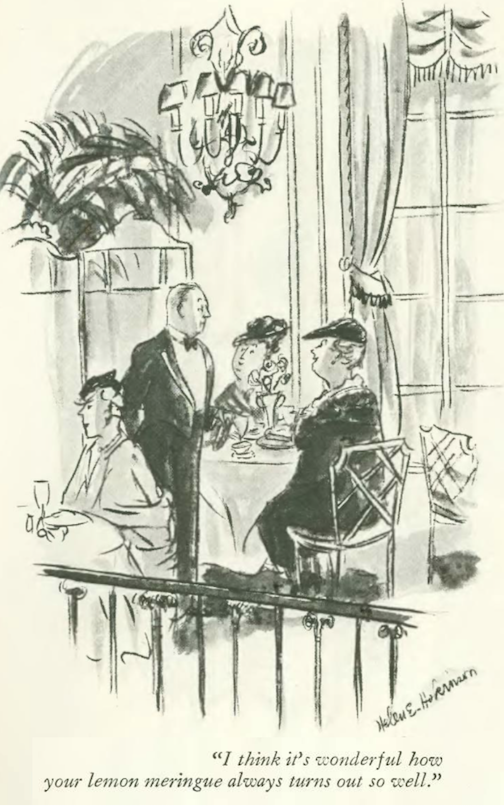
…one of Helen Hokinson’s “girls” gave props to lemon meringue…
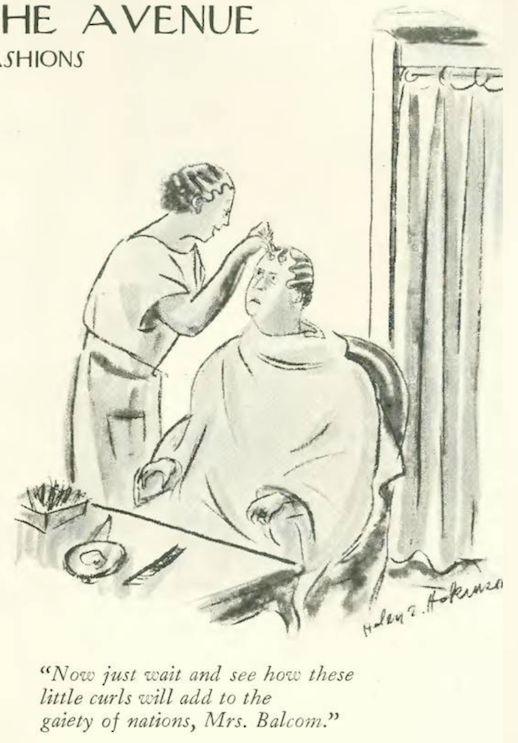
…and Hokinson again, and an unlikely claim at the salon…
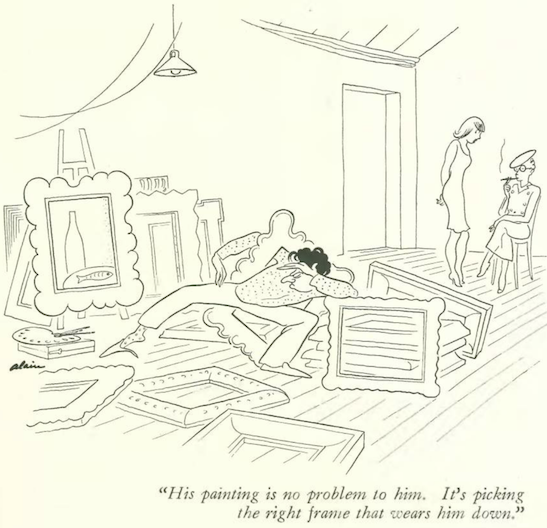
…Alain presented an artist’s greatest challenge…
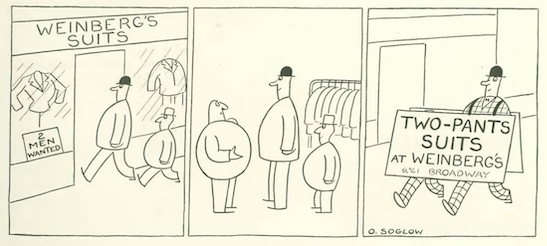
…Otto Soglow gave us an ideal sandwich board duo…
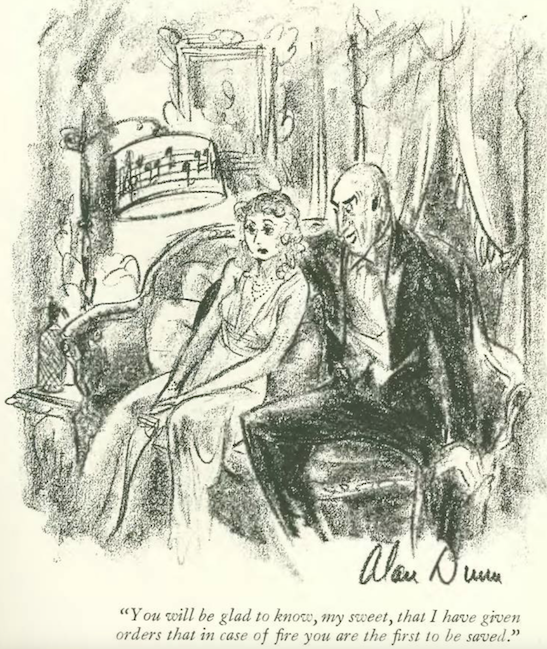
…Alan Dunn illustrated a “selfless” act…
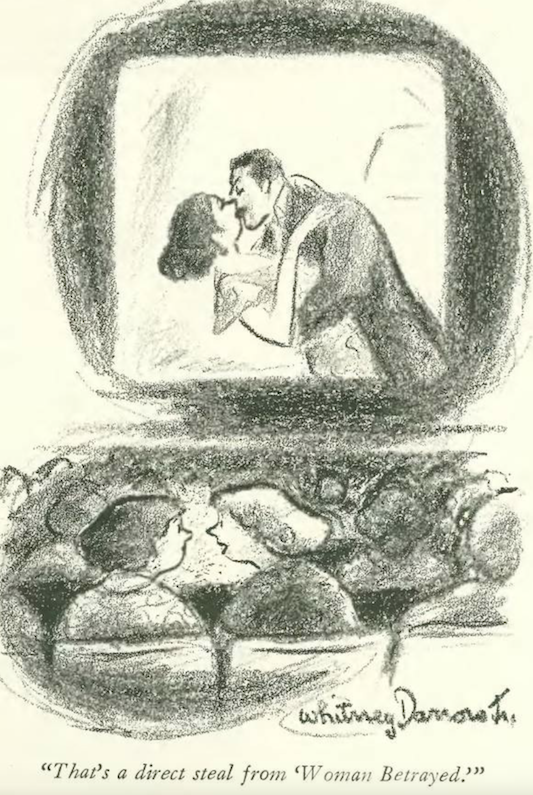
…a moviegoer found a derivative moment at the cinema, per Whitney Darrow Jr…
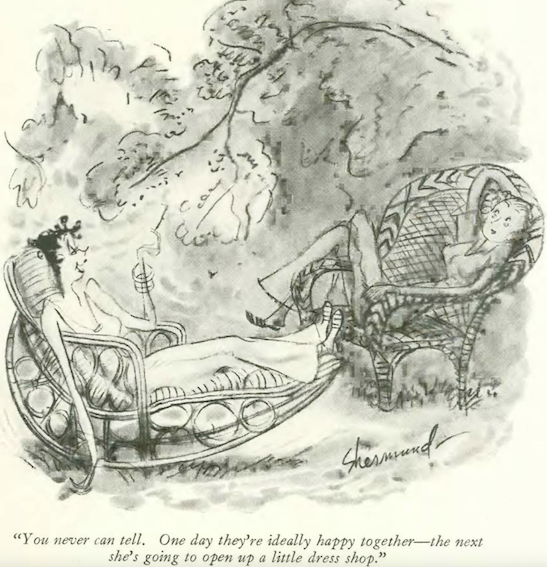
…and we close with some idle chat, courtesy of Barbara Shermund…
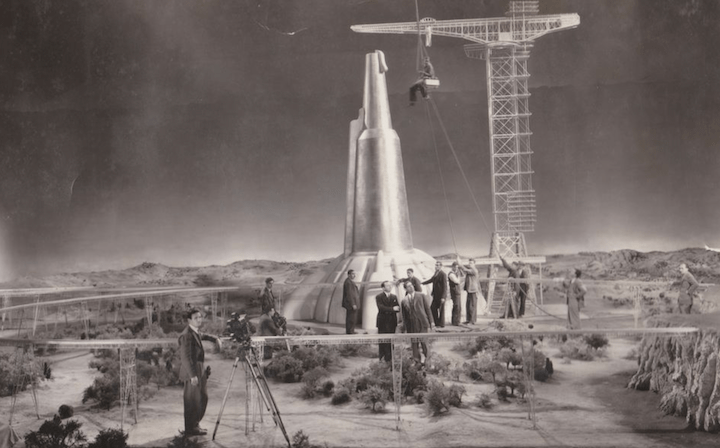
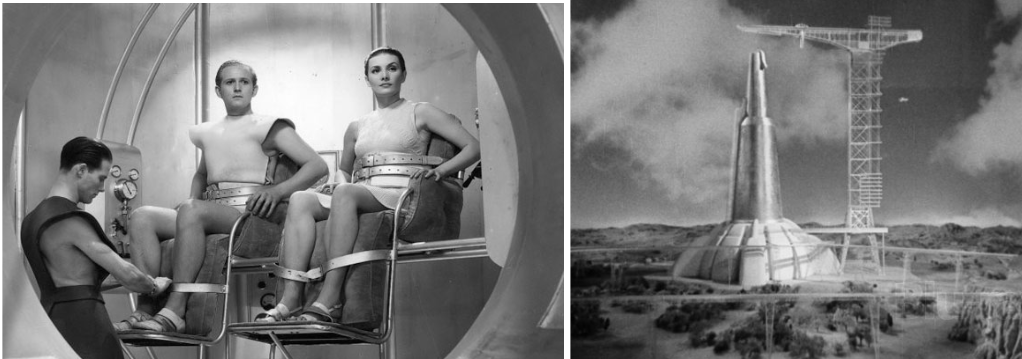
Above: Behind the scenes production photo of the space gun used to launch a manned projectile to the moon in Things to Come. (Instagram)
One of the most anticipated films of the 1930s was the British production of Things to Come. Loosely based on the 1933 science fiction novel by H.G. Wells,The Shape of Things to Come, the film was an extraordinarily ambitious and expensive production featuring a huge cast and elaborate sets, both full-scale and in miniature.
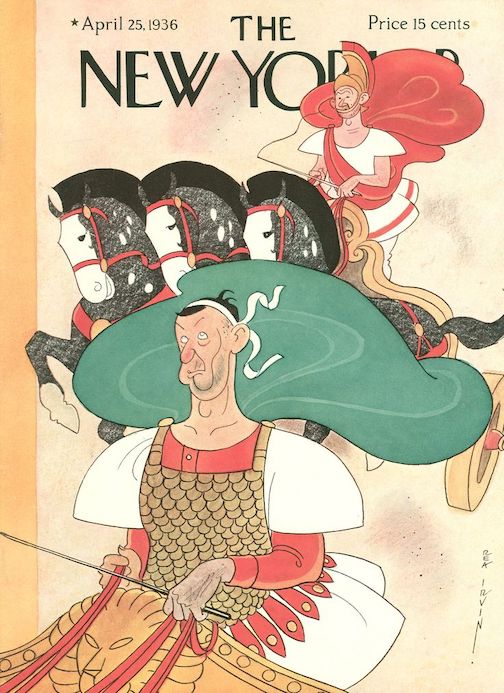
April 25, 1936 cover by Rea Irvin.
Critic John Mosher wasn’t quite sure what to make of Things to Come, seizing on the film’s promise to end the common cold.
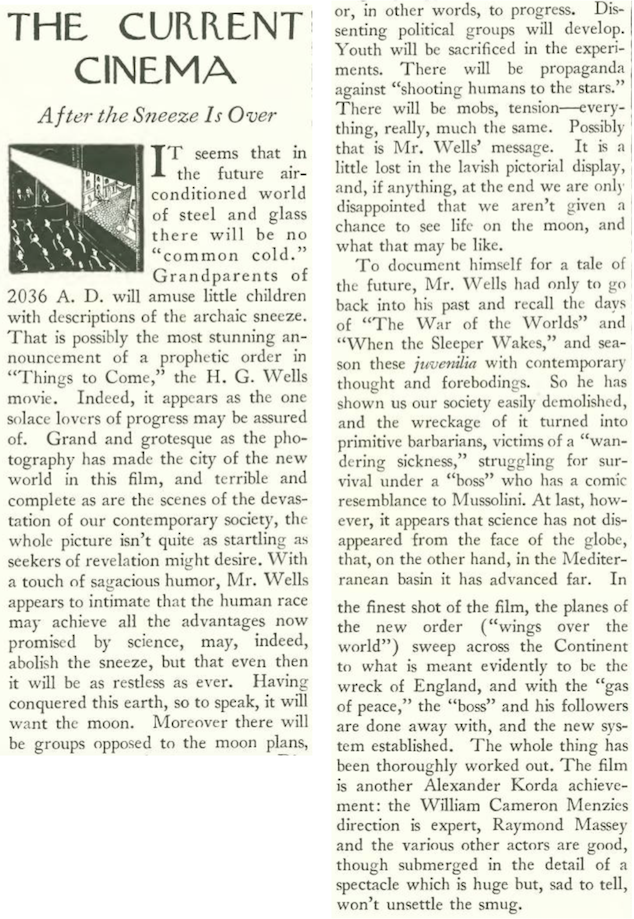
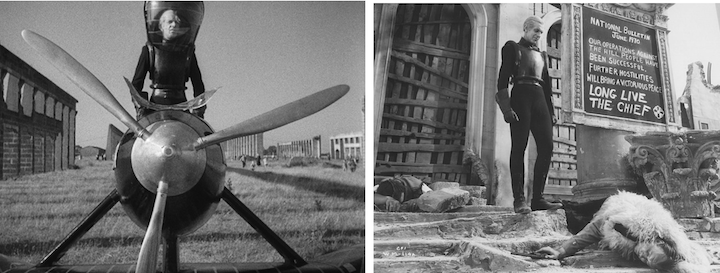
CLEANING CREW…A businessman in Everytown in the 1940s, John Cabal (Raymond Massey) returns in the 1970s to find his city in ruin and governed by a warlord. As a member of a secret organization called “Wings Over the World” (comprised of the last surviving band of engineers and mechanics), Cabal orders his organization to send giant flying wings over Everytown and saturate the population with a “Gas of Peace.” Not only does the gas make the population tranquil, it also kills the warlord, played by Ralph Richardson (right). (midnightonly.com/instagram.com)
In a review for The Criterion Collection, Geoffrey O’Brien notes that the film’s shocking scenes of war were shown to an audience “in active denial, many of them, of the possibility of such things coming to pass in the near future.”
But an antiseptic city with a population made docile by a “Gas of Peace” didn’t appear to be something one would look forward to either. O’Brien points to Jorge Luis Borges’ remarks regarding Things to Come: “The heaven of Wells and Alexander Korda, like that of so many other eschatologists and set designers, is not much different than their hell, though even less charming.” Borges dismissed the notion that science and technology would be the rallying force against tyranny: “In 1936, the power of almost all tyrants arises from their control of technology.”
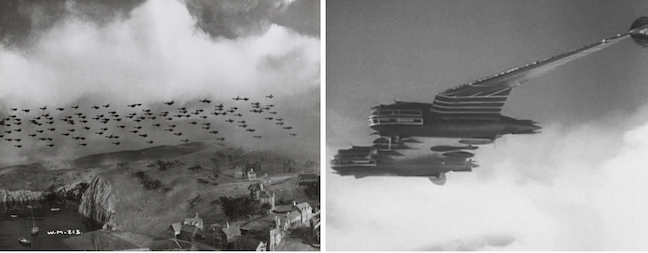
WAR AND PEACE…At left, bombers lay waste to Everytown in the 1940s, seemingly forecasting The Blitz of London in 1940-41; at right, decades later, “Wings Over the World” sends giant flying wings (right) over Everytown to saturate the population with a “Gas of Peace.” (Illinois.edu/facebook.com)UTOPIA?…After years of rebuilding, a new, underground Everytown emerges in 2036. The set (left) was designed by director William Cameron Menzies and Bauhaus artist Laszlo Moholy-Nagy. Above, transportation included autogyros; both men and women wore futuristic togas, including John Cabal’s great-granddaughter Catherine Cabal (Pearl Argyle). Note the acrylic furniture, ubiquitous in the future scenes of the film. (midnightonly.com/facebook.com/YouTube)
O’Brien concludes: “There is no way any audience, in the 1930s or now, would be likely to accept Raymond Massey’s Oswald Cabal as an empathetic spokesperson for the human race. He is essentially the chairman of the board of a quasi-fascist ruling elite—and not so very far from the idea that Wells, at best ambivalent about democracy, in fact had in mind.”
In all fairness, I should note that Massey did not like his character’s “heavy-handed speeches” that lacked human emotion. He complained H.G. Wells prioritized cold scientific ideals over personal character depth. “For heart interest, Mr. Wells hands you an electric switch,” Massey stated.
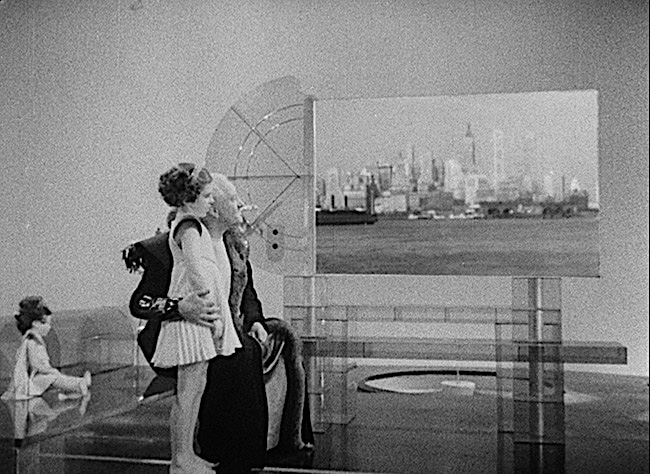
WISHES SOMETIMES COME TRUE…In the movie, a little girl in the year 2036 receives a history lesson from her great grandfather (including a video of 1936 New York), and she expresses delight that people will “keep on inventing things and making life lovelier and lovelier.” The little girl was played by eight-year-old Anne McLaren. The great grandfather was played by Charles Carson (1885–1977). (midnightonly.com)DAME McLAREN…In real life that little girl, Anne McLaren (1927–2007), did make life better, becoming a leading figure in developmental biology and paving the way for other women in science. Her work also helped lead to the development of human invitrofertilization. Dame Anne Laura Dorinthea McLaren received many honors for her research and ethical contributions. (YouTube.com/Wikipedia)POW! TO THE MOON…At left, Catherine Cabal (Pearl Argyle) and fellow scientist Maurice Passworthy (Kenneth Villiers) prepare to fly around the moon, launched from a gigantic space gun (right). (theguardian.com/YouTube)
Interestingly, Raymond Massey (1896–1983) and most of the film’s cast would live to see an actual moon landing in just 33 years. Most of them would also be involved in some way in the Second World War, Massey being wounded as part of the Canadian regiment.
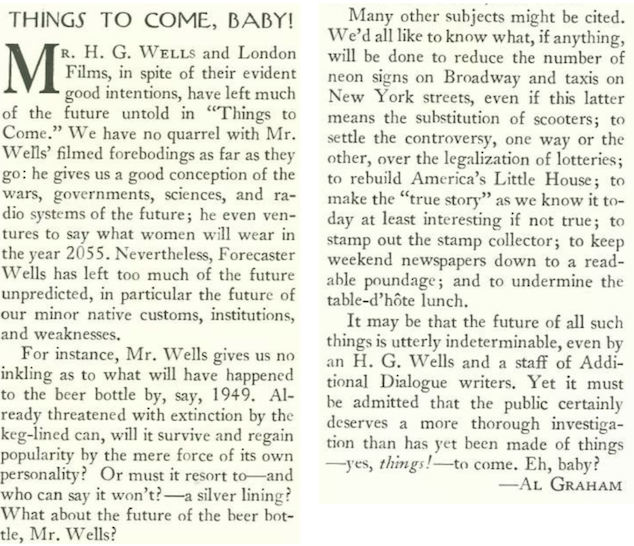
American writer and editor Al Graham (1905–1972), who contributed a number of poems and “Talk of the Town” pieces to The New Yorker in the Thirties and Forties, offered some thoughts regarding Things to Come. Here are excerpts of the first and last parts of his piece:
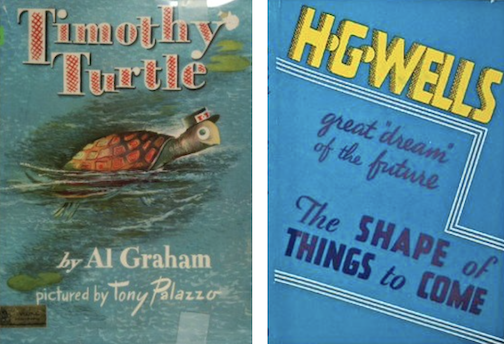
SLOW AND STEADY…Al Graham is perhaps best known for his 1930s humorous verse and children’s literature such as Timothy Turtle (1946) and The Rhymes of Squire O’Squirrel (1963). At right is a cover of the first edition of H.G. Wells’The Shape of Things to Come. (Wikipedia)
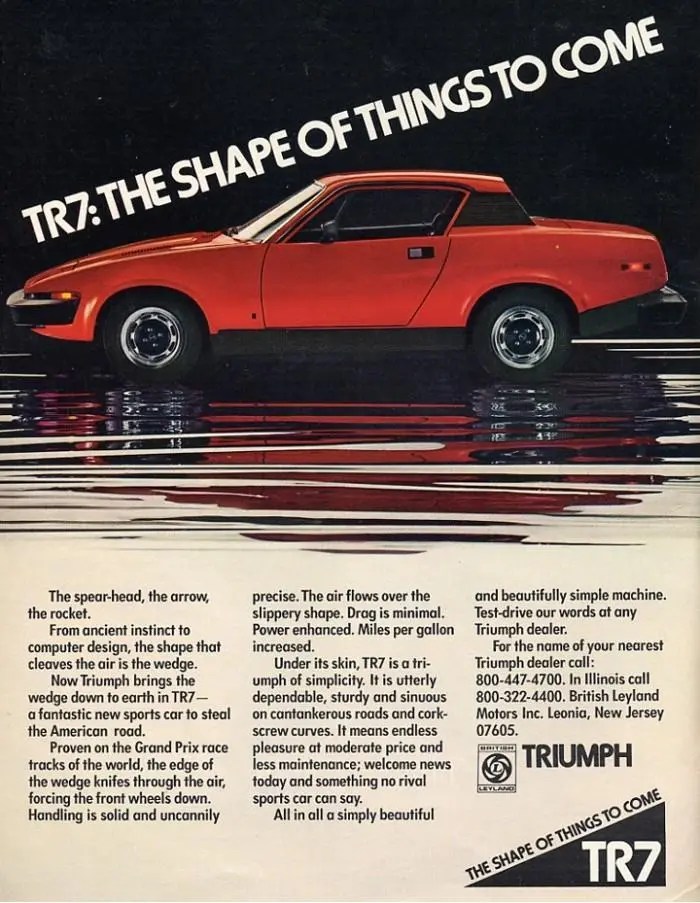
Incidentally, the British automaker Triumph used Wells’ title in a 1970s ad campaign for the TR-7…
(The Daily Drive)
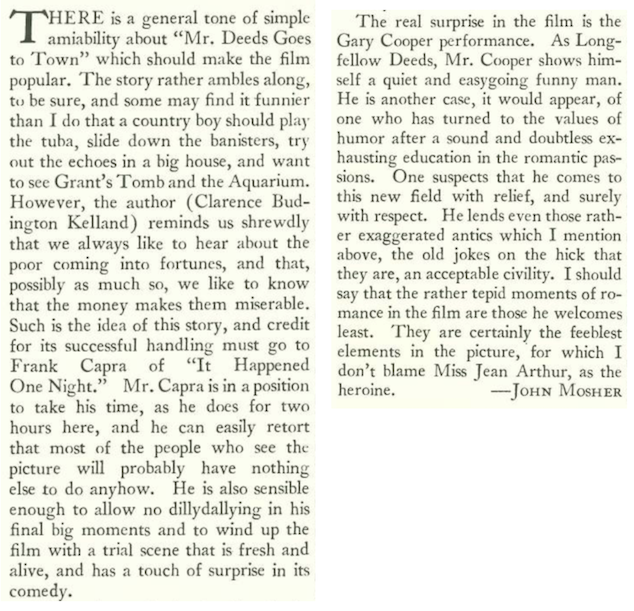
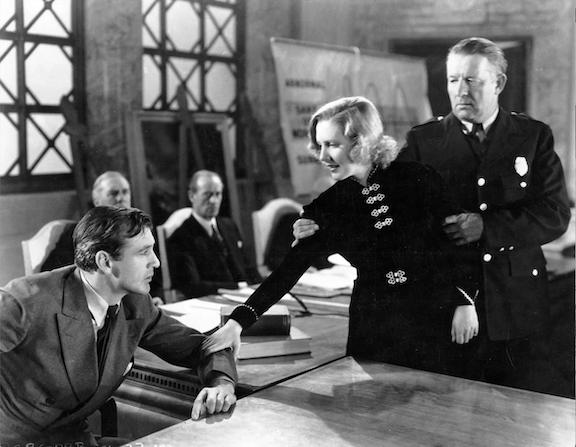
While we are talking movies, Mosher also reviewed Frank Capra’sMr. Deeds Goes to Town. Films such as Mr. Deeds and It’s a Wonderful Life were Capra’s “love letters to an idealized America—a cinematic landscape of his own invention,” wrote social critic Morris Dickstein. Or as actor/director John Cassavetes once observed: “Maybe there really wasn’t an America, it was only Frank Capra.” Whatever it was, Mr. Deeds would win Capra his second Oscar for Best Director (he would win three in all, plus a fourth for a World War II documentary).
HAPPY ENDING…Mr. Deeds (Gary Cooper) finds love and salvation with Jean Arthur in Mr. Deeds Goes to Town. (britannica.com)
* * *
Ah-Choo!
Those familiar with E.B. White’s writings are likely also familiar with his lifelong struggle with hay fever, or “catarrh” as it was also referred to in those days. White notably wrote about his condition in a 1938 New Yorker essay, “Daniel Webster, the Hay Fever, and Me.” He addresses the malady in his April 25, 1936 “Notes and Comment” column:
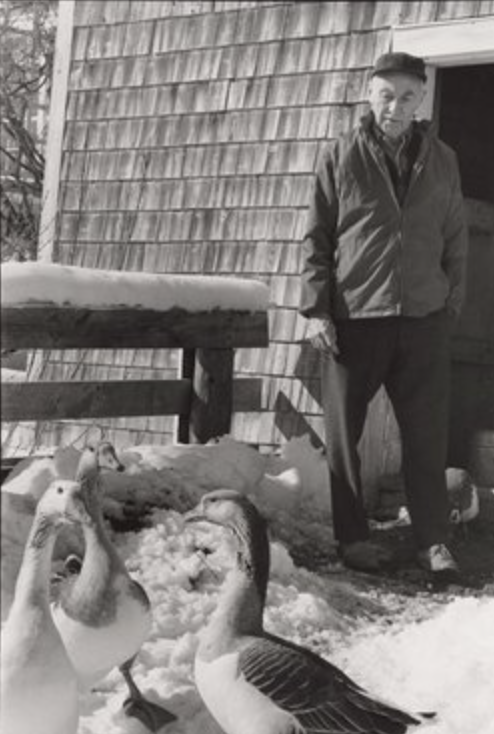
SNEEZING AND HONKING…Despite his allergies, E.B. White had a deep love for the countryside and nature. Although he grew up just outside New York City, he cultivated a love of rural life that was finally realized when he and wife Katharine bought a farm near Brooklin, Maine. Above is a 1974 photo (by Jill Krementz) of White at his Maine farm. (cornell.edu)
One of the more common and effective treatments for allergies in the Thirties was the benzedrine inhaler. The active ingredient was amphetamine. It was safe if inhaled, however some folks got the idea to crack open the inhaler and swallow the contents, which would induce a mind-altering effect (the amount of amphetamine in the inhaler was 250 milligrams, much greater than the five or ten milligrams in tablets prescribed for depression).
NOT SHIRLEY TEMPLE, however the marketers of the inhaler probably wanted consumers to make the connection. (mcgill.ca)
* * *
Before the Internet
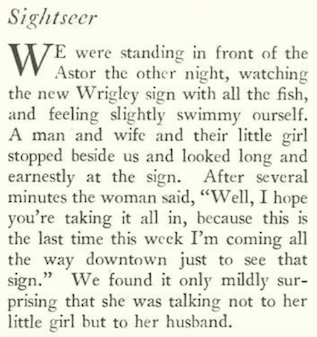
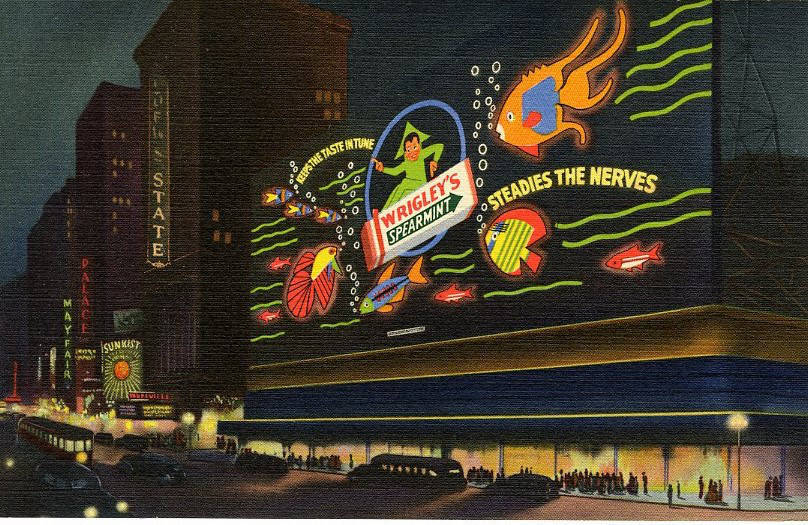
What did some folks do in the evening before modern-day distractions? According to “The Talk of the Town,” at least one man and his family loved to gawk at the new Wrigley sign in Times Square.
CHEW ON THIS…The Wrigley sign spanned the block on Broadway from 44th Street to 45th Street. Designed by artist Dorothy Shepard, the display featured fish blowing bubbles and was lit by 29,608 lamps and 1,084 feet of neon tubing. It was so large that its electrical power usage was estimated to be equivalent to a small city of ten thousand people. (Wikipedia)
* * *
From Our Advertisers
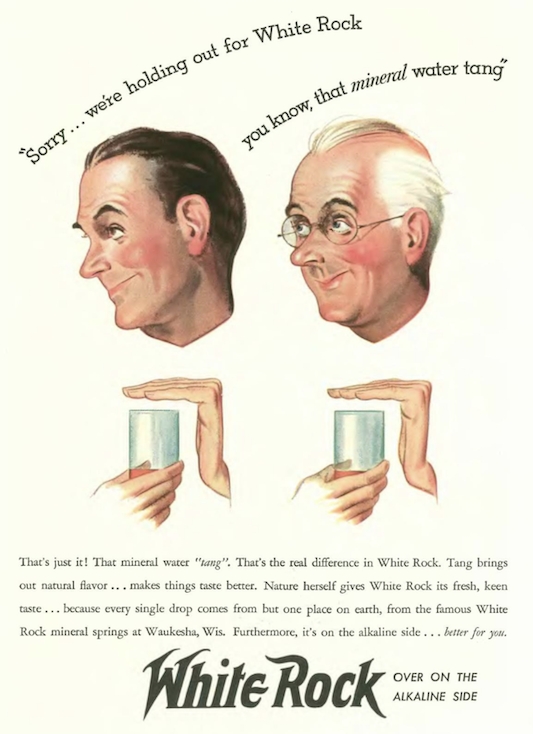
White Rock continued its series of brightly illustrated ads, this most likely the work of noted illustrator John Holmgren…
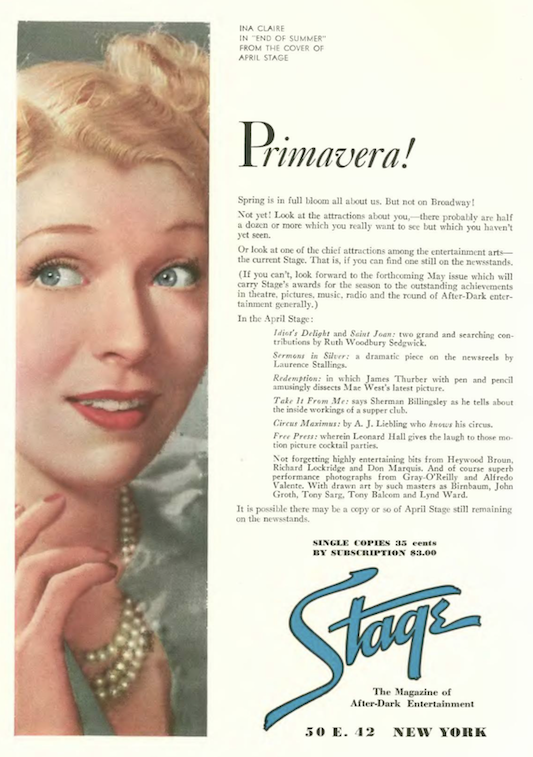
…Stage magazine continued to promote its star-studded content in full-page color ads…this one featured American stage and film actress Ina Claire…
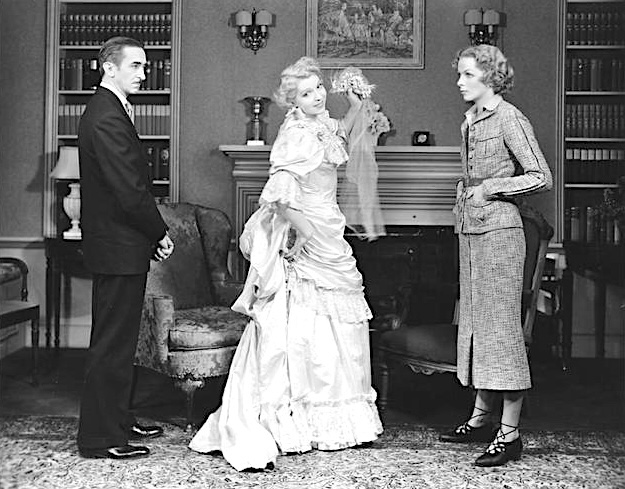
Ina Claire, center, with Osgood Perkins and Doris Dudley in End of Summer.(jacksonupperco.com)
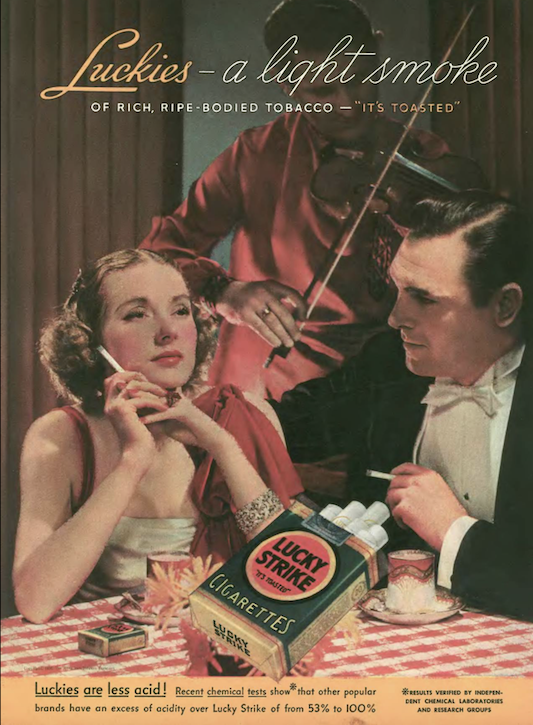
…ah, the pleasure of an after-dinner Lucky back in the day when you could still smoke indoors…
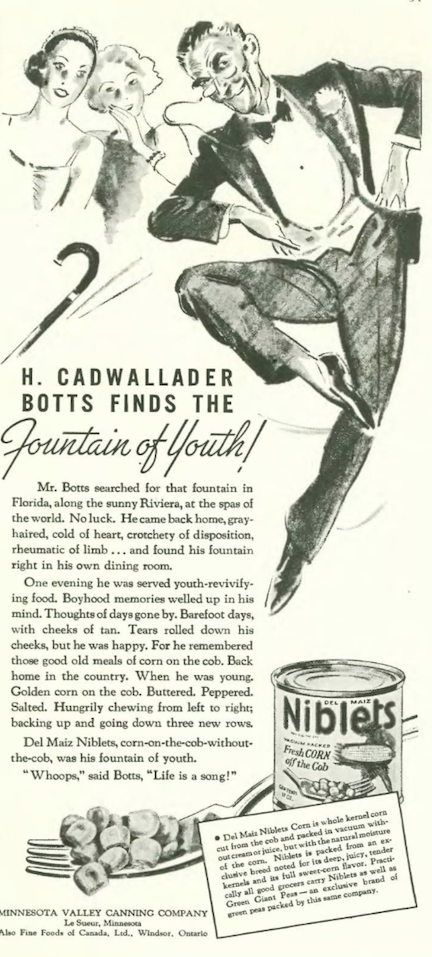
…another ad for Green Giant Niblets featuring a rich old toff who’s just over the moon about canned corn…
…these surreal Lyse Darcy ads for Guerlain really stood out in the magazine…
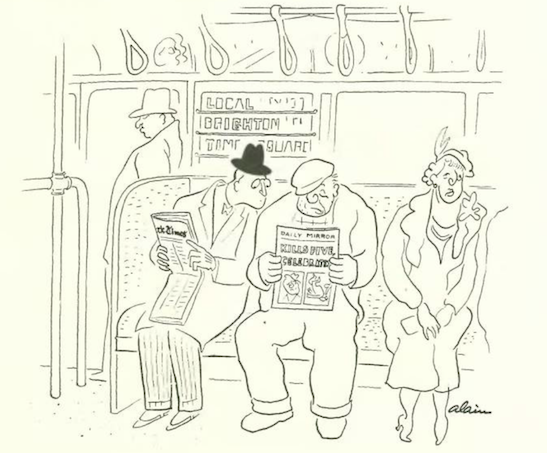
…speaking of standing out, who could resist the distraction of a tabloid, especially with the Gray Lady folded in one’s lap?…Alain illustrates…
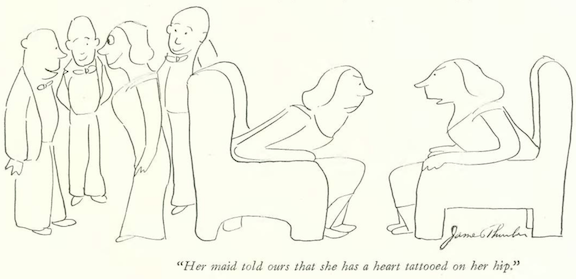
…and per James Thurber, who was immune to the charms of a woman with a heart tattooed on her hip?…
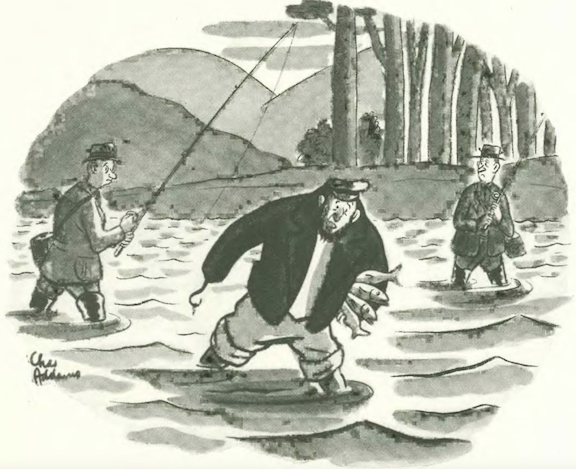
…Charles Addams showed us a man with a built-in fishing advantage…
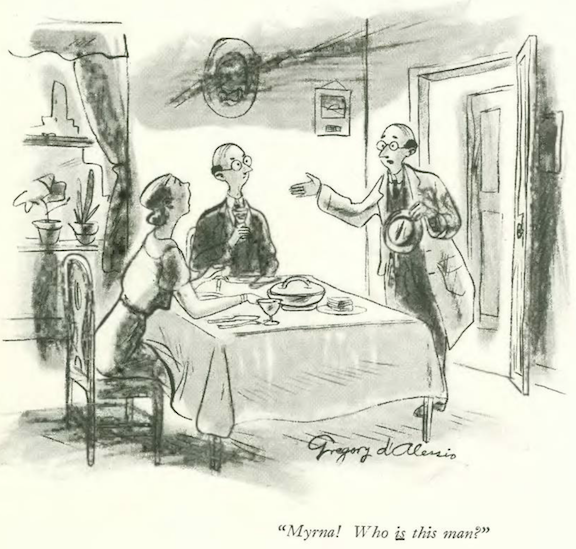
…Gregory d’Alessio gave us an understandable marital mix-up…
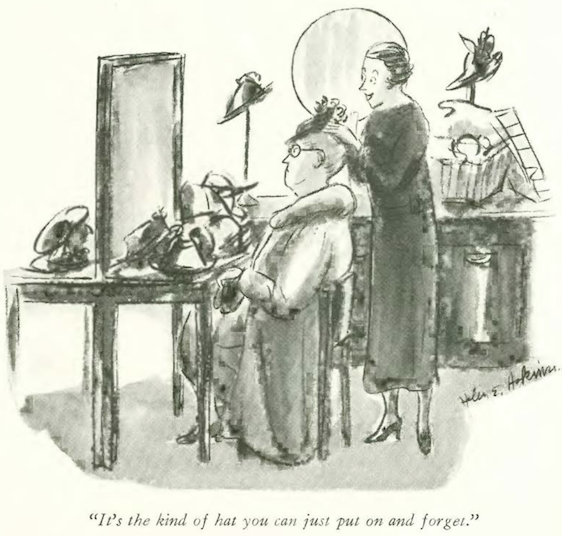
…Helen Hokinson offered a dose of “meh” in the hat department…
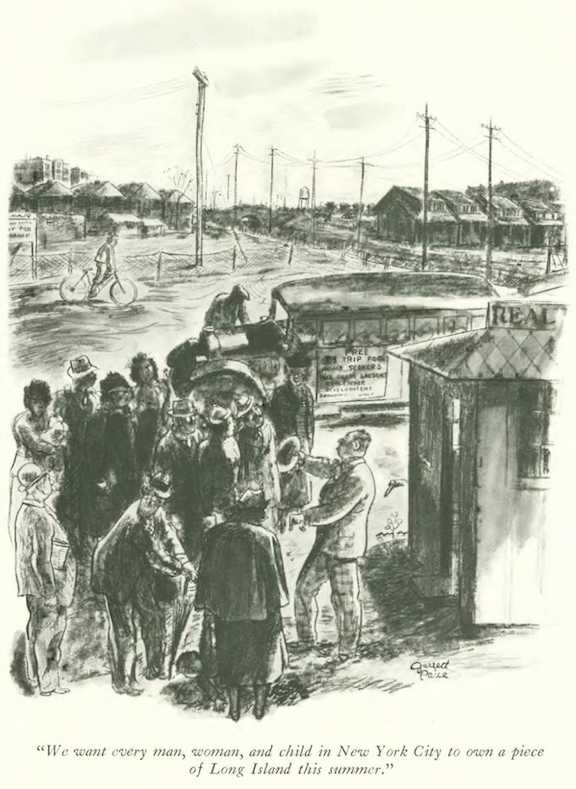
…Garrett Price showed us the consequences of Robert Moses’s transformation of Long Island from a rural area for the rich into a suburban landscape for the hoi polloi…
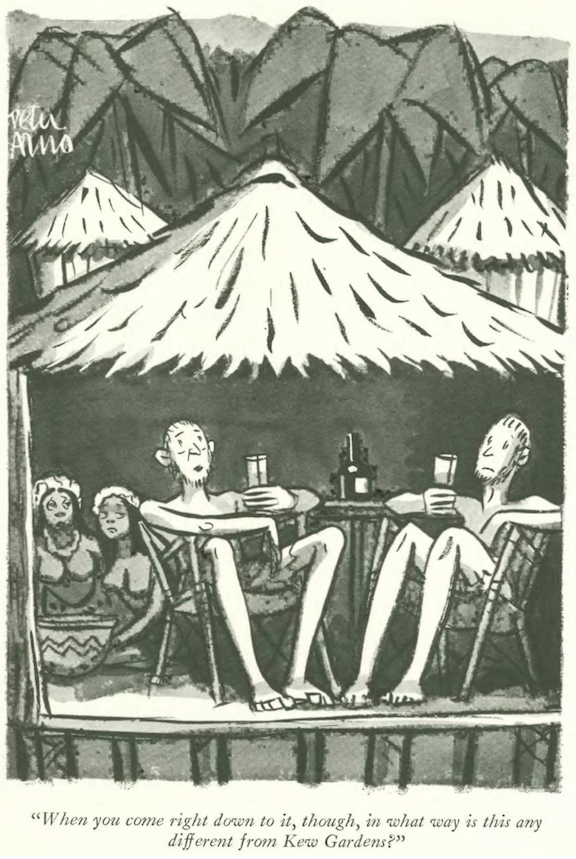
…and we close with Peter Arno, who wondered what’s the fun of drinking in the tropics when you can do the same thing in Queens?…