Men in Kilts

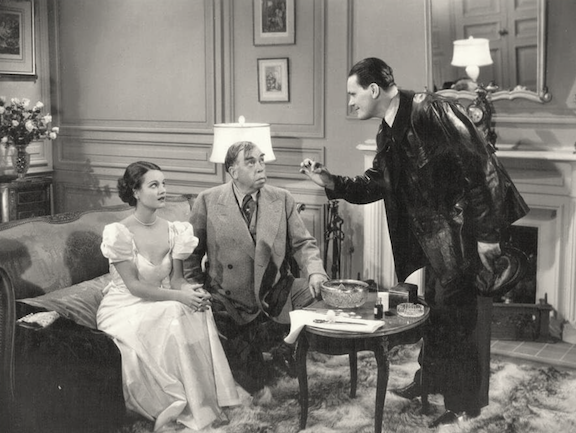
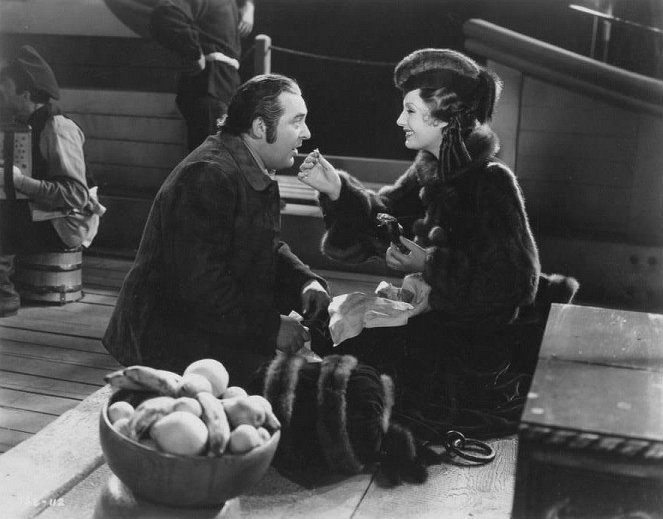
Above: Fredric March as the Earl of Bothwell in Mary of Scotland. March sported a kilt that Alex von Tunzelmann (the Guardian, May 7, 2015) calls "the bane of Scottish historical movies from here to Braveheart." Tunzelmann notes that "What we call a kilt today—the fèileadh beag, or small kilt—was invented in the mid-18th century, almost 200 years after this film is set. The Scots should be wearing belted plaid, or the rather fetching skintight tartan trews (image at right) sported by Mary’s father, James V." (eBay.com/pinterest.com)

These were truly the dog days of summer—New Yorkers had just endured one of the hottest months on record (106 F on July 9) and it remained intensely hot and dry as August rolled in. So for this post we will retreat to one of the few places that had air-conditioning—the cinema—and see what folks were enjoying in the first week of August 1936.
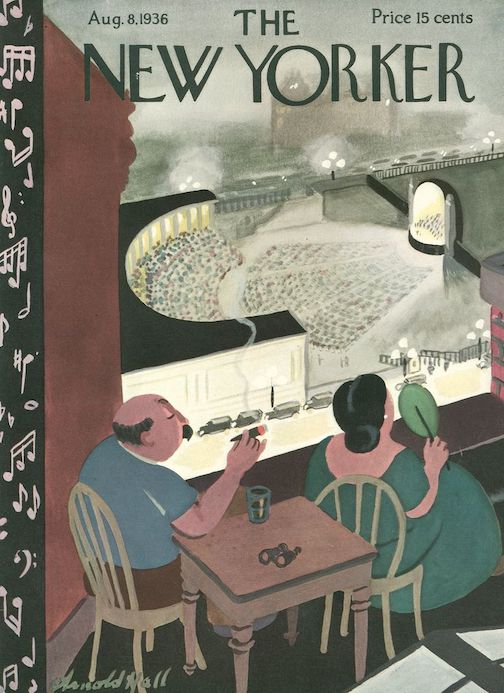
August 8, 1936 cover by Arnold Hall.

Before we jump into the movies, the wonderful cover by Arnold Hall recalled the summer night concerts at Lewisohn Stadium (although Hall took some liberties with the stadium’s design for the sake of composition).
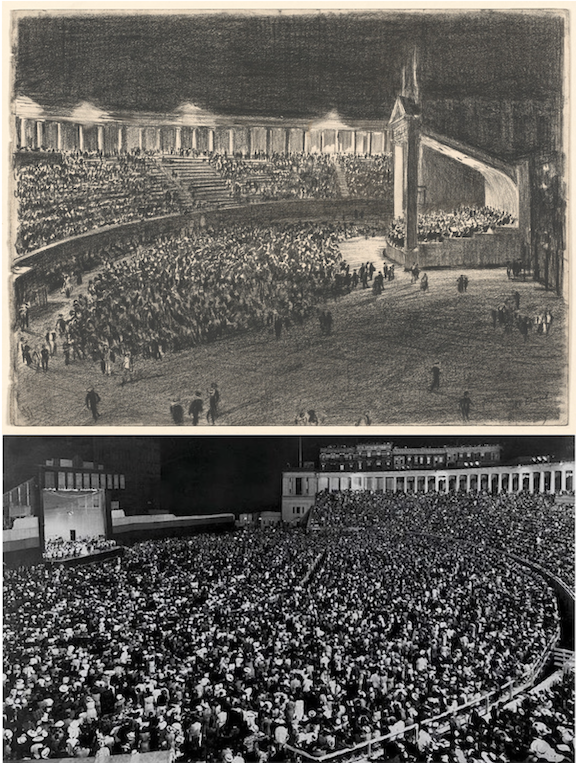
A LITTLE NIGHT MUSIC…Top: Illustration by Scottish artist Muirhead Bone of a nighttime Lewisohn Stadium concert, circa 1920s; below: Andre Kostelanetz conducts before a crowd of thousands at Lewisohn Stadium in 1939—for an admission price of a mere twenty-five cents, concertgoers were treated to appearances by leading performers of jazz, classical music and opera. The stadium was demolished in 1973. (digitalcommonwealth.org)

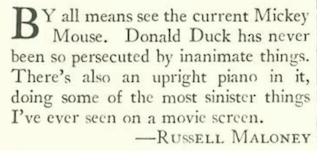
On to our movies, Russell Maloney once again sat in for John Mosher as the magazine’s film critic, taking on everything from a Tudor romance to a horror film that featured Lionel Barrymore in drag.

In Mary of Scotland, Maloney found Katharine Hepburn’s turn as Mary, Queen of Scots a bit wanting (the role should have gone to a “grown-up actress”), while he thought the film itself was rather tedious with “lots of goings on.” He concluded that the “wisps of Mary of Scotland visible between cloak-swishings and sword-wavings are not especially encouraging.”
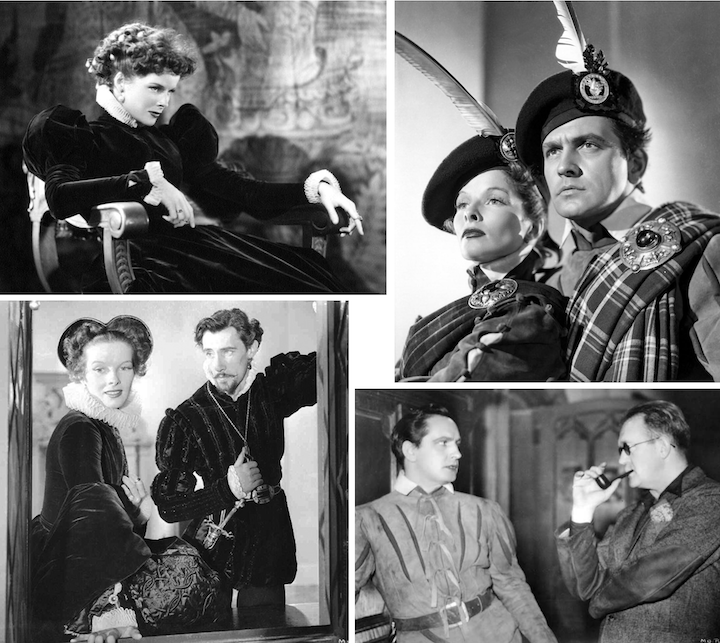
NOT READY FOR PRIME TIME?…Clockwise, from top left: Critic Russell Maloney thought the 29-year-old Katharine Hepburn was not seasoned enough to portray Mary Stuart in Mary of Scotland; Fredric March as the Earl of Bothwell, with Hepburn; March visits with director John Ford, who was better known for his Westerns (Ford and Hepburn would famously have an affair during the filming); Hepburn in a scene with John Carradine, who portrayed Rizzio, the Italian courtier and private secretary to Mary. Patriarch of the Carradine acting dynasty, his children included actors David, Keith, and Robert Carradine. (imdb.com/pinterest.com/frockflicks.com)

In addition to a forgettable lion-tamer flick (Bengal Tiger), Maloney also reviewed a Bing Crosby movie with a host of singing cowboys, Rhythm on the Range, and a “consistently funny” film with an “unpromising name,” We Went to College…
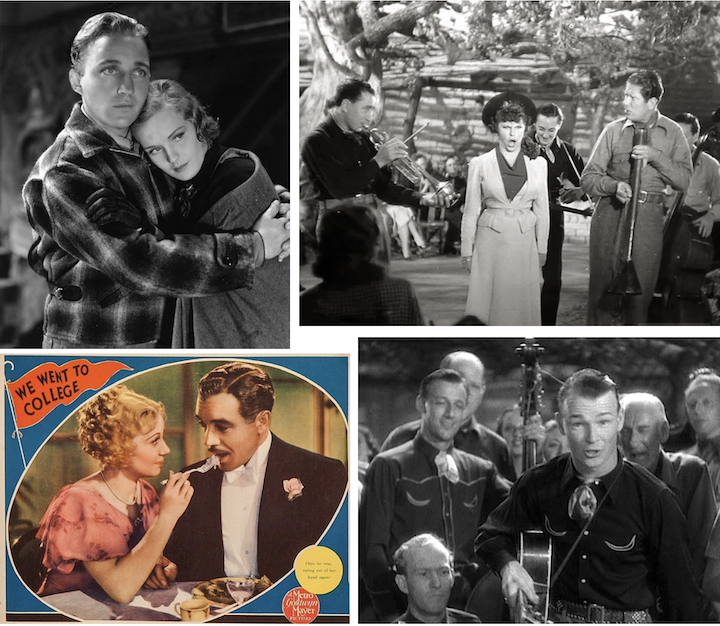
Bing Crosby played a humble traveling cowboy Norman Taurog Western musical film
COWBOY CROSBY…Clockwise from top left: Bing Crosby portrayed a traveling cowboy in love with a rich girl (Frances Farmer) in Rhythm on the Range; Louis Prima, Martha Raye (in her film debut), and Bob Burns performed in the ensemble “I’m an Old Cowhand from the Rio Grande” along with Roy Rogers (uncredited and performing under his original stage name, Leonard Slye) and The Sons of the Pioneers; Una Merkel and Walter Abel in a lobby card image advertising We Went to College. (imdb.com)

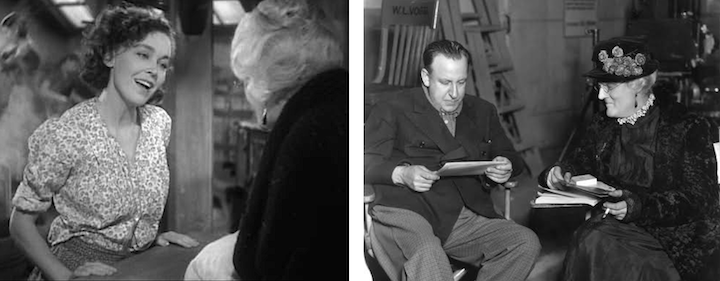
Maloney also reviewed a horror-farce, The Devil Doll, featuring Lionel Barrymore as banker Paul Lavond. A brief synopsis: Framed by his three partners and imprisoned on Devil’s Island, Lavond escapes with a fellow inmate who introduces him to his wife, Malita. The couple demonstrate a process that shrinks animals and people to the size of dolls, which then can be animated by will power. Seeing the dolls as an opportunity for revenge on his former partners, Lavond disguises himself as an old woman and sends out the shrunken people to harm his enemies.
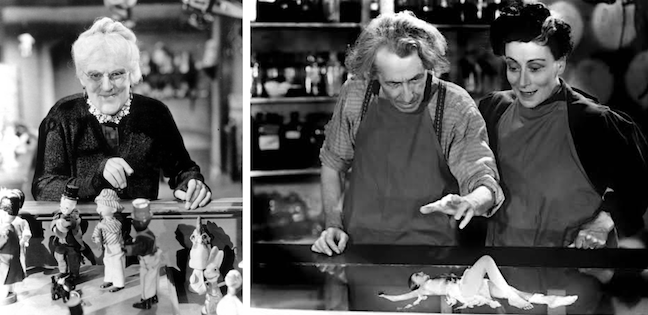
PLAYING WITH DOLLS…At left, Lionel Barrymore disguised as Madame Mandelip, preparing his demonic dollies for revenge in The Devil Doll; at right, Marcel (Henry B, Walthall) and his wife Malita (Raffaela Ottiano) with one of their shrunken people. (classic-monsters.com)
MY, WHAT BIG TEETH YOU HAVE…At left, Tarzan star Maureen O’Sullivan portrayed Paul Lafond’s unsuspecting daughter—in this scene from The Devil Doll she doesn’t recognize her long-absent father, disguised as the kindly Paris toy shop owner Madame Mandelip; at right, Lionel Barrymore (dressed as Madame Mandelip) meeting with Devil Doll director Tod Browning, best known for his 1932 magnum opus, Freaks. (classic-monsters.com/moriareviews.com)

It seems there were few, if any, critics in the 1930s who didn’t like Mickey Mouse cartoons. These days we take animation for granted, but ninety years ago it was still something of a miracle, especially in color. Maloney noted the latest must-see Disney cartoon short, Donald and Pluto.
MARTYRDOM OF DONALD DUCK…Donald Duck was literally put through the wringer for our amusement in the 1936 short Donald and Pluto, one of the three installments of the Mickey Mouse series in which Mickey doesn’t appear as a character. Donald Duck was a fairly new Disney character in 1936, making his debut in 1934’s The Wise Little Hen. (disneyfandom.com)

 * * *

Life Goes On

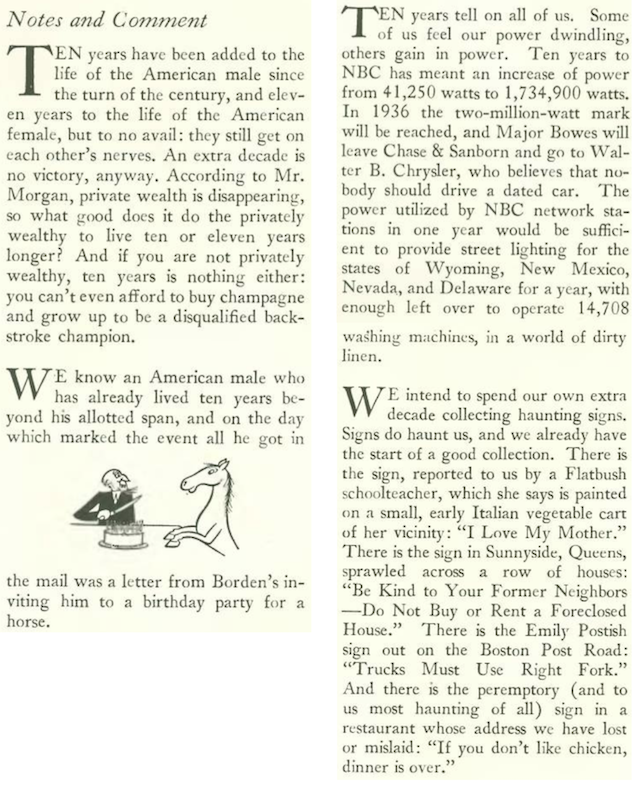
E.B. White mused about the increasing life expectancy at birth of the American male from 47 years in 1900 to 58 years in 1936 (a woman’s life expectancy was roughly 49/62, respectively). White (who would live 86 years) said he would spend his extra years collecting “haunting” signs, such as one on the Boston Post Road that read: Trucks Must Use Right Fork.
AND NO ELBOWS ON THE TABLE, EITHER…Trucker poses in front of his rig in 1936. (facebook.com)

 * * *

Wartime Wardrobe

Beatrice Mathieu—the first and only Paris fashion correspondent for The New Yorker—sat in on Lois Long’s column to discuss the latest from The City of Light. Designers were soldiering on with their premieres despite the winds of war blowing from the east. Excerpts:
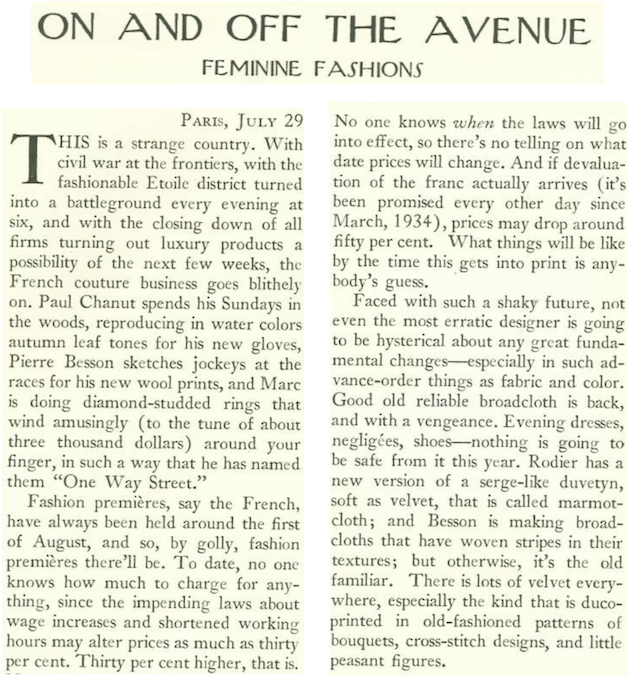
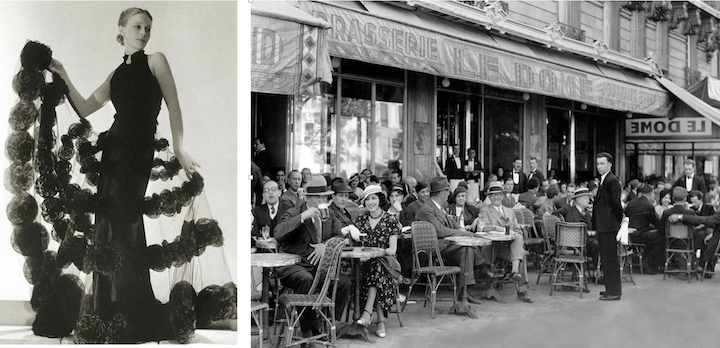
LIFE GOES ON…At left, a model shows off a “Carnival dress” by Madeleine Vionnet, 1936; a sidewalk café in Paris filled with fashionable folks, 1936. (godsandfoolishgrandeur.blogspot.com/reddit.com)

A note about Beatrice Mathieu: According to her 1976 New York Times obituary, In an era when honest criticism in fashion writing was relatively rare, she blended humor with a kind of skepticism and honesty in writing that enhanced her reputation as a leader in the field…In 1928, when the young woman from Faribault, Minn., was making a living in Paris as a freelance writer, she received a cable from Harold Ross…asking her to do some work for him. She wired back: ‘What is The New Yorker?’ Mr. Ross replied at some length. She took the job.” Mathieu stopped writing her Paris column in 1936 but resumed after the end of World War II.

 * * *

A Dose of Passos

Clifton Fadiman reviewed the latest book by John Dos Passos (1896– 1970), who is known for his pioneering works of nonlinear fiction and his U.S.A. trilogy, which he completed in 1936 with The Big Money. One of the major novelists of the post-World War I “lost generation,” he is widely praised today for his timeless insights into America’s inequalities (and was also highly regarded by contemporaries including William Faulkner). Fadiman, however wrote “A great writer he is not.” Excerpts:
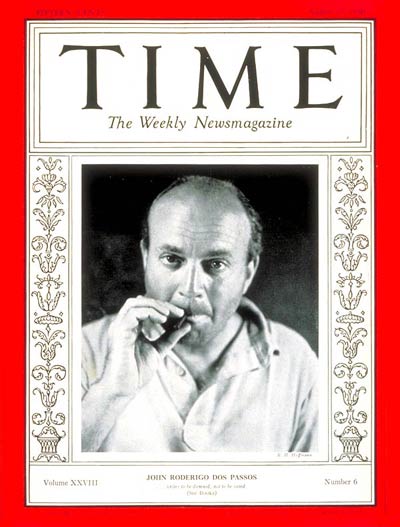
HIS TIME WOULD COME…John Dos Passos on the cover of Time, Aug. 10, 1936. Dos Passos is admired today for showing how Americans respond to the chaos and inequalities of modern life. (time.com)

 * * *

From Our Advertisers

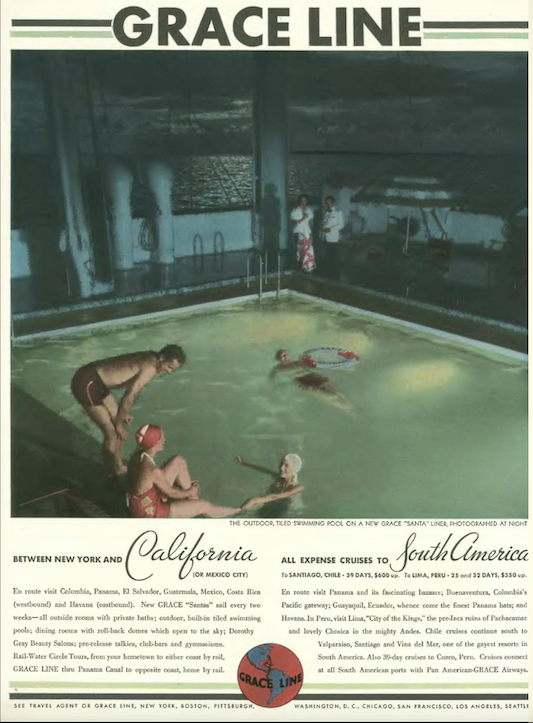
We begin our advertising section with the Grace Line, which offered this inviting image (on the inside front cover) of nighttime swimming on the deck of one of its Santa liners, en route to South America and California…
…less inviting, it would seem at the time, would be a cruise to Germany aboard a Hamburg-America Line (HAPAG) ship—beginning in 1939, U.S. and British forces would seize nearly all of HAPAG’s fleet…

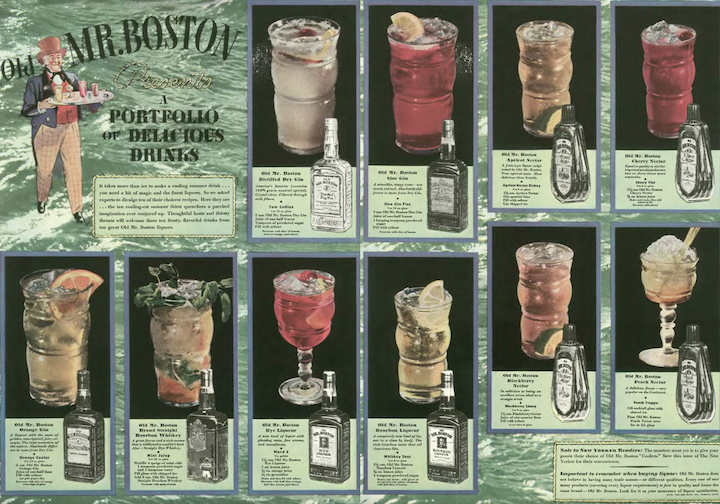
…the relatively new company Old Mr. Boston (founded in Boston in 1933, right as Prohibition ended) went big with this two-page color advertisement touting its line that included gin, rum, whiskey, and cordials…
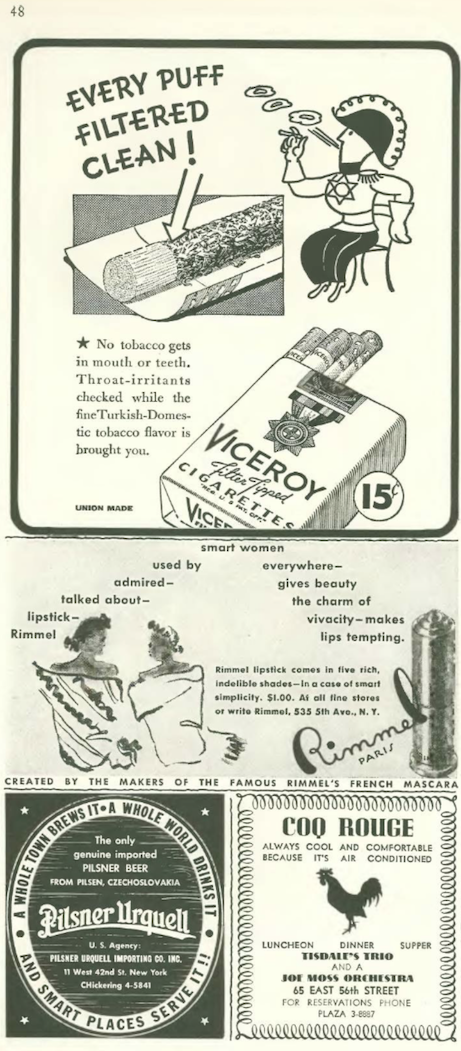
…in the back of the book…Brown & Williamson launched its Viceroy brand in 1936 as the world’s first cork-tipped filter cigarette…at the bottom is a modest ad for Pilsner Urquell, a Czech brewer that produced the world’s first pale lager…it is still brewed in Pilsen (Czech Republic) under the ownership of Tokyo-based Asahi Group…
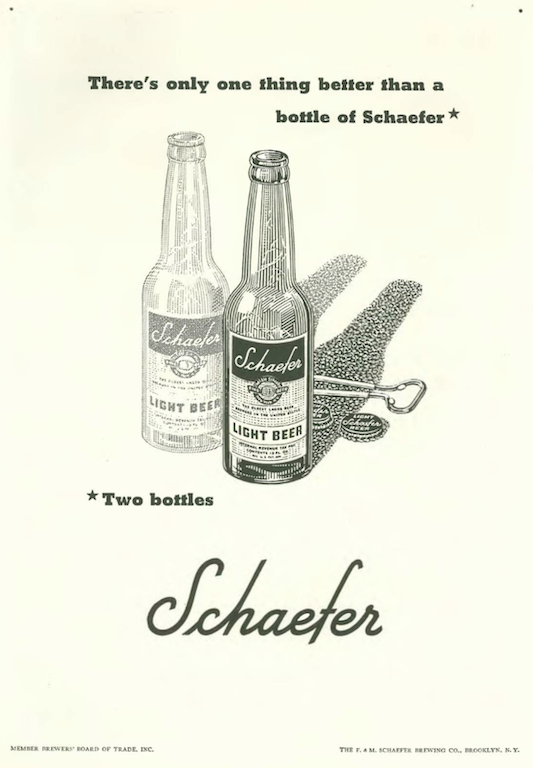
…Schaefer promoted their “light beer” in this rather spare advertisement…the “light” referred to its pale color, not to its calorie count…founded in New York City in 1842, Schaefer grew to be a top five brewer in America…today it is marketed by Pabst as a regional heritage brand…
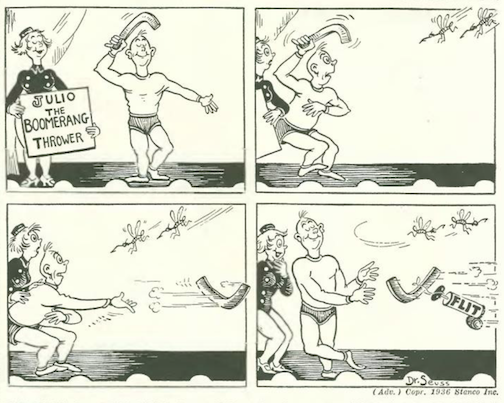
Dr. Seuss was still at it with his Flit ads…after rejections from nearly thirty publishers, in 1937 Seuss (aka Theodor Geisel) would publish his first book with Vanguard Press—And to Think That I Saw It on Mulberry Street…Seuss also illustrated ads for Schaefer beer, Esso gasoline, Holly Sugar, and General Electric, among others…
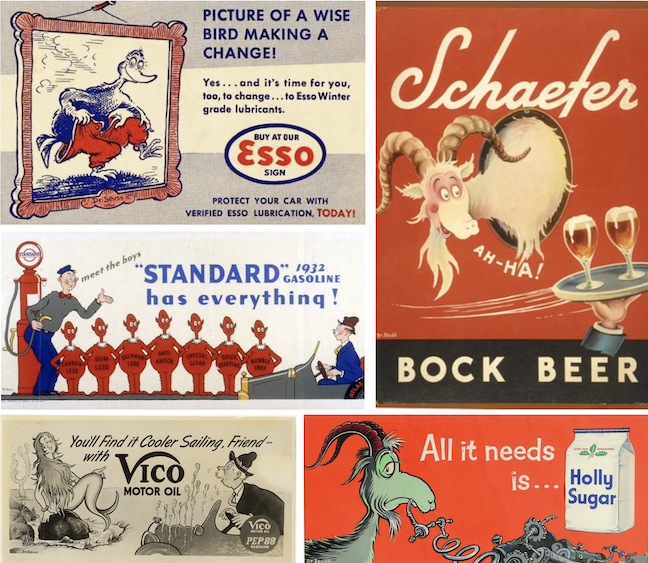
HONING A STYLE…A sampling of Dr. Seuss’s advertising art from the 1930s to the 1950s. (aoghs.org/UC San Diego/booksforgoatlings.weebly.com)

…R.J. Reynolds lined up another socialite endorsement for their Camel cigarettes…here they go to the West Coast, with a plug from Mrs. William J. Hollingsworth, Jr., aka Madeleine Ruth Piper…her marriage to Hollingsworth was over by 1937…she would marry three more times before her death in 1993…
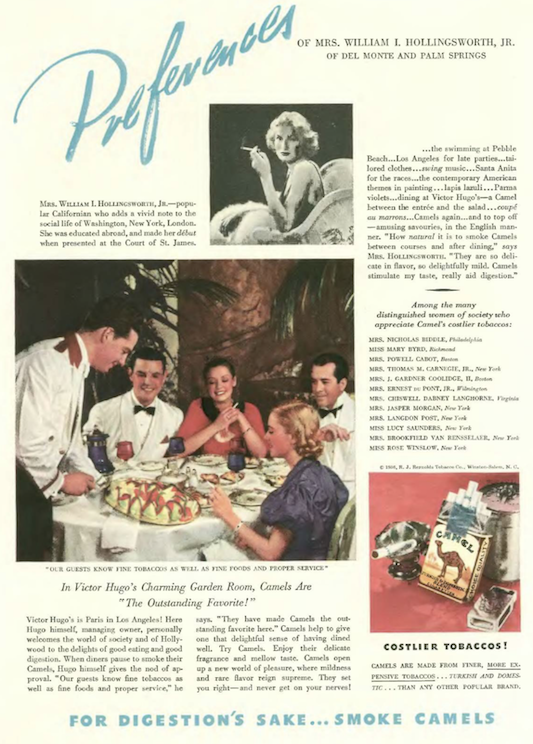
SHE REALLY LIGHTS UP A ROOM…At left, undated photo of socialite Madeleine Ruth Piper (1916–1993), who was apparently telling the truth about her love of smoking; at right, the Victor Hugo Restaurant in Los Angeles (Beverly Hills), featured in the Camel ad. (findagrave.com/facebook.com)

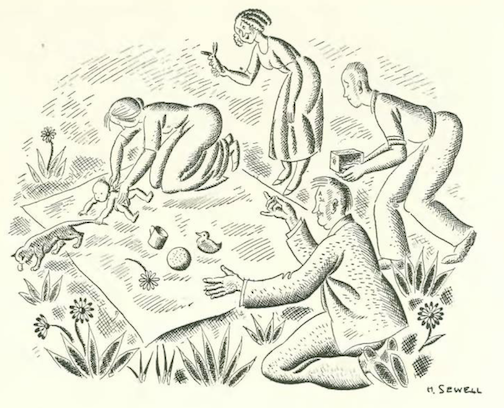
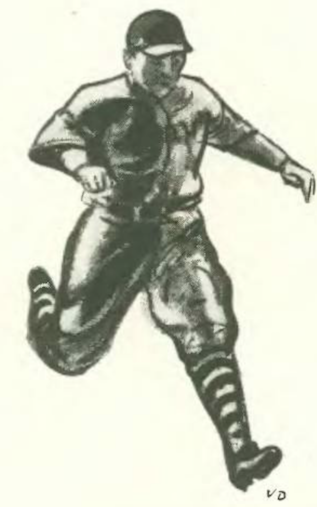
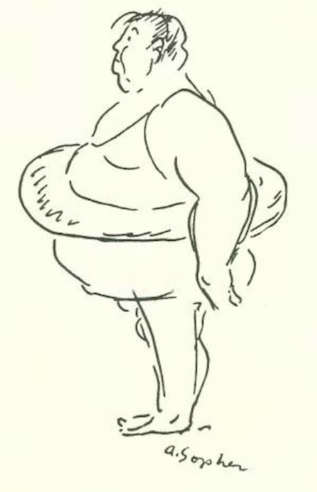
…on to our illustrators and cartoonists, we begin with spots by Christina Malman

Helen Moore Sewell

Victor de Pauw

and Aaron Sopher

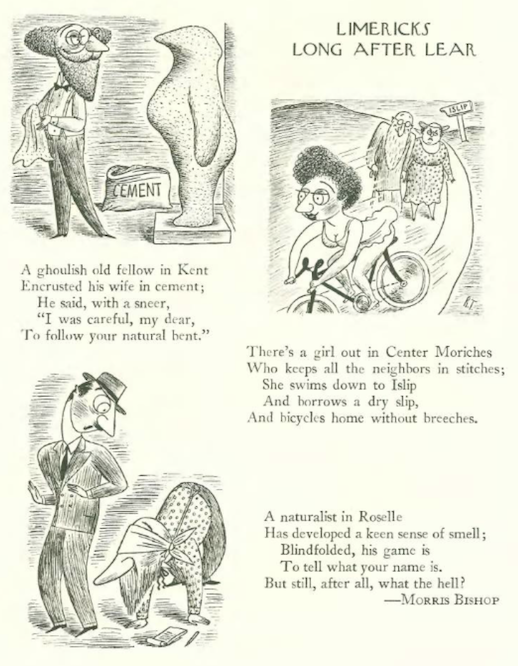
…there was another installment of Morris Bishop limericks illustrated by Richard Taylor

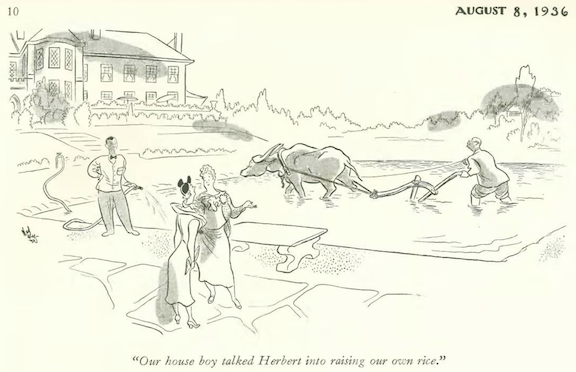
Ned Hilton’s lord of the manor took up rice farming…
Alan Dunn showed us some devious domestic doings…
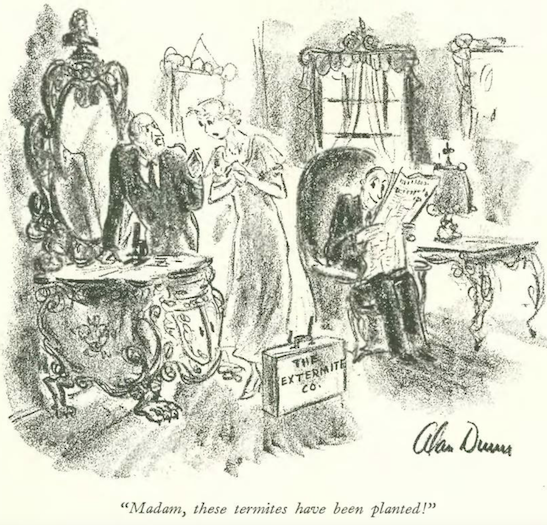
…and a complaint to the mayor…
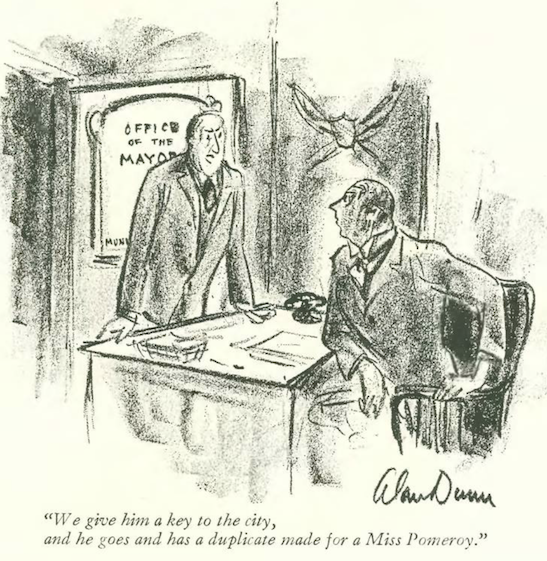
…in contrast to Dunn’s style, the spare lines of Gardner Rea

Gregory d’Alessio prepared for Olympic glory…
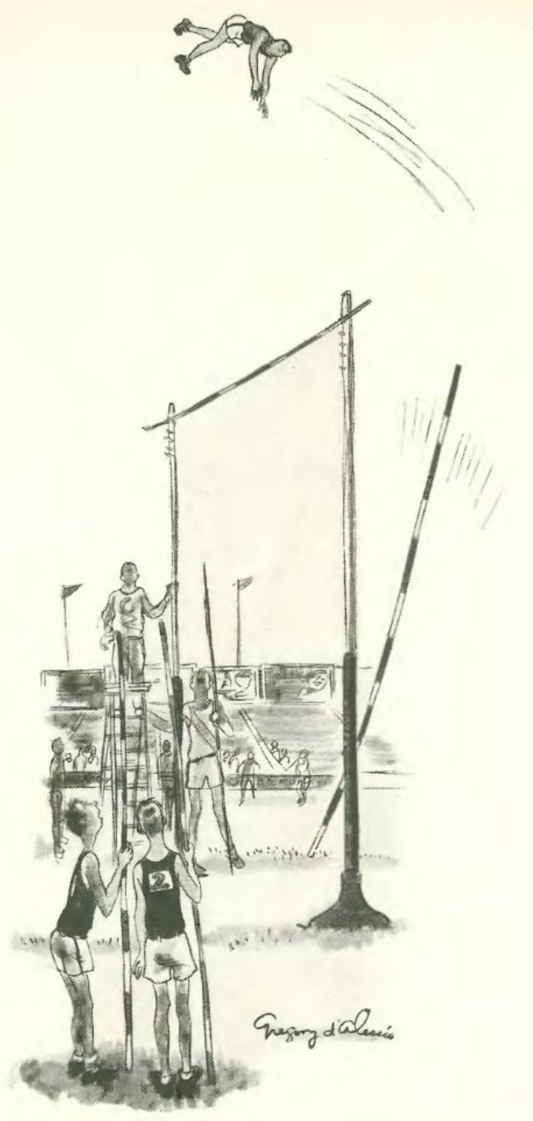
William Crawford Galbraith continued to plumb the creepy waters inhabited by impressionable young women and lecherous older men, in this case a woman’s personal physician…
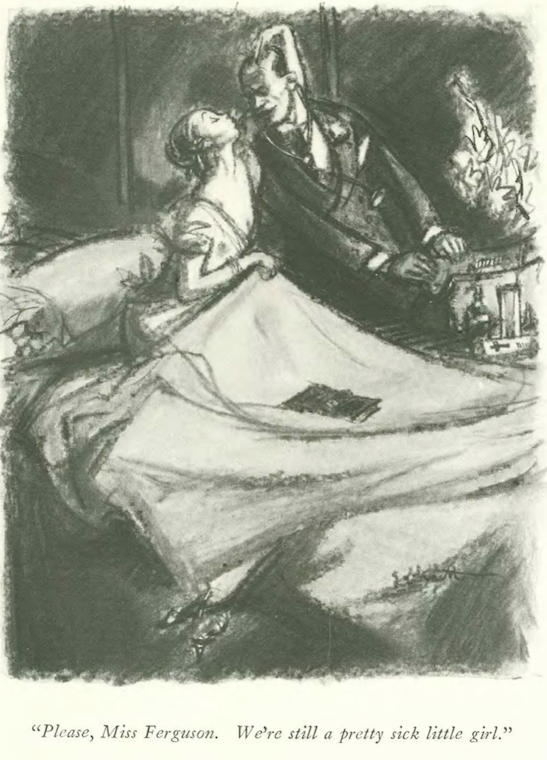
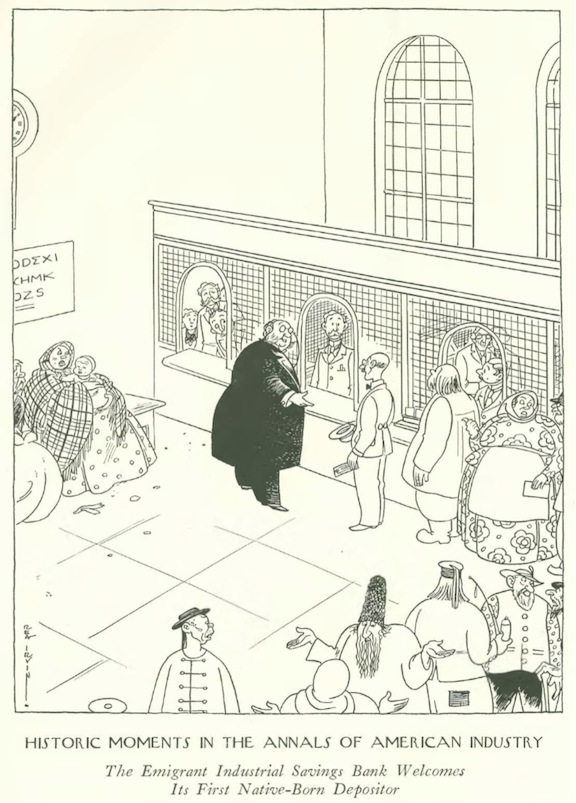
…and Rea Irvin continued to explore historic moments in American industry…
…we close with Helen Hokinson, and some scandal brewing under a hair dryer…

Next Time: Bottoms Up…

People in Glass Houses

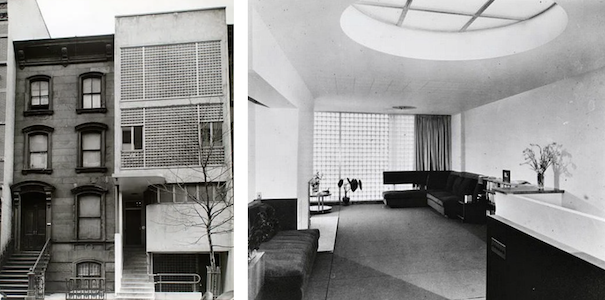
Above: The Morris B. Sanders Studio and Apartment is the second-oldest modern townhouse in Manhattan. Sanders designed the townhouse, located on 49th Street between 2nd and 3rd Avenue, in 1934 for his own use, and construction was completed in December 1935.  (Wikipedia/docomomo-nytri.org)

Today we barely notice the tens of thousands of shiny glass buildings that populate our cities, not to mention the countless postwar houses that feature vast expanses of glass from floor to ceiling.

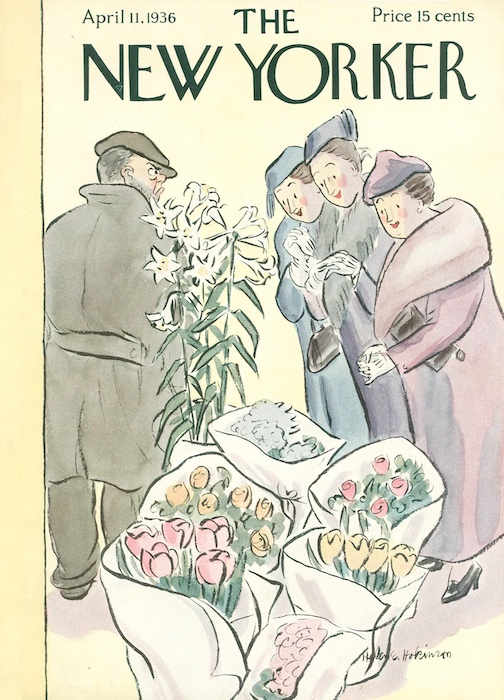
April 11, 1936 cover by Helen Hokinson.

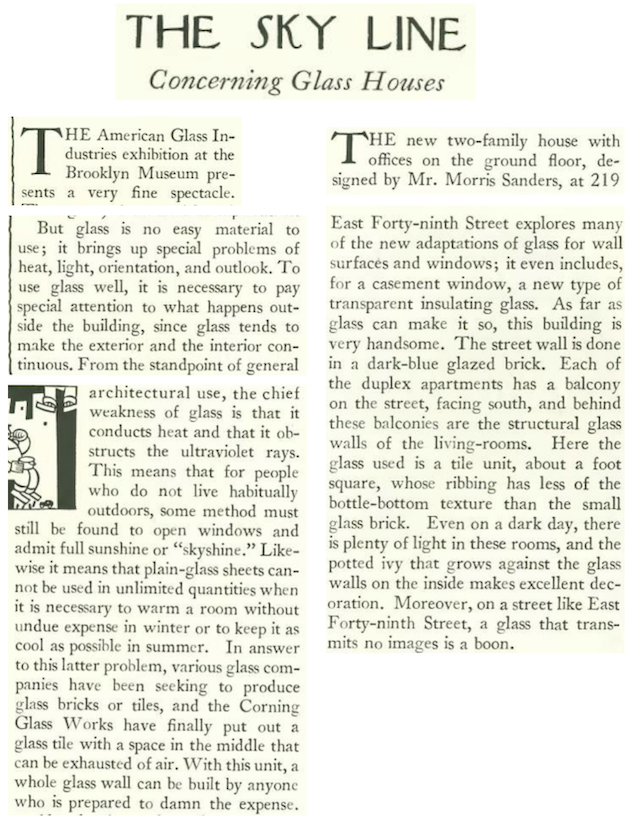
In 1936 a house made of glass, especially as a structural element, seemed unlikely to most folks, if not downright bizarre. Enter Lewis Mumford, arts and architecture critic for The New Yorker, who was critical of many modern industrial trends and often promoted his ideal of human-scaled, organic design in buildings and cities. Mumford was not opposed to new technologies, such as glass block, as long as it was employed with sensitivity and good taste. Here are some of Mumford’s observations after visiting the American Glass Industries Exhibition at the Brooklyn Museum:

NEW NEIGHBOR…Morris B. Sanders’ studio and apartment at 219 East 49th Street in Turtle Bay boldly interrupted a stodgy row of brownstones. Lewis Mumford pronounced the 1936 building “very handsome.” The New York City Landmarks Preservation Commission designated the building as an official landmark in 2008. (curbed.com/Wikipedia)

The Sanders House wasn’t the first time a brownstone was replaced by a modernist building. That honor goes to another Turtle Bay-area house, just one block from the Sanders house, designed by architect William Lescaze in 1933-34.

ODD COUPLE…Designed by William Lescaze in the International Style between 1933 and 1934 as a renovation of a 19th-century brownstone townhouse, 211 East 48th Street was one of three houses in Manhattan designed by Lescaze. (atlasobscura.com/inside inside.org)

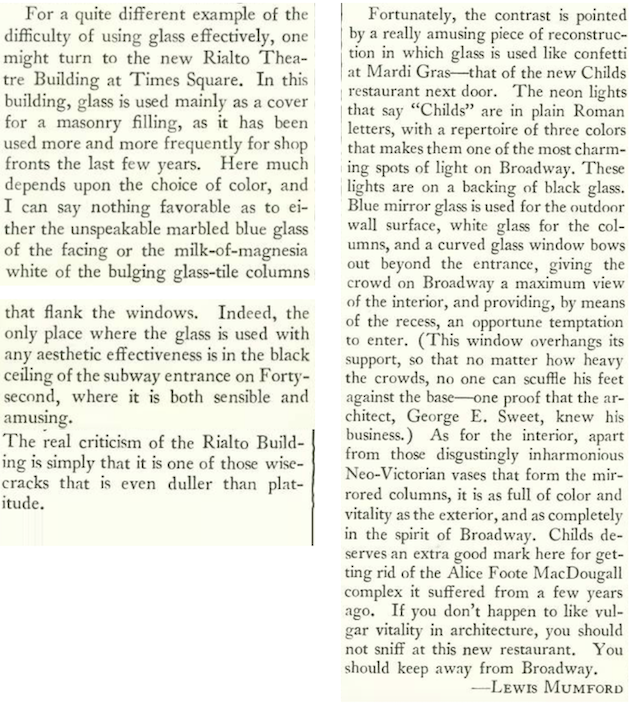
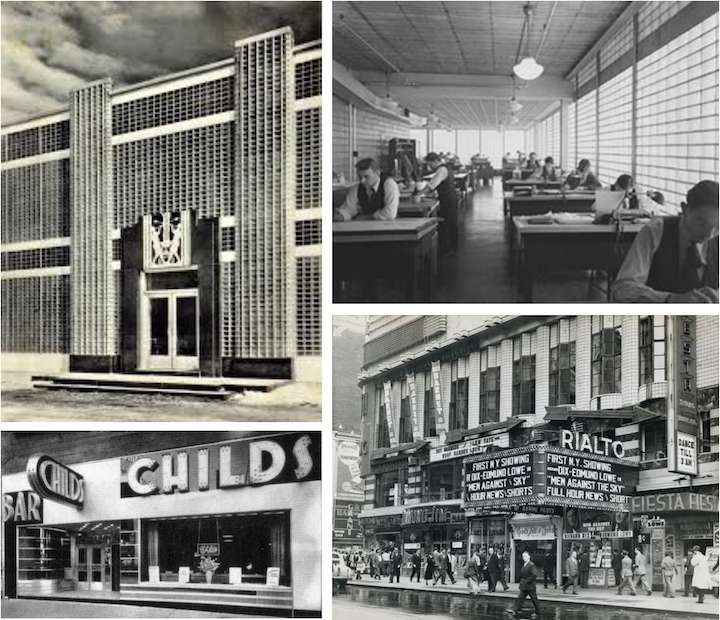
The Brooklyn Museum exhibition also included commercial examples such as one of the world’s first buildings to be completely covered in glass, the Owens-Illinois Glass Research Laboratory in Toledo, Ohio. Mumford also commented extensively on the new uses of glass in Times Square, namely the rebuilt Rialto Theatre and a Childs restaurant located next door. Excerpts:

THINGS TO COME…Clockwise, from top left, the Owens-Illinois Glass Research Laboratory in Toledo, Ohio, built between 1935 and 1936, is recognized as one of the world’s first buildings to be completely covered in glass, utilizing glass blocks for the facade; Lewis Mumford was less impressed with the use of glass by the newly rebuilt Rialto Theatre, but praised the new Childs location next door for being full of “vitality and color.” (facebook.com/dinerhunter.com)

 * * *

Down on Il Duce

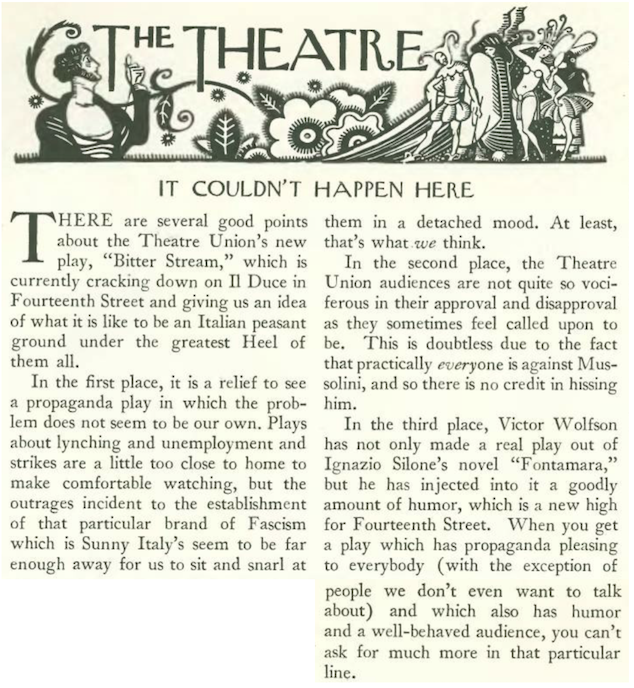
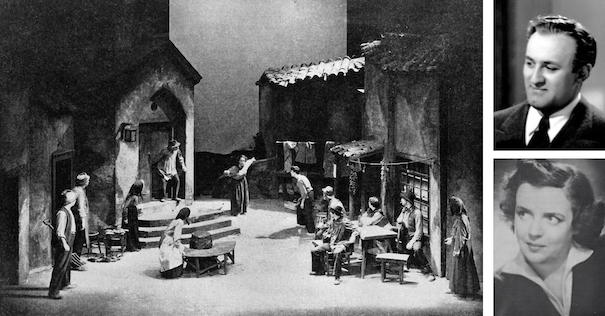
Last week we saw Robert Benchley’s review of the anti-war play, Idiot’s Delight. This week he reviews another play with themes that resonated in the moment, Bitter Stream. Written by Victor Wolfson and adapted from Ignazio Silone’s novel, Fontamara, the play depicted the horrors of fascism as Mussolini’s Black Shirts brutally seize an Italian neighborhood. It featured relative newcomer Lee J. Cobb as well as Frances Bavier, who twenty-four years later would portray Aunt Bee on The Andy Griffith Show. Excerpts:

TROUBLE IN SUNNY ITALY…A scene set in Fontamara Square in the play Bitter Stream, which ran for sixty-one performances at the Civic Repertory Theatre. At right, Lee J. Cobb portrayed Don Circonstantza, and Frances Bavier played the part of Soreanera. Bavier is best known for her portrayal of Aunt Bee on The Andy Griffith Show (1960-1968). (revolutions newsstand.com/facebook.com)

* * *

Sick Leave

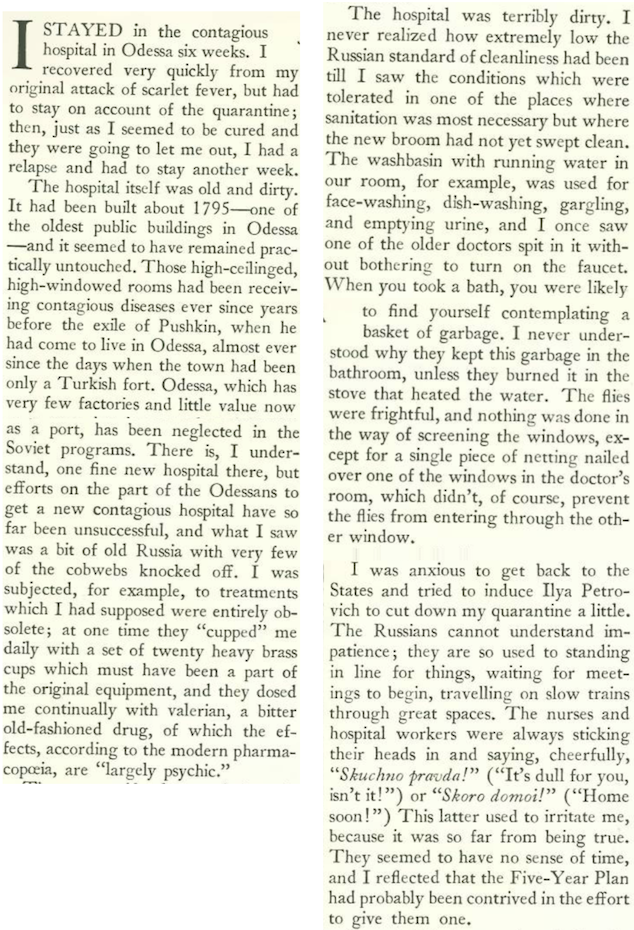
Also last week we saw the first part of Edmund Wilson’s account of his travels in the Soviet Union. For the April 11 installment of “A Reporter at Large” (titled “Scarlet Fever in Odessa”), Wilson recounted his six-week stay in a filthy Soviet hospital. Excerpts:

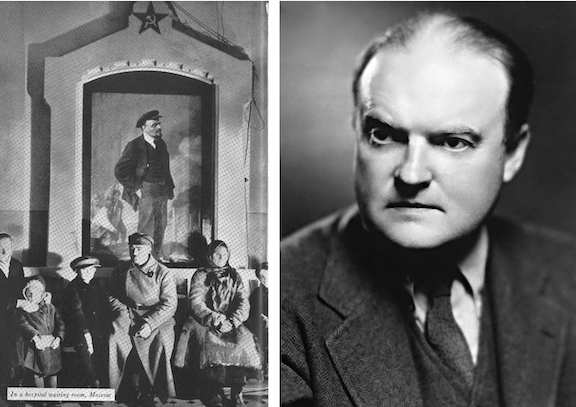
WANTING OUT…Edmund Wilson couldn’t wait to get out of the “terribly dirty” Odessa hospital where he was quarantined with scarlet fever for six weeks. At left, photo by Margaret Bourke White, “In a Hospital Waiting Room, Moscow,” 1932. At right, Wilson in 1936. (nyamcenterforhistory.org/Wikipedia)

 * * *

Gall in Gaul

In her Paris Letter, Janet Flanner continued to share her observations about the French mood (agitated) in the wake of the German occupation of the Rhineland.

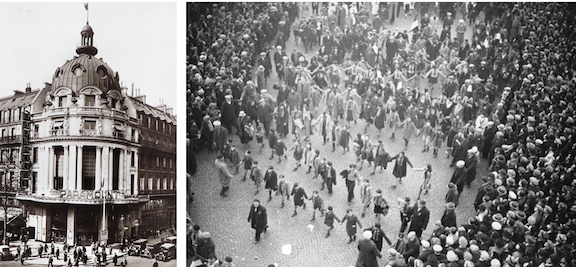
HOW ABOUT A NICE DITTY INSTEAD?…Janet Flanner reported that there was a “near riot” when a performance at the Paramount Theater (left) included “military music.” At left, the Paramount in 1927; at right, a Popular Front demonstration in Paris, 1936. (Wikimedia/Bibliothèque nationale de France)

 * * *

At the Movies

Little Lord Fauntleroy was Selznick International Pictures’ most profitable film until Gone with the Wind, and it featured one of the top child stars of the 1930s, English-American child actor Freddie Bartholomew (1924–1992). However, New Yorker film critic John Mosher was “bored to extinction” by the popular film.

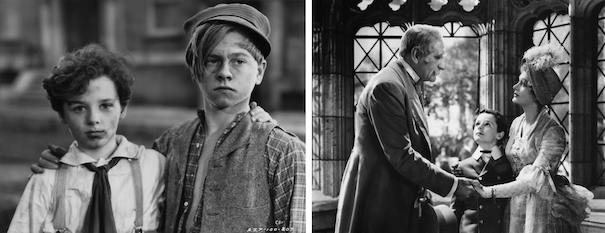
SLUMMING…At left, Freddie Bartholomew and Mickey Rooney in Little Lord Fauntleroy. Rooney once said of Bartholomew: “He was one of the finest, if not the finest child stars that we had on the scene at that time”; at right, Aubrey Smith, Bartholomew and Dolores Costello in a scene from the film. (MGM/Wikipedia)

One of Hollywood’s greatest screen villains, English actor Henry Daniell, caught Mosher’s attention for his “smooth” performance as a blackmailer in The Unguarded Hour. The critic also enjoyed the thriller The House of a Thousand Candles, but was left flat by Give Us This Night.

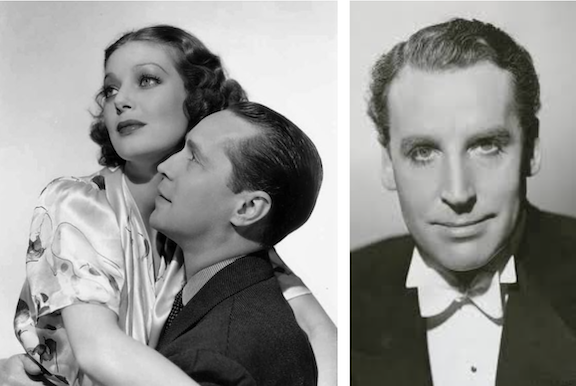
A MANNERED SCAMP was how John Mosher described one of Hollywood’s greatest screen villains, English actor Henry Daniell (right) in The Unguarded Hour, which also starred (at left) Loretta Young and Lewis Stone. (imdb.com/facebook.com)
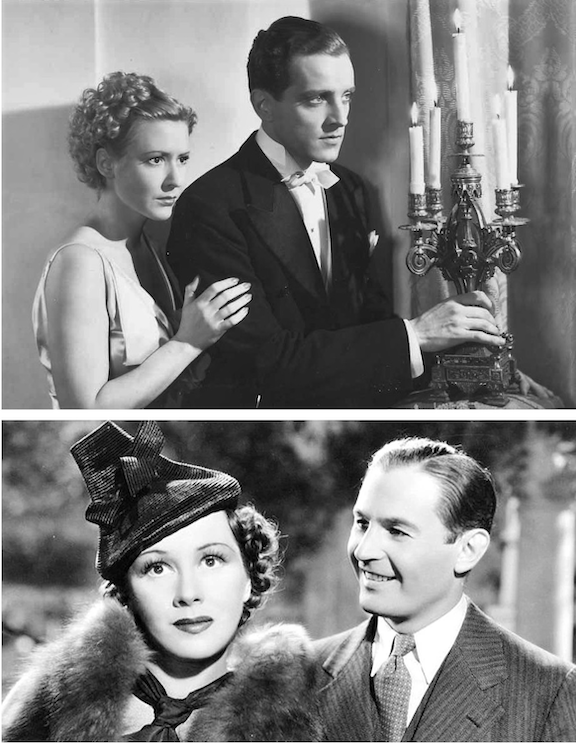
THRILLS AND TRILLS…Top photo, Mae Clarke and Phillips Holmes in the spy thriller The House of a Thousand Candles; below, Give Us This Night was one of five films produced by Paramount that featured the popular Metropolitan Opera mezzo-soprano Gladys Swarthout, seen here with Polish opera singer and actor Jan Kiepura. (imdb.com/mabumbe.com)

 * * *

From Our Advertisers

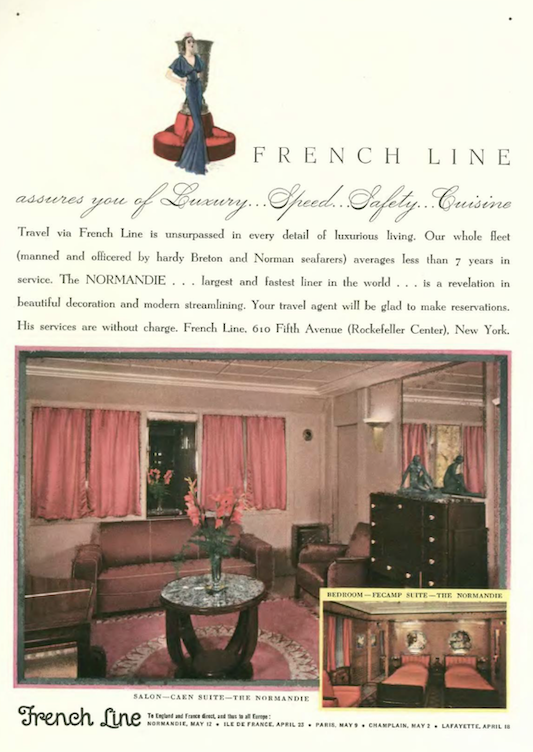
If you could afford it, a first-class salon on the Normandie sure looked like a great way to travel to France…

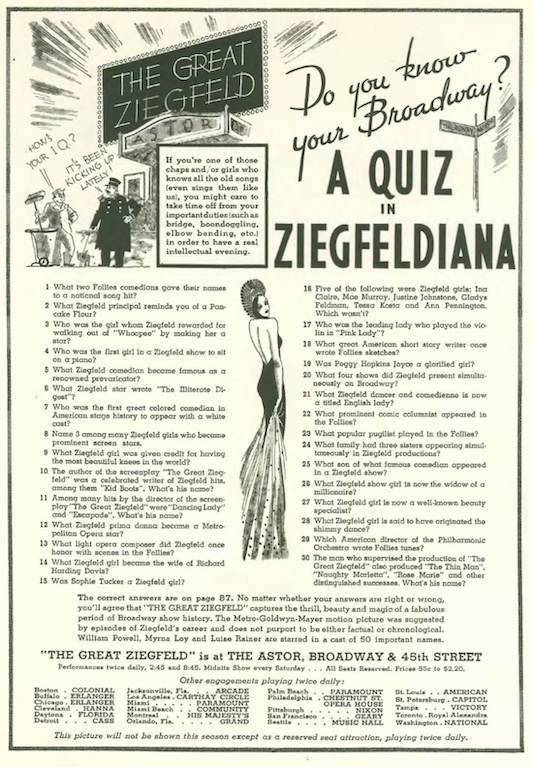
…this full-page ad enticed moviegoers with a quiz that promoted MGM’s The Great Ziegfeld…one of the most successful films of the 1930s, the movie won three Academy Awards, including Best Picture, Best Actress (Luise Rainer), and Best Dance Direction…

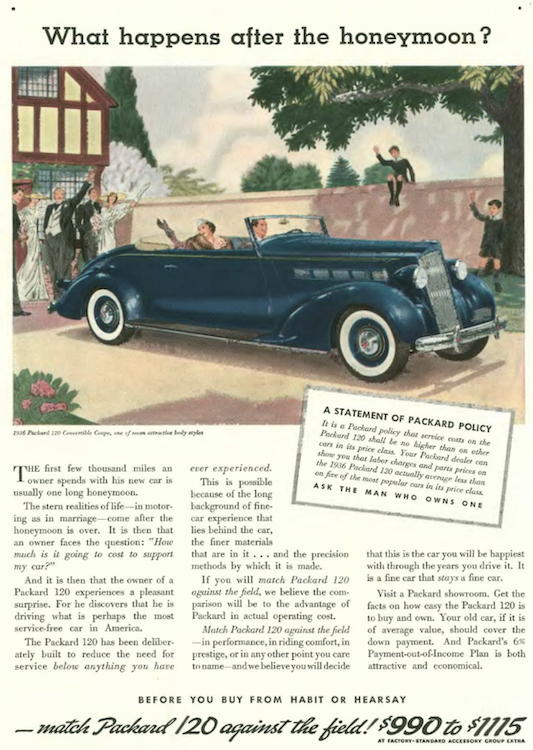
…who knows what will happen after the honeymoon, but we do know they will driving around in this swell-looking Packard 120, a lower-priced model that helped keep Packard afloat during the waning days of the Depression…

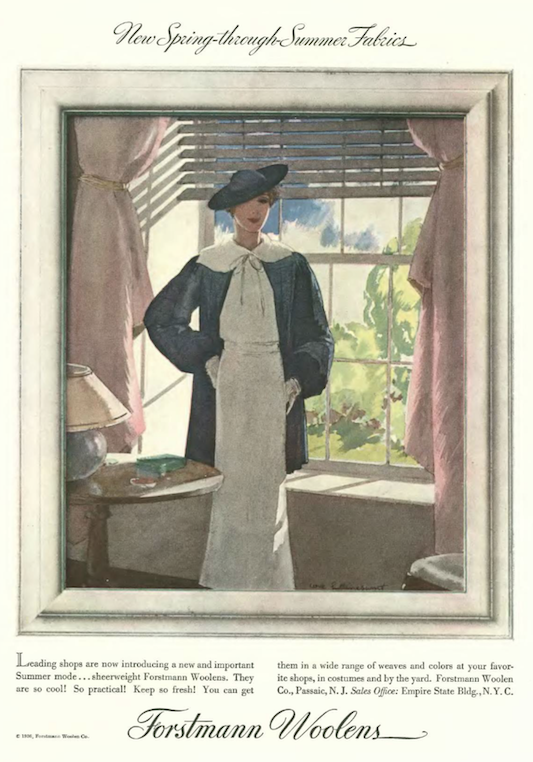
…Forstmann Woolens continued to entice buyers with their seasonal images of fine fashions…

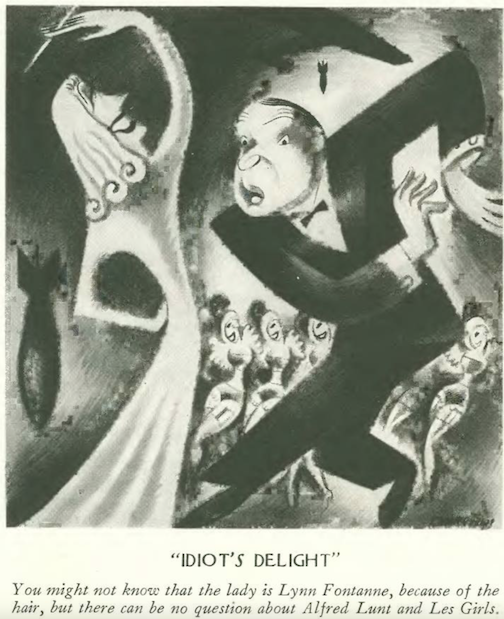
…on to our cartoonists, we begin with the illustration for “The Theatre” section, this week Miguel Covarrubias taking over for Al Frueh

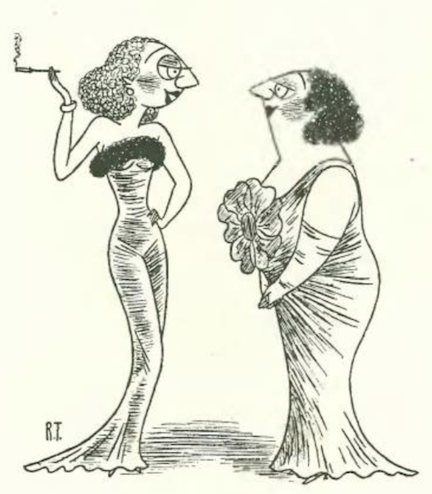
Richard Taylor contributed this fine spot illustration…

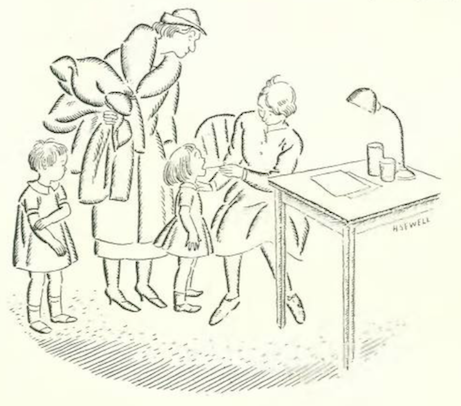
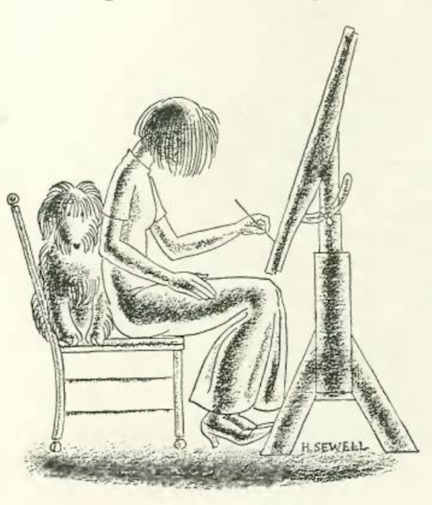
…and we have another spot by Helen Moore Sewell

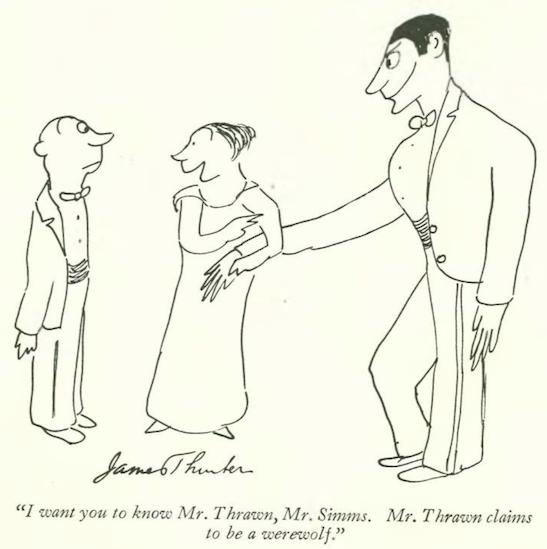
James Thurber made an awkward introduction…

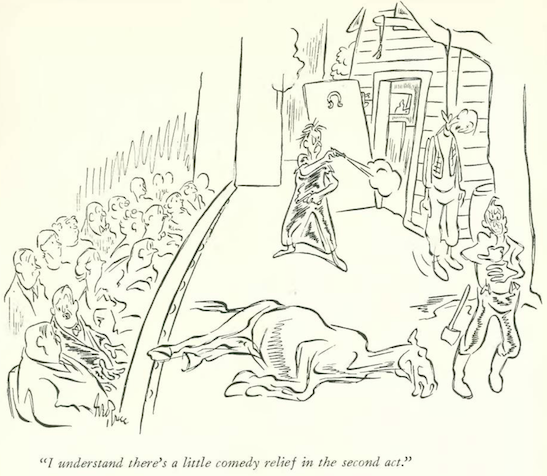
George Price hoped for some comic relief at the theatre…

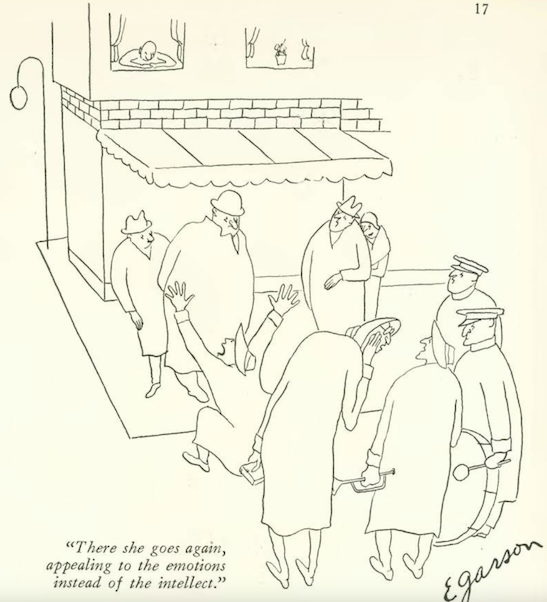
Eli Garson found religious zeal at a street corner…

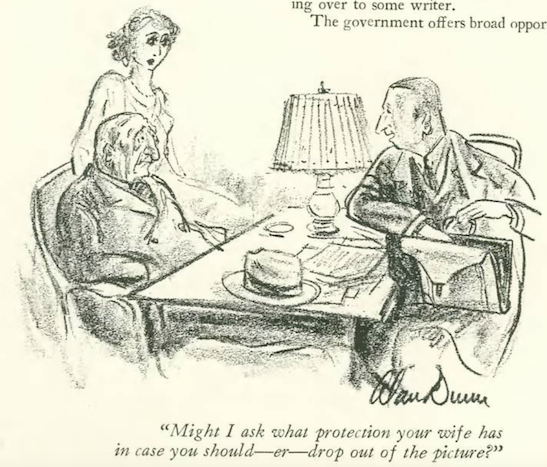
Alan Dunn gave us a great opening line for an insurance salesman…

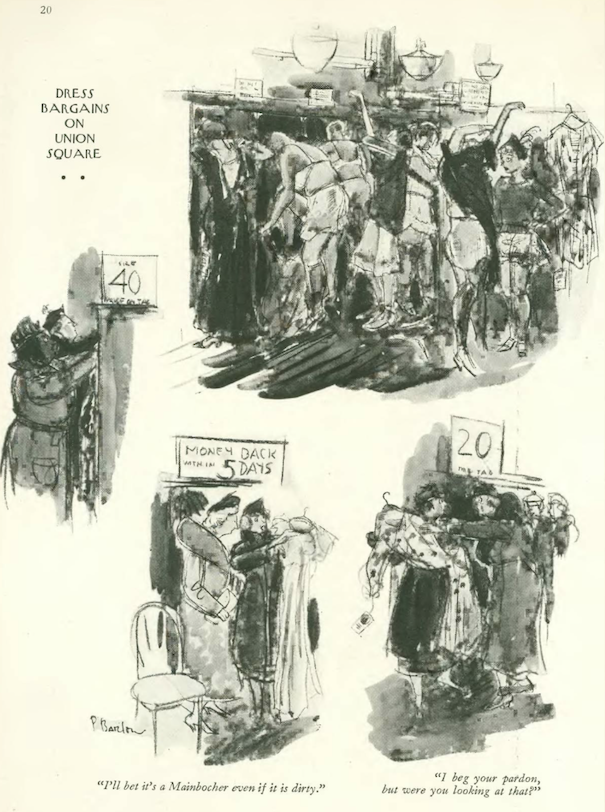
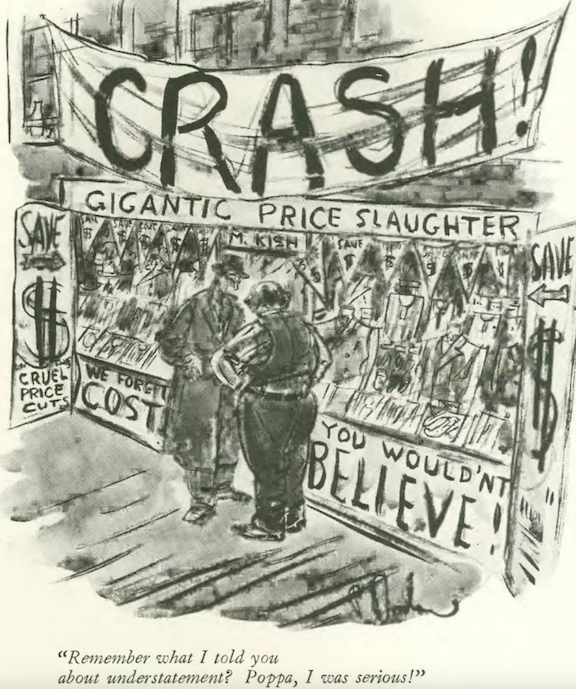
Perry Barlow was inspired by bargains on Union Square…

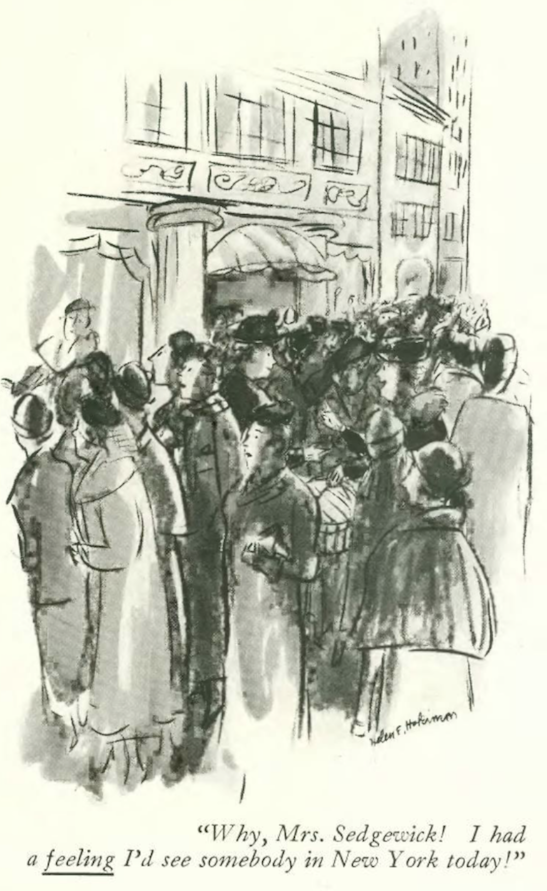
Helen Hokinson spotted a familiar face in the crowd…

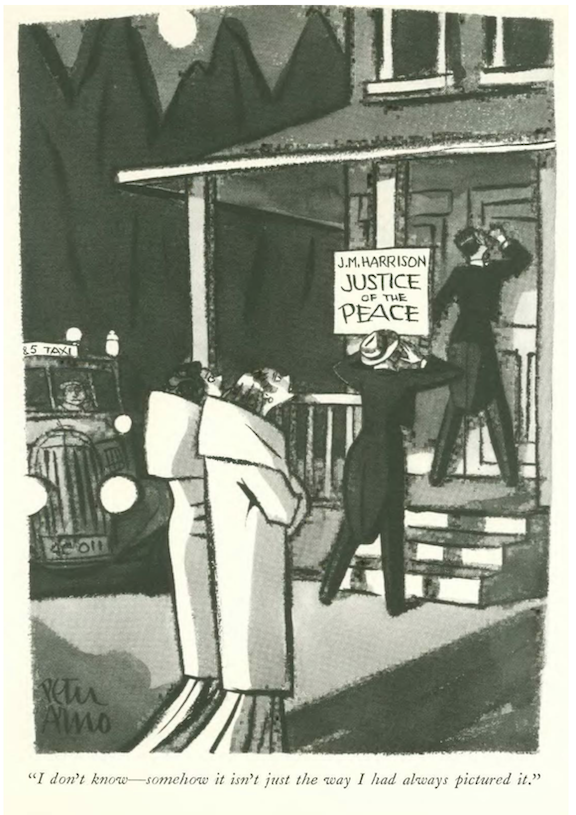
…a quickie marriage left no room for romance, per Peter Arno

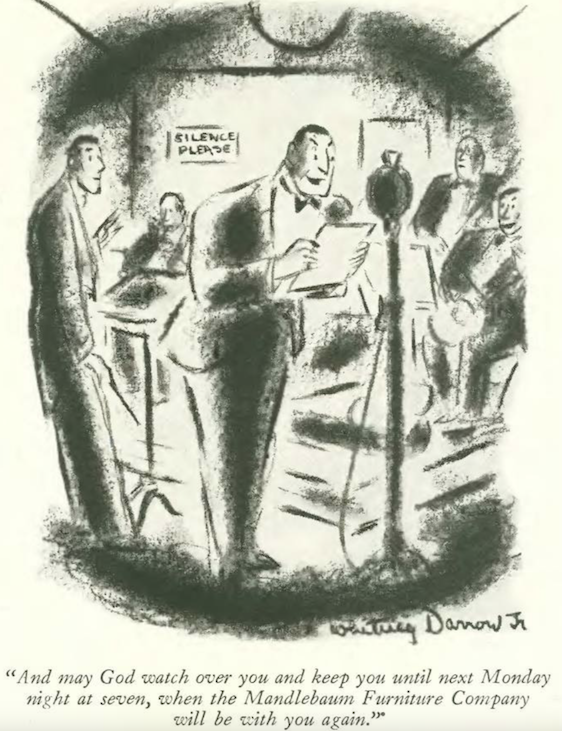
Whitney Darrow Jr signed us off with an endorsed blessing…

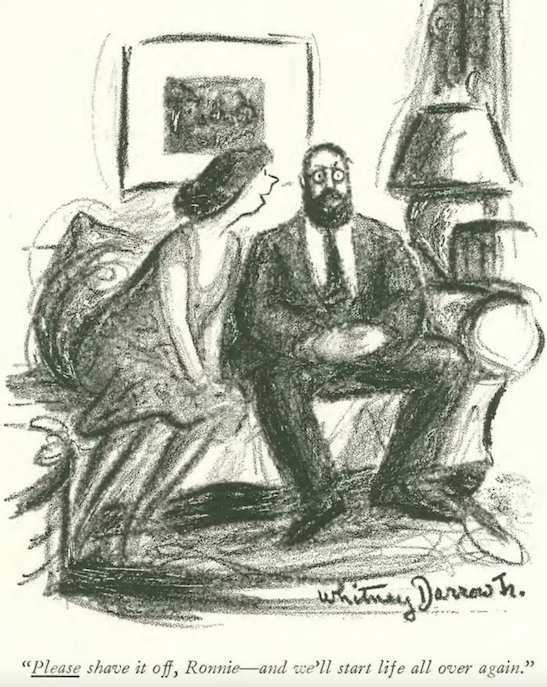
…and a plea to begin life anew, sans whiskers…

Next Time: Age of the Clipper…

Idiot’s Delight

Above: Alfred Lunt and Lynn Fontanne headed the cast of Idiot's Delight, a Pulitzer-Prize-winning play by Robert E. Sherwood. The anti-war play premiered at Broadway's Shubert Theatre on March 24, 1936, and ran for three hundred performances. (latimes.com)

Set against the backdrop of impending war in Europe, Robert Sherwood’s Idiot’s Delight was a timely exploration of how individuals might respond to a major upheaval. The play’s themes about the futility of war resonate as much today as they did in 1936.

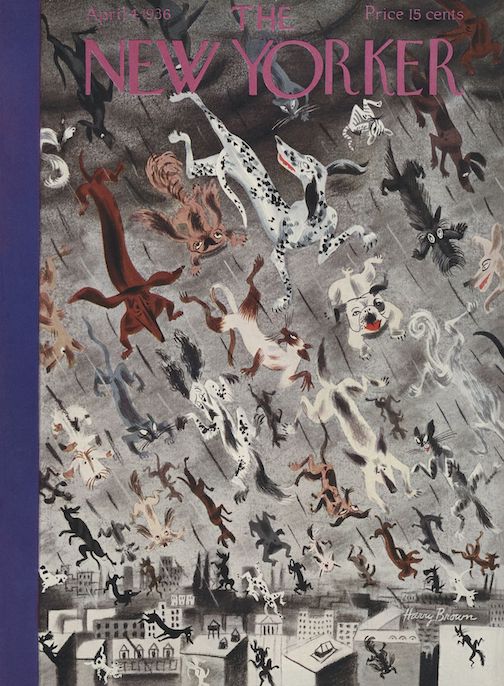
April 4, 1936 cover by Harry Brown. Although he created some distinctive, whimsical covers for The New Yorker (including today’s), there is very little biographical information available on the artist. Brown created eighteen covers for the magazine from 1931 to 1937.

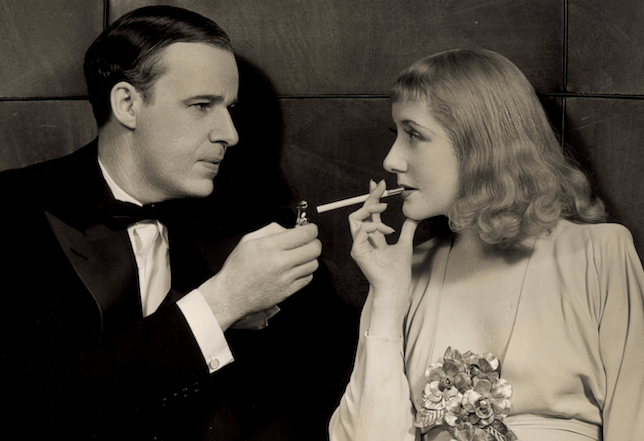
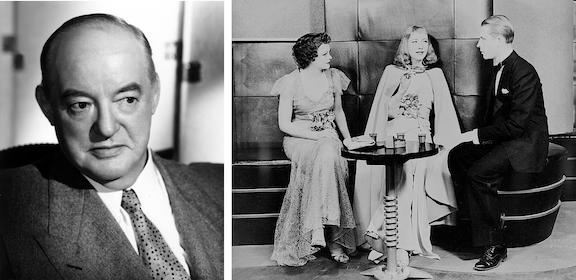
Presented at Shubert Theatre, the Pulitzer Prize-winning play was set at a hotel in the Italian Alps, where the guests—among them a military captain, a German scientist, a radical socialist, and a honeymooning couple—find themselves trapped by the sudden onset of world war. The cast was led by Alfred Lunt, who played a small-time American entertainer accompanied by a troupe of chorines, and Lynn Fontanne, who portrayed a mysterious Russian woman who was traveling with an arms dealer.

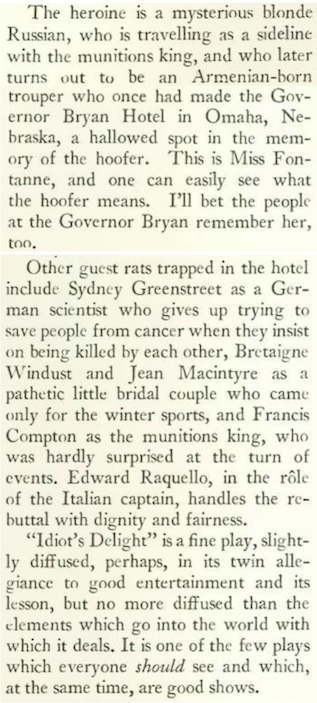
The Pulitzer jury called the play first-rate, full of dramatic invention and “Molierian richness.” Critic Robert Benchley heartily agreed:

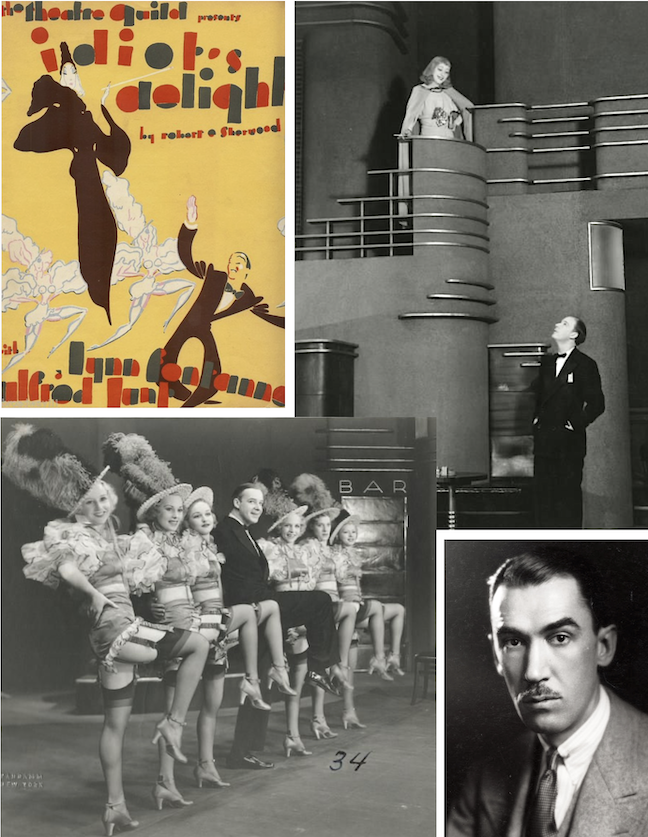
FRIVOLITY AMID THE CHAOS OF WAR…Clockwise, from top left, souvenir program for Idiot’s Delight; Alfred Lunt and Lynn Fontanne in a scene from the play; playwright Robert E. Sherwood; Lunt with a chorus line in Idiot’s Delight. The New York Times critic Brooks Atkinson wrote that the play “demonstrates Mr. Sherwood’s taste for exuberance and jovial skulduggery.”(eBay.com/nypl.org/imdb.com)

Benchley concluded that the play was at once entertaining and edifying:

FORGET ABOUT IT…In Idiot’s Delight, Sydney Greenstreet (left) portrayed a doctor who, in the face of senseless war deaths, gives up on his life-saving research; at right, Jean MacIntyre (left) portrayed Mrs. Cherry, part of a young English honeymooning couple stranded at a hotel due to the sudden closing of the border. With her in the scene are Fontanne and Lunt. (radioclassics.com/Public Domain)

Sherwood adapted the play into a 1939 film of the same name, starring Norma Shearer and Clark Gable.

 * * *

Earth Gazing

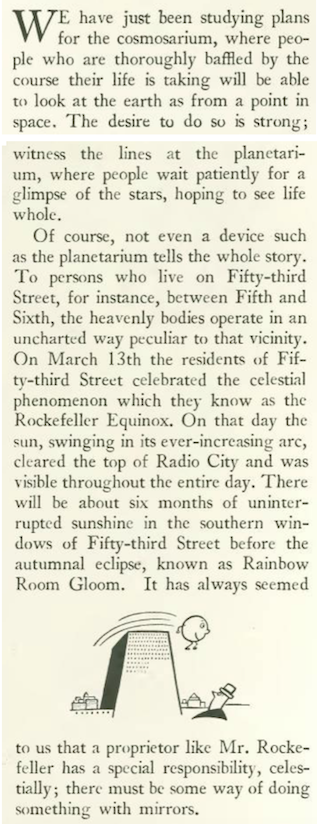
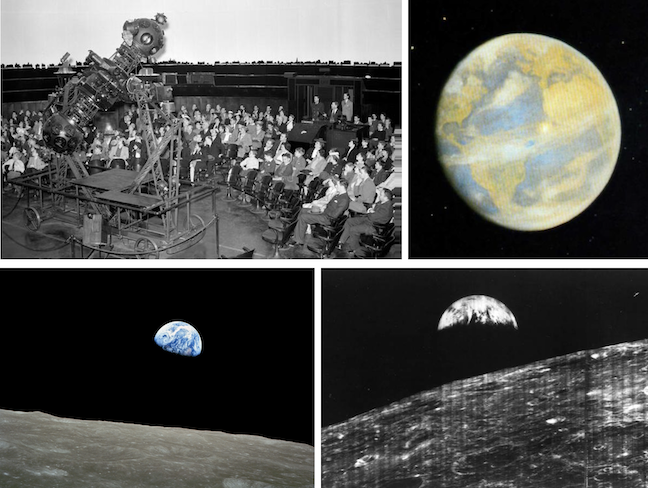
In his “Notes and Comment,” E.B. White mused about plans at the Hayden Planetarium for a program that would give visitors some idea of how earth would appear from a point in space. Earthlings would have to wait until 1968 to actually see a clear, color image of their planet.

THE WONDER OF IT ALL…Clockwise, from top left, the cosmosarium at the Hayden Planetarium, circa 1935; Howard Russell Butler’s attempt at an accurate portrayal of the earth for the American Museum of Natural History, circa 1920s; in 1966, Lunar Orbiter I sent back this image of Earth from the vicinity of the Moon; Earthrise is a famous photograph of Earth taken from lunar orbit by astronaut William Anders on December 24, 1968, during the Apollo 8 mission. (facebook.com/pinterest.com/NASA)

 * * *

From Russia With Love

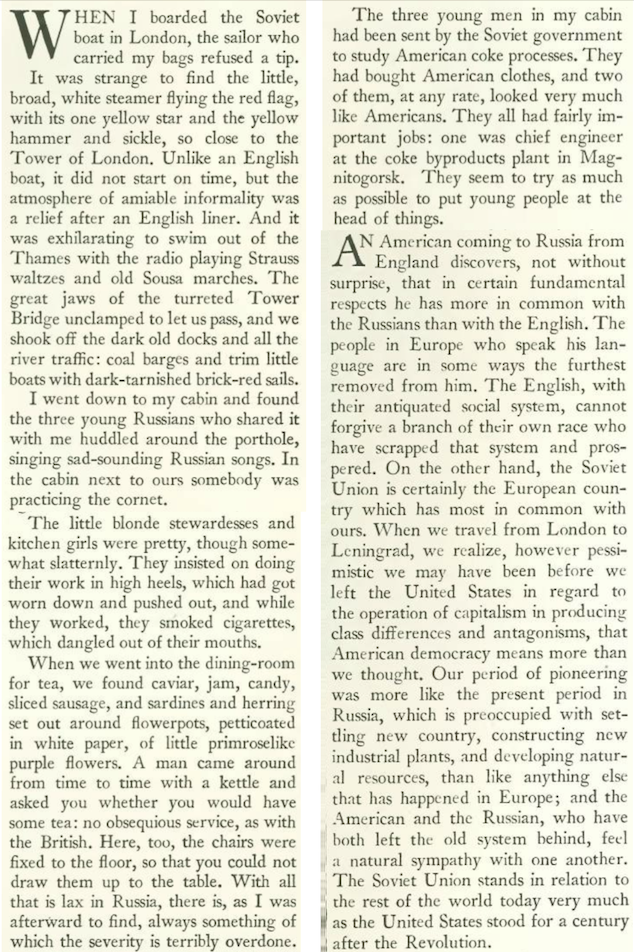
Journalist and literary critic Edmund Wilson Jr (1895–1972) traveled in Russia from May to October 1935, and later filed a couple of articles in The New Yorker detailing his travels. Writing for the column “A Reporter at Large,” Wilson described his journey by boat from London to Leningrad, finding an unexpected kinship with his Soviet cabin mates. Excerpts:

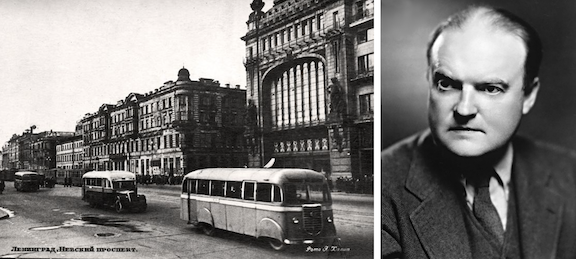
DESTINATION…Leningrad’s Nevsky Prospect 1930s; Edmund Wilson Jr in 1936. (pinterest.com/Wikipedia)

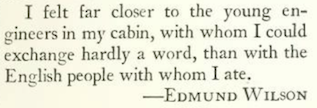
Wilson found that he preferred the company of the Soviets to a stuffy English couple who were his dining companions. He concluded:

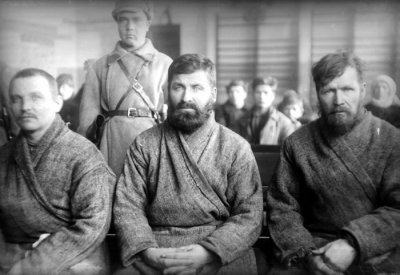
It should be noted that Wilson, despite his Marxist sympathies, would soon become disillusioned with the Soviet experiment; his travels concluded just before the onset of Josef Stalin’s “Great Purge,” which featured the notorious Moscow Show Trials that sent millions of innocent Soviet citizens to labor camps or to their deaths in prisons.

DOOMED…During the Great Terror, which included the notorious show trials of Stalin’s former Bolshevik opponents in 1936-1938 and reached its peak in 1937 and 1938, millions of innocent Soviet citizens were sent off to labor camps or killed in prison. This image from 1936 shows defendants dressed in prison clothing during one of the Moscow Show Trials. (umkc.edu)

 * * *

At the Movies

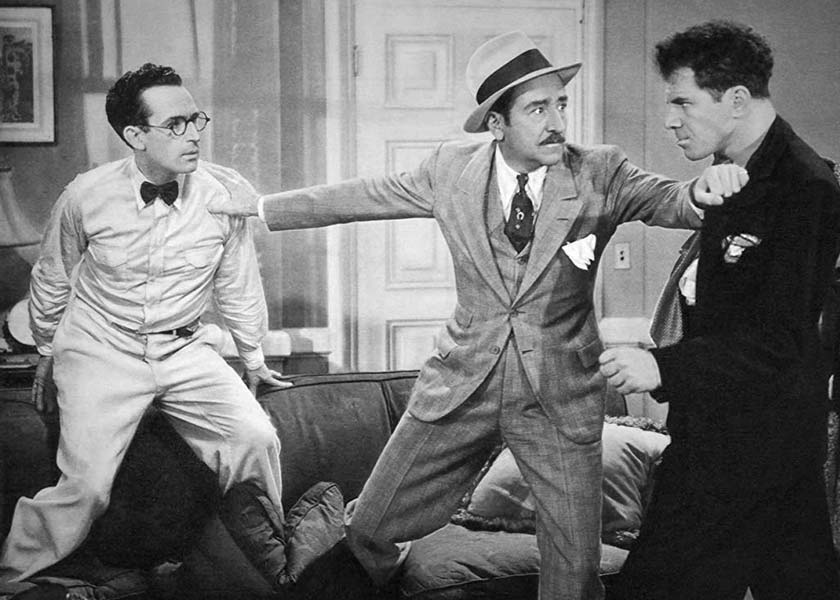
Film critic John Mosher observed that moviegoers mostly needed “thrills and nonsense” at the cinema. Thrills were not to be found, but Harold Lloyd provided the nonsense.

PUNCH LINES…Harold Lloyd (left), portrayed an unlikely middleweight boxer in The Milky Way. Above is a scene with Adolphe Menjou (center) and Lionel Stander. (obscurehollywood.net)

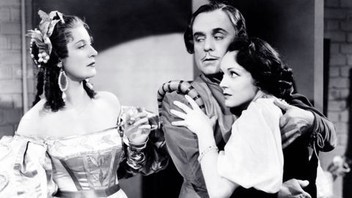
The “thriller” of the week was Moonlight Murder, which Mosher suggested audiences could “dismiss at once.”

DISMISSED…Katharine Alexander, Leo Carrillo and Benita Hume in Moonlight Murder. (rotten tomatoes.com)

Mosher also offered tepid reviews of Everybody’s Old Man and Sutter’s Gold, despite these films featuring a popular humorist and a respected character actor, respectively.

SAY SOMETHING FUNNY…Rochelle Hudson, Irvin S. Cobb and Warren Hymer in Everybody’s Old Man. (imdb.com)
WHO AM I?…A vague narrative left critic John Mosher wondering if Edward Arnold’s character was supposed to be a “hero, villain, scamp, or fool” in Sutter’s Gold. Above, Arnold in a scene with Binnie Barnes. (film booster.com)

 * * *

From Our Advertisers

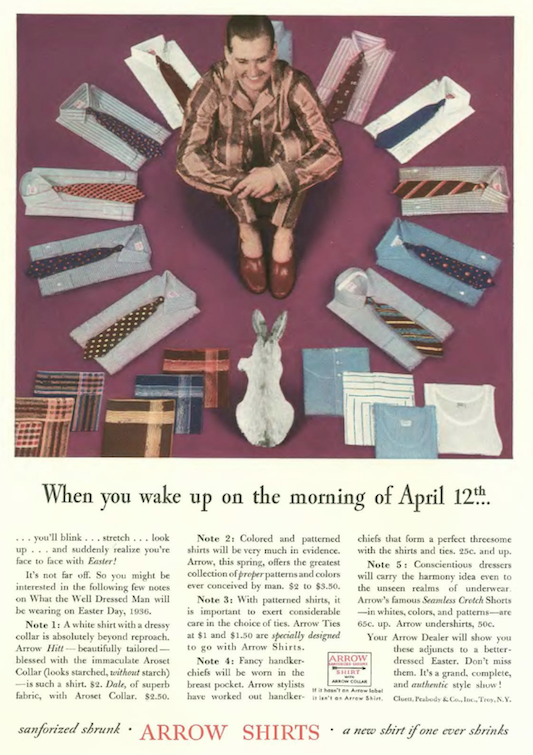
Arrow Shirts rolled out a colorful array of pre-shrunk sanforized shirts and neckties just in time for the Easter holiday…

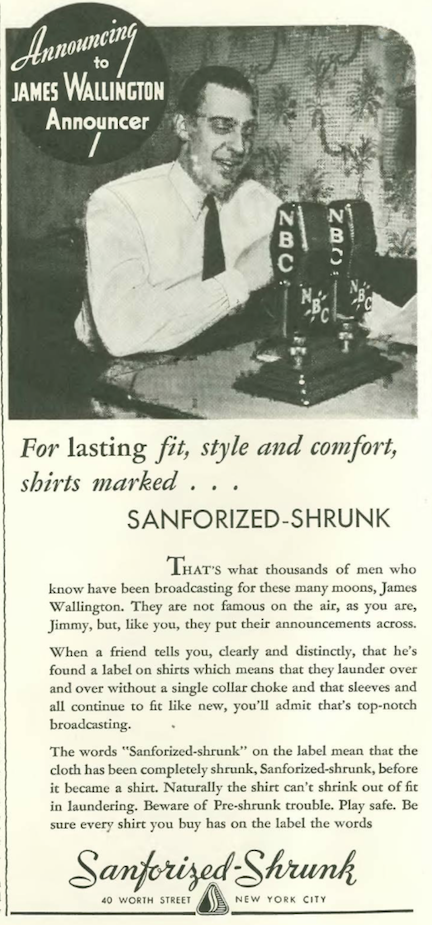
…from the 1930s through the 1950s the distinctive voice of James Wallington (1907–1972) filled the airwaves on both radio and television…here he endorses those “Sanforized Shrunk” shirts…

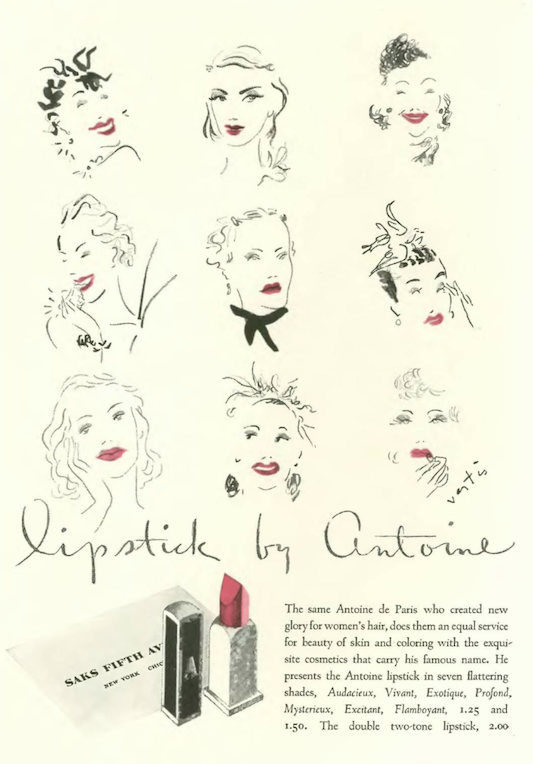
…French costume designer and illustrator Marcel Vertès (1895–1961) provided the art for the Antoine de Paris lipstick line at Saks…Vertès created the original murals in the Carlyle Hotel’s Café Carlyle and in the Waldorf-Astoria’s Peacock Alley… he also won two Academy Awards for his work on the 1952 film Moulin Rouge

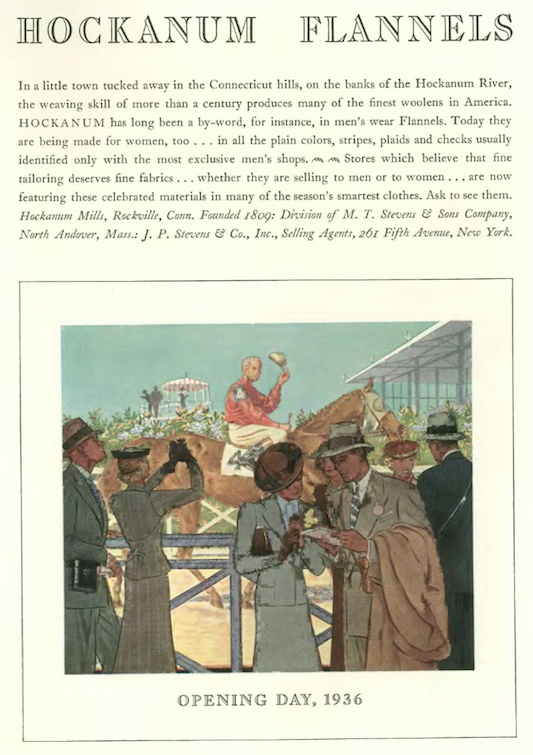
…Hockanum Mills announced its new line of woolens for the spring racing season…

Hockanum’s Rockville mills were shut down in 1951. Today the site is being redeveloped for commercial and light industrial uses as well as the site for the New England Motorcycle Museum. (historicbuildingsct.com)

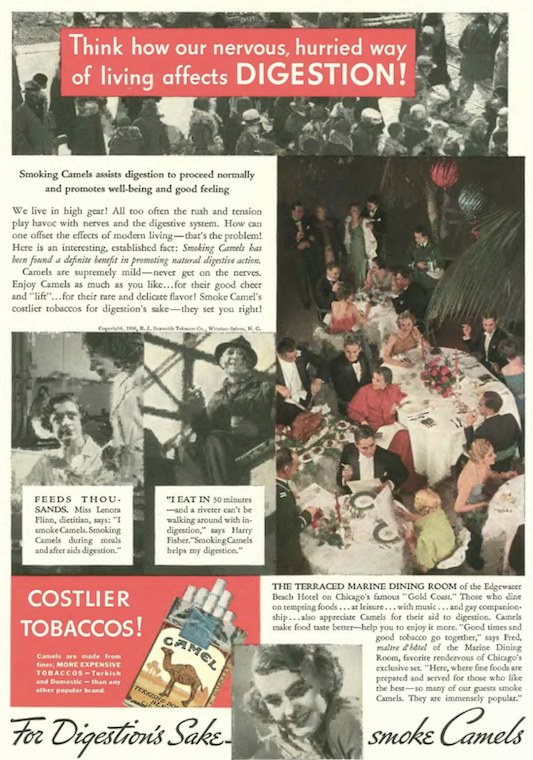
…more claims from R.J. Reynolds regarding the gastrointestinal benefits of their Camel cigarettes…

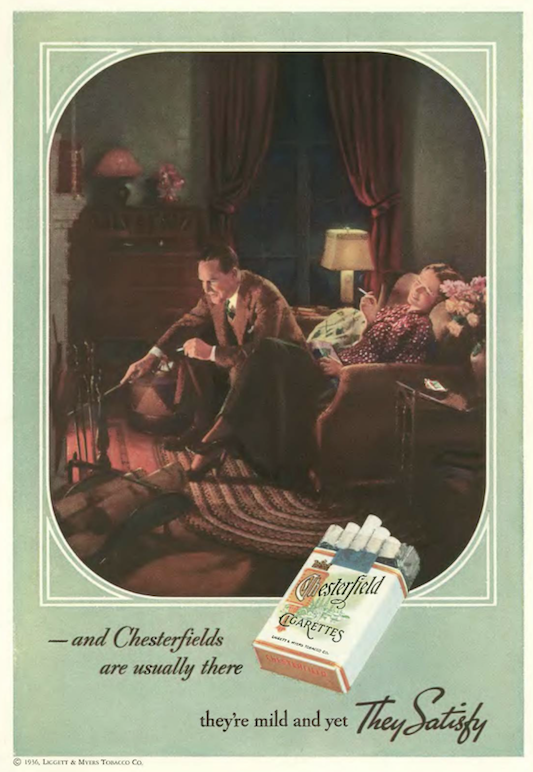
…while Liggett and Myers stuck with the pleasures of hearth and home, and a pack of Chesterfields…

…on to the cartoon section, we begin with Christina Malman

Richard Taylor

Robert Day

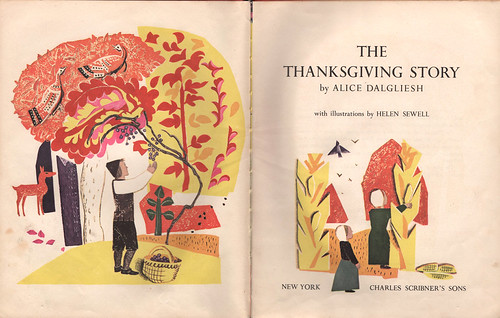
…and a wonderful spot drawing by illustrator and children’s book author Helen Moore Sewell

…who won a Caldecott Medal for her illustrations featured in Alice Dalgliesh’s The Thanksgiving Story (1954)…

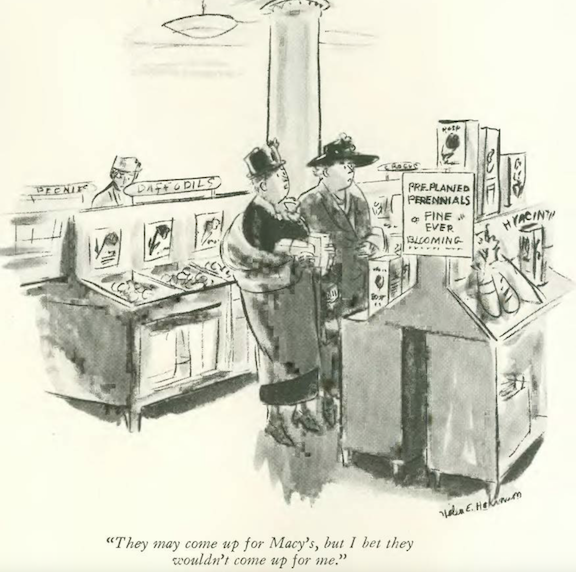
…we go shopping with Helen Hokinson in the garden section…

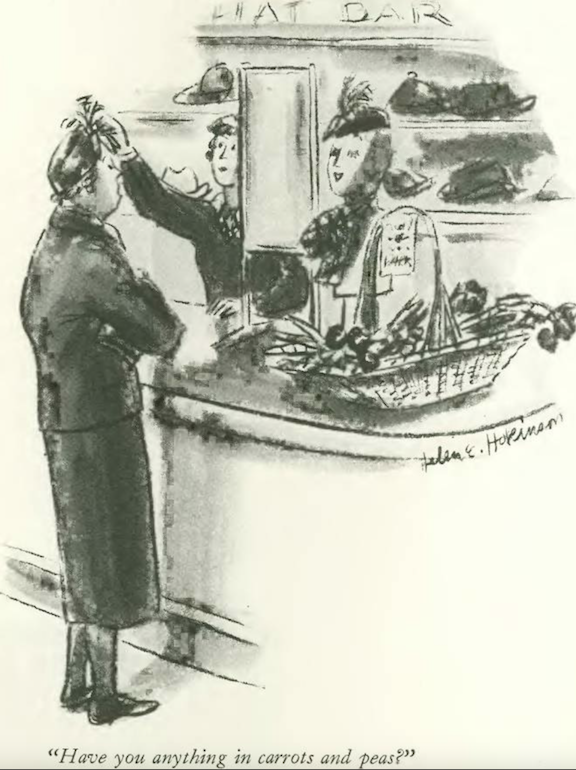
…and in the hat department…

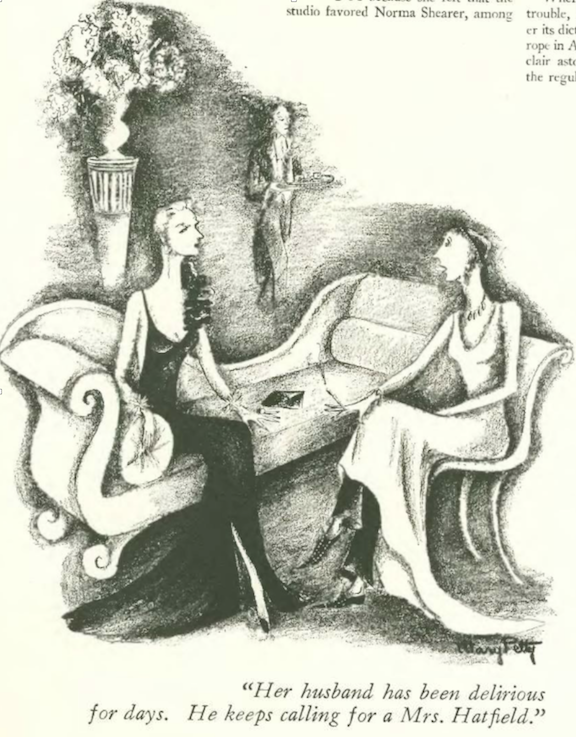
Mary Petty caught up on the latest gossip…
Perry Barlow gave us a shopkeeper in need of some marketing tips…
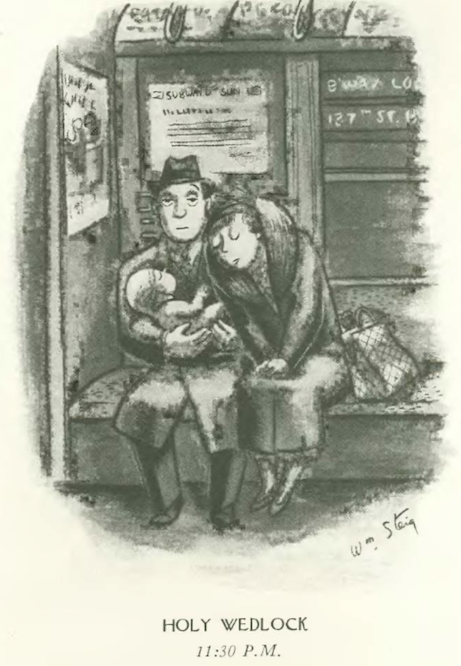
William Steig continued to probe the joys of married life…

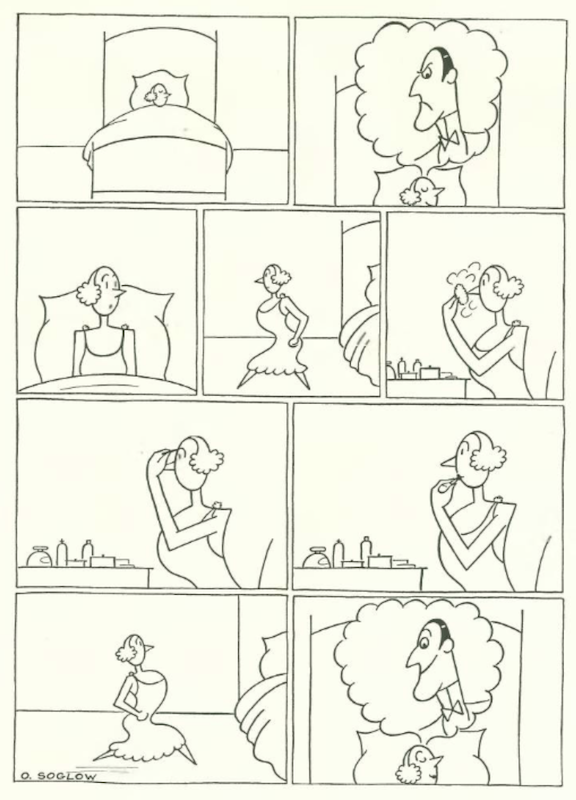
…even one’s dream world required some careful grooming, per Otto Soglow

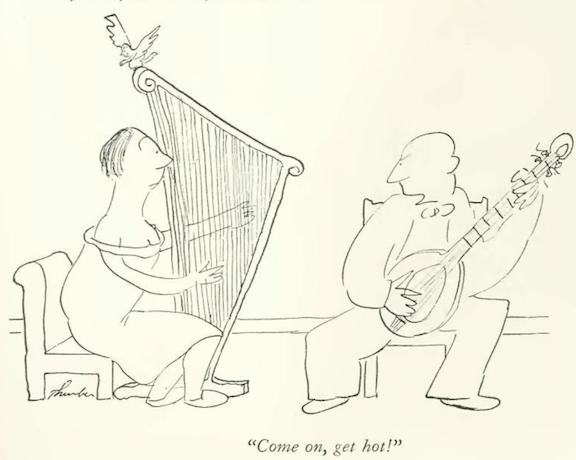
James Thurber drew up a duet out of tune…

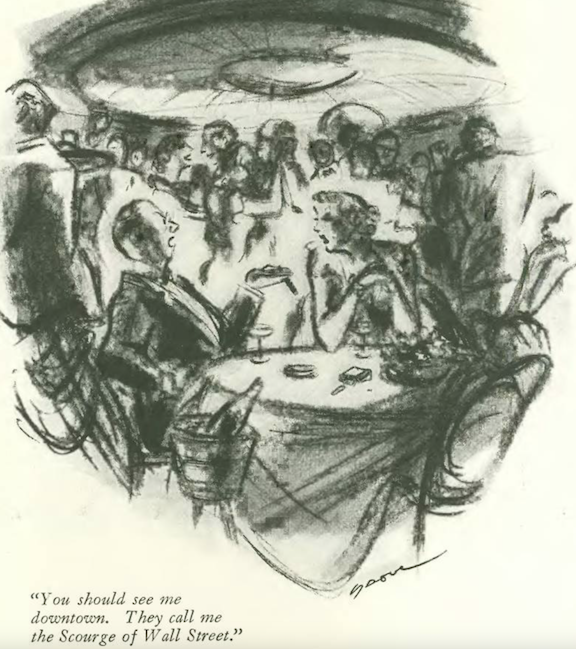
…outside of Wall Street, Leonard Dove’s titan of business was just another sugar daddy…

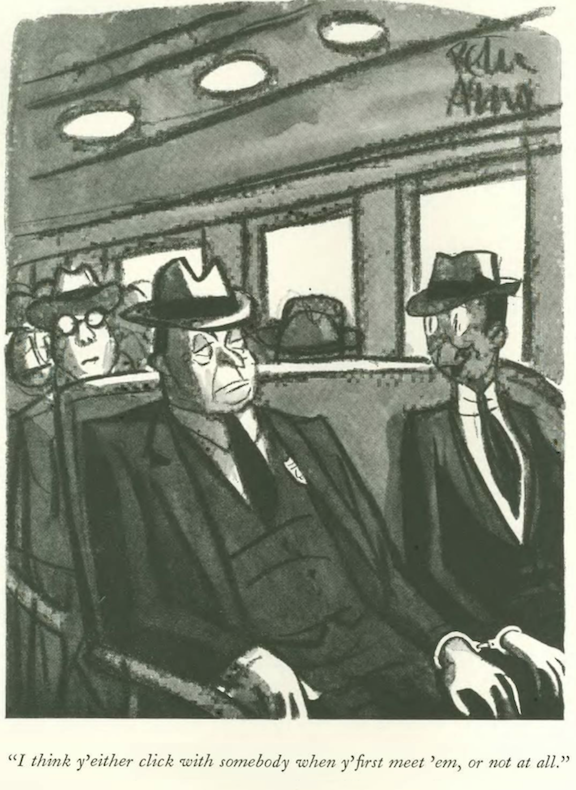
…and we close with Peter Arno, and strangers on a train…

Next Time: People in Glass Houses…