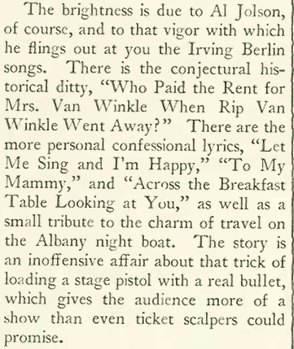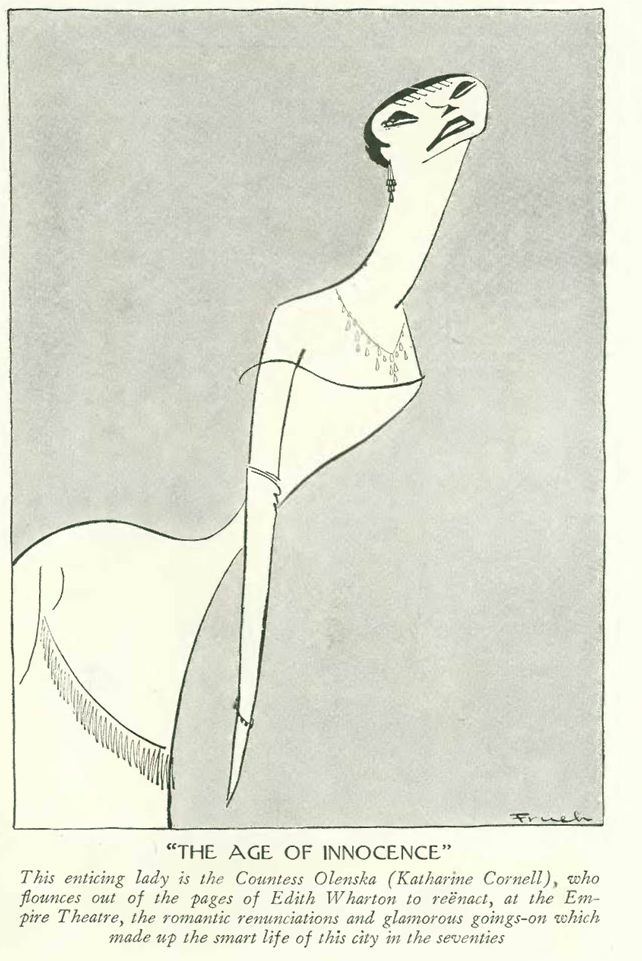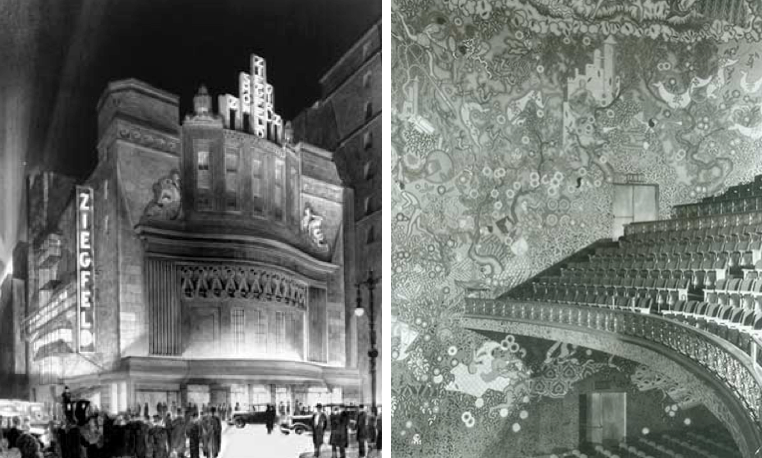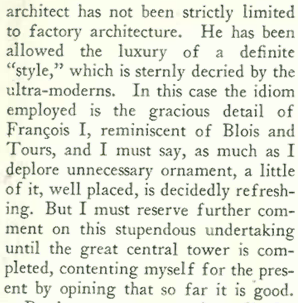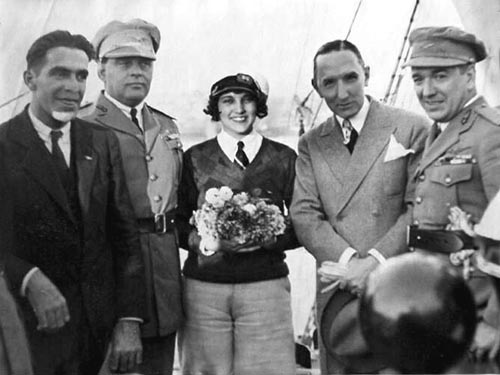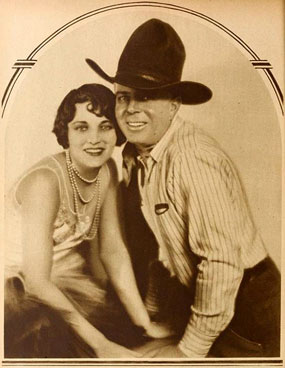
Comedian Ed Wynn began his long acting career on a vaudeville stage in 1903, and beginning in 1914 his giggly voice would delight Broadway crowds flocking to the Ziegfeld Follies. So when he stepped in front of a movie camera for a talking picture, it was something of a sensation.
September 27, 1930 cover by Sue Williams.
It was not an easy transition for the stage veteran. As you can see from Morris Markey’s account below in “A Reporter at Large,” the early talkies presented all manner of challenges and restrictions for stage actors accustomed to a bit more freedom of movement and expression.
SCANDALOUS BUNCH…Ed Wynn (in hat) portrayed a character he developed on Broadway — “Crickets” — in his film debut Follow the Leader. At left is actor Stanley Smith, and at center, holding Wynn’s hand, is a brunette Ginger Rogers, with chorus girls from George White’s Scandals. (IMDB)
PAY NO ATTENTION TO THE MAN BEHIND THE WINDOW…Noisy cameras were enclosed in soundproof boxes in the early days of the talkies. Above, Woody Van Dyke directs Raquel Torres and Nils Asther in 1930’s The Sea Bat. (nilsasther.blogspot.com)TINSELTOWN IN QUEENS…For his article, Morris Markey visited the set of Follow the Leader at Astoria Studios in Queens. The original studio building, at 35th Avenue, is on the National Register of Historic Places. Although Paramount moved its movie operations to Hollywood in the early 1930s, the studio continued to be used for both film and television productions. At right, a bit of Paris was erected in the midst of Queens for the filming of 1929’sThe Gay Lady. (Wikipedia/Kaufman Astoria Studios)FILM DEBUT…A December 1930 magazine advertisement touting Ed Wynn’s first motion picture. (IMBD)
* * *
False Modesty?
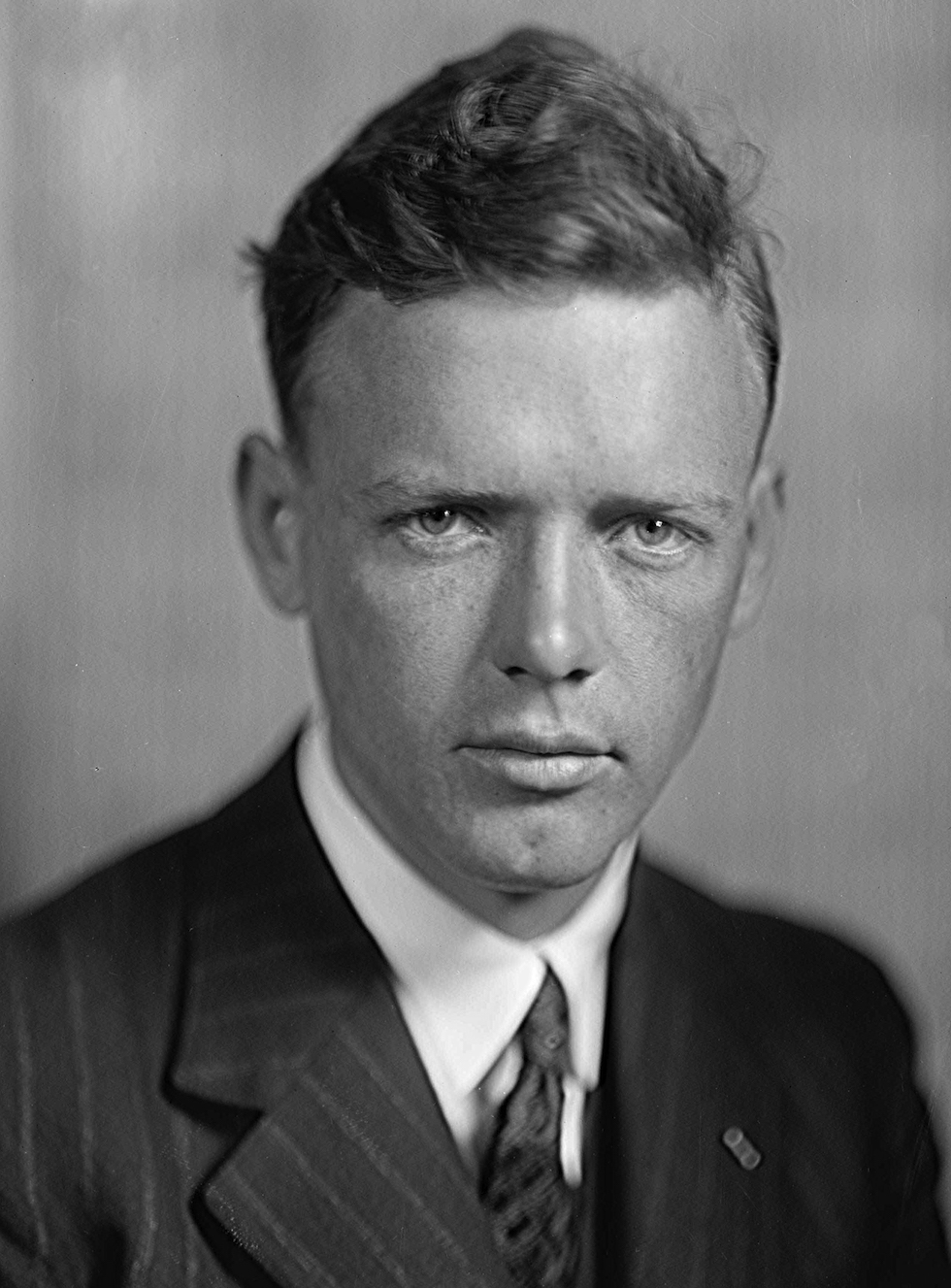
In Morris Markey’s second installment of his profile on Charles Lindbergh, Markey suggested that Lindbergh’s aversion to publicity might be a pose…
NO WI-FI, BUT YOU COULD SMOKE…Top, the posh set take wing with TWA circa 1930; below, passengers prepare to board an American Airways Curtiss Condor II in 1933. (historydaily.org/Sweezey Pictures/Ken Sweezey)
…and also wondered how much credit Lindbergh could take for sparking the aviation industry, given that flying was still an activity reserved for a very few…
…Markey also noted a “lively rumor” that Lindbergh wanted to be President…
…fortunately Lindbergh did not give truth to the rumor, or fulfill the alternate history created by Philip Roth in his 2004 novel The Plot Against America…
HANGIN’ WITH A BAD CROWD…Top, Charles Lindbergh accepts a ceremonial sword from Hermann Göring during a 1936 visit to Nazi Germany; below, right, Lindbergh in Germany, 1937. Philip Roth’s novel imagined Lindbergh’s election to the Presidency in 1940 and its chilling results. (Reddit/The New Yorker/Goodreads)
* * *
Bad Moon Rising
In 1930 few, if anyone, were aware of Lindbergh’s proclivities toward nationalism and antisemitism. And lacking a crystal ball, Markey’s New Yorker colleague, Howard Brubaker, had little reason to be alarmed by the federal elections in Germany, which gave the Nazis the second largest number of seats in the Reichstag. In his “Of All Things” column, Brubaker quipped:
INCOMPATIBLE…As Howard Brubaker noted in “Of All Things,” the fascists led by Adolf Hitler, left, and the communists led by Ernst Thälmann (right) made big gains in the 1930 German elections. After gaining power in 1933, Hitler would arrest Thälmann and later have him shot. (Wikipedia)
* * *
Gummed to Death
The New Yorker’sJohn Mosher took in the latest travelogue to exploit and misrepresent life on the African savannah. Africa Speaks included a scene depicting a fatal attack on a “native boy” by a lion — an attack that was actually staged at a Los Angeles zoo and involved a toothless lion…
STRANGE INDEED…At left, movie poster for Africa Speaks; top right, Pygmy drummers in the film; bottom right, explorer Paul Hoefler getting closer to nature. (IMDB/Wikimedia)
* * *
From Our Advertisers
When Paris unveiled is spring and fall fashions, large department stores were always quick to respond with “copies”…
…while the higher end boutiques offered originals to “poor little rich girls”…
…perhaps some of these “poor little rich girls” socialized at the Panhellenic, a “club-hotel for college women”…
…and here are some views of the Panhellenic House, circa 1929…
Center, The Panhellenic House, at First Avenue and 49th Street; at left, the solarium; at right, a ballroom. (Avery Library/Museum of The City of New York)
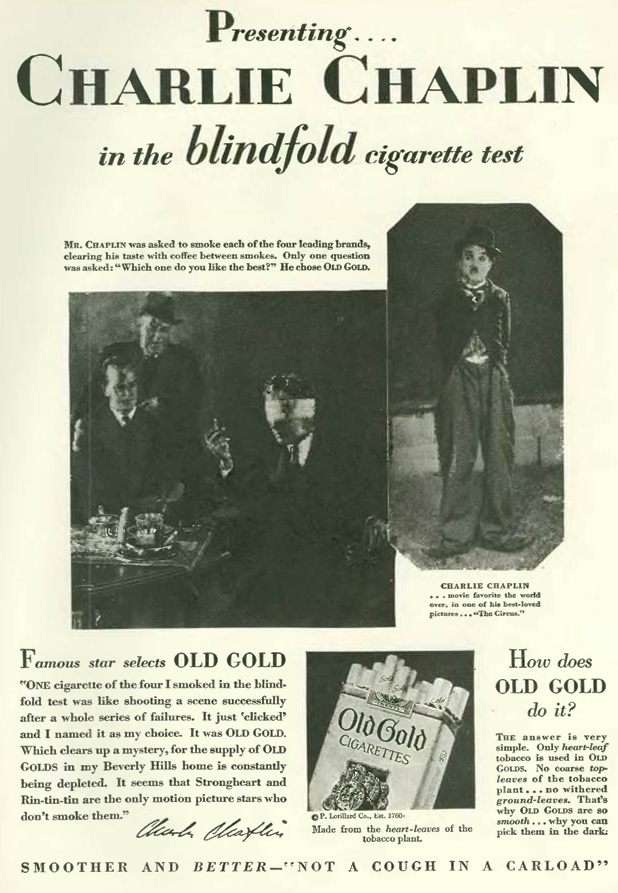
…the makers of Old Gold cigarettes had some of the weirdest ads to push their smokes, including this one…
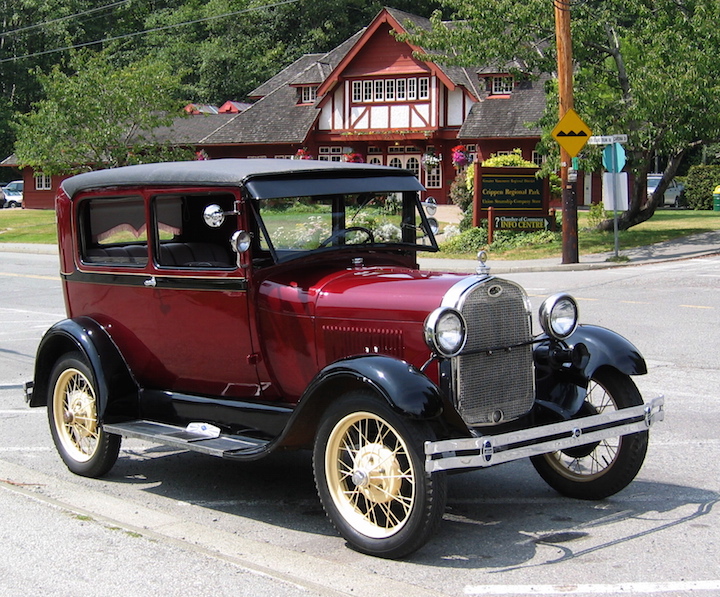
…and one wonders what the world would be like (and especially the U.S.) if car buyers would have favored a more compact version of the motorcar going forward…
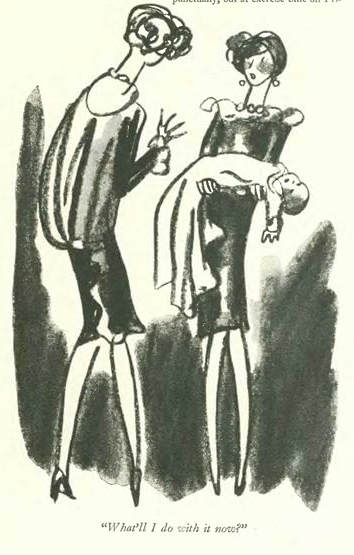
…on to our cartoons…we begin with parenting tips from the posh set, courtesy Garrett Price…
…Alan Dunn explored modern matrimony…
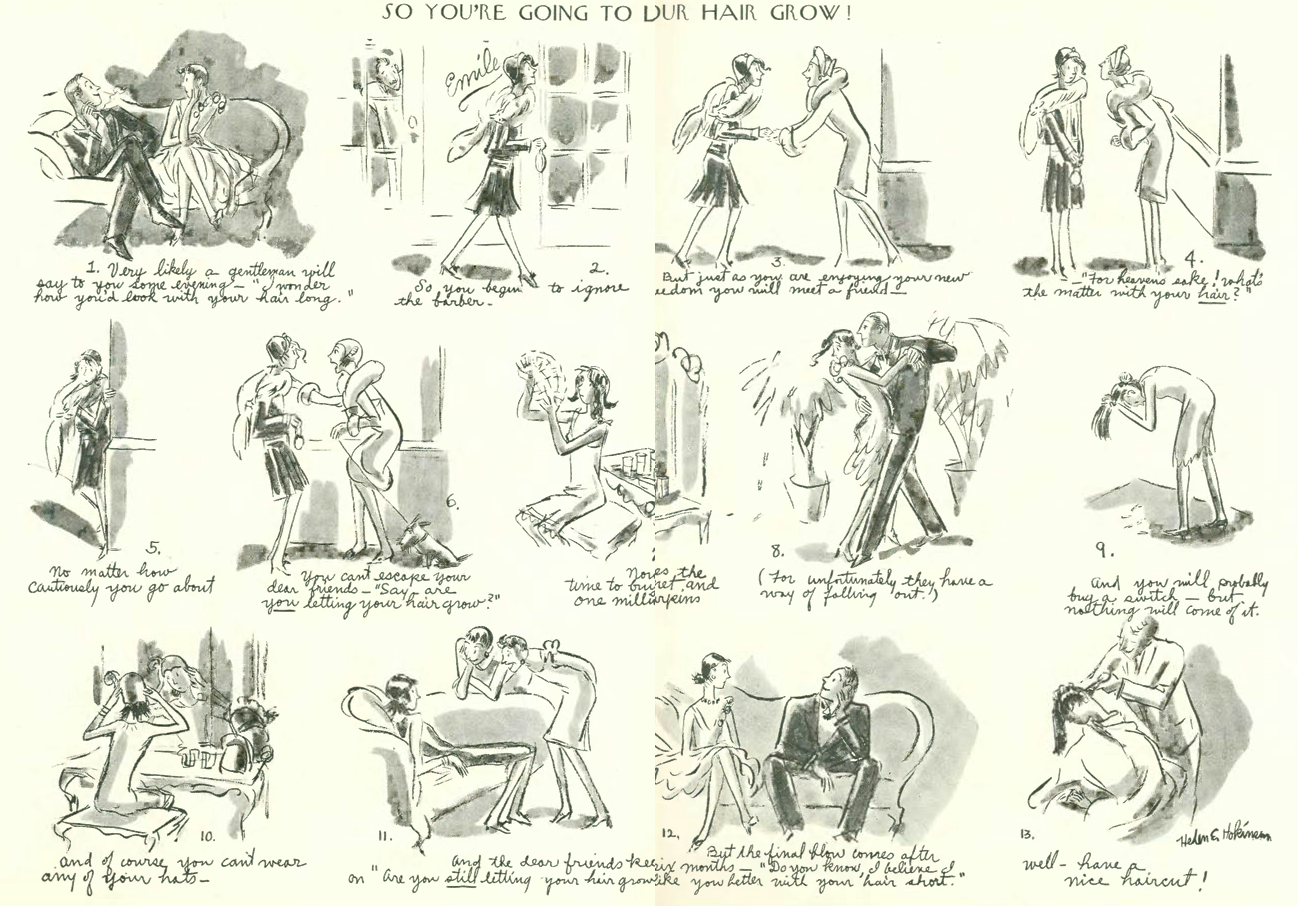
…one of Helen Hokinson’s ladies demonstrated a unique taste in furniture…
…Otto Soglow continued to explore humor in a wavy fashion…
…and we close with this vertiginous view provided by Leonard Dove…
Since time immemorial human beings have clung to the idea that unknown lands must surely contain vast mineral treasures.
July 26, 1930 cover by Helen Hokinson.
Such was the case when Admiral Richard Byrd returned from his Antarctic expedition, during which he conducted a number of geological studies. Ever ready to tweak a senator’s nose, TheNew Yorker’sJames Thurber imagined an exchange between Byrd and a U.S. Senate subcommittee that was more interested in exploitable commodities than in scientific discoveries:
HMMM, NO OIL HERE…Richard Byrd’s expedition building their “Little America” encampment at the South Pole in 1928. (osu.edu)
One passage of particular interest in this imagined exchange dealt with the speed of climate change in relation to potential mineral extraction…
BIRDS MEET BYRD…Admiral Richard Byrd onboard the USS Bear during his second expedition to the South Pole. (Wikipedia)
* * *
Before CNN
Newsreels came into their own with the advent of sound, offering moviegoers a selection of news stories from the around the world. In his “Notes and Comment,” E.B. White observed that newsreels depicted foreigners as people who just liked to hang out (note the racial slur directed at Latin Americans). White’s characterization of Germans as an indolent lot is also noteworthy, given the country was just two and half years away from Nazi takeover.
TANZEN UND TRINKEN…Kroll’s Biergarten in Berlin in September 1928; English visitors raise a glass at a beer hall in Hesse, 1929. (YouTube)
* * *
Speaking of Slurs
Here is what passed for a humorous anecdote in the July 26, 1930 “Talk of the Town”…
* * *
Star Power
William Powell and Kay Francis were frequent co-stars, and would team up for the 1930 courtroom drama For the Defense. Powell and Francis would be two of Hollywood’s biggest stars in the 1930s.
LET’S MAKE A PICTURE…Frequent co-stars William Powell and Kay Francis in a publicity photo for 1930’s For the Defense. Francis was a longtime friend of The New Yorker’sLois Long. (IMDB)
* * *
From Our Advertisers
What Depression? As bread lines lengthened so did the “super-chassis” of this monster Cadillac…
…in contrast, this ad in the Aug. 2 issue questioned the necessity of a 4,000-pound car (or in the case of the 16-cylinder Cadillac, 6,500 pounds), and touted this “common sense” British import…imagine the America of today if this idea would have taken hold in the 1930s…
…we return to the June 26 issue to find an ad that would likely not appear in today’s New Yorker…
…another unlikely ad is this spot from the makers of Farina cologne featuring a skinflint applying the stuff to his armpit…yeah, I’ll take a bottle…
…and Rea Irvin continued his series of illustrations for Murad cigarettes…
…in cartoons, Irvin gave us this interpretation of country life in a full-page panel originally featured sideways…these “Country Life in America,” scenes depicted common folks enjoying the outdoors at the expense of country squires…
…and then we have the bohemian artist and set designer Cleon Throckmorton (1897-1965), with his one and only contribution to The New Yorker…
…in a previous issue (May 31, 1930) Throckmorton had placed this tiny, curious ad in a corner on page 46…
…and in the June 7, 1930 issue, he placed another ad in the bottom corner of page 94…
Cleon Throckmorton, well-known for his bohemian lifestyle, operated a backyard speakeasy called the Krazy Kat Club in Washington DC. He is pictured here (center) with a couple of “Klub” members in 1921. He was no slouch, however, designing 149 New York theatrical productions between 1920 and 1934. (messynessychic.com)
…back to our cartoons, we have Otto Soglow, who was going through a wavy period in his illustrations…
…Soglow would soon become famous for his Little King strip, but for now we’ll leave the king jokes to Peter Arno…
…Gardner Rea contributed this series cartoon that slid around page 20…
…Leonard Dove looked in on a domestic scene…
…and John Reehill contributed this weird little cartoon that reminded me a bit of the humor of Gahan Wilson…
Like his New Yorker colleague Reginald Marsh, Otto Soglow trained in the “Ashcan School” of American art, and his early illustrations favored its gritty urban realism. He had his own life experience to draw upon, being born to modest means in the Yorkville district of Manhattan.
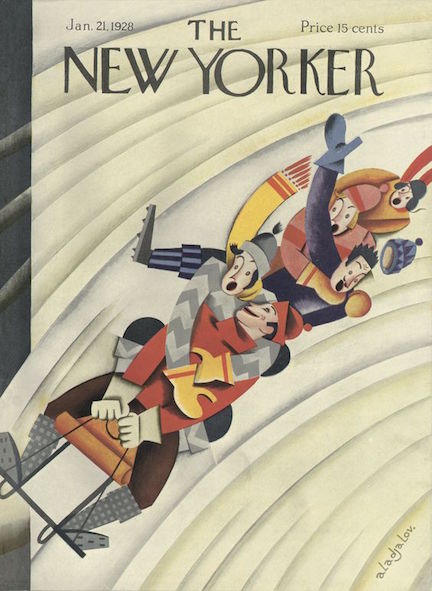
We look at two issues this week. At left, cover of March 31 issue by Peter Arno; at right, June 7 cover by Constantin Alajalov.
But Soglow (1900-1975) would soon abandon the gritty style in the work he contributed to the New Yorker…
RAGS TO RICHES…At left, Otto Soglow’s first cartoon in The New Yorker, Nov. 14, 1925, was rendered in the Ashcan style ; at right, an example of the sparer style he later adopted, one of his manhole series cartoons from March 2, 1929.
…and in the June 7, 1930 issue, Soglow would publish his first Little King strip, which would launch the 29-year-old into fame and fortune…
Did Soglow know he was on to something big with that first Little King cartoon? Well Harold Ross (New Yorker founding editor) liked what he saw, and asked Soglow to produce more. After building up an inventory over nearly ten months, Ross finally published a second Little King strip on March 14, 1931. It soon became a hit, catching the attention of William Randolph Hearst, who wanted the strip for his King Features Syndicate.
KING OF COMEDY…Otto Soglow working on an illustration for The Ambassador, a short-lived comic strip he created in 1933 for King Features Syndicate. The strip was replaced by The Little King in 1934 after Soglow fulfilled his contractual obligation to The New Yorker. (comicartfans.com)
After Soglow fulfilled his contractural obligation to The New Yorker, The Little King made its move to King Features on Sept. 9, 1934, and the strip ran until Soglow’s death in 1975. After his move to King Features, Soglow continued to contribute cartoons to The New Yorker, but with other themes.
Left, Soglow cartoon from the book Wasn’t the Depression Terrible? (1934); at right, King Features strip from Nov. 19, 1967. (Wikipedia/tcj.com)
During the summer of 1925, a young writer at Vanity Fair named Lois Long would take over The New Yorker’s nightlife column, “When Nights Are Bold,” rename it “Tables For Two,” and set about giving a voice to the fledgling magazine as well as chronicling the city’s Jazz Age nightlife. There were accounts of Broadway actors mingling with flappers and millionaires at nightclubs and speakeasies, but Long also spoke out on issues such as Prohibition, taking the city’s leaders to task for raids on speakeasies and other heavy-handed tactics contrary to the spirit of the times. “Tables For Two” would go on hiatus with the June 7, 1930 issue, and appropriately so, as the deepening Depression gave the the city a decidedly different vibe. In her “final” column Long would write about the Club Abbey, a gay speakeasy operated by mobster Dutch Schultz…
PARTIED OUT…In her final nightlife column, Lois Long wrote about the new Club Abbey in the basement of the Hotel Harding (left), which was operated by mobster Dutch Schultz (inset). The club’s emcee was Gene Malin (right), Broadway’s first openly gay drag performer. The club was short-lived (as were Schultz and Malin), closing in January 1931 following a mob brawl. (infamousnewyork.com/Pinterest)
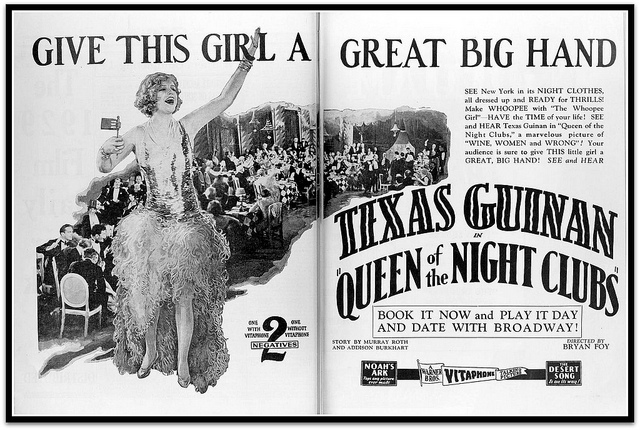
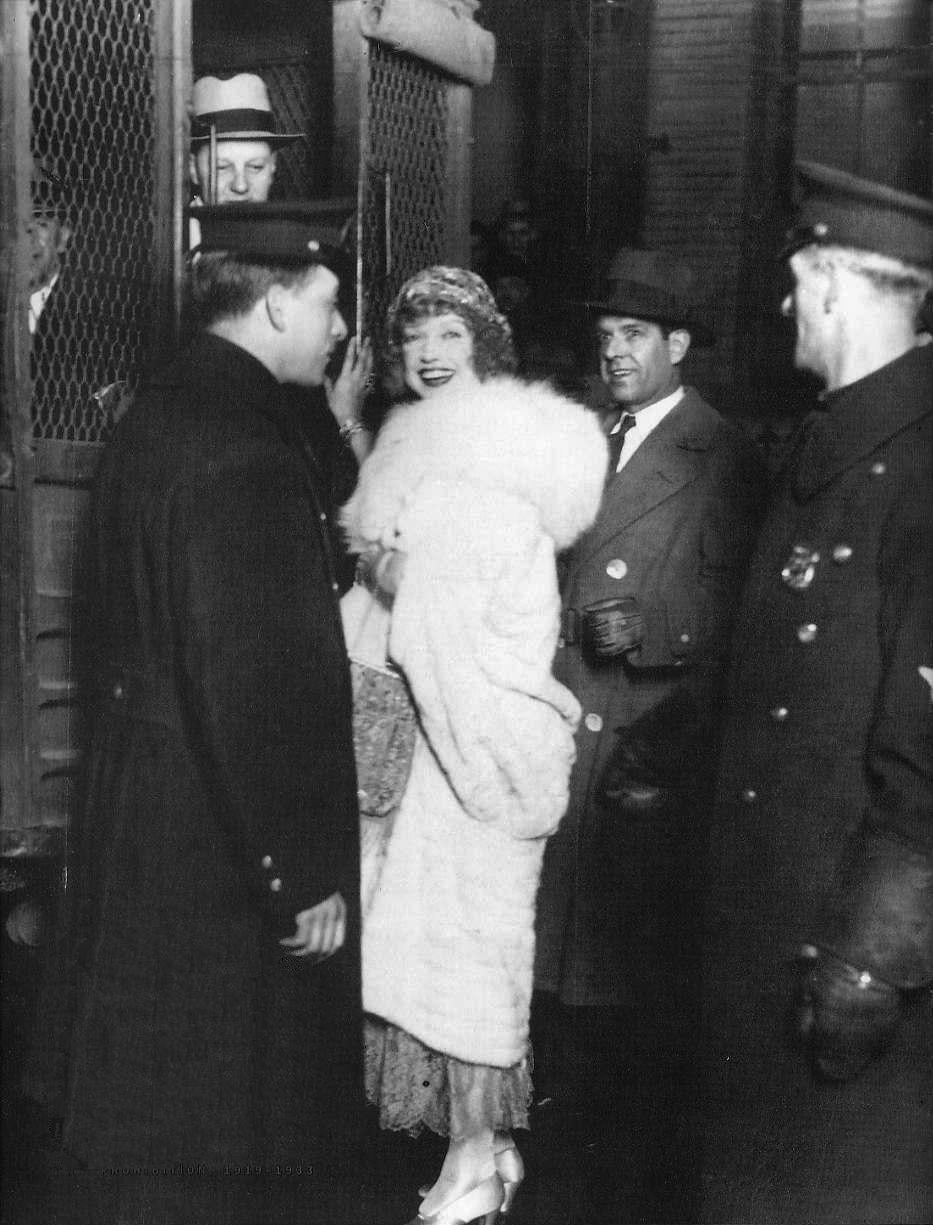
…and she would update her readers on “Queen of the Night Clubs” Texas Guinan, whose Club Intime was sold to Dutch Schultz and replaced by his Club Abbey…
FINAL ACT…Clockwise, from top left, Texas Guinan at Lynbrook, circa 1930; Joseph Urban murals on the rooftop of the St. Regis Hotel; Duke Ellington and his orchestra at the Cotton Club, circa 1930s.
Long’s column would signal a definitive end to whatever remained of the Roaring Twenties. It would also signal the end to some of those associated with those heady times. Texas Guinan’s Lynbrook plans would flop, and Gene Malin’s Club Abbey would close in less than a year. Both would both be dead by 1933—Malin would die in a car accident in 1933, and amoebic dysentery would claim Guinan that same year. Dutch Schultz would be gunned down by gangsters in 1935.
Lois Long, however, would continue to write for The New Yorker for another forty years, and would prove to be as innovative in her fashion column, “On and Off the Avenue,” as she was as a nightlife correspondent.
* * *
Gone to the Dogs
In another installment of his pet advice column (June 7), James Thurber gave us one of his classic dogs…a disinterested bloodhound…
…while Thurber’s buddy and office mate E.B. White commented (in the March 31 issue) on a recent poll conducted among students at Princeton, discovering among other things that New Yorker cartoonist Peter Arno was preferred over the old masters…
FAN FAVORITES…The Princeton Class of 1930 named (from left) Rudyard Kipling, Lynn Fontanne and Peter Arno as favorite poet, actress and artist respectively in a student poll. (YouTube/Wikipedia/giam.typepad.com)
* * *
We Like It Fine, Thank You
The New Yorker dedicated a full page of the March 31 issue to a tongue-in-cheek rebuttal directed at the New York Evening Journal, which had reprinted one of Peter Arno’s cartoons to illustrate the moral cost of Prohibition. I believe the author of the rebuttal is E.B. White (note how he refers to Arno as “Mr. Aloe”).
…also in the May 31 issue, Rea Irvin changed things up, at least temporarily, with some new artwork for the “Goings On About Town” section. The entries themselves were often clever, such as this listing for a radio broadcast: PRESIDENT HOOVER—Gettysburg speech. Similar to Lincoln’s but less timely…
* * *
From Our Advertisers
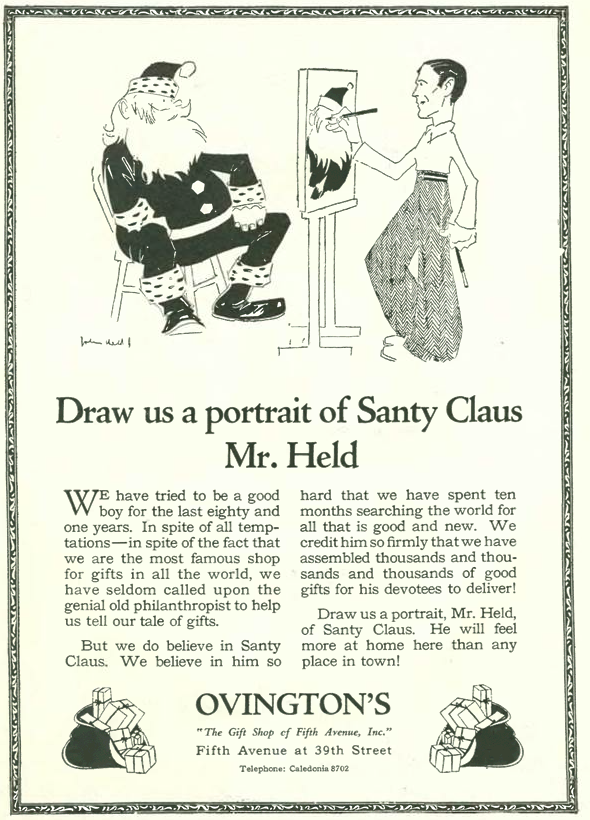
New Yorker cartoonists can be found throughout the advertisements — from left, Julian De Miskey, Rea Irvin and John Held, Jr…
…and in the June 7 issue we find an unusual ad for a used car…a sign of the times, no doubt…
…before it was associated with Germany’s Nazi Party (especially after it seized power in 1933), for thousands of years the swastika had been widely used as a religious or good luck symbol…
…Actress Clara Bow was famously pictured sporting a “good luck” swastika as a fashion statement in this press photo from June 1928, unaware that in a few years the symbol would become universally associated with hate, death and war…
From an unidentified publication dated June 6, 1928. (@JoHedwig/Twitter)
…on to our cartoons, Isadore Klein illustrated a cultural exchange…
…Garrett Price gauged the pain of a plutocrat…
…Alan Dunn eavesdropped on some just desserts…
…Helen Hokinson found humor in the mouths of babes…
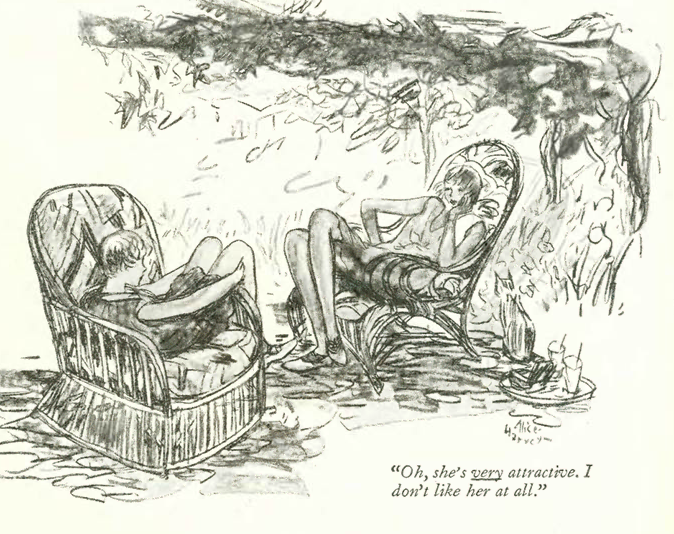
…as did Alice Harvey…
…Leonard Dove examined one woman’s dilemma at a passport office…
…and Peter Arno, who found some cattiness at ringside…
Before we launch into the latest offering from Tinseltown, a note about the cover artist for the April 26, 1930 issue.
April 26, 1930 cover by Barney Tobey.
Barney Tobey (1906-1989) was known for gently humorous cartoons that appeared in The New Yorker for more than fifty years. He also contributed four covers, the first of which appears above. In the Sept. 21, 1998 issue, illustrator Richard Merkin offered this remembrance:
* * *
Star-spangled Banter
All-star musicals were all the rage in the early sound era, as they gave studios the opportunity to showcase contract players (who were virtually owned by the studios) doing things they usually didn’t do on screen. Following the success of MGM’s Hollywood Revue of 1929, Paramount Studios released Paramount on Parade in April 1930, much to the liking of New Yorker critic John Mosher, who also praised the film’s accompanying cartoon, 1929’s The Prisoner’s Song:
You can watch Max Fleischer’s The Prisoner’s Song here (and ponder how far animation has advanced)…
Mosher also praised a number of Paramount’s contract players, and especially actors Jack Oakie and Maurice Chevalier…
MUCH ADO…A great crowd gathers for the premiere of “Paramount on Parade” at the New York’s Rialto Theatre in April 1930. (cinematreasures.org)SEEING STARS…Clockwise, from top left, Helen Kane (possibly the inspiration for the cartoon character “Betty Boop”) and Jack Oakie do a little footwork; Clara Bow, Hollywood’s “It Girl,” pops through a Navy recruitment poster at the beginning of her song and dance number (with Stuart Erwin and Richard ‘Skeets’ Gallagher); one of Hollywood’s top actresses in 1930, Kay Francis, portrays “Carmen” in the revue; Ruth Chatterton entertains doughboys Stuart Erwin, Fredric March, Jack Oakie, and Stanley Smith in Paramount on Parade. (IMDB)BOOP GIVES A BOP…Helen Kane (left) and child star Mitzi Green in a sketch from Paramount on Parade. (IMDB)
* * *
Lost In the Crowd
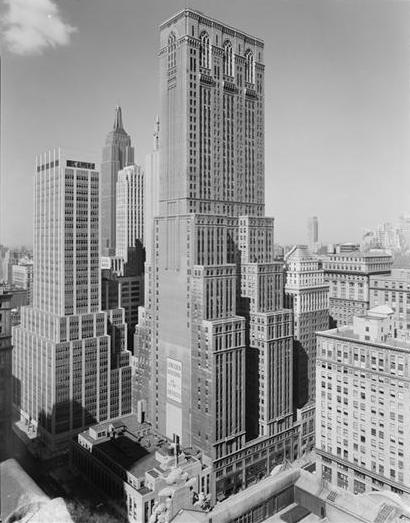
In his “Notes and Comment,” E.B. White lamented the fact that the world’s tallest building appeared less than lofty, since neighboring skyscrapers were nullifying its grandeur:
DOWN IN FRONT…E.B. White found the streetview of the world’s tallest building wanting after it was completed in 1930; the iconic Flatiron Building, however, enjoys some elbow room even today. (spectator.co.uk/walksofnewyork.com)
* * *
Full of Hot Air
That was another opinion shared by E.B. White, this time regarding the Empire State Building’s top promotor, former New York Governor Al Smith, who spoke of plans to attach a mooring mast to the top of his skyscraper (which would eclipse the Chrysler as the world’s tallest in 1931):
* * *
View From the Top
The New Yorker featured a profile of Aloysius Anthony Kelly (1893?-1952), better known as the Roaring Twenties most famous pole-sitter, “Shipwreck” Kelly. He achieved his greatest fame in the 1920s and 1930s, sitting for days at a time on elevated perches — often atop buildings — throughout the U.S.
Kelly’s fame was already on the wane when this profile appeared, and by 1934 he was reportedly working as a dance hall gigolo. Kelly’s last flagpole stunt was at a 1952 event sponsored by a Lion’s Club in Orange, Texas — he suffered two heart attacks while sitting atop their 65-foot flagpole. After climbing down he announced, “This is it. I’m through.” He died one week later after he was struck by car on West 51st Street in Manhattan.
LOFTY AMBITIONS…Alvin ‘Shipwreck’ Kelly atop a flagpole near College Park, Maryland, in October 1942. At right, undated photo circa 1940s. (CSU Archives/Digital Commonwealth)
* * *
Brand X
Folks were still abuzz about the discovery of a ninth planet in the solar system, soon to be dubbed “Pluto” by an English schoolgirl. Howard Brubaker, in “Of All Things,” observed…
…and Carl Kindl illustrated the problem a new planet posed for astrologers…
* * *
I Beg Your Pardon
Will Rogers was a beloved comedian with a few rope tricks up his sleeve, but I’ve never known him for working blue. However, one critic for The New Yorker (“A.S.”– not sure who this is) found Rogers’ new radio show both humorless and gauche…
CAN YOU TAKE A JOKE?…In photo above, Will Rogers debuts his new radio show in April 1930. It would become the most popular Sunday evening radio show, and Rogers would prove to be the second biggest motion picture box office draw in the U.S. before his death in 1935. (Will Rogers Memorial Museum)
* * *
Before He Got Axed
Ten years before he was murdered by one of Stalin’s NKVD agents, Leon Trotsky published an autobiography that was written in his first year of exile in Turkey. The review is signed “G.H.” so I am assuming the author is Geoffrey Hellman, who contributed for decades to The New Yorker’s “Talk of the Town.” Excerpts from the review:
RED ALERT…Leon Trotsky wrote his autobiography, My Life, while exiled in Turkey. (Wikimedia)
* * *
From Our Advertisers
The makers of Bozart rugs and fabrics invited New Yorker readers to “introduce a breath of summertime indoors”…
…while Macy’s urged the same by gracing a sunroom or terrace with one of their Marcel Breuer-inspired chairs…
…Colonial Airways touted an early form of radar — an “invisible pilot” — as the latest safety feature in its airplanes…
…the Douglas L. Elliman company promoted its yet unbuilt River House, which would feature a pier where residents could dock their yachts…
The 26-story River House in the 1930s. Originally, the Art Deco building featured a pier where residents could dock their yachts, but that feature was lost with the construction of FDR Drive in the early 1950s, effectively sealing the building off from the water. The building has been home to author Barbara Taylor Bradford, US Secretary of State Henry Kissinger, and actress Uma Thurman. (observer.com)
…and then we have our more unfortunate ads, such as this one from Macy’s that shows grandpa passing along his racist tendencies to a grandchild…
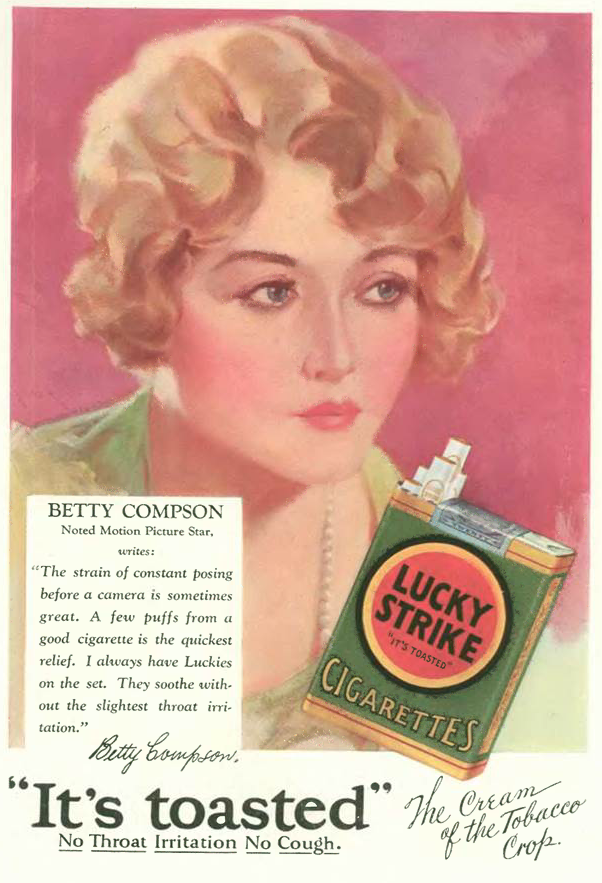
…and this sad appeal from the makers of Lucky Strike to keep puffing and avoid that hideous double chin…
…our cartoons include Garrett Price and thoughts of spring…
…Barbara Shermund eavesdropped on tea time…
…Alice Harvey found an awkward moment in a hosiery department…
…Peter Arno revisits a familiar theme — chorus girls and sugar daddies…
…and Otto Soglow looked in on a fat cat’s moment of pride…
With the Chrysler Building nearing completion and the Empire State Building beginning to rise from the old Waldorf-Astoria site, the New York City skyline was taking on the iconic form most of us now associate with the city.
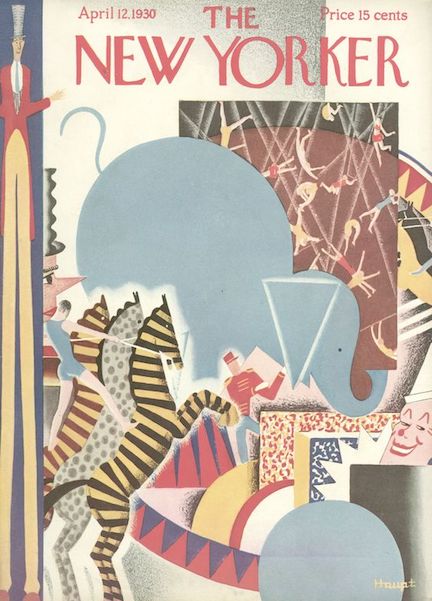
April 12, 1930 cover by Theodore Haupt.
Dubbed “hot jazz in stone and steel” by modernist architect Le Corbusier, the Chrysler Building’s gleaming spire beckoned The New Yorker’s E.B. White and real estate journalist David G. Bareuther (New York Sun) to its summit for a closer look…
BARE BONES…The spire in place atop the Chrysler building, the dome awaiting its metal skin. (skyscraper.org)WHAT LIES BENEATH…The stainless steel spire still gleams atop the Chrysler Building; beneath the spire, a maze of scaffolding — navigated by E.B. White and David G. Bareuther for their “Talk of the Town” piece, supports the upper portions of the building’s dome. (yahoo.com/nygeschichte.blogspot.com)THE HIGH LIFE…The Chrysler Building’s exclusive Cloud Club was located on the 66th, 67th, and 68th floors. At one time it was the highest lunch club in the world. It closed in 1979. (decopix.com)
If you want to get a sense of what E.B. White and David Bareuther experienced during their climb through the Chrysler’s dome, take a look at this video featuring American radio personality “Opie” (Gregg Hughes) and Hidden Cities author Moses Gates…
The article also noted that an “observation balcony” would be available for visitors to the 71st floor (actually an enclosed room inside the dome), but I’m sure the expectations for revenue fell quite short, given the competition it would soon receive from the much larger, higher, open air observation deck of the Empire State Building…
REACHING FOR THE STARS…When the Chrysler Building officially opened in 1931, visitors could go up to the 71st-floor observatory (in the dome) and view the city through its triangular windows. The observatory closed in 1945. (nygeschichte.blogspot.com)
…a bit of a digression, but I couldn’t help but notice the observatory’s resemblance to this set from the 1920 silent film The Cabinet of Dr. Caligari…
(silent-volume.blogspot.com)
…and here is a terrific graphic from Popular Science (August 1930) demonstrating how the spire, which was assembled inside the dome, was raised into its final position…
…and finally, some great archival footage documenting the achievement…
* * *
Tragic Theater
We continue our forays into the built environment of 1930 New York by looking at what was lost, including two beloved Broadway theaters. “The Talk of the Town” lamented the decline of the Garrick…
FINAL CURTAIN…Built in 1890 and originally named Harrigan’s Theatre, The Garrick closed as a playhouse in 1929. After a short run of burlesque, the building was demolished in 1932.
HEYDAY…Clockwise, from top left, circa 1910 postcard image of The Casino Theatre at Broadway & 39th; an audience on the Casino’s roof garden glimpses the performance below; interior of the Casino; the British musical comedy Floradora would become one of Broadway’s greatest hits — the New York production opened in 1900 and ran for 552 performances. (Museum of the City of New York )
* * *
From Jazz to Gothic
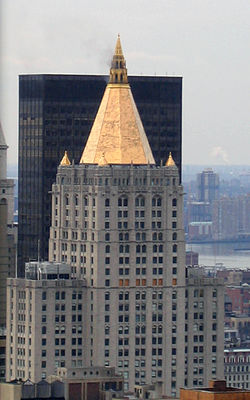
We return our gaze to the skies with three more new buildings reviewed by architecture critic George S. Chappell in his “Sky Line” column. He began with the Manhattan Towers Hotel, which thanks to the Depression would soon fall on hard times, going into foreclosure by October of 1931 and becoming a favorite gangster hideout (read more about the hotel at Daytonian in Manhattan)…
GOD AND MAMMON…Clockwise, from top left, the Manhattan Congregational Church in 1927. The church was torn down in 1928 and replaced by the Manhattan Towers Hotel at Broadway and 76th; the completed hotel, designed to wrap around the three-story Jones Speedometer Building, seen in the lower right of the photo; the first five floors of the building were dedicated to church use; after falling into disrepair, in 1980-83 the 626-room hotel was converted into 113 cooperative apartments. Note that the Speedometer Building still stands, sadly shorn of its ornamentation. (New York Public Library/Daytonian in Manhattan)
…Chappell also found much to admire in the new Fuller and Squibb buildings…
FULLER HOUSE…Clockwise, from top left, the 1929 Fuller Building was the third home of the George A. Fuller Company (its second home was the 1903 Flatiron Building); detailed views of the building’s tiled pinnacle and unique glass display windows that distinguish the building’s first six stories; an advertisement from the March 2, 1929 New Yorker that touted these gallery spaces for “superior merchandise”; detail of a coffered panel on an elevator door. (deskgram.net/nyc-architecture.com)Clockwise, from top left, entrance to the Squibb Building, now known as 745 Fifth Avenue; the cool white marble of the building’s base so admired by critic George Chappell; today, the building at dusk, the slender profile of 432 Park Avenue rising in the background. (OzBibliophile/paramount-group.com/landmarkbranding.com)
…From the Chrysler Building to the Fuller and Squibb, these new buildings, their architects, and the city’s ever-changing skyline were famously celebrated at the January 1931 Beaux Arts Ball…
HEADS IN THE CLOUDS…the Chrysler Building’s architect, William Van Alen (center), flanked by, from left to right, Stewart Walker (The Fuller Building), Leonard Schultze (The Waldorf-Astoria), Ely Jacques Kahn (The Squibb Building), Ralph Walker (1 Wall Street), D.E. Ward (The Metropolitan Tower), and Joseph H. Freelander (Museum of the City of New York). The New York Times referred to the group as “a tableau vivant of the New York Skyline.” (Van Alen Institute)
* * *
Quiet on the Set
The early days of sound movies created numerous challenges for directors who not only had to adjust the action to accommodate cumbersome microphones, but also to keep out unwanted noises or bad enunciation. “The Talk of the Town” explained…
CLOSETED…In the early days of the talkies, cameras had to be soundproofed in cabinets so their noisy motors would not be picked up by primitive sound equipment. (coloradocollege.edu/Library of Congress)
…Peter Arno illustrated the predicament of filming in nature in this cartoon from the April 5, 1930 issue…(caption: “Well, we can’t start till we get that robin out of there.”)…
* * *
One of Ours
In the story of The New Yorker, Alexander Woollcott and Marc Connelly were there at the beginning as founding members of the Algonquin Round Table and advisory editors to the first issues of the magazine. Basking in the success of his latest play, The Green Pastures (for which he would receive a 1930 Pulitzer Prize for Drama), Connelly was the subject of a April 12, 1930 profile titled “Two-Eyed Connelly,” which was written by Woollcott. Some excerpts, and a caricature by Al Frueh…
FAMILIAR WITH THE SUBJECT…Alexander Woollcott, left, explored the life of his old friend Marc Connelly in the April 12 profile. (goodreads.com/Fine Art America)
* * *
The Party is Really Over
Lois Long’s column “Tables for Two,” which in the 1920s was a must-read for those interested in Jazz Age night life, appeared intermittently in its last year, and its April 12 installment was not even written by Long, but by a writer who signed the column “F.D.” — I assume this is Fairfax Downey, who tried his best to capture Long’s style…
* * *
From Our Advertisers
Warner Brothers opened their pocketbooks to publicize John Barrymore’s latest film, The Man From Blankey’s, which the studio described as a “Modern High Hat Comedy”…
WHEN ALCOHOLISM WAS FUNNY…Loretta Young, John Barrymore and Angella Mawby in The Man from Blankley’s. (IMDB)
…Thanks to William Randolph Hearst and his King Features Syndicate, Robert Ripley, the P.T. Barnum of the funny pages, soared to fame in the 1930s with his “Believe It or Not” panel…here he begins his 14-year run on the radio…
HELLO SUCKERS…Robert Ripley in 1930 with a drawing of “the Horned Man of South Africa.” (RIPLEY ENTERTAINMENT INC.)
…and here’s an ad for another questionable but very American diversion — Fred Harvey’s “Indian Detours”…
WE’RE NOT IN KANSAS ANYMORE…The Fred Harvey Company was renowned for its chain of eating houses hosted by the famed “Harvey Girls” along the Atchison, Topeka & Santa Fe Railroad between 1876 and 1968. To encourage train travel (and Harvey business) in the Southwest, the Harvey company developed “Indian Detours.” The photo at left is of an “Indian Building” in Albuquerque, which featured displays of art and “live exhibits” that included Native Americans from many tribes around New Mexico. (santafeselection.com)EASY RIDER…1929 Cadillac Harvey Indian Detour Car outside La Fonda, Santa Fe. (Palace of the Governors photo archive)
…if you preferred to travel abroad, Texaco wanted you to know that you could still gas up with their product, even in distant Singapore…
…we begin our cartoons with the spare stylings of Gardner Rea…
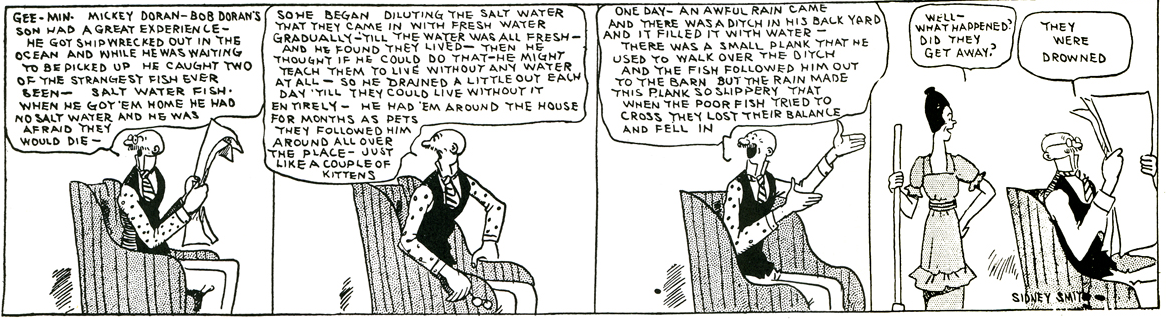
…and Otto Soglow…
…we find one of Helen Hokinson’s ladies on her way to fitness…
…William Crawford Galbraith showed us an enterprising young man…
…Art Young illustrated the challenges of the lecture circuit…
…and one of my all-time favorite Peter Arno cartoons…
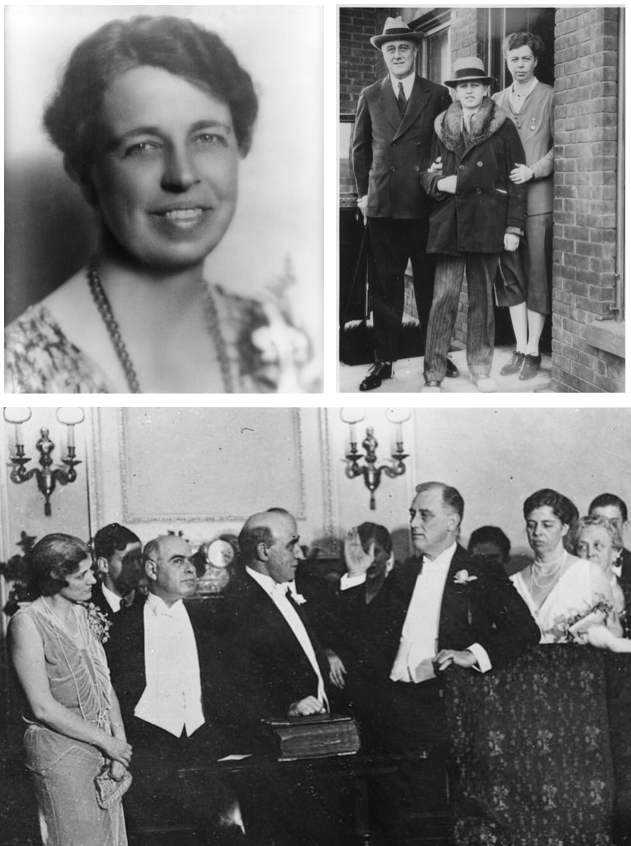
Just three years before she would enter the White House as First Lady, Eleanor Roosevelt was familiar to some New Yorkers for her social work, but was known to most as the wife of the Governor of New York, Franklin D. Roosevelt.
This week we look at two issues, March 29 and April 5, 1930, both with covers by Rea Irvin.
In a profile featured the April 5 New Yorker, Helena Huntington Smith looked at the life of a woman who was a niece to former President Theodore Roosevelt and a fifth cousin (once removed) to her husband Franklin. A somewhat reluctant mother (who nevertheless had six children) in a marriage that was mostly a political arrangement, Eleanor devoted considerable time and energy to social causes. Below is a brief excerpt, accompanied by an illustration of Eleanor by Cyrus Baldridge.
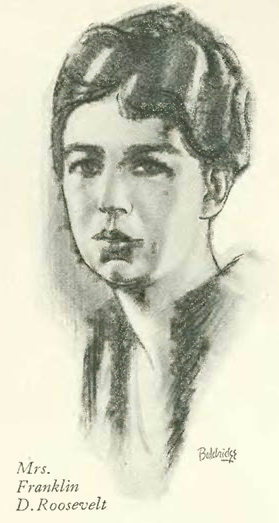
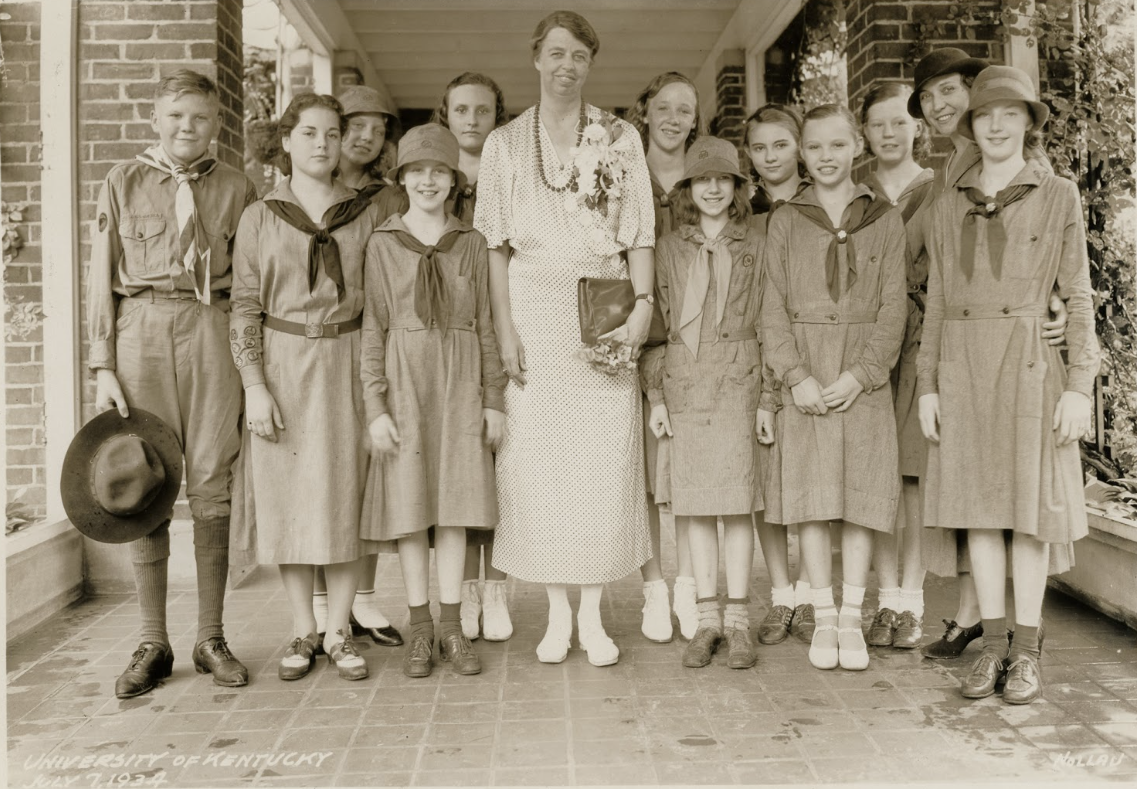
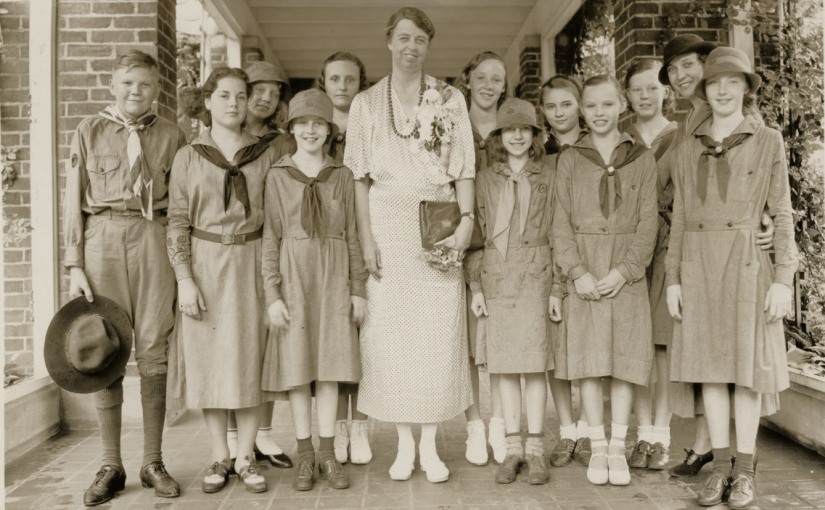
ALBANY DAYS…Clockwise, from top left: Eleanor Roosevelt in 1933; Gov. Franklin Roosevelt, Eleanor, and their youngest son, John, in Albany in 1930; FDR being sworn in as Governor of New York, January 1929. (Wikipedia/Albany Group Archive)IN HER ELEMENT…Eleanor Roosevelt with boy and girl scout volunteers at the University of Kentucky, July 1934. (eleanorroosevelt.org)
* * *
No Laughing Matter
In a surprising twist, James Thurber took a hand at writing the “A Reporter at Large” column (titled “Cop Into College Man”) in the March 29 issue, visiting a new “Police College” in New York City. In this engaging piece, Thurber seemed thoroughly engrossed in the operation…
…and particularly in the mugshots of some of the city’s most notorious criminals, including gangster Jim Flanagan, “debonair in a Bangkok hat”…
…and in the college’s museum, filled with all manner of deadly implements…
PREPPING FOR PERPS…The April 1930 edition of Popular Science featured the opening of New York’s new Police College. (Modern Mechanix)
* * *
Pluto’s Salad Days
In was something of a sensation in February 1930 when Clyde Tombaugh (1906-1997) discovered the then-planet Pluto at the Lowell Observatory in Arizona. Howard Brubaker in “Of All Things” (March 29) had this to say about the achievement:
JUST A SPECK…Clyde Tombaugh poses with the telescope through which he discovered the planet Pluto at the Lowell Observatory on Observatory Hill in Flagstaff, Ariz., 1931. At right, images of the planet (specks indicated by arrows) were all the proof Tombaugh needed to confirm his discovery. (AP/NASA)
Thanks to a 2015 flyby by NASA’s New Horizons spacecraft, we now have a better idea of what Pluto, now classified as a “dwarf planet,” actually looks like…
* * *
Dandy Doodle Mayor
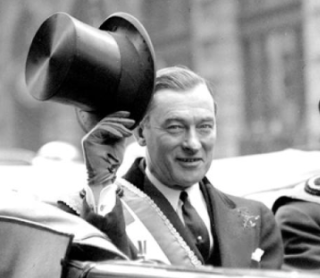
Fillmore Hyde, author (and four-time national amateur squash tennis champion), penned this ditty in the March 29 issue in tribute to New York City’s dandyish mayor…
HAT’S OFF…Mayor Jimmy Walker.
* * *
Back for More
Also for the March 29 issue art critic Murdock Pemberton was back at the Museum of Modern Art — a new institution he met with skepticism when it opened in late 1929, but a place that was definitely growing on him as a destination to revel in the work of some of the world’s top modern artists, including the American Max Weber (1881-1961), whose retrospective was supposed to the big draw of MoMA’s latest show, but Pemberton seemed more impressed by French artist Aristide Maillol (1861-1944) and particularly by the Swiss-German Paul Klee (1879-1940).
AMERICAN CUBIST…Max Weber’sThe Cellist, 1917, oil on canvas, was featured in Weber’s 1930 retrospective exhibition at the Museum of Modern Art; at right, Weber seated in front of Interior with Music (1930). (Brooklyn Museum/Smithsonian)Aristide Maillol’sCrouching Woman, bronze, 1930. (MoMA)
Pemberton wrote that Klee’s show gave you “quite a feeling”…
Catalogs from Max Weber’s retrospective and Paul Klee’s exhibit at the Museum of Modern Art. (MoMA)
…and when he compared Klee’s work to that of the other artists, Pemberton saw something “more potent even than electricity…signposts toward a glorious future”…
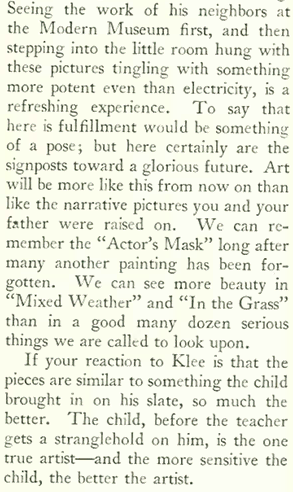
A GLIMPSE OF THE FUTURE…From left, Paul Klee’sActor’s Mask, 1924, oil on canvas mounted on board; Josef Albers’ 1929 photographic portrait of Klee, 1929; Klee’s In the Grass, 1930, oil on canvas. (MoMA/Guggenheim.org)
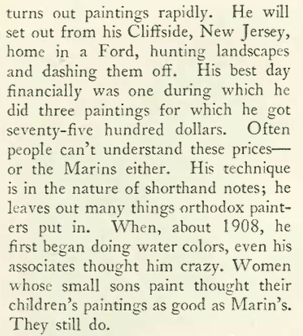
A week later, writing for the April 5 issue, Pemberton penned this piece for “The Talk of Town” about the work habits of artist John Marin…
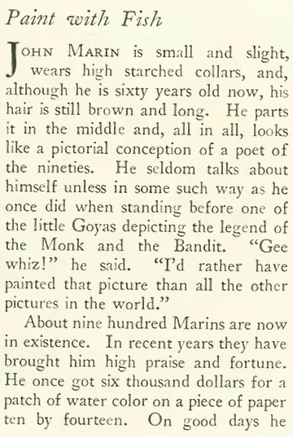
OLD MAN AND THE SEA…John Marin in 1921, in a photograph by Alfred Stieglitz; Marin’s Bathers, 1932, oil on canvas. (mfa.org/Dallas Museum of Art)
* * *
Who Needs a Vet?
The April 5 issue featured James Thurber’s latest installment of “Our Pet Department…
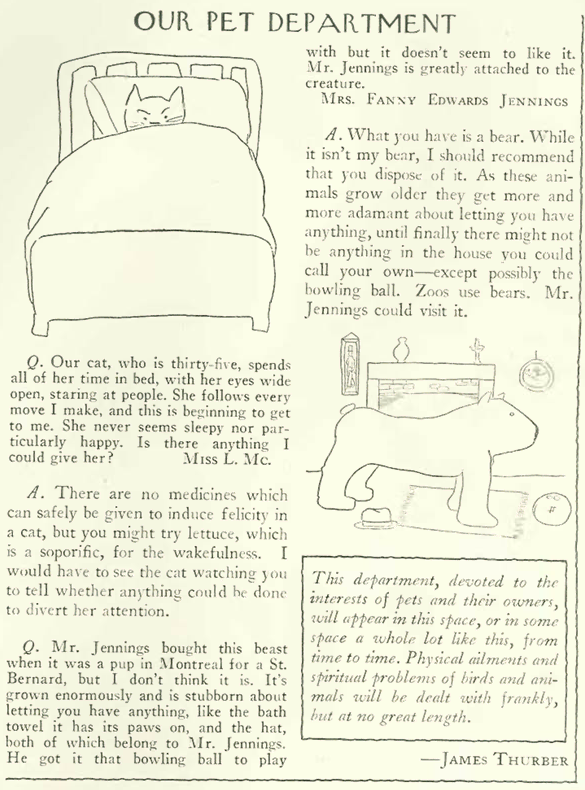
* * *
Spend It Quickly
April 5’s “Talk” also featured this item about Al Capone’s release from prison in Philadelphia, lavishing money and gifts on prison employees as he made his exit from Eastern Penitentiary…
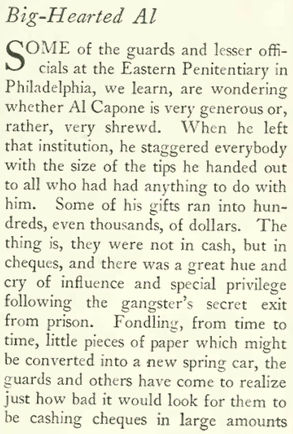
…it was no wonder, because officials at the prison didn’t treat Capone like some ordinary prisoner…
SALUTARY CONFINEMENT…Arrested outside a Philadelphia movie theater for carrying a concealed, unlicensed .38 caliber revolver, Al Capone was sentenced to a year in Eastern State Penitentiary. His last seven months were served in a cell (right) with fine furniture, oriental rugs, paintings, and a console radio, among other frills. (easternstate.org)
* * *
This Al Could Sing
Upon the DVD release of Al Jolson’s 1930 film, Mammy,Dave Kehr of The New York Times wrote that Jolson was “Simultaneously one of the most significant and most embarrassing show business figures of the 20th century.”
That was not view of most audiences 89 years ago, when Jolson reigned as one of America’s most famous entertainers. In his review of Mammy for the April 5, 1930 issue of The New Yorker, critic John Mosher admitted that he didn’t care for minstrel shows depicted in the film, but not for any of the reasons we would cite today…
UGH…Clockwise from top left, Al Jolson and Lois Moran in Mammy; a studio promotional poster; Jolson as a minstrel performer in the film. (IMDB)
* * *
From Our Advertisers
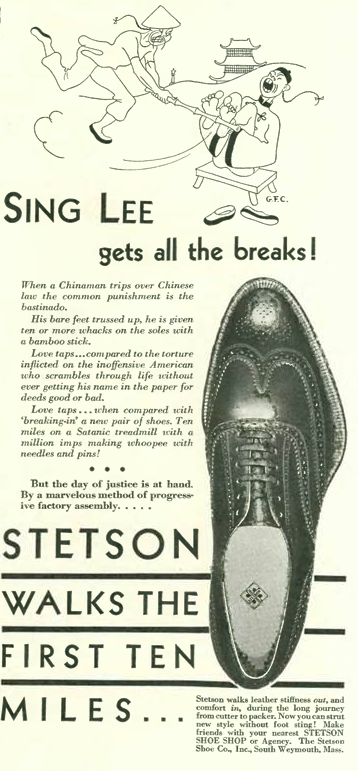
We have more racial stereotypes, this time to sell Stetson shoes…
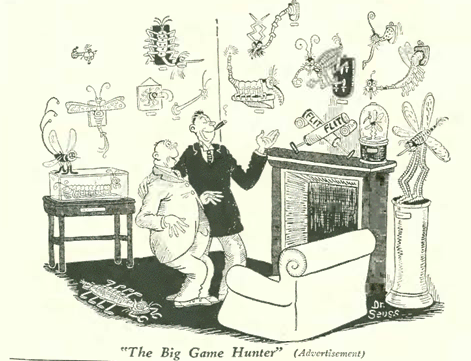
…Theodore Geisel (Dr. Seuss) continued to pay the bills by illustrating ads for Flit insecticide…
…while professional golfer Walter Hagen picked up some extra cash by launching his own line of golf underwear…
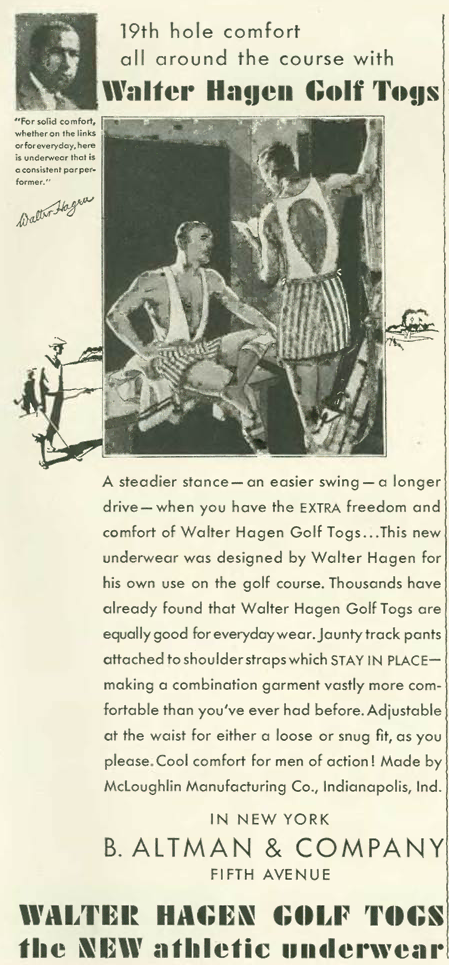
…Walter has been gone for fifty years, but you can still get his branded clothing from Dick’s Sporting Goods…
…Julian De Miskey picked up some extra work illustrating this house ad for The New Yorker…
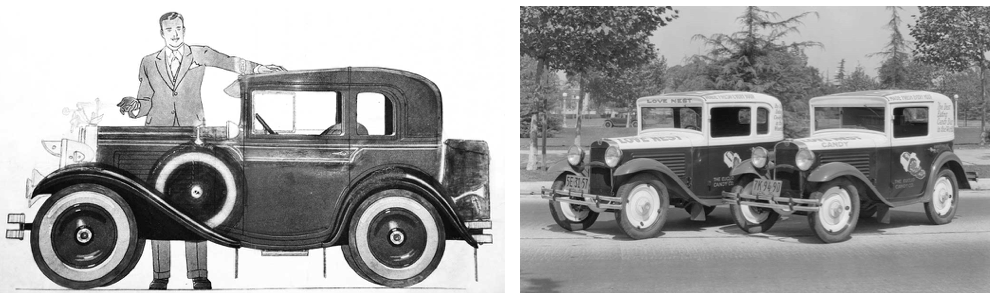
…and then we have this spot from the American Austin Car Company, which produced cars licensed from the British Austin Motor Company from 1930 through 1934…interestingly, the ad doesn’t feature the car itself…
…which looked like this…
(theoldmotor.com)
…on to our cartoons, Alan Dunn looked in on a devoted listener of S. Parkes Cadman’s Sunday radio broadcast…Cadman (1864-1936) was a British-born clergyman whose NBC radio broadcasts reached millions of listeners across America…
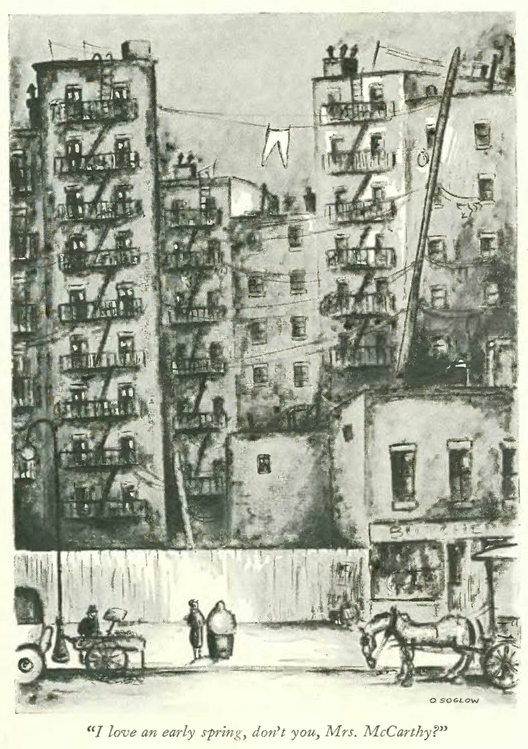
…signs of spring were noted by Otto Soglow…
…Don Herold shared an observation on stage entertainments…
…William Crawford Galbraith found unrequited love at the circus…
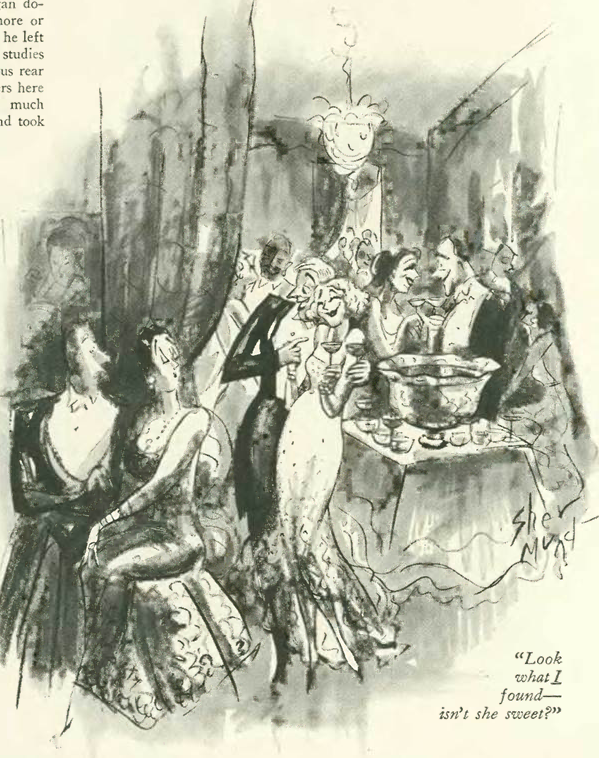
…while Barbara Shermund found a more agreeable pairing at a Manhattan cocktail party…
…Garrett Price found humor in the growing numbers of the down and out…
…and Peter Arno turned in this epic two-pager that illustrated the challenges of filming in nature…(caption: “Well, we can’t start till we get that robin out of there.”)
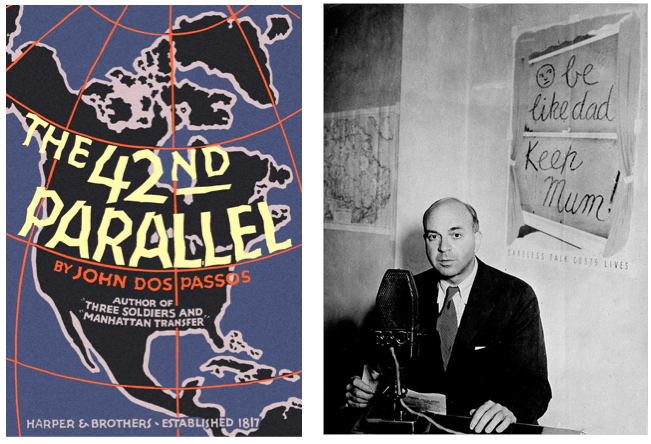
As Ernest Hemingway and F. Scott Fitzgerald spoke to the “Lost Generation” of writers and artists in the 1920s, John Dos Passos (1896-1970) drew upon the ethos of that period to usher in a new style of writing for the 1930s — modern, experimental, and deeply pessimistic.
March 8, 1930 cover by Ilonka Karasz.
Dos Passos’ book The 42nd Parallel would be the first of three books from 1930 to 1936 that would comprise his landmark U.S.A. Trilogy. The book critic for the New Yorker (identified as “A.W.S.”) sensed that this work of avant-garde historical fiction represented a significant marker in the modernist movement, likening it to the work of the great 20th century composer Igor Stravinsky:
A WRITER FOR DEPRESSING TIMES…The 42nd Parallel was the first book in a trilogy published by John Dos Passos between 1930 and 1936. At right, Dos Passos in the early 1940s. (22.hc.com/hilobrow.com)
Dos Passos also painted throughout his life, nearly 600 canvases including this early work from his days in Spain in the 1920s…
John Dos Passos’ watercolor painting of the the Spanish countryside, circa 1922. A modernist writer, Dos Passos also painted in the style of the avant-garde. His nearly 600 paintings throughout his lifetime show influences of Impressionism, Expressionism and Cubism. (johndospassos.com)
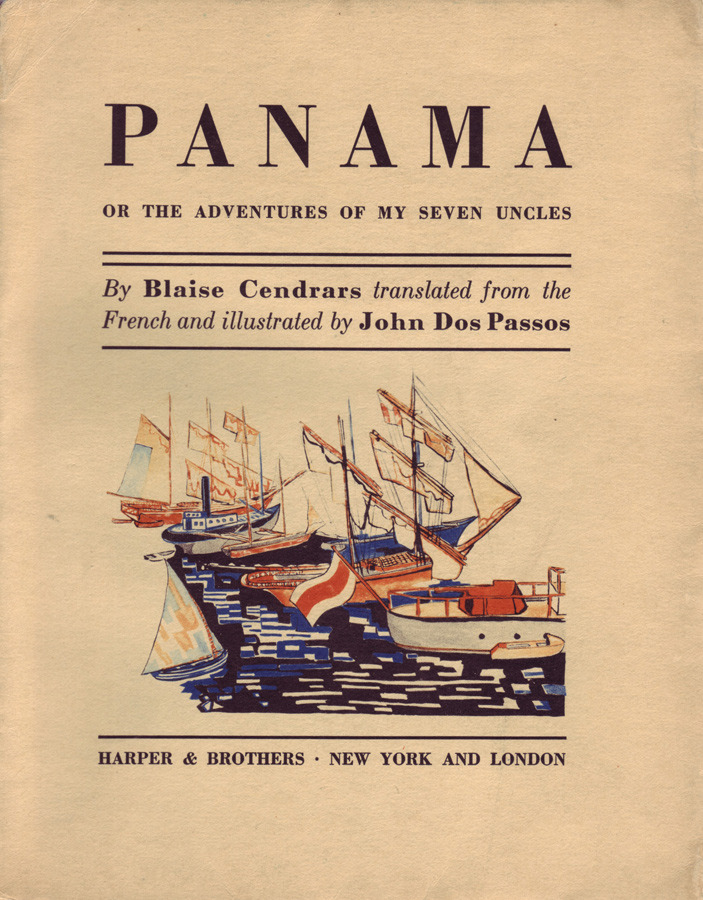
…and he joined his literary and artistic talents in 1931 when he translated and illustrated Blaise Cendrars’ long poem Le Panama et Mes Sept Oncles. Dos Passos became good friends with Cendrars, and in the book’s foreword acknowledged his debt as a writer to the French poet…
(johndospassos.com)
* * *
Don Could Also Write And Draw
Like Dos Passos, Don Herold (1889-1966) could express himself through both words and pictures, albeit in a much less serious vein. In the March 8 issue Herold wrote about the indignity of having to disrobe for a medical examination. An excerpt:
Also an illustrator and cartoonist, Herold made his debut in The New Yorker with this cartoon in the June 1, 1929 issue:
Herold began working as an illustrator around 1910, and enjoyed a long career with a number of publications, including the humor magazine Judge:
* * *
Measuring Up
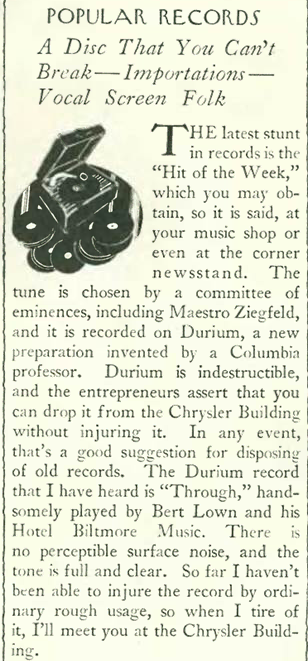
When the Chrysler Building was completed in May 1930, it officially became the world’s tallest building (a record it ceded 11 months later to the Empire State Building). Being the tallest gave the building the distinction of being something to be measured against, including the durability of a musical recording pressed into a material called “Durium”…
…and when advertisers were in need of something large for comparison, they also turned to the new skyscraper to drive home their selling point…
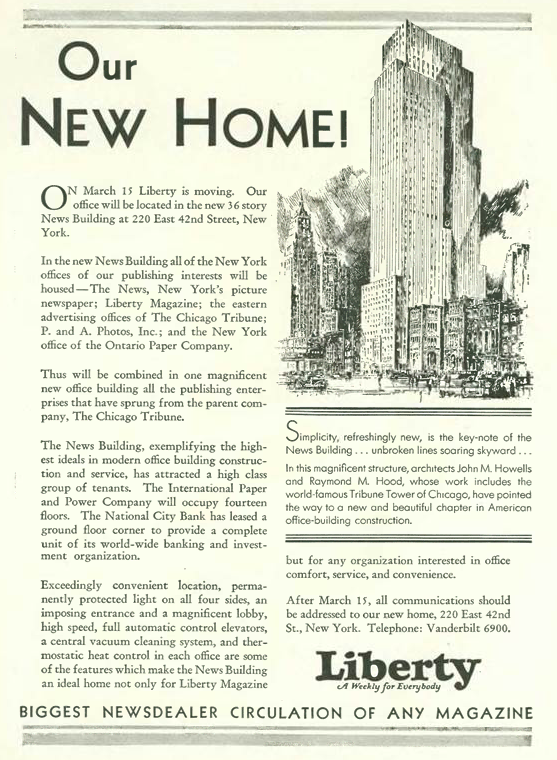
…new skyscrapers also were used to lend distinction to their tenants, such as Liberty Magazine in the new Daily News Building…
…below a 1940 postcard image of the Daily News Building, then known simply as “The News Building,” and a view of the lobby’s famous globe in 1941…
(Wikipedia)
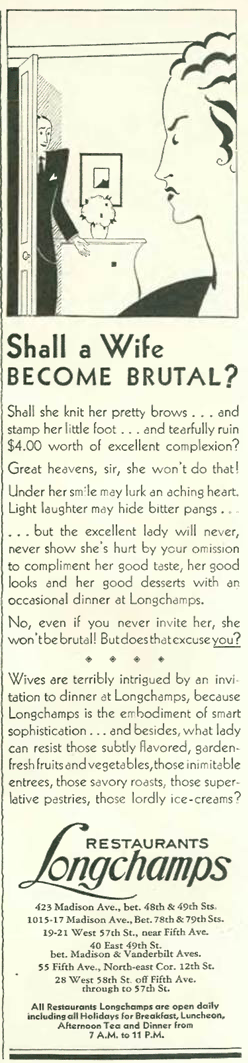
…on to the rest of our ads, here’s a baldly misogynistic one from Longchamps restaurants…
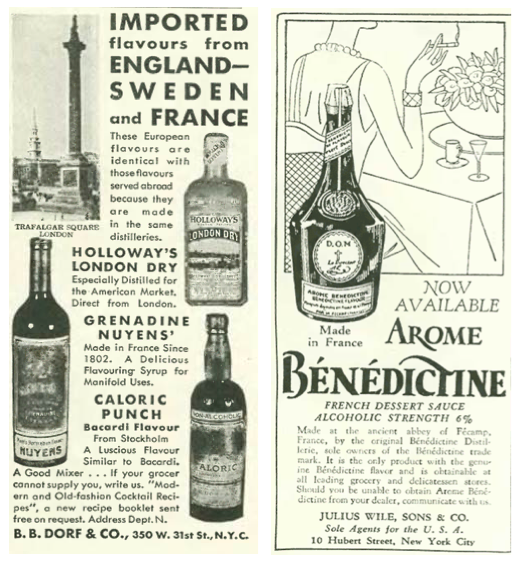
…and as Prohibition wore on into the Thirties, we have sad little back page ads for cocktail “flavours” and Benedictine “Dessert Sauce”…
…on to our cartoons, Gardner Rea explored the subject of family planning…
…Art Young illustrated the perils of modern art…
…Otto Soglow took a stroll with a somnambulist…
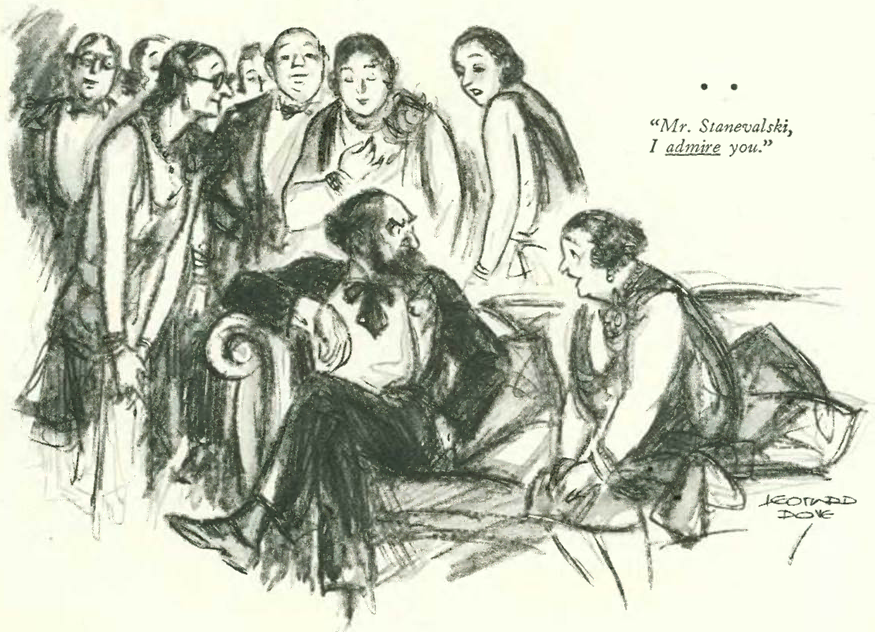
…Leonard Dove inked this awkward moment between the Old and New Worlds…
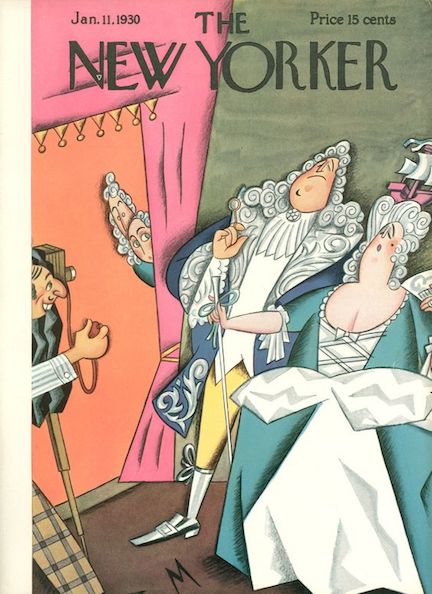
With the 1920s ending with a crash, few seemed interested in looking back to that decade. Indeed, just days into the 1930s the Jazz Age seemed to belong to a distant, frivolous past.
Jan. 11, 1930 cover by Julian De Miskey.
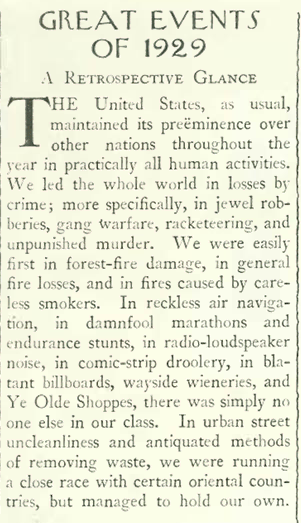
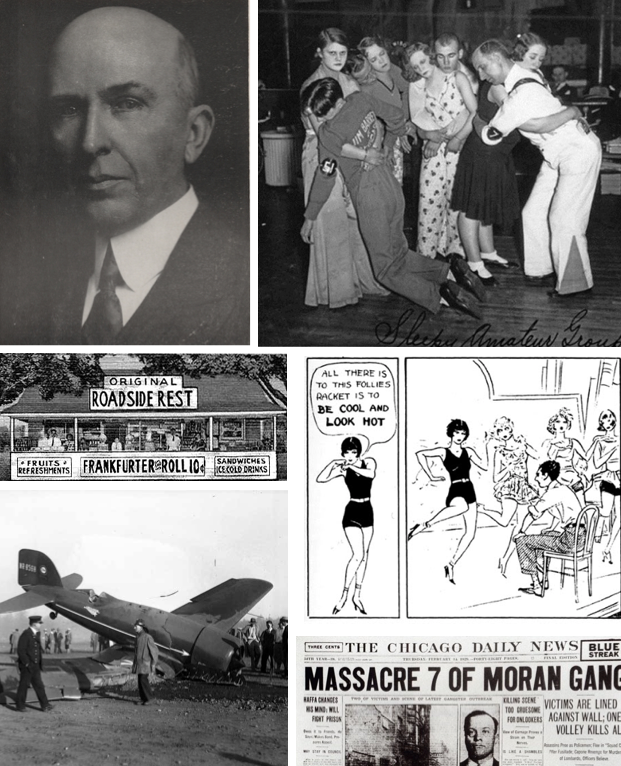
Or at least that is how popular historian Alvin F. Harlow (1875-1963) saw it, penning this somewhat cynical, tongue-in-cheek retrospective on the “great events” of the previous year…
FLASHBACK…Historian Alvin F. Harlow (top left) recalled some of the “great events” of 1929, including (clockwise, from top right) “damnfool” dance marathons; “comic strip droolery” (clip is from Dixie Dugan, 1929); gang warfare; reckless air navigation and wayside wieneries. (jstor.org/News dog Media/nitrateville.com/Chicago/U of Washington/Nathan’s)
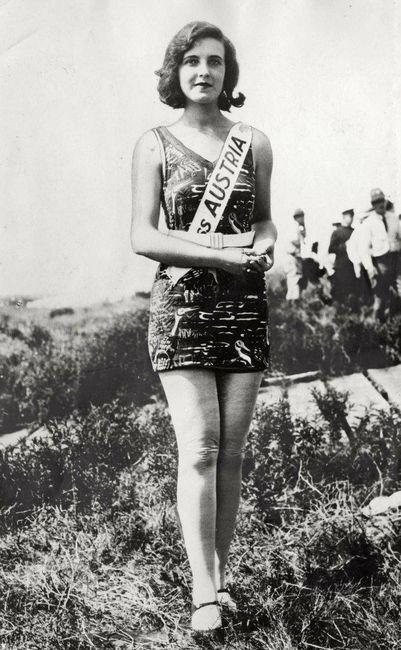
…Harlow continued to list the various ways folks sought relief “from the monotony of existence” in 1929…
TOO THIN?…Miss Austria, Lisl Goldarbeiter, was crowned the first Miss Universe at the “International Pageant of Pulchritude” in Galveston, Texas in 1929. The pageant actually was one of year’s big events, garnering worldwide attention. (bashny.net)
…as well as the persistence of superstition and quackery…
* * *
A Byrd Takes Wing
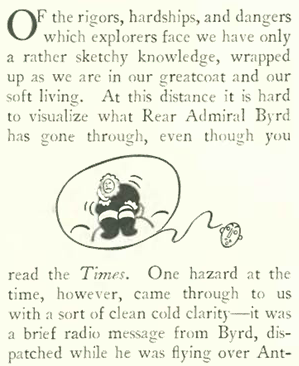
In 1928 and 1929 the name Richard Byrd popped up quite a bit in the pages of The New Yorker, and for good reason. In 1928 Byrd — already known for his exploits at the North Pole — began his first expedition to the Antarctic, a land that was as remote to explorers in the 1920s as the moon was to us in the 1960s. On Nov. 28-29, 1929, Byrd — along with pilot Bernt Balchen, co-pilot/radioman Harold June, and photographer Ashley McKinley — flew a Ford Trimotor to the South Pole and back in 18 hours, 41 minutes. It was such a feat that Byrd was promoted to the rank of rear admiral by a special act of Congress on December 21, 1929, making the 41-year-old Byrd the youngest admiral in the history of the United States Navy. In his “Notes and Comment,” E.B. White was still awaiting details of the heroic adventure:
ROUGHING IT…Once the expedition arrived by ship on the Antarctic coast, planes were assembled at the “Little America” base camp on the Ross Ice Shelf. This image shows Richard Byrd and his dog Igloo unpacking crates. The ships that brought the plane and other supplies can be seen in the background. (library.osu.edu)LIKE A MOONSHOT…Clockwise, from top left, a Ford Trimotor (named Floyd Bennett after the recently deceased pilot of a previous expedition) was one of three planes brought on the expedition. It sits assembled and ready to go before its historic flight over the Pole; flying over the pass near Liv’s Glacier enroute to the Pole; Richard Byrd in the library of Little America prior to the flight, with a stone from Floyd Bennett’s grave. Byrd dropped the stone, wrapped in a small American flag, over the South Pole in honor of the pilot of his 1926 North Pole expedition; the geological party (Byrd is second from right) upon returning to Little America, January, 1930; Little America in 1928, soon to be covered in snow. (library.osu.edu)
In his “Wayward Press” column, Robert Benchley commented on Byrd’s promotion, and took a shot at The New York Times (the Gray Lady was a favorite New Yorker target) for monopolizing the news of the South Pole expedition:
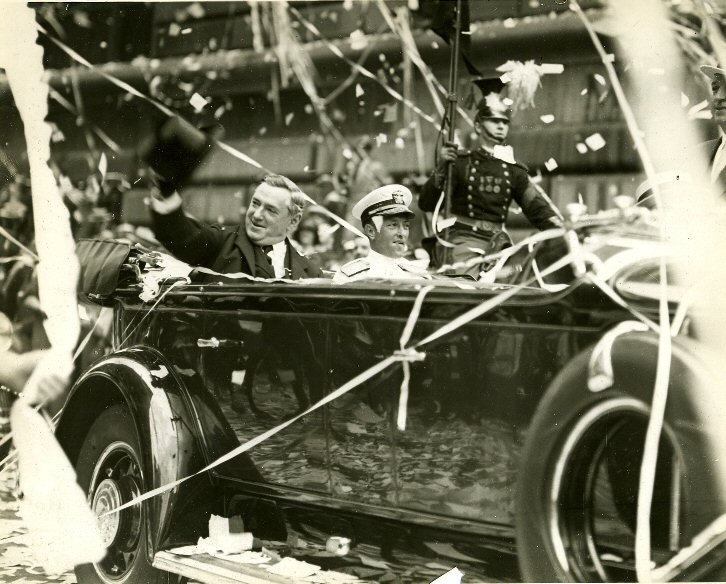
SNOWFALL OF A DIFFERENT SORT…Adm. Richard Byrd received a hero’s welcome in 1930 when he returned to the U.S. from Antarctica. Here he is shown being feted at a ticker tape parade in Boston. (library.osu.edu)
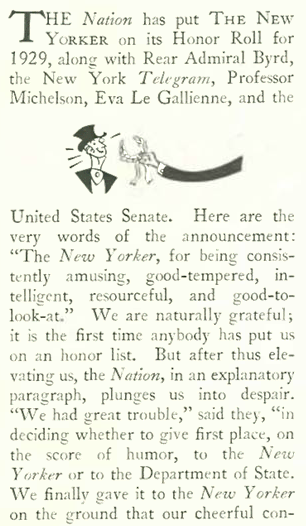
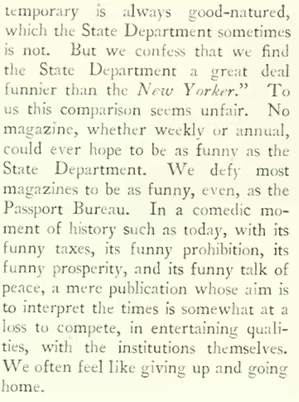
E.B. White also touted an endorsement by the venerable magazine The Nation, which included both Adm. Byrd and The New Yorker in its Honor Roll for 1929:
* * *
Bitter and Sweet
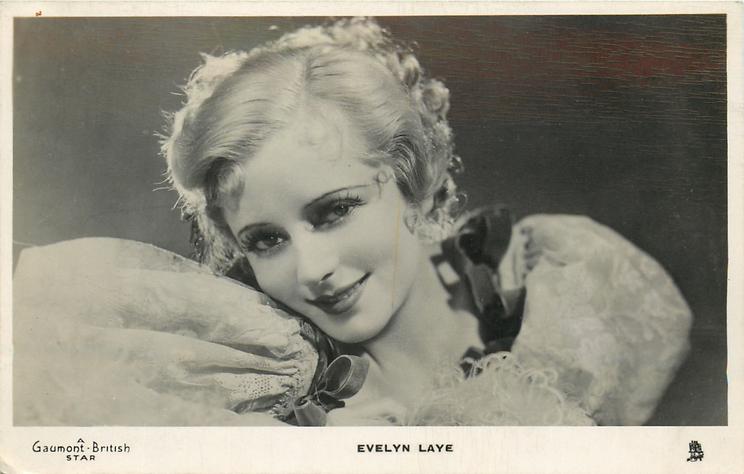
“The Talk of the Town” looked in on English light opera actress Evelyn Laye (1900-1996), who had just arrived in town to make her Broadway debut in the American première of Noël Coward’sBitter Sweet. “Talk” discovered that Laye “had her own notions” about how a stage actress should conduct herself:
MOSTLY SWEET…Postcard image of Evelyn Laye, circa 1933. (tuckdb.org)
Although Laye refused star billing in Bitter Sweet, she had no problem appearing in this two-page ad for Lux soap in The New Yorker’s Jan. 18. issue, hers the only full-page portrait in the ad:
…and so we segue into the ads for Jan. 11, where we find all sorts of diversions in the back pages, including an appeal to revelers for the Greenwich Village Ball (top left corner). The ad copy reads “come when you like, with whom you like—wear what you like…” and asks the question “Unconventional? Oh, to be sure—only do be discreet!”
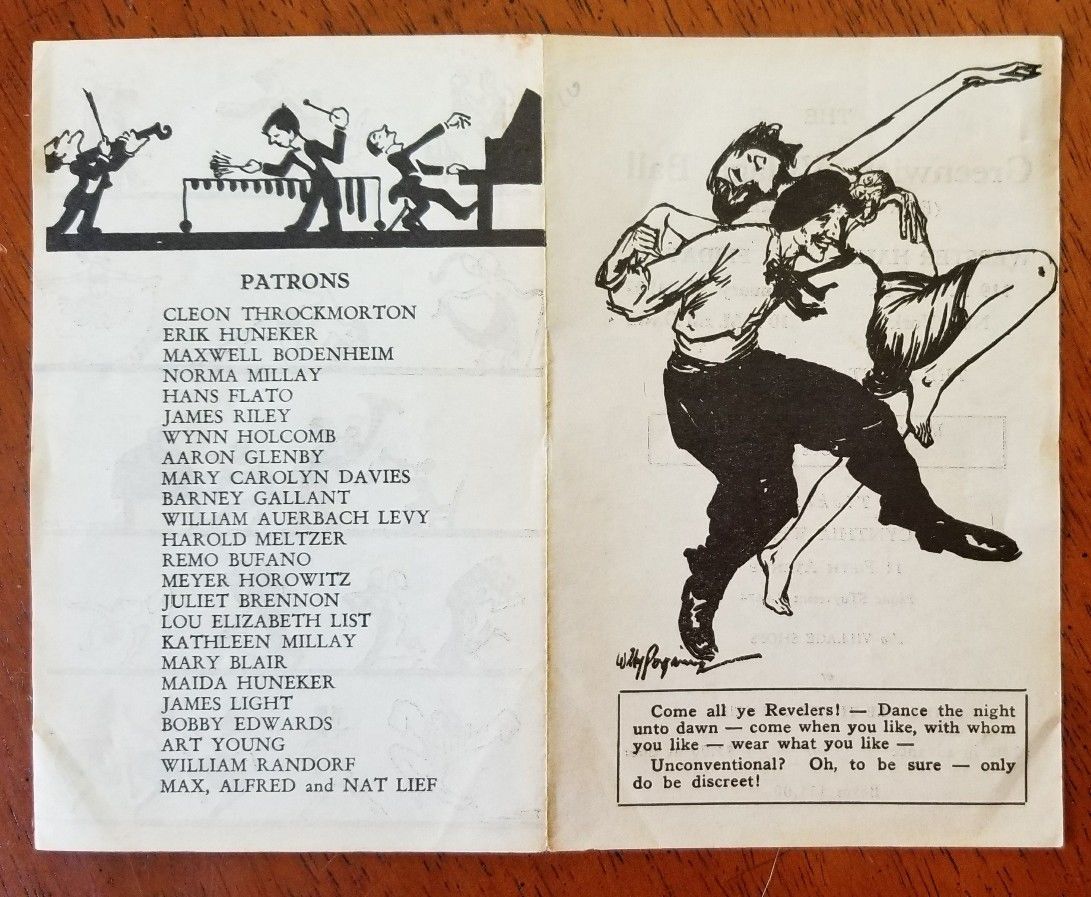
…for reference, here is an invitation from the 1932 Greenwich Village Ball, with a list of patrons printed on the inside cover, including the “King of Greenwich Village Bohemians,” Maxwell Bodenheim, and poet Edna St. Vincent Millay’s two sisters Norma and Kathleen…
(hobohemiadotblog.wordpress.com)
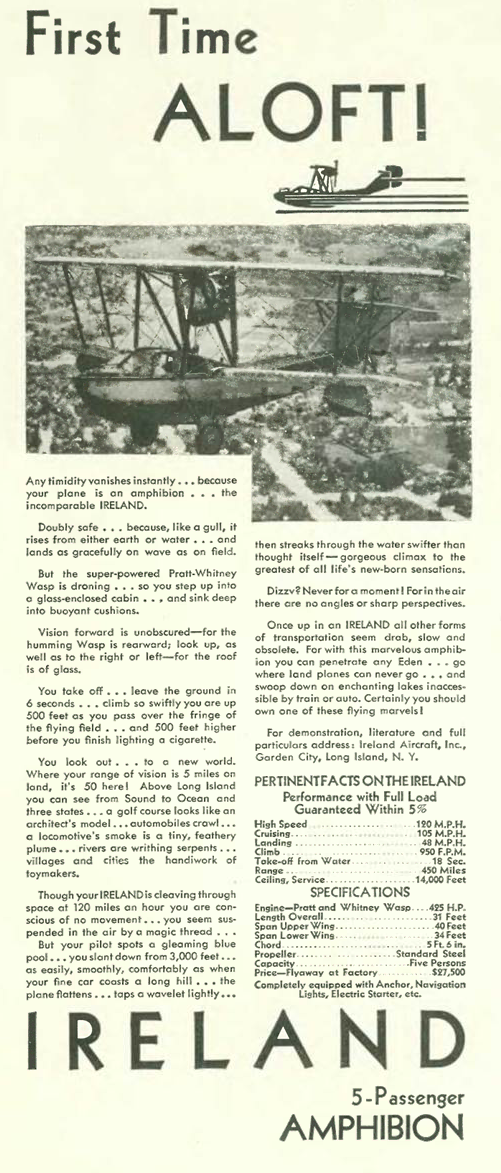
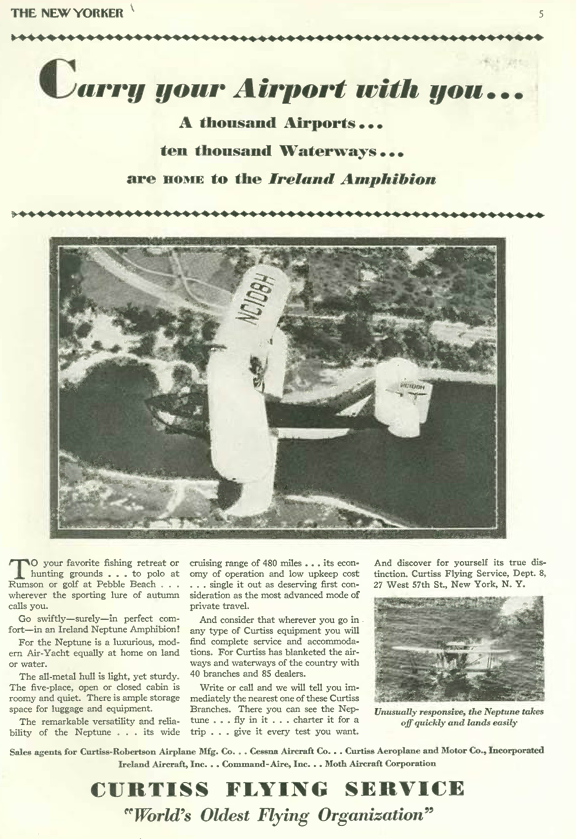
…ads for private airplanes were a regular feature in The New Yorker, aviation companies assuming that at least some readers had the means to consider such a purchase…the copy in this ad emphasized the ease of flying—here is a sample from the fifth paragraph: “You take off…leave the ground in 6 seconds…climb so swiftly you are 500 feet as you pass over the fringe of the flying field…and 500 feet higher before you finish lighting a cigarette…”
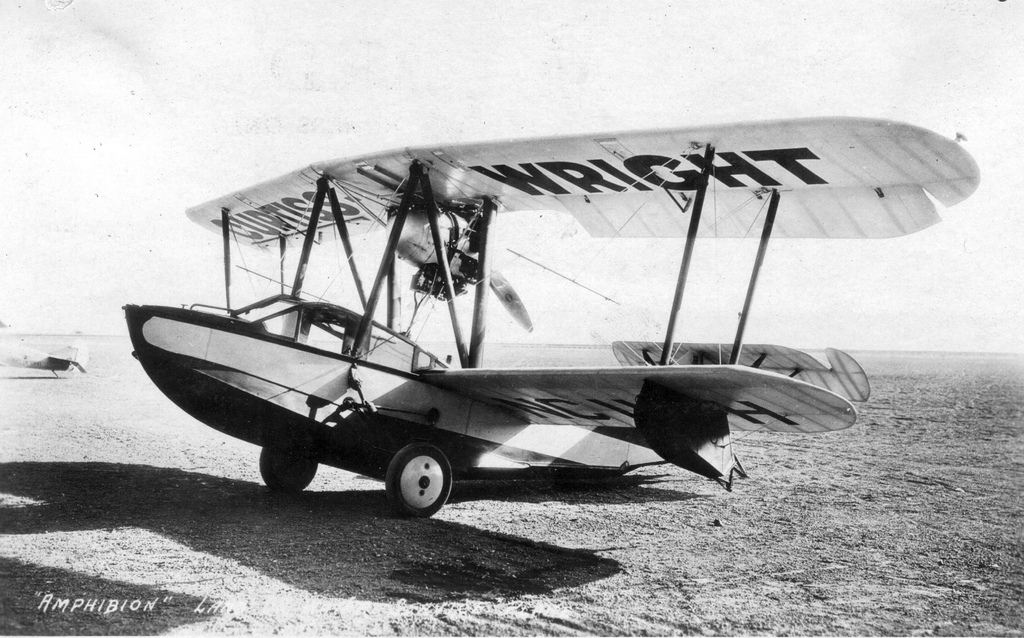
…here’s a better view of the Ireland Amphibion…
(San Diego Air and Space Museum Archive)
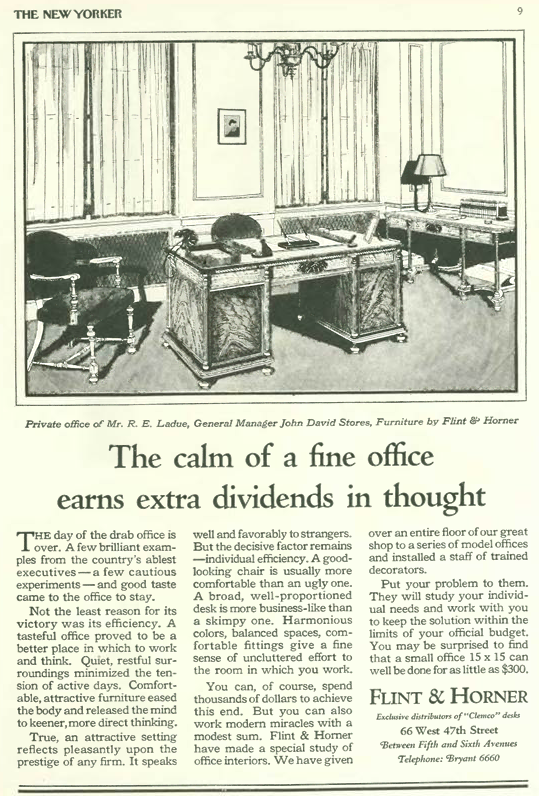
…but for those who remained firmly on the ground, respite could be found in a nice, quiet (and affordable) office, a place where one could, perhaps, start rebuilding from the ashes of the market crash…
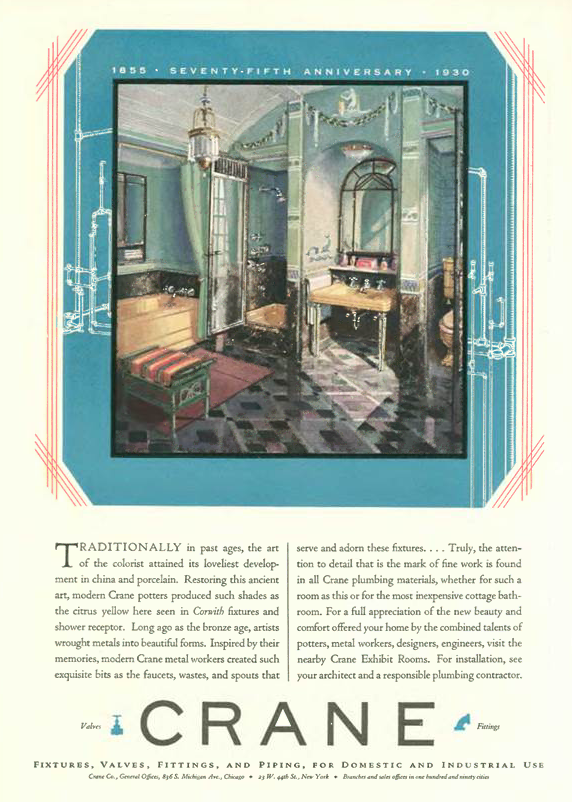
…and for those with a little extra scratch, they could treat themselves to the patrician comforts of a nice bathroom…
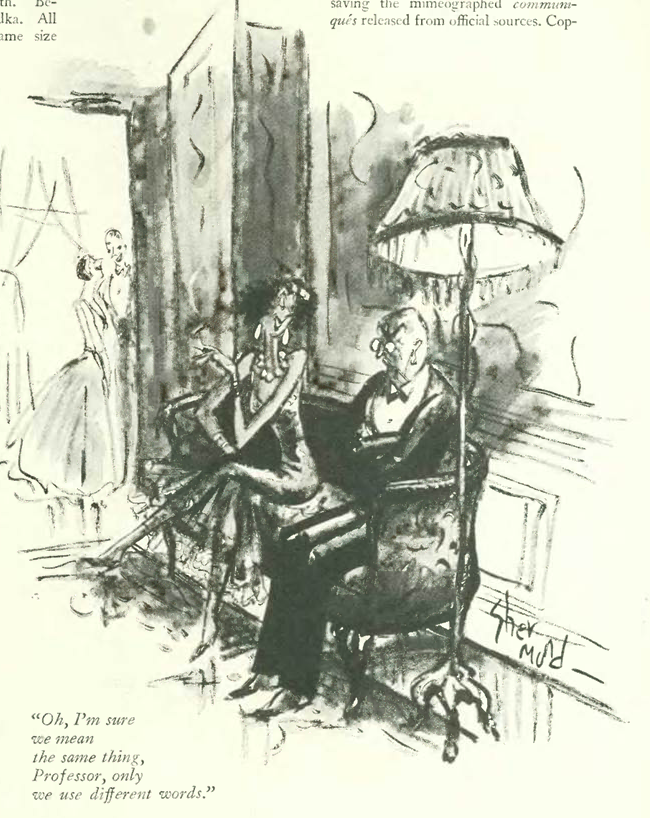
…on to our cartoons, we have a nice little culture clash courtesy of Barbara Shermund…
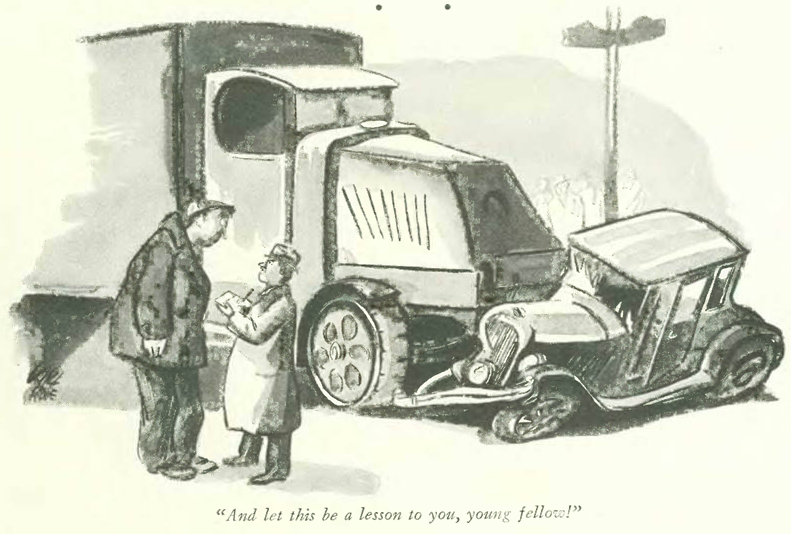
…Carl Rose illustrated a clash of a different sort…
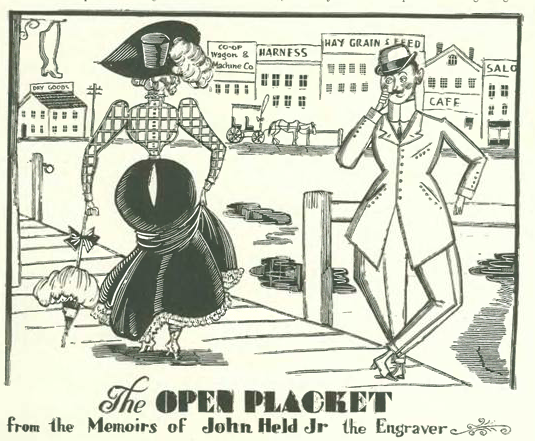
…John Held Jr. was back with one of his slightly naughty “engravings”—these were favorites of founding editor Harold Ross, with his rustic tastes…
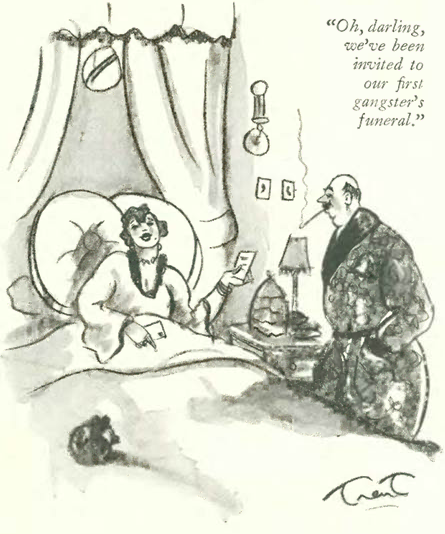
…W.P. Trent explored the strange ways of social status…
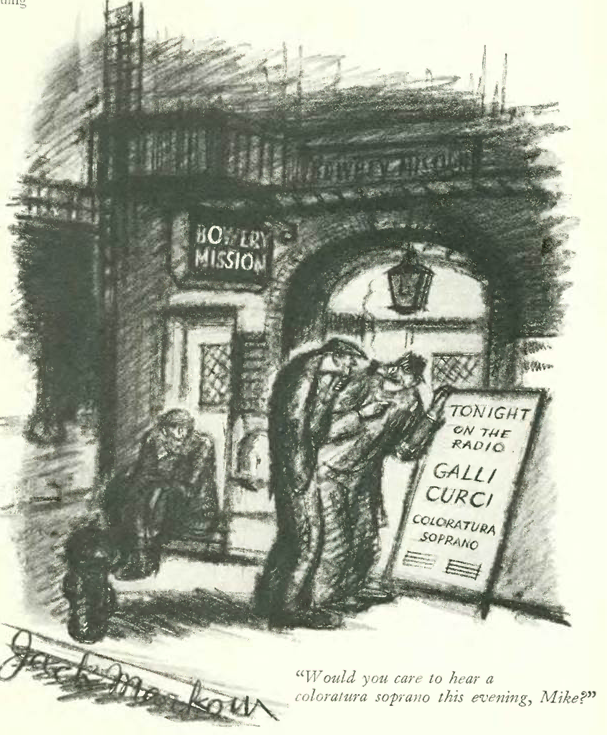
…Jack Markow looked in on life on the skids, a theme that would become more frequent as the Depression deepened…
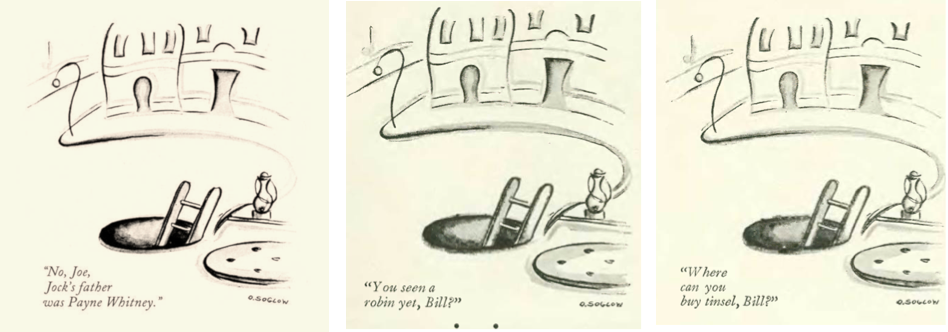
…and after thirty installments throughout 1929, Otto Soglow’s manhole series — a one-panel gag featuring dialogue from unseen workers Joe and Bill…
…came to an end when Joe and Bill finally emerged…
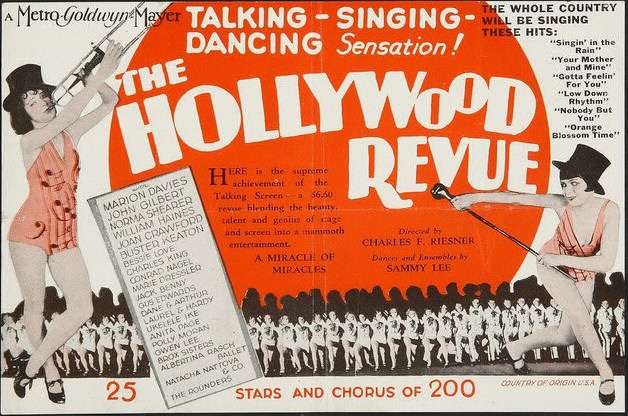
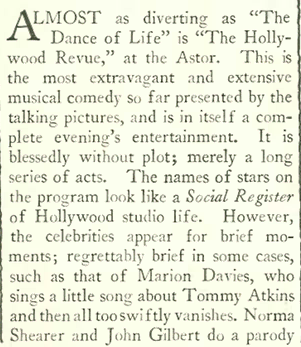
MGM piled so many stars and gimmicks into the premiere of The Hollywood Revue of 1929 that even TheNew Yorker’s jaded film critic John Mosher had to admit he was entertained.
Aug. 24, 1929 cover by Helen Hokinson.
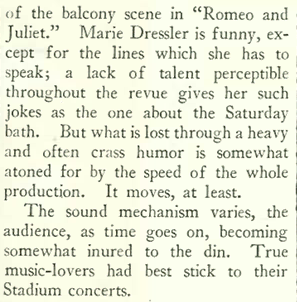
Although today’s audiences would find the film quaint and corny (not to mention its tinny sound and crude editing), it was a big hit in 1929. A plotless revue featuring nearly all of MGM’s stars (Greta Garbo said no — she had a clause in her contract exempting her from such silly things; Lon Chaney, on the other hand, was in failing health), the film followed a variety format similar to such vaudeville productions as the Ziegfeld Follies. The Arthur Freed/Herb Nacio Brown song “Singin’ In the Rain” was introduced in this film, and would inspire the Gene Kelley musical by the same name 23 years later. A rarity for the time, the Hollywood Revue included four skits in an early version of Technicolor, including an all-cast performance of “Singing’ In the Rain.” Mosher observed:
One of the film’s color skits featured John Gilbert and Norma Shearer in a Romeo and Juliet parody filled with Jazz Age slang. It would mark the beginning of the end of Gilbert’s career and, sadly, his life. He was one of the silent era’s most popular leading men, but it was purported that his voice was not suited to the talkies. What really ended Gilbert’s career, however, was studio head Louis B. Mayer, who clashed with the actor both personally and professionally…
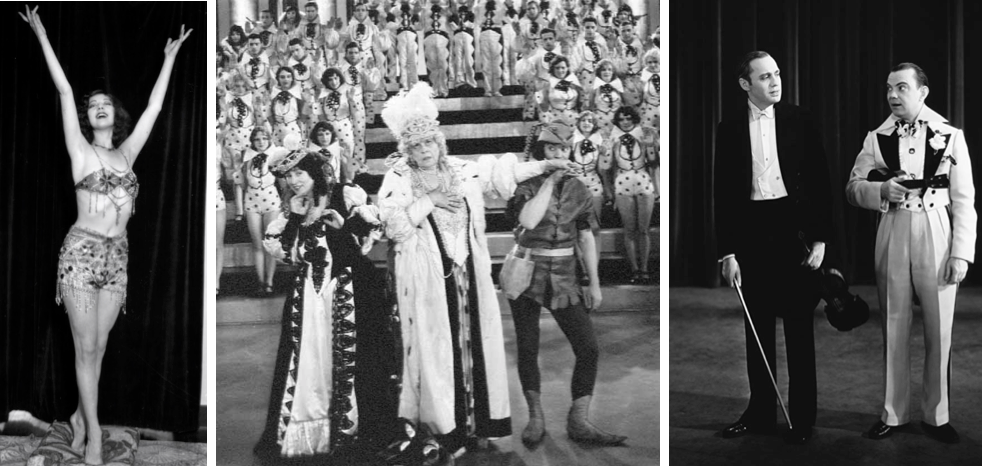
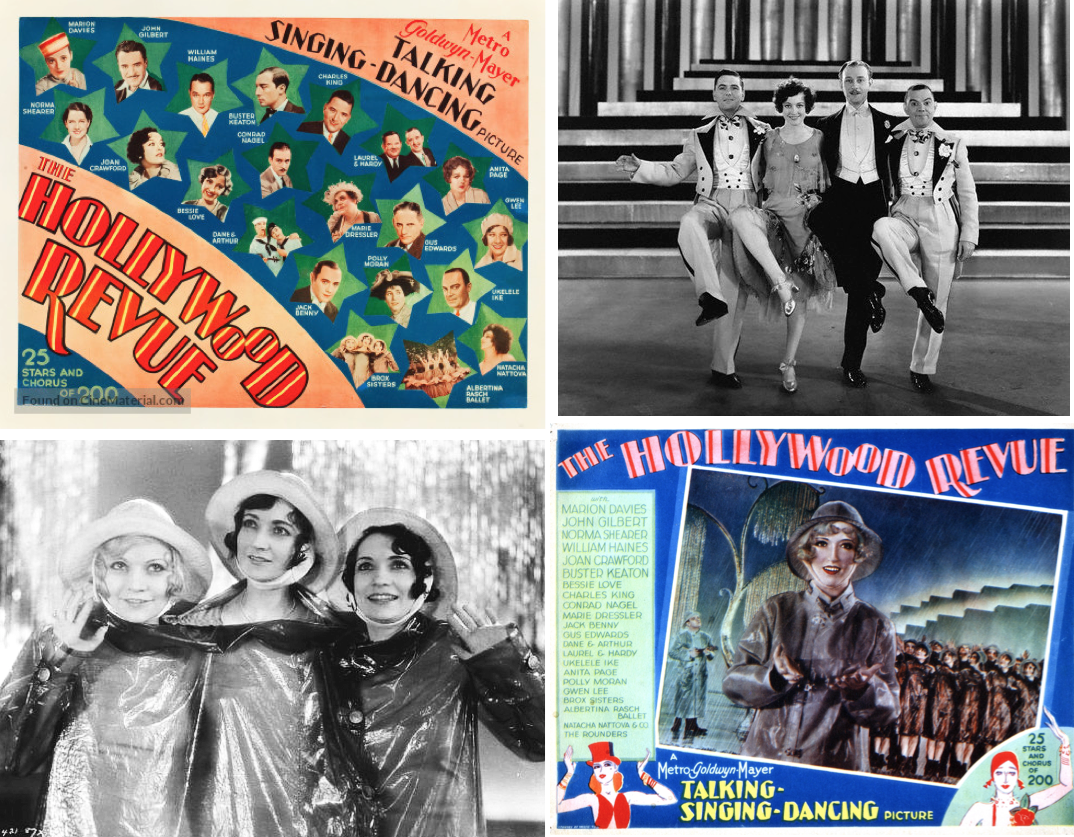
FAREWELL ROMEO…A lobby card promoting The Hollywood Revue of 1929 featured John Gilbert and Norma Shearer in one the film’s color sequences, a parody of Romeo and Juliet filled with Jazz Age slang. At right, a scene from the skit in which the director (played by Lionel Barrymore, far right) tells Shearer and Gilbert to put more pizzazz into the act. (IMDB/YouTube)STAR-STUDDED…Left to right, early silent film comedian Marie Dressler hammed it up in a royal court skit; co-emcee Jack Benny, with his trademark violin, and Cliff “Ukulele Ike” Edwards, and his trademark uke. (vickielester.com/doctormacro.com/thejumpingfrog.com)DANCING IS GOOD FOR YOUR HEALTH…Chorus girl Carla Laemmle in the film’s “Tableau of Jewels,” in which she emerged from a seashell to perform a seductive (and weird) dance number while other showgirls posed on a revolving crown — all set to a tune sung offstage by James Burroughs. The niece of Universal Pictures founder Carl Laemmle, Carla Laemmle was one of the longest surviving actors of the silent era. She died in 2014 at age 104. (songbook1.wordpress.com)GALAXY OF STARS…Clockwise, from top left, lobby card for The Hollywood Revue of 1929; Charles King, Joan Crawford, Conrad Nagel (a co-emcee along with Jack Benny) and Cliff “Ukulele Ike” Edwards show off their dancing skills; lobby card featuring actress Marion Davies; a popular act in vaudeville and on Broadway, the Brox Sisters—Lorayne, Patricia and Bobbe (along with Cliff Edwards) introduced the song “Singin’ in the Rain,” also sung by the entire cast near the finale of the movie. (IMDB/joancrawfordbest.com/mubi.com)
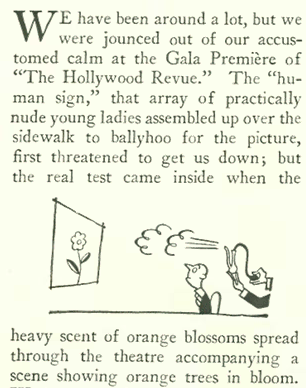
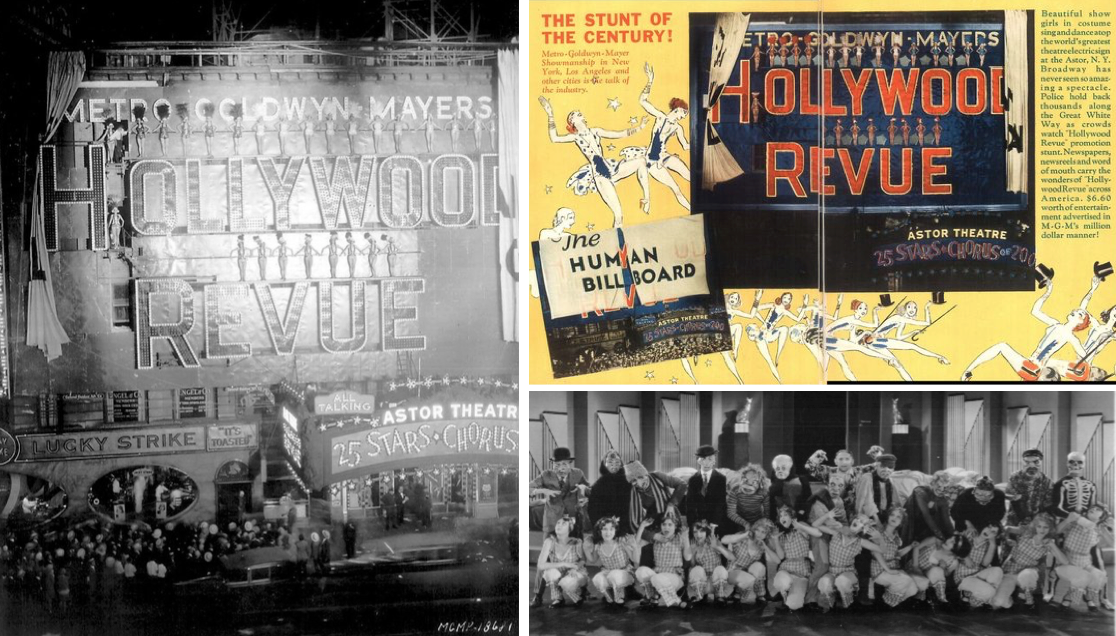
…MGM deployed a number of stunts to generate publicity at the film’s New York premiere at the Astor Theatre, including a “human billboard” that featured scantily clad chorus girls precariously perched on a huge letters high above the theatre’s entrance. In a rather less dangerous stunt—during the movie’s “Orange Blossom Time” skit—a faint scent of orange blossoms wafted into the theatre. “The Talk of the Town” observed…
WHAT COULD POSSIBLY GO WRONG?…Showgirls arranged along narrow catwalks atop the glowing HOLLYWOOD REVUE sign would pose for hours above crowds of gawkers; top, an advertisement promoting “The Stunt of the Century”; bottom, chorus girls lined up on somewhat safer ground in a skit from the movie titled “Lon Chaney’s Gonna Get You If You Don’t Watch Out.” Chaney himself was near death and did not appear in the film. (oldphotoarchive.com/anndvorak.com)Another angle shows just how precarious this stunt proved to be for these brave chorus girls, who held their poses for hours on end. (legendaryjoancrawford.com)JUST SINGIN’…Among the MGM stars appearing in the film’s finale include, in the middle of the front row, Buster Keaton, Marion Davies, and Joan Crawford. (IMDB)
* * *
Technological Adjustments
Had you attended the premiere of The Hollywood Revue, perhaps you would have appreciated James Thurber’s observation that actors in talking pictures sound as if they are speaking into cracker boxes. In this hilarious piece (titled “The Roaring Talkies”), he proposed a solution. An excerpt:
* * *
A Happy Diversion
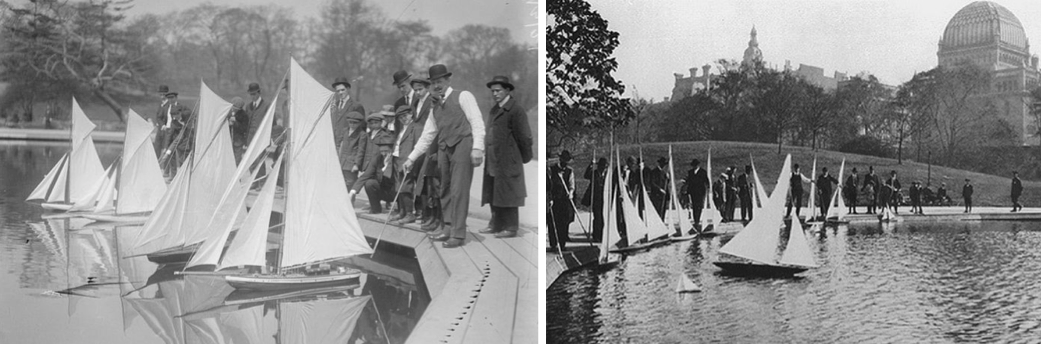
“The Talk of the Town” (via Theodore Pratt) looked in on the hobbyists who raced model boats at Central Park’s Conservatory Lake, a happy tradition that began in the late 19th century and continues to this day:
A DAY AT THE RACES….Model sailboats (left) prepare to face off in 1910 at Conservatory Lake (also called Conservatory Water); at right, model sailors at the same lake around 1920. (Library of Congress)
Pratt also described the old wooden boathouse, which was replaced in 1954 with a somewhat grander structure, Kerbs Boathouse, where model boats are still stored…
STILL SAILING…The copper-roofed Kerbs Boathouse replaced a wooden structure in 1954. Conservatory Lake served as the setting for a model boat race in E.B. White’sStuart Little. (centralparknyc.org)
* * *
On the Other Hand…
Leaving the cool and quiet of the park brought one quickly back into the dust and clamor of the metropolis. Pratt observed that the summer season lasted two weeks longer in the city than in the country, thanks to the city’s heat island effect— perhaps an unwelcome observation given the usually hot summer of 1929. Not only did the city’s heat extend the season, but it also kept the city enveloped in “an enormous cloud of dust”…
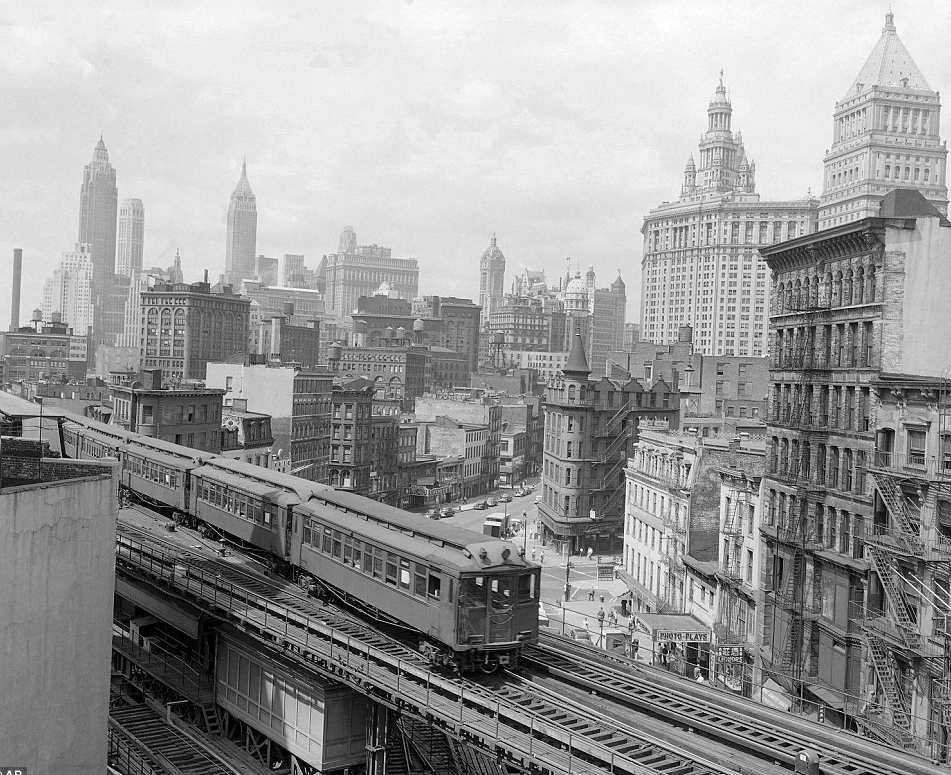
HAZY DAYS OF SUMMER…A dusty haze hangs over Lower Manhattan as the Third Avenue elevated train rumbles by in this circa 1950 photo. (Associated Press)
* * *
Already Feeling Old?
I found this “Talk” item curious for exploring the sentimental attachment some folks had developed for old cars from the 1910s, given those cars were barely twenty years old and cars in general hadn’t been in common use much longer…
…as for another “Talk” item, I doubt modern New Yorker readers would find any humor in this observation:
* * *
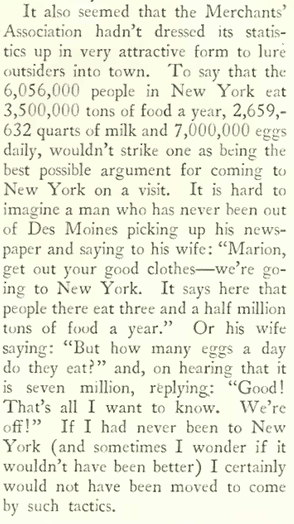
On to sillier things, Robert Benchley turned in a casual titled “Boost New York!” Benchley ridiculed a promotional brochure from the New York Merchants Association that touted various statistics in a manner reminiscent of the fictional George Babbitt. Benchley imagined how an Iowa couple might respond to such dazzling numbers:
* * *
A Drinking Life
Occasionally I like to feature infrequent or one-time New Yorker contributors who are nearly lost to history. Frank Ward O’Malley (1875-1932), a reporter for the New York Sun from 1906-19, was known for his humorous stories. In 1928 he published a book titled The Swiss Family O’Malley. In this casual (titled “The Fatty Degeneration of Broadway”) from the Aug. 24 issue, O’Malley described an alcohol intervention of sorts and then his fall off the wagon. Here are the opening and closing paragraphs, along with his photo circa 1910s.
Frank Ward O’Malley (Library of Congress)
* * *
From Our Advertisers
This week we have an advertisement for the Drake Apartment Hotel, claiming to be the “smartest” in New York. Note how they employed what seems to be the same pointy-nosed, haughty couple that we saw last week (below) who endorsed the Park Lane (I want to believe there is a subtle joke here)…
…just 25 years removed from the Wright Brothers’ flight at Kitty Hawk, advertisers were treating flying as though it were routine…
A better photo of the Ireland Neptune Amphipian (aerofiles.com)
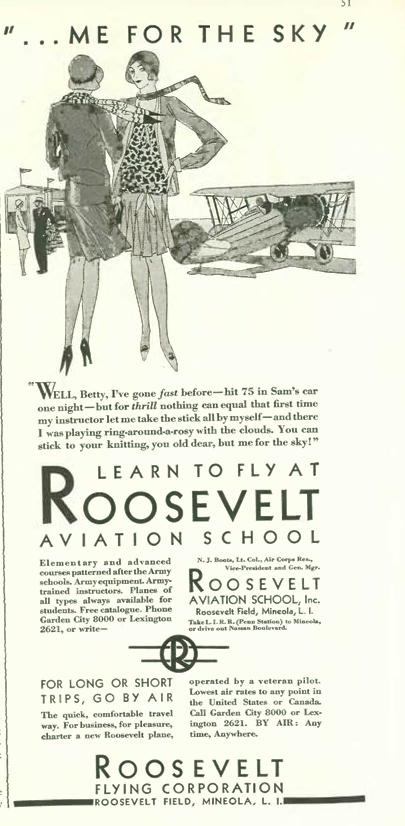
…and this young woman seemed to think flying was nothing more than “playing ring around the rosy with the clouds”…
…I like the reviews included in this bookseller’s ad, especially the first one for the book Ex-Wife by Anonymous (it was written by Ursula Parrott, a writer of romantic fiction)…
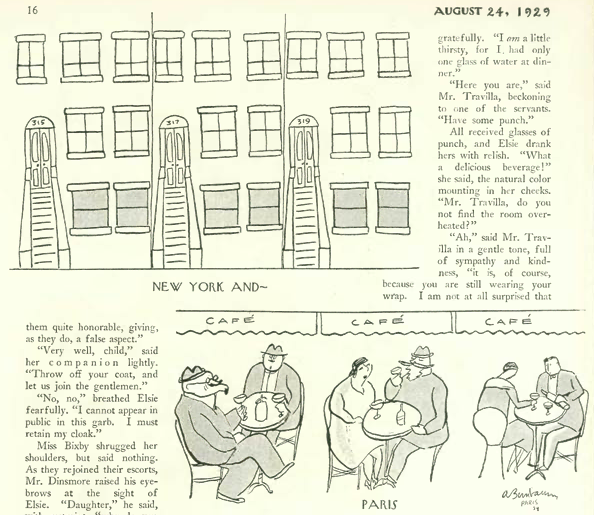
…our illustrations include Abe Birnbaum’s contribution to the casuals section (breaking up the copy of one of Josie Turner’s Elsie Dinsmore parodies)…
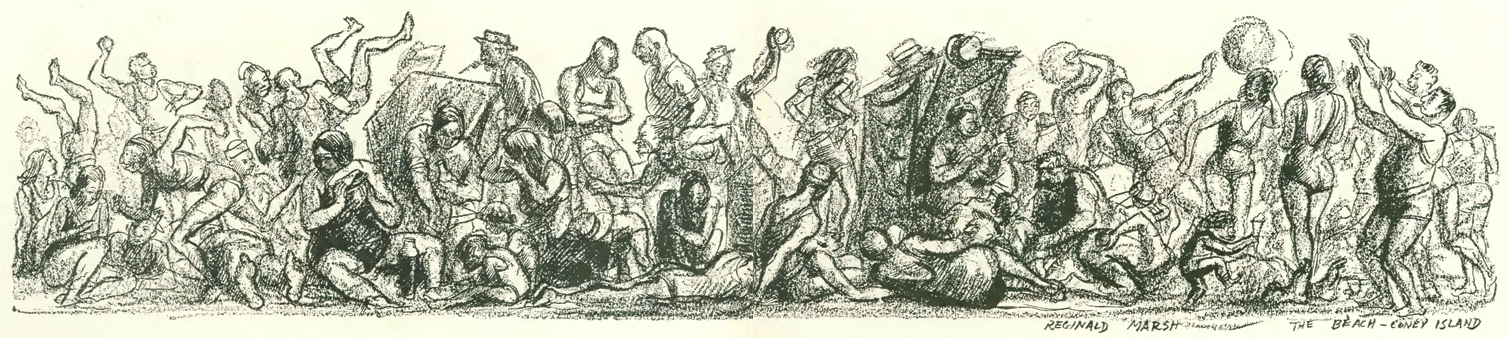
…Reginald Marsh illustrated the late summer beach scene at Coney Island…
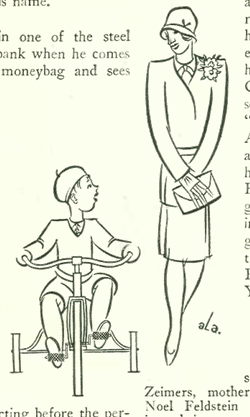
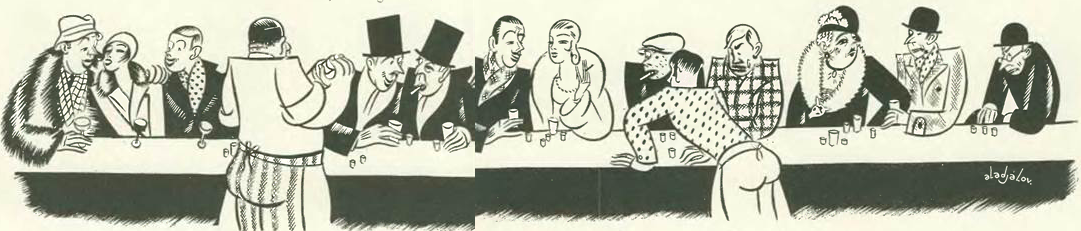
…and for kicks this nice little filler by Constantin Alajalov…
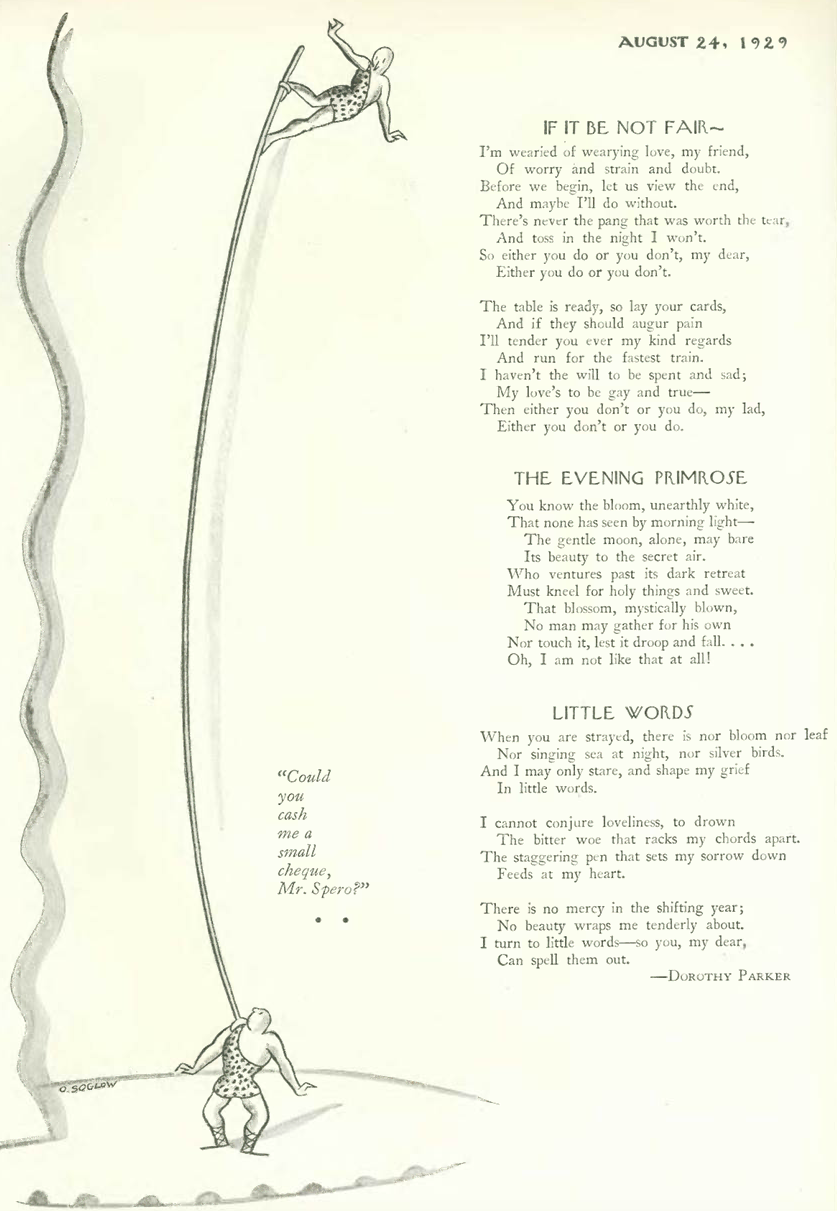
…thanks to the skills of The New Yorker’s first layout artist, Popsy Whitaker, we have this whimsical pairing of Otto Soglow and Dorothy Parker…
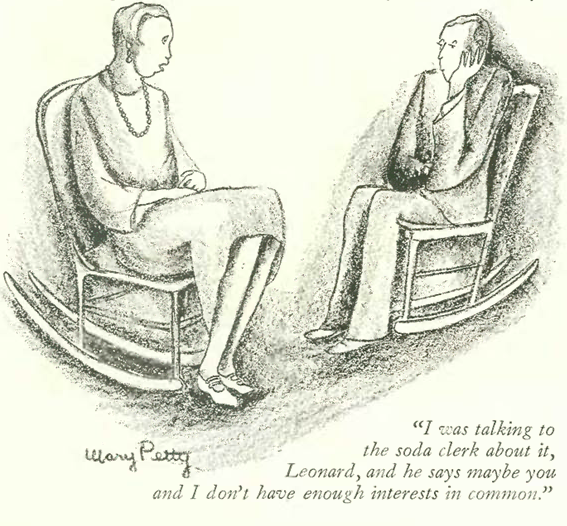
…Mary Petty contributed a cartoon that looks contemporary…
…Peter Arno paid a visit to the doctor’s office…
…and commented on his life as a new father…the woman holding the baby was doubtless inspired by his wife, New Yorker columnist Lois Long…
…for reference, Peter Arno and Lois Long are pictured here with baby daughter Patricia Arno in 1928…Lois clearly had a better grasp on the situation than Arno had imagined…
Arno and Long with their baby daughter, Patricia, in 1928. (Vanity Fair)
…Alice Harvey eavesdropped on a conversation between teenagers…
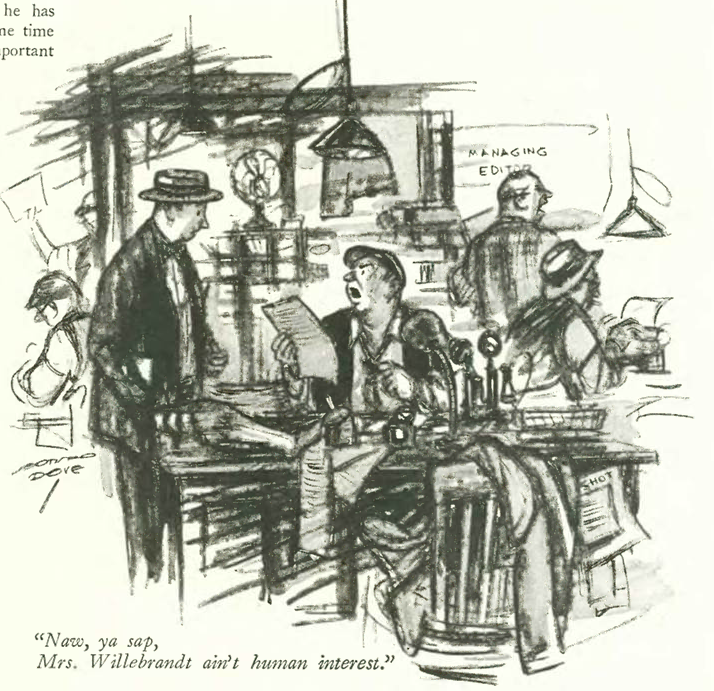
…and like Arno, Leonard Dove had two cartoons in this issue…here an editor finds the former Prohibition enforcer no longer newsworthy…
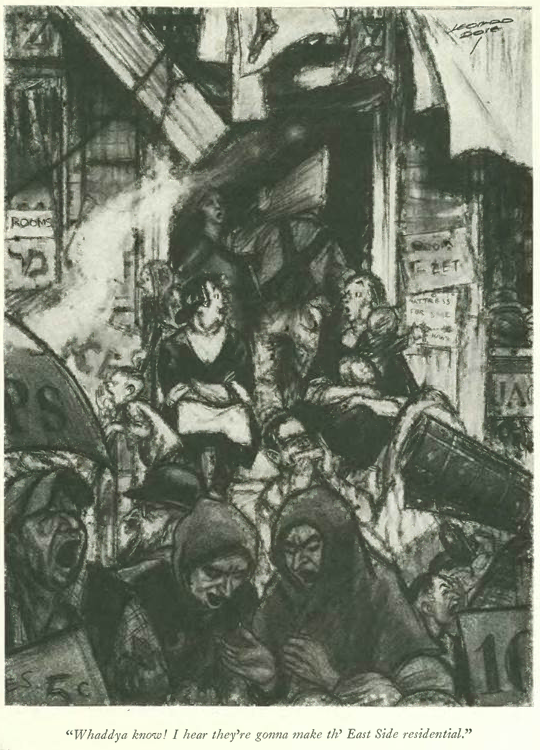
…and over on the East Side, rumors of gentrification…
For all its embrace of the modern city and its technological wonders, The New Yorker mostly despaired of the changes wrought by the introduction of sound to motion pictures.
June 1, 1929 cover by Rea Irvin.
Granted, early sound technology was primitive, with directors, actors and crew members adapting on the fly to the demands of a new medium that required absolute silence on film sets and cumbersome microphones that severely limited the movements of actors. Screenwriters, accustomed to writing brief intertitles in silent films, now had to write expository dialogue, and actors had to rely less on exaggerated facial expressions and body movements and more on the spoken word. And it helped if you didn’t have a speech impediment or heavy accent.
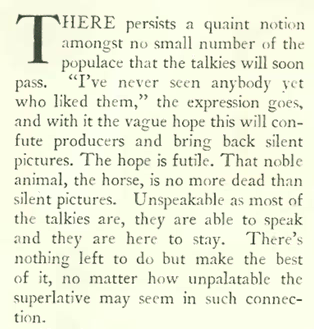
Writing for “The Reporter at Large” column (titled “The Unspeakables”), Hollywood correspondent Jean-Jacques lamented that the talkies were “here to stay”…
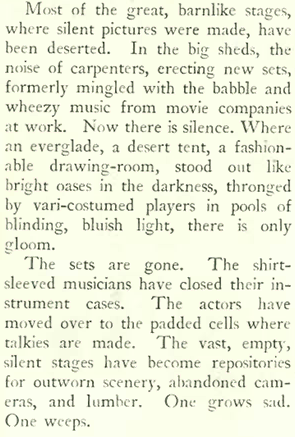
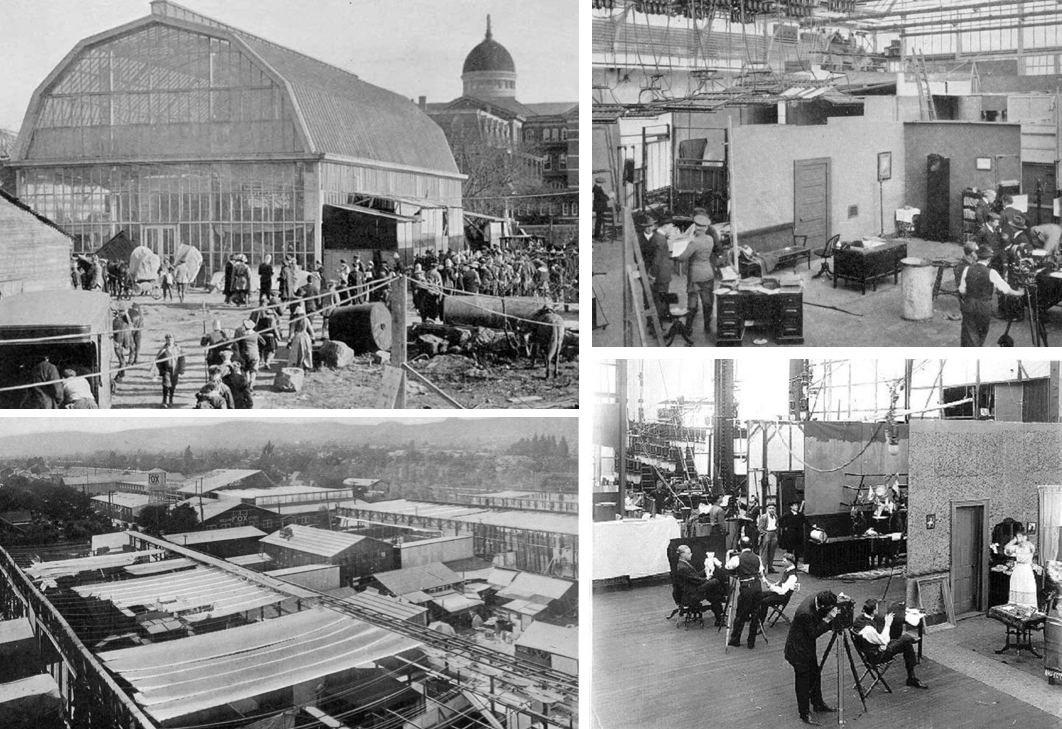
BARNLIKE STAGES were erected on both coasts to produce early silent films. Clockwise, from top left, Fox’s World Paragon Studios in Ft. Lee, NJ, circa 1917; interior of the studio; several films in production, side-by-side, at Edison’s Bronx studio, circa 1915; Fox studios in Los Angeles, 1920s. (moviemice.com/Wikipedia)
Jean-Jacques recalled the professions that would now be lost to the talkies, including the “mood musicians” who played their instruments on silent film sets in order to evoke emotions from the actors…
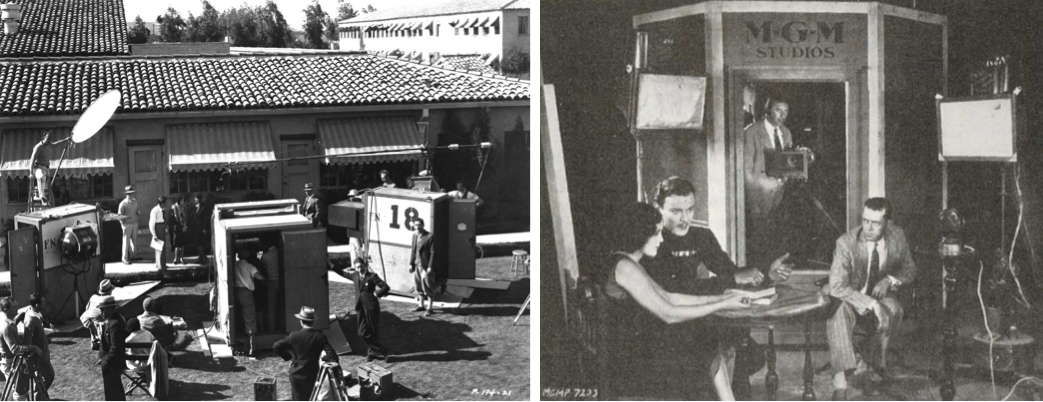
IN THE MOOD…During the silent era “mood musicians” were hired to play their instruments on film sets in order to evoke emotions from the actors. (Pinterest)THE SILENCE OF SOUNDS…In the early days of the talkies the entire set had to be silent, and special care had to be taken to ensure loud cameras were housed in soundproof boxes such as those pictured above. Instead of the introduction of sound expanding the capabilities of filmmaking, it was often limited by the bulky gear used to capture that sound. Therefore, many films consisted of “stage” musical numbers that were static shots. (Caption and image at left courtesy Colorado College. Image at right from cinecollage.net)
The writer also noted the challenges that faced “the old scenario writer…hemmed in by a multitude of new rivals…
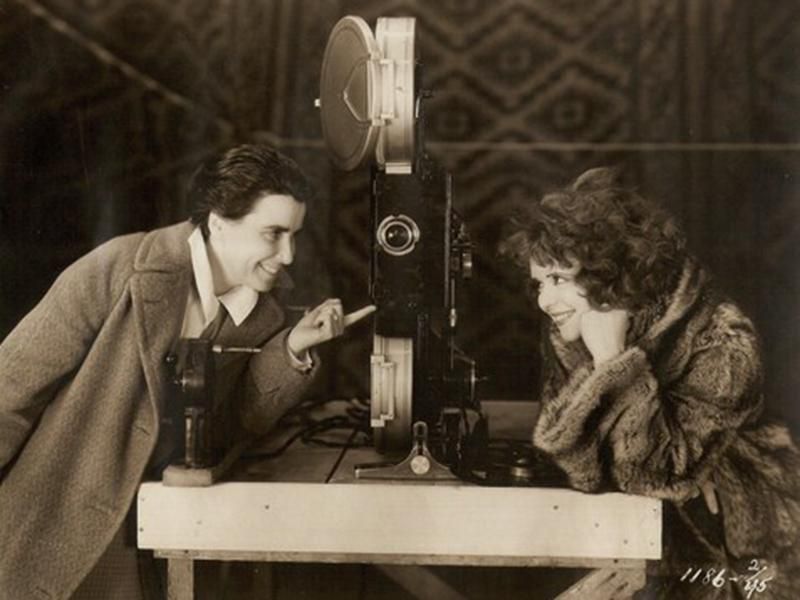
WE HAVE WAYS OF MAKING YOU TALK…Dorothy Arzner (left) poses with “It Girl” Clara Bow in a publicity shot for The Wild Party, Bow’s first talking picture. Bow is famously quoted as saying (in 1930) “I hate talkies. They’re stiff and limiting. You lose a lot of your cuteness, because there’s no chance for action.” Arzner tried to remedy that problem: she is credited with inventing the boom mike, which allowed for greater movement by the actor. (Paramount Pictures/Wikimedia Commons)
Jean-Jacques recounted the frustrations experienced by one old-time actor dealing with the limitations of bulky sound equipment…
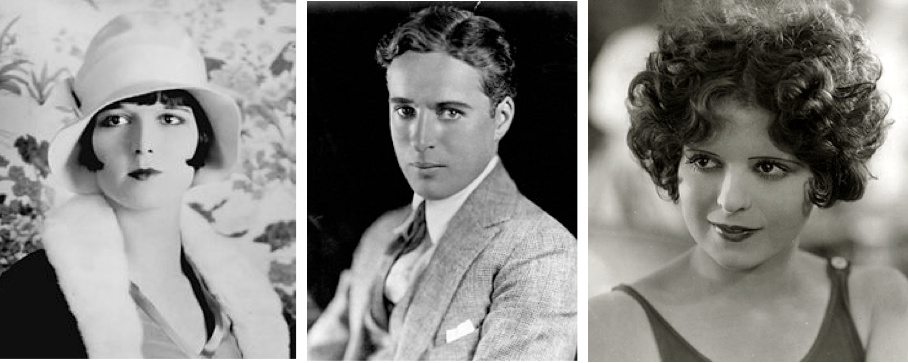
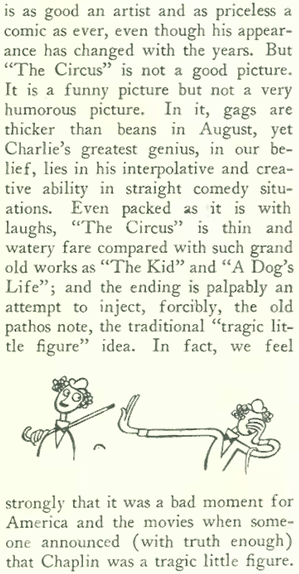
This actor was not alone. A number of major silent film stars including Charlie Chaplin, Louise Brooks, and Clara Bow did not embrace the novelty of sound pictures. Motion Picture Classic magazine (September 1930) quoted Bow as saying, “I hate talkies … they’re stiff and limiting. You lose a lot of your cuteness, because there’s no chance for action, and action is the most important thing to me.” According to the article, a visibly nervous Bow had to do a number of retakes in The Wild Party because her eyes kept wandering up to the microphone overhead.
SILENCE IS GOLDEN…A number of major silent film stars including (from left) Louise Brooks, Charlie Chaplin and Clara Bow did not embrace the novelty of sound pictures. (Wikipedia)
Jean-Jacques signed off his New Yorker piece with the hope that someday pictures and sound would be combined into a worthy new art form…
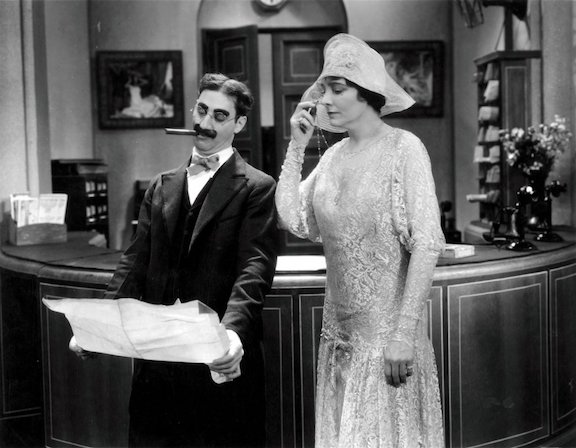
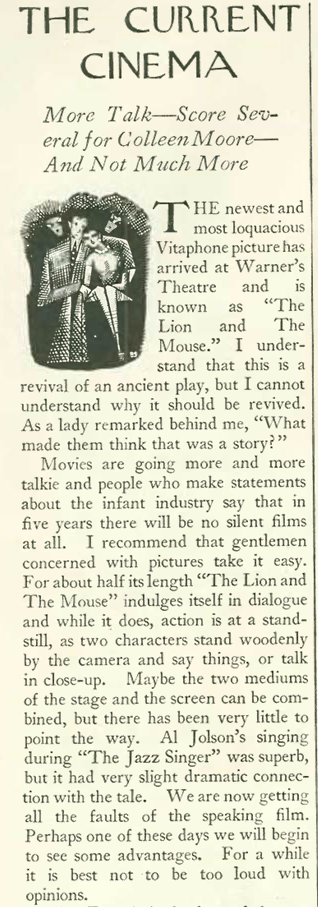
Perhaps he had to look no further than Manhattan’s Rialto Theatre to find that first glimmer of hope, for it was there that the Marx Brothers were tearing up the screen in their first talking picture, The Cocoanuts, reviewed in the magazine’s “The Current Cinema” column…
If The New Yorker was looking for snappy dialogue in motion pictures, there was plenty of it in The Cocoanuts, including this snippet between Groucho Marx, playing Mr. Hammer—an unscrupulous manager of a bankrupt Florida hotel—and wealthy hotel guest Mrs. Potter, played by Margaret Dumont…
Hammer: Do you know that property values have increased since 1929 one thousand per cent? Do you know that this is the biggest development since Sophie Tucker? Do you know that Florida is the show spot of America and Cocoanut Manor the black spot of Florida?
Mrs. Potter: You told me that yesterday.
Hammer: I know but I left out a comma.
Or this gem…
Hammer, to Mrs. Potter: Just think – tonight, tonight when the moon is sneaking around the clouds I’ll be sneaking around you. I’ll meet you tonight under the moon. Oh, I can see it now – you and the moon. Wear a neck-tie so I’ll know you.
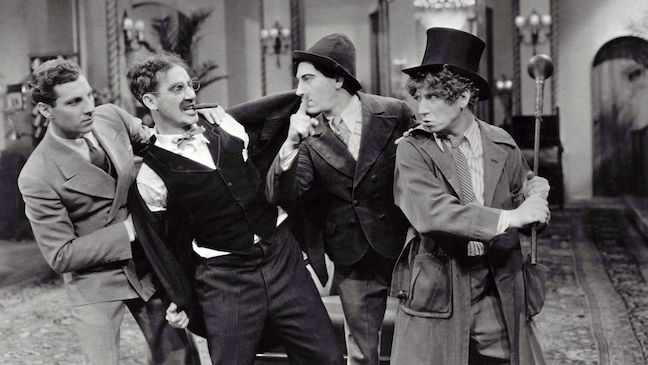
SHOW ‘EM HOW IT’S DONE…Zeppo, Groucho, Chico and Harpo Marx in their first sound movie, The Cocoanuts, 1929. (vitaphonedreamer.wordpress.com)BAMBOOZLER… Mrs Potter (Margaret Dumont), inspects Mr Hammer’s (Groucho Marx) Florida property “deals” in The Cocoanuts. (British Film Institute)
* * *
For Sentimental Reasons
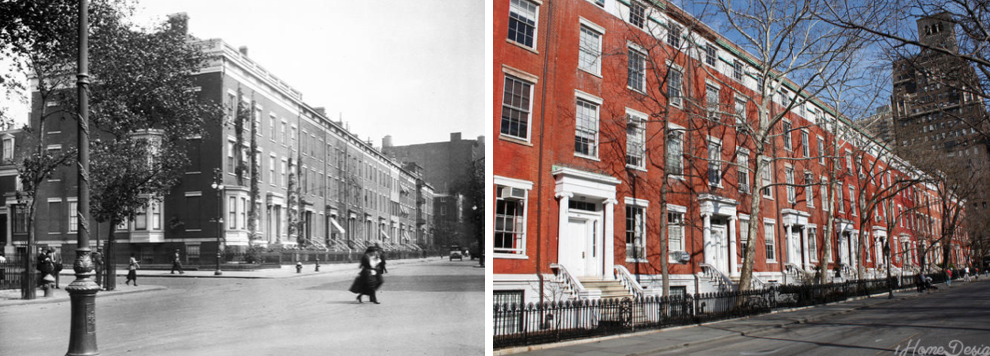
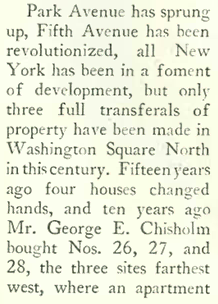
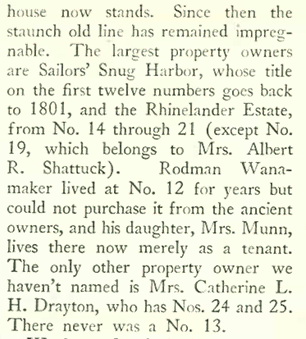
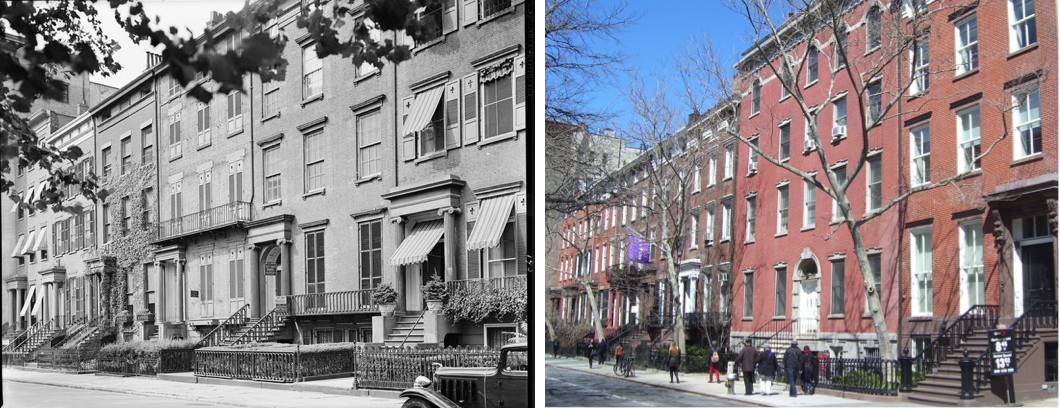
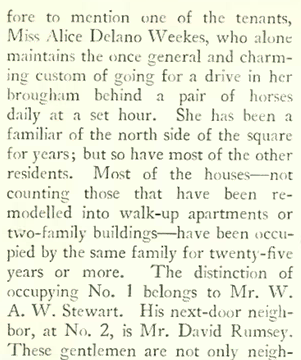
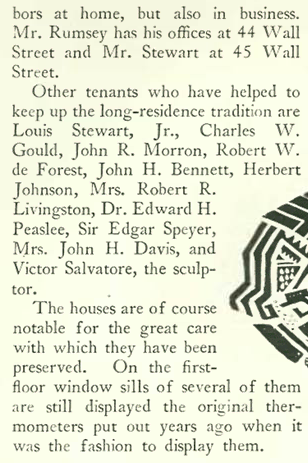
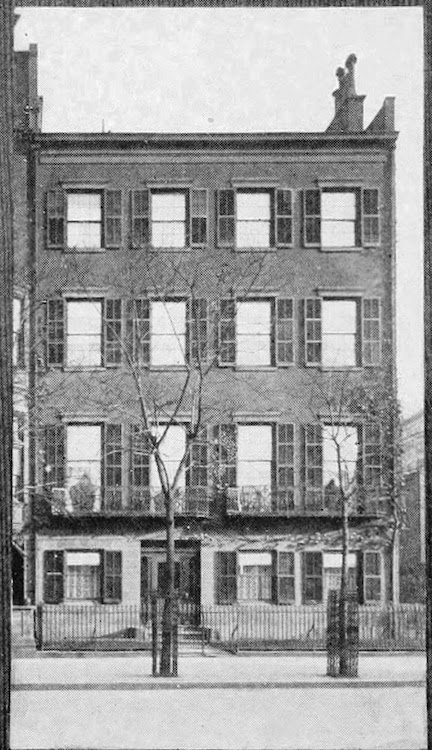
Additional evidence that The New Yorker was not always ready to embrace change came from its many articles, particularly in “The Talk of the Town,” that seemed to favor the preservation of buildings that defined the character of certain neighborhoods, including the early 19th century row houses that lined Washington Square North…
THEN AND NOW…At left, photo dated 1921 of Washington Square, north side of square looking east from 5th Avenue. Corner house in foreground is No. 12. The far end at right shows Nos. 3, 2, 1. At right, roughly the same block today. (Museum of the City of New York/1homedesigns.com)
At left, photo dated 1936 (by Berenice Abbott) of Washington Square North, nos. 21-25, between Fifth Avenue and MacDougal Street. At right, nos. 19-26 today. (Museum of the City of New York/Wikimedia Commons)
* * *
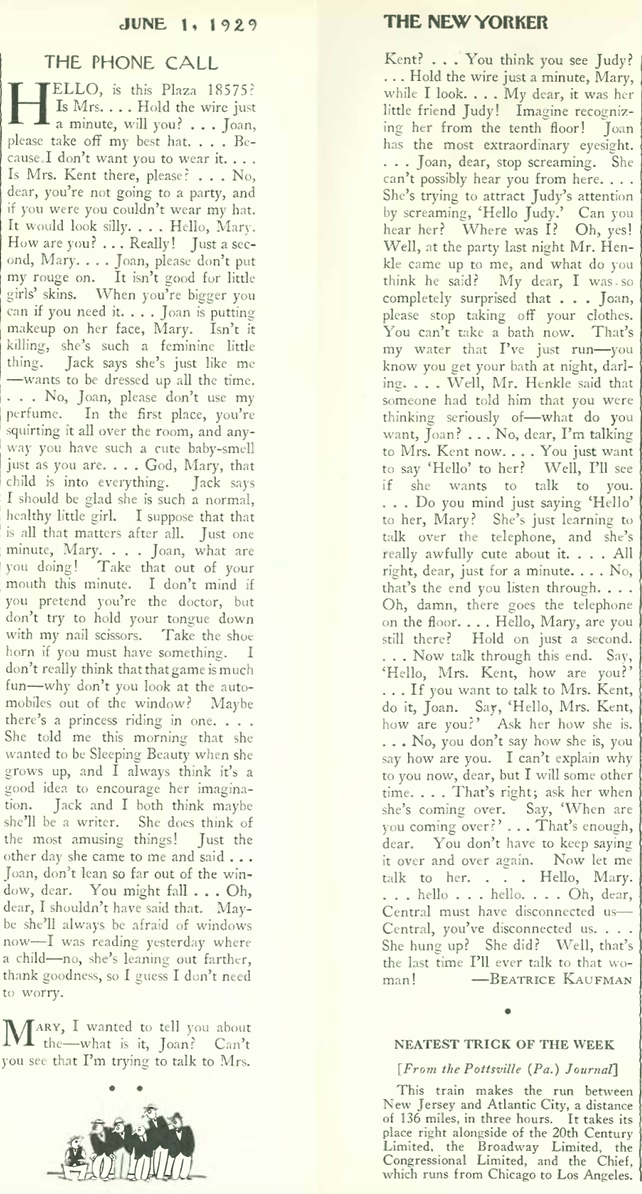
The Wittier Kaufman
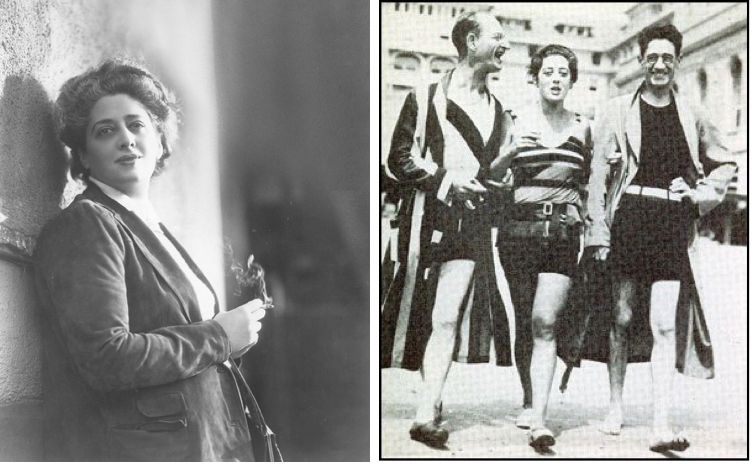
Editor and playwright Beatrice Kaufman worked and played within the orbit of the famed wits of the Algonquin Round Table, but was not a regular member like her husband, playwright and director George S. Kaufman. But Beatrice Kaufman didn’t the need the Algonquin to display her wit. Indeed, according to Michael Galchinsky (writing for the Jewish Women’s Archive), she was regarded as one of the wittiest women in New York in the 1930s and 40s. Here is an example of her work in the June 1 issue of The New Yorker:
THE WITTIEST OF THEM ALL…Editor, writer and playwright Beatrice Kaufman (left, in undated photo). At right, comedian Julius Tannen (left) frolics with Beatrice and her husband, Broadway playwright/producer George S. Kaufman in Atlantic City in the 1920s. (thepurplediaries.com/spartacus-educational.com)
* * *
Rags to Riches
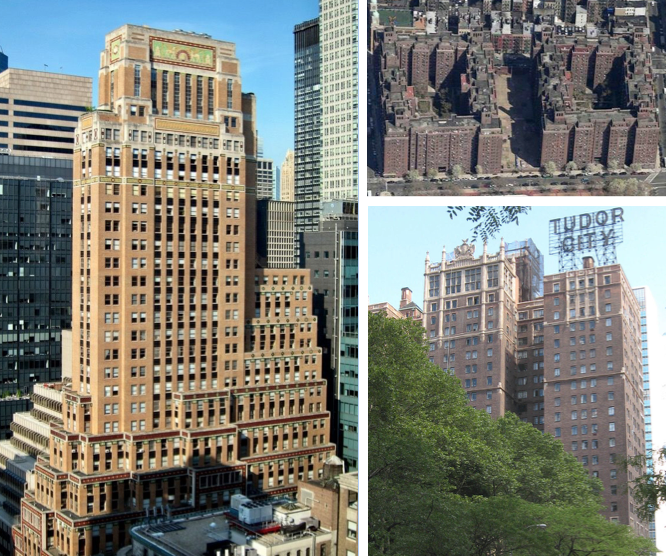
The life of Fred F. French was something out of dime novel; born in dire poverty, he became a self-made real estate tycoon and a shrewd builder of some of Manhattan’s biggest land developments. French was the subject of a profile written by Robert M. Coates, an art critic who would be a longtime contributor to The New Yorker. An excerpt, with illustration by Al Frueh:
MONUMENTS TO FRED…Fred French’s New York City buildings included, clockwise from left, the 38-story Fred F. French Building (1927) at 45th Street and 551 Fifth Avenue (designated a National Landmark); Knickerbocker Village (1934) on the Lower East Side; and the East Side’s Tudor City apartment complex (1927-1932). (Pinterest/thelodownny.com/Wikipedia)
* * *
From Our Advertisers
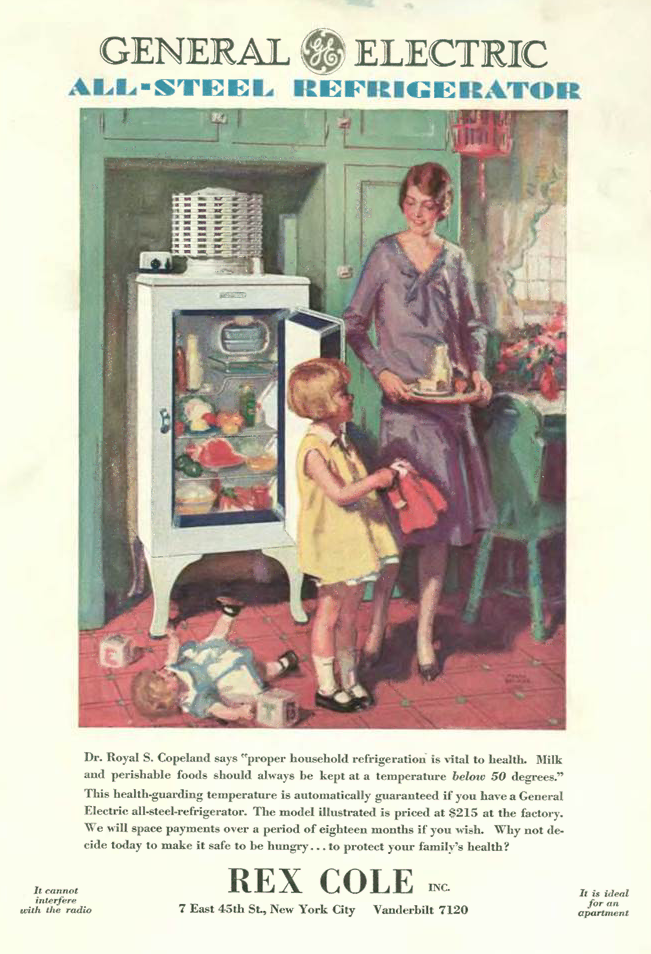
Let’s start with a couple of lovely color ads, which appeared with greater frequency in the magazine…here we have a snatch of the good life, courtesy General Electric…
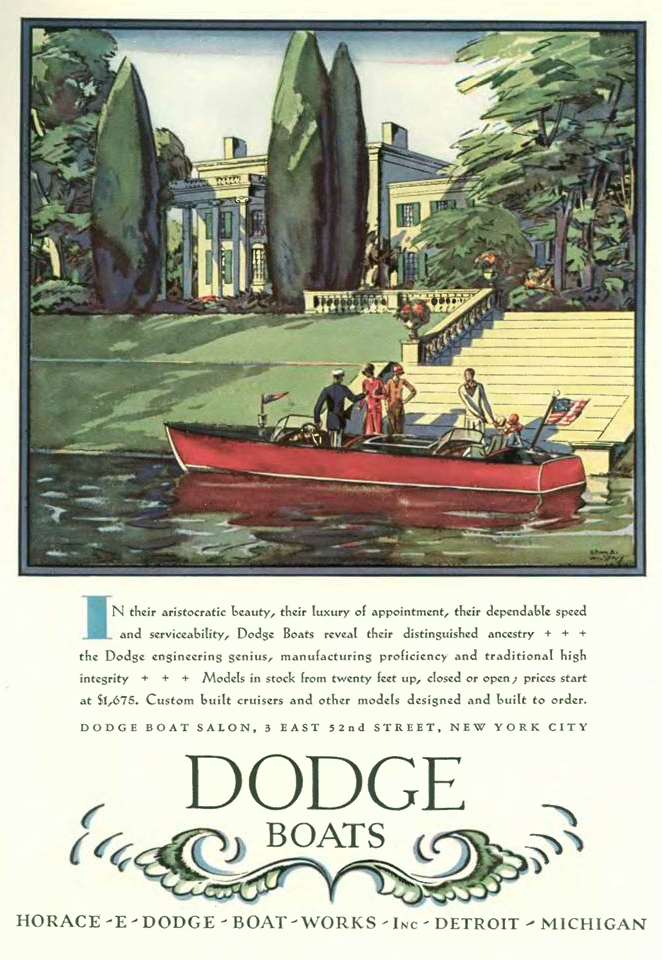
…and perhaps a less homespun image of the good life, from the makers of Dodge boats…
…and here we have another example of the modern world rushing in, this time in the form of instant coffee crystals…
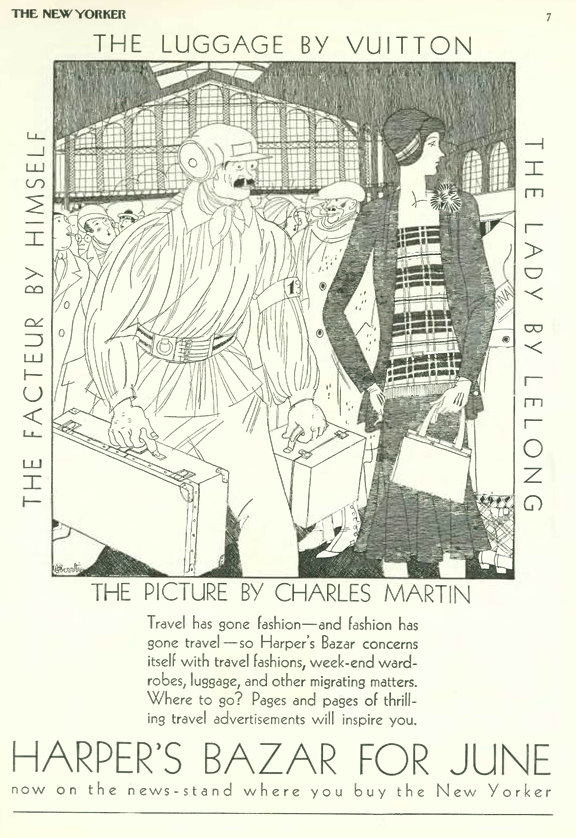
…and another taste of the modern from Harper’s Bazar magazine, featuring an illustration by French artist and illustrator Charles Martin…
…and just for kicks, another example of Martin’s work from an earlier time…
Image from Sports et Divertissements by Charles Martin, 1914. (Wikipedia)
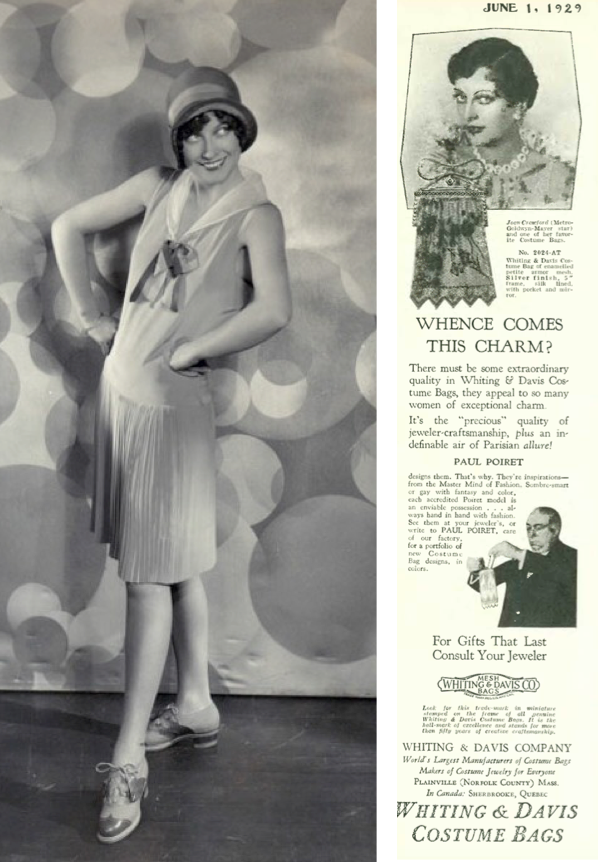
…and here is a back page ad for costume bag maker Whiting & Davis, with an endorsement by Joan Crawford, who was already a pretty big star by 1929. My guess is that Whiting & Davis paid more for the endorsement than they did for the ad…I included a photo of Crawford (at left) from 1929 just to show that she did have a lighter side…
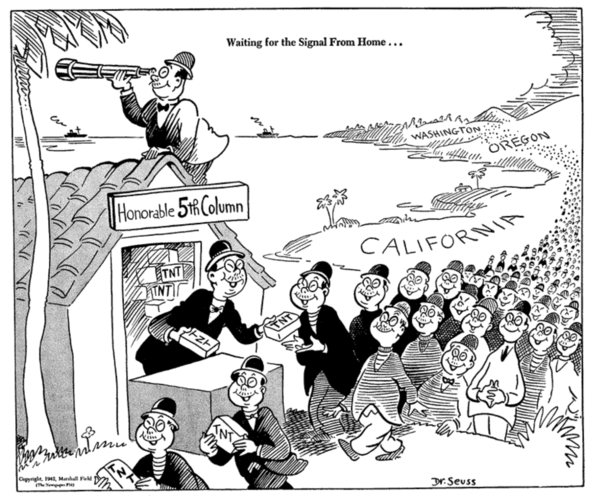
…this ad from the makers of Flit insecticide begs the question: was our beloved Dr. Seuss (aka Theodore Geisel) once a racist? Well…
…although Geisel was a liberal Democrat and a supporter of the New Deal, during World War II he also supported the internment of Japanese Americans, as is evident from this unfortunate 1942 cartoon…
Dr. Seuss 1942 cartoon with the caption ‘Waiting for the Signal from Home’ (slideshare.net)
…later in life Geisel became a staunch environmentalist and anti-war protestor. In 1961 he wrote The Sneetches, which promoted racial equality. Perhaps Geisel lived to regret those earlier drawings…
…and on to our illustrators and cartoonists, beginning with this sketch by Garrett Price, apparently inspired from a recent trip to France (it was featured along with several other small sketches in the “Profile” section)…
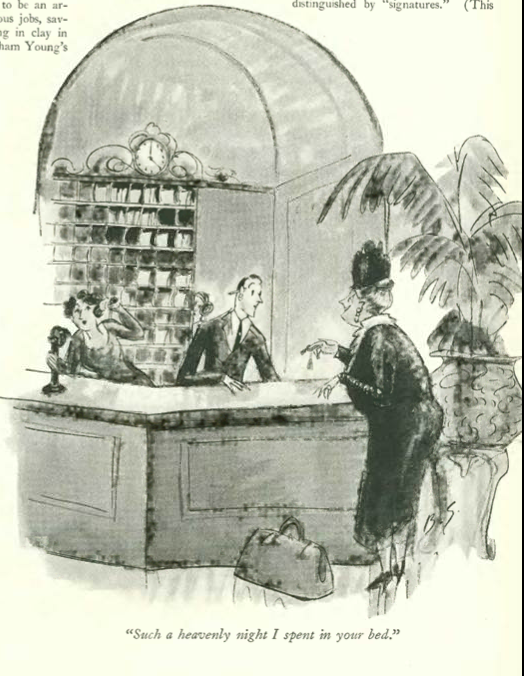
…Barbara Shermund had some fun with a double entendre…
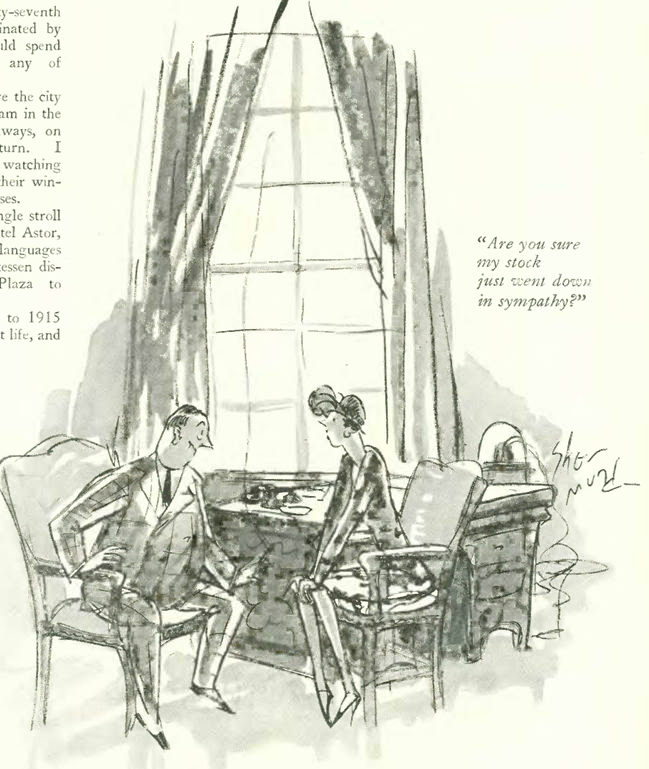
…and popped up again with this look at the stock market…
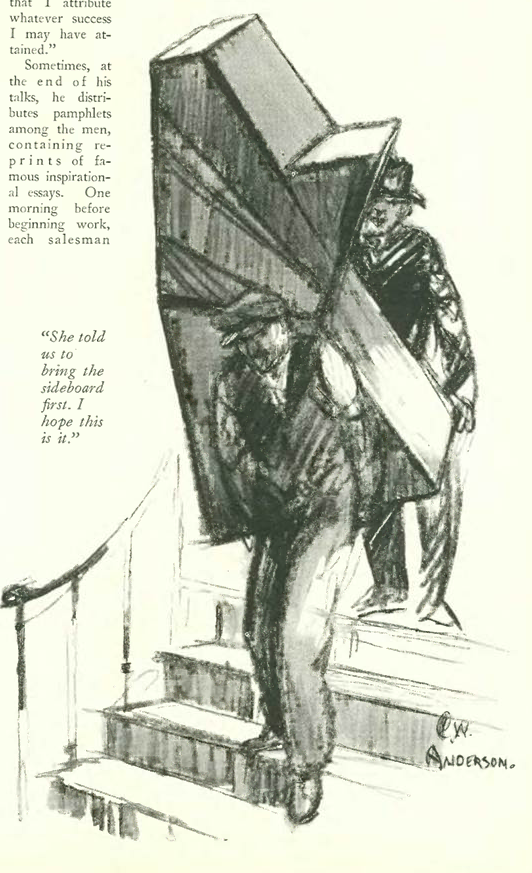
…C.W. Anderson found humor in the strange shapes of modernist furniture…
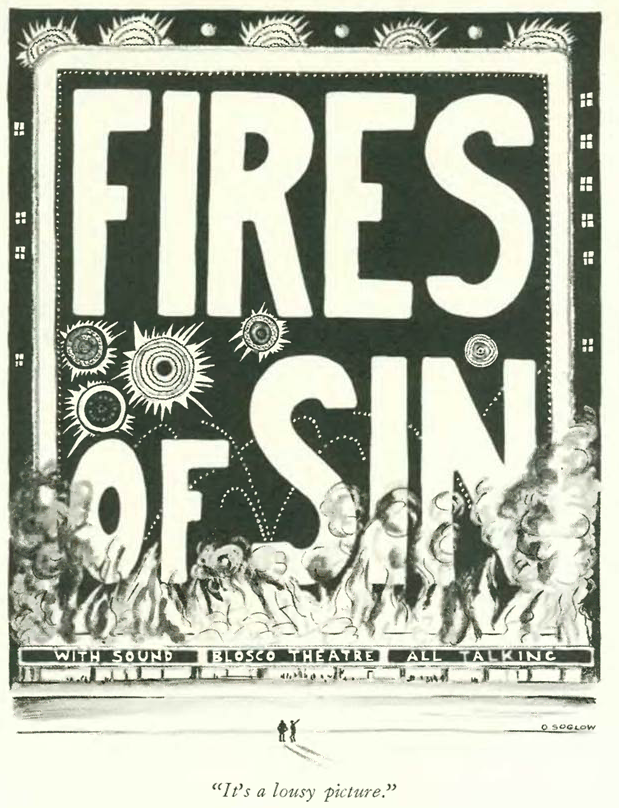
…Otto Soglow commented on the glitzy hype of Broadway…
…and cartoonist/humorist Don Herold made his comics debut in The New Yorker with this entry…
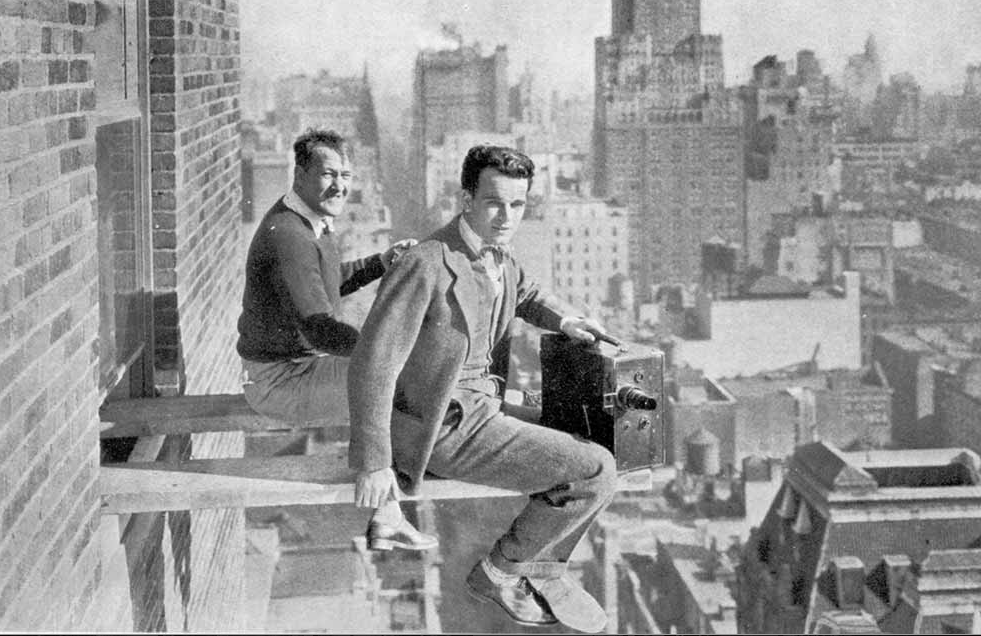
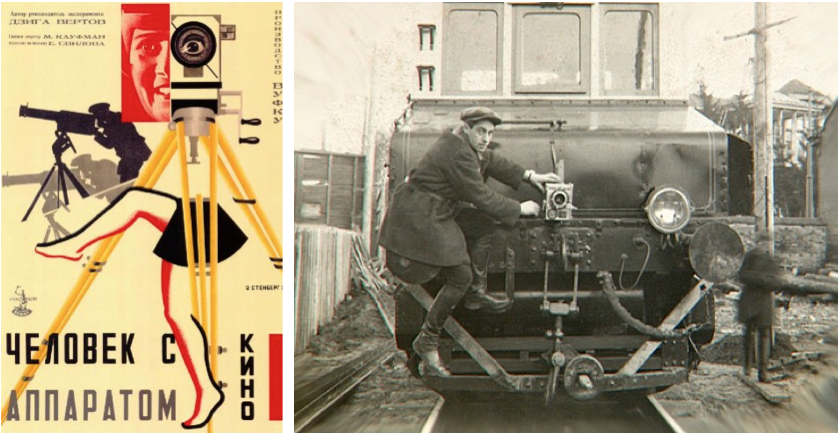
…and finally, a bonus image I came across while researching the advent of sound motion pictures. The photo, from the silent era, shows two cameramen shooting a parade, possibly for a newsreel. Note how their only support consists of two wooden planks wedged into an open window…