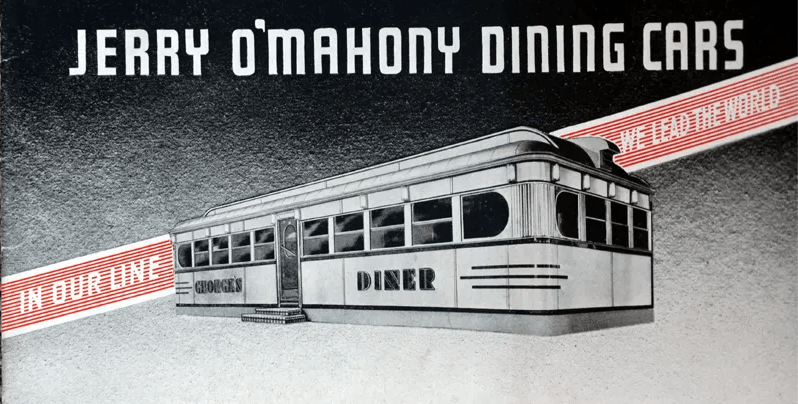
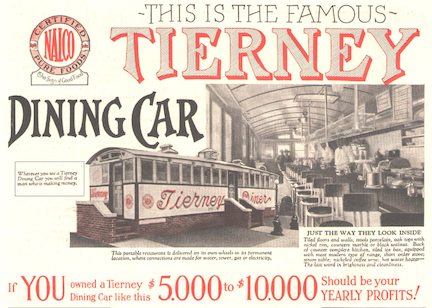
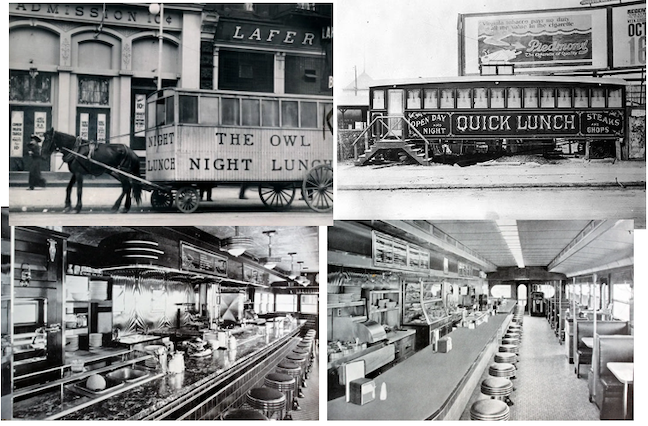
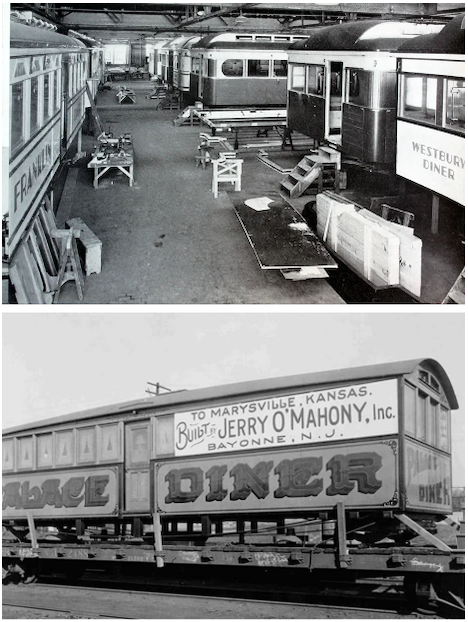
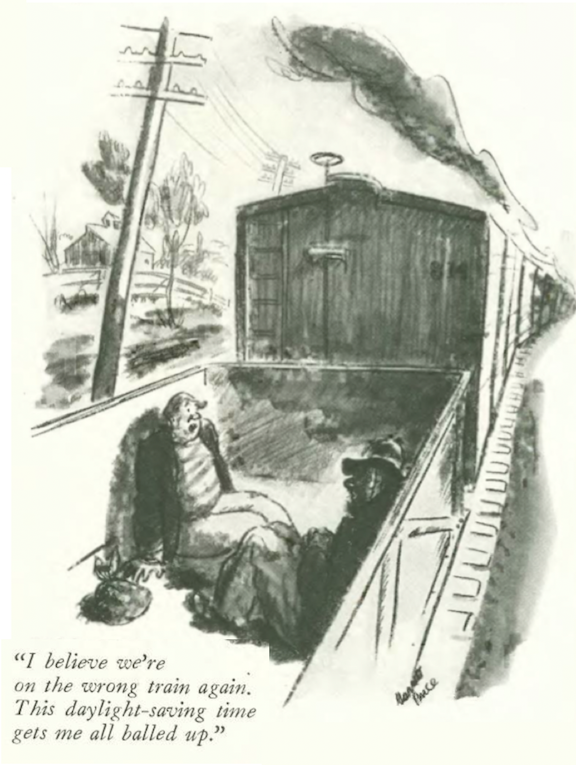
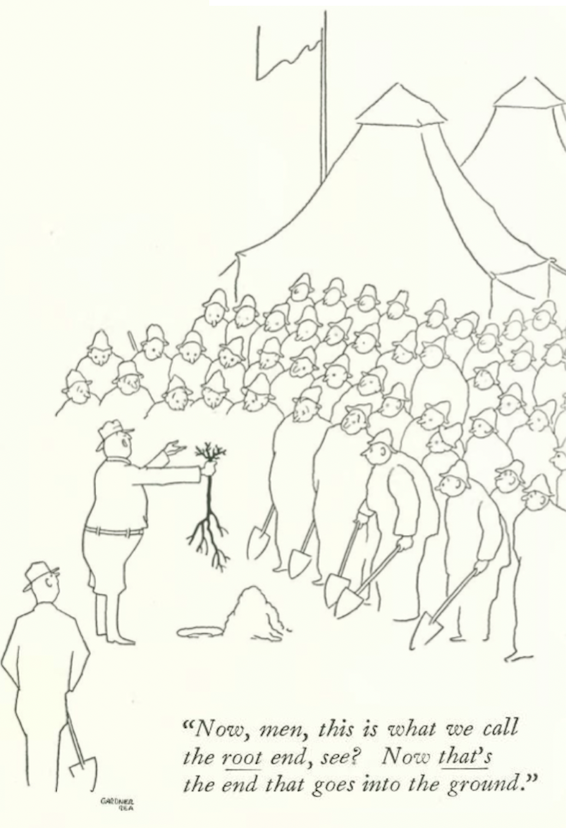
If you think today’s food trailers are the result of some hipster craze, consider that their origins go back more than a century; by 1934 Manhattan was home to 300 of the country’s 5,000 “lunch wagons,” which were commonly called “dog wagons.”
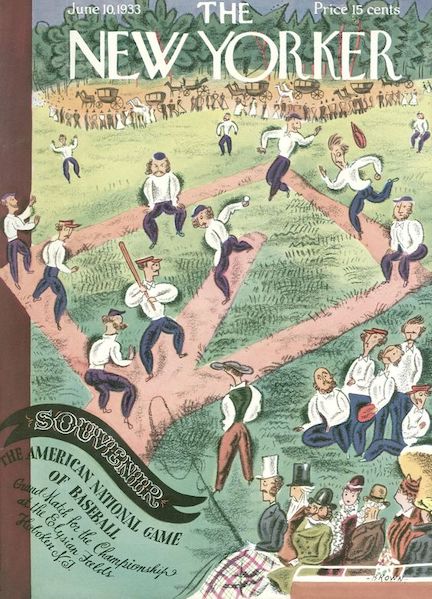
September 8, 1934 cover by Ilonka Karasz.
Some of Manhattan’s dog wagons belied the moniker, however, resembling the sleek roadside diners over which many today wax nostalgic. Jerry O’Mahony Diner Company of Elizabeth, New Jersey, produced more of these dining cars than any other concern—2,000 of them between 1917 and 1952 (only about twenty remain today). “The Talk of the Town” had this to say about the dog wagon phenomenon. Excerpts:
PROMISE OF BIG BUCKS…Tierney, based in New Rochelle and established in 1895, was an early manufacturer of lunch wagons and dining cars. It went out of business in 1933. Above, detail from a Tierney Diner Car Advertisement from the late 1920s. (scalar.usc.edu)LUNCH ON THE RUN…Clockwise, from top left, early “dog wagons” were horse-drawn affairs; the wagons became semi-stationary with the advent of manufactured units designed to resemble old railroad dining cars; bottom photos show interiors of two O’Mahony diners. (restaurantingthroughhistory.com/americanbusinesshistory.org/dinerhunter.com)ALL IN A NAME…Above: The Jerry O’Mahony Diner Company produced 2,000 diners in its Elizabeth, New Jersey, factory. Below, an O’Mahoney dining car headed for its new home in Kansas—the O’Mahony company preferred that patrons give their dining cars elite names, such as this “Palace Diner.” (dinerhunter.com/nyfta.org)LAST CALL…One of the few surviving O’Mahony diners—The Summit Diner in Summit, New Jersey. A prototypical “rail car” style diner, it was built by the O’Mahony Company in 1938. (Jeff Boyce/Wikimedia Commons)
* * *
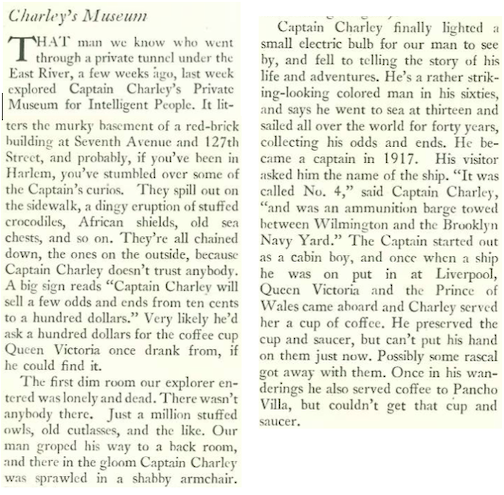
A Captain’s Curios
“The Talk of the Town” also paid a visit to Captain Charley’s Private Museum for Intelligent People, a place that would later be visited (and written about) by The New Yorker’s chronicler of the commonplace, Joseph Mitchell. Excerpts:
MURKY MUSEUM…This is likely the red brick building on 127th Street where the old mariner Captain Charley held court in the basement with his Private Museum for Intelligent People. (Google Street View)
* * *
Origins of Life
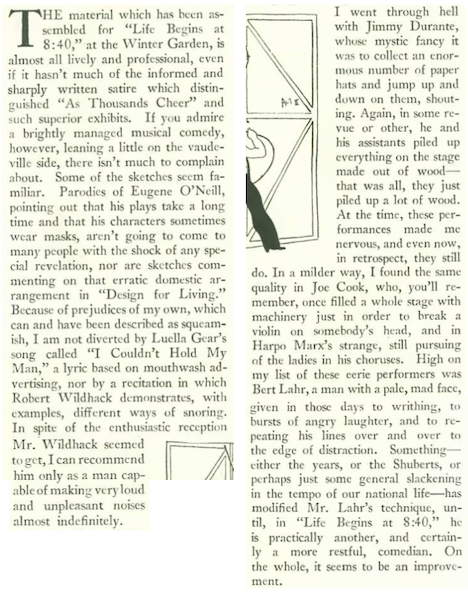
Wolcott Gibbs took his turn as theater reviewer (in relief of Robert Benchley) and managed to sit through Life Begins at 8:40, which had a successful run at the Winter Garden.
GIVING IT A REST…Roy Bolger, Luella Gear, Frances Williams and Bert Lahr headed the cast of Life Begins at 8:40 at the Winter Garden. Critic Wolcott Gibbs appreciated Lahr’s change in tempo, as he was becoming a more “restful” comedian. Lahr was the father of New Yorker theater critic and writer John Lahr. (Library of Congress)
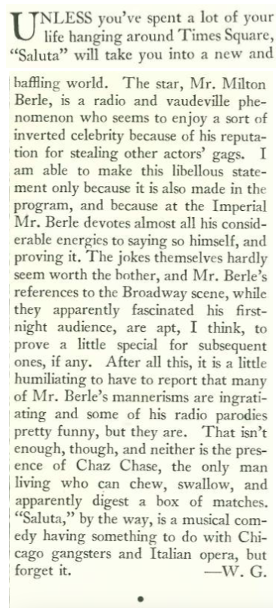
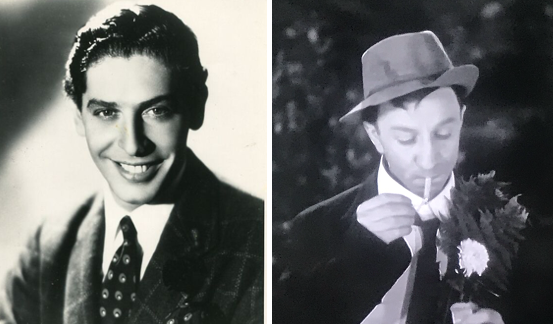
In contrast to Bert Lahr’s new toned-down style, Milton Berle’s outlandish antics over at the Imperial Theatre had Gibbs wondering what the comedian’s vaudeville-style show Saluta was all about, if it was about anything. Whatever it was, it worked—Berle would enjoy a comedy career spanning eight decades, including becoming one of early television’s biggest stars.
ON FIRE…Milton Berle’s show Saluta featured Chaz Chase (right), famed for gobbling up whatever was placed in front of his mouth, including a box of lit matches. At left, Berle in 1930; right, Chase in the 1935 film Vaudeville. (Pinterest/IMDB)
* * *
From Our Advertisers
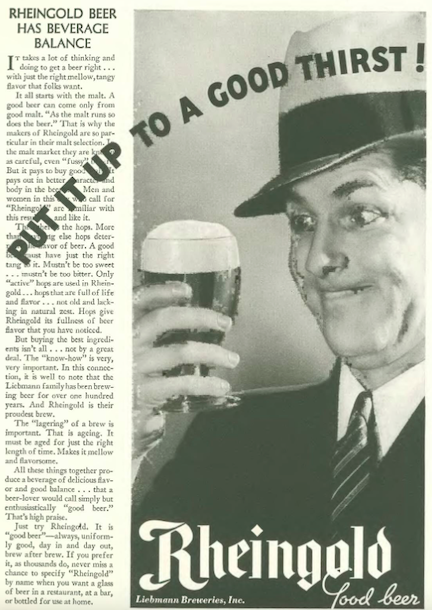
We begin with a cold one from Rheingold, which had “beverage balance” and wasn’t afraid to stamp a slogan right over its ad copy…
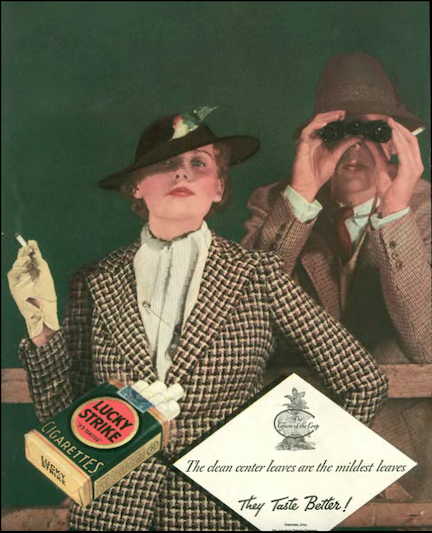
…Lucky Strike gave us another stylish reason for taking up a bad habit…
…Arts & Decoration magazine took out this full page to tout the latest news in modern design…
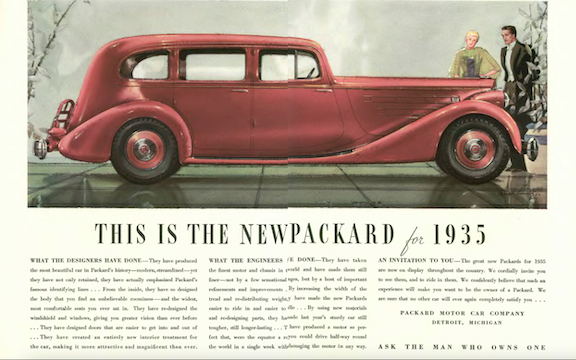
…while the folks at Packard bought this center spread to give ample space to their 1935 model, which must have been a helluva thing to parallel park…
…clothing companies continued use class shaming to goad aspiring toffs to purchase the “correct” attire for school…
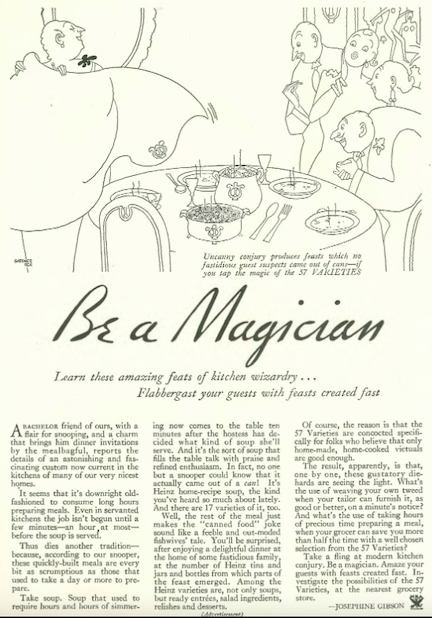
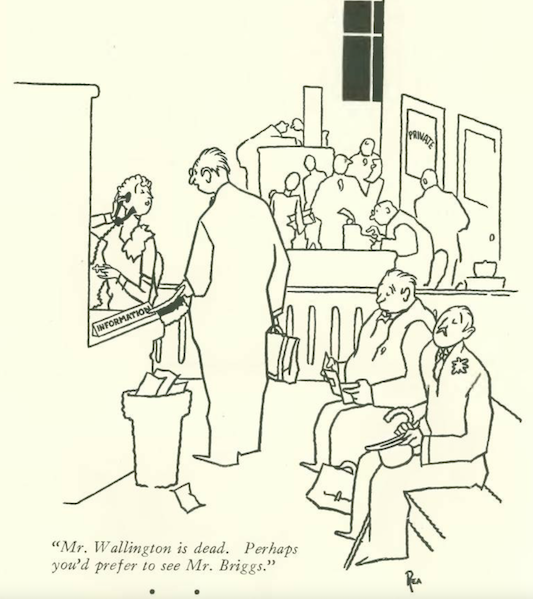
…with the help of Gardner Rea, Heinz suggested that the upper orders would simply swoon over cuisine you managed to scoop out of a can…
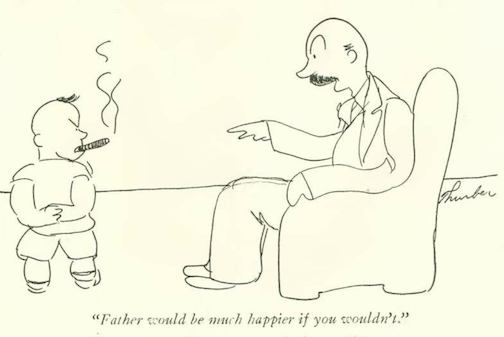
…on to our cartoonists, we begin with spots by James Thurber…
…and Lloyd Coe…
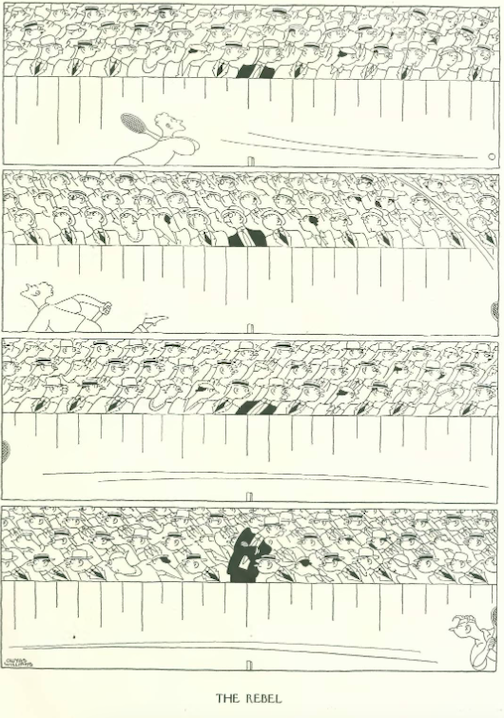
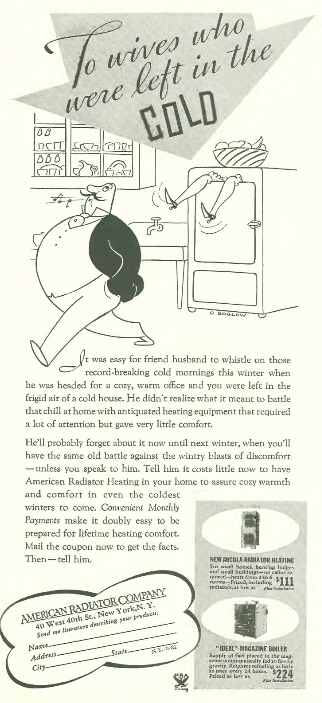
…with the absence of Otto Soglow’sLittle King, Gluyas Williams did his best to fill the void of a full page, something Williams did quite nicely…
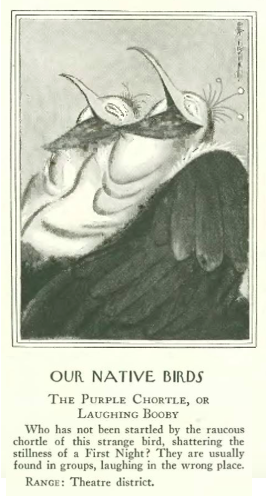
…Rea Irvin gave us yet another local bird sighting…
…Richard Decker found understatement over a reservoir…
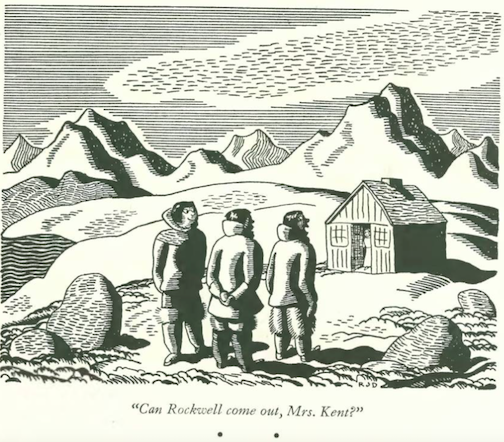
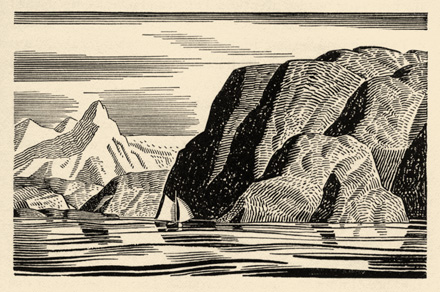
…Robert Day borrowed from the style of Rockwell Kent to offer a bit of humor from the northern climes…
…here is a woodcut from Kent’s N by E is, an illustrated story of his voyage to Greenland…
(From Rockwell Kent’s 1930 book of woodcuts, N by E, via untendedgarden.com)
…Reginald Marsh lent his social realism to an uglier side of American life…
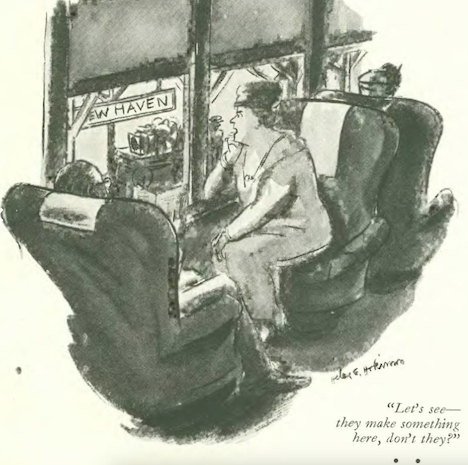
…and we close with Helen Hokinson, just taking in the passing scene…
Sigmund Gottfried Spaeth (1885–1965) sought to popularize classical music and improve the musical tastes of the masses by meeting the public wherever he could find them, from vaudeville halls to national radio broadcasts.
September 1, 1934 cover by William Steig.
Born in a line of three generations of Lutheran clergymen, Spaeth chose a different path and became a musicologist who sought to de-mystify classical music, often demonstrating how popular melodies had origins in earlier music. He also had strong opinions about lyrics in popular music, demonstrating his distaste for “the lyric school of self-pity” in this “Onward and Upward” column. Excerpts:
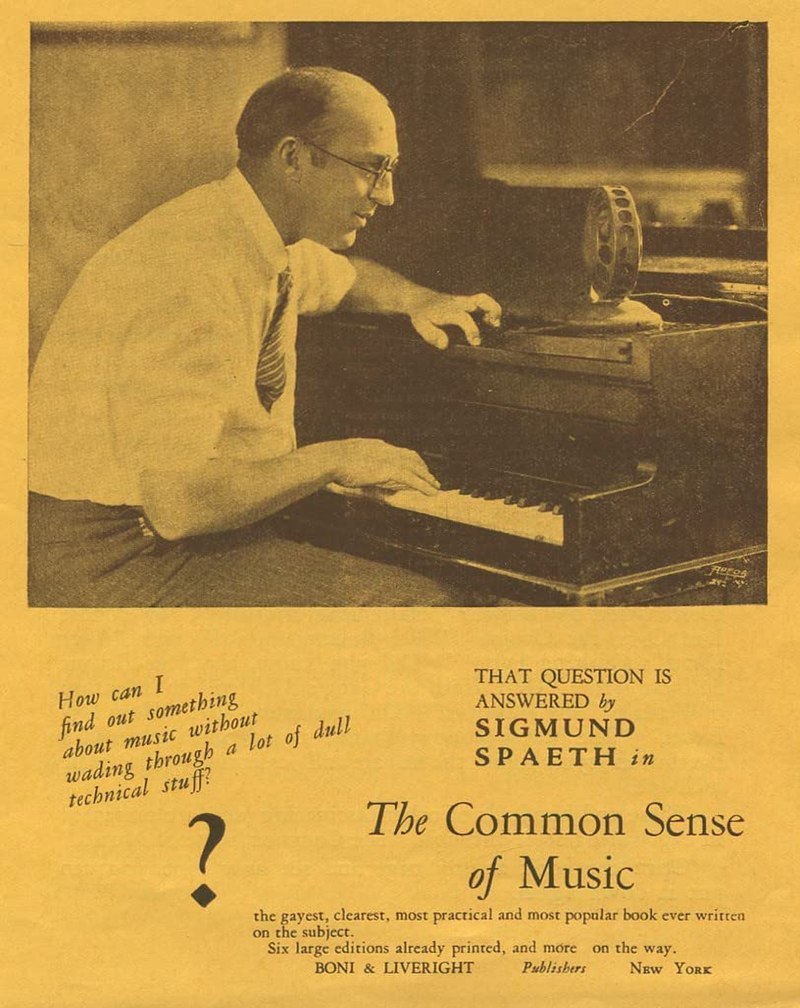
BRINGING MUSIC AND LIGHT…Sigmund Spaeth found much to dislike in the world of popular music, but he was never stuffy in his approach to music appreciation. At right, Spaeth appeared in vaudeville-style shows (and for many years on the radio) as “The Tune Detective,” wearing a deerstalker cap, cape, and checked tweeds in imitation of Sherlock Holmes. He hoped to demonstrate to a wide audience that all music was essentially based on a set of simple principles. (sinfonia.org/wnyc.org)HAVE NO FEAR…Spaeth wrote a popular syndicated newspaper column, “Music for Everybody,” and contributed articles to many periodicals during his career. With his first book in 1925, The Common Sense of Music, and others that followed, Spaeth sought to de-mystify music for a general audience. (Wikimedia Commons)OH LIGHTEN UP…Spaeth detected a cynical note in Bing Crosby’s (left) sob song, “I Cried for You,” and noted Irving Berlin’s latest contribution to the “sob symposium,” “I Never Had a Chance.” (Wikipedia/digitalcommons.library.umaine.edu/britannica.com)
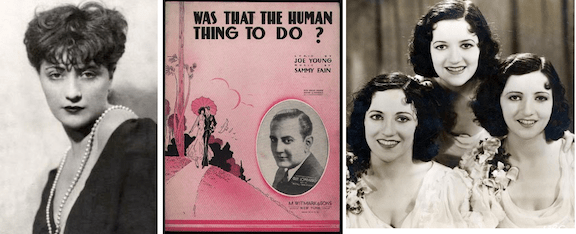
Spaeth noted that not all sad songs were dripping in artificial self-pity, citing Helen Morgan’s “Why Was I Born?” as an example of a song modeled on “the legitimate blues,” marked by “a sincerity of expression in everyday language”…
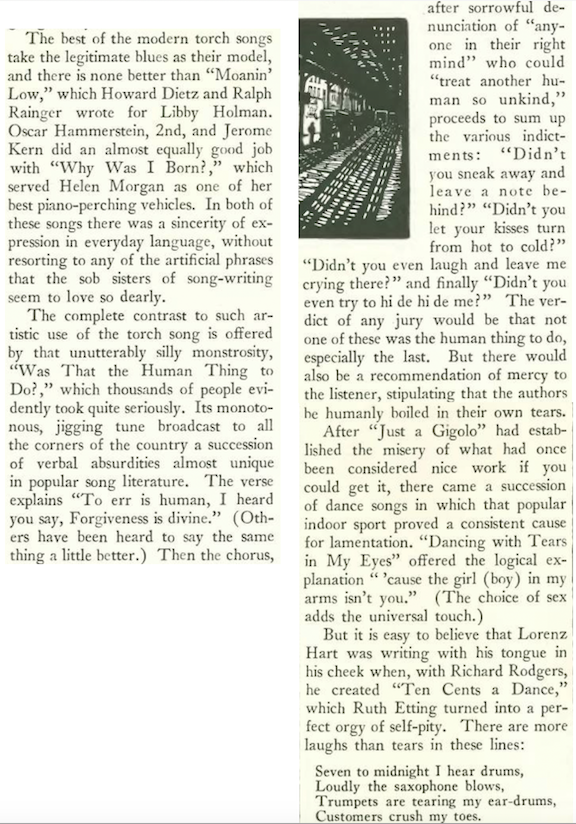
RIGHT AND WRONG…Spaeth acknowledged the “sincerity of expression” in Helen Morgan’s (left) torch songs, while at the other extreme he suggested that the authors of “Was That the Human Thing to Do?” (Sammy Fain and Joe Young) be boiled alive in their own tears. The song was popularized by The Boswell Sisters, a beloved New Orleans trio in the early 1930s. (findagrave.com/amazon.com/genius.com)
* * *
Off to the Races
In his column, “Of All Things,” Howard Brubaker commented on the apparent competition and contrast between Alexander Woollcott’s book, While Rome Burns, and another with a rosier title, The Coming of the American Boom. It appears Woollcott’s book won out, at least in the long run, as I can find no trace of the Boom book, or its author.*
* One of our kind readers has identified the author: “The Coming American Boom” was written by Lawrence Lee Bazley Angas and published by Simon and Schuster in 1934. In 1939, Time noted that “Major Lawrence Lee Bazley (‘Boom’) Angas is a pink & white Britisher with a reputation for making daring predictions which have sometimes come true…. He won his nickname with a much-publicized booklet, The Coming American Boom, which heralded his arrival in the U.S. in 1934.”
Speaking of rosy outlooks, E.B. White offered some parting thoughts on Chicago’s World’s Fair, called “A Century of Progress.” Rather than focus on the grandiose exhibits, White wryly noted other signs of progress at the fair, as recounted from a letter he received from his nephew.
The Chicago World’s Fair featured all sorts of modern wonders “dedicated to the ideal of scientific advance”…
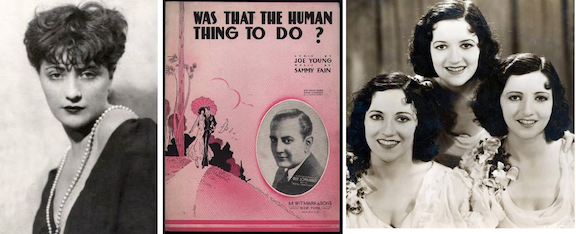
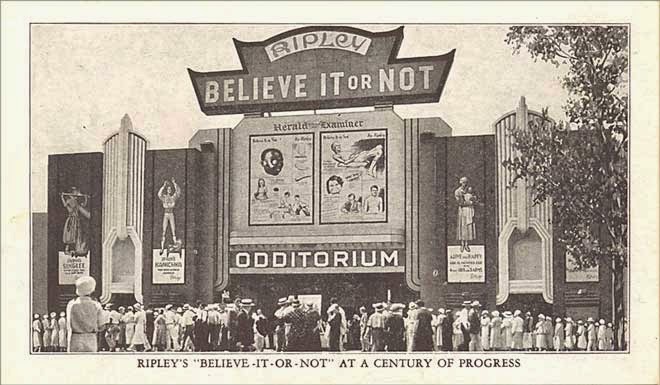
…but as with any World’s Fair, it also catered to the baser interests of the masses, with attractions such as Robert Ripley’sBelieve It Or Not “Odditorium,” which was essentially a P.T. Barnum-style freak show…
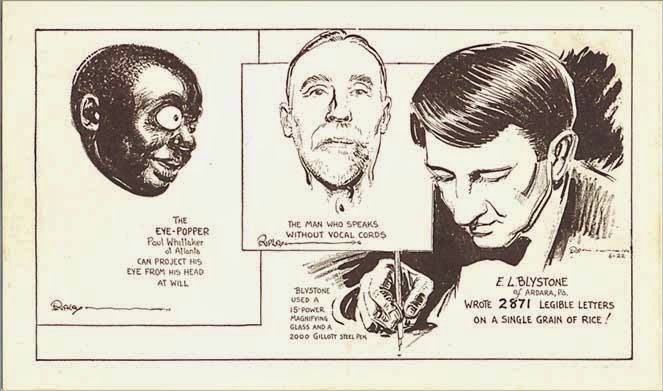
…Ripley’s syndicated newspaper feature included these Odditorium attractions…
…White made light of exhibitions displaying such signs of progress as how to brush your teeth, and more examples of human freakdom…
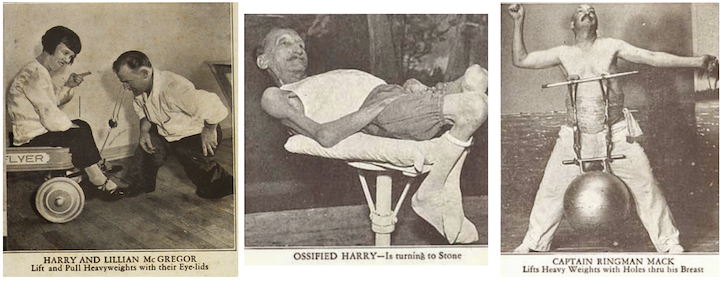
…White’s nephew wrote of a man who could pull a wagon (containing his wife) with his eyelids, an apparently arthritic fellow who was “turning to stone,” and a man who could support heavy weights with his pierced breasts…
(all images courtesy postcardy.blogspot.com)
* * *
Letter From Paris
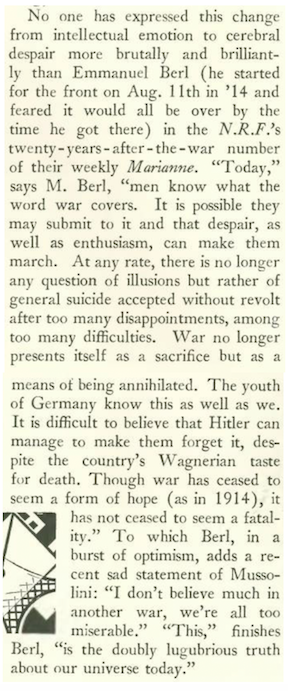
Paris correspondent Janet Flanner wrote that August 1934 was a “month of memories” as it marked the twentieth anniversary of the outbreak of the Great War, which we now call World War I. Flanner wrote about a new attitude that had arisen in those two decades, “a new attitude not only toward the last war but toward the next (which, ironically enough, seems increasingly inevitable to France since the death of the enemy warrior, von Hindenburg).” She continued with these observations made by French journalist and historian Emmanuel Berl (1892–1976), who wrote that as a result of the Great War, the youth in both France and Germany held few heroic illusions about war, seeing it not as a sacrifice but rather “as a means of being annihilated.”
SO MUCH FOR THE HEROICS…A refugee family returning to Amiens, France, looking at the ruins of a house on Sept. 17, 1918. Top right, Janet Flanner in 1940; below, Emmanuel Berl. (iwm.org.uk/Flanner photo copyright Estate of George Platt Lynes/Berl photo courtesy Joël Chirol)
* * *
From Our Advertisers
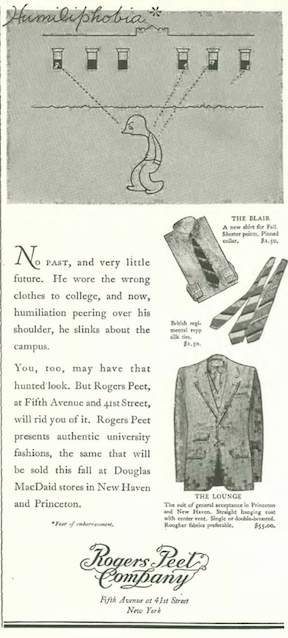
Clothing company Rogers Peet used the threat of humiliation to encourage young men to stock up on “authentic university fashions” before returning to campus…
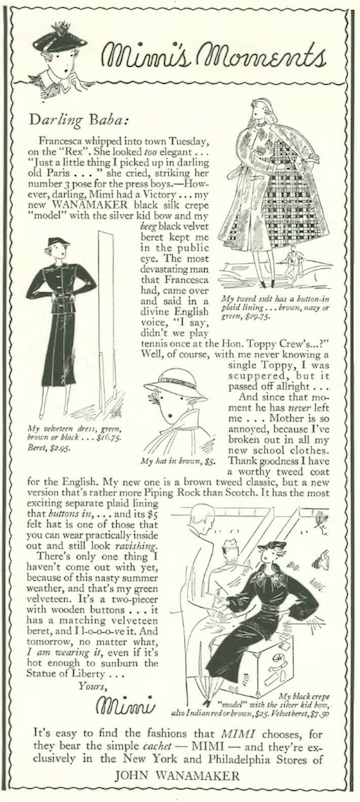
…the Wanamaker department store took a different approach, offering up new styles with a heavy English accent (I say, didn’t we play tennis once at the Hon. Toppy Crew’s?)…
…the makers of Goodyear tires offered up this disturbing image to boost sales…
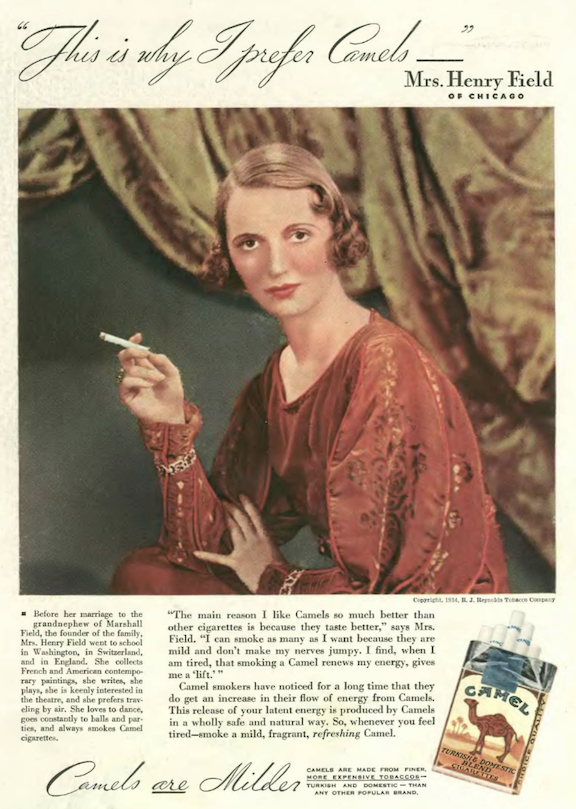
…this ad told us that “Mrs. Henry Field” collected fine art, loved to go to parties, and “always smoked Camel cigarettes”…I am unaware of the fate of Mrs. Henry Field, married to the grandnephew of Marshall Field, but this unseemly image suggests she was replaced by a wax figure before the photo was taken…
…on to our cartoons, we begin with spot illustrations from (clockwise, from top) Victor De Pauw, Abe Birnbaum, and an unidentified illustrator who offered this suggestion for beating the late summer heat…
…we move along to Alan Dunn and a record-seeking pooch…
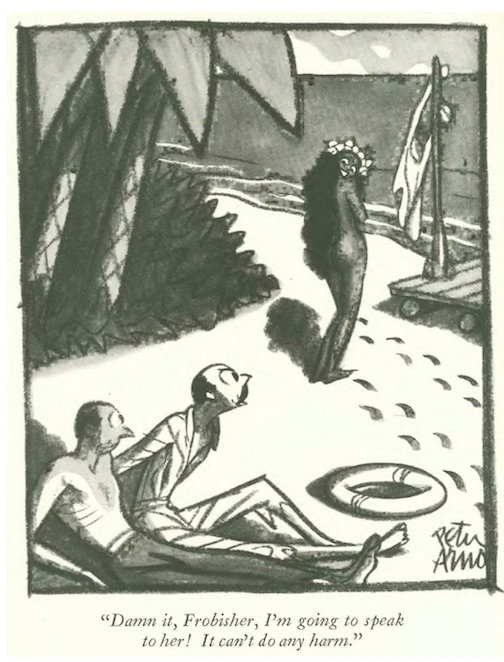
…Peter Arno with a very Arno-esque take on the stranded island trope…
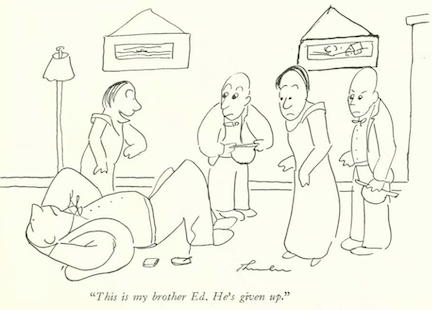
…James Thurber gave us a man who was done making decisions…
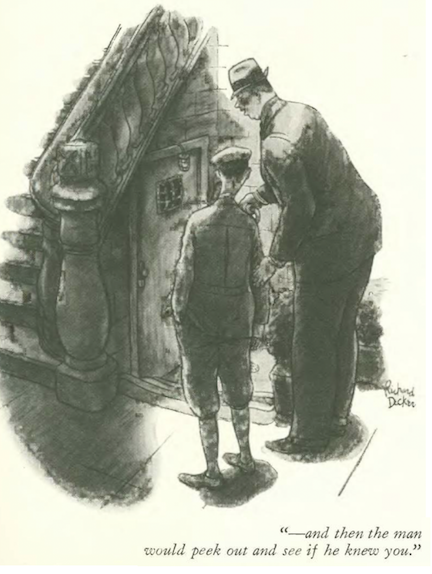
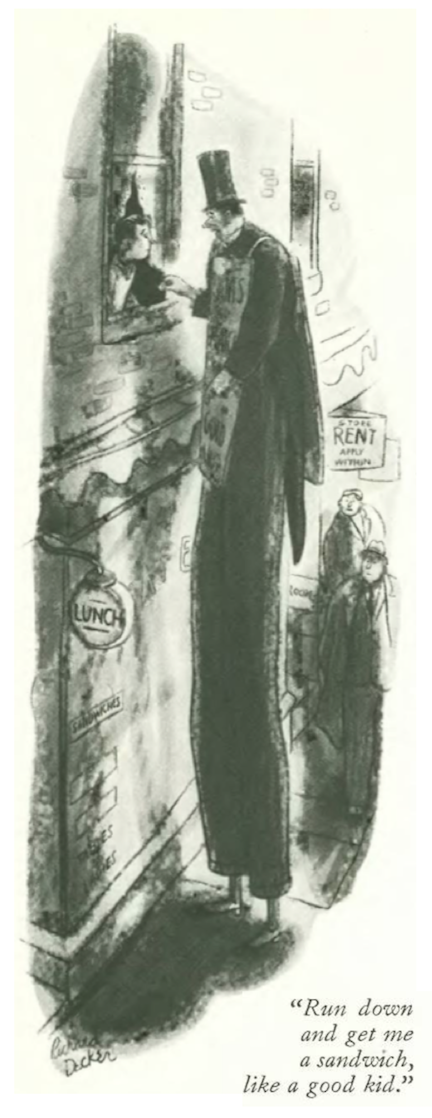
…Richard Decker offered up this living history demonstration…
…George Price gave us two tropes for the price of one…
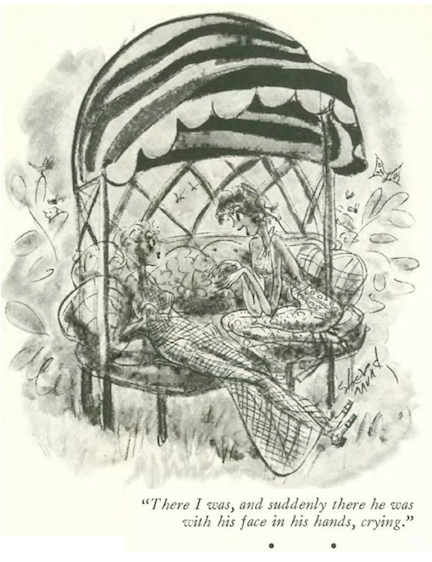
…Barbara Shermund gave us another glimpse into the lives of modern women…
…Rea Irvin continued his exploration of Manhattan’s fauna…
…our next cartoon is by Henry Steig, who used the pseudonym Henry Anton to avoid being confused with his brother, William Steig (featured on this issue’s cover)…unlike his brother, Henry was also a jazz musician, a sculptor and painter, a photographer, and a novelist…that is before he became a noted jeweler…
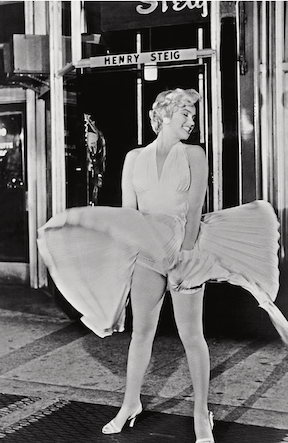
…Henry Steig’s jewelry shop at 590 Lexington Avenue can be glimpsed in the background of the famous subway vent scene from 1955’s The Seven Year Itch featuring Marilyn Monroe…
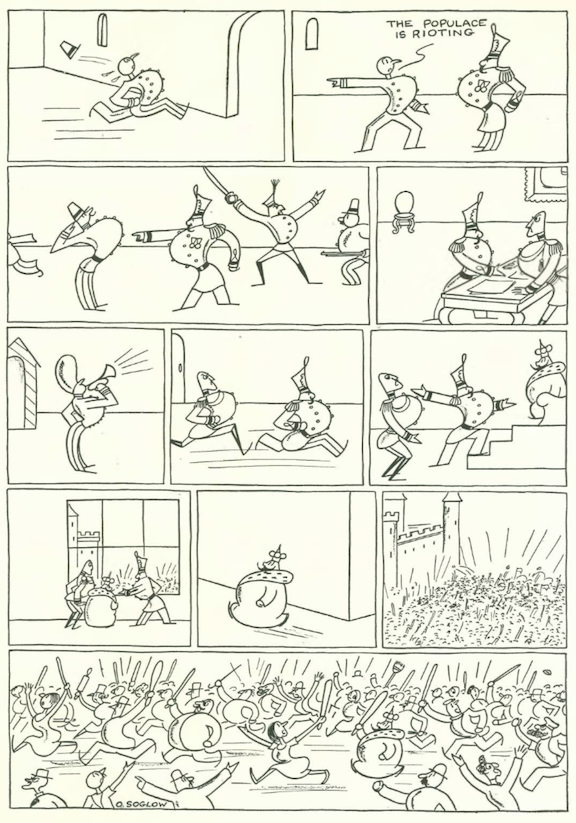
…and we close with Otto Soglow, and the last appearance his “Little King” in The New Yorker...William Randolph Hearst had lured Soglow away for his King Features Syndicate, debuting The Little King in his newspapers on September 9, 1934, where it would run until Soglow’s death in 1975…Soglow, however, would continue contributing cartoons of other themes to The New Yorker until 1974…
Photo above circa 1930 via mensfashionmagazine.com.
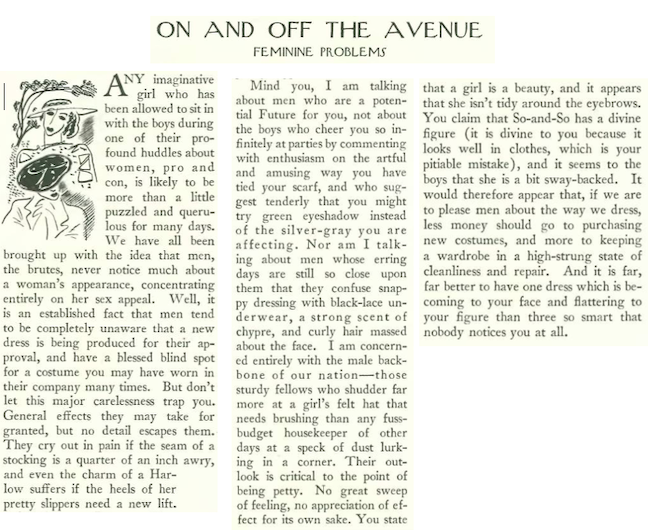
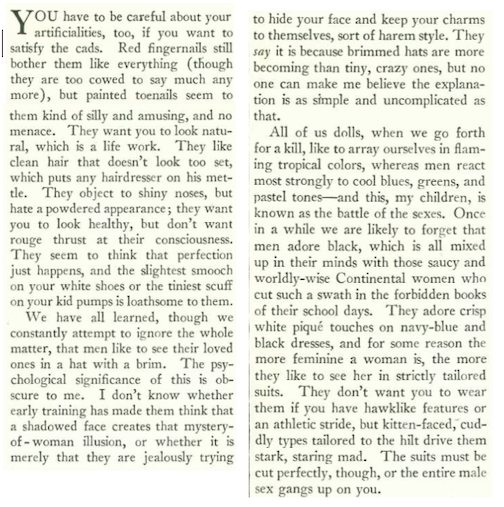
Lois Long took a break from reviewing the latest fashions to offer some thoughts on the relations between men and women, and more specifically, what was expected of women if they ever hoped to land the type of man who represented a “potential Future” for them.
August 4, 1934 cover by Otmar. Likely Otmar Gaul, sometimes spelled “Ottmar.”
Based on what we know about Long, this column has a strong “tongue-in-cheek” quality. It should also be noted that the 32-year-old Long had been divorced from cartoonist Peter Arno for three years, and was possibly contemplating the dating scene (she would marry newspaper ad man Donaldson Thorburn in 1938). In this excerpt, Long dispelled the notion that “the brutes” never notice a woman’s appearance:
THEY MIGHT BE BRUTES, but they notice the little things, according to Lois Long. (fashionhistory.fitnyc.edu)
SEEING RED…According to Long, discerning men preferred women in brimmed hats (actress Sylvia Sidney models above), but found red fingernails to be disturbing. (glamourdaze.com/vintagehairstyling.com)SEEING RED in women’s clothes, however, wasn’t a problem, according to Long, who wrote that men liked to see women in bright, tropical colors. (clickamericana.com)
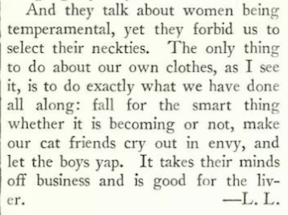
Long concluded that in the end, it didn’t matter what men thought about women’s clothes, but letting them “yap” about such things was a good way for them to blow off some steam.
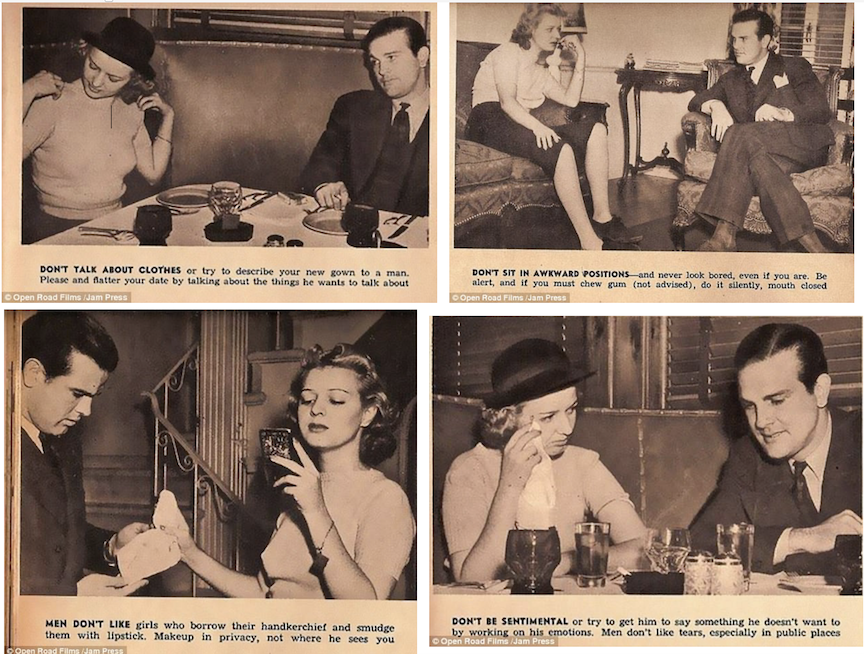
Check out these patronizing examples from an illustrated guide for women published in 1938 by Click Parade magazine. It gives us some idea of what Long, and millions of other women, were up against…
(dailymail.co.uk)
* * *
Fifth Avenue Remnant
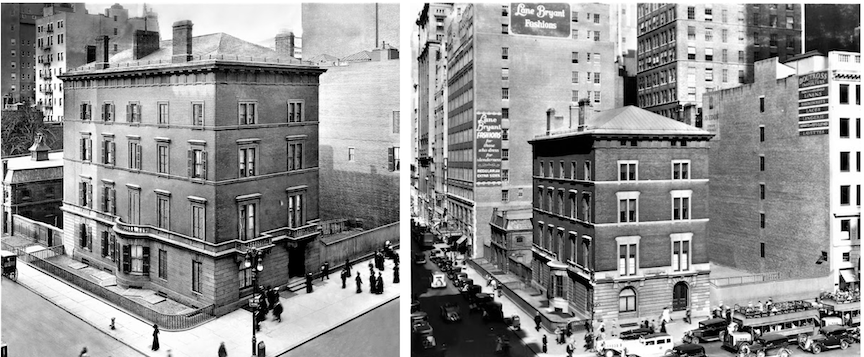
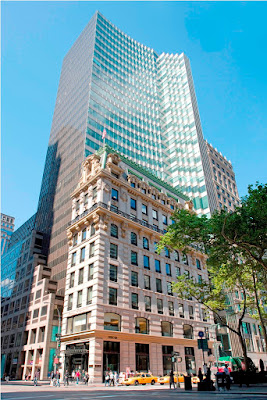
The first years of The New Yorker coincided with some of the most transformational years in Manhattan’s urban fabric, including the replacement of Gilded Age mansions with upscale commercial buildings. One of the last remaining mansions was the Wendel house, featured in “The Talk of the Town.”
A ONCE GRAND MANSION becomes diminished as the city grows around it. At left, the Wendel mansion as it appeared circa 1901; at right, shorn of its balconies and shutters, the mansion shrinks in contrast to the city around it, circa 1930. (Wendel Family Papers, Special Collections and Archives, Drew University Library)WHAT HO!…A “very British-looking” zinc-lined bathtub (with shower) was state-of-the-art when installed at the Wendel mansion. (New York Public Library)BARELY A MEMORY….The glass-and-steel structure towering above the former Knox Hat Building sits on the site of the Wendel mansion. (Photo by Nicolson & Gallowy via Daytonian in Manhattan)
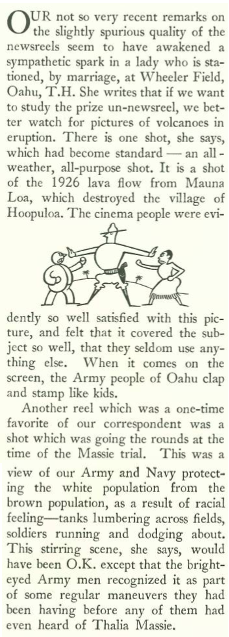
In his “Notes and Comment,” E.B. White noted the spurious nature of cinema newsreels, including one featuring the case of Thalia Massie, a navy wife stationed in Hawaii whose immature behavior and trail of lies would implicate five men in a crime they could not have committed (one would even be killed by vigilantes) and would cast Hawaii into a state of racial turmoil. (You can read more about it at the PBS site for American Experience.
FATAL FEMME…Thalie Massie, circa 1930. (Library of Congress)
* * *
Blunders, Part II
Howard Brubaker commented on the twentieth anniversary of the outbreak of the Great War. Today we call it World War I, and as we know, the blunders did not cease with the Armistice.
* * *
RIP Madame Curie
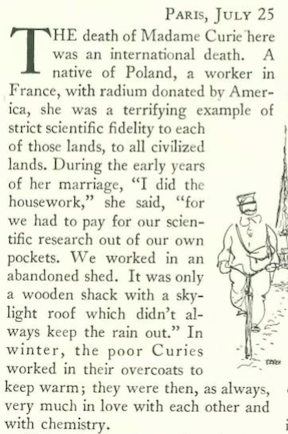
Janet Flanner, Paris correspondent for The New Yorker, noted the passing of Marie Curie, a pioneer in field of radioactivity.
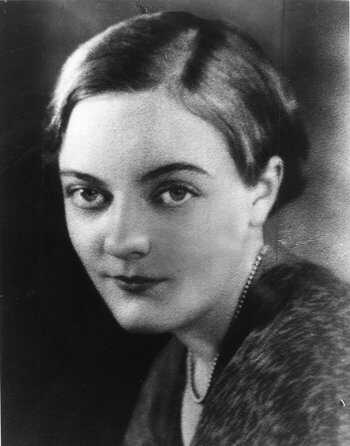
THE CURIE CURE…Marie Curie and daughter Irène, 1925. (Wikipedia)
* * *
From Our Advertisers
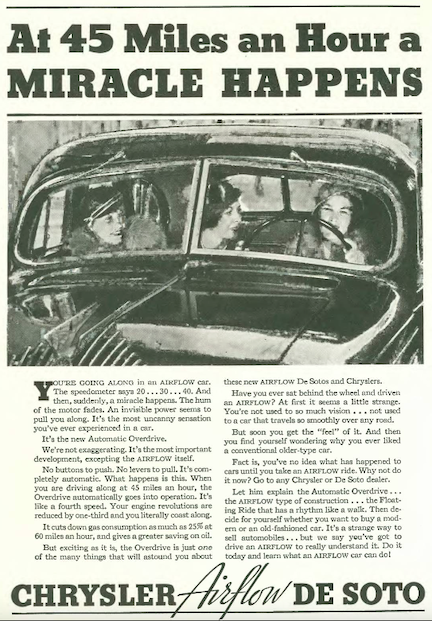
The folks at Chrysler were trying every angle to get car buyers interested in the Airflow—although the car offered a number of advanced features, consumers just weren’t ready for its radical aerodynamic design…note how the ad downplays the car’s sweeping curves…
…and we have more deception from the cigarette industry, including claims that cigarettes gave you more energy and improved the performance of top athletes…
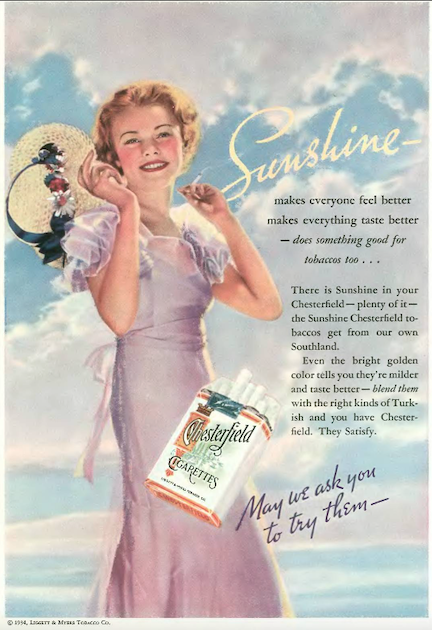
…the makers of Chesterfields gave us this sunny picture of health…indeed, there was sunshine in every pack…
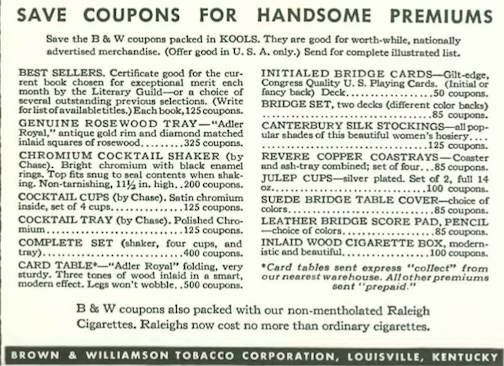
…The Brown & Williamson Tobacco Company launched KOOL cigarettes in 1933 as the sole competitor to the other menthol brand, Spud, which was a big advertiser in the early New Yorker. Maybe it was the coupons, or the modern brand name, that helped KOOL knock Spud from the market by the 1940s. As for those coupons, it appears each pack contained only one of them…
…so you would have to smoke a ton of those things to get one of these swell prizes…
…early Budweiser ads often featured images of the Old South…here they conjured up the ghost of Mark Twain (who had been dead only 24 years), putting the great humorist and writer on par with their bottled beer…
…Canada Dry didn’t have Mark Twain, but what they did have was a beer (Hupfel’s) lacking “that queer yeasty taste that beer usually has”…
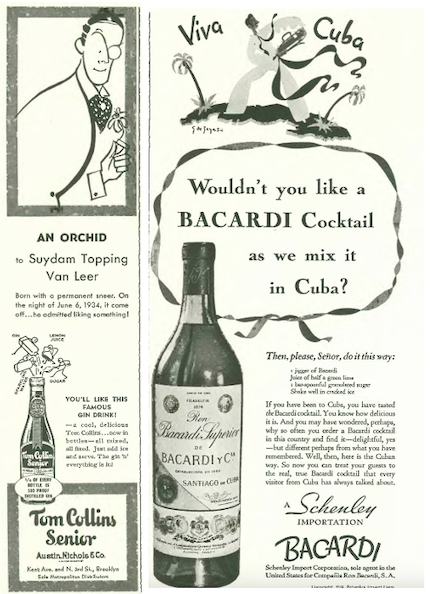
…a couple of ads from the back pages featured, at left, an ad for a pre-mixed Tom Collins, which must have been awful, and at right, a spot for Bacardi rum, which was actually made in Cuba before the revolution…
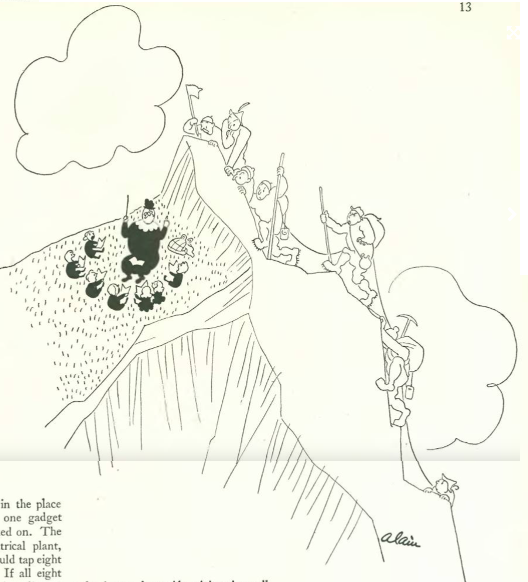
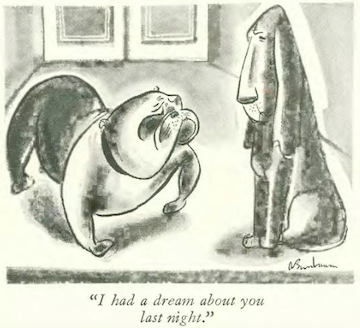
…on to our cartoons, we begin with Alain (Daniel Brustlein) and some not-so-intrepid mountain climbers…
…Otto Soglow’s Little King sought a glimpse of the street life…
…William Steig took a dip with his Small Fry…
…Isadore Klein gave us a glimpse of sensationalist radio reporting…
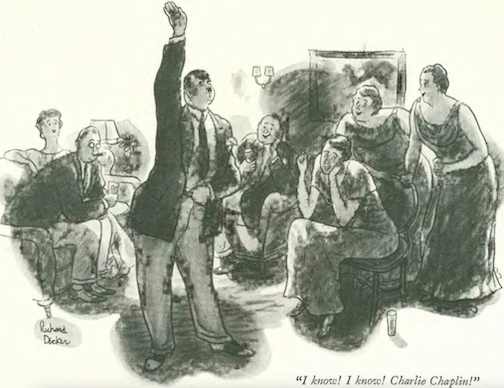
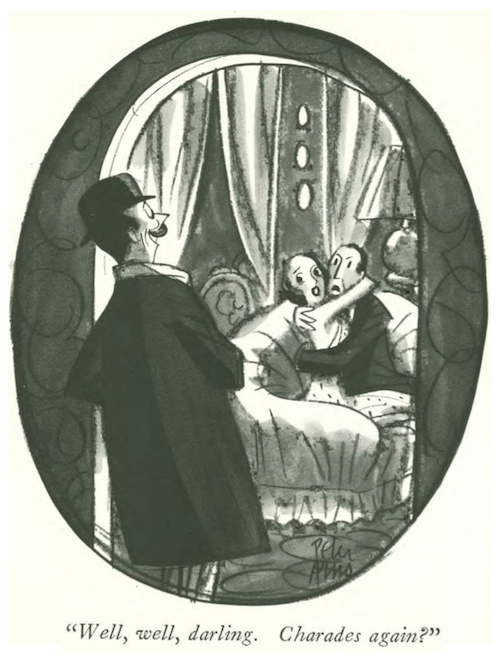
…and we close with Richard Decker, and a game of charades…
Power broker Robert Moses always made sure he was few steps ahead of any possible opposition to his grand development plans in and around New York City. That included the yacht clubbers along the Hudson River, who were more or less erased from the scene by Moses in one fell swoop.
May 19, 1934 cover by Ilonka Karasz.
The Upper West Side’s Columbia Yacht Club probably thought it was just swell that the city was dumping waste and rock along the shores of the Hudson River, since it eventually created driveway access for members who previously had to access the club via a footbridge over the New York Central’s tracks. What hadn’t occurred to them was that nearly 25 years-worth of infill had also created a new strip of land that extended from 79th to 96th street, land that Moses envisioned as an expansion of Riverside Park (and the abrupt end of the West Side yacht club scene). “The Talk of the Town” explained:
LOCATION, LOCATION…Two views of the Columbia Yacht Club at West 86th Street, circa 1930. The club was razed to make room for Robert Moses’s expansion of Riverside Park. Moses’s ambitious project, which cost twice as much as Hoover Dam, put the train tracks underground and topped the park with the Henry Hudson Parkway. (newyorktoursbygary.blogspot.com/NYPL Digital Collections)HEADS UP…Elsie Henneman dives into the water near the Hudson River Yacht Club, circa 1930. Located at the foot of West 74th Street, the club moved onto a barge at 145th Street to escape Moses’s park expansion plans, but it was eventually banished from the West Side. (Reddit)
* * *
Ode to the Road
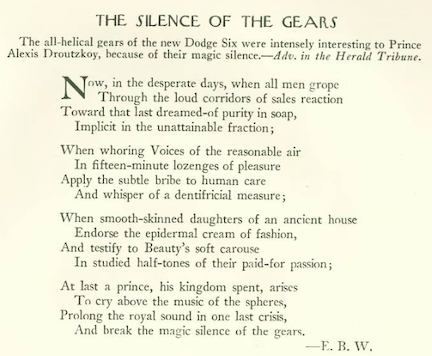
We now shift gears to E.B. White, who was poetically inspired by an advertisement in the Herald Tribune that featured Prince Alexis A. Droutzkoy (a member of the exiled White Russian colony in New York) praising the “magic silence” of the new “Dodge Six” automobile:
SILENCE OF THE CAMS…The 1934 Dodge Six. (detail from a vintage ad)
* * *
Führer’s Filmmaker
The ability (or inability) to separate art from an artist’s personal conduct or beliefs has been a particular topic of the last two decades, given the litany of stars who have been “cancelled” despite the quality or importance of their work. The work of German filmmaker Leni Riefenstahl (1902–2003), still debated nearly ninety years after her collaboration with Nazi leaders, demonstrates the fine line many a film historian or critic must walk when assessing the career of an innovative artist (for an American example, see filmmaker D. W. Griffith). Riefenstahl’s 1932 film, The Blue Light (Das blaue Licht), made prior to her Nazi collaborations, was praised for its beauty by American critics, including the New Yorker’sJohn Mosher, when it was released in the U.S. in 1934.
The Blue Light also captivated Adolf Hitler, who saw the attractive and athletic Riefenstahl as an ideal of Aryan womanhood. A subsequent meeting with Hitler would result in Riefenstahl’s controversial 1935 Nazi propaganda film Triumph of the Will (Triumph des Willens). We will explore that film, and Riefenstahl’s role, in a later post.
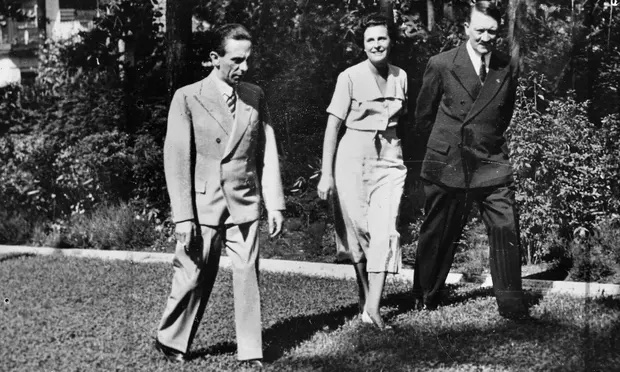
CAREER MOVE…Clockwise, from top left, Leni Riefenstahl demonstrated her acting ability, athleticism and filmmaking talents in 1932’s The Blue Light (Das blaue Licht); Riefenstahl filming in Nuremberg during the 1934 Nazi Party congress—the footage was used in 1935 Nazi propaganda film Triumph of the Will; working at a film cutting table, 1935; with Adolf Hitler at Nuremberg, 1934. (IMDB/Library of Congress/UTK Cinema Studies/The Irish Times)HI HITLER…Nazi propaganda minister Joseph Goebbels and Adolf Hitler pay a visit to Leni Riefenstahl at her Berlin estate, circa 1937. (Roger-Viollet)
* * *
From Our Advertisers
We begin with more Carl “Eric” Erickson-inspired artwork, here promoting the bygone elegance of transatlantic travel…
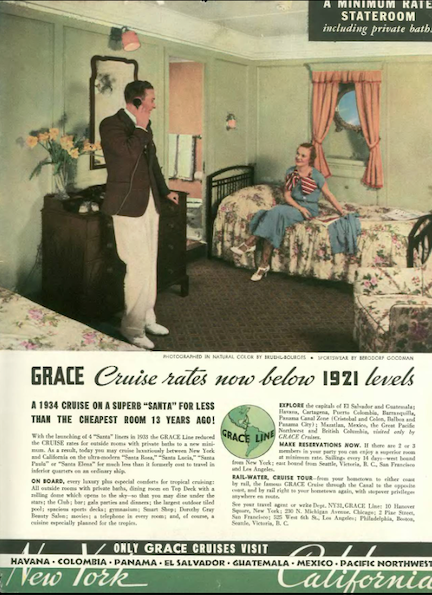
…perhaps a bit less upscale but still pretty nice, the “Santa” line of ships operated by the Grace Line between New York and Latin America included air-conditioned interiors paneled with aluminum (a fireproofing measure) and spacious cabins with private baths that faced to outside…
…this ad must have been a happy sight to folks who had to endure more than a decade of bootleg Scotch during Prohibition…
…Smirnoff vodka had its origins in 1860s Russia, capturing two-thirds of the Moscow market by the mid-1880s…forced to leave Russia in 1904 after the Tsar nationalized the Russian vodka industry…Smirnoff relocated to Turkey, then Poland, and then Paris, each time with limited success…at the end of Prohibition the brand relocated once again to a distillery in Bethel, Connecticut, hence this advertisement…
…the habanero pepper has been used to infuse everything from tequila to vodka to whiskey…this particular product was marketed as something new that could be mixed with a variety of spirits or topped up with club soda or ginger ale…
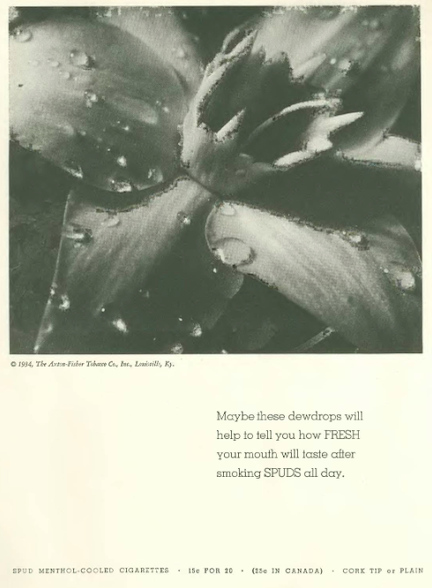
…I include this ad from the maker of Spud cigarettes for its sheer audacity…it claims your mouth will feel dewdrop fresh after an entire day of smoking menthols…
…stunt driver Billy Arnold was one of the “Hell-Drivers” Chrysler employed to tout the safety of its low-priced Plymouths at promotional events…
…including Chicago’s “Century of Progress”…below, a crowd watches Arnold take his Plymouth for a roll and emerge unscathed…
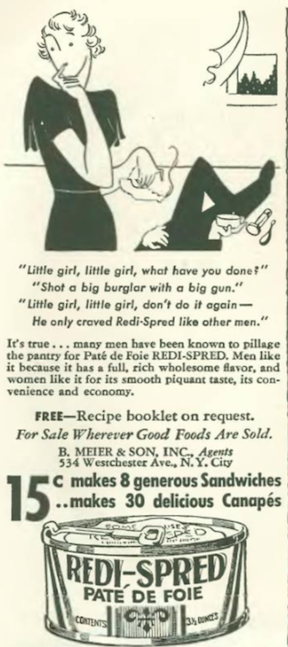
…the folks at Redi-Spred employed a murder theme to promote their “Pâté de Foie”…which foie was used…duck, goose or lord knows what, is not specified…
…the signature is muddled, but this looks like another illustration by Herbert Roese, who never published a cartoon in the New Yorker but sure had its style down, especially Peter Arno’s…
…Harold Ross’s high school friend and cartoonist John Held Jr. was a frequent contributor to the New Yorker from 1925 to 1932 (he also contributed to Life, Vanity Fair, Harper’s Bazaar), but when demand for his Jazz Age cartoons and illustrations fell off in the 1930s, he turned to painting and illustrating children’s books. So it was a surprise to catch this glimpse of Held’s work in a one-column ad promoting a Held-drawn map of New England inns…
…speaking of elusive illustrators, I am often challenged to discover the identities of spot illustrators in the early issues…this one appears to be signed by “Maurice Dreco”…
…the signature on this one looks like “Saphire,” but again, it is not clear…
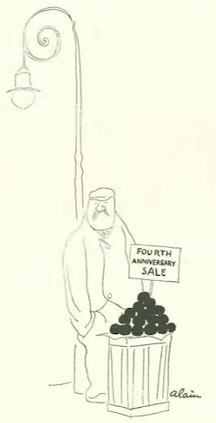
…but there is no doubt this little gem is by Daniel ‘Alain’ Brustlein…
…which leads us to Richard Decker, and a hostage situation gone flat…
…and Decker again, with a back-handed compliment…
…James Thurber was in his familiar world of dogs and battling sexes…
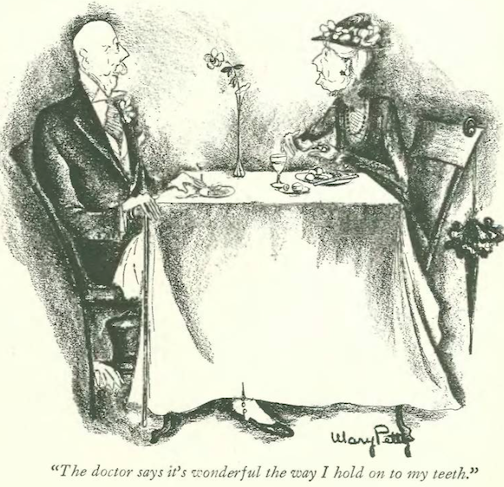
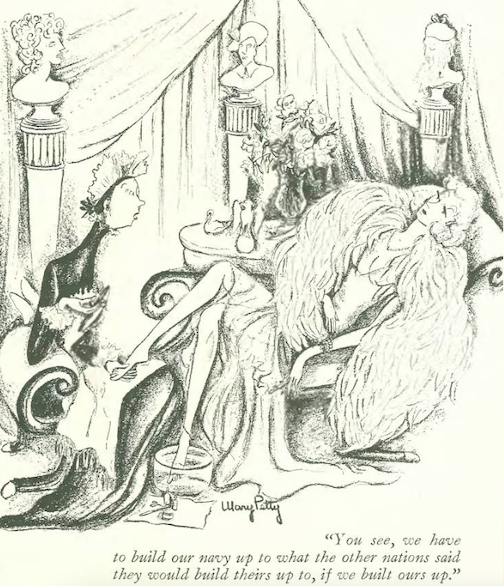
…Mary Petty found some good news on the dentistry front…
…Otto Soglow’s Little King believed more is merrier…
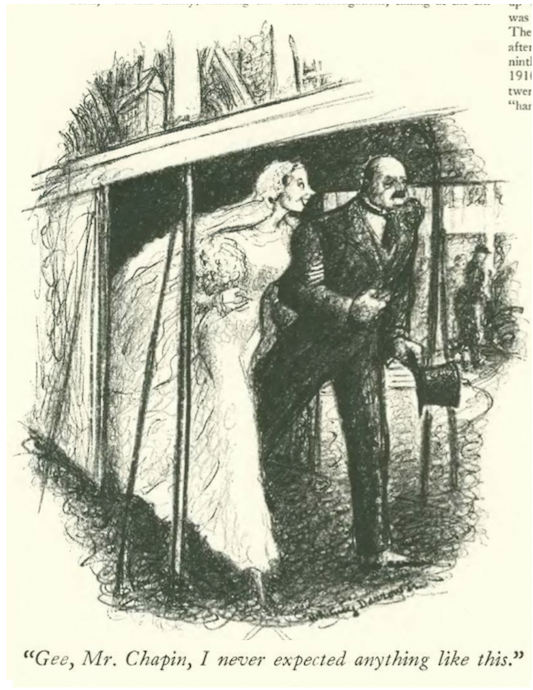
…and we close with William Crawford Galbraith, and a wedding day surprise…
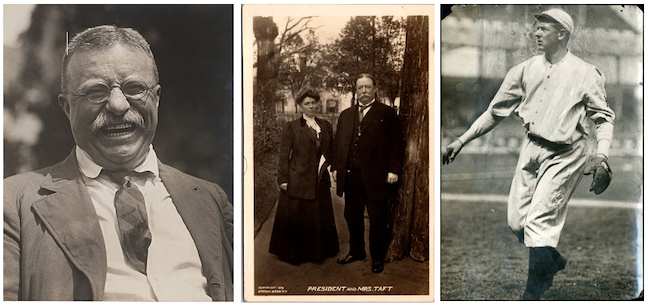
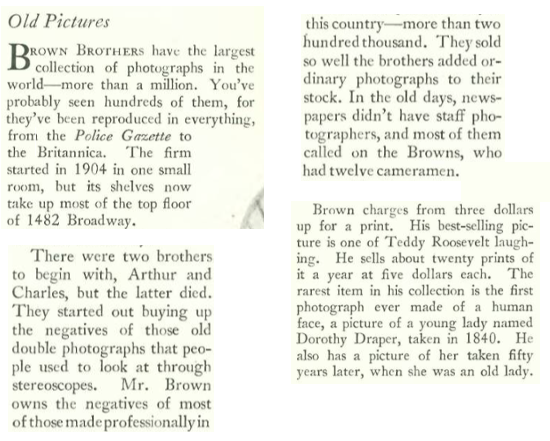
Above, from left: When Teddy Roosevelt announced in 1912 that he would run for president against his former VP, William Howard Taft, Brown Brothers sent photographer Charles Duprez to Oyster Bay to take this famous photo; President Taft and his wife, Helen “Nellie” Taft, in 1909; famed New York Giants pitcher Christy Mathewson warms up before a game, circa 1912. (liveauctioneers.com/cabinetcardgallery.com/psacard.com)
Before there were photo agencies like Magnum or archives such as Getty Images there was a company named Brown Brothers, the world’s first stock photo agency founded by Arthur and Charles Brown in New York City in 1904.
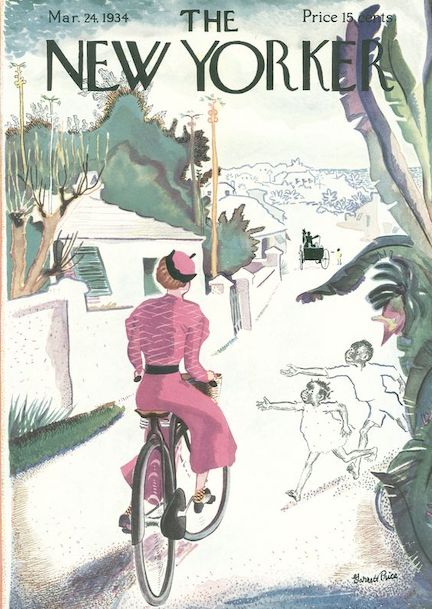
March 24, 1934 cover by Garrett Price.
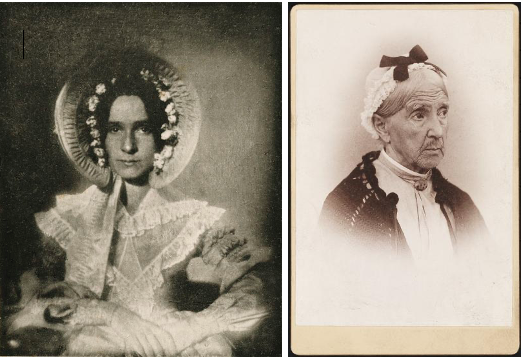
“The Talk of the Town” looked in on Brown Brothers, “the largest collection of photographs in the world—more than a million,” including a famous image of Teddy Roosevelt and the first photographic portrait of a woman’s face.
Brown Brothers photos could be seen everywhere in the early 20th century—their staff of twelve photographers provided images to New York newspapers at a time when the technology for publishing photos in the dailies was in its infancy and most papers didn’t employ staff photographers. Even the venerable New York Times hired the Browns to cover news events until they established their own team of photographers.
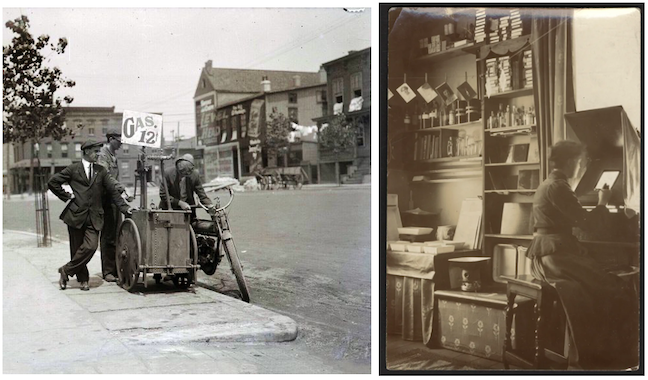
LITTLE DID DOROTHY DRAPER KNOW that she would become world famous when she sat for this photo (left) taken by her brother Dr. John W. Draper in his Washington Square studio at NYU in 1839 or 1840. Dorothy had to sit unblinking for the 65-second exposure—apparently her brother dusted her face with white flour to enhance the contrast. The Drapers still go down in history as creators of the oldest photo of a woman; at right, Dorothy Draper in the 1890s, in a photograph taken by her nephew. (boweryboyshistory.com/MCNY)ONE IN A MILLION…The early 20th century image at left is just one of as many as three million images amassed in the Brown Brothers archive; at right, a Brown Brothers archivist at work. (Pinterest/sportscollectorsdigest.com)
Note: The Brown Brothers’ archive of photos and negatives went up for sale in 2014, and was ultimately acquired by Leland’s in 2020.
* * *
De Terraplane!
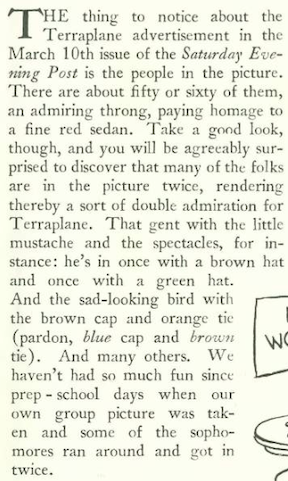
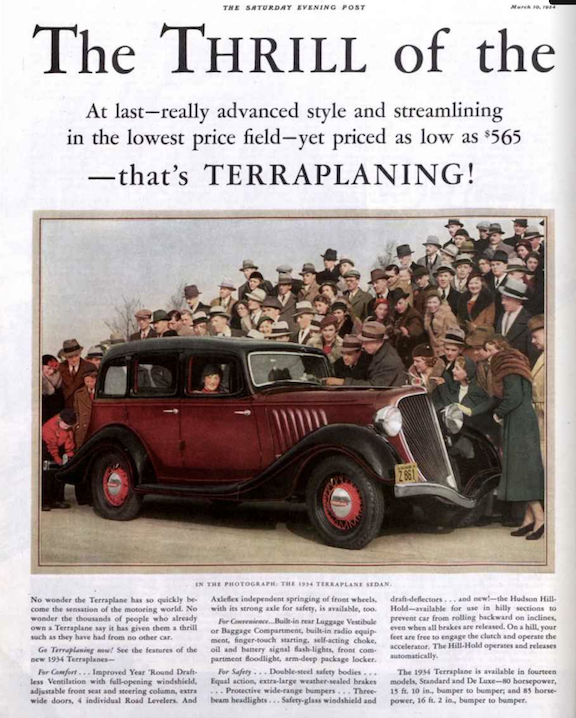
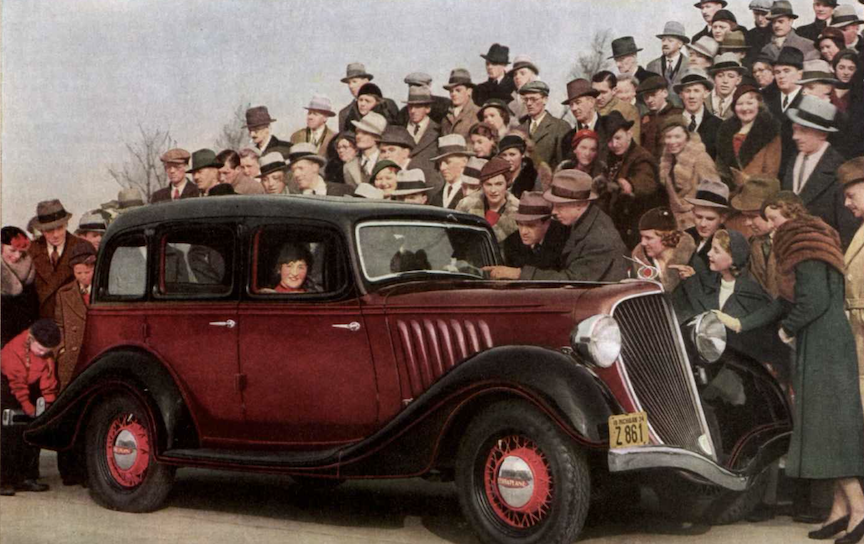
E.B. White (in “Notes and Comment”) was also looking at a photo, or rather scrutinizing one that was featured in a Saturday Evening Post advertisement for Hudson’s Terraplane:
…here is the ad from the Post…
…and a closer look at the image, which had White seeing double.
(Both images courtesy The Saturday Evening Post)
* * *
Escape Artist
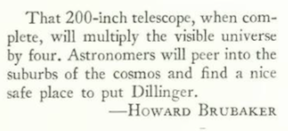
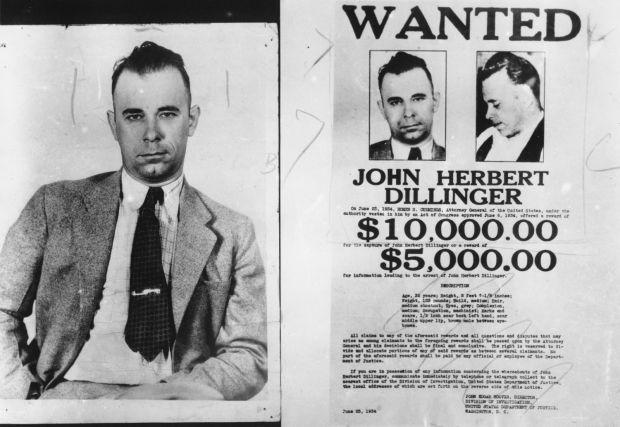
In his “Of All Things” column, Howard Brubaker included the following item about a new telescope, ostensibly to set up a quip about John Dillinger’s recent prison break (his second):
YOUR DAYS ARE NUMBERED…The FBI issued this “Wanted” poster of gangster John Dillinger— “Public Enemy No. 1″—in June 1934. The Feds gunned him down a month later. (AP Photo)
* * *
Playing Nice
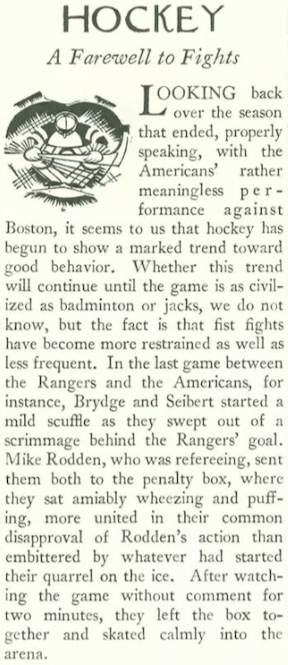
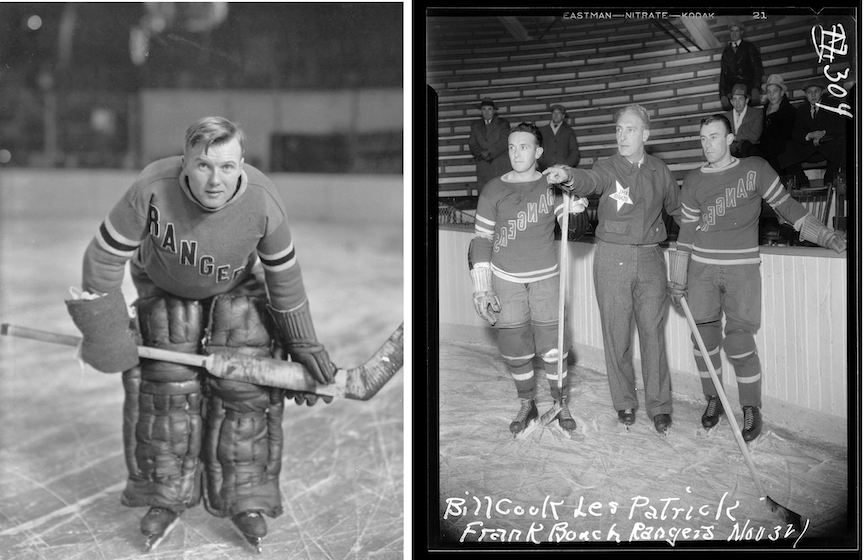
The New Yorker commented on the trend toward fewer fights in the world of hockey, and although fighting in general ebbed a bit through mid-century, it nevertheless remained a staple of the game. Indeed the New York Rangers founder, Tex Rickard, who also promoted boxing at Madison Square Garden, knew quite well that hockey fights were one reason folks attended the games.
FACE OFF?…At left, goaltender Andy Aitkenhead of the New York Rangers padded his legs and arms but put his clean-shaven mug on the line in December 1934— it wasn’t until 1959, 42 years into the NHL’s existence, that a league goalie wore a mask on the ice. At right, New York Rangers captain Bill Cook (right) flanks coach and manager Lester Patrick alongside Frank Boucher on the ice at the Chicago Stadium in November of 1934. (Pinterest)
* * *
From Our Advertisers
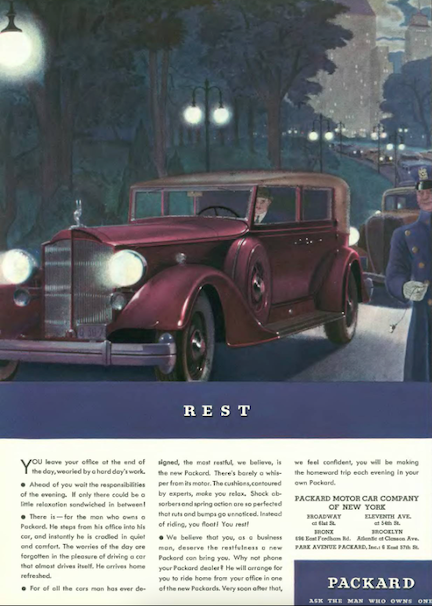
We begin with this sumptuous ad from Packard, appealing to those who could afford to own this luxury brand…
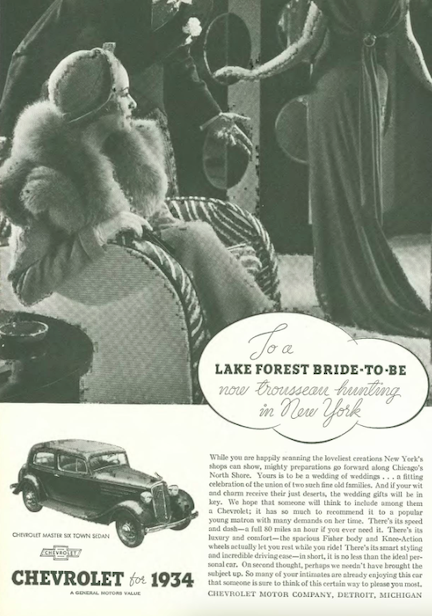
…if you couldn’t afford a Packard, you could rest assured that even a well-heeled deb could be happy with a Chevy…
…the folks at Powers Reproduction continued to tout the wonders of their color photography, even if their cake looked less than appetizing…
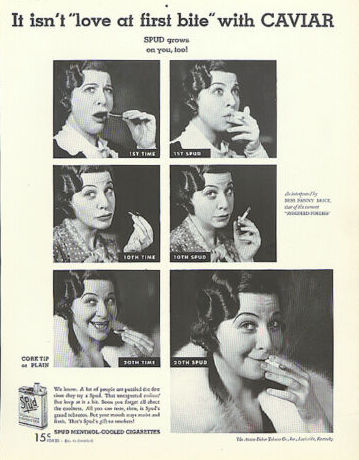
…Fanny Brice was appearing with the 1934 Ziegfeld Follies on Broadway, so the folks at Spud jumped on her celebrity bandwagon…
…while R.J. Reynolds was suggesting we replace our chewed up pencils with a nice Camel cigarette…now, don’t you feel better?…
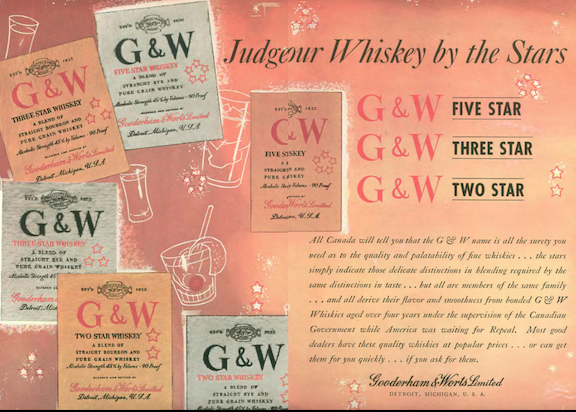
…the Canadian distillery giant Gooderham & Worts offered all sorts of options to calm our jangled nerves in this two-page spread…
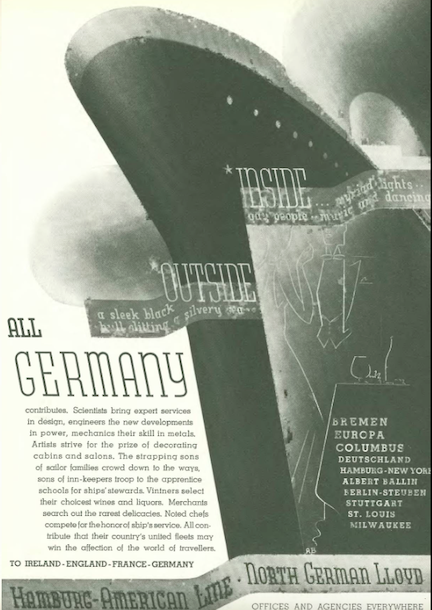
…while the Germans continued to entice us onto their cruise ships perfected by science and featuring “the strapping sons of sailor families”…hmmm…
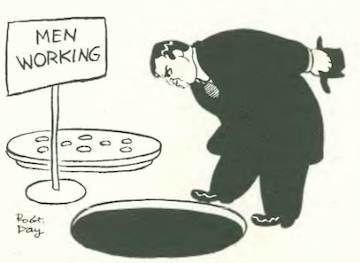
…in 1934 the New Yorker began featuring mostly wordless cartoons on the opening page of “The Talk of the Town,” including this one by Robert Day featuring Mayor Fiorello LaGuardia checking up on city employees…
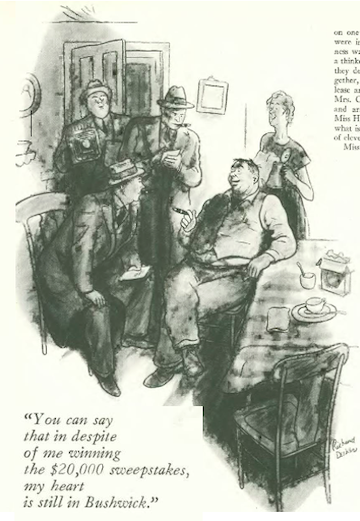
…Richard Decker gave us an Irish Sweepstakes winner from Brooklyn who displayed some modesty and media savvy…
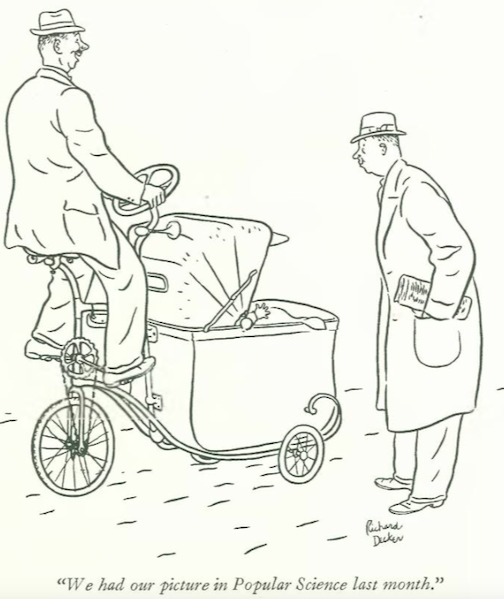
…Decker again, with the latest in perambulators…
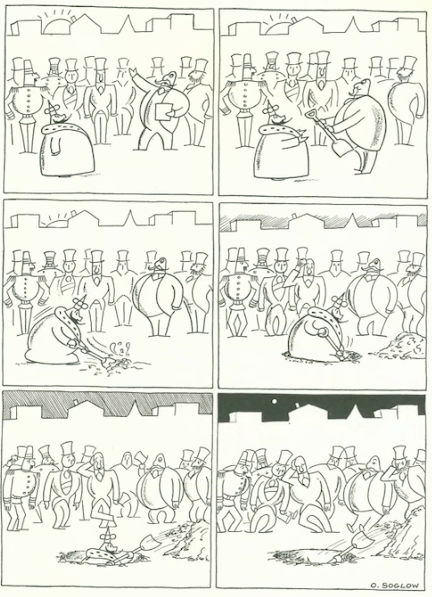
…Otto Soglow’s Little King put his back into a ceremonial groundbreaking…
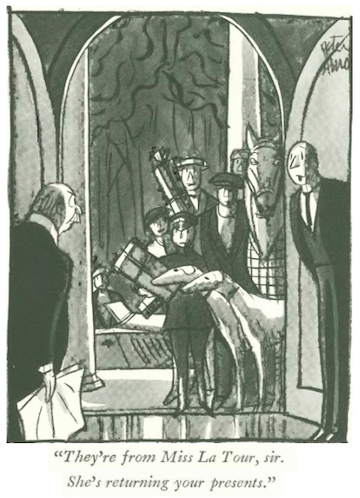
…Peter Arno’s sugar daddy received some not-so-happy returns…
…one of William Steig’s “Small Fry” was doing some serious reading…
…and James Thurber’s war continued from the rooftops…
…on to March 31, 1934…
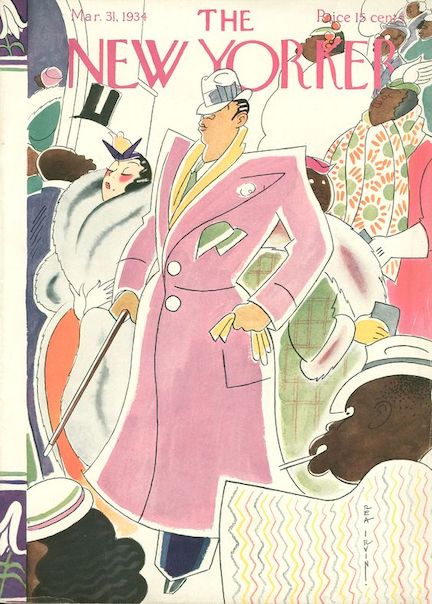
March 31, 1934 cover by Rea Irvin.
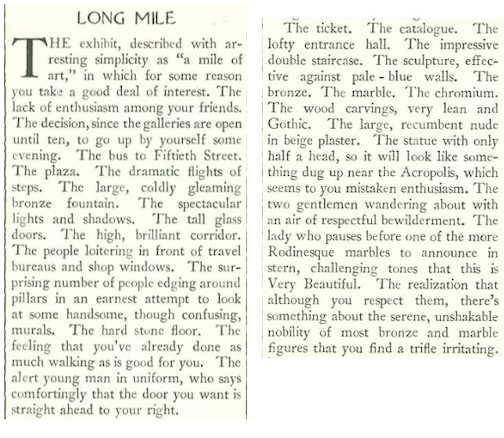
…where we find Alice Frankforter covering an exhibition dubbed “A Mile of Art.” I’m guessing critic Lewis Mumford passed on this opportunity to offer some blistering commentary. As for Frankforter, she found the spectacle puzzling, if not irritating. An excerpt:
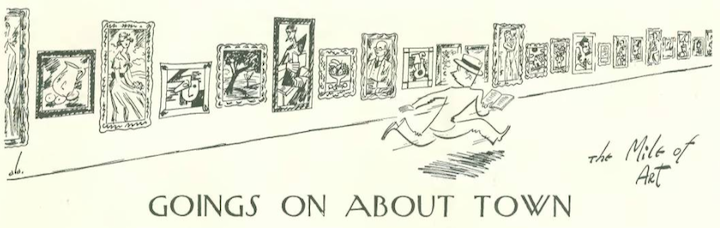
Constantin Alajalov offered his perspective on the art world stunt with this bit of spot art…
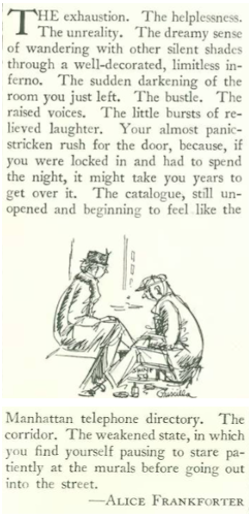
…and more from Frankforter, now reaching a state of exhaustion and near-delirium as she approached the end of the exhibit:
* * *
Biblical Babbitts
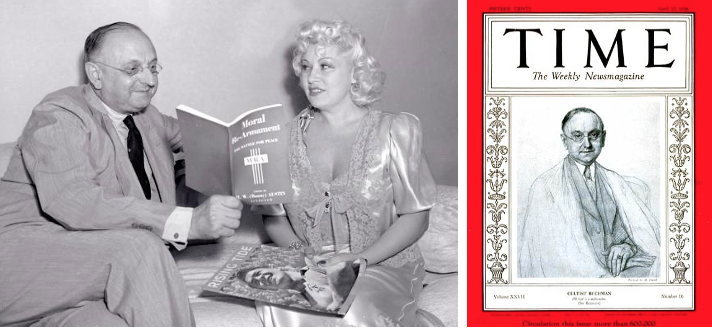
Frank Buchman’s First Century Christian Fellowship (aka the Oxford Group) meeting in New York featured a lot of people chuckling and bubbling, but all that forced conviviality left critic Edmund Wilson feeling “quite morose.” Writing for the “A Reporter at Large” column, Wilson looked in on the group as they awaited Buchman’s arrival at a preliminary rally. The column was subtitled, “Saving the Better Classes and Their Butlers.” An excerpt:
Like other critics at the time, Wilson saw “Buchmanism” as bourgeois optimism and boosterism, interested more in converting the souls of the wealthy and celebrated rather than serving the needs of poor.
ODD COUPLE…Frank Buchman liked to be seen with the rich and famous. In 1939 he asked for a half hour of Mae West’s time, ostensibly to get this photo of him sharing some wisdom from his “Moral Re-assessment” booklet. West seems less than enamored by the encounter, regarding Buchman as some sort of alien creature; right, Buchman on the cover of April 20, 1936 edition of Time, which identified him as “Cultist Buchman.” (maewest.blogspot.com/Time)
* * *
Carnegie’s Couture
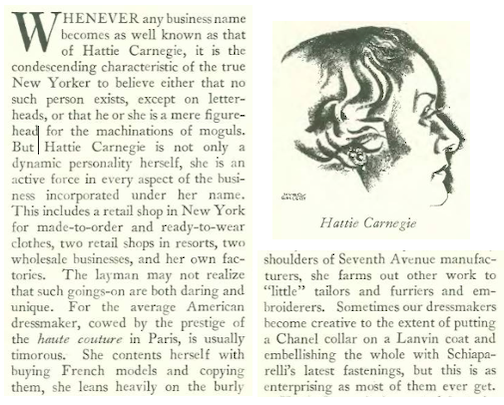
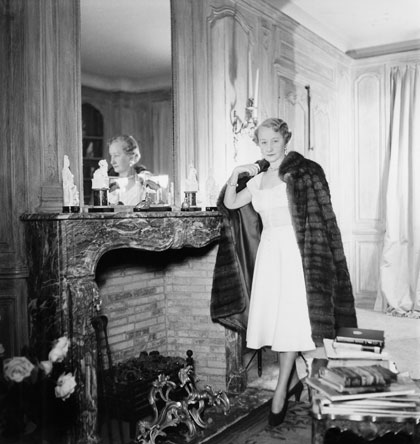
Vogue magazine fashion editor Nancy Hardin and the New Yorker’s fashion editor Lois Long teamed up on a profile about Hattie Carnegie (1889 -1956) titled “Luxury, Inc.” Born Henrietta Kanengeiser in Vienna, Carnegie immigrated with her family to New York in 1900; nine years later she adopted the name “Carnegie” after Andrew Carnegie, the richest person in America. Through hard work and an inherent instinct for what American women desired, she built a fashion design business that thrived in Depression and catered to stars and celebrities including Tallulah Bankhead, Joan Fontaine, Lucille Ball, and Joan Crawford. An excerpt, with illustration by Hugo Gellert:
FUR SURE…Hattie Carnegie posing for a 1951 Vogue magazine photo. (Vogue)
* * *
Steampunk Dream
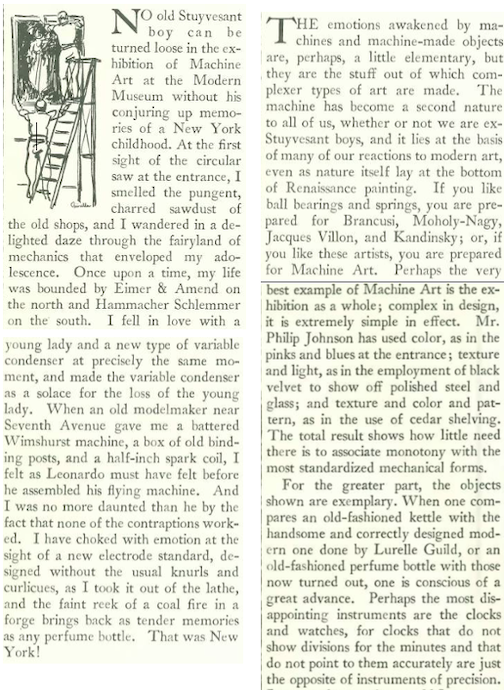
In my previous entry I featured Robert Coates’s observations on the new Machine Art exhibition at the Museum of Modern Art. For the March 31 issue critic Lewis Mumford, celebrant of the simple and unpretentious, waxed nostalgic over the novel exhibit:
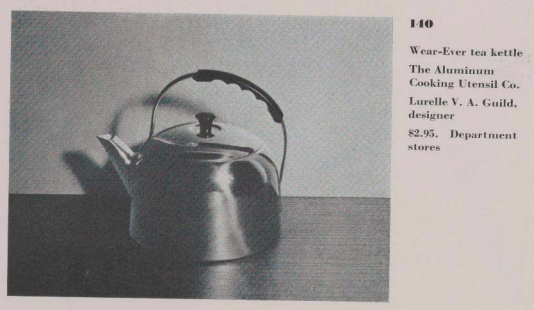
I’M A LITTLE TEAPOT that made a big advance in the design world, according to critic Lewis Mumford. (MoMA)
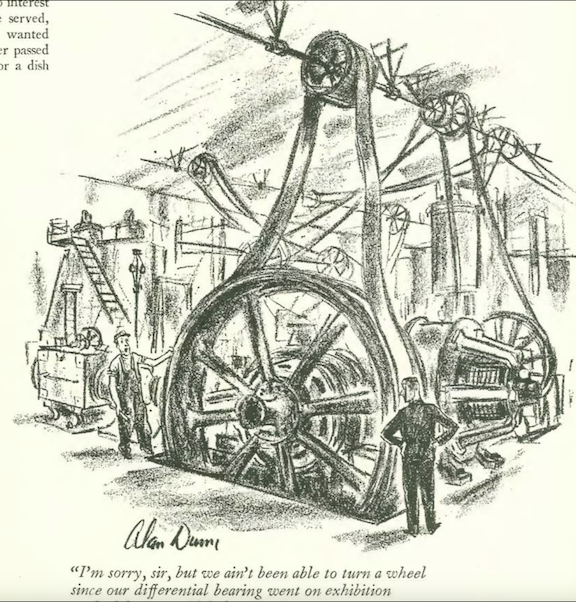
Alan Dunn was also inspired by the exhibit, as evidenced in this cartoon from the April 7 issue…
* * *
More From Our Advertisers
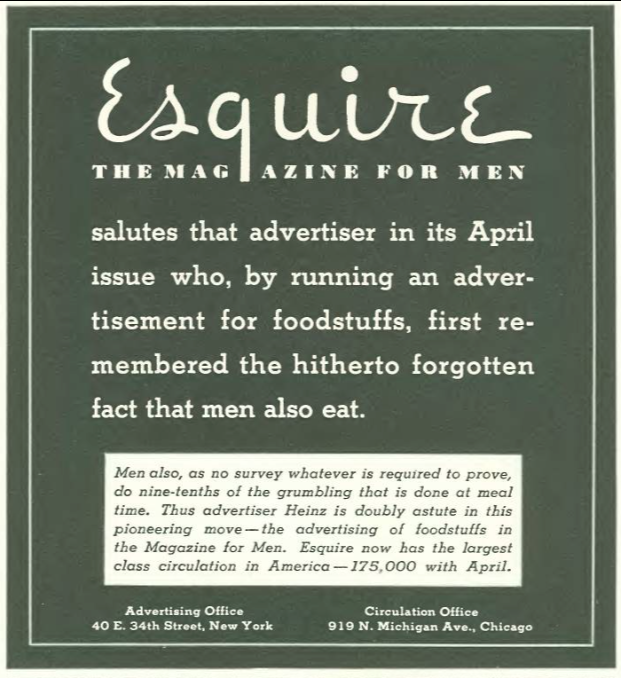
Founded in October 1933, the men’s magazine Esquire took off with a bang, and the publishers were not shy about boasting of its early success…
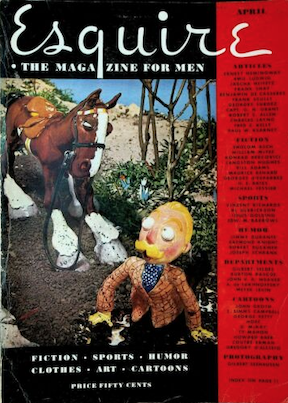
…cover of the April 1934 issue, featuring the mustachioed mascot Esky…based on a drawing by cartoonist E. Simms Campbell, Esky was featured on the cover in various situations until 1961…
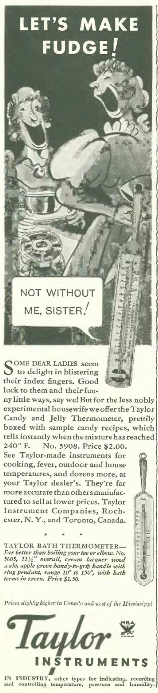
…Peter Arno’s “Whoops Sisters” appeared sixty-three times in the New Yorker between 1926 and 1927 before Arno retired them (they occasionally popped up in other publications, and in a 1931 Cunard ad)…it seems odd that they would make an appearance in a cheap thermometer ad in 1934…at any rate, it is difficult to tell if this is by Arno or by a clever forger…
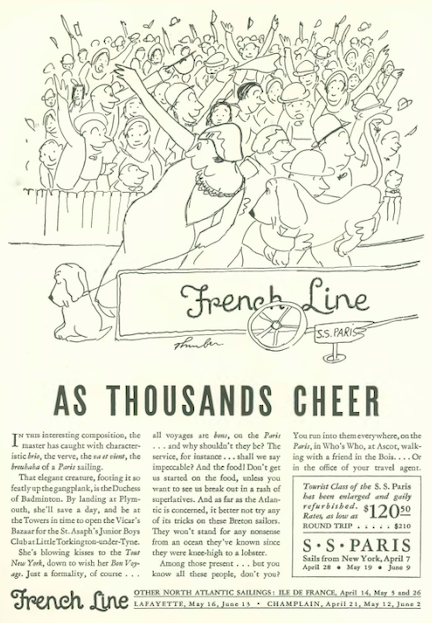
…there’s no mistaking the cartoonist behind this ad…
…and this one by Otto Soglow…
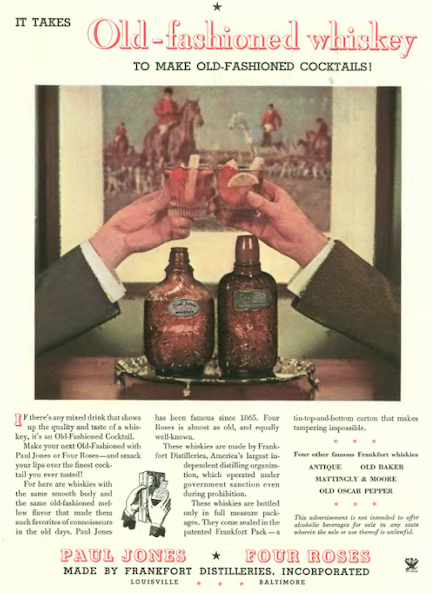
…and we close our advertising section by raising a glass to Frankfort Distilleries…
…on to our March 31 cartoons, and a lineup of New Yorker regulars Abe Birnbaum…
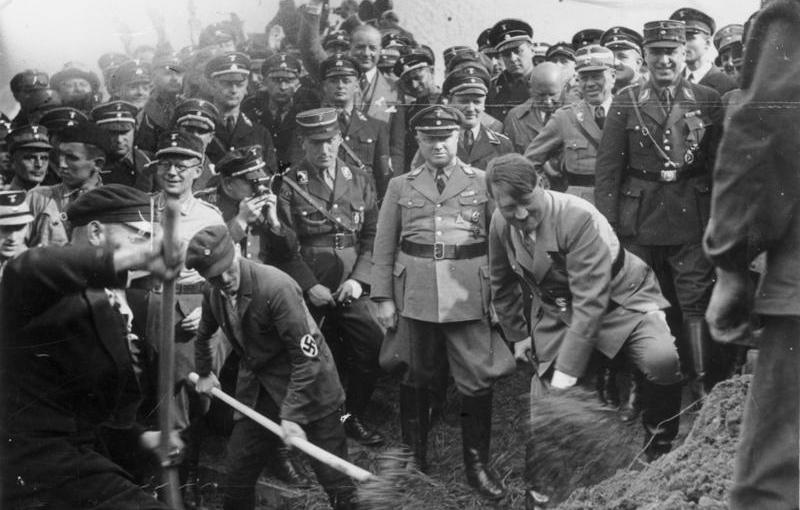
Above: Adolf Hitler at a groundbreaking ceremony for a new section of the Reichsautobahn highway system, 1933. (Bundesarchiv)
Mildred Gilman was one of the highest paid female reporters in the 1920s, interviewing everyone from murderers to heads of state. But when she arranged to interview Adolf Hitler in 1933, the Gestapo got nervous and threw her out of the country.
Feb. 10, 1934 cover by Harry Brown.
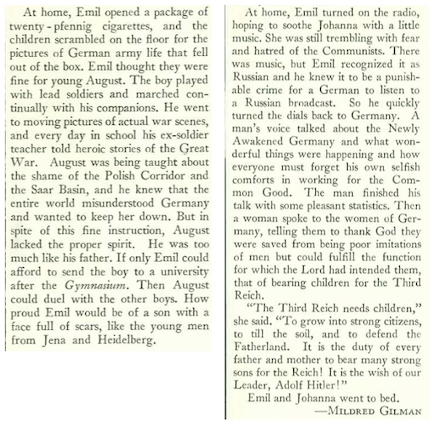
Gilman (1896-1994) doubtless sought a modicum of satisfaction when she penned “Made in Germany” for the Feb. 10, 1934 issue. I am including generous excerpts below, which describe the day in the life of an average Berliner named Emil Pfalz, a man who doesn’t question the omnipresent Nazi propaganda and often worries about his ability to keep in step with the new regime.
THERE’S SOMETHING HAPPENING HERE…Berliners (left) and residents of Worms (top) inspect Nazi propaganda that instructed Germans not to do business with Jewish people (on Jan. 24, 1934, the German government banned Jews from membership in the German Labor Front, depriving them of the opportunity to find employment); below, in early 1934 a simulated uprising was staged in Berlin (with people posing as casualties) as part of Nazi maneuvers. Later that summer SS and Gestapo forces would conduct a purge known as “Night of the Long Knives,” eliminating any known or suspected dissenters of the Nazi regime. Hundreds were murdered and many more arrested. (digitallibrary.usc/Wikipedia)GRIM FAIRY TALE…As a loyal citizen, Emil Pfalz was sure to teach his children the Nazi salute. Image from a Nazi propaganda booklet. (British Library Board)
Emil’s story continues as he contemplates his duties as a father and husband in the Third Reich…
…and heeds the call to produce more Aryan babies.
What the Nazis did not want more of was chronically ill or disabled persons. The sick minds of Nazi propagandists produced this image below, which argues that for the same daily amount of reichsmarks you could either support an entire Aryan family or a single mentally disabled person…in 1933 the Law for the Prevention of Hereditarily Diseased Offspring was passed, allowing for the forced sterilization of those regarded as ‘unfit’. In 1939 the regime began killing the disabled (up to 250,000 people).
A final note about the writer, Mildred Gilman. In addition to being a journalist of both daring and flair, she wrote eight novels including the bestseller Sob Sister. In her younger days she was employed as a secretary for New York World columnist Heywood Broun and partied with Dorothy Parker, Alexander Woollcott, and Robert Benchley. She wrote a profile of Paul Robeson for the Sept. 21, 1928 issue of The New Yorker.
Mildred Gilman in 1938.
* * *
Up In Smoke
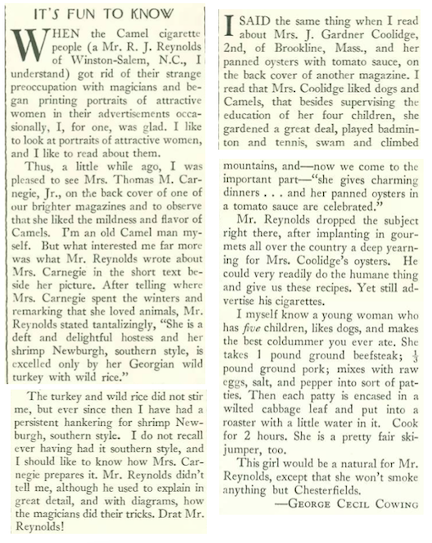
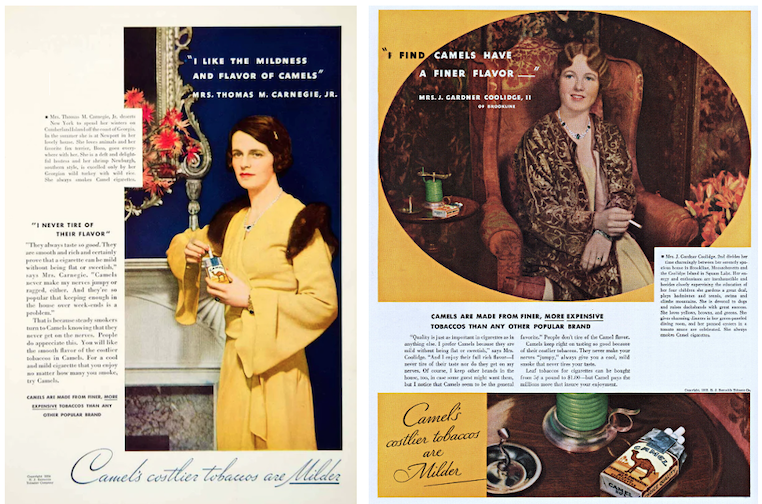
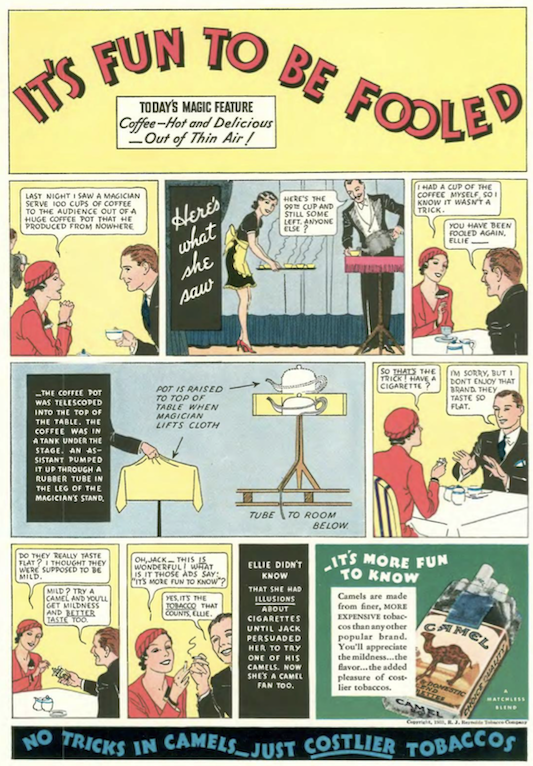
George Cecil Cowing, known for his whimsical “Boulevardier” column for the Pasadena Star-News, commented on the changing themes adopted by cigarette manufacturers, namely the folks at R.J. Reynolds who abandoned their magician-themed ads for their Camel brand (“It’s Fun to Be Fooled”) for spots featuring endorsements from second-tier society women…
POSH PUFFERS…”Mrs. Thomas M. Carnegie Jr.” (Virginia Beggs) and “Mrs. J. Gardner Coolidge II” (Mary Louise Coolidge) shared their favorite dishes and their love for smoking Camels in these ads, which appeared in The New Yorker in early 1934.
* * *
From Our Advertisers
Appropriately we turn to our advertisers, where we find the Camel brand trying out a new theme that demonstrated their product’s appeal to plainer folks…
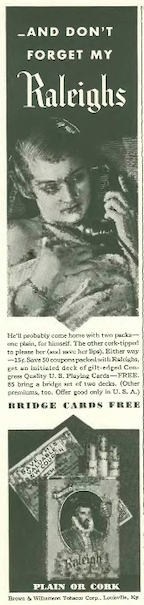
…Brown & Williamson’s first national brand, Raleigh, was launched as a premium cigarette in 1928, here marketed with a plain or cork tip (“to please her and save her lips”)…
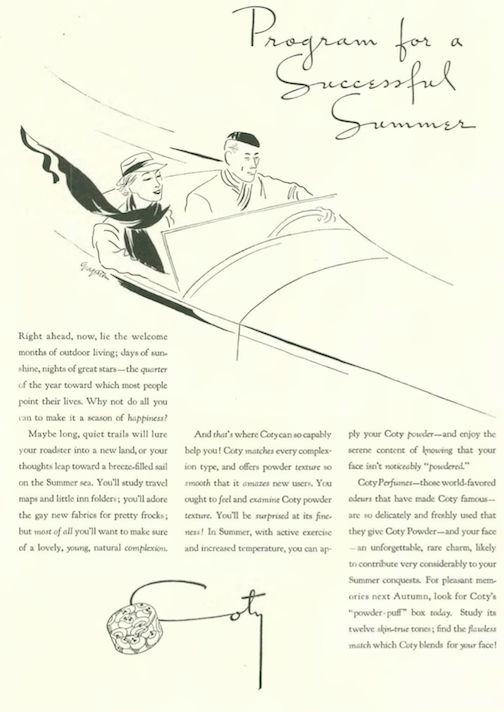
…in his parody of Camel ads, George Cecil Cowing wrote that he preferred Chesterfields, a big-time brand of mid-century America…
…the makers of White Rock reveled in the newly found freedoms of legalized alcohol…
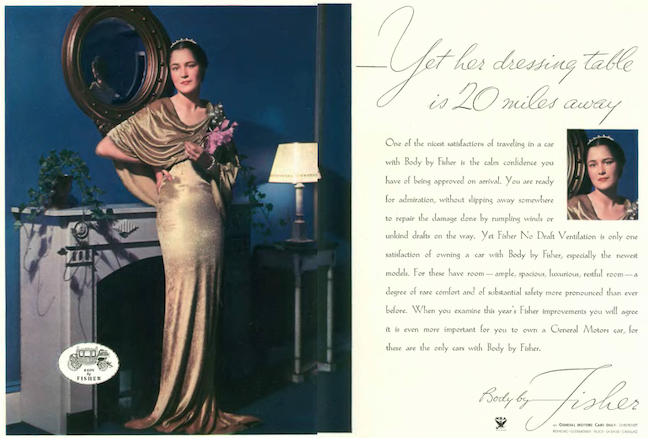
…the folks at Fisher were sticking with their lavish two-page color ads and what has always been a tiresome double entendre…
…Lord & Taylor took to the skies to promote their “country clothes” to the smart set…
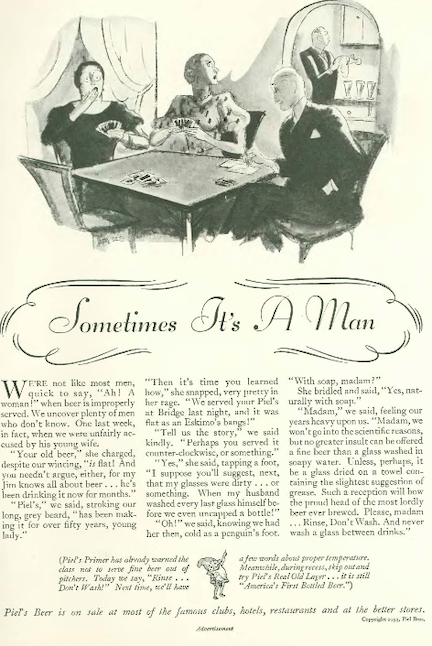
…and cartoonist Herbert Roese, who apparently never published a cartoon in The New Yorker, turned in this very New Yorker-looking illustration for Piel’s…
…on to our cartoonists, we begin with Clarence Day, better known for his Life With Father stories…
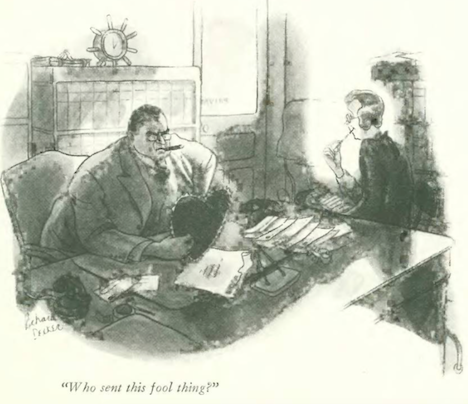
…the Valentine’s issue featured several themed cartoons, including these by Richard Decker…
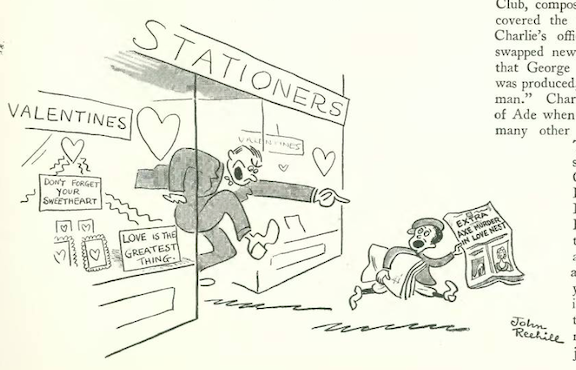
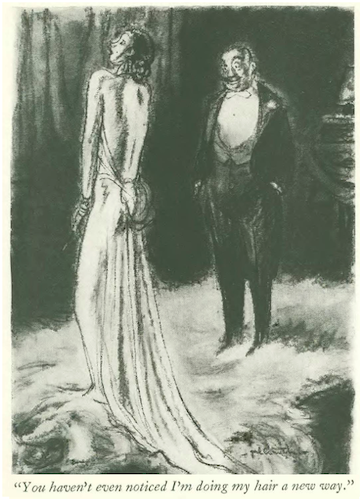
…and John Reehill…
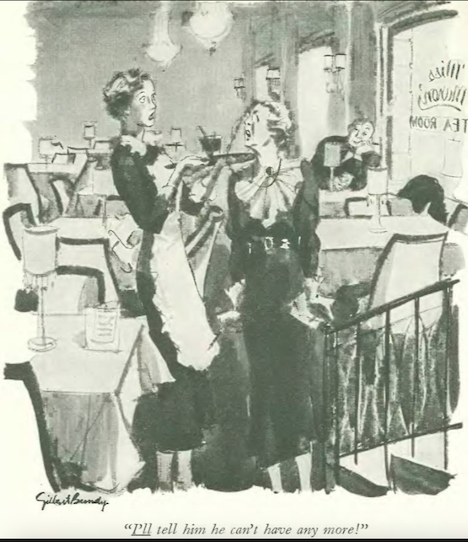
…love was also in the air for Gilbert Bundy…
…while William Crawford Galbraith continued to ply the waters of the creepily lustful…
…and we test different waters with Richard Yardley, a popular editorial cartoonist for The Baltimore Sun…this is the only cartoon he published in The New Yorker…
…the Westminster Kennel Club dog show was in town, here tapped by Helen Hokinson to also explore the theme of fatherhood…
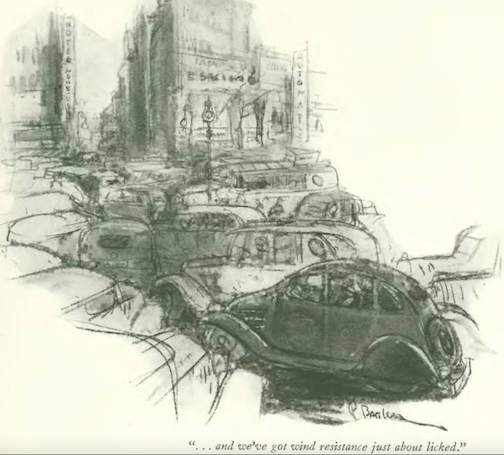
…Perry Barlow was the latest New Yorker contributor to mock the futuristic, aerodynamic style of Chrysler’s Airflow…
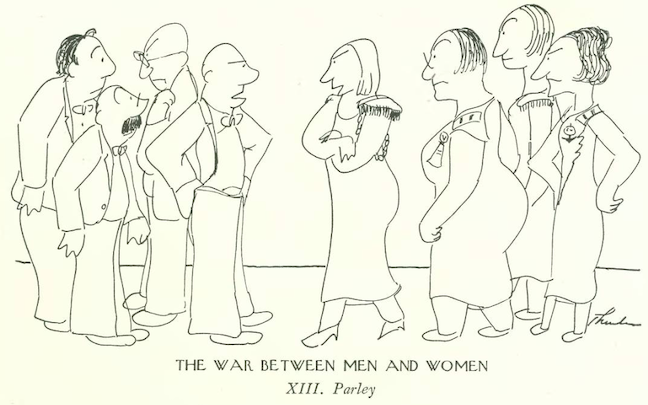
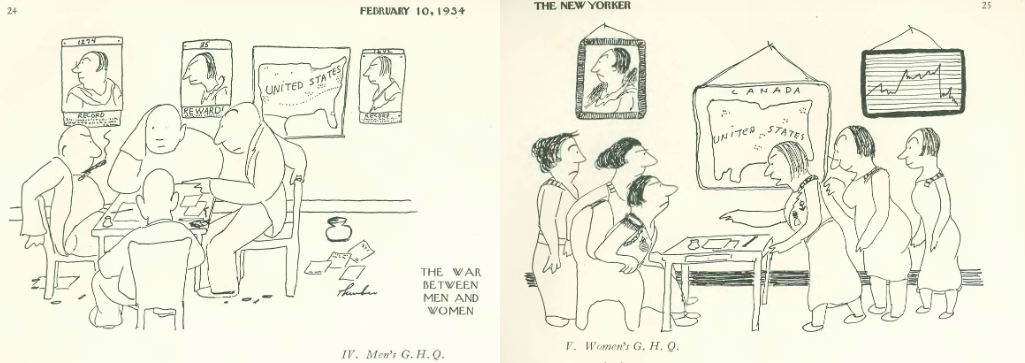
…and James Thurber’s “War Between Men and Women” paused as the two sides made preparations for the next battle…
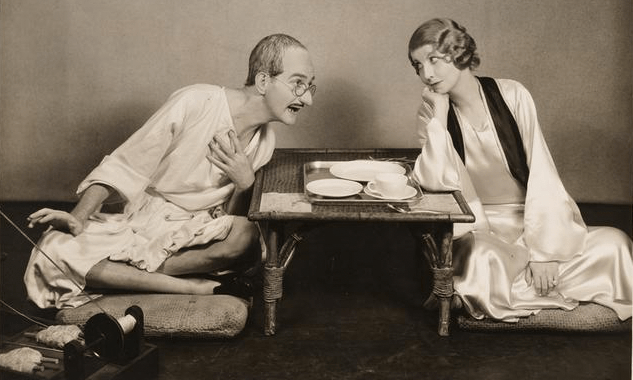
ABOVE: Broadway's As Thousands Cheer (1933) featured evangelist Aimee Semple McPherson (Helen Broderick) trying to persuade Mahatma Gandhi (Clifton Webb) to end his hunger strike and join her act. (NYPL)
Broadway gave Depression audiences a lift with As Thousands Cheer, a revue featuring satirical sketches that skewered the lives and affairs of the rich and famous and served as a precursor to sketch shows like Saturday Night Live.
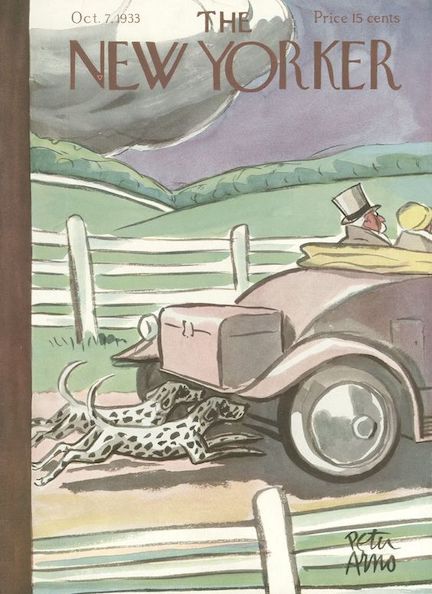
Oct. 7, 1933 cover by Peter Arno.
With a book by Moss Hart and music and lyrics by Irving Berlin, the revue was a big hit, playing for nearly a year on Broadway in its initial run.
TOON TIME…Marilyn Miller led a chorus of cartoon characters in a sketch titled “The Funnies” in As Thousands Cheer; leading the revue were Miller, Clifton Webb and Helen Broderick, here featured on the cover of the Playbill. The production would be Marilyn Miller’s last—one of Broadway’s biggest stars known for playing sunny characters, her personal life was filled with illness and tragedy, and she would go to an early death in 1936. (playbill.com)
Wolcott Gibbs took his turn as Broadway reviewer, and pronounced As Thousands Cheer “the funniest thing in town.”
Not everything was roses in As Thousands Cheer: In a poignant star turn, Ethel Waters sang—at Irving Berlin’s request—his famous tune “Supper Time,” a Black woman’s lament for her lynched husband. The revue was the first Broadway show to give an African-American star (Waters) equal billing with whites, however she was segregated from her co-stars and did not appear in any sketches with them. Her co-stars even refused to bow with her at the curtain call until Berlin intervened. According to the James Kaplan biography Irving Berlin, “The show had a successful tryout at Philadelphia’s Forrest Theatre in early September, although opening night was marred by an ugly incident all too in tune with the times: the stars Clifton Webb, Marilyn Miller, and Helen Broderick refused to take a bow with Ethel Waters. To his everlasting credit, Berlin told the three that of course he would respect their feelings—only in that case there needn’t be any bows at all.
“They took their bows with Waters at the next show.”
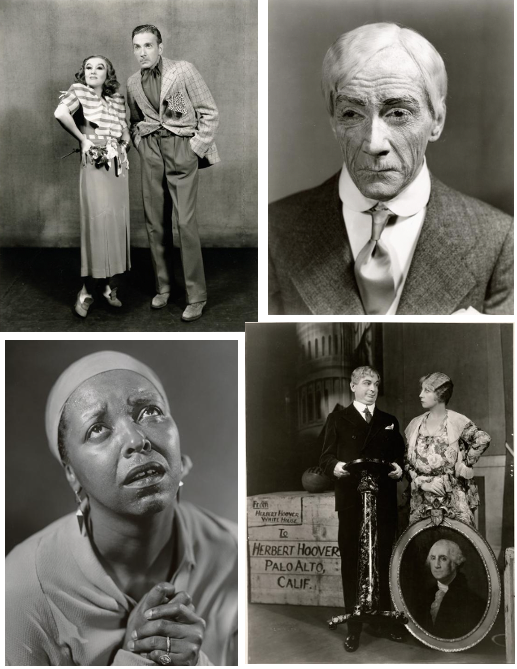
NEWSMAKERS…Each sketch in As Thousands Cheer was preceded with a newspaper headline. Clockwise, from top left, in the sketch headlined JOAN CRAWFORD TO DIVORCE DOUGLAS FAIRBANKS, JR, Marilyn Miller and Clifton Webb portrayed the stars arguing over publicity rights to their divorce; Webb as 94-year-old John D. Rockefeller; the headline FRANKLIN D. ROOSEVELT INAUGURATED TOMORROW featured Mr. and Mrs. Herbert Hoover on their last day in the White House, portrayed by Leslie Adams and Helen Broderick; Ethel Waters singing Irving Berlin’s “Supper Time.” (New York Public Library)
* * *
A Final Byline
E.B. White opened his column with a tribute to Ring Lardner, who died at age 48 of a heart attack and other complications. In the months before his death Lardner had contributed a number of comical “Over the Waves” radio reviews.
JOURNALIST AT HEART…Ring Lardner (1885-1933) worked for several newspapers before settling at the Chicago Tribune in 1913—it became the home newspaper for his syndicated column, In the Wake of the News. (Chicago Tribune)
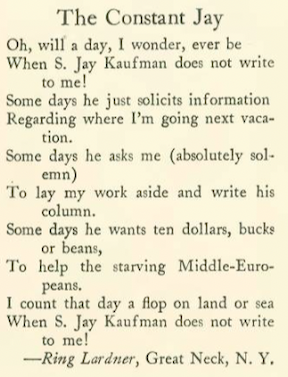
Lardner’s first contribution to The New Yorker came shortly after the magazine’s founding. “The Constant Jay” was published in the April 18, 1925 issue: Readers appreciated his subtle wit, including this oft-quoted gem:
“The race is not always to the swift nor the battle to the strong—but that’s the way to bet.”
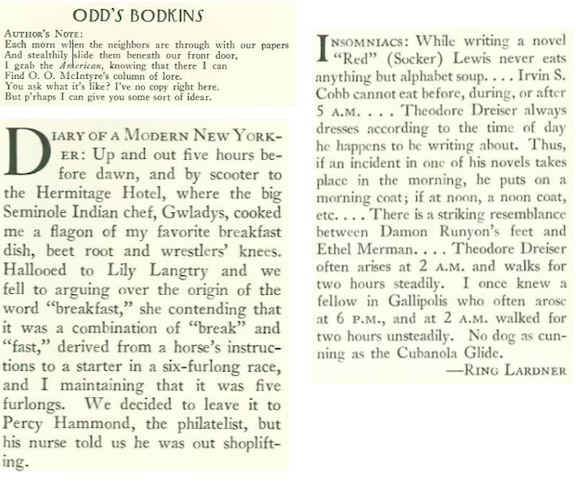
Lardner also liked to poke fun at himself and his aw-shucks view of things. Here are the opening and closing paragraphs of his final New Yorker contribution, “Odd’s Bodkins:”
* * *
Macy Modernism
As Lewis Mumford observed in his “Skyline” column, Macy’s was the first department store to embrace a modern approach to interior design, but as Marilyn Friedman notes in her book, Making America Modern: Interior Design in the 1930s, Macy’s modernism was a bit toned down to blend into more traditional settings. A case in point was Macy’s 1933 Forward House exhibition, which Mumford described as “a brilliant piece of modern showmanship.”
EASY ON THE EYES…”Living room in the Suburban House of Forward House” at R.H. Macy & Co., New York, 1933, from The Upholsterer and Interior Decorator, October 15, 1933. (artdeco.org)
* * *
Fishing for Commies
Geoffrey Hellman profiled New York House Rep. Hamilton Fish Jr (1888–1991), a staunch anti-communist perhaps best known for establishing the Tomb of the Unknown Soldier at Arlington National Cemetery. I feature this brief excerpt mainly for the great caricature by Abe Birnbaum.
MINDING THE HOME FRONT…Hamilton Fish, Jr making a speech in Los Angeles, 1935. Fish served in the U.S. House of Representatives from 1920 to 1945 and during that time was a prominent opponent of intervention into foreign affairs. (UCLA Special Collections)
* * *
All Wet
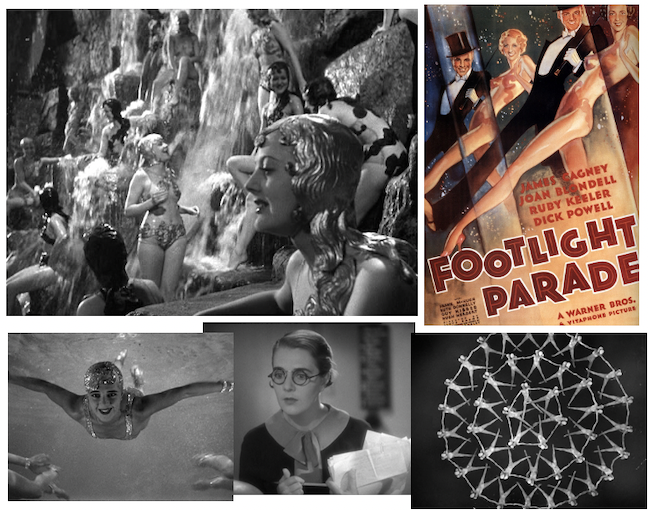
Eleven years before Esther Williams made her first aqua-musical, Ruby Keeler took the dive under Busby Berkeley’s direction in Footlight Parade. E.B. White served as film critic for the Oct. 7 issue, and found Footlight to be a feast for the male gaze, as well as mindless entertainment.
TAKING THE PLUNGE…Clockwise, from top left: According to E.B. White, there was no gainsaying “the general aahhhhh” of the semi-nude waterfall scene in Footlight Parade; promotional poster left no doubt as to what audiences might expect from the film; Busby Berkeley displayed his craft in water-based choreography; Ruby Keeler portrayed a dancer turned secretary who is transformed back into a dancer—just add water. (IMDB)
* * *
A Dog’s Life
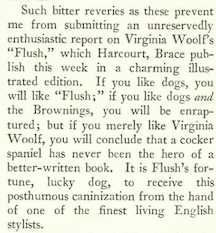
Doubtless drained from writing The Waves, Virginia Woolf followed up with some historical fiction, namely Flush: A Biography, a book about Elizabeth Barrett Browning’s cocker spaniel. Clifton Fadiman had this to say about the unusual biography:
VIRGINIA WOOF…Frontispiece for Flush: A Biography. Virginia Woolf used the tale of a dog to explore social themes ranging from feminism to class conflict. (Heritage Auctions)
* * *
From Our Advertisers
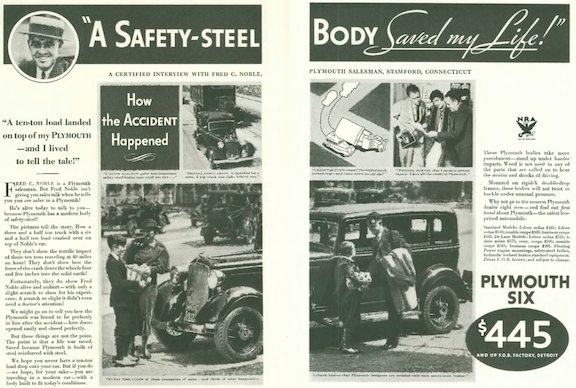
When you market a car for only $445 you aren’t going after the luxury market, but hey, drop a ten-truck truck on this baby and you can live to tell about it…
…with legal beer flooding the market brewers were particularly keen to attract female drinkers of all ages…and apparently social classes…
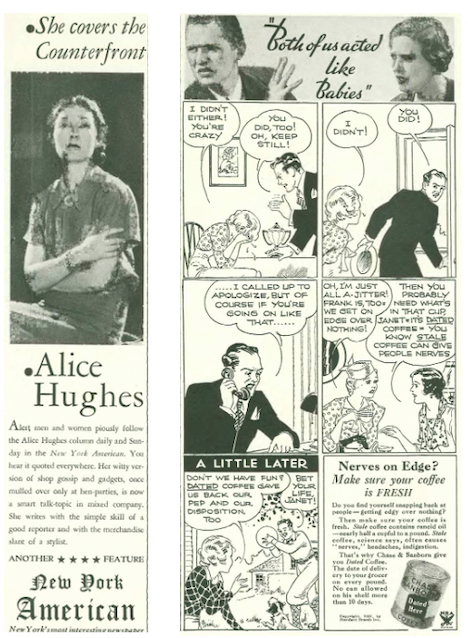
…a couple of ads from the back pages, the first touting the smart-set writing of columnist and foreign correspondent Alice Hughes for the New York American, and the second an advertisement for Chase & Sanborn coffee, which relayed the story of a marriage on the brink due to stale coffee…
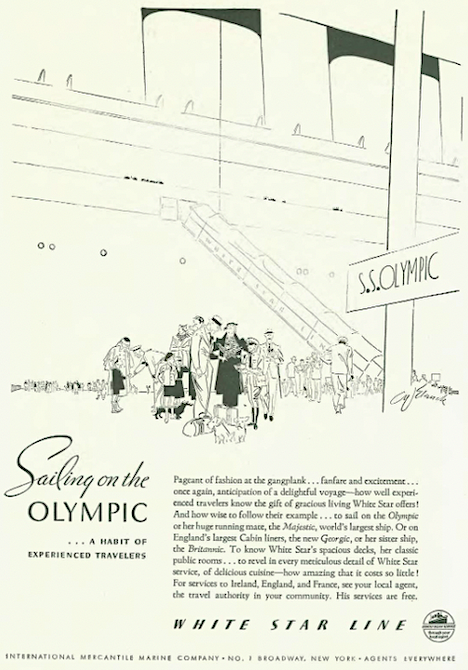
…I include this ad for the heroic scale of the ocean liner, particularly as depicted by the people in the background…
…we bounce on to our cartoons with Otto Soglow’s Little King…
…James Thurber continued to explore the unrest among our domestic youth…
…speaking of America’s youth, this gathering (courtesy Gardner Rea) appeared to have trouble finding some…
…Helen Hokinson found fun with flounder…
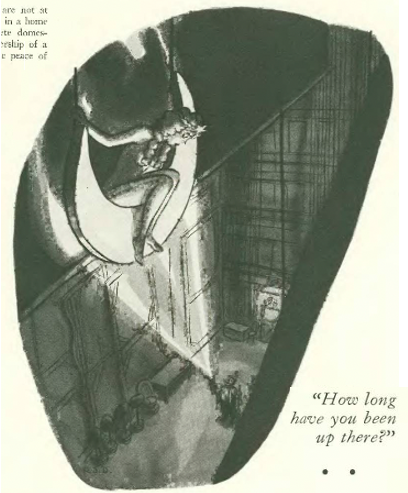
…Rea Irvin turned the tables on a life-drawing class…
…and we close with Richard Decker, over the moon with a stranded chorine…
…and in a nod to the approaching holiday, imagery from a 1933 Fleischer Studios animated short film, Betty Boop’s Hallowe’en Party…
As we enter the summer months we find the recurring themes of June brides…and German Nazis…
May 27, 1933 cover by Constantin Alajalov.
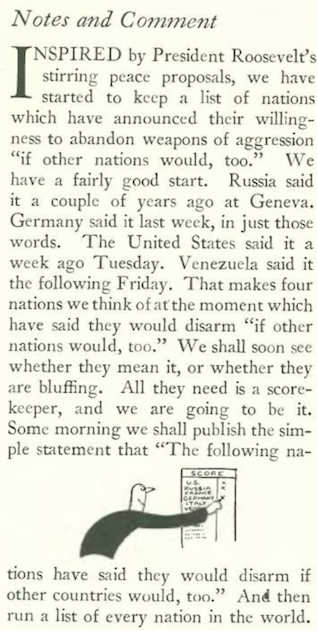
Those Nazis were on the mind of U.S. President Franklin D. Roosevelt when he wrote to the sixty participating nations at the Geneva Disarmament Conference, imploring them to eliminate all weapons of offensive warfare. As we now know, it was a plea that mostly fell on deaf ears, notably those of the leaders of Japan and Germany. E.B. White offered this observation:
GIVE PEACE A CHANCE?…Sixty countries sent delegates to the Geneva Disarmament Conference in 1932–33. Germany was represented by Nazi Minister of Public Enlightenment and Propaganda Joseph Goebbels (front row, center), that is until his country pulled out of the conference and continued its massive arms buildup. (Library of Congress)
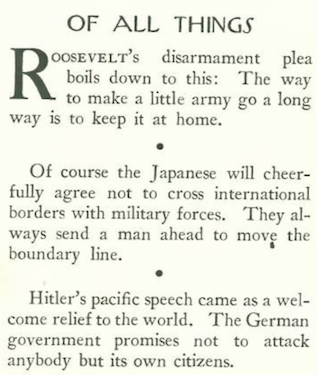
Howard Brubaker was also keeping an eye on FDR’s efforts to hold off the rising powers in Europe and Asia…
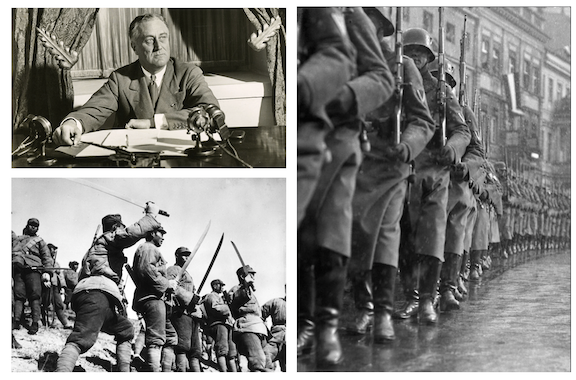
WAR AND PEACE…On May 16, 1933, Franklin D. Roosevelt pleaded with the world’s nations to consider total disarmament of all offensive weapons. In the meantime, Adolf Hitler led the rapid rearmament of Germany (right) while Chinese soldiers (below) did what they could to counter the latest Japanese offensive—the invasion of Jehol Province. (Wikimedia/Pinterest)
* * *
Writer of Lost Causes
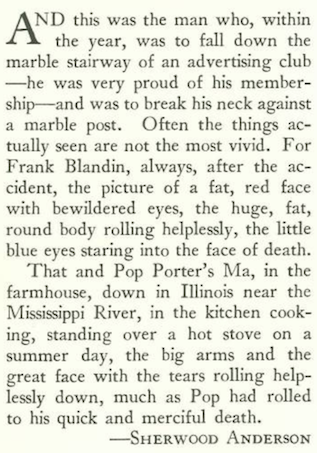
The short story “Pop” would be Sherwood Anderson’s first contribution to The New Yorker. Anderson was known for his stories about loners and losers in American life, including Pop Porter, whose sad, drunken death is described in the closing lines:
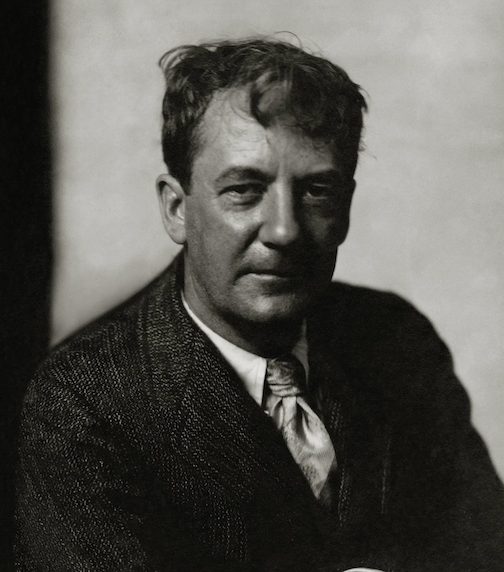
NO EXIT…Best known for his 1919 novel Winesburg, Ohio,Sherwood Anderson (1876–1941) took an unsentimental view of American life. He would contribute six short stories to The New Yorker from 1933 to 1936. Photo above by Edward Steichen, circa 1926. (The New York Times)
* * *
From Our Advertisers
The German Tourist Information Office welcomed visitors to “witness the rebirth of a nation,” promising a land of “new ideas and broader visions” that would bestow on travelers “undying memories endlessly renewed”…
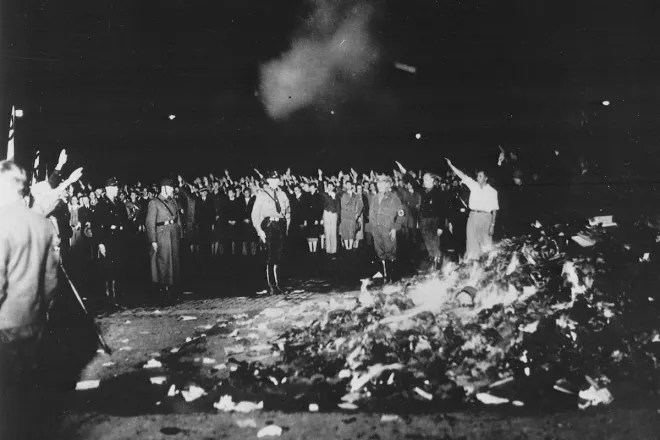
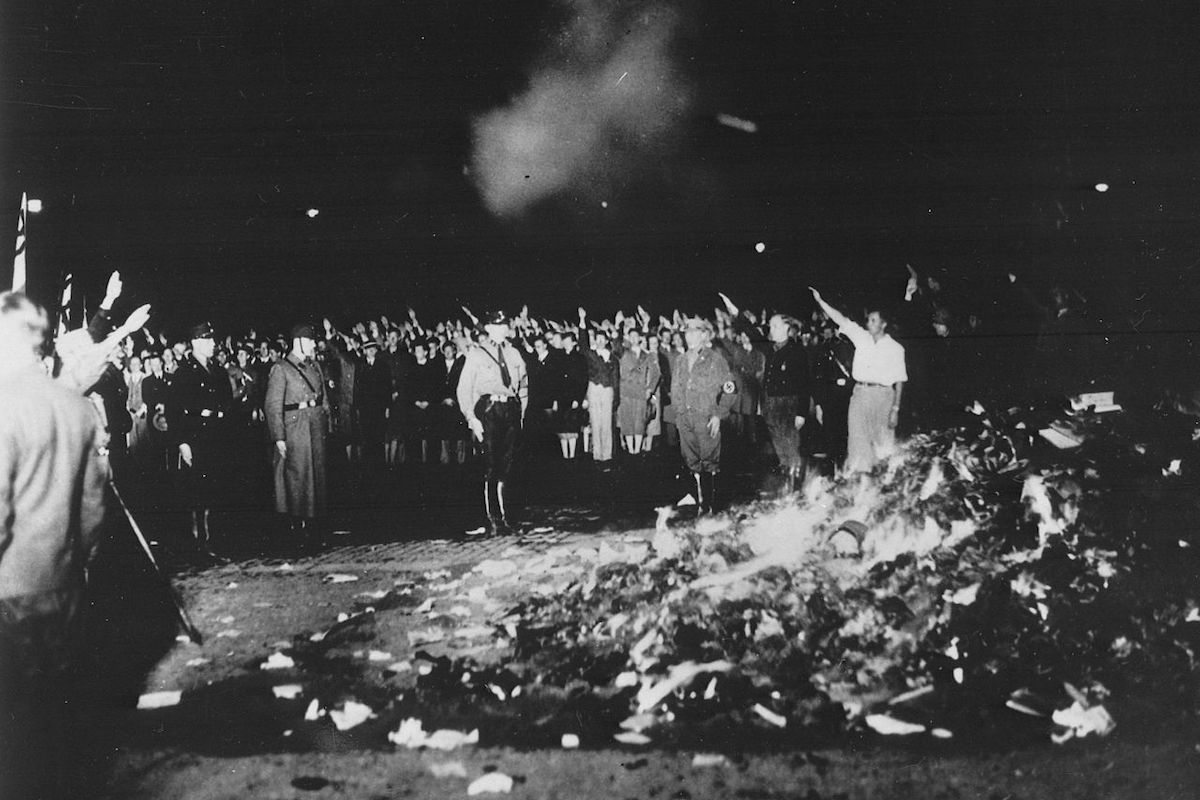
…Those “undying memories” might have included massive, country-wide book burnings that took place on May 10, 1933, when students in 34 university towns across Germany burned more than 25,000 “un-German” books…
FANNING FLAMES OF HATE…On May 10, 1933, student supporters of the Nazi Party burned thousands of volumes of “un-German” books in the square in front of the Berlin State Opera. (Bundesarchiv)
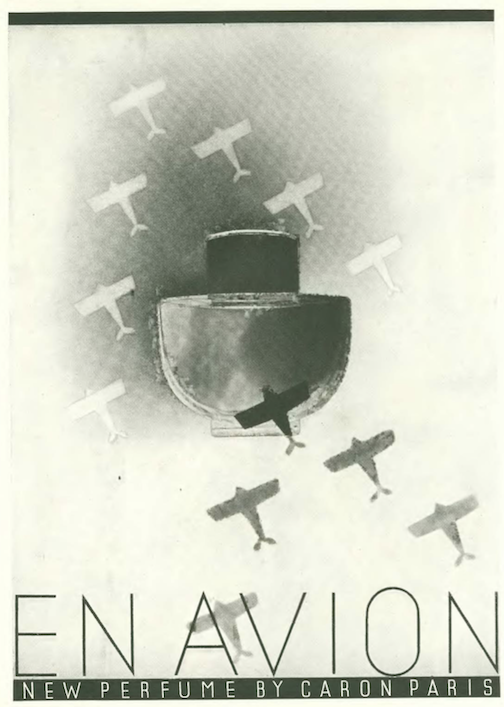
…knowing where all of this would lead, it is hard to look at this next ad and not think of the Luftwaffe raining death from the skies later in that decade…
…so for the time being we’ll turn to something less menacing, like checkered stockings, here resembling one of John Held Jr’s woodcuts…
…and this crudely illustrated ad (which originally appeared in one column)…call your buddy a fatso and the next thing you know he’s moving to Tudor City…
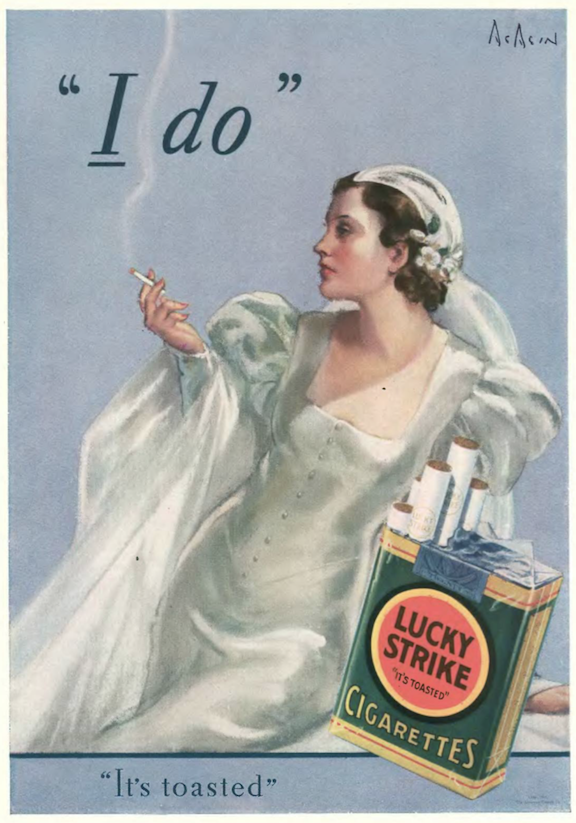
…and from the makers of Lucky Strikes, a back cover ad that provided a thematic bookend to Constantin Alajalov’s cover art…
…James Thurber kicks off the cartoons with this sad clown…
…atop the Empire State Building, Daniel ‘Alain’ Brustlein found more than just a view of the city (it’s former governor Al Smith!)…
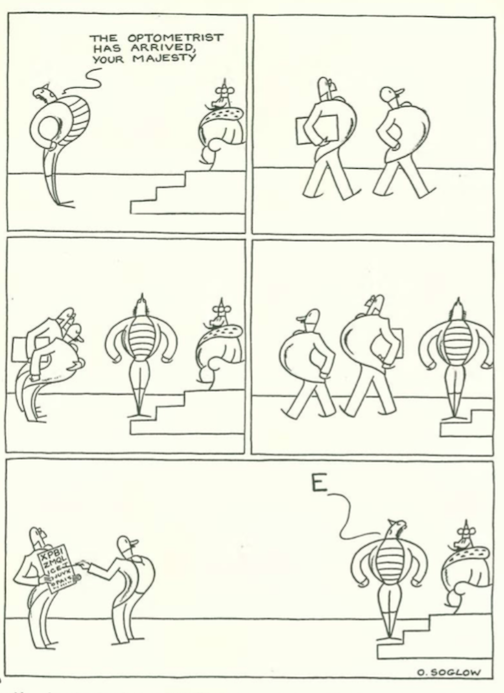
…Otto Soglow’s Little King got his vision checked, in his own way…
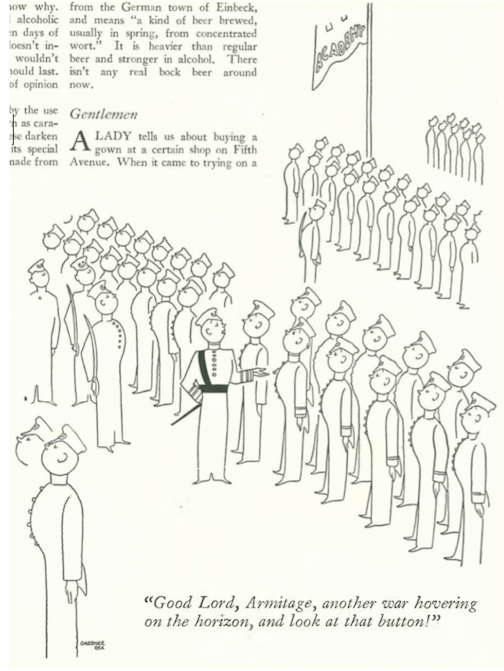
…a loose button threatened to bring down a nation…per Gardner Rea…
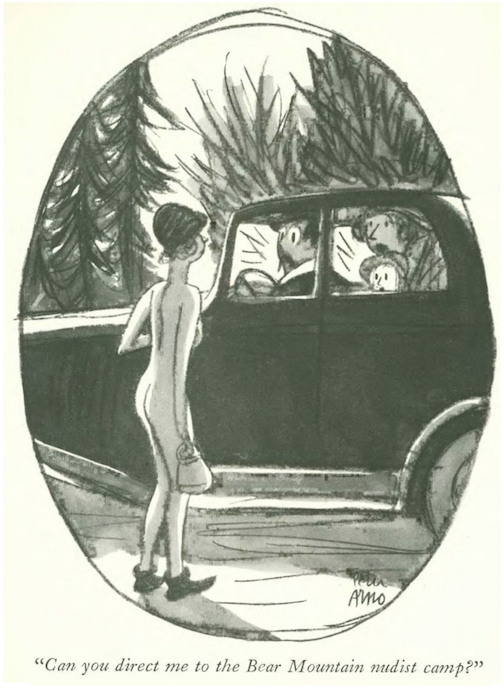
…and we take a leisurely Sunday drive, Peter Arno style…
…on to the June 3, 1933 issue…
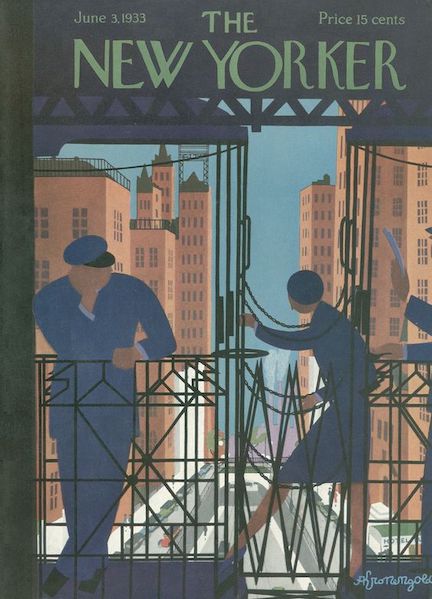
June 3, 1933 cover by Adolph K. Kronengold.
…where we appropriately look to the skyline, which was giving Lewis Mumford a crick in the neck…
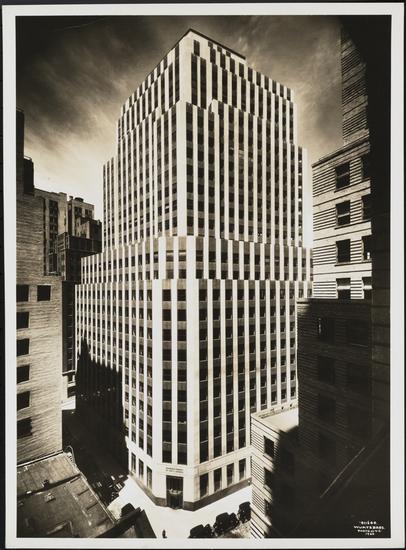
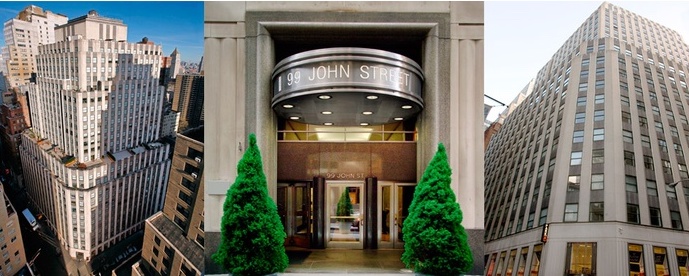
THAT’LL DO…Lewis Mumford was not a fan of giant skyscrapers, but when the architects of the Empire State Building turned their attention to the Insurance Company of North America building at 99 John Street, Mumford found a design that could serve as a model for future business buildings. (Museum of the City of New York)CONVERSION THERAPY…the Insurance Company of North America building now houses modern loft condominiums known as 99 John Deco Lofts. (nest seekers.com).
Later in the column Mumford called skyscrapers “insupportable” luxuries, arguing instead for long, shallow buildings rising no more than ten stories.
* * *
The Stars Align
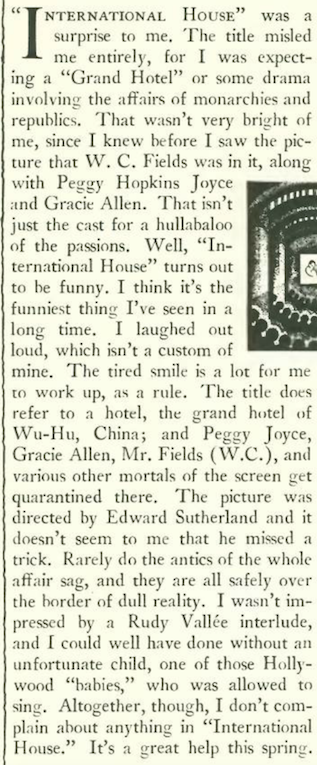
Film critic John Mosher was delightfully surprised by International House, a film loaded with some of the era’s top comedic stars along with other entertainers.
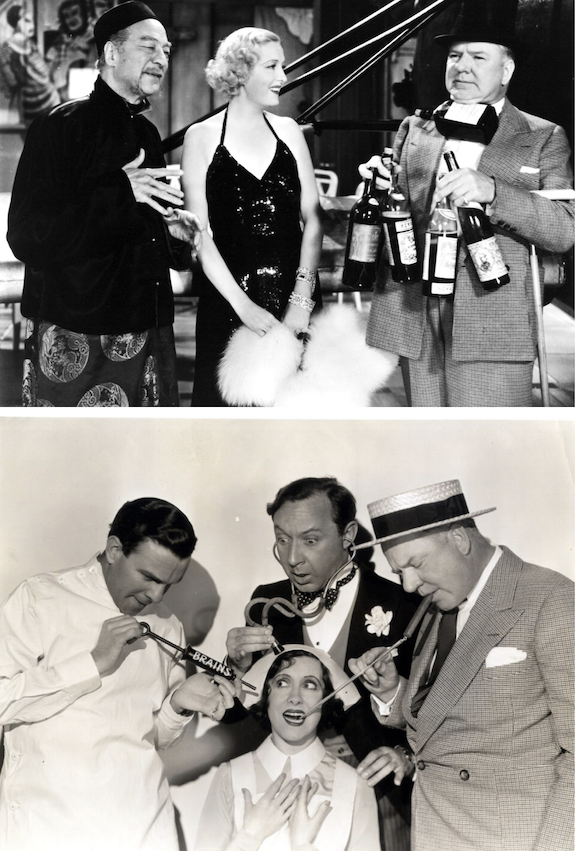
CLUTCH THOSE PEARLS…The risqué subject matter of International House had the Legion of Decency up in arms, but it left critic John Mosher in stitches thanks to the antics of Edmund Breese, Peggy Hopkins and W.C. Fields (top photo). Below, a publicity photo for International House with George Burns, Gracie Allen, Franklin Pangborn and W.C. Fields. (IMDB)
The film featured an array of entertainers including Peggy Hopkins (more famous as a real-life golddigger than an actress), the comedy duo Burns and Allen, W.C. Fields, Bela Lugosi, Cab Calloway, Rudy Valley and Baby Rose Marie.
ALL THE WORLD’S A STAGE…Ten-year-old Rose Marie Mazzetta, known in 1933 as the child performer Baby Rose Marie, sings a number atop a piano in a scene from International House. Thirty years later Rose Marie would appear on The Dick Van Dyke Show as television comedy writer Sally Rogers, pictured here with co-stars Dick Van Dyke and Morey Amsterdam. (WSJ/LA Times)
* * *
The New Germany, Part II
The June 3 “Out of Town” column took a look at life in Berlin as well as the 1933 Chicago World’s Fair. The piece is signed “A.L.”, leading me to believe it might be A.J. Liebling (author of the terrific Between Meals), but he didn’t start at The New Yorker until 1935. At any rate the article seems to dismiss the crackdown on Berlin’s cultural life as a mere inconvenience.
NEW THEME, NEW OWNERSHIP…The article mentions the closing of the Eldorado night club in Berlin, famed for its drag shows and other naughty diversions. Images above show the before and after the Nazis redecorated. (lonesomereader.com)
* * *
From Our Advertisers
More propaganda from Germany, where everything is sweet and bright away from the din of the city and the sound of marching jackboots and the crash of broken glass…
…an unusual ad from Cadillac, which barely mentions the automobile but goes full bore on the June bride theme…
…the folks at Camel went full color in their latest installment of “It’s Fun to be Fooled”…in this strip Jack gets his friend Ellie hooked on his cigarette brand…
…looking for fresher air, well you could get a window air conditioner from the folks at Campbell Metal Window Corporation…however, these units were only available to the very wealthy, roughly costing more than $25,000 apiece (more than half a million today)…
…better to take a drive a catch the breeze with this smart pair…
…and fight off those pesky bugs with a blast of Flit, as illustrated by Dr. Seuss before he became a children’s author…
…Richard Decker picked up some extra cash illustrating this ad for Arrow shirts…
…which segues to our other New Yorker cartoonists, such as H.O. Hoffman…
…and yet another bride, with sugar daddy, courtesy of Whitney Darrow Jr…
…William Crawford Galbraith continued his exploration into the lives of showgirls…
…Gardner Rea gave us this helpful switchboard operator…
…Carl Rose showed us how the posh set got into the spirit of the Depression-era farm program…
…George Price was getting into familiar domestic territory…
…and on this Father’s Day, we close with some fatherly advice from James Thurber…
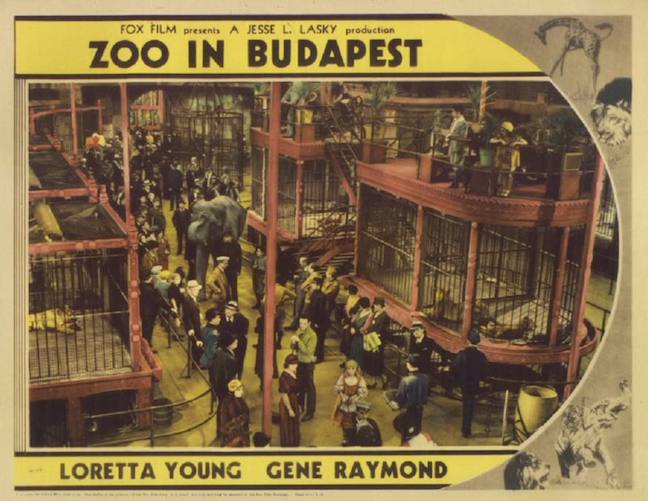
Part love story and part wildlife protection fable, the pre-Code romance and melodrama Zoo in Budapest was that rare film that pleased critics and audiences alike.
May 6, 1933 cover by Richard Decker. This is one of four covers Decker (1907–1988) contributed to The New Yorker; he also contributed more than 900 cartoons in his nearly 40-year run with the magazine.
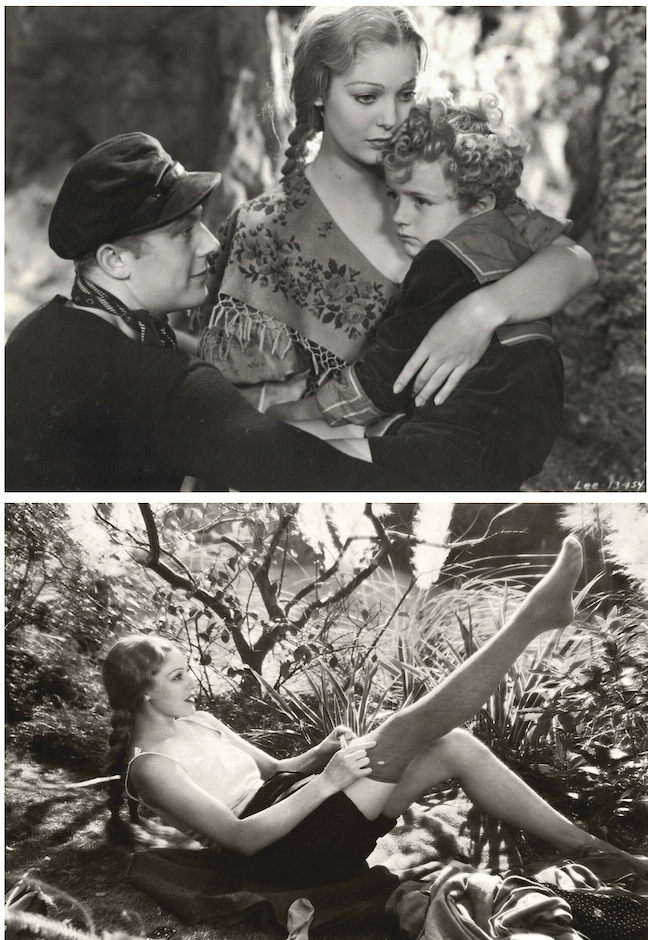
Jesse L. Lasky’s first production for Fox (Lasky was the founder of Paramount Pictures), Zoo in Budapest starred relative newcomer Gene Raymond as a young man (Zani) keenly attuned to nature and particularly to the animals he cares for in the Budapest Zoo. In the course of the film he becomes an anti-fur industry activist and rescues a beautiful orphan girl, Eve (Loretta Young) from a life of servitude. Although the film is little known today, in 1933 it had quite a winning effect on critic John Mosher, who usually found little to like from Hollywood’s output:
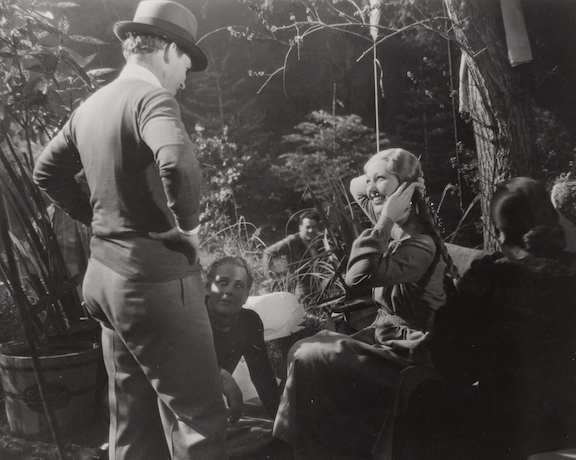
HE TALKS TO THE ANIMALS…Top, zoo worker Zani (Gene Raymond) rescues a beautiful orphan girl, Eve (Loretta Young) from a life of servitude, and both come to the aid of a little boy named Paul, played by Wally Albright, who escapes the clutches of his harsh governess. Below, hidden in the bushes, Eve changes her clothes after escaping from a group of orphans visiting the zoo. (IMDB)
The film made such an impression that even E.B. White had to mention it in the opening lines of his “Notes and Comment”…
ANIMAL CRACKERS…Filmmakers went all out in creating elaborate sets for Zoo in Budapest. The film was likened to Grand Hotel because the drama took place in less than 24 hours, almost entirely in one location. Below, Loretta Young converses with director Rowland Lee on the set. (IMDB)(IMDB)
* * *
High Anxiety
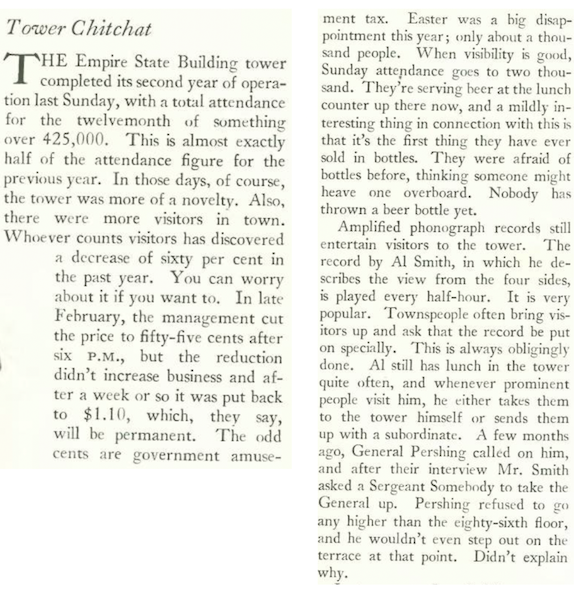
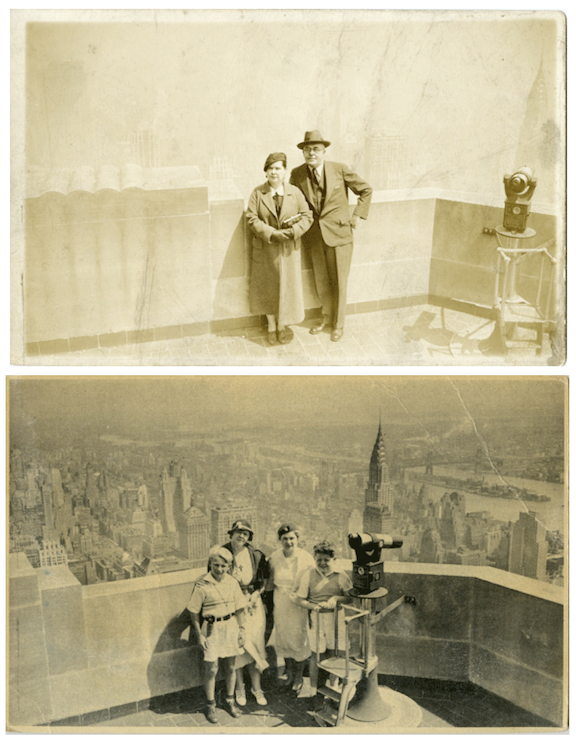
The Depression was hard on the Empire State Building, which opened its doors during some of the darkest days of the economic crisis. Visitation was down, and a lot of the office space in the world’s tallest building remained vacant. It would remain in the red into the 1940s.
BEEN THERE, DONE THAT…To this day the 86th floor observation deck has been a popular destination for tourists. In the 1930s a photographer stationed on the deck captured the moment for tourists on a souvenir postcard. The image at top is from 1934, the one below circa 1930s. Fencing to deter suicide attempts (or people chucking things over the side) wouldn’t be erected until 1947. (nyccirca.blogspot.com)
* * *
As the World Churns
Howard Brubaker continued to comment on the deteriorating conditions of the German people in his column “Of All Things”…
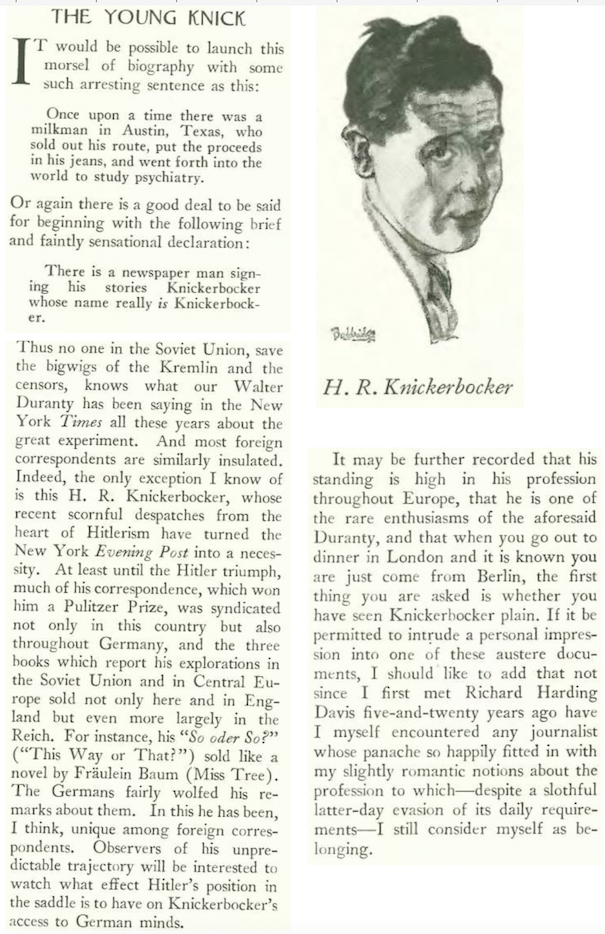
…and speaking of the Third Reich, Alexander Woollcott profiled (in his column “Shouts and Murmurs”) an enterprising young journalist Hubert R. Knickerbocker (1898–1949), who reported from Berlin from 1923 to 1933 and wrote about the threat of Nazism. In April 1933, after fleeing Germany, he reported in the New York Evening Post that “an indeterminate number of Jews [had] been killed.” A brief excerpt (with illustration by Cyrus Baldridge):
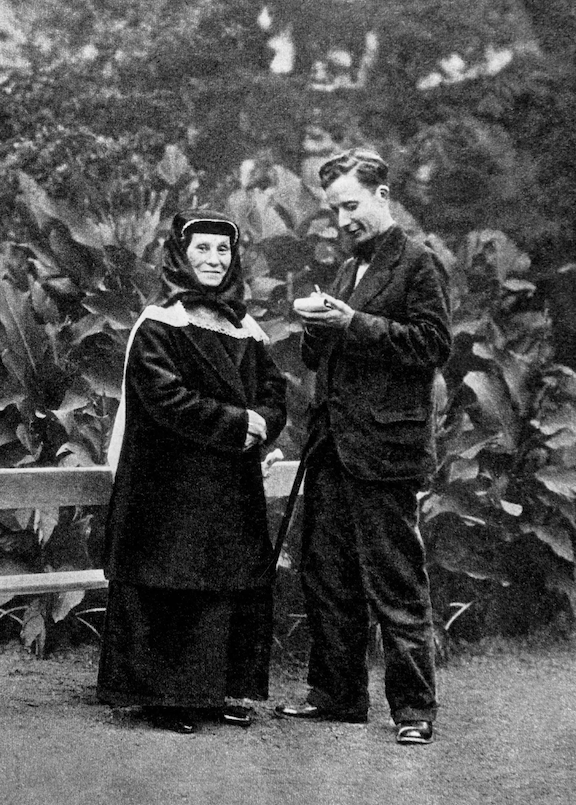
MYSTERY WRITER…In December 1930, H.R. Knickerbocker interviewed Josef Stalin’s mother, Keke Geladze, for the New York Evening Post. The resulting article was titled, “Stalin Mystery Man Even to His Mother.” (The New Yorker)
A graduate of Southwestern University in Georgetown, Texas and a 1931 Pulitzer Prize winner, Knickerbocker kept his word with Woollcott and entered Columbia University to study psychiatry.
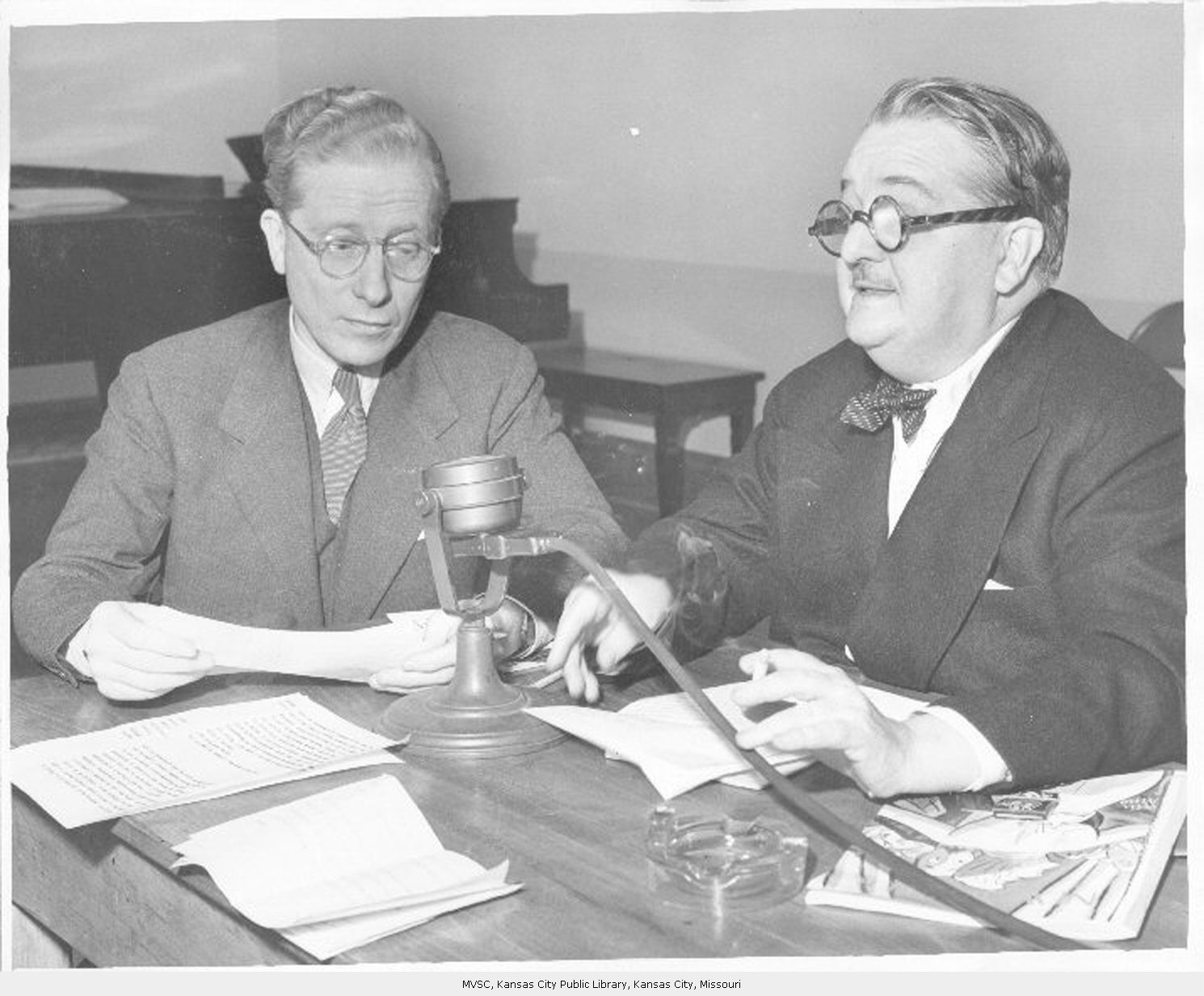
TALES TO TELL…H.L. Knickerbocker (at the microphone) with Alexander Woollcott circa 1940. (Kansas City Public Library)
* * *
From Our Advertisers
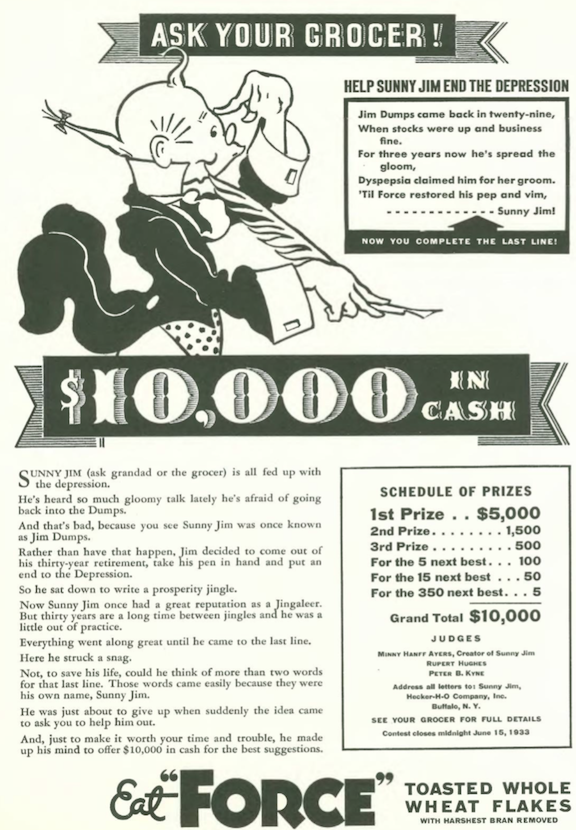
We begin with an ad from the makers of the first commercially successful wheat flake breakfast cereal…before there were Wheaties (created in 1921) there was Force, invented in 1901…almost from the beginning the Force brand was wildly successful thanks to a series of jingles featuring a morose character, Jimmy Dumps, who was transformed into Sunny Jim by consuming Force flakes…in 1933 the makers of Force were still big on jingles, sponsoring contests such as the one below…
…here is a box from that period, promoting cash prizes for winning jingles…
(worthpoint)
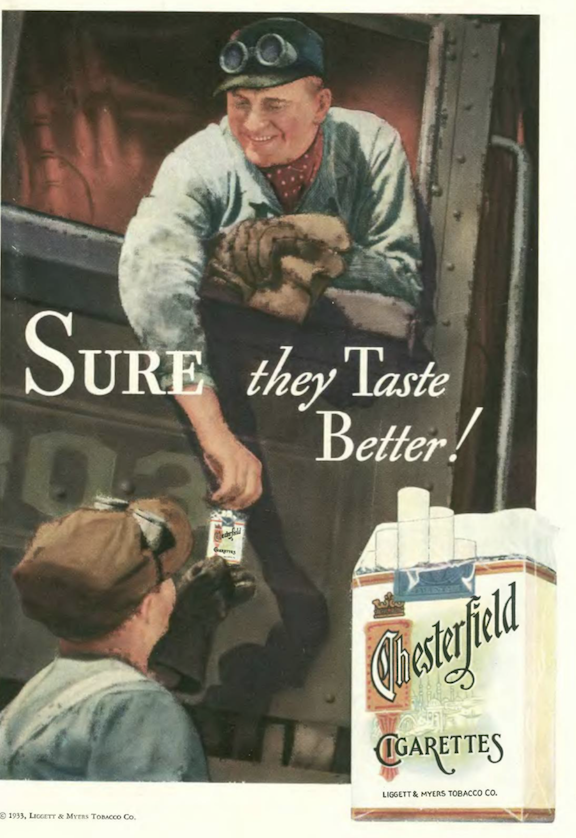
…the folks at Chesterfield began targeting the working man in their advertising…
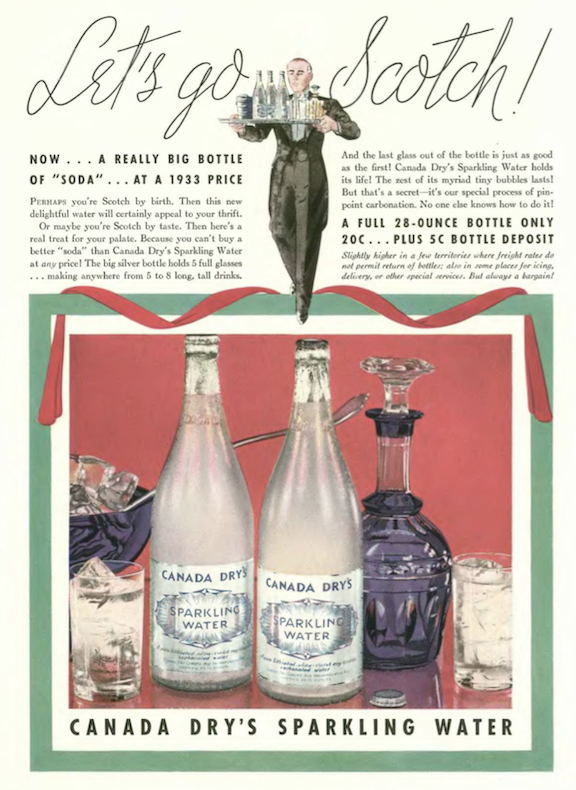
…while Canada Dry was anticipating the end of Prohibition…
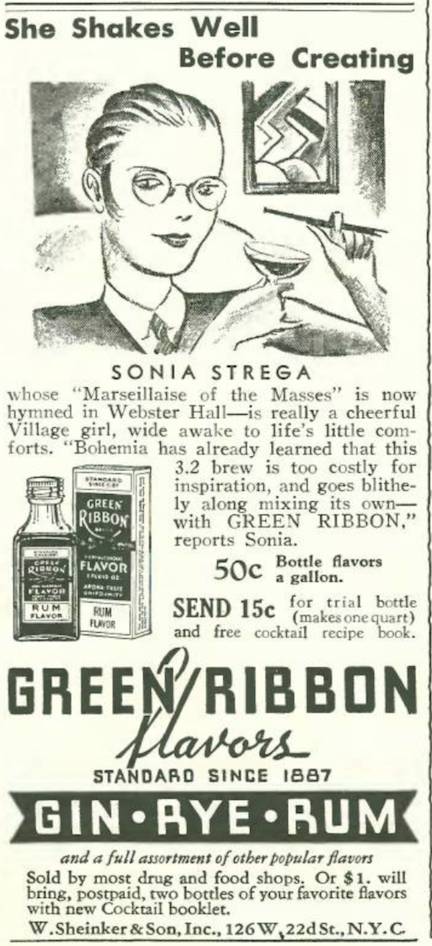
…but until that day, you could mix some Green Ribbon with your bootleg alcohol, according to Sonia Strega, who was likely an invention by the advertisers rather than an actual living endorser…
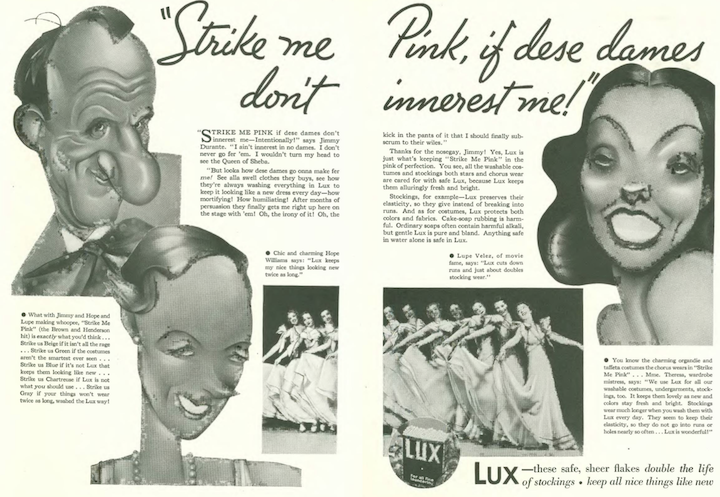
…Lux, on the other hand, had piles of money to spend on real life endorsers including Jimmy Durante, Hope Williams and Lupe Velez…
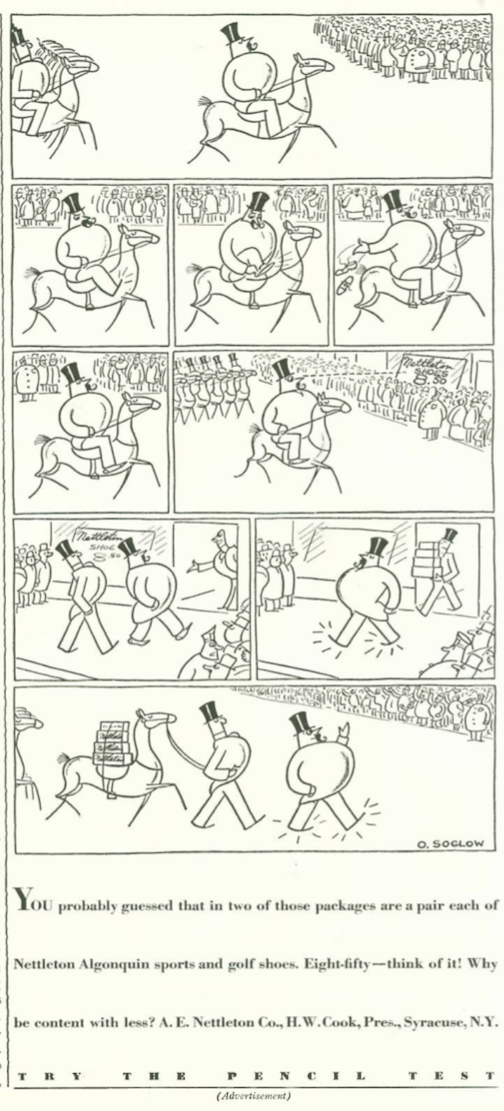
…Otto Soglow drew up this strip for the makers of Nettleton shoes, creating a character similar to his famed “Little King” to promote the company’s sports and golf shoes…
…James Thurber continued his work for the French Line, replete with his familiar dogs…
There were a number of people Dorothy Parker couldn’t abide. That included gifted writers who not only eschewed serious literature, but who instead chose to crank out a lot of mass-market trash.
March 18, 1933 cover by William Steig.
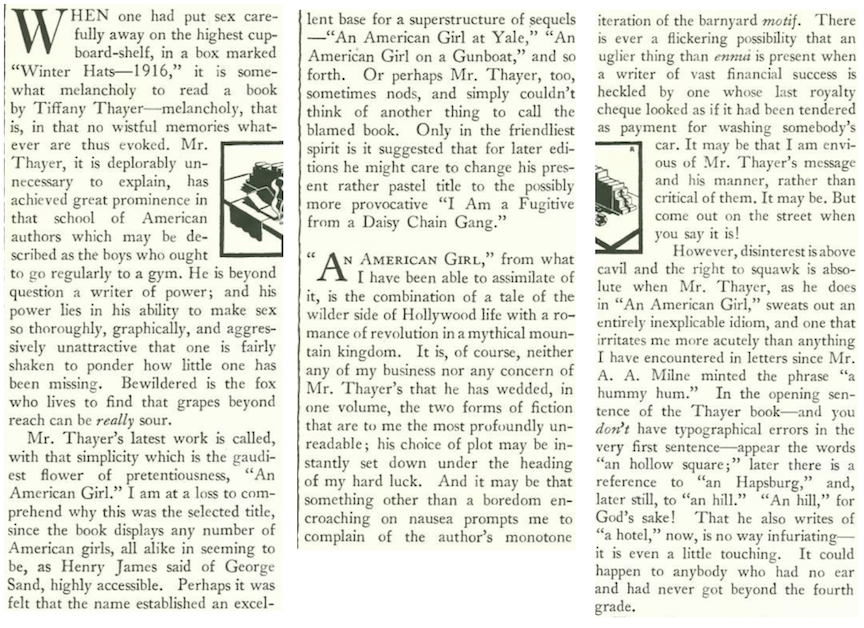
Parker was well acquainted with Tiffany Ellsworth Thayer (1902–1959), and for a time she even associated with the Fortean Society, which Thayer founded in 1931. Inspired by writer Charles Fort, the Forteans promoted the use of scientific methods to evaluate unexplained phenomena such as UFOs, spontaneous human combustion, and other oddities. Parker and fellow New Yorker writers Ben Hecht and Alexander Woollcott were among founding members, doubtless drawn to Fort’s reputation as a skeptic; however one famous skeptic, journalist H.L. Mencken, called Fort’s ideas “Bohemian mush.” It’s hard to say how long Parker stayed connected to the Society, but by 1933 she was fed up with Thayer’s novels, including his latest, An American Girl, which she found to be “the gaudiest flower of pretentiousness.” Here is an excerpt from Parker’s sometime column, “Reading and Writing,” subtitled Not Even Funny…
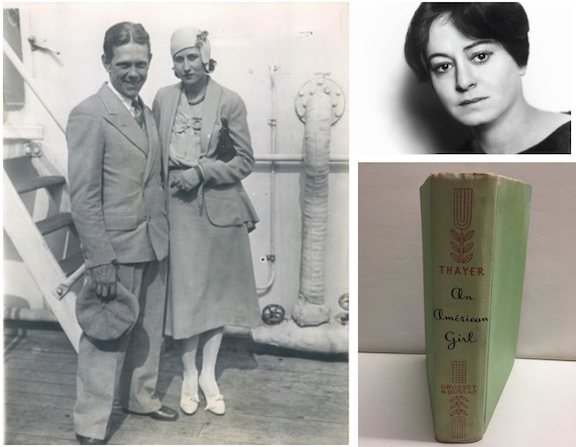
TIFF WITH TIFFANY…At left, Tiffany Thayer aboard a cruise ship with an unidentified woman, most likely his first wife, a dancer named Tanagra, early 1930s; at right, Dorothy Parker and a first edition of the offending volume. In her review, Parker observed that Taylor “is beyond question a writer of power; and his power lies in his ability to make sex so thoroughly, graphically, and aggressively unattractive that one is fairly shaken to ponder how little one has been missing.” (IMDB/Worthpoint)
Although Thayer founded a society based on scientific reason, his pulp novels were filled with fantasy and prurient imagery. F. Scott Fitzgerald once observed that “curious children nosed at the slime of Mr. Tiffany Thayer in the drug-store libraries.”
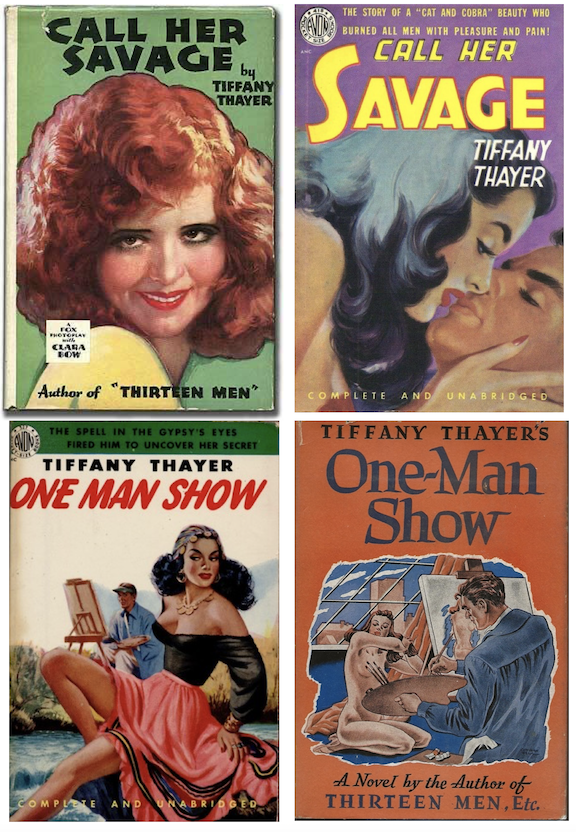
BELIED LETTRES…Clockwise from top left, Thayer’s 1931 novel Call Her Savage was made into a 1932 film starring Clara Bow, here featured on the book’s dustcover; the same novel repackaged in 1952 for the pulp trade; a 1943 edition of Thayer’s One-Man Show, and a 1951 Avon reprint that toned down the nudity but upped the creep factor. (facebook.com/biblio.com)
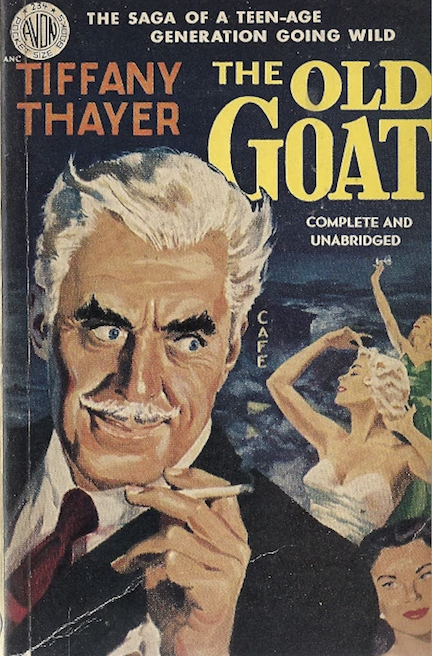
…and speaking of creep factor, check out Avon’s 1950 re-issue of Thayer’s 1937 novel The Old Goat, illustration attributed to Edgar Lyle Justis…
(biblio.com)
Artists like Justis must have had a ball doing these illustrations, creating images to lure the unsuspecting into purchasing these old titles. Note how the coked-up old man sports not-so-subtle devil horns.
* * *
They Called It a Holiday
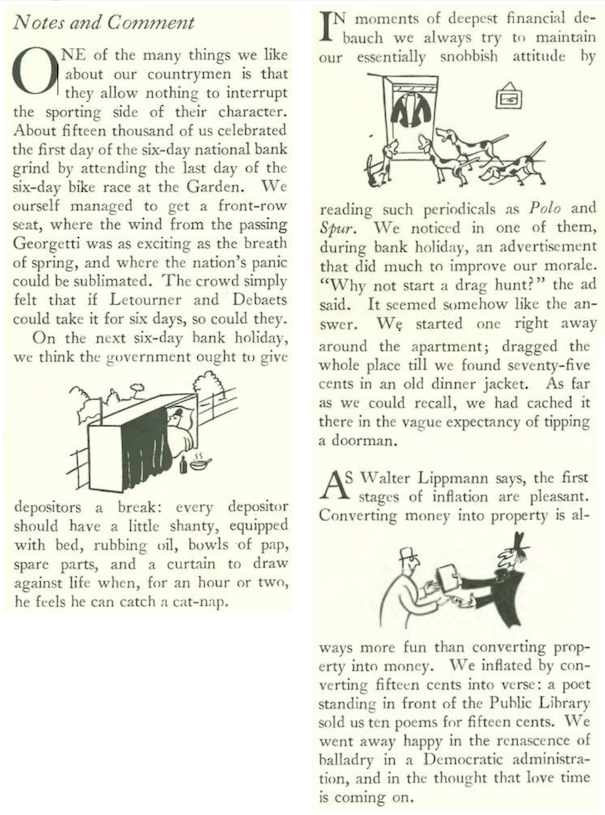
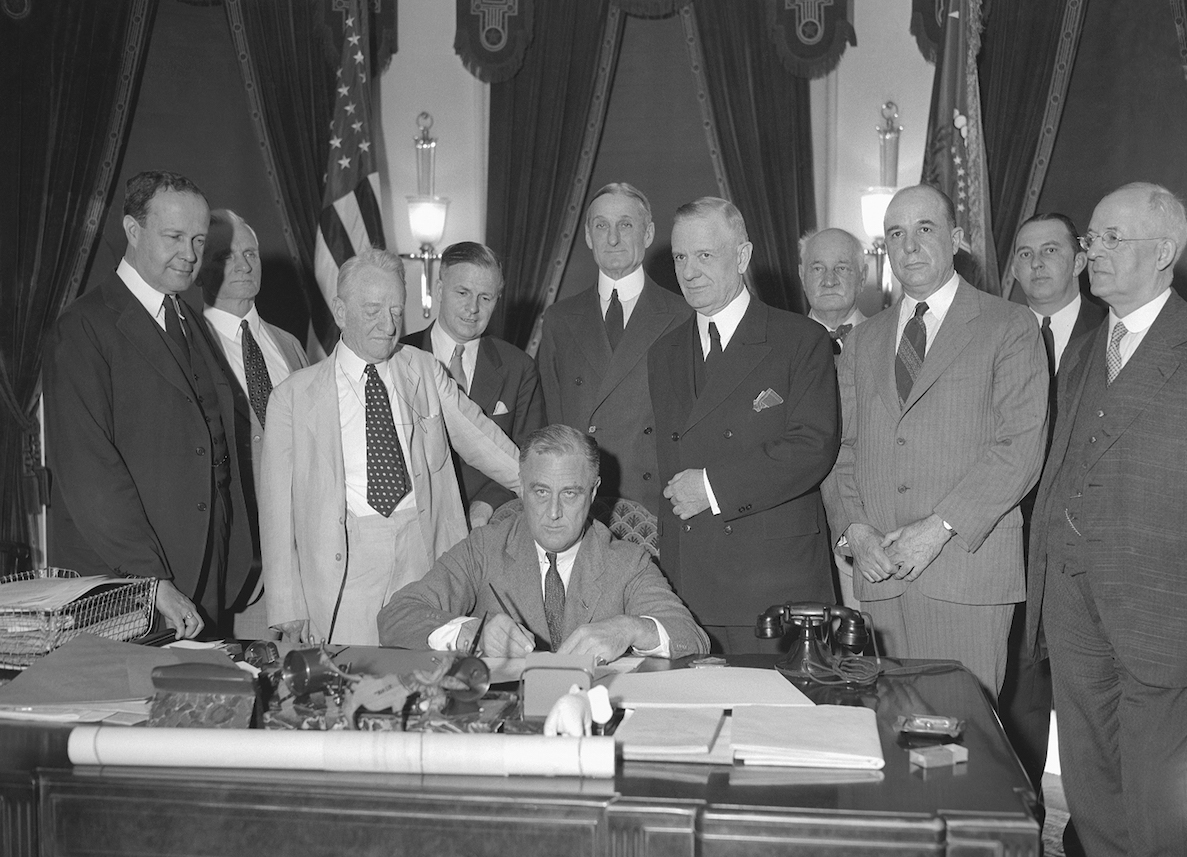
E.B. White, James Thurber (see below) and others in the March 18 issue commented on the national banking “holiday” declared by President Franklin D. Roosevelt in an effort to stabilize America’s banking system and rebuild public confidence. This led to the Glass-Steagall Act, signed three months later by FDR. Some observations in “Notes and Comment” by E.B. White, with the usual great spot illustrations by Otto Soglow…
SAY CHEESE!…President Franklin D. Roosevelt signs the Glass-Steagall Act on June 16, 1933, effectively separating commercial banking from investment banking and creating the Federal Deposit Insurance Corporation (FDIC), among other things. (Associated Press)
…meanwhile, Germany’s new chancellor, Adolf Hitler, was busy abolishing civil liberties while pretending to be distressed by the behavior of his brownshirt thugs…an excerpt from Howard Brubaker’s “Of All Things”…
* * *
A Familiar Ring
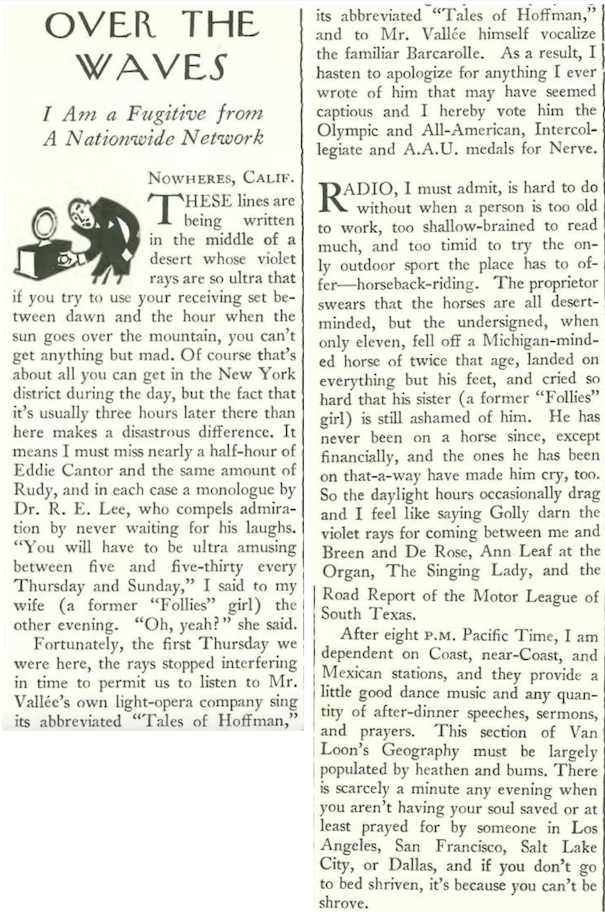
For the second week in a row Ring Lardner lent his wit to The New Yorker’s “Over the Waves,” column, which typically reviewed the latest news and entertainment beamed from the radio tower atop the Empire State Building. Lardner, however, was in California, lamenting the challenges of the time lag. An excerpt:
AND NO WI-FI, EITHER…Ring Lardner (center) detailed the frustrations of listening to New York-based radio entertainers like Eddie Cantor (left) and Rudy Vallée during his stay in California. (Pinterest/The Classic Archives/The New York Times)
* * *
Dance Away Those Blues
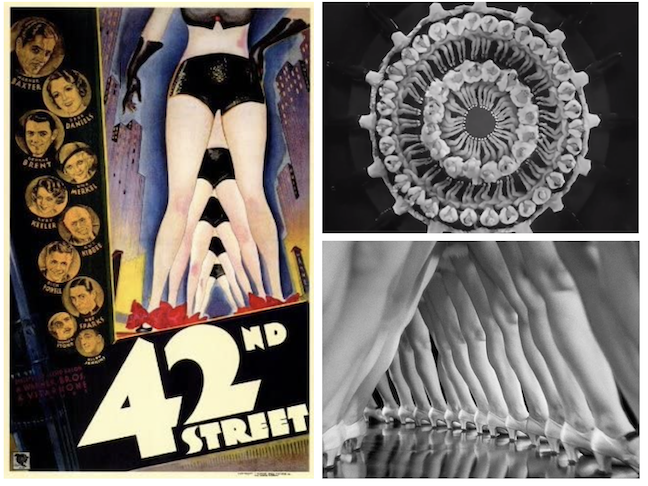
The pre-Code musical 42nd Street received a brief, albeit mostly positive review from critic John Mosher, who along with the producers of the film knew Depression-weary Americans needed such distractions. Nearly 90 years later (April 10, 2020), another New Yorker film critic, Richard Brody, suggested 42nd Street as one of the best films to stream during the Covid-19 pandemic: “Modern musicals start here, and Busby Berkeley’s genius bursts into full flower,” he wrote.
DANCE ‘TIL YOU DROP…Under pressure to produce a hit after losing his lead dancer (Bebe Daniels) to a broken ankle, Broadway musical director Julian Marsh (Warner Baxter, center) mercilessly rehearses her replacement, Peggy Sawyer (Ruby Keeler, in her film debut) before the premiere, vowing “I’ll either have a live leading lady or a dead chorus girl.” Looking on (to the right of Baxter) is Ginger Rogers, who portrayed “Anytime Annie.” (tcm.com)A LEG UP ON HIS CAREER…42nd Street was a breakthrough film for choreographer Busby Berkeley, who would direct and choreograph a long string of musicals until the 1960s. The film is now considered a classic, preserved in the United States National Film Registry. (IMDB)
…and for trivia buffs, during an opening scene Bebe Daniels is shown reading the February 20, 1932 (anniversary) issue of The New Yorker…
* * *
From Our Advertisers
A convertible LaSalle (a downscale Cadillac brand) looks like a great way to enjoy a drive along the beach…let’s hope it has enough acceleration to outrun the tsunami apparently heading its way…
…Walter Chrysler continued to dig into his deep pockets for two-page color spreads, including this one that placed his humble DeSoto in St. Moritz, of all places…
…not to be outdone, the folks at Nash found another exotic locale for their budget-priced sedan…Chicago, that is, at the 1933 Century of Progress Exhibition…and for an extra touch of class, we have what appears to be a chauffeur attending to this modest motorcar…
…America’s top luxury car maker, Pierce Arrow — a regular advertiser in The New Yorker — decided a quarter-page ad was sufficient to keep their name before the eyes of the well-heeled…at right, an ad from another back page featured cartoonist Don Herold shilling for the makers of imitation liquor flavors…according to the ad, one bottle, obtainable from your druggist, “flavors a gallon” of whatever forsaken hootch you are consuming…
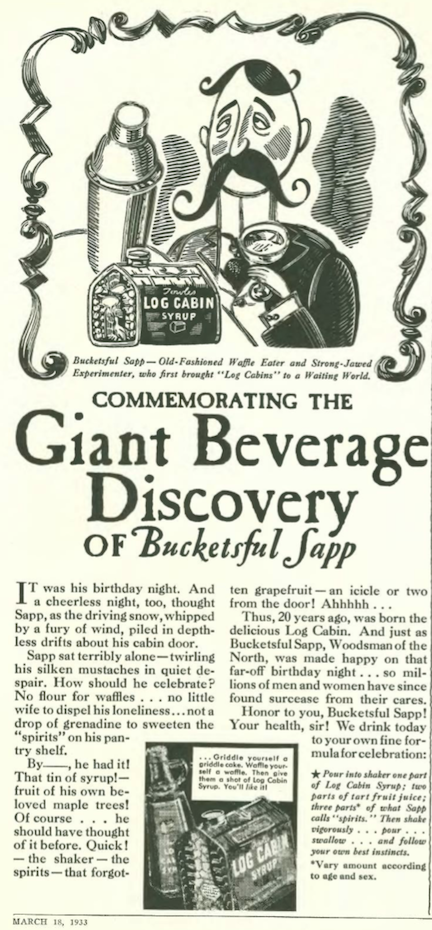
…the folks at Log Cabin relied on the talents of another New Yorker cartoonist, John Held Jr., to make both their product and a signature cocktail a more palatable experience…
…I have to hand it to the folks at Heinz for signing off on an advertisement only a vampire would find appealing…
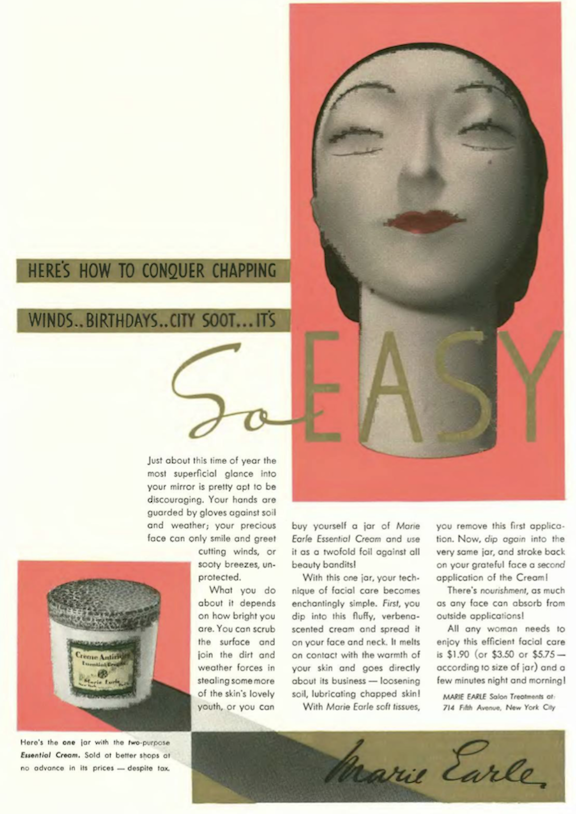
…the purveyors of Marie Earle beauty products rolled out this modern ad to promote their “Essential Cream”…
…while staid Brooks Brothers remained true to form — no flashy colors or advertising jargon — just straight talk about price increases….
…and then there’s the upmarket Fortnum & Mason, appealing to America’s Anglophiles with one of their famed wicker hampers filled with various goodies selected for “charming and greedy people”…
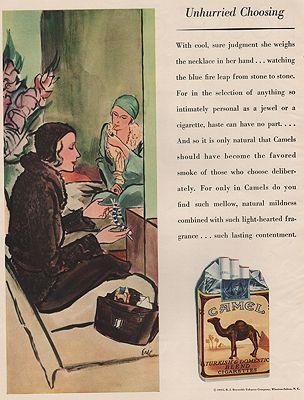
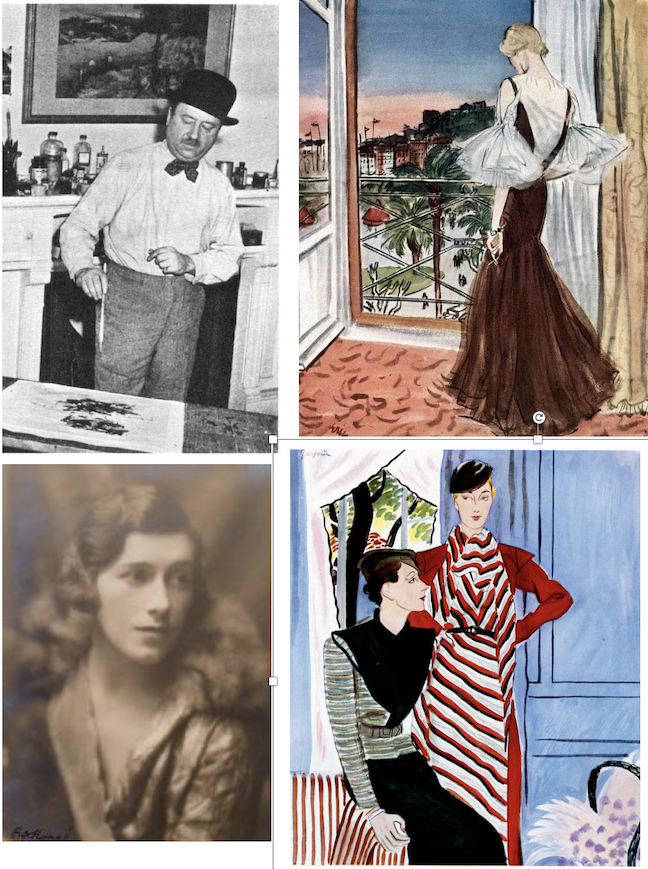
….for several years R.J. Reynolds employed the services of Carl “Eric” Erickson (1891–1958) to illustrate a series of ads featuring classy, disinterested, continental types smoking their Camel brand cigarettes…despite their less-than-exotic name, the makers of Spud menthol cigarettes hired Ruth Sigrid Grafstrom (1905–1986) to create their own smart set of smokers…
…ads that bore a striking resemblance to Erickson’s Camel work (this example from 1931)…
…and for your consideration, works from 1933 by Carl Erickson and Ruth Sigrid Grafstrom…both were noted fashion illustrators…
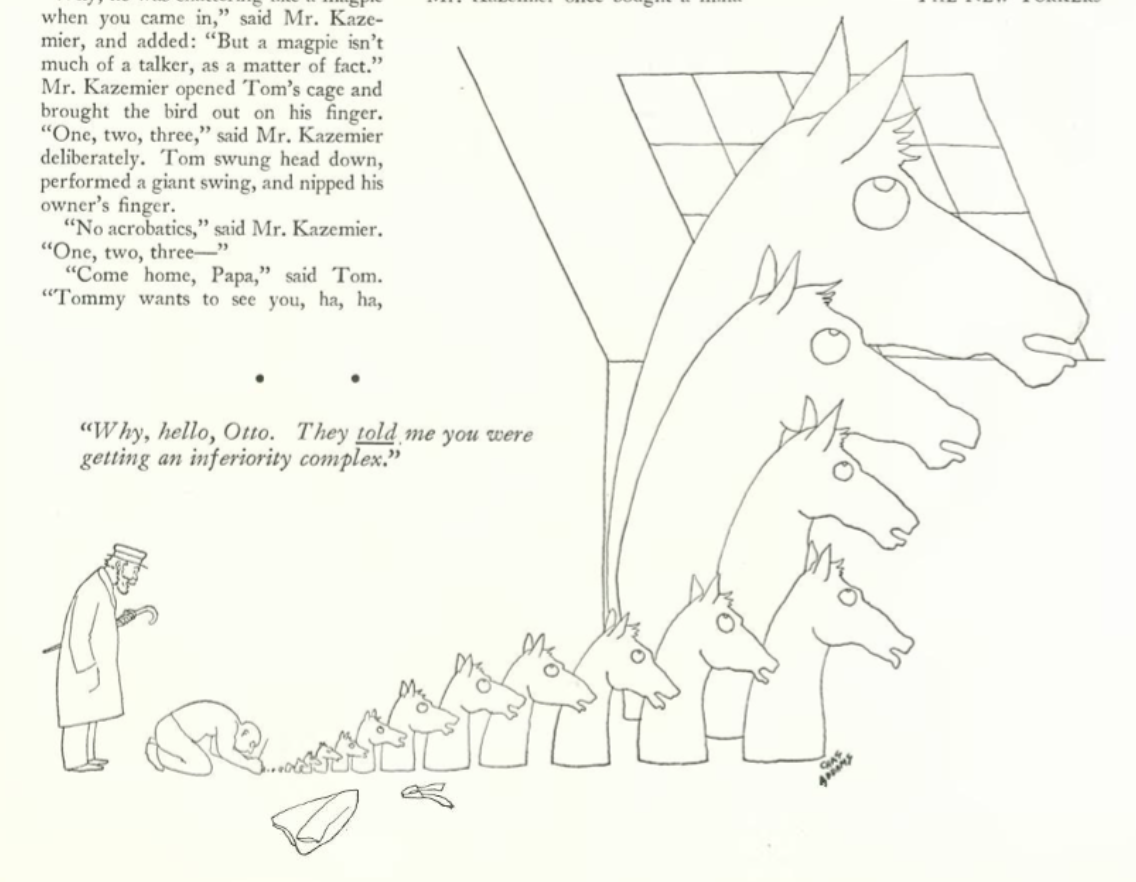
…on to our cartoonists, we begin with Charles Addams, who’d just published his first New Yorker cartoon the previous month, in the Feb. 4, 1933 issue…
…that first cartoon was simply signed “Addams”…here he used the familiar “Chas Addams”…a close-up of the signature…
…we continue with a great caricature by Al Frueh to accompany a profile of Rudolf Kommer (as told by Alexander Woollcott)…
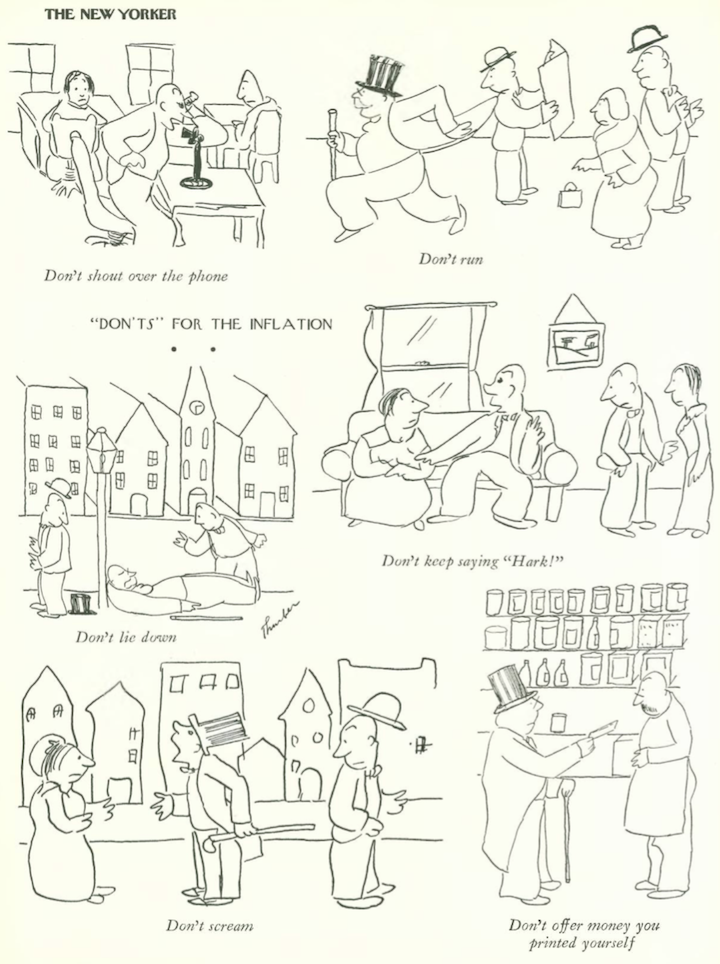
…a delightful full page of bank holiday-themed cartoons by James Thurber…
…Richard Decker offered up a tall tale…
…and we close with Peter Arno, who served up one of his clueless cuckolds…