Back in the USSR

The year 1932 was a tough one for many Americans, barely scraping by in the deepening Depression. But to the suffering millions in the Soviet Union, America’s economic woes looked like a walk in the park.

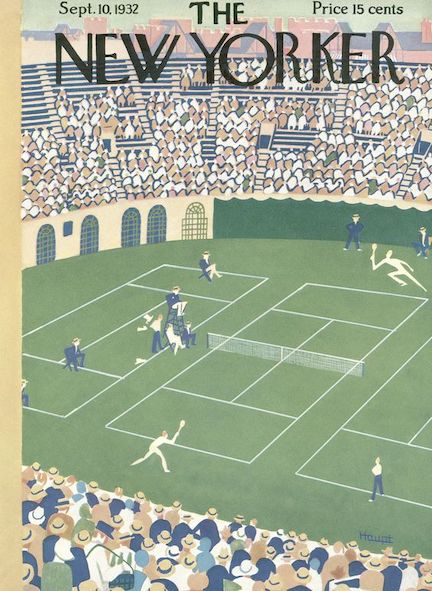
Jan. 30, 1932 cover by Rose Silver.

The year marked the beginning of a catastrophic famine that swept across the Soviet countryside, thanks to the government’s bone-headed and heartless forced collectivization that caused more than five million people to perish from hunger. Those events, however, were still on the horizon when Robin Kinkead, a New York Times Moscow correspondent, ventured out into Moscow’s frigid streets in search of a lightbulb. Here is his story:

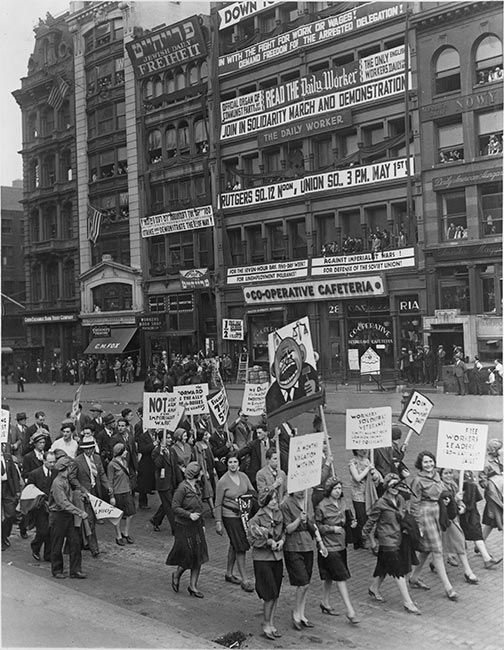
WE HAVE PLENTY OF NOTHING FOR EVERYONE…In 1930s Moscow, and in the decades beyond, much of life consisted of standing in line for everything from bread to light bulbs.
MAGIC LANTERN…Russian peasants experience electricity for the first time in their village. (flashback.com)
STALIN CAST A LARGE SHADOW over his subjects, even when they sought a bit of light in the darkness. Stalin and Lenin profiles served as glowers in this Soviet lightbulb, circa 1935. The first series of these bulbs were presented to the delegates of Soviet parliament of 1935, just in case they forgot who was in charge—or who might liquidate them at any moment, for any reason, or for no reason. (englishrussia.com)

*  *  *

One of Theirs

Miguel Covarrubias was one of the first artists to contribute to the fledgling New Yorker, and his linear style was well known to readers when he opened his latest show at New York’s Valentine Gallery. It featured works he had created during a 1931 sojourn in the East Indies. Critic Murdock Pemberton found the palette reminiscent of Covarrubias’ earlier work during the Harlem Renaissance:

GLOBETROTTER…A frequent contributor to the early New Yorker, Miguel Covarrubias traveled the world in search of inspiration. His 1932 exhibition at New York’s Valentine Gallery featured his latest work, a series of “Balinese paintings” including In Preparation of a Balinese Ceremony, at right. (sothebys.com)
MAN OF MANY TALENTS…An early Covarrubias contribution to the New Yorker in the March 7, 1925 issue.
 *  *  *
From Our Advertisers
Listerine had been around since the late 1860s, but it wasn’t marketed as a mouthwash until 1914. The brand really took off in the 1920s when it was heavily advertised as a solution for “chronic halitosis” (bad breath), so in 1930 its makers went one step further by adding a few drops of their product to one of the chief causes of bad breath. The folks at Listerine were also keen to the growing market of women smokers—note the fifth paragraph: “They seem to appeal especially to women”…

…when you run out of ideas to amuse your grandchild, drop your top hat and walking stick and let him take you for a swing on a GE fridge door…wow, admire its “all-steel sturdiness” as it slowly tips toward the unsuspecting lad…

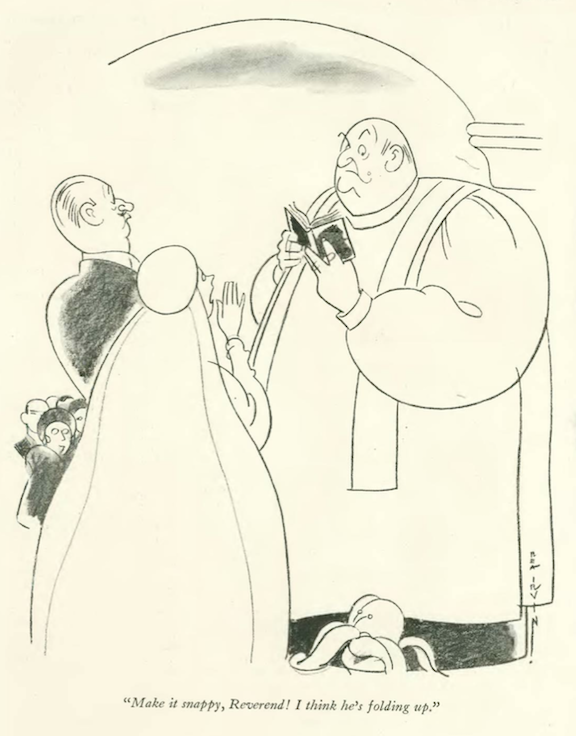
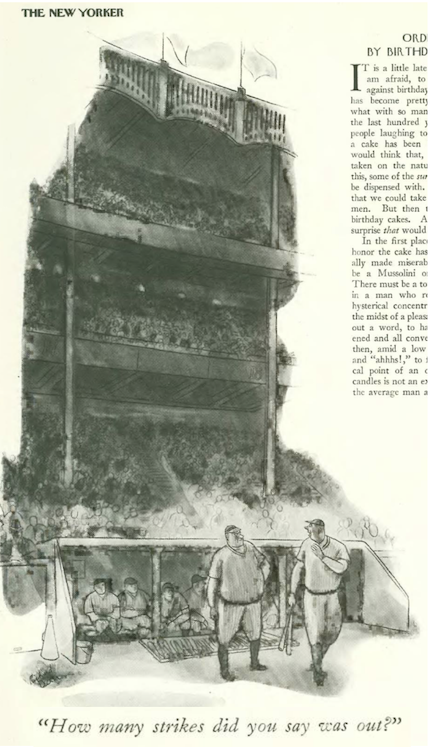
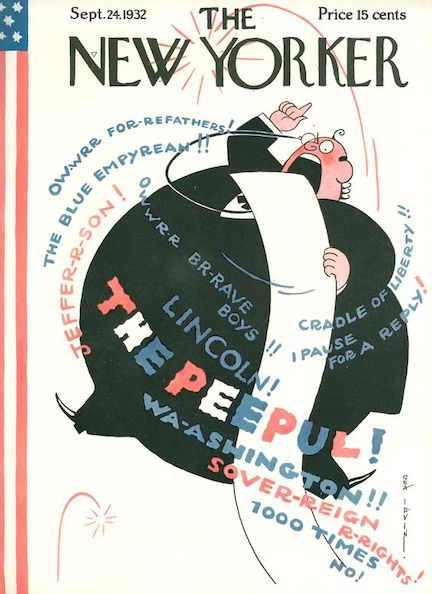
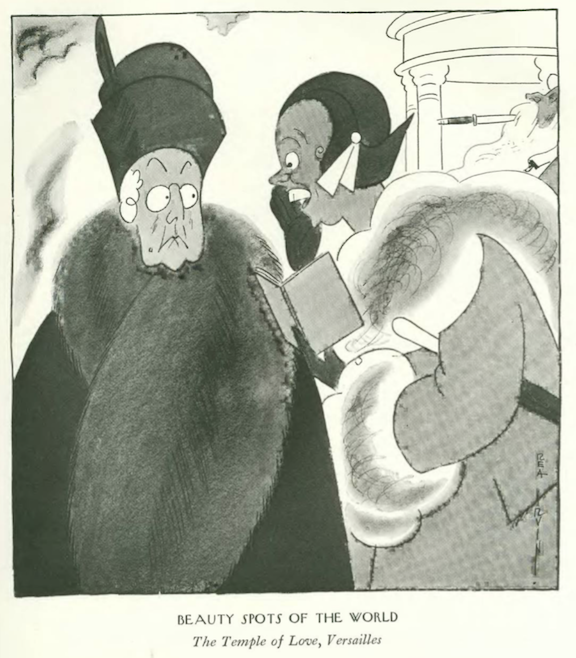
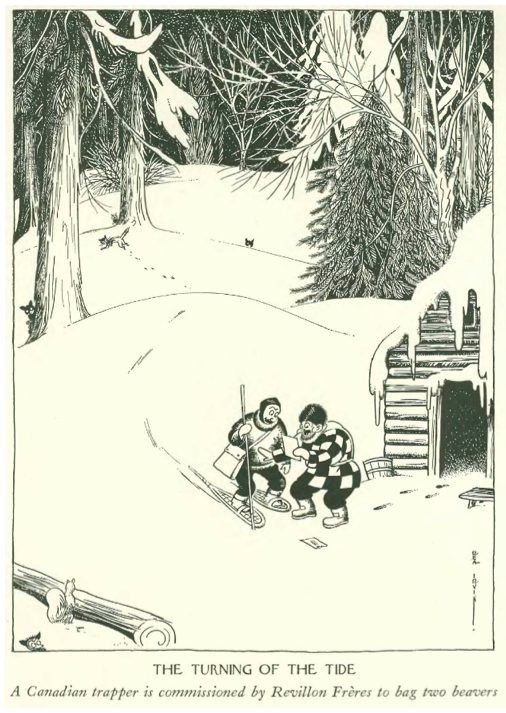
…on to our cartoons, Rea Irvin showed readers what he thought of the latest “rosy” economic predictions…

…but with the economy still deep in the dumps, building continued to boom, per Robert Day

Perry Barlow gave us a fellow needing a break from the daily gloom…

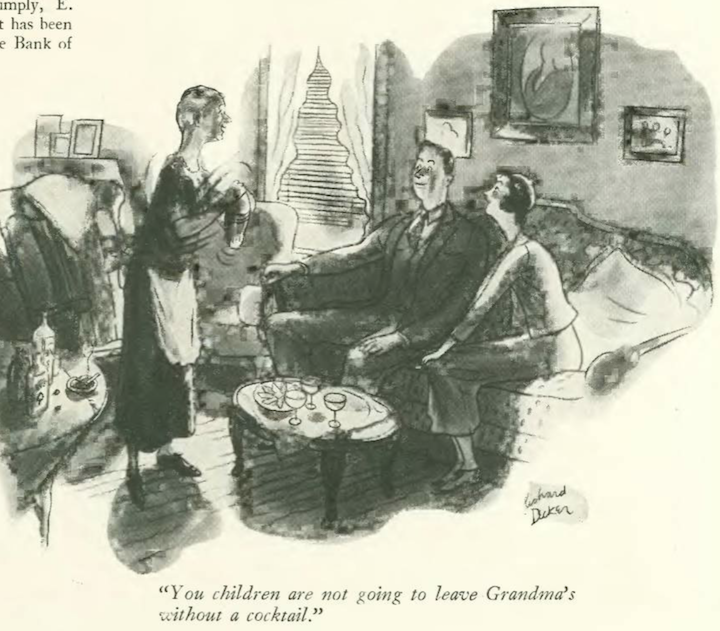
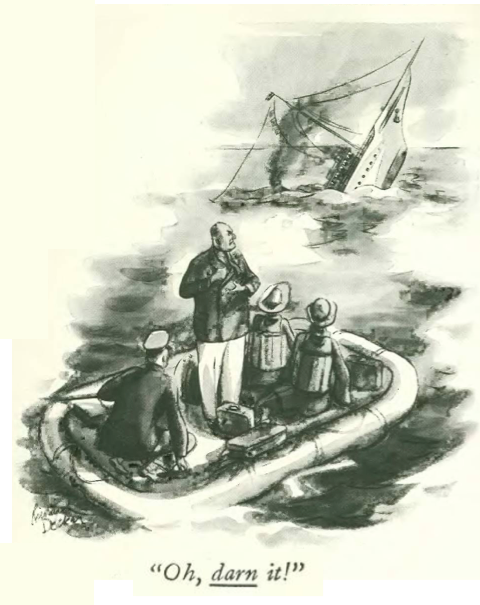
Richard Decker unveiled this crime-fighting duo…

Alan Dunn tempered the flames of passion…

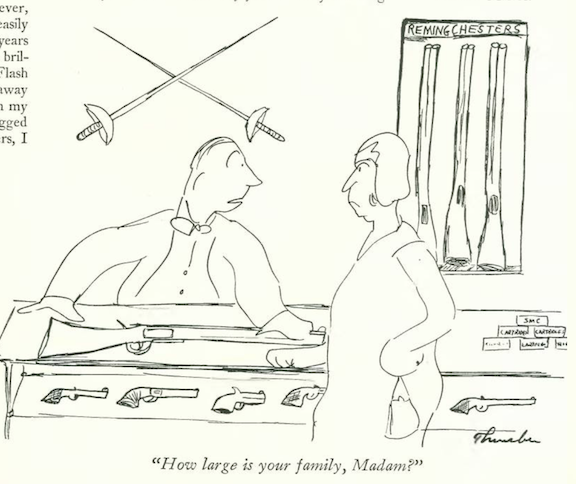
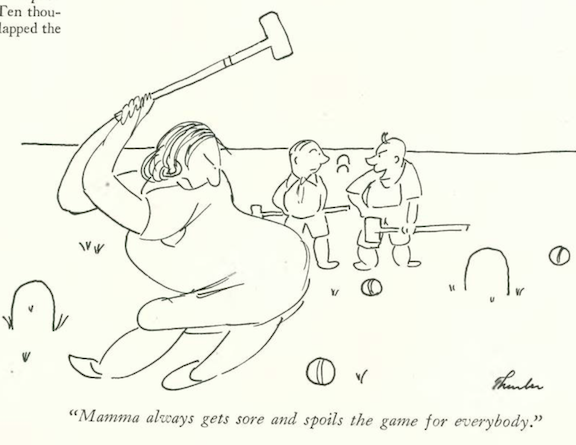
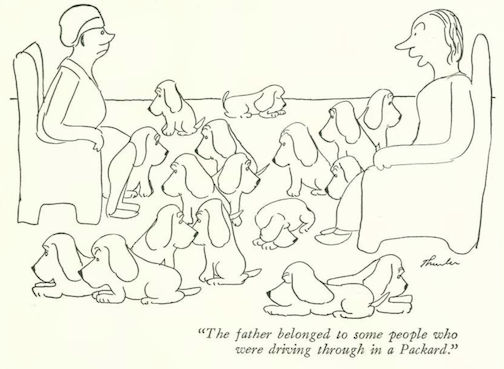
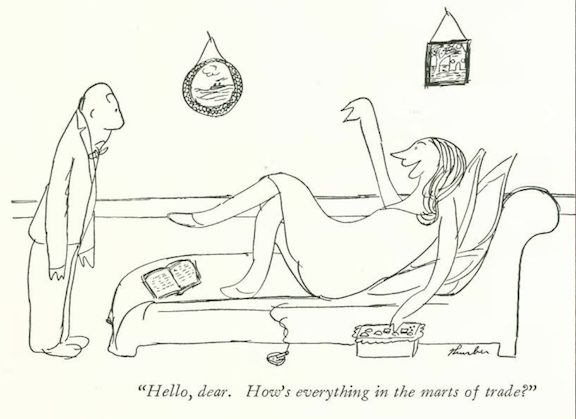
…and we close this issue with one of James Thurber’s most famous cartoons…

…on to Feb. 6, 1932…

Feb. 6, 1932 cover by Constantin Alajalov.

…and we head straight to our advertisers…and yet with another sad Prohibition-era ad, this from the makers of Red & Gold Vintages, who promised to dress up your bootleg rotgut with many fine flavorings…

New Yorker founding editor Harold Ross couldn’t care less about the advertising department as long as it paid the bills and kept its nose out of editorial, but I wonder if a cig dropped from his lips when he glanced at this ad…

…as noted in the Listerine ad above, tobacco companies were eager to tap the growing market of women smokers…actress Sue Carol egged on the sisterhood in this ad…Carol would have a brief acting career (including 1929’s Girls Gone Wild—not quite as racy as the 1990s DVD series) before becoming a successful talent agent…

…as noted in my previous “Dream Cars” post, women were also a fast growing market for automobiles, and manufacturers—desperate for Depression-era sales—scrambled to show women all of the swell gadgets that would make driving a snap (as if men didn’t need these gadgets too)…

…and here we have an ad from Kodak that demonstrated the ease of its home movie camera, which could go anywhere, say, like the horse races in Havana…

…Havana then was a playground for wealthier Americans, and many resided at a grand hotel operated by another rich American…

…but if you remained in town, you should at least know how to get tickets to the latest show (this drawing is signed “Russell”…could it be the noted illustrator Russell Patterson?)…

…on to our cartoons, Rea Irvin again commented on the latest predictions for economic recovery…

…but Alan Dunn found one woman who wanted an adventure, not a job…

…perhaps she should hang out with one of Barbara Shermund’s “New Women,” who had a flair for the dramatic…

…as for those seeking a new life, Mary Petty considered the costs…

Richard Decker took us to the high seas, where a thirsty yachtsman hailed a passing smuggler…

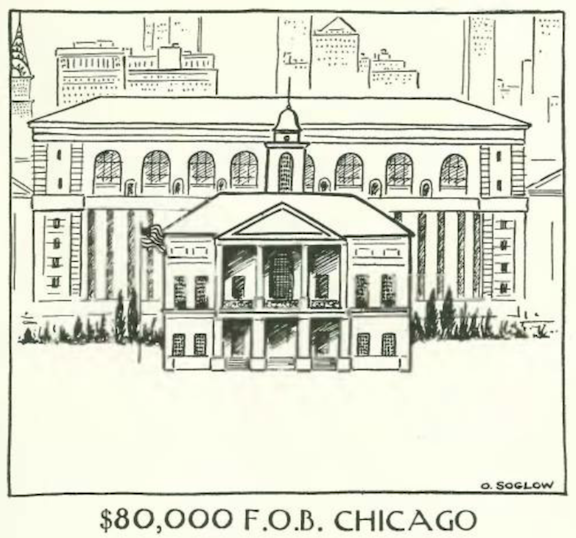
Otto Soglow probed the sorrows of youth…

…and William Crawford Galbraith, the joys…

…and James Thurber introduced his classic dog in a big way on this two-page spread…

…and on to one more issue, Feb. 13, 1932…

Feb. 13, 1932 cover by S. Liam Dunne.

…we begin with a nerd alert—the Feb. 13 cover represented one of the magazine’s biggest departures from the original Rea Irvin nameplate, here heavily embellished within S. Liam Dunne’s design. Departures in previous issues were more subtle, Irvin himself experimented with an elongated version in the third issue (below, left). For the April 17, 1926 issue, Katharine and Clayton Knight’s* stylish illustration (center) was the first to overlap part of the nameplate, and Sue Williams’ Nov. 17, 1928 cover (right) was the first to embellish the Irvin font.

*A note on Katharine Sturges Knight and Clayton Knight. The April 17, 1926 cover (center) was the only design by the Knights published by The New Yorker. The original picture was drawn on wood by Katharine and then cut by Clayton. Their son, Hilary Knight, is also an artist, best known as the illustrator of Kay Thompson’s Eloise book series.

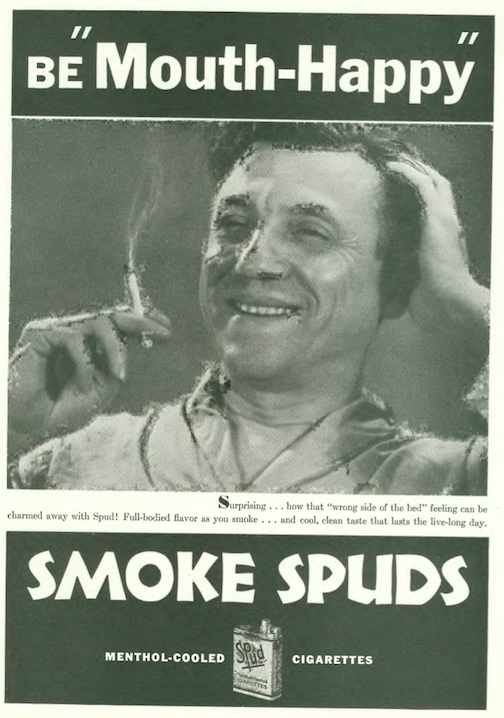
…on to the advertisements, kicking off with this subtle appeal from the makers of the unfortunately named “Spud” menthol cigarettes…here a young woman experiences Spud’s “mouth-happiness” while attending the annual Beaux Arts Ball at the new Waldorf-Astoria…

…if you’re wondering why the Spud ad featured a guy in a powdered wig puffing on a cigarette, well the theme of the 1932 ball was “A Pageant of Old New York.” Every year had a different costume theme, and the ladies and gentlemen of the ruling classes delighted in dressing up for the occasion…

PLAYING DRESS-UP…Program for the 1932 Beaux Arts Ball, and two of the attendees, Frank Sanders and Frances Royce. (Pinterest)

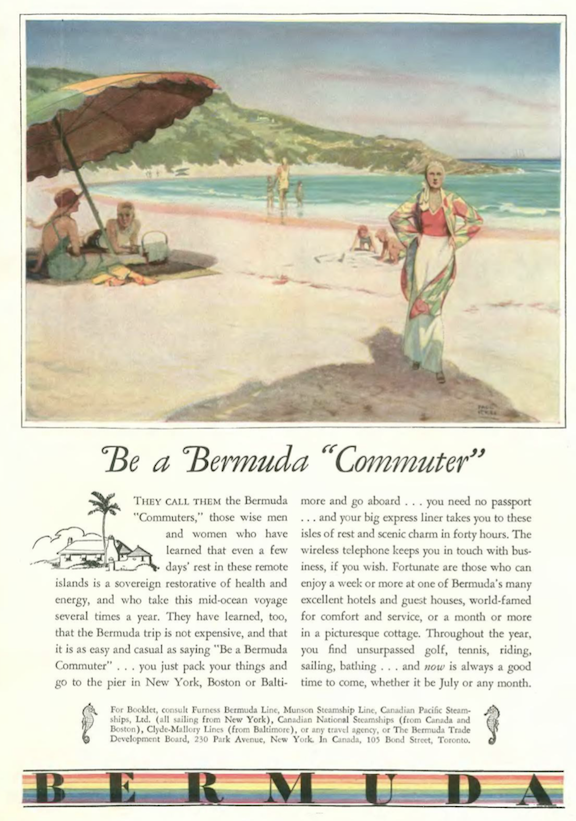
…if stuffy events weren’t your thing, you could chuck the fancy duds and head to the sunny beaches of Bermuda…

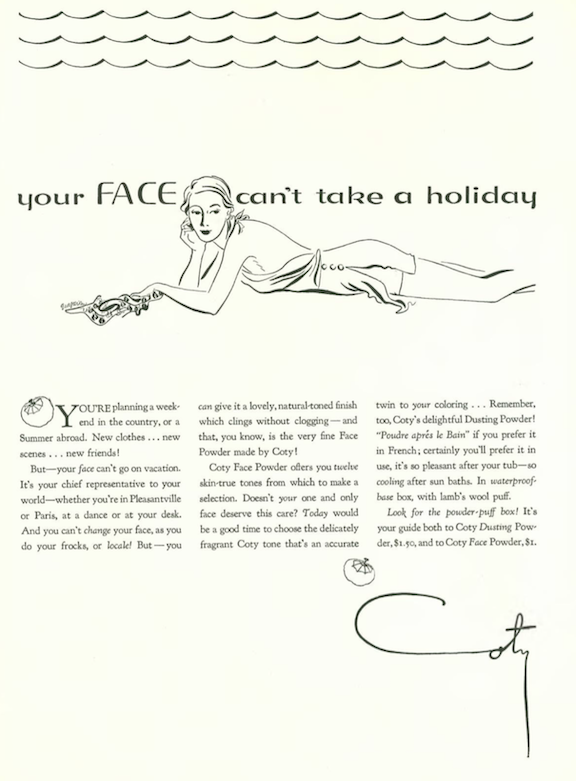
…I include this Coty advertisement for its modern look — it easily could have appeared in a magazine from the 50s or even 60s…the artwork is by American fashion illustrator Ruth Sigrid Grafstrom…

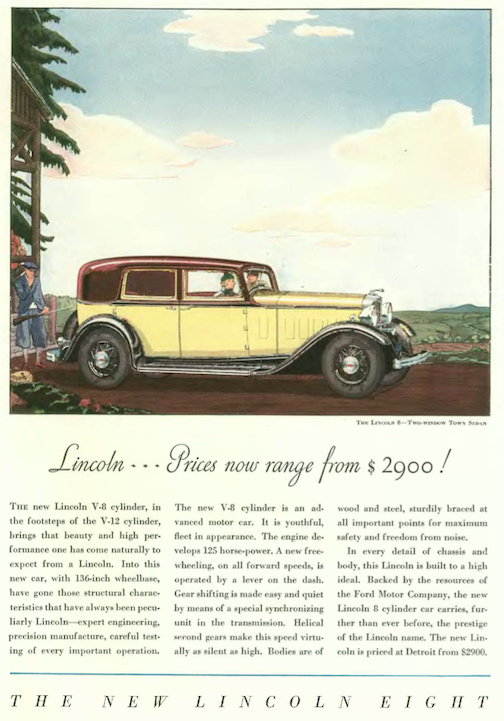
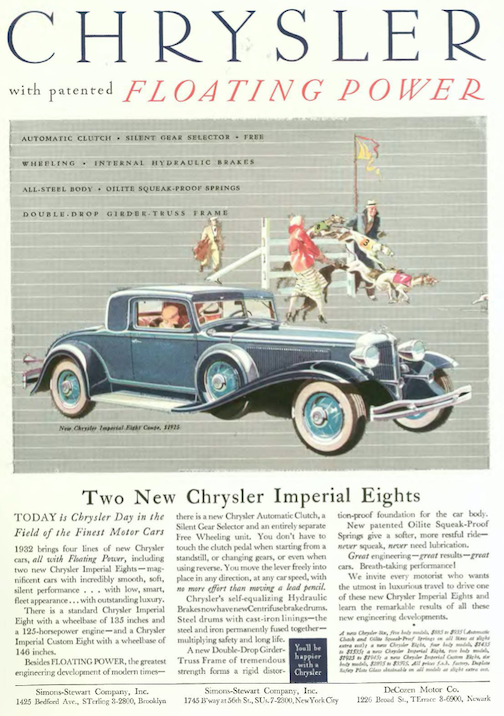
…the auto show has left town, but for some reason the makers of 12-cylinder models continued to shill their products in the New Yorker…Auburn (the middle ad) built beautiful, upscale vehicles, but the Depression would drop it to its knees by 1937…Pierce Arrow would succumb the following year…Lincoln, the highest-priced of these three, would hang on thanks to the largess of parent Ford…

New Yorker cartoonist John Held Jr. picked up some extra bucks by designing this ad for Chase and Sanborn’s…

…and on to our other cartoonists/illustrators, Reginald Marsh wrapped this busy dance hall scene around a section of “The Talk of the Town”…

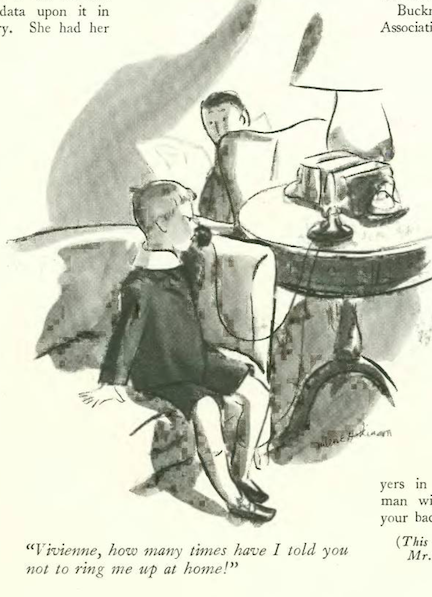
Otto Soglow was back with his Little King, and the challenges of fatherhood…

Leonard Dove gave us a knight lost on his crusade…

Richard Decker explored the softer side of gangster life…

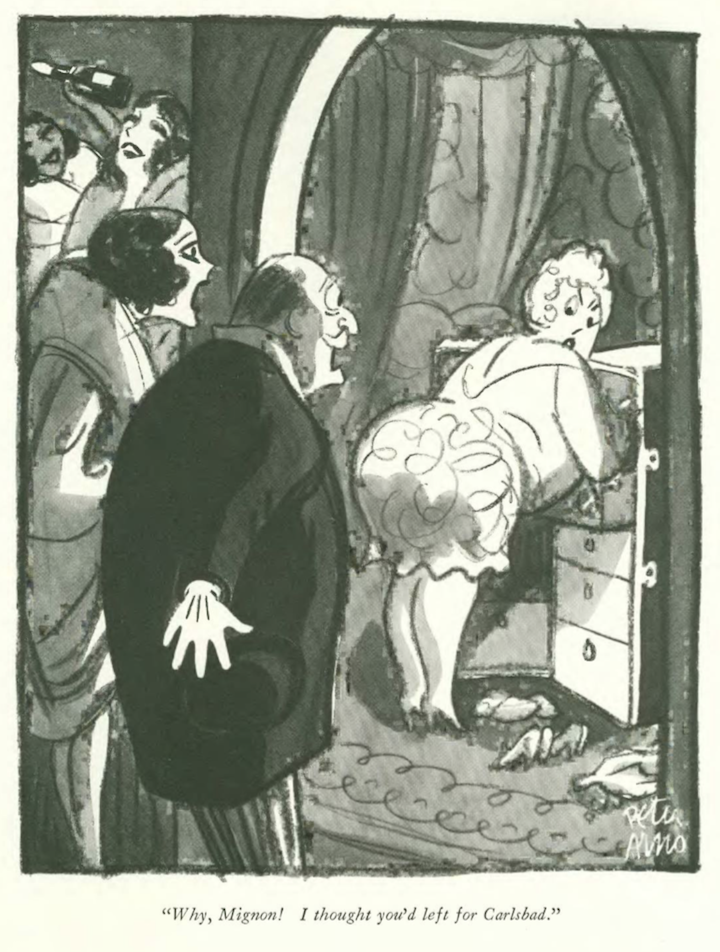
…and we sign off with Peter Arno, and a little misunderstanding…

Next Time: Winter Games…

Dream Cars

Whether or not you could afford a new car in Depression-era New York, you could afford to take your mind off the hard times for a few hours and visit the annual National Automobile Show at Grand Central Palace.

Jan. 16, 1932 cover by S. Liam Dunne.

The 1932 exhibition featured many familiar brands, and others that would not survive the decade. Bolstered in part by the largess of General Motors and its downscale LaSalles, Cadillac could offer a pricey edition of the Fleetwood (at $5,542, roughly equivalent to $100K today), but most car makers featured models with reduced prices and/or smaller engines, as well as new technologies and design features they hoped would attract buyers of modest means. Excerpts from The New Yorker’s “Motors” column:

CAN’T TOUCH THIS…The Cadillac V16 Fleetwood sat atop the American car world in 1932. (classicdriver.com)
LOOK, BUT DON’T BUY…The New Yorker noted the crowds gathered around the Studebaker –produced “Rockne” at the National Automobile Show. Named for the famed Notre Dame football coach Knute Rockne (who died in a 1931 plane crash), this 1932 model attracted plenty of gawkers at the show but few buyers. It was soon discontinued, and leftover Rocknes were disassembled and sent to Norway, where they were reassembled and sold to Scandinavian buyers. (conceptcarz.com)
DOUBLE VISION…The 1932 Oakland Roadster (left) marked the end of the Oakland Motorcar Company, which had been previously acquired by General Motors. That same year Oakland was reborn as the Pontiac division, and the Oakland Roadster was reimagined as the 1932 Pontiac Model 302 (right). (Hemmings/justamericanautomobiles.com)
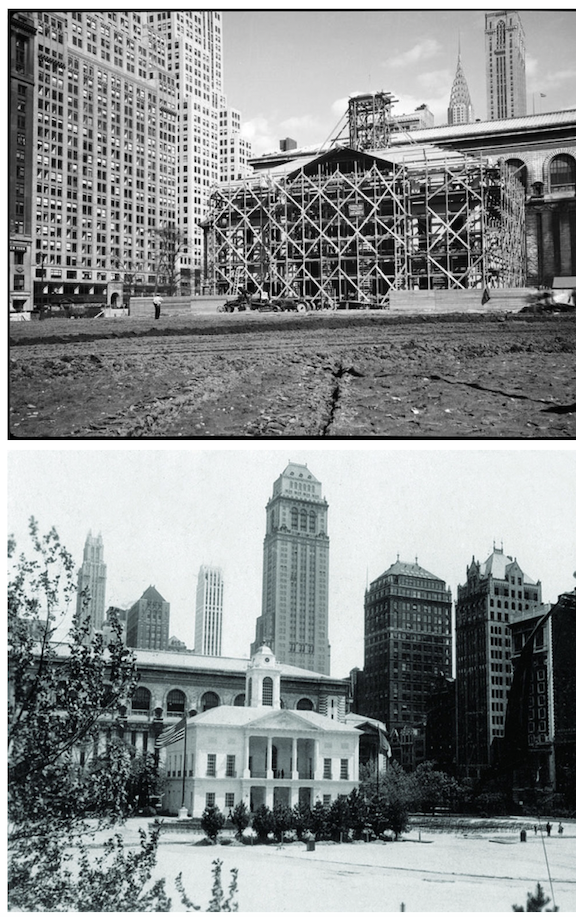
PALACE OF DREAMS…Grand Central Palace (top right) sat at Lexington Ave. between 46th and 47th Streets. A favorite locale for manufacturers to display their latest wares, it was demolished in 1963; at left, images from the 1935 National Automobile Show; bottom right, 1932 copy of The Wheel, produced by Studebaker for distribution at auto shows. (freelibrary.org/chicagology.com)

Whether folks were able to shell out more than $5,000 for a Caddy or a mere $700 for Plymouth, many left the show with nothing more than dreams for better days. Howard Brubaker summed it up thusly in his “Of All Things” column:

  *  *  *

Darling Lily

Coloratura soprano Lily Pons (1898–1976) was not well-known in her native France when she took the Metropolitan Opera stage by storm in 1931—she would become the Met’s principal soprano and, in 1940, an American citizen. The singer was profiled by Janet Flanner in the Jan. 16 issue (caricature by Miguel Covarrubias). Excerpts:

FRENCH TOAST OF THE TOWN…Coloratura soprano Lily Pons was particularly associated with the title roles of Lakmé (pictured above, mid-1930s), and Lucia di Lammermoor. Pons was a principal soprano at New York’s Metropolitan Opera for 30 years, appearing 300 times from 1931 until 1960. (Pinterest/YouTube)

If you have a few minutes, check out Lily Pon’s 1935 performance of “The Bell Song” from the film I Dream Too Much, which co-starred Henry Fonda. Although the sound quality is not the greatest, you can still get a pretty good idea why Met audiences adored her.

 *  *  *

Fantasy Bridge

Satirist Ring Lardner found something rotten in the behavior of robber barons and politicians in the midst of the Depression, so he imagined a bridge game that brought together banker J.P. Morgan (Jr), John D. Rockefeller (then the richest person in America and perhaps the world), Sen. Reed Smoot of the Smoot-Hawley Tariff Act (a catalyst for the Depression), and social worker Jane Addams. Excerpts:

DEAL ME OUT…Ring Lardner addressed the wages of greed through a fantasy bridge game. (Dallas Morning News)

*  *  *

From Our Advertisers

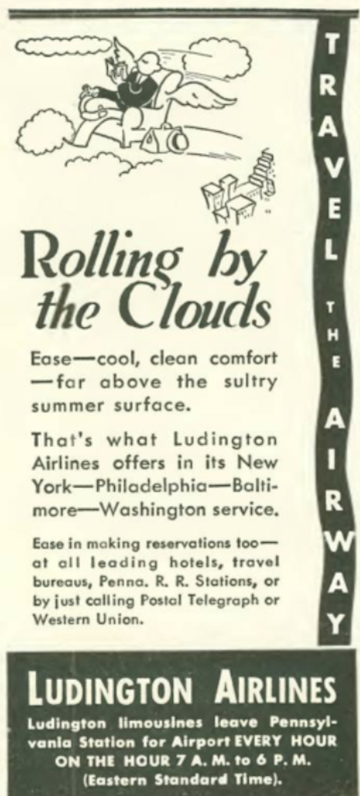
If you were one of J.P. Morgan’s bankers, you might have considered hopping on a United flight instead of taking the train—within 20 years, airlines would make a serious dent into railroad’s corporate travel business…

…and if you were a successful banker, your daughter or granddaughter might have been an aspiring deb with some very specific needs…

…the Little King also had some specific fashion needs, as Otto Soglow brings us to the cartoon section…

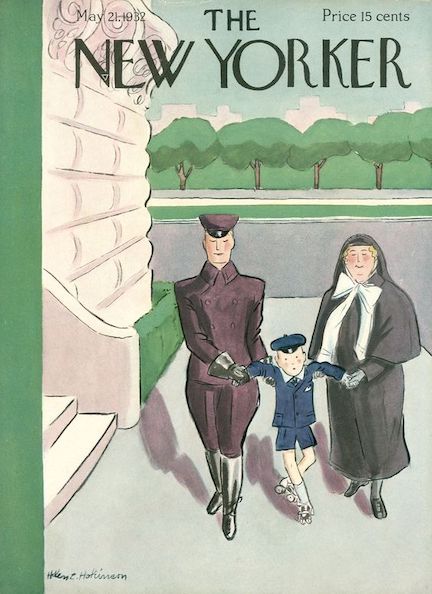
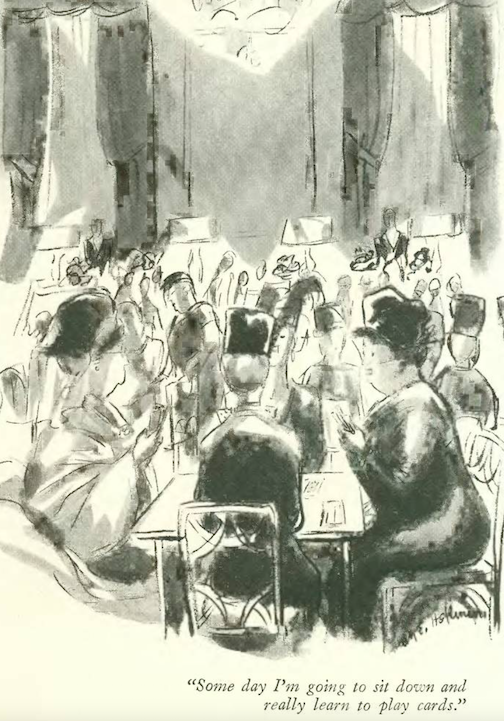
…with the Auto Show in town, Helen Hokinson got her girls into the conversation…

…the “wizard control” they refer to was Buick’s gimmick to attract more women drivers to their product…here’s an ad from the Feb. 6 issue of the New Yorker:

…back to our cartoons with James Thurber, and the “war” that continued to brew between men and women (note artwork on the wall)…

Al Freuh offered his perspective on meagre predictions for prosperity…

…as did one of William Steig’s precocious children…

…and Helen again with another privileged view of the downtrodden…

Barbara Shermund showed us one woman’s interpretation of “belonging”…

…and Denys Wortman gave us one salesman who probably dreamed of some solitary drinking…

…on to our Jan. 23, 1932 issue…

Jan. 23, 1932 cover by Rea Irvin.

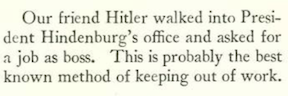
…and this item in “The Talk of the Town,” which noted the challenges of publishing a book about Adolf Hitler

…and a few pages later, we are treated to an E.B. White “song” written for delegates to the Conference for the Reduction and Limitation of Armaments which was being convened in Geneva, Switzerland…

Delegates from sixty countries attended the Geneva conference. They were there to consider the German demand that other nations disarm to the same levels that had been imposed on them by the Treaty of Versailles. The conference deadlocked by the summer, and when it was reconvened in February 1933 Hitler had just assumed power in Germany. By fall 1933 Germany withdrew from both the Disarmament Conference and the League of Nations, and the stage was set for another world war.

Here is a 1933 photo of the delegates to the Disarmament Conference before things went south:

(wdl.org)

A detail of the photo (below) reveals the identity of the tiny man seated at center: the representative from Germany—Minister of Public Enlightenment and Propaganda Joseph Goebbels. Just twelve years hence Goebbels would find himself trapped with Hitler and Eva Braun in a Berlin bunker as Soviet troops demolished the city above them. Goebbels and his wife, Magda, would poison their six children, and then themselves as the Third Reich crumbled to ashes.

A final note: The delegates weren’t alone in Geneva, as a number of peace organizations sent observers and demonstrators to the conference, many of them women:

APPEALS TO DEAF EARS…Women’s disarmament campaigner in Geneva, c.1932; right, a poster created by Dutch artist Giele Roelofs for the Northern Friends Peace Board and others. (London School of Economics/armingallsides.org.uk)

We’ll give the last word to Howard Brubaker in Jan. 30 “Of All Things” column:

 *  *  *

From Our Advertisers

With the National Automobile Show wrapping up, the Grand Central Palace prepared to welcome exhibitors for the annual Motor Boat Show…

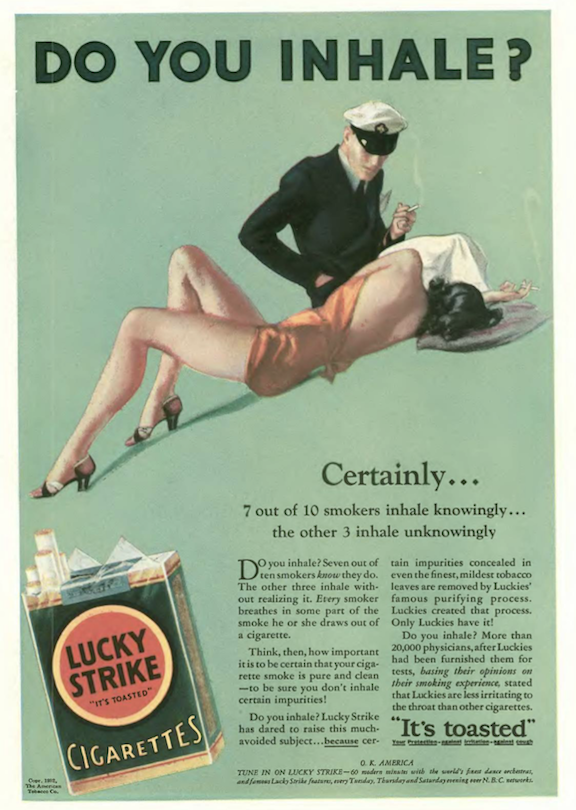
…the woman in this next ad might have been better off in a boat than on the beach…I’m wondering if the artist had any idea that his or her illustration would be used to promote coffee…it’s hard to tell what is going on here…apparently a young woman has almost drowned and is receiving oxygen, or maybe she doesn’t really need it, and the perverted lifeguard and cop just want to ogle the poor beachgoer, who seems bored by the whole predicament…

…there is also something vaguely sexual going on in this ad for Vicks (what is he looking out for in panel four?)…the artist (the cartoon is signed “Len”) seems to be channeling one of Rea Irvin’s series cartoons…

…in the early 20th century it was fashionable to smoke imported luxury Egyptian cigarettes, or counterfeits like Ramses II, produced in the U.S. by the Stephano Brothers…

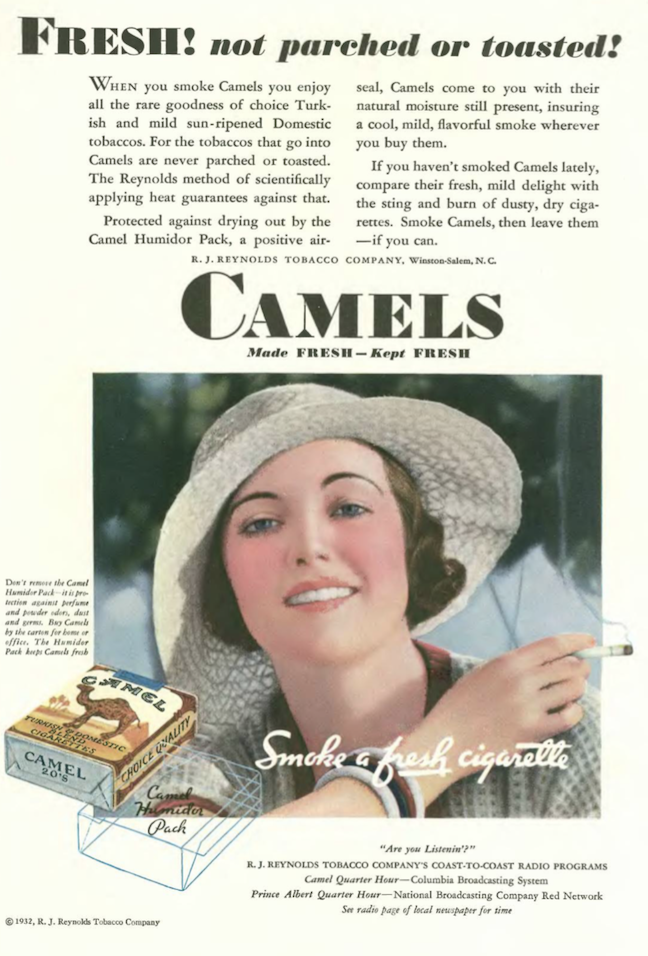
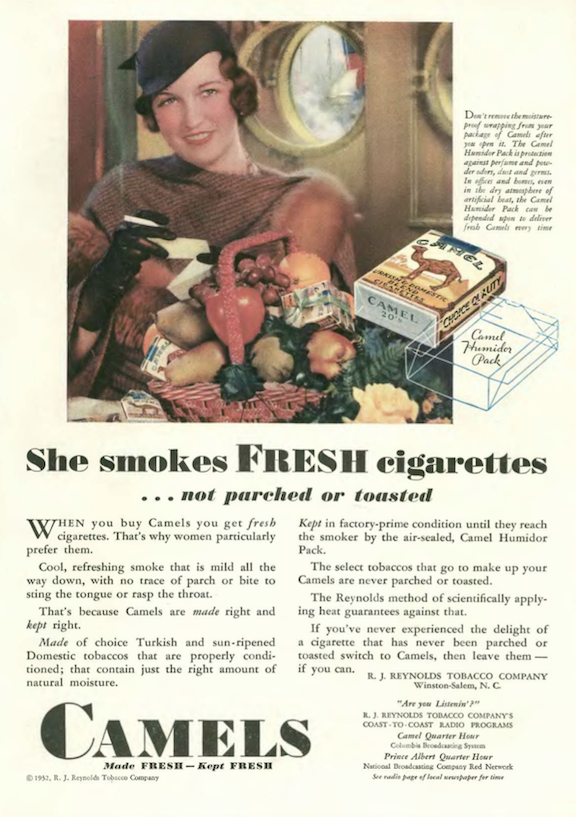
…the makers of Camel were among the most successful counterfeiters of Egyptian  cigarettes — the camel, pyramids and palm tree motifs were no mistake, but by 1932 this established brand (launched in 1913) went less for snob appeal and more for the active, fresh-faced youths whose pink lungs were highly coveted by R.J. Reynolds…

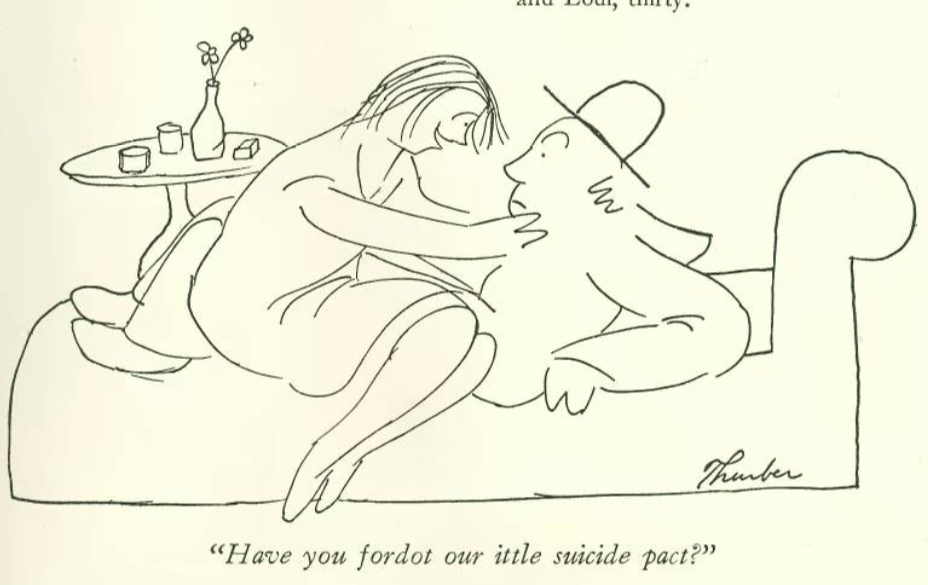
…on to our cartoons, we begin with James Thurber and some more sexual tension…

Garrett Price found a young hostess eager to to please…

Perry Barlow introduced us to a young man who (almost) never forgets a face…

William Crawford Galbraith dined with the uppers, not necessarily known for their literary sophistication…

Barbara Shermund gave us a proud collector who managed to evade the Puritans in U.S. Customs…

William Steig showed us pride of a different sort…

…and another by Steig displayed the antics of one of his “Small Fry”…

…and we end with Helen Hokinson, who found a local women’s club joining the debate raging far away at the Disarmament Conference in Geneva…

Next Time: Back in the USSR…

Thurber’s Dogs

James Thurber became acquainted with all sorts of dogs throughout his life, and in each he found something to admire. Unlike the men and women who were bound up by silly customs or norms, the dog stood steadfast as a “sound creature in a crazy world.”

Jan. 2, 1932 cover by Rea Irvin.

In the Jan. 2, 1932 issue, Thurber began what would become a decades-long paean to the noble canine—an embodiment of the freedoms conventional man would never attain. An excerpt from “A Preface to Dogs”…

“So why dogs?” Adam Gopnik asked the question under the title, “A Note on Thurber’s Dogs,” in Nov. 1, 2012 issue of The New Yorker. Gopnik explains that for Thurber, the dog represented “the American man in his natural state—a state that, as Thurber saw it, was largely scared out of him by the American woman. When Thurber was writing about dogs, he was writing about men. The virtues that seemed inherent in dogs—peacefulness, courage, and stoical indifference to circumstance—were ones that he felt had been lost by their owners.”

STOICAL INDIFFERENCE…Clockwise, from top left, James Thurber’s illustration of a childhood pet, a terrier named “Muggs” from the story “The Dog That Bit People” (1933); photograph of the real Muggs; dogs appear in many of Thurber’s cartoons as a stoic presence among maladjusted humans; Thurber at work on one of his dogs in an undated photo. (ohiomemory.org/jamesthurber.org)

Here’s one more excerpt that gives us glimpse into a dog’s day, as related by Thurber…

We’ve seen Thurber writing about dogs before, most notably in his spoof on newspaper pet columns titled “Our Pet Department.” Here is an excerpt from his first installment in the series, which appeared in fifth anniversary issue of The New Yorker, Feb. 22, 1930:

A final note: For more on Thurber, check out New Yorker cartoonist Michael Maslin’s Thurber Thursday entries at his terrific Ink Spill website.

 *  *  *

Choo Choo

While Thurber’s mind was on dogs, his buddy E.B. White was musing about the joys of train travel, and the hope that awaited journey’s end. Excerpts:

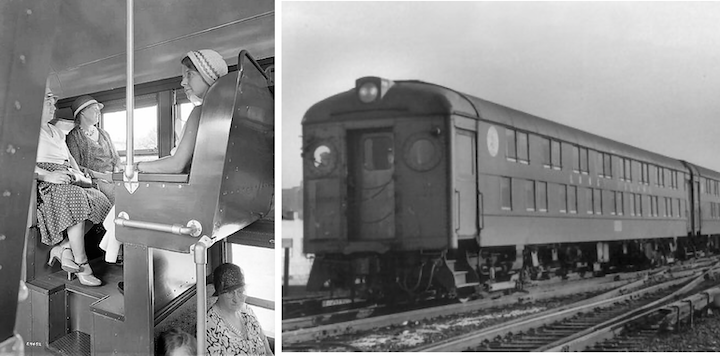
THIS DOES NOT SUCK…Riding on the Great Northern Railroad in 1926. (Pinterest)

 *  *  *

Party Poopers

Journalist Chester T. Crowell contributed the Jan. 2 “A Reporter at Large” column by looking through the thin facade of Prohibition enforcement in New York. He tells of Prohibition agents who visit a roadside tavern for several weeks (and enjoy the beer) before finally raiding the place. Beer kegs are broken up and the door to the bar is padlocked. But all was not lost for the proprietor, who got some business advice from the raiding agents…

KEG PARTY…The New York Daily News featured this photo on June 18, 1931 with this caption: “Tears mingled with strong beer in Newark, N.J. as prohibition agents destroyed the unlawful liquor, some of which was seized in Hoboken raid.” (NY Daily News/Mashable)

*  *  *

No Laughing Matter

As we move through the 1930s we’ll see more signs of the world (war) to come. Reed Johnston had some fun with the messy politics of Weimar Germany, making a parenthetical reference to the “Nazis” of the National Socialist party who would soon take control of the country…

 *  *  *

Upstaged

A box office and critical success, Hell Divers is considered Clark Gable’s breakout role, but the real stars were the Curtiss F8C-4 “Helldivers” that were used in filming aerial battle scenes. Critic John Mosher takes it from there…

ART IMITATES LIFE…Wallace Beery and Clark Gable played rivals onscreen and offscreen in Hell Divers. The upstart Gable disliked the veteran actor Beery, a well-known misanthrope whom many actors found difficult to work with. (IMDB)

 *  *  *

Yet More Diego

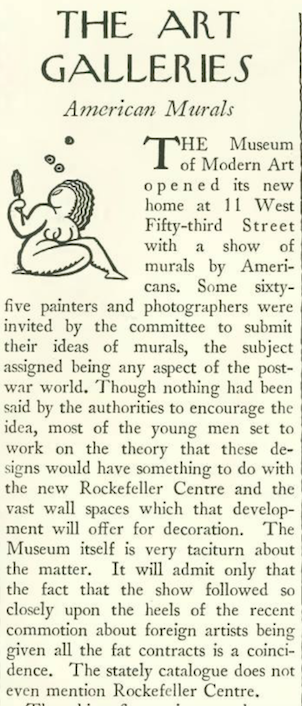
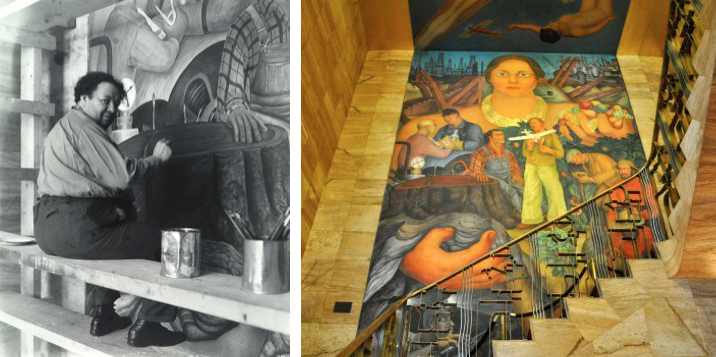
Art critic Murdock Pemberton had more to say about Diego Rivera’s appearance at the Museum of Modern Art, noting that Rivera “has been fortunate to be living in a liberal country (Mexico), where his propaganda could be spread upon the walls of public buildings.” Pemberton correctly surmised that Rivera would “starve” if he tried to paint similar themes in the U.S. (Indeed, in 1933 Rivera would refuse to remove an image of Lenin from a Rockefeller Center mural, and would be asked to leave the country).

I SHALL RETURN…Diego Rivera returned to New York in 1933 on a commission to paint a mural for the new Rockefeller Center. The inclusion of Soviet leader Vladimir Lenin (inset) in the work was not well-received in the Capital of Capitalism. (npr.org/Wikipedia)

 *  *  *

From Our Advertisers

It’s snowing in Manhattan, and you’re tired of slogging though the snow and slush—well, if you didn’t lose your shirt in the stock market, and if you didn’t need to work a steady job, then you could get away from it all and head to the “sunlit paradise” of the West Indies…

…or grab some sun time in Nassau…

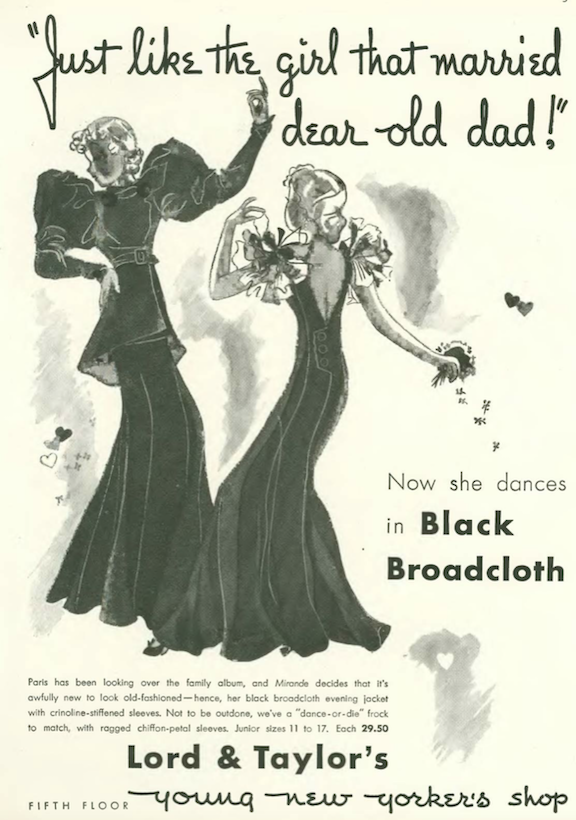
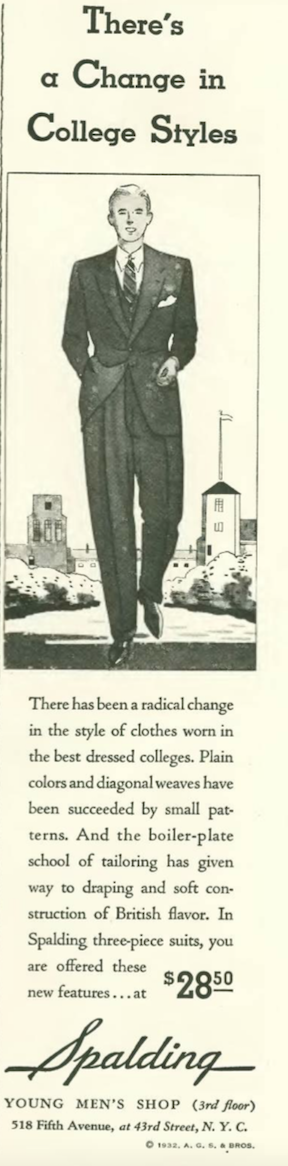
…but before you go, you might want to pick up some warm-weather duds at Lord & Taylor…

…or at L.P. Hollander on East 57th…

…to ring in the New Year we kick off the cartoons with William Crawford Galbraith

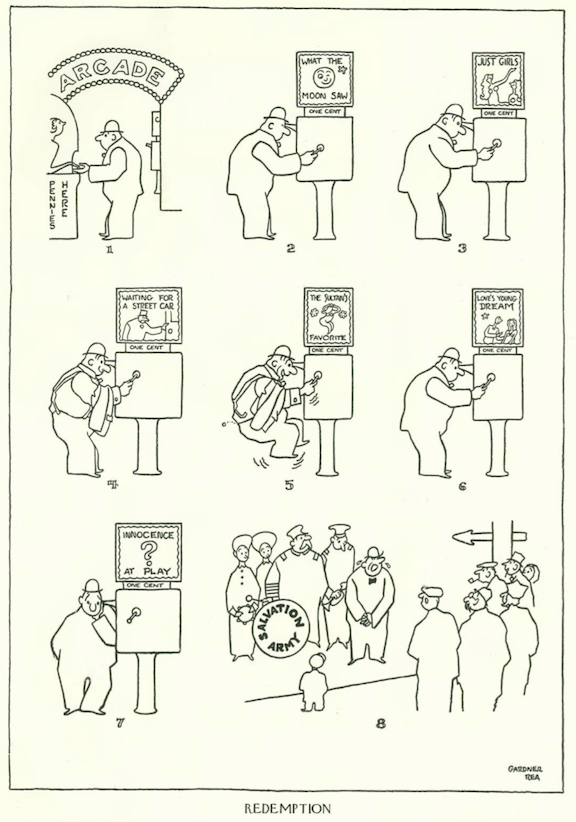
Gardner Rea showed us how old money and no money don’t mix…
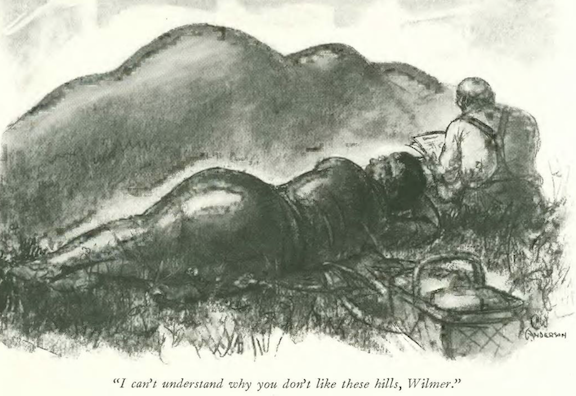
Helen Hokinson gave us a double entendre to go along with car trouble at a service station…

…communication also seemed to be a challenge for this chap in a William Steig cartoon…

…and we end where we began, with the great James Thurber and the looming battle between the sexes…

Next Time: Babylon Berlin…

Yankee Doodles

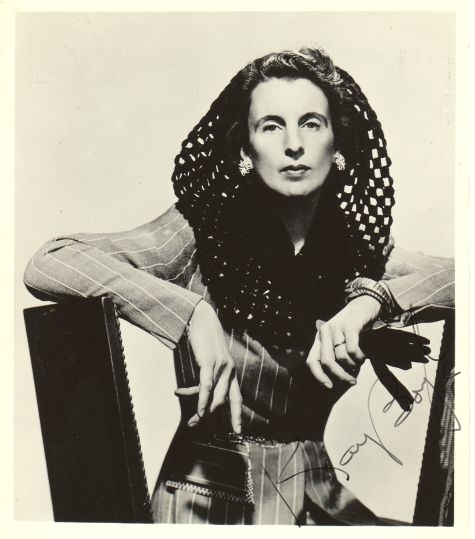
In 1931 Gertrude Vanderbilt Whitney (image above) opened a new art museum in Greenwich Village that would be unlike any other in Manhattan, one that would focus exclusively on American art and artists.

Nov. 28, 1931 cover by Harry Brown.

Ninety years ago American painters and sculptors were mostly considered second-rate by critics who had cut their teeth on the Old World’s “Great Masters.” An exception was The New Yorker’s first art critic, Murdock Pemberton, who accused such institutions as the Metropolitan Museum of discouraging American art. It is a bit surprising, however, that Pemberton initially gave a cool reception to the opening of the Whitney Museum of American Art, perceiving that its founders were putting the cart before the horse:

AMERICAN ORIGINAL…The original Whitney Museum of American Art was located at 8–12 West Eighth Street in Greenwich Village. Above, images from a 1937 museum catalog, and (bottom right) a view of the building’s West Eighth Street facade, circa 1940-50. (Whitney Museum/Life magazine)
SHE WORE THE PANTS…Robert Henri’s 1916 portrait of Gertrude Vanderbilt Whitney, sculptor and founder of the Whitney Museum. Gertrude’s husband, Harry Payne Whitney, would not allow his wife to hang the portrait in their Fifth Avenue town house because he didn’t want visitors to see his wife “in pants.” Instead, the portrait hung in Gertrude’s West 8th Street studio, which became the first Whitney Museum in 1931. (whitney.org)

Despite Pemberton’s initial concerns, the Whitney became a beloved New York institution, moving in 1954 from the West Eighth location to a larger space on West 54th, and then to its iconic Marcel Breuer-designed building at Madison and 75th, which opened in 1966. The museum would move again in 2015 to its current location at 99 Gansevoort Street in a building designed by Renzo Piano.

IMPERMANENT COLLECTION…The Whitney would move three times after its 1931 opening, first to West 54th in 1954, then to its iconic Marcel Breuer-designed home at Madison and 75th (opened in 1966), and finally to its current location at 99 Gansevoort Street. (museuminforme.blogspot.com)

 *  *  *

Party Pooper

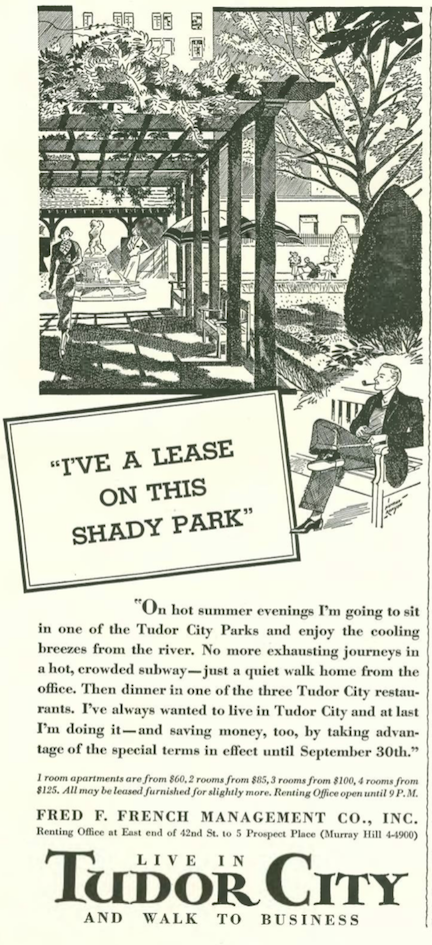
William Faulkner attracted much attention among literary circles during his extended visit to New York in 1931, however (as reported in “The Talk of the Town”) the author was able to dodge most of it by staying put in his Tudor City apartment.

HOME ALONE…William Faulkner spent most of his time in New York holed up in his Tudor City apartment, where he worked on the manuscript for Light in August. (LA Times/Wikipedia)

 *  *  *

This or That

While we are on the subject of literary giants, here is a poem submitted by E.B. White to the Nov. 28 issue that explored some universal half-truths:

*  *  *

From Our Advertisers

As the market for cigarettes continued to increase, so did the number of new brands launched to take advantage of all those eager young puffers. The makers of Condossis Cigarettes hoped to create some buzz for their new product through a series of ads written by Mark O’Dea and illustrated by The New Yorker’s Gardner Rea. Apparently the makers of Condossis believed that a posh backstory would lend a certain élan to their smokes. This seems all for naught—I haven’t found a record of the brand beyond 1938…

…a few of those posh smokers might have considered heading to Monte Carlo for the holidays, where they could also legally drink and gamble and forget about the jobless masses back home…

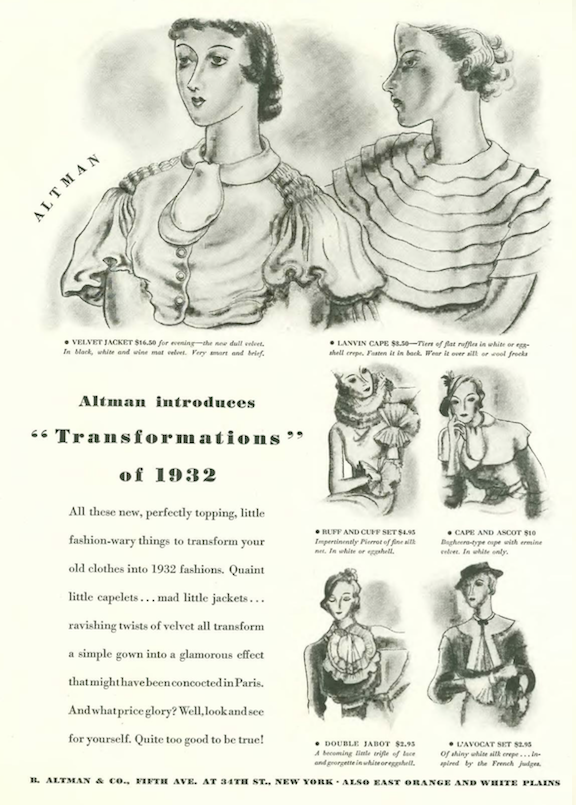
…but you needn’t go to Monte Carlo to signal your taste for the finer things, at least that is what B. Altman claimed with their lower-priced French knock-offs (although $95 was still a lot of dough in 1931)…

…Bonwit Teller also boasted of its low-priced evening wraps, so affordable that one could consider having a different wrap to complement every gown in one’s wardrobe ($135 in 1931 is roughly equivalent to $2,300 today)…

…the makers of Lenthéric perfumes offered the potential for shame and embarrassment if one didn’t choose their product for that special holiday gift…(illustration by Frank McIntosh, who contributes a cartoon in the next issue)…

…but perhaps the happiest shopper of all could shell out a mere $2.50 for the latest editions of The Fourth New Yorker Album or The New Yorker Scrapbook (drawings of a delighted couple courtesy Peter Arno)

…on to our cartoons, we begin with Mary Petty and a tête-à-tête over tea…

…and Petty again with one woman’s attempt at noblesse oblige…

Barbara Shermund looked in on the very idle rich…

William Steig spotted a bald-watcher…

E. McNerney revealed a secret among siblings…

…and William Crawford Galbraith gave us a backstage glimpse of a Broadway revue…

 *  *  *

On to the Dec. 5 issue…

Dec. 5, 1931 cover by Rea Irvin.

…which featured a profile of renowned violinist and composer Efrem Zimbalist (1889-1985). The son of a Russian conductor, Zimbalist was married to the famous American soprano Alma Gluck

…and the entertainment gene continued on through the family line, as Zimbalist and Gluck’s son, Efrem Zimbalist Jr., would become a star in Hollywood, as would their granddaughter, Stephanie Zimbalist.

ALL IN THE FAMILY…Famed violinist Efrem Zimbalist and American soprano Alma Gluck (top, left) would pass on their entertainment genes to son Efrem Zimbalist Jr. (known for his starring roles in 77 Sunset Strip and The F.B.I.) and granddaughter Stephanie Zimbalist, who portrayed sleuth Laura Holt in the NBC series Remington Steele. Top right, a “Profile” caricature of Zimbalist by Al Frueh. (Wikipedia/Pinterest)

 *  *  *

From Our Advertisers

Much to the delight of The New Yorker advertising department, the makers of Condossis Cigarettes were back with their second installment of the adventures of the “Condossis Family”…

…on the other hand, the well-established Chesterfield brand didn’t have to try quite as hard — offering an attractive woman and some supporting copy that subtly suggested that a woman could credit her fine demeanor to a mere cigarette…

…on to our comics, we have this two-page entry by Rea Irvin

…a bit of offensive driving, Helen Hokinson-style…

Carl Rose gave us an unlikely candidate for a chaste role…

Alan Dunn’s entry played to the stereotypes of his day…

Frank McIntosh plied the Sugar Daddy waters to come up with this gem…

Garrett Price gave us a gift designed to light a man’s fire…

Barbara Shermund lit a flame of a different sort between a dowager and her latest escort…

…and we end with James Thurber, and one of my all-time favorites…

Next Time: Mosher’s Monster

Some Comic Relief

From the Upper East Side and the vaudeville stage to the shining lights of Hollywood went the Marx Brothers in 1931, starring in their first movie written especially for screen rather than adapted from one of their stage shows.

Oct. 17, 1931 cover by Adolph K. Kronengold.

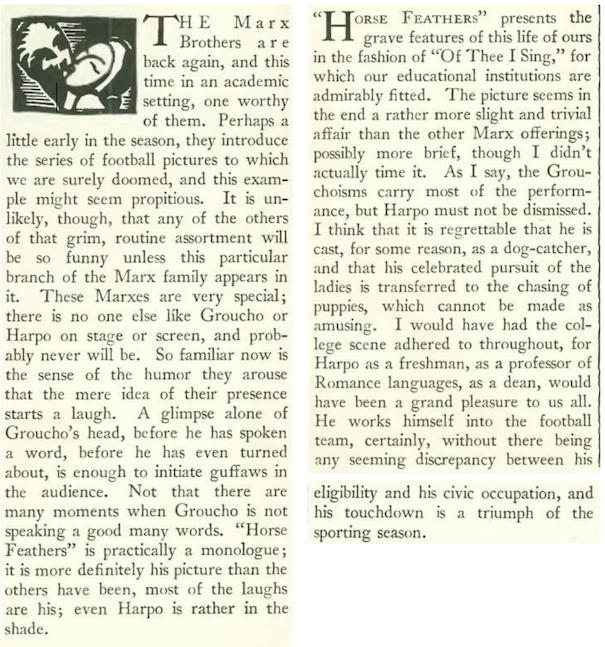
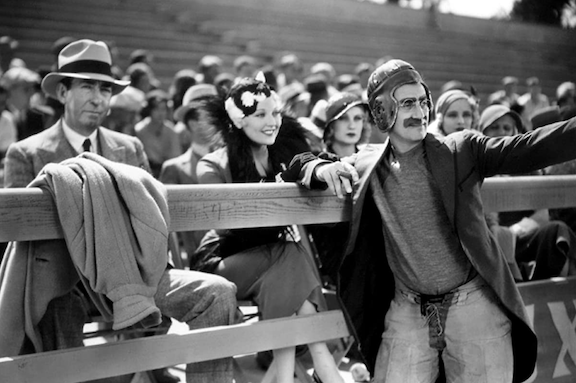
Monkey Business also their first film to be shot outside of New York. The brothers’ first two pictures—The Cocoanuts (1929) and Animal Crackers (1930)—were filmed at Paramount’s Astoria Studios in Queens. Film critic John Mosher found their latest movie to be a “particular prize” among the somewhat ordinary fare being cranked out of Hollywood. It featured the four as stowaways on an ocean liner bound for America, and that’s all you really need to know, because like most of their films it cut quickly to the chase…

Monkey Business was the first film to label the troupe the “Four Marx Brothers” (a billing that would continue through their Paramount years). A fifth brother, Gummo, left the team early and went on to launch a successful raincoat business.

NEVER A DULL MOMENT…The Marx Brothers were up to their usual antics in their first Hollywood-made film, Monkey Business. At top, Groucho performs an egg trick on a society couple; at bottom, he does a bit of hoofing with comedian Thelma Todd. (IMDB)

 *  *  *

Monkey’s Uncles

There was a New Yorker connection to Monkey BusinessS. J. Perelman‚ a frequent contributor of humorous shorts to the magazine, was one of the screenwriters for the film. And it just so happens that one of Perelman’s shorts was in the Oct. 17 issue, and it was a doozy…

MAKE ‘EM LAUGH…Writer and cartoonist Will B. Johnstone (left) wrote the screenplay for Monkey Business with S. J. Perelman, right, in a 1935 portrait by Ralph Steiner. (Meg Farrell/Yale University)
A promotional cartoon for Monkey Business by Will B. Johnstone. He also created the cartoon character of The Tax Payer wearing only a barrel held up by suspenders. It was a regular feature in the New York World-Telegram. (Meg Farrell via travsd.wordpress.com)
 *  *  *
Office Chatter
E.B. White called out a couple of his New Yorker colleagues in “Notes and Comment” as he mused about “lady poets” and their disillusionment with the menfolk. The “Selma Robinson” he mentions was a young writer who had just published her first collection of poems titled City Child

…White then moved on the subject of matrimony and advice columns, zeroing in on Dorothy Dix, the most widely read woman journalist of her time with an estimated 60 million readers turning daily to her syndicated column…

LIGHTEN UP ON THE LOVEBIRDS, DOROTHY, E.B. White seemed to suggest in his “Notes and Comment” item about syndicated advice columnist Dorothy Dix. (Associated Press/The New York Times)

 *  *  *

So Much for Prognosticators

The New Yorker ran an amusing two-page spread that contained the quotes of prominent writers, politicians, businessmen and economists—month by month since the October 1929 market crash—who predicted a swift end to the Depression and better times just around the corner. An except below (note the reprise of Otto Soglow’s manhole cartoon).

 *  *  *

It Pays to be Funny

Richard Lockridge (1898–1982) was a reporter for The New York Sun when he began submitting comic sketches to The New Yorker such the one excerpted below. Later sketches would include the characters Mr. and Mrs. North. In the late 1930s Lockridge would collaborate with his wife, Frances Louise Davis, on a detective novel, combining her plot with his Mr. and Mrs. North characters to launch a series of 26 novels that would be adapted for stage, film, radio and television.

PARTNERS IN CRIME…Richard and Frances Lockridge examine one of their mystery novels in this undated book jacket photo. At right, the cover of their second “North” book, with cover illustration by Helen Hokinson (note the similarities of the Mr. and Mrs. North characters to Richard and Frances).

 *  *  *

Land Barge

The “Motors” column featured the latest luxury offering from Germany, the massive 12-cylinder Maybach Zeppelin, which would set you back a cool $12,800 in 1931 (roughly $200,000 in today’s currency). Named for the company’s production of Zeppelin engines in the World War I era, the car weighed 6,600 pounds (3,000 kg).

THE 12-CYLINDER Maybach Zeppelin was not known for its economy. (Wikipedia/Alf van Beem)

 *  *  *

From Our Advertisers

The new Chevrolet Six was no Maybach, but the folks at GM nevertheless tried to suggest it was a car for the posh set…

…when Kleenex was first introduced to American consumers in 1924 it was marketed as a tissue for removing cold cream, and wasn’t sold as a disposable handkerchief until the 1930s…

…and contrary to the wisdom of the ages, the makers of Old Gold cigarettes tried to convince us that their cigarettes would not leave smokers with bad breath or yellowed teeth…

…Winnie-the-Pooh, or here referred to as “Winnie, The Pooh,” was only five years old when this ad was created for Macy’s, and even before Disney got his hands on him the bear was being turned into various consumer products including baby bowls, handkerchiefs and lamps…

…the color ads in the early New Yorker were quite striking, such as this full-pager for Martex towels…

…or this one for Arrow shirts, featuring a determined coach making an important point to his leatherheads before the big game…

…on to our cartoons, we have Otto Soglow’s Little King engaging in some sport of his own…

Alan Dunn showed us a meter reader who probably needed to come up for some fresh air…

William Crawford Galbraith gave us a sugar daddy without a clue…

E. McNerney showed us another pair that begged the question “what comes next?”…

…this Mary Petty cartoon recalls Carl Rose’s famous “I say its spinach” cartoon—and Mamma has every right to say “the hell with it” in this case…

…in this William Stieg entry, a father teaches his young charge the art of rubbernecking…

…and Don Herold gave us a peek at what the little dears really talk about while their parents exchange the latest gossip…

…on to the Oct. 24, 1931 issue…

Oct. 24, 1931 cover by Rose Silver.

…where we find the latest edition of Frank Sullivan’s satirical newspaper, The Blotz, which occupied a two-page spread (excerpt below)…

…and featured this masthead of sorts (with James Thurber art)…

…and another Thurber contribution as The Blotz’s political cartoonist…

…more colorful ads to enjoy, including this nighthawk view of an apartment house…

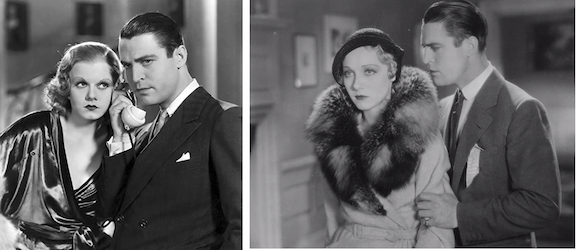
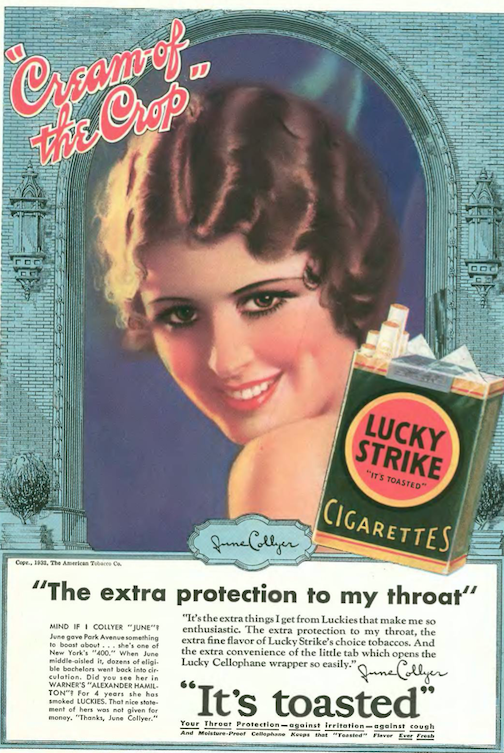
…and this ad for Lucky Strike cigarettes, featuring 20-year-old Platinum Blonde star Jean Harlow (what is she leaning on?) who probably shouldn’t have smoked because her health was always a bit fragile—she would be dead in less than six years…

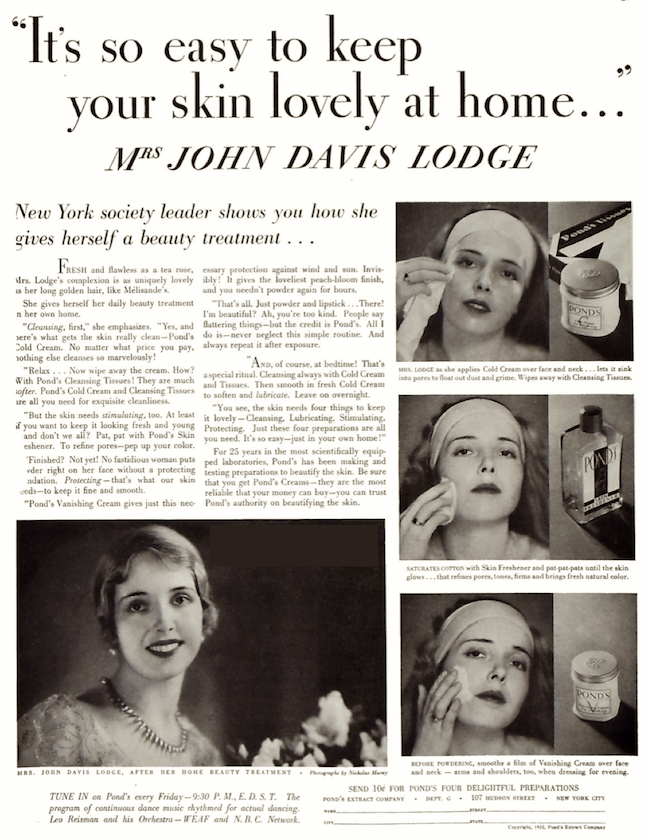
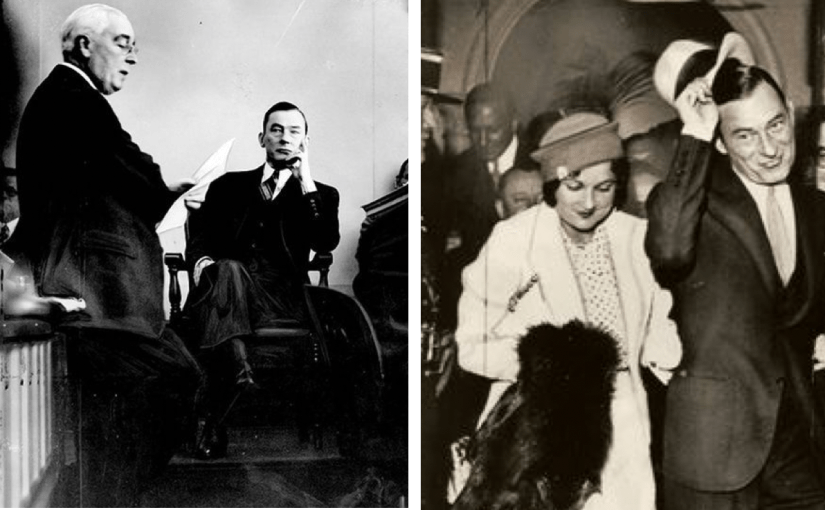
…ands then we have our latest high society shill for cold cream, Marchioness of Milford Haven, aka Nadejda Mikhailovna Mountbatten, aka Countess Nadejda de Torby, aka Princess George of Battenberg…she was probably best known for her part in the 1934 Gloria Vanderbilt custody trial, when a a former maid of Vanderbilt’s mother, Gloria Morgan, testified that the Marchioness had a lesbian relationship with Morgan…

Helen Hokinson continued loaning one of her “girls” to Frigidaire to extol the wonders of their seemingly indestructible refrigerators…

…our Oct. 24 cartoons feature Garrett Price, who brought us the exciting world of the traveling salesman…

A. S. Foster served up an Italian stereotype…

Isadore Klein, on the other hand, turned a stereotype on its head…

…and we end with Rea Irvin, who gave us what I believe was a first in The New Yorker—a cartoon character breaking the fourth wall…

…by the way, M.F.H. stands for Master of Fox Hounds…I had to look it up.

Next Time: Through a Glass Darkly…

The Coming War

While many Americans partied through the Roaring Twenties, there were a few voices out there, barely audible, that warned of economic collapse and another world war.

Oct. 3, 1931 cover by Helen Hokinson.

The humorist and New Yorker contributor Frank Sullivan was among the few who took notice of the dire predictions (of war, anyway) and turned it into a funny take on how a European war might unfold. Excerpts:

Sullivan’s last line is a wordplay on “air,” and not likely a prediction of the horrible firebombing and V-2 attacks that would devastate Europe in the following decade.

In Sullivan’s day two notable predictions of war came from British economist John Maynard Keynes and British author Hector Charles Bywater. In his 1919 book, The Economic Consequences of the Peace, Keynes warned that “unstable elements,” destroyed during the Great War (WWI), had not been replaced with more stable networks or institutions. Bywater’s prescient 1925 novel, The Great Pacific War, featured a hypothetical future war between Japan and the U.S. that predicted a number of events in World War Two’s Pacific Theatre.

I SEE DEAD PEOPLE…Economist John Maynard Keynes and British author Hector Charles Bywater both didn’t like what they saw coming on the horizon.

There were reasons for Keynes to be concerned. Germany found many ways to subvert restrictions imposed by the Treaty of Versailles, and continued to make technological advances in armaments and air power. Moreover, the Treaty’s humiliating terms and demands for costly reparations would lead to a rise in German nationalism in the midst of mass unemployment and a volatile economy. In just a little over a year Adolf Hitler and his Nazi Party would seize control of the German state.

And as Bywater feared, the Japanese invaded Manchuria (under false pretenses) on Sept. 18, 1931, and then ignored orders to withdraw from the League of Nations (which had been established by a covenant included in the Treaty of Versailles). Japanese warlords were emboldened by the ease of this takeover and the toothless response from the international community. This scenario would be replayed by the Nazis when they invaded Czechoslovakia in 1939.

UGH, IT’S THAT GUY…Clockwise, from top left, Adolf Hitler rolls into Weimar as the Nazi Party continued to gain power in 1930; Hitler youth out for a bike ride in 1932; Japanese troops celebrate their easy invasion of Manchuria in September 1931; political cartoon illustrated Japan’s attitude toward international treaties. (Wikipedia/Pinterest)

 *  *  *

The Man Who Would Not Be King

The world that was gradually setting the stage for World War II was also the world of Edward VIII, the Prince of Wales. A renowned womanizer and major disappointment to his father, George V, this heir to the British throne would begin a secret affair with American socialite Wallis Simpson that would later lead to his abdication as king after a reign of just 326 days. In a two-part profile, the New Yorker’s London correspondent Anthony Gibbs could already see that Edward would not be like other monarchs, this lonely “fish out of water” bored with court protocol and finding escape in a bottle of whisky. Excerpts from Part I (caricature by Al Frueh):

HITLER HONEYMOON…Edward VIII abdicated the British throne in December 1936 and married the newly divorced Wallis Simpson in June 1937. Four months later (right) they would pay a visit to Adolf Hitler and his thugs at Hitler’s mountain retreat above Berchtesgaden. Edward was known to be sympathetic to the Nazis, and favored the type of appeasement that would embolden Der Führer to invade Czechoslovakia and much of Europe beginning in 1939. (Pinterest/Wikipedia)

 *  *  *

From Our Advertisers

The opening of the new Waldorf-Astoria Hotel on Park Avenue had everyone and their dog getting in on a piece of the action, including manufacturers who hoped to associate their wares with the world’s tallest hotel…we begin with an ad from the hotel’s promoters…

…I surprised to find pedestrian products such as rayon curtains and aluminum chairs associated with the luxury hotel…

…but perhaps the novelty of these things made them “must-haves” associated with modern living in 1931…this ad from the Oct 10 issue…

…one habit of modern living was cigarette smoking, and thanks to aggressive advertising droves of women were joining the menfolk in this activity…

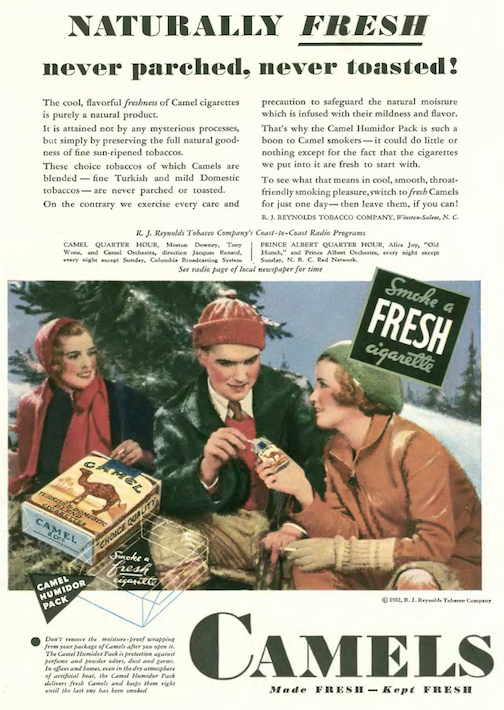
…Camels were originally promoted as a woman’s cigarette, and in 1931 R.J. Reynolds shifted their ad style from chic illustrations of disinterested, continental types, such as the one below by Carl Erickson from the March 21, 1931 issue (and imitated by the Spud ad above)…

…to photographs of fresh-faced American women…

…Barney’s ran this recurring ad (with illustration by Peter Arno) in the back pages of the New Yorker, the latest touting the reopening of Barney Gallant’s “continental cabaret”…

GOOD TIME BARNEY…Barney Gallant was a celebrity and a hero to many New Yorkers for his defiance of Prohibition. At left, actor/writer/producer John Murray Anderson (seated) and Gallant in a photo by Nickolas Muray. At right, illustration by Joseph Golinken of Gallant’s speakeasy Speako de Luxe at 19 Washington Square North. The first New Yorker to be prosecuted under the Volstead Act (serving 30 days in the Tombs), Gallant operated several Bohemian speakeasies in Greenwich Village during the 1920s. Stanley Walker (writing in his 1933 history, The Night Club Era) described the clientele as “youngsters with strange stirrings in their  breasts, who had come from remote villages on the prairie; women of social position and money who wanted to do things — all sorts of things — in a bohemian setting; businessmen who had made quick money and wanted to breathe the faintly naughty atmosphere in safety, and ordinary people who got thirsty now and then and wanted to sit down and have a drink.” (Metropolitan Museum/New York Historical Society)

New Yorker cartoonist William Crawford Galbraith picked up some extra income illustrating this ad for The New York American

…which segues into our cartoons, beginning with Alan Dunn and the art of the dance,

Barbara Shermund, who showed us that a war (movie) is hell…

William Steig continued to develop his repertoire of cartoons with precocious children…

Kemp Starrett gave us a salesman who put more than his foot in the door…

James Thurber continued his ongoing “dialogue” between the sexes..,

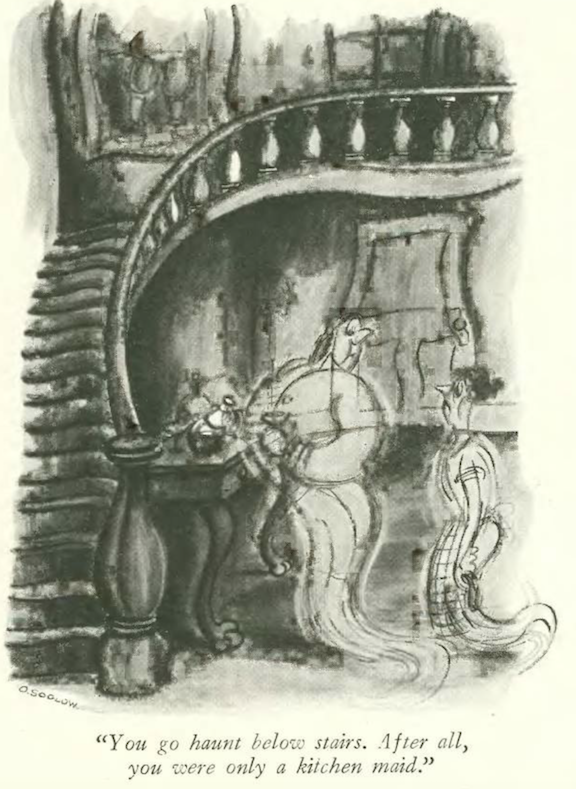
William Crawford Galbraith again, with his take on “Upstairs, Downstairs”…

Rea Irvin also exploring the theme in this two-page spread (click to enlarge)…

…and we end with another by Kemp Starrett, and the blasé attitude New Yorkers might display before the world’s tallest building…

Next Time: The Wayward Press…


Big Fish, Little Fish

Battery Park’s Castle Clinton was a fort, a popular entertainment complex, and an immigration depot before the architectural firm of McKim, Mead, and White transformed it into the New York Aquarium in 1896.

Sept. 26, 1931 cover by Rea Irvin.

The Aquarium’s beginnings were modest, but under the direction of zoologist Charles Haskins Townsend it became one of lower Manhattan’s biggest attractions. “The Talk of the Town” looked in on its latest acquisitions, including the first display of live piranha (here spelled paranha) in America:

When the Aquarium opened it was marvel of late 19th century technology; its enormous glass tanks and pools — holding more than 300,000 gallons of water — were controlled by an elaborate behind-the-scenes operation that ensured each species had the right kind of water conditions and food to survive, at least for awhile; the Aquarium in its early days, like the Central Park Zoo we visited recently, displayed its creatures as curiosities in decidedly unnatural surroundings…

DE-NATURED…In the New York Aquarium’s early days, fish and other aquatic animals were displayed in glass tanks that lined the out walls as well as in concrete ponds below the expansive trussed ceiling. If this rendering is accurate, then these creatures, especially the whales, had miserable, short lives. (thebattery.org)

…and this is a promotion for the Aquarium you would not see today…

…and here are a few images from the early years…more than 100 years old but still not easy to look at…

DRY-DOCKED…these are images used on postcards to promote the Aquarium — the black and white ones are from 1909, the color image circa 1925-30. Clockwise, from top left, Aquarium worker poking at a manatee with a stick (yeah fella, they’re not happy, and probably dying); a crocodile gets some dinner; image common from yesteryear of a child (or groups of children) sitting on a hapless turtle or tortoise; seals in a pool that contained water but nothing else remotely similar to their natural environment. (nyheritage.org)

…it’s easy for us to pass judgment on the unfortunate actions of our forebears, but to his credit Charles Haskins Townsend, director of the Aquarium from 1902 to 1937, advocated for bans on whaling and constantly worked to improve conditions at the Aquarium…

POPULAR DESTINATION…Whether folks were visiting the Aquarium or jumping on a riverboat or ferry, Battery Park was a place to go in the early 20th century. Top and bottom right, exterior and interior views of the Aquarium. Bottom left, the care and feeding took place behind the outer walls. (wcsarchivesblog.org)

…and Aquarium staff tried their best to keep fish alive during relocation, even using train cars specially designed for the purpose…

(Popular Mechanics 1931)

…once at the Aquarium, teams were ready to put the animals into their proper places…

LONELY NO MORE…Paddlewings, the lonely penguin apparently famous enough to be mentioned in the “Talk” piece, is pictured at right in this 1931 article. (Modern Mechanics, August 1931) click to enlarge.

The end came for the Battery Park aquarium when NYC Parks Commissioner Robert Moses proposed construction of the Brooklyn–Battery Tunnel under Castle Clinton. Moses also thought the aquarium was an eyesore, and had it demolished in 1941…

(thebattery.org)

…preservationists managed to stop the demolition before the walls of Castle Clinton were razed. It is now a national monument…

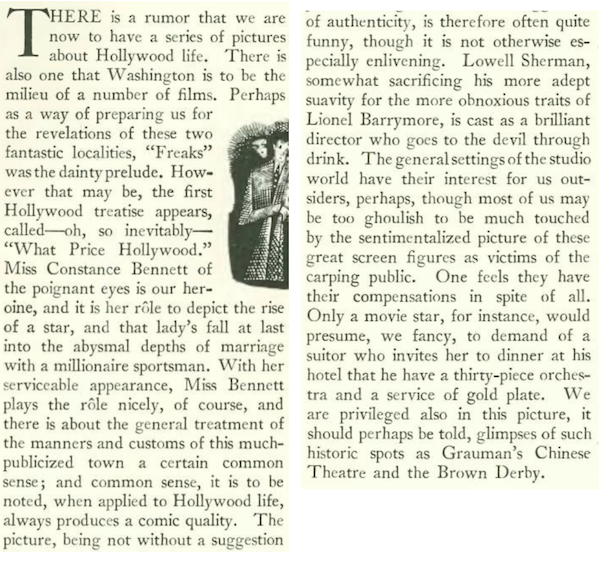
Castle Clinton, circa 1970s. (Flickr)

 *  *  *

Flying High

Attitudes toward drunken driving — or drunken flying — were very different 89 years ago. Case in point was this “Epitaph” written by Morris Markey marking the passing of Carter Leigh, who carried the air mail while flying under the influence (Reginald Marsh contributed the portrait) …

 *  *  *

Exit, Stage Left

The glitzy showgirl revues continued on Broadway with George White’s Scandals, which featured such headliners as singers Ethel Merman and Rudy Vallée, and hoofer Ray Bolger. Reviewer Robert Benchley wrote that the show gave him “the feeling of having a good time,” but the same could not be said for Mae West’s The Constant Sinner; Benchley thought the glare of West’s stardom upstaged the play itself:

SIMULACRUM OF A GOOD TIME…Robert Benchley questioned his own enjoyment of George White’s Scandals of 1931; from top, left, program from the show; singers Rudy Vallée and Ethel Merman were popular stars, as were hoofer Ray Bolger (who in 1939 would portray the Scarecrow in The Wizard of Oz) and actress Luella Gear (photo from the 1934 play Life Begins at 8:40); chorus girls in costume during a Scandals performance. (Playbill/Heritage Auctions/gershwin.com/Pinterest)
A STAR IS WORN…Benchley thought Mae West upstaged herself in The Constant Sinner. At right, West in a publicity photo with co-star Walter Petrie. (Playbill/Heritage Auctions)

 *  *  *

Play Ball

Sports columnist and occasional New Yorker contributor Ring Lardner enjoyed poking fun at revered institutions including Morris Markey’s “A Reporter at Large” column. Lardner rambled through several subjects but mostly reminisced about great baseball players of the past. Two brief excerpts: 

BEDTIME STORIES…the great American sports writer and satirist Ring Lardner, circa 1930. (Chicago Tribune)

 *  *  *

From Our Advertisers

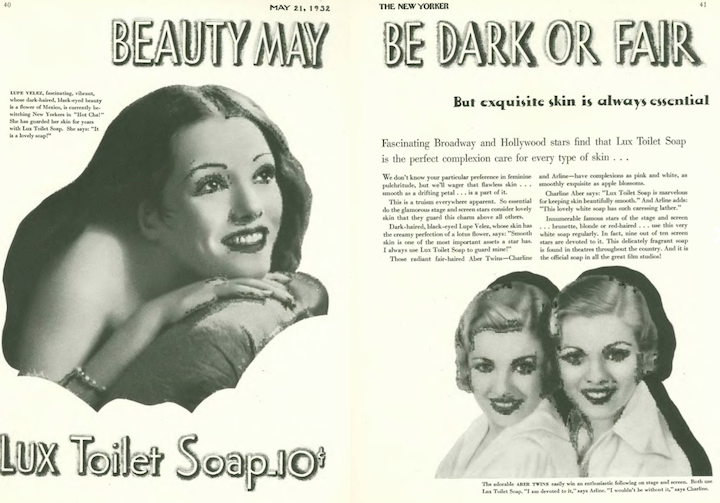
We have yet another somewhat misleading ad from the makers of Lux Toilet Soap featuring an older actress who looked deceptively young for her age…

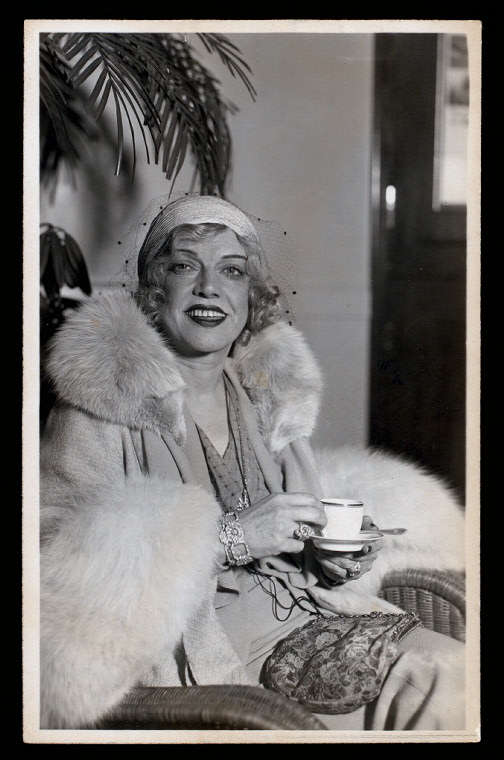
…the Russian-American actress Alla Nazimova (1879 – 1945) was actually 52 years old when this ad appeared, but the photo featured at left was taken in early 1923, when she was 43, so in a sense the ad was somewhat truthful…

Photo of Alla Nazimova taken by Nickolas Muray on Feb. 1, 1923 for Vanity Fair magazine. (Conde Nast)

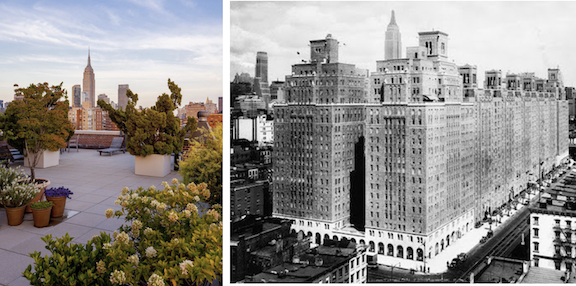
…Park Avenue would never be the same with the opening of the grand Art Deco Waldorf Astoria, at 47 stories and 625 feet, it was the world’s tallest hotel from 1931 until 1963…

…nor would the skyline at Central Park West be the same with the addition of Irwin Chanin’s modern “Majestic” and “Century” apartments that featured GE refrigerators sold by Rex Cole, who himself was keen on architecture and design…

…and who hired Raymond Hood to create distinctive refrigerator showrooms in Manhattan, Brookyn and Queens…

Rex Cole Showroom in Flushing, Queens, crowned with a replica of the GE refrigerator’s disintictive “Monitor Top.” With their spare, open plan, the modern showrooms were ahead of their time. (Museum of the City of New York, Photo by Samuel H. Gottscho, 1931)

…on to our cartoonists, we have Chon Day at ringside…

Kemp Starrett eavesdropped on some science-minded shoppers…

Garrett Price gave us a maid’s refreshing perspective on a game of chess…

Helen Hokinson found some serious talk among the younger posh set…

…and we end with another from Garrett Price, and the challenges of renting a room near Times Square…

Next Time: The Coming War…


From Stage to Screen

There’s good reason why one of Broadway’s finest theatres is named after Alfred Lunt and Lynn Fontanne; no couple has lit up the stage quite like this husband-wife team.

Sept. 19, 1931 cover by Adolph K. Kronengold.

Some say Richard Burton and Elizabeth Taylor were modern successors, but they only appeared together on Broadway once (a 1983 revival of Noël Coward’s Private Lives, at the Lunt-Fontanne Theatre of all places), and they shared a tempestuous, on-and-off relationship that sharply contrasted with Lunt and Fontanne, who were inseparable both on and off the stage during their 55-year marriage. And unlike Burton and Taylor, Lunt and Fontanne appeared in just a handful of films, including a 1931 adaptation of their 1924 Broadway play, The Guardsman. John Mosher filed this review:

INSEPARABLE…Alfred Lunt and Lynn Fontanne pose for photographer Nickolas Muray in this 1924 portrait for Vanity Fair magazine. They married in 1922, and were inseparable until Lunt’s passing in 1977. (Conde Nast)

NAUGHTY, NAUGHTY!…These were Pre-Code times, so MGM played up the film’s “saucy” and “unconventional” themes. (IMDB)

I’VE GROWN ACCUSTOMED TO YOUR FACE…Although Lunt and Fontanne appeared together numerous times on Broadway, the 1931 film adaptation of their 1924 stage play, The Guardsman, would be their only film appearance together. (Museum of the City of New York/IMDB)

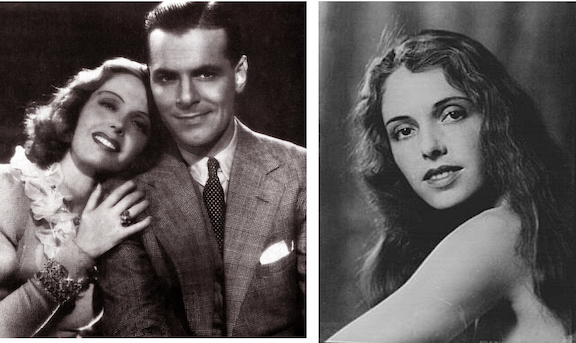
STAGE TO SCREEN…at top, Lunt and Fontanne in 1924’s The Guardsman on Broadway; below, a scene from the 1931 film adaptation featuring, from left, Alfred Lunt, Lynn Fontanne, Maude Eburne and Zasu Pitts; at right, Fontanne reviews fashions for the film designed by Adrian Adolph Greenburg. Lunt and Fontanne would be nominated for Academy Awards as Best Actor in a Leading Role and Best Actress in a Leading Role, respectively. (Museum of the City of New York/IMDB)

 *  *  *

One Giant Leap

Charles Lindbergh crossed the Atlantic without stopping in 1927, but it would take four more years before anyone could accomplish the same feat across the Pacific. Don Moyle and Cecil Allen took up the challenge, hoping to fly their plane, Clasina Madge, 4,400 miles from Japan to Seattle to win a $25,000 prize from a Japanese newspaper. The lads took off from Tokyo in early September, but then went missing. E.B. White wrote:

As it turned out, Moyle and Allen were caught in a storm between Japan and Alaska that forced them to land on a small, uninhabited island in the Aleutian chain. Stranded for more than a week, the flyboys were finally able to make contact through a U.S. Coast Guard patrol and report they were safe.

THESE ARE MY BOYS…at left, Cecil Allen and Don Moyle standing with financial backer John Buffelin and Buffelin’s daughter, Clasina Madge, the namesake for their hopefully record-setting airplane; At right, Moyle and Allen with a Japanese official, possibly before one of their attempts, or perhaps they are looking at their consolation prize (see below). (University of Washington)

Moyle and Allen sent word that they would return to Washington and prepare for another attempt. They flew back home by way of Nome, Alaska, where they landed on Sept. 21, 1931. Five days later they reached Fairbanks, and after weather delays finally made it to Tacoma, Washington, on Oct. 6. There they learned that Clyde Pangborn and Hugh Herndon Jr. had already won the $25,000 prize, having arrived from Japan the day before. The Tokyo newspaper did, however, give Moyle and Allen $2,500 for their efforts.

SPOILERS…at left, Hugh Herndon, Jr. and Clyde Pangborn pose next to their crash-landed plane in the hills of East Wenatchee, Washington, after becoming the first to fly non-stop across the northern Pacific Ocean. The 41-hour flight from Japan won them the 1931 Harmon Trophy and $25,000 from a Japanese newspaper. The crash-landing of their plane was deliberate — before the flight it was modified to carry 930 gallons of fuel. They had jettisoned the landing gear after takeoff to save fuel. (historylink.org/imagesofoldhawaii.com)

 *  *  *

Thurber Gets Serious

We know James Thurber as a humorist, both for his writings and his cartoons. In the Sept. 19 issue, however, Thurber offered this touching remembrance of a subway newsstand proprietor, who he later learns is killed in the crossfire of a robbery. Here are the opening passages:


 *  *  *

Did You Miss Me?

After a long absence (in Europe, presumably),  returned to his “Shouts and Murmurs,” column, offering this “Triple Warning” that included his observations of H.G. Wells, who wondered if all his musings for the future would fall to swarms of lowly insects…

WORK CAN WAIT…Alexander Woollcott relaxes in front of a Paris bar, late 1920s. Photo by James Abbe. (artsy.net)

 *  *  *

From Our Advertisers

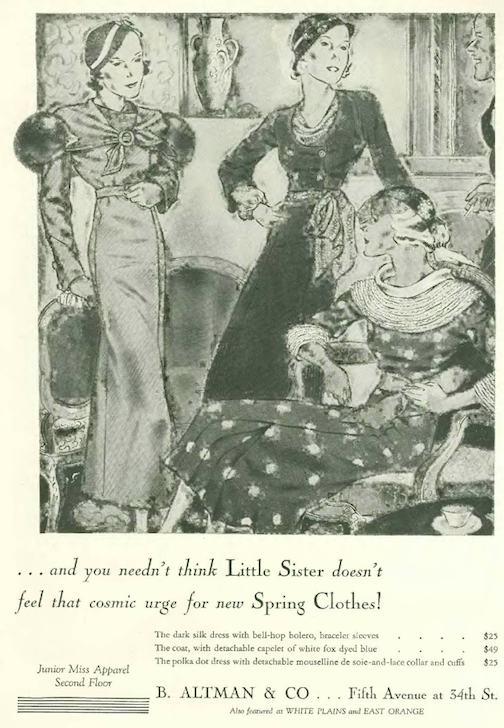
With the arrival of fall come new fashions…these “wearables” below are suggested by B. Altman as suitable attire for attending a football game…

…smart fashions for young people weren’t confined to New York…this is how students at the University of Michigan dressed for a 1930 homecoming game against Illinois…

…well, times have changed, but folks still wear fur of a sort…

Jan 1, 201USA TODAY Sports

…wearing a real fur these days will draw the ire of animal rights advocates almost everywhere, but in 1931 few had problems with turning leopards and seals into coats for fashionable young women…

…then as now, folks enjoyed their pork sausage…the Jones Family of Wisconsin apparently saw a market for their products among New Yorker readers…

…after 131 years in business, the Jones Family and their sausages are still going strong…as is their farmhouse logo (the old farmhouse is real and still stands)…

…another back pages ad promoted Helen Hokinson’s first cartoon collection, So You’re Going to Buy a Book!

…the collection including Hokinson’s beloved dowagers, but it also featured this gem…

(attemptedbloggery.blogspot.com)

…on to our cartoons from the Sept. 19 issue, we begin with William Steig and a couple of would-be renters…

E. McNerney explored the trials of teenage life…

Leonard Dove drew a crowd in a packed subway car…

Otto Soglow displayed the playful side of his Little King…

…and Rea Irvin found an actor upstaged by an unlikely rival…

Next Time: Big Fish, Little Fish…

Bonfire of the Vanities

When Earl Carroll’s Vanities hit the Broadway revue scene in 1923, it faced strong competition from George White’s Scandals and the long-running Ziegfeld Follies. Carroll’s answer: More of everything.

Sept. 5, 1931 cover by Theodore Haupt.

That included more nudity than the other revues. Critics, including the New Yorker’s Robert Benchley, found the nudity gratuitous, a titillating distraction from what was otherwise a mess of a show. It also landed Carroll in court from time to time on charges of public indecency. All of this, of course, was just more publicity to drive audiences to his theatre at 753 Seventh Avenue, which he built in 1922 and then partially tore down just nine years later to replace it with an even grander venue. This is where Benchley found himself on the evening of August 27 — at the grand opening of the Earl Carroll Theatre and the 1931 edition of the Vanities. Benchley found nothing grand about it:

AUTOGRAPHS, ANYONE?…Accompanied by his Vanities showgirls, Earl Carroll leaves the Essex Market Police Court on July 20,1930, after appearing to answer charges of public indecency. Police raided a Vanities matinee on July 9, arresting eleven including famed burlesque dancer Faith Bacon, who performed in nothing but fans made of ostrich feathers. No doubt police were tipped off by critics who called the 1930 edition the “nudest” cast in American theatre history. From the looks on their faces, it seems even the police enjoyed the spectacle. (Worthpoint)

IS THERE A PROBLEM, OFFICER?…Faith Bacon in a less-revealing pose with the ostrich-feather fans that brought the police ‘a calling. (fanpix.net)

Carroll’s ambitions were always big, whether it was the size or lavishness of his stage shows or the Art Deco theatre (designed by George W. Keister) he erected in 1931 in answer to Flo Ziegfeld’s 1927 Joseph Urban-designed theatre on Sixth Avenue. With 3,000 seats, Carroll’s theatre was nearly twice the size of Ziegfeld’s.

THEY DON’T COME FOR THE SCRIPTWRITING…Earl Carroll made it clear what audiences could expect in his 1931 Art Deco-style theatre, which featured black velvet-covered walls relieved with gold and silver-colored highlights. Its 3,000 seats made it one of the largest theatres in the world. Clockwise, from top left, portrait of Carroll (a gift from the 1930 Vanities showgirls) flanked by busts of Vanities girls Doris Andrese and Beryl Wallace in the theatre lobby; sign above theatre entrance; a two-page spread from the theatre’s “Beauty Souvenir” booklet; cover of the booklet, featuring singer Lillian Roth. (New York Historical Society).

DECO DRAMA…Clockwise, from top left, Earl Carroll circa 1925; ceiling detail inside the Earl Carroll Theatre; mezzanine lounge; the stage. (New York Historical Society).

The show itself left Benchley baffled, a mishmash of lights, colors, and effects including a drooling dinosaur that dropped a naked woman on stage for a dance number…

LAUNCH SITE….The Vanities stage helped launch the careers of many entertainers. Clockwise, from top left, undated photo of a Vanities production — some shows would feature more than 100 women on stage at one time; singer Lillian Roth was a star attraction; Vanities alumni included William Demarest (Uncle Charlie!), Jack Benny and Vincente Minnelli. (assumption.edu/flickr.com/classicmoviehub.com/amazon.com/sensesofcinema.com)

This wasn’t last word from The New Yorker on the new theatre; the Sept. 12 issue featured these observations by Creighton Peet:

In the end, Carroll’s ambitions were too big for the deepening Depression, and just six months after his theatre’s opening he would lose it to creditors. The property would be snapped up by rival Florenz Ziegfeld and renamed the Casino, but the Ziegfeld connection would be short-lived; Ziegfeld would die a few months later in July 1932. Later that year another rival, George White, would take over the venue to stage his Music Hall Varieties, which ended in 1933 with middling results. The theatre would go through several more tenants—including Billy Rose—until 1940 when the discount “dime store” Woolworth’s would move in, demolishing the lobby and walling off the remaining ceiling and walls. Woolworth’s would close the location in the late 1980s—the store, and the last remnants of the Earl Carroll Theatre, would be demolished in 1990.

CLOSING NUMBER…At left, a sneak peek behind the false walls of Woolworth’s in 1988 shows a detail of the theatre’s proscenium, ceiling and sidewall. At right, top to bottom, the second Earl Carroll Theatre at 7th Avenue & 50th Street; the Woolworth’s store that replaced it, circa 1980; the site today. (Large image from the book Lost Broadway Theatres, via drivingfordeco.com/Google Maps)

*  *  *

From Our Advertisers

Fall is upon us, and so the social season begins, according to the Hotel St. Regis…

…and what better way to prepare for the season than to acquire a new mink coat…

…maybe politics and world affairs were more your bag, in which case you probably wanted to get a subscription to the Herald Tribune and read the latest from commentator Walter Lippmann

…the makers of Marlboro cigarettes, an upstart brand that initially targeted women, continued with their prize contests, but now they began courting men as well…

…on the other hand, the more established brand Chesterfield had the resources to run a color back-cover ad with endorsements from the brother-sister dance team Fred and Adele Astaire

…Fleishmann’s continued to run their full-page ads touting the wonders of daily yeast consumption (“Eat three cakes a day”). The ads were there because Raoul Fleishmann used his wealth from the family baking business to keep the New Yorker afloat during its fledgling years…

…Farrar and Rinehart announced the arrival of Otto Soglow’s first book, Pretty Pictures

…here is the cover of the book…

…and we move on to the cartoons with the character that would make Soglow rich and famous…The Little King

…although Fleischmann likely saved The New Yorker with large infusions of cash, its cartoonists, including Gardner Rea, still took an occasional poke at the company’s health claims…

…anticipating his “Small Fry” cartoons, William Steig finds two of them examining the wonders of human physiology…

Rea Irvin looked in on some stuffy Western Union censors…

…newcomer Robert Day illustrated the challenges of a doorman (Day would be a longtime contributor)…

Garrett Price found humor abuzz between the bold and the meek…

Alan Dunn tracked down a clueless hunter…

…and we end with Leonard Dove, who takes flight and anticipates our next installment…

Next Time: A Big Bird…


Asphalt Jungle

The zoos of yesteryear were joyless places, that is, if you were one of the animals. Children squealed with fear and delight at the sight of a caged lion, and many an adult had fun tossing peanuts at elephants or teasing enraged gorillas locked behind bars; but if you were a zoo animal in 1931, life was endless hours of boredom, sprinkled with moments of terror and humiliation.

Aug. 15, 1931 cover by Theodore Haupt.

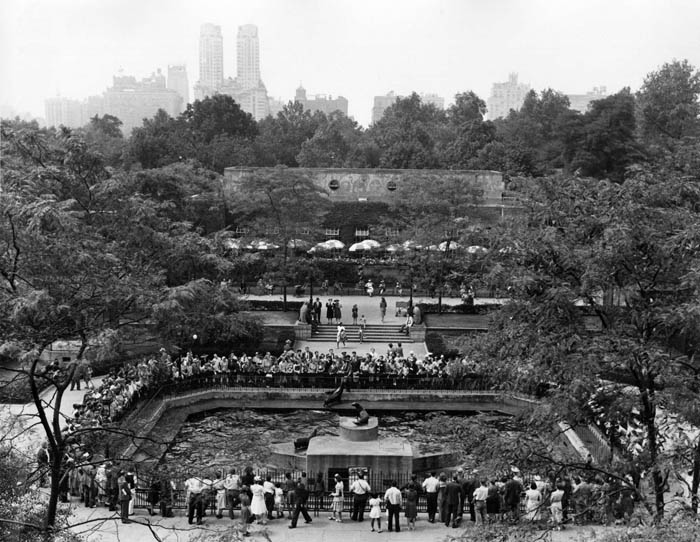
It is instructive to look back 89 years and see how far we’ve come, and how far we still have to go, to see our fellow creatures as more than curiosities and amusements to be captured and gawked at, and to see their environments as something to be preserved, not only for their survival but for ours as well.

LIFE BEHIND BARS…Left, a zookeeper with chimps at the Central Park Zoo, 1936. Right, a rhino paces in a barred enclosure, 1937. (nycgovparks.org)

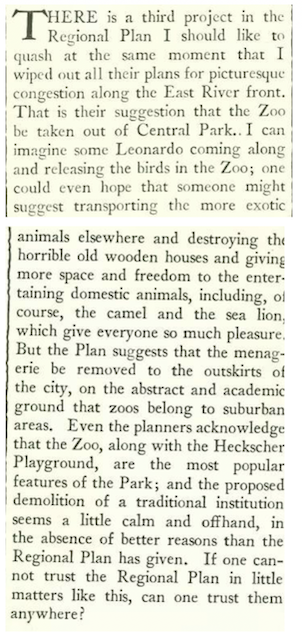
E.B. White paid a visit to the Central Park Zoo, and found it wanting in a number of respects:

Many zoos back then were more collections of curiosities than places where you could learn about various habitats. So when David Sarnoff, president of RCA, bagged a live opossum in the South, the critter was given a new home in an antelope enclosure, per this item in the Dec. 20, 1931 New York Times:

The Central Park Zoo was established in the 1860s as a “menagerie” behind the Arsenal, and by the turn of the century attracted millions of visitors to its displays of exotic animals.

GETTING AWAY FROM IT ALL…Postcard image of the Menagerie in Central Park, New York, 1905. (Museum of the City of New York—MCNY)

ANIMAL ATTRACTION…Postcard image of folks enjoying caged birds at the Menagerie, 1905. (MCNY)

O GIVE ME A HOME…In the early days of zoos, animals were presented in cages and fenced enclosures with no hint as to what their natural habitat might look like. Clockwise, from top left, “Fatima” the hippo, image from an 1896 stereograph card; a 1911 photo of a trainer and a dog perched on top of a hapless elephant; a bull bison around the turn of the century; a group of people observe animals in cages at the Central Park Menagerie, 1895. (Library of Congress/nycgovparks.org/MCNY)

 *  *  *

He’s Your Future

The New Yorker featured two-part profile of the governor of New York, Franklin D. Roosevelt, who unbeknownst to writer Milton MacKaye would soon become the next president of the United States. Two excerpts (not continuous)…

  *  *  *

From Our Advertisers

Ah yes, the first time I visited the Empire State Building’s observation deck (in the 1970s) a heavy smog enveloped the city (the air is much cleaner today). I like how the promoters spin disappointment into an opportunity — “The mysterious beauty of the city has a million constantly changing aspects”…

…if you were looking for bluer skies, Bermuda could have been an option if you had the means…

…or you could have stayed closer to home at a Long Island beach resort, as Helen Hokinson illustrated, and as we segue into our cartoons…

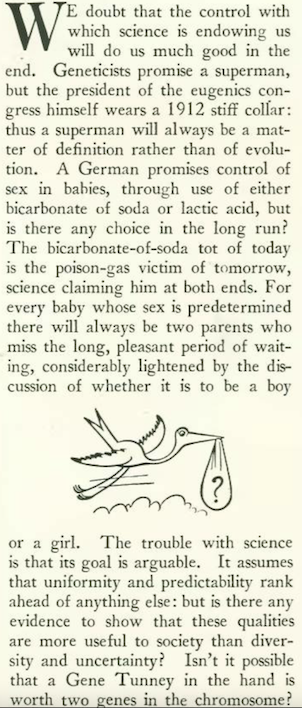
Isadore Klein gave us a very unscientific, albeit humorous view of genetics…

Richard Decker redefined the meaning of “volunteers”…

…and William Steig summoned the advice of Dorothy Dix, a forerunner of “Dear Abby” who was the most widely read female journalist of her time…

We move on to the Aug. 22, 1931 issue…

Aug. 22, 1931 cover by Helen Hokinson.

…in which James Thurber wrote about his experience with early television in “The Talk of the Town”…

NO CABLE BILL, YET…Charles Francis Jenkins demonstrates his “Radiovisor” console television in 1929. At right, the inner workings featured a rotating disc punctured with tiny holes, each projecting a line across the glass screen to compose an image. As Thurber noted, the pictures commonly were too dark for viewers to see anything more than silhouettes. Not to mention Thurber’s eyesight was also terrible. (earlytelevision.org)

 *  *  *

The Other Moving Pictures

The movies still had nothing to fear from television in 1931, and Hollywood continued to draw large audiences to “Pre-Code” films that featured doses of sex and violence. Novelist Viña Delmar gained famed in 1928 with her suggestively titled book Bad Girl, so when it was adapted into a film, audiences came running—even if the screen adaptation proved to be a bit tamer than the novel that inspired it. Critic John Mosher observed:

I’M JUST A LITTLE BAD…Sally Eilers played the title character in Bad Girl with co-star James Dunn. The film won two Oscars in 1932 for Best Director (Frank Borzage) and Best Writing, Adaptation (Edwin J. Burke). (IMDB)

 *  *  *

Chic Chapeau

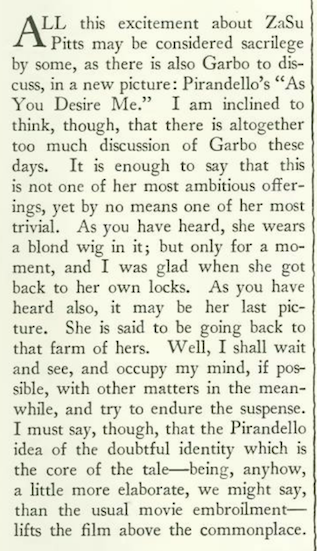
The Empress Eugénie hat was named for 19th century French empress Eugénie de Montijo, who was known as a fashion trendsetter. The hat was revived in 1930 after Greta Garbo was seen wearing a version of one in the popular film Romance. E.B. White was not exaggerating when he noted (in his “Notes and Comment”) that the jaunty hat was seen on “every other head” in the city.
 

LOOK WHAT YOU STARTED…Greta Garbo sported an Empress Eugénie hat in the 1930 film Romance, setting off a fashion craze that persisted through much of the decade. At right, Kemp Starrett referenced the trend in this Aug. 8, 1931 cartoon in The New Yorker. (Pinterest)

 *  *  *

From Our Advertisers

Speaking of trends, these “roughies” were all the rage among the young folks, in the dorms and on the beach…

…one trend I wasn’t aware still persisted in 1931 was a top hat and tails for an evening out among the smart set…

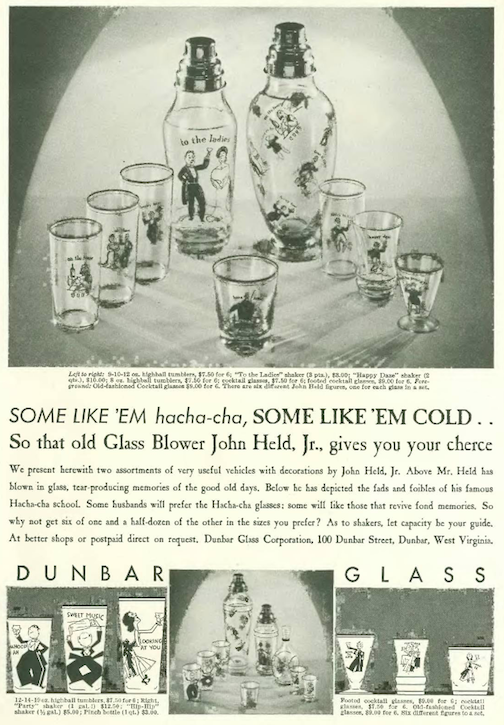
…according to this ad, if you were a “smart” and fashionable New Yorker, then you needed an “Inebriates” themed cocktail set…

…examples of the glassware for sale on Worthpoint…

Dr. Seuss was still busy selling pesticide with this four-panel ad…

…on to the cartoons, we start with James Thurber

…and Rea Irvin continued to experiment with various motifs, this time an Egyptian-themed cartoon referencing the “wine bricks” sold by enterprising vineyards during Prohibition…

Peter Arno found a big surprise during a mansion tour…

…and we end with Otto Soglow

…and Richard Decker…both cartoons reminded me of Al Jaffee’s Snappy Answers to Stupid Questions

…I grew up reading Mad magazine, and always looked forward to Jaffee’s fold-ins…he just retired from Mad at the young age of 99, so we conclude with one of his Snappy Answers panels from Mad #98, Oct. 1965…

Next Time: Unnatural History…