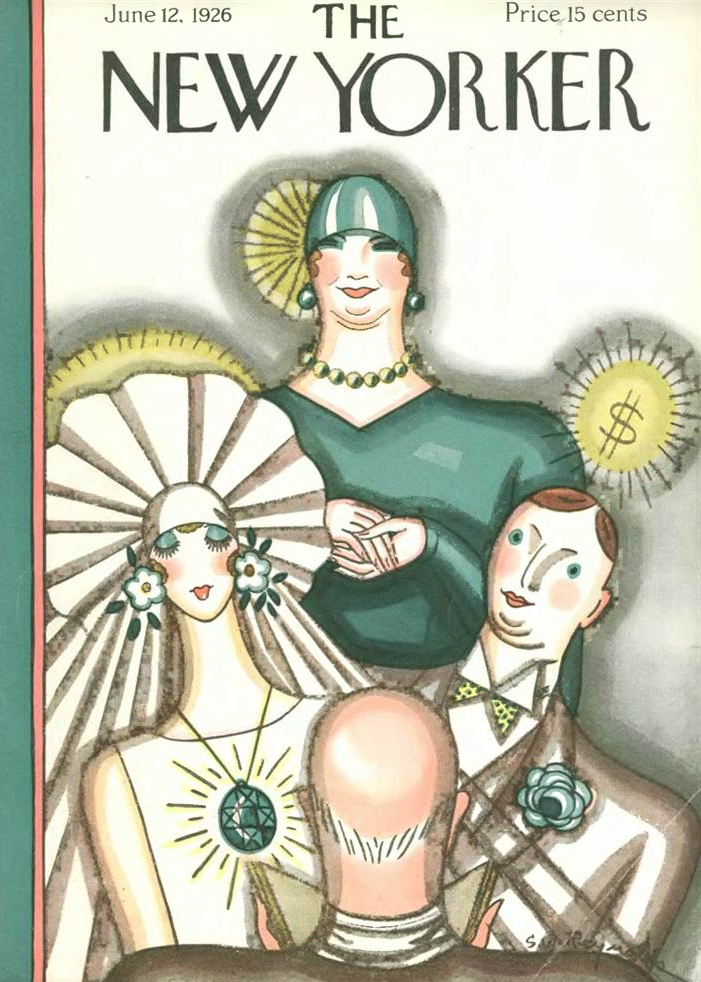
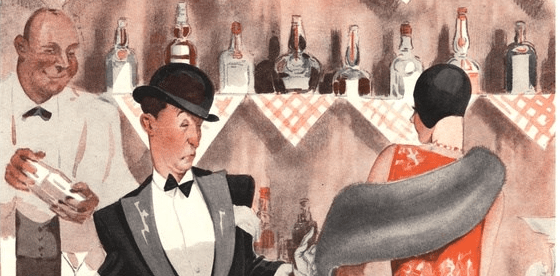
Fashion advertising in the early New Yorker can tell you a lot about the mood of the city’s smart set. As I’ve observed before, the magazine’s advertisements were rife with Anglo- and Francophile messaging, but they also reveal much about our changing times. A good example is the upscale retailer Abercrombie & Fitch, which these days uses the tagline “Authentic American clothing since 1892.”
In its early days, A&F was known as an elite outfitter of sporting and excursion goods, supplying aspiring country squires with expensive shotguns, fishing rods and the clothing and kit necessary for successful and stylish expeditions beyond the drawing room:
“Sporting goods” meant something a bit different in 1926.
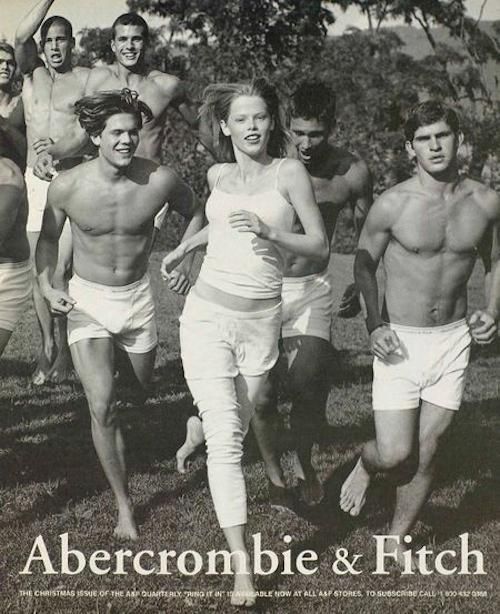
The company went bankrupt in 1976 and operated through mail order until 1988, when the The Limited clothing chain bought the name and operation and turned the focus to the young adult market:
Cover for A&F Fall/Winter 1998, photo by Bruce Weber. (Image Amplified)
Over the past couple of decades there’s been a lot of criticism regarding the abundance of A&L ads featuring shirtless, white men and the corresponding dearth of minority models. The newer ads feature a lot less skin and a sprinkling of minorities, but the product line is still a far cry from the one offered in 1926. Except for the elitist part.
As for other purveyors of fine fashion in the pages of The New Yorker, B. Altman made this stylish pitch for its line of bathing suits:
And here’s an advertisement for Croydon Cravats, featuring the ubiquitous Father’s Day necktie:
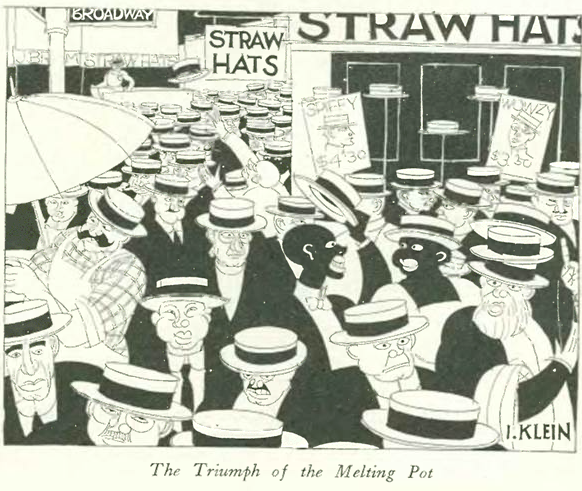
As for fashion in the comics, this drawing by Isadore Klein found humor in the multicultural appeal of the summer straw hat:
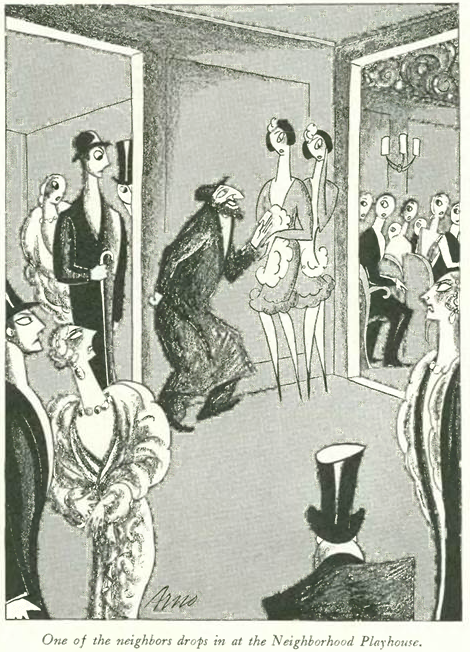
African Americans in the early New Yorker were nearly always depicted in minstrel-style blackface, and Jewish immigrants (such as the one Klein depicted at right) rarely lacked the Orthodox beard. Such is the case in this Peter Arno illustration where cultures clash rather than mix:
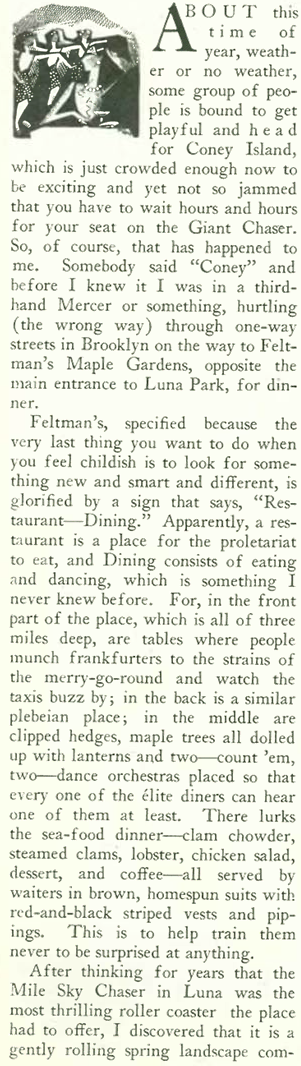
And let’s check in with the New Yorker’s fashion critic (and Arno’s soon-to-be wife) Lois Long, who slummed with the Proles at Coney Island:
CONEY CRONIES…(l to r) Silent film star Charlie Chaplin, Vanity Fair editor Frank Crowninshield, sculptor Helen Sardeau, Lois Long and screenwriter Harry D’Arrast pose in a Coney Island photo booth, 1925. Photo scanned from the book Flapper by Joshua Zeitz.
Finally, given the terrible circumstances in the Middle East and especially Syria, this small item in “Of All Things” is both timely and prescient:
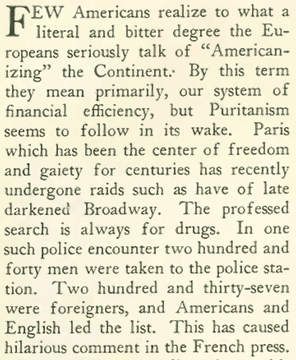
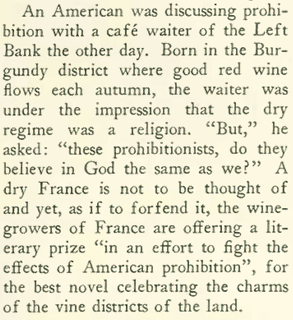
In her latest dispatch from Paris, correspondent Janet Flanner offered New Yorker readers a glimpse into the French mind, its fear of “Americanization” and its perception of America’s Puritanical attitudes behind Prohibition.
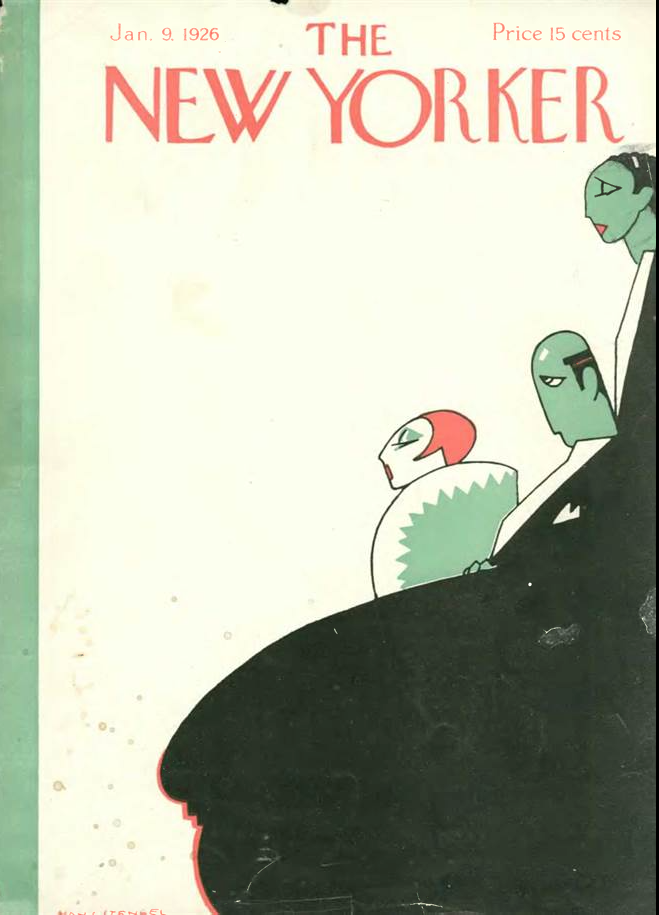
April 3, 1926 cover by Rea Irvin.
All the more reason the French were bemused by reports that American and English citizens led the lists of reported drug raids in the City of Light…
or that somehow Prohibition was a question of theological differences:
The April 3, 1926 issue also offered up some curious advertisements. Aiming square at the grasping Anglophilia of New Yorker readers, here’s a pitch for a used Rolls Royce:
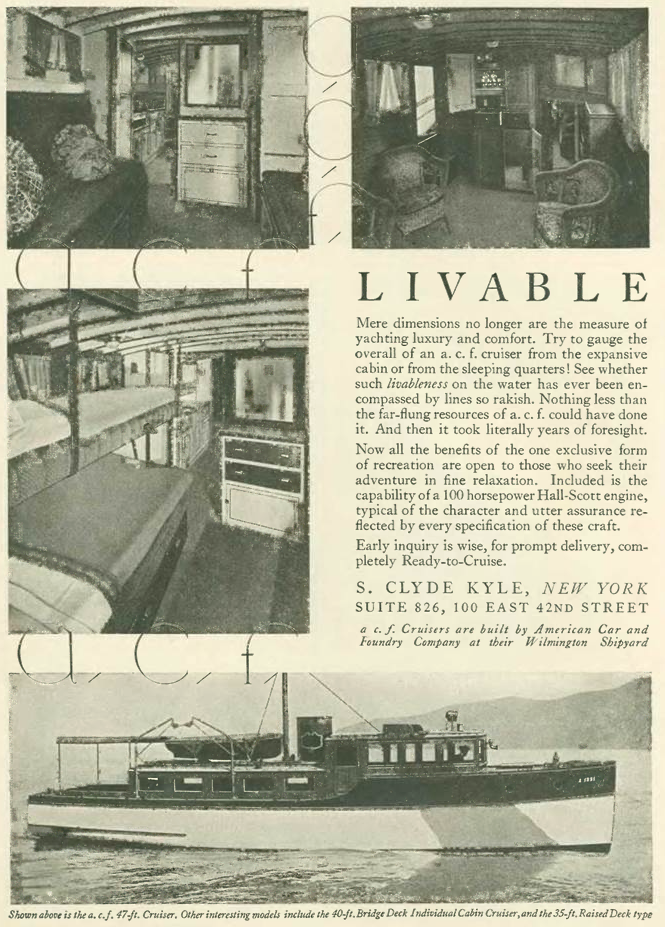
And with the money left over from your savings on the used Rolls, you could buy this 47-foot cruiser from the American Car and Foundry Company:
Moving along to the April 10, 1926 issue (cover designed by H.O. Hofman)…
April 10, 1926 cover by H.O. Hofman.
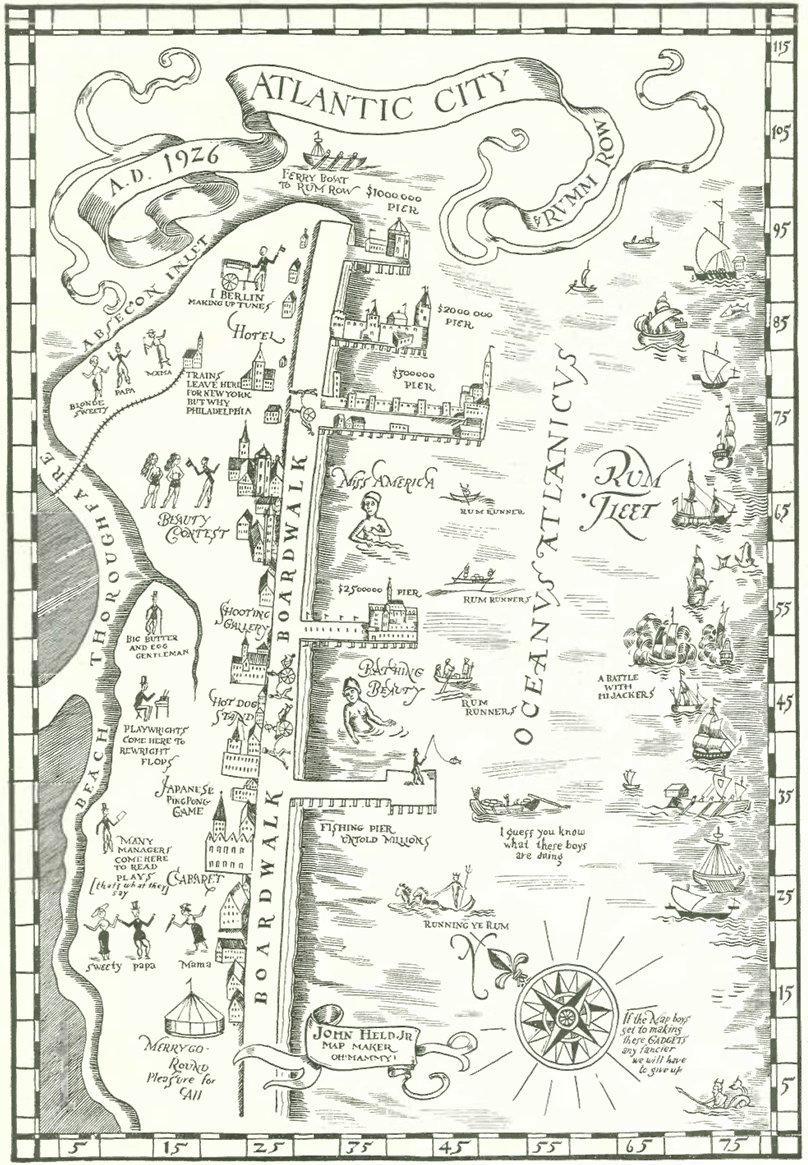
…I discovered this clever “map” by John Held Jr. For fans of “Boardwalk Empire” or other 1920s gangster-themed fare, Held’s map confirms it was no secret that Atlantic City was a major port for rum runners:
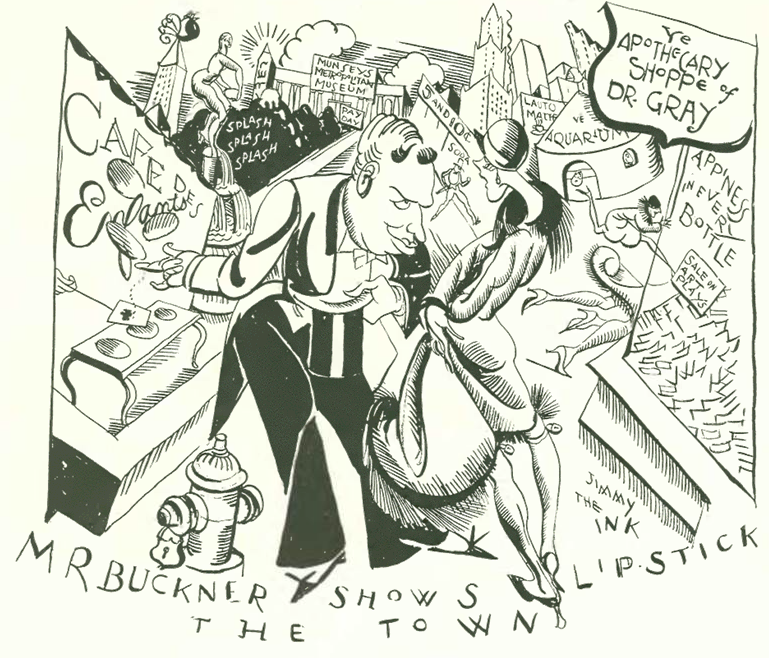
Also on the theme of Prohibition, cartoonist James Daugherty (Jimmy the Ink) had some fun with New Yorker colleague Lois Long (aka Lipstick) by pairing her with New York’s top Prohibition prosecutor Emory Buckner in this unlikely scenerio:
Note the lock on the fire hydrant. Padlocking restaurants and clubs suspected of selling alcohol was a favorite tactic of Buckner and his agents. Long famously took him task in her Oct. 31, 1925 “Tables for Two” column. You can read about it here in my previous post, “How Dry I Am.”
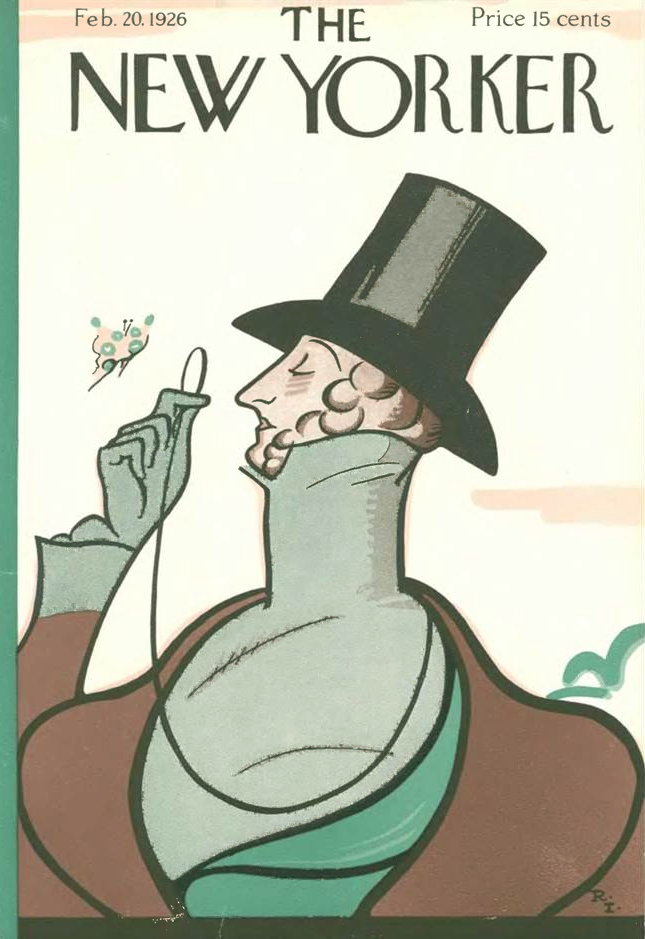
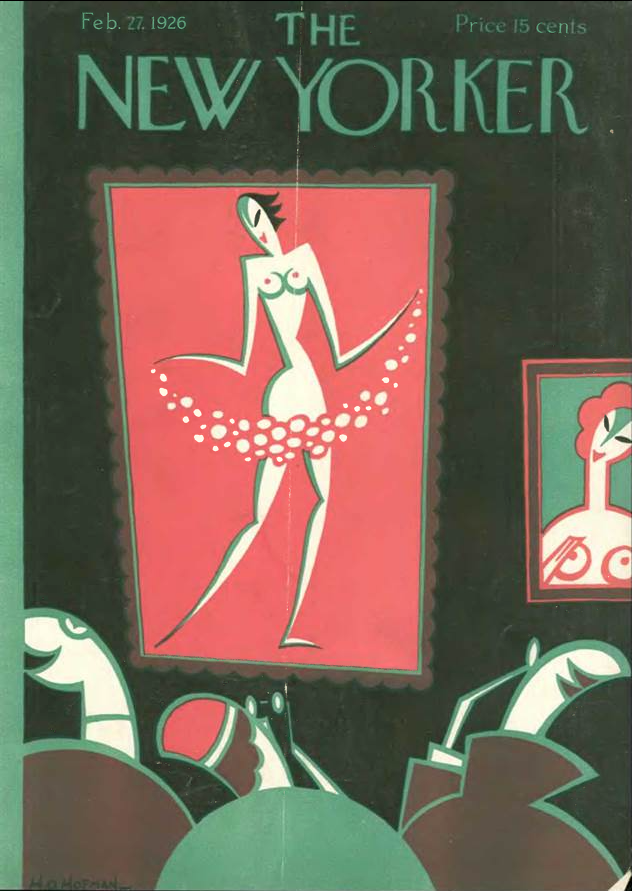
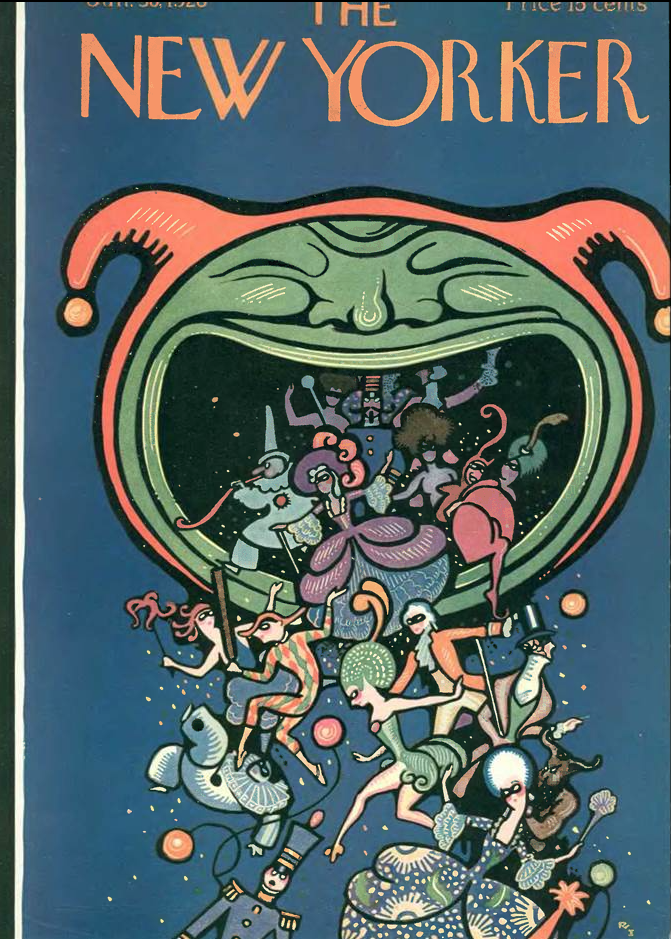
Now that I have your attention (at least the dog lovers anyway; and yes, there is a dog-related item if you read on), it is worth mentioning that the Feb. 20, 1926 issue of The New Yorker marked the first anniversary of the magazine, and in what would become an annual tradition, the magazine reprinted the original Rea Irvin cover from its first issue.
The magazine nearly went belly up during the summer of 1925, but a new marketing campaign, along with noticeably better content, put the magazine firmly in the black as it looked to its second year.
In “The Talk of the Town,” the editors couldn’t help but boast about their prosperity, albeit in a winking manner:
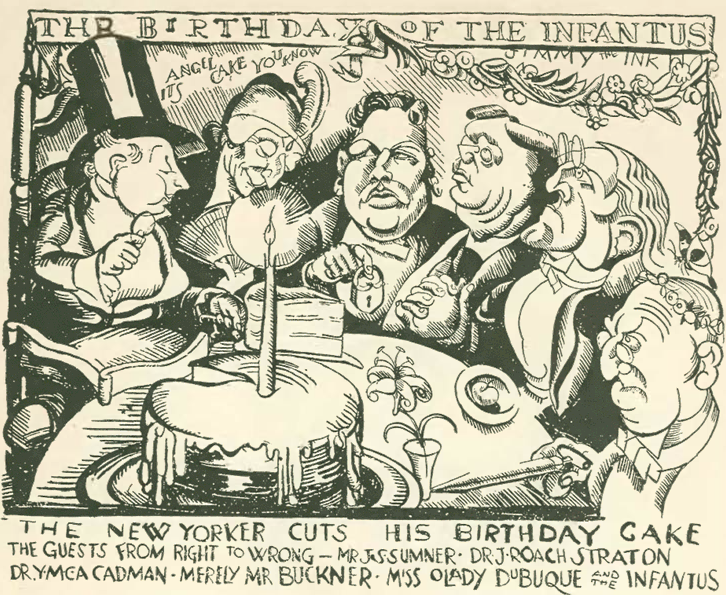
Jimmy the Ink (James Daugherty) marked the anniversary with this drawing…
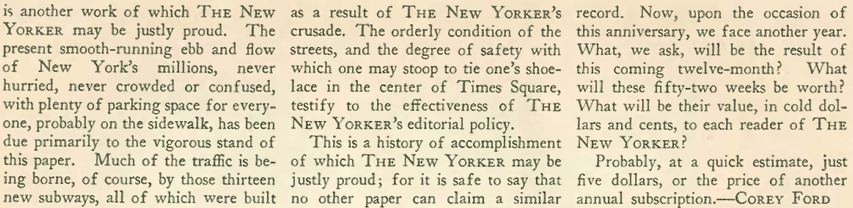
…and Corey Ford, who contributed more than twenty satirical house ads for the magazine under the title, “The Making of the Magazine,” returned to form in this issue with a recollection of the magazine’s imagined past (a device The Onion employs to great effect):
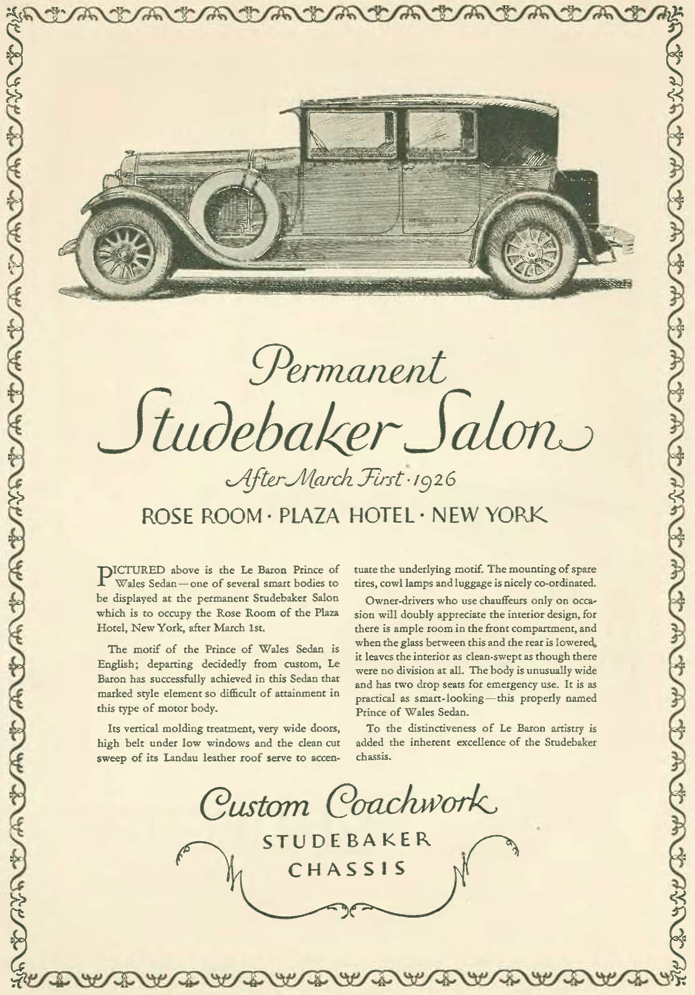
The magazine’s prosperity was evident not only in its talented stable of writers and illustrators, but also in its pages crammed with advertising. As I’ve noted before, much of the advertising is directed at the Anglo- and Franco-phile tastes of the magazine’s readers. For example, this ad from Studebaker suggesting a connection to British royalty:
Continuing on the theme of royalty, none other than Her Royal Highness, “La Princesse Genevieve” gave her nod to Produits Bertie skin cream (joining the ranks of other royal and society women who hawked moisturizers, cold creams and even cigarettes in those days…)
Royal endorsements were not limited to France and England, as none other than the Maharajah de Kapurthala put his seal of approval on Melachrino cigarettes in an ad featured on the inside back cover…
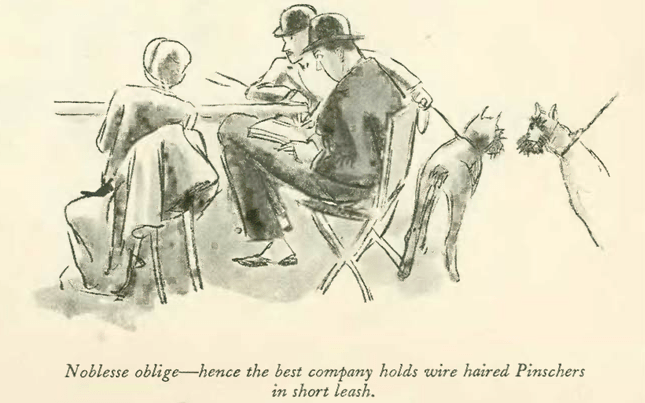
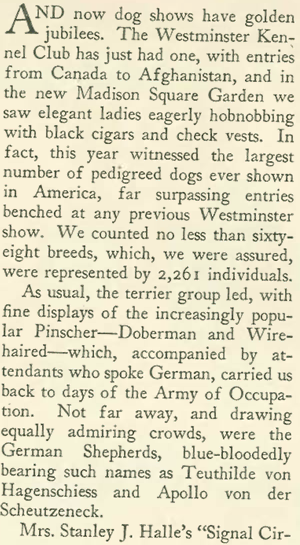
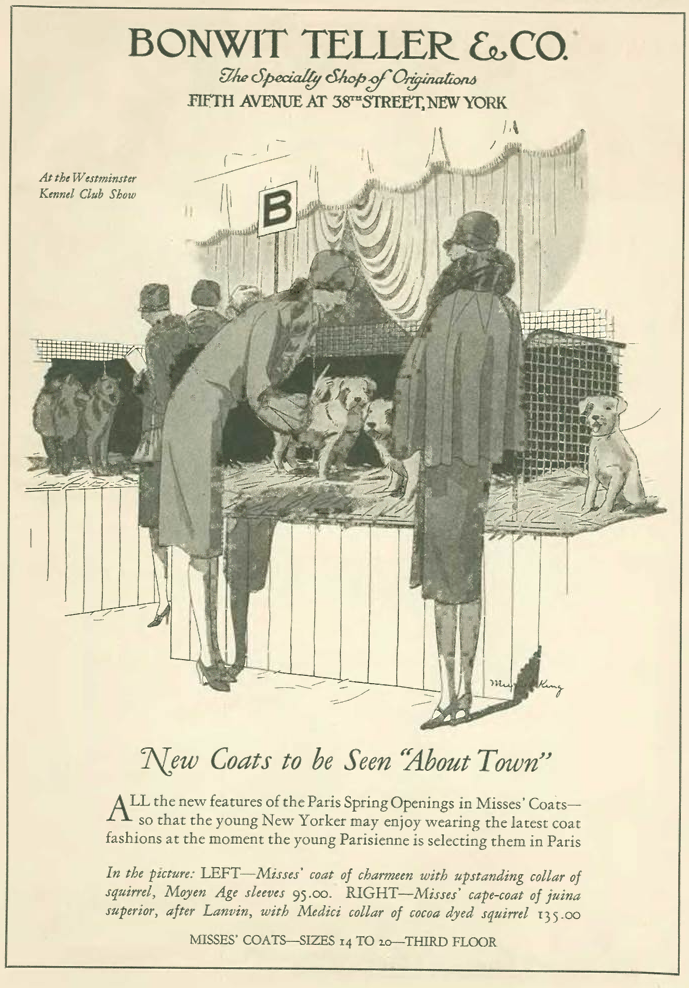
The issue was filled with car ads, appearing in the wake of January’s 26th Annual National Automobile Show at the Grand Central Palace. But the latest spectacle was the Westminster Kennel Club Dog Show at the new Madison Square Garden, with the Terrier Group once again taking the top prize. The “Talk” editors offered this observation on Westminster:
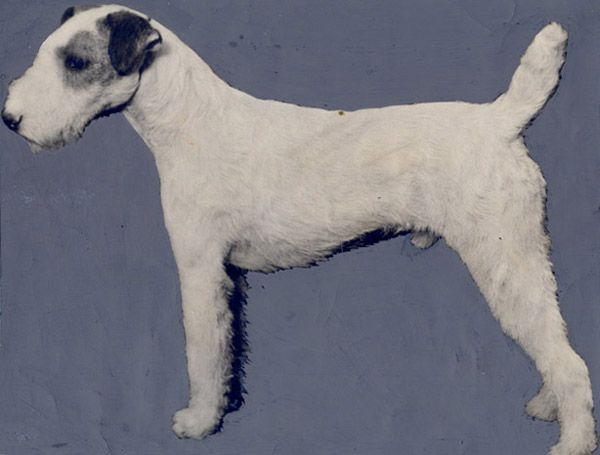
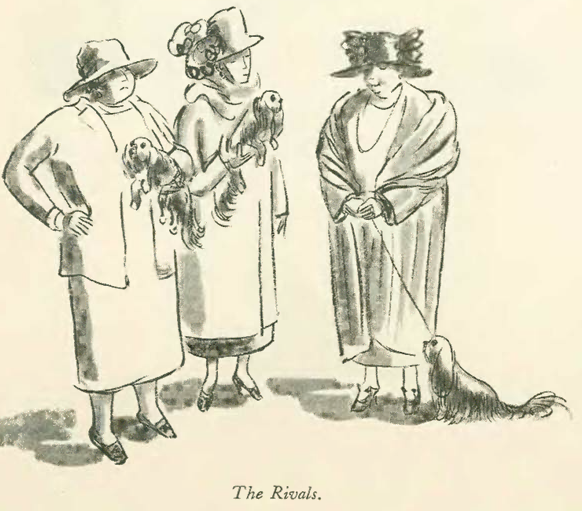
BEST IN SHOW 1926…Signal Circuit of Halleston was a Wire Fox Terrier and winner of the the 50th Westminster Kennel Club Dog Show in 1926. The fourth Fox Terrier to win best in show, Signal Circuit was one of 200 Fox Terriers present at the 1926 Westminster show. He was handled by Percy Roberts, who had imported the dog from England and had just stepped off the boat before the show. The dog was described as having “phenominal length of head and sound movement.” (WKC)The New Yorker’sHelen Hokinson offered this illustration to mark the event.
An advertisement from Bonwit Teller even got into the spirit of the thing…
From my How Times Have Changed department, this ad from Guaranty Trust:
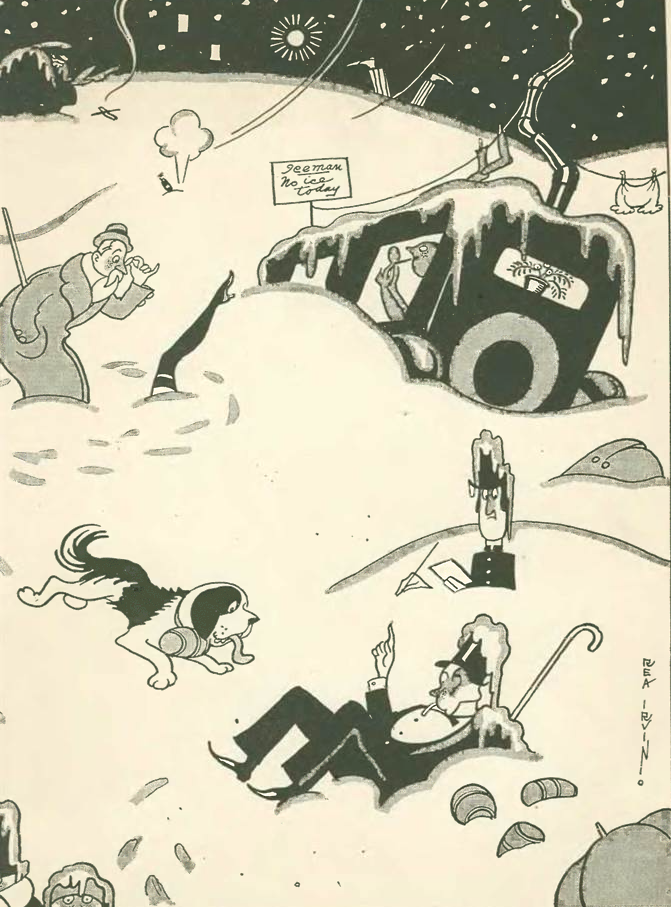
And finally, a detail from a center-page illustration by Rea Irvin depicting the result of a blizzard that blanketed the city in February 1926:
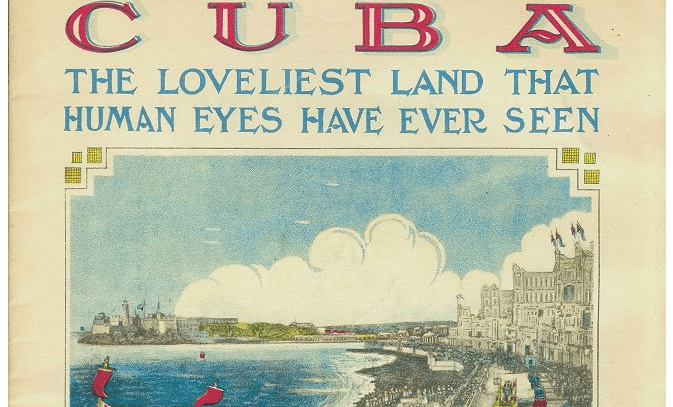
Writer and cultural critic Gilbert Seldes apparently wasn’t so put off by The New Yorker’s scathing review of his play, The Wisecrackers (Dec. 26, 1925) that he couldn’t continue writing for the magazine. In the Jan. 30, 1926 issue he offered an interesting essay on the particular appeal of Cuba. Titled “Annexation is the Best Policy,” it is an interesting read given the current reopening of diplomatic relations between Cuba and the U.S.
Given that Seldes penned his article about 30 years before the Cuban revolution, he offers some interesting insights into the independent character of the island nation and, perhaps inadvertently, also reveals American attitudes that helped to fuel the revolutionary fire. Seldes writes “the fact that Cuba has never been officially Americanized is supposed to be proof of our innate idealism; to me it seems more like a proof of the lack of imagination which ran through the whole McKinley period. To have taken the Philippines and passed up Cuba–how incredibly naive!” He goes on to observe that the total lack of “peaceful penetration” is proof that the island “will cling to its character no matter how many Americans do their worst.” Here is the entire article, interspersed with vintage images:
Havana Club atop the Hotel Sevilla in 1920s Havana (Havana Club)
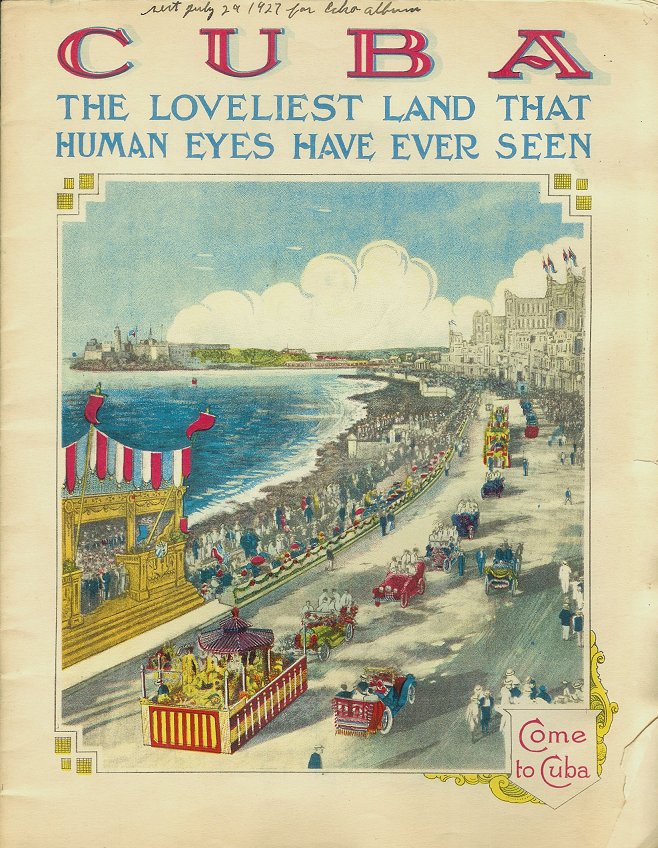
1927 tourist brochure enticing visitors to Cuba (Havana Journal)
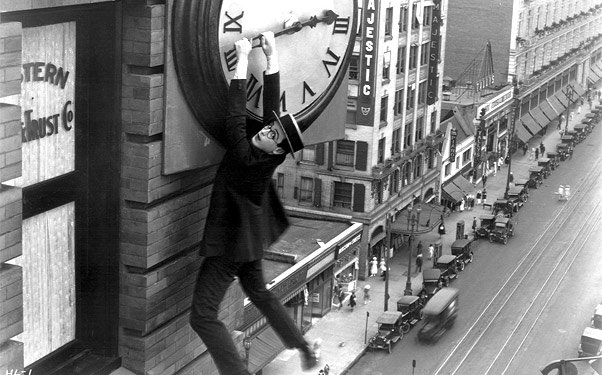
Also in the issue was profile of the life of silent film star Harold Lloyd. The writer R. E. Sherwood marveled at how a man from small town Nebraska became one of Hollywood’s most bankable stars and was even building a home in Beverly Hills for the staggering sum of $1 million.
HANG ON HAROLD…Lloyd in Safety Last, 1923. Illustration of Harold Lloyd by James House Jr. for the New Yorker profile.
In his “Of All Things” Column, Howard Brubaker made note of the following:
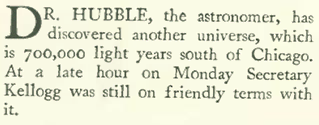
Neither Brubaker, nor Edwin Hubble for that matter, could have ever imagined that in 64 years a telescope bearing Hubble’s name would be launched into space and resolve a number of long-standing problems in astronomy.
To close, a couple of advertisements from the front section of the magazine. Now we know what youth wear at smart tea dances…
As we begin a new year of The New Yorker, it strikes me how little things have changed in 90 years, at least when it comes to human nature–wars and rumors of wars, celebrity gossip, the latest fads in music and fashion, fights over politics and religion. It’s all still with us. And yet, a person from 2015 would be seem like an extraterrestrial in 1926.
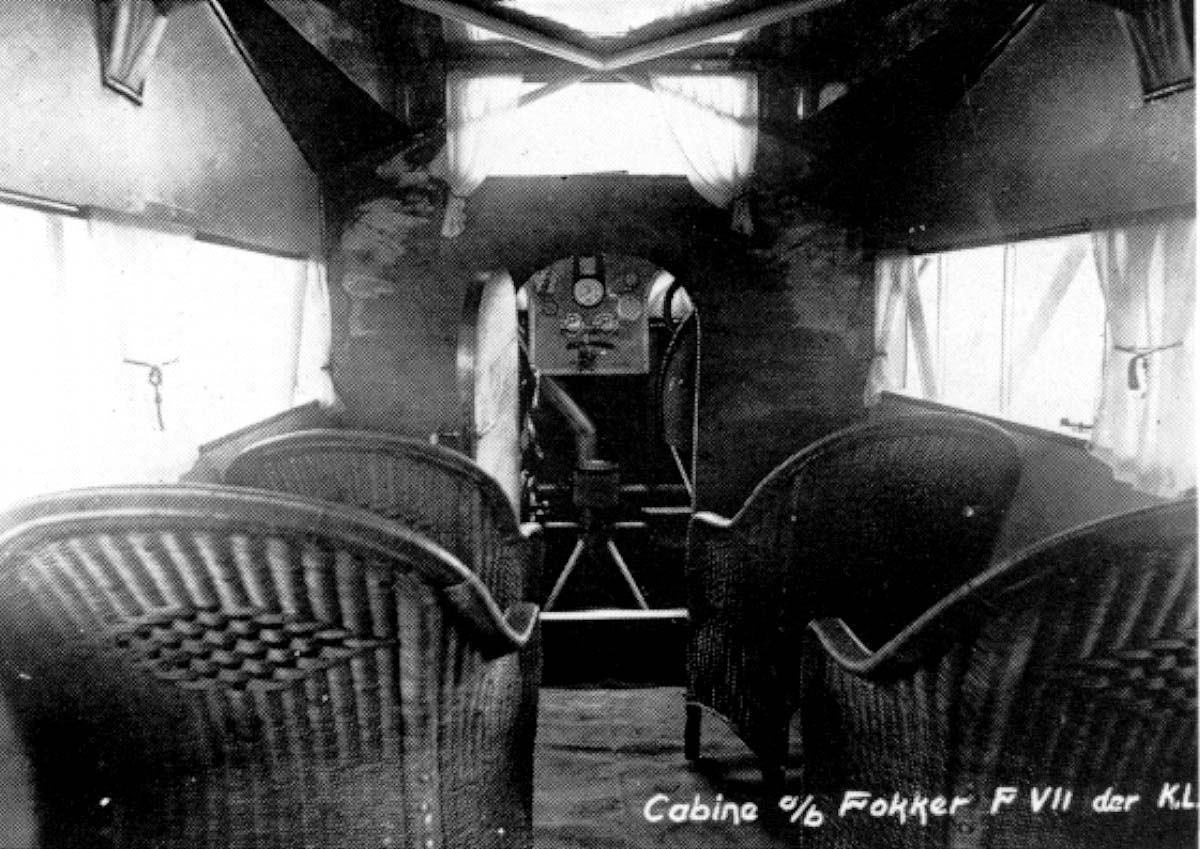
January 1926 was still a year and a half away from Charles Lindbergh’s Atlantic flight. Today we think so little of jumping on a plane that soars seven miles above the earth and whisks us anywhere in a matter of hours.
The Fokker F7. If you could even afford to fly in the mid-1920s, this is your ride. Buckle up! (Top, aviation history.com; bottom, dutchaviation.nl)
People in 1926 lived very differently, with far fewer distractions. No TV, only sporadic music on mono-tinny radios (or from mostly scratchy, hand-cranked records). Electric lights, but only if you lived in a city or town. The metropolis was noisy, but there was also silence. No cellphones or earphones, no CNN or ESPN blaring from every vertical surface. Your health? Forget it. Going to the dentist, regardless of your station in life, was a chamber of horrors. Ditto the doctor. Ever look at an antique doctor’s bag? Just some brown bottles, weird clamps and a saw. Penicillin wouldn’t be discovered until 1928, and for some reason lots of people died back then of peritonitis. It would claim both Rudolph Valentino and Harry Houdini in 1926. Finally, if you lived in 1926 you probably thought The War to End All Wars was just that. Only a few of the very sage saw the annihilation yet to come.
Anyway…
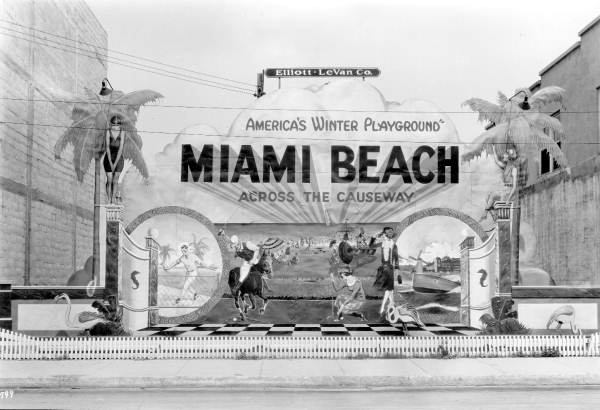
I titled this edition “Fun in the Sun” because the Jan. 2 issue opens with back-to-back ads enticing freezing New Yorkers to go south for the winter:
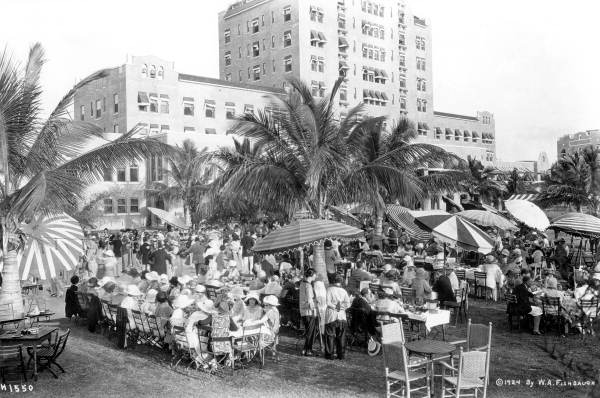
These were boom years for places like Miami Beach, formerly a quiet backwater but fast becoming a popular vacation getaway for New Yorkers and other Northeasterners. During the 1920s many wealthy industrialists from the north and Midwest also built their winter homes there.
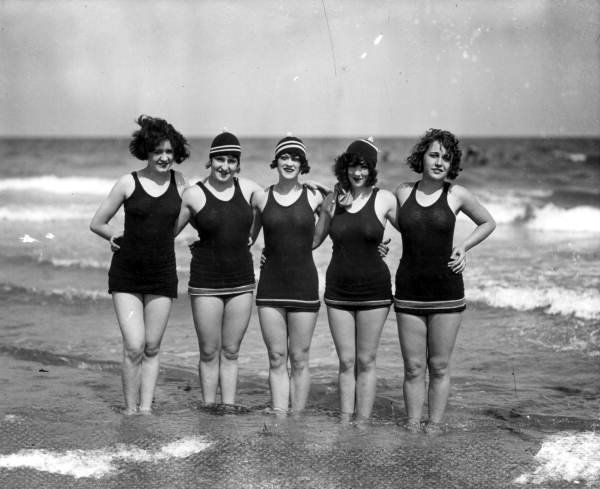
Japanese tea garden at the Flamingo Hotel in 1923 – Miami Beach (State Archives of Florida, Florida Memory)Bathers on Miami Beach in 1925 (State Archives of Florida, Florida Memory)
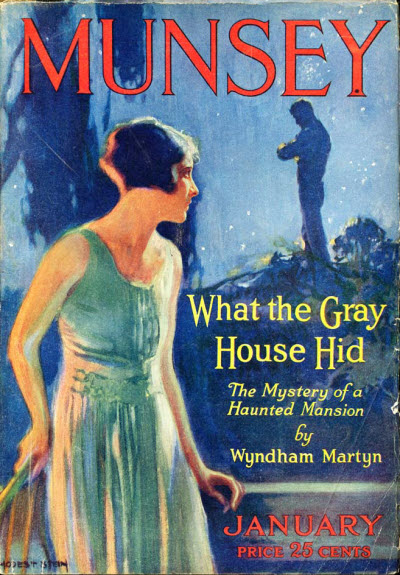
In other items, the “Reporter at Large” Morris Markey commented on the death of Frank Munsey, American newspaper and magazine publisher. Munsey had a reputation for extreme frugality and was widely disliked by employees who blamed him for their “shoddy recompense.” Munsey is credited with the idea of using new high-speed printing presses to print cheap, ragged pulp magazines, especially for working-class readers. Magazines such as Munsey and Argosy werefilled with various genres of action and adventure fiction.
Munsey’s Magazine January 1925 (philsp.com)
Markey wrote that Munsey would fire people on a whim for reasons that included being left-handed, too old, too young, or too fat. During his ownership of the New York Sun, Munsey gave “a peremptory order that all fat men, being inefficient and probably lazy, be expelled from the Sun staff.” Markey was no fan of Munsey as is clear in this excerpt:
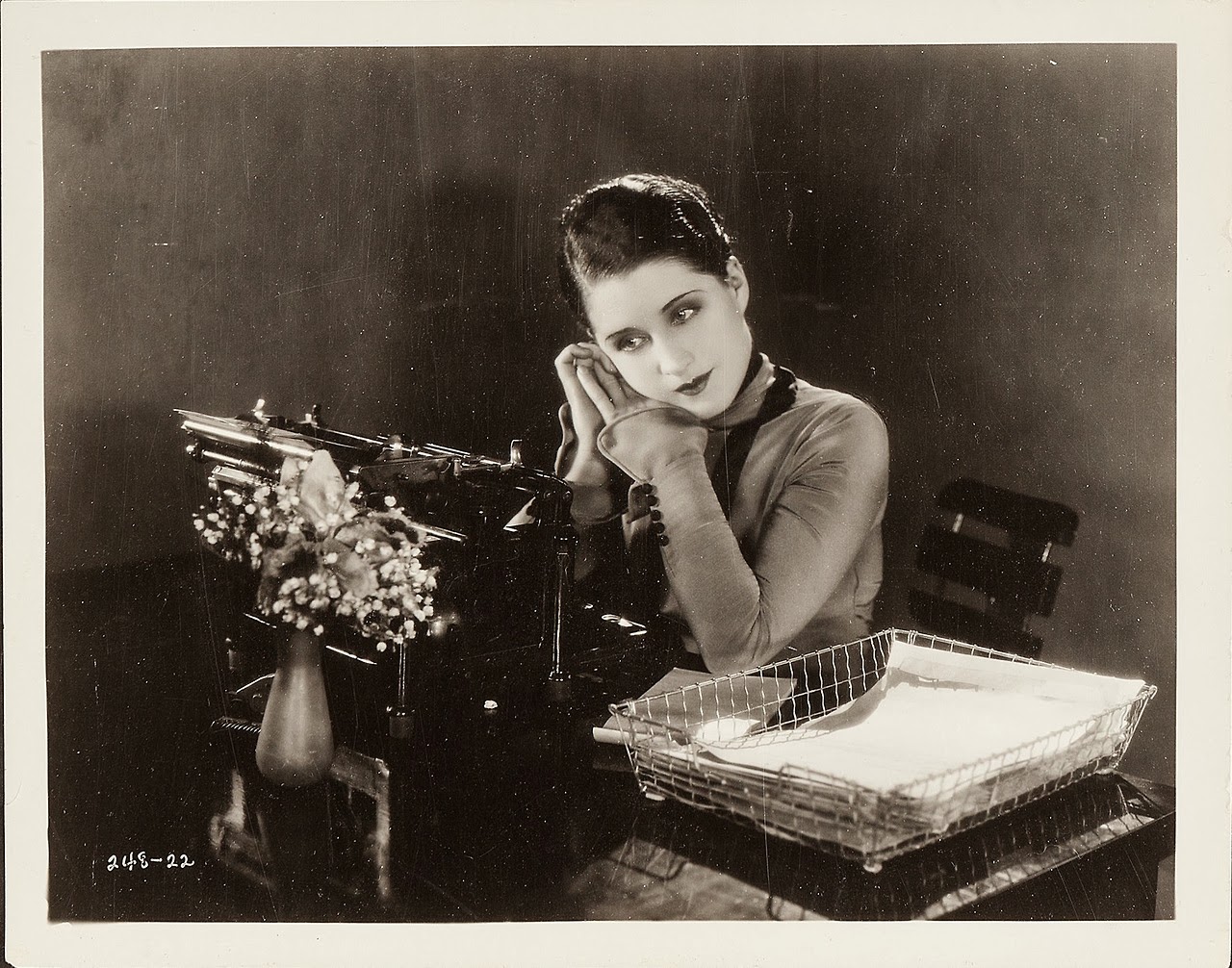
Theodore Shane continued to be disappointed with films coming out of Hollywood. He described Norma Shearer’s latest picture His Secretary as “poor.”
A stenographer, and a vamp! Norma Shearer in His Secretary, 1925 (silent beauties)
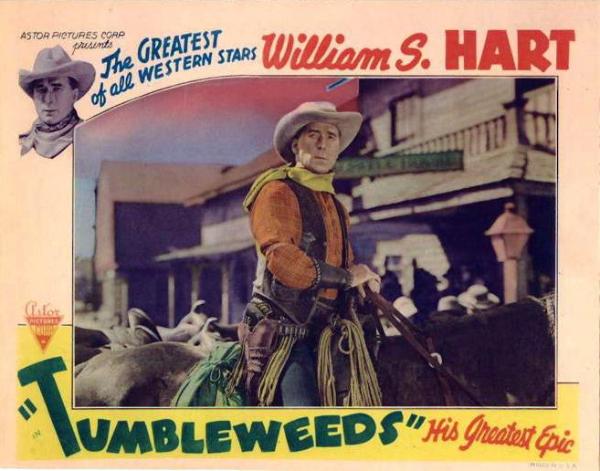
The film was about a humble stenographer who suddenly transforms into a ravishing sex symbol, a “Cinderella theme” that Shane believed had been thoroughly worn out by the actress. He was also underwhelmed by the return to the screen of William S. Hart, once a big star of the early silents.
The old cowboy isn’t done yet, durn it! (silenthollywood.com)
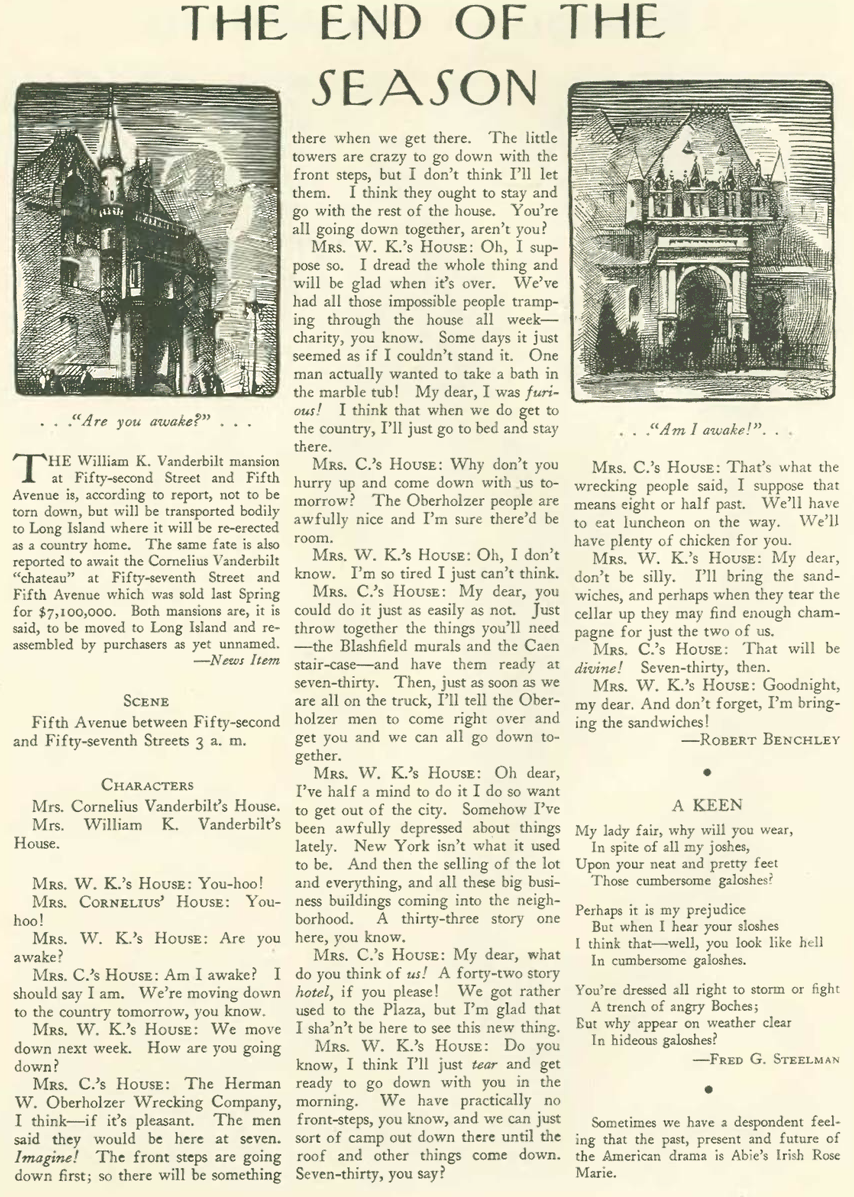
I have written several entries about the changing face of Fifth Avenue (the old mansions being destroyed, that is). Here is Robert Benchley’s take on the subject:
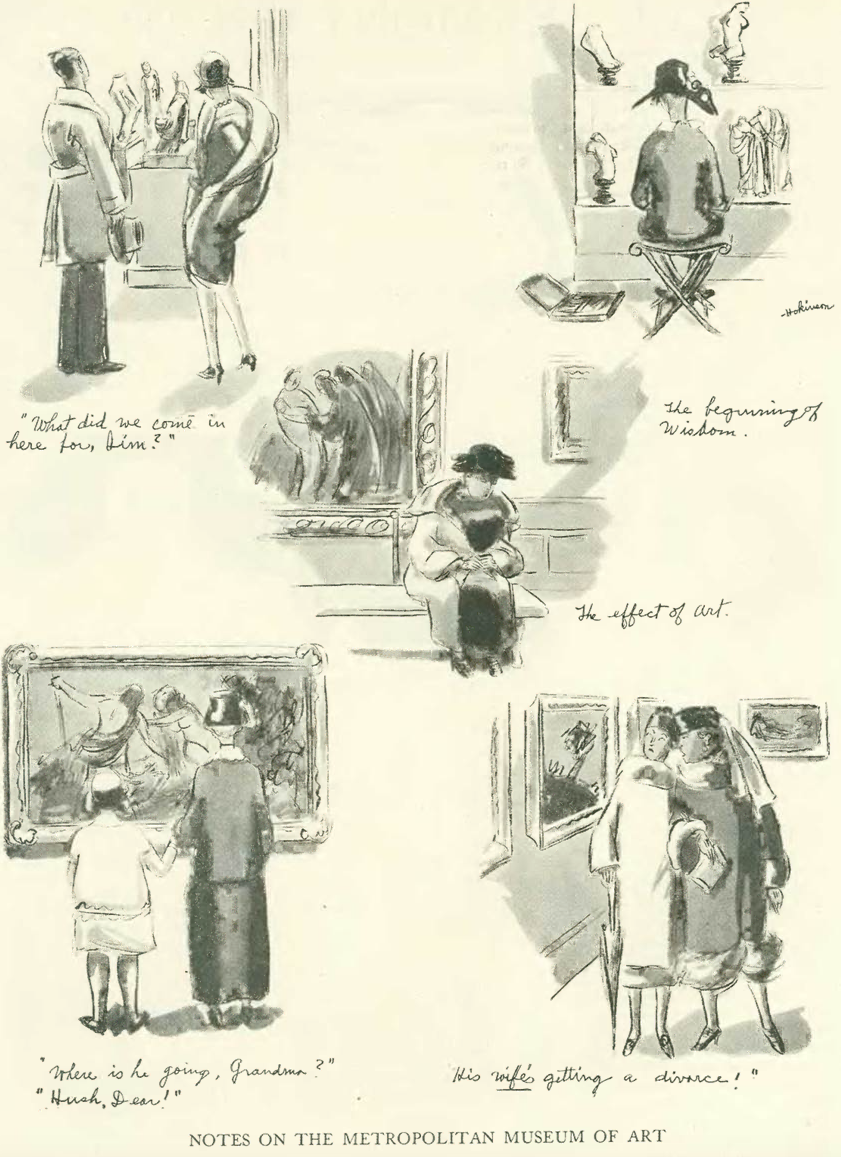
To close, an illustrated feature by Helen Hokinson, once again showing us how a college student of the 1920s looks (to my eyes anyway) as ancient and remote as a mastodon:
Last time we looked at one of The New Yorker’s most prolific artists, Peter Arno. Equally prolific was Helen E. Hokinson, who preceded Arno at the magazine by several months as one of the magazine’s first regular artists.
Hokinson’s signature cartoons of often plump society women engaged in their various activities–clubs, shopping, dining out and gardening–were hugely influential in giving The New Yorker a distinct look and style.
In all she contributed 68 covers to the magazine and more than 1,800 cartoons (including the one that heads this blog entry). So strong was Hokinson’s identity with the magazine, a number of her cartoons were published after her death in 1949.
Helen Hokinson (pbase.com)
New Yorker artist Richard Merkin later wrote (The New Yorker, Feb. 14, 1994) that Hokinson was “something of a stay-at-home, preferring the rewards and routines of her work and of an apartment near Gramercy Park and a cottage in Connecticut.” He observed that it was a “dismal irony” when this homebody died in a plane crash en route to a speaking engagement in Washington, D.C.
But let us remember the joys she brought to so many through her work. Merkin wrote that Hokinson was “a beloved aunt among the family of New Yorker artists…(she) created a type that will forever bear her name–the Hokinson Woman.” Here is Hokinson’s contribution to the Dec. 12, 1925 issue:
The reluctant debutante Ellin Mackay was back for the Dec. 12 issue with a follow-up piece, “The Declining Function: A Post-Debutante Rejoices.” It would be her final word on the topic. As I reported earlier, Mackay went on to marry famed songwriter Irving Berlin, but would continue writing, most notably a number of short stories for the Saturday Evening Post and other publications.
FREE AT LAST…Newlyweds Ellin Mackay and Irving Berlin on their honeymoon in Atlantic City. They were married on Jan. 4, 1926. (www.kuaike.co)
In this her second and final New Yorker piece, Mackay drove the final nail into her past debutante life, writing that balls and other society events were “no longer a recognition of any kind of distinction.” She concluded:
People are bored, at least for a while, with being sheep; they are weary of filling their hours of ease with tiresome duties; they have learned to go where they want to go, not where they want to be seen.
* * *
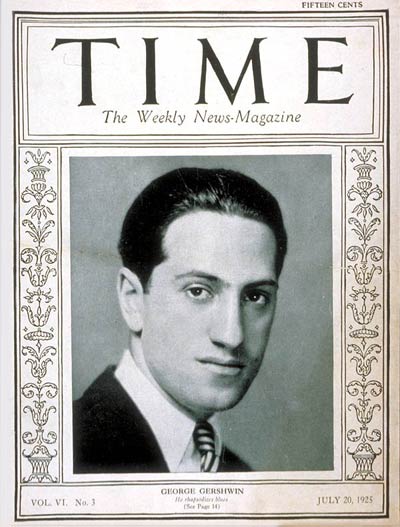
“The Talk of the Town “ reported on George Gershwin’s latest work of “ambitious jazz,” his Concerto in F, which premiered at Carnegie Hall with Walter Damrosch conducting.
George Gershwin on the cover of the July 20, 1925, issue of Time magazine. (Time.com)
It was noted that Gershwin’s new work had the “beat of the Charleston stirring it.” Later in the “Critique” section, the work was applauded as an “advance on Rhapsody in Blue” and “sharply effective.”
“Profiles” featured Tex Rickard, proprietor of the new Madison Square Garden. The profile’s writer, W. O. McGeehan, suggested that Rickard had assumed the mantle of P. T. Barnum, and although he had given up his saloon-dealing days (promoting gambling and boxing) and now feigned “respectability and elegance,” his primary talent remained in rounding up the gullible masses for popular entertainments:
He will promote anything that will gather a sufficient number of Rubes for profit or for prestige…Behind his guileless exterior, there is a deep guile that is half benevolent and half Satanic…
Tex Rickard (Library of Congress)
The following year (1926) Rickard would be awarded an NHL franchise to compete with the (now defunct) New York Americans hockey team. Rickard’s team would immediately be nicknamed ‘Tex’s Rangers,” a moniker that remains to this day.
Maxfield Parrish’sDaybreak (1922) is regarded as the most popular art print of the 20th century, based on number of prints made: one for every four American homes. The original sold in 2010 for $5.2 million. (artsycraftsy.com)
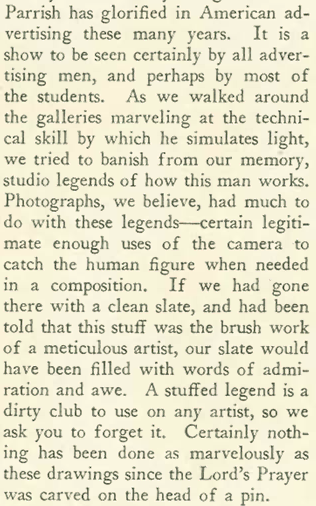
In “Art,” Murdock Pemberton wrote a dismissive critique of the young Maxfield Parrish’s work, which was on display at Scott & Fowles gallery. It was Parrish’s first exhibition. Pemberton took pains to point out that although the work had technical merit, it was by an artist largely glorified in American advertising and not in serious art circles:
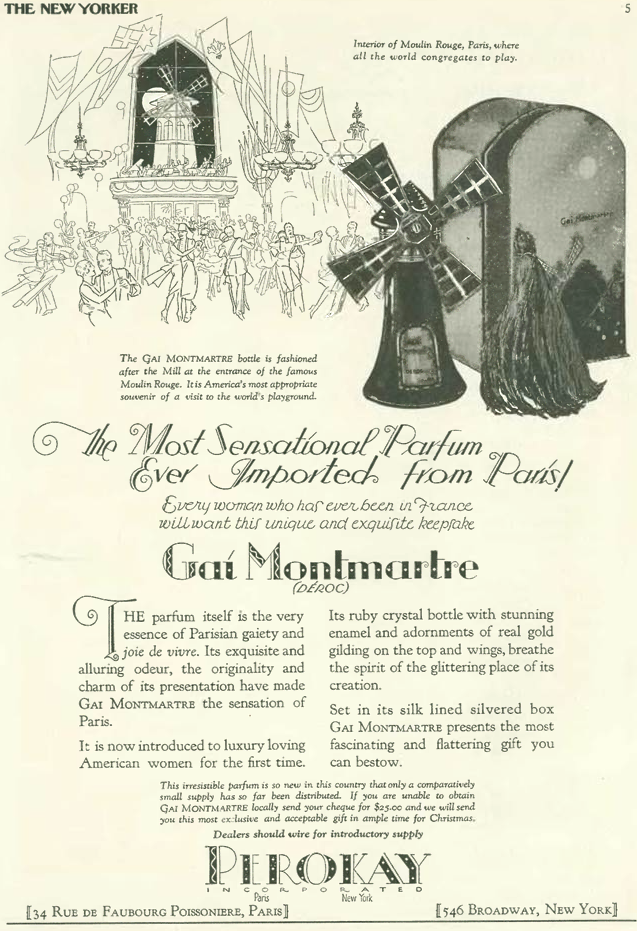
The Dec. 12 issue was filled with Christmas advertisements, including this one that suggests even “sophisticated” readers of the magazine had a taste for kitsch:
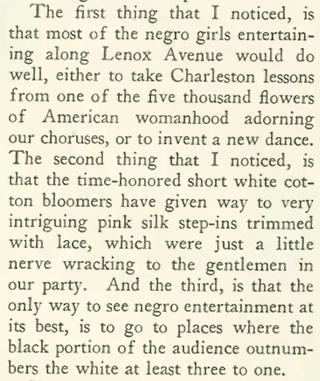
Included in the back pages was an extensive list of “Christmas Shopping Suggestions” compiled by Lois Long (who noted that the list was “not compiled for the benefit of the Old Lady from Dubuque”), while in “Tables for Two” she confessed something akin to horror that she had not yet visited Harlem in the fall season. Among her observations:
And in the spirit of the season, the “Old Lady from Dubuque” made an appearance in the magazine courtesy of cartoonist Ralph Barton:
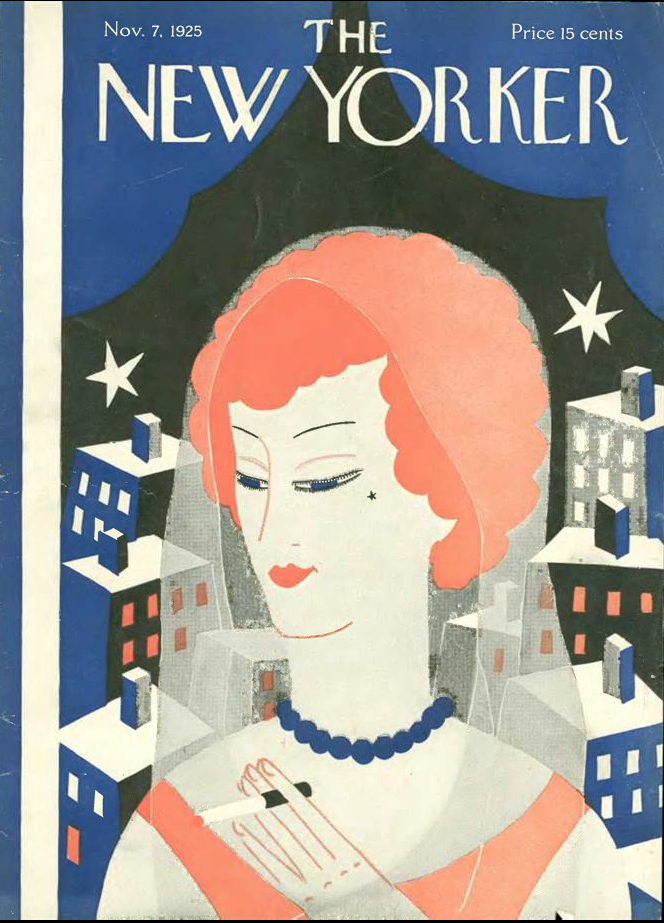
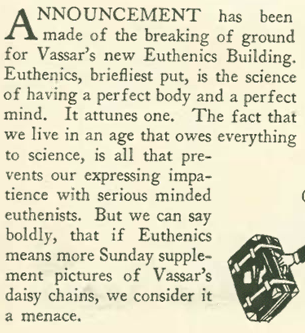
A brief item in “The Talk of the Town” for Nov. 7, 1925, mentioned the groundbreaking for a new building at Vassar dedicated to the study of something called “Euthenics.” The term was used by Ellen H. Swallow Richards (Vassar, Class of 1870), based on the Greek Euthenia, which described a good state of the body, including prosperity, good fortune and abundance.
After Richards died in 1911, the idea was taken up by another Vassarite Julia Lathrop (’80) who teamed up with fellow alumnae Minnie Cumnock Blodgett (’84) to create a program of Euthenics at Vassar, against the protestations of some faculty who found this new field of interdisciplinary study suspect. It didn’t help that some even confused it with the racist “eugenics” movement.
At a time when many academic disciplines were moving in the direction of specialization, students in euthenics could study horticulture, food chemistry, sociology, statistics, education, child study (Lathrop would serve as the first chief of the U.S. Children’s Bureau), economics, economic geography, physiology, hygiene, public health, psychology, domestic architecture and furniture. The New Yorker had this to say about the new area of study:
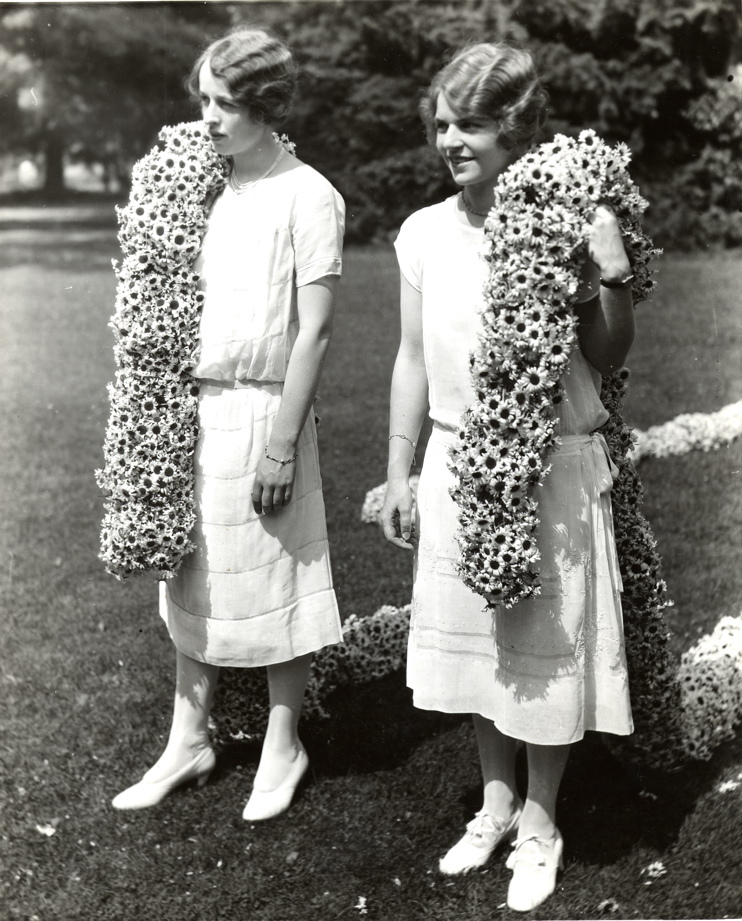
The “daisy chains” referred to above are one of the oldest traditions at Vassar. Every year, the senior class chooses sophomore women who demonstrate superior leadership and class spirit to carry a 150-foot chain of daisies and laurel at Commencement.
Carrying the “Daisy Chain” at Vassar, 1925 (Vassar College)
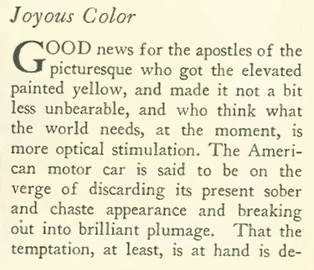
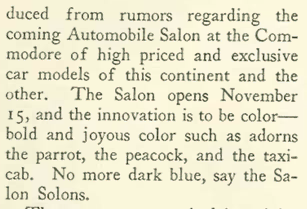
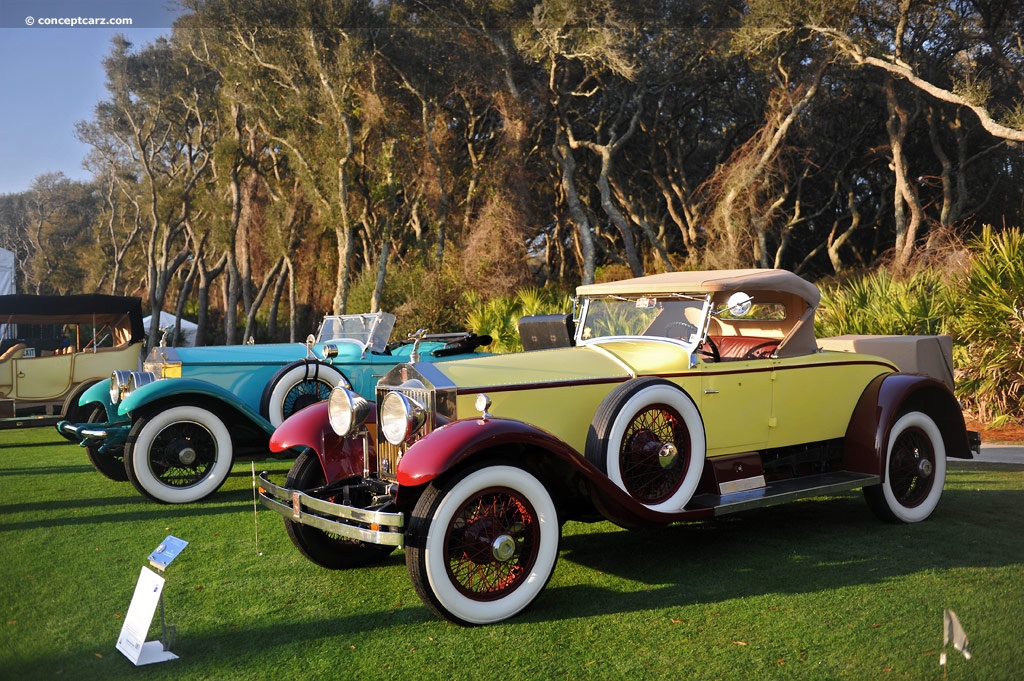
The New Yorker was also anticipating the upcoming Automobile Salon at the Commodore Hotel, including the news that autos would break from sober black and navy into a palette of colors:
1925 Rolls Royce Silver Ghost (conceptcarz.com)
“Profiles” featured Gen. John J. Pershing, while “Sports of the Week” featured the Oct. 31 “Cornell-Columbia battle” at the Polo Grounds (Cornell prevailed 17-14). That same day in New Haven, Yale humbled Army 28-7.
In her fashion column “Fifth Avenue,” Lois Long paid a visit to designer Paul Frankl’s store, where she admired his collection of “four-dimensional furniture, including his “skyscraper” bookcases:
Paul Frankl “skyscraper” bookcase, ca. 1927. Fashioned from maple and trimmed with Bakelite (Metropolitan Museum of Art).
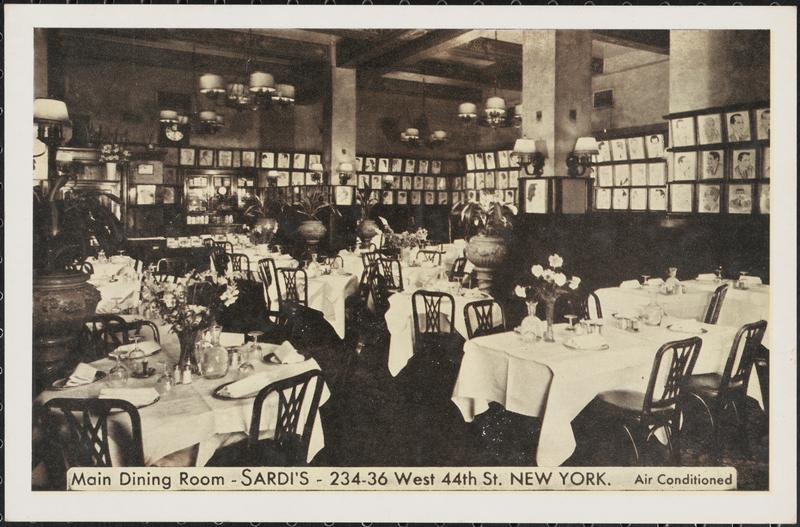
In her “Tables For Two” column, Long’s previous criticism of Sardi’s (lack of celebrity sightings) received this reply:
Main Dining Room of the old Sardi’s, 234-36 West 44th St. New York. (Museum of the City of New York)
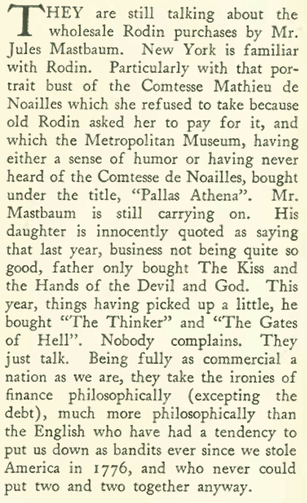
In her latest dispatch from Paris, Janet Flanner wrote that Philadelphia movie theater magnate Jules Mastbaum was making a haul of Rodin sculptures. The French found it interesting but not alarming:
Mastbaum would die the following year and donate his Rodin collection to the city of Philadelphia. It is the largest collection of Rodin’s works outside Paris. Flanner also offered this tidbit on a new, scandalous book by Texan Gertrude Beasley:
In a 2000 article for Texas Monthly (“A Woman of Independent Means”), Don Graham wrote that “no other book in Texas literature is quite like Gertrude Beasley’s little-known memoir, My First Thirty Years. For one thing, it was published in Paris in 1925 by the avant-garde press Contact Editions (it was banned in Britain and America), which included among its authors Ernest Hemingway.” He wrote that Beasley’s book established itself “as a provocative and highly subversive text: She recounts her birth as the violent outcome of marital rape by her father…Things go downhill from there…” You can read more about Beasley, and her “disappearance,” in this Texas Observer article.
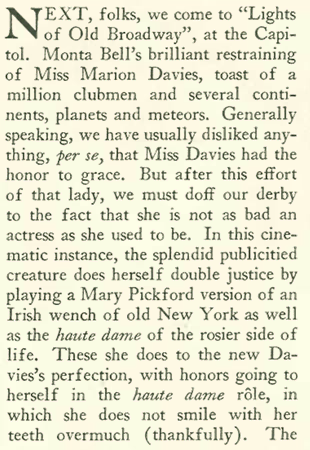
In “Motion Pictures,” The New Yorker (via critic Theodore Shane) cut actress Marion Davies a little slack:
Channelling her inner Pickford: Marion Davies in The Lights of Old Broadway. (Wikipedia)
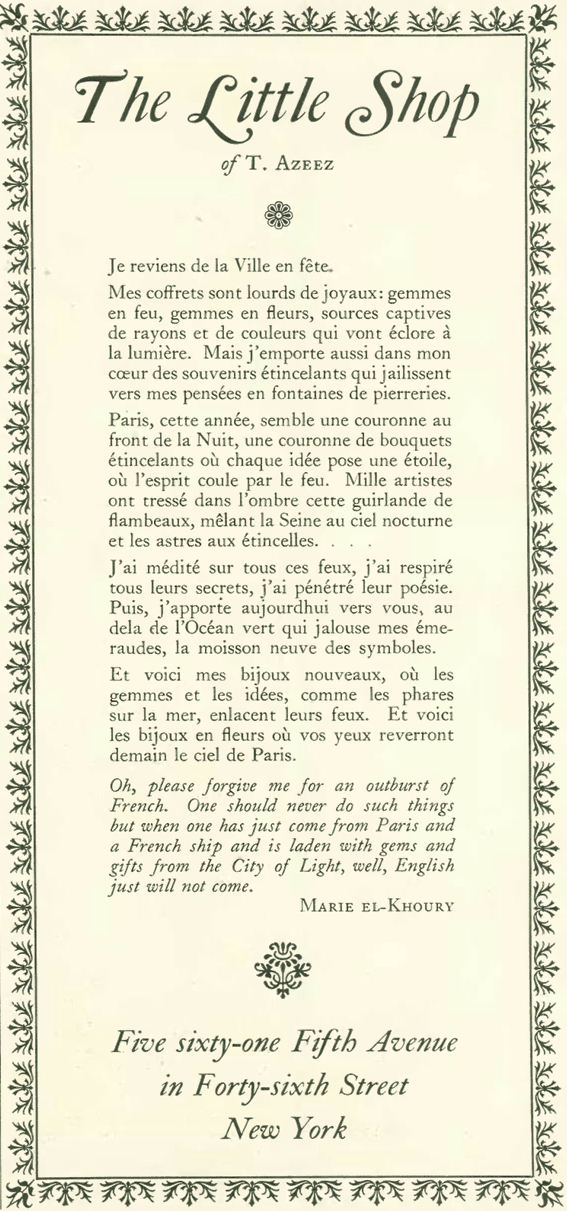
And if you doubt the Francophile ambitions of New Yorker readers, here are two ads written almost entirely in French:
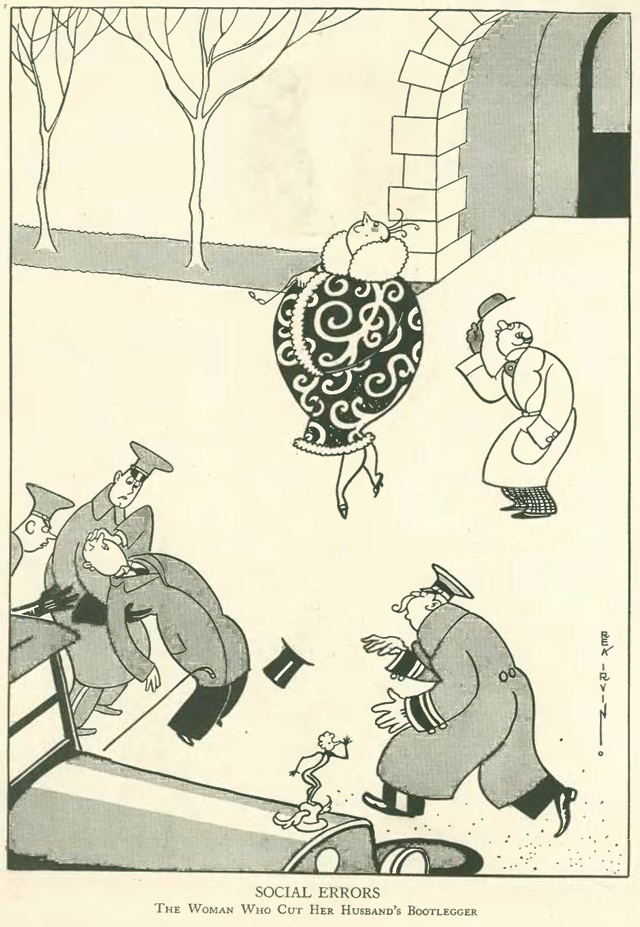
And to end on an amusing note, more perils of Prohibition, courtesy of Rea Irvin:
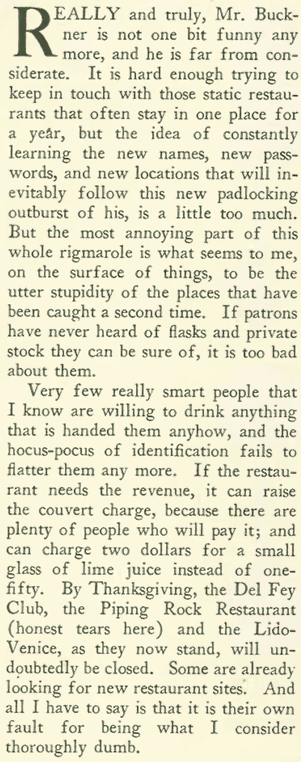
The woes of Prohibition were acutely felt by the readership of The New Yorker. The magazine responded in kind with its continued criticism of the law’s enforcement and particularly the tactics of Manhattan District Attorney Emory C. Buckner, whose agents continued to padlock restaurants and clubs suspected of selling alcohol.
The New Yorker previously called the padlocking tactic a “promotional stunt” that would ultimately backfire (I wrote about this in a previous blog post last March).
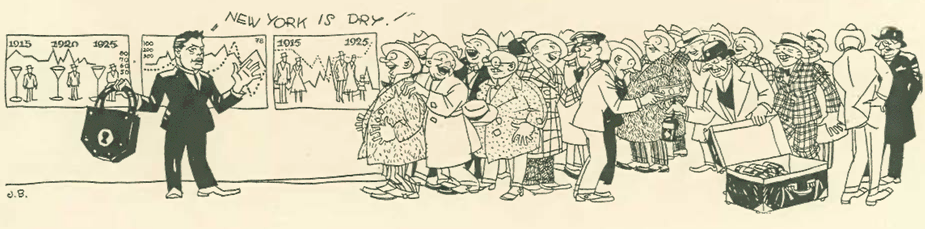
Both the “The Talk of the Town” and “Tables for Two” took aim at Buckner this time around. “Talk” led with this item, accompanied by the art of Johan Bull:
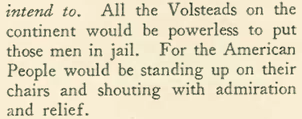
“Talk” also made a call to action by “men of virtue:”
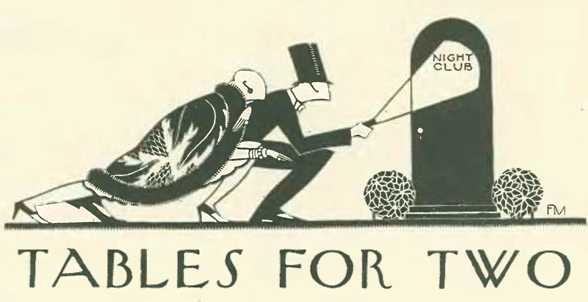
Heck with statements. Lois Long just wanted to have some fun, and led her column, “Tables for Two,” with her own attack on Buckner and on the “stupidity” of establishments that were closed by Buckner’s agents (I include art that accompanied the column by Frank McIntosh—at least that is what I think the “FM” stands for; if I am in error, someone please correct me!):
In a previous column (Oct. 17), Long pondered the popularity of a new dance, the “Charleston.” She closed her Oct. 31 column with “telegrams” from exemplary colleges in answer to the query: “Is the Charleston being done at college dances?”
W.J. Henderson wrote a lengthy article about the upcoming opera season at the Metropolitan Opera (it was opening with La Gioconda), and recalled the days after World War I when the once-popular German singers suddenly grew scarce on the American stage.
The old Metropolitan Opera House at 1411 Broadway. The “Old Met” opened in 1883 and was rebuilt after a fire in 1892. The interior, shown here, was redesigned in 1903. This photo depicts a recital by pianist Josef Hofmann on November 28, 1937. The old Met was torn down in 1967 and replaced by a 40-story office tower. (Wikipedia)Site of the old Metropolitan Opera House today.
According to Henderson, this led to a general falling off of quality in the performances, a situation made even worse by the absence of the late, great Enrico Caruso on the Metropolitan’s stage.
In other items, John Tunis wrote about Illinois All-American halfback Red Grange in “Profiles,” calling him “a presentable youth of twenty-two…well-groomed, he would pass anywhere—even in the movies—for a clean type of American manhood.”
Tunis also noted that Grange had been offered a “half a million” to star in movies, and that professional football was ready to offer him a sum “that would cause even the once-mighty Ruth to blanch.” Grange, known as “The Galloping Ghost,” would later join the Chicago Bears and help to legitimize the National Football League (NFL).
Howard (Real Photograph)
The young actor Leslie Howard, who was appearing on Broadway in Michael Arlen’sThe Green Hat, wrote a humorous account of theatre life in “The Intimate Diary of An Opening Night.”
It was one of seven articles on the acting life that Howard (perhaps best known for his role as Ashley Wilkes in Gone With the Wind) would write for The New Yorker between 1925 and 1927.
For the record, I include Howard’s first New Yorker article here (with Carl Rose cartoon):
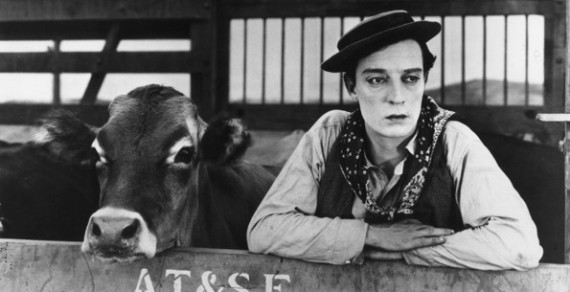
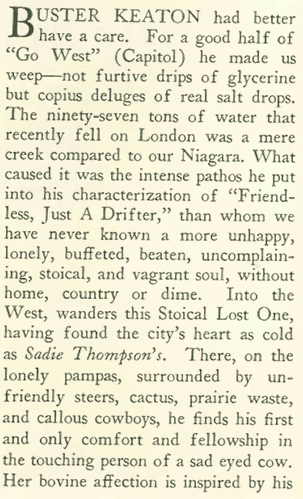
“Motion Pictures” looked at Buster Keaton’s new film, Go West…
Cow and Keaton in Go West (1925) (silentology.com)
Theodore Shane wrote that what at first seemed to be a real weeper…
…turned into a comic romp thanks to the introduction of the “sad-eyed cow…”
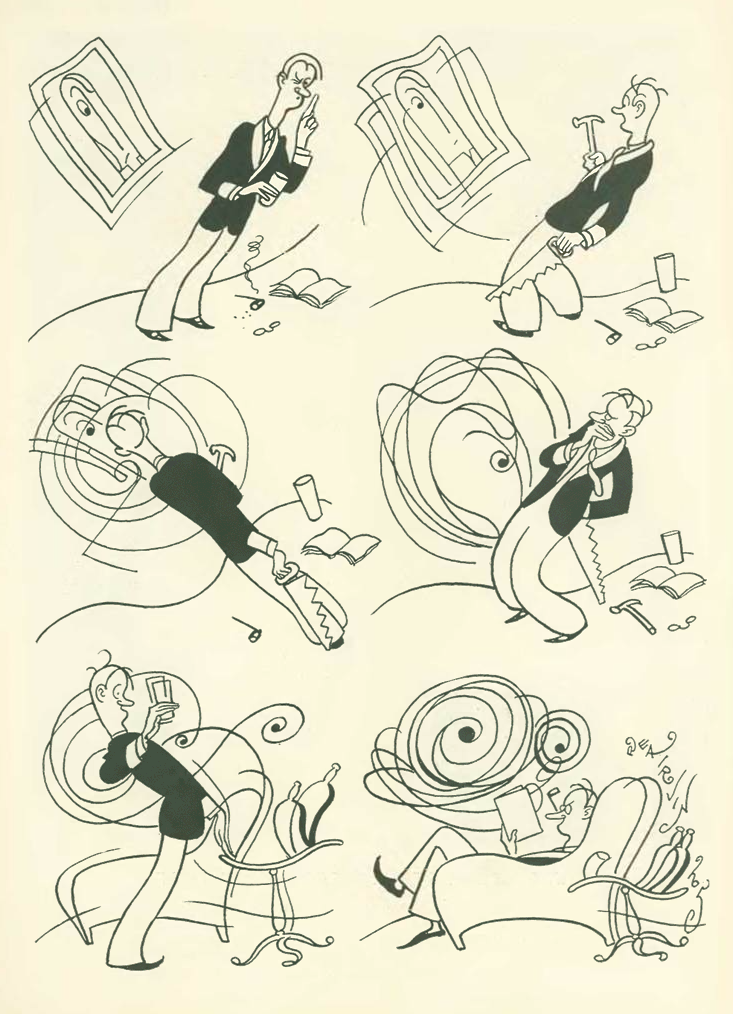
And finally, in keeping with the Prohibition theme, here is a center-spread cartoon by Rea Irvin that seemed to depict the results of consuming too much bootleg booze:
“The maddest week any of us remembers in the theatre,” observed “The Talk of the Town” for Sept. 26, 1925, as The Green Hat (the play based on Michael Arlen’s popular novel) was creating a riotous rush for tickets on The Great White Way.
Talk described The Green Hat as “a play so eagerly sought after that even in a week providing 12 openings, speculators were offering five hundred dollars for twenty tickets” ($500 then is roughly equivalent to $6,800 today).
It was noted that despite the openings of such plays as The Vortex and No, No Nanette, The Green Hat was consuming most of the attention, with the opening attracting “every bigwig of Broadway” including Irving Berlin.
Michael Arlen in 1925 (Wall Street Journal)
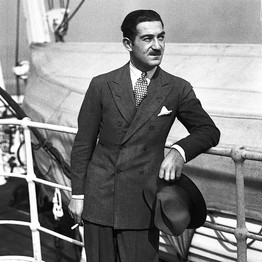
One notable guest, however, did not arrive until after the second act: Michael Arlen himself. It was said that Arlen had never seen a complete performance of his play, due to “nervousness.”
Perhaps there was a good reason for his butterflies.
Later in the “Critique” section, Herman J. Mankiewicz (H.J.M.) pronounced The Green Hat as “unreal and consequently uninteresting…a grand sentimental debauch for the romantically inclined. It has no place at all in the discussion of the Higher Theatre…”
Mankiewicz observed that the acting itself was passable, with Katherine Cornell delivering an “excellent, though scarcely ideal portrayal of Iris March,” but she was “showing the strains of playing a role that has no more grasp on life than a little boy’s daydream that the Giants will, after all, snatch the pennant from Pittsburgh.”
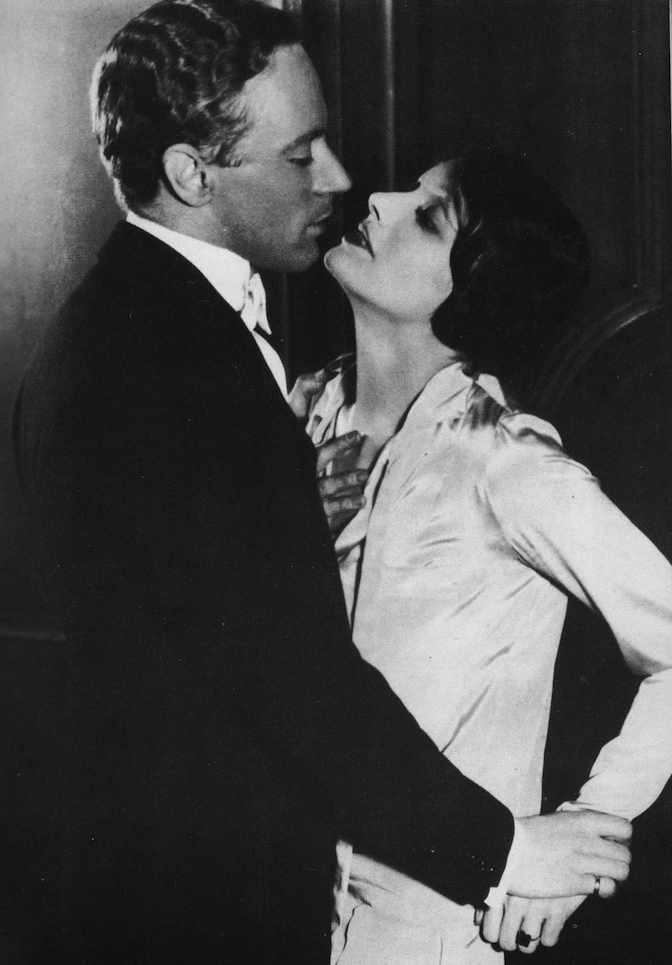
A publicity photo from the play:
Broadway newcomer Leslie Howard embraces Katherine Cornell in this publicity photo from The Green Hat. (inafferrabileleslie)
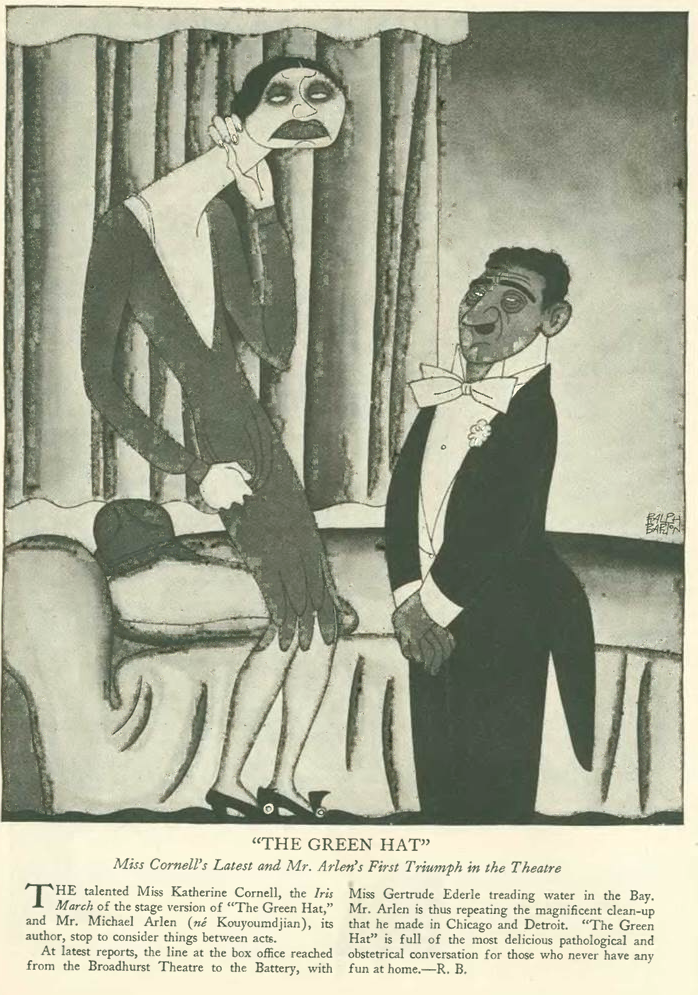
And Ralph Barton’s unique take on the whole thing:
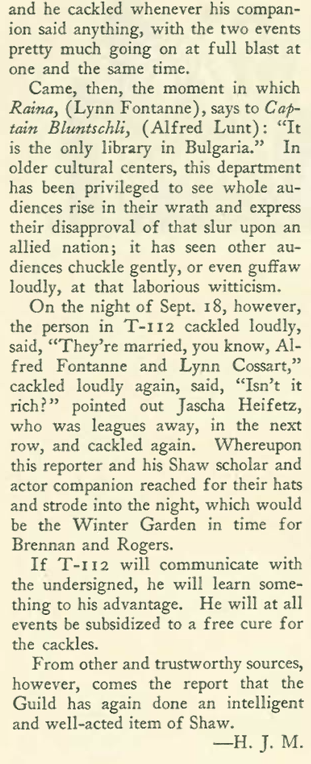
Mankiewicz also reviewed the play, Arms and the Man, but his focus was not the play but rather an annoying patron in seat T-112:
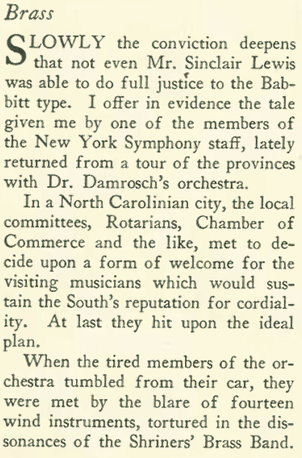
Although the Scopes Trial was long over, The New Yorker still found opportunities to take potshots at the backwardness and Babbittry of folks in the hinterlands:
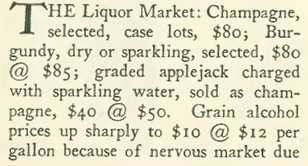
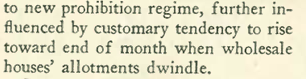
Talk also continued to help its readers with regular updates on the bootleg liquor trade:
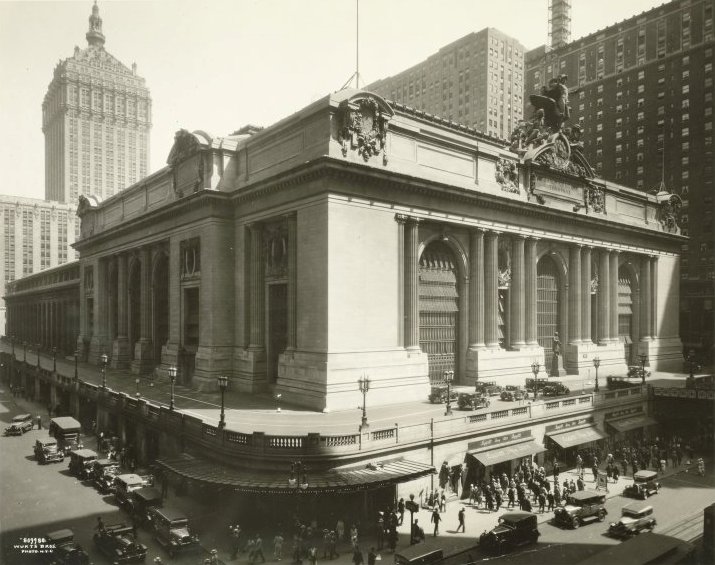
An article titled “Mid-Town” celebrated the 100th anniversary of 42nd Street. Henry Collins Brown wrote that 100 years had changed the street “from a dusty country lane to a self-contained metropolis. The brownstone of its middle age has given way to granite and marble. It has seen a railroad dynasty rise and has written its epitaph on a narrow, short avenue.”
A 42nd Street landmark: Grand Central Station in the 1920s. (wirednewyork)
Then Brown concluded with these prescient thoughts:
An illustrated tribute (by Rea Irvin) to 42nd Street appeared in the “Talk” section:
In “Profiles,” Jo Swerling looked at the life of comedian Louis Josephs, known to all as Joe Frisco, a mainstay on the vaudeville circuit in the 1920s and 1930s.
Swerling wrote admiringly that Frisco—who was from Dubuque, Iowa, of all places—was “the comedian’s comic.”
Joe Frisco (findagrave.com)
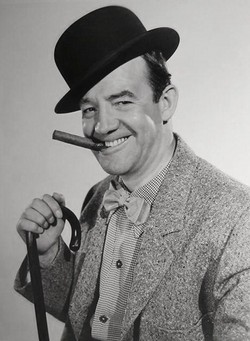
Considered one of the fastest wits in the history of comedy, Frisco was a famous stutterer but could recite his scripted dialogue unimpaired. According to Wikipedia, he was first known for his popular jazz dance act–called by some the “Jewish Charleston”– which was a choreographed series of shuffles, camel walks and turns. He usually danced in a derby hat with a king-sized cigar in his mouth, often performing in front of beautiful women “smoking” prop cigars.
His most famous line was uttered while in a New York hotel. A clerk learned that Frisco had a guest in a room that was only reserved for one occupant, so he called up to the room and said, “Mr. Frisco, we understand you have a young lady in your room.” Frisco replied, “T-t-t-then send up another G-g-gideon B-b-bible, please.”
With vaudeville in decline, in the 1940s Frisco moved to Hollywood and appeared in several low-budget movies. A compulsive gambler who was constantly in debt, he died penniless in Los Angeles in 1958.
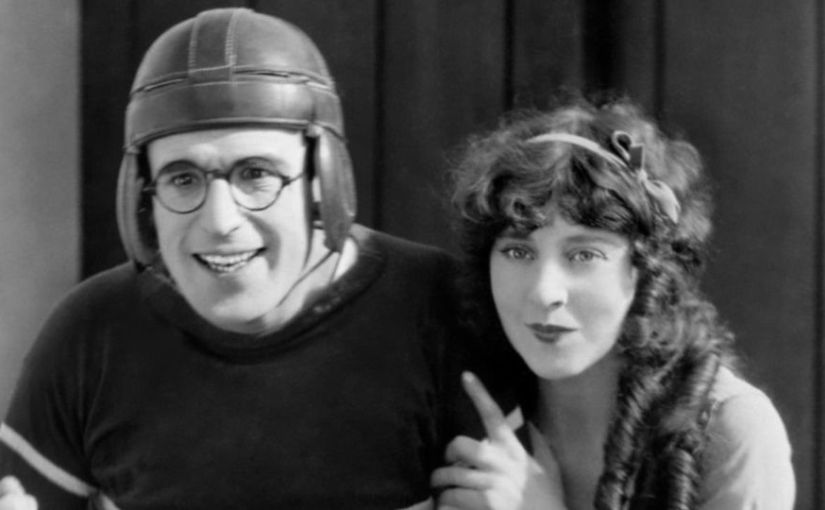
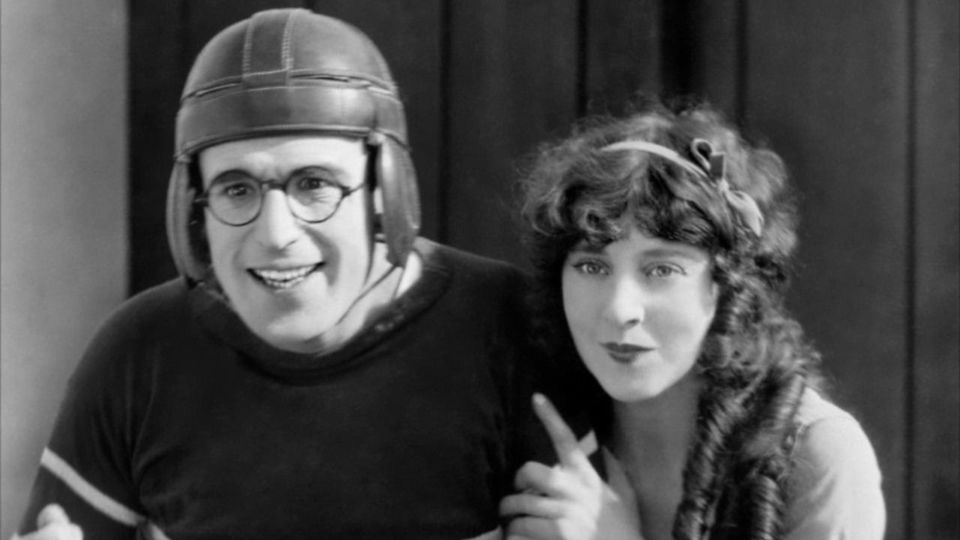
In “Motion Pictures,” Harold Lloyd’s “college comedy,” The Freshman, which Theodore Shane wrote was filled with “glorious laughter.” Shane also noted that another Rin Tin Tin picture was appearing at Warner’s Theatre (Below the Line), and “as usual our hound hero is enlisted on the side of virtue.”
FOLLIES OF YOUTH…Harold Lloyd and Jobyna Ralston in The Freshman. (avclub.com)
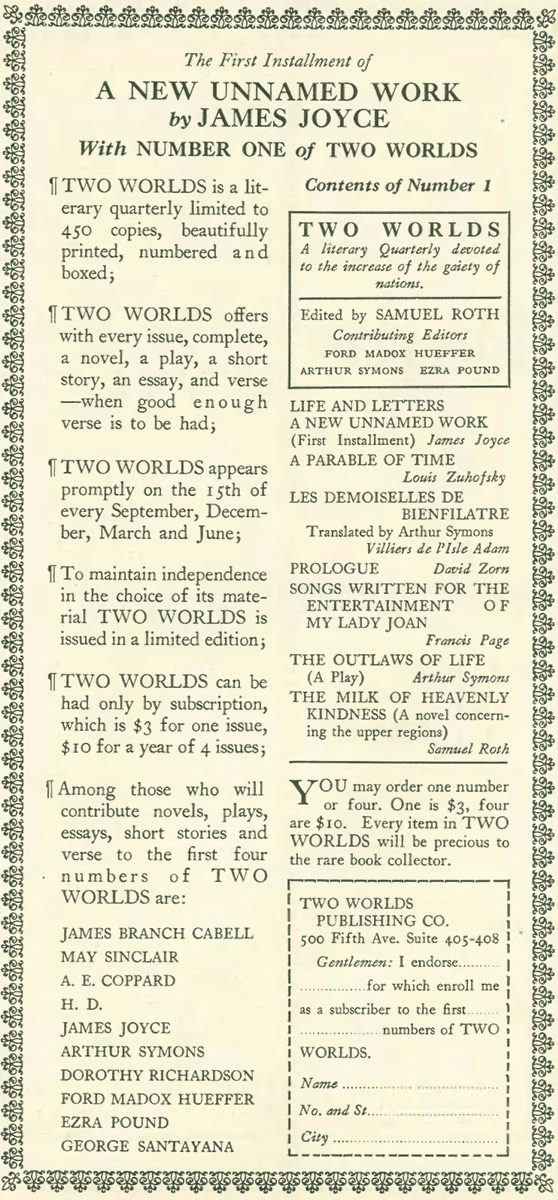
An interesting ad near the back of the magazine (and the book reviews) offered readers an opportunity to sample a new, unnamed work by James Joyce:
What this ad described was an avant-garde work by Joyce that would appear in serialized form until it was finally published in its entirety in 1939 as Finnegans Wake.
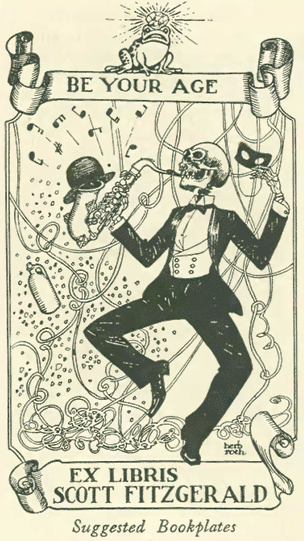
In other book-related matters, this illustration by Herb Roth appeared in the pages of the “Critique” section:
Anne Margaret Daniel wrote about this “Suggested Bookplate” in her May 1, 2013 blog for the Huffington Post, and made this observation:
“Be Your Age” shows how fully the magazine at the pulse of the Jazz Age registered both Fitzgerald’s personification of the decade, in many readers’ eyes, as well as the dangers he had foretold in The Beautiful and Damned, and again in Gatsby of decadence and of the coming Crash. It’s a very double-edged image of festivity and fatality, just like so many of the images of people at parties that end in disasters in Fitzgerald’s best-known, and best-loved, novel.
Charles Baskerville (Top Hat) continued to report from the City of Lights in his “Paris Letter,” mainly focusing on the doings of American tourists. No offense to the urbane and talented Baskerville (also a great illustrator), but I am looking forward to Janet Flanner’s (a.k.a. Genêt) take on Paris in future issues (Does anyone out there know if she wrote the unsigned “Paris Letter” in the Sept. 5 issue?).
The issue featured a rather faded-looking movie ad for the back cover:
And a still from the film on which the drawing is no doubt based:
Tyrone Power Sr. and Greta Nissen in The Wanderer (1925) (Sad Hill Archive)
The New Yorker was launched as a sophisticated, funny, urbane weekly, so it’s always interesting to see how the magazine will respond to a national tragedy.
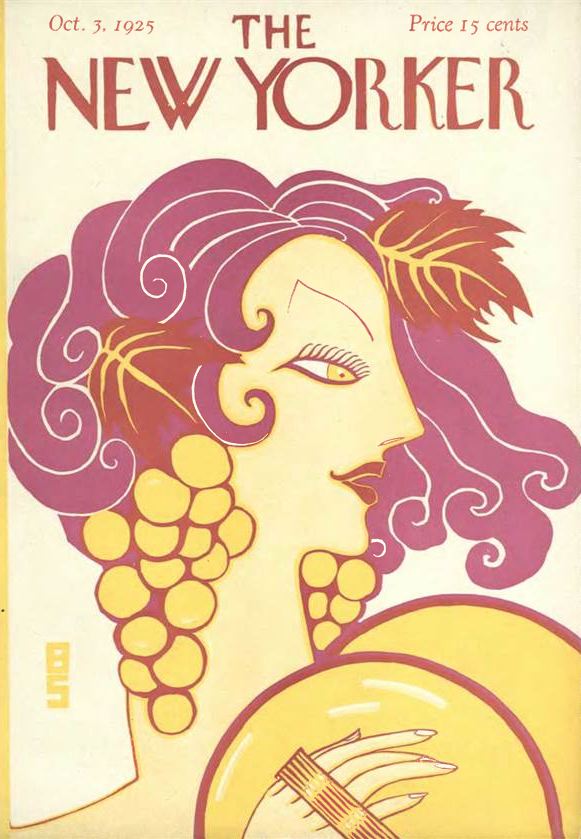
Sept. 12, 1925 cover by Rea Irvin, depicting plutocrats on a Merry-Go-Round.
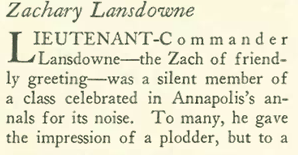
For example, the Sept. 12, 1925 “Talk of the Town” featured a brief item titled “Zachary Lansdowne.” It opens with a paragraph describing the lieutenant commander’s demeanor and character:
Then it becomes apparent that this is a eulogy of sorts, since Lansdowne was the pilot of the American dirigible S.S. Shenandoah:
Built in 1922, the S.S. Shenandoah was the first of four U.S. Navy airships. On Sept. 2, 1925, itdeparted on a promotional flight that would include flyovers of 40 cities and visits to state fairs. While passing through thunderstorms over Ohio on the morning of September 3, the Shenandoah was caught in a violent updraft that carried it beyond the pressure limits of its helium gas bags. It was torn apart in the turbulence and crashed in several pieces. Fourteen of Shenandoah ’s crew, including Commander Lansdowne, were killed. Amazingly, there were 29 survivors who succeeded in riding three sections of the airship to earth.
Wreck of the Shenandoah. The front section rests in a field near Caldwell, Ohio. (Wikipedia)
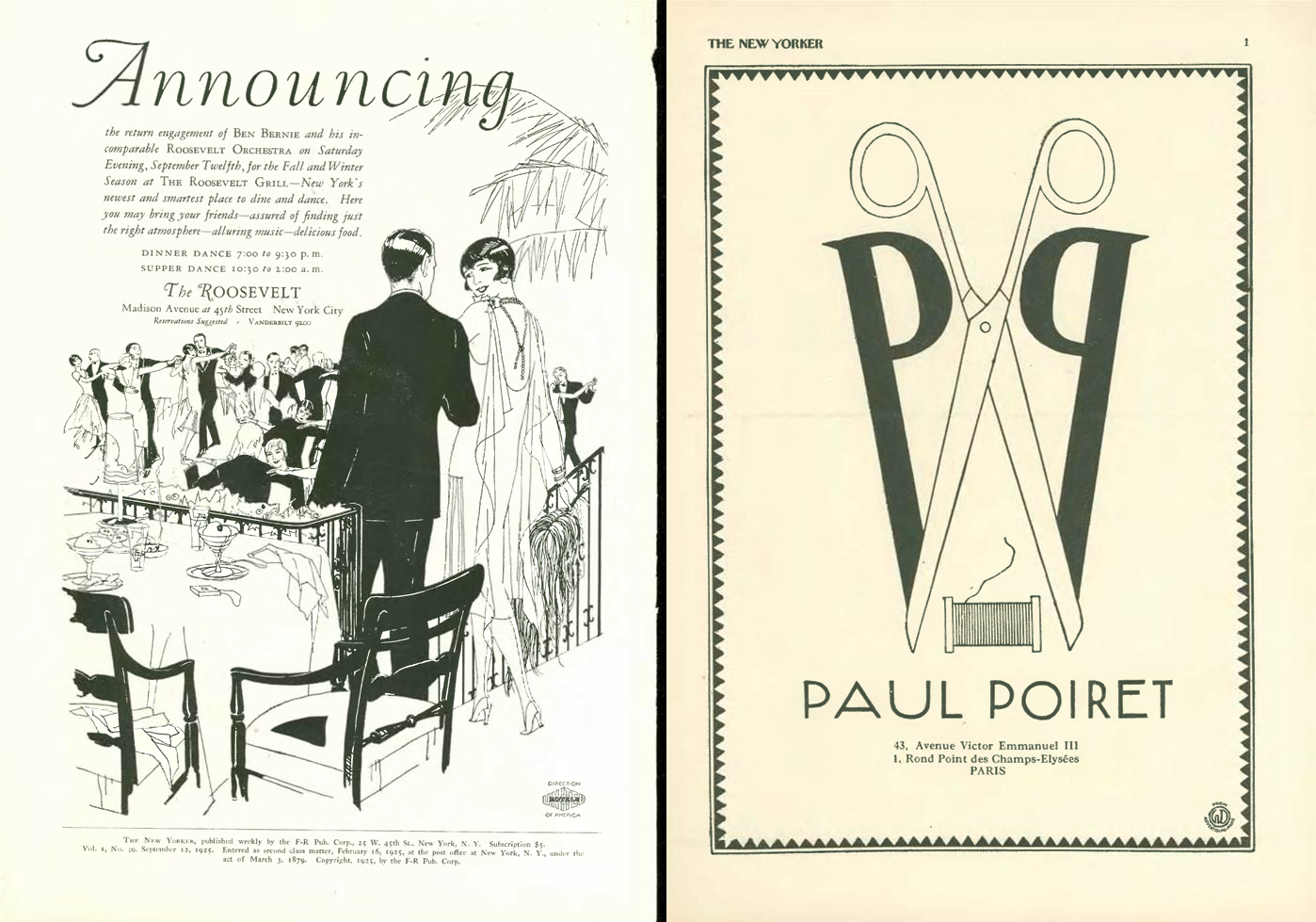
After a lean summer, advertising in The New Yorker picked up dramatically, with the opening spread for the Sept. 12 issue featuring full-page ads by The Roosevelt Hotel and the French fashion house Paul Poiret:
This infusion of advertising was largely the result of a big promotional push orchestrated by John Hanrahan, considered one of the most gifted writers of publisher promotions. The magazine’s major (and really only) investor, Raoul Fleischmann, brought Hanrahan on board to address the magazine’s dearth of advertising, a move that was much to the dislike of the acerbic Harold Ross.
The trials of starting a new magazine were not lost on Ross, as was evidenced in this Newsbreak on page 13:
But Ross knew that the ad push helped the bottom line, and he did his part to draw new talent to the magazine and improve its overall quality.
Ralph Ingersoll in the 1940s (baseball-fever.com)
New talent included Ralph Ingersoll, who joined the magazine as managing editor in the summer of 1925. Ingersoll went to work giving the magazine a “voice,” especially in the rather weak and unfocused “Talk of the Town” section.
After suffering Ross-induced burnout in 1930, Ingersoll would go on to serve as a managing editor of Time-Life Publications, and would later found the short-lived, left-wing daily newspaper, PM.
That summer Ross also brought on Katharine Angell (later Katharine White) as a part-time reader of manuscripts, but almost immediately she became a full-time employee and was soon involved in every aspect of the magazine.
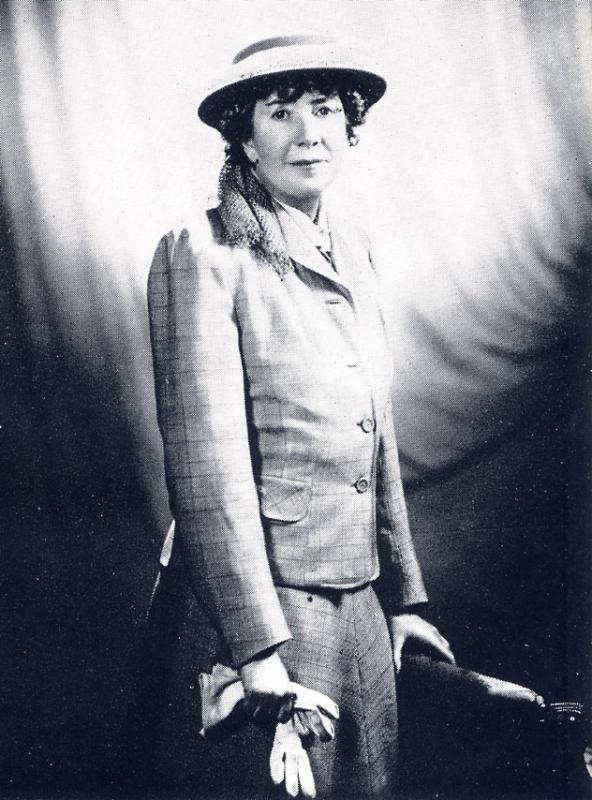
Katherine Angell (Wikipedia)
She is often credited with the magazine’s maturity and its sophisticated taste and style. It was through Angell that Ross would meet and hire both E.B. White (who would later marry Angell) and James Thurber.
In the “Profiles’ Section, Murdock Pemberton took a look at the challenges facing Richard Bach in his attempts to promote the arts to business-minded New Yorkers. Bach was an “Associate in Industrial Arts” at the Metropolitan Museum of Art. Today, merchandise based on art museum collections is a ubiquitous practice, but in 1925 Bach’s job was viewed as somewhat distasteful:
Morris Markey (“In The News”) tried to make sense of the continued enforcement of Prohibition, and seemed to conclude that it originated in Puritan resentment in the Midwest, and would continue to be enforced according to regional customs and strictures:
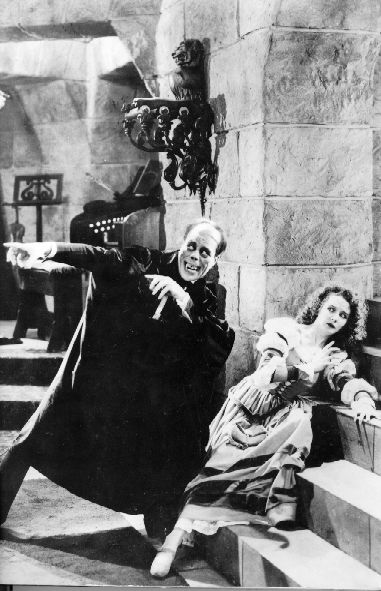
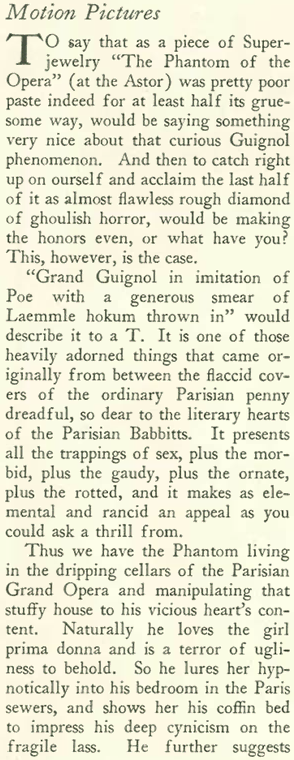
And true to form, New Yorker film critic Theodore Shane panned a movie that today is considered a classic of the silent era:
UM, AWKWARD…Theodore Shane called Phantom of the Opera “Grand Guignol in imitation of Poe with a generous smear of Laemmle hokum”…in this scene, Erik, The Phantom (Lon Chaney) woos Christine Daaé (Mary Philbin) (Wikipedia)
With this issue Lois Long retired “When Nights Are Bold” (a column on local nightlife she inherited from Charles Baskerville) and introduced us to a renamed column, “Tables For Two.” She opened with a description of a police raid on a on old barroom where she had been apparently enjoying a nice beefsteak. She then abandoned the “slums” for the Plaza Hotel, where she spied none other than actors Charlie Chaplin and Adolph Menjou:
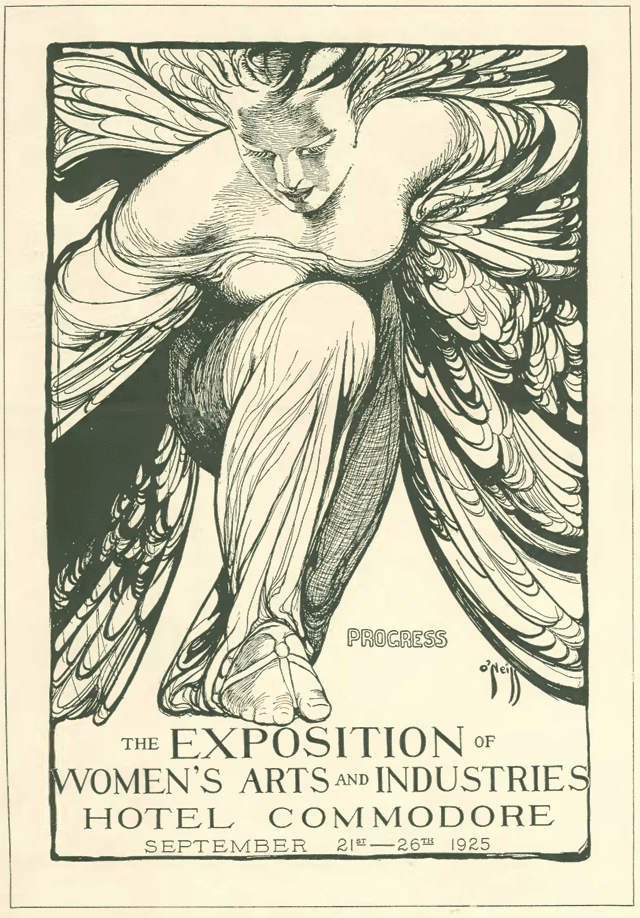
Ads return to the back cover, an indication that things are picking up:
The poster above was created by American illustrator Rose O’Neill, who is best known as the creator of the popular Kewpie comic characters in 1909. The wildly popular Kewpies were later produced as dolls, and became one of the first mass-marketed toys in America. Raised in rural Nebraska, O’Neill was active in the women’s suffrage movement and at one point was the highest-paid female illustrator in the world.
Rose O’Neill in 1907, and her famous creation (Wikipedia)
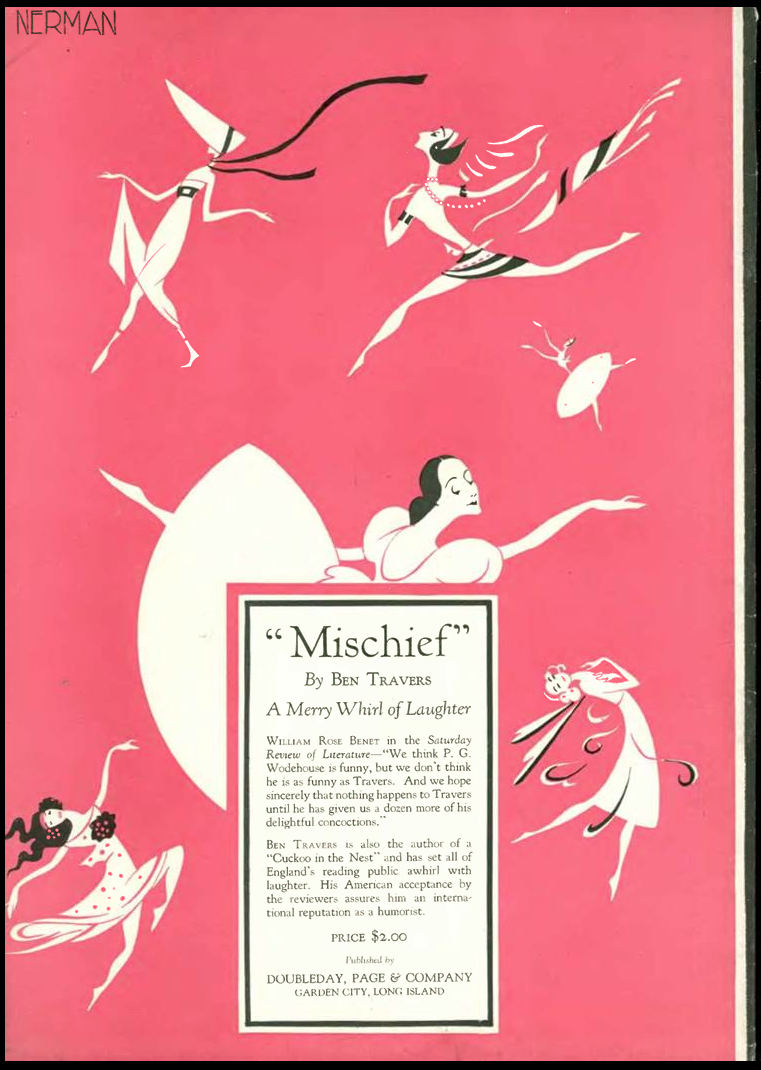
On the back cover, we are treated to some more great illustrations by artist Einar Nerman in this ad from Doubleday: