New York 1965

Past visions of the future are fascinating, especially those of the early and mid-20th century—despite the horrors of world war and economic depression, we were still able to envision endless possibilities for human progress.

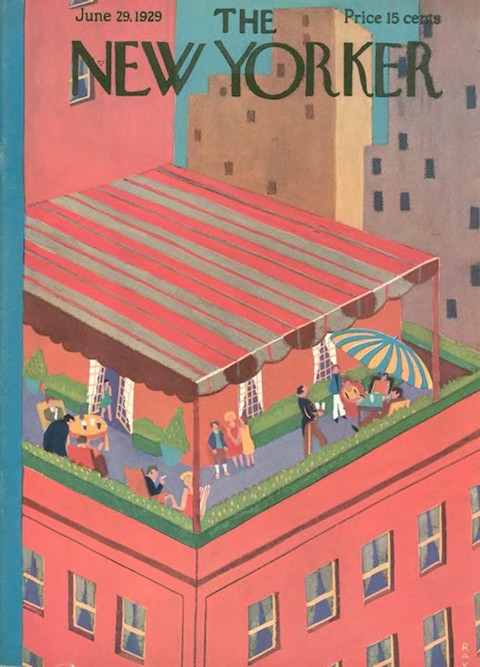
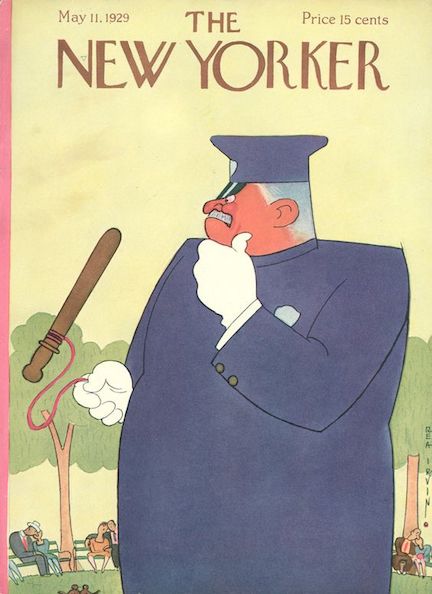
June 29, 1929 cover by Ray Euffa (1904-1977), who contributed just one cover for The New Yorker. A resident of the East Village, she had a successful career as both a New York artist and teacher (see end of post for another example of her work).

In this spirit, the landmark 1929 Regional Plan of New York and its Environs was created. Rather than planning for individual towns and cities, it viewed them as a single, interdependent and interconnected built environment. Authored by a Regional Plan Association formed in 1922, the plan encompassed 31 counties in Connecticut, New York, and New Jersey. The goal of the plan was to transcend the region’s political divisions and view it more in terms of its economic, socio-cultural, transportation, and environmental needs. The New Yorker made note of the new plan, but decided to take a humorous approach by putting Robert Benchley on the assignment:

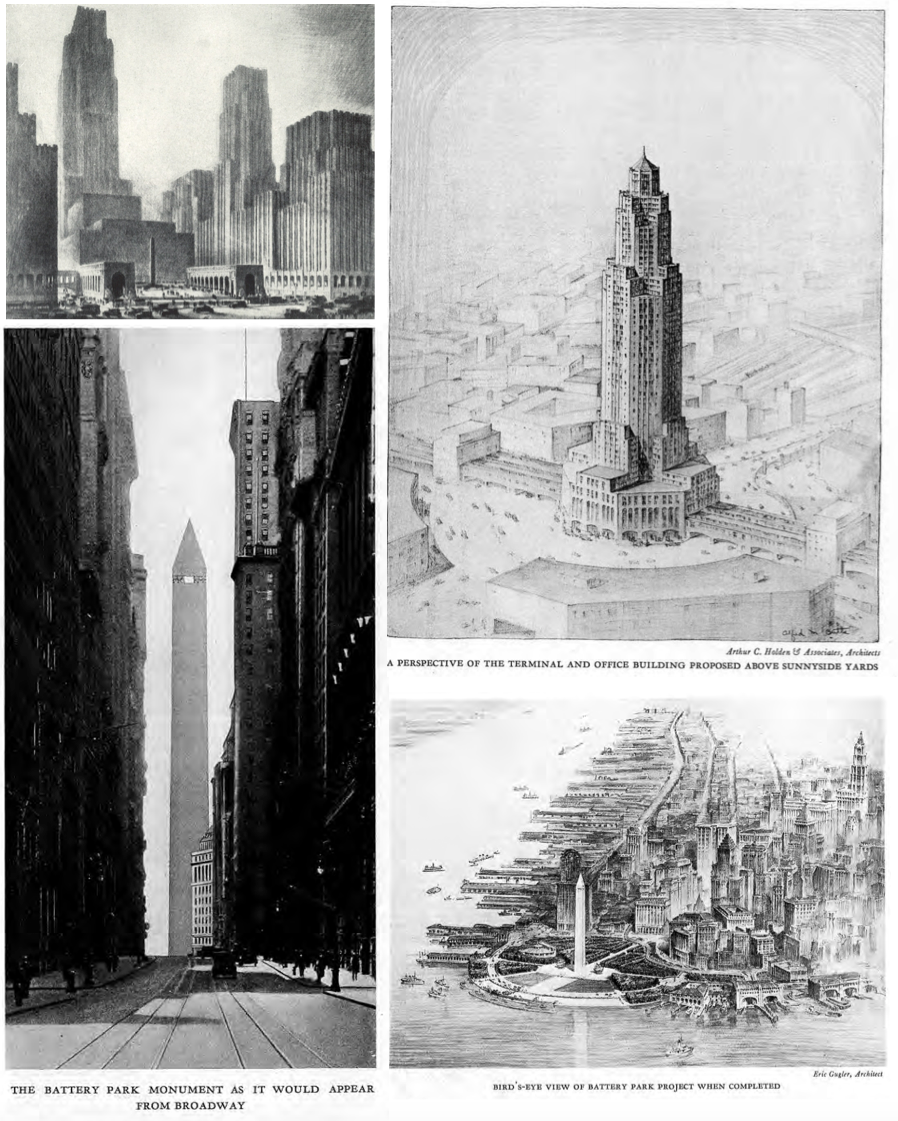
Had he actually read the plan, Benchley would have found an ambitious vision for the city in the year 1965, including the remaking of Battery Park that would have included a massive obelisk to greet seafaring visitors to the city (click all images below to enlarge)…

THINKING BIG…Images from the 1929 Regional Plan of New York and its Environs included, clockwise, from top left, a proposed art center for Manhattan, as envisioned by Hugh Ferriss; a proposal for a terminal and office building in Sunnyside Yards, Queens; a proposed monument for Battery Park, from a bird’s eye perspective; and as the monument would appear at street level. (Regional Planning Association–RPA)
HOW-TO GUIDE FOR THE FUTURE…Zoning principles, including setback guidelines for tall buildings (left) were included in the regional plan. At right, a suggestion for setbacks on an apartment group, as rendered by architect George B. Ford. (RPA)

Benchley noted that the plan “looks ahead to a New York of 1965,” and hoped that he would not live to see a city of 20 million people (New York City had a metro population of 20.3 million in 2017; and Benchley got his wish—he died in 1945. He was not, however, stuffed and put on display)…

A BIT MUCH?…Clockwise, from top left, a “monumental building” was proposed in the regional plan as a dominant feature of the civic center, dwarfing the historic city hall; the old city hall today, fortunately backed by a blue sky and not by a “death-star” building; a proposal for the Chrystie-Forsyth Parkway; a “future tower city,” as envisioned by E. Maxwell Fry. (RPA)
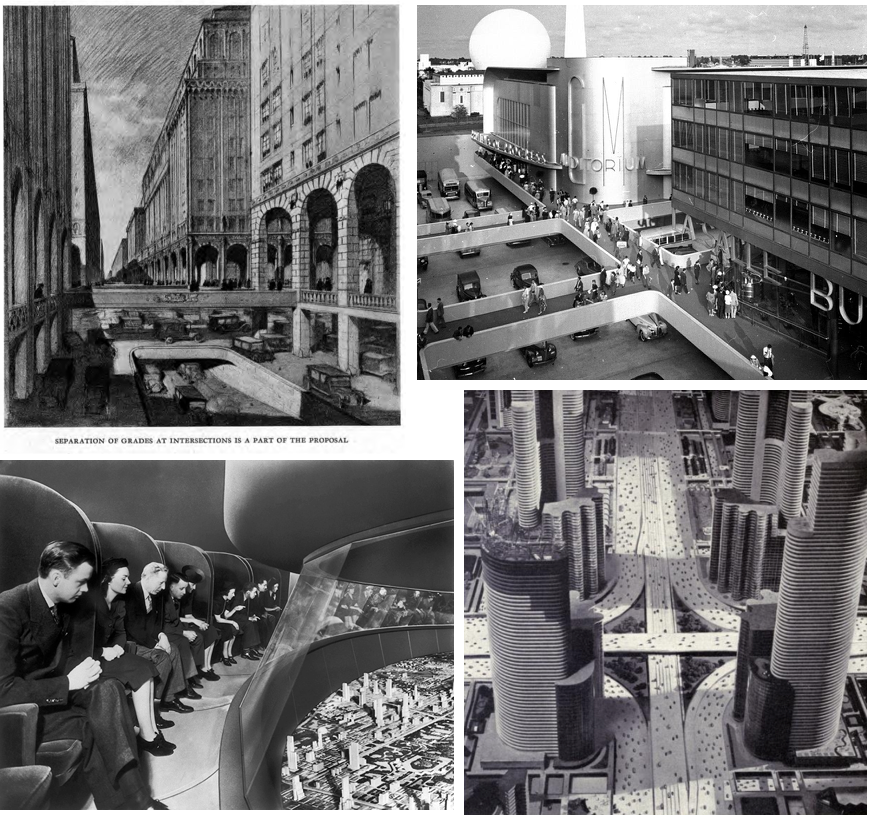
THE STUFF OF DREAMS…Clockwise, from top left: The regional plan proposed separation of pedestrians and motor vehicles by assigning them to different levels along the street; ten years later, at the 1939 New York World’s Fair, General Motors would build a full-scale model of this concept as part of their Futurama exhibit; the city of 1960, as envisioned by designer Norman Bel Geddes for the Futurama exhibit; Futurama visitors view the world of tomorrow—a vast scale model of the American countryside—from chairs moving along a conveyer. (RPA/The Atlantic/Wikipedia/General Motors)

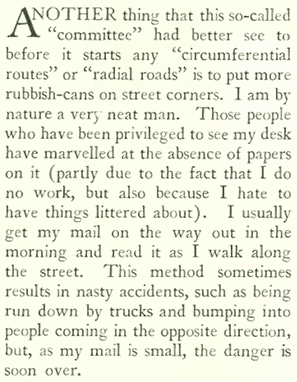
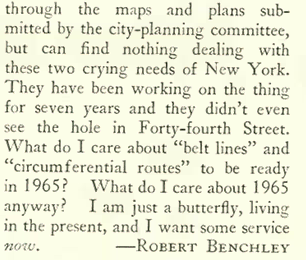
Benchley concluded his article with less ambitious hopes for the future…

THE REALITY…A view of New York City’s East 42nd Street, looking to the west, in 1965. (Associated Press)

*  *  *

Another vision of the future could be found in the growing air transport options available to those who could afford it. “The Talk of the Town” reported:

ROOM WITH A VIEW…Interior and exterior views of the Sikorsky S-38 flying boat. (Frankin Institute, Philadelphia/Calisto Publishers)
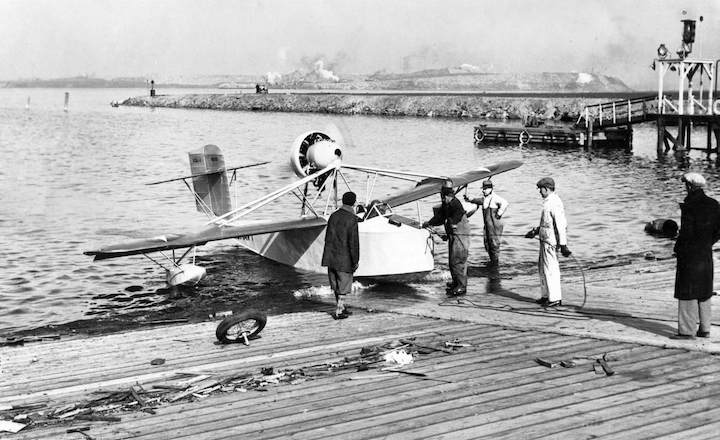
NO FRILLS…Seaplane ramp at Flushing Bay’s North Beach Airport in 1929. (Courtesy of Alan Reddig)

 *  *  *

With the 1929 stock market crash on the horizon, it is instructive to read these little “Talk” items and understand that, then as now, we have no clue when the big one is coming…

 *  *  *

Over at the Polo Grounds 

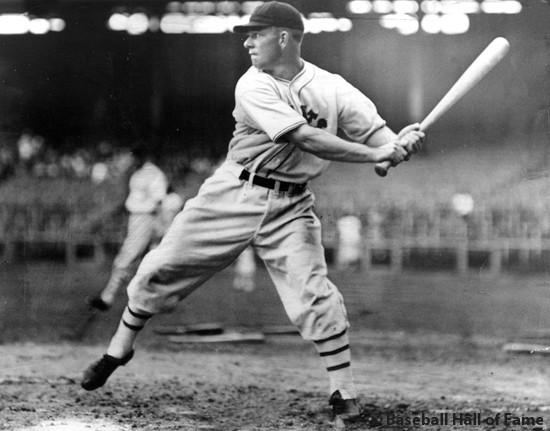
As I’ve previously noted, The New Yorker in the 1920s covered every conceivable sport, but paid little attention to Major League Baseball (except for the occasional amusing anecdote about a player, usually Babe Ruth). But even The New Yorker couldn’t ignore the city’s latest sensation, the Giants’ Mel Ott (1909-1958), who despite his slight stature (for a power hitter, that is), he became the first National League player to surpass 500 career home runs.

READY FOR SOME HEAT…Mel Ott in 1933. He batted left-handed but threw right-handed. (Baseball Hall of Fame)

*  *  *

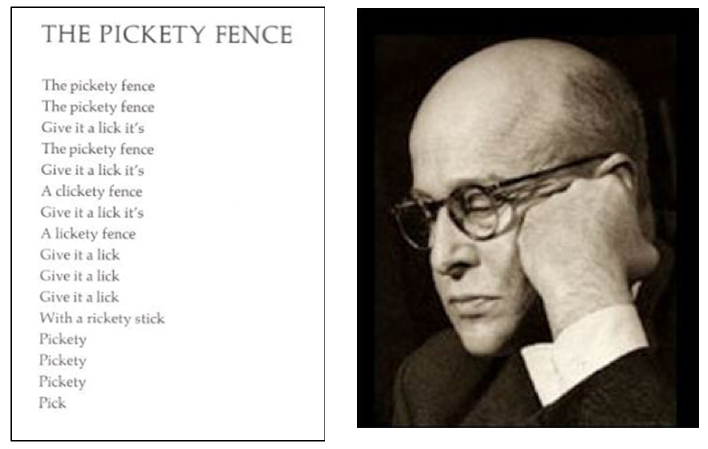
David McCord (1897-1997) contributed nearly 80 poems to The New Yorker between in 1926 and 1956, but earned his greatest renown in his long life as an author of children’s poetry. Here is his contribution to the June 29 issue:

PICKETY POET…David McCord and one of his poems for children. (nowaterriver.com)

 *  *  *

From Our Advertisers

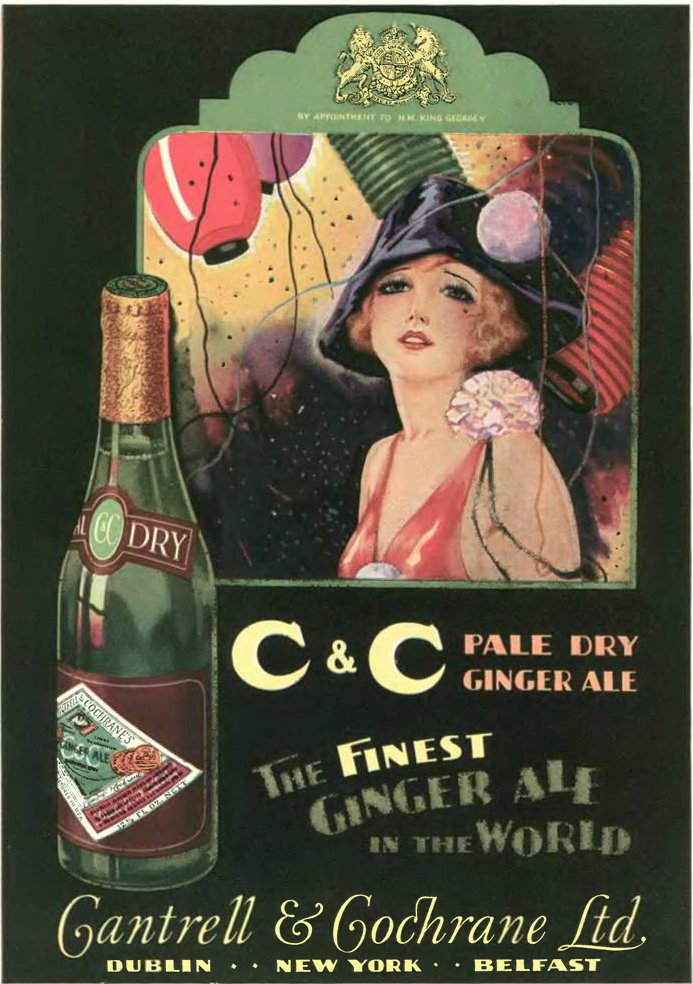
We find more color in the pages of The New Yorker thanks to advertisers like C & C Ginger Ale, who for all the world tried to make their product appear as exciting and appealing as Champagne, or some other prohibited substance…

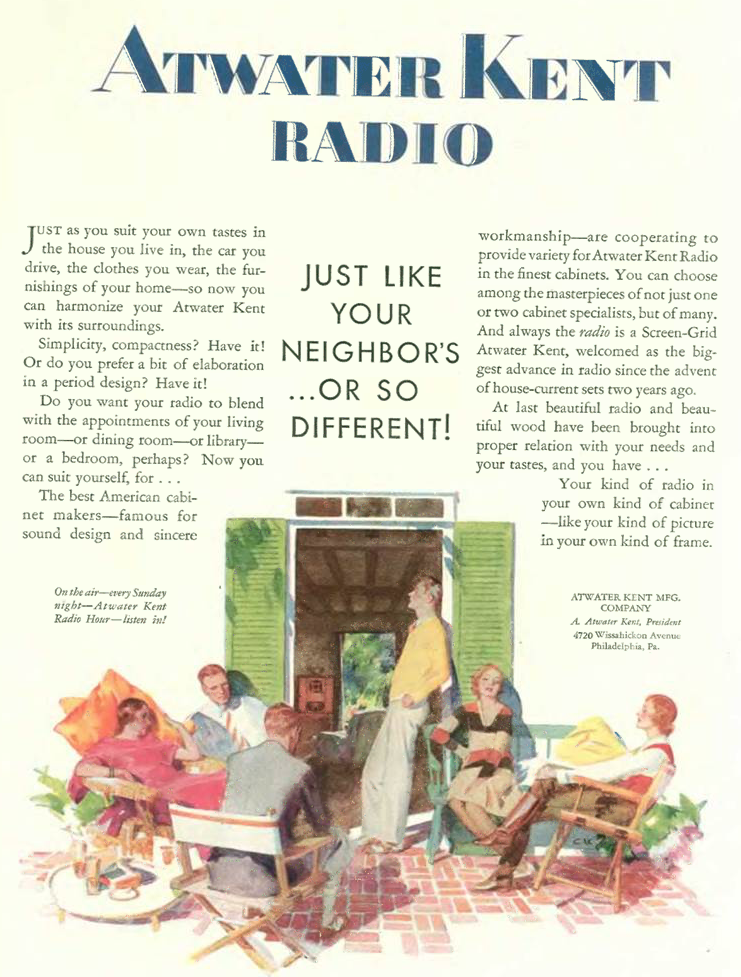
…or for quieter times, Atwater Kent encouraged folks to gather ’round the radio on a lazy afternoon and look positively bored to death…

…while Dodge Boats encouraged readers to join the more exhilarating world of life on the water…

Our final color ad comes from the makers of Jantzen swimwear—this striking example is by Frank Clark, who collaborated with his wife Florenz in creating a distinct look and style for Jantzen…

…indeed it was Florenz Clark who came up with Jantzen’s signature red diving girl. In 1919, while doing sketches at a swim club for divers practicing for the 1920 Olympics, she came up with the iconic red diving girl logo. This is the version of the logo from the late 1920s:

(jantzen.com)

*  *  *

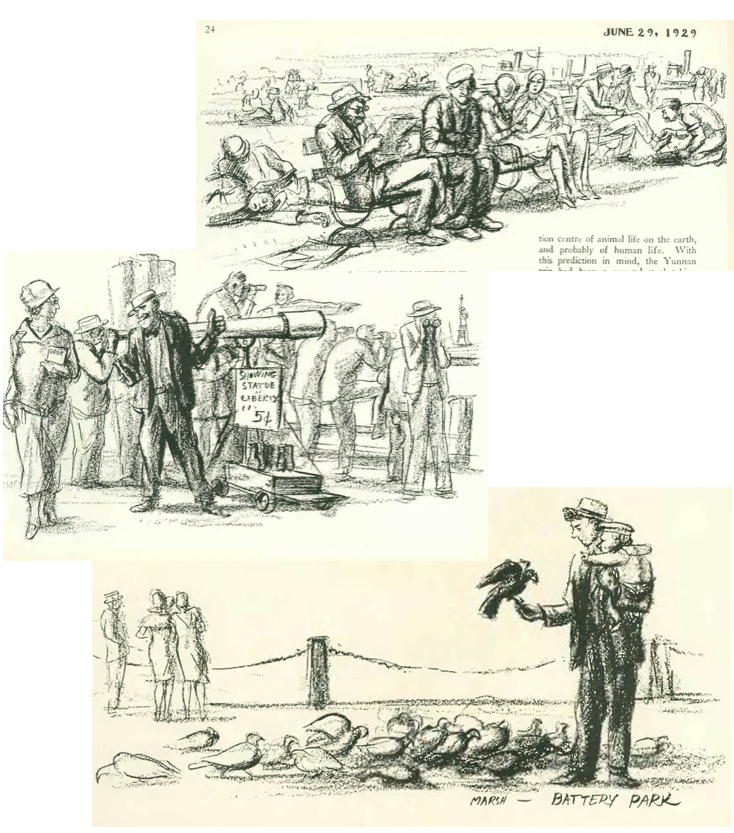
Our illustrations and cartoons come courtesy of Reginald Marsh, who sketched scenes along the shores of Battery Park…

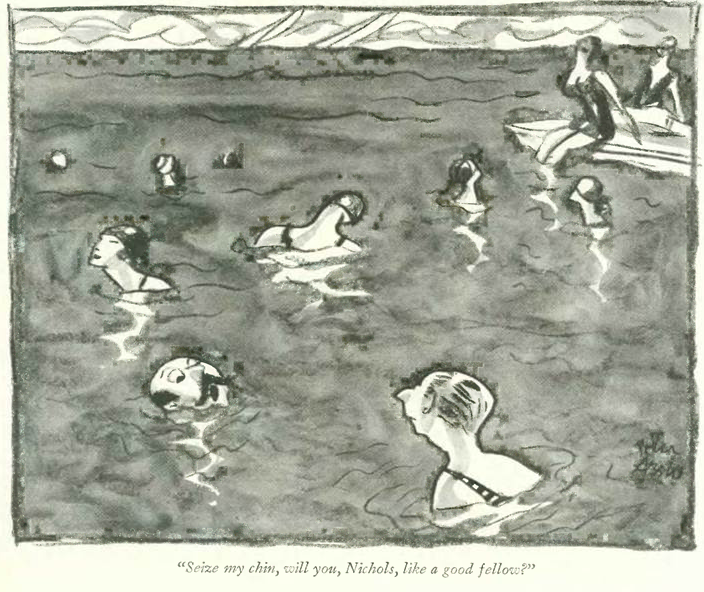
…Peter Arno plumbed the depths of a posh swimming club…

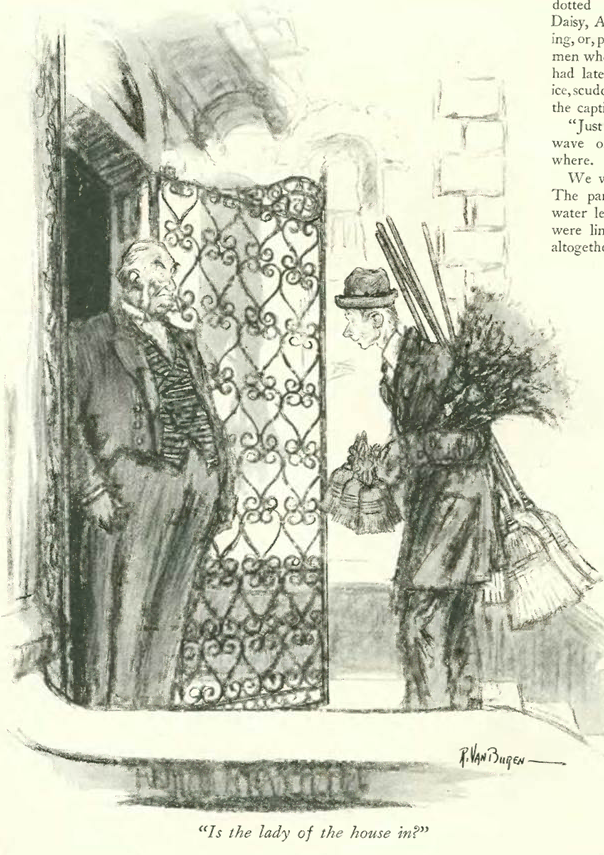
…R. Van Buren explored a clash of the castes…

…Isadore Klein sent up some class pretensions…

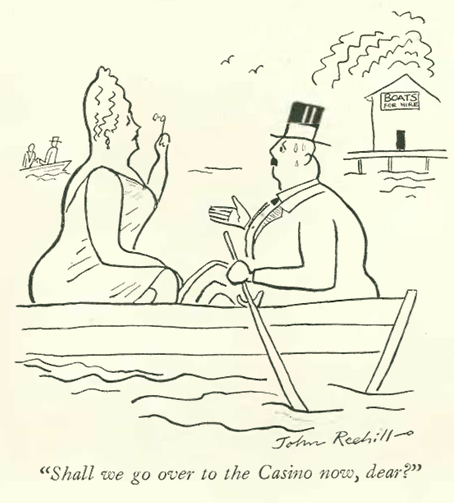
…and John Reehill looked in on a couple who seemed more suited to land-based diversions…

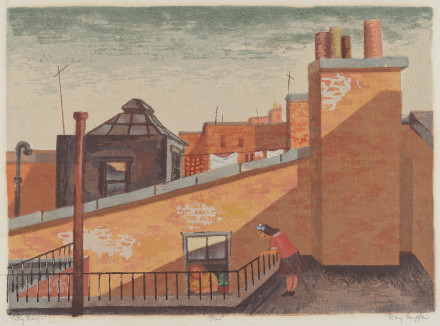
…and finally, we close with a 1946 work by our cover artist, Ray Euffa, titled, City Roofs:

(National Gallery of Art)

Next Time: Georgia on My Mind…


From Broadway to Babylon

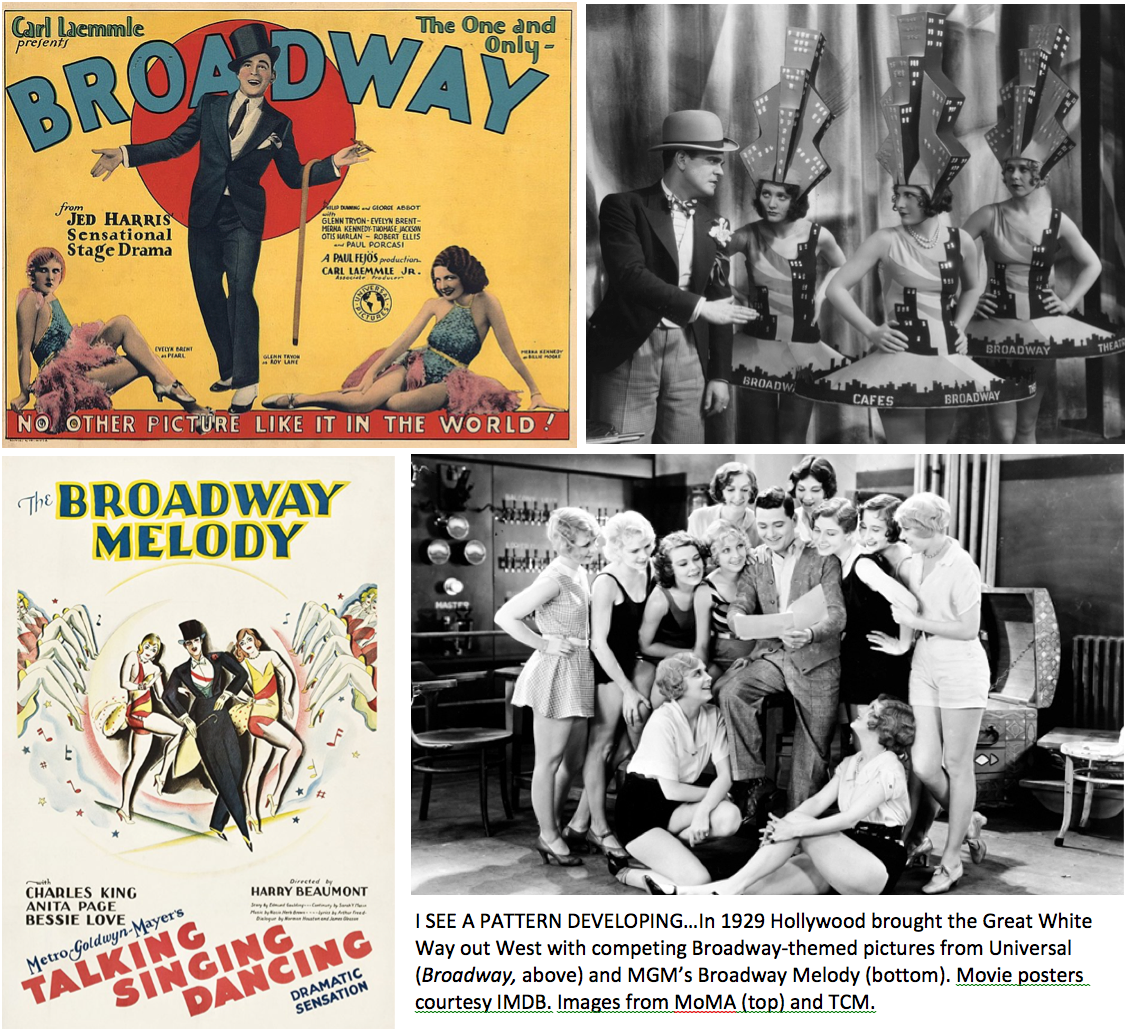
While the introduction of sound to motion pictures ended the careers of some silent film stars in the late 1920s, Hollywood’s “talkies” offered new opportunities for Broadway stage actors who could now take their vocal talents to the screen and to audiences nationwide.

May 4, 1929 cover by Ilonka Karasz.

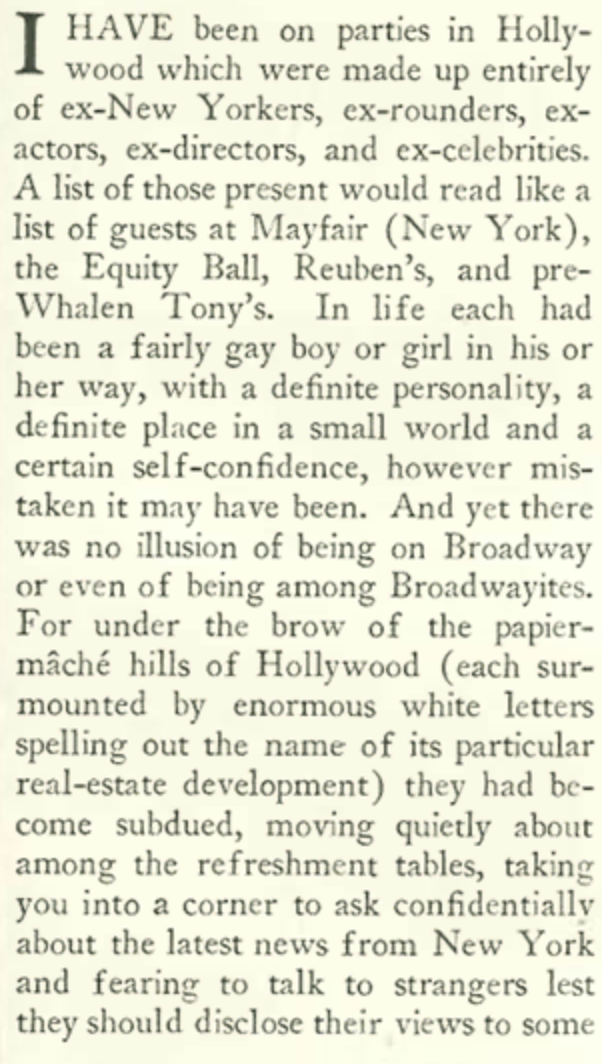
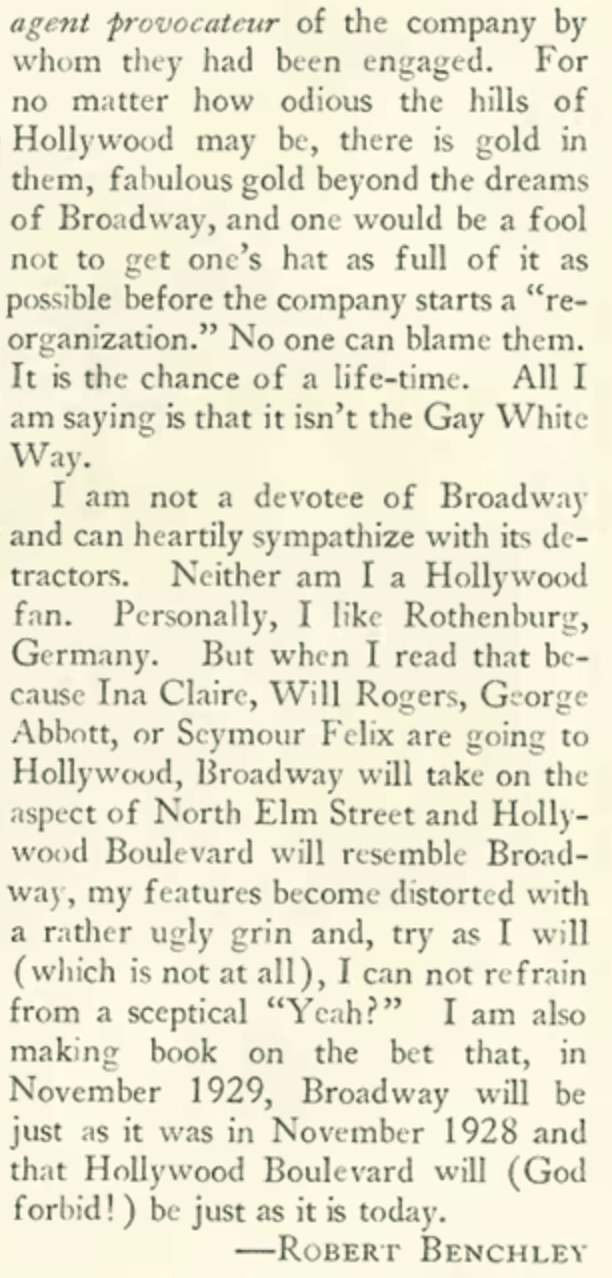
And so began the so-called “Broadway Exodus.” Robert Benchley offered his wry observations on the phenomenon in the May 4, 1929 “A Reporter at Large” column:

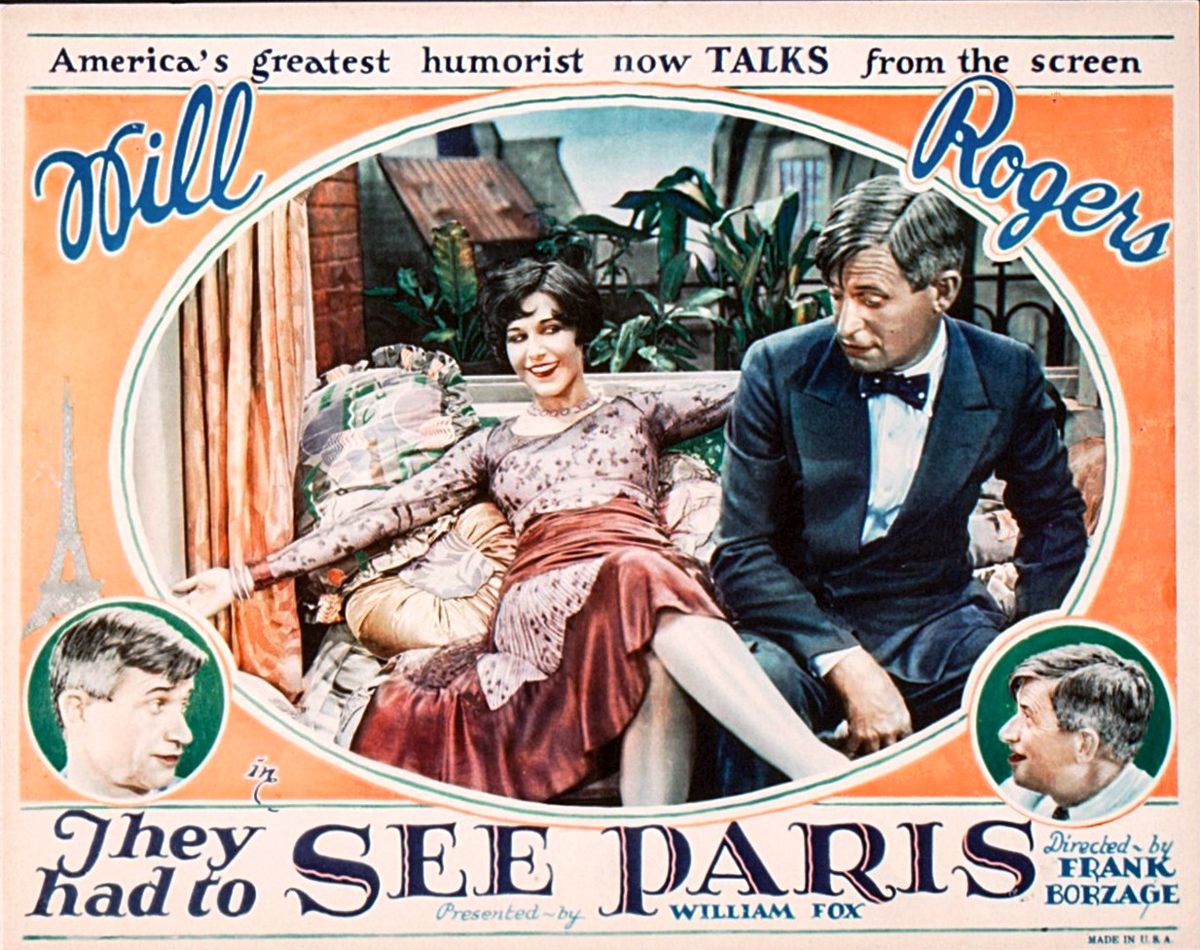
AW SHUCKS…Broadway mainstay and a perennial performer with the Ziegfeld Follies, humorist Will Rogers found his element in Hollywood’s new talkies, appearing here with Fifi D’Orsay in 1929’s They Had to See Paris. (Wikipedia)
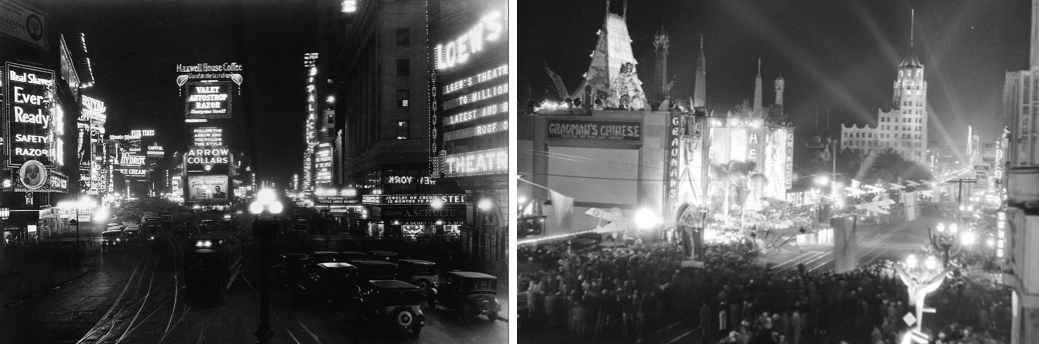
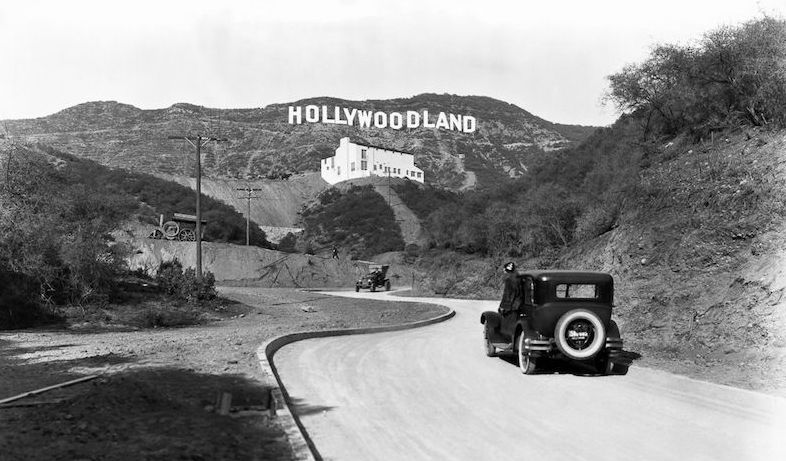
TALE OF TWO CITIES…Broadway in 1925 (left) and Hollywood Boulevard in 1929. (Daily Mail/USC Digital Library)

Benchley observed that regardless how many Broadway stars moved west, Hollywood Boulevard would never be mistaken for Broadway. However, Benchley himself would catch the bug and head to Tinseltown, appearing in dozens of feature films and shorts including How to Sleep, which would win an Academy Award for “Best Short Subject, Comedy,” in 1935.

NICE WORK IF YOU CAN GET IT…Robert Benchley in the 1935 Oscar-winning short, How to Sleep. (YouTube)

 *  *  *

One Who Stayed on Broadway

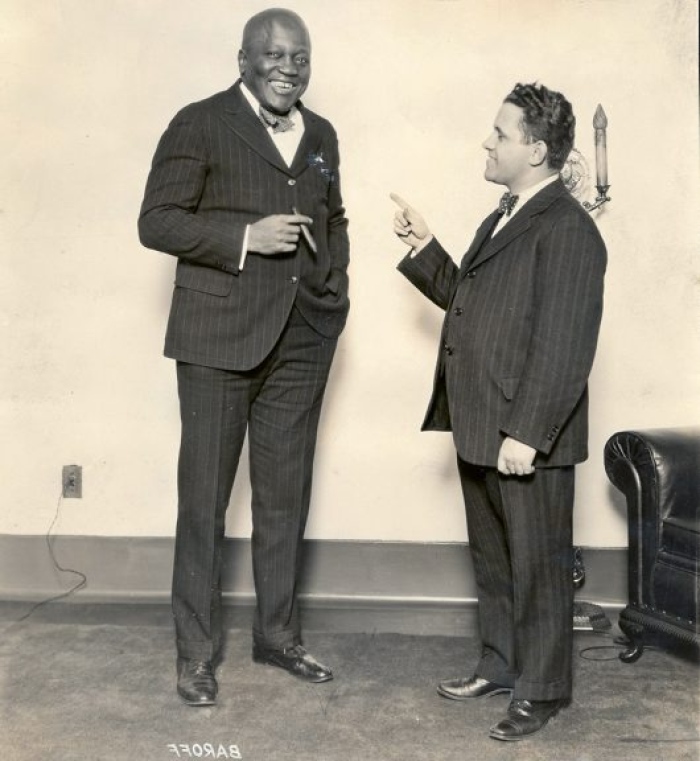
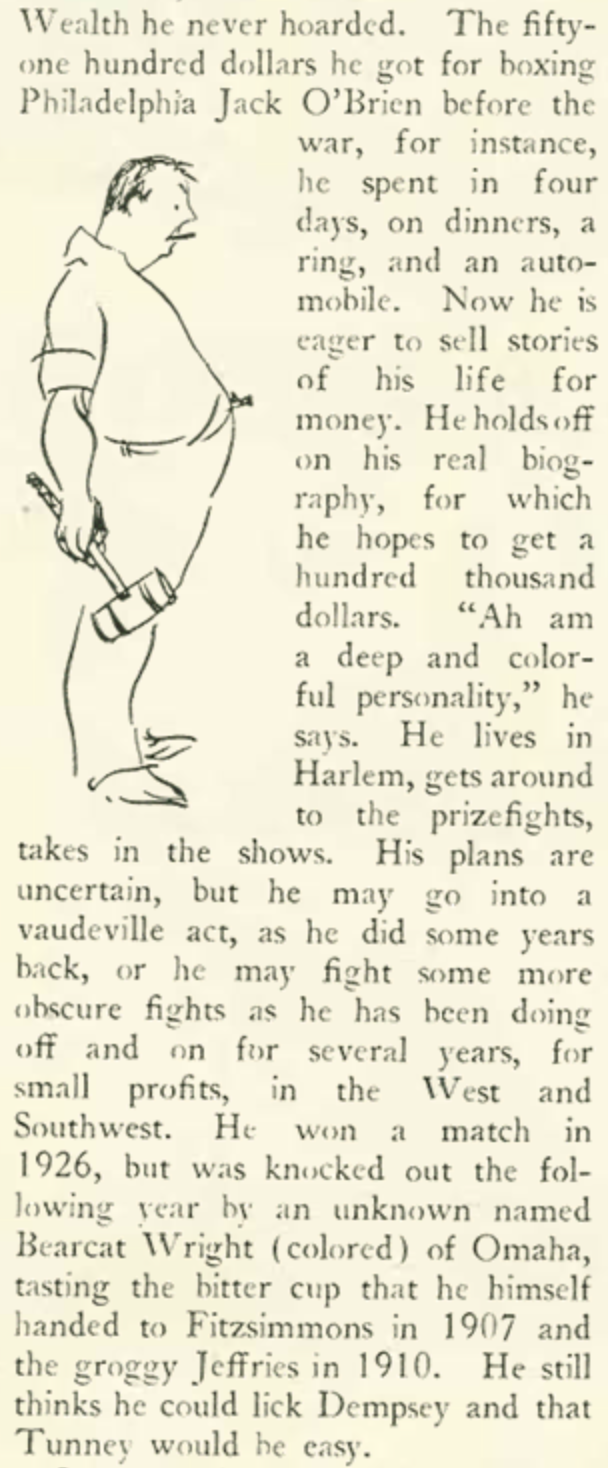
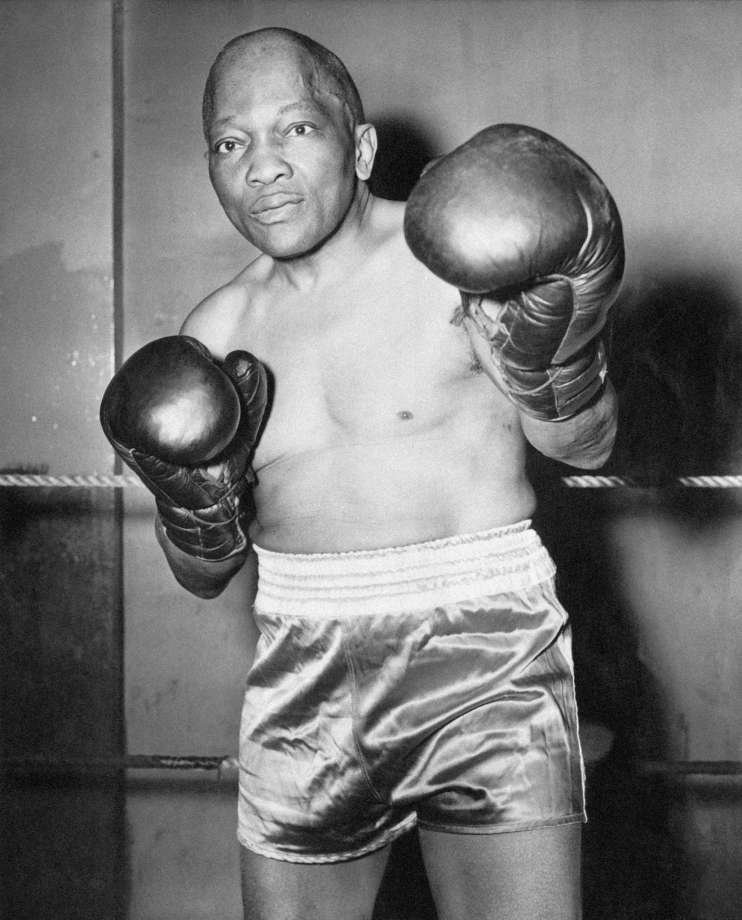
James Thurber reported in “The Talk of the Town” that famed boxing champion Jack Johnson was a common sight on the sidewalks of Broadway. Thurber noted that Johnson, the first African American world heavyweight boxing champion (1908–1915), had fallen on less glamorous days, but still appeared fit at age 51.

IN FIGHTING FORM…Jack Johnson visits with writer Joe Butler at the Scranton Times-Tribune offices on Nov. 30, 1929. (Scranton Times-Tribune)

Thurber noted that Johnson was planning to sell stories of his life, and possibly get into vaudeville. The boxer also mused that who could lick either of the heavyweight champs of the 1920s, Gene Tunney and Jack Dempsey…

CREAMPUFFS…The 51-year-old Jack Johnson claimed he could defeat either of the famed heavyweight champions of the 1920s, Gene Tunney (left) or Jack Dempsey. (Reemus Boxing)

…and Thurber shared a strange account regarding the thickness of Johnson’s skull, which apparently bested that of an ox…

FIGHT TO THE LAST…The 67-year-old Jack Johnson prepares for an exhibition boxing match at a war bond show in New York City on May 1945. Along with making public appearances, Johnson also performed on Broadway during his retirement. (Houston Chronicle)

Johnson continued professional boxing until age 60, and thereafter participated in boxing exhibitions in various venues until his death at age 68 in a car crash near Raleigh, NC. It was reported that Johnson was racing angrily from a nearby diner that had refused to serve him when he lost control and hit a light pole.

 *  *  *

Don’t Ask, Don’t Tell

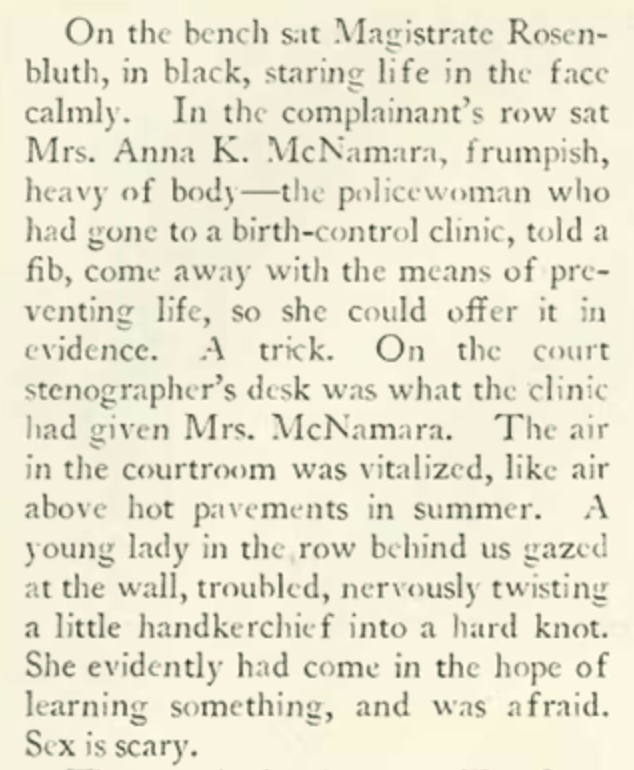
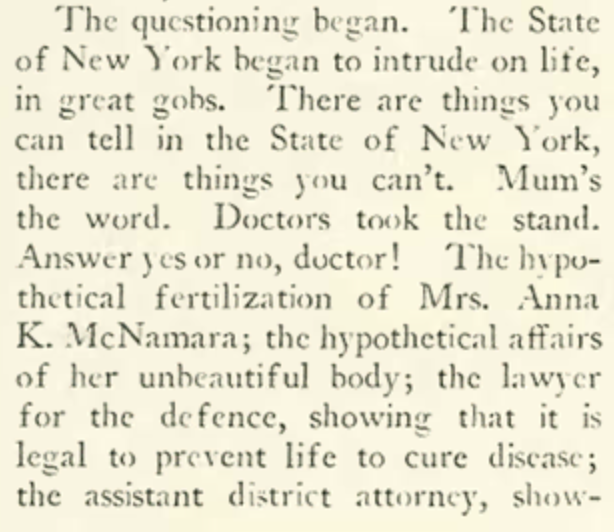
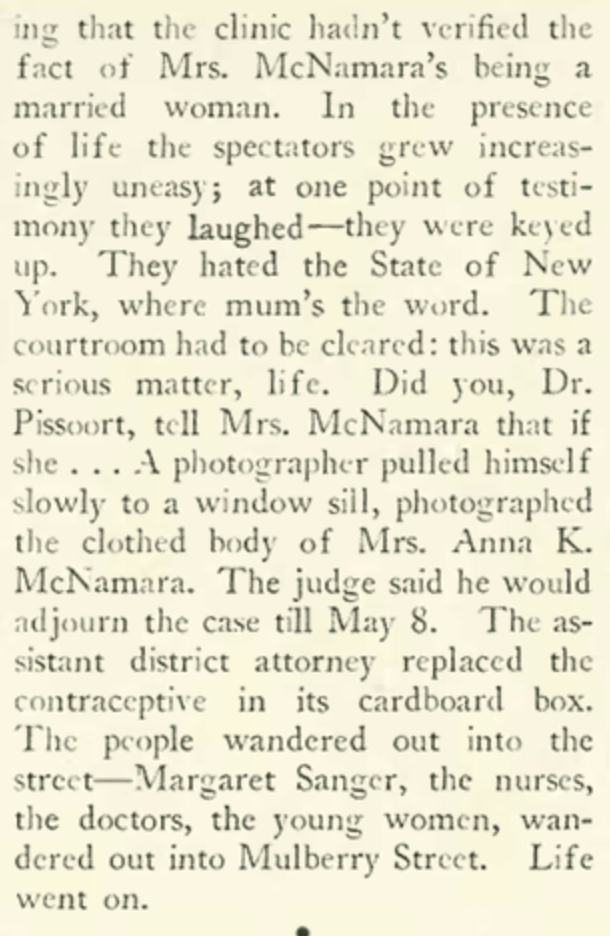
Anyone who thinks the recent squabbles over Planned Parenthood are anything new might do a little reading on the life of Margaret Sanger, who opened the first birth control clinic in the U.S. in 1916 (in Brooklyn) and was subsequently arrested for distributing information on contraception. In 1929 she was again arrested for operating a “secret” birth control clinic in the basement of a Manhattan brownstone. On March 22, 1929, the New York Police Department sent an undercover female detective, Anna McNamara, to Sanger’s clinic. Posing as a patient who wished to avoid another pregnancy, McNamara was advised on various forms of contraception. She later returned to the clinic as part of the police raid, during which she seized a number of confidential patient files. At Sanger’s subsequent court hearing, McNamara learned first-hand about the importance of patient confidentiality. From the May 4 “Talk of the Town”…

Recalling her arrest in a 1944 article, “Birth Control: Then and Now,” Sanger wrote that McNamara taunted her during the raid when she was told that she had no right to touch private medical files. Sanger wrote “I shall never forget the color of Mrs. McNamara’s face when she heard this medical testimony recited several days later in Magistrates’ Court at the hearing. She was totally unprepared for this embarrassing revelation of her own organs.” The New Yorker made note of this…

Sanger would continue to work for birth control until her death in 1966. Although her name is still invoked in debates over abortion, Sanger herself was generally opposed to abortion, maintaining that contraception was the only practical way to avoid it.

GAG ORDER…In April 1929 Margaret Sanger planned to speak at Boston’s Ford Hall Forum on Free Speech. Ironically, the topic of birth control was banned in Boston at the time, so Sanger appeared onstage with a gag over her mouth while historian Arthur M. Schlesinger read her remarks on free speech to the assembly. At right, the February 1926 issue of Birth Control Review. Founded by Sanger in 1917, she served as editor until 1928. It ceased publication in 1940. (womensstatus.weebly.com/sangerpapers.wordpress.com)

 *  *  *

Please Sit Still

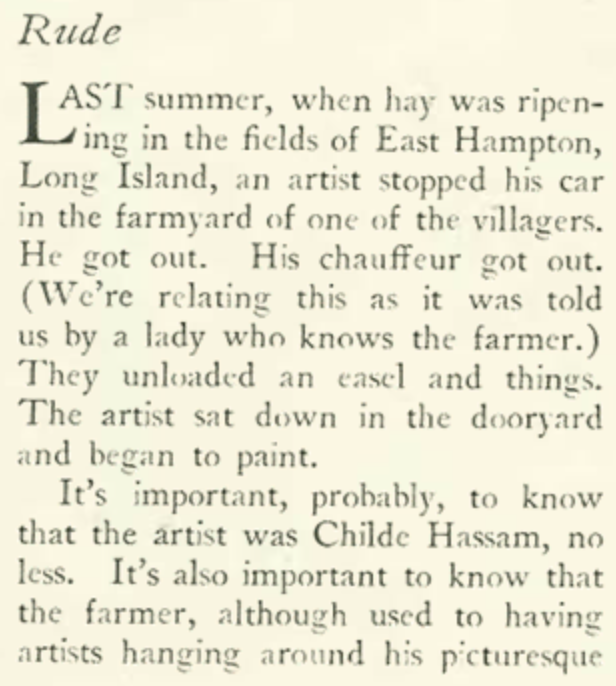
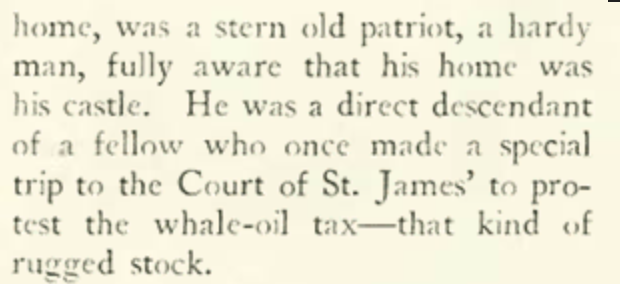
The “Talk of the Town” also looked on American Impressionist painter Childe Hassam, who demonstrated the challenges of painting en plein air…

LOVELY SCENE…Childe Hassam’s Landscape at Newfields, New Hampshire, oil on canvas, 1909. Hassam in his studio circa 1920. (Wikimedia Commons/Wikipedia)

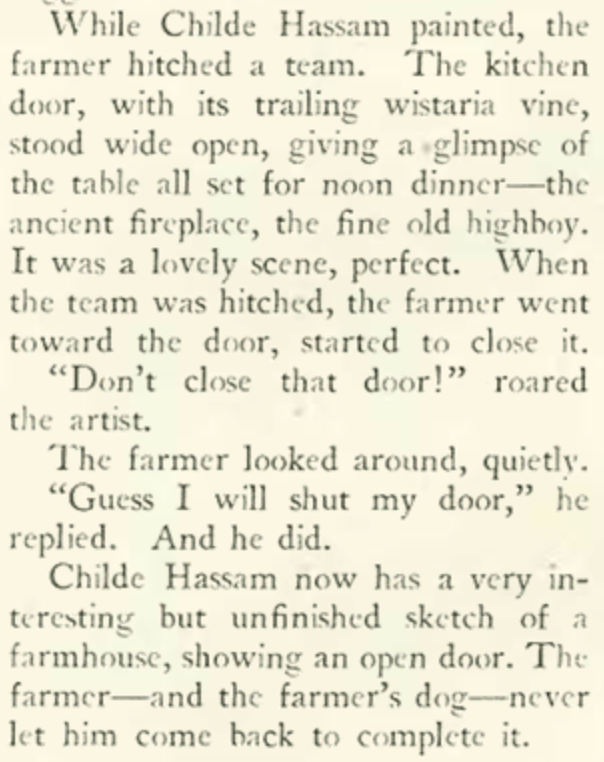
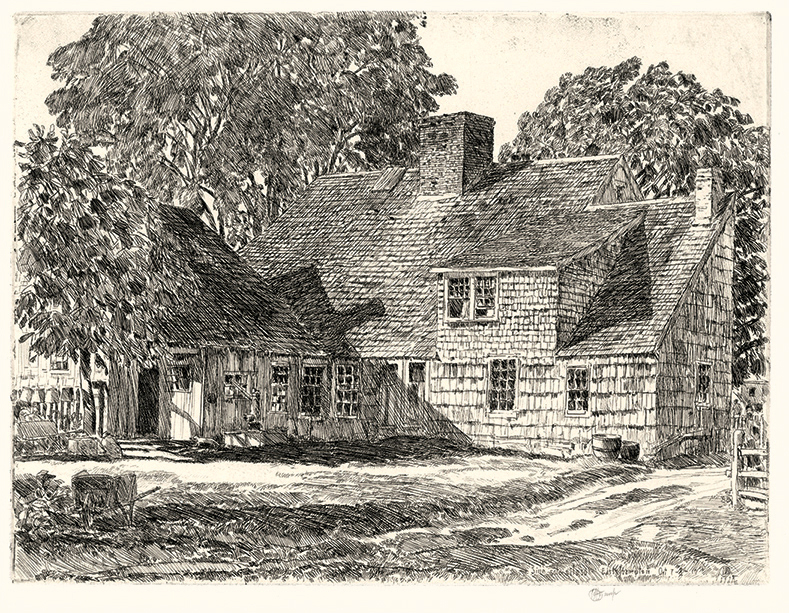
…and found it difficult to finish a farmhouse sketch when a door was unexpectedly closed on his subject…
THIS ONE HE FINISHED…Childe Hassam’s etching, The Old Dominy House (East Hampton), 1928. This work was probably created during Hassam’s visits to East Hampton described in “The Talk of the Town.”(Smithsonian)

 *  *  *

All That Jazz

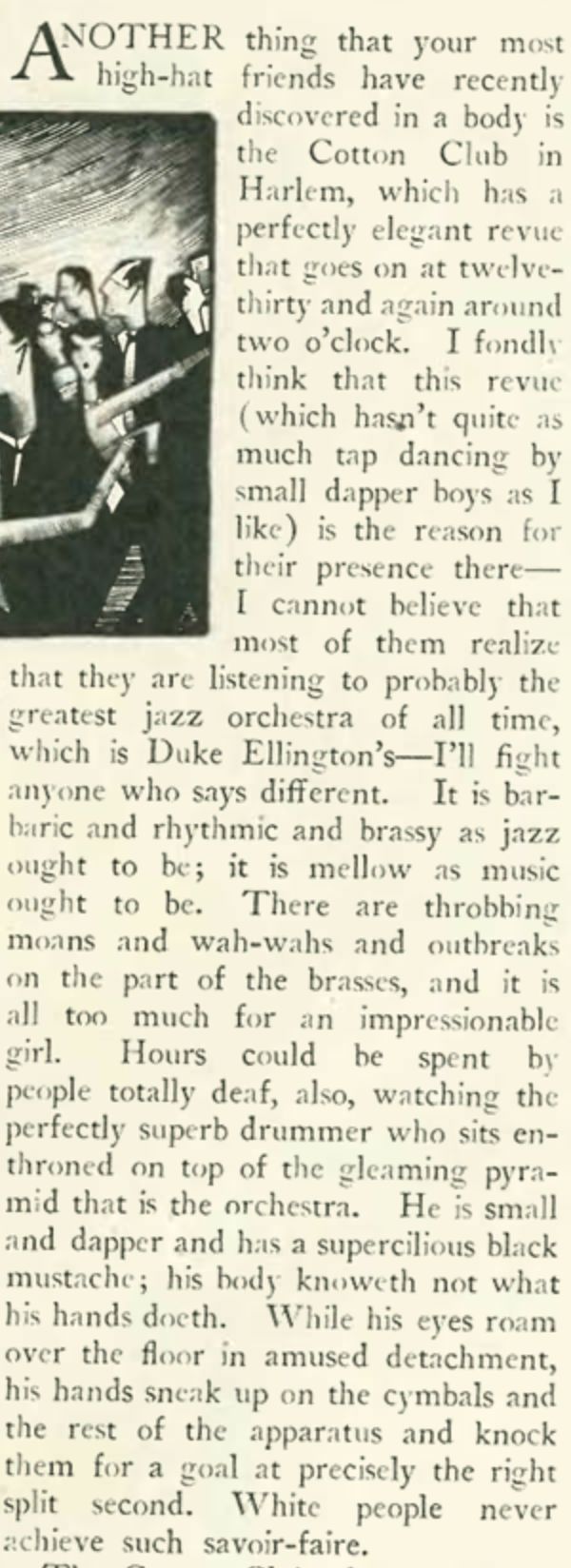
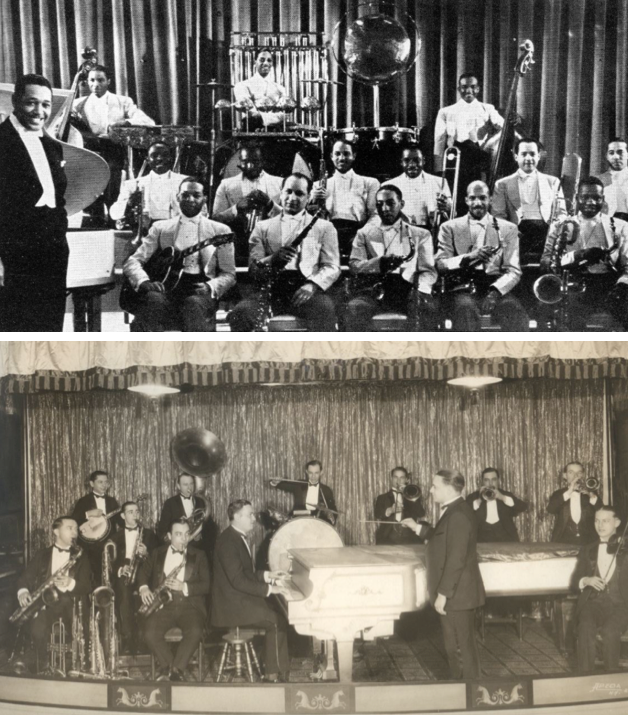
As Lois Long’s contributions to her “Tables for Two” column grew ever more infrequent, it was clear that she was wearying of the nightlife scene. Now 28 and a young mother, “Lipstick” was shedding her image as a fun-loving flapper and devoting more time and energy to her fashion column, “On and Off the Avenue.” Nevertheless, she still found the time to visit the Cotton Club and proclaim Duke Ellington’s jazz orchestra as “the greatest of all time”…
…although her other observations of the New York nightclub scene appear to have been hastily dashed off…

THE BEST…Duke Ellington and his orchestra (top), circa 1930. Below, Vincent Lopez conducts his orchestra in 1923. (oldtimeblues.net / www.jazzhound.net © Mark Berresford)

 *  *  *

Electric Wonders

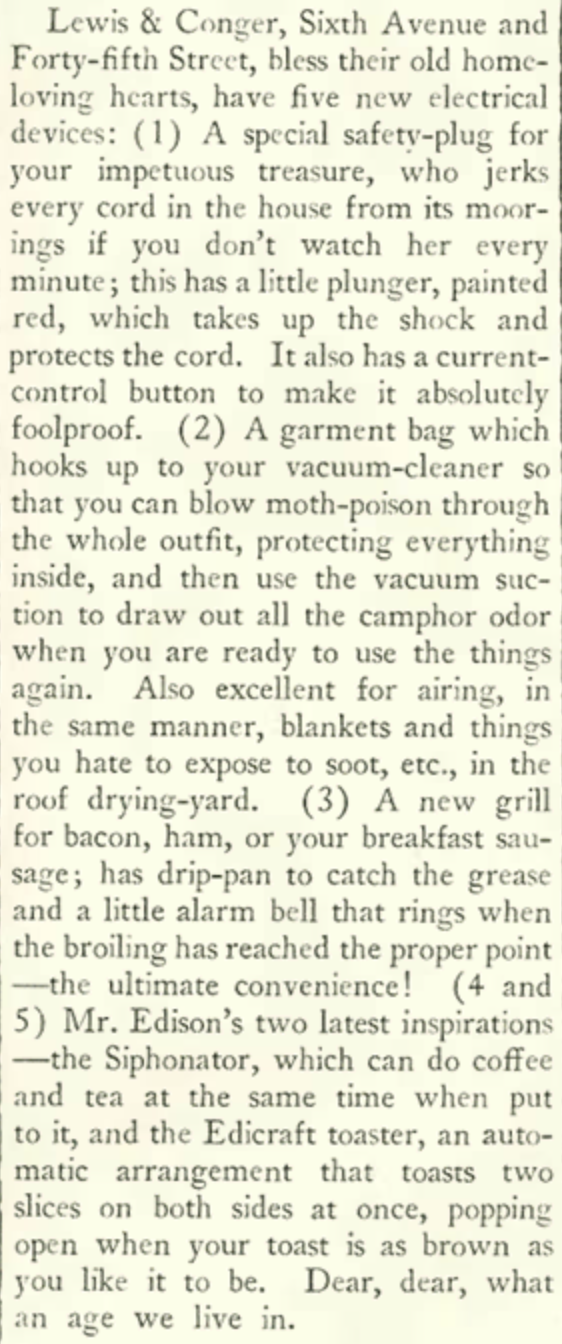
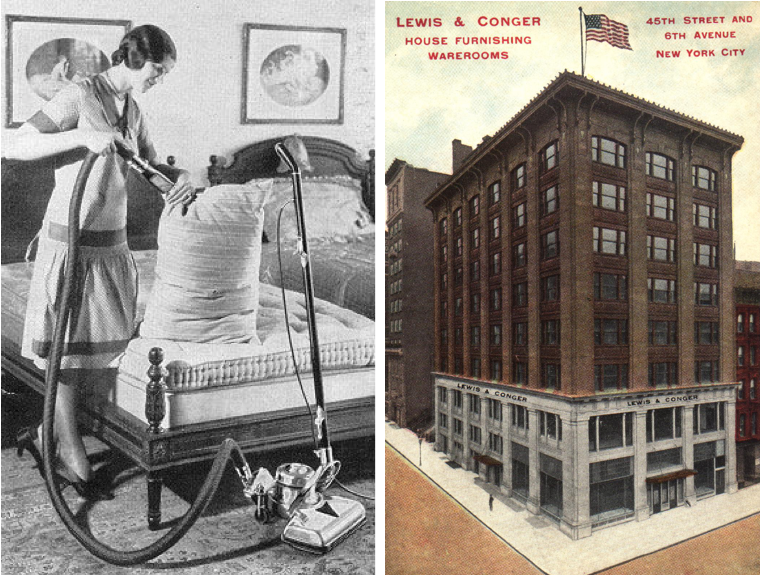
The May 4 issue updated readers on some of the latest gadgets available to modern households in 1929. I particularly like the device that allowed your vacuum to blow “moth poison” into your garments…

NOW THIS DOES NOT SUCK…Garments and other household items could be fumigated against moths using a new reverse vacuum attachment, available at Lewis & Conger. (Cyberspace Vacuum Cleaner Museum / Columbia University)

*  *  *

From Our Advertisers

One thing you notice about 1920s advertising is the amount of turgid copy they contain…I suppose without distractions such as TV and iPhones people actually took the time to read all of these bloated messages, such as this one from Whitman’s that suggested a box of candy is more than a box of candy…

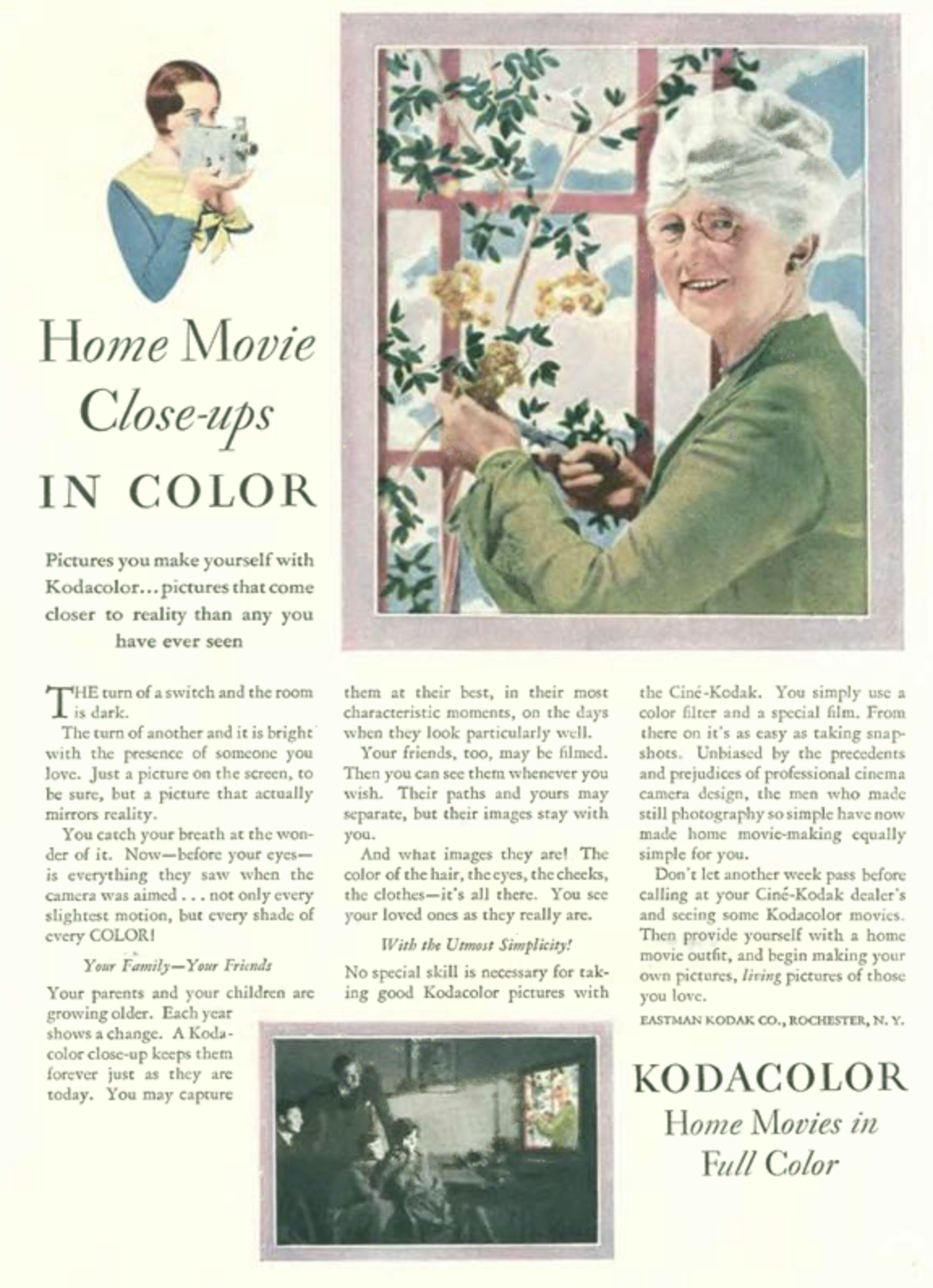
…or how about this lengthy appeal from Kodak, which used guilt to convince you to get some film of grandma while she was still “at her best…”

…the makers of Spud promised a “new freedom” and a “16% cooler smoke” to the users of its menthol-laced cigarettes. Spuds were the first menthol cigarettes, developed in 1924 by Ohioan Lloyd “Spud” Hughes, who sold them out of his car until the brand was acquired in 1926 by The Axton-Fisher Tobacco Company. By 1932 Spud was the fifth-most popular brand in the U.S., and had no competitors in the menthol market until Brown & Williamson launched their Kool brand in 1933. The Spud brand died out by 1963 (along with, presumably, many of its customers)…

…leveraging the popularity in the 1920s of knights and fairies, as well as the Anglo- and Francophila of New Yorker readers, “Mrs. Marie D. Kling” hoped to entice city dwellers up to the burbs in Scarsdale…

…our cartoons are courtesy of Barbara Shermund, who looked in on a couple of debs performing their daily exercises…

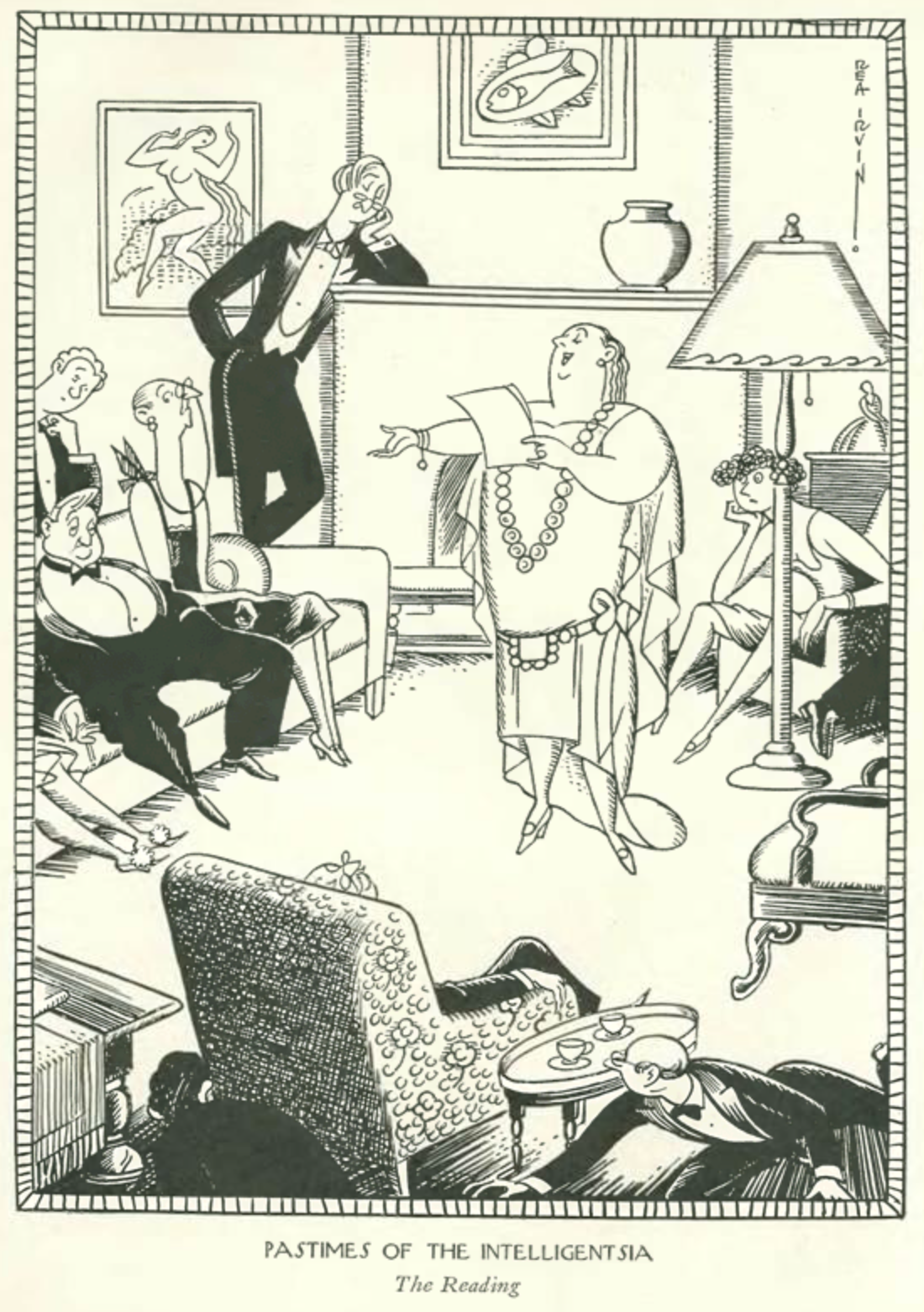
…while down in the parlor, Rea Irvin captured the horrors inflicted by an author’s tedious reading…

…and finally, Peter Arno probed the depths of sanctimony…

Next Time: Waldorf’s Salad Days…

A Bird’s Eye View

The New Yorker’s E.B. White was an aviation enthusiast who rhapsodized about his flights into the clouds, but also had prescience to see the darker side of this modern thrill ride.

October 6, 1928 cover by Ilonka Karasz.

Writing in the “Reporter at Large” column for the Oct. 6, 1928 issue, White described his visit to Curtiss Field, where he inquired about a pilot who could fly him over New York City. He was told someone named Bill would take him up.

EARLY BIRD…This Fairchild FC-2 Cabin Monoplane, with strut-supported wing, was probably similar to the plane E.B. White rode in his flight over New York City. (Quora)

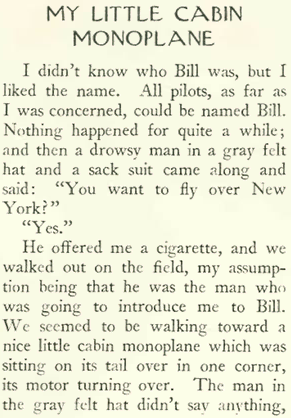
After a half hour wait, a man in a gray felt hat and sack suit offered White a cigarette and said, “You want to fly over New York?” Although the man didn’t look like a pilot, White followed him to a “little cabin monoplane.” Without saying another word the man took the plane up into the air, much to White’s surprise:

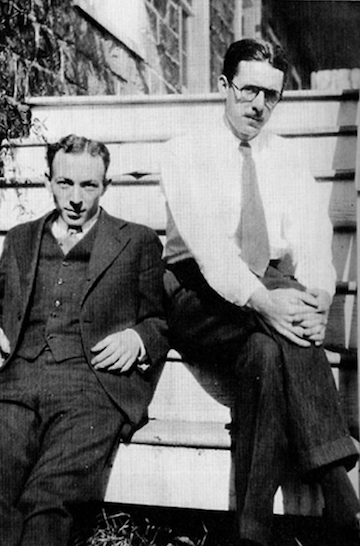
FLYBOY…E.B. White (left) with friend and New Yorker colleague James Thurber in 1929. (University of Virginia)

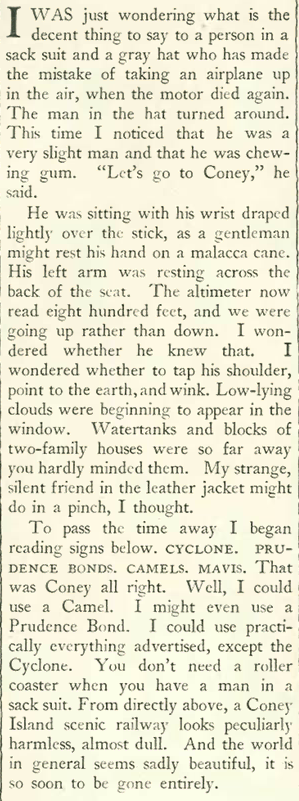
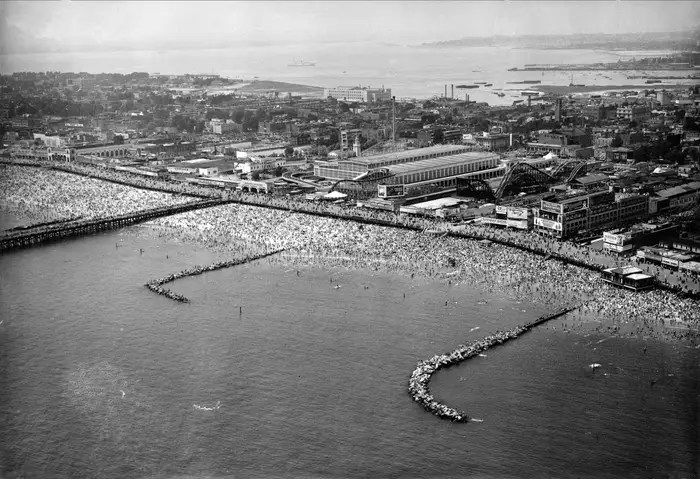
White described the various sites from 800 feet up, including Coney Island, a view at once beautiful and foreboding…

Aerial view of Coney Island, 1937. (AP/lunaparknyc.com)

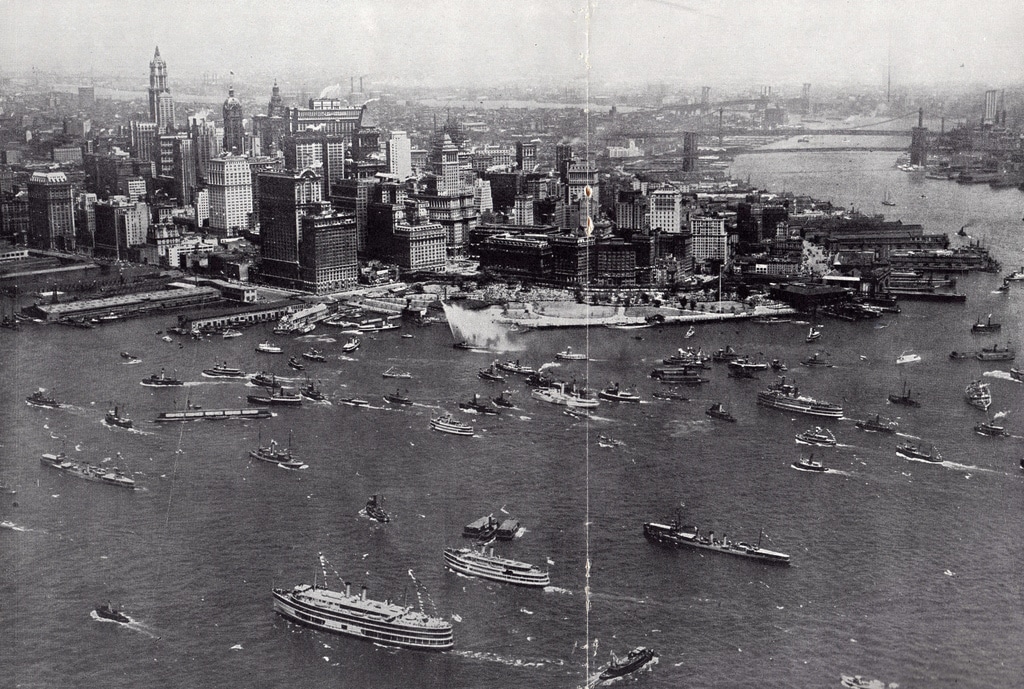
…and the thrill of the approaching city skyline as his plane soared up the Bay toward Manhattan:

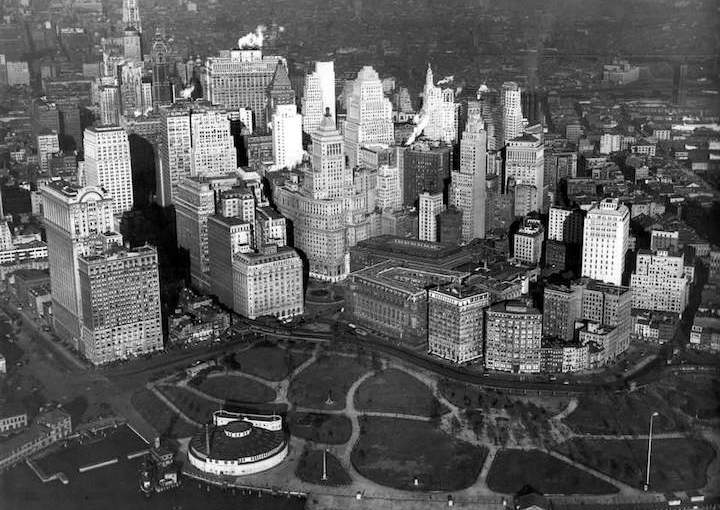
Lower Manhattan looking northeast from the Bay in July 1927. This is approximately the view described by E.B. White as his plane approached Manhattan. (Favrify.com)
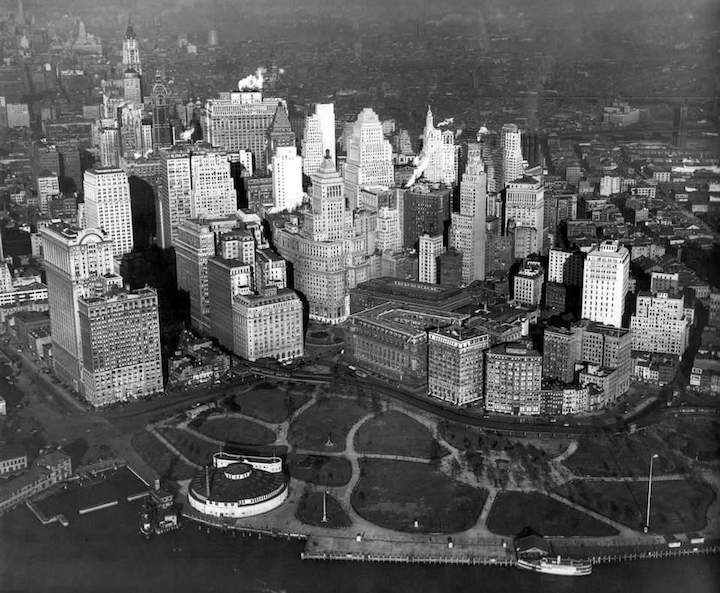
A closer view of lower Manhattan as it would have appeared to E.B. White on his 1928 flight over New York City. (Fairchild Aerial Survey photo, 1928)

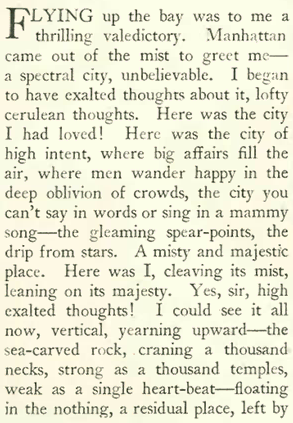
Once over the city, White could not help but contain his exuberance, soaring high above the towering spires and teeming crowds below:

And yet as I noted earlier, his observations were tinged with melancholy and foreboding. In describing his flight over Coney Island, for example, White concluded that “the world in general seems sadly beautiful, it is so soon to be gone entirely.”

Perhaps he referred to the rapid changes seen daily in the city during the 1920s, when nothing seemed permanent. Or did this bird’s eye view suggest something else to White? Twenty years later, in his 1948 essay “Here is New York,” White would write:

A single flight of planes no bigger than a wedge of geese can quickly end this island fantasy, burn the towers, crumble the bridges, turn the underground passages into lethal chambers. The intimation of mortality is part of New York now: in the sound of jets overhead, in the black headlines of the latest edition.

Unlike 1928, White had the hindsight of World War II, of entire cities leveled by waves of heavy bombers, or in the case of Hiroshima and Nagasaki, just a single bomb. The foreshadowing of 9/11 is contained in his words as well.

Back on the ground at Curtiss Field, White would finally learn the identity of the man who didn’t look like a pilot, but had just flown him over the city:

Another Vantage Point

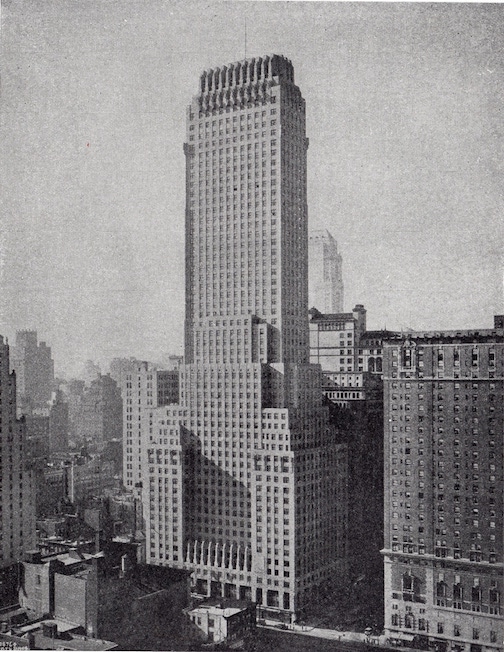
With buildings rising ever higher in Manhattan, you could get a pretty good view of the surrounding city by taking an elevator to the rooftop of the latest skyscraper. The Oct. 6 “Talk of the Town” found a good perch atop the 680-foot-tall Chanin building on the southwestern corner of Lexington Avenue and 42nd Street.

THINGS ARE LOOKING UP…The Chanin Building at Lexington and 42nd. Sloan & Robertson Architects, 1928. (New York Public Library)

 *  *  *

From Our Advertisers

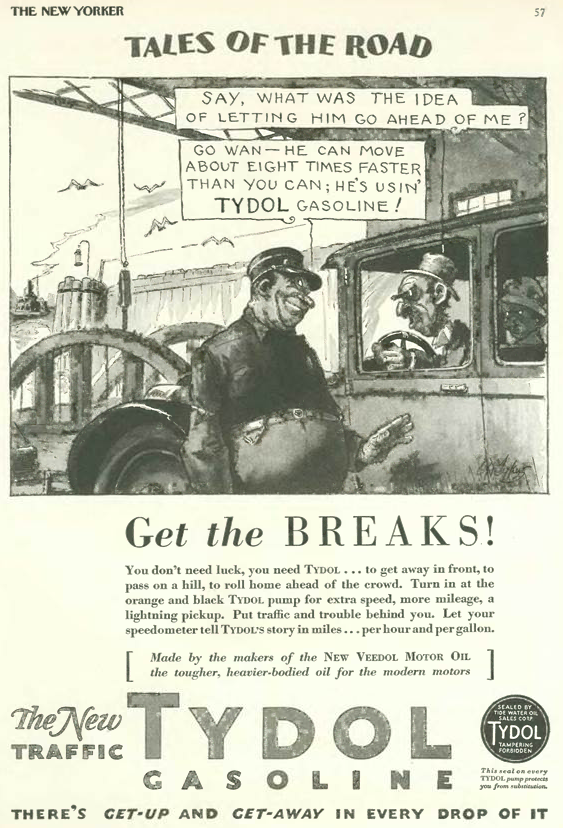
Something you never see in The New Yorker anymore, or in most magazines for that matter, are ads promoting various brands of gasoline. This one touts the benefits of Tydol, produced by the (now defunct) Tide Water Oil Company of New York:

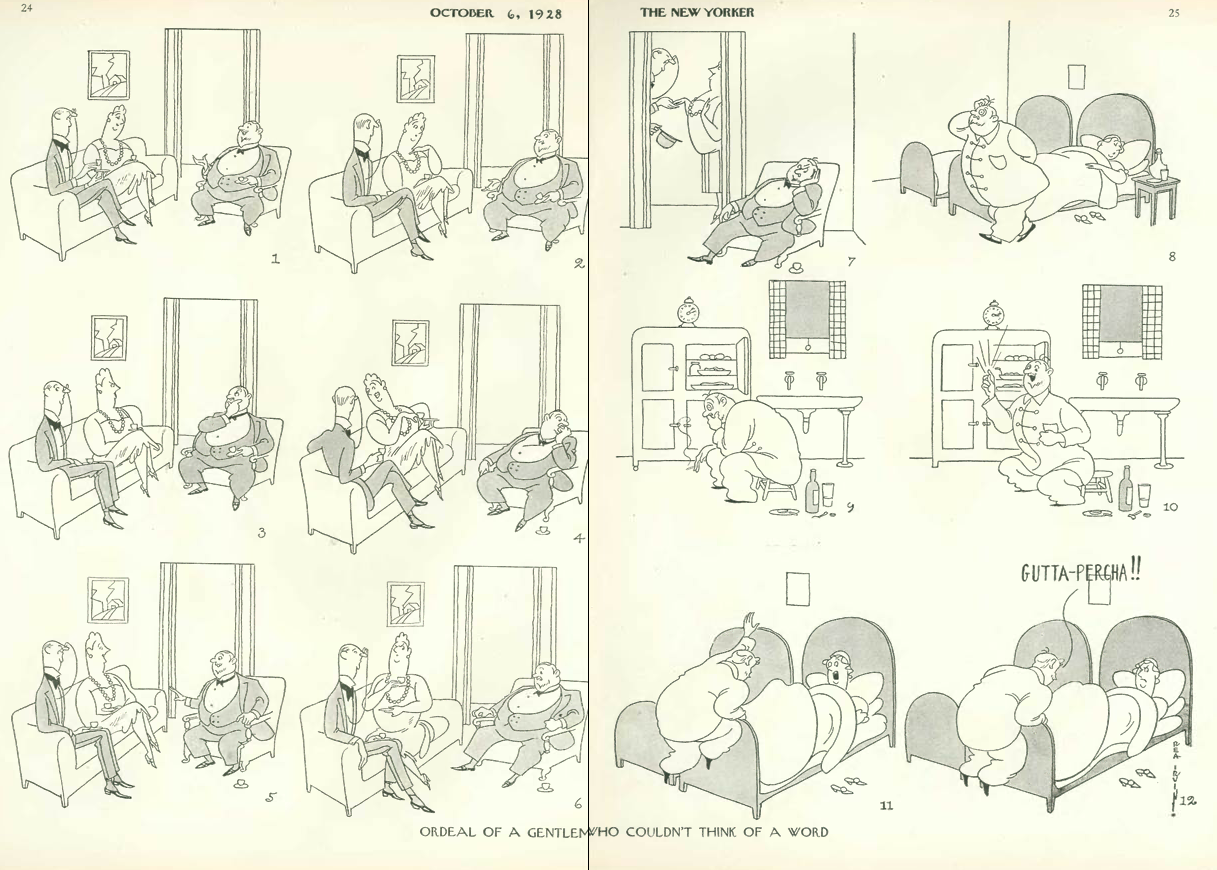
For our Oct. 6 cartoon, here is one of Rea Irvin’s occasional multi-panel, two-page comic spreads, this one exploring the ordeal of a man who couldn’t think of the word for a type of natural plastic used in the 1920s (click to enlarge image):

 *  *  *

The Oct. 13, 1928 issue featured a notable short story by Thyra Samter Winslow, a writer who contributed nearly a dozen pieces to The New Yorker in 1927 and 1928.

October 13, 1928 cover by Julian de Miskey.

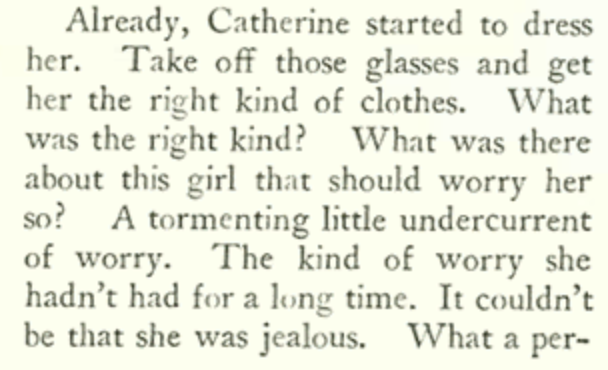
Her short story on page 25, “But for the Grace of God,” was a “key transitional work” for the magazine, according to Ben Yagoda in his book About Town: The New Yorker and the World It Made. He writes: “Realistic fiction thrives in periods of social ambiguity and flux, and the attention to class was on of the factors working to propel New Yorker writing from two-dimensional sketches to fleshed out short stories.” Yagoda observes that Winslow’s story, “in its carefully selected details, its mild epiphany, and its attention to the potency of class…is an accomplished and poignant piece of short fiction.” Excerpts:

Thyra Samter Winslow, in 1936. (findagrave.com)

* * *

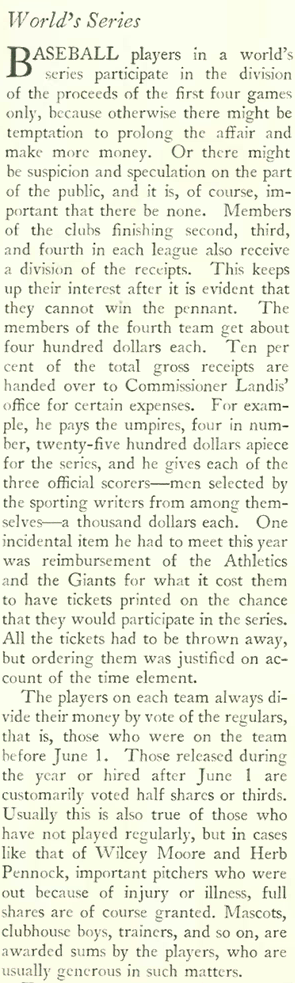
The New Yorker continued its stubborn refusal to report on baseball in its sports section, even though the Yankees were in the process of taking their second consecutive World Series title with a 4-0 sweep over the favored St. Louis Cardinals. The magazine did, however, mention the game in the Oct. 13, 1928 “Talk of the Town” — not on how it was played, but rather on how the championship money was distributed among players and assistants:

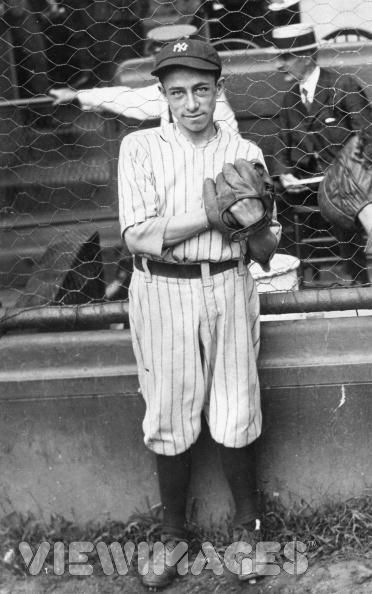
Money matters in the game of sport were more informal 90 years ago, with players themselves divvying up money to other players, trainers, mascots and batboys. For example, in 1927 Yankees batboy Eddie Bennett received $700 for the one-eighth World Series share voted him by the team. This sum earned over the four days of the series nearly equalled a batboy’s pay for a full year.

GOOD LUCK CHARM…Yankee batboy Eddie Bennett in the 1920s. Although a spinal injury as an infant left him hunchbacked, Bennett would serve as Yankee batboy for 12 years — a period that would include seven pennants and four World Series titles. (sabr.org)

 *  *  *

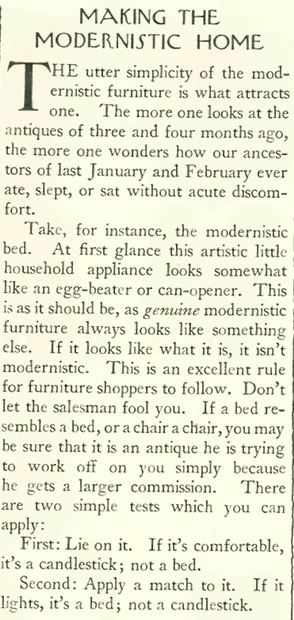
Although European-inspired modern furniture was all the rage among certain members of the New York smart set, writer Joseph Fulling Fishman (best known for his writing on contemporary prison conditions) offered a dissenting view in the Oct. 13 edition. An excerpt:

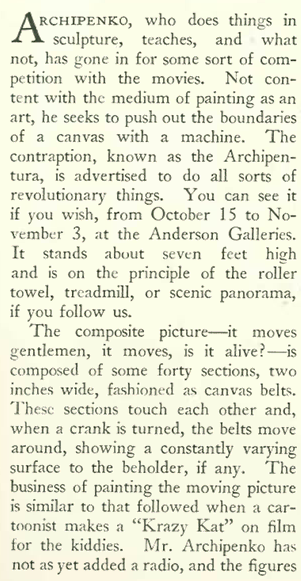
In the art review section, critic Murdock Pemberton also seemed a bit perplexed by modern design, in this case by the work of Ukrainian-born avant-garde artist Alexander Archipenko. His Archipentura was an electronic machine that displayed pre-loaded images of a female undressing by rolling painted canvas through a complex system of sprockets and belts. He intended the machine “to do for painting what the motion picture did for photography.” Pemberton observed:

THINK DIFFERENTLY…Alexander Archipenko (right, circa 1920), intended his intended his Archipentura machine (pictured in front and side views) “to do for painting what the motion picture did for photography.” (Wikipedia/Archipenko Foundation)

*  *  *

From Our Oct. 13 Advertisers

Yet another endorsement for cigarettes from the posh set. This time Melachrino Cigarettes got in on the action with this endorsement by Augusta Barney Harriman.

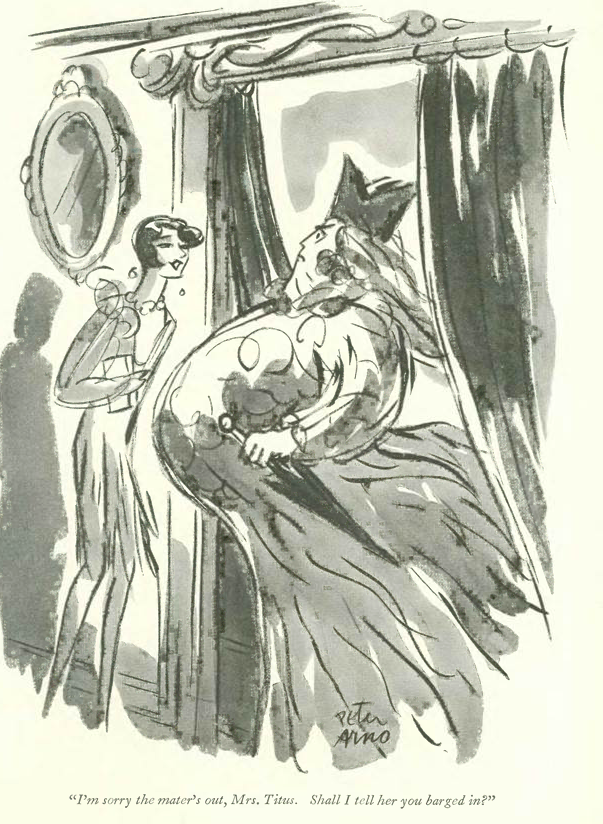
For our cartoon, Peter Arno once again looked in on the mannerisms of the upper class, contrasting a lithe young flapper with the imposing presence of a battle-axe. Note how the young woman uses the archaic British “mater” in reference to her mother…

Next Time: The Prohibition Portia…

This Thing Called Baseball

In the early years of The New Yorker, baseball as a sport was almost entirely ignored by the magazine, which otherwise gave exhaustive coverage to polo, yacht racing, tennis, and golf. There were also articles on badminton, rowing, and even auto racing, and college football received a lot of enthusiastic ink. But none for baseball. With the Sept. 22, 1928 issue I think I finally understand why.

Sept. 22, 1928 issue by Adolph K. Kronengold.

It has something to do with The New Yorker’s parochial view of the world, so aptly illustrated by Saul Steinberg on the magazine’s March 29, 1976 cover, in which anything beyond the Hudson was essentially terra incognita:

A lot of New York Yankee fans came from “out there,” according to James Thurber in a “Talk of the Town” segment titled “Peanuts and Crackerjack.” Thurber wrote of his experience at a pennant race game between the Yankees and the Philadelphia A’s. The game of baseball was described as something for the out-of-towners who were “a bit mad,” a mass spectacle in which the game itself was of minor importance. In short, it wasn’t cool to be a Yankees fan if you counted yourself among Manhattan’s smart set:

This “Talk” item was written when the Yankees were on the verge of winning their second consecutive World Series championship over the favored St. Louis Cardinals. The 1928 team featured the famed “Murderer’s Row” lineup with the likes of Babe Ruth and Lou Gehrig. In all, nine players from the ’28 team would be elected to the Hall of Fame, a major league record. But as of the Sept. 22 issue neither the 1927 or ’28 Yankees merited a line in The New Yorker’s sports pages.

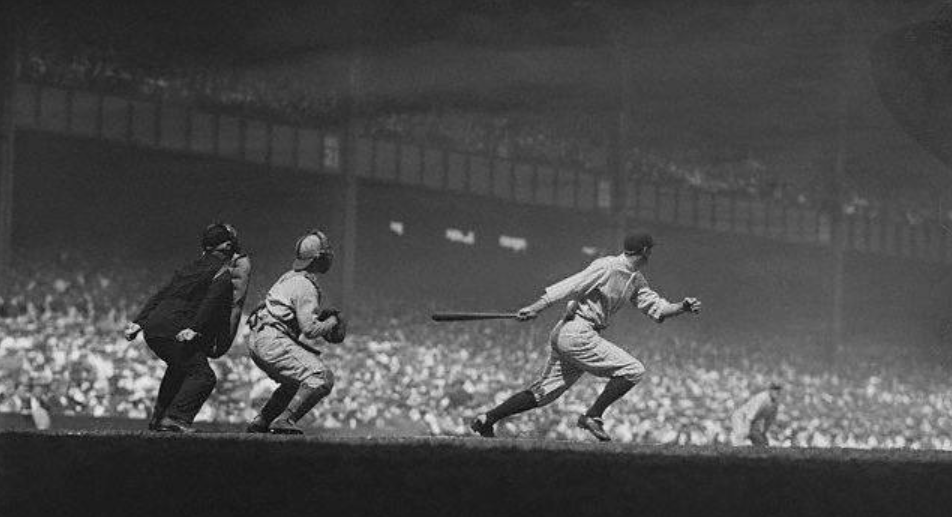
HIT ONE FOR THE OUT-OF TOWNERS…The Yankees’ Earle Combs leads off with base hit against the Philadelphia A’s in a key AL pennant race game on Sept. 9, 1928. A record crowd of 85,265 attended the game, won by the Yankees, who gained half-game lead over the A’s with the victory. (baseballhistorycomesalive.com)

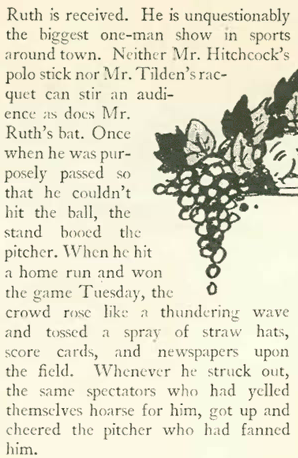
Thurber wrote that one could learn much about those in attendance at the game by the way they received Yankee star Babe Ruth:

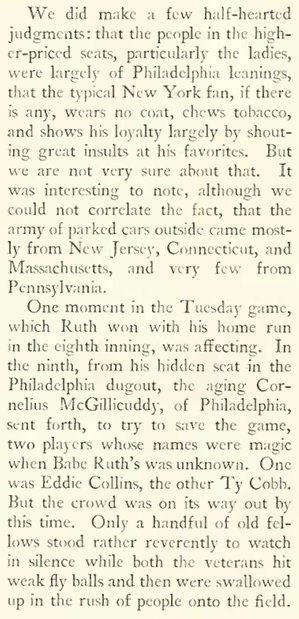
Thurber proved his point about out-of-towners by noting the origin of license plates in the “army of parked cars” outside of the stadium. He also noted the appearance in the game of an ancient Ty Cobb, who hit a weak fly ball while a few old-time fans looked on in reverence:

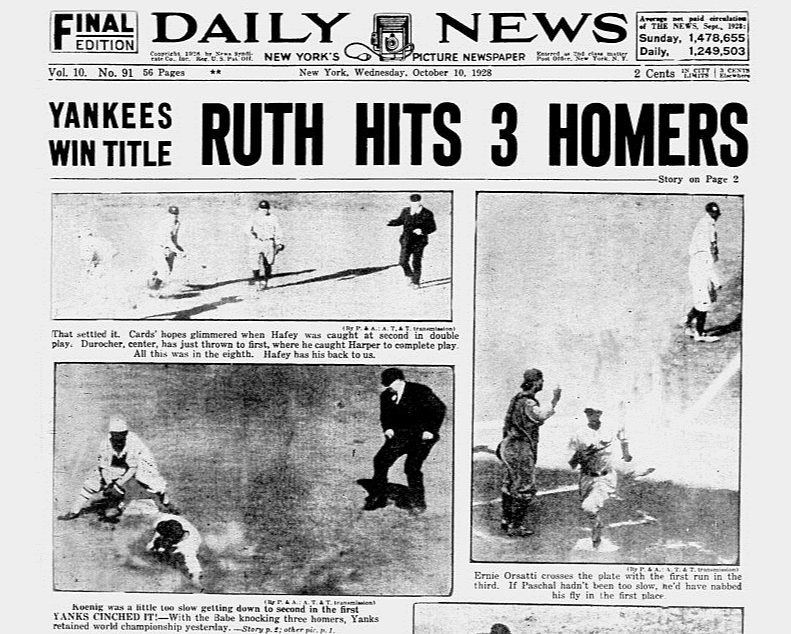
WHERE YOU COULD READ ALL ABOUT IT…The Oct. 10, 1928 edition of the Daily News splashed its front page with photographs of the Yankee’s triumphant title win. (NY Daily News)

 *  *  *

An Eye-dropping Art Collector

The Sept. 22 issue A.H. Shaw profiled “De Medici in Merion” Dr. Albert Barnes, who made his fortune by developing in 1901 (with German chemist Hermann Hille) a silver nitrate-based antiseptic marketed as Argyrol. In the days before antibiotics, Argyrol was used to treat eye infections and prevent newborn infant blindness caused by gonorrhea. The profile featured this rather fearsome illustration by Hugo Gellert:

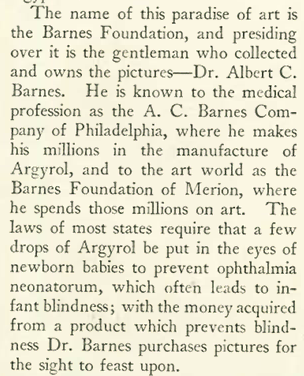
The lengthy piece detailed Barnes’ coming of age, and how his promotion of Argyrol helped bankroll his famed art collection. A brief excerpt:

IT FUELED A FORTUNE…Invented in 1901, Argyrol eye drops would finance one of the world’s greatest private art collections. Although was no longer marketed in U.S. after 1996, it is still available today, as seen at right in this Vietnamese product. (todocoleccion / ydvn.net)
HMMM, THAT LOOKS FAMILIAR…Henri Matisse views his 1917 painting The Music Lesson during a 1933 visit to the Barnes Foundation in Lower Merion Township, near Philadelphia. (The Morgan Library & Museum)
HE LIKED DOGS, TOO…Dr. Albert Barnes and his dog Fidèle with Matisse’s Red Madras Headdress, in 1942. (Barnes Foundation Archives)

  *  *  *

A One-eyed Monster Comes to Life

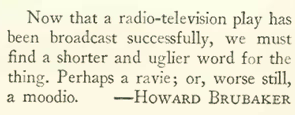
It’s always interesting to note the mentions of emerging technology in the early New Yorker, including this bit in Howard Brubaker’s column “Of All Things” about the successful broadcast of a “radio-television play.” Brubaker mused about what this new invention might called:

The first television broadcast in July 1928 was not exactly must-see TV. For two hours a day, General Electric’s experimental station W2XB broadcast the image of a 13-inch paper mache Felix the Cat, simply rotating on a turntable.

THE DAYS BEFORE VIAGRA ADS…A 13-inch Felix the Cat figure (top) was used to test an early television broadcast from General Electric’s experimental station W2XB in Schenectady, N.Y. Rotating on a record player turntable, the Felix figure was broadcast using a mechanical scanning disk, and was received as a 2-inch high image (below left) on an electronic kinescope. At bottom right, a 1928 television from General Electric that received alternating sound and picture. (NBC / Imgur / tvhistory.tv)

Then on September 11, 1928, W2XB (with WGY radio providing audio) broadcast a 40-minute one-act melodrama, The Queen’s Messenger. Northern State University’s Larry Wild writes that because TV screens were so small, only an actor’s face or hands could be shown. “The play had only two characters. A female Russian spy and a British Diplomatic Courier. Four actors were used. Two for the character’s faces, and two for their hands.”

The Queen’s Messenger was the first television drama, received by 3-inch televisions (most likely similar to the General Electric Octagon TV set pictured at left) that were set up in various places in the New York City area. At right, actors on the set of The Queen’s Messenger. The crude, flickering image marked the beginning of a revolution. (General Electric)

 *  *  *

From Our Advertisers

Advertisers were always looking for clever angles to capture the attention of The New Yorker’s upscale readers, including the use of subtle and not-so-subtle racist cues to get their points across. Two examples from the Sept. 22 issue have the makers of Oshkosh trunks helpfully pointing out that their product is not intended for African “natives”…

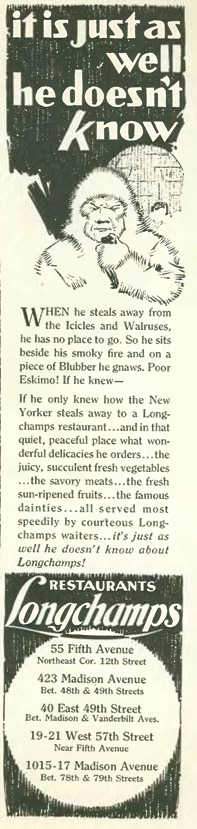
…or the folks from Longchamps restaurants, who depict the joyless life of a blubber-eating Eskimo as an appropriate juxtaposition to the succulent delicacies awaiting readers at their five New York locations:

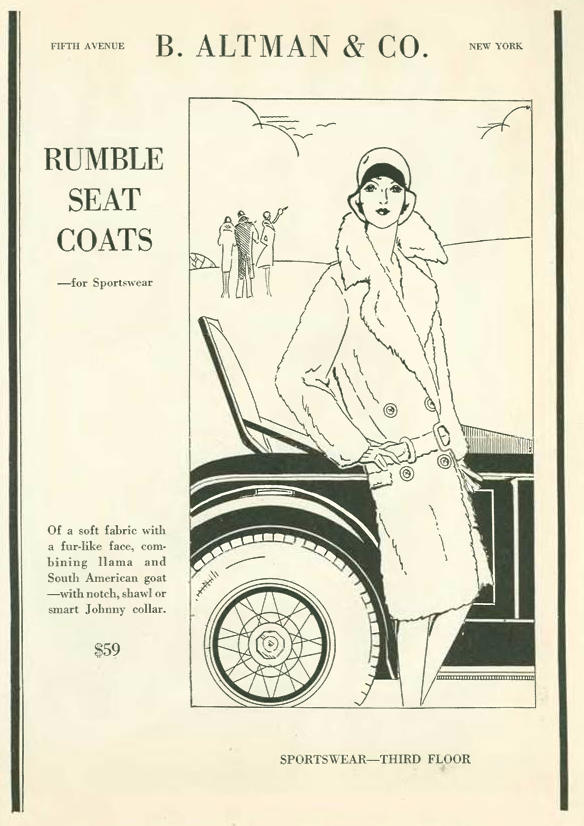
We might associate rumble seats with the carefree joys of the Roaring Twenties, but in reality passengers in these jump seats received little protection from the elements (or flying gravel), and the ride was no doubt jarring atop the rear axle. No wonder you needed a special coat:

Our cartoons for Sept. 22 include this whimsy from Gardner Rea…

…and this cartoon by Al Frueh, which depicts the deserted surroundings of the Flatiron Building on Yom Kippur. Robert Mankoff, who served as The New Yorker’s cartoon editor from 1997 to 2017, observed in the Cartoon Desk (Sept. 26, 2012) that “the rapid growth of Jewish-owned businesses in New York made the cartoon relevant in a way that it’s not today. Through modern, politically correct eyes, the cartoon may seem anti-Semitic, but I don’t see it that way. It just depicts the reality of those times, exaggerated for comic effect.”

Next Time: The Tastemakers…


(Another) Fight of the Century

It seems that each generation has its “Fight of the Century,” a phenomenon that emerges from the alchemy of mass marketing, a lust for blood sport, and the madness of crowds. Gene Tunney — a boxer who also wanted to be a public intellectual — was party to at least two of these spectacles in the 1920s.

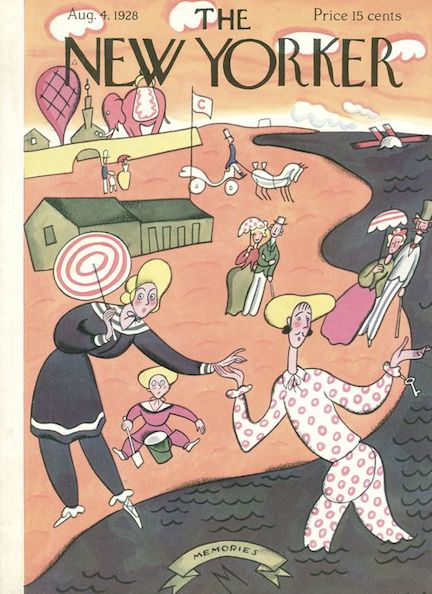
August 4, 1928 cover by Julian de Miskey.

Tunney is most famous for his fights against Jack Dempsey—in some ways they were the Ali–Frazier of their day. Tunney took the heavyweight title from Dempsey in 1926, and again defeated Dempsey in the controversial “long count” rematch one year later, on Sept. 22, 1927. That match was a huge spectacle, staged at Chicago’s Soldier Field in front of 105,000 spectators.

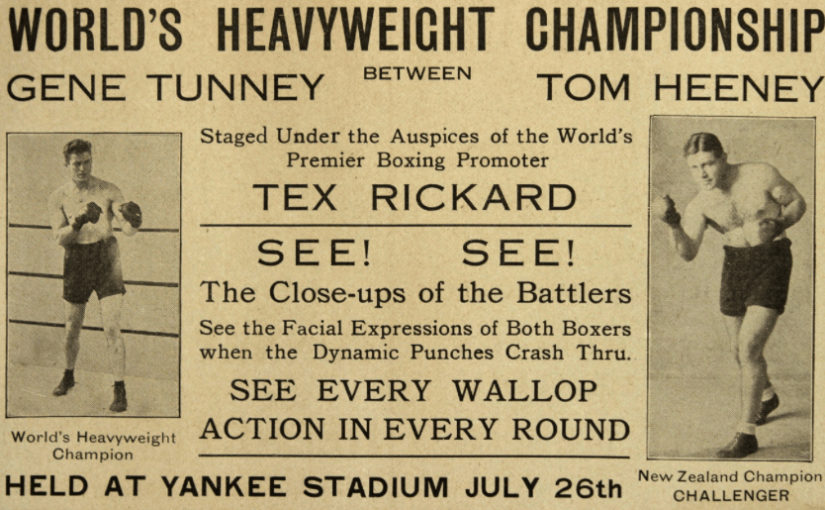
Boxing promoter Tex Rickard saw dollar signs when a scrappy New Zealander named Tom Heeney challenged the champ to a match. Heeney had won the Australian heavyweight title in 1922, and after arriving in the U.S. in 1926 found enough success in the ring to be ranked fourth among the world’s heavyweight boxers.

Writing in his column, “Sports of the Week,” in the July 21, 1928 issue of The New Yorker, Niven Busch Jr. assessed Heeney as a formidable opponent:

NO PALOOKAS HERE…Tom Heeny (left), and Gene Tunney in the late 1920s. (boxrec.com / Alchetron)

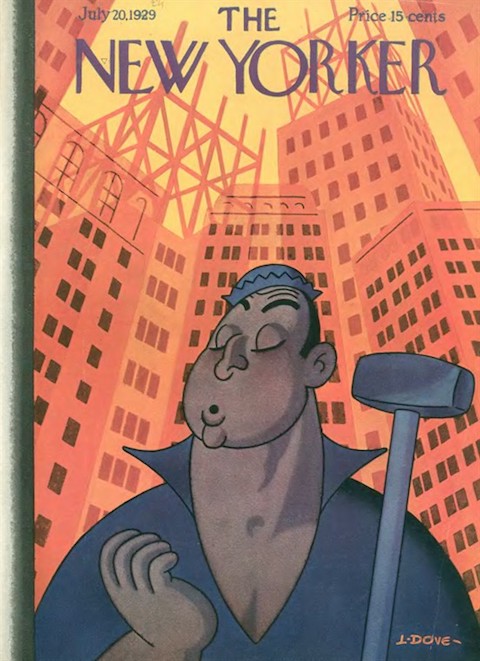
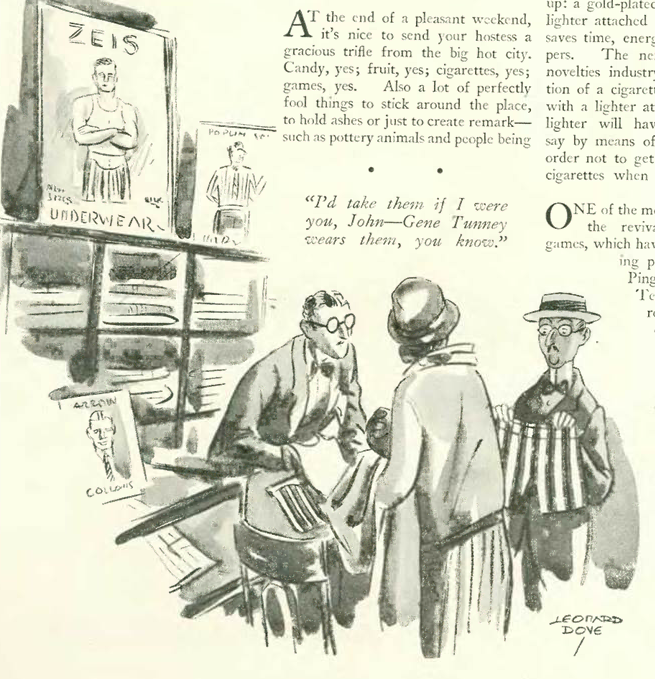
This cartoon by Leonard Dove, also in the July 21 issue, joined in the fun…

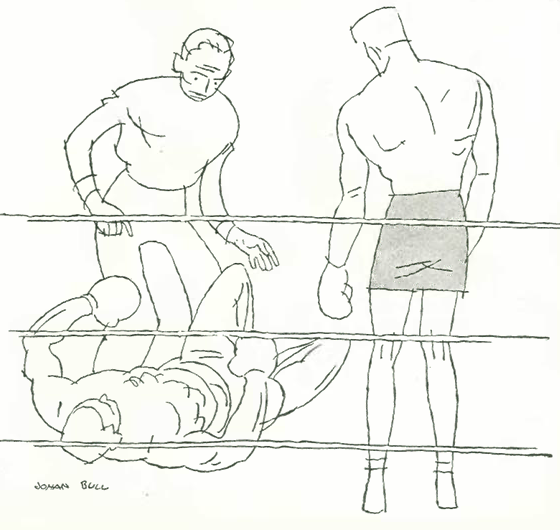
As for the actual fight at Yankee Stadium on July 26, 1928, Tunney won by a TKO in the 11th round. Perhaps the boxer from Down Under wasn’t in such great shape after all, or so surmised Niven Busch Jr in the August 4 issue:

New Yorker illustrator Johan Bull offered this perspective in artwork that accompanied Busch’s article…


Tunney’s winning purse was $525,000 (about $7.3 million today) and Heeney’s was $100,000 ($1.4 million), modest when compared to the recent debacle in Las Vegas that pitted professional boxer Floyd Mayweather Jr. against mixed martial arts champion Conor McGregor.  Mayweather earned a disclosed purse of $100 million while Conor McGregor brought home $30 million.

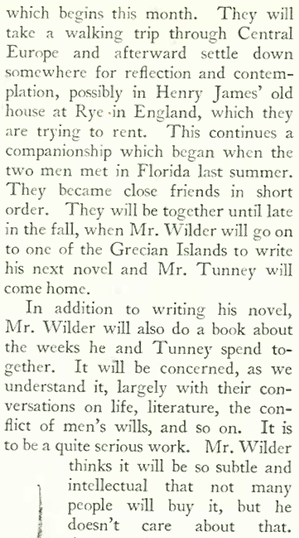
Heeney would remain in the U.S. and fight a few more bouts before retiring to Florida, where he ran a bar and fished with his friend, Ernest Hemingway. Tunney, on the other hand, announced his retirement from boxing just five days after the fight. It was time to finally devote himself to a life of the mind. Norman Klein, writing in the Aug. 4 “Talk of Town,” offered a glimpse into that new life:

BRAIN OVER BRAWN…Boxing champ Gene Tunney, left, and writer George Bernard Shaw on a 1929 vacation to Brioni. (Associated Press)

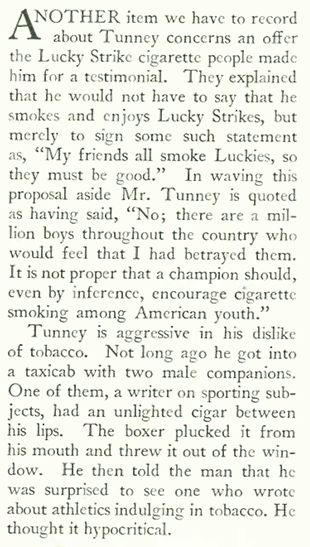
Still not getting enough of The Champ, “Talk” also related this story about Lucky Strike cigarettes, and how that company’s publicists tried unsuccessfully to persuade Tunney to endorse their product:

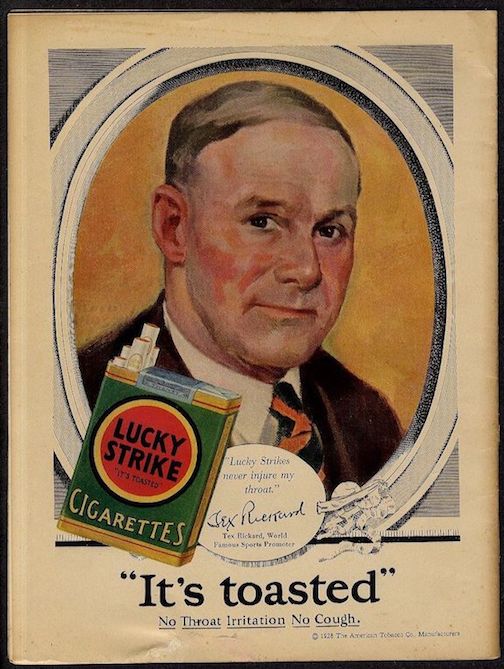
However the promoter of the Tunney–Heeney fight, Tex Rickard, had no problem taking money from the American Tobacco Company:

THEN I’LL TAKE THE MONEY…The promoter of the Tunney – Heeney fight, Tex Rickard, had no problem endorsing Lucky Strikes in this 1928 advertisement. Rickard would die the following year at age 59, from an appendectomy of all things. (eBay)

*  *  *

Tunney Was More Exciting

“The Talk of the Town” cast a jaded eye toward the Ninth Olympic Games in Amsterdam:

Poster from the 1928 games. (www.olympic.org)

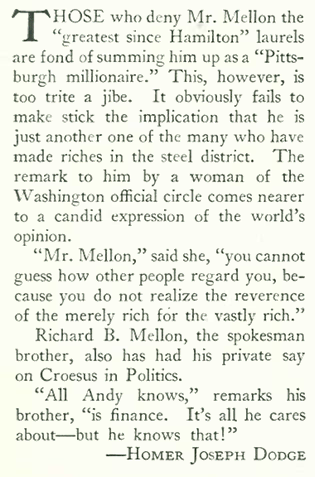
And perhaps even less exciting than the Olympics was the magazine’s “Profile” subject, Andrew W. Mellon, referred to in the title as “Croesus in Politics.” Mellon was no Gene Tunney, but he did ensure his immortal fame through his philanthropy, still expressed today by the Andrew W. Mellon Foundation. Below are the concluding lines of the profile, written by Homer Joseph Dodge:

The article featured this terrific caricature by illustrator Abe Birnbaum…

Planned Obsolescence

The magazine’s “Motors” column touted Chrysler’s new “peaked” radiators, which no doubt caused many insecure Chrysler owners to consider junking their non-peaked models of yesteryear:

This ad in the same issue screamed “new, new, new” for what appeared to be mostly the same old, same old…

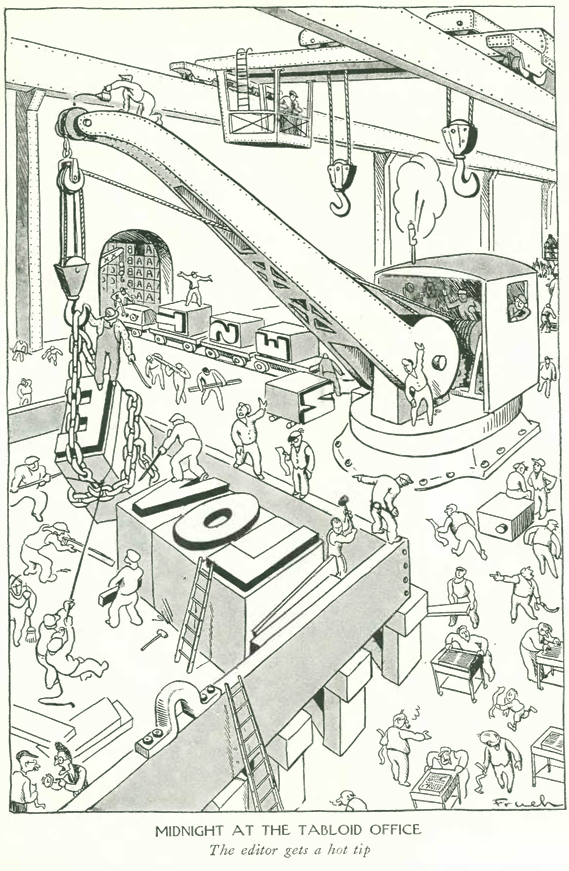
Our comic comes courtesy Al Frueh, who looks in on the workings of a printing press at a celebrity tabloid:

Next Time: Shadows of the South Seas…

Beyond 96th Street

The New Yorker stepped out of its Manhattan offices at 25 West 45th Street and headed north to see what lay beyond 96th Street and Park Avenue, to “a land on to which realtors may not push.”

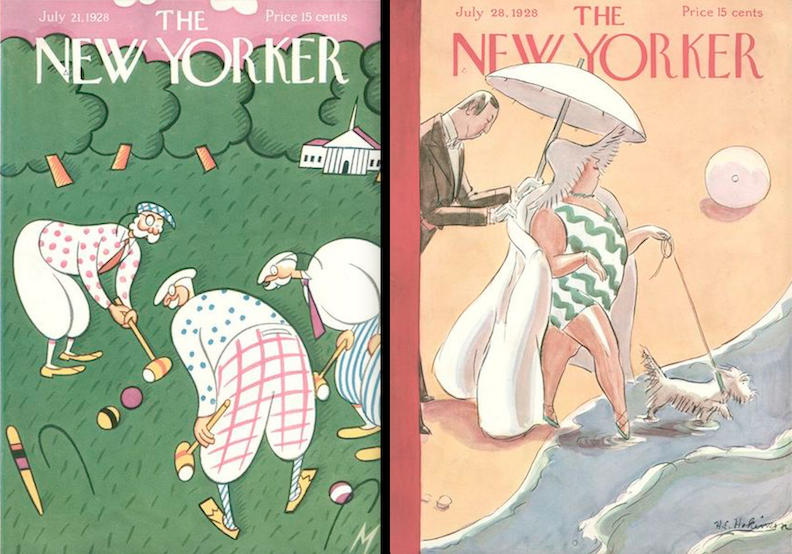
July 21, 1928 cover by Julian de Miskey; July 28, 1928 cover by Helen Hokinson.

In the early to mid 20th century, 96th street represented a real dividing line across Park Avenue, separating Manhattan from the “frontier” to the north. Although developers have since breached this line (particularly beginning in the 1980s), back in 1928 it truly marked an end of sorts to Park Avenue—even the paving ran out by 102nd Street. The July 28, 1928 “Talk of the Town” observed:

FRONTIER NO MORE…Aerial view of Park Avenue from 96th Street (the X at bottom left) all the way past 132nd Street, where Park Avenue joins Harlem River Drive. The ‘X’ at the upper right hand corner marks the former location of Gus Hill’s Minstrels (mentioned in the article) at 129th and Park Avenue. (Google Maps) Click on image to enlarge

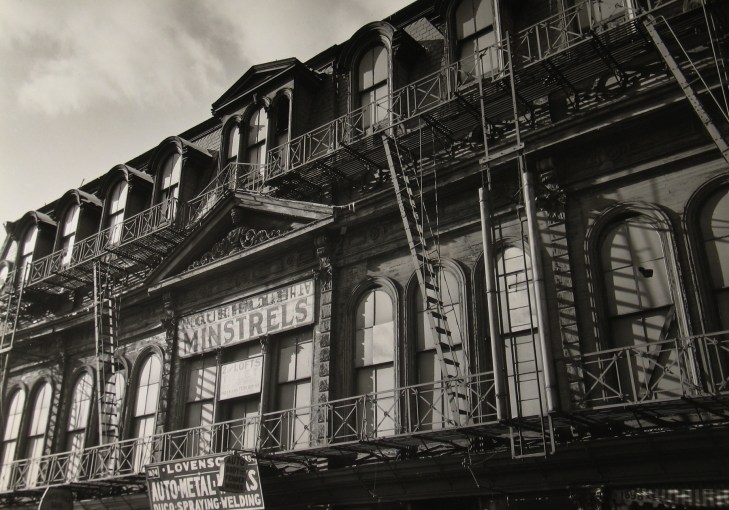
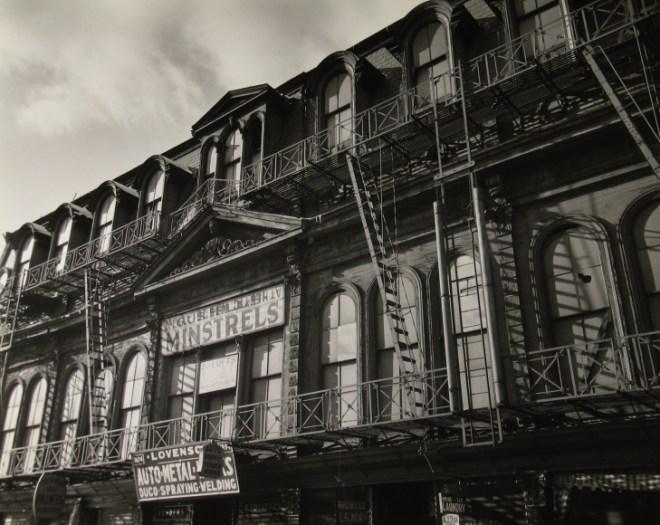
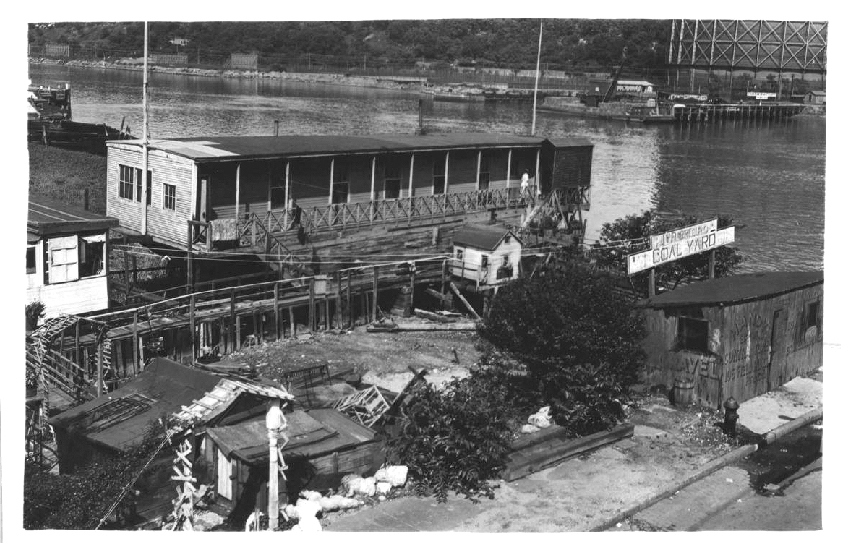
Beyond 96th a vast pushcart market was discovered to be operating under the elevated railroad tracks, while further on toward the Harlem River there were factories, coal yards, and a shuttered theatre:

NEAR THE END OF THE LINE…The Gus Hill’s Minstrels building at the corner at East 129th and Park Avenue, facing the elevated train tracks. There was an auto garage at the lower floor. The “Minstrels” were long gone by the time the photo was taken, in 1935, by Berenice Abbott. (Museum of the City of New York)
ONLY A GHOST…The former site of Gus Hill’s Minstrels, at the corner at East 129th and Park Avenue, now occupied by a filling station. (Google Maps)
SOARING…The Park Avenue elevated railroad tracks in Harlem east of 96th Street created vast covered spaces frequented by pushcart vendors. (nyc-architecture)
UP THE RIVER…A houseboat colony near a coal yard at 208th Street by the Harlem River, 1933. (myinwood.net)

 *  *  *

Sport of Lords and Ladies

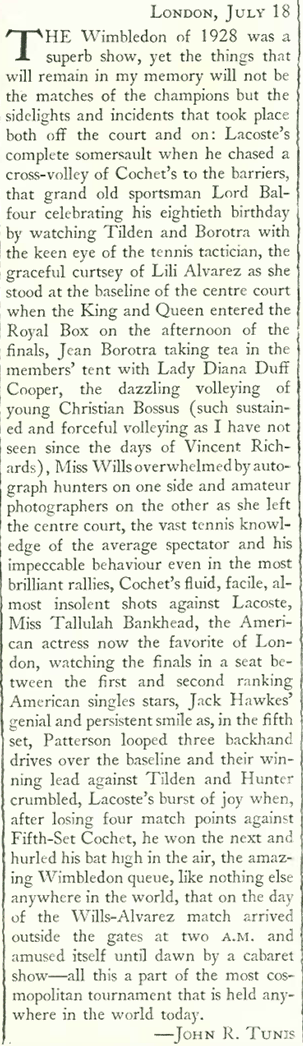
The New Yorker’s sportswriter John Tunis paid a visit to the 1928 Wimbledon tennis tournament, where he took in a scene that included several celebrities:

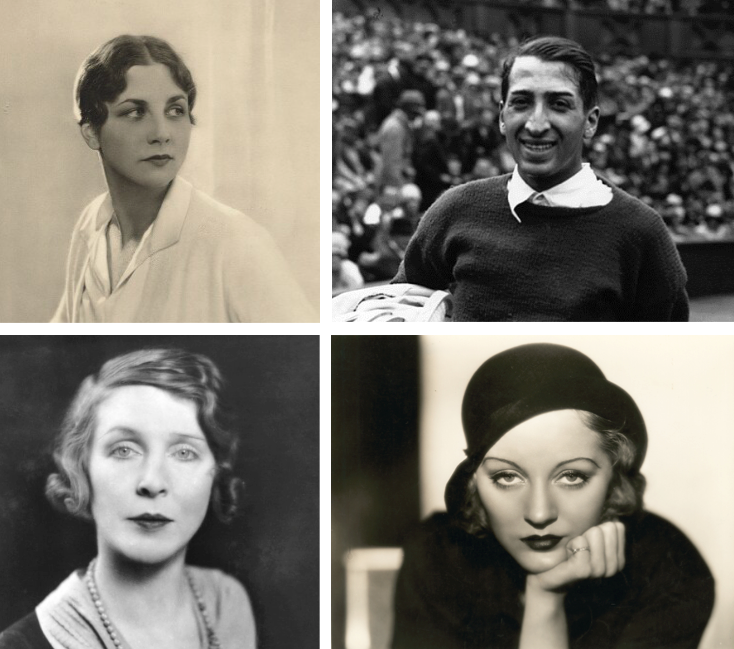
FACES IN THE CROWD at the 1928 Wimbledon included clockwise, from top left, the tournament’s singles champions Helen Wills Moody and René LaCoste; and spectators such as actress Tallulah Bankhead and Lady Diana Duff Cooper. (Wills Moody image from 1928 courtesy National Portrait Gallery, London; circa 1930 Bankhead image, Alchetron; Lady Diana image dated 1931, (UK National Portrait Gallery); and LaCoste photo taken after he won the men’s singles title at the 1928 Wimbledon, bltimes.com)

*  *  *

From Our Advertisers

The July 28 issue included yet another Dr. Seuss-illustrated ad for Flit insecticide. No doubt Seuss would later regret such an illustration, as later in life he strongly opposed racism and supported environmental causes.

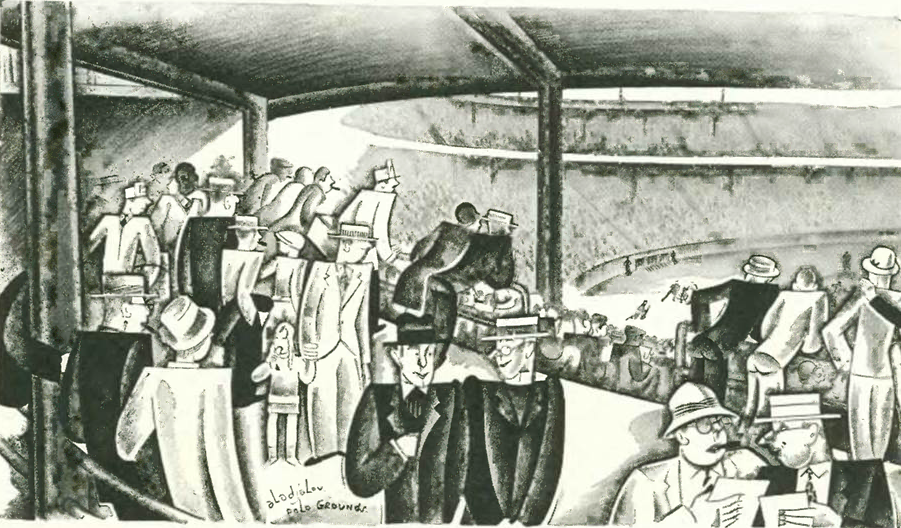
Also from the July 28 issue, a detail from a two-page illustration of baseball fans at the Polo Grounds by Constantin Alajalov, which appeared in “The Talk of the Town” section:

 *  *  *

From Our Advertisers, Part II:

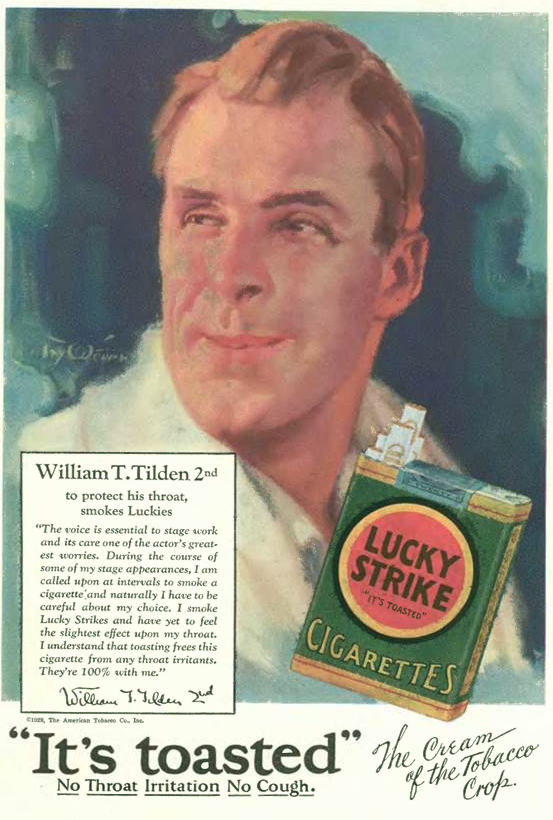
Jumping back an issue, to July 21, 1928, we find tennis great (and sometime film actor) Big Bill Tilden hawking the toasted pleasures of Lucky Strike cigarettes on the magazine’s back cover:

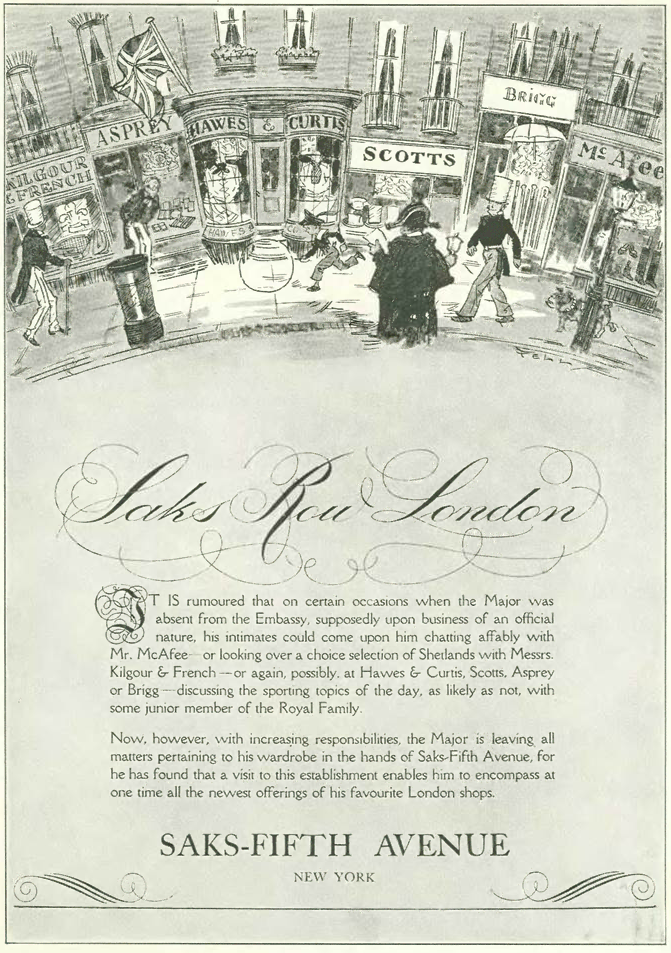
As I’ve noted before, many New Yorker ads appealed to the Anglophilic pretensions of its striving readershship. This one below from Saks is a particularly egregious example…

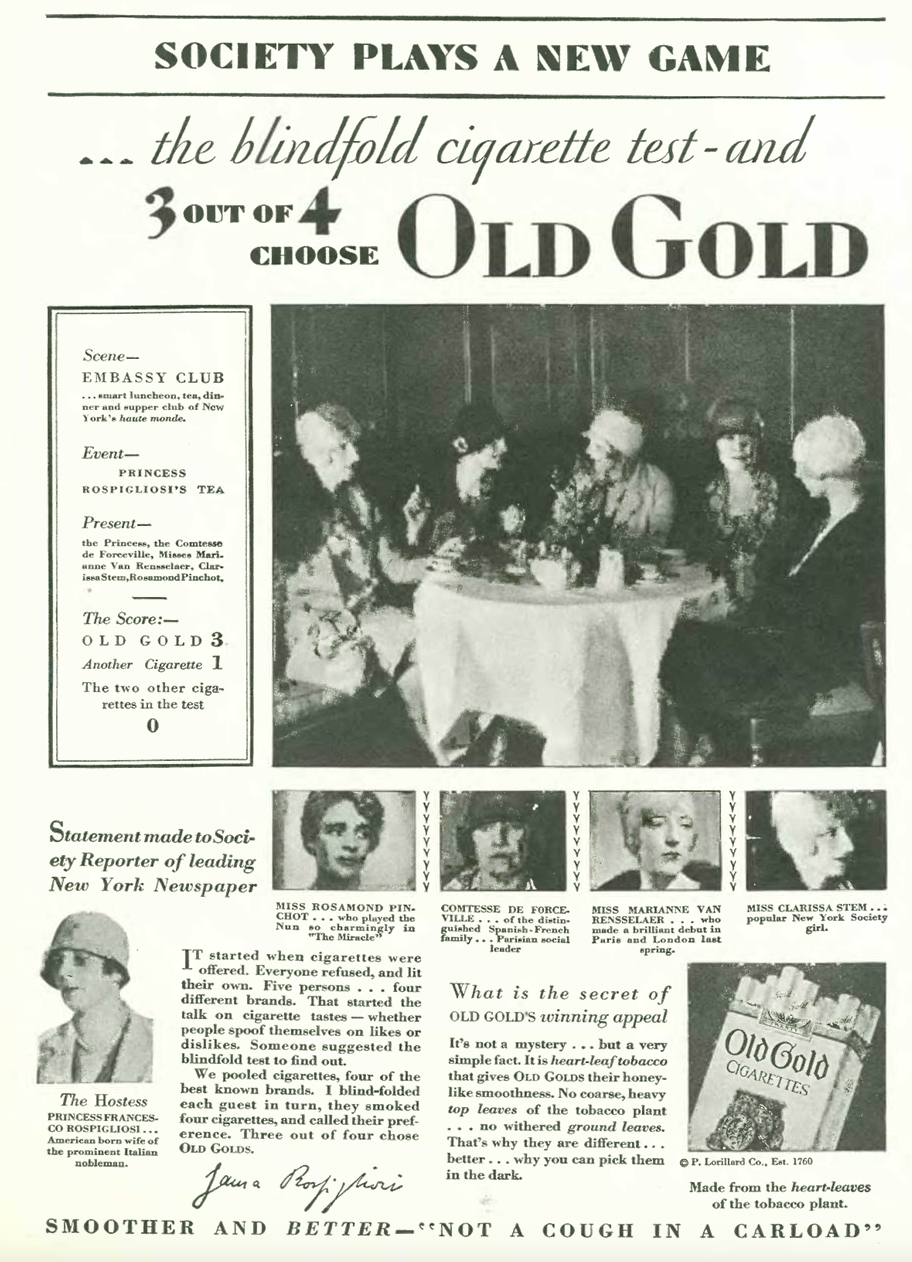
…other social strivers could look to the example of these society matrons who picked up some spare cash shilling for Old Gold cigarettes…

I close with a couple of cartoons from the July 21 issue by Barbara Shermund and Peter Arno:

Next Time: (Another) Fight of the Century…

Dog’s Best Friend

The “Profile” for the May 12, 1928 issue was unusual in that its subject was not a titan of industry, or a prominent politician, or noted artist, musician or literary figure, but rather a dog—an extraordinary animal named Egon who would be lost to history were it not for Alexander Woollcott writing about this particular German Shepherd and his exploits on the French Riviera.

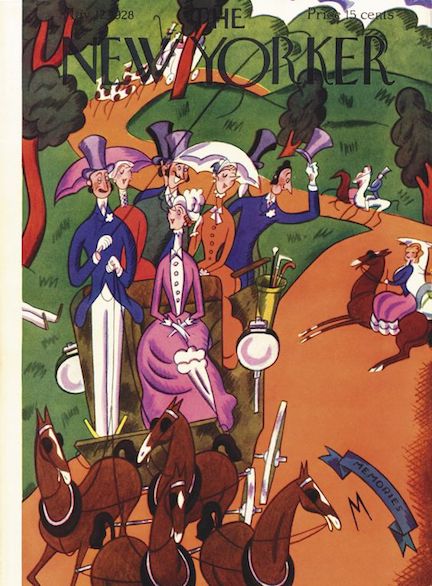
May 12, 1928 cover by Julian de Miskey.

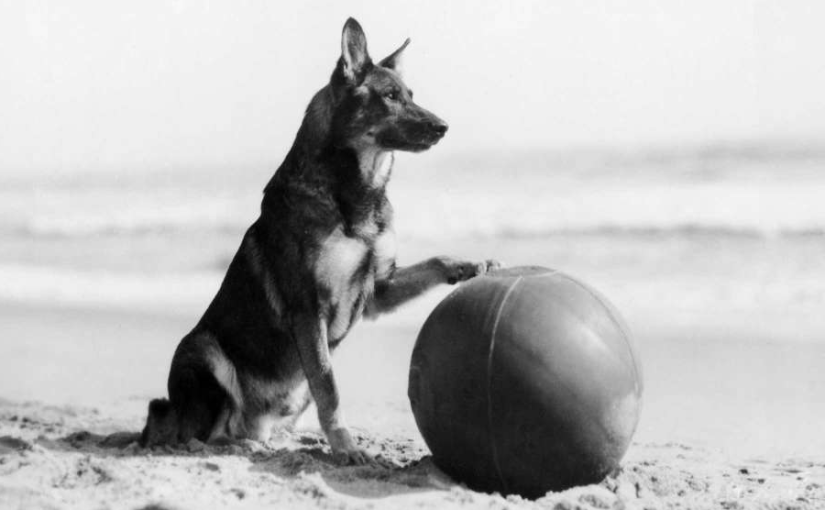
I should be clear that the dog featured at the top of this entry is not Egon, but a famous contemporary named Rin Tin Tin. It is said Egon could have enjoyed similar fame on the silver screen (Hollywood was looking for an animal to replace the aging canine superstar), but Egon’s owner, Benjamin Finney, had no interest in the limelight. So I couldn’t find any images of Egon save for this drawing that accompanied Woollcott’s essay:

Writing for the Huffington Post, Anne Margaret Daniel calls Egon Finney the “Jazz Age celebrity no one has noticed since his lifetime, but who is surely as interesting as many of his human contemporaries — and far more interesting than many of them.”

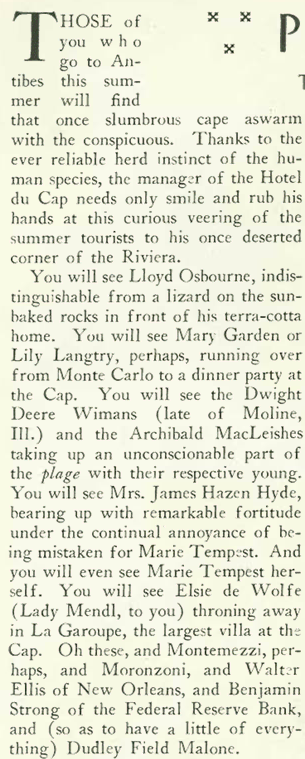
Woollcott would agree with that statement, given the opening paragraphs of his piece on Egon:

When Egon and Finney lived in Antibes in 1927 and 1928, Egon would give diving exhibitions off the rocks below the Hotel du Cap. According to Daniel, the dog also “availed himself of his owner’s surfboard, and water skis — possibly the first pair ever on the Riviera.” Egon was aided in his efforts by none other than the writer F. Scott Fitzgerald, who lived on the Riviera from 1925 to 1930.

DOG LOVERS…Alexander Woollcott, left, and Egon owner Benjamin Finney (boweryboyshistory.com/Sewanee University of the South)
HE TAUGHT A DOG TO WATER SKI, TOO…F. Scott Fitzgerald, wife Zelda and son Scottie in Antibes in 1926. Fitzgerald lived on the Riviera from 1925 to 1930, writing much of The Great Gatsby there. His last-completed novel, Tender Is The Night, was set on the Riviera. (The New York Times)

According to Daniel, Finney recalled that Egon’s physical design “made it difficult for him to get started (on the surfboard), but his friend Scott Fitzgerald was expert at giving him a hand… Firmly balanced, tail streaming in the wind, he was a noble sight — and he knew it.”

Because the dog outshone his owner, Woollcott headlined his profile, “The Owner of Ben Finney.” Egon died in 1934, and those very words are carved on his headstone, located in America’s first pet cemetery in Hartsdale, New York.

Someone He Could Finally Relate To…

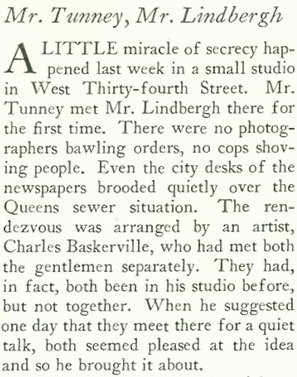
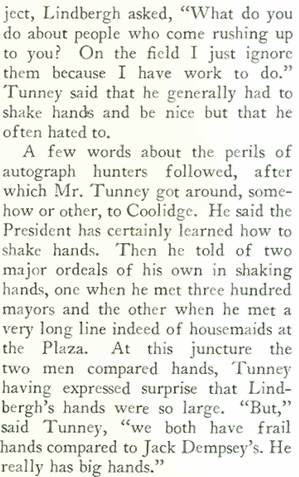
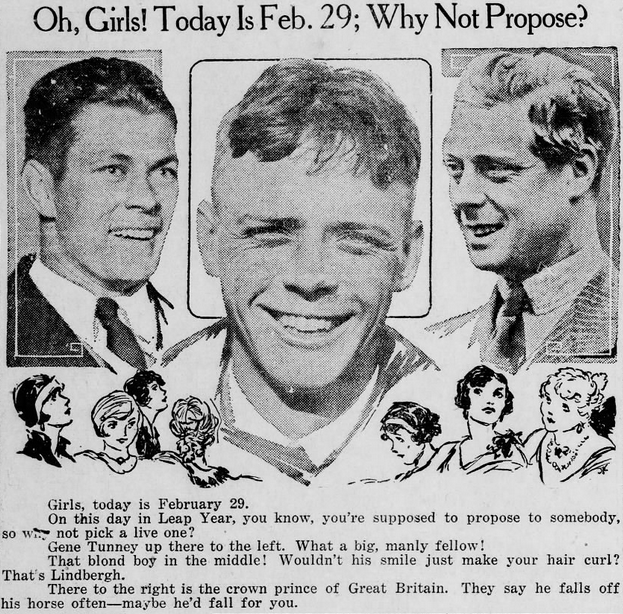
Charles Lindbergh was famously shy and crowd averse, so when the famed aviator met with the serious-minded boxing champ Gene Tunney, he found something of a kindred spirit. Writing for “The Talk of the Town,” Peter Vischer was there for all of the action:

NOWHERE TO HIDE…This item in the El Paso Evening Post (Feb. 29, 1928) was precisely the sort of thing both Gene Tunney and Charles Lindbergh detested. (Evening Post)

 *  *  *

From Our Advertisers…

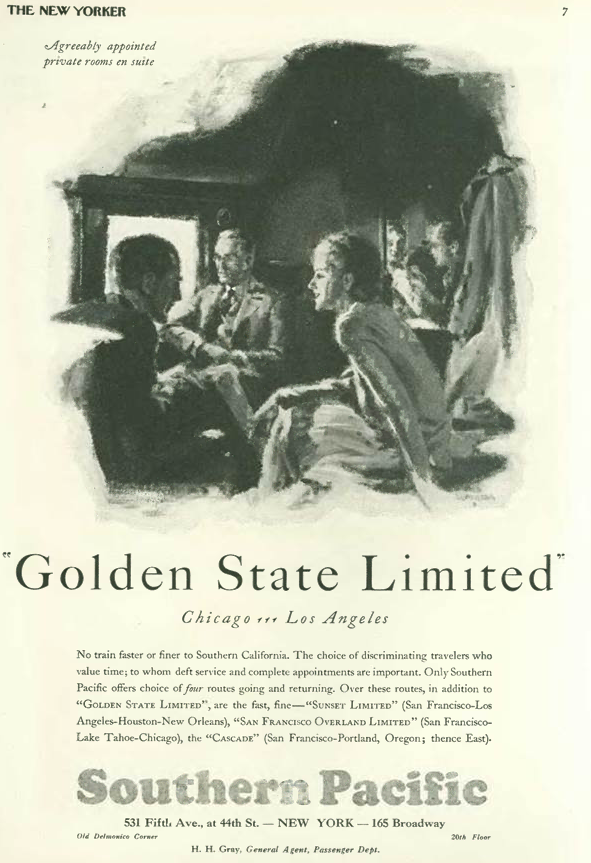
Beginning in 1924 the Southern Pacific’s Golden State Limited trains added modern and luxurious 3-compartment, 2-drawing room observation cars to their Pullman fleet. This advertisement in the May 12, 1928 New Yorker enticed affluent readers to take the 2,762 mile, 70-hour journey from Chicago to Los Angeles:

NOT THE WORST FOR WEAR…The Russian actress, singer and dancer Olga Baclanova exits the Golden State Limited in Los Angeles in July 1929 after a long journey from New York. Billed as “The Russian Tigress” who often portrayed an exotic blonde temptress, she is best known for her roles as Duchess Josiana in the silent The Man Who Laughs and as a circus trapeze artist in Tod Browning’s 1932 cult horror movie Freaks. (olgabaclanova.com)

As the fashion advertisements turned to summer, the May 12 issue featured no less than three separate ads for straw boaters…

Today’s ubiquitous polo shirt was an entirely new look for the summer of 1928. The shirt was designed by France’s seven-time Grand Slam tennis champion René Lacoste, who understandably found traditional “tennis whites” (starched, long-sleeved white button-up shirts with neckties) both cumbersome and uncomfortable. Lacoste first wore the polo at the 1926 U.S. Open, and in 1927 he placed the famous crocodile emblem on the left breast of his shirts. It didn’t take long for many imitators to hit the market. This ad from Wallach Brothers offered one version for $6, although I can’t imagine wool was the best material for this shirt (Lacoste used cotton in his).

No doubt B. Altman had June brides in mind for this advertisement featuring a deco bride of impossible proportions:

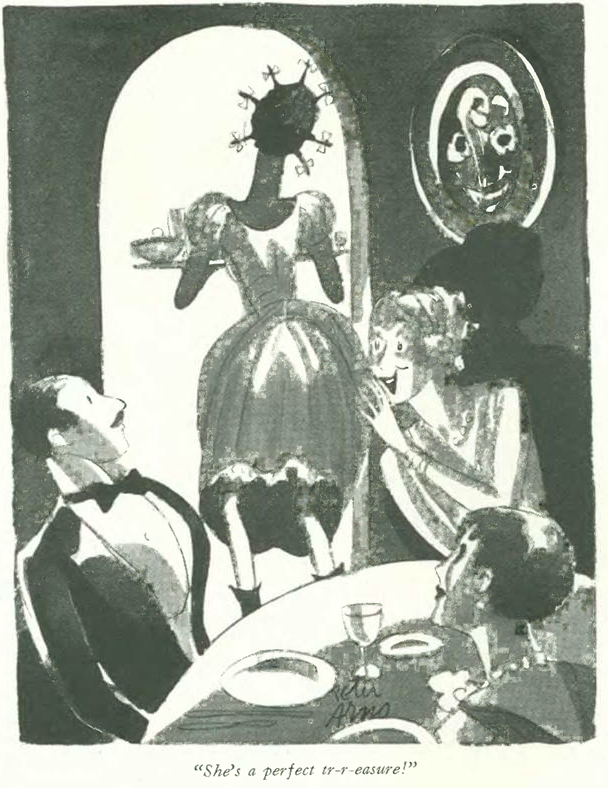
And our cartoon is once again from Peter Arno, who explored the not so subtle racism of the upper classes:

Next Time: Man About Town…

Wits of the Round Table

Two big voices from the famed Algonquin Round Table were prominently featured in the Oct. 1 and Oct. 8, 1927 issues of the New Yorker–journalist and champion of the underdog Heywood Broun wrote his own “Profile” under the title, “The Rabbit That Bit the Bulldog,” and Dorothy Parker served up biting satire in “Arrangement in Black and White,” a clever exposé of racism among the fashionably “open-minded” upper classes.

488a50459a792547010d30e8bfe5ddf4
October 1, 1927 cover by Gardner Rea.

The Rabbit That Bit the Bulldog

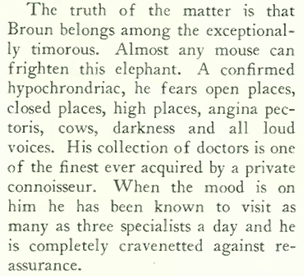
Hiding under the signature “R.A.”, Heywood Broun (1888–1939) was merciless as his own profiler, describing himself as a coward, hypochondriac, and a slob (there is truth to the latter, however, as friends often likened him to “an unmade bed”).

screen-shot-2016-12-08-at-9-06-52-am

Broun cut his teeth in journalism as a sportswriter and war correspondent. In 1921 he went to work for the New York World, where he penned his popular syndicated column “It Seems to Me.” Broun’s New Yorker “Profile” was written after he was fired from the World following a disagreement with his editor over his critical commentary on the sentencing of anarchists Sacco and Vanzetti. Broun would move on to The Nation, where he would write a regular column, “It Seems to Heywood Broun,” that would offer criticism on a number of topics including his former employer, the World.

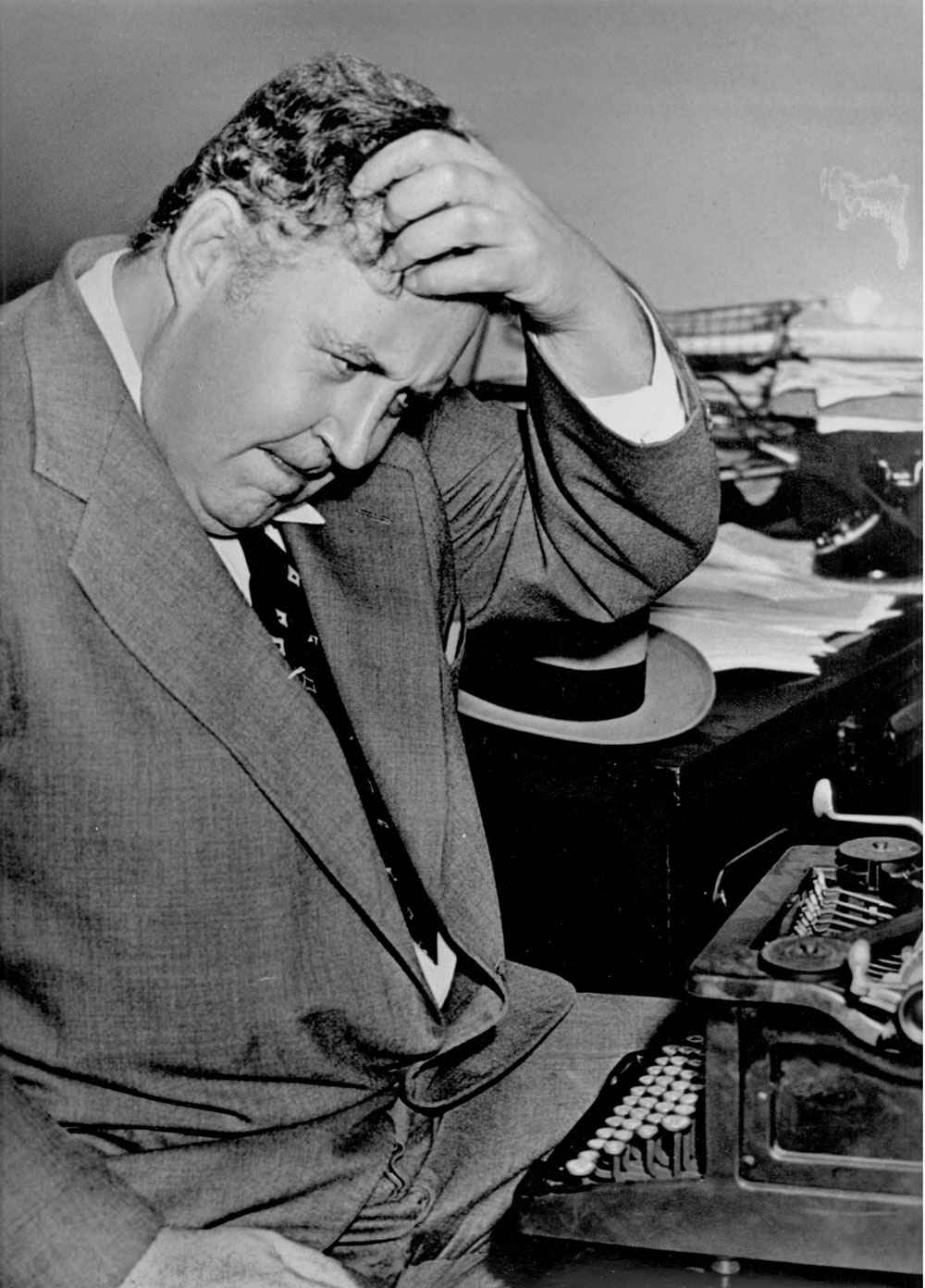
Heywood Broun. (Denver Newspaper Guild)

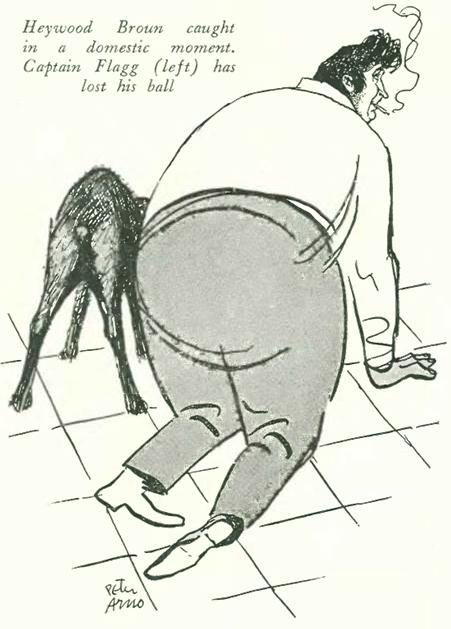
The New Yorker profile included this caricature by Peter Arno…

screen-shot-2016-12-06-at-9-46-21-am

…a portrayal Broun claimed was inaccurate due to his “habitual stoop,” among other faults…

screen-shot-2016-12-06-at-9-52-23-am

screen-shot-2016-12-06-at-9-52-34-am

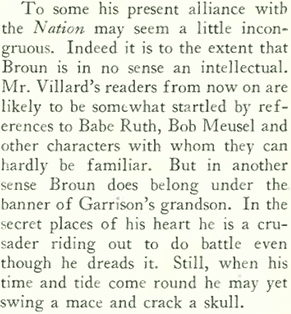
…and he mused about his future with the Nation, and how that august publication would square with his various foibles…

screen-shot-2016-12-06-at-9-52-45-am

…and as for his personal appearance and habits, Broun weighed in thusly…

screen-shot-2016-12-06-at-9-55-18-am

Broun married social activist Ruth Hale in 1917. A son born the following year, Heywood Hale Broun, would have a long and successful career as an author, sportswriter, commentator and actor.

*  *  *  *  *

The Long Count

Oddly, The New Yorker had little to say about the famous Chicago rematch between heavyweight boxers Gene Tunney and Jack Dempsey, which Tunney won after the controversial “long count.” The fight took place under new rules that gave a fallen fighter ten seconds to rise to his feet, but the count would not begin until his opponent moved to a neutral corner.

tumblr_mti3g257h11rnxl9do1_500
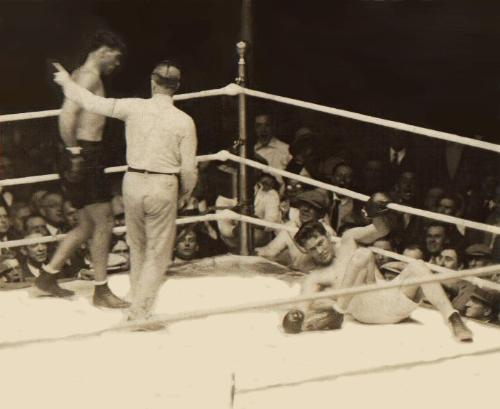
DAZED AND CONFUSED…Referee Dave Barry motions Jack Dempsey to a neutral corner before he begins his count. Gene Tunney got back up and went on to win the fight. (Chicago Tribune archive photo)

Although Tunney dominated the fight, Dempsey unleashed a flurry in the seventh round that knocked Tunney to the canvas–it was the first time in Tunney’s career that he’d been knocked down. Instead of going immediately to a neutral corner, Dempsey just stood and observed his opponent for several seconds until finally retreating. Those extra seconds proved just enough time to allow Tunney to return to his feet and eventually win the bout. To one observer quoted in “The Talk of Town,” those extra seconds really dragged…

screen-shot-2016-12-06-at-9-44-49-am

screen-shot-2016-12-06-at-9-44-55-am

From the Ad Department

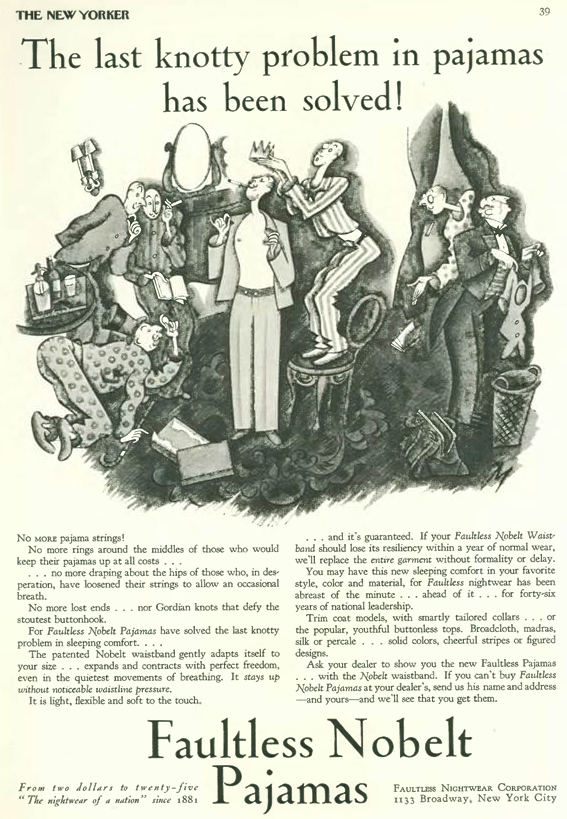
We feature this Julian de Miskey-illustrated advertisement for Faultless Nobelt Pajamas. Apparently these special PJs had some sort of newfangled rubber elastic band…

screen-shot-2016-12-06-at-9-57-42-am

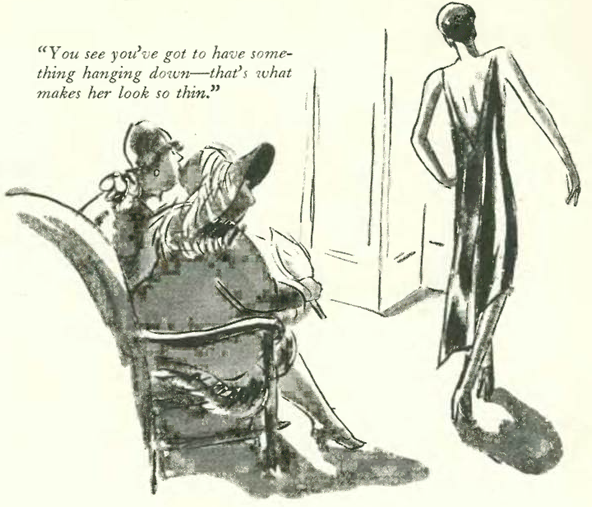
…and this cartoon from the Oct. 1 issue featured Helen Hokinson’s ditsy society women at New York’s Fashion Week…

screen-shot-2016-12-06-at-9-43-37-am

 *  *  *  *  *

Dorothy Takes On the Snobs

In the Oct. 8 issue, our other Round Table wit, Dorothy Parker, took aim at the less savory aspects of society women in her short fiction piece, “Arrangement in Black and White.”

f19964a9d1e1b6179fe2715bb3b1aa72
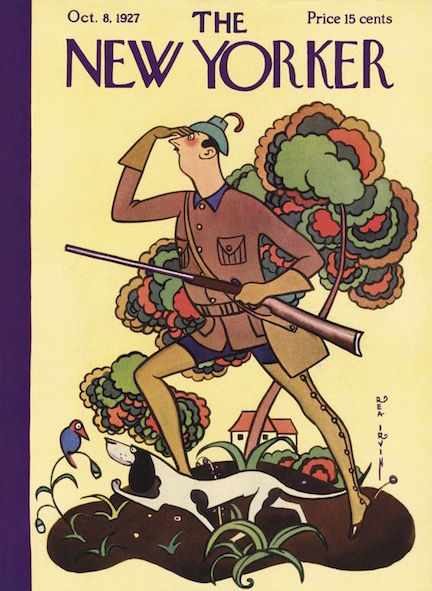
October 8, 1927 cover by Rea Irvin.

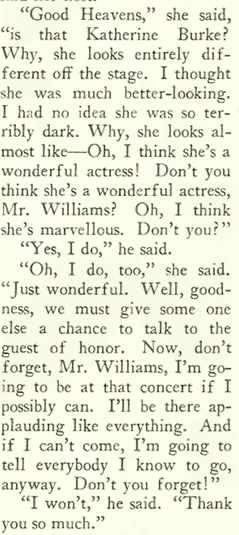
Parker began her piece by introducing us to a woman who enters a party wearing a wreath of “pink velvet poppies” in her golden hair. In short order she asks the party’s host to “pretty please” introduce her to the party’s guest of honor, an African American singer named Walter Williams.

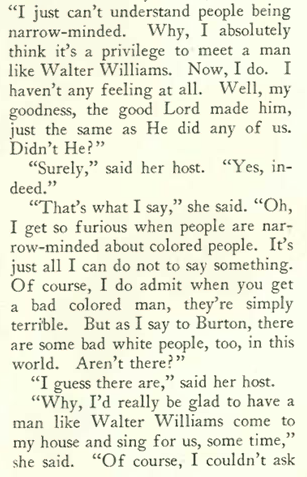
The woman with the pink velvet poppies goes on to tell her host that she came to the party alone because her husband, Burton, preferred not to socialize with “colored people”–but she however was “simply crazy” about some of them. “They’re just like children–just as easy-going, and always singing and laughing and everything.” Before she met the singer she observed to the host:

screen-shot-2016-12-06-at-1-18-25-pm

screen-shot-2016-12-06-at-1-19-09-pm

screen-shot-2016-12-06-at-1-16-57-pm
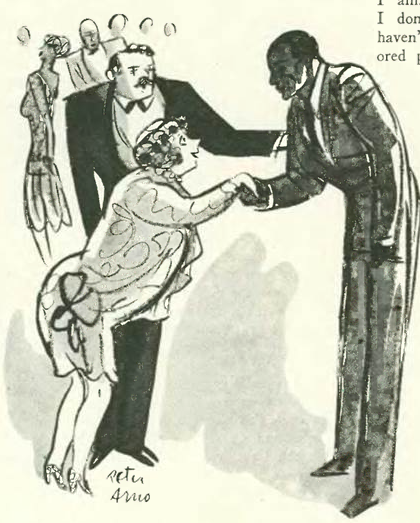
The woman with the pink velvet poppies meets the singer Walter Williams, as illustrated by Peter Arno.

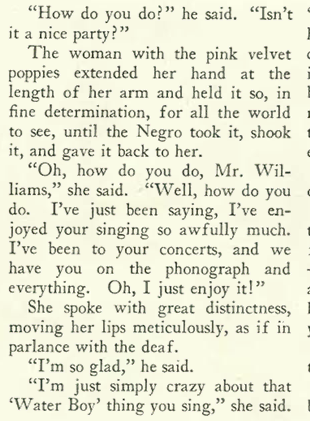
Then the woman with the pink velvet poppies meets Walter Williams:

screen-shot-2016-12-06-at-1-19-42-pm

She continues to patronize the guest of honor, then notices a stage actress at the party:

screen-shot-2016-12-08-at-12-32-44-pm

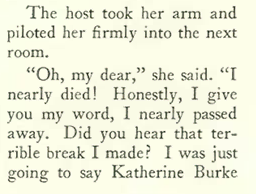
Finally, the host guides the woman with the pink velvet poppies away from Walter Williams…

screen-shot-2016-12-06-at-1-21-59-pm

screen-shot-2016-12-06-at-1-22-30-pm

05325779fdf286303013d76dc9e89388
BITING WIT…Dorothy Parker in the 1920s.

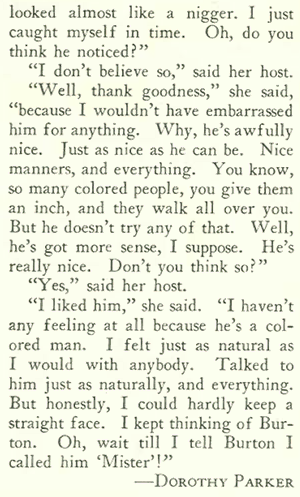
We will see more of Dorothy Parker in issues to come as she continues to take aim at the pretentious, hypocritical, self-absorbed snobs of the Jazz Age and beyond.

Baseball’s Lament

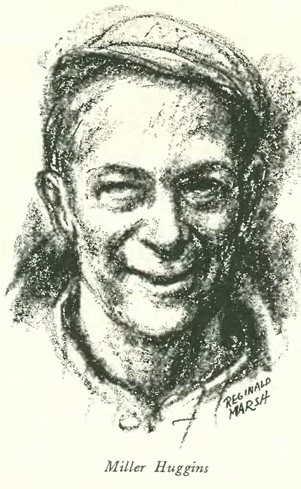
The Oct. 1 and 8 issues covered yacht racing, polo, tennis, golf and college football, but still no baseball. The 1927 New York Yankees would be one of the greatest teams of all time, but as the World Series commenced all we got from The New Yorker was a personality profile of Yankees manager Miller Huggins in the Oct. 8 issue (with a drawing by Reginald Marsh)…screen-shot-2016-12-06-at-1-24-05-pm

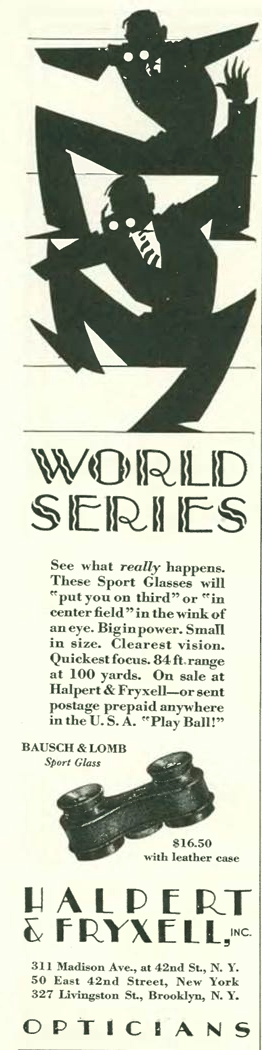
…and this advertisement for “Sport Glasses” for those attending the World Series…

screen-shot-2016-12-06-at-4-34-19-pm

Perhaps The New Yorker had no one on staff who could competently write about baseball. The strangest reference to the game was this article about polo, but for some reason it was illustrated with baseball images. Perhaps the editors felt sheepish about their lack of baseball coverage, and offered these illustrations by Howard Baer as a token acknowledgement…

screen-shot-2016-12-06-at-1-28-18-pm

At any rate, we end with this cartoon by Julien de Miskey, who like his colleagues explored the comic richness of wealthy old men paired with their young mistresses…
screen-shot-2016-12-06-at-1-16-04-pm

Next Time: The Ephemeral City…

f19964a9d1e1b6179fe2715bb3b1aa72


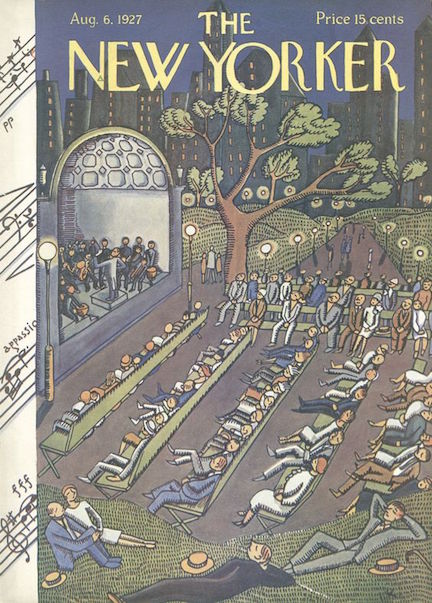
Babe Comes Home

After months of reporting on polo, golf, tennis and yacht races, The New Yorker finally mentioned baseball–sort of–reviewing a movie featuring Babe Ruth and penning a brief piece about Lou Gehrig in “The Talk of the Town.”

447032a734d61215ca61a95a205dd7da
August 6, 1927 cover by Ilonka Karasz.

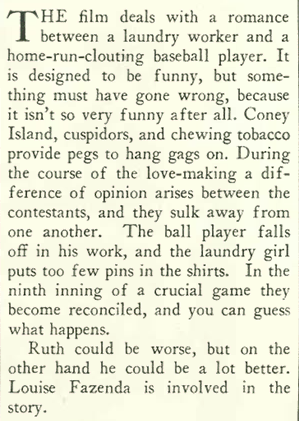
But the magazine still made no mention of the incredible season that was shaping up for the legendary 1927 New York Yankees, or the feats of its feared  “Murderer’s Row” lineup. Although widely considered to be the best baseball team in the history of major league baseball, The New Yorker up to this point had given more ink to the game of ping pong. But we’ll take what we can get, namely Babe Ruth’s acting performance in Babe Comes Home…

screen-shot-2016-11-07-at-12-50-00-pm

screen-shot-2016-11-07-at-12-50-10-pm

screen-shot-2016-11-11-at-12-51-20-pm
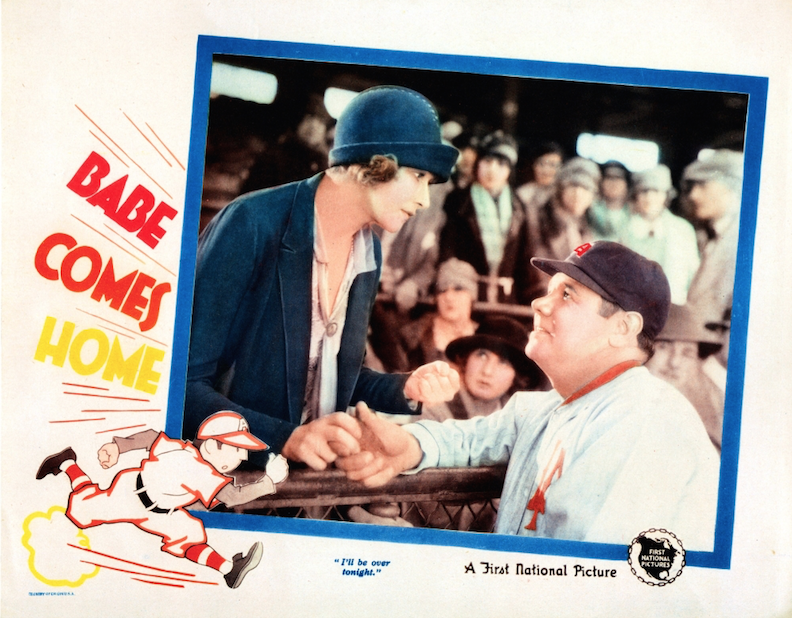
BETTER STICK TO BASEBALL…Lobby card for the 1927 film, Babe Comes Home, featuring Anna Q. Nilsson and The Bambino himself. (posterscancollections.com)

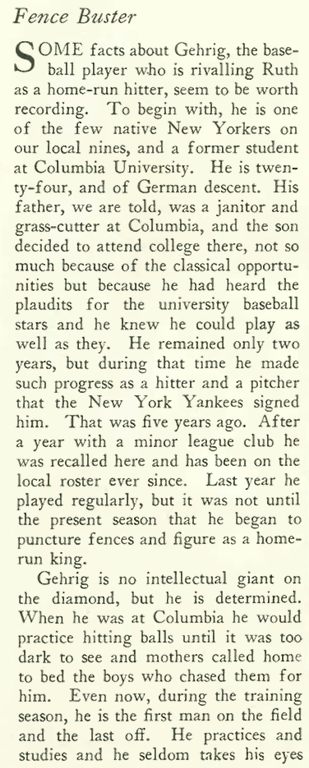
…and over in “The Talk of the Town” section the editors looked at another Yankee slugger, Lou Gehrig, who besides his hitting ability was Ruth’s opposite…

screen-shot-2016-11-07-at-12-32-32-pm

screen-shot-2016-11-07-at-12-32-51-pm

image5-9
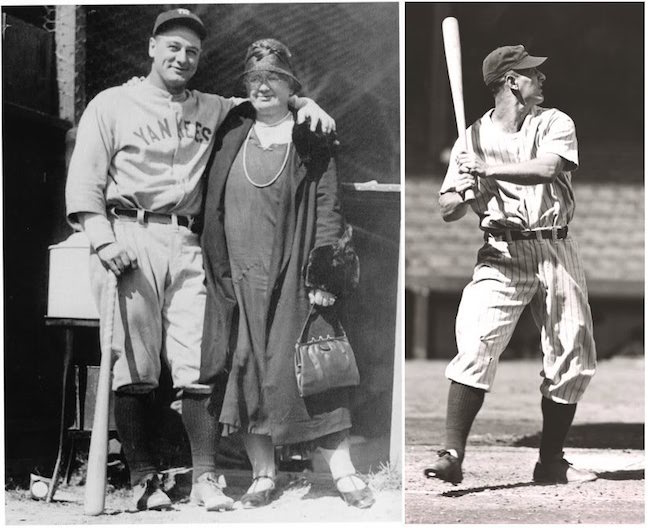
MOM & APPLE PIE…Lou Gehrig and his mother, Christina, in 1927. (baseballfever.com)

 *  *  *

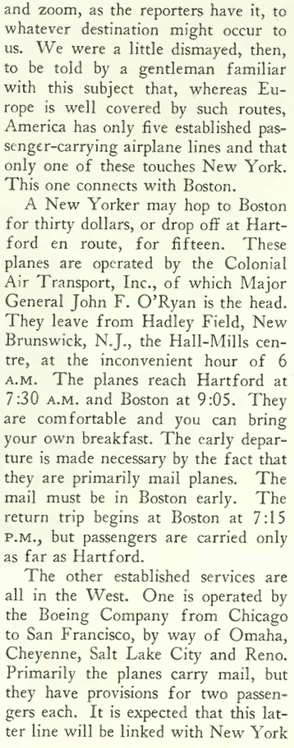
With the hullabaloo over Charles Lindbergh’s transatlantic flight, more Americans were becoming interested in flying as an actual travel option, although in August 1927 New York City had only one established passenger line:

screen-shot-2016-11-07-at-12-37-24-pm

screen-shot-2016-11-07-at-12-37-30-pm

screen-shot-2016-11-07-at-12-37-45-pm

eastbostonairport018-2562
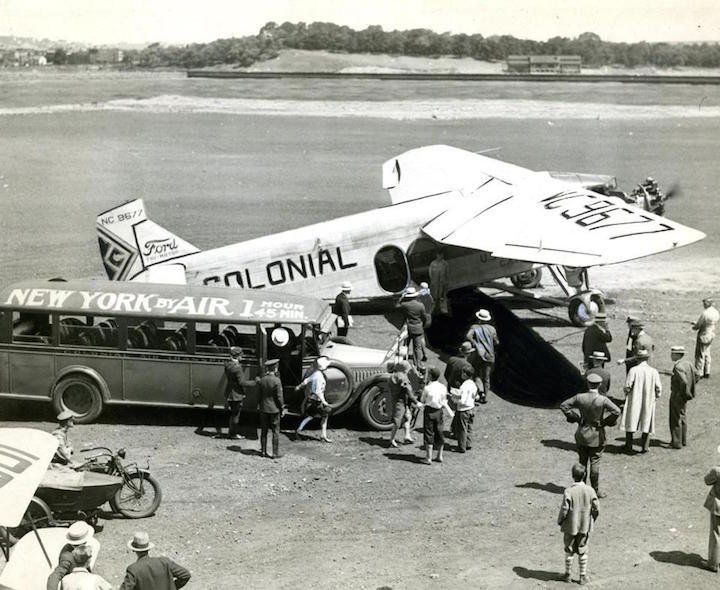
HUMBLE BEGINNINGS…On April 15, 1927, Colonial Air Transport (a predecessor of American Airlines) began passenger service between Boston and New York City. (Boston Globe)
pic04
SORRY, NO WI-FI…National Air Transport, a predecessor of United Airlines and a prime mail carrier, brought the Travelair 5000 to their minimal fleet in 1927 to add passenger revenue to its Midwestern and Western hops that linked Chicago, Omaha, Cheyenne, Salt Lake City, Reno and San Francisco. (traveler.com)

 *  *  *

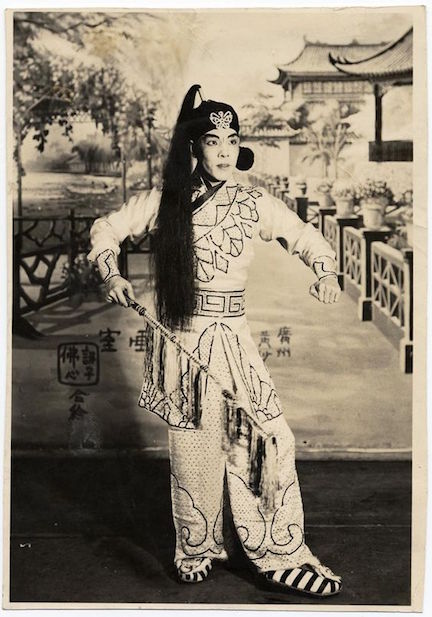
The August  6 issue also featured this strange little review in “Talk” about the popularity (or fad) of attending Chinese theater. Note how the writer described it as an exotic curiosity, as though the Chinese actors were as unknowable as Martians. I suppose it didn’t occur to the writer that you could actually speak to these performers, and have them explain the meanings of the various rituals.

7d5022414f367319b77659cba19591ac
OFF-BROADWAY…Actor Ma Shi-tsang posing with a riding crop in a 1920s publicity photo. Chinese theater actors performed in U.S. cities with large Chinese populations, including San Francisco and New York. (cdlib.org)

chinese-stephen-graham

screen-shot-2016-11-07-at-12-43-42-pm

screen-shot-2016-11-07-at-12-44-19-pm

screen-shot-2016-11-07-at-12-44-28-pm

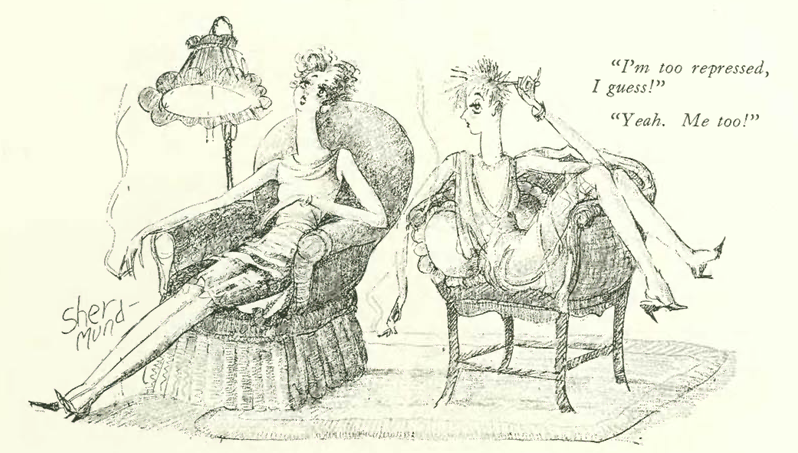
And to close, a couple of cartoons from the issue by Barbara Shermund that illustrated two very different aspects of New York society:

screen-shot-2016-11-02-at-1-15-19-pm

screen-shot-2016-11-02-at-1-14-57-pm

Next Time: An Office Romance…

30e6d833482958226738b30ce4244558


The Age of Innocence

Above: Film stars Dorothy Sebastian (left) and Joan Crawford square off for a game of ping pong in 1925. The umpire is actor Eddie Nugent. (Film Noir Photos)

After studying every page of the first 120 issues of the New Yorker, and after researching the lives of its writers and their subjects, the world as described by the New Yorker — 89 years distant — can seep into one’s imagination, not unlike a world created by a fiction writer, whose characters are very much alive in his or her mind even when the pen is idle. You become accustomed to their voices, their likes and dislikes, and begin to see their world as a contemporary of sorts.

fe856464214bef0718e3c838d3a54ab2
June 4, 1927 cover by H.O. Hofman.

And so I find myself reading a review of Edith Wharton’s “latest” novel, Twilight Sleep, and think not of some author I haven’t read since college, but rather see her work as it was seen at its unveiling, albeit through the eyes of New Yorker book critic Ernest Boyd, who wrote under the pen name “Alceste”:

screen-shot-2016-10-12-at-12-20-20-pm

screen-shot-2016-10-12-at-12-20-45-pm

screen-shot-2016-10-12-at-12-20-56-pm

edith-wharton
NOT DEFEATED BY LIFE…Edith Wharton with her Pekes, circa 1920. (lib guides.com)

Wharton won the Pulitzer Prize for fiction in 1921 for The Age of Innocence, making her first woman to receive the prize. Indeed, Wharton kicked off a great decade for women fiction writers — Willa Cather would win the Pulitzer for One of Ours in 1923, Margaret Wilson for The Able McLaughlins in 1924, Edna Ferber for So Big in 1925, and Julia Peterkin for Scarlet Sister Mary in 1929.

*  *  *

The June 4 issue offered some follow-up items on Charles Lindbergh, this from “The Talk of the Town” regarding Lindbergh’s potential to claim perhaps more than the $25,000 Orteig Prize (about $350,000 today) for being the first to fly nonstop across the Atlantic — endorsements, book and movie deals, offers to serve on company boards, and so on…

screen-shot-2016-10-13-at-9-18-42-am

screen-shot-2016-10-13-at-9-18-48-am

…and from Howard Brubaker’s “Of All Things” column, we learn that the aviation hero doesn’t like to be called “Lucky”…

screen-shot-2016-10-13-at-9-19-10-am

*  *  *

Baseball was still inexplicably shut out from the pages of The New Yorker, even as the Yankees (and Babe Ruth) were having one of their best-ever seasons. Instead, the June 4 issue covered horse racing (pgs. 63-65), rowing (pgs. 66-68), and lawn games (pgs. 69-72).

Among the “lawn games” reviewed, the New Yorker had this to say about the revival of ping-pong and the “spirited matches played between the sexes”…

screen-shot-2016-10-13-at-9-11-38-am

More celebrity action from the 1920s. (Clip from Pinterest)

 *  *  *

82b1f6e20ffd1e39a8e9d0f9da216917
June 11, 1927 cover by Rea Irvin.

In the following week’s issue, June 11, 1927, there was a bit more to say about Lindy’s future economic prospects…

screen-shot-2016-10-13-at-9-35-14-am

…and there is this item about New York Mayor Jimmy Walker. Given his love of late-night parties, speakeasies and chorus girls, it was no wonder that The New Yorker’s editors found him an attractive subject for “Talk of the Town”…

screen-shot-2016-10-13-at-9-33-36-am

Jimmy Walker and Betty Compton after their wedding in Cannes, 1933. (www.isle-of-wight-fhs.co.uk)

screen-shot-2016-10-13-at-9-33-44-am

Of course Walker’s aloofness would have consequences later when scandal and corruption would knock him and his cronies from office.

 *  *  *

The issue also included a profile of golfer Walter Hagen, written by Niven Busch Jr. In his “Portrait of a Dutchman,” Busch begins:

screen-shot-2016-10-13-at-9-38-10-am

The profile included this portrait of Hagen by Miguel Covarrubias:

screen-shot-2016-10-13-at-9-37-53-am

We end with this full-page cartoon, beautifully rendered in Conté crayon by Reginald Marsh…

screen-shot-2016-10-13-at-9-37-31-am

Next Time: Coney Island, 1927…

37723304ec91b372ae19e57e36b4d4b9