Men in Kilts

Above: Fredric March as the Earl of Bothwell in Mary of Scotland. March sported a kilt that Alex von Tunzelmann (the Guardian, May 7, 2015) calls "the bane of Scottish historical movies from here to Braveheart." Tunzelmann notes that "What we call a kilt today—the fèileadh beag, or small kilt—was invented in the mid-18th century, almost 200 years after this film is set. The Scots should be wearing belted plaid, or the rather fetching skintight tartan trews (image at right) sported by Mary’s father, James V." (eBay.com/pinterest.com)

These were truly the dog days of summer—New Yorkers had just endured one of the hottest months on record (106 F on July 9) and it remained intensely hot and dry as August rolled in. So for this post we will retreat to one of the few places that had air-conditioning—the cinema—and see what folks were enjoying in the first week of August 1936.
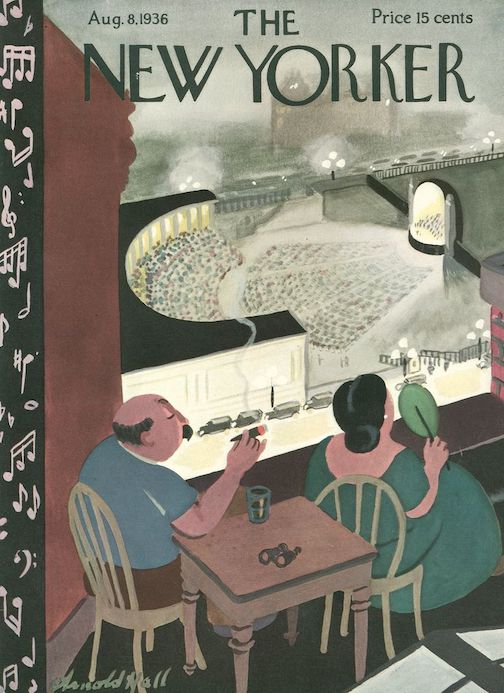
August 8, 1936 cover by Arnold Hall.

Before we jump into the movies, the wonderful cover by Arnold Hall recalled the summer night concerts at Lewisohn Stadium (although Hall took some liberties with the stadium’s design for the sake of composition).
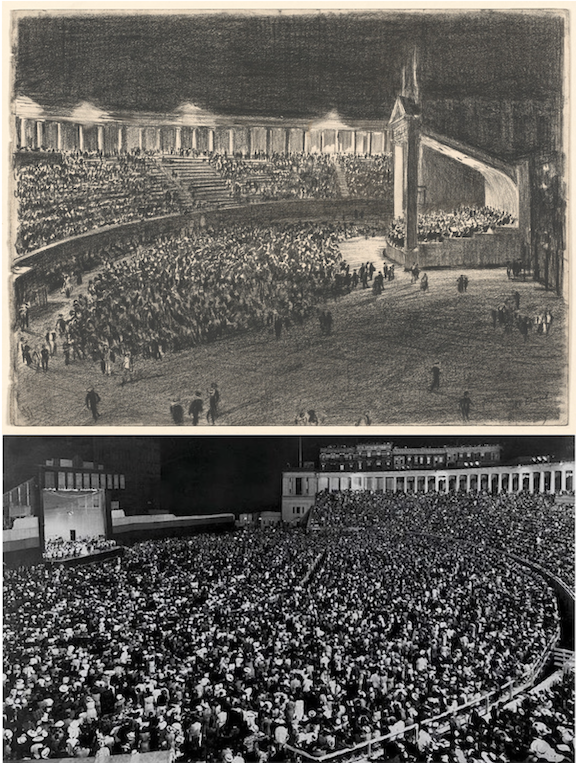
A LITTLE NIGHT MUSIC…Top: Illustration by Scottish artist Muirhead Bone of a nighttime Lewisohn Stadium concert, circa 1920s; below: Andre Kostelanetz conducts before a crowd of thousands at Lewisohn Stadium in 1939—for an admission price of a mere twenty-five cents, concertgoers were treated to appearances by leading performers of jazz, classical music and opera. The stadium was demolished in 1973. (digitalcommonwealth.org)

On to our movies, Russell Maloney once again sat in for John Mosher as the magazine’s film critic, taking on everything from a Tudor romance to a horror film that featured Lionel Barrymore in drag.

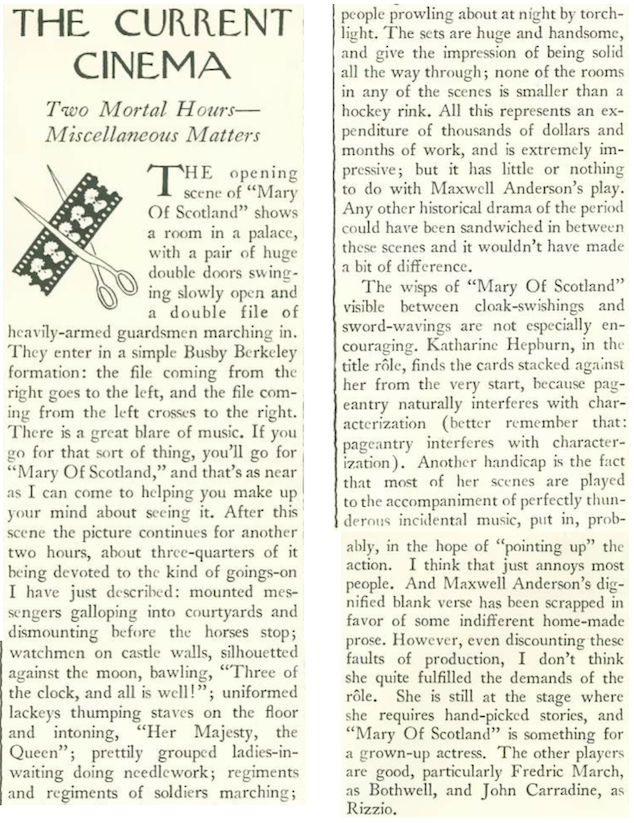
In Mary of Scotland, Maloney found Katharine Hepburn’s turn as Mary, Queen of Scots a bit wanting (the role should have gone to a “grown-up actress”), while he thought the film itself was rather tedious with “lots of goings on.” He concluded that the “wisps of Mary of Scotland visible between cloak-swishings and sword-wavings are not especially encouraging.”
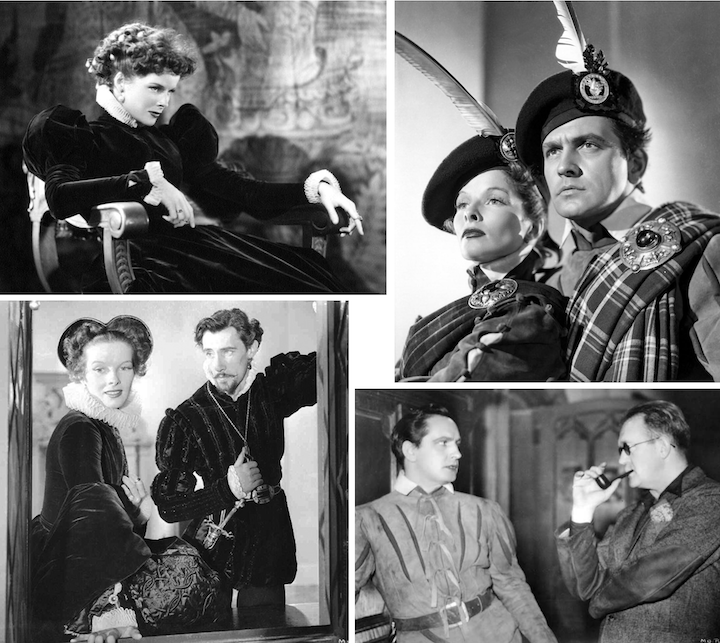
NOT READY FOR PRIME TIME?…Clockwise, from top left: Critic Russell Maloney thought the 29-year-old Katharine Hepburn was not seasoned enough to portray Mary Stuart in Mary of Scotland; Fredric March as the Earl of Bothwell, with Hepburn; March visits with director John Ford, who was better known for his Westerns (Ford and Hepburn would famously have an affair during the filming); Hepburn in a scene with John Carradine, who portrayed Rizzio, the Italian courtier and private secretary to Mary. Patriarch of the Carradine acting dynasty, his children included actors David, Keith, and Robert Carradine. (imdb.com/pinterest.com/frockflicks.com)

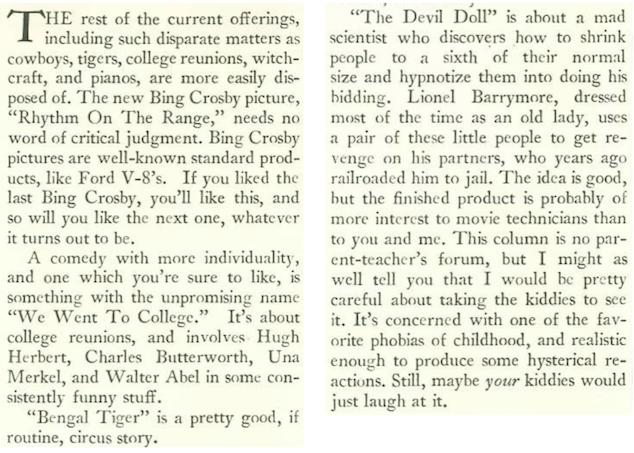
In addition to a forgettable lion-tamer flick (Bengal Tiger), Maloney also reviewed a Bing Crosby movie with a host of singing cowboys, Rhythm on the Range, and a “consistently funny” film with an “unpromising name,” We Went to College…
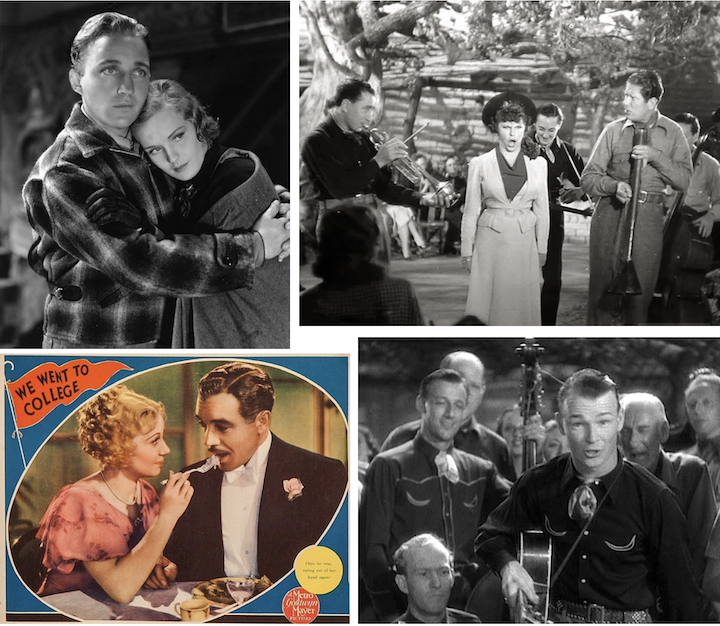
Bing Crosby played a humble traveling cowboy Norman Taurog Western musical film
COWBOY CROSBY…Clockwise from top left: Bing Crosby portrayed a traveling cowboy in love with a rich girl (Frances Farmer) in Rhythm on the Range; Louis Prima, Martha Raye (in her film debut), and Bob Burns performed in the ensemble “I’m an Old Cowhand from the Rio Grande” along with Roy Rogers (uncredited and performing under his original stage name, Leonard Slye) and The Sons of the Pioneers; Una Merkel and Walter Abel in a lobby card image advertising We Went to College. (imdb.com)

Maloney also reviewed a horror-farce, The Devil Doll, featuring Lionel Barrymore as banker Paul Lavond. A brief synopsis: Framed by his three partners and imprisoned on Devil’s Island, Lavond escapes with a fellow inmate who introduces him to his wife, Malita. The couple demonstrate a process that shrinks animals and people to the size of dolls, which then can be animated by will power. Seeing the dolls as an opportunity for revenge on his former partners, Lavond disguises himself as an old woman and sends out the shrunken people to harm his enemies.
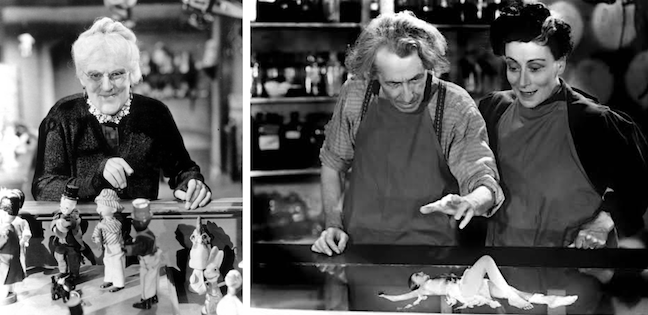
PLAYING WITH DOLLS…At left, Lionel Barrymore disguised as Madame Mandelip, preparing his demonic dollies for revenge in The Devil Doll; at right, Marcel (Henry B, Walthall) and his wife Malita (Raffaela Ottiano) with one of their shrunken people. (classic-monsters.com)
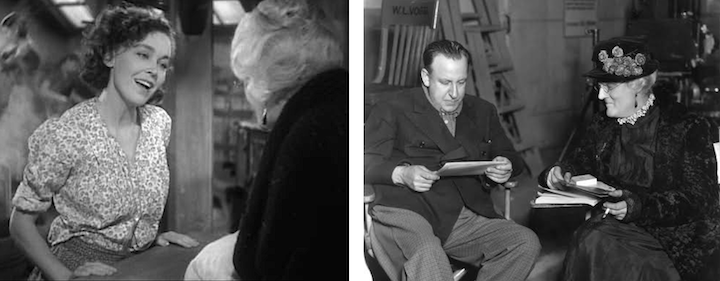
MY, WHAT BIG TEETH YOU HAVE…At left, Tarzan star Maureen O’Sullivan portrayed Paul Lafond’s unsuspecting daughter—in this scene from The Devil Doll she doesn’t recognize her long-absent father, disguised as the kindly Paris toy shop owner Madame Mandelip; at right, Lionel Barrymore (dressed as Madame Mandelip) meeting with Devil Doll director Tod Browning, best known for his 1932 magnum opus, Freaks. (classic-monsters.com/moriareviews.com)

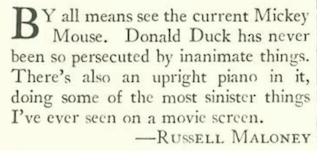
It seems there were few, if any, critics in the 1930s who didn’t like Mickey Mouse cartoons. These days we take animation for granted, but ninety years ago it was still something of a miracle, especially in color. Maloney noted the latest must-see Disney cartoon short, Donald and Pluto.
MARTYRDOM OF DONALD DUCK…Donald Duck was literally put through the wringer for our amusement in the 1936 short Donald and Pluto, one of the three installments of the Mickey Mouse series in which Mickey doesn’t appear as a character. Donald Duck was a fairly new Disney character in 1936, making his debut in 1934’s The Wise Little Hen. (disneyfandom.com)

 * * *

Life Goes On

E.B. White mused about the increasing life expectancy at birth of the American male from 47 years in 1900 to 58 years in 1936 (a woman’s life expectancy was roughly 49/62, respectively). White (who would live 86 years) said he would spend his extra years collecting “haunting” signs, such as one on the Boston Post Road that read: Trucks Must Use Right Fork.
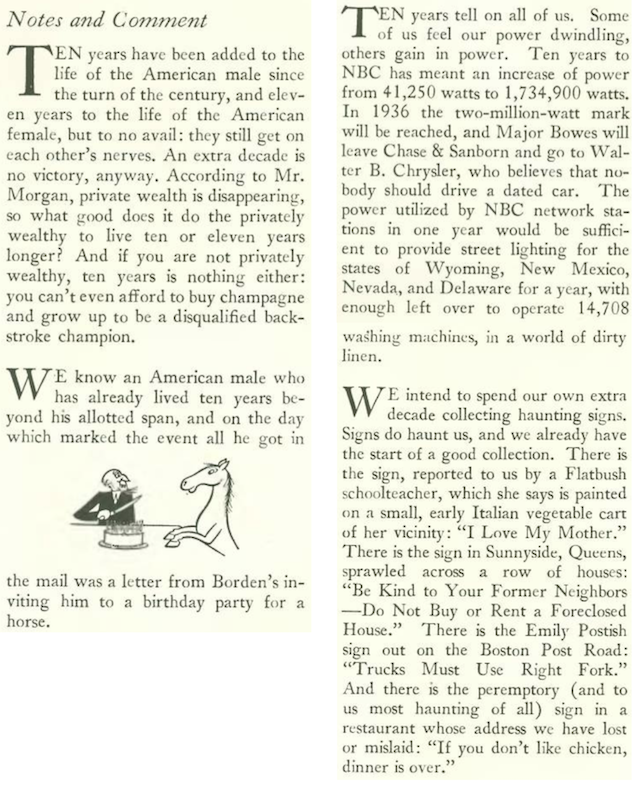
AND NO ELBOWS ON THE TABLE, EITHER…Trucker poses in front of his rig in 1936. (facebook.com)

 * * *

Wartime Wardrobe

Beatrice Mathieu—the first and only Paris fashion correspondent for The New Yorker—sat in on Lois Long’s column to discuss the latest from The City of Light. Designers were soldiering on with their premieres despite the winds of war blowing from the east. Excerpts:
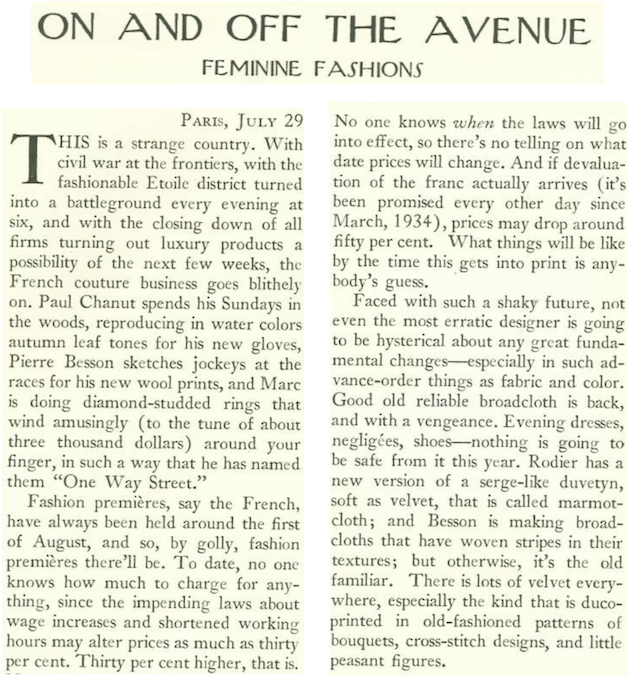
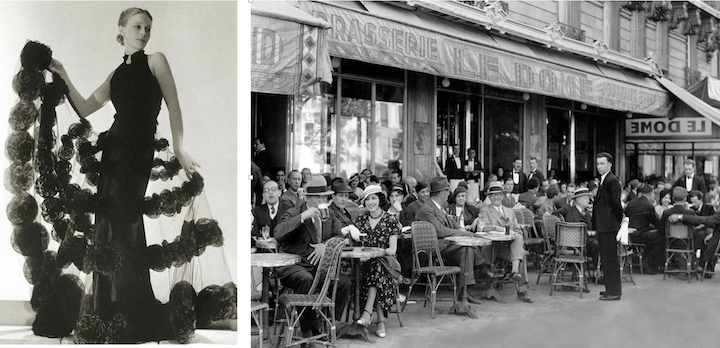
LIFE GOES ON…At left, a model shows off a “Carnival dress” by Madeleine Vionnet, 1936; a sidewalk café in Paris filled with fashionable folks, 1936. (godsandfoolishgrandeur.blogspot.com/reddit.com)

A note about Beatrice Mathieu: According to her 1976 New York Times obituary, In an era when honest criticism in fashion writing was relatively rare, she blended humor with a kind of skepticism and honesty in writing that enhanced her reputation as a leader in the field…In 1928, when the young woman from Faribault, Minn., was making a living in Paris as a freelance writer, she received a cable from Harold Ross…asking her to do some work for him. She wired back: ‘What is The New Yorker?’ Mr. Ross replied at some length. She took the job.” Mathieu stopped writing her Paris column in 1936 but resumed after the end of World War II.

 * * *

A Dose of Passos

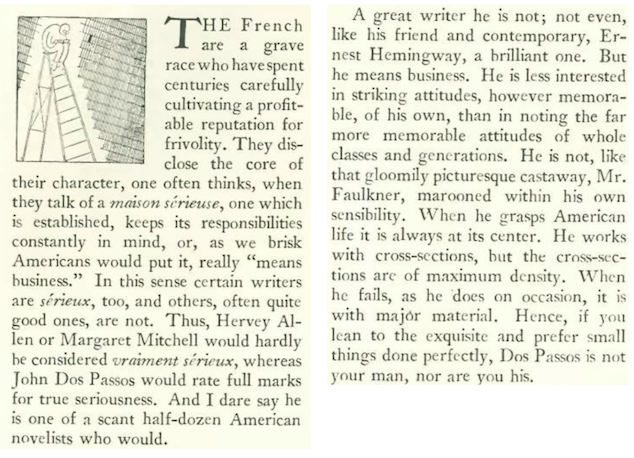
Clifton Fadiman reviewed the latest book by John Dos Passos (1896– 1970), who is known for his pioneering works of nonlinear fiction and his U.S.A. trilogy, which he completed in 1936 with The Big Money. One of the major novelists of the post-World War I “lost generation,” he is widely praised today for his timeless insights into America’s inequalities (and was also highly regarded by contemporaries including William Faulkner). Fadiman, however wrote “A great writer he is not.” Excerpts:
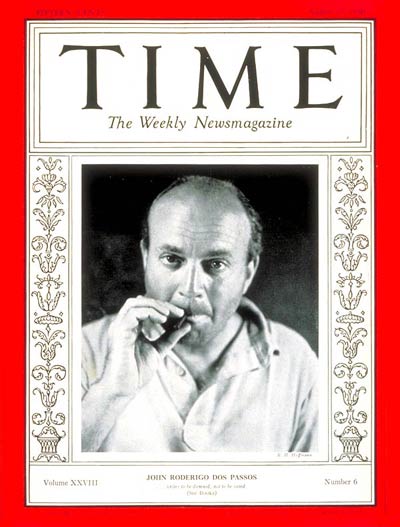
HIS TIME WOULD COME…John Dos Passos on the cover of Time, Aug. 10, 1936. Dos Passos is admired today for showing how Americans respond to the chaos and inequalities of modern life. (time.com)

 * * *

From Our Advertisers

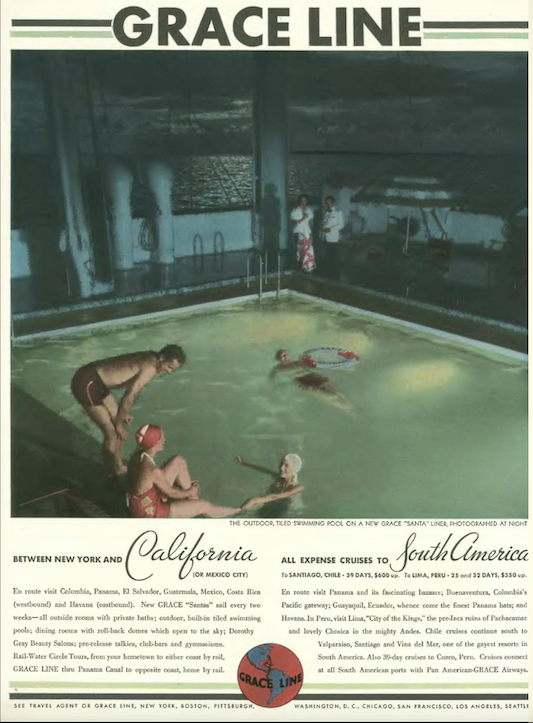
We begin our advertising section with the Grace Line, which offered this inviting image (on the inside front cover) of nighttime swimming on the deck of one of its Santa liners, en route to South America and California…
…less inviting, it would seem at the time, would be a cruise to Germany aboard a Hamburg-America Line (HAPAG) ship—beginning in 1939, U.S. and British forces would seize nearly all of HAPAG’s fleet…

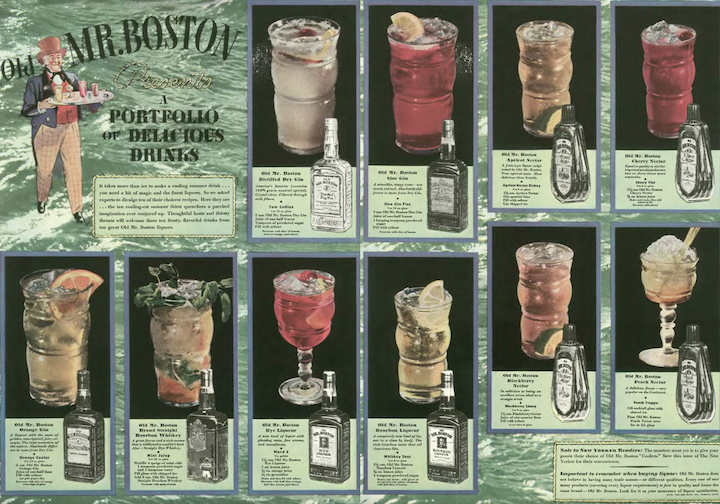
…the relatively new company Old Mr. Boston (founded in Boston in 1933, right as Prohibition ended) went big with this two-page color advertisement touting its line that included gin, rum, whiskey, and cordials…
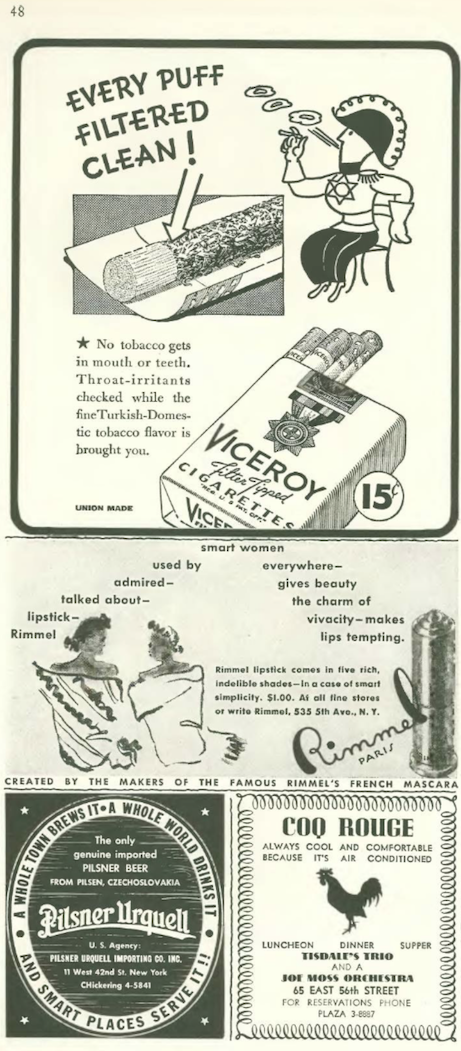
…in the back of the book…Brown & Williamson launched its Viceroy brand in 1936 as the world’s first cork-tipped filter cigarette…at the bottom is a modest ad for Pilsner Urquell, a Czech brewer that produced the world’s first pale lager…it is still brewed in Pilsen (Czech Republic) under the ownership of Tokyo-based Asahi Group…
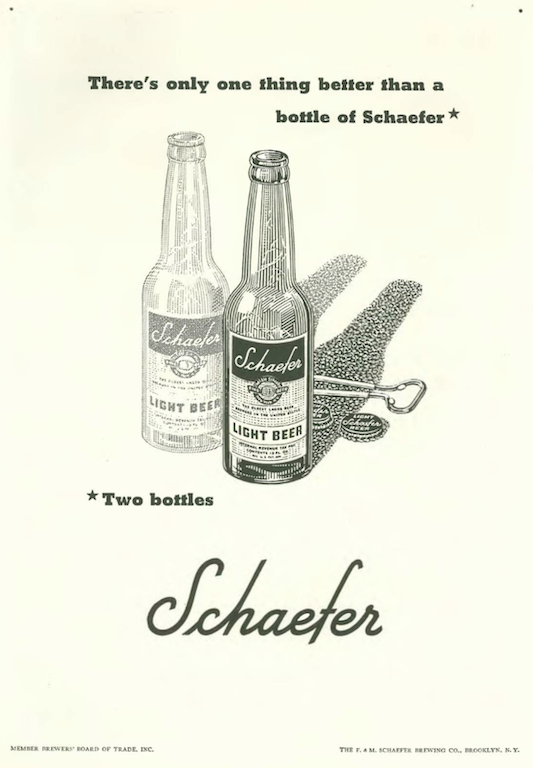
…Schaefer promoted their “light beer” in this rather spare advertisement…the “light” referred to its pale color, not to its calorie count…founded in New York City in 1842, Schaefer grew to be a top five brewer in America…today it is marketed by Pabst as a regional heritage brand…
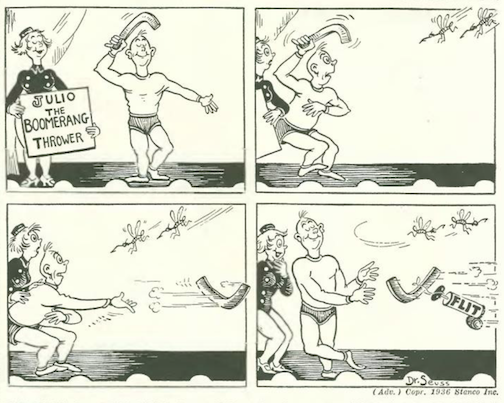
Dr. Seuss was still at it with his Flit ads…after rejections from nearly thirty publishers, in 1937 Seuss (aka Theodor Geisel) would publish his first book with Vanguard Press—And to Think That I Saw It on Mulberry Street…Seuss also illustrated ads for Schaefer beer, Esso gasoline, Holly Sugar, and General Electric, among others…
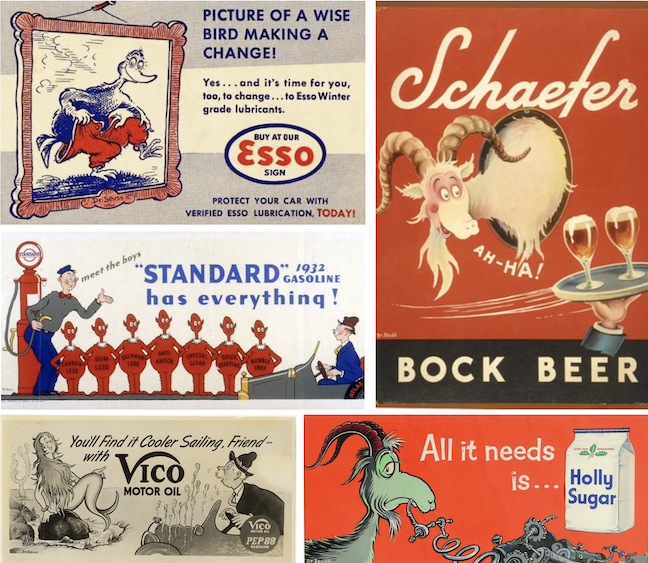
HONING A STYLE…A sampling of Dr. Seuss’s advertising art from the 1930s to the 1950s. (aoghs.org/UC San Diego/booksforgoatlings.weebly.com)

…R.J. Reynolds lined up another socialite endorsement for their Camel cigarettes…here they go to the West Coast, with a plug from Mrs. William J. Hollingsworth, Jr., aka Madeleine Ruth Piper…her marriage to Hollingsworth was over by 1937…she would marry three more times before her death in 1993…
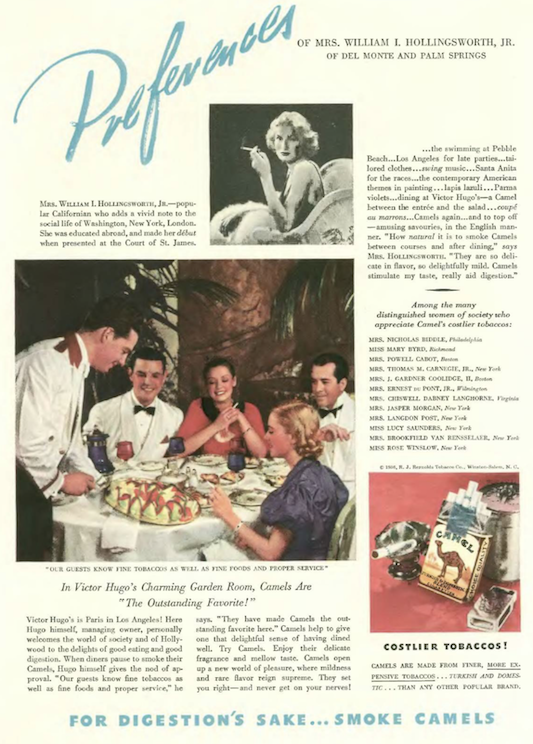
SHE REALLY LIGHTS UP A ROOM…At left, undated photo of socialite Madeleine Ruth Piper (1916–1993), who was apparently telling the truth about her love of smoking; at right, the Victor Hugo Restaurant in Los Angeles (Beverly Hills), featured in the Camel ad. (findagrave.com/facebook.com)

…on to our illustrators and cartoonists, we begin with spots by Christina Malman

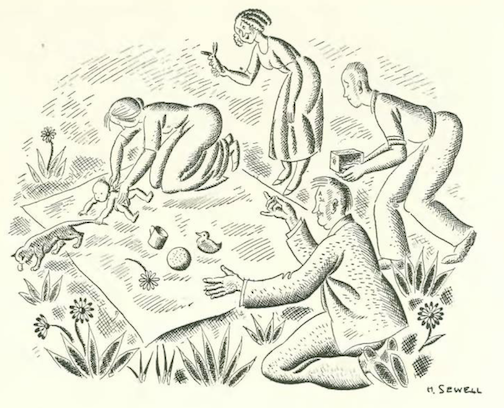
Helen Moore Sewell

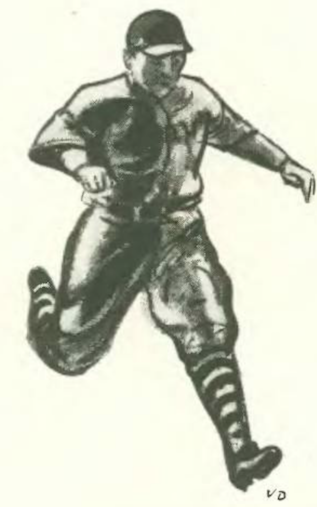
Victor de Pauw

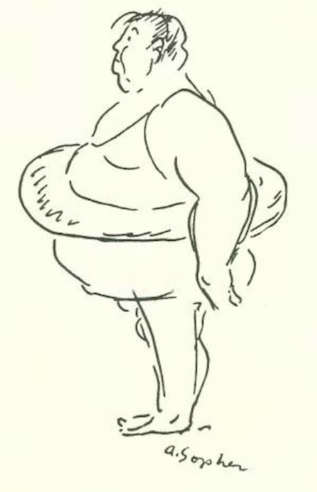
and Aaron Sopher

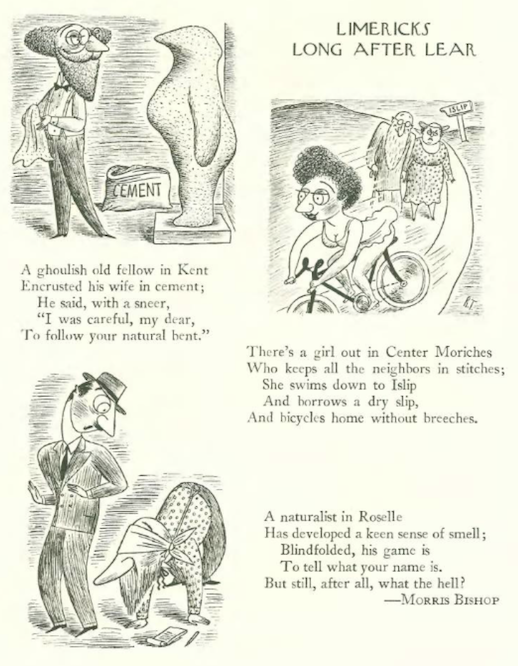
…there was another installment of Morris Bishop limericks illustrated by Richard Taylor

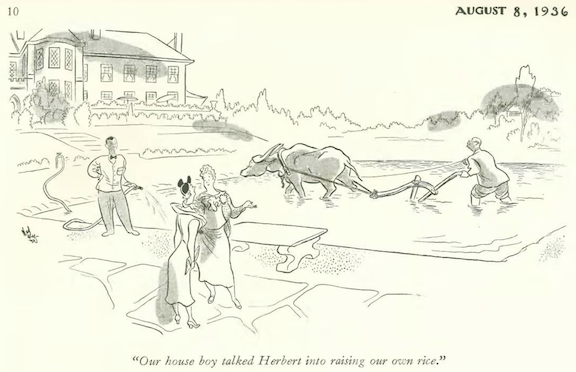
Ned Hilton’s lord of the manor took up rice farming…
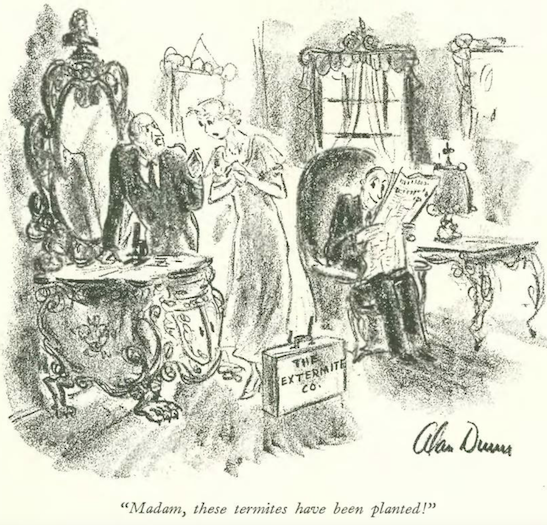
Alan Dunn showed us some devious domestic doings…
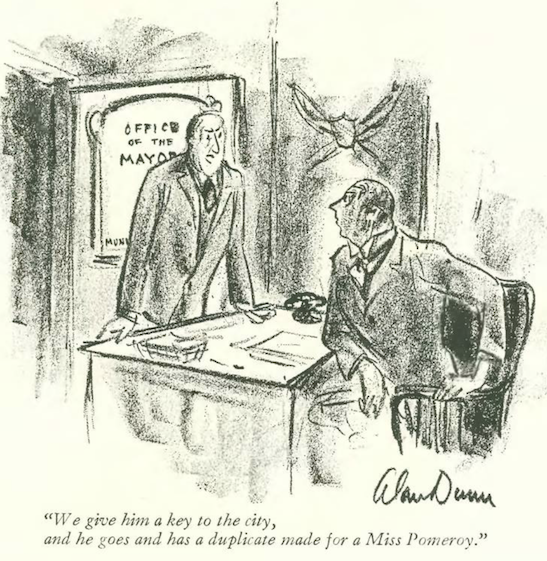
…and a complaint to the mayor…
…in contrast to Dunn’s style, the spare lines of Gardner Rea

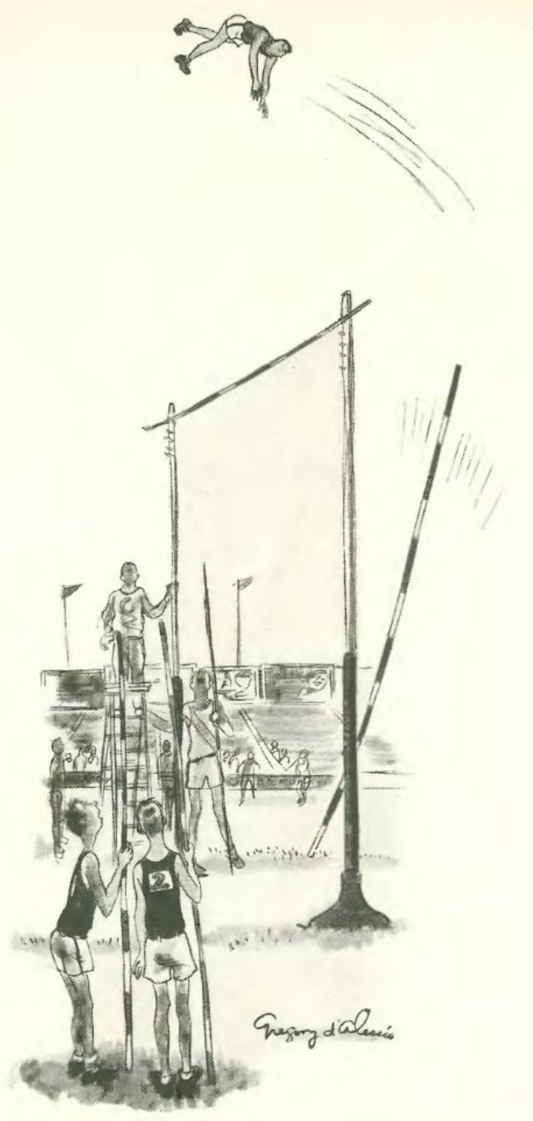
Gregory d’Alessio prepared for Olympic glory…
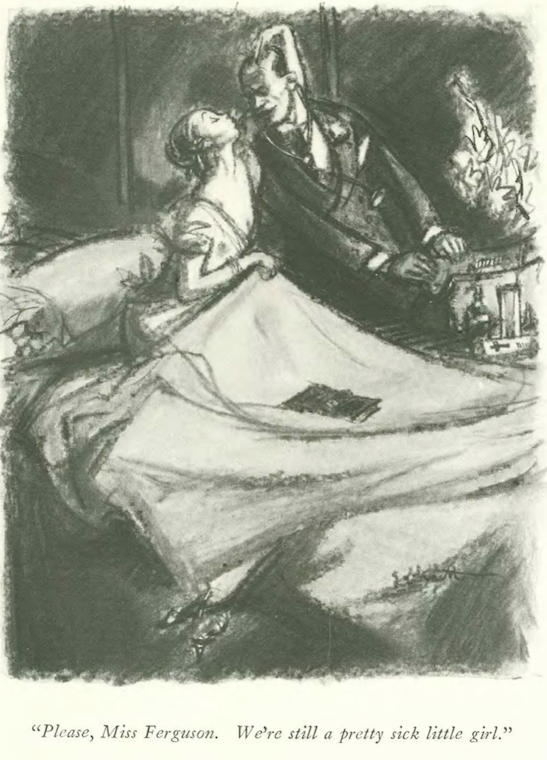
William Crawford Galbraith continued to plumb the creepy waters inhabited by impressionable young women and lecherous older men, in this case a woman’s personal physician…
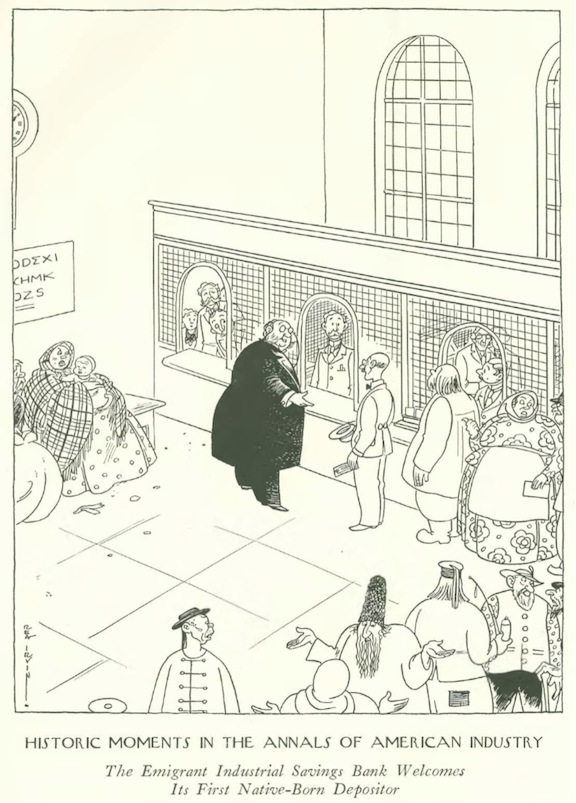
…and Rea Irvin continued to explore historic moments in American industry…
…we close with Helen Hokinson, and some scandal brewing under a hair dryer…

Next Time: Bottoms Up…
Two Nights At The Opera

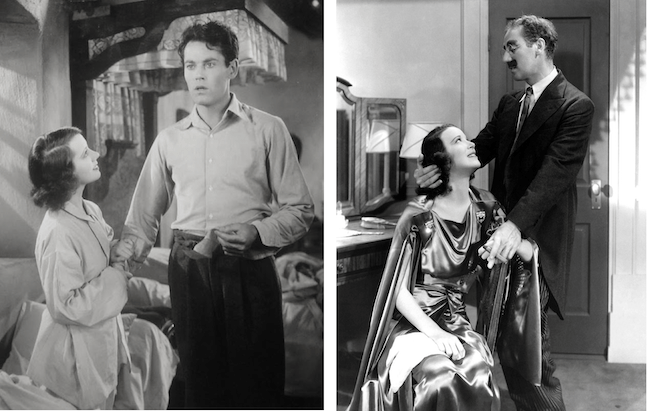
Above: Left image, coloratura soprano Lily Pons with Henry Fonda in I Dream Too Much;at right, Kitty Carlisle and Groucho Marx in A Night at the Opera. (rottentomatoes.com/IMDB)

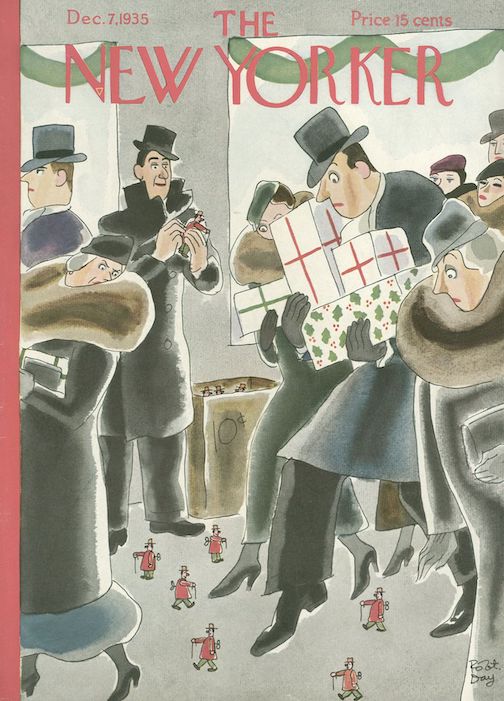
The title of this post refers to two items below, which you’ll discover as we make our way through the December 7, 1935 issue of The New Yorker.

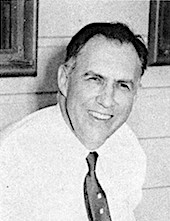
December 7, 1935 cover by Robert Day. A longtime contributor to The New Yorker, Day (1900-1985) contributed hundreds of cartoons as well as eight covers from 1931 to 1976.
Robert Day (photo from This Week anthology via Ink Spill.)

 * 

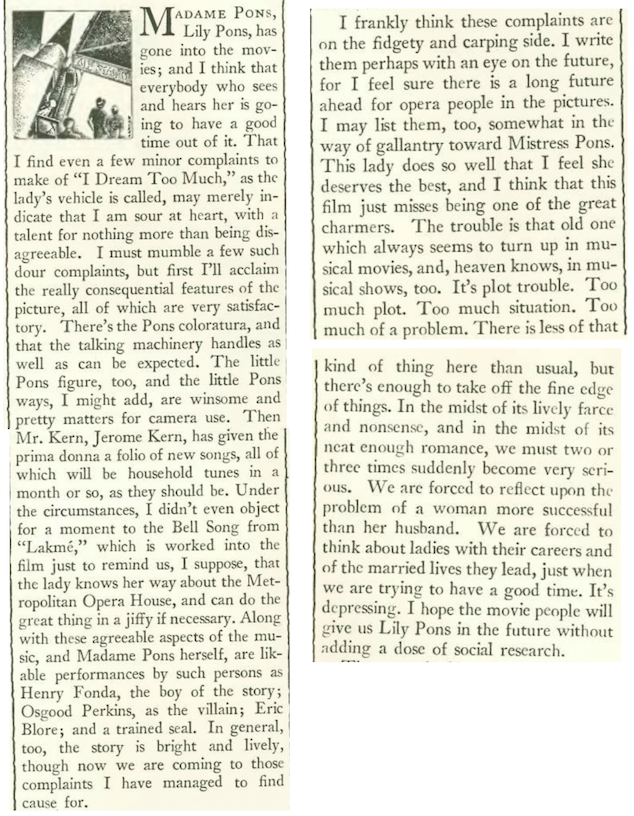
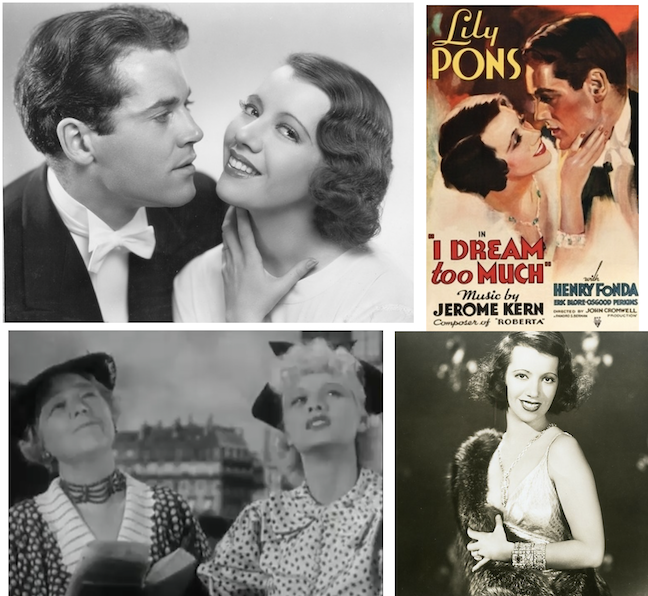
Our first night at the opera comes courtesy of RKO Pictures, which presented French-American coloratura soprano Lily Pons as the star of the musical rom-com I Dream Too Much. Critic John Mosher found the film enjoyable, singling out Pons for praise while chastising the screenwriters for interrupting the lively farce with some “social research.”

DREAM DATE…Clockwise, from top left: Henry Fonda in his third screen appearance as Lily Pons’ love interest in RKO’s I Dream Too Much; movie poster and publicity photo of Pons from the film; Lucille Ball (seen here with actress Esther Dale), appeared in a bit part as a gawky American teenage tourist in Paris (which was actually an RKO studio lot)…little did Ball know that one day she would own that RKO studio lot with husband Desi Arnaz as home to their Desilu Productions facility. (IMDB/Wikipedia/TCM)

Mosher also said farewell to Will Rogers in his final film, In Old Kentucky, which he found to be a “minor affair.” He also reviewed The Land of Promise, a film about Palestine that indicated to Mosher that “life there is highly successful for all present.”

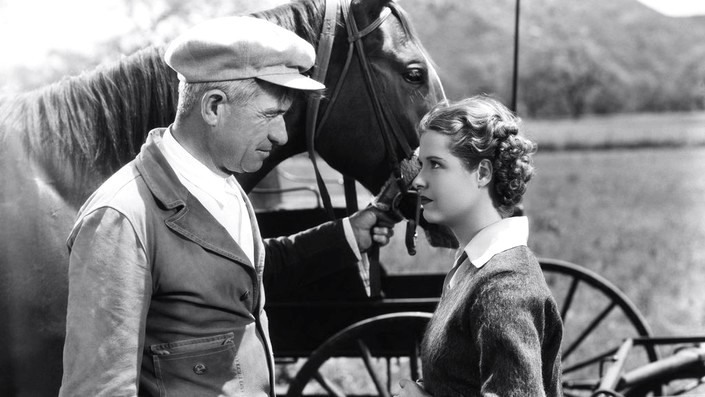
THIS IS GOODBYE…Will Rogers in a scene with Dorothy Wilson in Rogers’ final film appearance, In Old Kentucky. (rotten tomatoes.com)
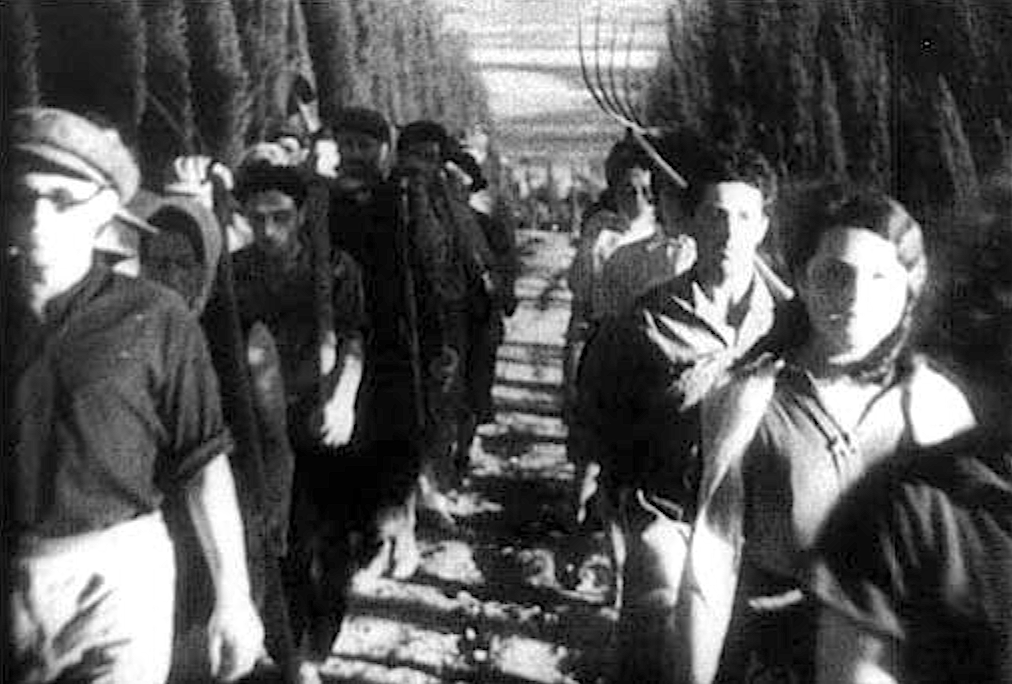
ORIGIN STORY…According to the Israel Film Archive, Judah Leman’s The Land of Promise “laid the cinematic groundwork for all subsequent Zionist propaganda films that would follow.” (IMDB)

 * * *

E.B. White keeps us on the cinema trail with some thoughts on the film, Mutiny on the Bounty, namely a certain historical inaccuracy:

AHEAD OF HIS TIME…E.B. White noted that Roger Byam (Franchot Tone) would have to wait seventy years to learn about germ theory. In addition, the trailer for Mutiny on the Bounty (above) incorrectly referred to Tone’s character as an ensign, when in fact Tone’s role was as a midshipman. (Wikipedia)

 * * *

They Had It First

The swastika was among the more popular designs incorporated into southwestern tribal art during the American tourist era (roughly 1890 to the 1930s). For the Navajo, the symbol represented humanity and life, and was used in healing rituals (it was also widely used by tribal peoples across Europe and Asia). Tourism promoters (called “hotel men” here) encouraged the symbol’s use until the 1930s, when it was increasingly associated with Germany’s Nazi Party. E.B. White explained:


TOURIST FAVORITE…Navajo blankets such as this example, made from 1864 to 1910, were popular with tourists. (Wichita State University)

 * * *

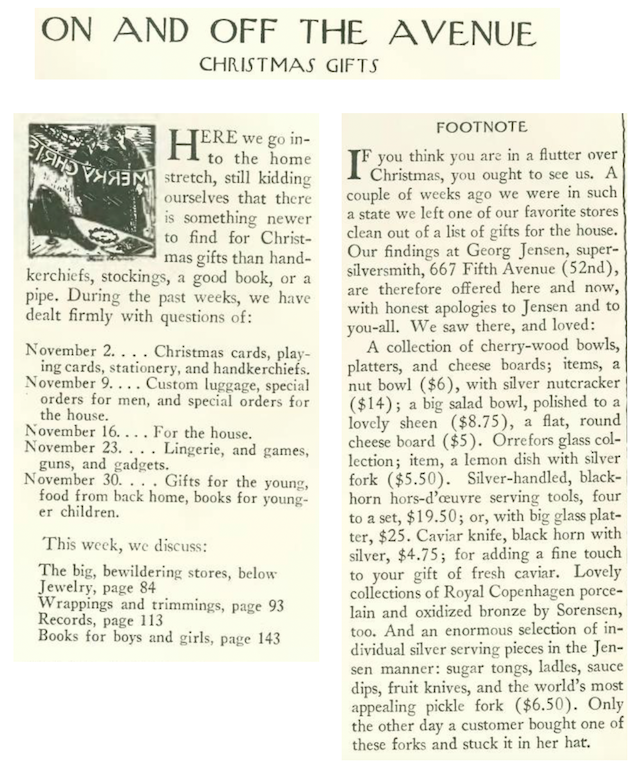
Lois Long’s fashion column continued to be dominated by exhaustive Christmas shopping lists, in this issue stretching from pages 58 to 97…here are the first and last paragraphs of the column…

 * * *

A Woolly Read

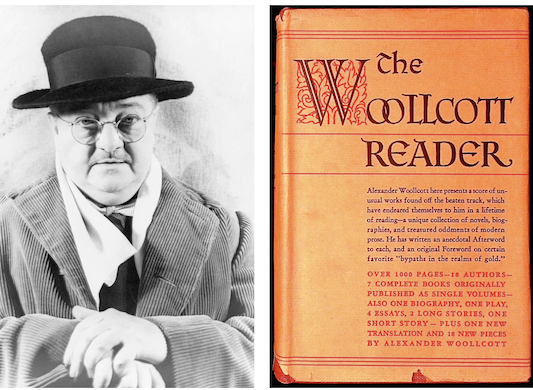
Perhaps your special someone was hoping for a thousand-page book under the tree; then look no further than The Woollcott Reader, a collection of stories, essays and other literary gems by New Yorker personality and former “Shouts and Murmurs” columnist Alexander Woollcott. In this excerpt, book critic Clifton Fadiman noted that a signed copy could be had for $7.50.

MY GIFT TO THE WORLD…Alexander Woollcott in 1939, as photographed by Carl Van Vechten, and the $3 brown cloth edition. (Wikipedia/Abebooks.com)

 * * *

From Our Advertisers

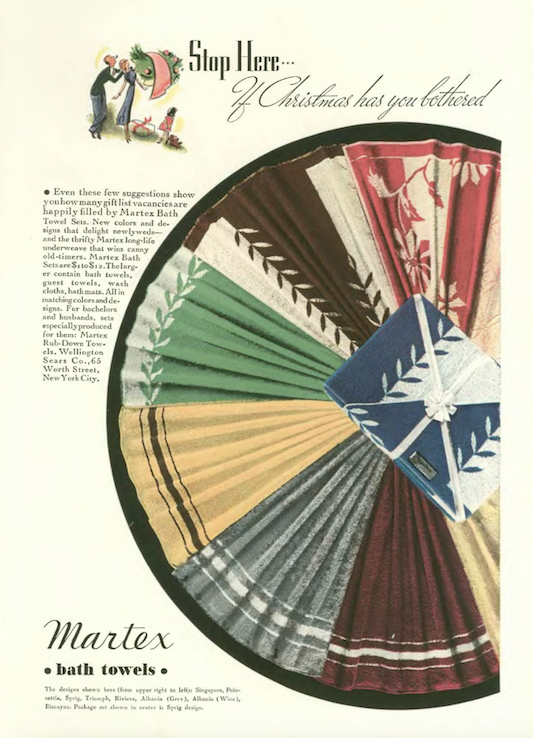
Colorful advertisements brightened the 149 pages of the Dec. 7 issue…we begin with this colorful array from Martex…

…the women’s specialty shop Jane Engel commissioned one of the best-known commercial photographers of the day, Ruzzie Green, to capture this glamorous image…

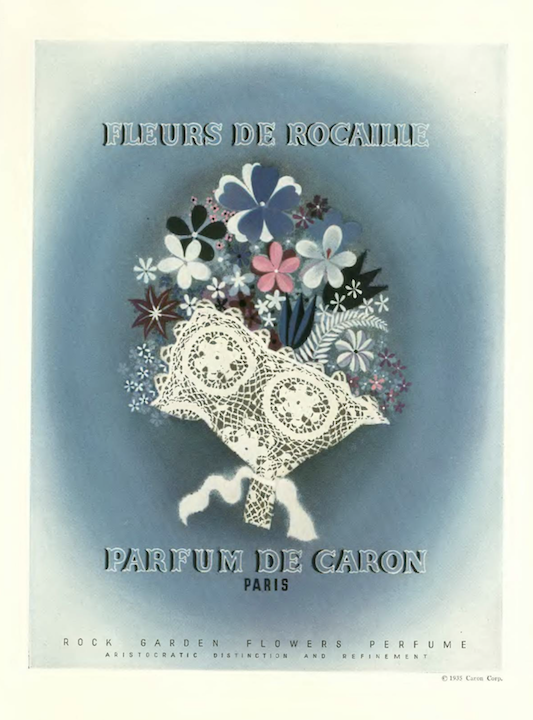
…Caron Paris offered up this cheerful bouquet…

…the makers of White Rock were enjoying the fruits of post-Prohibition days…

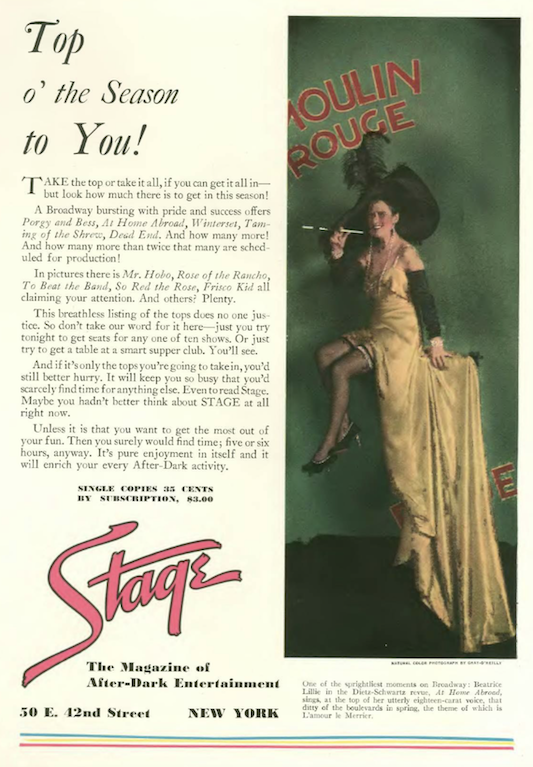
…the publishers of Stage magazine highlighted Beatrice Lillie’s Broadway revue, At Home Abroad

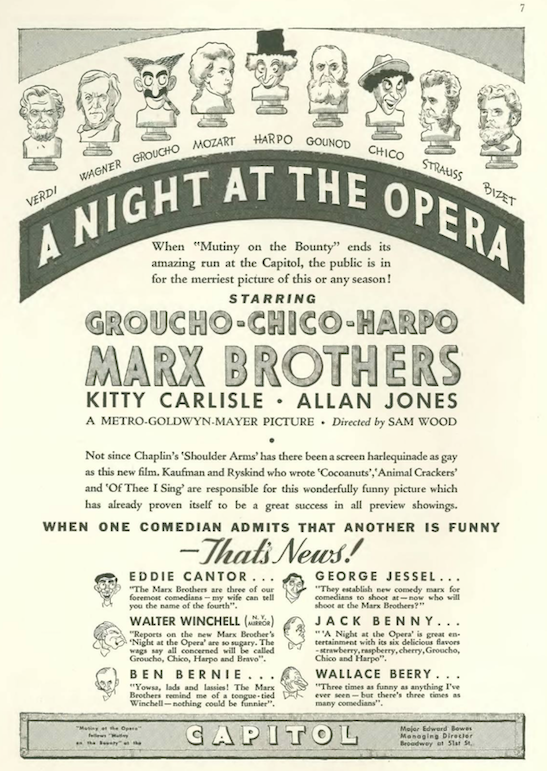
…the Capitol Theatre took out this full-page advertisement to tout the opening of the latest Marx Brothers film…

…here is a close-up of the ad’s “testimonials”…

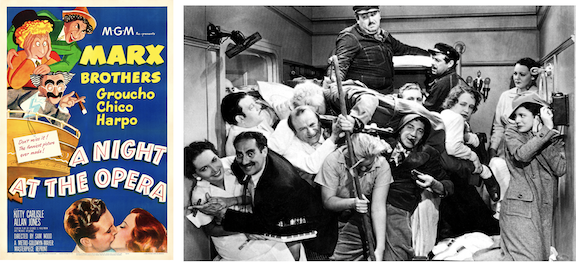
…and what awaited audiences…

(Wikipedia/thedissolve.com)

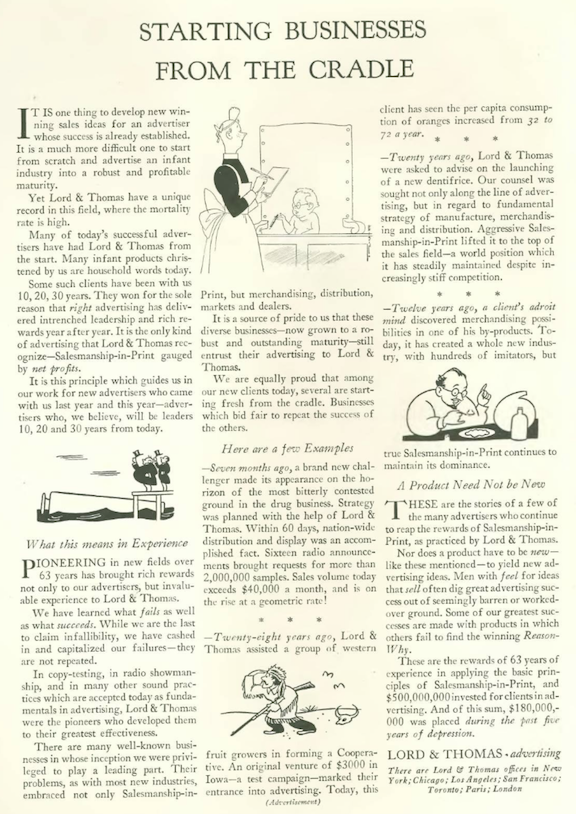
…the Lord & Thomas advertising firm imitated the New Yorker style in this full-page promotion…

…now who wouldn’t want a Philco “Radiobar” for the holidays?…

…found this one on 1stdibs.com…pretty cool…

…or you could get a little something for every one of your smoking friends (likely everyone)…

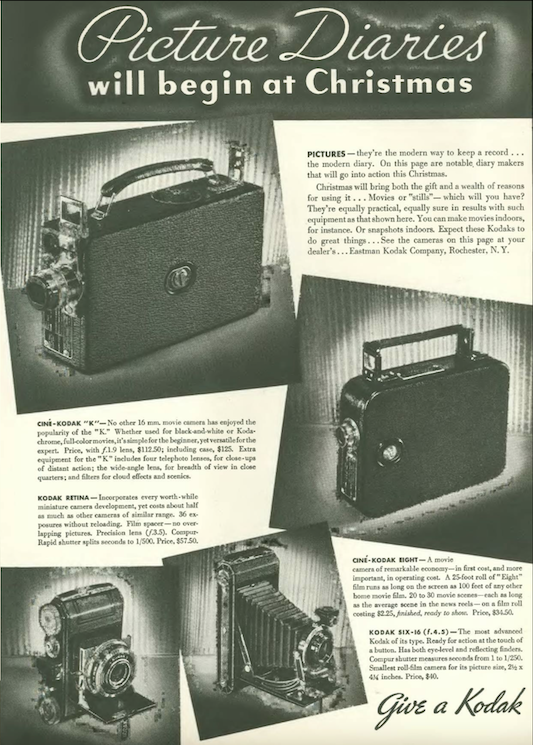
…and you could keep those holiday memories alive with a swell Kodak movie camera…

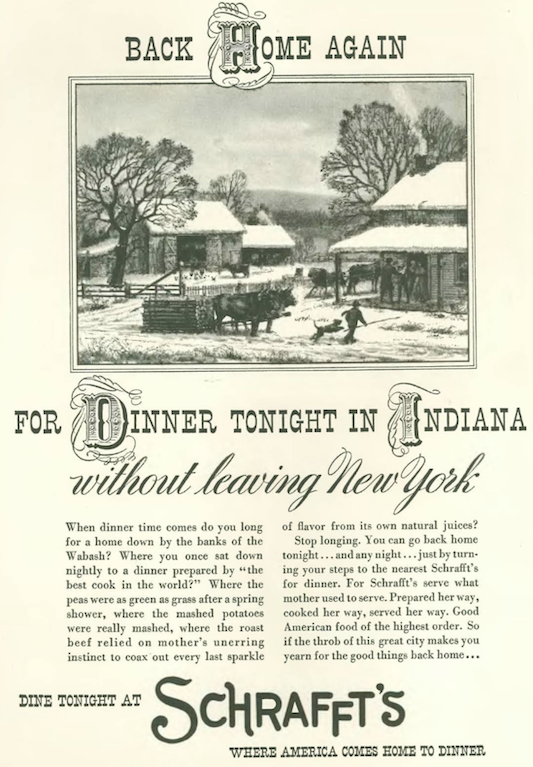
…Schrafft’s must have been something like an upscale Cracker Barrel…

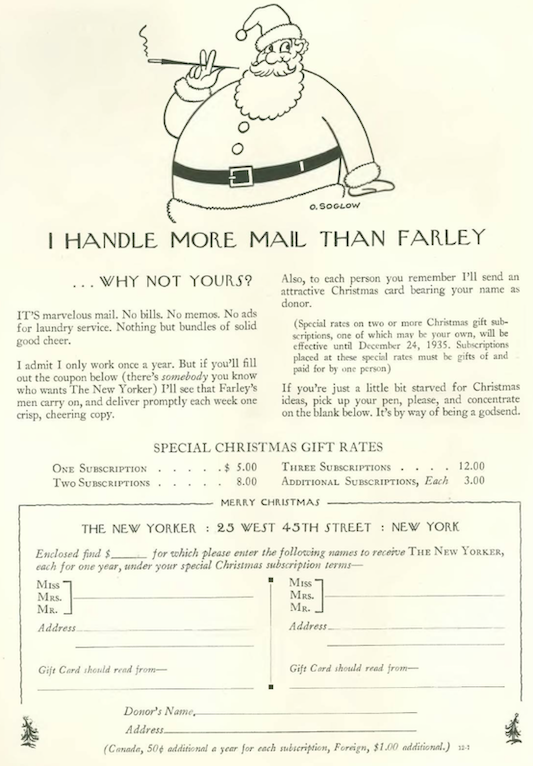
…house ads from The New Yorker included this Otto Soglow-illustrated full pager…

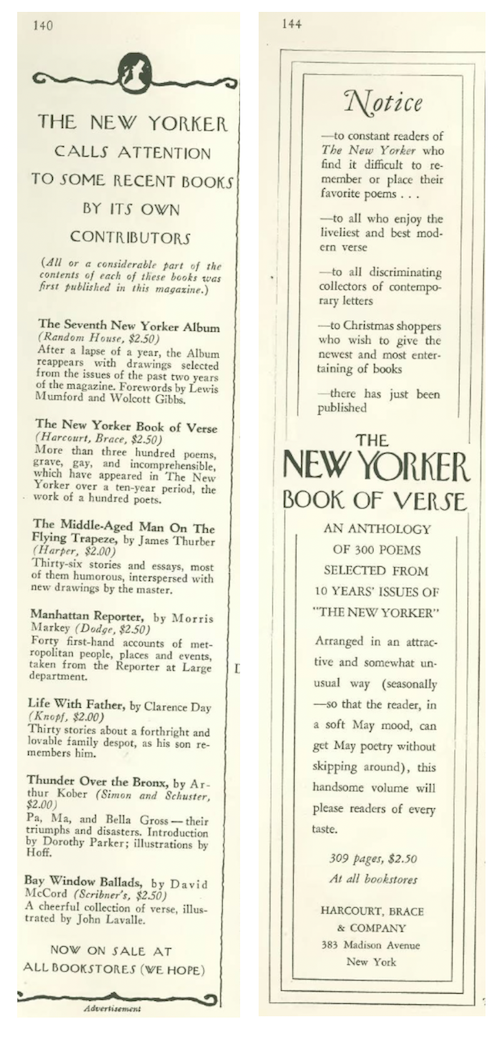
…the magazine also touted books and poems by its contributors…

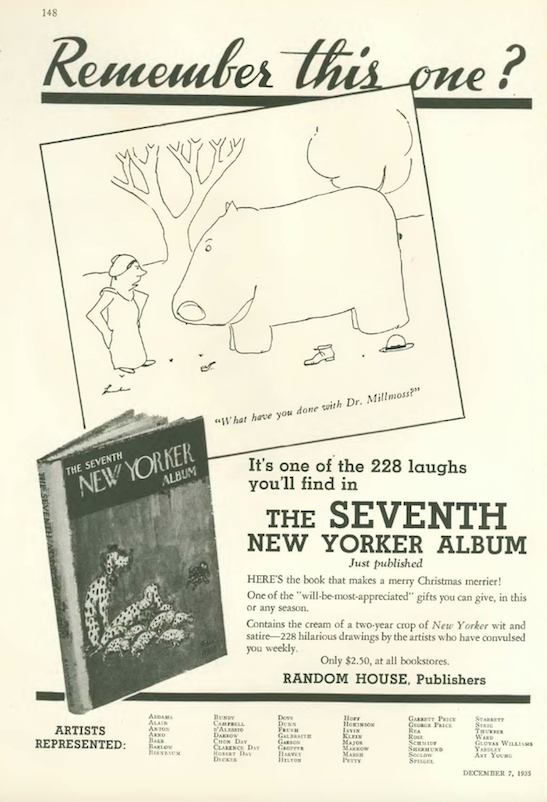
…and the Seventh New Yorker Album

…more James Thurber here in this spot drawing for the “Books” section…

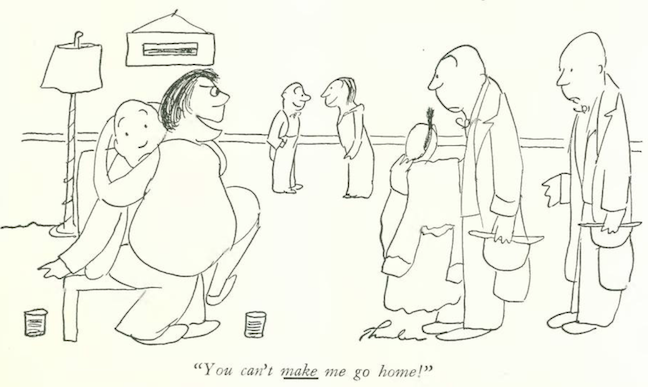
…and in this cartoon filled with holiday hijinks…

Ilonka Karasz gave us a hockey goalie to open the calendar listings…

George Price drew up this Depression-themed drawing at the bottom of the “Goings On” section…

…a great spot drawing by Aaron Sopher (1905–1972), who is perhaps best known for his depictions of everyday life in Baltimore…it was oddly placed amidst the “Christmas Gifts” section…

…according to Michael Maslin’s Ink Spill, Sopher contributed just two cartoons to the magazine, in the issues of June 15, 1929, and December 6, 1930 (pictured below)… 

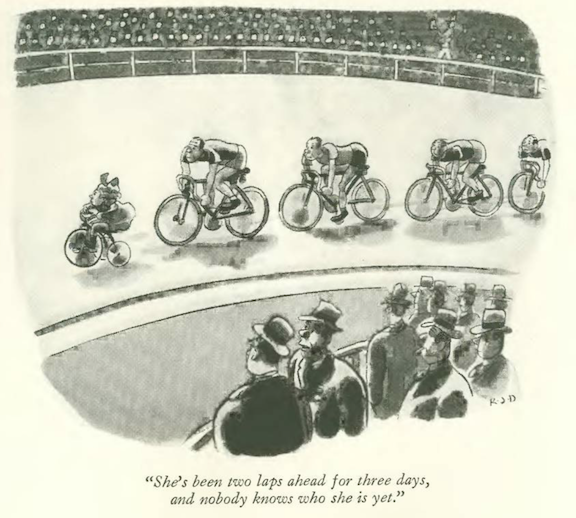
…back to the Dec. 7 issue, and at the Velodrome with Robert Day

…who also visited an ill-suited Santa…

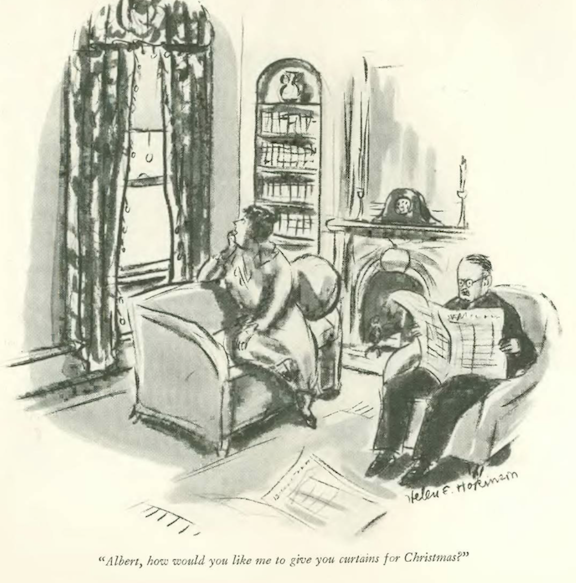
Helen Hokinson pondered gift ideas…

Carl Rose illustrated an unspeakable act at a progressive school…

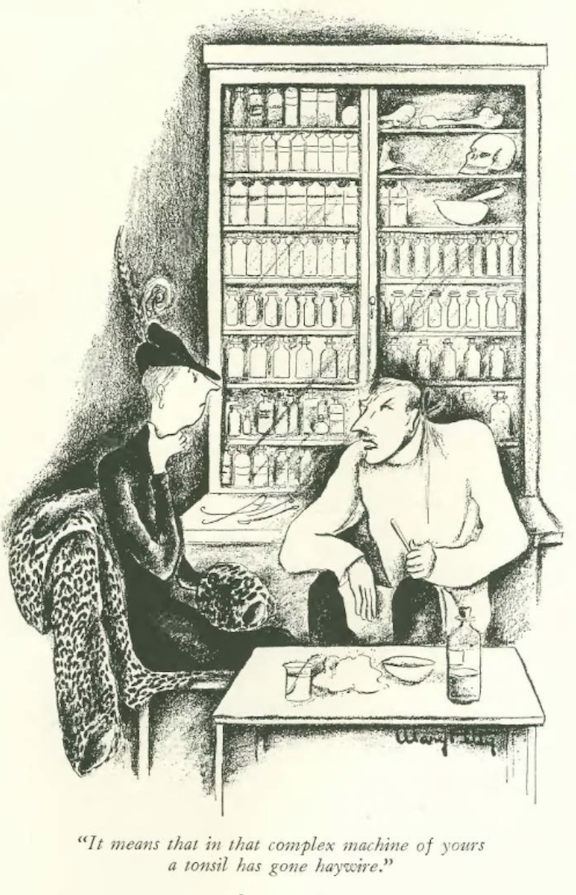
Mary Petty gave us a straightforward diagnosis…

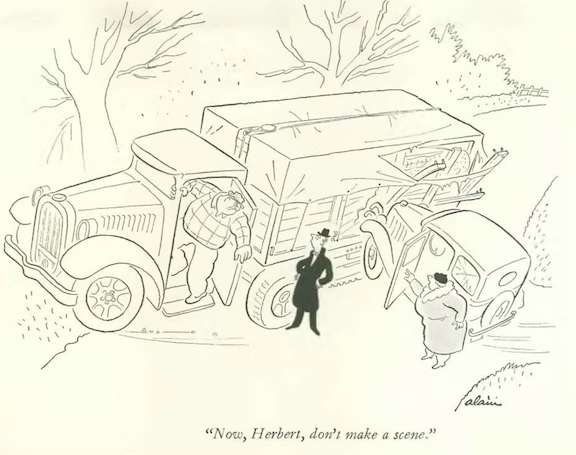
Alain asked us to ponder the fate of one man…

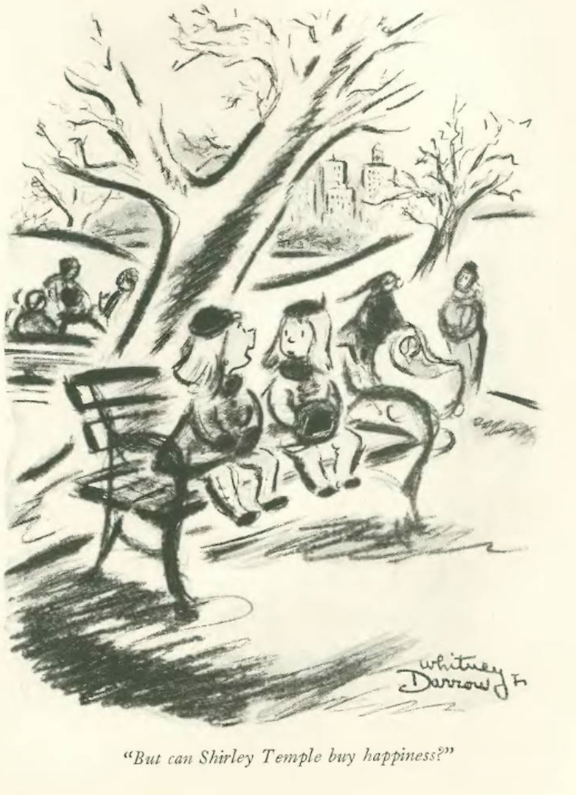
Whitney Darrow Jr eavesdropped on some child philosophy…

…and we close with Peter Arno, and a groom’s surprise at the altar…

Next Time: Marxist Mayhem…