Killer Queen

The story of Fred Nixon-Nirdlinger isn’t exactly dinner table conversation these days, but in the spring of 1931 his death at the hands of his beauty queen wife had much of America abuzz.

March 21, 1930 cover by Helen Hokinson.

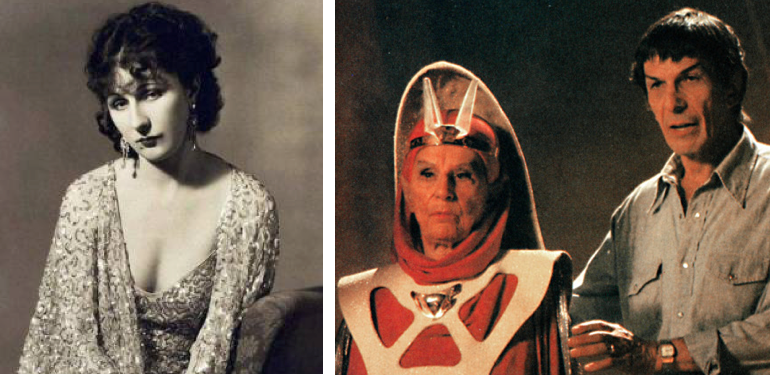
Charlotte Nash, Miss St. Louis of 1923, would have passed into obscurity like so many other beauty contestants if she hadn’t married a wealthy theater owner 30 years her senior, and then divorced and remarried him, and then shot him in the head on the French Riviera.

But first, the reason I am writing about this lurid episode: here’s E.B. White in the March 21, 1931 “Notes and Comment”…

Forty-seven-year-old Fred Nixon-Nirdlinger, wealthy owner of a Philadelphia theater chain, was serving as a judge at the 1923 Miss America competition in Atlantic City when the 17-year-old “Miss St. Louis,” Charlotte Nash, caught his eye and his fancy. By February 1924 they were married…

FANCY STRIKER…Seventeen-year-old Charlotte Nash strikes a pose at the 1923 Miss America pageant in Atlantic City; belated 1924 marriage announcement in the Philadelphia Inquirer; announcement in the New York Daily News. (New York Daily News/Philadelphia Inquirer)

…Fred was furious that Charlotte did not win the title in Atlantic City. He vowed to make her a movie star and sent her off to finishing school to work on her manners and elocution…

CRADLE TO GRAVE…Fred Nixon-Nirdlinger sent his young bride to finishing school for “a touch of polishing here and there.” Little did he know that one day she would finish him too…permanently. (findagrave.com/Pittsburgh Press)

…Unfortunately, Fred forgot to tell his young bride that he already had a wife —news that came to light on a trans-Atlantic voyage to Paris, where Fred and Charlotte had planned to honeymoon. Already pregnant with his child, Charlotte nevertheless divorced Fred, but remarried him some months later after the baby was born (and after considerable wooing and groveling by the theater magnate). Fred rejoined Charlotte in France, but the second honeymoon didn’t last long either. On the evening of March 11, 1931, the intensely jealous Fred accused his young wife of trafficking with “gigilos.” After Charlotte denied the charge, Fred seized her by the neck and threatened to choke her to death.

Crime Historian Laura James takes it from there:

“At some point Fred went into the kitchen for more whisky. Charlotte used the opportunity to flee to the bedroom, where she slipped a loaded pistol under her pillow. Fred’s last words to her were, “I will kill you rather than let you have an Italian lover.” Charlotte beat him to it, and as she lay on the bed she retrieved her pistol and fired. The first bullet entered just under Fred Nixon-Nirdlinger’s left eye and lodged at the base of his skull. A second bullet hit him in the chest. Two other shots went wild. Fred crumpled in a pool of blood.”

Charlotte was soon in a French jail, now a bigger star than she had ever been, or ever would be…

FINALLY GETTING SOME NOTICES…Left, detail of a March 18, 1931 New York Times account of the slaying; right, a more lurid take on the story by the July 18, 1931 edition of the Hamilton (Ohio) Evening Journal. Below, another colorful account from the San Francisco Examiner. (newspaper.com/New York Times)

During the subsequent trial, Charlotte’s defense attorneys argued that the shooting was a clear case of self-defense, and the jury agreed, acquitting the former beauty queen in just nine minutes. When she returned to the United States with her two young children, it appeared she would be entitled to a big chunk of Fred’s fortune…

…but in the end the will left her nearly penniless, so she earned what she could by telling her sensational story to the media, including this multi-installment feature she penned for the St. Louis Star and Times:

IT’S A LONG STORY…The 14th and 16th installments of Charlotte Nash’s story of her brush with fame and infamy in the St. Louis Star and Times. (newspaper.com)

Laura James notes that Charlotte might have been better off remaining in France: “The verdict was largely attributed (by the American newspapers at least) to French attitudes toward beautiful women and marriage in general (the jury included eight bachelors). But she returned to St. Louis; learned that her husband’s will left her nearly penniless; and tried to find acting jobs in Hollywood only to be snubbed Lizzie Borden-style, as Hollywood would have none of her. In the end she would declare, ‘Sometimes I’m sorry that I was ever considered beautiful. It brought me more trouble than joy.”‘

But the story doesn’t end there. Charlotte Nash Nixon-Nirdlinger (1905-2009) dropped out of public view, but would live on into the 21st century, dying at age 103 or 104 in her hometown of St. Louis, Missouri, where she rests today.

RIP CHARLOTTE. (findagrave.com)

 *  *  *

Turkey Trot

Dorothy Parker began to detect a pattern as she continued subbing for her friend Robert Benchley’s theater review column. All of the plays she had reviewed to date were found to be uniformly terrible; she found comfort, however, in fellow critics who also viewed Broadway’s spring lineup as a flock of “little turkeys”…

BIRDS OF A FEATHER…Dorothy Parker found Broadway’s spring lineup to be uniformly terrible, and audiences mostly agreed. Clockwise, from top left, The Admirable Crichton ran for two months and 56 performances at the New Amsterdam Theatre; Grey Shadow closed after 39 performances at the New Yorker Theatre; Napi, directed and lead-acted by the diminutive Ernest Truex (pictured) lasted just 21 shows at the Longacre; The House Beautiful bested them all by staying open for 108 performances at the Apollo. A curious side note: Mary Philips, pictured on the Apollo cover, was Humphrey Bogart’s second wife. The marriage lasted ten years — 1928 to 1938. (Playbill)

Of the plays Parker reviewed, she called The Admirable Crichton “piteously dated;” of Grey Shadow, she wrote that it would be as indelicate for her to discuss the play as it would be to “go into details of my appendectomy;” Parker deemed Napi “as grubby and unpleasant a little comedy as you could want to stay away from;” and she did not find The House Beautiful all that beautiful…”The House Beautiful is, for me, the play lousy.”

Parker ended the column with her usual plea to Benchley:

 *  *  *

Moses Parts the Swamp

In his “Notes and Comment,” E.B. White noted the destruction of trees and swampland in Van Cortlandt Park. In 1931 Robert Moses was president of the Long Island Park Commission but held political sway over so much more. What White was witnessing were preparations for the construction of the Henry Hudson Parkway and Mosholu Parkway that would split Van Cortlandt into six separate pieces. White was right about the disappearing birds: the last remaining freshwater marsh in the state, Tibbetts Brook, was dredged to accommodate construction.

HE PAVED PARADISE…Governor Franklin D. Roosevelt of New York attends a Jones Beach luncheon on July 26, 1931, as a guest of Robert Moses (far left), who was president of the Long Island Park Commission. (AP Photo)
A PARK DIVIDED…The Mosholu Parkway cuts a wide swath through Van Cortlandt Park, 1936. (Museum of the City of New York)

 *  *  *

Those Daring Young Men

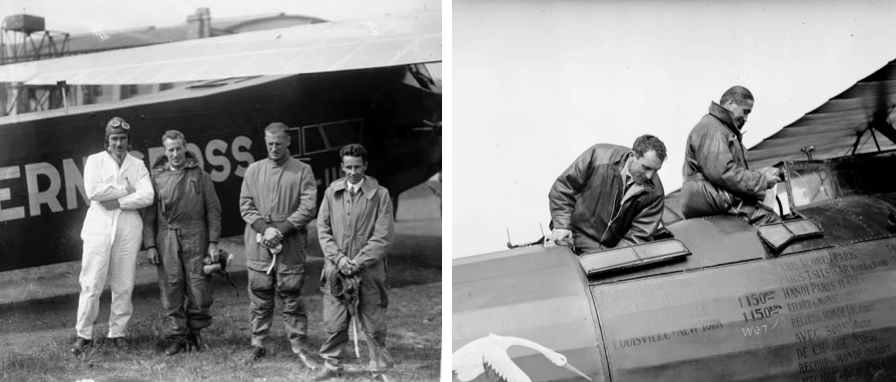
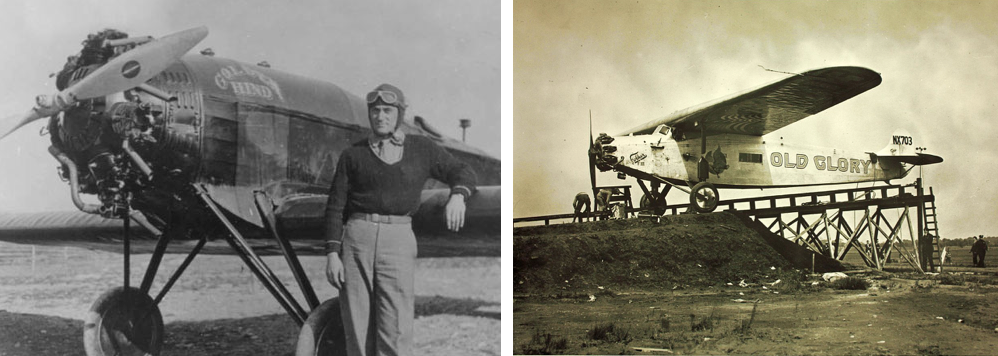
Ever since Charles Lindbergh made his historic transatlantic flight in 1927, Americans were captivated by the derring-do of pilots who competed for various “firsts.” In the case of Clyde Pangborn and Hugh Herndon Jr., the goal was to to fly around the world and break the record of 20 days and 4 hours set by Germany’s Graf Zeppelin in 1929. In his “Reporter at Large” column, Morris Markey noted the many weeks of preparation by the two pilots…

A BIT OF FUN…July 1931 newspaper illustration of Clyde Pangborn, left, and Hugh Herndon Jr., with a map of the route they followed on their attempt to set a new round-the-world flight record. (AP)

Markey noted that the two pilots claimed they were setting out on their dangerous mission “for the fun of it”…

While Pangborn and Herndon were still making flight plans at their Hotel Roosevelt headquarters, Wiley Post and Harold Gatty took to the air and claimed the record of 8 days and 15 hours. Pangborn and Herndon decided to make a go of it anyway, leaving New York on July 28, 1931, in their red Bellanca named the Miss Veedol, but poor weather in Siberia caused them to abandon their quest.

There was, however, a $25,000 prize being offered by the Tokyo newspaper Asahi Shimbun to the first pilots to cross the Pacific non-stop, so Pangborn and Herndon regrouped and successfully flew the Miss Veedol across the Pacific Ocean — in 41 hours and 13 minutes. It wasn’t exactly a smooth flight; three hours after takeoff the device used to jettison the landing gear failed, prompting Pangborn to climb out onto the wing barefoot at 14,000 feet to remove the landing gear props. After several other near-mishaps — including nearly smashing into a mountain — the duo completed their historic flight with a controlled crash landing near Wenatchee, Washington.

NO WHEELS, NO PROBLEM…More than 41 hours after departing Japan, Clyde Pangborn and Hugh Herndon Jr. performed a controlled crash landing near Wenatchee, Washington, completing the first-ever nonstop flight across the Pacific Ocean. (Wired.com)
STILL IN ONE PIECE…Hugh Herndon Jr., left, and Clyde Pangborn after crash-landing at Wenatchee, Wash., following their 1931 flight across the Pacific from Misawa, Japan. (Spirit of Wenatchee).

 *  *  *

From Our Advertisers

Herndon and Pangborn made plans for their round-the-world flight while staying at the Roosevelt Hotel in Midtown…I’ve stayed there myself and enjoyed its nubby charms…as for the underground passageway to the Grand Central, it’s still there, but no longer open to the public…

…the makers of Kleenex originally marketed their tissues for makeup removal…by the 1930s, however, they saw a much bigger opportunity…

…if the Roosevelt Hotel wasn’t posh enough for you, the new Waldorf-Astoria might have been your cup of tea…

…and if you could stay at the Waldorf, you might be able to afford a Packard, which in the 1930s was a near-rival to Rolls Royce…

…I toss this one in from Goodyear because it is probably the only time an image of the Taj Mahal was used to sell tires…

…we have another lovely Carl “Eric” Erickson illustration for Camel…

…and at first glance I thought this was another two-page ad for Chesterfield cigarettes, but it appears the candy manufacturers also wanted to tie their products to exciting lifestyles…in this case, you were urged to eat candy for some quick energy…here it is implied that Schrafft’s candy will give you the energy you need for sailboating and…er…other activities…

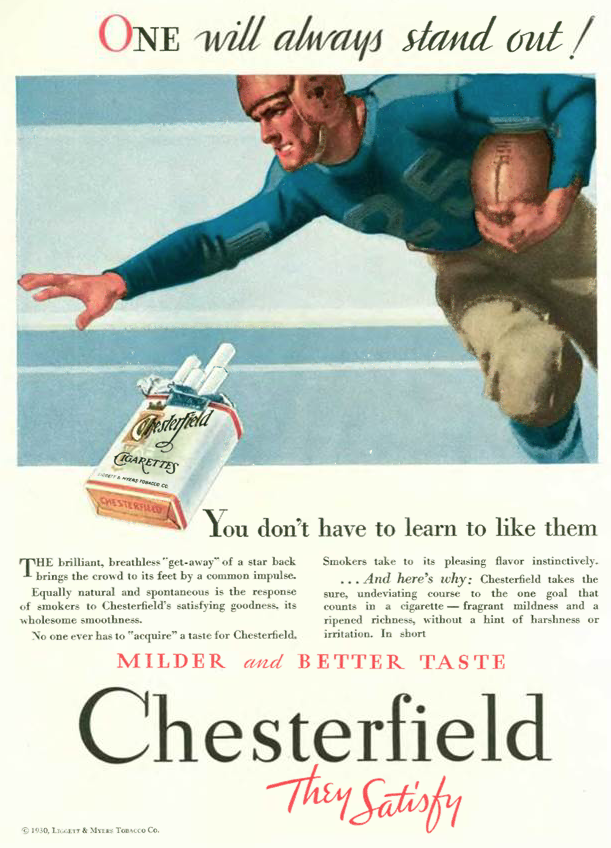
…for comparison, Chesterfield ad from 1930…

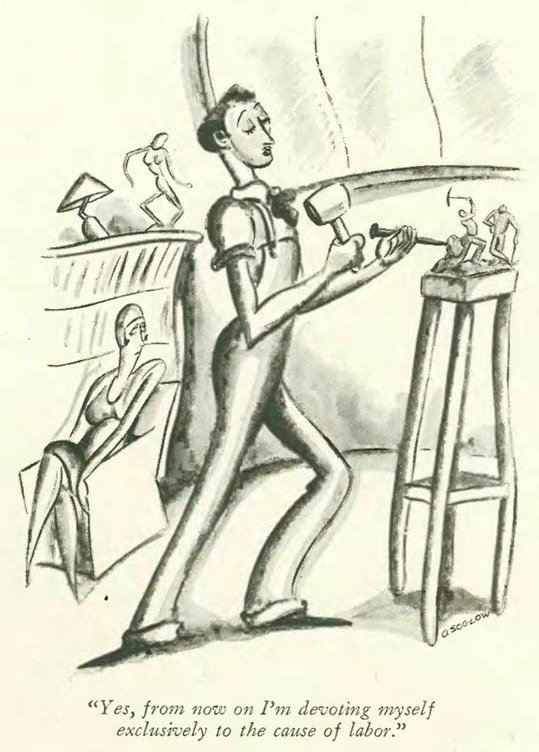
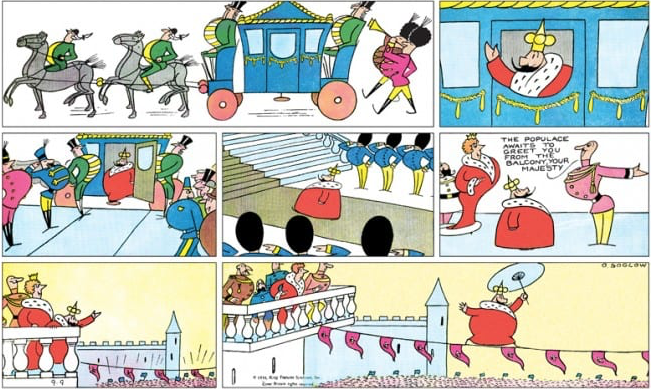
…on to our cartoons…Otto Soglow continued the adventures of the Little King…

Perry Barlow showed us that war is hell…

…some ringside niceties courtesy E. McNerney

Mary Petty reminded us that posh folks weren’t exactly known for their intellect…

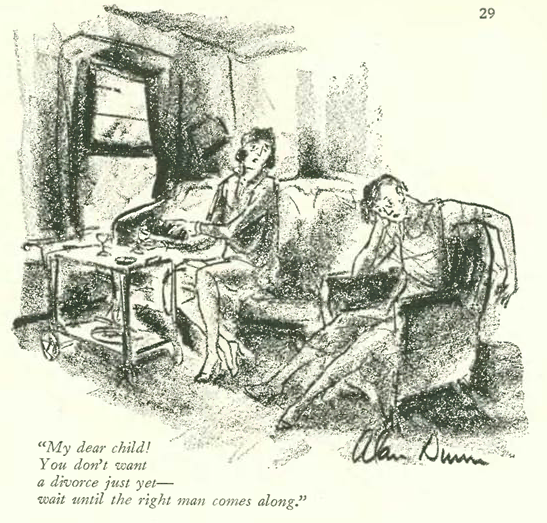
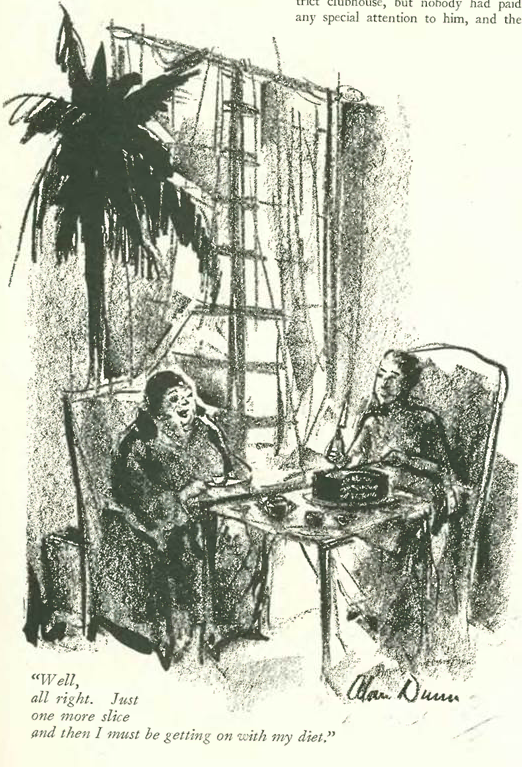
Alan Dunn examined the challenges of buying an older house…

Helen Hokinson gave us a politically precocious young lad…

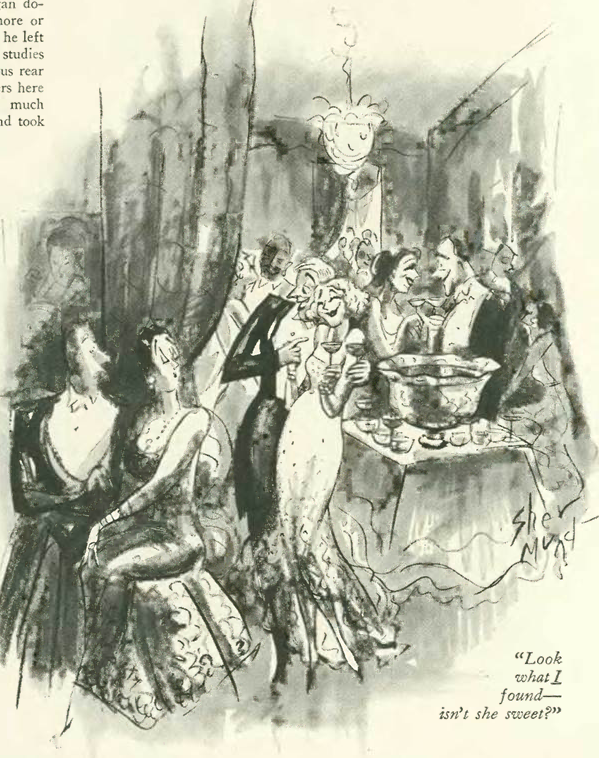
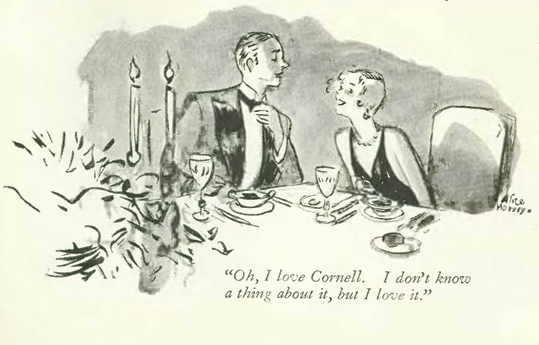
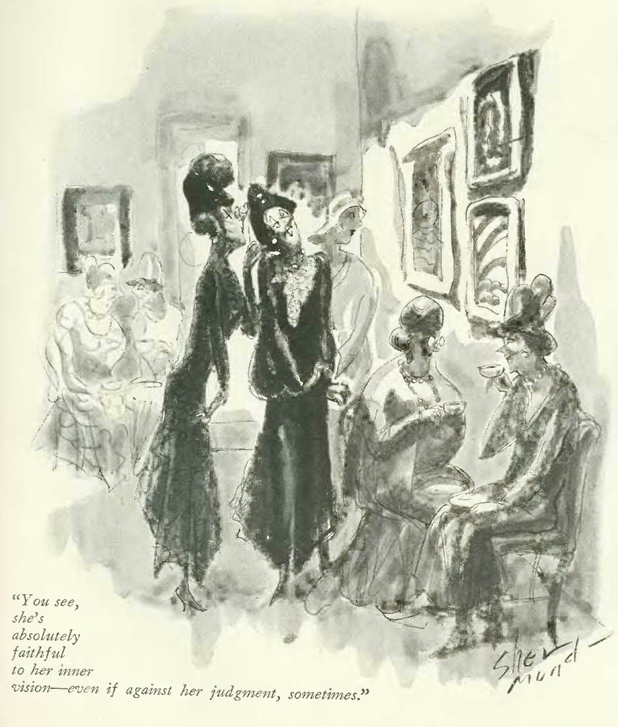
…and two glimpses into high society by Barbara Shermund

…including their scintillating conversations about such things as ice makers…

Next Time: Front Page News…


The End of the World

In today’s world of endless media options, it is hard to fathom the influence newspapers had over daily life in the 19th and early 20th centuries. There was one news source that many New Yorkers simply could not live without: The New York World.

March 7, 1931 cover by Helen Hokinson.

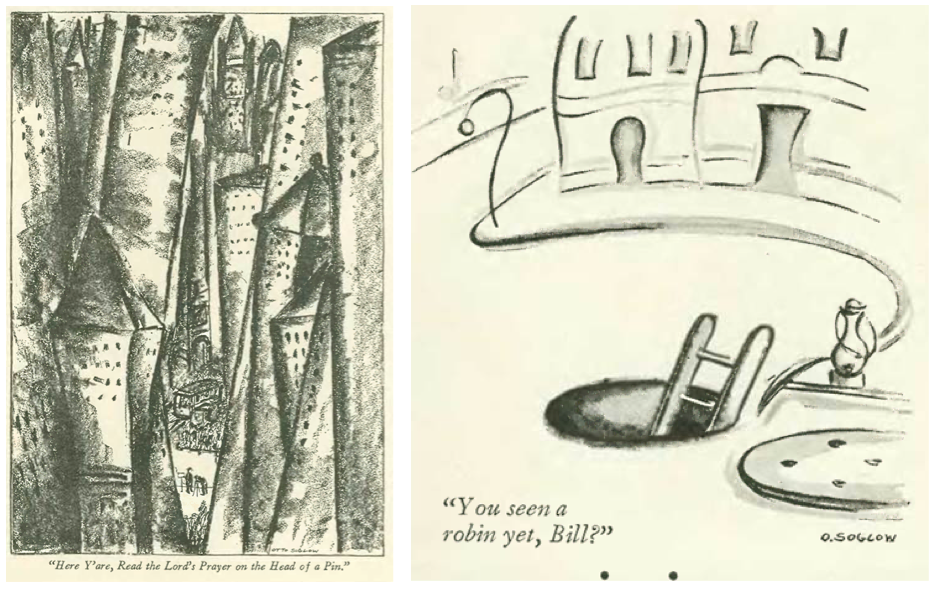
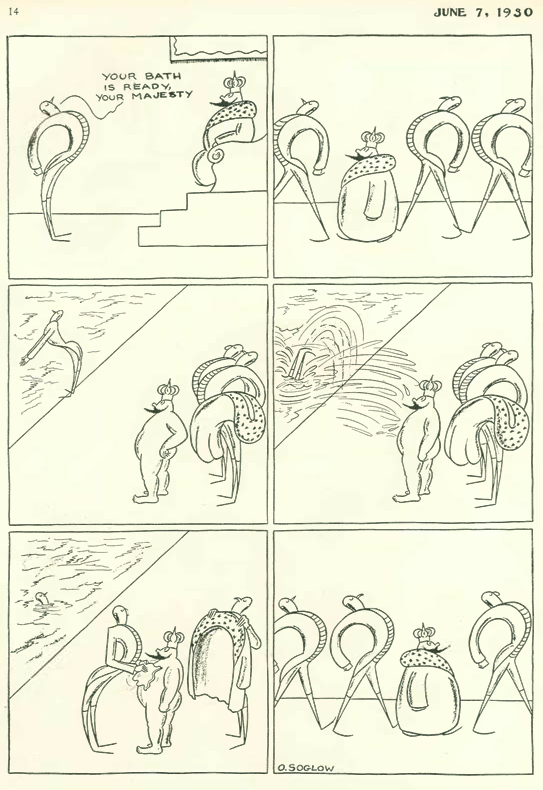
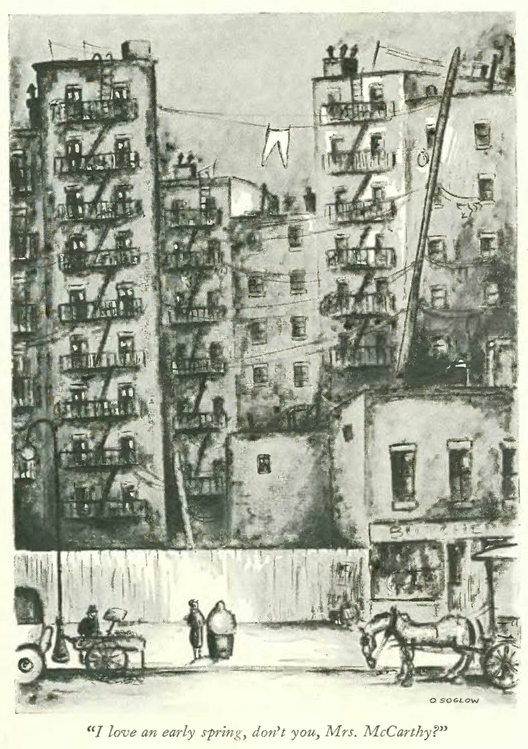
So when the World ceased publication after a 70-year run, many of its readers struggled to come to terms with the loss. Despite the World’s working class appeal and sensationalistic reporting, E.B. White nevertheless counted himself among its mourners, offering a lengthy eulogy in his “Notes and Comment” column (with Otto Soglow illustration)…

THE COLOR OF MONEY…Under the leadership of Joseph Pulitzer, who bought The World in 1883, the newspaper began an aggressive era of circulation building, and in 1896 enticed readers with pages printed by one of the world’s first four-color printing presses. The World was the first newspaper to launch a Sunday color supplement, which featured “The Yellow Kid” cartoon Hogan’s Alley (above, right). (5dguide.com)

A pioneer of yellow journalism, The World also featured sensational stories and headlines to capture the attention of readers…

…however, The World was also home to a number of prominent journalists, including the famed Elizabeth Cochran Seaman (aka Nellie Bly) and many writers from the social orbit of the Algonquin Round Table who were also early contributors to the fledgling New Yorker.

In his “Notes” essay, White suggests that he found something authentic in The World’s sensational style, and praised it for going after stories that more staid publications, like The New York Times, tended to ignore or downplay. The World’s staff of writers came from the rough and tumble, muckraking world of journalism, the same world in which The New Yorker’s founding editor, Harold Ross, first cut his teeth.

ALL-STAR LINE-UP…Many of The World’s famed writers inhabited the orbit of The New Yorker and the Algonquin Round Table, including, from left, music critic Deems Taylor, journalist and social critic Heywood Broun, “The Conning Tower” columnist Franklin P. Adams, and humorist Frank Sullivan. (deemstaylor.com/britannica.com/Wikipedia)

 *  *  *

Swedish Sphinx?

Thirty years after her death, Greta Garbo remains an iconic figure in popular culture, due to her expressive eyes and sensuality, but perhaps even more so due to her elusive air. In her profile of the star for The New Yorker, titled “American Pro Tem,” Virgilia Peterson Ross refused to buy into the mysterious aura that was partly manufactured by Garbo’s handlers at MGM. The other part, however, was genuine Garbo, who detested parties, serious talk, and other formalities.

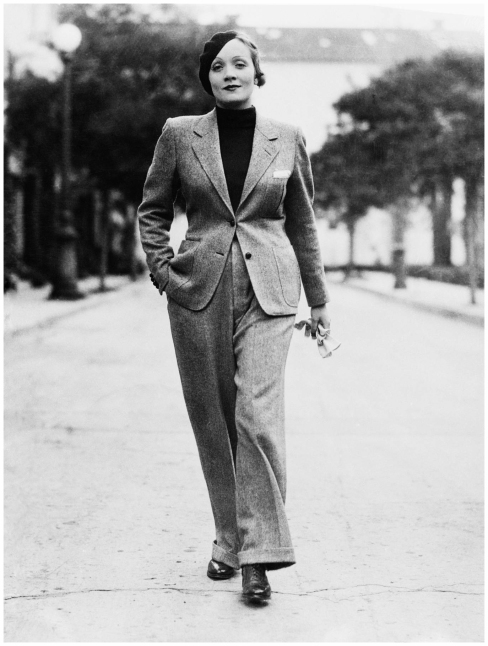
THE FACE…Like her contemporary Marlene Dietrich, Greta Garbo preferred an androgynous look. From left, Garbo wearing the flat-heeled oxfords she favored; publicity photo from 1932; wearing one of her trademark berets in the late 1930s. (garboforever.com)

Ross touched on Garbo’s love life—she never married in her 84 years, but she was close to her mentor, Finnish director Mauritz Stiller, who died in 1928, having been eclipsed by his protégé. Garbo’s co-star in the silents, John Gilbert—known as a great lover on the screen—wanted to marry Garbo, but she balked at his frequent proposals. The two lived together intermittently in 1926 and 1927, Gilbert helping Garbo not only with her acting also teaching her how to behave like a star and barter with studio bosses. Garbo later admitted that she was in love with Gilbert, but preferred to remain single because she “always wanted to be the boss.” Drink and despair would send Gilbert to an early grave in 1936. In her profile piece, Ross concluded that Garbo was “not a mystery to be solved,” but rather “a limpid child.”

THE MEN IN HER LIFE…Greta Garbo contemplates a new-fangled microphone with film director Clarence Brown on the set of Garbo’s first talkie, Anna Christie. Brown would direct Garbo in seven different films; Garbo with sometime lover John Gilbert in Flesh and the Devil (1926). They would appear in four films together; Garbo with Finnish director and early mentor Mauritz Stiller, in 1926. (Wikipedia/IMDB/garboforever.com)

 *  *  *

Suffering Artist

Dorothy Parker continued to sub as theater critic for her friend, Robert Benchley, who was traveling abroad. It was not a task to her liking — during her temporary stint she had yet to see a play that didn’t insult her taste or her intelligence. Her review for the March 7 issue would prove no different.

BROADWAY BLAHS…Dorothy Parker had yet to find a play to her liking in her stint as theater critic for the New Yorker. To her credit, she had to sit through a couple of stinkers: A Woman Denied lasted about a month — 37 performances — and Paging Danger closed its curtains for good after just four performances. (Playbill/BBC)

 *  *  *

The Misanthrope

To call Wyndham Lewis a character is an understatement. The English writer, social critic and painter (he founded the cubist-inspired Vorticist movement) managed to offend just about everybody before his death in 1957. He was described by the London Review as “fiercely unsentimental,” and that is how I would describe this opening paragraph from his short story “Dark Party”…

CLASSIC POSE…A 1929 portrait of Wyndham Lewis by photographer George Charles Beresford. (Wikipedia)

 *  *  *

From Our Advertisers

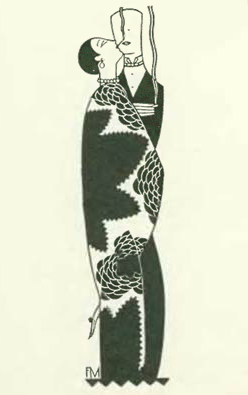
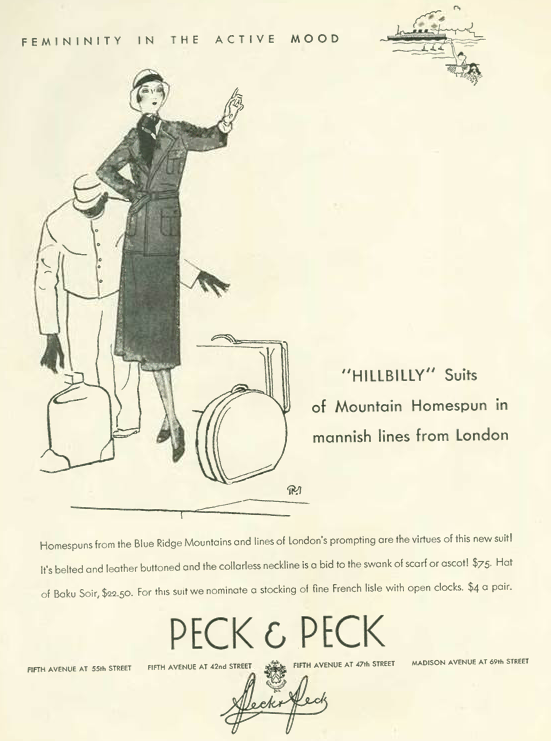
A couple of ads appealing to women readers of the New Yorker, including this elegant bon voyage scene advertising travel clothes…

…and something you never see anymore, the “boneless” girdle…replaced today by Spanx and the like…

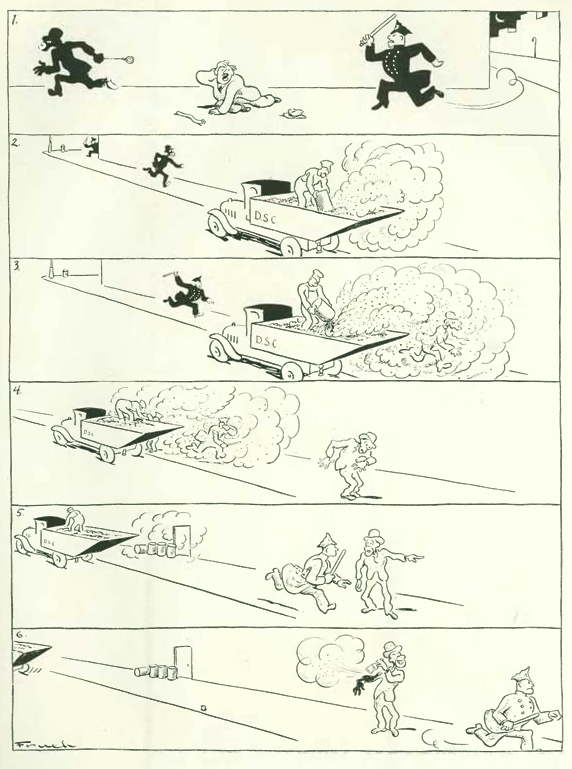
…Before we roll into our cartoons, some cinema-inspired art by Al Frueh

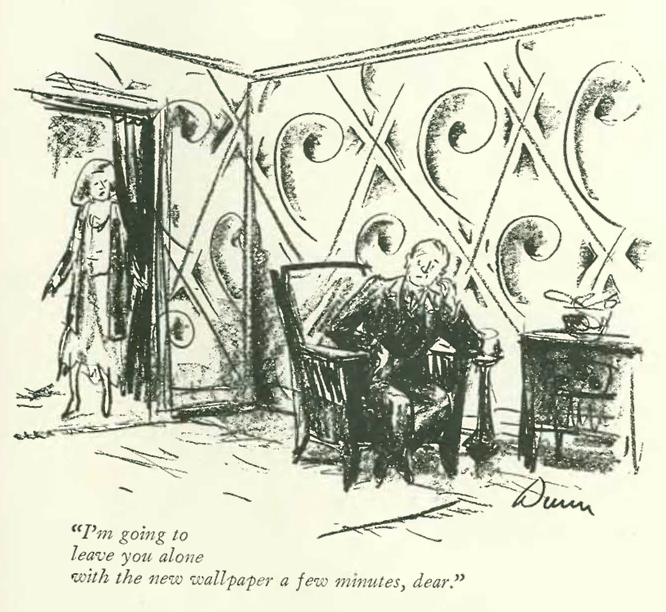
Alan Dunn went out to dinner…

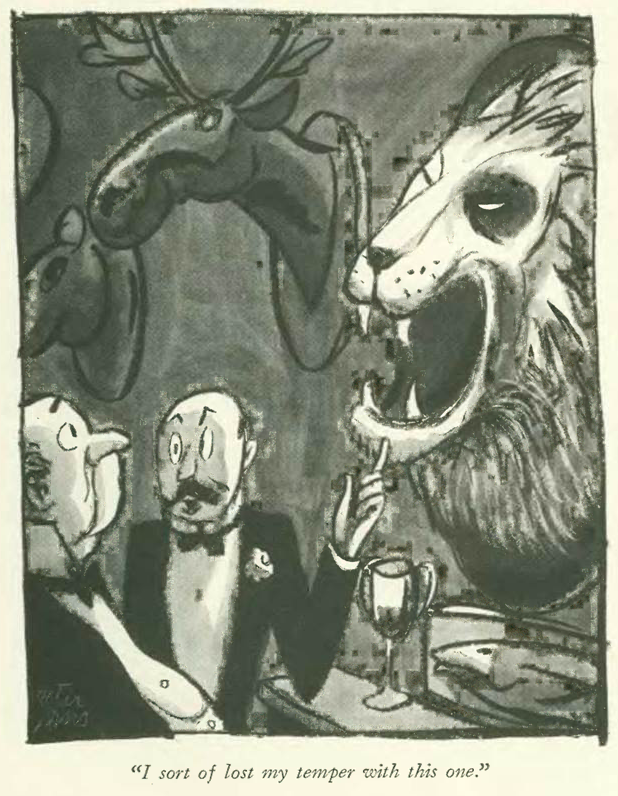
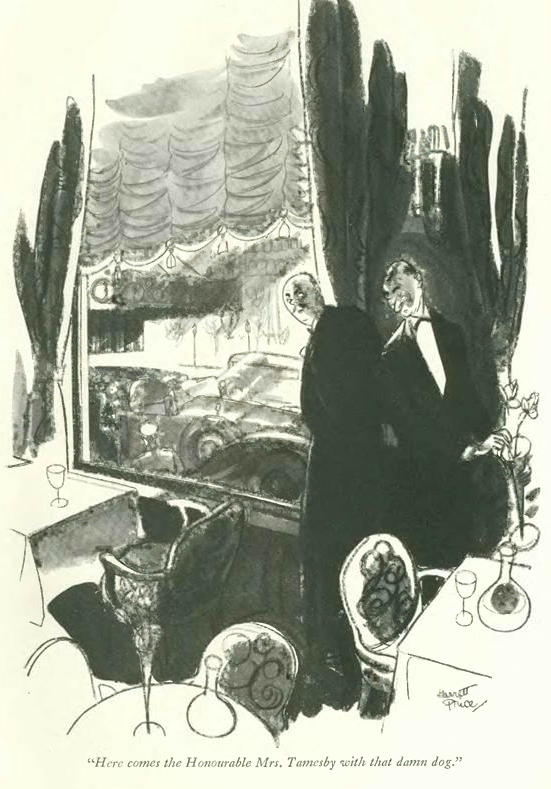
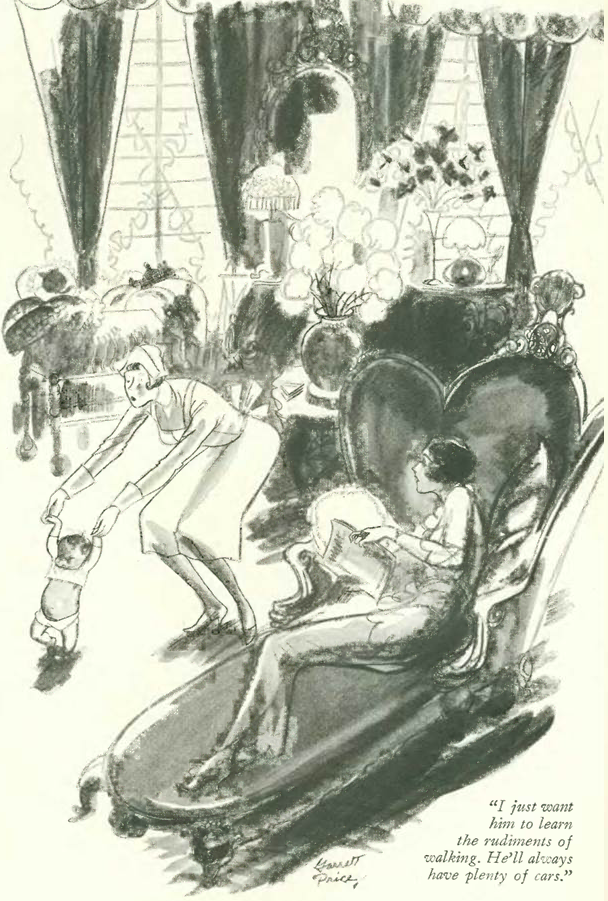
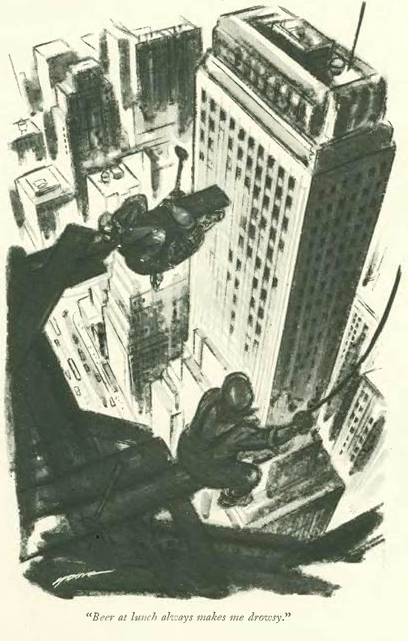
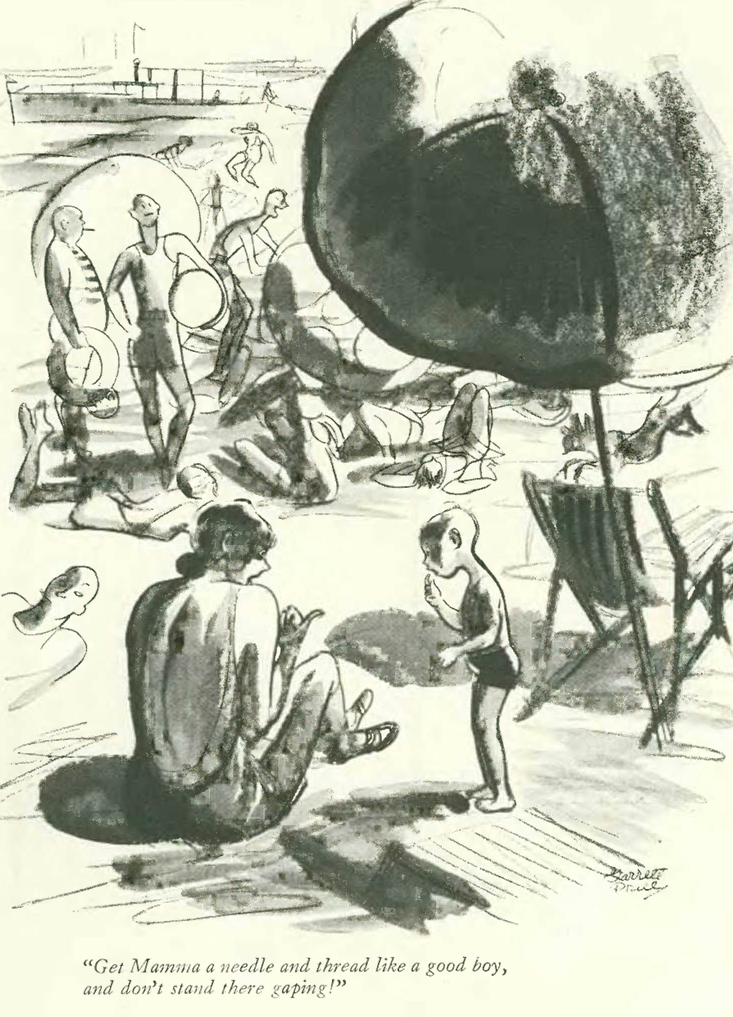
Garrett Price went on safari…

E. McNerney channelled his inner Arno for this backstage scene…

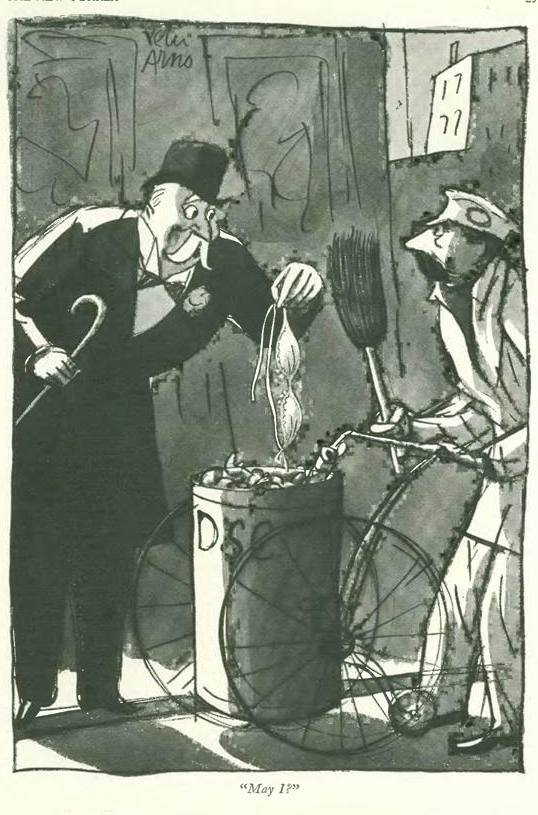
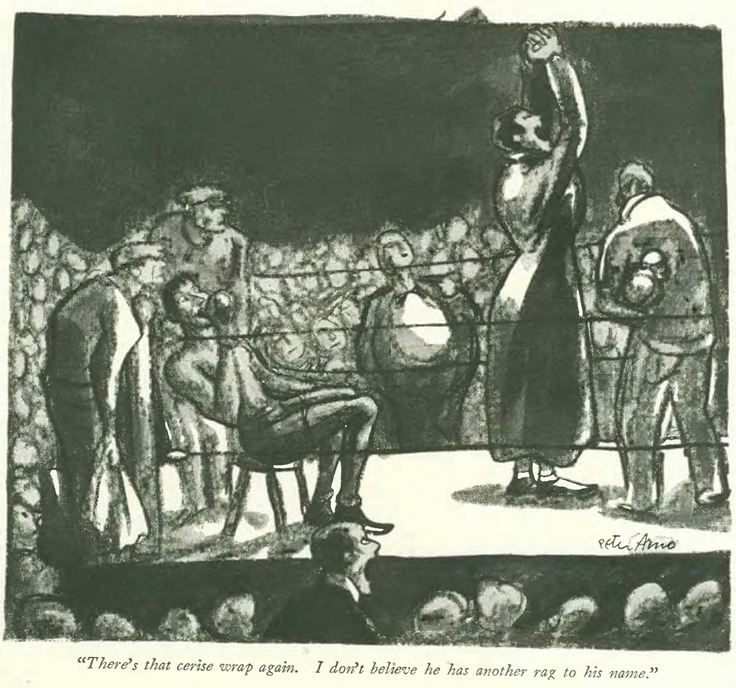
…and the real Peter Arno gave us this passing scene which recalled his old Whoops Sisters gags…

Next Time: Age of Wonders…


And the Winner Is…

We lead off with a couple of winners from the Feb. 7, 1931 issue, beginning with a cover by Rea Irvin that takes measure of a lighter moment at the Westminster Kennel Club Dog Show.

Feb. 7, 1931 cover by Rea Irvin.

The 1930 Best of Show winner Pendley Calling of Blarney also took the top honor in 1931, giving the wire fox terrier back-to-back Westminster wins. Overall, terriers have dominated Westminster — wire fox terriers have won Best of Show fifteen times, with Scottish terriers a distant second, with eight wins.

TOP DOG…Pendley Calling of Blarney won back-to-back crowns in 1930-31 at Westminster Kennel Club Dog Show at Madison Square Garden. The dog’s owner, John Grenville Bates, mercifully retired the pooch after the ’31 win. (Westminster Kennel Club)
STANDARD? WHO ARE YOU KIDDING?…Standard poodle Siba won Best in Show at the 144th annual Westminster Kennel Club Dog Show on Feb. 11, 2020, at Madison Square Garden. (Reuters)

The other winner was Cimarron, the first film to receive more than six Academy Award nominations, winning three including Best Picture (then called Best Production). It was the first Western to win Best Picture, and it would be nearly sixty years until another Western, Dances with Wolves, would take the top honor.

HE LOST HIS SHIRT, TOO…

Despite some “sagging moments,” John Mosher mostly lavished praise on the film, which was showing at the Globe Theatre:

THAT’S NO WELCOME WAGON…Clockwise, from top left, Yancey and Sabra Cravat (Richard Dix and Irene Dunn) join the 1889 Oklahoma Land Rush with their son, Cim (Junior Johnston); a less-than-friendly greeting at a boomer town; wagons line up for the big land grab; a young prostitute, Dixie Lee (Estelle Taylor), outwits Yancey for a piece of prime property. (IMDB)
OH DEAR, THERE’S THAT LOOK AGAIN…Yancey (Richard Dix) takes it upon himself to establish order in the boomer town of Osage. On the bed are Yancey’s son, Cim (Junior Johnston) and wife Sabra (Irene Dunn). (IMDB)

 *  *  *

Handy Painter

It is hard to imagine the struggles of one-handed painter José Clemente Orozco (1883-1949), who despite his handicap was able to complete huge murals in true fresco style (paint applied quickly on fresh, wet plaster), including five socially-themed frescoes at the Joseph Urban-designed New School. The murals included controversial depictions of Lenin and Stalin, but it wasn’t until the 1950s — during the McCarthy era — that school officials felt compelled to cover the images with a curtain. More protests followed, this time from faculty and students, and the curtains fell along with Joe McCarthy. “The Talk of the Town” looked in on the artist at work:

HE LOOKS FAMILIAR…José Clemente Orozco’s “The Struggle in The Occident”, 1930-1931, one of five frescoes at the New School. (Pinterest)

 *  *  *

Prescience of Mind

News reporter and author Elmer Davis submitted this humorous piece to The New Yorker doubtless thinking how preposterous, and therefore humorous, the following notion would be (a brief excerpt):

 *  *  *

Funny Cigarettes

In the early years of broadcast radio (and later TV) tobacco companies rightly saw a huge gold mine in radio show sponsorships. So when CBS radio executives accepted a sponsorship from Lorillard (the makers of Old Gold), they realized they had a challenge on their hands. “Talk” explained:

COUGH ME A MELODY…The makers of Old Gold cigarettes had CBS in their clutches in this September 1933 ad featuring bandleader Fred Waring and singer Babsie. (period paper.com)

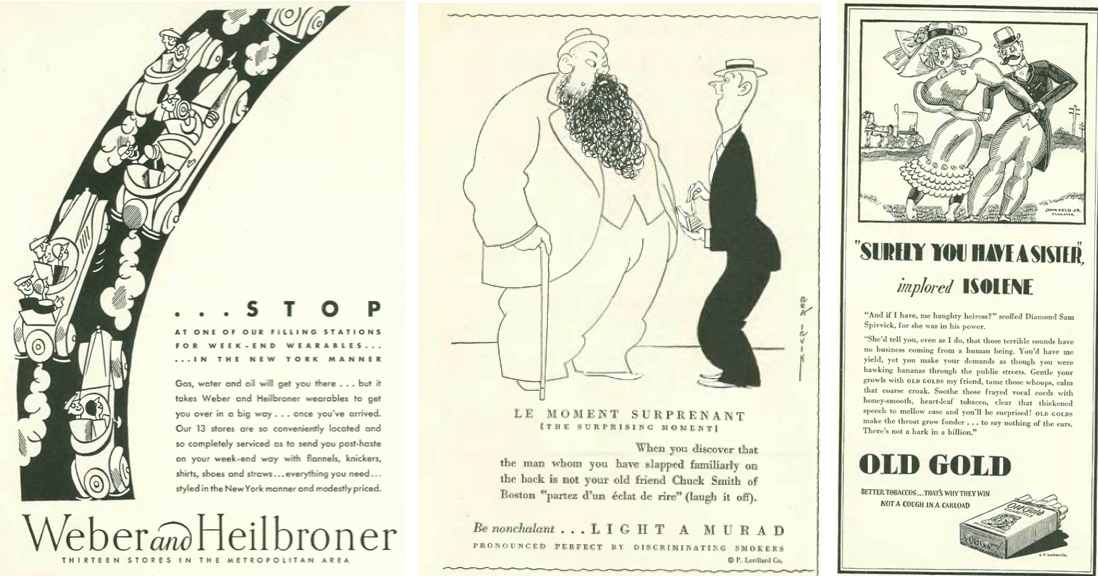
…The above “Talk of the Town” item referred to the famous Murad ads illustrated by The New Yorker’s own Rea Irvin

…while other advertisers were scaling back a bit due to the Depression, lovely full-color ads continued to flow from tobacco companies (and oil companies)…

…Pierce-Arrow was also known for its sumptuous ads, but they wouldn’t save the luxury car maker from going under by the mid-1930s…

…Some less expensive black and white ads, such as this hand-lettered ad from Stein & Blaine, could be quite charming…

…speaking of charm, this ad from Arthur Murray could have used a little of it…note the stern visage of the woman, described as “typical of Arthur Murray’s staff of expert teachers”…

…on to our Feb. 7 cartoons, we have one of Peter Arno’s stock characters, the Sugar Daddy, in an awkward moment at a costume party…

…Arno’s party looked a lot more lively than this affair, illustrated by William Crawford Galbraith...

…and Carl Rose gave us this pair, who seem to having the best time of all…

Mary Petty eavesdropped on a guileless young woman…

…and Gardner Rea paid a visit to the Met…

 *  *  *

On to our Feb. 14 issue, and Gardner Rea once more…

Feb. 14, 1931 cover by Gardner Rea.

The Feb. 14 issue featured a profile of actress Katharine Cornell (1893-1974), written by cultural critic Gilbert Seldes. The caricature of Cornell is by Al Frueh. Excerpts:

Promotional photograph of Katharine Cornell as Elizabeth Barrett in the original 1931 Broadway production of The Barretts of Wimpole Street. It was her most famous role(Theatre Magazine, March 1931)

Cornell is considered one of the greatest actors of American theater, known for her eloquence and romantic stage presence. Seldes concluded:

 *  *  *

Strange Bedfellows

In his column “Of All Things,” Howard Brubaker referred to an exchange between American capitalists and Soviet Russians that resulted in the rapid industrialization of the Soviet Union. That actual story behind this effort is pretty amazing.

 *  *  *

Sneak Peek

Film critic John Mosher was so excited about Charlie Chaplin’s latest film that he offered this teaser to readers…

 *  *  *

From Our Advertisers

We have this ad from the developers of the Empire State Building, which was being readied for a May 1931 opening…

…the Empire State Building was erected on the site of the old Waldorf-Astoria Hotel. The new Waldorf-Astoria, also completed in 1931, was located more than 15 blocks away from its original site. Both the Empire State Building and the Waldorf Astoria would become Art Deco landmarks, and both shared the distinction of holding world records: the Empire State was the world’s tallest building (a record it would keep until 1970), and the Waldorf would claim the title of the world’s tallest hotel (until 1963)…

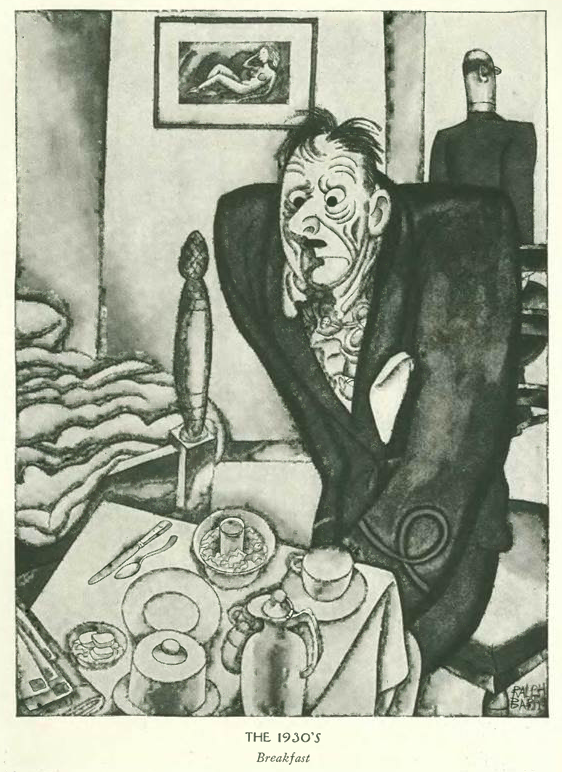
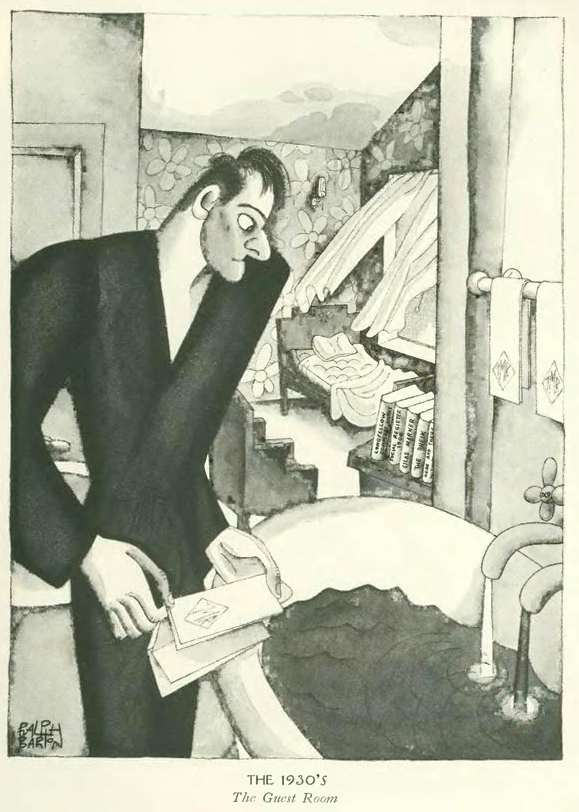
…on to our cartoonists, we have Ralph Barton contributing one of his last illustrations to the theater review section…

Richard Decker references a recent change in New York telephone numbers with this prison scene…

…Decker was referring to this bit of news, here interpreted by E.B. White in his Feb. 14 “Notes and Comment.”

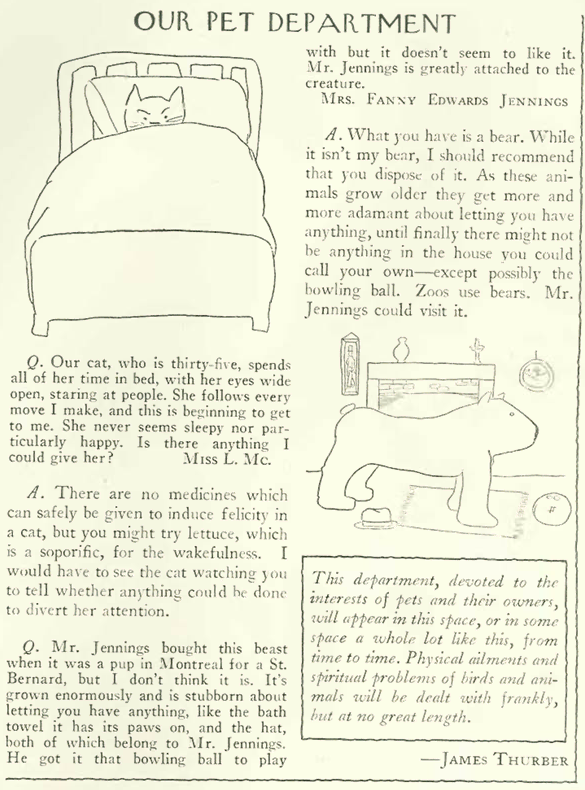
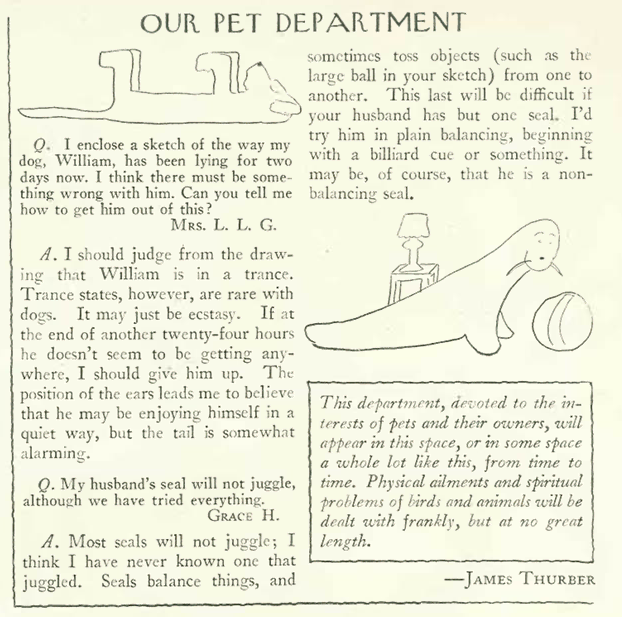
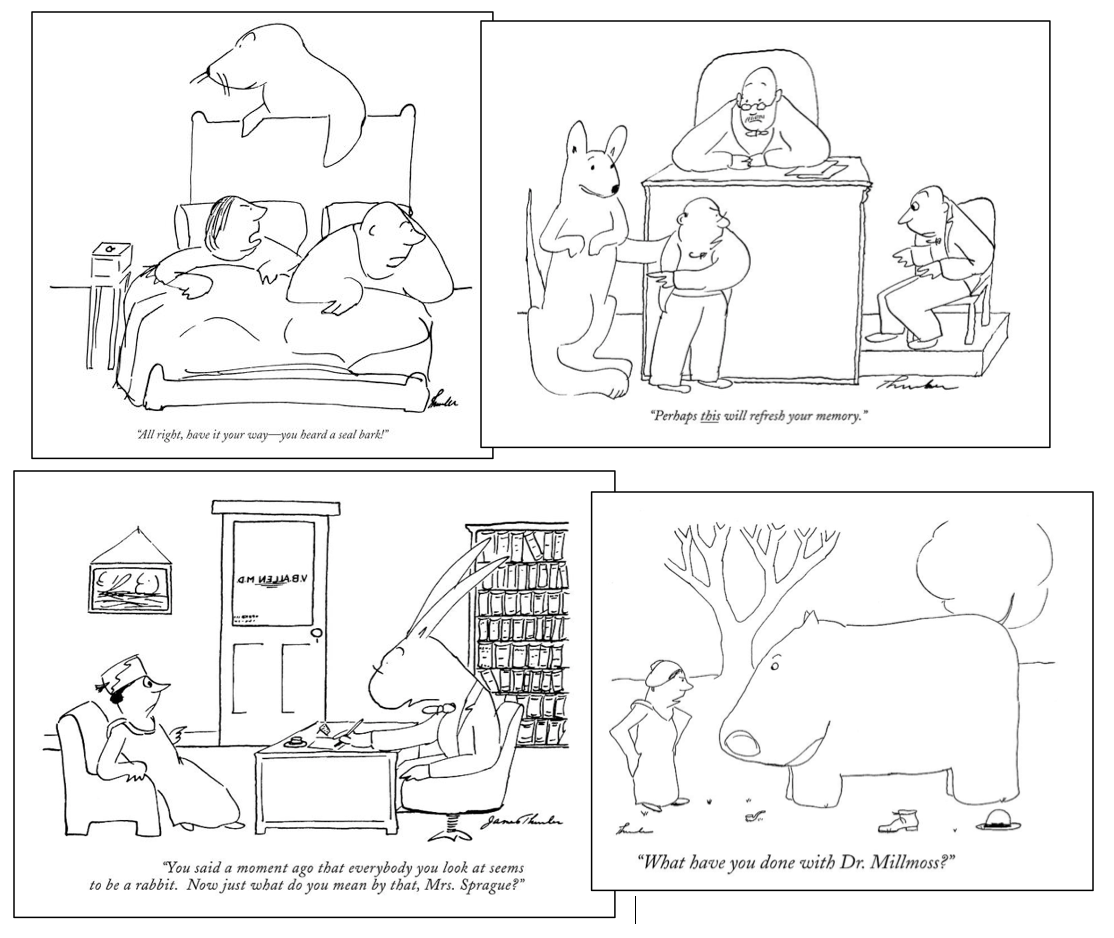
James Thurber returned with his second-ever stand-alone cartoon for the New Yorker

Garrett Price mined a theme that would become common in New Yorker cartoons: the tycoon vs. meek employee…

Nancy Fay gave us a glimpse of the seamier side of family life…

R. Van Buren goes even darker with this entry…

…and we end on a high note, with Alan Dunn

Next Time: Super Tramp…

Wickersham Sham

Introduce the topic of the Wickersham Commission at your next dinner party and you will most likely be answered with a puzzled silence.

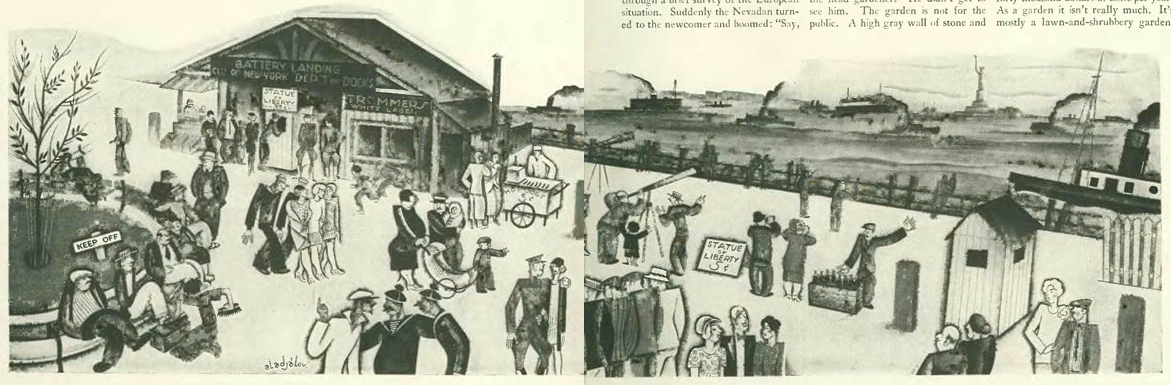
January 31, 1931 cover by Constantin Alajalov.

However, in January 1931 it was THE topic of the month, especially among New Yorkers keen to see the end of Prohibition, which was the focus of the commission.

Established by President Herbert Hoover, the 11-member Wickersham Commission (officially, the National Commission on Law Observance and Enforcement) was not seeking to repeal the 18th Amendment, but rather to examine the criminal justice system under Prohibition, everything from police brutality and graft to the rapid rise of organized crime.

SOBER UNDERTAKING…George Wickersham was featured on Time’s Feb. 2, 1931 cover for his leadership on the National Commission on Law Observance and Enforcement, better known as the Wickersham Commission. (Time Inc.)

To the chagrin of many New Yorkers, the report (released on Jan. 7, 1931) called for even more aggressive enforcement of anti-alcohol laws.

This caused such a stir that The New Yorker dedicated the entire first page of “The Talk of the Town” to a satirical commentary furnished by E.B. White. An excerpt:

LEAVE MY NAME OUT OF IT…Former US Attorney General George Woodward Wickersham, left, was tapped by President Herbert Hoover to lead the National Commission on Law Observance and Enforcement. Humorist Will Rogers weighed in on the likely outcome of the Commission’s report. (Wikipedia/PBS)

Humorist Will Rogers also commented on the report in this letter published on page 19 of the Jan. 26, 1931 edition of The New York Times…

…Algonquin Round Table co-founder Franklin P. Adams, on the other hand, summed up the Commission’s report with a poem:

Prohibition is an awful flop.
We like it.
It can’t stop what it’s meant to stop.
We like it.
It’s left a trail of graft and slime
It don’t prohibit worth a dime
It’s filled our land with vice and crime,
Nevertheless, we’re for it.

Back to The New Yorker, Howard Brubaker weighed in with his column, “Of All Things,” correctly noting that the majority of Americans wanted an end to Prohibition laws despite the Commission’s recommendations…

…and Rea Irvin gauged the mood of the parlor crowd in light of the report:

 *  *  *

Polar Plunge

On to happier news, “The Talk of the Town” looked in on preparations for a North Pole trip by a refitted and renamed military submarine, Nautilus. An excerpt:

POLAR OBSESSED…Above, the Nautilus arrives at Plymouth, England, on June 26, 1931. It left New York City on June 4 on the first leg of a voyage that was to continue on to Spitsbergen, Norway and ultimately to the North Pole and a rendezvous with Germany’s Graf Zeppelin. At right, crew members Cornelius P. Royster, John R. Janson, and Harry Zoeller dine in the Nautilus galley, April 20, 1931. (amphilsoc.org)
HOW IT WORKED…The June 1931 issue of Modern Mechanics asked the question, “Will the Nautilus Freeze Under the North Pole?” Stay tuned. (Modern Mechanix)

 *  *  *

Dorothy, Abridged

Laid up with the flu, Dorothy Parker turned to some reading during her convalescence, only to find that the books provided to her (for review) were far from uplifting. One in particular, a censored version of D.H. Lawrence’s Lady Chatterley’s Lover, was downright galling. Excerpts:

FIFTY SHADES OF EMBARRASSMENT…D.H. Lawrence’s Lady Chatterley’s Lover was published privately in 1928 and swiftly banned by the United States the following year. Amazingly, the first unexpurgated edition would not be published in the U.S. until 1959, in the edition pictured above issued by the fledgling Grove Press. (mhpbooks.com/orbooks.com)

 *  *  *

Old Before Her Time

Lois Long was only 29 years old when she wrote her “Doldrums” series for The New Yorker, but the chronicler of Jazz Age nightlife who once epitomized the flapper lifestyle felt much older given how much the world had changed in just a few short years. She was particularly appalled by the younger generation’s embrace of “health and vitality” over her own generation’s lust for the party life…

GETTING THEIR KICKS…Lois Long was appalled by the new generation’s healthier pursuits, left, contrasted with the flapper lifestyle Long embodied in the 1920s. (Pinterest)

…Long was mother to a toddler at the time, and would divorce husband and New Yorker colleague Peter Arno in the spring. This, no doubt, contributed to her feeling of estrangement from the younger generation:

Endnote: Bernarr MacFadden (1868-1955), referred to above, was an early proponent of body building and healthy diets that anticipated the rise of physical culture icons such as Charles Atlas and Jack LaLanne.

*  *  *

The Last Warrior

Paris correspondent Janet Flanner noted the passing of 78-year-old French Field Marshal Joseph Joffre, the last of the great World War I military leaders. Note that Flanner referred to Joffre’s war as “the world war,” since the next world war was still on the horizon.

AU REVOIR…French Field Marshal Joseph Joffre (saluting) in 1922. (Library of Congress)

 *  *  *

From Our Advertisers

We have two of New York’s finest hotels advertised along with the newly opened National Hotel in Havana, Cuba. All three were under the same management at the time. The Cuban hotel would be heavily damaged two years later in a coup led by Fulgencio Batista. It would be restored, and eventually nationalized by Fidel Castro. The Savoy-Plaza would not be so lucky, demolished in 1965 to make way for the General Motors Building…

NOW YOU SEE IT, NOW YOU DON’T…The elegant Savoy-Plaza (left) was razed in 1965 to make way for the General Motors Building. (Wikipedia)

…and we have this lovely color ad from the makers of Alcoa aluminum chairs, which bespoke “the new vogue.” Alcoa created the market for aluminum furniture in the 1920s in an effort to increase demand for its aluminum products. It obviously worked, as all kinds of aluminum chairs and desks became ubiquitous by mid-century, especially in the workplace…

…on to our cartoonists…the Jan. 31, 1931 issue marked a big moment in New Yorker cartoons, as it featured James Thurber’s very first…

Alan Dunn showed us a man who could not be distracted from financial woes…

William Steig settled in as a New Yorker regular…

Carl Rose gave us a lot of sour faces in a bank lobby…

…and Gluyas Williams demonstrated the effects of decaf coffee…

…and before I go, here is a scene from the Third Academy Awards, which are referred to as the 1931 awards, although they were actually held on Nov. 5, 1930 in the Fiesta Room of the Ambassador Hotel in Los Angeles….

(oscars.com)

Next Time: And the Winner Is…


Ten Cents In Stamps

Like E.B. White, James Thurber and Dorothy Parker who came before him, S. J. Perelman was one of those New Yorker writers whose name would become synonymous with the magazine. 

Jan. 24, 1931 cover by William Crawford Galbraith.

Perelman’s first New Yorker article, “Ten Cents in Stamps,” appeared in the Jan. 24, 1931 issue, his subject a collection of self-help and “how to” books he introduced with this Editor’s Note: “Upsetting as it may seem, all the books reviewed in the following article are genuine.”

FOR THE BIRDS…S. J. Perelman (1904–1979) sampled Canary Breeding for Beginners among other titles in his first humorous short for The New Yorker. The above 1935 photograph was made by Ralph Steiner, who recalled “when I made this photograph I said ‘this is a foolish thing for two grown men to be doing with their time,’ Perelman answered: ‘We may be the only two men in the world at this moment not doing harm to anyone.'”(amazon/akronartmuseum.org)

Without further ado, some excerpts…

…Perelman offered us a taste of Martini’s poetic gifts…

MARTINI WITH A TWIST…S.J. Perelman wanted “a little tighter thinking” from Martini, The Palmist, in his book, How to Read Eyes. (Etsy/johnesimpson.com)

…and also sampled the wisdom of Jacob Penn, who wrote a book titled How to Get a Job Through Help Wanted Advertisements. Perelman zeroed in on the book’s appendix, which contained “Successful Model Letters”…

*  *  *

Dorothy Returns

After a long absence, Dorothy Parker returned to her immensely popular “Reading and Writing” column. Parker had been staying at an alpine sanitorium in Switzerland, providing moral support for her friends Gerald and Sara Murphy while their young son was treated for tuberculosis. Parker had originally fled to Europe (France, specifically) to write her “Great American Novel,” only to end up on the Swiss mountaintop, where she composed a long letter just recently published (2014) under the title Alpine Giggle Week. Back in New York, she returned to her typewriter and released her wit on Charles Noel Douglas, editor of Forty Thousand Sublime and Beautiful Thoughts.

A PENNY FOR YOUR THOUGHTS?…Charles Noel Douglas had 40,000 of them, Dorothy Parker discovered.(amazon/britannica.com)

 *  *  *

A ‘Tables’ Reprise

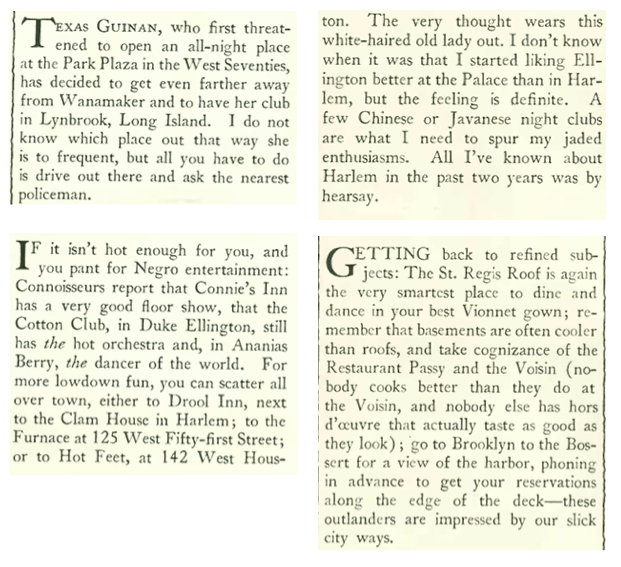
Lois Long was also back, in a way, reviving her “Tables for Two” column for on a one-off on the city’s Broadway hot-spots…

AFTER THE CURTAIN FALLS on Broadway there were plenty of nighttime diversions to keep theater crowds entertained into the wee hours.Clockwise, from top left, singer-dancer Frances Williams worked wonders with Harry Richman and his orchestra at the Club Richman; Bobby Dolan wielded a smart baton at Barney’s; and crooner Morton Downey (pictured with wife and actress Barbara Bennett)… lent his golden tenor to adoring crowds at Club Delmonico. The couple spawned the combative star of 1980s “Trash TV” Morton Downey Jr. (Pinterest)

 *  *  *

From Our Advertisers

We begin with a full page of ads for various Broadway shows…

…and if you wanted to get tickets to one of those shows, here is 1931’s version of StubHub…

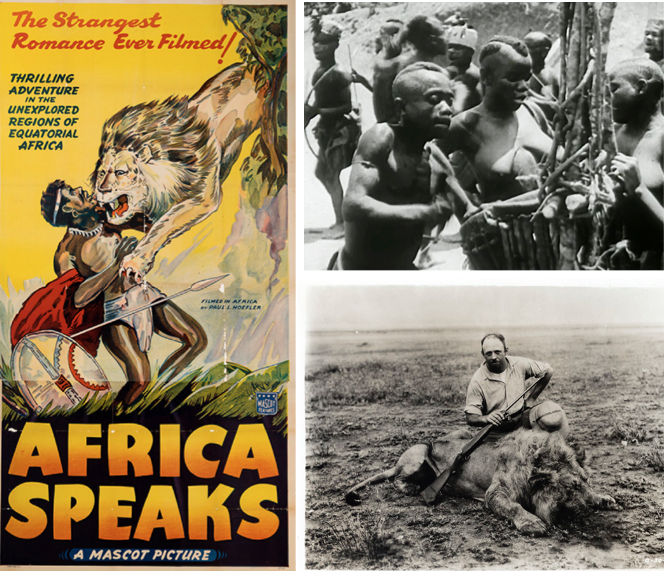
…and we are reminded that it is indeed 1931 with overtly racist ads such as this…

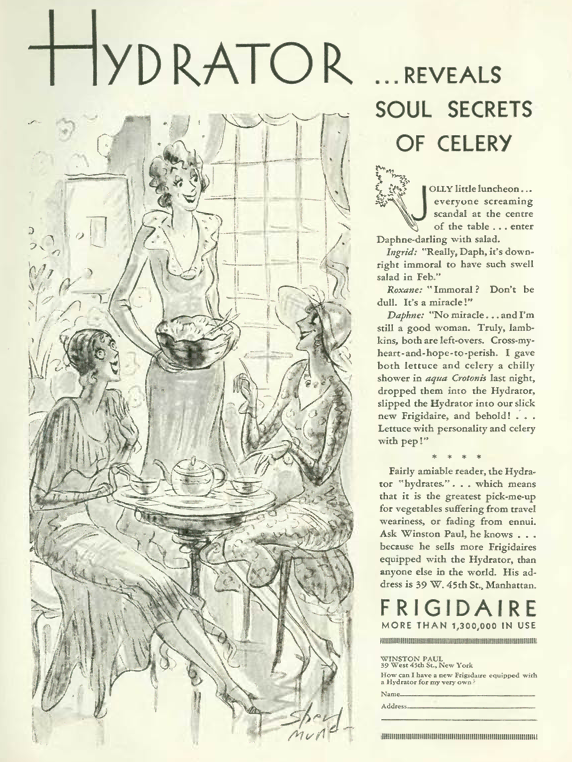
…back home, the help isn’t treated much better. “Cook” can suffer as long as the food remains fresh in the gleaming Frigidaire…

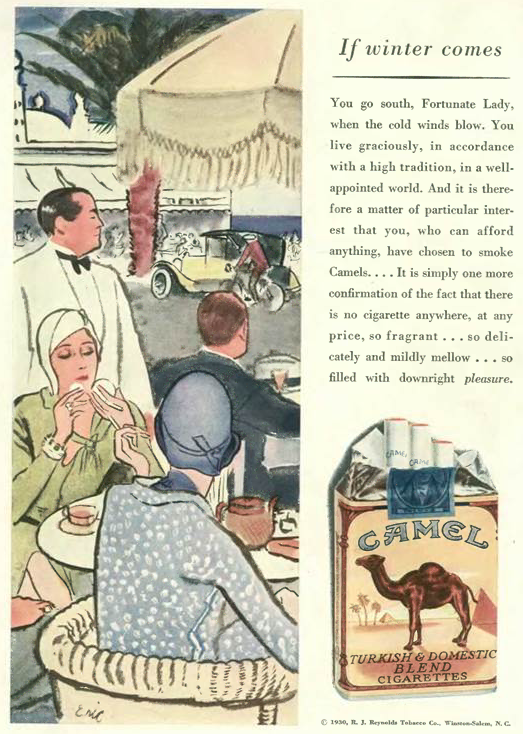
…meanwhile, our stylish Camel smokers (illustrated by Carl “Eric” Erickson) are keeping cool on the slopes…

…and perhaps this is the one and only time a painting by Thomas Gainsborough is compared to a tire…

…on to our illustrators and cartoons, the editors tossed in this old spot illustration by H.O. Hofman to fill space on the events page…

…an then we have this spot (sorry, I can’t identify the artist) that imagines disastrous consequences for the Empire State Building’s “mooring mast” (which was never used as such)…

…and Ralph Barton returned to lend his artistry to the theater review section…

…for our cartoons, we begin with Sewell Johnson’s lone contribution to The New Yorker

Carl Rose was at the movies…

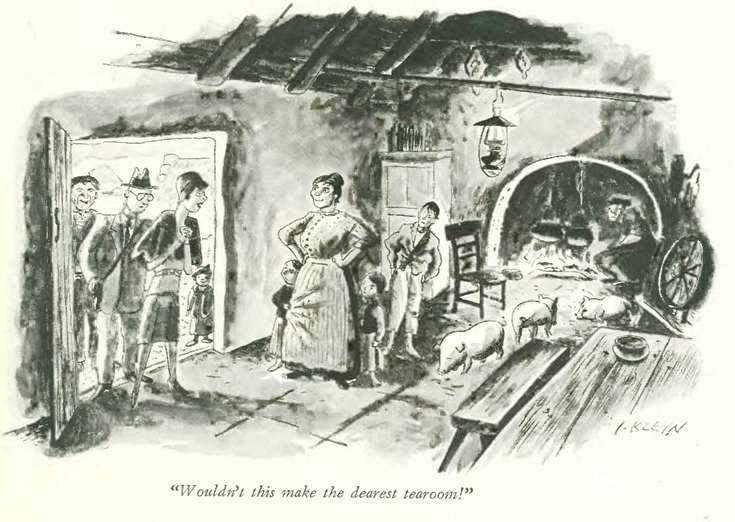
Isadore Klein warmed things up in this parlor scene…

Alan Dunn justified the existence of thriller author Edgar Wallace

...John Reehill gave us a look at an unlikely radio act (however, from 1936 to 1956 ventriloquist Edgar Bergen and his dummy, Charlie McCarthy, would be hugely popular radio stars)…

Rea Irvin paid a visit to the diner in this full-page cartoon…

…and another full-page cartoon from Peter Arno, who looked in on an intimate moment…

Next Time: The Wickersham Sham…

Rise of the Gangster Film

During the early years of the Depression and before censorship guidelines were imposed by the Hays Code, Hollywood cranked out a slew of “Pre-Code” films filled with sex and violence, including 1931’s Little Caesar, the first “talkie” gangster film that defined the genre for decades to come.

Jan. 17, 1931 cover by Peter Arno.

The High Place

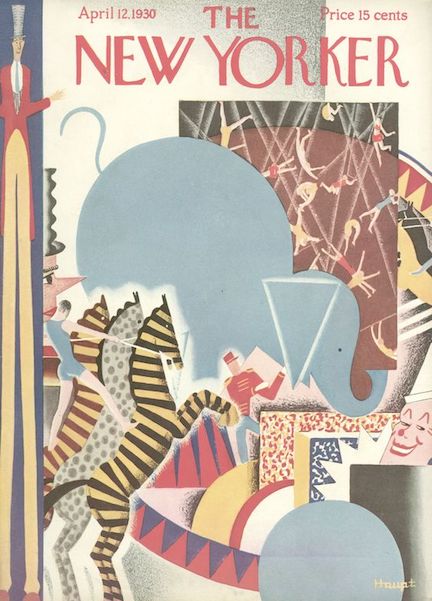
For this installment we look at two issues, Nov. 15 and 22, both featuring covers by Theodore Haupt that celebrated two autumn rituals: football and Thanksgiving.

Let’s begin with the Nov. 22 issue, which climbed to the highest place in Manhattan — no, not the Chrysler Building, but the nearby Empire State Building — with E.B. White admiring the commanding view:

Before the Empire State Building could go up, the old Waldorf-Astoria hotel had to come down. As White observed, the old hotel was built so soundly that it was too costly to deconstruct and salvage. Most of it ended up on the bottom of the ocean.

DOWN IN DAVY JONES’ LOCKER lie the remains of the old Waldorf-Astoria Hotel, which stood for just 36 years before it was razed to make room for the Empire State Building. At right, one of the hotel’s lobbies, and the Grand Ballroom. (nyc-architecture.com/Pinterest)
A LOT OF HOT AIR…Top images: The fabled “mooring mast,” described by E.B. White in his New Yorker brief, as imagined in composite images (old-time Photoshop). In reality, the morning mast never worked; bottom right, a cutaway view of the mast featured in Popular Mechanics; bottom left, New York Times photo from March 22, 1931, announcing the completion of the Empire State Building, just 17 months after the Waldorf-Astoria began coming down. (Keith de Lellis Gallery, rarehistoricalphotos.com/Google Books/The New York Times)
SURVEYING THEIR KINGDOM…Most visitors to the Empire State Building can only go as high as the 86th floor observation deck. However, if you are a VIP like Serena Williams or Taylor Swift, you can get your picture snapped on the 103rd. (Associated Press/Empire State Building/Evan Bindelglass, CBSNewYork)

*  *  *

Sore Winner

Sinclair Lewis famously declined the Pulitzer Prize for his 1925 novel Arrowsmith, upset that his 1920 novel Main Street had not previously won the prize. But when the Swedish Academy came calling with a Nobel Prize in Literature in 1930, he happily accepted. According to “The Talk of the Town,” this award also seemed a bit tardy, since Lewis’s small town booster archetype, George F. Babbitt, did not fit the dour days of the Great Depression. But it turned out that the 1922 novel Babbitt was ultimately what swayed the Nobel jury:

BOOST FROM A BOOSTER…George F. Babbitt helped make Sinclair Lewis famous, and landed him a Nobel. (NYT, NOVEMBER 6, 1930)

 *  *  *

Not So Sweet

Those of a certain age might remember Helen Hayes as a sweet old lady who appeared on a number of TV shows in the 1970s and 80s, or as the mother in real life of James MacArthur, Disney teen star and later the portrayer of Danny “Book ’em Danno” Williams on the original Hawaii 5-0 TV series. Hayes was married to playwright Charles MacArthur, and “The Talk of the Town” takes it from there…

CREATIVE TYPES…The engaged couple Charles MacArthur and Helen Hayes posed for photographer Edward Steichen for this Jan. 1, 1929 image featured in Vanity Fair magazine. (Condé Nast)

 *  *  *

Ain’t It Grand

Grand Hotel opened at the National Theatre on Nov. 13, 1930 to strong reviews, including the one below by Robert Benchley that he filed for The New Yorker. The play, adapted from the 1929 novel Menschen im Hotel by Austrian writer Vicki Baum, would prove to be a smash on Broadway and again on the silver screen in a star-studded 1932 film featuring Greta Garbo, John Barrymore, and Joan Crawford.

THE STARS ALIGN…Left, promotional photograph of the original Broadway production of Grand Hotel. At right, Eugenie Leontovich portrayed fading Russian ballerina Grusinskaya in the play. The role would go to Greta Garbo in the 1932 film adaptation. (Theatre Magazine, February 1931/Wikipedia)

…and while we are on the subject of Broadway, the theater review section also featured this Al Frueh illustration promoting a noted production of Twelfth Night at the Maxine Elliott…

Program for the production featuring Jane Cowl. (Playbill)

 *  *  *

There were also big doings at the Met, where Spanish lyric soprano Lucrezia Bori (1887-1960) wowed audiences with her portrayal of Violetta in La Traviata.

SHE HAD SOME PIPES…right, lyric soprano Lucrezia Bori on the cover of the June 30, 1930 edition of Time magazine. At right, promotional photo of Bori circa 1930. (Time/Wikipedia)

 *  *  *

Bounty of Blessings

Humorist W. E. Farbstein gave readers plenty to be thankful for in this tribute to the Thanksgiving holiday…

 *  *  *

From Our Advertisers

Occasionally advertisements acknowledged the reality of the Great Depression, including this one from The Saturday Evening Post that offered encouraging words to prospective readers…

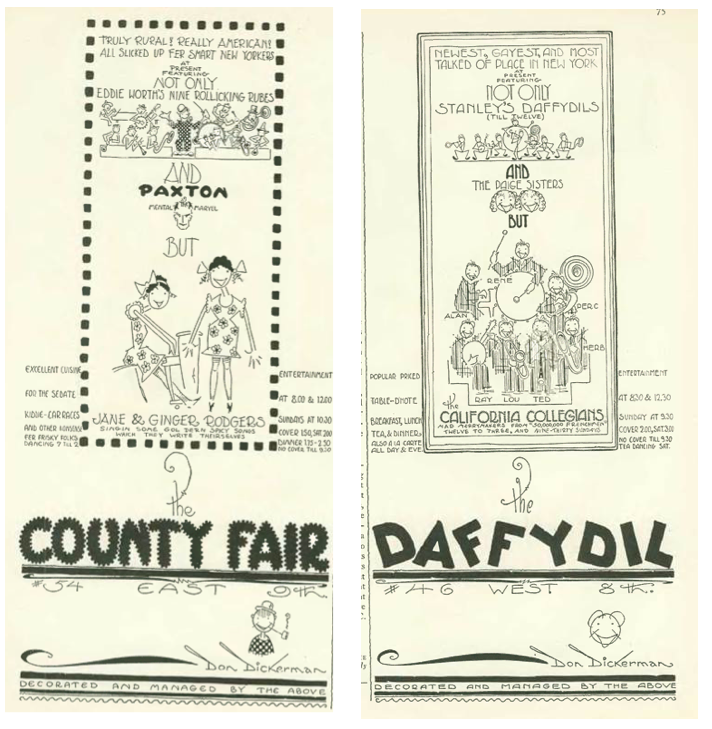
…County Fair, a Greenwich Village country-themed nightclub, offered the diversion of Moffatt and Bowman to take audiences’ minds off of hard times…

…and for all the supposed sophistication of New Yorker readers, there were still plenty of back page ads offering nostrums laced with superstition…

…some of the more colorful, spritely ads from the era were offered up by the producers of Texaco Motor Oil…

…our cartoons are by Gardner Rea

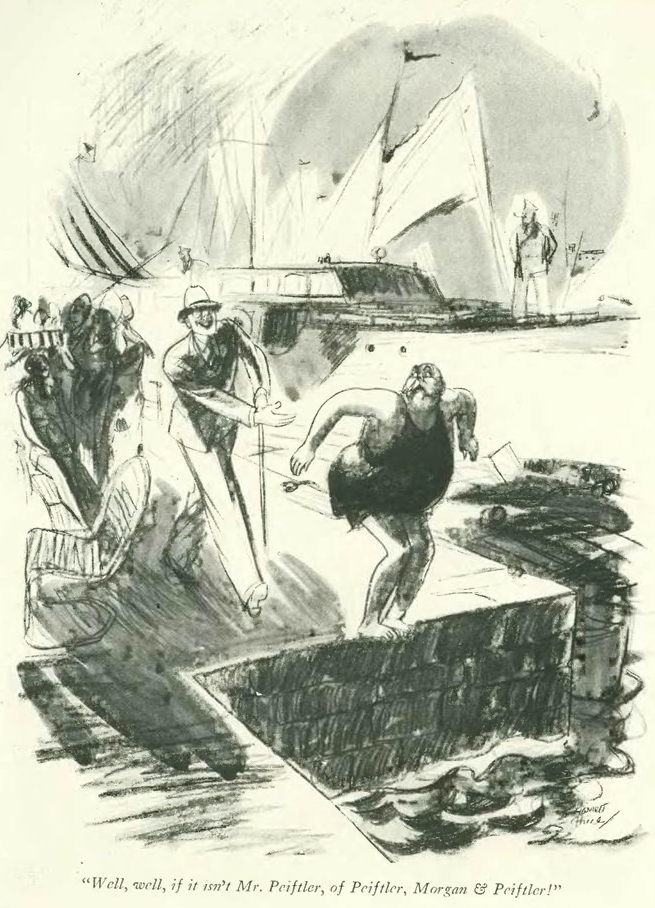
Barbara Shermund

William Crawford Galbraith

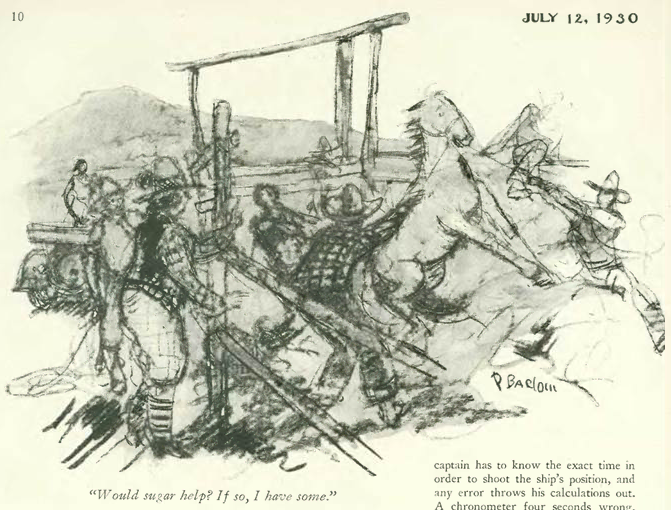
…and Perry Barlow

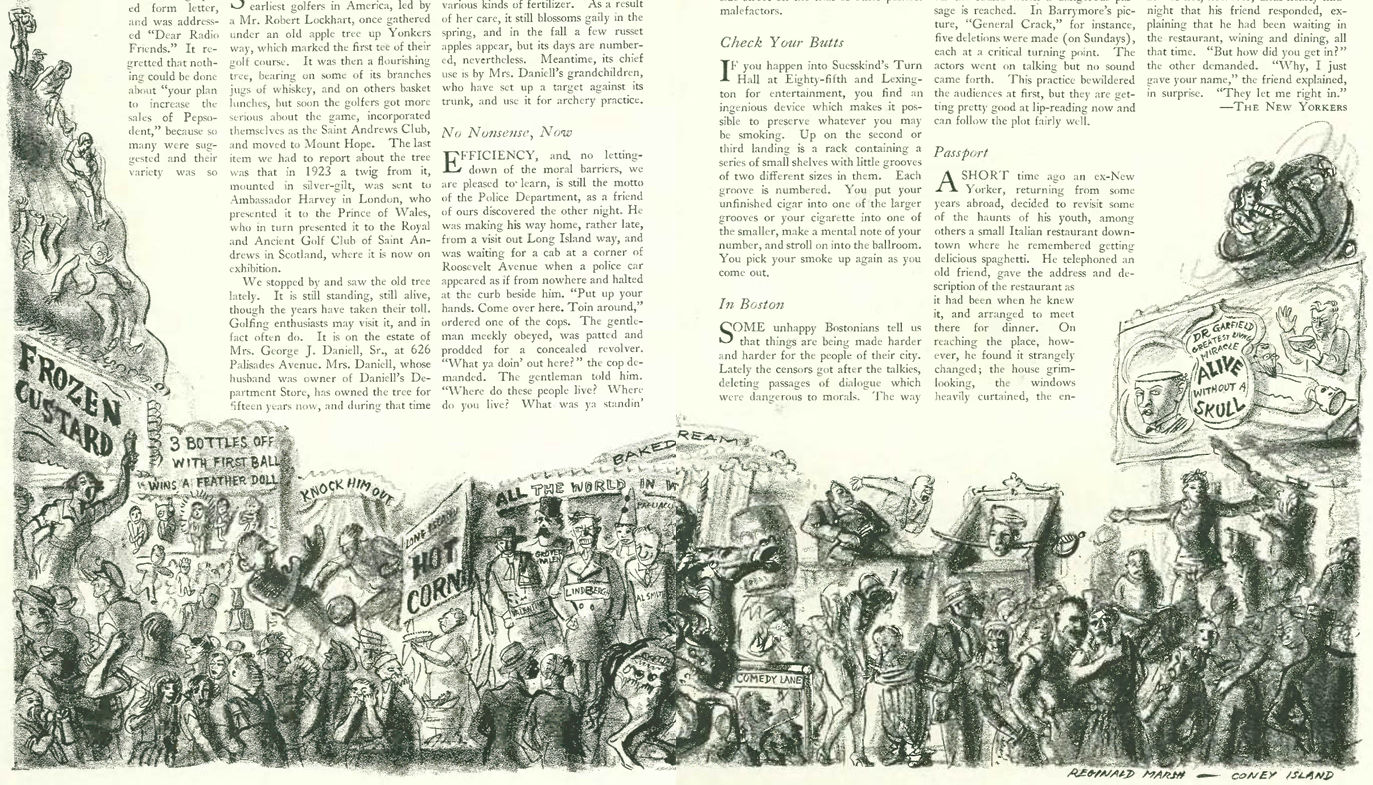
…and for another reminder of reality in the city, this sketch that ran along the bottom of “The Talk of the Town,” by Reginald Marsh

…and now we step back to the Nov. 15 issue, where E.B. White offered a less somber take on the Great Depression…

…White also noted a change on the faces of storefront mannequins…

YIN AND YANG…The worldly pose of a Roaring Twenties mannequin, and a more wholesome look for the leaner times in the 1930s. (Pinterest)

 * * *

Playing Telephone

Long, long before cell phones, telephones were heavy stationary devices that required a certain amount of planning before installation, as E.B. White explains:

On to our Nov. 15 ads, we have this announcement for The Third New Yorker Album…with illustration by Otto Soglow

…here is what the album looked like…

…and a couple of inside pages…

(Etsy)

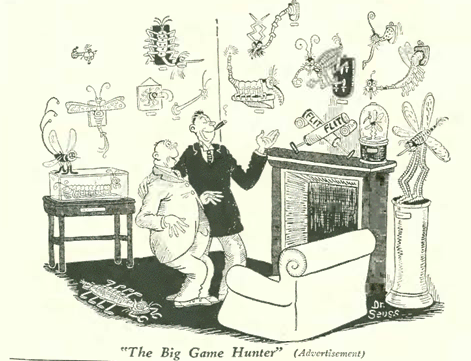
…one of the contributors to the album was Rea Irvin, founding illustrator for The New Yorker, here doing some business with Murad cigarettes…also another Flit insecticide ad by Dr. Seuss

…Christmas ads began appearing in the magazine, including this one for Hanson scales…pity the poor chap (and his wife) who actually thought this might be a suitable present for Christmas, or any occasion for that matter…

…and with Prohibition still in force, advertisers found other uses to promote their products…

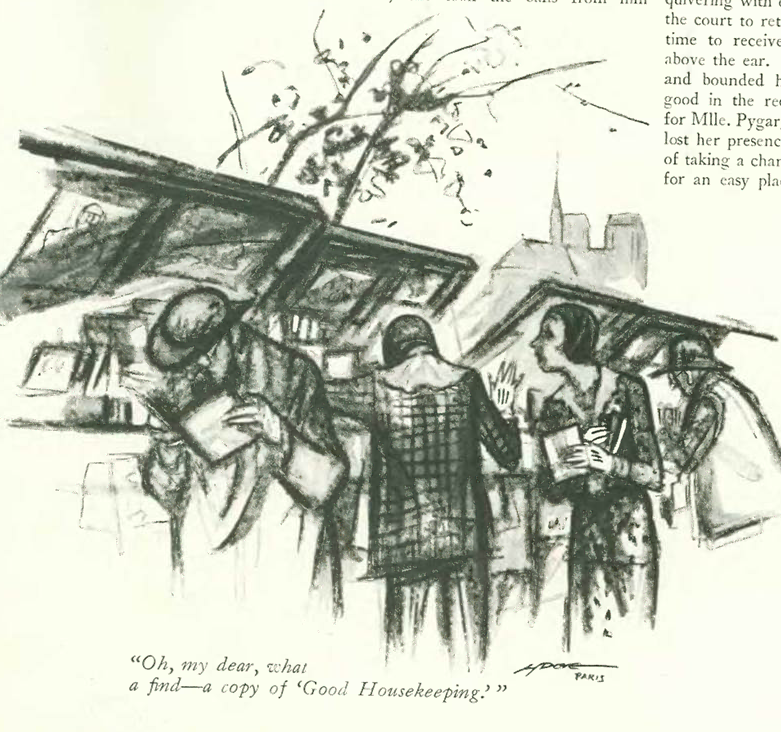
…on to our cartoons, Leonard Dove illustrated a couple who didn’t get away with the ruse…

… Alan Dunn depicted what was considered typical office behavior in the 1930s…

...Peter Arno visited the Harvard Club…

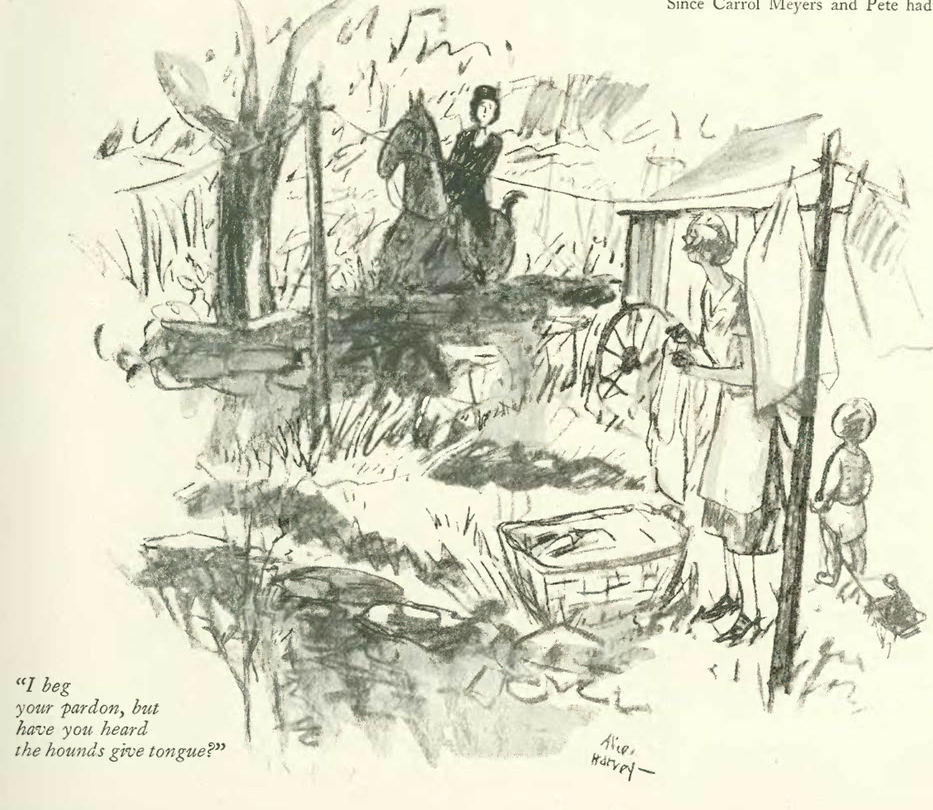
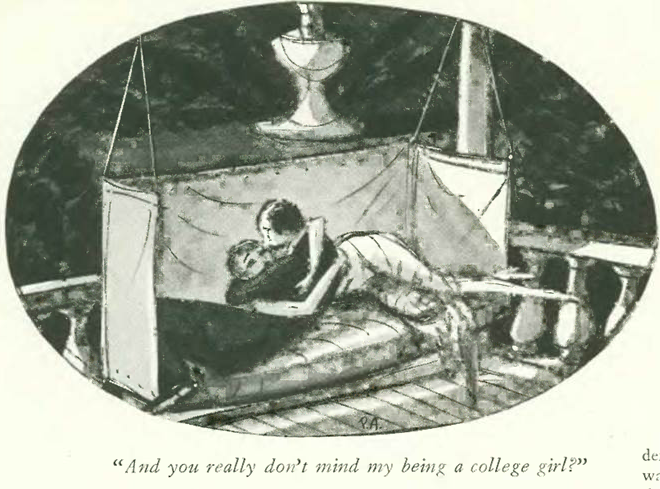
Alice Harvey also explored the college scene…

…some parlor games with Barbara Shermund

……Bruce Bairnsfather, and some existentialist chat at tea time…

…and we close with Isadore Klein, and the world of corporate competition…

…and a Happy Thanksgiving, from the Macy’s Thanksgiving Parade 89 years ago, Nov. 27, 1930…

(CBS/Associated Press)

Next Time: The Future Was a Silly Place…


Risky Business

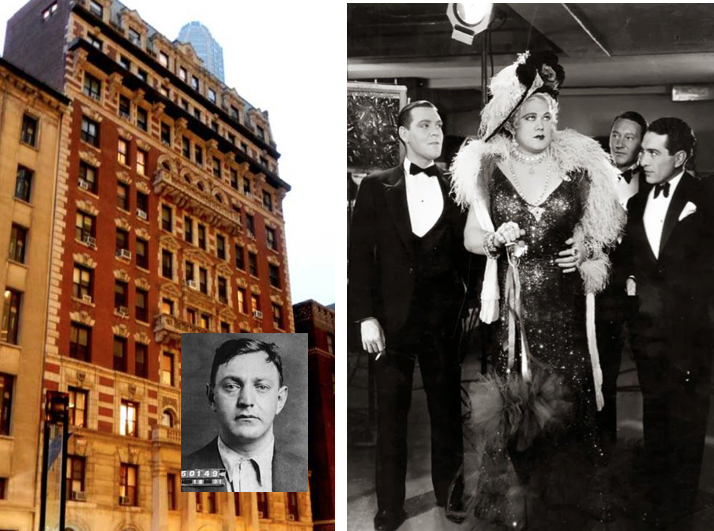
The Irish American gangster JackLegsDiamond was often referred to as the “clay pigeon of the underworld” due to surviving several attempts on his life.

Nov. 1, 1930 cover by Rea Irvin.

In his “Reporter at Large” column, Morris Markey checked up on the fleet-footed bootlegger, adored by the public for his various brushes with the law and escapes from sure death. In his opening paragraph, Markey referred to one of the attempts on Diamond’s life: On October 12, 1930, he survived being shot five times at Manhattan’s Hotel Monticello:

Markey’s column attempted to remove some of the glamour from Diamond’s flamboyant life, a life that would be cut short about a year later in an Albany rooming house…

OUT WITH THE BOYS…Legs Diamond leaves the federal court in New York with his attorney and a couple of cronies on Aug. 8, 1931, after being convicted of owning an unlicensed still and conspiring to violate Prohibition laws. (digitalcommonwealth.org)
BEDFELLOWS…Legs Diamond had a number of mistresses, but the best known was Marion “Kiki” Roberts, who was with Diamond shortly before he was slain. (The Mob Museum/Pinterest)
DEADLY TRIO…Clockwise, from top left, Legs Diamond is comforted by his wife, Alice Kenny Diamond, after being shot three times at a roadhouse near Cairo, NY, on April 27, 1931. His enemies finally succeeded in killing him on Dec. 18, 1931, shooting him three times in the back of the head in an Albany rooming house. Alice would be shot and killed less than two years later, possibly by Diamond’s enemies to keep her quiet. And sadly, The New Yorker’s “Reporter at Large” columnist Morris Markey would also meet a violent end, dying of a gunshot wound to the head in 1950. Whether it was by his hand or another’s, it was never determined. (Albany Archives/NY Times)

An afternote: Enemies would finally catch up to Legs Diamond and kill him on Dec. 18, 1931. Diamond’s wife, Alice Kenny Diamond, would be shot and killed less than two years later. Diamond’s mistress and former Ziegfeld Follies performer Marion “Kiki” Roberts would return to the stage and cash in on her notoriety. In 1937 it was reported she was the big draw in a touring “Crazy Quilt” burlesque revue. And according to the writer William Kennedy, who wrote about Diamond in his 1975 novel Legs, the last record of Kiki Roberts was in Boston in the 1940s, where “she was still appearing as ‘Jack (Legs) Diamond’s Lovely Light o’ Love.’ ”

Here is newsreel footage of Diamond’s mistress Marion “Kiki” Roberts, shortly after the gangster’s death. In this brief interview with a Boston reporter (and with her mother at her side) Roberts advises girls to “live good clean lives and obey their parents wishes.” Note how it appears she is reading from cue cards.

 *  *  *

Chitty Chitty Bang Bang

A precursor to the helicopter, the autogyro was considered by many to be the next logical step in aircraft development, and especially in the development of smaller craft that could serve as safe, affordable transportation options for commuters. The New Yorker’s E.B. White, an aviation enthusiast, demonstrated to readers the wonders of this aircraft:

EASY AS PIE…A Cierva Autogiro C30 takes flight circa 1933. (findmypast.co.uk)

 *  *  *

Baker’s Big Show

Nineteen-year-old American-born French entertainer Josephine Baker became an instant symbol of Jazz Age Paris when she starred in La Revue Nègre in October 1925. Her erotic dance routines wowed Paris audiences, and she quickly moved on to the famed Folies Bergère. In 1930 she opened a new show at the Casino de Paris that also featured her pet cheetah, Chiquita. The New Yorker’s Janet Flanner was there to take it all in:

HEAR THE THUNDER…Nineteen-year-old Josephine Baker took Paris by storm when she appeared in La Revue Nègre at the Théâtre des Champs-Élysées in October 1925. (harleminmontmartre.paris/artphotolimited.com)
HEAR ME ROAR…The New Yorker’s Janet Flanner was wowed by Josephine Baker’s newest show at the Casino de Paris that also featured her pet cheetah, Chiquita. (pictorem.com/vam.ac.uk/artphotolimited.com)

 *  *  *

Grim Reminder

Despite the deepening Depression across the country, few mentions of it were made in the pages of The New Yorker. Howard Brubaker, in his “Of All Things” column, offered this not-so-gentle reminder:

 *  *  *

From Our Advertisers

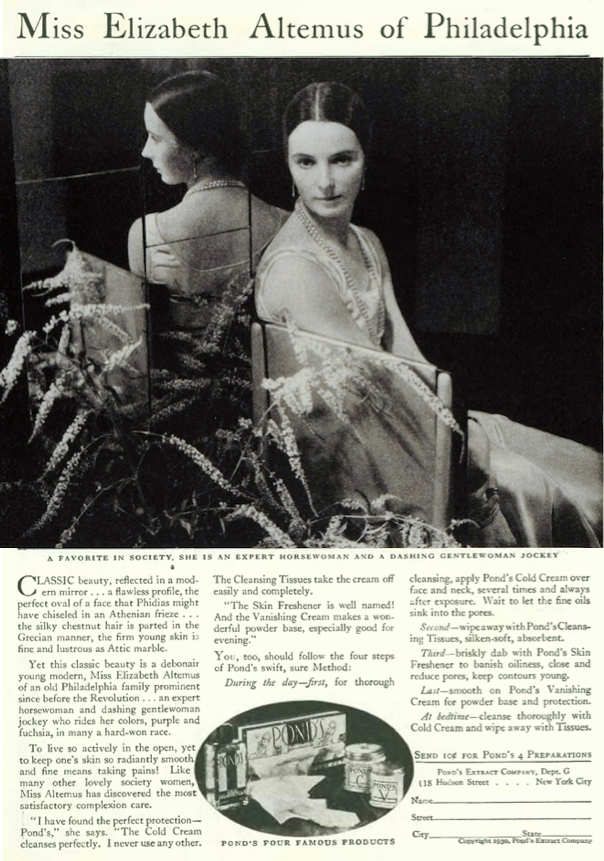
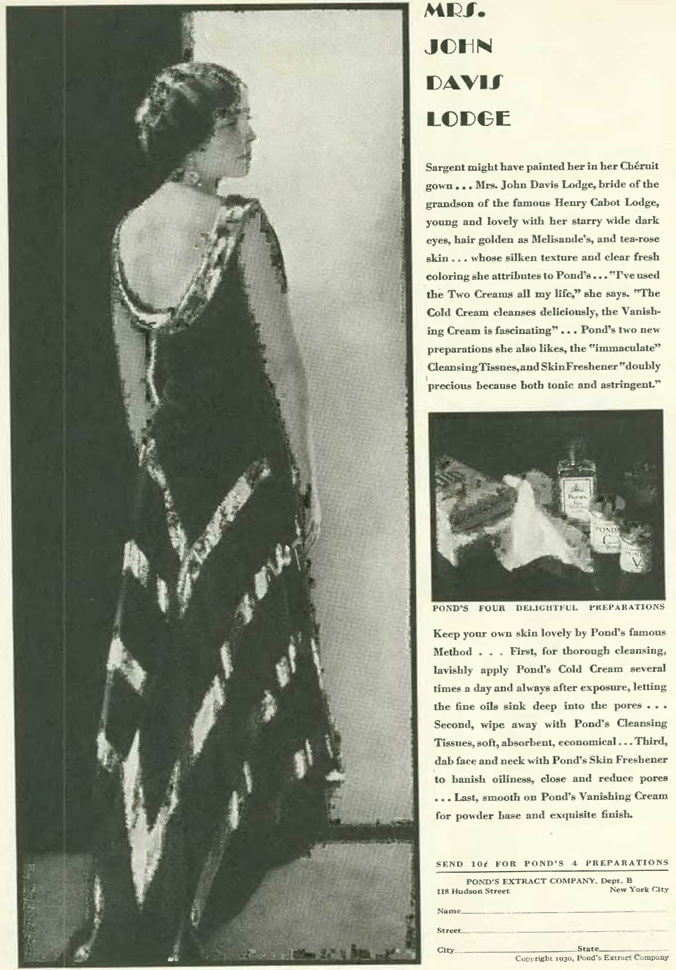
We feature Gloria Morgan Vanderbilt, a Swiss-born American socialite shilling for Pond’s cold cream. At the time of this ad she was the mother of six-year-old Gloria Vanderbilt (who would become a famous fashion designer and artist and the mother of CNN’s Anderson Cooper)…

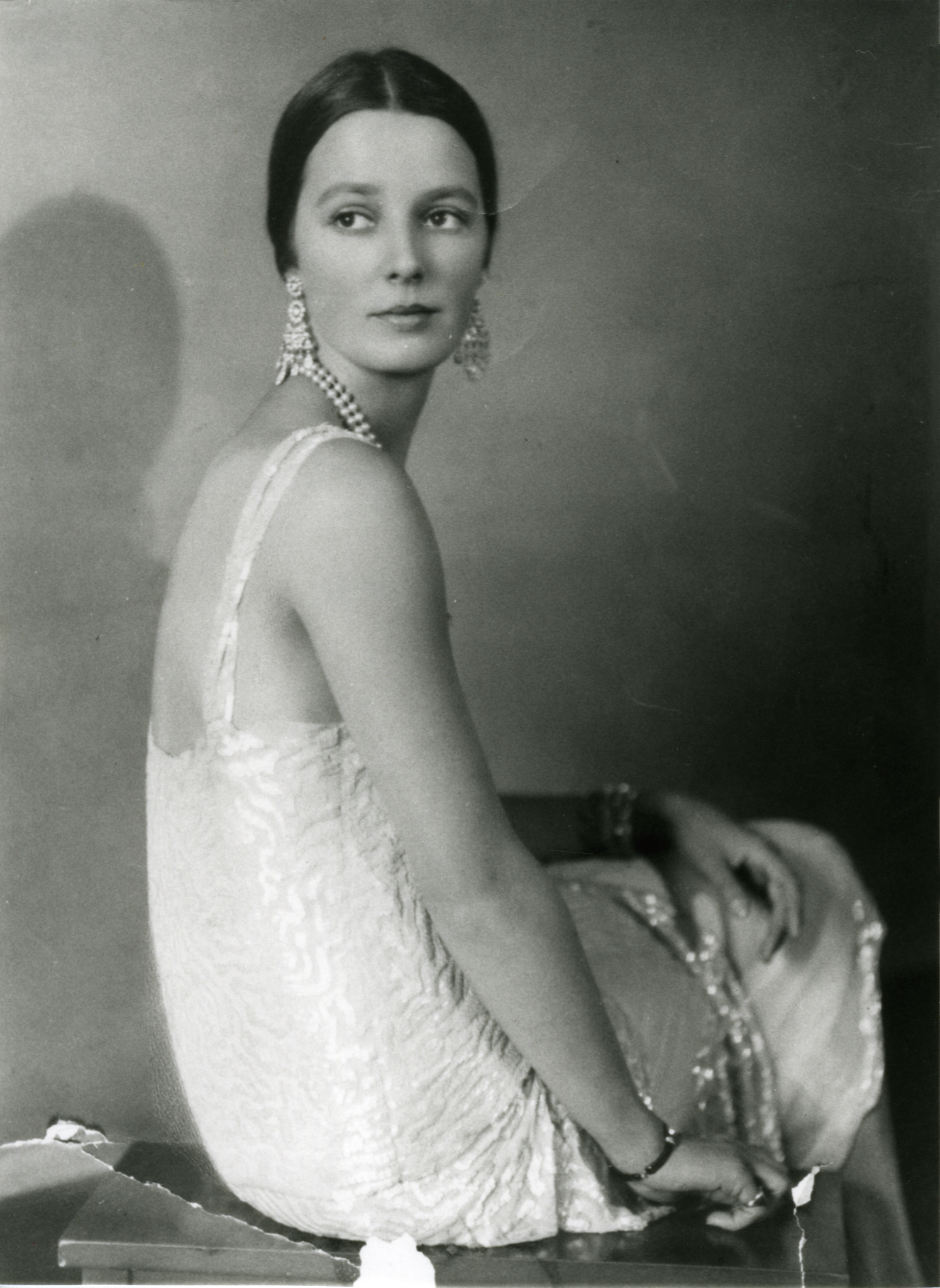
POOR LITTLE RICH GIRLS…Gloria Morgan Vanderbilt and her husband, Reginald Claypoole Vanderbilt with daughter Gloria, circa 1924-25. Reginald died in 1925, and a famous custody battle over little Gloria (who recently died at age 95) would take place in 1934. At right, portrait of Gloria Morgan Vanderbilt by Dorothy Wilding, 1933. (Perkins Library, Duke University)

…the makers of Ybry lipstick apparently did not have the budget to garner a patrician endorsement, so they settled for this illustration by New Yorker cartoonist Barney Tobey

…and we have another lovely color ad from R.J. Reynolds, once again linking cigarettes to athletic prowess…

…on to our cartoons, we mark election season with Carl Rose

Barbara Shermund explored the generation gap…

Peter Arno gathered his sugar daddies for a game of chess…

Kemp Starrett introduced us to an unlikely life of the party…

Alan Dunn examined the influences of popular cinema…

Mary Petty gave us an Ivy League perspective of the Great Depression…

…and Arno again, with a cartoon that was featured along with The New Yorker’s “Wayward Press” column…

Next Time: Body and Soul…


Ghosts of Gotham

Since I am posting this on the night before All Hallow’s Eve, let’s take a quick look back 89 years at Halloween 1930 through the pages of the Oct. 25, 1930 issue of The New Yorker

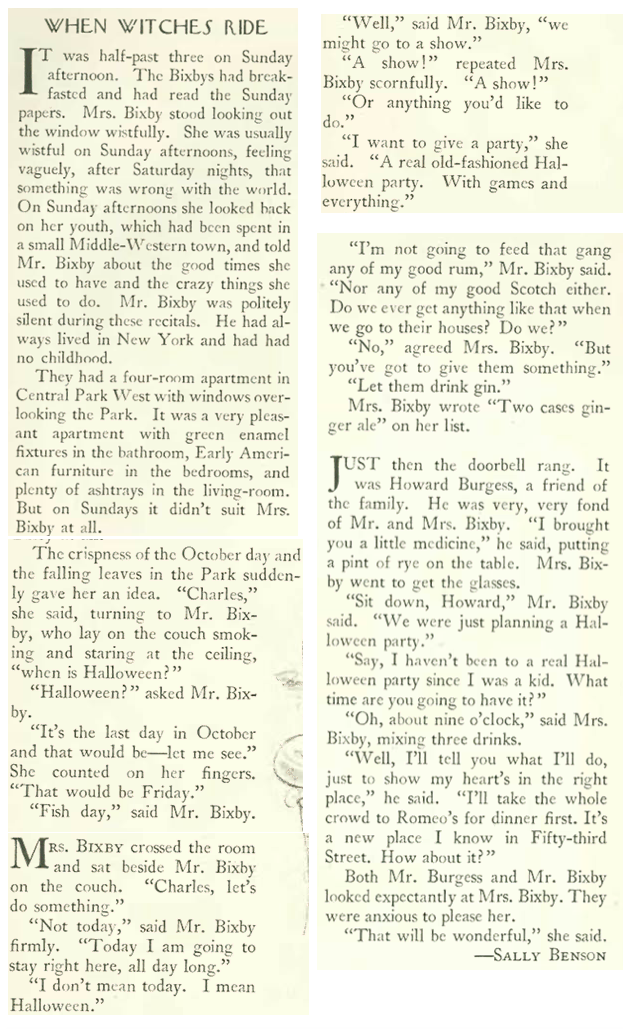
…which featured a short story (excerpted below) by Sally Benson, who would write a series of shorts for The New Yorker in 1941-42 that were later published in her book, Meet Me in St. Louis. Note how Prohibition laws seemed to pose no obstacle to the Bixbys’ party plans:
Benson’s Meet Me in St. Louis would be adapted into a popular 1944 film starring Judy Garland. One of the film’s highlights featured the Halloween hijinks of Tootie and Agnes Smith (Margaret O’Brien and Joan Carroll).

BOO!…Margaret O’Brien and Joan Carroll go trick-or-treating in 1944’s Meet Me in St. Louis. (Comet Over Hollywood)

…Halloween revels were also popular with the college kids…
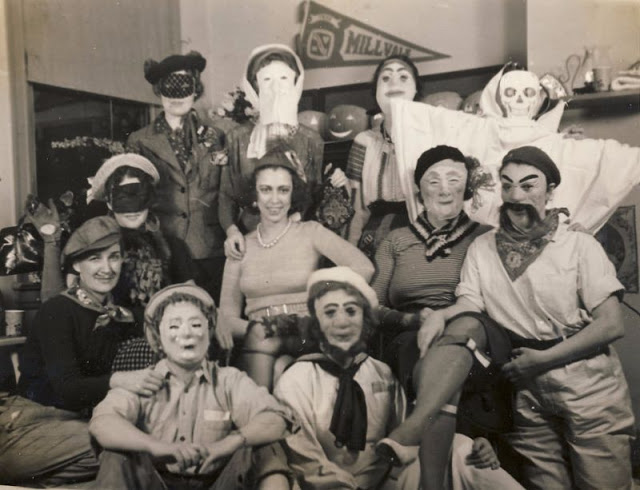
(Vintage Everyday)

…and of course Hollywood got in on the act, each studio issuing pinup-style images of major female stars to newspapers and magazines …
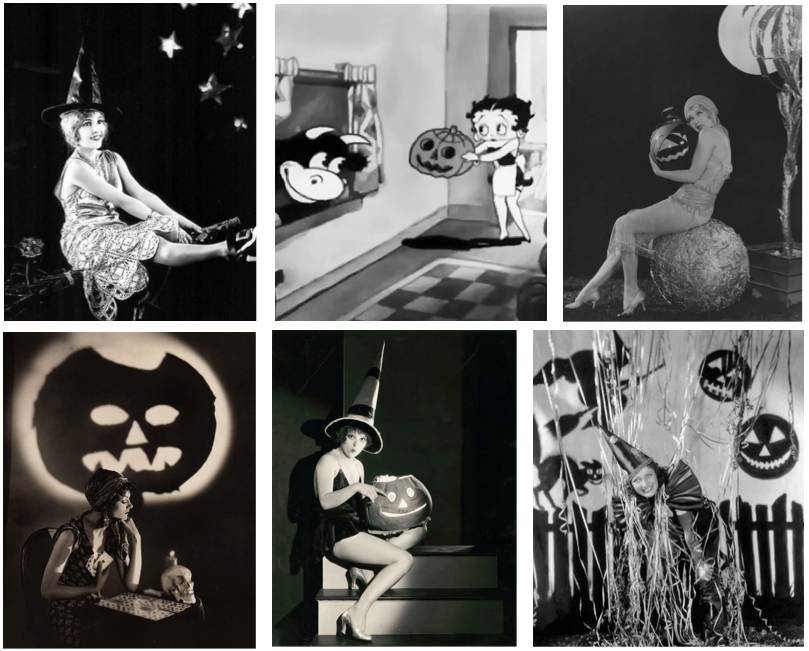
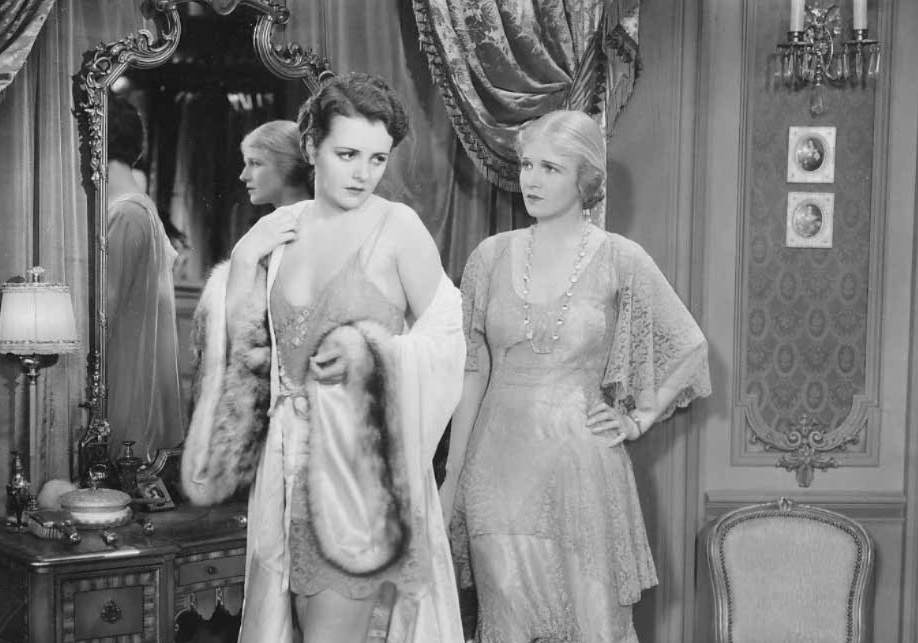
Clockwise, from top left, Bessie Love (ca. 1920s), a still from a 1933 Betty Boop cartoon, Anita Page, Joan Crawford, Clara Bow, and Myrna Loy. (Vintage Everyday/YouTube)

…the pages of the Oct. 25 issue contained other references to the holiday, including these Julian de Miskey spot drawings…

…and there were also ads offering both parties and party treats to those seeking some Halloween fun…

 *  *  *

Not Exactly Whale Watching

On to our issues, the Oct. 15, 1930 edition featured a strange account (in “The Talk of the Town”) of a man who travelled the country with an embalmed whale carcass, which apparently drew large crowds wherever it was displayed.

Oct. 15, 1930 cover by Peter Arno. As I noted in my previous post, it seemed everyone was lighting up in the 1930s.

The account is disgusting on a number of levels (the last line: “People simply love whales”). During my research I learned that these “whale tours” continued into the 1970s.

SAVE THE WHALES…in this case, by pumping the animal with gallons of formaldehyde.

For further reading, author Lydia Pyne offers some history on this strange phenomenon at Not Even Past.

 *  *  *

From Our Advertisers

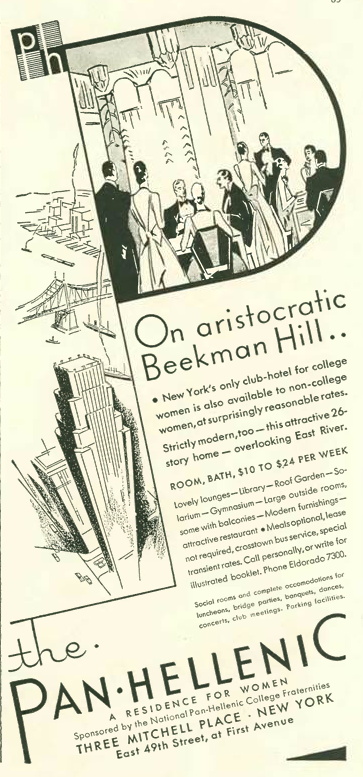
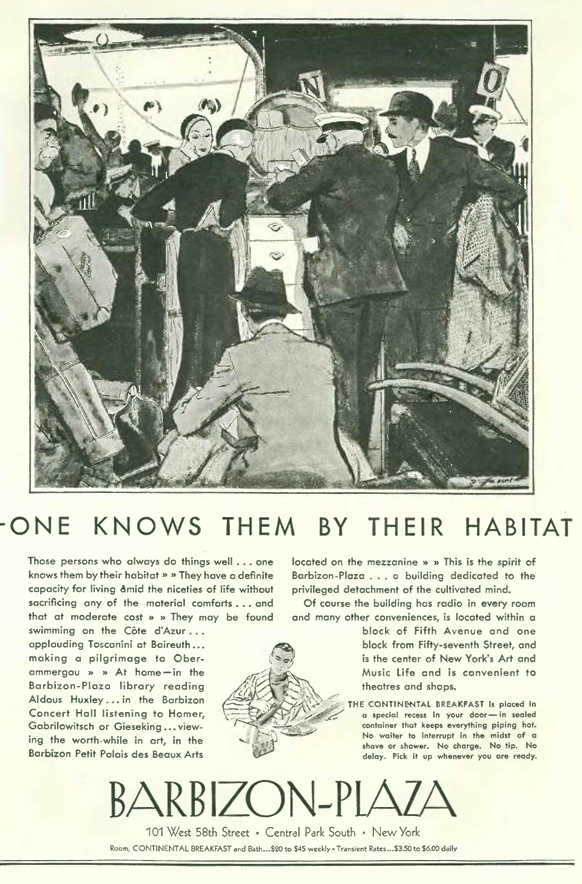
The owners of the new Barbizon-Plaza Hotel at 106 Central Park South tried their best to lure the smart set (especially artists and musicians) to this “habitat” designed especially for them. Unfortunately, artists and musicians were as broke as everyone else, and the property was foreclosed on in 1933…
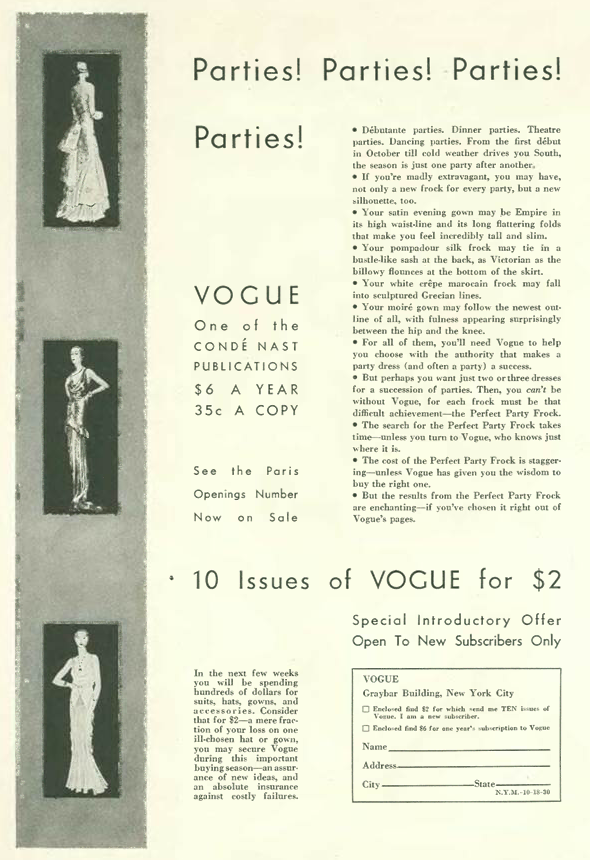
…and we have another appeal to the smart set, this one from the publishers of Vogue magazine (now a sister publication to the New Yorker, as both are now owned by Condé Nast)…
…and one more appeal to fashionable sorts, this time perfume in a bottle shaped like an art deco skyscraper…
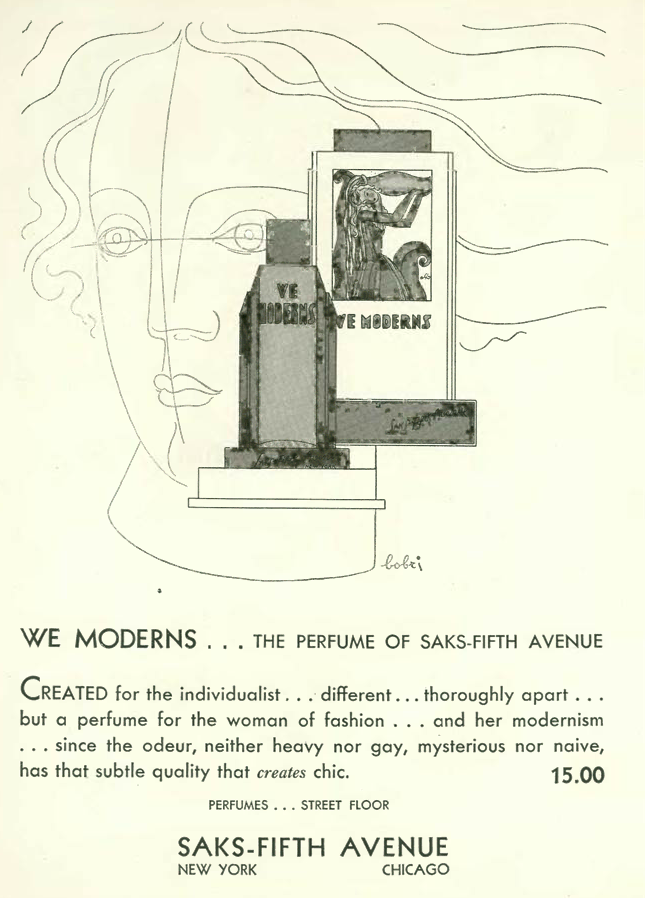
…here is what one version of the bottle looked like in 1928, similar to ad above. According to the blog Cleopatra’s Boudoir, the We Moderns perfume was sold from 1928 to 1936 in bottles made in Czechoslovakia. The bottle below was made from glass, enamel (label), and the early plastic Bakelite (cover and base)…

(Perfume Bottles Auction)

…on to our color ads, I like this one because RCA induced the inventor of wireless radio, Guglielmo Marconi, to endorse their “Radiola”…

…and we have a beautiful illustration by Ellis Wilson for Dodge Boats…

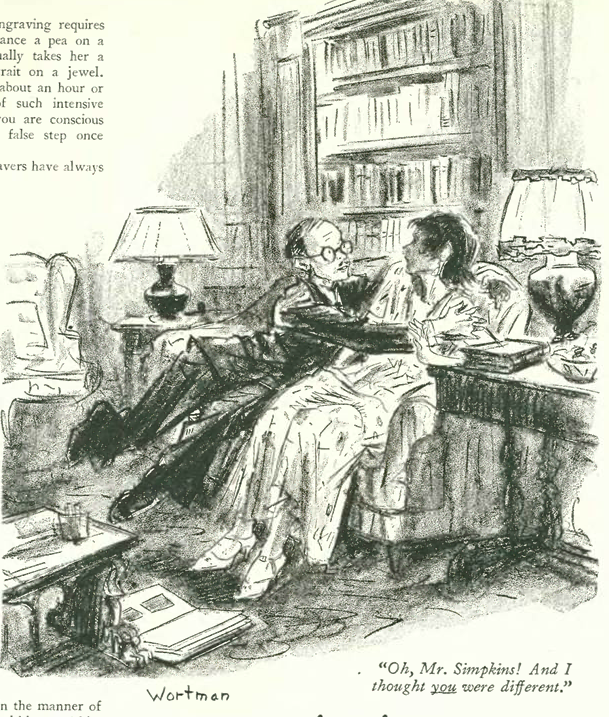
…on to our cartoons, we begin with Denys Wortman

…here’s the art of Rea Irvin on a full page…

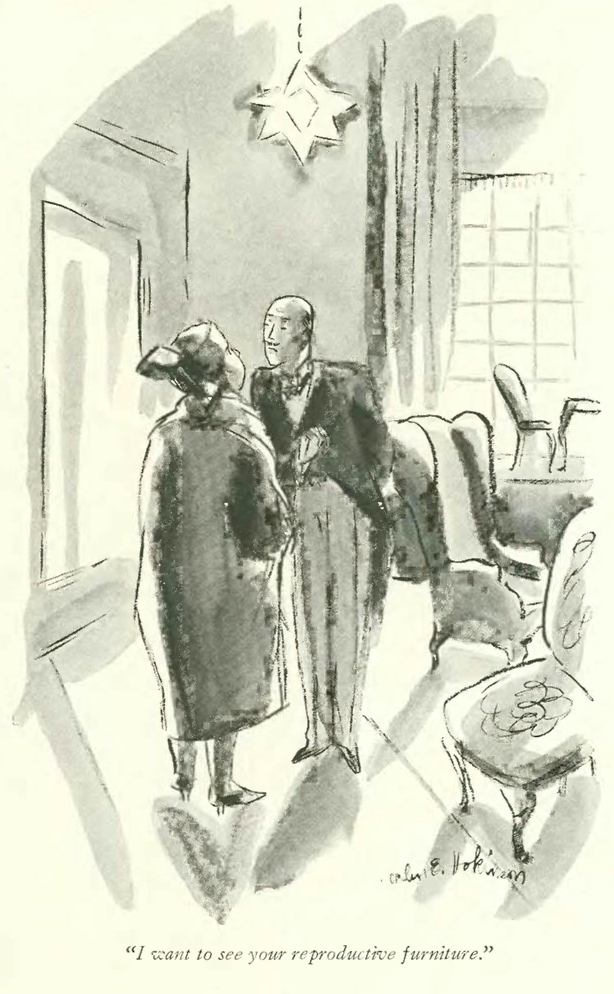
Helen Hokinson kept up the tradition of New Yorkers looking down on those backward Bostonians…

Alan Dunn, illustrating the sunlamp fad of the 20s and 30s…

…and Jack Markow, checking on the progress of the Empire State Building…

On to the Oct. 25 issue, and the Broadway opening of the comedy Girl Crazy…

Oct. 25, 1930 cover by Rea Irvin.

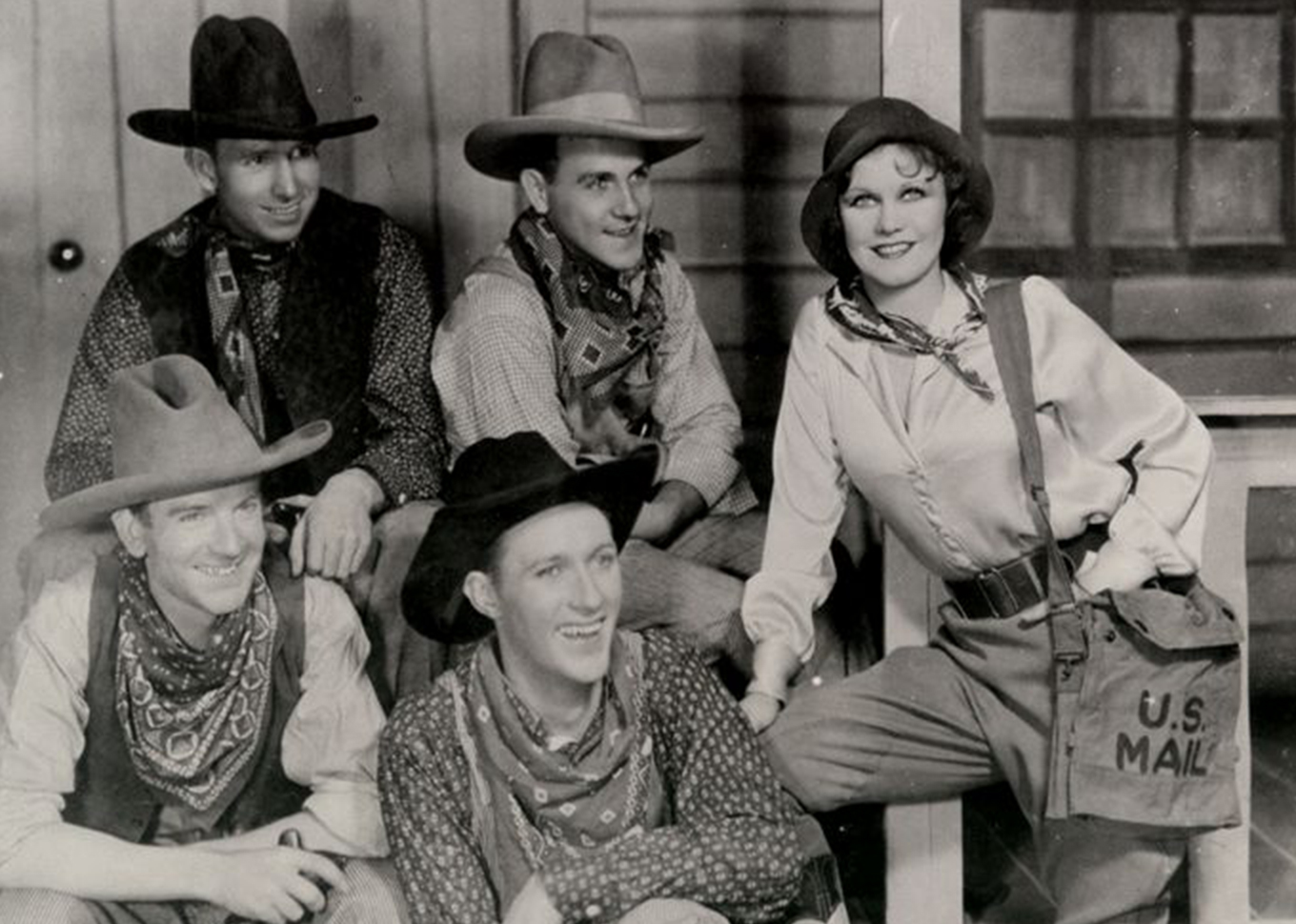
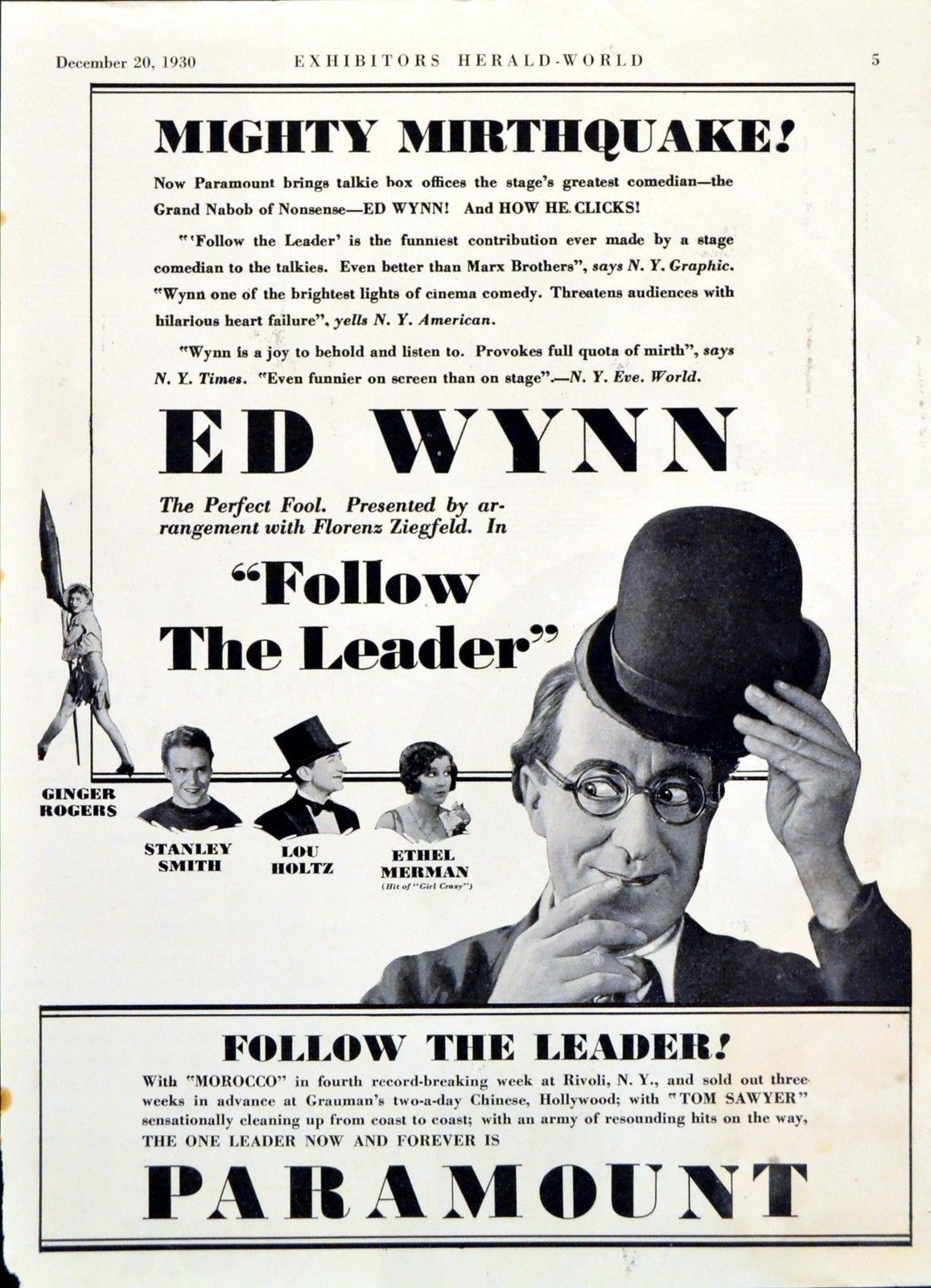
…which featured Ginger Rogers and Ethel Merman introducing the many hits from George Gershwin’s score including “I Got Rhythm” and ‘Embraceable You.” The plot was simple: a young New York playboy is banished by his family to a dude ranch in Arizona to keep him out of trouble…where of course he finds trouble. The orchestra for the Broadway performance included such talents as Benny Goodman, Glenn Miller, Jimmy Dorsey, Jack Teagarden, and Gene Krupa.

THEY SEEM SANE ENOUGH…Above, poster for the Broadway musical Girl Crazy. Below, Ginger Rogers poses with fellow stage actors. (gershwin.com)

 *  *  *

More from Our Advertisers

Ads from the Oct. 25 issue included this recurring one from the promoters of the Empire State Building, marking progress through various historical vignettes…

…the ad accurately depicted the building’s progress, measured against these images below…

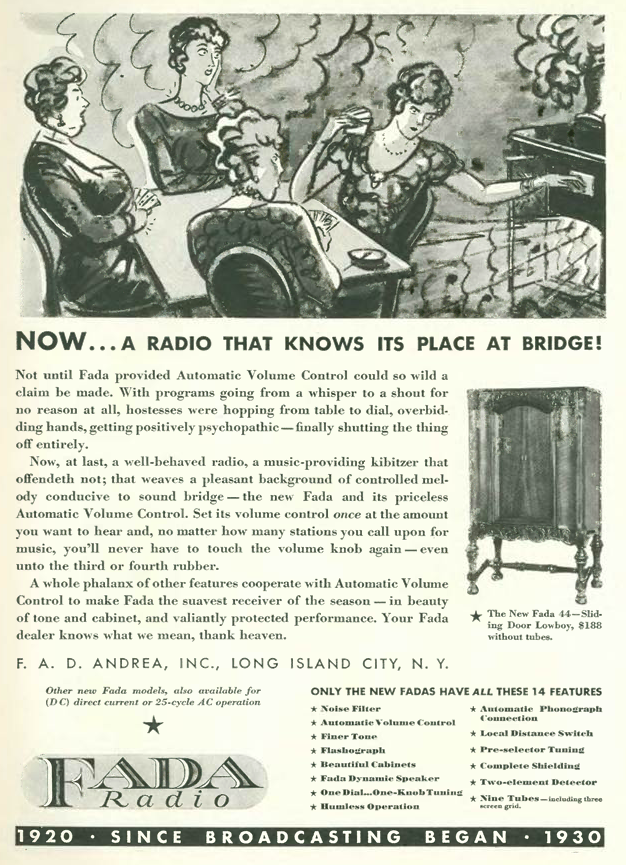
…and we have more radio ads…no endorsement from Marconi here, but the makers of Fada claimed their receiver was far less annoying than their rivals…
…while Atwater Kent touted the convenience of its new “Quick-Vision Dial”…

…as I’ve previously noted, backgammon was all the rage in 1930, so much so that this clothier even advertised a special frock for the game…

…and what would the 1930s be without smoking tied to athletic prowess…
…and remembering friends and family in California in 2019 as they battle wildfires across that great state…

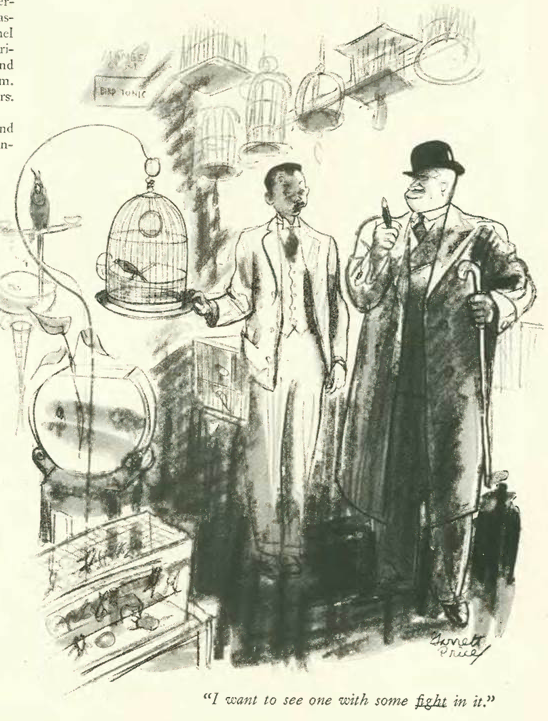
…on to our cartoons, Garrett Price introduced us to a man with a peculiar taste in pet canaries…
Barbara Shermund illustrated the startling views afforded by rail travel…

…and Peter Arno leaves us in a moment of religious ecstasy…

Next Time: Risky Business…
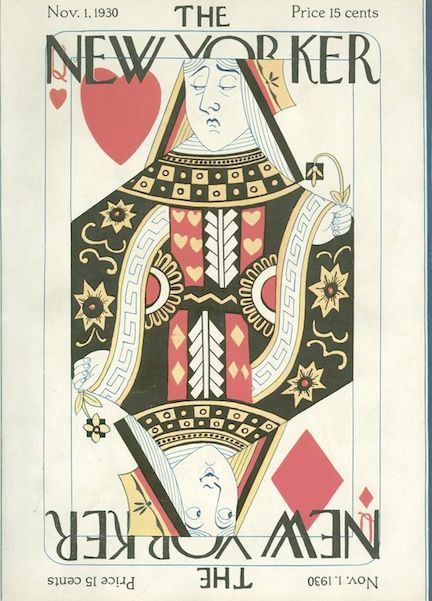
Will It Play In Peoria?

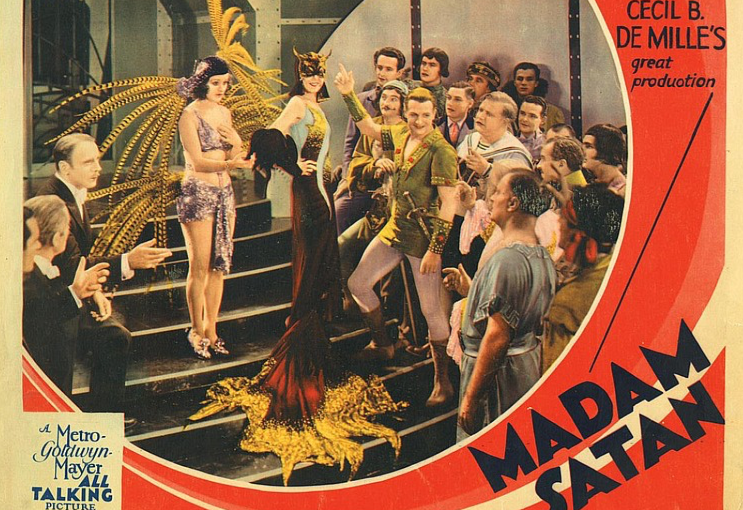
Cecil B. DeMille was known for his epic films (e.g. The Ten Commandments, 1923 and 1956) and cinematic showmanship, but in 1930 he puzzled his audiences with a very weird pre-Code musical, Madam Satan.

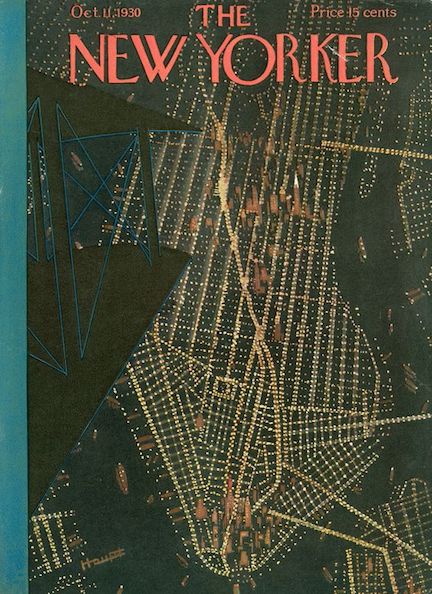
Oct. 11, 1930 cover by Theodore Haupt.

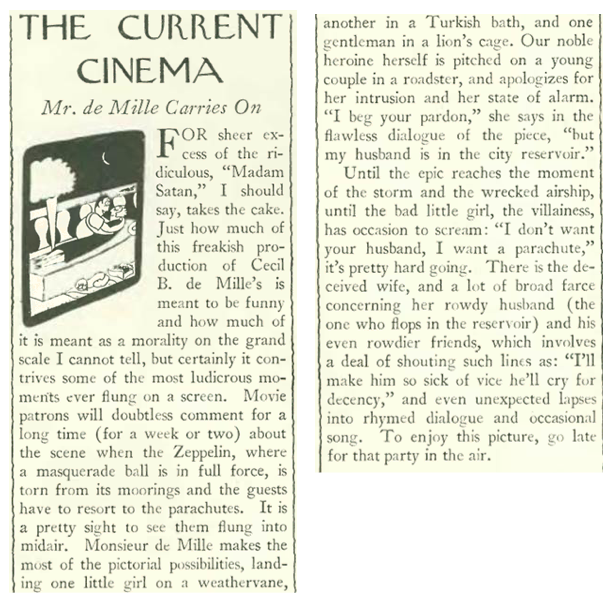
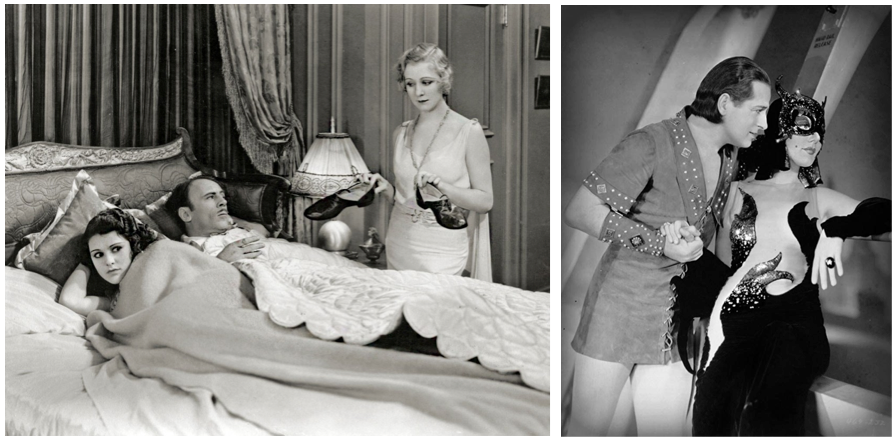
The film centered on a wealthy couple, Angela and Bob Brooks (played by Kay Johnson and Reginald Denny). Bob is unfaithful to his wife (a common pre-Code theme), and she attempts to lure him back by disguising herself as a mysterious devil woman at a masquerade ball held aboard a dirigible. Quite a plot indeed. Here’s what The New Yorker’s John Mosher had to say about it.

(IMDB)

PAJAMA GAMES…Lillian Roth, Roland Young, and Kay Johnson in Madam Satan. At right, Reginald Denny falls for the charms of his wife (Kay Johnson), disguised as a devil woman at a masked ball held aboard a giant dirigible. (IMDB/cecilbdemille.com)
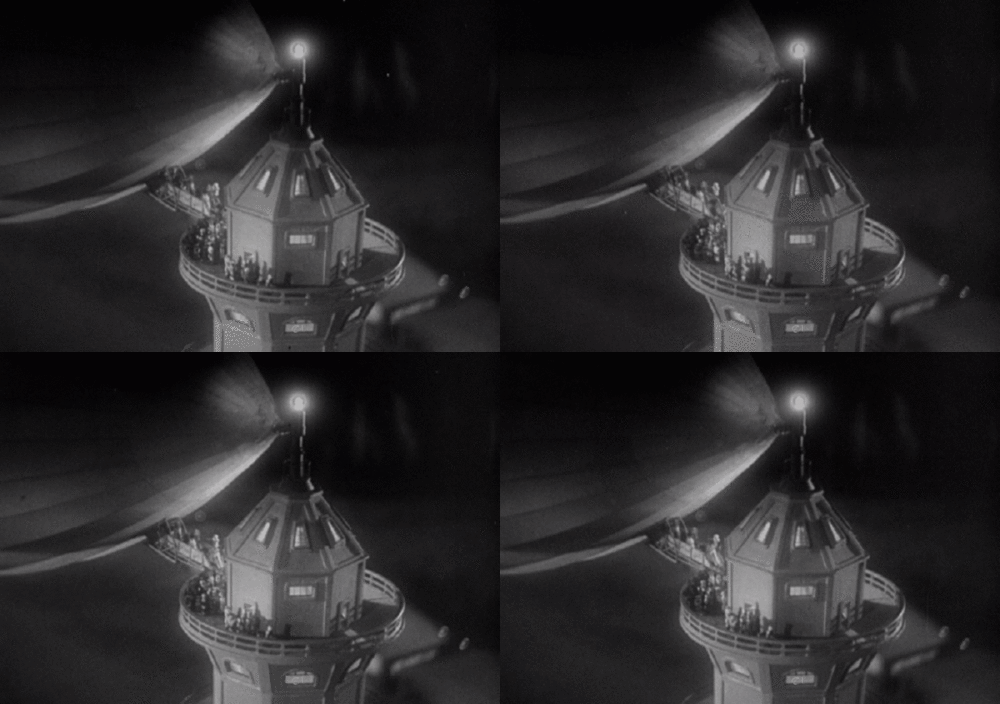
AIRHEADS…Via a giant mooring mast, partygoers board a dirigible for the masquerade ball in Madam Satan. Curiously, developers of the Empire State Building (which was under construction) envisioned a similar use for the mast that would top out their tower. In reality, winds that whipped around high towers would have prevented this type of boarding. (twitter.com)
SOMEONE CALL THE FAA…At right, the lavish masquerade ball aboard a giant dirigible in Madam Satan. At right, the dirigible is damaged by lightning in a scene that foreshadowed the Hindenberg disaster of 1937. (cecilbdemille.com/precode.com)
SEEMS PLAUSIBLE…In a silly ending to a silly film, partygoers float on parachutes away from the damaged dirigible. (twitter.com)

*  *  *

Let Them Eat Cake

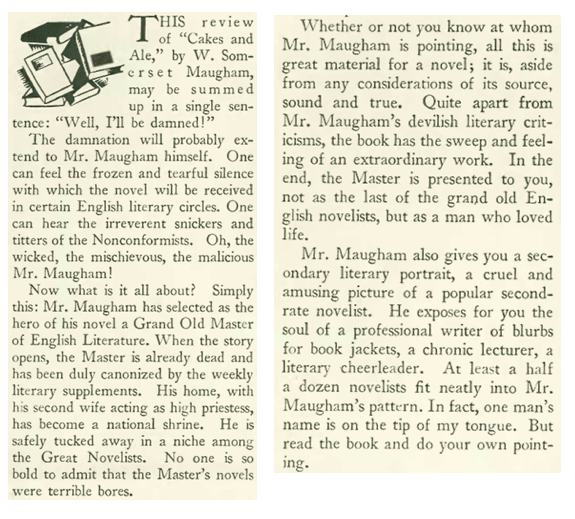
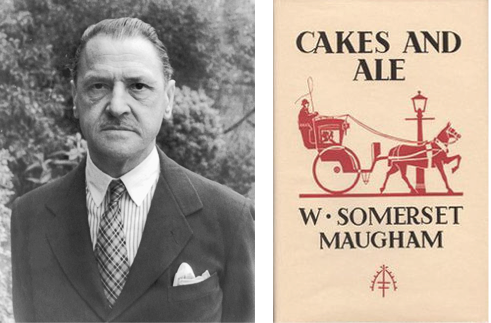
Somerset Maugham regarded his comic novel, Cakes and Ale, to be his favorite. The book took aim at snobs as well as at the legacy of one overrated, late-Victorian writer—a character many believe was based on the recently departed Thomas Hardy (Maugham denied the inspiration). The New Yorker had this to say about Cakes and Ale:

THROW HARDY INTO THE DUSTBIN…Somerset Maugham as photographed by Carl Van Vechten in 1934. (Wikipedia)

 *  *  *

He Meant What He Said

Howard Brubaker, in his “Of All Things” column, found humor in the words of a rising figure in German politics, you know who…

 *  *  *

Throw Him a Softball

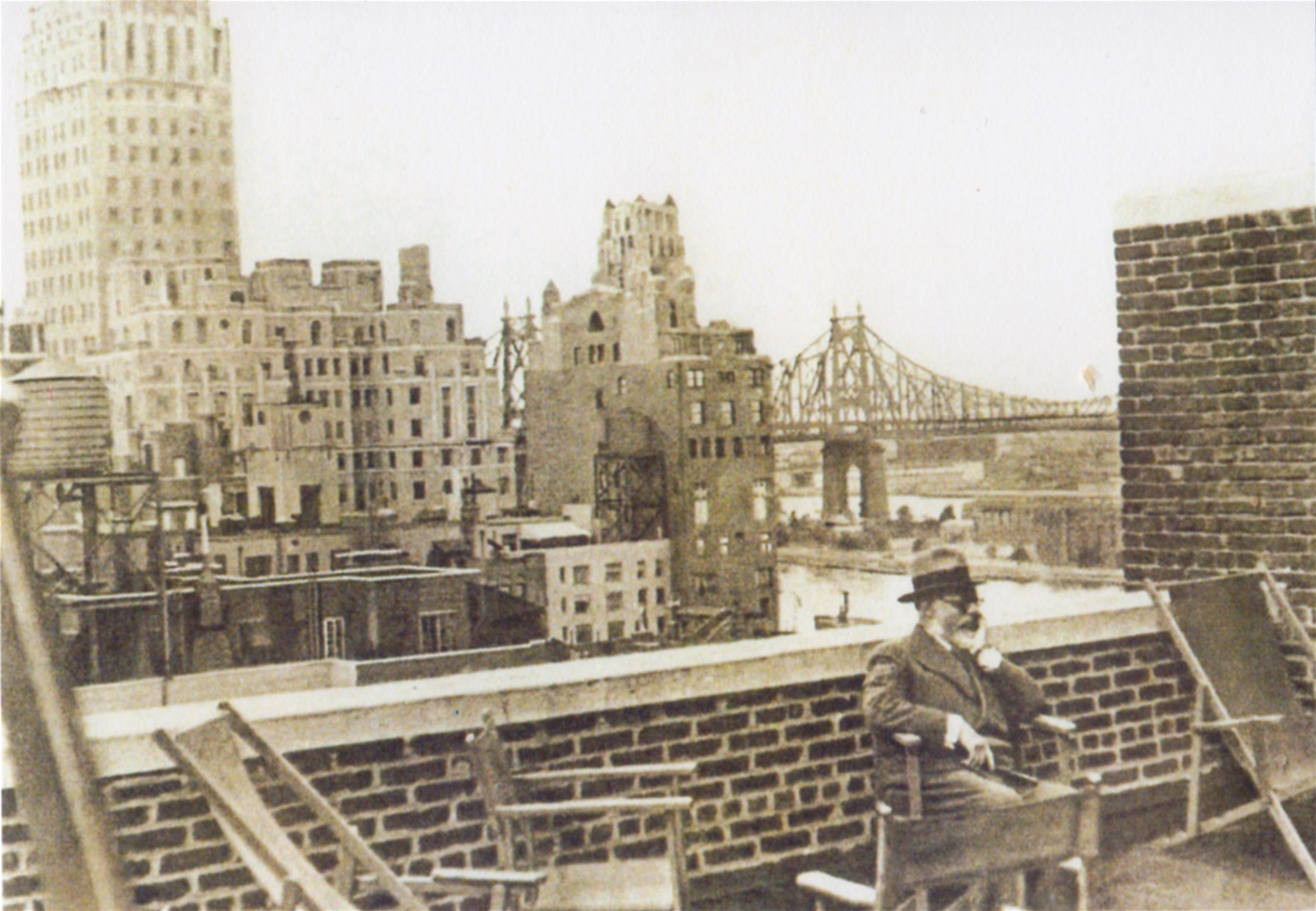
The famed French artist Henri Matisse paid a visit to New York City, and according to this account in “The Talk of Town,” seemed to be seeking some peace of mind…

AN OPPOSITE VIEW…Henri Matisse struck a thoughtful pose atop a Manhattan apartment at 10 Mitchell Place in 1930. The Queensboro Bridge can be glimpsed in the background. (ephemeralnewyork.wordpress.com)

 *  *  *

Still Barred From the Bar

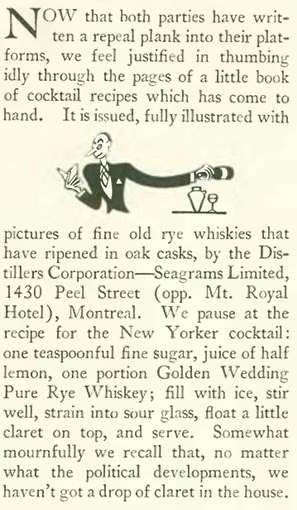
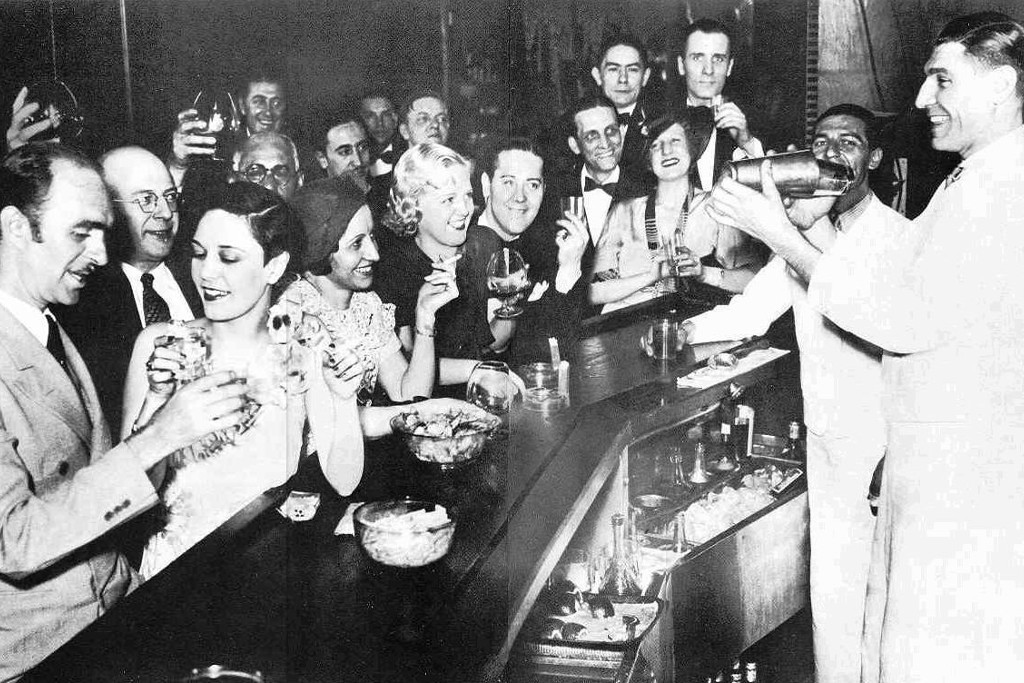
We are still about three years away from the official repeal of the 18th Amendment, but as we know the partying continued in houses and speakeasies across the great city. E.B. White, in his “Notes and Comment,” wistfully recalled the days when good booze was legal:

White did find some cheer in the pro-wet platforms of the two major parties…
A GIMLET IN EVERY POT…The major political parties in 1932’s U.S. presidential race were represented by incumbent Herbert Hoover (Republican) and Franklin D. Roosevelt (Democratic). Both favored repeal of the 18th Amendment. Pictured at the center, a New Yorker cocktail, the object of E.B. White’s longing. (Wikipedia)

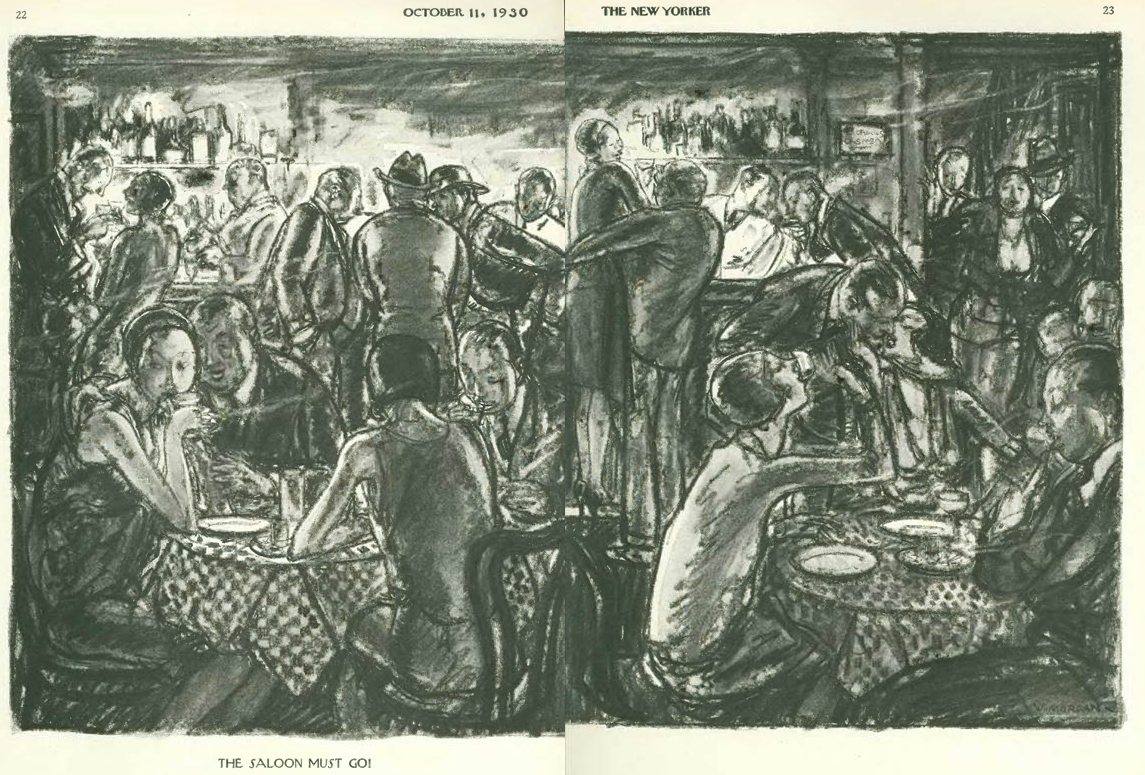
And while we are on the subject, we have this Wallace Morgan illustration of a lively speakeasy with the ironic caption, “The Saloon Must Go!” — referencing an old Anti-Saloon League Slogan.

You didn’t have to go to a speakeasy if you wanted a glass of wine. During Prohibition American winemakers found a lucrative loophole by selling perfectly legal concentrated grape juice (called “wine bricks”) to home brewers and bootleggers alike.

According to an article in the Smithsonian, winemakers marked the wine bricks with warnings that they were “for non-alcoholic consumption only.” However, the package would also bear a note explaining how to dissolve the brick in a gallon of water, and yet another “warning” instructing the buyer not to leave the jug in a cool cupboard for 21 days, lest it turn into wine.

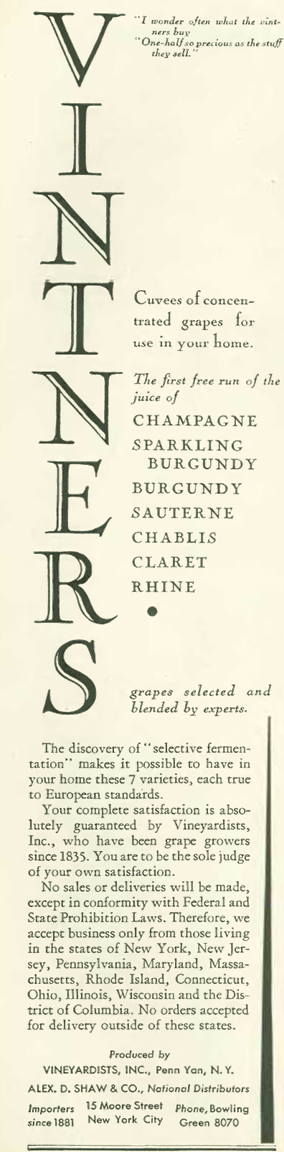
Here’s an ad in the Oct. 11, 1930 New Yorker that not-so-subtly offered a selection of varietals…

Here’s what a wine brick looked like:

A wine brick from San Francisco’s Vino Sano company. The label reads: “Each Brick dissolve in one gallon of water. To prevent fermentation, add 1-10% Benzoate of Soda.” Yeah right. (vinepair.com)

 *  *  *

From Our Advertisers

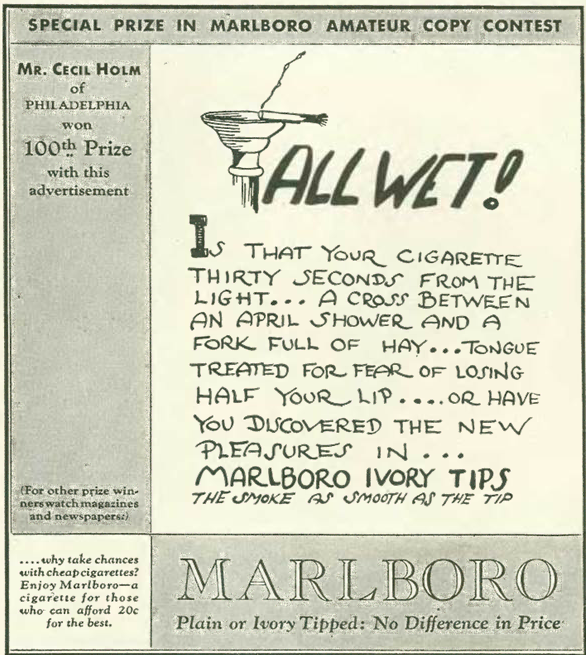
No doubt Prohibition caused more than a few people to take up smoking. Women adopted the habit in droves during the Roaring Twenties, and by the Depression it seemed everyone was lighting up. Advertisers explored various ways to market cigarettes, and long before the Marlboro Man made the scene, that brand pushed its product through a series of dopey handwriting and essay contests,,,

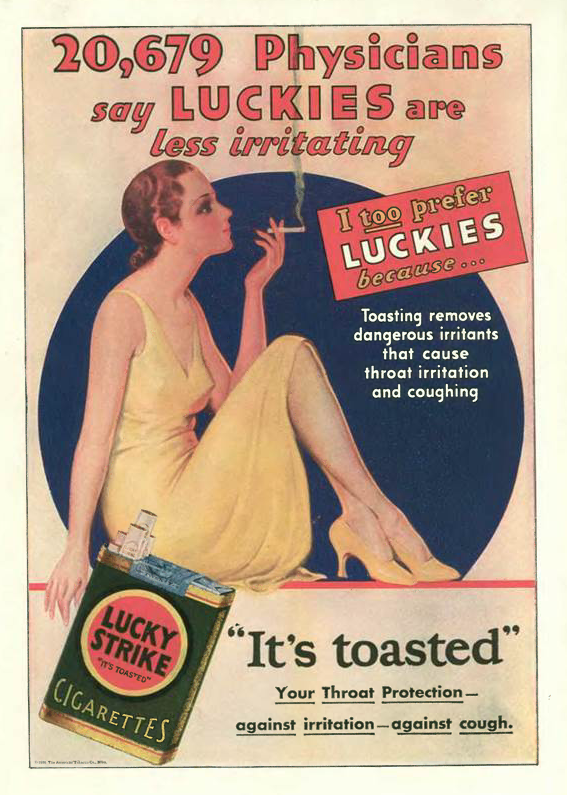
…the makers of Luckies used a combination of sex and bogus health claims to sell their products…
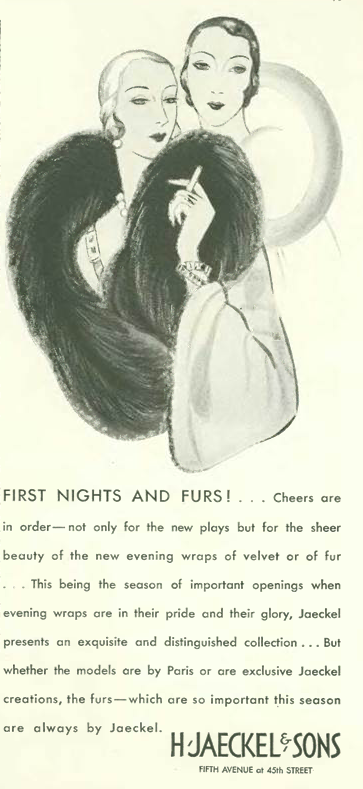
…cigarettes were not confined to ads by tobacco companies; here they are accessories to fine furs…

…even The New Yorker’s spot illustrations (this by Frank McIntosh) featured smokers…

…as did cartoons, such as this one by Barbara Shermund in the Oct. 4 issue…

…and we have one more ad, this one from Chrysler, which acknowledged the new world of the Great Depression, but only through use of careful euphemisms (The New Yorker editorial side practiced much of the same)…

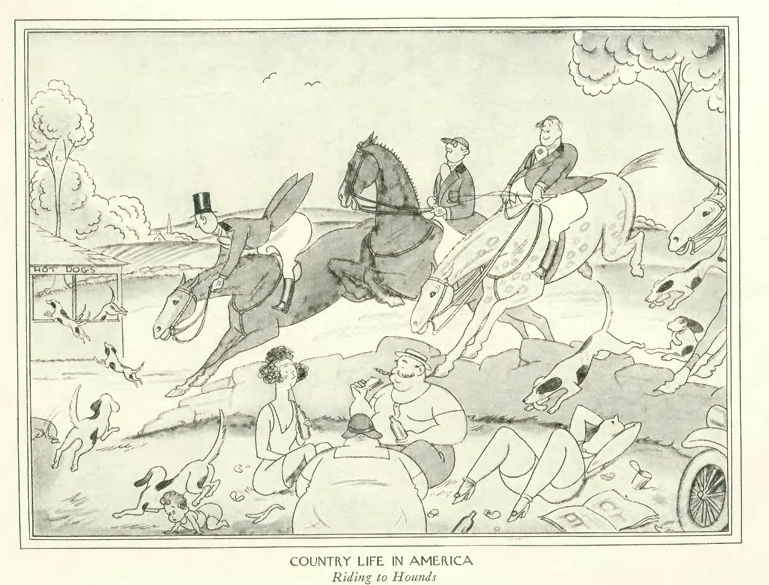
…on to our cartoons, beginning with an exploration of city vs. country life, by Alice Harvey

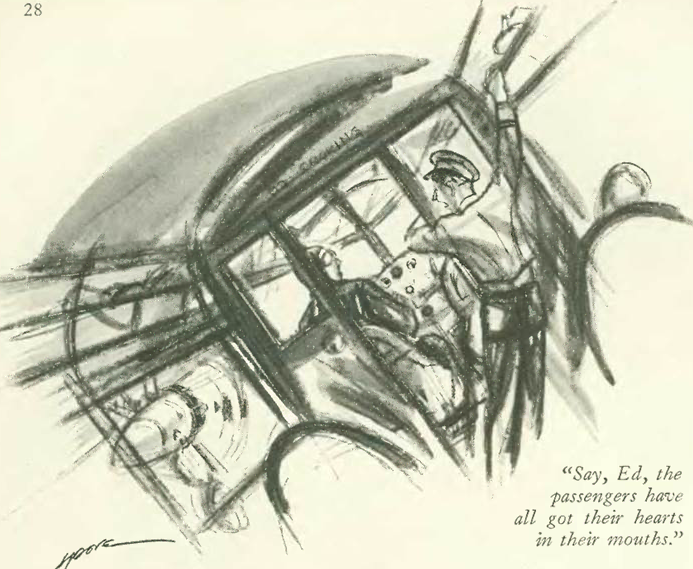
…a depiction of what commuter flying was actually like in 1930, thanks to Leonard Dove

…a glimpse at modern parenting, with Helen Hokinson

…humor in a gentleman’s drawing room, courtesy Peter Arno

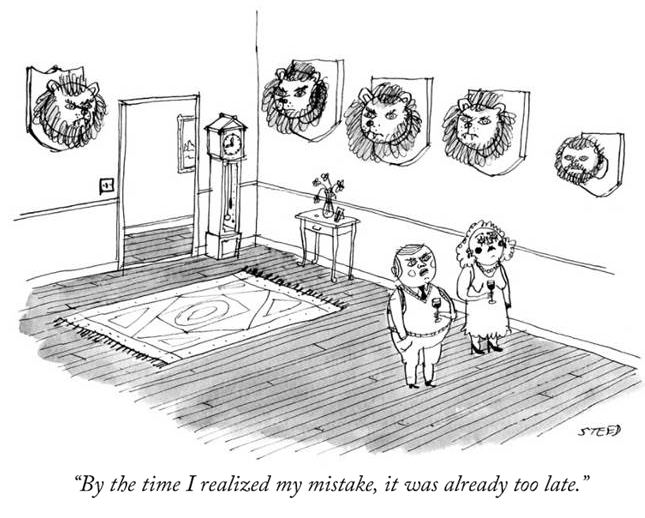
…and 89 years later, a hilarious update on the subject by Edward Steed in the Sept. 9, 2019 issue…

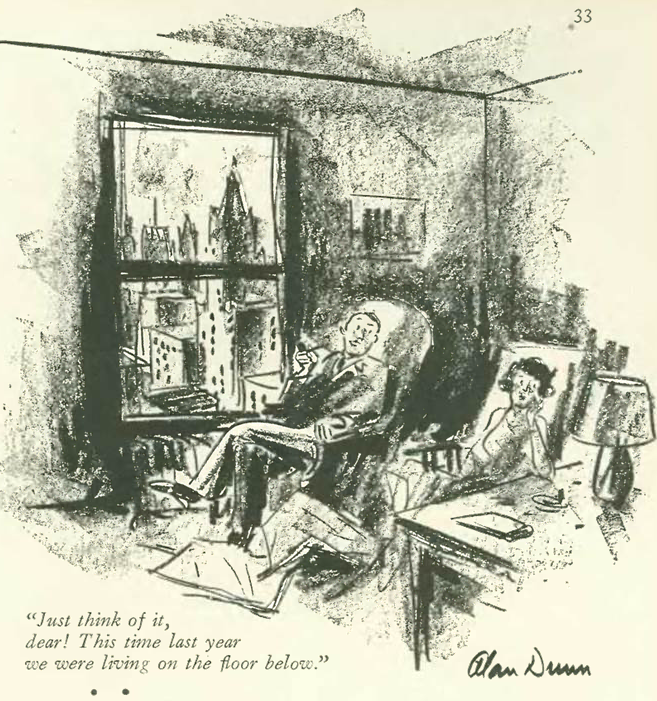
…and finally, the joys of urban life brought to us by Alan Dunn

Next Time: Ghosts of Gotham…