The New Yorker, via the pen of E.B. White, looked to the metropolis of the future in the Oct. 19, 1929 issue — to a city of glass towers that were ready to move from drafting table to reality. That is, until the stock market crash, just days away, which would put a heavy damper on those visions.
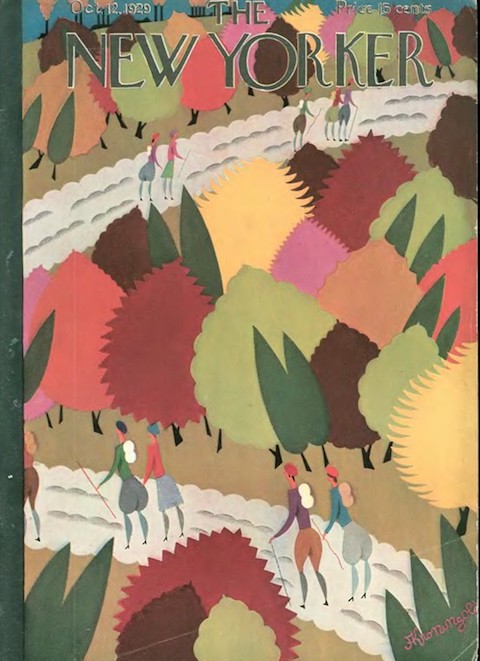
Oct. 19, 1929 cover by Rea Irvin.
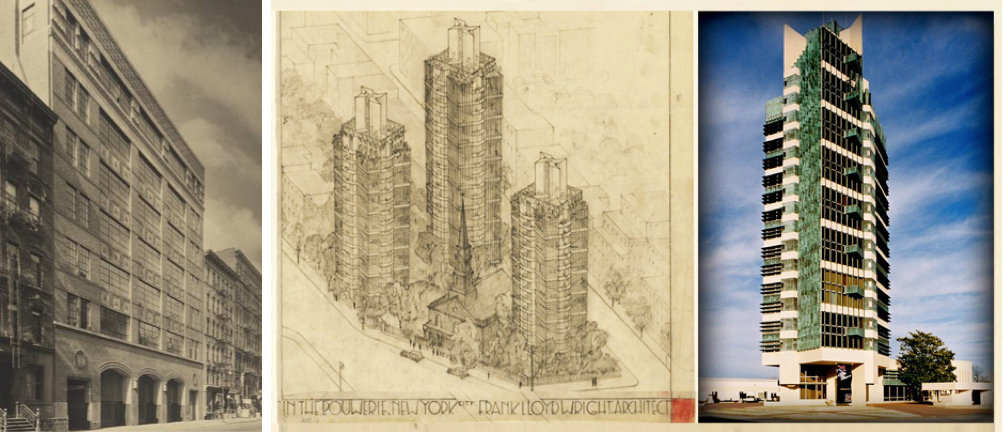
White reported in “The Talk of the Town” that several “all-glass” buildings were in the works, including “four apartment houses of glass” designed by Frank Lloyd Wright:
The 1926 Pinaud cosmetics factory designed by Ely Jacques Kahn and Albert-Buchman was poised to get a three-story addition (by Kahn) constructed entirely of glass block, but the market crash likely killed the project. The Depression probably didn’t help Wright’s project either, which would have constituted his first buildings in New York City, and the first with all-glass exteriors.
BEST-LAID PLANS…The 1926 Pinaud factory (left), now home to The School of Visual Arts, did not get its Ely Jacques Kahn-designed glass block addition in 1929; center and at right, Frank Lloyd Wright’s 1929 design for three skyscrapers surrounding St. Mark’s Church-in-the-Bowery. A single tower of similar design was eventually built in 1956—not in NYC—but out on the prairies in Bartlesville, Oklahoma. Click images to enlarge. (collectingvintagecompacts.blogspot.com; 6sqft.com)
Thanks to the Depression, and World War II, Gotham would have to wait 23 years for its houses of glass…
LATE ARRIVALS…Left, the 1952 Lever House, by Gordon Bunshaft and Natalie de Blois of SOM; right, the 1959 Seagram Building, by Mies van der Rohe. (Shorpy/ArchDaily)
and let’s not forget one of the most important post-war modernist statements to rise near the East River…
INTERNATIONAL STYLE…The 505-foot-tall United Nations Secretariat Building, constructed between 1947 and 1952. The building was designed by the Brazilian architect Oscar Niemeyer and the Swiss-French architect Le Corbusier. (United Nations)
* * *
Rising From the Ashes
While most architects were looking to the future, some still gazed into the past, and in the case of Whitney Warren, rather bitterly. It was Warren who designed a new library in Louvain, Belgium, to replace one that was burned to ground by invading German troops during World War I. Around three hundred thousand books and a thousand manuscripts were destroyed in the fire, not to mention thousands of civilians who died during the invasion and occupation. TheNew Yorker seemed ready to forgive, but given the scale of the atrocity just fifteen years earlier, one could understand Warren’s obstinance:
And to add insult to injury, the second library designed by Warren was also destroyed by the Germans in the World War II. What stands today is a restoration of that building.
A TALE OF TWO LIBRARIES…Clockwise, from top left, a comparison of the Louvain university library in 1913, and after its destruction by the Germans in 1914 (the postcard photo at top right became almost instantly famous around the world). At bottom, left, the replacement designed by Warren, which was also destroyed by the Germans in World War II. Inset, Whitney Warren, circa 1915. (Associated Press/Wikipedia)
* * *
Belles Lettres? Non!
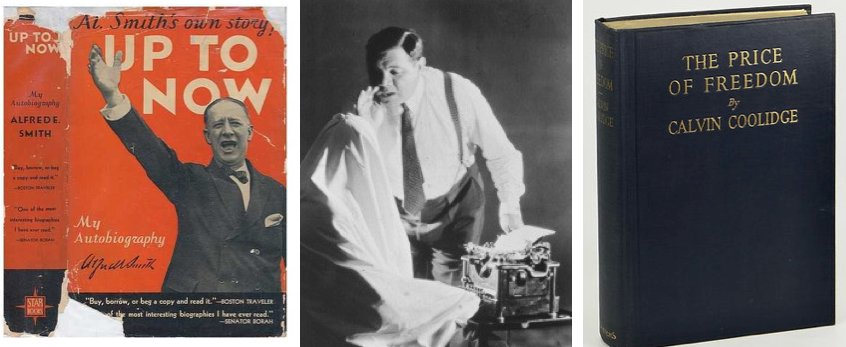
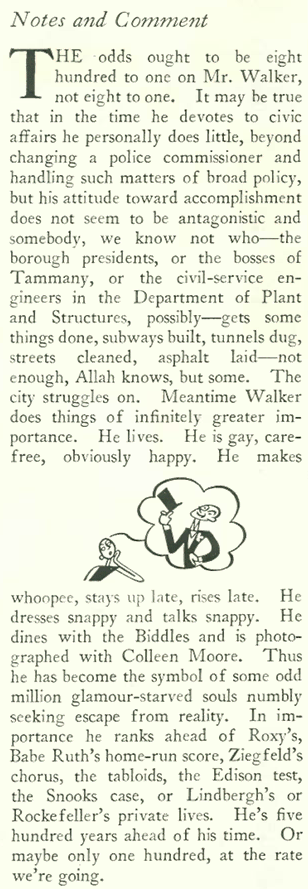
E.B. White, in his “Notes and Comment,” noted a new trend in the world of letters: celebrity authors. White lamented that the job of writing books and newspaper articles was being usurped by politicians, actors and athletes:
ASPIRING SCRIBBLERS…Former New York Gov. Al Smith, slugger Babe Ruth (dictating to his “ghost” writer) and former President Calvin Coolidge all got in on the act of book publishing. (Amazon/ourgame.mlblogs.com)
* * *
Where Babies Come From
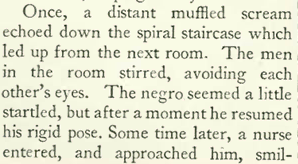
For his “A Reporter at Large” column, Morris Markey paid a visit to the Lying-In Society of New York, amaternity hospital now known asRutherford Place. I include a few excerpts below to give some idea how times have changed in the past 89 years…
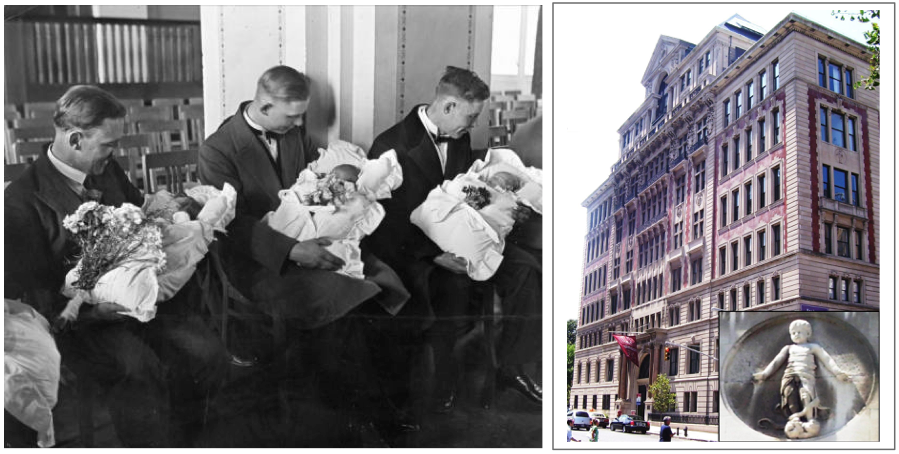
THE EASY PART…Fathers admire their newborns in this circa 1920s photo. At right, the building that housed the Lying-In Society of New York. Inset, one of the cherubs carved into the building’s facade. (Wikipedia)
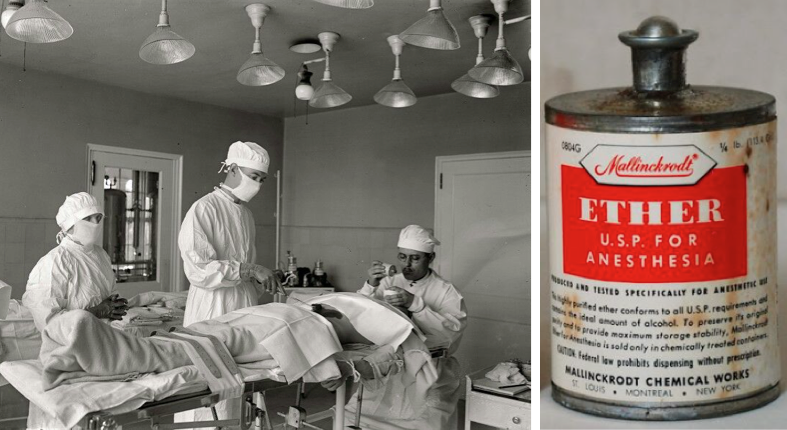
…imagine, if you will, the scent of ether (then commonly used as an anesthetic) and other drugs as you entered the hospital (no air-conditioning or HVAC to whisk those odors away!)…
NIGHTY NIGHT…Anesthesiologist administers ether and nitrous oxide to a patient before surgery in a Washington hospital, 1922. (Internet Archive: archive.org)
…not to mention the sweat of anxious fathers banished from delivery or recovery rooms…
WELCOME TO THE WORLD…Nurse learning to care for infants, Philadelphia General Hospital, c. 1930; nurses caring for infants at Long Hospital, Indiana University, in the 1920s. Note row of cribs fastened to the wall, which seemed to be a standard design back then. (upenn.edu/comet.soic.iupui.edu)
…or hospital stays for mothers that averaged ten days…
* * *
Should Have Stayed Home
Dorothy Parker was dealing with a “baby’ of her in own, in this case a grown man with the conversational skills of brick wall. She related her experience in a casual titled, “But the One on the Right…” An excerpt:
Dorothy Parker, happily at home, in 1924. (New York Public Library)
* * *
More Applause for Helen
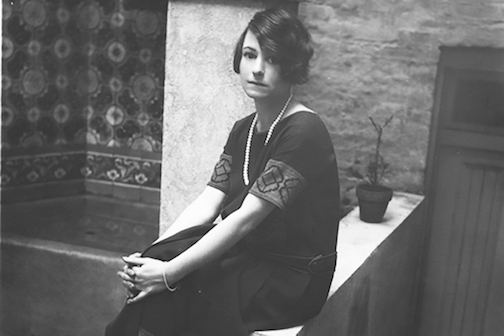
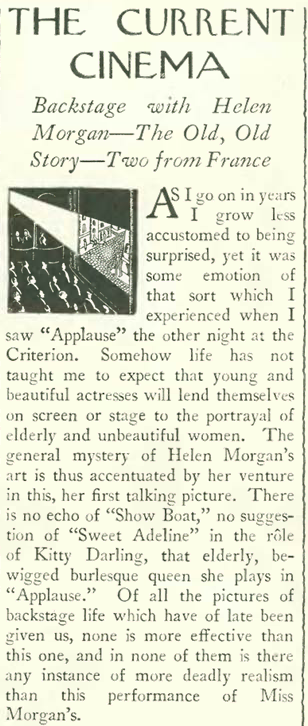
The New Yorker continued to shine an approving light on the work of nightclub singer Helen Morgan, this time in her first talking picture, Applause:
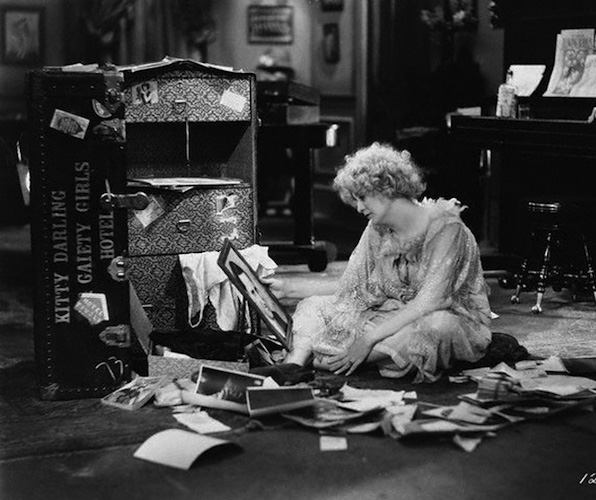
FALLING STAR…Helen Morgan (foreground, right) portrayed a fading burlesque star named Kitty Darling in 1929’s Applause, Morgan’s first all-talking picture. (MOMA)
On a sad note, Morgan’s real life had parallels to the film, including the abandonment of a child and a death due to alcohol and drugs — in the film Kitty overdoses on sleeping pills before a show; in real life Morgan would collapse onstage during a Chicago performance of George White’s Scandals. She would die of cirrhosis of the liver in 1941, at age 41.
IMITATING LIFE…Helen Morgan as Kitty Darling in Applause. Her best days behind her, Darling becomes an alcoholic who lives in the past. Sadly, Morgan’s real life had parallels to the movie. (art fuse.org)
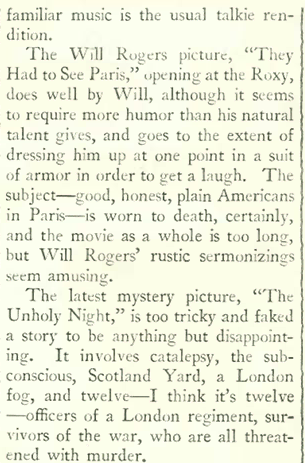
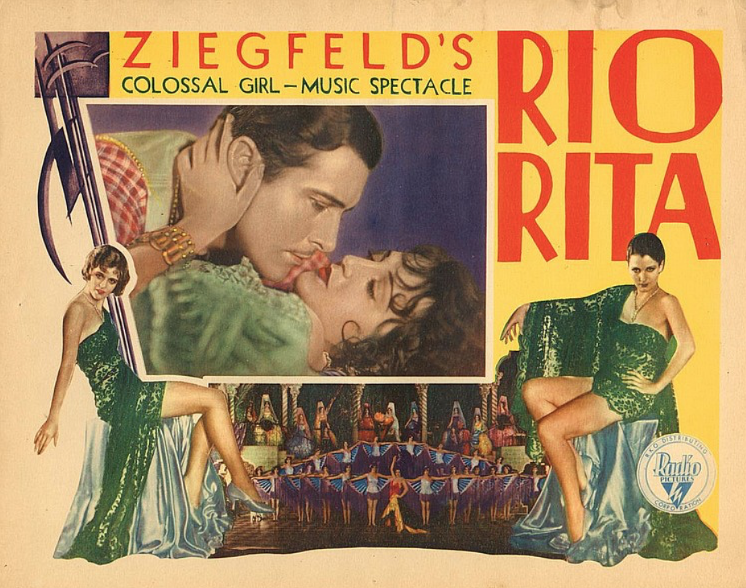
There was no such applause from The New Yorker for another talkie, the screen adaptation of the popular Ziegfeld Broadway stage show Rio Rita:
BEEN THERE, DONE THAT…Lobby Card for Rio Rita, featuring John Boles and Bebe Daniels. (IMDB)
* * *
From Our Advertisers
The Stewart fashion shop on Fifth Avenue featured a series of attractive, modern ads, these two appearing in the Oct. 19 and 26 issues…
According to the terrific website Driving for Deco, “Stewart and Company broke away from the traditional department store layout. Instead of aisle after aisle of display cases the new store comprised many shops. These “shops” were not individually owned as in a present day mall. They were rooms or alcoves devoted to specific merchandise. The design of the shops and floors fell to several different interior design firms…”
Clockwise, from top, artist rending of the Stewart women’s shoe department; Stewart and Company building at 721 5th Avenue; Stewart Millinery Shop. (Vogue/Museum of the City of New York, all via drivingfordeco.com)
The Depression brought an end to Stewart and Company, which went out of business in the spring of 1930. Later that year Bonwit Teller opened in the former Stewart Building. They would close their doors to business 49 years later.
Sadly the building was demolished in 1980 to make way for a monument to a massive ego: Trump Tower.
Demolition of the former Stewart & Company building in 1980. The Rene Paul Chambellan bas-relief sculptures on the building’s facade were supposedly destined to the Metropolitan Museum of Art. Developer Donald Trump thought the removal of the sculptures was cost-prohibitive, so they were smashed by jackhammers. (drivingfordeco.com)
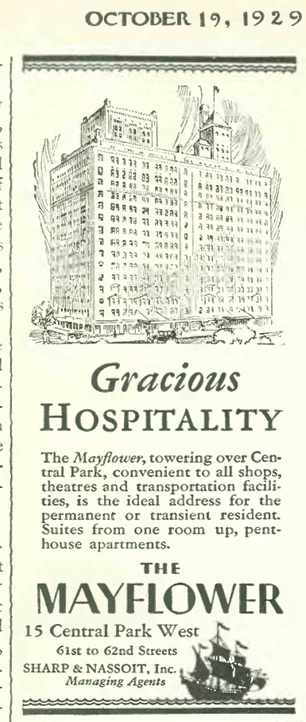
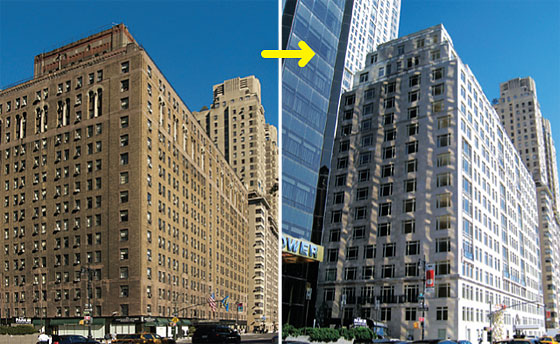
…back to the ads, we have another image of a building that is now but a ghost (I am writing this on Halloween)…
The Mayflower Hotel, left, a 1926 building designed by Emery Roth, was demolished in 2005 to make way for Robert A.M. Stern’s luxury condominiums, 15 Central Park West. (nymag.com)
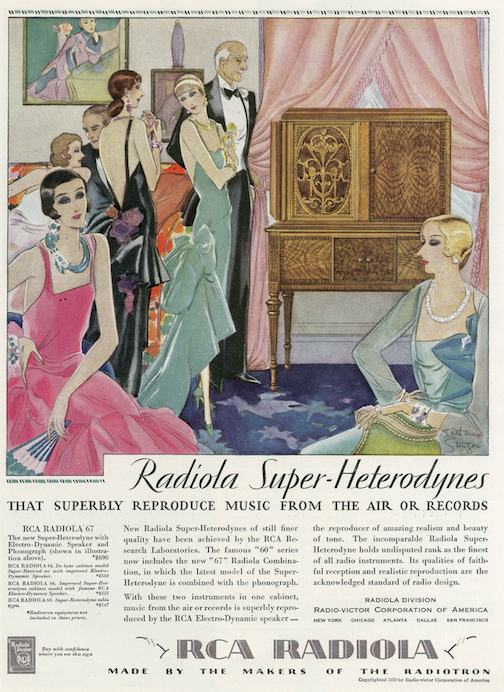
…speaking of luxury, these posh types seem to be almost lulled to sleep by RCA’s “Radiola Super-Heterodyne”…
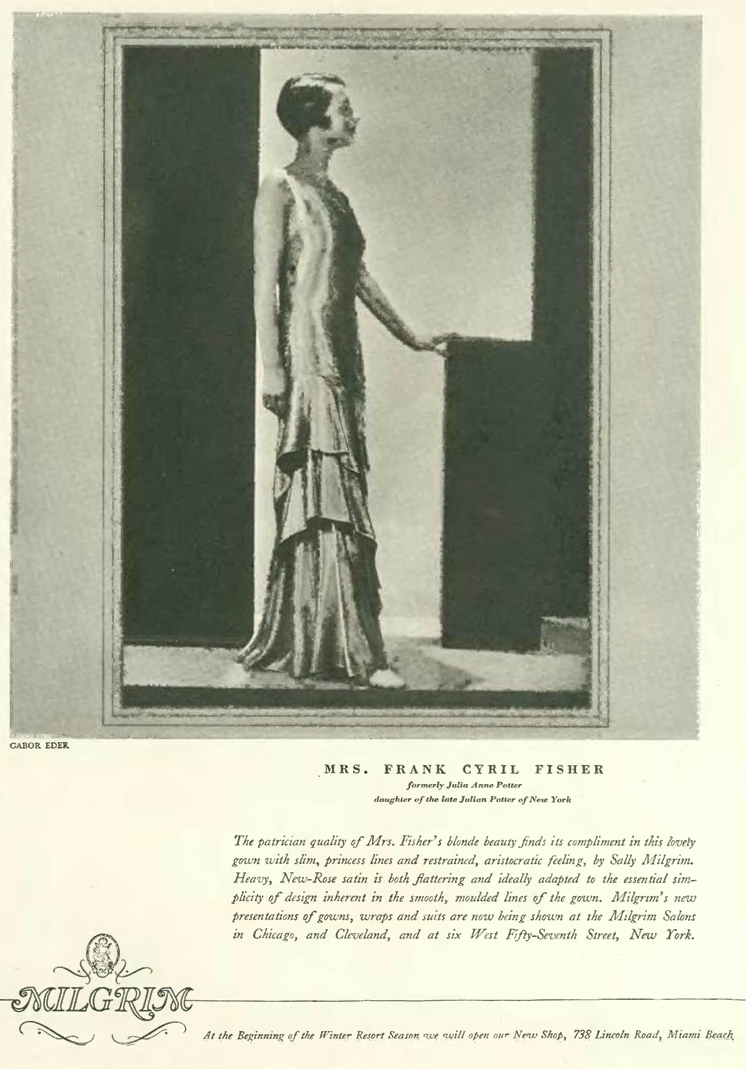
…and I throw in this ad from Milgrim for its use of the word “patrician” to appeal to the aristocratic yearnings of some New Yorker readers…
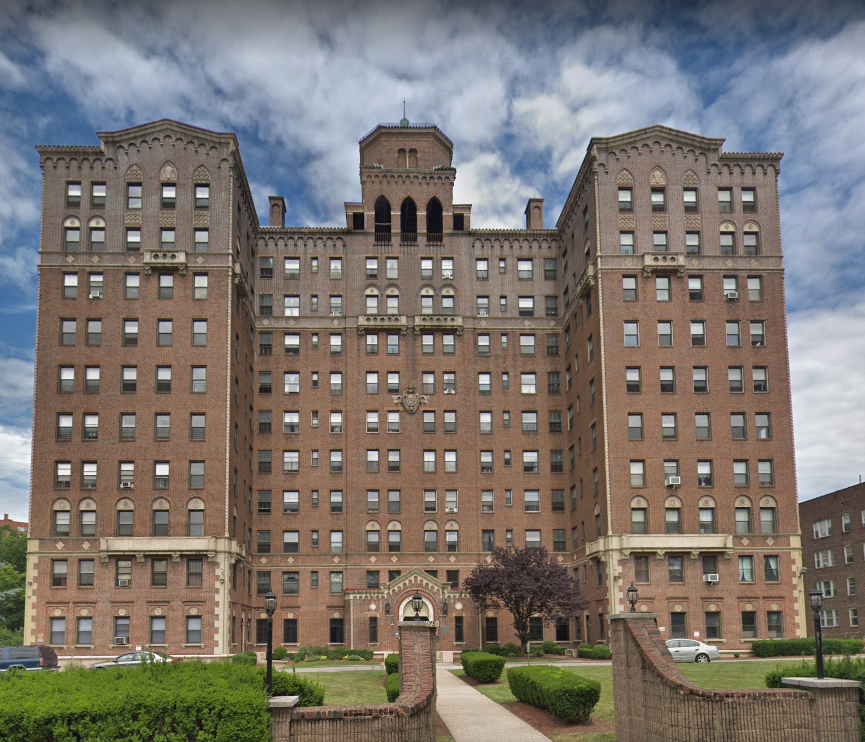
…perhaps those patricians would have preferred a move to “aristocratic” Scarsdale, as the middle ad below suggests, or perhaps they would have chosen something more “unusual” in East Orange…
…for reference, here is a Google street view image of 75 Prospect in East Orange, New Jersey…
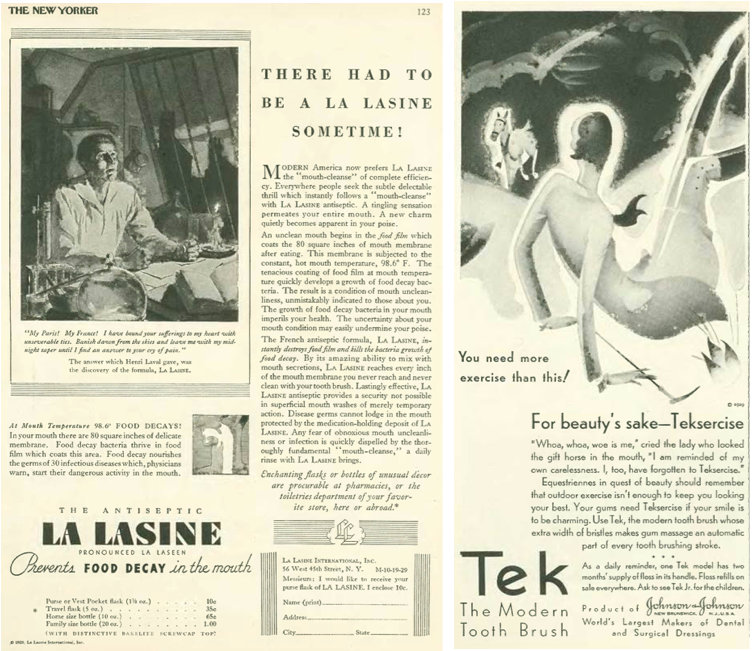
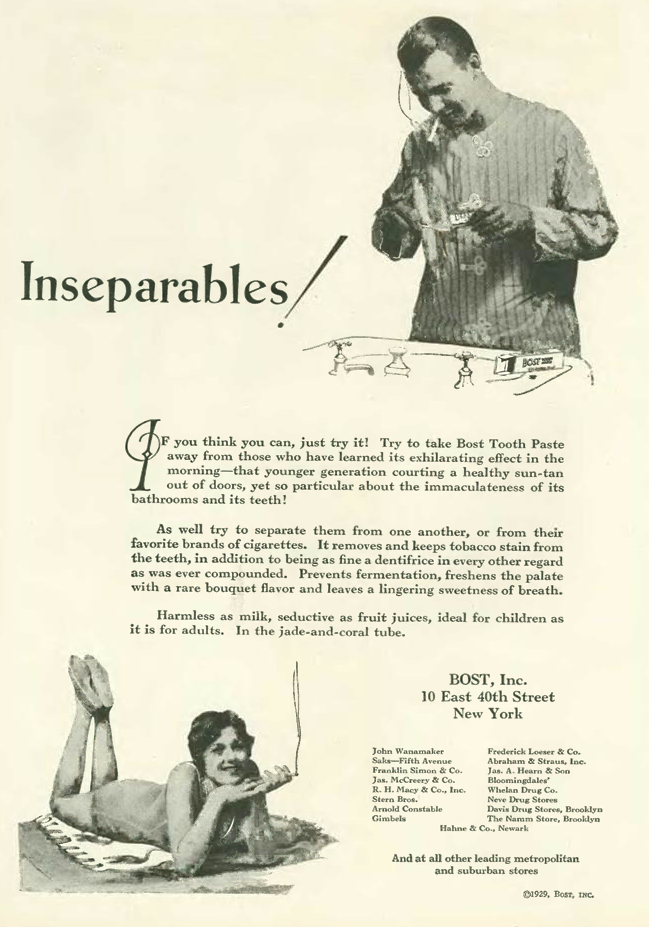
…and if you were of the upper classes, you probably would have wanted the latest in toothbrushes and “French” mouthwashes…
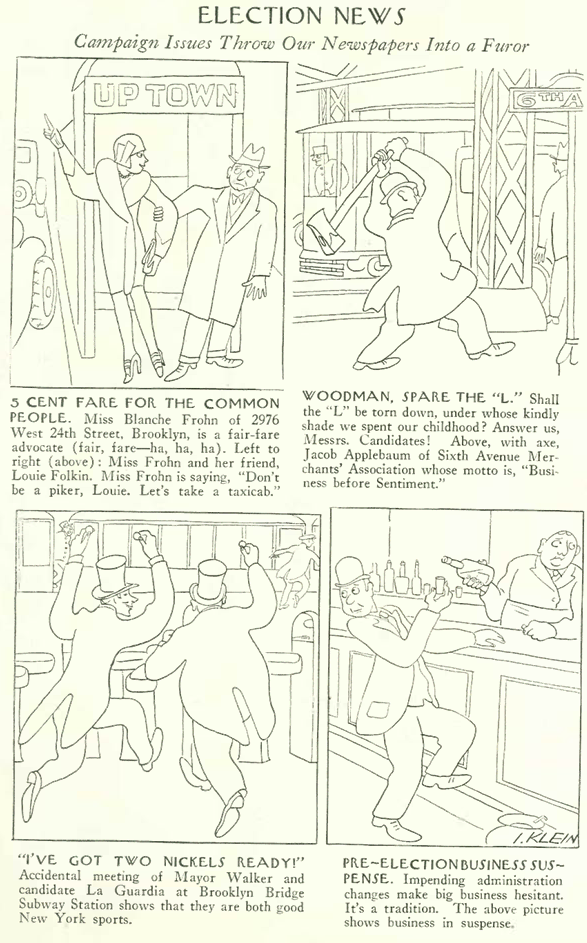
…on to our illustrators and cartoonists, Isadore Klein looked in on the elections…
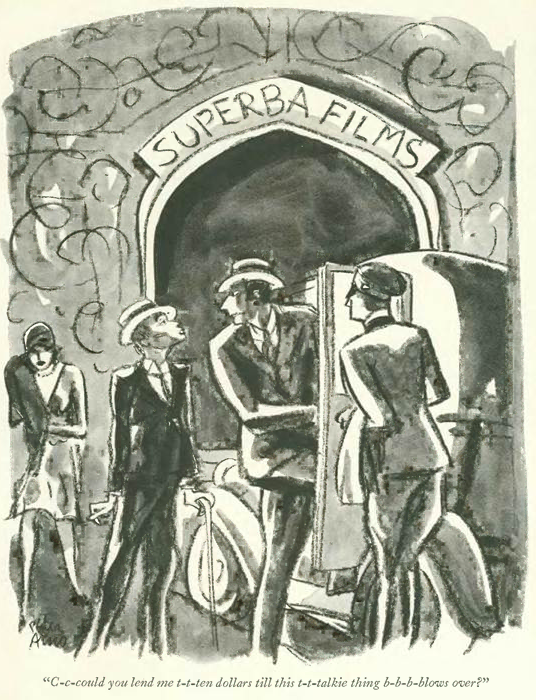
…Peter Arno illustrated the plight of a hapless silent film actor…
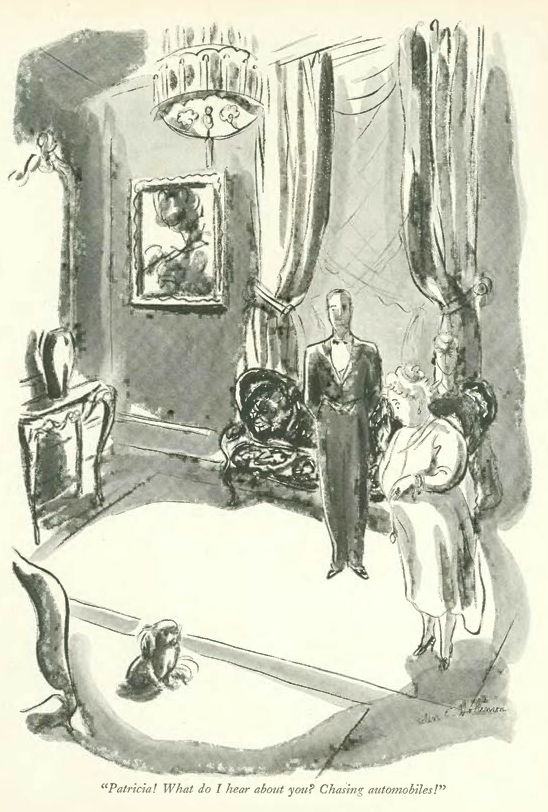
…and Helen Hokinson eavesdropped on a canine faux pas…
Although the United States declared its independence from British Empire nearly 250 years ago, the royal family and all of its requisite trappings persist in the American imagination like a phantom limb.
Oct. 5, 1929 cover by Theodore G. Haupt.
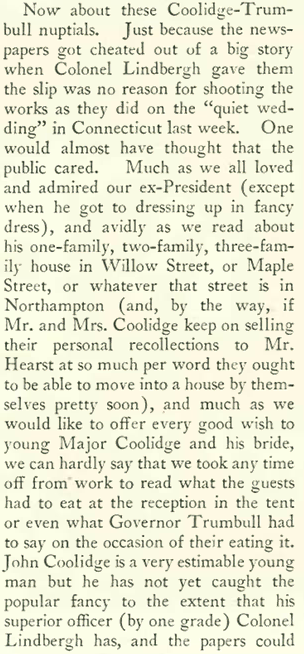
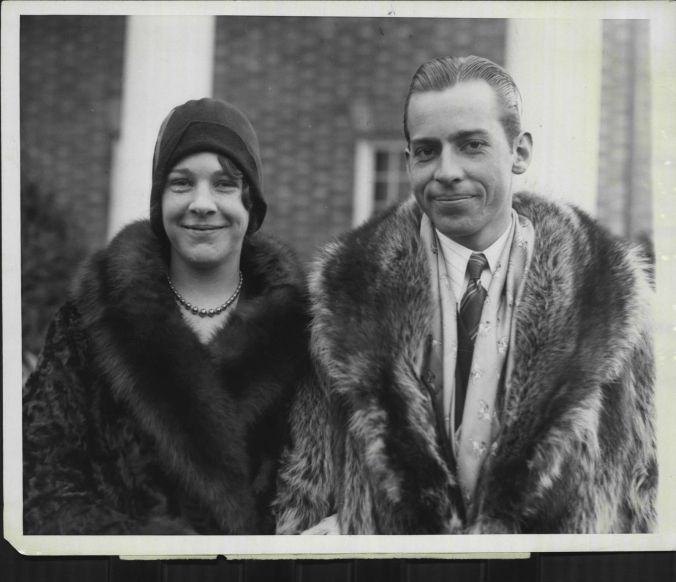
E.B. White observed as much in the “Notes and Comment” section of the Oct. 5 issue, in which he offered his views regarding the “pother” over the wedding of Calvin Coolidge’s son, John, to Florence Trumbull, the daughter of Connecticut Governor John Harper Trumbull…
White could have looked no further than the pages of The New Yorker for further evidence to his claims. The bourgeois yearnings of its readers were reflected in countless advertisements laced with anglophilic pretensions. Here are examples from 1929 issues we have previously examined:
LIVE LIKE A BARON…Ads from The New Yorker of the 1920s often featured illustrations of regal, priggish types such as the couple above, deployed to sell everything from apartments and ginger ale……to no-frills automobiles and menthol cigarettes. No product was too pedestrian for the royal treatment.
Writing under the pseudonym “Guy Fawkes,” Robert Benchley commented further on the Coolidge-Trumbull nuptials in the “Wayward Press” column:
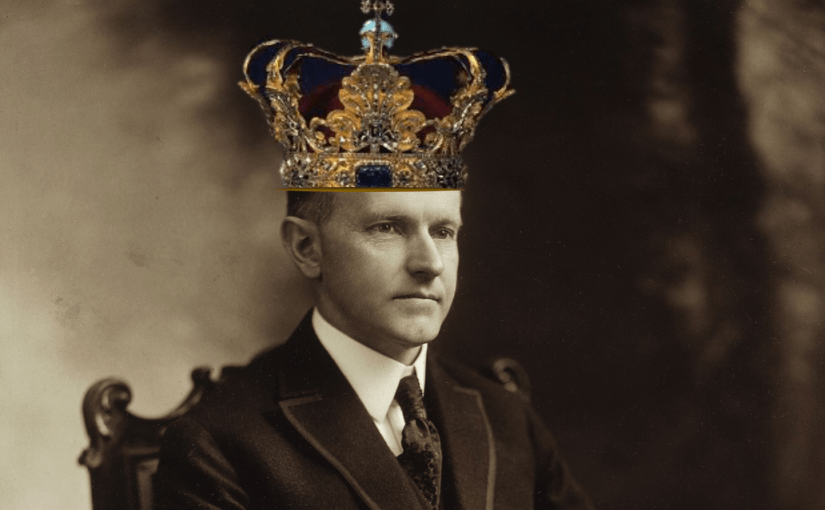
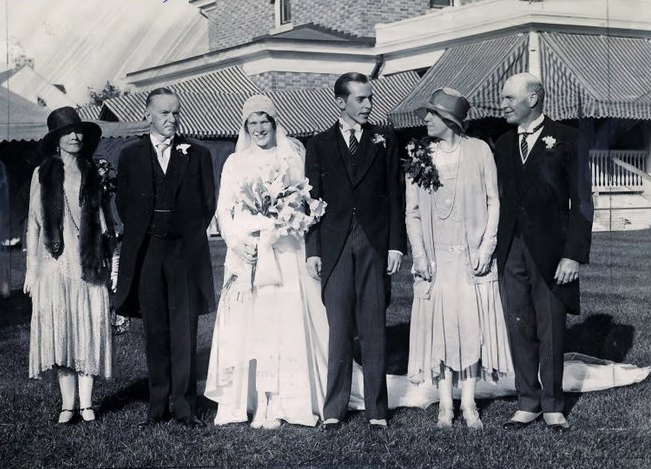
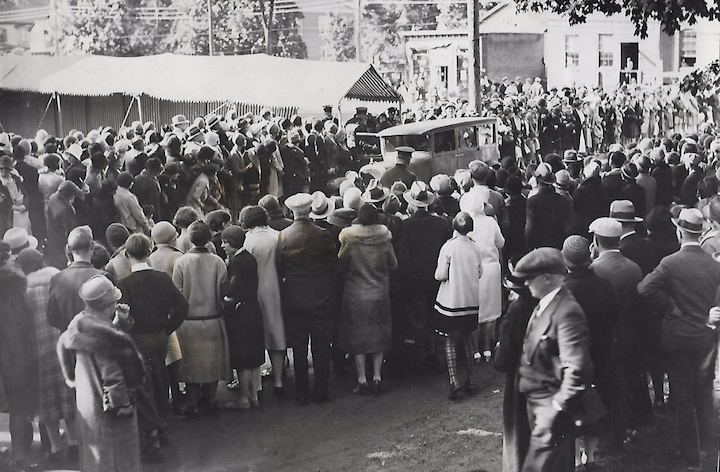
HEY CAL, IT’S A WEDDING, NOT A FUNERAL…The former U.S. President Calvin Coolidge was known as “Silent Cal” for good reason, given his reserved demeanor that rarely produced a smile (although he apparently had a dry wit). He poses here at the wedding of his son, John. Left to right are Grace Goodhue Coolidge, President Coolidge, Florence Trumbull Coolidge, John Coolidge; Maud Pierce Usher Trumbull, and Gov. John Trumbull. (patch.com)NOT EXACTLY KING’S ROAD…Onlookers line the street near the Congregational church in Plainview, Conn., hoping for a glimpse of the bride and groom, who were united in a simple ceremony. (Associated Press)CUTE COUPLE…Florence Trumbull and John Coolidge during their engagement, 1928. (crackerpilgrim.com)
* * *
Modest Mussolini
We go from famous faces to infamous ones, namely the Italian dictator Benito Mussolini, aka Il Duce, who received the adoration of his public while trying to remain inconspicuous at the cinema. “Talk” recounted…
NOW PICTURE HIM UPSIDE DOWN…A 1929 postcard image of the once-revered Italian dictator Benito Mussolini. Sixteen years later he would be shot by his own people and strung up by his feet from the roof of a Milan gas station. (worthpoint.com)
* * *
Going Down
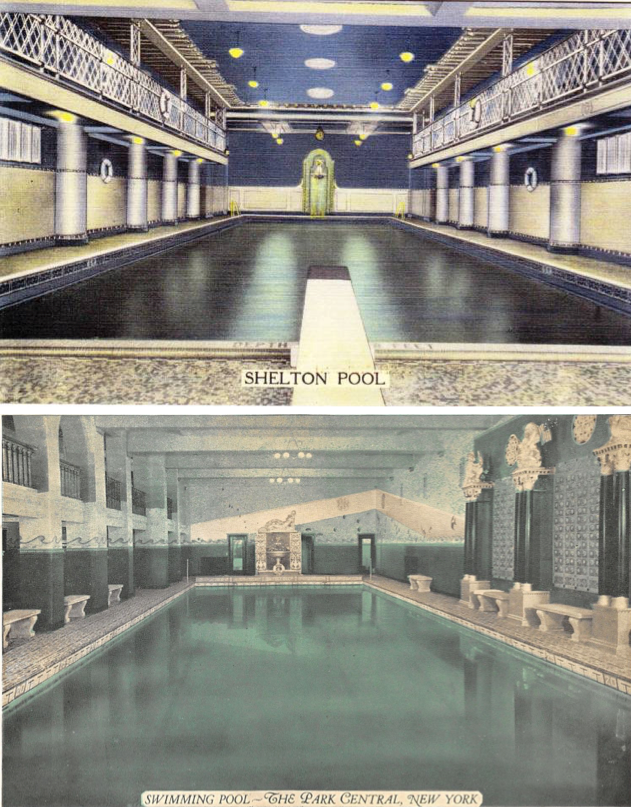
“Talk” also commented on the growing trend for high-rise apartments to provide swimming pools and other amenities below street level:
TAKING THE PLUNGE DOWN UNDER…Few indoor swimming pools were available to New Yorkers during the 1920s. Two of the nicer ones were found underground at the Shelton Hotel (above) and the Park Central. Sadly, both pools no longer exist. In 2007 the Shelton’s pool was removed and the cavernous space was divided into three levels. I’m not sure when Park Central’s disappeared, but it’s fate was doubtless similar to the Shelton’s.(daytoninmanhattan.blogspot.com/hippostcard.com)
* * *
How About a Catch?
As I’ve noted on previous occasions, The New Yorker of the 1920s all but ignored major league baseball. The magazine gave regular coverage to seemingly every sport, from hockey and college football to polo and yacht racing, but regular coverage of baseball was nonexistent, even when the Yankee’s Murderers’ Row (Ruth, Gehrig among others) won back-to-back World Series titles in 1927-28.
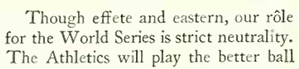
Still no coverage in the Oct. 5 issue, but the sport did get a brief mention in Howard Brubaker’s “Of All Things” column…
…and the issue was filled with baseball imagery, including the cover…
The Oct. 5 issue was filled with baseball-related items, but no actual coverage of the games. Images from the issue included, from left, the cover by Theodore Haupt; a filler sketch by Constantin Alajalov; and a Johan Bull illustration of umpire Bill Klem for the issue’s “Profile” section.
* * *
In a Sentimental Mood
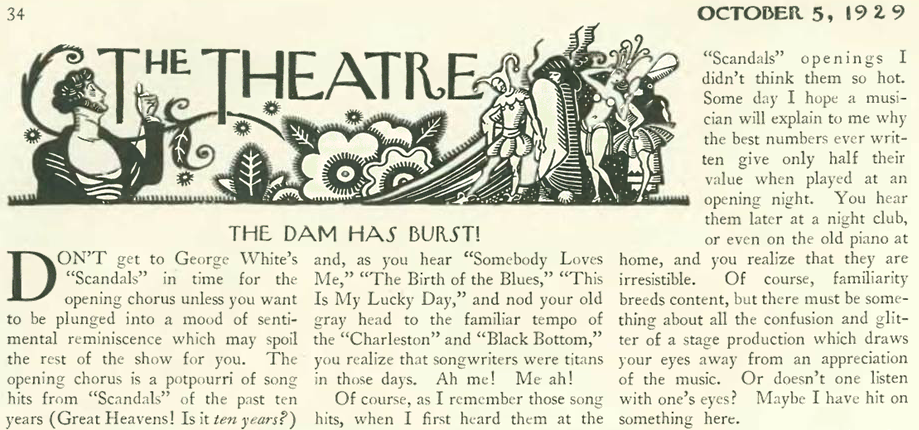
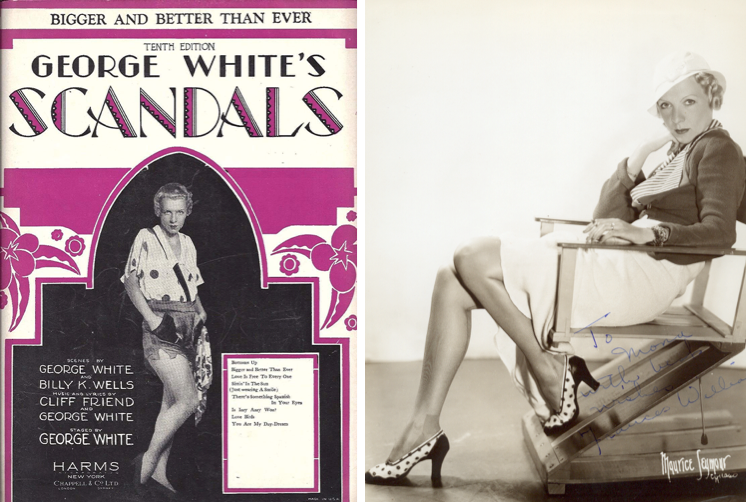
Robert Benchley checked out George White’s latest version of his Scandals revue at the Apollo Theatre, and found the sometimes risqué show to be in a sentimental mood…
BETTER SENTIMENTAL THAN DEPRESSED…The chanteuse Frances Williams (pictured on the show’s sheet music and at right) likely provided the only spark to the 1929 edition of George White’s Scandals. (amazon/psychotronicpaul.blogspot.com)
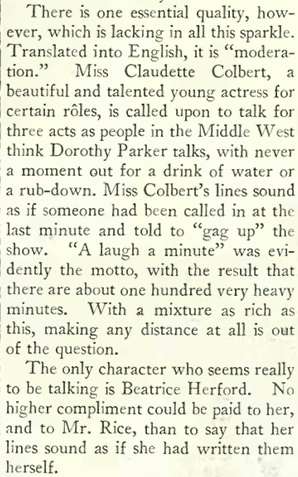
Benchley also looked in on Elmer Rice’s latest, See Naples and Die, featuring veteran English actress Beatrice Herford and the up-and-coming Claudette Colbert…
VETERAN AND ROOKIE…Veteran English actress Beatrice Herford and the up-and-coming Claudette Colbert headlined Elmer Rice’s See Naples and Die. Colbert (pictured at right in a 1928 Broadway publicity photo) would go on to massive stardom in the 1930s. (Alchetron/Wikipeda)
Benchley applauded the veteran Herford’s performance, but found the otherwise reliable Colbert miscast as a wisecracking, Dorothy Parker type (Benchley, as we know, was close friends with Parker, so he knew what he was talking about)…
* * *
An (Ugly) American in Paris
Off to Paris, we find correspondent Janet Flanner joining with Parisians in deriding the behavior of American tourists, who were on a course to drain every last drop from the Île–de–France before departing for the bone-dry USA:
DRINKING IN THE SIGHTS…American tourists at a Parisian café, circa 1920s. (tavbooks.com)
* * *
Party Pooper
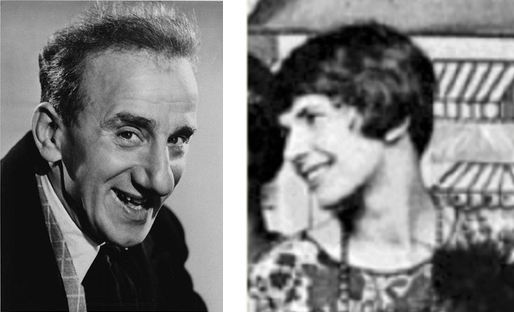
With her infant child (Patricia Arno) at home, it is doubtful Lois Long was seeing as much nightlife as she did during her first weeks at The New Yorker, when “nights were bold.” And indeed, her nightlife column “Tables for Two” would end in June 1930…for awhile anyway. Her Oct. 5 column took a cursory spin through the various nighttime offerings, ending on this note regarding a fan letter and a message from comedian Jimmy Durante:
THE GREAT SCHNOZZOLA Jimmy Durante brought a smile to the face of Lois “Lipstick” Long.
* * *
From Our Advertisers
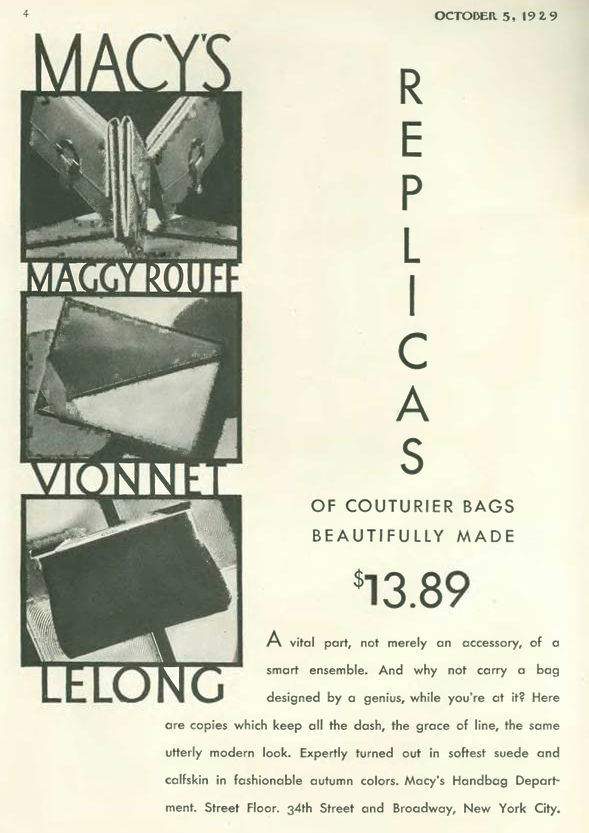
With the latest Paris fashions splattered across newstands all over Manhattan, retailers scrambled to get “replicas” to consumers…Macy’s had “couturier bags”…
…the Hollander Dressmaking Department was ready to make a perfect copy of Patou’s “Quiproquo”…
…and this Chanel frock could be had in misses’ sizes for $145 (roughly equivalent to about $2K today)…
…Philip Morris hadn’t yet discovered the “Marlboro Man,” and were still hawking their cigarettes through a “distinguished handwriting contest.” The latest winner was Edmund Froese…
…who would go on to become a popular mid-century landscape painter…
Port of New York, by Edmund Froese (undated)
…another artist in the midst of our ads is Carl “Eric” Erickson, who created these lovely images for R.J. Reynolds that would induce people to take up the habit with a Camel…
…and then we have some rather unlovely ads from the back pages, including these two that would not go over well with today’s readers…
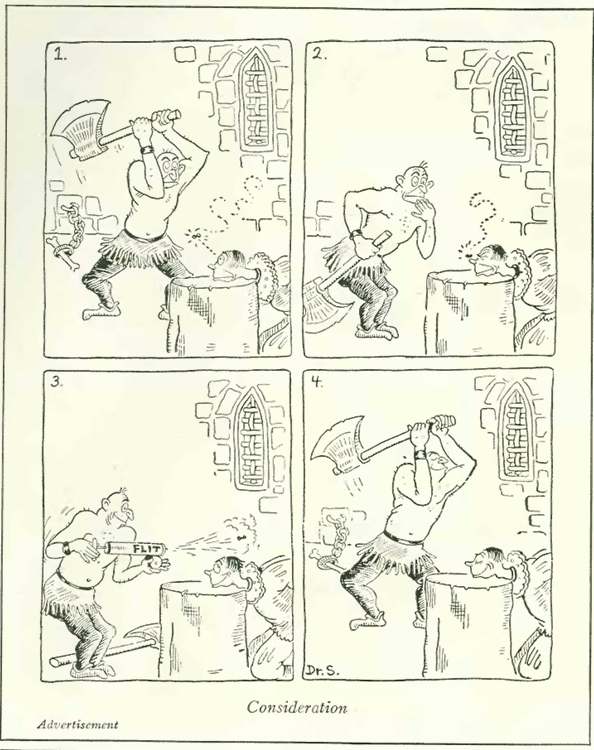
…or this from Dr. Seuss, still sharpening his skills with Flit insecticide…
…or this ad from Abercrombie & Fitch, wrong on so many levels…
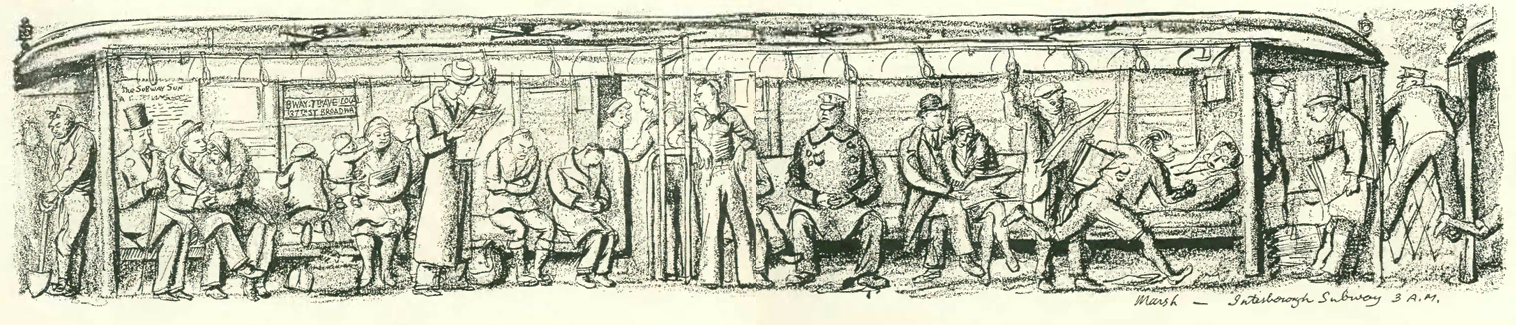
…on to happier things, here’s an illustration by Reginald Marsh that ran along the bottom of “Talk of the Town”…(click to enlarge)
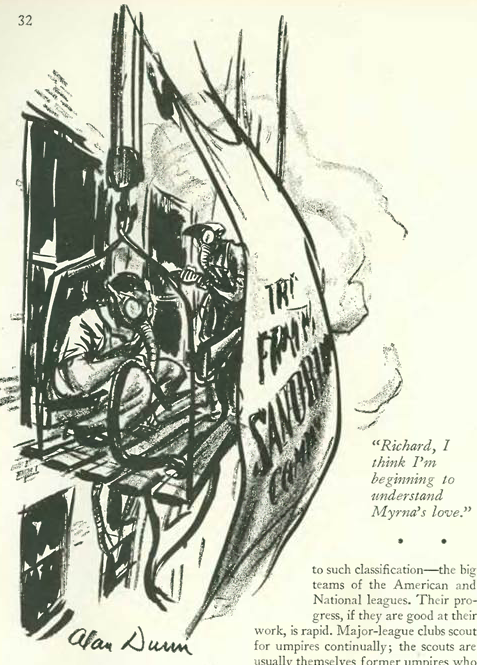
…Alan Dunn found love in the air above the streets of Manhattan…
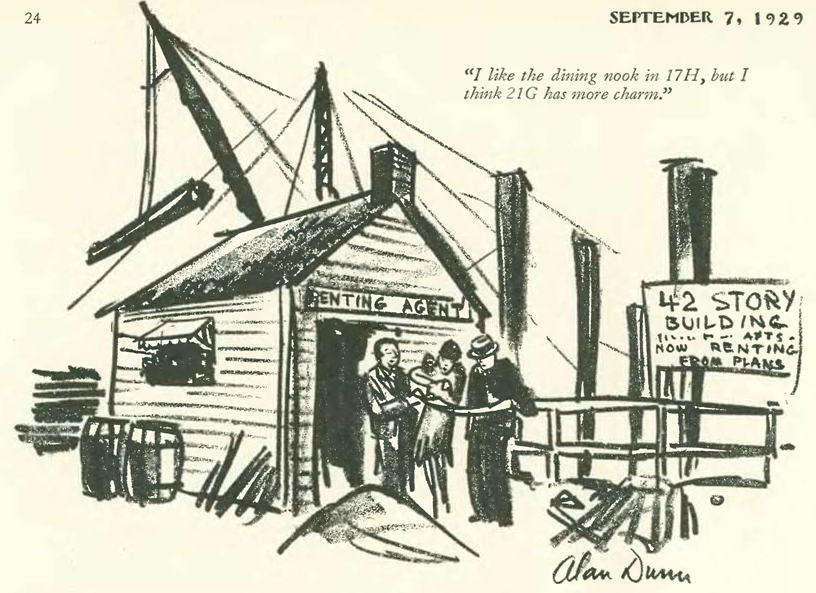
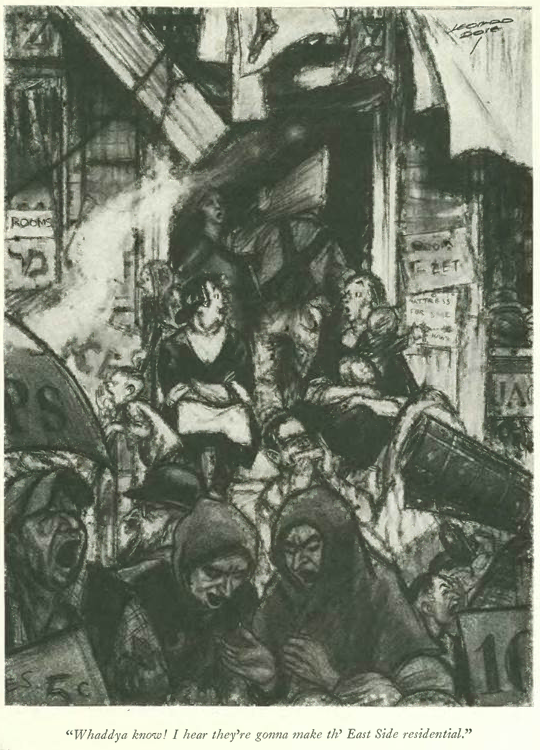
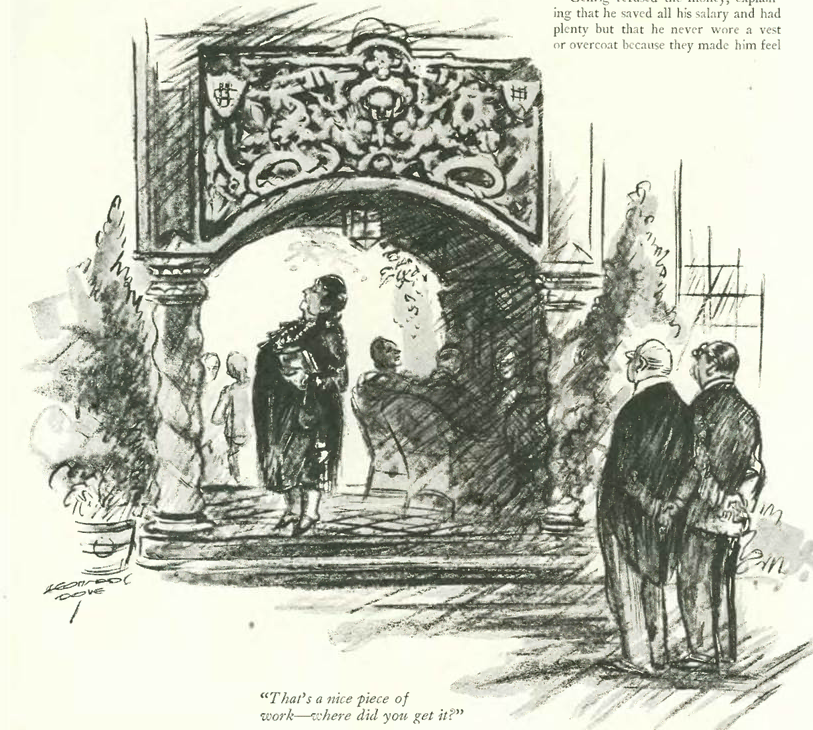
…and Leonard Dove revealed the hazards of apartment rentals…
E.B. White gazed 50 years into the future in the Sept. 21, 1929 issue, predicting that New York City would be much the same if not a little worse by the time the calendar turned to 1979.
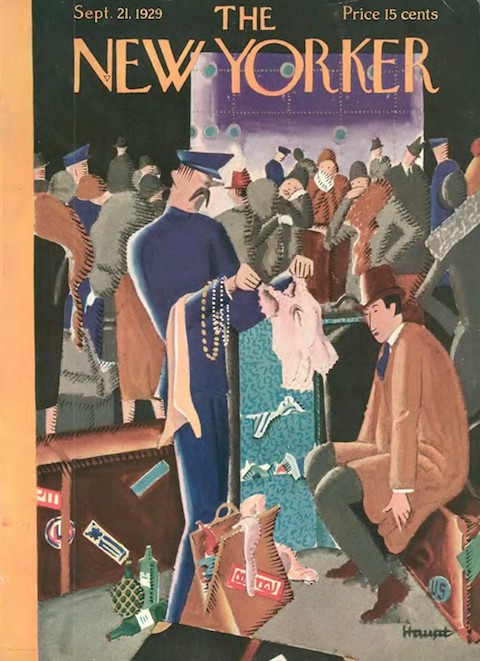
Sept. 21, 1929 cover by Theodore G. Haupt.
White dismissed the popular notion that the future would be one of push-button happiness and gleaming white cities. And as it turned out, he was mostly right on the mark with his predictions:
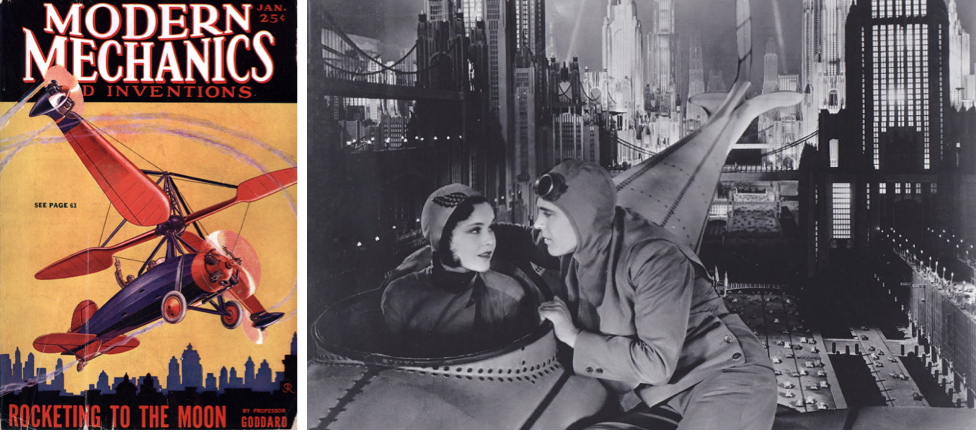
LOVE IS IN THE AIR…Autogyros (as illustrated on a 1930 cover of Modern Mechanics) were often seen as the future of transportation in the 1920s and 30s; Maureen O’Sullivan (as “LN-18”) and John Garrick (“J-21”) glide above 1980 Manhattan in 1930’s Just Imagine. (modernmechanix.com/pre-code.com)
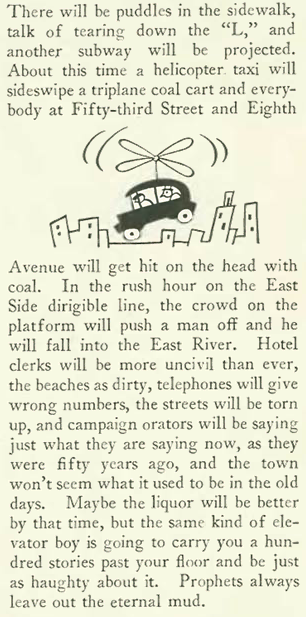
Instead of the antiseptic fantasy world predicted in such movies as 1930’s Just Imagine (a futuristic musical set in 1980), White correctly foresaw a city that, despite technological advances, would still be a gritty rat race. And if you lived in New York City in 1979 (I was but a visitor then, as now), you would have found a city that indeed was quite dirty and crime-ridden (check out the 1979 movie The Warriors to get a sense of how Hollywood perceived the city at that time). As White observed, “Prophets always leave out the eternal mud”…
A LOT OF HOT AIR…In addition to autogyros, futurists in the 1920s and 30s also saw dirigibles as integral to future transportation. At top left is an illustration of a solar-powered aerial landing field atop a dirigible on the cover of Modern Mechanix magazine, October, 1934; top right, Manhattan in 1980 as depicted in the the 1930 film Just Imagine; bottom right, workers dismantling the Third Avenue Elevated line in 1955; bottom left, Times Square in 1979. (airships.net/IMDB/gothamist.com/viewoftheblue.com)
* * *
Cradle of Civilization
Dorothy Parker took aim at ugly Americans abroad in a casual titled “The Cradle of Civilization.” In these excerpts, Parker commented on the pretensions of young New Yorkers in France, including their ridiculous costumes…
…their bad French, and their even worse manners…
WELL, THEY GOT AWAY WITH IT…Actors Leslie Howard and Ingrid Bergman don the look of French fishermen during the filming of Intermezzo: A Love Story, in 1938. Howard and Bergman were supposed to look like a couple visiting the French Riviera, but in reality it was all filmed near Hollywood. The film was Bergman’s Hollywood debut. (Pinterest)
* * *
A Penny Saved
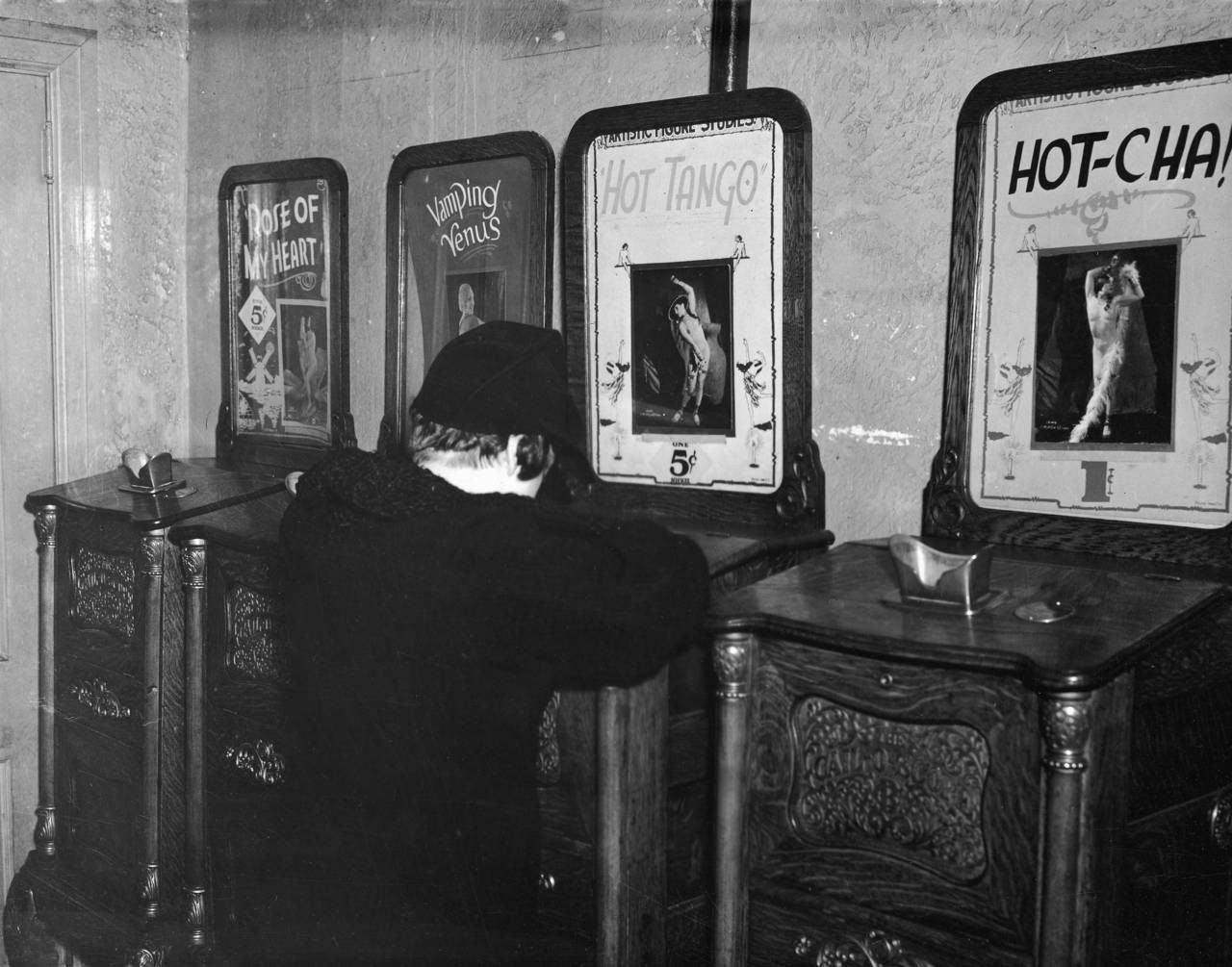
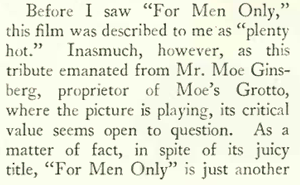
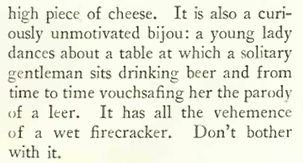
Back stateside, Wolcott Gibbs looked in on the dying art of the penny-arcade peepshow, and expressed his disappointment with the quality of that product in general…
DON’T JUDGE A PEEP BY ITS COVER…A patron checks out “Hot Tango” at a penny peepshow parlor of the 1920s. (Pinterest)
Gibbs seemed particularly miffed by a film with the misleading title “For Men Only”…
* * *
Uncle Jed
Jed Harris (1900-1979) was a wunderkind of Broadway, producing and directing 31 shows between 1925 and 1956. Before he turned 28 he produced a record four consecutive Broadway hits over the course of 18 months (including the 1928 smash hit The Front Page), and so it was time for some rest. “The Talk of the Town” reported…
Although it was rumored Harris would retire at age 30, he would instead return in the spring of 1930 with a production of Anton Chekhov’sUncle Vanya, and continue producing on Broadway through the 1950s.
WUNDERKIND…A 1928 portrait of Jed Harris that was featured on the Sept. 3, 1928 cover of Time magazine. (Wikipedia)
* * *
Dueling Cassandras
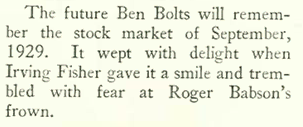
About a month before the big stock market crash we find this curious little item in Howard Brubaker’s “Of All Things” column…
…Considered the first “celebrity economist,” Irving Fisher stated in September 1929 that the stock market had reached “a permanently high plateau,” while around the same time (Sept. 5, 1929) rival economist Roger Babson warned in a speech that “sooner or later a crash is coming, and it may be terrific.” Note: “Ben Bolts” refers to a character in a popular 1842 poem that became an oft-parodied popular song. Each stanza begins with a variation of “Oh don’t you remember…”
* * *
Parental Advisory
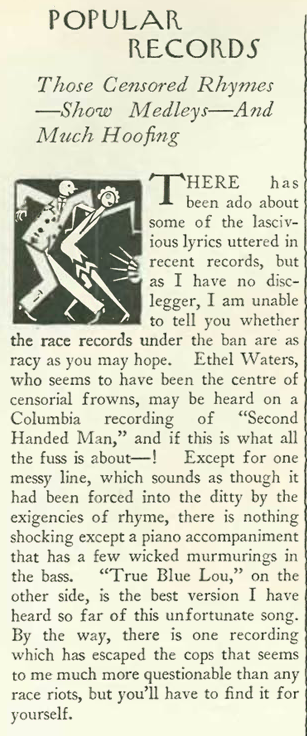
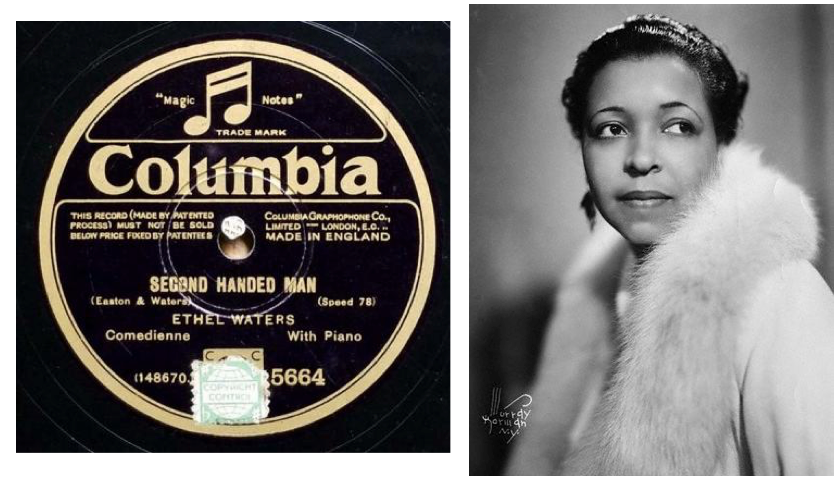
Fifty-five years before Tipper Gore and the Parents Music Resource Center pushed the music industry to place warning labels on records containing explicit lyrics, there was much ado about “lascivious lyrics” uttered on “race records” — the term referred to 78-rpm records marketed to African Americans from the 1920s and 1940s. The Sept. 21 “Popular Records” column looked at the controversy surrounding Ethel Waters’ “Second Handed Man,” and didn’t find any…
MUCH ADO…Ethel Waters (circa 1930) and her recording of “Second Handed Man.” (discogs.com/YouTube)
* * *
New Kids on the Block
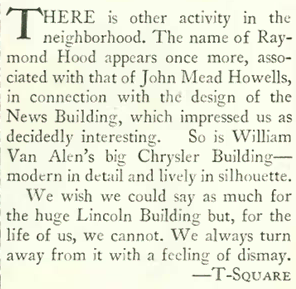
Architecture critic George S. Chappell (aka “T-Square”) concluded his Sept. 21 column with praise for the designs of the yet-to-be-built Daily News and Chrysler buildings, but expressed dismay at the recently completed Lincoln Building…
BAD COMPANY…New Yorker architecture critic George S. Chappell was excited about the designs for the Daily News Building (left) and Chrysler Building (center), but the Lincoln Building left him wanting. No doubt its gothic topper seemed dated in contrast to the sleek lines of the other buildings. (nyc-architecture.com)
* * *
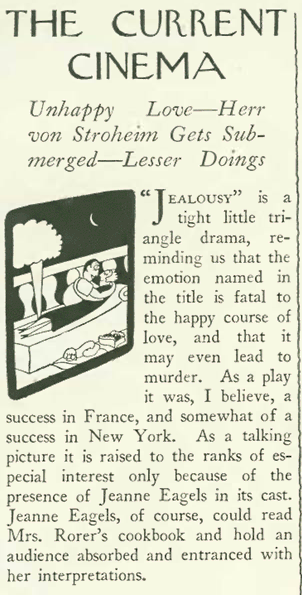
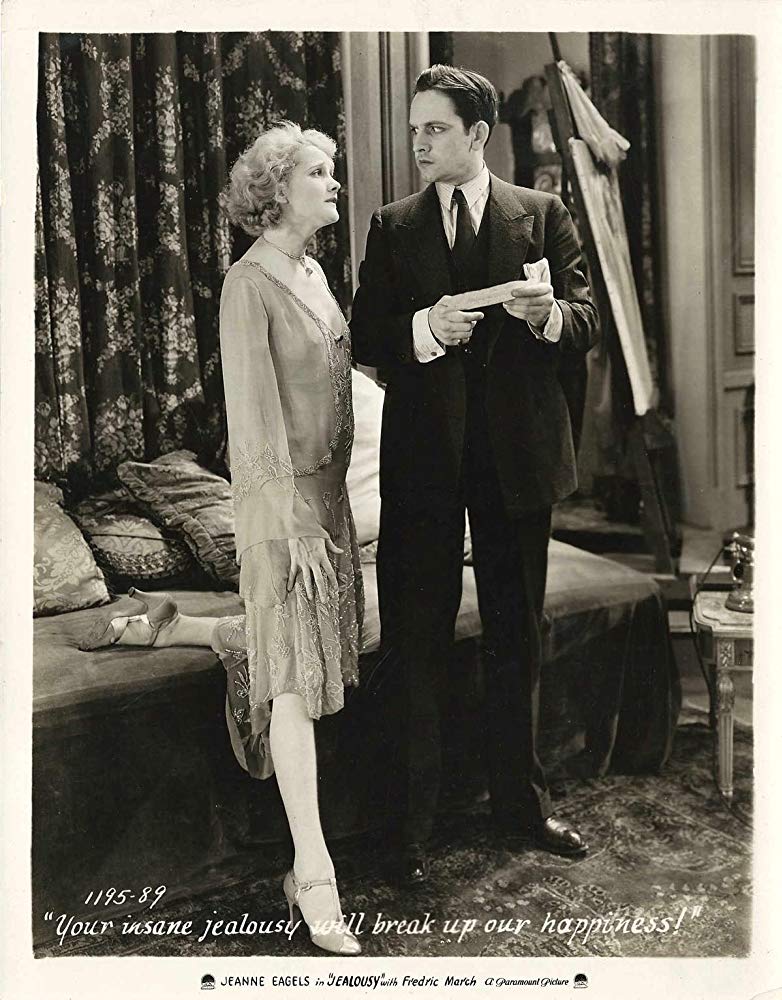
Movie critic John Mosher took in a couple of new films including Paramount’s 1929 pre-Code drama Jealousy…
FINAL CURTAIN…Jeanne Eagels and Fredric March in a publicity photo for Jealousy. Eagels died of a drug overdose on Oct. 3, 1929, just days after Mosher’s review appeared in The New Yorker. (IMDB)
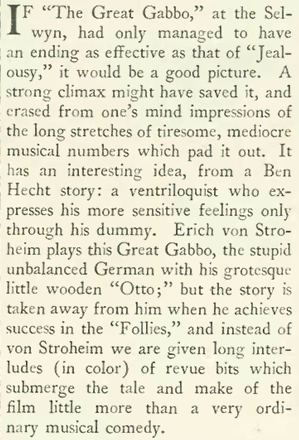
…and Mosher also reviewed the musical drama The Great Gabbo, which was derived from a story by occasional New Yorker contributor Ben Hecht…
WHO ARE YOU CALLING DUMMY?…Erich von Stroheim has issues with his co-star in The Great Gabbo. (MoMA)
* * *
From Our Advertisers
What appeared to be an unassuming ad from General Motors was actually a plan for world domination, at least in the area of ground transportation. GM gobbled up a number of car companies in the 1920s (see the ad’s fine print) as well as shares in power plants and home appliances. It would overtake Ford in sales in the late 1920s, and thanks to propaganda efforts including those illustrated in the ad below, it would lead a streetcar removal conspiracy that would destroy intercity train transport systems across the U.S. (and convert them to GM buses, naturally)…
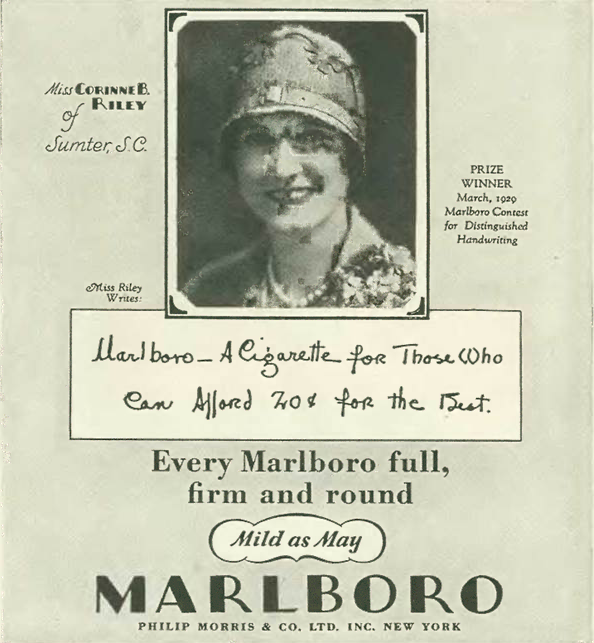
Here we have yet another “distinguished handwriting contest” ad from the makers of Marlboro, this time exploiting the efforts of Corinne B. Riley of Sumter, S.C….
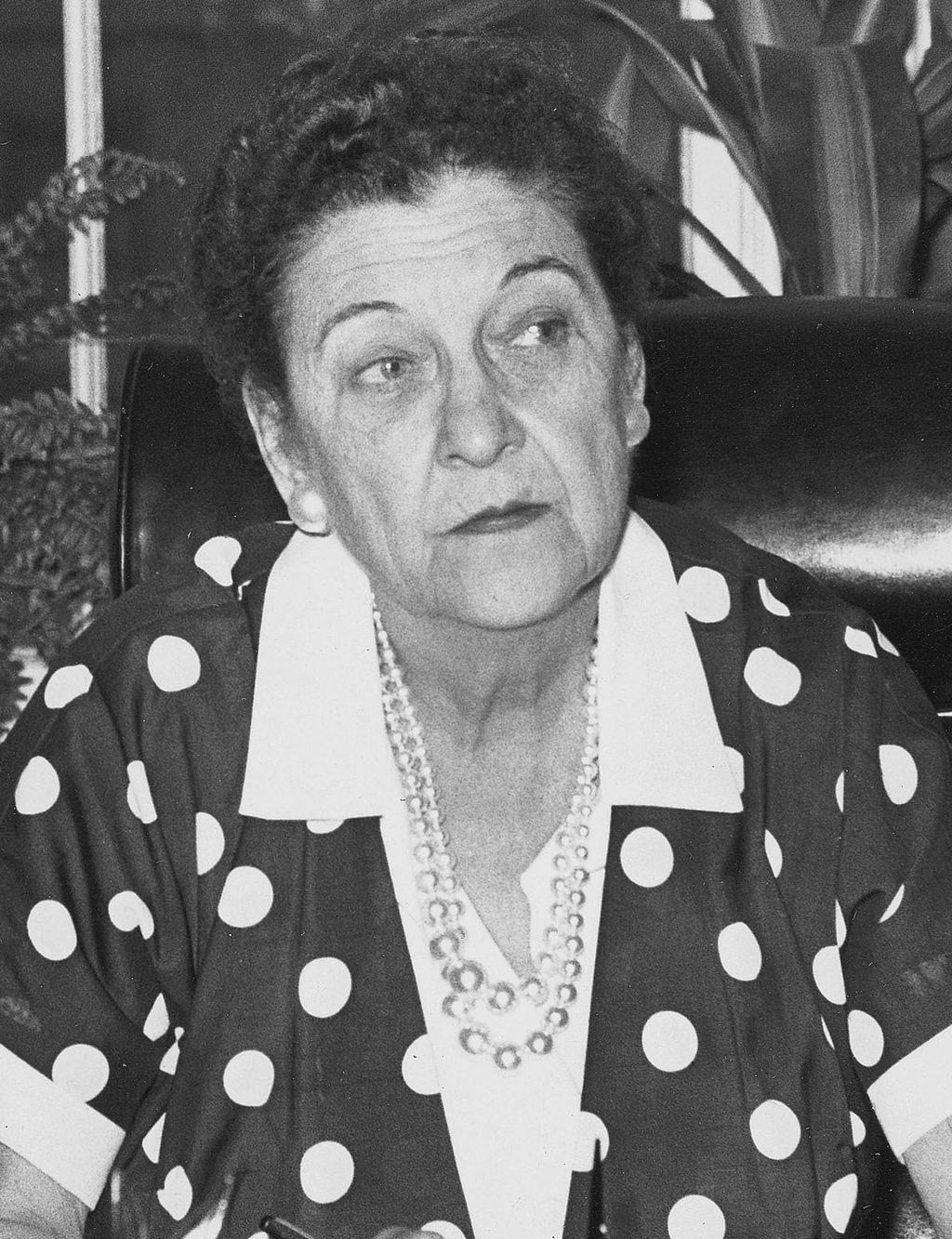
…Riley would win more than a handwriting contest, however. She would be elected as a Democrat to Congress in 1962 to fill a vacancy left by her husband, Congressman John Jacob Riley.
Corrine B. Riley in 1962. (Wikipedia)
On to our illustrators and cartoons, we begin with this two-page drawing by Reginald Marsh that appeared along the the bottom of “Talk of the Town”…
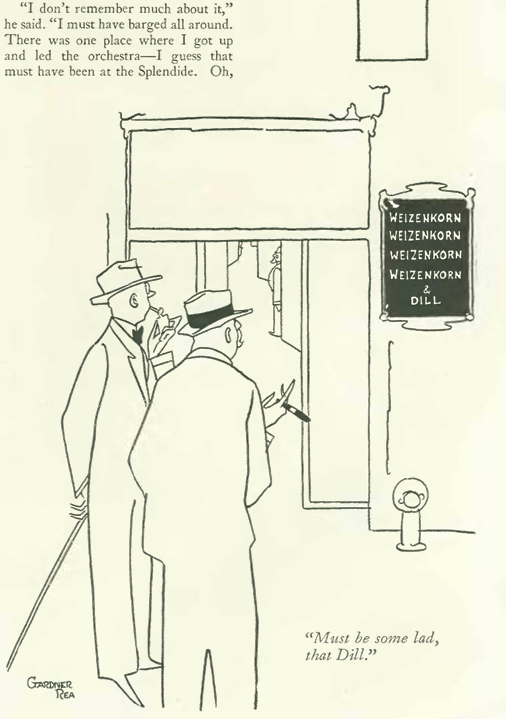
…Gardner Rea lent his spare style to this peek into Wall Street…
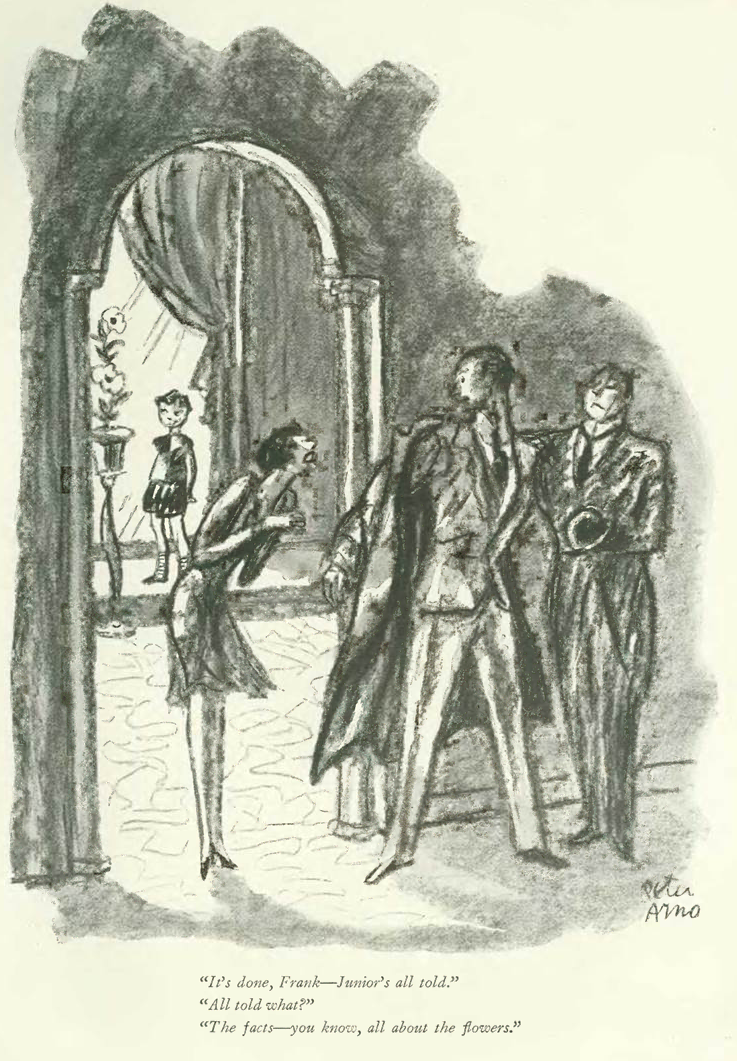
…Peter Arno appeared to be experimenting with yet another style of drawing…
…that in some ways looked similar to Alan Dunn’s…
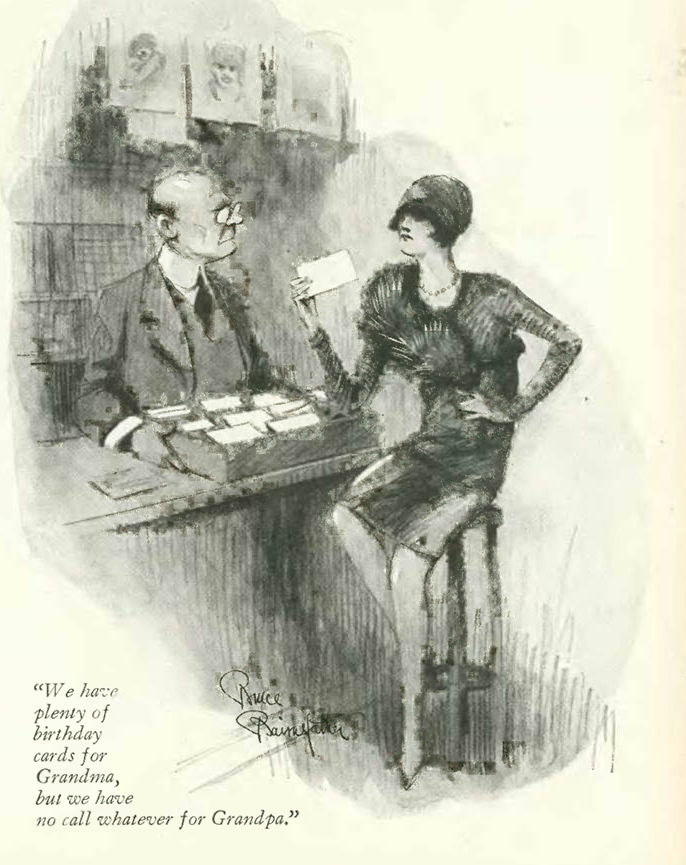
…the British cartoonist Bruce Bairnsfather provided this sumptuous drawing of an exchange at a card shop…
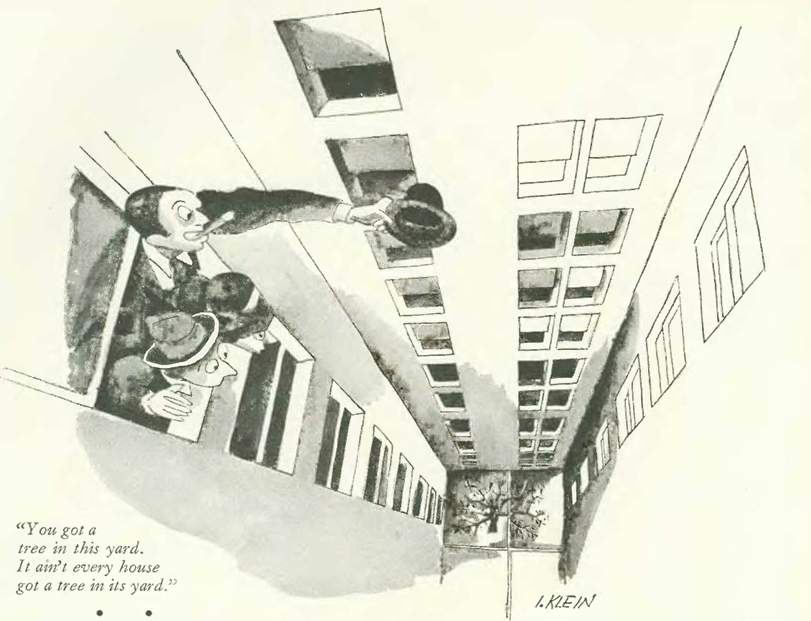
…and Isadore Klein gave a vertiginous perspective to home buying…
The Hammerstein name looms large in the history of both stage and screen, an extended family of theater impresarios and composers descended from the German-born Oscar Hammerstein I (1846 – 1919).
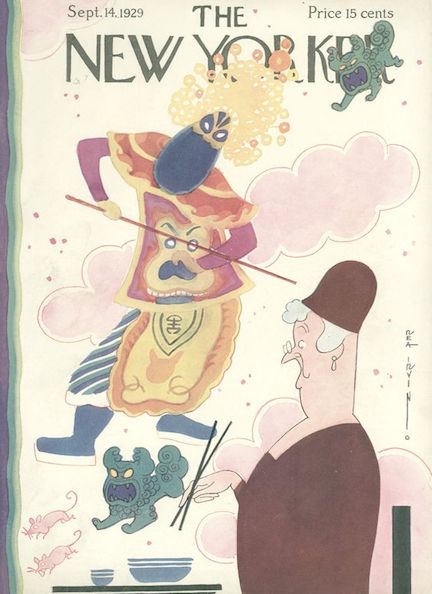
Sept. 14, 1929 cover by Rea Irvin.
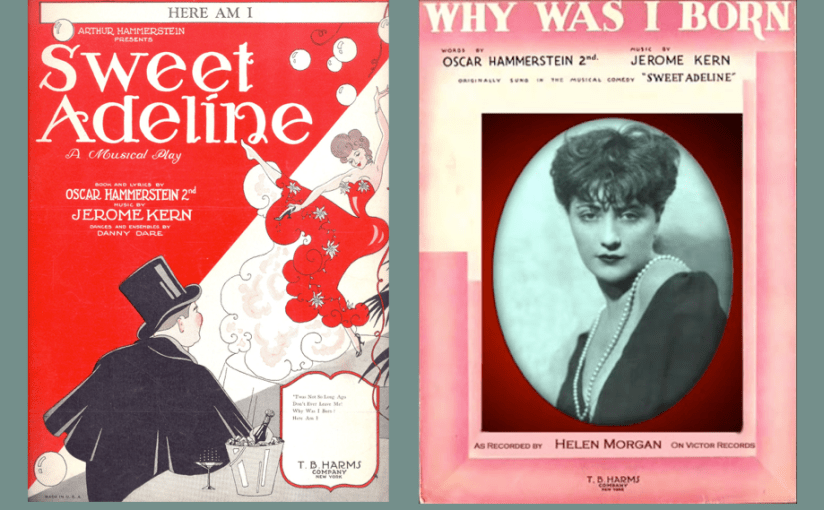
It was Oscar’s son, Arthur Hammerstein (1872 – 1955), who would bring the nostalgic musical Sweet Adeline to the Broadway stage, with music by Jerome Kern. Arthur’s nephew, Reginald Hammerstein, directed, and Reginald’s brother, Oscar Hammerstein II, provided the lyrics (and would later collaborate on such Broadway hits as Oklahoma! and The Sound of Music). Sweet Adeline opened on Sept. 3, 1929 at Arthur’s Hammerstein Theatre (known today as Ed Sullivan Theater), and the New Yorker’sRobert Benchley was on hand for opening night…
The title of the musical was a pun on the famous barbershop quartet song first published in 1903 — a time that seemed quaint to Jazz Agers. To get a sense of how rapidly American society had changed in the 1920s, in the paragraph above, Benchley referred to the musical’s setting (1898) as “old-time.” I’m not sure we would refer to 1987 as “old-time,” but who knows? Benchley continued…
OLD-FASHIONED FUN…Clockwise, from top left, the famed 1920s torch singer Helen Morgan (pictured on sheet music for one of her songs from the musical) starred as “Addie” in 1929’s Sweet Adeline;Arthur Hammerstein in undated photo; stage and screen actress and vaudeville comedian Irene Franklin portrayed a burlesque queen in the musical, while comedic actor Charles Butterworth played the part of a “young rounder.” (YouTube/findagrave.com/Wikipedia/lbarsanti.wordpress.com)
As for the performances by Helen Morgan (who more or less invented the torch singer’s boozy, draped-over-the-piano style), Benchley noted that her personality was “almost oppressively lush at times”…
A note regarding Helen Morgan: She began her career singing in Chicago speakeasies before moving to New York in the mid-1920s, where she continued to sing in nightclubs (including one attached to her name, Chez Morgan) while also performing on Broadway. Morgan became a heavy drinker, and was often drunk during performances (hence Benchley’s comment regarding her “lush personality”). Cirrhosis of the liver would claim Morgan’s life in 1941. The same disease would claim Benchley four years later.
* * *
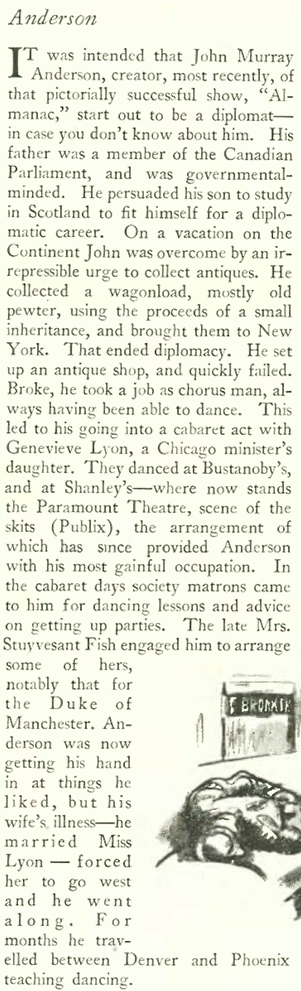
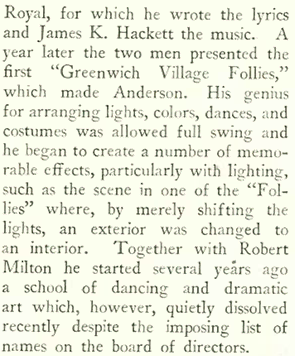
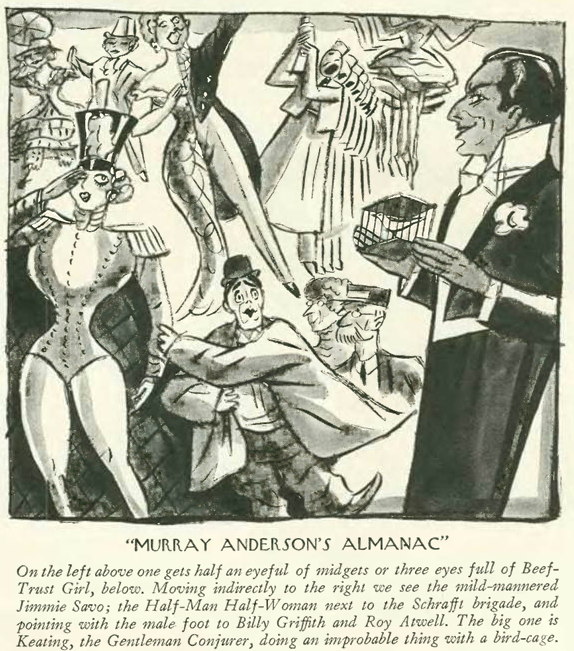
While we are the topic of Broadway, the Sept. 14 “Talk of the Town” featured a brief profile of John Murray Anderson, (1886 – 1954) who was celebrating the success of his own Broadway musical revue Almanac…
HE WORE MANY HATS…John Murray Anderson made his Broadway debut in 1919 as writer, director, and producer of The Greenwich Village Follies, which had a five-year run. At left, a cover for sheet music from a 1920 production. At right, postcard image of the Follies from 1922. (Pinterest)
In this excerpt, “Talk” recounted how Anderson finally hit it big in 1919 with his Greenwich Village Follies. It noted that he had a “genius”…
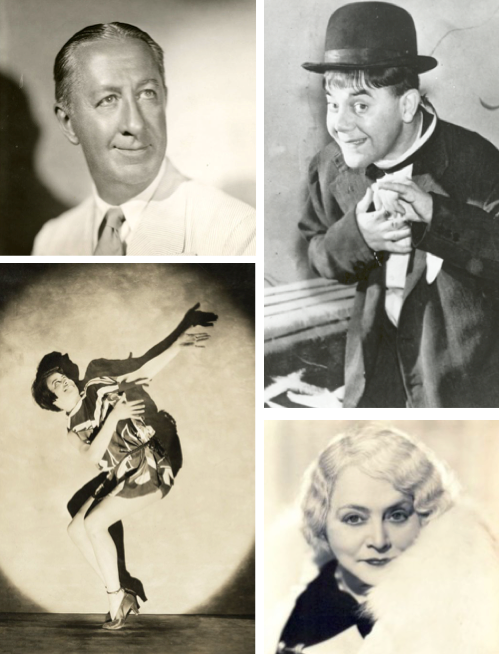
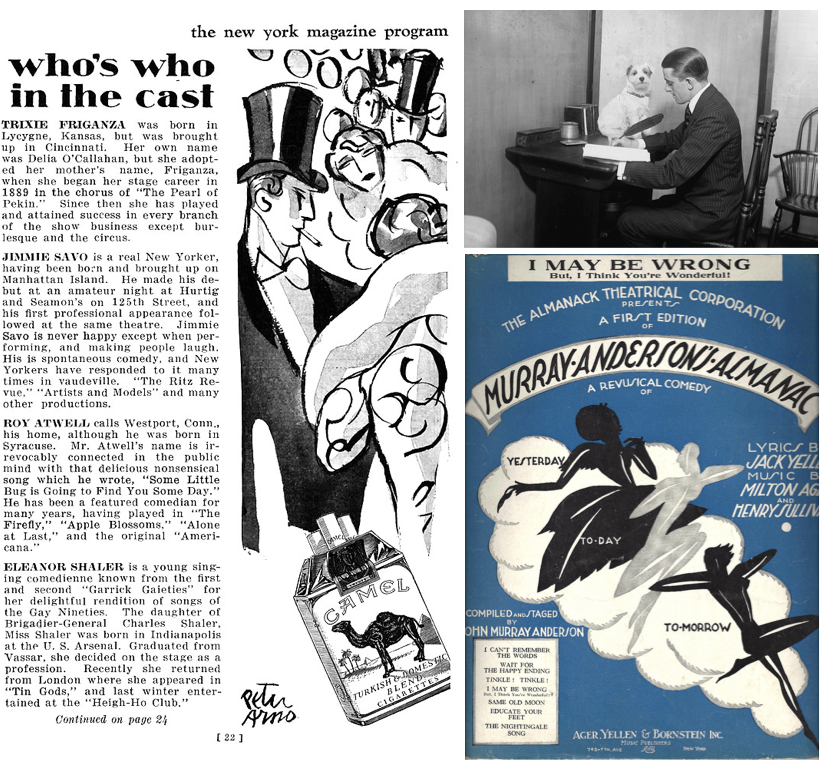
Clockwise from top left, Almanac featured comedians Roy Atwell and Jimmy Savo; singer and comedian Trixie Friganza; and actress Eleanor Shaler. (royatwell.net/American Vaudeville Museum/secondhandsongs.com/Pinterest)
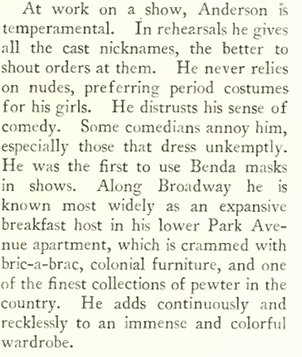
…and a bit more about Anderson…
In Michael Maslin’s terrific book, Peter Arno: The Mad, Mad World of The New Yorker’s Greatest Cartoonist,Maslin notes that Arno “was whisked onto the Manhattan theater scene by Murray Anderson, whose twenty-nine scene Almanac opened to excellent reviews at the two-year-old Erlanger Theater, just off Times Square.” Maslin cites the famed New York columnist O.O. McIntyre, who wrote “Arno was one of several ‘conspirators’ responsible for Broadway backdrops whose ‘exaggerated whimsicalities…in black and white…when unfolded usually get what Variety calls a belly laugh.'”
At left, Peter Arno contributed this advertisement for Camel cigarettes in the Playbill edition for Almanac; top right, John Murray Anderson at work; cover for sheet music from the revue. (attemptedbloggery.blogspot.com / Wikipedia)
And in the following issue of The New Yorker (Sept. 21), Peter Arno contributed this drawing for the theater review section (it doesn’t entirely look like an Arno, but then again his style at this time seemed to fluctuate almost weekly)…
* * *
Flapper Joan
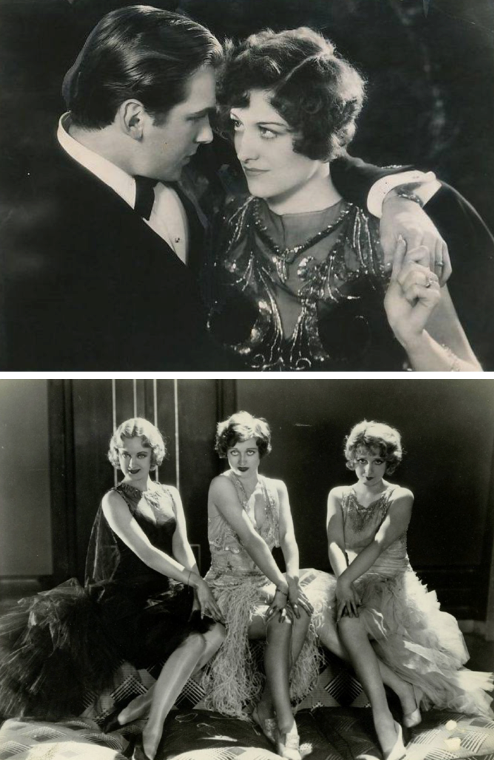
No stranger to Broadway herself, the young actress Joan Crawford was making a name for herself in Hollywood and garnering consistently positive reviews from the New Yorker’s film critic John Mosher, who found that the 25-year-old actress— who portrayed a fun-loving flapper in Modern Maidens — could shine even in the midst of an average screenplay:
THEY’RE NOT ACTING…At top, Douglas Fairbanks Jr. and Joan Crawford in MGM’s Our Modern Maidens (1929). The film led to a widely publicized romance and marriage between the co-stars; below, publicity photo for the film, with (from left) Josephine Dunn, Crawford, and Anita Page. (IMDB/joancrawfordbest.com)
* * *
Silence is Golden
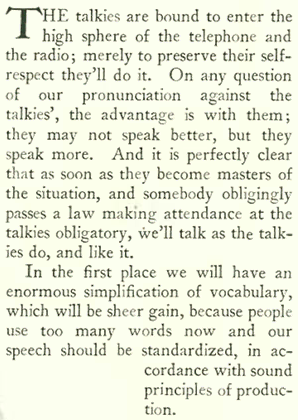
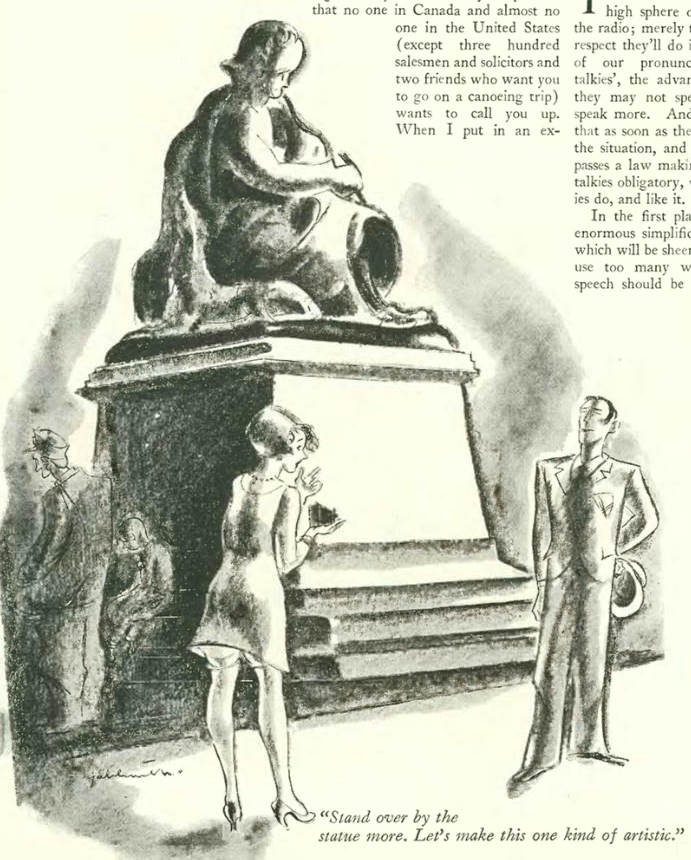
Cultural critic Gilbert Seldes contributed a casual titled “In a Loud Voice With the Tongues of Angels,” joining the chorus of voices at The New Yorker skeptical of (but resigned to) the advent of sound motion pictures. Excerpts:
SOMETHING HAS COME BETWEEN US…a microphone moves in close on Spencer Tracy and Bette Davis in a scene from 1932’s 20,000 Years In Sing Sing. (cinecollage.net)
* * *
Das Speedboat
“The Talk of the Town” reported on the fuss created by the German passenger liner Bremen after it completed its maiden voyage to New York. It set a new world record in the process — four days, 17 hours, and 42 minutes later —and captured the westbound “Blue Riband” from the famed Mauretania with an average speed of 27.83 knots (the Blue Riband was an unofficial honor bestowed on the fastest passenger liners crossing the Atlantic)…
LOWRIDER…Top, the low, streamlined profile of the Bremen against the backdrop of the New York skyline. Center and below, among its many unique features, the Bremen had a catapult on the upper deck between the two funnels that launched a small seaplane, which facilitated faster mail service ahead of the ship’s arrival. (YouTube/nnapprentice.com)(Ebay community post)
* * *
Up In Smoke
Another “Talk” item explored the decline of cigar and pipe smokers thanks to the rise of cigarette advertising (and women smokers) in the 1920s…
…as an aside, it appeared golfer Walter Egan was still a pipe smoker, as this illustration by Johan Bull for the issue’s “Tee and Green” column attested…
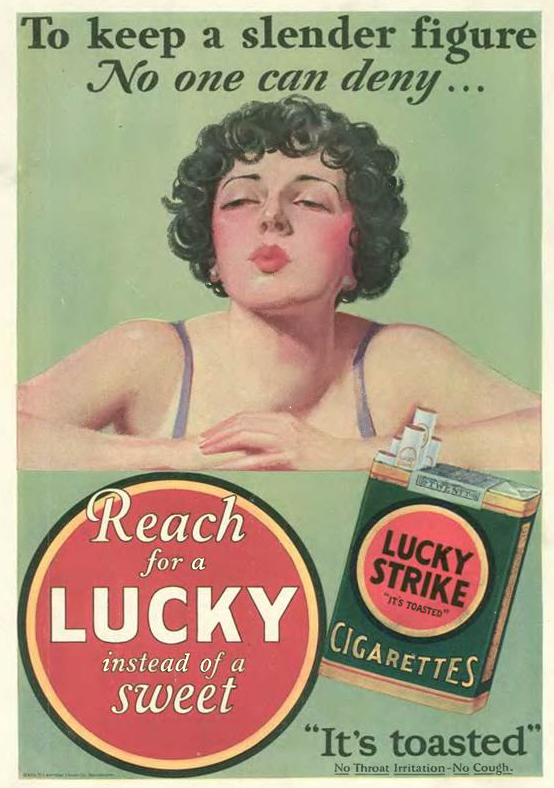
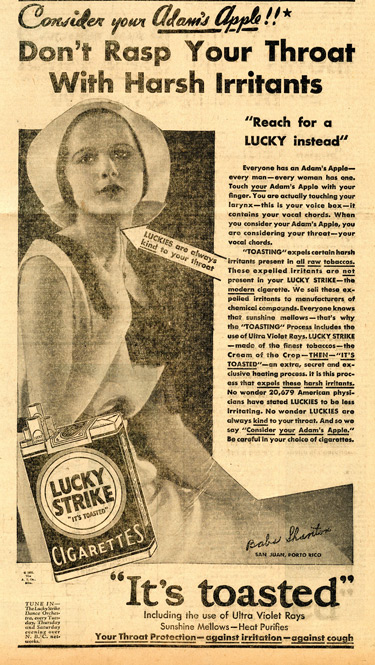
…”Talk” laid the blame (or the credit) on Lucky Strike’s successful ad campaigns that that particularly made a “big impression” on women…
…and to begin our advertising section, a Lucky Strike ad from the same issue:
…the Liggett & Myers tobacco company, on the other hand, promoted their Fatima brand as a higher quality, and slightly more expensive, alternative…
…in this ad for The Shelton Looms we find the elongated style popular in fashion ads of the era…the illustration is by LeBrun, but also evokes the style of Carl “Eric” Erickson, known for his Camel ad illustrations of the same period…
…and now a couple of ads from the back pages: the ad at left promoted a “country style” supper club near Washington Square. I haven’t found a record (yet) for the County Fair, but it was one of the themed restaurants Don Dickerman operated around Greenwich Village before the Depression (Dickerman, an illustrator, also provided the art for the ad)…the ad on the right—for Odorono deodorant— appeared regularly in the back pages of The New Yorker, illustrated by the magazine’s own Julian De Miskey. The ads featured vignettes of unfortunate young women whose B.O. was so bad that it caused all potential suitors to flee…
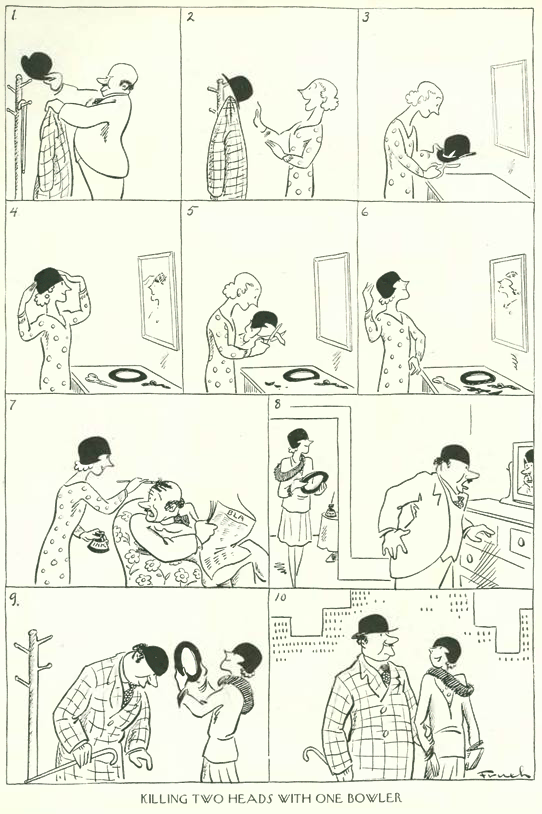
…on to our cartoons, Al Frueh (artist of the first two cartoons in The New Yorker’s first issue)…contributed another of his familiar multi-panel “silent” cartoons…
…I like the modern feel of this cartoon by William Crawford Galbraith…
…and we close with a couple of cartoons under the moonlight, by Bruce Bairnsfather…
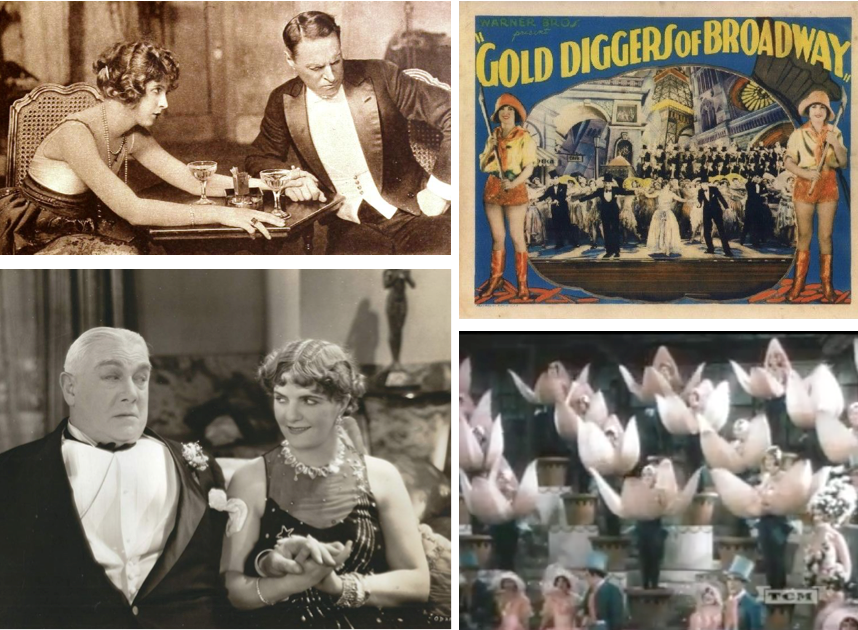
Avery Hopwood’s 1919 Broadway hit, The Gold Diggers, was among cultural events of the late teens that signaled the dawn of new age; namely, the Jazz Age.
Sept. 7, 1929 cover by Sue Williams.
So it seems appropriate that the play, when adapted to the screen in 1929 as a Technicolor talkie, would also signal the end of that age. As the New Yorker’s film critic John Mosher observed in his review of The Gold Diggers of Broadway, the themes that seemed new and daring a decade earlier had been played out, the “general humors” of the picture having “become very familiar”…
The film featured Nancy Welford, Winnie Lightner and Ann Pennington as three chorus girls who try to entice a wealthy backer to invest money in their struggling Broadway show. The film was a big hit, and it made a star of Winnie Lightner (1899-1971), who played the boldest “Gold Digger” of the trio.
PROSPECTORS…Clockwise from top left, Ina Claire as the original “Gold Digger” with Bruce McRae in the 1919 Broadway play The Gold Diggers; lobby card for the 1929 film Gold Diggers of Broadway; image from the film’s “Tiptoe Thru the Tulips” song-and-dance number; Winnie Lightner works her charms on Albert Gran in a scene from the film. (Wikipedia/IMDB/TCM-YouTube)IT’S FUN MAKING PICTURES…Helen Foster, Ann Pennington, Nancy Welford and William Bakewell in a publicity photo from 1929’s Gold Diggers of Broadway. (IMDB)
Lightner wasn’t the only actor to steal the show. The film also proved a winner for crooner Nick Lucas (1897-1982), who performed two hit songs written for the movie — “Painting the Clouds with Sunshine” and “Tiptoe through the Tulips.” Yes, that second song was the very same tune Tiny Tim rode to fame nearly 40 years later.
TIPTOE THROUGH HISTORY…At left, Nick Lucas sings what would be become his signature song “Tiptoe through the Tulips” to Lilyan Tashman in the Gold Diggers of Broadway. At right, forty years later, Lucas sang the song on The Tonight Show With Johnny Carson (apparently using the same guitar) on the occasion of singer Tiny Tim’s televised wedding to Victoria Mae Budinger (“Miss Vicky”). Tiny Tim (inset) also made “Tiptoe through the Tulips” his signature song, although his was a campier version, sung in a falsetto, vibrato voice accompanied by his trademark ukulele. (YouTube)
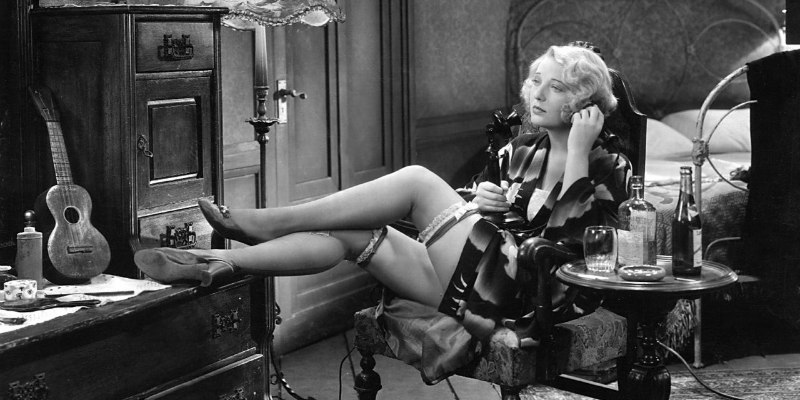
The Gold Diggers of Broadway was a “pre-code” film, that is, a film made during a brief period of the early sound era (roughly 1929 through mid-1934) when censorship codes were not enforced and many films openly depicted themes ranging from promiscuity and prostitution to amoral acts of violence.
A LEG UP ON THE CENSORS…Warner Brothers publicity photo of Dorothy Mackaill, who played a secretary-turned-prostitute in 1931’s Safe in Hell. (Wikipedia)
Those unenforced codes had their origins in the early 1920s. In response to outcries from preachers and politicians alike over the immortality of Hollywood (both on- and off-screen), the president of Paramount Pictures, Adolph Zukor — fearing that cries for censorship would cut into his profits — called a February 1921 meeting of his studio rivals at Delmonico’s restaurant on 5th Avenue. At the meeting Zukor (1873-1976) distributed a set of 14 rules that would guide every Paramount production (Zukor’s studio at that time was actually known as Famous Players-Lasky). The rules covered everything from “improper sex attraction” to “unnecessary depictions of bloodshed.”
It was also Zukor’s idea to appoint the former U.S. Postmaster General, Will Hays, as President of the Motion Picture Producers and Distributors of America. It would be Hays’ job to enforce the code and generally “clean up” Hollywood. However, until mid-1934 both Hays and the code served mostly as publicity ploys to keep the preachers and politicians off the backs of studio execs.
Zukor was profiled by Niven Busch, Jr. in the Sept. 7 issue (with portrait by George Shellhase). In his opening paragraph, Busch commented on “Pop” Zukor’s efforts to stave off the censors:
* * *
Delmonico’s Redux
The famed Delmonico’s restaurant that provided the setting for Adolph Zukor’s “14 rules” meeting in 1921 closed its doors in 1923, a victim of Prohibition (more people dined at home, where they could still drink). Writing in the Sept. 7 “Talk of the Town,” Bernard A. Bergman described plans for the long-awaited opening of a new Delmonico’s in a skyscraper bearing the same name…
RICH DESSERTS…Dinner in honor of French Navy Admiral Paul Campion at the old Delmonico’s in 1906. (Wikipedia/Library of Congress)AND SALAD DAYS…Delmonico’s wait staff pose for a photograph in 1902. (Museum of the City of New York)
A former Delmonico’s chef, Nicholas Sabatini, hoped to bring back some of old waiters and cooks from the restaurant’s glory days, but it seemed most were far too long in the tooth. It is unclear if he ever got his dream off the ground, or if the grill room was able to crank out fare comparable to that of the old Delmonico’s. Probably not…
THE KITCHEN IS CLOSED…The 1928 Hotel Delmonico, as shown in a 1937 photograph. It was purchased by Donald Trump in 2002 and converted into luxury condominiums. It would not host a great restaurant, but the Beatles would stay there in 1964. (New York Public Library)
* * *
Relax. You’re in Omaha
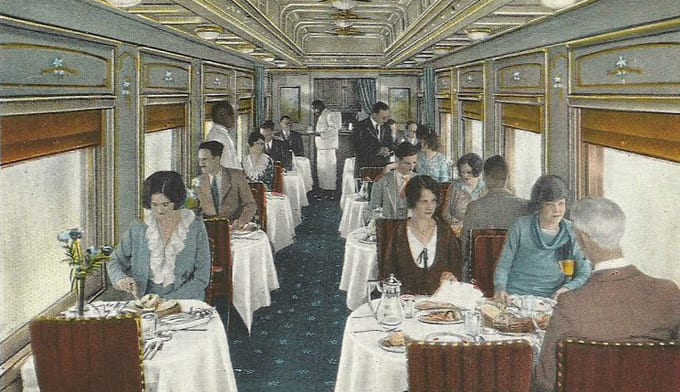
E.B. White’s “Notes and Comment” entry in the Sept. 7 “Talk of the Town” described travel on the Union Pacific’s Overland Limited, and the “mystic dividing line” that separated laid-back Westerners from buttoned-up Easterners:
MIND YOUR MANNERS, AT LEAST UNTIL YOU LEAVE CHICAGO…Tinted photo postcard depicting the dining car on a Union Pacific train that traveled the Chicago to Denver route in the 1920s. (myutahparks.com)
* * *
Write What You Know
The Wisconsin-born Marion Clinch Calkins (1895 – 1968) often wrote humorous rhymes for The New Yorker under the pen name Majollica Wattles. While many writers reveled in the party atmosphere of the Roaring Twenties, Calkins worked as a vocational counselor and social worker at Lillian Wald’s Henry Street Settlement. This experience doubtless led her to more serious writing after the 1929 market crash — her critically acclaimed book, Some Folks Won’t Work (1930), is considered a seminal document on the Great Depression.
But in September 1929, Calkins was still in a humorous vein, and published this satirical piece on the role of an ideal housewife in the Sept. 7 issue. Excerpts:
CALL ME CLINCH…Marion Clinch Calkins circa 1905 and 1945. She wrote under the name of Clinch Calkins because she wanted her authorship to be gender-neutral. (evansvillehistory.net/NEH)
* * *
Information Please
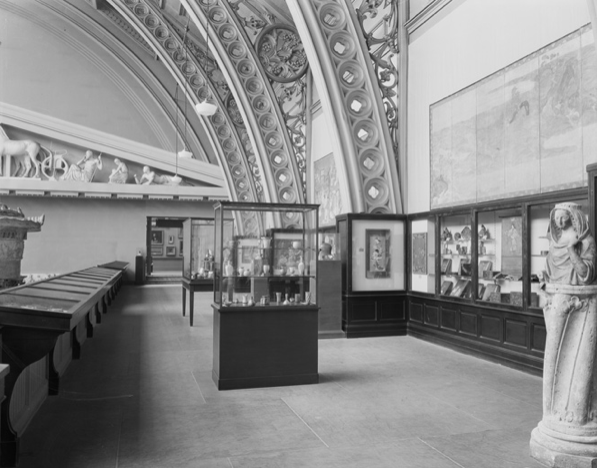
The New Yorker’s art critic Murdock Pemberton did not suffer fools gladly, and whenever the local museums seemed less than up to snuff, he was there to provide some correctional advice…
NEED AN AUDIO GUIDE? STILL WORKING ON THAT…The Metropolitan Museum of Art’s H.O. Havemeyer Collection, 1930. (The Metropolitan Museum of Art)
* * *
From Our Advertisers
Despite the advances made by women in the 1920s, they still lived under a patriarchy, especially when it came to the patrician classes. And so the young bride of Gifford Pinchot II was identified only as a “Mrs.” in the headline for this Pond’s cold cream ad…
…Mrs. Gifford Pinchot II was actually Janine Voisin (1910-2010). She must have had more than a healthy complexion, as she lived 100 years…
Janine Voisin Pinchot in 1933. (history.blogberth.com)
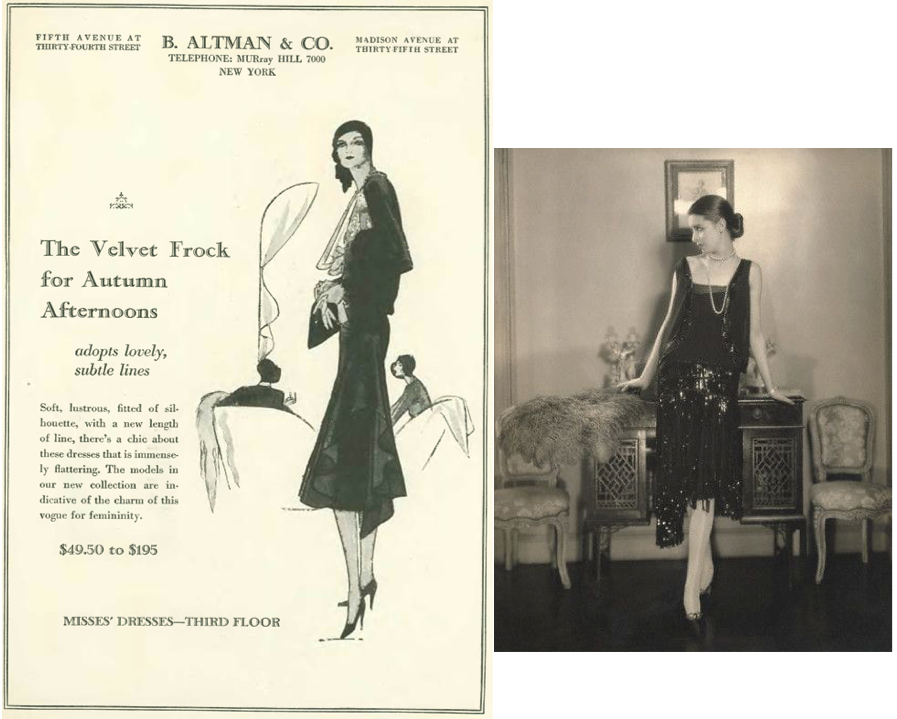
Another woman known for her beauty in the 1920s was the model Marion Morehouse (who was married to poet E.E. Cummings from 1934 until his death in 1962). Considered by some to be the first “supermodel,” I include an image of Morehouse below (right) to demonstrate how artists exaggerated the female form in fashion ads of the day…
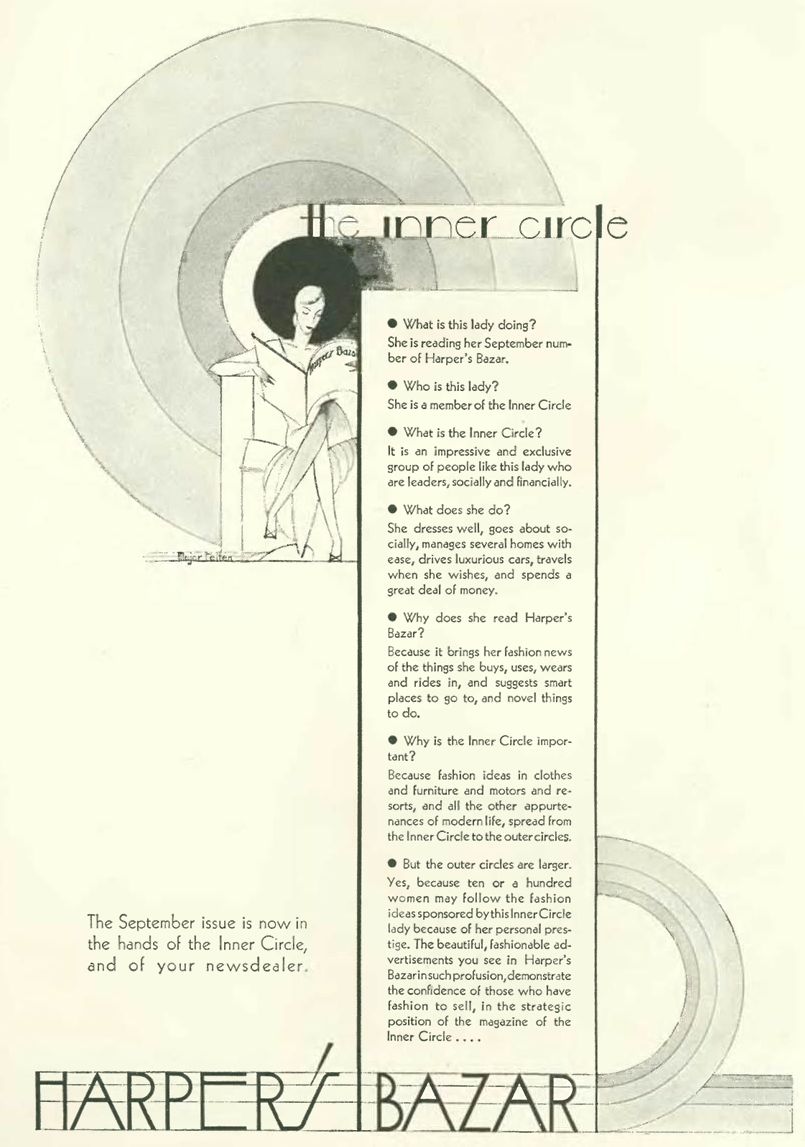
…the body wasn’t the only thing subject to exaggeration, or hyperbole, as this ad from Harper’s Bazar attested in defining the exclusivity of its readership…
…the New York Sun also appealed to social mores in an attempt to sell more newspapers…
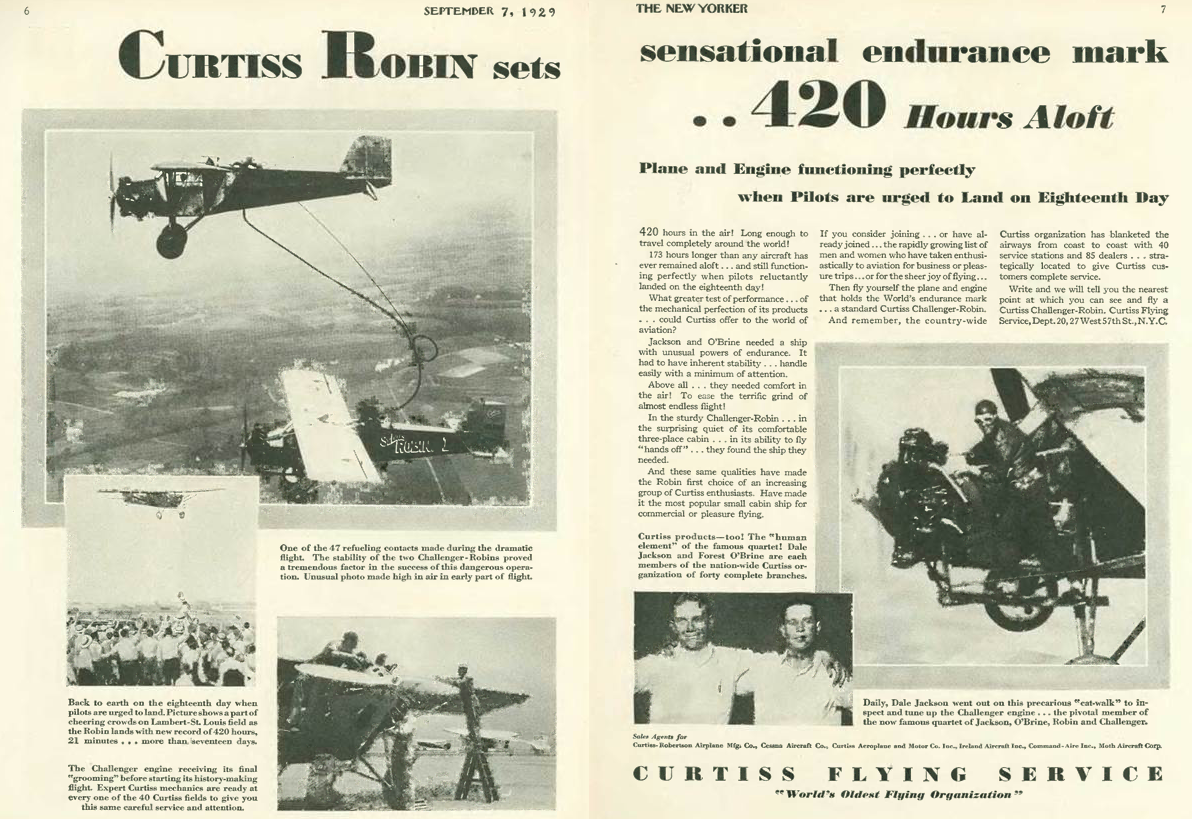
…the Curtiss Robin Flying Service touted their latest achievement — the St. Louis Robin being refueled during its flight to a new world’s endurance record of 420 hours — greatly surpassing the record of 150 hours set by the Army’s “Question Mark” airplane at the beginning of 1929…
…our cartoonists from the Sept. 7 issue include Gluyas Williams, who had some fun at the expense of Alice Foote MacDougall, who was the “Starbucks” of her day, at least in New York…
…MacDougall turned her coffee business into a restaurant empire in the 1920s. She opened several restaurants in Manhattan, all decorated in a signature style meant to evoke European cafés…
EURO AMBIENCE…Interior of Alice Foote MacDougall’sFirenze, 6 West 46th Street, New York City, 1925. (New York Historical Society)
…other cartoons included this commentary on public advertising by Leonard Dove…
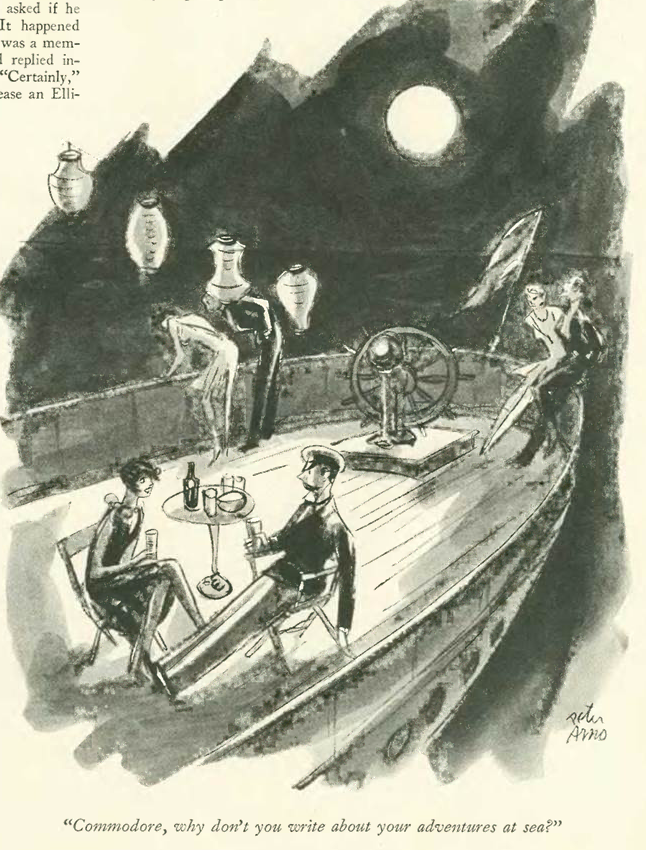
…Peter Arno’s unique take on the seafaring life…
…Helen Hokinson eavesdropped on some tween talk…
…and Alan Dunn gave us some perspective on the fast pace of city life…
When Charles Lindbergh gunned his Wright Whirlwind engine on Roosevelt Field and took to the skies on his historic flight, he sparked such an interest in flying that just two years later that very same field was hosting huge weekend crowds that came to marvel at the airborne wonders of a new age.
August 31, 1929 cover by Theodore Haupt.
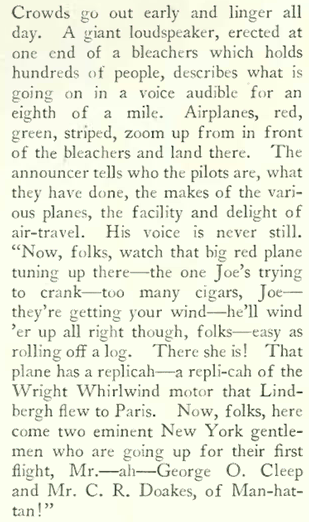
Writing for “The Talk of the Town,” James Thurber was on hand to take in the spectacle, noting how the announcer sold air-mindedness to the mob “in great clamorous phrases and resonant assurances.” Among those taking their first flight was a “Mr. Galleger, aged 101.” Thurber also observed:
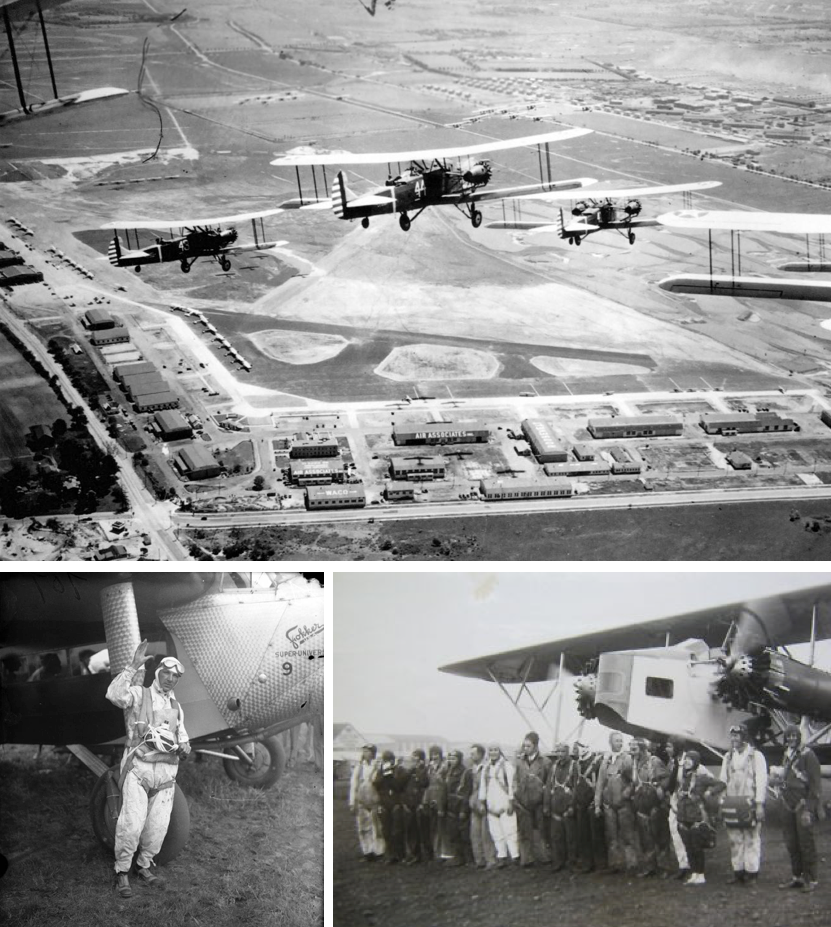
AIRBORNE SPECTACLES…Clockwise, from top, a 1931 aerial view looking southeast at a group of Army twin-engine biplane bombers overflying Roosevelt Field; parachute records were broken when 14 men and 2 women leaped from a Sikorsky bombing plane at Roosevelt Field in November 1929 (in the photo they seem to be standing precariously close to the plane’s whirling blades); Jack Cope waved to onlookers in Chicago before he performed a 15,000 foot jump in 1929. (tripod.com/Worthpoint/Chicago Tribune)
Although there were thrills galore up in the sky, Thurber seemed equally impressed by the spectacle on the ground…
THE SUN GOD…Clockwise, from top, a 1928 photo of biplanes lined up by a row of hangars at Roosevelt Field; the spectacle of mid-air refueling was demonstrated above Roosevelt Field by Texaco Oil’s Spokane Sun God. (Tom Heitzman/barnstmr.blogspot.com/Wikipedia)
One of the big attractions was Texaco Oil’s Spokane Sun God, which traveled around the country to demonstrate the art of mid-air refueling. Note in the excerpt below (second paragraph) how the Sun God’s pilot communicated with his ground crew: He tossed some notes—tied to a heavy piece of lead(!)—out of the airplane’s window. It nearly landed in a crowd of onlookers…
AND HOW WAS YOUR DAY?…For some perspective, the first attempt at refueling in mid-air was made in 1921. In the photo above, Wesley May climbs from the lower biplane to the upper while carrying a 5-gallon can of fuel strapped to his back. After lifting himself onto the wing, he worked his way between the wings and into the cockpit. He then poured the fuel into the engine. (Seattle Museum of Flight)
* * *
Falling Short
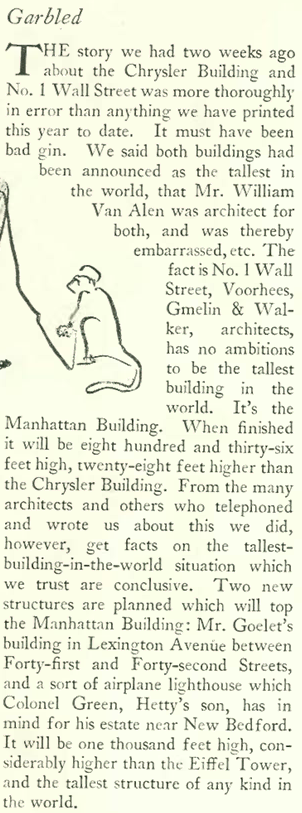
As I noted in a previous post (The Last Summer), the race to build the tallest building was erroneously reported by The New Yorker as a man against himself (namely, architect William Van Allen). In the Aug. 31 issue, the magazine’s “Talk of the Town” corrected the error, and added another curious note about another plan to build an “airplane lighthouse” taller than the Eiffel Tower…
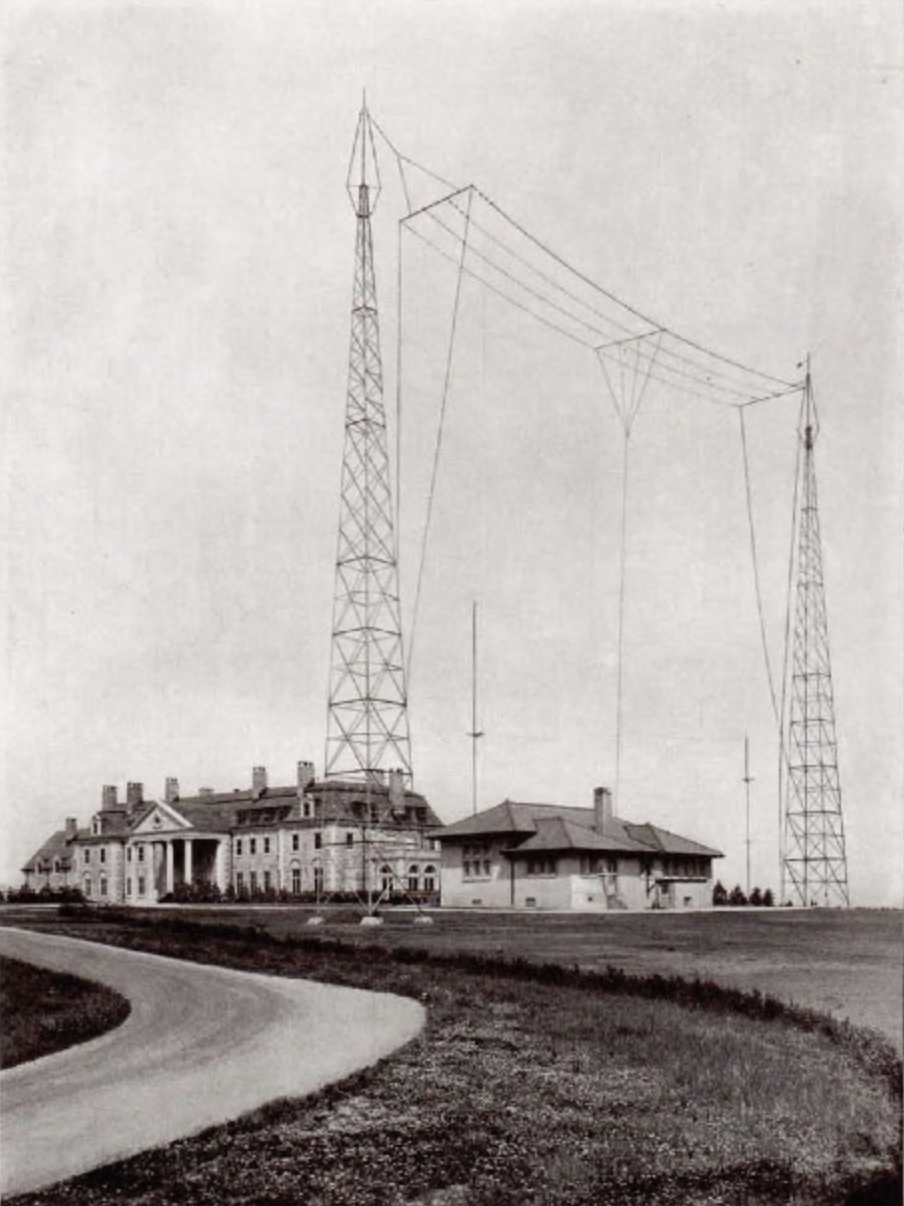
As noted above, Col. Edward Howland Robinson Green (son of the notorious miser Hetty Green) wanted to build a thousand-foot tower on his estate in Massachusetts. Here is what he settled for instead:
WORK-LIFE BALANCE…Edward Green, radio enthusiast and son of the miserly Hetty Green, erected huge radio towers at his Massachusetts estate in the 1920s to operate an early broadcast station, WMAF. (Wikipedia)
* * *
When Trains Fly
Cashing in on the enthusiasm over aviation, the City of New York promoted its elevated train system as an “Air Line.” According to “Talk”…
Click on the video below to take a ride on the “L”. Most of the 1929 footage begins at 4:47…
* * *
Haw Haw
One more “Talk” item: a self-referential piece in which The New Yorker pondered its “mission” as a humor magazine…
* * *
Audax Minor
For more than five decades, George Francis Trafford Ryall (1887-1979) wrote the horse racing column for the New Yorker under the pseudonym Audax Minor. He published his first column on July 10, 1926, and his last on Dec. 18, 1978. He was the writer of longest record at the magazine when he died at age 92 in 1979 (52 years, a record that has been shattered by the nearly 98-year-old Roger Angell, who has published in the New Yorker from 1944 to 2018).
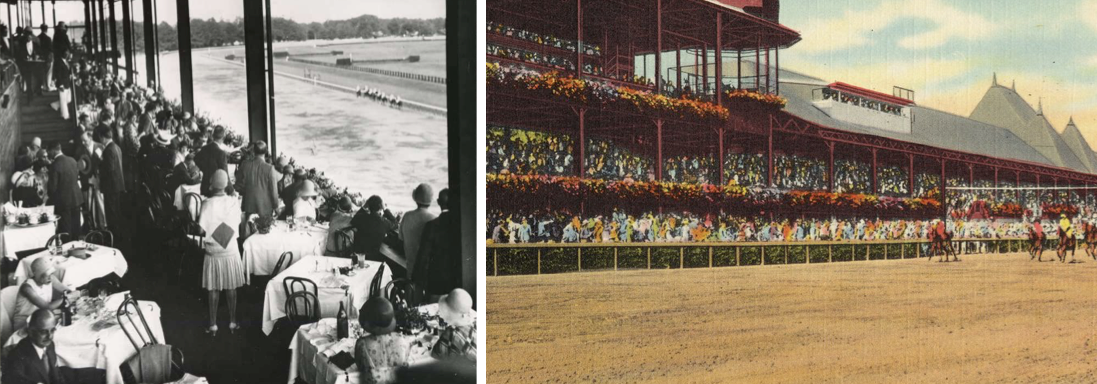
According to Ryall’s obituary in the New York Times, he adopted the nom de plume Audax Minor in a nod to Arthur F. B. Portman, who wrote about racing in England under the name of Audax Major. Ryall’s writing was so entertaining that many of his readers had never even been to a racetrack. According to Brendan Gill in his book, Here at the New Yorker, “(Ryall’s) world is a romantic fiction and they (the readers) are grateful when they learn that, with his green tweeds, his binoculars hung smartly athwart his chest, and his jaunty stride, Ryall resembles a character out of some sunny Edwardian novel.” An excerpt of his column from the Aug. 31 issue, with illustrations by Johan Bull:
A DAY AT THE RACES…At left, a crowded second floor dining area in the clubhouse at Saratoga, 1929; a postcard image of the track, with expanded clubhouse at left, circa 1929. (Saratoga Springs Historical Museum/Boston Public Library)
* * *
Shut Out
As I’ve noted before, the New Yorker covered nearly every imaginable sport except baseball. Here is a rare mention of the game in Howard Brubaker’s “Of All Things” column:
The Cubs would win the NL pennant, but they would fall to the Philadelphia Athletics in the 1929 World Series.
Rough and Ready
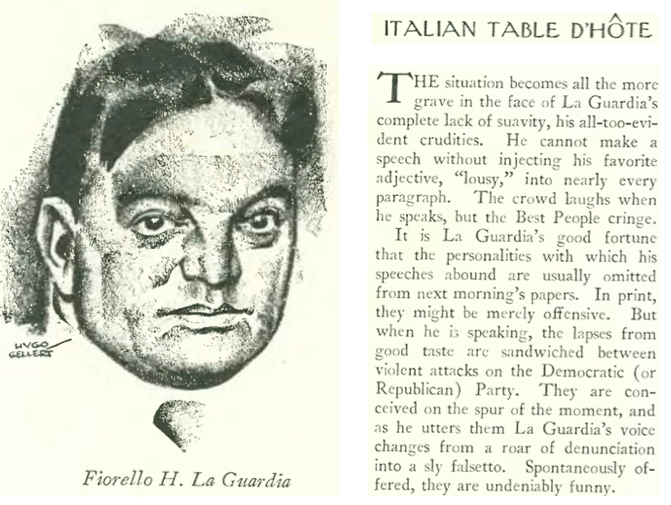
When Fiorello La Guardia challenged incumbent Jimmy Walker for New York City mayor in 1929, the city’s voters were presented with two colorful candidates who could not have been more different in their styles. Walker, a product of Tammany Hall, was a svelte dandy with a taste for the refined, whereas the reform-minded La Guardia was often coarse and unkempt. If they had anything in common, it was their dislike of Prohibition. La Guardia was featured in the Aug. 31 profile, written by Henry F. Pringle. Some excerpts:
JUST TRY TO STOP ME…Congressman Fiorello La Guardia pouring beer in his office during Prohibition, when he served New York’s 20th district in U.S. House of Representatives. (La Guardia Wagner Archives)
* * *
Praise for the King
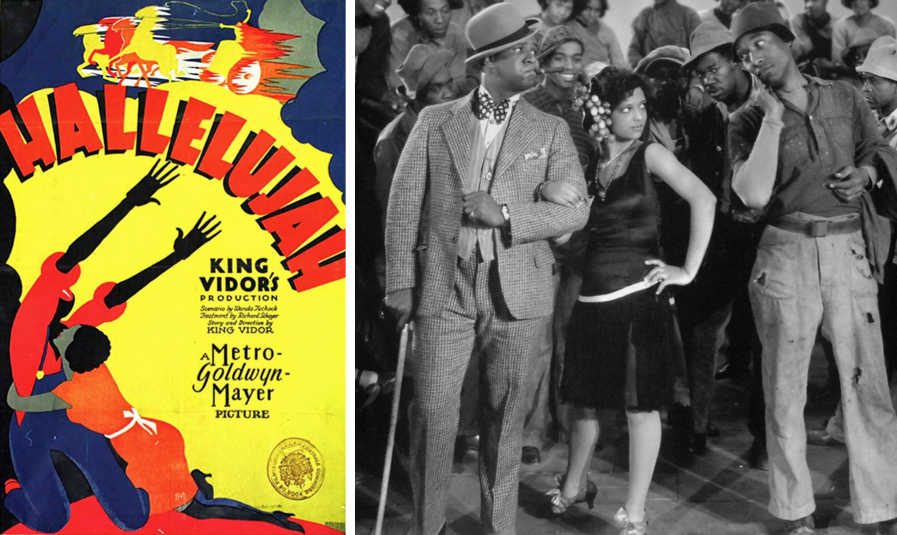
TheNew Yorker’s film critic John Mosher found most of Hollywood’s output to be pedestrian, but occasionally he saw a bright spot, including King Vidor’s latest production, Hallelujah:
William E. Fountaine, Nina Mae McKinney and Daniel Haynes in Hallelujah. The 17-year-old McKinney was the first African-American actress to hold a principal role in a mainstream film, and the first African-American actor to sign a long-term contract with a major studio—MGM. (IMDB)
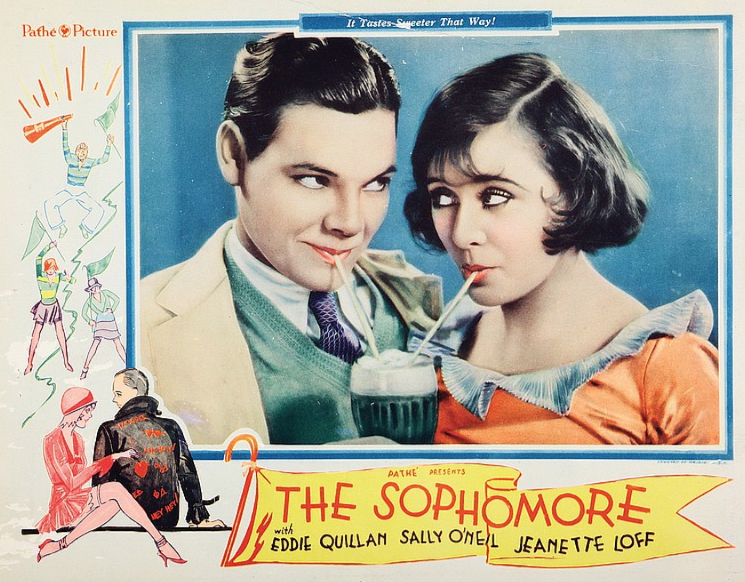
As for another film, Paramount’s The Sophomore, Mosher probably felt a bit obligated to say something nice, since it was a derived from a story by humorist Corey Ford, an early contributor to The New Yorker and part of the Algonquin Round Table orbit:
BOY MEETS GIRL…Lobby card for The Sophomore. (IMDB)
* * *
A Bright Interval
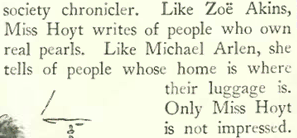
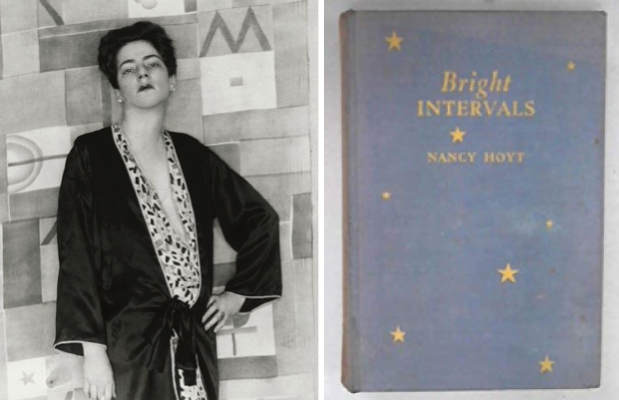
The New Yorker gave a brief but approving mention of Nancy Hoyt’s latest book, Bright Intervals, in its book review section…
Hoyt was a member of a socially prominent but deeply troubled family that included her recently deceased sister, the poet and writer Elinor Wylie (I wrote about the Hoyt family in my post Generation of Vipers). Characters in Hoyt’s novels often resembled the women in her family.
Nancy Hoyt in an undated photo by Sherril Schell. (Conde Nast/Amazon)
* * *
From Our Advertisers
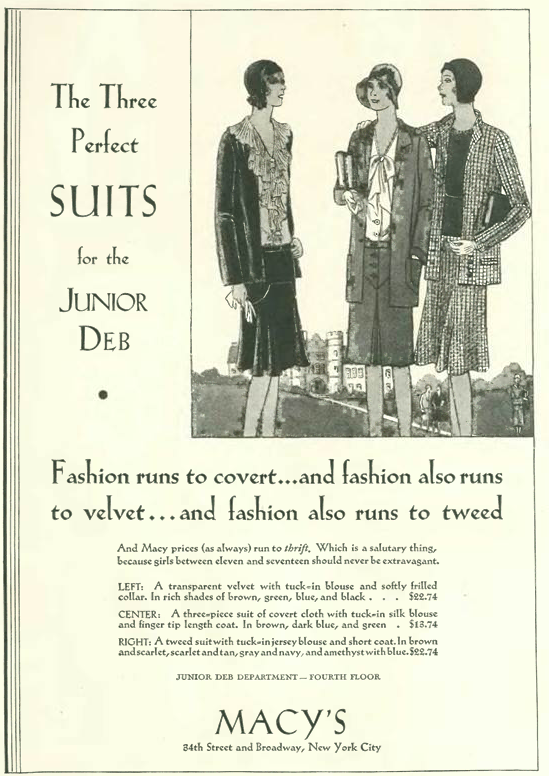
It was back to college time, and Macy’s had a thrifty new fall lineup ready for the “Junior Deb”…
…and on the less thrifty side, Best & Company offered these new looks for fall…
…note in the above ad that the first model is Virginia Maurice, the very same model we encountered in a recent post (The Last Summer) posing for Chesterfield cigarettes…
Model Virginia Maurice posed for this 1929 Chesterfield ad, illustrated by artist Charles Edward Chambers.
…the other model in the Best & Company ad, Babs Shanton, also wasn’t averse to taking money from the tobacco companies…
Undated newspaper ad for Lucky Strikes featuring Babs Shanton, a sometime performer with the Ziegfeld Follies and a singer with the Lucky Strike Dance Orchestra. (Stanford University)
…the makers of Studebakers tried to add sex appeal in this ad for their President Roadster. The artist was obviously challenged to work all of the necessary elements into the picture—car, swimming pool, diving board—not to mention the block of superfluous text where the steps to this impossibly long diving board should have been located…
…and sex not only sold cars…its also sold printing services…
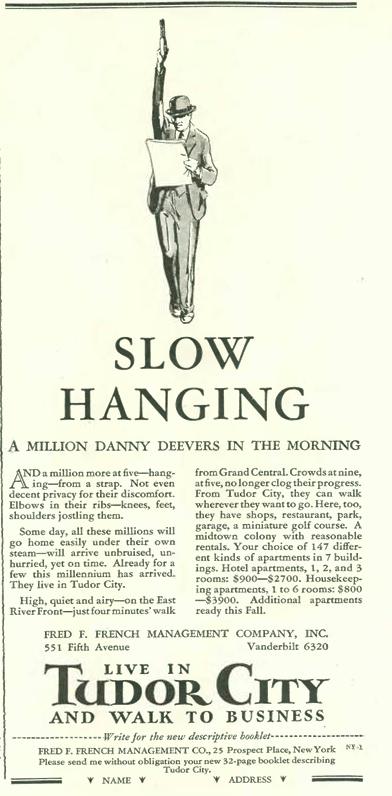
…instead of sex, the promoters of Tudor City chose strangulation to get their pitch across, equating a man’s daily train commute to death at the gallows (“Danny Deevers” refers to a character in a Rudyard Kipling poem who is hanged for murder)…
…the gawkers at Roosevelt Field weren’t the only folks with their heads in the clouds…an ad for Flit insecticide by Dr. Seuss…
…this ad for Raleigh cigarettes, which appeared on the back cover of the Aug. 31 issue, assumed that folks were so familiar with their mascot that no further explanation was needed…
…here is a 1929 ad from House Beautiful that featured the same mascot with the Van Dyke beard…both ads were rendered by French illustrator Guy Arnoux…
…on to our cartoonists…Helen Hokinson contributed this two-page spread on the challenges of visiting an old friend (click to enlarge)…
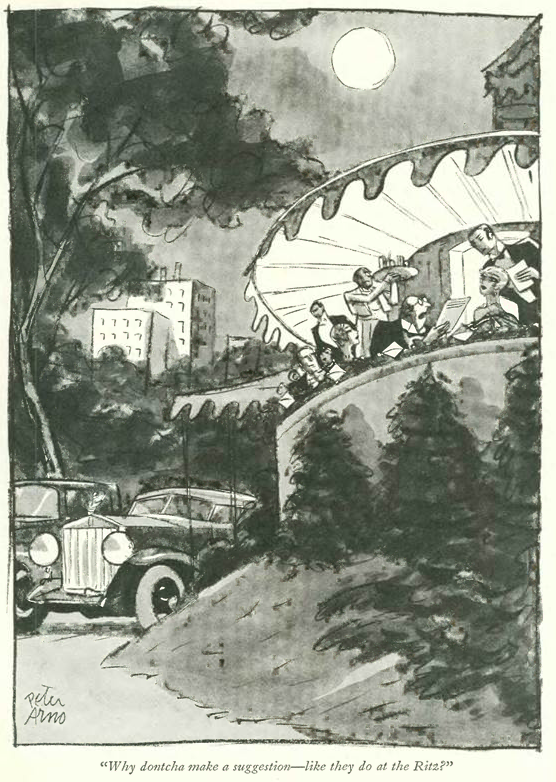
…Peter Arno looked in on a cheapskate at a posh restaurant…
…Bruce Bairnsfather visited the talkies…
…Justin Herman examined the literary life of the street…
…Carl Kindl explored an awkward moment from the annals of technological advancements…
…and Isadore Klein illustrated the hazards of the tonsorial trade…
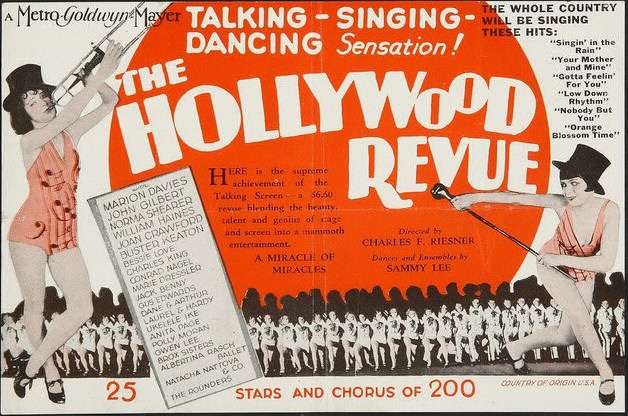
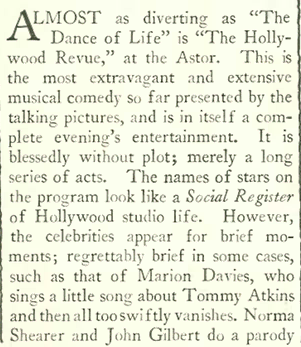
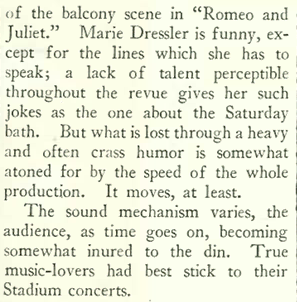
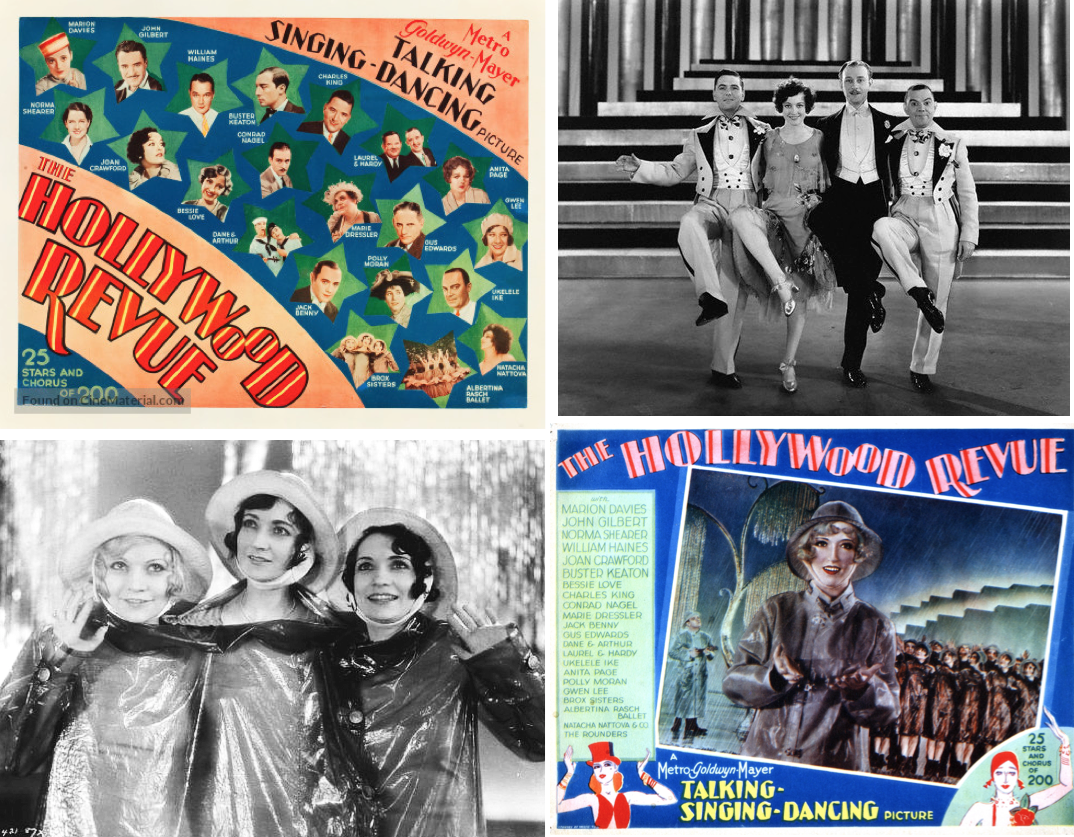
MGM piled so many stars and gimmicks into the premiere of The Hollywood Revue of 1929 that even TheNew Yorker’s jaded film critic John Mosher had to admit he was entertained.
Aug. 24, 1929 cover by Helen Hokinson.
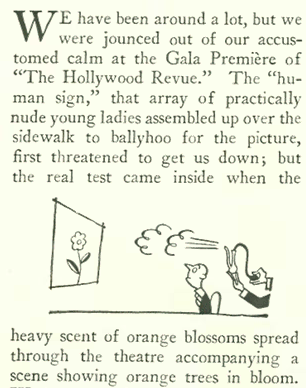
Although today’s audiences would find the film quaint and corny (not to mention its tinny sound and crude editing), it was a big hit in 1929. A plotless revue featuring nearly all of MGM’s stars (Greta Garbo said no — she had a clause in her contract exempting her from such silly things; Lon Chaney, on the other hand, was in failing health), the film followed a variety format similar to such vaudeville productions as the Ziegfeld Follies. The Arthur Freed/Herb Nacio Brown song “Singin’ In the Rain” was introduced in this film, and would inspire the Gene Kelley musical by the same name 23 years later. A rarity for the time, the Hollywood Revue included four skits in an early version of Technicolor, including an all-cast performance of “Singing’ In the Rain.” Mosher observed:
One of the film’s color skits featured John Gilbert and Norma Shearer in a Romeo and Juliet parody filled with Jazz Age slang. It would mark the beginning of the end of Gilbert’s career and, sadly, his life. He was one of the silent era’s most popular leading men, but it was purported that his voice was not suited to the talkies. What really ended Gilbert’s career, however, was studio head Louis B. Mayer, who clashed with the actor both personally and professionally…
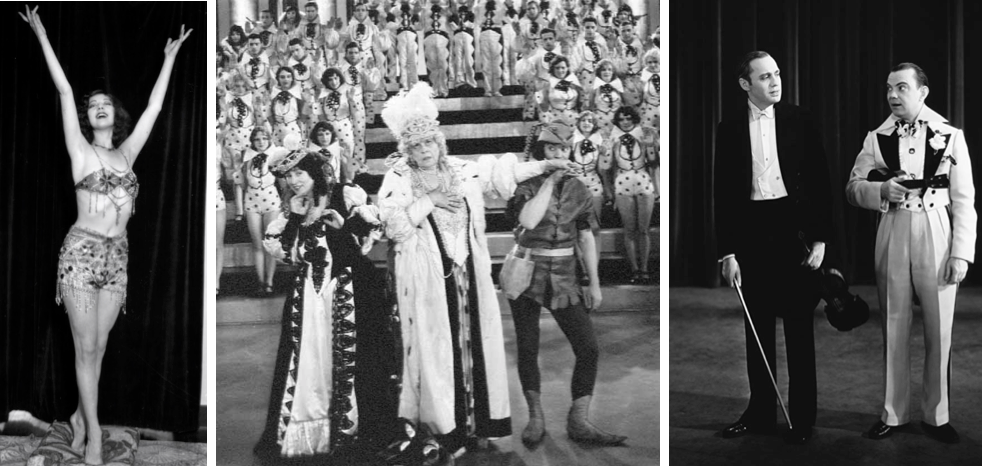
FAREWELL ROMEO…A lobby card promoting The Hollywood Revue of 1929 featured John Gilbert and Norma Shearer in one the film’s color sequences, a parody of Romeo and Juliet filled with Jazz Age slang. At right, a scene from the skit in which the director (played by Lionel Barrymore, far right) tells Shearer and Gilbert to put more pizzazz into the act. (IMDB/YouTube)STAR-STUDDED…Left to right, early silent film comedian Marie Dressler hammed it up in a royal court skit; co-emcee Jack Benny, with his trademark violin, and Cliff “Ukulele Ike” Edwards, and his trademark uke. (vickielester.com/doctormacro.com/thejumpingfrog.com)DANCING IS GOOD FOR YOUR HEALTH…Chorus girl Carla Laemmle in the film’s “Tableau of Jewels,” in which she emerged from a seashell to perform a seductive (and weird) dance number while other showgirls posed on a revolving crown — all set to a tune sung offstage by James Burroughs. The niece of Universal Pictures founder Carl Laemmle, Carla Laemmle was one of the longest surviving actors of the silent era. She died in 2014 at age 104. (songbook1.wordpress.com)GALAXY OF STARS…Clockwise, from top left, lobby card for The Hollywood Revue of 1929; Charles King, Joan Crawford, Conrad Nagel (a co-emcee along with Jack Benny) and Cliff “Ukulele Ike” Edwards show off their dancing skills; lobby card featuring actress Marion Davies; a popular act in vaudeville and on Broadway, the Brox Sisters—Lorayne, Patricia and Bobbe (along with Cliff Edwards) introduced the song “Singin’ in the Rain,” also sung by the entire cast near the finale of the movie. (IMDB/joancrawfordbest.com/mubi.com)
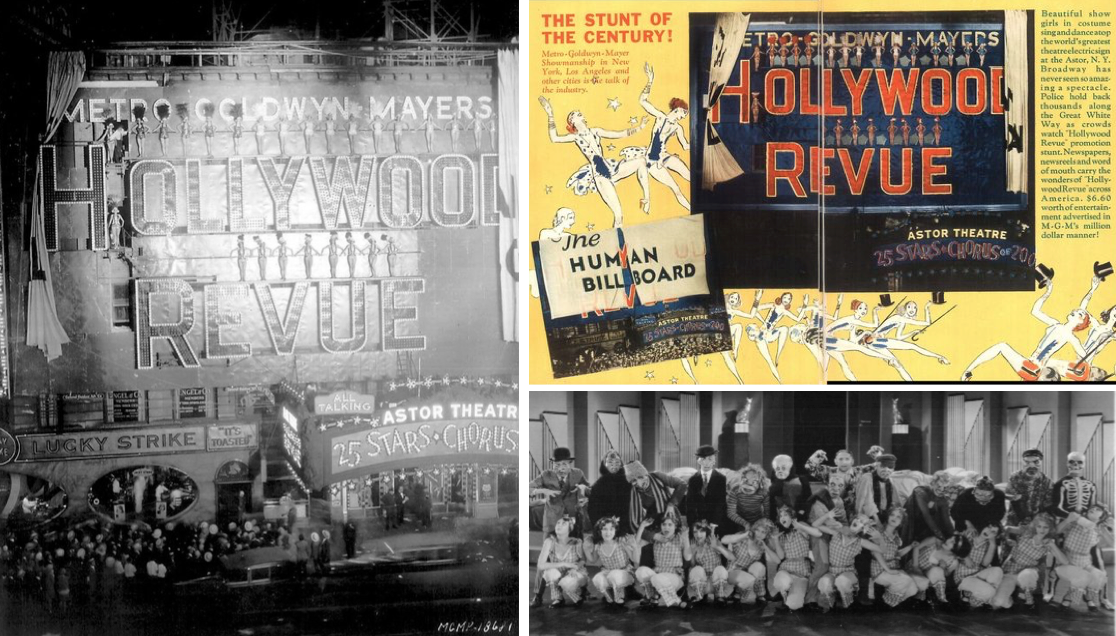
…MGM deployed a number of stunts to generate publicity at the film’s New York premiere at the Astor Theatre, including a “human billboard” that featured scantily clad chorus girls precariously perched on a huge letters high above the theatre’s entrance. In a rather less dangerous stunt—during the movie’s “Orange Blossom Time” skit—a faint scent of orange blossoms wafted into the theatre. “The Talk of the Town” observed…
WHAT COULD POSSIBLY GO WRONG?…Showgirls arranged along narrow catwalks atop the glowing HOLLYWOOD REVUE sign would pose for hours above crowds of gawkers; top, an advertisement promoting “The Stunt of the Century”; bottom, chorus girls lined up on somewhat safer ground in a skit from the movie titled “Lon Chaney’s Gonna Get You If You Don’t Watch Out.” Chaney himself was near death and did not appear in the film. (oldphotoarchive.com/anndvorak.com)Another angle shows just how precarious this stunt proved to be for these brave chorus girls, who held their poses for hours on end. (legendaryjoancrawford.com)JUST SINGIN’…Among the MGM stars appearing in the film’s finale include, in the middle of the front row, Buster Keaton, Marion Davies, and Joan Crawford. (IMDB)
* * *
Technological Adjustments
Had you attended the premiere of The Hollywood Revue, perhaps you would have appreciated James Thurber’s observation that actors in talking pictures sound as if they are speaking into cracker boxes. In this hilarious piece (titled “The Roaring Talkies”), he proposed a solution. An excerpt:
* * *
A Happy Diversion
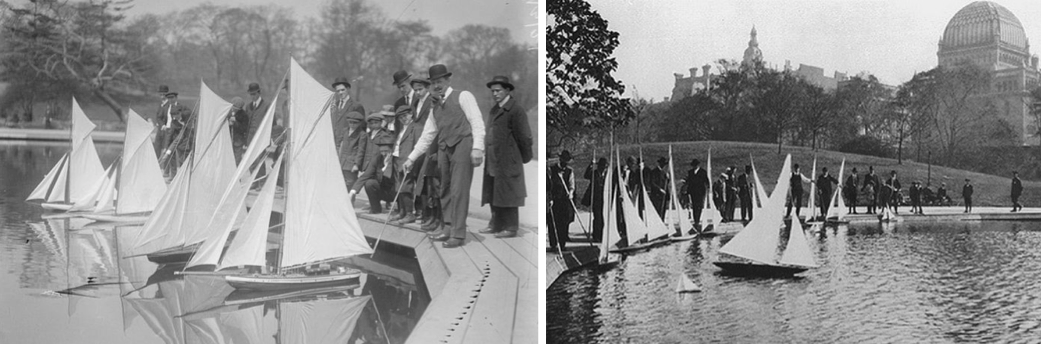
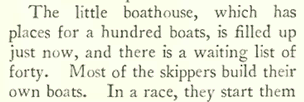
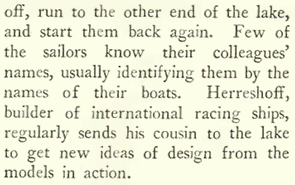
“The Talk of the Town” (via Theodore Pratt) looked in on the hobbyists who raced model boats at Central Park’s Conservatory Lake, a happy tradition that began in the late 19th century and continues to this day:
A DAY AT THE RACES….Model sailboats (left) prepare to face off in 1910 at Conservatory Lake (also called Conservatory Water); at right, model sailors at the same lake around 1920. (Library of Congress)
Pratt also described the old wooden boathouse, which was replaced in 1954 with a somewhat grander structure, Kerbs Boathouse, where model boats are still stored…
STILL SAILING…The copper-roofed Kerbs Boathouse replaced a wooden structure in 1954. Conservatory Lake served as the setting for a model boat race in E.B. White’sStuart Little. (centralparknyc.org)
* * *
On the Other Hand…
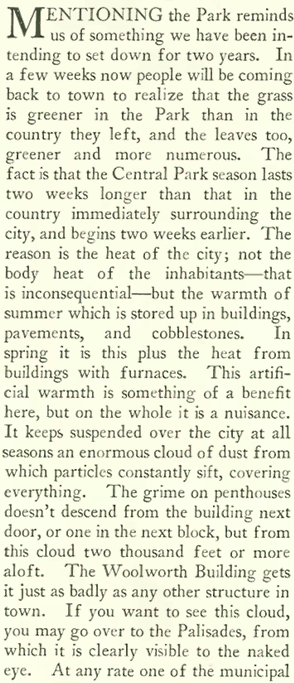
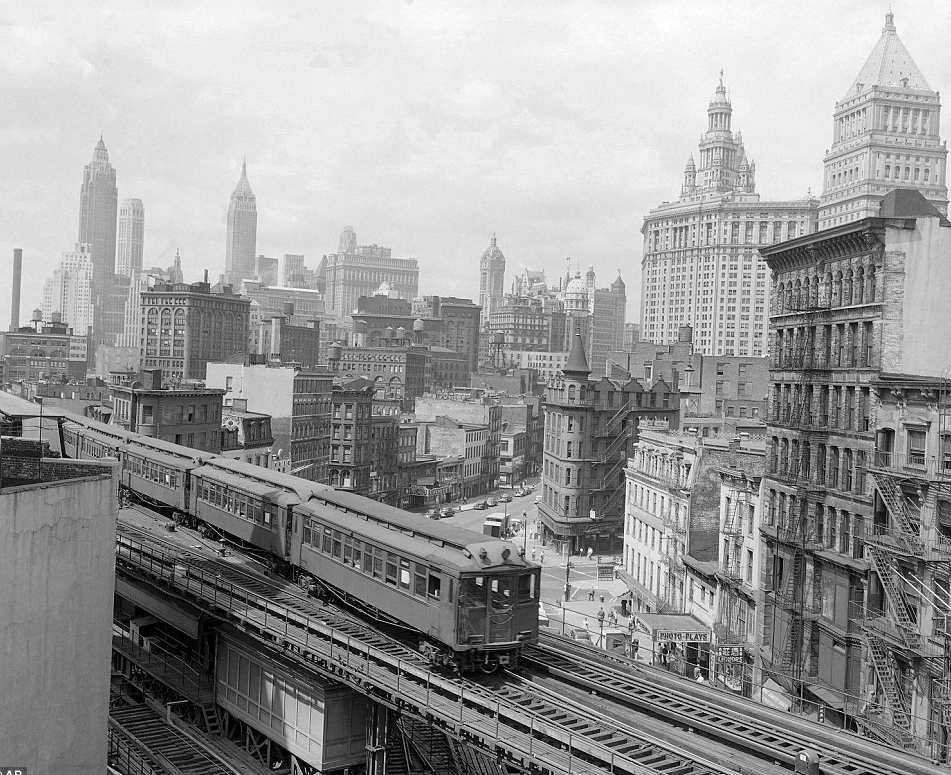
Leaving the cool and quiet of the park brought one quickly back into the dust and clamor of the metropolis. Pratt observed that the summer season lasted two weeks longer in the city than in the country, thanks to the city’s heat island effect— perhaps an unwelcome observation given the usually hot summer of 1929. Not only did the city’s heat extend the season, but it also kept the city enveloped in “an enormous cloud of dust”…
HAZY DAYS OF SUMMER…A dusty haze hangs over Lower Manhattan as the Third Avenue elevated train rumbles by in this circa 1950 photo. (Associated Press)
* * *
Already Feeling Old?
I found this “Talk” item curious for exploring the sentimental attachment some folks had developed for old cars from the 1910s, given those cars were barely twenty years old and cars in general hadn’t been in common use much longer…
…as for another “Talk” item, I doubt modern New Yorker readers would find any humor in this observation:
* * *
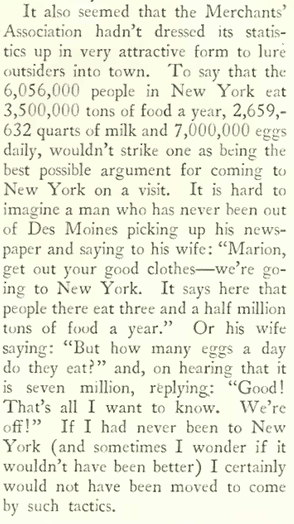
On to sillier things, Robert Benchley turned in a casual titled “Boost New York!” Benchley ridiculed a promotional brochure from the New York Merchants Association that touted various statistics in a manner reminiscent of the fictional George Babbitt. Benchley imagined how an Iowa couple might respond to such dazzling numbers:
* * *
A Drinking Life
Occasionally I like to feature infrequent or one-time New Yorker contributors who are nearly lost to history. Frank Ward O’Malley (1875-1932), a reporter for the New York Sun from 1906-19, was known for his humorous stories. In 1928 he published a book titled The Swiss Family O’Malley. In this casual (titled “The Fatty Degeneration of Broadway”) from the Aug. 24 issue, O’Malley described an alcohol intervention of sorts and then his fall off the wagon. Here are the opening and closing paragraphs, along with his photo circa 1910s.
Frank Ward O’Malley (Library of Congress)
* * *
From Our Advertisers
This week we have an advertisement for the Drake Apartment Hotel, claiming to be the “smartest” in New York. Note how they employed what seems to be the same pointy-nosed, haughty couple that we saw last week (below) who endorsed the Park Lane (I want to believe there is a subtle joke here)…
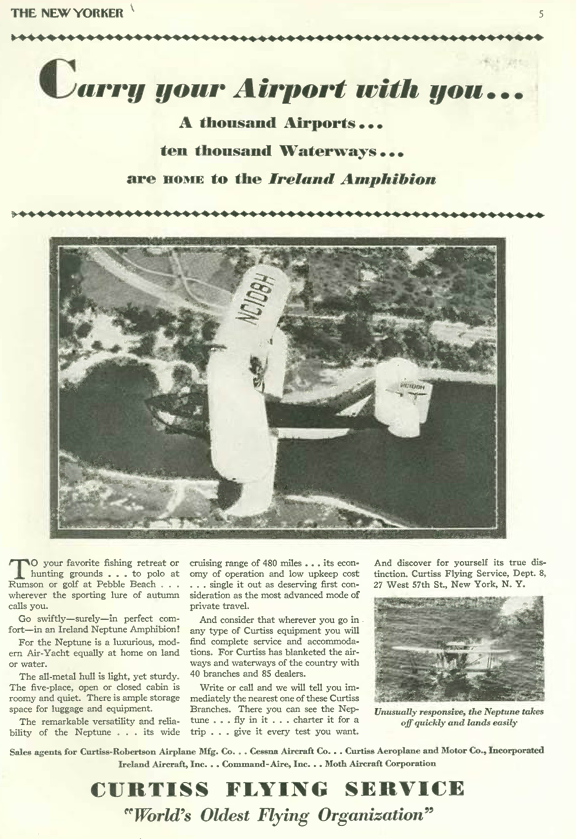
…just 25 years removed from the Wright Brothers’ flight at Kitty Hawk, advertisers were treating flying as though it were routine…
A better photo of the Ireland Neptune Amphipian (aerofiles.com)
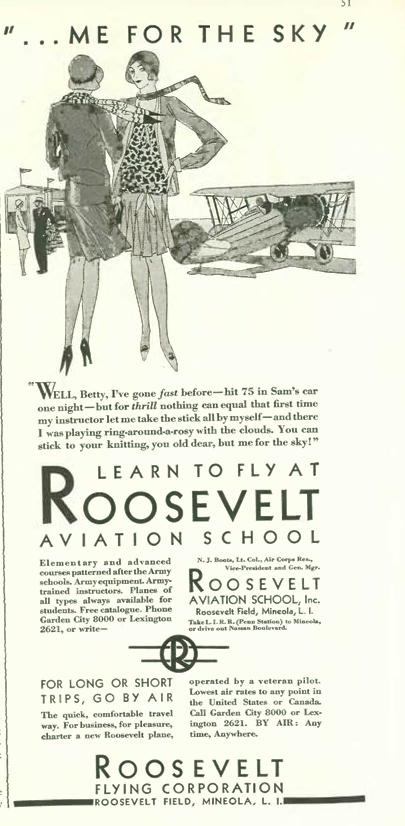
…and this young woman seemed to think flying was nothing more than “playing ring around the rosy with the clouds”…
…I like the reviews included in this bookseller’s ad, especially the first one for the book Ex-Wife by Anonymous (it was written by Ursula Parrott, a writer of romantic fiction)…
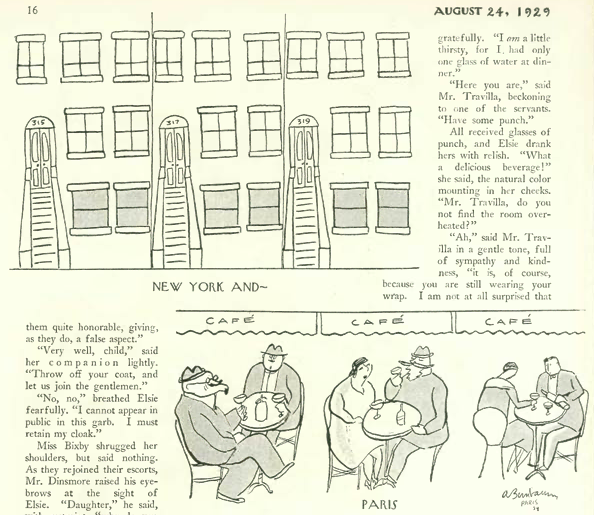
…our illustrations include Abe Birnbaum’s contribution to the casuals section (breaking up the copy of one of Josie Turner’s Elsie Dinsmore parodies)…
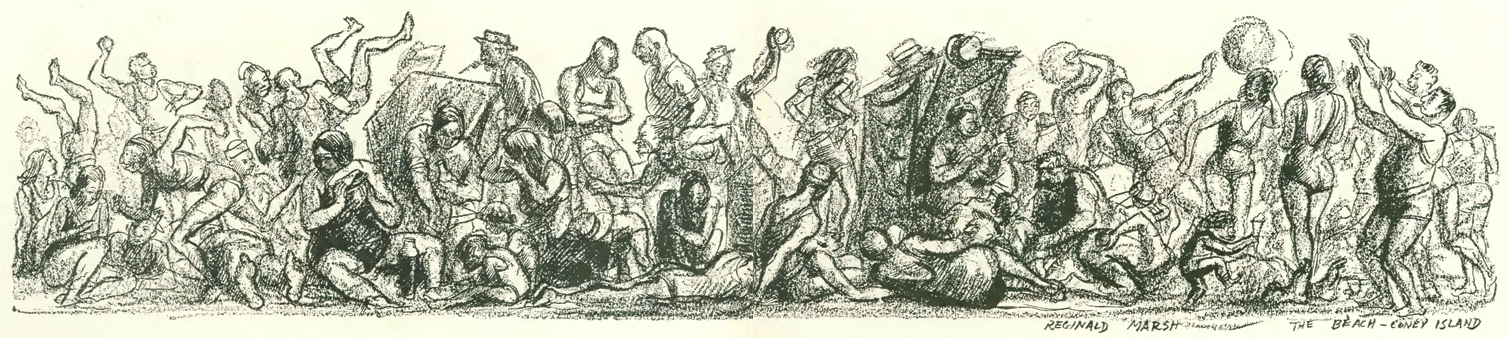
…Reginald Marsh illustrated the late summer beach scene at Coney Island…
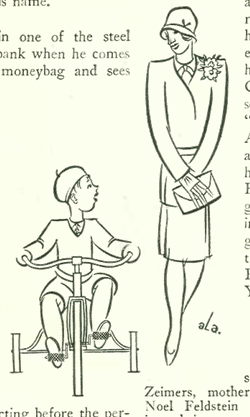
…and for kicks this nice little filler by Constantin Alajalov…
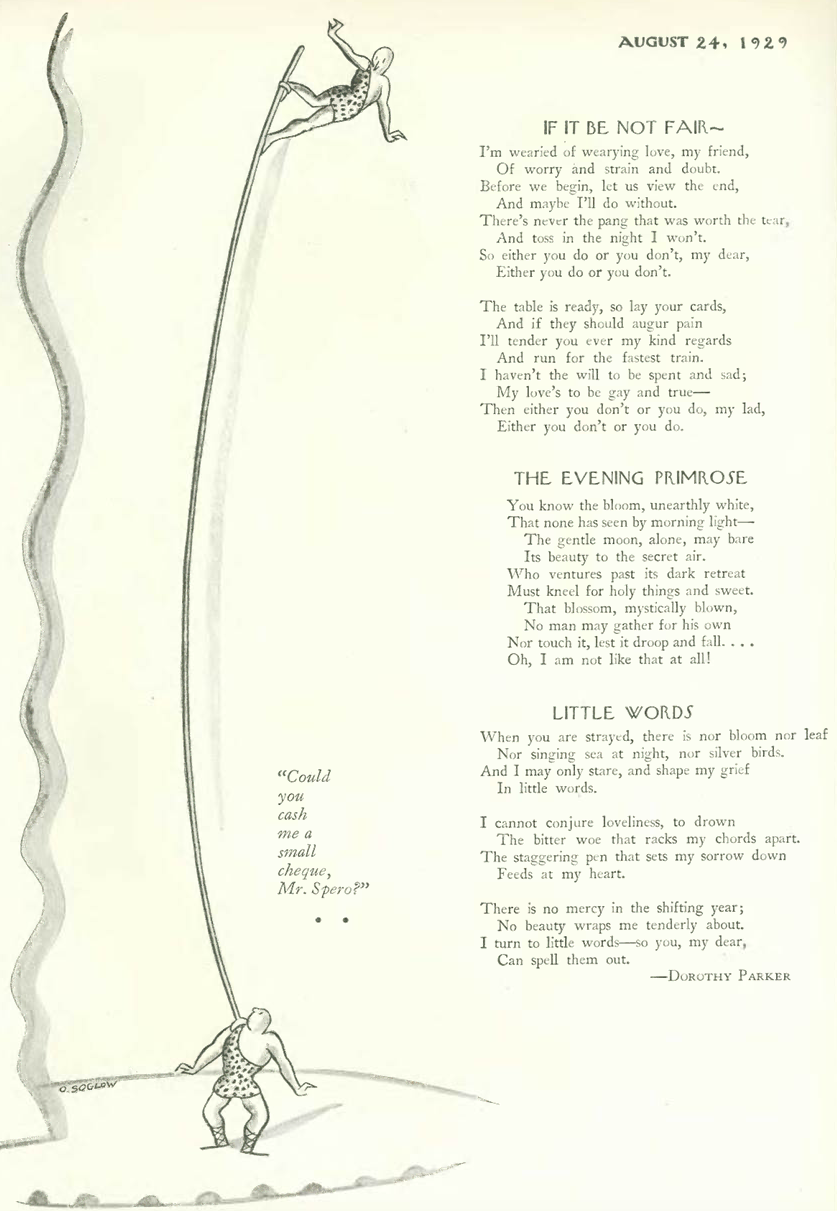
…thanks to the skills of The New Yorker’s first layout artist, Popsy Whitaker, we have this whimsical pairing of Otto Soglow and Dorothy Parker…
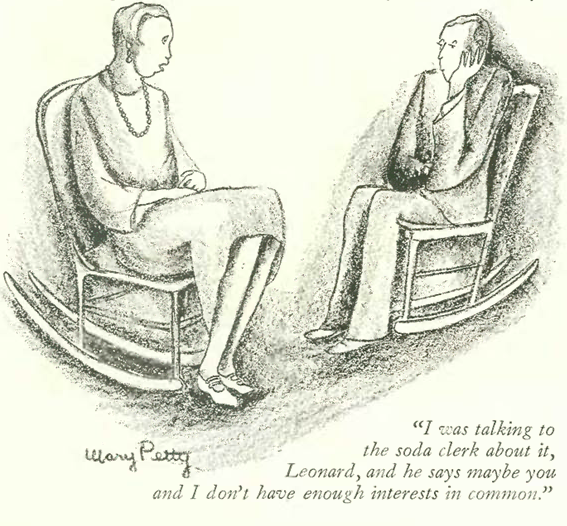
…Mary Petty contributed a cartoon that looks contemporary…
…Peter Arno paid a visit to the doctor’s office…
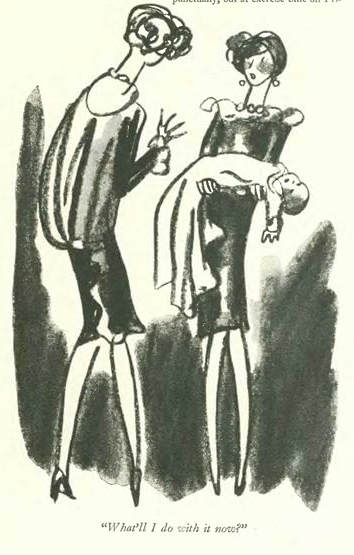
…and commented on his life as a new father…the woman holding the baby was doubtless inspired by his wife, New Yorker columnist Lois Long…
…for reference, Peter Arno and Lois Long are pictured here with baby daughter Patricia Arno in 1928…Lois clearly had a better grasp on the situation than Arno had imagined…
Arno and Long with their baby daughter, Patricia, in 1928. (Vanity Fair)
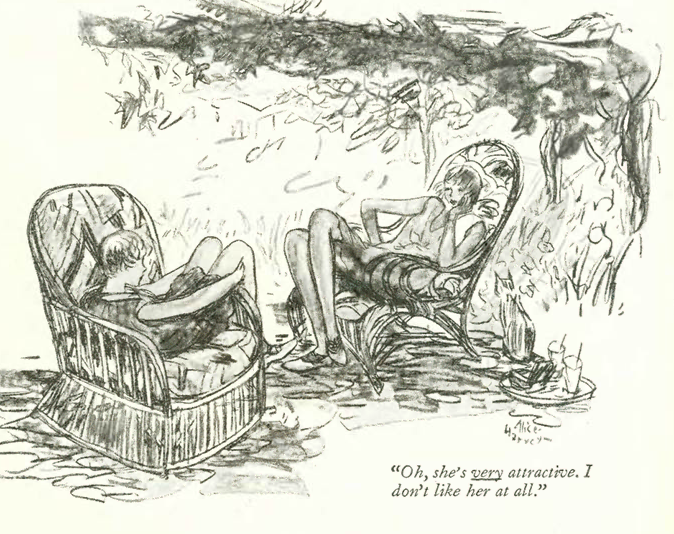
…Alice Harvey eavesdropped on a conversation between teenagers…
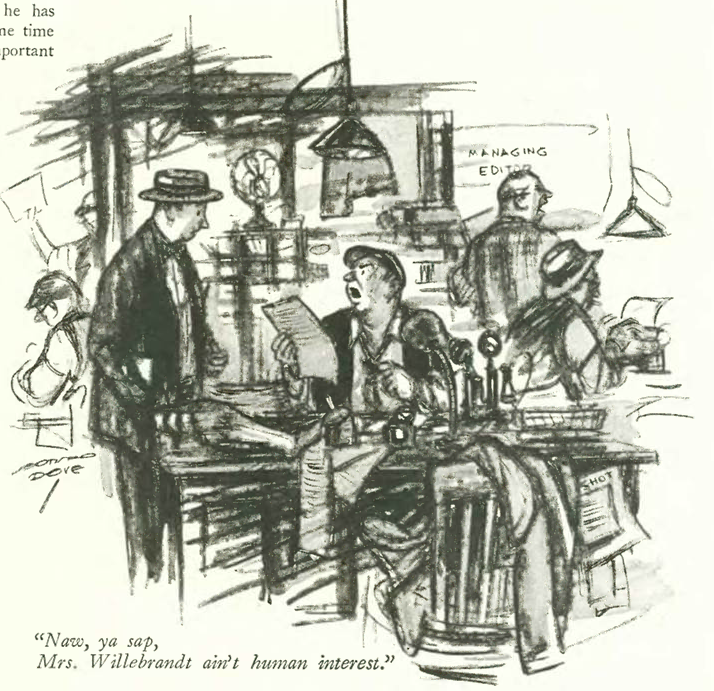
…and like Arno, Leonard Dove had two cartoons in this issue…here an editor finds the former Prohibition enforcer no longer newsworthy…
…and over on the East Side, rumors of gentrification…
Winding down the last summer of the 1920s — an unusually hot one — one detects subtle changes in The New Yorker’s mood; weary from the decade-long party known as the Roaring Twenties, a bit more mature, and more confident in its voice thanks to the regular writings of James Thurber, E.B. White and Lois Long and copious cartoons and illustrations by such notables as Peter Arno, Barbara Shermund and Helen Hokinson that gave the magazine a distinctively modern feel as it headed into the 1930s.
Aug. 10, 1929 cover by Theodore Haupt; Aug. 17 cover by Peter Arno.
The exuberance associated with the rapidly changing skyline was still there, however, as the Aug. 17 “Talk of the Town” speculated on the race for the world’s tallest building. The article not only anticipated an architect’s sleight of hand, but also a Zeppelin docking station that in the end would top the world’s tallest building:
As it turned out, William Van Alen did not have to compete against himself, the commission for One Wall Street instead going to Ralph Walker, who would design a beautiful art deco landmark that, at 50 stories, would not vie for the title of the world’s tallest building. Unbeknownst to The New Yorker, and perhaps Van Alen, the challenger would instead be 40 Wall Street, which would hold the crown as world’s tallest for about a month. Thanks to some sleight of hand (see caption below) the Chrysler building would quickly surpass 40 Wall Street and hold the title for just eleven months, bested in the end by the Empire State Building (which would sport a “Zeppelin superstructure”).
DECO DELIGHTS…40 Wall Street (left) vied with the Chrysler Building for the title of the world’s tallest building. The 927-foot 40 Wall Street would claim the title in late April 1930. One month later, the Chrysler building would sprout a needle-like spire (secretly constructed inside the building) bringing its total height to 1,046 feet. The builders of 40 Wall Street cried foul and claimed that their building contained the world’s highest usable floor, whereas the Chrysler’s spire was strictly ornamental and inaccessible. Less than a year later the point was made moot when the Empire State Building soared above them both. (Wikipedia/The Skyscraper Museum)ERECTILE DYSFUNCTION…Clockwise, from top left, progression of designs for the Chrysler Building; the building’s architect, William Van Alen; drawing from Popular Science Monthly (Aug. 1930) revealed the inner workings of the spire’s clandestine construction; Zeppelin docking station for the Empire State Building as imagined in a composite (faked) photograph. At 1,250 feet, the wind-whipped mooring mast proved not only impractical, but downright dangerous. In September 1931 a dirigible briefly lashed itself to the mast in 40 mph winds, and two weeks later the Goodyear Blimp Columbia managed to deliver a stack of Evening Journals to a man stationed on the tower. Contrary to the faked photograph, no passengers ever transferred from the tower to a Zeppelin. (Skyscraper City/Wikipedia/NY Times)
* * *
What, Me Worry?
The famously flamboyant New York City Mayor Jimmy Walker lived the easy life during his initial years as Hizzonner, riding a booming economy, partying with the rich and famous (while flaunting Prohibition laws), carousing with his mistress (Ziegfield dancer Betty Compton) and sleeping until noon. When reform-minded Fiorello La Guardia challenged Walker’s reelection bid in 1929, Walker left the dirty work to his Tammany Hall cronies and continued to charm the public, and The New Yorker. The Aug. 17 “Talk of the Town” observed:
IT’S EASY BEING ME…Mayor Jimmy Walker accompanied actress Colleen Moore to the October 1928 premiere of her latest film, Lilac Time. (konreioldnewyork.blogspot.com)I HAVE MY EYE ON YOU…Reform-minded Fiorello La Guardia (right) detested Jimmy Walker and his Tammany cronies, but that wasn’t enough to get him elected in 1929. The Great Depression would soon turn the tables. (Wikipedia)
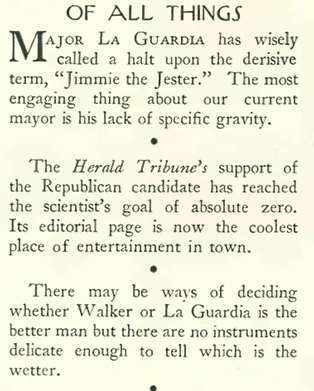
Howard Brubaker, in his Aug. 17 “Of All Things” column, suggested that La Guardia had a zero chance of getting elected. Just three years later, Walker would resign amid scandal and flee to Europe. La Guardia, on the other hand, would be elected to the first of his three terms as mayor in 1933, riding the wave of the New Deal.
* * *
Peek-A-Boo
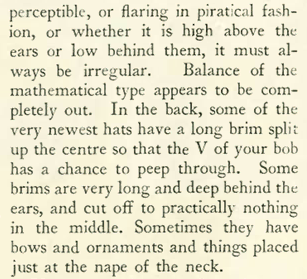
Politics might have been business as usual, but in the world of fashion the vampish hat styles associated with flappers were giving way to a new rolled-brim look that seemed to suggest an aviator’s helmet. In her Aug. 17 fashion column “On and Off the Avenue,” Lois Long reported:
FACING THE FUTURE…Vampish hats of 1928, pictured at top, gave way to the rolled-brim or flare look of 1929. (Images gleaned from magazine/catalog images posted on Pinterest)
Long seemed to welcome the idea that women should once again bare their foreheads…
* * *
Twain Wreck
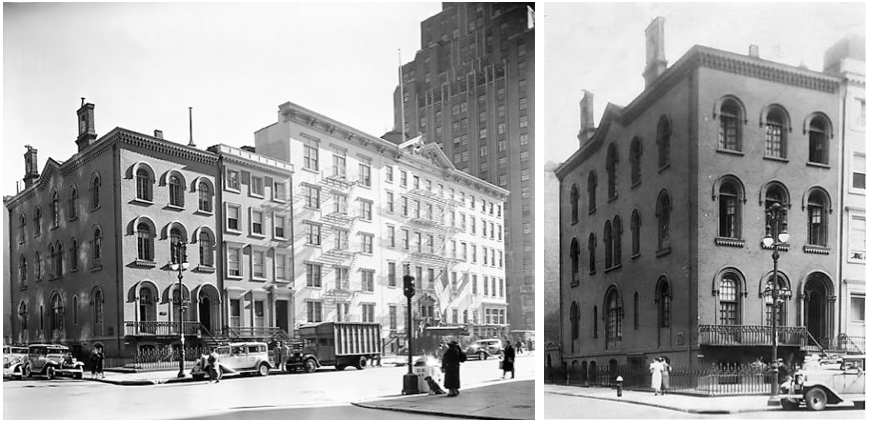
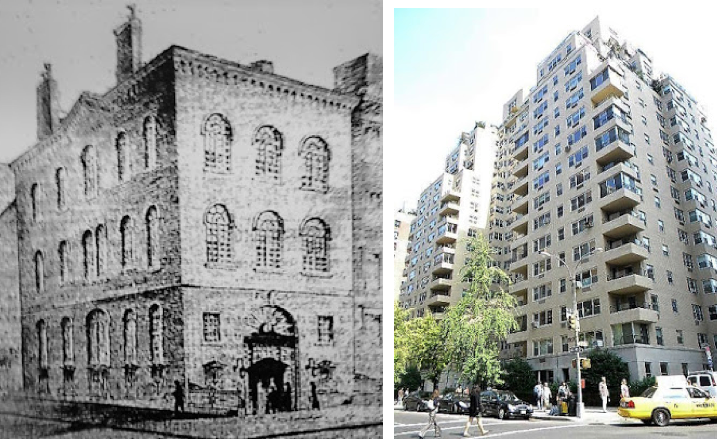
Jumping back to the Aug. 10 issue, “The Talk of the Town” reported on the possible remodeling or demolition of a house once occupied by Samuel Clemens, aka Mark Twain. The house in question was a lavish old mansion built by Henry Brevoort, Jr. in 1834, at the northwest corner of Fifth Avenue and 9th Street. Twain lived in the house from 1905 to 1908, and it was there that Twain’s biographer Albert Paine conducted interviews with the author and wrote the four-volume Mark Twain, a Biography; The Personal and Literary Life of Samuel Langhorne Clemens. When millionaires abandoned their Fifth Avenue mansions in the 1920s and high-rise apartments took their place, there was pressure to either convert an old mansion like the Breevoort house at 21 Fifth Avenue to apartments or demolish it altogether.
LOOKING GOOD AFTER A CENTURY…At left, Berenice Abbott took this photograph of No. 21 Fifth Avenue in 1935. At right, in a close-up shot from the same period, the 1924 plaque from the Greenwich Village Historical Society is visible on the side of the house. (Museum of the City of New York/Greenwich Village Historical Society)A NOW FOR SOMETHING COMPLETELY DIFFERENT…A proposed 1929 remodeling (left) moved the front door of the old Brevoort mansion to the center and lowered it to street level. At right, today the 1955 Brevoort apartment house occupies the site. (daytoninmanhattan.blogspot.com)
The Greenwich Village Historical Society did what it could to save the house, and in 1924 affixed a bronze plaque to a side wall noting that both Twain and Washington Irving were once occupants. When the house was slated for demolition in 1954, the Society appealed to New Yorkers to raise the $70,000 needed to move the building, but only a fraction of that amount was secured. No. 21 was demolished in 1954 along with the rest of the houses on that block.
* * *
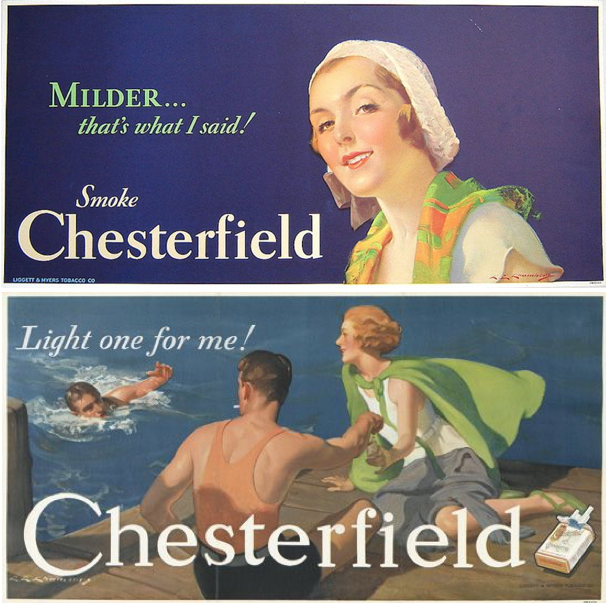
Charles Edward Chambers was an American illustrator probably best known for his Chesterfield ads, although he also illustrated stories for a number of popular magazines from the early 1900s until his death in 1941. The Aug. 10 “Talk of the Town” looked in on his work with model Virginia Maurice:
QUICK…THROW THAT MAN A CIGARETTE!…Examples of Charles Edward Chambers’ Chesterfield ads from 1929 featuring model Virginia Maurice. Note that Maurice is wearing the latest “rolled brim” hat style in the upper image. (Pinterest)HIS NONSMOKING SECTION…A 1919 Harper’s cover illustration by Charles Edward Chambers. (Wikipedia)
* * *
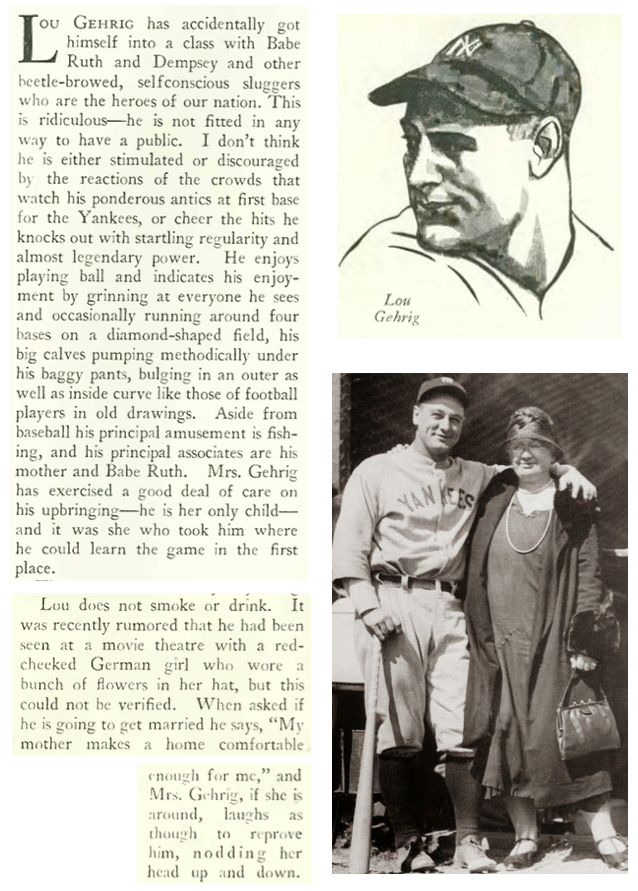
Mama’s Boy
Lou Gehrig rivaled Babe Ruth as a top Murderer’s Row slugger for the 1929 Yankees, yet he couldn’t be more opposite in his lifestyle. A teetotaler and nonsmoker, Gehrig was completely devoted to mom (pictured below in 1927). Niven Busch Jr. submitted this profile of Gehrig for the Aug. 10 issue. Excerpts:
* * *
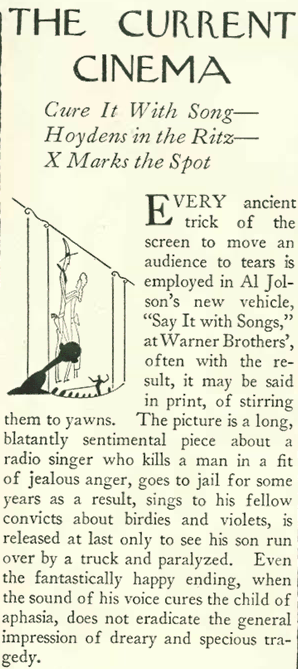
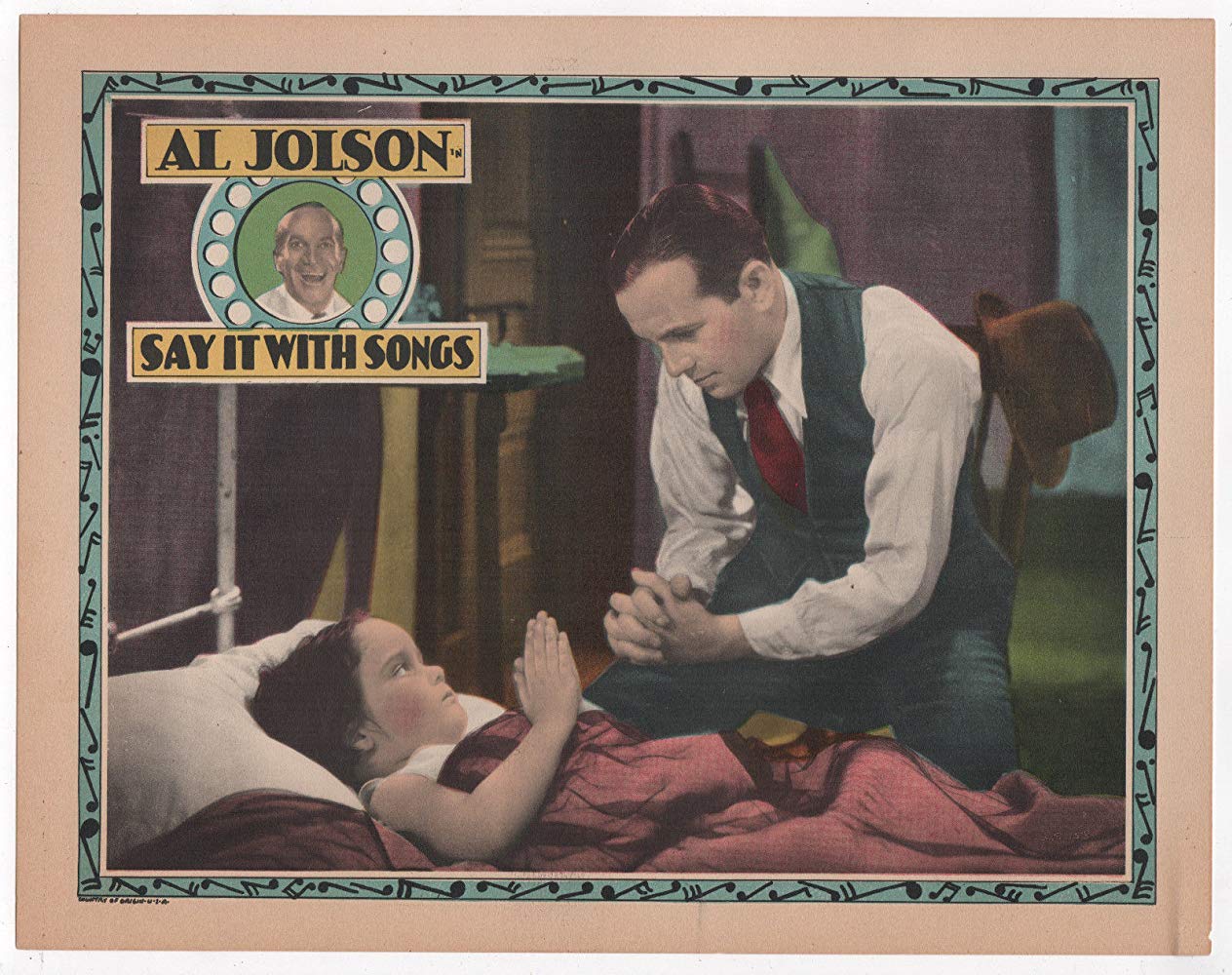
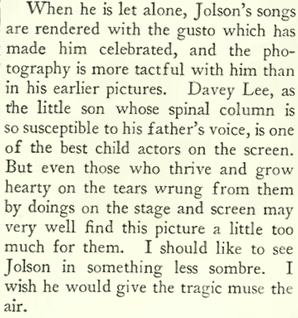
After appearing as Al Jolson’s dying son in The Singing Fool (1928), the child actor Davey Lee returned to the screen for yet another Jolson weeper, 1929’s Say It With Songs. Once again portraying Jolson’s son—this time crippled and rendered dumb after being hit by a truck—he miraculously recovers at the end of the film. The New Yorker wasn’t having any of this sentimental treacle, especially served up for a second time…
LET’S PRAY FOR A BIG BOX OFFICE…Davey Lee and Al Jolson in Say It With Songs. (IMDB)
…and the magazine hoped for something a bit less somber from Jolson in the future, suggesting that he “give the tragic muse the air”…
In the same issue of The New Yorker, this advertisement touted Jolson’s recording of “Little Pal” from Say It With Songs (note the blackface image of Jolson—his unfortunate trademark back in the day)…
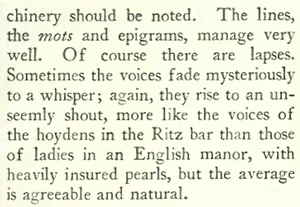
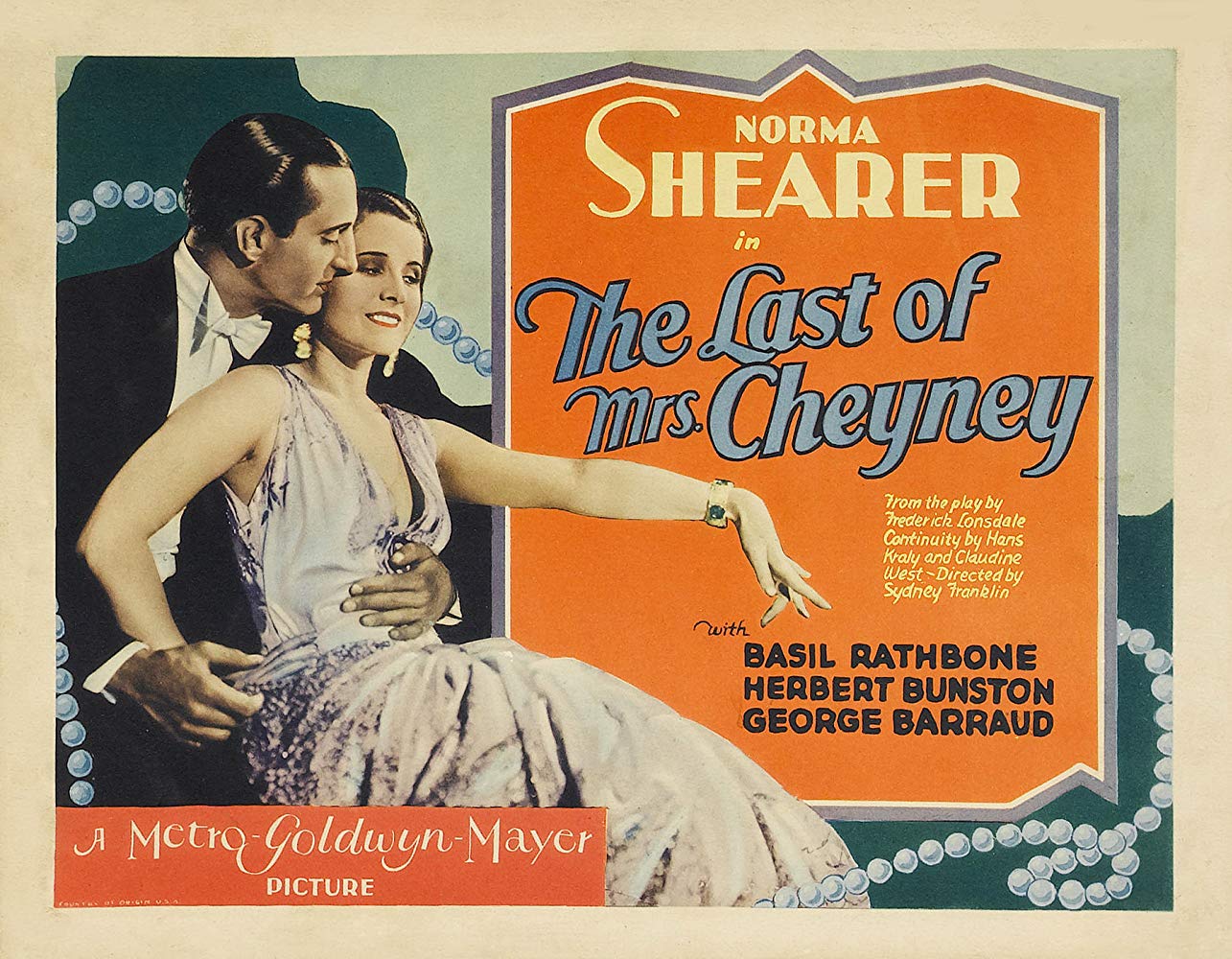
…happily, there were other movies that offered less schmaltzy diversions, including Norma Shearer’s comedy-drama The Last of Mrs. Cheyney, in which Shearer portrayed the jewel thief Fay Cheyney…
OH BASIL YOU ANIMAL…Theatre card for The Last of Mrs. Cheyney. (IMDB)
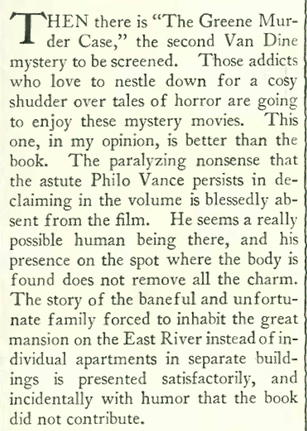
…often cast as a heavy in silent films, it was the “talkies” that made William Powell a star, his pleasant voice more suited to a hero or leading man than a villain. In The Greene Murder Case, Powell portrayed amateur detective Philo Vance, a role that he played in another 1929 release, The Canary Murder Case (originally filmed as a silent in 1928), both based on mystery novels by S.S. Van Dine. Powell would portray Philo Vance in three more films from 1930 to 1933 until he took on the role of another amateur detective, Nick Charles, in 1934’s The Thin Man (a role he would reprise five times from 1936 to 1947)…
WHODUNNIT? YOUDUNNIT!…William Powell as detective Philo Vance, Florence Eldridge as Sibella Greene, and Jean Arthur as Ada Greene in 1929’s The Greene Murder Case. (IMDB)KEEPING IT QUIET…William Powell as Philo Vance and Louise Brooks as “the Canary,” a scheming nightclub singer, in The Canary Murder Case. Brooks was a huge star in the silent era and the iconic flapper. According to IMDB, the film was shot as a silent in 1928, but producers decided to rework it as a more profitable “talkie.” When Brooks refused to return from Germany (where she was filming Pandora’s Box) to dub the movie, Paramount spread the word that Brooks’ voice was not suited to sound film, although later productions made by Brooks proved this to be wrong. Actress Margaret Livingston ultimately supplied Brooks’ voice for Canary. (IMDB)
* * *
From Our Advertisers
We look at some advertisements from the August 17 issue, including this one from Past Blue Ribbon. Note that nowhere in the ad is the word “beer” used, this being a “near-beer” with less than 1% alcohol content by volume. In addition to making cheese (a Velveeta-like product), Pabst hoped to keep its company alive by selling this “brew” during the unusually hot summer of 1929…
…and with that blazing sun advertisers also promoted a number of face creams and powders to those “enjoying the sunny outdoor life,” including this two-page spread from Richard Hudnut and Poudre Le Début…
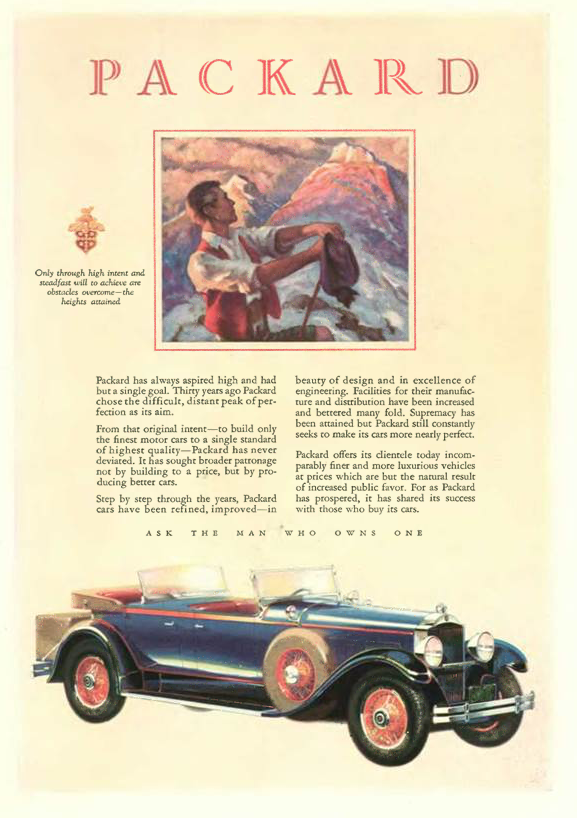
…the outdoor life could also be enjoyed in a convertible Packard 640, a car that was a cut above a Lincoln or Cadillac, and was considered by some to be America’s answer to the Rolls Royce…
A 1929 Packard 640 Convertible. This particular model can be had today for about $130,000. (Hemmings Motor News)
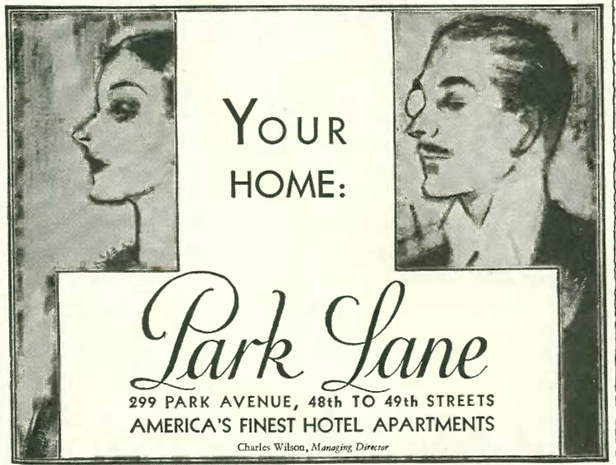
…I found this ad in the back pages interesting for its crude design yet overt appeal to snobbishness with this haughty pair…
…and here is what the Park Lane looked like when it opened in 1924…
Circa 1924 advertisement from the Sargent lock and hardware company touting its fixtures in the new Park Lane hotel apartments. At right, circa 1924 image from The American Architect depicting the Park Lane’s dining room. The building is long gone, razed some time in the 1960s to make way for an office tower. (Pinterest)
* * *
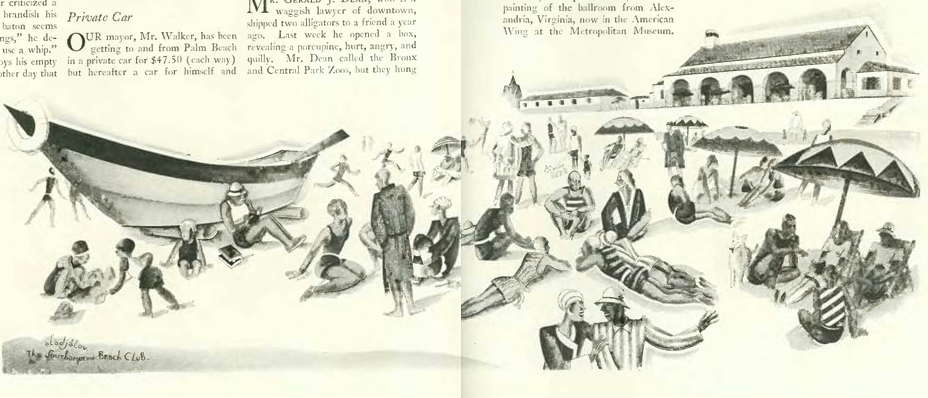
This week’s featured illustration is by Constantin Alajalov, who depicted a summer scene from the Southampton Beach Club…click to enlarge…
…our cartoonists from the Aug. 10 issue include Helen Hokinson, who looked at the challenges of Americans abroad…
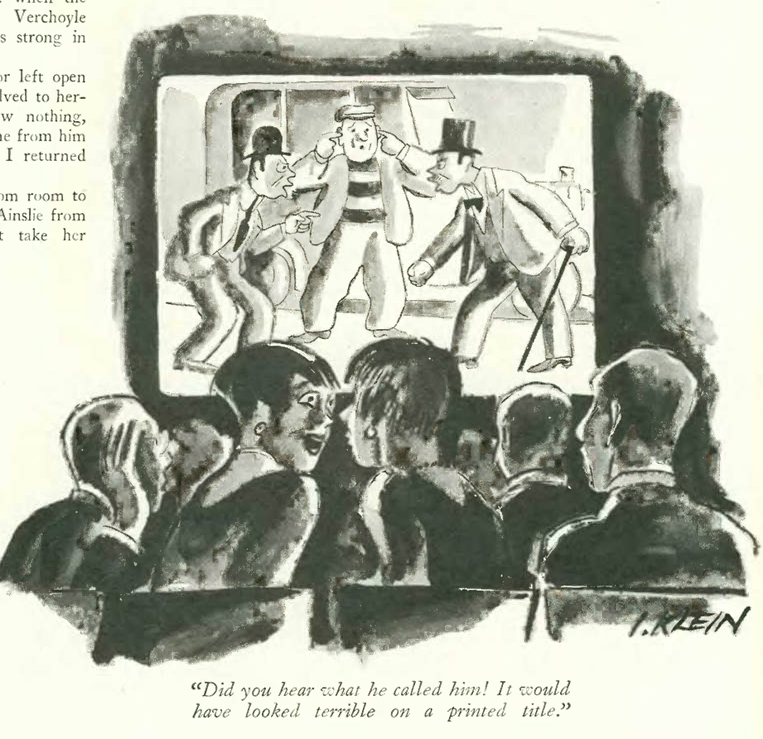
…Isadore Klein observed the changing mores of movie houses (a couple of “damns” were apparently uttered in the talking pictures of 1929)…
…and Leonard Dove offered up a double entendre of sorts…
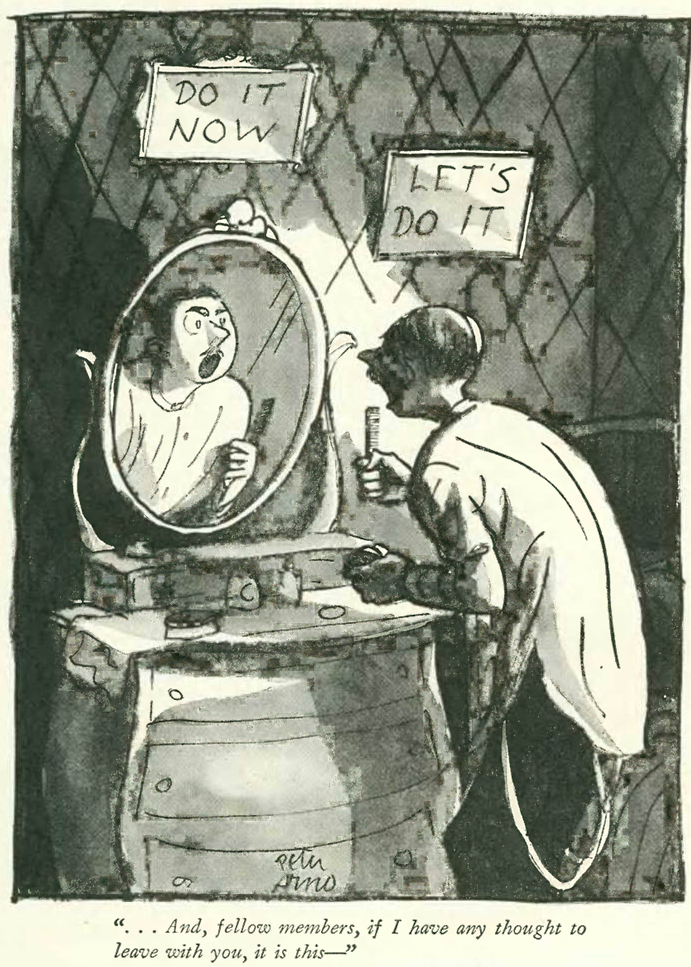
…cartoons for the Aug. 17 issue included a peek behind the scenes at a motivational speaker courtesy Peter Arno…
…Carl Kindl had some fun with the juxtaposition of a matron and a flapper hat…
…and for reference, the cloche hat called a “Scalawag” was featured in this ad by Knox in the March 30, 1929 New Yorker…drawing by Carl “Eric” Erickson…
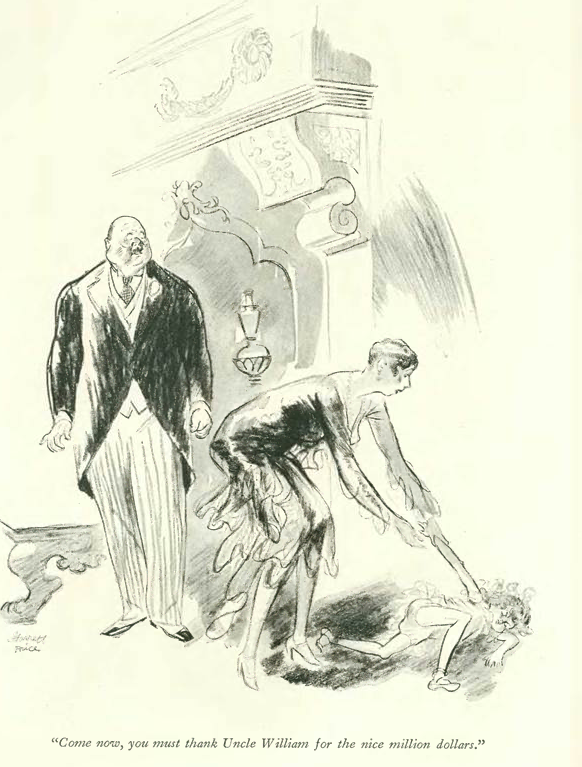
…Garrett Price portrayed the antics of an ungrateful trust fund brat, who probably did not have that million dollars after the market crash…
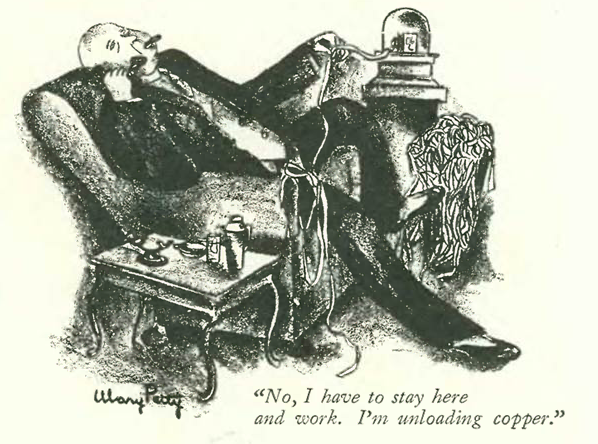
…and this fellow, depicted by Mary Petty, who doubtless would be less nonchalant come Oct. 28, or what we know as “Black Monday”…
In July of 1928, war was officially banned from the earth. Or so it was hoped when the Kellogg–Briand Pact became effective on July 24, 1929.
Aug. 3, 1929 cover by Gardner Rea.
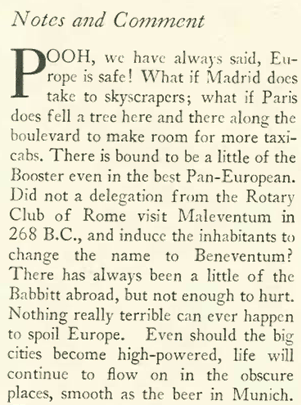
Also known as the “Pact of Paris” and more officially the “General Treaty for Renunciation of War as an Instrument of National Policy,” its authors, United States Secretary of State Frank B. Kellogg and French foreign minister Aristide Briand, gathered world powers in Paris on Aug. 28, 1928 to sign a treaty that denounced the use of war and called for the peaceful settlement of all future disputes. The New Yorker, in the opening “Notes and Comment” section of “The Talk of the Town,” took its usual “What, Me Worry?” approach to world affairs, finding the whole thing unnecessary given that (in its view) Europe was already a peaceful, even benign continent:
GIVE PEACE A CHANCE…French foreign minister Aristide Briand, Myron T. Herrick (U.S. ambassador to France), and U.S. Secretary of State Frank B. Kellogg meet in the French Foreign Office for the signing of the General Treaty for Renunciation of War as an Instrument of National Policy, August 1928; at right, Briand speaking to the assembly. (theinternationalistsbook.com//Wikipedia)
In January 1929 the U.S. Senate officially ratified the Kellogg–Briand Pact with a nearly unanimous vote, 85-1. John James Blaine, senator from Wisconsin, cast the lone dissenting vote (although four years later Blaine would author another piece of legislation that would have a much greater impact, at least at the time: the 21st Amendment, which ended Prohibition).
SURE, WHY NOT?…The U.S. Senate approved the Kellogg–Briand Pact on Jan. 15, 1929. The treaty went into effect later that year on July 24. (The New York Times)
Another item in “The Talk of the Town” made further reference to the pact…
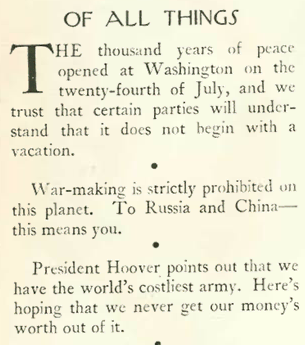
…and Howard Brubaker, in his column “Of All Things,” made special mention of the Sino-Soviet border conflict in referencing the pact:
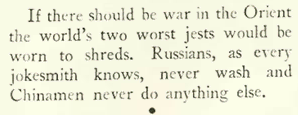
Brubaker mockingly suggested that the pact marked the beginning of a thousand years of peace, an inadvertently prescient remark considering that in less than four years Hitler would seize power in Germany and announce the beginning of his “Thousand Year Reich” — which we know was quite the opposite of peace. Brubaker was also off the mark with this crude observation:
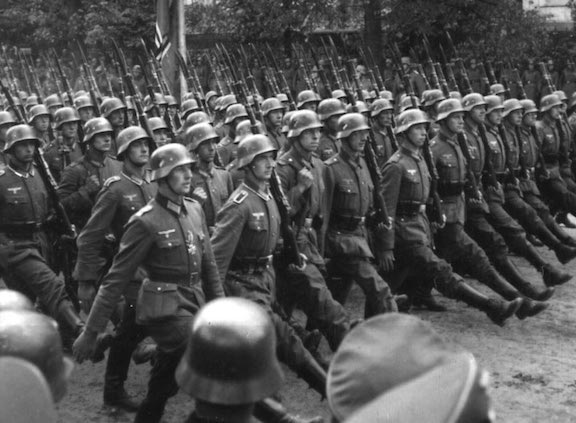
Just two years after Brubaker wrote those words, Japan would invade Manchuria. And only a decade would pass before Germany and Russia would invade Poland and ignite the biggest war of all time.
PARTY POOPERS…TheNew Yorker wasn’t alone in poking fun at the Kellogg–Briand Pact. At left, the pact is mocked during the Paris Carnaval in 1929; at right, British cartoonist Sidney Conrad Strube reminded readers of the outcome of America’s earlier efforts at world peace. (Wikipedia/Pinterest) click to enlarge.WE JUST CAME TO SAY HELLO…Germany, the first signatory to the Kellogg-Briand Pact banning all war, invaded Poland just ten years after that treaty went into effect. Above, German troops parade through Warsaw after the invasion, September 28-30, 1939. (National Archives and Records Administration)
Although the pact was ridiculed for its perceived naïveté, and for the fact that it did not prevent the largest war in human history, some modern scholars see otherwise. Political scientists Oona A. Hathaway and Scott J. Shapiro observed (in 2017) that the pact “catalyzed the human rights revolution, enabled the use of economic sanctions as a tool of law enforcement, and ignited the explosion in the number of international organizations that regulate so many aspects of our daily lives.” In his recent book Enlightenment Now,Steven Pinker notes “virtually every acre of land that was conquered after 1928 has been returned to the state that lost it. Frank Kellogg and Aristide Briand may deserve the last laugh.”
* * *
Gallows Humor
Other items in “The Talk of Town” included this brief anecdote, which I doubt many would find humorous today:
* * *
On The Bowery
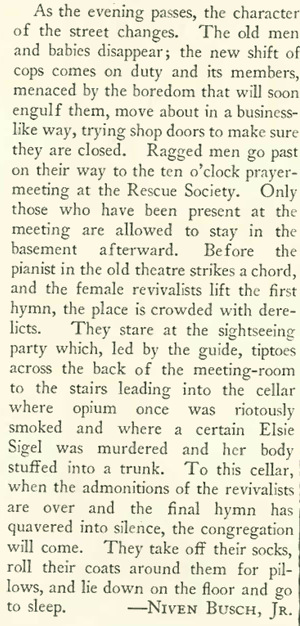
In the “Reporter at Large” column, Niven Busch Jr. paid a visit to “The Yellow Bowery,” as the piece was titled. Notable in this article (and in Brubaker’s quip above) is the use of term “Chinaman,” a term considered offensive today but in the 1920s was used indiscriminately for East Asians. Here it seems pejorative:
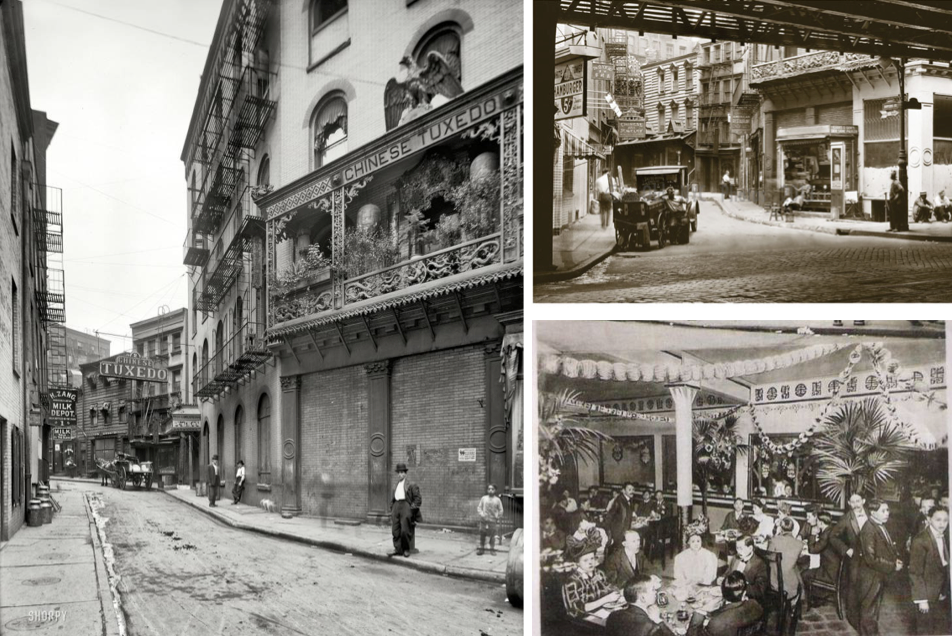
THE BLOODY ANGLE…Clockwise, from top, this bend in Chinatown’s Doyer Street was known as “The Bloody Angle” due to the numerous killings among the Tong gangs that lasted into the 1930s. Hatchets were a popular weapon of choice, leading to the creation of the expression, “hatchet man”; another perspective of Doyer Street from 1932; the street was also the site of the first Chinese language theater in New York City. (boweryboyshistory.com/Museum of the City of New York/Wikipedia)
Busch’s piece was rife with stereotypes…
…and referenced the unsolved Bowery murder of 19-year-old Elsie Sigel, a missionary in Chinatown who was found in a trunk, strangled, in 1909…
THE OTHER SIDE OF THE TRACKS…2 Doyer Street was the address of the Chinese Tuxedo Restaurant. It attracted non-Chinese patrons, particularly those who considered themselves ‘Bohemians’ as well as businessmen looking for an ‘exotic’ night on the town. And it helped that the Tuxedo was near the elevated train. (Courtesy Flickr/straatis/thelodownny.com)
* * *
It Grows on You
The rapid demolition of old New York was a recurring theme in The New Yorker of the 1920s, the magazine often wavering between nostalgia and the thrill of the new. No place was perhaps more sacred than the stately row houses of Washington Square. When news circulated that a section consisting of the old Rhinelander mansion would soon fall (for the sake of a new apartment building), “Talk” tried its best to process the change:
IT LOOMS, BUT WE GOT USED TO IT…The New Yorker once resented the intrusion of the One Fifth Avenue building (built in 1927), looming above the cobbles of the early 19th century Washington Mews. (newyorkitecture.com/Viola Mai, Washington Square News)MIND THE GAP…Clockwise, from top, just east of this row of houses stood the mansion of William Rhinelander; although TheNew Yorker noted that its demolition was imminent in 1929, the mansion stood until 1951, when it was demolished and replaced by the 20-story 2 Fifth Avenue; next to the gap between the old row houses and the apartment stands the Roger Shattuck House, No. 19 Washington Square North. The Shattuck House was the scene of one of most sensational robberies in the city’s history—in 1922. (nyc-architecture.com/Google Maps)
* * *
Old Boy
In one of my recent posts (Not Your Grandpa’s Tammany Hall) I noted a “Talk” item that described the new Tammany headquarters. In the August 3 issue the magazine introduced the patriotic society’s new leader, John Francis Curry, in a profile written by Henry F. Pringle. In the piece, titled “Local Boy Makes Good,” Pringle suggested that Curry’s old-fashioned approach to politics stood in contrast to the new image Tammany Hall was attempting to project:
Curry’s tenure would end abruptly in 1934 — the first Tammany boss to be booted out by his own followers. Curry made some bad decisions during a time when the political winds were shifting away from machine politics. It was under his leadership that Tammany backed Al Smith over the reform-minded Franklin Roosevelt for the 1932 Democratic presidential nomination. That same year, Tammany-backed New York Mayor Jimmy Walker would be forced from office amid scandal.
* * *
Well, She Didn’t Write the Script
We all know Greta Garbo as one of the greatest film stars of classic Hollywood. Her mysterious aura and subtlety of expression are still lauded by film critics today. The New Yorker, however, never seemed particularly enamored of the star’s performances. Here is a review of her 1929 silent film, The Single Standard:
THE KID STAYS IN THE PICTURE…Little Wally Albright played Greta Garbo’s son in The Single Standard. We just saw four-year-old Wally in my last post, in which he also appeared as Peggy Wood’s son in Wonder of Women. Apparently when a director needed a cute, curly head kid, they went for Wally—he appeared in seven films in 1929 alone. (Rotten Tomatoes)
* * *
From Our Advertisers
Our first advertisement (image at right) is from the back pages of the Aug. 3 issue. It announced the opening of Long Island’s Atlantic Beach Club, which featured the entertainment of Rudy Vallée and his orchestra…
CAN YOU HEAR ME NOW? Images, top to bottom, aerial view of The Atlantic Beach Club; Rudy Vallée performing with emblematic megaphone, 1929; postcard image of the Nautilus Hotel on the Boardwalk of Atlantic Beach, Long Island. (longbeachlibrary.org/YouTube)
…a brand-new car—The Ruxton— was introduced to New Yorker readers in this color advertisement that spanned four pages (click image to enlarge)…
…produced in 1929-30 by the New Era Motors company of New York, the car was marketed for its innovative front-wheel drive and its distinctive low profile (a feat accomplished by eliminating the drive shaft to the rear wheels). While most cars in the late 1920s had an average height of 6 feet (1.8 meters); the Ruxton was less than 4 and half feet (1.3 meters) high. Producers of the car hoped to sell the rights of the Ruxton to an established car manufacturer. Moon Motors of St. Louis built just 96 of the cars during regular production (from June to October, 1930) before the whole deal fell apart…
SHORT RUN…Clockwise, from top left, Ruxton logo affixed to grille; dancer Rita La Roy poses with her Ruxton, 1930; some models sported Joseph Urban color schemes designed to lengthen the appearance of the car. (allcarcentral.com/Pinterest/hemmings.com)
…if you were one of the fortunate few to own a Ruxton, you might take it for a spin on the Lincoln Highway…or maybe not. Despite the appearance of this ad, a fully paved, transcontinental highway was still an incomplete dream in 1929. Although sections of the road were quite smooth from New York to Omaha, further west things could get a bit bumpy, especially on the unpaved stretches. However, as the ad claims, what really made the road viable was the availability of regularly spaced gas stations along the way…
…I liked this ad for its sheer complexity…
…and then we have this ad from Saks, which somehow conflated new shoes with an intimate encounter with Aphrodite.,,
…on to our cartoonists, we have Helen Hokinson’s observations at “Old Narragansett…
…while out to sea, Alan Dunn found humor in a sensitive swabbie…
…Alice Harvey observed those still skeptical of human flight…
…Perry Barlow peeked in on a moonstruck woman…
…and finally, Isadore Klein visited an antique shop…
Train travel in the U.S. was at the height of its glory in the late 1920s—you could hop on train in New York City and travel to virtually anywhere in the country, even to some of the remotest towns in America’s vast hinterlands.
July 27, 1929 cover by Theodore G. Haupt.
TheNew Yorker’s managing editor, Ralph Ingersoll (1900-1985) writing in “The Talk of Town,” climbed aboard the locomotives of outbound 20th Century and an inbound Empire State trains to survey the latest technology in rail travel. What one gleans from reading this account is how much this mode of travel has declined (in the U.S.) over the past 90 years:
ROMANCE OF THE RAILS…Clockwise, from top left: Hudson locomotives served the Century and Empire State express trains; silent film star Gloria Swanson waves farewell from the observation platform as the 20th Century Limited pulls out of Grand Central during the 1920s; lounge car on the 20th Century during the 1920s; the 20th Century ready to depart Grand Central, circa 1930. (steamlocomotive.com/newyorksocialdiary.com/cruiselinehistory.com)
In terms of speed and safety, it seems little has changed since 1929, and perhaps things have actually gotten worse…
CELEBRATED LINE…The 20th Century was widely celebrated in popular culture through the 1950s. Five years after Ingersoll’s article, Howard Hawks directed the screwball comedy, 20th Century. Clockwise, from top left, the film’s stars, Carole Lombard and John Barrymore in a scene from the film; the stars pose for a publicity shot; with director Hawks along with some of the cast and crew. (austinfilm.org/greenbriarpictureshows.blogspot.com)
* * *
From 1928 until his death in 1950, the journalist Alva Johnston (1888-1950) wrote on a diverse range of topics for TheNew Yorker, including this “Reporter at Large” piece on the proliferation of barrooms in private residences, hidden from the prying eyes of Prohibition agents and sometimes furnished with the bits and pieces that once graced some of New York’s finest watering holes, including the famed Hoffman House:
POPULAR WATERING HOLE…Clockwise, from top left: The Hoffman House Hotel at Madison Square in 1885; the Hoffman House bar, which prominently displayed William-Adolphe Bouguereau’s painting Nymphs and Satyr. According to Alva Johnston’s article, the painting was the second-most popular decorative motif in New York’s finer drinking establishments; artist’s rendering of the barroom; and Bouguereau’s Nymphs and Satyr. (Museum of the City of New York/Wikipedia)
Johnston noted the clever tricks homeowners used to conceal their secret bars:
DON’T JUDGE A BOOK BY ITS COVER…Alva Johnston described how one library’s walls “had literature on one side, gin and rye on the other.” (Huffington Post)
Johnston concluded his piece on an ironic note, pointing out that the finest cocktail sets could be obtained at Kresge department stores, which were owned by one of the biggest supporters of Prohibition, S.S. Kresge:
* * *
The Sound of Peggy Wood
The Brooklyn-born Peggy Wood (1892-1978) made her stage debut in 1910 and was an established Broadway star before she made her first talking picture, Wonder of Women (a film believed to be lost). A member of the Algonquin Round Table, she was well acquainted with the New Yorker crowd. And the magazine in turn was very impressed with her acting talents, even if the picture she was in proved a bit of a downer:
RECOGNIZE HER NOW?…Clockwise, from top left: theatre card for the 1929 film, Wonder of Women;Leila Hyams and Lewis Stone in a tender moment from the film (Stone was romantically paired with much younger women in several films around that time); Peggy Wood in the 1920s; Wood as Mother Abbess in 1965’s The Sound of Music; Stone and Wood in a scene from Wonder of Women, with four-year-old child actor Wally Albright. With his waifish demeanor and curly hair, Albright was highly sought after in films needing a cute kid. He appeared in seven films in 1929 alone. In the 1930s he would appear in several Our Gang/Little Rascal shorts, and would pop up in bit roles through the 1940s and early 50s. Unlike so many other child stars, he seems to have led a normal adult life. He won the Men’s National Track and Ski Championship in 1957, and later started a successful trucking firm. (IMDB/Pinterest)
…the review continued, suggesting that Wood’s acting alone carried the picture…
…if you weren’t into weepers like Wonder of Women, you could have instead checked out The Mysterious Dr. Fu Manchu at the Rialto Theatre…
LIKE A SIDESHOW ACT…New York’s Rialto Theatre donned a masked front and door entry wrappers for the premiere of The Mysterious Dr. Fu Manchu; promotional poster; Jean Arthur and Warner Oland in the film. Oland was not the least bit Asian. A Swedish-American actor, his work in the hit film led to three more Fu Manchu movies. Oland would then go on to play another Asian character, Charlie Chan, in a string of popular movies in the 1930s until his death in 1938. (cinematreasures.org)
* * *
Just Sad
Yet another note in “Talk of the Town” describing the plight of African Americans in segregated America, without a hint of empathy:
Potters Field on Hart Island, New York, circa 1890. (Wikipedia)
* * *
From Our Advertisers
Last week B. Altman offered rugged coats for those brave souls riding in rumble seats. This week Altman rolled out some stylish wear for the enterprising pilot of 1929…
…and while you were up there, you could calm those nerves with a Chesterfield (a two-page ad that appeared regularly in TheNew Yorker)…
,,,back on the ground, the makers of Most toothpaste reminded readers to brush those tobacco stains off their teeth, apparently even while they’re smoking…
…here is another sampling of drawings by Garrett Price, rendered after a recent trip to Paris…
…our cartoons come from Leonard Dove (note the backward signature)…
…here we have A. Edwin Macon’s take on modern furniture…
…Helen Hokinson looked in on a visit to an eye doctor…
…Perry Barlow’s take on the wonders of radio…
…Rea Irvin depicted how timing is everything in an ice delivery…
…and Peter Arno peeked in on habits of the idle rich…