Let Them Eat Cake

The re-opening of New York’s Central Park Casino in 1929 was in many ways the city’s last big party before the economy came crashing down, along with the exhuberance and frivolity of the Jazz Age.

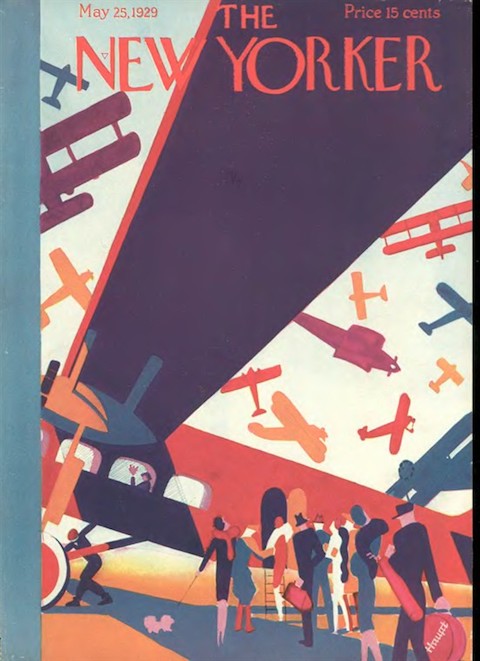
May 25, 1929 cover by Theodore Haupt.

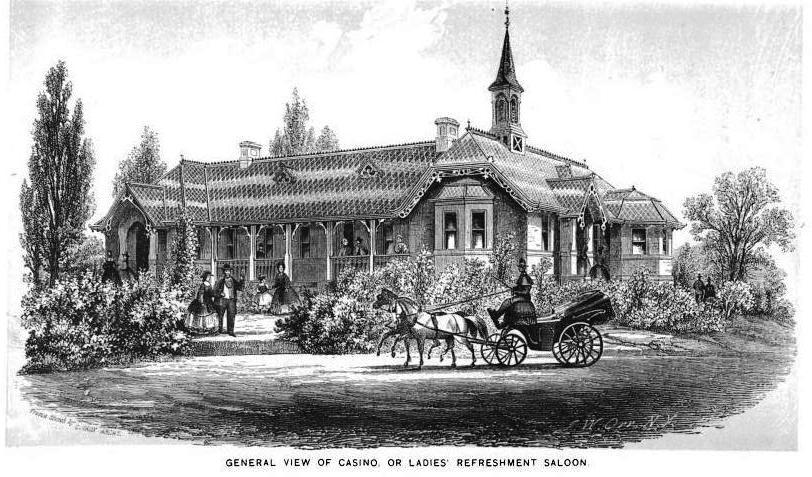
The Casino itself wasn’t new–it opened in 1864 as the Ladies’ Refreshment Salon (sometimes spelled “saloon”), a two-room stone cottage designed by Calvert Vaux. As Susannah Broyles writes in her excellent blog post for the Museum of the City of New York, the Victorian cottage was a place where “unaccompanied ladies could relax during their excursions around the park and enjoy refreshments at decent prices, free of any threat to their propriety.”

Central Park’s Ladies’ Refreshment Saloon opened in 1864. (daytoninmanhattan.blogspot.com)

Broyles writes that by the 1880s the salon had morphed into a far pricier destination, a restaurant called The Casino, open to both sexes. With the rare attraction of outdoor seating, “it was the place to see and be seen.”

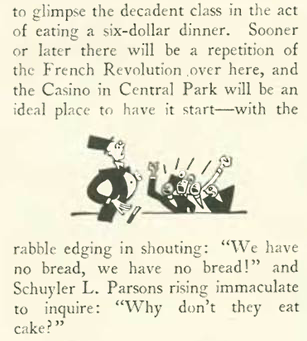
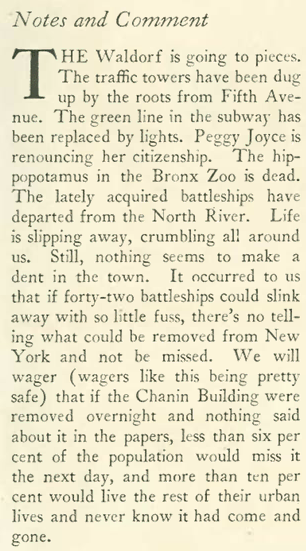
By the 1920s the restaurant had grown a bit shabby. Then along came the city’s flamboyant mayor, Jimmy Walker (1881-1946), who saw the potential of the property as a place where he could hob-nob with wealthy and fashionable New Yorkers and openly flaunt Prohibition laws. There were others, however, who found the idea of an exclusive playground for the rich in a public park distasteful. The New Yorker observed as much in the “Notes and Comment” opening of “The Talk of the Town”…
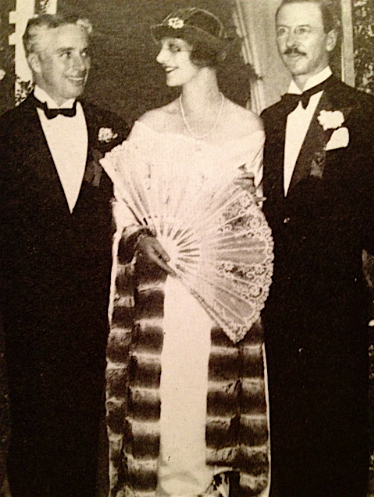
…the “Schuyler L. Parsons” referred to above was a tireless host, prominent decorator, and a society A-lister. He is pictured here (circa 1930) with two of his closest friends, actor Charlie Chaplin and the actress, singer and dancer Gertrude Lawrence

(Tyler Hughes Collections)

The Central Park Casino reopened its doors on June 4, 1929 at an invitation-only event. The following day it would open to the public, but as New York’s newest and most expensive restaurant it would remain closed to all but the wealthiest. As The New Yorker observed, the city was, after all, a “plutarchy,” and the populace passing by the Casino would at least be allowed “to glimpse the decadent class in the act of eating a six-dollar dinner” (nearly $90 today).

This formal announcement of the opening appeared in the May 6, 1929 issue of The New Yorker, including the time of the event—I suppose for the benefit of the 600 who actually had an invitation, or perhaps to tantalize those without such credentials…

The Casino was a playground for the rich by design, conceived in the image of the flamboyant Mayor Walker—himself a product of the Tammany Hall political machine—and executed by hotelier Sidney Solomon, who obtained the building’s lease via some Tammany-style subterfuge. Solomon hired architect and theatrical set designer Joseph Urban to transform the Casino into a glittering showpiece of Jazz Age nightlife.

Clockwise, from top left, the Central Park Casino; architect Joseph Urban; his Casino ballroom design with black-mirrored ceiling; the Casino lobby. (acontinuouslean.com/Columbia University/centralpark.com/drivingfordeco.com)

The New Yorker continued its observations on the Casino in another “The Talk of the Town” piece titled “Historical Note,” attributing the inspiration for the Casino not to Walker or Solomon, but to socialite Anthony Joseph Drexel Biddle Jr…

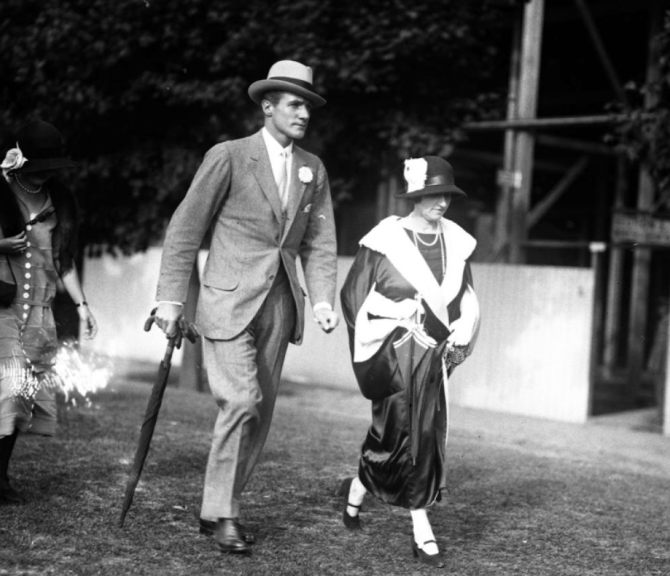
AN EYE FOR THE FINER THINGS…The wealthy socialite A.J. Biddle (pictured here with his first wife, Mary Lillian Duke, in 1924) trained his eye on the Central Park Casino while on the rooftop of the St. Regis Hotel pondering another Joseph Urban project. (voxsartoria.com)
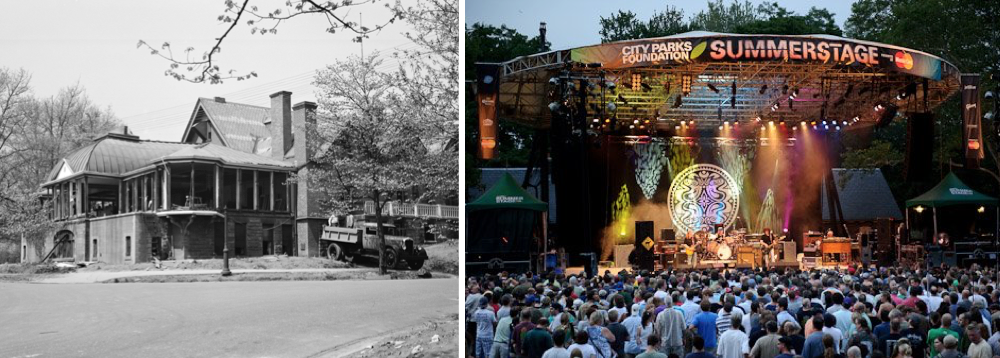
PARTY BOY…New York Mayor Jimmy Walker and his nighttime playground, the Central Park Casino, show here on September 10, 1935. (Britannica/ New York City Department of Parks & Recreation)

Well, as you’ve probably guessed, the party didn’t last forever. After the October 1929 stock market crash, the sight of rich folks stuffing their faces and drinking fine wines in a public park looked even more unseemly. Soon the Casino found itself in the crosshairs of Parks Commissioner Robert Moses, who detested Mayor Walker.

As for Walker himself, a growing financial scandal prompted him to resign from office on Sept. 1, 1932. He promptly fled to Europe with his mistress, Ziegfeld girl Betty Compton, and stayed overseas until the threat of criminal prosecution had passed. For Moses, it wasn’t satisfaction enough to see Walker driven from office. In 1936, despite protests from preservationists, Moses had Urban’s lovely restaurant demolished. It was replaced by a children’s playground the following year.

THE PARTY’S OVER…Crews dismantling the Central Park Casino in 1936. In 1937, the Rumsey Playground was built on the site of the Casino, and in the 1980’s the site was razed again and converted into Rumsey Playfield, where the city’s SummerStage events are now held. (Museum of the City of New York/centralpark.com)

*  *  *

A Drinking Life

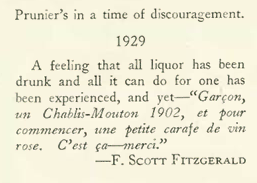
As the Jazz Age was winding down, one of its greatest chroniclers began a brief relationship with The New Yorker. In the March 12, 2017 issue of the magazine, Erin Overbey and Joshua Rothman wrote “There’s a doomed, romantic quality to the relationship between F. Scott Fitzgerald and The New Yorker; they were perfect for each other but never quite got together.” In total, Fitzgerald published just two poems and three humorous shorts for the magazine, beginning with this piece in the May 25, 1929 issue:

Fitzgerald’s last contribution to the New Yorker would appear in the Aug. 21, 1937 issue (“A Book of One’s Own”). Following the author’s death in 1940 the magazine would feature various articles on his life and work, and in 2017—77 years after Fitzgerald’s death—the New Yorker would publish a long lost short story, “The IOU.” A fitting title for an author who sadly did not get his due while he was alive.

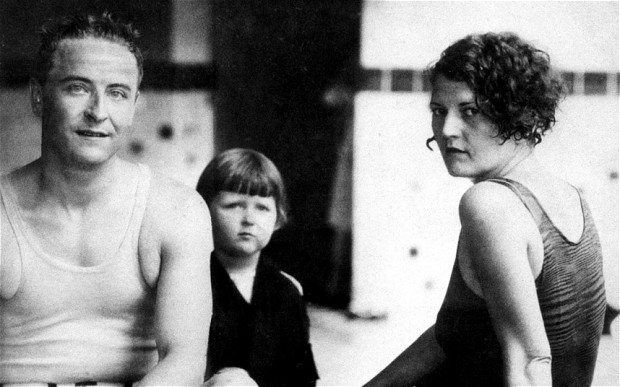
IOU…F. Scott Fitzgerald with daughter “Scottie” and wife Zelda, circa 1927. (The Telegraph)

 *  *  *

One of the Gang

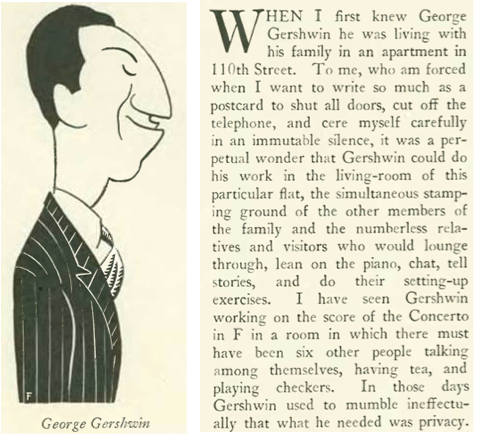
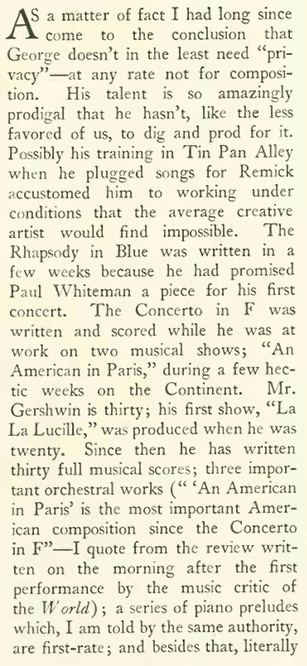
Among the Jazz Age artists and writers who orbited around the Algonquin Round Table (and the Central Park Casino) and chummed with the writers of the New Yorker was musician and composer George Gershwin (1898-1937) who was profiled in the May 25 issue by his friend and longtime New Yorker writer Samuel N. Behrman. The opening paragraph (with caricature by Al Frueh):

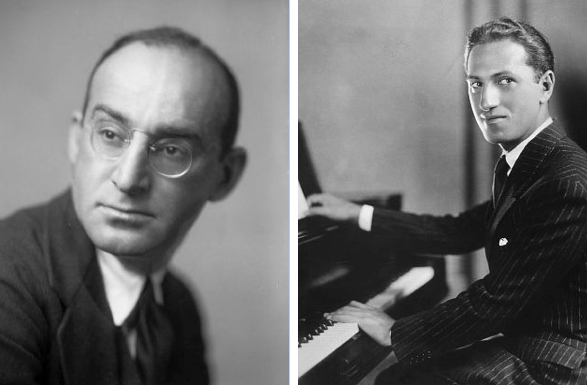
IN THE SAME ORBIT…Samuel Nathaniel Behrman (left), was an American playwright, screenwriter, biographer, and longtime writer for The New Yorker. From the late 1920s through the 1940s, he was considered one of Broadway’s leading authors of “high comedy,”His son is the composer David Behrman. At right, George Gershwin at the piano, 1929. (prabook.com/IMDB)

In the profile, Behrman observed that although Gershwin expressed a desire for privacy, he was quite capable of dashing off major works in practically any setting:

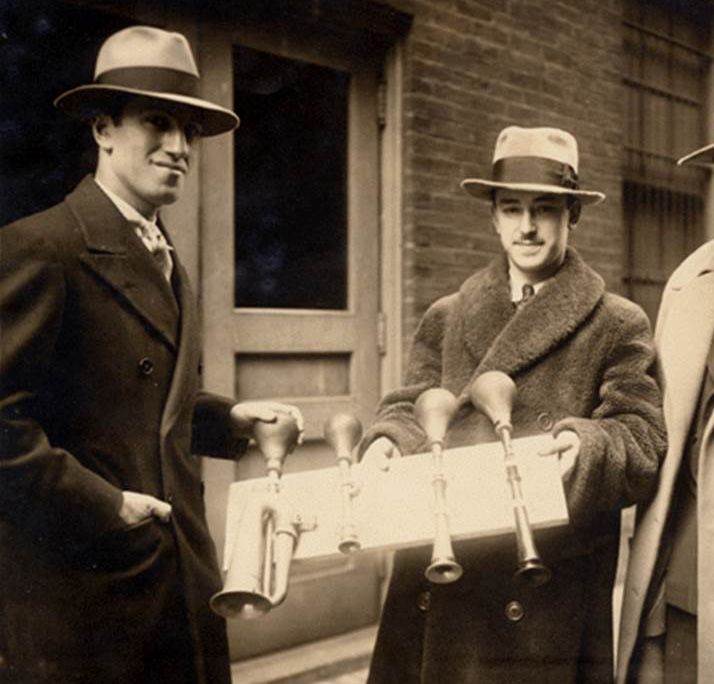
TOOTING HIS OWN HORN…Composer George Gershwin and Cincinnati Symphony Orchestra percussionist James Rosenberg holding four taxi horns used in the orchestra’s performance of An American in Paris, on Feb. 28, 1929. (Photo courtesy of Ira and Leonore Gershwin Trusts)

 *  *  *

Scratching the Surface

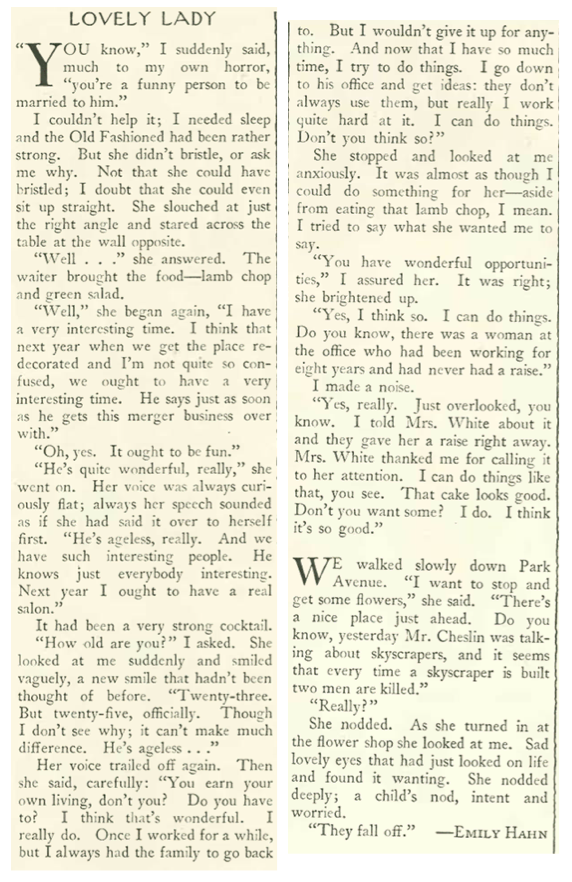
Emily Hahn (1905-1997) was a prolific journalist and author who contributed at least 200 poems, articles and works of fiction to The New Yorker over an astonishing 68-year span—from 1928 to 1996. As the title suggests, I am merely scratching surface, and will devote a post to her in the near future. Here is her contribution to the May 25, 1929 issue:

PROLIFIC…A 1937 portrait of Emily Hahn taken in Shanghai, China, by Sir Victor Sassoon. The author of 54 books, Hahn is credited with playing a significant role in opening up Asia and Africa to the West through her many novels. (DeGolyer Library, SMU)

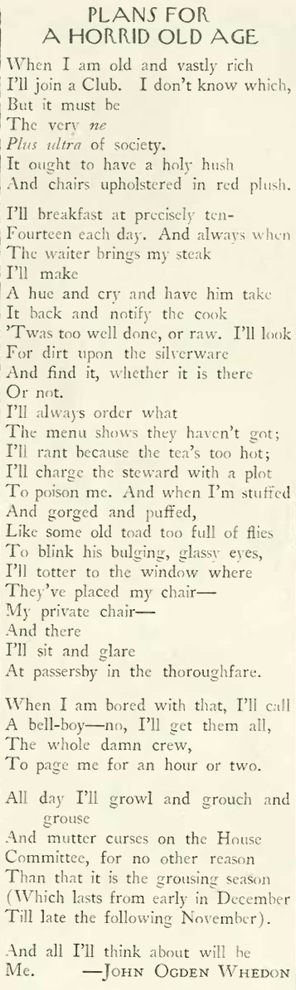
Another frequent contributor to The New Yorker was screenwriter John Ogden Whedon (1905-1991), who offered up mostly shorts from 1928 to 1938. He is best known as a television writer for such shows as The Andy Griffith Show, The Dick Van Dyke Show and Leave It to Beaver. Whedon and his wife, Louise Carroll Angell, were parents and grandparents to a number of screenwriters, including grandson Joss Whedon, creator of Buffy the Vampire Slayer and writer/director of The Avengers (2012) and its sequel Avengers: Age of Ultron (2015). An excerpt of grandpa’s writing from the May 25 issue:

 *  *  *

From Our Advertisers

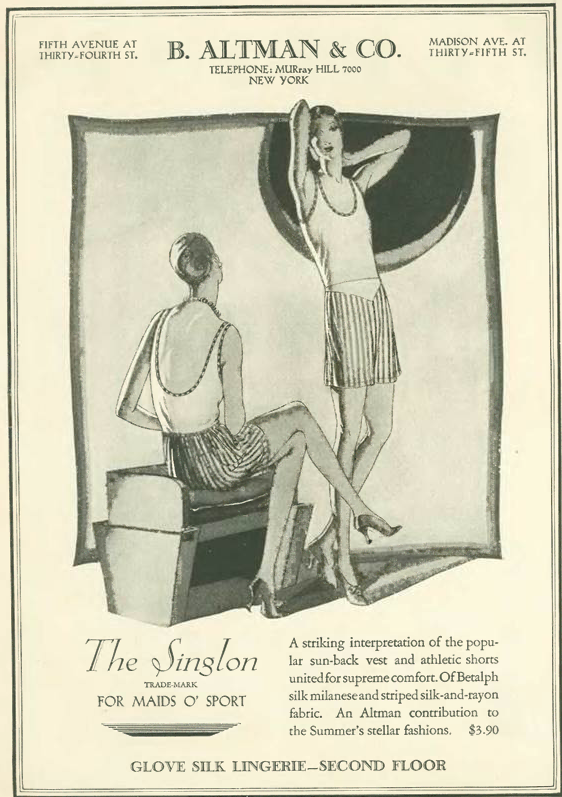
In a recent post (Waldorf’s Salad Days) I noted an ad from Lily of France that proclaimed the straight flapper figure was out, and it was now the “season of curves.” This ad from B. Altman begs to differ…

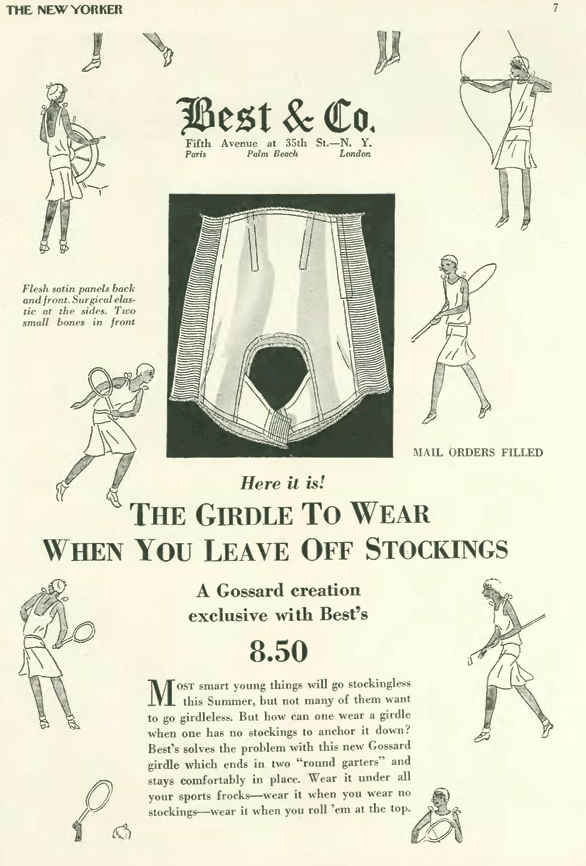
…one way to keep that straight figure was to pull on a girdle, which I’m sure felt great while one played tennis…

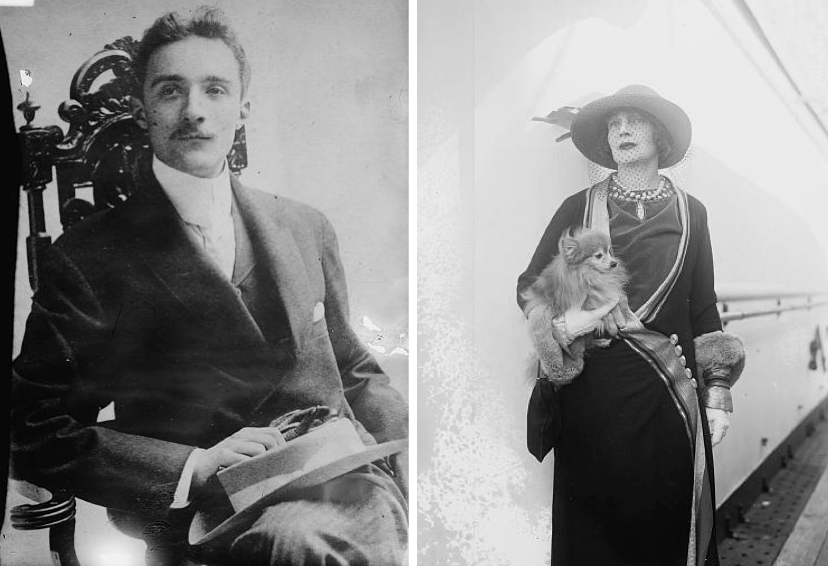
…our latest Lucky Strike endorser is…Mrs. Jerome Napoleon Bonaparte. Never heard of her? Well, “Mrs. Jerome” was actually a one Blanche Pierce (1872-1950) of Rochester, NY. Her second husband, Jerome Napoleon Bonaparte (the great-grandnephew of Emperor Napoleon) was something of a wastrel, having inherited a fortune and never worked at a job or profession. Blanche herself was known as a social climber…

THEY EXISTED…Jerome Napoleon Charles Bonaparte (pictured here circa 1915) was the great-grandnephew of Emperor Napoleon and a man of extreme leisure. His wife, Blanche Pierce Bonaparte (right, in a photo circa 1925), was known as a dog lover, a passion that indirectly led to her second husband’s demise. Jerome died while walking his wife’s dog in Central Park—he apparently stumbled over the dog’s leash and broke his neck. (Library of Congress)

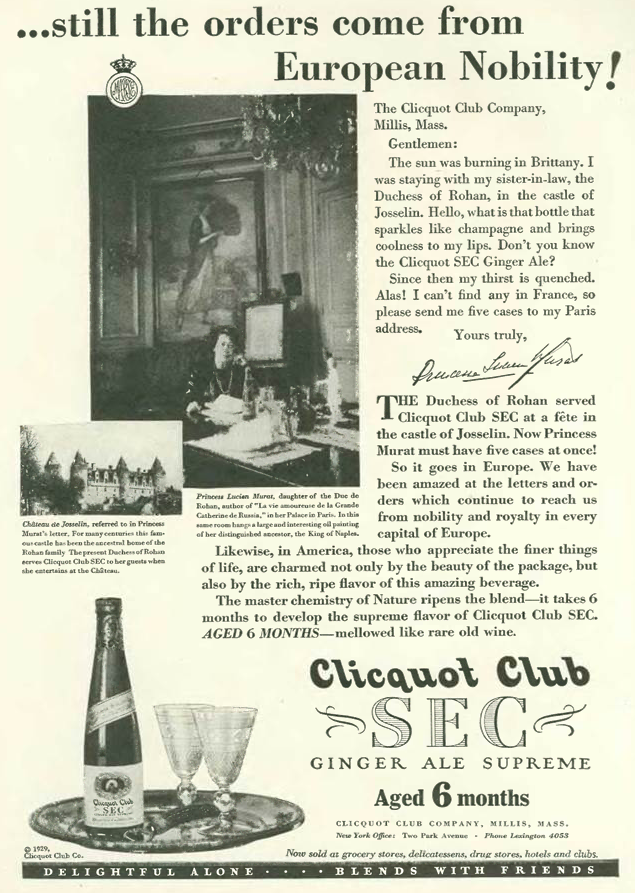
…speaking of European nobility, here is another sad endorsement from a French noble touting the wonders of Clicquot Club ginger ale to Prohibition-strapped Americans…

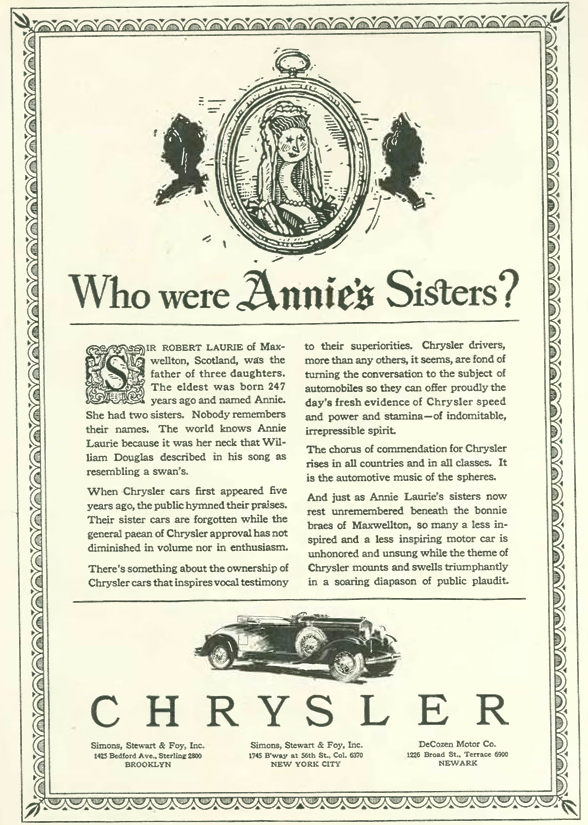
…and then we have this weird “Annie Laurie” analogy used by Chrysler to sell its line of automobiles…

…the manufacturers of Studebaker, on the other hand, opted for a more direct approach, equating its automobiles with the speed and modernity of airplane flight…note how in both ads the cars are pictured with the windshields folded down to emphasize sleekness…

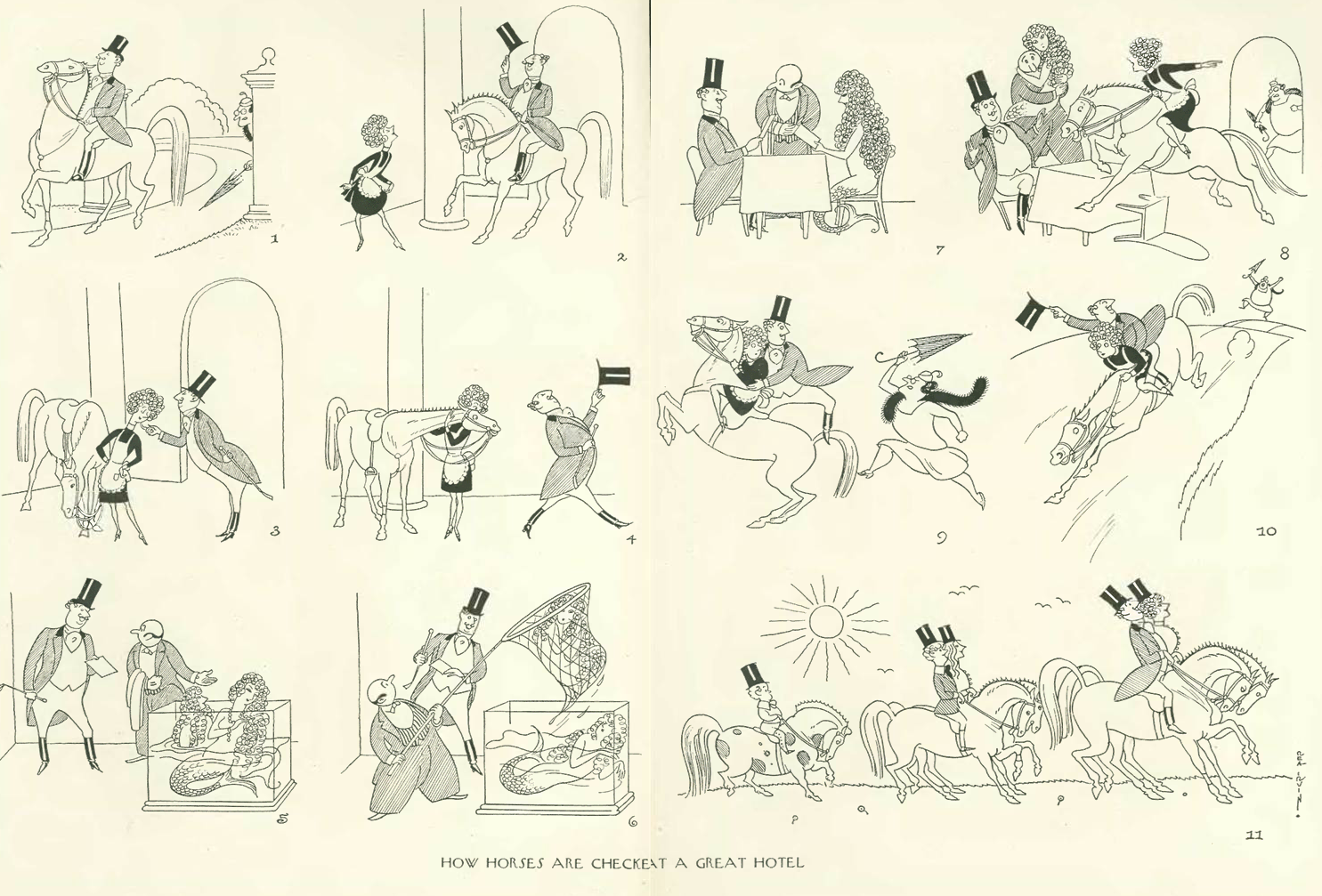
…on to the cartoons: we begin with this two-page entry by Rea Irvin, which makes very little sense…I get the part where the rich old man (stalked by his fearsome wife) finds a mistress (and a new wife) through the process of “checking his horse,” but the whole mermaid thing is lost on me…please click to enlarge—I’d love to have this one explained…

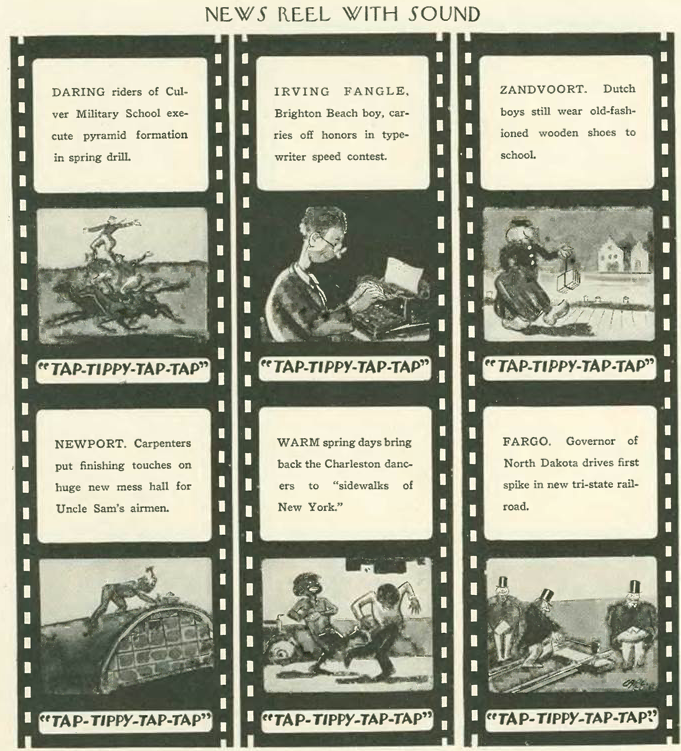
Carl Rose had some fun with newfangled sound effects in the dawning age of the talkies…

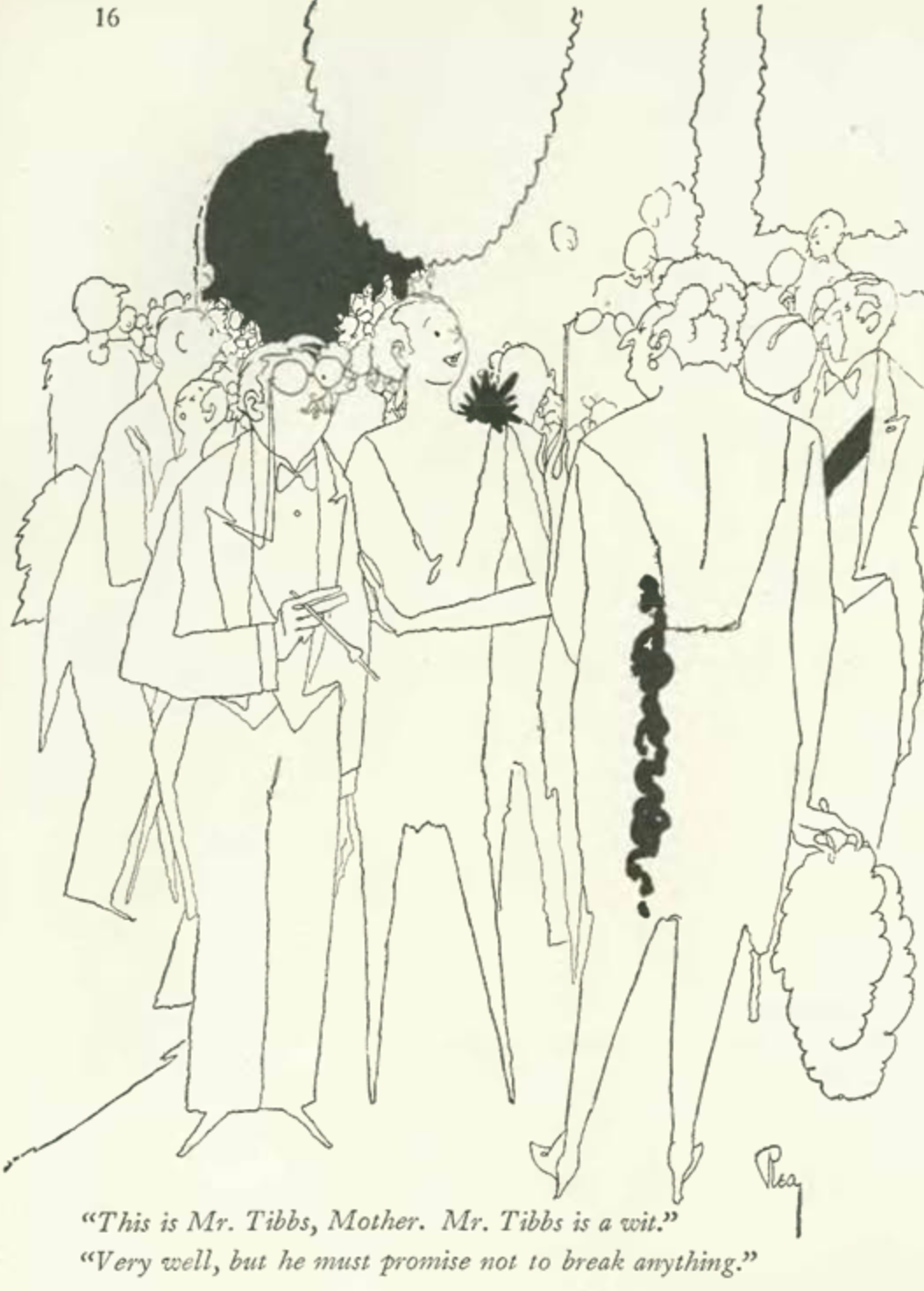
Peter Arno sketched up the cynicism of one New York dowager…

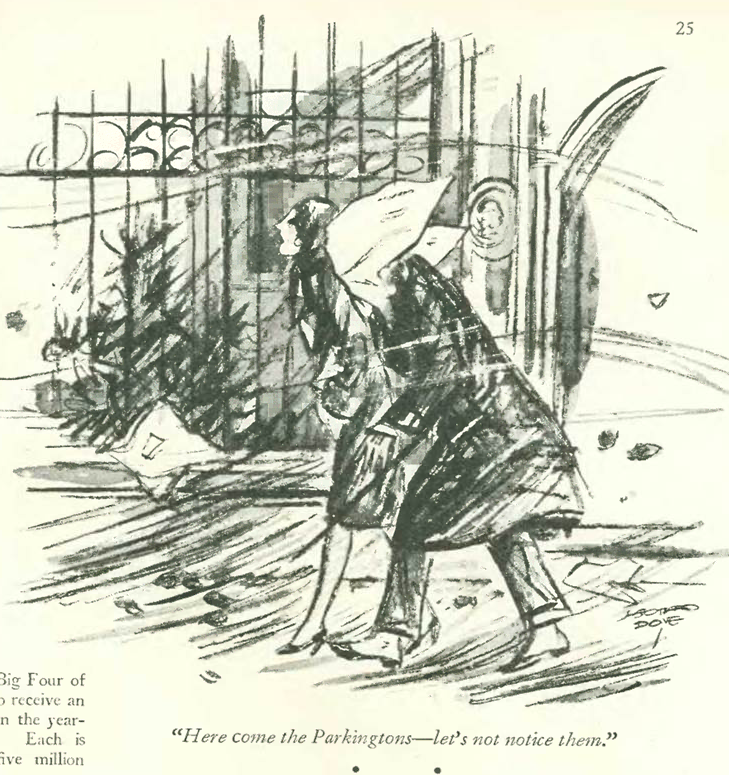
Perry Barlow captured two women who might have been driving home from an auction at the old Waldorf-Astoria Hotel…

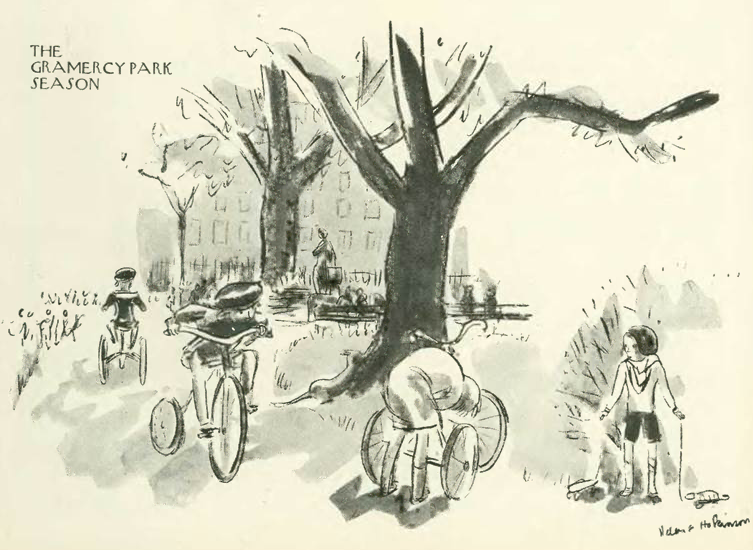
…and finally, a lovely illustration by Helen Hokinson of children at play…

Next Time: The Unspeakables…


How Charles Shaw Felt About Things

Some people really do lead charmed lives: Take for example Charles Green Shaw. Born to wealth, he was a fixture in the glamorous social scene of Jazz Age New York, but was also a key player in its intellectual and artistic life. An accomplished author as well as a poet and illustrator, Shaw turned to painting in his late thirties and became a leading figure in the world of abstract art.

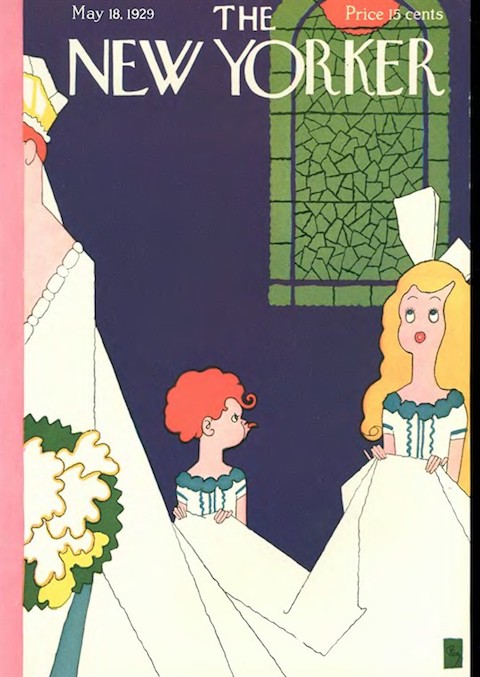
May 18, 1929 cover by Gardner Rea.

Shaw (1892-1974) was an early contributor to The New Yorker, penning more than thirty pieces for the magazine between 1925 and 1932, including three short contributions to the very first issue (Feb. 21, 1925). Here’s one of them:

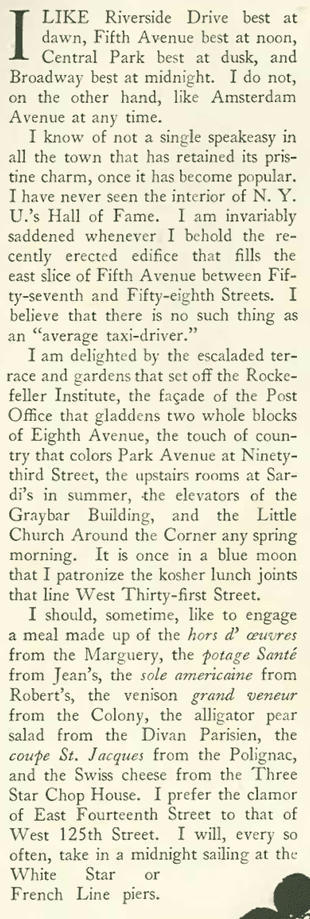
That short piece anticipated a much longer entry by Shaw four years later—in the May 18, 1929 New Yorker—in a column titled “How I Feel About Things.” An excerpt…

YEAH & MEH…Charles Shaw liked Central Park at dusk; Amsterdam Avenue, not so much. (Time Freeze Photos/NYC Municipal Archives)
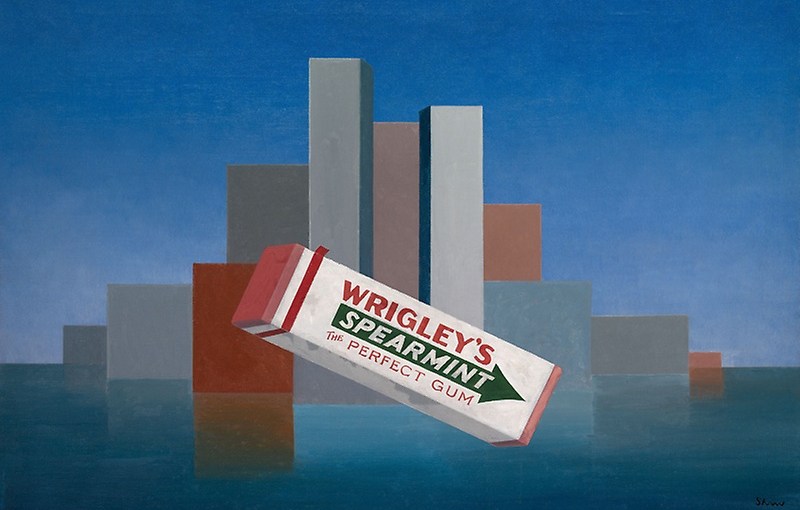
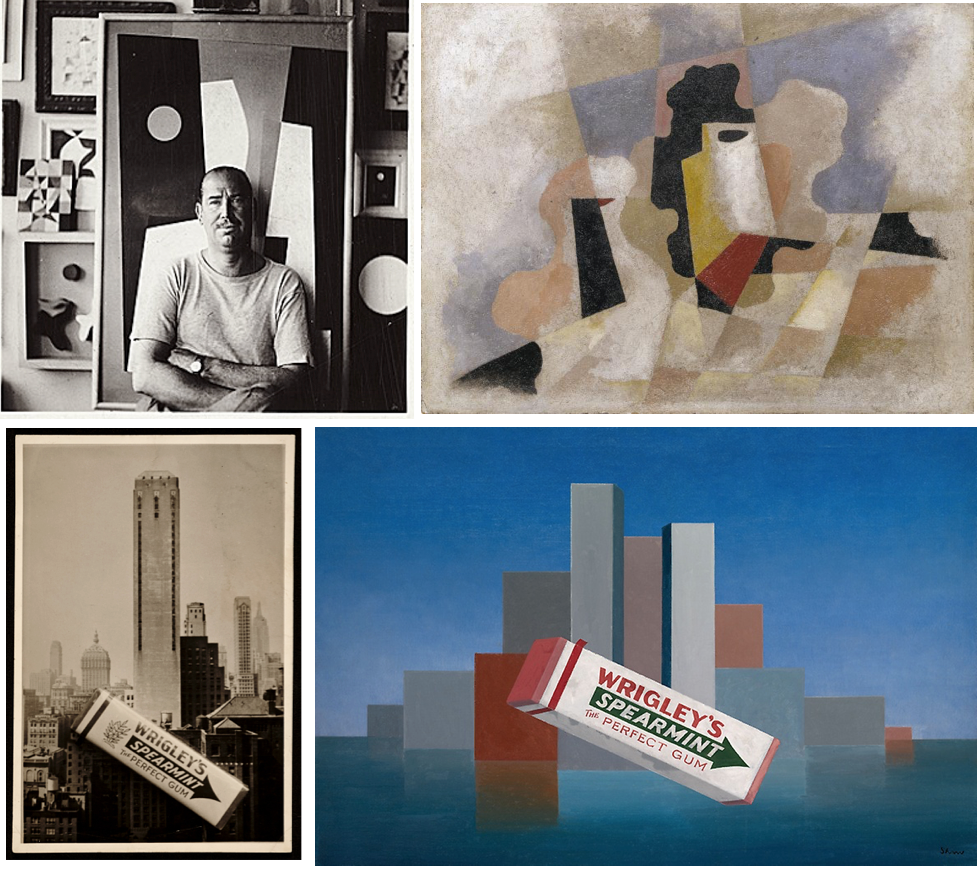
SOMETHING TO CHEW ON…Top left, Charles G. Shaw in 1945. Clockwise, from top right, Untitled Abstraction, 1943, oil on fiberboard; Wrigley’s, 1937, oil on canvas; photo of Wrigley’s gum package on top of a postcard image of New York City. On the back of the photo Shaw had written “idea for montage.” (Wrigley painting courtesy Art Institute of Chicago/other images from Archives of American Art, Smithsonian Institution)

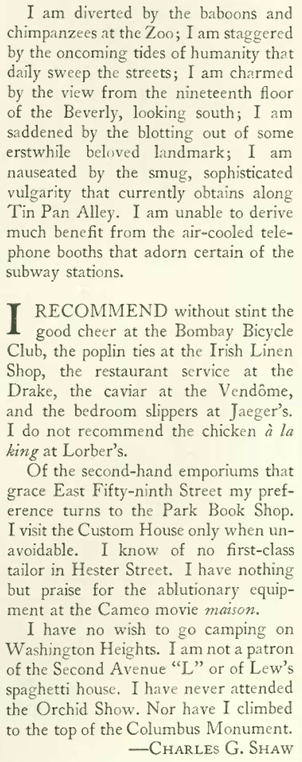
…one more excerpt from the Shaw column…

Shaw would contribute more columns to The New Yorker in this vein: four more titled “How I Feel About Things” (1929-1931) followed by “How I Look at Things in General” (1931), and his final two New Yorker columns (1931-1932), “Things I Have Never Liked.”

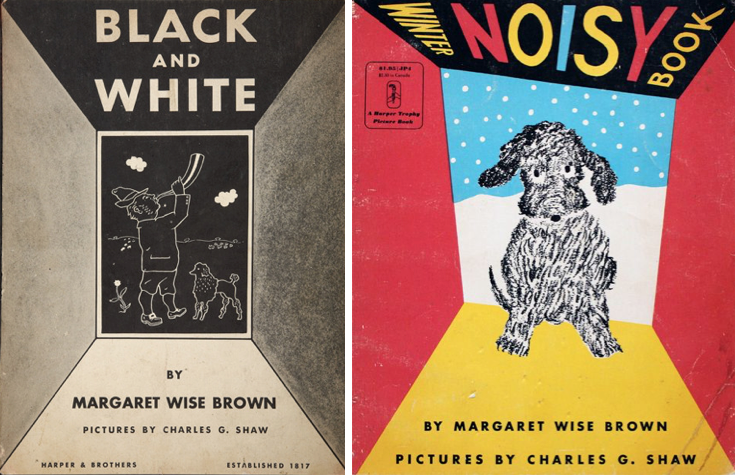
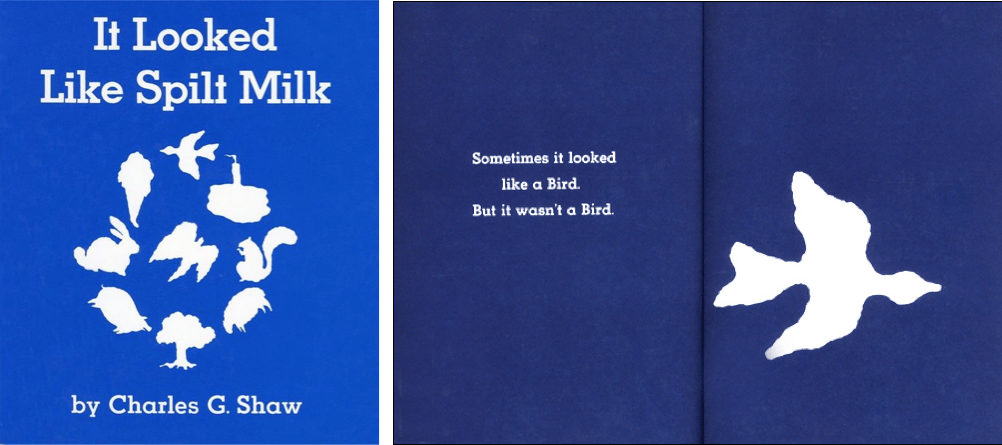
He also illustrated children’s books, including two by Margaret Wise Brown (of Goodnight Moon fame). In 1947, Shaw published It Looked Like Spilt Milk, a book that introduced children to abstract art. It remains in print and popular today.

SOMETHING FOR THE KIDS…Shaw provided illustrations for Margaret Wise Brown’s Black and White (1944) and The Winter Noisy Book (1947). (Harper)
STILL POPULAR…Shaw published It Looked Like Spilt Milk as a children’s introduction to abstract art. (Kinder Books)

 *  *  *

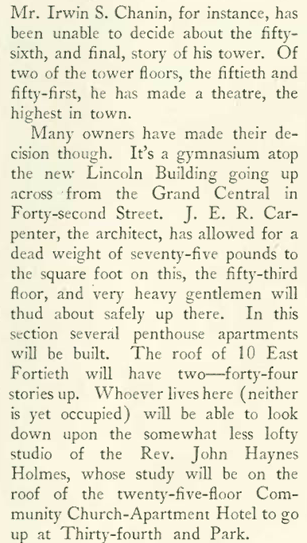
In the “The Talk of the Town,” James Thurber looked at “high-living” trends among occupants atop the city’s newest skyscrapers, including developer Irwin Chanin:

CROWN JEWELS…The Chanin Building at 122 E. 42nd Street sports a distinctive crown that contains a wraparound terrace (now closed) at the 56th floor. A theater on the 50th and 51st floors, just below Irwin S. Chanin’s executive suite, was later converted into office space.(aviewoncities.com/untappedcities.com)
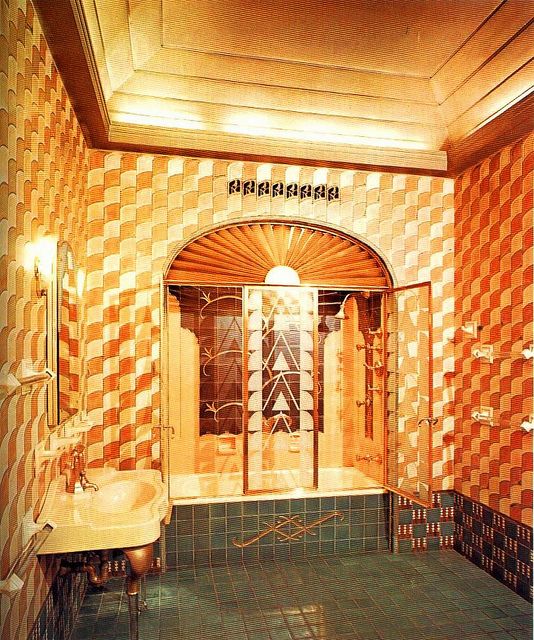
A THRONE IN THE SKY…The art deco bathroom in the 52nd floor executive suite of architect and real estate developer Irwin S. Chanin was designed by Jacques Delamarre. (Pinterest)
AERIAL GYMNASTICS…1930s postcard image of the Lincoln Building at 60 East 42nd. At right, the building’s rooftop gymnasium. (nyc-architecture.com/Tony Hisgett)

…Thurber continued his survey downtown in the financial district, and noted the proliferation of “lanterns” atop various skyscrapers…

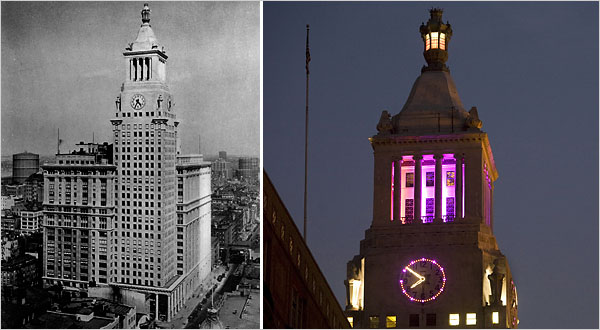
ALL THE RAGE…”Lanterns” of various styles were popular toppers to Jazz Age skyscrapers. Above, the 24-story Consolidated Gas Building (now the Con Edison tower) by day and night. (Architect/Office for Metropolitan History/Michael Falco for The New York Times)
TRY TO TOP THIS…The distinctive lantern of the New York Central Building at 230 Park Avenue, now called the Helmsley Building  (andrewcusack.com/Wikipedia)

*  *  *

Waldorf Adieu, Part Two

For a second week “The Talk of the Town” led off with an item about the demise of the Waldorf-Astoria hotel, this time attempting to put it into some perspective…

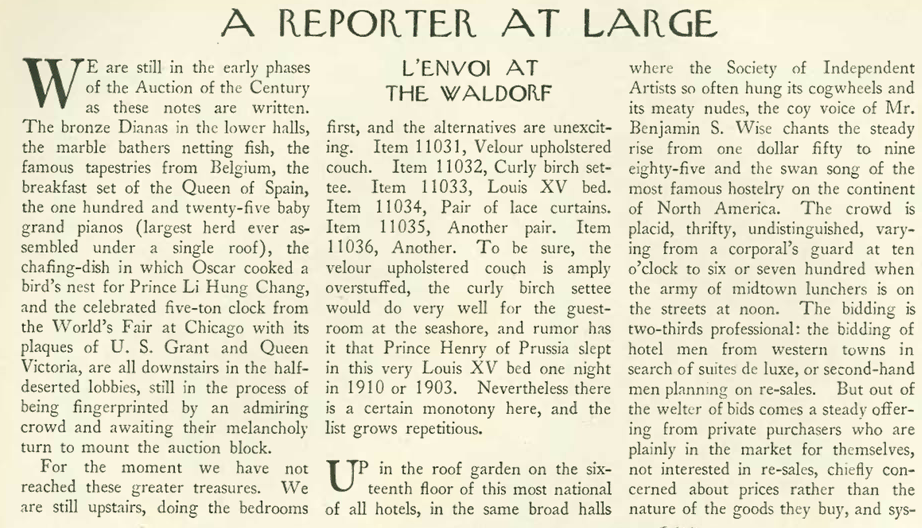
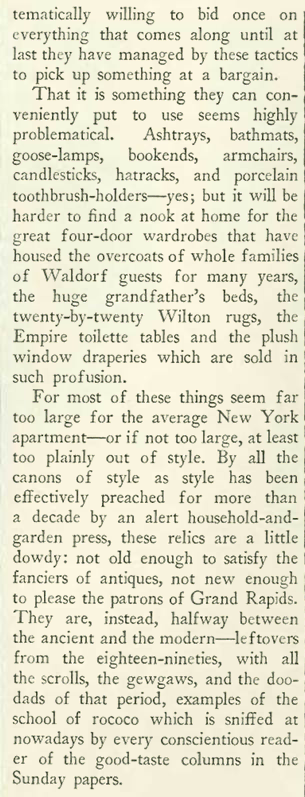
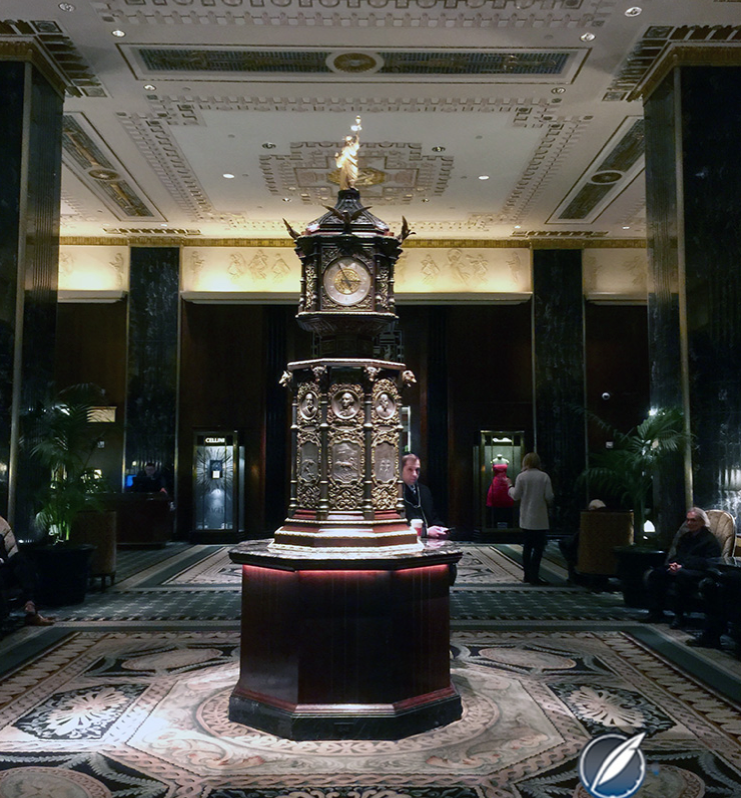
…and Charles Merz offered a lengthy account of the auctions that were already taking place at the hotel as everything from grand pianos (125 in all) to a nine-foot-tall, five-ton, bronze-and-mahogany clock either went on the block or into storage…

GOING, GOING…Illustration depicting an auction of items from the hotel. At right, the Waldorf’s nine-foot-tall, five-ton clock, shown here on display at the 1893 Chicago World’s Fair. A gift from Queen Victoria, the clock was acquired after the fair by John Jacob Astor IV, builder of the Astoria part of the old Waldorf-Astoria. He had it placed near the old hotel’s Rose Room restaurant. (Museum of the City of New York/Wikimedia)
STILL TICKING…The clock as it appears today in the lobby of the new Waldorf-Astoria, which was completed in 1931. A gilded Statue of Liberty was added to the top of the clock in 1902, a gift from the French government. (Wikimedia/Elizabeth Doerr)

…Merz observed that although lavish tapestries, statuary, heavy furniture and other large items were up for sale, many buyers showed up merely to acquire a small memento…

IF THAT IS YOUR THING…Ornate furnishings (such as this French rococo-style furniture) were likely purchased at the auction by someone who actually had room for them. (Pinterest)

…Merz concluded that in the end, these “lesser treasures” will serve as props that will be handed down to the next generations, along with stories about the great and not-so-great who once slept or dined at the old hotel…

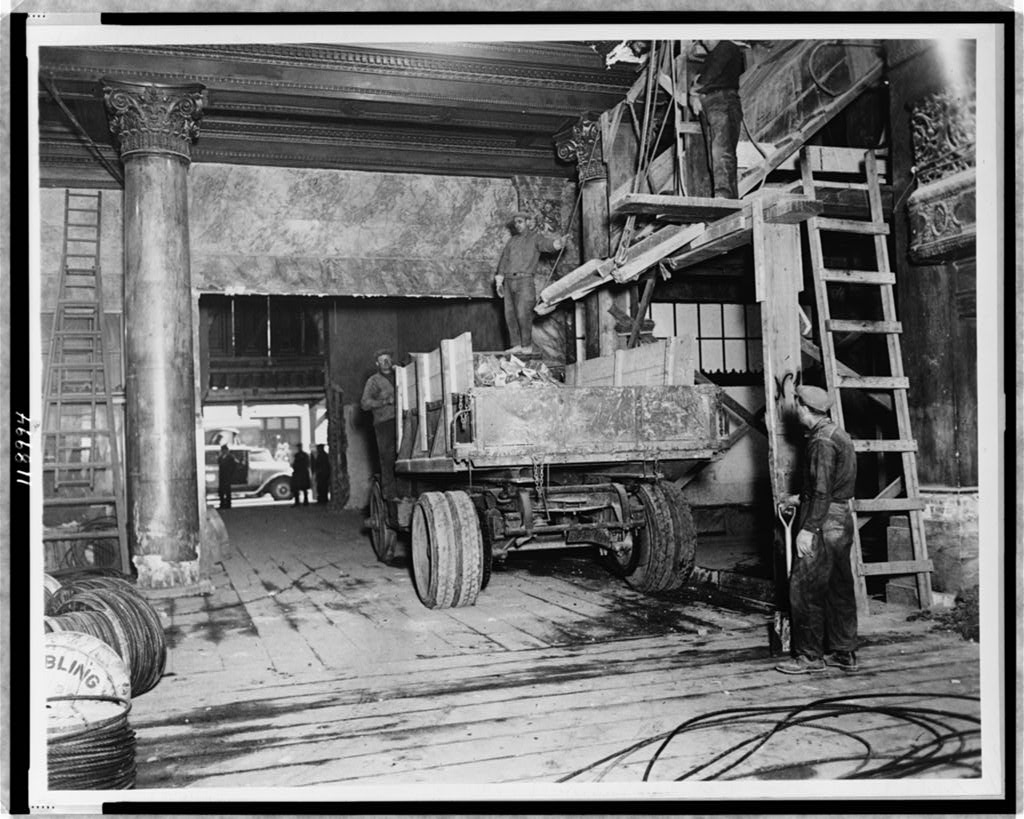
LAST DANCE…Workers emptying the old Waldorf-Astoria ballroom in 1929. (Library of Congress)

The May 18 issue featured yet another item on the Waldorf-Astoria — in “The Wayward Press” column, Robert Benchley (under the pseudonym “Guy Fawkes”) suggested that the story on the hotel’s demise had been milked for all it was worth….

 *  *  *

The Algonquin Wits

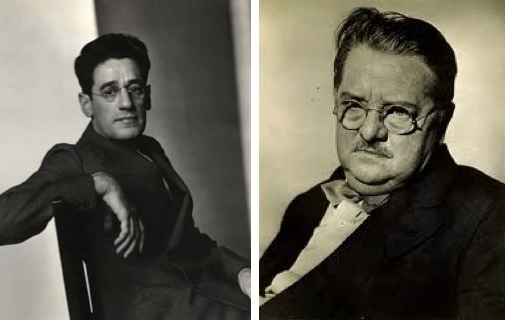
Speaking of milking a story, Alexander Woollcott playfully referenced his own material in the May 18 issue—indeed, quoting a profile he had written in the very same issue. Woollcott penned a humorous piece on friend and fellow Algonquin Round Table wit George S. Kaufman (caricature by Miguel Covarrubias). An excerpt:

…a bit later in the profile, Woollcott observed…

…a few pages later in the same issue, Woollcott offered more observations on his friend in his weekly “Shouts and Murmurs” column…quoting the above paragraph…

Kaufman would have his own say in 1939 with his hit play, The Man Who Came to Dinner (written with Moss Hart). The play’s main character, a cantankerous misanthrope named Sheridan Whiteside, was closely based on Woollcott.

SPARRING PARTNERS…George S. Kaufman and Alexander Woollcott often matched wits around the famed Algonquin Round Table. (Pinterest)
OUT OF SORTS…The cantankerous misanthrope Sheridan Whiteside (a character based on Alexander Woollcott) was portrayed by Monty Woolley in the 1939 hit play, The Man Who Came to Dinner. The play was adapted into a 1942 movie with Woolley (left) reprising his role as Sheridan Whiteside. Playing opposite Woolley are Bette Davis (center) and Ann Sheridan. (oldhollywoodtimes.com)

What did Woollcott think of the treatment? According to an article featured in Story of the Week (Library of America), he loved it: “When the play went on its West Coast tour, he even stepped into the lead role, treating audiences to the sight of a celebrity acting as a satirical version of a character based on his own public persona. At the end of one performance, cheered on by repeated curtain calls, Woollcott riffed off one of his character’s signature lines from the play and announced to the audience that he planned to sue the authors for $150,000.”

Those were the days…

 *  *  *

Distracted Drivers

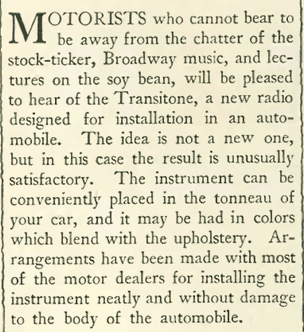
In his “Motors” column, Nicholas Trott described a new gadget that could bring new levels of pleasure (or danger) to the driving experience: the car radio:

The Transitone was probably the first production car radio in the U.S., and looked something like this (left image):

VACUUM TUBES are exposed under the dash of this car (left) outfitted with a Transitone radio. At right, a Crosley car radio from 1931. (radiomuseum.org)

 *  *  *

From Our Advertisers

The makers of Pond’s cold cream continued to land endorsements from the landed gentry, this time from 30-year-old Lady Violet Astor (née Violet Mary Elliot-Murray-Kynynmound, Dame of the Order of St. John), whose hair was described “as ripe as wheat,” her skin “pink and white as a hedge rose.” Okay, I’ll try a jar…

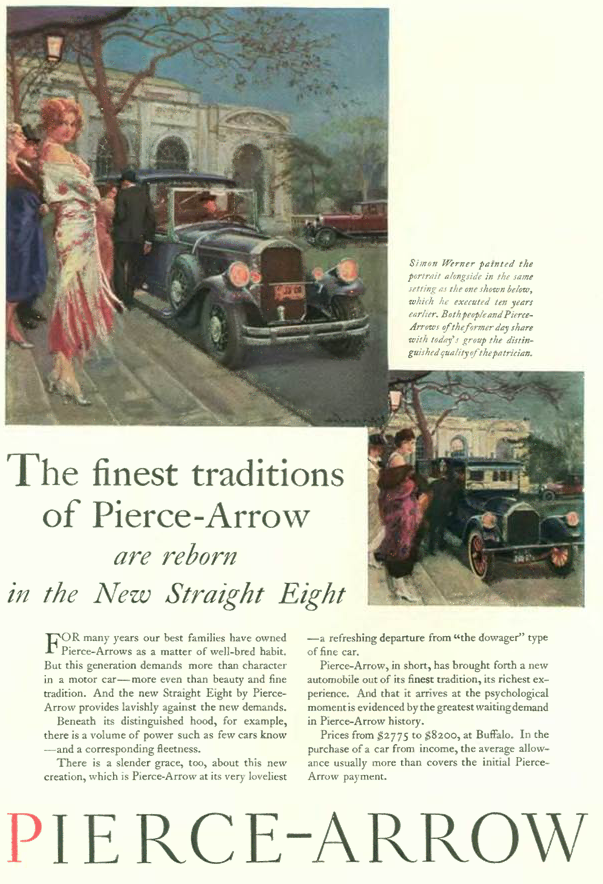
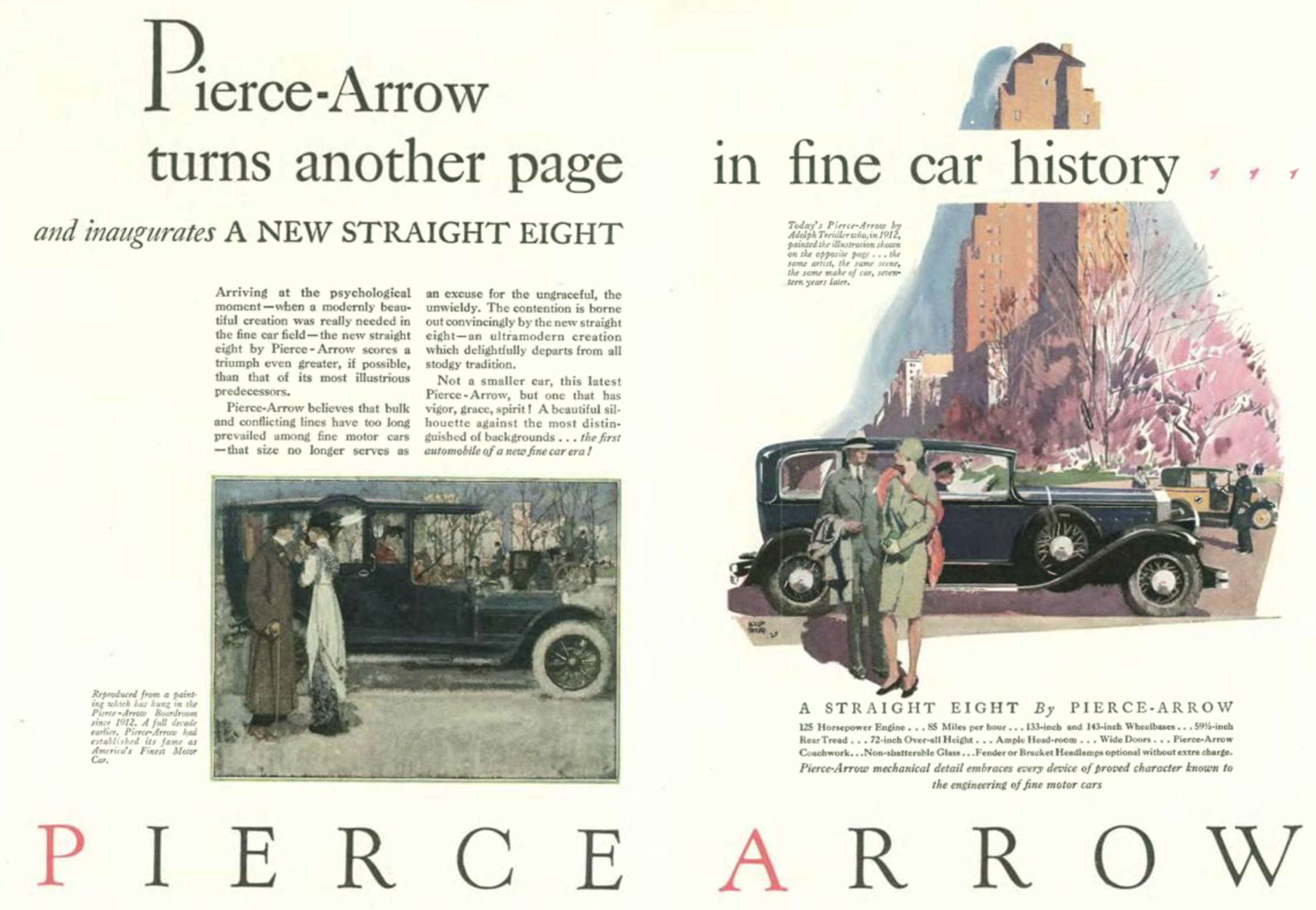
…and for more snob appeal, advertisements from American luxury carmaker Pierce-Arrow often featured messages that linked its cars to a lineage of earlier models, suggesting their automobiles had a well-bred, timeless quality (as opposed to the novelties found in cars driven by the plebeian classes). The caption reads: “Both people and Pierce-Arrows of the former day share with today’s group the distinguished quality of the patrician”…

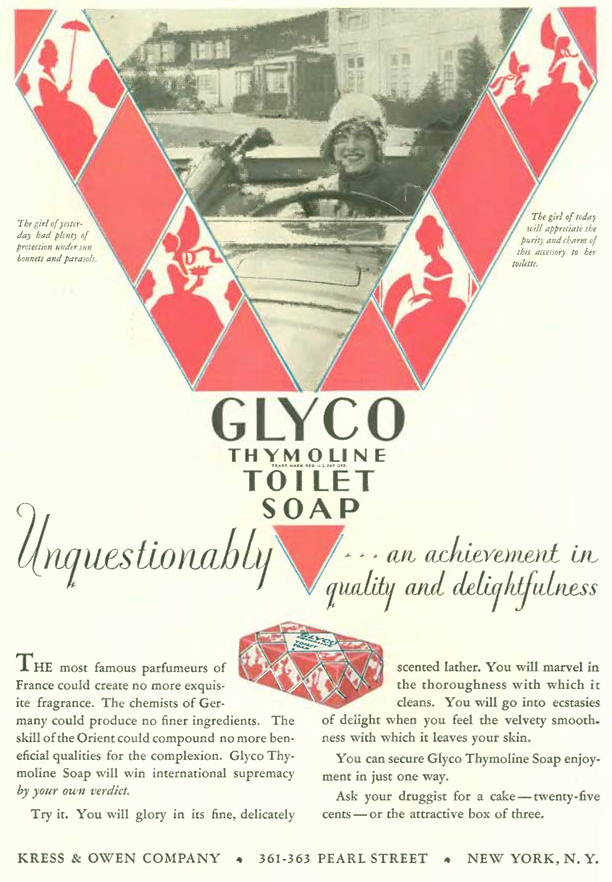
…the makers of Glyco “Thymoline” also drew upon the past to make a point about their soap, stating that “the girl of yesteryear had plenty of protection under sun bonnets and parasols,” whereas today’s young woman boldly races off to play golf without even bothering to put up the windshield. She’ll need Glyco to scrub off the bugs, dust and bits of gravel that will likely kick up into her face…

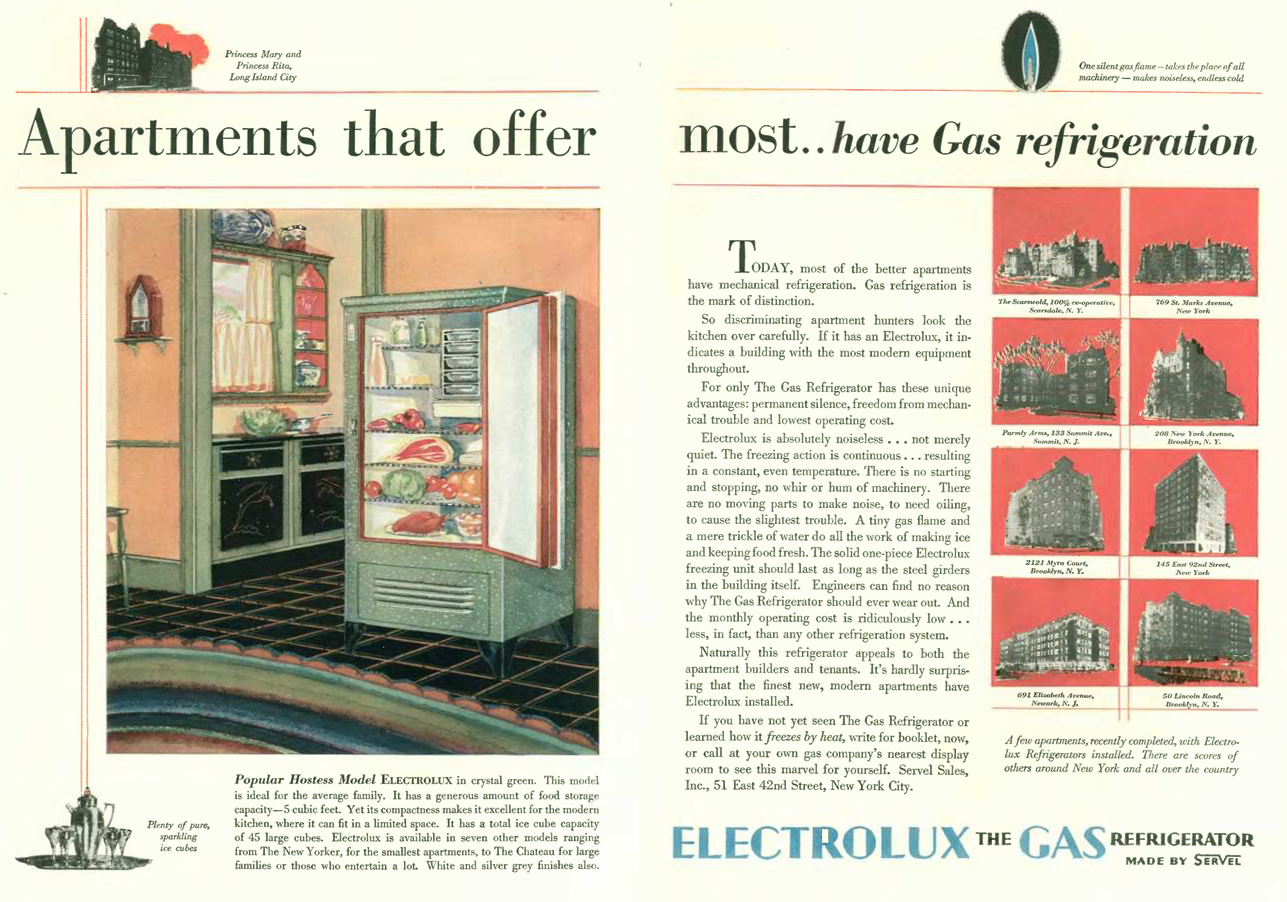
…One thing you notice at the end of the 20’s is the proliferation of color ads in The New Yorker, some quite lavish including this appeal from Electrolux, which depicted all of the new apartments popping up around the city powered by their gas appliances…

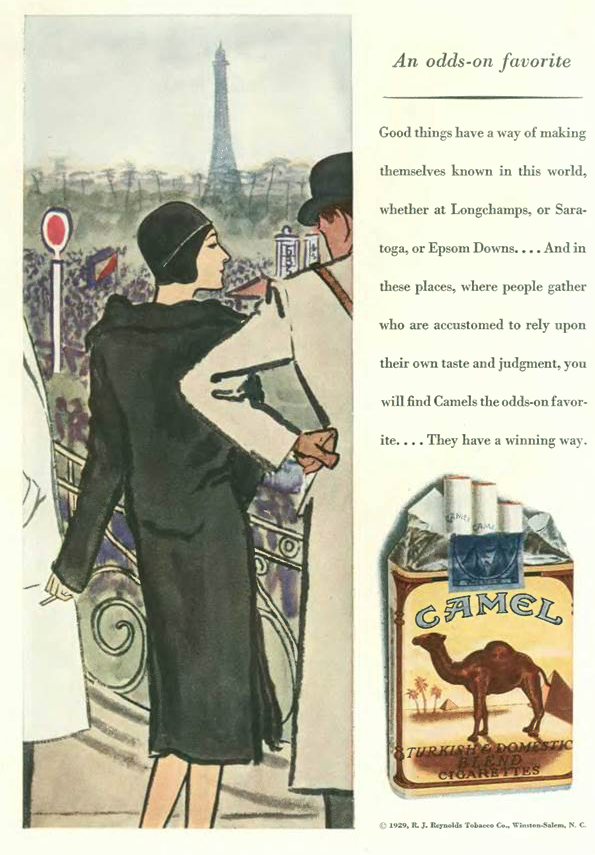
…and we have another lovely rendering by Carl “Eric” Erickson urging readers to smoke Camel cigarettes…

…and this ad caught my eye for its depiction of a house in the future, namely the year 1949 — you land your personal airplane on the roof and relax in your dynamic, angular furniture while a robot butler shakes up cocktails for you and your top-hatted friend…

…the house in the ad somewhat resembles this 1929 drawing by Swiss-American architect William Lescaze

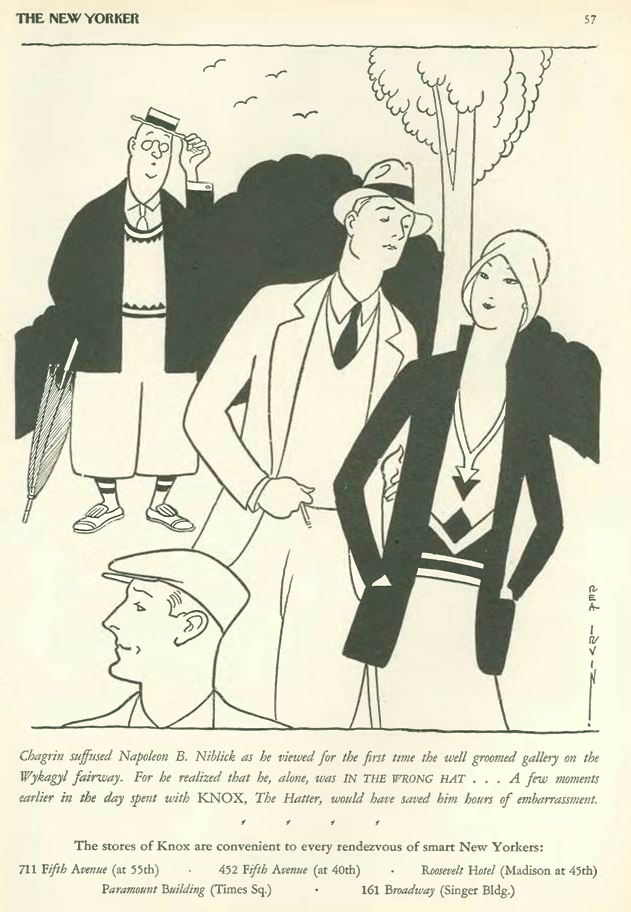
…we have another ad from Knox hatters (drawn by Rea Irvin) that featured an unfashionable, portly man (Napoleon B. Niblick) being snubbed by some Westchester toffs…

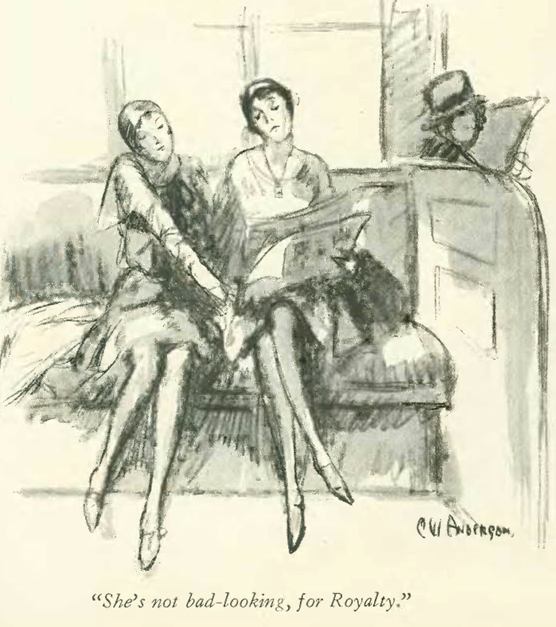
…our comics are provided by C.W. Anderson

…and Peter Arno

Next Time: Let Them Eat Cake…


From Broadway to Babylon

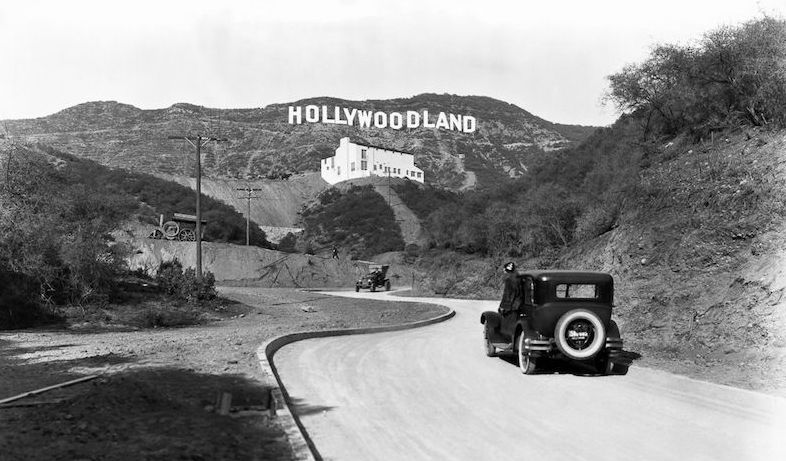
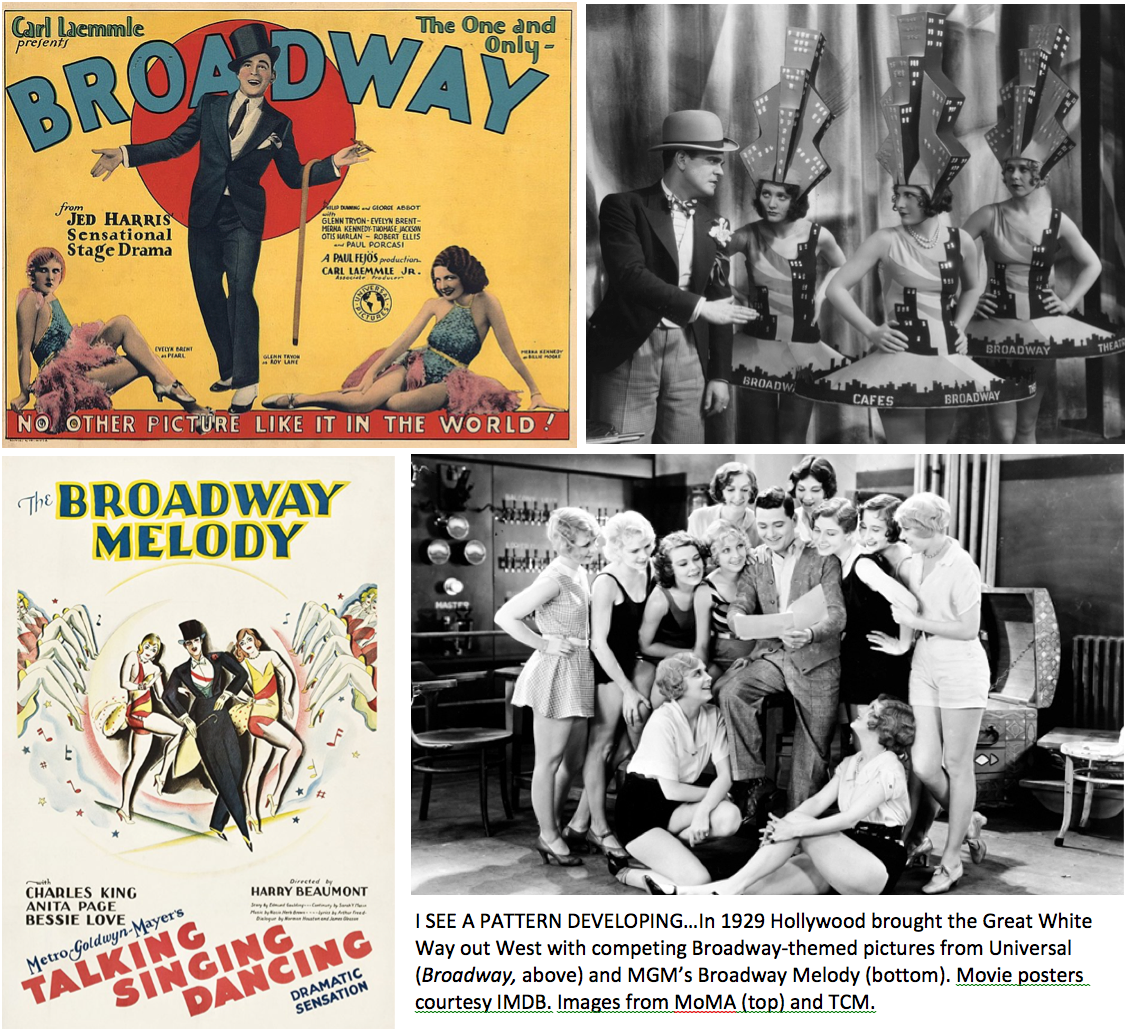
While the introduction of sound to motion pictures ended the careers of some silent film stars in the late 1920s, Hollywood’s “talkies” offered new opportunities for Broadway stage actors who could now take their vocal talents to the screen and to audiences nationwide.

May 4, 1929 cover by Ilonka Karasz.

And so began the so-called “Broadway Exodus.” Robert Benchley offered his wry observations on the phenomenon in the May 4, 1929 “A Reporter at Large” column:

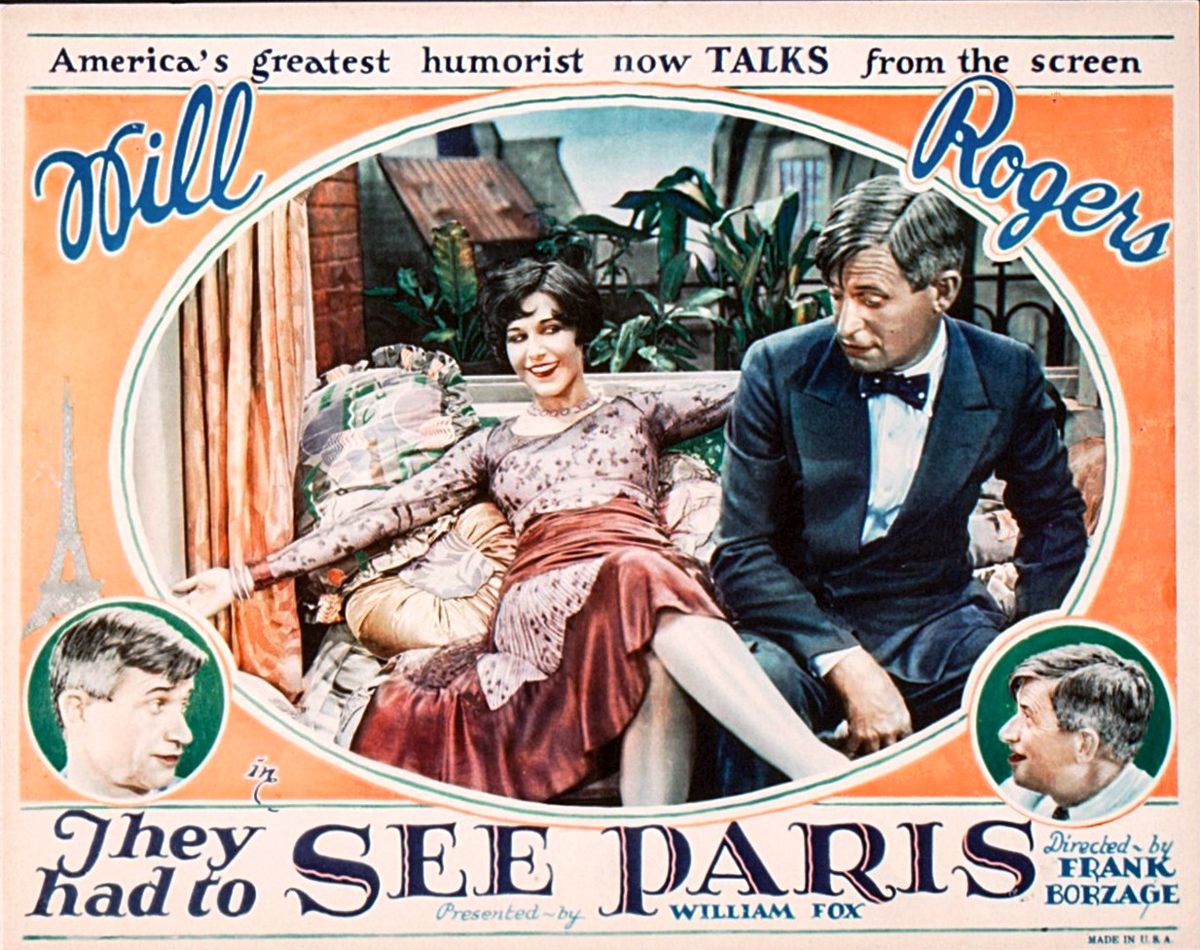
AW SHUCKS…Broadway mainstay and a perennial performer with the Ziegfeld Follies, humorist Will Rogers found his element in Hollywood’s new talkies, appearing here with Fifi D’Orsay in 1929’s They Had to See Paris. (Wikipedia)
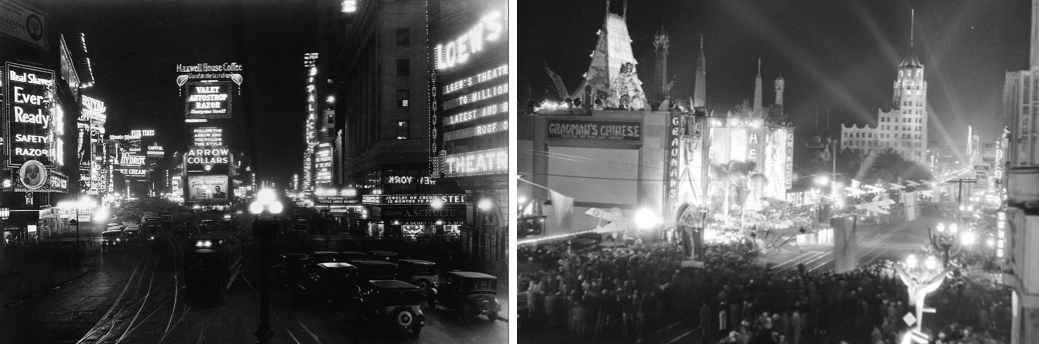
TALE OF TWO CITIES…Broadway in 1925 (left) and Hollywood Boulevard in 1929. (Daily Mail/USC Digital Library)

Benchley observed that regardless how many Broadway stars moved west, Hollywood Boulevard would never be mistaken for Broadway. However, Benchley himself would catch the bug and head to Tinseltown, appearing in dozens of feature films and shorts including How to Sleep, which would win an Academy Award for “Best Short Subject, Comedy,” in 1935.

NICE WORK IF YOU CAN GET IT…Robert Benchley in the 1935 Oscar-winning short, How to Sleep. (YouTube)

 *  *  *

One Who Stayed on Broadway

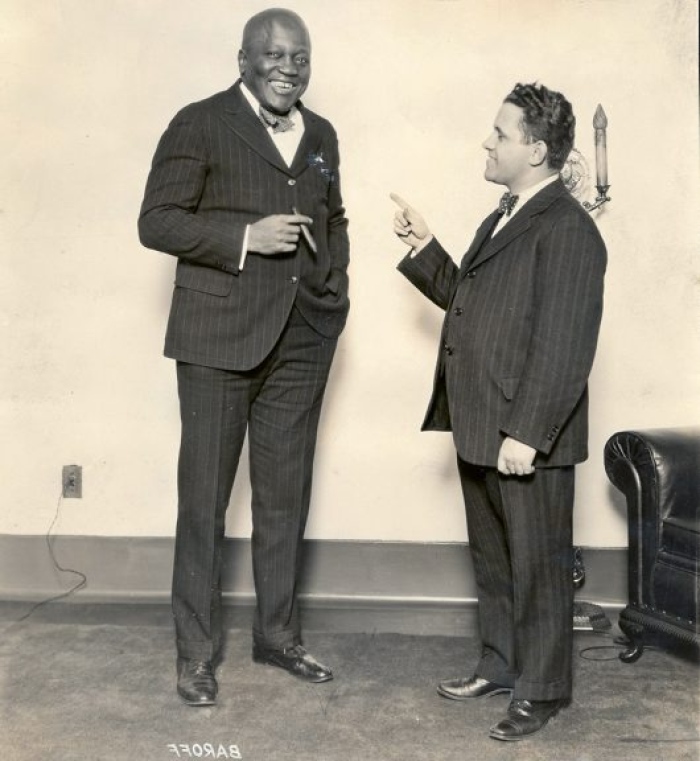
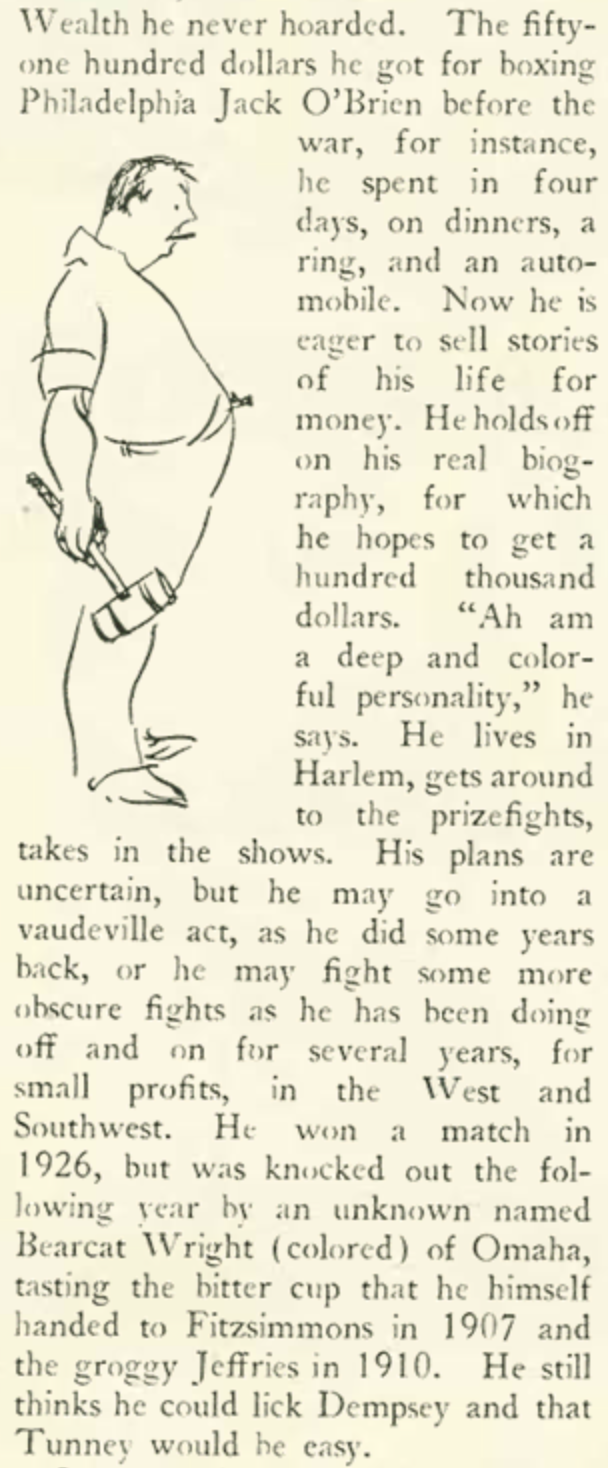
James Thurber reported in “The Talk of the Town” that famed boxing champion Jack Johnson was a common sight on the sidewalks of Broadway. Thurber noted that Johnson, the first African American world heavyweight boxing champion (1908–1915), had fallen on less glamorous days, but still appeared fit at age 51.

IN FIGHTING FORM…Jack Johnson visits with writer Joe Butler at the Scranton Times-Tribune offices on Nov. 30, 1929. (Scranton Times-Tribune)

Thurber noted that Johnson was planning to sell stories of his life, and possibly get into vaudeville. The boxer also mused that who could lick either of the heavyweight champs of the 1920s, Gene Tunney and Jack Dempsey

CREAMPUFFS…The 51-year-old Jack Johnson claimed he could defeat either of the famed heavyweight champions of the 1920s, Gene Tunney (left) or Jack Dempsey. (Reemus Boxing)

…and Thurber shared a strange account regarding the thickness of Johnson’s skull, which apparently bested that of an ox…

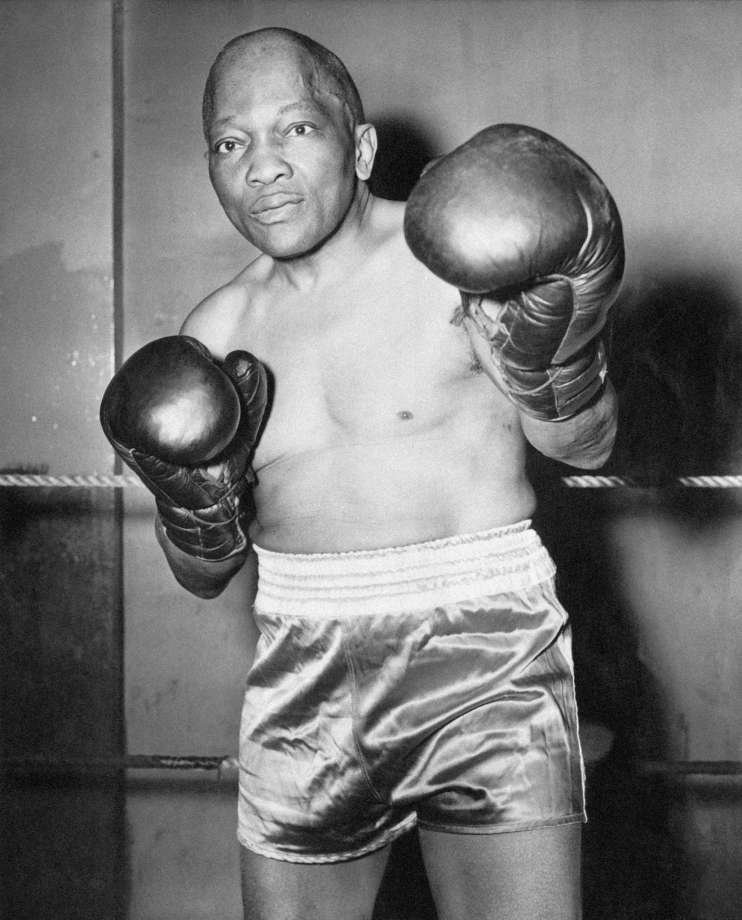
FIGHT TO THE LAST…The 67-year-old Jack Johnson prepares for an exhibition boxing match at a war bond show in New York City on May 1945. Along with making public appearances, Johnson also performed on Broadway during his retirement. (Houston Chronicle)

Johnson continued professional boxing until age 60, and thereafter participated in boxing exhibitions in various venues until his death at age 68 in a car crash near Raleigh, NC. It was reported that Johnson was racing angrily from a nearby diner that had refused to serve him when he lost control and hit a light pole.

 *  *  *

Don’t Ask, Don’t Tell

Anyone who thinks the recent squabbles over Planned Parenthood are anything new might do a little reading on the life of Margaret Sanger, who opened the first birth control clinic in the U.S. in 1916 (in Brooklyn) and was subsequently arrested for distributing information on contraception. In 1929 she was again arrested for operating a “secret” birth control clinic in the basement of a Manhattan brownstone. On March 22, 1929, the New York Police Department sent an undercover female detective, Anna McNamara, to Sanger’s clinic. Posing as a patient who wished to avoid another pregnancy, McNamara was advised on various forms of contraception. She later returned to the clinic as part of the police raid, during which she seized a number of confidential patient files. At Sanger’s subsequent court hearing, McNamara learned first-hand about the importance of patient confidentiality. From the May 4 “Talk of the Town”…

Recalling her arrest in a 1944 article, “Birth Control: Then and Now,” Sanger wrote that McNamara taunted her during the raid when she was told that she had no right to touch private medical files. Sanger wrote “I shall never forget the color of Mrs. McNamara’s face when she heard this medical testimony recited several days later in Magistrates’ Court at the hearing. She was totally unprepared for this embarrassing revelation of her own organs.” The New Yorker made note of this…

Sanger would continue to work for birth control until her death in 1966. Although her name is still invoked in debates over abortion, Sanger herself was generally opposed to abortion, maintaining that contraception was the only practical way to avoid it.

GAG ORDER…In April 1929 Margaret Sanger planned to speak at Boston’s Ford Hall Forum on Free Speech. Ironically, the topic of birth control was banned in Boston at the time, so Sanger appeared onstage with a gag over her mouth while historian Arthur M. Schlesinger read her remarks on free speech to the assembly. At right, the February 1926 issue of Birth Control Review. Founded by Sanger in 1917, she served as editor until 1928. It ceased publication in 1940. (womensstatus.weebly.com/sangerpapers.wordpress.com)

 *  *  *

Please Sit Still

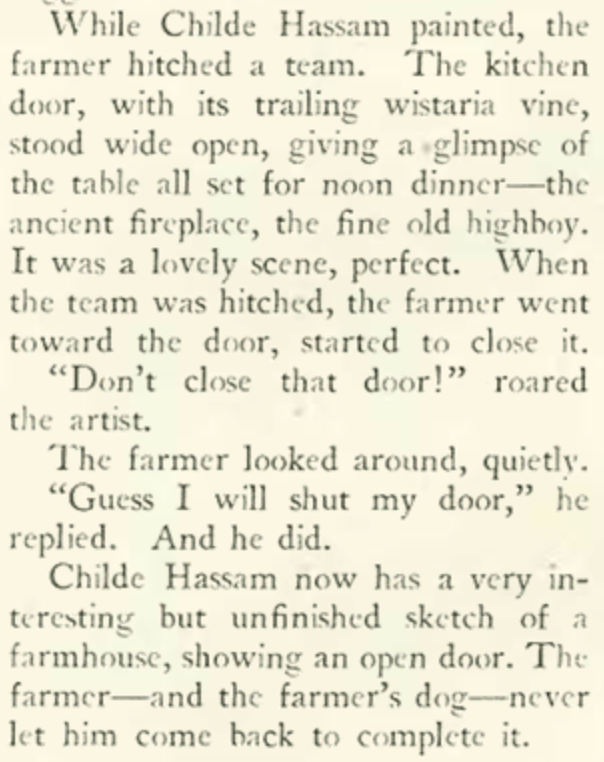
The “Talk of the Town” also looked on American Impressionist painter Childe Hassam, who demonstrated the challenges of painting en plein air…

LOVELY SCENE…Childe Hassam’s Landscape at Newfields, New Hampshire, oil on canvas, 1909. Hassam in his studio circa 1920. (Wikimedia Commons/Wikipedia)

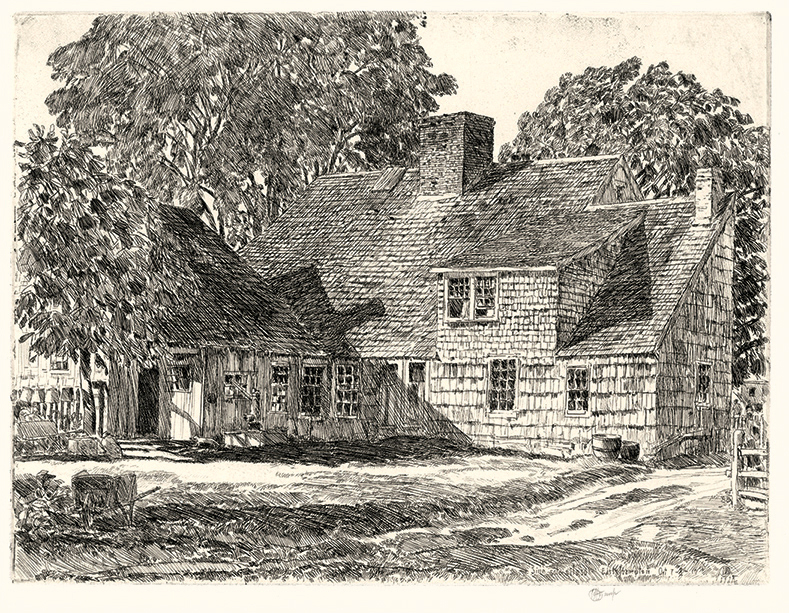
…and found it difficult to finish a farmhouse sketch when a door was unexpectedly closed on his subject…

THIS ONE HE FINISHED…Childe Hassam’s etching, The Old Dominy House (East Hampton), 1928. This work was probably created during Hassam’s visits to East Hampton described in “The Talk of the Town.”(Smithsonian)

 *  *  *

All That Jazz

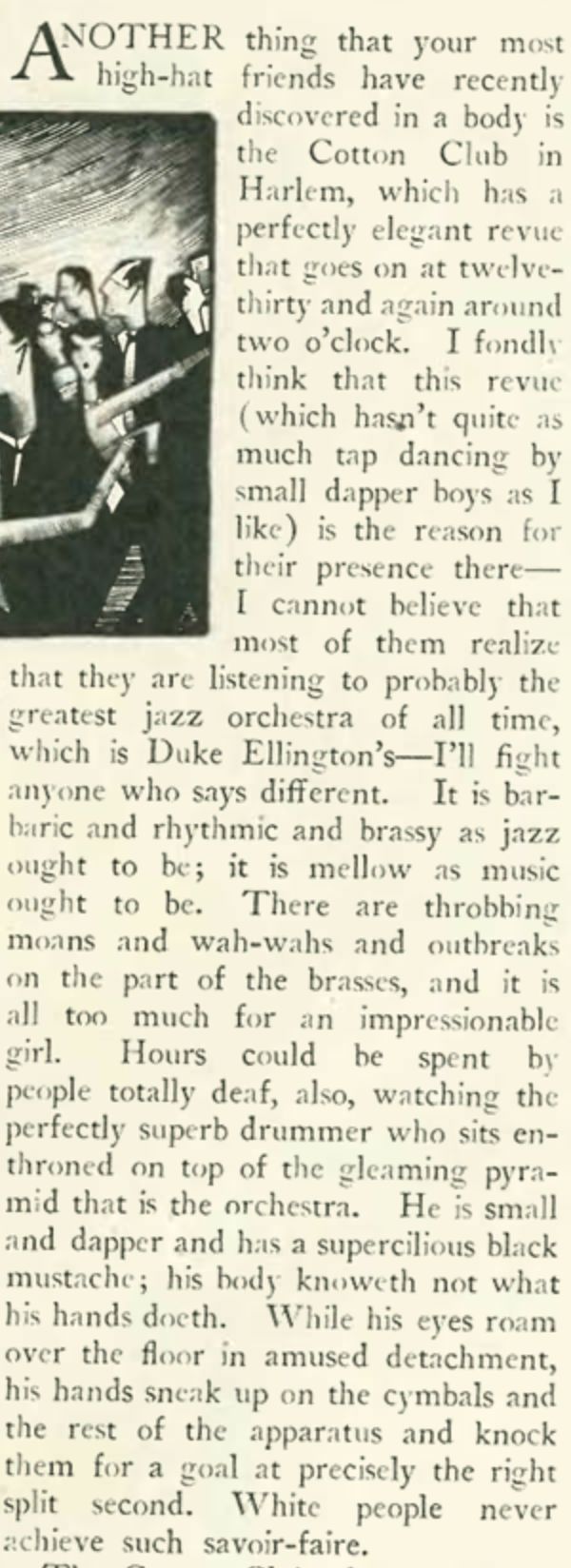
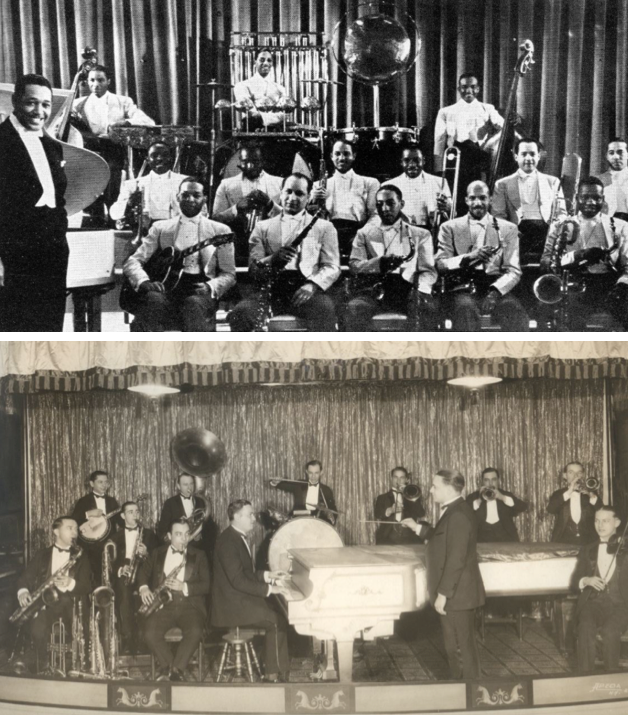
As Lois Long’s contributions to her “Tables for Two” column grew ever more infrequent, it was clear that she was wearying of the nightlife scene. Now 28 and a young mother, “Lipstick” was shedding her image as a fun-loving flapper and devoting more time and energy to her fashion column, “On and Off the Avenue.” Nevertheless, she still found the time to visit the Cotton Club and proclaim Duke Ellington’s jazz orchestra as “the greatest of all time”…

…although her other observations of the New York nightclub scene appear to have been hastily dashed off…

THE BEST…Duke Ellington and his orchestra (top), circa 1930. Below, Vincent Lopez conducts his orchestra in 1923. (oldtimeblues.net / www.jazzhound.net © Mark Berresford)

 *  *  *

Electric Wonders

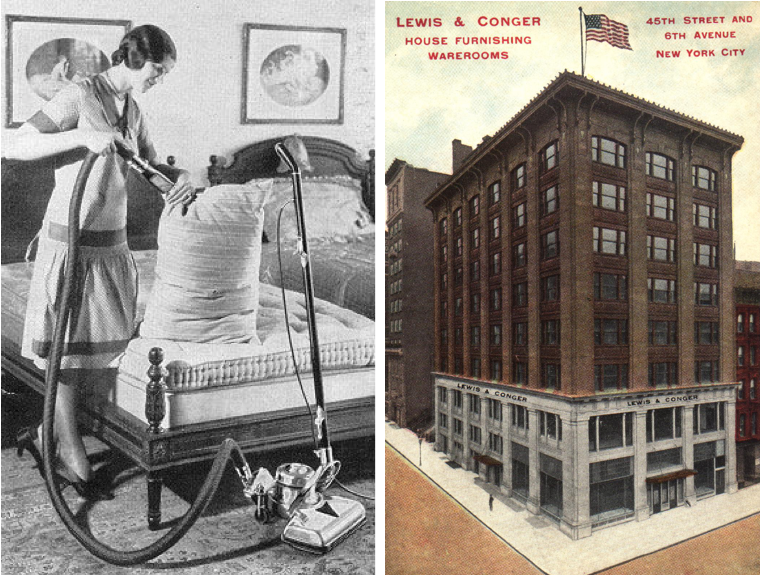
The May 4 issue updated readers on some of the latest gadgets available to modern households in 1929. I particularly like the device that allowed your vacuum to blow “moth poison” into your garments…

NOW THIS DOES NOT SUCK…Garments and other household items could be fumigated against moths using a new reverse vacuum attachment, available at Lewis & Conger. (Cyberspace Vacuum Cleaner Museum / Columbia University)

*  *  *

From Our Advertisers

One thing you notice about 1920s advertising is the amount of turgid copy they contain…I suppose without distractions such as TV and iPhones people actually took the time to read all of these bloated messages, such as this one from Whitman’s that suggested a box of candy is more than a box of candy…

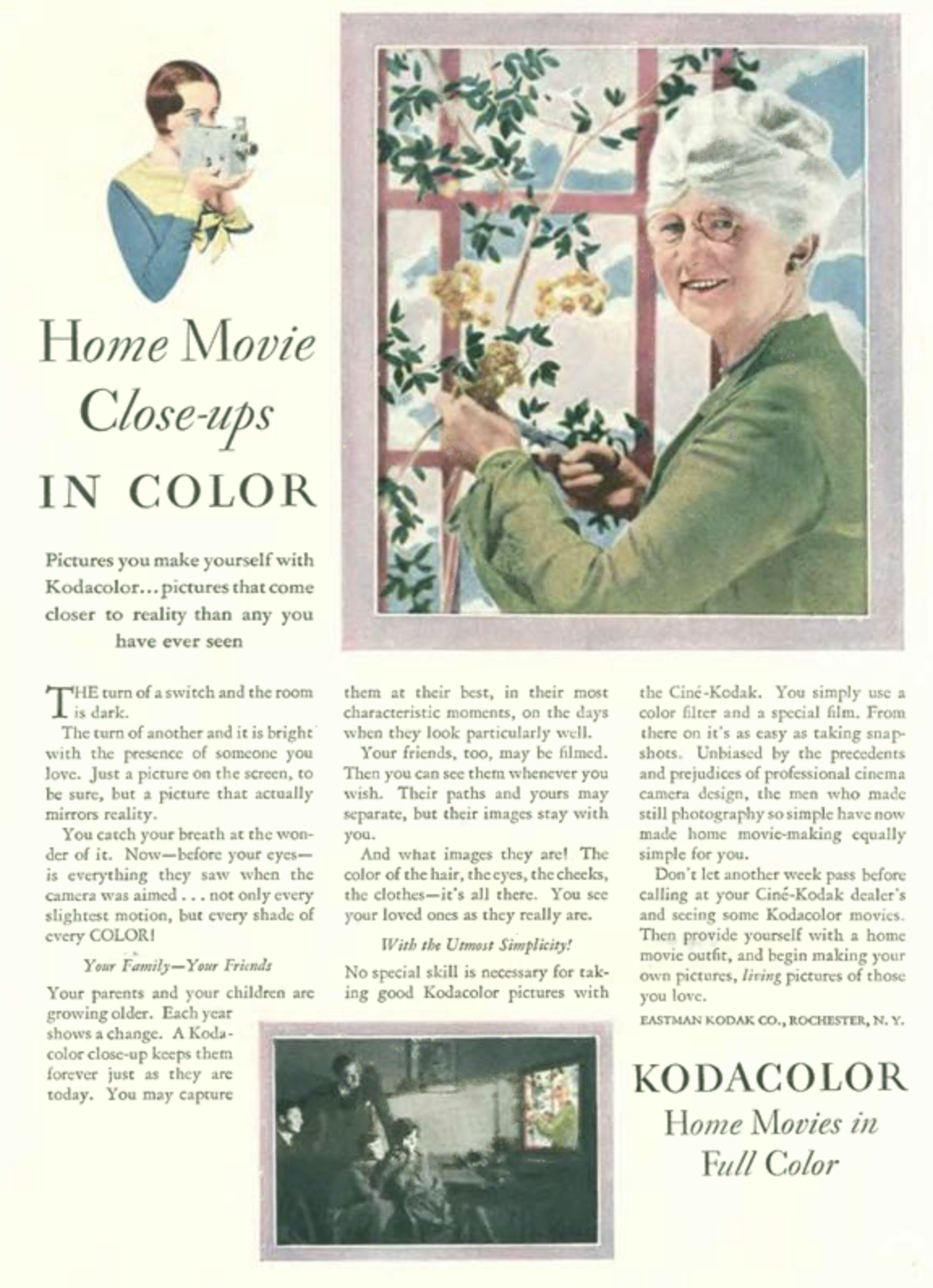
…or how about this lengthy appeal from Kodak, which used guilt to convince you to get some film of grandma while she was still “at her best…”

…the makers of Spud promised a “new freedom” and a “16% cooler smoke” to the users of its menthol-laced cigarettes. Spuds were the first menthol cigarettes, developed in 1924 by Ohioan Lloyd “Spud” Hughes, who sold them out of his car until the brand was acquired in 1926 by The Axton-Fisher Tobacco Company. By 1932 Spud was the fifth-most popular brand in the U.S., and had no competitors in the menthol market until Brown & Williamson launched their Kool brand in 1933. The Spud brand died out by 1963 (along with, presumably, many of its customers)…

…leveraging the popularity in the 1920s of knights and fairies, as well as the Anglo- and Francophila of New Yorker readers, “Mrs. Marie D. Kling” hoped to entice city dwellers up to the burbs in Scarsdale…

…our cartoons are courtesy of Barbara Shermund, who looked in on a couple of debs performing their daily exercises…

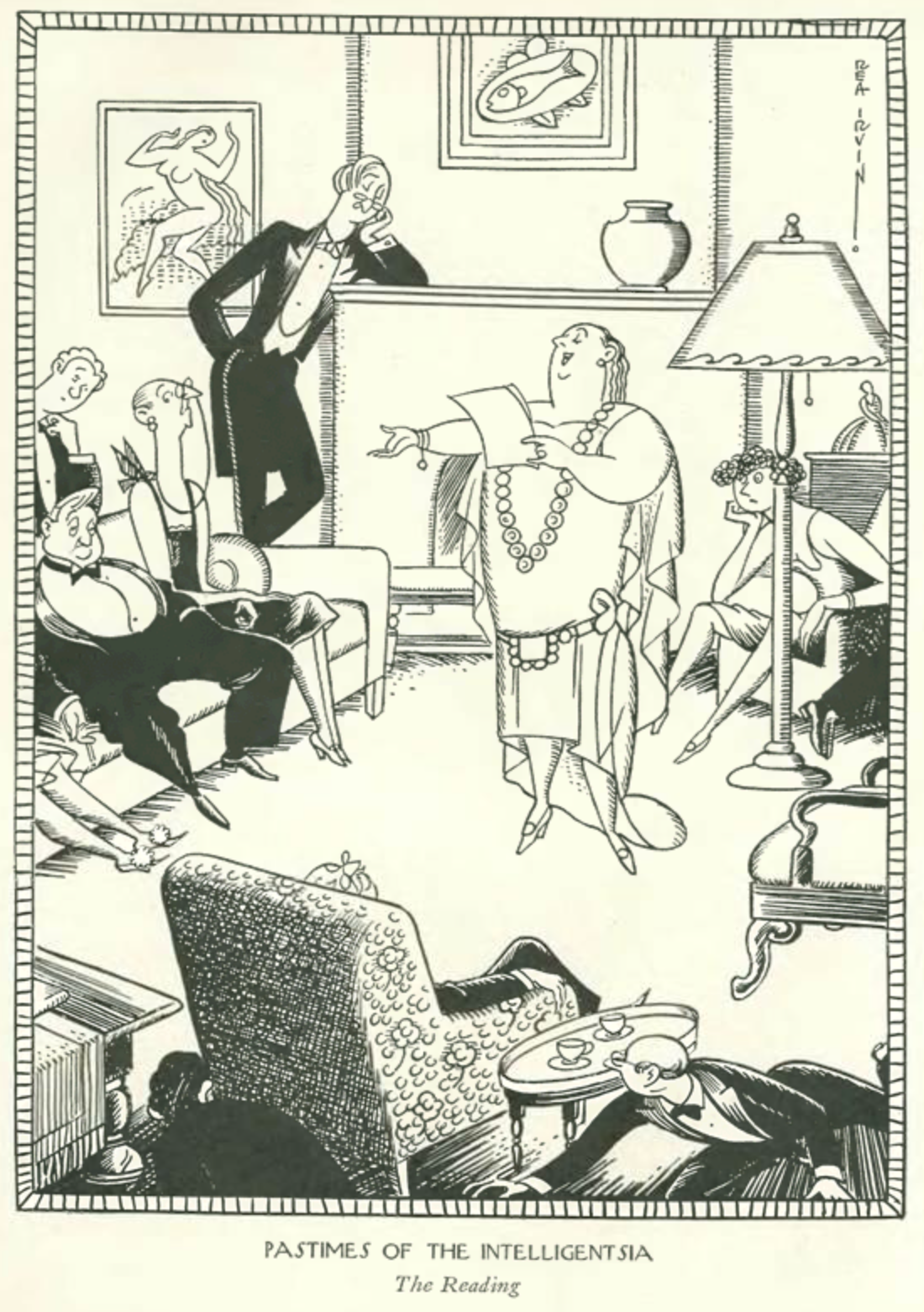
…while down in the parlor, Rea Irvin captured the horrors inflicted by an author’s tedious reading…

…and finally, Peter Arno probed the depths of sanctimony…

Next Time: Waldorf’s Salad Days…

The Last Dandy

Like his good friend Charlie Chaplin, Ralph Barton wore a mask of a clown that hid a face of bitter anguish. Chaplin would cope, more or less. Barton would not.

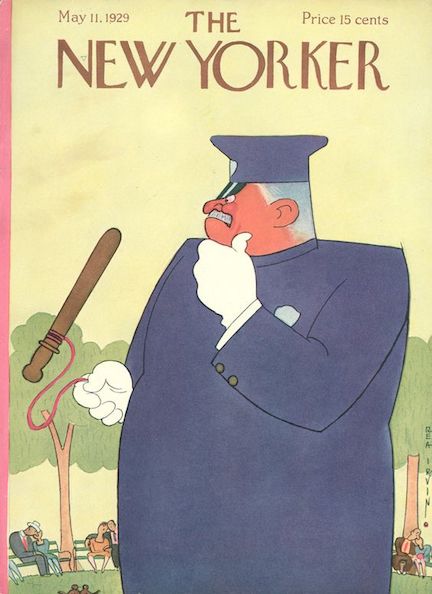
March 16, 1929 cover by Rea Irvin.

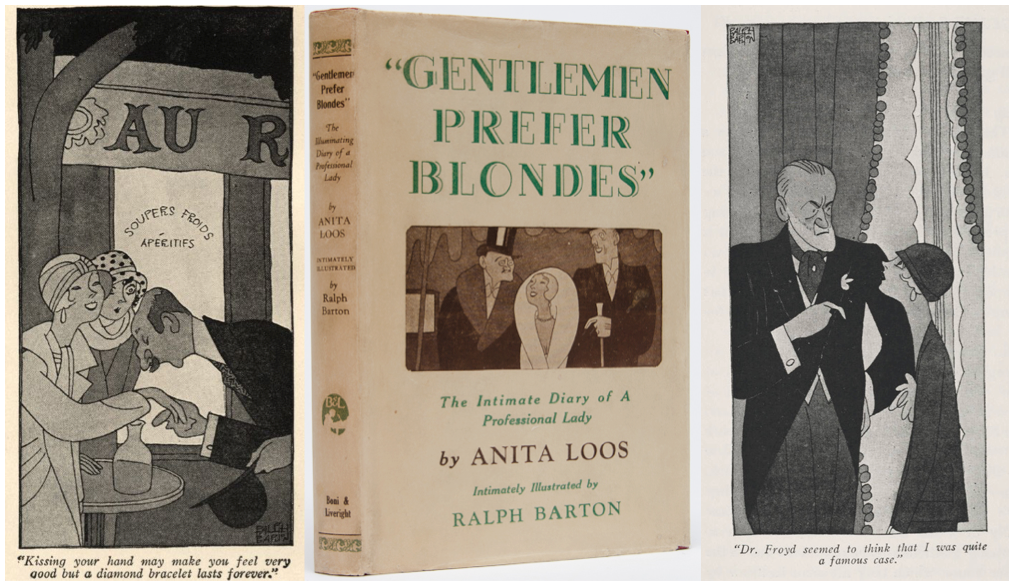
A member of the New Yorker gang from the very beginning, Barton served as the magazine’s advisory editor but more famously as a caricaturist of the Roaring Twenties, also contributing to the likes of Harper’s Bazaar, Collier’s, Vanity Fair and Judge. He also illustrated one of the most popular books of the Twenties, Anita Loos’ Gentlemen Prefer Blondes:

Images (left and right) from the book, Gentlemen Prefer Blonds.

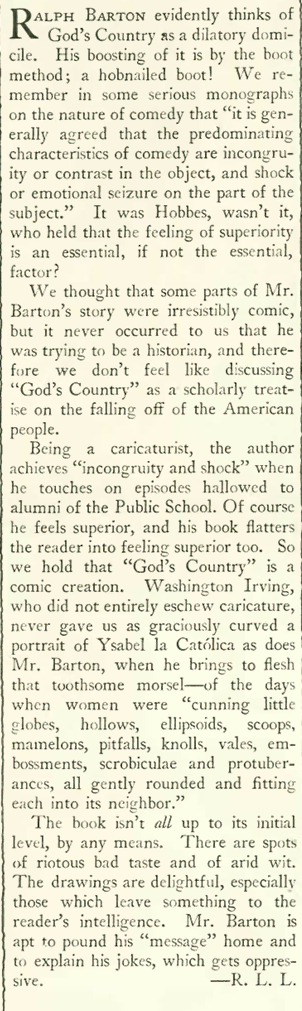
In 1929 Barton would publish a book of his own, God’s Country, which was reviewed in the March 16, 1929 edition of the New Yorker:

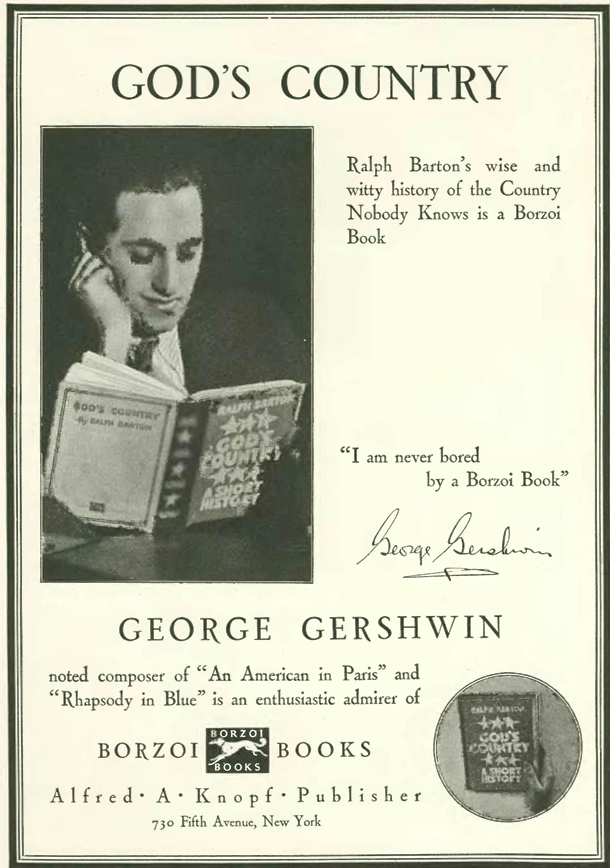
The same issue featured this advertisement from Knopf promoting God’s Country as the latest addition to its lovely Borzoi Books collection (and endorsed by composer and Barton friend George Gershwin)…

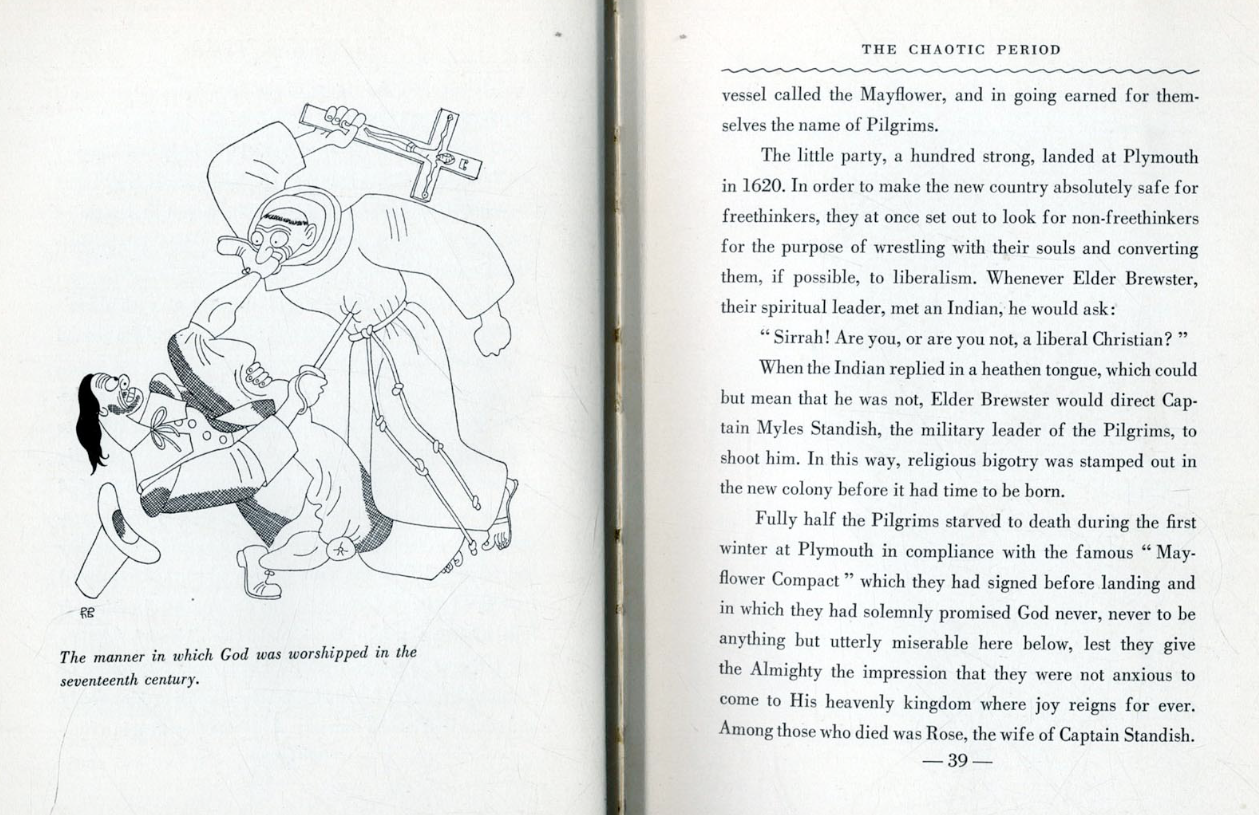
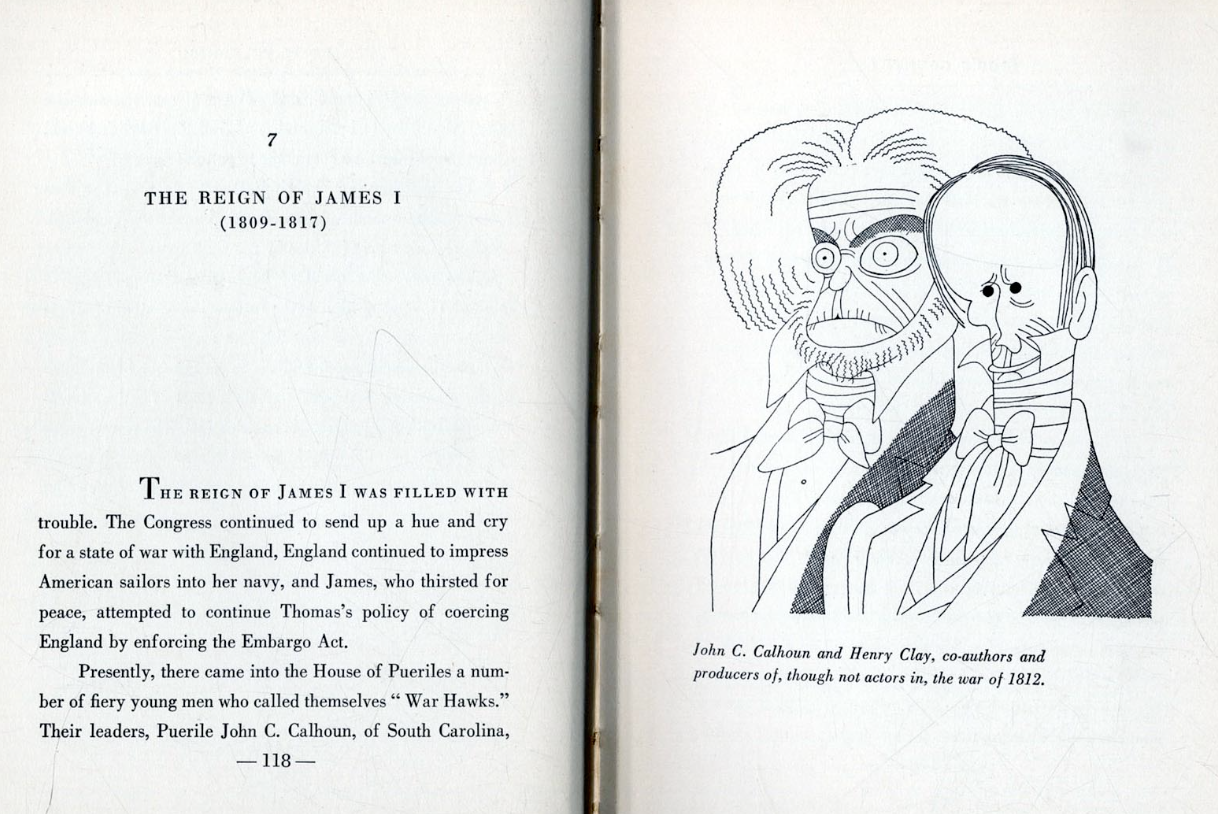
Some excerpts from the book…(click to enlarge)

(All images courtesy fulltable.com)

Barton was a longtime friend of Charlie Chaplin, even coming to the silent film star’s defense (in the pages of the July 23, 1927 New Yorker) when many Americans turned their backs on the comedian during a messy and much publicized divorce trial. In that New Yorker piece Barton concluded that France would be a better, more welcoming home to such an artist:

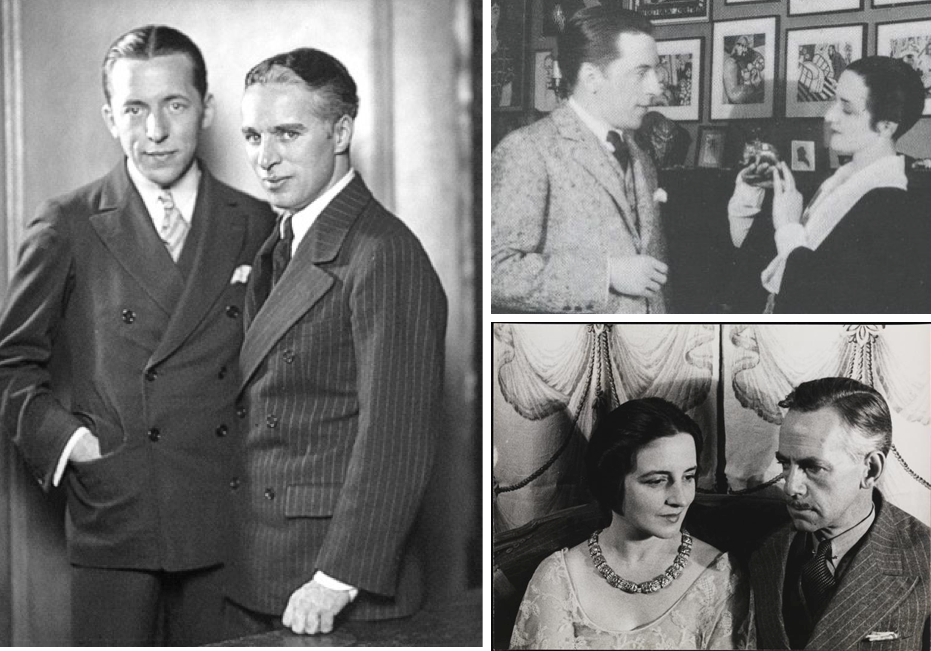
Clockwise, from left: Ralph Barton poses with his old friend Charlie Chaplin for photographer Nickolas Muray in 1927; Barton with wife Carlotta Monterey in the mid-1920s; Carl Van Vechten’s portrait of Monterey with husband Eugene O’Neill in 1933, two years after Barton’s death. (Mimi Muray/allstarpics.com/Museum of the City of New York)

The manic-depressive Barton had his own problems in the love department, marrying four times in his short life, most famously to wife No. 3, stage and film actress Carlotta Monterey, who divorced Barton in 1926 and married playwright Eugene O’Neill in 1929. Although Barton would marry again, he would never recover from his loss of Monterey.

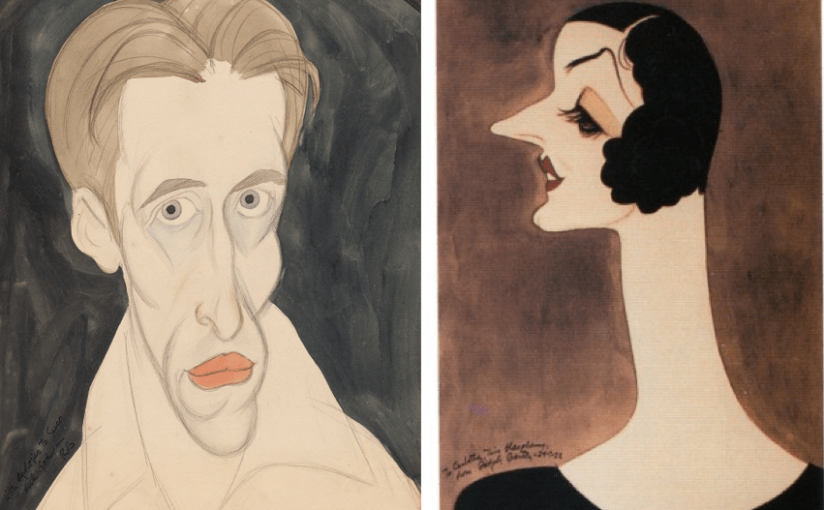
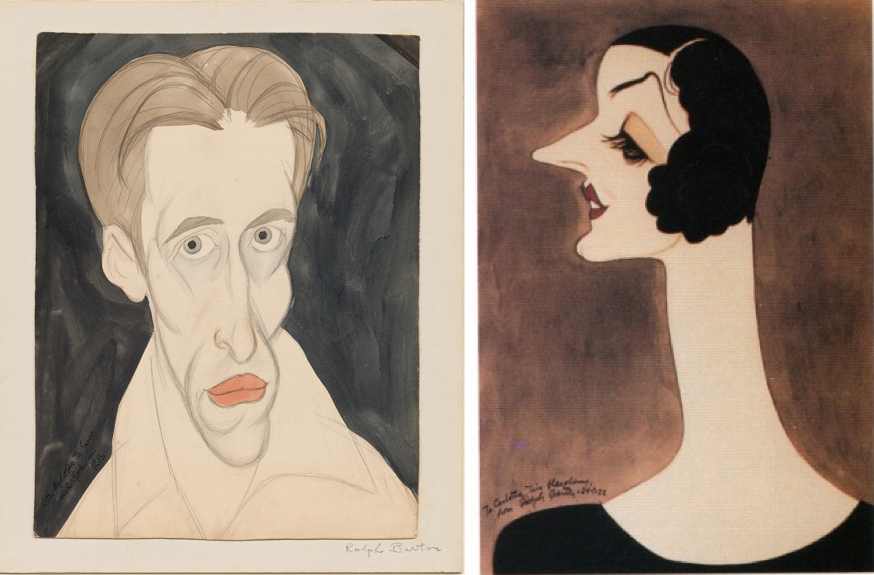
PORTRAIT IN ANGUISH…Ralph Barton self-portrait, 1925. At right, Barton’s portrait of his third wife, Carlotta Monterey, from 1922. In 1926 Barton wrote, “The human soul would be a hideous object if it were possible to lay it bare.” (National Portrait Gallery/Mimi Muray)

A little more than two years after publishing God’s Country—May 19, 1931—the 39-year-old Barton shot himself through the right temple in his East Midtown apartment. He referred to Carlotta Monterey in his suicide note, writing that he had lost the only woman he’d ever loved. He also wrote: “I have had few difficulties, many friends, great successes; I have gone from wife to wife and house to house, visited great countries of the world—but I am fed up with inventing devices to fill up twenty-four hours of the day.”

As the exuberance of the Jazz Age faded into the Depression, so did Barton’s reputation as a chronicler of that age. An abstract for the 1998 Library of Congress exhibition Caricature and Cartoon in Twentieth-Century America notes that “in a good week he (Barton) could make $1,500 (about $22,000 today) but a couple of years after his early death his caricature of George Gershwin sold for $5.”

The last caricature Barton ever drew was of his old friend, Charlie Chaplin.

Note: I took the title of this blog entry from a 1991 book on the life of Ralph Barton: The Last Dandy, Ralph Barton, American Artist, 1891-1931, by Bruce Keller.

Babbitt Babble

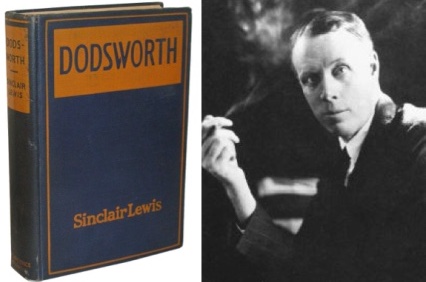
Preceding the review of Barton’s book in the March 16 New Yorker was this much less complimentary review of Sinclair Lewis’s latest effort, Dodsworth, a story in the tradition of Henry James about wealthy middle-class Americans on a grand tour of Europe.

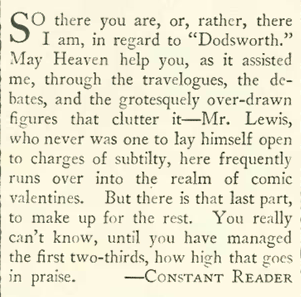
The task of skewering Lewis and his book fell to Dorothy Parker, who would never mistake Lewis for Henry James: ““I can not, with the slightest sureness, tell you if it (Dodsworth) will sweep the country, like ‘Main Street,’ or bring forth yards of printed praise…My guess would be that it will not. Other guesses which I have made in the past half-year have been that Al Smith would carry New York state, that St. John Ervine would be a great dramatic critic for an American newspaper, and that I would have more than twenty-six dollars in the bank on March 1st. So you see my my confidence in my judgment is scarcely what it used to be.”

NOT UP TO SNUFF…Sinclair Lewis, circa 1930s. (Library of Congress)

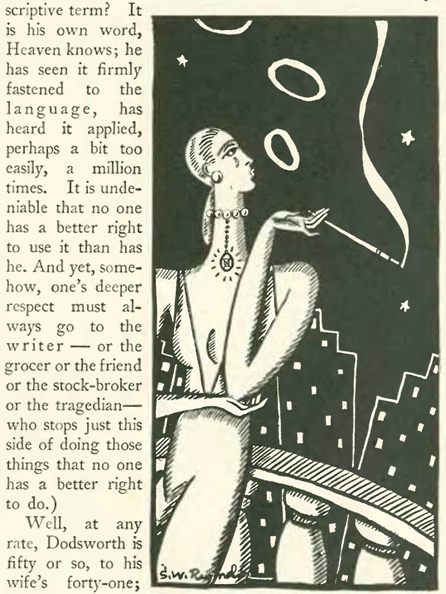
Parker took particular umbrage at Lewis’s use of the name of a character from another book as a descriptive term for his latest:

Parker concluded that if a reader could wade through the book’s cluttered language and “grotesquely over-drawn figures,” there was a conclusion that was perhaps worth pursuing…

…the New Yorker was never afraid to bite the hand that fed it (except Raoul Fleischmann’s, whose money saved the magazine from an early death), so even though its author was savaged on the opposite page, Dodsworth’s publisher Harcourt still sprung for an ad:

 *  *  *

This Geometric Life

The author of the March 16, 1929 “Comment” (Leading item of “The Talk of the Town”) found the “geometric life” dictated by modern design took some getting used to. This entry was most likely written by E.B. White:

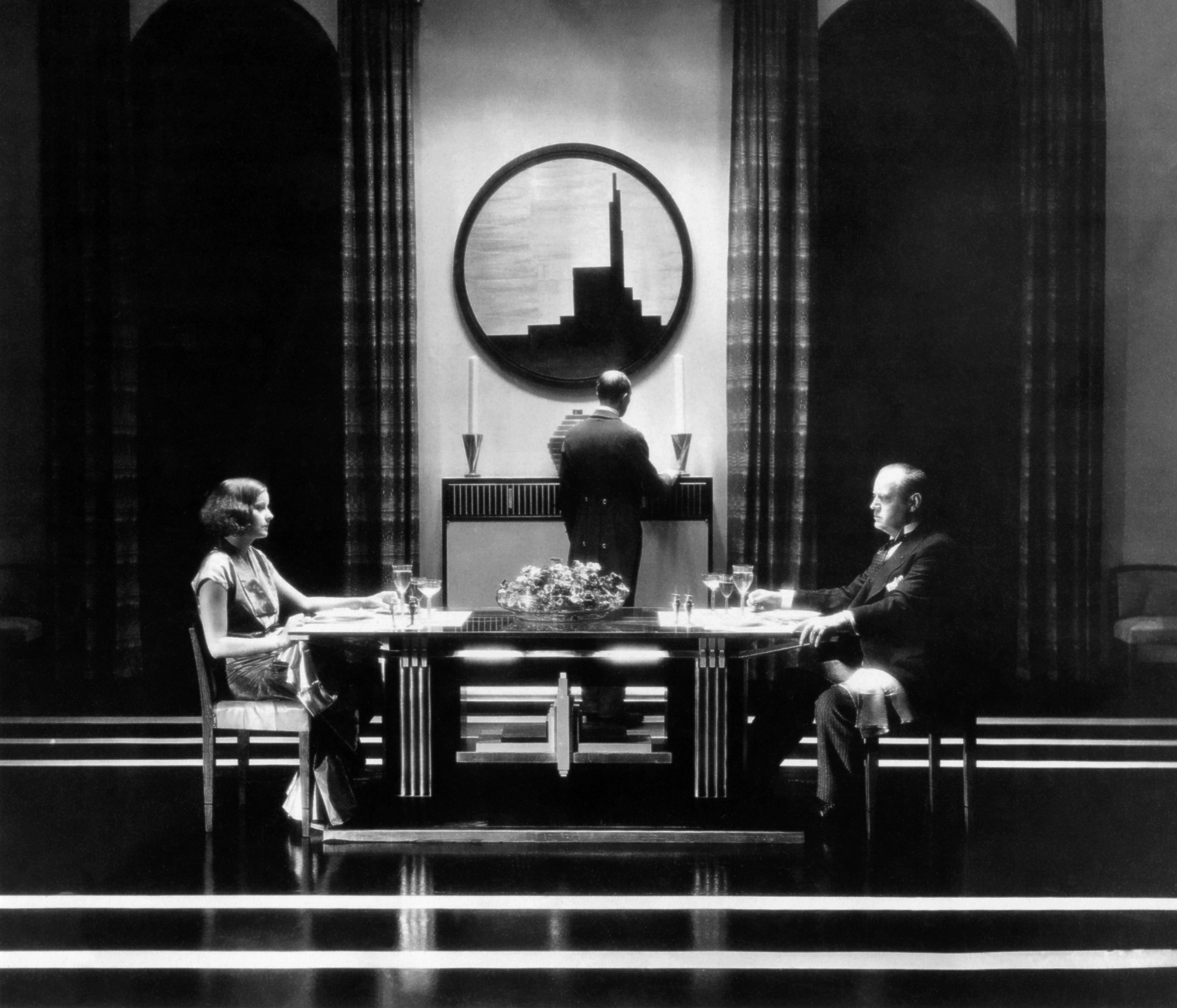
DARLING, YOU SEEM RATHER COLD…Greta Garbo and Anders Randolf break bread amid the angular lines of an art deco dining room in the 1929 film The Kiss, set design by Cedric Gibbons. (pinterest.co.uk)

 *  *  *

Mexican Firecracker

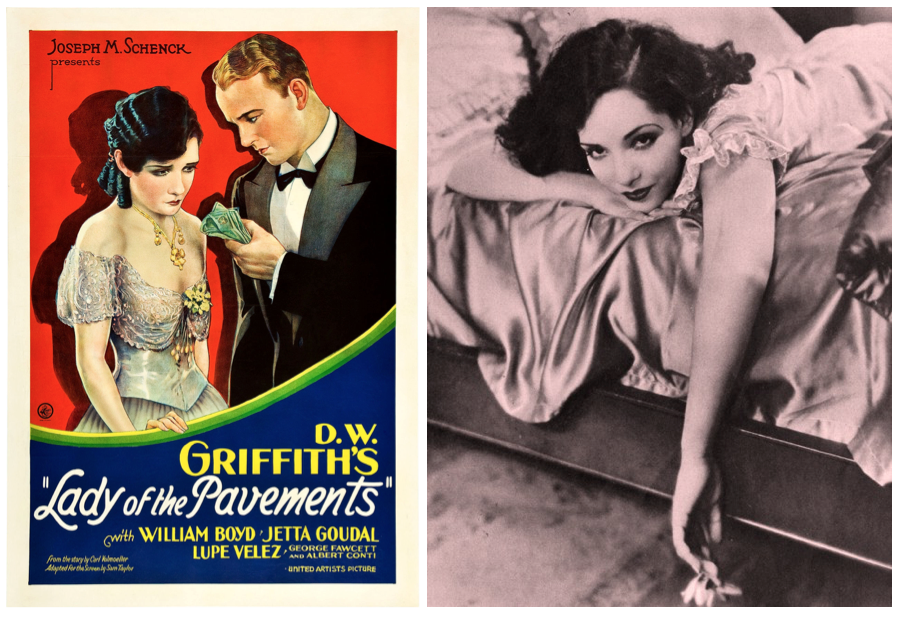
Mexican actress and emerging star Lupe Velez caught the eye, and ear, of the New Yorker in her latest film, Lady of the Pavements

DUBBED THE ‘MEXICAN FIRECRACKER,’ Lupe Velez emerged as a star at the advent of sound motion pictures. Theatrical release poster, left, and Velez in a scene from D.W. Griffith’s 1929 film, Lady Of The Pavements. (Wikipedia/moviessilently.com)

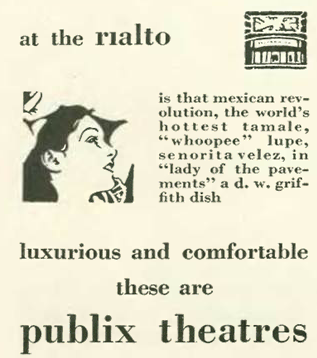
An ad in the same issue of the New Yorker touted the film’s appearance at Public Theaters, a chain owned by Paramount:

Well-known for her explosive screen presence, Velez was big star in the 1930s. Married to Tarzan actor Johnny Weissmuller from 1933 to 1939, her star began to fade at the end of the decade. She died of a drug overdose in 1944, just 36 years of age.

 *  *  *

From Our Advertisers

A few advertisements that caught my eye from the March 16 issue…one thing you notice is the emerging sophistication of advertising techniques, including this ad for Resilio Cravats that enticed by deliberating not showing the product…

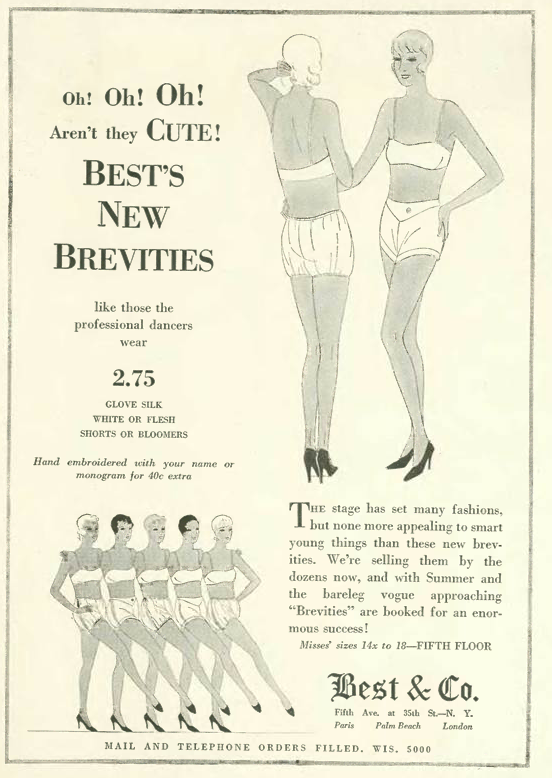
…and this ad that demonstrated Best & Co. was not shy at all to show women in their skivvies (or suggest that they could wear the same undergarments as a Follies performer)…

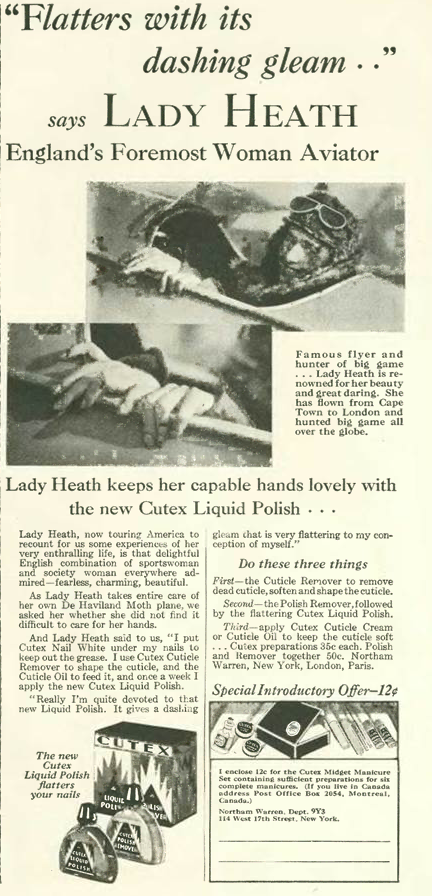
…and then we have this strange ad for Cutex nail polish, with an endorsement by Sophie Peirce-Evans, later known as Mary, Lady Heath, a well-know aviatrix (dubbed “Lady Icarus”) of the 1920s who shared headlines with Amelia Earhart for her high-flying derring-do. The close-up shot of the hands is priceless…

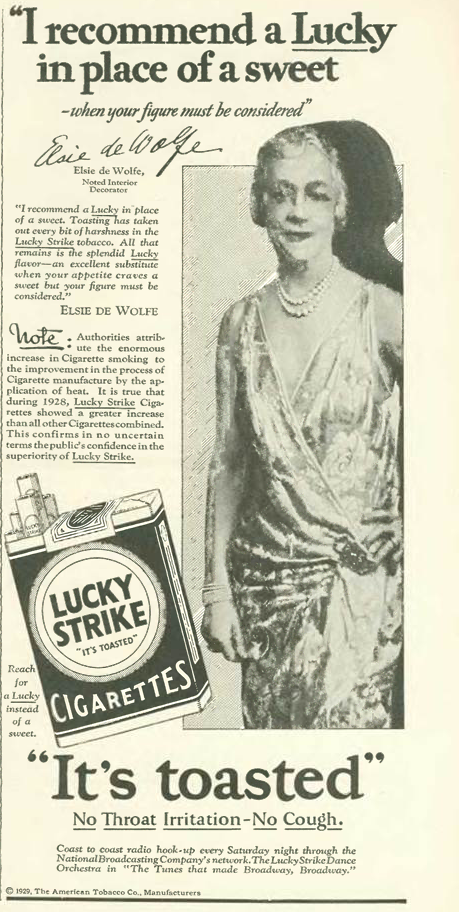
…and then we have another celebrity endorsement of a cigarette by a society figure—interior designer and social maven Elsie de Wolfe, who was also known as Lady Mendl…

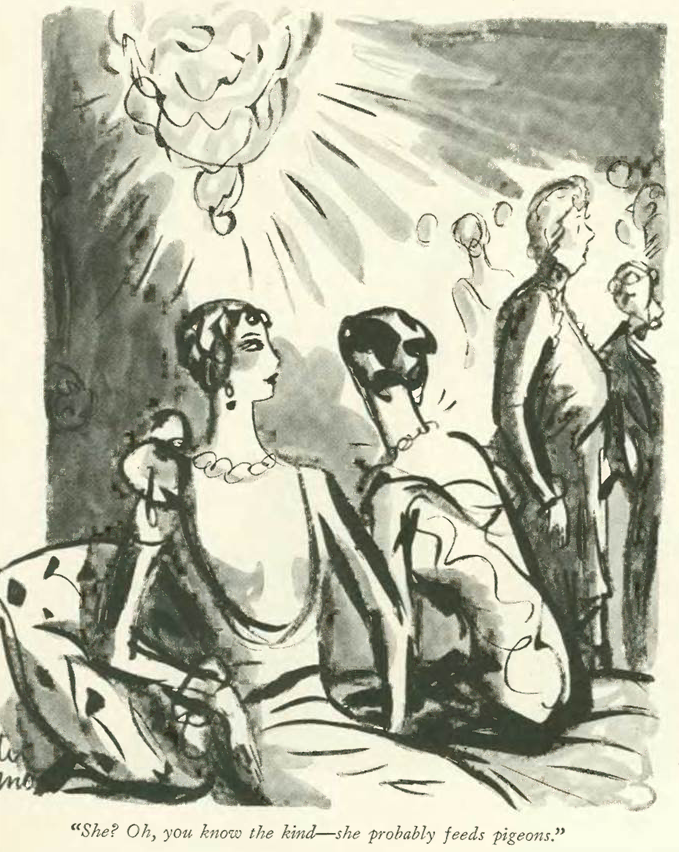
…and on to the cartoons…Peter Arno listened in on two young debutantes sizing up a dowager at a society gathering…

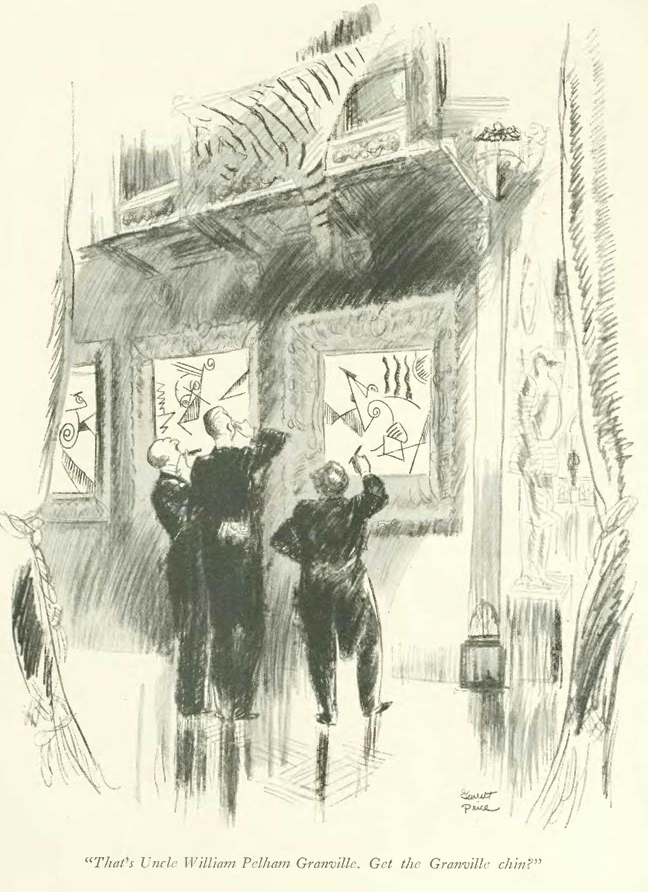
…while Garrett Price looked in on well-heeled visitors to the Metropolitan Museum of Art contemplating what appears to be the work of W.A. Dwiggins in the museum’s The Architect & the Industrial Arts exhibition…

Next Time: Queen of the Night Clubs…

That Moderne Feeling

A defining moment for Art Deco design in America occurred at New York’s Metropolitan Museum of Art during a 1929 exhibition that showcased everything from household furnishings to garden design.

March 9, 1929 cover by Theodore Haupt. Between 1927 and 1933, Haupt would illustrate 45 covers for the New Yorker.

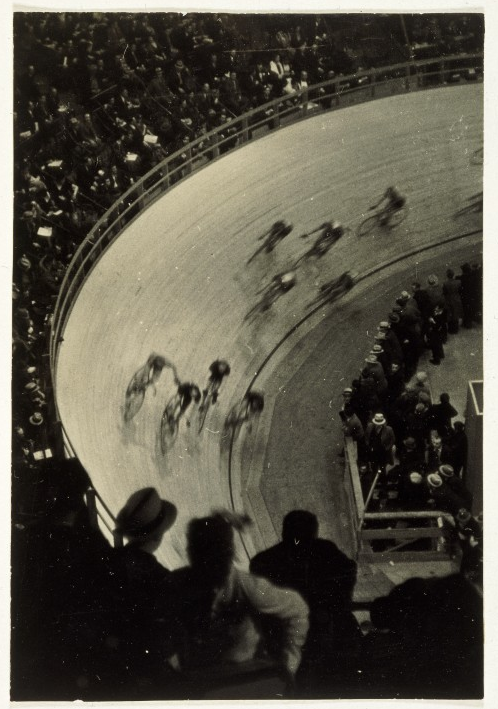
Before we delve into the Met’s exhibition, The Architect and the Industrial Arts, a quick note about the New Yorker’s Theodore Haupt-illustrated cover, which referenced the annual Six-Day Cycling Race that was taking place at the Madison Square Garden Velodrome. The event, which began at the old Madison Square Garden in 1891 and lasted until 1950, featured a beer garden (after Prohibition) in the center of the oval and drew such celebrities as Bing Crosby, Barbara Stanwyck and Peggy Joyce. It was said that Crosby even paid the hospital bills of riders who fell during the race.

THIS MIGHT TAKE AWHILE…The Six-Day Cycling Race at the Madison Square Garden Velodrome, 1932. (Victoria & Albert Museum)

The March 9 issue was lively with another contribution from Groucho Marx (“Press Agents I Have Known”) and an Alexander Woollcott-penned profile of playwright and screenwriter Charles Gordon MacArthur (husband of stage actress Helen Hayes and father of James “Book ’em Danno” MacArthur).

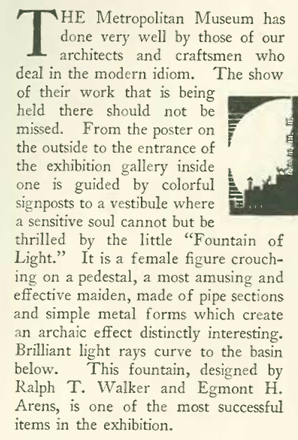
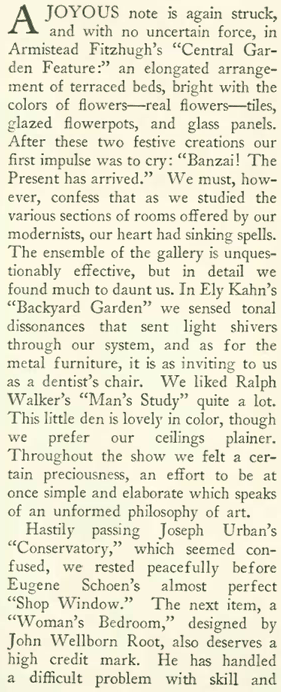
But as the blog title suggests, it was also filled with articles and ads that told of a city embracing all things new and modern, including a piece by architecture critic George S. Chappell on the Metropolitan Museum of Art’s eleventh Exhibition of Contemporary American Design, titled The Architect and the Industrial Arts. It was curated by the Met’s Richard F. Bach, who organized 15 annual exhibitions of contemporary industrial art at the museum between 1917 and 1940.

The 1929 exhibition of Art Deco works was the biggest yet, inspired by the Art Moderne movement in Europe and particularly the 1925 Paris Exposition International des Arts Decoratifs et Industriels). The Met exhibition, wrote Chappell, “should not be missed”…

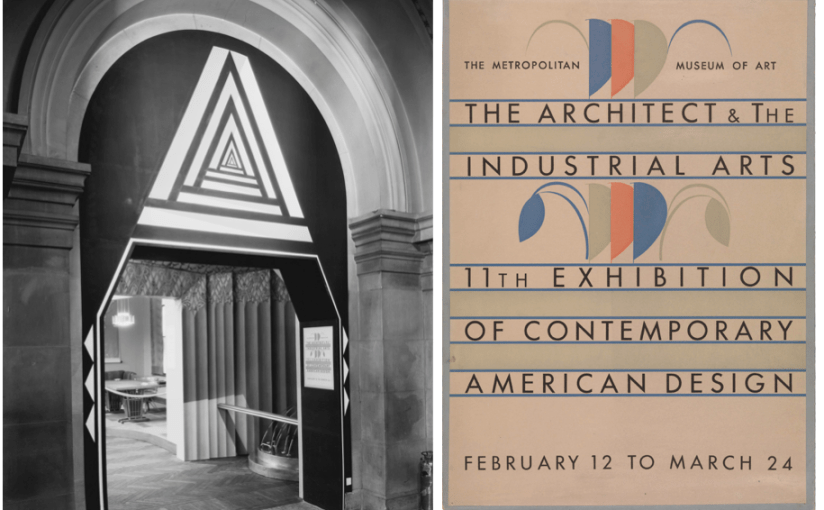
PORTAL TO THE FUTURE…Entrance to The Architect & the Industrial Arts exhibition at The Metropolitan Museum of Art, designed by Joseph Urban. The above exhibition poster (seen mounted on the doorway in the photo) was by W.A. Dwiggins. (Metropolitan Museum of Art)
Ornaments created by W.A. Diggins for the exhibition catalogue included, from left, “Conservatory,” for a section on  Joseph Urban; ornament on a page devoted to curator Richard F. Bach; “Backyard Garden” for a section on Ely Jacques Kahn; and an ornament that graced the acknowledgements page. (Metropolitan Museum of Art, via paulshawletterdesign.com)
NOT YOUR GRANDMOTHER’S GARDEN…Mosaic semi-circular bench designed by Austin Purves, Jr. was featured in architect Ely Jacques Kahn’s “Backyard Garden” display by at the The Architect & the Industrial Arts exhibition at the Metropolitan Museum of Art. (Pencil Points Magazine, January 1929)

Chappell found the exhibit to be “stimulating,” although he hoped designers in the future would “curb cleverness” and focus more on fundamentals:

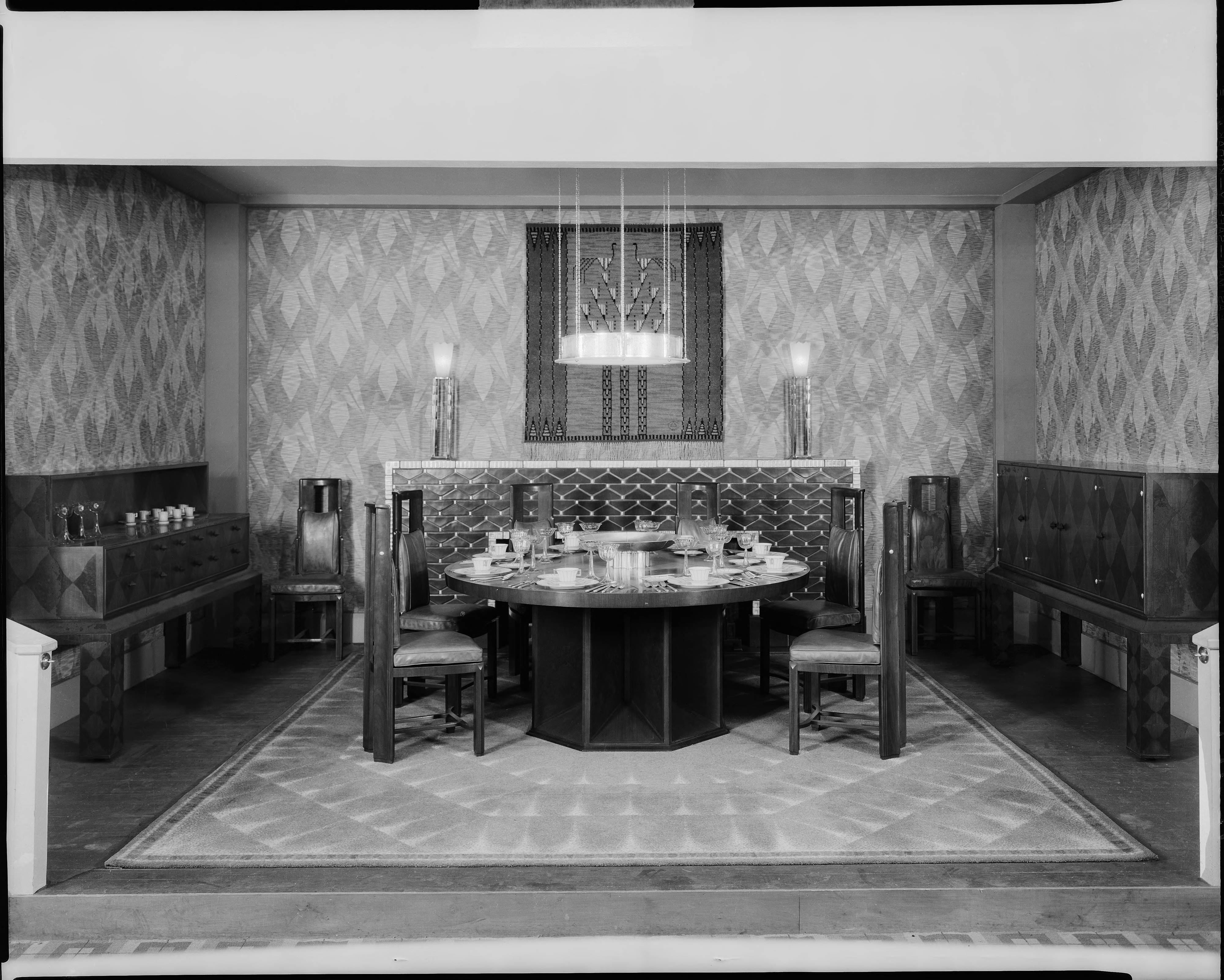
DINING IN STYLE…A dining room designed by Finnish architect Eliel Saarinen for The Architect and the Industrial Arts exhibition at the Metropolitan Museum of Art. (Metropolitan Museum of Art)
VISIONARIES…The Cooperating Committee for 1929 The Architect and the Industrial Arts exhibition were, standing, left to right, architects Raymond Hood, Eugene Schoen and Ely Jacques Kahn. Seated, left to right, architects Ralph T. Walker, John Wellborn Root, Jr. and Eliel Saarinen; ceramist, painter and graphic artist Leon V. Solon; and architect, illustrator and scenic designer Joseph Urban. (Metropolitan Museum of Art)
COZY…Ralph Walker’s “Man’s Study for a Country House” at the The Architect and the Industrial Arts exhibition. (architectsandartisans.com)
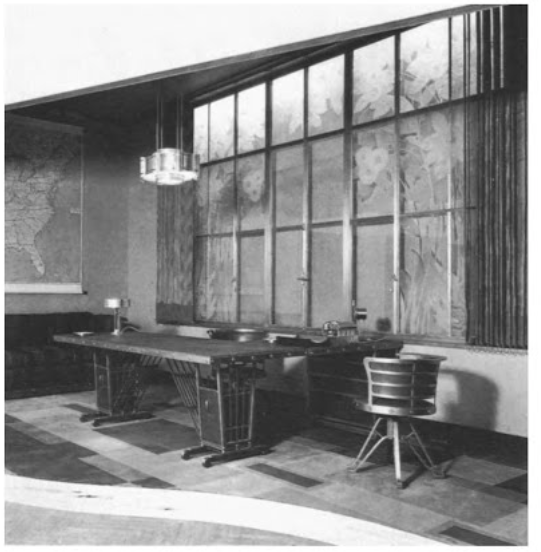
ALL BUSINESS…Raymond Hood’s “Business Executive’s Office” featured at The Architect and the Industrial Arts exhibition. (Metropolitan Museum of Art)

Writing in the February 1929 Bulletin of the Metropolitan Museum of Art, curator Richard S. Bach posed bold questions for this new age: “What is the tempo of our day? What are the dominant elements of our culture, our activities, our thinking? Is this a speed age or are we sedate? Have we time to be dignified and stately about frills or are we air-minded? Do we wait for months, as once all did, for the silkworm to complete his labors before beginning to make thread from his cocoon…or (do we) make a few bales of vegetable silk out of chemically treated wood fiber between breakfast and lunch as a regular chore of a business week-day? And is this the mechanistic millennium which shrivels the soul and makes mockery of imagination, or are these fabulous industries, these automatic instruments of production, the means of bringing within range of vision the real potentialities of our crowded lives and of interpreting our aspirations and achievements?

Pumping Iron Into the Sky

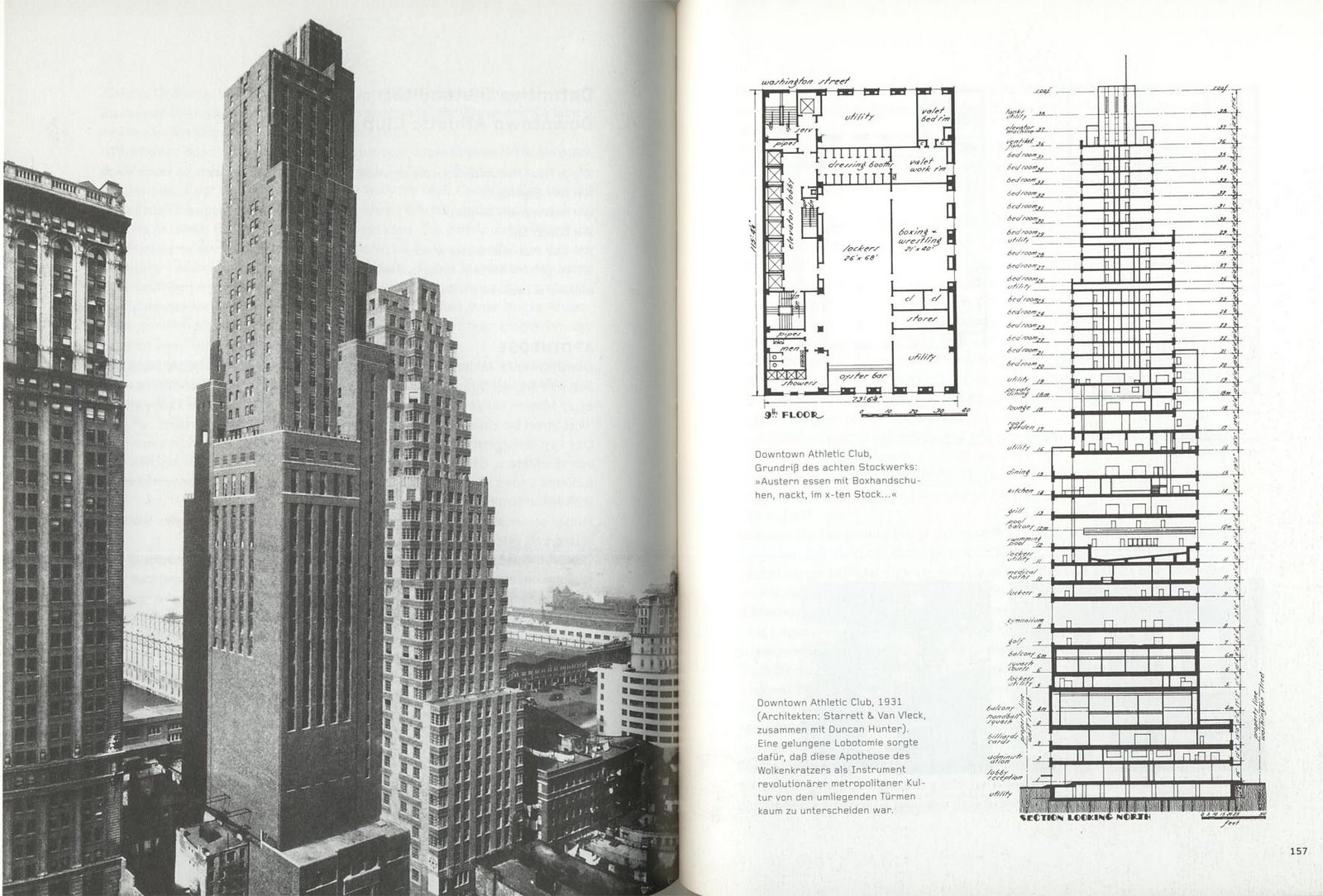
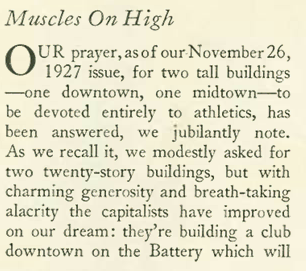
The architecture firm Starrett & van Vleck saw the “real potentialities of our crowded lives” when they designed a new Art Deco skyscraper to house the Downtown Athletic Club. Writing in Lost City NewsMary Hohlt cites the architect Rem Koolhaas, who sees the Downtown Athletic Club as “the ideal of a hyper-reality in the burgeoning urban form of hyper-density and congestion.” The Club is “the everything-at-your-fingertips self-improvement incubator for men…It is a place for men to indulge on self-improvement; to better themselves in a place only the constructed, hyper-reality of Manhattan can provide.”

SELF-IMPROVEMENT INCUBATOR…the Downtown Athletic Club by Starrett & van Vleck, 1930. (4.bp.blogspot.com) click to enlarge

Hohlt writes that Koolhaas sees the Downtown Athletic Club as a sterile place: “Towering in the sky, the Club removes men from the rest of the world and allows them a kind of aesthetic improvement that cannot be passed on.” E.B. White took a less jaded view in this “Talk of the Town” segment:

STILL A WINNER…Famous for serving as the site of the annual awarding of the Heisman Trophy, the Downtown Athletic Club closed in 2001 following the 9/11 attacks. The club was within a “frozen zone” closed to the public during the long clean-up that followed, and could not withstand the financial impact of such a long closure. It reopened in 2005 as a residential tower. (newyorkitecture.com)

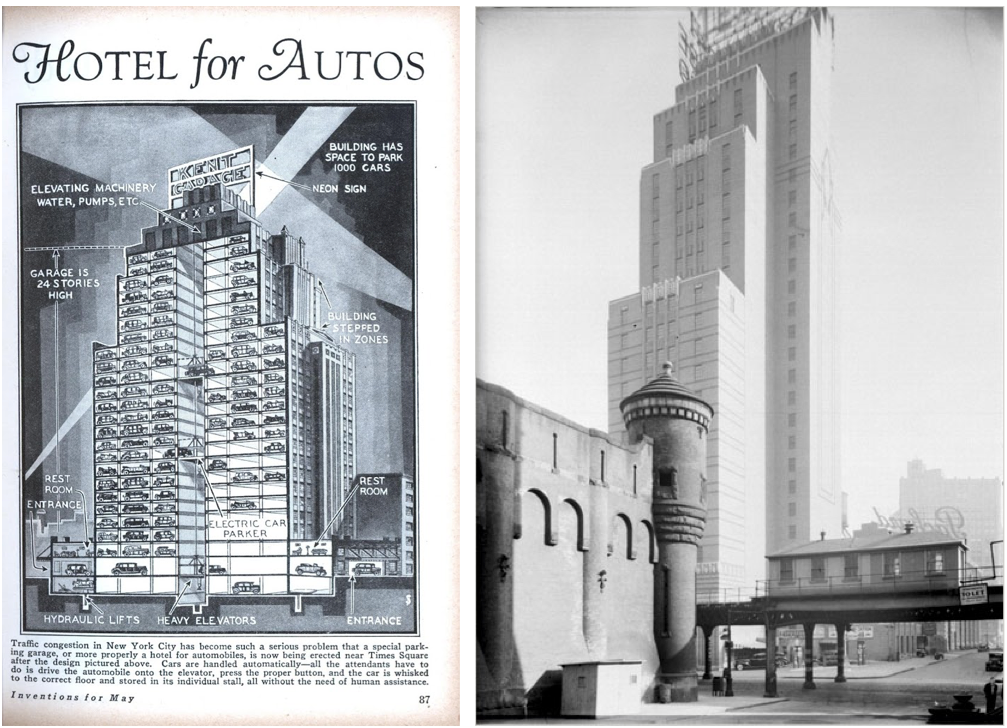
Another New Yorker who saw the “real potentialities of our crowded lives” was insurance salesman Milton A. Kent, who in 1928-29 erected a brick and terra-cotta Art Deco tower that could park 1,000 cars using an automatic elevator system.

MONUMENT TO THE CAR…The May 1928 issue of Modern Mechanix featured this cutaway illustration of Milton Kent’s high-rise, automated parking garage. (boweryboyshistory.com) click image to enlarge

Once again E.B. White was on hand to render this observation for “Talk”…

HUMAN SCALE…Kent’s fantastic garage still stands at West 61st Street, but today it serves as—you guessed it—an apartment building. (boweryboyshistory.com)

 *  *  *

Death of a Can-Can Dancer

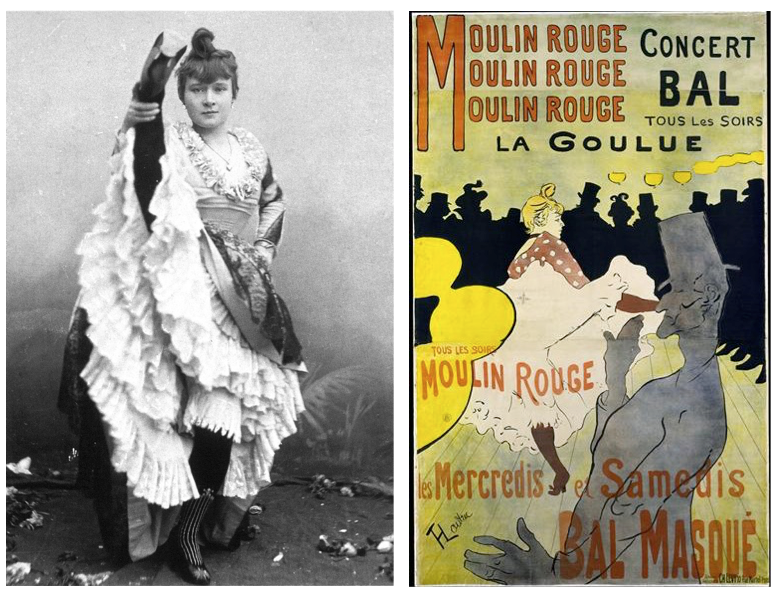
The sad death of Louise Weber, aka La Goulue, was announced in Janet Flanner’s “Letter from Paris” column. Weber was a can-can dancer at the Moulin Rouge in Paris and a model for some of Henri de Toulouse-Lautrec’s most famous cabaret paintings. Flanner wrote of La Goulue’s rise to fame…

JUST FOR KICKS… Louise Weber, aka La Goulue, circa 1890, and an 1891 poster by Toulouse-Lautrec advertising the performers La Goulue and “No-Bones” Valentin at the new Paris dance hall Moulin Rouge. (Wikipedia)

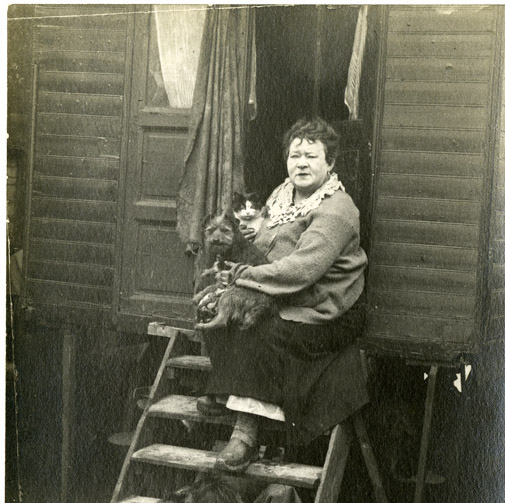
…and her sad downfall into a life of poverty among the rag-pickers:

SAD DECLINE…La Goulue, her face freshly powdered, sat on the steps of her small trailer for an unknown postcard photographer in the 1920s. This image is a detail of the original photograph, held at the Wheaton College Permanent Collection.

 *  *  *

From Our Advertisers

An advertisement on page 45 for Mohawk carpets featured two Cockney charwomen admiring the new carpets at the General Motors headquarters:

A corresponding note: Shreve & Lamb’s 1927 General Motors Building was the hub of Columbus Circle’s Automobile Row. A hideous 2012 remodel, which clad the entire structure in reflective glass, has rendered the former landmark unrecognizable:

Museum of the City of New York/nyc-architecture.com

Getting back to all things “moderne,” these facing ads on pages 8-9 offered some new looks for spring…

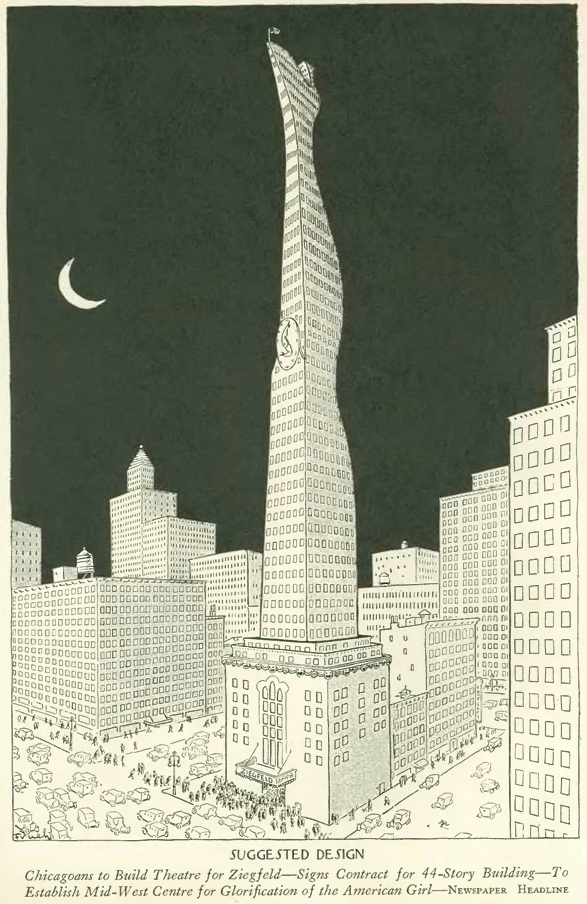
…and in the cartoons, a tongue-in-cheek vision of a modern high-rise by Al Frueh, prompted by the news that Florenz Ziegfeld planned to build a 44-story building in his native Chicago. Thanks to the market crash later in the year, it was never realized.

In drawings sprinkled across pages 24-25, Helen Hokinson examined various approaches to tax season, including these two examples…

…and finally, Peter Arno caught a theatre performer with his pants down…

Next Time: Babbitt Babble…


Life Among the Snowbirds

Florida’s Palm Beach became a popular destination in the 1920s for well-heeled New Yorkers seeking a respite from winter’s cold and gloom.

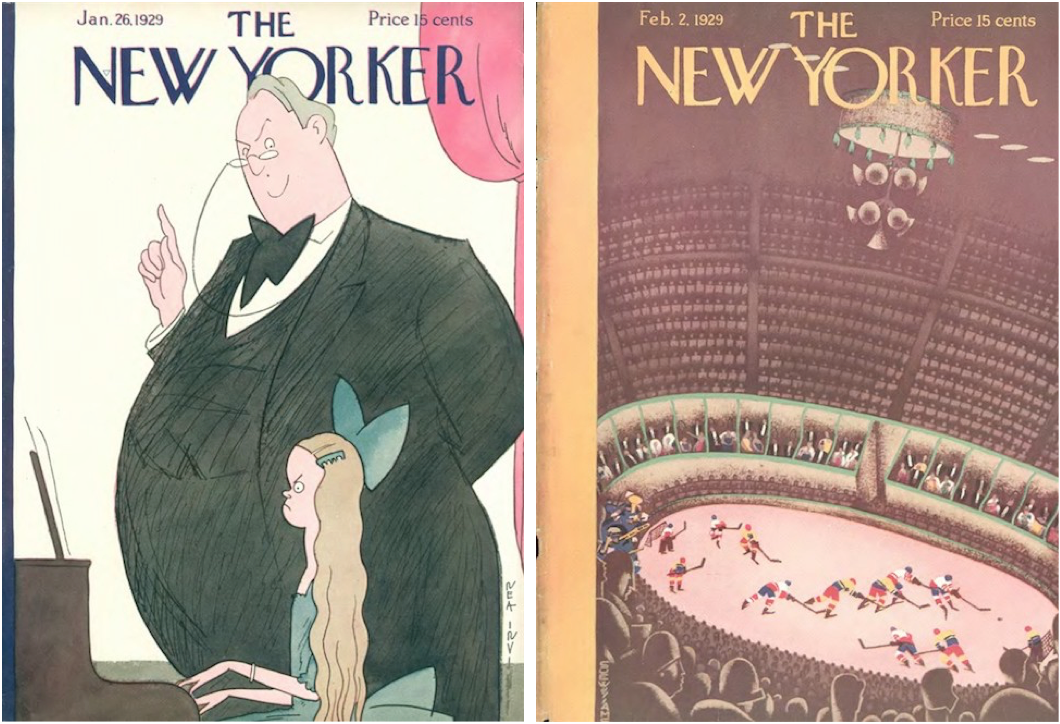
Jan. 26, 1929 cover by Rea Irvin / Feb. 2, 1929 cover by Sue Williams.

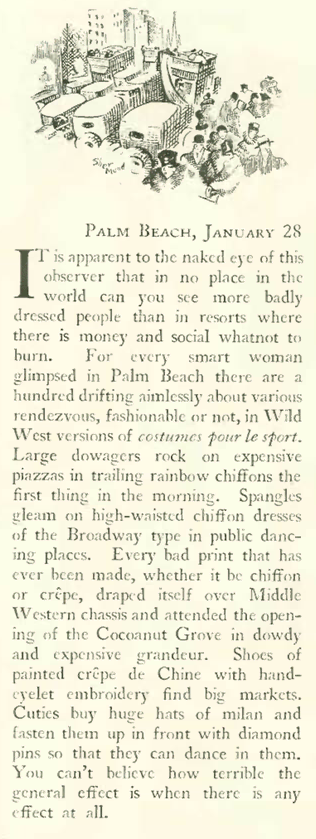
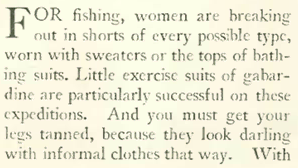
Among them was the New Yorker’s nightlife correspondent and fashion critic Lois Long, who (writing in the Feb. 2 issue) discovered that many snowbirds left their fashion sense back home, or in some cases didn’t have any in the first place…

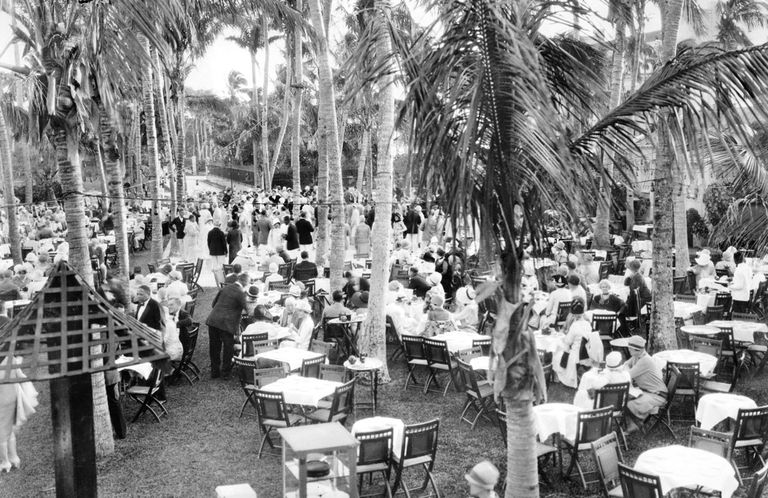
THOSE GENTLE BREEZES…Dining at the Coconut Grove in Palm Beach, 1928. (Town and Country)
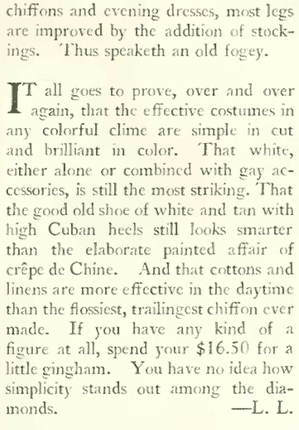
Sufficiently appalled by the fashion scene, Long then offered some advice for those seeking a smarter look in the southern climes…

AHOY THERE…Beach pajamas were a popular choice in the 1920s. (artdecogal.com)
BIG BOOSTER…The financier Otto Kahn was one of Palm Beach’s biggest promoters. Here he relaxes with friends at one of his Palm Beach “cottages” (this one is the Oheka Cottage, designed by August Geiger, on North Ocean Boulevard). L to R: New York socialite  Sarah Jane Sanford, Otto Kahn, Margaret “Nin” Kahn Ryan (Kahn’s eldest daughter), Betty Bonstetten (of the Rothschild banking fortune), and seated, Nancy Yuille (tobacco heiress who would later marry the Viscount Adair and become the Countess of Dunraven) and Swiss architect Maurice Fatio. (Ellen Glendinning Ordway Collection via New York Social Diary)
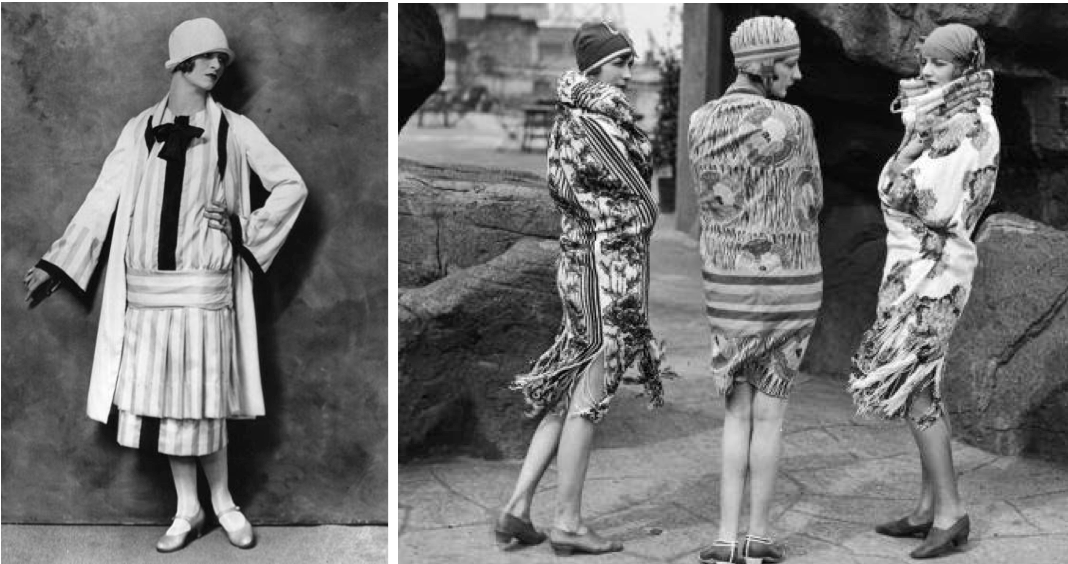
LOIS IS WATCHING YOU…A sampling of 1920s Palm Beach fashions Lois Long might have spotted during her visit. (vintage.es/picgran.com)

Long concluded her fashion advice with the dictum that when in doubt, keep it simple…

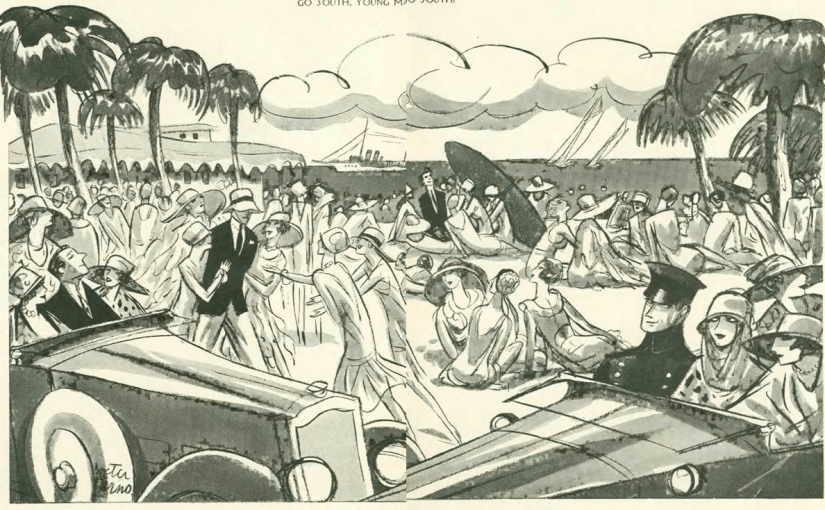
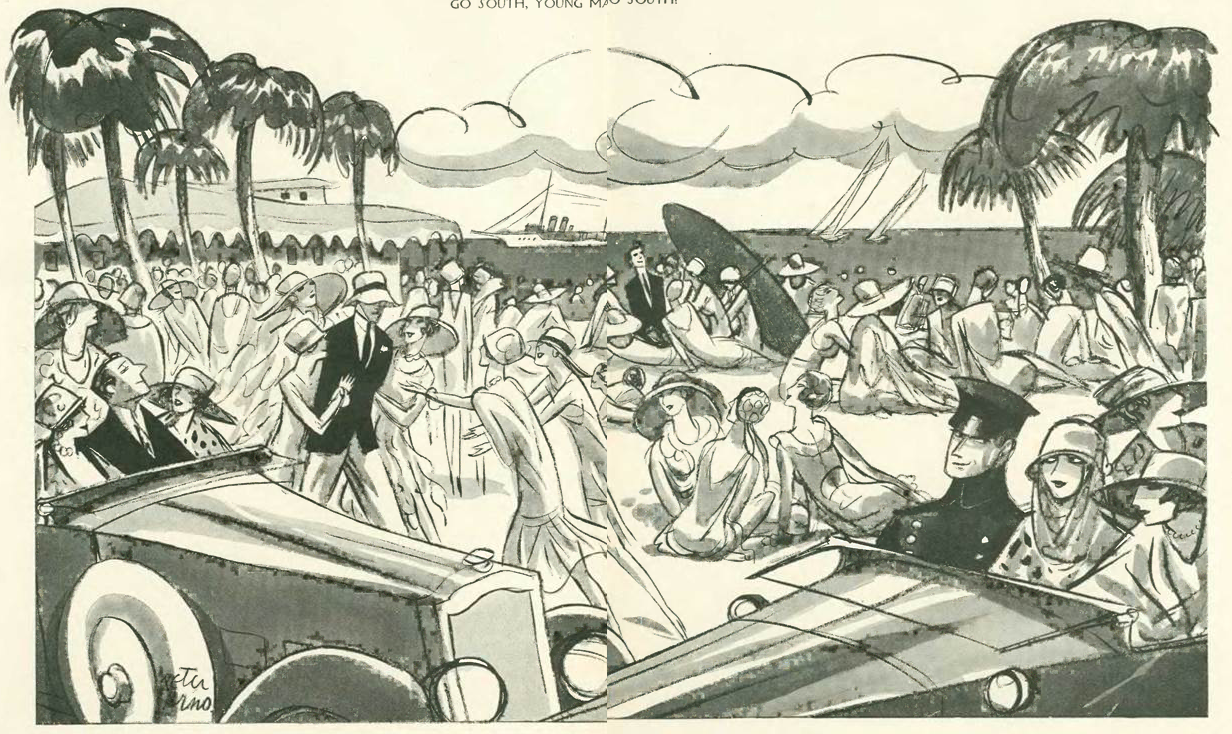
Long must have made the trip with her husband, the New Yorker cartoonist Peter Arno, since he contributed his own take on the scene in the Feb. 16, 1929 issue — a two-page illustration titled “Go South, Young Man, Go South.” (click image to enlarge)

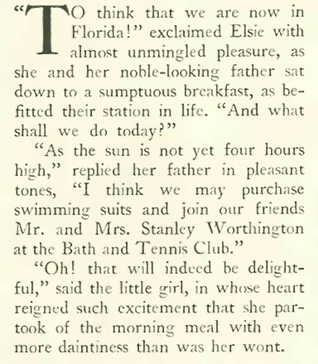
Palm Beach was also on the minds of the New Yorker editors when they composed the Jan. 26 issue, which featured a parody by Josie Turner of the popular Elsie Dinsmore book series: “Elsie Dinsmore at Palm Beach.” A brief excerpt:

Note: The Elsie Dinsmore books (there were 28 of them) featured an impossibly upright eight-year-old and were hugely popular in the late 19th and early 20th century.

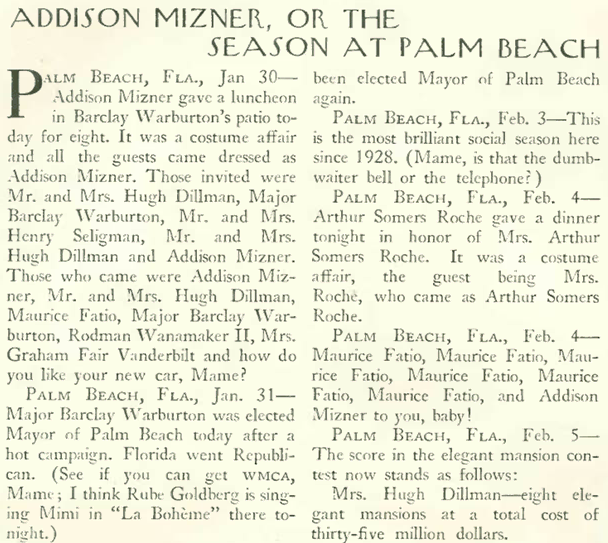
The Feb. 2, 1929 issue featured another Palm Beach-themed parody — this one by Frank Sullivan — that took a poke at Addison Mizner (1872-1933) a fixture of Palm Beach social life who designed resorts and houses for the rich and famous. He is often credited with giving South Florida its signature Mediterranean Revival and Spanish Colonial Revival styles of architecture (Augustus Mayhew, writing for the New York Social Diary, begs to differ: he notes that architect August Geiger established the style in Palm Beach three years before Mizner). An excerpt from Sullivan’s New Yorker parody:

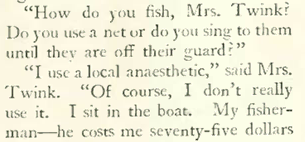
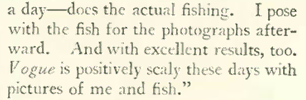
Later in the piece, Sullivan took a crack at a fictitious member of Palm Beach society, a “Mrs. Twink,” who was engaged in the latest “fad” — fishing:

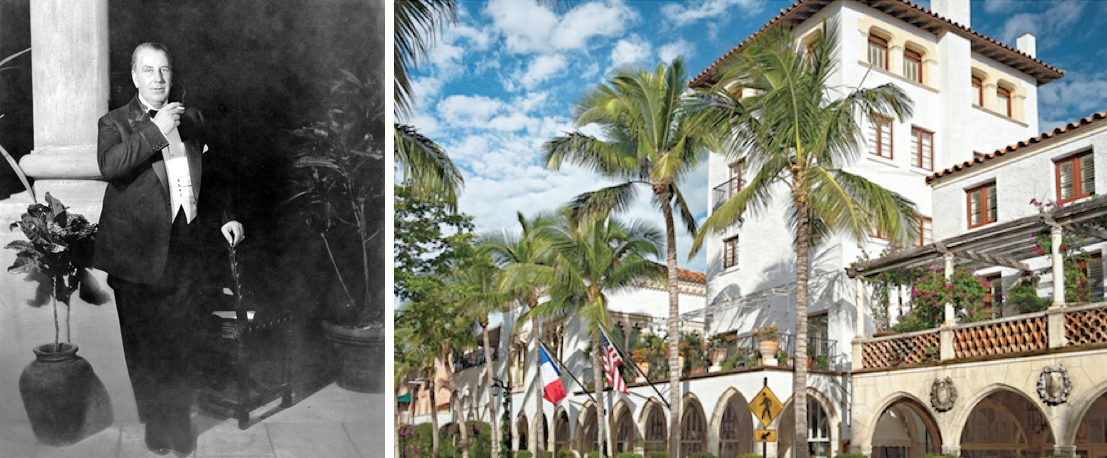
STORYTELLER IN BRICK AND STONE…Addison Mizner epitomized the “society architect.” He was known for making new buildings look like they had taken centuries to construct, even creating stories for his houses that described how they “evolved” through their many owners and historical eras. At right, Mizner’s own Palm Beach residence, Villa Mizner, on Worth Avenue in Palm Beach. It was built in 1924. (palmbeachdailynews.com/Merritt Hewitt)
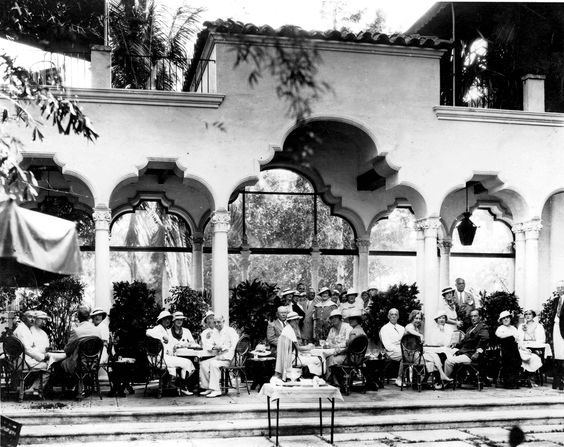
HIS KIND OF PEOPLE…Fashionably dressed members of the Mizner-designed Everglades Club gather in the Marble Patio in the 1920s. (Historical Society of Palm Beach County)
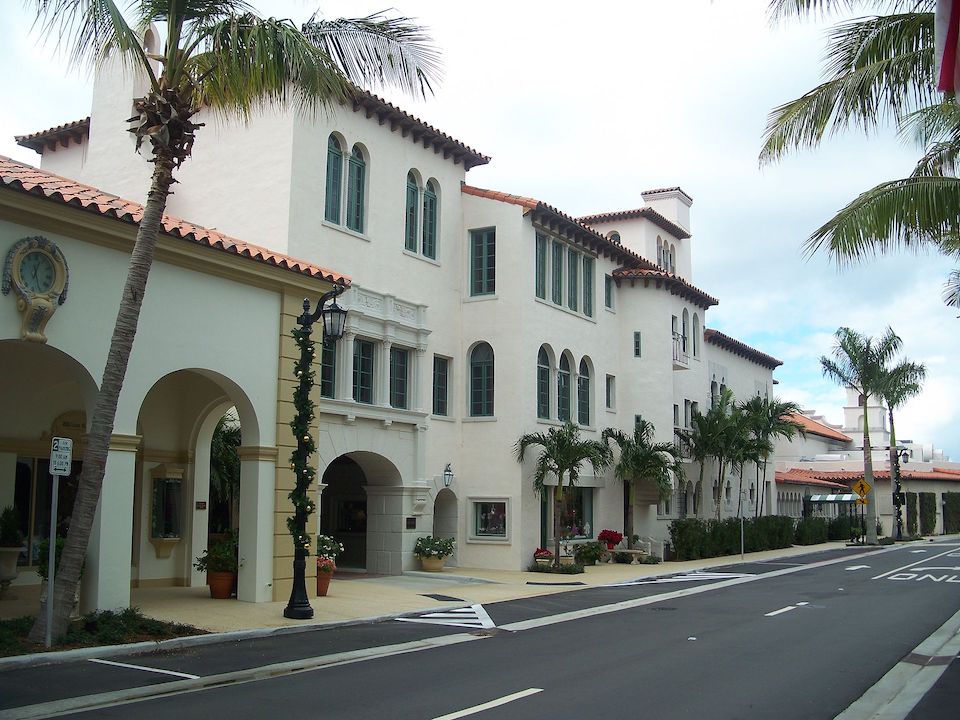
STILL THERE…The Everglades Club today. Opened in January 1919, it was Mizner’s first big commission. (Wikipedia)

The Feb. 2 issue also featured this Peter Arno cartoon of one snowbird’s reaction to Palm Beach living:

 * * *

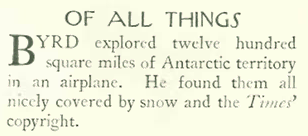
The New Yorker loved to take potshots at the news media, and particularly at the then rather staid New York Times, which apparently had secured exclusive rights to cover Admiral Richard Byrd’s famed exploration of the South Pole by airplane. In his Jan. 26 “Of All Things” column, Howard Brubaker quipped:

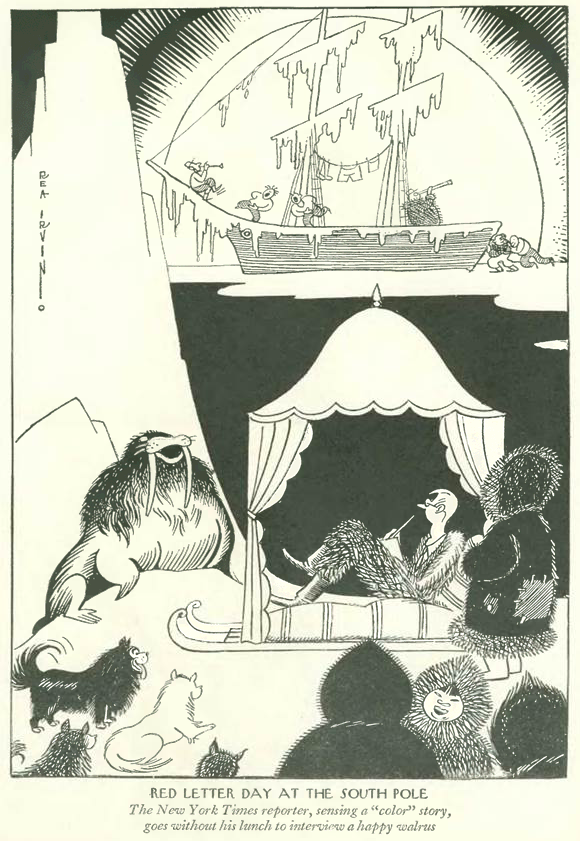
In the following issue, Feb 2, Rea Irvin imagined how a coddled Times reporter might cover the historic expedition:

ONE TOUGH BYRD…Admiral Robert Byrd (inset) led expeditions in the Antarctic from 1928 to 1930 by snowshoe, dog-sled, snowmobile and three airplanes that were transported (partially disassembled) by ship to a base camp on the Ross Ice Shelf. Pictured are Harold June, Commander Byrd, and Bernt Balchen in front of a Fairchild airplane, dubbed “Stars and Stripes.” The plane was used to take aerial photographs. (Richard E. Byrd Papers, The Ohio State University)

* * *

Grouchy Groucho

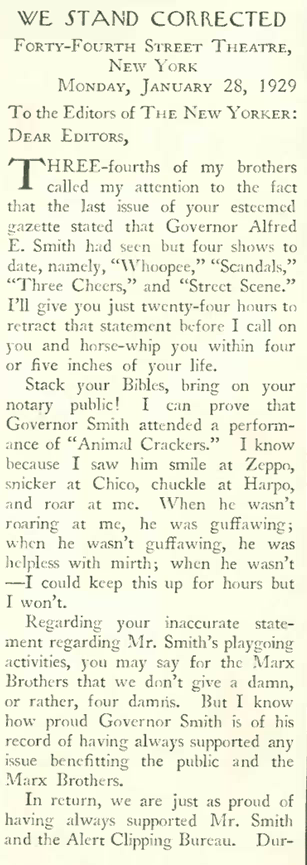
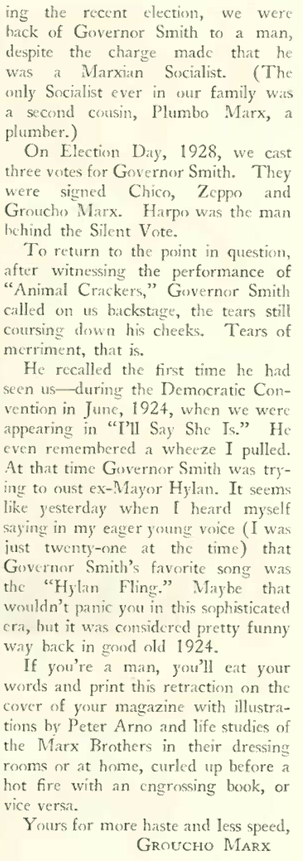
Near the back of the Feb. 2 issue (page 61), comedian Groucho Marx contributed this tongue-in-cheek demand for a retraction from the New Yorker editors:

WIT…A young Groucho Marx in 1930. (Wikipedia)

* * *

Fun With the Rockefellers

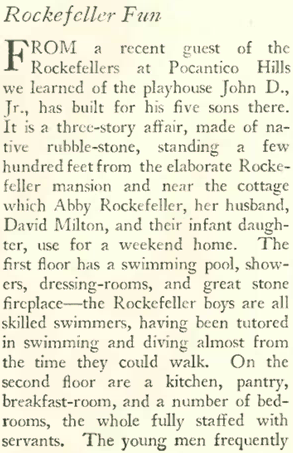
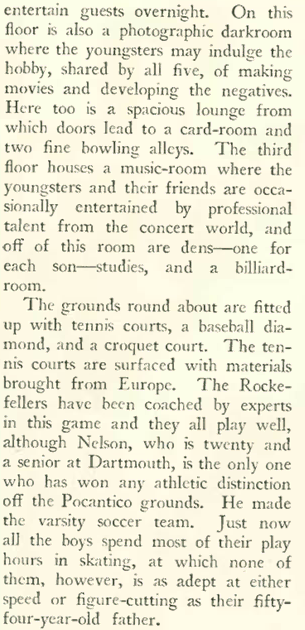
John K. Winkler contributed this piece to the Feb. 2, 1929 “Talk of the Town” that described a “playhouse” John D. Rockefeller Jr. had built for his five sons:

NOT FOR PEEWEE…The three-story playhouse on the Rockefeller estate at Pocantico Hills. (New York Social Diary)

 * * *

From Our Advertisers

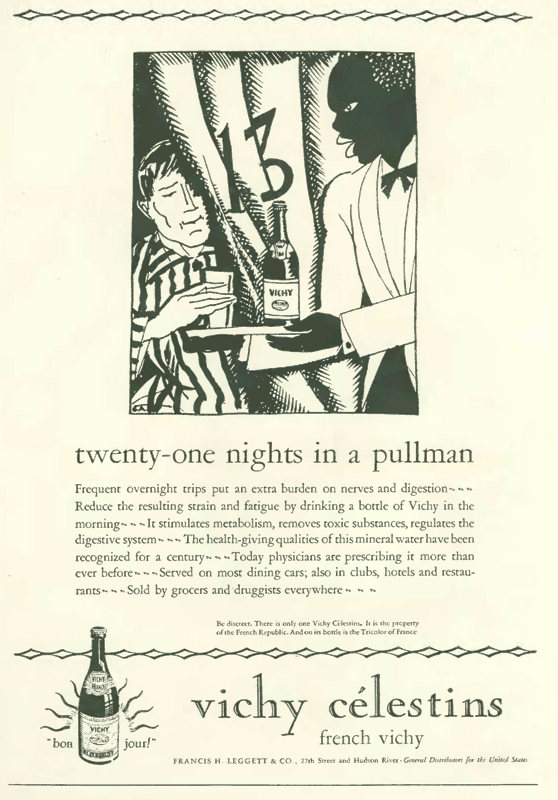
Heading to Palm Beach on a Pullman? Have too much of that bootleg gin the porter slipped you the night before? Then try…

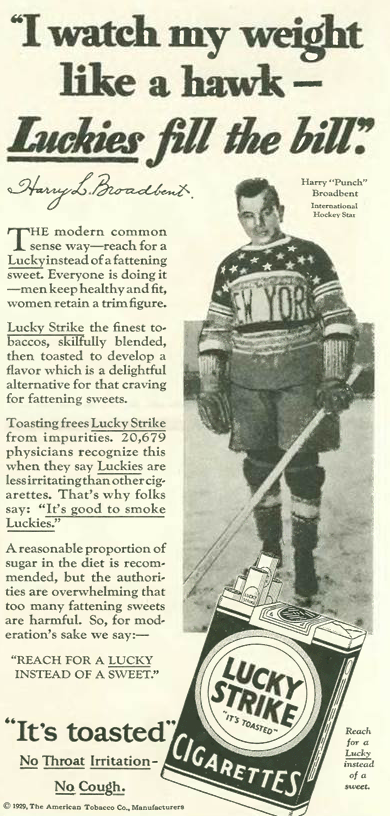
…perhaps you want to stay in shape, like this hockey star. Then grab a Lucky…

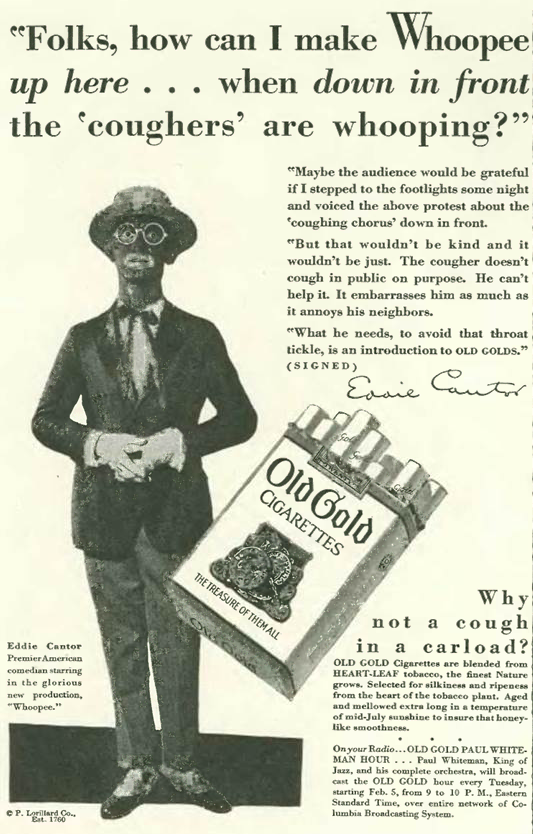
…or maybe you’d like to sing like Eddie Cantor, who soothed his throat with an Old Gold…

…and we close with these comic observations of life among New York society, again featuring the work of Peter Arno

…and back to the cold New York City winter, with Leonard Dove

Next Time: Million Dollar Mermaid…


Out With the Old

Perhaps no decade was more transformative to New York City than the 1920s. From the loosening of social mores to countless technological advances, the city was a very different place as it entered the last year of the Roaring Twenties.

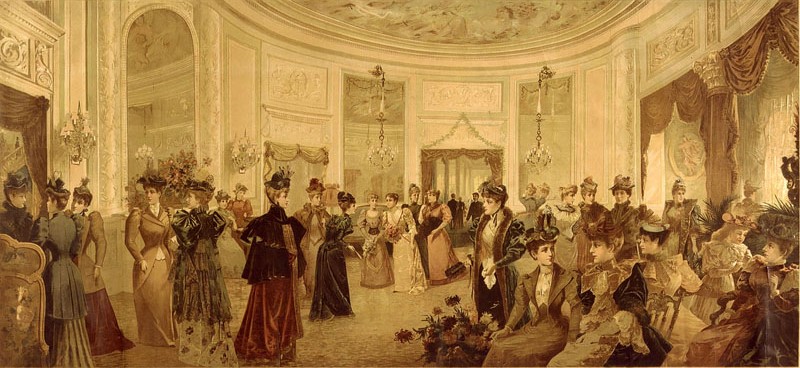
Jan. 5, 1929 cover by Sue Williams. Opening image depicts the original Waldorf Hotel’s Octagon Room in 1893.

Vestiges of the 19th century were quickly erased during the decade as old neighborhoods and stately mansions gave way to massive apartment blocks and towering skyscrapers. Such was the fate of the original Waldorf-Astoria Hotel, its Victorian lavishness out of style in a streamlined age. Writing under the pen name T-Square, New Yorker architecture critic George S. Chappell commented on the planned demolition of the old* Waldorf-Astoria Hotel:

*Although outdated in appearance, the hotel was little more than 30 years old in 1929.

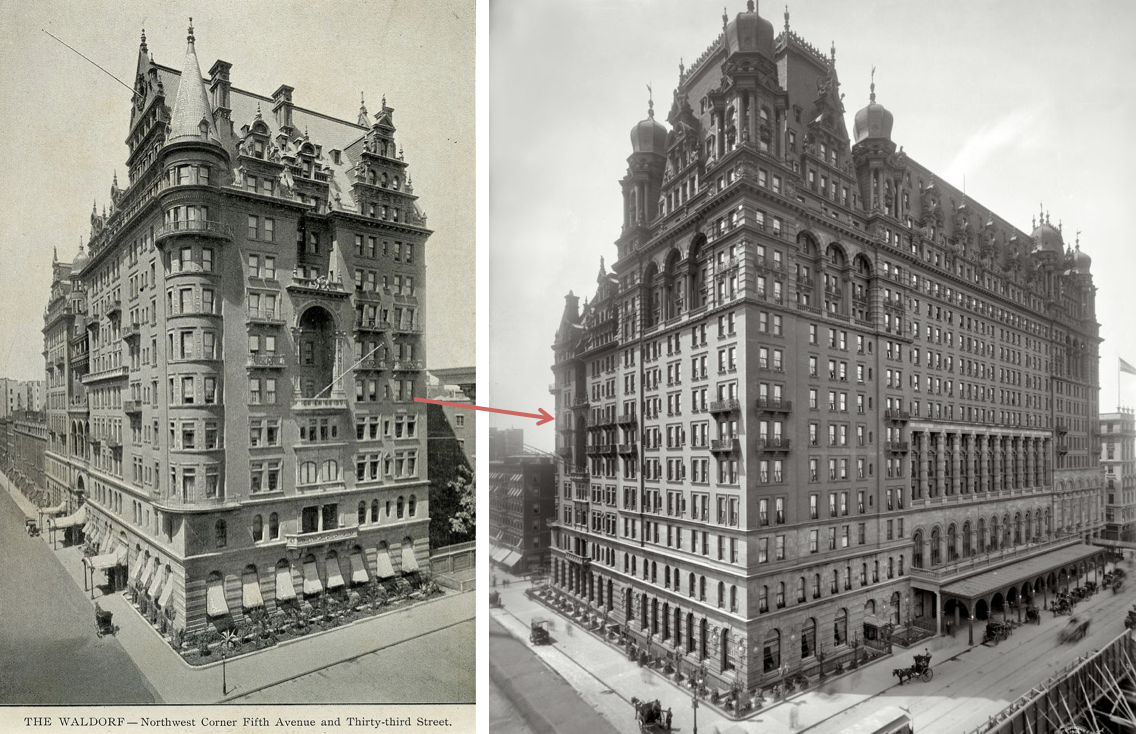
TALE OF TWO HOTELS…The Waldorf-Astoria was actually two hotels joined together. The Waldorf, at left, was built in 1893. The much larger Astoria (right) was constructed in 1897. Note the arrow indicating the original Waldorf in relation to the Astoria. (Wikipedia/Detroit Photography Archive)
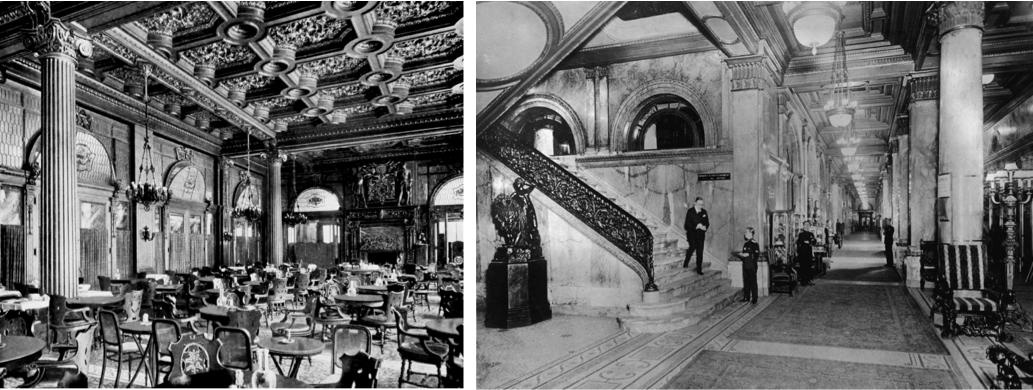
PLACES TO SEE AND BE SEEN…At left, the “Gentleman’s Cafe” in the Waldorf Hotel. At right, lobby entrance to the marble-lined “Peacock Alley” that connected the two hotels. (Wikipedia/justcocktails.com)
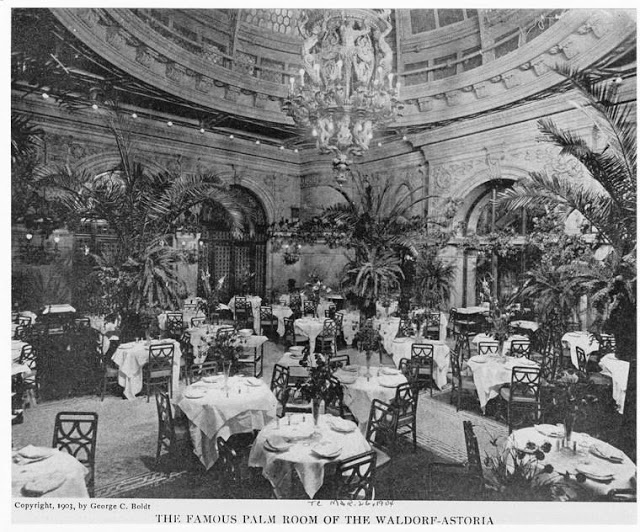
DINE IN STYLE…The Palm Room in the Astoria section of the original Waldorf-Astoria Hotel. (New York Public Library)

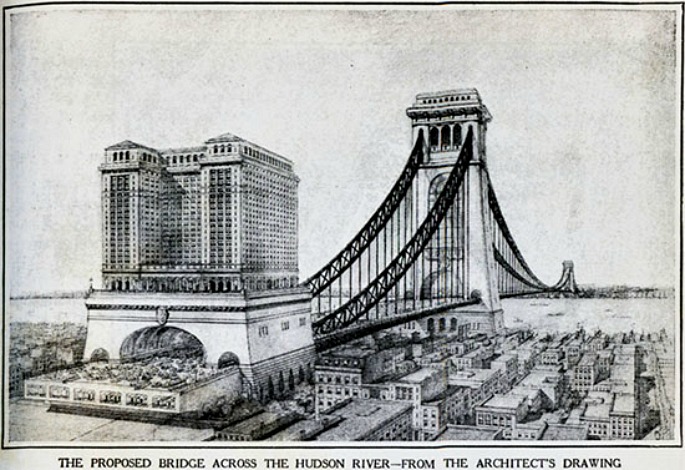
Chappell wrote that the prime building site was slated to be occupied by a 50-story office building…

…but as it turned out, Floyd Brown was unable to make the final payments on the property, so he sold his claim to the bank. John J. Raskob, a wealthy finance executive and chair of the National Democratic Committee, joined with entrepreneur Pierre du Pont and former New York Governor Al Smith (who lost his bid for the U.S. Presidency in 1928) to buy the property. They had much bigger plans than Floyd Brown: In August 1929 they announced their plan to build the tallest building in the world — what would become the Empire State Building.

TRY, TRY AGAIN…The architecture firm Shreve & Lamb developed this concept (left) for Floyd Brown’s proposed 50-story office building on the site of the old Waldorf-Astoria. At right, what occupies the site today: the Empire State Building, also designed by Shreve & Lamb. (Pinterest/oldstructures.com)

 * * *

Car Culture

The Jan. 5 issue featured a lengthy review of the 29th Annual National Automobile Show at Grand Central Palace, as well as numerous advertisements by auto manufacturers hoping to entice New Yorker readers with their latest models.

Promoters of the event touted the addition of a grand staircase to Grand Central’s mezzanine level that would ease access to both levels of the show:

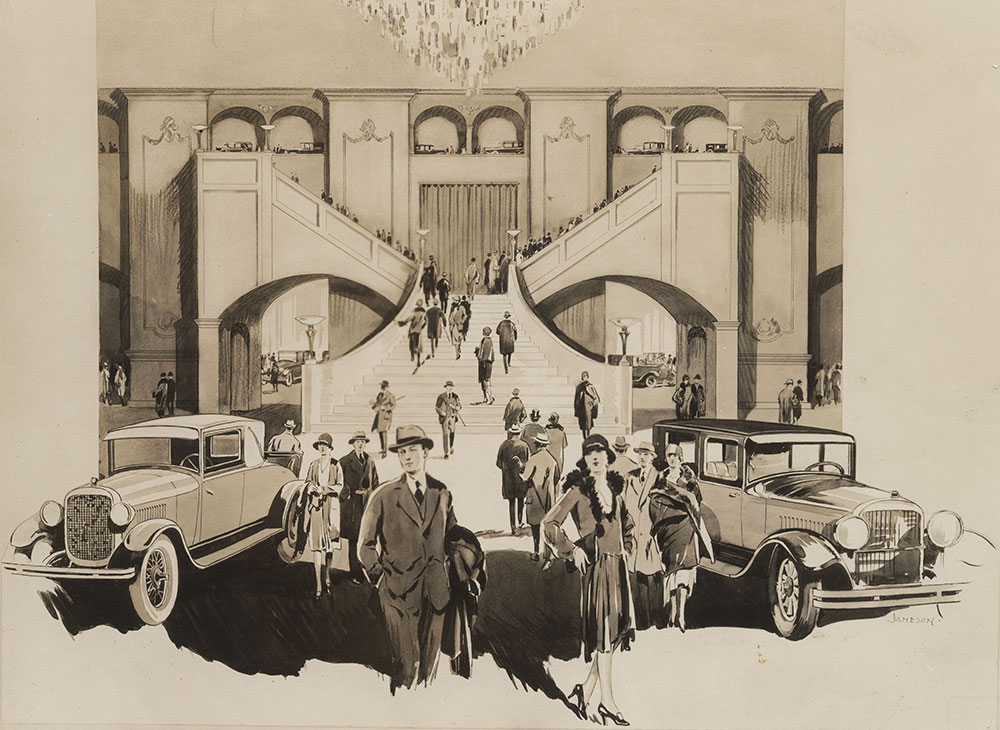
AIN’T IT GRAND?…Design drawing created for the 1929 National Automobile Show at Grand Central Palace touting the addition of an equally grand new staircase. (Free Library of Philadelphia)
How the new staircase actually appeared at the 1929 show. Note the background where the movement of workmen on ladders lends a ghostly appearance. (Free Library of Philadelphia)
A view of the 1929 National Automobile Show from the mezzanine of the Grand Central Palace. (Free Library of Philadelphia)

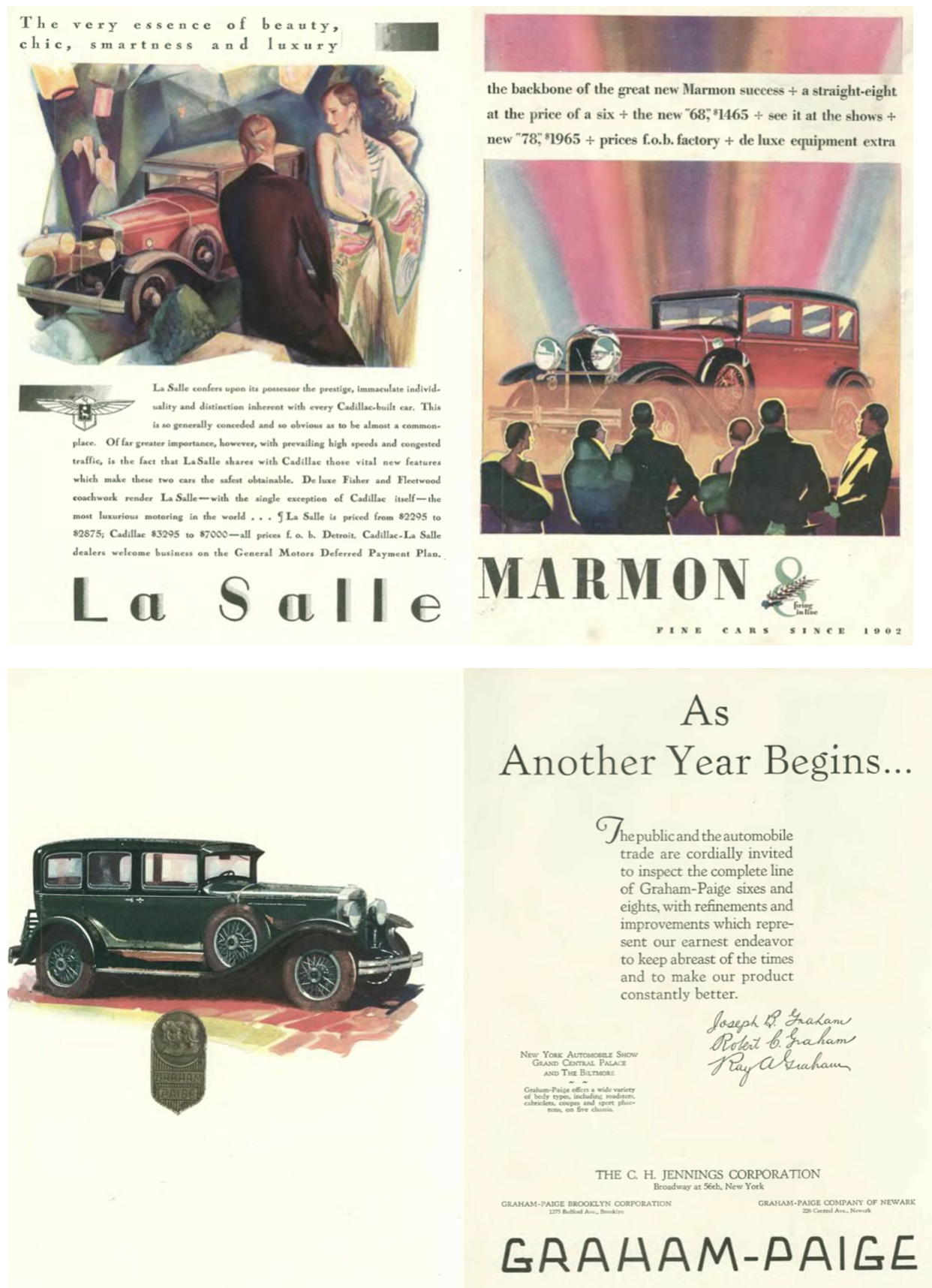
As I mentioned, the Jan. 5 issue was filled with car ads, mostly from long-gone automobile manufacturers. A constant in all of these ads is their appeal to New  York’s chic, smart set. Here’s a sampling of a few of them: (click ads to enlarge):

Hupmobile was a successful car company that began its decline in the late 1920s  precisely because it turned its back on buyers of medium-priced cars and went after what it perceived to be the more lucrative luxury buyer (see ad above). Hupmobile went out of business in 1939 (after briefly joining forces with Graham-Paige, which also went under that year).

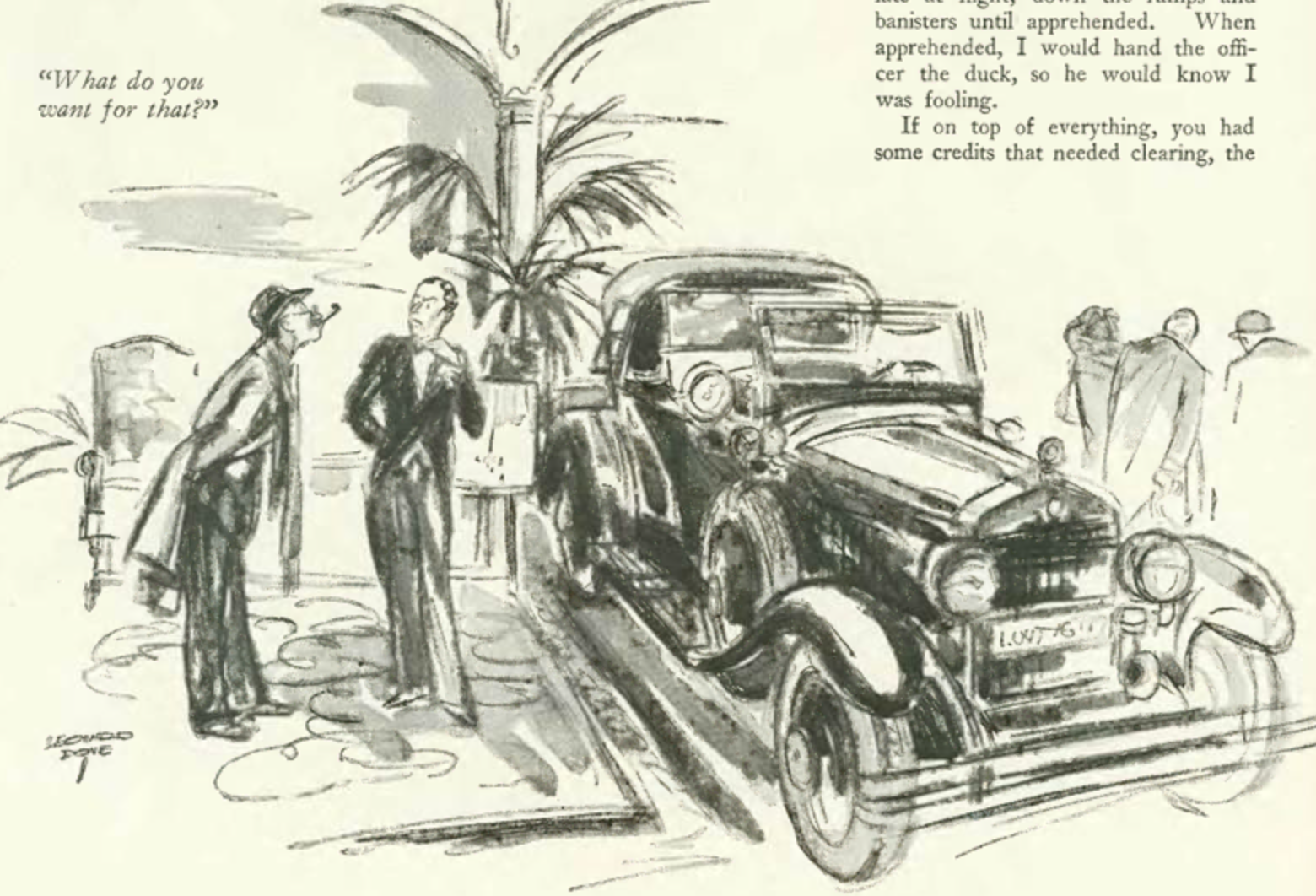
Cartoonist Leonard Dove found humor derived from these very class distinctions when he visited the auto show:

 * * *

The Game, Served Up Cold

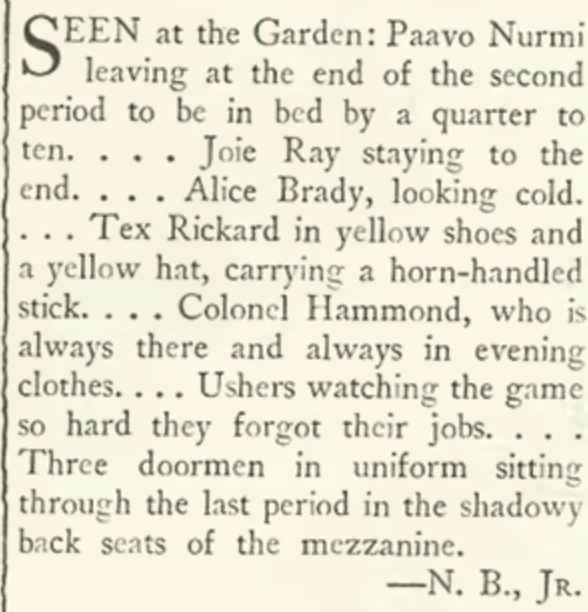
In other diversions from the Jan. 5 issue, Niven Busch Jr. attended the hockey game between the New York Rangers and the New York Americans at Madison Square Garden, noting famous faces in the crowd including Finnish track star Paavo Nurmi and American track star Joie Ray. Also noted were Tex Rickard, builder of Madison Square and founder of the Rangers, ex-football star and businessman Col. Harry Hammond, and film star Alice Brady.

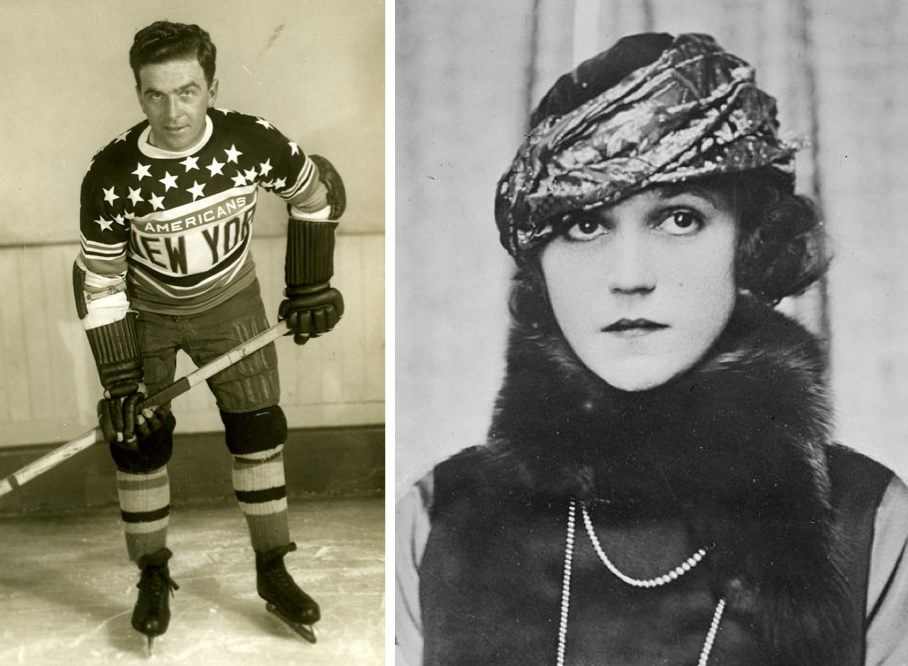
AT THE GARDEN…Not even the exciting hockey play of Billy Boyd (left) and his fellow New York Americans could keep actress Alice Brady warm. (Pinterest/Alchetron)

 * * *

From our non-automobile advertisers, another installment of a Theodore Geisel (Dr. Seuss) ad for Flit insecticide (this is the first instance — at least in the Flit ads— in which Geisel signs his art as “Dr. S” instead of “Seuss”).

And another cartoon from the Jan. 5 issue, courtesy Gardner Rea:

 * * *

Arno Addendum

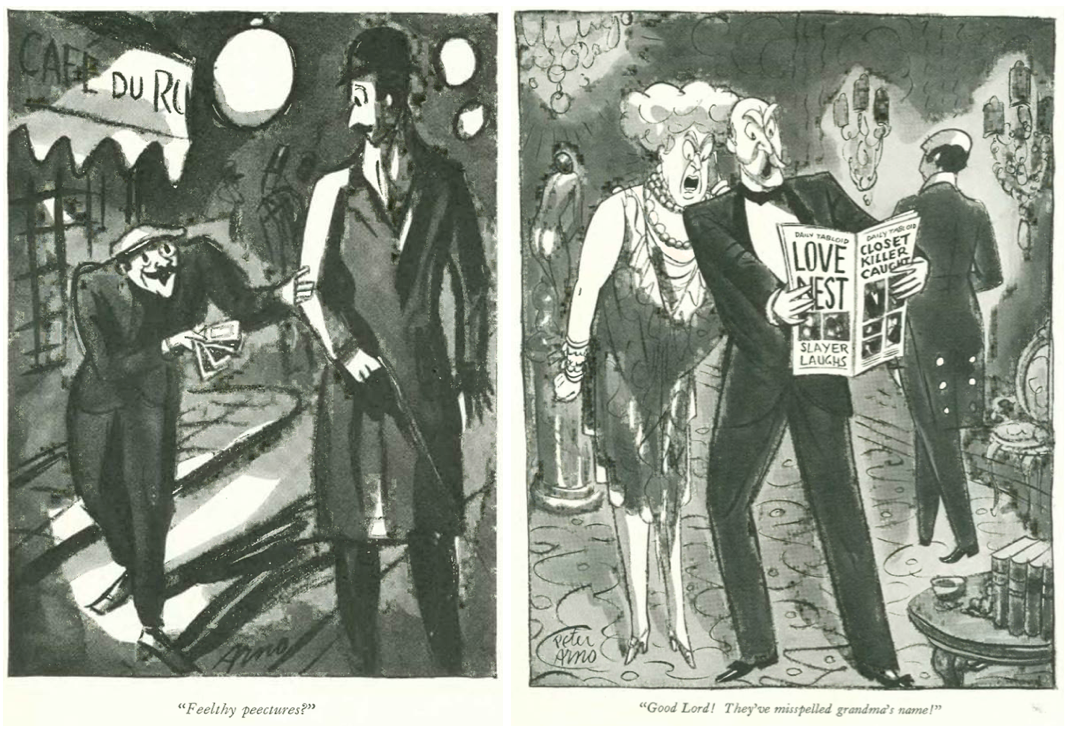
In the rush of the recent holidays I missed an item from the Dec. 22, 1928 issue — namely, art critic Murdock Pemberton’s tongue cheek review (in “The Art Galleries” column) of cartoonist Peter Arno’s December 1928 exhibition of drawings at the Valentine Gallery:

Here are two Arno drawings that were featured in the Valentine exhibition (click to enlarge):

INTERNATIONAL APPEAL…less than four years after his Valentine Galleries debut, Peter Arno exhibited his drawings to great acclaim at the Leicester Galleries in London, October 1932. (Encyclopædia Britannica)

Next Time: Midnight Frolic…

Happy 1929!

I’ve been writing this blog for nearly three years, and during that stretch have managed to cover more than 200 issues of The New Yorker, or about the first four years of the magazine.

Dec. 22, 1928 and Dec. 29, 1928 covers by Rea Irvin.

The amount of young talent on display in those early issues is truly astounding, from writers such as E.B. White, Dorothy Parker and James Thurber (writer and cartoonist) to illustrators and cartoonists including Peter Arno, Rea Irvin, Helen Hokinson, Miguel Covarrubias and Ilonka Karasz, to name just a few. Among the contributing artists was Abe Birnbaum, who illustrated more than 150 covers for The New Yorker from the 1940s to 1970s. One of his earliest contributions to the magazine was this illustration for the “Profile” section in the Dec. 22 issue:

Canadian artist Shelley Davies writes in her blog that Birnbaum “charmingly captured some of life’s quieter moments with a deft eye.” In addition to The New Yorker, Birnbaum illustrated numerous covers for Stage and Arts In America, and won a Caldecott Award in 1954 for his children’s book, Green Eyes.

ON THE QUIETER SIDE…Abe Birnbaum (pictured here circa 1960) created more than 150 covers for The New Yorker from the 1940s to the 1970s. At right, a cover from March 17, 1962. (google.com.br)

 * * *

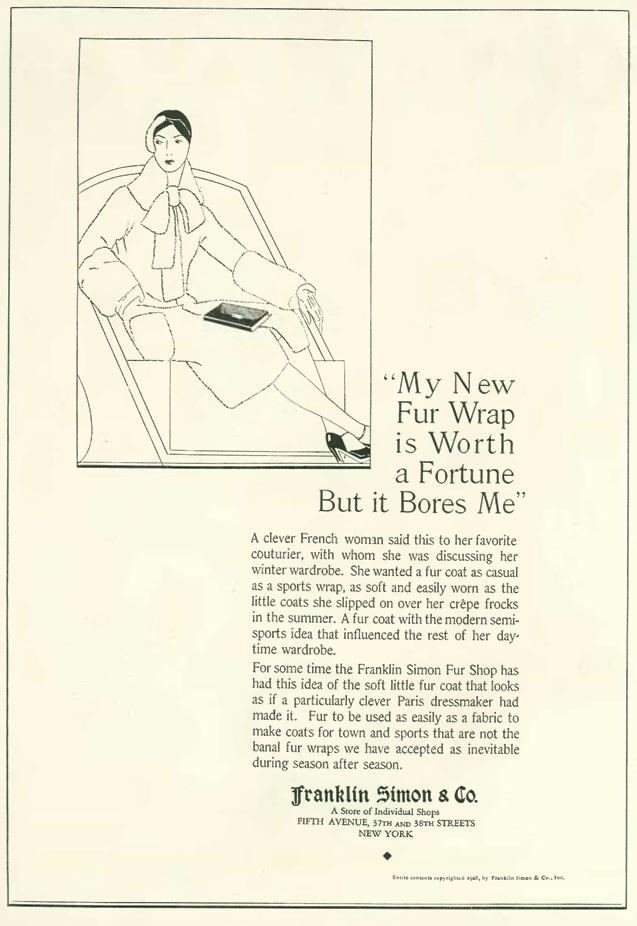
A couple of select advertisements from the Dec. 22 reveal what retailers knew, or thought they knew, about the magazine’s readership. Franklin & Simon, seeking perhaps to broaden their market for furs, suggested that even a stylish French woman might prefer a fur fashioned as a modest “sports wrap”…

…as for the guys, Saks appealed to the anglophilia that apparently was rife among New York’s smart set. Check out the ridiculous hat gracing the noggin of this young dandy…

Well-heeled readers who could afford to flee the New York winter were targeted by these various enticements in the Dec. 22 issue (this is a collage of select ads found in the back pages of the issue):

 * * *

Hello Down There

Writing about New Yorker humor derived from class distinctions, Ben Yagoda (About Town: The New Yorker and the World It Made, p. 63) noted a series of cartoons by Otto Soglow that began with this one in the Dec. 22, 1928 issue and continued through thirty installments that ran to early 1930, when the workers, Joe and Bill, finally emerged from the manhole:

This running gag, according to Yagoda, “came from the conceit that the laborers spoke with the same assumptions and in the same catchphrases as those with ‘higher’ places in society.”

Also from the Dec. 22 issue, this terrific cartoon by Leonard Dove that showed a bookish man who had accidentally entered the wrong type of book-making establishment:

* * *

The Girl Who Wouldn’t Grow Up

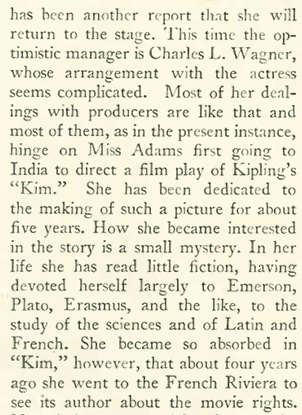
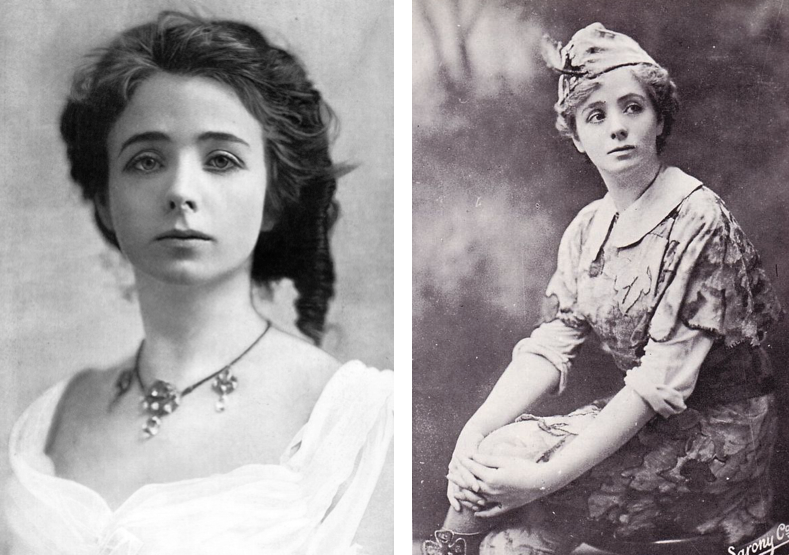
Maude Adams was a major Broadway star in the early years of the 20th century. Appearing in more than 25 productions from 1888 to 1916, she was most famous for her portrayal of Peter Pan in the Broadway production of Peter Pan; or, The Boy Who Wouldn’t Grow Up. She performed that role first in 1905-06 and again in 1912 and 1915. The highest-paid performer of her day, at her peak she earned more than $1 million a year, a staggering sum more than a century ago. James Thurber, writing in the Dec. 29 “Talk of the Town,” reported that after a decade-long absence from the stage, Adams was planning a comeback as a director:

STAR POWER…At left, American actress Maude Adams, circa 1900. At right, Adams as Peter Pan, her most famous stage role. Adams was the first American to portray Peter Pan on the stage. She played the role 1,500 times between 1905-1915. She retired from the stage in 1918 after a severe bout with the flu. She died at age 80 in 1953. (Wikipedia/Oakland Tribune)

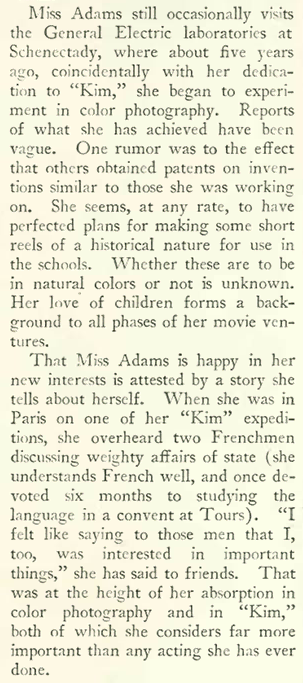
Thurber also noted that Adams was working with General Electric in the development of color photography. According to the Trivia Library, it has been suggested that her motivation might have been a wish to appear in a color film version of Peter Pan. She eventually returned to acting in the 1930s, with occasional appearances in regional productions of Shakespeare plays.

 * * *

A Lukewarm Welcome to 1929

The Dec. 29 New Yorker opened with these lamentations for the last issue of 1928. At least it appears that one could obtain a decent bottle of French champagne to toast the New Year:

JAM SESSION…1929 photo of traffic on Fifth Avenue. (theoldmotor.com)

 * * *

The Passing of a Poet

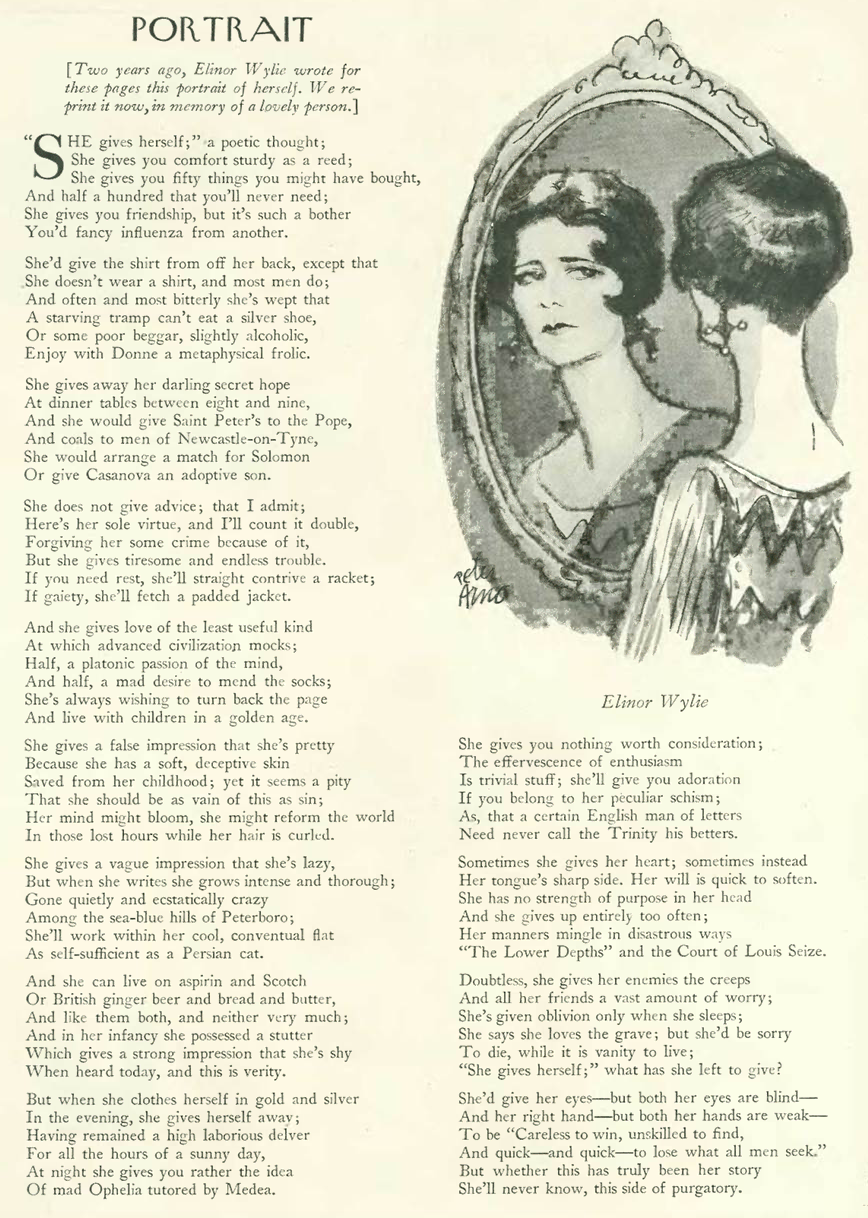
The Dec. 29 issue featured something unprecedented in The New Yorker up to that point: the reprinting of an entire piece previously featured in the magazine. In this case, it was in tribute to the sudden passing of poet and author Elinor Wylie:

PORTRAITS…Elinor Wylie posed for her friend Carl Van Vechten in this 1922 portrait (left). The photo at right, probably taken around 1926, was clearly the inspiration for the illustration by Peter Arno that accompanied “Portrait.” (Yale University/humorinamerica.wordpress.com)

It is no wonder that The New Yorker had such affection for Wylie, for she was as colorful a personality as could be found in 1920s literary circles. A Columbia University Press bio notes that “she was famous during her life almost as much for her ethereal beauty and personality as for her melodious, sensuous poetry.” Born to a socially prominent family and trained for a life in society, she instead became notorious for her multiple marriages and love affairs. She also suffered from extremely high blood pressure that gave her unbearable migraines.

Wylie died on Dec. 16, 1928, while going over a typescript of her poetry collection, Angels and Earthly Creatures, with her estranged third husband, William Rose Benét. According to Karen Stein (in the Dictionary of Literary Biography), Wylie, while picking up a volume of John Donne’s poems, asked Benét for a glass of water. When he returned with it, she reportedly walked toward him and murmured, “Is that all it is?,” and fell to the floor, dead of a stroke. She was 43.

* * *

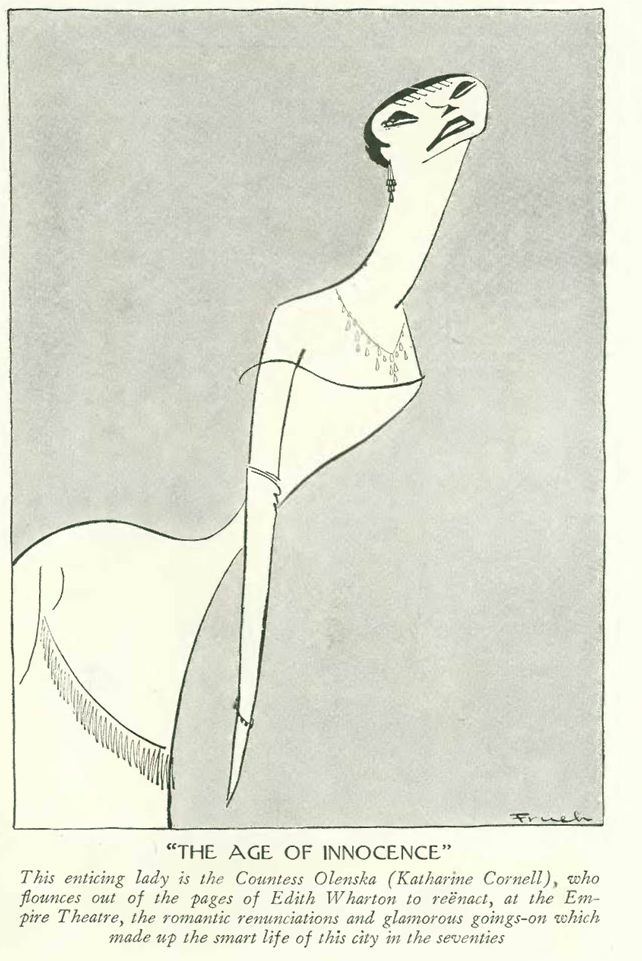
Age of Innocence

The Dec. 29 theatre review section featured this illustration by Al Frueh of Katharine Cornell in the Empire Theatre’s production of The Age of Innocence:

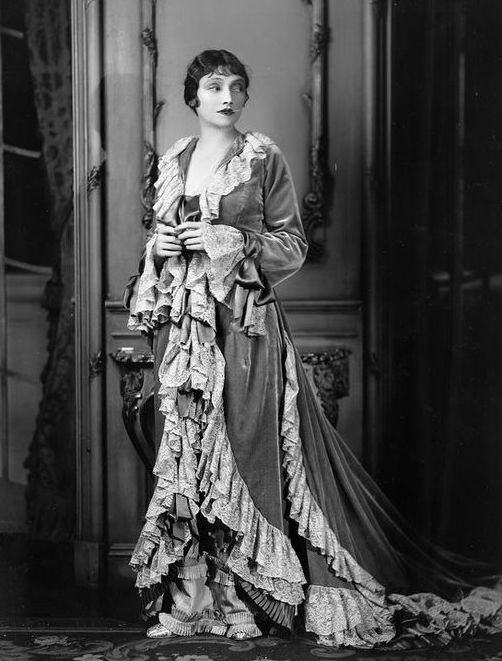
And below, a studio portrait of Cornell from the same play:

HOW SHE REALLY LOOKED…Katharine Cornell as ‘Countess Ellen Olenska’ in this Vandamm Studio portrait dated November 27, 1928. (Billy Rose Theatre Collection, The New York Public Library)

 * * *

Before Baby Snooks

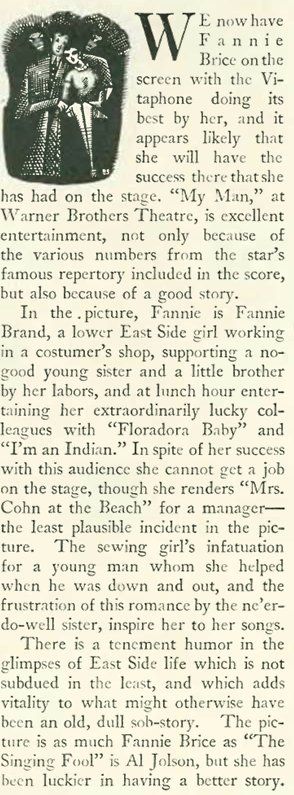
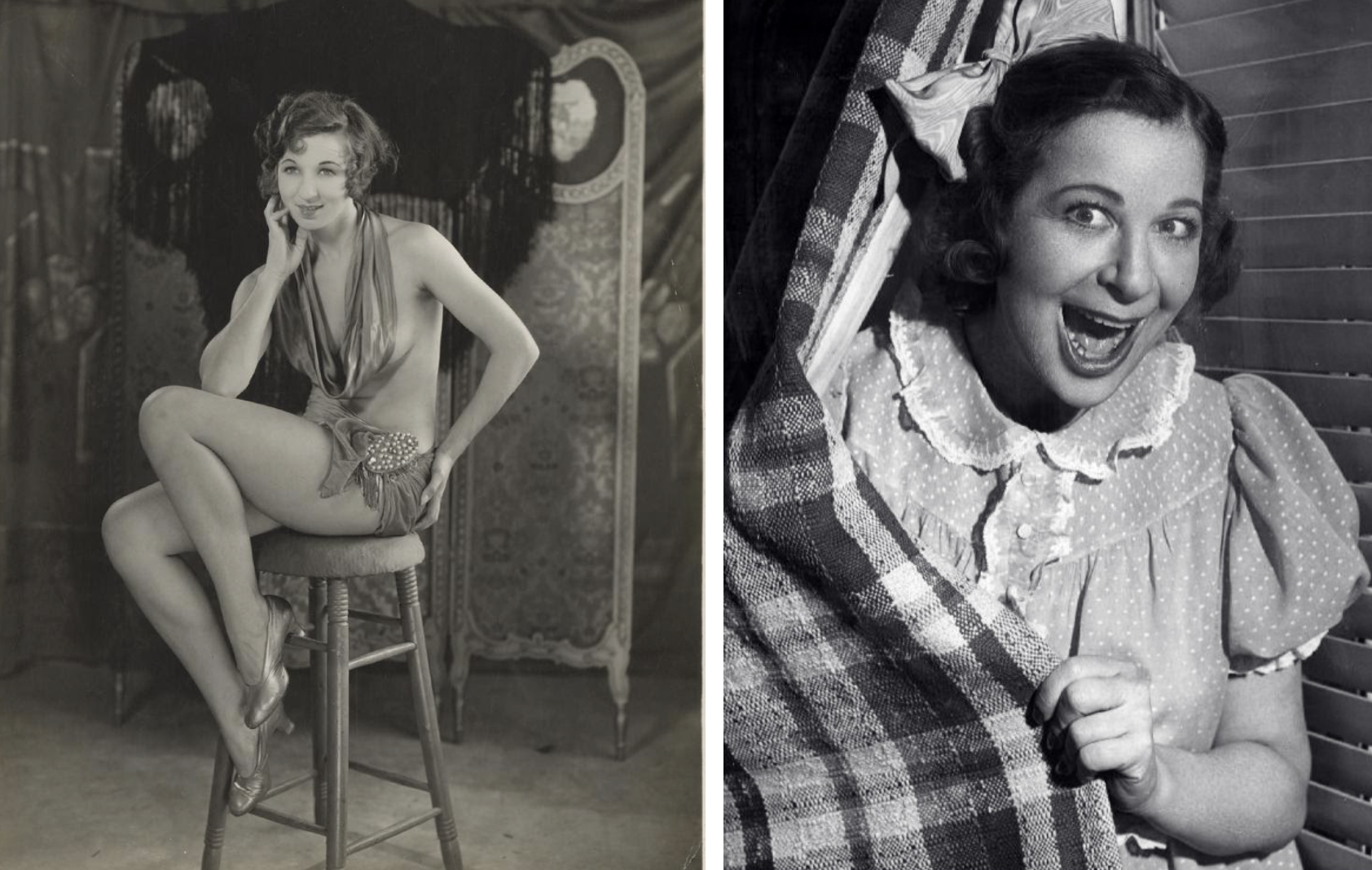
Although it was still a few years before singer and actress Fanny Brice would make her radio debut as the bratty toddler named “Snooks,” she was already well-known to New York audiences for her work in the Ziegfeld Follies (beginning in 1910). In its Dec. 29 issue The New Yorker favorably reviewed Brice’s first motion picture, My Man, which included musical scenes with Vitaphone sound:

MY MAN…Fanny Brice, Guinn Williams, and Edna Murphy on the set of the partially silent film My Man, 1928. Her first movie appearance, Brice played Fanny Brand, a poor girl who becomes a star. The film is now considered lost, since only an incomplete version survives. (brice.nl)
THROUGH THE YEARS…At left, singer and actress Fanny Brice from the time she was a Ziegfeld Follies girl, circa 1915. At right, Brice in the role of Baby Snooks, 1940. (Vintage Everyday/Wikipedia)

 * * *

Let’s Get Physical

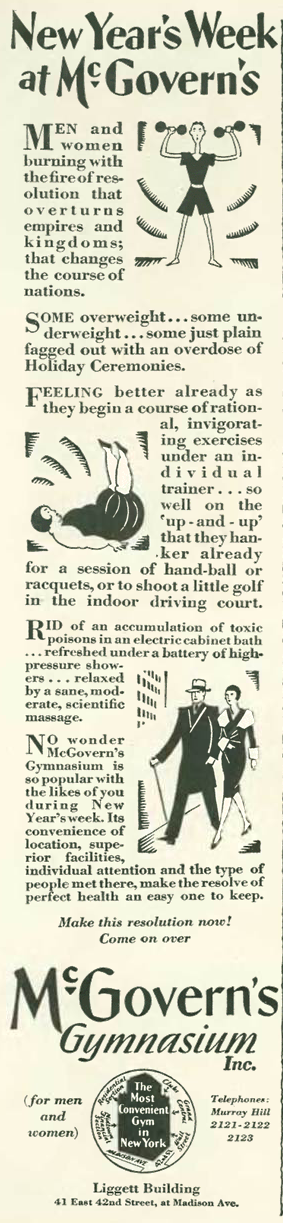
Even 90 years ago some folks (or at least some New Yorkers) resolved to get healthy and hit the gym in the New Year. In this ad, McGovern’s Gymnasium announced it was ready for them:

Babe Ruth trains at Artie McGovern’s Gym for the upcoming baseball season, February 9, 1928. (twitter.com/BSmile)

And to close out 1928, a cartoon from John Reehill

Next Time: Out With the Old…

Out of the Mouth of Babes

Like many publications, there are defining moments in the New Yorker’s history that make the magazine what it is today.

December 8, 1928 cover by Peter Arno.

In a post more than two years ago I wrote about Ellin Mackay’s pivotal essay, “Why We Go To Cabarets: A Post-Debutante Explains.” The debutante daughter of a multi-millionaire (who threatened to disinherit her due to her romance with Irving Berlin), Mackay explained that modern women were abandoning social matchmaking in favor of the more egalitarian night club scene. Mackay’s essay provided a huge boost to the struggling New Yorker, which had dipped to less than 3,000 subscribers in August 1925. A more recent post, “A Bird’s Eye View,” noted how a short story by Thyra Samter Winslow opened the door to serious fiction in the magazine.

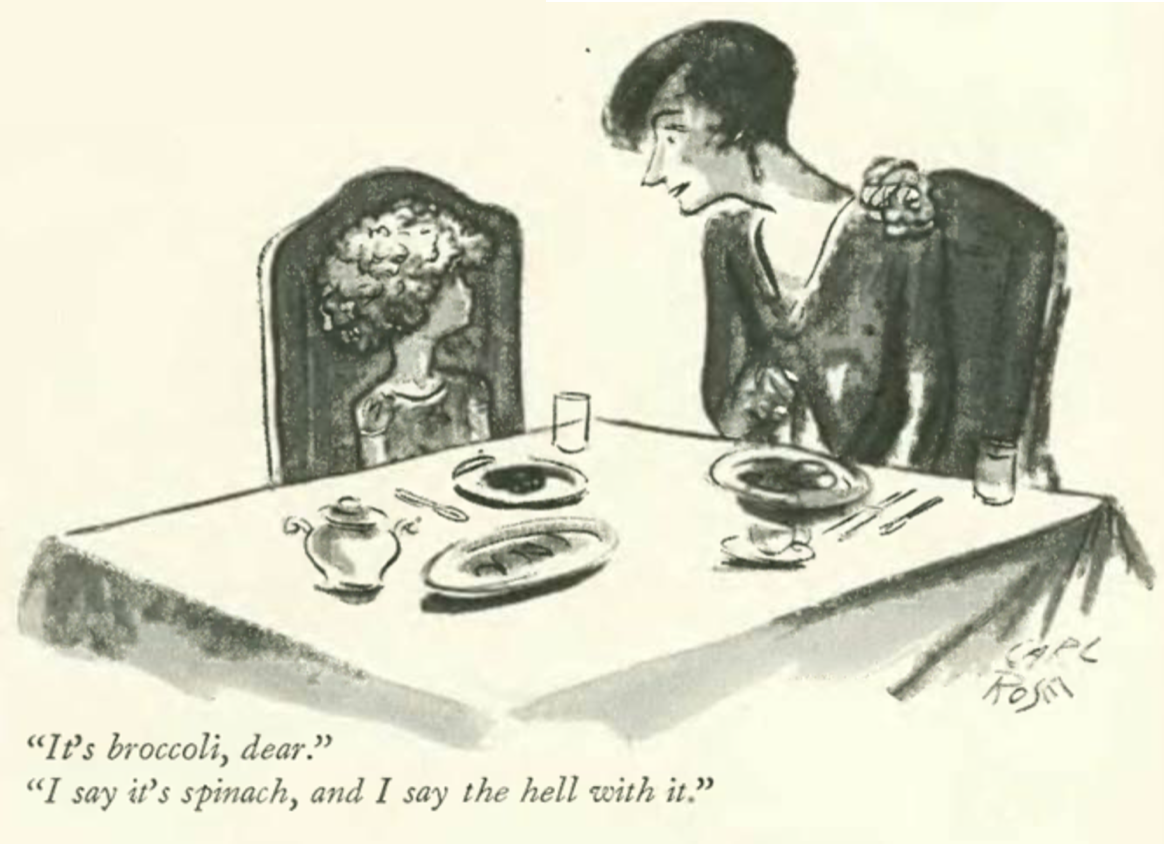
The Dec. 8, 1928 issue was significant for a cartoon by Carl Rose that appeared on the bottom of page 27:

It remains one of The New Yorker’s most famous cartoons, and for good reason. In his book About Town: The New Yorker and the World It Made, Ben Yagoda writes that the cartoon (drawn by Rose, with spinach line provided by E.B. White) “was picking up on something in the culture: it was a moment when the air reverberated with the sound of speech.” Yagoda notes that although “the cartoons led the way,” the magazine has always been filled with the sound of voices in “The Talk of the Town.” Naturalistic rendering of speech could also be found under the heading of such features as “Overheard,” which ran from 1927-1929 and included such contributors as the young writer John O’Hara.

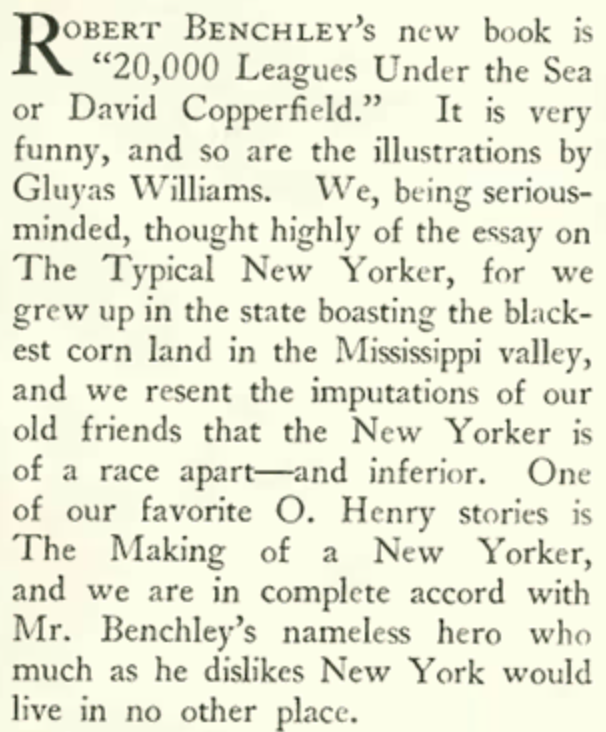
Another New Yorker contributor whose work resounded with the sound of speech, Robert Benchley, received some kind words from the magazine on his latest book, Twenty Thousand Leagues Under the Sea or David Copperfield:

DON’T BE SERIOUS…Robert Benchley and his book, 20,000 Leagues Under the Sea or David Copperfield, illustrated by his New Yorker colleague Gluyas Williams. The cover depicted Benchley performing his famous sketch, The Treasurer’s Report. (Goodreads/bio.com)

 * * *

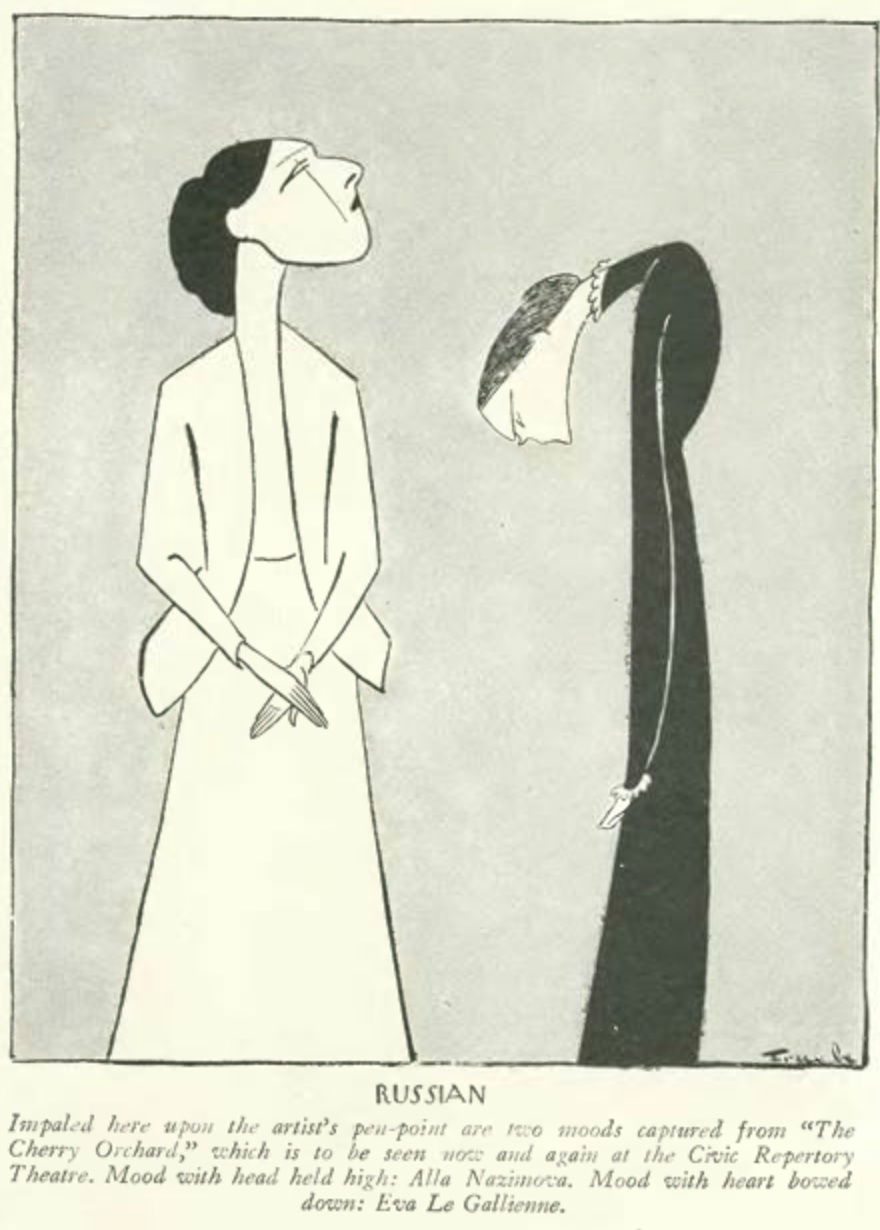
Appearing at the Civic Repertory Theatre (founded by actress Eva Le Gallienne in 1926) was Alla Nazimova and Eva herself in Anton Chekov’s last play, The Cherry Orchard. Al Frueh offered this sketch for the theatre review section.

Josephine Hutchinson as Anya, Alla Nazimova as Ranevskaya, and Paul Leyssac as Gayev in Anton Chekov’s last play, The Cherry Orchard, at the Civic Repertory Theatre in 1928. (eBay)
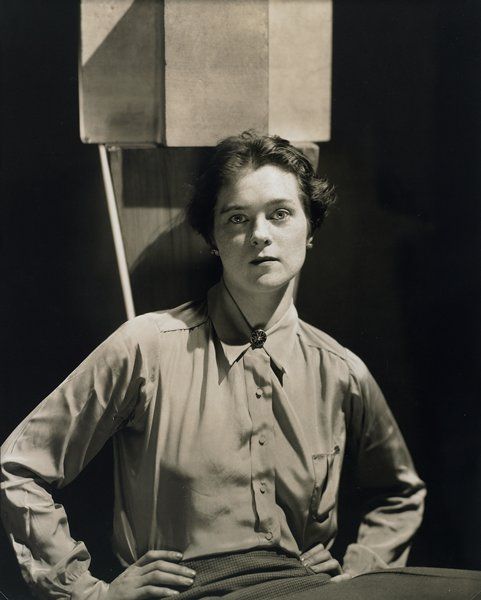
TOUR DE FORCE…Eva Le Gallienne in 1928, photo by Edward Steichen. (Minneapolis Institute of Art)

 * * *

From Our Advertisers

Advertisements from the Dec. 8 issue offered this study in contrasts…a “modern” take on the holidays by Wanamaker’s, featuring the unfortunately titled “Psycho-Gifts for Christmas”…

…versus the staid offerings of Brooks Brothers on the following page…

 * * *

On to the Dec. 15 issue, we find The New Yorker enjoying the debut of the Ziegfeld Follies latest revue…

December 15, 1928 — issue number 200 — cover by Julian de Miskey.

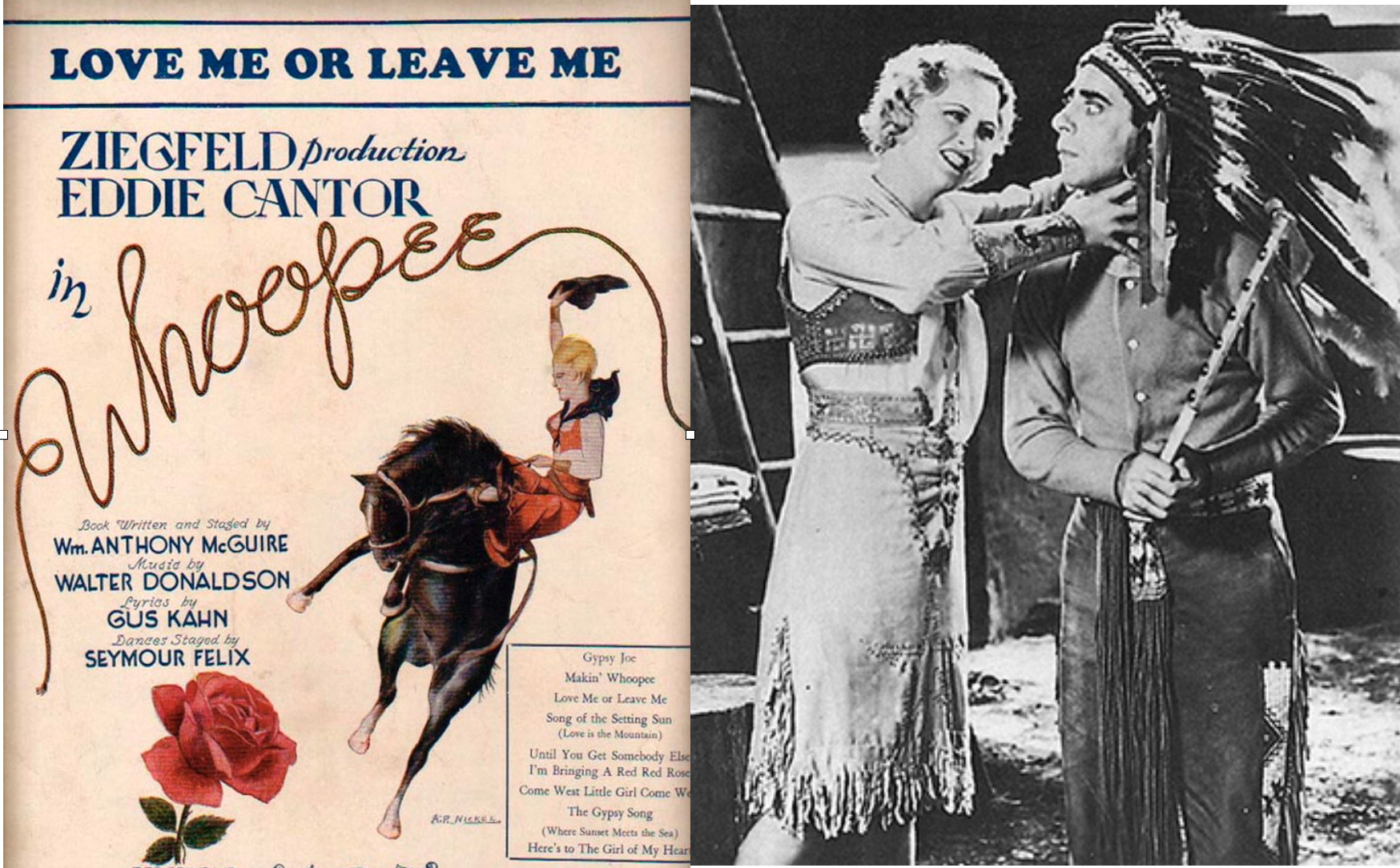
…the show “Whoopee” at the New Amsterdam, featuring Eddie Cantor:

HIT MAKER…Sheet music for the hit “Love Me Or Leave Me” from the Ziegfeld Follies show Whoopee. At right, a still from the 1930 film Whoopee!, with Eleanor Hunt and Eddie Cantor. (carensclassiccinema/thejumpingfrog.com)

And lest you think audiences were flocking to only see Eddie Cantor…

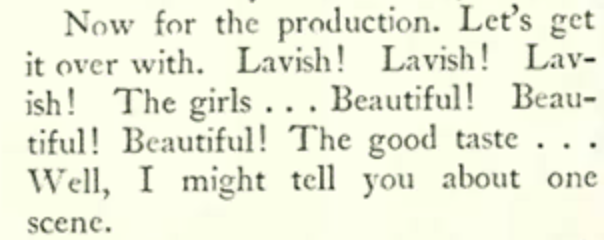
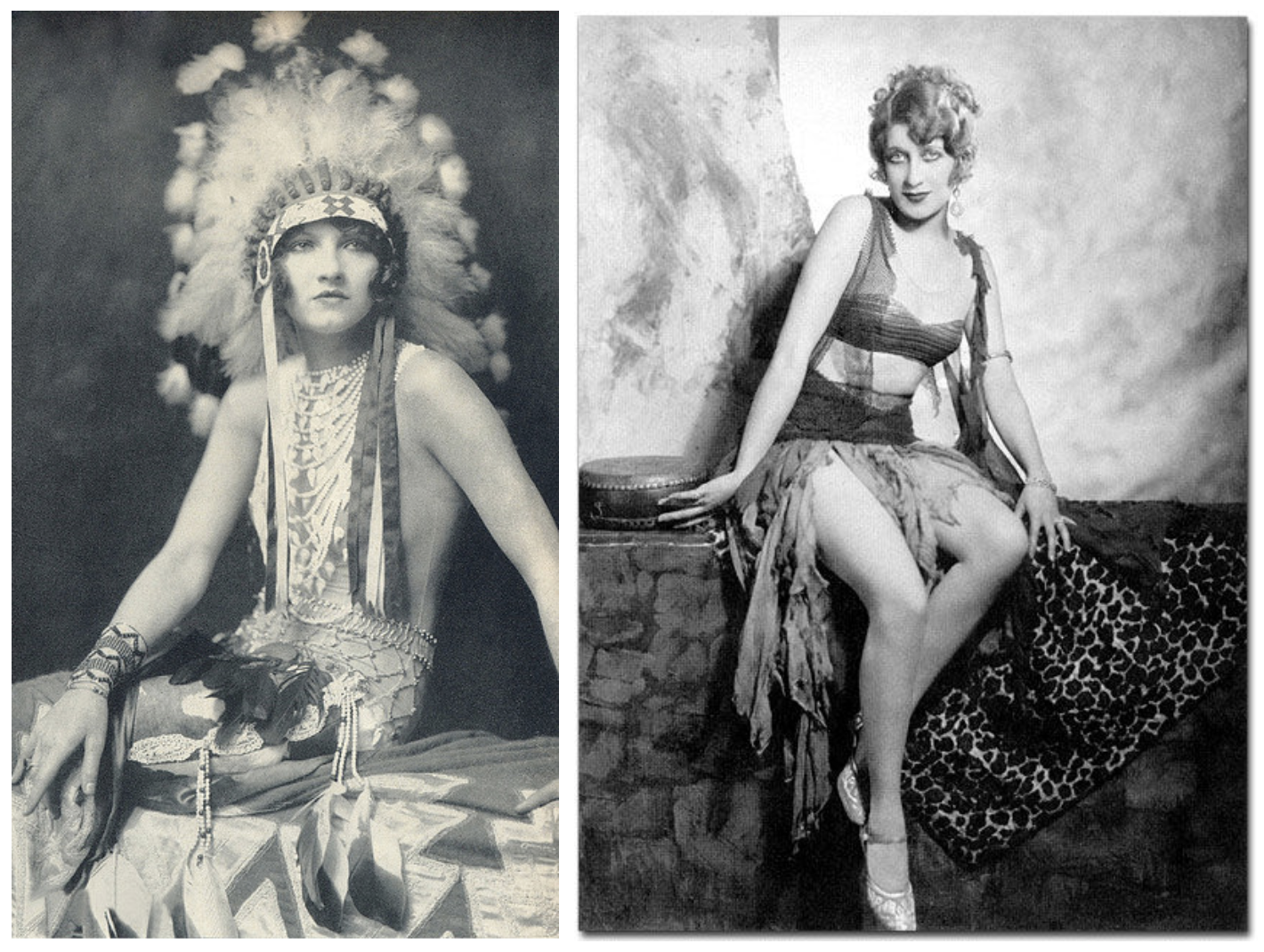
LAVISH, LAVISH!…At left, Ziegfeld Follies performer Jean Ackerman in Whoopee! At right, Ziegfeld performer Ruth Ettig’s rendition of “Love Me or Leave Me” in Whoopee made it a major hit as well as her signature song. (mote-historie.tumblr.com/Alfred Cheney Johnston photo via songbook1.wordpress.com)

 * * *

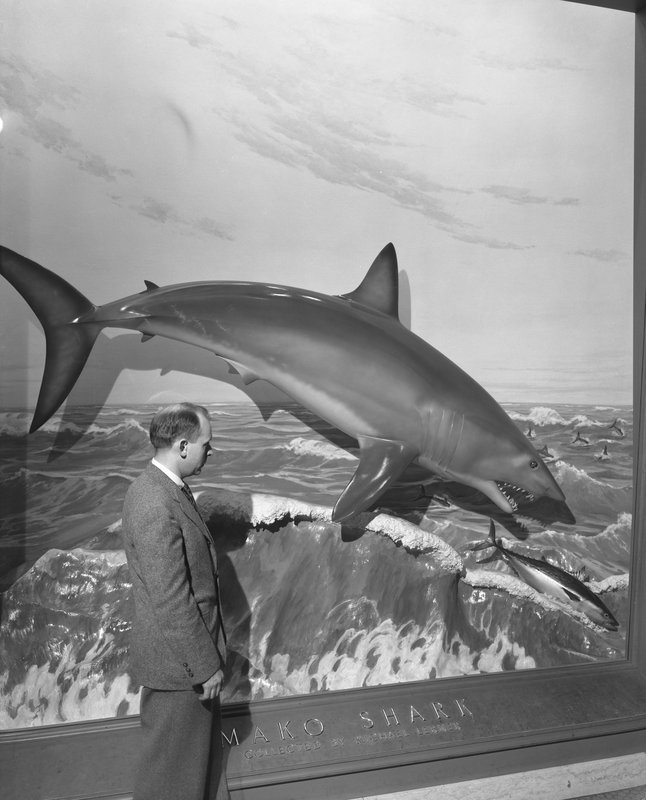
On to less glamorous pursuits, The New Yorker also paid a visit to the new “Fish Wing” at the Museum of Natural History, as recounted in “Talk of the Town.” A brief excerpt:

SWIMMING WITH THE FISHES…A visitor admires the mako shark exhibit at the Hall of Fishes in the American Museum of Natural History, 1948 (AMNH)

From Our Advertisers…

…comes this house ad from The New Yorker itself, promoting its first-ever Album:

Chris Wheeler has gathered all of the albums at this site.

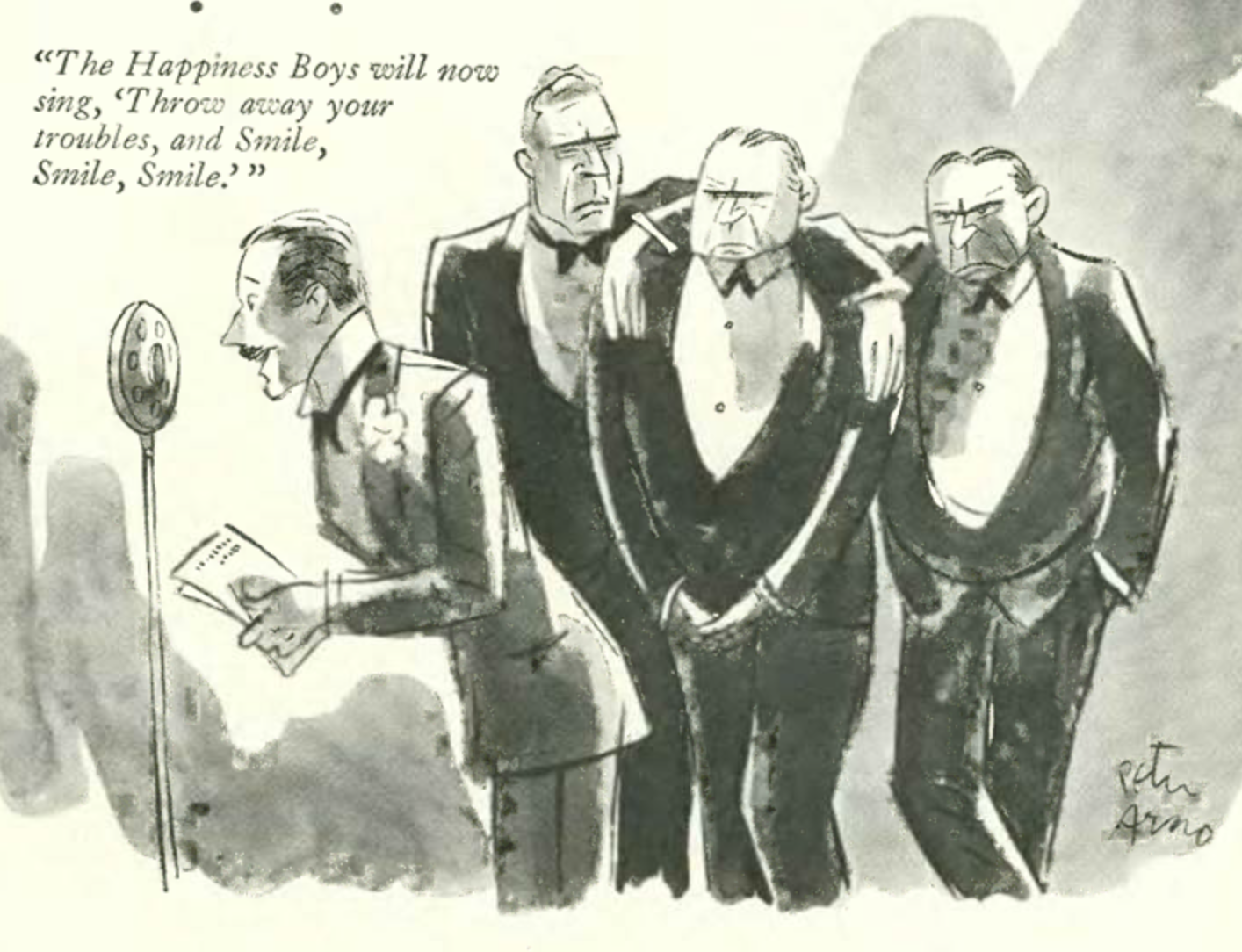
And finally, our cartoon, courtesy Peter Arno:

Next Time: Happy 1929!


What Santa Brought in 1928

As we sweep up the tinsel and wrappings from another holiday season, let’s take a look back at 1928 and see what the New York “smart set” wished for under the Christmas tree.

Nov. 24, 1928 cover by Julian de Miskey.

We’ll start with the outlandish, namely this advertisement from Kurzman furriers on Fifth Avenue, which offered just two rare chinchilla coats for sale, one for $45K and the other for a mere $20K. That would be roughly equivalent to $630K and $280K in 2017 dollars. Oh Santa baby…

If you didn’t get the chinchilla, you could have asked for a Glycine Swiss watch, a gift “whose smartness reflects your taste”… and is “the supreme adornment of the patrician wrist.”

The New Yorker was filled with such ads that appealed to class pretensions, but thankfully the editorial side of the magazine mostly tweaked those pretensions, including this Nov. 24 cartoon by John Elmore:

In the following issue (Dec. 1), Elmore also contributed this unsigned cartoon (thanks to Michael Maslin’s invaluable Ink Spill blog for the identification):

Back to the ads for Nov. 24, Kolster Radio continued its series featuring illustrations by New Yorker cartoonist Peter Arno, this one borrowing from his familiar themes featuring gold-diggers and sugar daddies…

…and 56-year-old stage and silent film actress Fannie Ward offered proof that lighting up a Lucky could keep you slim and youthful. Whether or not she actually smoked the things, Ward was indeed best known for her seemingly ageless appearance.

Our cartoons from Nov. 24 issue are courtesy of Arno…

…and Helen Hokinson

We continue our Christmas wish list with the Dec. 1, 1928 issue…

Dec. 1, 1928 cover by Rea Irvin.

Regarding gifts for her, how about some fine French perfume, “originally created for the exclusive use of one of the present Nobility of France” (apparently a person descended from the line that managed to keep their heads attached to their necks)…

…and for him, the ubiquitous Christmas necktie, with a choice of patterns that would still serve him well in 2018…

Your “smoking friends” would doubtless have appreciated a rum-infused rumidor, available in a variety of finishes and sizes…

…or you could choose from the sundries offered up by Abercrombie & Fitch (bookends appeared to be a popular item)…

…and finally, for that special, anal-retentive someone on your list, “Fabrikoid” covers would keep his or her periodicals neat and tidy (note the New Yorker is conspicuously missing here).

Note: Fabrikoid “was one of DuPont’s first non-explosives products. Produced by coating fabric with nitrocellulose (yep, basically the same flammable stuff silent films were printed on) and marketed as artificial leather, Fabrikoid was widely used in upholstery, luggage and bookbindings during the early 20th century. In the 1920s, Fabrikoid became the preferred material for automobile convertible tops and seat covers” (text from www2.dupont.com).

 * * *

Despite the holidays, there was still news to be reported. The Nov. 24 issue profiled violinist Fritz Kreisler, while the Dec. 1 edition featured a profile of Harpo Marx, written by his fellow Algonquin Round Tabler Alexander Woollcott. Two brief excerpts:

In this next excerpt, it is interesting to note that Woollcott couldn’t see ahead to the huge success in film that awaited Harpo Marx and his brothers. Just eight months after Woollcott’s profile, the Marx Brothers would premiere their first film, The Cocoanuts, and continue to draw on material from their vaudeville and Broadway days to produce a string a comedy hits throughout the 1930s and 40s.

In other news from the Dec. 1 issue, Frank Sullivan grumbled about the recent election of President Herbert Hoover and the state of politics in general, echoing the general sentiment of his New Yorker colleagues in dismissing the national elections as little more than silly sideshow. Two excerpts:

The New Yorker was less pessimistic when it came to the changing skyline, and was almost giddy at times about the latest technology seemingly transforming the city overnight. This time it was the gilded New York Life Insurance tower, and its impressive pneumatic tube system:

THINGS ARE LOOKING UP…Cass Gilbert’s newly completed New York Life Insurance Building in 1928. (Smithsonian)

 *  *  *

And to close, some more holiday offerings, this time for the kiddies, from Macy’s Department Store, as reported by writer Bertram Bloch:

The Macy’s Christmas window display in 1928 featured the Tony Sarg marionettes in a tableau based on The Adventures of Christopher Columbus. (Pinterest)
SUPER SOAKER…With this 1928 sit ‘n ride toy, junior could hose down the living room thanks to its large water tank and hand crank-operated water tower. (collector.com)

Next Time: Out of the Mouth of Babes…