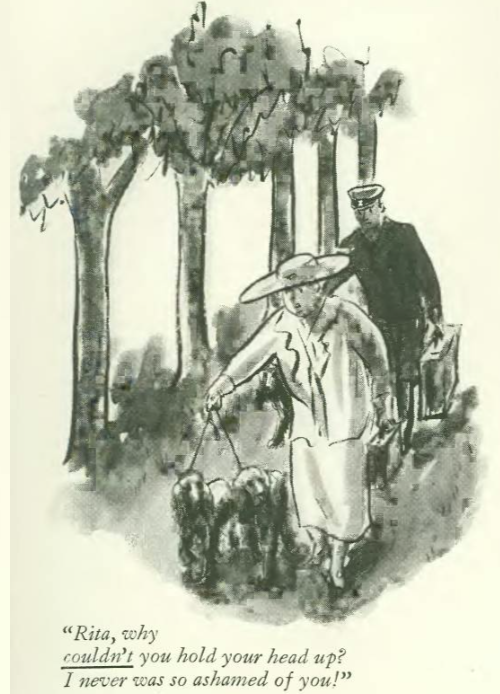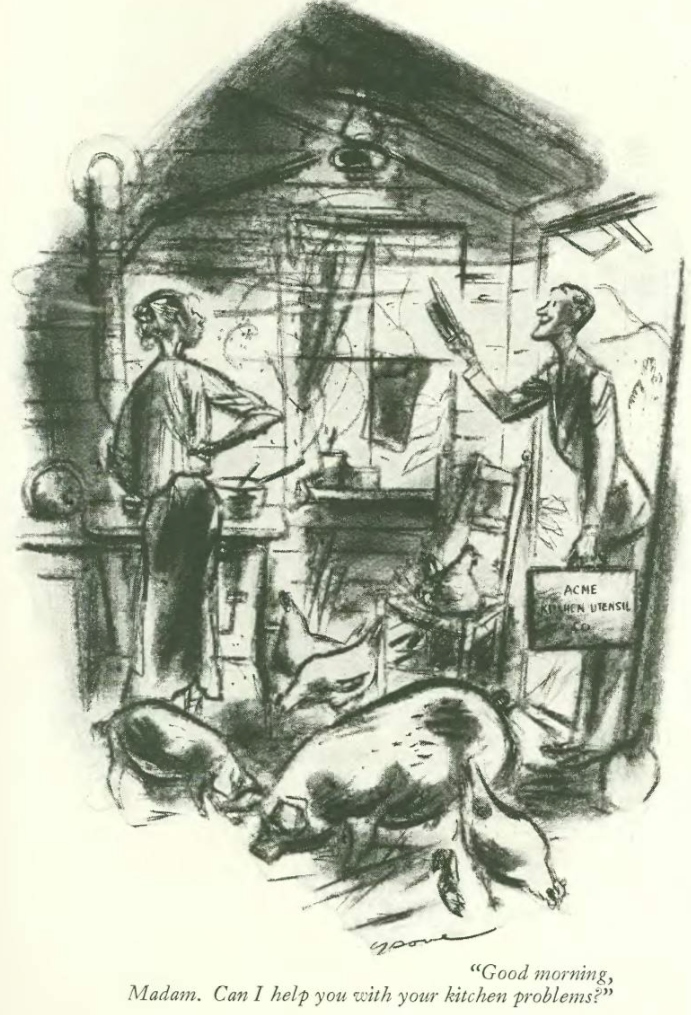
A Double-Header

Heading into the dog days of summer we take a look at the last two issues of July 1935, both somewhat scant in editorial content but still offering up fascinating glimpses of Manhattan life ninety years ago.

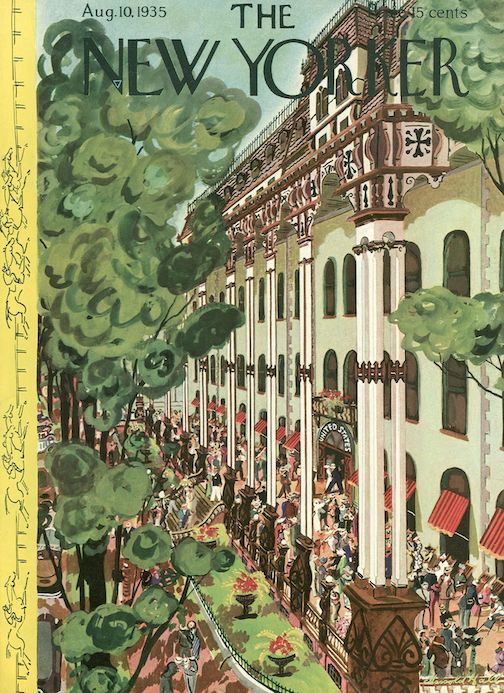
July 20, 1935 cover by William Crawford Galbraith. He contributed seven covers and 151 cartoons to the magazine.

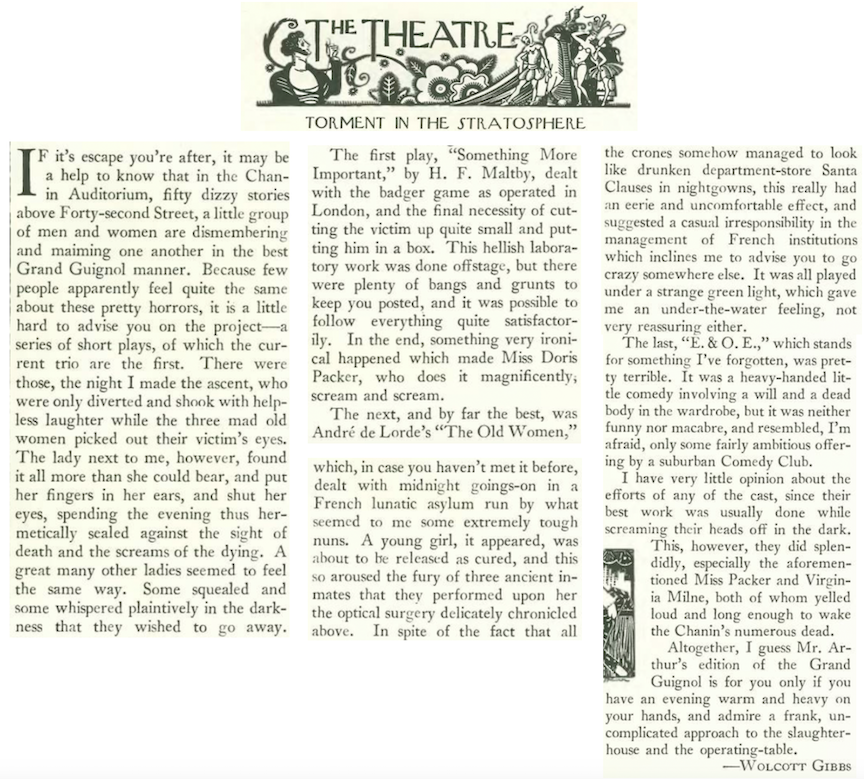
That includes the observations of theatre critic Wolcott Gibbs and film critic John Mosher, both escaping the summer heat to take in some very different forms of entertainment.

Gibbs found himself “fifty dizzy stories above Forty-second Street” in the Chanin Building’s auditorium, where he experienced New York’s take on Le Théâtre du Grand-Guignol. Founded in Paris by Oscar Méténier in 1897, Grand Guignol featured realistic shows that enacted, in gory detail, the horrific existence of the disadvantaged and working classes. It seems audiences were drawn to the shows more out of prurient interest (or sadistic pleasure) than for any desire to help the underclasses.

NOT FOR THE FAINT OF HEART…Wolcott Gibbs recommended the Grand-Guignol only for those who “admire a frank, uncomplicated approach to the slaughterhouse and the operating table.” (Image: Wikipedia)
PRETTY HORRORS…Clockwise from top left, the original Théâtre du Grand-Guignol, in the Pigalle district of Paris–it operated from 1897 until 1962, specializing in horror theatre; a poster from one of its productions; New York’s Chanin building, circa 1930s; the Chanin’s auditorium “fifty dizzy stories above 42nd Street”; fake blood applied to an actress’ neck before a scene from The Hussy; Wolcott Gibbs described a madhouse scene from André de Lorde’s The Old Women, which depicted the fury of ancient inmates performing “optical surgery” on a young woman. (thegrandguignol.com/Wikipedia/NYPL/props.eric-hart.com)

 * * *

Popeye to the Rescue

With the Hays Code in effect you wouldn’t see anything like the Grand-Guignol on the silver screen. Indeed, with the exception of a Popeye cartoon, critic John Mosher found little to get excited about at the movies. He did, however, enjoy the air conditioning that offered a break from the hot city streets.

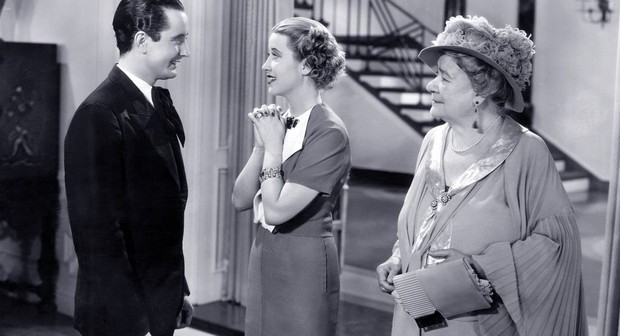
THEY ALL COULD HAVE USED SOME SPINACH…Clockwise, from top left, Popeye and Bluto strike an unlikely partnership in Dizzy Divers; Bette Davis and George Brent in Front Page Woman; Will Rogers and Billie Burke in Doubting Thomas; James Blakeley and Ida Lupino in Paris in Spring. (brothersink.com / rottentomatoes.com / cometoverhollywood.com / classiccartooncorner.substack.com)

 * * *

From Our Advertisers

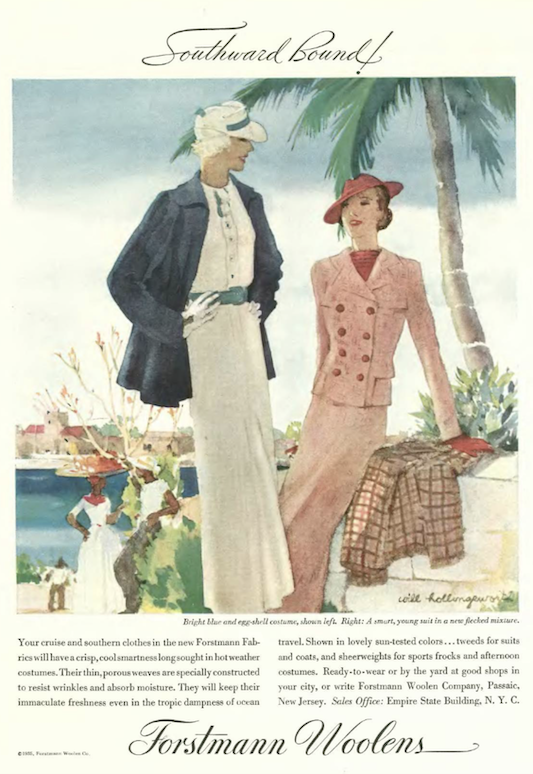
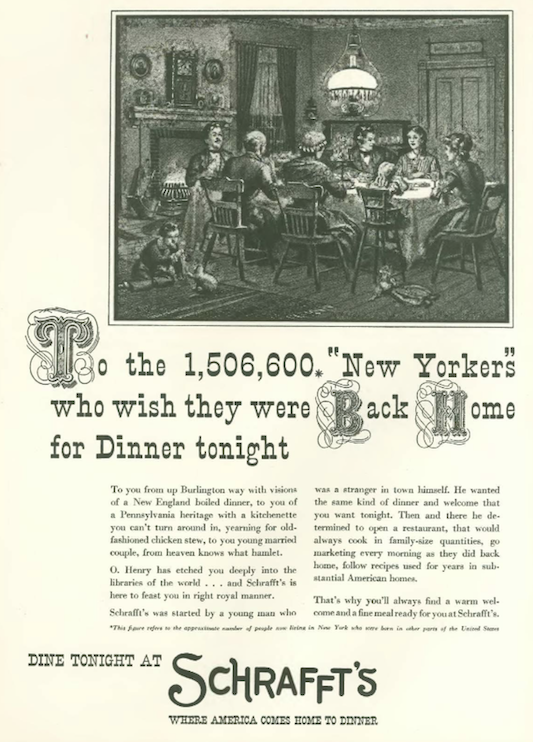
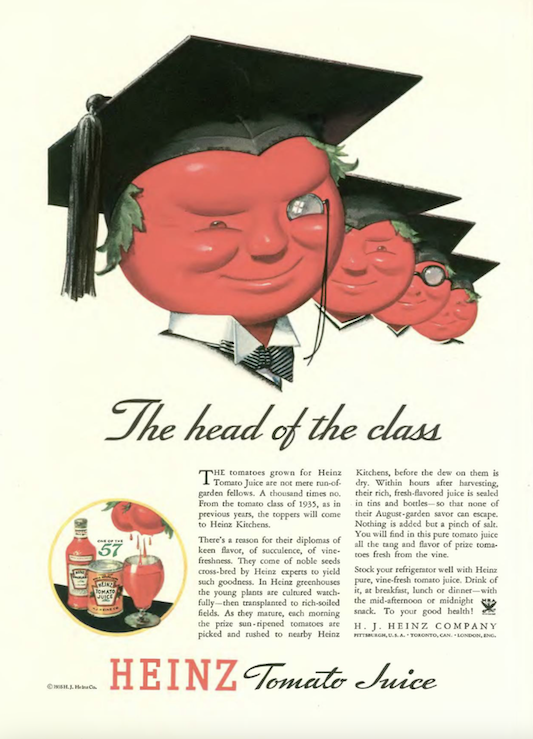
Just a few ads from this issue, first, a jolly appeal from one of the magazine’s newer advertisers, the makers of the French apertif Dubonnet…

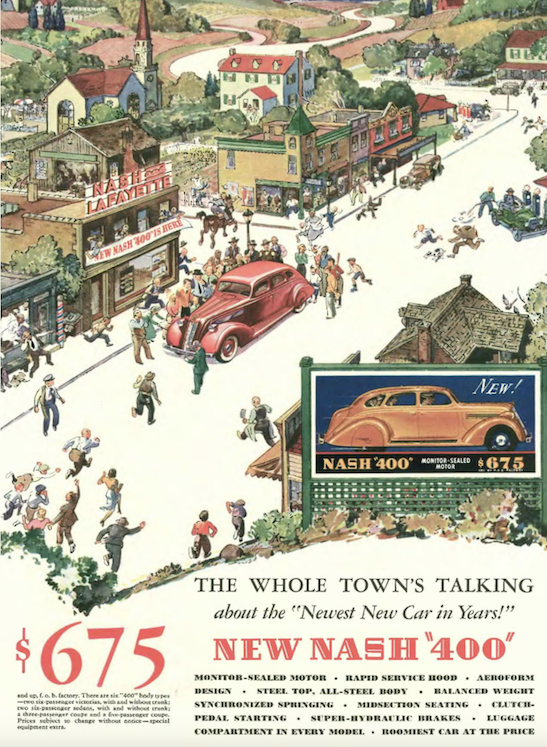
…by contrast, this quaint slice of Americana from Nash…

…and a shot of pesticide from Dr. Seuss

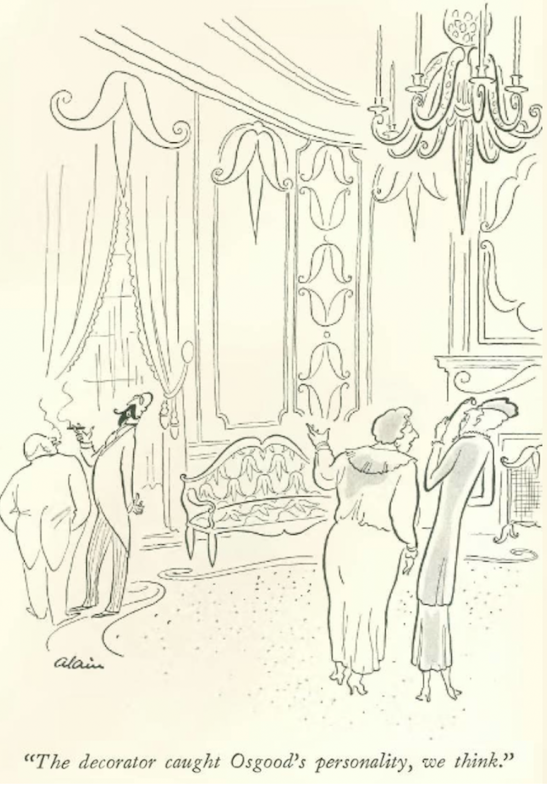
…our cartoonists include Constantin Alajalov, contributing this bit of spot art to the opening pages…

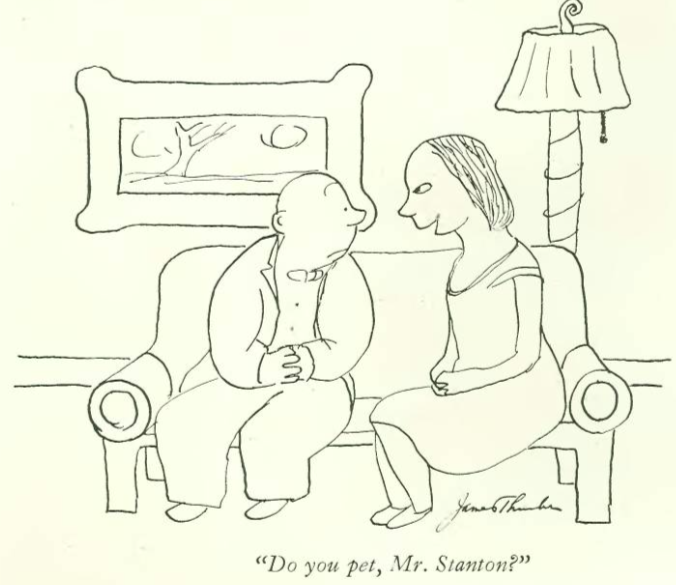
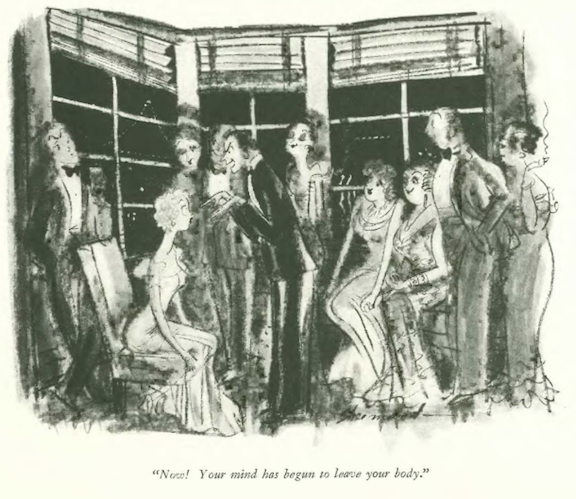
Barbara Shermund explored the world of hypnotic suggestion…

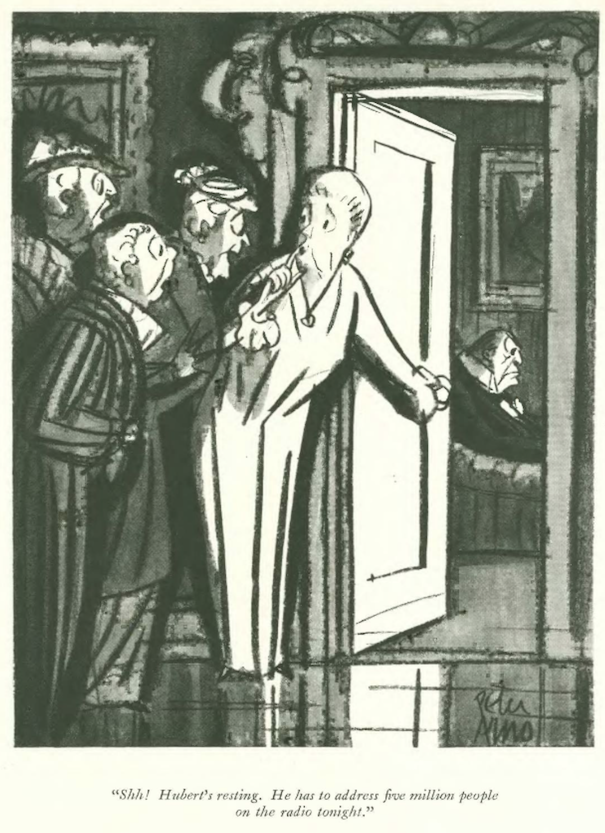
Peter Arno prepared to address the nation…

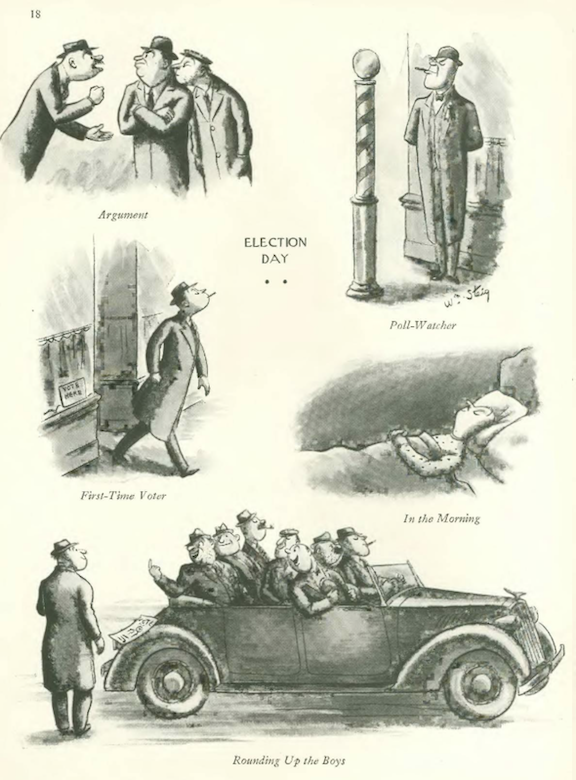
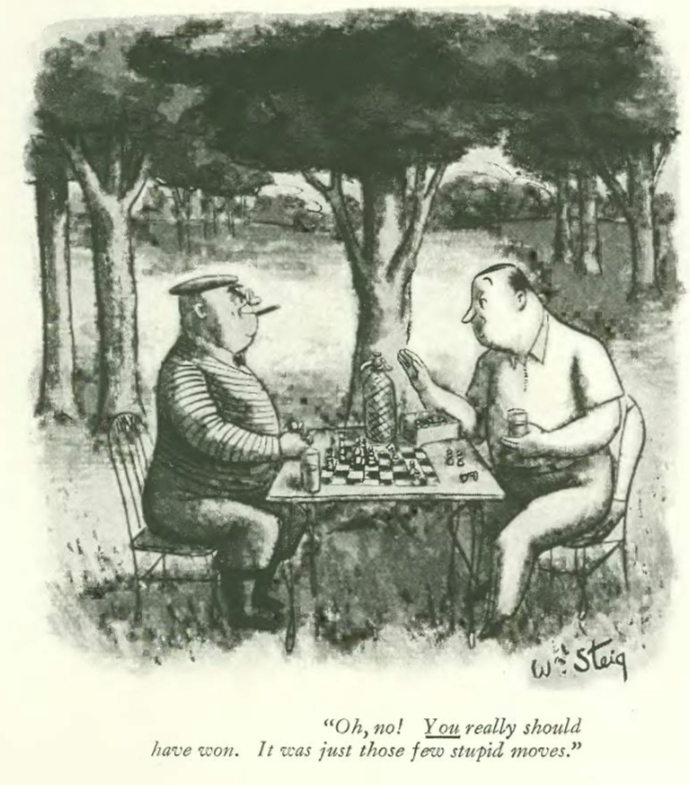
William Steig checked the weather forecast…

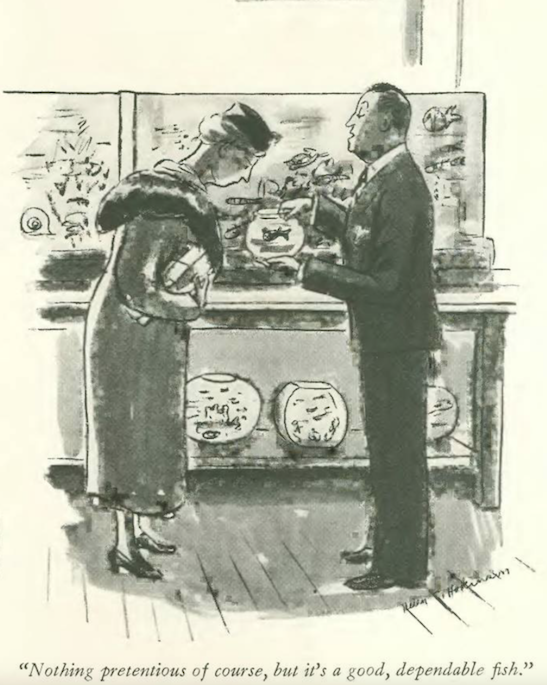
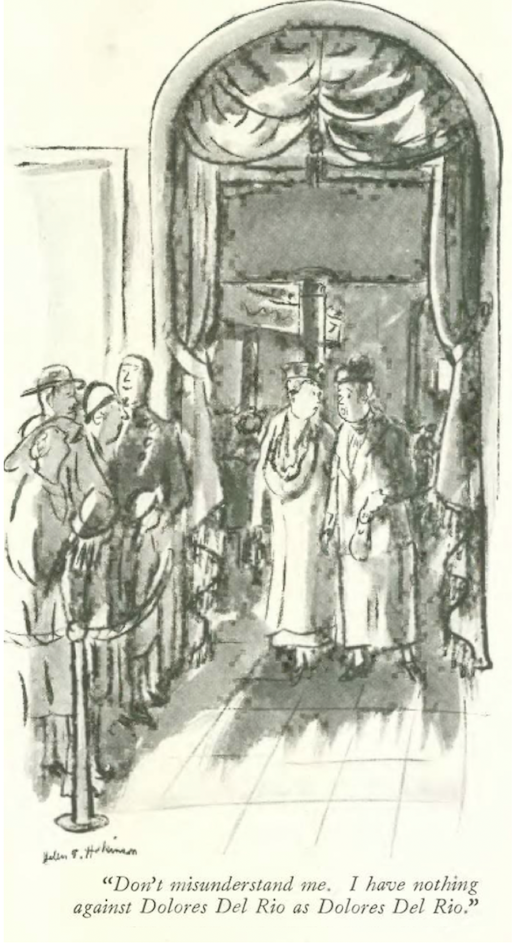
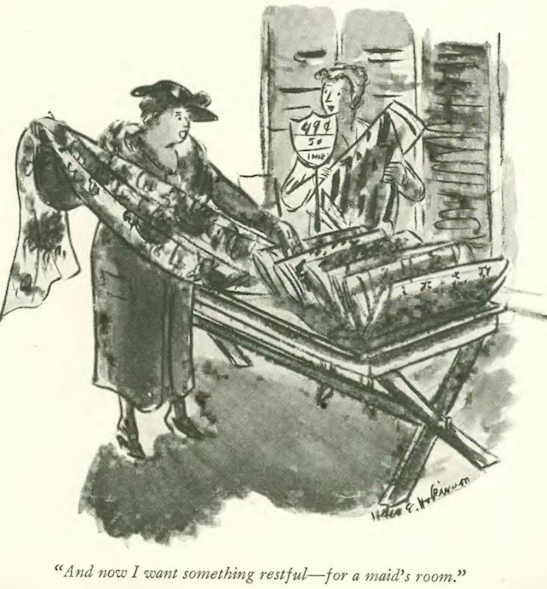
Helen Hokinson’s girls questioned the burden of a lei…

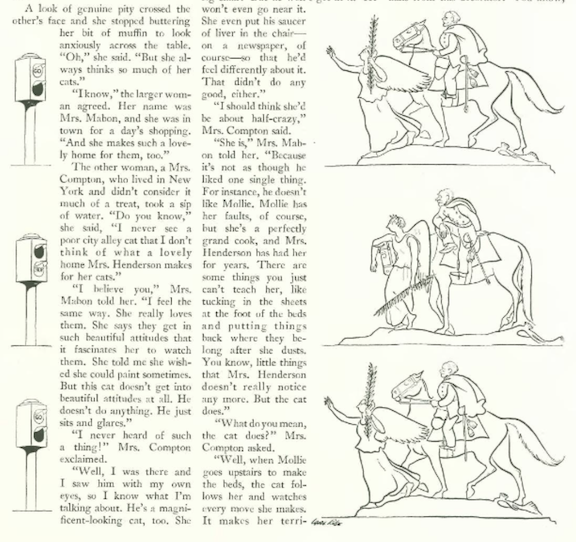
Carl Rose found himself on opposite sides of the page in this unusual layout

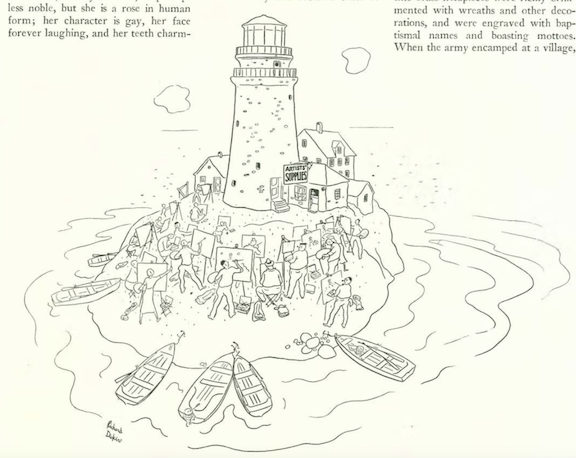
Richard Decker joined the crowd in a lighthouse rendering…

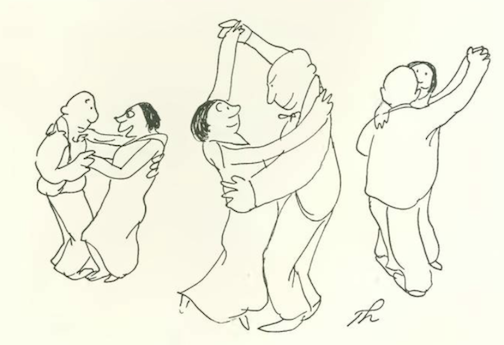
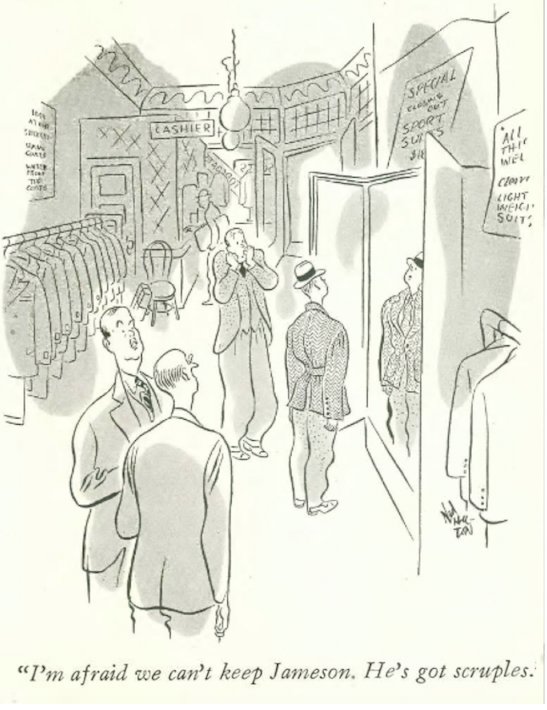
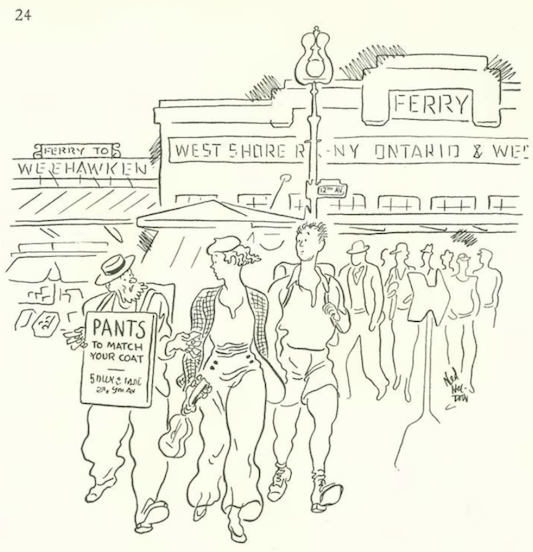
Ned Hilton reminds us that it was unusual for women to wear trousers ninety years ago…

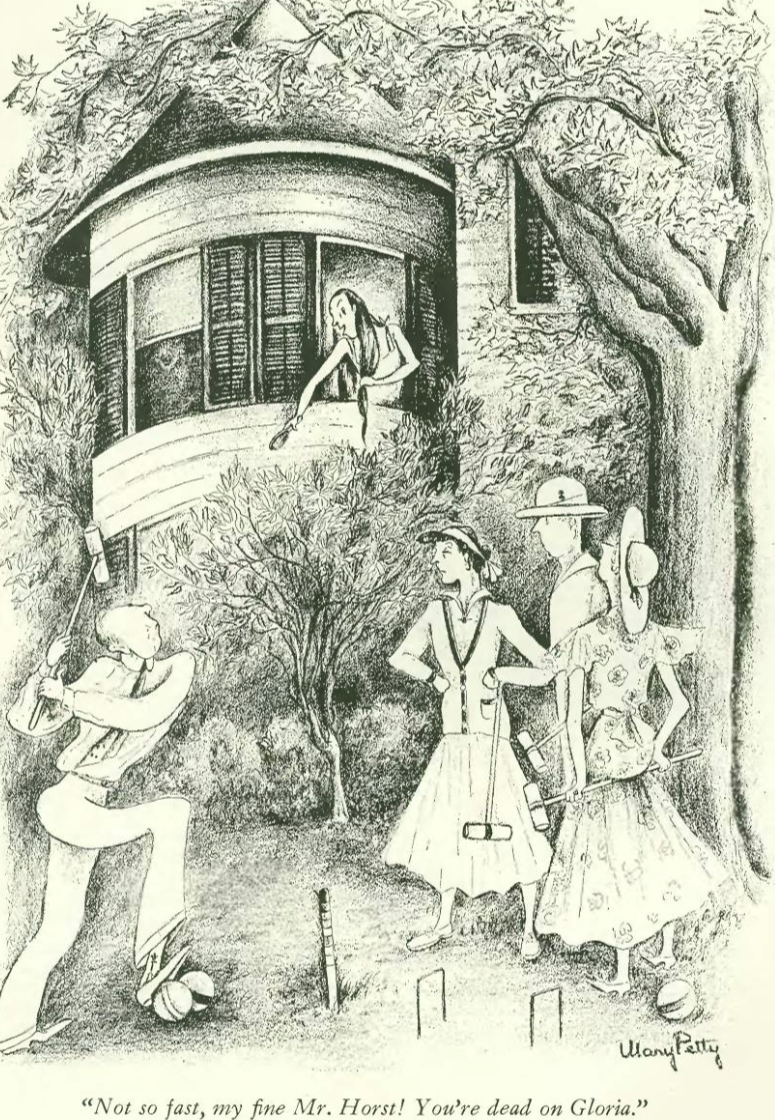
Mary Petty examined the complications of marital discord…

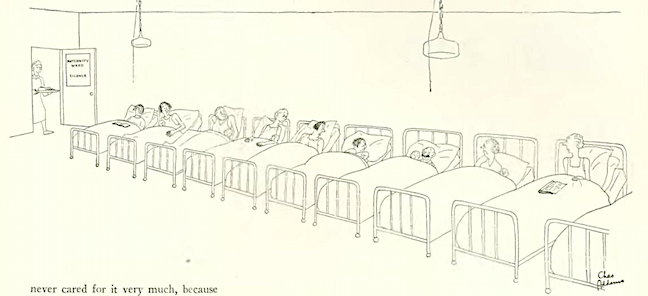
…and Charles Addams shone a blue light on a YMCA lecture…

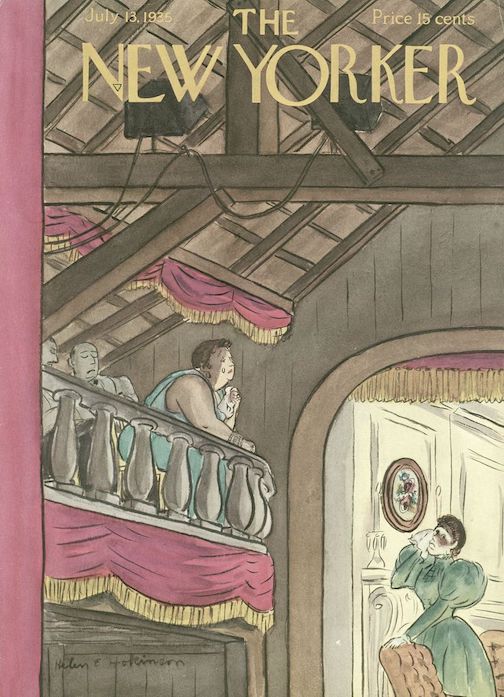
…on to July 27, 1935, with a terrific summertime cover by William Steig

July 27, 1935 cover by William Steig, one of his 117 covers for the magazine.

E.B. White (in “Notes and Comment”) was ahead of his time in suggesting that the city needed to build “bicycle paths paralleling motor highways” and invest in more pedestrian pathways.

NEW YORK’S FINEST…Doris Kopsky, who trained in Central Park, won the first Amateur Bicycle League of America Women’s Championship in 1937. Bicycle races were a big draw in the 1930s. (crca.net)

 * * *

Breaking News

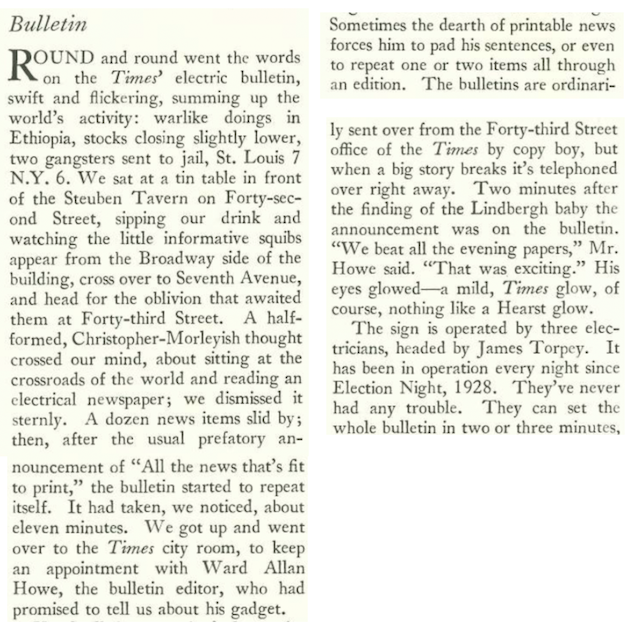
“The Talk of the Town” checked in on the New York Times’ “electric bulletin,” commonly known as “The Zipper.” Excerpt:

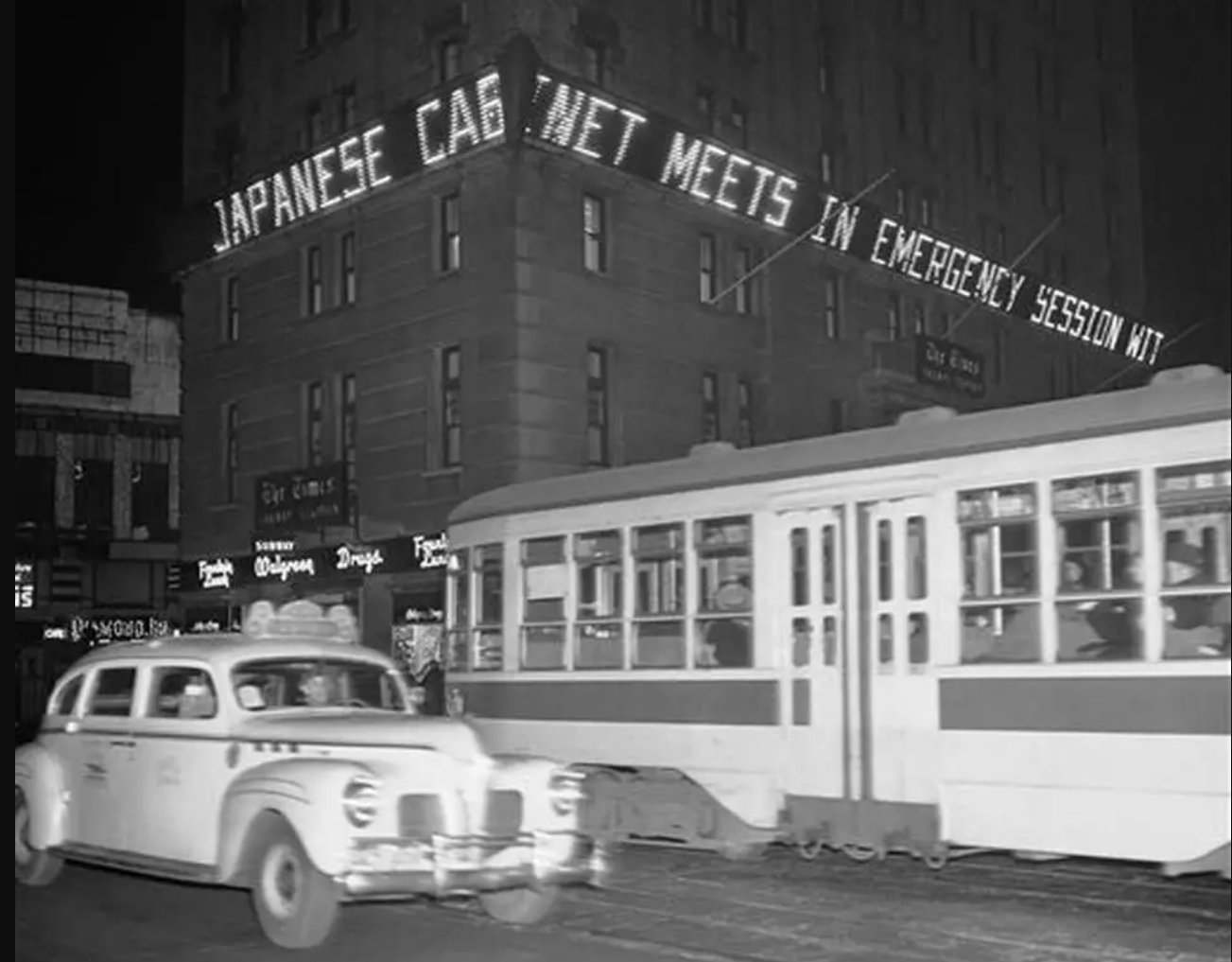
NIGHT CRAWLER…Launched in 1928, the Times Square “Zipper” kept New Yorkers apprised of breaking news. (cityguideny.com)

 * * *

Dog Knots

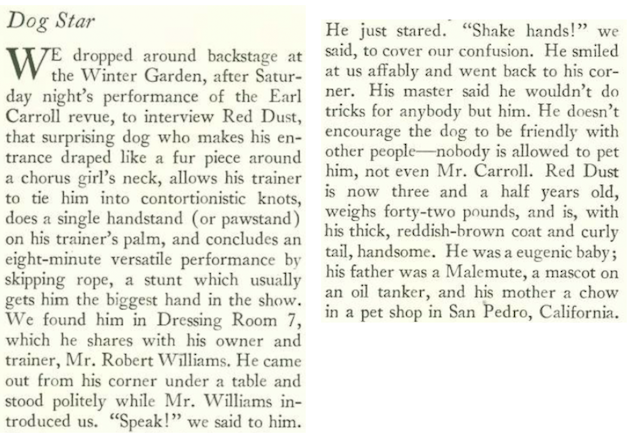
“Talk” also took a look backstage at the Winter Garden, where burlesque performers shared the stage with a contortionist dog called “Red Dust.” Excerpt:

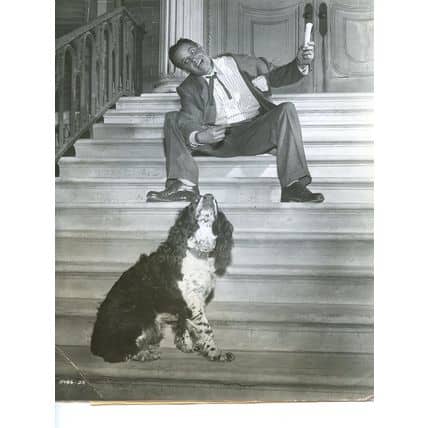
WOOF…Famed animal trainer Robert “Bob” Williams with one of his pupils. The dog in the photo is misidentified as Red Dust (he was actually a Malemute/chow mix).

 * * *

Suddenly Famous

Charles Butterworth (1896-1946) earned a law degree from Notre Dame before becoming a newspaper reporter. But his life would take on a new twist in 1926 when he delivered his comical “Rotary Club Talk” at J.P. McEvoy’s Americana revue in 1926. Hollywood would come calling in the 1930s, and his doleful-looking, deadpan characters would become familiar to movie audiences through a string of films in the thirties and forties. Alva Johnston profiled Butterworth in the July 27 issue. Here are brief excerpts:

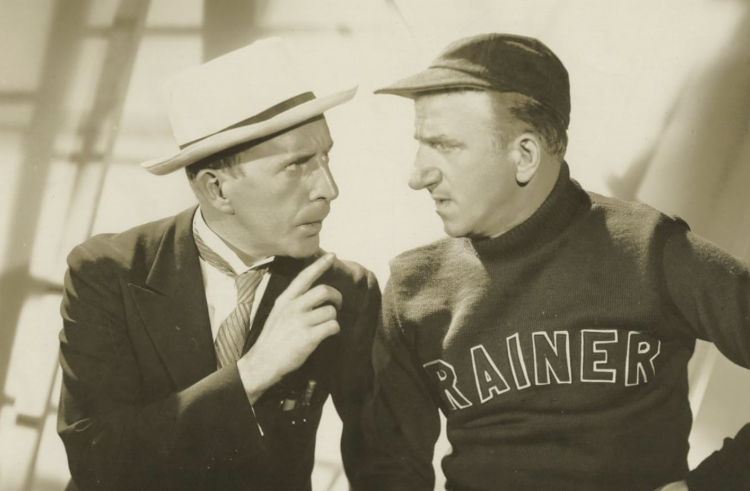
Charles Butterworth (left) and Jimmy Durante in Student Tour (1934). A bit of trivia: Butterworth’s distinctive voice was the inspiration for the Cap’n Crunch commercials voiced by Daws Butler beginning in the early 1960s. Butterworth’s life was cut short in 1946 when he crashed his imported roadster into a lamppost on Sunset Boulevard. (Detail from film still via IMDB)

 * * *

Noisy Neighborhood

The “Vienna Letter” (written by “F.S.”–possibly Frank Sullivan) noted the rumblings of fascism in a grand old European city known for its many cultural delights as well as its many factions that included Nazis, Socialists and Communists (and no doubt a few Royalists). An excerpt:

CALM BEFORE THE STORM…Vienna in 1935, less than three years before the Anschluss, when Nazi Germany annexed Austria. (meisterdrucke.us)

 * * *

Ex Machina

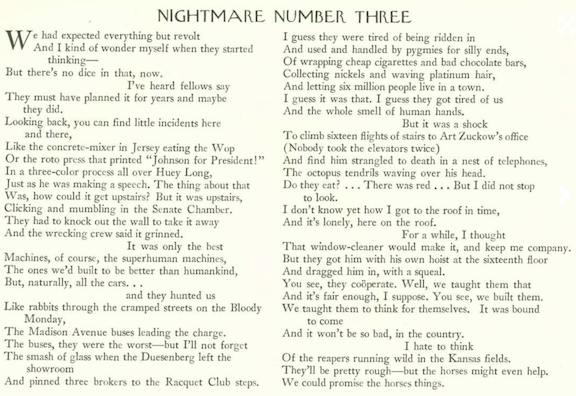
The Pulitzer Prize-winning poet and author Stephen Vincent Benét (1898-1943) penned this poem for The New Yorker that is somewhat appropriate to our own age and our fears of the rise of A.I. In “Nightmare Number Three,” Benét described a dystopian world where machines have revolted against humans.

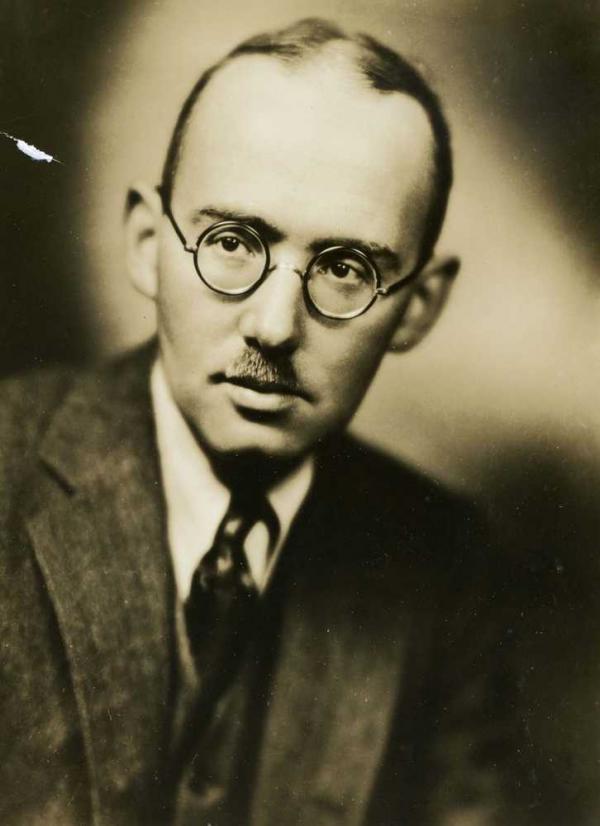
BOTH CLASSY AND FOLKSY is how some today describe Stephen Vincent Benét, who in 1928 wrote a book-length narrative poem of the American Civil War, John Brown’s Body, for which he received the Pulitzer Prize for Poetry. He was also know for such short stories as The Devil and Daniel Webster, published in 1936. (mypoeticside.com)

 * * *

From Our Advertisers

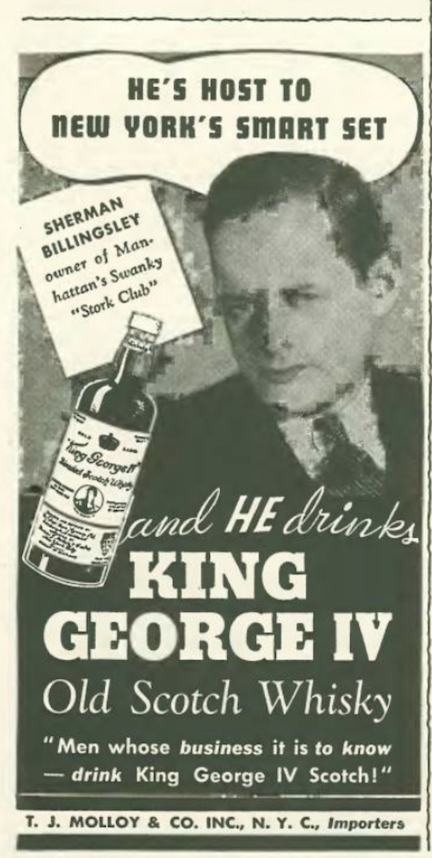
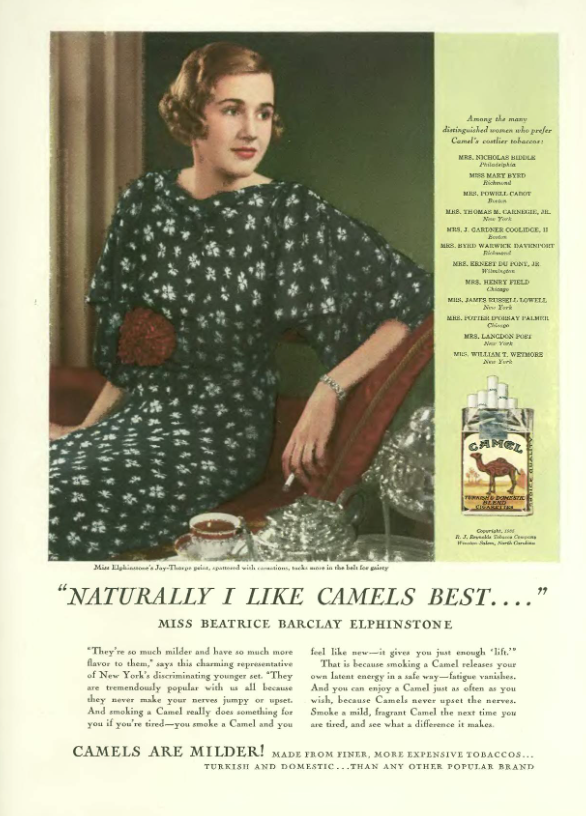
We begin with more extraordinary claims from R.J. Reynolds, who convinced a lot of folks that drawing smoke into your lungs actually improved your athletic stamina…

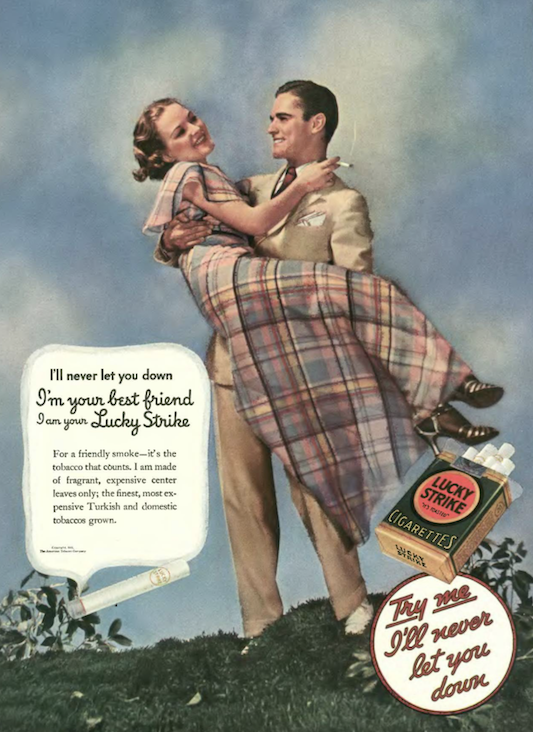
…the makers of Lucky Strike, on the other hand, stuck with images of nature and romance to suggest the joys of inhaling tar and nicotine…

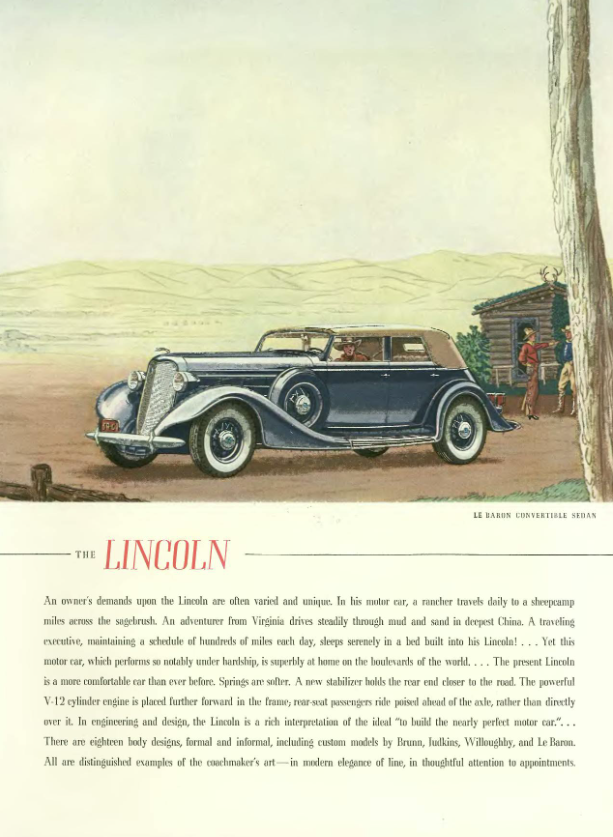
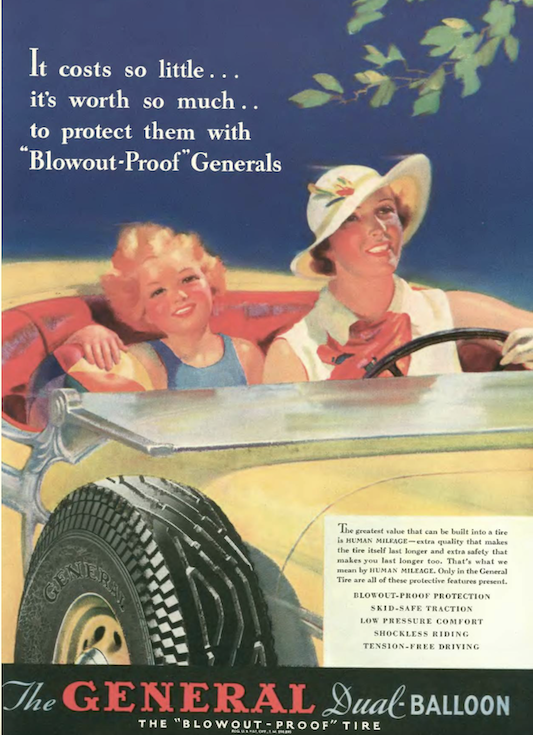
…General Tire took a cue from Goodyear, suggesting that an investment in their “Blowout-Proof Tires” was an investment in the very lives of a person’s loved ones (even though they apparently drove to the beach without seatbelts or even a windshield)…

…another colorful advertisement from the makers of White Rock, who wisely tied their product to ardent spirits as liquor consumption continued to rebound from Prohibition…

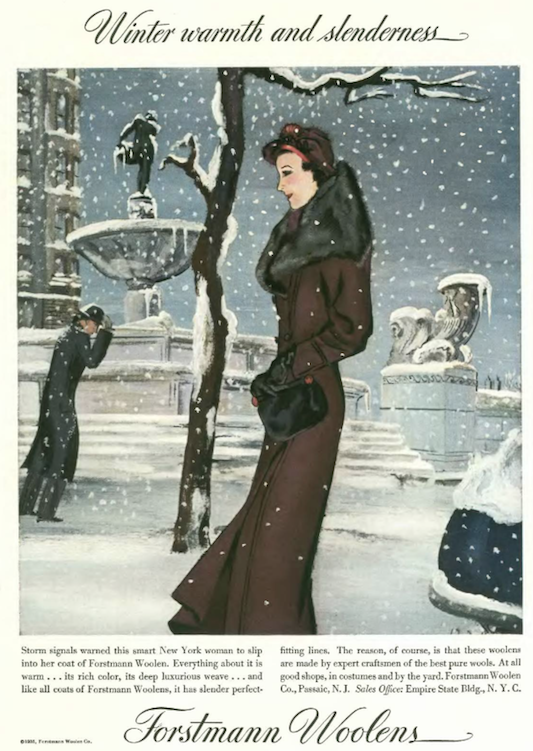
…I toss this in for the lovely rendering on behalf of Saks…it looks like the work of illustrator Carl “Eric” Erickson, but he had many imitators…

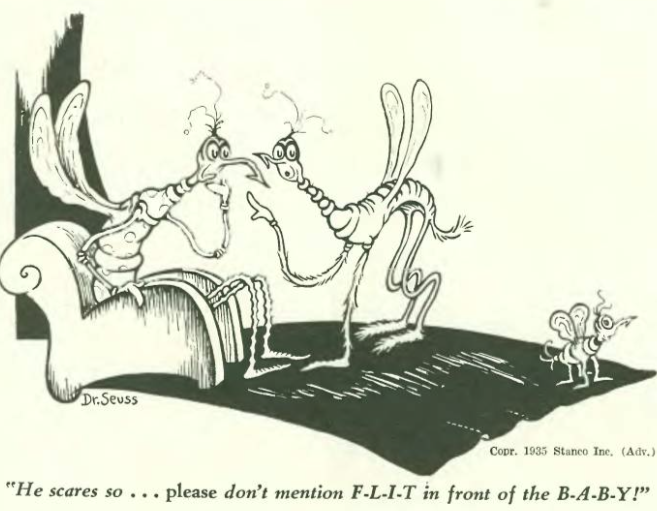
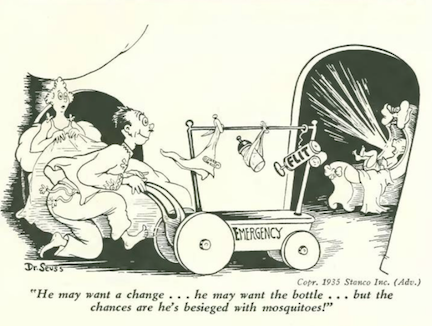
…we do, however, know the identity of this artist, and his drawings on behalf of the pesticide Flit, which apparently in those days of innocence was thought appropriate for use around infants…

…great spot drawing in the opening pages…I should know the signature but it escapes me at the moment…

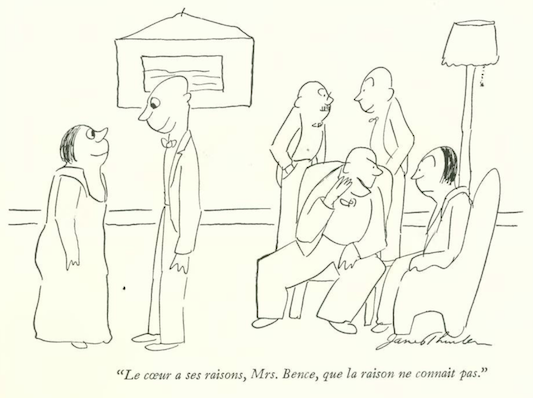
James Thurber quoted Blaise Pascal for this tender moment ( “The heart has its reasons, of which reason knows nothing”)…

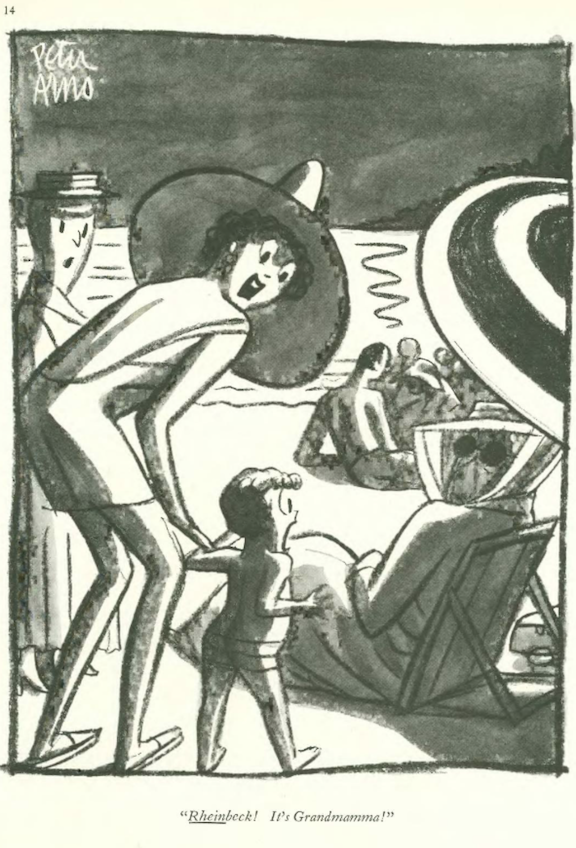
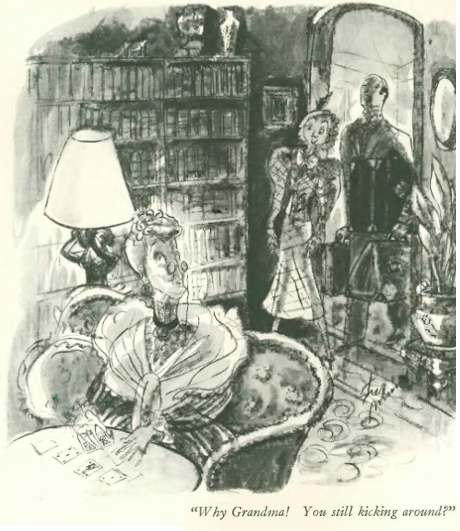
Peter Arno illustrated the horrors of finding one’s grandmother out of context…

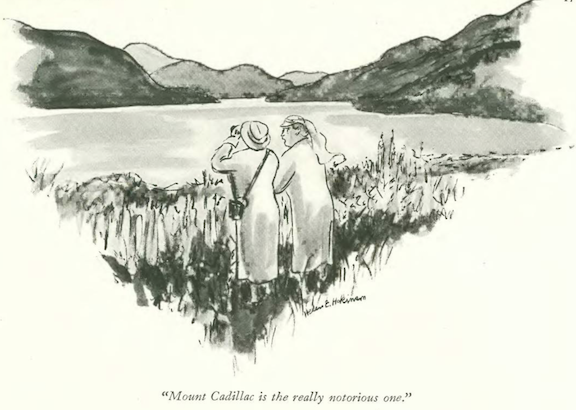
Helen Hokinson’s girls employed a malaprop to besmirch the good name of an innocent mountain…

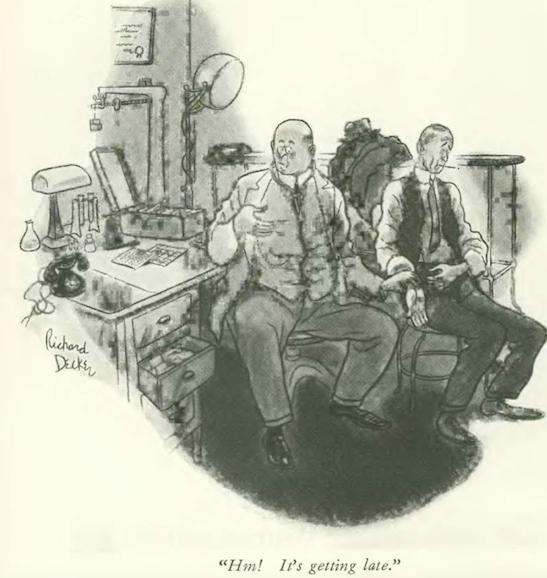
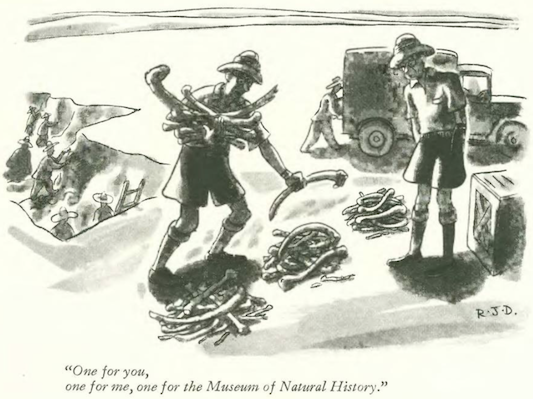
Richard Decker discovered the missing link(s) with two archeologists…

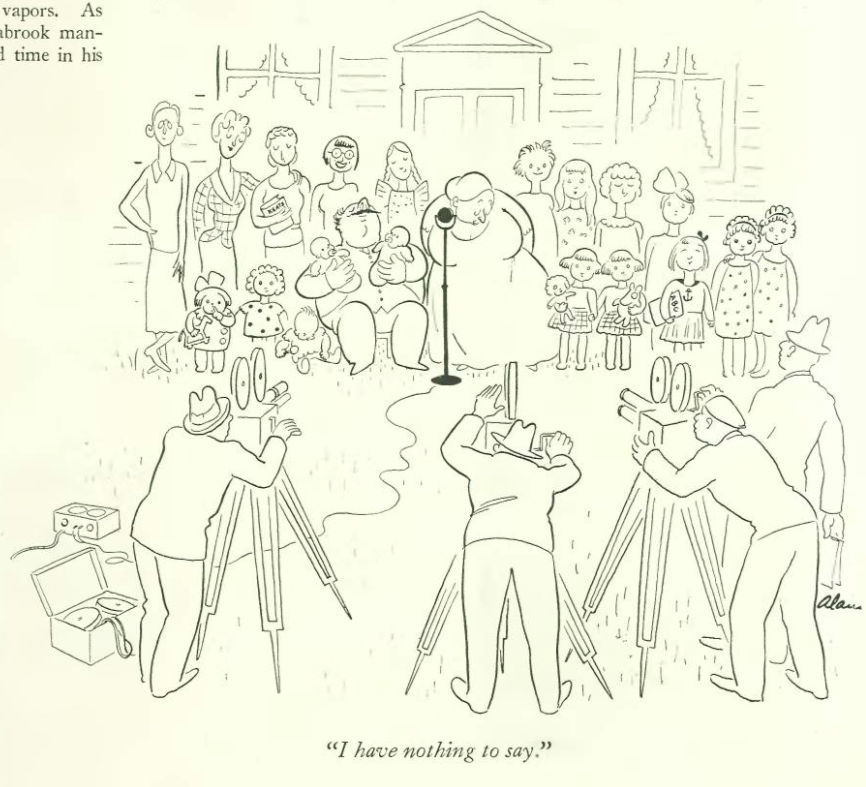
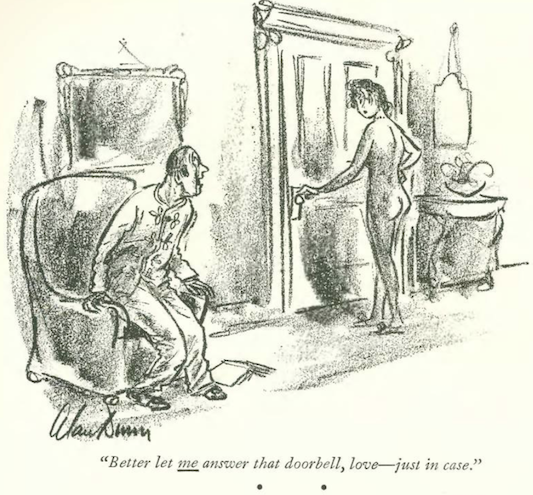
Alan Dunn narrowly averted a surprise greeting…

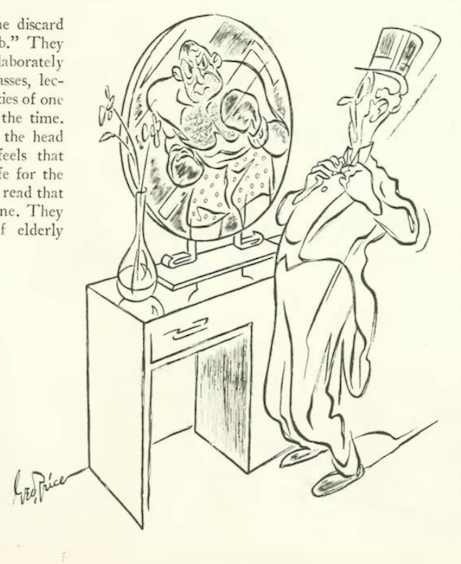
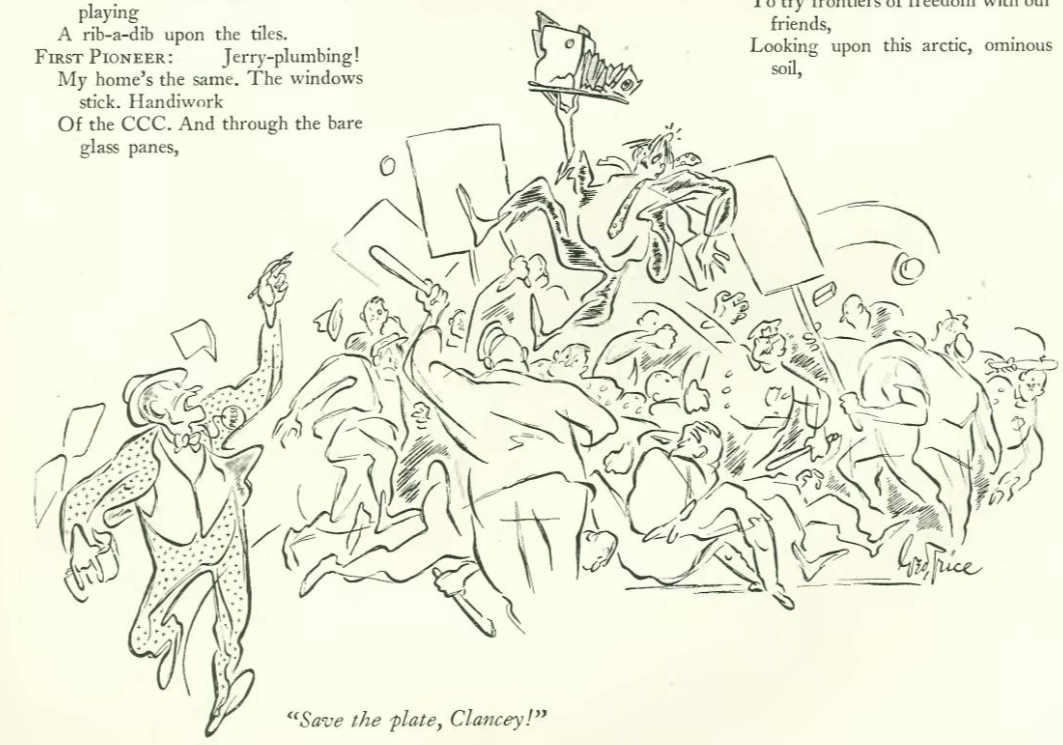
George Price added a new twist to a billiards match…

…Price again, at the corner newstand…

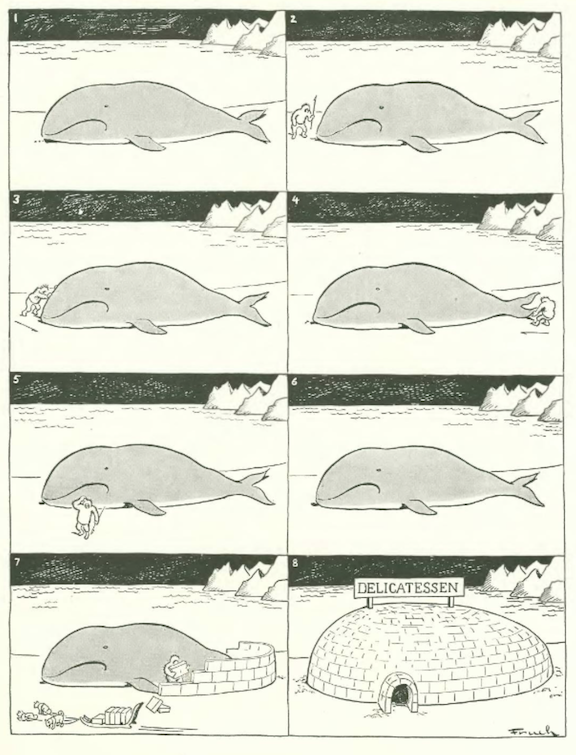
Al Frueh bit off more than he could chew…

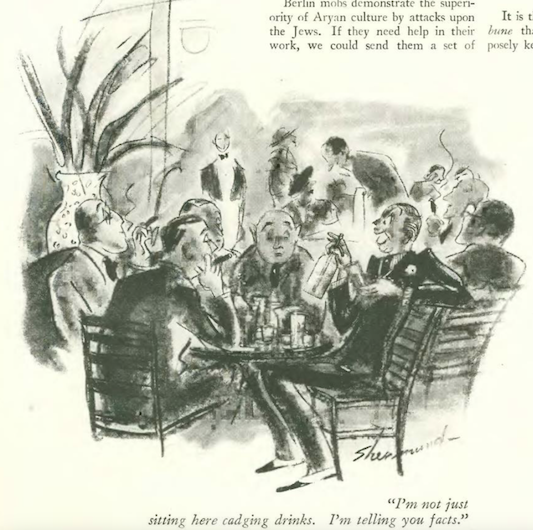
…and we close with Barbara Shermund, and a prattling mooch…

Next Time: La Marseillaise…

Independence Day 1935

We mark the July 4 weekend with a lighter edition of A New Yorker State of Mind

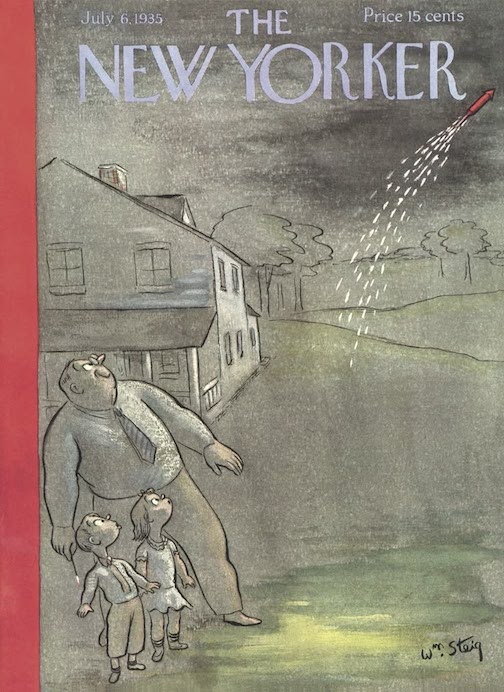
July 6, 1935 cover by William Steig, a contributor to The New Yorker from 1930 to 2003, including more than 2,600 drawings and 117 covers.

…and see what many New Yorkers were doing on that holiday ninety years ago…

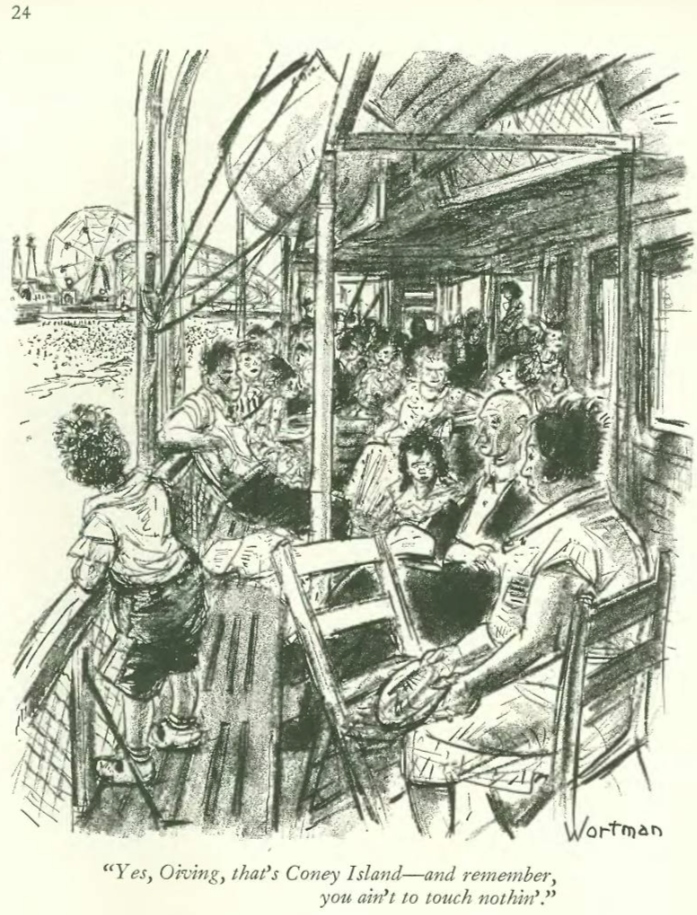
TOGETHERNESS…New Yorkers celebrate the Fourth of July on a Coney Island beach, circa 1935. (coneyislandhistory.org)

Let’s look at some of the advertisements from the July 6 issue, beginning with this alarming image that greeted readers on the inside front cover…

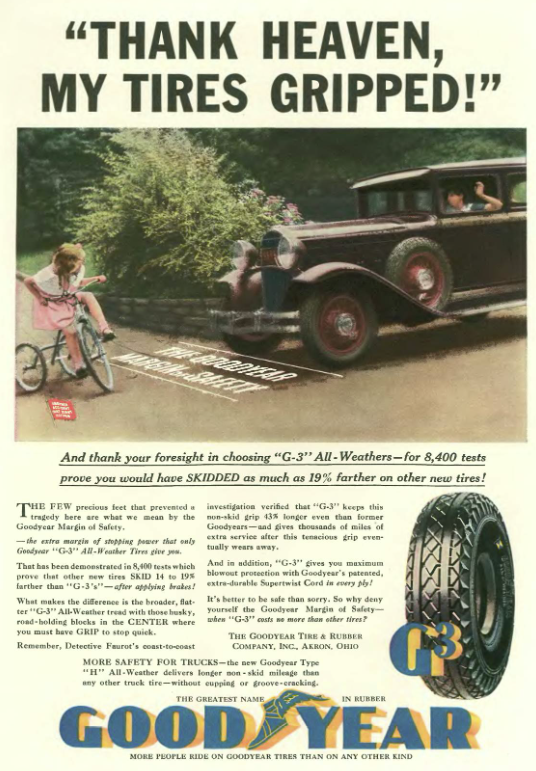
…Goodyear continued its series of safety-minded advertisements (this one on the inside back cover) that played on the fears of parents with driving-age children…strange how no one then considered other hazards such as the hard steel dash, or worse, the steering column that often impaled drivers…also, is that how they taught folks to hold a steering wheel in the 1930s?…

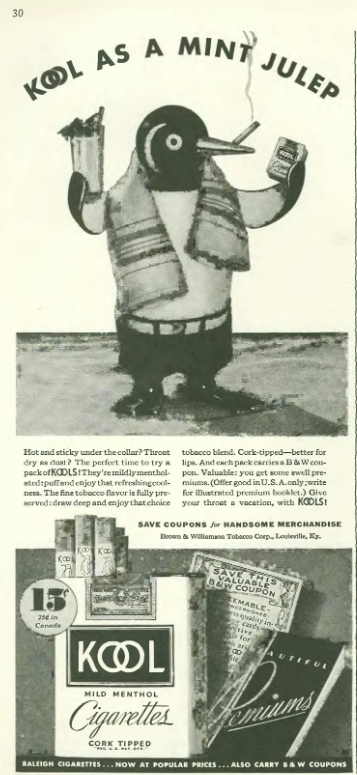
…no stylish models, debutantes or famous athletes for the makers of Chesterfields, at least not in this back page ad which equated their cigarette papers (and by association, the cigarettes themselves) with wholesome milk and pure mountain water…

…we kick off the cartoons with Robert Day, who took to the roads with a touch of modernism…

Gardner Rea topped off the calendar section with a nod to fireworks safety…

…known more for his New Yorker covers, Constantin Alajalov reflected on a visit to the Met…

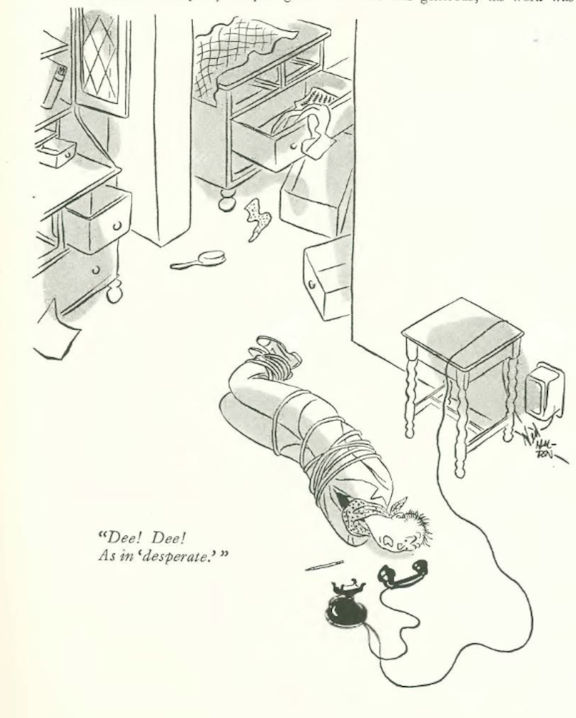
Ned Hilton was tied up on the phone…

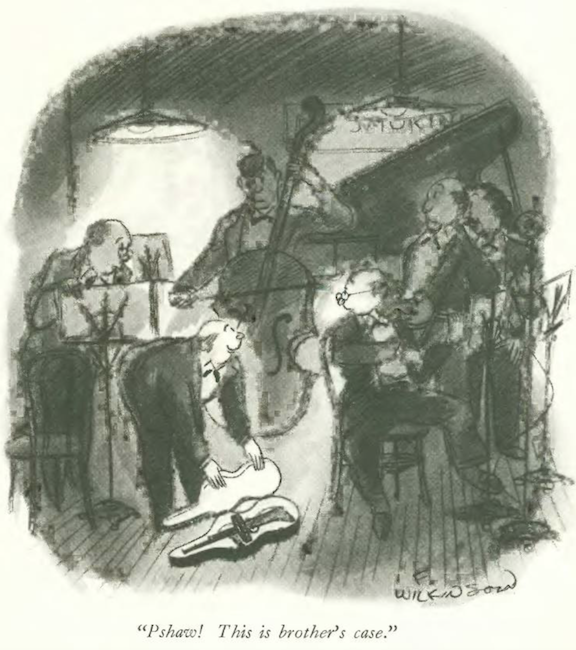
Fritz Wilkinson had one musician ready to play a different tune…

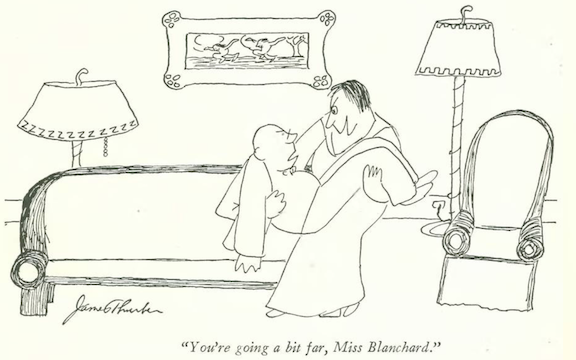
James Thurber was up in arms…

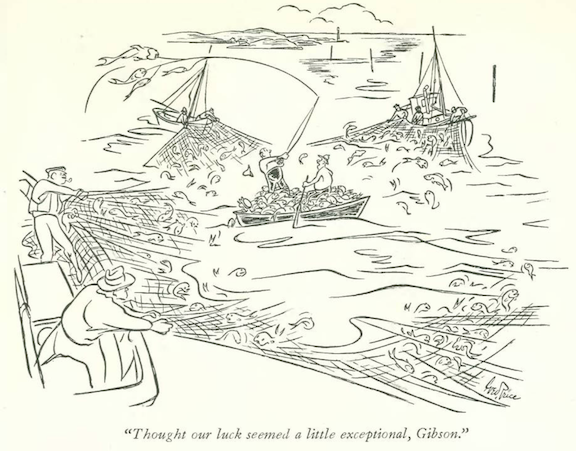
George Price found something fishy with two fishermen…

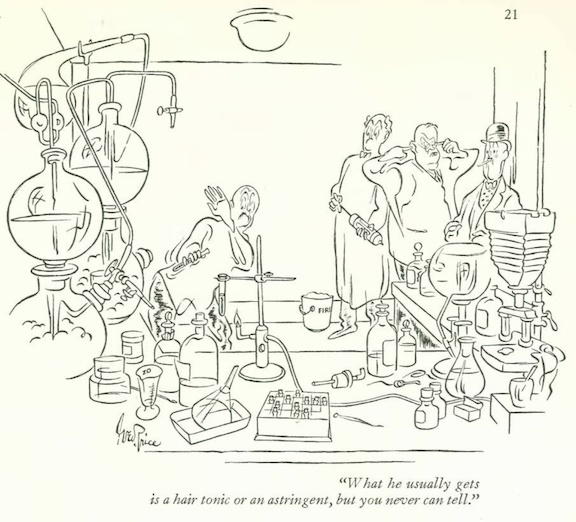
…and Price again, with the latest advances in personal hygiene…

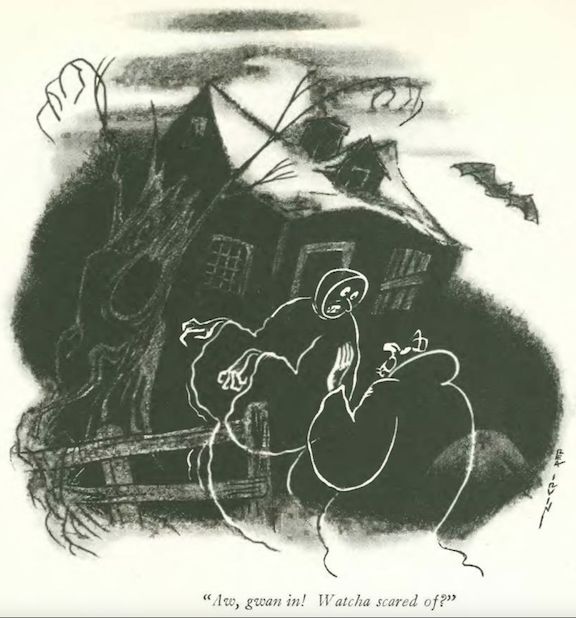
Rea Irvin gave us an early taste of Halloween…

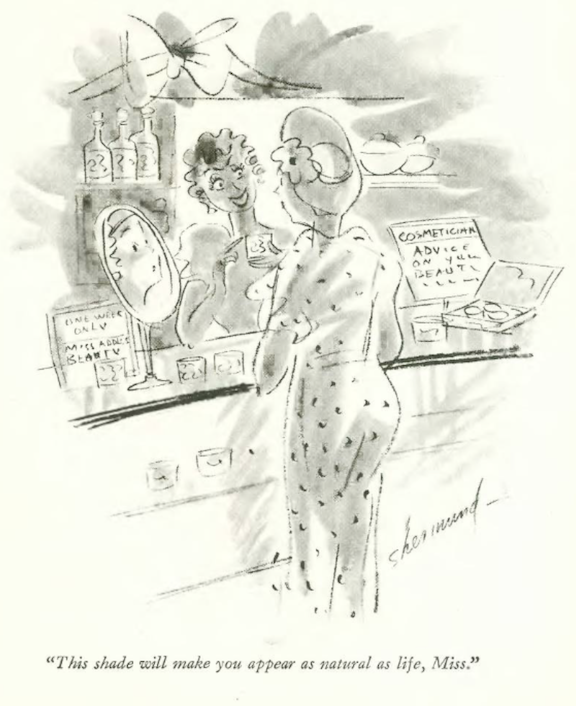
Barbara Shermund found some frank advice at the beauty counter…

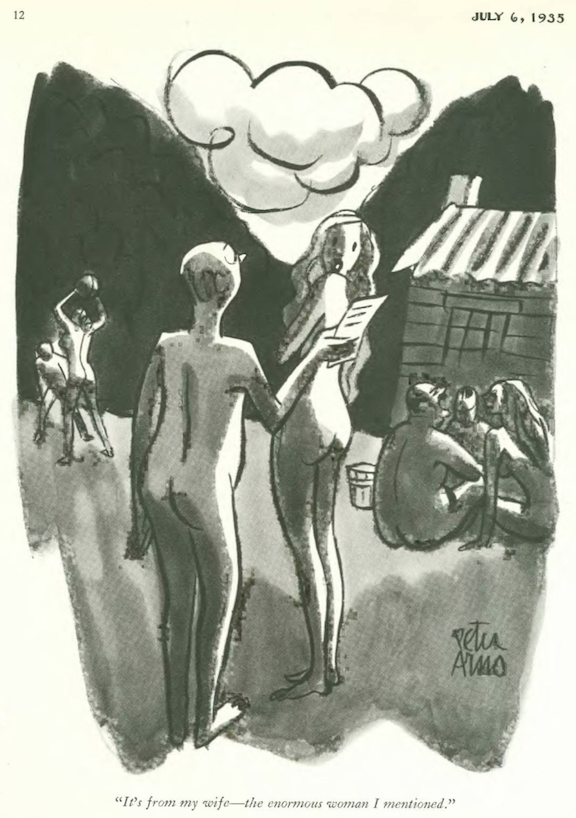
…and we close with Peter Arno, in his element…

Next Time: A German Problem…

Reel News

Above: Newsreel cameramen perch on boards resting on a windowsill to get a birds-eye view of a passing parade, circa 1930. (Public Domain Image)

We marvel at, and sometimes decry, today’s instantaneous news coverage of wars, disasters and the like, but ninety years ago newsreel crews did a remarkable job of filming and delivering the latest news to thousands of theaters across the U.S. and around the world.

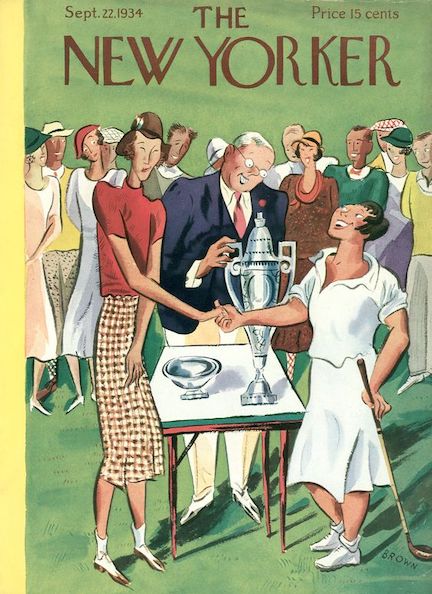
Sept. 22, 1934 cover by Harry Brown.

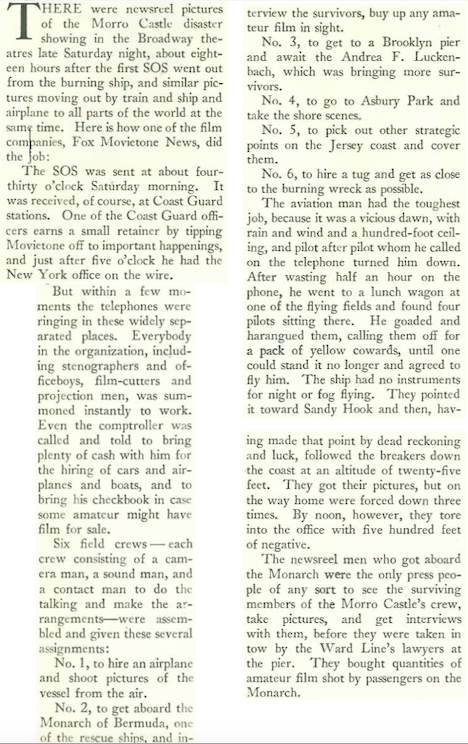
In his “A Reporter at Large” column, Morris Markey penned a lengthy account of Fox Movietone’s coverage of the SS Morro Castle disaster. En route from Havana to New York City on Sept. 8, 1934, the luxury liner caught fire near the New Jersey coast. Due to the ship’s design and the ineptitude of the crew, the blaze claimed 137 lives. Markey described how newsreel crews—with their bulky cameras and sound equipment—went into action, including a cameraman who “goaded” a pilot into taking him aloft through vicious weather conditions.

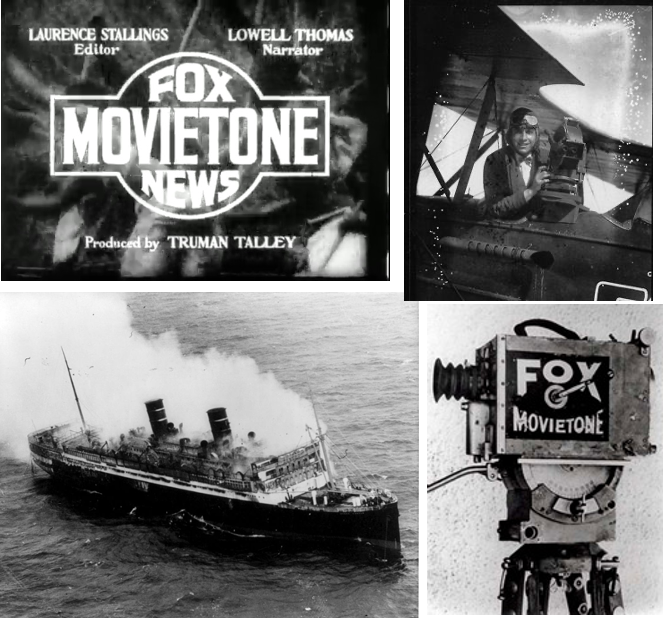
GUTS AND INGENUITY took newsreel reporters to places high and low. Clockwise, from top left, title card from a 1935 Fox Movietone newsreel; Jack Lieb goes aloft to get capture newsreel footage in an undated photo—Lieb was a cameraman for Hearst’s News of the Day; a 1930s Fox Movietone camera; the SS Morro Castle ablaze off the New Jersey Coast on Sept. 8, 1934. (Wikipedia/Lieb photo Courtesy of Bette Marshall via unwritten-record.blogs.archives.gov)

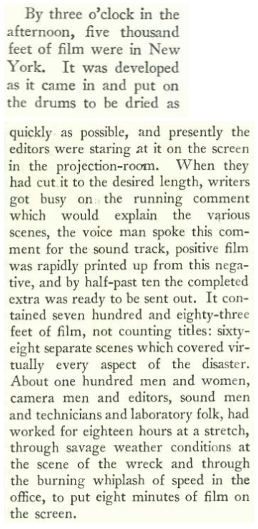
Somehow the cameraman aboard the airplane (which was forced down by weather three times) was able to get his footage to the Movietone office by noon, less than seven hours after the office first received word of the disaster. By three o’clock, five thousand feet of film from all sources was being developed.

UP NORTH AND DOWN UNDER…Movietone news had crews stationed around the world, including field staff in Sydney (top, from 1938), and in Toronto, circa 1930. (Nat’l Library of Australia/City of Toronto Archives)

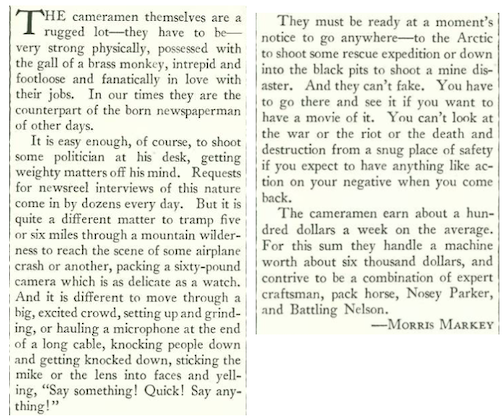
Markey concluded with this observation about the “rugged” and persistent newsreel cameramen:

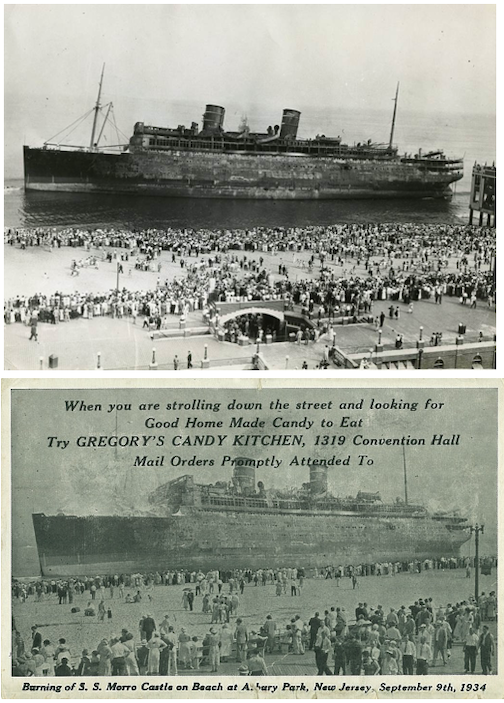
In the aftermath of the Morro Castle disaster, a scene of enormous tragedy was turned into a tourist attraction…

GAWKERS AND HAWKERS…The charred hulk of the SS Morro Castle came to rest on the shore near the Asbury Park boardwalk, which became a popular spot for souvenir salesmen and photo-ops. Tourists flocked to the site from September 1934 to March 1935, when the ship was finally towed away. Note the postcard (bottom) advertising homemade candy over an image of the charred ship. (ripleys.com/side-o-lamb.com)

Fox Movietone News produced sound newsreels from 1928 to 1963, and in the UK as British Movietone News…here is Movietone footage of the Morro Castle disaster, as presented by British Movietone in 1934:

 * * *

Up In The Old Hotels

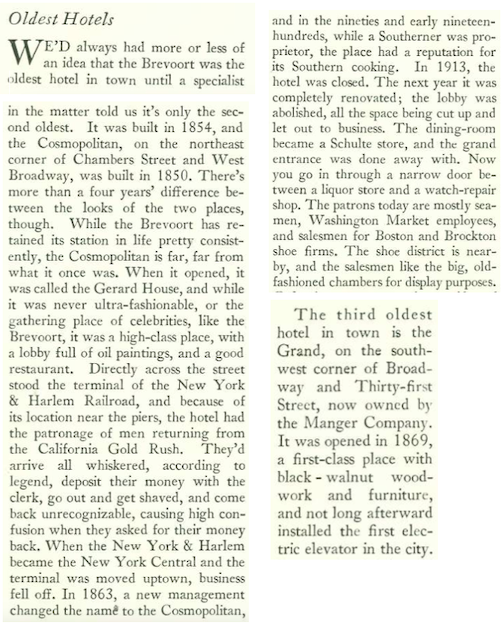
Last week “The Talk of the Town” looked in on one of Manhattan’s oldest saloons, McSorley’s. For the Sept. 22 “Talk” the subject was “Oldest Hotels,” two of which, The Cosmopolitan and The Grand, remarkably survive to this day.

HANGING IN THERE…The 1845 Brevoort House hotel at 15 Fifth Avenue (top left) was torn down in 1952, however the 1868 Grand Hotel (right) at 1232–1238 Broadway and the 1845 Cosmopolitan Hotel (below, left) at Chambers Street and West Broadway still stand today. (Museum of the City of New York / Chester Higgins Jr. for The New York Times)

 * * *

The Six-Million Dollar Road

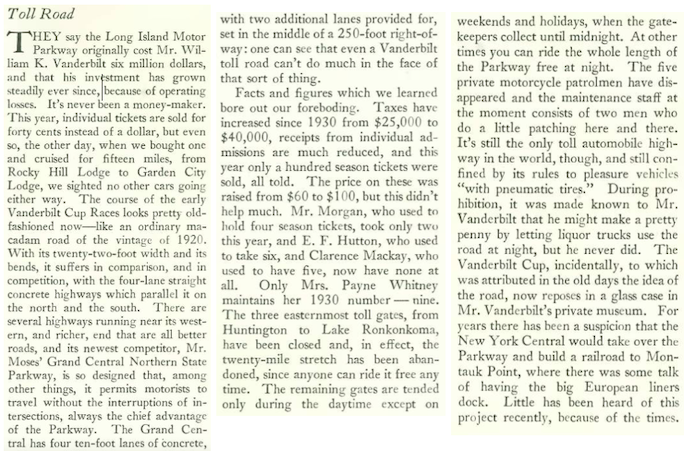
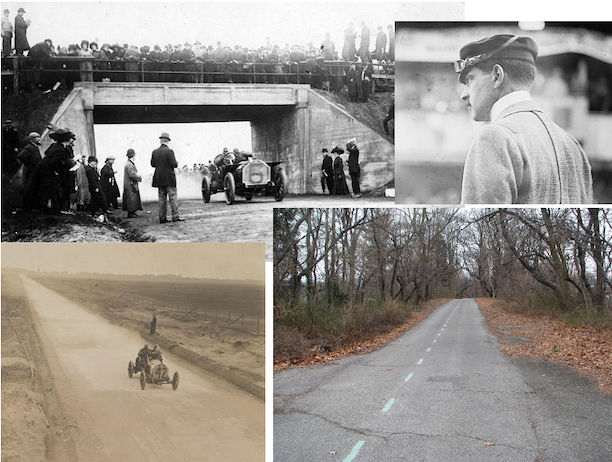
The first roadway designed exclusively for automobile use was likely the Long Island Motor Parkway, privately built by William Kissam Vanderbilt II because he wanted a road suitable for auto racing. He established the Vanderbilt Cup races on local roads in 1904, but after two spectators were killed and many others injured, in 1908 he began building what would become a 45-mile (72 km) toll road from Queens to Lake Ronkonkoma. After two mechanics were killed in a 1910 race, the New York Legislature banned racing on the road, which the state took over in 1938.

ROAD WARRIOR…William Kissam Vanderbilt II (top right) staged his Vanderbilt Cup Races on his private road until a fatal accident put a stop to the fun in 1910; At bottom right, a surviving section of the road today. Most of the road in Queens is a bicycle trail, and other segments still serve as parts of a county road. (nyheritage.org/Wikipedia-Steve Nowotarski/ny1.com)

 * * *

From Our Advertisers

I have nothing against accordion music, despite years of exposure to Lawrence Welk during my youth, but I find it hard to believe that a Park Avenue socialite (identified here as Mrs. René Du Champ Bellinger) would contemplate tormenting her posh friends with a Hohner squeezebox…

Esquire magazine was barely a year old when it posted this ad in The New Yorker…its appeal to men (and their anxieties) keeps it going today…

…it’s interesting how companies in the 19th century and on through the 1950s featured idealized, bird’s eye images of their factories in advertising, doubtless believing that consumers associated size (and smokestacks) with prosperity, and therefore a quality product…

…White Rock, however, has used the image of the Greek goddess Psyche for more than a century to promote the purity of its spring water…

…purity was also the main point of this ad from Daggett & Ramsdell, who hawked their wares to the Park Avenue set…after more than 130 years D&G is still in the beauty business…

…this next ad is almost unbelievable…single rooms starting at $5, double rooms $7, and a whole suite for $10…at the Plaza…okay, $10 is roughly equivalent to $225 today, but half of that could get you a single…

…and yet another unlikely claim from R.J. Reynolds regarding the energizing qualities of their Camel cigarettes…it seems the last thing you would need while climbing a mountain is smoke in your already over-taxed lungs…

…however, let’s give proper due to Georgia Engelhard (1906–1986), who scandalized the mountaineering world by ditching the Victorian climbing skirt in favor of a pair of climbing pants. Engelhard was the first female climber to ascend many of the peaks in the Rockies…

Georgia Engelhard in a 1922 photo attributed to her friend Alfred Stieglitz. (nga.gov)

…it seemed like nearly everyone smoked in the 1930s, even in ads that had nothing to do with tobacco companies (detail)…

…on to our cartoons, we begin with Richard Decker and some retail competition…

George Price drew up a curiosity even Robert Ripley couldn’t believe…

Robert Day examined advances in evolutionary science…

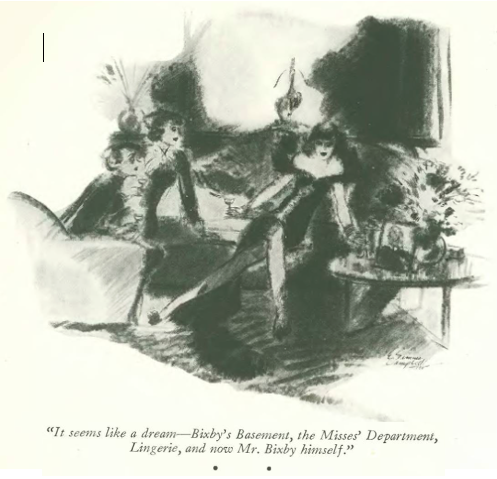
E. Simms Campbell offered up this abbreviated love story…

Peter Arno gave us a director with a god complex…

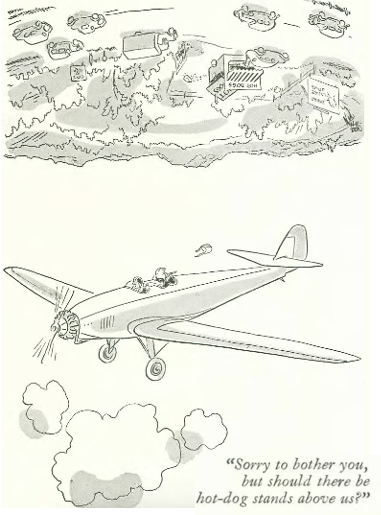
…and one from Ned Hilton, and a new perspective on flying…

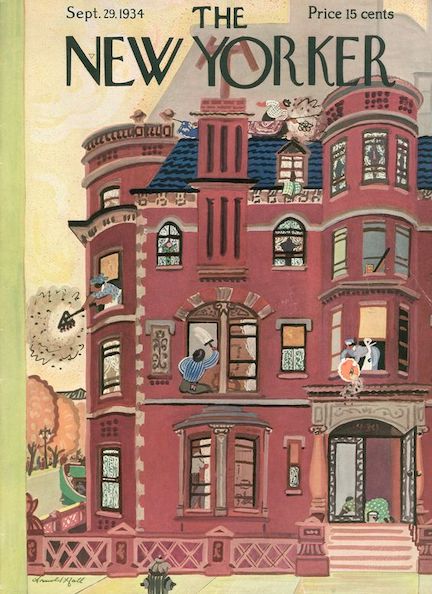
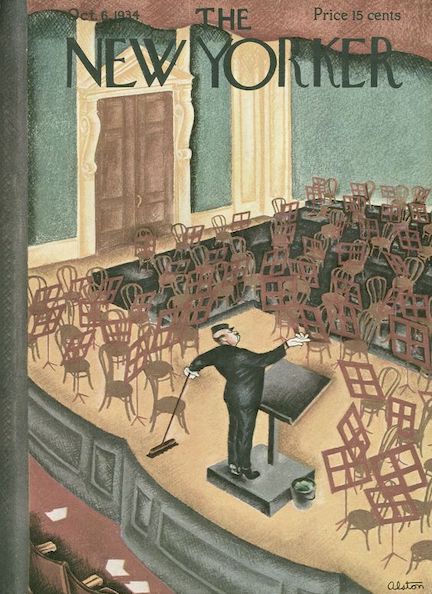
…on to Sept. 29, 1934, with a cover by Arnold Hall, who produced at least twelve covers for The New Yorker between 1933 and 1939…

Sept. 29, 1934 cover by Arnold Hall.

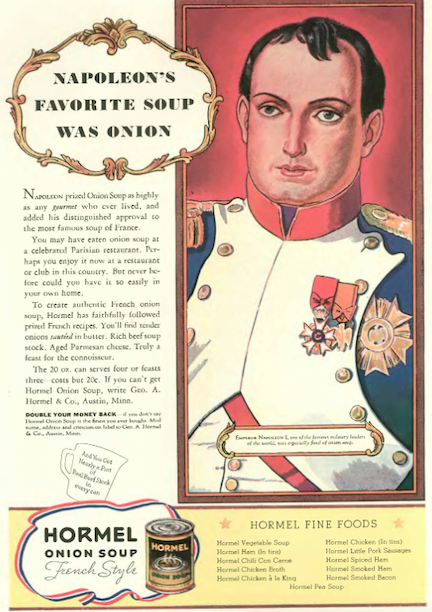
…and we go straight to ads, beginning with this alarming image that greeted readers on the inside cover…why would this prompt anyone to purchase a can of onion soup?…

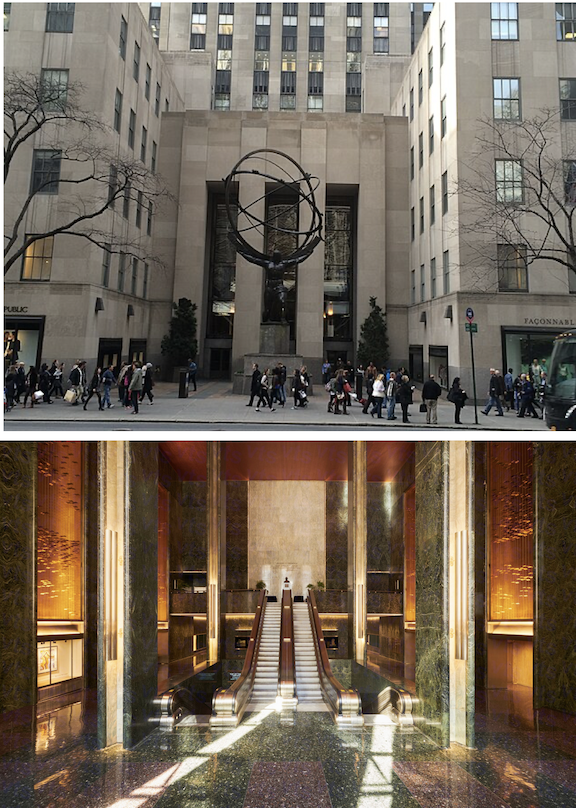
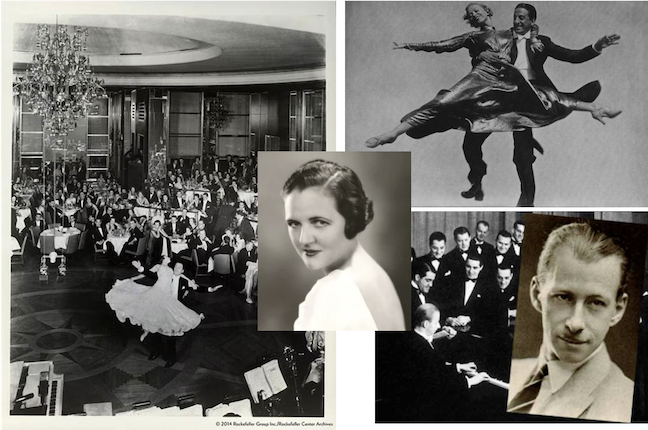
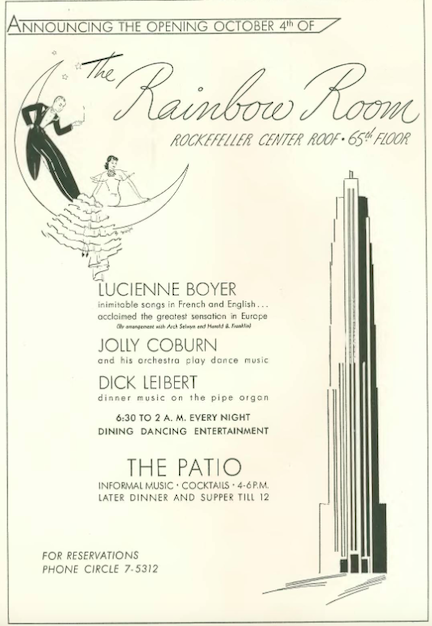
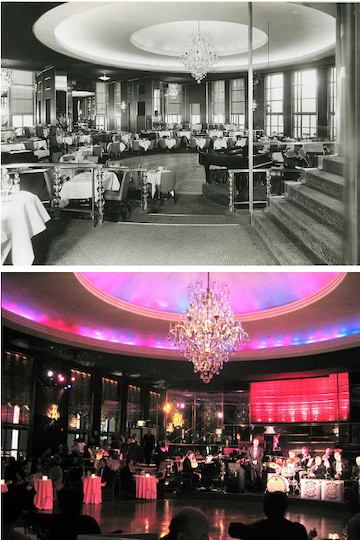
…the Rainbow Room on the 65th floor of Rockefeller Center opened in 1934, and it quickly became a focal point for the city’s elite…

Above, the dining room at the Rainbow Room, 1934, and below, in 2004. (Library of Congress/Wikipedia)

…Lucky Strike continued its series of ads featuring fashionable women looking smart with their product…

…our cartoons include this spot illustration by Otto Soglow, who did spots for The New Yorker for many years…although Soglow’s Little King moved to the Hearst newspapers, he continued to contribute cartoons to The New Yorker until 1974…

George Price continued to explore life as a levitating man…

…the enforcement of the Hays Code had this teen in a “fix,” per James Thurber

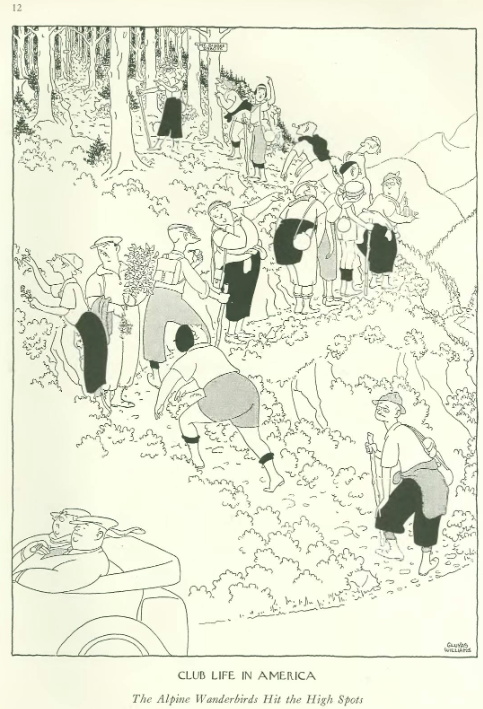
Gluyas Williams continued his exploration of various crises, this time in the music world…
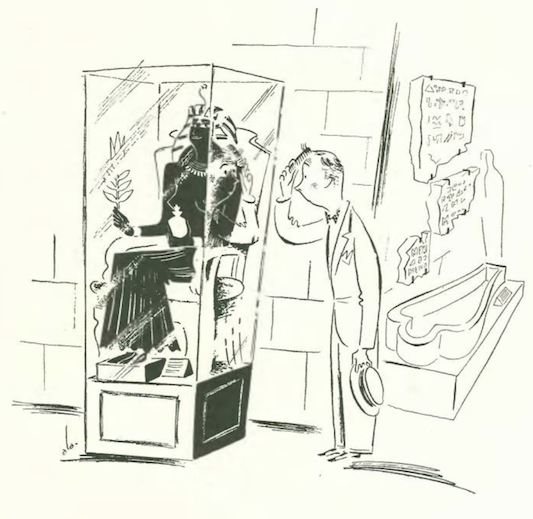
Alan Dunn gave us a glimpse of civilization via the pharaonic sculptures that were emerging on the face of Mt. Rushmore…

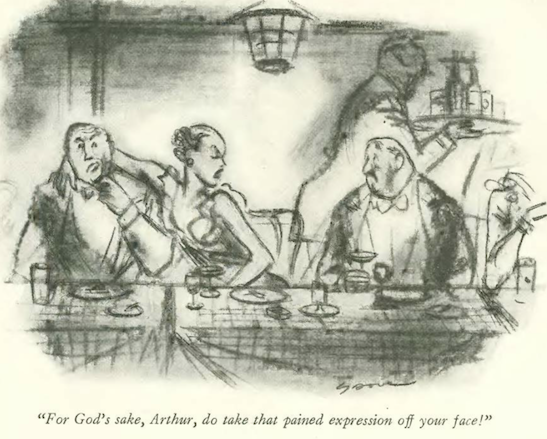
…and we close with the wonderful wit of Barbara Shermund

Next Time: Bojangles…

His Five Cent’s Worth

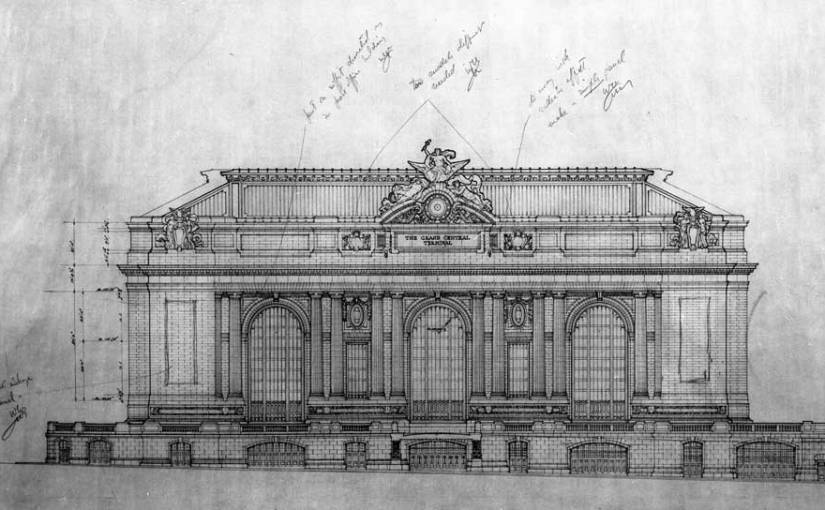
Above: Final Design of Grand Central Terminal, ca. 1910. (New York Transit Museum)

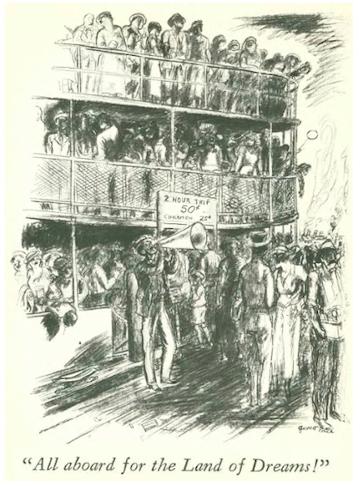
The heat wave of 1934 spread misery from the Midwest to the East Coast. The temperature in New York City hit 101 degrees F (38.3 C) on June 29, and July recorded at least ten days of temps in the mid- to upper 90s. It must have been miserable in the days before air-conditioning, and since no adult would dare be seen in public wearing shorts and a t-shirt, an outing on a crowded tour boat, as illustrated below by William Cotton, must have been hellish.

July 21, 1934 cover by William Cotton.

…putting a fine point on it, recall this wryly captioned cartoon from the June 30 issue by Garrett Price

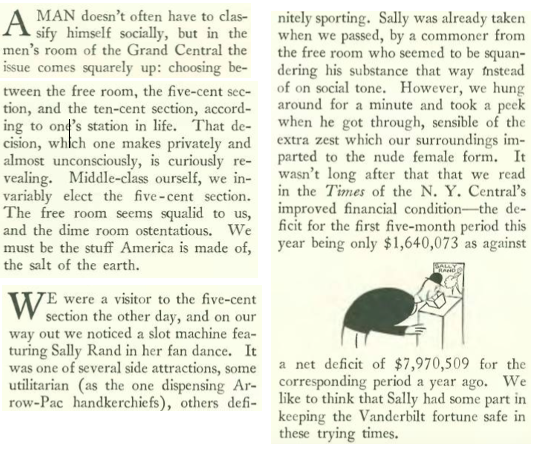
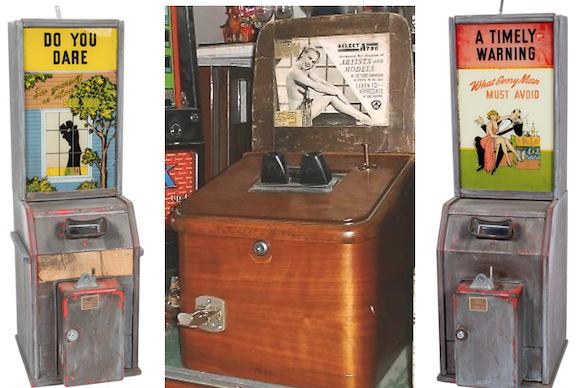
…but let us move ahead to the July 28 issue, where E.B. White was hopefully keeping his cool in the men’s waiting room at Grand Central Station, where he plunked down a nickel to cool his heels in the “middle class” section, where he observed side attractions including a vending machine that dispensed handkerchiefs and a coin-operated peep show featuring burlesque star Sally Rand.

NO MASHERS ALLOWED…Separate men’s and ladies’ rooms were available in three classes at Grand Central Station—free, five cents and ten cents. Top, the Ladies’ room, Grand Central Terminal (Central Lines), and below, a men’s room at the station. A nickel back then was worth about a dollar today. (Library of Congress)
NICKEL AND DIMED…Machines similar to these could be found in some men’s waiting rooms at train stations in the 1930s. (pinballhistory.com/comics.ha.com)

…White referred to a peep show that featured famed fan dancer Sally Rand

DOING HER DEEP KNEE BENDS…Sally Rand in the 1930s. (www.vintag.es)

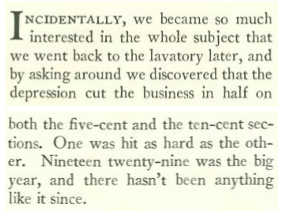
White also commented on the growing number of travelers, still pinched by the Depression, opting for the free section:

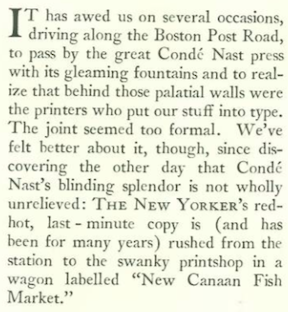
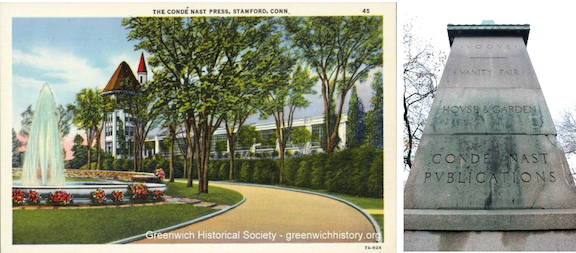
We settle in with the June 21 issue (which leads this post) with White once again, this time enjoying a drive to Stamford, Conn., where he admired the “splendor” of the Condé Nast printing plant (apparently the plant also printed The New Yorker, although the magazine itself would not be acquired by Condé Nast’s parent company, Advance Publications, until 1985).

ONLY A MEMORY…Postcard image of the Condé Nast printing plant; at left, a relic of the long-gone plant, one of two pillars that flanked the road to the plant. (Greenwich Historical Society/greenwichtime.com)

 * * *

Disney’s Other Mouse

Film critic John Mosher was a fan of Disney’s “Silly Symphony” cartoon shorts, which were produced between 1929 and 1939. Animation, and especially color animation, was in its infancy, so these doubtless had an uplifting effect on many moviegoers.

DON’T CALL ME TINKERBELL…The Butterfly Fairy brought some Disney magic to 1934’s The Flying Mouse. (disney.fandom.com)

 * * *

The Great McGonigle

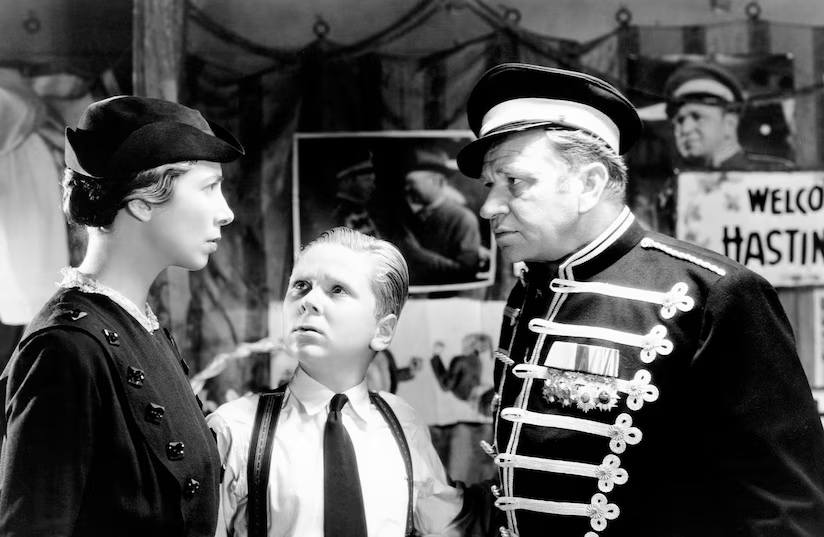
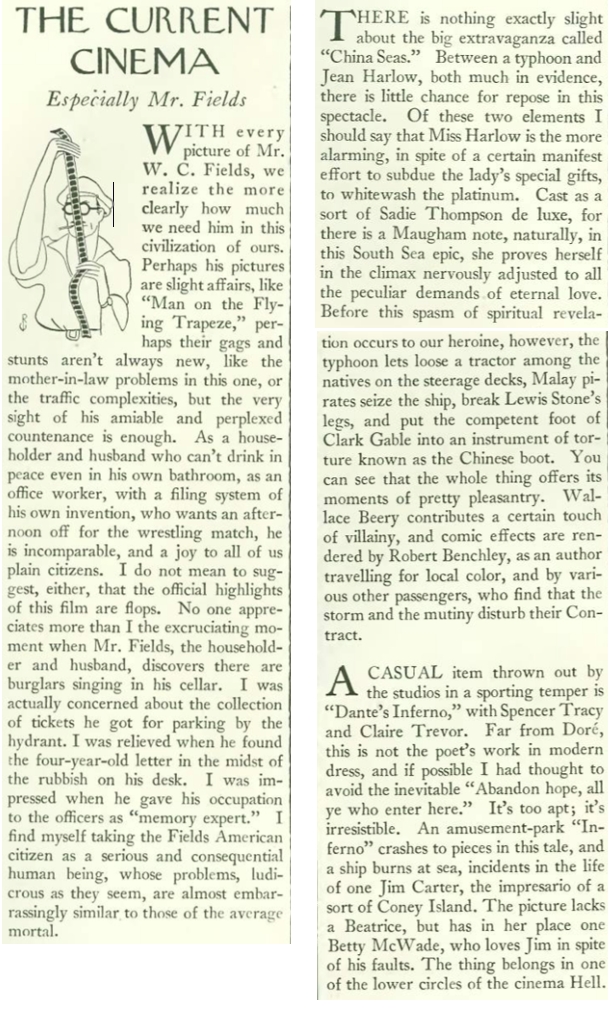
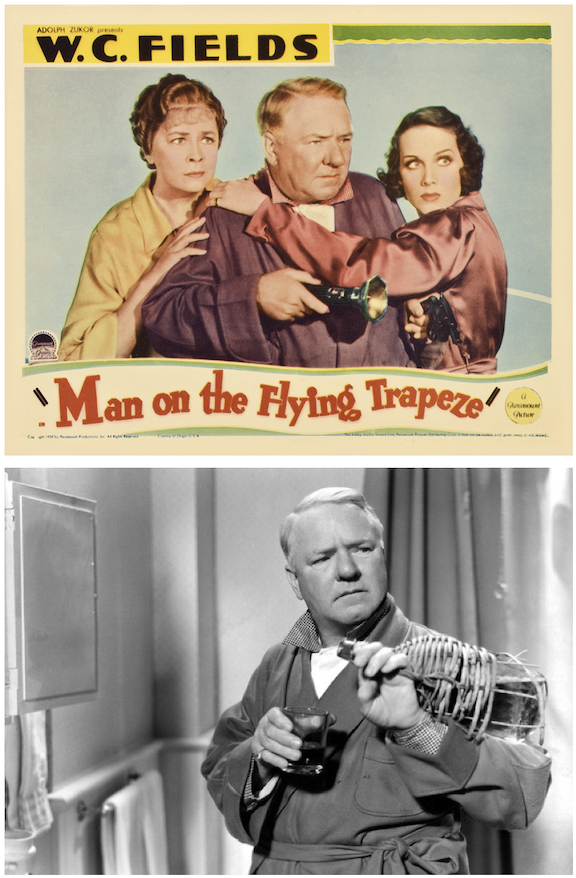
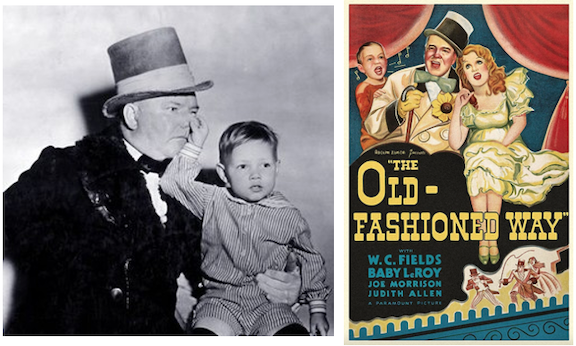
W.C. Fields appeared in more than a dozen silent films before making his first talkie, 1930’s The Golf Specialist, and it was in sound films that Fields was able to truly express his vaudevillian wit. It was also in the sound era that Fields teamed up with Baby LeRoy for three films (in 1933 and 1934), including The Old Fashioned Way, in which Fields portrayed “The Great McGonigle,” leader of a traveling (and perpetually underfunded) theater troupe who was always a step ahead of police and creditors. Critic John Mosher found the film’s riff on an old morality play, The Drunkard, to be a bit dated, but overall thought it a cheerful diversion.

HONK…Baby LeRoy, aka Ronald Le Roy Overacker (1932–2001), was just 16 months old when he became the youngest person ever put under term contract by a major studio. He is best known for his appearances in three W. C. Fields films: Tillie and Gus (1933), The Old Fashioned Way (1934) and It’s a Gift (1934). (Rotten Tomatoes/IMDB)

 * * *

From Our Advertisers

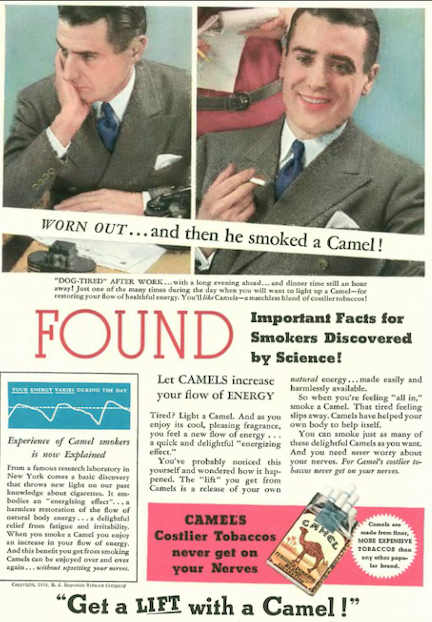
We begin with scientific proof (from a “famous research laboratory in New York”) that Camel cigarettes increased one’s flow of energy…

…if that crackpot claim doesn’t get you, here’s one that recommended downing a PBR before a big meeting, a sure remedy for that “listless, tired-out feeling”…

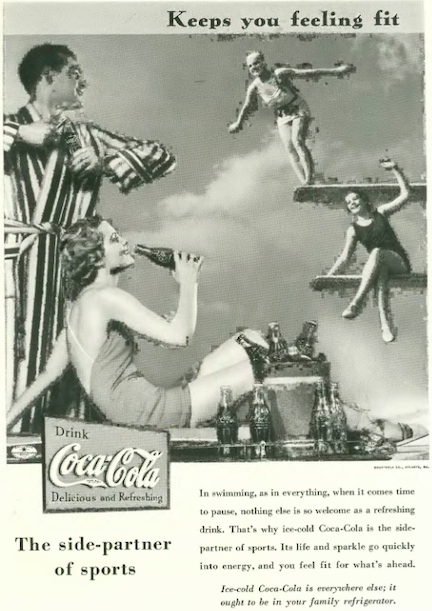
…of course we all know that a few sugary Cokes will get you going…back then they were taking it in six- and ten-ounce bottles, not 30- to 50-ounce Big Gulps…

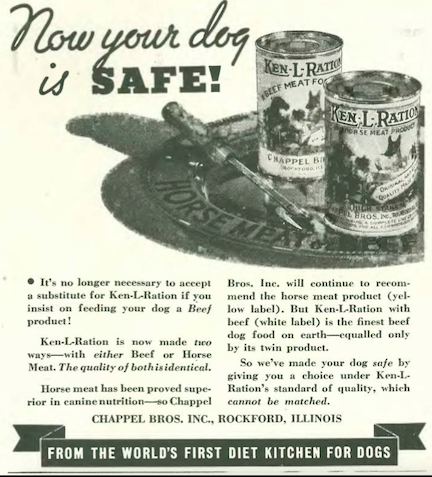
…it’s not every day you see a dog food ad in The New Yorker…in the 1930s there was no secret to where ol’ Sparky ended up…

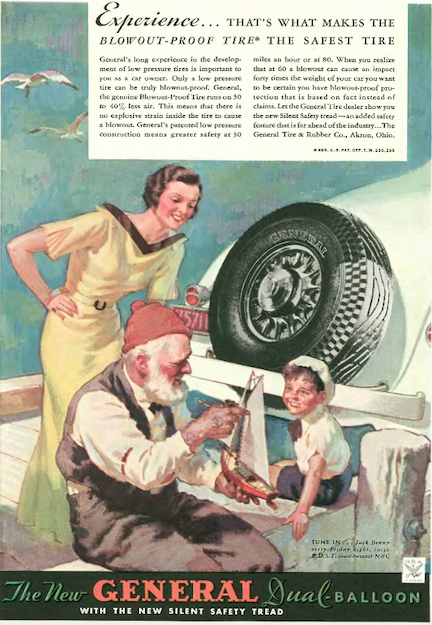
…popular were these Rockwellian ads that equated various products with happy and wholesome (and safe) living, in this case a massive “Dual-Balloon” tire that dominated this tableau featuring a stylish mommy and her little boy slumming with an old sea salt…

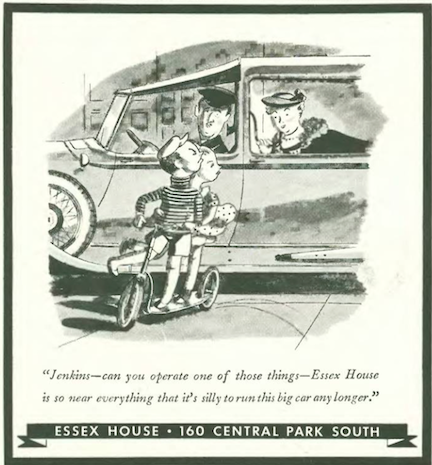
…the folks at Essex House hired an illustrator who did his or her best to channel Helen Hokinson and William Steig for this New Yorker ad…as we have seen before, Essex House ads walked a fine line between thrift and snob appeal…

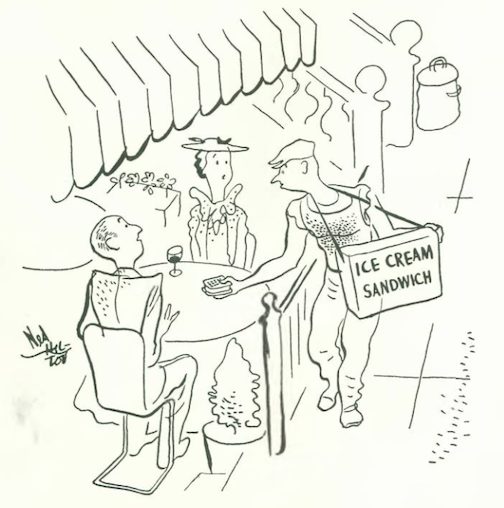
…on to our cartoons, beginning with Ned Hilton, whose work appeared in The New Yorker from 1934 to 1957…

Mary Petty recorded some sweet nothings by the seaside…

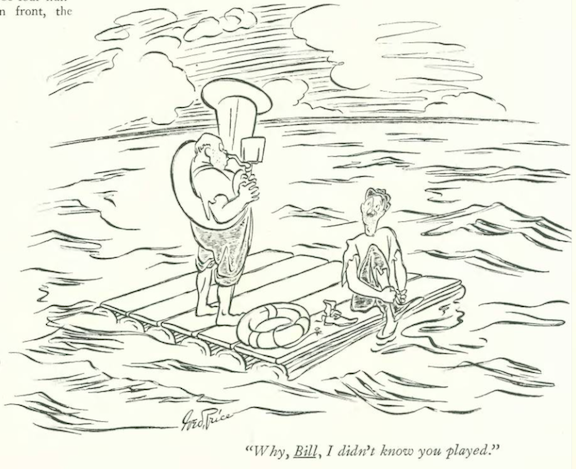
George Price drifted along with two men and tuba…

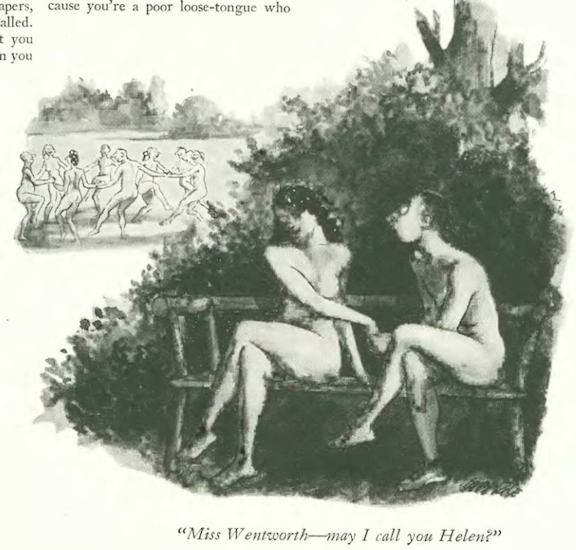
Carl Rose revealed a modest side to life at a nudist colony…

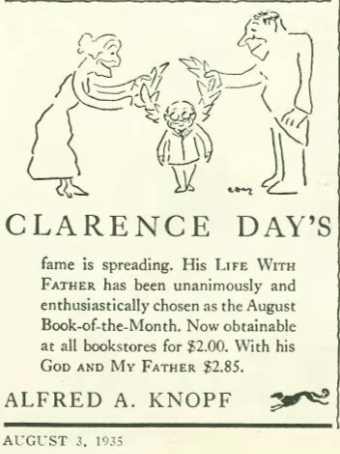
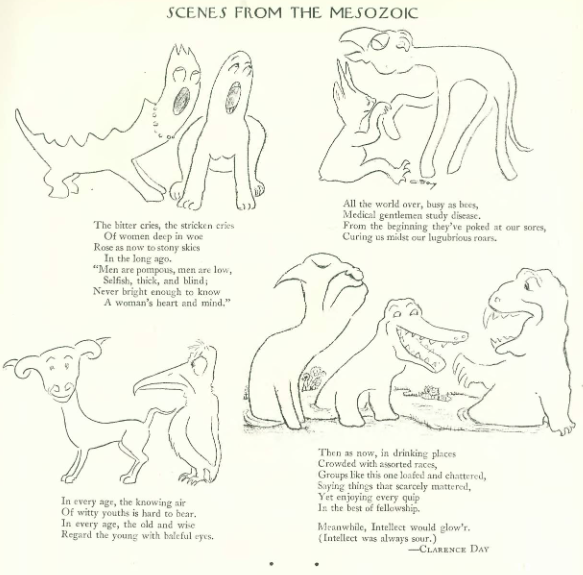
…we know Clarence Day for his Life With Father series, but on occasion he also contributed illustrated poems such as this one from the July 21 issue…

…on to July 28…

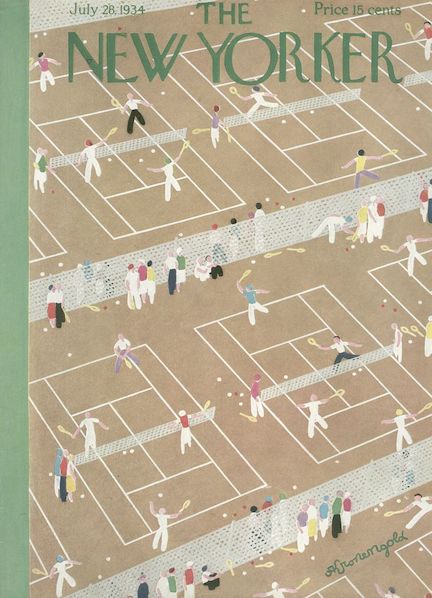
July 28, 1934 cover by Adolph K. Kronengold.

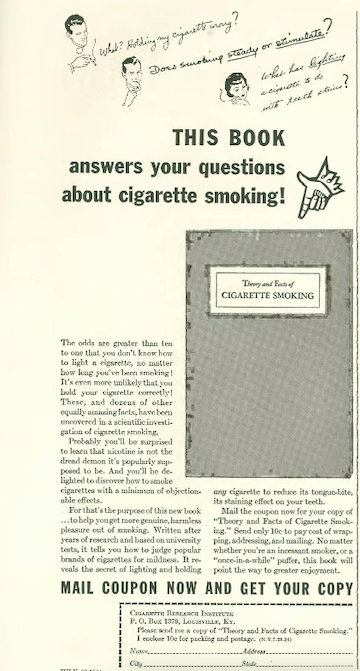
…where we encounter more “scientific research” that encouraged folks to smoke…This ad was placed on the very last page of the July 28 issue by the Cigarette Research Institute, based in Louisville, Kentucky…

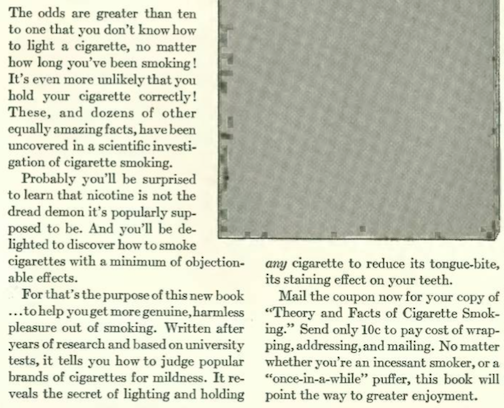
…the booklet was filled with “amazing facts” uncovered in a “scientific investigation,” facts did not address the health effects of smoking, but rather such important topics as how to hold a cigarette the right way and how to reduce staining on your teeth…it also helpfully debunked the notion that nicotine was a “dread demon”…

…take for example this woman smoking a Lucky…now she knew how to hold a cigarette!…

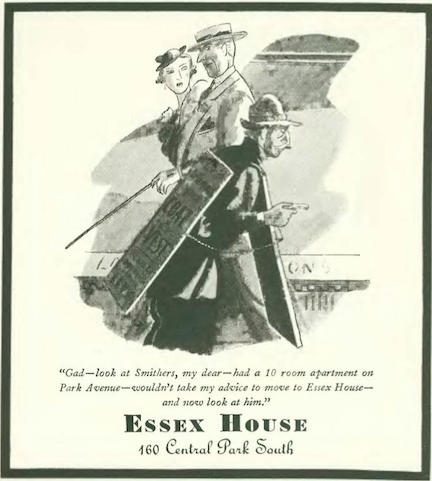
…the folks at Essex House were back, aggressively playing the class/caste card…apparently if you lived there you were entitled to kick your old friends to the curb…

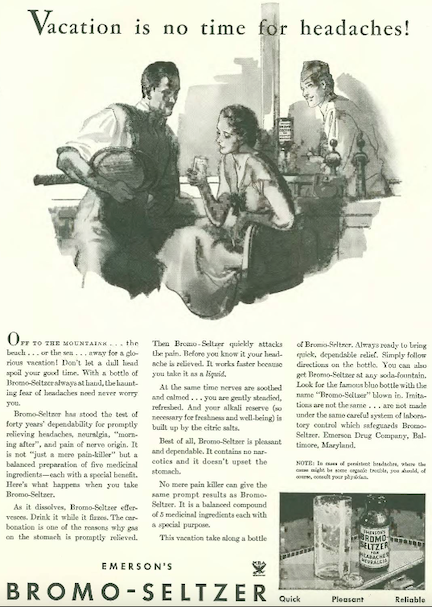
…the antacid and pain reliever Bromo-Seltzer was ubiquitous in 1930s medicine cabinets, but after the recipe was changed in the 1970s (all Bromides were withdrawn from the U.S. market in 1975) the brand slowly fizzled away…

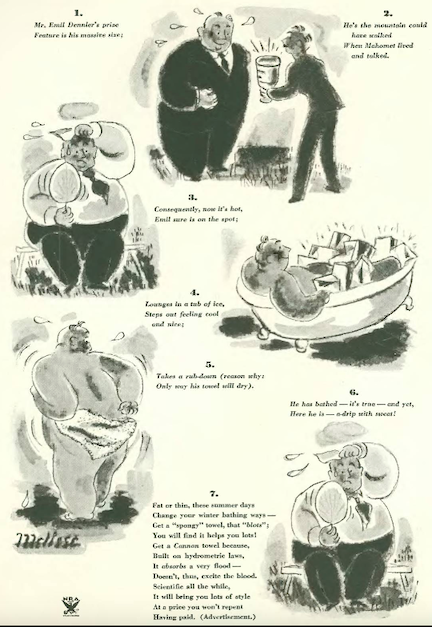
Mildred Oppenheim Melisse was a popular illustrator of ads for department stores and various household goods, including Cannon towels, here guaranteed to absorb even this man’s sweaty “flood”…

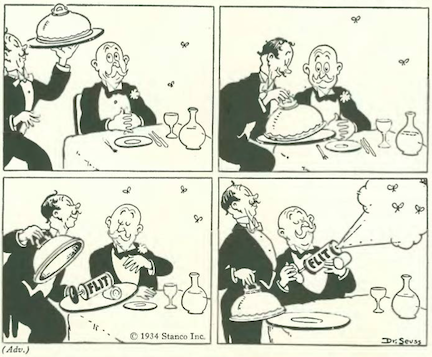
Dr. Seuss back again for Flit, once again having no issues mixing insecticide with food preparation…

Rea Irvin kicks off the cartoons with his Double Breasted Dowager…

Helen Hokinson found some misplaced pity at a garden party…

Garrett Price offered some unsolicited advice…

Reginald Marsh filled two pages with a scene from Central Park…

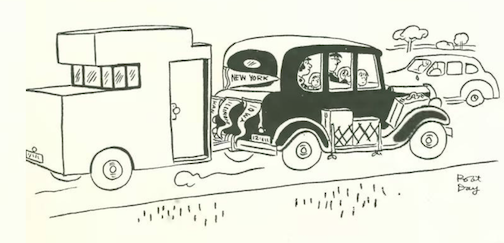
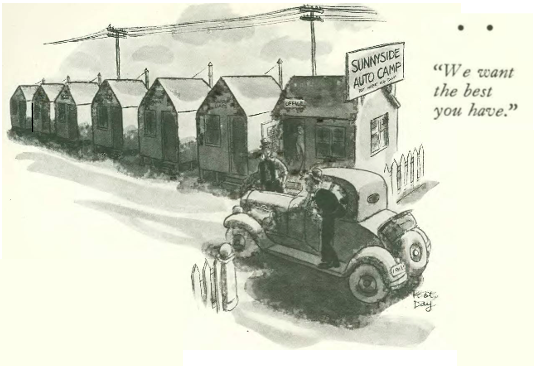
Robert Day looked for a unique experience at an auto camp…

…and we close with Barbara Shermund, and some alarming news on the domestic front…

Next Time: Men of Mystery…