As in her other films, Mae West’s character in I’m No Angel was sexually independent and unapologetically so. (Kino Lorber)
We first encountered Mae West back in 1926 when The New Yorker commented on her risqué Broadway play, Sex. Although the play was the biggest ticket in town, it eventually attracted a police raid that landed West in jail on morals charges. Sentenced to ten days for “corrupting the morals of youth,” she could have paid a fine, but for West a short stint on Welfare Island was worth its weight in publicity gold.
Oct. 14, 1933 cover by Rea Irvin.
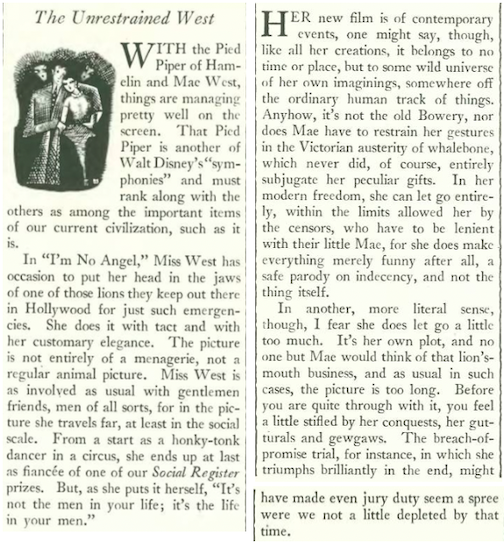
Fast forward seven years, and West is one of the nation’s biggest box office attractions and starring in her third film, I’m No Angel. Depression-era audiences responded enthusiastically to West’s portrayals of a woman from the wrong side of the tracks who in the end gains both fortune and social acceptance. Although puritanical forces continued to be outraged by West’s antics, New Yorker film critic John Mosher found her act to be “a safe parody on indecency.”
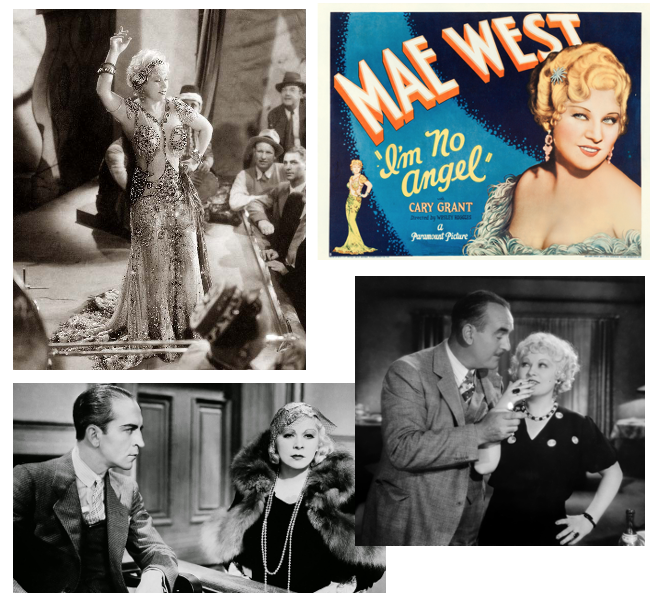
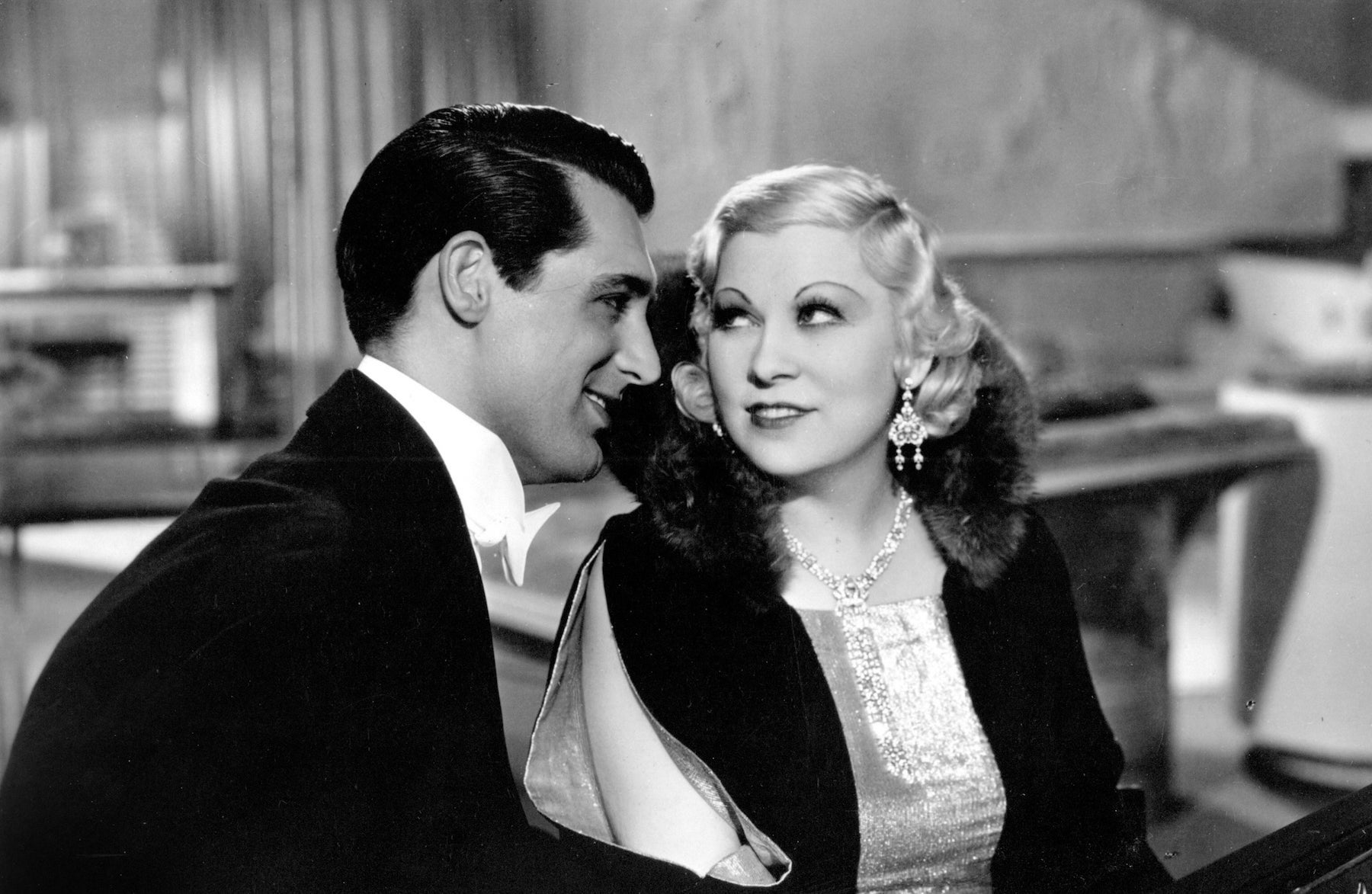
SHIMMY TO SUCCESS…Clockwise, from top left: At the beginning of I’m No Angel, Tira (Mae West) shimmies and sings in a circus sideshow; studio poster for the film— In the early 1930s, West’s films were key in saving Paramount Pictures from bankruptcy; a wealthy sideshow customer (William B. Davidson) arranges a private rendezvous; Tira has her day in court despite attempts by her ex-boyfriend, Slick Wiley (Ralf Harolde), to discredit her. (IMDB)SHE GETS HER MAN…Cary Grant starred opposite Mae West for the second and final time in I’m No Angel. Eleven years junior to West, Grant portrayed Tira’s fiancé, Jack Clayton. (TCM)
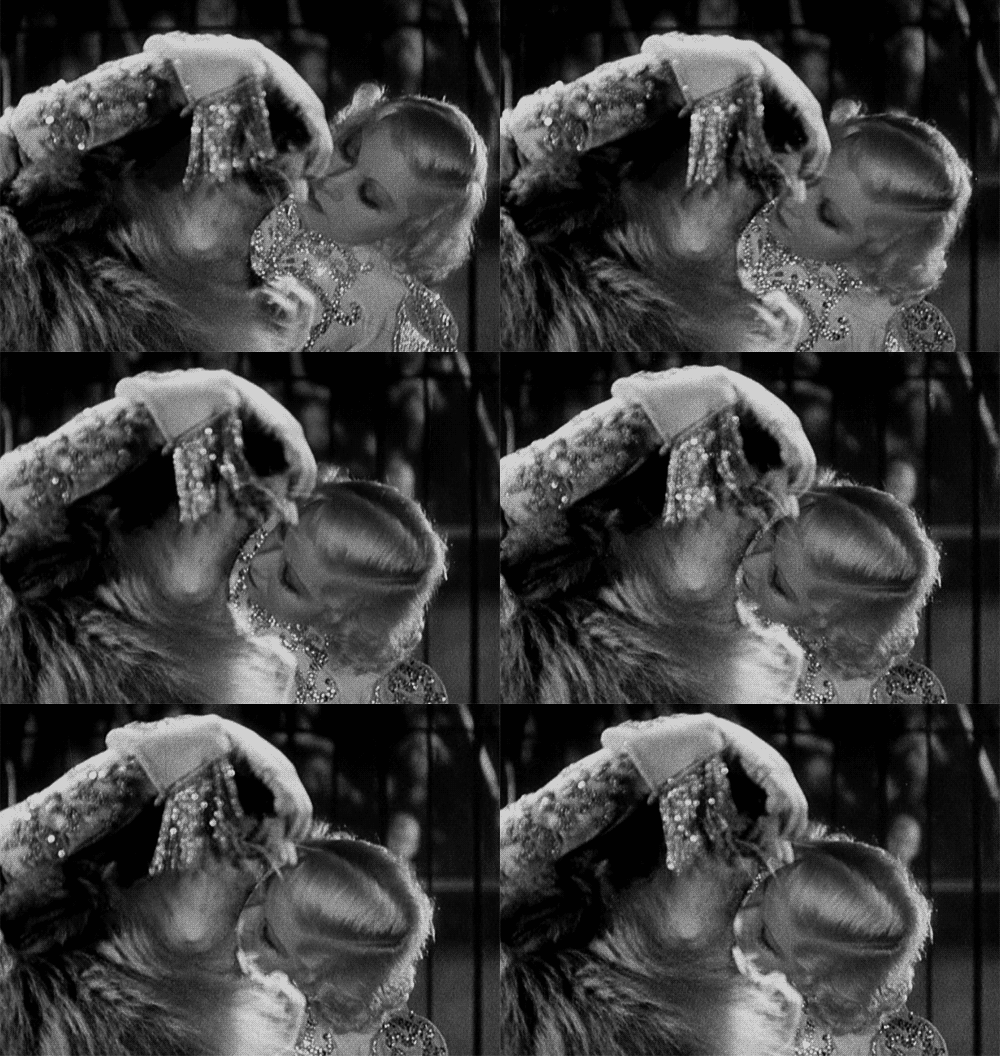
And finally, a much-talked about scene from the movie featured West putting her head (rather sensually) into the mouth of a lion. In reality it appears to be a camera trick: West was actually placing her head to the side of the lion’s mouth. Still, a gutsy move by West. As for the lion, it was no picnic either.
* * *
Comic Relief
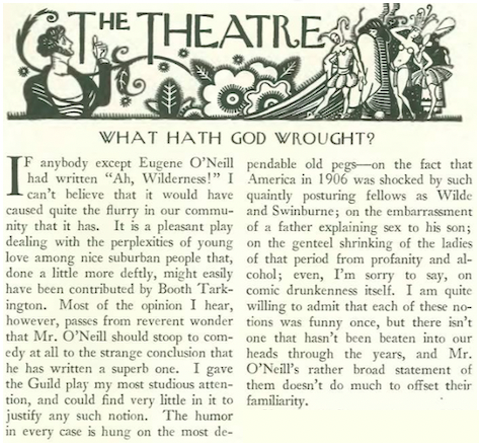
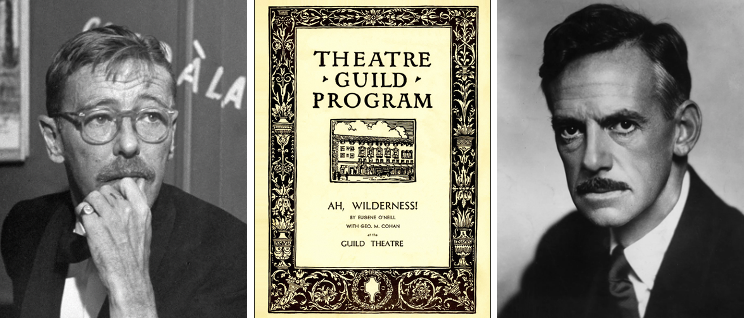
Eugene O’Neill surprised critics and audiences alike when he premiered Ah, Wilderness! at Broadway’s Guild Theatre on October 2, 1933. Among the critics was Wolcott Gibbs, who concluded that O’Neill should stick to his usual themes of disillusion and despair. An excerpt:
PASS THE CORN, PLEASE…Around the table in the original 1933 Broadway production of Ah, Wilderness! are (from left) George M. Cohan (Nat Miller), Eda Heinemann (Lily), Elisha Cook, Jr. (Richard), Gene Lockhart (Sid), Marjorie Marquis (Mrs. Nat Miller), Walter Vonnegut, Jr. (Tommy) and Adelaide Bean (Mildred). (Photograph by Vandamm for Stage magazine, November 1933)ERRORS OF COMEDY…Wolcott Gibbs (left) found Eugene O’Neill’s attempt at comedy to be nothing more than a recycling of corny old saws. However, Ah, Wilderness! proved successful in its first Broadway production and in the touring company that followed. It remains to this day a staple of community repertory. (The New Yorker/Playbill/Encyclopedia Britannica)
* * *
Hell in a Handbasket
If Eugene O’Neill couldn’t offer up some woe, then leave it to E.B. White of all people to supply reason for despair. In his 1982 review of a collection of White’s poems and sketches, Timothy Foote observed that White occasionally assumed the guise of Pessimist, “a desperate fellow who served as a one-man distant-early-warning system…”
For the Oct. 14 issue White bemoaned the loss of the American elm (of the 77 million elms in North America in 1930, more than 75 percent were lost to Dutch elm disease by 1989), the dangers of pesticide use, and other maladies. Excerpts:
APPLE OF HIS EYE…E.B. White had reason to be concerned about the widespread practice of spraying lead arsenic on fruit trees. This 1930 photograph shows an Oregon orchardist and his child spraying apple trees with the stuff. (oregonhistoryproject.org)
White’s New Yorker colleague John O’Hara raised some concerns of his own, namely the likelihood of another world war in this prescient piece titled “Dynamite is Like a Mill Pond.” Excerpts:
FROM RUSSIA WITH LOVE…John O’Hara pondered the likelihood of another world war and an unlikely bedfellow: Soviet Russia. Photo circa 1938. (AP via loa.org)
* * *
Pooh-Poohing Mr. Milne
In his review of A.A. Milne’s latest novel, The Red House Mystery, Clifton Fadiman seemed to recall Dorothy Parker’s own revulsion to Milne’s juvenile style (“Tonstant Weader Fwowed Up” Parker once wrote of The House at Pooh Corner). Excerpts:
* * *
From Our Advertisers
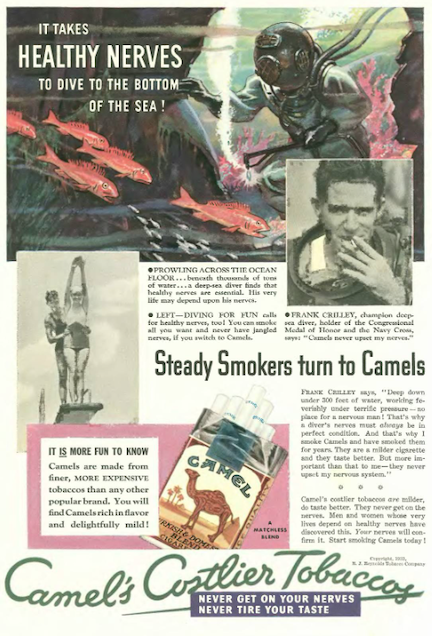
The makers of Camels took to the water to prove how their cigarettes supported “healthy nerves,” whether in the deep sea or on the high dive…
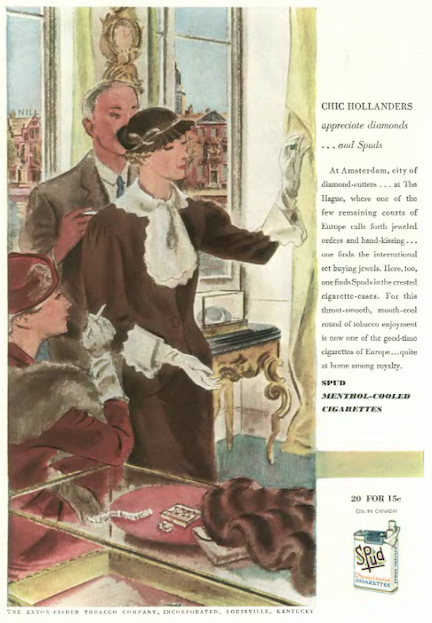
…with a name like “Spud” you really had to stretch to prove you were a choice of the smart set…here they claimed their product was “quite at home among royalty”…
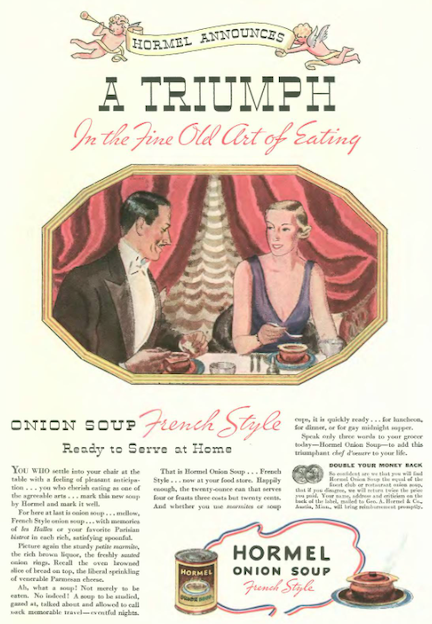
…here’s another great example of class appropriation, a white-tie dinner featuring a couple of toffs eating canned soup…
…and we give our eyes a break with a bit of elegance from Lord & Taylor, featuring the art of modern living…
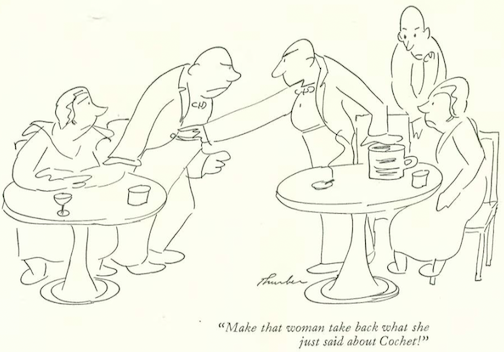
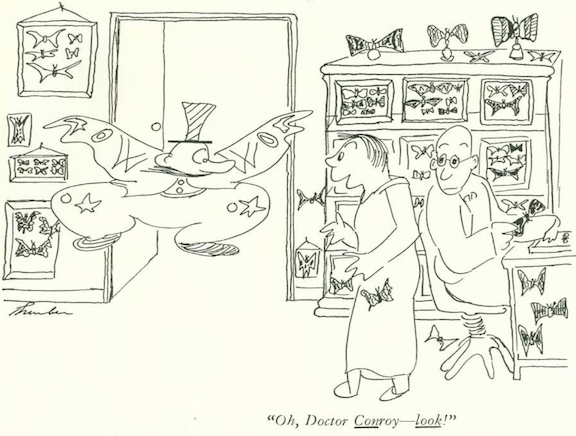
…on to our cartoons, we begin with James Thurber…
…curious to know Thurber’s favorite songs?—then check out this Thurber Thursday post from Michael Maslin’sInkspill...
…we continue with William Steig’s look at a “Lady With Mirror”…
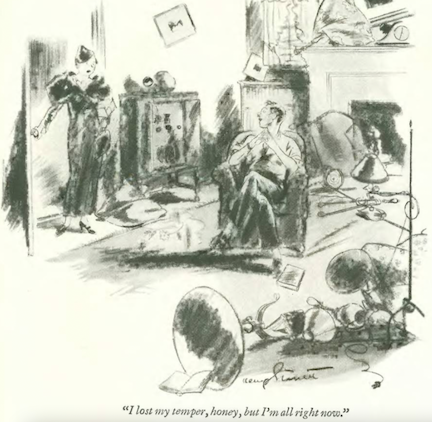
…and discover the calm after a storm in this domestic scene by Kemp Starrett…
…visit the Century of Progress World’s Fair in Chicago, with George Price…
…for reference, Price’s cartoon depicted the Federal Building at the Century of Progress…
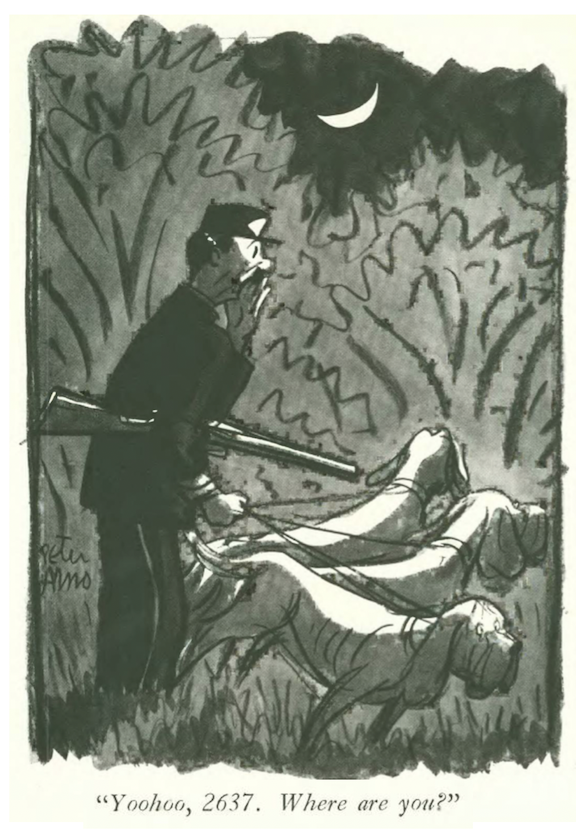
…and is often the case with this blog, we give Peter Arno the last word…
Above: Maurice Passworthy (Kenneth Villiers) and Catherine Cabel (Pearl Argyle) prepare for a trip to the moon in Things to Come. (IMDB)
In his 1933 science fiction novel The Shape of Things to Come,H.G. Wells foresaw how an international economic depression could eventually lead to world war.
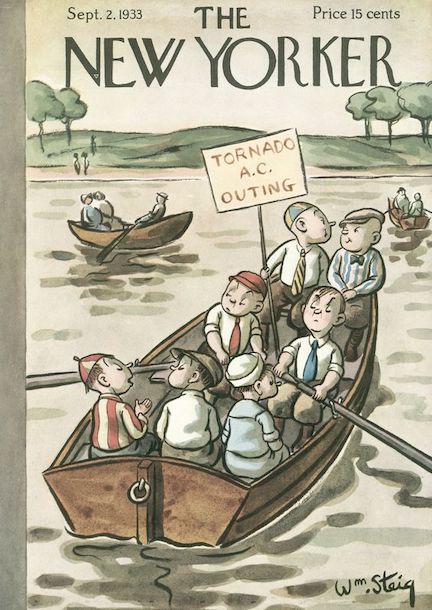
Sept. 2, 1933 cover by William Steig.
The book also predicted that such a war would feature whole cities destroyed by aerial bombing and the eventual development of weapons of mass destruction. However, New Yorker book critic Clifton Fadiman found Wells’ other predictions to be fanciful, “scientific-romantic” notions, such as a post-war Utopia (headquartered in Basra, Iraq, of all places) ruled by super-talents that would advance scientific learning in a world without nation-states or religion. And naturally everyone would speak English.
YOU MAY SAY I’M A DREAMER…H.G. Wells envisioned a world of war, pestilence and economic collapse that would eventually give way to an English-speaking Utopia free of nation-states and religion. (Wikipedia)
Three years later Wells would adapt his book to the screen in 1936’s Things to Come, produced by Alexander Korda and starring Raymond Massey as a heroic RAF pilot John Cabal and Ralph Richardson as “The Boss,” a man who stands in the way of Cabal’s utopian dreams.
FUTURE TENSE…Clockwise, from top left, H.G. Wells visits with actors Pearl Argyle and Raymond Massey on the set of Things to Come—Swiss designer René Hubert created the futuristic costumes; in the year 1970 RAF pilot John Cabal (Massey) lands his sleek monoplane in Everytown, England, proclaiming a new civilization run by a band of enlightened mechanics and engineers; city of the future as depicted in Things to Come; poster for the film’s release. (IMDB)
An afternote: A 1979 Canadian science fiction film titled The Shape of Things to Come was supposedly based on Wells’ novel but bore little resemblance to the book. The film is a considered a turkey, lovingly mocked by the same audiences that gave Plan 9 from Outer Space a second life.
WE MEAN YOU NO HARM…Actor Jack Palance—wearing what appears to be the top from a water cooler— headed a cast that included Barry Morse and Carol Lynley in 1979’s The Shape of Things to Come.
* * *
Fine Dining
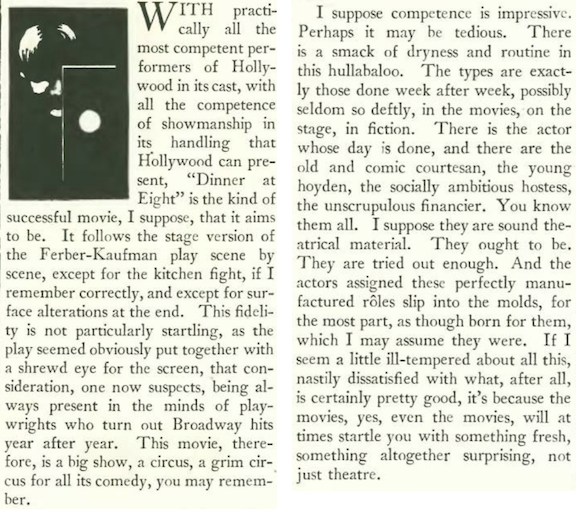
Director George Cukor turned a hit Ferber-Kaufman Broadway play into a hit movie by the same title when Dinner at Eight premiered in September 1933. While the film received high marks from leading critics, New Yorker film reviewer John Mosher found it a bit routine, if well-crafted:
BLONDE ON BLONDE…Judith Wood (left) portrayed the character Kitty Packard in the 1932 stage production of Dinner at Eight; Jean Harlow took on the role for the 1933 film version. (IMDB)
Mosher, however, continued to admire the acting chops of veteran Marie Dressler…
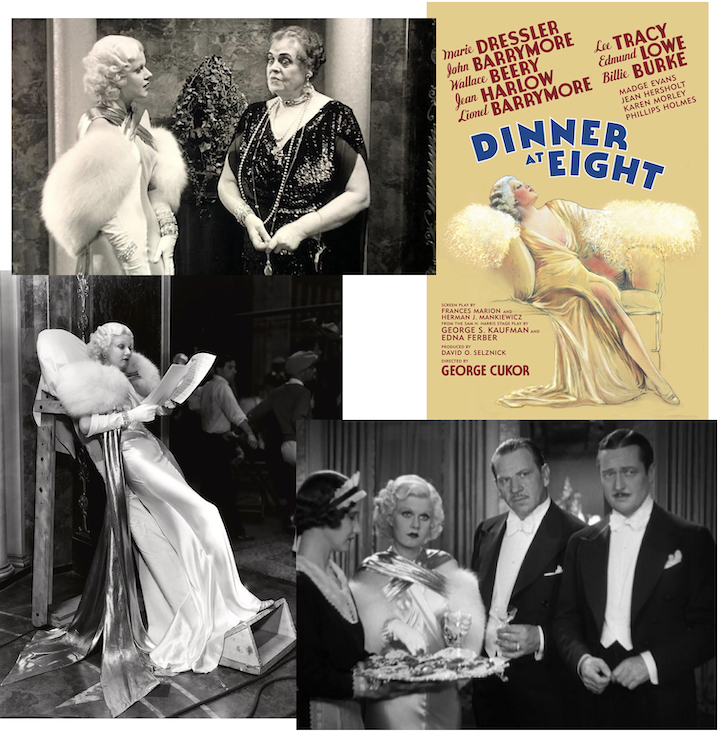
FUNNY LADIES…Clockwise, from top left: Jean Harlow and Marie Dressler square off in Dinner at Eight; movie poster highlights the “Blonde Bombshell” Harlow along with a star-studded cast; a scene with Harlow, Wallace Beery and Edmund Lowe; to avoid wrinkling her gown between takes, Harlow reviewed her lines in a special stand-up chair. (IMDB/pre-code.com)
* * *
Madame Secretary
Secretary of Labor Frances Perkins was the first woman in the U.S. to serve as a cabinet secretary, but she was a lot more that—she was the driving force behind FDR’s New Deal. Here are excerpts from a two-part profile written by Russell Lord, with illustration by Hugo Gellert.
TRIAL BY FIRE…Frances Perkins watched in horror as young women leapt to their deaths in the 1911 Triangle Shirtwaist Factory fire—146 perished on that day Perkins recalled as the moment the New Deal was born her mind. In the wake of the fire Perkins, an established expert on worker health and safety, was named executive secretary of the NYC Committee on Safety. (trianglememorial.org/francesperkinscenter.org)
Even if some men couldn’t come around to a woman moving through the circles of power, Perkins had many admirers including prominent Tammany Hall leader “Big Tim” Sullivan.
Perkins’ appointment to FDR’s cabinet made the Aug. 14, 1933 cover of TIME magazine. (TIME/thoughtco.com)
* * *
From Our Advertisers
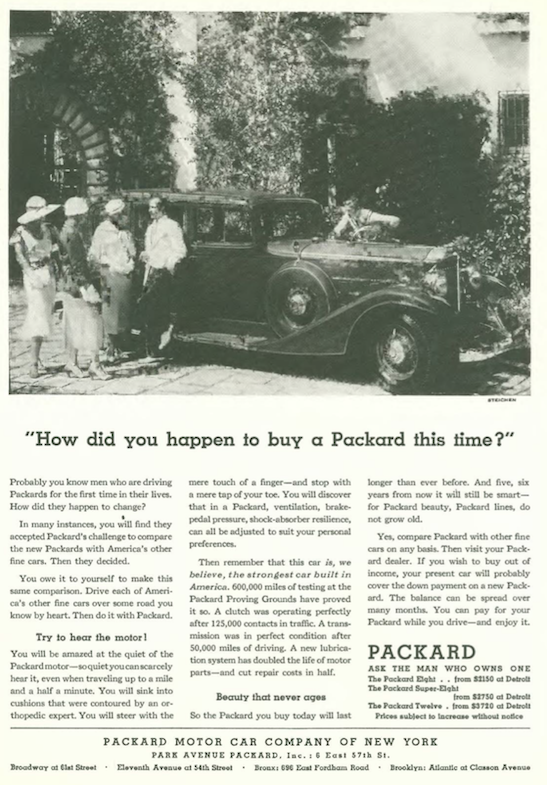
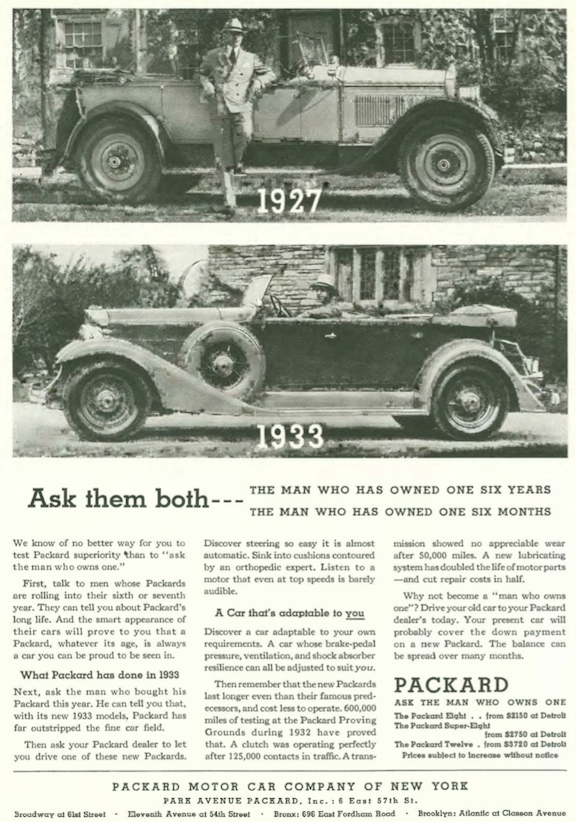
Even the staid executives at Packard were getting into the modern advertising game, where sometimes the product itself was not even pictured…
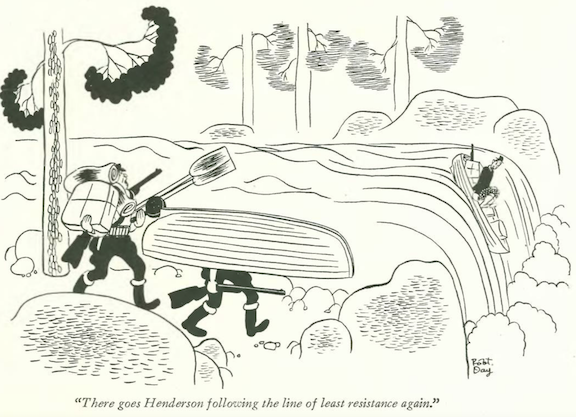
…our cartoonists include Robert Day…
…George Price…
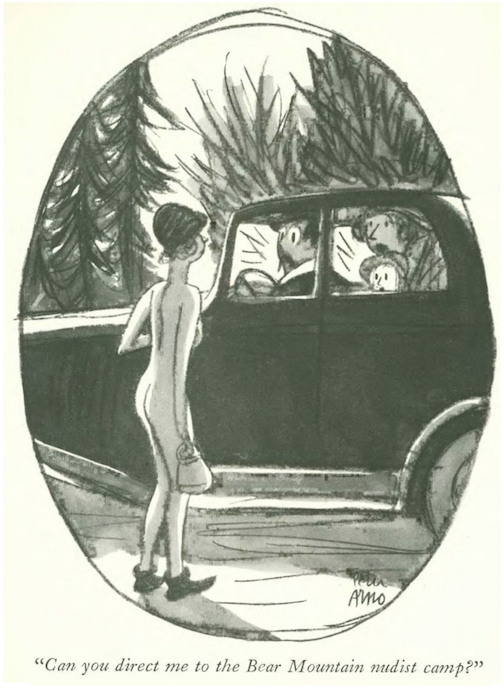
…and baring it all, Peter Arno…
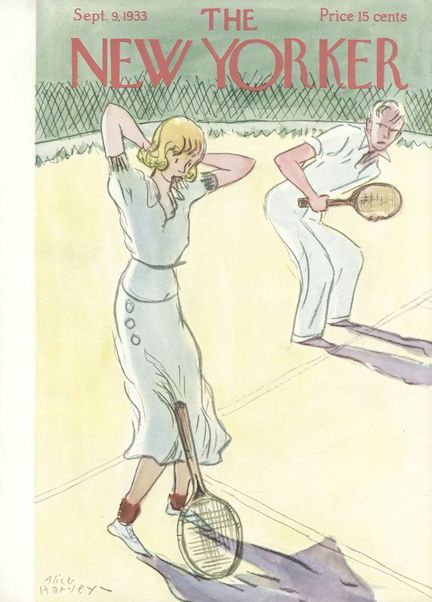
…on to Sept. 9, and what I believe is Alice Harvey’s first New Yorker cover…
Sept. 9, 1933 cover by Alice Harvey.
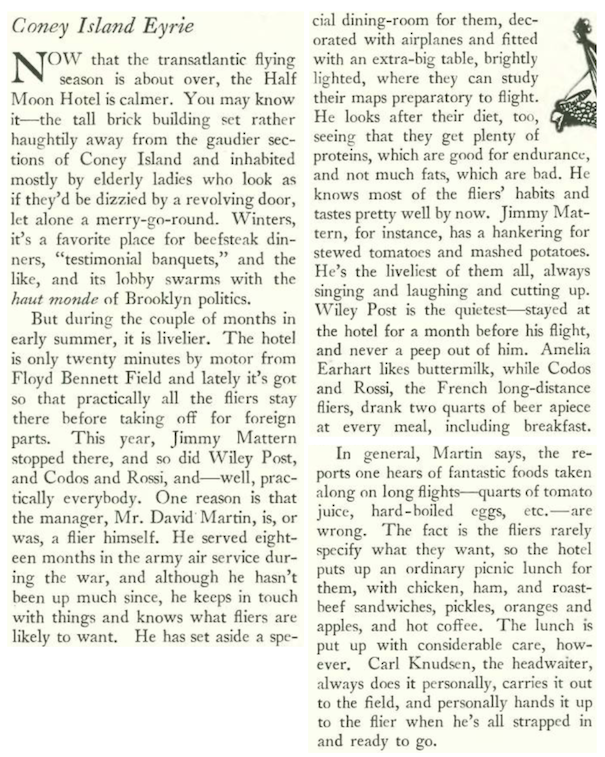
…and where “The Talk of the Town” paid a visit to the Half Moon Hotel on Coney Island, a favorite haunt of those magnificent men and women and their flying machines:
SHIFTING SANDS…Opened in 1927 to attract upscale crowds to Coney Island away from the rabble of the Midway, the elegant Half Moon Hotel started strong but teetered on the doorstep of bankruptcy during the Depression; it gained notoriety in 1941 when mob turncoat Abe Reles fell to his death from a sixth floor window while under police protection. The hotel was demolished in 1996. (Pinterest)
* * *
Huey In The News
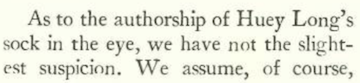
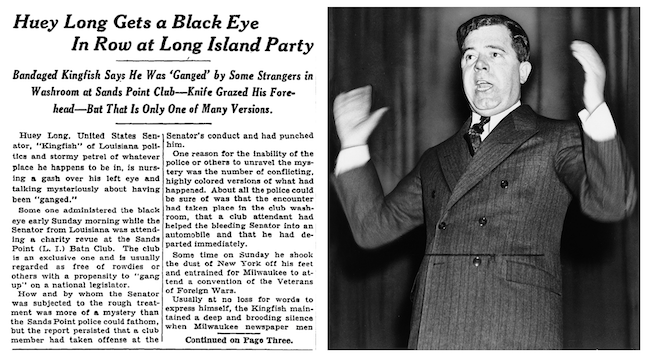
In his column “Of All Things,” Howard Brubaker offered this brief take on Huey Long’s visit to a Long Island party, where one guest apparently socked the controversial “Kingfish,” giving the former Louisiana governor (and then senator) a shiner.
A CHIP ON HIS SHOULDER?…Controversy followed Huey Long wherever he went. At left is a New York Times account of Long’s alleged black eye incident on Long Island. He would be assassinated two years later at the Louisiana State Capitol; Long circa 1933. (NYT/Wikipedia)
* * *
More From Our Advertisers
As a follow-up from the previous issue’s Packard ad, this two-page spread showed us what those 1200 men were gawking at…check out that 12-cylinder model on the left, which appears to be better than 20 feet long…
…according to this ad, you could thank Camel cigarettes for getting the mail through the gloom of night…
…if you needed a cigarette to steady your nerves, you also needed fresh coffee to avoid being ostracized by your friends…
…summer-stock barn theatres were popular across America in the 1930s…this ad (illustrated by Wallace Morgan) hailed the end of the summer season and the return of “Winter Broadway”…
…on to our cartoons, out in the countryside we also find William Crawford Galbraith, here continuing to ply one of his favorite themes, namely pairing shapely seductresses and showgirls with clueless suitors…
…Helen Hokinson gave us one woman who believed “what happens in the Riviera, stays in the Riviera”…
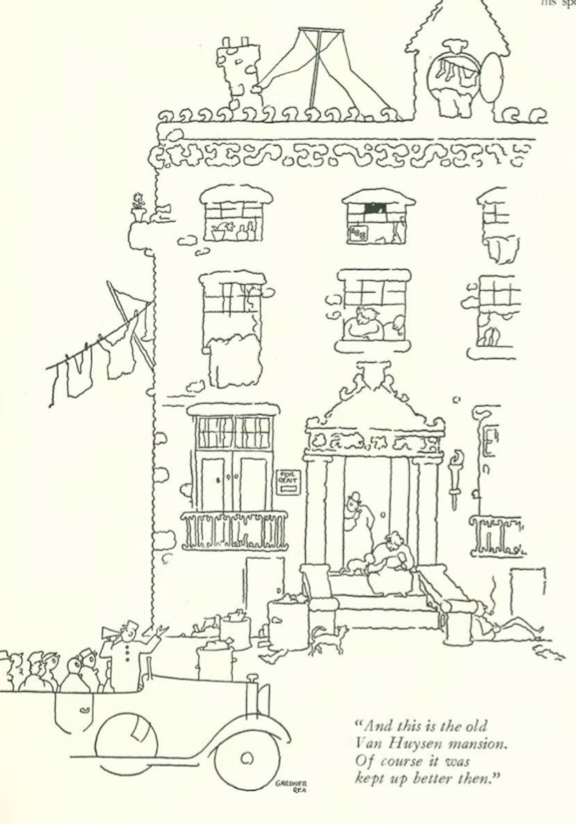
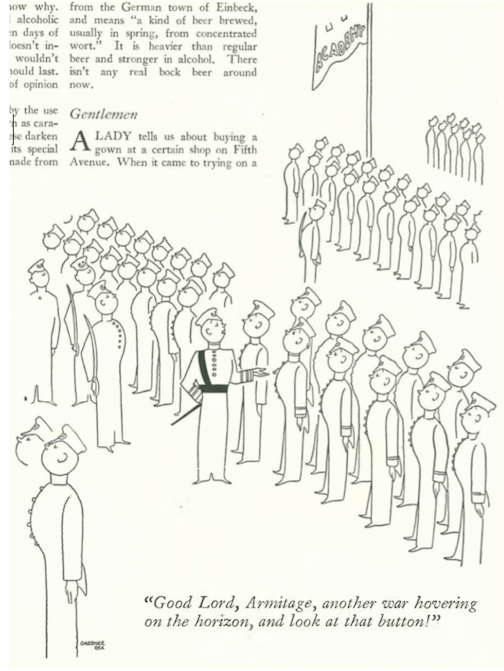
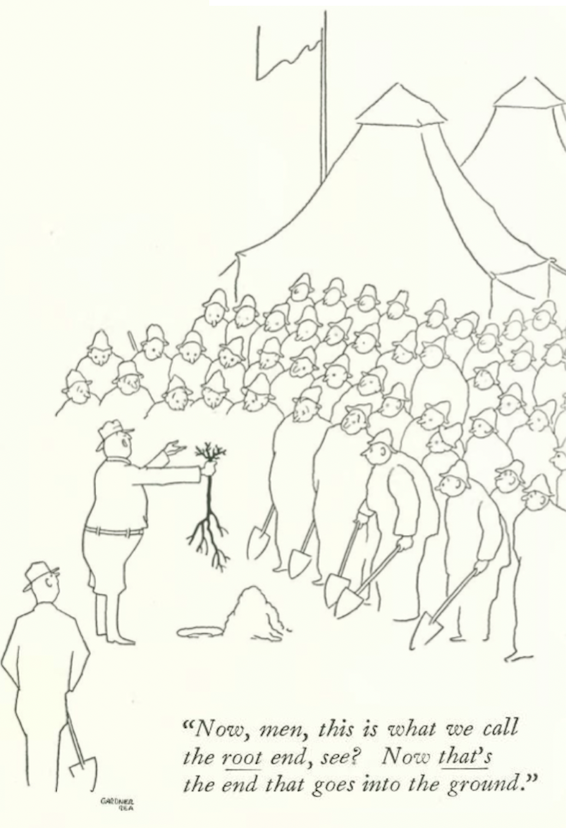
…and we close with Gardner Rea, and a scout troop on a mission…
New Yorkers were enduring the dog days of August, and those who couldn’t escape the heat by fleeing to the country or the beach could find cool respite at the movies.
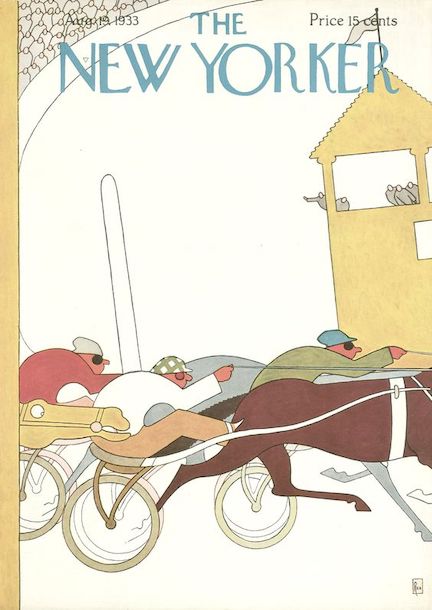
August 19, 1933 cover by Gardner Rea.
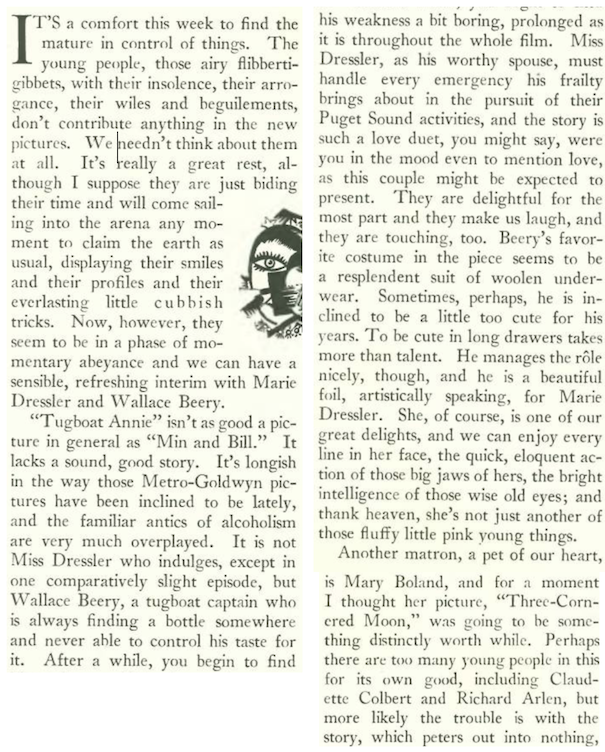
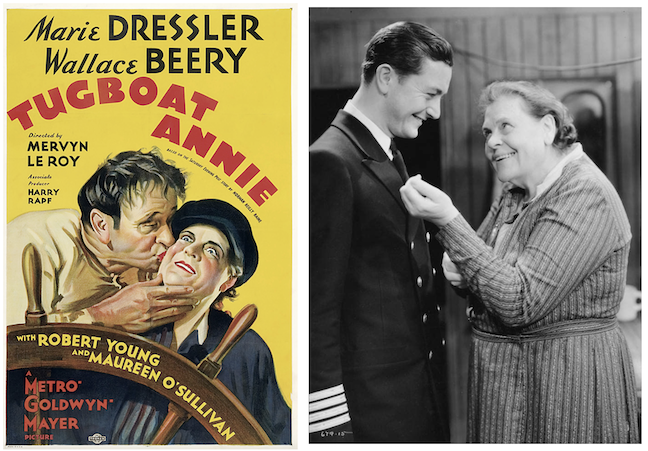
It was doubtless in an air-conditioned theatre where critic John Mosher enjoyed the craft of older actors, in this case Wallace Beery and Marie Dressler in Tugboat Annie. Although the film didn’t quite live up to Beery and Dressler’s 1930 smash hit, Min and Bill, Mosher found Beery to be a “beautiful foil” to Dressler, who thankfully wasn’t just another “fluffy little pink young thing.”
ON GOLDEN POND…Wallace Beery and Marie Dressler portrayed a comically quarrelsome older couple who operate a tugboat in MGM’s Tugboat Annie. It would be one Dressler’s last film roles—she would die the following year; at right, a young Robert Young with Dressler in a scene from the film—Young would go on to television fame playing two beloved characters: the dad in Father Knows Best (1954-60) with fellow film star Jane Wyatt, and the kindly, avuncular doctor on Marcus Welby M.D. (1969–76). (IMDB)
Another seasoned performer Mosher admired was Mary Boland, although her latest film, Three Cornered Moon, was crowded with “too many young people”…
BRAT PACK…Mary Boland (left) with Wallace Ford, Claudette Colbert, and Hardie Albright in Three Cornered Moon (IMDB)
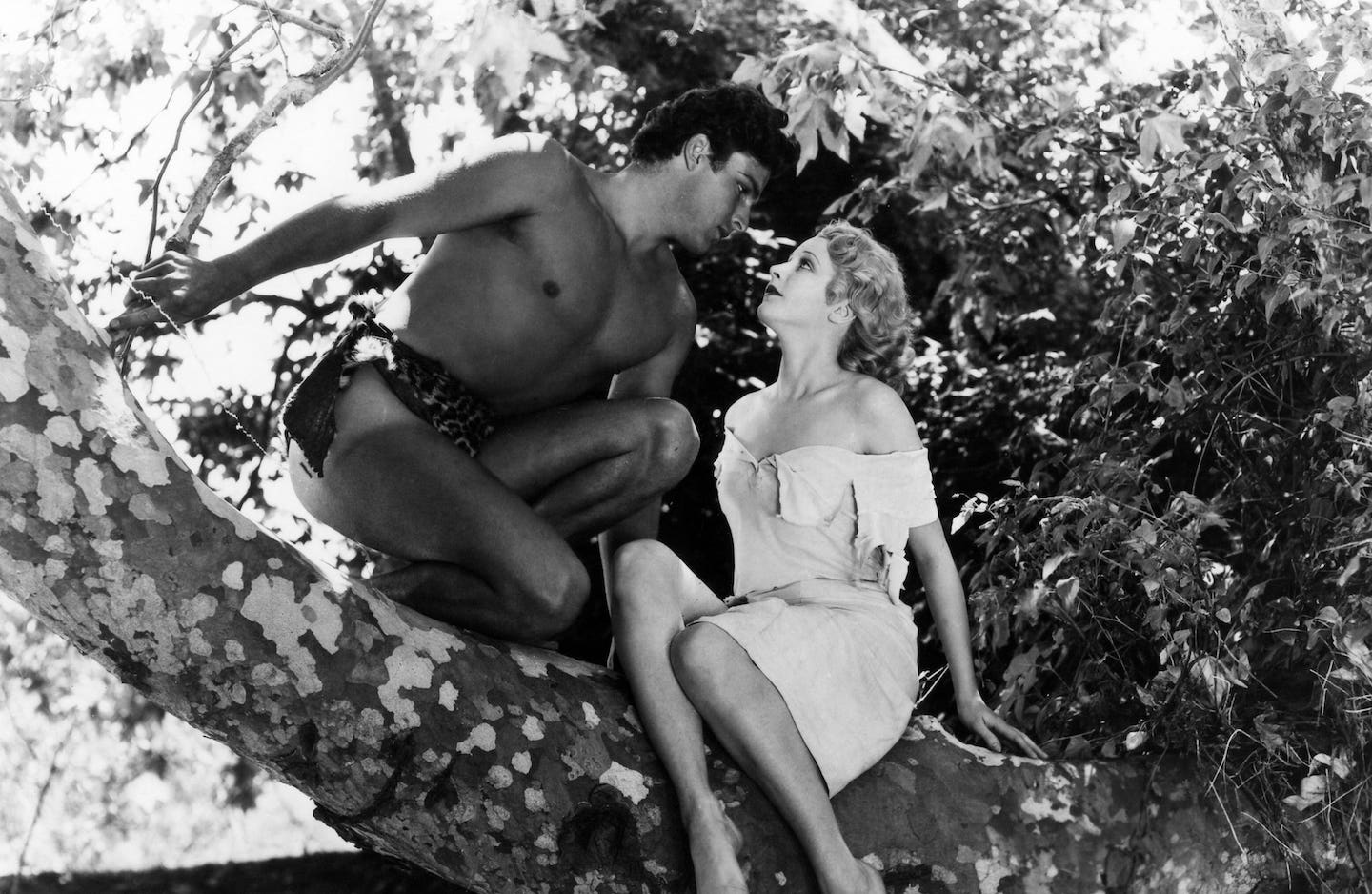
…and then there was Buster Crabbe’s lackluster Tarzan the Fearless to consider—it was Crabbe’s only screen appearance as the Ape-Man…
MONKEYING AROUND…A self-described “King of the Serials,” Buster Crabbe’s career included nine sound serials, including Flash Gordon and Buck Rogers (1936-40). In Tarzan the Fearless Crabbe’s sole appearance as Tarzan was played opposite Jacqueline Wells (aka Julie Bishop). The media at the time made hay of a so-called rivalry between Crabbe and Johnny Weissmuller, who defined the Tarzan role in twelve films from 1932 to 1948. Both men were Olympic athletes: Crabbe won the 1932 Olympic 400-meter freestyle swimming championship, while Weissmuller was the undefeated winner of five Olympic gold medals. (IMDB)
* * *
From Our Advertisers
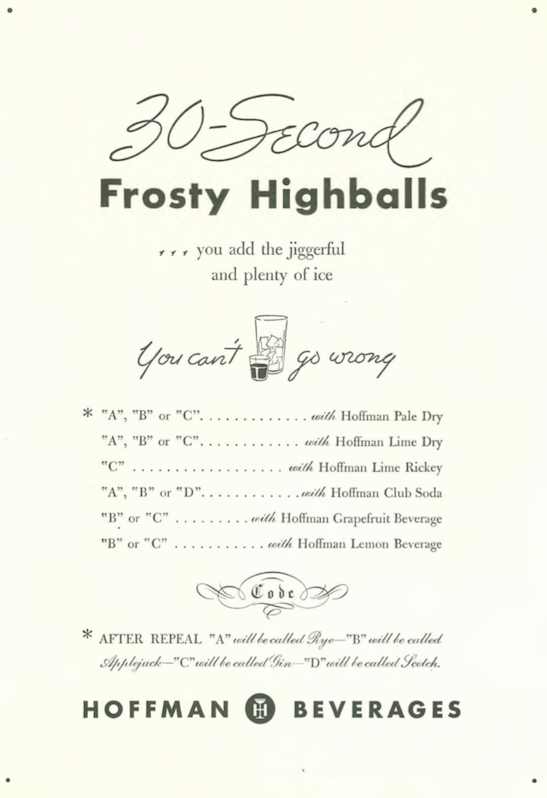
The folks at Hoffman Beverages continued to offer up ways to enjoy an adult refreshment, including a tongue-in-cheek “code” to be used until the repeal of Prohbition…
…with the return of legal (3.2) beer, brewers were aggressively targeting women as a new growth market…
…a selection of one-column ads from the back pages touted imported beers and an old “Pennsylvania Dutch” quaff, intermixed with apartment ads and a women’s deodorant called SHUN…
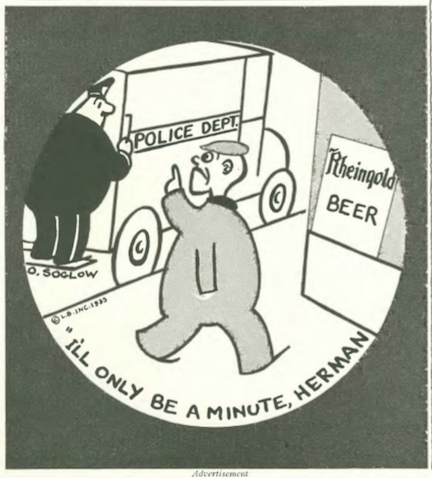
…Otto Soglow, who would become rich and famous with his The Little King strip, also did well as an illustrator for various products, including Rheingold beer…
…another way to stay cool was to dine at Longchamps, thanks to their “scientific air-conditioning system”…
…on the subject of keeping cool, back in the day you had to regularly top off the radiator on hot days, and if you added lead to your gasoline you could also get rid of those annoying hot engine knocks…
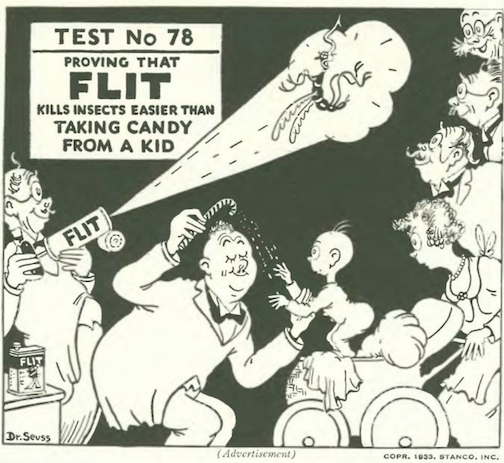
…It would be four years before Dr. Seuss would publish his first children’s book, so he continued to pay the bills with illustrated ads for Flit insecticide…ah the good days when spraying poison above a child’s head seemed perfectly reasonable…
…another one-column ad from the back pages says a lot about how advertisers perceived a New Yorker reader—even dog food demanded snob appeal…
…on to our cartoons we return to Otto Soglow and his take on the old William Tell trope…
…Peter Arno delivered some surprising news to dear old mom…
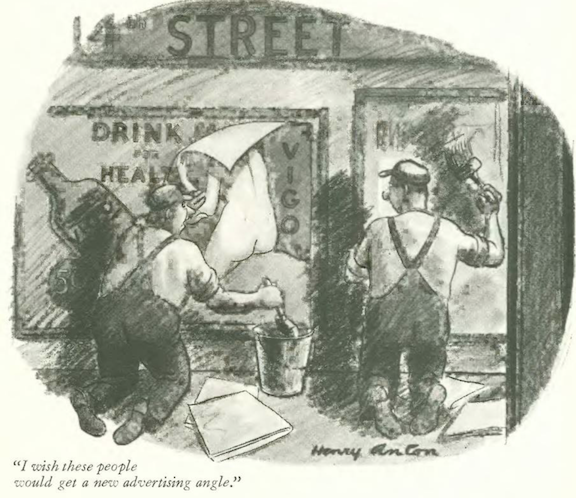
…Henry Anton gave us a sign man unconvinced that sex sells…
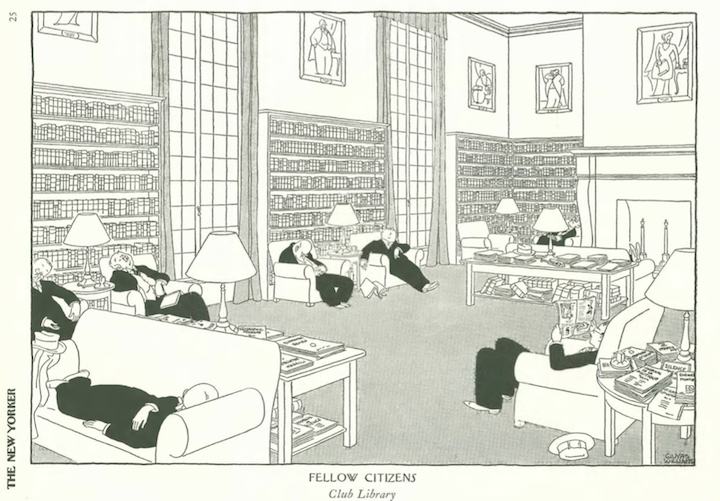
…Gluyas Williams gave us his latest take on “Fellow Citizens” (this originally appeared sideways on p. 17)…
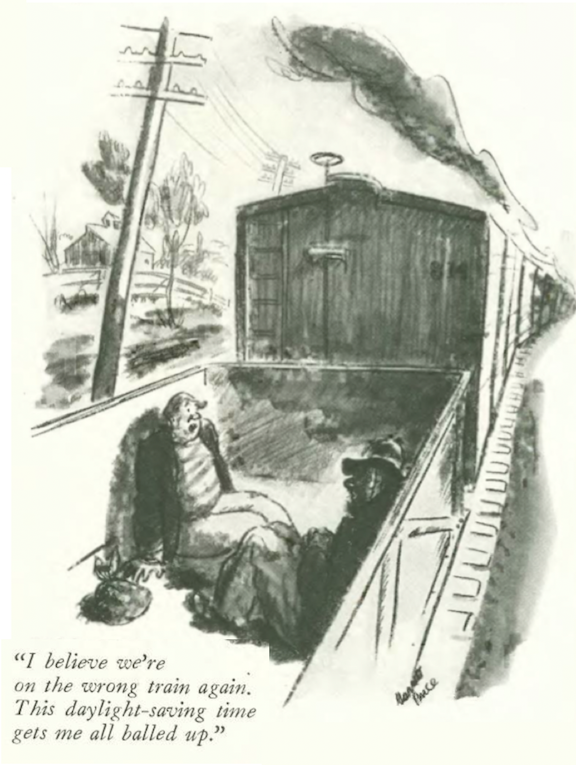
…and Garrett Price shared this observation, from the mouth of babes…
…on to Aug. 26…
Aug. 26, 1933 cover by Perry Barlow.
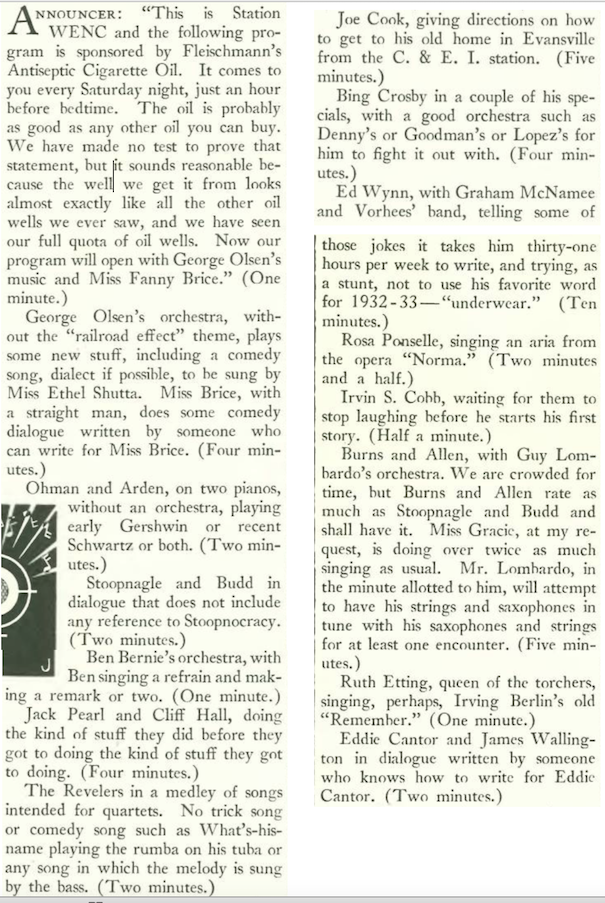
…where we find Ring Lardner, who since March had been injecting humor into the “Over the Waves” radio column.
In this installment, Lardner outlined his ideal radio program. An excerpt:
UP TO OLD GAGS?…Ring Lardner gave the comedy duo Jack Pearl (right) and Cliff Hall a generous four minutes in his fantasy radio show—if they did their old routines. (Wikimedia)
Lardner concluded his dream program:
Sadly, Ring Lardner would be gone in less than a month—he died of a heart attack on Sept. 25, 1933, at the tender age of 48.
* * *
On Second Thought
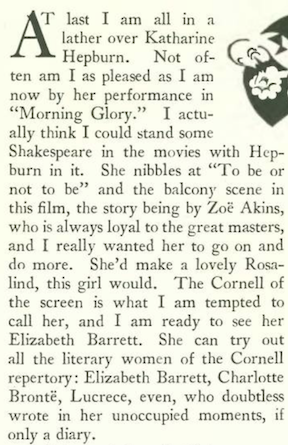
Previously, film critic John Mosher had been lukewarm to the up-and-coming Katharine Hepburn. No more. Her appearance in Morning Glory drew praise from all over, including the Academy, which gave the young star her first Oscar.
A STAR IS BORN…Katharine Hepburn with Douglas Fairbanks Jr. (left) and Adolphe Menjou in Morning Glory (1933). Hepburn would win the Oscar for Best Actress in a Leading Role, the first of four she would receive in that category—a record for any performer. (IMDB)
* * *
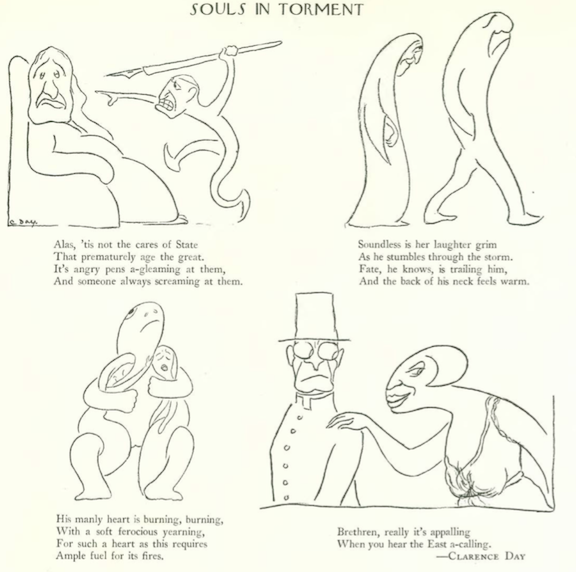
Life With Clarence
Following “The Talk of the Town” section was this illustrated contribution by Clarence Day…
* * *
More From Our Advertisers
While folks were cooling down at the movies Barbara Stanwyck did her best to heat up the screen…
…the frank discussion of sex in Baby Face made it one of the most notorious films of the year and no doubt hastened the implementation of the Hays Code…
LIGHT MY FIRE…Barbara Stanwyck in Baby Face.
…in case anyone had forgotten during Prohibition, Budweiser reminded them who was the king of beers with this inside front cover ad…
…Irvin S. Cobb was back on behalf of Hupmobile, the struggling carmaker hoping that a bit of humor would boost sales…
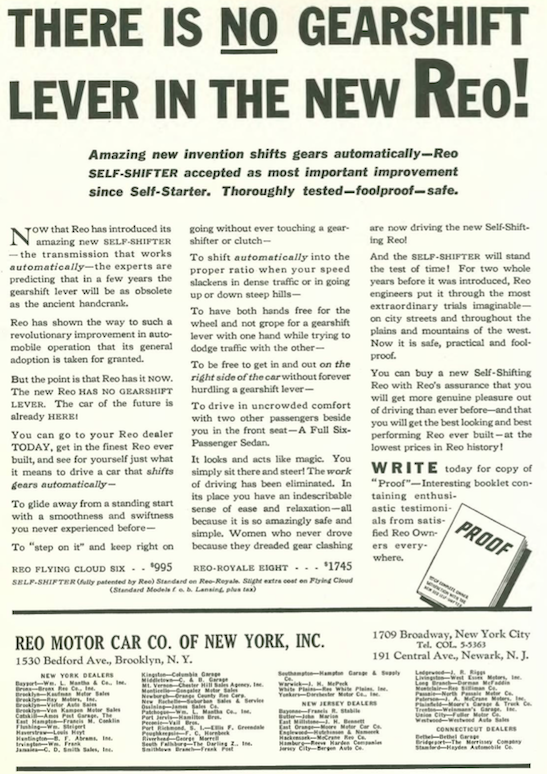
…this ad from Reo not only lacked humor, it lacked the car itself…
…too bad, because the 1933 Reo Royale was a beauty…
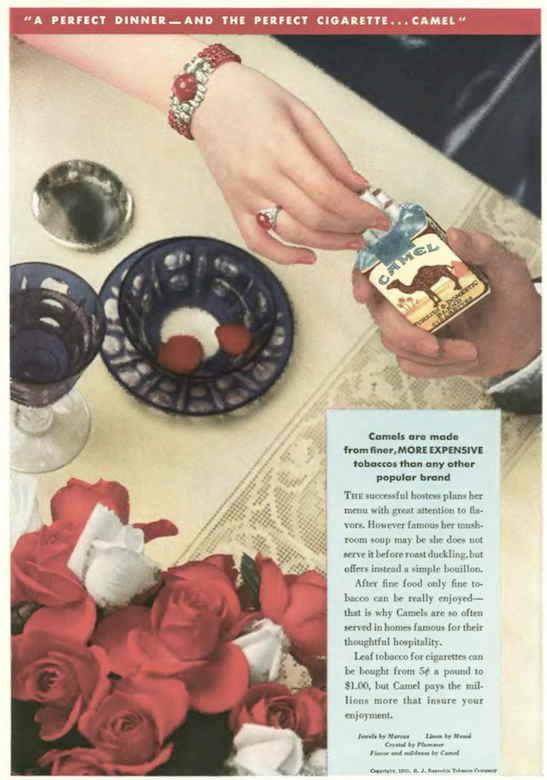
…more color ads from our cigarette manufacturers Camel…
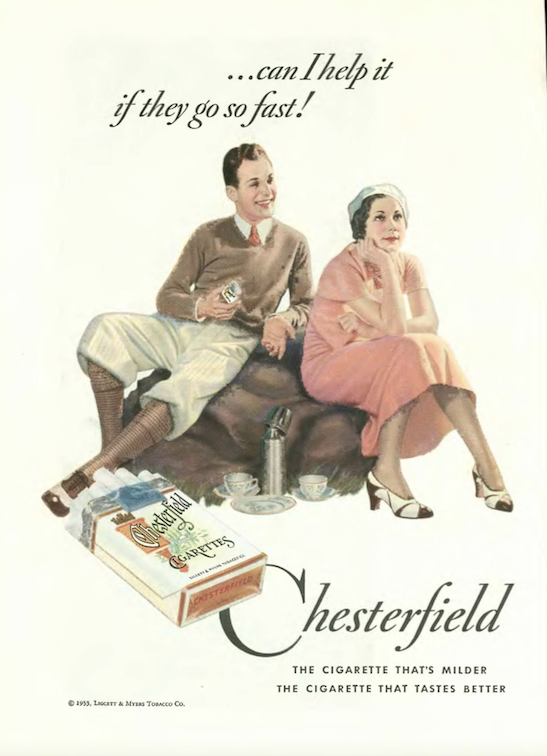
…and Chesterfield…
…why, it’s Barbara Stanwyck again, this time in color, thanks to the folks at Powers Reproduction…
…and Otto Soglow again for Rheingold beer…
…and on to the cartoons, with Soglow’s Little King…
…Carl Rose demonstrated the perils of attending theatre in a barn…
…Robert Day found a Hebrew lifeguard at Coney Island…
…and we end with another by Day, with a twist on America’s Pastime and a subtle plug for the National Recovery Administration…
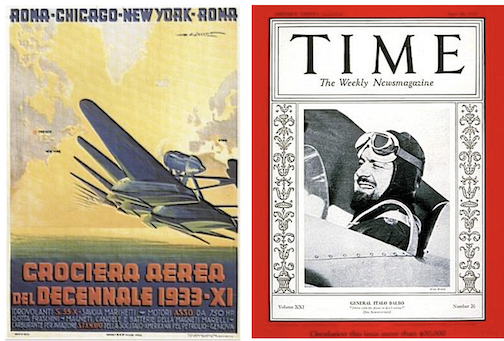
New Yorkers witnessed flying milestones and mishaps in the summer of 1933—after Wiley Post landed at Bennett Field, he became the first person to fly solo around the world, and famed Italian aviator Italo Balbo would bring a squadron of 24 Savoia-Marchetti S.55 flying boats across the Atlantic and triumphantly land them on the Hudson River. So before we get to the Aug. 5 issue…
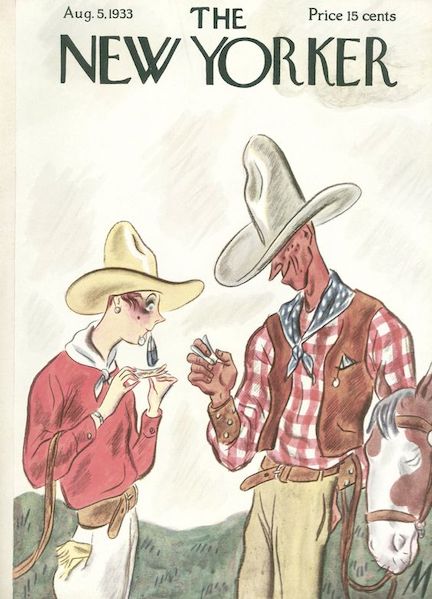
Aug. 5, 1933 cover by Julian de Miskey.
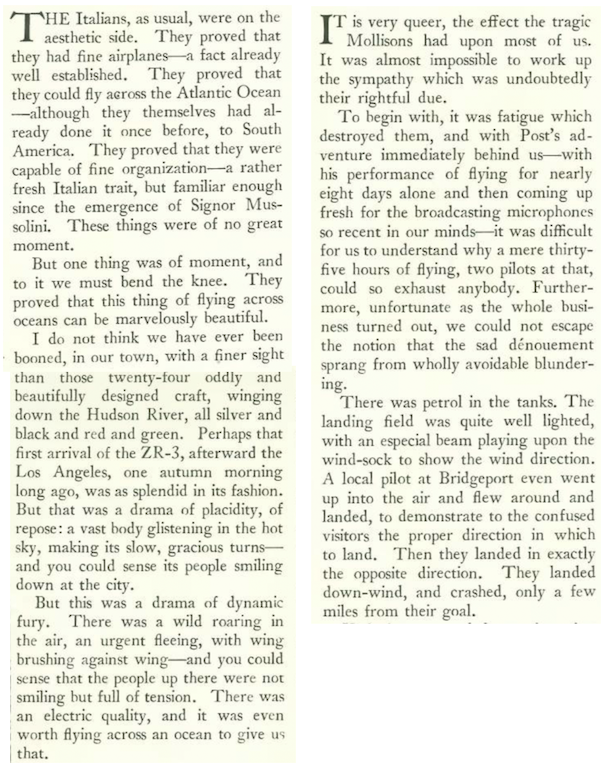
…let’s look in on Morris Markey, who described all of the skyward thrills in his “A Reporter at Large” column in the August 12 issue. Markey also offered a “bold prophecy” that the ticker-tape parades and “hysterical cheers” could not go on forever.
ROUND AND ROUND HE GOES…Clockwise, from top left, Wiley Post under the wing of the famed Lockheed Vega monoplane Winnie Mae in 1933; Post next to the Winnie Mae in Bartlesville, Oklahoma in 1934, his achievements recorded on the fuselage; miners from Flat, Alaska, bring the Winnie Mae upright for repairs—the plane nosed over after hitting a patch of mining tailings; Post climbs out of the Winnie Mae at Floyd Bennett Field, Long Island, after completing the first solo flight around the world. Post set a new record of 15,596 miles (25,099 kilometers) in 7 days, 18 hours, 49 minutes. (NASM/Oklahoma Historical Society/U of Alaska-Fairbanks/Associated Press)
Markey wrote admiringly of the Italians and their oddly beautiful flying boats as they descended, 24 in all, on the Hudson River. Things did not go so well for Scottish aviator James Mollison and his wife, Amy Johnson, who had set many flying records in the 1930s.
DESCENDED LIKE FLIES…Twenty-four Savoia-Marchetti flying boats left Italy in 1933 to fly in formation to the 1933 Chicago World’s Fair and back, with stops along the way including New York. The squadron was led by Italo Balbo, who has featured on the cover of Time, 26 June 1933. (Wikipedia/Time Inc.))GOING IN STYLE, Clockwise, from top left, twenty-four Italian Savoia-Marchetti S.55X flying boats left the west coast of Italy to fly in formation to the Chicago World’s Fair, with a stop on the Hudson River (top right). The Italians were famed for sleek designs, including the Macchi-Castoldi 72, pictured here circa 1931. It was then the fastest plane in the world; James Mollison and his wife, Amy Johnson recover from their injuries after a nonstop flight from Wales to the U.S. Unable to locate the Bridgeport (Conn.) Municipal Airport—which he circled five times— he ultimately crash- landed into a field. Both were thrown from the aircraft but survived—they were later congratulated by New York society with a parade on Wall Street. (warbirdsnews.com/Wikimedia)
Markey’s “bold prophecy” would sadly come to pass; after all of the parades and hoopla, these wonderful airplanes would soon take on more sinister roles as machines of death. Italo Balbo, seen as a possible successor to Italian dictator Benito Mussolini, would die in 1940, shot down by Italian anti-aircraft batteries that mistook his plane for a British fighter. Amy Johnson would die months later in a crash near the mouth of the Thames (possibly by friendly fire). Two years after his record-breaking flight, Wiley Post and American humorist Will Rogers would perish in a 1935 crash near Point Barrow, Alaska.
* * *
Depression Diversions
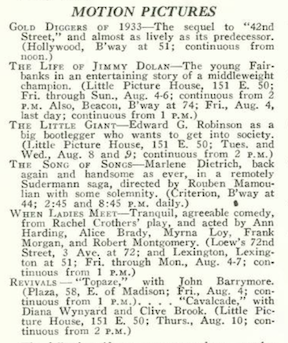
New Yorkers could escape Depression woes and the summer heat with a visit to the cinema. These listings in the Aug. 5 issue were headed by the Busby Berkeley musical extravaganza Gold Diggers of 1933…
DEPRESSION’S FEVER DREAM…Choreographer Busby Berkeley chased those Depression blues away with his lavish musicals, including Gold Diggers of 1933, featuring Ginger Rogers among a bevy of stars. (IMDB)
* * *
From Our Advertisers
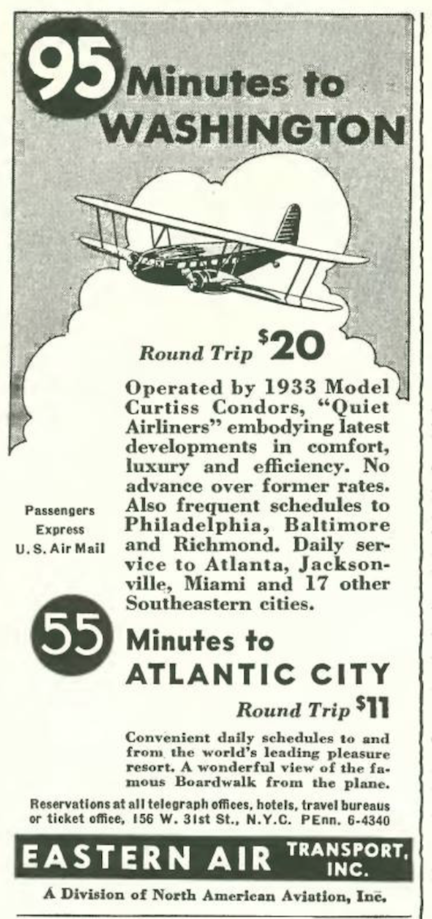
Fledgling airlines including Eastern Air Transport and American Airways (forerunners of Eastern Air Lines and American Airlines) were giving passenger trains a bit of competition with relatively quick flights to destinations including Washington D.C. and Atlantic City—the D.C. round trip cost $20, roughly equivalent to $455 today…
…introduced in 1933, the Curtiss YC-30, called the Condor in civilian use, could seat 15. It could also be fitted out as 12-passenger luxury night sleeper…
YOU COULD REST EASY on the Curtiss Condor in 1933. (U.S. Air Force)
…Packard and Cadillac both produced premium automobiles, but where Packard emphasized durability and longevity…
…the folks at Cadillac went for pure sob appeal…
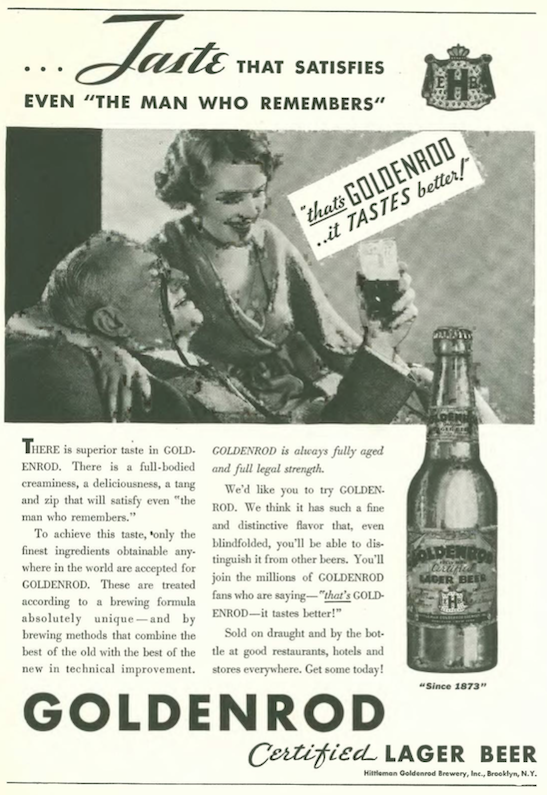
…I wonder how many people still wore pince-nez in 1933, especially while drinking beer…
…the makers of Hoffman ginger ale weren’t waiting for the official end of Prohibition to tout their popular mixer…
…with the launch of FDR’s New Deal, advertisers were quick to jump on the bandwagon…
…as did one of our cartoonists, Otto Soglow…
…and now on to the Aug 12 issue…
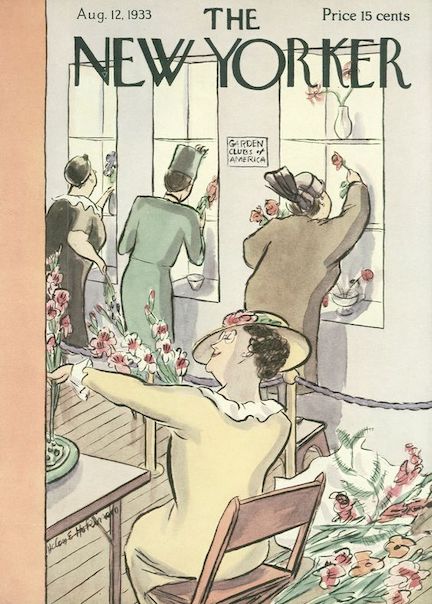
Aug. 12, 1933 cover by Helen Hokinson.
…which featured another installment of James Thurber’sMy Life and Hard Times—”The Night the Ghost Got In”…
James Thurber’s illustration for “The Night the Ghost Got In” that appeared in his book My Life and Hard Times. The scene depicts his brother Herman, and his fear of ghosts. The caption read: “He always half suspected that something would get him.”
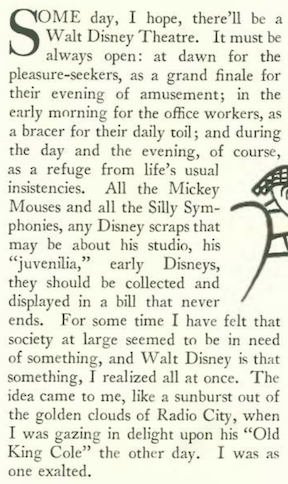
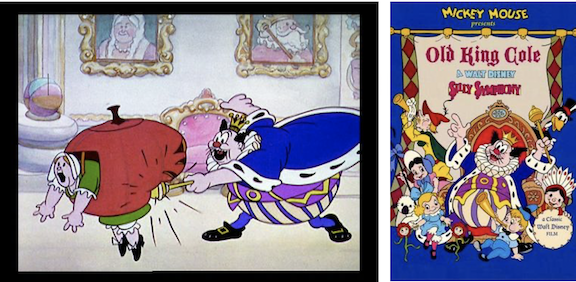
Meanwhile, Thurber’s colleague, film critic John Mosher, was finding joy through Walt Disney’sSilly Symphonies…
DELIGHTFUL DIVERSION…Critic John Mosher was “one exalted” over Walt Disney’s latest Silly Symphony, titled Old King Cole.
* * *
More From Our Advertisers
This giant two-page spread from the makers of Dodge sought to prove you could have both durability and affordability in their six-cylinder model (the cheapest Packard listed at $2,150—you could almost buy four Dodges for that price)…
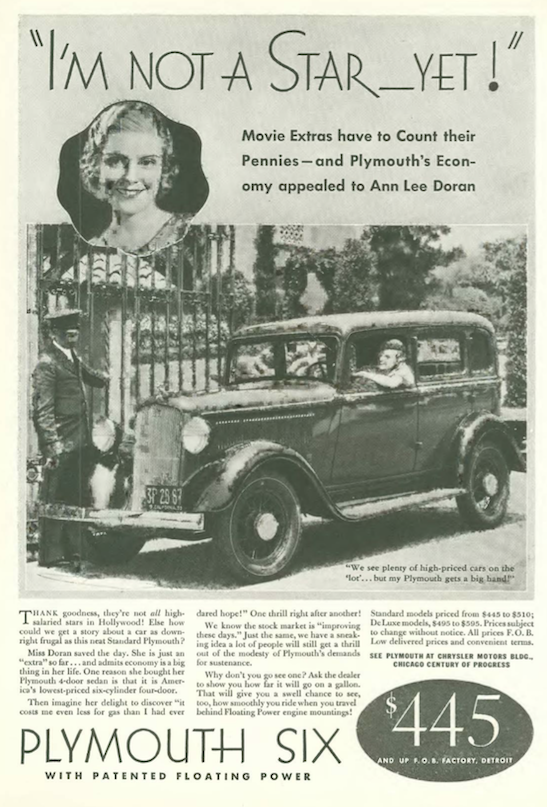
…another Chrysler corporation product, the family-friendly Plymouth, could be had for even less—$445—it was apparently just the kind of car a penny-pinching ingenue needed for getting to her casting calls…
…Ann Lee Doran (1911–2000) went on to a long career as a character actress, perhaps best known for portraying James Dean’s mother in Rebel Without a Cause…
Anne Lee Doran (at far right) in 1941’s Penny Serenade. Also pictured, from left, are Edmund Elton, Edgar Buchanan, Cary Grant and Irene Dunne. (IMDB)
…when you finished brushing your teeth, you could put this other Pepsodent product on your face…
…on to our cartoons, we begin with this two-page spread by Gardner Rea…
…Gluyas Williams referenced the Camel cigarette ads from 1933 that revealed the secrets of popular magic tricks…
…an example from the June 3, 1933 issue of The New Yorker…
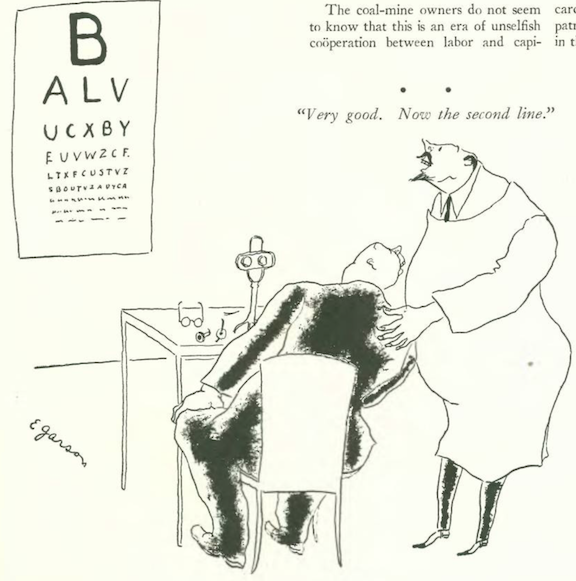
…Eli Garson paid a visit to the optometrist…
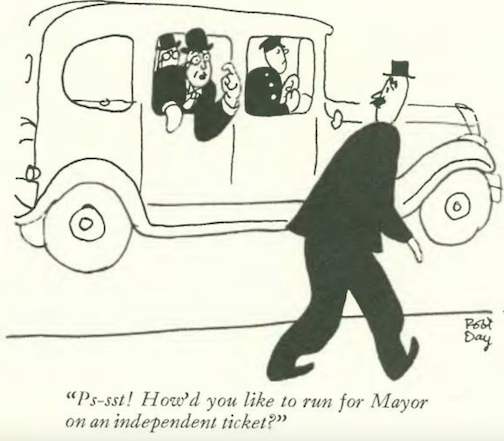
…in the wake of the scandal-ridden mess left behind by deposed Mayor Jimmy Walker, the upcoming November election was bound up by three candidates, none of whom seemed poised to get a majority vote…Robert Day offered up this scenario…
…Carl Rose discovered that even in the boonies, everyone’s a critic…
…and we close with Peter Arno, and another classic…
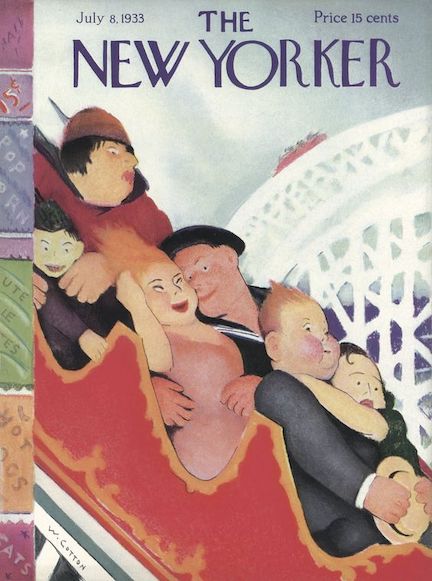
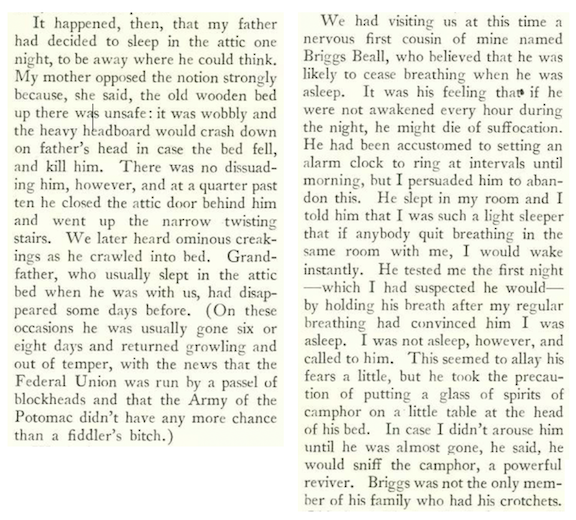
James Thurber was well established as a New Yorker writer and cartoonist by 1933, but his fame would grow with the publication of the autobiographical My Life and Hard Times, serialized in The New Yorker beginning with the July 8 issue.
July 8, 1933 cover by William Cotton.
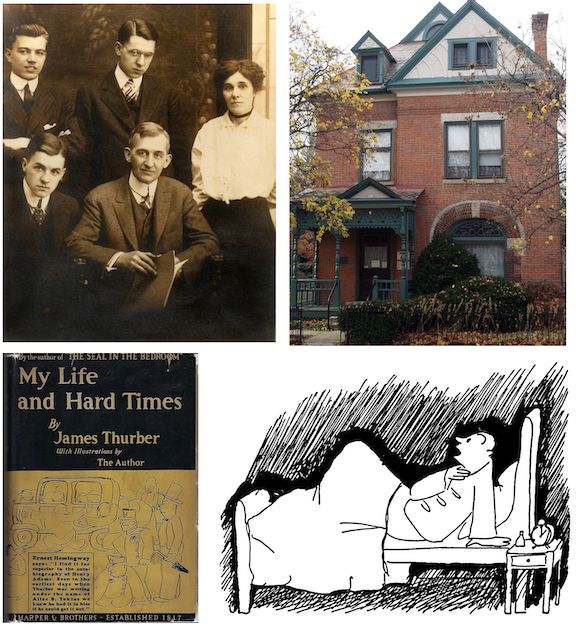
And what a beginning. “The Night the Bed Fell In” recounts the comically absurd events that took place in the wee hours at the Thurber family home in Columbus, Ohio. Beginning with his father’s decision to sleep in the attic, the story introduces a cast of characters including cousin Briggs Beall and his mother, Clarissa. Excerpts:
Briggs’ mother also had fears of impeding calamity…
ALL IN THE FAMILY…Clockwise, from top left, James Thurber (center, back row) with his family circa 1915; the Thurber house that provided the setting for “The Night the Bed Fell In”; Thurber’s illustration of cousin Briggs Beall; cover of the 1933 first edition of My Life and Hard Times. (thurberhouse.org)
Need more Thurber? Longtime New Yorker cartoonist and author Michael Maslin recounts a 1986 pilgrimage to the Thurber house in this Ink Spill entry from 2018. You should also check out Maslin’s regular Thurber Thursday feature for more insights into the world of this beloved humorist.
* * *
The Naked Truth
Once upon a time a Baptist and a Presbyterian got together and created a magazine promoting nudism. The Baptist, IlsleySilias Boone (1879–1968), was founding father of the American Sunbathing Association—later reorganized as the American Association for Nude Recreation. His ally in advancing the cause of nudism, Presbyterian minister Henry Strong Huntington Jr (1882-1981), was the first president of the International Nudist Conference. “The Talk of the Town” laid bare the world of these randy clergymen.
DON’T GET UP…Baptist minister Ilsley Silias Boone (top, left) partnered with Presbyterian minister Henry Strong Huntington Jr on The Nudist (right). The magazine was published from 1933 to 1963. Later issues were published under the title Sunshine & Health. (flickr.com)
* * *
His Kind of Town
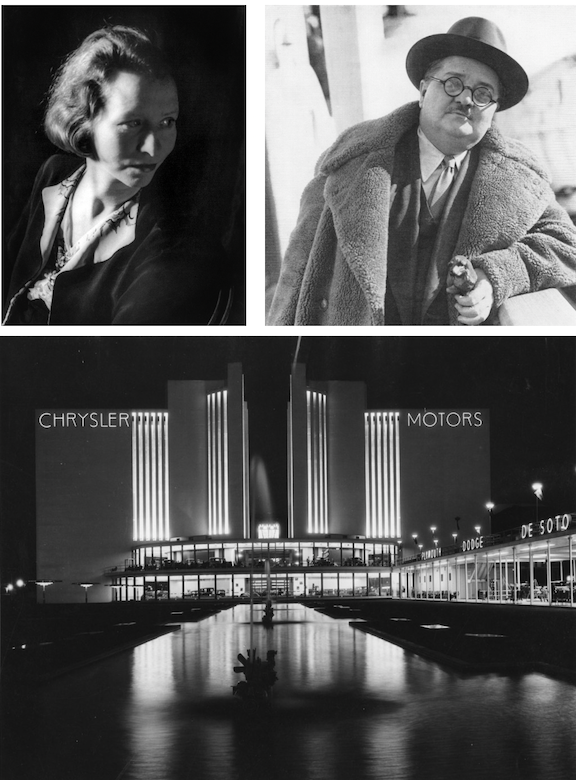
In his “Shouts & Murmurs” column, Alexander Woollcott recounted his trip to Chicago, ostensibly to see the Century of Progress (the 1933 World’s Fair) but was sidelined along the way by various diversions, including a visit with poet Edna St. Vincent Millay. An excerpt:
WAYLAID…Alexander Woollcott stopped by to see the poet Edna St. Vincent Millay before finally making his way to Chicago’s Century of Progress, which featured such spectacles as this Chrysler exhibition. Photo of Woollcott was taken upon his return from Europe in January 1933. Photo of Millay is by Carl Van Vechten, 1933. (Wikipedia/eBay/chicagology.com)
* * *
From Our Advertisers
Prohibition wouldn’t be officially repealed until Dec. 5, 1933, but that didn’t stop New Yorkers from enjoying their favorite adult beverage, including this pair. What on earth is that man on the left doing? It appears he’s opening a bottle of White Rock (glimpsed between his legs), but why with his back turned?…
…the folks at Packard were consistent in promoting the durability and longevity of their premium automobiles…
…and it’s no coincidence that the makers of Goodyear tires featured a 1933 Packard to tout the durability of their product…
…speaking of durability, the ever-reliable Gardner Rea kicks off our cartoons…
…Mary Petty eavesdropped on the latest social event…
…the battle of the sexes continued in James Thurber’s world…
…Barbara Shermund shared the lamentations of a modern woman…
…and Garrett Price, likely inspired by a recent trip abroad, gave us this homesick tourist…
…and the cover of the July 15, 1933 issue…
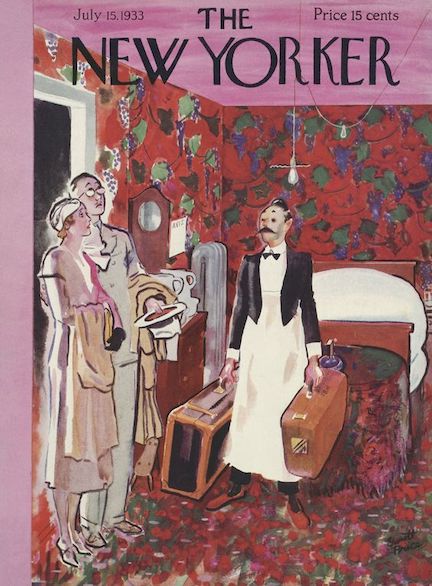
July 15, 1933 cover by Garrett Price.
…in which Thurber continued his tales from My Life and Hard Times with “The Car We Had to Push”…also in the issue was a profile of “Bolshevik Businessman” Peter Bogdanov, written by foreign correspondent William C. White. An excerpt:
From 1930 to 1934 Bogdanov (1882–1939) headed the Amtorg Corporation, which helped the struggling Soviet economy establish valuable business and diplomatic relations with the United States. It is no surprise that like many who helped the Soviet cause, Bogdanov was eventually arrested on trumped-up charges and executed by Stalin’s henchmen. In March 1956 he was posthumously “rehabilitated.”
WORKING TOWARD AN EARLY RETIREMENT…Peter Bogdanov, circa 1920s. (Wikipedia)
* * *
On the Lighter Side
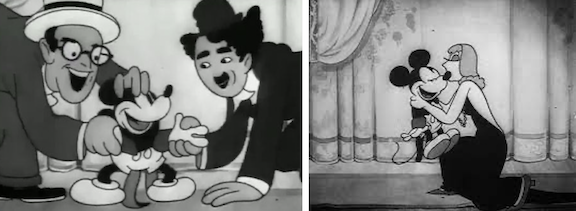
While millions in the Soviet Union were dying of famine and other Stalin-inspired atrocities, Americans were keeping their Depression-era spirits up at the movies, including critic John Mosher, who called the latest Mickey Mouse cartoon “a beautiful thing”…
THE MOUSE THAT ROARED…Mickey Mouse hobnobs with celebrities of the day including Harold Lloyd, Charlie Chaplin and Greta Garbo in his latest picture, Gala Premiere. (IMDB)
* * *
More From Our Advertisers
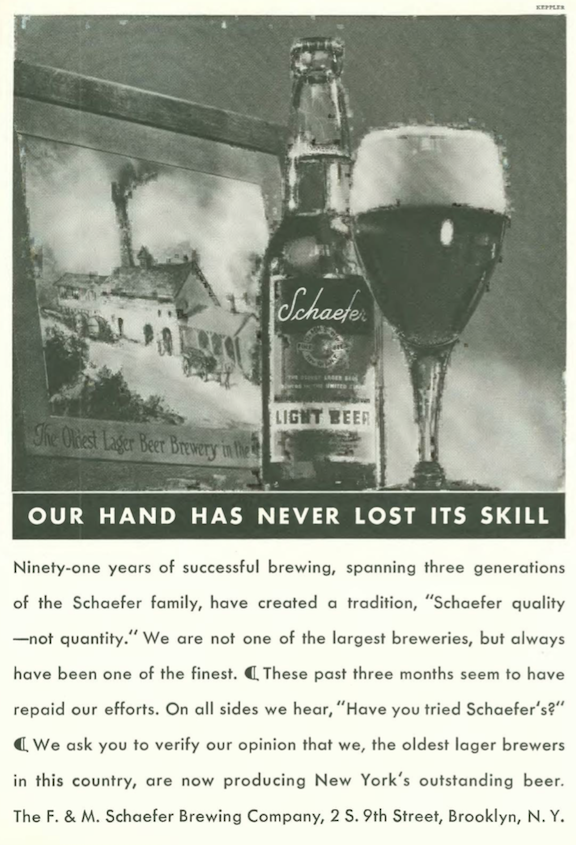
I once had a relative in New Jersey who drank a tall can of Schaefers every day, on orders from his doctor…
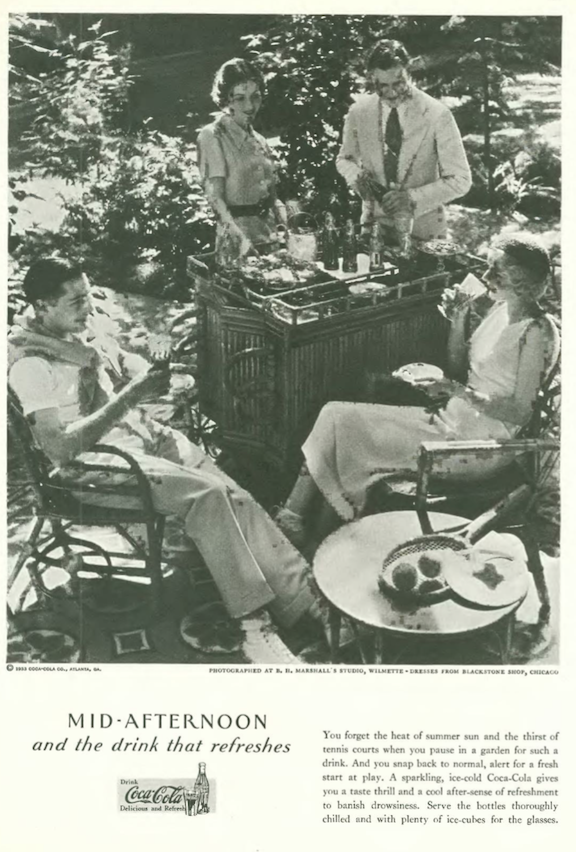
…the makers of Coca-Cola continued to tout their product in full-page New Yorker ads…
…recalling the Packard ad from the previous issue, the cheapest Packard model would set you back $2,150…you could instead get this swell Plymouth Six for just $455 and head down to the waterfront, where, according to this salesman, “men are men”…
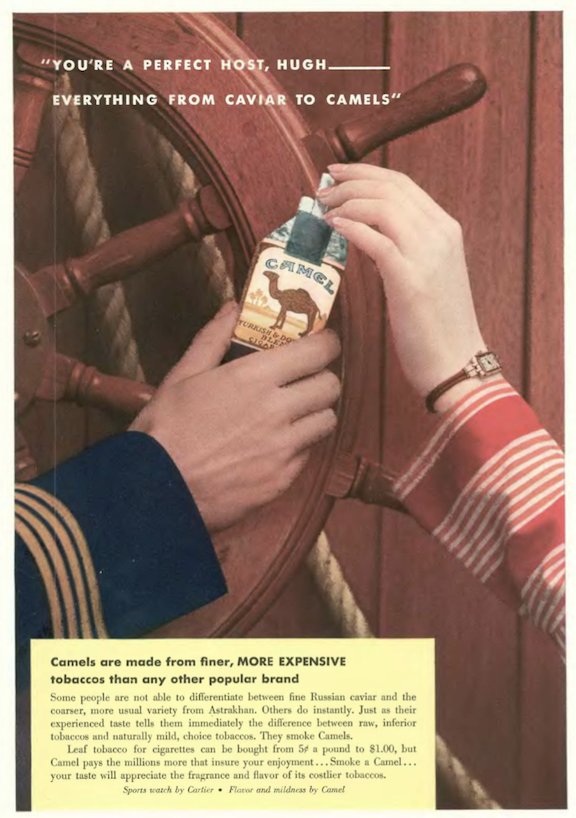
…and while on the waterfront you might be able to bum a smoke and maybe some caviar from a sailor named Hugh…
…and now we take a stroll in the park with Otto Soglow’s “Little King”…
…and find romance along with other hot dishes at the automat, courtesy Whitney Darrow Jr…
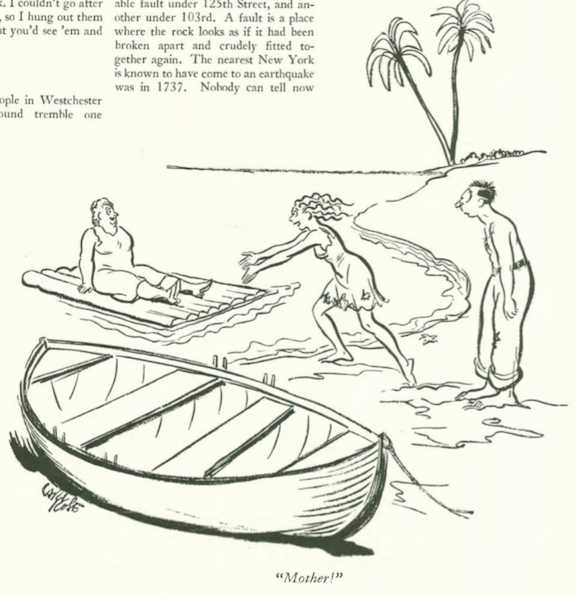
…adrift with Carl Rose, and a man unlucky in love…
…Peter Arno played hide and seek with an escaped con…
…and we end where we began, with James Thurber at his best…
As we enter the summer months we find the recurring themes of June brides…and German Nazis…
May 27, 1933 cover by Constantin Alajalov.
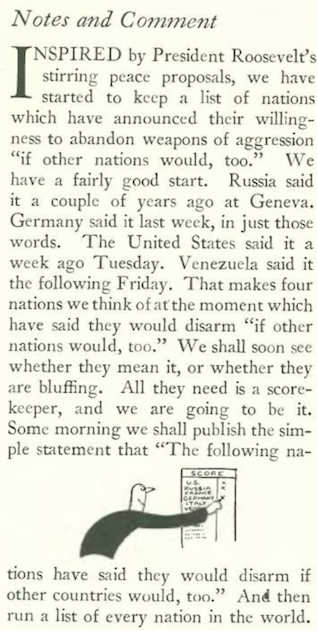
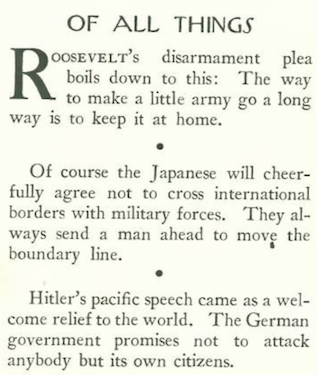
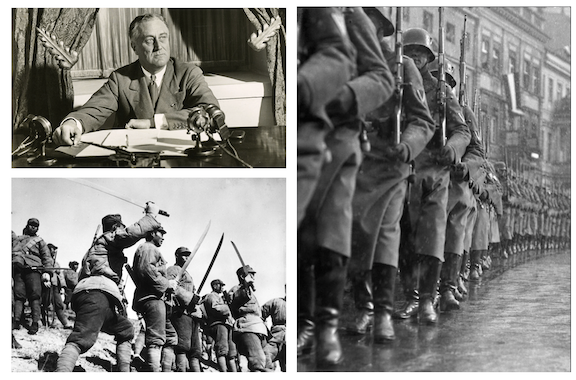
Those Nazis were on the mind of U.S. President Franklin D. Roosevelt when he wrote to the sixty participating nations at the Geneva Disarmament Conference, imploring them to eliminate all weapons of offensive warfare. As we now know, it was a plea that mostly fell on deaf ears, notably those of the leaders of Japan and Germany. E.B. White offered this observation:
GIVE PEACE A CHANCE?…Sixty countries sent delegates to the Geneva Disarmament Conference in 1932–33. Germany was represented by Nazi Minister of Public Enlightenment and Propaganda Joseph Goebbels (front row, center), that is until his country pulled out of the conference and continued its massive arms buildup. (Library of Congress)
Howard Brubaker was also keeping an eye on FDR’s efforts to hold off the rising powers in Europe and Asia…
WAR AND PEACE…On May 16, 1933, Franklin D. Roosevelt pleaded with the world’s nations to consider total disarmament of all offensive weapons. In the meantime, Adolf Hitler led the rapid rearmament of Germany (right) while Chinese soldiers (below) did what they could to counter the latest Japanese offensive—the invasion of Jehol Province. (Wikimedia/Pinterest)
* * *
Writer of Lost Causes
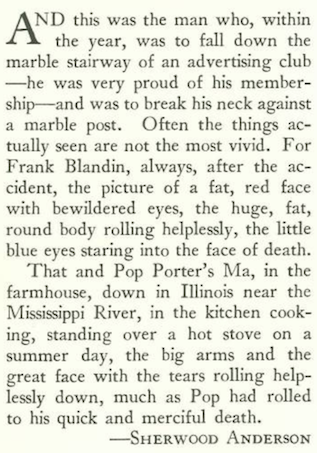
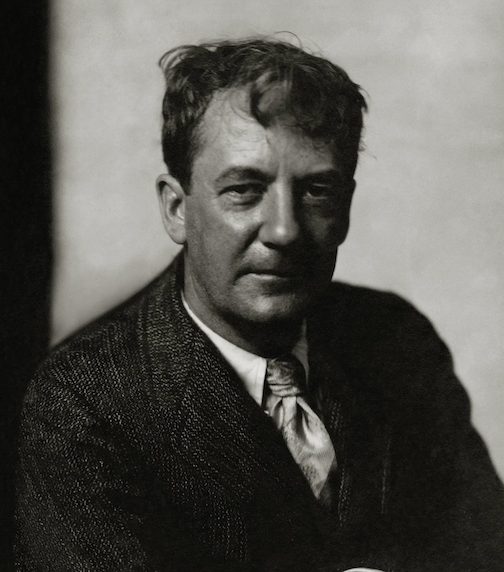
The short story “Pop” would be Sherwood Anderson’s first contribution to The New Yorker. Anderson was known for his stories about loners and losers in American life, including Pop Porter, whose sad, drunken death is described in the closing lines:
NO EXIT…Best known for his 1919 novel Winesburg, Ohio,Sherwood Anderson (1876–1941) took an unsentimental view of American life. He would contribute six short stories to The New Yorker from 1933 to 1936. Photo above by Edward Steichen, circa 1926. (The New York Times)
* * *
From Our Advertisers
The German Tourist Information Office welcomed visitors to “witness the rebirth of a nation,” promising a land of “new ideas and broader visions” that would bestow on travelers “undying memories endlessly renewed”…
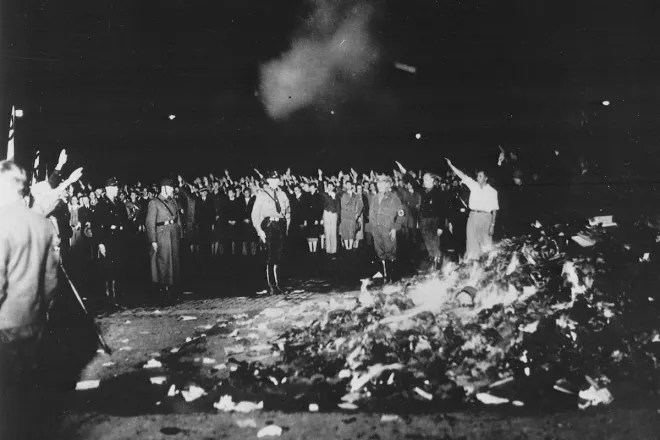
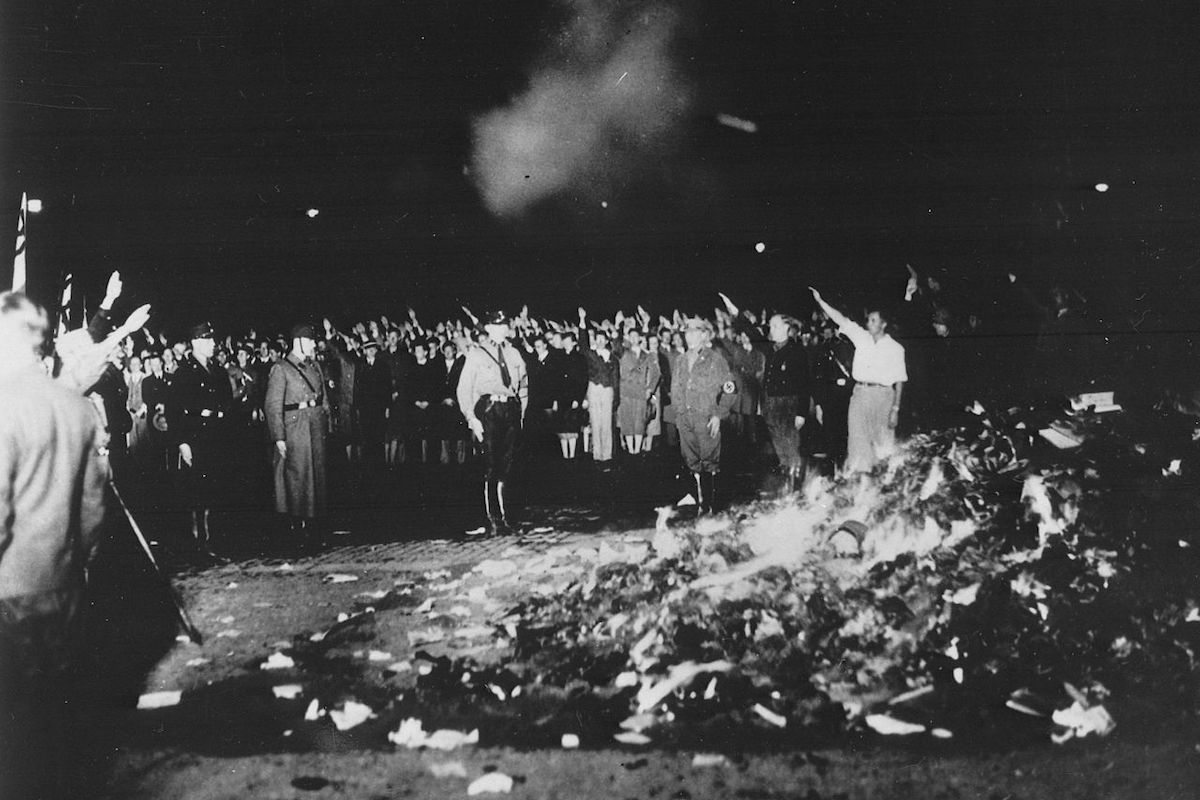
…Those “undying memories” might have included massive, country-wide book burnings that took place on May 10, 1933, when students in 34 university towns across Germany burned more than 25,000 “un-German” books…
FANNING FLAMES OF HATE…On May 10, 1933, student supporters of the Nazi Party burned thousands of volumes of “un-German” books in the square in front of the Berlin State Opera. (Bundesarchiv)
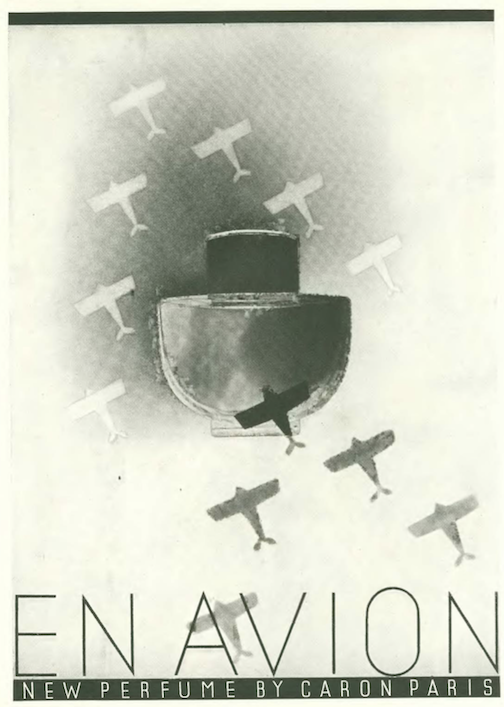
…knowing where all of this would lead, it is hard to look at this next ad and not think of the Luftwaffe raining death from the skies later in that decade…
…so for the time being we’ll turn to something less menacing, like checkered stockings, here resembling one of John Held Jr’s woodcuts…
…and this crudely illustrated ad (which originally appeared in one column)…call your buddy a fatso and the next thing you know he’s moving to Tudor City…
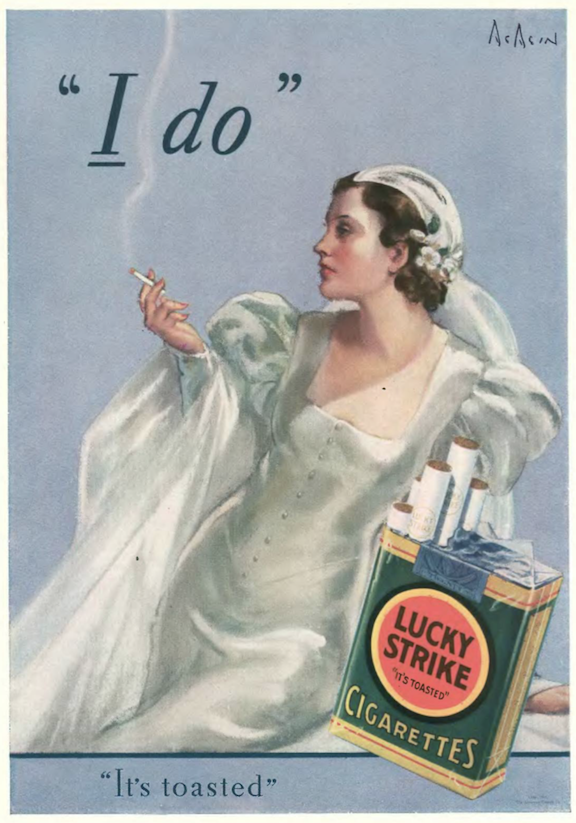
…and from the makers of Lucky Strikes, a back cover ad that provided a thematic bookend to Constantin Alajalov’s cover art…
…James Thurber kicks off the cartoons with this sad clown…
…atop the Empire State Building, Daniel ‘Alain’ Brustlein found more than just a view of the city (it’s former governor Al Smith!)…
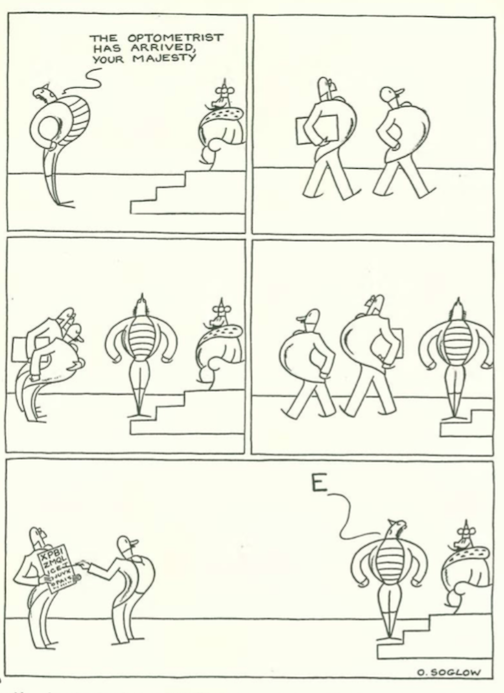
…Otto Soglow’s Little King got his vision checked, in his own way…
…a loose button threatened to bring down a nation…per Gardner Rea…
…and we take a leisurely Sunday drive, Peter Arno style…
…on to the June 3, 1933 issue…
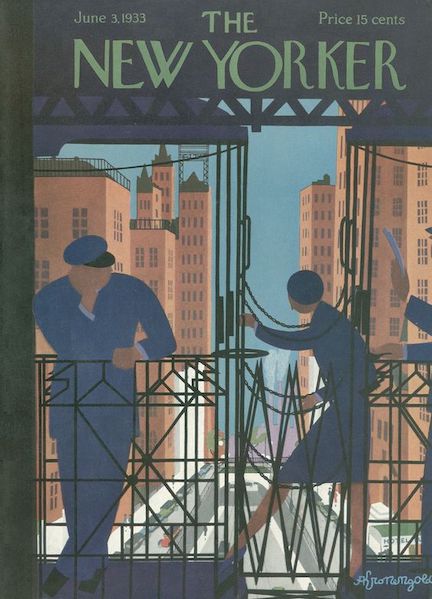
June 3, 1933 cover by Adolph K. Kronengold.
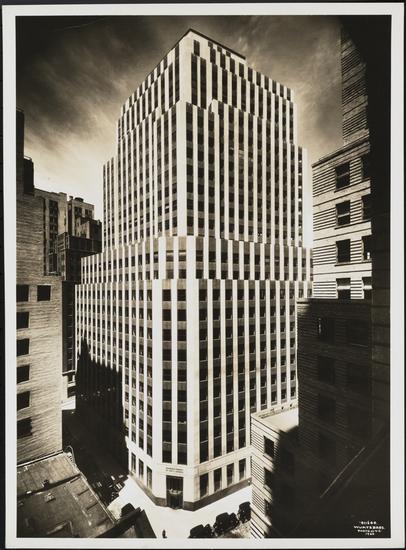
…where we appropriately look to the skyline, which was giving Lewis Mumford a crick in the neck…
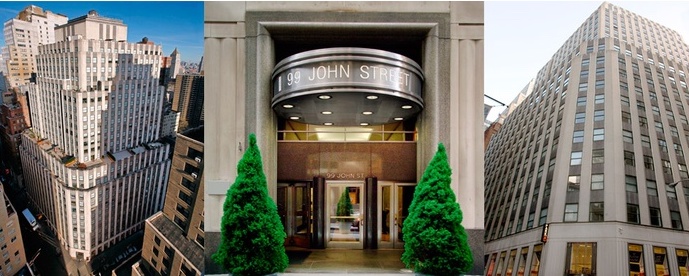
THAT’LL DO…Lewis Mumford was not a fan of giant skyscrapers, but when the architects of the Empire State Building turned their attention to the Insurance Company of North America building at 99 John Street, Mumford found a design that could serve as a model for future business buildings. (Museum of the City of New York)CONVERSION THERAPY…the Insurance Company of North America building now houses modern loft condominiums known as 99 John Deco Lofts. (nest seekers.com).
Later in the column Mumford called skyscrapers “insupportable” luxuries, arguing instead for long, shallow buildings rising no more than ten stories.
* * *
The Stars Align
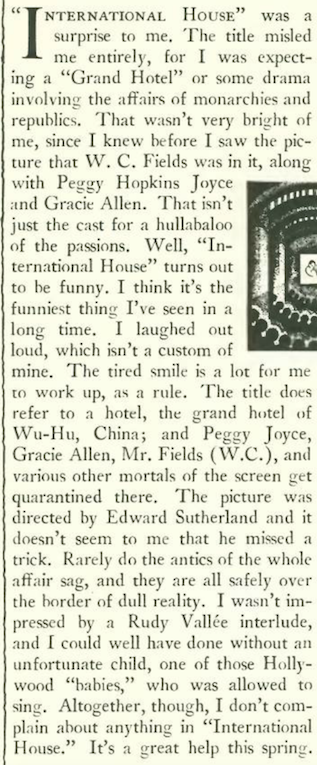
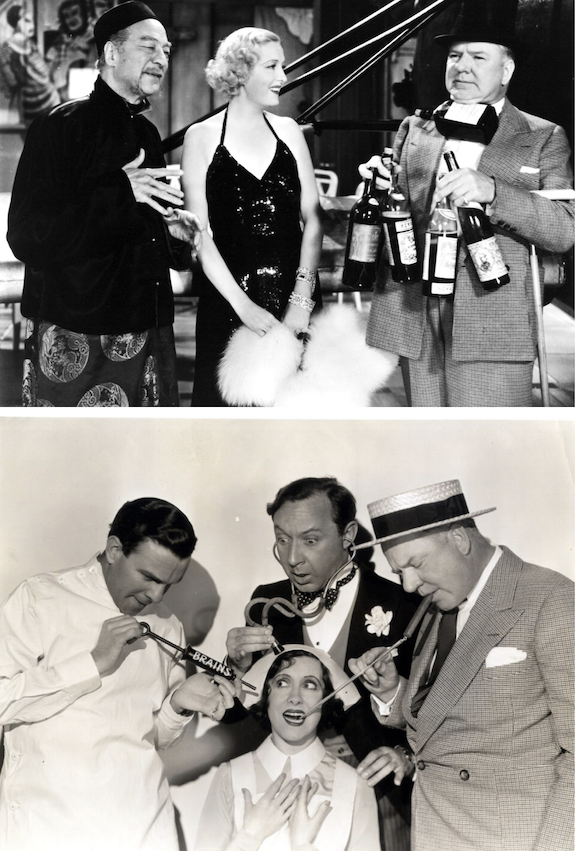
Film critic John Mosher was delightfully surprised by International House, a film loaded with some of the era’s top comedic stars along with other entertainers.
CLUTCH THOSE PEARLS…The risqué subject matter of International House had the Legion of Decency up in arms, but it left critic John Mosher in stitches thanks to the antics of Edmund Breese, Peggy Hopkins and W.C. Fields (top photo). Below, a publicity photo for International House with George Burns, Gracie Allen, Franklin Pangborn and W.C. Fields. (IMDB)
The film featured an array of entertainers including Peggy Hopkins (more famous as a real-life golddigger than an actress), the comedy duo Burns and Allen, W.C. Fields, Bela Lugosi, Cab Calloway, Rudy Valley and Baby Rose Marie.
ALL THE WORLD’S A STAGE…Ten-year-old Rose Marie Mazzetta, known in 1933 as the child performer Baby Rose Marie, sings a number atop a piano in a scene from International House. Thirty years later Rose Marie would appear on The Dick Van Dyke Show as television comedy writer Sally Rogers, pictured here with co-stars Dick Van Dyke and Morey Amsterdam. (WSJ/LA Times)
* * *
The New Germany, Part II
The June 3 “Out of Town” column took a look at life in Berlin as well as the 1933 Chicago World’s Fair. The piece is signed “A.L.”, leading me to believe it might be A.J. Liebling (author of the terrific Between Meals), but he didn’t start at The New Yorker until 1935. At any rate the article seems to dismiss the crackdown on Berlin’s cultural life as a mere inconvenience.
NEW THEME, NEW OWNERSHIP…The article mentions the closing of the Eldorado night club in Berlin, famed for its drag shows and other naughty diversions. Images above show the before and after the Nazis redecorated. (lonesomereader.com)
* * *
From Our Advertisers
More propaganda from Germany, where everything is sweet and bright away from the din of the city and the sound of marching jackboots and the crash of broken glass…
…an unusual ad from Cadillac, which barely mentions the automobile but goes full bore on the June bride theme…
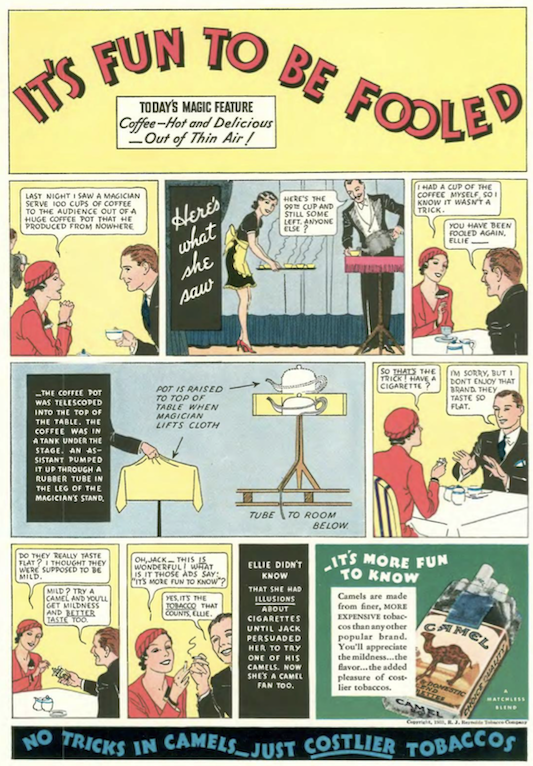
…the folks at Camel went full color in their latest installment of “It’s Fun to be Fooled”…in this strip Jack gets his friend Ellie hooked on his cigarette brand…
…looking for fresher air, well you could get a window air conditioner from the folks at Campbell Metal Window Corporation…however, these units were only available to the very wealthy, roughly costing more than $25,000 apiece (more than half a million today)…
…better to take a drive a catch the breeze with this smart pair…
…and fight off those pesky bugs with a blast of Flit, as illustrated by Dr. Seuss before he became a children’s author…
…Richard Decker picked up some extra cash illustrating this ad for Arrow shirts…
…which segues to our other New Yorker cartoonists, such as H.O. Hoffman…
…and yet another bride, with sugar daddy, courtesy of Whitney Darrow Jr…
…William Crawford Galbraith continued his exploration into the lives of showgirls…
…Gardner Rea gave us this helpful switchboard operator…
…Carl Rose showed us how the posh set got into the spirit of the Depression-era farm program…
…George Price was getting into familiar domestic territory…
…and on this Father’s Day, we close with some fatherly advice from James Thurber…
Part love story and part wildlife protection fable, the pre-Code romance and melodrama Zoo in Budapest was that rare film that pleased critics and audiences alike.
May 6, 1933 cover by Richard Decker. This is one of four covers Decker (1907–1988) contributed to The New Yorker; he also contributed more than 900 cartoons in his nearly 40-year run with the magazine.
Jesse L. Lasky’s first production for Fox (Lasky was the founder of Paramount Pictures), Zoo in Budapest starred relative newcomer Gene Raymond as a young man (Zani) keenly attuned to nature and particularly to the animals he cares for in the Budapest Zoo. In the course of the film he becomes an anti-fur industry activist and rescues a beautiful orphan girl, Eve (Loretta Young) from a life of servitude. Although the film is little known today, in 1933 it had quite a winning effect on critic John Mosher, who usually found little to like from Hollywood’s output:
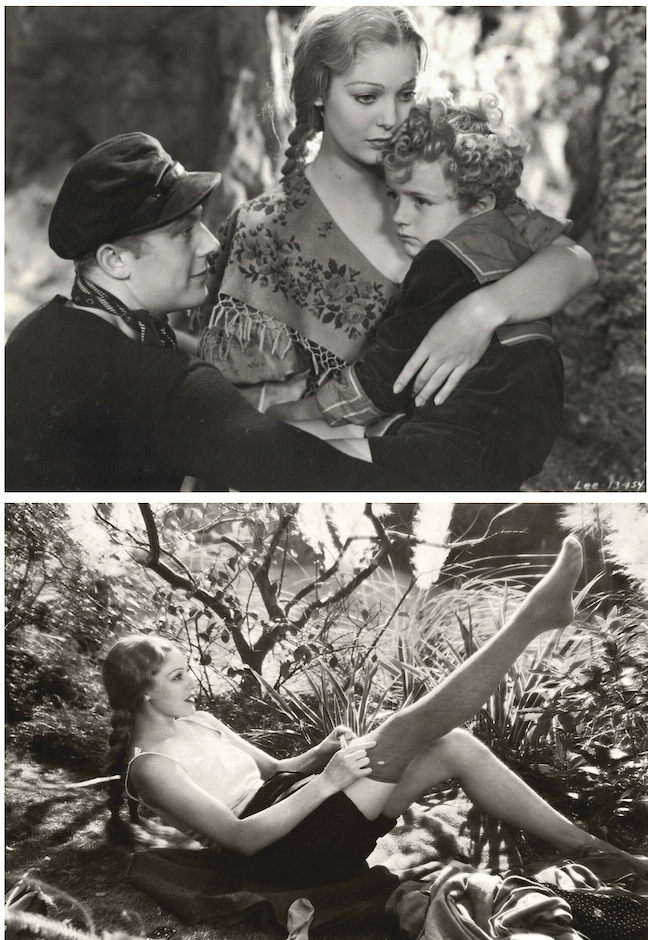
HE TALKS TO THE ANIMALS…Top, zoo worker Zani (Gene Raymond) rescues a beautiful orphan girl, Eve (Loretta Young) from a life of servitude, and both come to the aid of a little boy named Paul, played by Wally Albright, who escapes the clutches of his harsh governess. Below, hidden in the bushes, Eve changes her clothes after escaping from a group of orphans visiting the zoo. (IMDB)
The film made such an impression that even E.B. White had to mention it in the opening lines of his “Notes and Comment”…
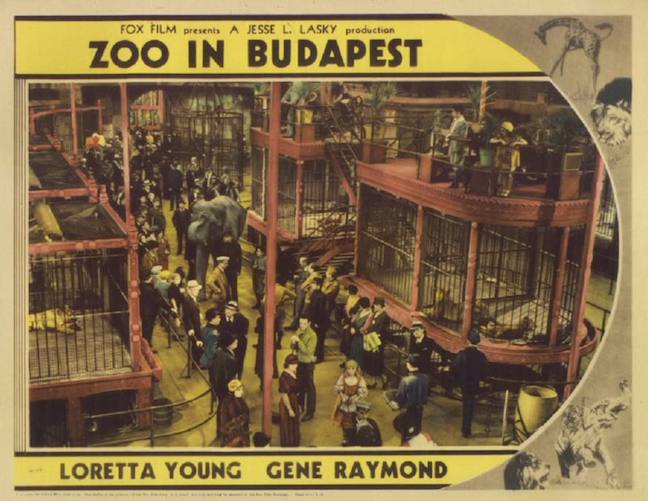
ANIMAL CRACKERS…Filmmakers went all out in creating elaborate sets for Zoo in Budapest. The film was likened to Grand Hotel because the drama took place in less than 24 hours, almost entirely in one location. Below, Loretta Young converses with director Rowland Lee on the set. (IMDB)(IMDB)
* * *
High Anxiety
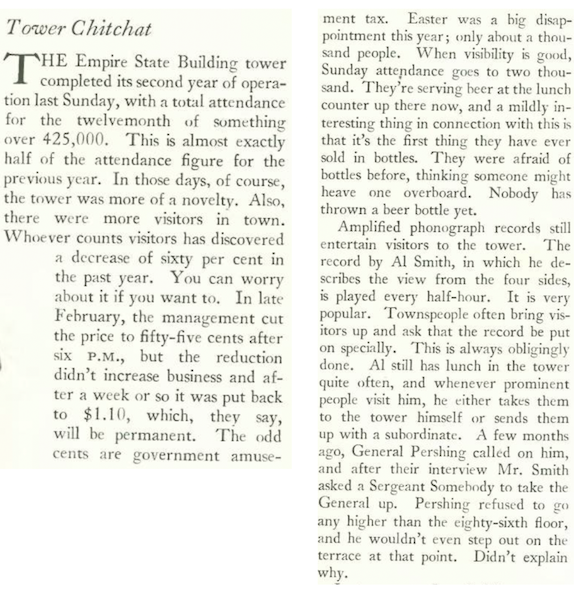
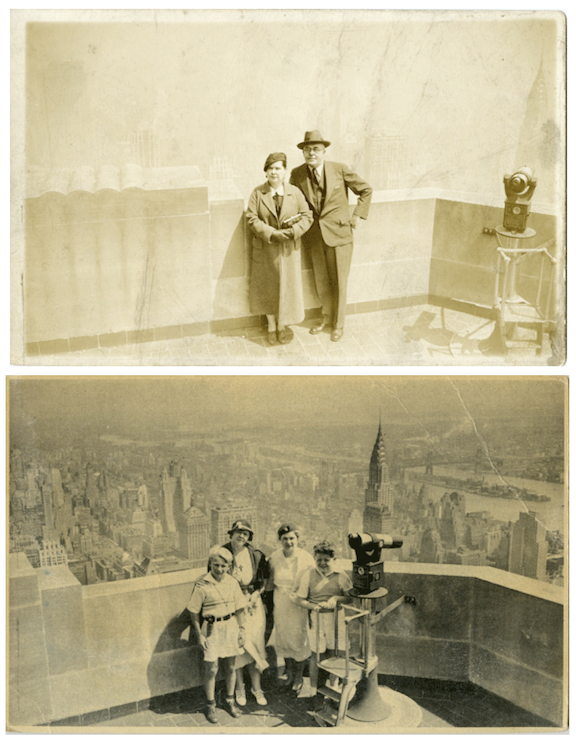
The Depression was hard on the Empire State Building, which opened its doors during some of the darkest days of the economic crisis. Visitation was down, and a lot of the office space in the world’s tallest building remained vacant. It would remain in the red into the 1940s.
BEEN THERE, DONE THAT…To this day the 86th floor observation deck has been a popular destination for tourists. In the 1930s a photographer stationed on the deck captured the moment for tourists on a souvenir postcard. The image at top is from 1934, the one below circa 1930s. Fencing to deter suicide attempts (or people chucking things over the side) wouldn’t be erected until 1947. (nyccirca.blogspot.com)
* * *
As the World Churns
Howard Brubaker continued to comment on the deteriorating conditions of the German people in his column “Of All Things”…
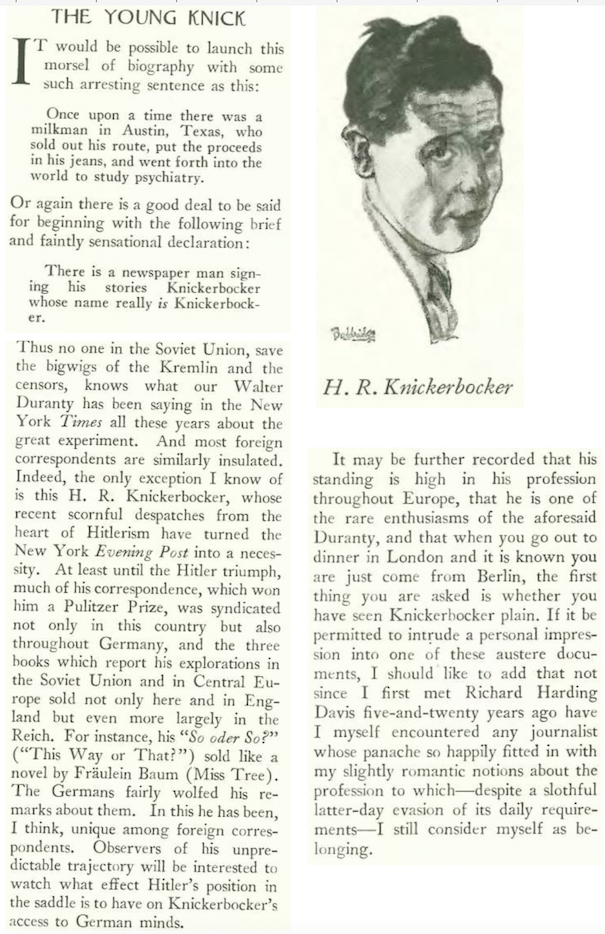
…and speaking of the Third Reich, Alexander Woollcott profiled (in his column “Shouts and Murmurs”) an enterprising young journalist Hubert R. Knickerbocker (1898–1949), who reported from Berlin from 1923 to 1933 and wrote about the threat of Nazism. In April 1933, after fleeing Germany, he reported in the New York Evening Post that “an indeterminate number of Jews [had] been killed.” A brief excerpt (with illustration by Cyrus Baldridge):
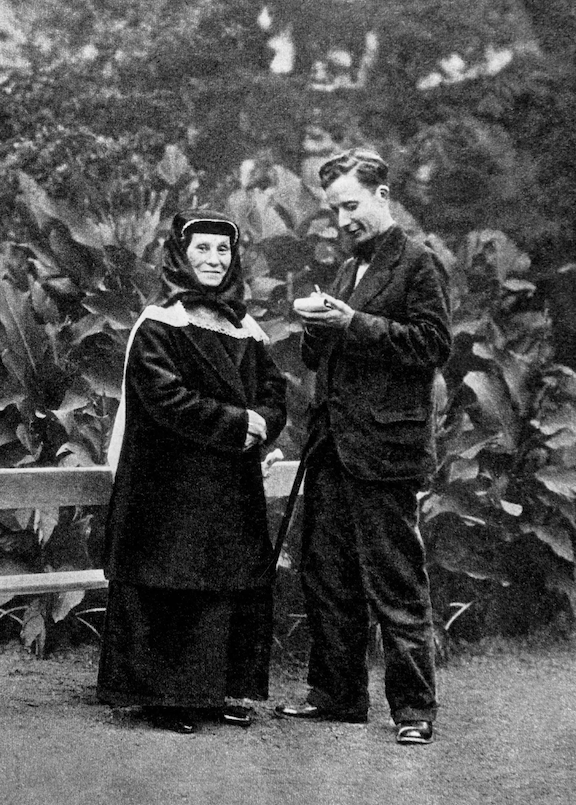
MYSTERY WRITER…In December 1930, H.R. Knickerbocker interviewed Josef Stalin’s mother, Keke Geladze, for the New York Evening Post. The resulting article was titled, “Stalin Mystery Man Even to His Mother.” (The New Yorker)
A graduate of Southwestern University in Georgetown, Texas and a 1931 Pulitzer Prize winner, Knickerbocker kept his word with Woollcott and entered Columbia University to study psychiatry.
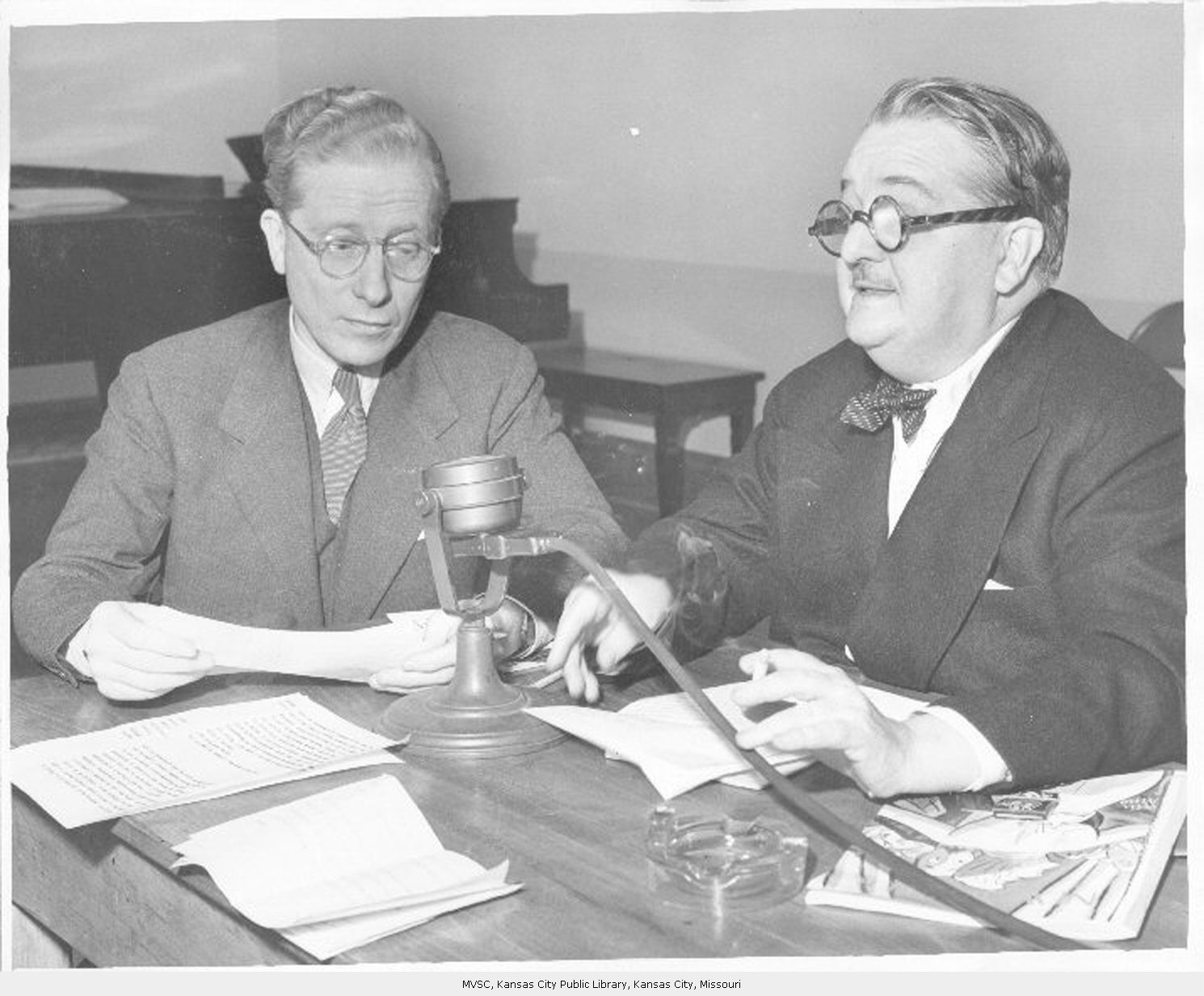
TALES TO TELL…H.L. Knickerbocker (at the microphone) with Alexander Woollcott circa 1940. (Kansas City Public Library)
* * *
From Our Advertisers
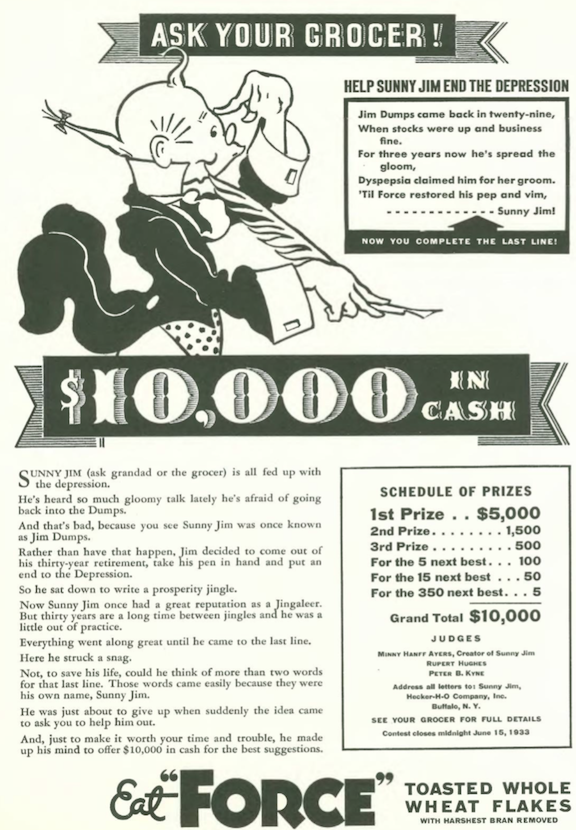
We begin with an ad from the makers of the first commercially successful wheat flake breakfast cereal…before there were Wheaties (created in 1921) there was Force, invented in 1901…almost from the beginning the Force brand was wildly successful thanks to a series of jingles featuring a morose character, Jimmy Dumps, who was transformed into Sunny Jim by consuming Force flakes…in 1933 the makers of Force were still big on jingles, sponsoring contests such as the one below…
…here is a box from that period, promoting cash prizes for winning jingles…
(worthpoint)
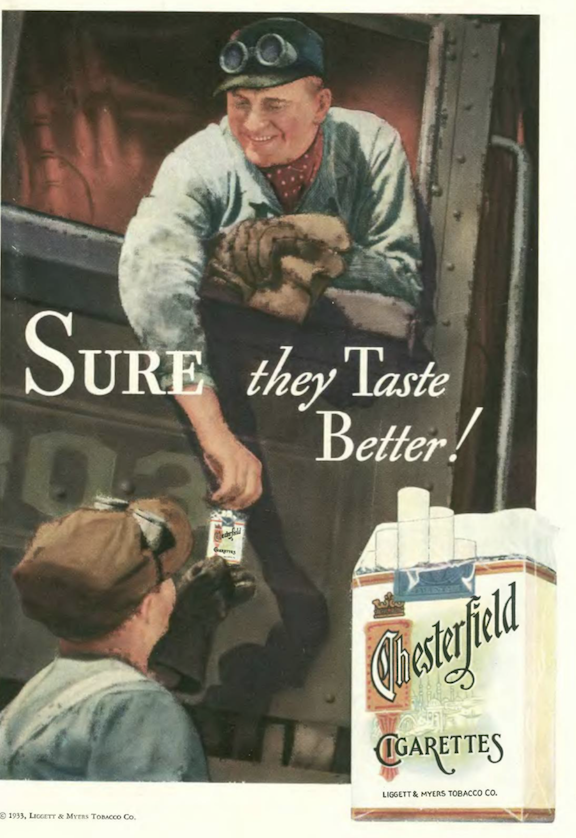
…the folks at Chesterfield began targeting the working man in their advertising…
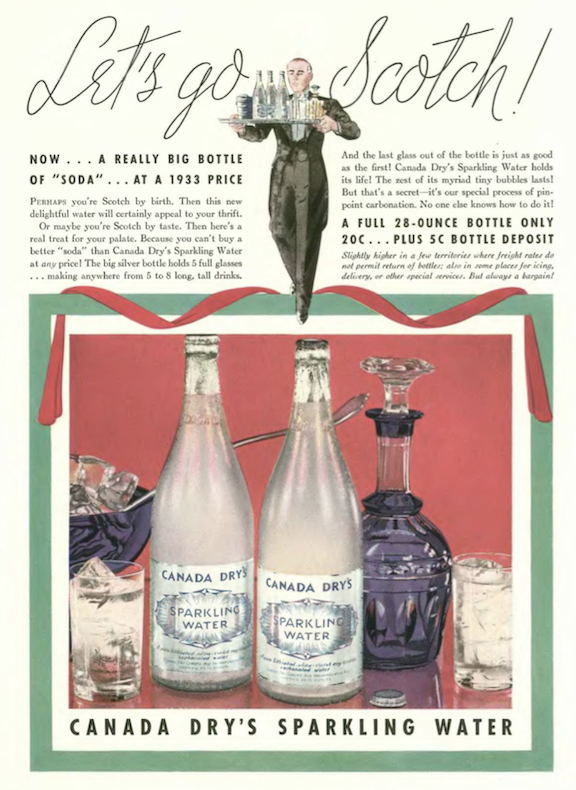
…while Canada Dry was anticipating the end of Prohibition…
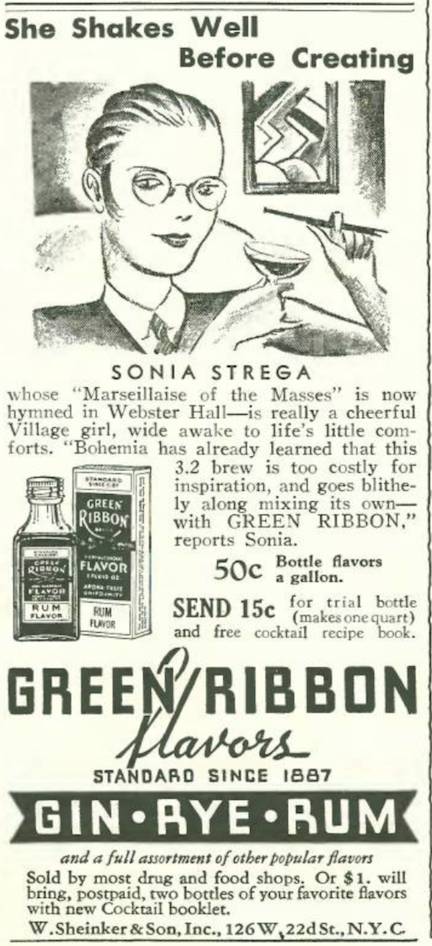
…but until that day, you could mix some Green Ribbon with your bootleg alcohol, according to Sonia Strega, who was likely an invention by the advertisers rather than an actual living endorser…
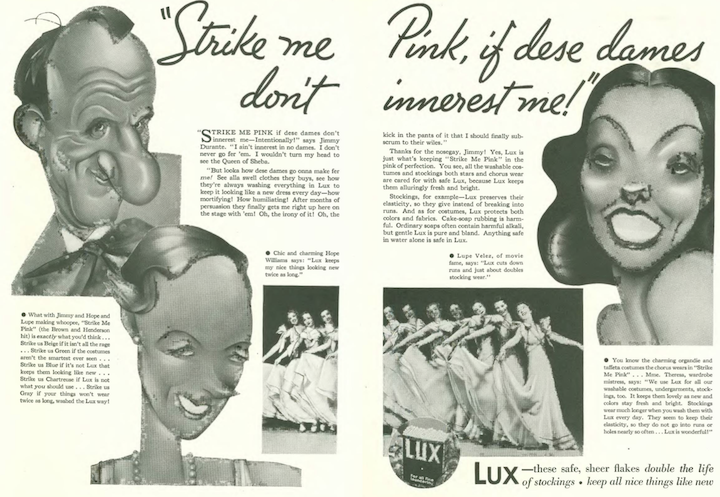
…Lux, on the other hand, had piles of money to spend on real life endorsers including Jimmy Durante, Hope Williams and Lupe Velez…
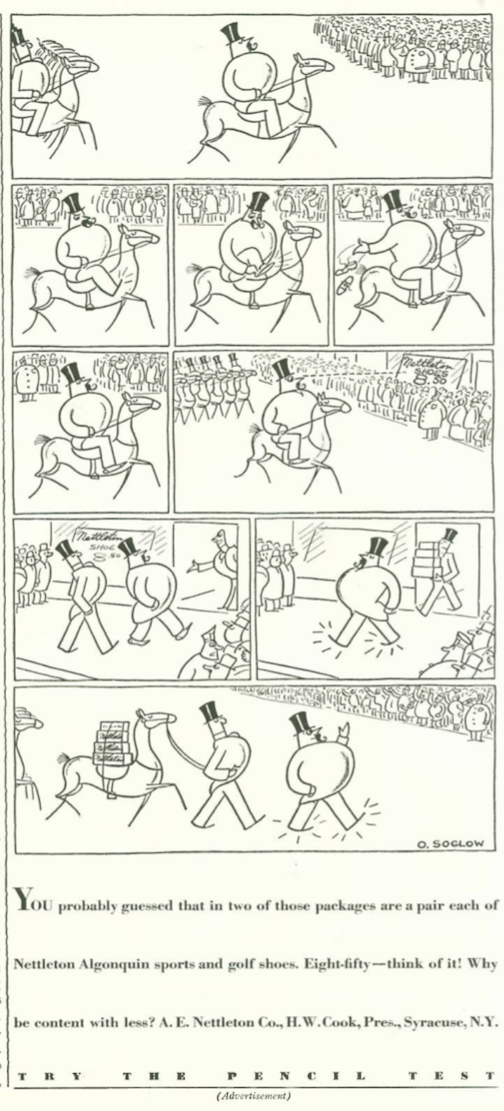
…Otto Soglow drew up this strip for the makers of Nettleton shoes, creating a character similar to his famed “Little King” to promote the company’s sports and golf shoes…
…James Thurber continued his work for the French Line, replete with his familiar dogs…
There’s a good reason why Americans celebrate National Beer Day on April 7.
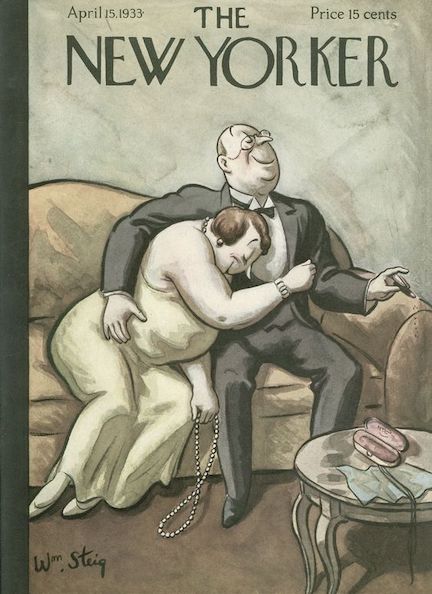
April 15, 1933 cover by William Steig.
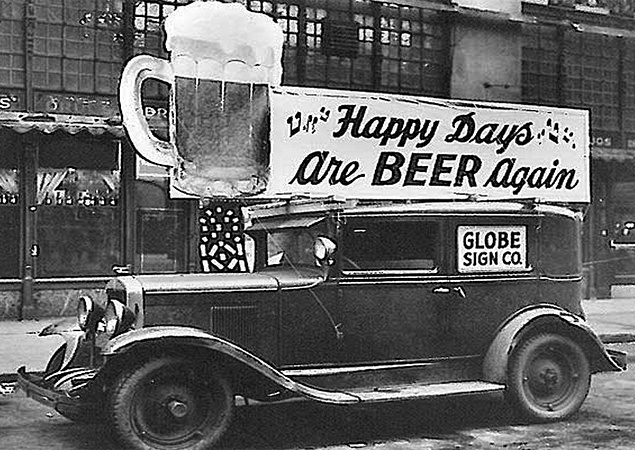
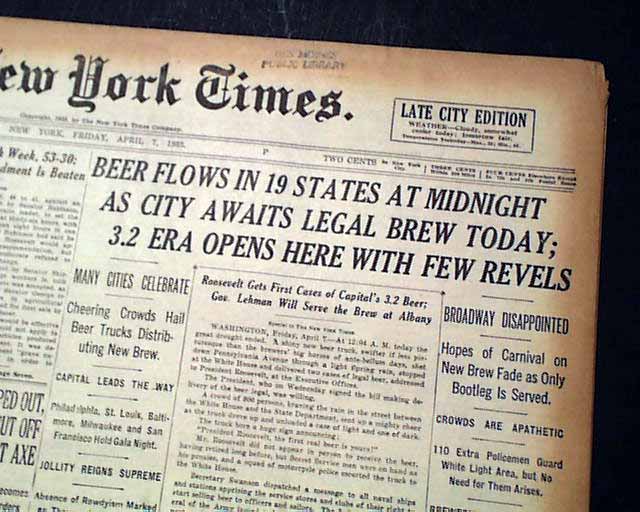
It was on that day in 1933 that the Cullen-Harrison Act went into effect; after nearly 13 years of Prohibition, folks were allowed to buy and drink low-alcohol content beer. The act not only promised to wet their whistles on the hot summer days ahead, but it also signaled the eventual doom of 18th Amendment. E.B. White opened his column with musings on the Easter holiday, but soon turned his attention to the big news of the day.
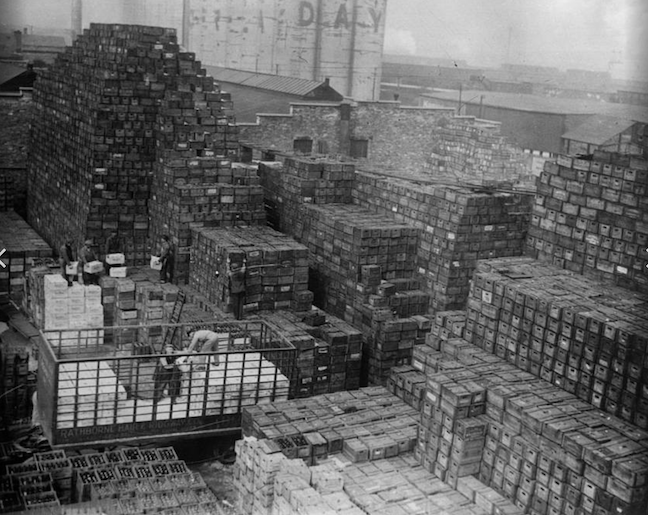
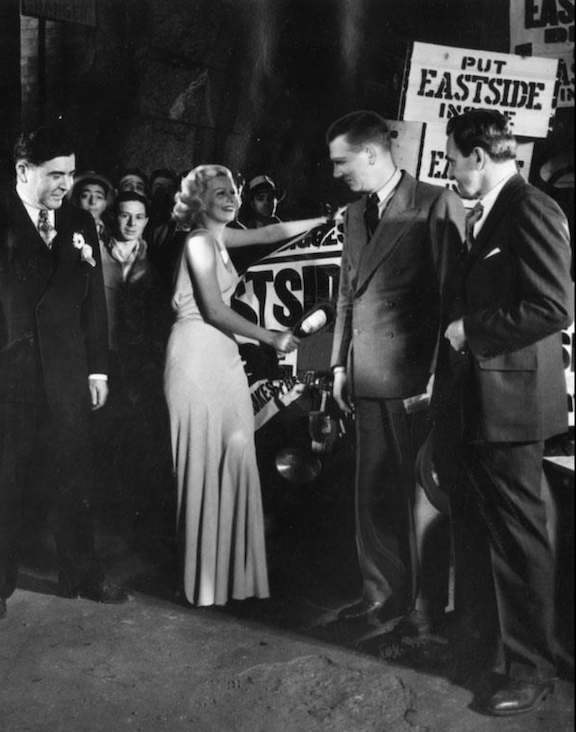
THINK THIS WILL BE ENOUGH?…Workers at a New York brewery unload thousands of crates of beer, getting ready for the return of legal beer in April 1933. (allthatsinteresting.com)FRONT PAGE NEWS…The New York Times proclaimed the return of legal beer in this April 7, 1933 edition.BLONDE’S BOMBSHELL…While on the other side of the Lower 48, actress Jean Harlow christened the first legal bottle of beer at midnight in Los Angeles, April 6, 1933. (Los Angeles Public Library)
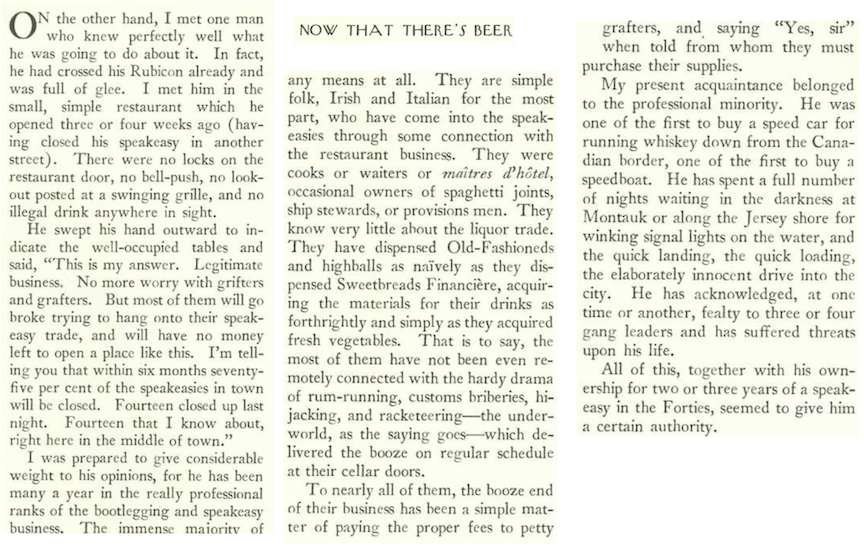
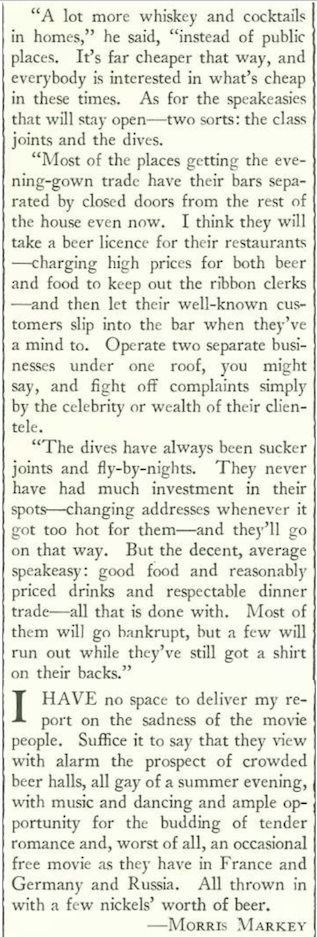
In his “A Reporter at Large column,” Morris Markey looked in on a former speakeasy owner who was more than happy to go legit, and who also predicted the demise of his fellows who still lingered in the underground liquor trade. An excerpt from “Now That There’s Beer”…
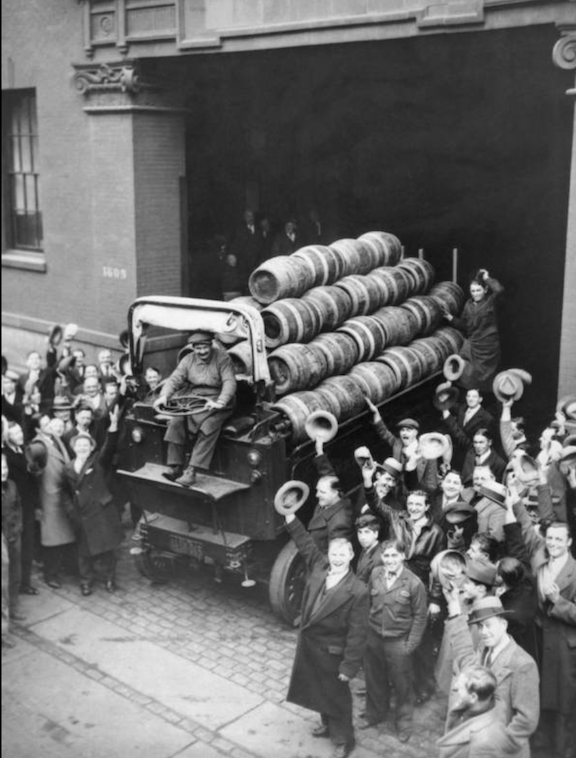
CHEERS!…The first truckload of beer to leave New York exits the Jacob Ruppert Brewery in New York in 1933. (allthatsinteresting.com)
The subject of Markey’s column explained why speakeasies would soon be a thing of the past. Markey also observed that theatre owners would soon feel the pinch as folks would forgo movies for summer evenings at a beer garden.
* * *
No Laughing Matter
Writers and editors at The New Yorker did their best to keep things as light and witty as possible, but sometimes the headlines could not be ignored, and tragedy was acknowledged, albeit briefly. “The Talk of the Town” had this to say about history’s deadliest airship disaster:
NATURE’S FURY…The U.S. Navy’s 785-foot dirigible, the USS Akron, plunged into the Atlantic Ocean during a violent storm shortly after midnight on April 4, 1933, claiming the lives of 73 crewmen. Clockwise, from top left, the Akron on a routine flight; men in a rear control car; servicemen in the dirigible’s engine room; April 23, 1933 photo of wreckage recovered off the coast of New Jersey. Because the ship had no life vests and one rubber raft, only three crew members survived the disaster, which heralded the end the Navy’s dirigible fleet. (howstuffworks.com/AP/Daily Mail)
In his “Of All Things” column, Howard Brubaker had this to add:
* * *
Alex at the Movies
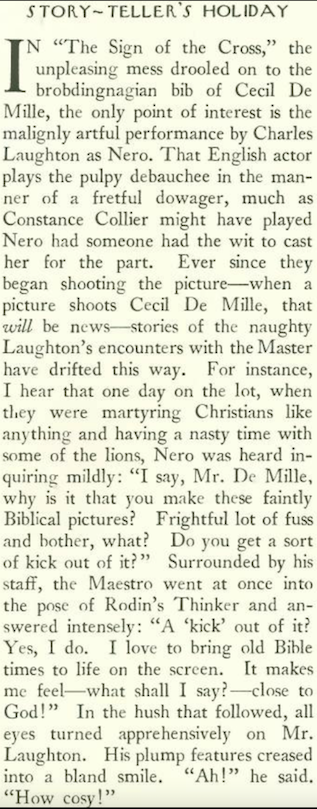
It wasn’t every day you got to read a movie review by Alexander Woollcott, but he did just that in the opening lines of his “Shouts and Murmurs” column, calling Cecil B. DeMille’sThe Sign of the Cross an “unpleasing mess drooled on to the brobdingnagian bib” of the director.
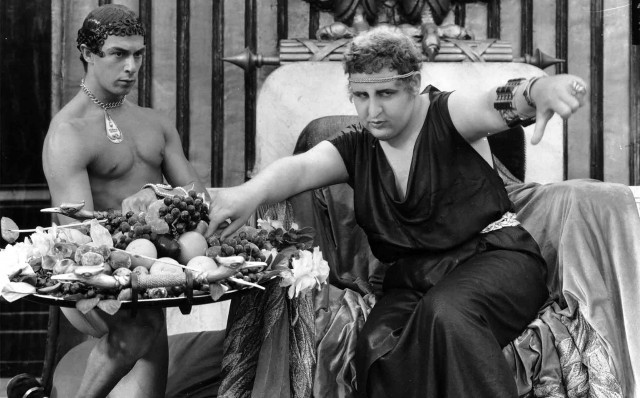
Woollcott, who doubtless related to Nero’s bacchanalian ways, singled out Charles Laughton’s campy performance as the Roman emperor.
ANIMAL HOUSE…Charles Laughton camped it up as the Emperor Nero in Cecil B. DeMille’sThe Sign of the Cross. (IMD
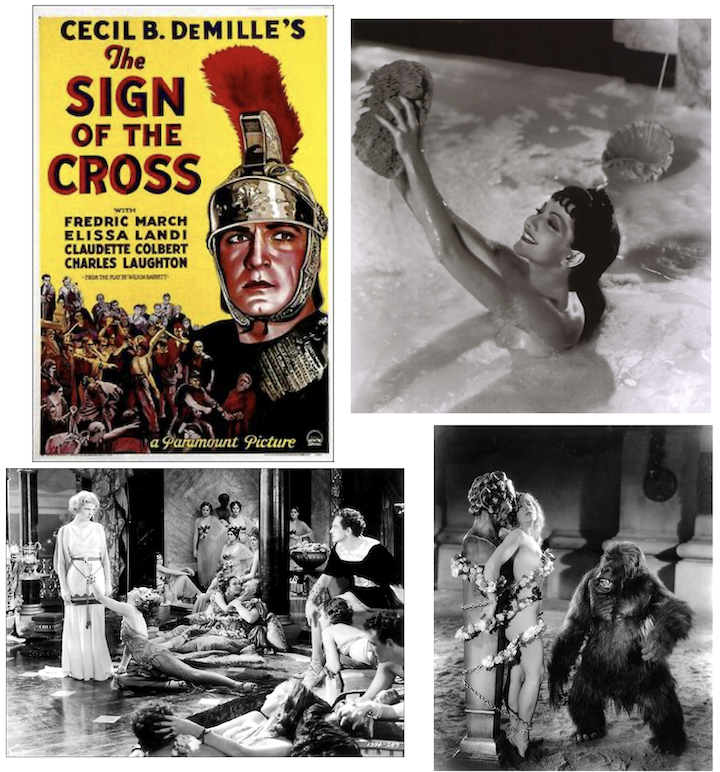
Besides Laughton’s performance, the pre-Code film is perhaps best known for Claudette Colbert’s revealing milk bath scene, which took several days to shoot—the powdered cow’s milk eventually turned sour, making it a very unpleasant experience for all involved.
IT STINKS…that was Alexander Woollcott’s assessment of The Sign of the Cross. Clockwise, from top left, studio poster for the film; Claudette Colbert’s famous bath scene; an actress portraying a Christian being thrown to the lions (as well as crocodiles and gorillas) was the famed burlesque dancer Sally Rand, who left little to the imagination in her uncredited appearance; an orgy scene. Although Paramount marketed the film to churches, it was attacked by the Catholic Legion of Decency: a re-release of the film was censored after the Hays Code went into effect in 1934—a “lesbian dance,” violent gladiator scenes and sequences with naked women being attacked by crocodiles were cut and wouldn’t be restored until a 1993 video release. (Wikipedia/IMDB)
As for film critic John Mosher, the remaining Hollywood fare was even worse—like The Sign of the Cross, these pictures used faith-based themes, a seemingly new trend in Hollywood scenarios, to poor effect.
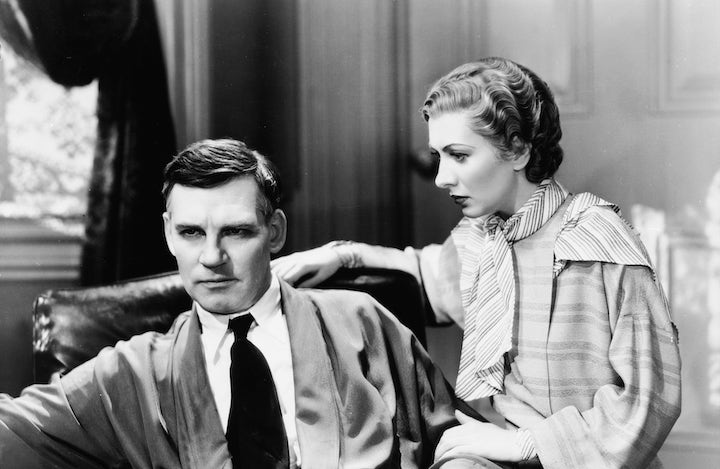
Gabriel Over the White House starred Walter Huston as a politically corrupt president who, after a near-fatal car accident, comes under the divine power of the Archangel Gabriel and the spirit of Abraham Lincoln…
I SEE DEAD PEOPLE…Walter Huston and Karen Morley in Gabriel Over the White House. (TCM)
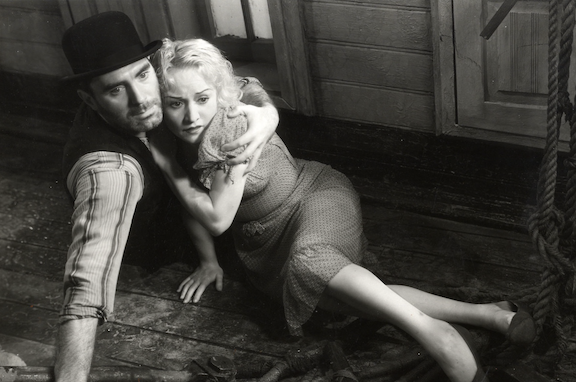
…the pre-Code drama Destination Unknown also summoned supernatural forces to tell the tale of a stranded ship saved by a stowaway who turns wine into water and heals a crippled man.
NEEDING A MIRACLE…Pat O’Brien and Betty Compson in Destination Unknown. (IMDB)
* * *
From Our Advertisers
Considering that Adolf Hitler gave Nazi paramilitary units control of German streets in January 1933, the words “Appeasing refuge” don’t readily come to mind…
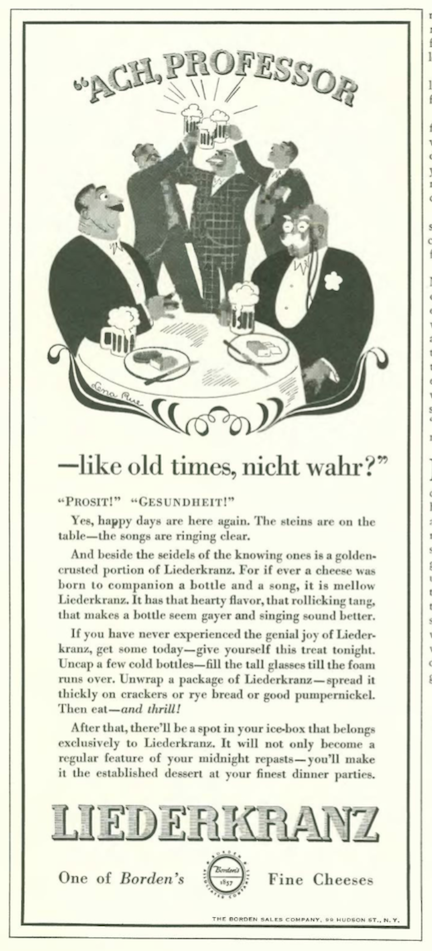
…if you liked all things German but wanted to avoid getting a jackboot to the groin, you could remain stateside, drink some 3.2 beer, and chew on some Liederkranz…
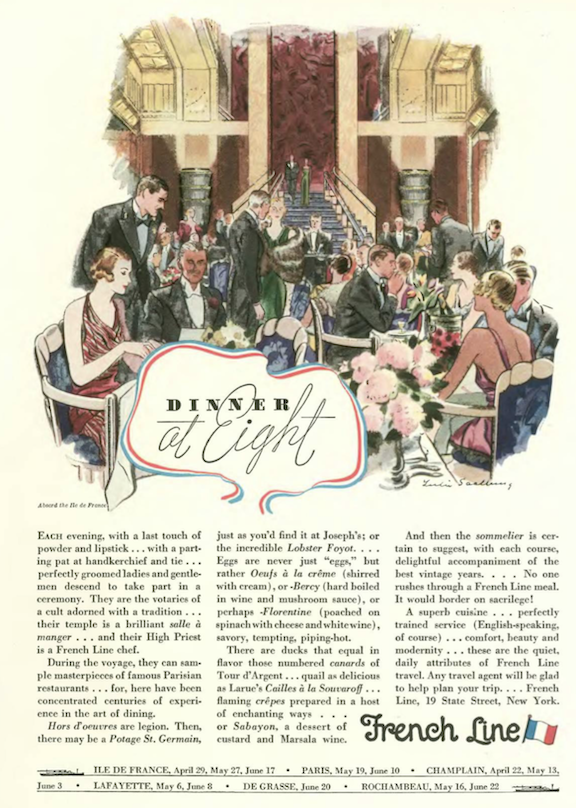
…actually this looks more preferable, especially as rendered by fashion illustrator Leslie Saalburg…
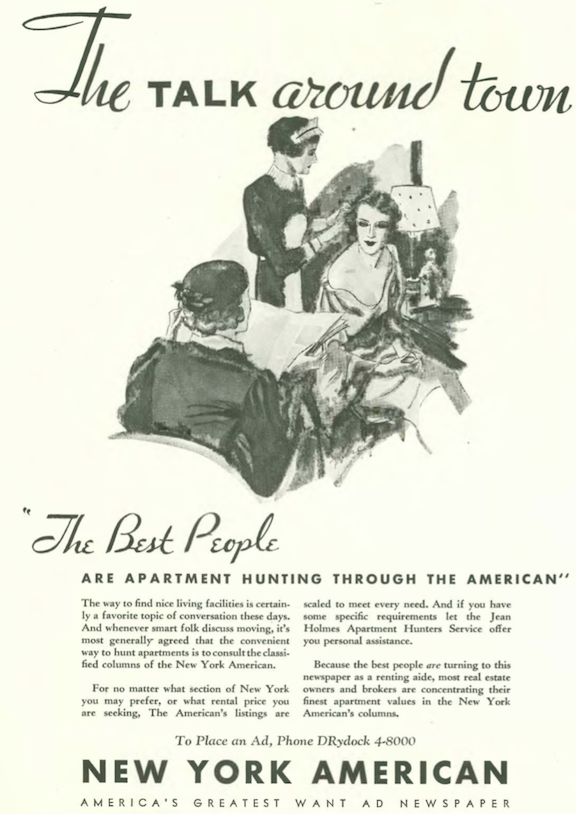
…before Zillow or Craigslist you could look for some digs in the New York American, which merged with the New York Journal in 1937…
…the makers of leaded gasoline urged on a stereotypical country doctor, even though the stork seemed to have things under control…
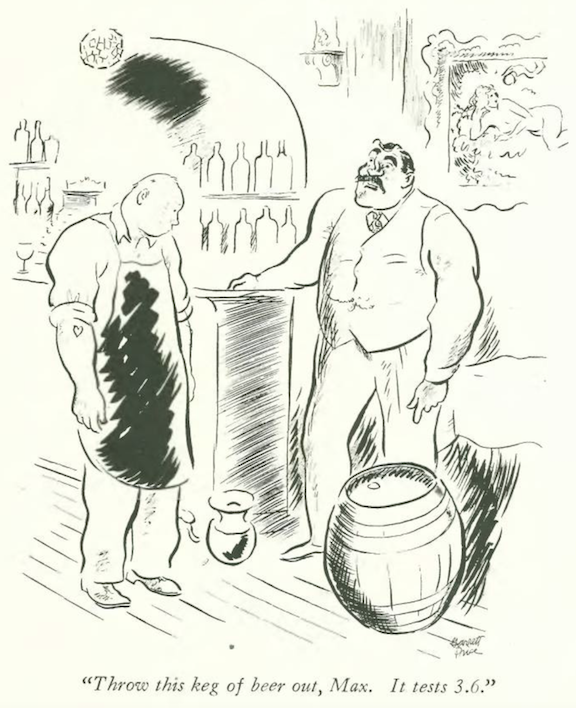
…on to our cartoonists, Garrett Price illustrated the limits of legal beer…
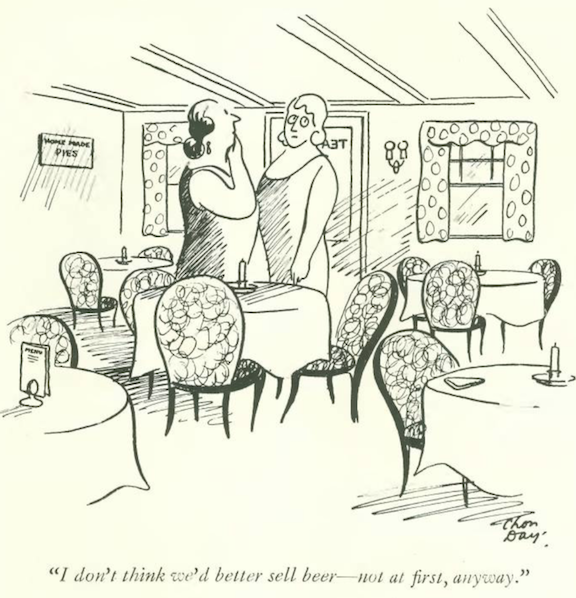
…while Chon Day explored the same problem at this tea room…
…here’s a trio of The New Yorker’s early women cartoonists…Barbara Shermund…
…Mary Petty…
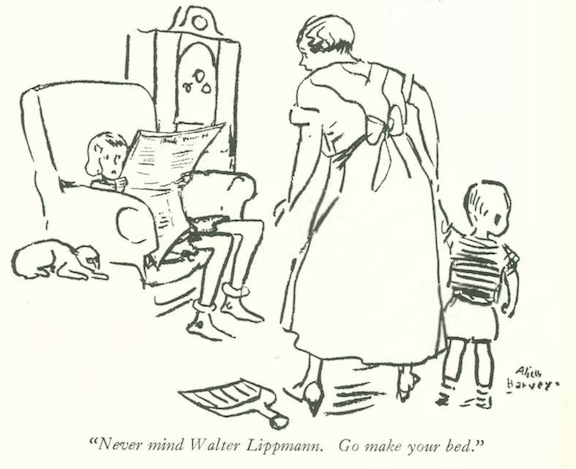
…and Alice Harvey…
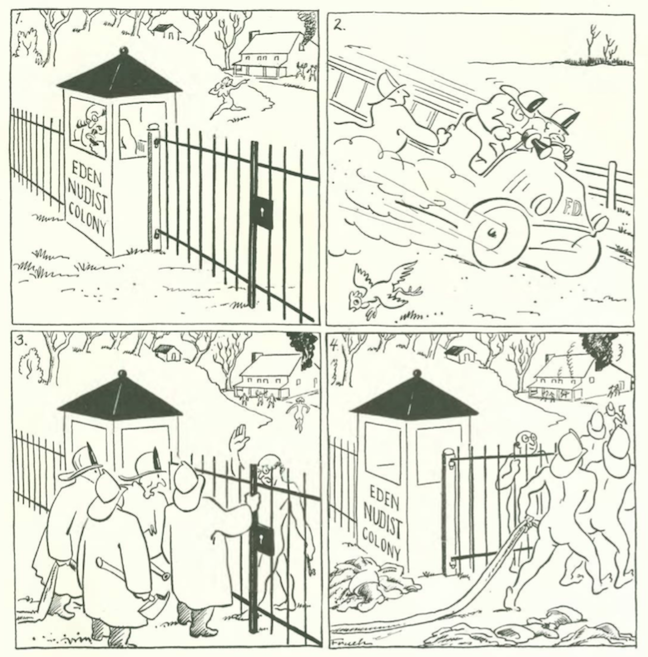
…and we close with Al Frueh, and some brave firefighters…
There were a number of people Dorothy Parker couldn’t abide. That included gifted writers who not only eschewed serious literature, but who instead chose to crank out a lot of mass-market trash.
March 18, 1933 cover by William Steig.
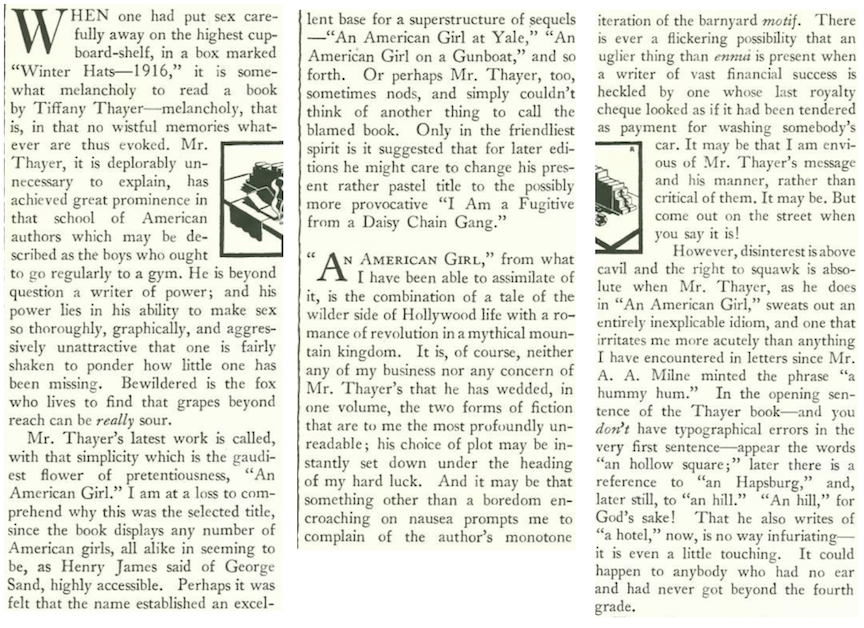
Parker was well acquainted with Tiffany Ellsworth Thayer (1902–1959), and for a time she even associated with the Fortean Society, which Thayer founded in 1931. Inspired by writer Charles Fort, the Forteans promoted the use of scientific methods to evaluate unexplained phenomena such as UFOs, spontaneous human combustion, and other oddities. Parker and fellow New Yorker writers Ben Hecht and Alexander Woollcott were among founding members, doubtless drawn to Fort’s reputation as a skeptic; however one famous skeptic, journalist H.L. Mencken, called Fort’s ideas “Bohemian mush.” It’s hard to say how long Parker stayed connected to the Society, but by 1933 she was fed up with Thayer’s novels, including his latest, An American Girl, which she found to be “the gaudiest flower of pretentiousness.” Here is an excerpt from Parker’s sometime column, “Reading and Writing,” subtitled Not Even Funny…
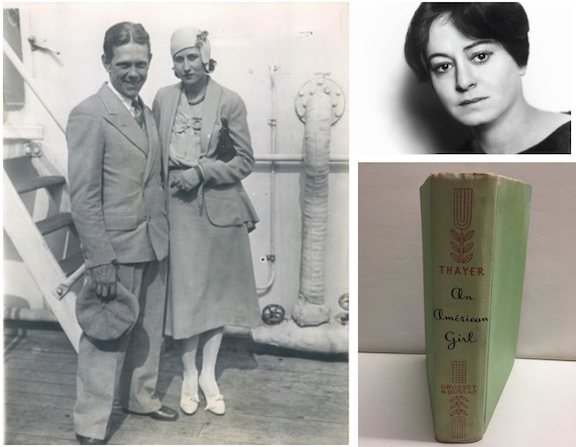
TIFF WITH TIFFANY…At left, Tiffany Thayer aboard a cruise ship with an unidentified woman, most likely his first wife, a dancer named Tanagra, early 1930s; at right, Dorothy Parker and a first edition of the offending volume. In her review, Parker observed that Taylor “is beyond question a writer of power; and his power lies in his ability to make sex so thoroughly, graphically, and aggressively unattractive that one is fairly shaken to ponder how little one has been missing.” (IMDB/Worthpoint)
Although Thayer founded a society based on scientific reason, his pulp novels were filled with fantasy and prurient imagery. F. Scott Fitzgerald once observed that “curious children nosed at the slime of Mr. Tiffany Thayer in the drug-store libraries.”
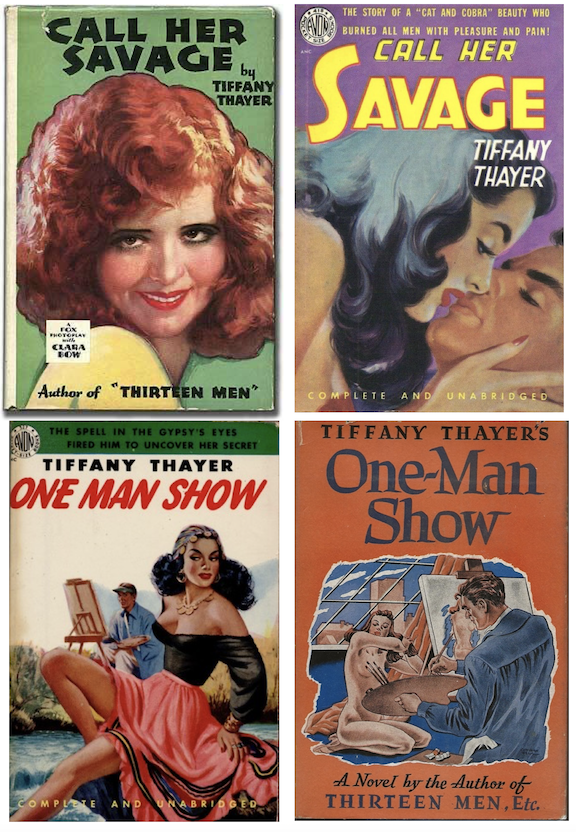
BELIED LETTRES…Clockwise from top left, Thayer’s 1931 novel Call Her Savage was made into a 1932 film starring Clara Bow, here featured on the book’s dustcover; the same novel repackaged in 1952 for the pulp trade; a 1943 edition of Thayer’s One-Man Show, and a 1951 Avon reprint that toned down the nudity but upped the creep factor. (facebook.com/biblio.com)
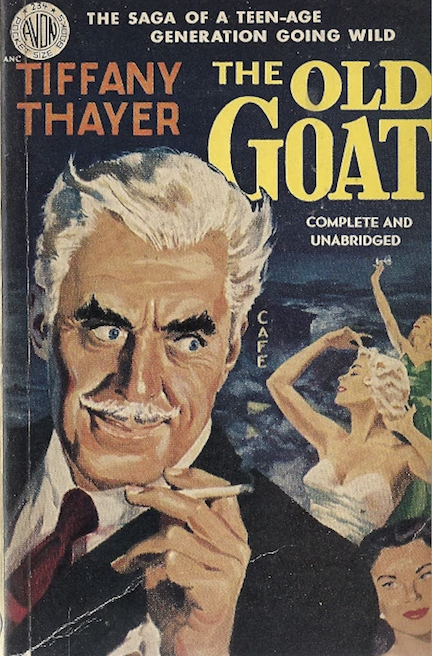
…and speaking of creep factor, check out Avon’s 1950 re-issue of Thayer’s 1937 novel The Old Goat, illustration attributed to Edgar Lyle Justis…
(biblio.com)
Artists like Justis must have had a ball doing these illustrations, creating images to lure the unsuspecting into purchasing these old titles. Note how the coked-up old man sports not-so-subtle devil horns.
* * *
They Called It a Holiday
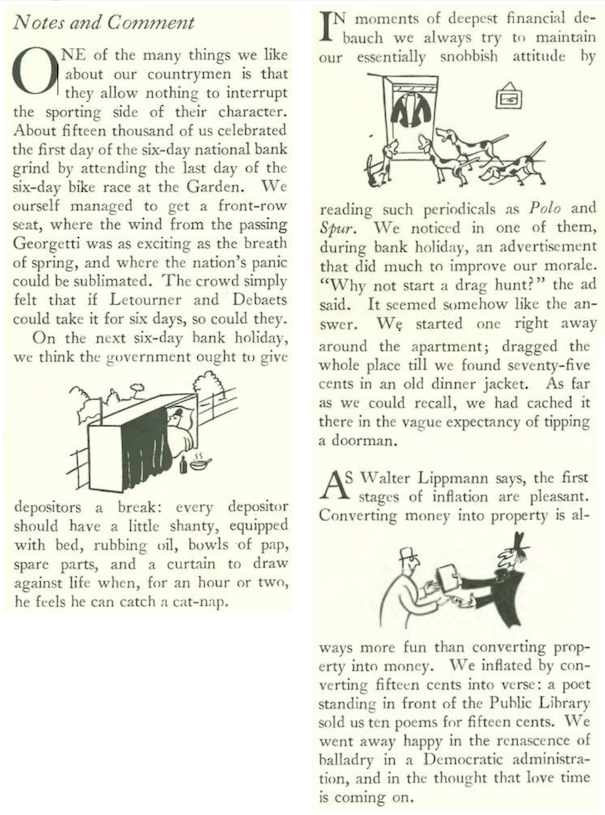
E.B. White, James Thurber (see below) and others in the March 18 issue commented on the national banking “holiday” declared by President Franklin D. Roosevelt in an effort to stabilize America’s banking system and rebuild public confidence. This led to the Glass-Steagall Act, signed three months later by FDR. Some observations in “Notes and Comment” by E.B. White, with the usual great spot illustrations by Otto Soglow…
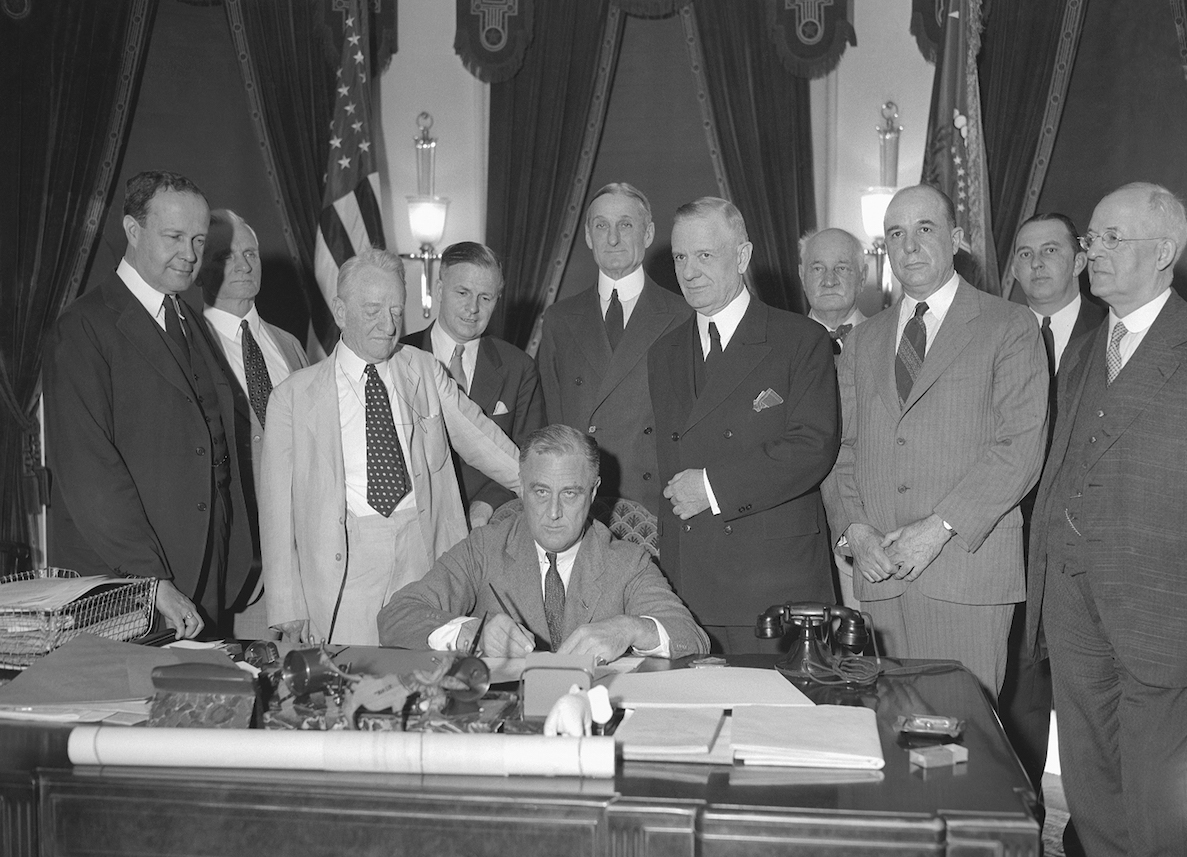
SAY CHEESE!…President Franklin D. Roosevelt signs the Glass-Steagall Act on June 16, 1933, effectively separating commercial banking from investment banking and creating the Federal Deposit Insurance Corporation (FDIC), among other things. (Associated Press)
…meanwhile, Germany’s new chancellor, Adolf Hitler, was busy abolishing civil liberties while pretending to be distressed by the behavior of his brownshirt thugs…an excerpt from Howard Brubaker’s “Of All Things”…
* * *
A Familiar Ring
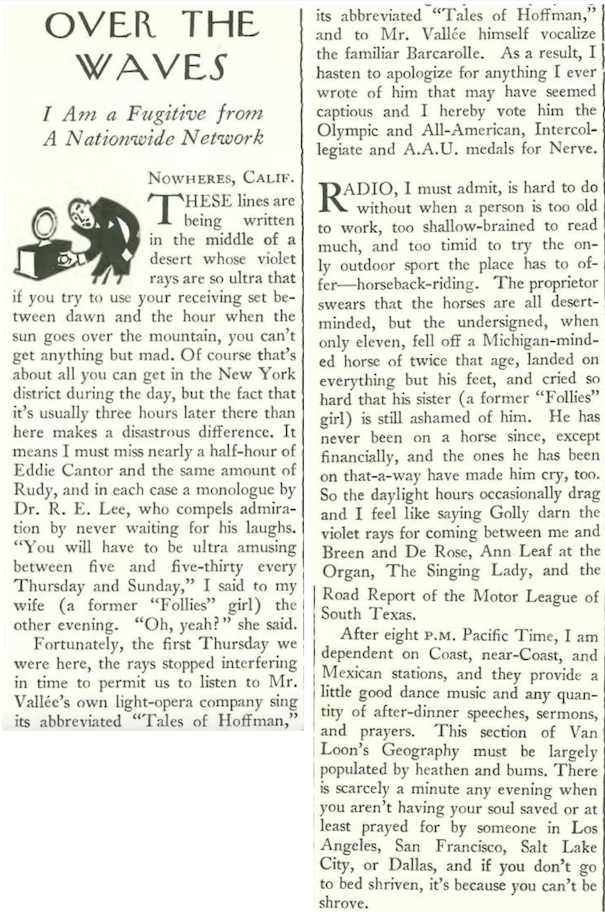
For the second week in a row Ring Lardner lent his wit to The New Yorker’s “Over the Waves,” column, which typically reviewed the latest news and entertainment beamed from the radio tower atop the Empire State Building. Lardner, however, was in California, lamenting the challenges of the time lag. An excerpt:
AND NO WI-FI, EITHER…Ring Lardner (center) detailed the frustrations of listening to New York-based radio entertainers like Eddie Cantor (left) and Rudy Vallée during his stay in California. (Pinterest/The Classic Archives/The New York Times)
* * *
Dance Away Those Blues
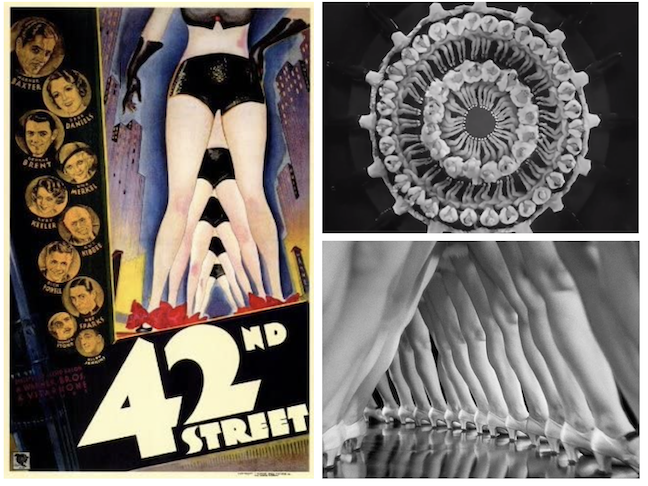
The pre-Code musical 42nd Street received a brief, albeit mostly positive review from critic John Mosher, who along with the producers of the film knew Depression-weary Americans needed such distractions. Nearly 90 years later (April 10, 2020), another New Yorker film critic, Richard Brody, suggested 42nd Street as one of the best films to stream during the Covid-19 pandemic: “Modern musicals start here, and Busby Berkeley’s genius bursts into full flower,” he wrote.
DANCE ‘TIL YOU DROP…Under pressure to produce a hit after losing his lead dancer (Bebe Daniels) to a broken ankle, Broadway musical director Julian Marsh (Warner Baxter, center) mercilessly rehearses her replacement, Peggy Sawyer (Ruby Keeler, in her film debut) before the premiere, vowing “I’ll either have a live leading lady or a dead chorus girl.” Looking on (to the right of Baxter) is Ginger Rogers, who portrayed “Anytime Annie.” (tcm.com)A LEG UP ON HIS CAREER…42nd Street was a breakthrough film for choreographer Busby Berkeley, who would direct and choreograph a long string of musicals until the 1960s. The film is now considered a classic, preserved in the United States National Film Registry. (IMDB)
…and for trivia buffs, during an opening scene Bebe Daniels is shown reading the February 20, 1932 (anniversary) issue of The New Yorker…
* * *
From Our Advertisers
A convertible LaSalle (a downscale Cadillac brand) looks like a great way to enjoy a drive along the beach…let’s hope it has enough acceleration to outrun the tsunami apparently heading its way…
…Walter Chrysler continued to dig into his deep pockets for two-page color spreads, including this one that placed his humble DeSoto in St. Moritz, of all places…
…not to be outdone, the folks at Nash found another exotic locale for their budget-priced sedan…Chicago, that is, at the 1933 Century of Progress Exhibition…and for an extra touch of class, we have what appears to be a chauffeur attending to this modest motorcar…
…America’s top luxury car maker, Pierce Arrow — a regular advertiser in The New Yorker — decided a quarter-page ad was sufficient to keep their name before the eyes of the well-heeled…at right, an ad from another back page featured cartoonist Don Herold shilling for the makers of imitation liquor flavors…according to the ad, one bottle, obtainable from your druggist, “flavors a gallon” of whatever forsaken hootch you are consuming…
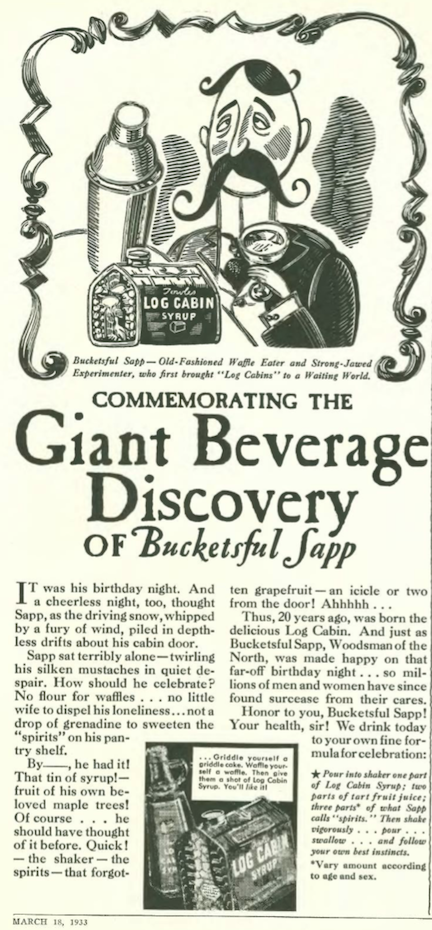
…the folks at Log Cabin relied on the talents of another New Yorker cartoonist, John Held Jr., to make both their product and a signature cocktail a more palatable experience…
…I have to hand it to the folks at Heinz for signing off on an advertisement only a vampire would find appealing…
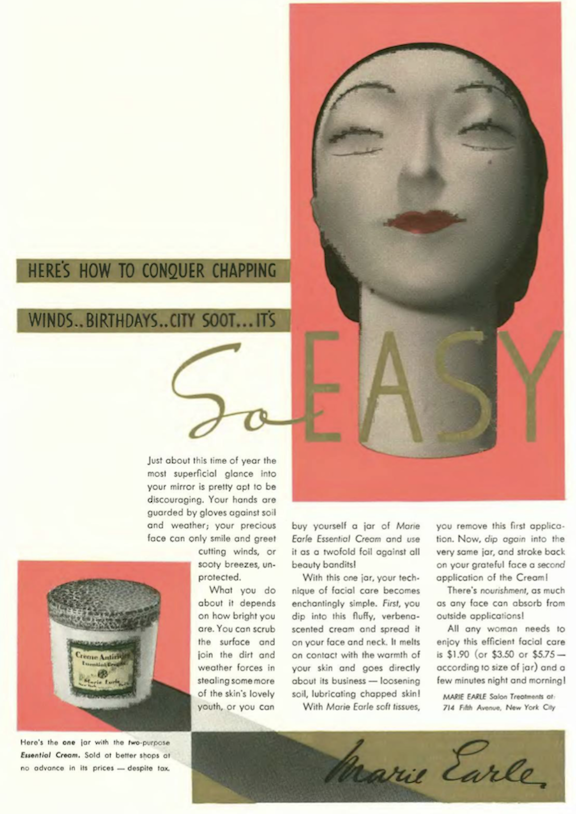
…the purveyors of Marie Earle beauty products rolled out this modern ad to promote their “Essential Cream”…
…while staid Brooks Brothers remained true to form — no flashy colors or advertising jargon — just straight talk about price increases….
…and then there’s the upmarket Fortnum & Mason, appealing to America’s Anglophiles with one of their famed wicker hampers filled with various goodies selected for “charming and greedy people”…
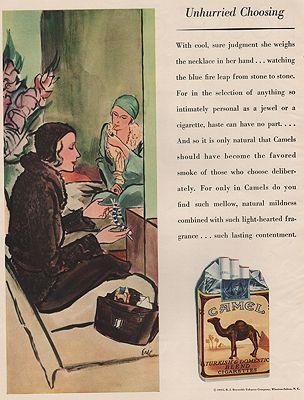
….for several years R.J. Reynolds employed the services of Carl “Eric” Erickson (1891–1958) to illustrate a series of ads featuring classy, disinterested, continental types smoking their Camel brand cigarettes…despite their less-than-exotic name, the makers of Spud menthol cigarettes hired Ruth Sigrid Grafstrom (1905–1986) to create their own smart set of smokers…
…ads that bore a striking resemblance to Erickson’s Camel work (this example from 1931)…
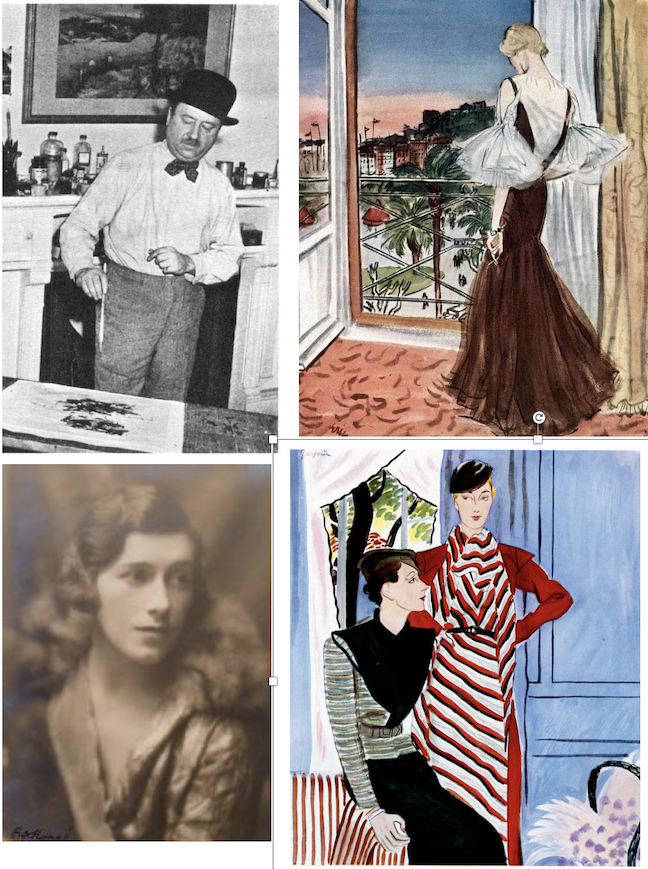
…and for your consideration, works from 1933 by Carl Erickson and Ruth Sigrid Grafstrom…both were noted fashion illustrators…
…on to our cartoonists, we begin with Charles Addams, who’d just published his first New Yorker cartoon the previous month, in the Feb. 4, 1933 issue…
…that first cartoon was simply signed “Addams”…here he used the familiar “Chas Addams”…a close-up of the signature…
…we continue with a great caricature by Al Frueh to accompany a profile of Rudolf Kommer (as told by Alexander Woollcott)…
…a delightful full page of bank holiday-themed cartoons by James Thurber…
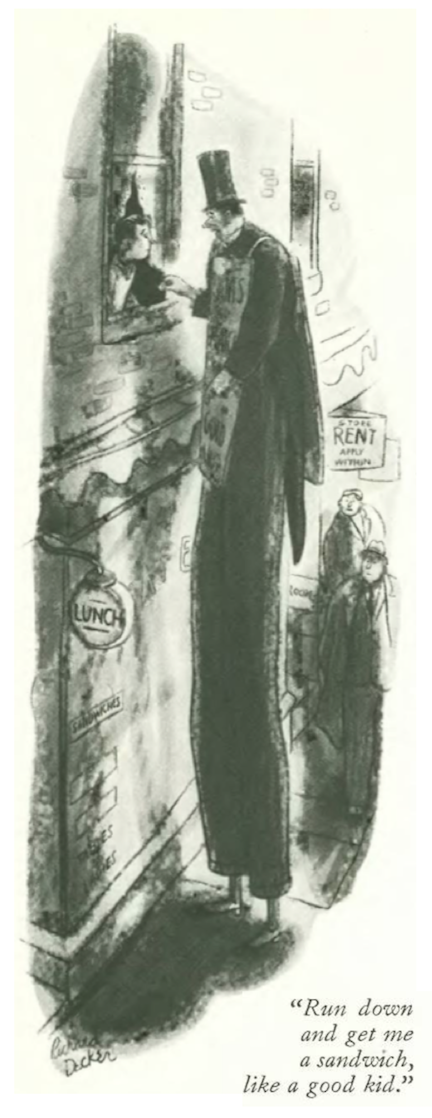
…Richard Decker offered up a tall tale…
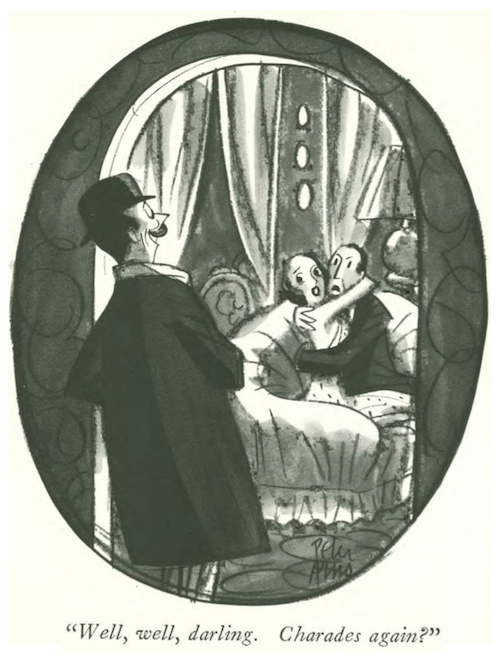
…and we close with Peter Arno, who served up one of his clueless cuckolds…
One of Hollywood’s most famous motion pictures was a story about a giant ape that (literally) falls for a beautiful woman.
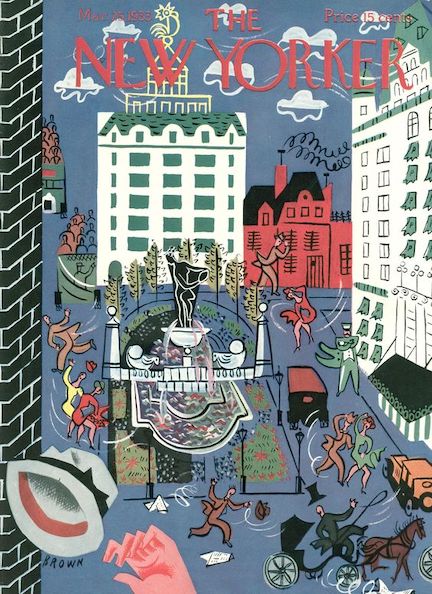
March 11, 1933 cover by Rea Irvin.
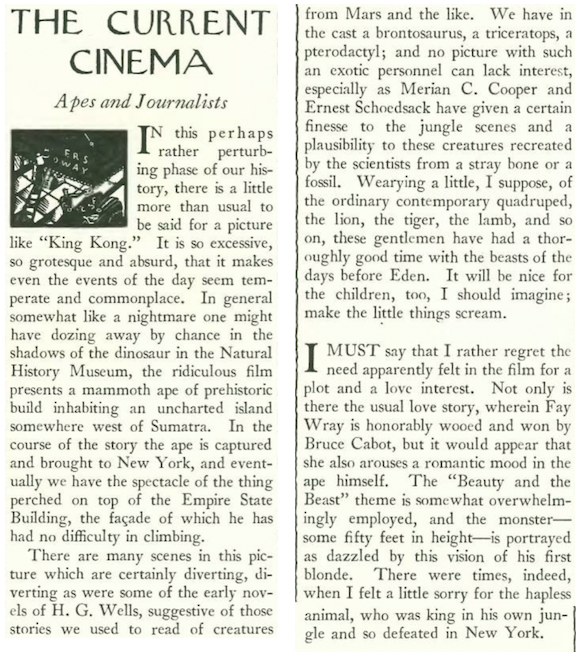
New Yorker film critic John Mosher found the premise of King Kong ridiculous, but he also found many of its scenes diverting, especially those featuring Kong and a number of prehistoric creatures (created by Marcel Delgado), miniature models brought to life through stop-motion animation techniques pioneered by Willis O’Brien and his assistant, Buzz Gibson. Mosher’s review:
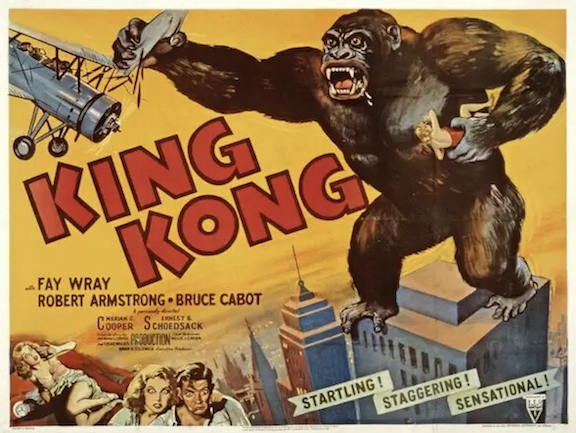
THE TRIALS OF GIANT APEHOOD…King Kong battled nature and man in the eponymous 1933 film that featured a silly love story between actors Bruce Cabot and Fay Wray (lower right, with Robert Armstrong); this being a pre-Code film, Wray had trouble keeping on her blouse, although a scene depicting Kong undressing her and sniffing his fingers was cut, as were some of the more gruesome scenes featuring Kong stomping and chomping his way through Manhattan. (IMDB)
By today’s standards the film’s special effects are quite dated, but they astonished audiences in 1933 and again in a 1952 re-release.
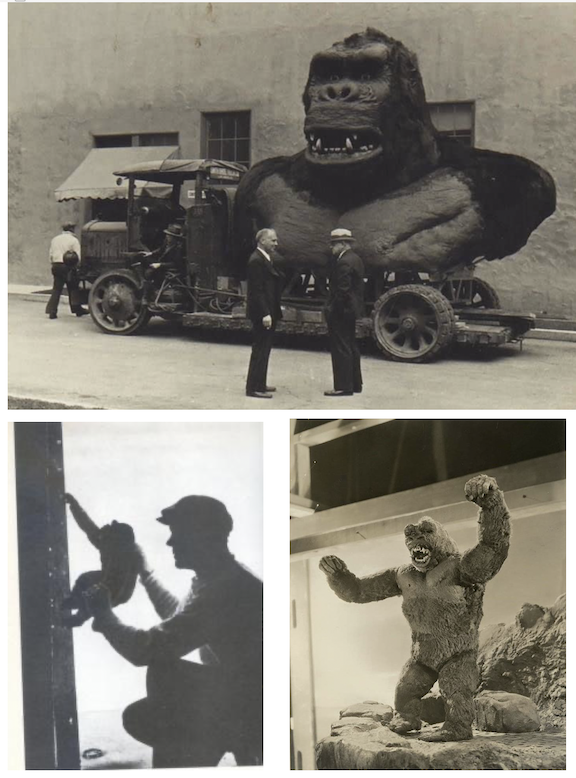
NEW YORK OR BUST…A huge bust of King Kong’s head and torso was fashioned from wood, cloth, rubber and bearskin by Marcel Delgado, Buzz Gibson and Fred Reese. Three operators inside the bust used metal levers, hinges, and an air compressor to manipulate the mouth and facial expressions. In addition, two versions of the ape’s right arm were constructed of steel, rubber and bearskin — one was non-articulated, mounted on a crane, and the other had articulated fingers that allowed Kong to grasp Fay Wray in close-ups (below). A separate non-articulated leg was also mounted on a crane for scenes depicting Kong stomping on villagers. (reddit.com/Pinterest)
* * *
Oh Baby
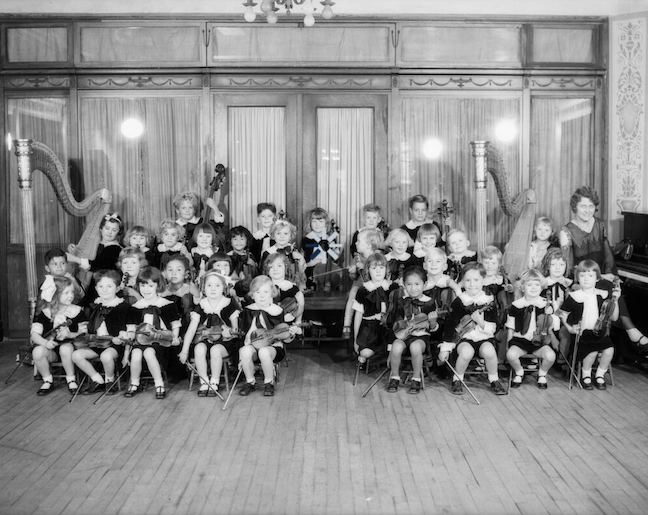
Before child labor laws were finally enforced in the late 1930s, children were routinely exploited for profit, most famously the Dionne quintuplets by Dr. Allan Roy Defoe, not to mention the many child stars fed into the Hollywood meat grinder. For a public seeking novelty as a distraction from the Depression, there were also numerous “baby orchestras” organized by one Karl Moldrem. “The Talk of the Town” commented:
NURSERY SONGS…One of Karl Moldrem’s baby orchestras assembled in Southern California, 1931. (digitallibrary.usc.edu)
* * *
Edible Art
“The Talk of the Town” has always been a source for light anecdotes, including this brief account of a hungry Vanity Fair photographer:
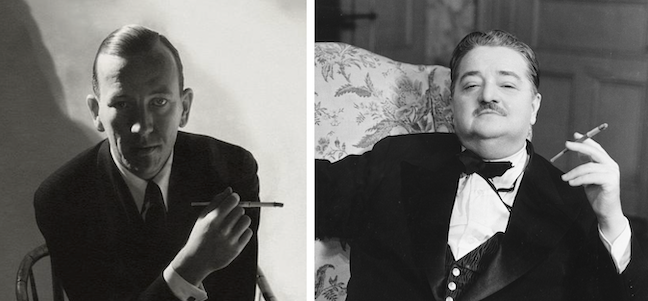
Alexander Woollcott led his “Shouts and Murmurs” column with an account from a recent benefit performance, during which his friend Noël Coward decided to strike up a conversation regarding the survival of the stage in an era of talking films:
TALKING TALKIES… Noël Coward (left) voiced his concerns about the future of stage entertainment with Alexander Woollcott during a benefit performance likely held on behalf of the theatrical world. (npg.org)
* * *
From Our Advertisers
Ah, we begin with signs of spring, glimpsed beyond the gleaming cowl of a 12-cylinder Lincoln…
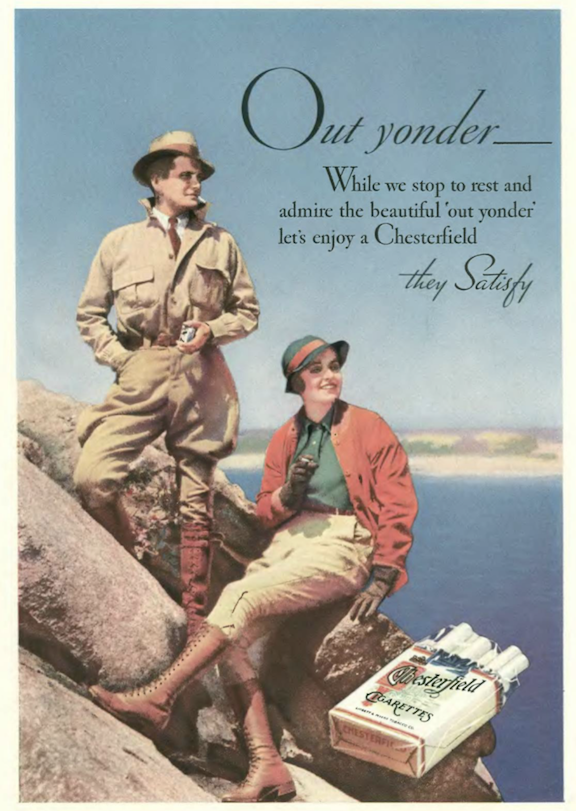
…and catch a whiff of that springtime breeze, savored between puffs of your Chesterfield…
…this guy has some spring in his step thanks to the sparkling water he just splashed into his bootleg gin…
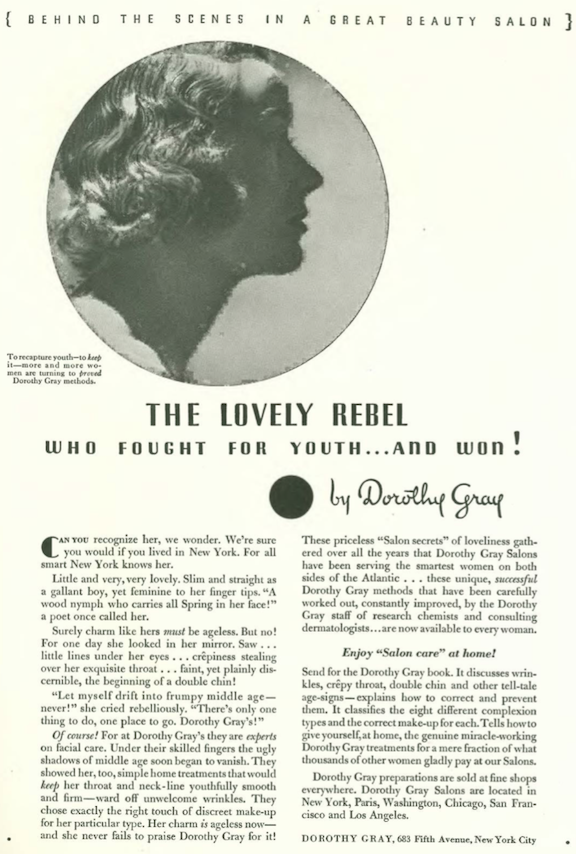
…the folks at Dorothy Gray presented a nameless woman (“slim and straight as a gallant boy, yet feminine to her finger tips”) who was ready to greet spring until she saw those “little lines under her eyes”…the horror indeed…
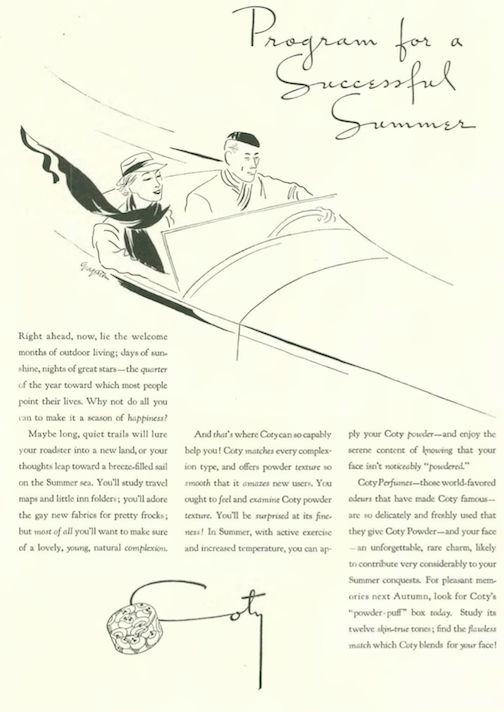
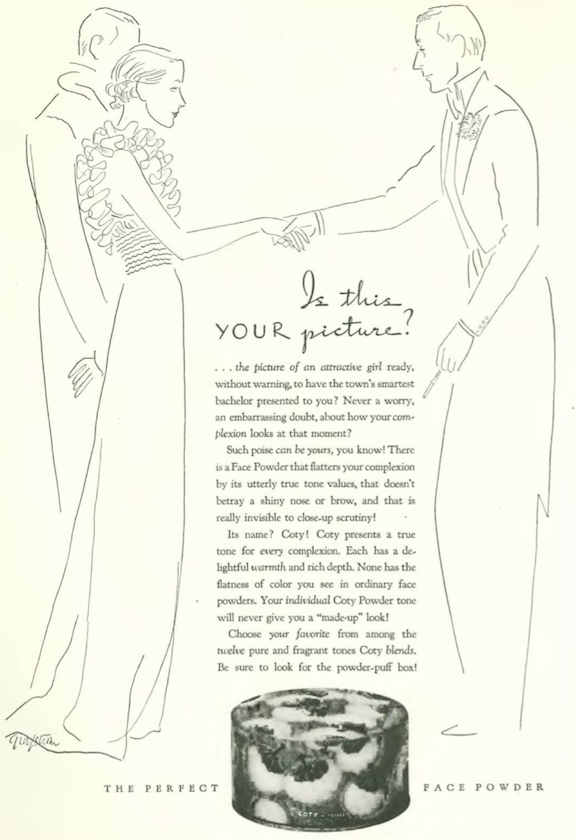
…Coty again presented an attenuated trio in a sexless courtship dance, oozing with anglophilic longing…
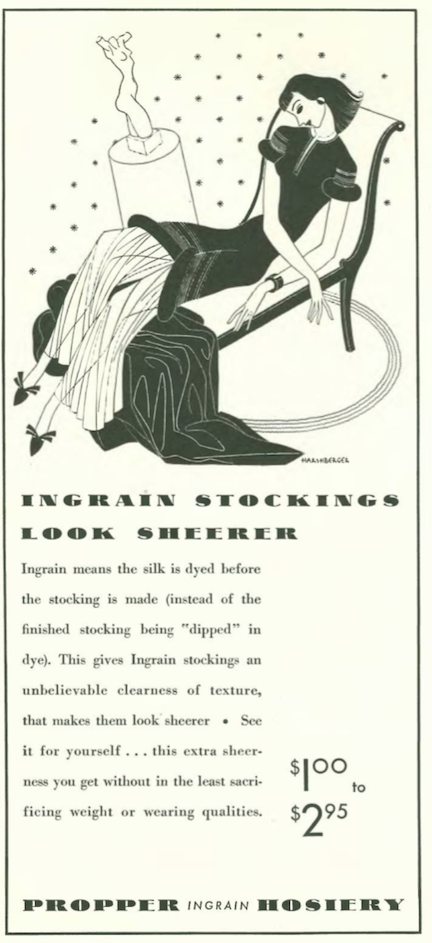
…I include this ad solely for the terrific illustration by Mac Harshberger, famed for his elegant, simplified line…
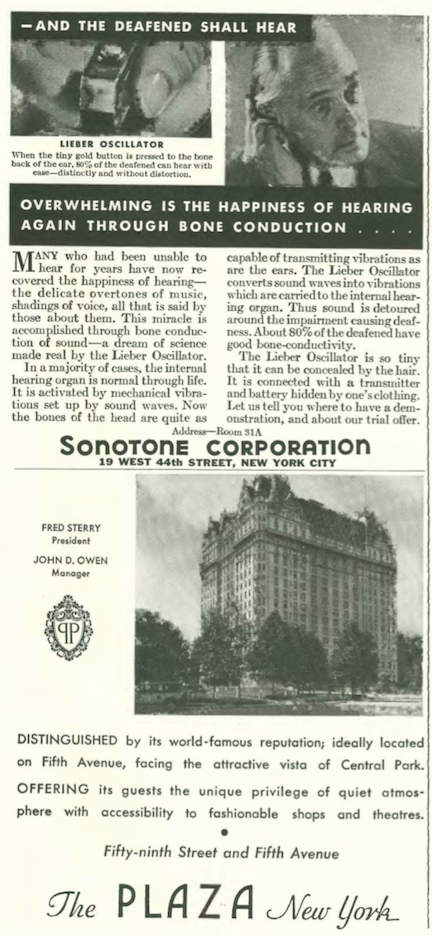
…and a couple of back pagers…thanks to Sonotone, the deafened shall not only hear but will also be stricken by a sudden voiding of the bowels…and below, a surprising ad from the Plaza, one place I never thought would need to advertise…but those were tough times…
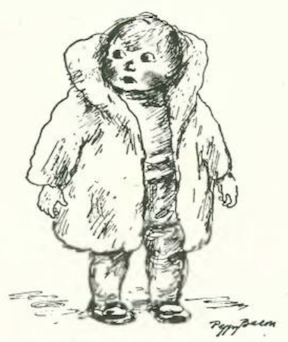
…and on to our cartoons, and this spot drawing from Peggy Bacon, whom we haven’t seen in awhile…
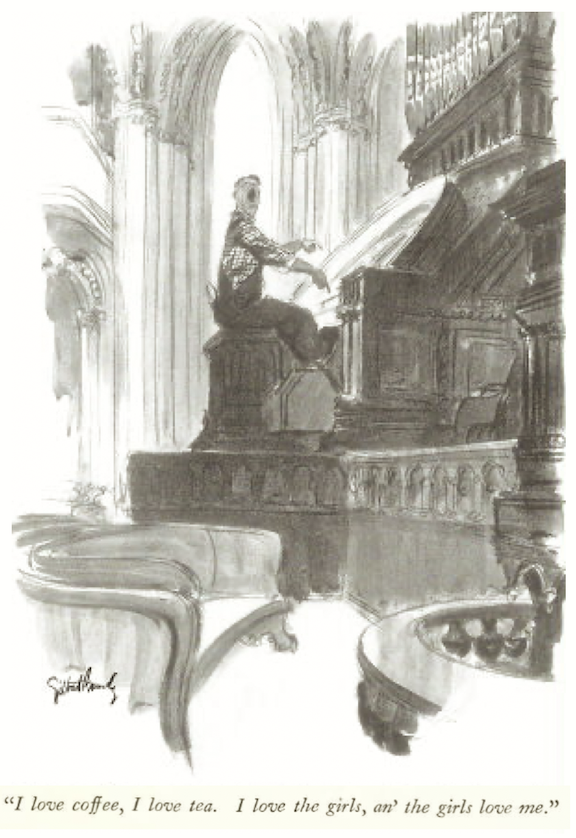
…Gilbert Bundy took us to a sanctuary of song…
…another day with our fellow citizens, and Gluyas Williams…
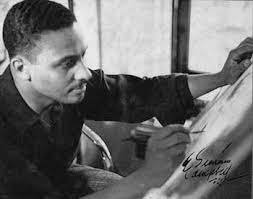
…one from E. Simms Campbell…
…who was the first Black cartoonist published in nationally distributed, “slick” magazines…
…and also the creator of Esky, the pop-eyed mascot of Esquire magazine…
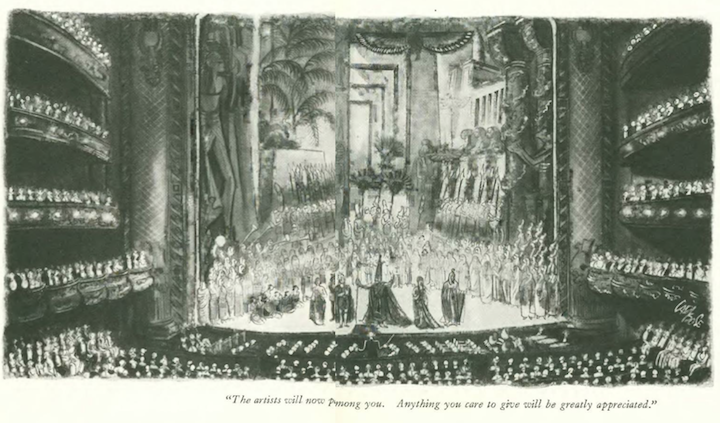
…Carl Rose gave us a night at the opera in this two-page cartoon with the Depression-inspired caption: The artists will now pass among you. Anything you can give will be greatly appreciated….
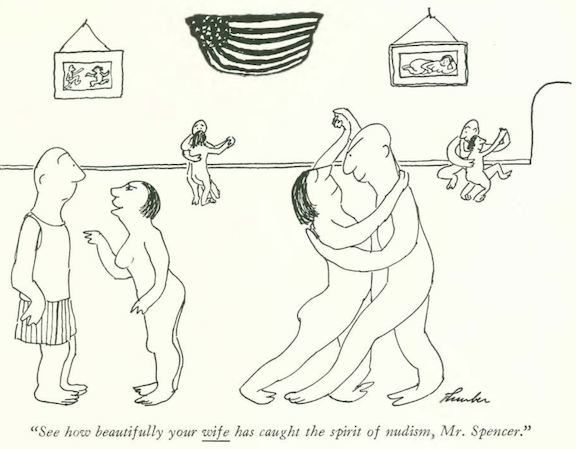
…and James Thurber returned to the nudist colony for another look at the age-old struggle between the sexes…





































































































































 A New Yorker State of Mind