She Who Must Be Obeyed

The 1935 film She was one of those old movies you’d see on television during the 1970s when there were only three or four channels (plus UHF) and local stations would tap into the “B” movie vault to fill airtime. One of those films was She.
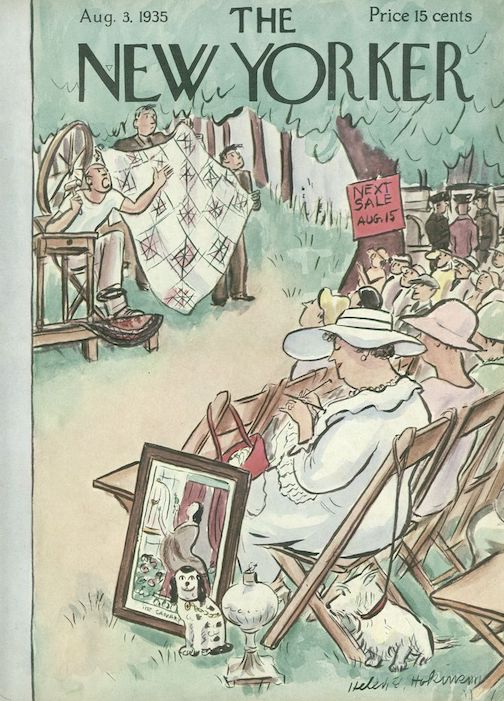
August 3, 1935 cover by Helen Hokinson.

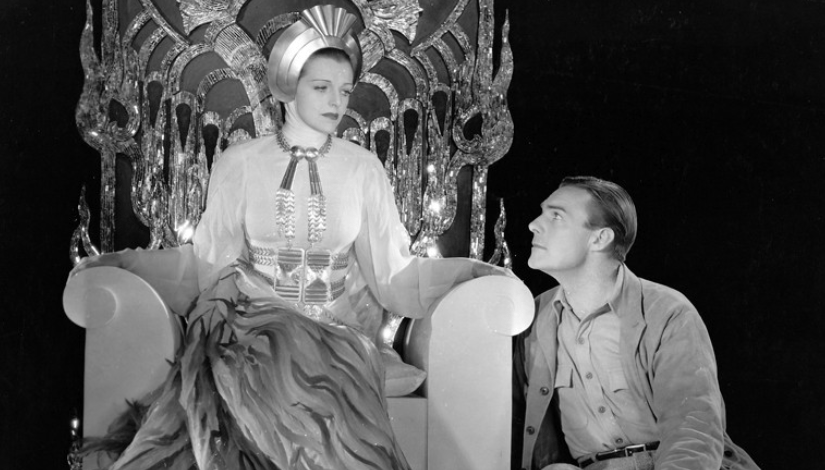
Film critic John Mosher felt a bit sorry for Helen Gahagan, who portrayed “She Who Must Be Obeyed” (aka “She”)—an immortal who ruled an exotic, lost civilization near the Arctic Circle. The challenge for Gahagan was to seem imperious before her co-stars Randolph Scott and Helen Mack, who seemed more suited to the high school hijinks of an Andy Hardy picture. The film was a pretty standard adventure tale, in the mold of producer Marian C. Cooper’s 1933 King Kong, with two explorers falling in love during a perilous journey.

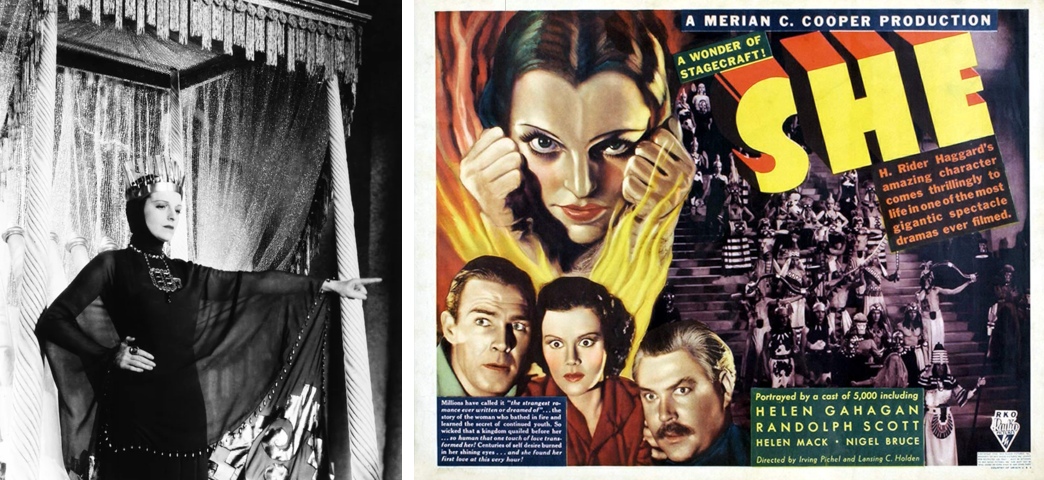
ARCHETYPE…At left, Helen Gahagan as “She” (Who Must Be Obeyed). Her costume possibly inspired the Evil Queen in Disney’s 1937 animated Snow White and the Seven Dwarfs. At right, lobby card that promoted the film. (Scifist.net/Reddit)
WHEN YOU PLAY WITH FIRE…She Who Must Be Obeyed (Helen Gahagan), believing that the explorer Leo Vincey (Randolph Scott) was a reincarnation of his ancestor (whom she loved), and jealous of his girlfriend Tanya (Helen Mack), invites Leo to join her in the eternal flame. Unfortunately, her re-entry into the flame that gave her immortality turned her into a dying, withered crone. (The Nitrate Diva/Scifist.net)

The 1887 H. Rider Haggard novel, She, inspired eponymous silent films in 1908, 1911, 1916, 1917, and 1925. The 1935 film reviewed here received tepid reviews and lost money on its first release, however in a 1949 re-release it fared much better. She was re-made in 1965 with Ursula Andress in the lead role, and again in 1984 in a post-apocalyptic film that had virtually nothing to do with Haggard’s novel.

SHE THROUGH THE YEARS…Clockwise, from top left, “She” (Marguerite Snow) offers a dagger to Leo Vincey (James Cruze) in a 1911 two-reel (24 min.) adaptation; Valeska Suratt as “She” in the 1917 film (now lost); Betty Blythe took the title role in the 1925 production, considered to be the most faithful to the 1887 H. Rider Haggard novel; Sandahl Bergman appeared dressed for a Jazzercise video in the 1984 post-apocalyptic She; and finally, Ursula Andress and John Richardson in the 1965 CinemaScope production of She. (Wikipedia / digitalcollections.lib.washington.edu / cultcelebrities.com / Reddit)

 * * *

Colonial Ambitions

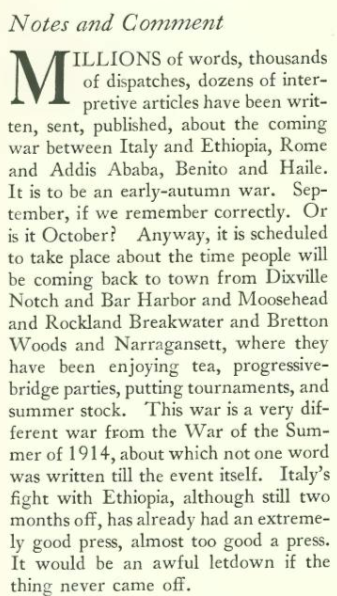
With most of Africa carved up by other European powers (Britain, France, Belgium etc.) in the 19th century, Italy set its sights on Ethiopia, which by the end of the 19th century was the only independent country left on the continent. Ethiopia fought off Italy’s first attempt at conquest in the Battle of Adwa (1896), but with the rise of fascist dictator Benito Mussolini, Italy paid a return visit, this time with heavy artillery and airstrikes that included chemical weapons. E.B. White tried to make sense of this latest invasion in his opening comments.
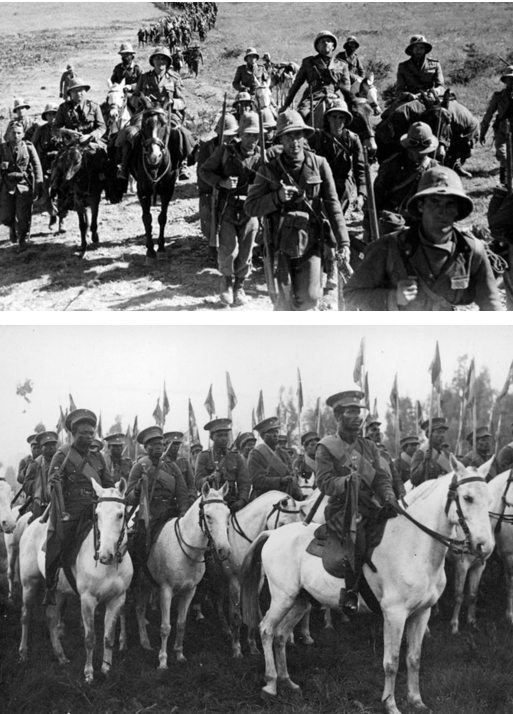
THOSE GUYS AGAIN…Italy invaded Ethiopia on October 3, 1935, a significant act of aggression in the lead up to World War II. Despite facing a technologically superior Italian army (top) equipped with modern weapons, including tanks, aircraft, and chemical weapons, the Ethiopian forces (bottom photo) mounted a strong resistance. (Wikipedia)

In his weekly column, Howard Brubaker mused on the Italian aggressions and other rumblings of the coming European war.

 * * *

Author, Author

The writer Willa Cather was a favorite of New Yorker critics, including Clifton Fadiman, however her latest novel was a bit too mild for his tastes.
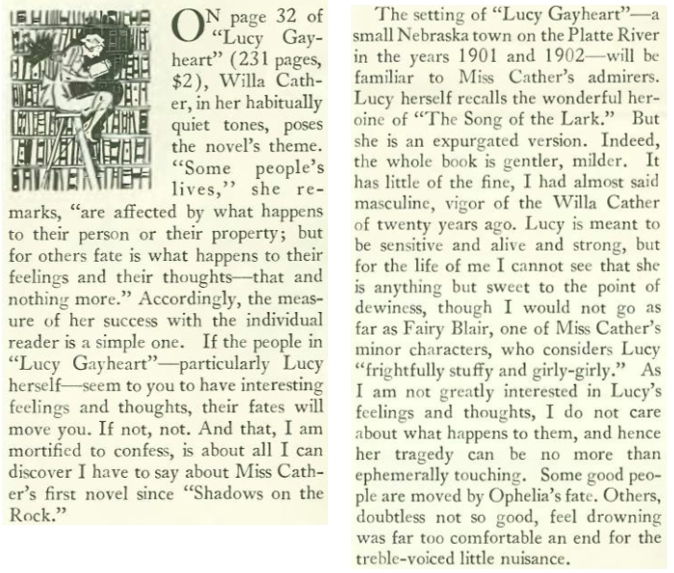
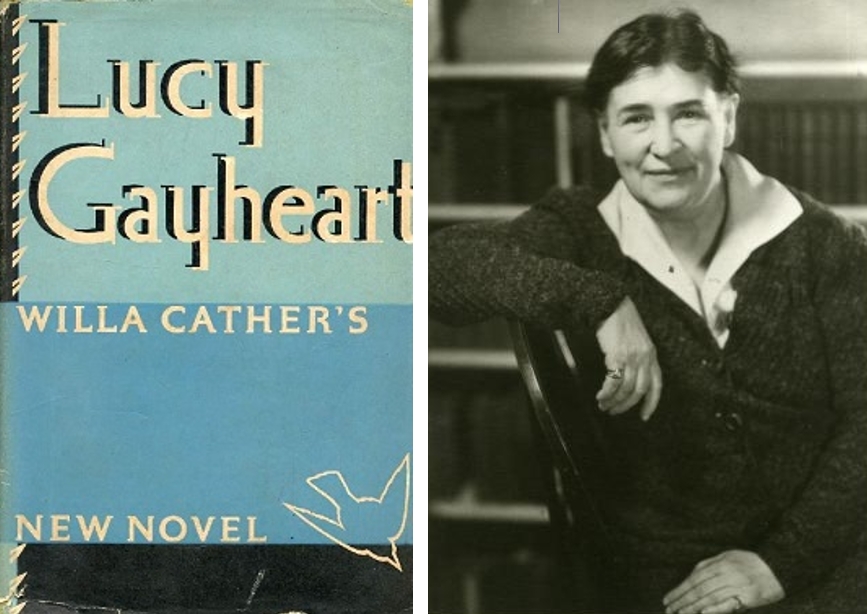
HERE’S LUCY…Clifton Fadiman confessed he was “mortified” to admit that he found Willa Cather’s latest novel a bit too gentle. At right, portrait of Cather on her birthday, December 7, 1936. (willacather.org)

 * * *

From Our Advertisers

We begin with more fearmongering from the folks at Goodyear, who offered weekly reminders of the perils of not choosing their all-weather tires…

…the Liggett and Myers Tobacco Company conjured up this “naughty maiden” to encourage even timid souls to take up the habit…

…on the other hand, the makers of the upstart KOOL brand kept it simple with their chain-smoking penguin, who was grabbing ever more market share from rival menthol pusher SPUD…
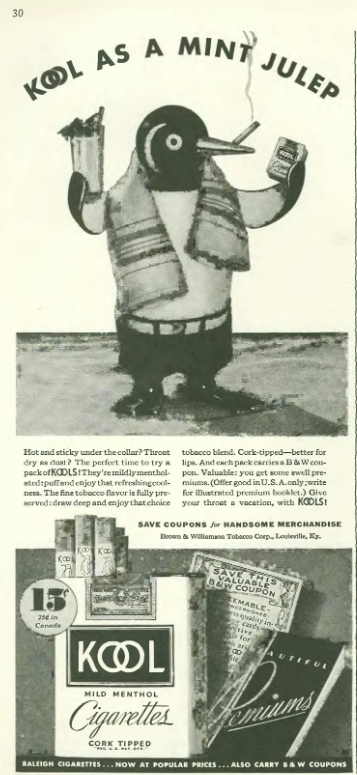
…ads in the back of the book offered up even less sophisticated products, such as Crown Smelling Salts…
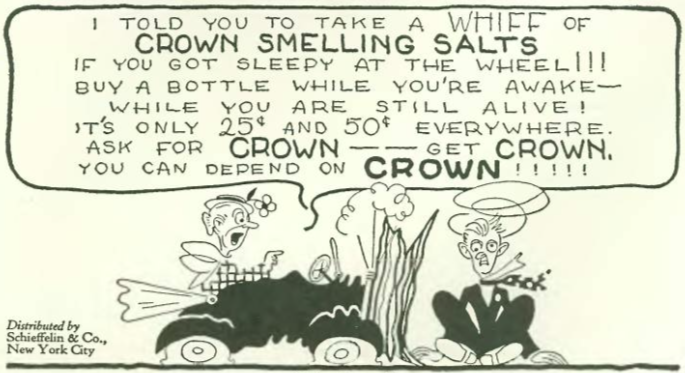
…while Dr. Seuss and Norman Z. McLeod continued to make a living with their distinctive illustrations…

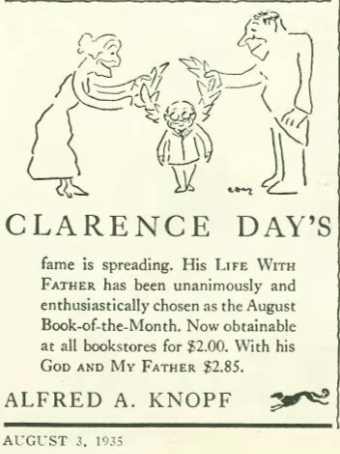
…at the very back of the magazine, this tiny ad from Knopf promoted Clarence Day’s Life With Father, published just months before Day’s death on Dec. 28…
…which brings us to our cartoonists…Constantin Alajalov kicked us off with this happy number…

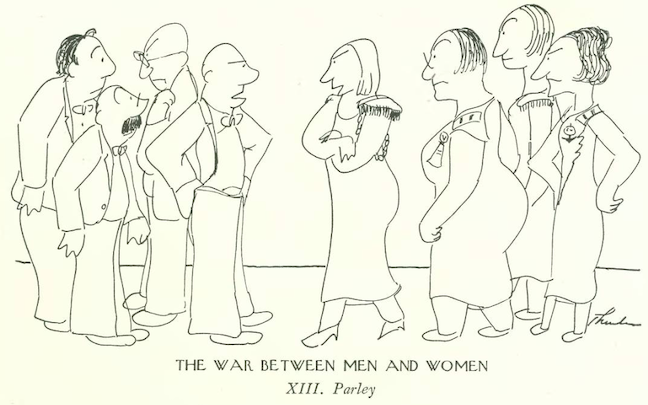
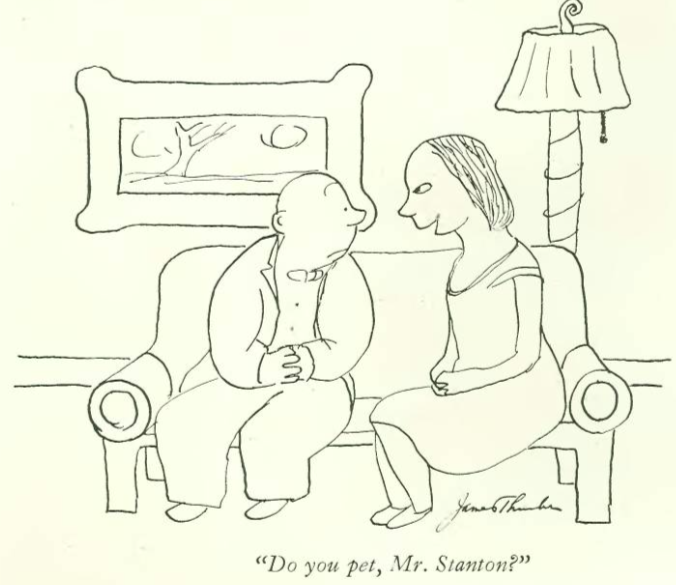
James Thurber found steamy goings on in the parlor…
Charles Addams came down to earth with this pair…

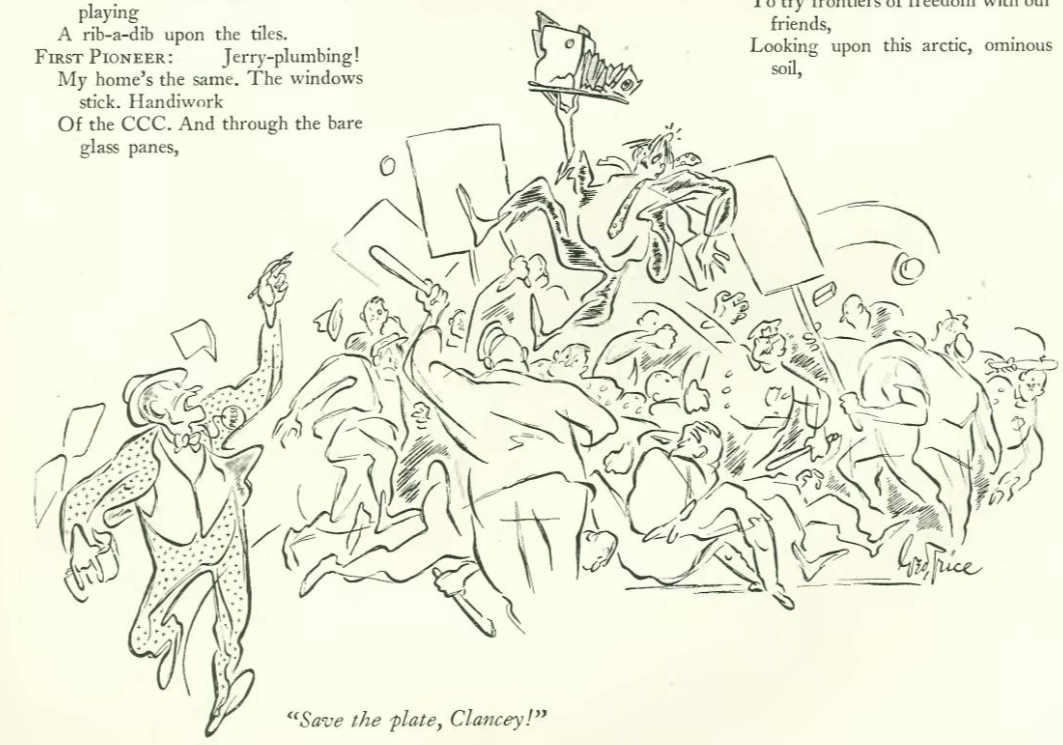
George Price showed us the rough and tumble of news reporting…
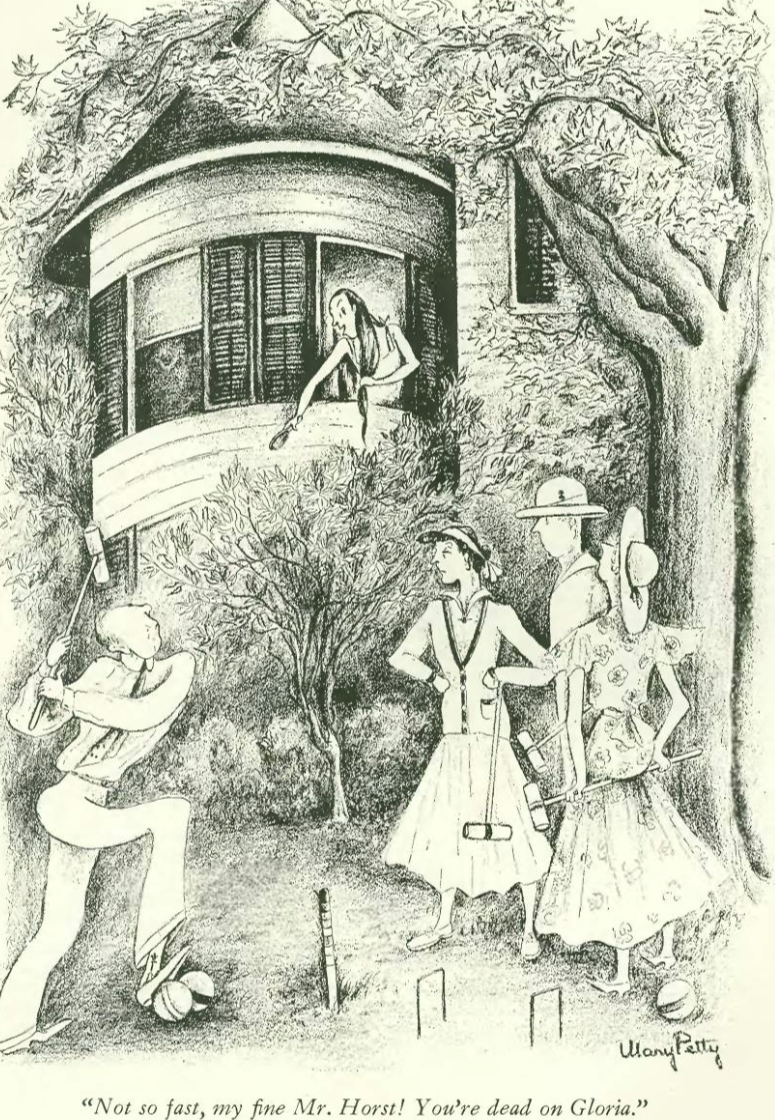
Mary Petty contributed this sumptuous drawing of a croquet match…
Helen Hokinson was in a transcendental mood…

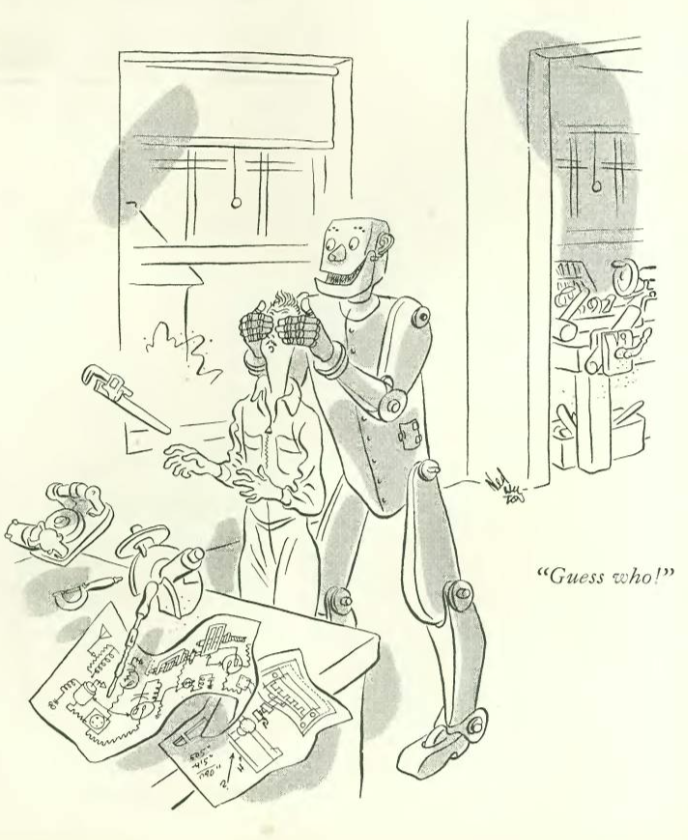
…and Ned Hilton had a big surprise for one garage tinkerer…
…on to August 10 and a rich summer scene by Arnold Hall:
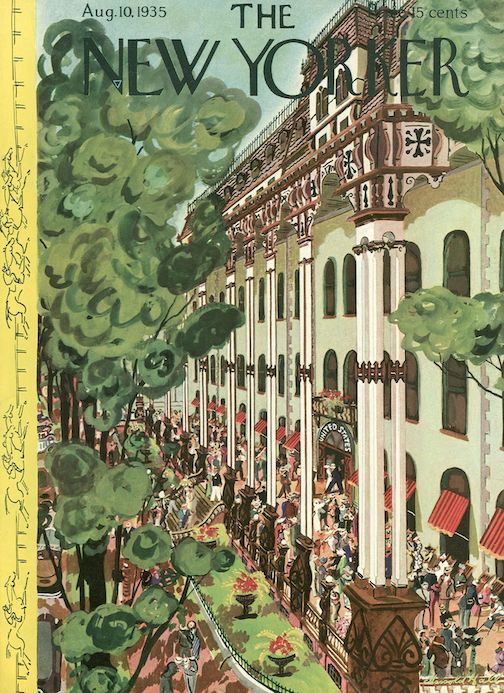
August 10, 1935 cover by Arnold Hall.

“The Talk of the Town” checked the lunch crowd at Mary Elizabeth’s Tea Room, where some preferred to drink their lunch.
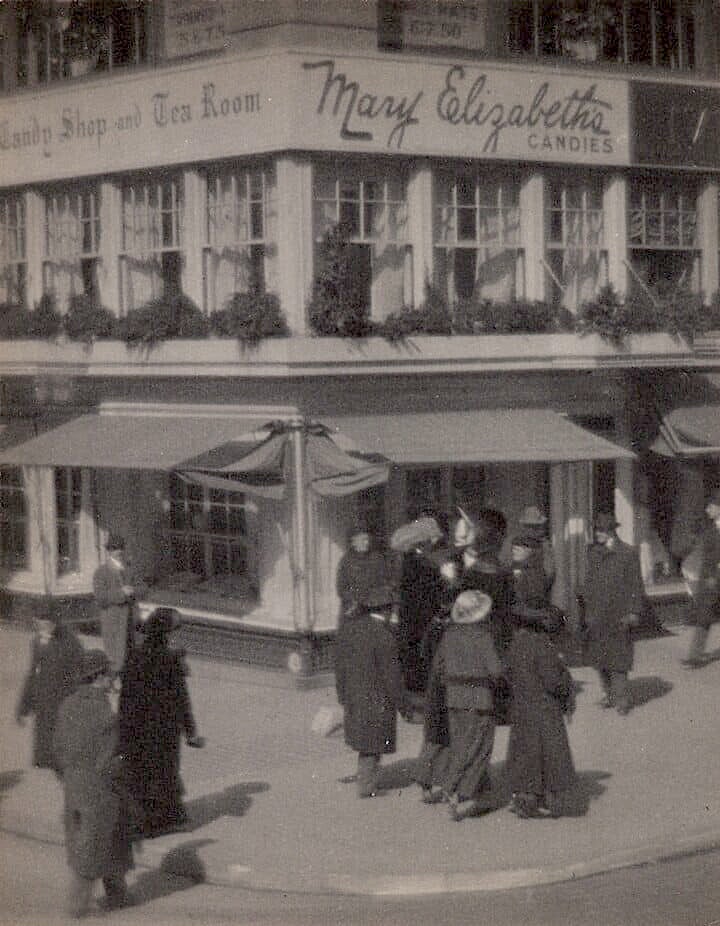
TEA AND SWEETS (and cocktails) were among the offerings at Mary Elizabeth’s Tea Room at 36th and Fifth, seen here circa 1912. (Photo by Karl Struss via Facebook)

 * * *

Comic Relief

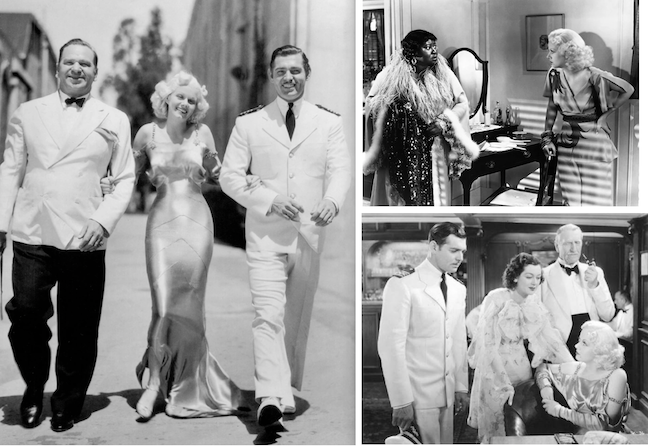
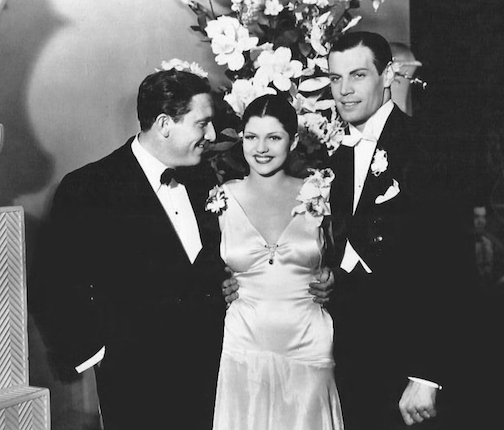
Film critic John Mosher offered an appreciation of W.C. Fields, noting that civilization needed films like Man on the Flying Trapeze during those hard years. Mosher also found some worthy distractions in the Jean Harlow vehicle China Seas, but was prepared to consign Spencer Tracey’s latest offering to the “lower circles of cinema hell.”
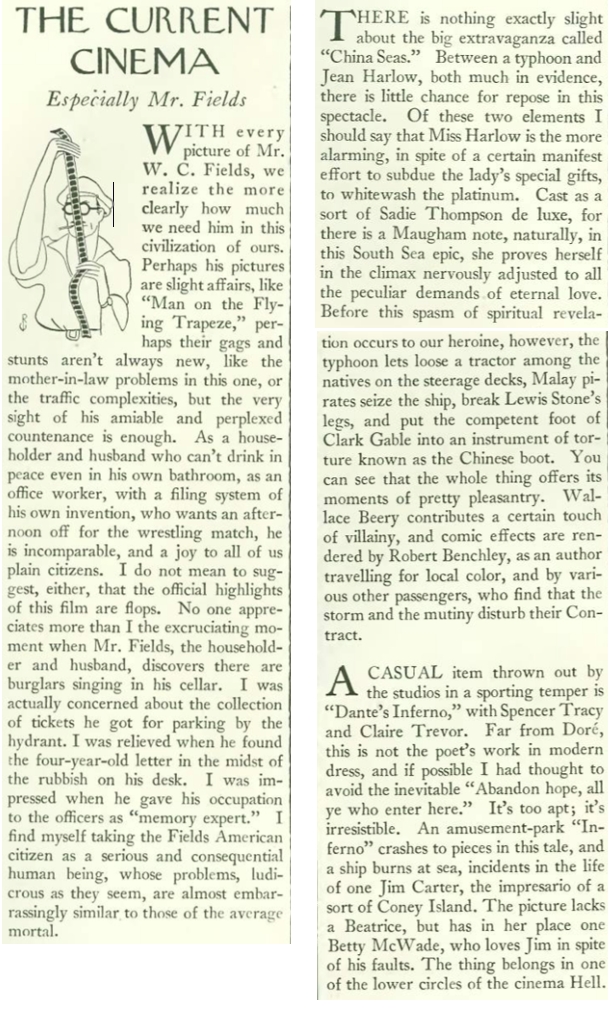
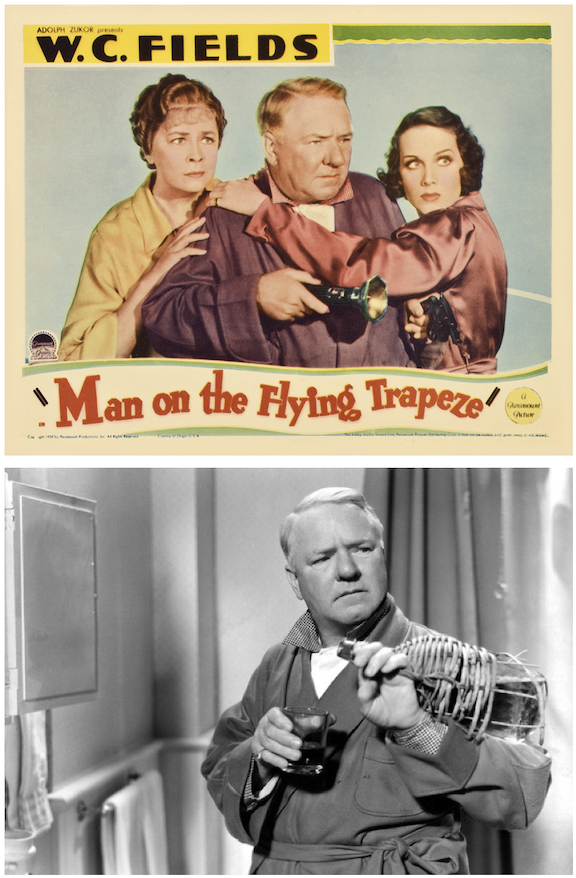
ANSWERING HIS NATION’S CALL…W.C. Fields brought joy to millions during the Depression in movies such as Man on the Flying Trapeze. Above, from left, Kathleen Howard, Fields, and Mary Brian. (IMDB/Rotten Tomatoes)
SHORE LEAVE…At left, Wallace Beery, Jean Harlow, and Clark Gable on the set of China Seas; top right, Hattie McDaniel with Harlow in a scene from the film; below, Gable, Rosalind Russell, and C. Aubrey Smith with Harlow in China Seas. (musingsofaclassicfilmaddict.wordpress.com / Pinterest)
FRESH FACE…Cinema newcomer Rita Hayworth was credited as Rita Cansino (she was born Margarita Carmen Cansino) in Dante’s Inferno. Here she is flanked by Spencer Tracy and Gary Leon. Dante’s Inferno was Spencer Tracy’s final film for 20th Century Fox. It was at MGM where his career really took off. (IMDB)

 * * *

All Wet

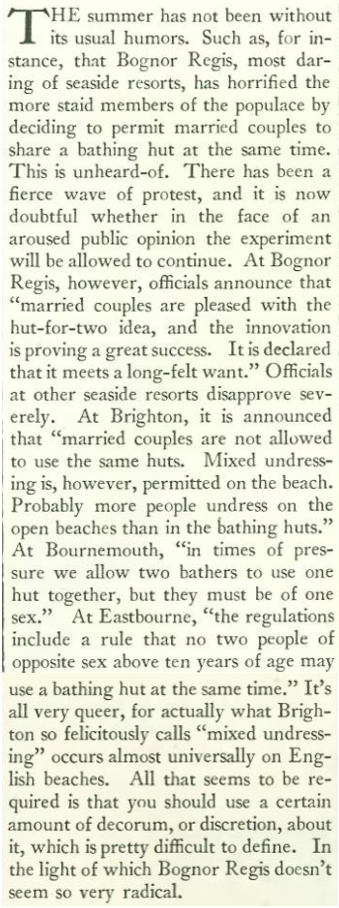
In his London Letter, Conrad Aiken (pen name Samuel Jeake Jr) examined the priggish ways of England’s seaside resorts.
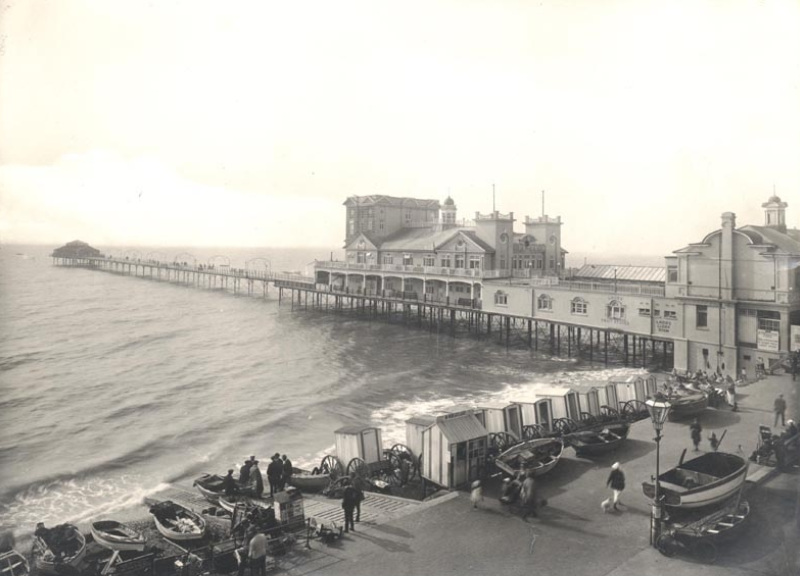
SITE OF SCANDAL…Bathing huts at Bognor Regis, circa 1921. (bognorregistrails.co.uk)

 * * *

Beware the Bachelor

In her “Tables for Two” column, Lois Long examined some of the city’s seasonal escapes for “summer bachelors.”

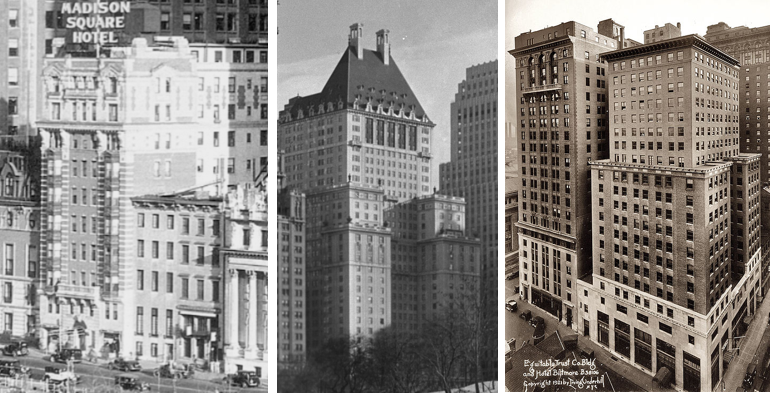
GHOSTS OF THE PAST…Lois Long recommended the air-conditioned lounges of the Madison Square Hotel and the Savoy Plaza (center) or the cooling breezes of the Biltmore roof (right), which featured music by Morton Downey. Sadly, all three of these beautiful buildings have been demolished. (geographicguide.com/Wikipedia)

Other more casual venues recommended by Long included Nick’s Merry-Go-Round…

…a menu from Nick’s dated 1937…

(nypl.org)

…and its cryptic back cover…

From Our Advertisers

…speaking of the Biltmore and Morton Downey, we kick off our advertising section…

…the ad on the left announced the private residences at the Waldorf-Astoria…
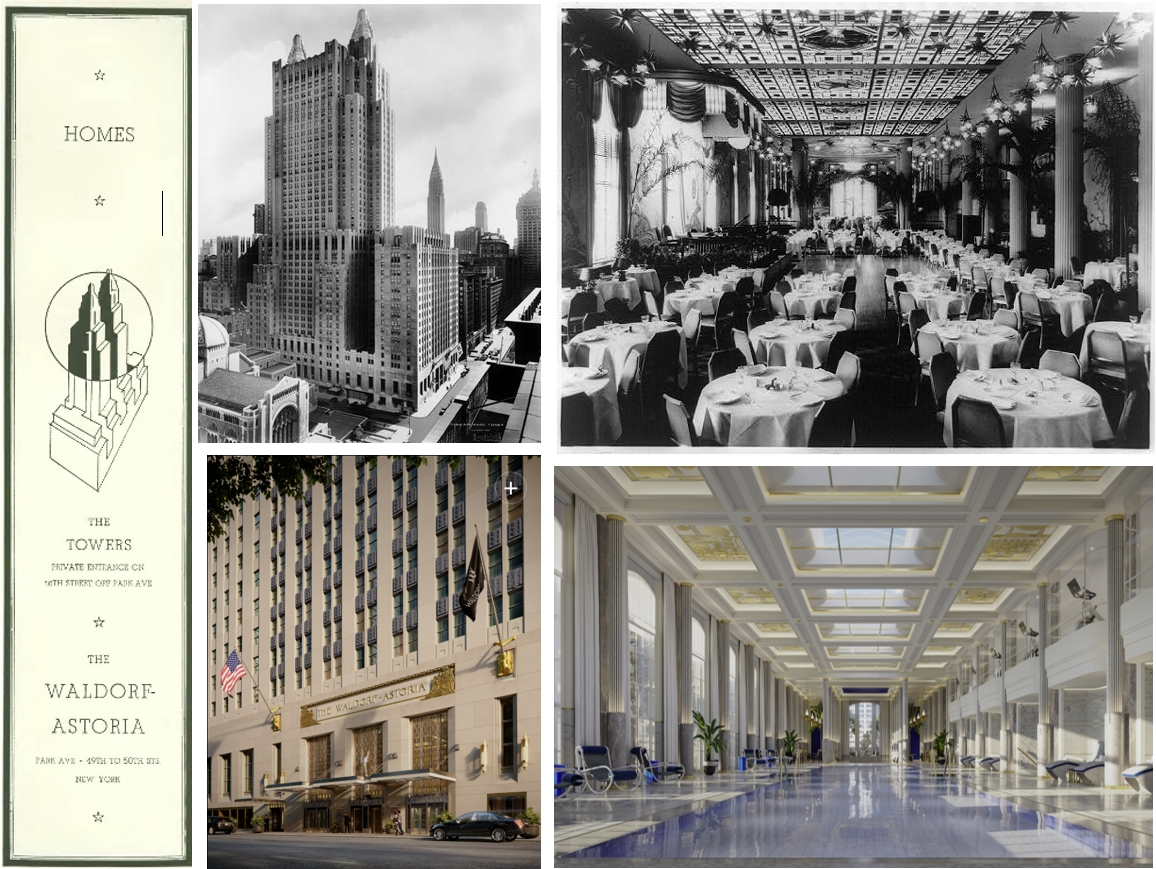
Clockwise, from top left, the Waldorf Astoria circa 1930; the Waldorf’s Starlight Roof in the 1930s; after eight years and billions in restorations and renovations, the hotel has seen many changes including the transformation of the Starlight Roof into a swimming pool. Decades of grime were also cleaned from the building’s exterior. (mcny.org/loc.gov/som.com)

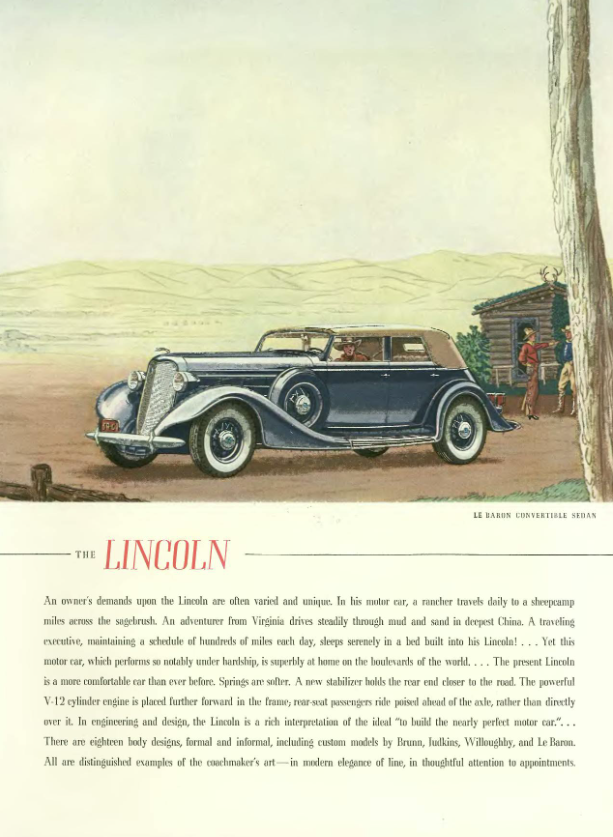
…another ad from the makers of Lincoln suggesting that the market for their luxury auto wasn’t confined to citified execs…
…the Camel folks introduced us to their latest society shill…
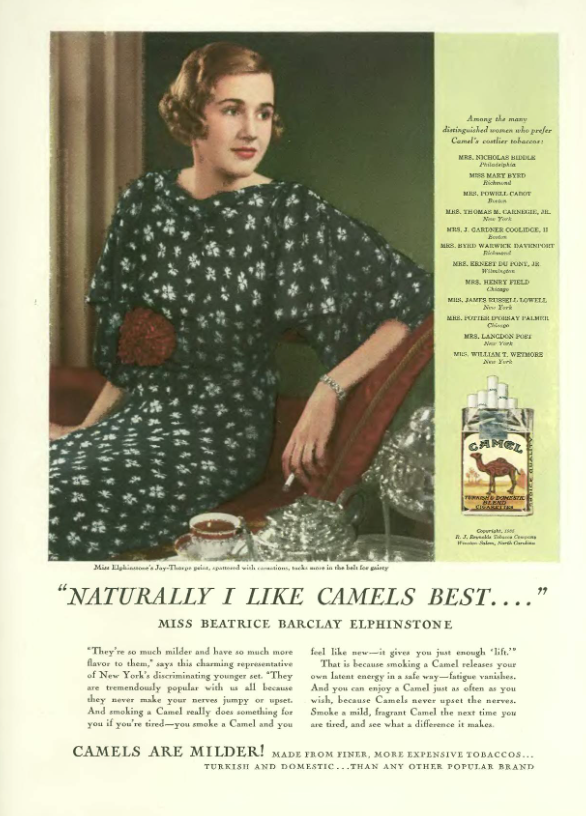
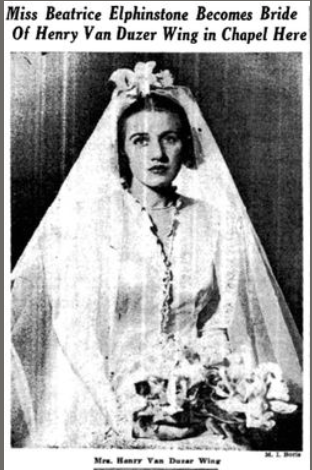
…I didn’t find much about Beatrice Barclay Elphinstone (1916-1977), described in the Camel ad as a “charming representative of New York’s discriminating younger set”…she did make the Times‘ Dec. 10, 1937 society wedding announcements, however…
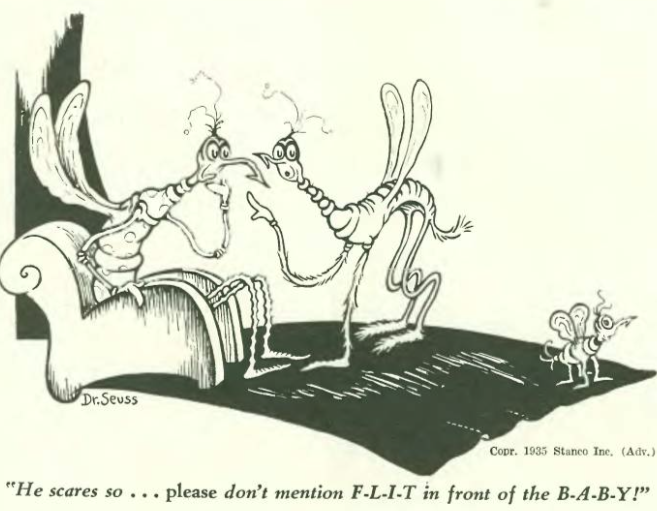
Dr. Seuss was back with another twist on Flit insecticide…
…on to our illustrators and cartoonists, a nice charcoal by Hugo Gellert for a profile titled “Yankee Horse Trader,” written by Arthur C. Bartlett…the harness horse racing legend Walter Cox (1868-1941) was known in New England as “the king of the half-milers”…

James Thurber contributed this cat and dog face-off to the opening pages…

Helen Hokinson offered her perspectives on the summer dog show across pages 16-17…

…and for a closer look…

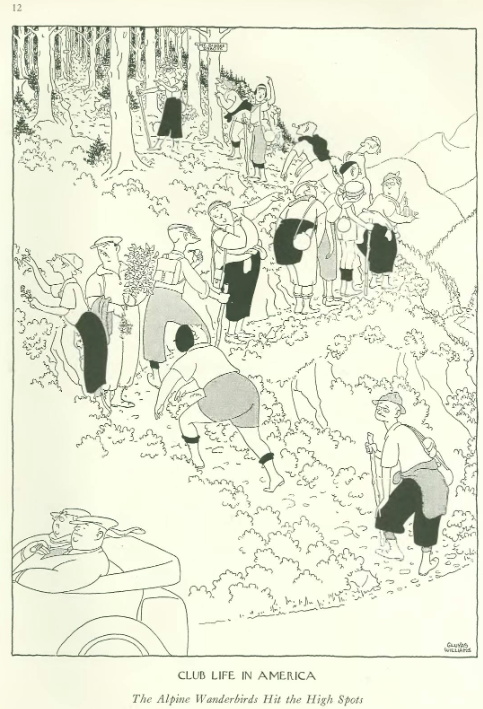
Gluyas Williams went back to nature in his “Club Life” series…
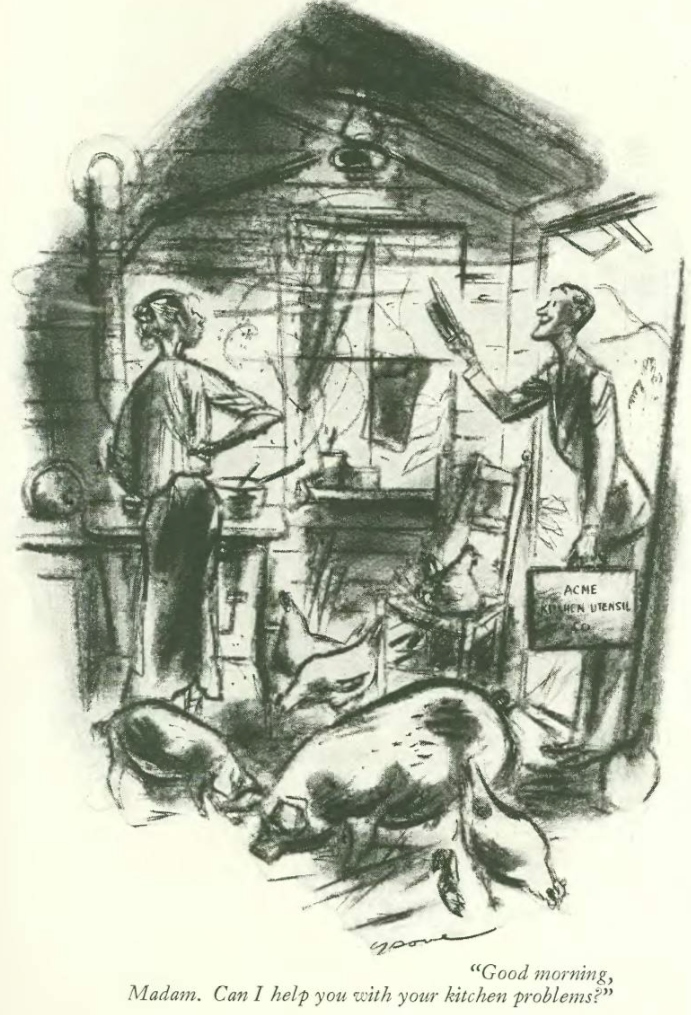
Leonard Dove introduced us to an undaunted salesman…
…in the world of George Price, crime didn’t pay…

Barbara Shermund gave us a rare glimpse into the secret lives of men…

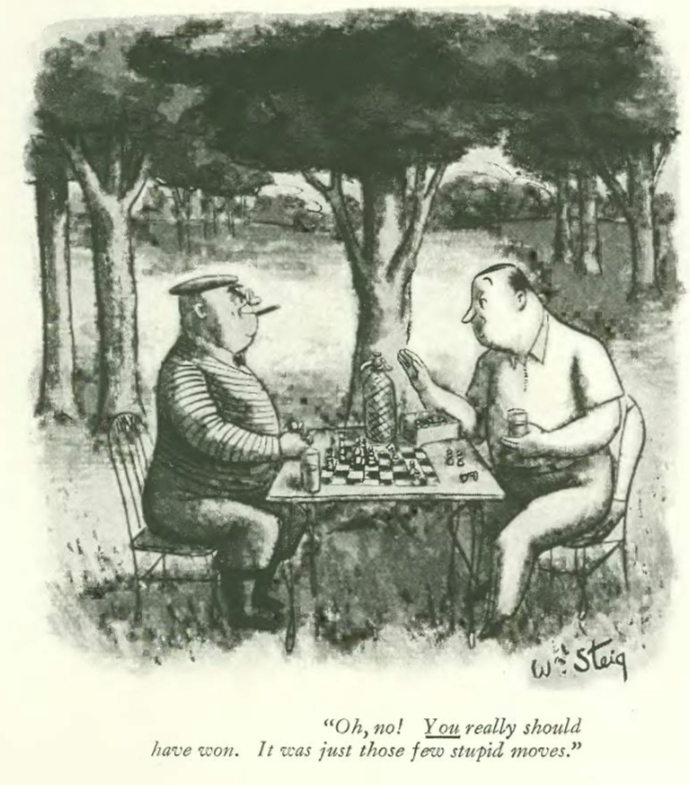
…patronizing words were unwelcome at this chess match, per William Steig

Denys Wortman took us on a family outing…
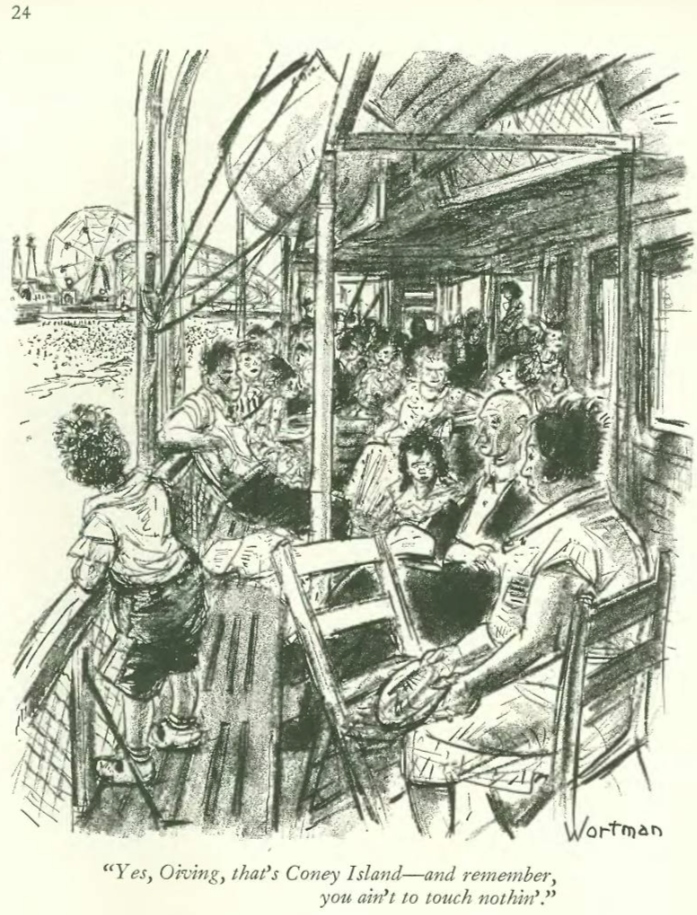
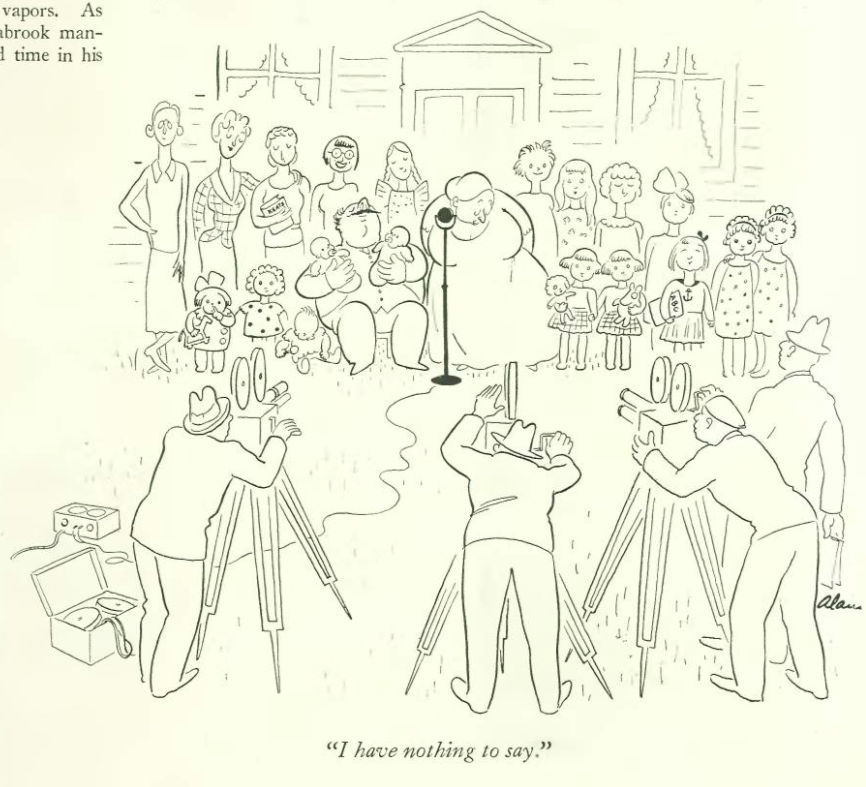
…and we close with Alain, and a mother of multiples…except words…
Next Time: Hays Hokum…

Through the Looking Glass

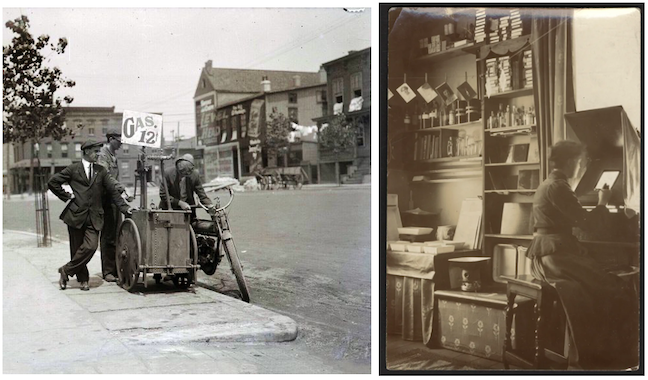
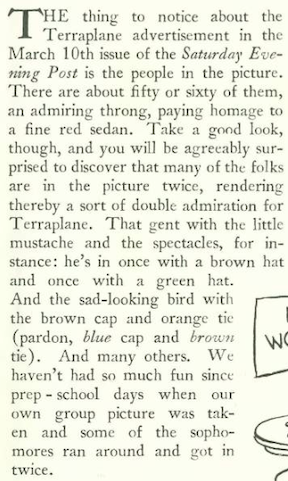
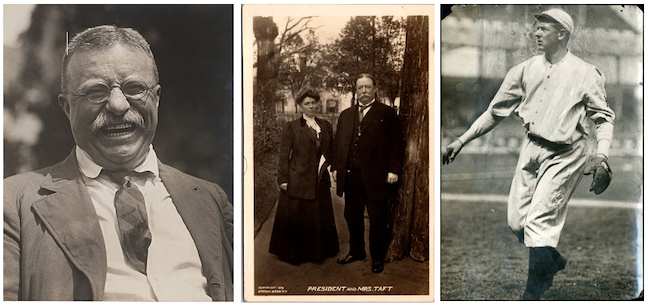
Above, from left: When Teddy Roosevelt announced in 1912 that he would run for president against his former VP, William Howard Taft, Brown Brothers sent photographer Charles Duprez to Oyster Bay to take this famous photo; President Taft and his wife, Helen “Nellie” Taft, in 1909; famed New York Giants pitcher Christy Mathewson warms up before a game, circa 1912. (liveauctioneers.com/cabinetcardgallery.com/psacard.com)

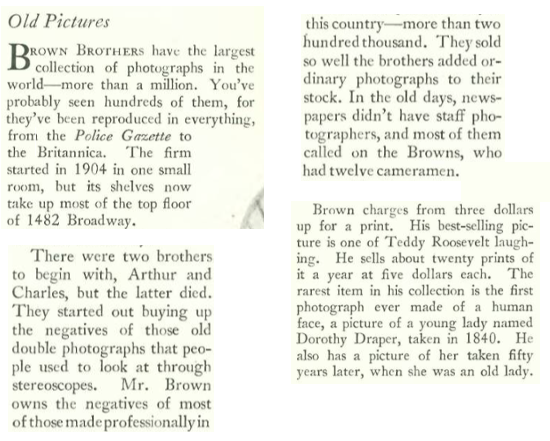
Before there were photo agencies like Magnum or archives such as Getty Images there was a company named Brown Brothers, the world’s first stock photo agency founded by Arthur and Charles Brown in New York City in 1904.

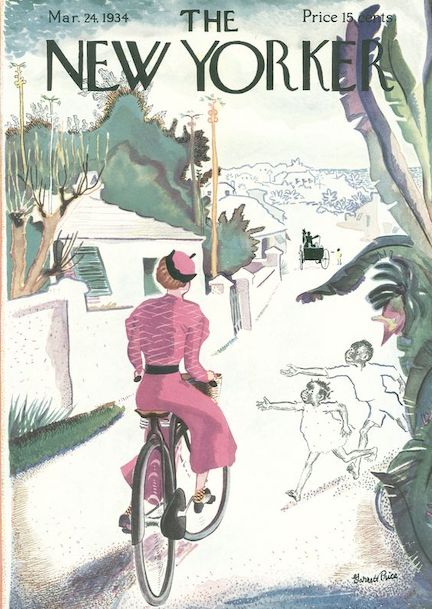
March 24, 1934 cover by Garrett Price.

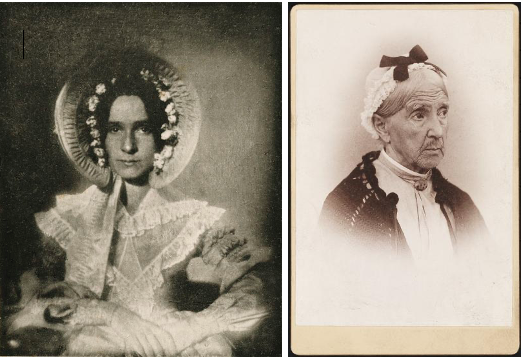
“The Talk of the Town” looked in on Brown Brothers, “the largest collection of photographs in the world—more than a million,” including a famous image of Teddy Roosevelt and the first photographic portrait of a woman’s face.

Brown Brothers photos could be seen everywhere in the early 20th century—their staff of twelve photographers provided images to New York newspapers at a time when the technology for publishing photos in the dailies was in its infancy and most papers didn’t employ staff photographers. Even the venerable New York Times hired the Browns to cover news events until they established their own team of photographers.

LITTLE DID DOROTHY DRAPER KNOW that she would become world famous when she sat for this photo (left) taken by her brother Dr. John W. Draper in his Washington Square studio at NYU in 1839 or 1840. Dorothy had to sit unblinking for the 65-second exposure—apparently her brother dusted her face with white flour to enhance the contrast. The Drapers still go down in history as creators of the oldest photo of a woman; at right, Dorothy Draper in the 1890s, in a photograph taken by her nephew. (boweryboyshistory.com/MCNY)
ONE IN A MILLION…The early 20th century image at left is just one of as many as three million images amassed in the Brown Brothers archive; at right, a Brown Brothers archivist at work. (Pinterest/sportscollectorsdigest.com)

Note: The Brown Brothers’ archive of photos and negatives went up for sale in 2014, and was ultimately acquired by Leland’s in 2020.

 * * *

De Terraplane!

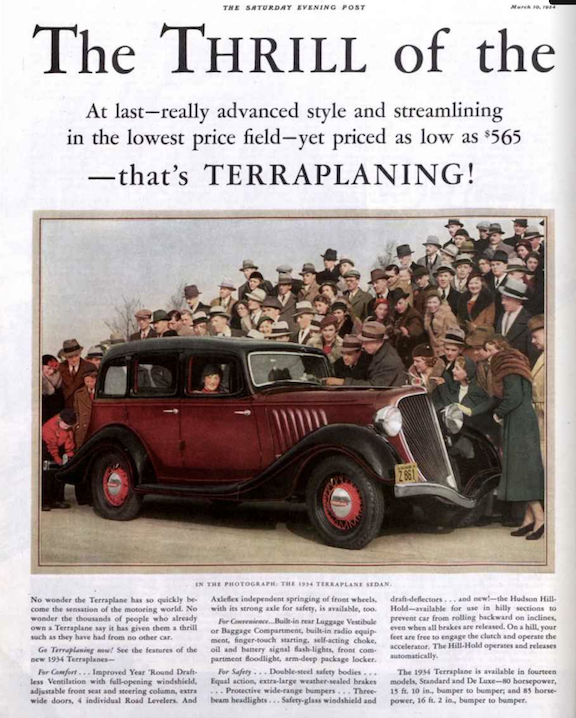
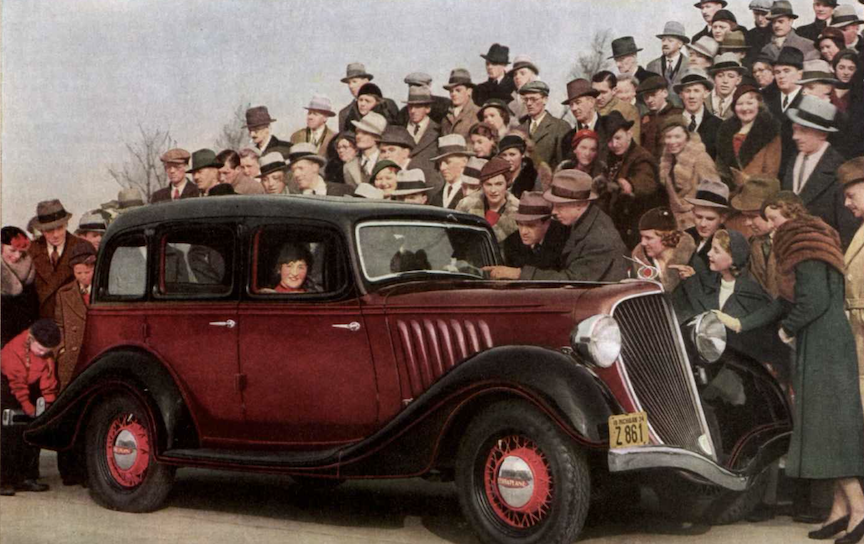
E.B. White (in “Notes and Comment”) was also looking at a photo, or rather scrutinizing one that was featured in a Saturday Evening Post advertisement for Hudson’s Terraplane:

…here is the ad from the Post

…and a closer look at the image, which had White seeing double.

(Both images courtesy The Saturday Evening Post)

 * * *

Escape Artist

In his “Of All Things” column, Howard Brubaker included the following item about a new telescope, ostensibly to set up a quip about John Dillinger’s recent prison break (his second):

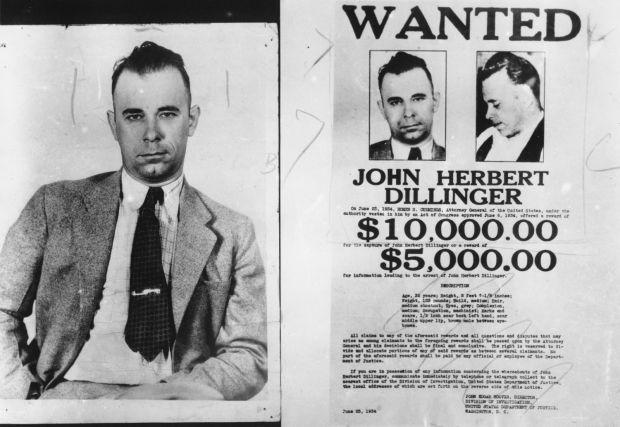
YOUR DAYS ARE NUMBERED…The FBI issued this “Wanted” poster of gangster John Dillinger— “Public Enemy No. 1″—in June 1934. The Feds gunned him down a month later. (AP Photo)

 * * *

Playing Nice

The New Yorker commented on the trend toward fewer fights in the world of hockey, and although fighting in general ebbed a bit through mid-century, it nevertheless remained a staple of the game. Indeed the New York Rangers founder, Tex Rickard, who also promoted boxing at Madison Square Garden, knew quite well that hockey fights were one reason folks attended the games.

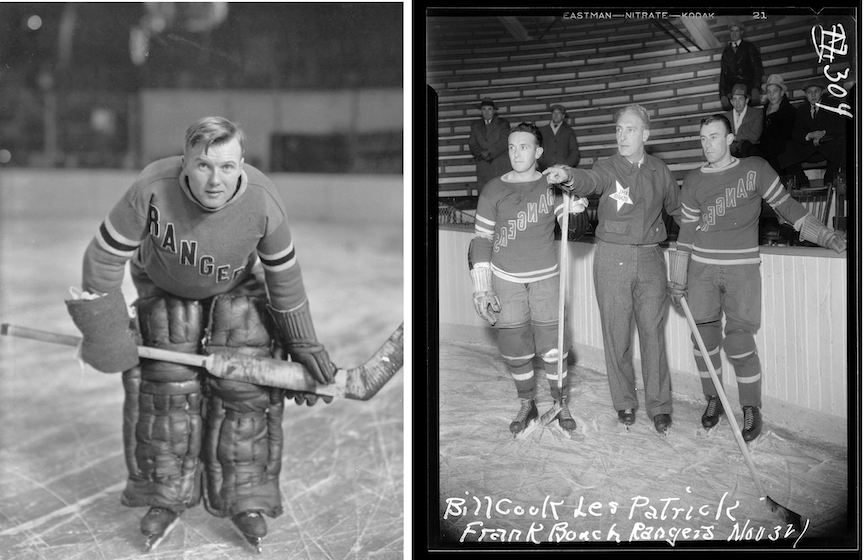
FACE OFF?…At left, goaltender Andy Aitkenhead of the New York Rangers padded his legs and arms but put his clean-shaven mug on the line in December 1934— it wasn’t until 1959, 42 years into the NHL’s existence, that a league goalie wore a mask on the ice. At right, New York Rangers captain Bill Cook (right) flanks coach and manager Lester Patrick alongside Frank Boucher on the ice at the Chicago Stadium in November of 1934. (Pinterest)

 * * *

From Our Advertisers

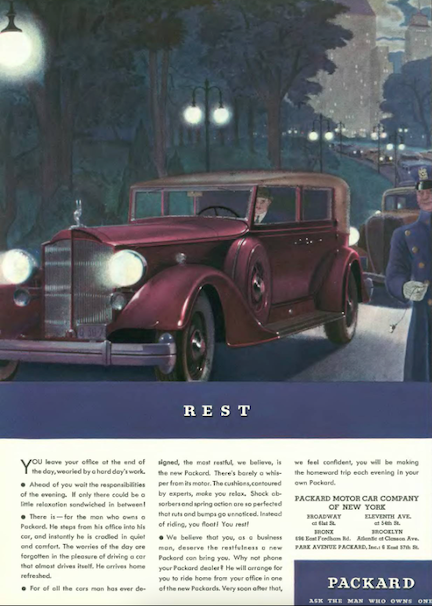
We begin with this sumptuous ad from Packard, appealing to those who could afford to own this luxury brand…

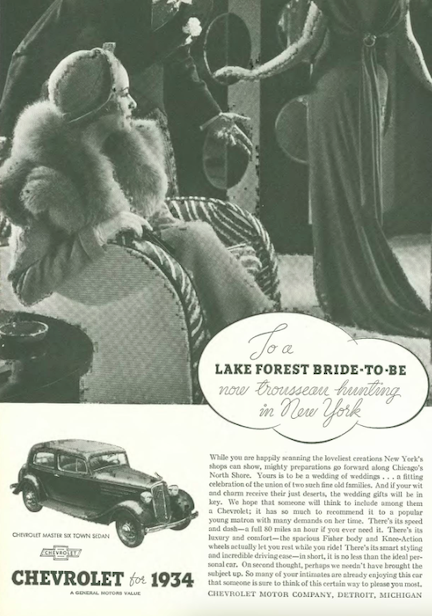
…if you couldn’t afford a Packard, you could rest assured that even a well-heeled deb could be happy with a Chevy…

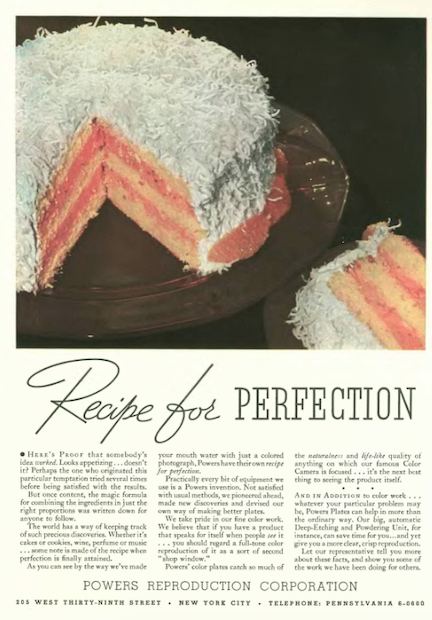
…the folks at Powers Reproduction continued to tout the wonders of their color photography, even if their cake looked less than appetizing…

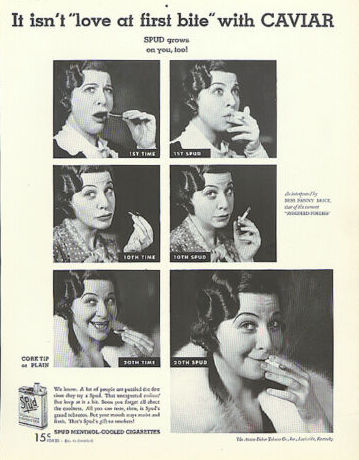
Fanny Brice was appearing with the 1934 Ziegfeld Follies on Broadway, so the folks at Spud jumped on her celebrity bandwagon…

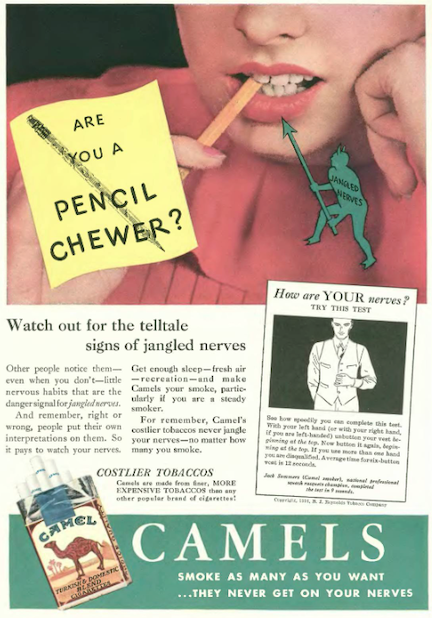
…while R.J. Reynolds was suggesting we replace our chewed up pencils with a nice Camel cigarette…now, don’t you feel better?…

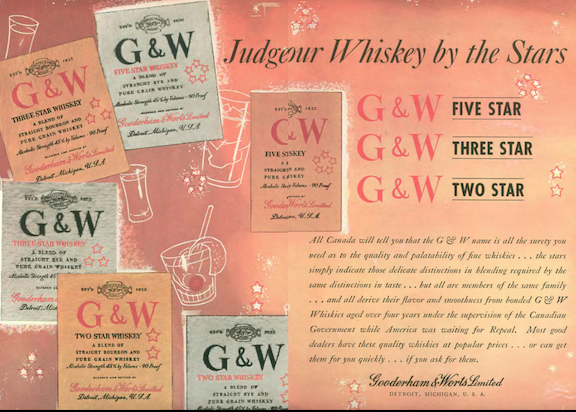
…the Canadian distillery giant Gooderham & Worts offered all sorts of options to calm our jangled nerves in this two-page spread…

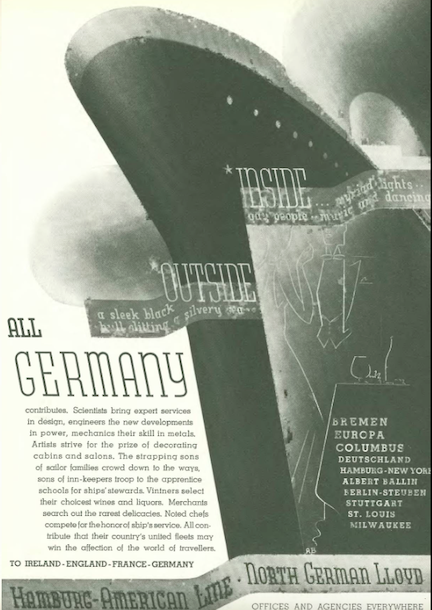
…while the Germans continued to entice us onto their cruise ships perfected by science and featuring “the strapping sons of sailor families”…hmmm…
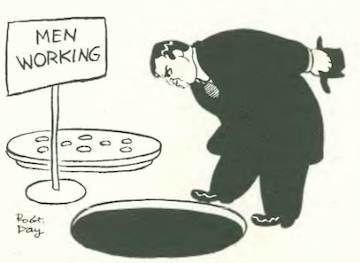
…in 1934 the New Yorker began featuring mostly wordless cartoons on the opening page of “The Talk of the Town,” including this one by Robert Day featuring Mayor Fiorello LaGuardia checking up on city employees…
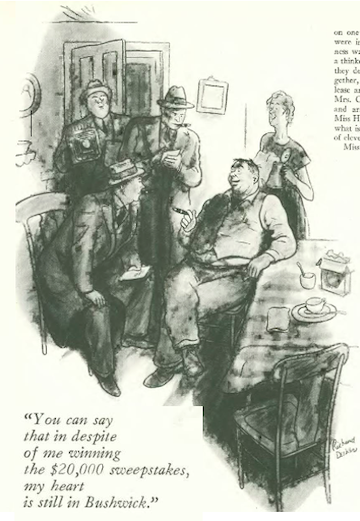
Richard Decker gave us an Irish Sweepstakes winner from Brooklyn who displayed some modesty and media savvy…

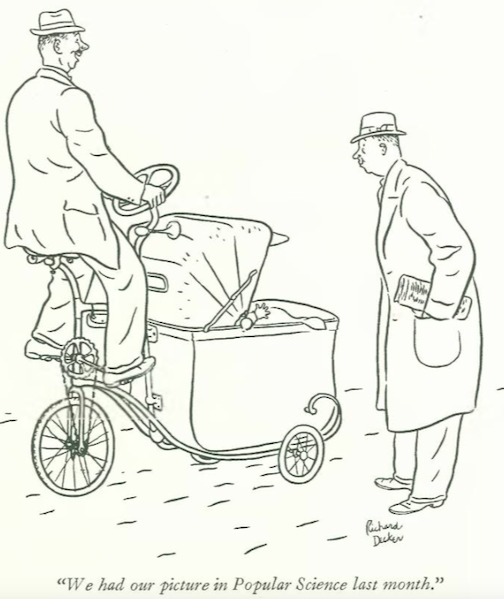
…Decker again, with the latest in perambulators…

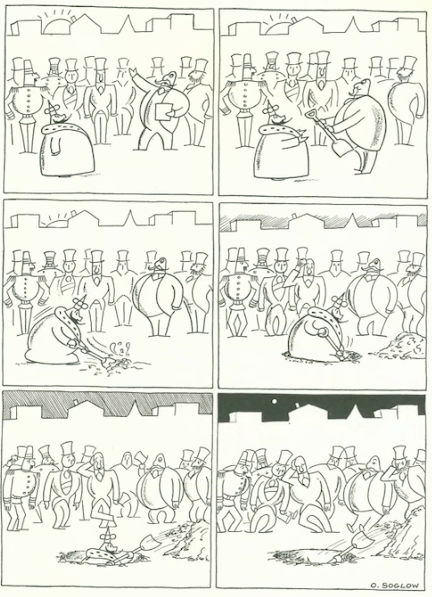
Otto Soglow’s Little King put his back into a ceremonial groundbreaking…

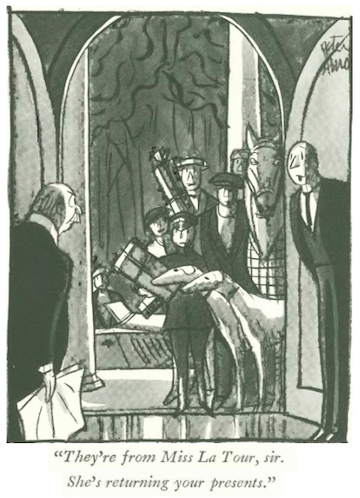
Peter Arno’s sugar daddy received some not-so-happy returns…

…one of William Steig’s “Small Fry” was doing some serious reading…

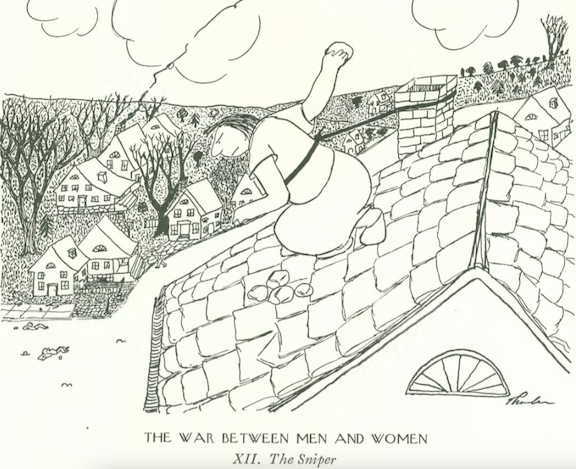
…and James Thurber’s war continued from the rooftops…

…on to March 31, 1934…

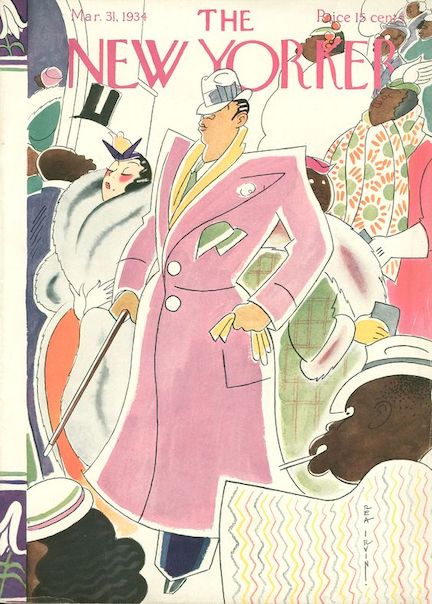
March 31, 1934 cover by Rea Irvin.

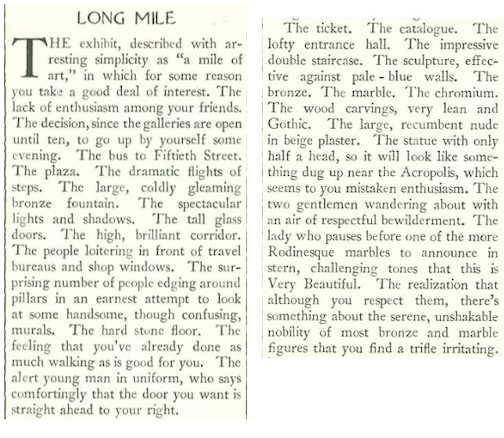
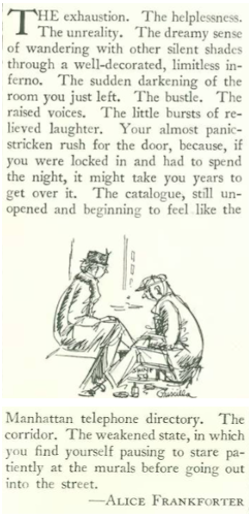
…where we find Alice Frankforter covering an exhibition dubbed “A Mile of Art.” I’m guessing critic Lewis Mumford passed on this opportunity to offer some blistering commentary. As for Frankforter, she found the spectacle puzzling, if not irritating. An excerpt:

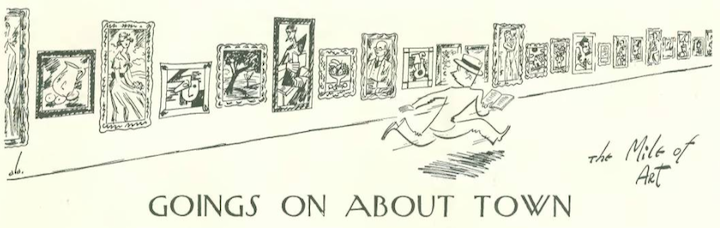
Constantin Alajalov offered his perspective on the art world stunt with this bit of spot art…

…and more from Frankforter, now reaching a state of exhaustion and near-delirium as she approached the end of the exhibit:

 * * *

Biblical Babbitts

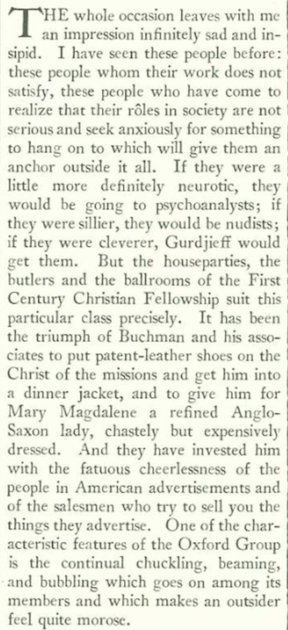
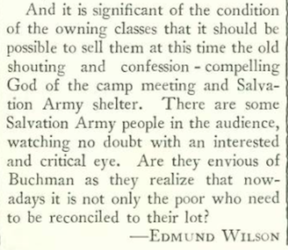
Frank Buchman’s First Century Christian Fellowship (aka the Oxford Group) meeting in New York featured a lot of people chuckling and bubbling, but all that forced conviviality left critic Edmund Wilson feeling “quite morose.” Writing for the “A Reporter at Large” column, Wilson looked in on the group as they awaited Buchman’s arrival at a preliminary rally. The column was subtitled, “Saving the Better Classes and Their Butlers.” An excerpt:

Like other critics at the time, Wilson saw “Buchmanism” as bourgeois optimism and boosterism, interested more in converting the souls of the wealthy and celebrated rather than serving the needs of poor.

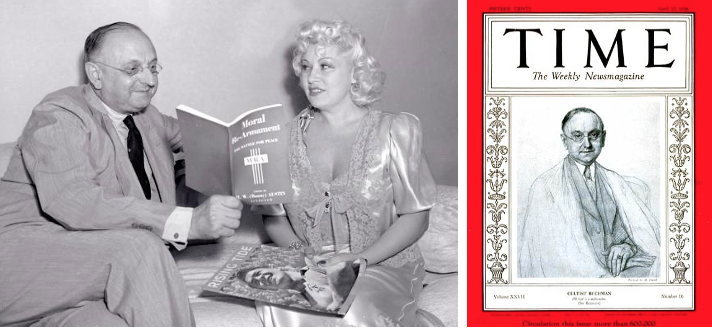
ODD COUPLE…Frank Buchman liked to be seen with the rich and famous. In 1939 he asked for a half hour of Mae West’s time, ostensibly to get this photo of him sharing some wisdom from his “Moral Re-assessment” booklet. West seems less than enamored by the encounter, regarding Buchman as some sort of alien creature; right, Buchman on the cover of April 20, 1936 edition of Time, which identified him as “Cultist Buchman.” (maewest.blogspot.com/Time)

 * * *

Carnegie’s Couture

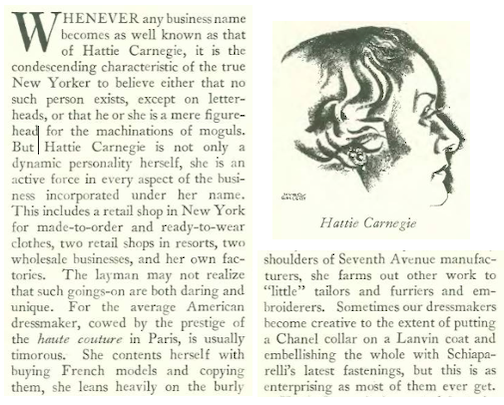
Vogue magazine fashion editor Nancy Hardin and the New Yorker’s fashion editor Lois Long teamed up on a profile about Hattie Carnegie (1889 -1956) titled “Luxury, Inc.” Born Henrietta Kanengeiser in Vienna, Carnegie immigrated with her family to New York in 1900; nine years later she adopted the name “Carnegie” after Andrew Carnegie, the richest person in America. Through hard work and an inherent instinct for what American women desired, she built a fashion design business that thrived in Depression and catered to stars and celebrities including Tallulah Bankhead, Joan Fontaine, Lucille Ball, and Joan Crawford. An excerpt, with illustration by Hugo Gellert:

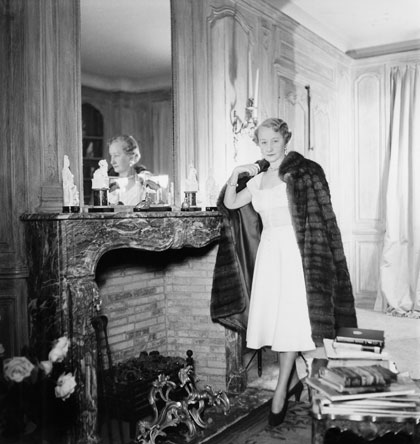
FUR SURE…Hattie Carnegie posing for a 1951 Vogue magazine photo. (Vogue)

 * * *

Steampunk Dream

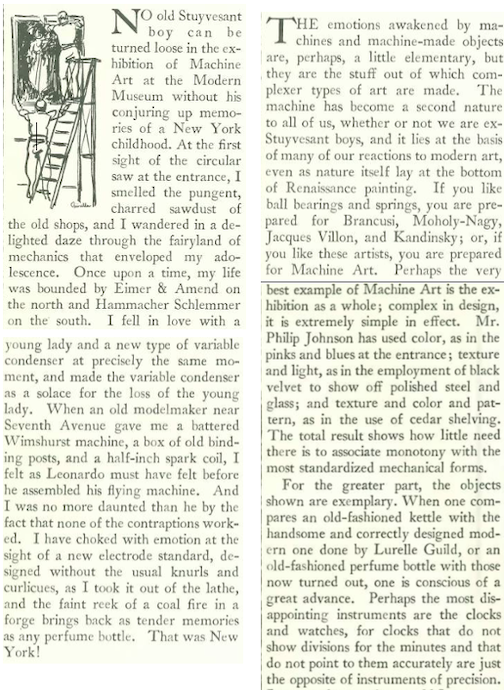
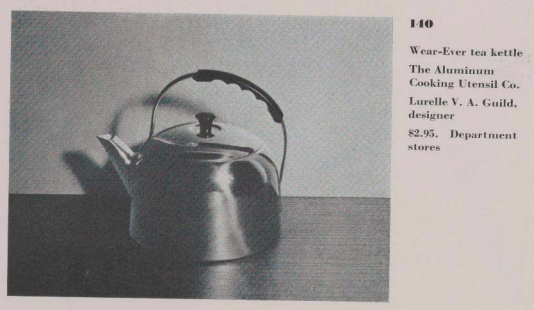
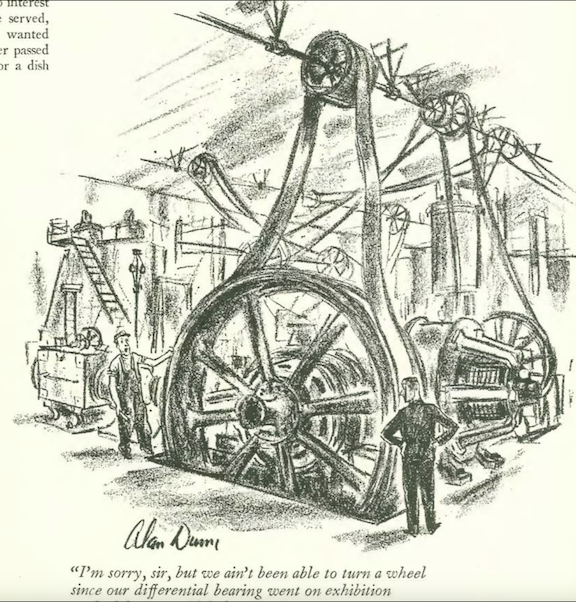
In my previous entry I featured Robert Coates’s observations on the new Machine Art exhibition at the Museum of Modern Art. For the March 31 issue critic Lewis Mumford, celebrant of the simple and unpretentious, waxed nostalgic over the novel exhibit:

I’M A LITTLE TEAPOT that made a big advance in the design world, according to critic Lewis Mumford. (MoMA)

Alan Dunn was also inspired by the exhibit, as evidenced in this cartoon from the April 7 issue…

 * * *

More From Our Advertisers

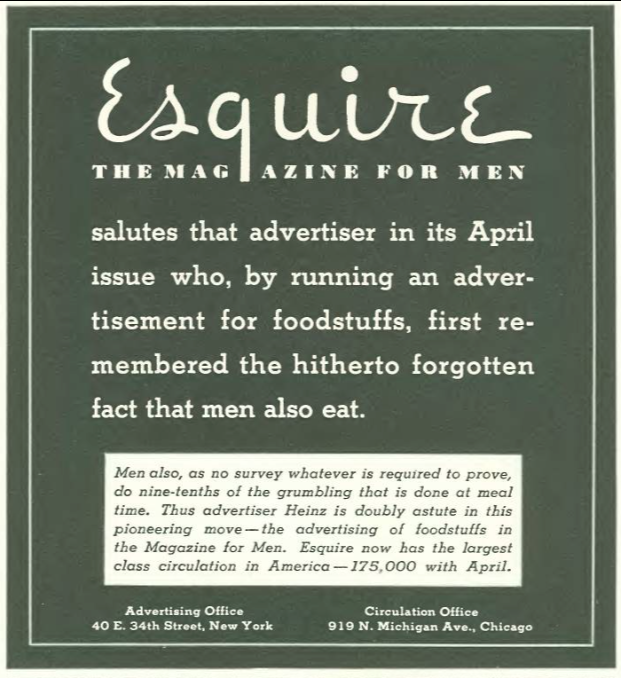
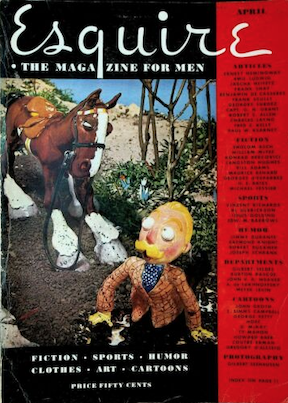
Founded in October 1933, the men’s magazine Esquire took off with a bang, and the publishers were not shy about boasting of its early success…

…cover of the April 1934 issue, featuring the mustachioed mascot Esky…based on a drawing by cartoonist E. Simms Campbell, Esky was featured on the cover in various situations until 1961…

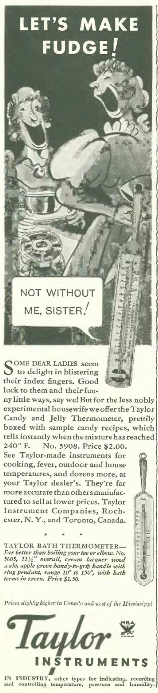
Peter Arno’s “Whoops Sisters” appeared sixty-three times in the New Yorker between 1926 and 1927 before Arno retired them (they occasionally popped up in other publications, and in a 1931 Cunard ad)…it seems odd that they would make an appearance in a cheap thermometer ad in 1934…at any rate, it is difficult to tell if this is by Arno or by a clever forger…

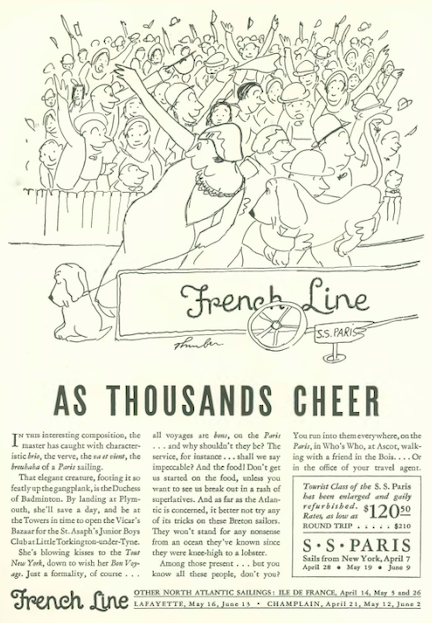
…there’s no mistaking the cartoonist behind this ad…

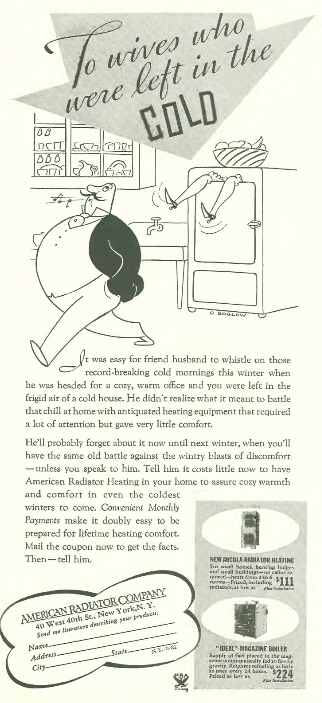
…and this one by Otto Soglow

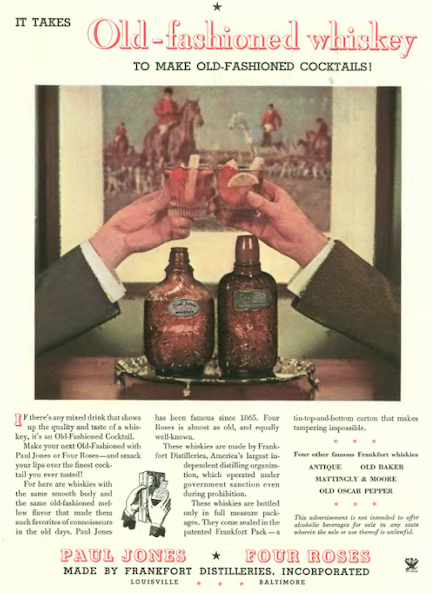
…and we close our advertising section by raising a glass to Frankfort Distilleries…

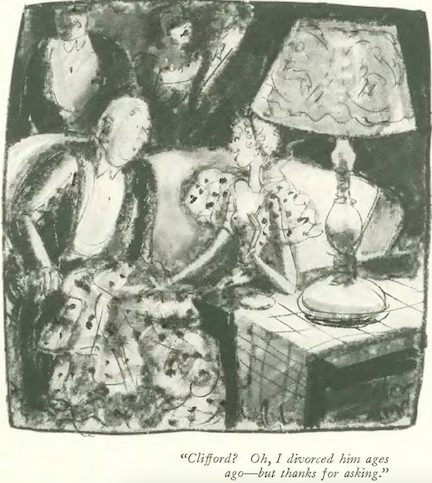
…on to our March 31 cartoons, and a lineup of New Yorker regulars Abe Birnbaum

Barbara Shermund

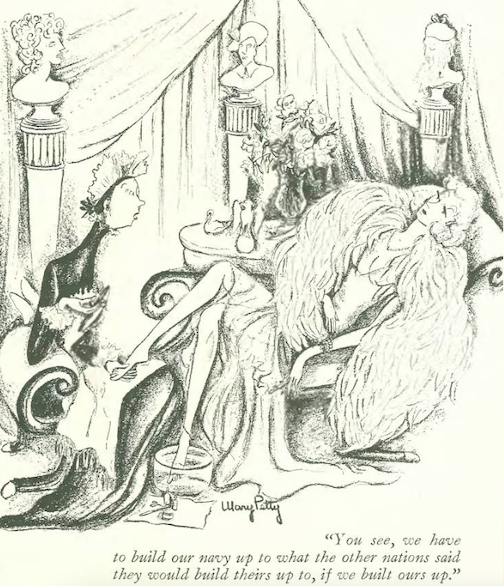
Mary Petty

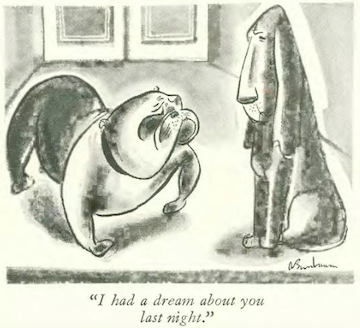
…and James Thurber, with a break in the battle…

Next Time: America’s Sweetheart…

College Days

For its Sept. 23, 1933 issue The New Yorker continued its serialization of James Thurber’s autobiography, My Life and Hard Times

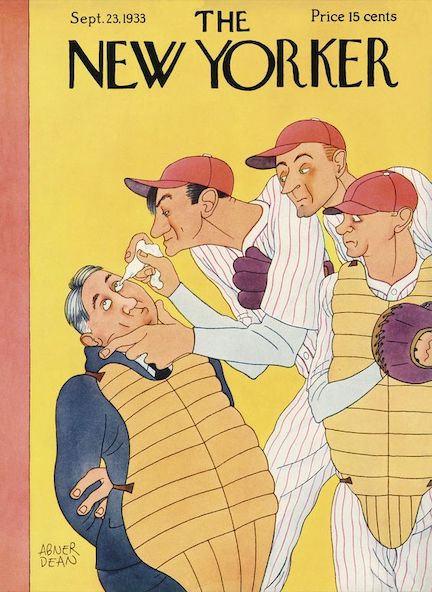
Sept. 23, 1933 cover by Abner Dean.

Part Seven, titled “College Days,” included Thurber’s reminiscences of an economics class and the challenges one “Professor Bassum” faced in keeping a star football tackle academically eligible:

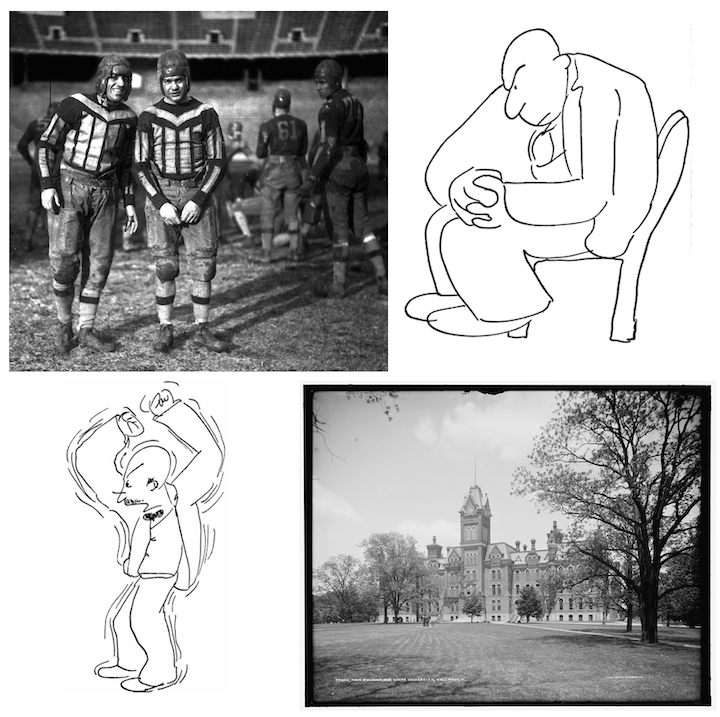
DEAR OLD ALMA MATER…James Thurber attended The Ohio State University from 1913 to 1918. Clockwise, from top left, the football team during Thurber’s time featured some smart players as well, including All-American quarterback/halfback Gaylor “Pete” Stinchcomb (left) and All-American halfback Chic Harley (right); Thurber’s drawing of the dim-witted tackle Bolenciecwez from My Life and Hard Times; OSU University Hall circa 1910; Thurber drawing of an OSU botany professor who “quivered with frustration” over Thurber’s inability to see through a microscope. (Ohio State/Wikipedia)

 * * *

From Our Advertisers

We begin with the makers of White Rock, who touted the international appeal of their home-grown product, here enjoyed by an old warrior and his much-younger mistress who were busy keeping the colonies in line in Southeast Asia…

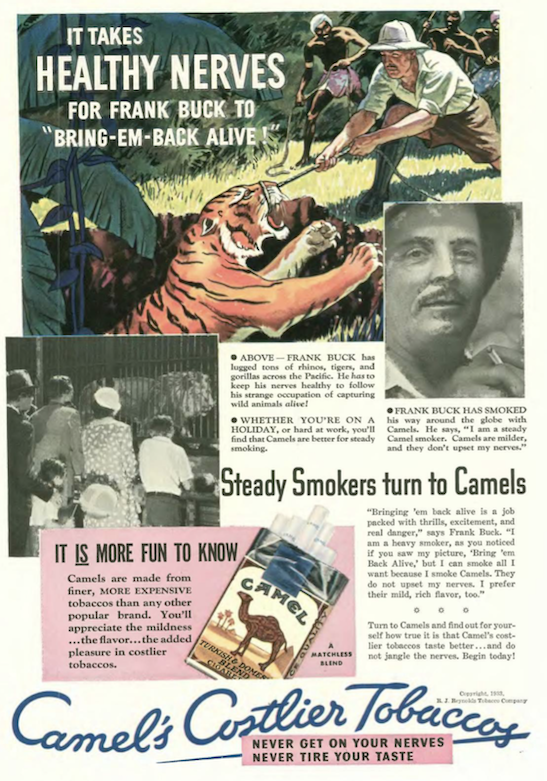
…speaking of colonial exploitation, here’s Frank Buck keeping his nerves steady smoking Camels as he lugs “tons of rhinos, tigers, and gorillas across the Pacific” to live out their lives in cramped, fetid cages…

…hey there New York sophisticates of 1933!…we have just the place for you, where only the BEST PEOPLE are apartment hunting, far from the din of immigrants, the unemployed, and other undesirables…

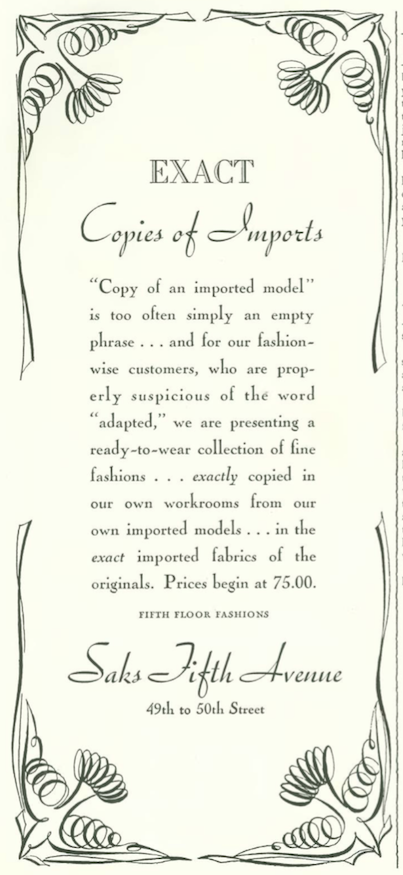
…if you wanted to hang out with the best people, you could get yourself exact copies of the latest Paris fashions from Saks Fifth Avenue…

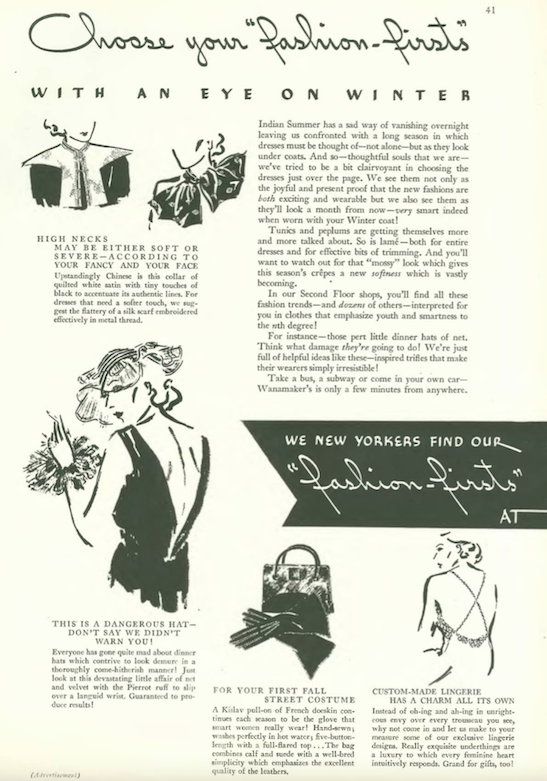
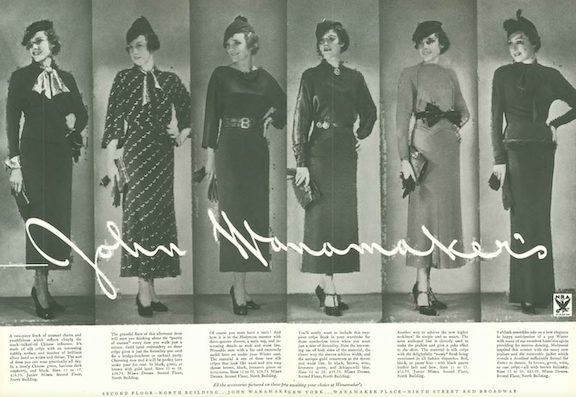
…or if you were on a tighter budget, you could check out the wares at Wanamaker’s, who trumpeted their “fashion-firsts” on this ad on page 41 followed by a double-spread on the following pages…

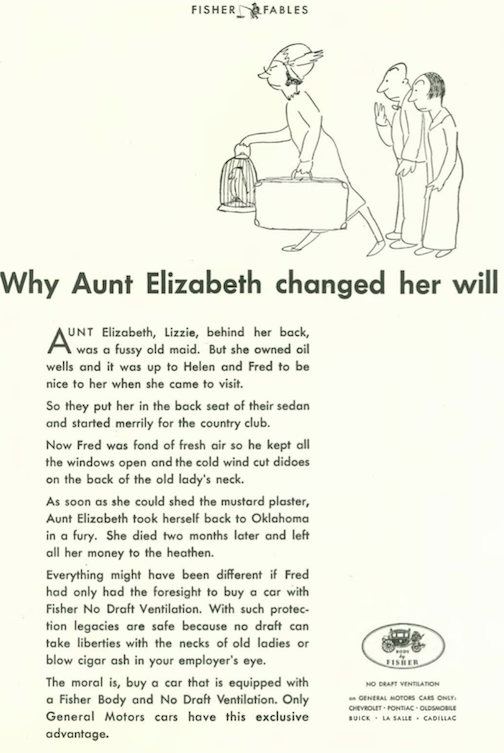
James Thurber lent his talents to the makers of Fisher car bodies…in the early days of automobile production Fisher made car bodies for a number of GM cars as well as for Packard, Studebaker, Hudson and other manufacturers…in 1926 it was absorbed by GM as an in-house coach-building division…

…on to our cartoons, we take a boat ride with Robert Day

…discover the perils of historical research with Barbara Shermund

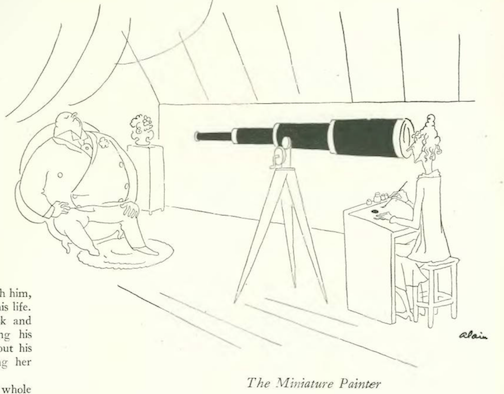
Daniel ‘Alain’ Brustlein offered a new perspective on portrait painting…

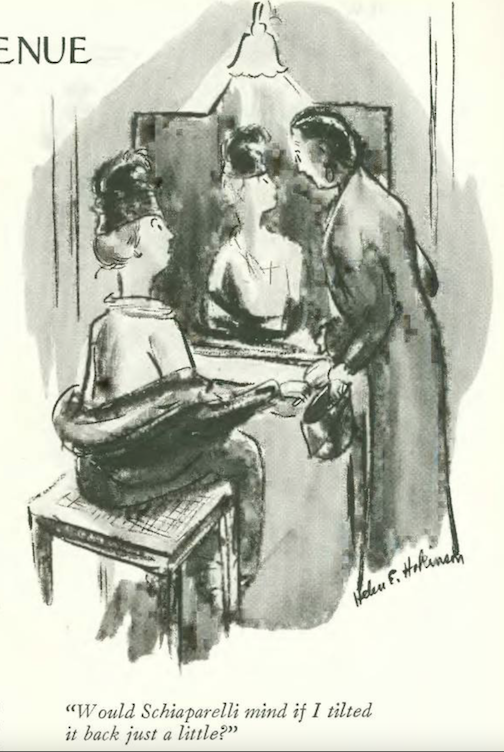
Helen Hokinson found a Red among the blue bloods…

…and a wee conundrum in the hat department…

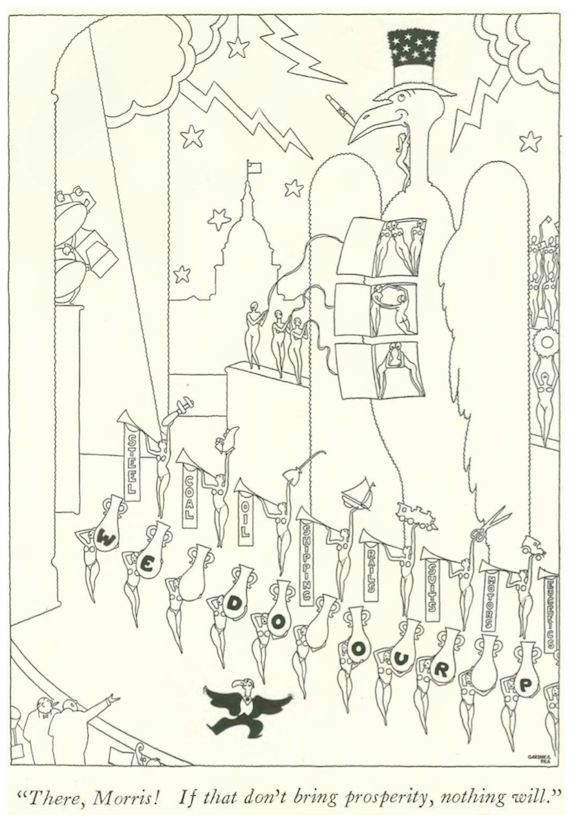
Gardner Rea pulled out all stops in this patriotic tableau…

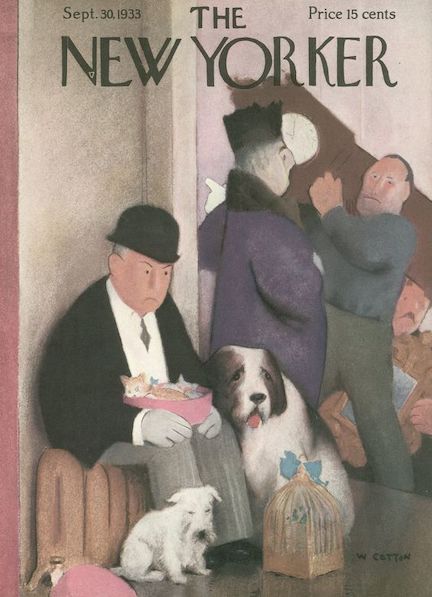
…on to the Sept. 30, 1933 issue…

Sept. 30, 1933 cover by William Cotton.

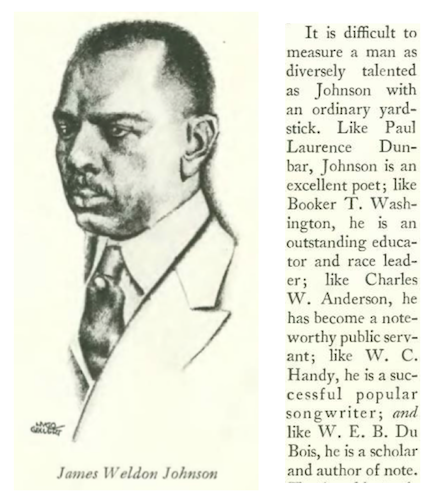
…in which journalist Robert Wohlforth contributed a profile on poet and writer James Weldon Johnson (1871–1938), a key figure of the Harlem Renaissance most widely known today for the lyrics of the Negro National Anthem, “Lift Every Voice and Sing.” A brief excerpt with illustration by Hugo Gellert:

LIFT EVERY VOICE...James Weldon Johnson, photographed by Carl Van Vechten, 1932. (Library of Congress)

 * * *

Mexican Morass

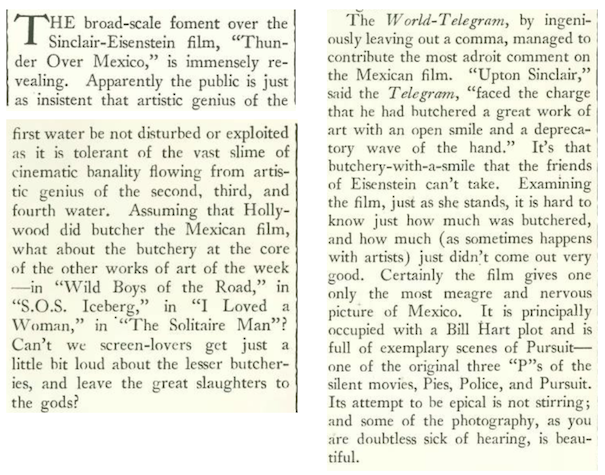
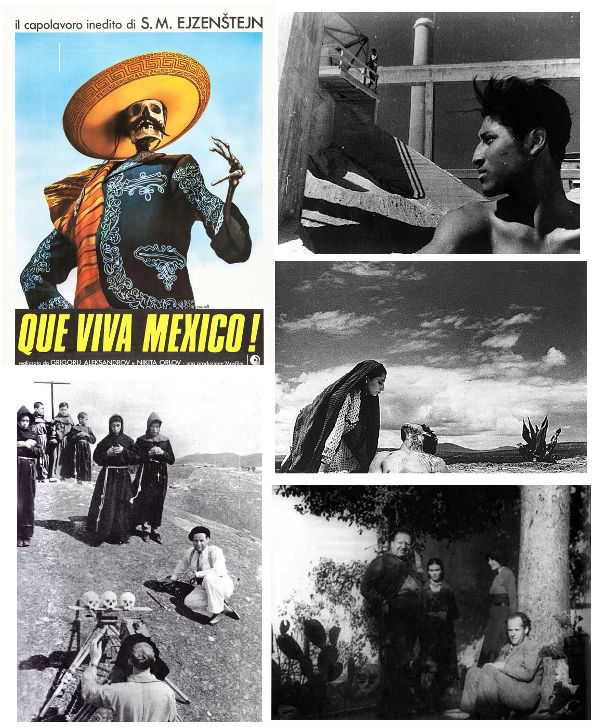
E.B. White took on the movie review duties and landed himself a doozy—Sergei Eisenstein’s Thunder Over Mexico. The famed Soviet filmmaker had come to the U.S. in 1930 to make a film for Paramount, but when the deal fell through American socialist author Upton Sinclair and others invited Eisenstein to make an artistic travelogue exploring the themes of life and death in Mexico. More than thirty hours of film was shot before the project was abandoned and Eisenstein returned to the USSR. The footage was later cut into three films, including Thunder Over Mexico. White was less than pleased with the film’s “butchered” edits.

LIFE AND DEATH IN MEXICO…Avant-garde Soviet filmmaker Sergei Eisenstein shot more than 30 hours of film in Mexico without producing a final product. An independent Hollywood producer, Sol Lesser, later produced two short features and a short subject culled from the footage—Thunder Over Mexico, Eisenstein in Mexico, and Death Day; these were released in 1933-34. Clockwise, from top left, poster for the film, the film featured scenes of cinematic beauty as well as brutal violence; Eisenstein visiting Mexican artists Diego Rivera and Frida Kahlo; Eisenstein directing a scene from the film. (IMDB/www.otago.ac.nz)

 * * *

Dreaming in Color

In this “Talk of the Town” entry, attributed to James Thurber, we learn of various wonders at the National Electrical Exposition at Madison Square Garden, including a “Clavilux Color Organ” designed for home use. Excerpts:

EINE KLEINE LICHT MUSIK…Danish musician Thomas Wilfred (top) constructed his first Clavilux in 1919. Sitting at a large console, Wilfred could control infinite color projections. His first public performance was in New York in 1922 (top right), featuring an abstract light show audiences compared to an aurora borealis. Bottom right, the Clavilux Junior was developed for home use, operated with special glass records, each hand-painted with a distinct composition that would create the projected image. (cdm.link/Yale University Art Gallery)

This YouTube video offers some idea of the effect:

 * * *

More From Our Advertisers

Warm, idealized images of American life, in the vein of Norman Rockwell, were popular among advertisers seeking to reassure Depression-era consumers…here we have the avuncular scientist working to ensure that your Packard is not only reliable as transportation, but also a place of solace…

…this same idea was conveyed by the makers of Goodyear tires…

…this ad on page 55 for Guerlain’s Shalimar Powder somewhat recalls the art deco style of Tamara de Lempicka

…but flip the page and you are brought back to reality with Shefford’s “Snappy Cheese”…

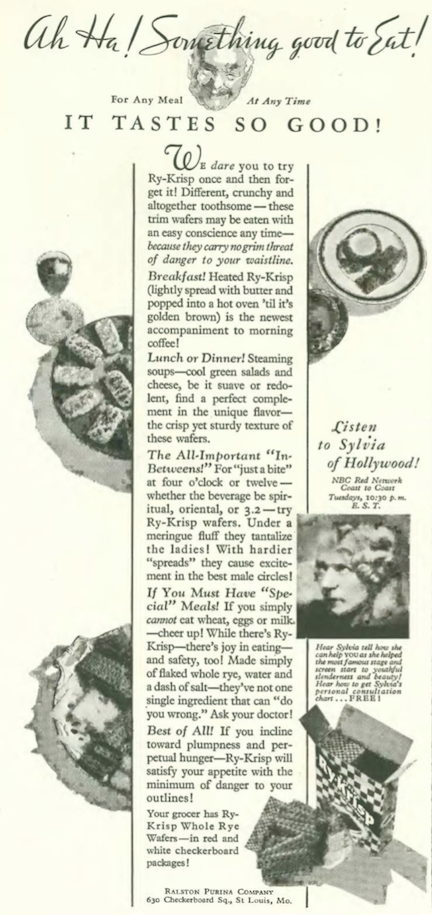
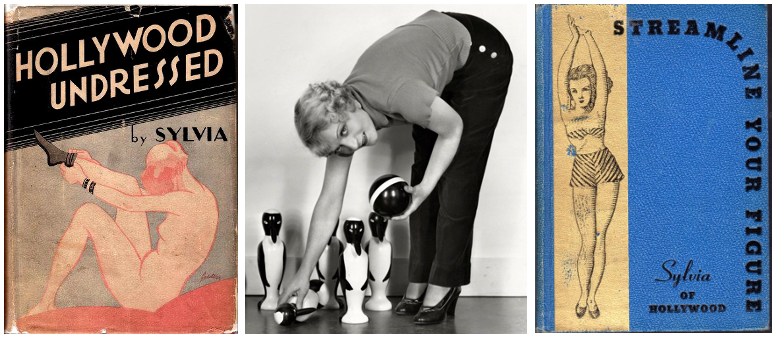
…you needed to lay off the cheese, however, if you wanted to take up a Ry-Krisp diet, endorsed here by Sylvia Ulback, better known at the time as “Sylvia of Hollywood” — in 1933 she was one of the most famous voices on radio…

STRETCH FOR SUCCESS…Norwegian-born Sylvia Ulback (1881–1975) was a Hollywood fitness guru from 1926 until 1932. Known as Sylvia of Hollywood, she abandoned the Tinseltown scene after publishing a “tell all” book about her clients titled Hollywood Undressed (1931). From 1933 to 1936 she appeared on the radio show, Mme. Sylvia, a 15-minute beauty and celebrity broadcast sponsored by Ry-Krisp, and she also published three health and fitness books, including 1939’s Streamline Your Figure. (youmustrememberthispodcast.com)

…on to our cartoons, Alan Dunn discovered a budding Picasso…

…another cryptic cartoon by James Thurber was featured in the “Talk of the Town” section…

Whitney Darrow Jr gave this dowager an off-stage surprise…

E. Simms Campbell put a snag in an old yarn…

…and we end with Peter Arno, and an old walrus feeling his oats…

Next Time: As Thousands Cheer…

The Shape of Things to Come

Above: Maurice Passworthy (Kenneth Villiers) and Catherine Cabel (Pearl Argyle) prepare for a trip to the moon in Things to Come. (IMDB)

In his 1933 science fiction novel The Shape of Things to Come, H.G. Wells foresaw how an international economic depression could eventually lead to world war.

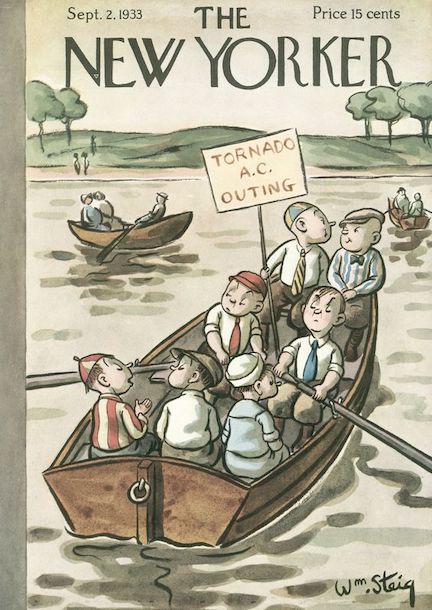
Sept. 2, 1933 cover by William Steig.

The book also predicted that such a war would feature whole cities destroyed by aerial bombing and the eventual development of weapons of mass destruction. However, New Yorker book critic Clifton Fadiman found Wells’ other predictions to be fanciful, “scientific-romantic” notions, such as a post-war Utopia (headquartered in Basra, Iraq, of all places) ruled by super-talents that would advance scientific learning in a world without nation-states or religion. And naturally everyone would speak English.

YOU MAY SAY I’M A DREAMER…H.G. Wells envisioned a world of war, pestilence and economic collapse that would eventually give way to an English-speaking Utopia free of nation-states and religion. (Wikipedia)

Three years later Wells would adapt his book to the screen in 1936’s Things to Come, produced by Alexander Korda and starring Raymond Massey as a heroic RAF pilot John Cabal and Ralph Richardson as “The Boss,” a man who stands in the way of Cabal’s utopian dreams.

FUTURE TENSE…Clockwise, from top left, H.G. Wells visits with actors Pearl Argyle and Raymond Massey on the set of Things to Come—Swiss designer René Hubert created the futuristic costumes; in the year 1970 RAF pilot John Cabal (Massey) lands his sleek monoplane in Everytown, England, proclaiming a new civilization run by a band of enlightened mechanics and engineers; city of the future as depicted in Things to Come; poster for the film’s release. (IMDB)

An afternote: A 1979 Canadian science fiction film titled The Shape of Things to Come was supposedly based on Wells’ novel but bore little resemblance to the book. The film is a considered a turkey, lovingly mocked by the same audiences that gave Plan 9 from Outer Space a second life.

WE MEAN YOU NO HARM…Actor Jack Palance—wearing what appears to be the top from a water cooler— headed a cast that included Barry Morse and Carol Lynley in 1979’s The Shape of Things to Come. 

 * * *

Fine Dining

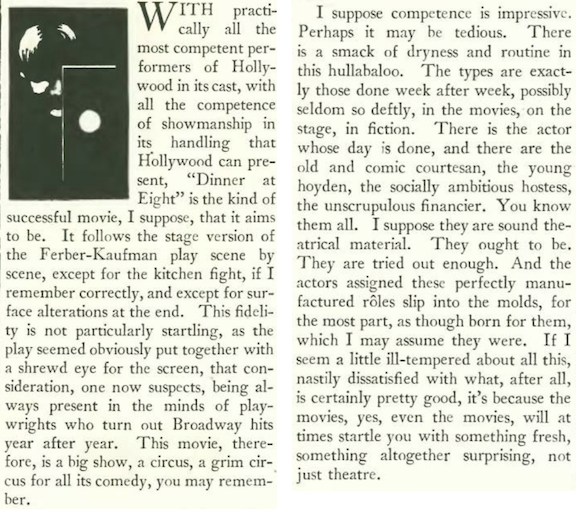
Director George Cukor turned a hit Ferber-Kaufman Broadway play into a hit movie by the same title when Dinner at Eight premiered in September 1933. While the film received high marks from leading critics, New Yorker film reviewer John Mosher found it a bit routine, if well-crafted:

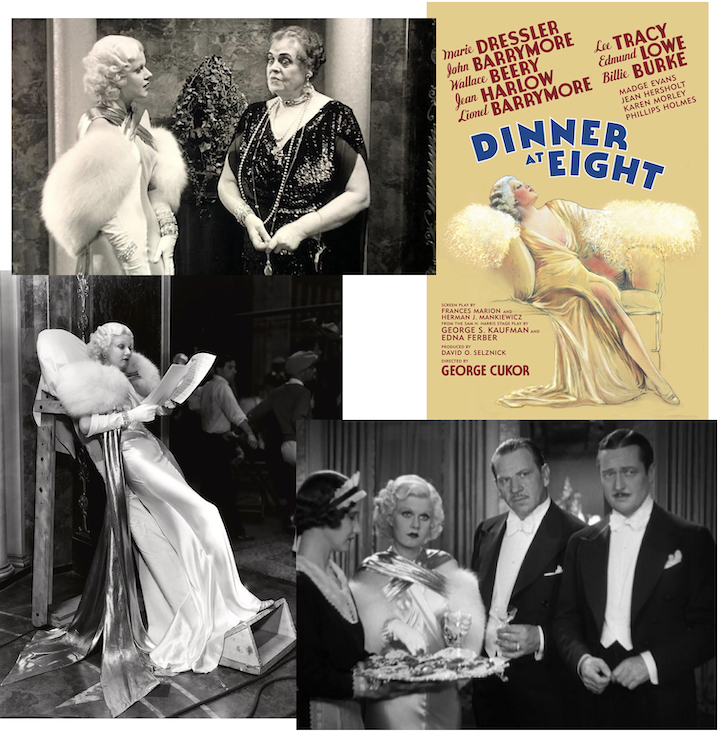
BLONDE ON BLONDE…Judith Wood (left) portrayed the character Kitty Packard in the 1932 stage production of Dinner at Eight; Jean Harlow took on the role for the 1933 film version. (IMDB)

Mosher, however, continued to admire the acting chops of veteran Marie Dressler

FUNNY LADIES…Clockwise, from top left: Jean Harlow and Marie Dressler square off in Dinner at Eight; movie poster highlights the “Blonde Bombshell” Harlow along with a star-studded cast; a scene with Harlow, Wallace Beery and Edmund Lowe; to avoid wrinkling her gown between takes, Harlow reviewed her lines in a special stand-up chair. (IMDB/pre-code.com)

 * * *

Madame Secretary

Secretary of Labor Frances Perkins was the first woman in the U.S. to serve as a cabinet secretary, but she was a lot more that—she was the driving force behind FDR’s New Deal. Here are excerpts from a two-part profile written by Russell Lord, with illustration by Hugo Gellert.

TRIAL BY FIRE…Frances Perkins watched in horror as young women leapt to their deaths in the 1911 Triangle Shirtwaist Factory fire—146 perished on that day Perkins recalled as the moment the New Deal was born her mind. In the wake of the fire Perkins, an established expert on worker health and safety, was named executive secretary of the NYC Committee on Safety. (trianglememorial.org/francesperkinscenter.org)

Even if some men couldn’t come around to a woman moving through the circles of power, Perkins had many admirers including prominent Tammany Hall leader “Big Tim” Sullivan.

Perkins’ appointment to FDR’s cabinet made the Aug. 14, 1933 cover of TIME magazine. (TIME/thoughtco.com)

 * * *

From Our Advertisers

Even the staid executives at Packard were getting into the modern advertising game, where sometimes the product itself was not even pictured…

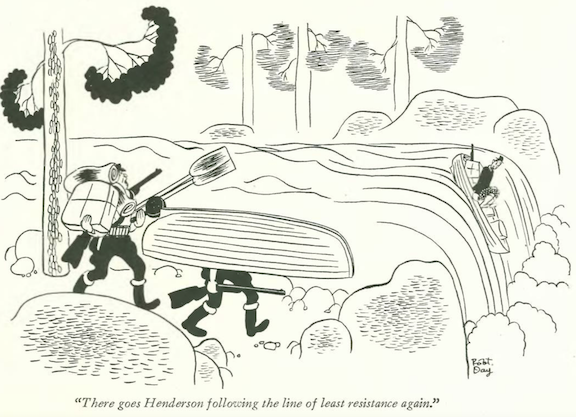
…our cartoonists include Robert Day

George Price

…and baring it all, Peter Arno

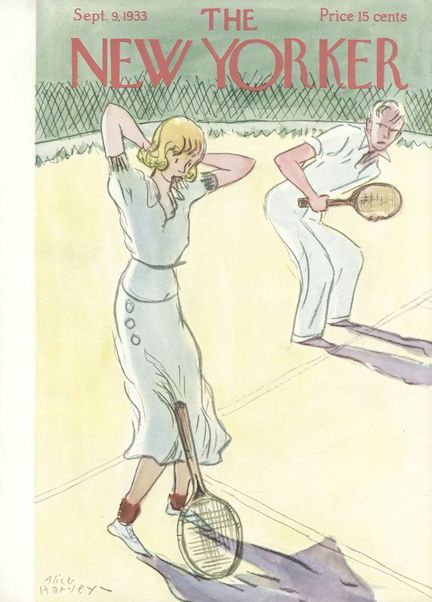
…on to Sept. 9, and what I believe is Alice Harvey’s first New Yorker cover…

Sept. 9, 1933 cover by Alice Harvey.

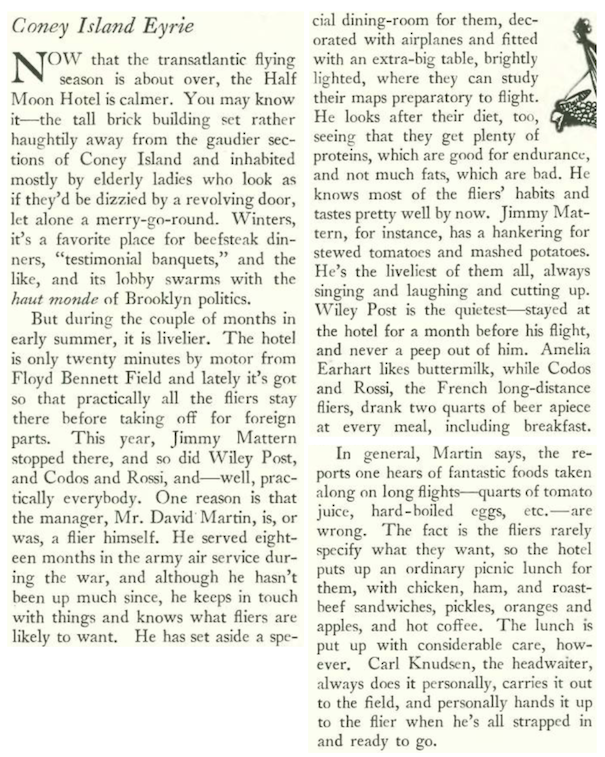
…and where “The Talk of the Town” paid a visit to the Half Moon Hotel on Coney Island, a favorite haunt of those magnificent men and women and their flying machines:

SHIFTING SANDS…Opened in 1927 to attract upscale crowds to Coney Island away from the rabble of the Midway, the elegant Half Moon Hotel started strong but teetered on the doorstep of bankruptcy during the Depression; it gained notoriety in 1941 when mob turncoat Abe Reles fell to his death from a sixth floor window while under police protection. The hotel was demolished in 1996. (Pinterest)

* * *

Huey In The News

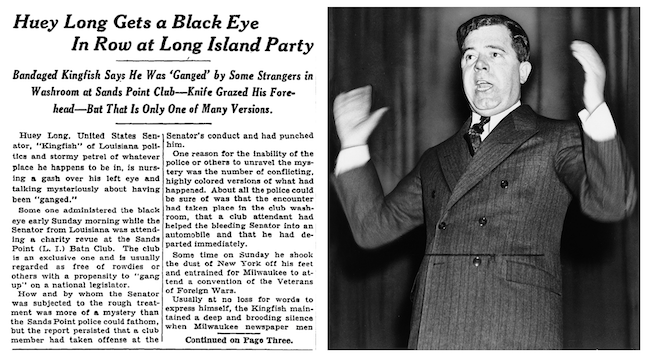
In his column “Of All Things,” Howard Brubaker offered this brief take on Huey Long’s visit to a Long Island party, where one guest apparently socked the controversial “Kingfish,” giving the former Louisiana governor (and then senator) a shiner.

A CHIP ON HIS SHOULDER?…Controversy followed Huey Long wherever he went. At left is a New York Times account of Long’s alleged black eye incident on Long Island. He would be assassinated two years later at the Louisiana State Capitol; Long circa 1933. (NYT/Wikipedia)

 * * *

More From Our Advertisers

As a follow-up from the previous issue’s Packard ad, this two-page spread showed us what those 1200 men were gawking at…check out that 12-cylinder model on the left, which appears to be better than 20 feet long…

…according to this ad, you could thank Camel cigarettes for getting the mail through the gloom of night…

…if you needed a cigarette to steady your nerves, you also needed fresh coffee to avoid being ostracized by your friends…

…summer-stock barn theatres were popular across America in the 1930s…this ad (illustrated by Wallace Morgan) hailed the end of the summer season and the return of “Winter Broadway”…

…on to our cartoons, out in the countryside we also find William Crawford Galbraith, here continuing to ply one of his favorite themes, namely pairing shapely seductresses and showgirls with clueless suitors…

Helen Hokinson gave us one woman who believed “what happens in the Riviera, stays in the Riviera”…

…and we close with Gardner Rea, and a scout troop on a mission…

Next Time: Rumors of War…

High Anxiety

The New Yorker profiled authors, composers, civic and world leaders and other notables in its early years, but every so often it would turn the spotlight on a member of the working class.

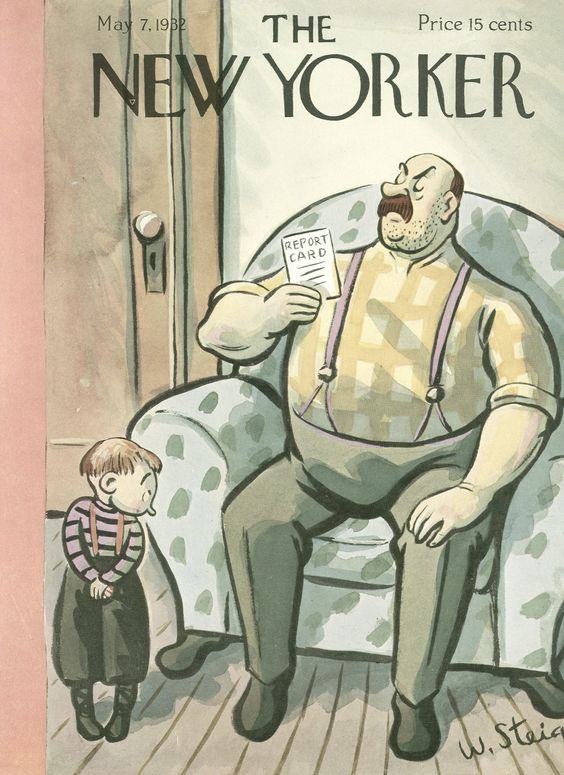
May 7, 1932 cover by William Steig, the first of 117 covers he would contribute to the magazine over his long life and career.

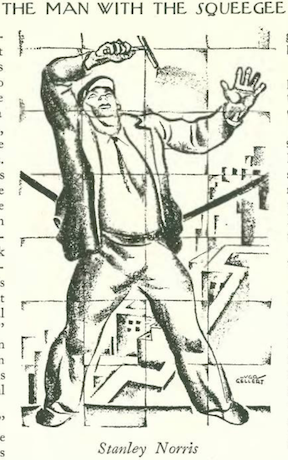
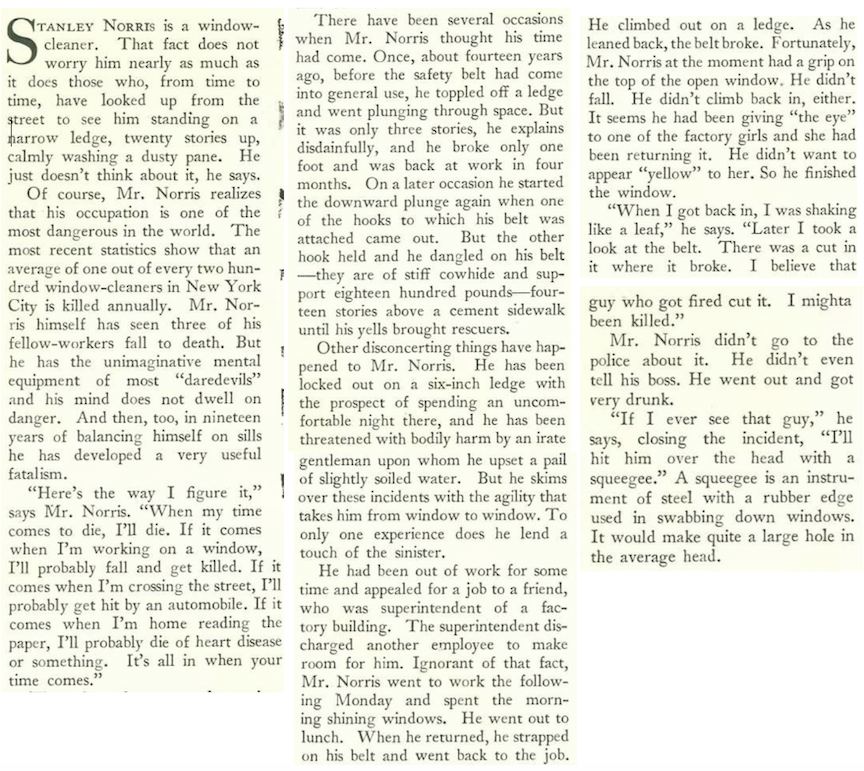
“The Man With The Squeegee,” a profile written by journalist (and later, playwright) Russel Crouse, detailed the life and work of Stanley Norris, a son of Polish immigrants who daily defied death as a window cleaner on Manhattan’s skyscrapers.

Profile illustration by Hugo Gellert

Below is an excerpt that includes a couple of Norris’ harrowing experiences high above the city streets:

LOOK MA, NO HANDS!…Clockwise, from top left…attached to the side of the Empire State Building, just two leather straps separated this brave window washer from oblivion in March 1936; a lone worker confronts his task in 1935; window washers in 1930; window washers on the 34th street side of the building, January 1932. There are 6,400 windows on the Empire State Building, and each worker averaged 76 panes per day. (retronaut.com/cnn/considerable.com/reddit)

During the 1930s one out of every 200 window cleaners in New York City fell to their deaths annually. In the previous decade, more than 80 fell to their deaths. In another excerpt, Norris recalled one of those unfortunate deaths.

 *  *  *

Vintage Whines

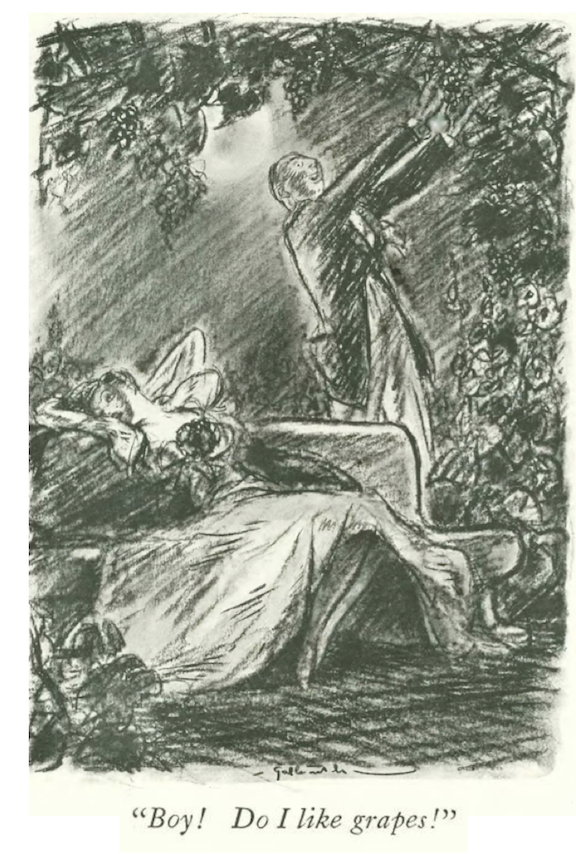
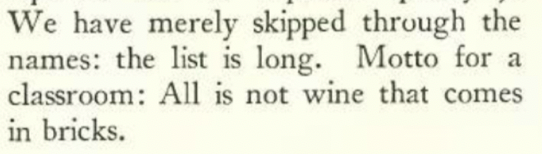
E.B. White enjoyed both wine and spirits, but like many of his fellow Americans he was growing sick and tired of Prohibition, and in his “Notes and Comment” looked abroad for a better way to live.

White concluded the entry with this observation…

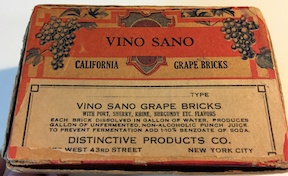
…which referenced the sad grape “bricks” folks could order by mail…

Grape growers sold these bricks with a warning that they were not to be used for fermentation — a warning that kept them within the law. Naturally both seller and consumer understood that the end product would likely be something stronger than grape juice.

(vinepair.com)

Where White did procure his cocktails is revealed later in “Notes” — he tells us of an encounter with a night-club host while out walking with his wife, Katharine White, and toddler Joel.

SOMETIMES E.B. JOINED THEM…Katharine White taking baby Joel for a stroll with the White’s beloved Scotty Daisy in New York City, 1931. (brainpickings.org)

 *  *  *

News Stooges

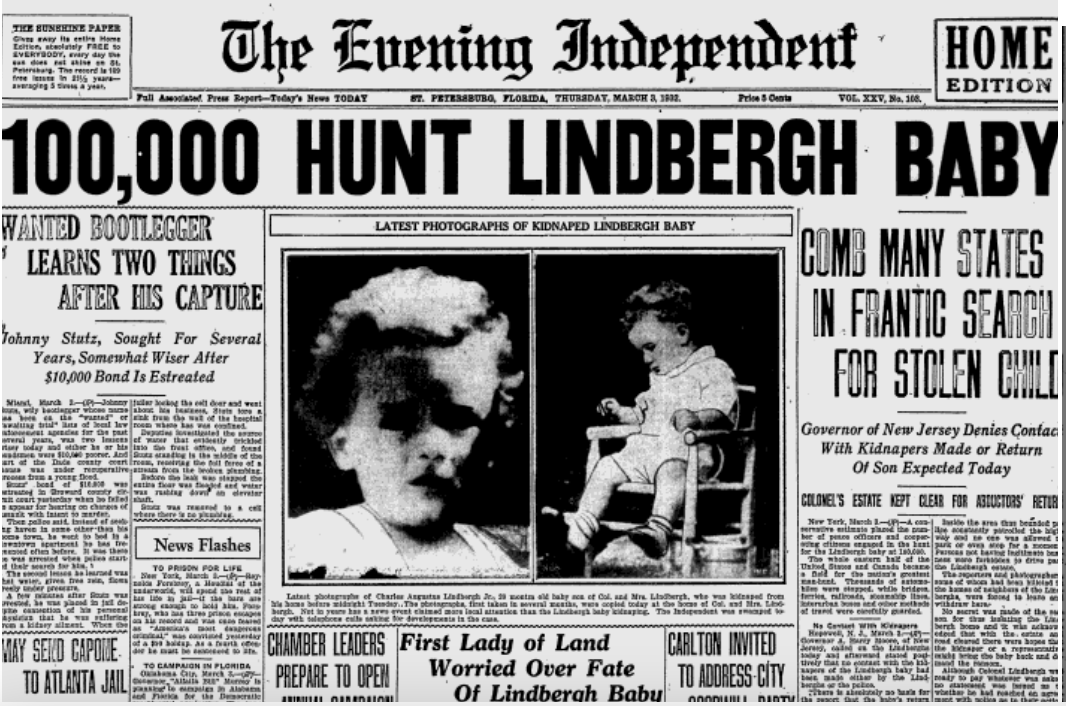
In “The Wayward Press” column, Robert Benchley (writing under the pseudonym Guy Fawkes) took the newspapers to task for their tasteless reporting on the Lindbergh baby kidnapping, and their general sullying of a once proud profession (Benchley himself was an experienced journalist):

TRAGEDY SELLS…The kidnapping of Charles and Ann Lindbergh’s infant son, Charles Jr., dominated headlines across the country in the spring of 1932. This March 3 edition of the St. Petersburg (Fla.) Evening Independent ran this headline just two days after the boy’s disappearance. The body of Charles Jr. was found on May 12, 1932. (Pinterest)

 *  *  *

Rising Stars

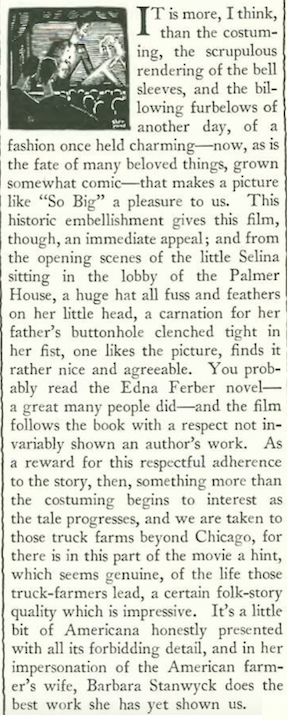
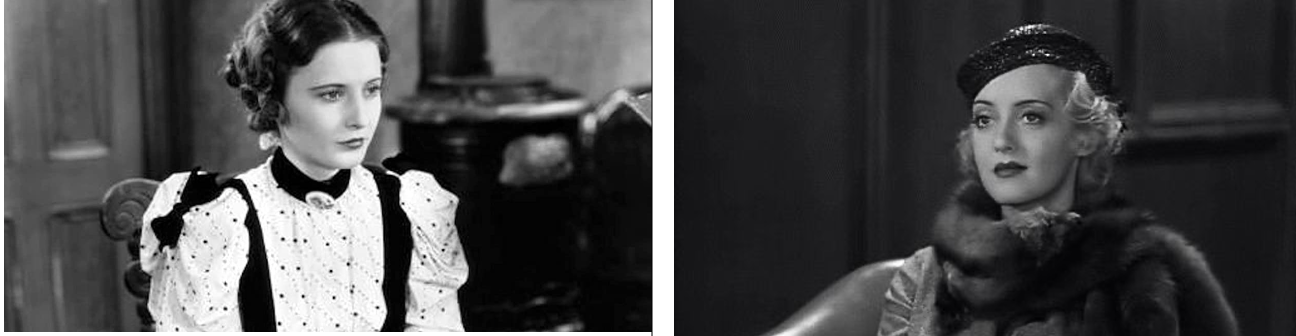
The pre-Code drama So Big!, based on Edna Ferber’s 1924 Pulitzer Prize-winning novel, featured two iconic Hollywood actors, but in 1932 only one of them, Barbara Stanwyck, was a bankable star. The film also featured the soon-to-be-famous Bette Davis, who had a much smaller role but was nevertheless grateful to be cast in a prestigious Barbara Stanwyck film. For critic John Mosher, the film proved to be a breakout role for Stanwyck.

SO BIG!…Barbara Stanwyck (left) was a marquee attraction in 1932, but Bette Davis would soon emerge as another major star in the Warner Brothers universe. (IMDB)

 *  *  *

From Our Advertisers

Clothes spun from cotton have been around for thousands of years, but this B. Altman advertisement suggests they were relatively novel for summer wear, at least among the upper orders. Both men and women wore wool bathing suits up until the 1930s, so perhaps there was something new about this cool, casual material…

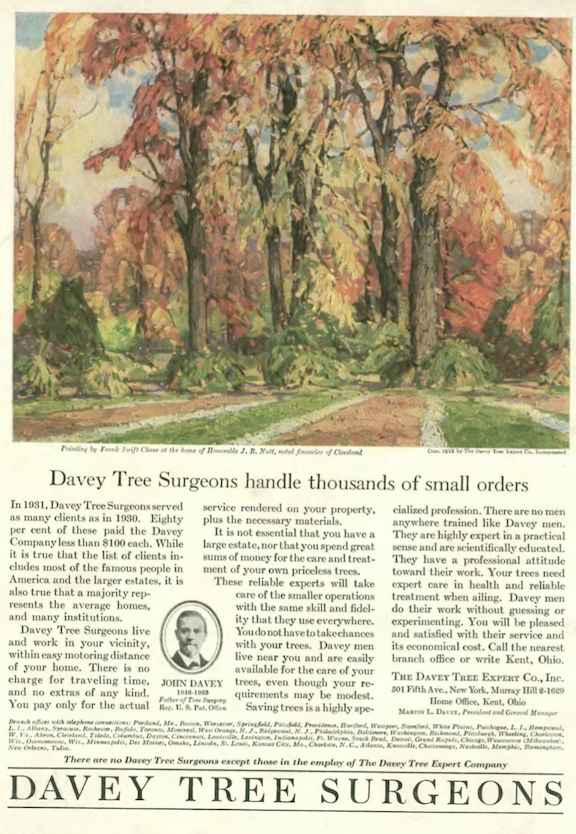
…no doubt the landed gentry helped keep the Davey Tree Surgeons in business during the Depression, but in those lean times it didn’t hurt to reach out to those with modest means…

…they did something right, because this 141-year-old company still thrives today, the ninth-largest employee-owned company in the U.S…

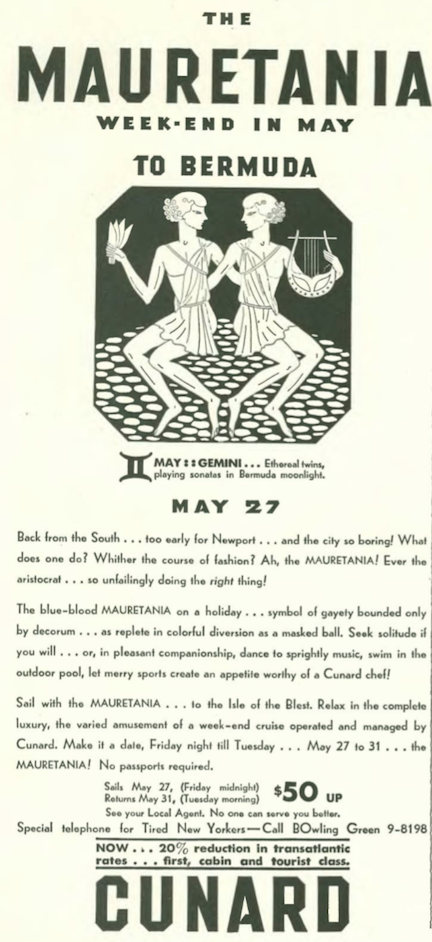
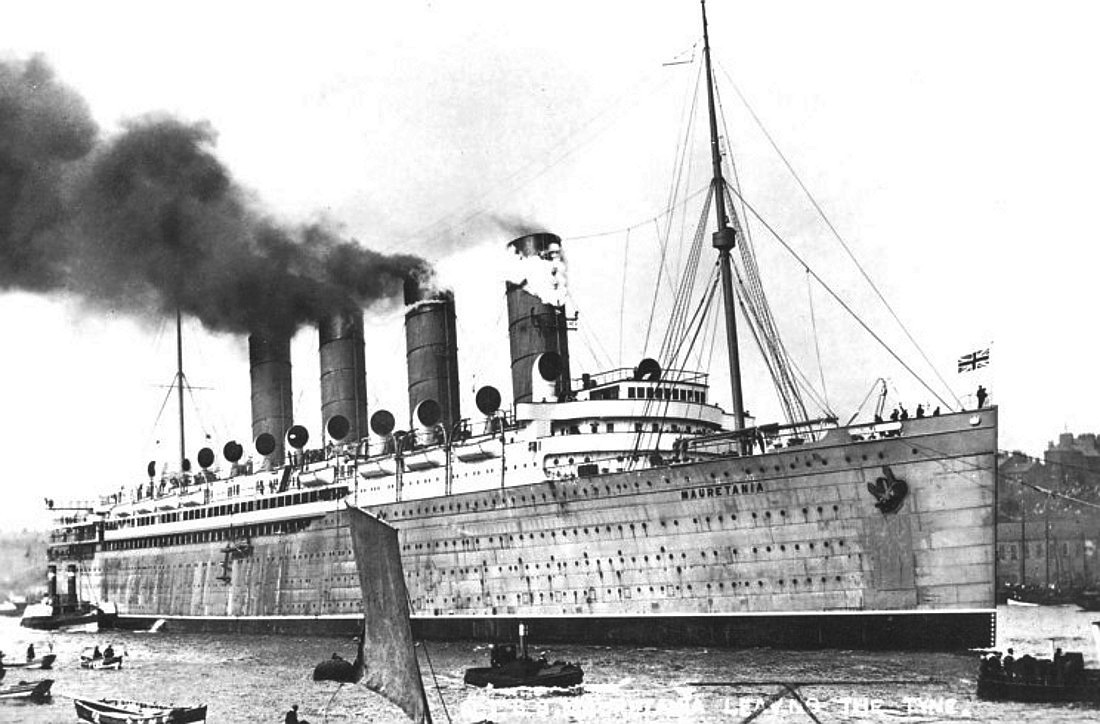
…launched in 1906, the RMS Mauretania was beloved for her Edwardian elegance and style, but as sleeker ships came into service in 1930, the Mauretania was removed from Atlantic crossings and relegated to running shorter cruises from New York to Nova Scotia and Bermuda…

OLD RELIABLE…The RMS Mauretania was the world’s largest and fastest ship after it left the Port of Liverpool in 1906. The liner was scrapped in 1935-37, much to the dismay of many of its former passengers, including President Franklin D. Roosevelt. (Wikipedia)

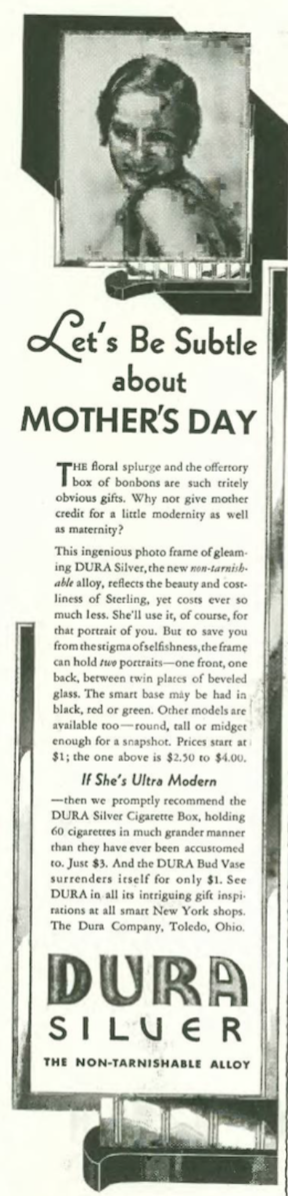
…with Mother’s Day around the corner, one company suggested a silver cigarette box as a suitable gift…

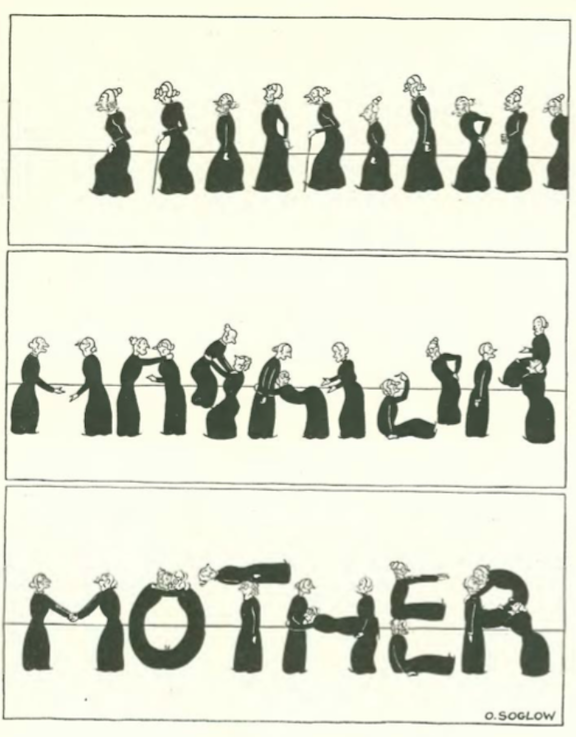
…on to our cartoons, Otto Soglow marked the upcoming holiday with this choreographed group…

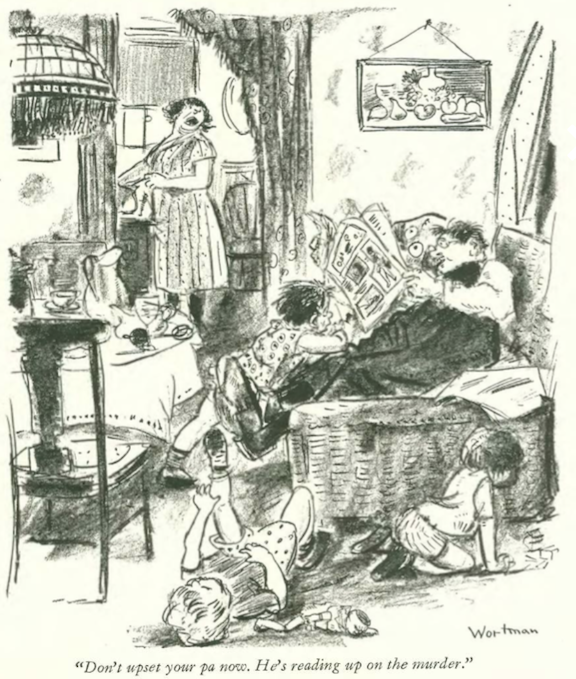
Denys Wortman gave us another side of motherhood…

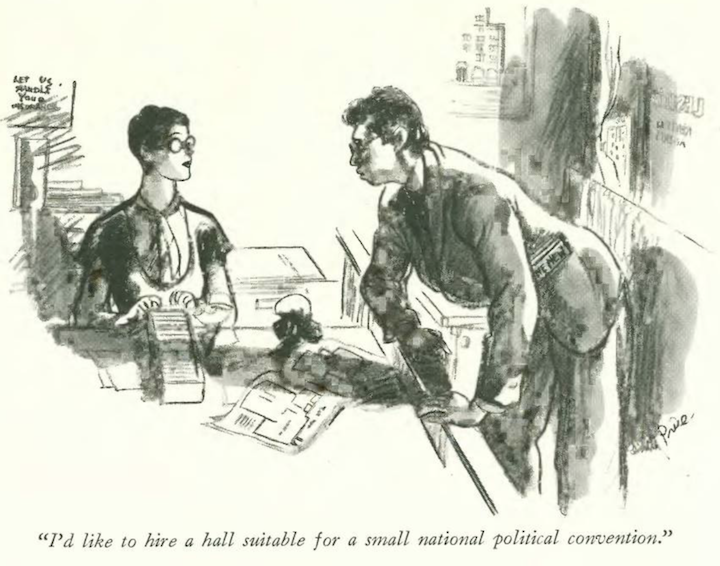
…other women were busy organizing political gatherings, per Garrett Price

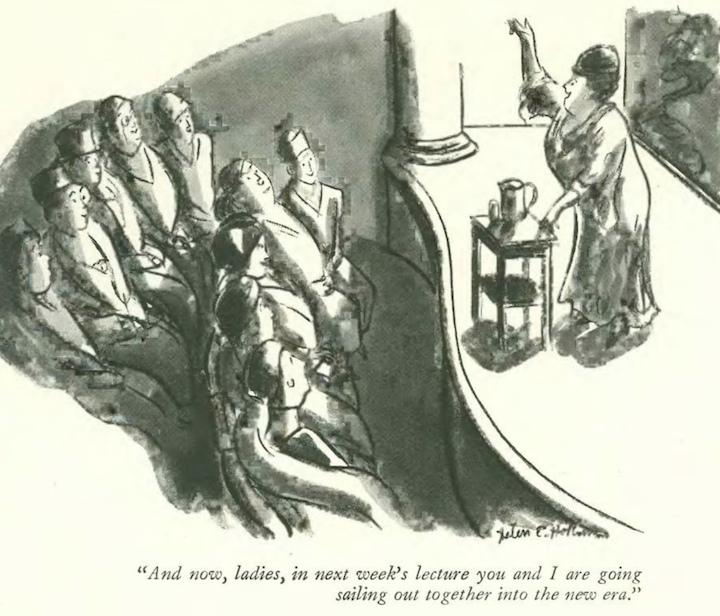
…and Helen Hokinson

James Thurber gave us a dog in distress…

Robert Day illustrated the dilemma of two bootleggers…

…and Barbara Shermund takes us out…

Next Time: Under the Boardwalk…


An American Classic

Immigration over the centuries transformed New York City into a cosmopolitan metropolis, with many of those migrants drawn from America’s hinterlands. What they found in the city was not only economic opportunity, but also a place to grow artistically and intellectually.

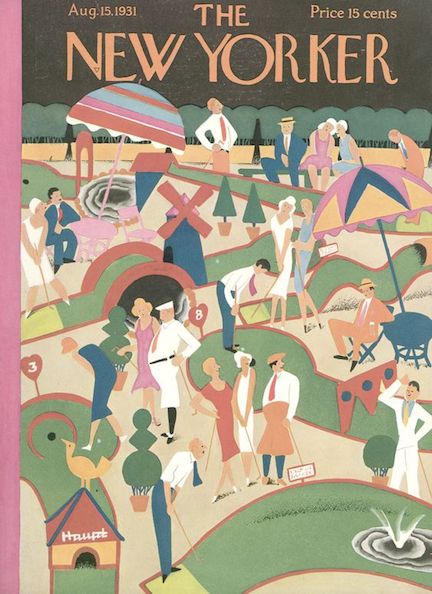
Aug. 8, 1931 cover by Theodore Haupt.

Such was the case of Willa Cather, who while living in New York City would draw on her Nebraska childhood to write a succession of novels about prairie life and its people (including My Antonia and O Pioneers!) that would culminate in a 1923 Pulitzer Prize.

Louise Bogan, in 1931 a new poetry editor for The New Yorker (and a poet herself), wrote a profile of Cather for the Aug. 8 issue. An excerpt:

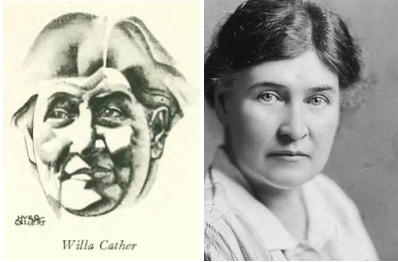
TWO FACES…Hugo Gellert rendering of Willa Cather for the profile; undated photo at right gives you some idea of the look Cather aimed at the affected behavior of others. (The New York Times)
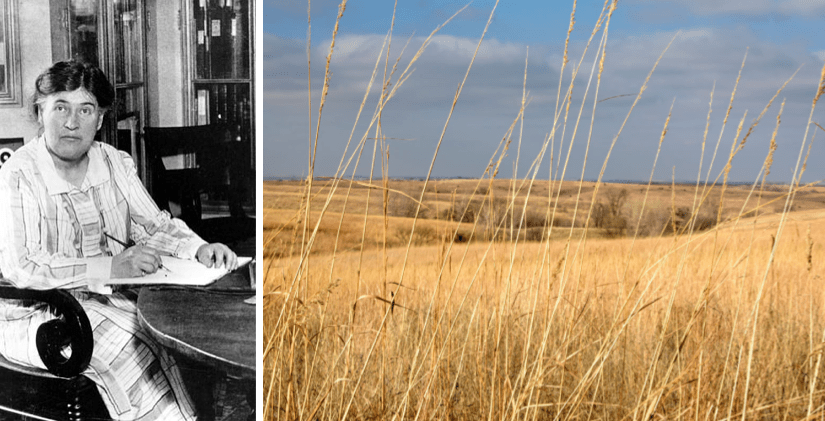
FORMATIVE YEARS…Clockwise, from top left, Willa Cather as a student at the University of Nebraska in the early 1890s; classmates at Nebraska included author and activist Dorothy Canfield Fisher and Alvin Johnson, later a co-founder of New York’s New School. Both Cather and Fisher took fencing lessons from John J. Pershing, who taught military science at Nebraska; Cather’s childhood home in Red Cloud, Neb., and the prairie that inspired much of her writing. (news.unl.edu/Wikipedia/new school.edu/literaryamerica.net)
CITY LIFE…Clockwise, from top: S. S. McClure, Willa Cather, Ida Tarbell, and Will Irvin visit in Washington Square Park, 1924; Cather in the meadow of High Mowing farm near Jaffrey, N.H., where she wrote part of My Antonia; on the cover of Time, Aug. 3, 1931; one of Cather’s New York residences at 82 Washington Place. (Indiana University/Southwick Collection, University of Nebraska/time.com/jschumacher.typepad.com)

Bogan concluded the profile with this note about Lèon Bakst, who was commissioned in 1923 to paint a portrait of Cather while she visiting Paris (image courtesy Omaha Public Library):

My dear late friend Susan Rosowski, who was a preeminent Cather scholar, wrote that Cather was “the first to give immigrants heroic stature in serious American literature.” In these times when immigration is so hotly debated, it is worth revisiting My Antonia and O Pioneers! to recall what once made America truly great.

 *  *  *

One Arm Restaurant

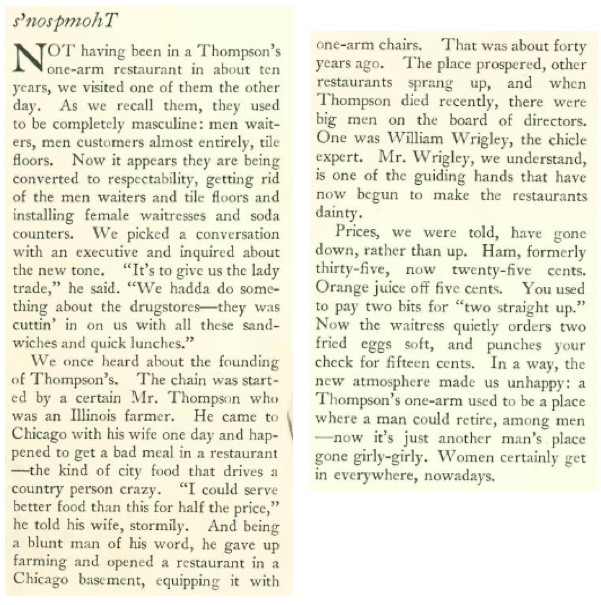
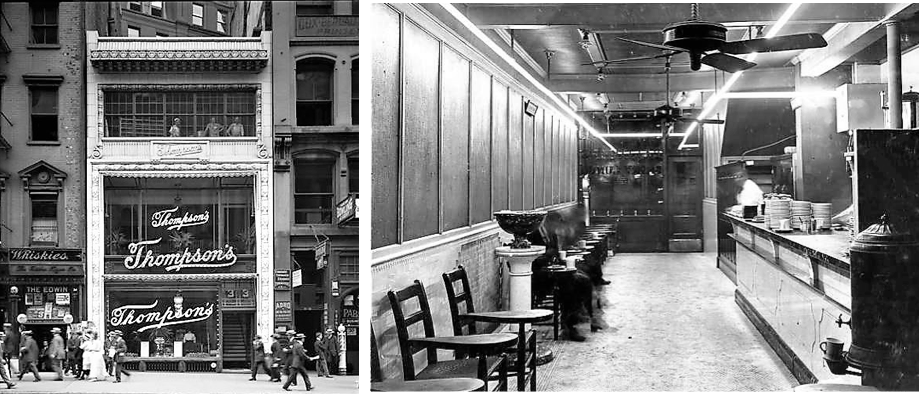
If you wanted to get lunch fast and cheap in 1931 you might have stopped at one of John Thompson’s New York restaurants. According to Tom Miller (daytoninmanhattan.blogspot.com), there were no waiters in Thompson’s restaurants. “Customers purchased foods like cold corned beef, cold boiled ham, smoked boiled tongue or hot frankfurters at a counter. They then took their trays to ‘one arm’ chairs lined up along the wall. There were no tables; instead customers ate at what was similar to turn-of-the-century school desks.” E.B. White stopped in for a visit:

YOU CAN’T MISS IT…John Thompson’s name is emblazoned no less than four times on the front of his restaurant at No. 33 Park Row. No-frills interior featured “one-arm” chairs and a self-service coffee urn. (Museum of the City of New York /daytoninmanhattan.blogspot.com)

 *  *  *

Cinematic Eyeful

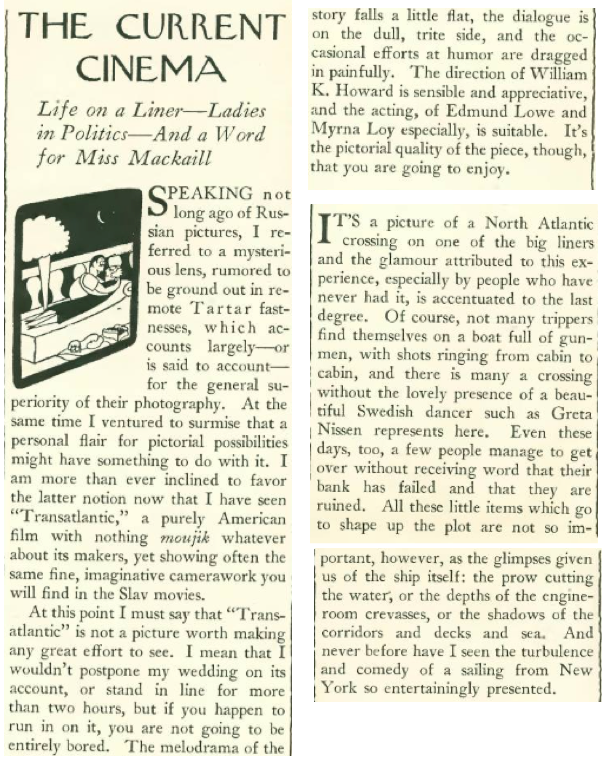
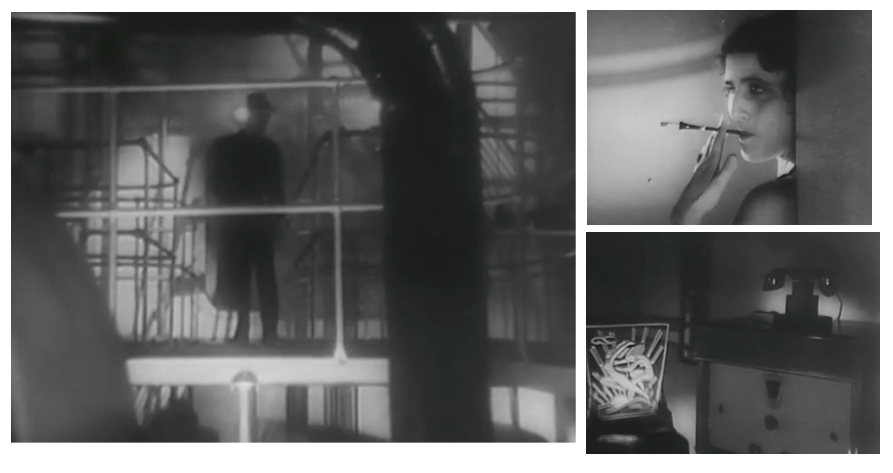
The Pre-Code comedy-drama Transatlantic was light on plot but heavy on deep-focus cinematography (by James Wong Howe) that wowed New Yorker critic John Mosher in 1931…and still wows critics today.

High Seas Hijinks…The pre-code comedy-drama Transatlantic wowed critic John Mosher not so much for its storyline as for its style and cinematography. Clockwise, from left, Edmund Lowe has his hands full with Lois Moran, Greta Nissen and Myrna Loy. (IMDB)
NIFTY NOIR…John Mosher loved the avant-garde, noir-ish stylings of Transatlantic. This film by director William K. Howard and cinematographer James Wong Howe is still admired today. A MoMA cinema site notes that the film’s style anticipates Citizen Kane by ten years. (pre-code.com)

 *  *  *

From Our Advertisers

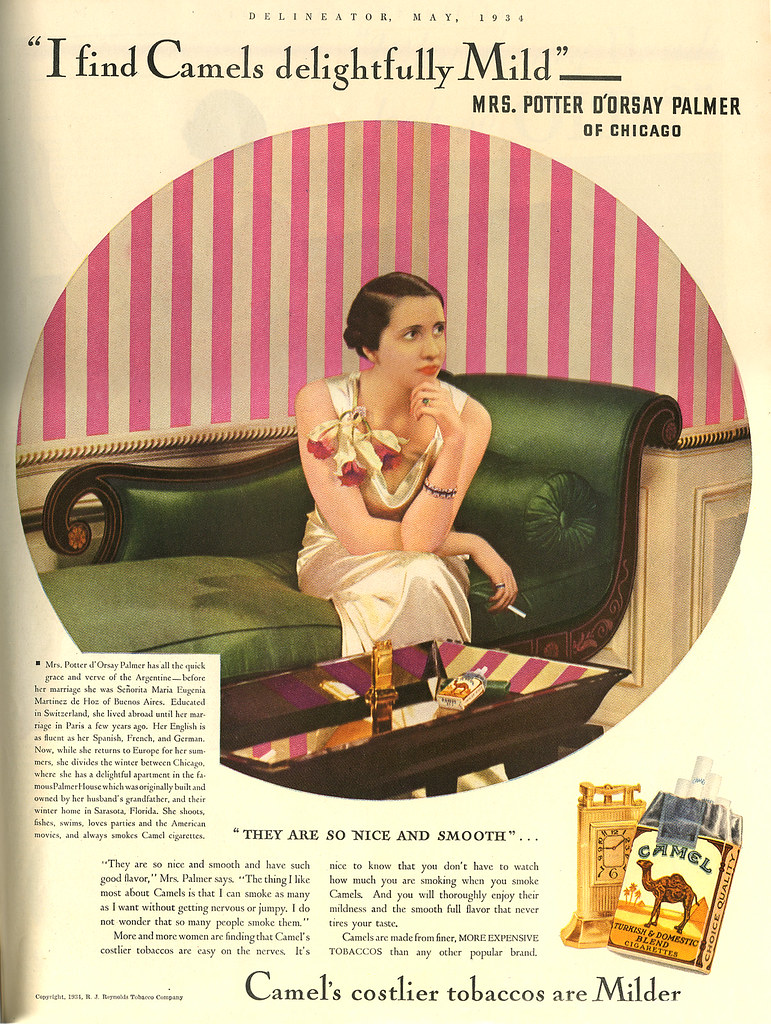
We begin with another socialite endorsing Pond’s Cold Cream — Mrs. Potter d’Orsay Palmer nee Maria Eugenia Martinez de Hoz. She was wife No. 2 of Potter d’Orsay Palmer, son of the wealthy family of Chicago Palmer House fame…they would divorce in 1937, and the playboy Potter would marry two more times before dying of a cerebral hemorrhage in 1939 (the result of a drunken brawl). Maria Eugenia would remarry and return to her homeland of Argentina to raise a family…

…it seems Maria Eugenia didn’t limit herself to endorsing cold cream, as this next ad attests (from the May, 1934 Delineator magazine)…

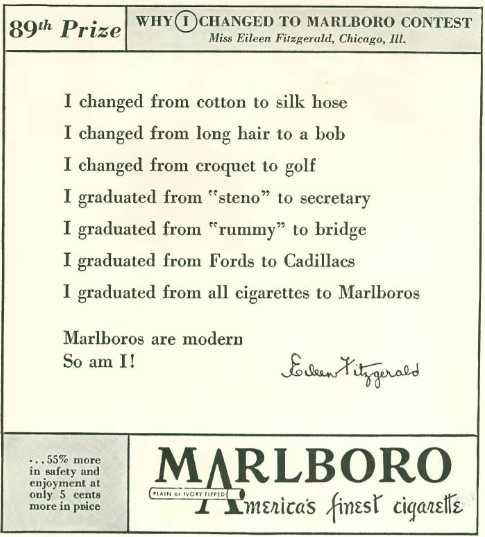
…Maria Eugenia endorsed Camels because they were marketed to women back then, as were Marlboro cigarettes, the makers of which continued their silly handwriting and jingle-writing contests to promote the brand (note the examples “Miss Eileen Fitzgerald” offered of what defined a modern lifestyle)…

…the makers of Chesterfield cigarettes, on the other hand, originally marketed their product to men, but they made sure women were included in the copy beneath the image — “yes, there’s a big woman vote” …

…you may recall the subtle ways Liggett & Myers began to lure women smokers back in 1928 with this ad campaign…

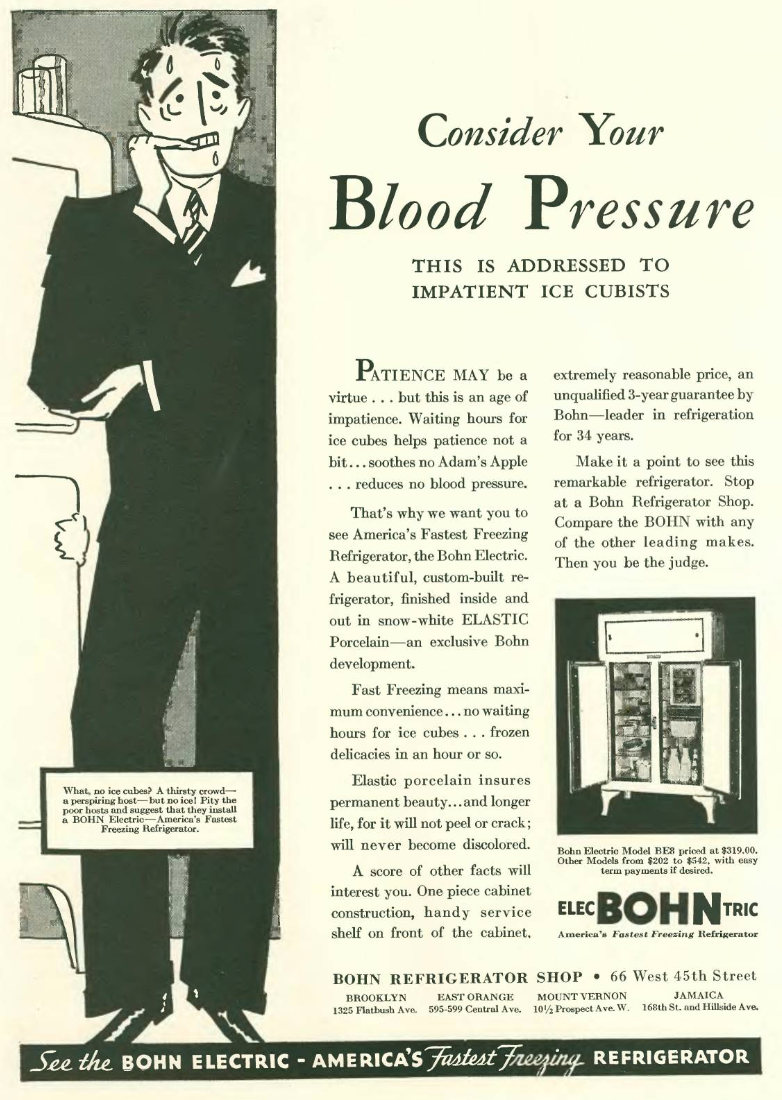
…you see a lot of tobacco ads because cigarette manufacturers were one of the few industries still turning a profit during the first years of the Depression…men and women were smoking like crazy, maybe to calm their nerves over the performance of their refrigerators…

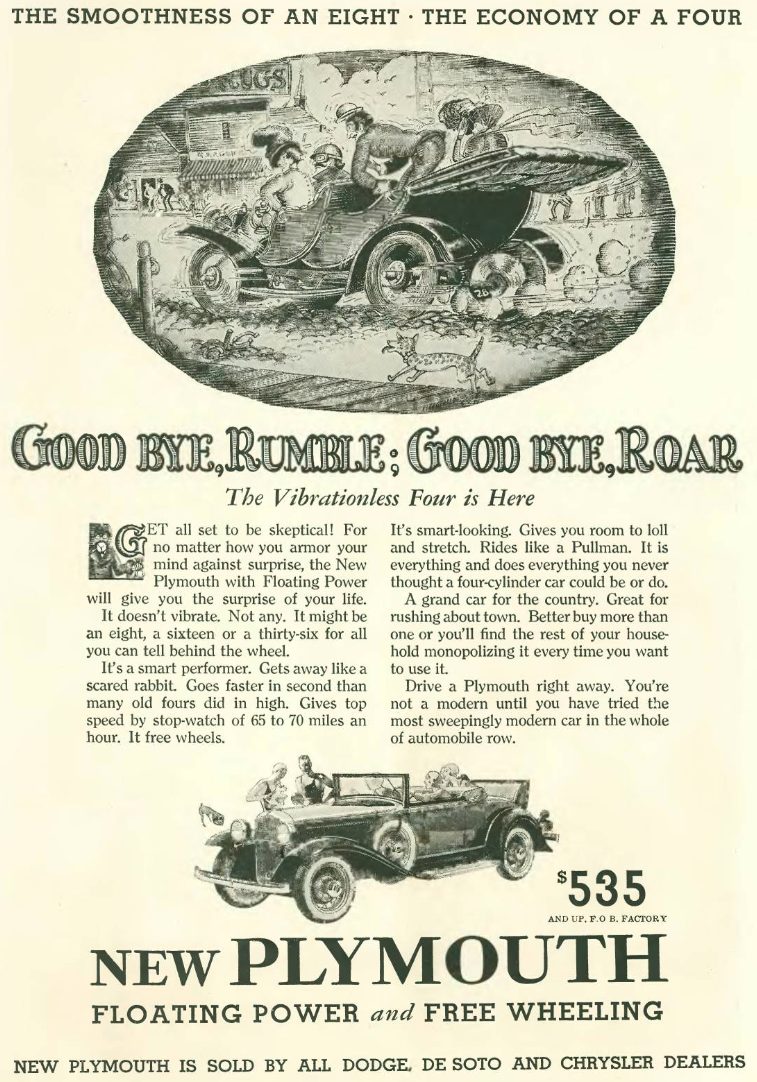
…one could always calm the nerves by taking a spin in a new Plymouth, bargain-priced at just $535…

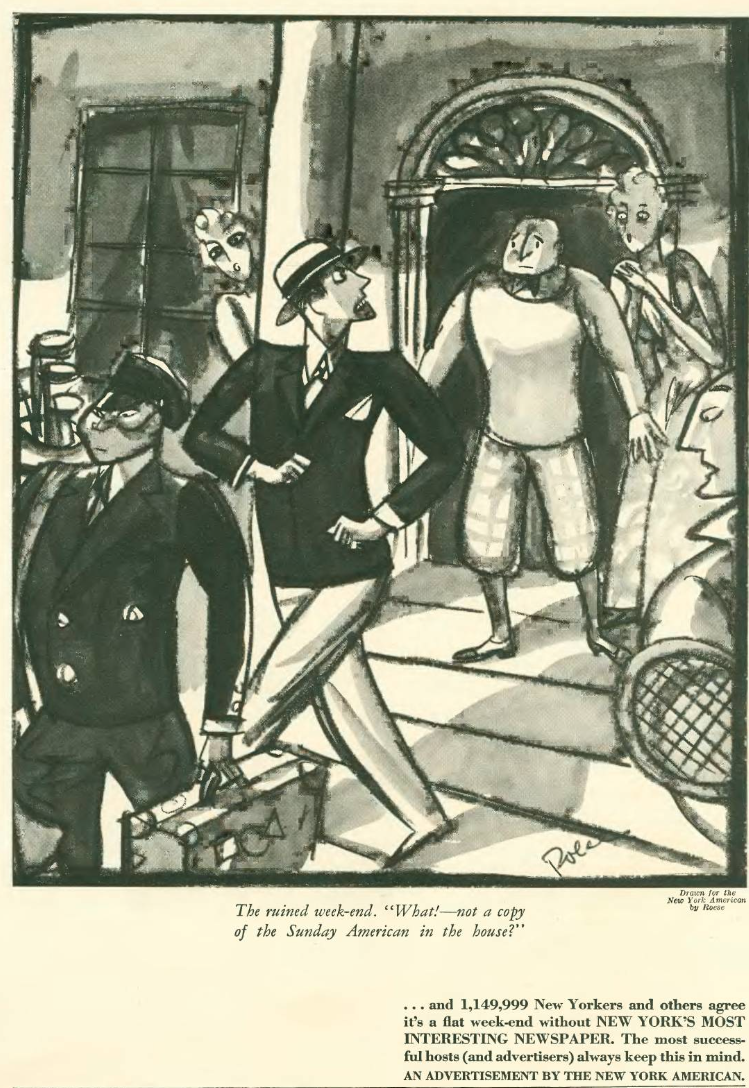
…and we have another Arno-esque ad by Herbert Roese, touting the wonders of “New York’s Most Interesting Newspaper”…

…on to our cartoonists, we begin with this wonderful spot drawing by Barbara Shermund

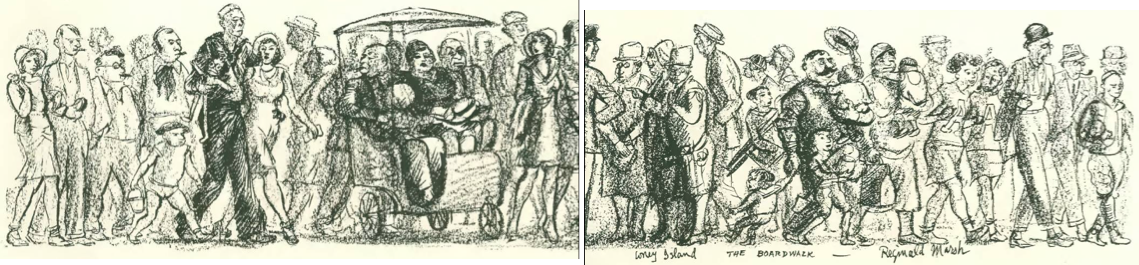
…and an illustration by Reginald Marsh of a Coney Island crowd that graced facing pages in “The Talk of the Town”…

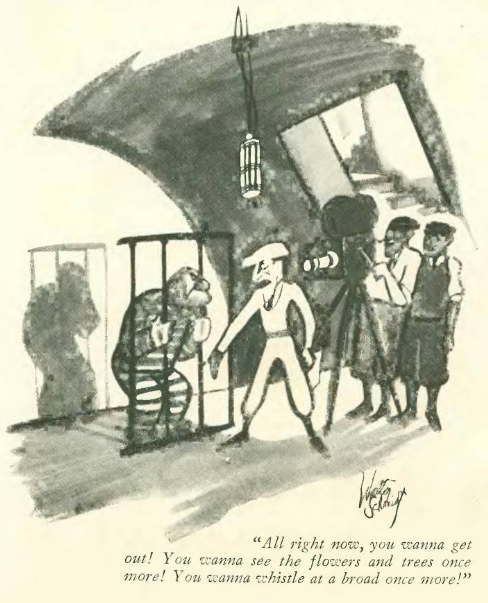
…here’s one of four drawings Walter Schmidt contributed to The New Yorker between 1931 and 1933…

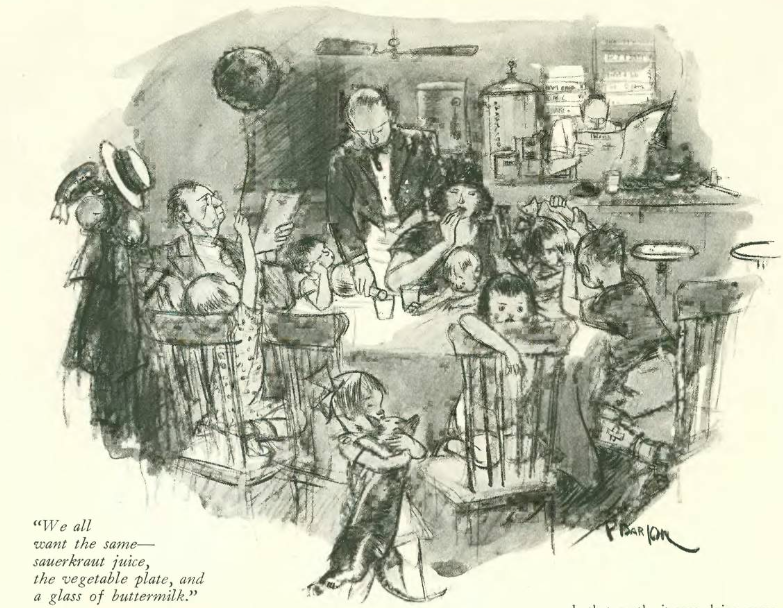
Perry Barlow illustrated the joys of dining out with the kiddies…

…back to Barbara Shermund, who eavesdropped on her debs…

Kemp Starrett gave us a proud moment at the county fair…

Isadore Klein offered up a new twist on the term “family planning”…

John Held Jr assessed the aesthetic value of chunky mission-style furniture…

…and Peter Arno reappeared in the cartoons with this full-page illustration of some desperate climbers…

Next Time: Asphalt Jungle…

The Road to 1931

The New Yorker entered its sixth year in 1931, and despite the deepening Depression managed to stay afloat and even gain new subscribers. Perhaps more than ever folks needed that weekly dose of levity the magazine ably supplied.

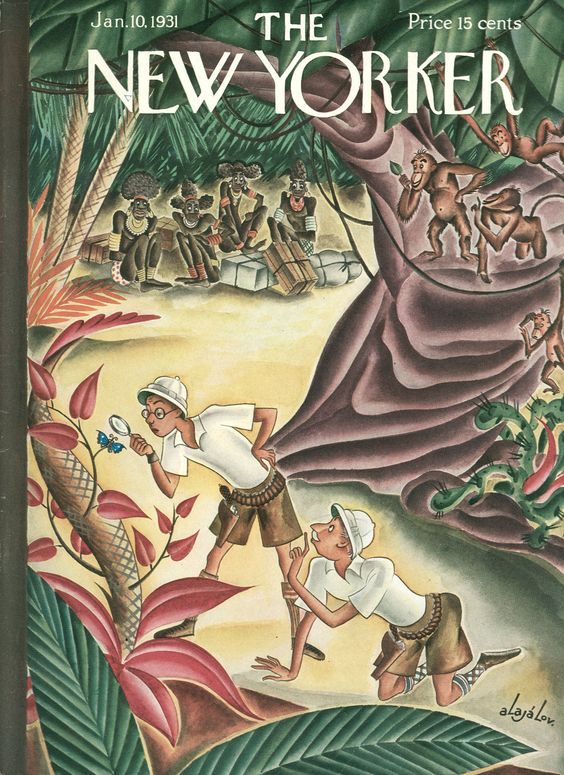
Rea Irvin rang out the old and welcomed the new with back-to-back covers for the Dec. 27, 1930 and Jan. 3, 1931 issues. The second cover commemorated the New York Auto Salon, mentioned later in this blog entry.

That isn’t to say the magazine’s contributors donned rose-colored glasses. Rather, they commiserated with their fellow Americans:

CRANKY COUPLETS…Ogden Nash lent his droll verse to the nation’s economic woes. In 1931, while working as an editor at Doubleday, Nash submitted a number of poems to the New Yorker and spent three months working on the magazine’s editorial staff. (poeticous.com)

Over the course of 1930 many Americans, including Ogden Nash, woke to the fact that their business and political leaders were ill-suited to lift them out of the economic mess, and were likely responsible for it in the first place. At the top of the list was President Herbert Hoover, who was profiled in The New Yorker in three installments beginning with the Dec. 27 issue. This brief excerpt gives you a glimpse into a very different White House 89 years ago:

The first installment of the profile was accompanied by a Cyrus Baldridge portrait of the president (left), but the final two installments featured a less-than-flattering Abe Birnbaum rendering that first appeared in The New Yorker in the March 2, 1929 issue:

*  *  *

Vorse Was a Force

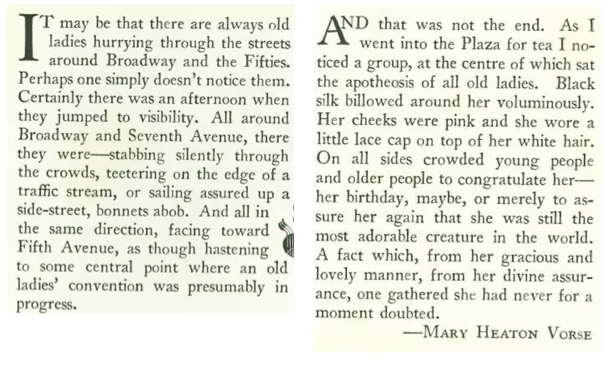
Social critic, labor activist and novelist Mary Heaton Vorse (1874–1966) was no fan of Herbert Hoover or wealthy business tycoons, and in the first decades of the 20th century joined with Lincoln Steffens and other muckraking journalists in advocating for social reform. Vorse, however, also had a background in fiction writing and in observational pieces like the one below (excerpts) in which she commented on the rustic old ladies she found everywhere in the city:

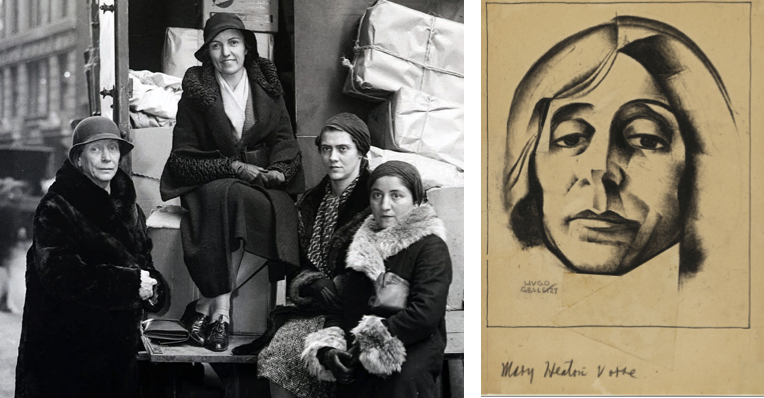
FOR THE CAUSE…Mary Heaton Vorse (left) with fellow activists preparing to leave on a relief expedition to aid striking Kentucky miners, 1932. At right, a 1925 drawing of Vorse by Hugo Gellert. (nysut.org/Smithsonian)

 *  *  *

The Mystic

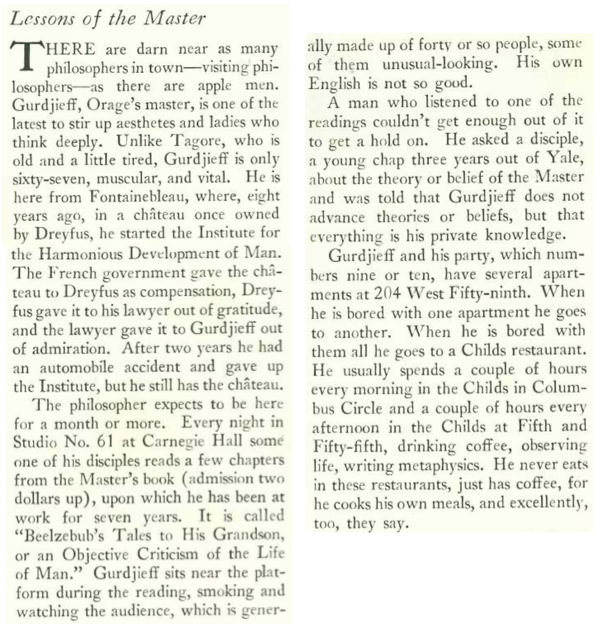
Before the Beatles made the Maharishi Mahesh Yogi a famed Transcendental Meditation guru in the 1960s, there was George Ivanovich Gurdjieff, a Russian/Greek/Armenian spiritual teacher of the “Fourth Way,” which promised a path to a higher state of consciousness and full human potential. Gurdjieff also enjoyed living in a French chateau and taking trips to New York to share his wisdom with eager Americans, including famed architect Frank Lloyd Wright. “The Talk of the Town” had these observations on the visiting mystic:

HE COULD SEE THINGS…George Ivanovich Gurdjieff, in an undated photo.

 *  *  *

Sunny Days

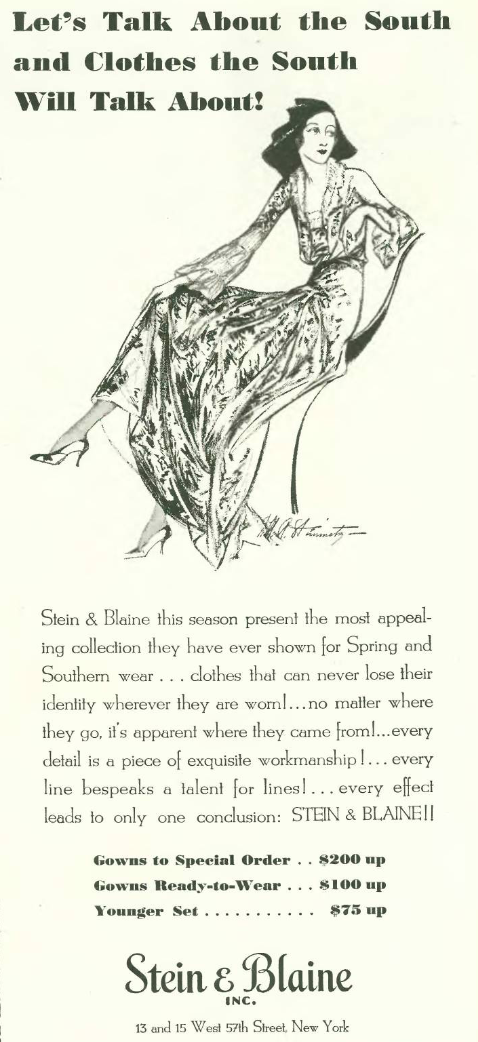
Forget about financial woes or spiritual dilemmas. What are you going to wear next summer? Fashion writer Lois Long (“On and Off the Avenue”) asked the question and looked to the south for some answers:

…numerous ads peppered the Dec. 27 issue urging Manhattan’s snowbirds to dress appropriately for the warmer climes…

…and operators of “PlaneTrains” promised to get them there as quickly as possible…

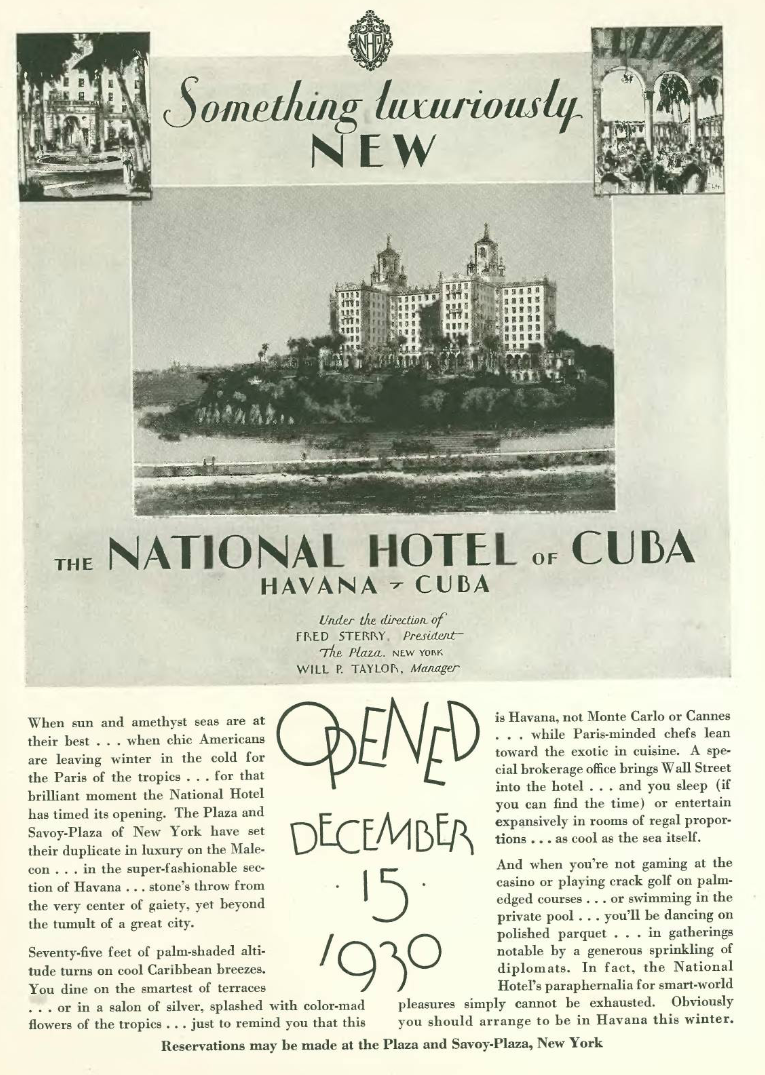
…and if you were headed to Cuba you could stay at the brand new National Hotel…

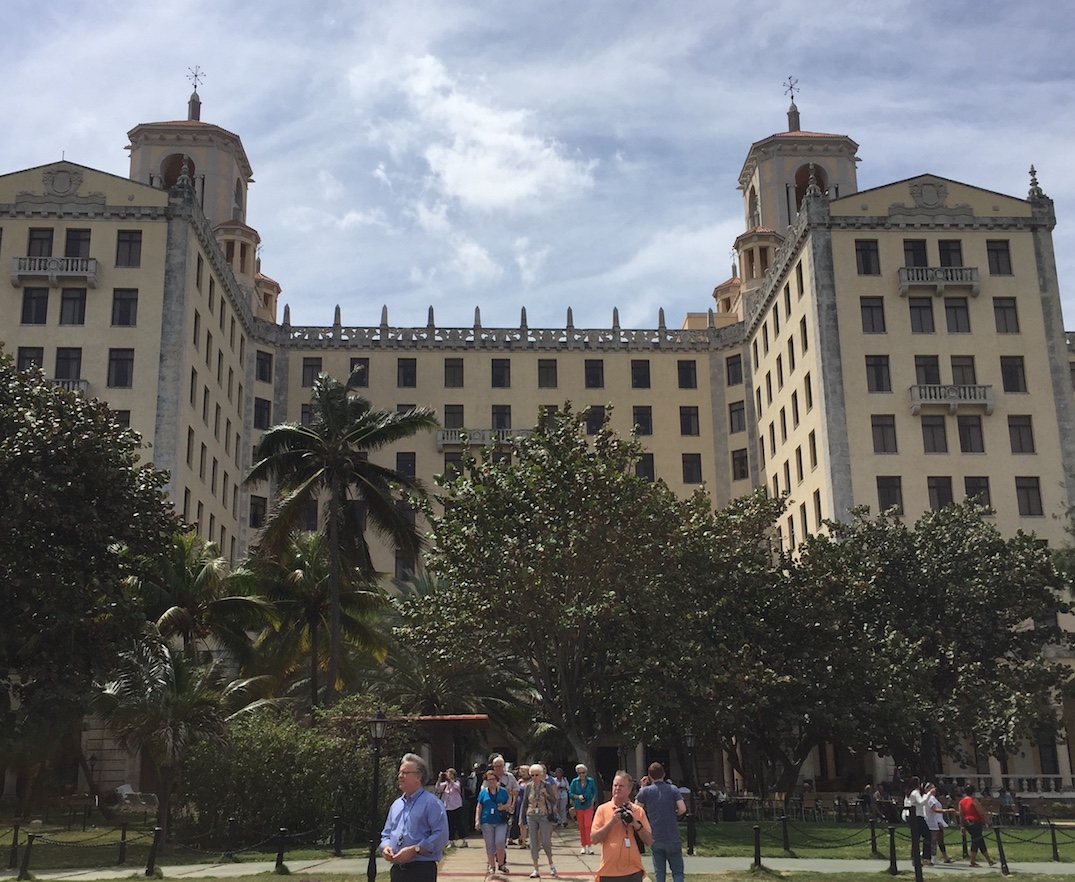
…here’s what it looked like three years ago when I was in Havana…I can guarantee you the hotel service was WAY better in 1931…

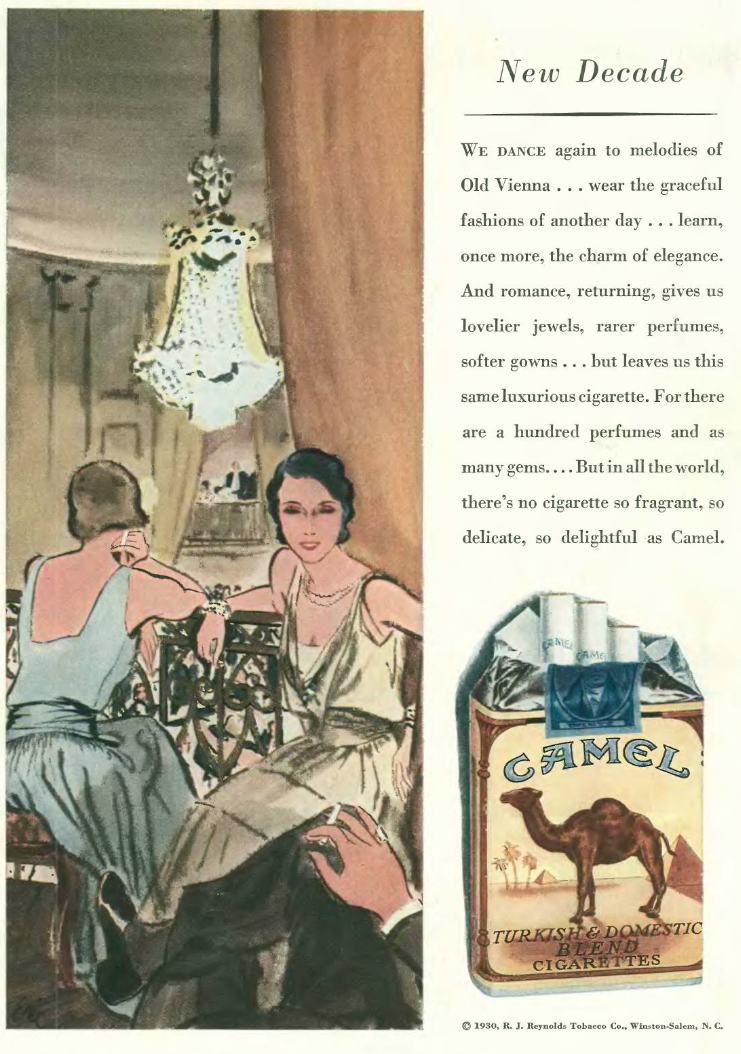
…whether home or abroad, New Yorkers were celebrating the New Year by “dancing to the melodies of Old Vienna” and smoking like chimneys…

…a popular New Year’s Eve destination was the The Roosevelt Hotel, where Guy Lombardo’s orchestra helped ring in the New Year from 1929 (radio’s first nationwide New Year’s Eve broadcast) to 1959…

I stayed at the Roosevelt Hotel in late December, and found Lombardo still presiding over the bar…

…we also find New Year’s revelry in the cartoons, with Mary Petty

Isadore Klein

Otto Soglow...

…and Leonard Dove

…and for those who stayed home, we have this scene of domestic bliss from Don Herold

 *  *  *

On to the Jan. 3, 1931 issue, we have Howard Brubaker (“Of All Things”) waxing sour on the state of the economy…

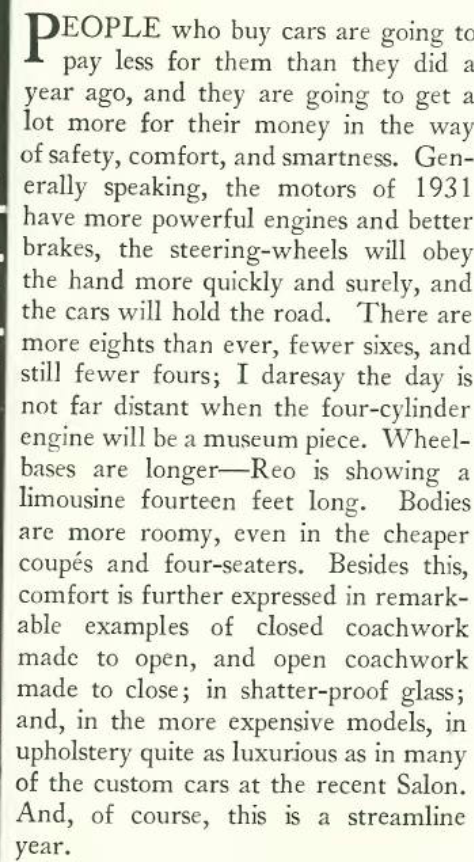
…so what a better way to cheer up than to look at shiny new cars, especially the ones almost no one could afford? The New Yorker paid another visit to the New York Automobile Salon at the Grand Central Palace…

…according to the article, 1931 was “a streamline year,” and leading the way was the REO motor car company, which despite its innovative ways would drop its car line altogether in 1936 — a casualty of the Depression…

FLOWING FENDERS…The 1931 REO Royale was a trendsetter, introducing streamlining designs. The Great Depression would cause REO to abandon the manufacture of automobiles in 1936. (historicvehicle.org)

…over at the Chrysler Building, which served as that corporation’s headquarters from 1930 until the mid-1950s, new cars were on display on the building’s first two floors…

CATHEDRAL OF CARS…The first two floors of the Chrysler Building served as an auto showroom during the building’s first decade. (Wikipedia/thewelcomeblog.com)

…we segue to our advertisements, many from car companies touting their displays at the New York Automobile Salon. Like REO, Marmon was noted for various innovations, including the introduction of the rear-view mirror. It also manufactured a stunning 16-cylinder automobile that was on display at the 1931 Salon. But also like REO, the Depression proved too much for Marmon, and it was defunct by 1933…

SLEEK…The 1931 Marmon Sixteen. (RM Auctions)

…another car company that would fall to the Depression was the luxury brand Pierce Arrow. Without a lower-priced car in its lineup to provide cash flow, the company ceased operation by 1938…

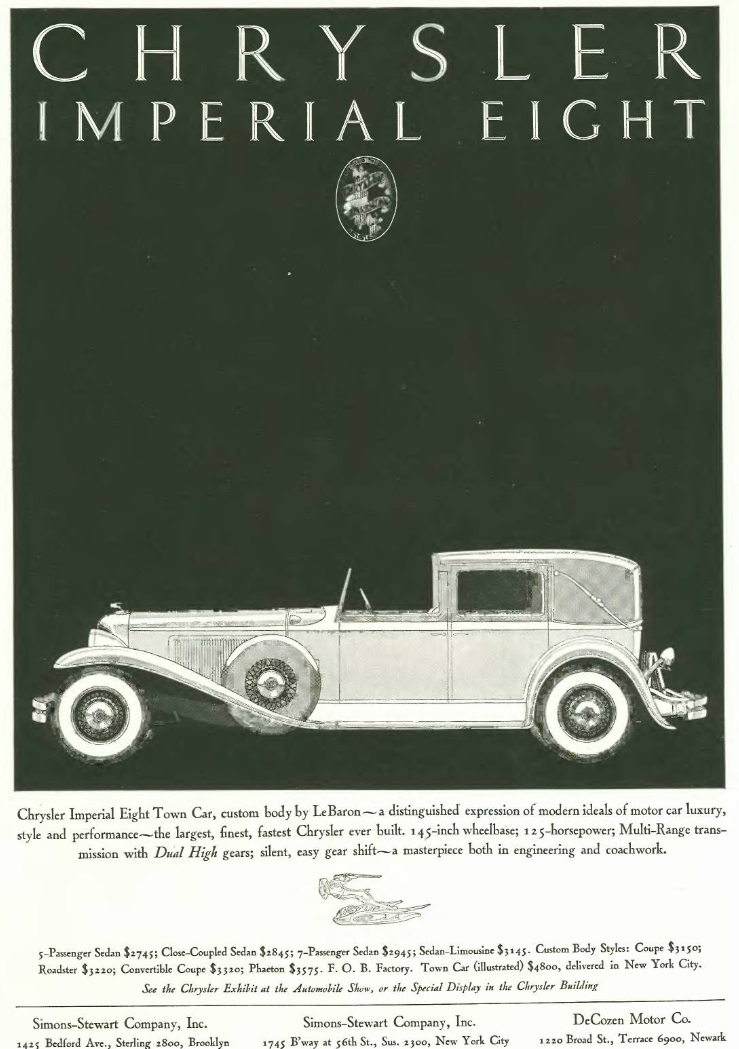
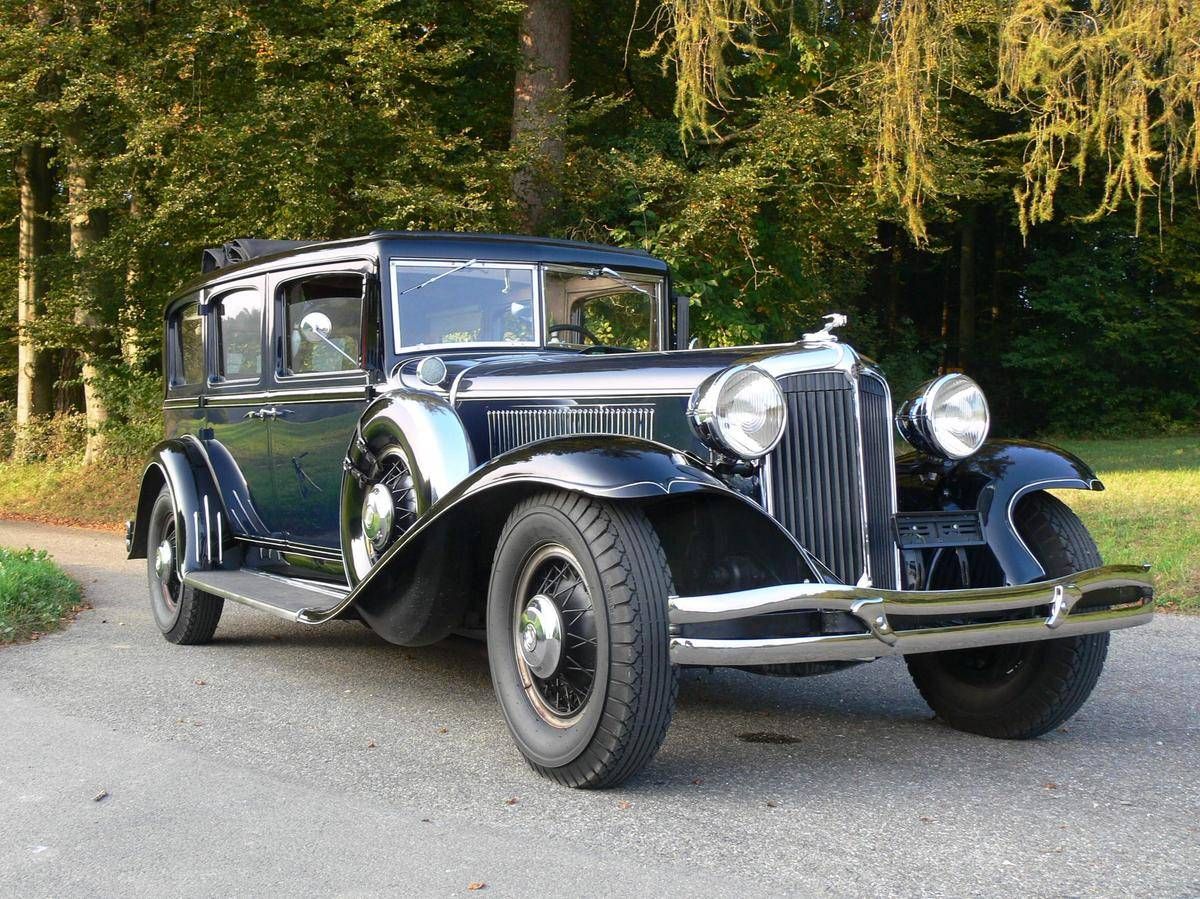
…by contrast, the Chrysler Corporation had several low-priced models to help it survive the lean years and enable it to produce its luxury model, the Imperial…

ANOTHER FIRST…Chrysler was also known for its innovative ways. A custom version of the Chrysler Imperial Eight included a dictaphone. (hemmings.com)

…the Hudson Motor Car Company is long gone, but in 1930 it was the third largest carmaker after Ford and Chevrolet, and instead of luxury it touted the affordability of its cars, especially its low-priced Essex line, priced $1,000 less than its predecessor from ten years earlier. The $595 Essex would be comparable to a $9,000 to $10,000 car today (by comparison, the 1931 Marmon or Imperial would set you back somewhere between $3,000 and $5,000, roughly equivalent to a $46,000 – $78,000 range today)…

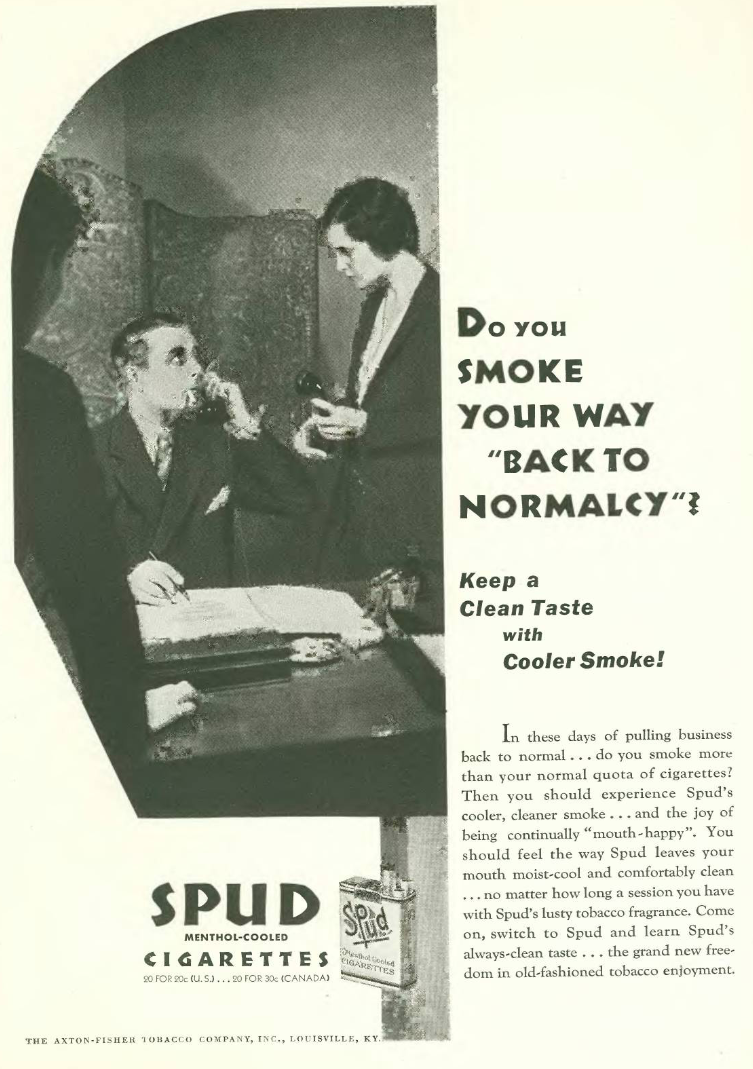
…so let’s say the Depression has wiped you out and you can’t even afford an Essex…well you could try to “smoke your way back to normalcy”…

…or be like this pair, who seem content with their Chesterfields…

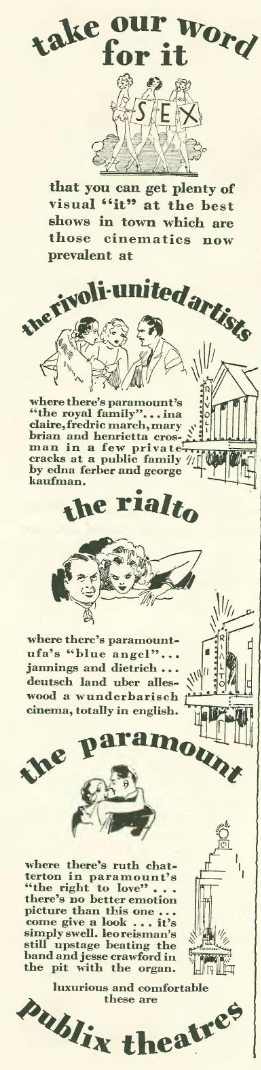
…of course the movies were another means of escape from the cruel world, and Paramount’s Publix Theatres promised plenty of sex to ease troubled minds…

PRE-CODE WORLD…During a brief period of the early sound era, many films used both sex and violence to attract audiences to theaters. The Publix Theatres ad above implied that these three films had plenty of sex, or “it” — clockwise, from top left, Fredric March ran around in his skivvies in The Royal Family of Broadway (1930); Mary Brian and Ina Claire portrayed acting sisters Gwen and Julie Cavendish in The Royal Family of Broadway; David Manners and Ruth Chatterton shared an embrace in The Right to Love (1930); and Marlene Dietrich lured a schoolmaster into a life of madness and despair in The Blue Angel (1929-30).

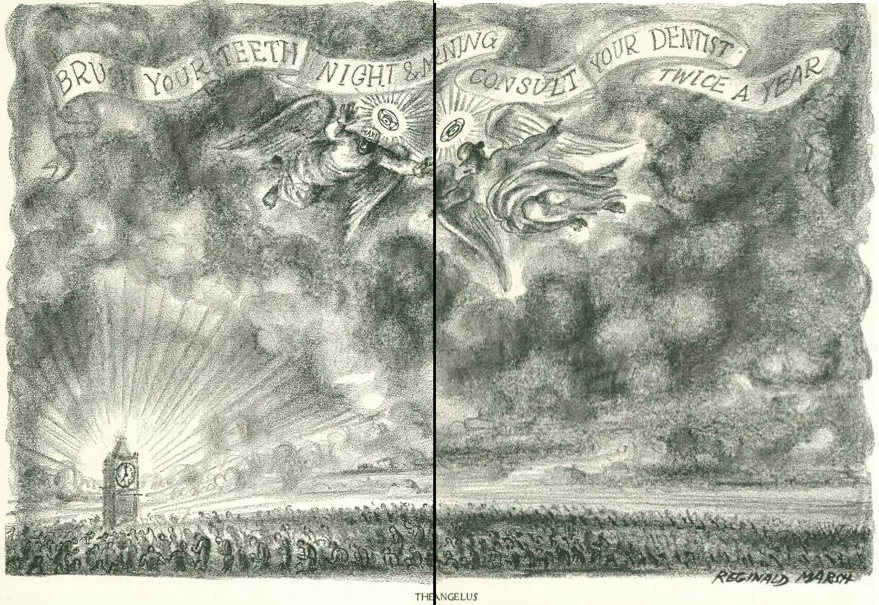
…and we close with our cartoonists…Reginald Marsh heralded the new year with this two-page spread depicting the heavens glorifying dental hygiene…

Leonard Dove inked two cartoons featuring table talk…

E. McNerney continued The New Yorker tradition of cartoons featuring sugar daddies and gold diggers…

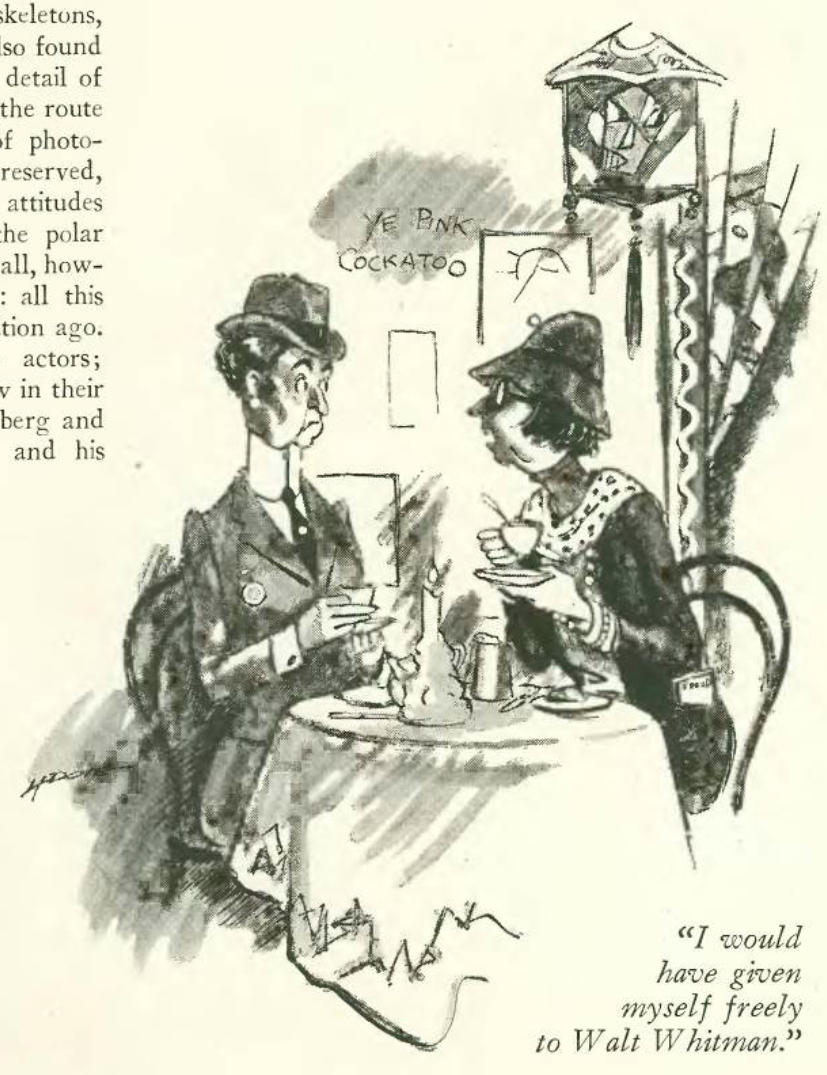
Gardner Rea pondered the value of kitsch in a regal setting…

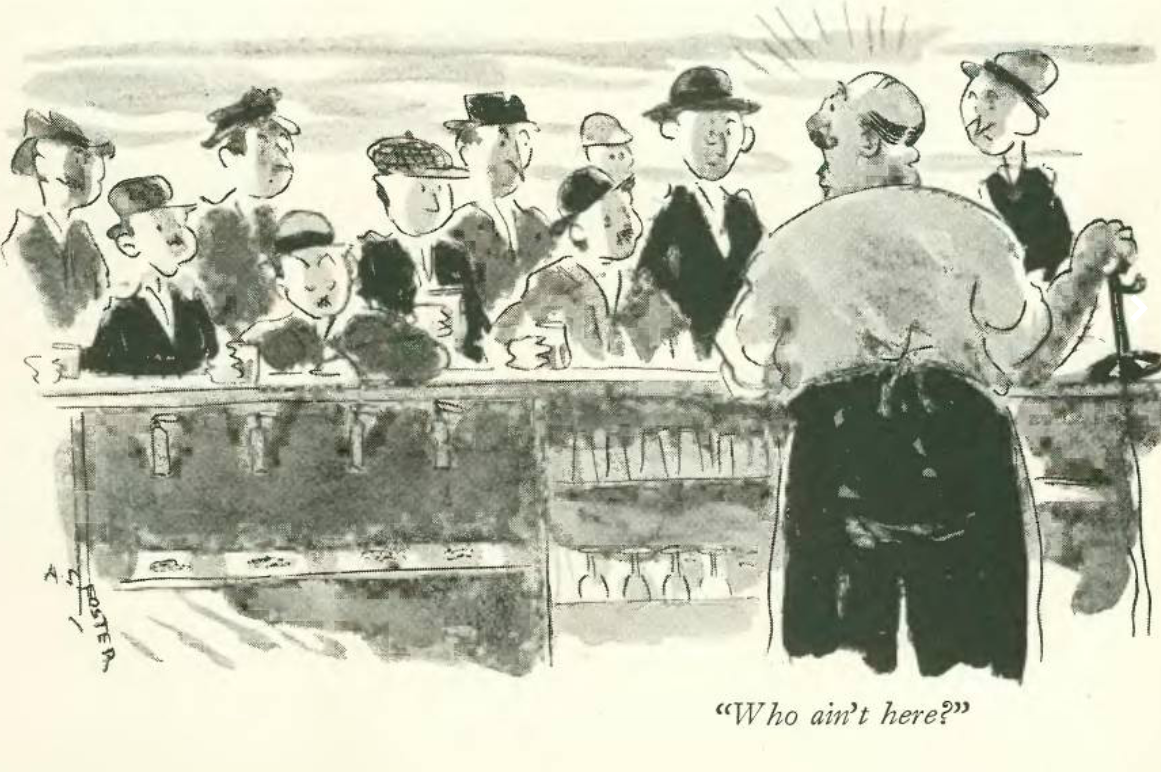
A.S. Foster looked in on a crowd of John Does at a speakeasy…

…and Lillian Reed took us shopping with a very specific request…

Next Time: Requiem For the Flapper…


Prophet of Doom

The October 1929 stock market crash took most people by surprise, but one man, Roger Babson, knew all along it was coming…thanks to Sir Isaac Newton

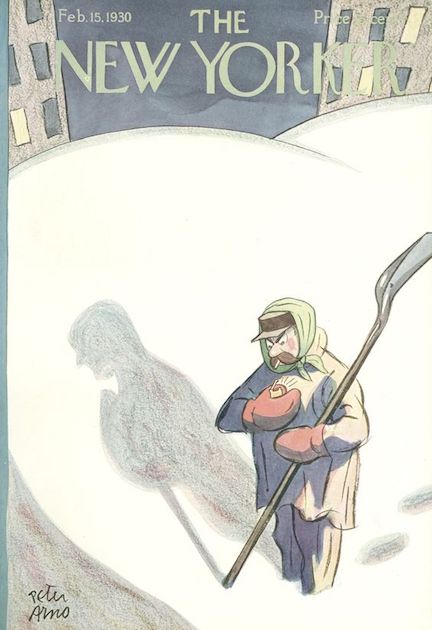
Feb. 15, 1930 cover by Peter Arno.

Babson (1875-1967) is perhaps best known today as the man who predicted the market crash and the Great Depression that followed. He employed an economic assessment tool called the “Babsonchart” that was based on Newton’s Third Law: For every action, there is an equal and opposite reaction. In the Feb. 15, 1929 “Profile” (titled “Prophet of Doom”) Henry Pringle tried to make sense of this eccentric businessman, who would go on to wage war against gravity itself:

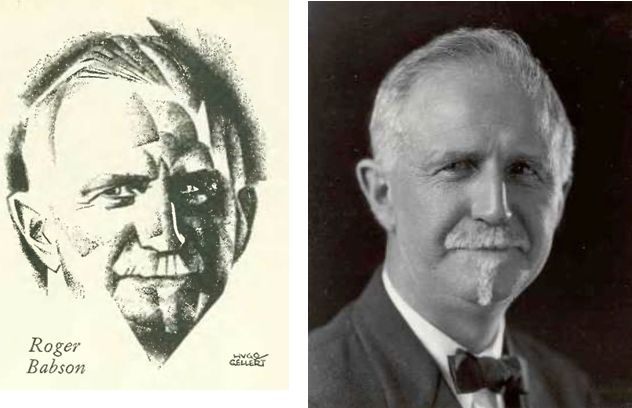
TOLD YOU SO…Illustration by Hugo Gellert for the profile on Roger Babson, who famously predicted the stock market crash; at right, Babson circa 1930. (Gravity Research Foundation)
BIG THINKER…Roger Babson dedicates the world’s largest spinning globe at Babson College in 1955; at right, the globe as it appears today. Founded by Babson in 1919, Babson College is often ranked as the most prestigious entrepreneurship college in the U.S. (babson.edu/Wikipedia)

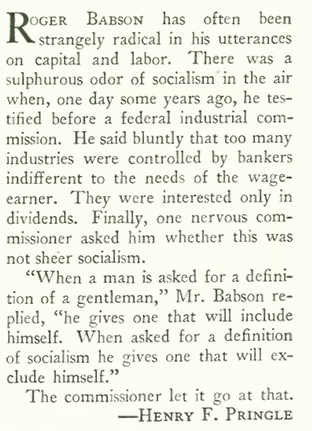
Pringle concluded his profile on a confused note, wondering if his subject — a product of sober New England stock — could possibly be a socialist in disguise…

In any case, it is difficult to assign Babson to any one category. Some considered him a genius and visionary, while others thought him a crackpot, particularly in the late 1940s when, following the death of a grandson by drowning, he began to wage war against gravity itself. In 1948 essay “Gravity – Our Enemy Number One,” he wrote: “Broken hips and other broken bones as well as numerous circulatory, intestinal and other internal troubles are directly due to the people’s inability to counteract Gravity at a critical moment.”

That same year Babson founded the Gravity Research Foundation to expedite the discovery of a “gravity shield.” The foundation is still in operation, but rather than seeking to block gravity it works to better understand it. It continues to hold an annual essay prize contest — remarkably, five of its winners have gone on to win the Nobel Prize in physics. The essay contest’s 1971 winner was none other than physicist Stephen Hawking.

ROCK STAR…Clockwise, from top left: Roger Babson at home with a portrait of Sir Isaac Newton; Babson was the Prohibition Party’s candidate for President of the United States in 1940; Babson provided charitable assistance to unemployed stonecutters in Gloucester, Mass., during the Great Depression, commissioning them to carve inspirational inscriptions on more than 20 boulders near the abandoned settlement of Dogtown. (centennial.babson.edu/Wikipedia)

 *  *  *

An Imperfect Romance

Born in the midst of the Jazz Age, it would seem that The New Yorker would have been a perfect fit for the most prominent chronicler of that era, F. Scott Fitzgerald. But it was mostly not to be: Fitzgerald would publish just two poems and three humorous shorts in The New Yorker between 1929 and 1937, including “Salesmanship in the Champs-Élysées” in Feb. 15 issue.

In all fairness, The New Yorker wasn’t exactly enamored of the young author. In its book review section for the May 23, 1925 issue, the magazine singled out three books for review, the first (and longest) review was devoted to James Boyd’s historical novel Drums. This was followed by a brief review of Fitzgerald’s The Great Gatsby, the reviewer writing that the book revived his interest in the author but “not in a Byronic promise he probably never had,” and referred to the character of Jay Gatsby as “a good deal of a nut.”

The following year Fitzgerald was the subject of a New Yorker profile titled “That Sad Young Man.” In the magazine’s March 12, 2017 issue, Erin Overbey and Joshua Rothman note that the profile (by John Mosher) would be called “snarky” in today’s lingo. They also point out that “Fitzgerald, for his part, appeared to take a rather snobbish view of Harold Ross’s new publication, referring to the short stories he published in it as “hors d’oeuvres.”

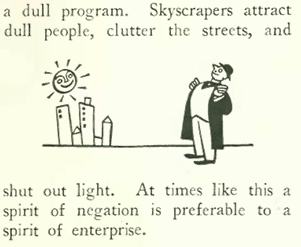
With that, here is one of F. Scott Fitzgerald’s “hors d’oeuvres” … “Salesmanship in the Champs-Élysées.”

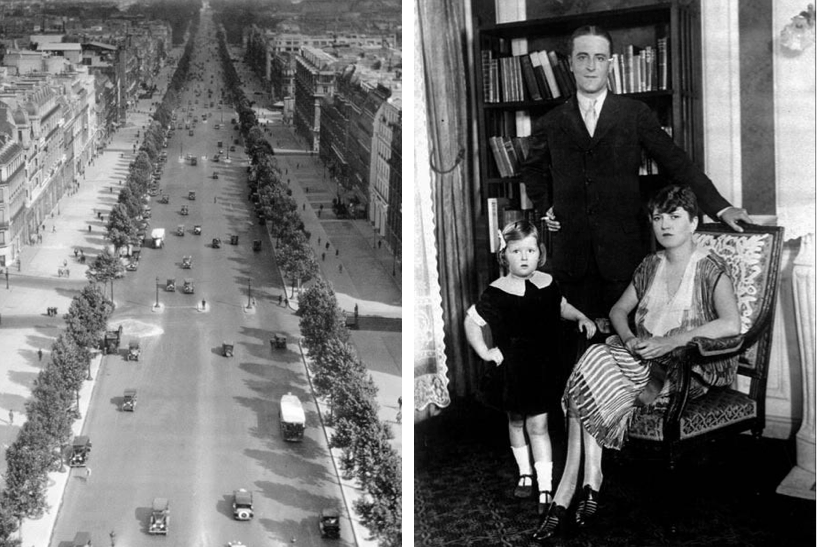
SOUR GRAPES…The Champs-Elysées in 1929; F. Scott Fitzgerald with his daughter, Scottie, and wife Zelda in Paris in 1925. Despite being products of the Jazz Age, the author and The New Yorker were mostly at odds. In a letter to his daughter, Scottie, Fitzgerald advised that she expand her knowledge of literature “instead of skimming Life + The New Yorker.”  (fr.wikibooks.org/Associated Press)

 *  *  *

The Empire-less State

In his “Notes and Comment,” E.B. White pondered the possibilities of a large lot at the corner of Fifth Avenue and 34th Street previously occupied by the Waldorf-Astoria hotel. Although construction of the Empire State Building would soon commence at the site, White mused about other possibilities…

LIGHT THERE BE LIGHT…E.B. White found the newly excavated space at Fifth Avenue and 34th Street (former site of the Waldorf-Astoria) to be a refreshing change. It would be short-lived, as the first beams of the Empire State Building would begin to rise from the site in March 1930. (NYPL Digital Gallery)

 *  *  *

Westminster People Show

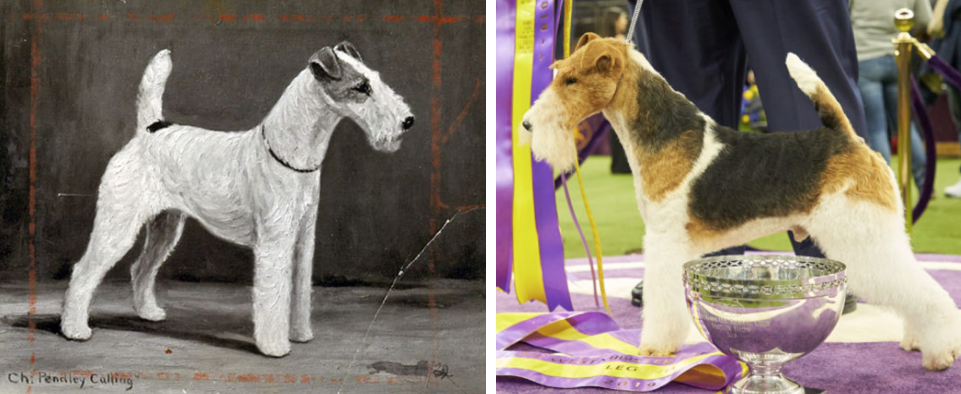
Although it’s now customary to retire Westminster Kennel Club Dog Show winners, back in 1930 a wire terrier called Pendley Calling of Blarney won Best of Show in 1930 and won the title again the following year. Alice Frankforter was on hand for the event, but found the people at the show every bit as diverting as the animals. Some excerpts…

DOGGONE FUN…The 1932 Westminster Kennel Club Dog Show at Madison Square Garden. (westminsterkennelclub.org)

REIGN OF TERRIER…Wire Fox Terrier Pendley Calling of Blarney, left, won back-to-back Westminster Kennel Club Best of Show titles in 1930-31. At right, King’s Best of Show win in February 2019 made him the 15th Wire Fox Terrier in Westminster history to earn the top prize. Terriers are by far the winningest breed at Westminster. (aka.org)

 *  *  *

Why Can’t We Be Friends?

Robert Benchley struck a pre-emptive pose in his review of a new Broadway play titled Rebound — written by his good friend (and fellow Algonquin Round Table alumnus) Donald Ogden Stewart (1894-1980) — and responded to “a chorus of yawps” that accused him of log-rolling…

A FRIEND INDEED…Robert Benchley (right) said his friendship with playwright and screenwriter Donald Ogden Stewart (left) had no influence over his review of Stewart’s latest play, Rebound. It seems Benchley was in safe territory here, since Stewart’s output was generally high in quality. Indeed, in 1940 Stewart would win an Academy Award for Best Adapted Screenplay for the The Philadelphia Story. (IMDB/theattic.space)

 *  *  *

Georgia On His Mind

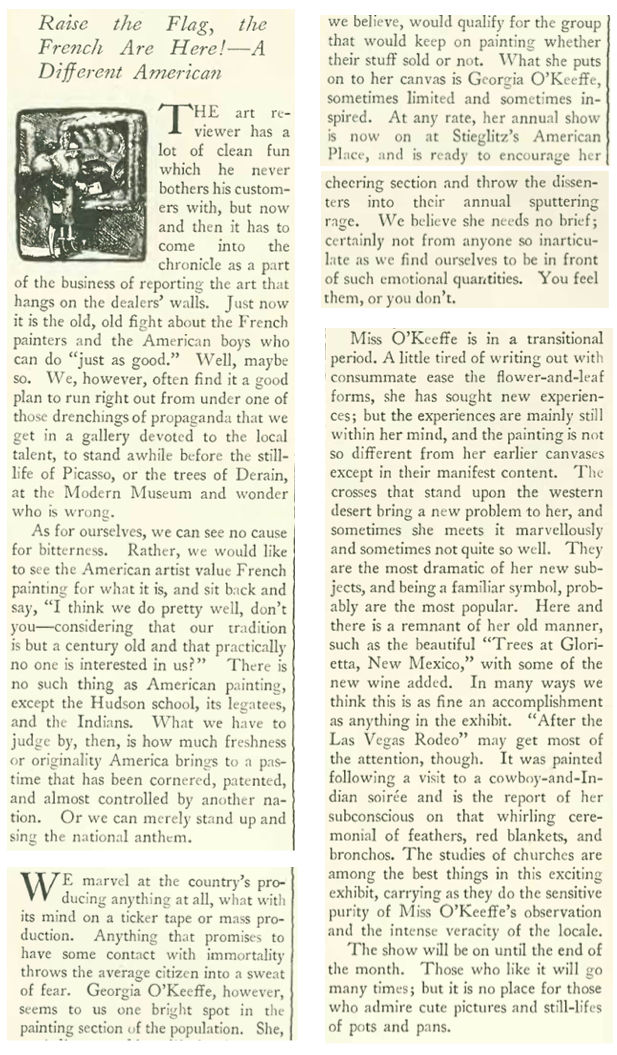
The opening of the Museum of Modern Art in late 1929 had a profound effect on The New Yorker’s art critic Murdock Pemberton. In the beginning he dismissed the museum as just another place for the old money crowd to throw parties, but with the opening of its third exhibition, “Painting in Paris” — which featured an extensive display of the works of French modernists — Pemberton began to come around to the idea that this new MoMA was a place to see groundbreaking works of art. In his Feb. 15 column Pemberton looked beyond France for signs of talented modernists in the States, and found only one who stood out — Georgia O’Keeffe.

MOD COUPLE…Clockwise, from left, Alfred Stieglitz attached this photograph to a letter for Georgia O’Keeffe, dated July 10, 1929; Georgia O’Keeffe Exhibition of Paintings (1919-1934), at Stieglitz’s An American Place gallery, 1935; O’Keeffe’s Trees at Glorieta, New Mexico, 1929. (Beinecke Library, Yale/Georgia O’Keeffe Foundation)

 *  *  *

From Our Advertisers

Just as hemlines were dropping after the stock market crash, so were the brims of women’s hats — the flapper caps of the 1920s now sprouted droopy ears…

…this ad for Chase and Sanborn coffee featured a weirdly distended image of the writer and humorist Irvin Cobb

…Cobb as he actually appeared, circa 1930…

(talesofmytery.blogspot.com)

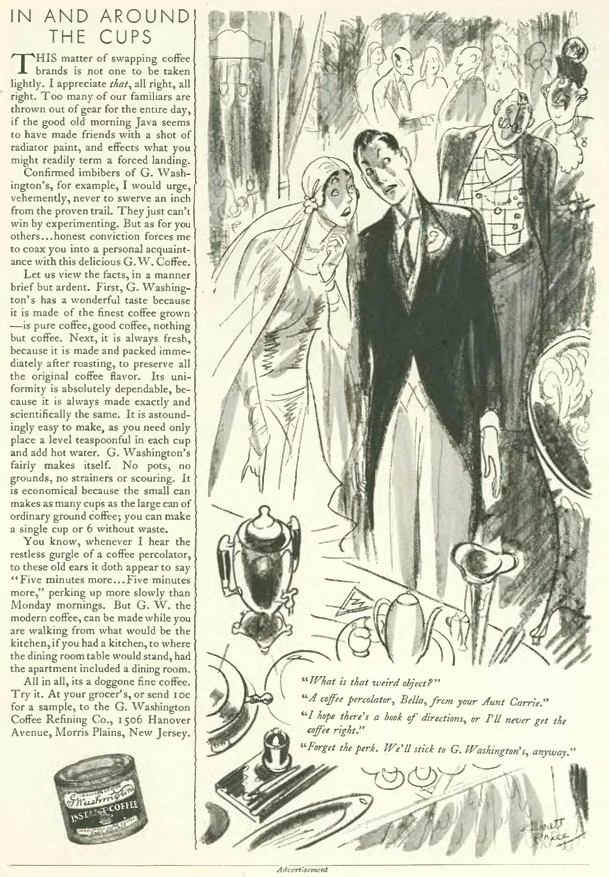
…G. Washington coffee, on the other hand, continued to draw from The New Yorker’s stable of cartoonists, including Garrett Price, for its illustrated ads…

…I was surprised to see this ad for two reasons: I wasn’t aware floss was in common use 90 years ago, or that it once came in the handle of a toothbrush…

…and then we have this sad little back page ad (just above a tiny ad for piano lessons) promoting Peggy Joyce’s ghostwritten “tell all” — Men, Marriage and Me. A former Ziegfeld girl and occasional actress who cultivated fame for fame’s sake, Joyce (1893-1957) was mostly known for her six marriages and extravagant lifestyle. By feeding the media a steady stream of scandals and other adventures (she often received reporters in her bedroom, dressed in a see-through negligee) she remained in the celebrity spotlight throughout the 1920s…

Peggy Joyce in 1923; cover of the first edition of her “tell all” — Men, Marriage and Me. Celebrated in the 1920’s as a swinging golddigger, her fame quickly evaporated into the mists of the Great Depression. (Wikipedia/Abe Books)

…speaking of celebrity, advertisers were so eager for endorsements of the famous that even “Mrs. Ring Lardner” (Ellis Abbott) got a piece of the action…

…as travel by airplane became more fashionable, automobile manufacturers increasingly paired their products with flying machines…

…for those who wished to stay on the ground, the Pickwick-Greyhound bus system featured “Nite Coaches” with 14 sleeping compartments (for 28 passengers), hot and cold water in each compartment, and hot meals served by stewards…

…on to our comics, Isadore Klein illustrated the excitement of heavyweight boxing…

Perry Barlow paid a visit to a writer and his dimwitted visitor…

Helen Hokinson looked in on a prep school dance…

Barbara Shermund demonstrated the finer points of beauty…

…and we end with Peter Arno, and one woman’s plan for a costume party…

Next Time: Five Years in the Making…

Waldorf’s Salad Days

While Manhattan is home to some of the world’s most iconic buildings, it is also known for knocking them down. Sometimes it was a matter of changing tastes, but more often than not it was the steamroller of economic progress that flattened any sentimental soul that stood in its path.

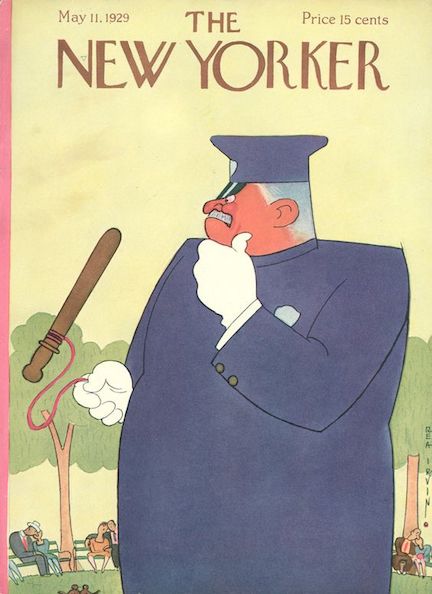
May 11, 1929 cover by Rea Irvin.

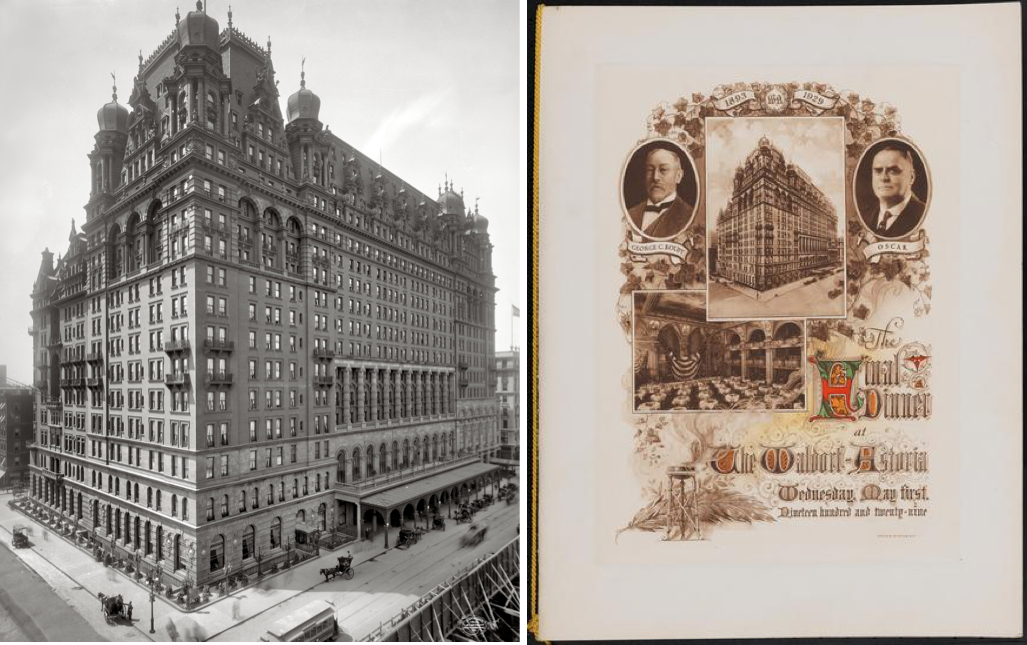
The old Waldorf-Astoria symbolized the wealth and power of the Gilded Age, but in the Roaring Twenties the storied hotel — with all its Victorian turrents, gables and other doo-dads — looked hopelessly dated despite being just a bit over 30 years old (the Waldorf opened in 1893, and the much larger Astoria rose alongside it four years later). A group of businessmen, led by former mayor Al Smith, bought the property to build the Empire State Building — an art deco edifice that would scream Jazz Age but would be completed at the start of the Great Depression. The New Yorker’s James Thurber reported on the old hotel’s last day in the May 11, 1929 “Talk of the Town”…

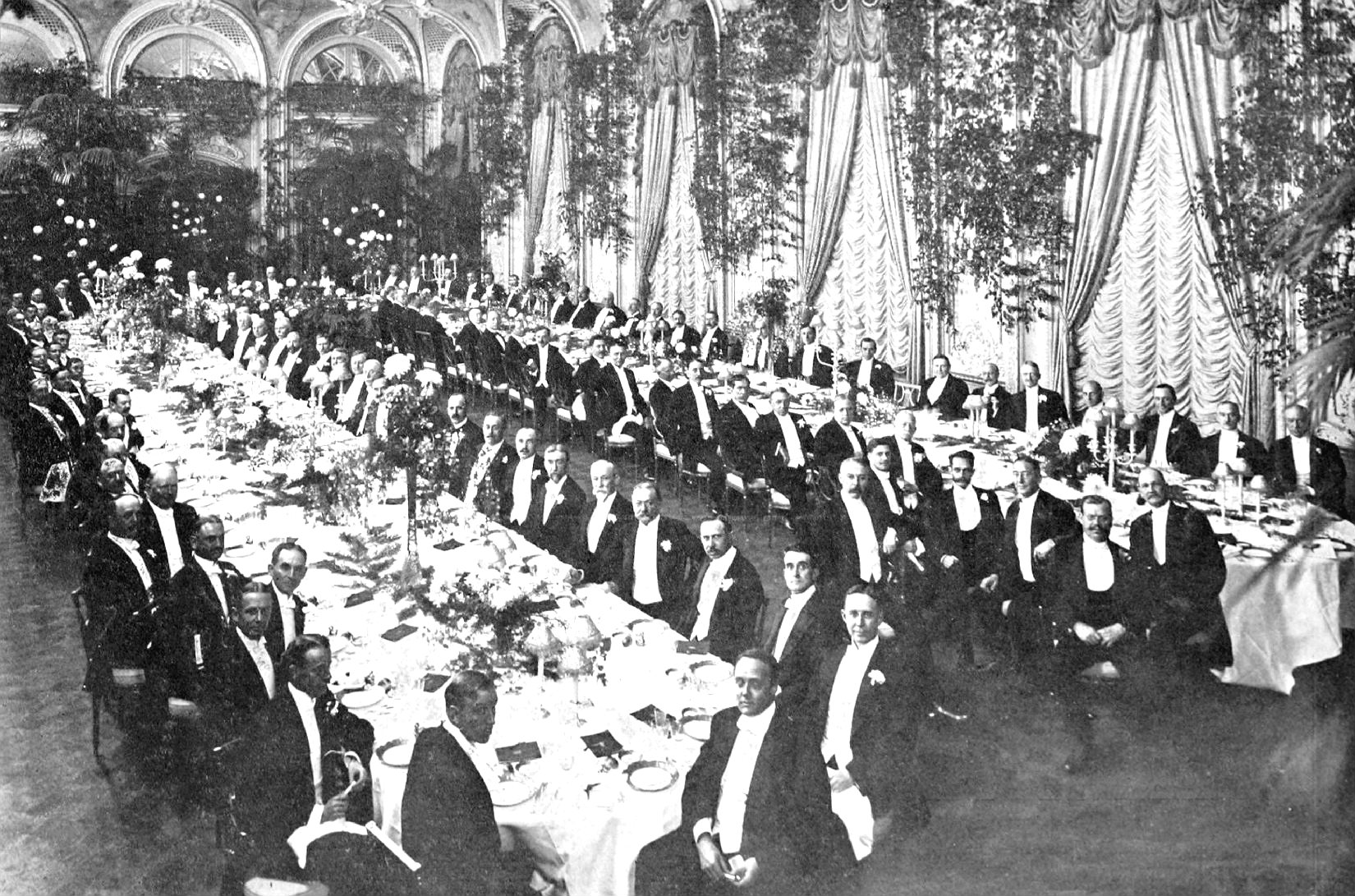
THEY LIKED RICH FOOD…1909 banquet in the Grand Ballroom at the Waldorf-Astoria honoring US Steel founder Elbert Gary. (Wikimedia Commons)

Thurber wrote of the hundreds of club women who mourned the loss of their familiar meeting rooms, and one elevator operator who would not be joining their chorus of sobs…

HEYDAY…the old Waldorf-Astoria hotel circa 1900, and the cover for the menu announcing “The Final Dinner.” The menu included a cherrystone clam cocktail, turtle soup, crown of bass (in lobster sauce), mignon of spring lamb (chasseur), supreme of guinea hen (tyrolienne), bombe mercedes ice cream, and coffee. (Bowery Boys/Museum of the City of New York)
THEY’RE SELLING YOU…Illustration depicting an auction of items from the hotel. (Museum of the City of New York)

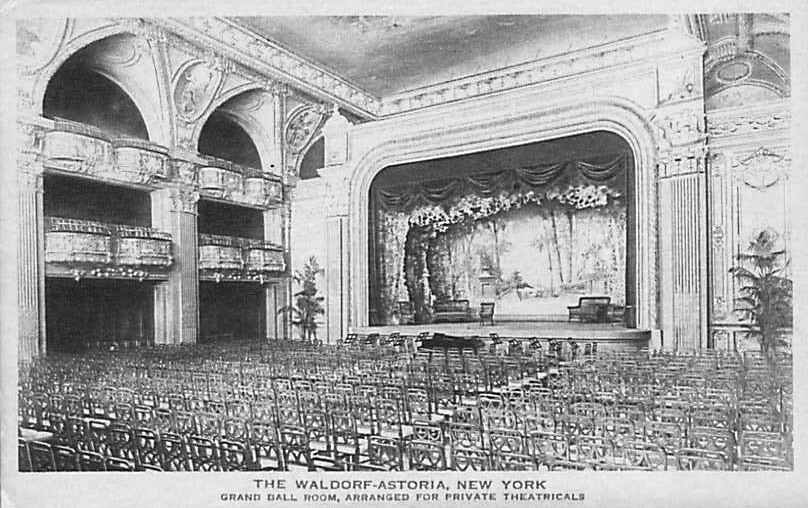
In the “Reporter at Large” column, humorist Robert Benchley supplied his own perspective on the closing of the venerable hotel, and the countless speeches that reverberated between its walls…

A 1903 image of the Grand Ball Room, “arranged for private theatricals. “(New York Public Library)

Benchley offered excerpts from dozens of hypothetical speeches, and then offered this final benediction to the old hotel:

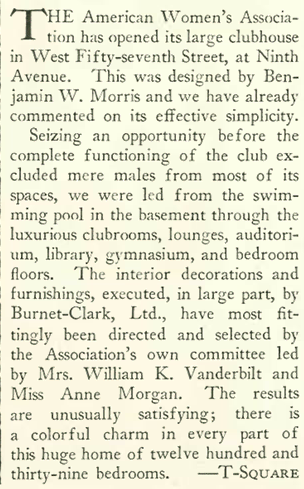
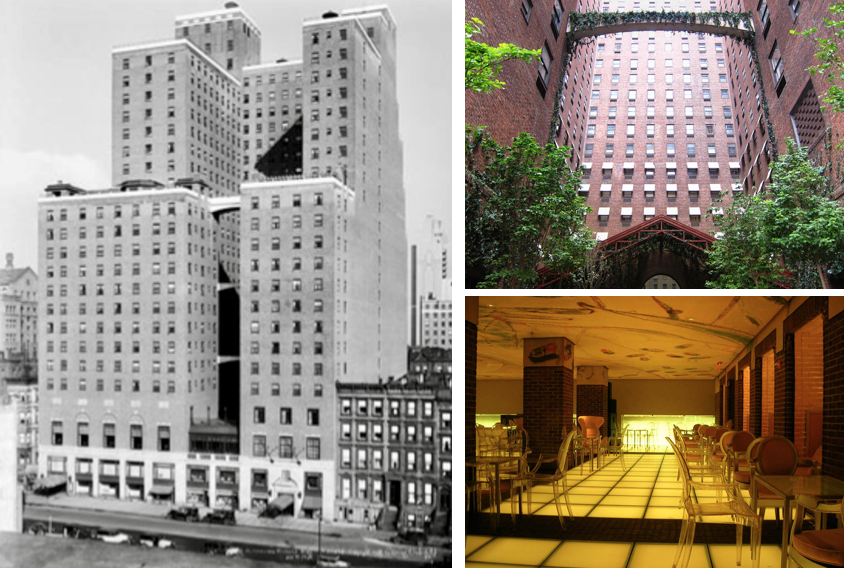
In his “The Sky Line” column, architecture critic George S. Chappell (aka T-Square) looked in on the newly completed American Woman’s Association clubhouse and residence for young women on West 58th Street. Developed by Anne Morgan, daughter of J.P. Morgan, the building contained 1,250 rooms and featured a swimming pool, restaurant, gymnasium and music rooms along with various meeting rooms.

TRAINING GROUND…At left, the American Woman’s Association clubhouse and residence in 1932. At right, view of the central atrium of the AWA residence, now the Hudson Hotel. Below, the Hudson Bar (renovated after 1997), which has been featured in a number of TV shows including Gossip Girl and Sex and the City. (Liza DeCamp/Nan Palmero top right/RoryRory bottom)

In a 1998 New York Times “Streetscapes” feature, Christoper Gray cites a 1927 Saturday Evening Post interview with Anne Morgan, who said she believed women were at a temporary disadvantage in the business world and therefore founded the American Woman’s Association as “a training school for leadership, a mental exchange” where women “can hear what other women are doing.” After the AWA went bankrupt in 1941, the building was converted into The Henry Hudson Hotel, open to both men and women. From 1982 until 1997 the building’s second through ninth floors served as the headquarters for public television station WNET. The MacNeil/Lehrer NewsHour (now the PBS NewsHour) was broadcast from the building during that time.

*  *  *

Punching for Peace

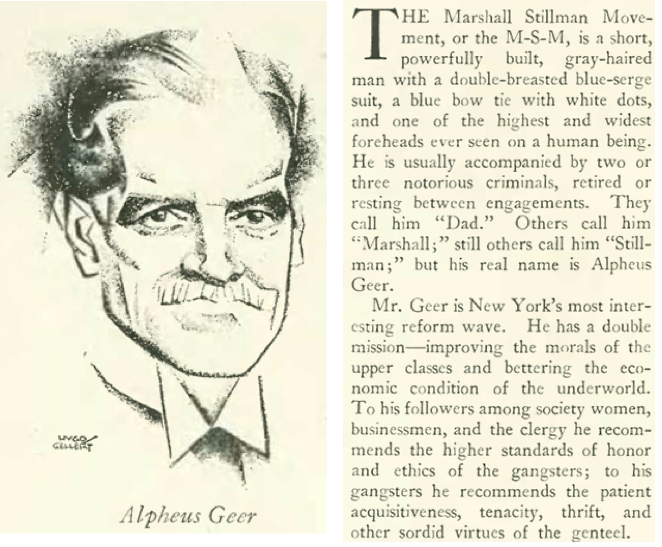
The old New Yorker was filled with personalities virtually unknown today, but who had tremendous influence in their time. Among them was Alpheus Geer (1863-1941), who founded the Marshall Stillman Movement, which promoted the sport of boxing as a way to steer young men away from a life of crime. An excerpt (with illustration by Hugo Gellert):

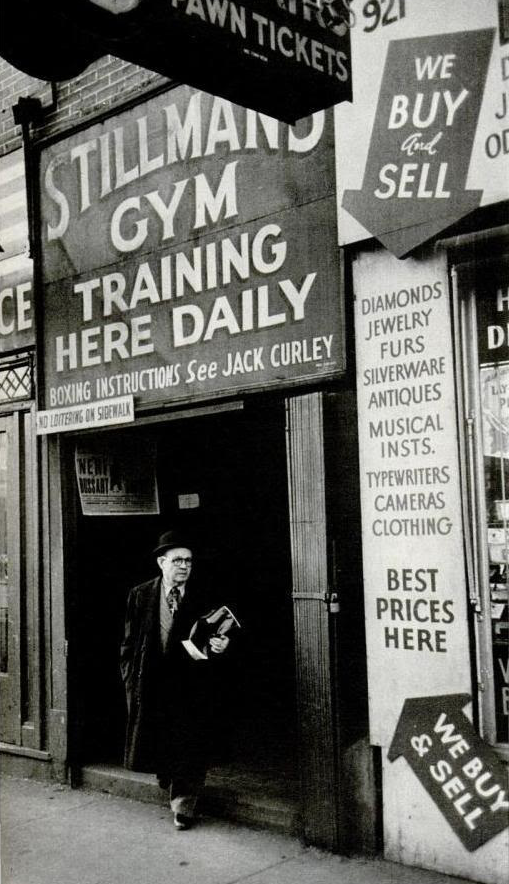
Alpheus Geer help found Stillman’s Gym in 1919 as a way to promote his Marshall Stillman Movement methods of boxing. Many famous fighters trained in the dank, smoky atmosphere of Stillman’s, including Jack Dempsey, Joe Louis and Rocky Marciano. Pictured above is famed boxing trainer Charley Goldman leaving Stillman’s Gym, circa 1940s. (easthamptonstar.com)

 *  *  *

Before we turn to the ads, this “Out of Town” column from the back pages struck an unusual tone regarding the types of tourists planning a summer in Germany…

…and from our advertisers, this ad promoting Louis Sherry’s new “informal restaurant” at Madison and 62nd Street…

WHAT’S IN A NAME…The Louis Sherry restaurant at Madison and 62nd, circa 1930. At right, the building today, now occupied by the French fashion company Hermès. (McKim, Mead & White / nycarchitecture.com)

Louis Sherry ran a famous restaurant at Fifth Avenue and 44th Street from 1898 to 1919 (like many famed restaurants, Prohibition helped put an end to it). Sherry died in 1926, so the owners of the new restaurant were merely trading on his name. In addition to a “delicacies shop” (gourmet foods were arrayed in the plate glass windows) Louis Sherry also contained a tea room, ice cream parlor and a balcony restaurant…

…like the Sherry restaurant, the new Hotel Delmonico traded on the fame of the old Delmonico’s Restaurant, which also fell victim to Prohibition by 1923. Today the hotel is best known as the place where the Beatles stayed in August 1964…

…here is another ad from Clicquot Club trying its best to sell its aged “Ginger Ale Supreme” to dry Americans. Famed avant-garde-art patron and party host Count Etienne de Beaumont (who looked like he’d had a few of something) testified how Cliquot “blends very agreeably” with the champagne most Americans cannot have…

…well, if you couldn’t have a legal drink, maybe you could entertain your friends with TICKER…”The New Wall Street Game That is Sweeping America!” My guess is this game didn’t sell so well after Black Tuesday, Oct. 29, 1929…

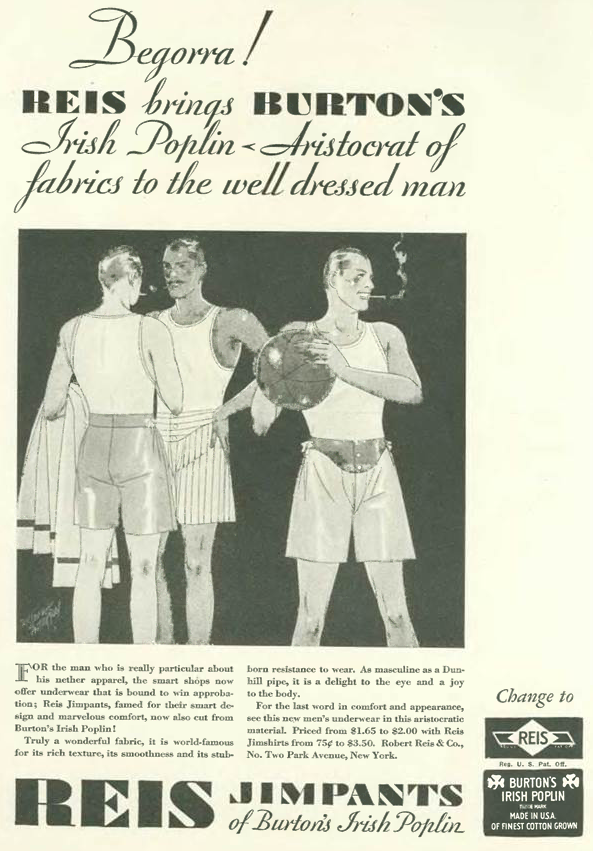
…those BVD’s aren’t good enough for you? Then try the “Aristocrat of fabrics” (and have a smoke while you toss the medicine ball around with the gents)…

…and here is more evidence that the Roaring Twenties were losing their growl even before the big crash—the straight flapper figure was out; it was now the “season of curves”…

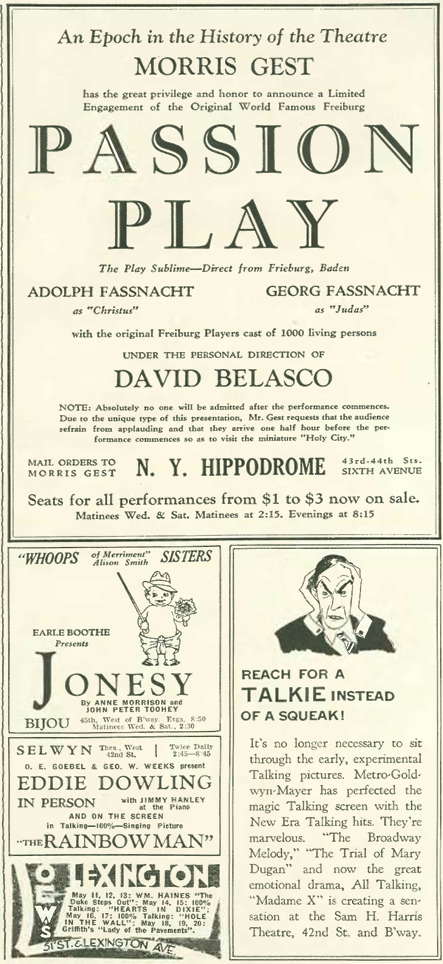
…a look at some of the cheap ads in the back of the magazine, including the one at bottom left from the Sam Harris Theater that played on the Lucky Strike cigarette slogan (“Reach for a Lucky instead of a sweet!”)…

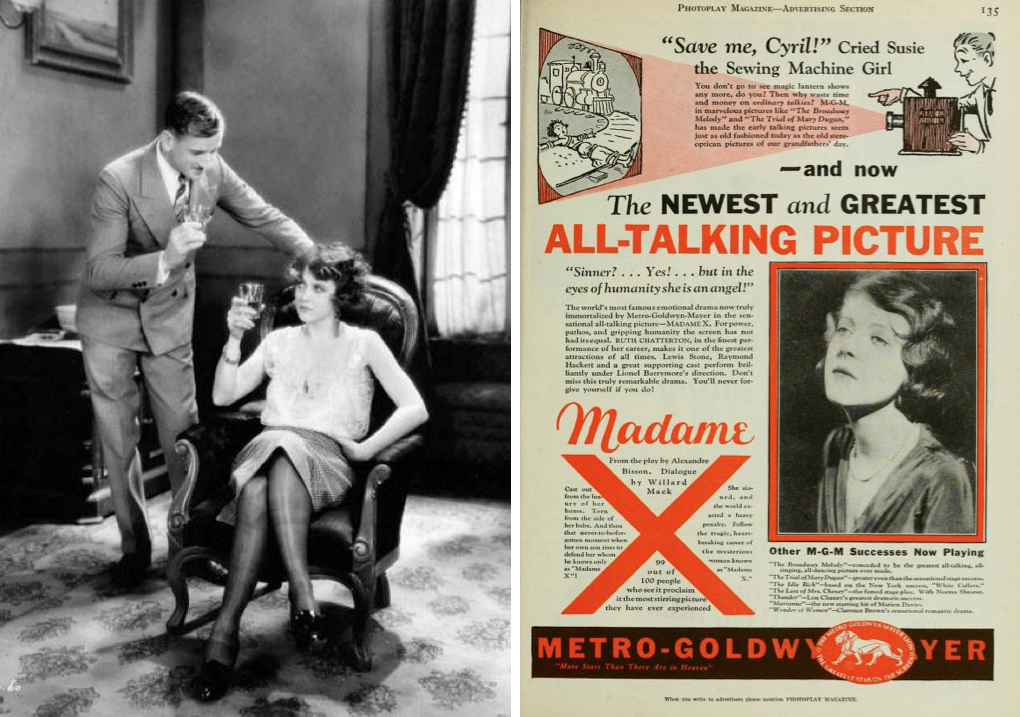
…one of the films featured at the Sam Harris Theatre was Madame X, a movie about a woman who leaves her wealthy (but cold) husband, turns to a life of crime, then tries to reclaim her son. The ad is correct in that it did create something of a sensation when it was released. It is also important to note that the film premiered at the Sam Harris for a reason: The director, Lionel Barrymore, didn’t want audiences to think his film was just another song and dance picture (like most of the first sound films) but rather a serious drama presented at a legitimate stage venue rather than a movie house…

UP TO NO GOOD…Ullrich Haupt as the cardsharp Laroque and Ruth Chatterton as Jacqueline Floriot in Madame X. At right, ad in Photoplay promoting the film. Click to enlarge. (Wikipedia/IMDB)

…back to our ads, here’s a remarkably crude one from the racist misogynists who made Muriel cigars (they being Lorillard, who also manufactured Old Golds)…

…and a softer message from The Texas Company, manufacturer of Texaco “golden” motor oil…

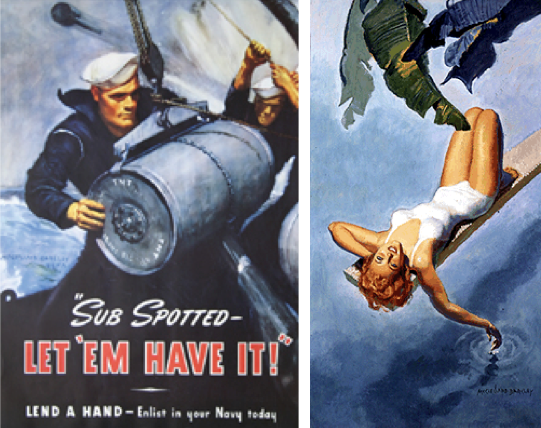
…the artist who rendered the above couple in those golden hues was American illustrator McClelland Barclay (1891-1943). Published widely in The Saturday Evening Post, Ladies’ Home Journal, and Cosmopolitan, Barclay was known for war posters as well as pin-ups:

VERSATILE…Navy recruitment poster by McClelland Barclay, and an illustration for the cover of a 1942 Saturday Home Magazine. (Wikipedia/illustrationhouse.com)

In 1940 Barclay reported for active duty in the US Navy, serving in the New York recruiting office and illustrating posters. Determined to be a front-line combat artist, he served in both the Atlantic and Pacific theatres until he was reported missing in action after his boat was torpedoed in the Solomon Islands.

 *  *  *

Our comics are supplied by Alan Dunn, who probed the vagaries of movie magazine gossip…

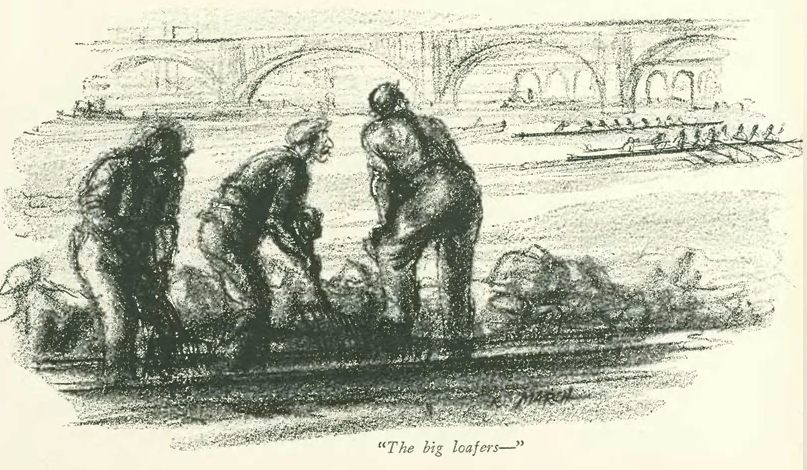
…and Reginald Marsh, known for his social realistic depictions of working life in New York, including these stevedores eyeing a regatta…

…and finally, Gardner Rea looked in on a young man displaying early signs of cynicism…

Next Time…How Charles Shaw Felt About Things…


The Tastemakers

Modernism in interior design gained a wider audience in the 1920s thanks in part to a series of major exhibitions sponsored by some of New York City’s leading department stores.

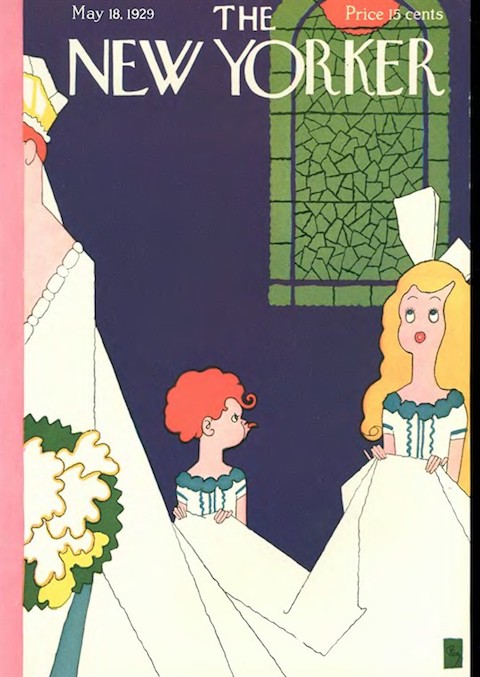
Sept. 29, 1928 cover by Rea Irvin.

Although The New Yorker continued to feature advertisements for traditional styles of furniture, such as this one from the Sept. 22, 1928 issue…

…it was clear that the appetites of the city’s younger “smart set” were being whetted by retailers such as Macy’s, who in May 1927 hosted an “Exposition of Art in Trade” that included 100 exhibitors of modern European and American silver, pottery, books, textiles and furniture. The following spring Macy’s hosted the “International Exposition of Art in Industry,” where more than 250,000 visitors saw the work of more than 300 exhibitors from six countries. (This blog’s opening photo features a 1928 sideboard by Kem Weber, one of the exhibitors at Macy’s 1928 show. Photo courtesy Cooper Hewitt Collection).

TRENDSETTERS…R. H. Macy & Co. hosted the International Exposition of Art in Industry in the spring of 1928. At right, an interior scene at the exposition, with a chair designed by Walter Von Nessen. (socalarchhistory.blogspot.com/wright20.com)

Macy’s inspired other exhibitions by such retailers as Wanamaker’s, Abraham & Straus, Frederick Loeser, Lord & Taylor, and B. Altman & Co., which advertised its “20th Century Taste in the New Expression of the Arts in Home Furnishings” in the Sept. 29, 1928 issue of The New Yorker:

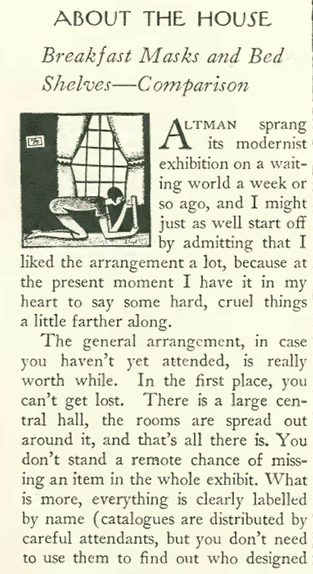
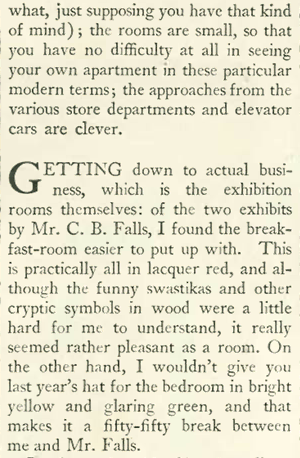
Writer Bertram Bloch reviewed the exhibit in the Oct. 6 issue. Although he suggested that he had some “hard, cruel things” to say about the show, overall he believed it something not to be missed. Excerpts:

THE SMART LOOK…B. Altman & Company showcased designs including, clockwise, from upper left, a dining room by Charles B. Falls; a conversation room by Steele Savage; a bedroom by Charles B. Falls; and a salon section by Dominique. (Art Institute of Chicago)
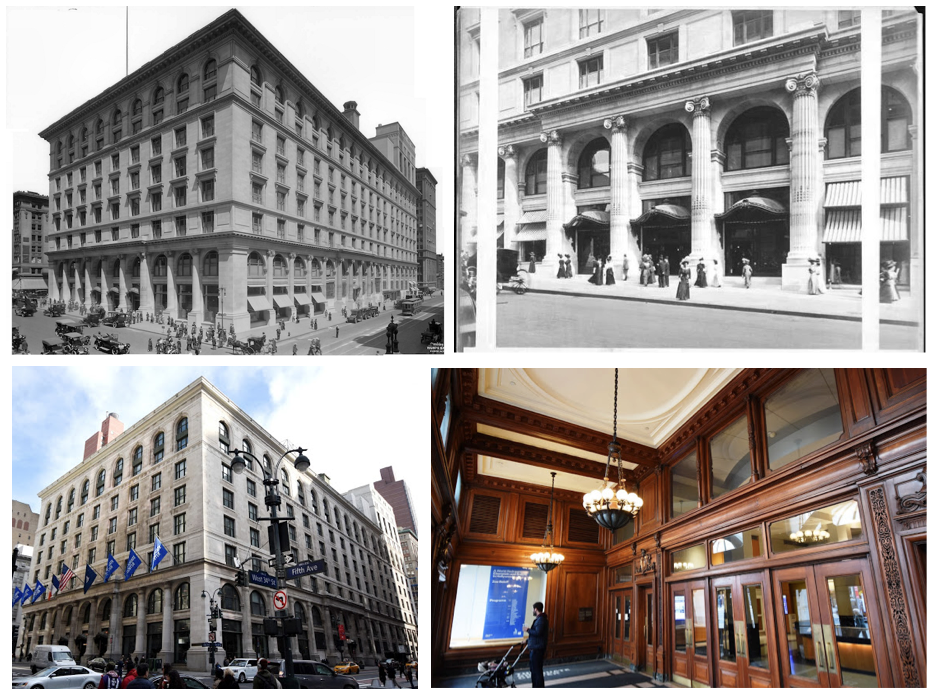
FADED GLORY…Clockwise, from upper left, The B. Altman flagship store at 34th Street and 5th Avenue and a closer view of the front entrance in 1915; closed in 1989, the flagship store is now used by the Graduate Center of the City University of New York, among other tenants. The mahogany-paneled Fifth Avenue foyer survives intact, however the exterior looks a bit hosed-down, with the Ionic capitals removed from the columns as well as the lintels that banded the windows and the cornice on top. (Museum of the City of New York/daytonianinmanhattan)

While on the topic of modern furniture, Ilonka Karasz, who painted a total of 186 New Yorker covers from 1924 to 1973, showcased her own furniture designs (along with other artists from the American Designers’ Gallery), at an exhibition the following month.

NEW YORKER COVER ARTIST Ilonka Karasz designed this dining room for the American Designers Gallery Exhibition in October 1928.  (Art Institute of Chicago)

 *  *  *

The Singing Fool

The New Yorker generally detested the introduction of sound in motion pictures, but for some reason didn’t mind it so much when Al Jolson opened his mouth. This time he followed up his blackface performance in The Jazz Singer with another blackface routine in The Singing Fool. E.B. White wrote about the film’s big opening in “The Talk of the Town”…

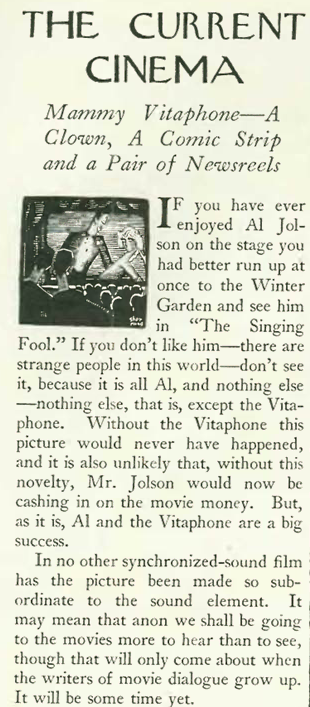
…and in the magazine’s film review section, yet more praise for Jolson, whose singing apparently compensated for the mediocre dialogue:

SERVED WITH A SIDE OF HAM…One of a series of promo slides for The Singing Fool, featuring Al Jolson, child actor Davey Lee, and the saccharine lyrics for Sonny Boy, said to be the first pop record to sell more than million copies. (nitrateville.com)
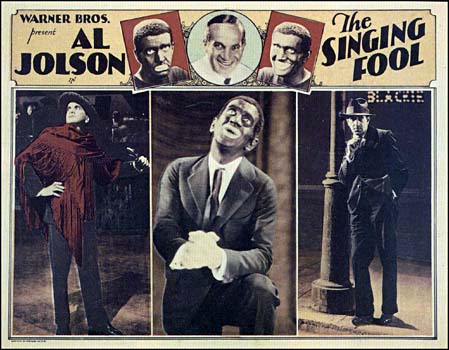
THAT WAS ENTERTAINMENT…Theatre lobby card for 1928’s The Singing Fool. (IMDB)

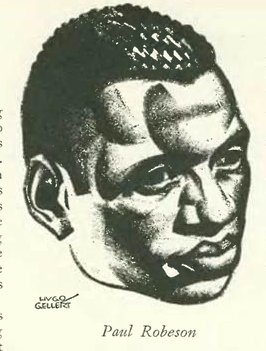
The Sept. 29 issue illustrates the dichotomy in how The New Yorker depicted African Americans in the 1920s. Blacks in the magazine’s cartoons and illustrations were often portrayed as exaggerated characters from minstrel shows. However, a serious artist like Paul Robeson received a much different treatment. Indeed, the magazine shamed the racism of a fictional character in Dorothy Parker’s short story “Arrangement in Black and White” (Oct. 8, 1927), in which a wealthy, white woman condescends to a black singer who might well have been modeled after Robeson. The journalist and author Mildred Gilman profiled Robeson in the very same issue that praised Jolson’s tired blackface routine. An excerpt, accompanied by a Hugo Gellert illustration:

*  *  *

Next Time Wear a Disguise

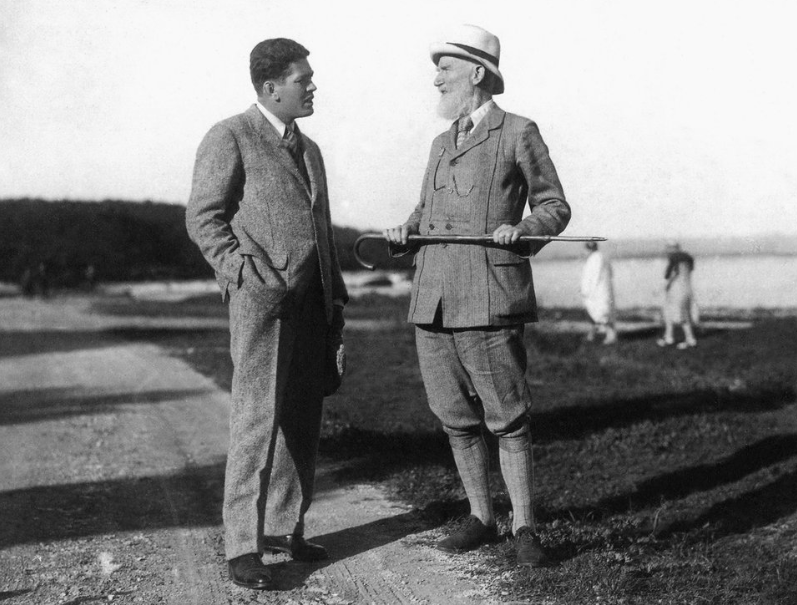
The newlywed Gene Tunney, newly retired from boxing, was spending some time in Europe, probably hoping to get a break from the adoring crowds back in the States. Upon entering a French café with his friend, the author Thornton Wilder, he soon discovered that adoring crowds awaited him on the other side of the pond, as related by The New Yorker’s Paris correspondent Janet “Genêt” Flanner:

ENJOYING SOME DOWN TIME…The boxer Gene Tunney, left, and the writer George Bernard Shaw on a 1929 vacation to Brioni. (Associated Press)

 *  *  *

From Our Advertisers

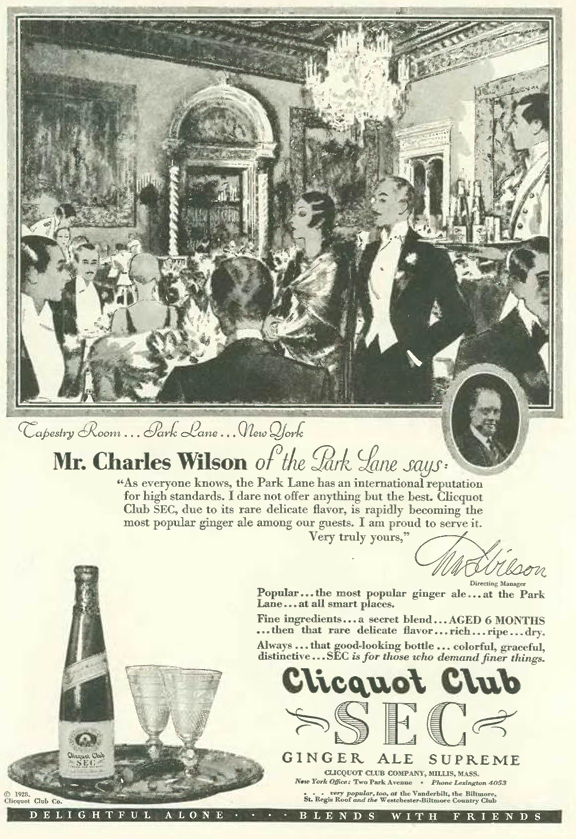
Although by 1928 Americans (and particularly New Yorkers) were flouting Prohibition laws, alcoholic beverages still could not be legally produced or marketed (except for “religious” or “medicinal” purposes). Advertisers, however, found clever ways to market non-alcoholic beverages like ginger ale with the allure of liquor or fine wine. But then again, few were actually drinking straight ginger ale…

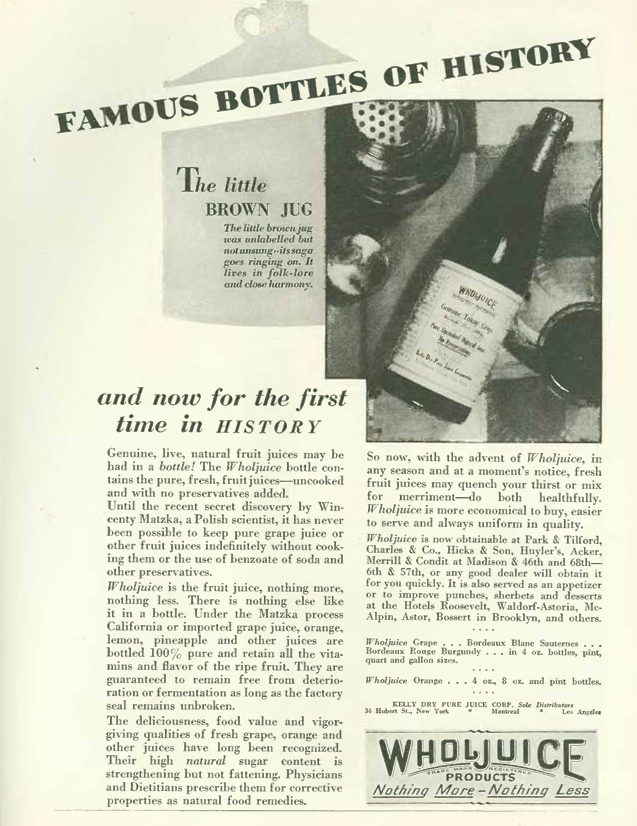
And if you formerly grew grapes for winemaking, what’s preventing you from selling unpasteurized grape juice that remains free from fermentation “as long as the factory seal remains unbroken”…? Also, note the not-so-subtle cocktail shaker at the top left of the photo:

And for our cartoons, Barbara Shermund explored the modern ways of love…

…while Peter Arno continued probing the comic imbalance of rich old men and their young mistresses…

Next Time: A Bird’s Eye View…