Harold Ross founded The New Yorker as a sophisticated humor magazine, so when events in the city or the world took a serious turn, the writers and editors did their best to maintain its waggish tone.
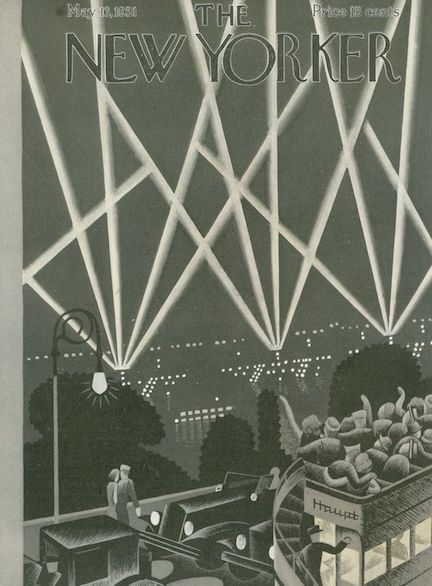
May 16, 1931 cover by Theodore Haupt.
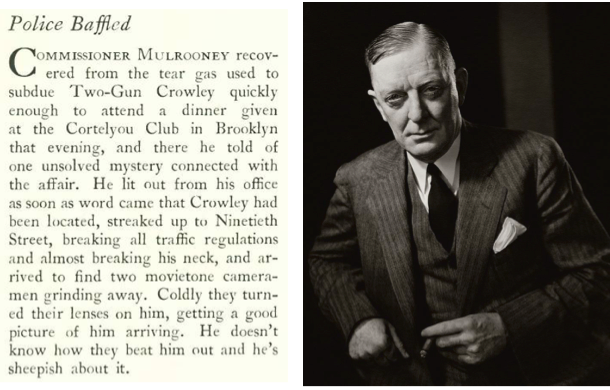
After two cold-blooded killers engaged police in a heated gun battle from a West 91st Street rooming house, the May 16, 1931 “Talk of the Town” had this to say about the incident:
At right, a 1933 portrait of Portrait Of Edward Mulrooney, Police Commissioner of New York City, by Edward Steichen. (Conde Nast)
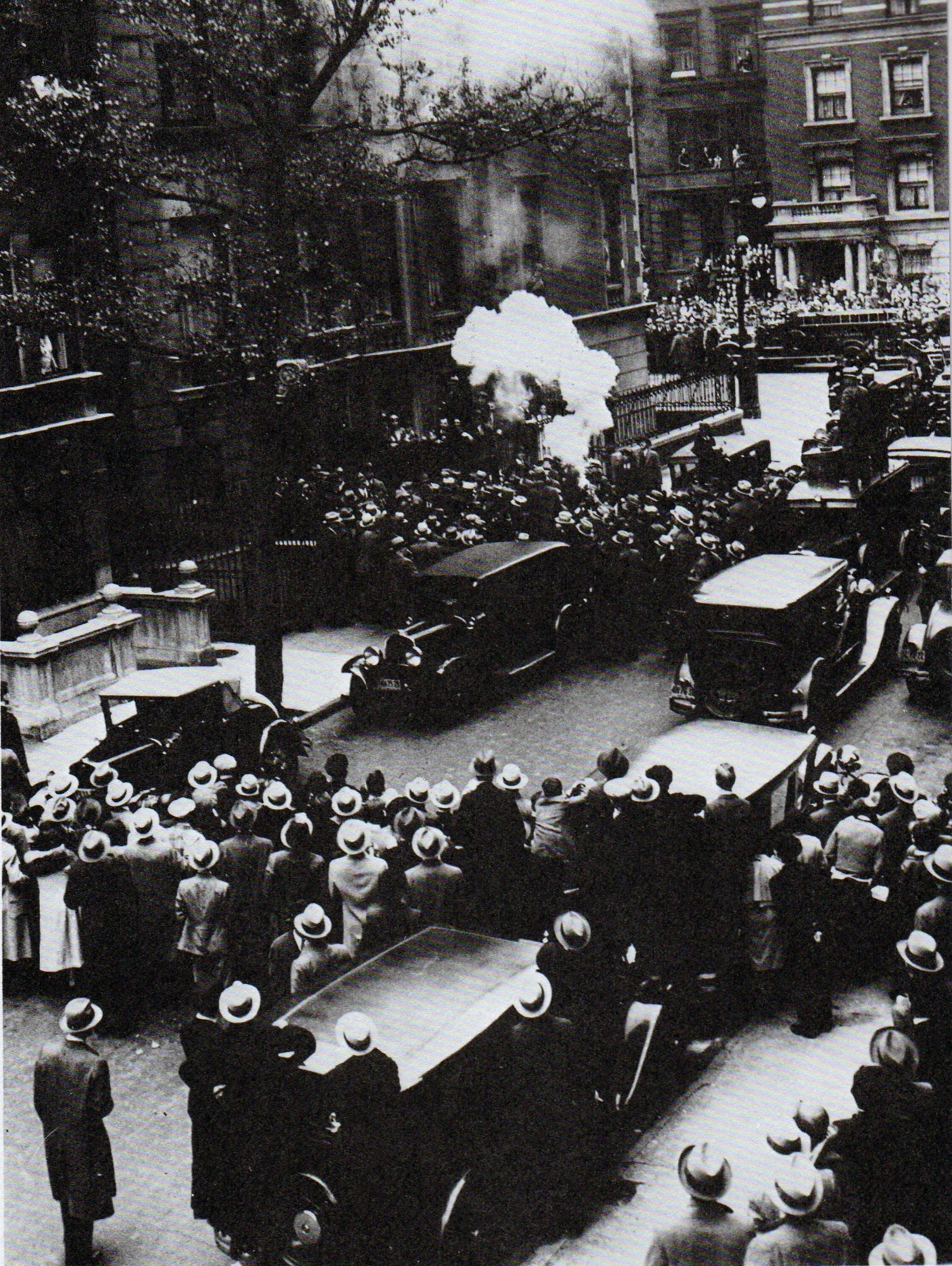
The New Yorker wasn’t alone in finding entertainment value in the gun battle. Safety standards were quite different in the 1930s, so as police exchanged heavy gunfire with 18-year-old Francis “Two Gun” Crowley, a crowd of 15,000 bystanders surrounded the scene, some just yards away from the action as the photo below attests:
THEY NEEDED SOCIAL DISTANCING…On May 7, 1931, Francis “Two Gun” Crowley exchanged gunfire with police for nearly two hours from the fifth floor of a rooming house on West 91st Street. A force of 300 police fired an estimated 700 rounds at Crowley’s apartment while a crowd of 15,000 spectators surrounded the scene. Not sure why the police stood in a huddled mass beneath the window of the shooter. Strength in numbers, perhaps. (ephemeralnewyork.wordpress.com)
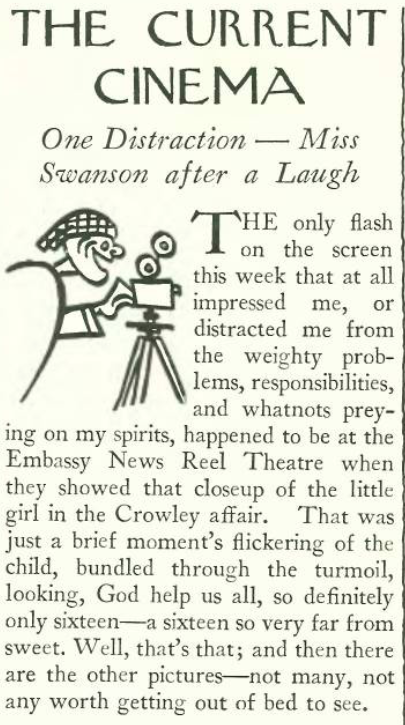
Another mention of the incident was in John Mosher’s film review column. He noted that the newsreel footage of the shoot-out was the best thing on the screen that week, and especially the moment when Crowley’s 16-year-old girlfriend Helen Walsh emerged from the building in the clutches of the police:
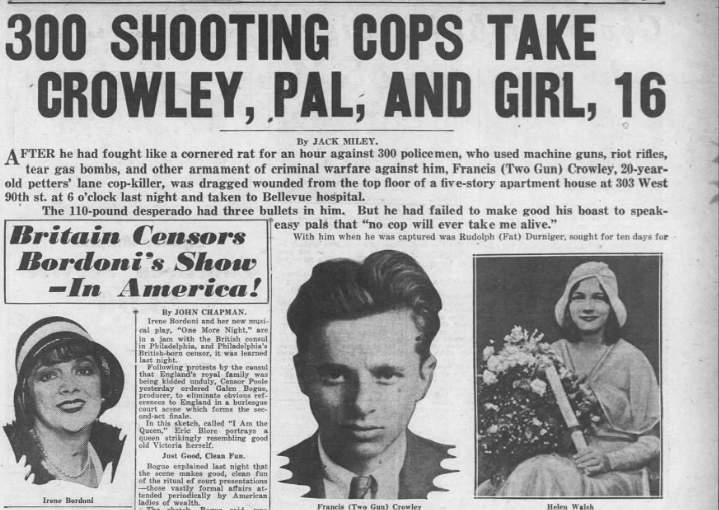
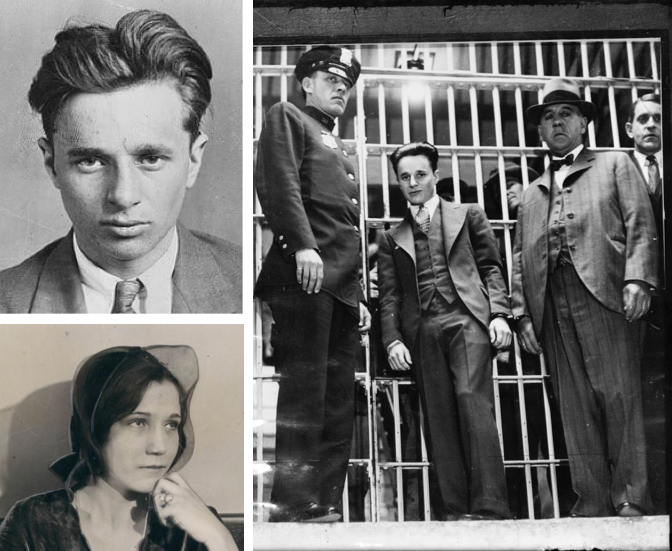
DON’T GET TOO COMFORTABLE…18-year-old Francis “Two Gun” Crowley (left) surrendered to police after suffering four gunshot wounds in the West 91st Street shootout, but would recover in time to be executed two months after his 19th birthday. At right, images from the newsreel show Crowley accomplice Fats Durringer being led away from the scene, along with Crowley’s girlfriend (bottom right), 16-year-old Helen Walsh. (Everett/YouTube)
By the end of the month Crowley was tried and convicted of the murder of a police officer, and his partner Fats Durringer was found guilty of brutally killing a dance hall hostess. Justice moved swiftly in those days, especially when the murder of a police officer was involved: On June 1, 1931—just three weeks after the shoot-out with police—Crowley and Durringer were sentenced to death. Only six months would pass before Durringer took a seat in Sing Sing’s electric chair. Crowley would follow his accomplice a few weeks later. As for Helen Walsh, she was released after testifying against Crowley and Durringer.
SHORT LIFE FOR SHORT KILLER…The diminutive Francis “Two Gun”Crowley, top, left, developed a habit of carrying more than one gun at all times, hence the nickname. At right, Crowley with officials at Sing Sing, where both he and partner Fats Durringer would meet their end in the electric chair. Below left, Crowley’s 16-year-old girlfriend Helen Walsh. Crowley was barely 19 years old when he was executed on Jan. 21, 1932. Among his last words, he asked the warden for a rag to wipe off the electric chair before he took his seat. “I want to wipe off the chair after that rat sat in it,” Crowley said, referring to Durringer, who had been executed weeks earlier, on Dec. 10, 1931. His request was denied. (www.swordandscale.com)
One final mention of the incident came from Ralph Barton, who named Police Commissioner Ed Mulrooney his “Hero of the Week”…
* * *
Sub Sandwich
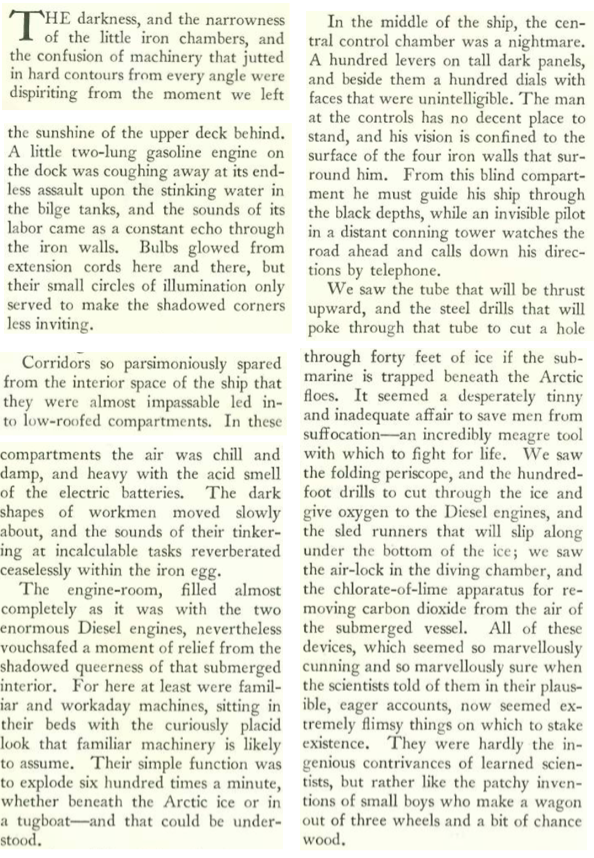
In his “Reporter at Large” column, Morris Markey paid a visit to the Brooklyn Navy Yard where Sir Hubert Wilkins and his crew were busy preparing a narrow, cramped submarine dubbed Nautilus for a trip beneath the ice of the North Pole. Markey marveled at all of the complicated devices crammed into the vessel, but at the same time wondered why anyone would stake their life on “such flimsy things”…
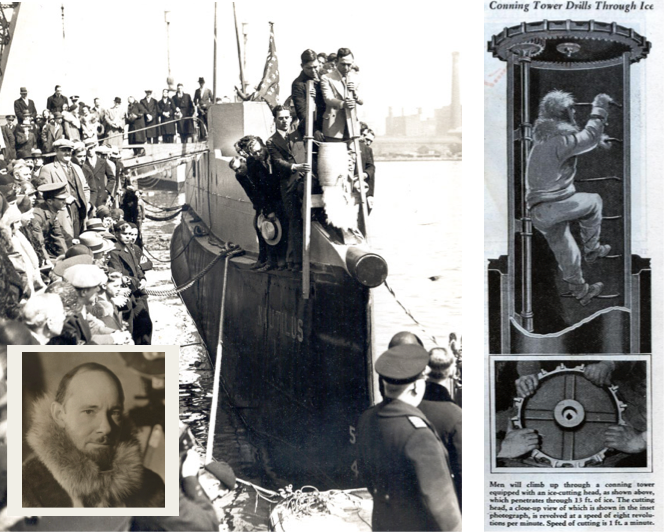
TIGHT QUARTERS…The Nautilus was a refurbished O-class submarine built in 1916 for the U.S. Navy. Somehow a crew of 20 crammed into the thing. (amphilsoc.org)The Nautilus was fitted with ice drills that would allow access to the surface of North Pole ice, as well as provide air to the crew and the vessel’s diesel engines. All this equipment was untested and unproven, since at the time submarines were not able to snorkel and had never broken through ice to reach fresh air. Click to enlarge. (Modern Mechanix)
Markey wasn’t alone in thinking such an expedition was preposterous, and from the very beginning it was beset by problems. On the very first day of preparations, March 23, 1931, a crew member fell overboard and drowned. The next day, Lady Suzanne Bennett Wilkins (Sir Hubert’s wife) christened the submarine with a bottle of ice water rather than Champagne, which was unavailable due to Prohibition.
More on this in another post, but suffice to say Sir Hubert did not succeed in this endeavor, and perhaps should have listened to the advice of the Icelandic American explorer Vilhjalmur Stefansson:
DRY DOCK…Christened with a bottle of ice water rather than Champagne thanks to Prohibition, the Nautilus expedition, led by Sir Hubert Wilkins (inset), had to overcome many obstacles to reach the North Pole, including untested equipment such as a conning tower (right) designed to drill through ice to allow crew members to reach the surface of polar ice. (amphilsoc.org)
* * *
Bright Star on Broadway
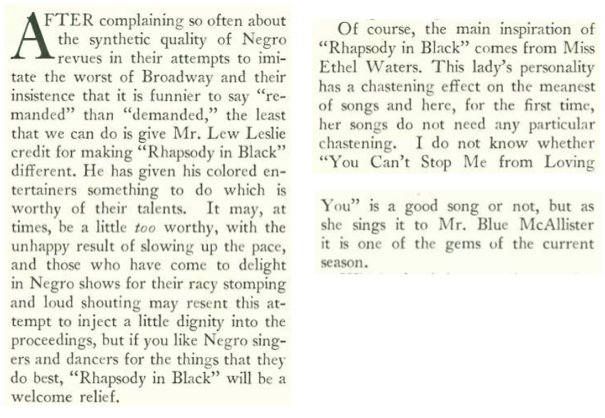
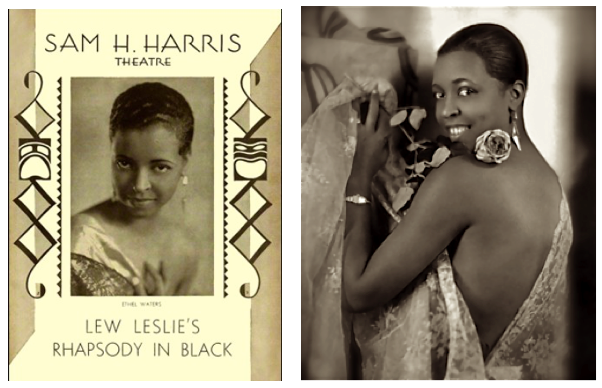
In spring 1931 Dorothy Parker subbed as theatre critic for her friend, Robert Benchley, and was greeted with a remarkably mediocre (or worse) line-up of shows. When Benchley returned to his post, things didn’t get much better until Rhapsody in Black came along with its inspiring star, Ethel Waters.
WELCOME RELIEF…Robert Benchley wrote that singer Ethel Waters had a “chastening effect” on even “the meanest of songs.” (Playbill/Carter Magazine)
* * *
Six – Love
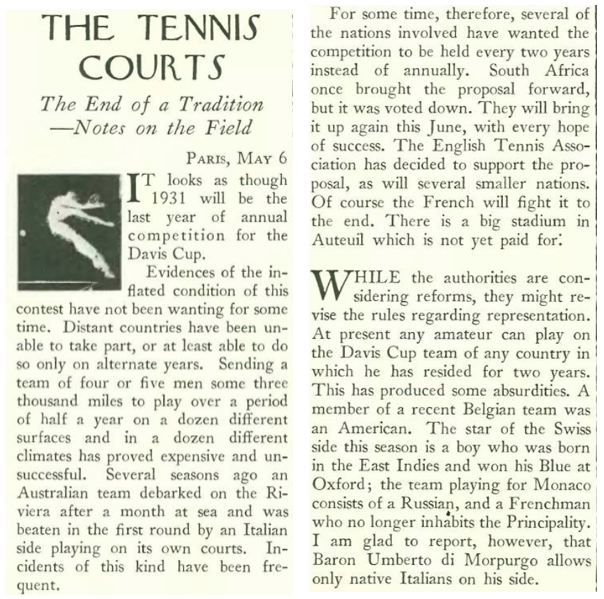
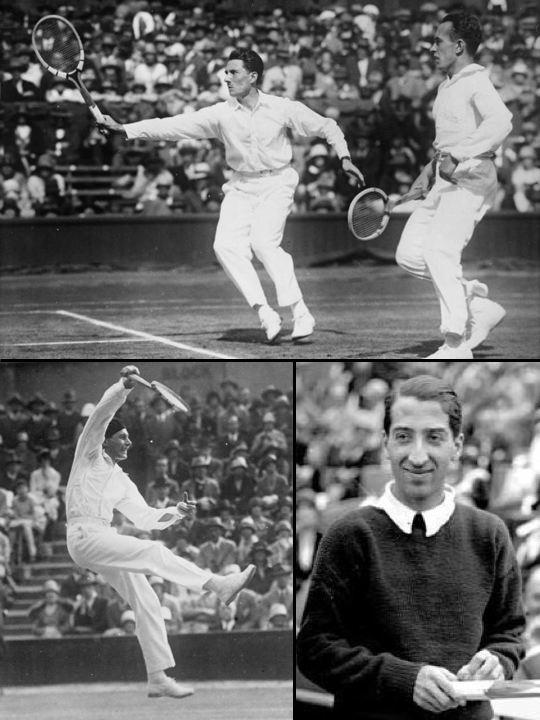
Eighty years ago sportswriter John Tunis declared that the Davis Cup international tennis competition would likely come to an end due to expense and the erosion of amateur play. Well, we know the Davis Cup is still around, and one wonders if Tunis was getting a whiff of sour grapes, since the French had won the cup five years straight, and would win again in 1932.
JEU, SET ET MATCH!…Dubbed Les Quatre Mousquetaires (“The Four Musketeers”), the French team of Jacques Brugnon and Henri Cochet (top), Jean Borotra (bottom left), and René Lacoste (bottom right) led France to six straight Davis Cup wins, 1927–1932. (Wikipedia)
* * *
Old Gloria
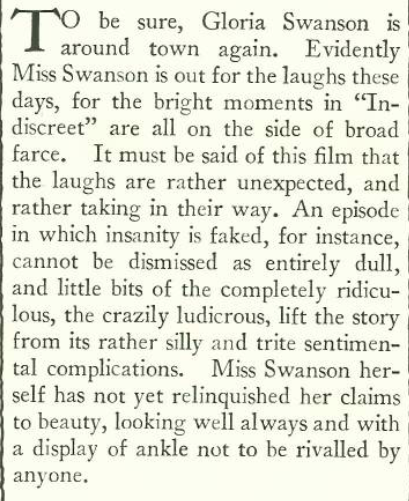
To be fair, Gloria Swanson was only 32 years old in 1931, but she was so deeply associated with the silent era that by the 1930s she seemed positively ancient (a status that she would brilliantly use to her advantage in 1950’s Sunset Boulevard). Mosher offered this “meh” review of her latest work — only her second completely-sound film — Indiscreet.
WHERE’S THE DOOR?…Ben Lyon seems perplexed by Gloria Swanson’s attentions in this theatre lobby card promoting Indiscreet. At right, Swanson delivers her trademark laser stare. (IMDB)
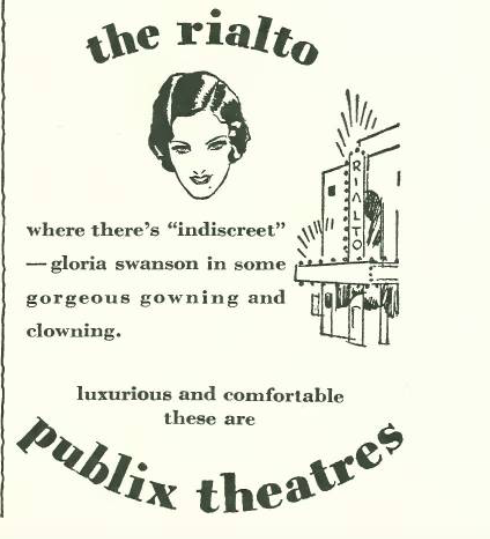
And we move on to our advertisers, with this ad from Publix Theatres (owned by Paramount) promoting Indiscreet…
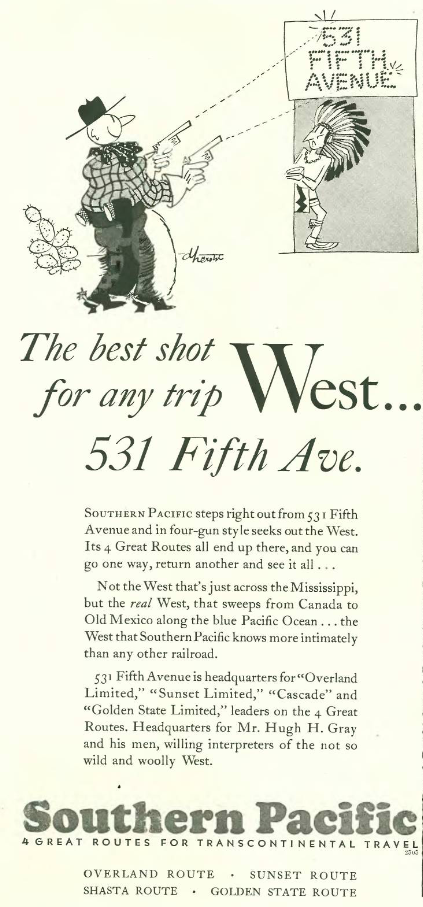
…Southern Pacific used a theme (illustrated by Don Harold) to promote travel on their trains that wouldn’t fly today…
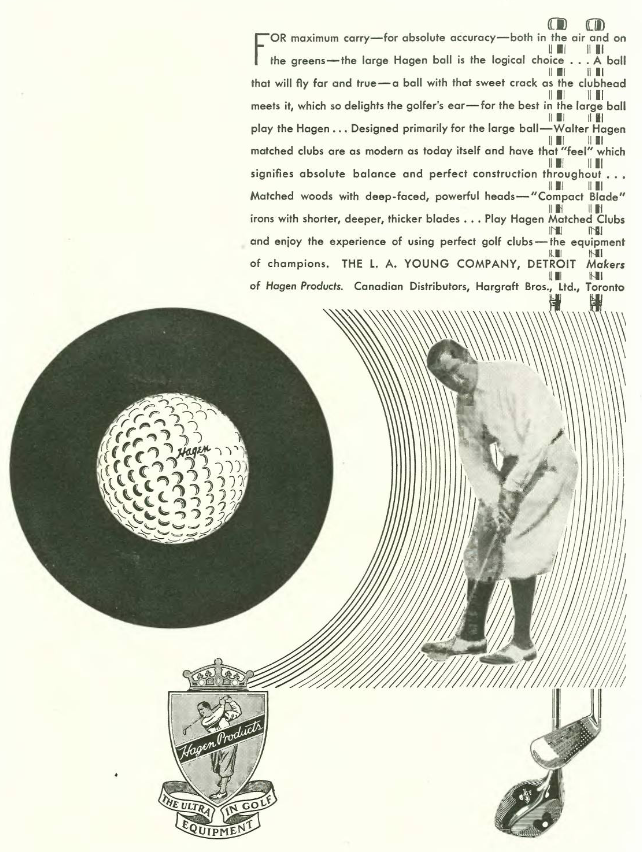
…I include this ad for the design, which seemed to have a little of everything…
…the makers of Camel cigarettes, however, reverted to a somewhat more homespun image, abandoning the stylish, euro-set illustrations of Carl “Eric” Erickson…
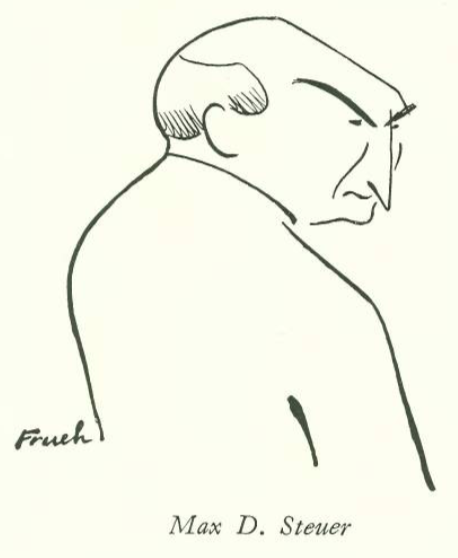
…on to our cartoonists, we have this caricature of Max Steuer by Al Frueh, rendered for a two-part profile…Steuer is perhaps best known for his successful defense of the factory owners after the 1911 Triangle Shirtwaist Factory Fire…
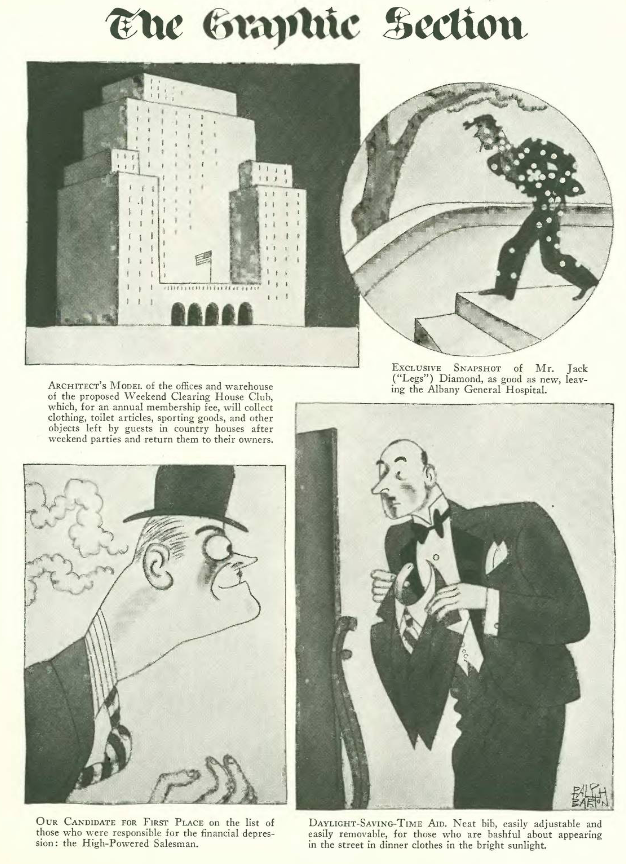
…Ralph Barton again, with his “Graphic Section”…
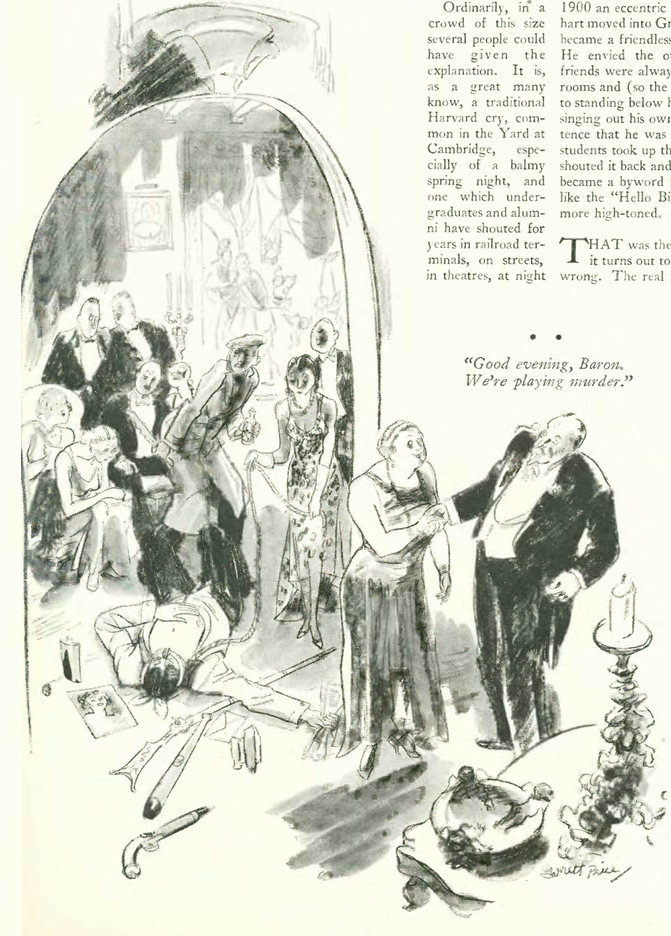
…Garrett Price weighed the durability of modern decor…
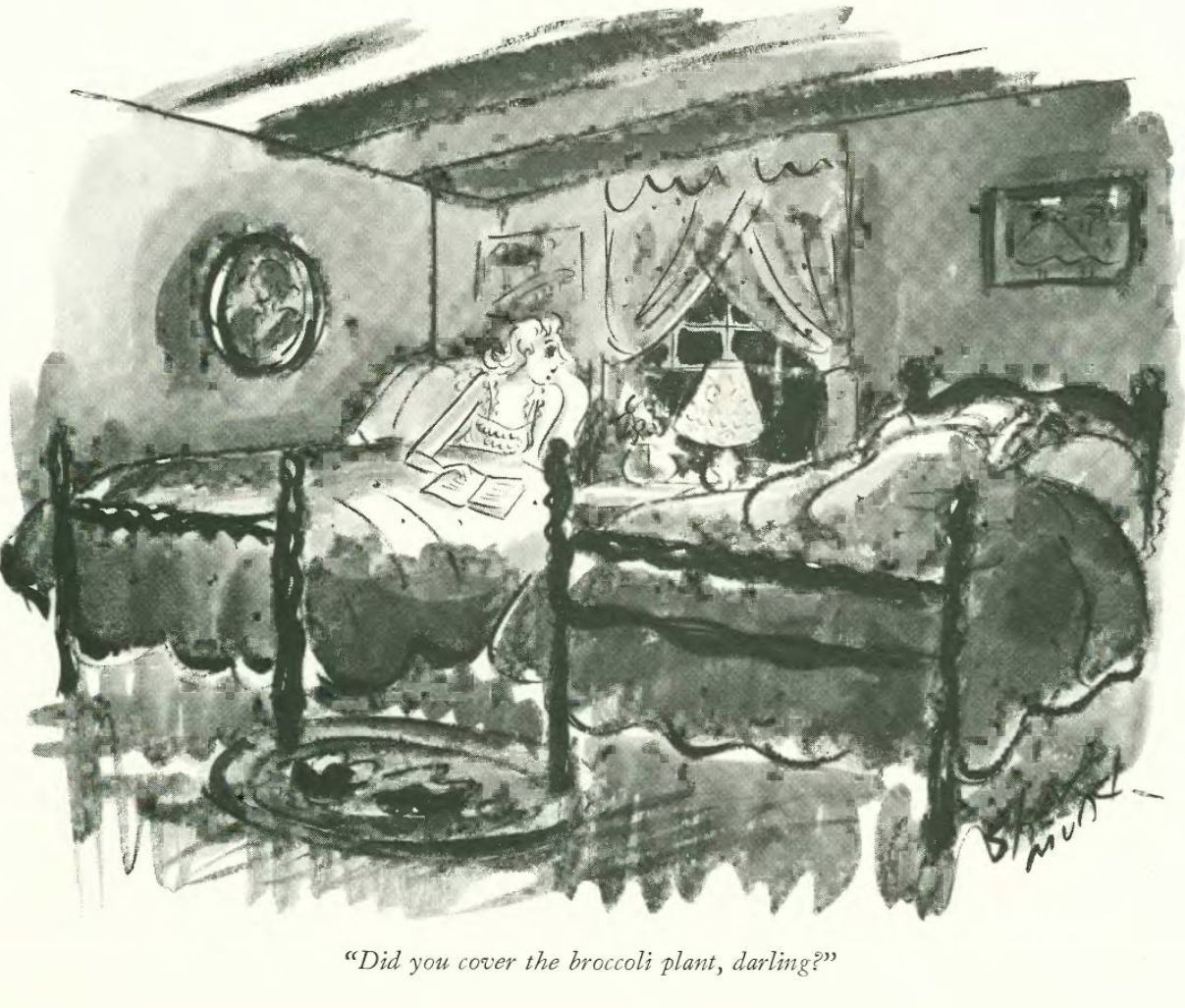
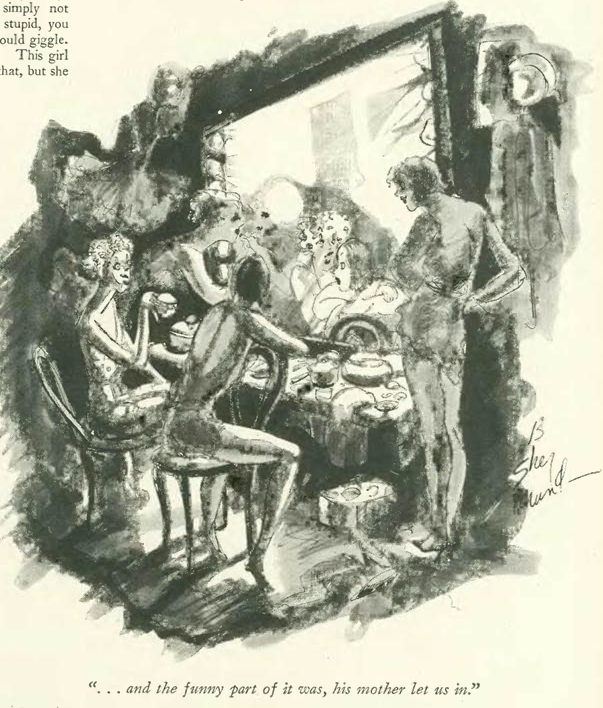
…Barbara Shermund looked at gardening challenges in the ‘burbs…
…Perry Barlow gave us a glimpse of something perhaps inspired by a trip to Europe…
…Richard Decker conjured a boat salesman with a loaded question…
…and we end with the great James Thurber, and a cartoon that might not pass muster today…
In today’s world of endless media options, it is hard to fathom the influence newspapers had over daily life in the 19th and early 20th centuries. There was one news source that many New Yorkers simply could not live without: The New York World.
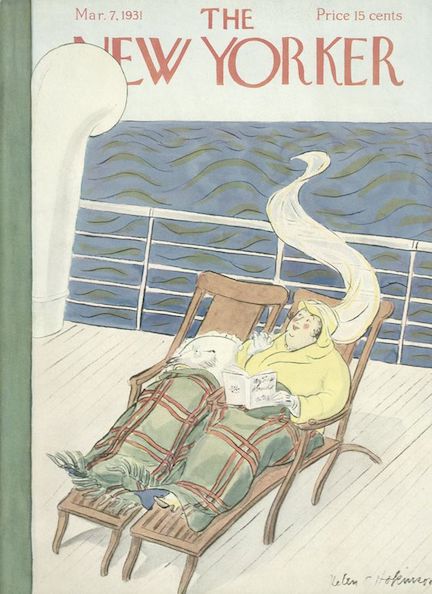
March 7, 1931 cover by Helen Hokinson.
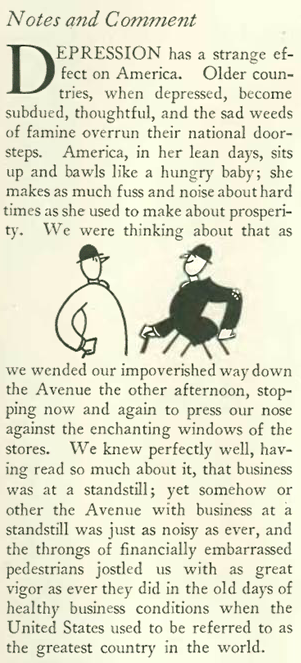
So when the World ceased publication after a 70-year run, many of its readers struggled to come to terms with the loss. Despite the World’s working class appeal and sensationalistic reporting, E.B. White nevertheless counted himself among its mourners, offering a lengthy eulogy in his “Notes and Comment” column (with Otto Soglow illustration)…
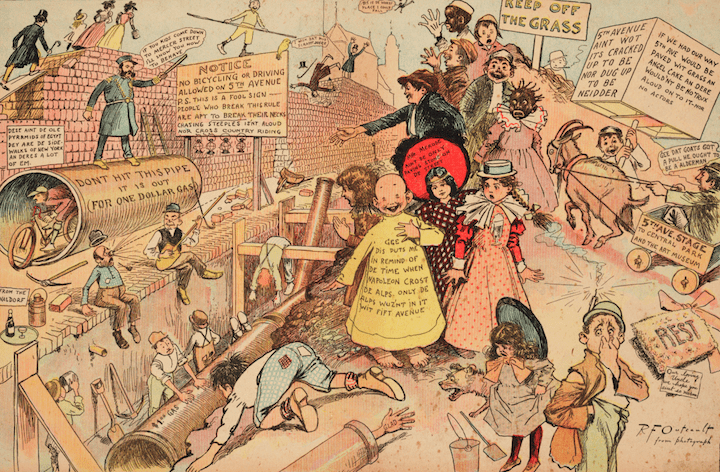
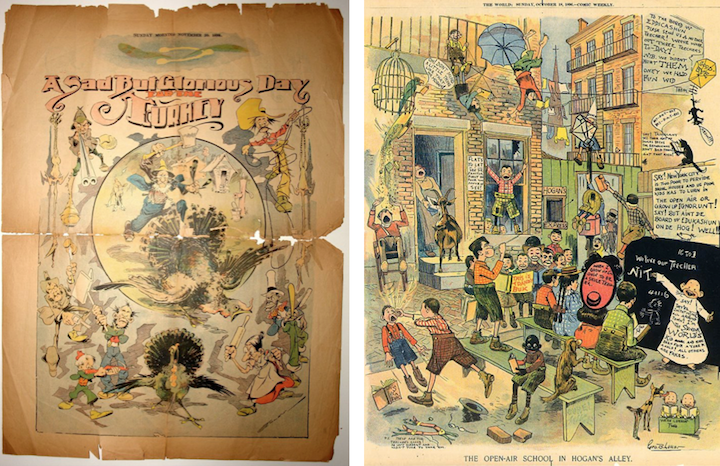
THE COLOR OF MONEY…Under the leadership of Joseph Pulitzer, who bought The World in 1883, the newspaper began an aggressive era of circulation building, and in 1896 enticed readers with pages printed by one of the world’s first four-color printing presses. The World was the first newspaper to launch a Sunday color supplement, which featured “The Yellow Kid” cartoon Hogan’s Alley (above, right). (5dguide.com)
A pioneer of yellow journalism, The World also featured sensational stories and headlines to capture the attention of readers…
…however, The World was also home to a number of prominent journalists, including the famed Elizabeth Cochran Seaman (aka Nellie Bly) and many writers from the social orbit of the Algonquin Round Table who were also early contributors to the fledgling New Yorker.
In his “Notes” essay, White suggests that he found something authentic in The World’s sensational style, and praised it for going after stories that more staid publications, like The New York Times, tended to ignore or downplay. The World’s staff of writers came from the rough and tumble, muckraking world of journalism, the same world in which The New Yorker’s founding editor, Harold Ross, first cut his teeth.
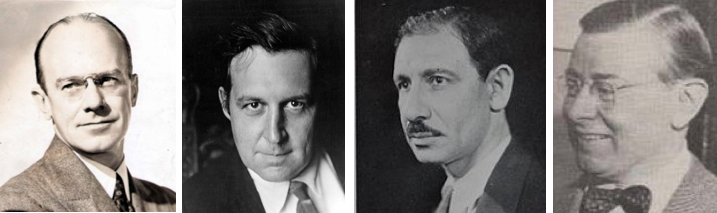
ALL-STAR LINE-UP…Many of The World’s famed writers inhabited the orbit of The New Yorker and the Algonquin Round Table, including, from left, music critic Deems Taylor, journalist and social critic Heywood Broun, “The Conning Tower” columnist Franklin P. Adams, and humorist Frank Sullivan. (deemstaylor.com/britannica.com/Wikipedia)
* * *
Swedish Sphinx?
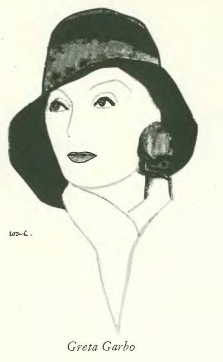
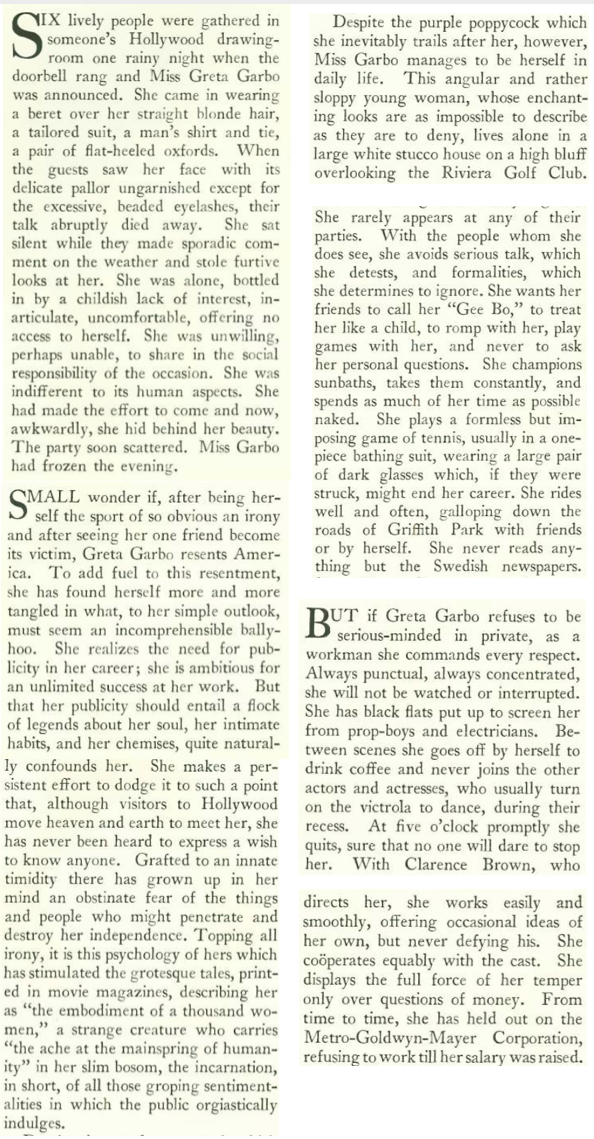
Thirty years after her death, Greta Garbo remains an iconic figure in popular culture, due to her expressive eyes and sensuality, but perhaps even more so due to her elusive air. In her profile of the star for The New Yorker, titled “American Pro Tem,” Virgilia Peterson Ross refused to buy into the mysterious aura that was partly manufactured by Garbo’s handlers at MGM. The other part, however, was genuine Garbo, who detested parties, serious talk, and other formalities.
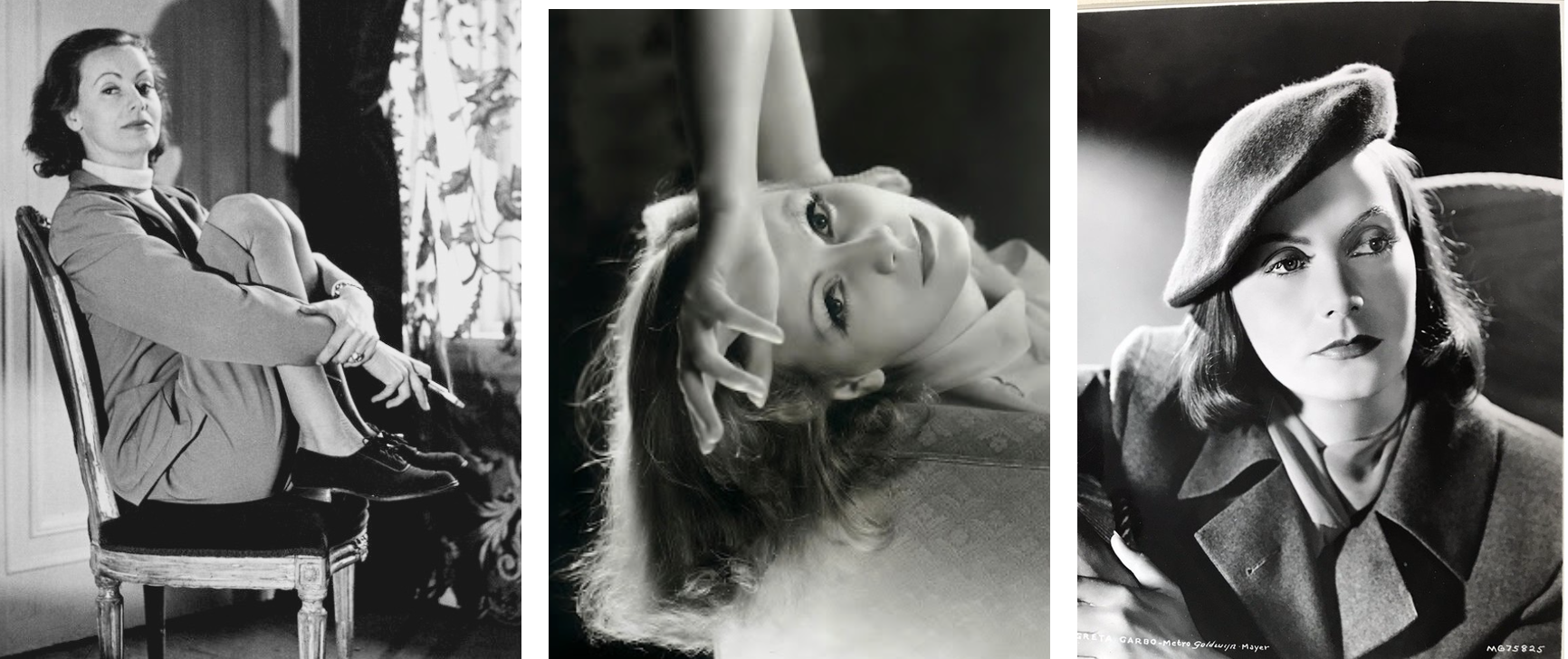
THE FACE…Like her contemporary Marlene Dietrich, Greta Garbo preferred an androgynous look. From left, Garbo wearing the flat-heeled oxfords she favored; publicity photo from 1932; wearing one of her trademark berets in the late 1930s. (garboforever.com)
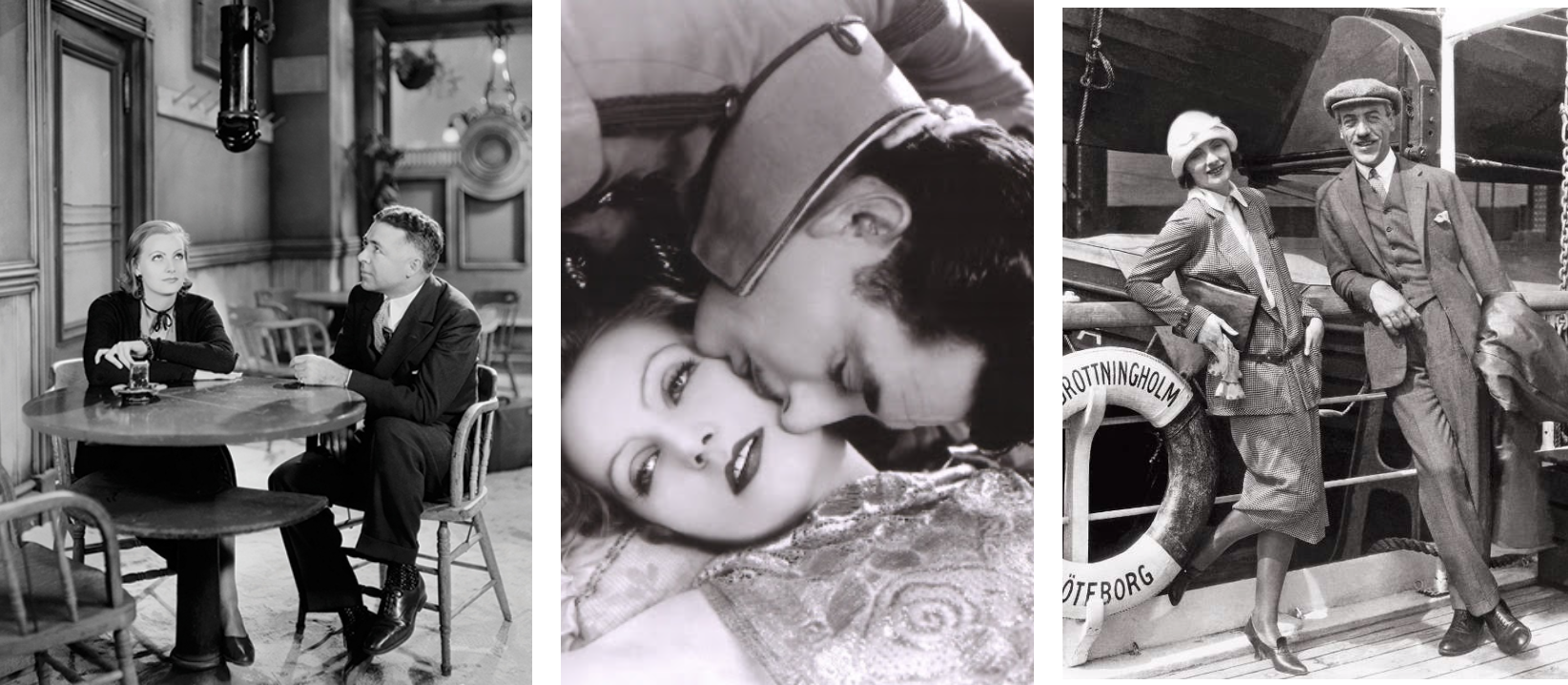
Ross touched on Garbo’s love life—she never married in her 84 years, but she was close to her mentor, Finnish director Mauritz Stiller, who died in 1928, having been eclipsed by his protégé. Garbo’s co-star in the silents, John Gilbert—known as a great lover on the screen—wanted to marry Garbo, but she balked at his frequent proposals. The two lived together intermittently in 1926 and 1927, Gilbert helping Garbo not only with her acting also teaching her how to behave like a star and barter with studio bosses. Garbo later admitted that she was in love with Gilbert, but preferred to remain single because she “always wanted to be the boss.” Drink and despair would send Gilbert to an early grave in 1936. In her profile piece, Ross concluded that Garbo was “not a mystery to be solved,” but rather “a limpid child.”
THE MEN IN HER LIFE…Greta Garbo contemplates a new-fangled microphone with film director Clarence Brown on the set of Garbo’s first talkie, Anna Christie. Brown would direct Garbo in seven different films; Garbo with sometime lover John Gilbert in Flesh and the Devil (1926). They would appear in four films together; Garbo with Finnish director and early mentor Mauritz Stiller, in 1926. (Wikipedia/IMDB/garboforever.com)
* * *
Suffering Artist
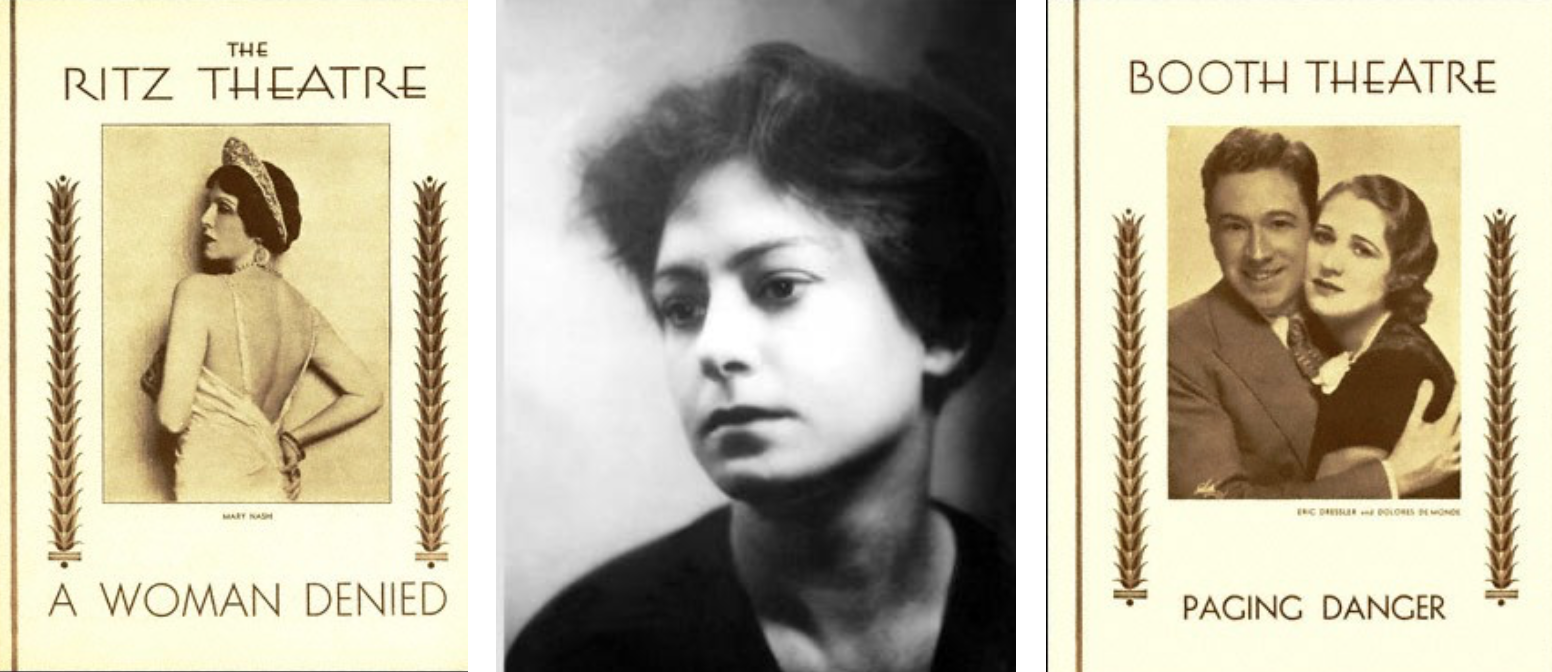
Dorothy Parker continued to sub as theater critic for her friend, Robert Benchley, who was traveling abroad. It was not a task to her liking — during her temporary stint she had yet to see a play that didn’t insult her taste or her intelligence. Her review for the March 7 issue would prove no different.
BROADWAY BLAHS…Dorothy Parker had yet to find a play to her liking in her stint as theater critic for the New Yorker. To her credit, she had to sit through a couple of stinkers: A Woman Denied lasted about a month — 37 performances — and Paging Danger closed its curtains for good after just four performances. (Playbill/BBC)
* * *
The Misanthrope
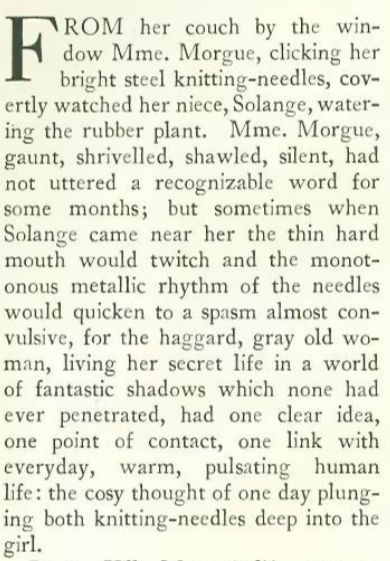
To call Wyndham Lewis a character is an understatement. The English writer, social critic and painter (he founded the cubist-inspired Vorticist movement) managed to offend just about everybody before his death in 1957. He was described by the London Review as “fiercely unsentimental,” and that is how I would describe this opening paragraph from his short story “Dark Party”…
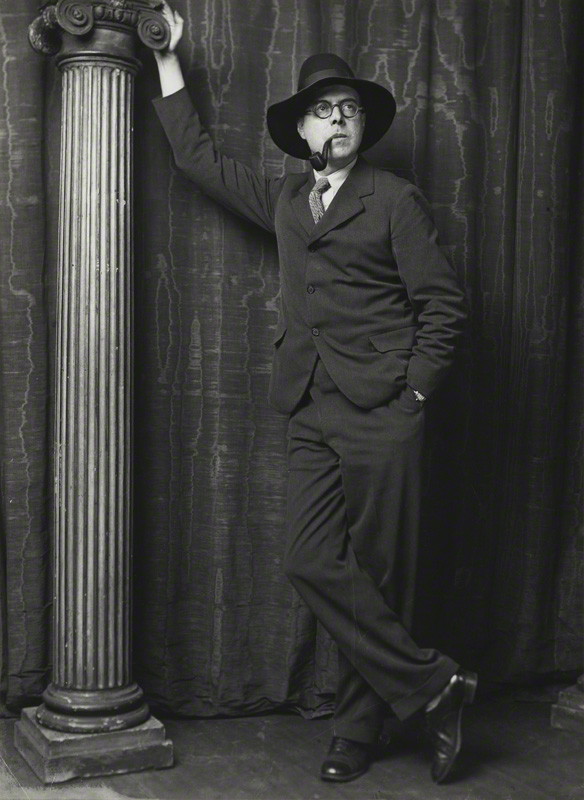
CLASSIC POSE…A 1929 portrait of Wyndham Lewis by photographer George Charles Beresford. (Wikipedia)
* * *
From Our Advertisers
A couple of ads appealing to women readers of the New Yorker, including this elegant bon voyage scene advertising travel clothes…
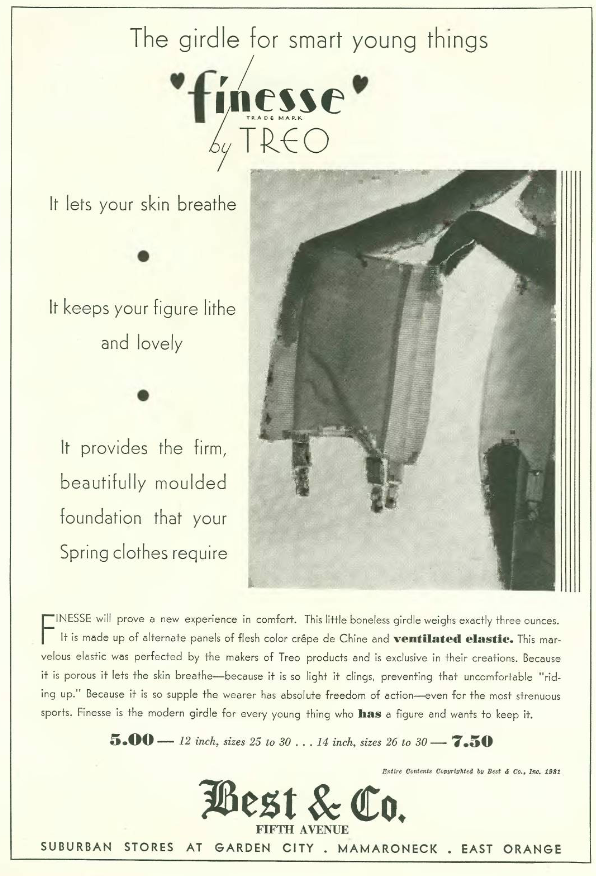
…and something you never see anymore, the “boneless” girdle…replaced today by Spanx and the like…
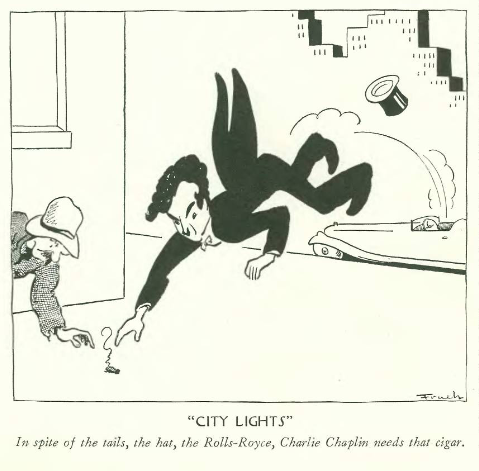
…Before we roll into our cartoons, some cinema-inspired art by Al Frueh…
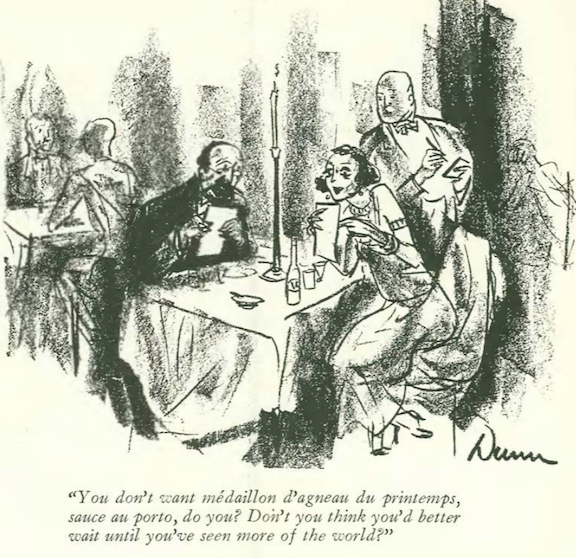
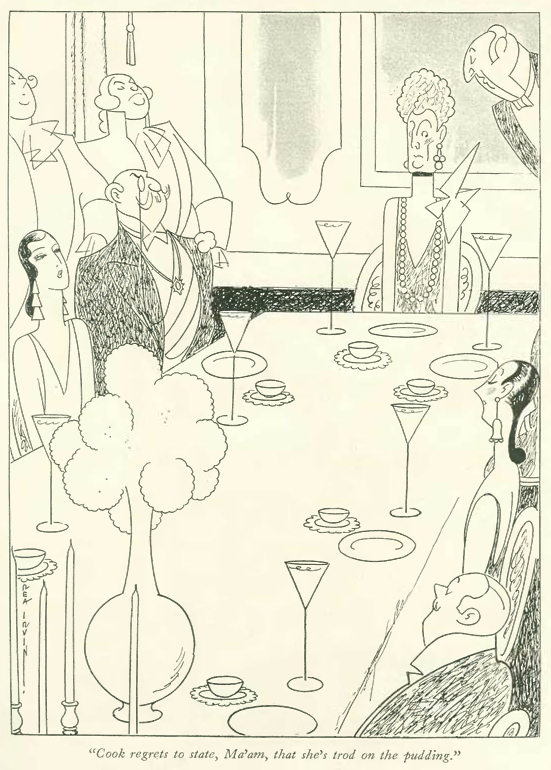
…Alan Dunn went out to dinner…
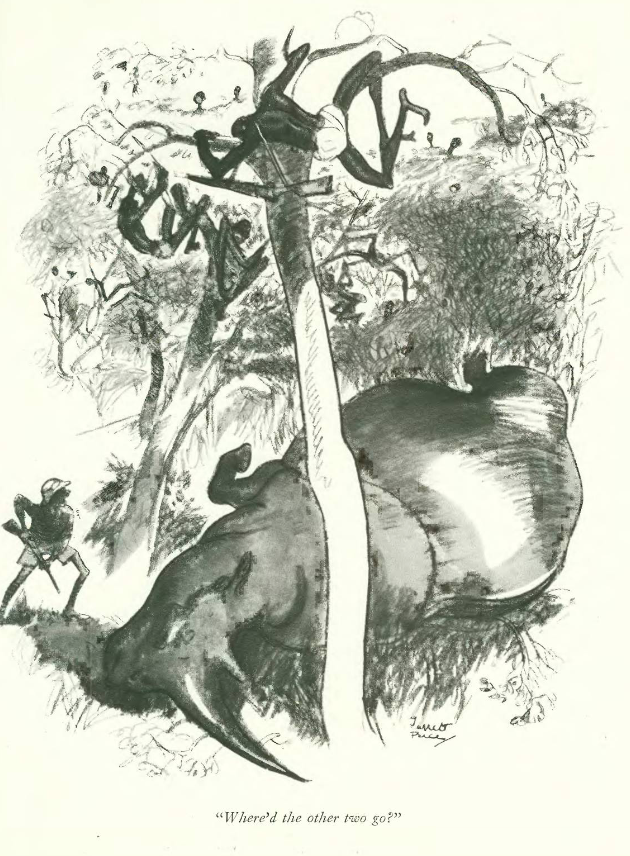
…Garrett Price went on safari…
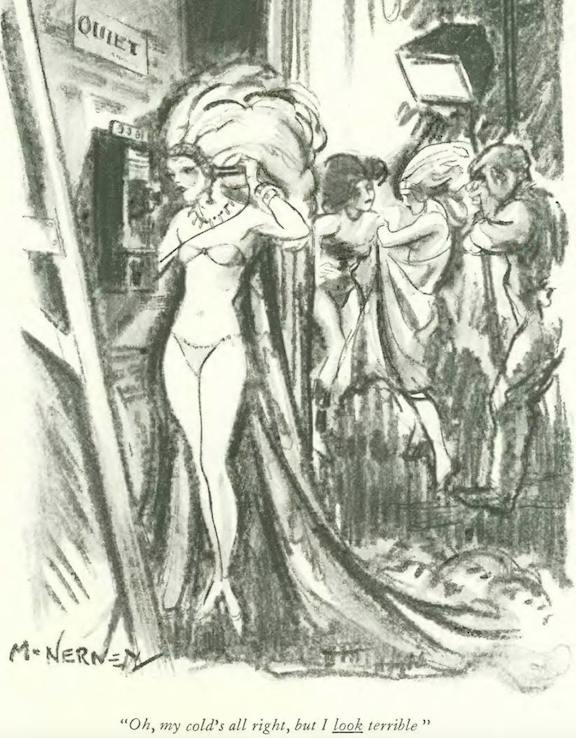
…E. McNerney channelled his inner Arno for this backstage scene…
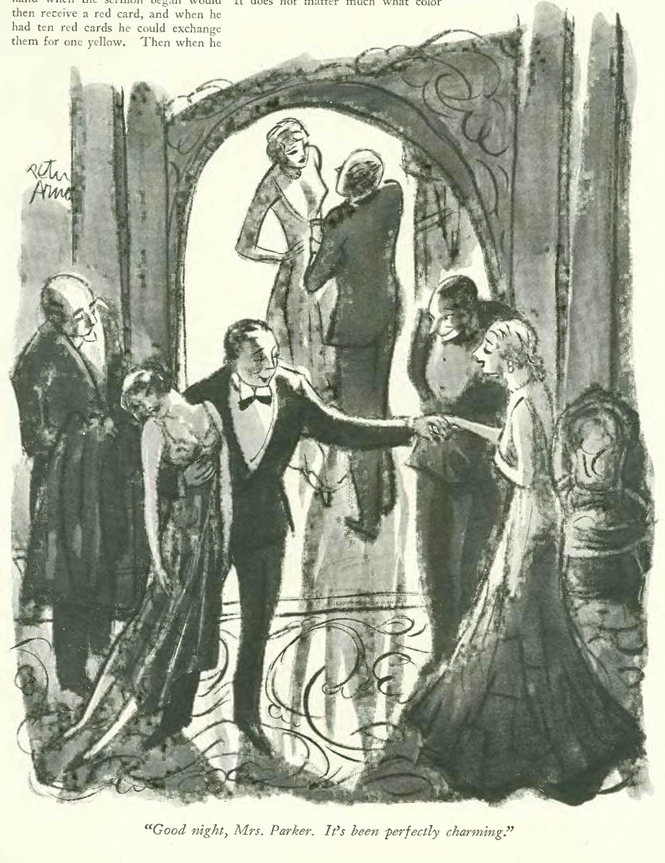
…and the real Peter Arno gave us this passing scene which recalled his old Whoops Sisters gags…
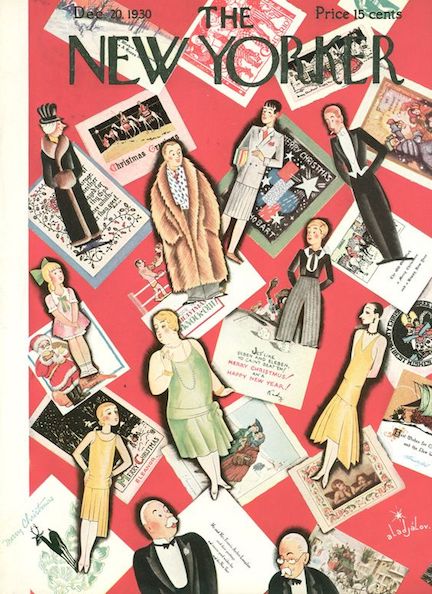
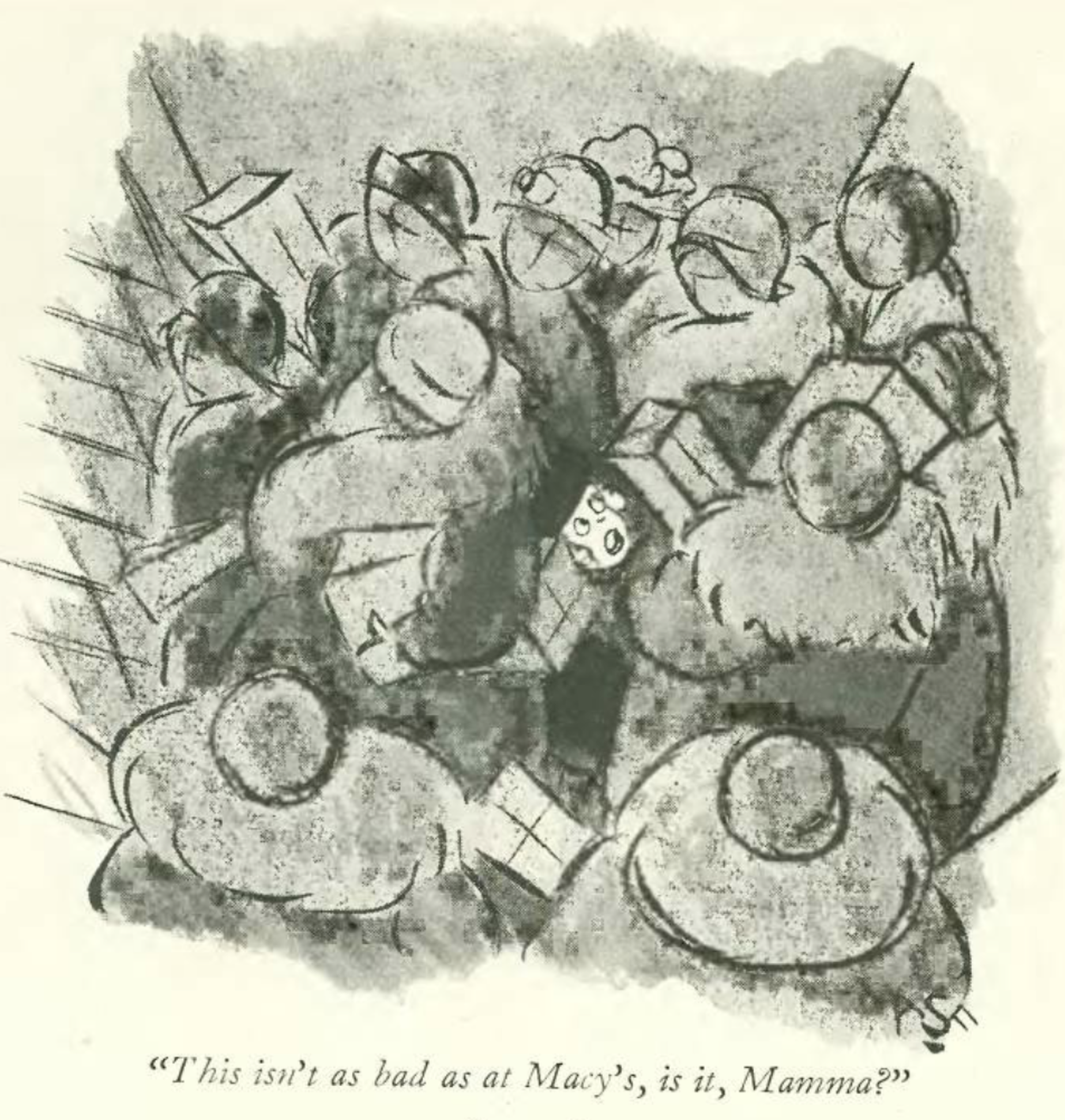
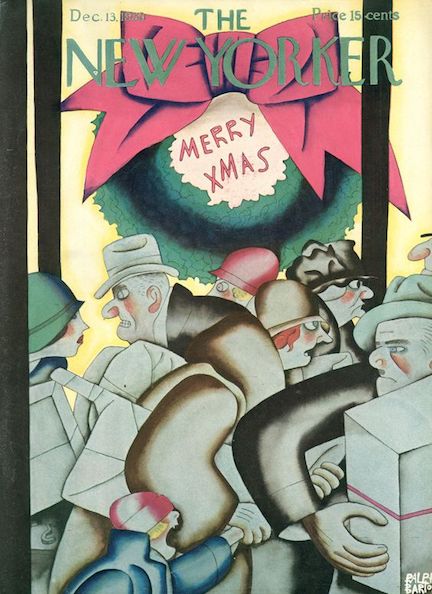
Happy Holidays to readers of A New Yorker State of Mind! We open with an image of Christmas shoppers at 34th and Broadway, circa 1930, and peruse the Dec. 20, 1930 issue of the world’s greatest magazine.
Dec. 20, 1930 cover by Constantin Alajalov.
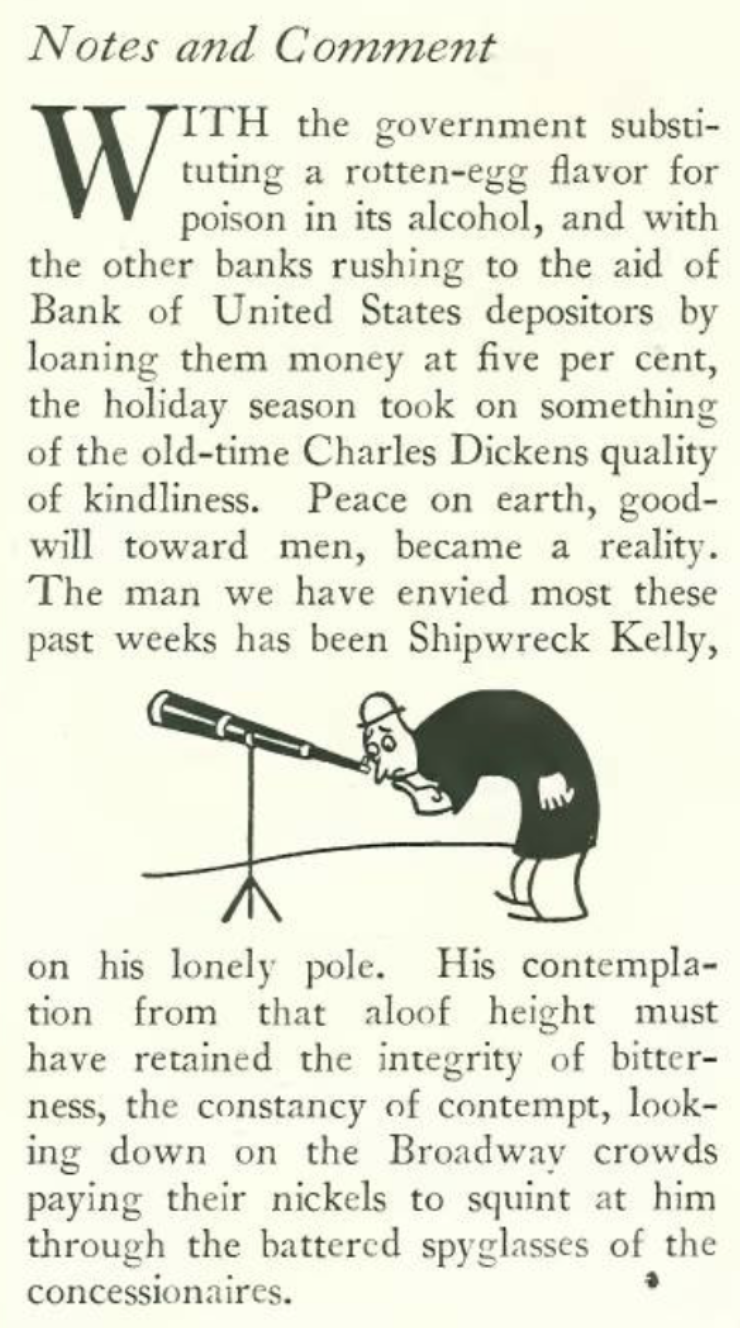
“Notes and Comment” began with a Christmas message of sorts from E.B. White, his holiday cheer tempered by the Great Depression and the lingering effects of Prohibition…
…Howard Brubaker seconded White’s mood in his “Of All Things” column…
…keeping things on the lighter side was Margaret Fishback, who turned her talents as a poet into a successful career as an ad writer for Macy’s. By the 1930s she was one of the world’s highest-paid female advertising copywriters. For the Dec. 20 issue she offered this holiday ditty:
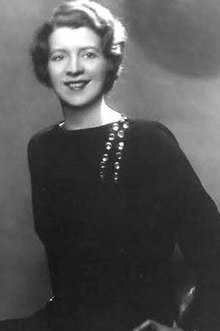
THANKS MARG...Margaret Fishback, circa 1930s. (Wikipedia)
* * *
More Marlene
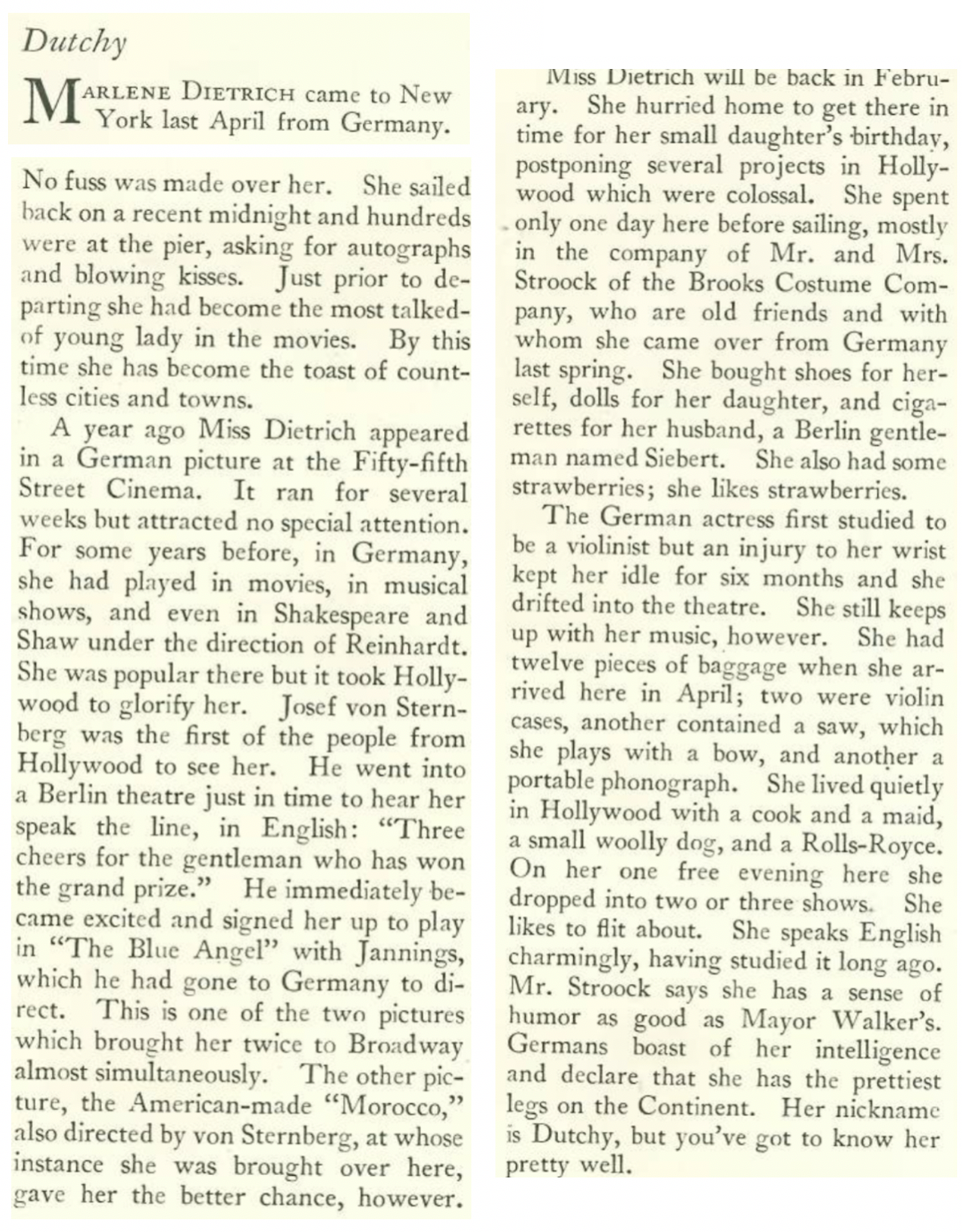
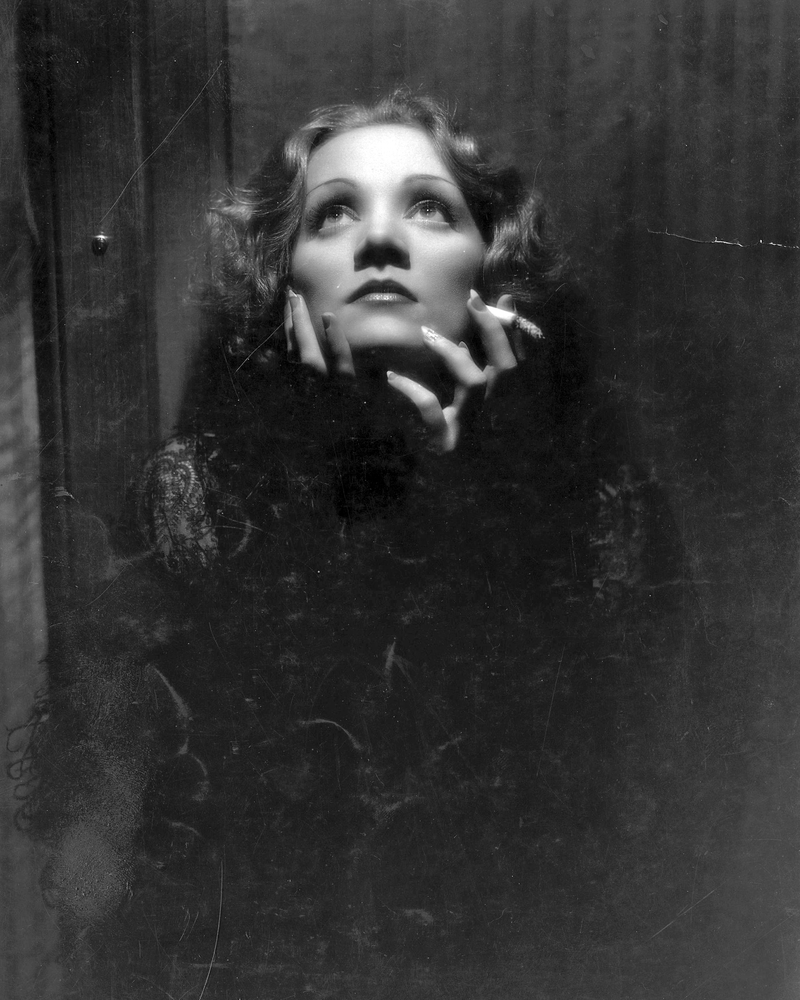
Last week we looked at Marlene Dietrich’s breakout performance in The Blue Angel (reviewed by John Mosher in the Dec. 13, 1930 issue) that launched her into international stardom. Although Mosher had some gripes about the film’s dialogue, Dietrich’s performance nevertheless created enough of an impression to warrant a lengthy note on the German star in the Dec. 20 “Talk of the Town”…
I’LL BE BACK…Marlene Dietrich in a still from Shanghai Express, 1932. (Wikipedia)
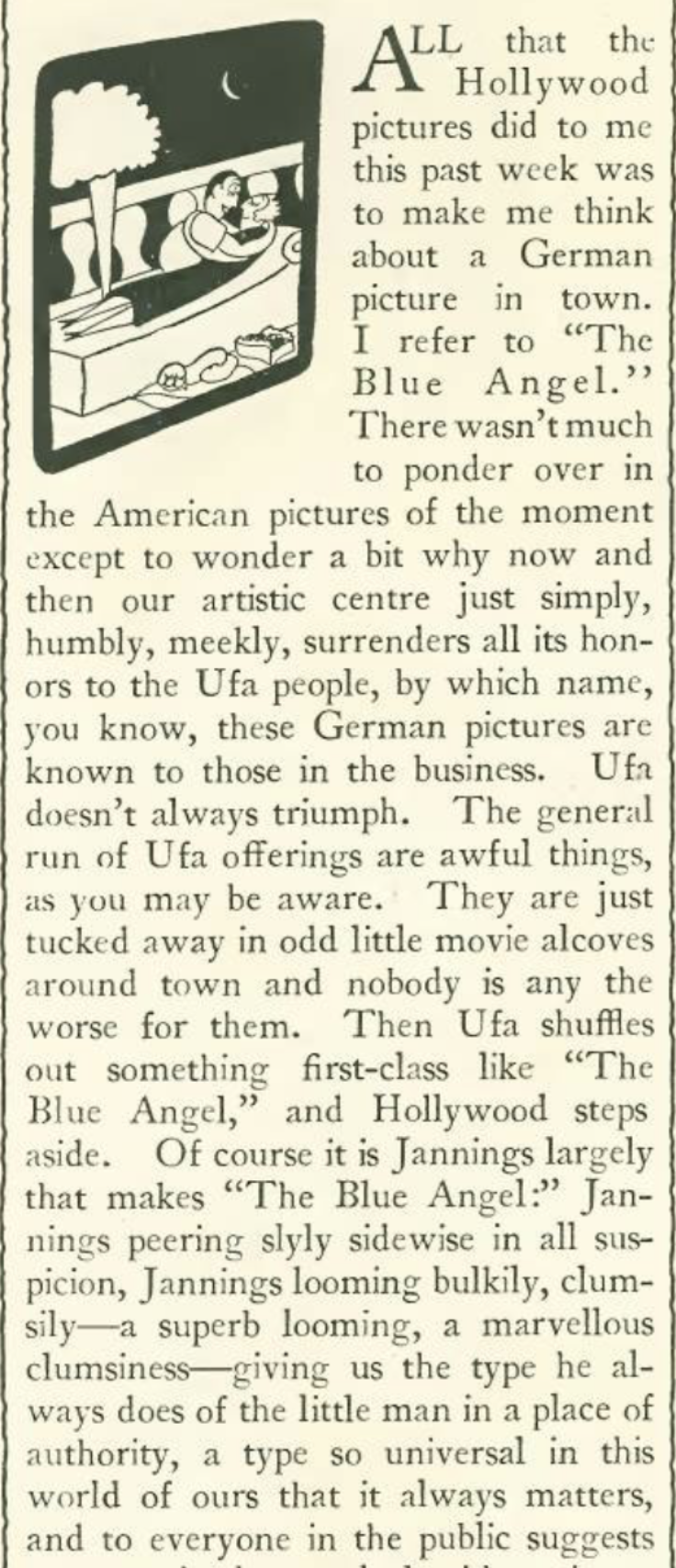
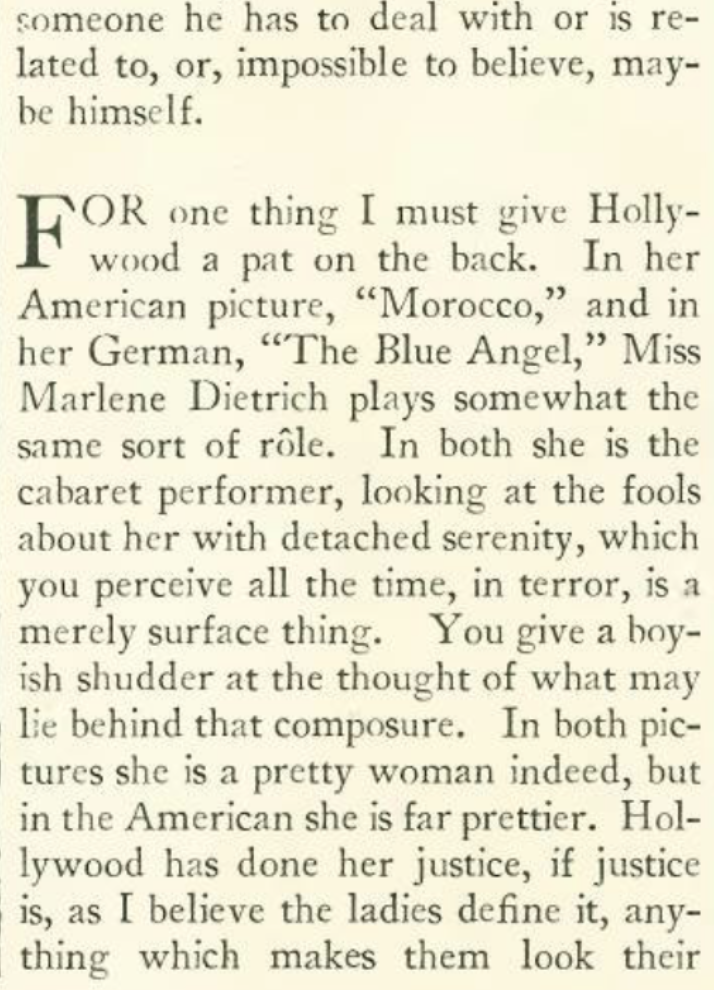
Even though John Mosher gave a rather tepid review of The Blue Angel in the Dec. 13 issue, he obviously couldn’t shake it (or Dietrich) from his head, returning to the film and its star in the opening paragraphs of his Dec. 20 cinema column.:
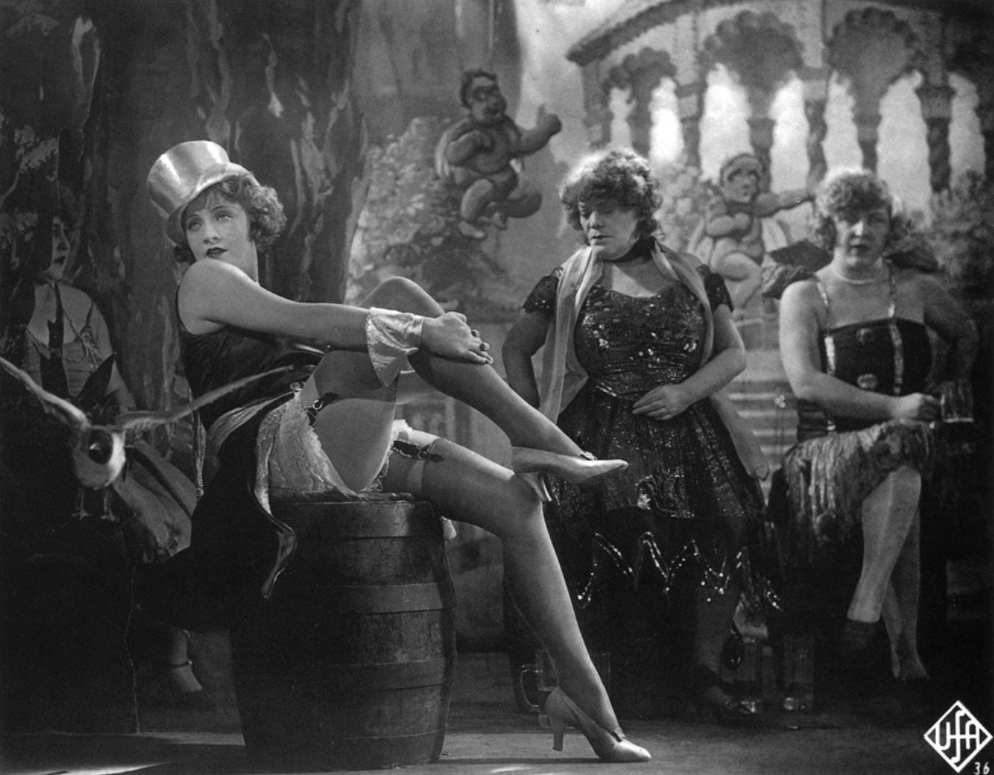
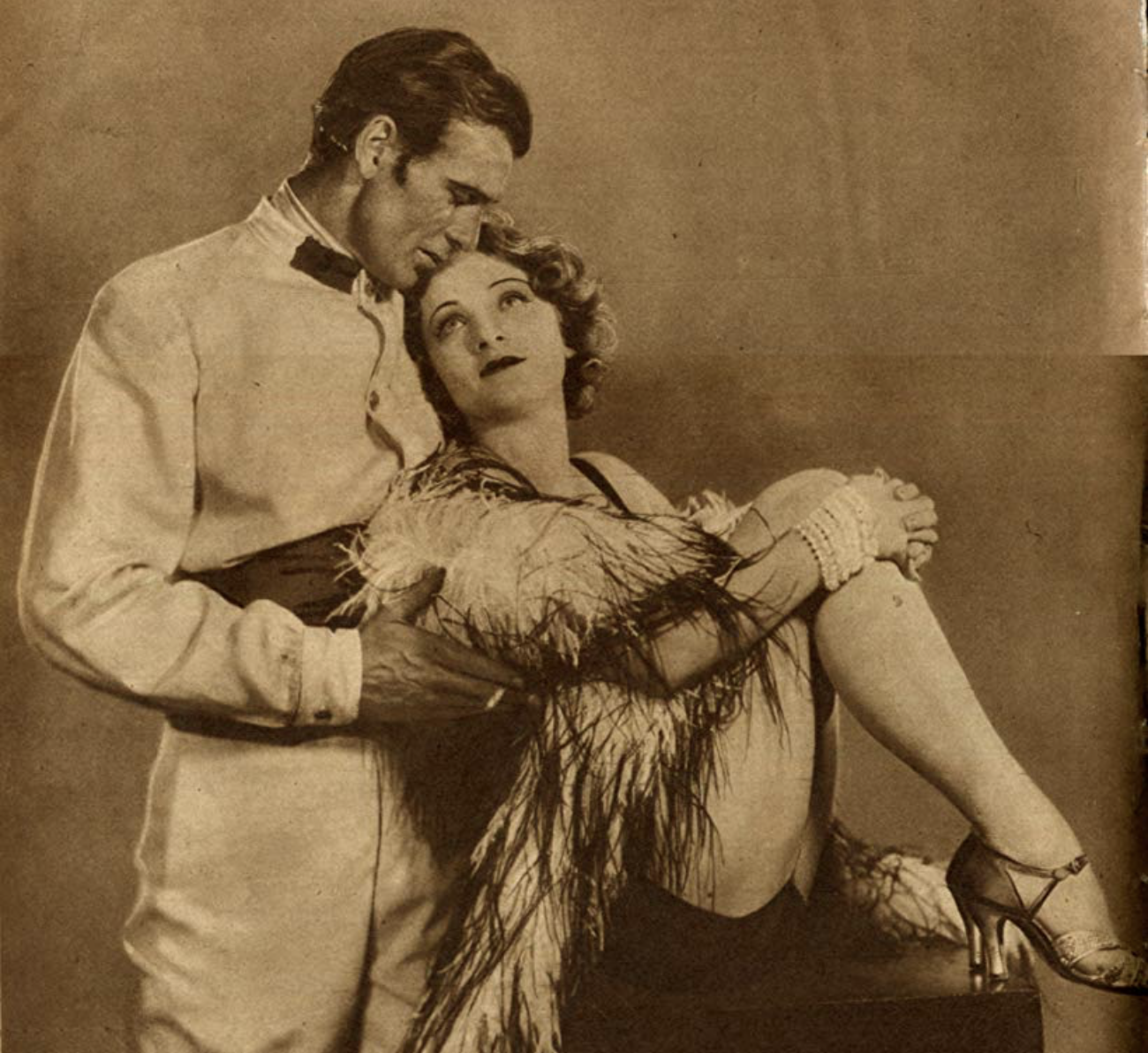
Mosher also observed that new Hollywood version of Dietrich (in 1930’s Morocco) was “far prettier” than the German version. You decide:
The German Marlene Dietrich in Ufa’s The Blue Angel…
…and the Hollywood Dietrich in Paramount’s Morocco (with Gary Cooper)…
(both images IMDB)
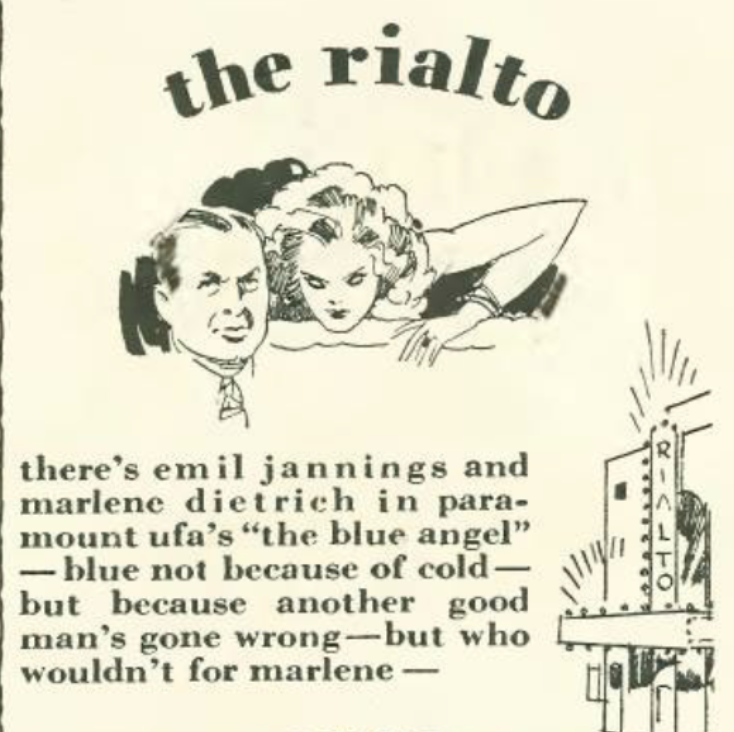
…on to our advertising…Dietrich pops up again in this ad for Publix Theatres (which were owned by Paramount)…
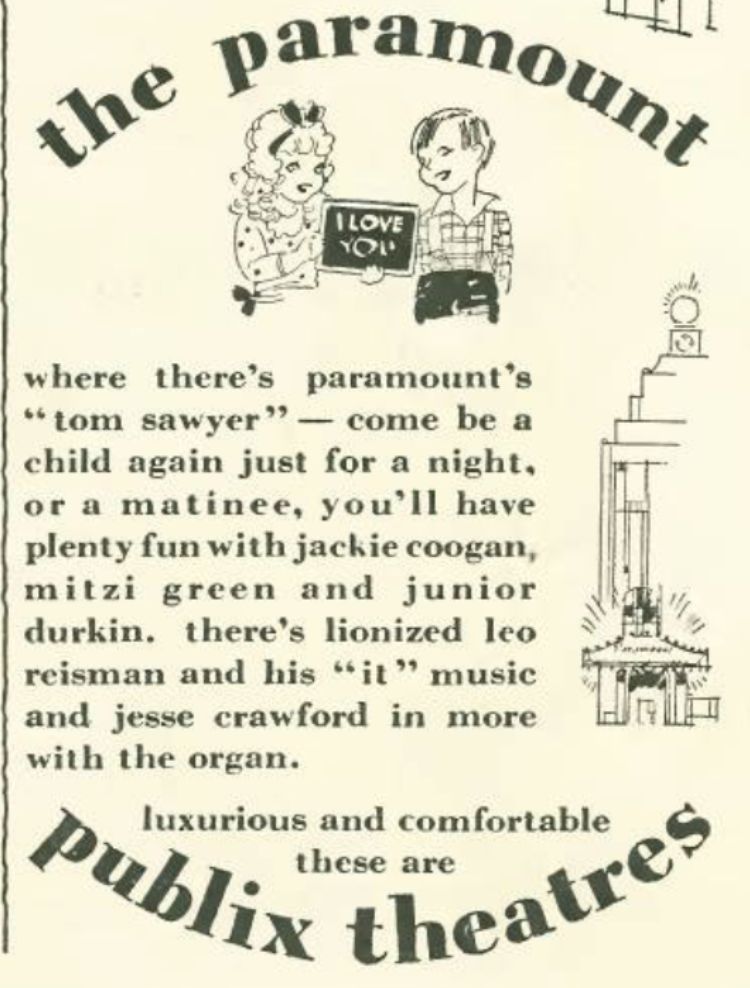
…the same ad block also featured light fare, such as 1930’s Tom Sawyer…
AIN’T THEY CUTE?...Mitzi Green as Becky Thatcher and Jackie Coogan as Tom Sawyer in 1930’s Tom Sawyer. Jackie was a famous star by 1930, thanks to his co-starring performance with Charlie Chaplin in 1921’s The Kid. In adult life Coogan would play Uncle Fester in TV’s The Addams Family. Green would have less success, and retire from films in the 1950s. (IMDB)
…not all advertisers were thinking about Christmas, but rather were turning their sights to the southern climes and the fashions they would require…here’s an appeal from Burdine’s of Miami…
…and Fifth Avenue’s Bonwit Teller…
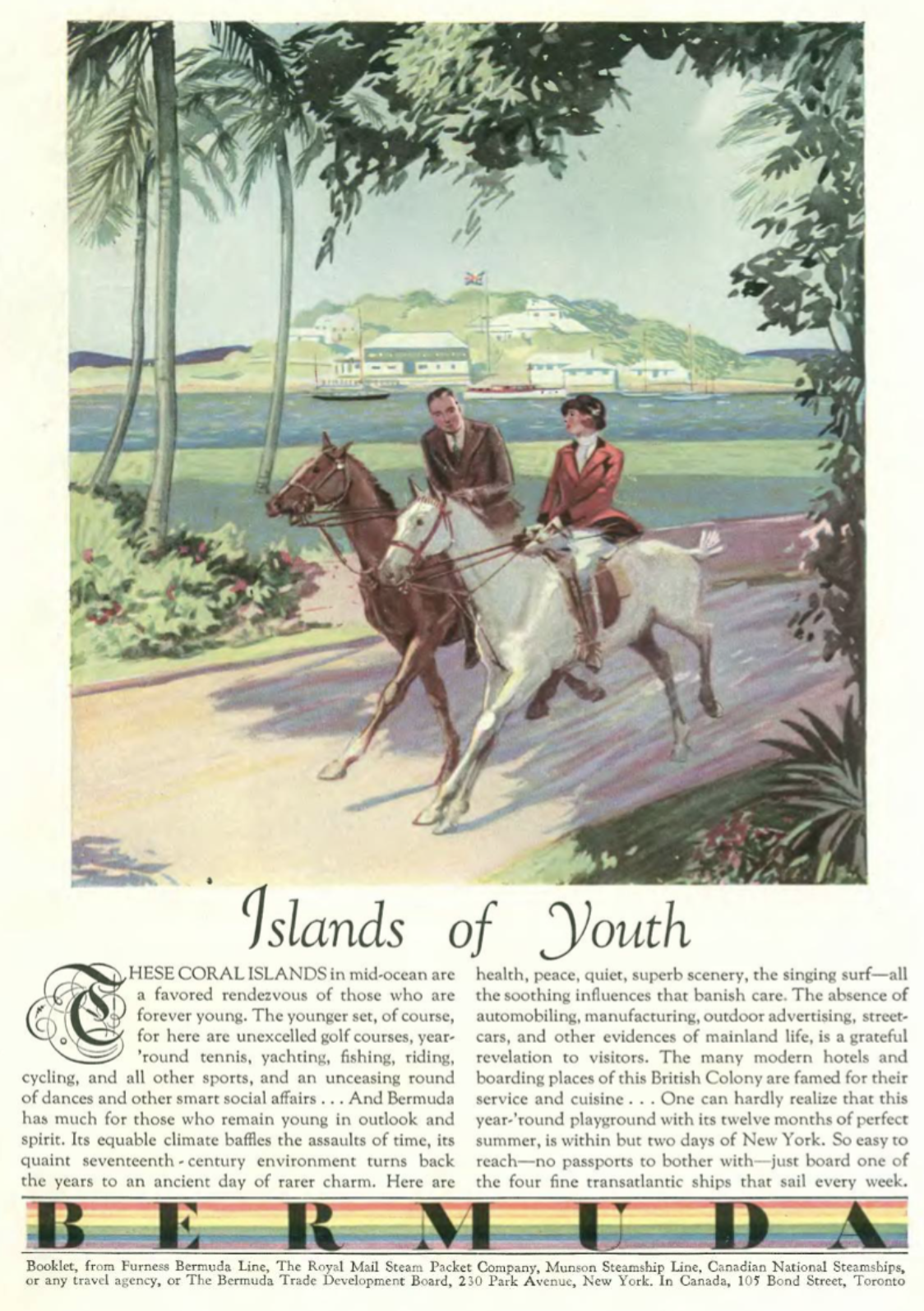
…travel agencies created enticing scenes such as this to lure snowbirds to places like Bermuda…
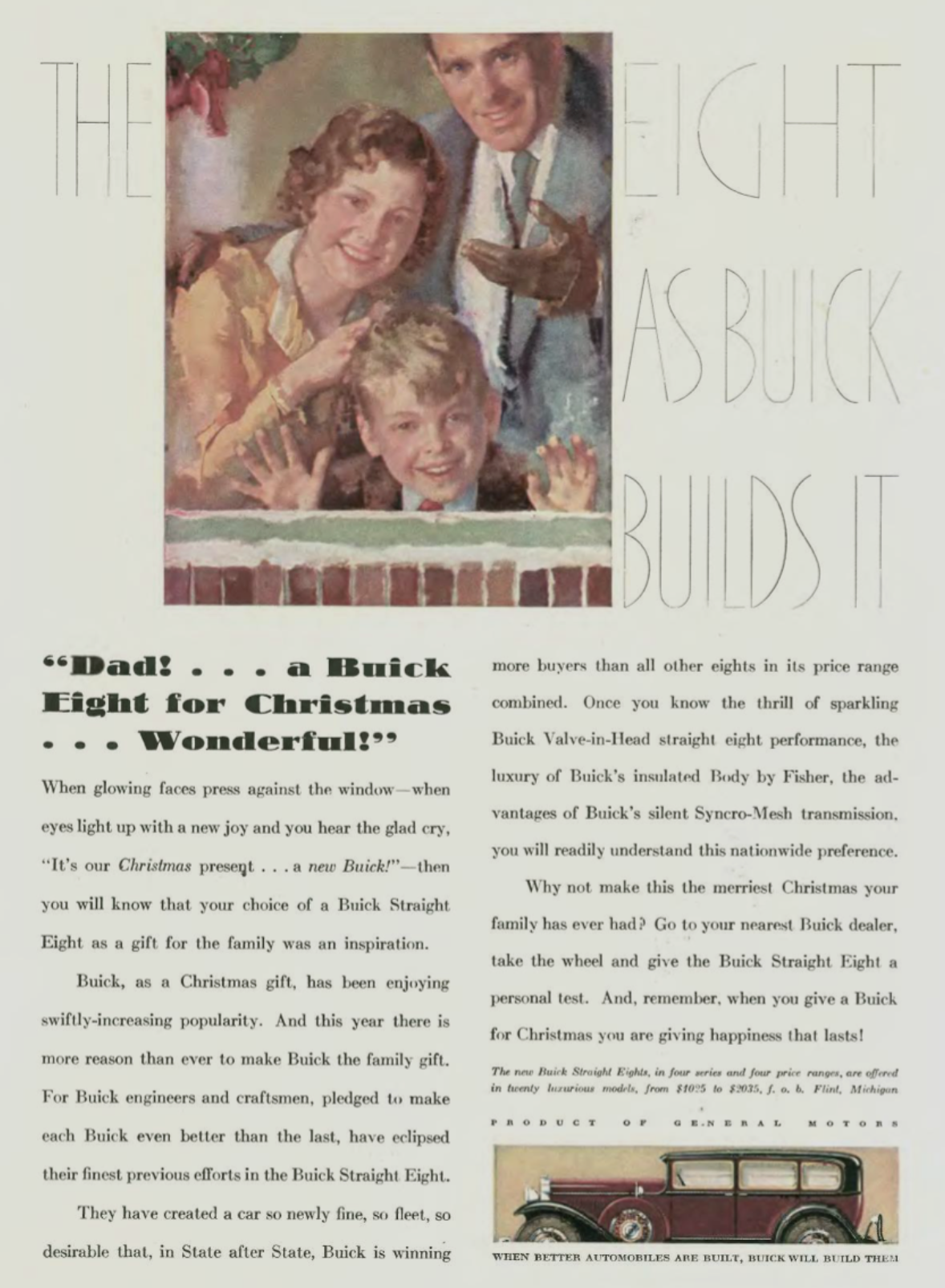
…of course in those depressed times you had to be a person of means to spend your winters in the Caribbean, or to surprise your family with a new Buick for the holidays…
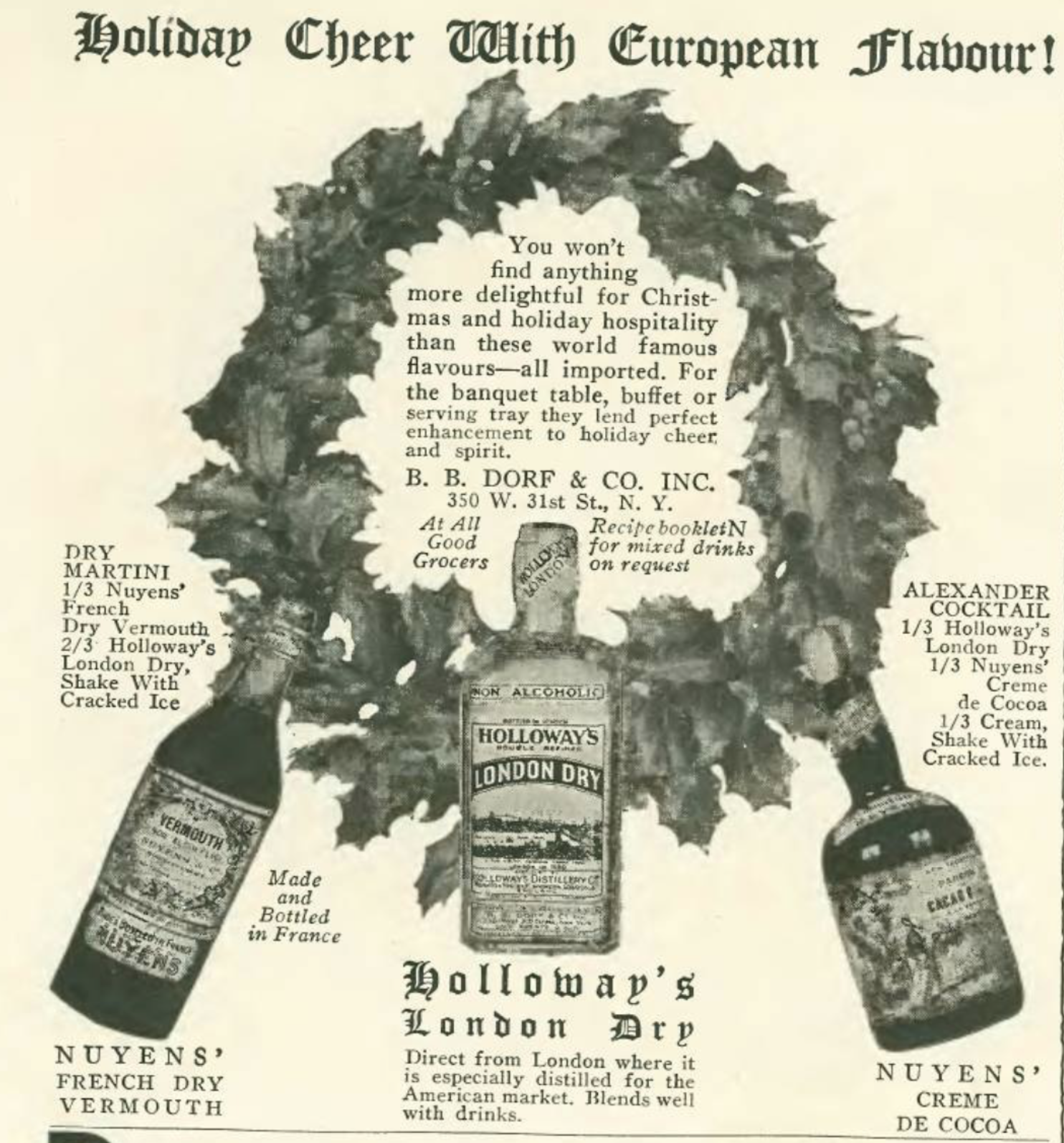
…and for those stuck at home, they had to console themselves with bootleg liquor, perhaps jazzed up with one of these “flavors”…
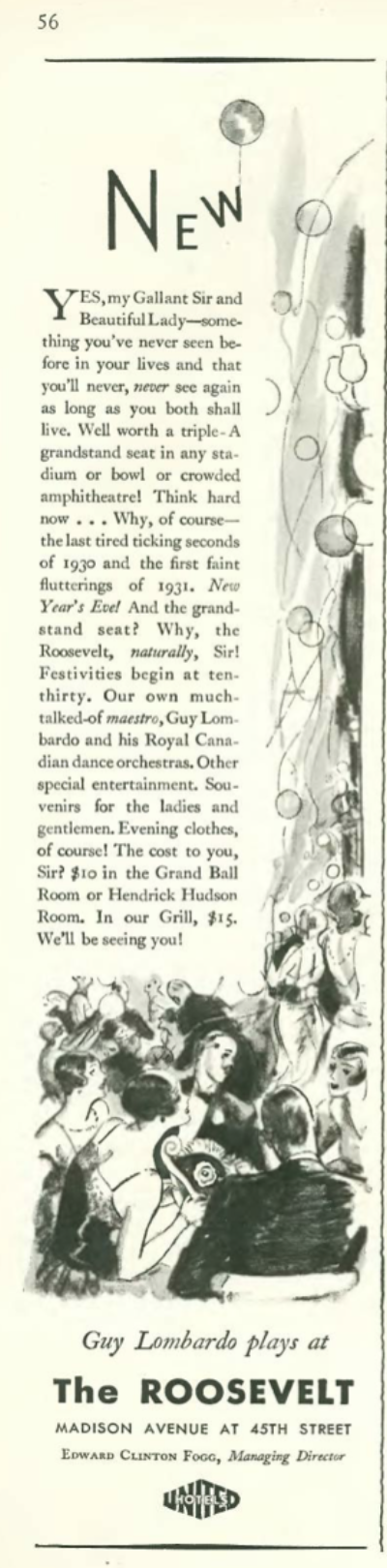
…but if you were in the holiday spirit, you might head to the Roosevelt for New Years Eve with Guy Lombardo…
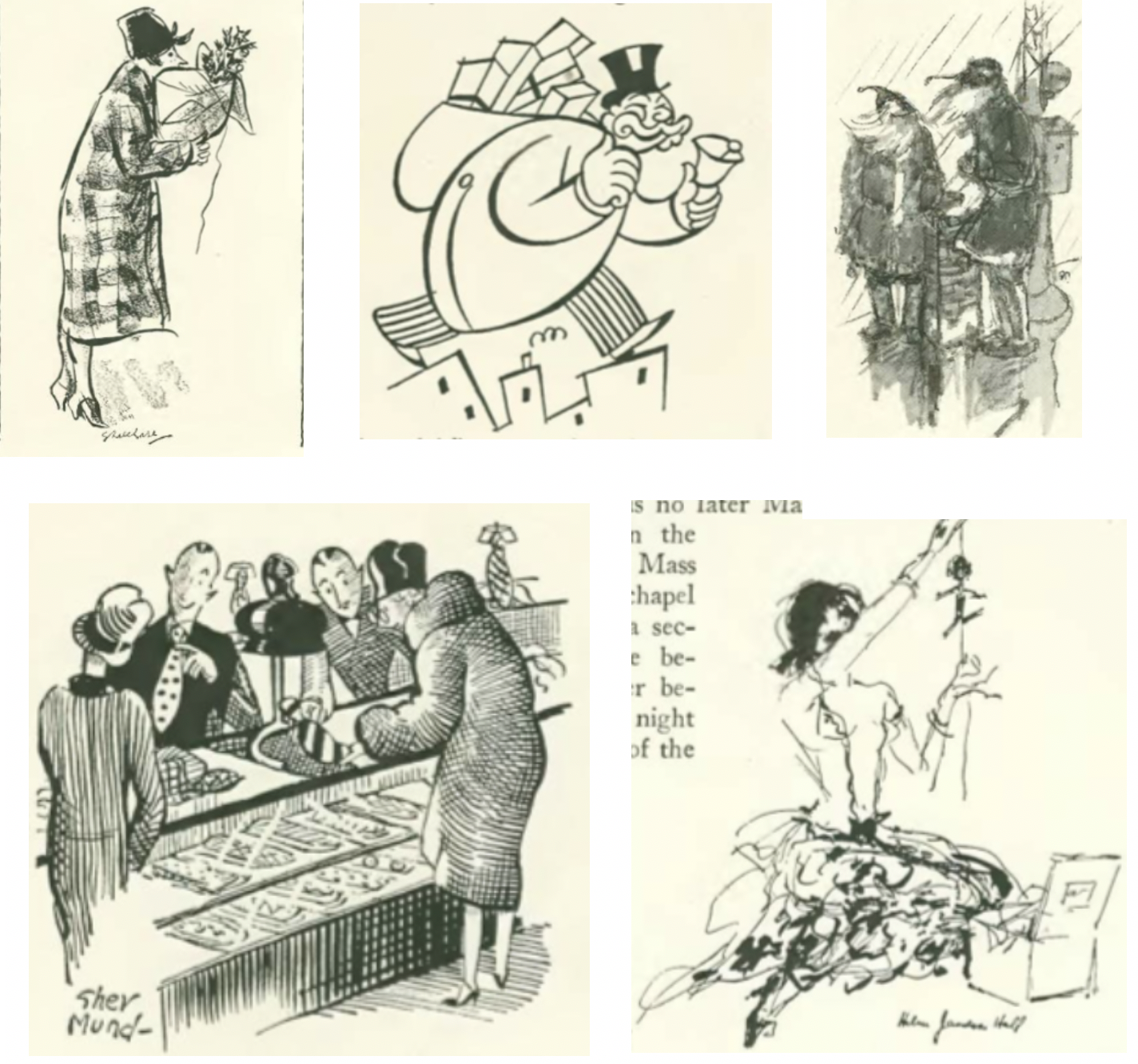
…once again, the issue was sprinkled with spot drawings on the holiday theme…
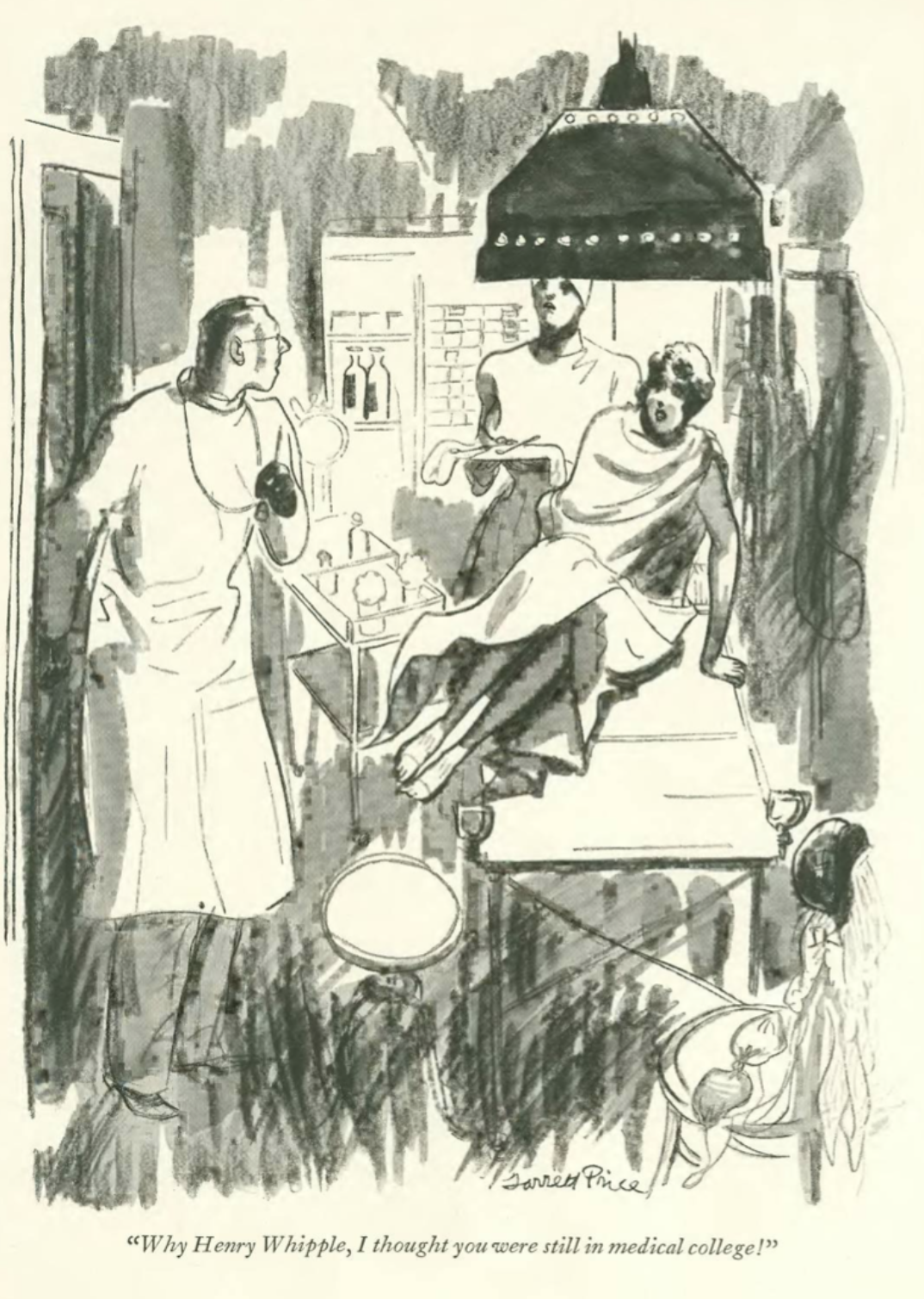
…and our cartoonists, Garrett Price at the doctor…
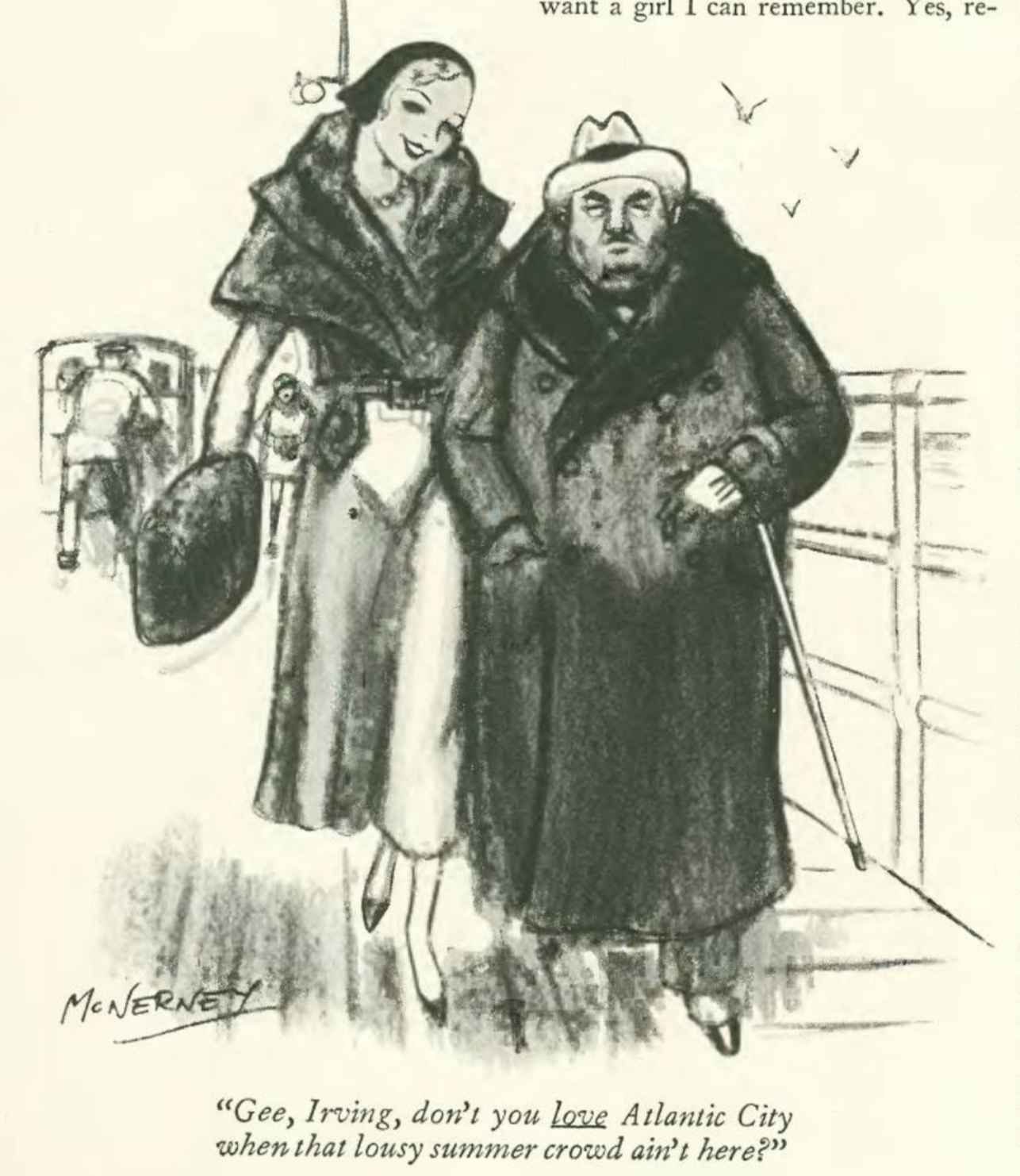
…E. McNerney in Atlantic City during off-season…
…Al Frueh, and the clash of modern aesthetics with Christmas traditions…
…and for those in that last, desperate holiday crush, we close with Alan Foster…
Broadway impresario Florenz Ziegfeld Jr knew how to pack a Broadway theater, and from 1907 to 1932 he staged a number of revues and plays (most notably Showboat) that featured lavish costumes and a bevy of chorus girls.
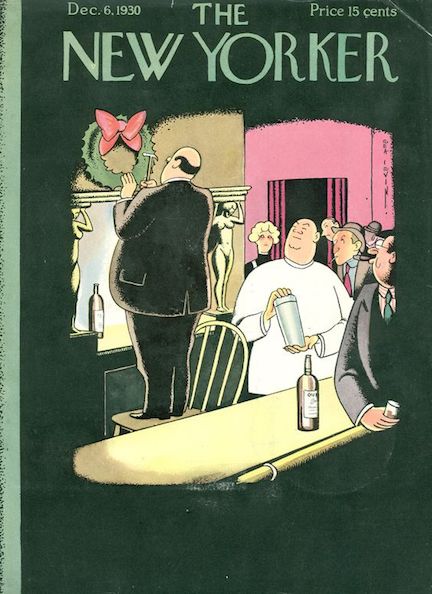
Dec. 6, 1930 cover by Rea Irvin, depicting a peephole view of a speakeasy during the holidays.
When his latest show, Smiles, hit the stage of the Ziegfeld Theatre on Nov. 18, 1930, it was greeted by an audience that had endured the first year of the Great Depression. Ziegfeld’s entertainments, on the other hand, were more associated with the high times of the Roaring Twenties. So even the popular brother-sister dance team from Omaha — Fred and Adele Astaire — seemed a bit old hat.
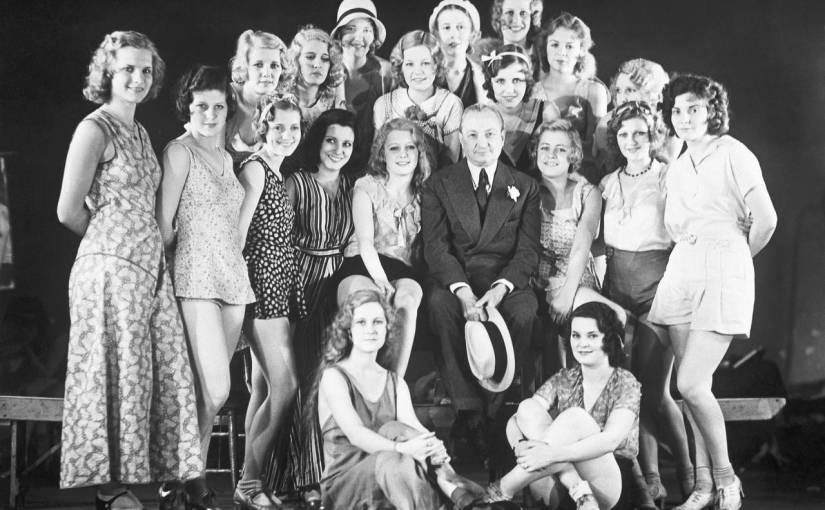
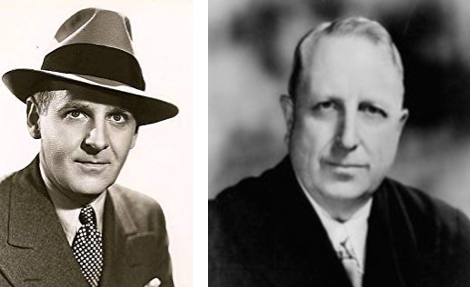
GO WITH THE FLO…Broadway impresario Florenz “Flo” Ziegfeld Jr with his Follies cast, 1931. (Wall Street Journal)
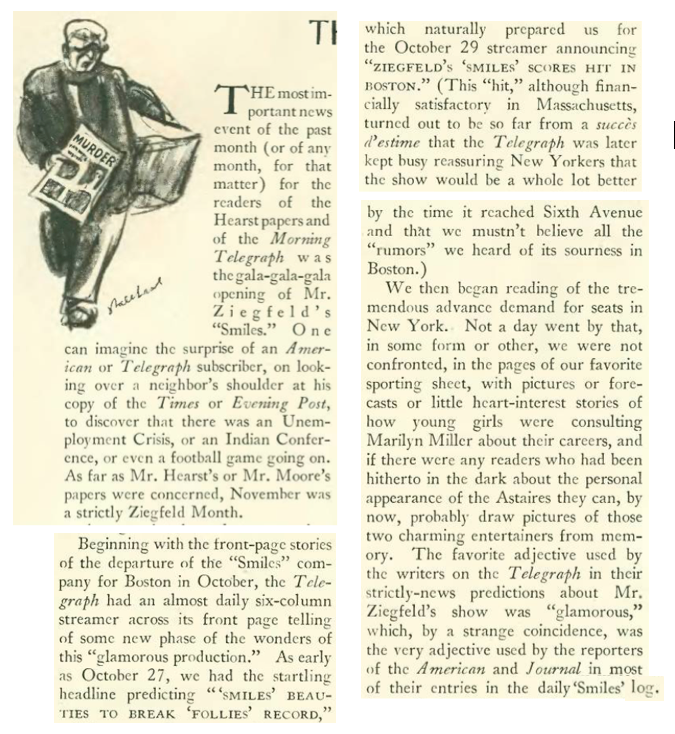
Or so it seemed to Robert Benchley, who observed in “The Wayward Press” that most of his readers could draw pictures of the Astaires from memory. But what really irked Benchley was the way William Randolph Hearst manipulated his mighty newspaper empire to promote Ziegfeld’s Smiles in a way that made the show appear to be the biggest hit of the year.
Ziegfeld Theatre was built with Hearst’s financial backing, so the media mogul was determined that the show would be a success, commanding his editors and writers to lavish praise on the tepid production, which would close in less than two months as a box office failure.
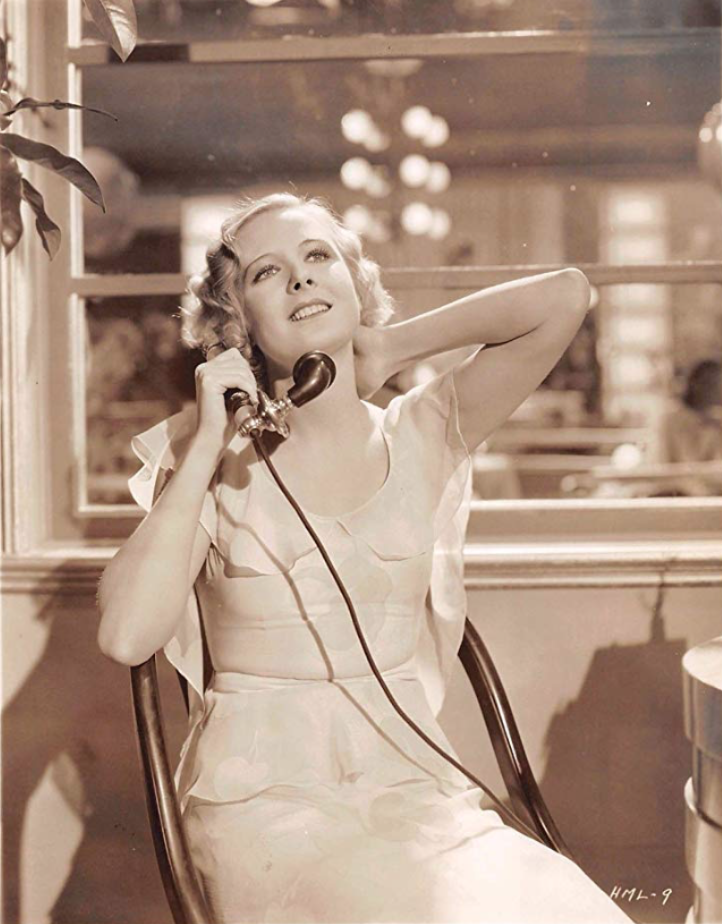
SAY CHEESE…Program for Smiles featuring Fred Astaire, Marilyn Miller and Adele Astaire. At right, publicity photo for Smiles featuring Fred and Marilyn. (Playbill/Pinterest)
For the Astaires, they were nearing the end of their 27-year collaboration — Adele would retire from the stage in 1932 to marry Lord Charles Cavendish, and in 1934 Fred would pair up with Ginger Rogers for the first of nine films they would make together for RKO. Marilyn Miller, one of the most popular Broadway stars of the 1920s and early 1930s, would also seek her fortune in films, but would only make three. Alcoholism and persistent sinus infections would cut her life short in 1936 — she would die at age 37 from complications following nasal surgery.
BRIEF CAREER…Marilyn Miller in 1931’s Her Majesty, Love, one of just three films she would make before her death in 1936. (IMDB)
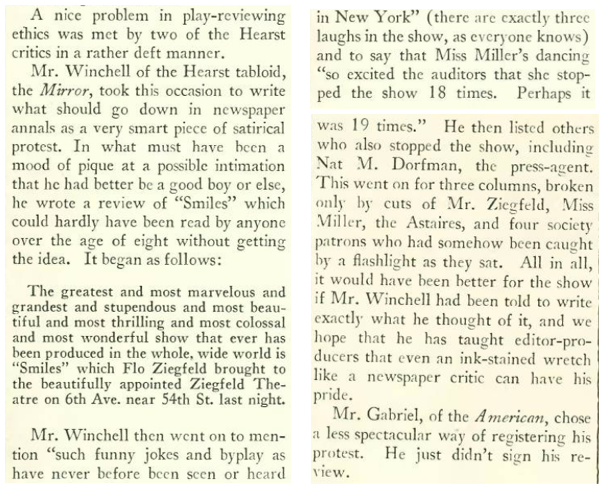
Benchley revealed how some of Hearst’s reporters responded to the edict from their boss:
TWEAKING HIS NOSE…Walter Winchell, left, registered his protest against his boss, William Randolph Hearst, by laying it on thick in his column. (IMDB/BBC)THE FOLLY OF FOLLIES…Robert Benchley (left) cried foul regarding Hearst’s attempt to prop up a lousy show; Ogden Nash (right) found humor in the “immorality” of Ziegfeld’s productions. (Wikipedia/Notable Biographies)
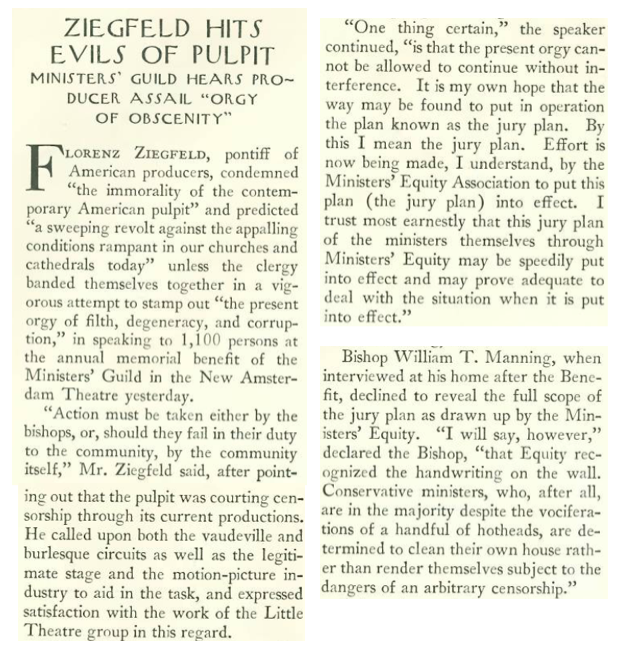
On a related note, Ogden Nash also zeroed in on Ziegfeld’s latest show, turning the tables on religious zealots who found the Follies immoral. An excerpt:
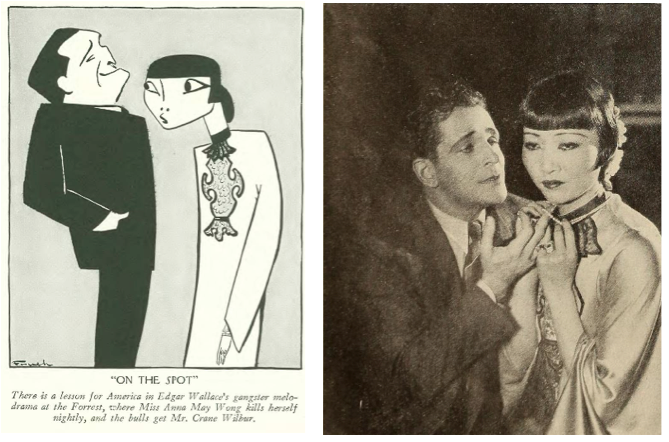
And finally, one more theater-related item: a drawing by Al Frueh highlighting the melodrama On The Spot, which ran from Oct. 29, 1930 through March 1931 at the Forrest Theatre.
BETTER THAN ZIEGFELD, THIS…At right, Crane Wilbur and Anna May Wong in the melodrama On The Spot, which opened Oct. 29, 1930 at the Forrest Theatre. (New Yorker/Pinterest)
* * *
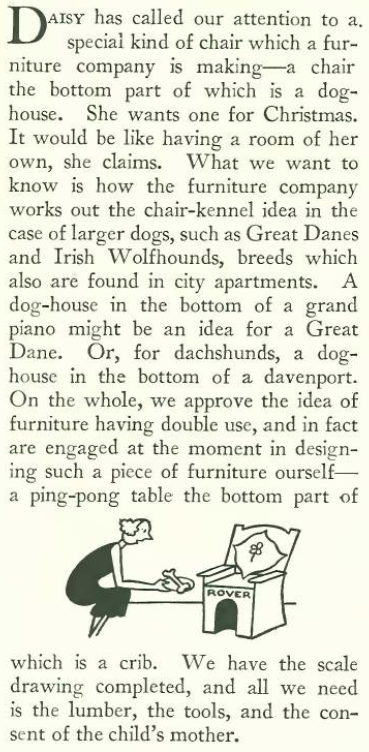
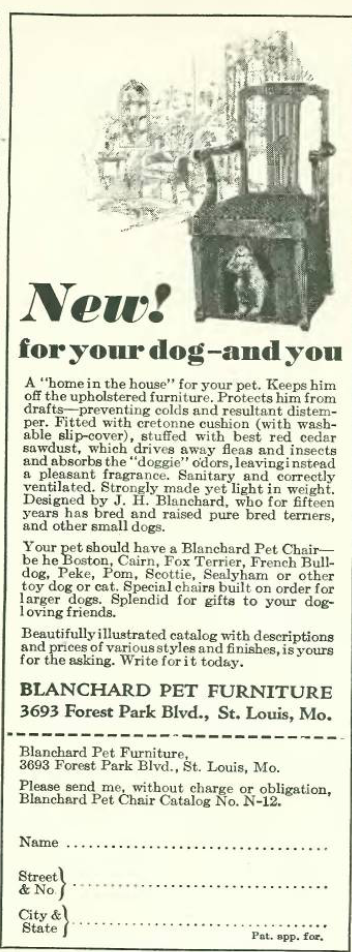
In the Dec. 6, 1930 “Notes and Comment,” E.B. White shared his observations on a new type of chair that doubled as a dog house…
…and he wasn’t making it up, because the chair he described was featured in this ad from the same issue…
* * *
Drunk History
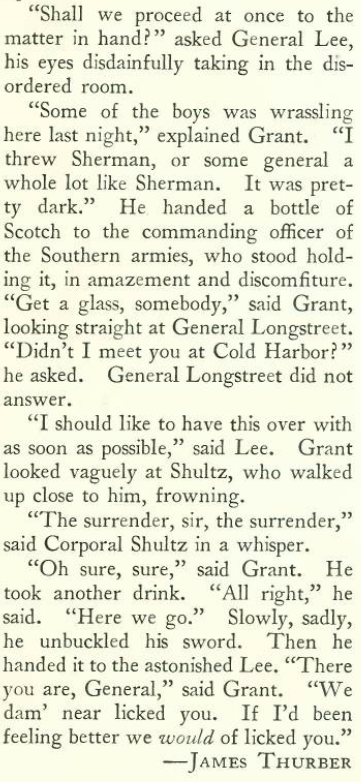
In the fall of 1930 Scribner’s magazine published a series of three articles titled “If Booth Had Missed Lincoln,” If Lee Had Not Won the Battle of Gettysburg,” and “If Napoleon Had Escaped to America.” The New Yorker’sJames Thurber claimed to be the author of a fourth article, “If Grant Had Been Drinking At Appomattox.” An excerpt:
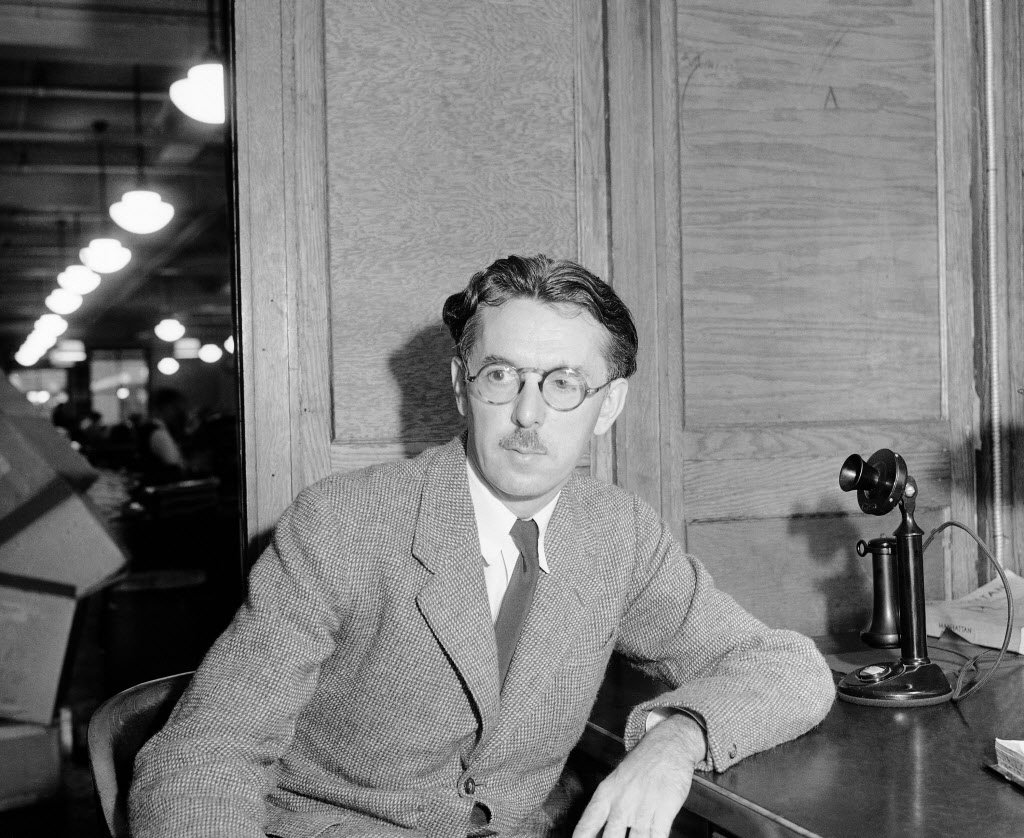
REVISIONIST…James Thurber circa 1930. (thurberhouse.org)
* * *
From Our Advertisers
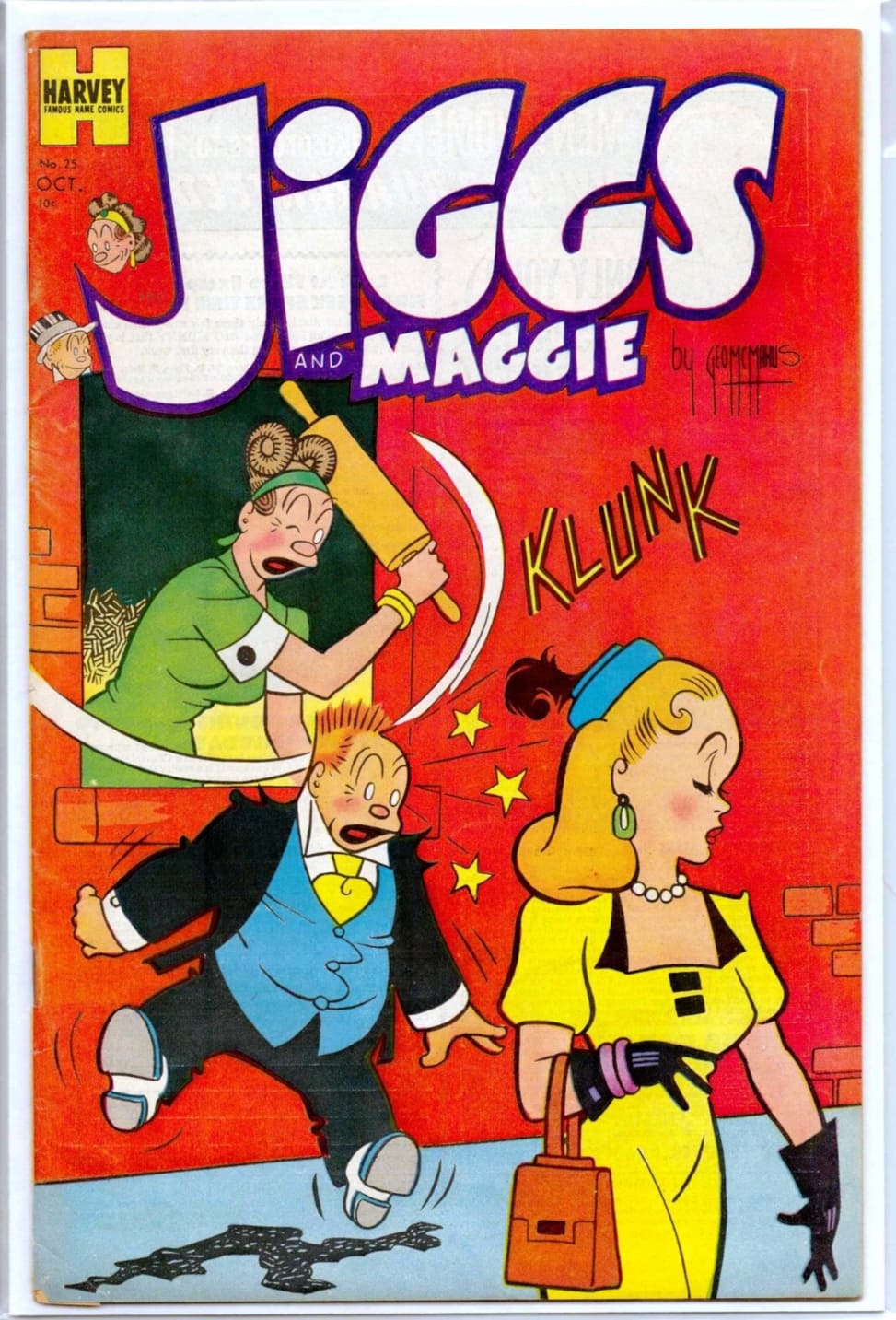
The rolling pin was often deployed as a prop — especially in the comics — to illustrate marital discord; the makers of Hoffman ginger ale used the common trope to sell their fizzy drink…
…for reference, Maggie gives it to Jiggs in this comic book cover from 1953…
(Good Girl Comics)
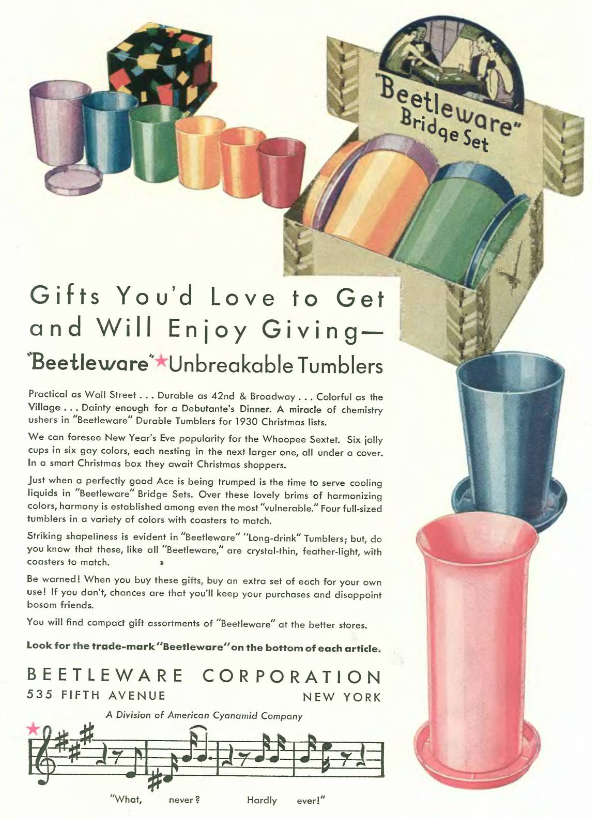
…the issue was stuffed with ads for Christmas shoppers, ranging from colorful plastic tumblers…
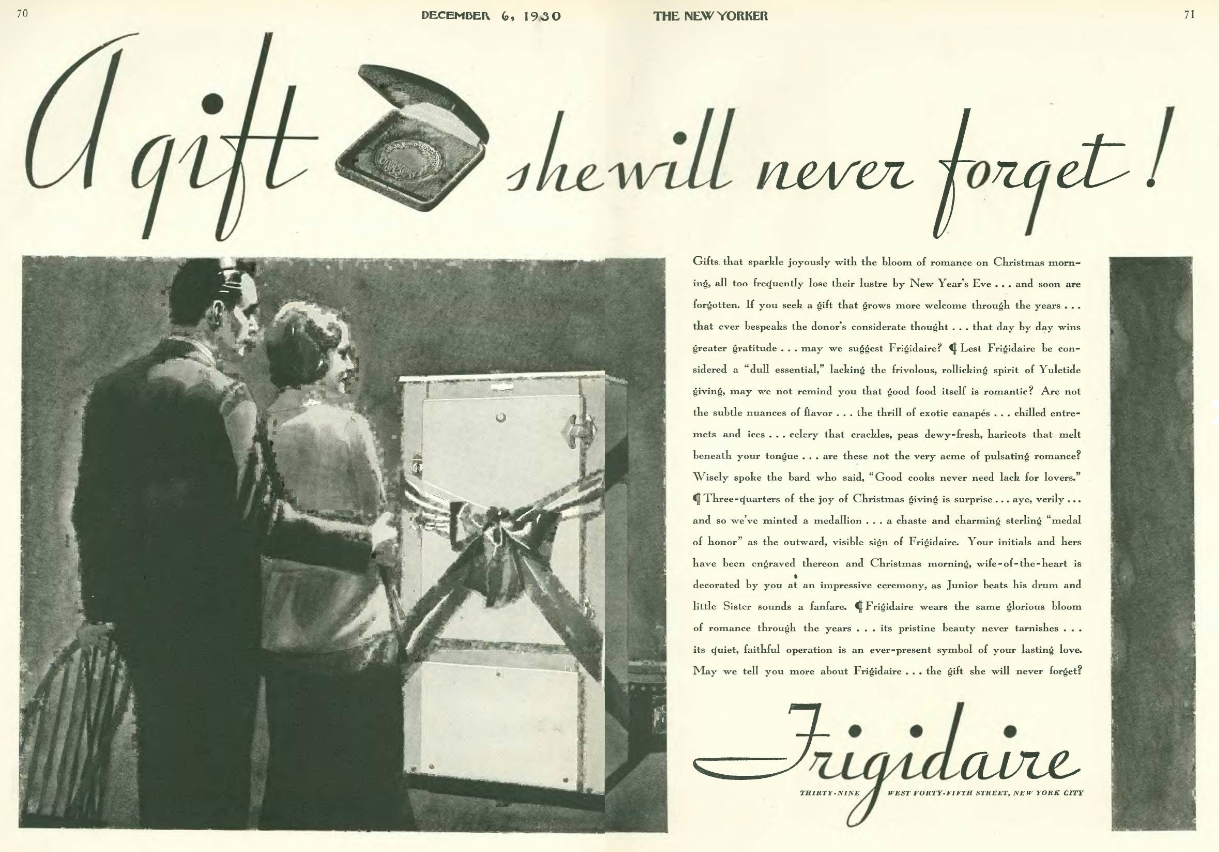
…to “unforgettable” appliances…
…to a variety of accessories at Wanamaker’s…
…Macy’s offered this pajama and robe combination for (insufferable) little boys who “strive for sartorial effect”…
…while Burdine’s of Miami urged snowbirds to purchase multiple wardrobes to remain fashionable throughout the winter season…
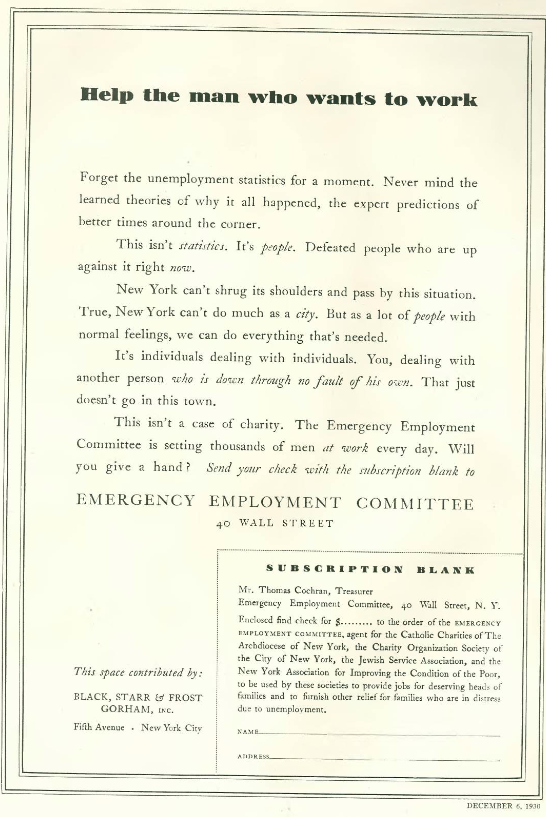
…and in stark contrast, this ad appealed for donations to help the jobless…
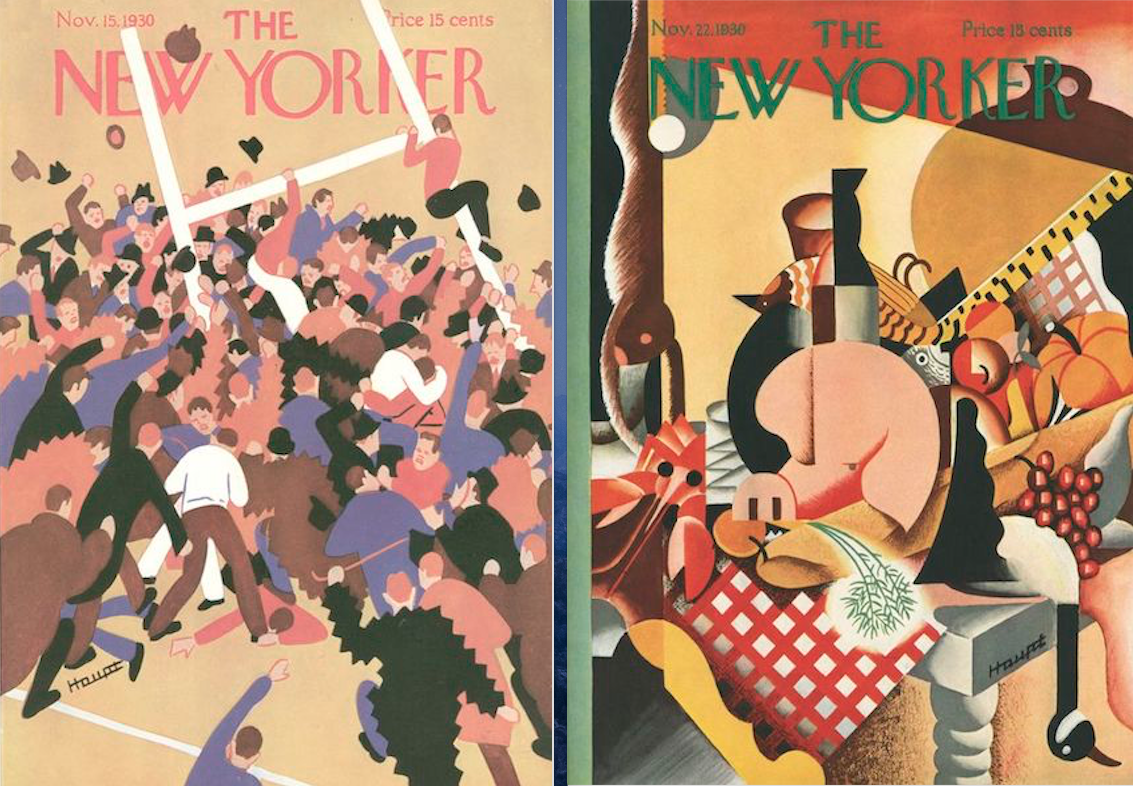
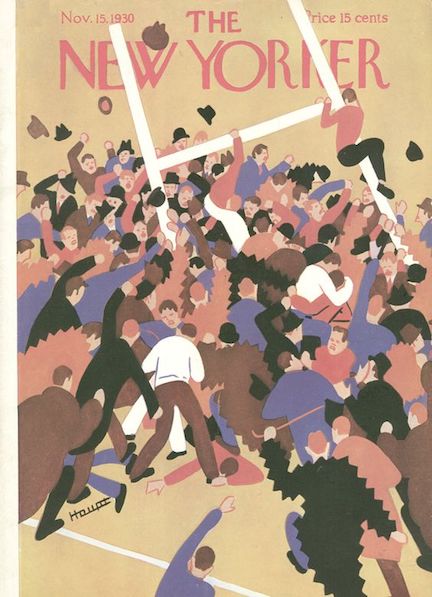
For this installment we look at two issues, Nov. 15 and 22, both featuring covers by Theodore Haupt that celebrated two autumn rituals: football and Thanksgiving.
Let’s begin with the Nov. 22 issue, which climbed to the highest place in Manhattan — no, not the Chrysler Building, but the nearby Empire State Building — with E.B. White admiring the commanding view:
Before the Empire State Building could go up, the old Waldorf-Astoria hotel had to come down. As White observed, the old hotel was built so soundly that it was too costly to deconstruct and salvage. Most of it ended up on the bottom of the ocean.
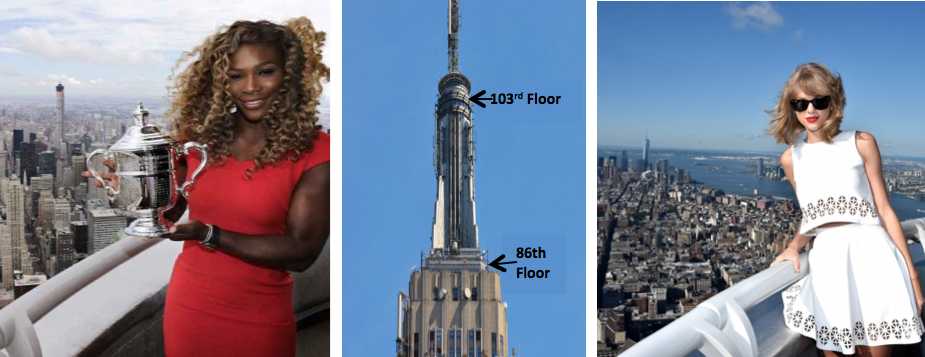
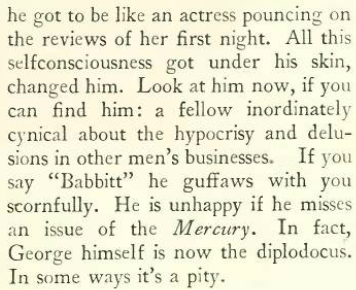
DOWN IN DAVY JONES’ LOCKER lie the remains of the old Waldorf-Astoria Hotel, which stood for just 36 years before it was razed to make room for the Empire State Building. At right, one of the hotel’s lobbies, and the Grand Ballroom. (nyc-architecture.com/Pinterest)A LOT OF HOT AIR…Top images: The fabled “mooring mast,” described by E.B. White in his New Yorker brief, as imagined in composite images (old-time Photoshop). In reality, the morning mast never worked; bottom right, a cutaway view of the mast featured in Popular Mechanics; bottom left, New York Times photo from March 22, 1931, announcing the completion of the Empire State Building, just 17 months after the Waldorf-Astoria began coming down. (Keith de Lellis Gallery, rarehistoricalphotos.com/Google Books/The New York Times)SURVEYING THEIR KINGDOM…Most visitors to the Empire State Building can only go as high as the 86th floor observation deck. However, if you are a VIP like Serena Williams or Taylor Swift, you can get your picture snapped on the 103rd. (Associated Press/Empire State Building/Evan Bindelglass, CBSNewYork)
* * *
Sore Winner
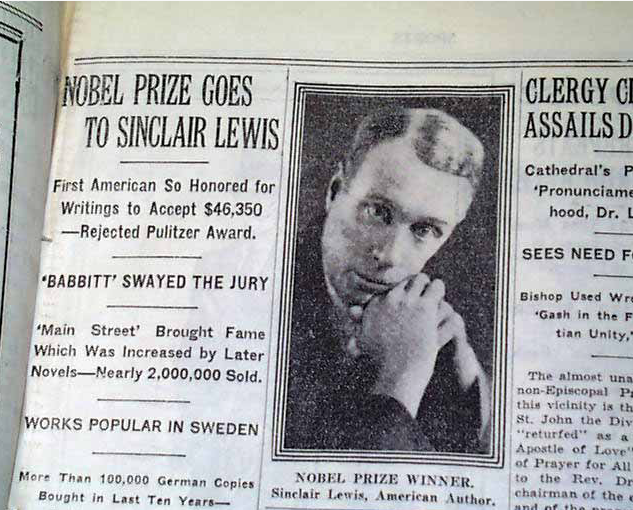
Sinclair Lewis famously declined the Pulitzer Prize for his 1925 novel Arrowsmith, upset that his 1920 novel Main Street had not previously won the prize. But when the Swedish Academy came calling with a Nobel Prize in Literature in 1930, he happily accepted. According to “The Talk of the Town,” this award also seemed a bit tardy, since Lewis’s small town booster archetype, George F. Babbitt, did not fit the dour days of the Great Depression. But it turned out that the 1922 novel Babbitt was ultimately what swayed the Nobel jury:
BOOST FROM A BOOSTER…George F. Babbitt helped make Sinclair Lewis famous, and landed him a Nobel. (NYT, NOVEMBER 6, 1930)
* * *
Not So Sweet
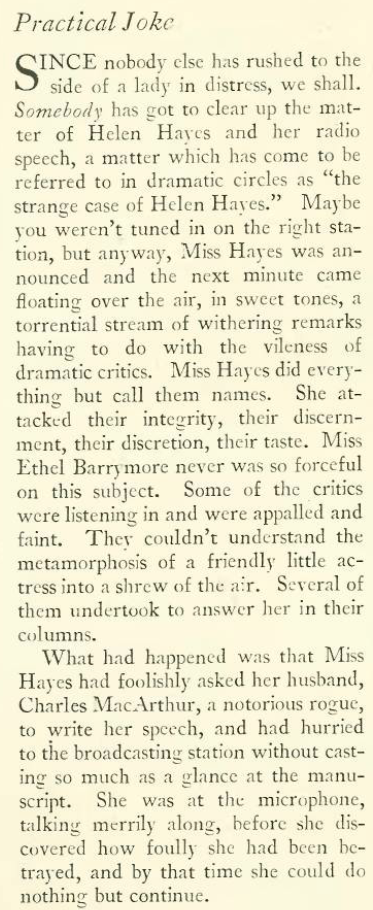
Those of a certain age might remember Helen Hayes as a sweet old lady who appeared on a number of TV shows in the 1970s and 80s, or as the mother in real life of James MacArthur, Disney teen star and later the portrayer of Danny “Book ’em Danno” Williams on the original Hawaii 5-0 TV series. Hayes was married to playwright Charles MacArthur, and “The Talk of the Town” takes it from there…
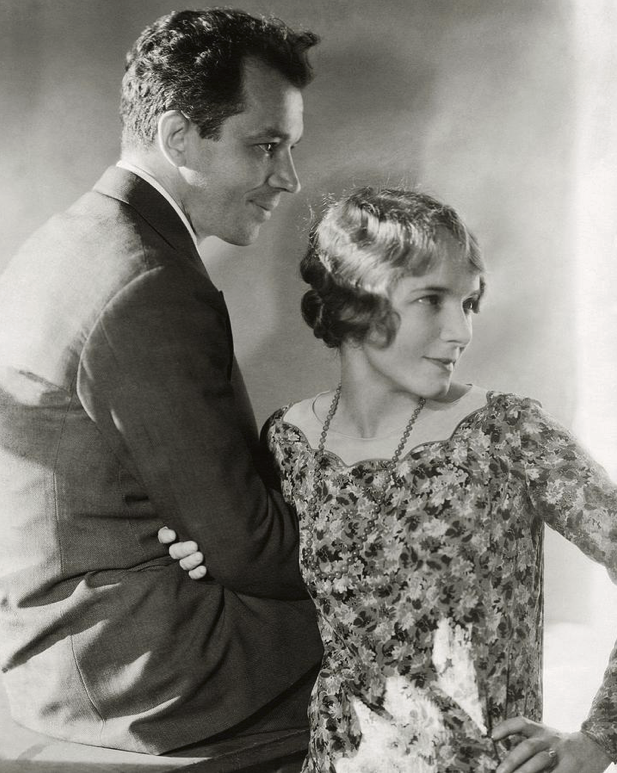
CREATIVE TYPES…The engaged couple Charles MacArthur and Helen Hayes posed for photographer Edward Steichen for this Jan. 1, 1929 image featured in Vanity Fair magazine. (Condé Nast)
* * *
Ain’t It Grand
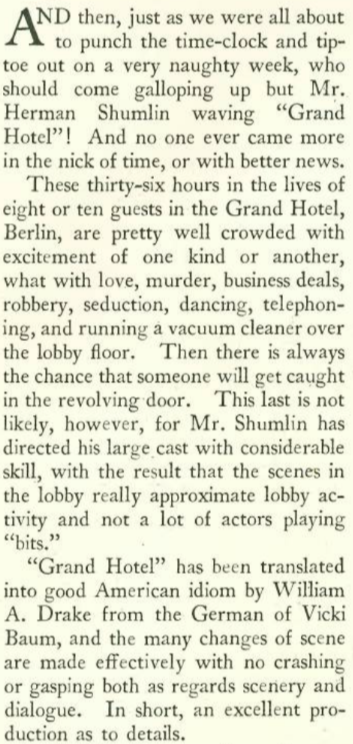
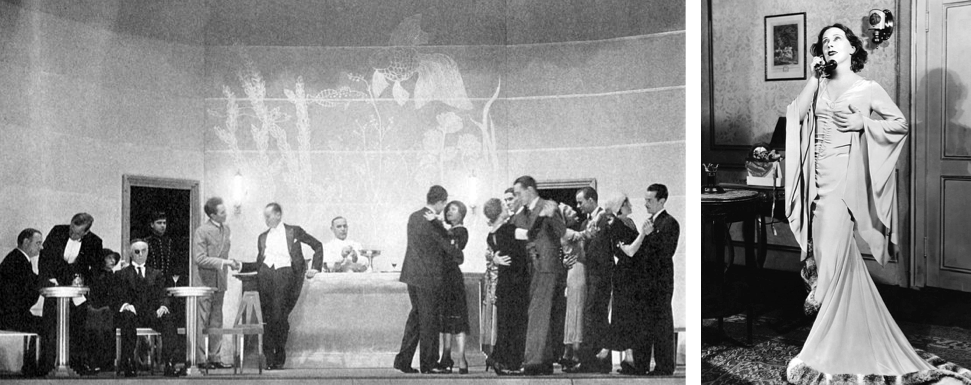
Grand Hotel opened at the National Theatre on Nov. 13, 1930 to strong reviews, including the one below by Robert Benchley that he filed for The New Yorker. The play, adapted from the 1929 novel Menschen im Hotel by Austrian writer Vicki Baum, would prove to be a smash on Broadway and again on the silver screen in a star-studded 1932 film featuring Greta Garbo, John Barrymore, and Joan Crawford.
THE STARS ALIGN…Left, promotional photograph of the original Broadway production of Grand Hotel. At right, Eugenie Leontovich portrayed fading Russian ballerina Grusinskaya in the play. The role would go to Greta Garbo in the 1932 film adaptation. (Theatre Magazine, February 1931/Wikipedia)
…and while we are on the subject of Broadway, the theater review section also featured this Al Frueh illustration promoting a noted production of Twelfth Night at the Maxine Elliott…
Program for the production featuring Jane Cowl. (Playbill)
* * *
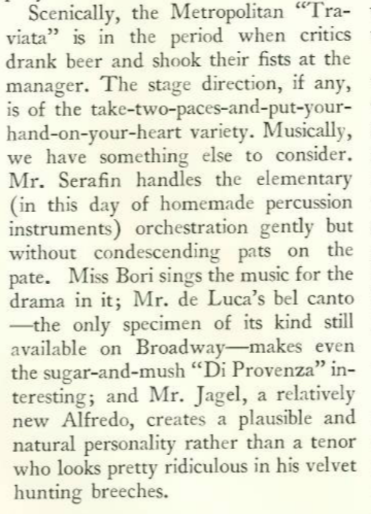
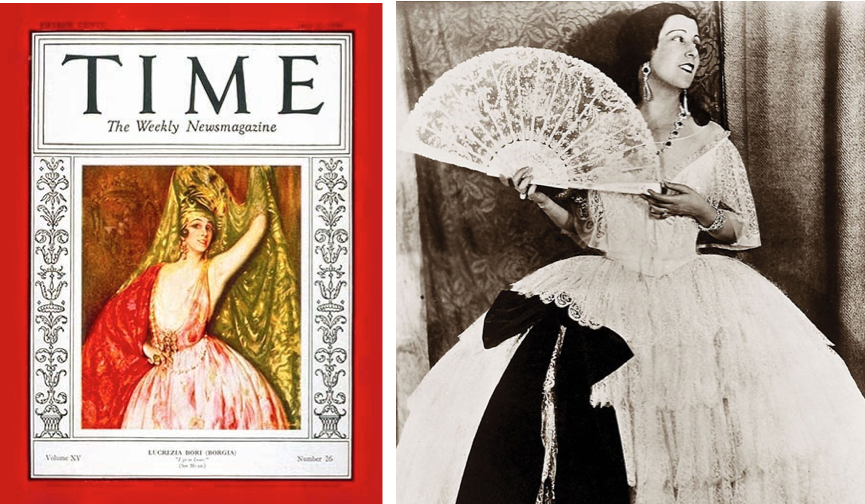
There were also big doings at the Met, where Spanish lyric soprano Lucrezia Bori (1887-1960) wowed audiences with her portrayal of Violetta in La Traviata.
SHE HAD SOME PIPES…right, lyric soprano Lucrezia Bori on the cover of the June 30, 1930 edition of Time magazine. At right, promotional photo of Bori circa 1930. (Time/Wikipedia)
* * *
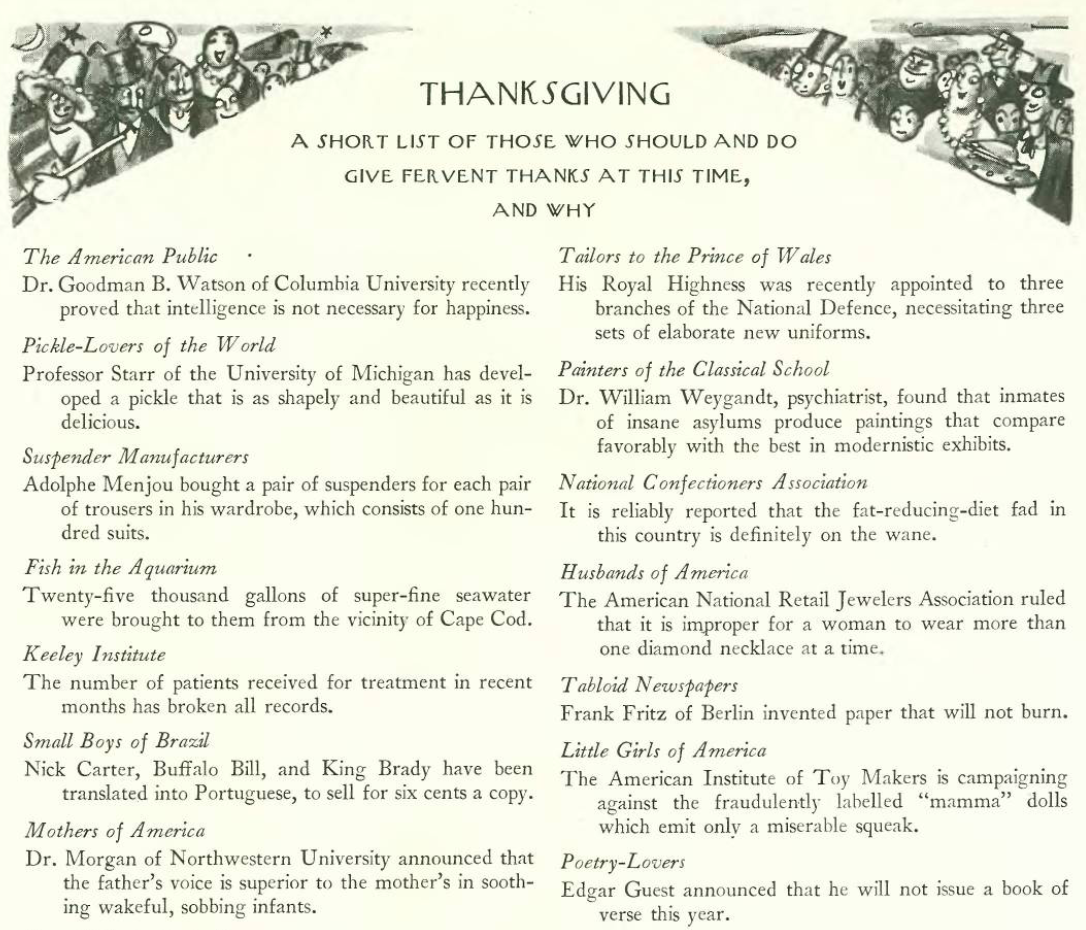
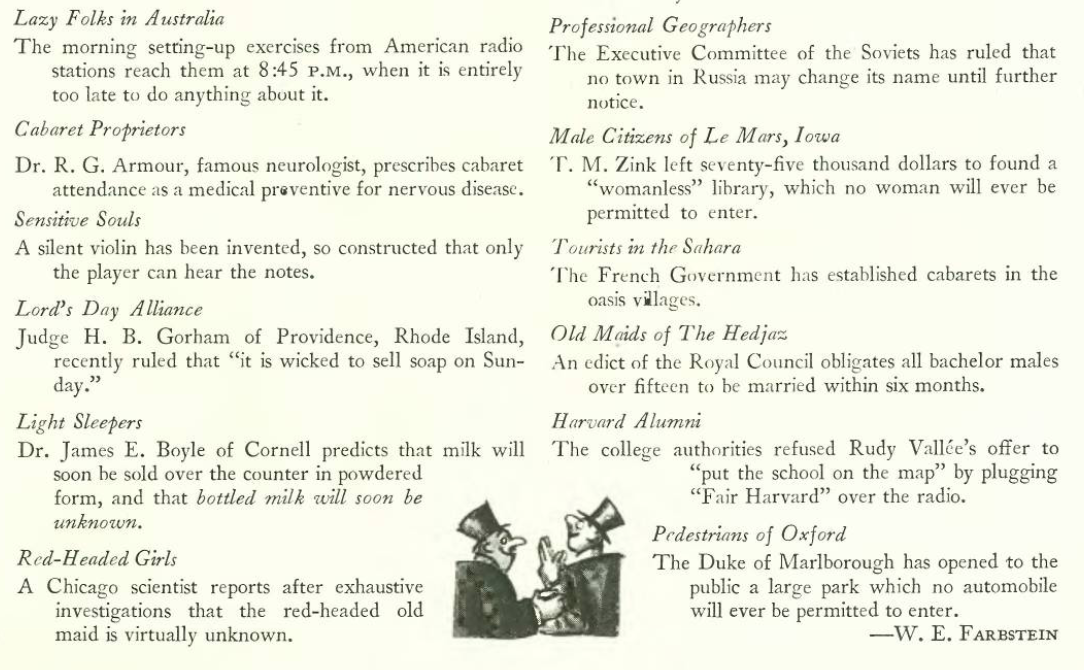
Bounty of Blessings
Humorist W. E. Farbstein gave readers plenty to be thankful for in this tribute to the Thanksgiving holiday…
* * *
From Our Advertisers
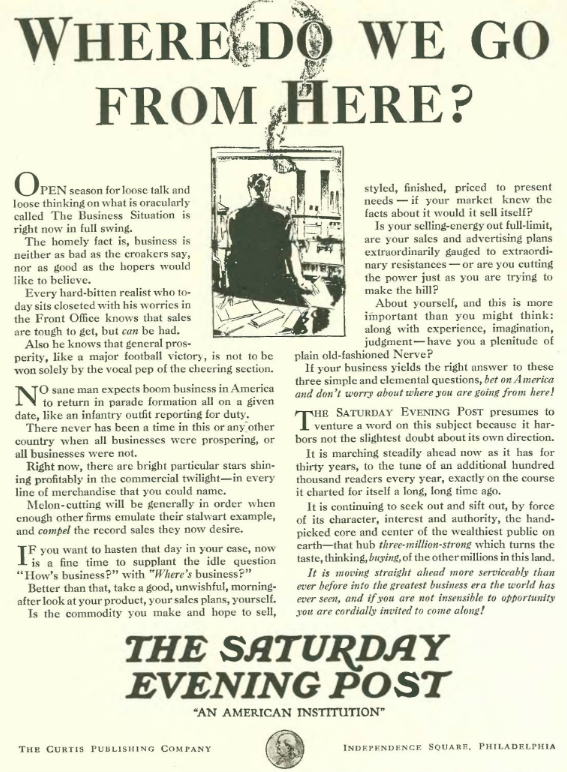
Occasionally advertisements acknowledged the reality of the Great Depression, including this one from The Saturday Evening Post that offered encouraging words to prospective readers…
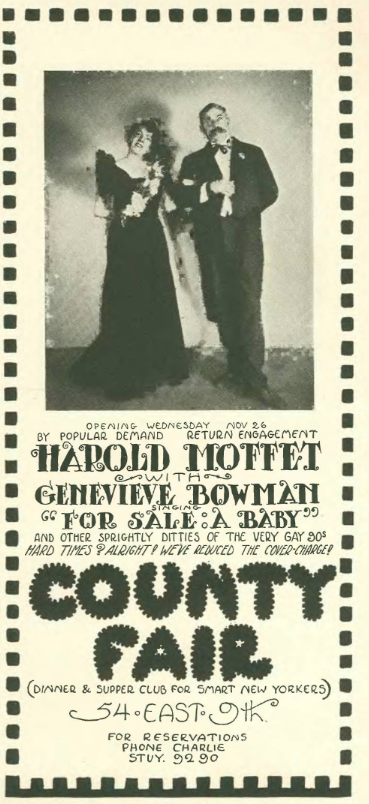
…County Fair, a Greenwich Village country-themed nightclub, offered the diversion of Moffatt and Bowman to take audiences’ minds off of hard times…
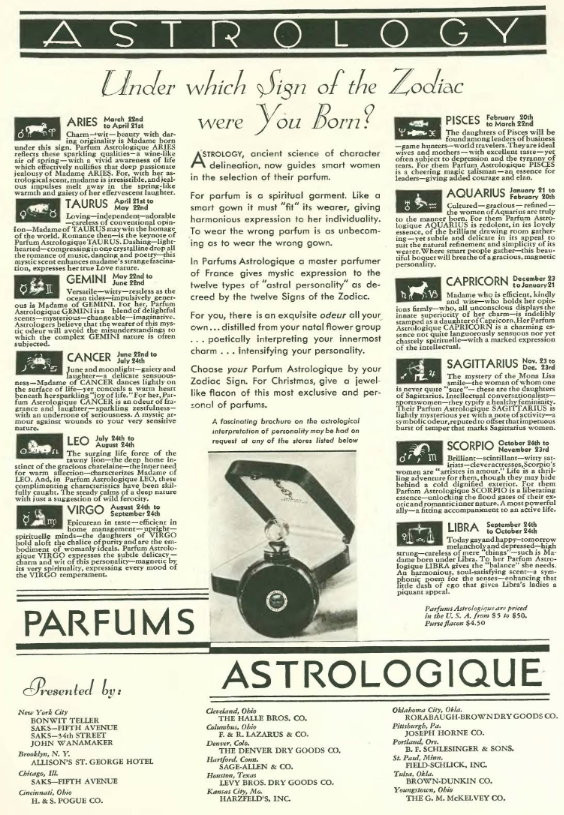
…and for all the supposed sophistication of New Yorker readers, there were still plenty of back page ads offering nostrums laced with superstition…
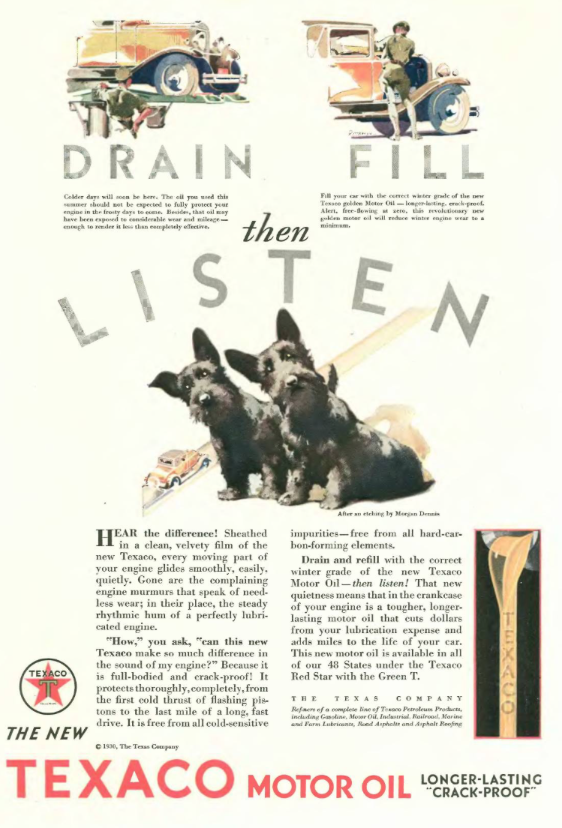
…some of the more colorful, spritely ads from the era were offered up by the producers of Texaco Motor Oil…
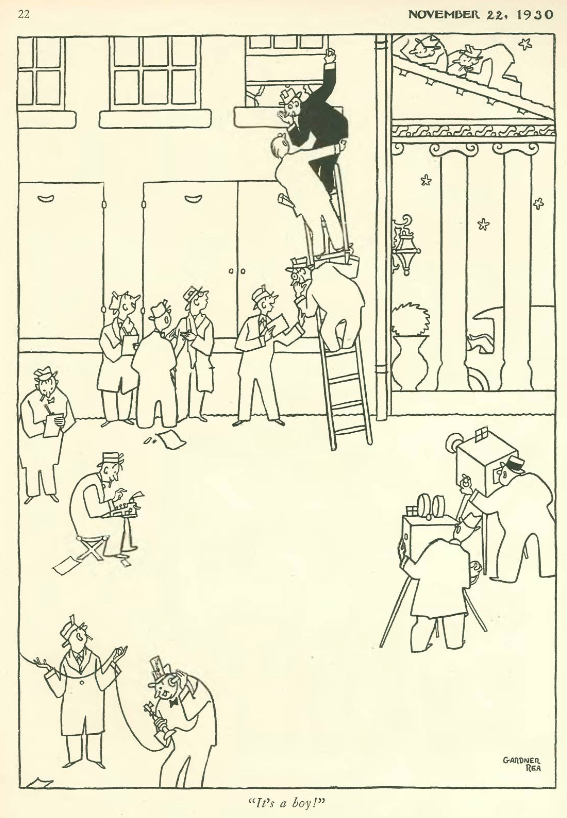
…our cartoons are by Gardner Rea…
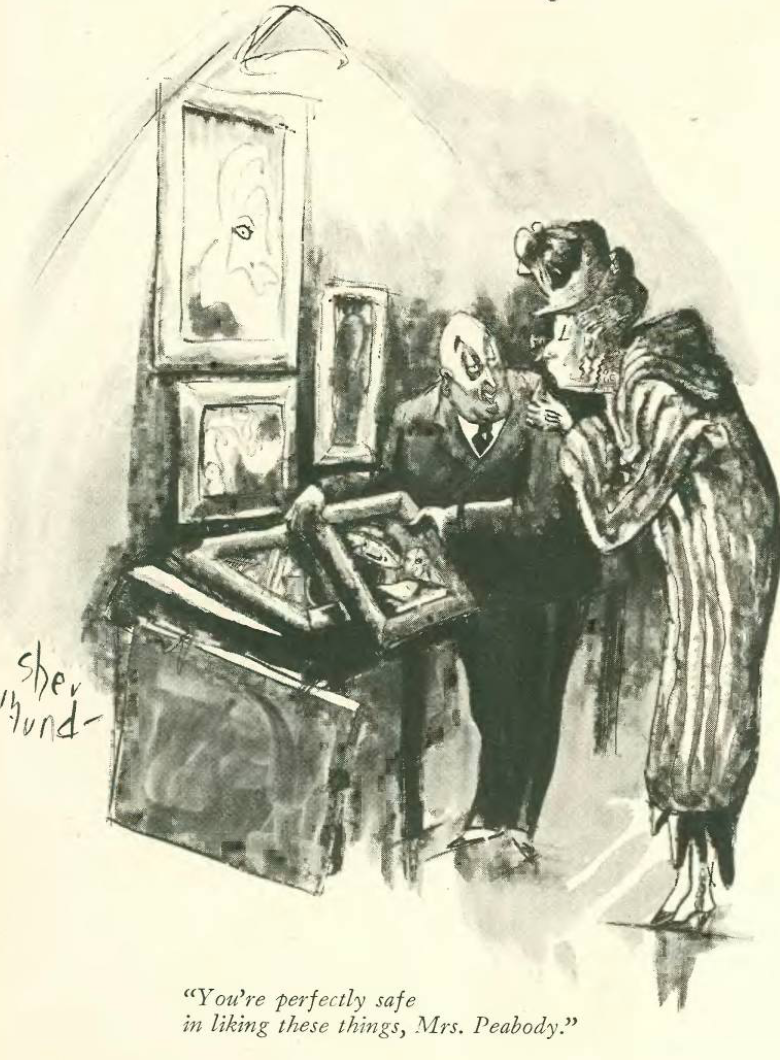
…Barbara Shermund…
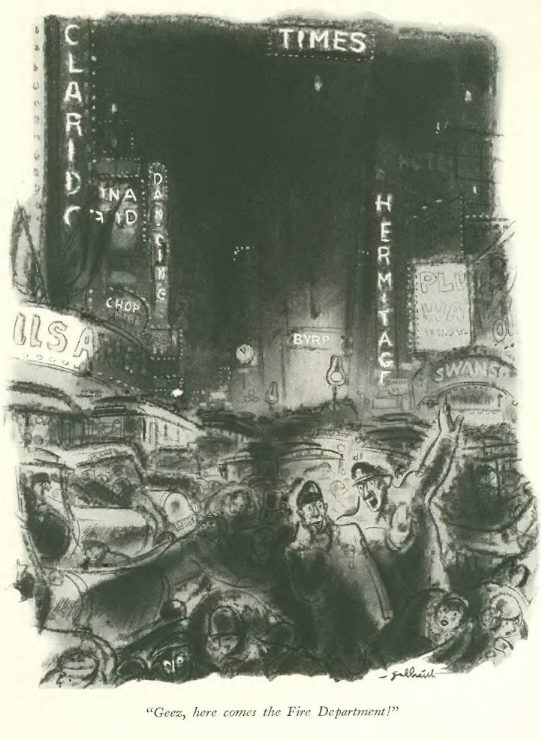
…William Crawford Galbraith…
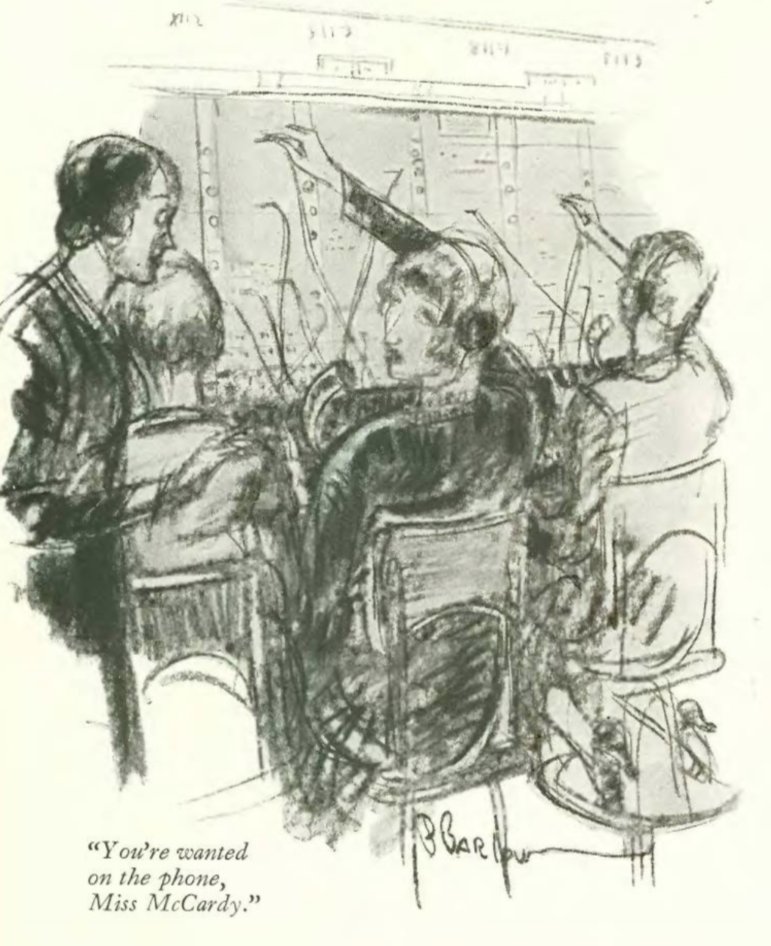
…and Perry Barlow…
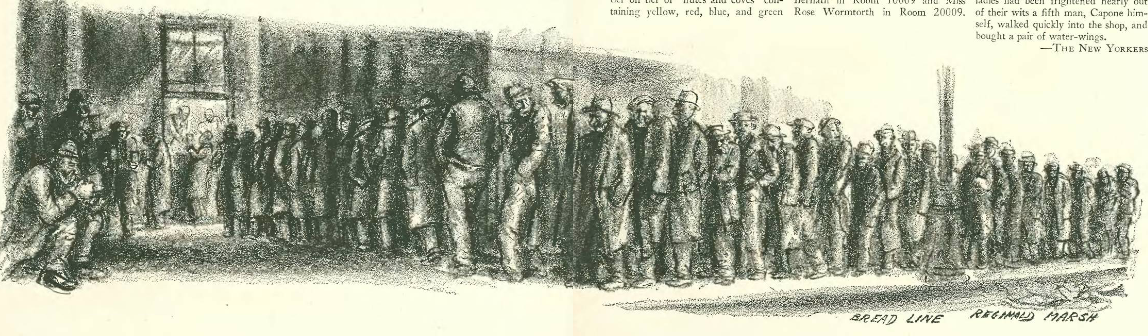
…and for another reminder of reality in the city, this sketch that ran along the bottom of “The Talk of the Town,” by Reginald Marsh…
…and now we step back to the Nov. 15 issue, where E.B. White offered a less somber take on the Great Depression…
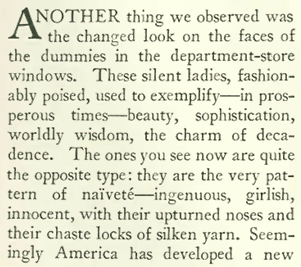
…White also noted a change on the faces of storefront mannequins…
YIN AND YANG…The worldly pose of a Roaring Twenties mannequin, and a more wholesome look for the leaner times in the 1930s. (Pinterest)
* * *
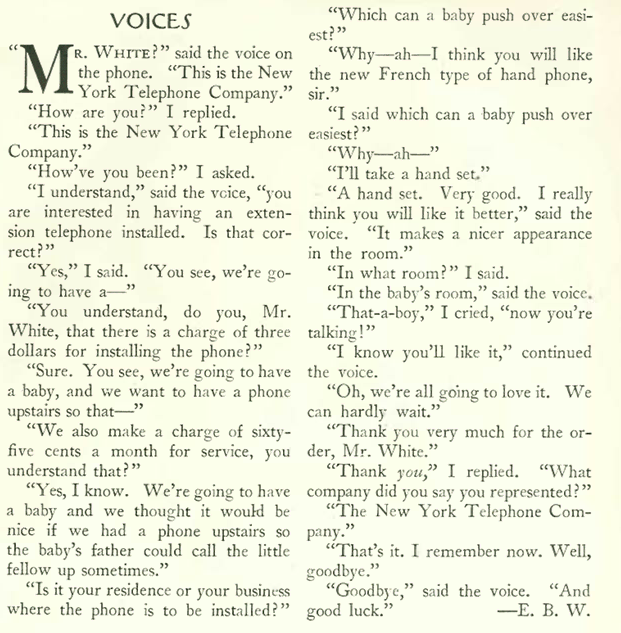
Playing Telephone
Long, long before cell phones, telephones were heavy stationary devices that required a certain amount of planning before installation, as E.B. White explains:
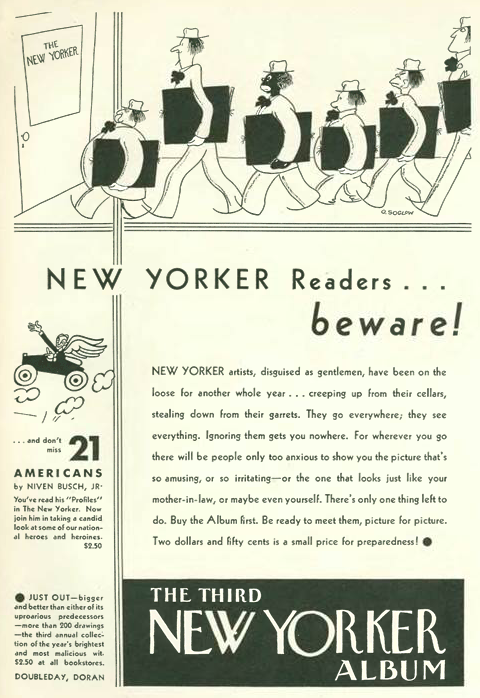
On to our Nov. 15 ads, we have this announcement for The Third New Yorker Album…with illustration by Otto Soglow…
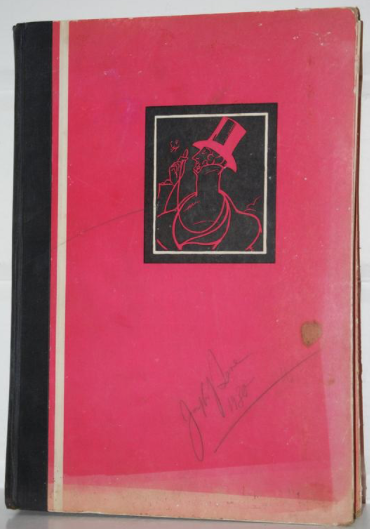
…here is what the album looked like…
…and a couple of inside pages…
(Etsy)
…one of the contributors to the album was Rea Irvin, founding illustrator for The New Yorker, here doing some business with Murad cigarettes…also another Flit insecticide ad by Dr. Seuss…
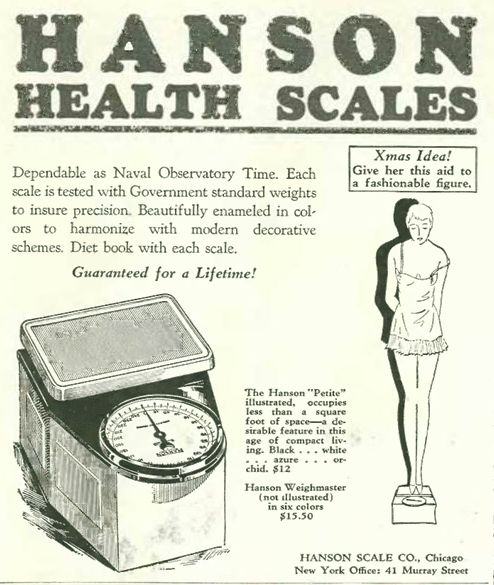
…Christmas ads began appearing in the magazine, including this one for Hanson scales…pity the poor chap (and his wife) who actually thought this might be a suitable present for Christmas, or any occasion for that matter…
…and with Prohibition still in force, advertisers found other uses to promote their products…
…on to our cartoons, Leonard Dove illustrated a couple who didn’t get away with the ruse…
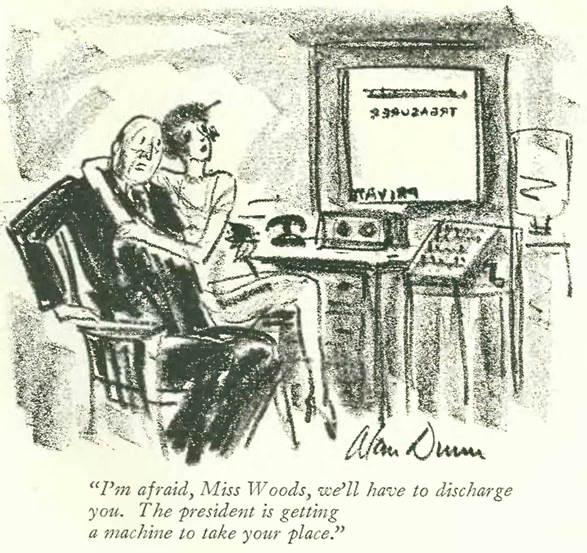
… Alan Dunn depicted what was considered typical office behavior in the 1930s…
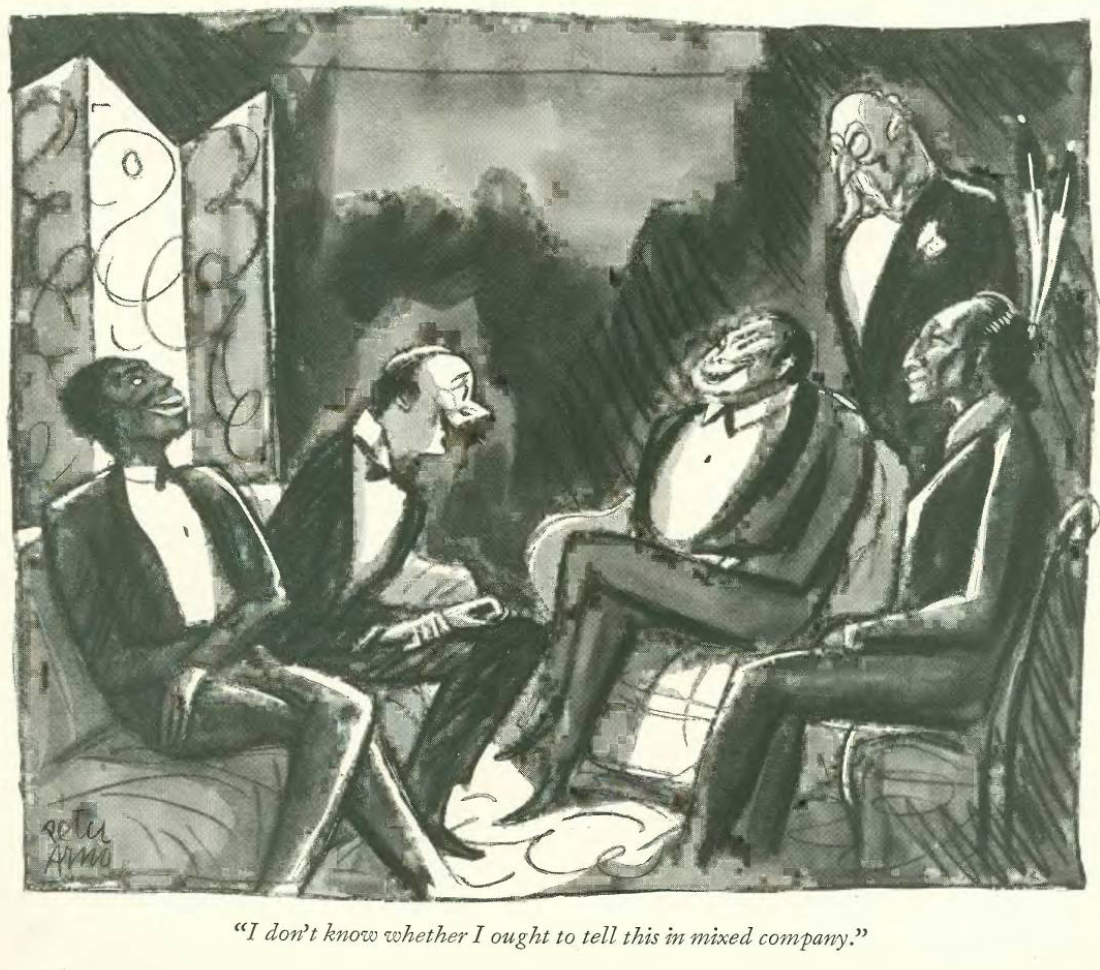
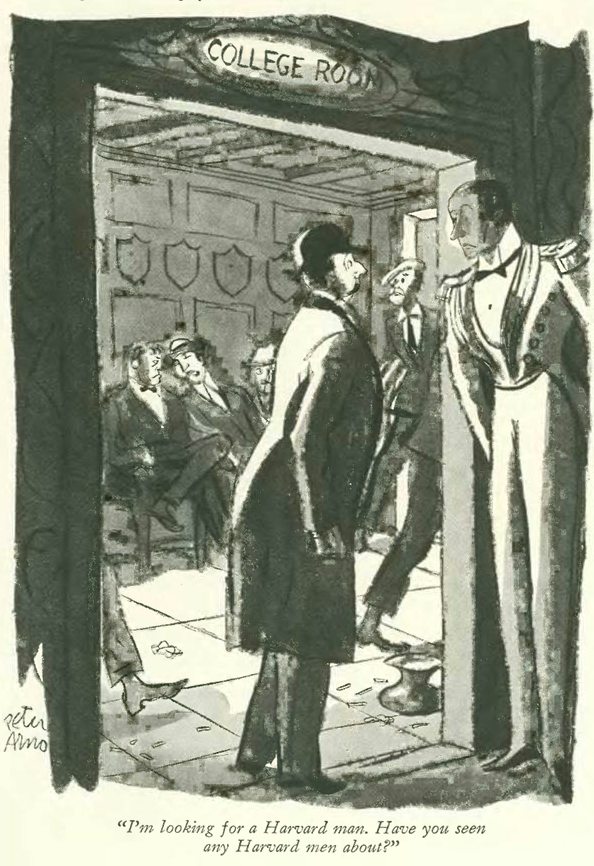
...Peter Arno visited the Harvard Club…
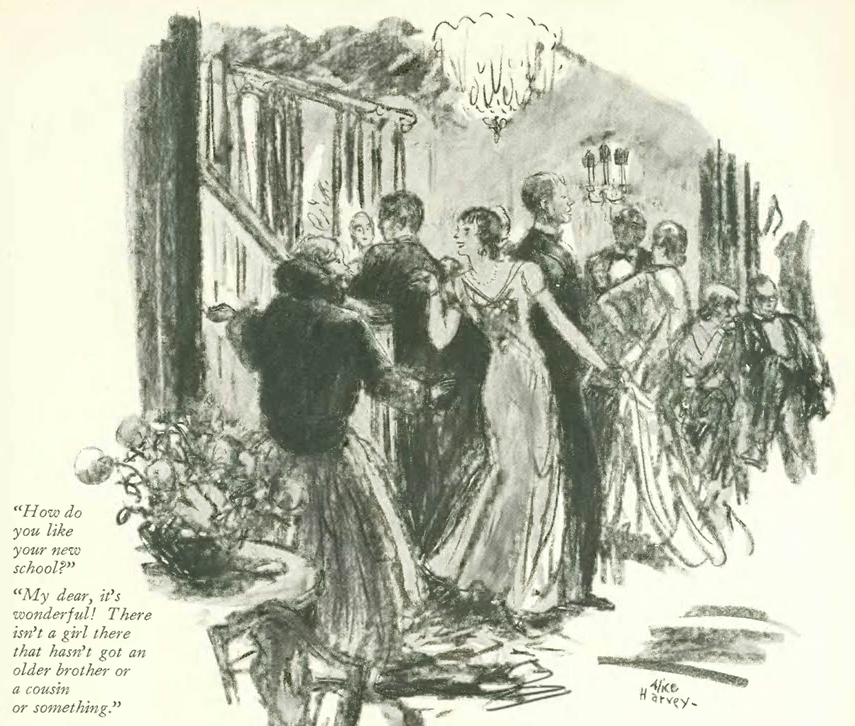
…Alice Harvey also explored the college scene…
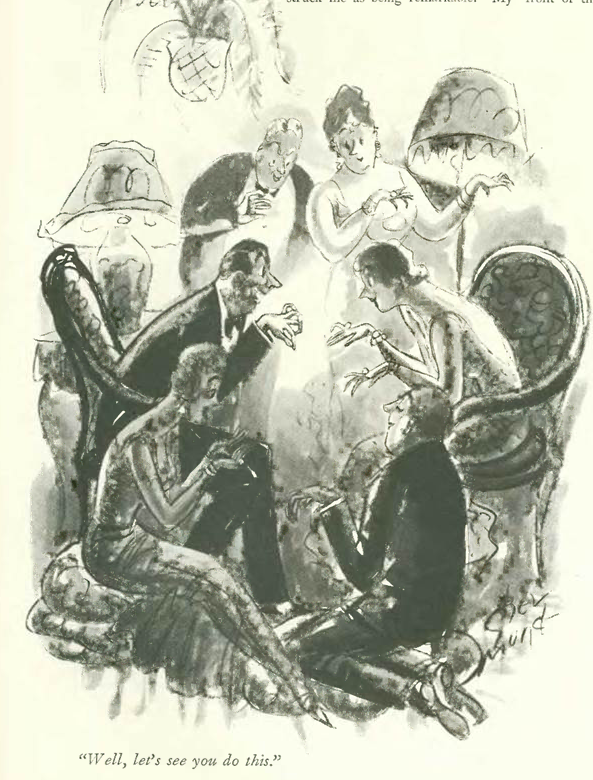
…some parlor games with Barbara Shermund…
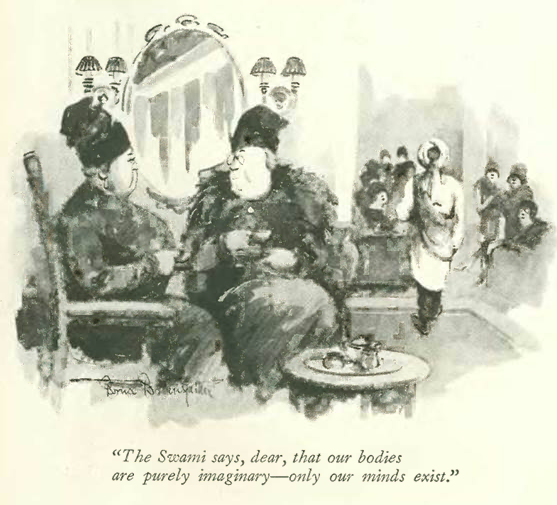
……Bruce Bairnsfather, and some existentialist chat at tea time…
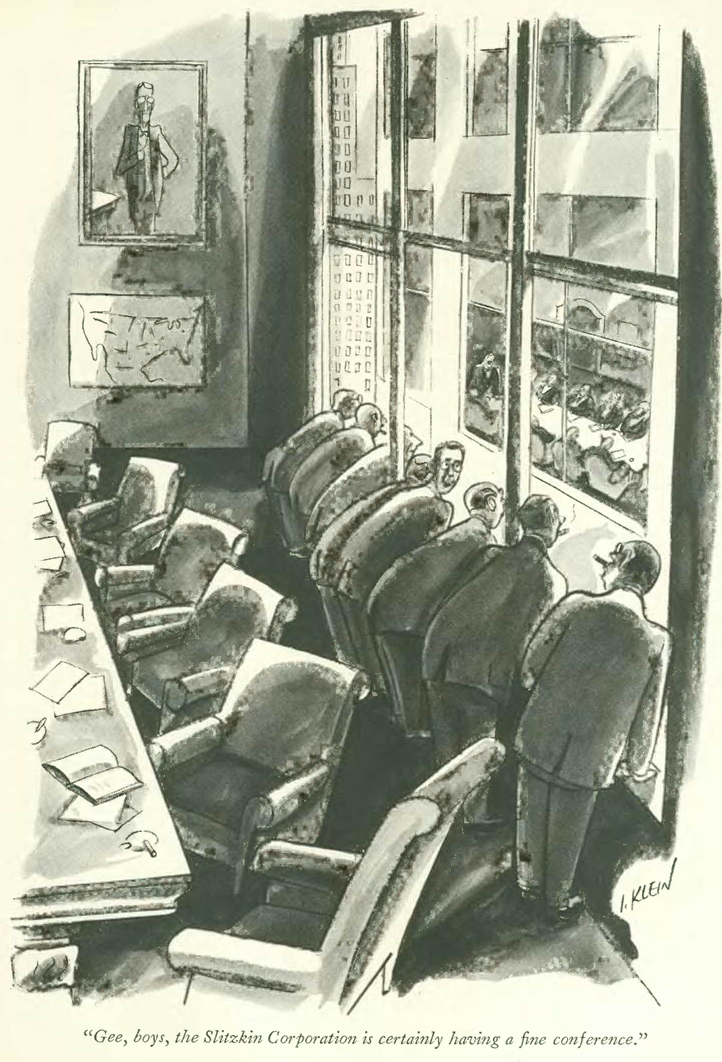
…and we close with Isadore Klein, and the world of corporate competition…
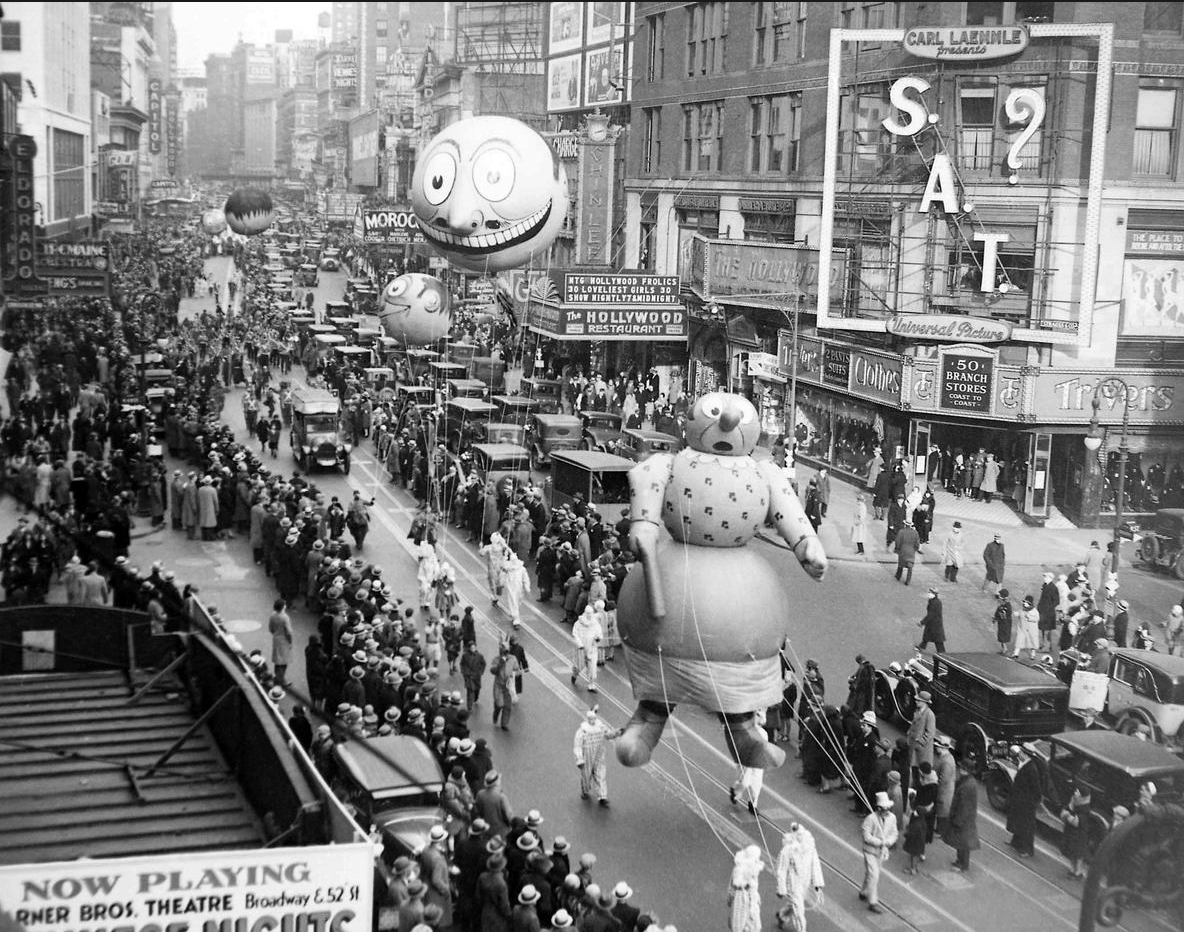
…and a Happy Thanksgiving, from the Macy’s Thanksgiving Parade 89 years ago, Nov. 27, 1930…
After completing a major in French in just three years, 19-year-old Libby Holman became the youngest woman to graduate from the University of Cincinnati in 1923. But it was her unique style of torch-singing—a trademark throaty mumble—that would launch a career on Broadway and a life of seemingly endless scandal.
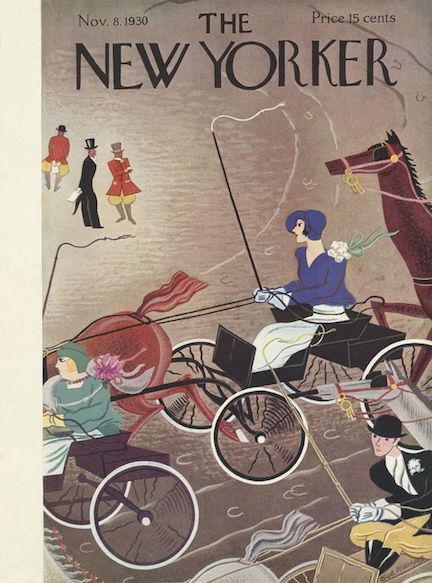
Nov. 8, 1930 cover by Sue Williams.
After performing in the The Greenwich Village Follies, Holman (1904–1971) landed her first big role in 1925 in the Rodgers and Hart production of Garrick Gaieties. But it was a signature song, “Moanin’ Low,” from Clifton Webb’sThe Little Show that would make her a star. When Three’s a Crowd (by Howard Dietz and Arthur Schwartz) opened at the Selwyn Theater on October 15, 1930, Holman was well-known to audiences not only for her voice but also for her unconventional lifestyle.
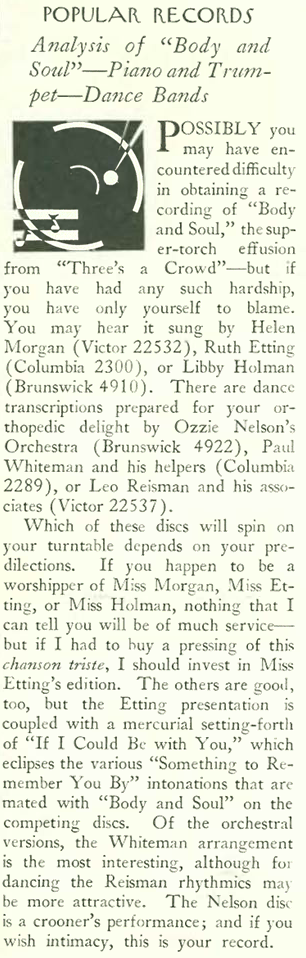
Three’s a Crowd proved to be a hit for Holman, and it gave her another hit song, “Body and Soul,” which was banned from the radio for “obscenity” but nevertheless became one of the year’s most popular songs. So popular, in fact, that it was recorded by Holman as well as by fellow torch singer Helen Morgan and Ziegfeld star Ruth Etting. This was the age of the Great American Songbook, when the song itself, and not necessarily its performer, reigned supreme. So when sheet music was distributed from a popular stage show, any number of entertainers would record it.
NAME THAT TUNE…From top to bottom, Helen Morgan, Ruth Etting and Libby Holman all recorded versions of “Body and Soul,” but Holman would make it one of her signature numbers. (YouTube/ruthetting.com/Wikipedia)
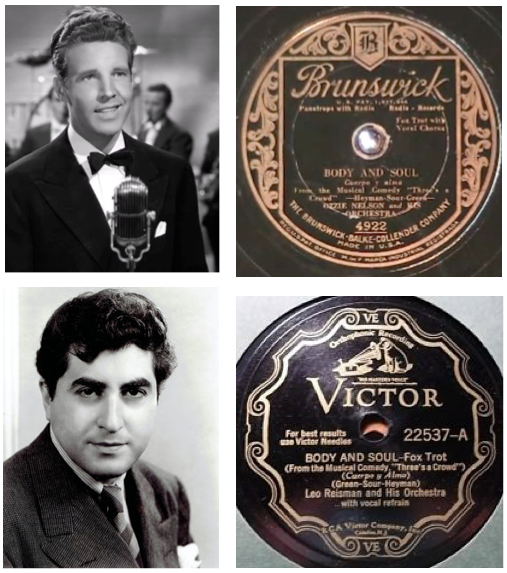
…for the hoofers, there were also a couple of dance versions of “Body and Soul” created by bandleaders Ozzie Nelson and Leo Reisman…
GOOD BEAT, EASY TO DANCE TO…Bandleaders Ozzie Nelson and Leo Reisman recorded dance versions of “Body and Soul.” (YouTube)
Openly bisexual, Holman partied hard and swore like a sailor, and during her life she would lose one husband in a suspected murder (Holman herself was briefly a suspect) and another to suicide. She would take her own life in 1971. You can read more about Holman’s colorful, tragic life in the Jewish Women’s Archive.
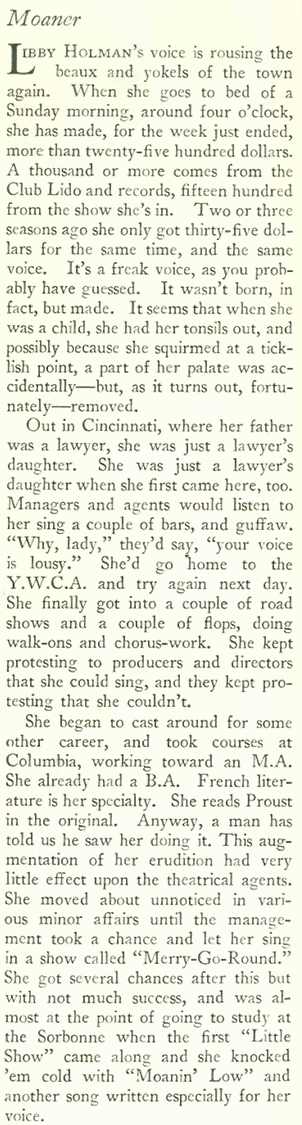
We temporarily skip to the next issue of The New Yorker (Nov. 15, 1930), which featured Holman in a “Talk of the Town” brief, and some insight into her unique singing style. An excerpt:
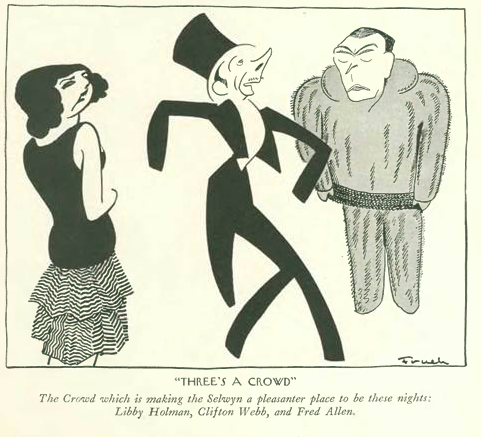
The same issue also featured this drawing of the “Three’s a Crowd” cast by Al Frueh in the theater review section:
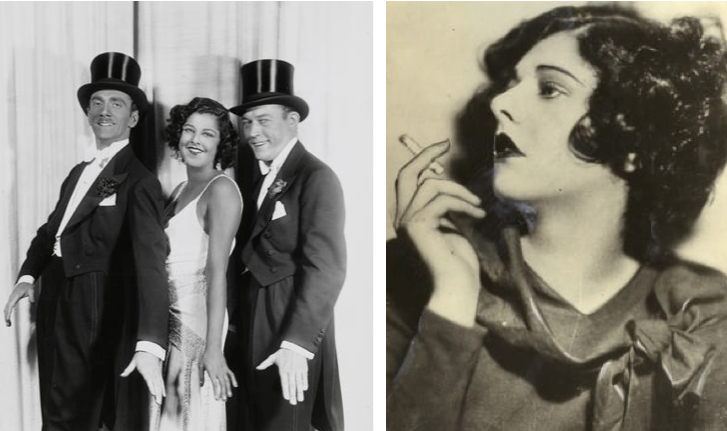
and finally, a publicity photo of the cast from 1930-31:
A FUN CROWD…Clifton Webb, Libby Holman and Fred Allen in Three’s a Crowd. At right, undated publicity photo of Holman. (performerstuff.com)
* * *
Horsin’ Around
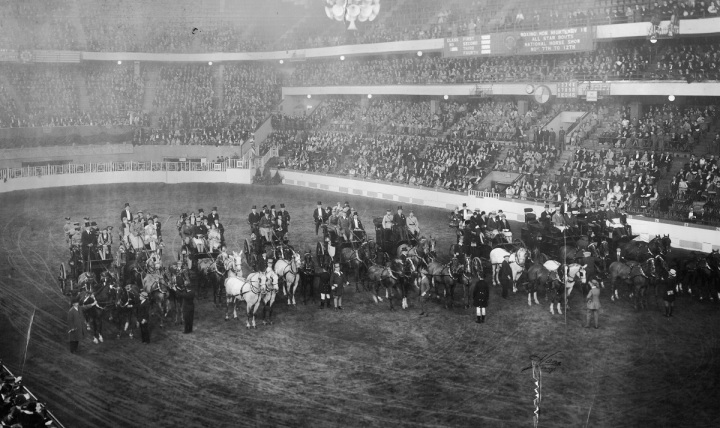
The National Horse Show was a major event on New York’s social calendar, first held at the original Madison Square Garden in 1883 before moving to the second Madison Square Garden in 1890 and again to the third Madison Square Garden in 1926. This account in the Nov. 8, 1930 New Yorker noted how the horse show’s patrician air contrasted with the rodeo held at MSG the previous week.
NOT FOR GOAT-ROPERS, THIS…The coaching parade on display at the 1927 National Horse Show in Madison Square Garden. (National Sporting Library & Museum)SOON WE’LL BE FIGHTING EACH OTHER…The National Horse Show began including a military competition in 1925. This photo from the Nov. 6, 1930 New York Times featured some international guests at the 1930 show. (NY TIMES)
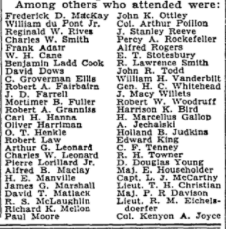
Along with the above photo, the Times included this partial lists of guests to the Horse Show Luncheon, a who’s who of New York society. Indeed, the National Horse Show’s 1887 directory provided the basis for the first New York Social Register.
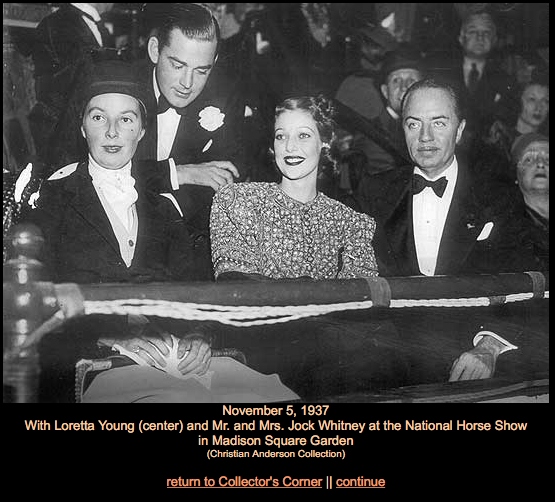
DRESSING UP FOR THE HORSES…Champion horsewoman Mary Elizabeth Whitney (left) with actors Loretta Young and William Powell at the National Horse Show in Madison Square Garden, Nov. 5, 1937. Standing behind Mary Elizabeth is her husband, Jock Whitney, a noted ambassador, art collector, philanthropist and investor. (Christian Anderson Collection)HIGH STEPPIN’…After a brief stint in Florida, the National Horse Show moved to Kentucky in 2011. Perhaps a tad less formal, it nevertheless remains an important society event. Above, noted horsewoman Misdee Wrigley Miller rides World Grand Champion Grande Gil at the 2012 National Horse Show. (Doug Shiflet)
* * *
A Lesson in Poetry
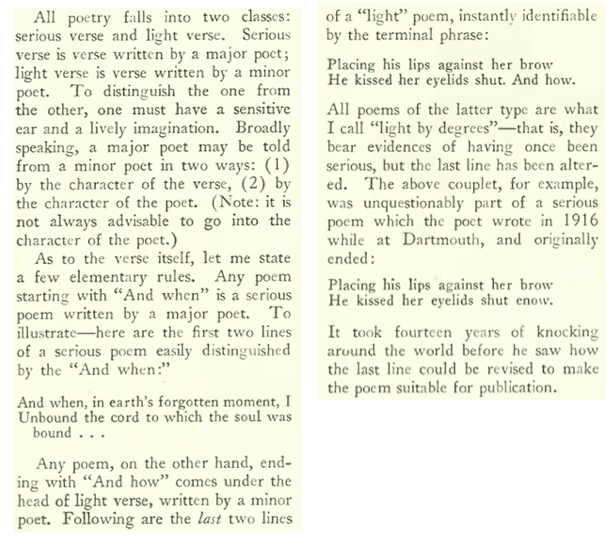
In a casual for the Nov. 8 issue, E.B. White instructed readers on how to “Tell a Major Poet From a Minor Poet.” An excerpt.
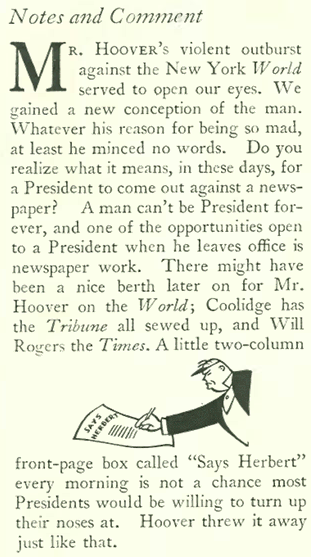
And in his “Notes and Comment,” White suggested that criticism of the press was a major no-no for a sitting U.S. President:
Christmas shopping suggestions began to trickle into Lois Long’s section on fashion, house and home, including this bit of advice that reminds us just how distant 1930 is from our own time:
* * *
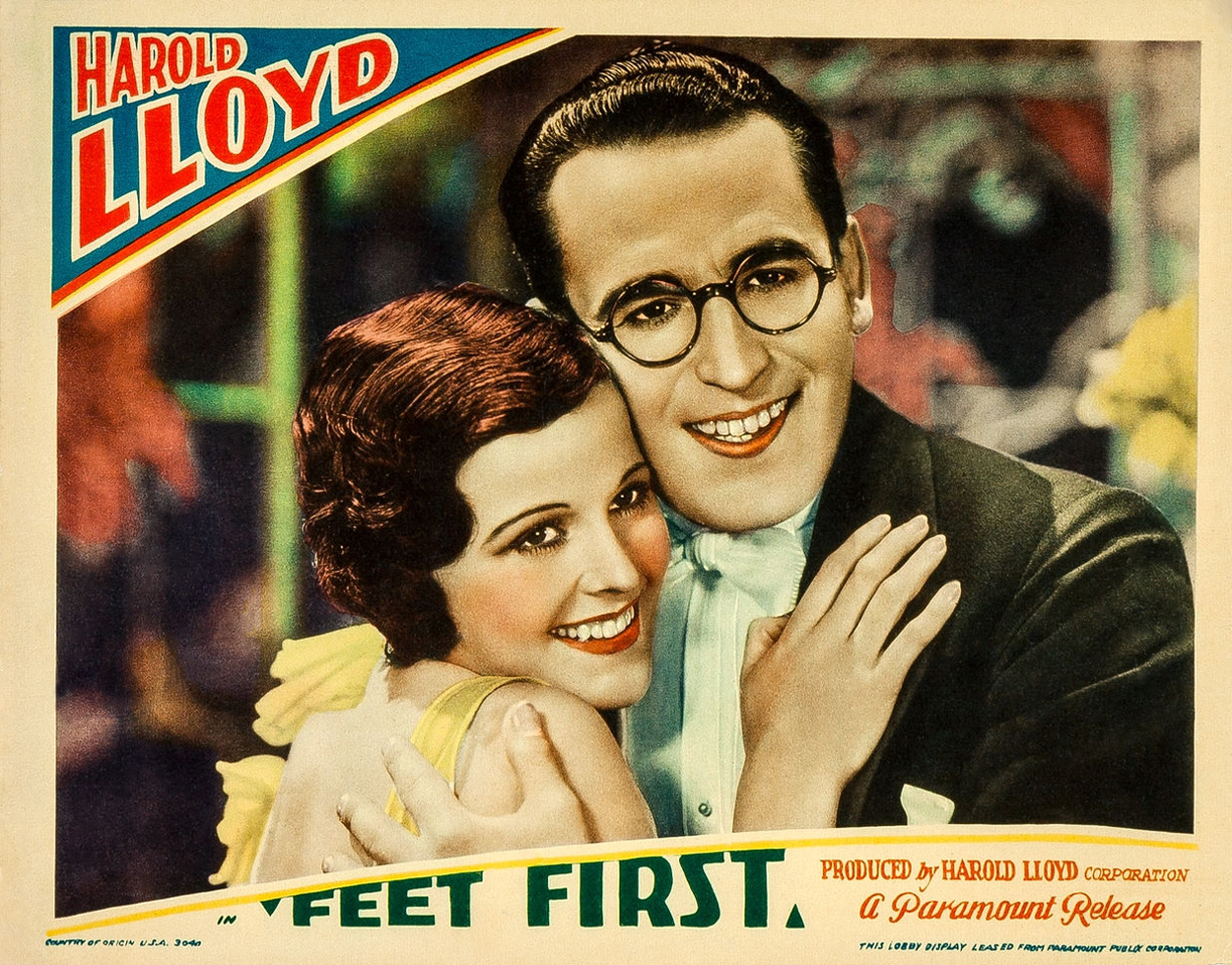
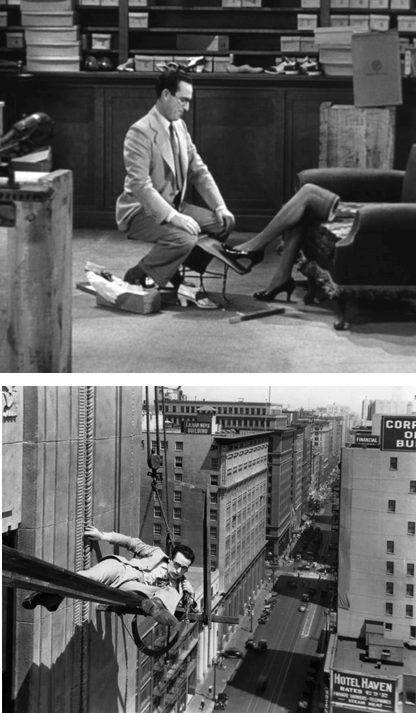
Film critic John Mosher took in the latest offering from silent film star Harold Lloyd, who was making his second foray into the talkies with his portrayal of a hapless shoe salesman in Feet First…
TEETH FIRST…Theater card for 1930’s Feet First featuring Barbara Kent and Harold Lloyd. (IMDB)GETTING A LEG UP…Top, Harold Lloyd practices the art of shoe salesmanship with a pair of dummy legs in Feet First; below, Lloyd once again finds himself in a precarious situation high above a city street. (IMDB)
* * *
From Our Advertisers
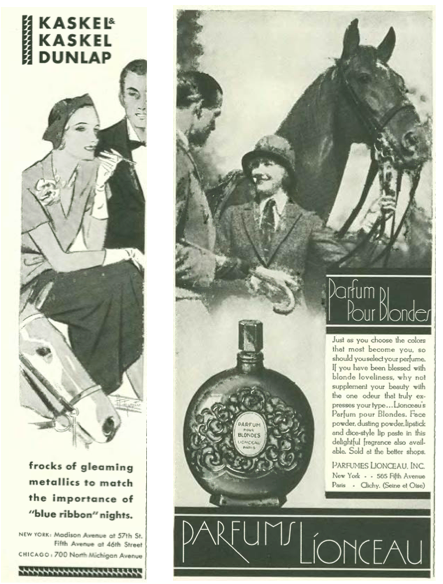
The National Horse Show was on the minds of several advertisers in The New Yorker, including these fashion merchants targeting the patrician set…
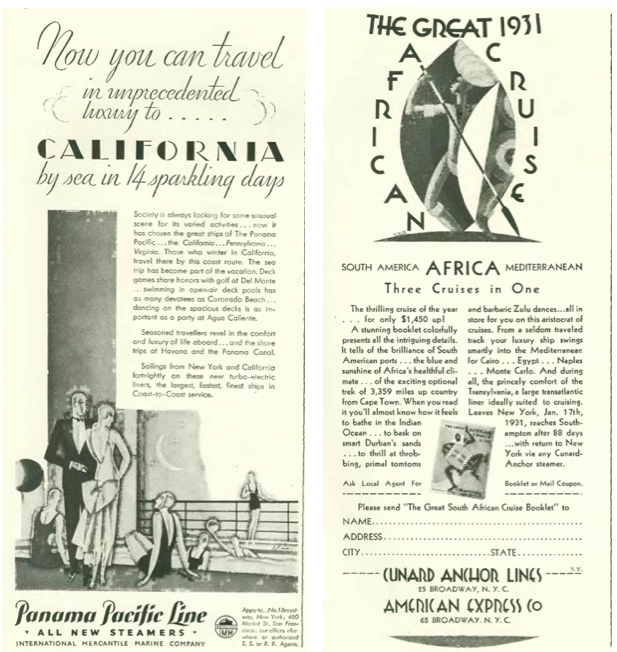
…speaking of the well-heeled, with winter approaching travel agencies enticed those with means to take a steamer through the Panama Canal to California, or for the more adventurous, a three-continent tour package…
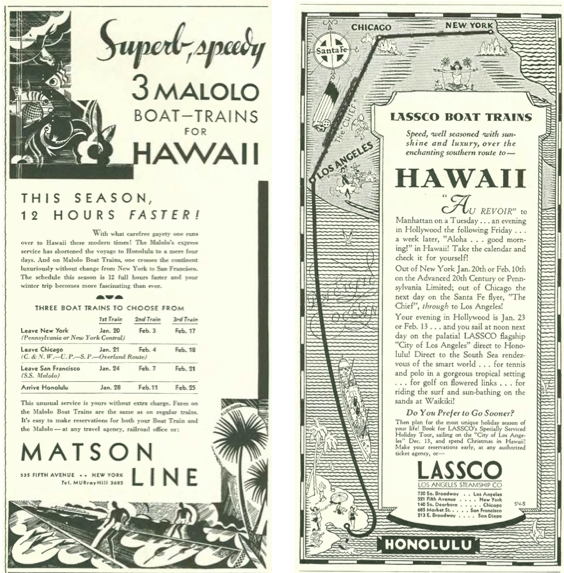
…and of course Hawaii beckoned snowbirds, who could make their way across the Lower 48 by train and then hop a boat to the islands…
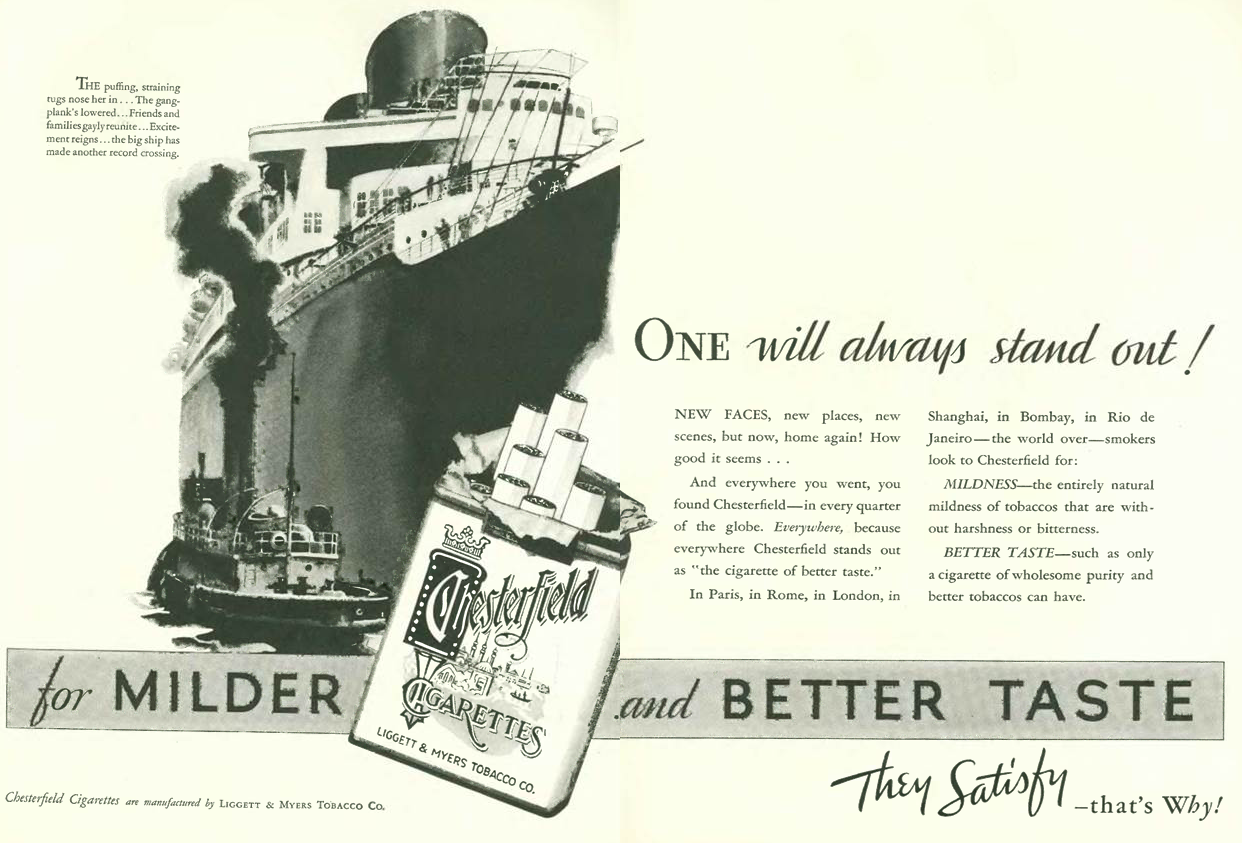
…the makers of Chesterfield cigarettes were on board with the travel theme…
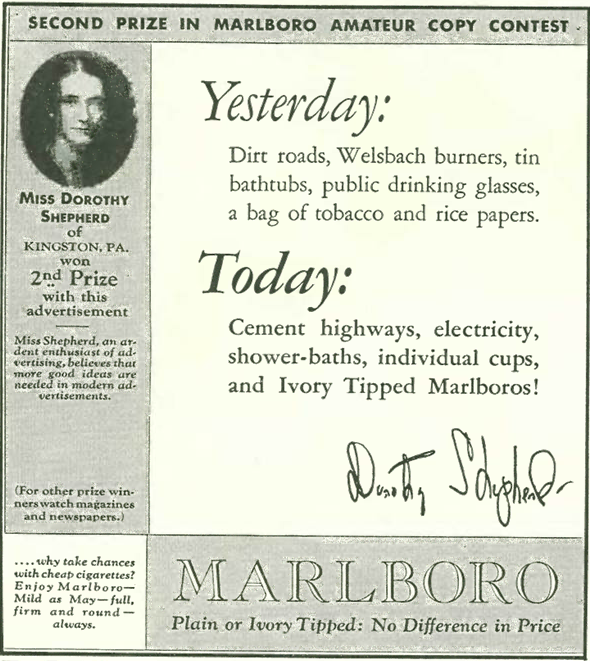
…while the folks at Marlboro stuck with their dopey handwriting and jingle contests to push their smokes…
…as the luxury market grew ever tighter in the Depression, the sellers of finer things sought to distinguish their wares from competitors. L.P. Hollander kicked off a series of wordy ads regarding the provenance of their hats, gloves and other accessories (in short, they ain’t cheap copies)…
…no doubt the folks at L.P. Hollander were looking down their noses at the likes of Russeks, which offered copies of Lucien Lelong gowns. Apparently old Lucien was okay with this, as this “Radiogram” purportedly attests…
…Lucien pops again in another ad, this one for his perfume line…
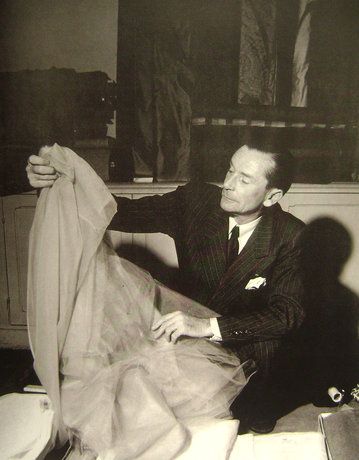
…and for reference, here’s a photo of Monsieur Lelong, circa 1940…
(comm396-s16.ascjclass.org)
…on to our cartoonists, the Nov. 8 issue featured these great spot illustrations by Constantin Alajalov, the first, running along the bottom of “The Talk of the Town,” referenced the horse show at Madison Square Garden…
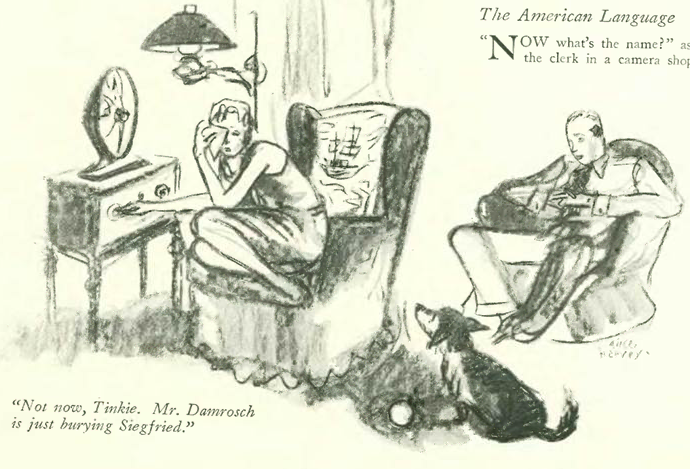
…Alice Harvey listened in on a radio soap…
…William Crawford Galbraith found some admirers of art…
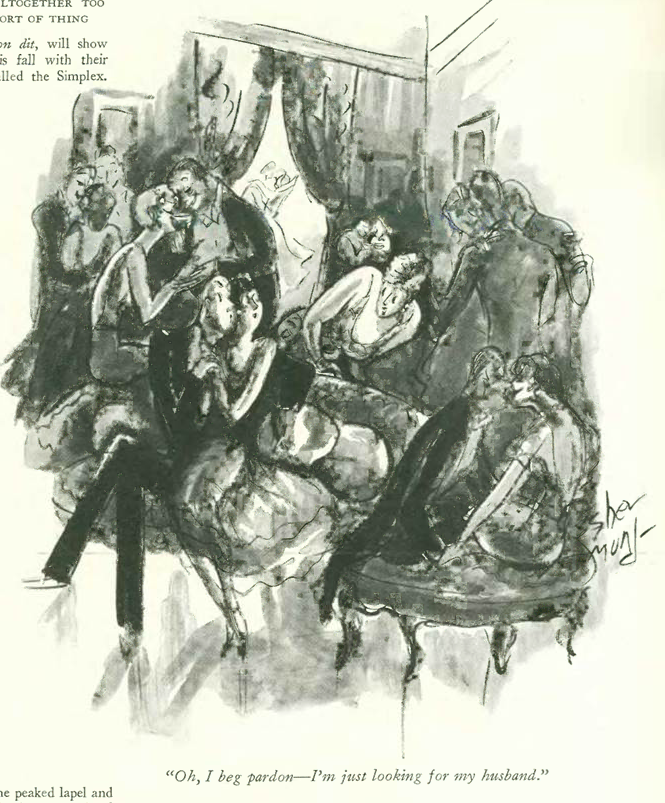
…Barbara Shermund continued to share her sharp observations of parlor hijinks…
…Garrett Price illustrated the challenges of modern design…
…and we end with Peter Arno, and a stomach-turning moment…
Tens of thousands of commuters daily cross the George Washington Bridge, but in the din of modern commuting few give nary a thought to a span that was once considered a modern marvel.
May 3, 1930 cover by Rose Silver.
Twice as long as any previous suspension bridge when it opened in 1931, the George Washington Bridge’s main span of 3,500 feet (1,100 m) would be the world’s longest until it was surpassed by San Francisco’s Golden Gate Bridge in 1937. The New Yorker’s “Talk of the Town” (entry most likely by E.B. White) checked on the bridge’s progress for the May 3 issue:
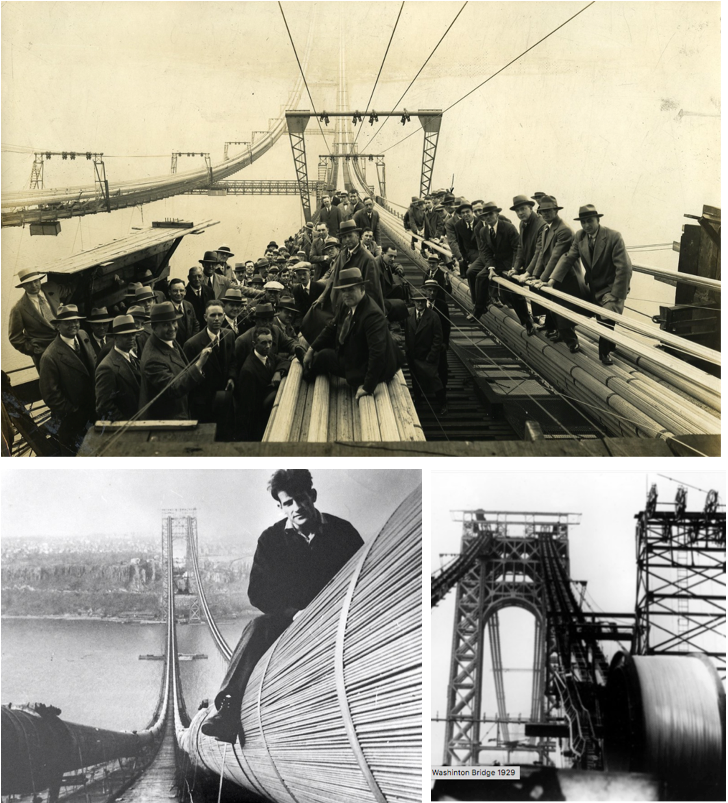
MEN OF STEEL…Some 107,000 miles of wire were used in cables made by John A. Roebling’s Sons Company for the George Washington Bridge — the same firm also supplied wire for the Brooklyn Bridge 60 years earlier (John Roebling and his son, Washington, also designed and built the Brooklyn Bridge). Clockwise, from top, employees of John A. Roebling’s Sons pose atop cable bundles; bottom right, the bridge’s four main cables were each composed of a single strand carried back and forth across the river 61 times. Each strand itself is a bundle of 434 individual wires; bottom left, worker poses atop completed cable. (Flickr/Pinterest)BY ANY OTHER NAME…Known as the Hudson River Bridge during its construction, the George Washington Bridge opened to traffic in 1931. During the first full year of operation in 1932 more than 5.5 million vehicles used the original six-lane roadway — today it is the world’s busiest motor vehicle bridge, carrying more than 100 million vehicles per year. Although the steel towers are iconic today, the original plan called for them to be clad in stone. (Wikipedia)
* * *
A Cabin in the Sky
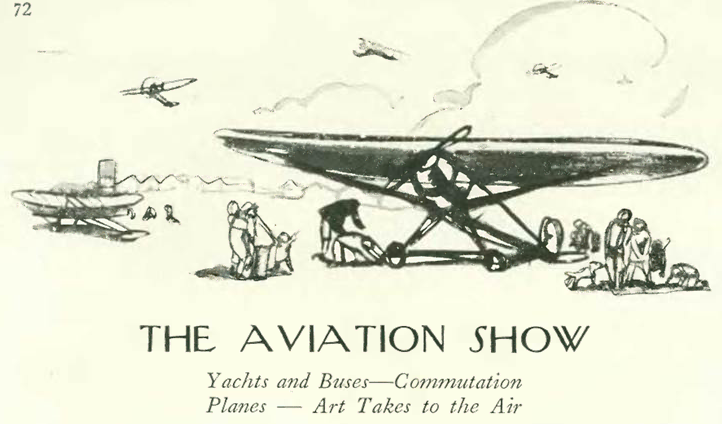
Other signs of modern life were being seen in Midtown, where an “Aircraft Salon” hosted by the Aeronautical Chamber of Commerce was taking place at Madison Square Garden.
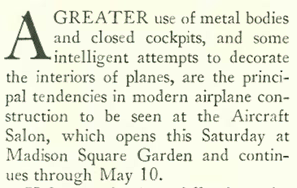
Nicholas Trott was on hand to take in the exhibits, noting that advances in aviation included the use of metal bodies (instead of fortified cloth) and greater attention to interior decoration:
SIGNED, SEALED, DELIVERED…An attendee of the New York Aircraft Salon received a special postal stamp, and an autograph from aviator Cy Caldwell, at the Madison Square Garden show. (Joe Krantz)
Trott noted that designs of passenger compartments, still in their infancy, suggested something between automobile and nautical motifs:
SORRY, NO HEADPHONES…Clockwise, from top left, a Curtiss Condor 18 and its interior appointments; a Fokker Trimotor featured dining in its cabin. As peaceful as the scene appears, the noise from the motors must have been unbearable. (Wikipedia/dutch-aviation.nl)
Trott also commented on the debate surrounding metal vs. fabric in the construction of airplanes. Before 1930 most planes were constructed of wood covered with fabric (which were much lighter than metal craft). Although as early as 1920 the National Advisory Committee for Aeronautics declared metal to be superior to wood, only five percent of aircraft in 1930 were of all-metal construction.
DON’T CALL ME WOODY…This eight-passenger Consolidated Fleetster was a rare example of metal construction in early 1930. The wings, however, were still fashioned from wood. (Aeronautical Chamber of Commerce 1931 Aircraft Yearbook)
* * *
Road to Nowhere
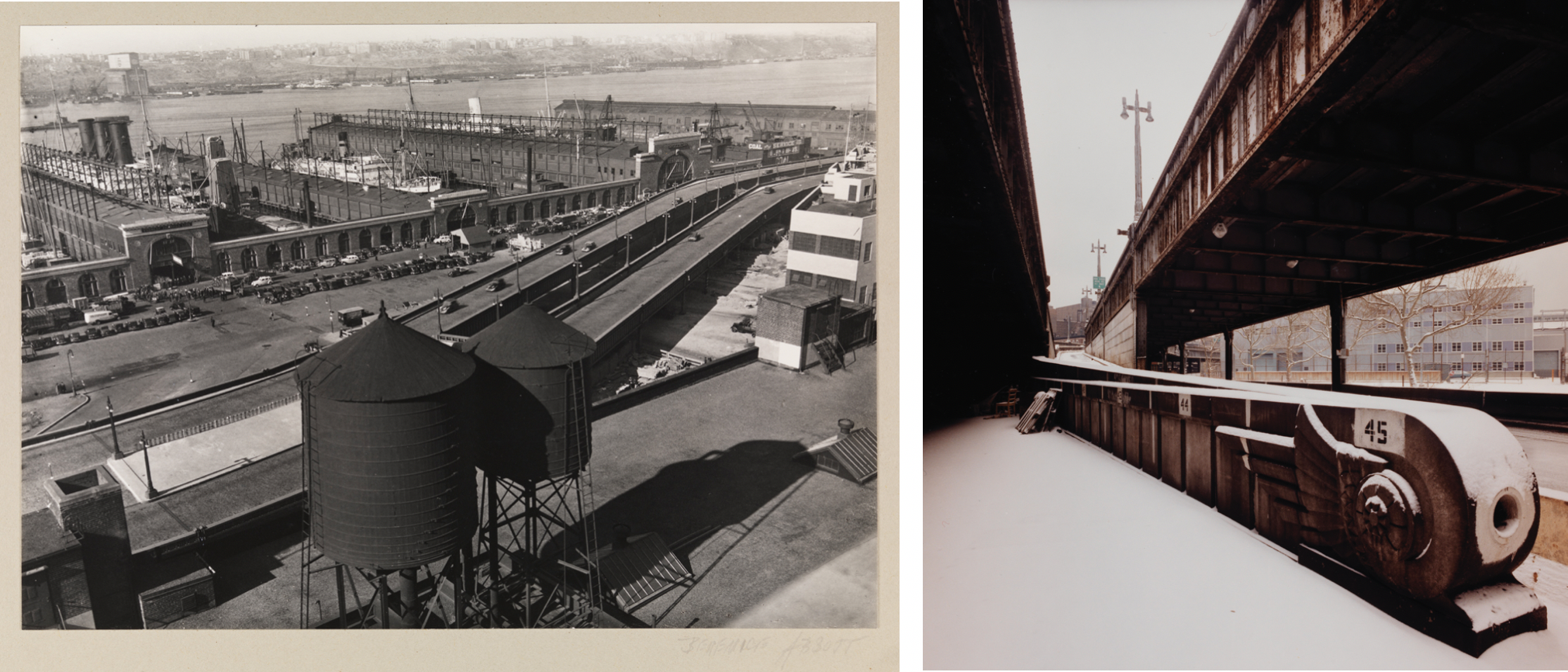
The New Yorker’s enthusiasm for modern marvels did not extend to the West Side Highway, a project that would extend from the late 1920s to the early 1950s. Here is E.B. White’s take on the opening of the highway’s first section:
White’s observations were somewhat prescient — constructed in tight confines, the road’s on-ramps proved too narrow and the turns too tight for use by large trucks. The roadway also lacked proper maintenance, and just two decades after it was completed a section of the highway collapsed under the weight of an asphalt-laden truck. The roadway was demolished between 1977 and 1989. Read more here about the West Side Highway’s surprising history at the Museum of the City of New York.
THE ROAD NOT TAKEN, TAKEN…Left, West Side Express Highway and Piers 95-98, photographed by Berenice Abbott from 619 West 54th Street on Nov. 10, 1977; West Side Highway Ramp at 23rd Street reveals Art Deco ornamentation. Detail of photo by Jan Staller, 1978. (Museum of the City of New York)
* * *
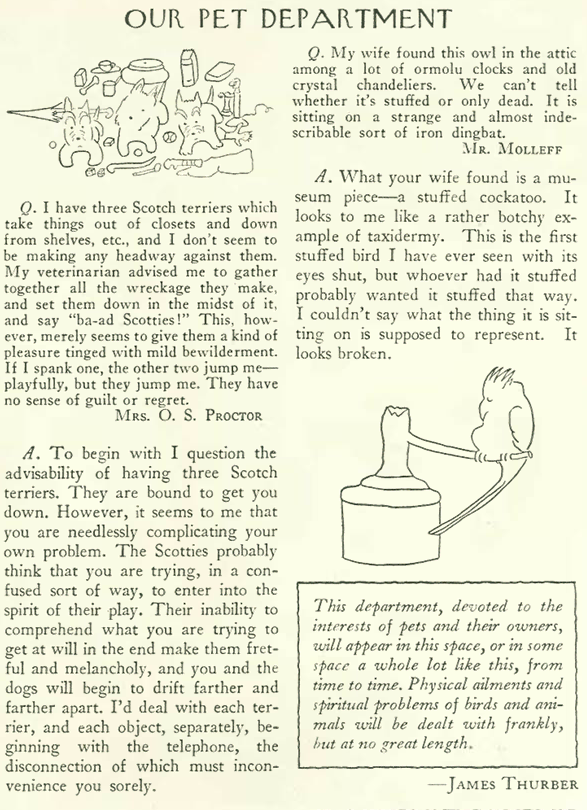
For Pet Lovers
Our latest installment of James Thurber’s “Our Pet Department” column…
* * *
Hate Couture
The New Yorker’s Paris correspondent, Janet Flanner, using the pen name “Hippolyta,” contributed this profile of François Coty (1874-1934), a French perfumer and businessman. Flanner’s profile (the introduction included below) described Coty’s rags-to-riches rise in the perfume industry, and touched on his life as a sometime journalist and politician.
What doesn’t come across in the profile is Coty’s extreme right-wing stance on politics and his virulent anti-Semitism, which was often expressed in his newspaper, Figaro. Three years after Flanner’s profile Coty would co-found Solidarité Française, a fascist, paramilitary organization, and a year after that he would be dead of an aneurysm.
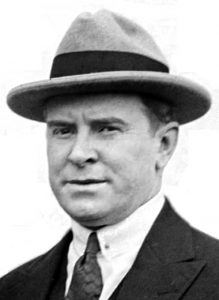
François Coty circa 1930. (aperfumeblog.com)
* * *
From Our Advertisers
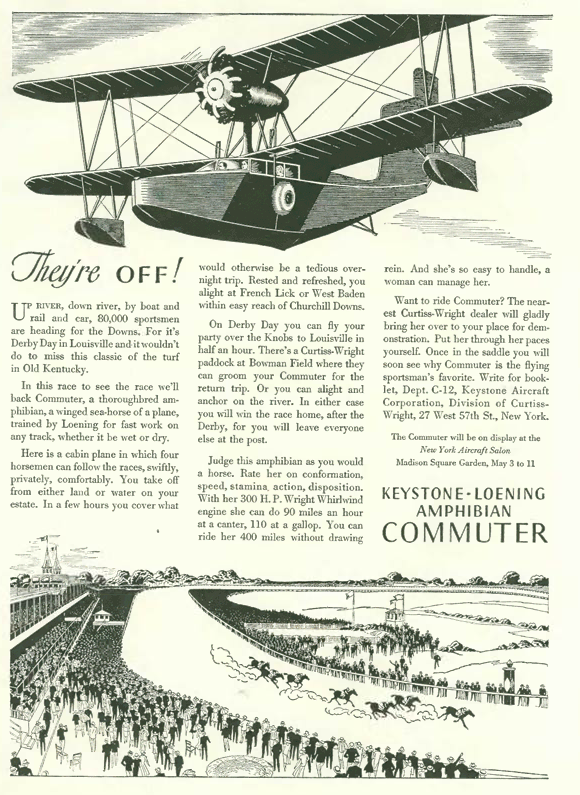
The New Yorker’s bottom line reaped benefits from the big aviation show at Madison Square Garden…
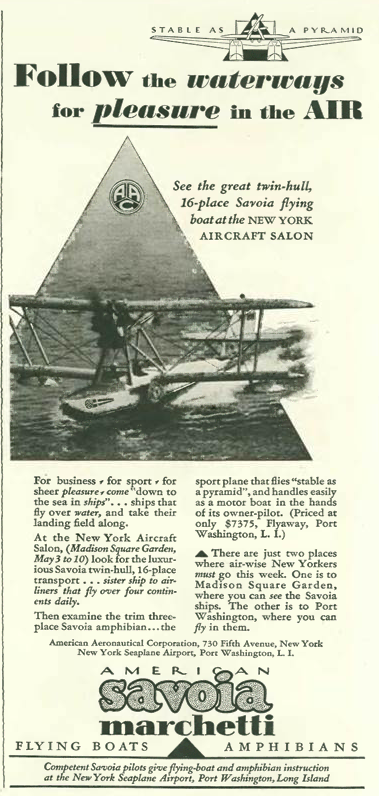
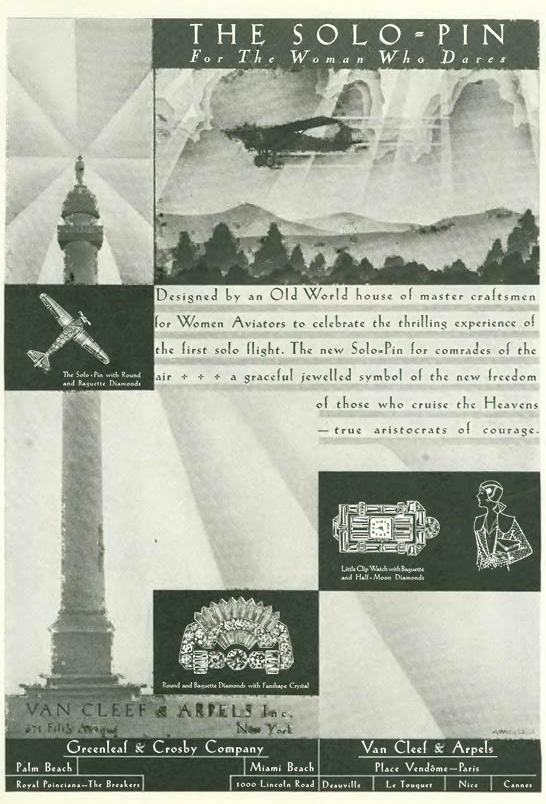
…and even if you weren’t selling airplanes or flying lessons, you could still get in on the action…
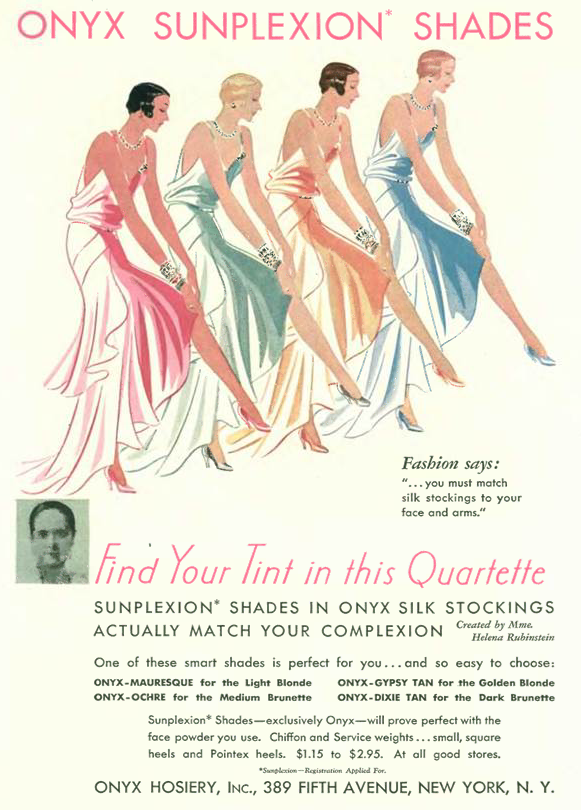
…also from the fashion world, this colorful entry from Onyx Hosiery…
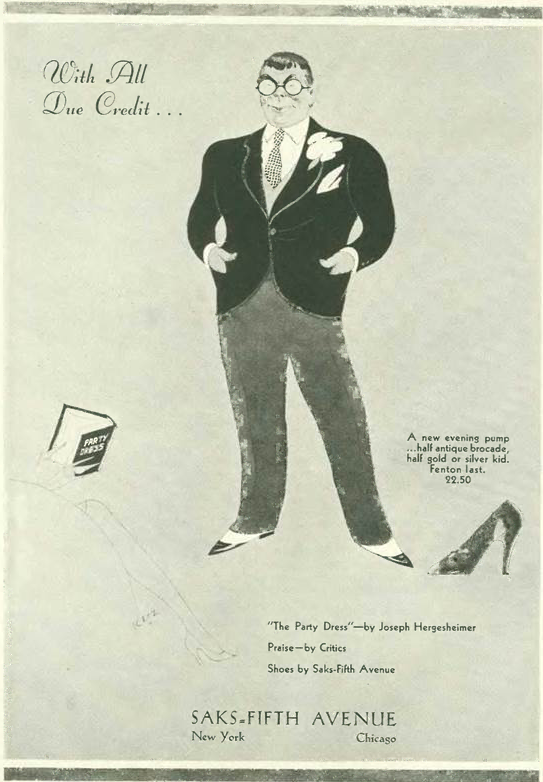
…and this weird ad from Saks, advertising shoes and a party dress but dominated by a caricature of designer Joseph Hergesheimer…
…on to our cartoons…Helen Hokinson paid a visit to the aviation show…
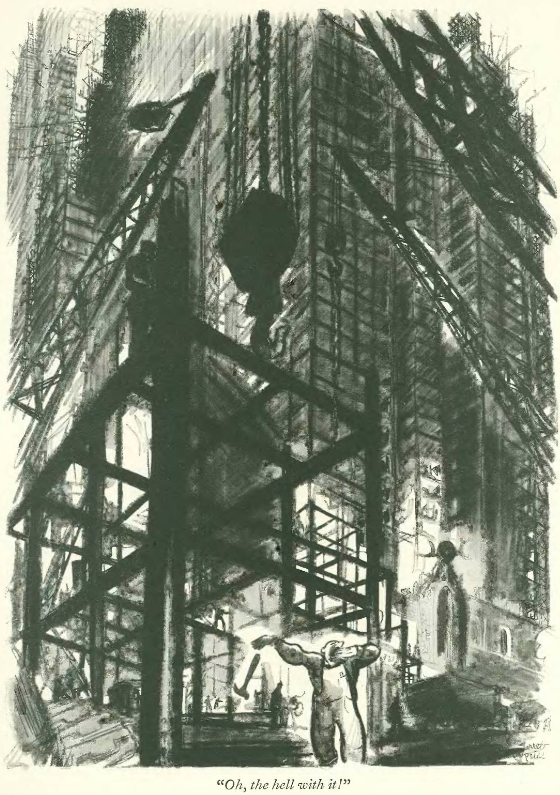
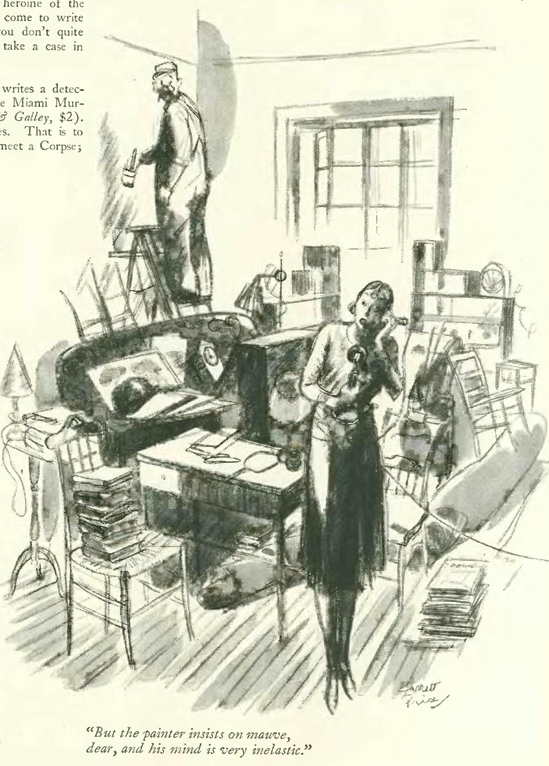
…on the domestic front, Garrett Price examined the challenges of home decor…
…Al Frueh offered an ironic twist on a room with a view…
…Peter Arno once again found humor in the partying life…
In his 2006 book, Flapper, Joshua Zeitz refers to The New Yorker’sLois Long as the epitome of the 1920s flapper, an “absolutely a wild woman” who wrote about Jazz Age nightlife “with a wicked sort of sexual sense of humor.”
Feb. 8, 1930 cover by Theodore Haupt (the annual Westminster Kennel Club dog show was in town…)
This Vassar-educated daughter of a Congregational minister began her New Yorker career in the summer of 1925, at age 23. She took over Charles Baskerville’s rather dry column, “When Nights are Bold,” renamed it “Tables for Two,” and using the pen name “Lipstick” plunged into the nightlife scene with considerable brio.
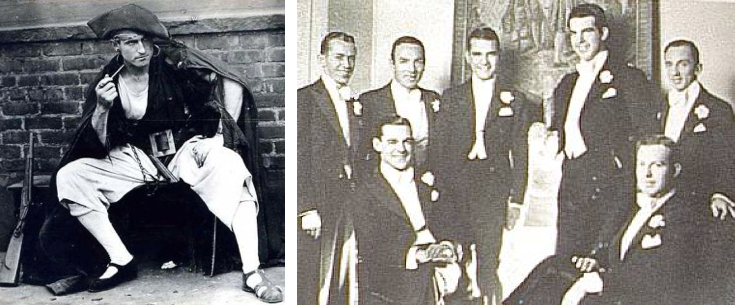
TIMES CHANGE…At left, in a still image from a 1920s home movie, Lois Long relaxes on a beach; at right, Long with newborn daughter Patricia Arno in 1929. (PBS/Patricia Arno)
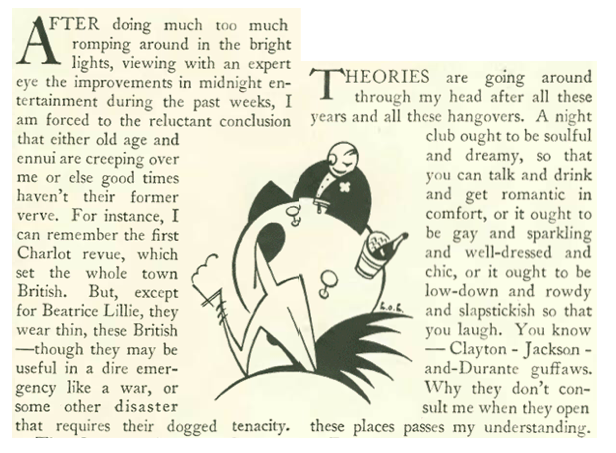
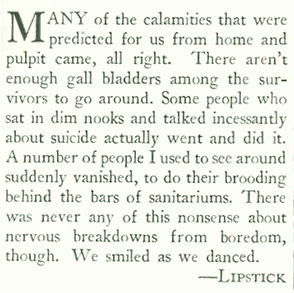
Two years later she would marry cartoonist Peter Arno, and in 1929 would give birth to a daughter, Patricia. During this time the almost weekly “Tables” column would appear infrequently as Long turned her attentions to her family and her fashion column, “On and Off the Avenue.” But as I’ve noted before, Long, along with many of her New Yorker colleagues, had grown weary of the Roaring Twenties many months before they were over. She would put an end (for awhile) to the “Tables” column in June 1930; the good times, as Long noted in her Feb. 8 column, had lost their “verve”…
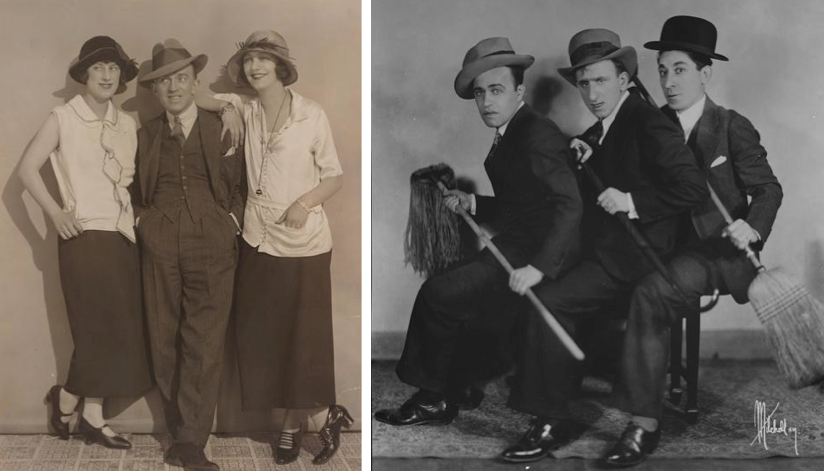
BRITS AND TWITS…Lois Long recalled the nightlife entertainments of the past and present in one of her last “Tables for Two” columns. Photo at left (from left to right), Beatrice Lillie, Nelson Keys, and Gertrude Lawrence in Andre Charlot’s Revue of 1924. At right, the comedy trio Eddie Jackson, Jimmy Durante and Lou Clayton. (Museum of the City of New York/Herbert Mitchell Collection)
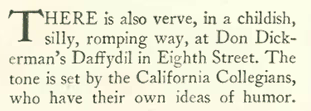
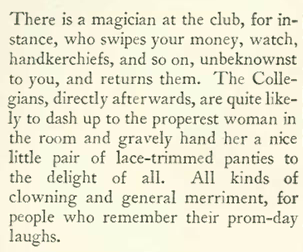
…Long found Don Dickerman’s latest themed restaurant, the Daffydil, to be a mildly amusing distraction…
HE WAS AN ARRRTIST…Greenwich Village personality and pirate aficionado Don Dickerman (left) failed to make a living as an artist, but found success with his various themed restaurants including the Pirate’s Cove, the Blue Horse, the Heigh-Ho (where Rudy Vallee started out), the County Fair and the Daffydil (which was financed by Vallee). At right, singing at the Daffydil were the California Collegians, a group that included actor Fred MacMurray (tallest in the photo). (Restaurant-ing through history)
…and she also looked to Harlem for some nighttime diversions, but the ex-flapper just wasn’t up for a rowdy scene…
FOR THE YOUNG AT HEART…Dancing the Lindy Hop at the Savoy in Harlem, circa 1930. (Pinterest)
…ten years later, in The New Yorker’s fifteenth anniversary issue (Feb. 17, 1940), the 38-year-old Long would look back to the Roaring Twenties in the column “That Was New York,” reprising her signature “Lipstick” as she recalled the days when “Harlem was a thrill” and “we smiled when we went dancing in 1925 even though there wasn’t a candid camera within miles. In those days people frequently laughed out loud in public.” She concluded the piece with this observation:
* * *
Rise of the Débutantes
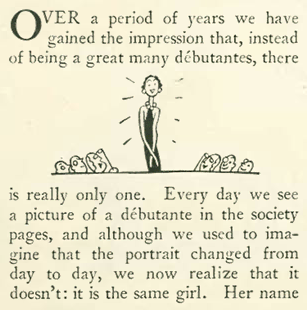
New York’s débutantes and The New Yorker had something of a symbiotic relationship during the magazine’s early days, beginning with a piece written by 22-year-old Ellin Mackay for the Nov. 28, 1925 issue that served as a manifesto of sorts for a new kind of débutante. Mackay’s essay explained why modern women were abandoning the forced social matchmaking of débutante balls in favor of the more egalitarian (and fun) night club scene.
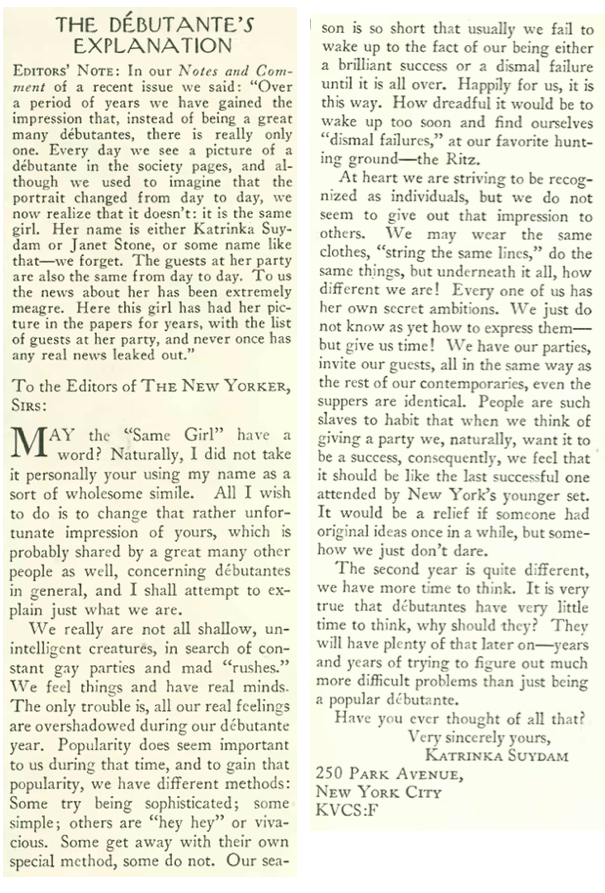
Mackay’s piece provided a huge boost to The New Yorker’s circulation, the magazine barely staying afloat at the time. Nevertheless, its writers couldn’t resist taking occasional shots at the seemingly frivolous existence of debs, including E.B. White, who called out a one Katrinka Suydam in his “Notes and Comment” column for Jan. 4, 1930:
Perhaps White came across Suydam’s name in the Sept. 7, 1929 New York Times:
What he probably didn’t expect was a reply from Suydam herself, an act that seemed to impress the magazine’s editors, who printed the proud débutante’s letter in full on page 32:
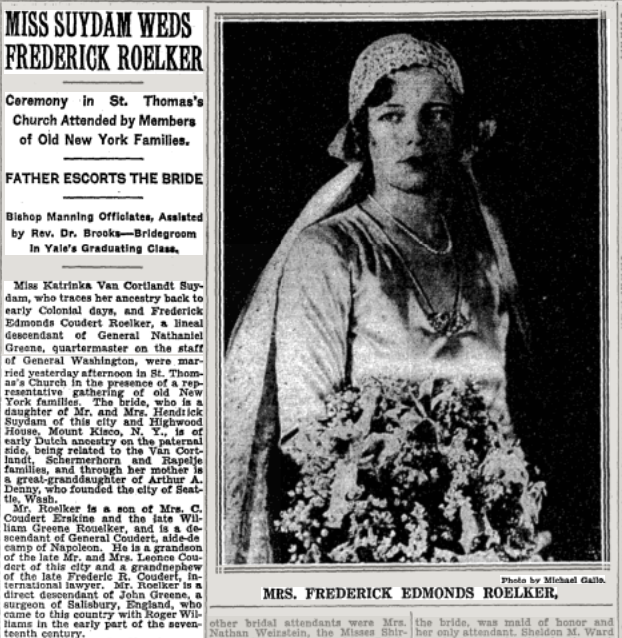
Suydam would go on to marry Frederick Roelker later that June. Note in this excerpted wedding write-up how the couples’ European and colonial pedigrees were carefully detailed in the first paragraphs, distinguishing their union from couplings enjoyed by the unwashed masses…
Katrinka Suydam’s wedding as reported in the June 12, 1930 issue of The New York Times.
* * *
Skirt Stakes
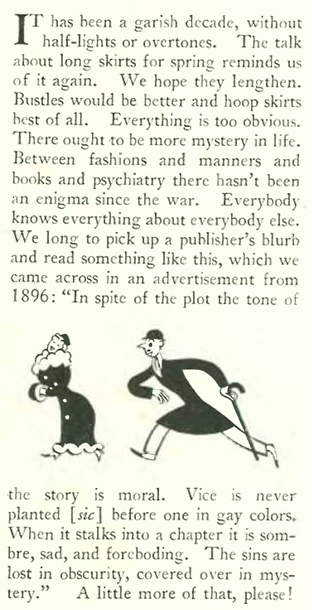
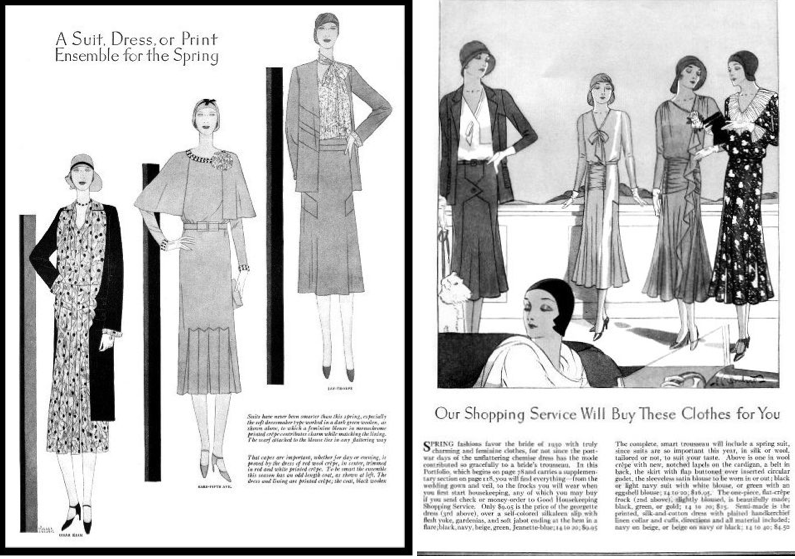
In 1930 hemlines plummeted along with the stock market. E.B. White, in “Notes,” welcomed the return of “mystery” to women’s fashions:
THEY DROPPED WITH THE MARKET…Women’s spring fashions with lowered hemlines on display in the April 1930 issue of Good Housekeeping. (fashion-era.com)
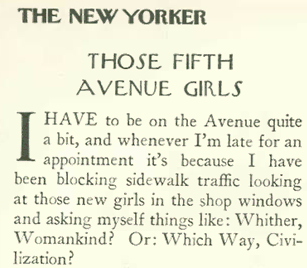
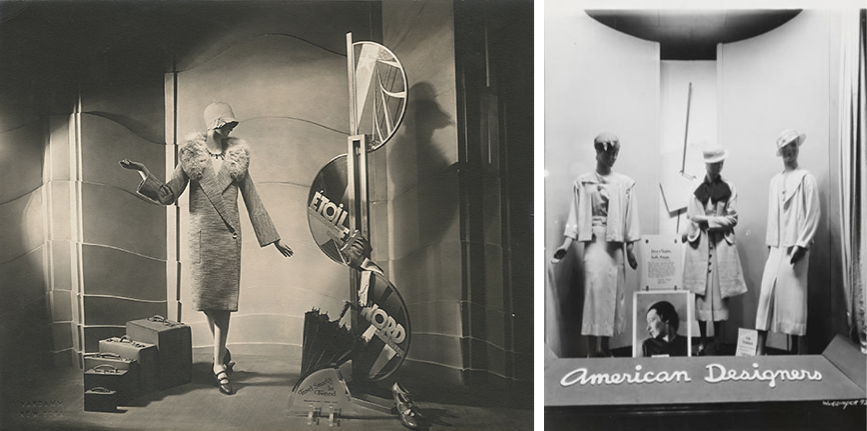
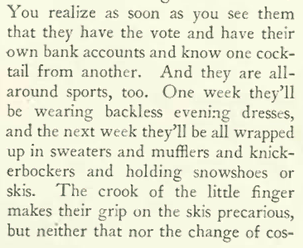
Frederick Lewis Allen, on the other hand, was having difficulty understanding the modern woman, circa 1930, based on what he was seeing in the display windows along Fifth Avenue. Excerpts:
NO NONSENSE WOMEN…Window displays on Fifth Avenue included (left) this “Travel Smartly in Tweed” window display for Franklin Simon (1929-30); and right, a window at Lord & Taylor, 1933. (Harry Ransom Center/Museum of the City of New York)
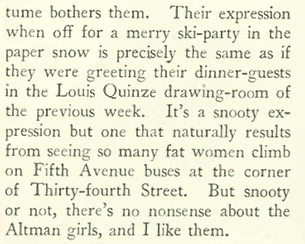
Allen noted that the “snooty” mannequins on display along Fifth Avenue represented a certain type who wouldn’t be caught dead riding a bus…
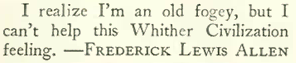
Whether or not he liked the Altman girls, the 39-year-old Allen felt like an “old fogey” in the presence of these “no nonsense” women:
* * *
Get A Room
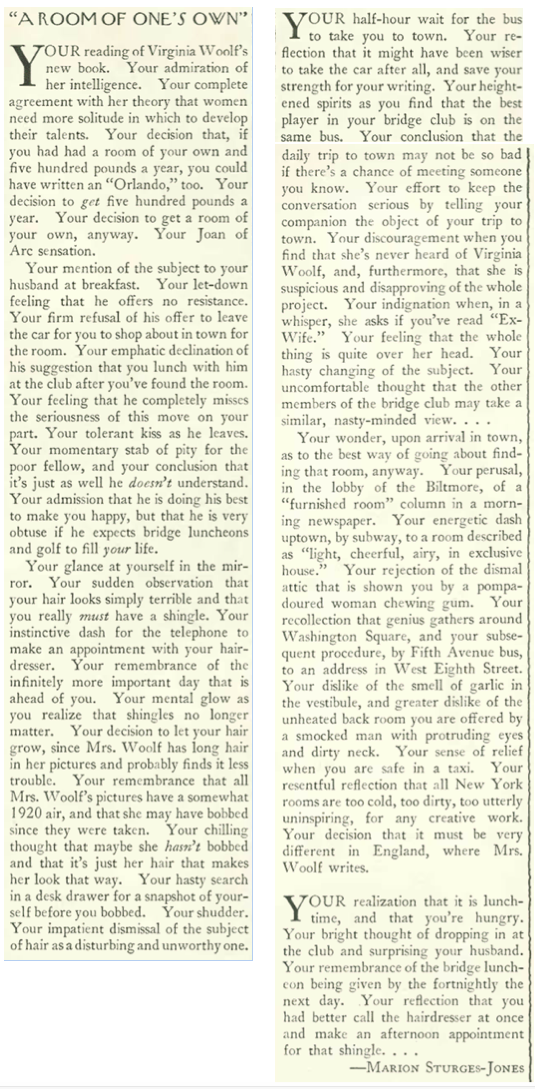
Marion Sturges Jones pondered the life of another kind of modern woman, namely that of Virginia Woolf, who had recently published the extended essay A Room of One’s Own. Jones discovered that finding such a room was easier said than done…
IN HER ROOM…Virginia Woolf at Monk’s House in East Sussex, 1932; dust jacket of the first edition of A Room of One’s Own. (kaykeys.net/Beinecke Library, Yale)
* * *
The Way You Really Look
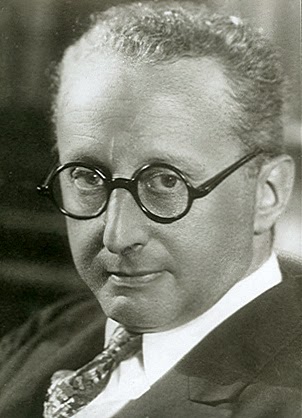
Franklin P. Adams penned a profile of the legendary songwriter and stage producer Jerome Kern, who created dozens of Broadway musicals and Hollywood films and wrote a substantial chunk of the American songbook (more than 700 songs) with such hits as “Ol’ Man River”, “A Fine Romance”, “Smoke Gets in Your Eyes”, and “The Way You Look Tonight.” Peter Arno provided this less-than-flattering caricature of the man…
…and this is how Kern actually looked, circa 1930…
(bloggingtonybennett.com)
* * *
At the Talkies
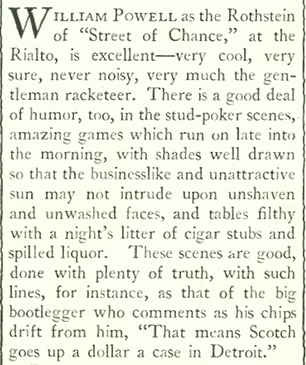
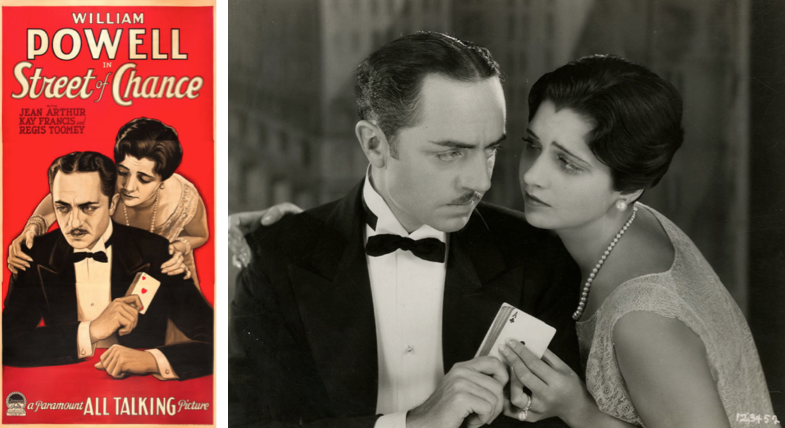
Speaking of showbiz, New Yorker film critic John Mosher offered high praise for William Powell’s latest film, Street of Chance. Although Powell is often linked professionally to actress Myrna Loy thanks to their six Thin Man films (1934 – 1947), from 1930 to 1932 he also appeared with Kay Francis in six films, including Street of Chance. Both Powell and Francis would become major stars of the 1930s, and between 1930 and 1936 Francis would be the number one female star at Warner Brothers and the highest-paid American film actress. Francis was no stranger to wild living — she was a longtime friend of Lois Long’s (see above) and also shared an apartment with her at 381 Park Avenue before Long married Peter Arno. Mosher’s review:
TOUGH ODDS…William Powell and Kay Francis in Street of Chance (1930). Francis was a longtime friend of New Yorker columnist Lois Long. (IMDB)
* * *
From Our Advertisers
We have an advertisement from the aforementioned County Fair, one of the themed restaurants operated by Greenwich village artist and personality Don Dickerman, who illustrated his own ads…
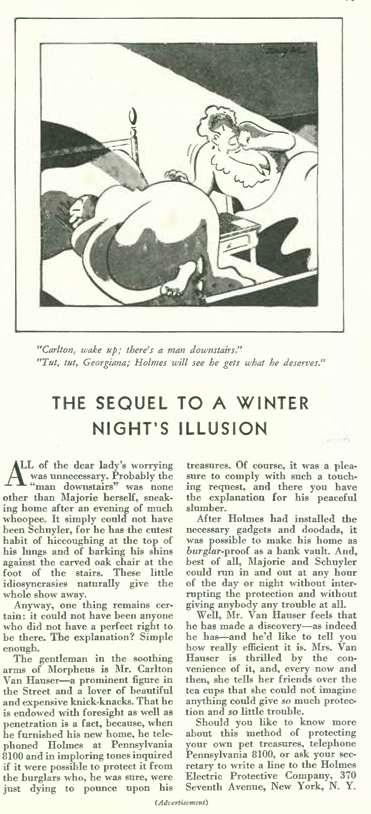
…I’m not sure who drew this Arno-esque illustration below for the Holmes Electric Protective Company, but I can tell you that the name Holmes was synonymous with home security in 1930…in 1857 Edwin Holmes bought a patent for an electric burglar alarm (invented in 1853 by Augustus Pope) and went on to successfully commercialize and popularize the electromagnetic burglar alarm. Holmes is also credited with creating the first large-scale alarm network in the United States…
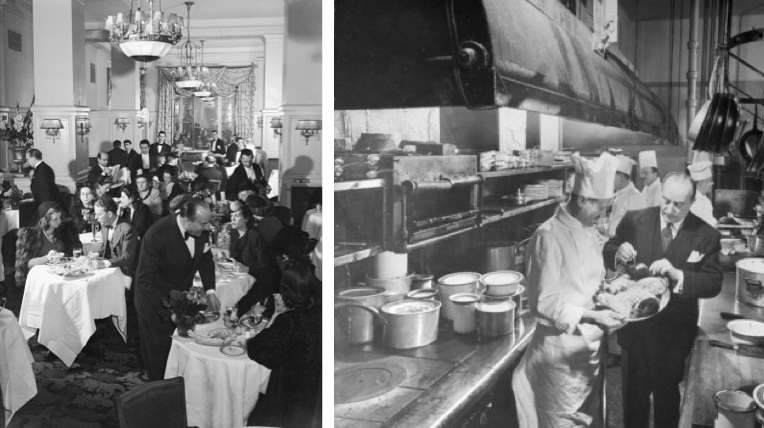
…but I do know that Abe Birnbaum contributed this drawing (in “Talk of the Town”) of the beloved Colony restaurant owner Eugene Cavallero…
A PLACE TO SEE AND BE SEEN…From the 1920s to the 1960s New York’s smart set dined at the Colony. Rian James, in Dining In New York (1930) wrote “the Colony is the restaurant of the cosmopolite and the connoisseur; the rendezvous of the social register; the retreat of the Four Hundred.” Critic George Jean Nathan said the Colony was one of “civilization’s last strongholds in the department of cuisine.” Photo at left of the dining room around 1940; at right, owner Eugene Cavallero consults with a chef. (lostpastremembered.blogspot.com)
…on to our cartoons, we have a full page from Al Frueh…
…and another full-page from Rea Irvin…
…this terrific party scene courtesy Garrett Price…
The Hammerstein name looms large in the history of both stage and screen, an extended family of theater impresarios and composers descended from the German-born Oscar Hammerstein I (1846 – 1919).
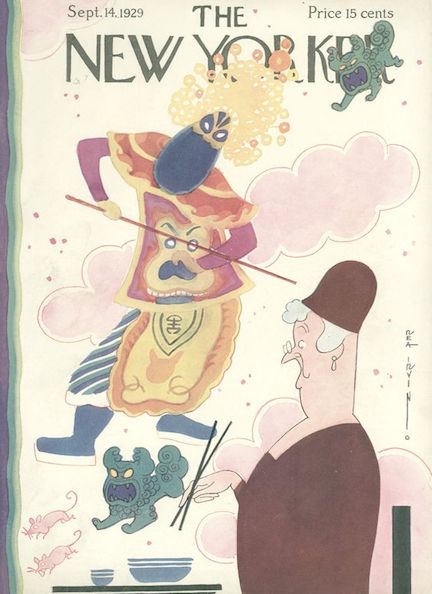
Sept. 14, 1929 cover by Rea Irvin.
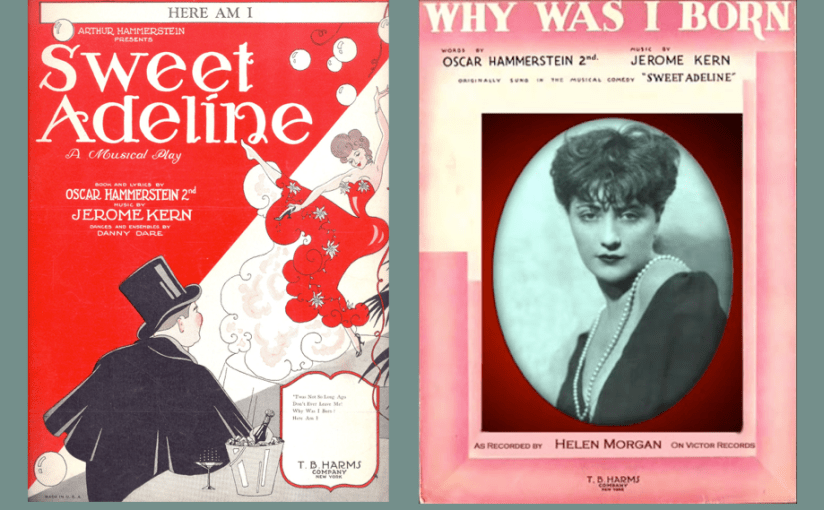
It was Oscar’s son, Arthur Hammerstein (1872 – 1955), who would bring the nostalgic musical Sweet Adeline to the Broadway stage, with music by Jerome Kern. Arthur’s nephew, Reginald Hammerstein, directed, and Reginald’s brother, Oscar Hammerstein II, provided the lyrics (and would later collaborate on such Broadway hits as Oklahoma! and The Sound of Music). Sweet Adeline opened on Sept. 3, 1929 at Arthur’s Hammerstein Theatre (known today as Ed Sullivan Theater), and the New Yorker’sRobert Benchley was on hand for opening night…
The title of the musical was a pun on the famous barbershop quartet song first published in 1903 — a time that seemed quaint to Jazz Agers. To get a sense of how rapidly American society had changed in the 1920s, in the paragraph above, Benchley referred to the musical’s setting (1898) as “old-time.” I’m not sure we would refer to 1987 as “old-time,” but who knows? Benchley continued…
OLD-FASHIONED FUN…Clockwise, from top left, the famed 1920s torch singer Helen Morgan (pictured on sheet music for one of her songs from the musical) starred as “Addie” in 1929’s Sweet Adeline;Arthur Hammerstein in undated photo; stage and screen actress and vaudeville comedian Irene Franklin portrayed a burlesque queen in the musical, while comedic actor Charles Butterworth played the part of a “young rounder.” (YouTube/findagrave.com/Wikipedia/lbarsanti.wordpress.com)
As for the performances by Helen Morgan (who more or less invented the torch singer’s boozy, draped-over-the-piano style), Benchley noted that her personality was “almost oppressively lush at times”…
A note regarding Helen Morgan: She began her career singing in Chicago speakeasies before moving to New York in the mid-1920s, where she continued to sing in nightclubs (including one attached to her name, Chez Morgan) while also performing on Broadway. Morgan became a heavy drinker, and was often drunk during performances (hence Benchley’s comment regarding her “lush personality”). Cirrhosis of the liver would claim Morgan’s life in 1941. The same disease would claim Benchley four years later.
* * *
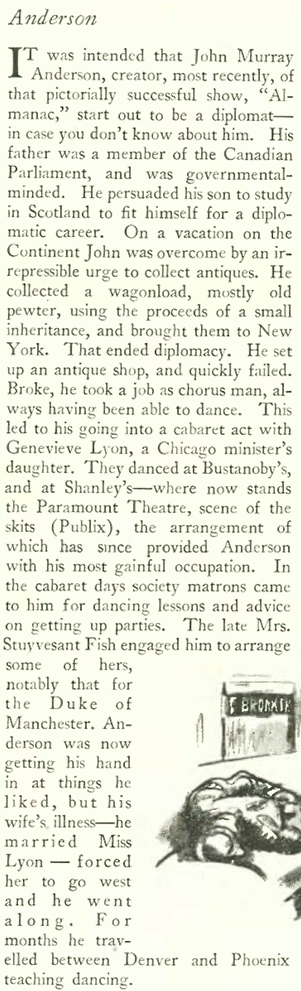
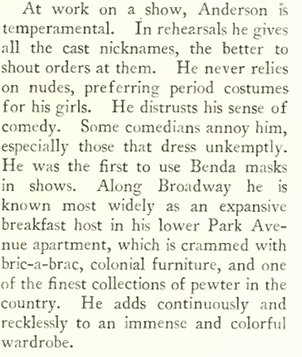
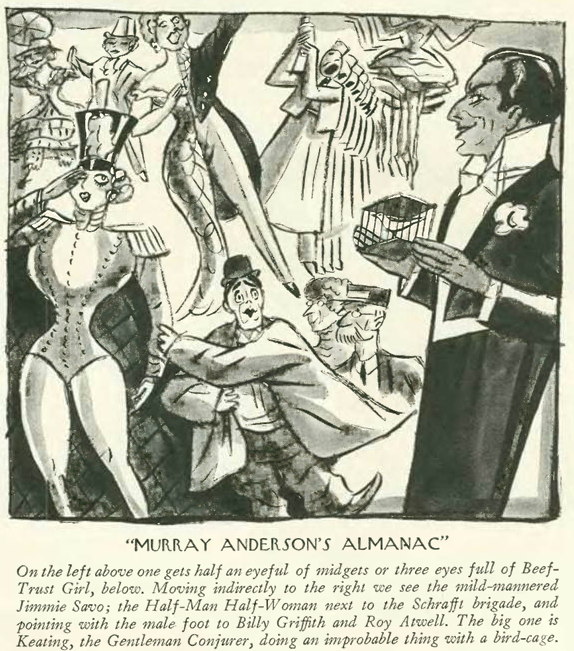
While we are the topic of Broadway, the Sept. 14 “Talk of the Town” featured a brief profile of John Murray Anderson, (1886 – 1954) who was celebrating the success of his own Broadway musical revue Almanac…
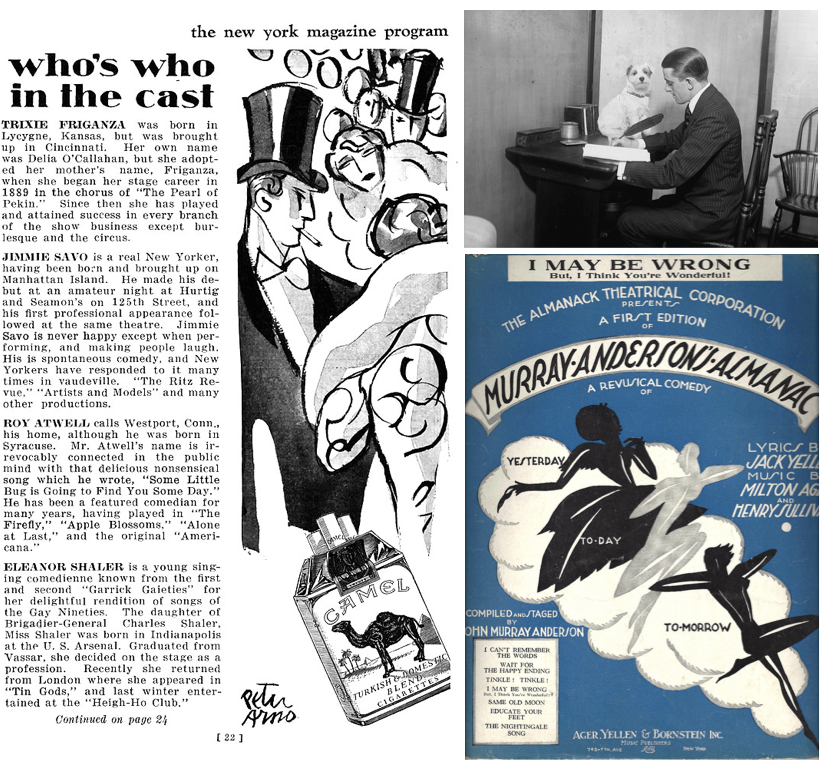
HE WORE MANY HATS…John Murray Anderson made his Broadway debut in 1919 as writer, director, and producer of The Greenwich Village Follies, which had a five-year run. At left, a cover for sheet music from a 1920 production. At right, postcard image of the Follies from 1922. (Pinterest)
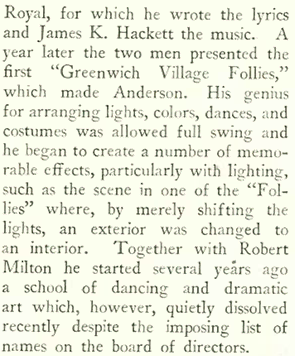
In this excerpt, “Talk” recounted how Anderson finally hit it big in 1919 with his Greenwich Village Follies. It noted that he had a “genius”…
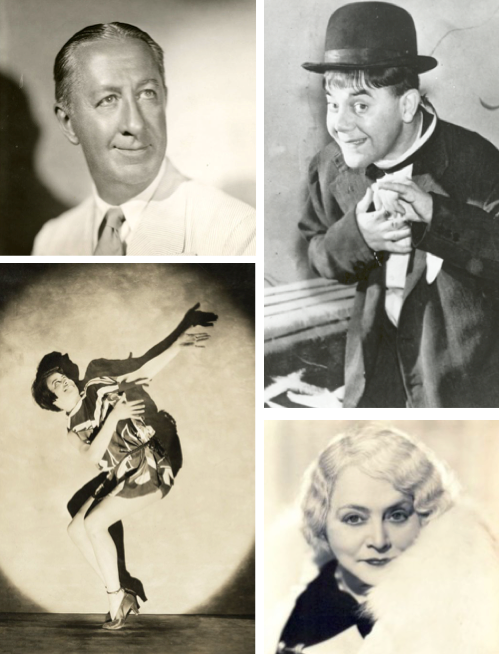
Clockwise from top left, Almanac featured comedians Roy Atwell and Jimmy Savo; singer and comedian Trixie Friganza; and actress Eleanor Shaler. (royatwell.net/American Vaudeville Museum/secondhandsongs.com/Pinterest)
…and a bit more about Anderson…
In Michael Maslin’s terrific book, Peter Arno: The Mad, Mad World of The New Yorker’s Greatest Cartoonist,Maslin notes that Arno “was whisked onto the Manhattan theater scene by Murray Anderson, whose twenty-nine scene Almanac opened to excellent reviews at the two-year-old Erlanger Theater, just off Times Square.” Maslin cites the famed New York columnist O.O. McIntyre, who wrote “Arno was one of several ‘conspirators’ responsible for Broadway backdrops whose ‘exaggerated whimsicalities…in black and white…when unfolded usually get what Variety calls a belly laugh.'”
At left, Peter Arno contributed this advertisement for Camel cigarettes in the Playbill edition for Almanac; top right, John Murray Anderson at work; cover for sheet music from the revue. (attemptedbloggery.blogspot.com / Wikipedia)
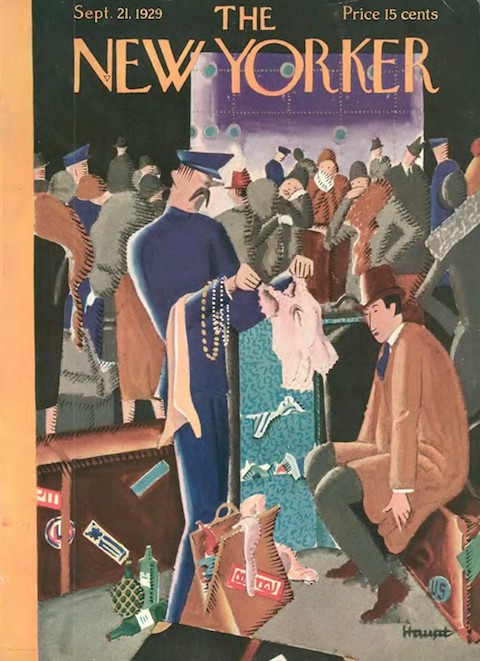
And in the following issue of The New Yorker (Sept. 21), Peter Arno contributed this drawing for the theater review section (it doesn’t entirely look like an Arno, but then again his style at this time seemed to fluctuate almost weekly)…
* * *
Flapper Joan
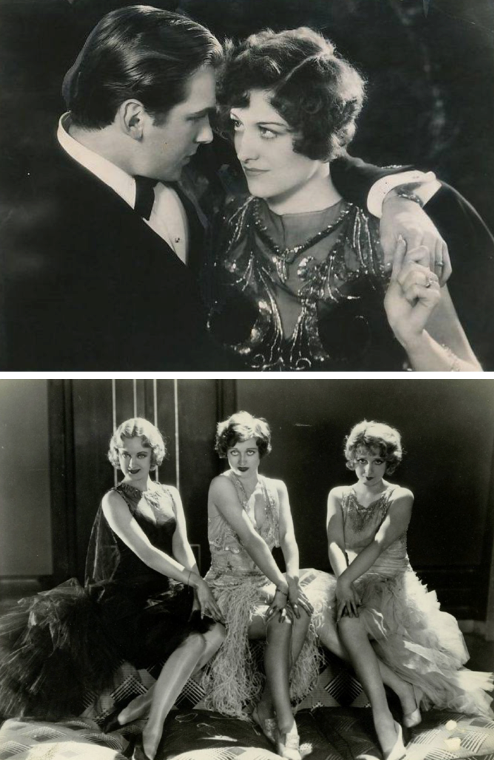
No stranger to Broadway herself, the young actress Joan Crawford was making a name for herself in Hollywood and garnering consistently positive reviews from the New Yorker’s film critic John Mosher, who found that the 25-year-old actress— who portrayed a fun-loving flapper in Modern Maidens — could shine even in the midst of an average screenplay:
THEY’RE NOT ACTING…At top, Douglas Fairbanks Jr. and Joan Crawford in MGM’s Our Modern Maidens (1929). The film led to a widely publicized romance and marriage between the co-stars; below, publicity photo for the film, with (from left) Josephine Dunn, Crawford, and Anita Page. (IMDB/joancrawfordbest.com)
* * *
Silence is Golden
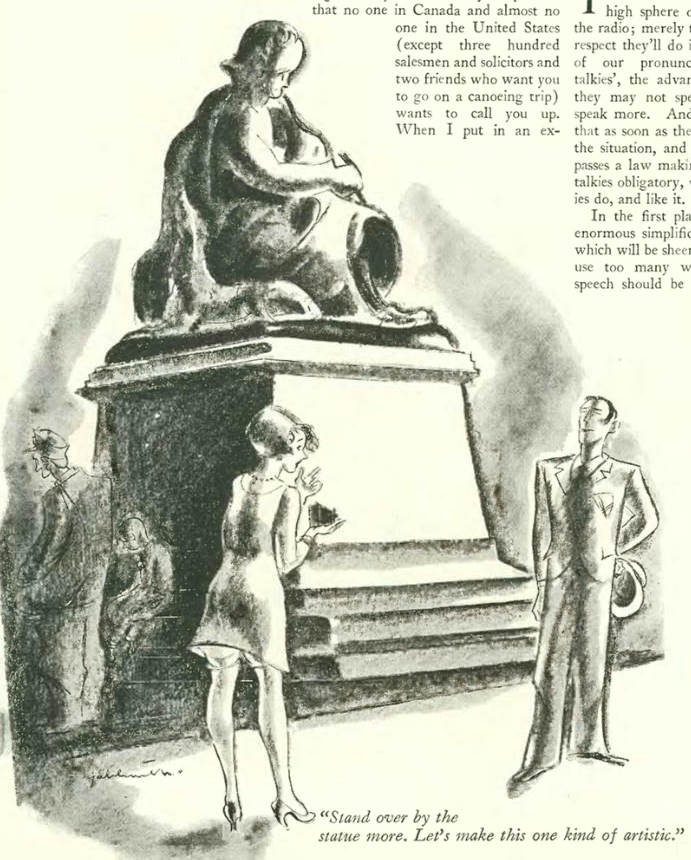
Cultural critic Gilbert Seldes contributed a casual titled “In a Loud Voice With the Tongues of Angels,” joining the chorus of voices at The New Yorker skeptical of (but resigned to) the advent of sound motion pictures. Excerpts:
SOMETHING HAS COME BETWEEN US…a microphone moves in close on Spencer Tracy and Bette Davis in a scene from 1932’s 20,000 Years In Sing Sing. (cinecollage.net)
* * *
Das Speedboat
“The Talk of the Town” reported on the fuss created by the German passenger liner Bremen after it completed its maiden voyage to New York. It set a new world record in the process — four days, 17 hours, and 42 minutes later —and captured the westbound “Blue Riband” from the famed Mauretania with an average speed of 27.83 knots (the Blue Riband was an unofficial honor bestowed on the fastest passenger liners crossing the Atlantic)…
LOWRIDER…Top, the low, streamlined profile of the Bremen against the backdrop of the New York skyline. Center and below, among its many unique features, the Bremen had a catapult on the upper deck between the two funnels that launched a small seaplane, which facilitated faster mail service ahead of the ship’s arrival. (YouTube/nnapprentice.com)(Ebay community post)
* * *
Up In Smoke
Another “Talk” item explored the decline of cigar and pipe smokers thanks to the rise of cigarette advertising (and women smokers) in the 1920s…
…as an aside, it appeared golfer Walter Egan was still a pipe smoker, as this illustration by Johan Bull for the issue’s “Tee and Green” column attested…
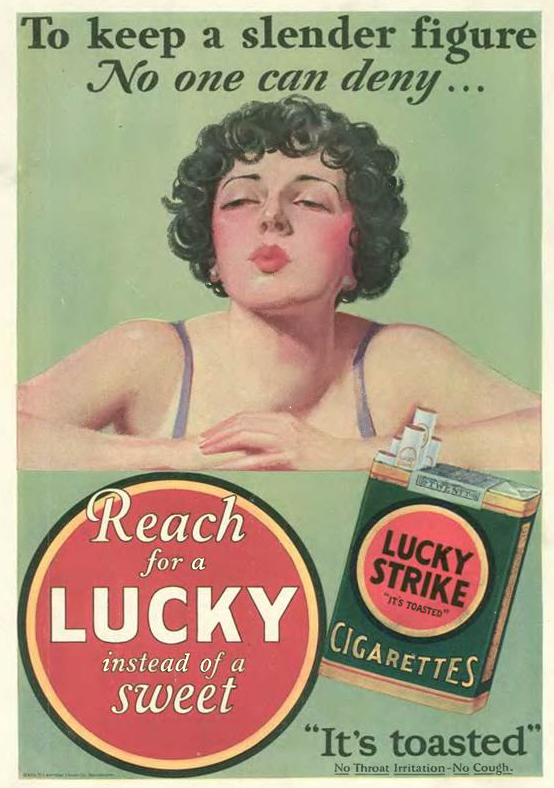
…”Talk” laid the blame (or the credit) on Lucky Strike’s successful ad campaigns that that particularly made a “big impression” on women…
…and to begin our advertising section, a Lucky Strike ad from the same issue:
…the Liggett & Myers tobacco company, on the other hand, promoted their Fatima brand as a higher quality, and slightly more expensive, alternative…
…in this ad for The Shelton Looms we find the elongated style popular in fashion ads of the era…the illustration is by LeBrun, but also evokes the style of Carl “Eric” Erickson, known for his Camel ad illustrations of the same period…
…and now a couple of ads from the back pages: the ad at left promoted a “country style” supper club near Washington Square. I haven’t found a record (yet) for the County Fair, but it was one of the themed restaurants Don Dickerman operated around Greenwich Village before the Depression (Dickerman, an illustrator, also provided the art for the ad)…the ad on the right—for Odorono deodorant— appeared regularly in the back pages of The New Yorker, illustrated by the magazine’s own Julian De Miskey. The ads featured vignettes of unfortunate young women whose B.O. was so bad that it caused all potential suitors to flee…
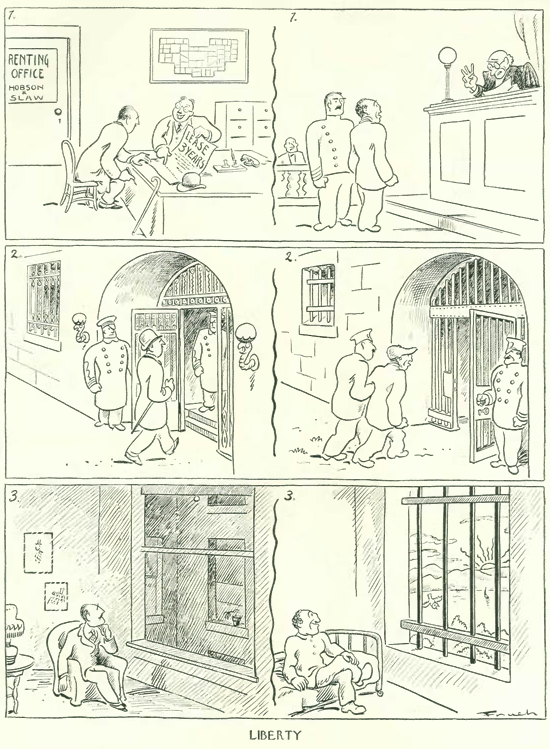
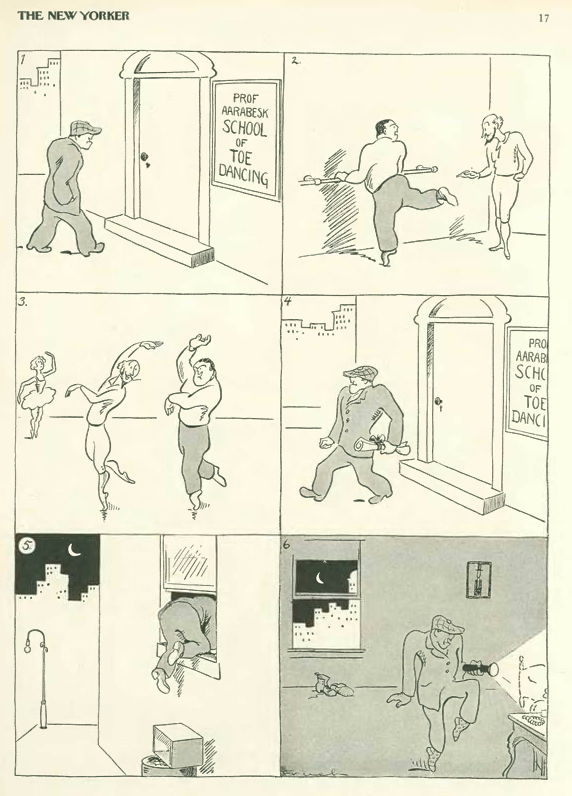
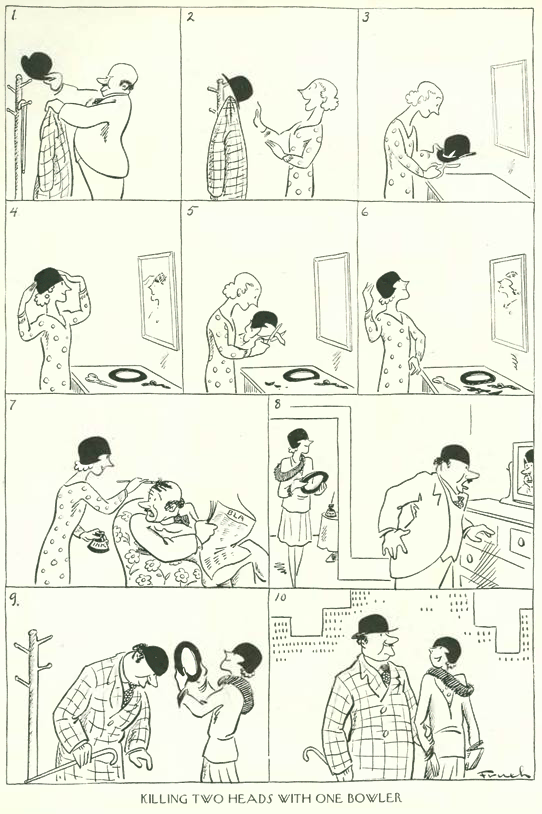
…on to our cartoons, Al Frueh (artist of the first two cartoons in The New Yorker’s first issue)…contributed another of his familiar multi-panel “silent” cartoons…
…I like the modern feel of this cartoon by William Crawford Galbraith…
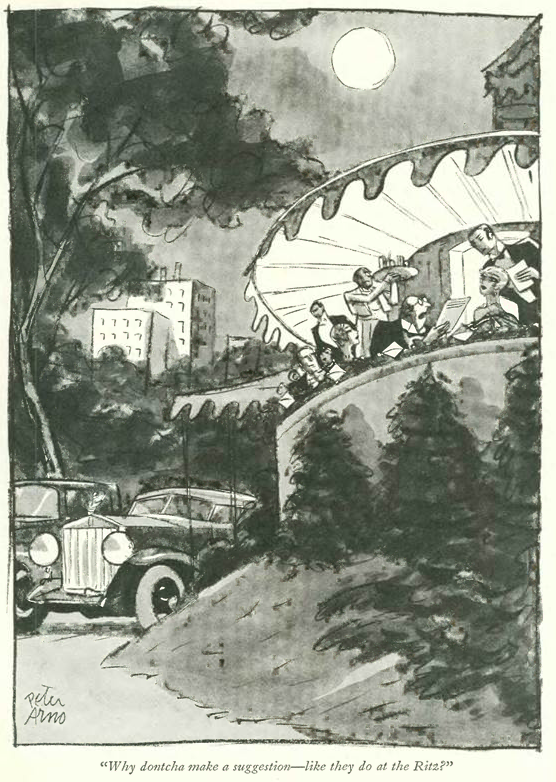
…and we close with a couple of cartoons under the moonlight, by Bruce Bairnsfather…
For all its embrace of the modern city and its technological wonders, The New Yorker mostly despaired of the changes wrought by the introduction of sound to motion pictures.
June 1, 1929 cover by Rea Irvin.
Granted, early sound technology was primitive, with directors, actors and crew members adapting on the fly to the demands of a new medium that required absolute silence on film sets and cumbersome microphones that severely limited the movements of actors. Screenwriters, accustomed to writing brief intertitles in silent films, now had to write expository dialogue, and actors had to rely less on exaggerated facial expressions and body movements and more on the spoken word. And it helped if you didn’t have a speech impediment or heavy accent.
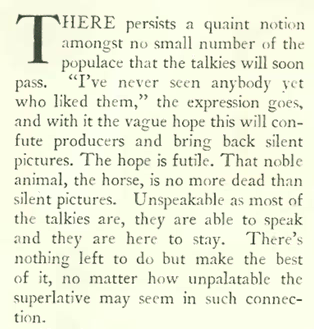
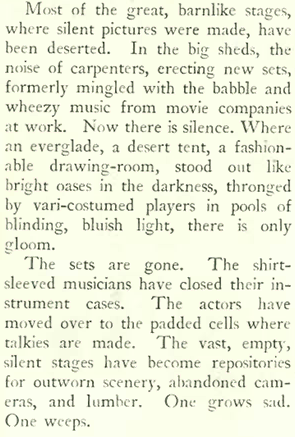
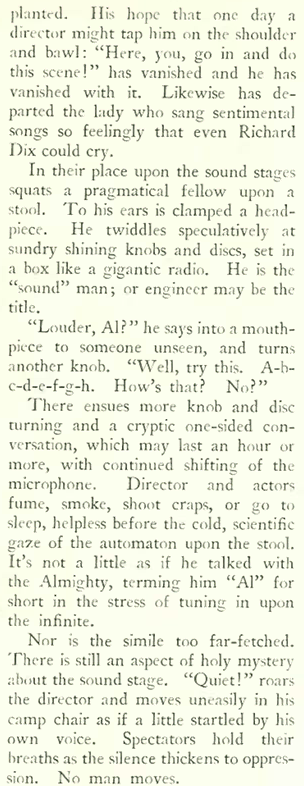
Writing for “The Reporter at Large” column (titled “The Unspeakables”), Hollywood correspondent Jean-Jacques lamented that the talkies were “here to stay”…
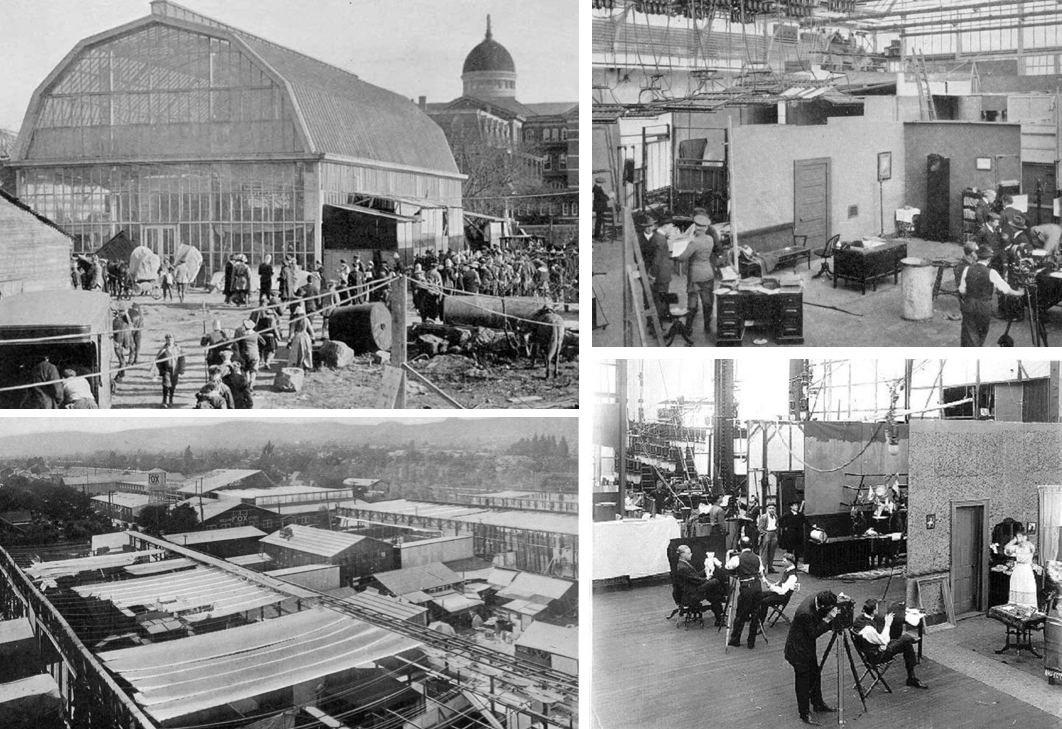
BARNLIKE STAGES were erected on both coasts to produce early silent films. Clockwise, from top left, Fox’s World Paragon Studios in Ft. Lee, NJ, circa 1917; interior of the studio; several films in production, side-by-side, at Edison’s Bronx studio, circa 1915; Fox studios in Los Angeles, 1920s. (moviemice.com/Wikipedia)
Jean-Jacques recalled the professions that would now be lost to the talkies, including the “mood musicians” who played their instruments on silent film sets in order to evoke emotions from the actors…
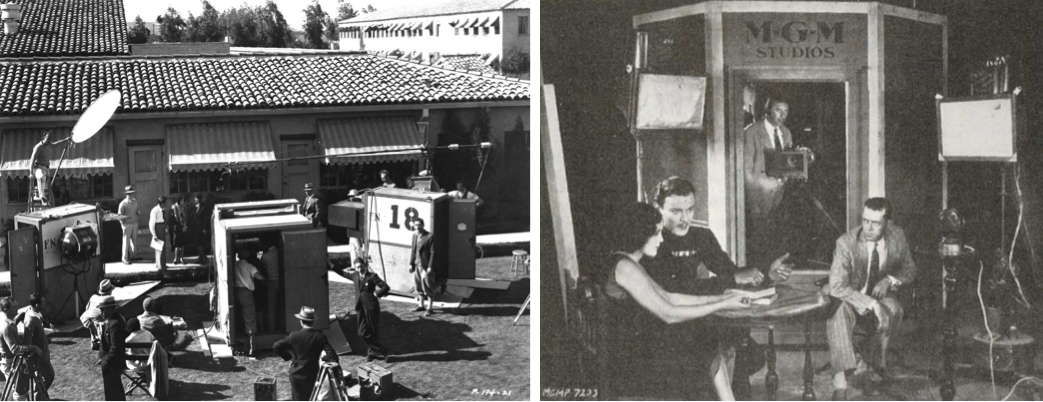
IN THE MOOD…During the silent era “mood musicians” were hired to play their instruments on film sets in order to evoke emotions from the actors. (Pinterest)THE SILENCE OF SOUNDS…In the early days of the talkies the entire set had to be silent, and special care had to be taken to ensure loud cameras were housed in soundproof boxes such as those pictured above. Instead of the introduction of sound expanding the capabilities of filmmaking, it was often limited by the bulky gear used to capture that sound. Therefore, many films consisted of “stage” musical numbers that were static shots. (Caption and image at left courtesy Colorado College. Image at right from cinecollage.net)
The writer also noted the challenges that faced “the old scenario writer…hemmed in by a multitude of new rivals…
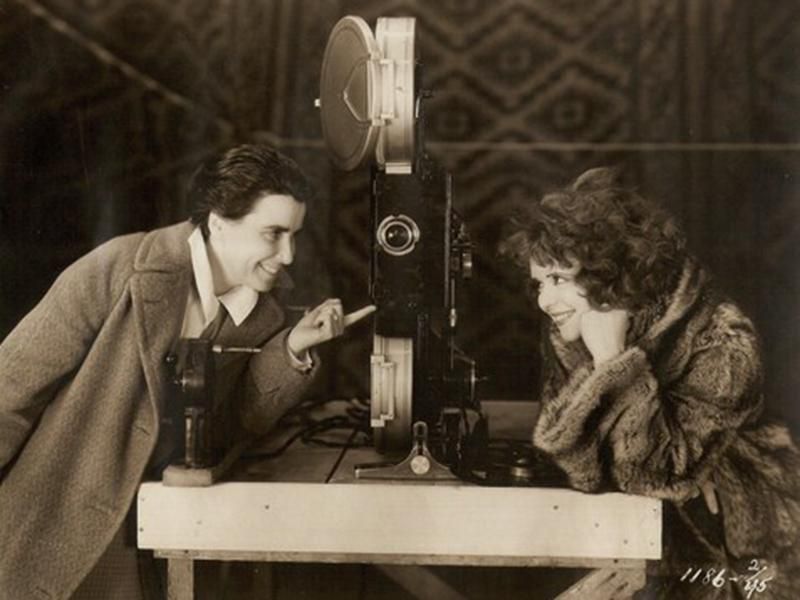
WE HAVE WAYS OF MAKING YOU TALK…Dorothy Arzner (left) poses with “It Girl” Clara Bow in a publicity shot for The Wild Party, Bow’s first talking picture. Bow is famously quoted as saying (in 1930) “I hate talkies. They’re stiff and limiting. You lose a lot of your cuteness, because there’s no chance for action.” Arzner tried to remedy that problem: she is credited with inventing the boom mike, which allowed for greater movement by the actor. (Paramount Pictures/Wikimedia Commons)
Jean-Jacques recounted the frustrations experienced by one old-time actor dealing with the limitations of bulky sound equipment…
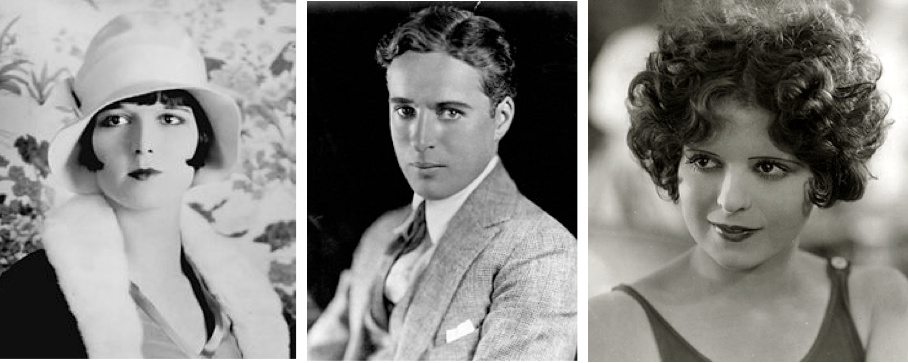
This actor was not alone. A number of major silent film stars including Charlie Chaplin, Louise Brooks, and Clara Bow did not embrace the novelty of sound pictures. Motion Picture Classic magazine (September 1930) quoted Bow as saying, “I hate talkies … they’re stiff and limiting. You lose a lot of your cuteness, because there’s no chance for action, and action is the most important thing to me.” According to the article, a visibly nervous Bow had to do a number of retakes in The Wild Party because her eyes kept wandering up to the microphone overhead.
SILENCE IS GOLDEN…A number of major silent film stars including (from left) Louise Brooks, Charlie Chaplin and Clara Bow did not embrace the novelty of sound pictures. (Wikipedia)
Jean-Jacques signed off his New Yorker piece with the hope that someday pictures and sound would be combined into a worthy new art form…
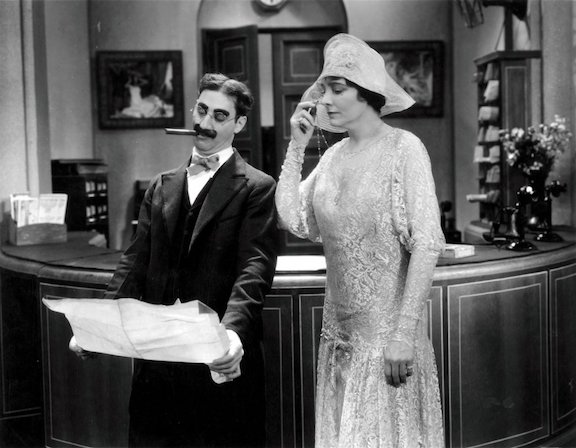
Perhaps he had to look no further than Manhattan’s Rialto Theatre to find that first glimmer of hope, for it was there that the Marx Brothers were tearing up the screen in their first talking picture, The Cocoanuts, reviewed in the magazine’s “The Current Cinema” column…
If The New Yorker was looking for snappy dialogue in motion pictures, there was plenty of it in The Cocoanuts, including this snippet between Groucho Marx, playing Mr. Hammer—an unscrupulous manager of a bankrupt Florida hotel—and wealthy hotel guest Mrs. Potter, played by Margaret Dumont…
Hammer: Do you know that property values have increased since 1929 one thousand per cent? Do you know that this is the biggest development since Sophie Tucker? Do you know that Florida is the show spot of America and Cocoanut Manor the black spot of Florida?
Mrs. Potter: You told me that yesterday.
Hammer: I know but I left out a comma.
Or this gem…
Hammer, to Mrs. Potter: Just think – tonight, tonight when the moon is sneaking around the clouds I’ll be sneaking around you. I’ll meet you tonight under the moon. Oh, I can see it now – you and the moon. Wear a neck-tie so I’ll know you.
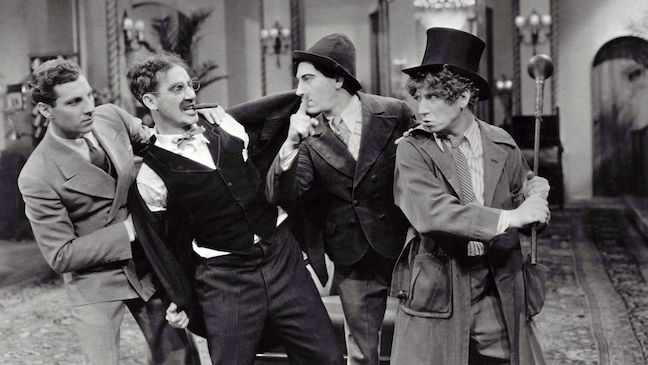
SHOW ‘EM HOW IT’S DONE…Zeppo, Groucho, Chico and Harpo Marx in their first sound movie, The Cocoanuts, 1929. (vitaphonedreamer.wordpress.com)BAMBOOZLER… Mrs Potter (Margaret Dumont), inspects Mr Hammer’s (Groucho Marx) Florida property “deals” in The Cocoanuts. (British Film Institute)
* * *
For Sentimental Reasons
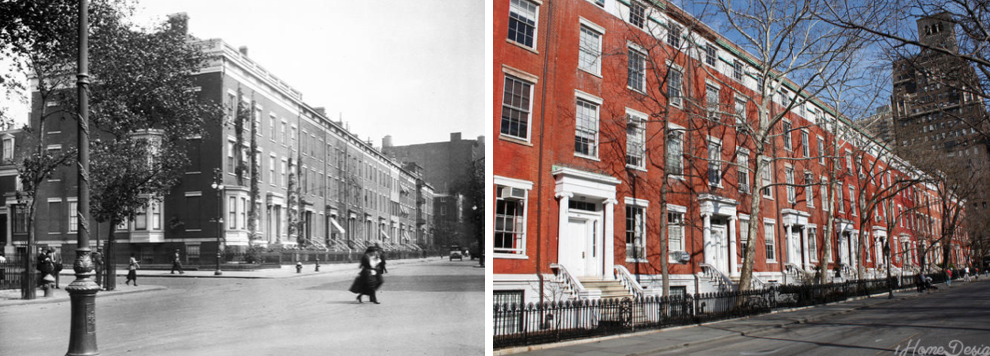
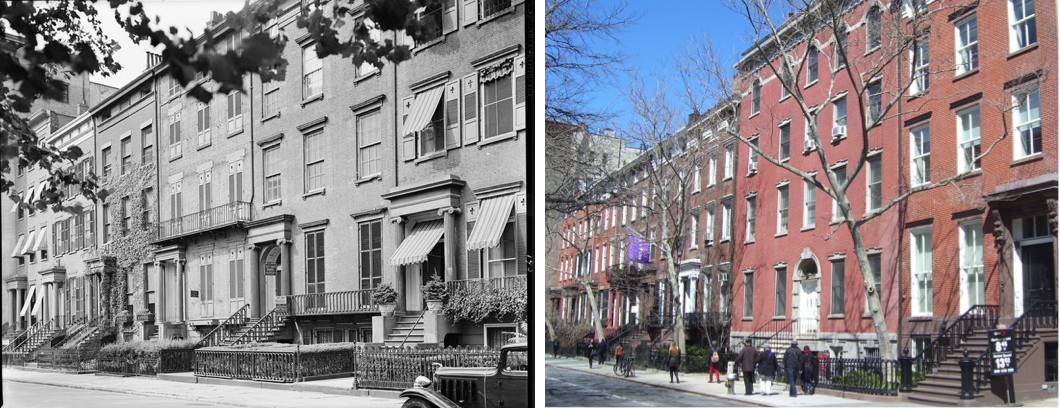
Additional evidence that The New Yorker was not always ready to embrace change came from its many articles, particularly in “The Talk of the Town,” that seemed to favor the preservation of buildings that defined the character of certain neighborhoods, including the early 19th century row houses that lined Washington Square North…
THEN AND NOW…At left, photo dated 1921 of Washington Square, north side of square looking east from 5th Avenue. Corner house in foreground is No. 12. The far end at right shows Nos. 3, 2, 1. At right, roughly the same block today. (Museum of the City of New York/1homedesigns.com)
At left, photo dated 1936 (by Berenice Abbott) of Washington Square North, nos. 21-25, between Fifth Avenue and MacDougal Street. At right, nos. 19-26 today. (Museum of the City of New York/Wikimedia Commons)
* * *
The Wittier Kaufman
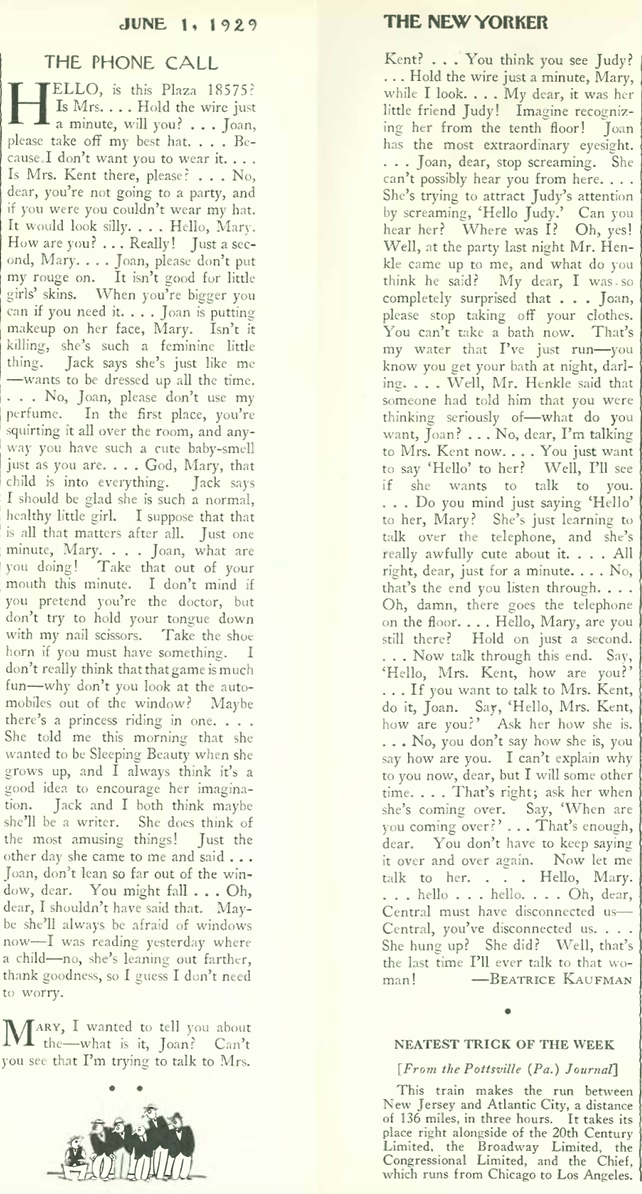
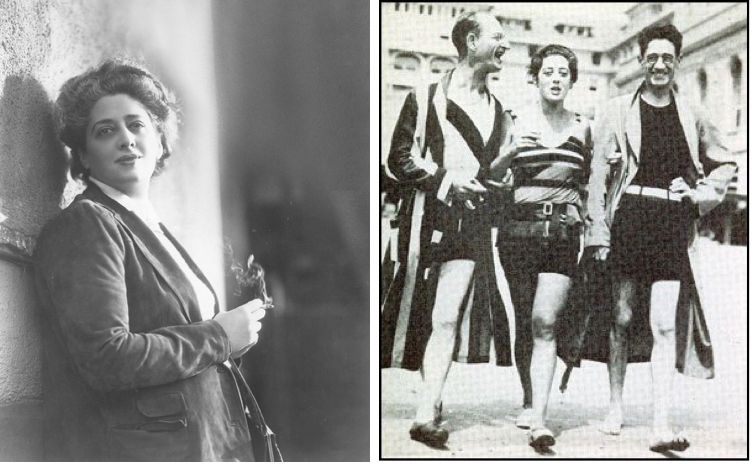
Editor and playwright Beatrice Kaufman worked and played within the orbit of the famed wits of the Algonquin Round Table, but was not a regular member like her husband, playwright and director George S. Kaufman. But Beatrice Kaufman didn’t the need the Algonquin to display her wit. Indeed, according to Michael Galchinsky (writing for the Jewish Women’s Archive), she was regarded as one of the wittiest women in New York in the 1930s and 40s. Here is an example of her work in the June 1 issue of The New Yorker:
THE WITTIEST OF THEM ALL…Editor, writer and playwright Beatrice Kaufman (left, in undated photo). At right, comedian Julius Tannen (left) frolics with Beatrice and her husband, Broadway playwright/producer George S. Kaufman in Atlantic City in the 1920s. (thepurplediaries.com/spartacus-educational.com)
* * *
Rags to Riches
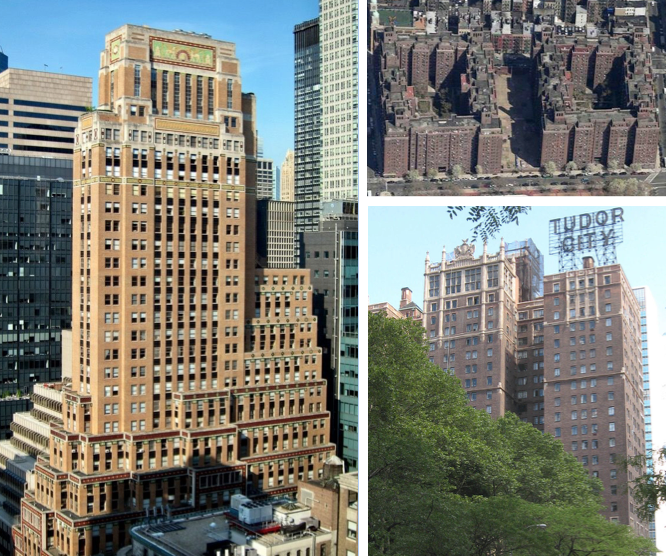
The life of Fred F. French was something out of dime novel; born in dire poverty, he became a self-made real estate tycoon and a shrewd builder of some of Manhattan’s biggest land developments. French was the subject of a profile written by Robert M. Coates, an art critic who would be a longtime contributor to The New Yorker. An excerpt, with illustration by Al Frueh:
MONUMENTS TO FRED…Fred French’s New York City buildings included, clockwise from left, the 38-story Fred F. French Building (1927) at 45th Street and 551 Fifth Avenue (designated a National Landmark); Knickerbocker Village (1934) on the Lower East Side; and the East Side’s Tudor City apartment complex (1927-1932). (Pinterest/thelodownny.com/Wikipedia)
* * *
From Our Advertisers
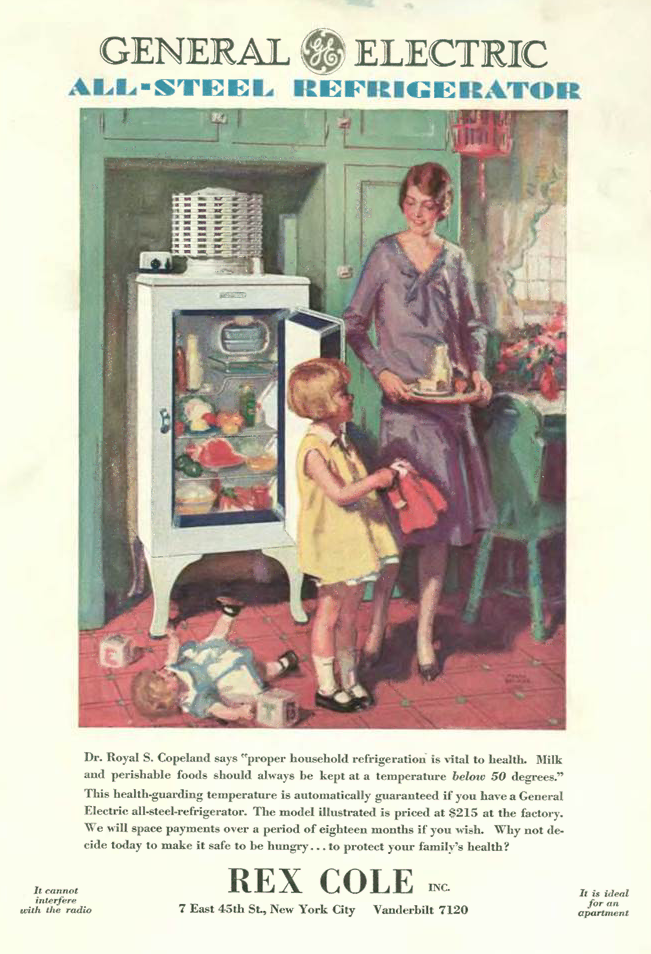
Let’s start with a couple of lovely color ads, which appeared with greater frequency in the magazine…here we have a snatch of the good life, courtesy General Electric…
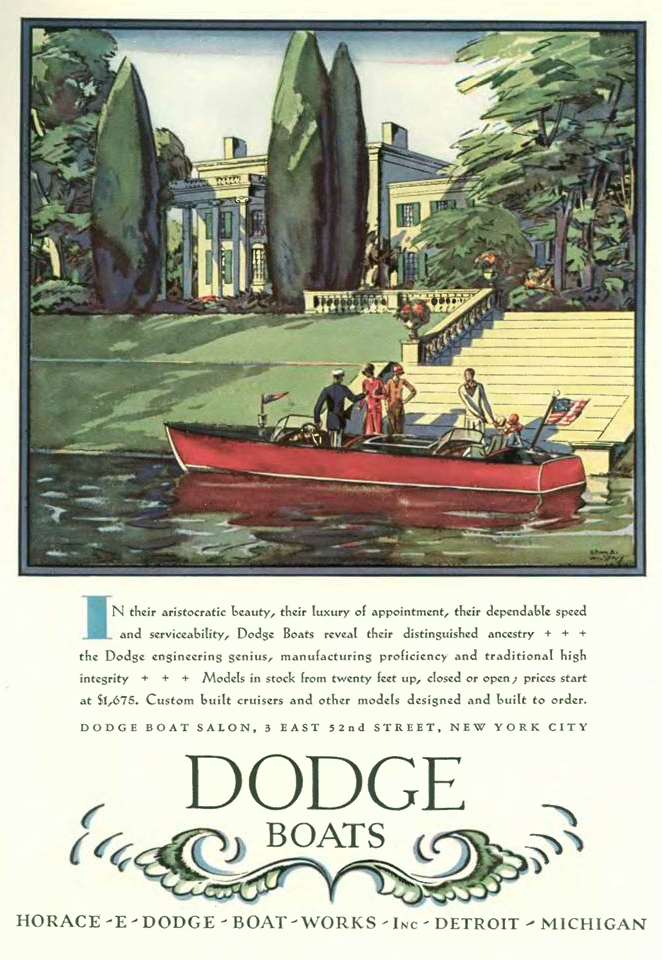
…and perhaps a less homespun image of the good life, from the makers of Dodge boats…
…and here we have another example of the modern world rushing in, this time in the form of instant coffee crystals…
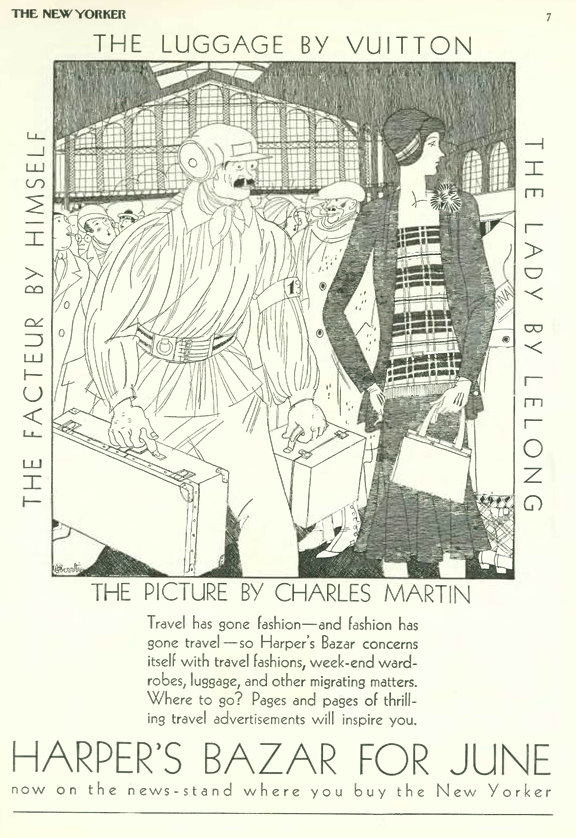
…and another taste of the modern from Harper’s Bazar magazine, featuring an illustration by French artist and illustrator Charles Martin…
…and just for kicks, another example of Martin’s work from an earlier time…
Image from Sports et Divertissements by Charles Martin, 1914. (Wikipedia)
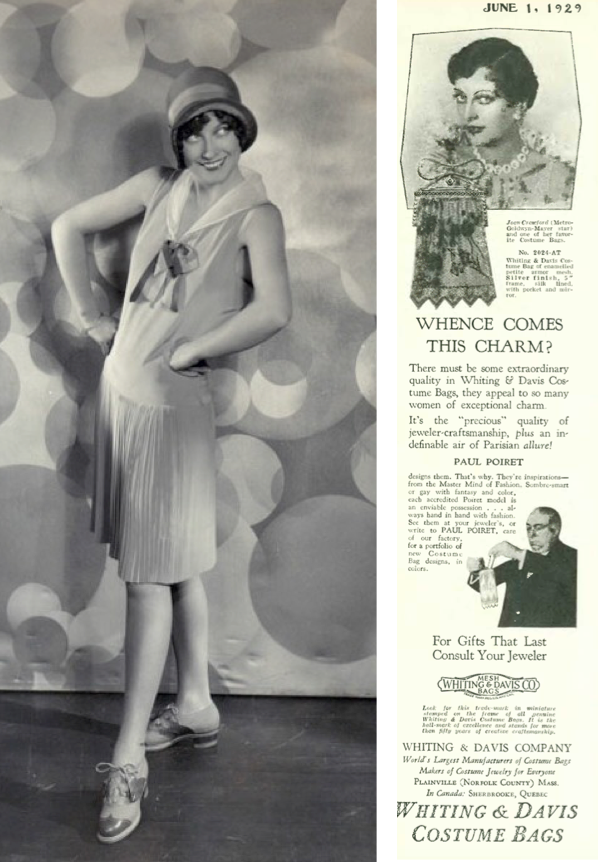
…and here is a back page ad for costume bag maker Whiting & Davis, with an endorsement by Joan Crawford, who was already a pretty big star by 1929. My guess is that Whiting & Davis paid more for the endorsement than they did for the ad…I included a photo of Crawford (at left) from 1929 just to show that she did have a lighter side…
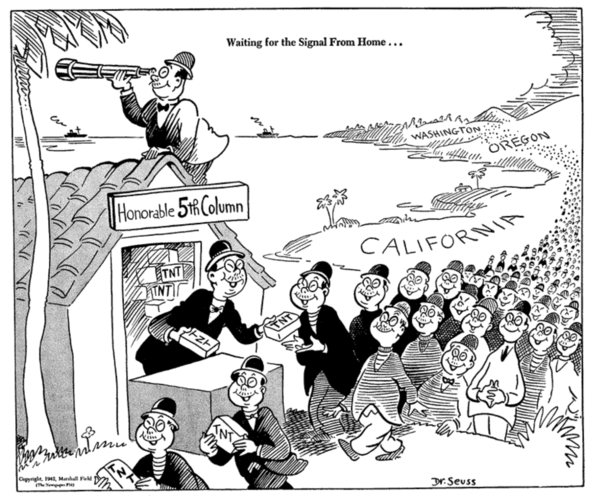
…this ad from the makers of Flit insecticide begs the question: was our beloved Dr. Seuss (aka Theodore Geisel) once a racist? Well…
…although Geisel was a liberal Democrat and a supporter of the New Deal, during World War II he also supported the internment of Japanese Americans, as is evident from this unfortunate 1942 cartoon…
Dr. Seuss 1942 cartoon with the caption ‘Waiting for the Signal from Home’ (slideshare.net)
…later in life Geisel became a staunch environmentalist and anti-war protestor. In 1961 he wrote The Sneetches, which promoted racial equality. Perhaps Geisel lived to regret those earlier drawings…
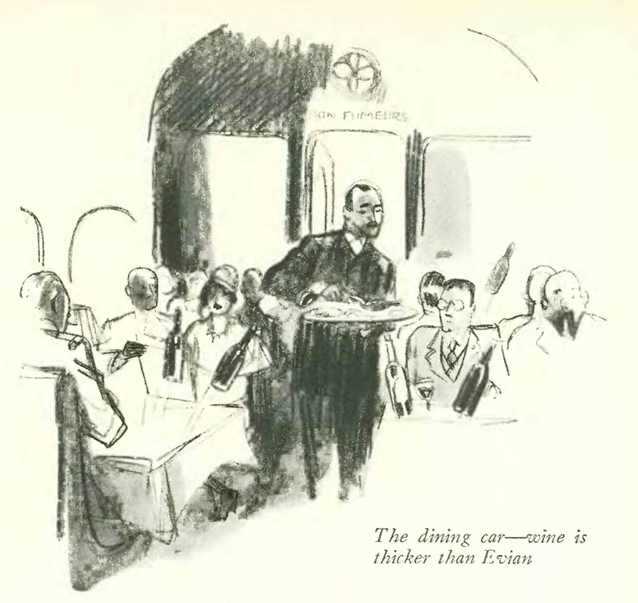
…and on to our illustrators and cartoonists, beginning with this sketch by Garrett Price, apparently inspired from a recent trip to France (it was featured along with several other small sketches in the “Profile” section)…
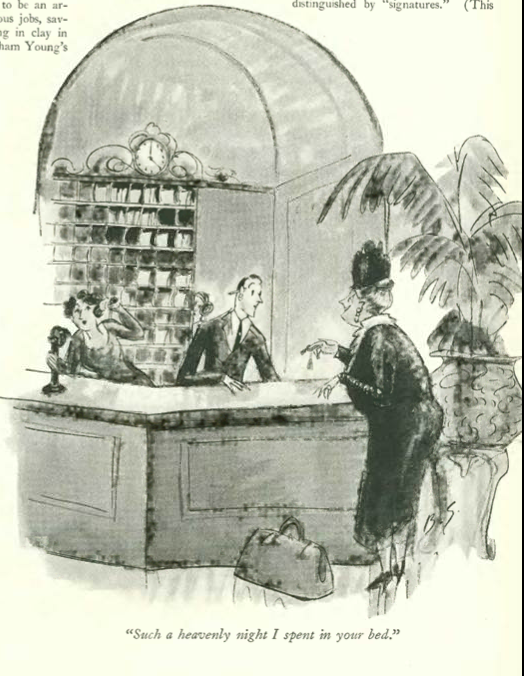
…Barbara Shermund had some fun with a double entendre…
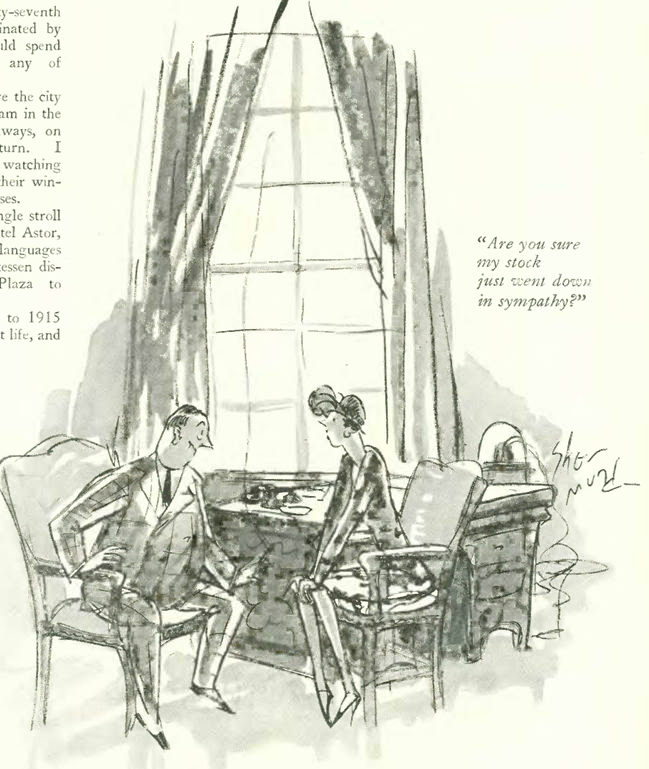
…and popped up again with this look at the stock market…
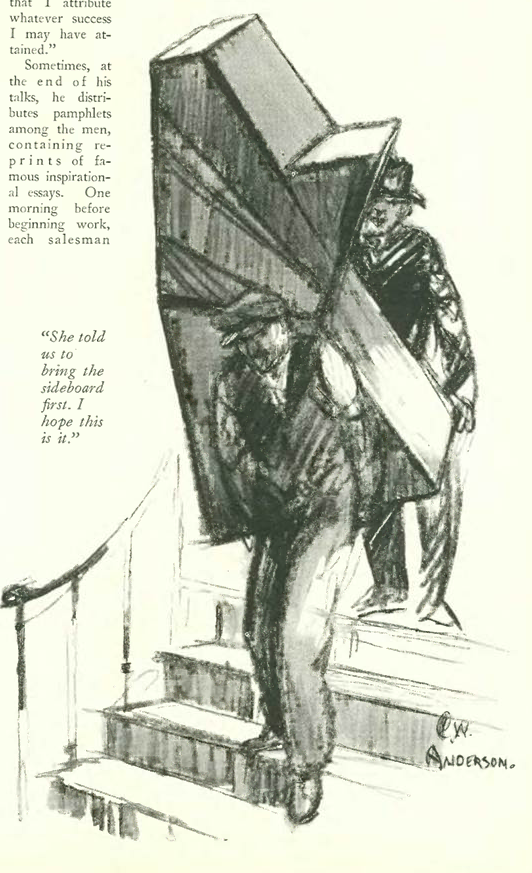
…C.W. Anderson found humor in the strange shapes of modernist furniture…
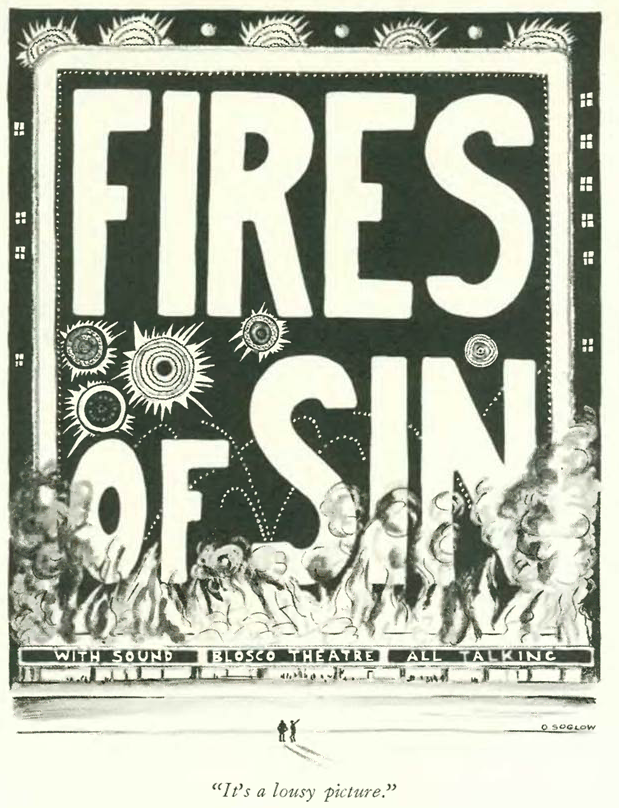
…Otto Soglow commented on the glitzy hype of Broadway…
…and cartoonist/humorist Don Herold made his comics debut in The New Yorker with this entry…
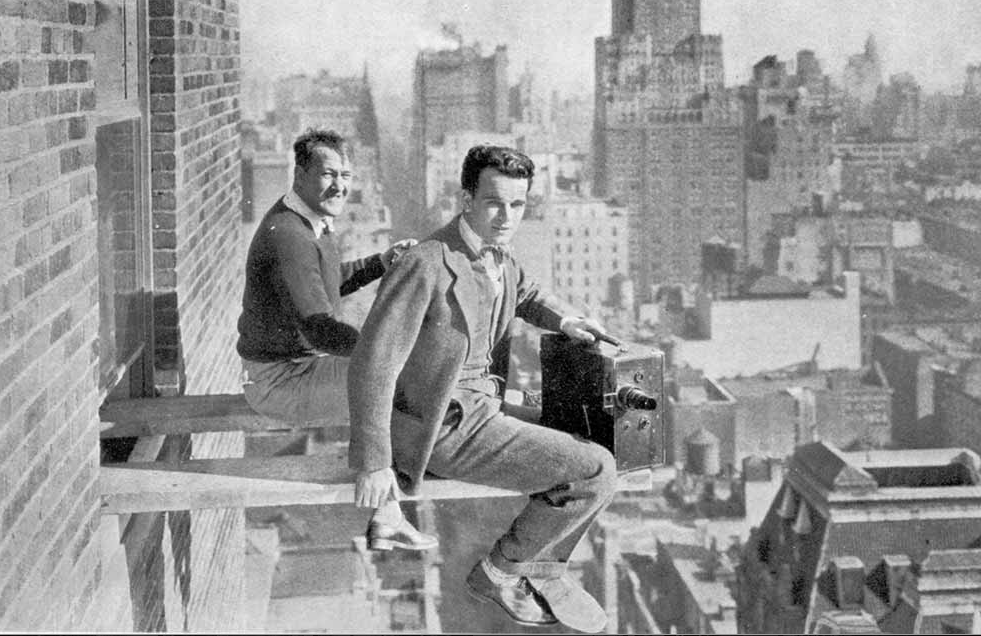
…and finally, a bonus image I came across while researching the advent of sound motion pictures. The photo, from the silent era, shows two cameramen shooting a parade, possibly for a newsreel. Note how their only support consists of two wooden planks wedged into an open window…














































































































 A New Yorker State of Mind