Above: Robert Moses in 1939 with a model of his proposed Battery Bridge Park Reconstruction; at right, 1934 Bryant Park renovation, view to the south on 6th Avenue from 42nd Street. (Wikipedia/NYC Parks Department)
The title for this entry comes from Robert Caro’s landmark 1974 biography of Robert Moses, The Power Broker: Robert Moses and the Fall of New York, which questioned the benefit of Moses’s monumental projects.
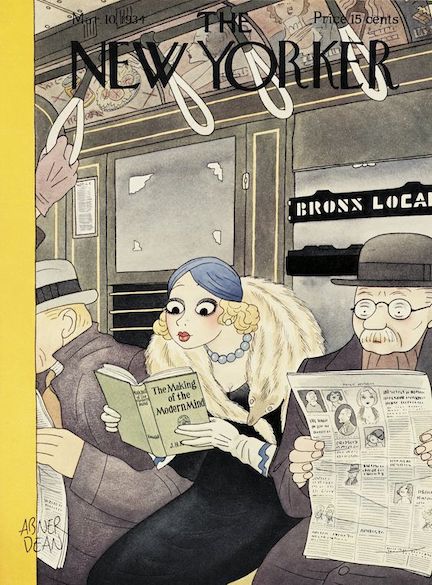
March 10, 1934 cover by Abner Dean.
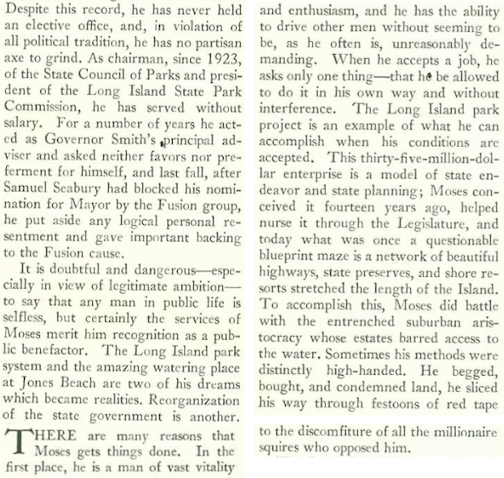
Like him or not, few unelected officials have wielded more power than Moses, who through various appointed positions, including New York City Parks Commissioner, he was able to impose his will on mayors, legislators, congressmen, wealthy burghers, and even, on occasion, The White House. In turn he imposed his will on the city itself, clearing whole neighborhoods to lay down new roads that extended from Manhattan to the tip of Long Island, where neither farmer nor landed gentry could stand in his way. A profile written by Milton MacKaye examined what made Moses tick. An excerpt:
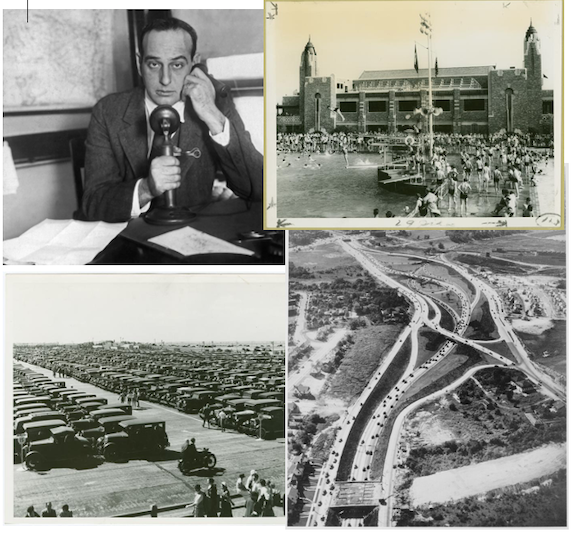
DON’T YOU DARE PUT ME ON HOLD…Relentless doesn’t begin to describe Robert Moses’s pursuit of power. Clockwise, from top left, Moses circa 1930; one of the swimming pools at the west bathhouse at Long Island’s Jones Beach, a project that helped launch Moses’s road to power; Long Island Expressway, which transformed Long Island from farm country (and a retreat for the rich) into a land of bedroom communities and public parks; the east parking field at Jones Beach. (Britannica/Library of Congress/U.S. National Archives)
In another excerpt, MacKaye noted that Moses had been named a member of the Triborough Bridge Authority; Moses would ultimately become chairman, and through this position would possess enormous, unchecked power and influence. Moses was skilled at creating legal structures that would favor his ambitions, burying language into legislative bills and other documents that would make him impervious to influence from mayors, legislators, governors and other elected officials.
A DIFFERENT KIND OF PLAYGROUND…Moses intensely disliked former New York Mayor Jimmy Walker, who used the Central Park Casino (top left) as his personal playground. Moses exacted his vengeance by having the historic casino razed in 1935 and replaced with the Rumsey Playground; at right, the 1936 Triborough Bridge (Berenice Abbot photo), a cluster of three separate spans connecting the Bronx, Manhattan, and Queens. It was developed through Moses’s Triborough Bridge Authority, which was impervious to influence from mayors, legislators and governors. While the city and state were strapped for funds, Moses reaped millions from tolls, which financed his other ambitions; bottom left, Moses in 1938. (Wikipedia/transalt.org/Library of Congress)
Final note, I highly recommend Caro’s The Power Broker—it’s a doorstop of a book, but also one of the best biographies of the 20th century and a must-read for anyone who wishes to understand how present-day New York came to be, and how it really works.
* * *
Let’s Talk About the Weather
Robert Benchley, writing under the pseudonym Guy Fawkes, took a turn at “The Wayward Press” column, commenting on the sensationalistic coverage of the weather by the local press. In all fairness to the press, New York City had endured a blizzard as well as the coldest temperature ever recorded for the city: 15 below zero (Fahrenheit) on Feb. 9, 1934. (According to newspaper accounts, it was 14.3 below).
Benchley also commented on journalist Ernest Gruening (1887–1974), who was the editor of the New York Post for only four months in 1934, but during those four months he really shook things up.
EASY BOSS…Ernest Gruening was editor of the New York Post for only four months in 1934, but during that time he made life better for his newsroom employees by implementing an unheard of 40-hour work week. Gruening went on to serve as the governor of the Alaska Territory from 1939 until 1953, and as a U.S. Senator from Alaska from 1959 until 1969. (Photo from 1935 via Wikipedia)
Robert Benchley thought the press made too much of the city’s snowy weather, but these newsreels tell a different story:
* * *
Punch Drunk
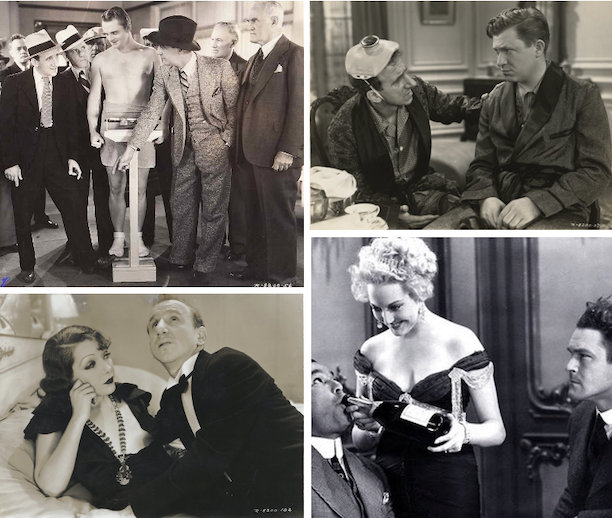
Critic John Mosher found slim pickings at the local movie houses, opting for Jimmy Durante’sPalooka as the best of crop:
RIBALDRY AT RINGSIDE…Clockwise from top left, Knobby Walsh (Jimmy Durante) tries to press his advantage during the weigh-in of boxer Al McSwatt (portrayed by William Cagney, the look-alike younger brother of James Cagney) in 1934’s Palooka; Durante thinks he’s found a winning fighter in Joe Palooka (Stuart Erwin); Joe’s father, Pete Palooka (Robert Armstrong) demonstrates why he’s nicknamed “Goodtime” with the help of Trixie (Thelma Todd); Durante with Lupe Vélez, who portrayed glamorous cabaret singer and fortune hunter Nina Madero. (IMDB)
* * *
From Our Advertisers
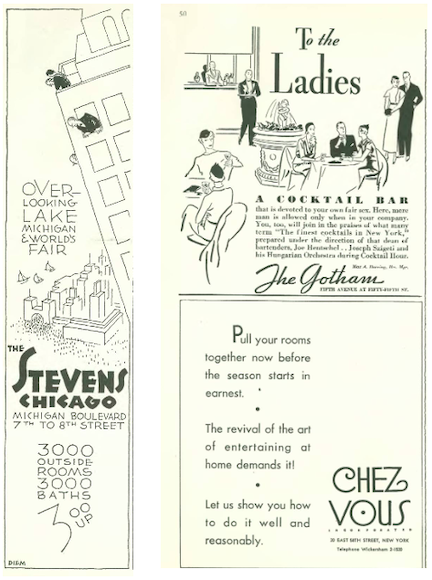
We start with a couple ads from the back pages…the promoters of Chicago’s famed Stevens Hotel offered a unique perspective as they appealed to New Yorkers to come check out the “Century of Progress” World’s Fair, which proved so popular that it planned to reopen in May for a second year…at right, The Gotham catered to the ladies with a special cocktail bar that only allowed men in the company of a woman…
NICE DIGS…At left, The Stevens Hotel (now Hilton Chicago) and, at right, The Gotham (now The Peninsula) are happily still with us today. (Wikipedia)
…cigarette manufacturers continued to work on their biggest growth market with ads like this one from the Lorillard Tobacco Company…here a perceptive woman chooses to ignore the “brazen claims” of other tobacco companies and makes an informed decision to inhale an Old Gold…
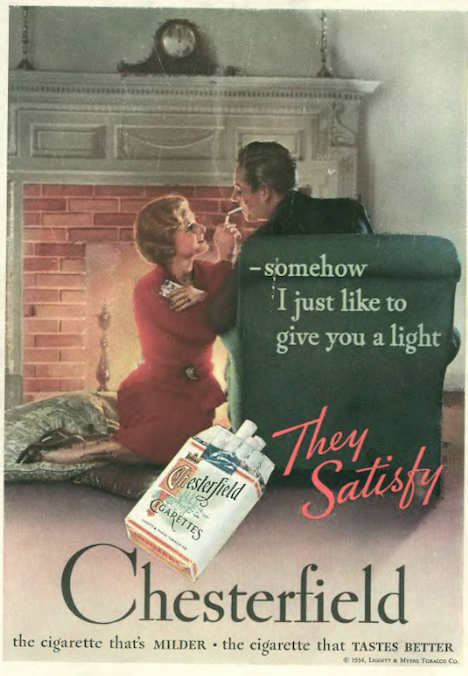
…Liggett & Myers, on the other hand, stuck with this subservient pose, suggesting both are happy with their cigarette, and their station in life…
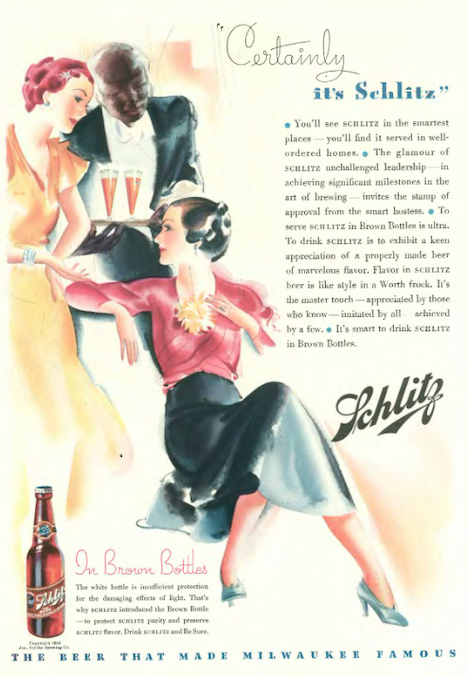
…another colorful ad from the makers of Schlitz beer…following the end of Prohibition Schlitz quickly became the world’s top-selling brewery, a position it would hold into the 1960s until it switched to cheaper brewing methods…
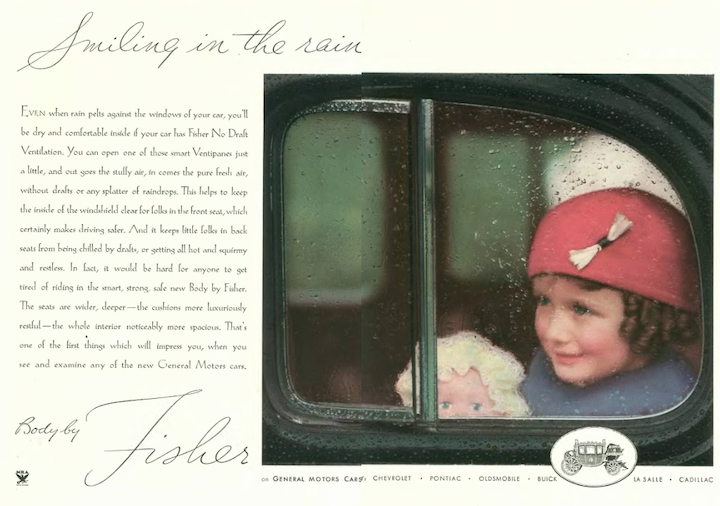
…the makers of Fisher car bodies (owned by General Motors) continued their lavish two-page spreads touting the homey comforts of their interiors…
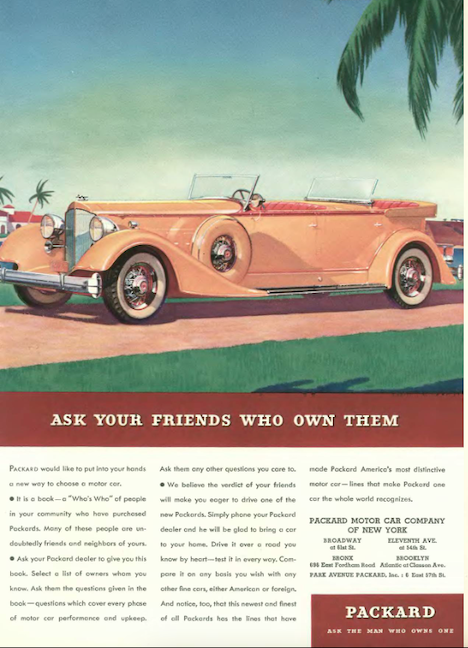
…and no more staid ads from luxury carmaker Packard, who ran this full-color, full-bleed spot…
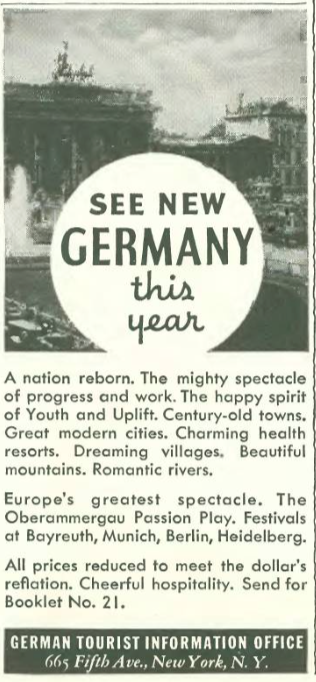
…it’s almost springtime for Hitler, and Germany welcomed American tourists with promises of “Dreaming Villages” (whatever those are), charming health spas and places of romance and beauty…hmmm, no mention of swastika flags hanging from every building, or parades of goose-stepping thugs…
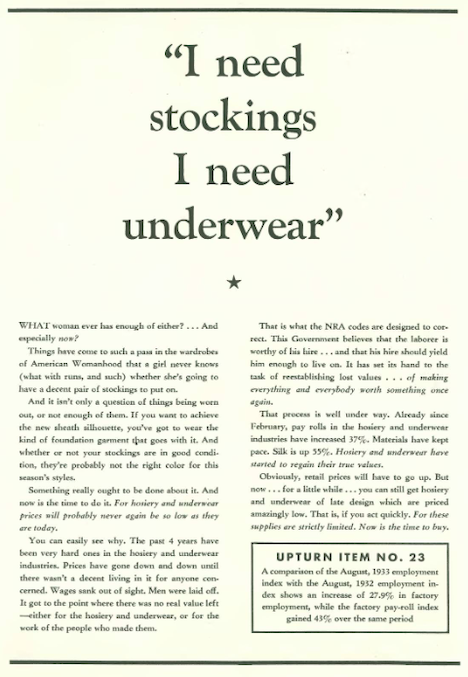
…this public service ad promoted the effectiveness of the National Recovery Act, offering the uptick in underwear sales as a sure sign of economic growth…
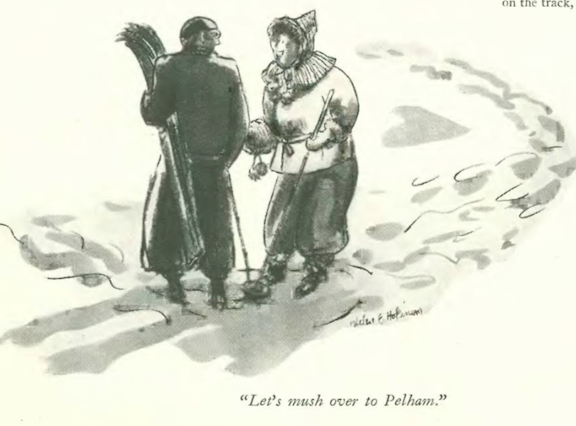
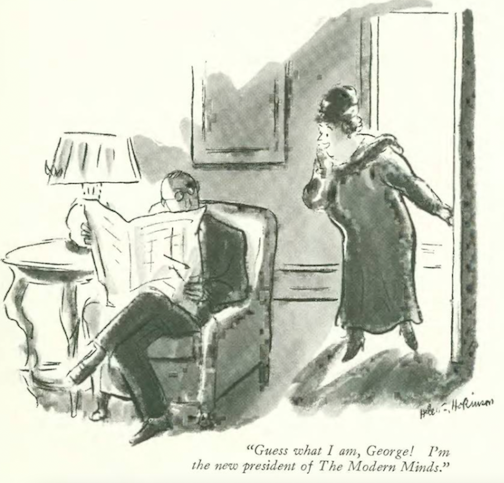
…on to our cartoonists, we begin with Helen Hokinson experiencing the results of the recent blizzard…
…as did Henry Anton, with a befuddled meteorologist…
…Alain (Daniel Brustlein) gave us this wordless gem…
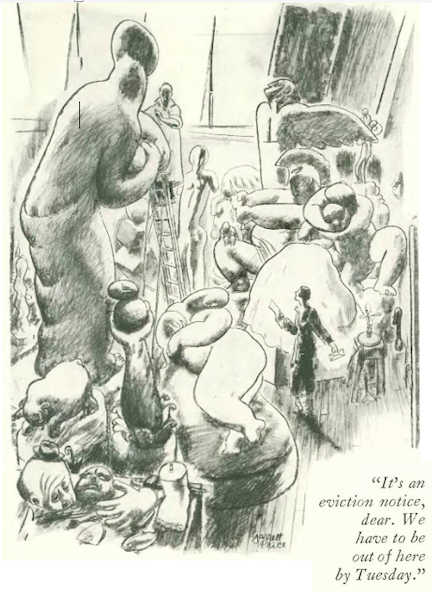
…while Garrett Price presented a sculptor’s greatest challenge…
…Alan Dunn gave us two women who expected more pizzazz from a recent funeral…
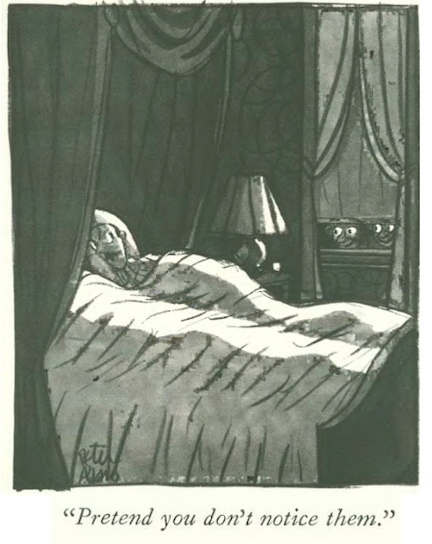
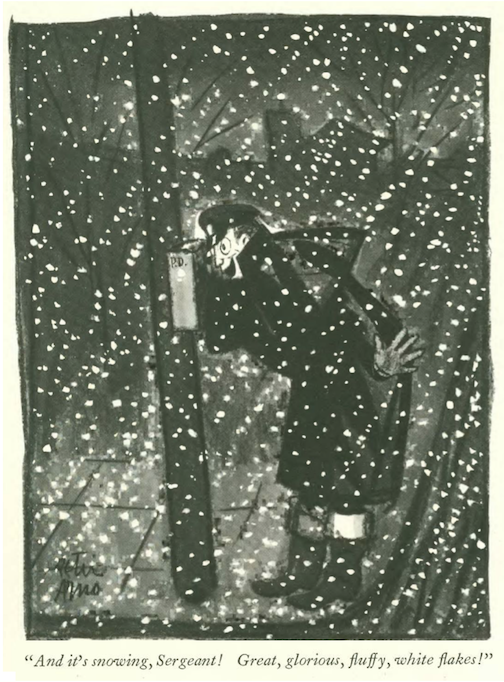
…Peter Arno contended with some Peeping Toms…
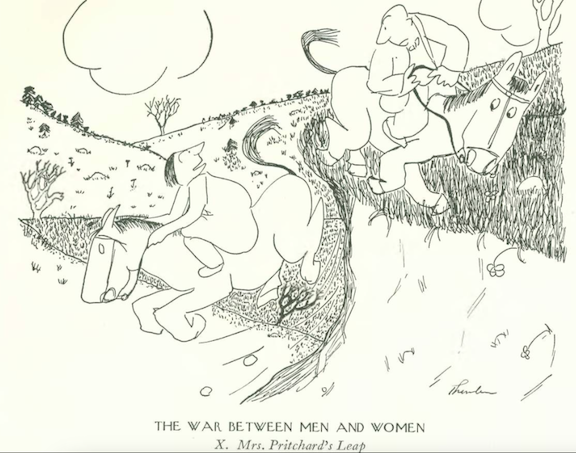
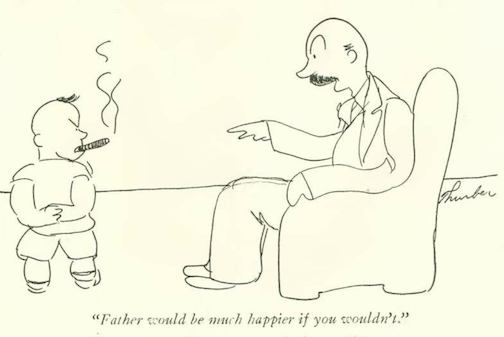
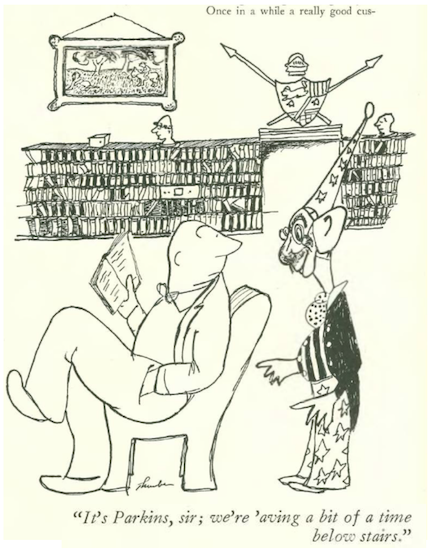
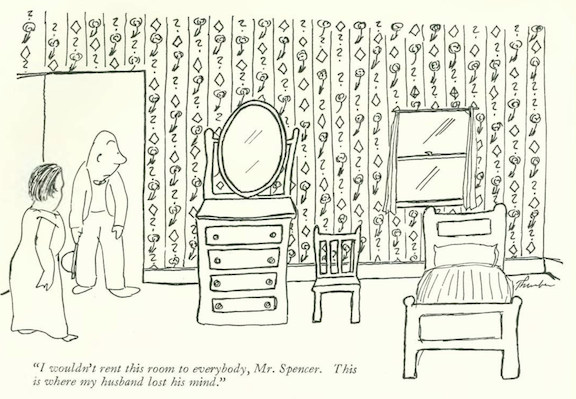
…and James Thurber looked in on recent maneuvers in his war between the sexes…
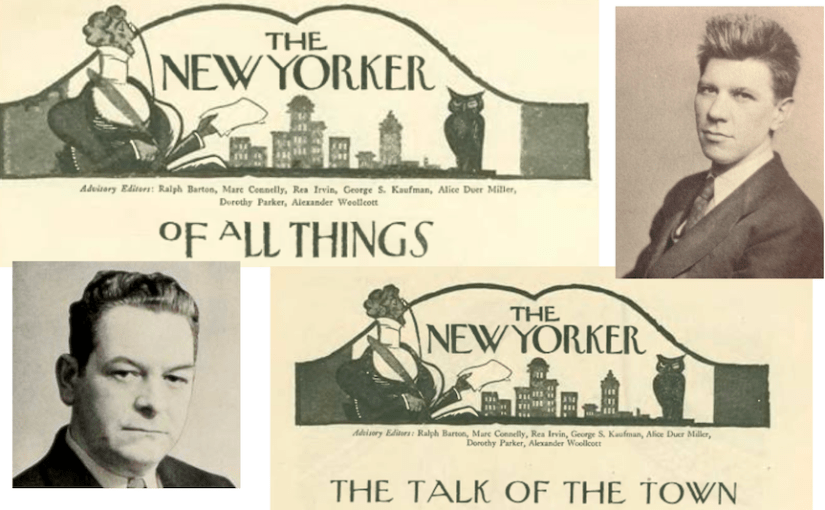
Above: It took a few issues for the editors to sort out regular features and their order of appearance. The opening section of Issue No. 1 featured the famous Rea Irvin masthead that would introduce “The Talk of Town” for many issues to come. In Issue No. 1, however, “Of All Things” appeared first under the masthead, followed by “The Talk of the Town." Let us hope the magazine restores the original Rea Irvin masthead for its 100th anniversary.
Despite the lingering Depression The New Yorker entered its ninth year on strong financial footing. With nearly equal numbers of subscribers and single copy sales, circulation would approach 125,000 in 1934, with more than $2.2 million in advertising income.
Feb. 17, 1934 cover by Rea Irvin (naturally).
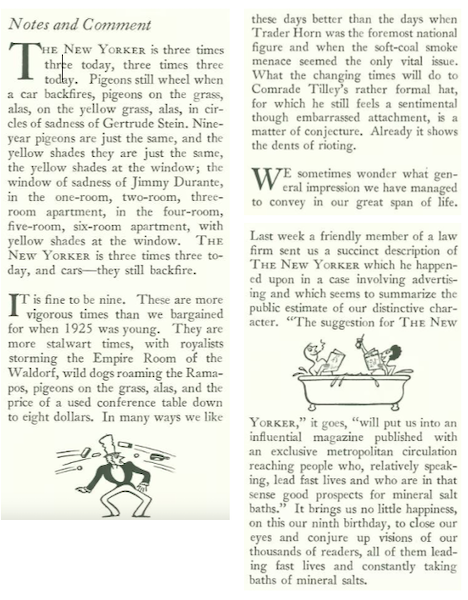
In his “Notes and Comment,” E.B. White commented on the “more vigorous times” the magazine was enjoying, declaring “it is fine to be nine.”
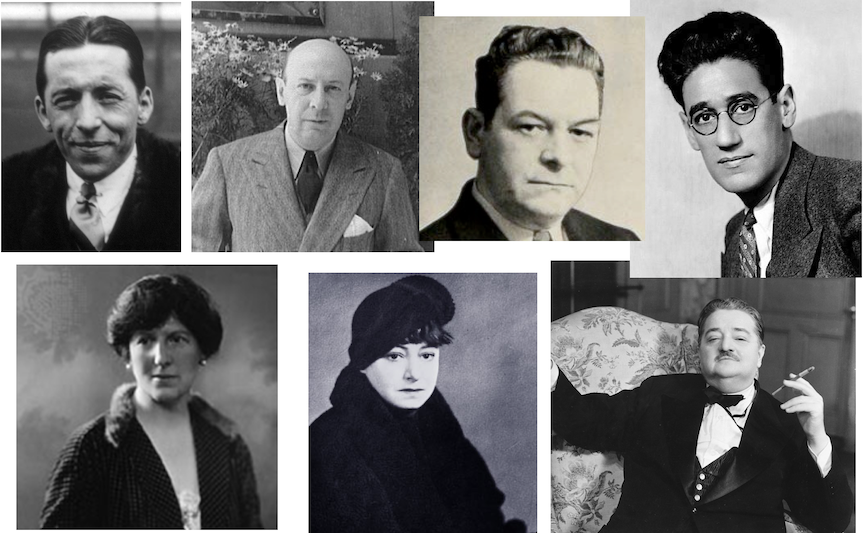
THE NEW YORKER SEVEN…In 1924, baking product heir Raoul Fleischmann put up $25,000 to help Harold Ross get his new magazine off the ground. To assuage Fleischmann’s doubts regarding his investment, Ross persuaded some of his Algonquin Round Table cronies to appear on the magazine’s purely ceremonial masthead. The seven who appeared on the first masthead were, from top left, Ralph Barton, Marc Connelly, Rea Irvin, and George S. Kaufman; bottom row, from left, are Alice Duer Miller, Dorothy Parker, and Alexander Woollcott.
* * *
Daffy Dilettante
Another Algonquin Round Table crony, Harpo Marx, was a skilled artist when it came to comedy, pantomime, or the harp, but when he decided to take up a brush and palette he struggled to properly paint a female nude. In this account from “The Talk of the Town,” Harpo eventually abandoned his painting and switched places with the model.
BRUSHING UP ON HIS ART…Undated photo of Harpo Marx putting finishing touches on his painting of an accordion player; Harpo was a one of the Algonquin Round Table originals: a 1919 photo features (standing, left to right) Art Samuels and Harpo Marx; (sitting) Charles MacArthur, Dorothy Parker, and Alexander Woollcott. (Twitter/Wikipedia)
* * *
Ode to Faraway Lands
A renowned author of children’s poetry, David McCord (1897-1997), was also a frequent contributor to The New Yorker for thirty years (1926-56). For the Feb. 17 issue he penned these sonnets to the Baedeker travel guide.
* * *
Wimpy Vernacular
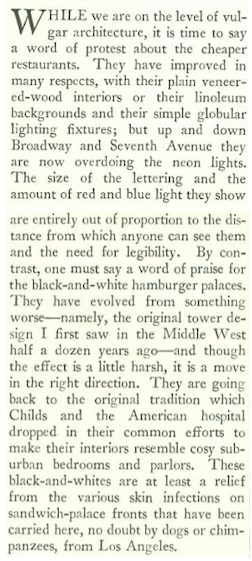
Architecture, art and cultural critic Lewis Mumford paused in his criticism of everything from liquor stores to cheap restaurants to offer some surprising praise to his city’s “black-and-white hamburger palaces.”
RED MEAT RIVALS White Tower and White Castle vied for customers in 1930s New York. Above, a 1933 photo of a White Tower in the 200 block of 2nd Avenue; below, a circa 1930 photo of a White Castle in the Bronx. (gothamist.com/Cision)
* * *
From Our Advertisers
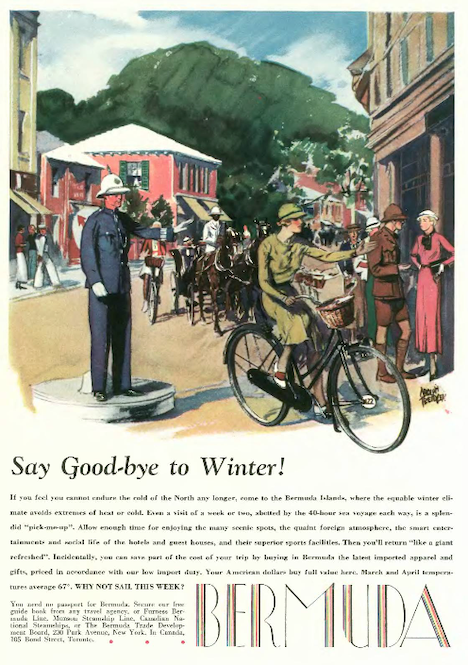
Advertising income reached an all-time high at The New Yorker in 1934, and it showed with the numerous color ads enticing travel to Bermuda…
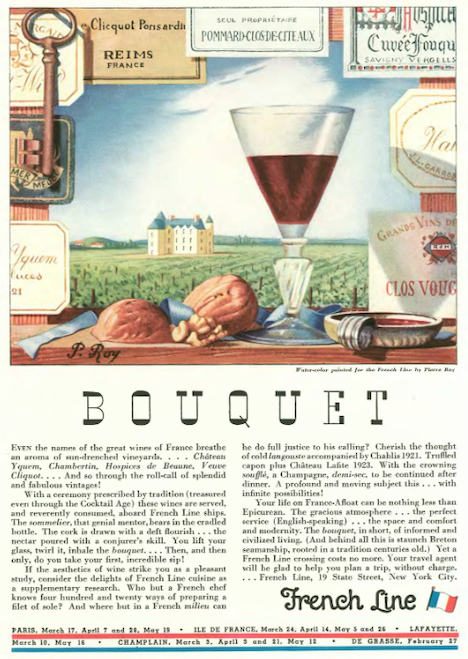
…or to the French wine country…
…Hiram Walker presented their Canadian Club whisky on what appeared to be a cloth napkin…
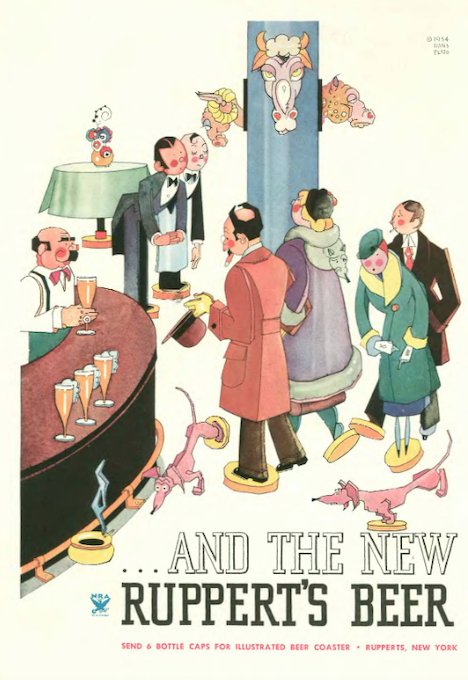
…artist Hans Flato continued his unusual Ruppert’s Beer series of mannequin people (and dogs) going about their lives stuck to yellow discs…
…according to the Ruppert’s ad, for six bottle caps you could get a tin coaster like those pictured below…
(1stdibs.com)
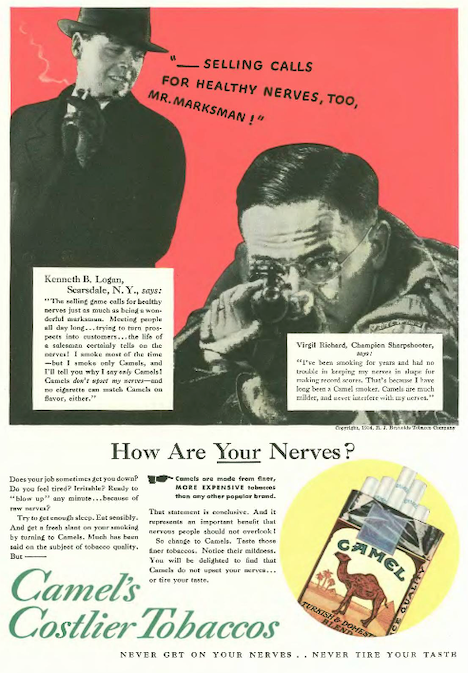
…from magicians and salesmen to sportsmen and high society, the folks pushing Camel cigarettes seemed to try every angle to get their product into the mouths of as many consumers as possible…
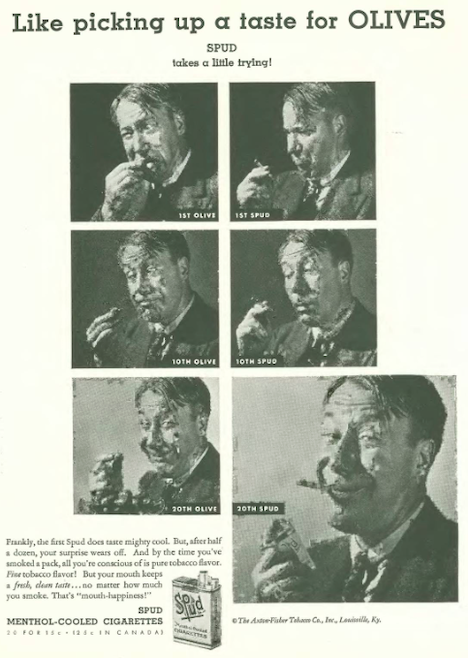
…the makers of Spud menthol cigarettes, on the other hand, tried a little humor to get smokers hooked on their “mouth happiness”…
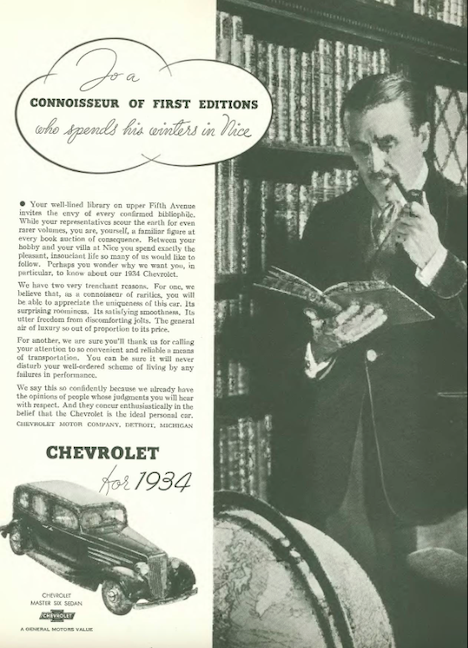
…as one of the world’s most popular car brands, Chevrolet has long been considered a car for the masses, although this ad campaign launched in 1934 suggested that the ubiquitous Chevy was just the car for a connoisseur of the finer things…
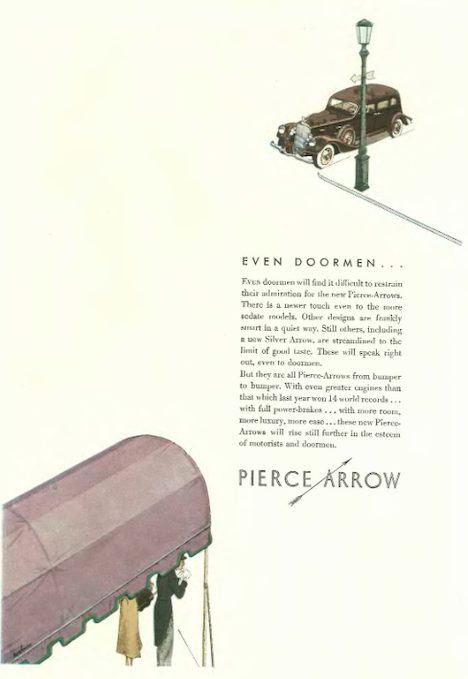
…the staid luxury auto maker Pierce Arrow broke with tradition by placing this very modern, minimalist ad…
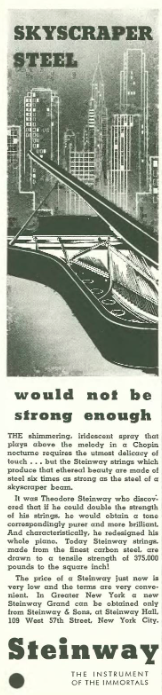
…the folks at Steinway also adopted a modern look with this single column ad touting the durability of their grand pianos…
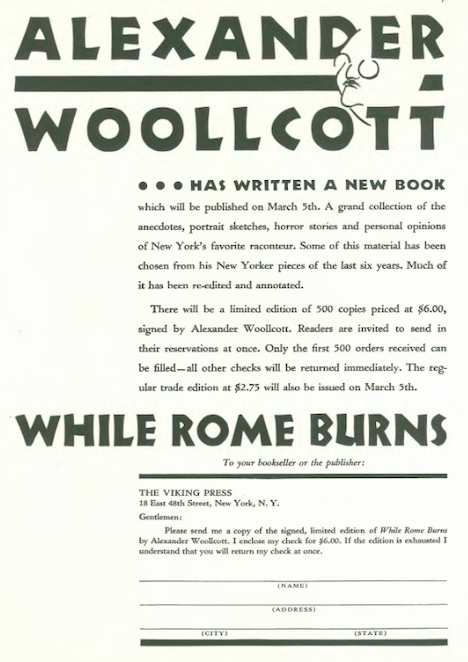
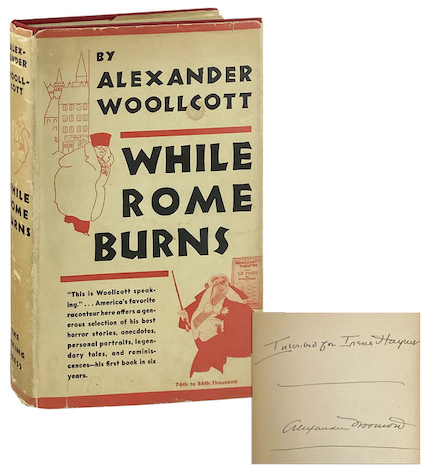
…The Viking Press took out this full-page ad to announce the publication of Alexander Woollcott’sWhile Rome Burns, a collection of some of Woollcott’s writings for TheNew Yorker and other magazines…
…according to the ad, for six bucks you could get one of 500 limited edition signed copies…as of this writing, the inscribed and signed edition below was available for $350…
(capitolhillbooks-dc.com)
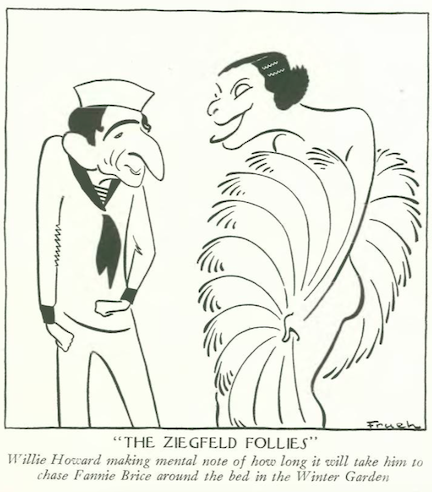
…on to our cartoonists, Al Frueh offered up this interpretation of Ziegfeld entertainers Willie Howard and Fannie Brice…
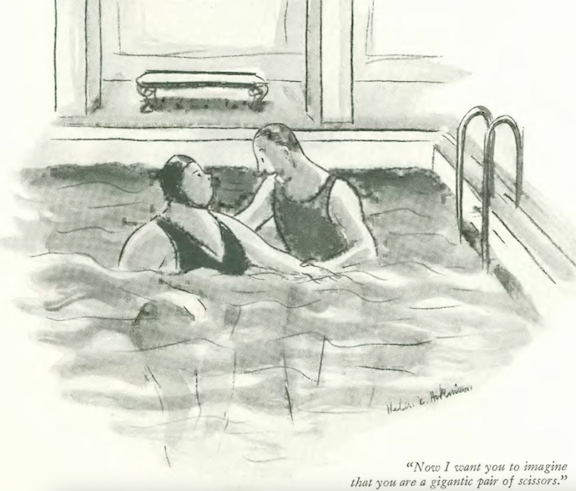
…Helen Hokinson took the plunge with 1930s water aerobics…
…Kemp Starrett demonstrated how beauty is in the eye of the beholder…
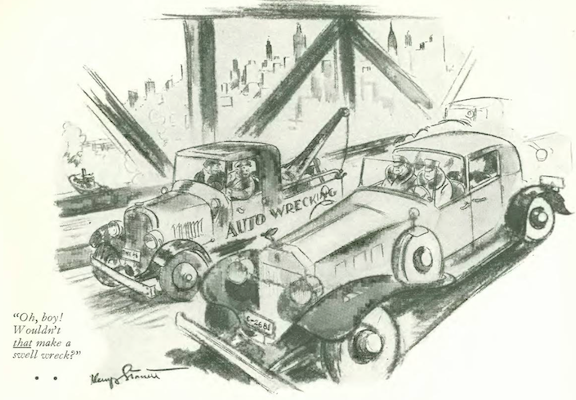
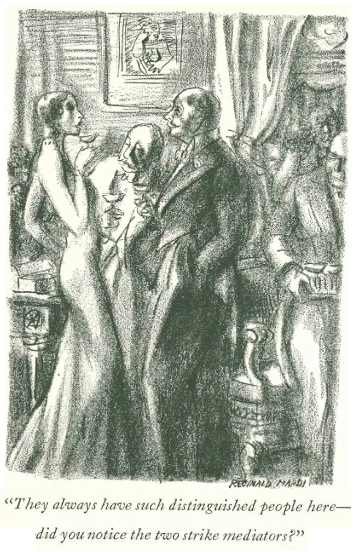
…Reginald Marsh returned, taking temporary leave from life on the streets to look at life above the streets…
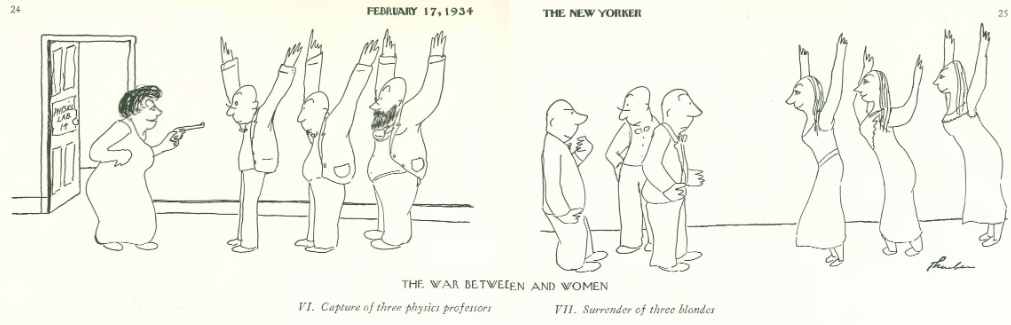
…James Thurber’s “War Between Men And Women” took some new twists…
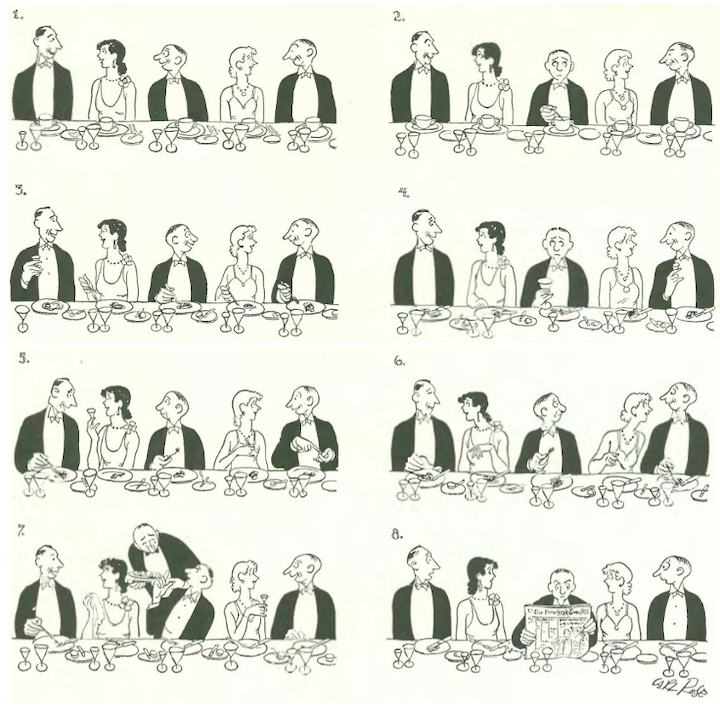
…and we end with Carl Rose, and one man’s solution to being stuck in the middle…
When Rockefeller Center’s design was unveiled in 1931, New Yorker architecture critic Lewis Mumford wrote that it followed ”the canons of Cloudcuckooland.”
Dec. 23, 1933 cover by Helen Hokinson.
Today we know 30 Rock as one of the most iconic and beloved places in Manhattan, but after Mumford saw the plans for this future “Radio City” he went into exile in upstate New York, upset over the “weakly conceived, reckless, romantic chaos” of the project. Mumford wasn’t alone in his opinion; indeed it was his commentary that helped fuel negative reactions from citizens and newspapers alike.
No doubt the scale of the project bothered a lot of people, as it was slated to replace four- and five-story brownstones and other smaller buildings with a series of massive structures (for Mumford, it was rare that any skyscraper found his favor—to him they were oversized symbols of corporate tyranny).
IMMODEST PROPOSAL…In the fall of 1928 John D. Rockefeller leased this property from Columbia University for the future site of Rockefeller Center. The project covered nearly all of the area in the three square blocks bordered by Fifth Avenue, Sixth Avenue, and 48th and 51st Streets. (ephemeralnewyork.wordpress.com)
As the Rockefeller Center towers rose, some softened their criticisms, including E.B. White—in the Dec. 9 issue he said he would eat his words after viewing the floodlit 30 Rock by night: “the whole thing swims up tremendously into the blue roxyspheres of the sky.”
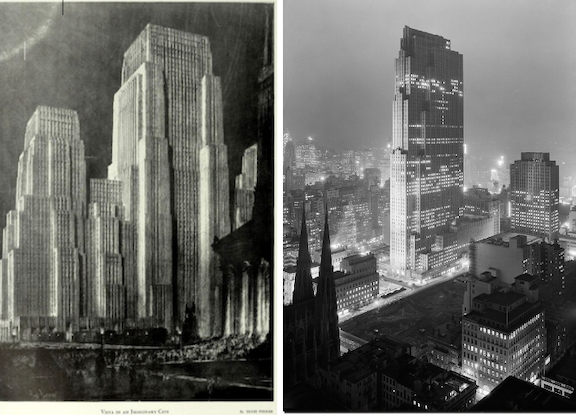
Two weeks later, in his Dec. 23 “Sky Line” column, Mumford agreed that the floodlit buildings looked impressive, recalling Hugh Ferriss’ romantic, futuristic visions of the city; however, the darkness also concealed a decorative scheme that was ”bad with an almost juvenile badness.”
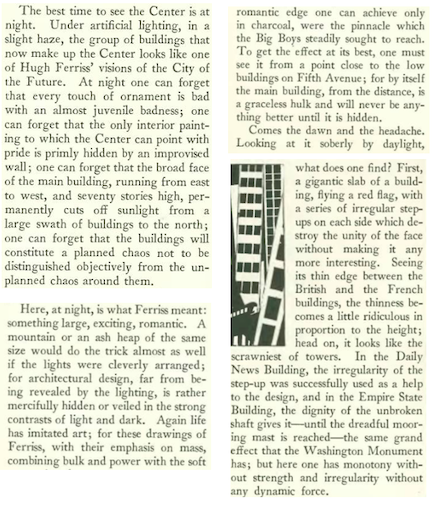
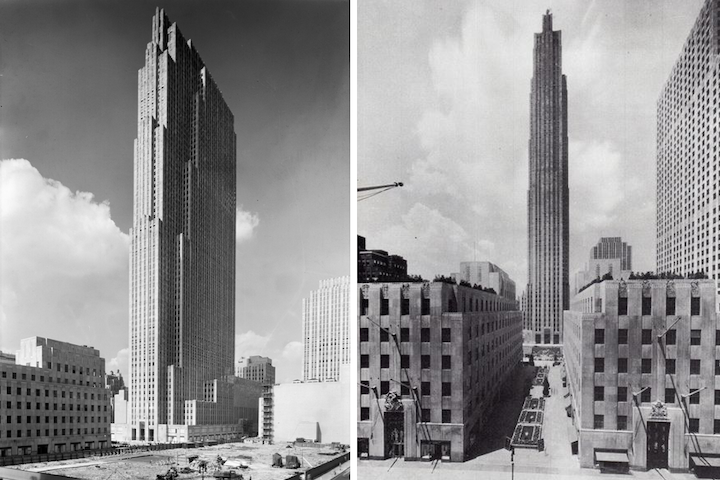
A MATTER OF PERSPECTIVE…Lewis Mumford thought the RCA tower looked “scrawny” when viewed in broad daylight between the British and French empire buildings. (smarthistory.com/Pinterest)NIGHT VISION…In his 1929 book, The Metropolis of Tomorrow, Hugh Ferriss published the image at left of an imaginary city of the future (left). Ferriss was an architect, illustrator, and poet who explored the psychological condition of urban life, and was known for his conte crayon drawings of skyscrapers—nighttime scenes from a futuristic Babylon that are influential in popular culture (e.g. Tim Burton’s vision for Gotham in 1989’s Batman). (archive.org/Wikipedia)
Having finished his excoriation of the buildings’ scale and placement, Mumford proceeded to carve up the ornamental features, including the sunken plaza (today an iconic site for ice skating), which he thought looked “a little silly” in relation to the mass of the RCA building.
TRAINED EYE…Lewis Mumford believed the work of the great Gaston Lachaise was diminished in the Rockefeller Center concept, noting that the Lachaise sculptures on Sixth Avenue (top and right photos) were only visible from the “L” station (Mumford doesn’t mention that the elevated placement of the sculptures was deliberate—they were put there so train riders on the “L” could see them); below, Mumford found the sunken plaza to be out of scale with the RCA tower—for decades it has been one of Manhattan’s most iconic sites. (Wikipedia/Vincent Tullo for The New York Times)
Revisiting Rockefeller Center in his May 4, 1940 “Sky Line” column, Mumford wouldn’t exactly eat his words, but he did admit that the collection of structures formed “a composition in which unity and coherence have to a considerable degree diminished the fault of overemphasis. In other words, they get by.” Mumford still believed 30 Rock was too tall—he would have preferred 32 stories, less than half its actual size: “Good architecture is designed for the human beings who use or view the buildings, not for publicity men or photographers.”
I have to disagree. Every time I look up at 30 Rock I feel my heart soar.
* * *
Yule Like This
The Dec. 23 issue marked the return of Frank Sullivan’s annual holiday poem, “Greetings, Friends!” Sullivan published his first holiday poem in 1932 and faithfully continued the tradition until 1974; after his death in 1976, New Yorker editor William Shawn asked the late Roger Angell to take on the poem. In 2012 Angell passed the duty along to Ian Frazier, the magazine’s current Yuletide bard (Frazier’s latest poem can be found in the Dec. 26, 2022 issue).
* * *
Success, In Spite of it All
“The Talk of the Town” looked in on singer Ethel Waters, who apparently wasn’t brooding over the difficulties of her past life, given that she was seeing so much success as a recording artist and as a Broadway star in As Thousands Cheer. Although her material life was better, she still faced racism wherever she went, including on stage—although she received equal billing, she was segregated from her co-stars in As Thousands Cheer.
BORN INTO THE BLUES…Raised in crushing poverty, Ethel Waters became a major singing star in the 1930s. She was one of the first singers to confront racism in a popular 1933 song, “Suppertime.” (Facebook)
* * *
Enigma
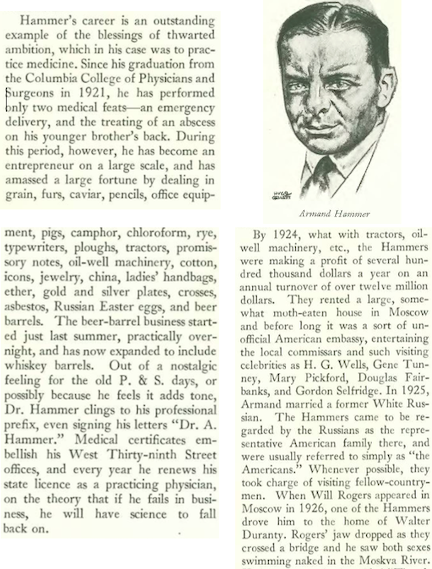
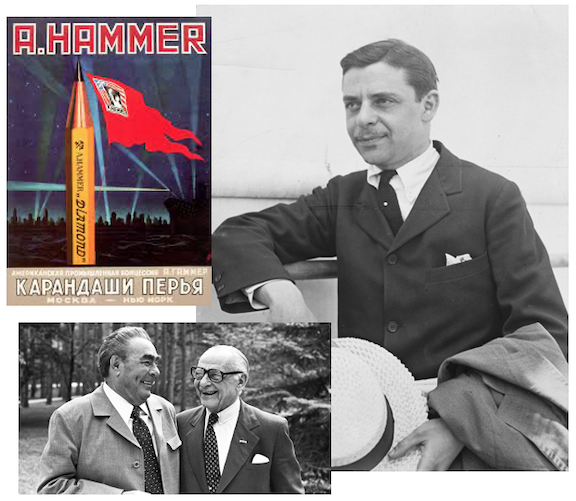
Geoffrey T. Hellman examined the life of American entrepreneur Armand Hammer in a profile titled “Innocents Abroad.” Hammer’s business interests around the world helped him cultivate a wide network of friends and associates. Called “Lenin’s chosen capitalist” by the press, Hammer (1898-1990) started a pencil factory in the Soviet Union in 1926 and later became head of Occidental Petroleum. Throughout his career he maintained close ties with Soviet leaders—which raised many suspicions in the West—but Hammer also served as a citizen diplomat for the U.S., an important go-between during the Cold War. An excerpt:
PROLETARIAN PENCILS…Clockwise, from top left: A 1928 Soviet advertising poster for “A. Hammer” pencils. The factory began work in Moscow in April 1926 as a private American industrial concession; Armand Hammer in the 1920s; Hammer (at right) shares a laugh with Soviet leader Leonid Brezhnev in the 1970s. Hammer is also the great-grandfather of American actor Armie Hammer. (crwflags.com/The New York Times)
* * *
From Our Advertisers
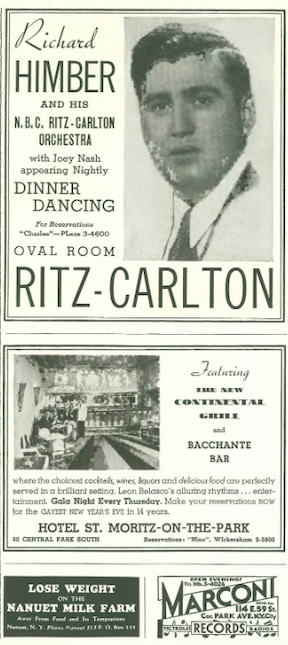
With Prohibition over, New Yorkers were looking forward to celebrating the holidays with Richard Himber and his orchestra at the Ritz-Carlton or enjoying a cocktail at the new Continental Grill and Bacchante Bar at the Hotel St. Moritz…
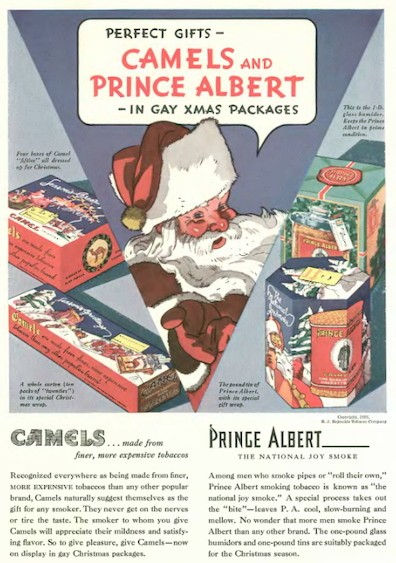
…and no less of an authority than Santa was advising shoppers to give tobacco products to their loved ones this holiday season…
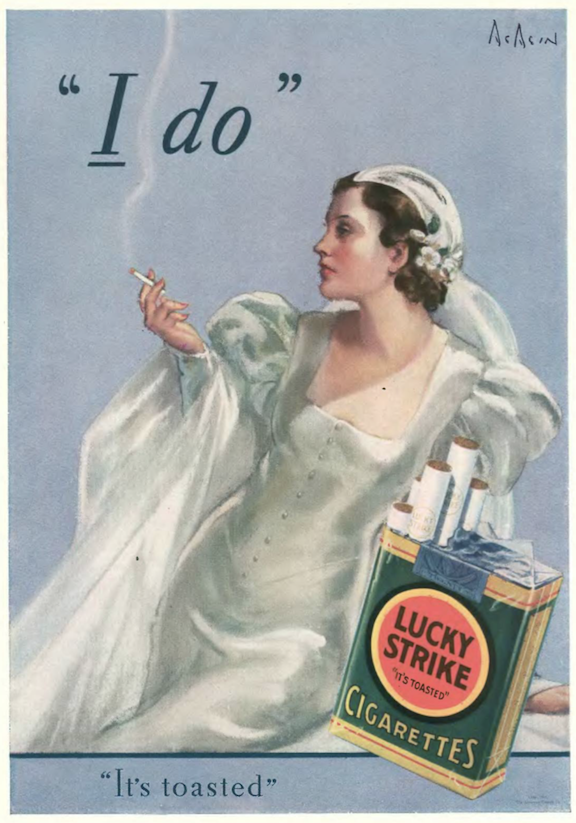
…or perhaps you could be persuaded by elegant holiday wishes from the owners of Lucky Strike, who included their cigarettes among “the best of good things”…
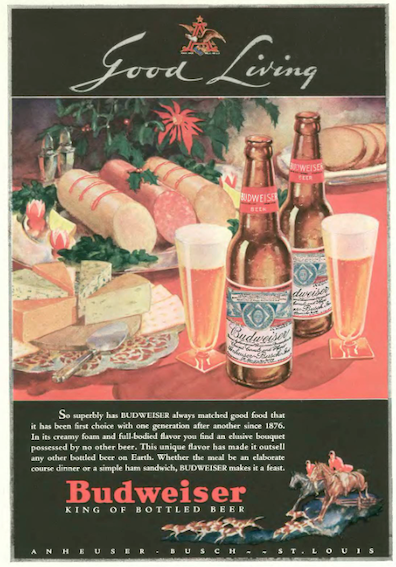
…good living, apparently, could also be found in a bottle of Bud…
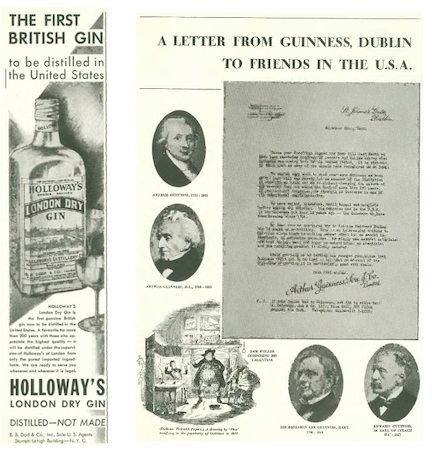
…or in American-distilled “London Dry Gin”…or in a pint of Guinness…
…our cartoons begin with Gardner Rea, and a course in mixology…
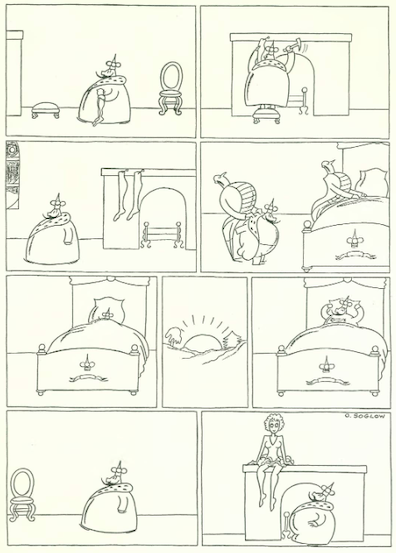
…Otto Soglow’s Little King found a surprise in his Christmas stockings…
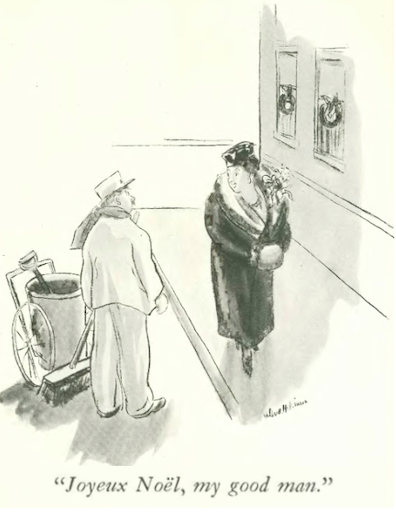
…Helen Hokinson offered some passing holiday cheer…
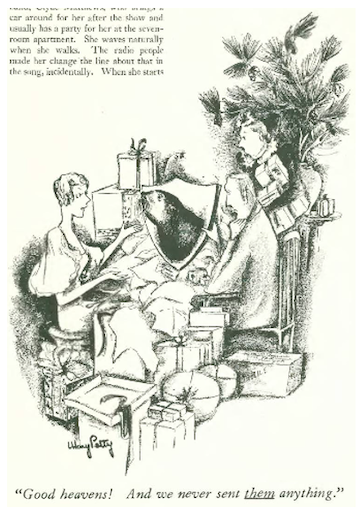
…Mary Petty gave us this unusual Christmas seal…
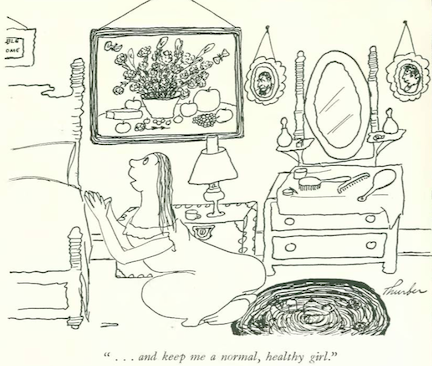
…and from James Thurber, this earnest prayer…
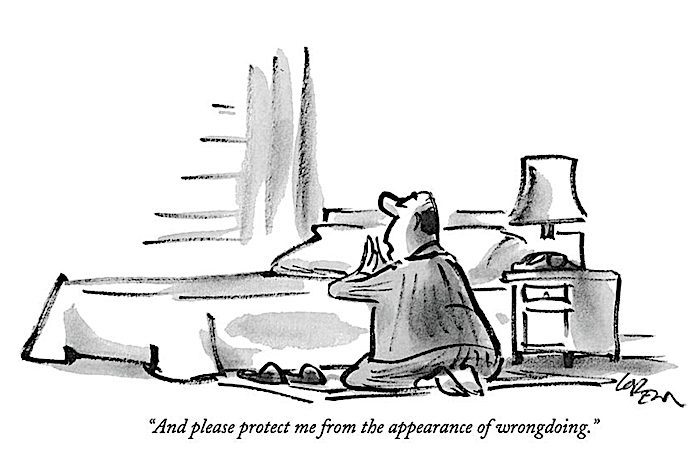
…and we close with another prayer-themed cartoon from Jan. 4, 1982—Lee Lorenz, who died Dec. 8 at age 90, joined the New Yorker staff in 1958, the same year his first cartoon appeared in the magazine’s pages. He also served as art editor (1973–1993) and cartoon editor (1993–1997) for the New Yorker. Michael Maslin penned an appreciation on his Ink Spill site.
…Happy Holidays one and all, as we end with this GIF from Disney’s 1933 short, The Night Before Christmas…
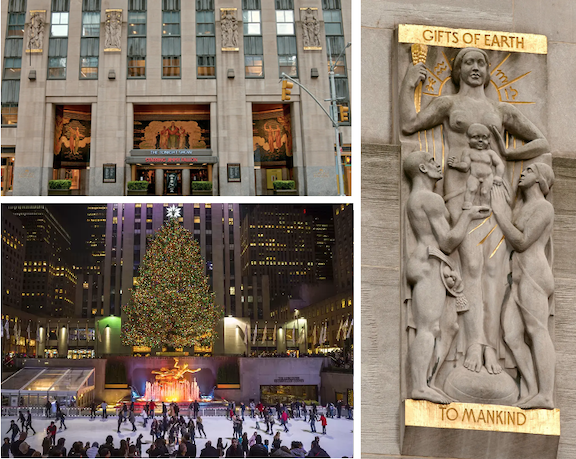
…and this scene from December 1933, when Rockefeller Center decided to make the Christmas Tree an annual tradition and held the very first tree lighting ceremony…
At left, image from December 1933—the very first tree lighting ceremony at 30 Rock, when the Christmas Tree became an annual tradition; at right, the tree on the Plaza in 1934, before ice skaters occupied the space. (rockefellercenter.com/Museum of the City of New York)
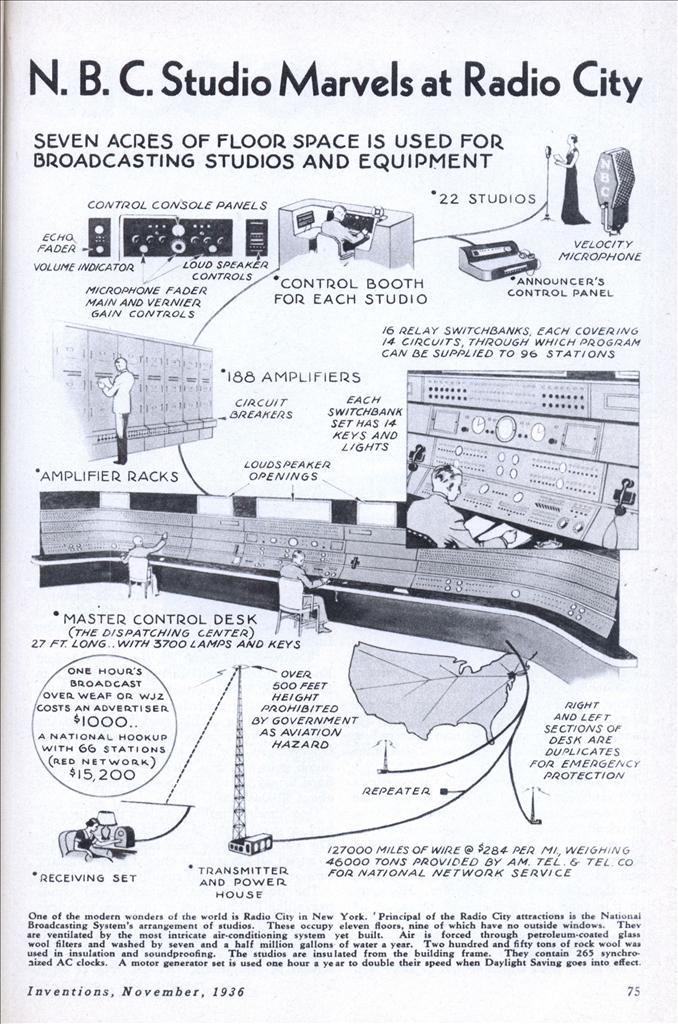
The NBC Studios at 30 Rockefeller Plaza have wowed visitors and performers alike for nearly 90 years. Today we look back at the remarkable foresight of the studios’ designers, who created spaces that would one day accommodate a new medium called television, which was still in its experimental stages.
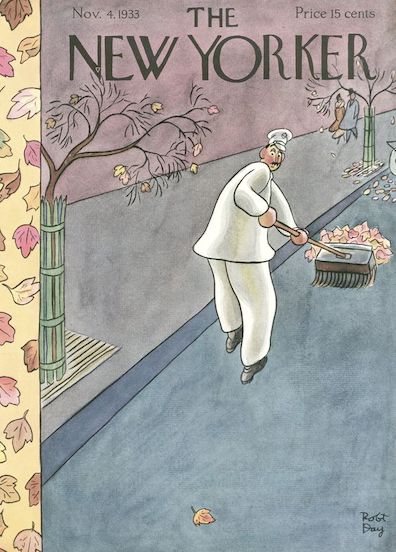
Nov. 4, 1933 cover by Robert Day, who contributed a total of eight covers to The New Yorker.
However, before we jump in, let’s look at Robert Day’s cover for the Nov. 4 issue, which featured a familiar character who made his first appearance on the cover of issue #12 (May 9, 1925), and returned four years later looking much older in the dog days of August…
Cover of issue #12 (May 9, 1925) by Rea Irvin introduced our street sweeper, who returned Aug. 3, 1929 by the hand of Gardner Rea.
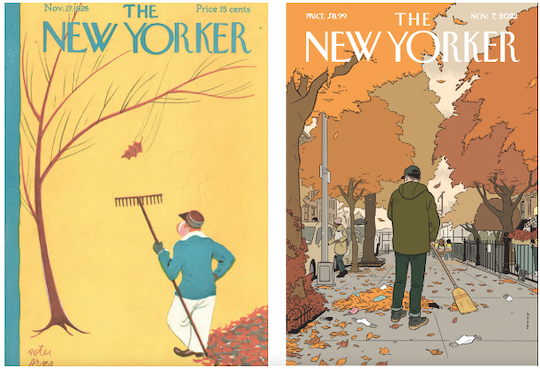
Day’s cover, however, was also a nod to the annual gathering of autumn leaves—an occasional cover theme that began with Peter Arno’s contribution to the Nov. 27, 1926 issue (below, left) and most recently expressed in Adrian Tomine’s cover for the Nov. 7, 2022 issue (with timely pandemic reference)…
Back to Radio City, Morris Markey recounted the technological wonders of the new NBC studios in his “A Reporter at Large” column, “Marconi Started It.” Markey noted the “fabulous quality” of the facilities, wired for the day when television would arrive. Excerpts:
GEE WHIZ…Morris Markey could be assured that some folks would be “goggled-eyed” by NBC studios, including the technophiles at Popular Mechanics. (westmb.org)
WHERE HISTORY WAS MADE…Studio 8H was the world’s largest radio studio when it opened in 1933. It would be converted for television in 1950. (westmb.org)
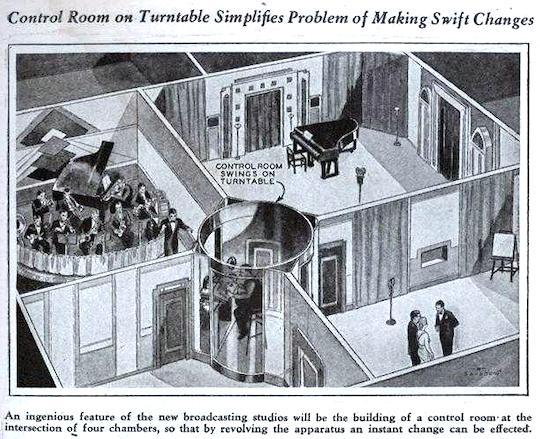
Markey marveled at NBC Studios’ various design innovations, including a revolving control room dubbed the “Clover Leaf”…
(Modern Mechanics, Jan. 1931)
Almost 90 years later, the studios continue to serve the broadcast needs of the 21st century, including Studio 8H…
LIVE FROM NEW YORK…Studio 8H was the world’s largest radio studio when it opened in 1933. Converted to television in 1950, it has been home to Saturday Night Live since 1975. Above, SNL stage manager Gena Rositano, in 2015. Below, longtime SNL director Don Roy King at the controls for Studio 8H, also in 2015. (Dana Edelson/NBC via Directors Guild of America)
* * *
Leopold!
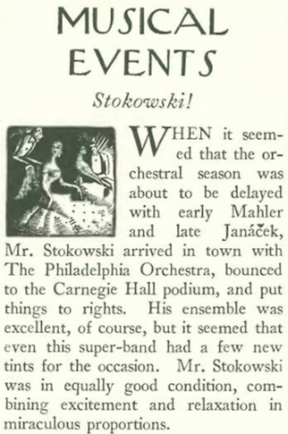
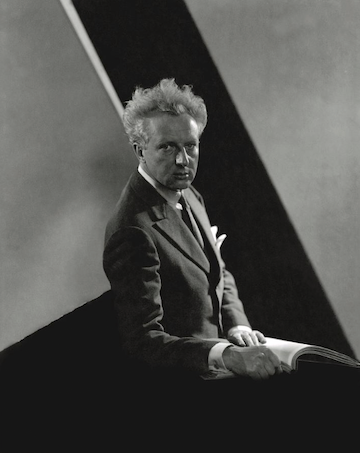
Conductor Leopold Stokowski was no stranger to Studio 8H. From 1941 to 1944 he led the NBC Symphony Orchestra in that venue. One of the leading conductors of the early and mid-20th century, Stokowski (1882–1977) began his musical career in New York City in 1905 as the organist and choir director at St. Bartholomew’s Church, but by 1915 he was conducting the famed Philadelphia Orchestra. Robert Simon reported on Stokowski’s return to New York for a performance at Carnegie Hall. A brief excerpt:
I GET AROUND…Portrait Of Leopold Stokowski by Edward Steichen, Dec. 1, 1933. Married three times and once romantically linked to Greta Garbo, he was married to wife #3, Gloria Vanderbilt, for ten years. (Condé Nast)
Stokowski had the distinct honor of being satirized in a 1949 Looney Tunes cartoon, “Long-Haired Hare,” in which Bugs Bunny disguised himself as the conductor and entered the stage to the astonished whispers of the orchestra…Leopold! Leopold!…
MAESTRO…Bugs Bunny as Stokowski in “Long-Haired Hare.”
Stokowski was no stranger to animation. The conductor appeared in silhouette in Disney’s Fantasia (1940), leading the Philadelphia Orchestra in the film’s score. He even shook hands with Mickey Mouse.
* * *
Bigga Badda Wolfa
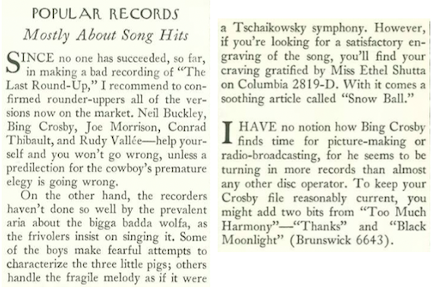
The New Yorker took a look at the popular records of the day, and in addition to tunes by Bing Crosby and Rudy Vallée there was yet another release of “Who’s Afraid of the Big Bad Wolf?”…Ethel Shutta was the latest of seemingly dozens of artists to cash in on the Disney hit…
I’LL HUFF AND I’LL PUFF…Those who couldn’t get enough of “Who’s Afraid of the Big Bad Wolf” could turn to Ethel Shutta’s rendition of the hit song on Columbia records. (discogs.com)
* * *
Page-Turner
Writer Kay Boyle wasn’t afraid of wolves or any other subject for that matter, according to book reviewer Clifton Fadiman…
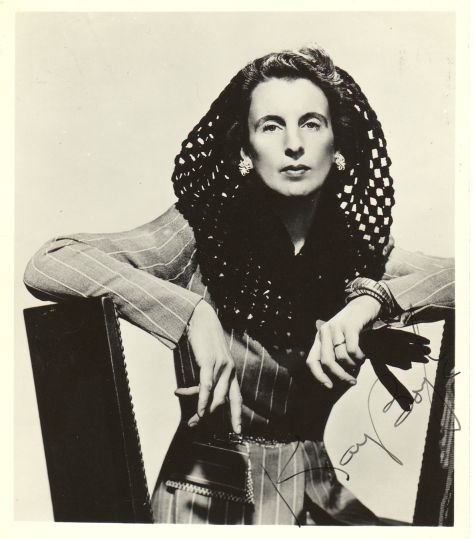
TOSSING A SALACIOUS SALAD…Kay Boyle, photographed by George Platt Lynes, 1941. (The Kay Boyle Papers, Morris Library, Southern Illinois University)
* * *
A Grapeful Nation
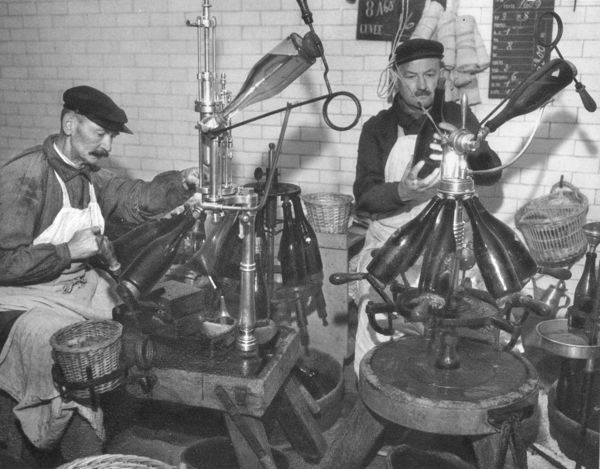
As New Yorkers counted the days until the end of Prohibition, The New Yorker did its part to get readers back up to speed by enlisting the talents of one of the world’s great wine experts, Frank Schoonmaker, who had the enviable job of filing a series of wine reports for the magazine. His first installment of “News From the Wine Country” featured the Champagne region. Excerpts:
THAT FIZZY FEELING…Bottling the good stuff in the Champagne region, circa 1930. (wineterroirs.com)
* * *
From Our Advertisers
Christmas was just around the corner, and F.A.O. Schwarz was READY with its 64-page catalog…
…White Rock anticipated the end of Prohibition with an ad featuring a miniature colonel who apparently needed a stiff drink to prepare for his wife’s return from abroad…
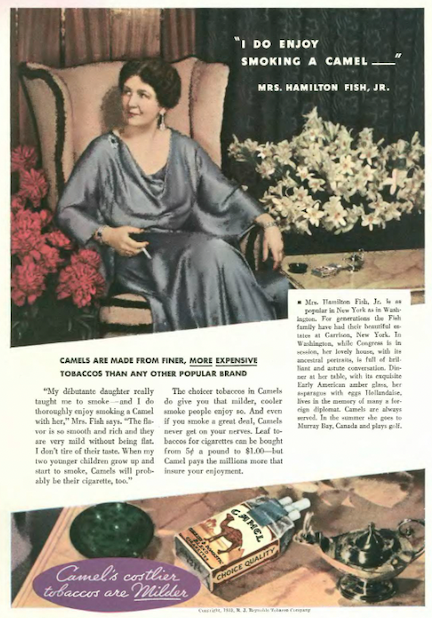
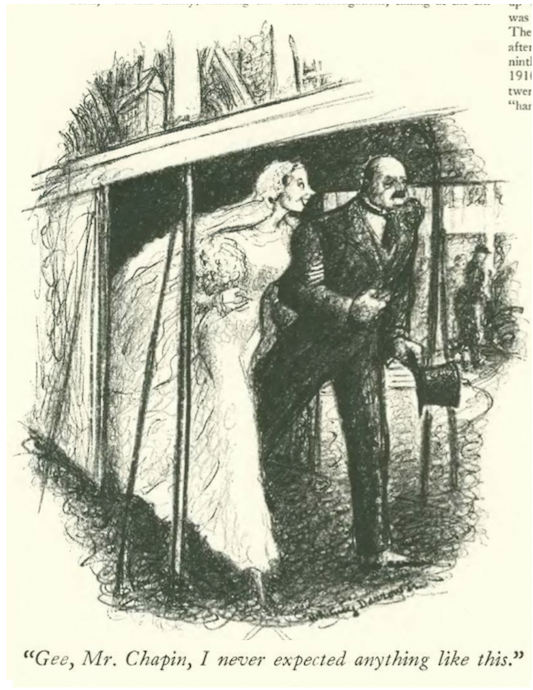
…Mrs. Hamilton Fish Jr, aka Grace Chapin, was married to the New York congressman from 1920 until her death in 1960, apparently enjoying many Camels along the way…her husband would go on living another 31 years and take three more brides before expiring at age 102…
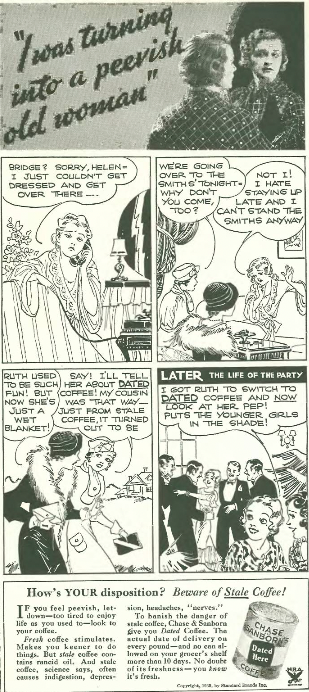
…another cautionary tale from Chase & Sanborne about the perils of undated coffee…
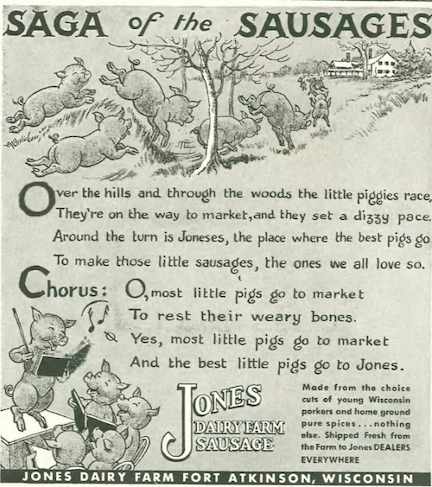
…and with the holidays approaching, a jolly ditty from Jones Dairy Farm, home to little piggies who merrily dash toward their inevitable slaughter…
…and we jump to another back-page ad, this from the stately Plaza, where you could get a single room for five bucks a night…
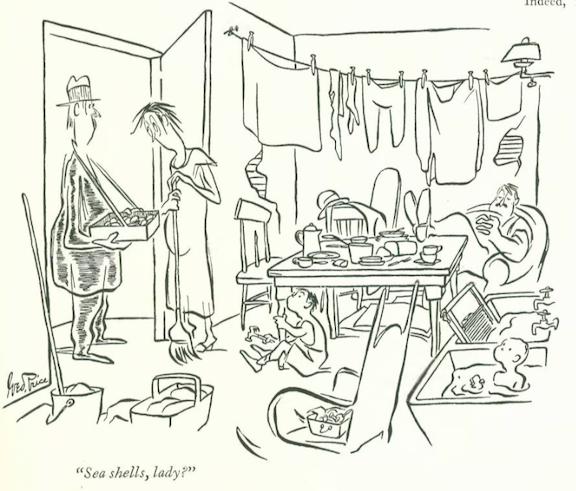
…turning to the cartoons, we find George Price hitting his stride with multiple cartoons in consecutive issues…
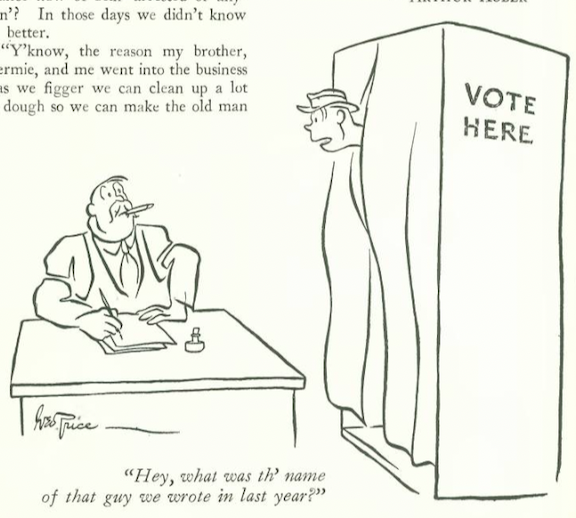
…and taking a look at the recent elections…
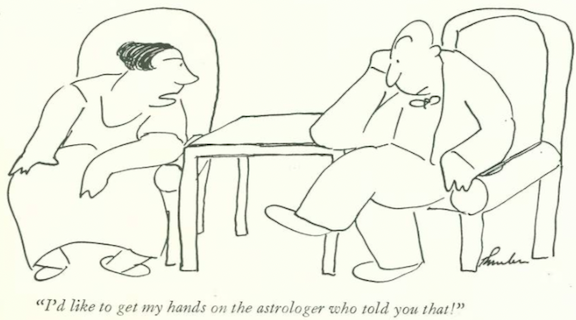
…on to James Thurber, and continuing struggles on the domestic front…
…and that brings us to our next issue…
Nov. 11, 1933 cover by Constantin Alajalov.
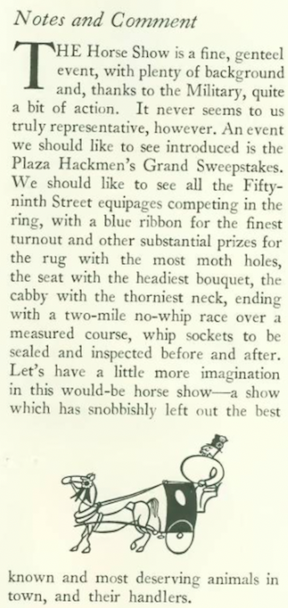
…in which E.B. White had a thing or two to say about the latest edition of the National Horse Show at Madison Square Garden.
HORSE SENSE AND SENSIBILITY…The National Horse Show at Madison Square Garden was a major event on New York’s social calendar; top and bottom right, scenes from the 1936 show; bottom left, undated scene circa 1960. (Stills from YouTube)
* * *
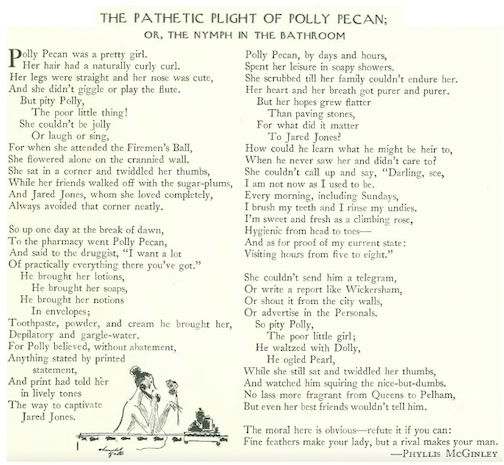
Versatile Verse
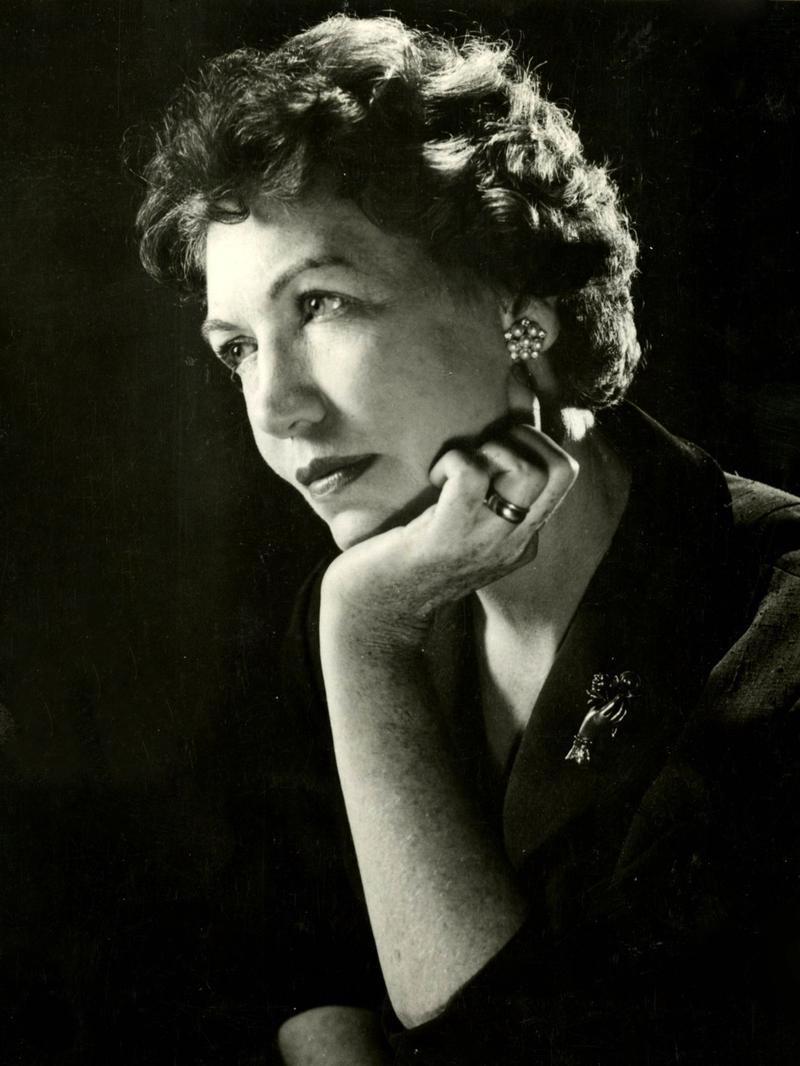
Phyllis McGinley (1905–1978) was the author of children’s books and poetry, the latter genre most notably for The New Yorker. However, she attracted a wide audience for her light verse in other publications ranging from Ladies Home Journal to The Saturday Review.
LIGHT TOUCH…Phyllis McGinley in an undated photo. She received the Pulitzer Prize in 1961 for her book Times Three—the first writer of light verse to receive the prize. (wnyc.org)
* * *
Oil and Water
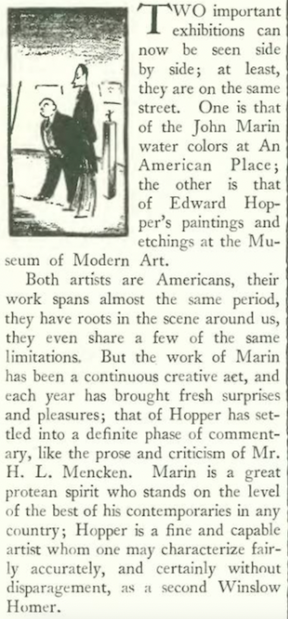
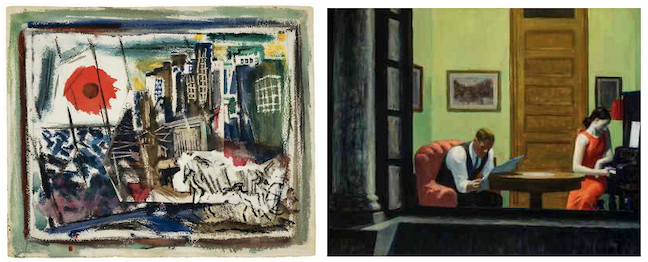
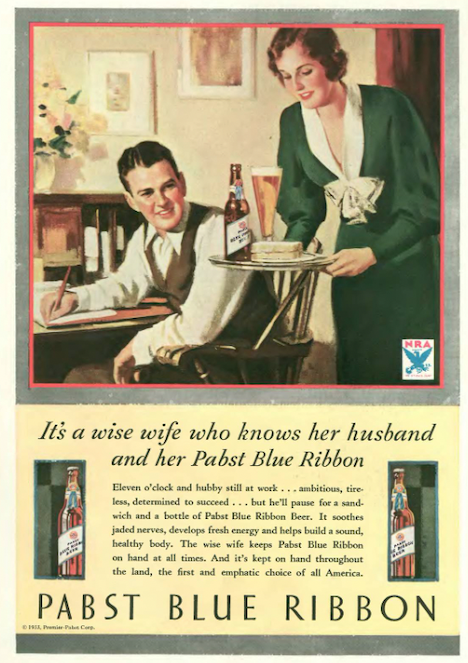
Art and architecture critic Lewis Mumford found two very different visions of America in the works of contemporaries John Marin and Edward Hopper. Marin’s watercolors were featured at An American Place, while Hopper’s oil paintings and etchings were shown down the street at the Museum of Modern Art.
SIDE BY SIDE…Lewis Mumford found different visions of New York and the world at An American Place and MoMA galleries. At left, John Marin’s watercolor From the Bridge, N.Y.C. (1933); at right, Edward Hopper’sRoom in New York, also from 1933. (Artists Rights Society/Sheldon Memorial Art Gallery)
* * *
More From Our Advertisers
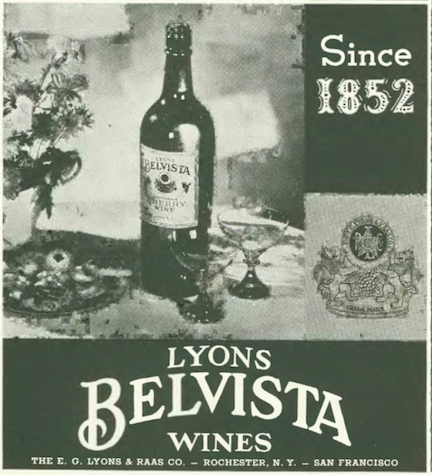
Okay, so I’ll buy the part about PBR’s ability to soothe “jaded nerves,” but I doubt it gave this guy “fresh energy” and “a sound, healthy body”…
…After thirteen long years, winemakers emerged from their cellars to glimpse the light of a new day…
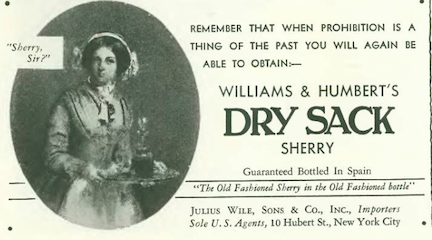
…and yes, after thirteen long years, some folks would be yearning for their DRY SACK Sherry…
…the name Elizabeth Hawes was synonymous with high fashion in the late 1920s and 1930s—she owned one of the most exclusive couture houses in New York…
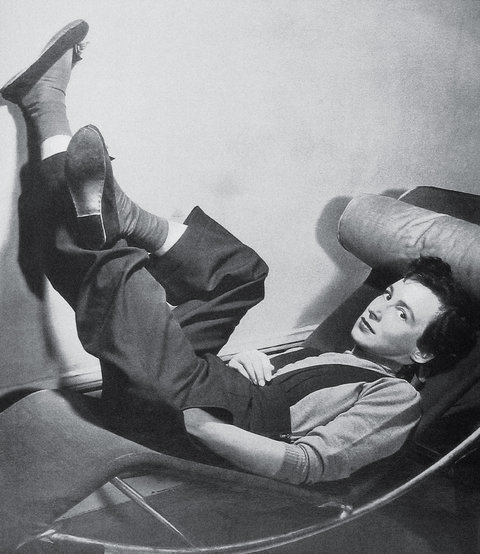
…an outspoken advocate of dress reform, Hawes (1903–1971) was referred to by one historian as “the Dorothy Parker of fashion criticism.” After attacking the fashion industry with her 1938 book, Fashion Is Spinach (Hawes wrote: “I don’t know when the word fashion came into being, but it was an evil day…”), she closed her fashion house and in 1942 took a job as a machine operator at a wartime plant in New Jersey. She became a union organizer, a champion of gender equality, and a critic of American consumerism.
IN A LEAGUE OF HER OWN…Elizabeth Hawes — writer, fashion designer and political activist, poses for a photograph in 1941. (Mary Morris Lawrence)
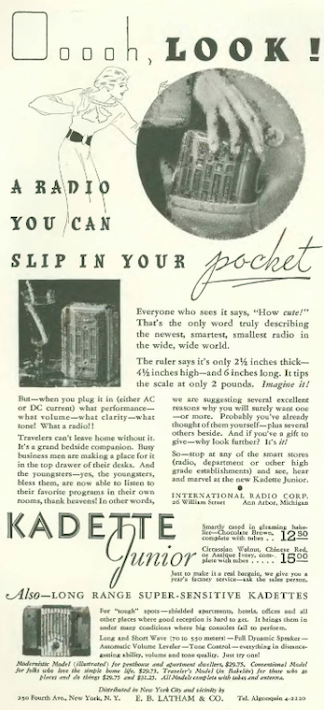
…speaking of consumerism, ooooh look! A radio “you can slip in your pocket,” depending of course on the size of your pocket…
…transistors would not come along until the late 1950s, so the Kadette still depended on tubes, and you had to plug it in somewhere, so no running down the beach with headphones, at least for awhile…
The Kadette Junior. (radiolaguy.com)
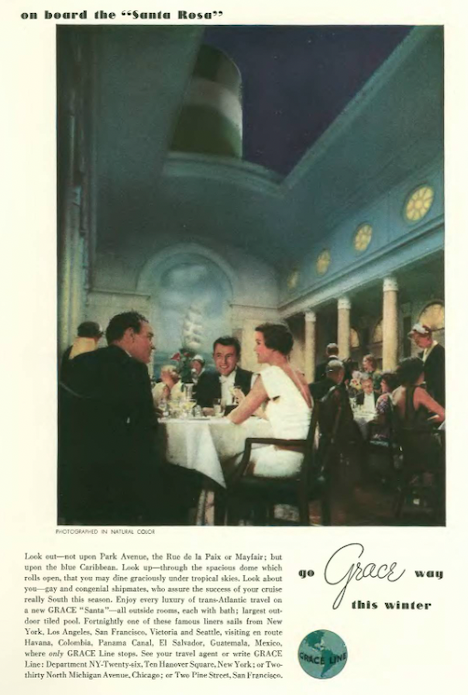
…it must have been a rare treat to sail on a ship like the SS Santa Rosa—situated between the ship’s two funnels, the dining room had an atrium stretching up two-and-a-half decks and featured a retractable roof…
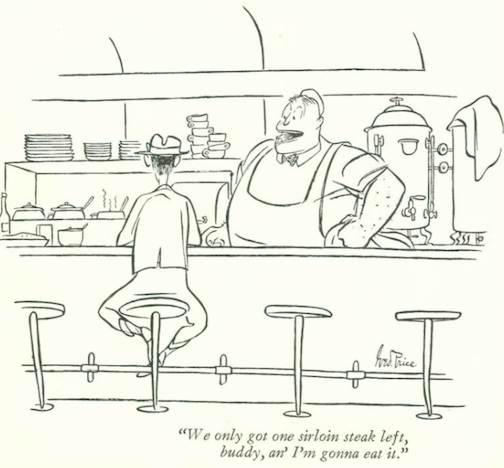
…on to more cartoons, and more George Price…
…moving along, we received some big news from one of Helen Hokinson’s “girls”…
…an aside I’ve been meaning to include…in 1952, just three years after Helen Hokinson’s untimely death, a cartoonist for The Cincinnati Enquirer, Franklin Folger, debuted a cartoon called “The Girls.” The cartoon was eventually syndicated and appeared in more than 150 newspapers worldwide before Folger retired it in 1977. Perhaps I am missing something, but I cannot find a single reference to Folger’s obvious appropriation of Hokinson’s “girls”…some examples of Folger’s work from the early 1960s and another from H.H. for comparison:
…and onward to Peter Arno, and the trials of portrait artists…
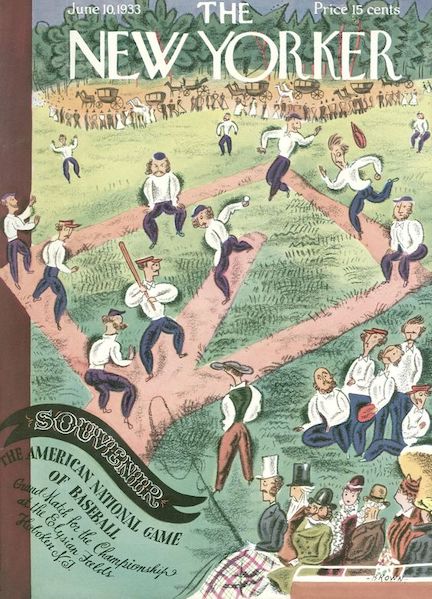
As we enter the summer months we find the recurring themes of June brides…and German Nazis…
May 27, 1933 cover by Constantin Alajalov.
Those Nazis were on the mind of U.S. President Franklin D. Roosevelt when he wrote to the sixty participating nations at the Geneva Disarmament Conference, imploring them to eliminate all weapons of offensive warfare. As we now know, it was a plea that mostly fell on deaf ears, notably those of the leaders of Japan and Germany. E.B. White offered this observation:
GIVE PEACE A CHANCE?…Sixty countries sent delegates to the Geneva Disarmament Conference in 1932–33. Germany was represented by Nazi Minister of Public Enlightenment and Propaganda Joseph Goebbels (front row, center), that is until his country pulled out of the conference and continued its massive arms buildup. (Library of Congress)
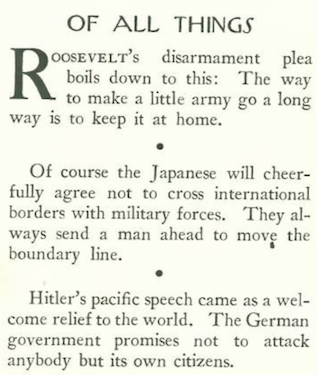
Howard Brubaker was also keeping an eye on FDR’s efforts to hold off the rising powers in Europe and Asia…
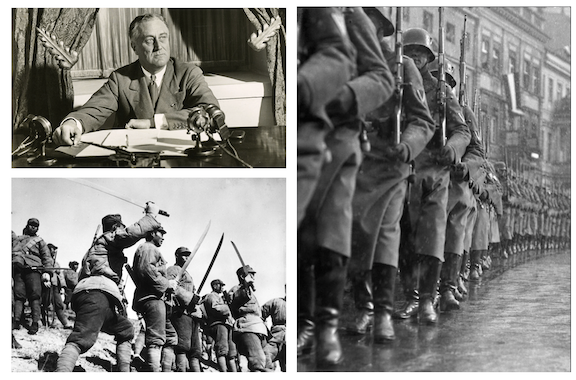
WAR AND PEACE…On May 16, 1933, Franklin D. Roosevelt pleaded with the world’s nations to consider total disarmament of all offensive weapons. In the meantime, Adolf Hitler led the rapid rearmament of Germany (right) while Chinese soldiers (below) did what they could to counter the latest Japanese offensive—the invasion of Jehol Province. (Wikimedia/Pinterest)
* * *
Writer of Lost Causes
The short story “Pop” would be Sherwood Anderson’s first contribution to The New Yorker. Anderson was known for his stories about loners and losers in American life, including Pop Porter, whose sad, drunken death is described in the closing lines:
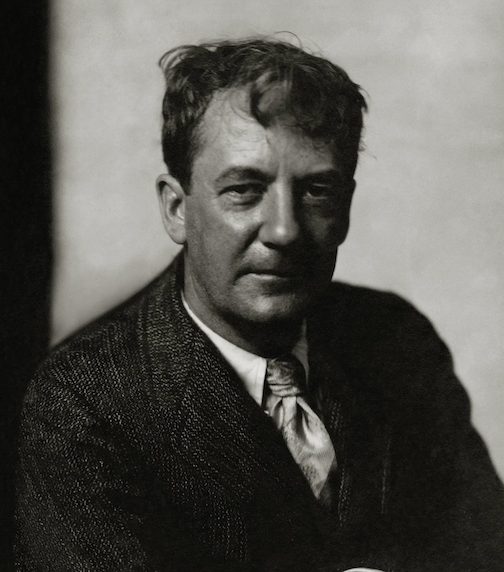
NO EXIT…Best known for his 1919 novel Winesburg, Ohio,Sherwood Anderson (1876–1941) took an unsentimental view of American life. He would contribute six short stories to The New Yorker from 1933 to 1936. Photo above by Edward Steichen, circa 1926. (The New York Times)
* * *
From Our Advertisers
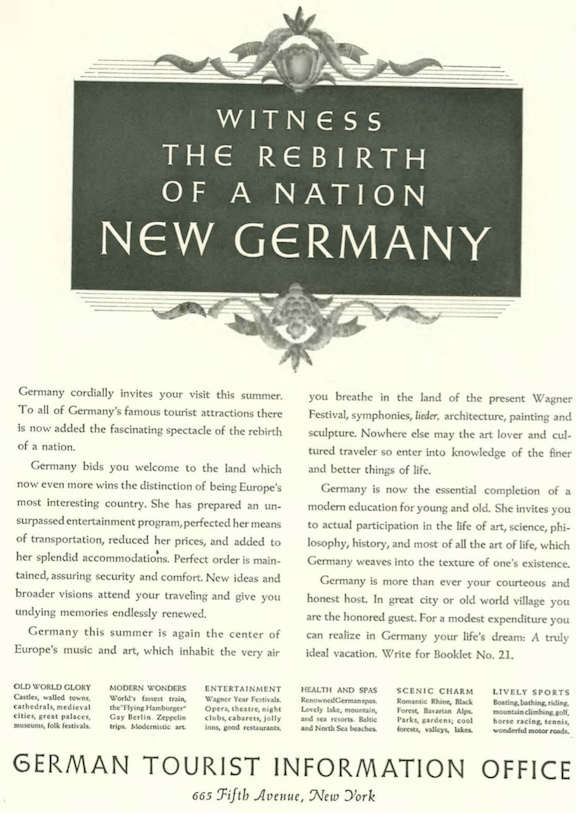
The German Tourist Information Office welcomed visitors to “witness the rebirth of a nation,” promising a land of “new ideas and broader visions” that would bestow on travelers “undying memories endlessly renewed”…
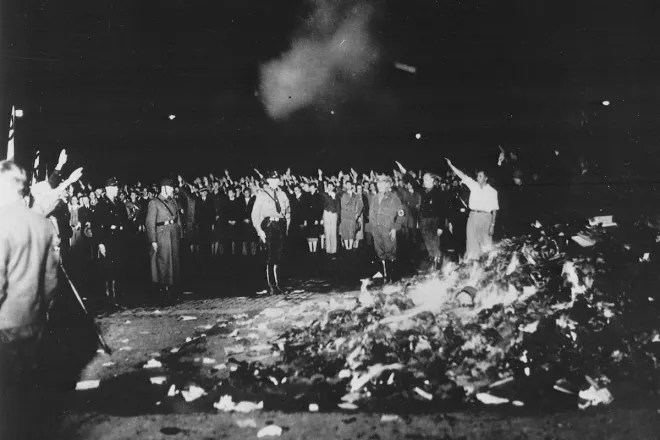
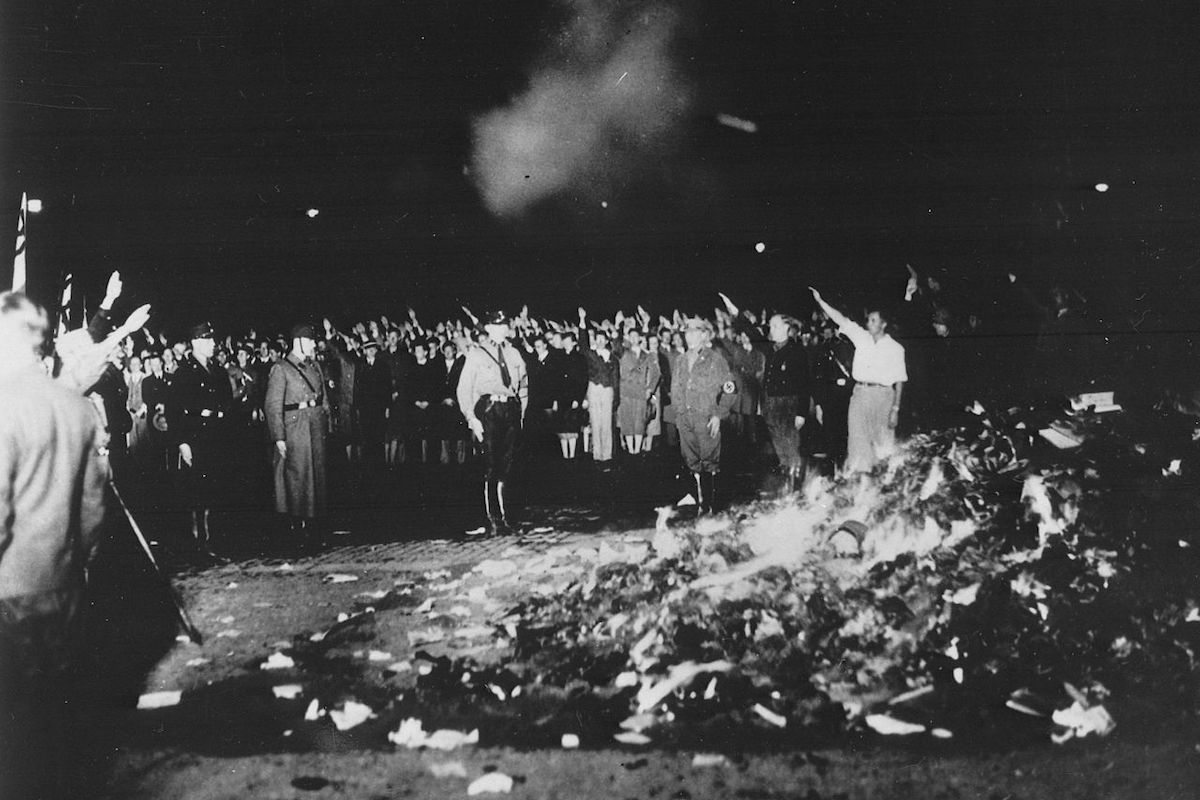
…Those “undying memories” might have included massive, country-wide book burnings that took place on May 10, 1933, when students in 34 university towns across Germany burned more than 25,000 “un-German” books…
FANNING FLAMES OF HATE…On May 10, 1933, student supporters of the Nazi Party burned thousands of volumes of “un-German” books in the square in front of the Berlin State Opera. (Bundesarchiv)
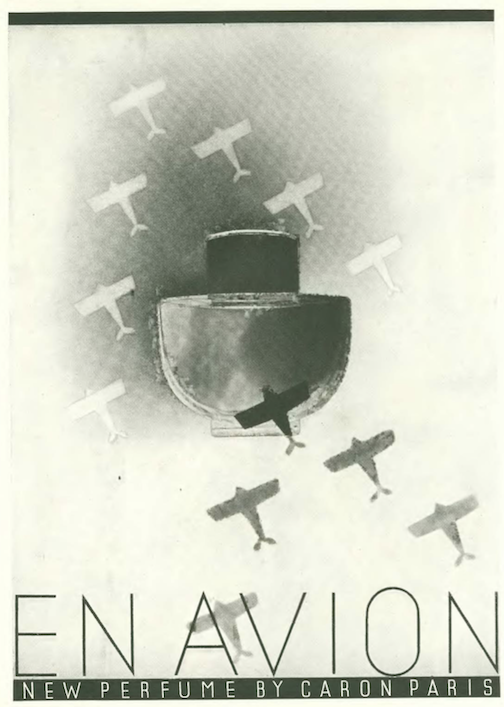
…knowing where all of this would lead, it is hard to look at this next ad and not think of the Luftwaffe raining death from the skies later in that decade…
…so for the time being we’ll turn to something less menacing, like checkered stockings, here resembling one of John Held Jr’s woodcuts…
…and this crudely illustrated ad (which originally appeared in one column)…call your buddy a fatso and the next thing you know he’s moving to Tudor City…
…and from the makers of Lucky Strikes, a back cover ad that provided a thematic bookend to Constantin Alajalov’s cover art…
…James Thurber kicks off the cartoons with this sad clown…
…atop the Empire State Building, Daniel ‘Alain’ Brustlein found more than just a view of the city (it’s former governor Al Smith!)…
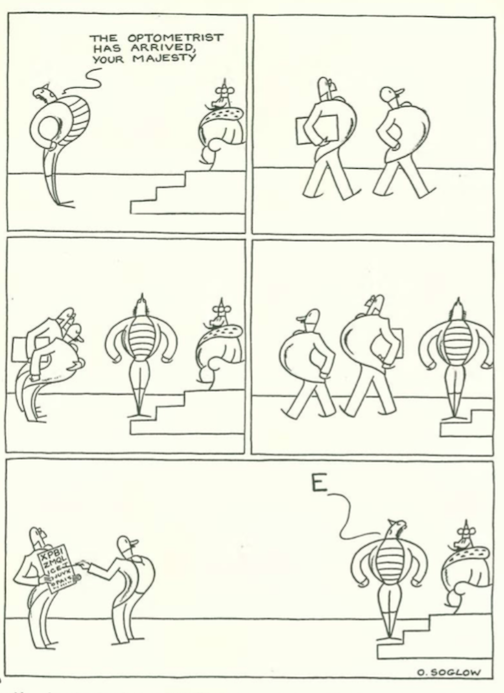
…Otto Soglow’s Little King got his vision checked, in his own way…
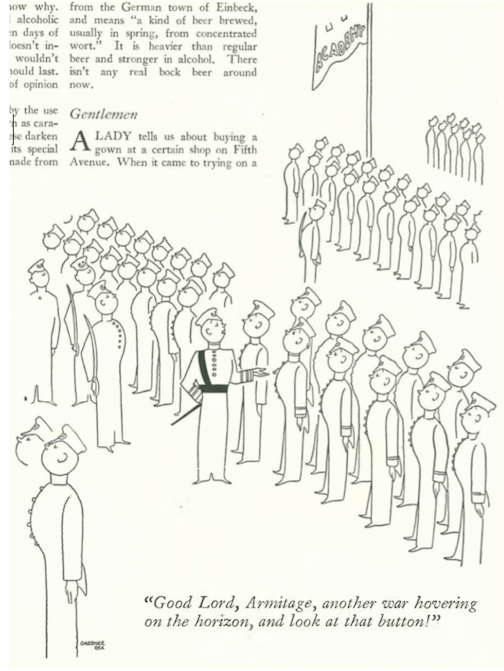
…a loose button threatened to bring down a nation…per Gardner Rea…
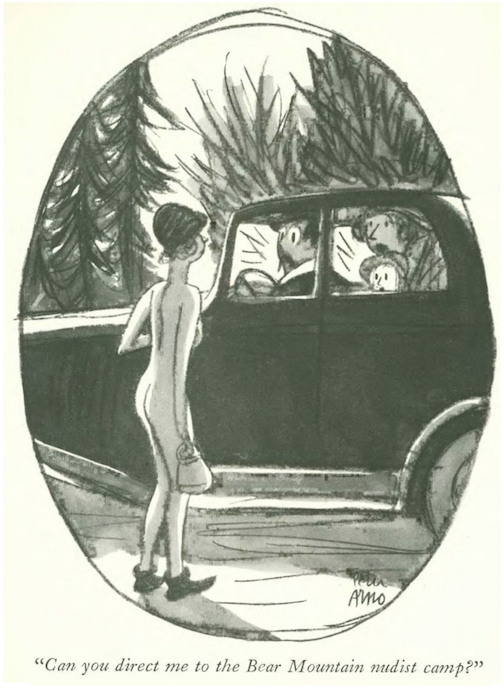
…and we take a leisurely Sunday drive, Peter Arno style…
…on to the June 3, 1933 issue…
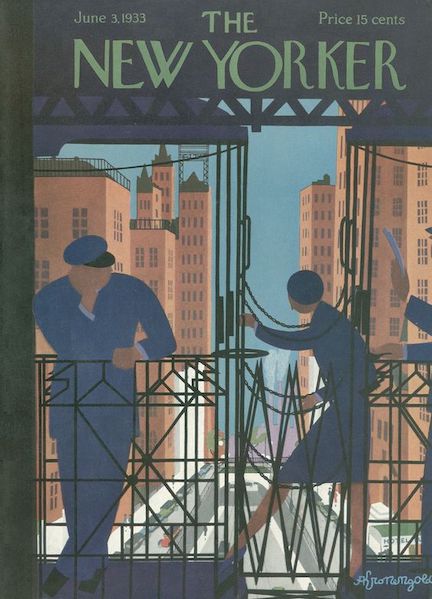
June 3, 1933 cover by Adolph K. Kronengold.
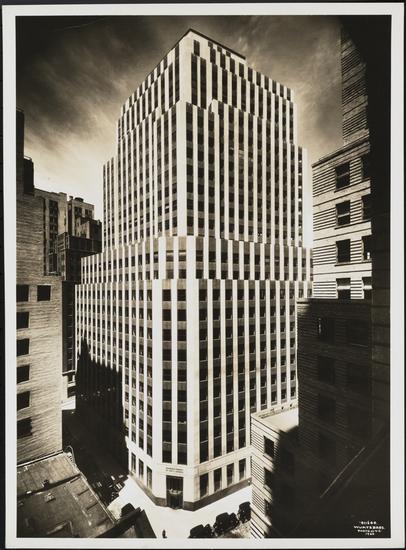
…where we appropriately look to the skyline, which was giving Lewis Mumford a crick in the neck…
THAT’LL DO…Lewis Mumford was not a fan of giant skyscrapers, but when the architects of the Empire State Building turned their attention to the Insurance Company of North America building at 99 John Street, Mumford found a design that could serve as a model for future business buildings. (Museum of the City of New York)
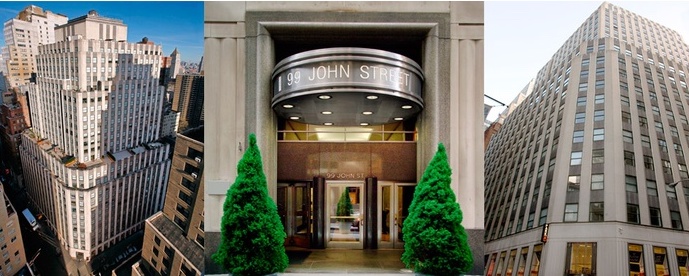
CONVERSION THERAPY…the Insurance Company of North America building now houses modern loft condominiums known as 99 John Deco Lofts. (nest seekers.com).
Later in the column Mumford called skyscrapers “insupportable” luxuries, arguing instead for long, shallow buildings rising no more than ten stories.
* * *
The Stars Align
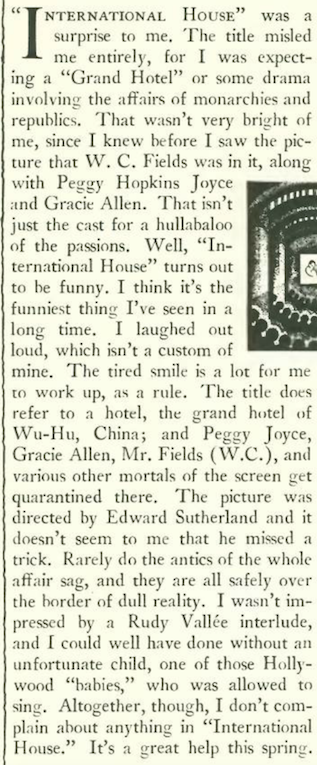
Film critic John Mosher was delightfully surprised by International House, a film loaded with some of the era’s top comedic stars along with other entertainers.
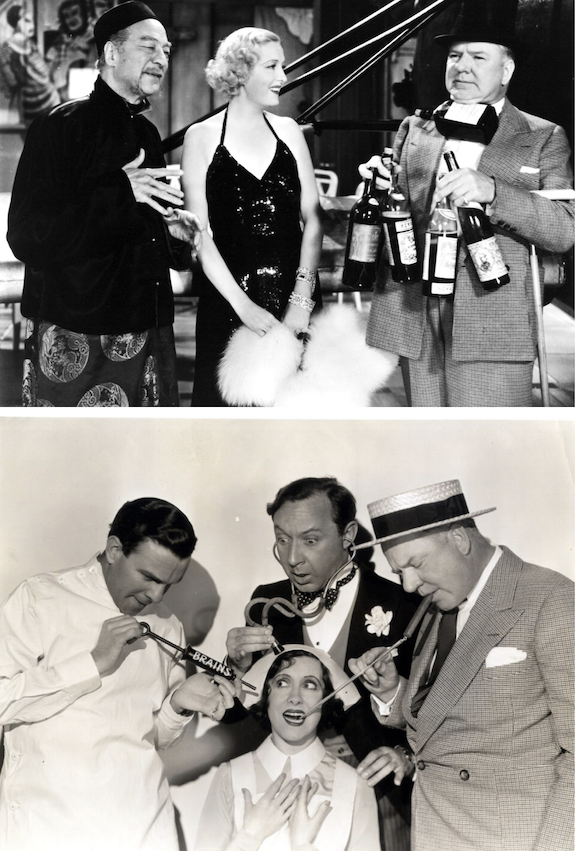
CLUTCH THOSE PEARLS…The risqué subject matter of International House had the Legion of Decency up in arms, but it left critic John Mosher in stitches thanks to the antics of Edmund Breese, Peggy Hopkins and W.C. Fields (top photo). Below, a publicity photo for International House with George Burns, Gracie Allen, Franklin Pangborn and W.C. Fields. (IMDB)
The film featured an array of entertainers including Peggy Hopkins (more famous as a real-life golddigger than an actress), the comedy duo Burns and Allen, W.C. Fields, Bela Lugosi, Cab Calloway, Rudy Valley and Baby Rose Marie.
ALL THE WORLD’S A STAGE…Ten-year-old Rose Marie Mazzetta, known in 1933 as the child performer Baby Rose Marie, sings a number atop a piano in a scene from International House. Thirty years later Rose Marie would appear on The Dick Van Dyke Show as television comedy writer Sally Rogers, pictured here with co-stars Dick Van Dyke and Morey Amsterdam. (WSJ/LA Times)
* * *
The New Germany, Part II
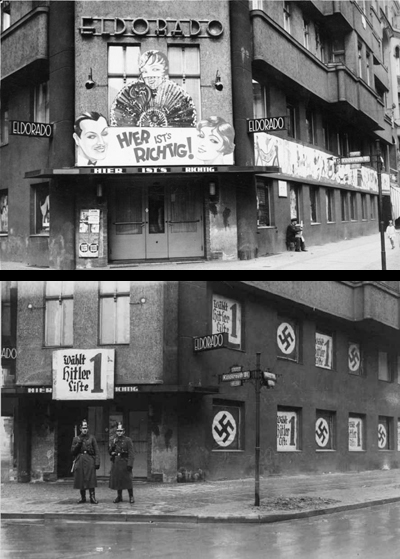
The June 3 “Out of Town” column took a look at life in Berlin as well as the 1933 Chicago World’s Fair. The piece is signed “A.L.”, leading me to believe it might be A.J. Liebling (author of the terrific Between Meals), but he didn’t start at The New Yorker until 1935. At any rate the article seems to dismiss the crackdown on Berlin’s cultural life as a mere inconvenience.
NEW THEME, NEW OWNERSHIP…The article mentions the closing of the Eldorado night club in Berlin, famed for its drag shows and other naughty diversions. Images above show the before and after the Nazis redecorated. (lonesomereader.com)
* * *
From Our Advertisers
More propaganda from Germany, where everything is sweet and bright away from the din of the city and the sound of marching jackboots and the crash of broken glass…
…an unusual ad from Cadillac, which barely mentions the automobile but goes full bore on the June bride theme…
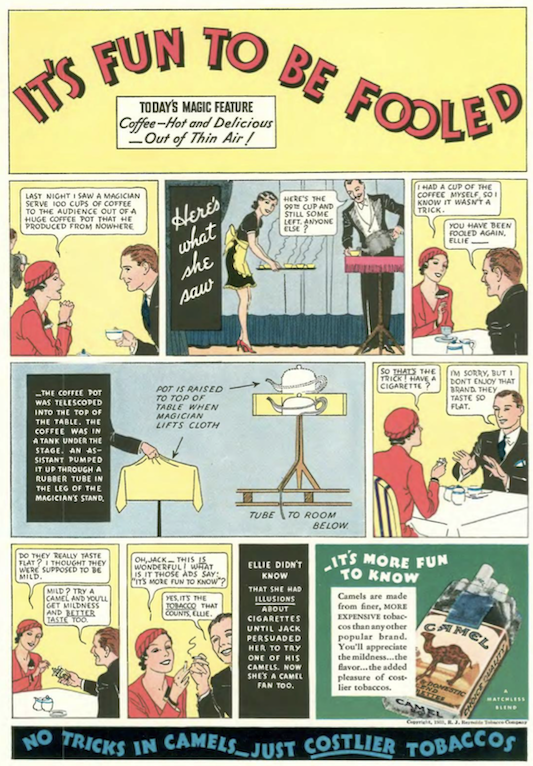
…the folks at Camel went full color in their latest installment of “It’s Fun to be Fooled”…in this strip Jack gets his friend Ellie hooked on his cigarette brand…
…looking for fresher air, well you could get a window air conditioner from the folks at Campbell Metal Window Corporation…however, these units were only available to the very wealthy, roughly costing more than $25,000 apiece (more than half a million today)…
…better to take a drive a catch the breeze with this smart pair…
…and fight off those pesky bugs with a blast of Flit, as illustrated by Dr. Seuss before he became a children’s author…
…Richard Decker picked up some extra cash illustrating this ad for Arrow shirts…
…which segues to our other New Yorker cartoonists, such as H.O. Hoffman…
…and yet another bride, with sugar daddy, courtesy of Whitney Darrow Jr…
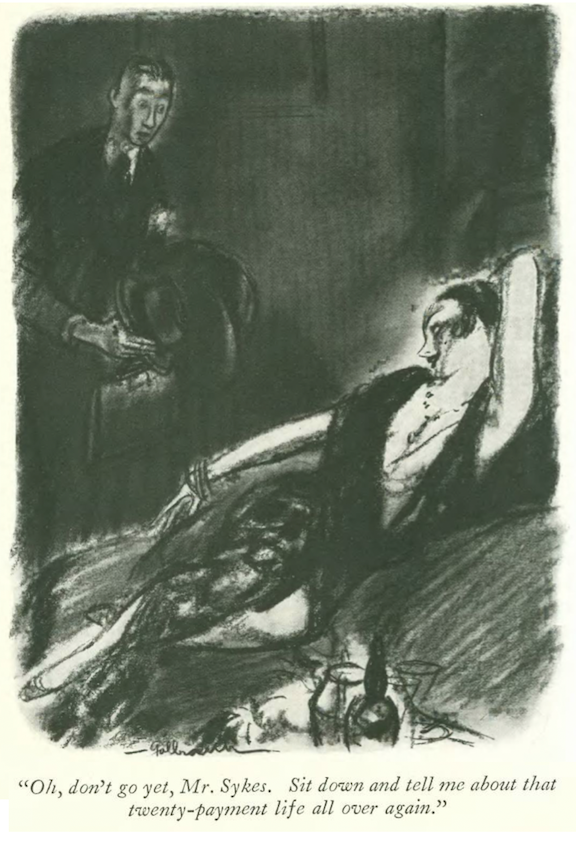
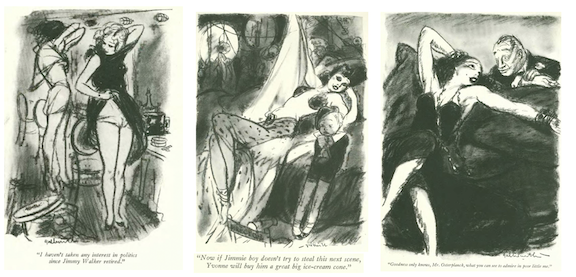
…William Crawford Galbraith continued his exploration into the lives of showgirls…
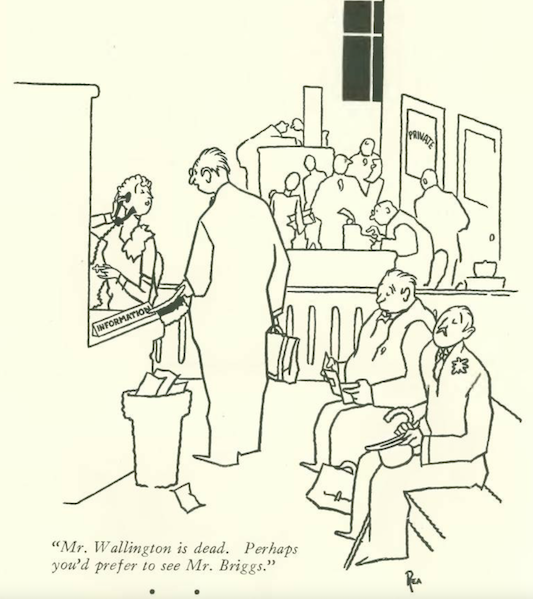
…Gardner Rea gave us this helpful switchboard operator…
…Carl Rose showed us how the posh set got into the spirit of the Depression-era farm program…
…George Price was getting into familiar domestic territory…
…and on this Father’s Day, we close with some fatherly advice from James Thurber…
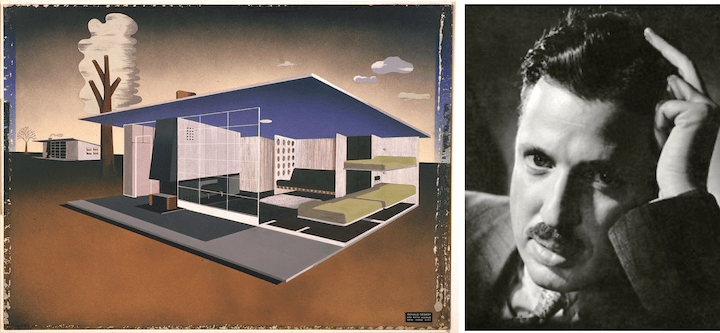
Above, Donald Deskey's Design for a Sportshack, 1940 (Cooper Hewitt)
If you’ve never heard of Donald Deskey, you’ve most likely seen his work.
Feb. 25, 1933 cover by Rea Irvin.
Cultural critic Gilbert Seldes featured Deskey in the Feb. 25 profile (“The Long Road to Roxy” — with illustration by Al Frueh), noting that his subject had come to his profession as an industrial designer in a rather roundabout fashion. Here is a brief excerpt:
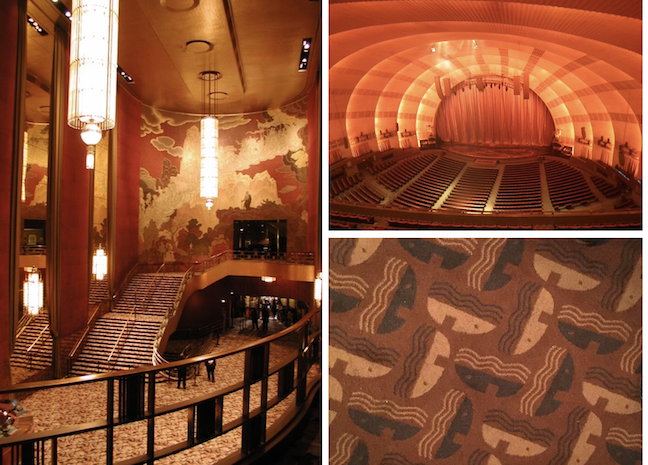
Deskey (1894–1989) was locally known in the late 1920s for his window displays at New York’s Franklin Simon Department Store, but it was his work at Roxy Rothafel’s new Radio City Music Hall that made him a marquee name in the design world. Although known for popularizing the Art Deco style, his interior designs for RCMH were noted for their restraint, signaling a break from the lavish, ornate designs of the city’s earlier performance spaces.
FEAST FOR THE EYES…Donald Deskey designed more than thirty spaces in Radio City Music Hall, including the Grand Foyer (left) and several lounges, each featuring a distinct visual motif. At bottom right, auditorium’s “Singing Woman” carpeting. (archdaily.com/drivingfordeco.com)
Original Deskey creations are highly prized today by collectors and museums…
DESIGN IN MOTION…Clockwise, from top left, Deskey’s “Guest Bedroom for Mrs. John D. Rockefeller, Jr.” (Abby Aldrich Rockefeller), on display at the 1931 American Union of Decorative Artists exhibition; Deskey table lamp, circa 1927; linen panel, circa 1930s; Deskey desk, circa 1930. (brooklynmuseum.org/artic.edu/Pinterest)
…and if that wasn’t enough, Deskey also designed logos for many consumer products in the late 1940s and 1950s…
THE TOTAL PACKAGE…Deskey designed some of the most iconic logos of midcentury America, including, clockwise from top left, Tide laundry detergent (1947); Gleem (1956) and Crest (1955) toothpastes; Cheer laundry detergent (1952); JIF peanut butter (1956) and Joy dishwashing liquid (1950).
* * *
From Our Advertisers
It seems appropriate to follow Mr. Deskey with some words and images from our sponsors, including the folks at Cadillac who continued to hammer home the snob appeal of their motorcar while also giving a nod to those hard times by emphasizing the car’s economy…
…meanwhile, Studebaker was back with another full page ad—again featuring the admiring giant woman—in a vain attempt to push their fledgling, and unpopular line of Rockne automobiles…
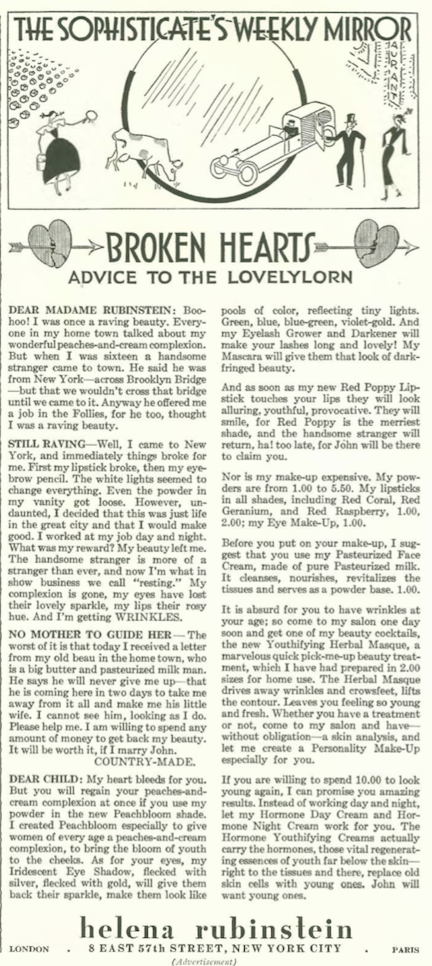
…and Helena Rubenstein continued her series of ads disguised as advice columns…the advice here was to shame women into buying her products…
…after Helena removed your wrinkles you could restore them with GE’s Mazda sunlight lamp…
…Otto Soglow, on the brink of becoming a very wealthy man thanks to his Little King cartoons, continued to lay down some ink on behalf of the makers of Sanka decaf…
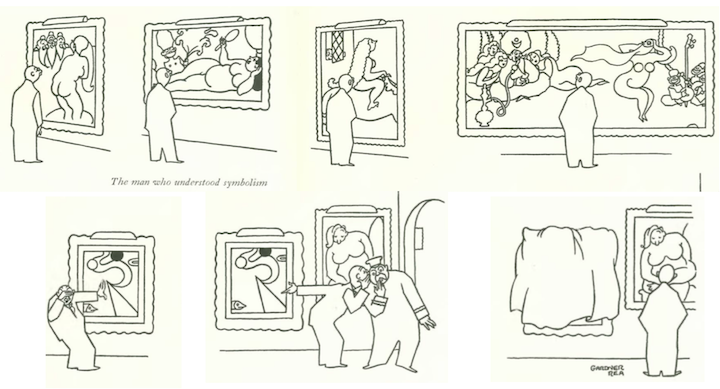
…and we move along to Soglow’s fellow cartoonists, beginning with Gardner Rea and a cartoon sequence spread across pages 24-25…
…here it is again, rearranged for closer inspection…
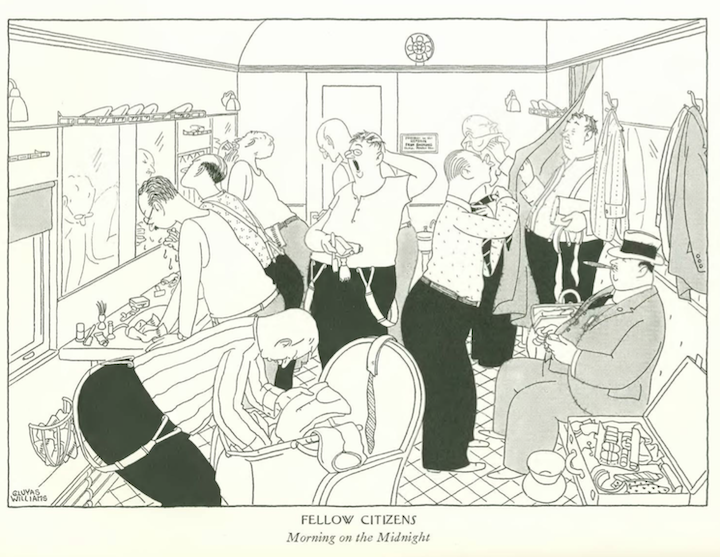
…and we have another terrific “Fellow Citizens” drawing by Gluyas Williams, which originally ran sideways on a full page…
…I like this James Thurber drawing for its utter disregard of scale—but of course (and thankfully) it wouldn’t be a Thurber if he cared about such things…
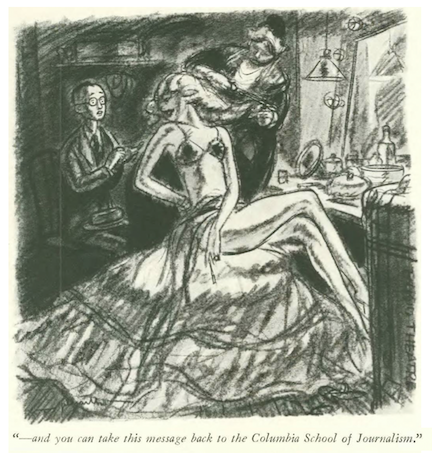
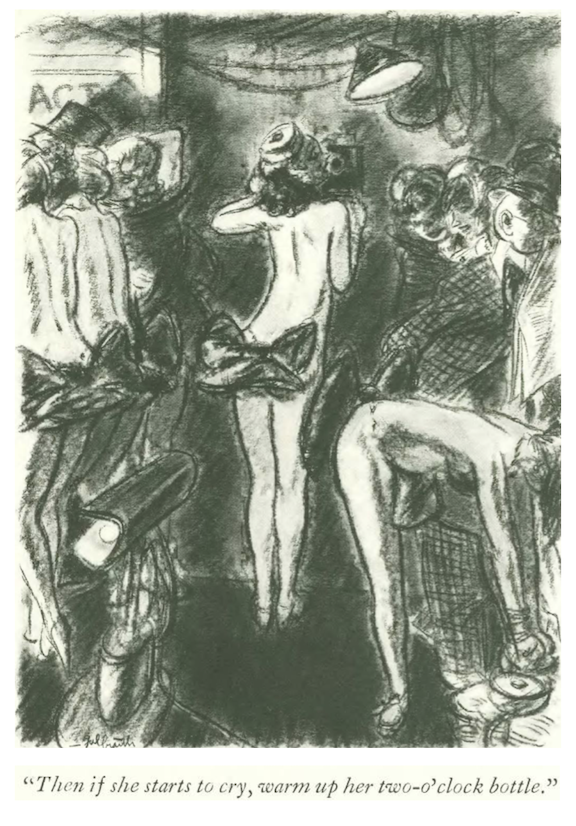
…William Crawford Galbraith was still hung up on showgirls and sirens…
…while Peter Arno explored his spiritual side, as only Arno could…
…and we move along to March 4, 1933…
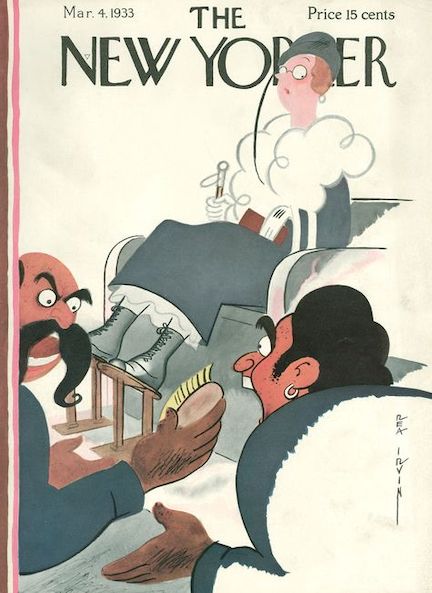
March 4, 1933 cover by Rea Irvin.
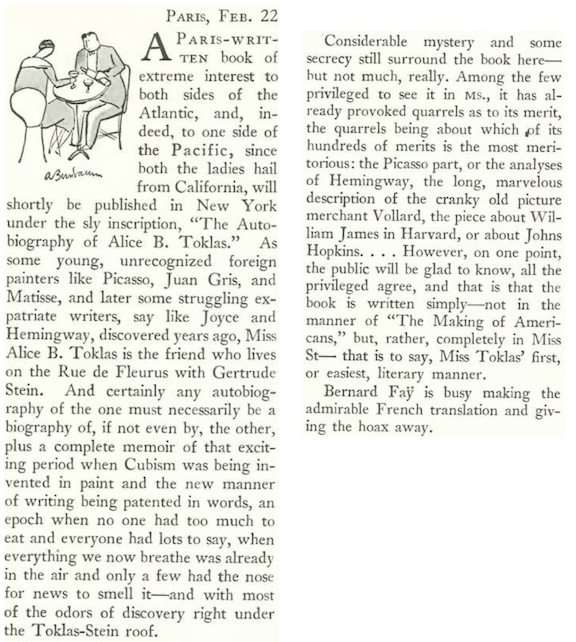
…in which The New Yorker’s Paris correspondent Janet Flanner (“Genêt”) wrote about a new book of “extreme interest to both sides of the Atlantic”…
BOOK OF REVELATION…Alice B. Toklas and Gertrude Stein were well known in the ex-pat community of 1920s Paris, but the publication of the American edition of The Autobiography of Alice B. Toklas (written by Stein) brought them fame in the wider world. Stein claimed she wrote the book — now considered a 20th century classic — in six weeks to amuse herself and to make money. At right, Toklas and Stein at 27 Rue de Fleurus in a portrait by Man Ray, 1922. (Library of Congress)
* * *
Hope Springs Eternal
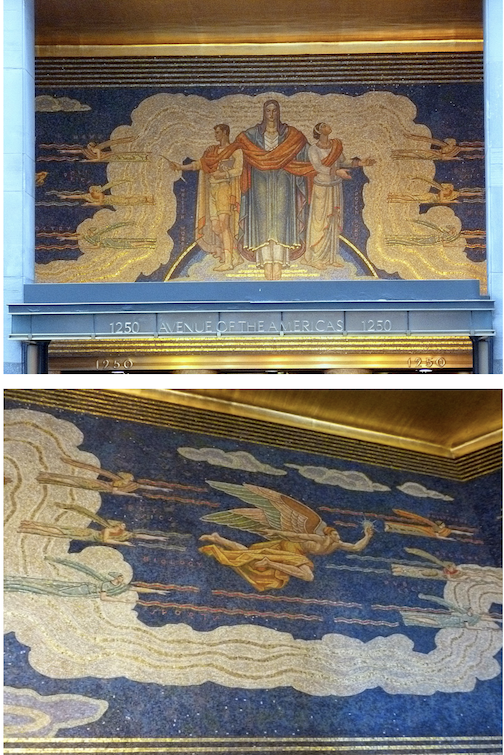
Even in the deepest depths of the Depression signs of hope abounded in works of public art, including a mosaic of one million hand-cut and hand-set glass tiles being prepared for the Sixth Avenue entrance to Rockefeller Center. Intelligence Awakening Mankind, by Barry Faulkner, celebrated the triumph of knowledge over the evil of ignorance. “The Talk of the Town” explained:
GOOD VIBES…Details of Intelligence Awakening Mankind include the central figure of Intelligence (top) sending knowledge into the far corners of the world. (Pinterest)
* * *
From Our Advertisers
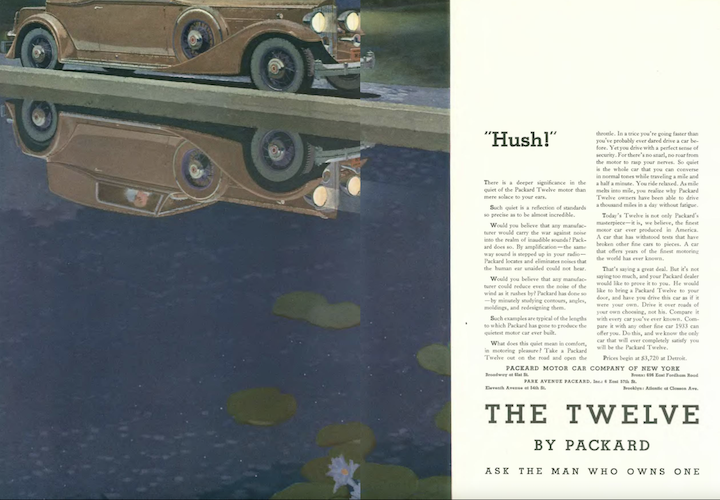
The folks at luxury brand Packard continued to counter their stodgy image with ads that emphasized other qualities including speed, durability, and here, serenity…despite the lengthy text, the ad also suggested modernity, with the sliced-off image and the single word “Hush!” to entice prospective buyers…
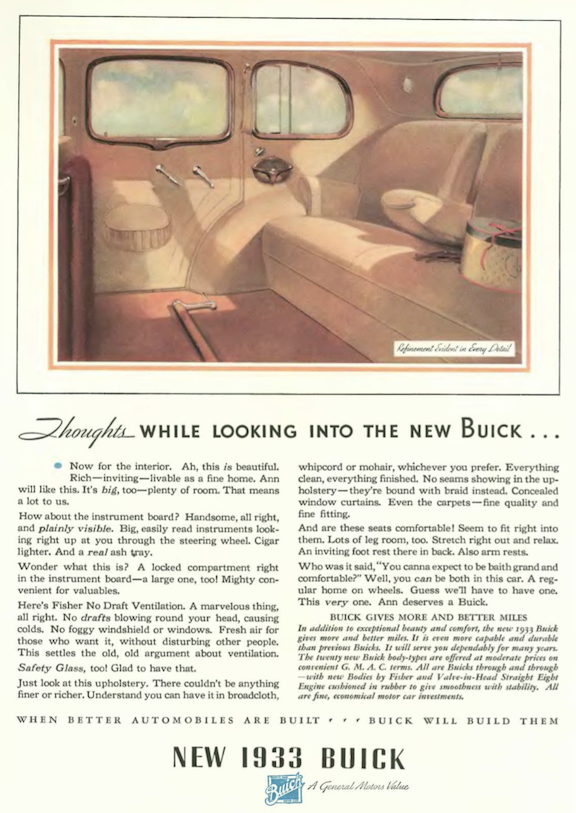
…if you couldn’t afford $3,720 for a 12-cylinder Packard, then you might have considered a Buick, “livable as a fine home” this ad claimed. And look at that back seat — you could comfortably fit three adults and a baby elephant in there…
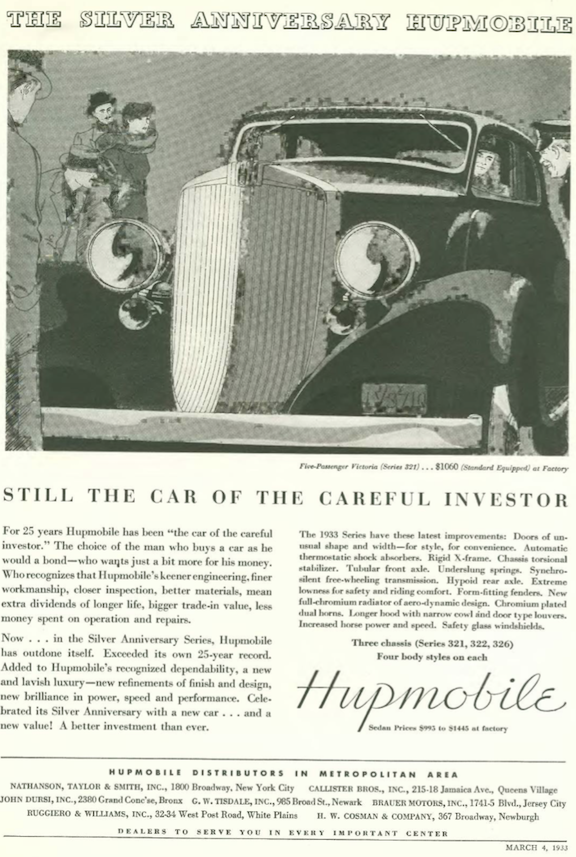
…and then there’s Hupmobile—for the price of a Packard 12 you could have purchased three Hupmobile Victorias (pictured below) with a good chunk of change left over…here the company celebrates its silver anniversary…a couple of odd facts: in 1914 a Minnesota Hupmobile salesman used an unsold vehicle to found Greyhound bus lines…the National Football League also traces its origins to Hupmobile — the league was created in 1920 at a Hupmobile dealership in Canton, Ohio…both Greyhound and the NFL survive Hupmobile, which went belly up in 1939…
…and now we move to the world of fashion, and some cultural appropriation by Lord & Taylor…
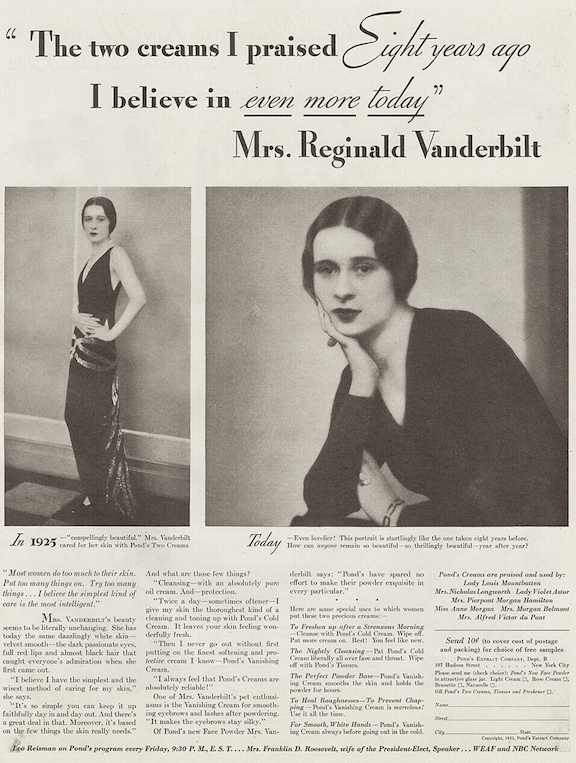
…in 1929 J. Walter Thompson President Stanley Resor observed how people instinctively wanted to be told what to do by authorities they respected. Applying this thinking to the marketing of Pond’s cold cream, Resor’s firm hired famed photographers to create idealized portraits of society women…
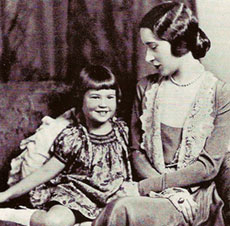
…Writing for Indy Week (July 7, 2010) Amy White observes that a 1933 portrait (above) of Mrs. Reginald Vanderbilt, aka Gloria Mercedes Morgan, reveals patrician eyes as “languid jet pools, her lips full and dark, her finely coiffed hair oiled to ebony perfection. However, a bit of backstory might explain the painful and hollow look Mrs. Vanderbilt can barely suppress. In that same year, she was declared by the courts to be unfit as a parent, and her young daughter was placed under the guardianship of her sister, Gertrude.” That young daughter, Gloria Vanderbilt, would later find fame for her designer jeans, her glittering lifestyle, and as mother of newscaster Anderson Cooper. White concludes, “I wonder if somehow, subconsciously, those consumers saw the pain in the eyes of some of those upper-crust spokeswomen, and it was basic humanness and empathy, as well as desire for wealth and beauty, that won them over”…
Mrs. Reginald Vanderbilt, aka Gloria Mercedes Morgan, and her daughter, “Little Gloria,” in 1928. (Wikipedia)
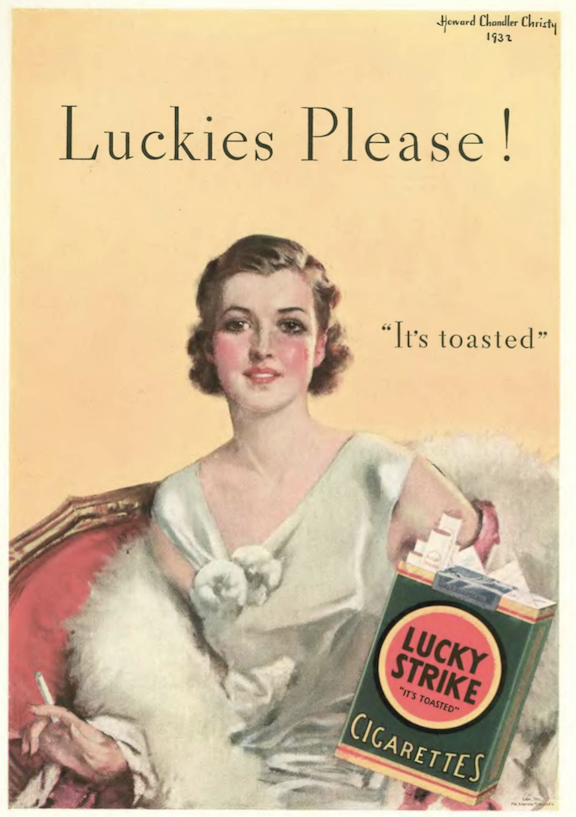
…and we move along to the toasted pleasures of Luckies, and Howard Chandler Christy’s “Christy Girl” looking the picture of health and vitality in this back cover ad…
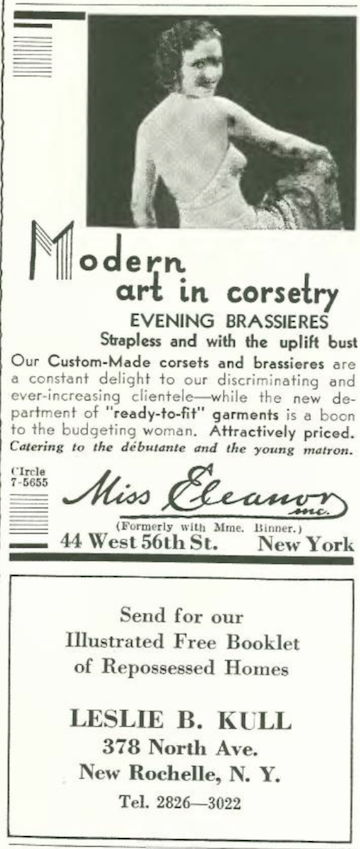
…we make an abrupt switch to the cheaper ads in the magazine’s nether pages…here “Miss Eleanor, formerly with Mme. Binner,” announced her selection of modern corsets for the “debutante and young matron”…and below, in a sign of the times, repossessed homes for sale…
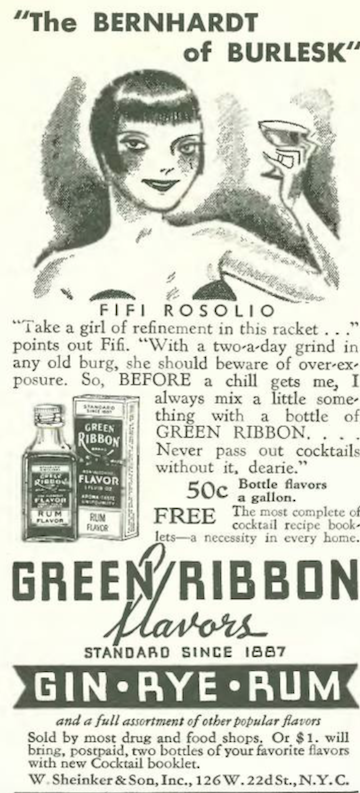
…looks like Fifi had a bit too much of the Green Ribbon-flavored bootleg…
…and if you thought taking probiotics was a new thing…
…the French Line once again featured the art of James Thurber to promote its Mediterranean cruises…
…and Thurber kicks off our cartoons with spot art that headed the “Goings On About Town” section…
…and this gem with one of Thurber’s beloved dogs…
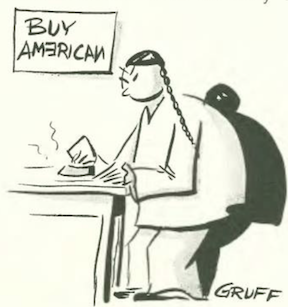
…below is the second New Yorker cartoon by Gruff with the “Buy American” slogan juxtaposed with an ethnic stereotype…I have no idea who this artist is, or if “Gruff” is a pen name — the style looks familiar but I haven’t had any luck chasing this artist down…
…here is the first one from the Feb. 18 issue…
…but we all know Al Frueh, who contributed this delightful bit of art to the theater review section…
…Daniel ‘Alain’ Brustlein gave us an enterprising Frenchman offering peeks at exiled New York Mayor Jimmy Walker sunning on a beach at Cannes…
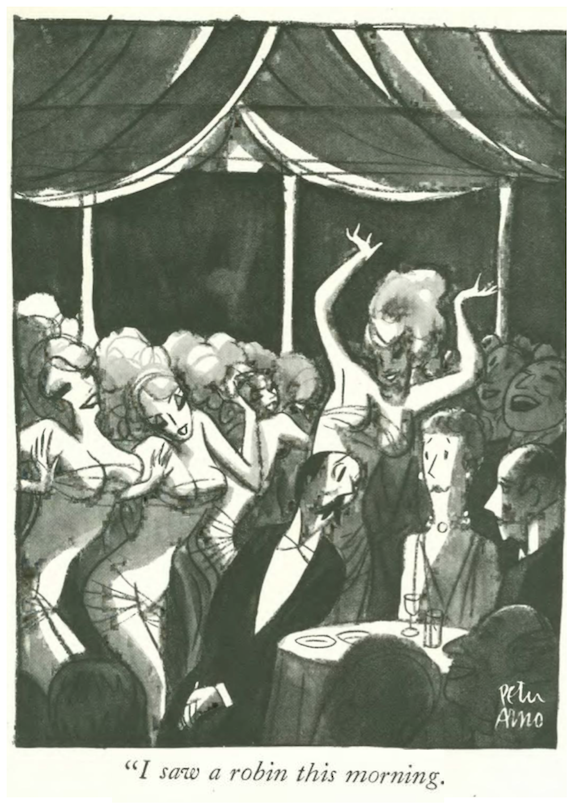
…and we close with Peter Arno, and the first signs of spring…
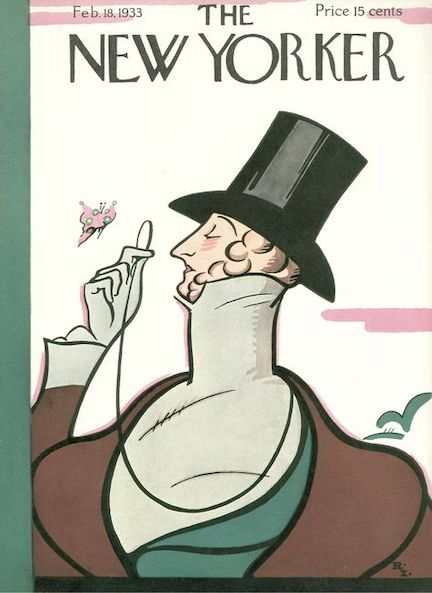
Once again The New Yorker marked its anniversary—the eighth—with a repeat of its very first cover, a tradition that would last until 1993. Unlike previous years, E.B. White made no special mention of the occasion in his “Notes and Comment,” no doubt feeling confident about the magazine’s prospects despite the challenges of the Depression. In 1933 The New Yorker could count on nearly 117,000 readers.
Feb. 18, 1933 cover by Rea Irvin.
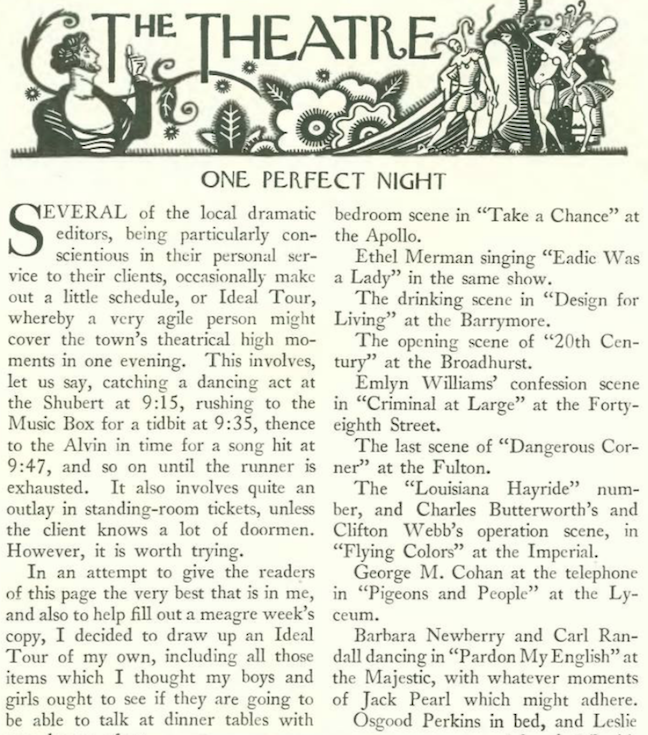
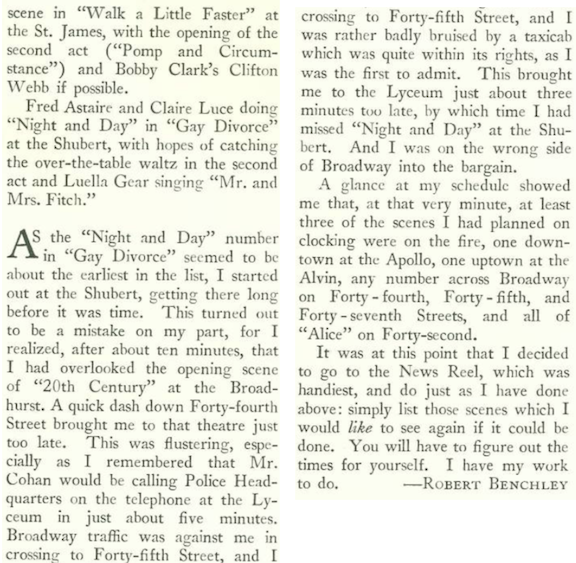
And so we look to another of the magazine’s star contributors, humorist and stage critic Robert Benchley, who was rarely impressed with Broadway’s middlebrow fare. It was in such an environment that Benchley found himself separating the wheat from the chaff, listing a selection of scenes from various plays that together might represent a “perfect night” of entertainment:
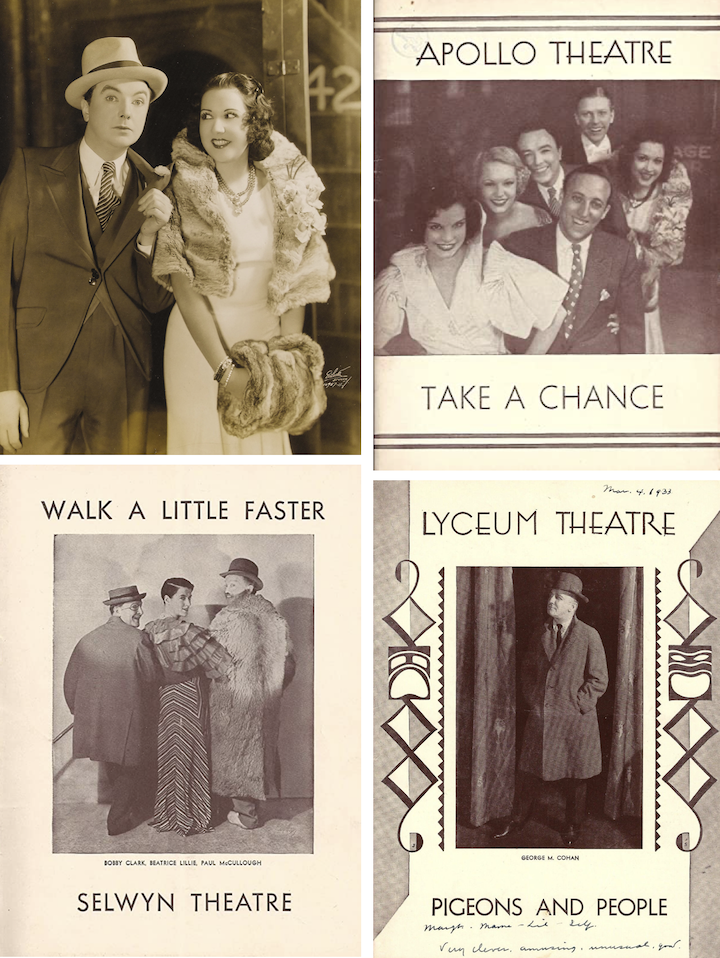
A BROADWAY BUFFET…Clockwise, from top left, Robert Benchley recommended Jack Haley’s bedroom scene and Ethel Merman’s rendition of “Eadie Was a Lady” in Take a Chance as worthy of a look; he also found George M. Cohan’s telephone call to police HQ in Pigeons and People memorable, and Beatrice Lillie was apparently a delight in the dressing room scene from Walk a Little Faster. (playbill.com)
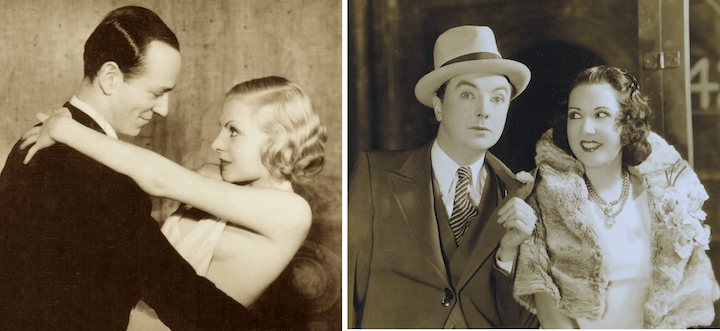
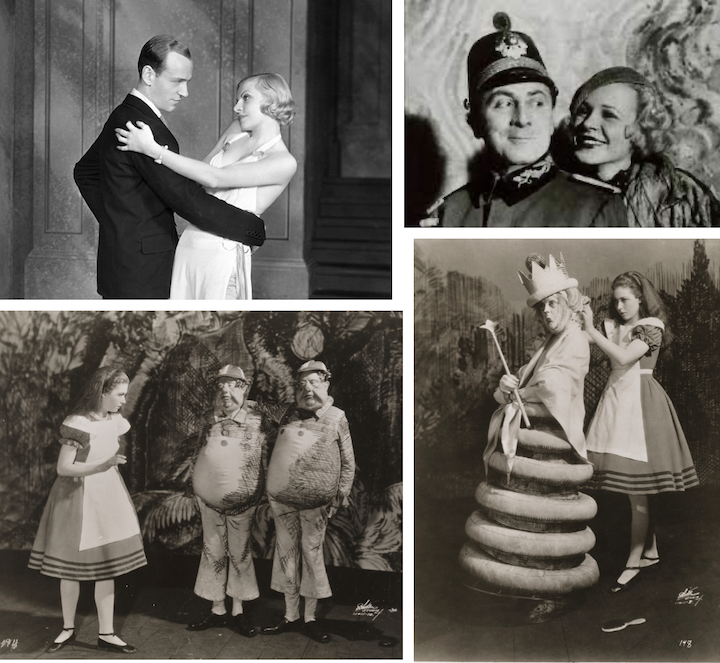
TRIPPING THE LIGHT FANTASTIC in Cole Porter’s musical Gay Divorce were Claire Luce and Fred Astaire, dancing to the hit song “Night and Day.” It was Astaire’s last Broadway show before he headed to Hollywood for even greater stardom; Jack Pearl and Barbara Newberry in Pardon My English; Eva Le Gallienne as the White Queen and Josephine Hutchinson as Alice in the 1932-33 production of Alice in Wonderland at Le Gallienne’s own Civic Repertory Theatre; Alice (Hutchinson) encounters Tweedledee (Burgess Meredith) and Tweedledum (Landon Herrick) in Alice in Wonderland. (Pinterest/gershwin.com/blog.mcny.org)
* * *
Spring Cleaning
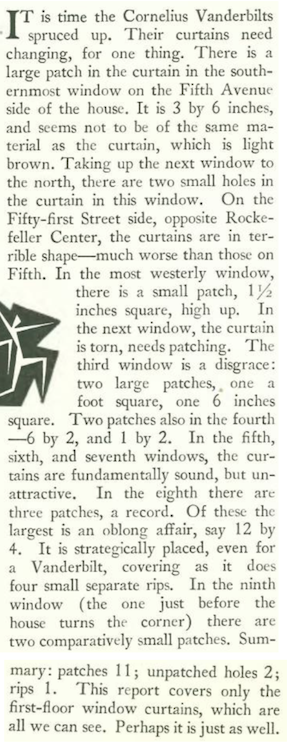
While passing by the Vanderbilts’ “Triple Palace” on 51st and Fifth Avenue, E.B. White (“Notes and Comment”) noted signs of neglect at the famed mansion:
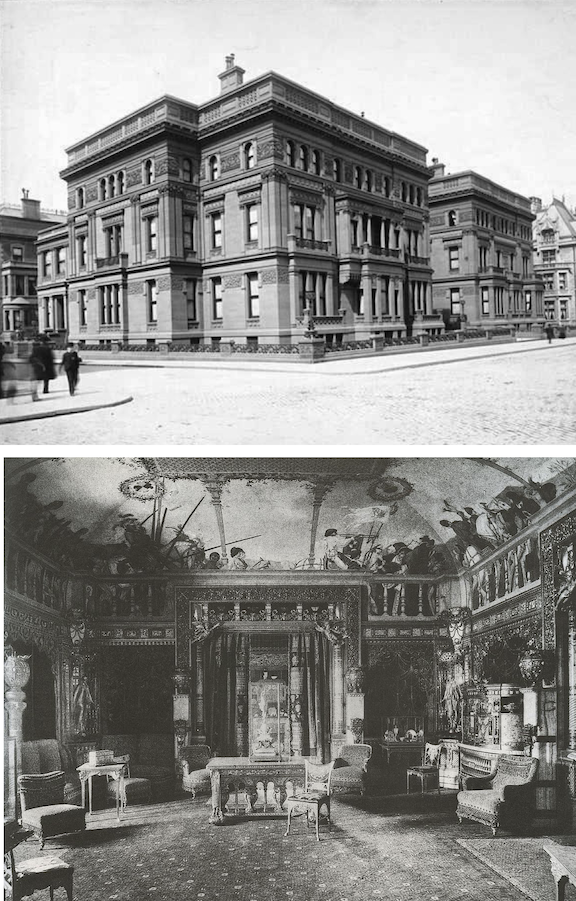
HOME SWEET HOME…At top, Alva Vanderbilt engaged Richard Morris Hunt to build a “Petite Chateau” on the northwest corner of 52nd Street; below, the drawing room. The Triple Palace was demolished in 1947-49. (mcny.org/Wikimedia Commons)
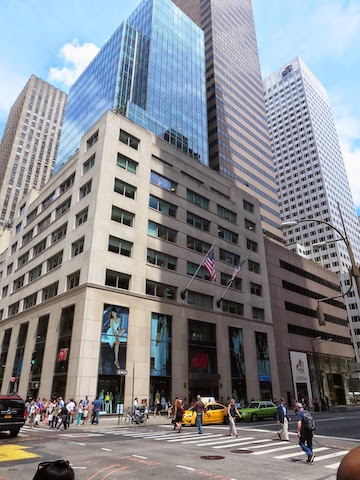
The Triple Palace site today:
(daytoninmanhattan.blogspot.com)
* * *
Going Round and Round
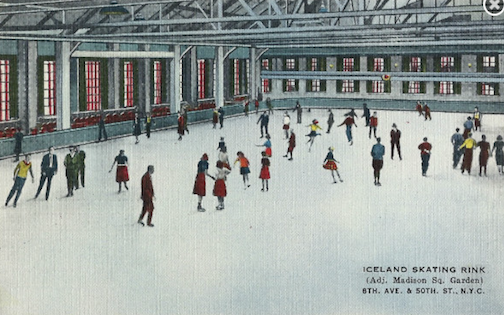
No one was landing quad flips at New York’s Ice House in 1933, but for ice skating enthusiasts it was the place to be for both figure skating competitors as well as for those just interested in a leisurely skate to the strains of a live orchestra. “The Talk of the Town” explains in this excerpt:
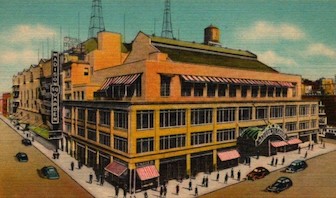
CHILLING SIGHT…Top and below, the Ice House was located on the top floor of a four-story building attached to Madison Square Garden. (Pinterest)
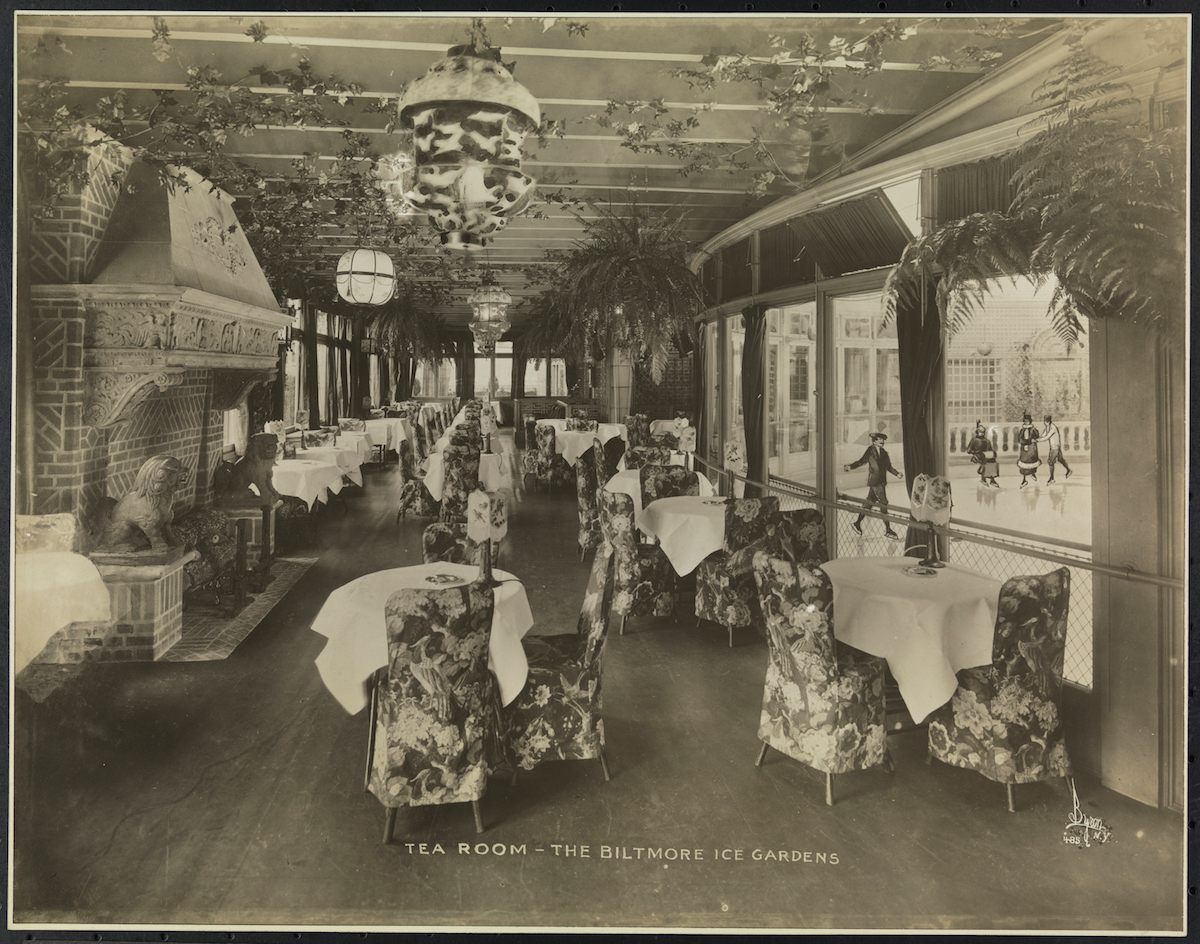
In both Europe and America ice skating in the 19th and early 20th century was something of an elaborate ritual in urban areas; skating rinks included tea rooms as well as places to dance or ice skate to the gentle rhythms of a live orchestra…
TEA COSY…The Biltmore Hotel Ice Gardens offered guests a warm place to watch the cold weather fun of the hotel’s outdoor ice skating rink, circa 1915. (mcny.org)
* * *
The Jig Is Up
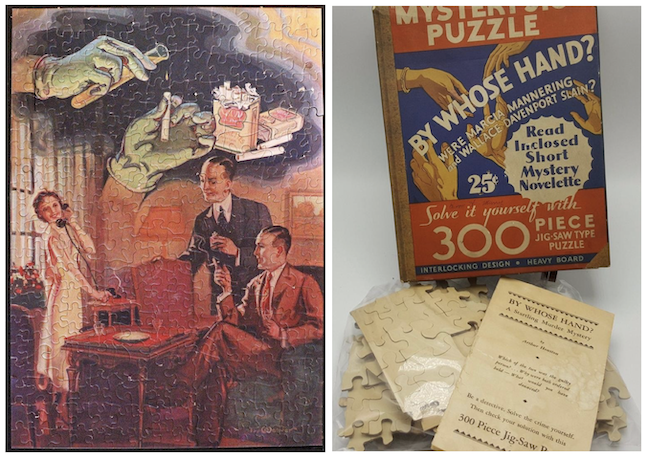
Jigsaw puzzles have been around since the late 1700s (they were handmade then), but their popularity really took off in the 20th century with advancements in manufacturing and especially during the Depression when folks sought affordable forms of entertainment they could enjoy at home. The 1930s also saw jigsaw puzzles become more complex. “The Talk of the Town” observed:
In 1933 the Long Island City-based puzzle manufacturer Einson-Freeman introduced a line of puzzles that included clues to solving mysteries described in an accompanying novelette…
(worthpoint.com)
* * *
Small But Deadly
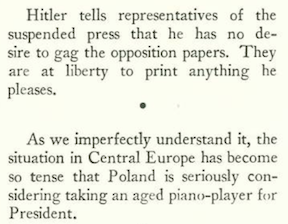
Howard Brubaker’s “Of All Things” column, which ran from 1925 to 1951, was a series of brief, satirical comments on the events of the day, including some that to modern eyes point to the catastrophic events that awaited Brubaker’s world (reader Frank W. notes that “the ‘aged piano-player’ was Ignacy Paderewski, who had served as Prime Minister in the immediate aftermath of WWI, and who was the nearest thing the Poles had to a national-unity figure”):
* * *
Her Protégé
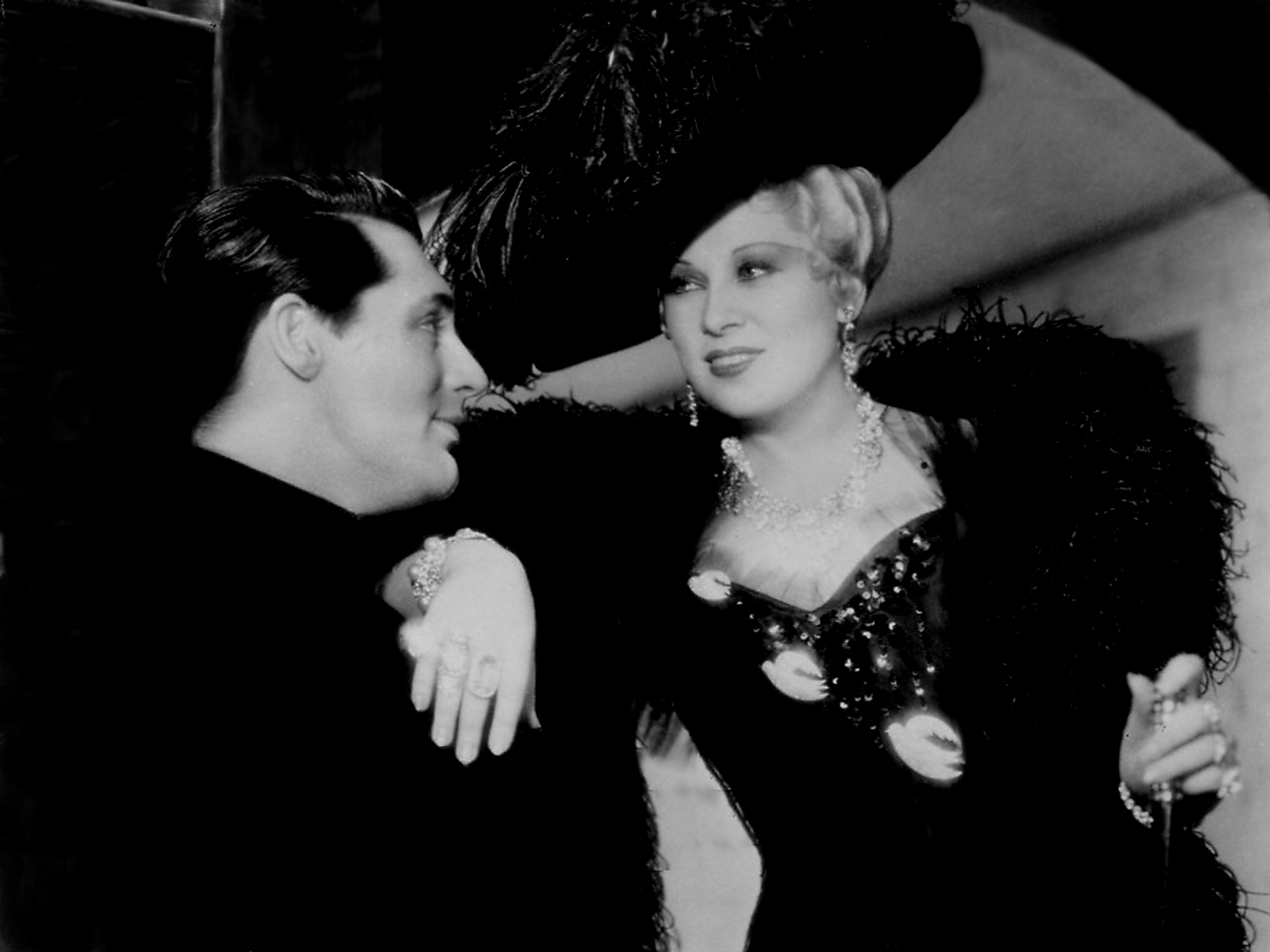
When Mae West adapted her 1928 Broadway play Diamond Lil into the 1933 film She Done Him Wrong, the puritanical backers of the Hays Code (which would be enforced in 1934) demanded that the film make no reference to the “scandalous” play. But because it was still the pre-Code era, West’s film featured many double entendres and her famous (and famously misquoted) quip, “Why don’t you come up sometime and see me?” That line was spoken to Cary Grant—whom West would later claim as her discovery even though Grant had drawn considerable attention in the previous year for his work opposite Marlene Dietrich in Blonde Venus. For the record, Grant, who would be paired again with West in 1933’s I’m No Angel, would later credit West, and She Done Him Wrong, for giving his career a major boost. New Yorker critic John Mosher lauded the film for the much-needed laughs it provided to Depression-weary audiences.
SHOWING HIM THE ROPES…The nearly forty-year-old Mae West was 11 years older than Hollywood newcomer Cary Grant when they appeared together in 1933’s She Done Him Wrong. The film was nominated for an Academy Award (Best Picture), and in 1996 was selected for preservation in the National Film Registry by the Library of Congress. (filmreference.com)
* * *
From Our Advertisers
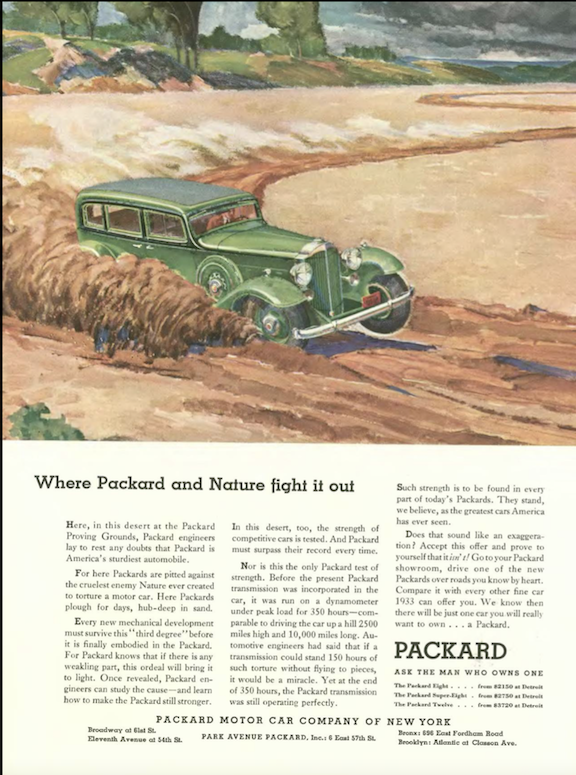
The folks at Packard took a new advertising tack by demonstrating the durability of their luxury automobile…
…hopefully the Packard was riding on “Double Eagle” tires by Goodyear…however, this is an odd illustration to emphasize a child’s safety, when the kid’s posh mum seems more concerned about her appearance than anything else…also, does she plan to drive home with the windshield down?…
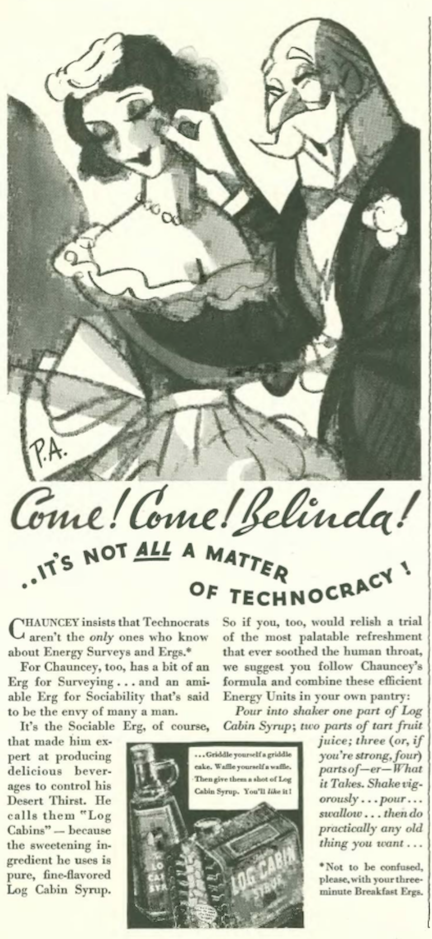
…Log Cabin continued its series of ads featuring New Yorker cartoonists…here Peter Arno lends one of his dirty old walruses to the cause of syrupy waffles and pancakes…
…on to our cartoonists, we have Arno again, keeping up appearances among high society…
…Gluyas Willams demonstrated his knack for illustrating the foibles of his fellow citizens…
…Helen Hokinson looked in on a man aspiring to become the next T.S. Eliot…
…the growing popularity of the gangster film knew no bounds, according to Perry Barlow…
…and we close with James Thurber, and a speakeasy standoff…
In the span of 112 minutes, the much-anticipated Fox production Cavalcade took movie audiences through the first thirty years of the 20th century.
Jan. 14, 1933 cover by Peter Arno.
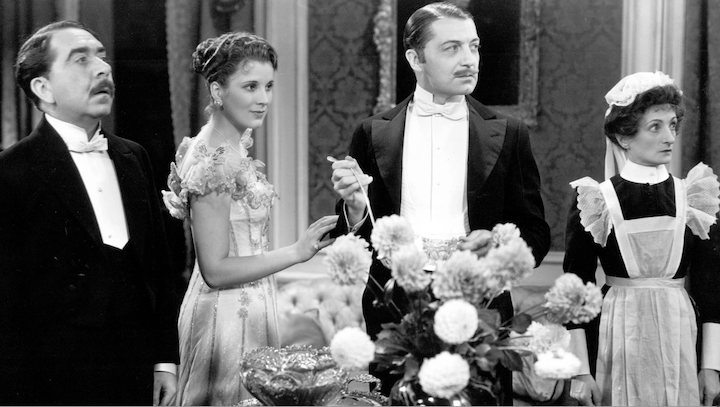
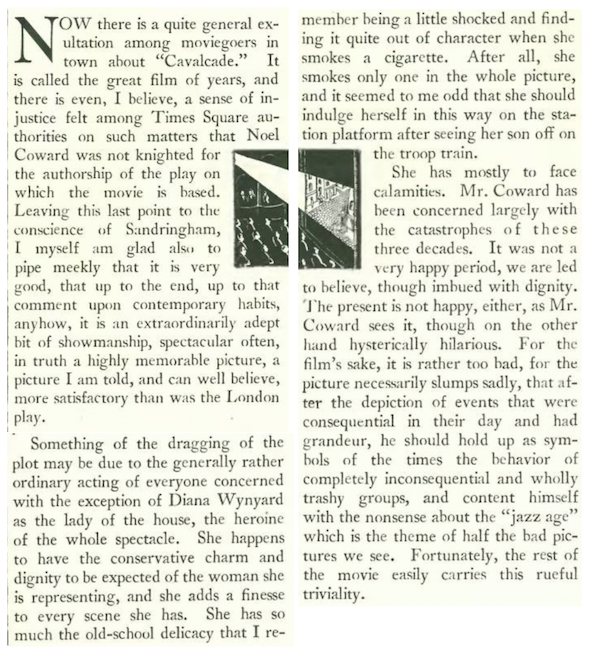
Anticipating Upstairs, Downstairs (1971) and the more recent Downton Abbey, Cavalcade looked at life through the eyes of upper class Londoners—Jane and Robert Marryot, their children and close friends—and the Marryot’s servants. It was a calamitous ride that included both the Boer War and World War I among other historic events. Critic John Mosher thought it a memorable picture despite its mawkishness.
IT’S A SCARY WORLD OUT THERE…This Fox theater card promised audiences epic thrills with a cast of thousands. (IMDB)
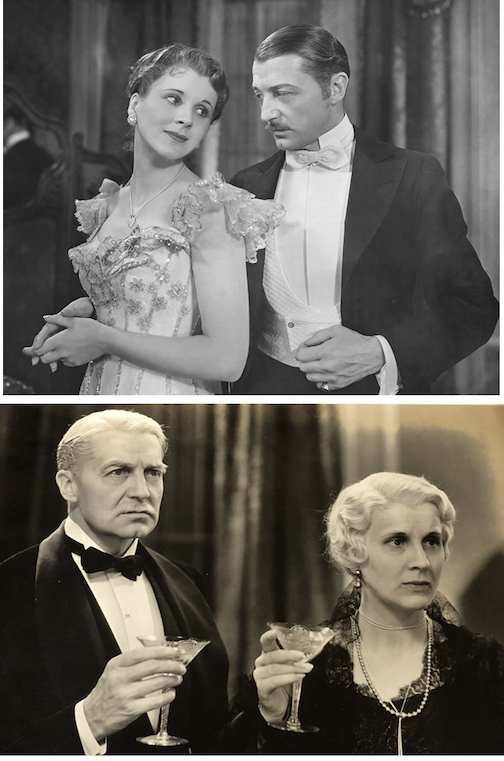
AGING GRACEFULLY…Diana Wynyard and Clive Brook portrayed upper class Londoners Jane and Robert Marryot through three tumultuous decades in Cavalcade. (IMDB)
In the film, the first decades of the 20th century would claim the lives of both Marryot sons—Joe would perish in World War I, and Edward would make the unfortunate decision to take his bride on a honeymoon cruise…
ONE-WAY TICKET…Edward Marryot (John Warburton) and his childhood sweetheart Edith Harris (Margaret Lindsay) are thrilled to be celebrating their honeymoon on a “big boat.” When the couple walk away from the railing, the opposite side of the life preserver is revealed in a dramatic camera shot.
After World War I the film hastily moved on to the Jazz Age, where the social order was going to hell…
CRY WOLF…A creepy older dude puts the moves on a young blonde (portrayed by Betty Grable in an uncredited role) during a Jazz Age scene of a wild party that included glimpses of flirting gay couples. Cavalcade was one of the first films to use the words “damn” and “hell.” (IMDB)
Cavalcade is considered by some critics to be one of the worst films to receive an Academy Award (it actually won three—Best Picture, Best Director, and Best Art Direction). If you are interested in learning more about Cavalcade or about pre-Code films in general, visit the excellent pre-code.com website.
* * *
Sad Songs
George White was famed for his lavish Scandals revues, especially during the Roaring Twenties—leggy showgirls and wisecracking comedians shared the stage with some of the era’s top singers and dancers. White’s Music Hall Varieties seemed to have all of the same elements as his Scandals, but something seemed amiss to Robert Benchley—an unnamed sadness that he chalked up to those depressing times:
THE SHOW MUST GO ON…Even during the Depression George White did what he could to keep the old Roaring Twenties spark alive. Clockwise from top left: White auditioning dancers for his Scandals;Bert Lahr preparing for a stage show in the 1930s (Lahr’s son, John, would later become a New Yorker drama critic); the Howard Brothers, Eugene and Willie, in 1936; and a young Eleanor Powell ready to do some toe-tapping circa 1932. (PBS/NYPL/Wikipedia)
* * *
Journey of the Mind
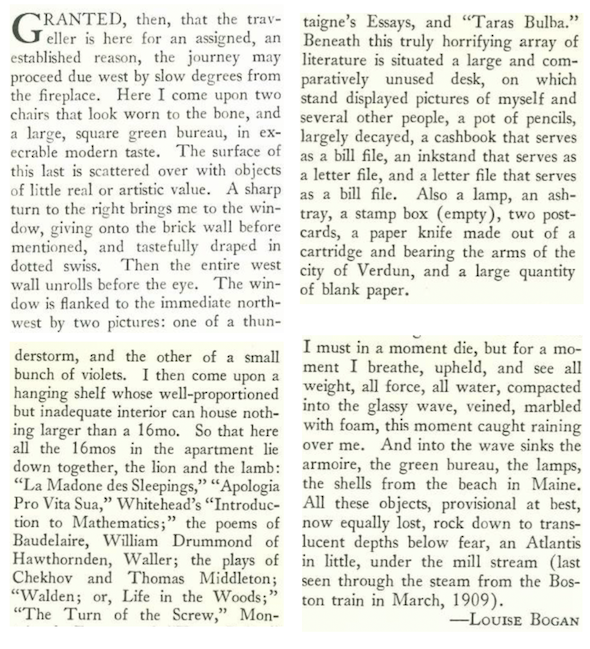
Louise Bogan (1897–1970) was poetry editor at The New Yorker for nearly forty years (1931–1970) and in 1945 was the first woman to be appointed Poet Laureate to the Library of Congress. For the Jan. 14 issue she wrote “Journey Around My Room,” which begins with her recollection of a childhood train ride. Here are some excerpts:
POET LAUREATE…Louise Bogan in 1937. She was poetry editor at The New Yorker for nearly forty years and was named U.S. Poet Laureate in 1945. (Library of Congress)
* * *
Silent Cal Silenced
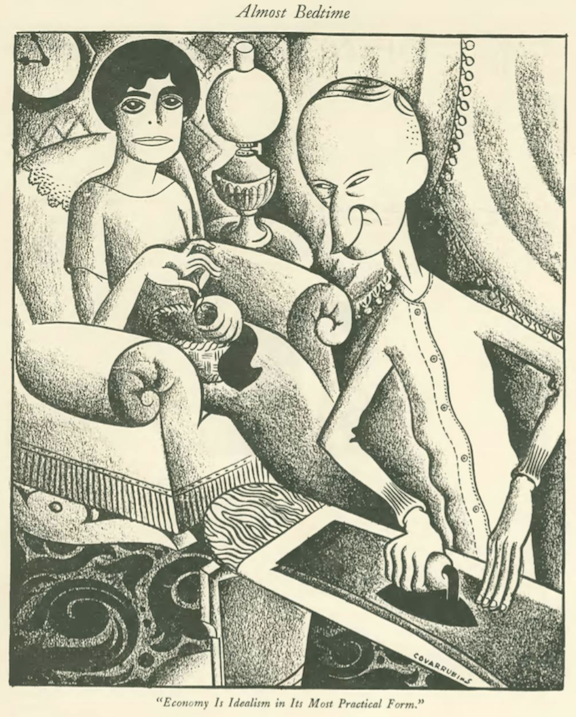
Many folks were surprised by the sudden passing of former U.S. President Calvin Coolidge. He was just sixty years old when he succumbed to coronary thrombosis at his Northampton home, “The Beeches.” During The New Yorker’s first years Coolidge was the butt of many jokes…beginning with this Miguel Covarrubias cartoon in the magazine’s fourth issue (March 14, 1925)…
E.B. White offered this eulogy of sorts…
THRIFTY IDYLL…Calvin and Grace Coolidge outside their newly acquired home, “The Beeches,” Northampton, summer 1930. (Leslie Jones Collection)
…and mused about the state of politics in 1933, proving that some things never change…
Last time we learned Lewis Mumford’s views about the new artwork displayed in the RKO Roxy Theatre and in Radio City Music Hall. In the Jan. 14 issue he turned his attentions to the actual buildings, giving them an average grade and preferring the Music Hall over the Roxy (he disliked the oversized chandelier/electrolier). Mumford was decidedly not a fan of the Rockefeller Center development, evident in his closing lines:
SHOWPLACES…Lewis Mumford gave Radio City Music Hall (top) and the RKO Roxy some muted nods, but found the Roxy’s electrolier distracting.
* * *
Parting Thoughts
Alexander Woollcott shared some final recollections of his visit to Moscow, in which he likens the Russians’ freedom under Josef Stalin to the freedom of a spirited schoolboy who desires to sit in the back of the classroom…
* * *
From Our Advertisers
Bonwit Teller employed some modern typesetting, wryly using the word DULL — offset in large san-serif letters — to draw attention to their “Chardonize” fabric, which was essentially artificial silk…
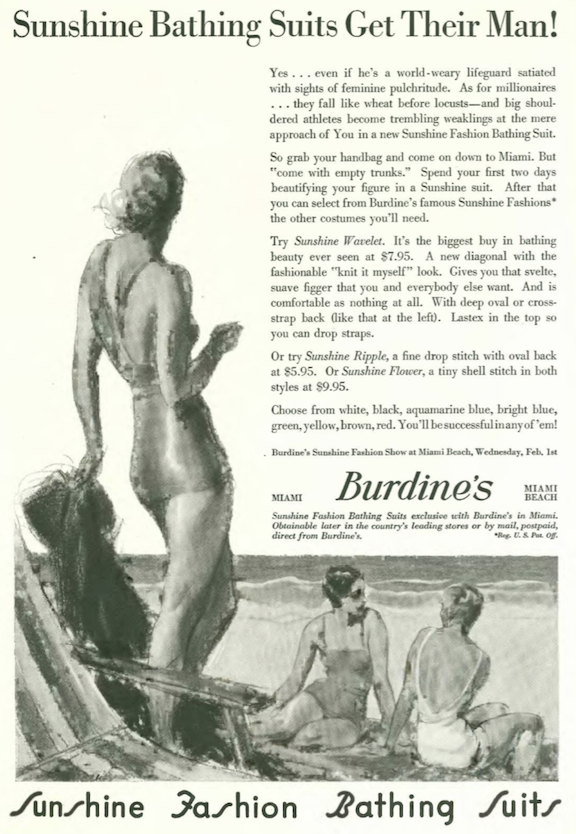
…nothing subtle about this next advertisement…don one of these bathing suits and millionaires will bow before you, or rather, to borrow this ad’s odd metaphor, “fall like wheat before locusts”…
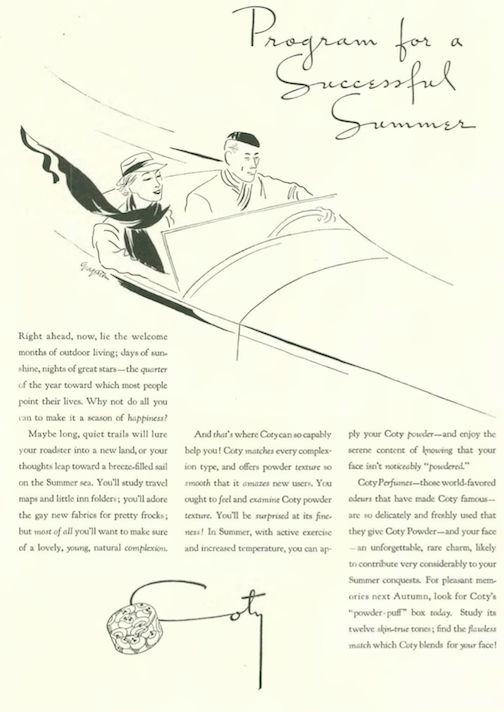
…we get a similar but far more muted pitch from Coty…so does this mean one out of every six desirable bachelors want to be seen with her? Not exactly knocking them down like locusts…
…now here’s a couple of self-assured souls who are neither troubled by hungry locusts nor face powders…they own a Cadillac, and wow, that is really quite the automobile, not like the Caddies you see today that are half-plastic and blend in with the rest of the shapeless blobs we call cars these days…
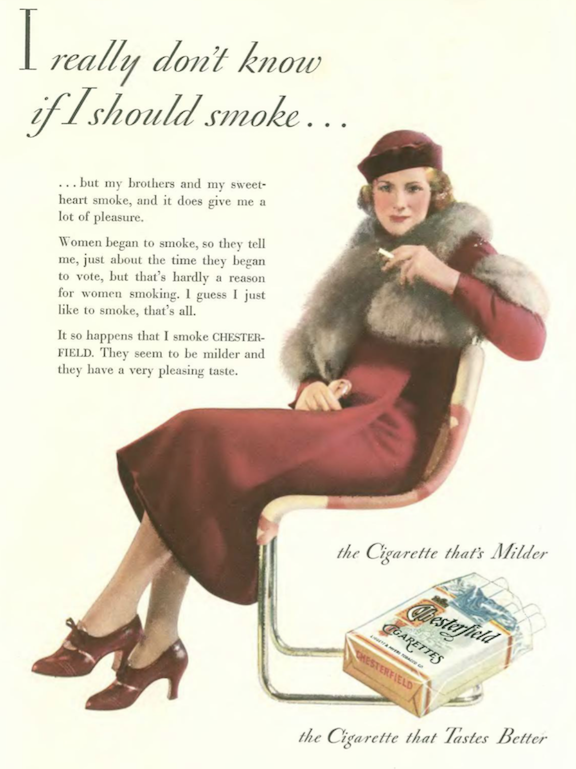
…the folks who pushed Chesterfield cigarettes were back with another ad aimed at their fastest growing demographic…note the sly reference to women’s suffrage…but that’s not why this woman (seated on a modern Breuer chair) smokes; she smokes because it gives her pleasure, and come to think of it, why should men have all the fun?…
…the Cunard Line suggested that you might run into some big-time celebrities on one of their ships, including actress Norma Shearer and banker/arts patron Otto Kahn (bottom of left-land page); or on the opposite page Charlie Chaplin, Douglas Fairbanks and Mary Pickford, Alfred Lunt and Lynn Fontanne among others…
…by contrast, the French Line employed the artistry of James Thurber to entice travelers onto the high seas…
…which gives us a nice segue into our cartoons, beginning with this spot by Thurber referencing the National Auto Show…
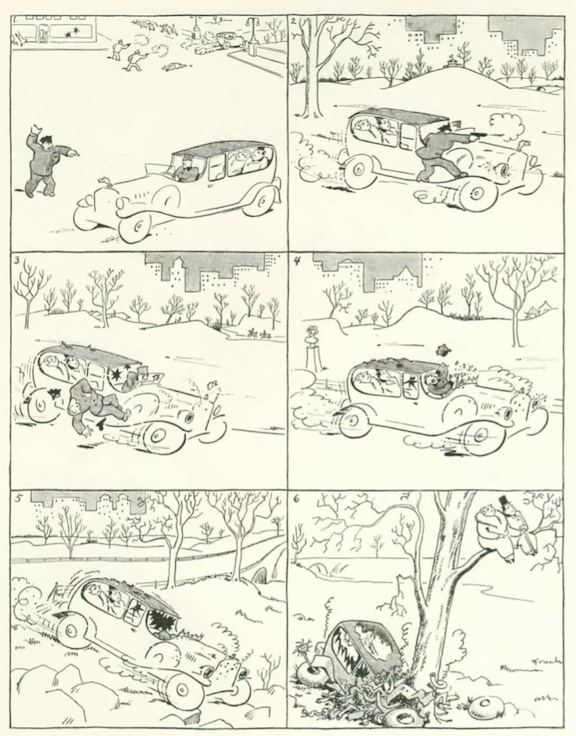
…Al Frueh offered up another of his famed sequential works…
…Gardner Rea with his usual perspective on the absurd…
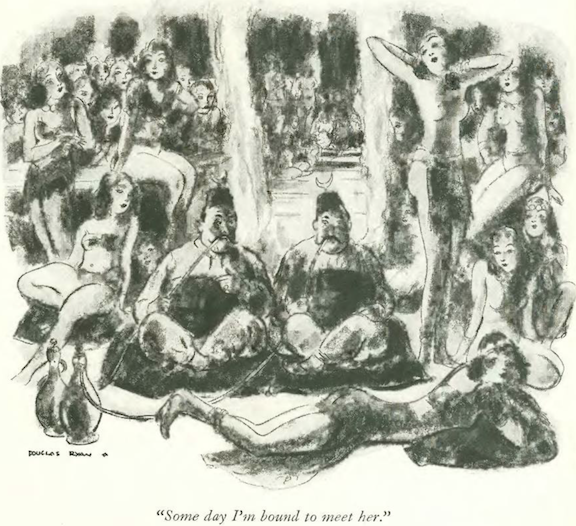
…Douglas Ryan plied the familiar waters of the harem trope…
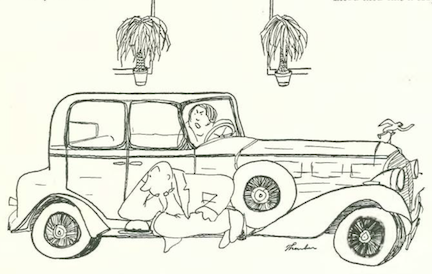
…and Robert Day showed us that even the smallest consolation can still satisfy…
Above: “The Fountain of Youth” mural by Ezra Winter in the Main Foyer of Radio City Music Hall. (Architectural Digest)
The opening of two new theaters at Rockefeller Center no doubt brightened a few souls at the start of 1933, but art and architecture critic Lewis Mumford wasn’t particularly dazzled by the “watered-down” modernism of the buildings’ much-ballyhooed decor.
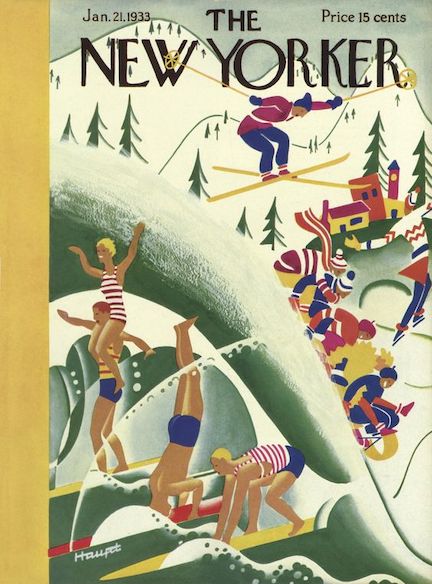
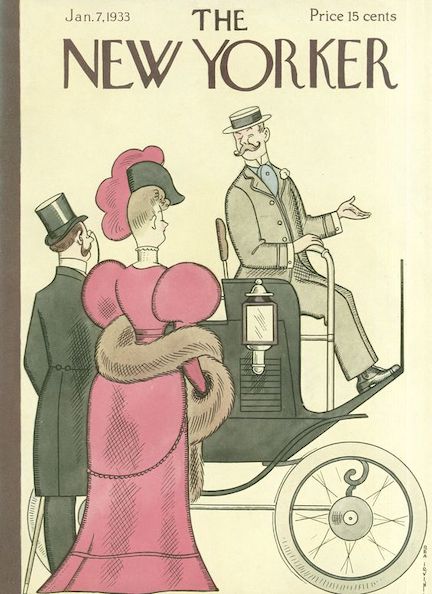
Jan. 7, 1933 cover by Rea Irvin, in a nod to the annual automobile show in New York City.
Oddly, it was a philosophy professor from the University of Nebraska, Hartley Burr Alexander, who was tasked with creating an artistic vision for Rockefeller Center, developed along the theme of “Frontiers of Time.” According to Mumford, Alexander’s “classic-banal” vision, executed under the “virtuous glare” of theatrical impresario Samuel L. “Roxy” Rothafel, resulted in the first “large-scale vulgar tryout of modern art.” Excerpts from Mumford’s column:
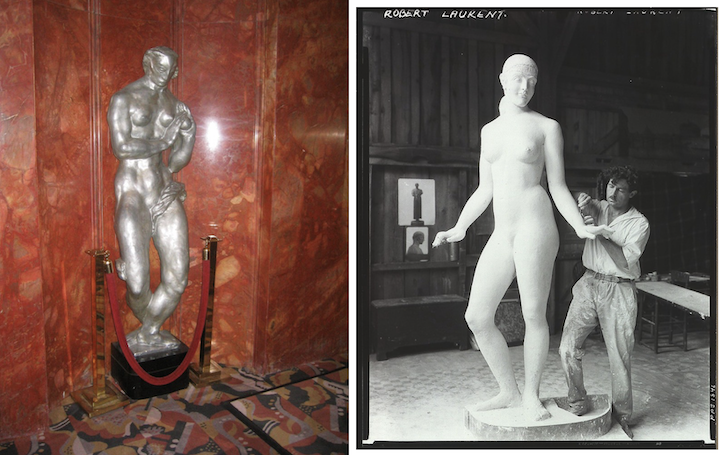
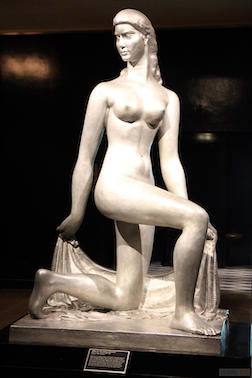
Several aluminum sculptures in Radio City Music Hall no doubt pleased Mumford—Gwen Lux’sEve sculpture, William Zorach’s Spirit of the Dance, and Robert Laurent’sGoose Girl. However, thanks to Roxy Rothafel’s “virtuous glare” and worries that the nudes might hurt ticket sales, all three sculptures were temporarily banned from RCMH.
NAKED AND AFRAID…A flare-up of puritanism led to the temporary removal of aluminum sculptures at Radio City Music Hall. At left, Eve by Gwen Lux; Robert Laurent (right) working on Goose Girl in his studio. Below, William Zorach’s Spirit of the Dance. (Smithsonian/viewingnyc.com)
Radio City Music Hall also featured an array of murals that should have brought some delight to Mumford…
SHOW BEFORE THE SHOW…Radio City Music Hall featured a number of murals including, clockwise from top left, a detail of Donald Deskey’sThe History of Nicotine (The Life of Saint Nicotine) in a second floor men’s lounge; a textile piece titled The History of Theatre by Ruth Reeves, which covers the back wall of Radio City Music Hall; Stuart Davis’s mural Men without Women in the men’s lounge; Yasuo Kuniyoshi’s mural in the women’s powder room. (melwithpals.medium.com/viewingnyc.com/evergreen.com)
* * *
Mea Cuppa
“The Talk of the Town” shared this account of fifteen Harvard freshman who dared to pay a call on the home of visiting poet T.S. Eliot…
TEA-DIUM…Fifteen nervous Harvard freshman confronted this visage until one of them finally broke the ice. Photo above taken during one of T.S. Eliot’s visits to Monk’s House, the 16th century cottage of Virginia Woolf. (blogs.harvard.edu)
* * *
Country Cousins
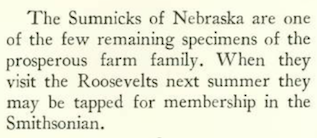
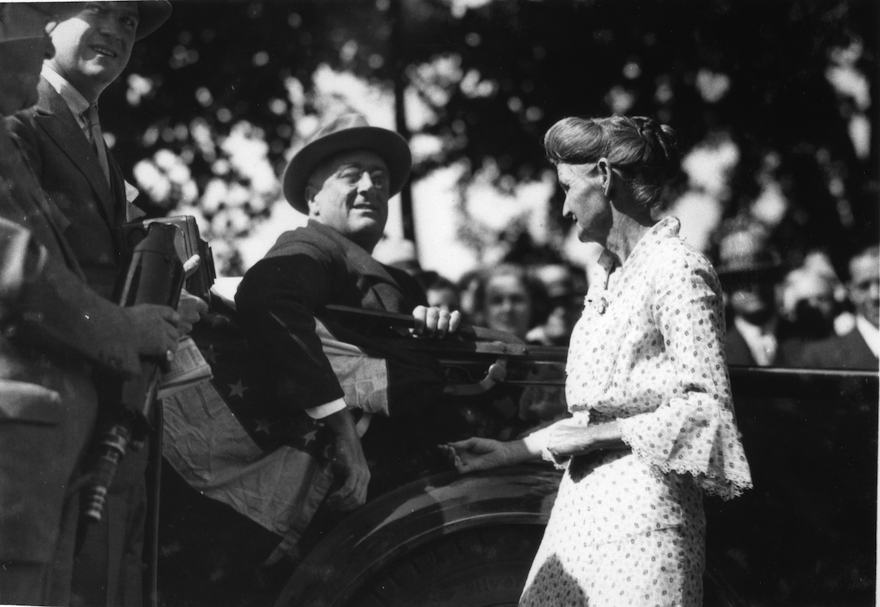
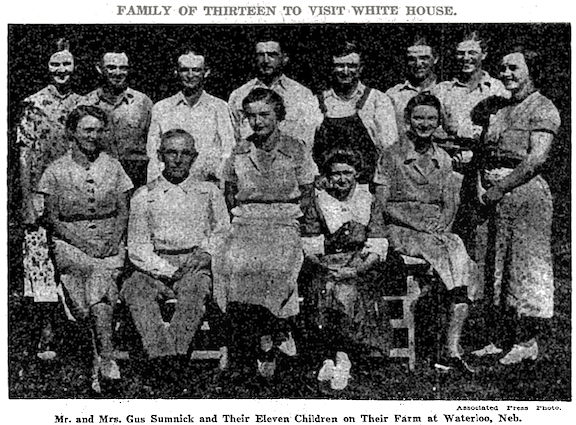
During his 1932 presidential campaign Franklin D. Roosevelt paid a Sept. 29 visit to the Waterloo, Nebraska farm of Gustav “Gus” and Mary (Kenneway) Sumnick. Mary served FDR a chicken dinner and pie before he addressed a crowd of 8,000 at a rally on the Sumnick farm. Gustav, a German immigrant, and Mary, a daughter of Irish immigrants, were successful farmers even during those tough years. The visit would turn the Sumnicks into national celebrities, and in later years FDR would return to visit the family and would also stay in touch by telephone. Howard Brubaker, in “Of All Things,” made this observation about the celebrated farm family:
TIME FOR SOME VIDDLES!…Mary Sumnick chats with presidential candidate Franklin D. Roosevelt during his Sept. 29, 1932 visit to the Sumnick farm. (douglascohistory.org)
ENOUGH FOR A FOOTBALL TEAM…A lengthy article in the Dec. 4, 1932 New York Times described life on the Sumnick farm and their upcoming visit with President Roosevelt in the spring. Gus and Mary and their 11 children all planned to make the trip. (NYT)
* * *
The Gang’s All Here
Siblings Ethel, John and Lionel Barrymore of the famed Barrymore theatrical family appeared together in just one film—Rasputin and the Empress—and you would think that would have been enough to guarantee multiple awards along with box office gold. However, the film actually lost money, and on top of that attracted a lawsuit that further dipped into the pockets of MGM producer Irving Thalberg. Critic John Mosher was wowed by Ethel’s performance, but wasn’t exactly charmed by the overall production:
ACTING ROYALTY ACTING ROYAL…Lionel Barrymore, Ethel Barrymore, and John Barrymore in Rasputin and the Empress. It is only film in which all three siblings appeared together. (parkcircus.com)
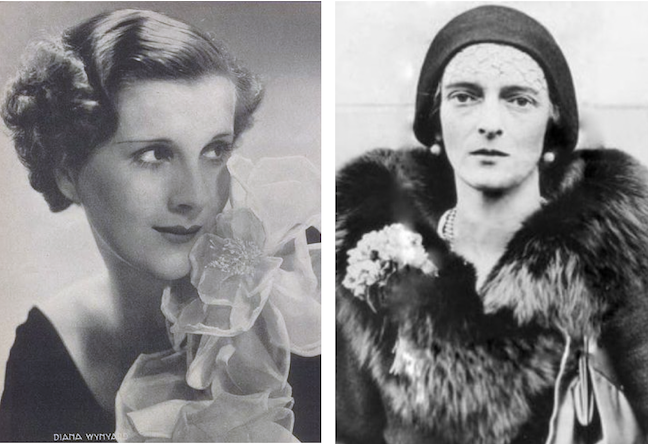
About that lawsuit: The film used the real-life Princess Irina Yusupov as a model for Princess Natasha, portrayed by English actress Diana Wynyard. The film implied that Rasputin raped Princess Natasha (that is, Irina), which wasn’t true, so she sued MGM and won $127,373 from an English court; MGM reportedly settled out of court in New York for the sum of $250,000 (roughly equivalent to nearly $5 million today). The ubiquitous “all persons fictitious” disclaimer that appears in TV and film credits is the result of that lawsuit.
NO HARD FEELINGS?…English actress Diana Wynyard (left) portrayed Princess Natasha in the Barrymore family vehicle Rasputin and the Empress. Her portrayal, however, drew the ire of a real Russian royal, Princess Irina Yusupov, who successfully sued MGM in 1933 for invasion of privacy and libel. (Wikipedia)
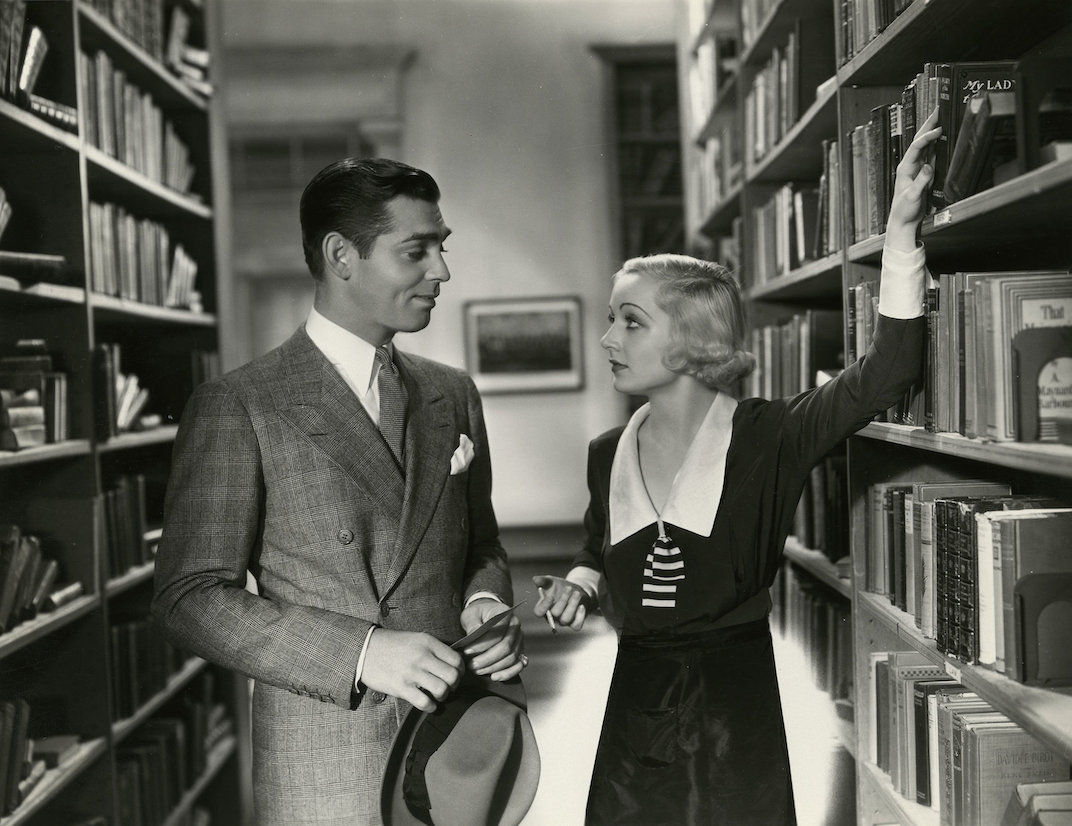
A much-less controversial film was the “glib” No Man of Her Own, a pre-Code romantic comedy-drama starring Clark Gable and Carole Lombard in their only film together:
LET’S PLAY HOUSE…Clark Gable romances Carole Lombard in the pre-Code romantic comedy-drama No Man of Her Own. It was their only film together, and several years before they became a married couple in real life. (ha.com)
* * *
Vroom-Vroom
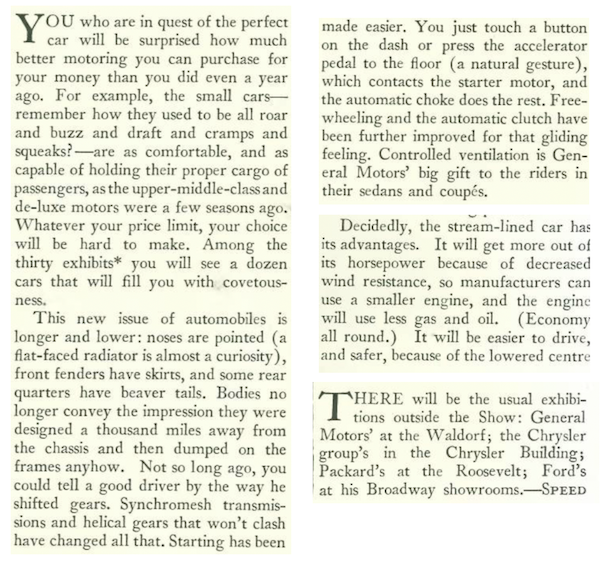
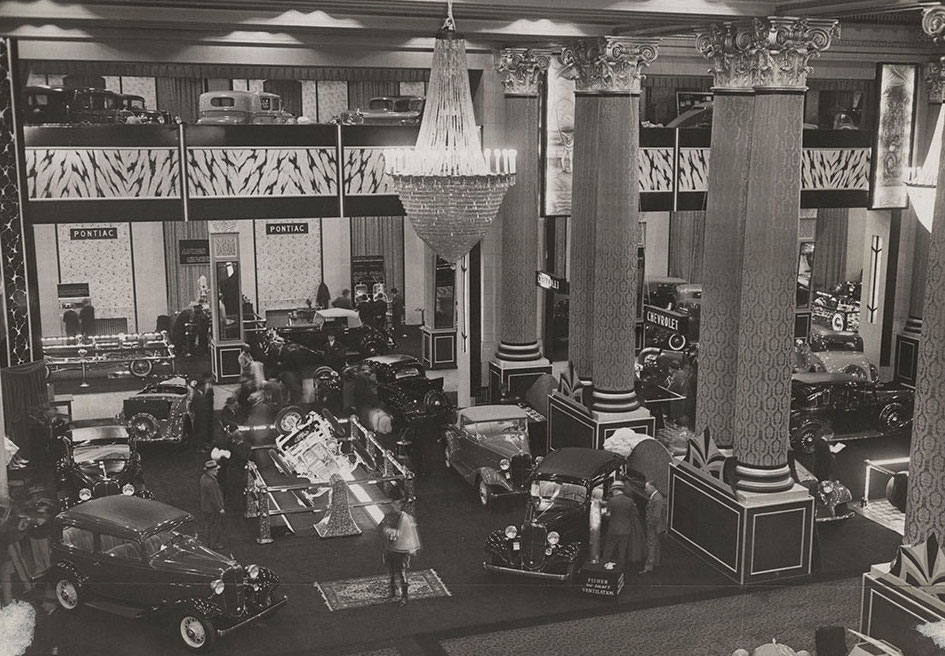
The annual National Automobile Show opened at the Grand Central Palace and other locations in Midtown, promising an array of affordable models:
DECISIONS, DECISIONS… The 1933 National Automobile Show offered a number of affordable options to car buyers including these shiny new Pontiacs on display at the Grand Central Palace. (libwww.freelibrary.org)
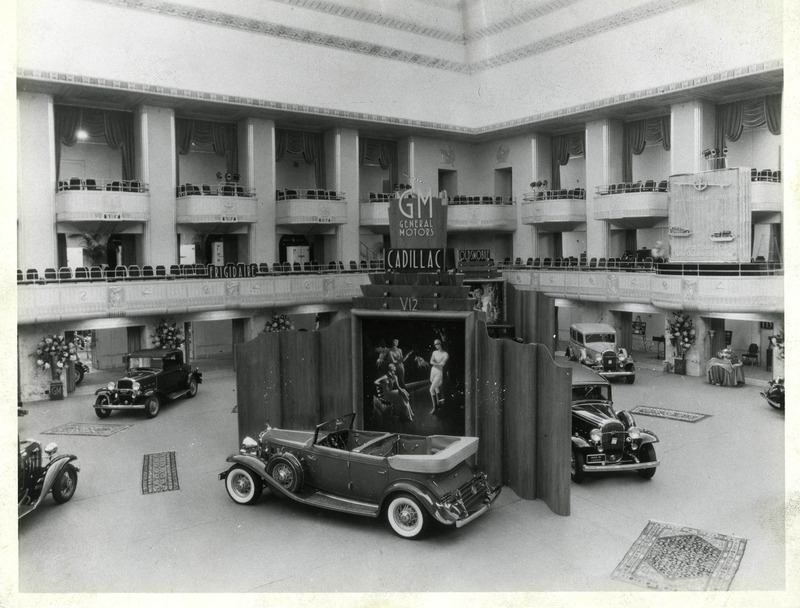
BUT LOOK OVER HERE…General Motors also displayed its models at the first “Motorama” held in the Waldorf-Astoria’s Grand Ballroom in 1933. (waldorfnewyorkcity.com)
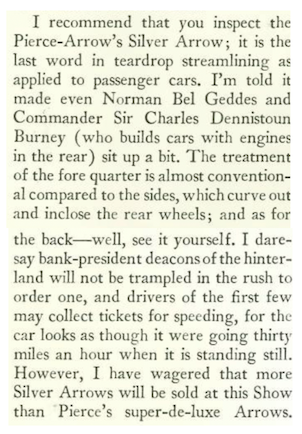
Auto Show visitors also got a glimpse of their streamlined future in the form of a 1933 Pierce-Arrow Silver Arrow…
FAST & FURIOUS…Powered by a V12 engine, the aerodynamic 1933 Pierce-Arrow Silver Arrow could exceed 100 miles per hour. Unveiled at the 1933 National Automobile Show, the car grabbed the spotlight with its futuristic, streamlined design. Just five of these were built, and only three are known to exist today. The Silver Arrow was one of Pierce-Arrow’s final attempts to appeal to its wealthy clientele, but even they were feeling Depression’s pinch. The company folded in 1938. (Sotheby’s)
* * *
From Our Advertisers
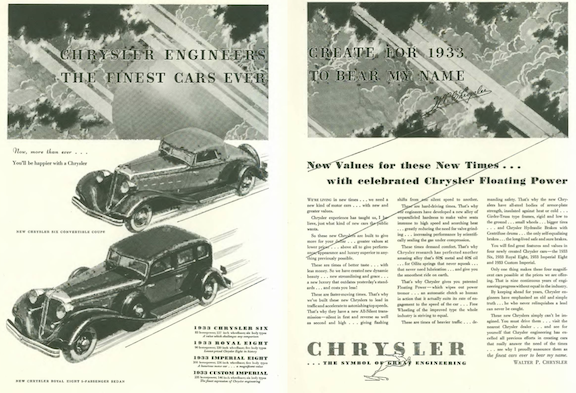
The New Yorker had unusually thin issues over the holidays, so the magazine’s bean-counters must have been thrilled by the dozens of ads that poured in ahead of the National Automobile Show. As usual Walter Chrysler took out several two-page ads to promote his Chryslers, Plymouths, Dodges and DeSotos…
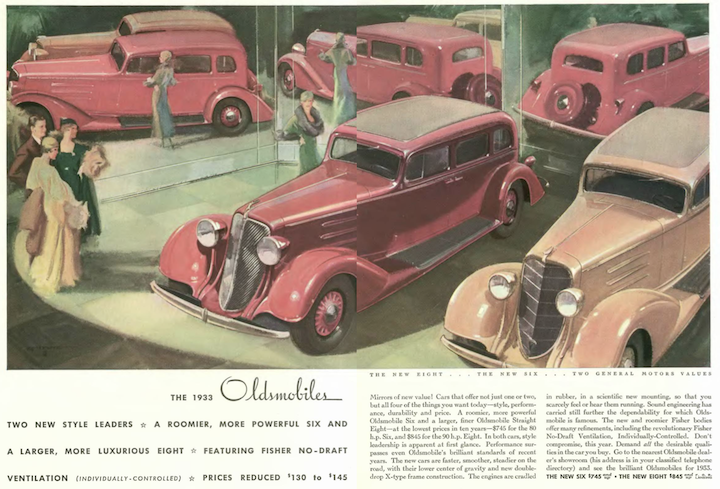
…while GM one-upped Walter with its own series of two-page ads—in color—sprinkled throughout the magazine…everything from the affordable Oldsmobile…
…to the high-end Cadillac…
…General Motors also featured this Peter Arno-themed ad (Arno-inspired wood carvings featuring the sugar-daddy walrus) to promote its posh new venue at the Waldorf-Astoria…
…the folks at struggling Hupmobile tried to wow not with shiny cars but rather with the announcement of their…drum roll, please…annual report…
…companies that supported the auto industry also got in on the act, including the makers of leaded fuel…this image says a lot about the lack of safety concerns in the 1930s…
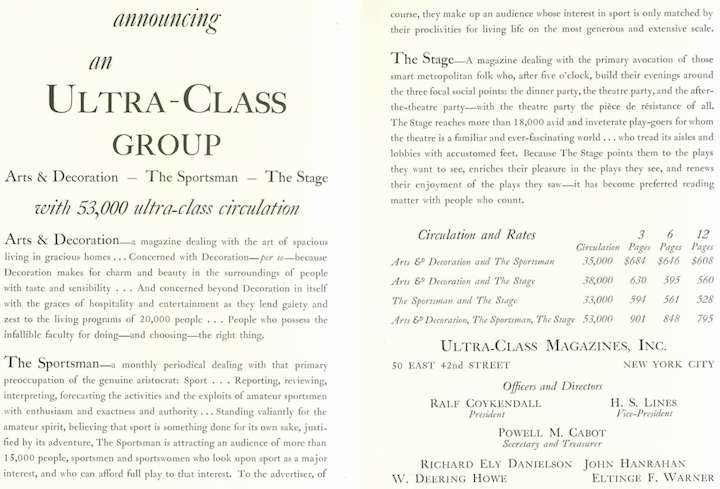
…John Hanrahan, who early on served as The New Yorker’s policy council and guided it through its lean first years, became the publisher of Stage magazine (formerly The Theatre Guild Magazine) in 1932. In 1933 Stage became part of the Ultra-Class Magazine Group’s line-up that included Arts & Decoration and The Sportsman. Stage published its last issue in 1939, and I don’t believe the other two survived the 1930s either…
ULTRA-CLASS GROUP was the over-the-top name used to describe this line-up of magazines.
…on to our cartoons, we join Peter Arno for some fine dining…
…based on the what we have seen lately from William Crawford Galbraith, he seems to be hung up on seductresses and showgirls…
…to my point, some of Galbraith’s recent entries…
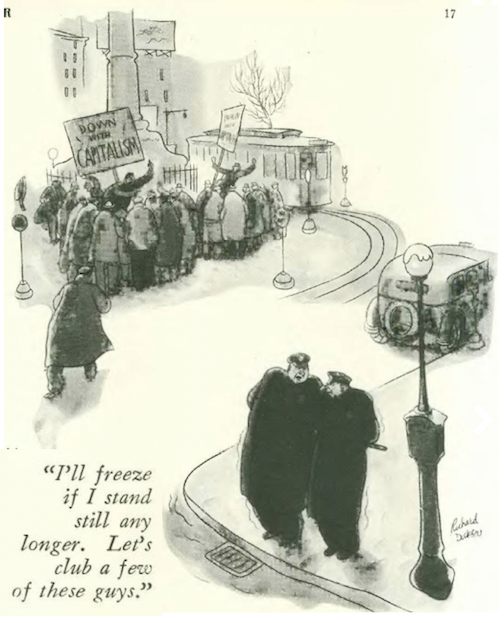
…we move on to Richard Decker and a dangerous cold front…
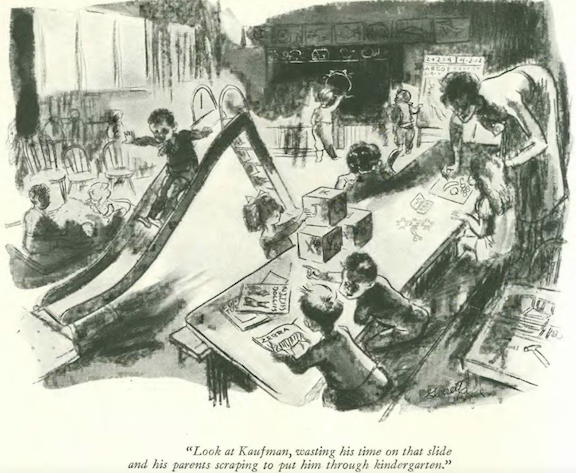
…Garrett Price pondered the wisdom of children…
…Gluyas Williams was back with the latest industrial crisis…
…Perry Barlow found some ill-fitting words to go with an ill-fitting coat…
…and we close with James Thurber, and some very fitting words for those times, and ours…
If folks thought things were bad in Depression-era America, they could ponder the famine-ravaged masses in the Soviet Union…
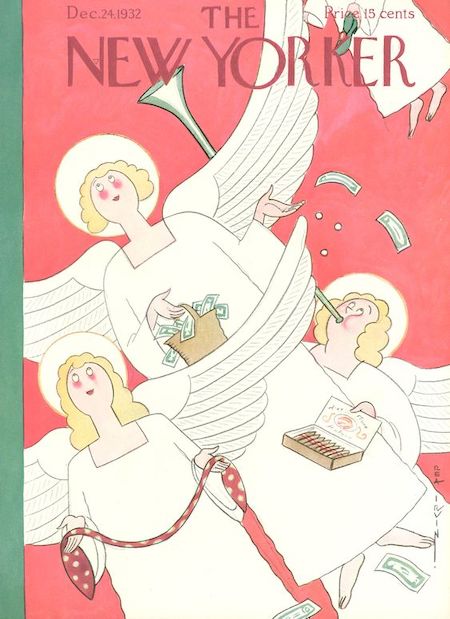
Dec. 24, 1932 cover by Rea Irvin.
…not that Alexander Woollcott seemed to notice or care all that much. In the autumn of 1932 he traveled to Moscow to check out some Russian theater and enjoy the fine food and drink provided by his friend Walter Duranty, Moscow bureau chief for The New York Times. In his “Shouts and Murmurs” column…
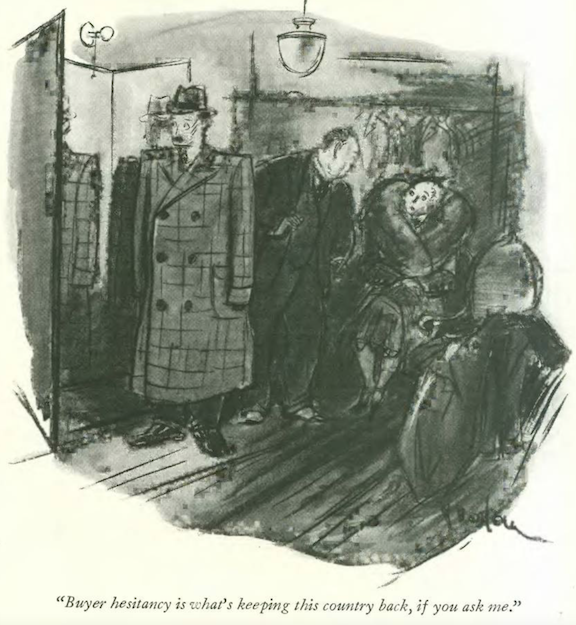
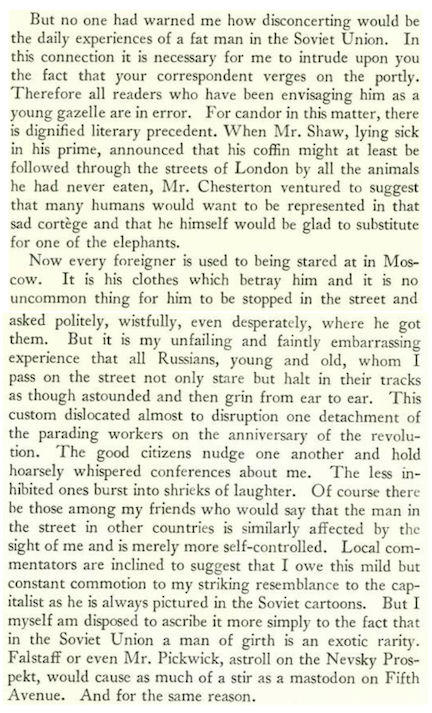
…Woollcott reflected on his Moscow visit, his humor at odds with the stark reality all around him…
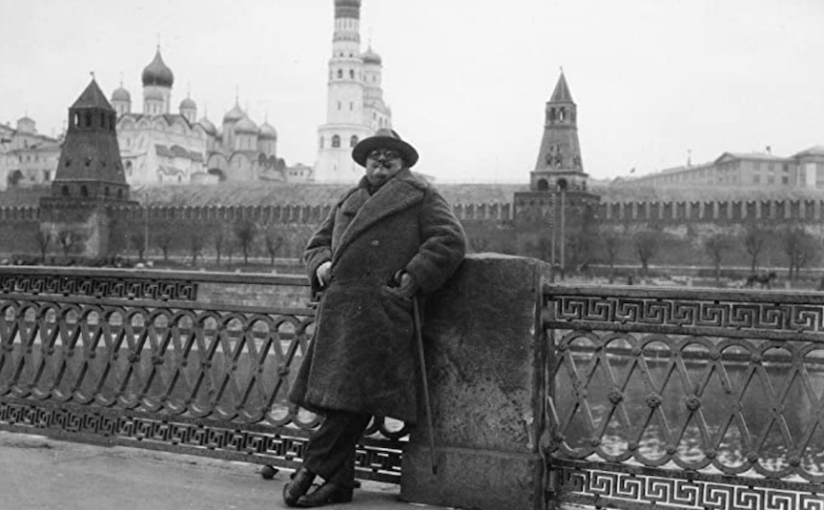
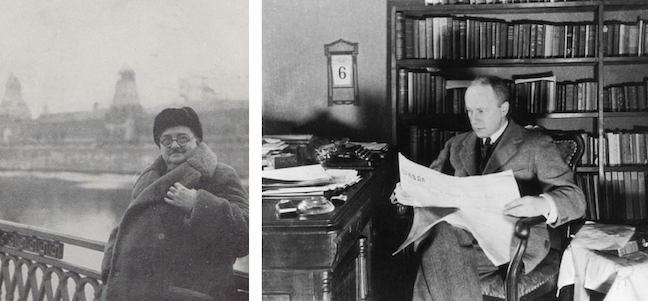
ELEPHANT IN THE ROOM…Alexander Woollcott (left) was amused by the stares of starving Russians he encountered with his substantial bulk on the streets on Moscow; Walter Duranty (1884–1957), Moscow bureau chief for The New York Times, played host to his old friend Woollcott. (Pinterest/Daily Mail)
Woollcott wrote of “spindle-shanked kids” singing cheerless songs about tractor production, recounted a conversation with a hungry moppet at a boot factory, and noted the “appreciative grin” he received from a teenager who both envied and admired his girth:
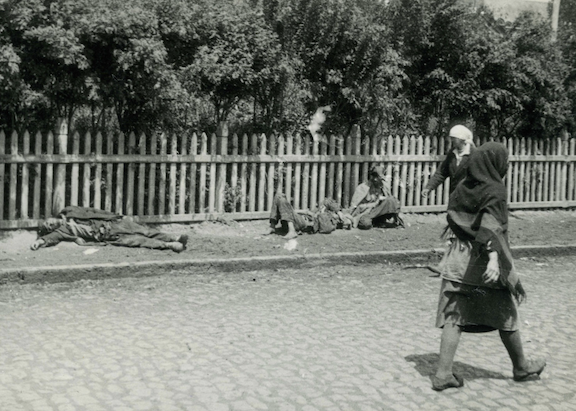
PERHAPS A SIDE TRIP TO UKRAINE?…Starved peasants on a street inKharkiv, 1933. Millions of Ukrainians died during Stalin’s enforced famine. (Wikipedia)
* * *
Happier Thoughts
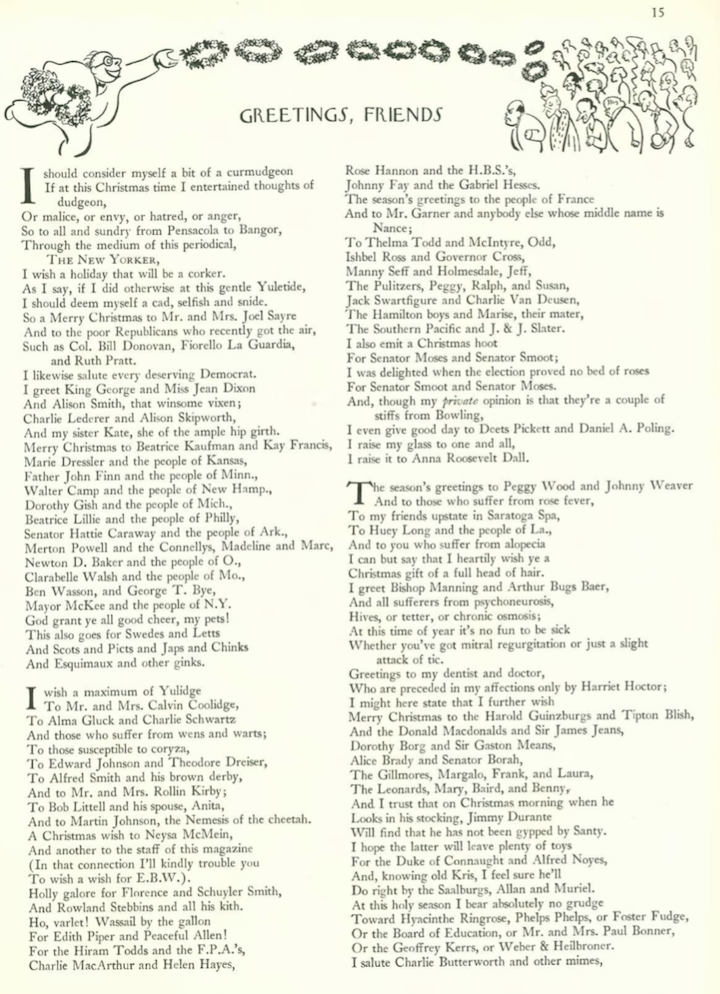
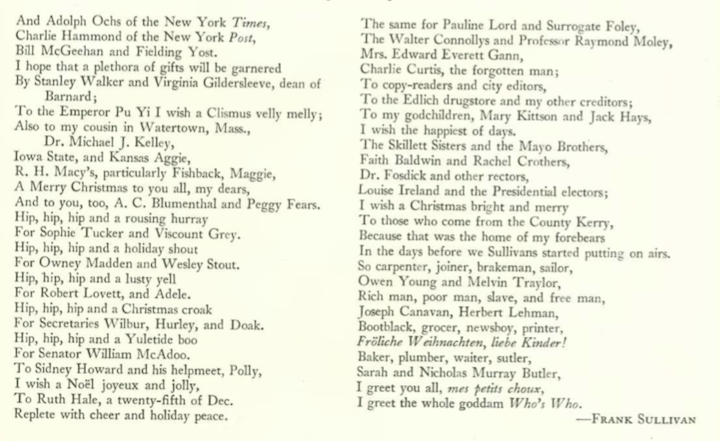
The Dec. 24 issue marked the beginning of a New Yorker tradition: Frank Sullivan’s annual holiday poem, “Greetings, Friends!” Writing for the Dec. 17, 2009 issue of The New Yorker (“Behind the Writing: “Greetings, Friends!”) Jenna Krajeski observes that “as far as holiday poems go, ‘Greetings, Friends!’…is as much an acknowledgment of the season as a noting of the times.” Frank Sullivan faithfully continued the tradition until 1974; after his death in 1976, New Yorker editor William Shawn asked Roger Angell to take over the writing of the poem. In 2012 Angell passed the duty along to Ian Frazier, the magazine’s current Yuletide bard.
CHEERFUL BUNCH…The holiday poem “Greetings, Friends!” has been a New Yorker tradition since 1932. It was originated by Frank Sullivan (left) and carried on by Roger Angell (center) and Ian Frazier. (hillcountryobserver.com/latimes.com/gf.org)
* * *
Waxing Poetic, Part II
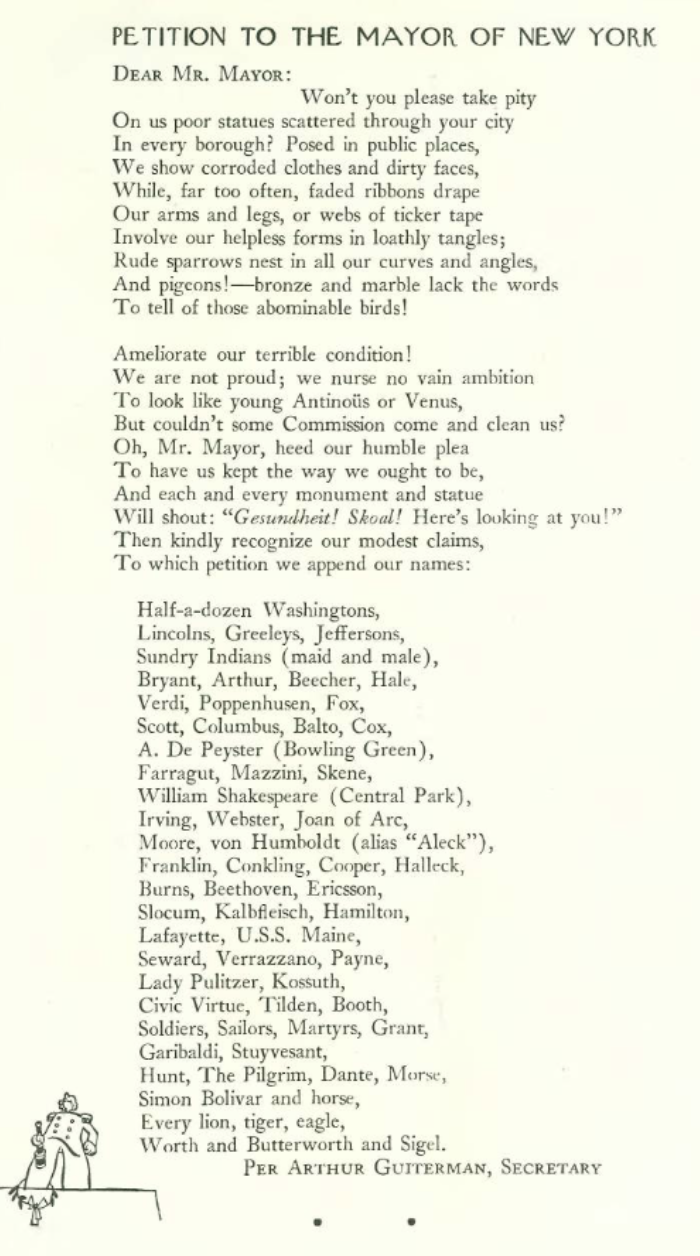
In the Dec. 17, 1932 issue humorist and poet Arthur Guiterman penned this petition to Acting Mayor Joseph McKee on behalf of the city’s statues…
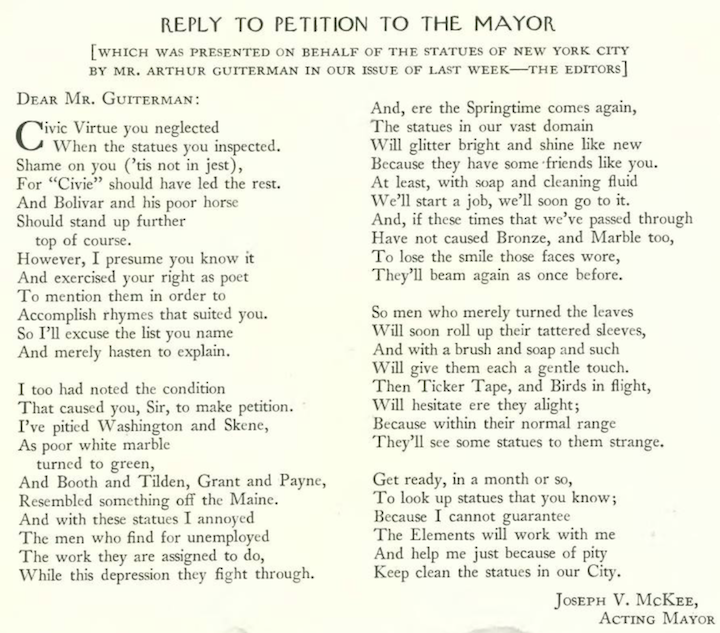
…to which Mayor McKee replied in the Dec. 24 issue:
DUELING POETS…Acting New York Mayor Joseph McKee (left) rarely smiled in photographs, but he seems to have been a person of good humor in his poetic reply to Arthur Guiterman. Both photos are from 1932. (Wikipedia/credo.library.umass.edu)
* * *
From Our Advertisers
New York’s fashion merchandisers continued to tout their latest copies of Paris styles such as this “Poppy Dress” from Lord & Taylor (illustration by Mildred “Melisse” Oppenheim)…
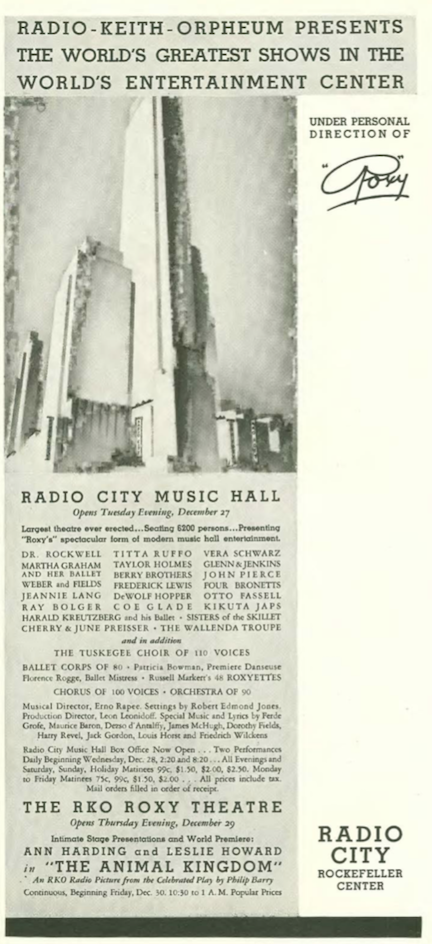
…Radio City Music Hall and the RKO Roxy Theatre announced their grand openings…
…Radio City featuring a cavalcade of stars along with the “Roxyettes” (soon to be renamed “Rockettes”) while the RKO Roxy presented the pre-Code romantic comedy The Animal Kingdom…
LIGHT IN THE DARKNESS…It was winter, and the Depression was still on, but there were bright spots to be found on the stage at the opening of Radio City Music Hall and on the screen at the RKO Roxy; at right, Ann Harding, Leslie Howard and Myrna Loy in The Animal Kingdom. (Pinterest/IMDB)
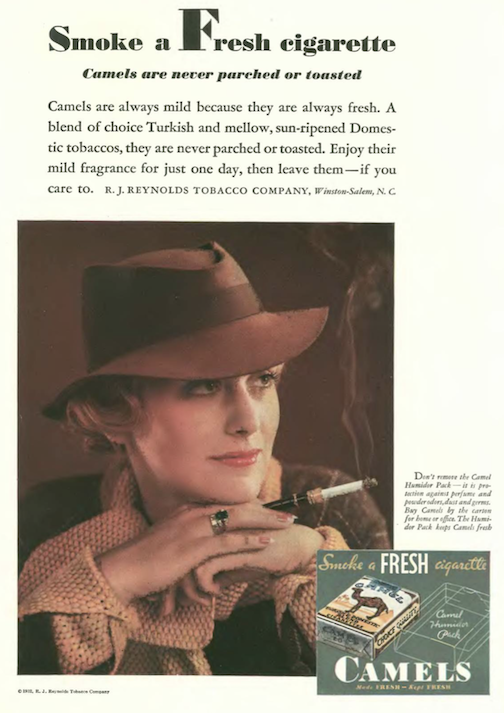
…the folks at R.J. Reynolds challenged smokers to “leave” their product, if they cared to, knowing full well they were hooking new smokers by the thousands every day…
…we ring in the New Year with some hijinks from James Thurber…
…and this unlikely dispatch from a New York police officer via Peter Arno…
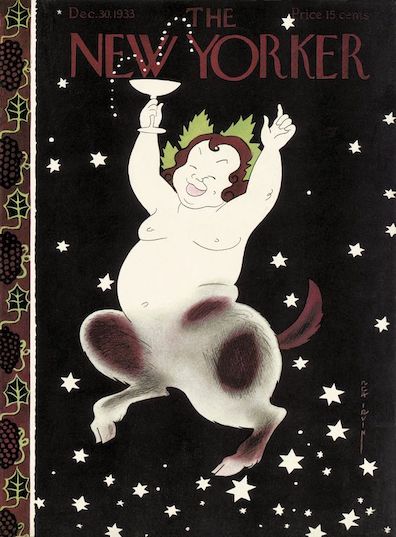
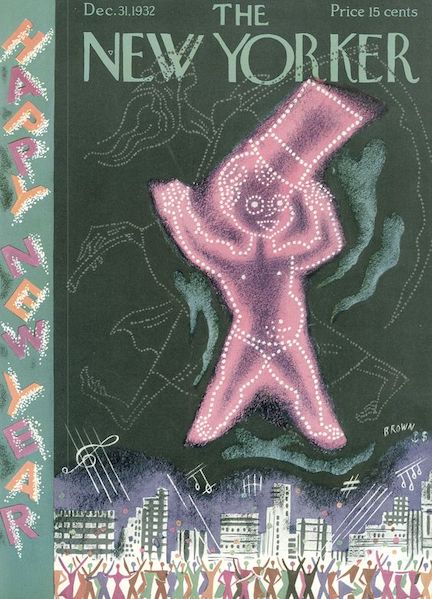
…ringing in the year with Harry Brown’s Dec. 31 cover…
Dec. 31, 1932 cover by Harry Brown.
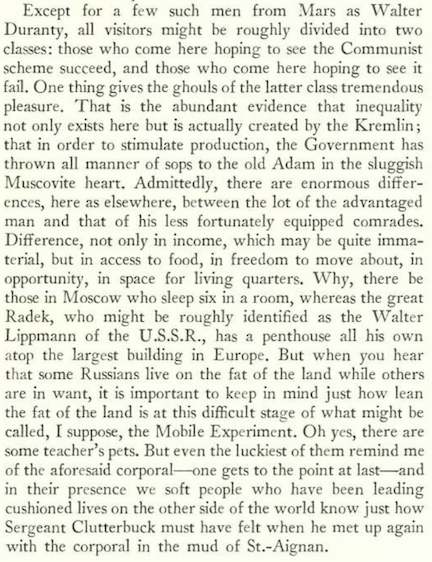
…and Alexander Woollcott’s continuing account of his visit to Moscow, where he was shown the town by his friend Walter Duranty. In this excerpt, Woollcott makes a rare political observation regarding his friend: “Except for a few such men from Mars as Walter Duranty, all visitors might be roughly divided into two classes: those who come here hoping to see the Communist scheme succeed, and those who come here hoping to see it fail.”
For the record, Duranty has been widely criticized, especially since the 1950s, for his failure to report on the 1932-33 famine (which claimed as many as 7 million lives) and for covering up other atrocities of the Stalin regime. In the 1990s there were even calls to revoke Duranty’s 1932 Pulitzer Prize, which was awarded for his reporting on the Soviet Union.
GOOD & PLENTY…Walter Duranty (center, seated) at a dinner party in his Moscow apartment. (spartacus-educational.com)
* * *
Rocky Theme
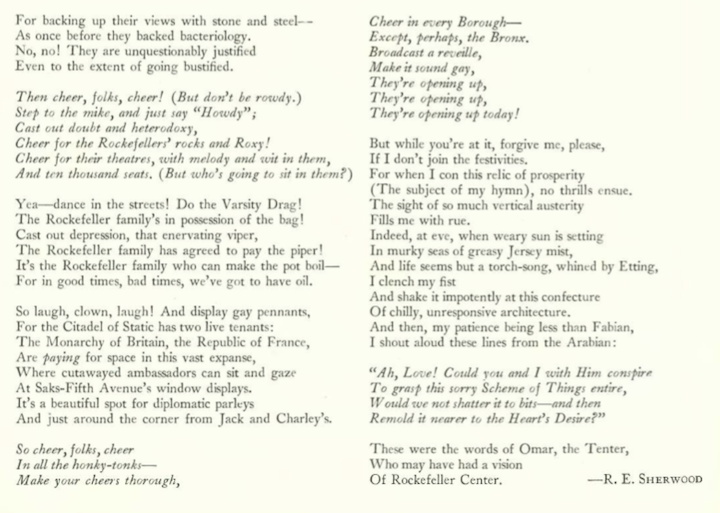
As Rockefeller Center prepared to open its doors to its first buildings (there would be fourteen in all) American playwright and screenwriter Robert E. Sherwood penned this hymn to the “Citadel of Static”…
STANDING TALL…American playwright and screenwriter Robert E. Sherwood, one of the original members of the Algonquin Round Table, was moved to verse by the opening of Rockefeller Center’s first buildings. At left, Rockefeller Center in 1933. (Wikipedia)
* * *
Oh Chute
In 1929 Geoffrey Hellman secured a position with The New Yorker as a writer for “The Talk of Town” and also contributed a number of profiles, including this one about a parachute stunt-jumper named Joe Crane. Here is the opening paragraph and an illustation by Abe Birnbaum:
On Feb. 18, 1932, Joe Crane amazed crowds at Roosevelt Field with double parachute descent, in which he opened a second parachute through the first. If you are wondering, Crane died in 1968…of natural causes. (Pinterest)
* * *
From Our Advertisers
Illustrator Howard Chandler Christy (1872-1952) is best remembered for his patriotic poster designs of World War I, which might explain why this fellow looks a bit outdated…
…Christy also originated the popular “Christy Girl,” the embodiment of the ideal American woman in the early 1900s (note the Christy Girl’s resemblance to the woman in the ad above)…
A “Christy Girl,” from 1906. (Internet Archive)
…speaking of ideal, imagine a movie featuring this trinity of actors: John, Ethel and Lionel Barrymore…John Mosher will give us his review in Jan. 7 issue…
…the Lyric Theatre saw its glory years during the 1920s when it hosted stage shows featuring such talents as The Marx Brothers,Fred and Adele Astaire and a young Cole Porter, who hit it big in 1929 with Fifty Million Frenchmen…the 1930s, however, saw the Lyric’s fortunes diminish and in another year it would be converted into a movie house…also note the influence of Italian Futurists in this ad for an Italian theater troupe…
…and there’s also a futuristic bent to this Garrett Price cartoon, which steers more in a Kandinsky direction…
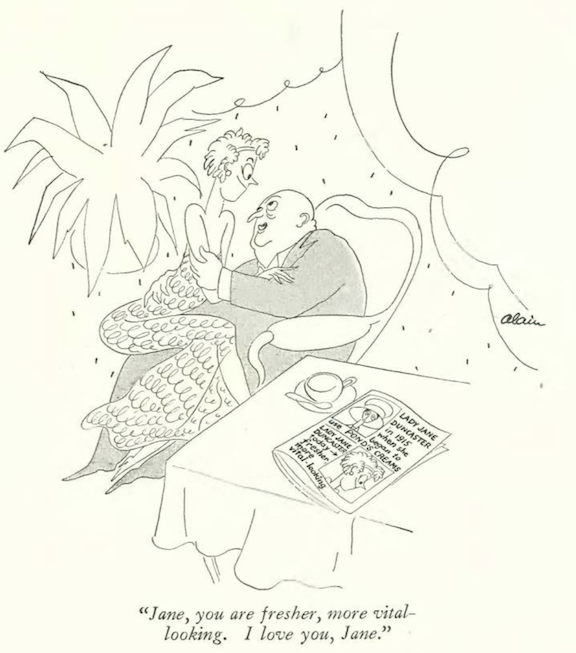
…cartoonists were also finding inspiration in the magazine’s advertising, Pond’s cold cream providing the spark for Alain (aka Daniel Brustlein)…
…for reference, a Pond’s ad from 1933 comparing Lady Diana Manners complexion to her former visage, circa 1924…
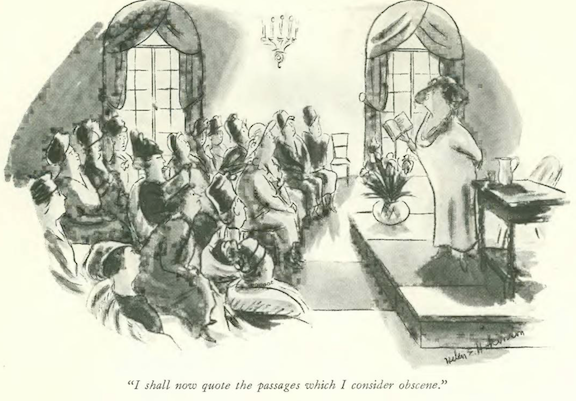
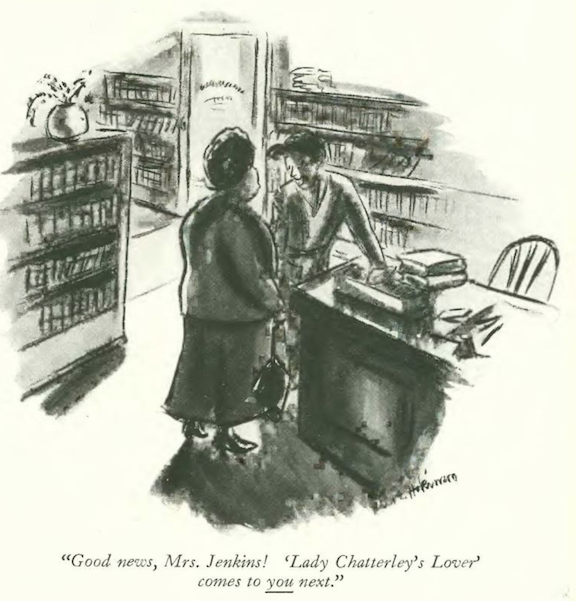
…Lady Chatterley’s Lover, by D. H. Lawrence, was banned for obscenity in the United States in 1929, but Helen Hokinson’s enterprising librarian was still able to deliver the goods…
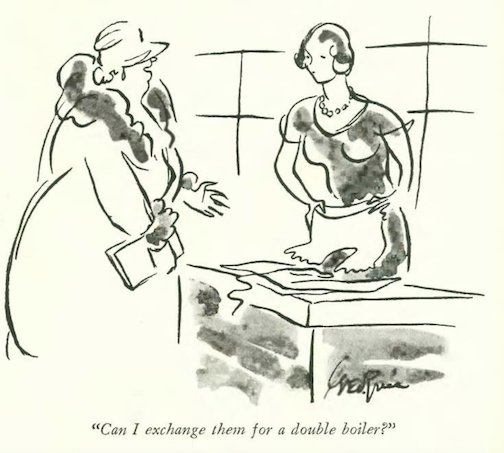
…on the other hand, it is doubtful George Price’s sales clerk will also deliver…
…a great one by James Thurber, with more detail than his usual spare line…
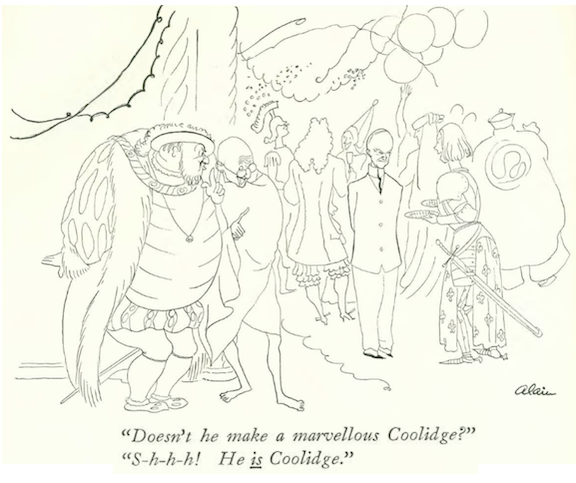
…and we say goodbye to 1932 with Alain, and a New Year’s Eve party with some familiar faces…