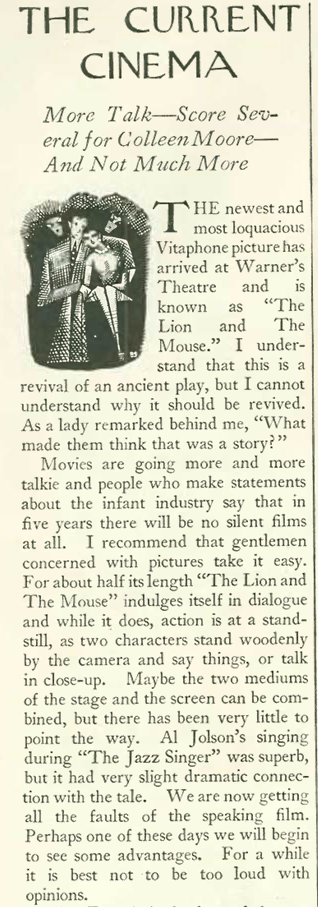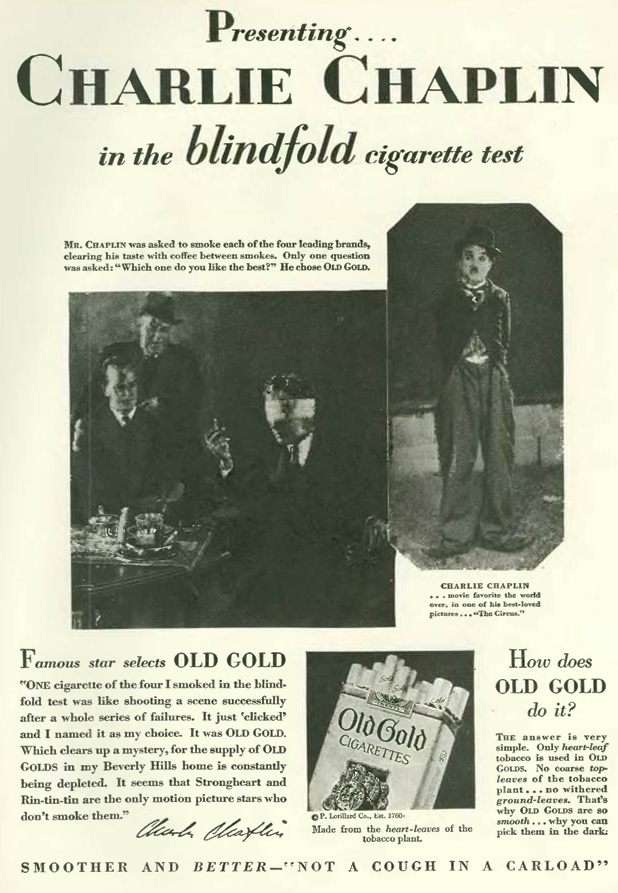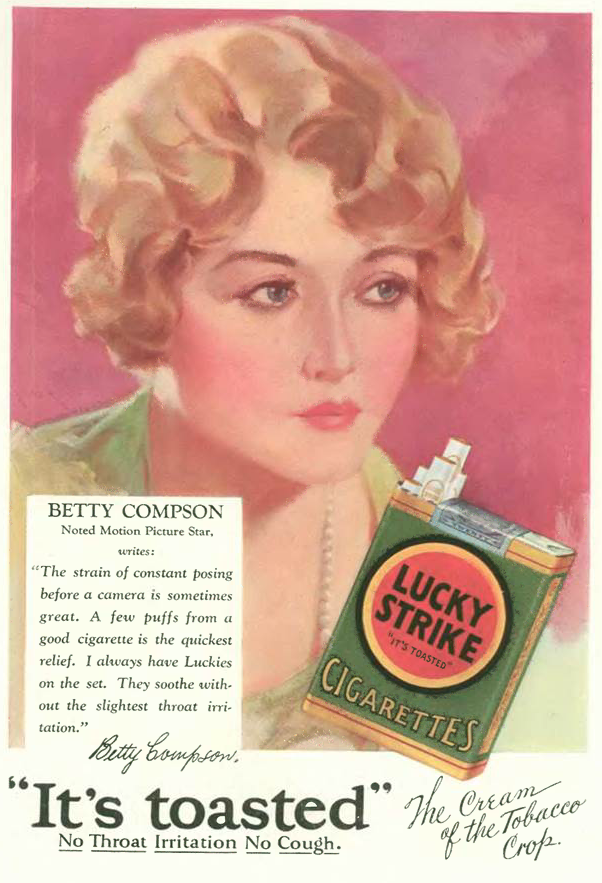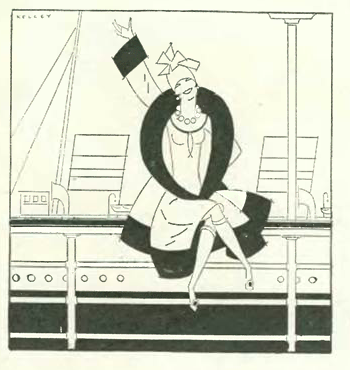
The Perfect Gift for 1927

We close out 1927 by looking at the final December issues, which grew fat with Christmas advertising catering to the tastes of New York’s smart set.

dec-10
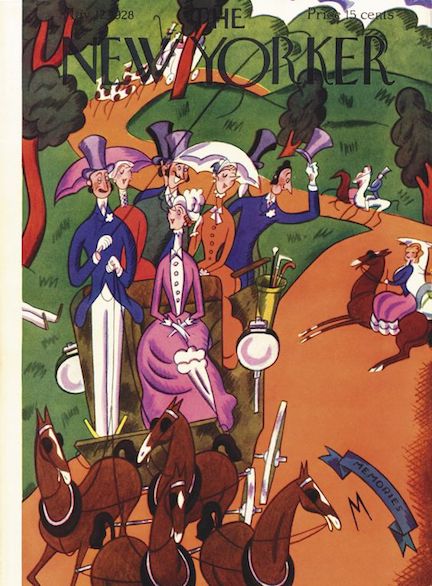
December 10, 1927 cover by Gardner Rea.

Before we jump to the ads, let’s look in on Lois Long, who in the Dec. 10 issue continued her lamentations regarding the quality of New York’s Prohibition-era night life and reminded readers that her job was far from a “soft snap”…

screen-shot-2017-02-06-at-10-03-06-am

The problem, as diagnosed by Long, was that there were not enough talented entertainers to fill the needs of an overabundance of nightclubs…

screen-shot-2017-02-06-at-10-04-09-am

vit-94-bobbe-arnst1
LOIS THOUGHT BOBBIE ARNST WAS PRETTY SWELL when she appeared at Helen Morgan’s nightclub. A noted broadway singer and dancer, Arnst is pictured above in a publicity photo from the 1929 film Rhythms in Blue. (picking.com)
screen-shot-2017-02-07-at-12-33-26-pm
ON THE OTHER HAND…Evelyn Nesbit’s tearoom (and later speakeasy) couldn’t survive on notoriety alone. In the early 20th century Nesbit’s face was everywhere—from advertisements to calendars—but in 1906 her fame took a nasty turn when her jealous husband, Harry Thaw, shot and killed suspected lover and famed architect Stanford White at Madison Square Garden’s rooftop theatre. At left, Nesbit in 1900. At right, Nesbit in her tea room on West 52nd Street, near Broadway, circa 1922. (Library of Congress / restaurant-ingthroughhistory.com)

Long also railed against the white appropriation of Harlem entertainment, which she felt was draining the place of its soulfulness. In particular she called out writer and photographer Carl Van Vechten, who among white writers was the most prominent in intellectualizing the “Harlem Renaissance”…

screen-shot-2017-02-06-at-11-43-27-am

What to Buy in ’27

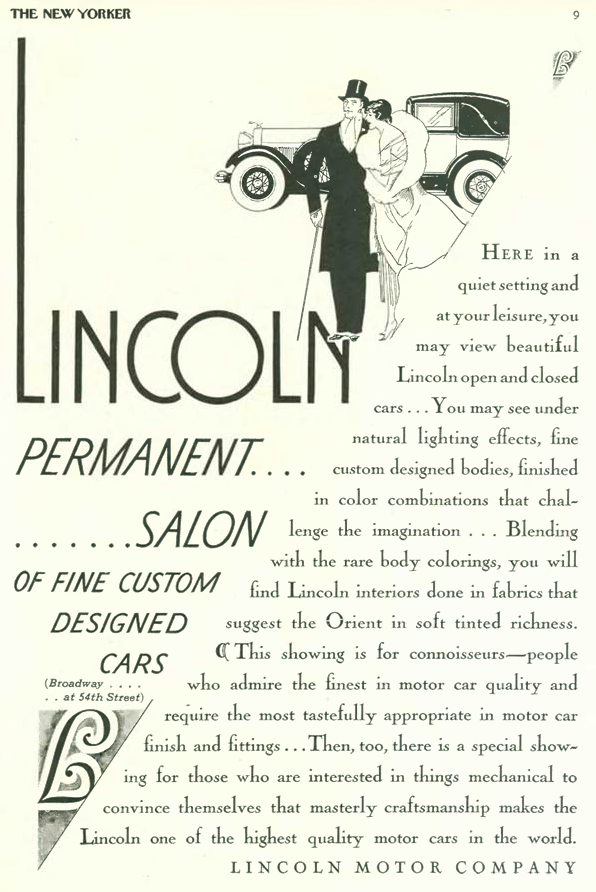
The Dec. 10 and Dec. 17 issues grew fat with holiday advertising, averaging 120+ pages as opposed to the usual 60 or so pages. The advertisements mostly appealed to upscale readers, ranging from this almost Victorian-style ad from the staid Brooks Brothers…

screen-shot-2017-02-06-at-9-46-21-am

…to this ad from Rex Cole promoting the latest in modern conveniences…

screen-shot-2017-02-06-at-9-56-44-am

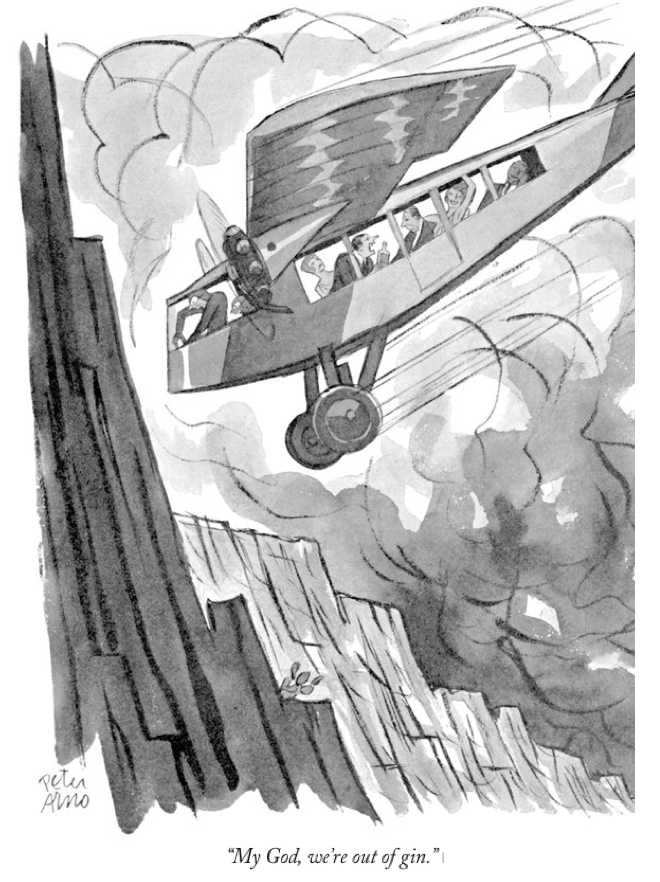
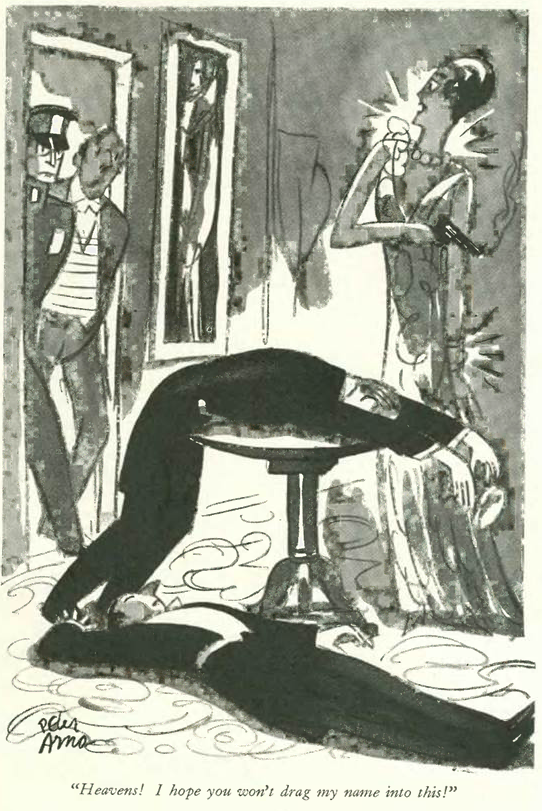
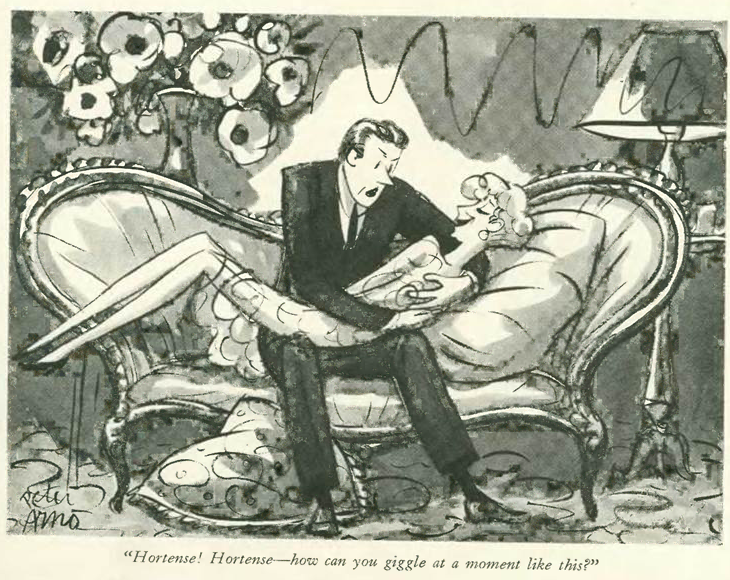
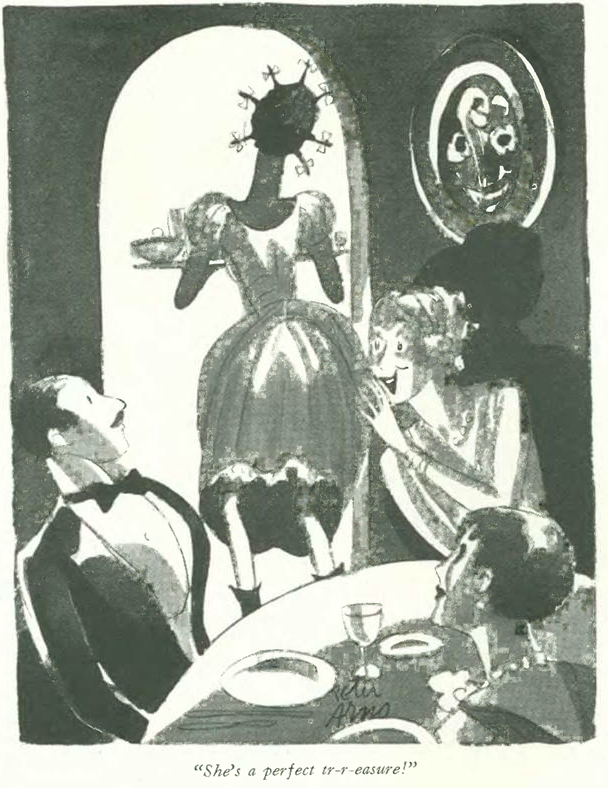
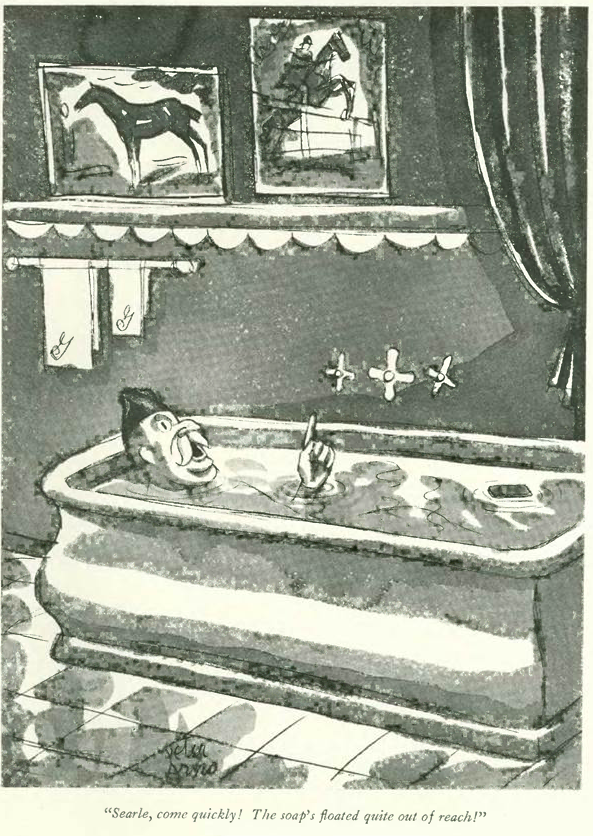
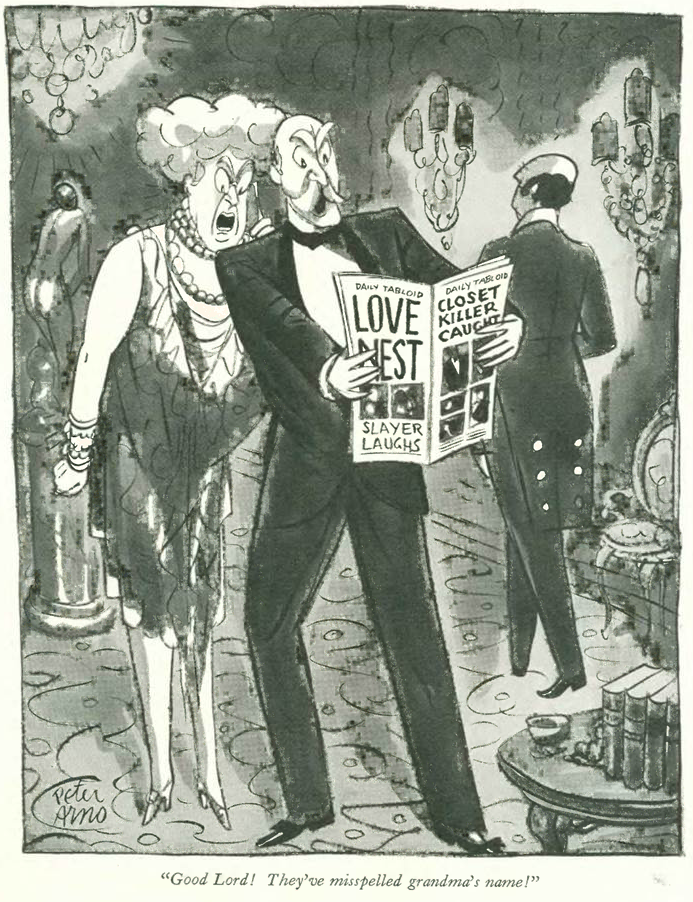
And I’ll toss in this cartoon from the Dec. 10 issue, in which Peter Arno allows us to listen in on an unlikely conversation between a couple of toffs…

screen-shot-2017-02-06-at-9-53-54-am

screen-shot-2017-02-06-at-9-54-11-am

Lois is Also Tired of the Holidays

On to the Dec. 17 issue, in which Lois Long also shared with readers her weariness of Christmas shopping in her column, “On and Off the Avenue.”

dec-17
December 17, 1927 cover by Theodore G. Haupt.

The “Parisite” Long referred to in this excerpt was actually Elizabeth Hawes, who occasionally contributed to Long’s column (with cables sent from Paris) regarding the latest in French fashions. More on Hawes another time…

screen-shot-2017-02-06-at-12-11-30-pm

As for ads in the Dec. 17 issue, we get this one from Dunhill, maker of fine English cigarettes and accessories: a woman’s compact that resembles a lighter…

screen-shot-2017-02-06-at-12-07-21-pm

…and the same issue offers this glimpse into the life a spoiled rich kid, home from college for the holidays. The cartoon is by Alan Dunn, one of the most published New Yorker cartoonists (1,906 cartoons from 1926 to 1974)…

screen-shot-2017-02-06-at-11-52-12-am

With Christmas advertising over, the magazine’s page length dropped by half from the Dec. 17 to the Dec. 24 issue…

dec-24
December 24, 1927 cover by Andre De Schaub.

…in which we find this holiday-themed illustration by Al Frueh:

screen-shot-2017-02-06-at-12-26-56-pm

Why We Sing Auld Lang Syne

This advertisement in the Dec. 24 issue invited readers to celebrate the New Year at The Roosevelt Hotel…

screen-shot-2017-02-06-at-12-27-47-pm

roosevelt-hotel-1924
The Roosevelt Hotel after its completion in 1924 (Museum of the City of New York)
1387211957-0
AULD ACQUAINTANCE…If you want to know why we sing “Auld Lang Syne” on New Year’s Eve, you can thank Guy Lombardo and his Royal Canadian Band, which made the song a staple at his New Year’s performances beginning in 1929 at the Roosevelt Hotel. Their performance that night was broadcast on the radio before midnight Eastern time on CBS, then after midnight on NBC radio. (neatorama.com)

 *  *  *

Now Let’s Get Out of Here

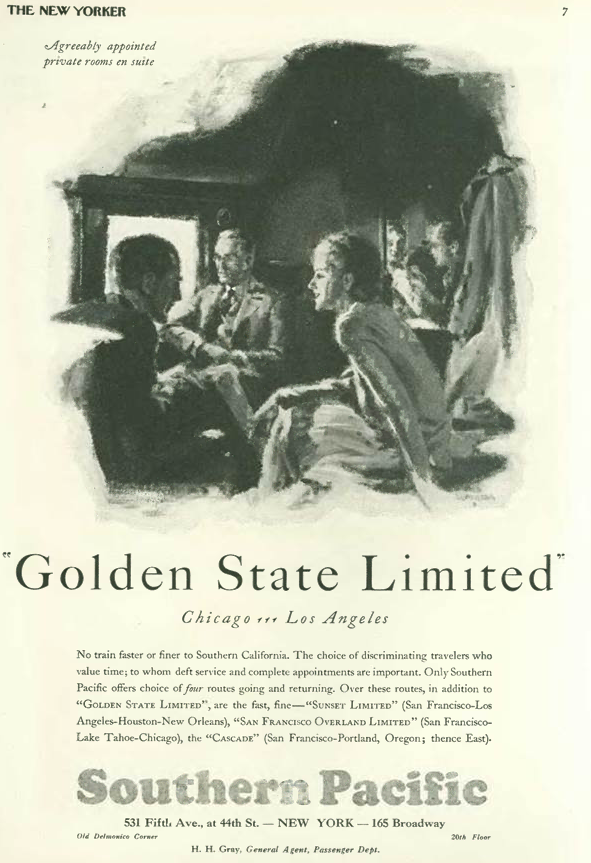
With the holidays out of the way, New Yorkers still faced a good three months of winter. That is, unless you were well-heeled enough to head south to Palm Beach. Considering the abundance of ads promoting travel to southern climes in the Dec. 24 and 31 issues, apparently many of the magazine’s readers possessed the means to do just that…

screen-shot-2017-02-06-at-12-29-05-pm

screen-shot-2017-02-06-at-12-29-15-pm

And we close this entry, and the year of 1927, with this cover…

dec-31
December 31, 1927 cover by Rea Irvin.

…and another tropical-themed advertisement, courtesy of Russeks…

screen-shot-2017-02-06-at-12-31-07-pm

…and this cartoon by Mary Petty depicting those who were left behind, still returning their Christmas gifts…

screen-shot-2017-02-06-at-12-32-39-pm

Next Time: Odious Odes…

jan-7


Death Avenue Days

Before the elevated tracks were constructed in the early 1930s in Manhattan’s west side warehouse district (home of today’s popular “High Line”), freight trains rumbled through the city–at street level–on “Death Avenue.”

8b6d47f5480e534755b5a03ab5ea97a4
November 5, 1927 cover by Constantin Alajalov.

Freight trains were introduced to the west side warehouse district in 1846, which was a bad plan from the very start. Block-long trains would run through cross streets and congested traffic, maiming and killing along the way.

11and41
ON YOUR LEFT!…Both diesel and steam locomotives rumbled along Manhattan avenues well into the 20th century. Pictured is a freight train at 11th and 41st Street. Eleventh was known as “Death Avenue.” (Forgotten NY)

According to Friends of the High Line, “an 1892 New York World article referred to the trains as ‘a monster which has menaced them night and day,’ and by 1908 the Bureau of Municipal Research claimed that since 1852, the trains had killed 436 people. A New York Times piece from the same year reported that in the preceding decade there had been almost 200 deaths, mostly of children.”

caption-1death-avenue
MIXED USE…This circa 1920 photo shows the congestion that occurred when freight trains, horse-drawn carts, cars, and pedestrians used the same streets. (Kalmbach Publishing Company)
the-history-of-death-avenue_list_image
SHOWDOWN…Beginning in 1850, the West Side Cowboys rode ahead of oncoming trains to ensure the safety of people on the street, although statistics show that some pedestrians did not heed the warnings. (Friends of the High Line)

The safety issues on Death Avenue were finally addressed in 1929 when city and state officials reached an agreement with New York Central Railroad to move the rail above street level. New elevated tracks opened in 1934 were novel in the way they bisected city blocks, unloading cargo directly into buildings in the district.

high-line-chelsea-meatpacking-nabisco-factory-chelsea-market
BETTER…The elevated tracks served warehouses including one for the National Biscuit Company (Nabisco), pictured above, which today houses another popular High Line attraction, the Chelsea Market. (Friends of the High Line)
hick-town-10172013
A New York Central Railroad advertisement touting the benefits of its elevated West Side Line, which today supports a unique and popular urban park–the High Line. (Friends of the High Line)

The elevated West Side Line’s unique design also complements the current use of the tracks–the High Line, one of New York’s most popular tourist draws and a widely successful example of urban reuse and renewal. Today few visitors to the High Line are aware that the peaceful oasis they now enjoy was once a dangerous and chaotic place that was home to the aptly named Death Avenue…

image_3_1436827707
NOT SO BAD, THIS…Visitors to the High Line enjoy a peaceful oasis above the former “Death Avenue.” (Friends of the High Line)

What prompted my interest in Death Avenue was this illustration by Reginald Marsh in the Nov. 5, 1927 issue of The New Yorker:

screen-shot-2017-01-10-at-8-35-23-am

Marsh (1898-1954) joined The New Yorker as one of its first cartoonists, and stayed there for seven years. He was practically born an artist, growing up in an artists’ colony in New Jersey where his father worked as a noted muralist and his mother made watercolors. After graduating from Yale he went to work of the Daily News, where he contributed sketches of vaudeville acts and illustrated a column titled “People We’d Like to Kill but Don’t.”

Described as a “Social Realist” painter, Marsh studied painting at the Art Students League, where the prevailing theme was life among the working poor, the unemployed, and the homeless, especially after the market crash in 1929…

31-293_marsh
WHY NOT USE THE “L”?…the title of a 1930 work by Reginald Marsh. (Whitney Museum of Art)
m3y34958
SELF REFLECTION…Reginald Marsh with one of his self-portraits, circa 1938. (Museum of the City of New York)

*  *  *

Write What You Know

Among other items in the Nov. 5, 1927 issue was this profile written by Charles Shaw of fellow New Yorker contributor (artist and writer) Ralph Barton. An excerpt, with sketch by Peter Arno...

charles-g-shaw-profile

By Any Other Name

As it still does today, The New Yorker listed area happenings in the front section of the magazine, and in the early days the magazine included extensive listings of sporting events. The excerpt below offers various diversions from a “hunt race” to “squash tennis.” There were also professional football games featuring such mighty foes as the New York Giants and the Duluth Eskimos…

screen-shot-2017-01-09-at-12-40-58-pm

screen-shot-2017-01-09-at-12-41-17-pmHope(ful) Chest

Before the age of smart phones, the term “smart” in advertising meant one was on the leading edge of fashion–for aspiring young women this meant all things French–clothes, perfumes, beauty treatments–and for the bride, the all-important trousseaux, or so claimed this advertisement from Franklin Simon & Co. on page five of the Nov. 5 issue…

screen-shot-2017-01-09-at-12-38-23-pm

Couldn’t afford the latest from Paris? In that case you could turn to the back pages of the same issue, where you would find cheaper ads from places like Kathleen, Inc, which sold knock-offs of the latest in haute couture

screen-shot-2017-01-10-at-12-24-03-pm

 *  *  *

And finally, we return to Reginald Marsh, who contributed this cartoon to the Nov. 5 issue…

screen-shot-2017-01-13-at-4-50-08-pm

Next Time: The Shape of Things to Come…

6a4881d9250d214bed267228a8881e08


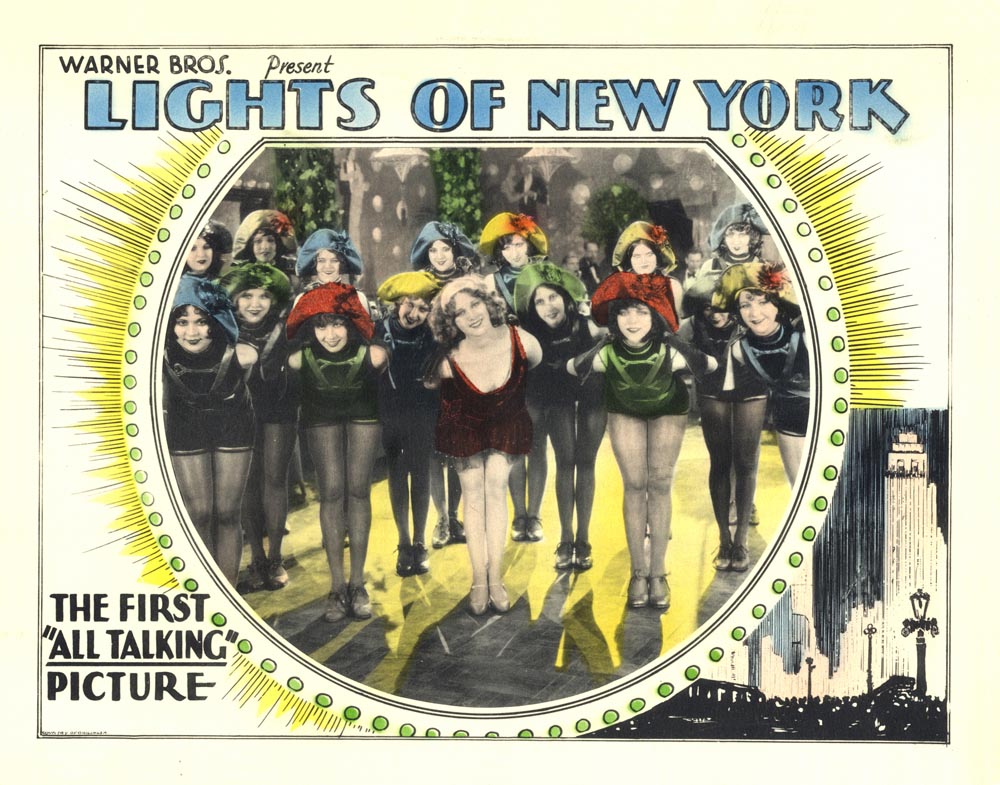
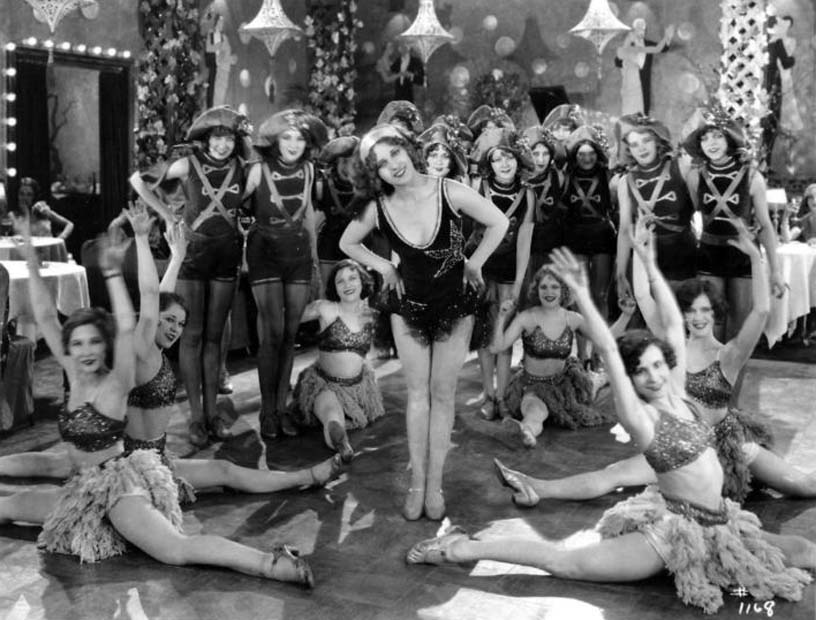
Age of the Talkies

The Oct. 15, 1927 issue featured the premiere of the film The Jazz Singer. Although The New Yorker found the story a bit dull, it also recognized that the film’s use of sound marked a significant turning point in the short history of cinema.

cca81fb3c6aeb61c01f52c8dc5c3c05b
October 15, 1927 cover by Theodore G. Haupt.

The Jazz Singer was not the first film to employ sound, but as the New Yorker review pointed out, it was the first to effectively use synchronized sound (the industry standard Vitaphone technique) in a way that improved the motion picture.

The film featured only two minutes worth of sound dialogue, so most of the spoken lines were still presented on intertitle cards commonly used in silent films. But it was Al Jolson’s recorded voice, belting out popular tunes including “Toot, Toot, Tootsie,” that really wowed audiences. At the end of the film Jolson himself appeared on stage before an audience “clapping and bellowing with joy”…

jazz-siner-1

jazz-singer2

jazz_singer_f
IT SINGS! IT TALKS!!!…Al Jolson as Jack Robin and Eugenie Besserer as his mother, Sara Rabinowitz, in The Jazz Singer. One attendee at the premiere recalled that when Jolson and Besserer began their dialogue scene, “the audience became hysterical.” (wired.com)

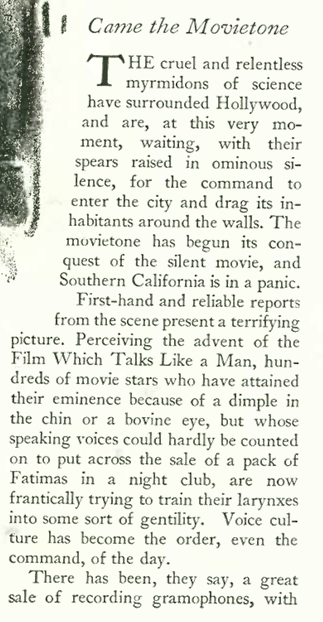
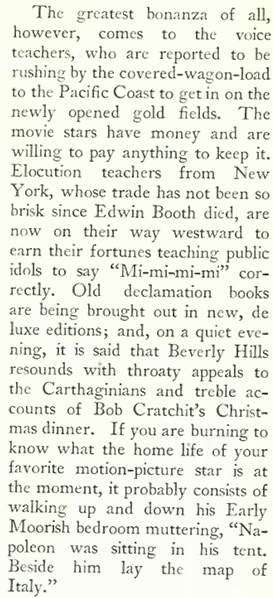
It is interesting that as early as 1927, and even with the relatively crude sound of Vitaphone, The New Yorker was already predicting the advent of a new kind of star (and the decline of the stage actor)…

screen-shot-2016-12-09-at-12-26-53-pm

screen-shot-2016-12-09-at-12-27-04-pm

VitaphoneDemo
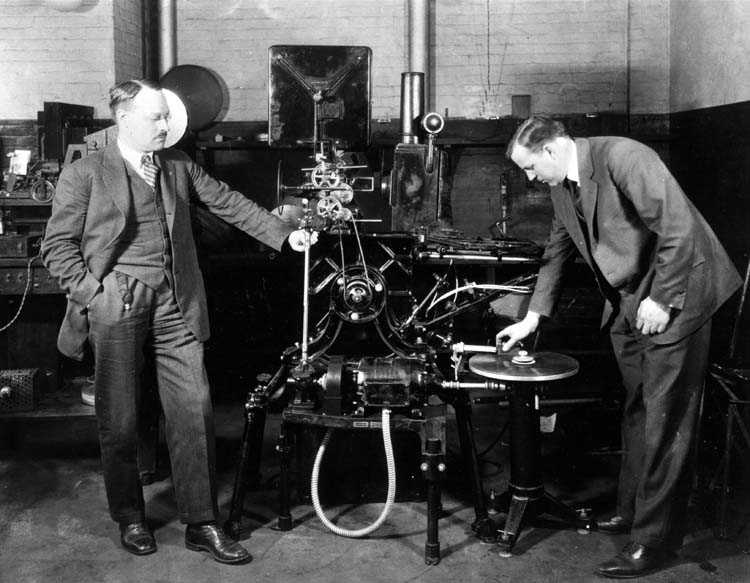
BLACK TIE EVENT…A Vitaphone projection setup at a 1926 demonstration. Western Electric engineer E. B. Craft, left, is holding a soundtrack disc, which was essentially a phonograph record. The turntable, on a thick tripod base, is at lower center. (Wikipedia)

As for the movie itself, well, there was Jolson, beloved by many. Perhaps it’s the sound quality, or the 89 years of changing tastes, but I cannot for life of me understand what audiences (or The New Yorker) saw that was so appealing about the hammy Jolson as a performer.

screen-shot-2016-12-09-at-12-27-12-pm

017-the-jazz-singer-theredlist
THAT WAS THEN…Al Jolson as Jack Robin in The Jazz Singer. Although performing in blackface is considered racist today, Jolson’s use of blackface was integral to the film in that it was tied to Jack’s own Jewish heritage and his struggle for identity. Of course that doesn’t make it any less offensive. (YouTube clip)

*  *  *  *  *

Absent-minded Ambassador

The New Yorker’s “Talk of the Town” offered some curious observations about the new ambassador to Mexico, Dwight Morrow.

morrows_1931
SON-IN-LAW…Aviator Charles Lindbergh would marry Dwight Morrow’s daughter, Anne, in 1929. in this photo from 1931 are, from left, Charles Lindbergh, Anne Morrow Lindbergh, Elisabeth Morrow, and Dwight Morrow. (kaiology.wordpress.com)

Morrow has been widely hailed as a brilliant ambassador with a keen intellect. The New Yorker, however, offered some additional perspective on the man:

screen-shot-2016-12-09-at-11-59-33-am

screen-shot-2016-12-09-at-11-59-38-am

Flight of Fancy

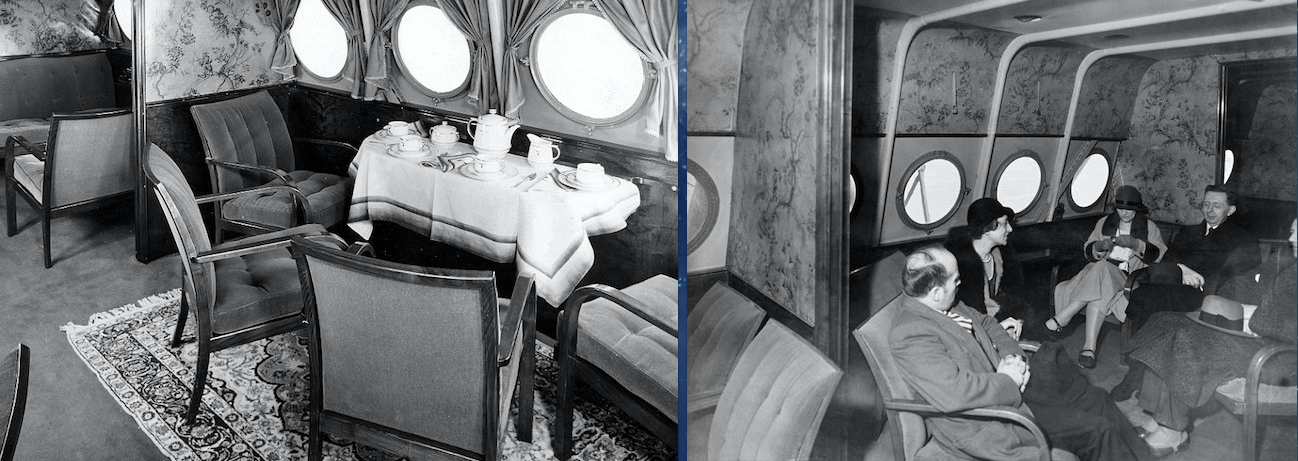
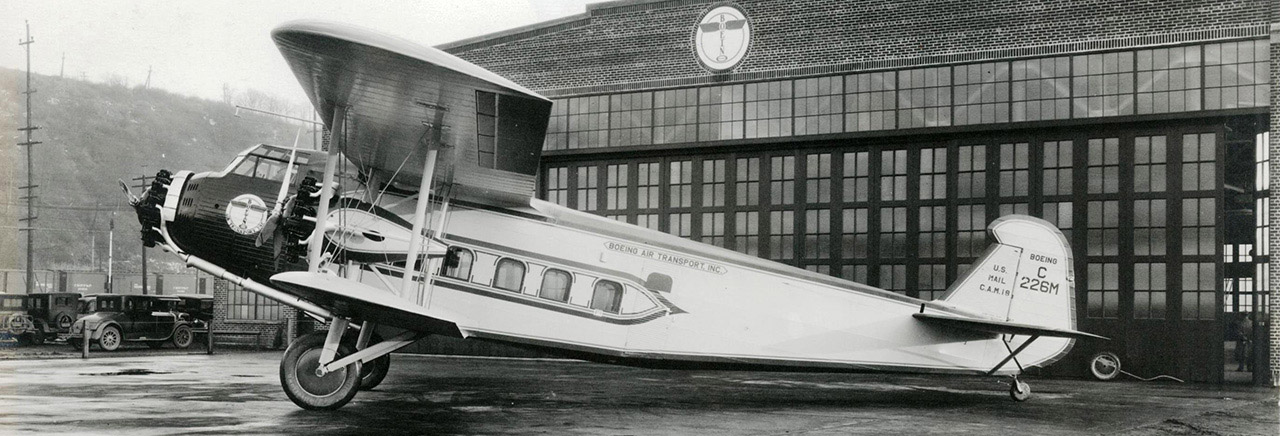
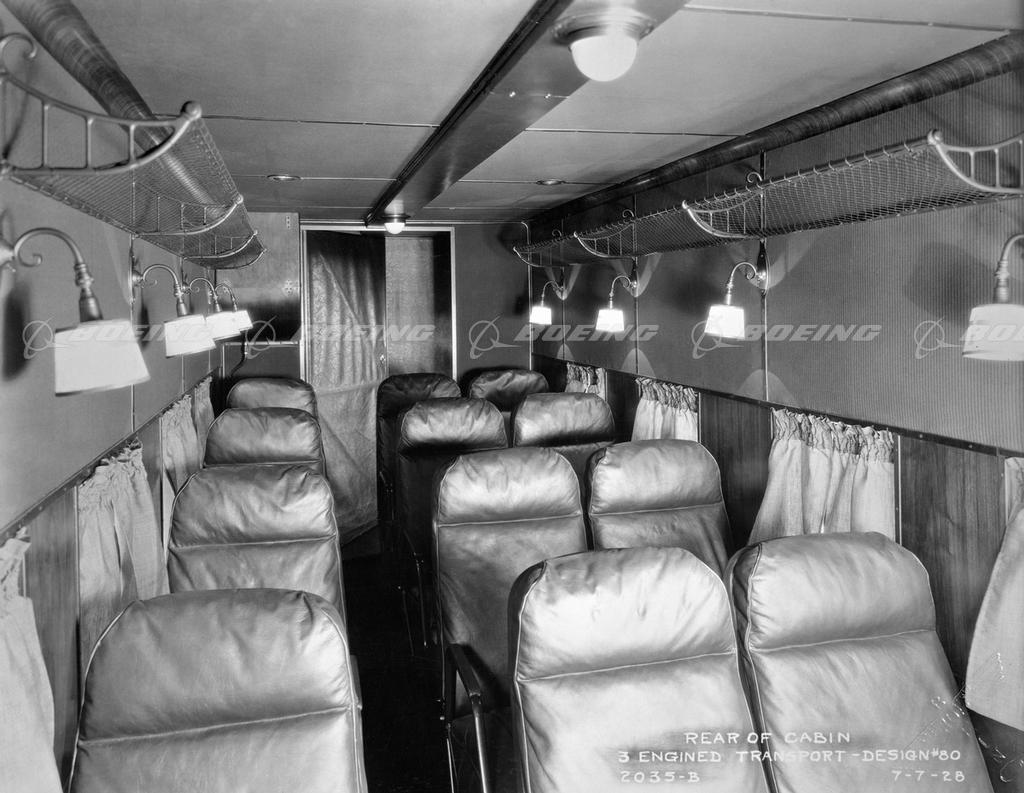
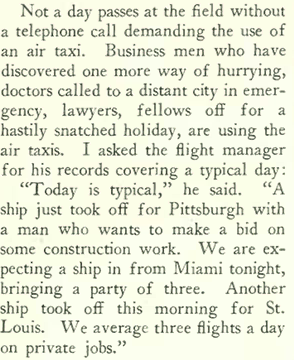
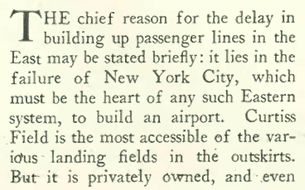
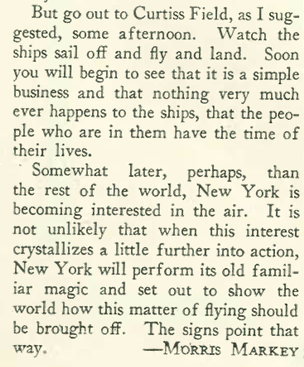
In the wake of Charles Lindbergh’s famous flight, The New Yorker (and the rest of the country) continued its fascination with air travel, which at this point was confined to military and commercial pilots, stunt flyers and the well-to-do.

screen-shot-2016-12-09-at-11-55-12-am

screen-shot-2016-12-09-at-11-55-19-am

screen-shot-2016-12-09-at-11-55-28-am

f7a-2a

f12cabindown
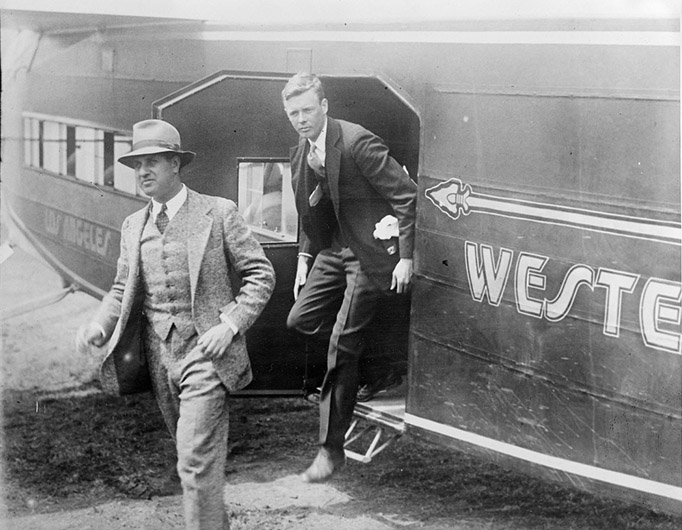
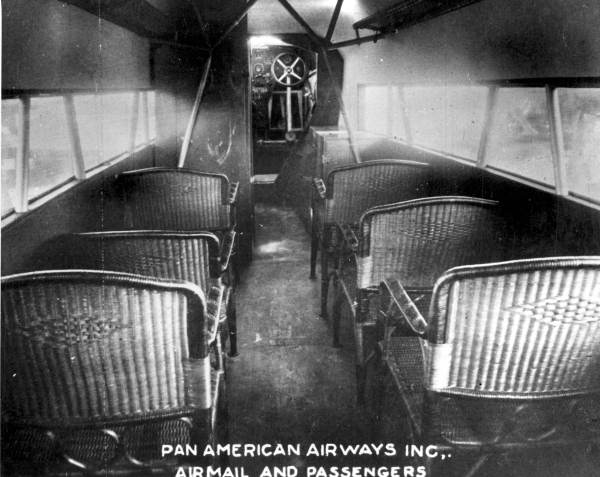
EXTRA LEGROOM…The Fokker F.VII pictured above is likely the same plane or very similar to the one owned by Texas oilman William Denning. The interior depicted below is also similar to what is described in The New Yorker. (aviation-history.com)

 *  *  *  *  *

RIP Isadora Duncan

The New Yorker’s Paris correspondent, Janet Flanner, wrote about the funeral of famed modern dancer Isadora Duncan in her column, “Letter from Paris.” Duncan was killed in a freak accident on the night of Sept. 14, 1927, when her silk scarf, draped around her neck, became entangled around the open-spoked wheels of the car in which she was riding, breaking her neck.

screen-shot-2016-12-09-at-12-23-34-pm

screen-shot-2016-12-09-at-12-24-54-pm

Isadora Duncan with her husband, poet Sergei Esenin, in 1922. (Wikimedia)

Other items of note from the Oct. 15 issue, E.B. White contributed this ditty…

screen-shot-2016-12-09-at-12-13-06-pm

…and Corey Ford, who gave the fictional Eustace Tilley his persona, wrote of Tilley’s feat crossing Broadway in a parody of adventure stories popular at the time. An excerpt:

croey-ford

And finally, Peter Arno explored childhood angst among the smart set (note reference to “Uncle Thurber”)…

screen-shot-2016-12-09-at-12-08-56-pm

Next Time: Electric Wonders…

6ed825c70c3fd789a666a63ecc376b5d


Wits of the Round Table

Two big voices from the famed Algonquin Round Table were prominently featured in the Oct. 1 and Oct. 8, 1927 issues of the New Yorker–journalist and champion of the underdog Heywood Broun wrote his own “Profile” under the title, “The Rabbit That Bit the Bulldog,” and Dorothy Parker served up biting satire in “Arrangement in Black and White,” a clever exposé of racism among the fashionably “open-minded” upper classes.

488a50459a792547010d30e8bfe5ddf4
October 1, 1927 cover by Gardner Rea.

The Rabbit That Bit the Bulldog

Hiding under the signature “R.A.”, Heywood Broun (1888–1939) was merciless as his own profiler, describing himself as a coward, hypochondriac, and a slob (there is truth to the latter, however, as friends often likened him to “an unmade bed”).

screen-shot-2016-12-08-at-9-06-52-am

Broun cut his teeth in journalism as a sportswriter and war correspondent. In 1921 he went to work for the New York World, where he penned his popular syndicated column “It Seems to Me.” Broun’s New Yorker “Profile” was written after he was fired from the World following a disagreement with his editor over his critical commentary on the sentencing of anarchists Sacco and Vanzetti. Broun would move on to The Nation, where he would write a regular column, “It Seems to Heywood Broun,” that would offer criticism on a number of topics including his former employer, the World.

Heywood Broun. (Denver Newspaper Guild)

The New Yorker profile included this caricature by Peter Arno

screen-shot-2016-12-06-at-9-46-21-am

…a portrayal Broun claimed was inaccurate due to his “habitual stoop,” among other faults…

screen-shot-2016-12-06-at-9-52-23-am

screen-shot-2016-12-06-at-9-52-34-am

…and he mused about his future with the Nation, and how that august publication would square with his various foibles…

screen-shot-2016-12-06-at-9-52-45-am

…and as for his personal appearance and habits, Broun weighed in thusly…

screen-shot-2016-12-06-at-9-55-18-am

Broun married social activist Ruth Hale in 1917. A son born the following year, Heywood Hale Broun, would have a long and successful career as an author, sportswriter, commentator and actor.

*  *  *  *  *

The Long Count

Oddly, The New Yorker had little to say about the famous Chicago rematch between heavyweight boxers Gene Tunney and Jack Dempsey, which Tunney won after the controversial “long count.” The fight took place under new rules that gave a fallen fighter ten seconds to rise to his feet, but the count would not begin until his opponent moved to a neutral corner.

tumblr_mti3g257h11rnxl9do1_500
DAZED AND CONFUSED…Referee Dave Barry motions Jack Dempsey to a neutral corner before he begins his count. Gene Tunney got back up and went on to win the fight. (Chicago Tribune archive photo)

Although Tunney dominated the fight, Dempsey unleashed a flurry in the seventh round that knocked Tunney to the canvas–it was the first time in Tunney’s career that he’d been knocked down. Instead of going immediately to a neutral corner, Dempsey just stood and observed his opponent for several seconds until finally retreating. Those extra seconds proved just enough time to allow Tunney to return to his feet and eventually win the bout. To one observer quoted in “The Talk of Town,” those extra seconds really dragged…

screen-shot-2016-12-06-at-9-44-49-am

screen-shot-2016-12-06-at-9-44-55-am

From the Ad Department

We feature this Julian de Miskey-illustrated advertisement for Faultless Nobelt Pajamas. Apparently these special PJs had some sort of newfangled rubber elastic band…

screen-shot-2016-12-06-at-9-57-42-am

…and this cartoon from the Oct. 1 issue featured Helen Hokinson’s ditsy society women at New York’s Fashion Week…

screen-shot-2016-12-06-at-9-43-37-am

 *  *  *  *  *

Dorothy Takes On the Snobs

In the Oct. 8 issue, our other Round Table wit, Dorothy Parker, took aim at the less savory aspects of society women in her short fiction piece, “Arrangement in Black and White.”

f19964a9d1e1b6179fe2715bb3b1aa72
October 8, 1927 cover by Rea Irvin.

Parker began her piece by introducing us to a woman who enters a party wearing a wreath of “pink velvet poppies” in her golden hair. In short order she asks the party’s host to “pretty please” introduce her to the party’s guest of honor, an African American singer named Walter Williams.

The woman with the pink velvet poppies goes on to tell her host that she came to the party alone because her husband, Burton, preferred not to socialize with “colored people”–but she however was “simply crazy” about some of them. “They’re just like children–just as easy-going, and always singing and laughing and everything.” Before she met the singer she observed to the host:

screen-shot-2016-12-06-at-1-18-25-pm

screen-shot-2016-12-06-at-1-19-09-pm

screen-shot-2016-12-06-at-1-16-57-pm
The woman with the pink velvet poppies meets the singer Walter Williams, as illustrated by Peter Arno.

Then the woman with the pink velvet poppies meets Walter Williams:

screen-shot-2016-12-06-at-1-19-42-pm

She continues to patronize the guest of honor, then notices a stage actress at the party:

screen-shot-2016-12-08-at-12-32-44-pm

Finally, the host guides the woman with the pink velvet poppies away from Walter Williams…

screen-shot-2016-12-06-at-1-21-59-pm

screen-shot-2016-12-06-at-1-22-30-pm

05325779fdf286303013d76dc9e89388
BITING WIT…Dorothy Parker in the 1920s.

We will see more of Dorothy Parker in issues to come as she continues to take aim at the pretentious, hypocritical, self-absorbed snobs of the Jazz Age and beyond.

Baseball’s Lament

The Oct. 1 and 8 issues covered yacht racing, polo, tennis, golf and college football, but still no baseball. The 1927 New York Yankees would be one of the greatest teams of all time, but as the World Series commenced all we got from The New Yorker was a personality profile of Yankees manager Miller Huggins in the Oct. 8 issue (with a drawing by Reginald Marsh)…screen-shot-2016-12-06-at-1-24-05-pm

…and this advertisement for “Sport Glasses” for those attending the World Series…

screen-shot-2016-12-06-at-4-34-19-pm

Perhaps The New Yorker had no one on staff who could competently write about baseball. The strangest reference to the game was this article about polo, but for some reason it was illustrated with baseball images. Perhaps the editors felt sheepish about their lack of baseball coverage, and offered these illustrations by Howard Baer as a token acknowledgement…

screen-shot-2016-12-06-at-1-28-18-pm

At any rate, we end with this cartoon by Julien de Miskey, who like his colleagues explored the comic richness of wealthy old men paired with their young mistresses…

screen-shot-2016-12-06-at-1-16-04-pm

Next Time: The Ephemeral City…

f19964a9d1e1b6179fe2715bb3b1aa72


Office Romance

The New Yorker’s founder and editor, Harold Ross, did not approve of office romances. He had a magazine to run after all, and didn’t want any distractions from Cupid’s arrow.

30e6d833482958226738b30ce4244558
August 13, 1927 cover by Julian de Miskey.

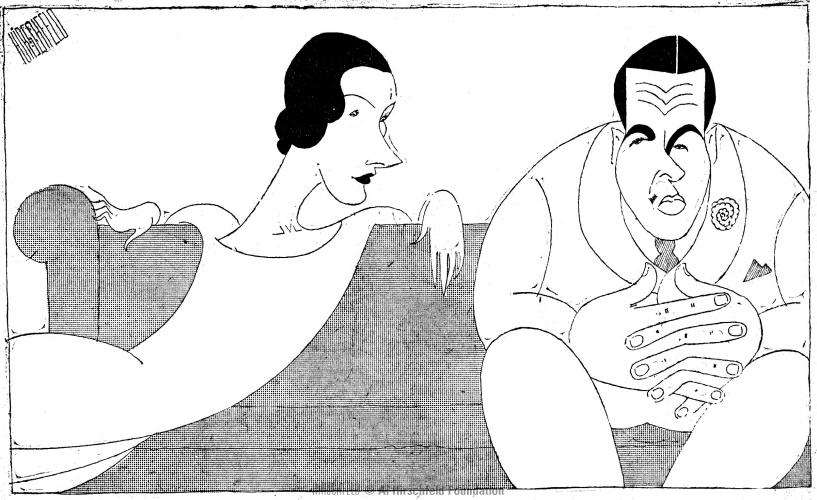
But then again, it seemed inevitable that Lois Long and Peter Arno–two of the magazine’s most lively personalities and important early contributors–would end up together. Arno cut a dashing figure as one The New Yorker’s most celebrated cartoonists. He often drew upon the same subject matter as Long, who covered the nightclub and speakeasy scene in her column, “Tables for Two” and in the process defined the lifestyle of the liberated flapper. Long is also credited with inventing the field of fashion writing and criticism with her other New Yorker column, “On and Off the Avenue.”

screen-shot-2016-11-16-at-9-33-38-am
OFFICE SWEETHEARTS… Arno and Long personified the witty, cosmopolitan image cultivated by The New Yorker. (Wall Street Journal, Wikipedia)

In Vanity Fair, Ben Schwartz (“The Double Life of Peter Arno,” April 5, 2016) wrote that Arno and Long “personified what people thought The New Yorker was, which was very fortunate…(Long was) tall, lanky, a Vassar grad with bobbed hair and a wicked sense of humor, a minister’s daughter to Arno’s judge’s son, and she matched him as a hell-raiser.” It was actually their raucous affair that set Ross on a “permanent scowl” regarding office romances.

Schwartz quotes Arno’s and Long’s daughter, Patricia (Pat) Arno, about her parents’ wild relationship: “There were lots of calls to (gossip columnist Walter) Winchell or some other columnist about nightclub fights…with my mother calling and saying, ‘Oh, please don’t print that about us,’ trying to keep their names out of the papers.”

Schwartz suggests that Arno drew on personal experience when in 1930 he published Peter Arno’s Hullabaloo, a “collection of cartoons that included a set of racy drawings featuring a dashing couple much like himself and Long. In one, a nude woman, in bed, yells at her sleeping lover: ‘Wake up, you mutt! We’re getting married to-day.'”

favoritecartoon-4-580

Long and Arno were married by her father, the Rev. Dr. William J. Long, at her parents’ home in Stamford, Conn., on August 13, 1927. Their daughter, Patricia, was born September 18, 1929.

According to Schwartz, Arno’s first three books sold well (Whoops Dearie! 1927, Parade 1929, and Hullabaloo 1930) “allowing the young family to move into an East Side penthouse. Their social circle included New Yorker staffers, the magazine’s owner, Raoul Fleischmann, publishers Condé Nast and Henry Luce, Kay Francis (Broadway actress, future Hollywood star and Long’s former roommate), and some of the city’s financial powers. ‘Once my mother was having trouble with her Plymouth,’ says Pat Arno, “and Walter Chrysler took off his evening coat, rolled up his sleeves, and fixed it himself.'”

kay-glam
STAR POWER…Actress Kay Francis, no stranger to wild living, was Lois Long’s longtime friend and also her roommate until Long married Peter Arno in 1927. (flickchick1953)
peter-arno-curtis-arnoux-peters-jr-cartoonist-ben-schwartz-07
HAPPY INTERLUDE…Arno and Long with their baby daughter, Patricia, in 1929. (Vanity Fair)

Less than two years after the birth of their daughter, Arno and Long would get a divorce in Reno on June 30, 1931. Arno later married debutante Mary Livingston Lansing in August 1935; they divorced in July 1939. After his divorce from Lansing, Arno moved to a farm near Harrison, New York, where he lived in seclusion, drawing for The New Yorker and enjoying music, guns, and sports cars. He died of emphysema on February 22, 1968 at the age of 64.

peter-arno-curtis-arnoux-peters-jr-cartoonist-ben-schwartz-11
Arno with second wife, debutante Mary Livingston “Timmie” Lansing, Winsted, Connecticut, 1939. (Digital Colorization by Lorna Clark)

In 1938 Long would marry Donaldson Thorburn, a newspaper and advertising man. After his death in 1952 she would marry Harold Fox, head of an investment brokerage firm. Long’s colleague at The New Yorker, Brendan Gill, described Fox as “a proper Pennsylvanian named Harold A. Fox.” They lived in an 1807 Pennsylvania-Dutch farmhouse, where Long delighted in the woods, farms and wildlife as well as in her two grandchildren—Andrea Long Bush and Katharine Kittredge Bush. In 1960 she wrote to her alma mater, Vassar College, that the “hectic fifteen years or so after graduation, when I thought I had New York City by the tail and was swinging it around my head, seem very far away. Thank God. I like things this way.” Long would continue working as a columnist for The New Yorker until the death of Harold Fox, in 1968. She died in 1974 at age 72.

screen-shot-2016-11-16-at-10-40-11-am
BEFORE IT ALL BEGAN…Left, Lois Long’s photo in Vassar’s yearbook, The Vassarion. At right, during her senior spring, Lois posed for a photo by Sunset Lake. Long studied English and French, graduating in1922 with an English major. (vcencyclopedia.vassar.edu)

*  *  *

The big news in the Aug. 13, 1927 edition (the same date as the Long-Arno wedding) was President Calvin Coolidge’s brief, ambiguous announcement that he would not run for president. Almost everyone assumed he would run for a second term, given the booming economy in the age of “Coolidge Prosperity.”

Coolidge was summering in Black Hills when he gave his secretary, Everett Sanders, a piece of paper that read, “I do not choose to run for president in 1928.” Sanders then scheduled a midday press conference for August 2, 1927. At 11:30 a.m., Coolidge cut out strips of paper with this statement–I do not choose to runand at the conference handed each reporter one of the strips. Coolidge offered no further information, and only remarked, “There will be nothing more from this office today.” This led to considerable debate among the press as to intentions of the president. The New Yorker’s “Talk of the Town” mused…

screen-shot-2016-11-15-at-12-11-05-pm

…Howard Brubaker’s “Of All Things” column offered this wry observation…

screen-shot-2016-11-15-at-12-16-05-pm

…while humorist Robert Benchley (writing under the pseudonym “Guy Fawkes”) in his “The Press in Review” column continued The New Yorker’s stinging attack on the media for its continued attempts to sensationalize events or impart personality traits on colorless newsmakers:

the-press-in-review

guy-fawkes

02-calvin-coolidge-cowboy_69085_600x450
HAPPY TRAILS, CAL…No doubt the simple life of the Black Hills influenced Calvin Coolidge’s decision in 1927 to decline a second term as president. (Library of Congress)

Next Time: The Movies Take Wing…

31163f0a903d36d43f89b8495fe4e9a4


Coney Island, 1927

The New Yorker welcomed spring with a cover featuring Peter Arno’s popular Whoops Sisters testing the waters at the beach…

37723304ec91b372ae19e57e36b4d4b9
June 18, 1927 cover by Peter Arno, featuring his popular Whoops Sisters.

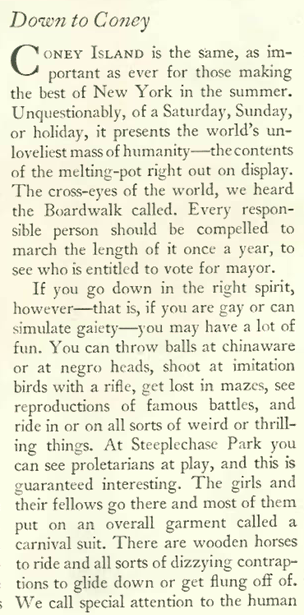
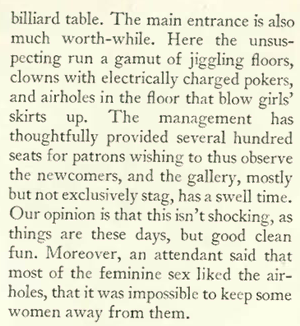
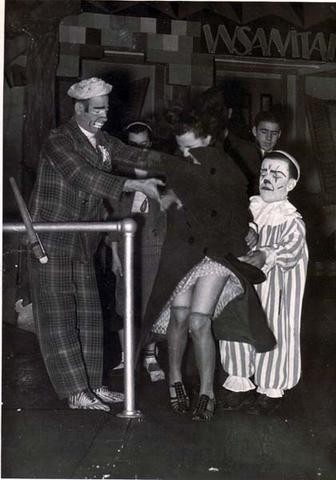
…and so was The New Yorker, on the south shores of Brooklyn to check out attractions old and new at Coney Island, paying a visit on an “off-day” to check out attractions ranging from incubating babies to the mechanical horse-race at the old Steeplechase:

screen-shot-2016-10-14-at-9-06-43-am

screen-shot-2016-10-14-at-9-06-52-am

78215d_incubatorbabies_alland2502
WEIRD BUT WORTH IT…Incubating babies on display at Coney Island in the early 1900s. At the time, most babies were born at home, so hospitals did not have incubators–considered to be untested (and expensive) equipment. Dr. Martin Couney featured the device in “incubator shows” at various World’s Fairs and as a permanent exhibit at Coney Island from 1903 to 1943. Although he found the public spectacle somewhat distasteful, Couney hoped the exhibits would prove that the new technology actually worked. Paying for staff and machinery through ticket sales, he saved the lives of perhaps 8,000 premature infants at Coney Island. (NY Historical Society)
feltmans_coney_island-3
BEFORE THERE WAS NATHAN’S…Feltmans hot dog stand, circa 1930s. Feltman’s began as a pushcart business on the sand dunes of Coney Island in 1867, operated by German immigrant Charles Feltman, considered the inventor of the hot dog on a bun. By 1920 Feltman’s Ocean Pavilion covered a whole city block and served more than five million customers a year. (digital commonwealth.org)
coney-island-steeplechase-postcard-ca-19152
OFF TO THE RACES…Riders astride mechanical horses prepare to compete in the popular Coney Island Steeplechase in this postcard image circa 1915. (carouselhistory.com)
cyclone-britanica
LANDMARK…Coney Island’s famed Cyclone roller coaster opened in 1927. (Encyclopedia Britannica)
romantic-luna-park-evening-coney-island-1920s
ONE MILLION lights brightened Coney Island’s Luna Park on a summer evening in the 1920s. (carouselhistory.com)

Of course not everything was as dazzling as Luna Park at night. Like any carnival, Coney Island had its share of barkers announcing everything from games of “chance” to freak shows and a wax museum that depicted–among other grisly sights–the murder of Albert Snyder by his wife, Ruth Snyder, and her lover, Judd Gray, and the subsequent execution of the notorious pair.

tumblr_m7qi19kprf1rpfjrbo1_1280
GET YOUR DIME’S WORTH…Barkers at Coney Island’s Eden Musee wax museum advertise the wax dummy recreation of the Ruth Snyder and Judd Gray executions, circa 1928. The Snyder-Gray murder trial of 1927 was a national media sensation. (houseoftoomuchtrouble.tumblr.com)

screen-shot-2016-10-14-at-9-07-16-am

screen-shot-2016-10-14-at-9-07-37-am

Charles Lindbergh, feted with his own wax image at Coney Island, was beginning to appear on the verge of a meltdown thanks to the relentless attention he was getting in the aftermath of his historic flight:

screen-shot-2016-10-14-at-9-02-29-am

Lois Long also seemed at her wit’s end, abruptly announcing to readers that her nightlife column, “Tables for Two,” would go on hiatus for the summer. No doubt this was a relief to Long, who seemed to be growing weary of the nightclub scene and was doing double duty as fashion writer (“On and Off the Avenue”) for The New Yorker:

screen-shot-2016-10-14-at-12-25-49-pm

And perhaps there was another reason Long was taking a break–she would marry fellow New Yorker contributor and cartoonist Peter Arno on Aug. 13, 1927.

 *  *  *

Always poised to take a poke at the newspaper media, The New Yorker had some fun with the New York Times’ attempt to reproduce an early wirephoto of Clarence Chamberlin, the second man to pilot a fixed-wing aircraft across the Atlantic from New York to Europe, while carrying the first transatlantic passenger, Charles Levine. The original photo apparently showed Chamberlain and Levine being greeted by the mayor of Kottbus, Germany:

screen-shot-2016-10-14-at-9-05-29-am

Charles Levine took a plane to Europe, but most still had to settle for the more leisurely pace of a steamship. Below is a two-page advertisement featured in the center of the June 18 issue for an around the world excursion on the Hamburg-American Line (click to enlarge):

screen-shot-2016-10-14-at-9-40-04-am

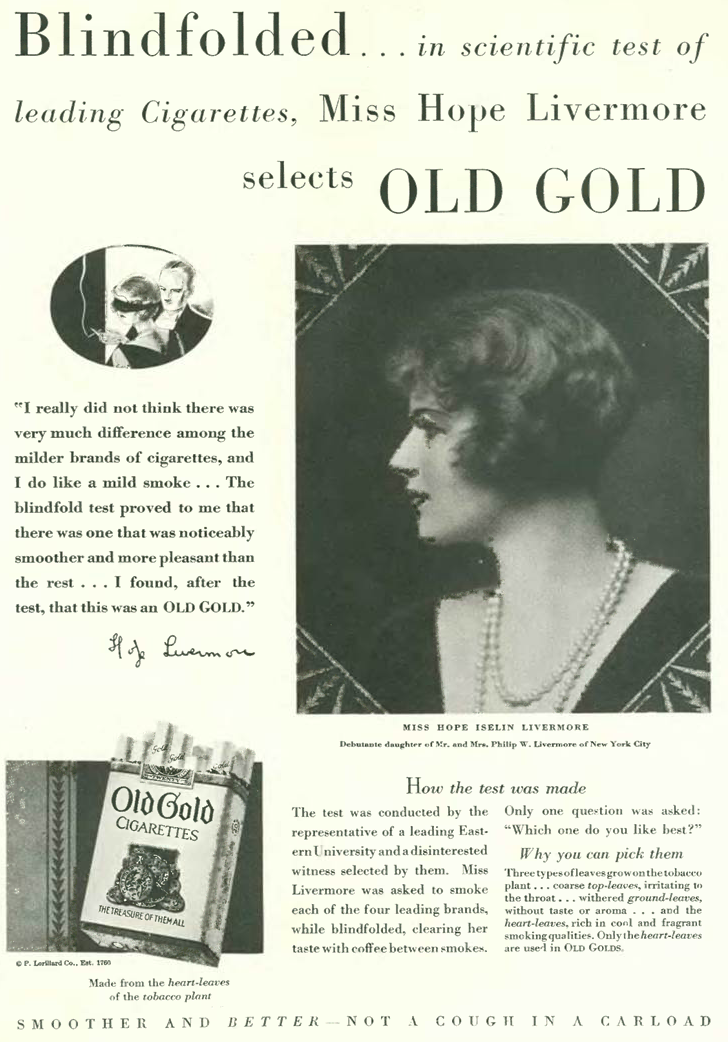
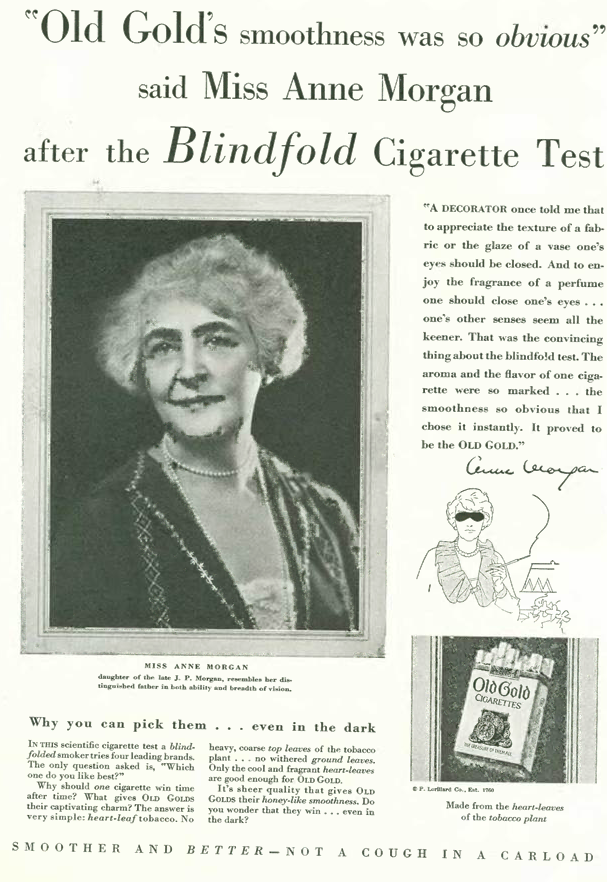
And finally, this advertisement in the back pages for Old Gold cigarettes, which claimed to be “coughless”….

screen-shot-2016-10-14-at-9-39-28-am

The artist for these Old Gold ads was Clare Briggs, an early American comic strip artist who rose to fame in 1904 with his strip A. Piker Clerk. Growing up in Lincoln, Nebraska gave Briggs the material he needed to depict Midwestern Americana, a style that would influence later cartoonists such as Frank King (Gasoline Alley).

Next Time: Île-de-France…

80c5240bf5ffaaff418de94b7e176525

Mode de Vie

We cross the pond for the May 14, 1927 issue, for a look at all things French. As I’ve previously noted, New Yorker readers of the 1920s had a decidedly Francophile bent when it came to food, fashion and general joie de vivre.

304b9308de906b0c02f50b14add69c6d
May 14, 1927 cover by Rea Irvin.

In fact, readers were so enamored with France that the country merited its own New Yorker correspondent, Janet Flanner, who wrote under the nom de plume “Genêt.”

In the May 14 issue Flanner casually mused about the racing season at Longchamps, which attracted the likes of Anne Harriman Vanderbilt (identified here as Mrs. W. K. Vanderbilt), who was well-known in France for her philanthropic work during World War I, including her founding of an ambulance service and a hospital at Neuilly. Vanderbilt received the class of the Legion of Honor in 1919 in recognition of her war work, and in 1931 she was made an officer of the legion.

screen-shot-2016-09-21-at-9-04-27-am

11733033805_35c6a9f8d5_b
BLUE BLOODS…Anne Harriman Vanderbilt (left) with Martha Waldron Cowdin Bacon, circa 1915-1920. Bacon served as chairman of the American Ambulance Committee. (Library of Congress)

In “Talk of the Town,” the editors suggested that readers go to Madison Square Garden and check out the world’s largest canvas painting, Panthéon de la Guerre, more for the spectacle than for any artistic merit:

pantheon_de_la_guerre_panorama_smaller
Section of Panthéon de la Guerre showing allies of World War I, now in Memory Hall, Liberty Memorial, Kansas City, Missouri. (theworldwar.com) Click to enlarge

screen-shot-2016-09-21-at-8-57-10-am

screen-shot-2016-09-21-at-8-57-22-am

Panthéon de la Guerre was painted during World War I as a circular panorama—402 feet in circumference and 45 feet high—displayed in Paris in a specially built building next to the Hôtel des Invalides. It was visited by an estimated eight million people between 1918 and 1927.

The painting was acquired by American businessmen in 1927 and exported to New York, where it was displayed at Madison Square Garden. Some changes were made to the painting for the benefit of an American audience, including the addition of an African-American soldier. The work later toured the U.S.—from 1932 to 1940 it went to Washington DC, Chicago, Cleveland, and San Francisco. It was then acquired by restaurant entrepreneur William Haussner for $3,400.

In 1956 Haussner donated the work to Leroy MacMorris to be adapted for display at the Liberty Memorial in Kansas City. MacMorris drastically reduced the size of the work and modified it to emphasize America’s contribution to WWI: Only seven percent of the original work was retained, and large French sections were left out. MacMorris likened it to “whittling down a novel to Reader’s Digest condensation.” And he didn’t stop there. He also modified some figures to represent post-WWI figures such as Presidents Franklin Roosevelt and Harry Truman.

exhibithall
A BIT OF THIS, A DASH OF THAT…Figure of Victory from the Temple to Glory cut to fit above a doorway at Memory Hall, Liberty Memorial, Kansas City, Missouri, with the staircase of heroes to either side. Compare to original below:
129-2
(trenchartcollection.com)

To reduce and reconfigure the painting, MacMorris first photographed it in detail, then cut out the figures in the photos and used them like puzzle pieces to work out his new condensed version, which was dedicated on Nov. 11, 1959.

As for the unused portions, what MacMorris did not use he threw away, sending several of the larger excised passages back to Haussner for display in his Baltimore restaurant. MacMorris also gave pieces to the art students who helped him reconfigure the painting and to a number of prominent Kansas Citians.

2qaatdogmghsne7v2y1e
Fragment from Panthéon de la Guerre depicting a British nursing sister. (theworldwar.org)

The National World War I Museum and Memorial in Kansas City recently held an exhibition on the painting and its recovered fragments.

 * * *

Lois Long had returned from Paris and advised readers on where to shop in the City of Light. Her fashion column, “On and Off the Avenue,” featured recommendations for many stores and bargains. It began with a brief note from “Parisite,” aka Elizabeth Hawes, who occasionally contributed to Long’s column with cables sent from Paris).

screen-shot-2016-09-21-at-9-01-58-am

And now for the advertisements, all from the May 14 issue, featuring various French themes, such as this one for Krasny makeup that evokes the glamour of Paris and the intrigue of Russian women…

screen-shot-2016-09-21-at-8-48-43-am

…or exotic perfumes for only the most exclusive set…

screen-shot-2016-09-21-at-8-54-15-am

…or the chic look of Revillon Freres spring coats and wraps…

screen-shot-2016-09-21-at-8-55-10-am

…or fake vermouth…this odd little illustration in the back pages for non-alcoholic vermouth, served by a dutiful French maid to what appears to be a giant. You have to feel sorry for the writers of such ads during Prohibition, trying so hard to make this sad libation appealing to thirsty New Yorkers…

screen-shot-2016-09-21-at-9-08-34-am

…but there were those lucky few who could actually travel to France and drink the real stuff, you could get a really swell send-off with a “Bon Voyage Basket” from L. Bamberger & Co…

screen-shot-2016-09-21-at-8-54-37-am

…and while you were in France (at least for the men), Peter Arno could show you how to give the glad eye to the mesdemoiselles…

screen-shot-2016-09-21-at-9-09-42-am

Next Time: Shock of the New…

may-21


Unfit to Print

The journalist and screenwriter Ben Hecht wrote the “Reporter at Large” column for the early New Yorker, and for the April 30, 1927 issue took aim at the shoddy coverage of the Ruth Snyder murder trial at the Long Island City Courthouse.

e83e83f37e5b2787e23dd4ee7a85c62d
April 30, 1927 cover by Carl Rose.

Hecht was appalled by the media’s use of celebrity “experts” to cover the trial, which only served to sensationalize and trivialize the proceedings:

Ben Hecht (Wikipedia)

hecht-1

hecht-2

The Ruth Snyder trial dominated headlines in 1927. A housewife from Queens, Snyder began an affair in 1925 with Henry Judd Gray, a married corset salesman. After she persuaded her husband, Albert Snyder, to purchase life insurance, she enlisted Gray’s help to murder him. On March 20, 1927 the couple garrotted Albert (after bludgeoning him with a sash weight) and then staged the murder scene to look like a burglary.

The trial was covered by such figures as former Ziegfeld Follies showgirl Peggy Hopkins Joyce, the radio evangelist Aimee Semple McPherson, movie director D. W. Griffith, author Damon Runyon, popular philosopher Will Durant, and James M. Cain, a crime reporter who went on to write Double Indemnity, which was later made into a major Hollywood movie. Hecht (who would go on to co-write a hugely successful play about newspaper reporters, The Front Page) would have none of this celebrity circus. Some excerpts:

hecht-3

hecht-4

hecht-5

hecht-6

hecht-8

Ruth Snyder would not be acquitted (or live to write reviews), but instead would go to Sing Sing’s electric chair on Jan. 12, 1928. The 32-year-old Snyder would go to the chair first, followed shortly thereafter by her former lover and accomplice, 35-year-old Henry Judd Gray. The pair had sealed each other’s fate: During the trial, Snyder and Gray had turned on each other, contending the other was responsible for killing Albert Snyder.

screen-shot-2016-09-08-at-12-22-48-pm
BUSTED…Ruth Snyder in custody and behind bars at the Queens County Jail. (Criminal Encyclopedia/NY Daily News)
snyder-and-gray
END OF THE LINE…Mugshots of Ruth Snyder and Henry Judd Gray taken at Sing Sing Prison following their conviction. (Lloyd Sealy Library, CUNY)
connect_blog_ruth-snyder
NATIONAL SENSATION…The cover of Jan. 13, 1928, issue of the New York Daily News. Although photographs of the execution were not allowed, photographer Tom Howard took this now-famous photo of Snyder at the moment of her execution with the aid of a miniature camera strapped to his ankle. (newseum.org)

 *  *  *

On to a lighter topic…The Sherry-Netherland Hotel has graced the corner of Fifth Avenue and East 59th Street since 1927, and when it was built it was the tallest apartment-hotel in New York City.

The building was nearing completion when around 8 pm on April 12, 1927, fire broke out on wood plank scaffolding surrounding the top floors. Firefighters responded only to find they lacked water pressure to fight the blaze.

According to the New York Times (“The Night a Hotel Turned Into a Torch,” Nov. 15, 2012), the fire was watched by hundreds of thousands, and “the windows of the Plaza Hotel across the street were ‘black with people’; every front room was engaged, either by news organizations or for spontaneous parties to watch the fire.”

Planks tumbled to the street for hours, and The Times said one “sailed in a crazy parabola” and crashed against the Savoy-Plaza, also nearly finished; occasionally minor collapses of the scaffolding turned the picturesque top into a “lofty Roman candle.” The crowds on the street could feel the heat on their faces, and the roar and crackle of the fire could be heard for blocks around. The fire burned itself out around midnight.

Oddly, the New Yorker had little to say about the fire, mentioning it only in passing in this “Talk of the Town” item:

screen-shot-2016-09-06-at-12-48-11-pm

screen-shot-2016-09-08-at-1-14-21-pm
HOT TIME IN THE CITY…In 1927 the Sherry-Netherland caught on fire, creating what The New York Times called “the best show of the season.” The newspaper ran this photo (left), retouching it for contrast (New York Times). At right, the hotel as it appears today (Wikipedia)

An interesting side note…at the time of the Sherry-Netherland’s construction, the nearby Vanderbilt mansion was being demolished. Carved limestone panels from the mansion’s porte-cochere as well as ornamental frieze roundels were salvaged and installed in the Sherry-Netherland’s lobby.

Hollywood movies continued to disappoint New Yorker critics, including Cecil B. DeMille’s silent epic The King of Kings.

screen-shot-2016-09-06-at-12-58-11-pm

screen-shot-2016-09-06-at-12-58-48-pm

screen-shot-2016-09-06-at-12-59-22-pmFinally, a couple of advertisements from the April 30 issue. It was spring, and time to hit the links…

screen-shot-2016-09-06-at-12-44-22-pm

…and New Yorker cartoonist Peter Arno plugged his new book featuring the Whoops Sisters:

screen-shot-2016-09-06-at-12-51-37-pm

Next time: Those Restless Natives…

43b9e74a7197a3d27d520d251a303549

The Dinosaurs of Upper West Side

New York’s American Museum of National History unveiled its new Hall of Dinosaurs, and it was so impressive that even The New Yorker set aside its usual blasé tone toward popular attractions…

deb15aac127a5a9b06b890362c4878a1
April 2, 1927 cover by Toyo San.

…and found its “Talk of the Town” editors to be quite taken with “sacred bones:”dinosaurs

2007 METRO Project | ImageDigitizationSpecifications v1.0 | Epson Perfection V750 Pro
NEW DIGS…Children studying a Brontosaurus skeleton in the American Museum of National History’s Hall of Dinosaurs, 1927. (AMNH Research Library)

Screen Shot 2016-08-12 at 5.05.45 PM

Screen Shot 2016-08-12 at 5.06.04 PM

2007 METRO Project | ImageDigitizationSpecifications v1.0 | Epson Perfection V750 Pro
Tyrannosaurus and Triceratops in the Hall of Dinosaurs, 1927. (AMNH Research Library)

 *  *  *

The April 2, 1927 issue also found New Yorkers to be agog over “French-style” telephones:
French phone II

Screen Shot 2016-08-22 at 12.39.27 PM
FRANCOPHONE…Trendy New Yorkers were switching from their old reliable candlestick telephones (left) to “French-style” phones (center) that were common throughout Europe. Western Electric answered their call with a sleek American version in 1928, right.

 *  *  *

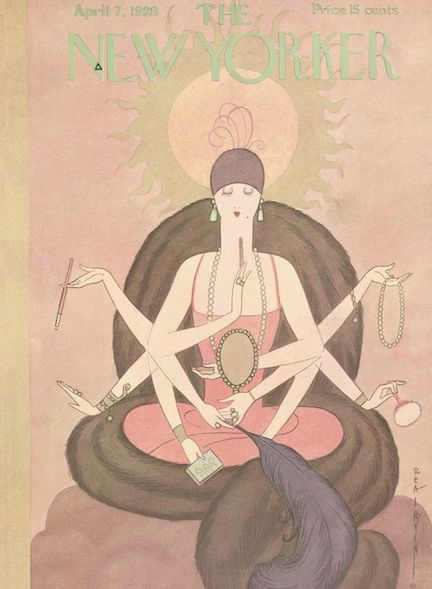
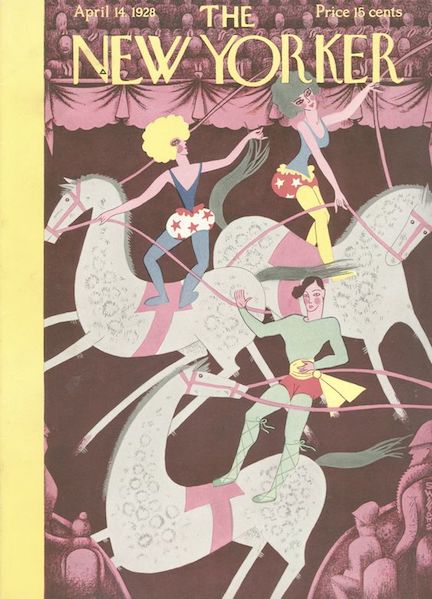
The April 9, 1927 issue featured the second of Peter Arno’s 99 covers for the New Yorker. His first cover appeared eighteen issues earlier (Nov. 22, 1926) and featured the same gardener, but this time he was inspecting a newly budded leaf rather than the last one to fall:

Screen Shot 2016-08-22 at 4.20.14 PM

Note the difference in style between the two covers–the April 9 cover is rendered with more detail, depth and texture. These would be Arno’s only covers with rather sedate subjects. Subsequent covers would have more action and humor, such as this one from 1954, one of my favorites:

Screen Shot 2013-06-01 at 5.17.30 PM

 *  *  *

And now for a note about Paul Whiteman. One cannot write about the Jazz Age without mentioning the Paul Whiteman Orchestra. It was Whiteman who in 1924 commissioned George Gershwin’s Rhapsody in Blue, which premiered with Whiteman’s orchestra (and with Gershwin himself at the piano).

Whitemasn feb 26
This ad in the Feb. 26, 1927 New Yorker announced the much-anticipated return of Paul Whiteman and his orchestra. The caricature of Whiteman was his trademark.

Even Lois Long, who seemed to be growing bored with New York nightlife, found reason to celebrate Whiteman in this column that appeared alongside the ad:

Feb. 26

Whiteman had 28 number one records during the 1920s and dominated sheet music sales. He provided music for six Broadway shows and produced more than 600 recordings. Dubbed “King of Jazz” his style was actually a blending of jazz and symphonic music.

The folks at Victor Talking Machines played on Whiteman’s fame with this advertisement for their latest “Orthophonic” Victrola. Although it was the first consumer phonograph designed specifically to play “electrically” recorded discs and was recognized as a major step forward in sound reproduction, the claim that the machine would reproduce sounds “exactly as you would hear them at the smart supper clubs” seemed a little far-fetched.

Screen Shot 2016-08-23 at 12.27.26 PM

And finally, in celebration of spring, Constantin Alajalov illustrated an April day in Central Park, which was featured in a two-page spread in “Talk of the Town.”

Screen Shot 2016-08-23 at 12.26.22 PM
(click to enlarge)

Next Time: The Enchanting Modernist…

1eeb12ad3b9cff3f5e529a466432adbe

Upstairs, Downstairs

As the New Yorker was a magazine of the city’s new money smart set, it poked fun at their faddish tastes and patronizing attitudes while at the same time feeding their Anglophilia and WASPish sense of superiority.

015737c92d9c339b44b3805c311dd478
January 22, 1927 cover by Andre De Schaub.

The magazine’s pages were filled with ads for English-style clothes, French perfumes and expensive cars. And in the Jan. 22 issue there were many ads for the motorboats that had displaced the automobile show at Grand Central Palace:

Screen Shot 2016-06-14 at 9.25.59 AM

It is important to note that this ad is an appeal to new money; old money would have found this motorized vessel quite vulgar.

As it were, the new money needed some guidance if they hoped to live a lifestyle of ease and sophistication. And thus the issue’s “On and Off the Avenue” column, guest-written by Gretta Palmer (Lois Long took the week off), offered advice on how to hire and clothe the help:

Screen Shot 2016-06-14 at 9.27.59 AMScreen Shot 2016-06-14 at 9.28.35 AM

Perhaps you wanted a proper English butler. Lida Seely had your man:

Screen Shot 2016-06-14 at 9.28.53 AM

Or a Scotch maid, or choose from a selection of “any color or race”…

Screen Shot 2016-06-14 at 9.30.18 AM

In case you found that last sentence a bit callous, Gretta reassured:

Screen Shot 2016-06-14 at 9.30.55 AM

Screen Shot 2016-06-14 at 9.31.27 AM

The issue also featured a cartoon by Rea Irvin (displayed full-page, sideways in the original magazine) depicting the “lower orders” aping the lifestyle of the upper classes. Note that of all the racial and ethnic types shown here, only Blacks remain in the servant class.

Screen Shot 2016-06-14 at 9.18.03 AM

As I noted in a previous post, “Race Matters,” the New Yorker of the 1920s was decidedly mainstream in engaging in casual bigotry common in those days, including treating blacks as racial “others.” There is, perhaps, a subtle jab here by Irvin at the pretensions of the uppers, but he’s not around anymore to clarify this.

The issue also featured the first of a series of articles (“Profiles”) on the 87-year-old John D. Rockefeller. A brief excerpt, with illustration by Cyrus Baldridge:

Screen Shot 2016-06-14 at 9.19.18 AM

Rockefeller

The writer’s prediction wasn’t too far off: Rockefeller would live another ten years, and die at age 97 in 1937. His grandson, David Rockefeller, apparently inherited both his money and his genes: he recently celebrated his 101st birthday (update: David Rockefeller died in 2017 at age 101).

Finally, a cartoon by Peter Arno, famed for his drawings of women, usually scantily clad. Here we see an early example in one of his “Whoops Sisters” panels:

Screen Shot 2016-06-14 at 9.22.05 AM

By comparison, here is a cartoon by Arno 33 years later, from the September 10, 1960 issue of the New Yorker:

869a0a6de1edde2e7479b79d285bd73a
Caption: “Makes you kind of proud to be an American, doesn’t it?”

Next Time: All That Jazz…
b8a47deb10bba89d024899c9500bba81