On Catfish Row

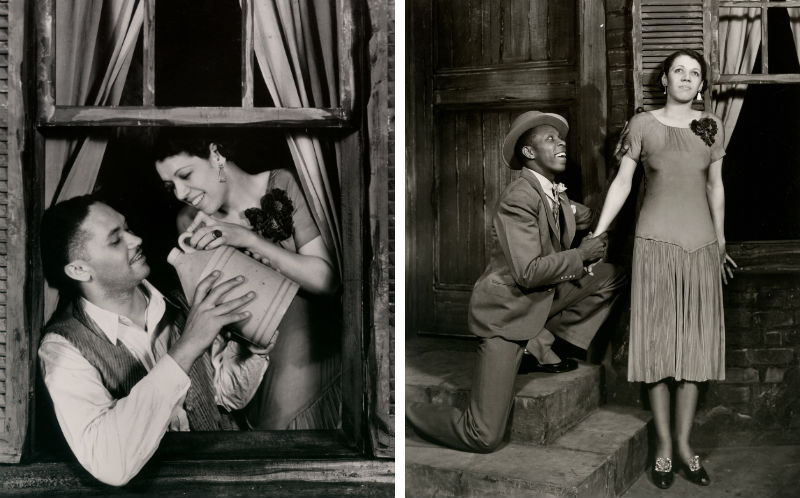
Above: Left image: Todd Duncan (Porgy) and Anne Brown (Bess), in the 1935 Broadway production of Porgy and Bess. Right image: John Bubbles (Sportin’ Life) and Brown. (Photos courtesy the Ira & Leonore Gershwin Trusts)

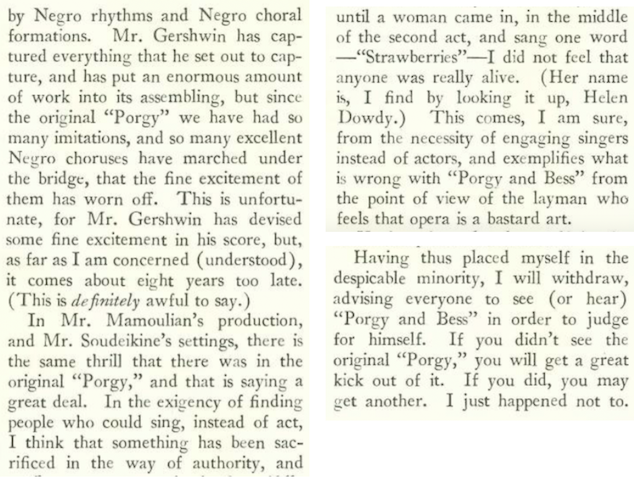
The 1935 Broadway production of Porgy and Bess is widely regarded as one of the most successful American operas of the twentieth century, but when it opened at the Alvin Theatre on Oct. 10, 1935, reviews were mixed, including the one penned by Wolcott Gibbs.
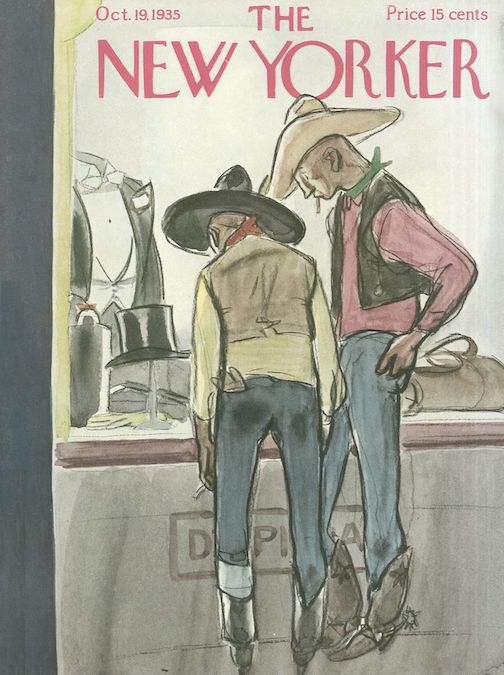
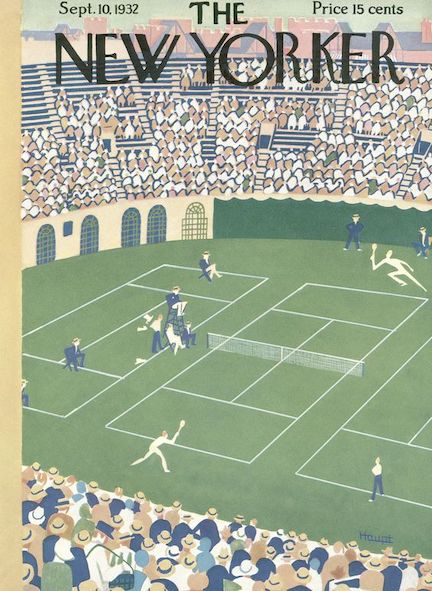
October 19, 1935 cover by William Crawford Galbraith. The New York Times (Oct. 9, 1935) made this observation about the rodeo at Madison Square Garden: “New York, which for several days has been vaguely aware of an impending rodeo because of a profusion of ten-gallon hats along Eighth Avenue and a sign in a beauty parlor, ‘Welcome, Cowgirls,’ will see the real thing this morning.”

Now you would think a work by composer George Gershwin, with a libretto written by DuBose Heyward (author of the 1925 novel Porgy) and lyricist Ira Gershwin, would be a sure hit. Some critics did praise the production, which ran for 124 performances, but others criticized themes and characterizations of Black Americans that were created by white artists.
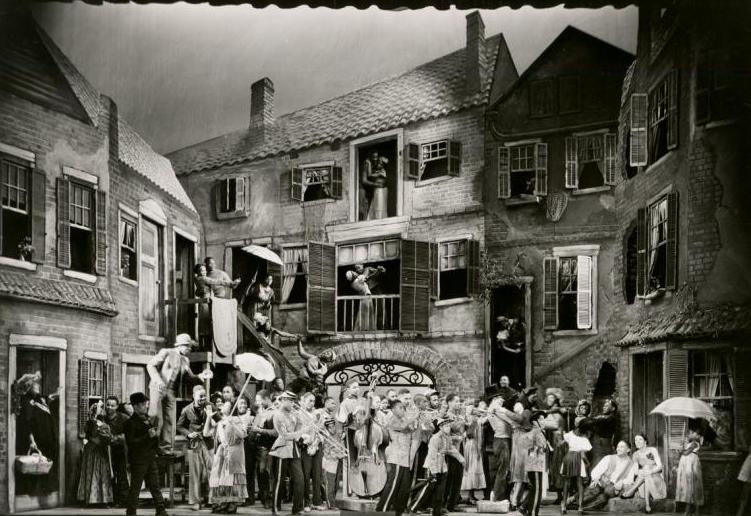
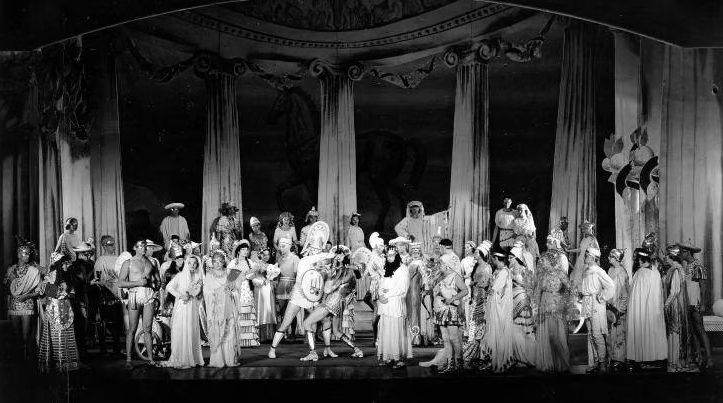
MIXED REVIEWS…The original Catfish Row set for Porgy and Bess as seen at Broadway’s Alvin Theatre (now the Neil Simon Theatre) in 1935. (Billy Rose Theatre Collection, New York Public Library Digital Gallery)

This wasn’t the first time Porgy was adapted to the stage. It was originally produced in 1927 by Heyward and his wife, Dorothy, at the Guild Theatre in New York. The Heywards insisted on an African-American cast—an unusual decision at the time—and enlisted newcomer Rouben Mamoulian to direct. The play ran a total of fifty-five weeks.
ORIGIN STORY: Porgy: A Play in Four Acts, was a 1927 play by Dorothy Heyward and DuBose Heyward, adapted from the short novel by DuBose. (Wikiwand)

Gibbs preferred the original Porgy to the Gershwin–Heyward production, admitting that he simply did not care for “the operatic form of singing a story.”
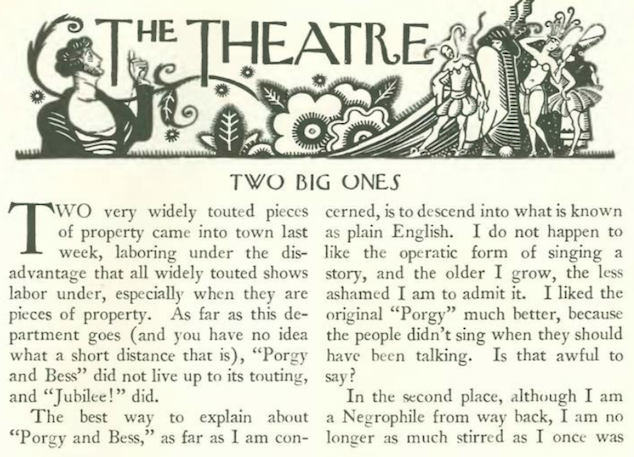
continued…
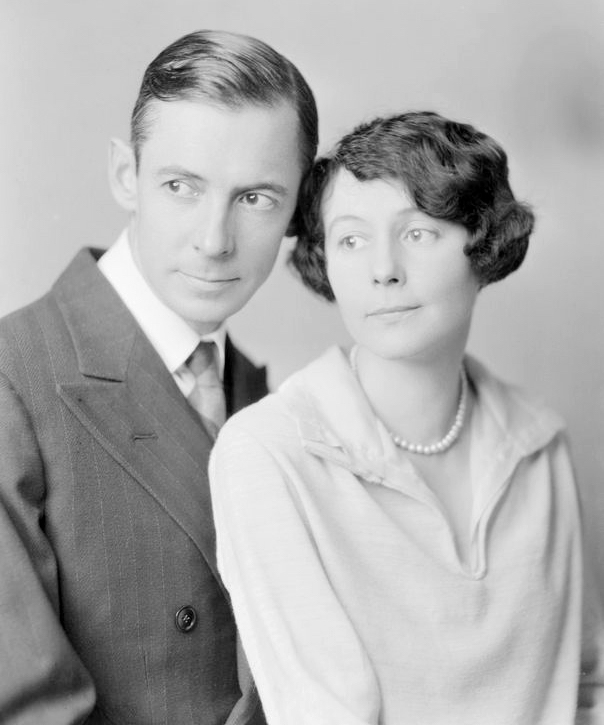
TAKING THEIR BOWS…George Gershwin greets an audience after a performance of Porgy and Bess. Behind Gershwin are his brother, Ira Gershwin (left), and librettist and Porgy author DuBose Heyward (partially hidden, at right). (umich.edu)

The Moss Hart/Cole Porter musical comedy Jubilee! premiered at Broadway’s Imperial Theatre on Oct. 12, 1935, just two days after the Porgy and Bess premiere. Gibbs dubbed this show “heat-warming and beautiful.”

THE BEGUINE BEGINS…Inspired by the Silver Jubilee of Britain’s George V, the musical comedy Jubilee! told the story of a fictional royal family. The play featured such hit songs as “Begin the Beguine” and “Just One of Those Things,” which have become part of the American Songbook. (ovrtur.com)
ROYAL HIJINKS…At left, June Knight as Karen O’Kane and Charles Walters as Prince James in Jubilee!; at right, Mary Roland (the Queen) encounters “Mowgli” (Mark Plant) in Act I. (ovrtur.com)

Note: In the last issue (Oct. 12) we saw an ad for an around-the-world luxury cruise on the Franconia. Cole Porter and Moss Hart—with their families, friends, and assistants—sailed on a previous Franconia cruise, possibly in 1934, with the intention to write a new musical while on the trip. Apparently some of the songs and scenes in Jubilee! were inspired by their ports of call.

 * * *

Steering Clear

“The Talk of the Town” commented on the “steer-wrestlers” that were featured at the Madison Square Garden rodeo. Since steer-wrestling was also called “bulldogging,” it caused considerable consternation among New York animal lovers.
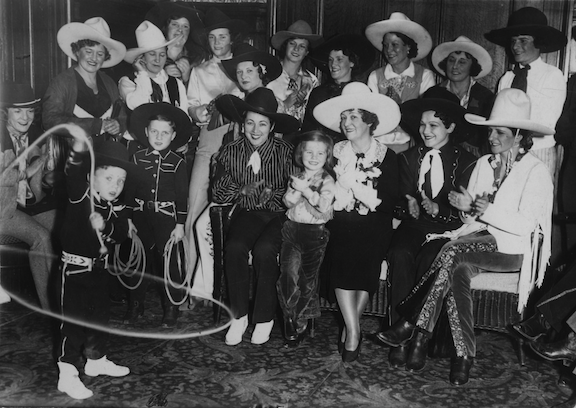
A BIG HOWDY…Cowgirls From the Madison Square Garden Rodeo With Millicent Hearst, 1932. (texashistory.unt.edu)

 * * *

Much Ado About FDR

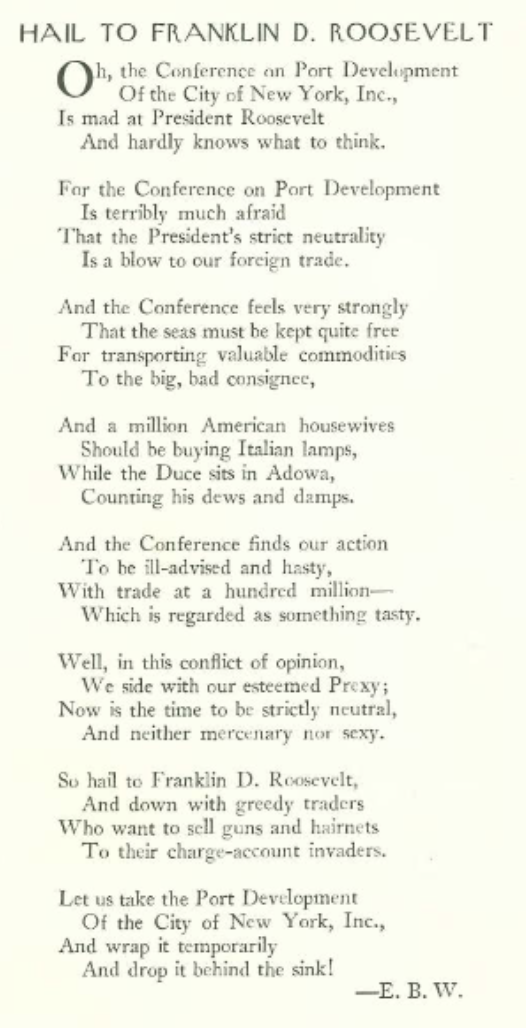
The Conference on Port Development of the City of New York took issue with President Franklin D. Roosevelt’s foreign trade policies, particularly his strict stance on neutrality, which the Conference believed was detrimental to foreign trade. This was likely related to the October 1935 Italian invasion of Ethiopia. E.B. White offered this satirical poem in reaction to the trade spat.
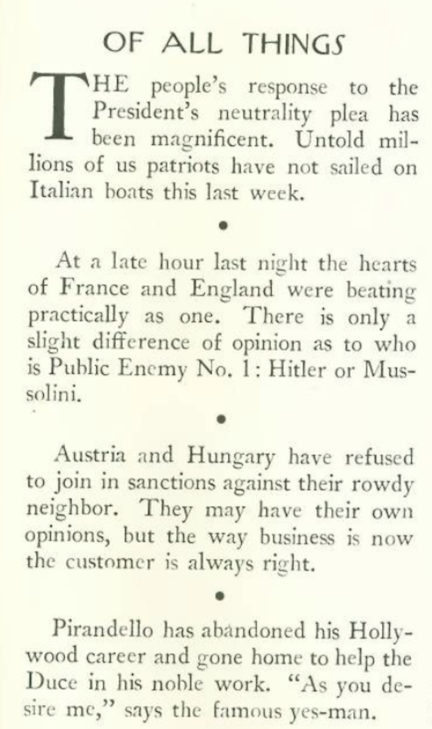
Howard Brubaker also chimed in on the trade issue, and on other unsettling developments in Europe:
 * * *

Puppy Love

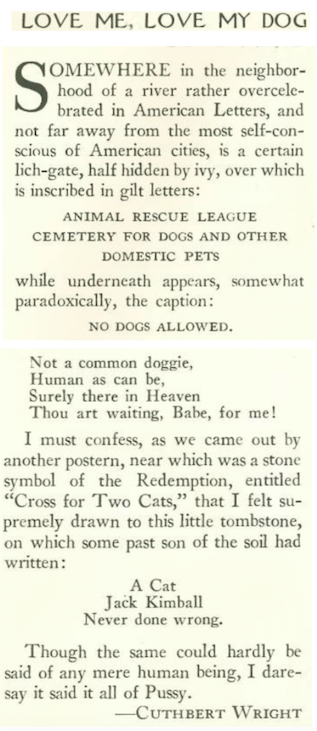
Critic and poet Cuthbert Wright (1892–1948) was moved to write poetry after visiting a dog cemetery that also welcomed animals of all stripes. Here are excerpts of the opening and closing lines:
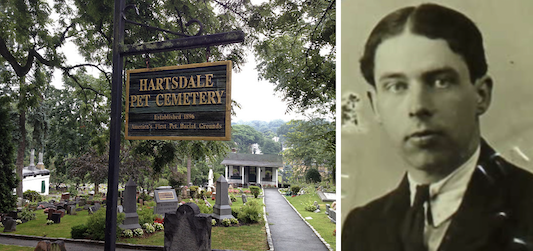
PET PROJECT…Cuthbert Wright was moved to verse after his visit to a pet cemetery, possibly the Hartsdale Pet Cemetery in Westchester. (Wikipedia/parenthetically.blogspot.com)

 * * *

Man and Machine

Art and culture critic Lewis Mumford is back this week, this time taking a look at the work of French artist Fernand Léger (1881–1955), who created a form of cubism known as “tubism,” regarded today as a forerunner of the pop art movement of the mid-1950s and the 1960s.

It is no surprise that the humanist Mumford, who sought an “organic balance” in everyday design, found Léger’s machine-like works alienating and sterile, representing an “aesthetic poverty.”
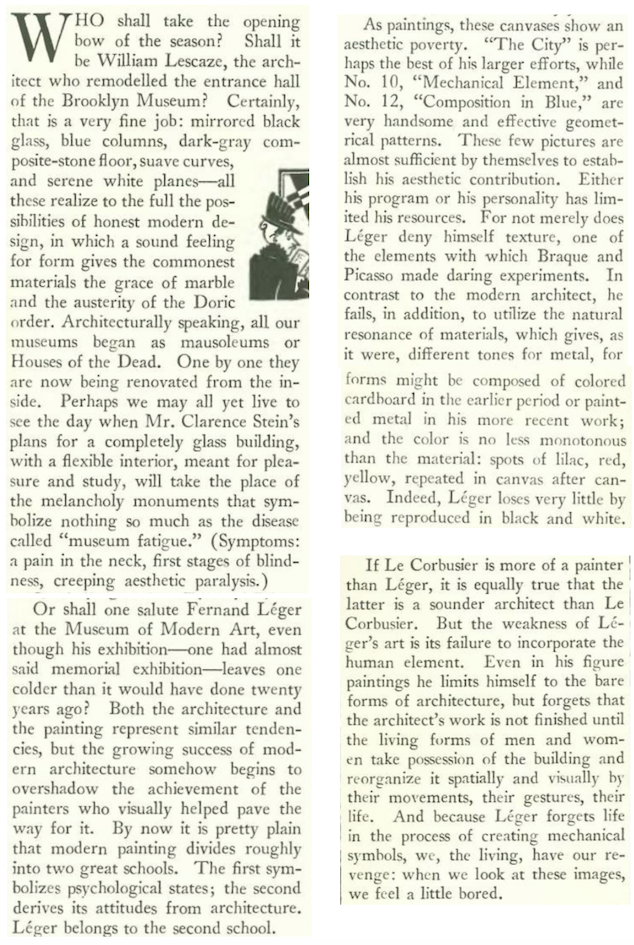

TOTALLY TUBULAR…Clockwise, from top left, works of Fernand Léger cited by Lewis Mumford: The City, 1919; photo of Léger, circa 1930s; from the 1918–1923 series Mechanical Elements, 1920; Composition in Blue, 1920–27. (Philadelphia Museum of Art/The Met Collection/Art Institute of Chicago, Charles H. and Mary F. S. Worcester Collection)

 * * *

Disappointment in O’Hara

That is how Clifton Fadiman titled his “Books” column after reviewing John O’Hara’s latest novel, Butterfield 8.

O’Hara (1905–1970) wasn’t just any old scribbler. A prolific short-story writer, he has often been credited with helping to invent The New Yorker’s short story style. Praised by the likes of F. Scott Fitzgerald and Ernest Hemingway, O’Hara cranked out two bestsellers before the age of thirty. One was the acclaimed Appointment in Samarra (which was praised by Fadiman). The other was BUtterfield 8, the novel Fadiman found disappointing (Hemingway, on the other hand, blurbed, “John O’Hara writes better all the time.”). Here are a couple of brief excerpts from Fadiman’s review:
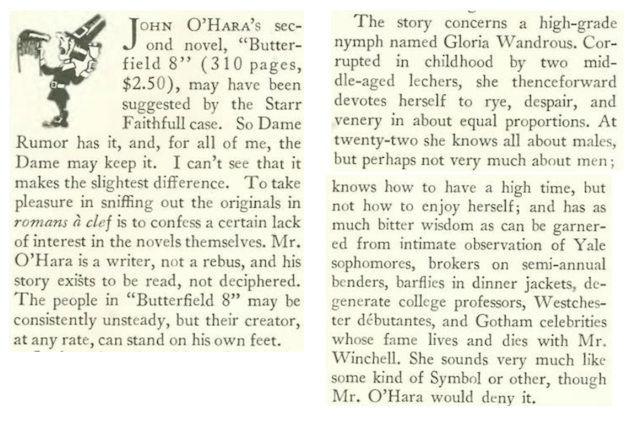
Fadiman concluded his review with a note to the author: “Why not let Jean Harlow have it, Mr. O’Hara, and start a fresh page?”

Well, Harlow didn’t get it, but twenty-five years later Elizabeth Taylor would reluctantly take on the role of Gloria Wandrous, and win the Academy Award for Best Actress.
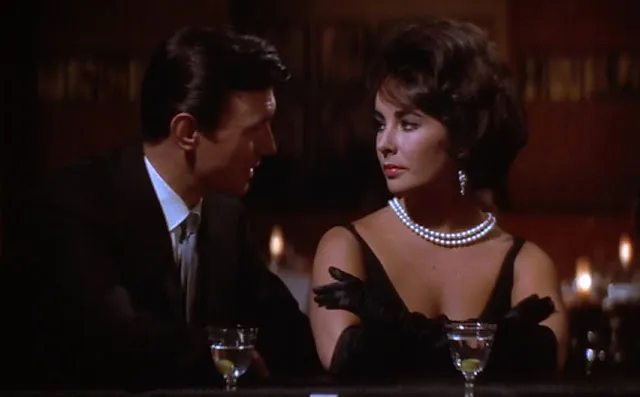
YOU AGAIN?…Laurence Harvey and Elizabeth Taylor played on and off lovers in 1960’s Butterfield 8. John O’Hara did not participate in writing the adaptation, and the film’s plot bore only a slight resemblance to his novel. However, after the film’s release more than one million paperback copies of the novel were sold. (aiptcomics.com)

 * * *

At The Movies

We begin this section with an excerpt from “The Talk of the Town,” which covered the “International World Première” of the Warner Brother’s adaptation of A Midsummer Night’s Dream. The film opened worldwide on October 9, 1935 in London, Sydney, Vienna and at New York’s Hollywood Theatre, where crowds turned out to get a glimpse of the stars.
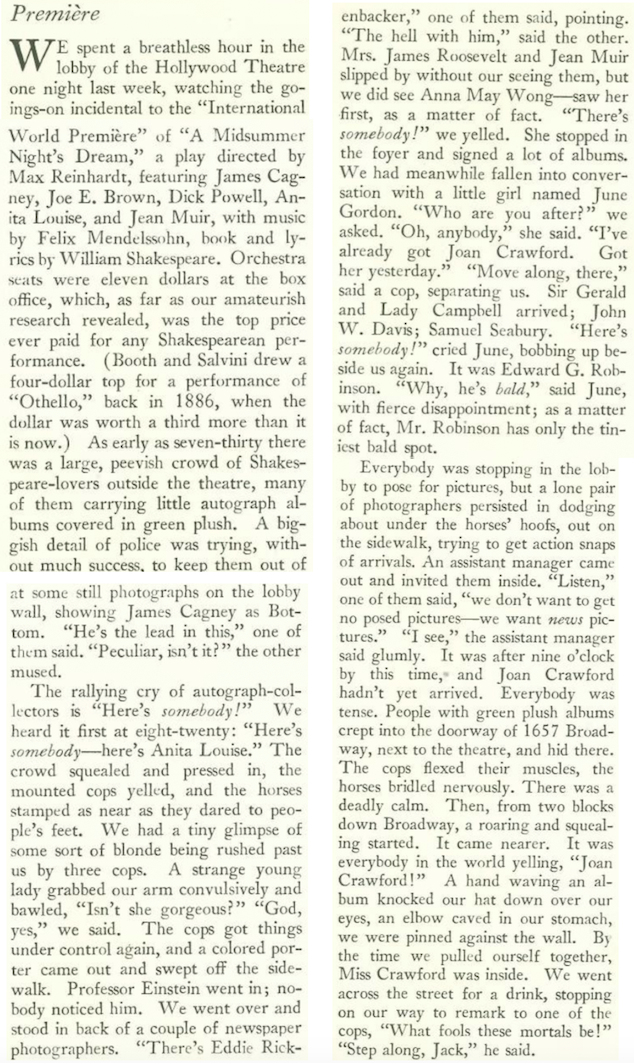
RUBBERNECKERS…A Midsummer Night’s Dream premiere at the Hollywood Theatre in New York City on October 9, 1935. (britannica.com)

Film critic John Mosher praised Joe E. Brown’s performance as Flute, as well James Cagney’s portrayal of Bottom, and lauded the “magnificent group of clowns” that formed the remainder of The Players. Here are excerpts from his review (note I included the entirety of Otto Slogow’s delightful spot drawing):

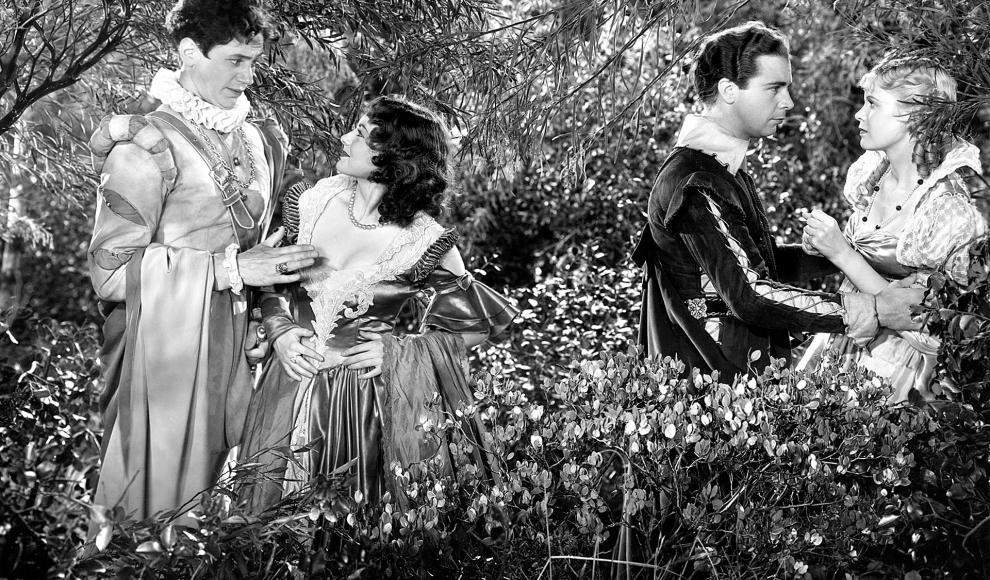
THE LOVERS…Left to right: Ross Alexander (Demetrius), Olivia de Havilland (Hermia), Dick Powell (Lysander) and Jean Muir (Helena) meet cute and confused in A Midsummer Night’s Dream. (TCM.COM)
THE SEVEN STOOGES…Bottom (James Cagney) and his fellow Players prepare to perform a stage play about the death of Pyramus and Thisbe which turns into a farce. From left, in front, Joe E. Brown (Flute), Cagney, and Otis Harlan (Starveling); in the back are, from left, Hugh Herbert (Snout), Arthur Treacher (Epilogue) and Dewey Robinson (Snug) as The Players in A Midsummer Night’s Dream. Frank McHugh (Quince) can be seen behind the wall in back. (IMDB)
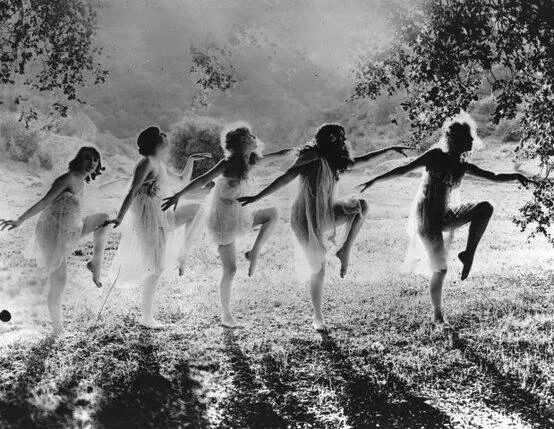
DANCING THE NIGHT AWAY…Fairie scene from A Midsummer Night’s Dream. (Facebook)

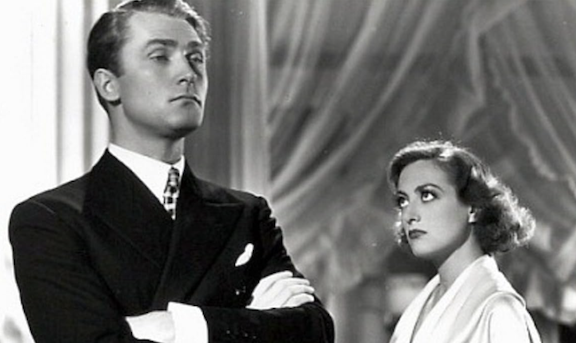
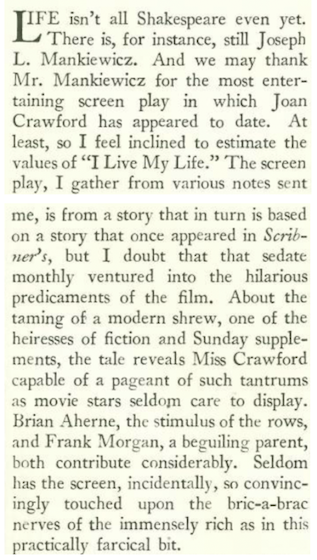
Mosher also reviewed the romantic comedy I Live My Life, which he found to be a satisfying satire on the lives of the rich.
MATCHING WITS…Bored socialite Kay Bentley (Joan Crawford) has a tempestuous romance with idealistic archaeologist Terry O’Neill (Brian Aherne) in I Live My Life. (IMDB)

 * * *

From Our Advertisers

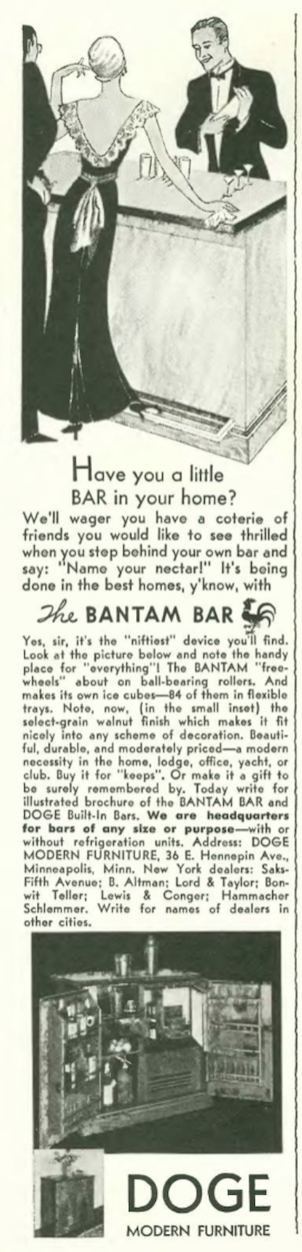
Readers ninety years ago opened the Oct. 19 issue to this two-page spread featuring the latest in fall/winter fashions…the ad on the right from Bergdorf Goodman featured stage and screen actress Gladys George donning a full-length silver fox fur…
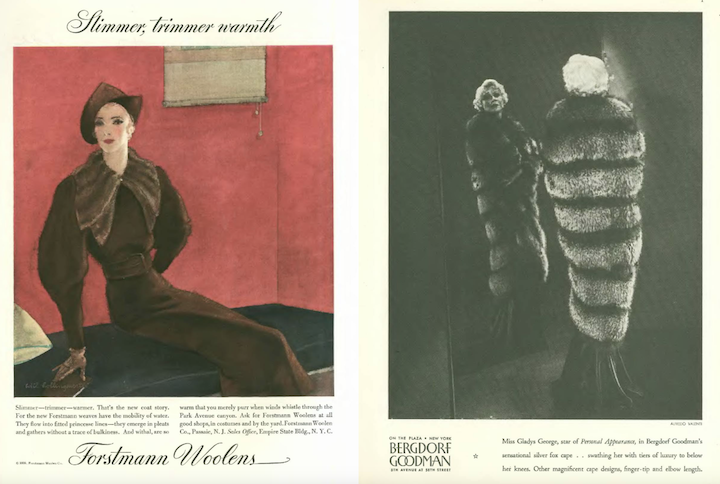
…George (1904–1954) was appearing at Henry Miller’s Theatre in the play Personal Appearance…she was featured in this testimonial ad for Schrafft’s in the theatre’s Playbill…
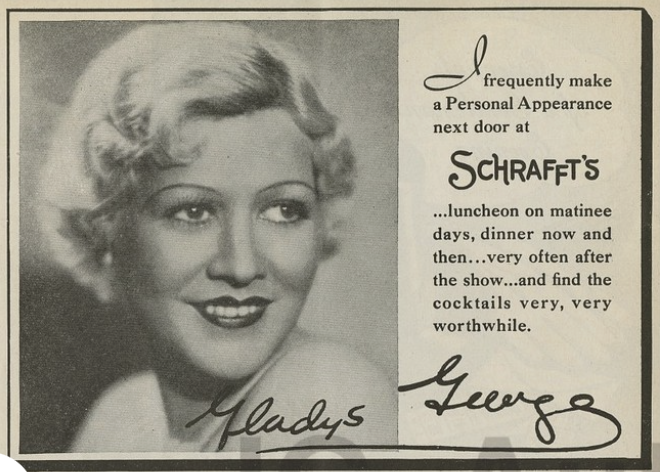
(playbill.com)

…the folks at Packard took out this colorful two-page spread to promote their more affordable model, the 120…the move to more affordable models helped the luxury carmaker weather the lean years of the Depression…

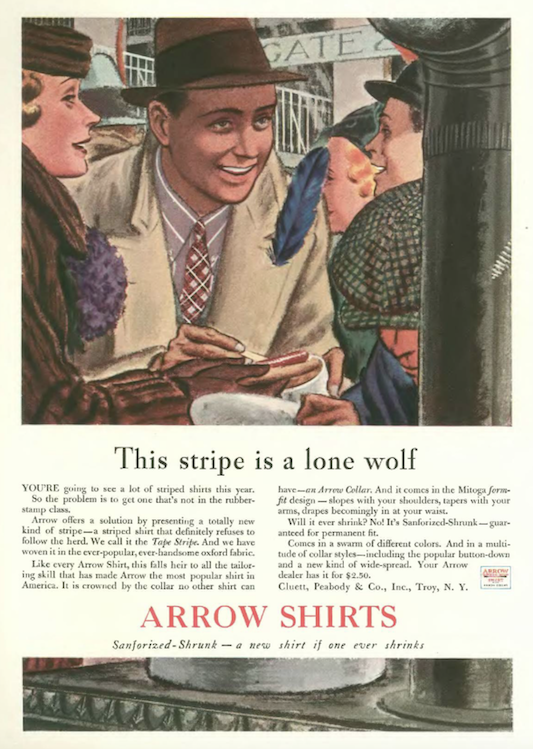
…there is a strange quality to these Arrow Shirt advertisements…what are the they looking at?…apparently something amusing as the man applies mustard to a hotdog, but it isn’t the vendor, who looks down at his cart…
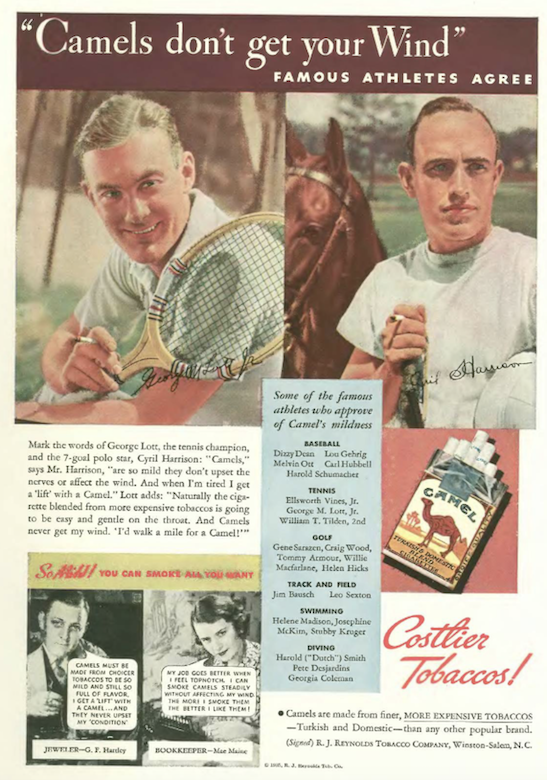
…R.J. Reynolds continued its Camel campaign featuring accomplished athletes who got a “lift” from smoking…the ad also included a couple of regular folks at the bottom, who claimed the cigarettes were so mild “You can smoke all you want”…
…Old Gold continued to enlist the talents of George Petty to illustrate their full-page ads…

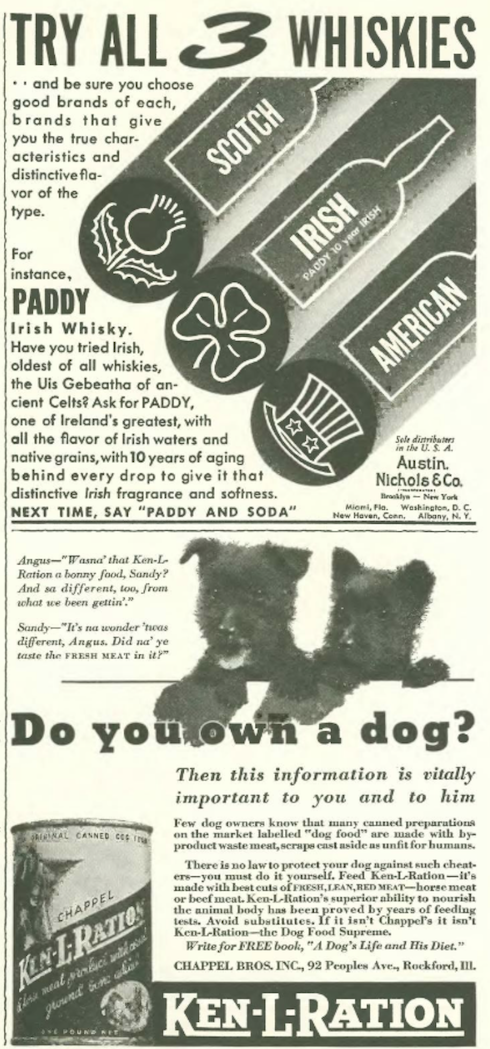
…here’s a couple of back of the book ads touting Irish whisky and Ken-L-Ration dog food…note how the Scottish terriers speak in “dialect”…Ken-L-Ration was a leading dog food brand in the 1930s, thanks to their use of horse meat rather than “waste meat”…
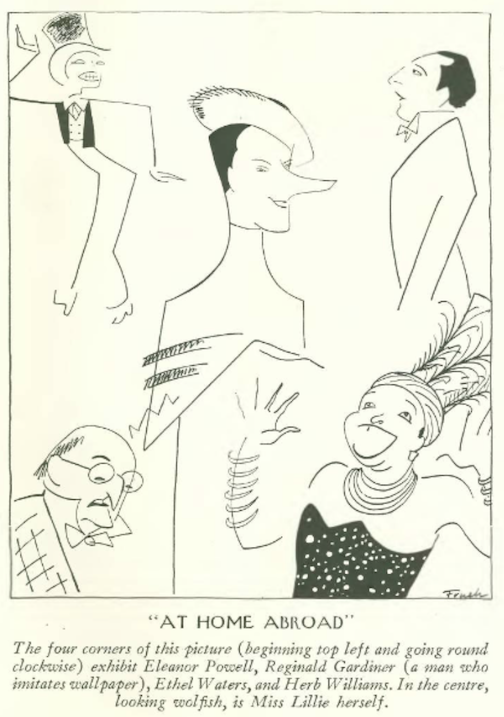
…on to our cartoonists, we start with Al Frueh enhancing the “Theatre” page…
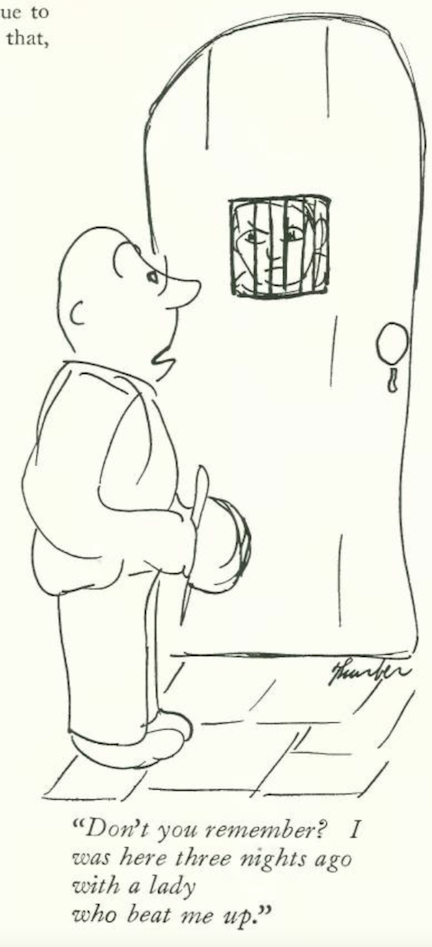
James Thurber showed us a man at odds with the times…
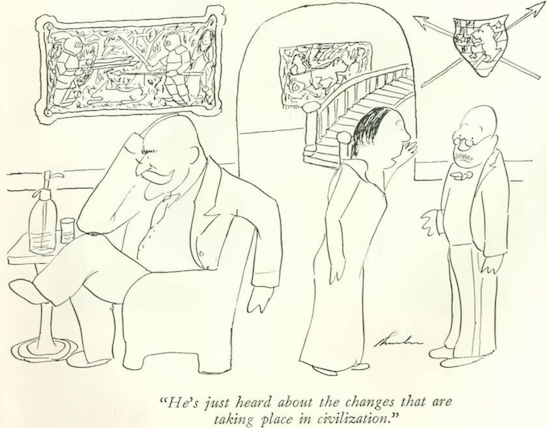
Barbara Shermund kept us up to date on the modern woman…

Whitney Darrow Jr offered a challenge to Helena Rubinstein (note the woman on the right—she could have been drawn by Helen Hokinson)…
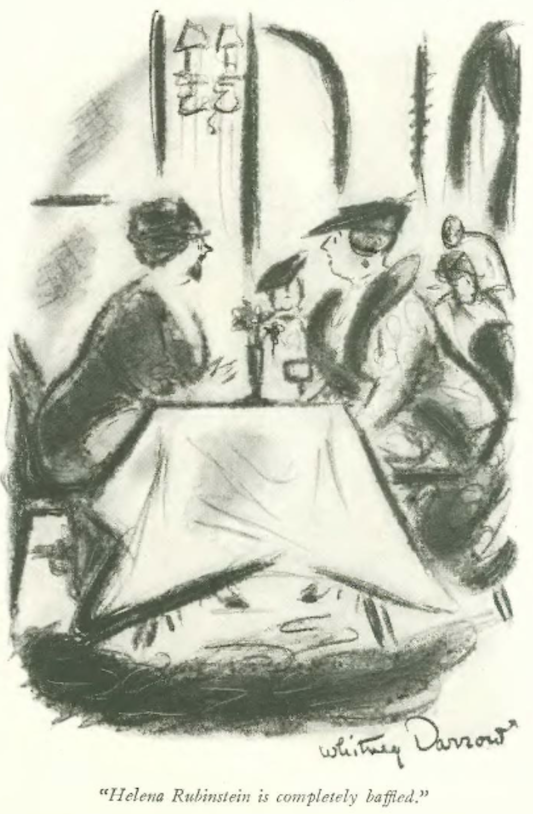
Gluyas Williams checked in on the lively proceedings of a book club…
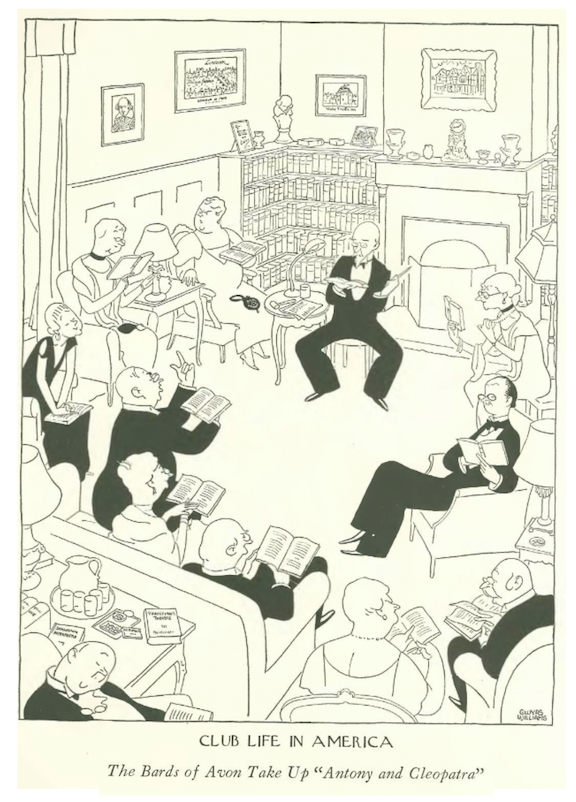
Helen Hokinson went looking for a good winter read…
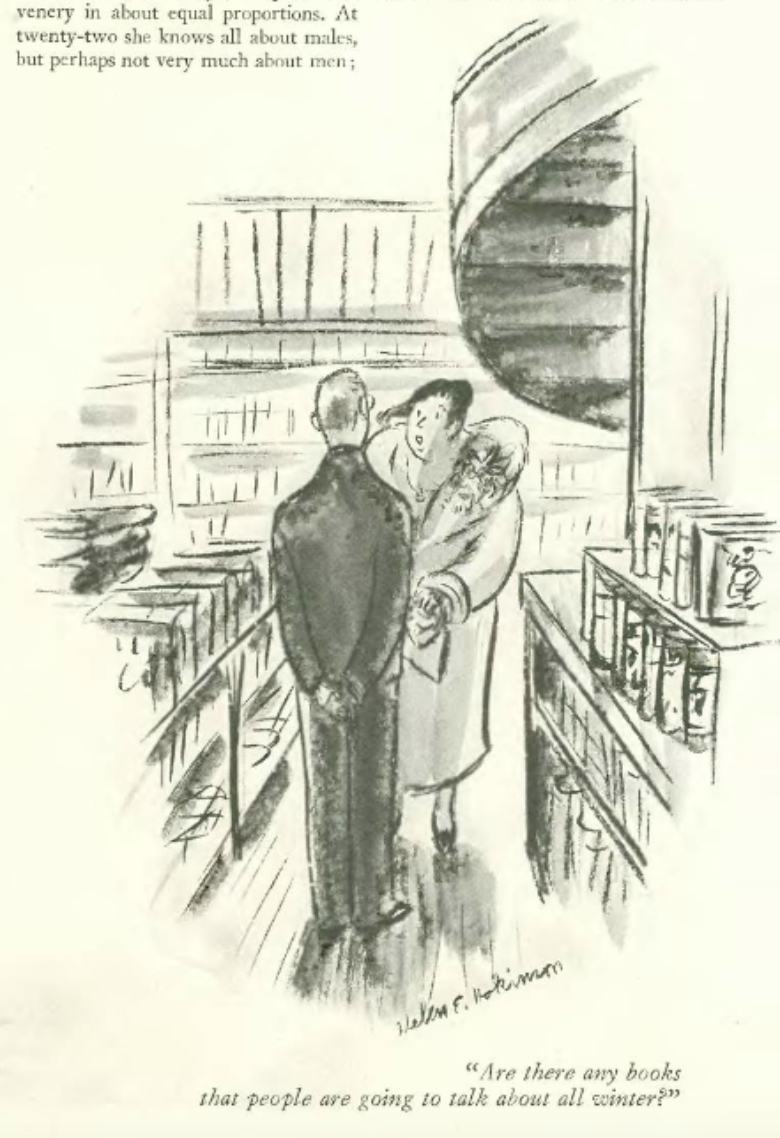
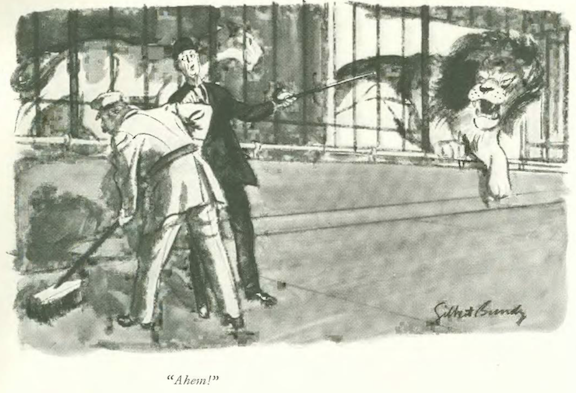
Gilbert Bundy offered an alarming scenario on the top of p. 31…
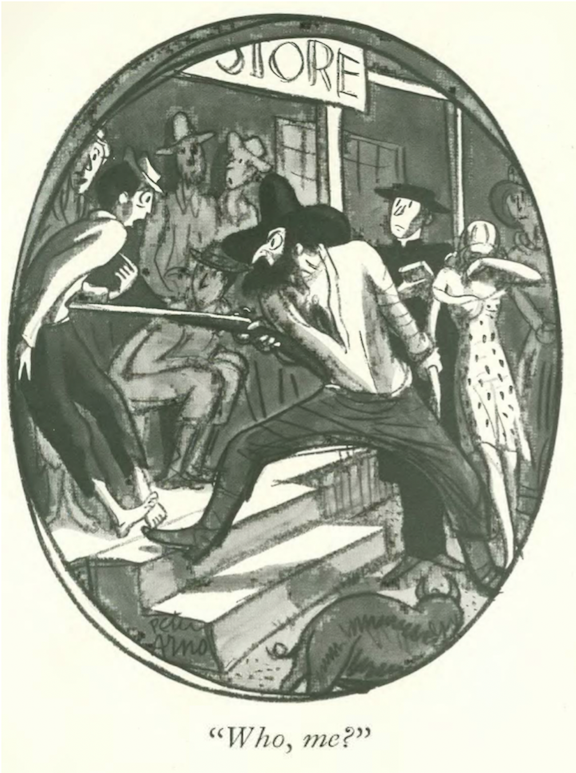
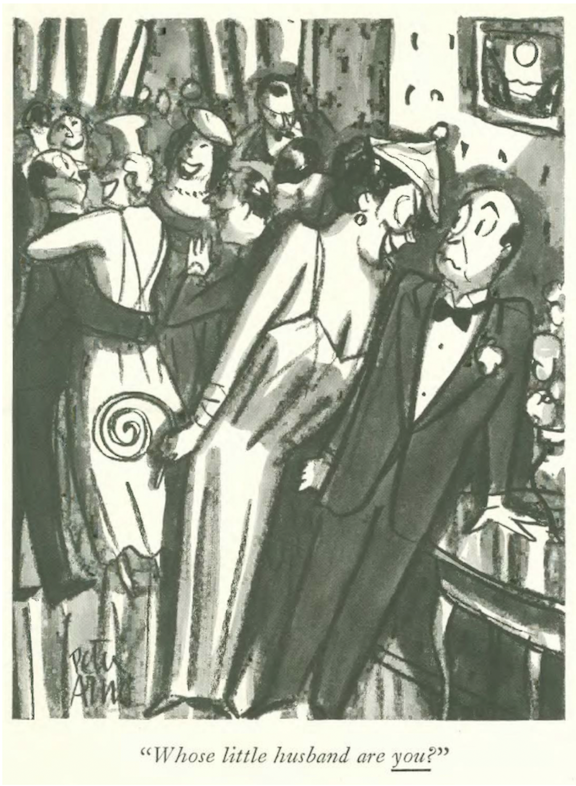
…and we close with Peter Arno, and an eye-raising encounter…
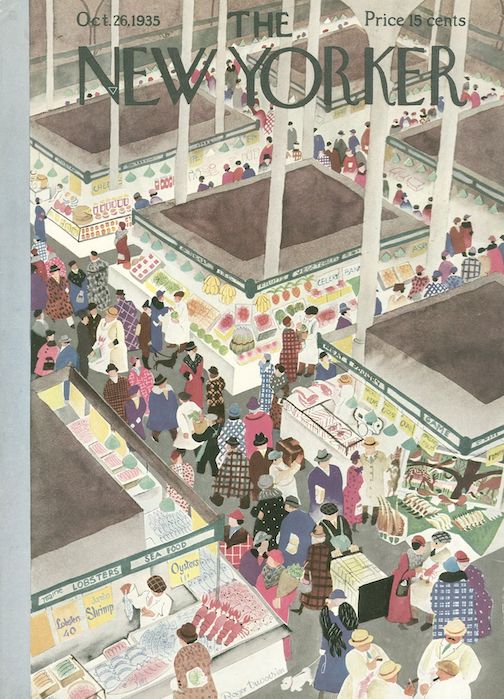
New Time: It Can’t Happen Here…
Ring Ding

Back in the days before we had a zillion different entertainment options, almost anyone with a pair of ears would tune in to hear the radio broadcast of a heavyweight title fight.

June 23, 1934 cover by Rea Irvin.

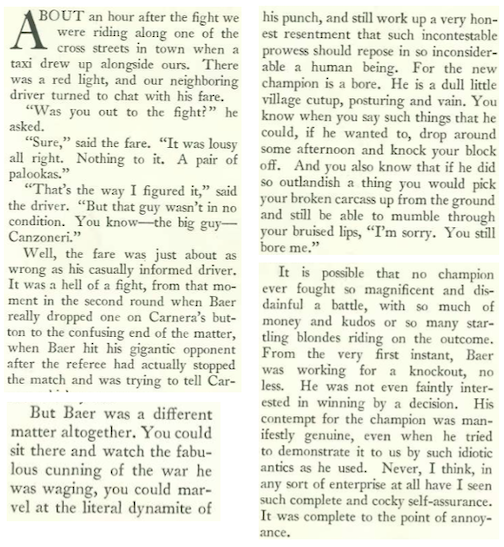
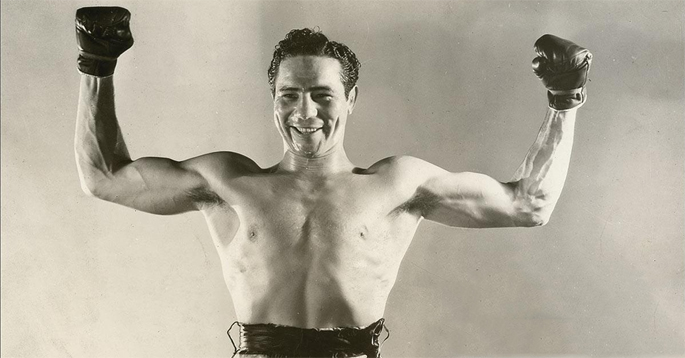
Jack Dempsey and Gene Tunney dominated the late 1920s, while Joe Louis, Max Schmeling and Jack Sharkey were marquee names in the 1930s along with Max Baer and Primo Carnera, who met on June 14, 1934 at the outdoor Madison Square Garden Bowl in Long Island City. The reigning champ Carnera (1906–1967), who stood six-and-a-half feet tall and weighed in at 260 pounds, had won more fights by knockout than any other heavyweight champion. But Baer (1909–1959) was known as a knockout puncher who beat one opponent so savagely that he died the following day.

DEADLY DUEL…Max Baer (right) fought Frankie Campbell on Aug. 25, 1930, in San Francisco for the unofficial title of Pacific Coast champion. In the fifth round Baer got Campbell against the ropes and hammered him senseless. Campbell died the next day. An autopsy revealed that Campbell’s brain was “knocked completely loose from his skull.” Baer was profoundly affected by Campbell’s death, and donated purses from succeeding bouts to Campbell’s family. (thefightcity.com)

Baer was also something of a showboater, a quality Morris Markey found distasteful when he wrote about the Baer–Carnera bout in “A Reporter at Large.”

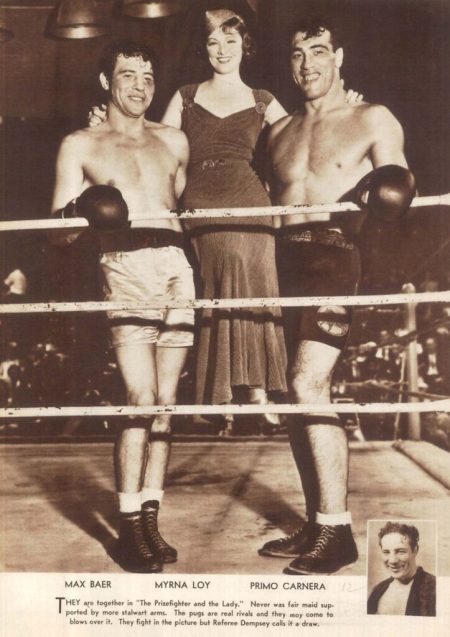
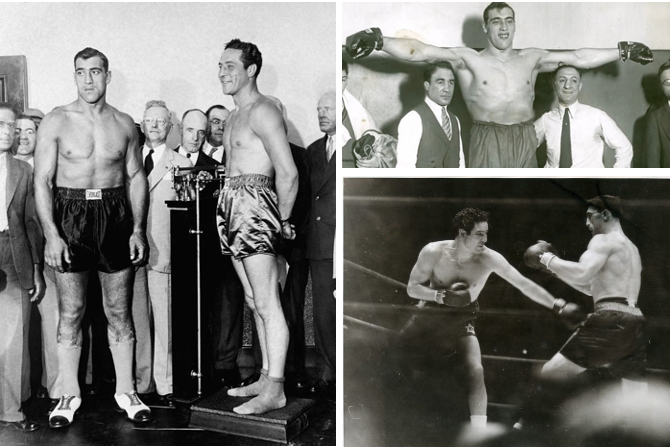
ALL SMILES…A year before their championship bout Max Baer (left) and Primo Carnera starred with Myrna Loy in The Prizefighter and the Lady. (theusaboxingnews.com)

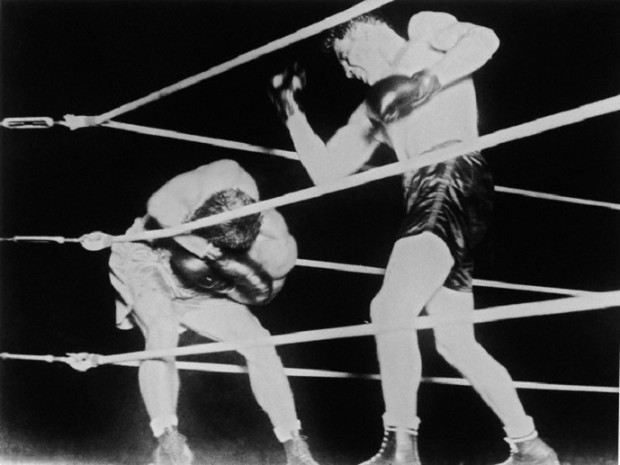
GIANT SLAYER…The Italian prizefighter and wrestler Primo Carnera, nicknamed the “Ambling Alp,” was the reigning heavyweight champion when he faced Max Baer on June 14, 1934 at the Madison Square Garden Bowl. Baer felled the champion eleven times before the fight was stopped in the eleventh round. Baer would only hold the title for a year, losing to James J. Braddock on June 13, 1935, in what has been called one of the greatest upsets in boxing history. (theusaboxingnews.com)

Markey further explained why Baer’s behavior in the ring was so bothersome, and how it differed from the comic antics of other famous athletes:

RETIRING TYPES…Both Primo Carnera and Max Baer acted in films during their boxing careers, and continued acting after their retirements (Carnera in 1944, Baer in 1941). At left, Carnera with Bob Hope in the 1954 American comedy Casanova’s Big Night (Carnera appeared in eleven Italian films and in a half-dozen American films); at right, Max Baer and brother Buddy Baer (also a boxer) with Lou Costello in the 1949 comedy Africa Screams. Baer would appear in more than 20 films.(theusaboxingnews.com/monstermoviemusic.blogspot.com)

Complications from diabetes would take Carnera down for good at age 60. Baer would die even younger, from a heart attack, at age 50. His last words reportedly were, “Oh God, here I go.” Baer’s son, actor and director Max Baer Jr. (best known as Jethro Bodine from TV’s The Beverly Hillbillies) is still with us, at age 85.

We aren’t quite finished with the Baer–Carnera fight…E.B. White led his “Notes and Comment” with this observation regarding the fight’s mass appeal and seeming universality:

 * * *

Apologies to Ms. Winslow

I seem to have given short shrift to author Thyra Samter Winslow (1886–1961) who published more than 200 stories during her career in magazines such as The Smart Set and The American Mercury. She published more than thirty in The New Yorker, from 1927 to 1942, including the serialization of her short story collection, My Own, My Native Land. The story “Poodles” was featured in the June 23 issue.

According to the Encyclopedia of Arkansas, Winslow’s early life in Fort Smith (Ark.) “provided background for her view of small towns as prejudiced, hypocritical, and suffocating places…many stories expose the hypocrisy, prejudice, and carefully maintained social structures of both small town and urban life. She was particularly adept at portraying women of every social class, often in an unfavorable light. Money, especially the pursuit of it as a means to happiness or status, is an important theme throughout her work.”

THE PURSUIT OF HAPPINESS…Thyra Samter Winslow with friend, 1937. (findagrave.com)

 * * *

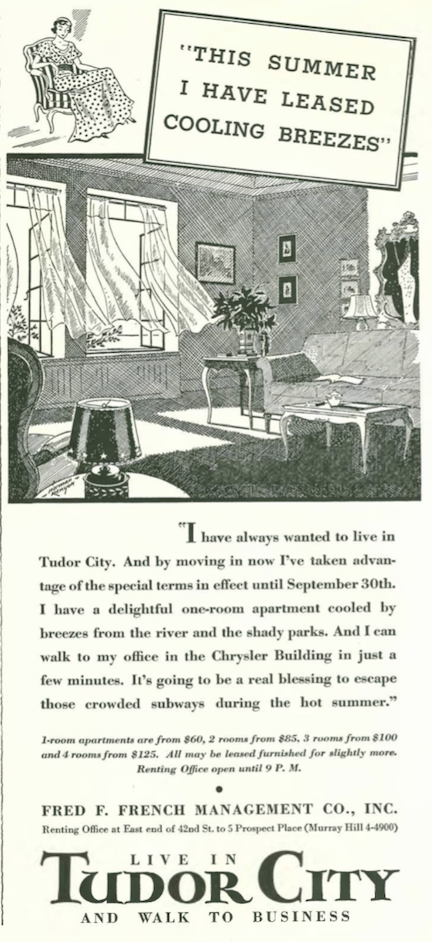
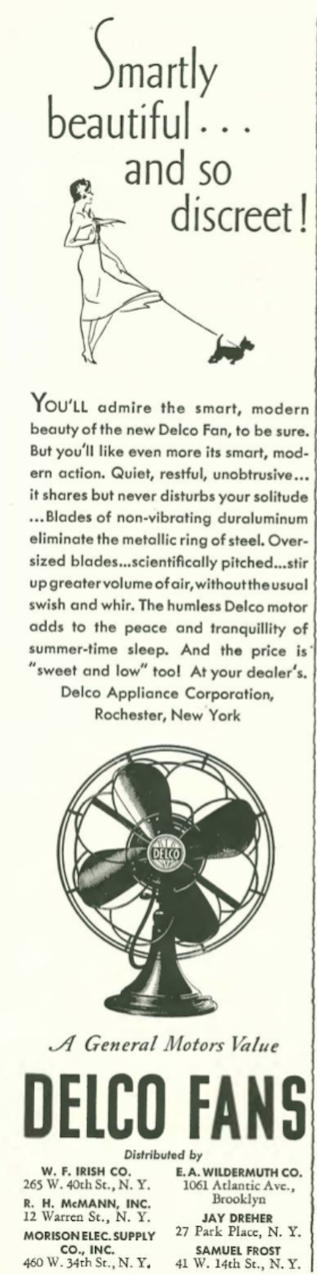
Hot Enough For Ya?

So what did New Yorkers do when the summer heat set in? The next few items offer some clues, beginning with this poem by E.B. White:

SUMMER STOCK…Theatergoers fled to shady villages in New York, New Jersey and New England in the 1920s and 30s when summer stock theater was at its height. The above photo shows theatergoers leaving a performance at the Lakewood Theatre near Skowhegan, Maine. The theater was claimed to be the oldest and finest summer stock company in America with a Broadway cast. Nearby Lakewood Inn provided recreation, camping, and tourist bungalows. (mainememory.net)

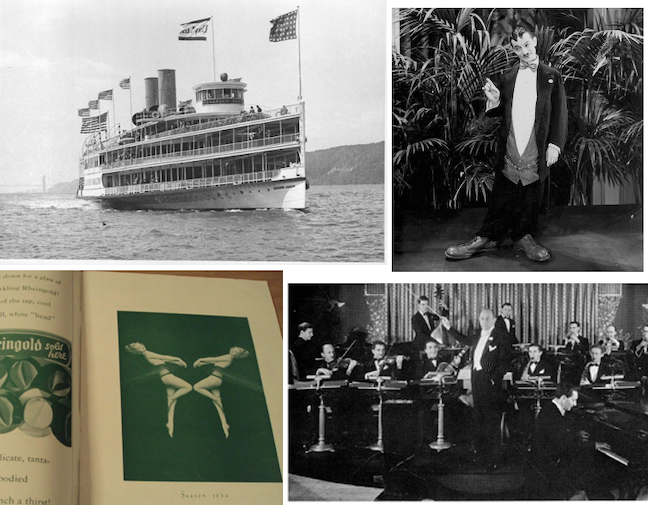
You could also take in some entertainment while enjoying the cooling breezes of the Hudson River. Robert Benchley hopped aboard the Alexander Hamilton to enjoy Bobby Sanford’s showboat revue:

SOME REAL SHOWBOATING…Clockwise, from top left, the steamboat Alexander Hamilton hosted Bobby Sanford’s showboat revue; comedian Lester Allen served as emcee for the show; the Meyer Davis Orchestra supplied the music; the revue featured the “exotic” DuVal sisters (image from program) among other diversions. (Hudson River Maritime Museum/IMDB/vintagebandstand.blogspot.com/Worthpoint)

“Tables for Two” took a look at summer dining options, from sidewalk cafes to hotel rooftops featuring dinner and dancing—this “Tables” was not written by Lois Long, but by Margaret Case Harriman, who knew a thing or two about nightlife (she was the daughter of the Hotel Algonquin’s owner, Frank Case)…

DANCING WITH THE STARS…The Waldorf-Astoria’s “Starlight Roof” was a popular summer restaurant for dining and dancing. Image from a 1935 publication The Waldorf-Astoria by Richard Averill Smith. (The Waldorf-Astoria)
 * * *
Doing Swimmingly
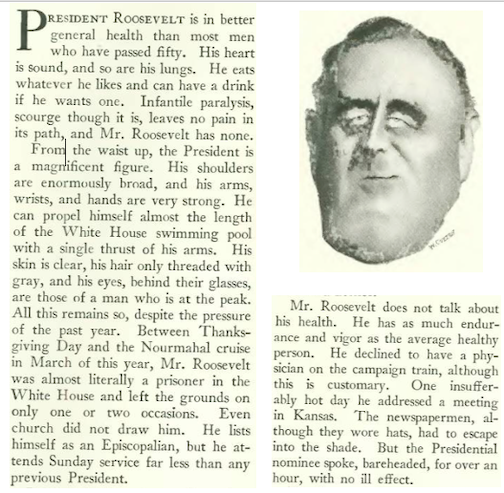
Historian Henry F. Pringle published part two of his series on President Franklin D. Roosevelt, here marveling at the president’s health despite his serious bout with polio (drawing by William Cotton).

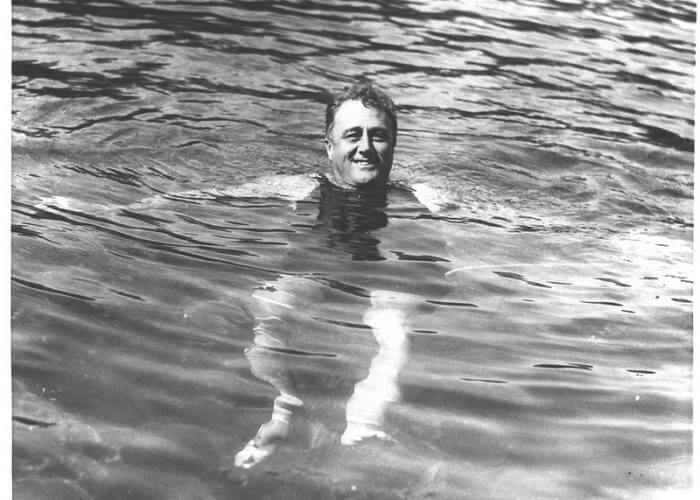
TAKING THE WATERS…President Franklin D. Roosevelt took to swimming for therapy and exercise. (FDR Presidential Library and Museum)

* * *

Get Yourself to Chi-Town

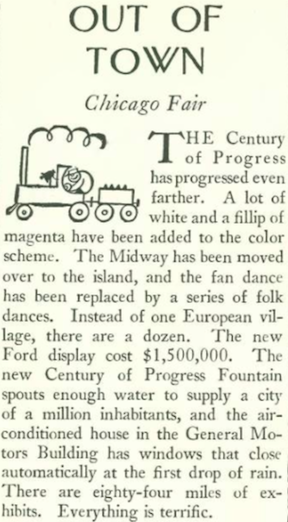
The Chicago World’s Fair (The Century of Progress) was in its second and final year, and The New Yorker found everything “terrific.” Excerpt:

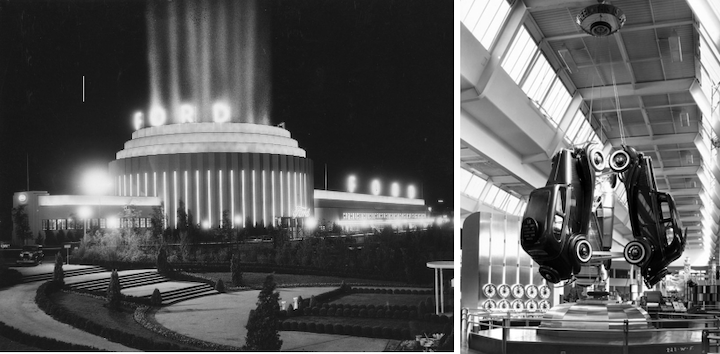
MAKING A SPECTACLE OF ITSELF…The 11-acre Ford Motor Company exhibit at Chicago’s Century of Progress became the most talked-about exhibit of 1934, featuring a central rotunda designed to simulate graduated clusters of gears. At right, Proof of Safety Exhibit in the Ford Building. (chicagology.com)

  * * *

From Our Advertisers

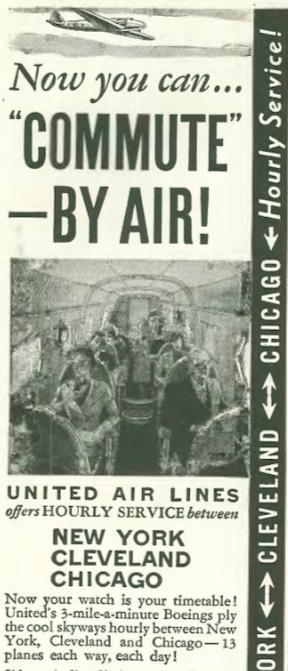
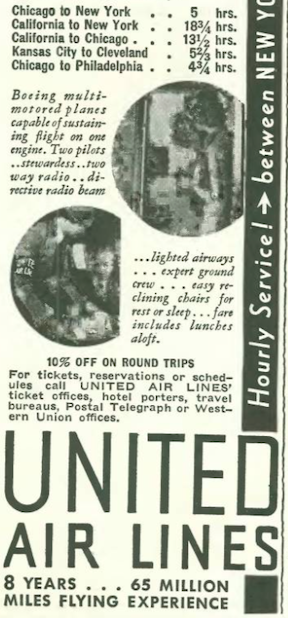
Just a couple of entries this week…You could take a plane to the Chicago World’s Fair on a United Airlines Boeing 247…

…the lower section of the ad claimed you could fly to Chicago in about five hours in planes featuring “Two pilots…stewardess…two-way radio…directive radio beam”…

TSA? WHAT’S A TSA?…United Airlines Boeing 247-D at an airport terminal with passengers and crew. (digitalcollections.lib.washington.edu)
COZY CONFINES…Passengers enjoy a game of checkers aboard a Boeing 247 in 1933. (digitalcollections.lib.washington.edu)

…and what would our advertising section be without two fashionable people lighting up?…

…on to our cartoonists, we begin with Reginald Marsh’s illustration of a Rep Theatre production…

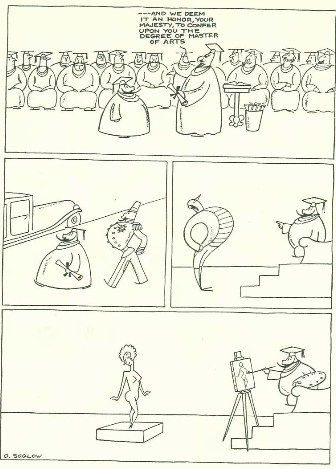
Otto Soglow’s Little King found his artistic side…

Rea Irvin continued his examination of native fauna…

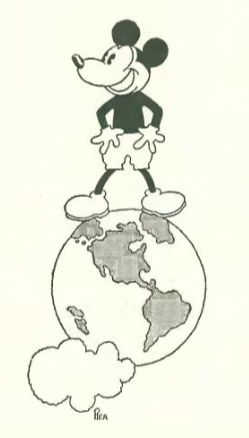
Gardner Rea correctly predicted the global domination of Mickey Mouse…

Peter Arno showed the dizzying effects of a Coney Island ride…

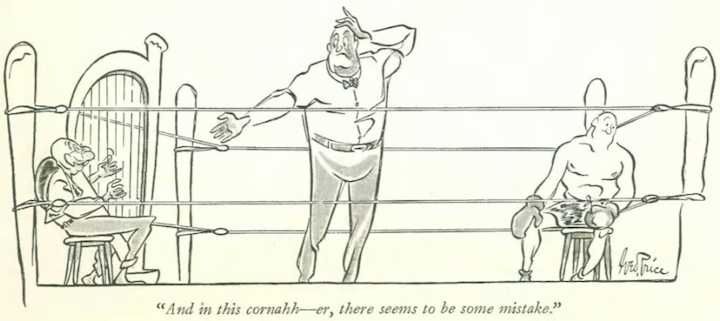
…however at the altar the thrill was gone, per Garrett Price

…another take on the ways of love, with Barbara Shermund...

…the newfangled diagonal bathtub continued to dazzle, with George Price

Gardner Rea offered up some subtle irony on the farm…

…and we close with James Thurber, in a poetic moment…

Next Time: A Light in Darkness…

Coney Summertime

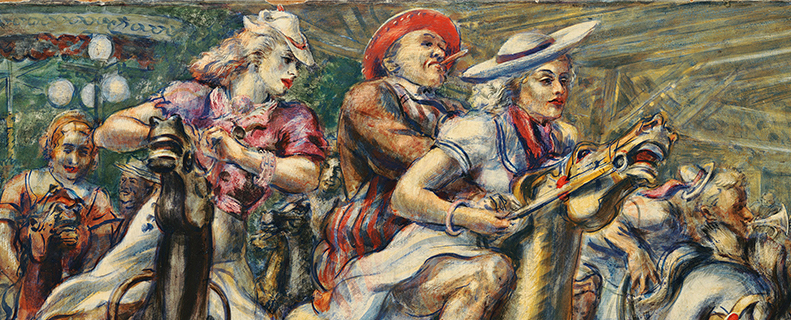
Above: Wooden Horses(detail) by Reginald Marsh, 1936. Marsh was a frequent visitor to Coney Island, a place that inspired numerous sketches and paintings. (Wadsworth Atheneum Museum of Art)

We officially kick off the summer with a visit to Coney Island, where “The Talk of the Town” took in the latest sights and amusements.

June 16, 1934 cover by Constantin Alajalov.

This excerpted “Talk” piece, attributed either to an “ 

CLANKITY CLANK…The mechanical man referred to in the “Talk” piece was likely similar to the one pictured above in this October 1933 feature in Popular Mechanics. Like many “robots” of that era, they were often pictured smoking cigarettes. (Google books)
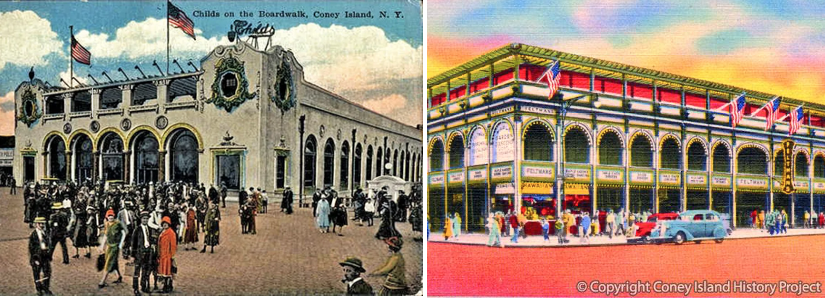
WET YOUR WHISTLE…Beer flowed up and down the boardwalk at Coney Island, but if you wanted something stronger you had to stop by the Half Moon Hotel or one of these establishments, Childs (left) or Feltmans’. (www.coneyislandhistory.org)
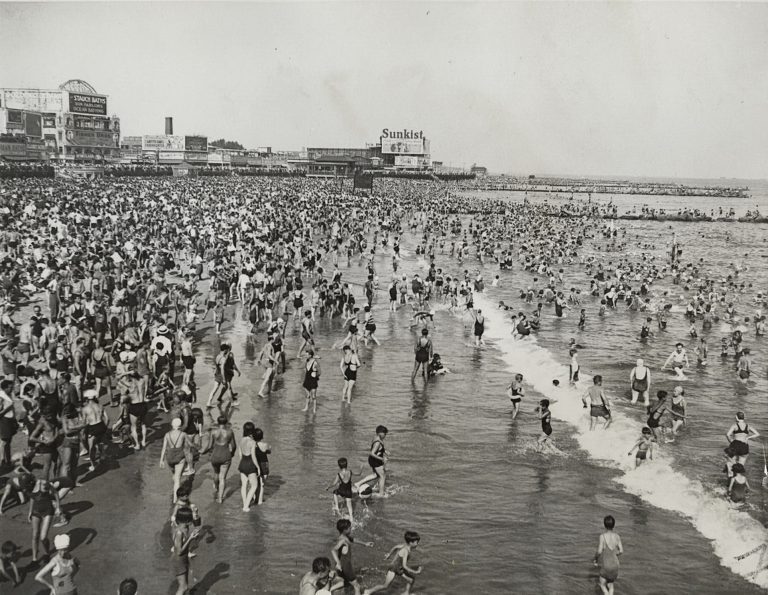
LEAVE SOME FOR ME…An estimated one million New Yorkers visited Coney Island on July 4, 1934 to get away from the heat of the city. (stuffnobodycaresabout.com)
DIFFERING INTERPRETATIONS…In his 1934 painting, Coney Island (left), artist Paul Cadmus portrayed beachgoers as ridiculous and uncouth rabble, while Cadmus’s friend and fellow artist Reginald Marsh took a somewhat kinder approach to the same subject in his 1936 Coney Island (right). (Jon F. Anderson, Estate of Paul Cadmus, licensed by VAGA, obtained via lacma.org / Syracuse University Art Collection)

Of course it wouldn’t be Coney Island without grisly wax museum scenes inspired by the latest sensational headlines…bank robber John Dillinger was still on the run, and “little June Robles” was finally free and apparently unharmed after being kidnapped and locked in a desert cage for 19 days…

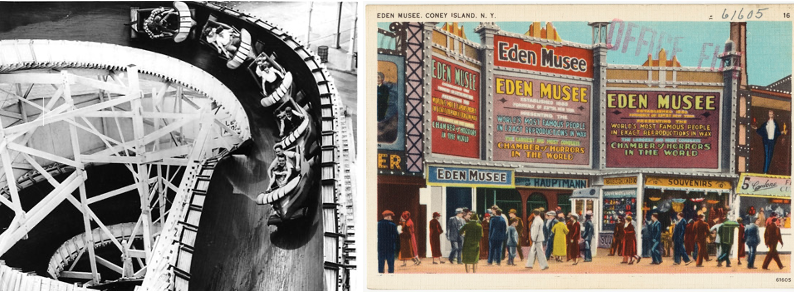
THANKS WINDY CITY…At left, the Chicago World’s Fair inspired Coney Island to build a trackless, bobsled-style “flying turns” coaster in Steeplechase Park (the wooden ride was destroyed by fire after only five years of operation). At right, a postcard image of the Eden Musee wax museum. (riverviewparkchicago.com / New York Public Library)
ON THE BOARDWALK…Another Coney scene by Reginald Marsh, titled Pip and Flip, 1932. (Terra Foundation for American Art, Chicago Daniel J. Terra Collection via artblart.com)

 * * *

Luck of the Irish

The Irish Hospitals’ Sweepstake (more commonly known as the Irish Sweepstakes) was established in 1930 to raise funding for hospitals in Ireland. Although lotteries were generally illegal in the U.S., millions of tickets were sold in the States, many of them in New York and New England. In his “Notes and Comment,” E.B. White wondered what would become of the lottery’s newest American winners, including former Ziegfeld Follies showgirl Alma Mamay, who won $152,000 in the Irish sweepstakes. White might have been pleased to know that Mamay moved to California, married a millionaire oil tycoon, and lived to the age of ninety-one.

CALIFORNY IS THE PLACE YOU OUGHTA BE..Ziegfeld Follies showgirl Alma Mamay took her Sweepstakes winnings and fled to California, where she married a millionaire oil tycoon. (ziegfeldfolliesgirls.com)

 * * *

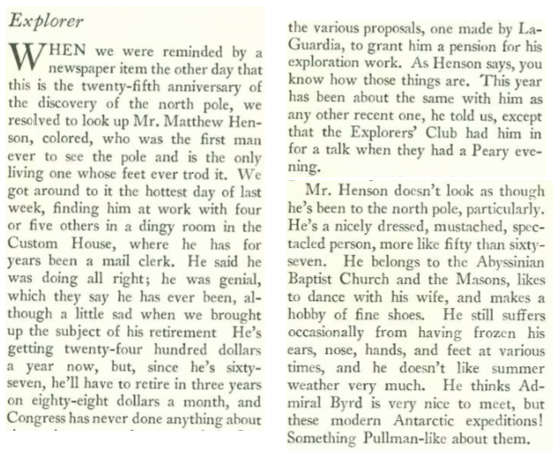
Rugged Individual

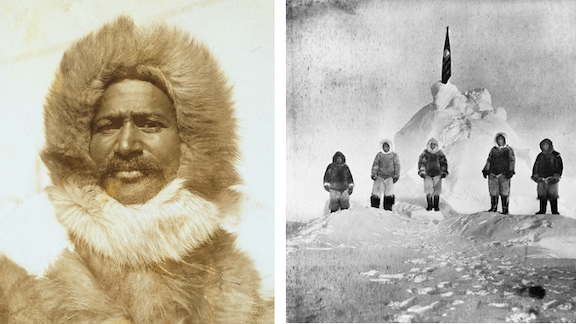
Matthew Alexander Henson (1866–1955) was an African American explorer who accompanied Polar explorer Robert Peary to the Arctic seven times, participating in a 1908–1909 expedition that arguably made Henson the first explorer to reach the geographic North Pole. “The Talk of the Town” caught up with Henson on the feat’s 25th anniversary.

GO NORTH YOUNG MAN…At left, Matthew Henson circa 1910. At right, photograph of Henson and four Inuit guides on the last stretch of their 1908–09 expedition, taken by Robert Peary at what they believed to be the North Pole. Henson (center) planted the flag. (Wikipedia)

 * * *

POTUS Profiled

Pulitizer Prize-winning historian Henry F. Pringle published the first installment of a three-part profile of President Franklin D. Roosevelt. In this excerpt Pringle writes about FDR’s sense of humor (illustration by William Cotton):

 * * *

Mattress Campers

The “About the House” column featured the latest in home-cooling devices. Couldn’t afford the zillions it would cost to install a home air-conditioner? Well the folks at Crosley—an electronics company known for its radios—offered a more affordable solution: an air-conditioned tent that could be erected over one’s bed for $150 (about $3,500 in today’s dollars):

Here is a 1934 ad for the contraption I found at worldradiohistory.com:

…and we continue with more from our advertisers, including the Broadway magazine The Stage, which offered up this idyllic scene showing what folks did in the days before air-conditioning…

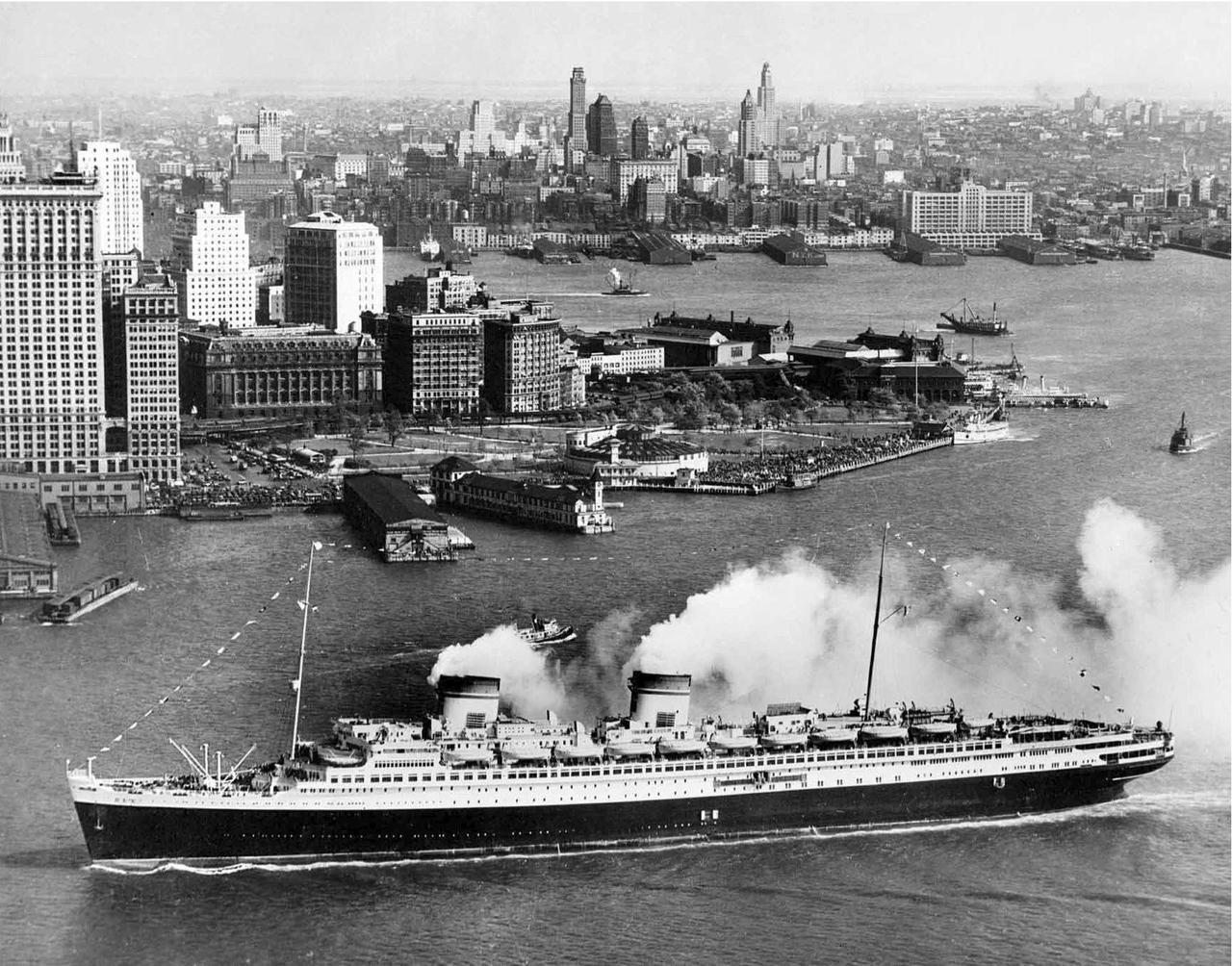
…you could also escape the heat by taking to the high seas aboard the Italian liner SS Rex

…seen below arriving in New York in this 1932 photo, the 911-foot SS Rex was the largest ship built in Italy before World War II…it was destroyed by the British RAF in 1944…

(adventures-of-the-blackgang.tumblr.com)

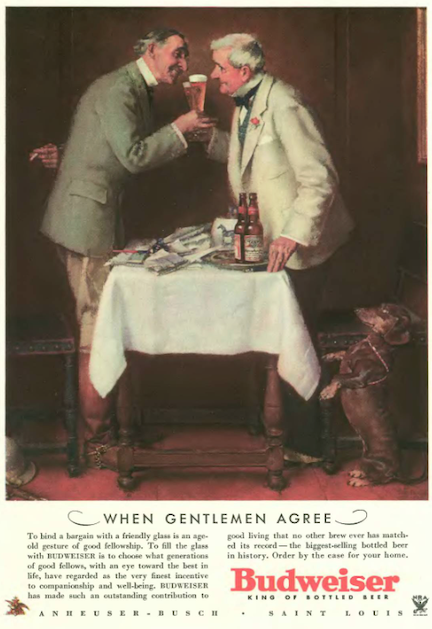
…you could also cool off like these two old gents, sharing a toast and some Budweisers…

…or you could get yourself a jug of applejack brandy and mix it 1:1 with pineapple juice…not sure who or what is being “saved” here…

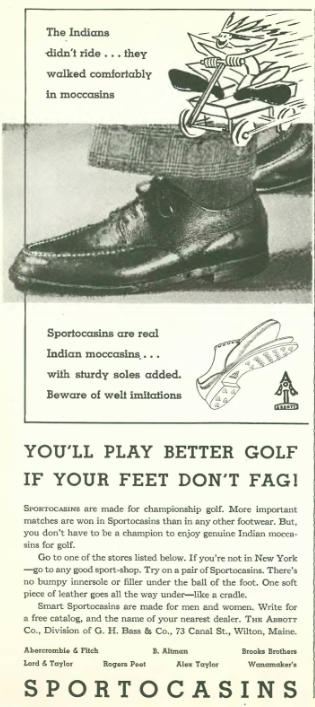
…long before there were Nikes or Adidas, golfers could hit the links in a pair of Sportocasins…

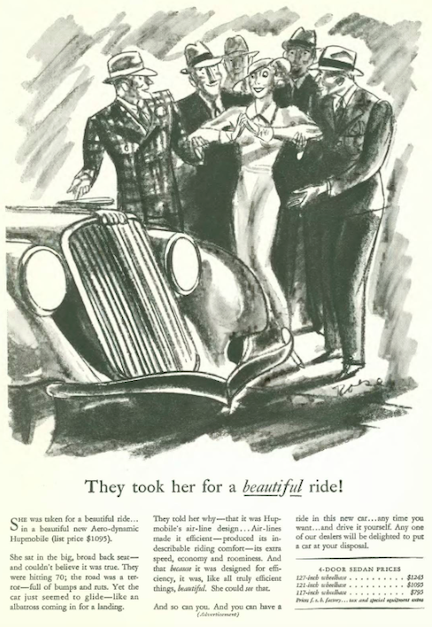
…Hupmobile was still hanging in there, enlisting the talents of illustrator Herbert Roese to extol the comforts and the beauty of its “air-line design”… it isn’t clear why it required five middle-aged men to take her on that beautiful ride…

…the real-life bellboy Johnny Roventini made his debut in the New Yorker as the spokesman for Phillip Morris cigarettes…

…Roventini (1910–1998), who stood less than four feet tall as an adult, was working as a bellboy at the New Yorker Hotel when he was discovered by an advertising executive in 1933. Apparently the exec had Roventini shout the line “Call for Philip Morris!” and learned the bellboy could repeatedly, and on cue, vocalize a perfect B-flat tone. Representing the company for more than forty years, he helped Lucille Ball and Desi Arnaz with the initial success of I Love Lucy (Philip Morris was the show’s sponsor)…

WHAT’S HIS LINE?…TV producers Mark Goodson, left, and Bill Todman greet Johnny Roventini during a 1952 radio broadcast of their quiz show, What’s My Line? The program’s sponsor was Phillip Morris. Note Goodson and Todman both hold cigarettes. (Wikipedia)

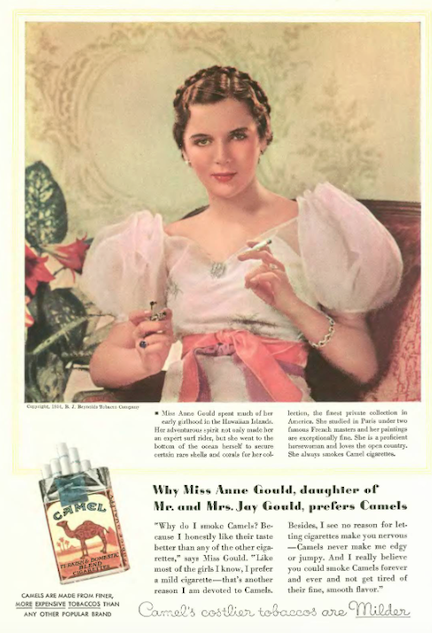
…by the looks of it, Anne Gould (heiress daughter of Jay Gould II and Anne Douglas Graham Gould) didn’t need anyone to tell her what to smoke…

…on to our cartoons, we continue our birdwatching with Rea Irvin…and we also get…

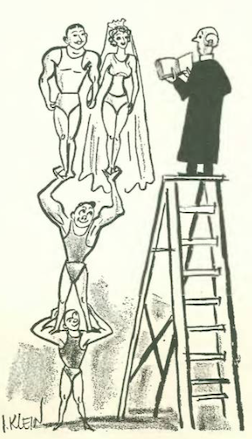
…high-flying nuptials with Isadore Klein

…a mismatch with George Price

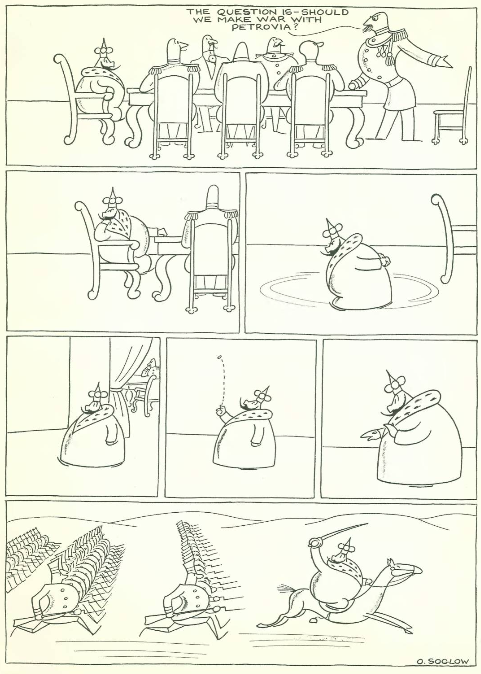
…the prospects for war with Otto Soglow

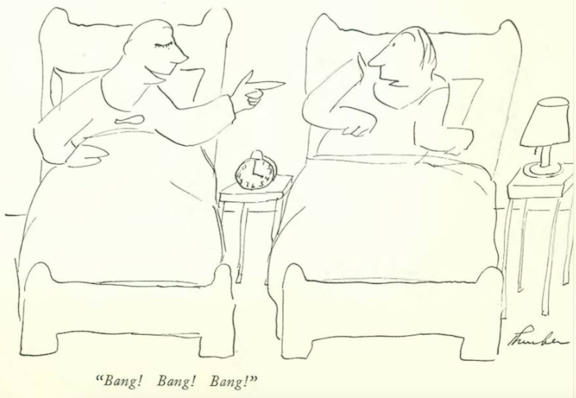
…marital bliss with James Thurber

…and a courtship scene, with an expiration date, from Mary Petty

Next Time: A Ring Ding…

Not Even Funny

There were a number of people Dorothy Parker couldn’t abide. That included gifted writers who not only eschewed serious literature, but who instead chose to crank out a lot of mass-market trash.

March 18, 1933 cover by William Steig.

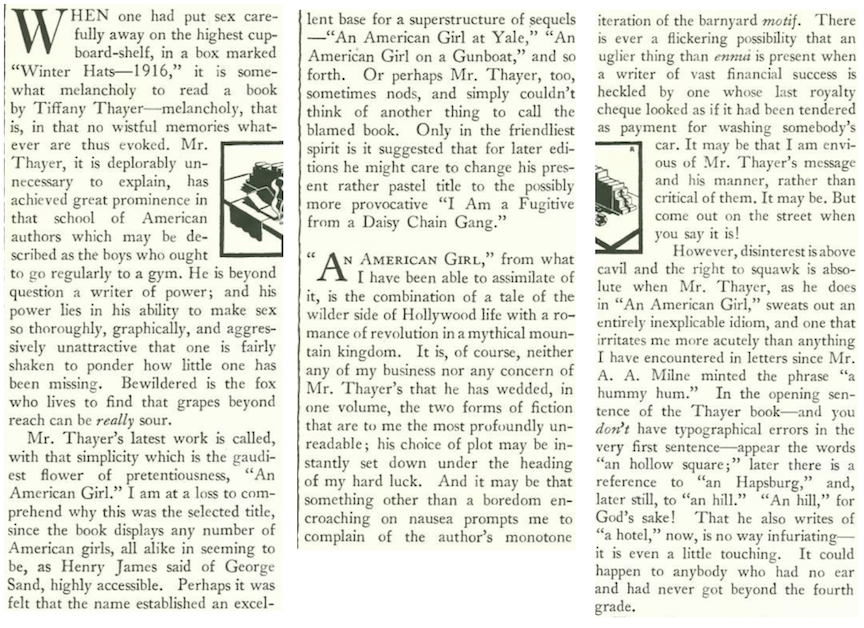
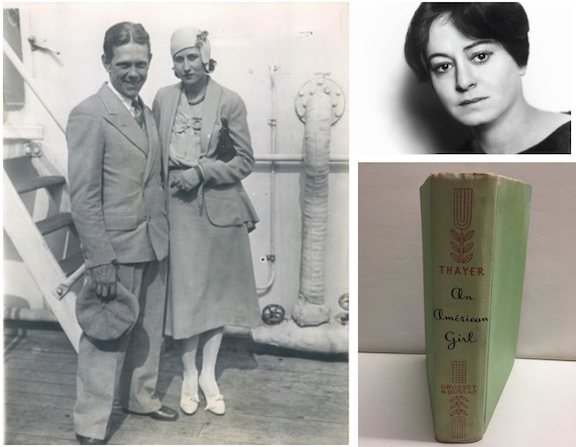
Parker was well acquainted with Tiffany Ellsworth Thayer (1902–1959), and for a time she even associated with the Fortean Society, which Thayer founded in 1931. Inspired by writer Charles Fort, the Forteans promoted the use of scientific methods to evaluate unexplained phenomena such as UFOs, spontaneous human combustion, and other oddities. Parker and fellow New Yorker writers Ben Hecht and Alexander Woollcott were among founding members, doubtless drawn to Fort’s reputation as a skeptic; however one famous skeptic, journalist H.L. Mencken, called Fort’s ideas “Bohemian mush.” It’s hard to say how long Parker stayed connected to the Society, but by 1933 she was fed up with Thayer’s novels, including his latest, An American Girl, which she found to be “the gaudiest flower of pretentiousness.” Here is an excerpt from Parker’s sometime column, “Reading and Writing,” subtitled Not Even Funny…

TIFF WITH TIFFANY…At left, Tiffany Thayer aboard a cruise ship with an unidentified woman, most likely his first wife, a dancer named Tanagra, early 1930s; at right, Dorothy Parker and a first edition of the offending volume. In her review, Parker observed that Taylor “is beyond question a writer of power; and his power lies in his ability to make sex so thoroughly, graphically, and aggressively unattractive that one is fairly shaken to ponder how little one has been missing.” (IMDB/Worthpoint)

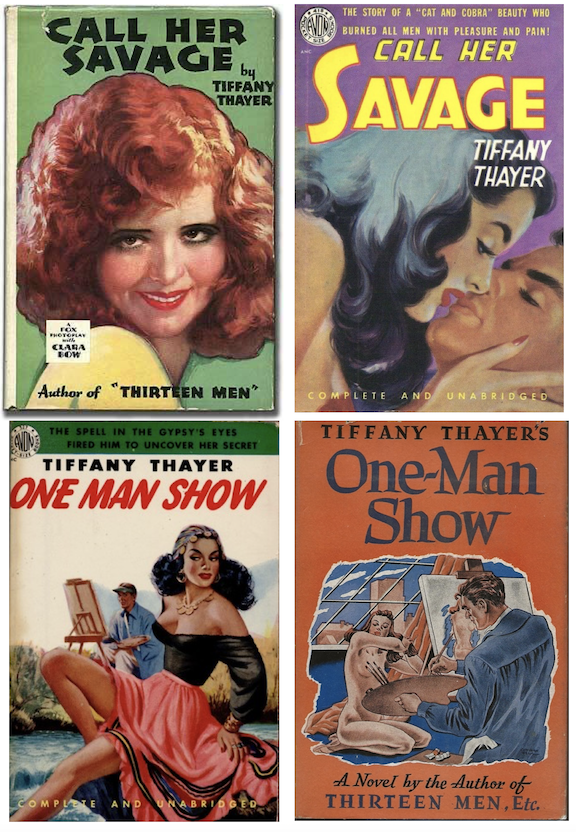
Although Thayer founded a society based on scientific reason, his pulp novels were filled with fantasy and prurient imagery. F. Scott Fitzgerald once observed that “curious children nosed at the slime of Mr. Tiffany Thayer in the drug-store libraries.”

BELIED LETTRES…Clockwise from top left, Thayer’s 1931 novel Call Her Savage was made into a 1932 film starring Clara Bow, here featured on the book’s dustcover; the same novel repackaged in 1952 for the pulp trade; a 1943 edition of Thayer’s One-Man Show, and a 1951 Avon reprint that toned down the nudity but upped the creep factor. (facebook.com/biblio.com)

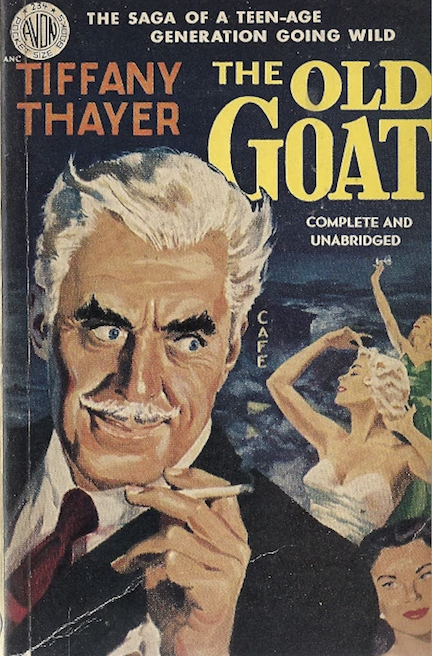
…and speaking of creep factor, check out Avon’s 1950 re-issue of Thayer’s 1937 novel The Old Goat, illustration attributed to Edgar Lyle Justis

(biblio.com)

Artists like Justis must have had a ball doing these illustrations, creating images to lure the unsuspecting into purchasing these old titles. Note how the coked-up old man sports not-so-subtle devil horns.

*  *  *

They Called It a Holiday

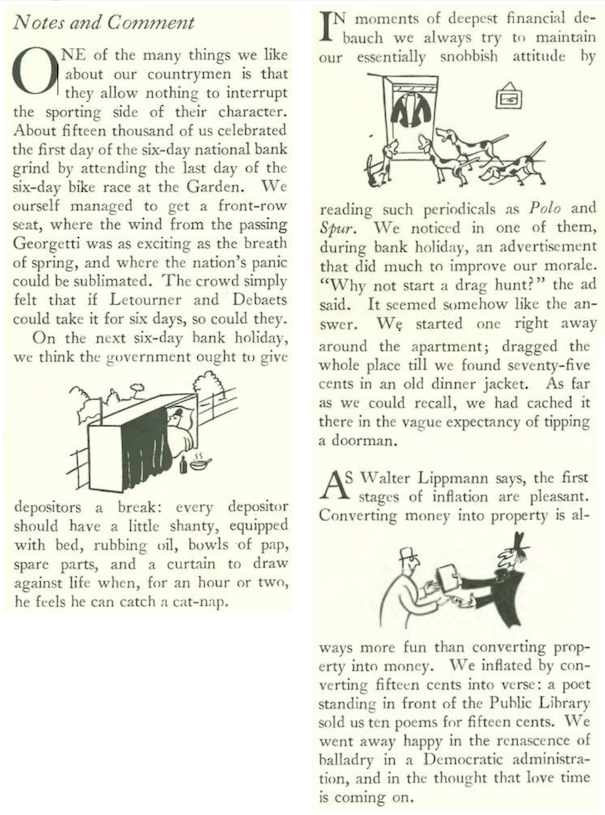
E.B. White, James Thurber (see below) and others in the March 18 issue commented on the national banking “holiday” declared by President Franklin D. Roosevelt in an effort to stabilize America’s banking system and rebuild public confidence. This led to the Glass-Steagall Act, signed three months later by FDR. Some observations in “Notes and Comment” by E.B. White, with the usual great spot illustrations by Otto Soglow

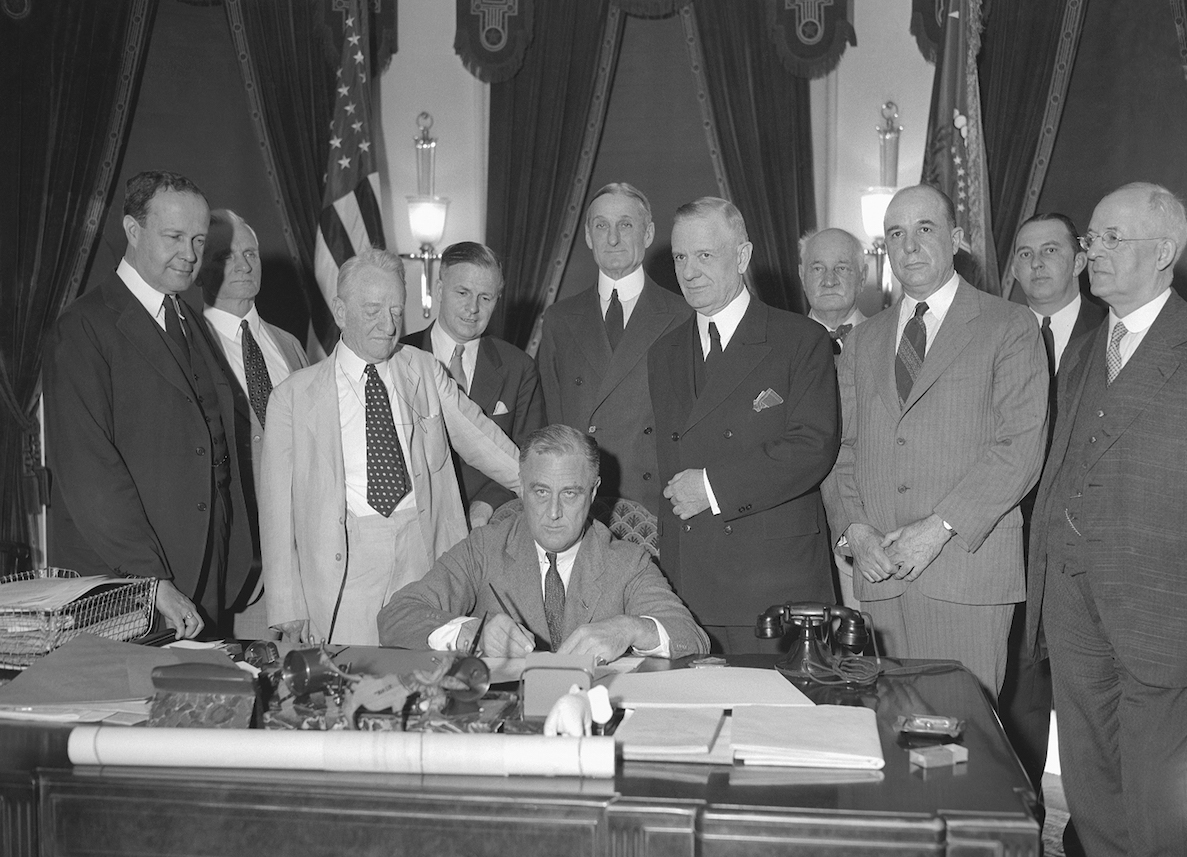
SAY CHEESE!…President Franklin D. Roosevelt signs the Glass-Steagall Act on June 16, 1933, effectively separating commercial banking from investment banking and creating the Federal Deposit Insurance Corporation (FDIC), among other things. (Associated Press)

…meanwhile, Germany’s new chancellor, Adolf Hitler, was busy abolishing civil liberties while pretending to be distressed by the behavior of his brownshirt thugs…an excerpt from Howard Brubaker’s “Of All Things”…

*  *  *

A Familiar Ring

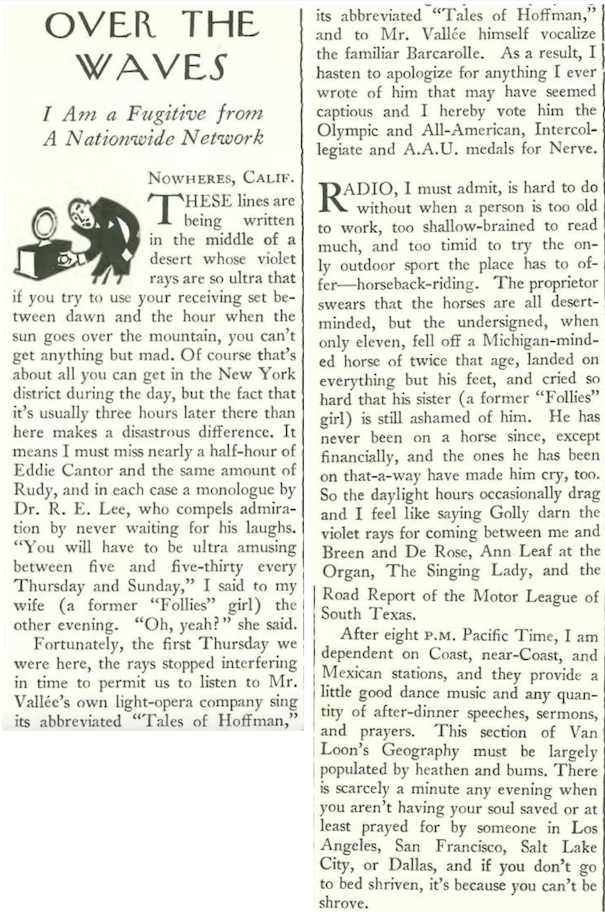
For the second week in a row Ring Lardner lent his wit to The New Yorker’s “Over the Waves,” column, which typically reviewed the latest news and entertainment beamed from the radio tower atop the Empire State Building. Lardner, however, was in California, lamenting the challenges of the time lag. An excerpt:

AND NO WI-FI, EITHER…Ring Lardner (center) detailed the frustrations of listening to New York-based radio entertainers like Eddie Cantor (left) and Rudy Vallée during his stay in California. (Pinterest/The Classic Archives/The New York Times)

 *  *  *

Dance Away Those Blues

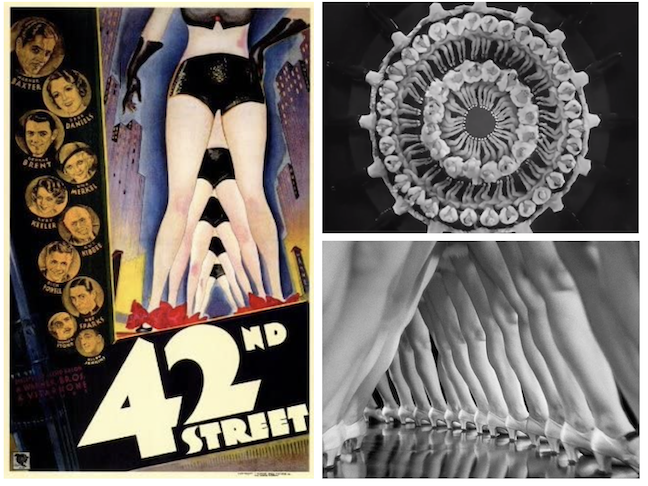
The pre-Code musical 42nd Street received a brief, albeit mostly positive review from critic John Mosher, who along with the producers of the film knew Depression-weary Americans needed such distractions. Nearly 90 years later (April 10, 2020), another New Yorker film critic, Richard Brody, suggested 42nd Street as one of the best films to stream during the Covid-19 pandemic: “Modern musicals start here, and Busby Berkeley’s genius bursts into full flower,” he wrote.

DANCE ‘TIL YOU DROP…Under pressure to produce a hit after losing his lead dancer (Bebe Daniels) to a broken ankle, Broadway musical director Julian Marsh (Warner Baxter, center) mercilessly rehearses her replacement, Peggy Sawyer (Ruby Keeler, in her film debut) before the premiere, vowing “I’ll either have a live leading lady or a dead chorus girl.” Looking on (to the right of Baxter) is Ginger Rogers, who portrayed “Anytime Annie.” (tcm.com)
A LEG UP ON HIS CAREER…42nd Street was a breakthrough film for choreographer Busby Berkeley, who would direct and choreograph a long string of musicals until the 1960s. The film is now considered a classic, preserved in the United States National Film Registry. (IMDB)

…and for trivia buffs, during an opening scene Bebe Daniels is shown reading the February 20, 1932 (anniversary) issue of The New Yorker…

*  *  *

From Our Advertisers

A convertible LaSalle (a downscale Cadillac brand) looks like a great way to enjoy a drive along the beach…let’s hope it has enough acceleration to outrun the tsunami apparently heading its way…

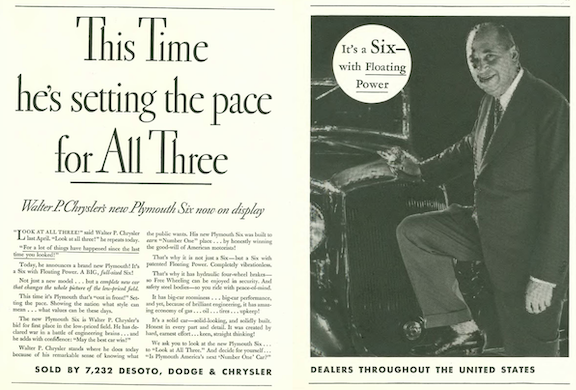
Walter Chrysler continued to dig into his deep pockets for two-page color spreads, including this one that placed his humble DeSoto in St. Moritz, of all places…

…not to be outdone, the folks at Nash found another exotic locale for their budget-priced sedan…Chicago, that is, at the 1933 Century of Progress Exhibition…and for an extra touch of class, we have what appears to be a chauffeur attending to this modest motorcar…

…America’s top luxury car maker, Pierce Arrow — a regular advertiser in The New Yorker — decided a quarter-page ad was sufficient to keep their name before the eyes of the well-heeled…at right, an ad from another back page featured cartoonist Don Herold shilling for the makers of imitation liquor flavors…according to the ad, one bottle, obtainable from your druggist, “flavors a gallon” of whatever forsaken hootch you are consuming…

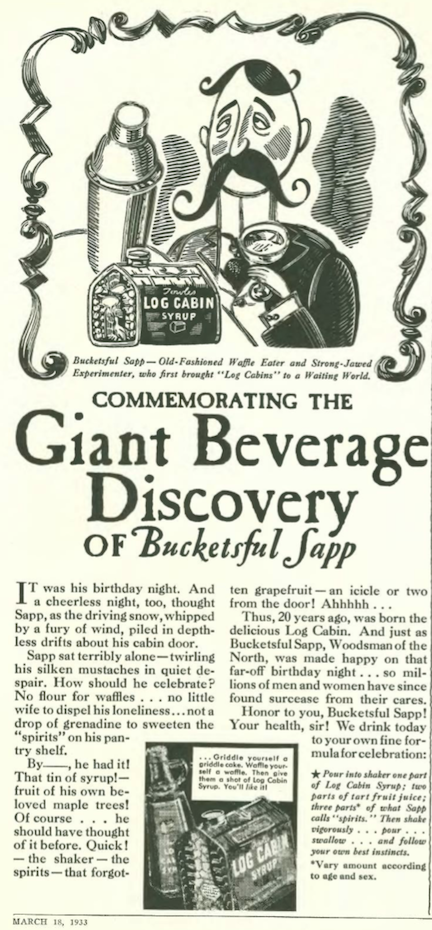
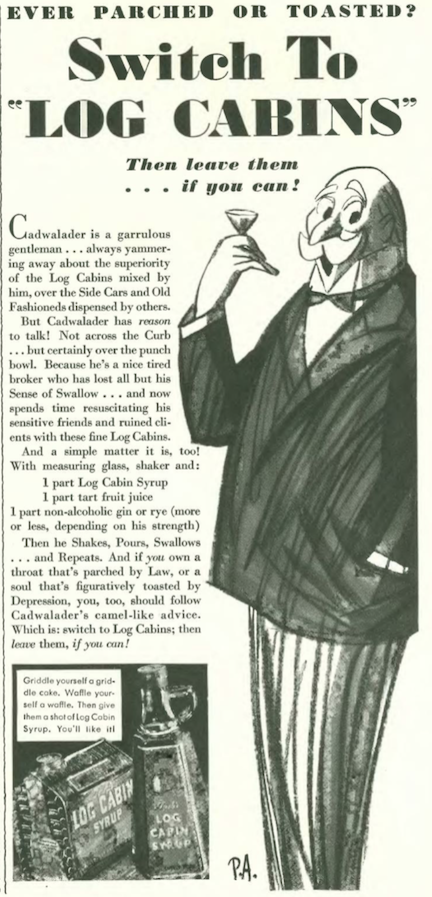
…the folks at Log Cabin relied on the talents of another New Yorker cartoonist, John Held Jr., to make both their product and a signature cocktail a more palatable experience…

…I have to hand it to the folks at Heinz for signing off on an advertisement only a vampire would find appealing…

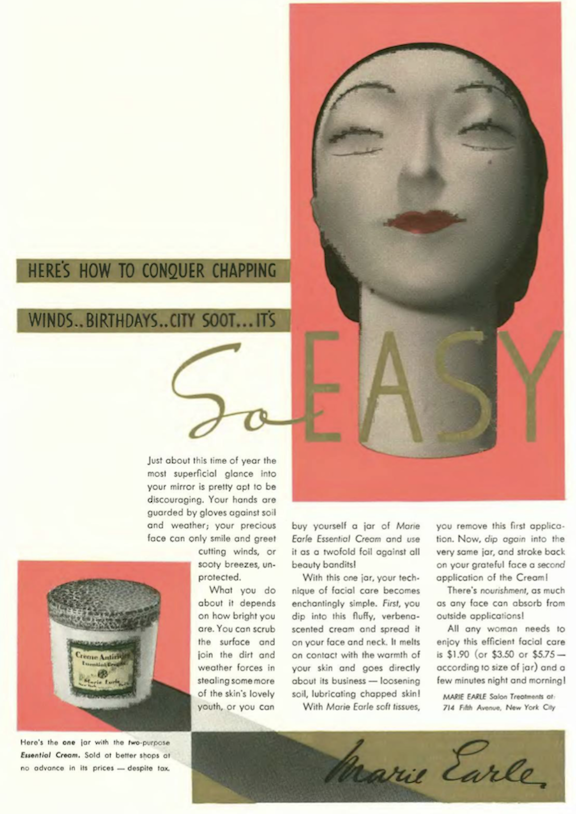
…the purveyors of Marie Earle beauty products rolled out this modern ad to promote their “Essential Cream”…

…while staid Brooks Brothers remained true to form — no flashy colors or advertising jargon — just straight talk about price increases….

…and then there’s the upmarket Fortnum & Mason, appealing to America’s Anglophiles with one of their famed wicker hampers filled with various goodies selected for “charming and greedy people”…

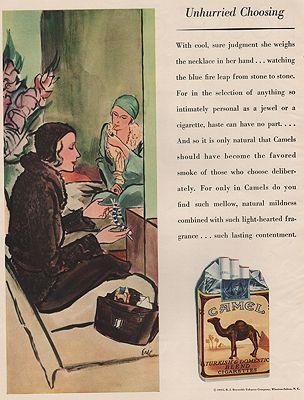
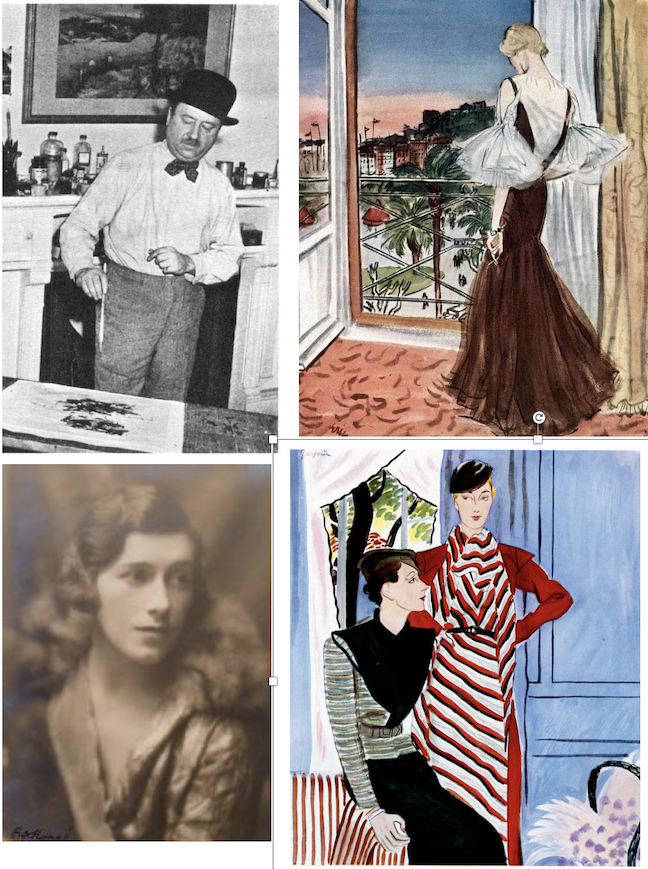
….for several years R.J. Reynolds employed the services of Carl “Eric” Erickson (1891–1958) to illustrate a series of ads featuring classy, disinterested, continental types smoking their Camel brand cigarettes…despite their less-than-exotic name, the makers of Spud menthol cigarettes hired Ruth Sigrid Grafstrom (1905–1986) to create their own smart set of smokers…

…ads that bore a striking resemblance to Erickson’s Camel work (this example from 1931)…

…and for your consideration, works from 1933 by Carl Erickson and Ruth Sigrid Grafstrom…both were noted fashion illustrators…

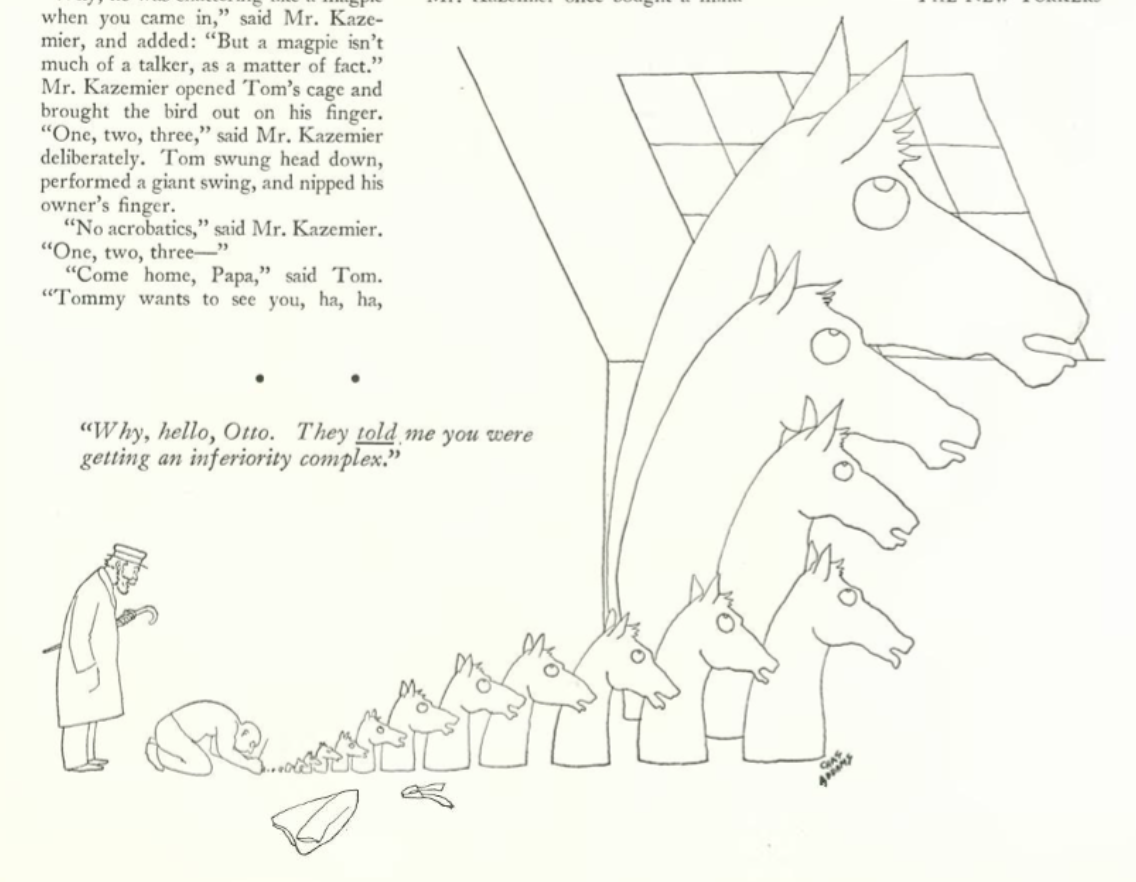
…on to our cartoonists, we begin with Charles Addams, who’d just published his first New Yorker cartoon the previous month, in the Feb. 4, 1933 issue

…that first cartoon was simply signed “Addams”…here he used the familiar “Chas Addams”…a close-up of the signature…

…we continue with a great caricature by Al Frueh to accompany a profile of Rudolf Kommer (as told by Alexander Woollcott)…

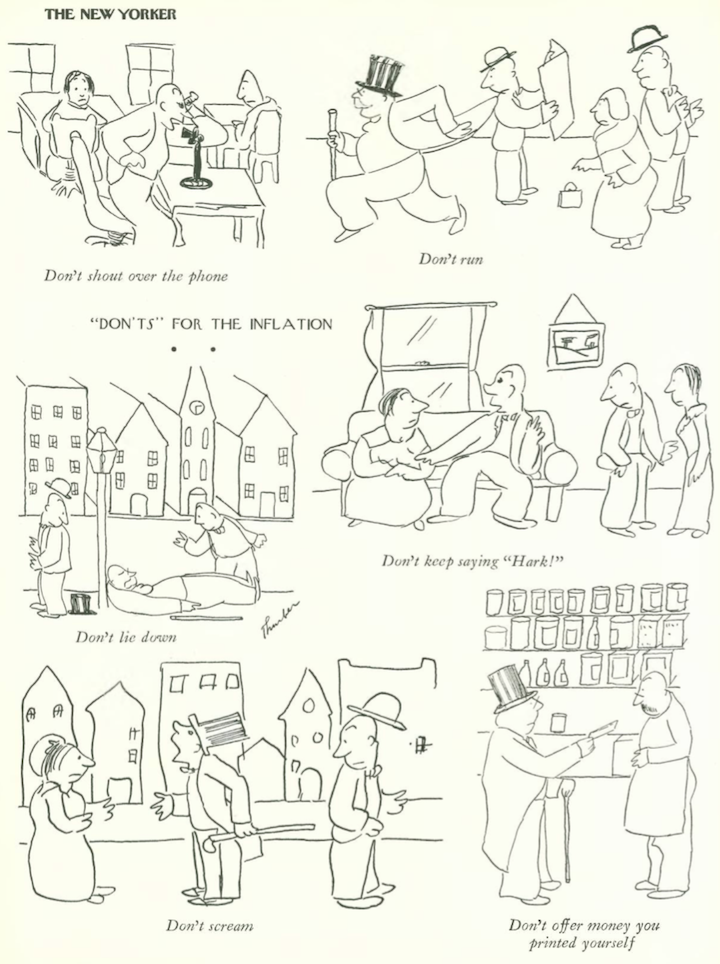
…a delightful full page of bank holiday-themed cartoons by James Thurber

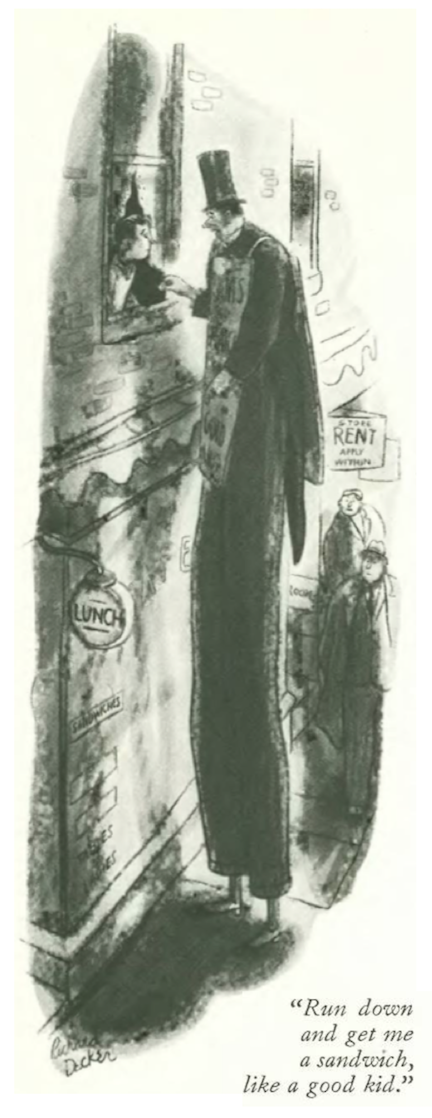
Richard Decker offered up a tall tale…

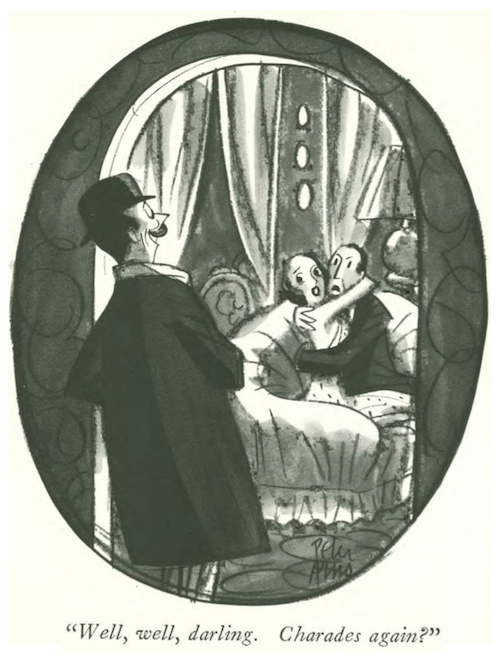
…and we close with Peter Arno, who served up one of his clueless cuckolds…
Next Time: Diary of a Lady…


Life With Father

If you’ve ever come across the byline B.H. Arkwright, you were most likely reading the work of Clarence Day Jr., who in February 1931 began writing for The New Yorker under that pseudonym and also under his given moniker, which in four short years would become a household name.

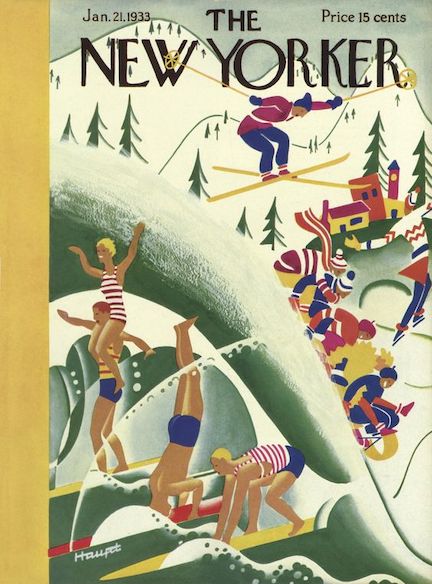
Jan. 21, 1933 cover by Theodore Haupt.

In the Jan. 21, 1933 issue Day would publish his first humorous story in The New Yorker about upper-middle-class family life in the 1890s. A subsequent collection of these stories would be published in 1935 under the title Life with Father. Sadly, Day would die shortly thereafter and wouldn’t witness the enormous cultural impact his stories would have on mid-century America.

Here is an excerpt of Day’s first story about his father, describing an exchange between his parents that would set the tone for the series:

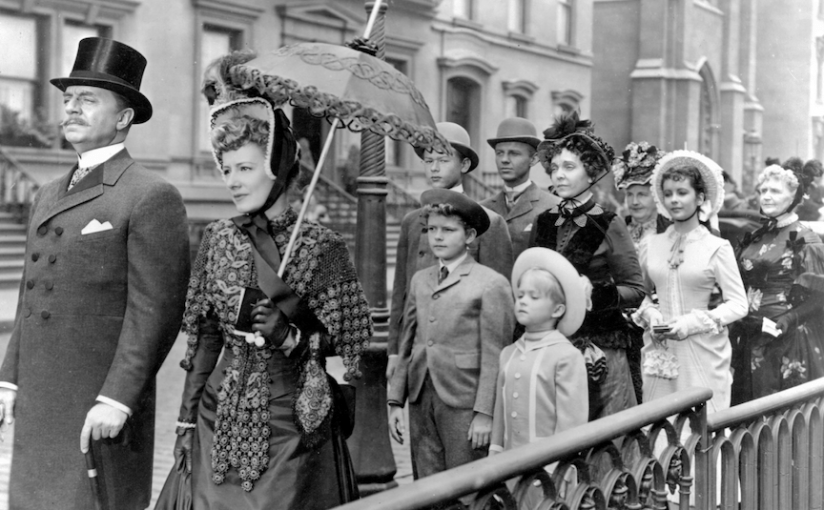
Life with Father was a hit with readers, inspiring a 1939 Broadway production by Howard Lindsay and Russel Crouse that would run for 3,224 performances over 401 weeks—it was, and still is, the longest-running non-musical play on Broadway. The play would be adapted into a 1947 film featuring Irene Dunne and William Powell in the leading roles. The stories even made it to the small screen in a CBS TV series that ran from 1953 to 1955.

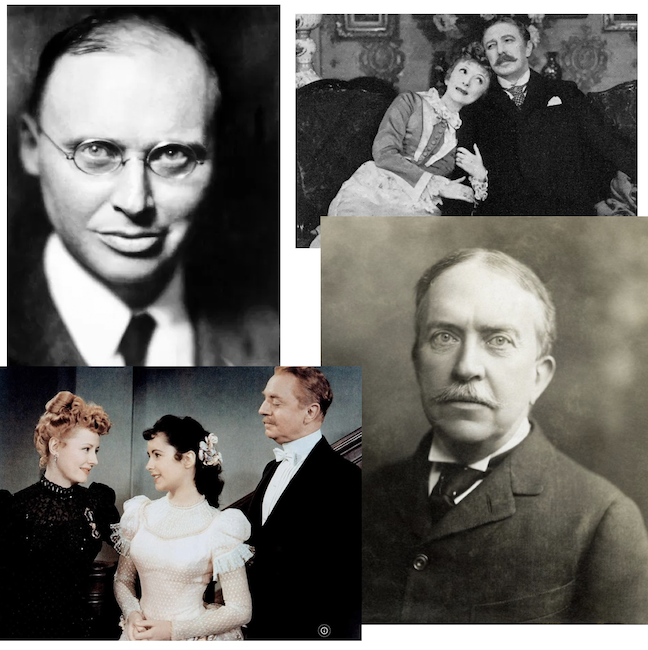
ALL IN THE FAMILY…Clockwise, from top left, Clarence Day, Jr. (1874-1935) in undated photo; Dorothy Stickney and Howard Lindsay in the Broadway production of Life with Father, 1939; Day’s father and inspiration, stockbroker Clarence Day, Sr. (1844-1927); scene from the 1947 feature film Life with Father with Irene Dunne, William Powell, and a 14-year-old Elizabeth Taylor. (britannica.com/theguardian.com/IMDB)

Day was also a cartoonist, contributing satirical cartoons for U.S. suffrage publications in the 1910s and also publishing collections of humorous essays including a Darwinian satire on the origins of human nature, This Simian World (1920), and the rambling, whimsical The Crow’s Nest (1921). Both featured Day’s simplistic cartoons and anthropomorphic tales that anticipated the work of James Thurber later in the decade.

CATTAIL…Self-portrait of Clarence Day rendered as a cat in a selection from The Crow’s Nest (1921). The entire book is available as a free e-book from The Project Gutenberg.

As we know, New Yorker founding editor Harold Ross was a man of contradictions, at once profane and puritanical, the latter on display when it came to one of Day’s cartoon submissions for the magazine. According to Brendan Gill’s memoir Here at The New Yorker, Ross balked at publishing the drawing below because it showed an exposed breast. Either Day or an editor simply removed the nipple (note the broken line in the nipple’s place) and the cartoon was published.

 *  *  *

Big Man’s Big Man

August Gennerich not only served as President Franklin D. Roosevelt’s bodyguard, he was also a close family friend. “The Talk of the Town” featured a lengthy account of the man, an excerpt of which is below:

ON GUARD…Augustus “Gus” Gennerich (1887-1936) was a friend of Franklin and Eleanor Roosevelt’s as well as one of FDR’s most trusted guards. He began his career in 1909 as a NYC policeman and in 1929 was assigned to be then-Governor Roosevelt’s bodyguard in the city. The Roosevelts were heartbroken when Gus died unexpectedly at age 50 from a heart attack. (picryl.com)

*  *  *

Desert Solitude

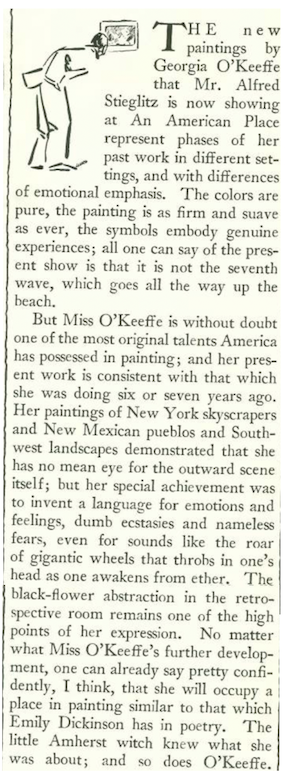
In 1933 Georgia O’Keeffe (1887–1986) was well into her Southwestern phase when her husband Alfred Stieglitz staged a show of her work at his last New York gallery, An American Place. O’Keeffe and Stieglitz lived together in New York until 1929, when O’Keeffe began spending more time in the Southwest—most likely to put some distance between herself and Stieglitz, who was in a long-term affair with photographer and writer Dorothy Norman. After this show opened O’Keeffe would suffer a nervous breakdown (per the above) and not return to painting until 1934. Lewis Mumford visited An American Place and had this to say about O’Keeffe’s work:

ANOTHER AMERICAN PLACE…New Mexican Landscape by Georgia O’Keeffe, 1930. (springfieldmuseums.org)

*  *  *

The Bookish Type

Modernist American poet and writer Archibald MacLeish (1892–1982) was a man of letters to the letter, serving as the ninth Librarian of Congress (1939-44) and during which time initiated the process of naming U.S. poet laureates. Here he contributes some of his verse to The New Yorker:

DESK JOB…Archibald MacLeish, circa late 1930s. (Library of Congress)

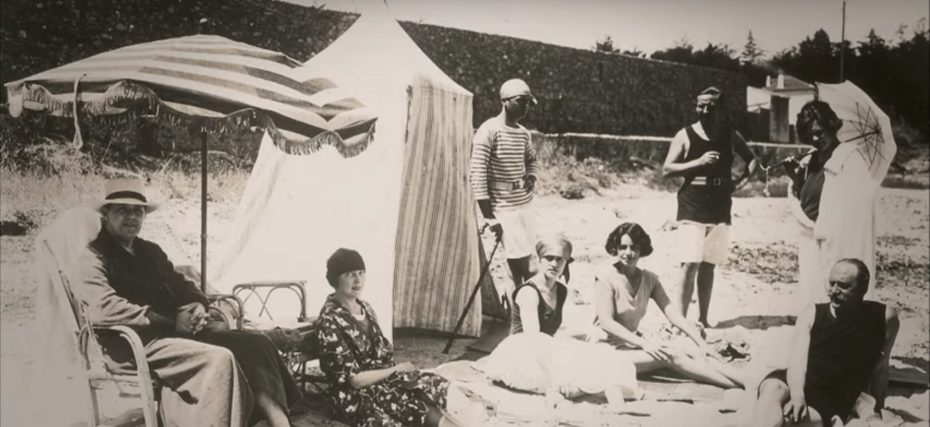
It was no accident that MacLeish contributed to The New Yorker: in addition to being among the literary expatriates in Paris including Gertrude Stein and Ernest Hemingway, MacLeish and his wife, Ada Hitchcock, were part of the Riviera crowd hosted by Gerald and Sara Murphy, which included among other notables John O’Hara, Dorothy Parker, and Robert Benchley.

OVER THERE…Gerald and Sara Murphy hosting friends at a Riviera beach party, circa 1923. Gerald is the man standing in the striped shirt; Sara is at right with a parasol. I believe that is Benchley at the bottom right, and Parker seated at center-right. (Beinecke Library)

*  *  *

From Our Advertisers

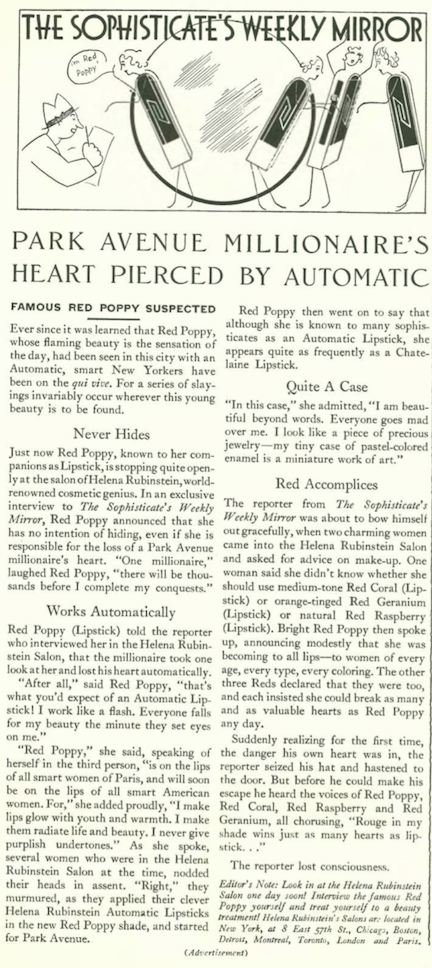
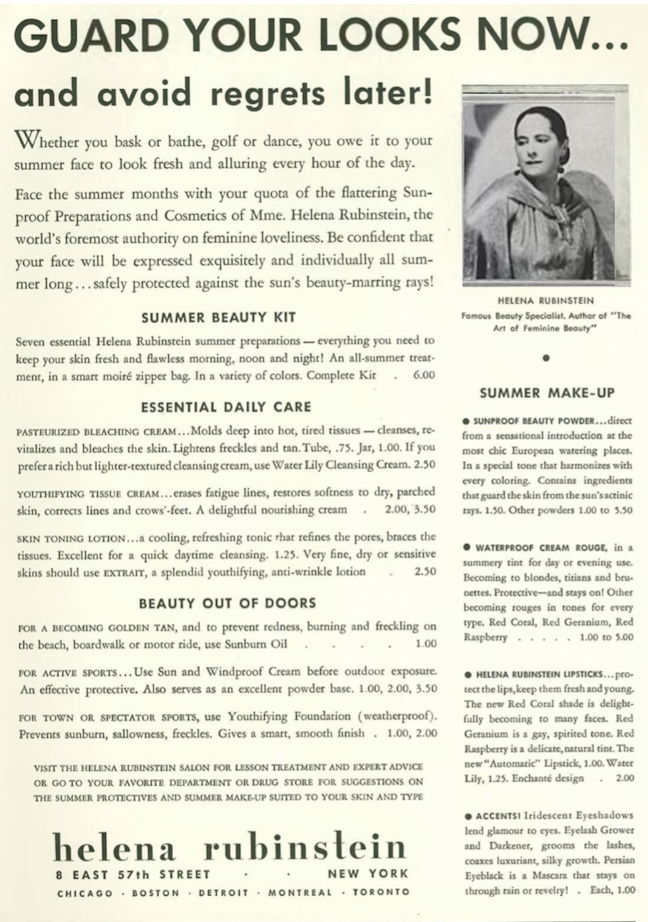
We begin with this ad from Helena Rubinstein that parodies Lois Long’s “Tables for Two” column (Long signed that column as “Lipstick”) and announced a new “Red Poppy” shade…

…on the other hand, the folks at Tangee borrowed from the old Temperance Movement song, The Lips that touch liquor, shall never touch mine, to promote a lipstick guaranteed to snag a sugar daddy like the one illustrated below (recalling Monopoly’s Uncle Pennybags)…

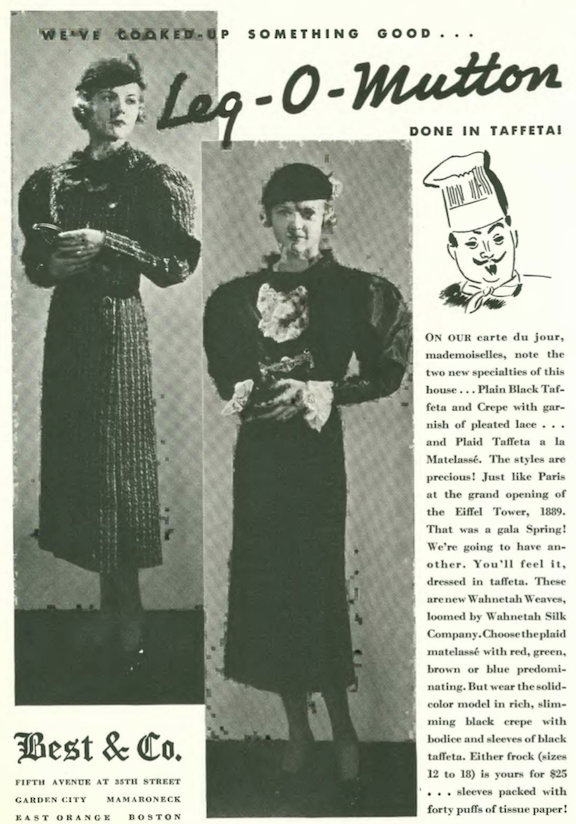
…more advertising weirdness comes our way from the staid Best & Company, its execs somehow persuaded by an ad man to go with this chef motif…

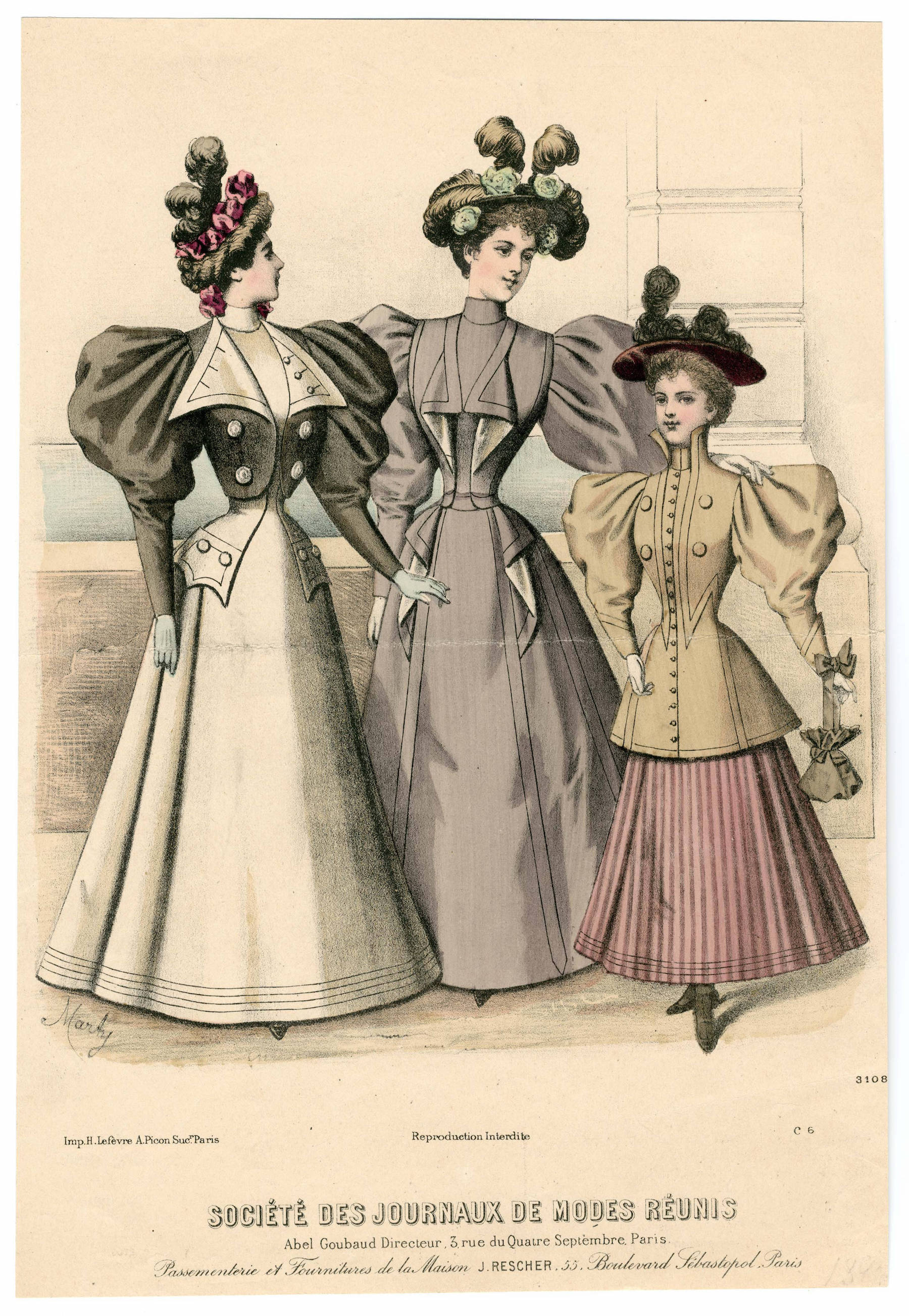
…Leg ‘O Mutton referred to a type of puffy sleeve introduced in 1830s France that had a revival in the late 1880s…

MMMMM, MUTTON…The Leg ‘O Mutton look, circa 1890s. (genealogylady.net)

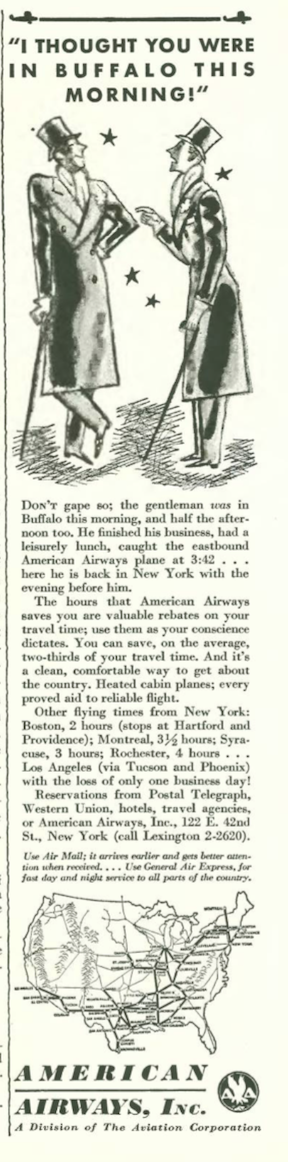
…the National Auto Show moved on and the National Motor Boat and Engine Show took its place at the Grand Central Palace…

…I’m trying to imagine the guy at left stowing his top hat in an overhead bin…

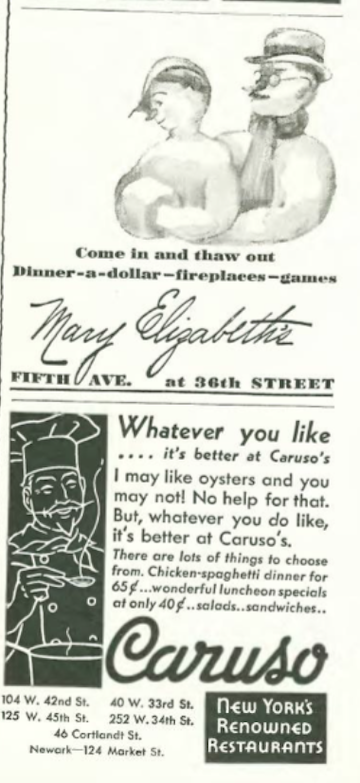
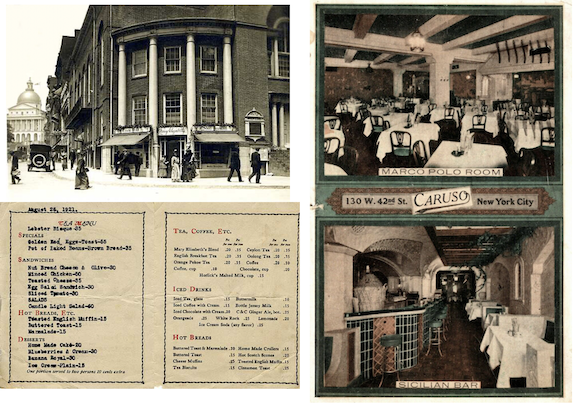
…down on earth folks could enjoy some down-to-earth home cooking at Mary Elizabeth’s, or go some Italian at Caruso’s…

…and for reference…

Top left, Mary Elizabeth’s success on Fifth Avenue led to expansion into Boston; below, a 1921 menu at Mary Elizabeth’s in New York; at right, 1930s postcard advertising Caruso’s on 42nd Street. (restaurant-ingthroughhistory.com)

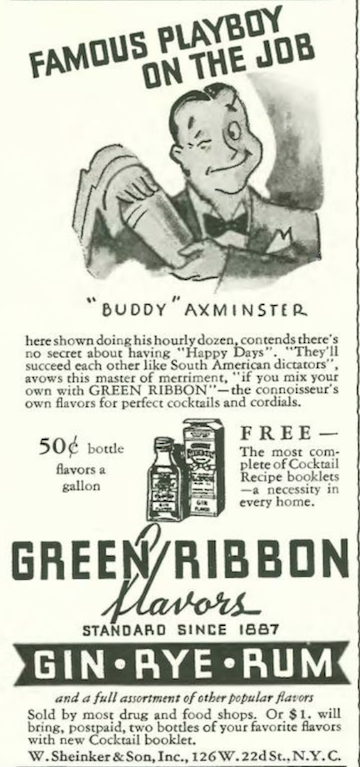
…of course you couldn’t legally drink at those places, so you had to go to a speakeasy or mix your cocktails at home…but this is just sad, ‘ol Buddy here flavoring his bootleg with some Green Ribbon…let’s hope the playboy’s guests aren’t blinded before the night is over…

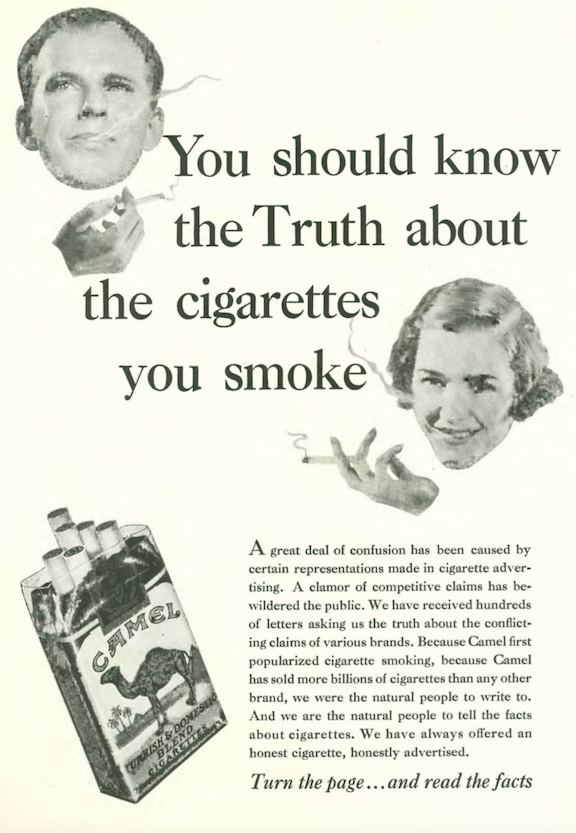
…we all know the tricky ways of the tobacco companies, including this 3-page Q&A from the makers of Camels offering smokers and would-be smokers THE TRUTH and THE FACTS about the cigarettes folks smoke…turns out Camels are the best!…

…and now for a bit of fresh air before we turn to our cartoonists…

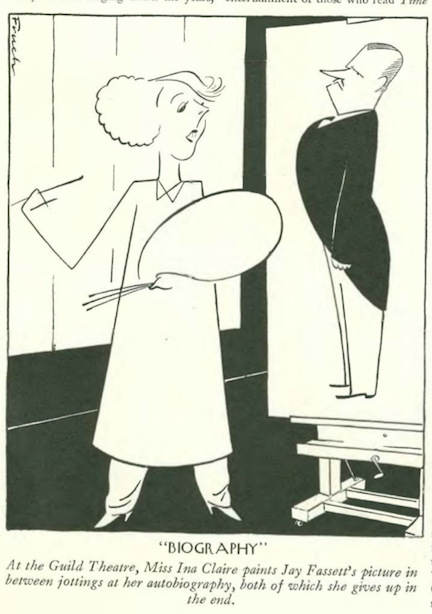
…beginning with Al Frueh and his impressions of a show at the Guild Theatre…
Peter Arno contributed this illustration across pages 12-13 in “The Talk of the Town” section…

Helen Hokinson offered up some scandal among the “girls”…

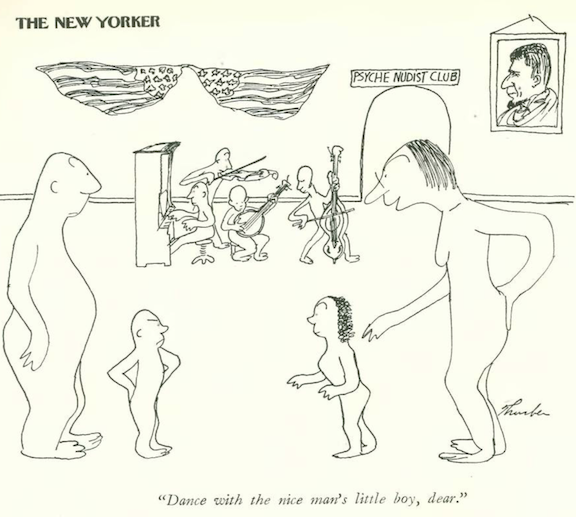
James Thurber gave us an awkward moment among the tender youth of the unclad world…

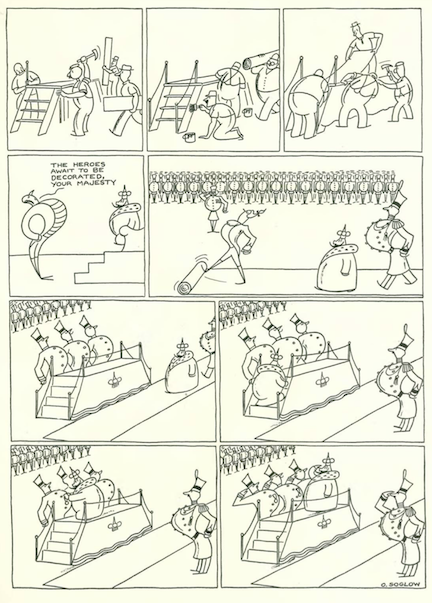
Otto Soglow’s Little King rose to the occasion, as always…

Daniel Alain’s artist tried his best to make some small talk while at work…

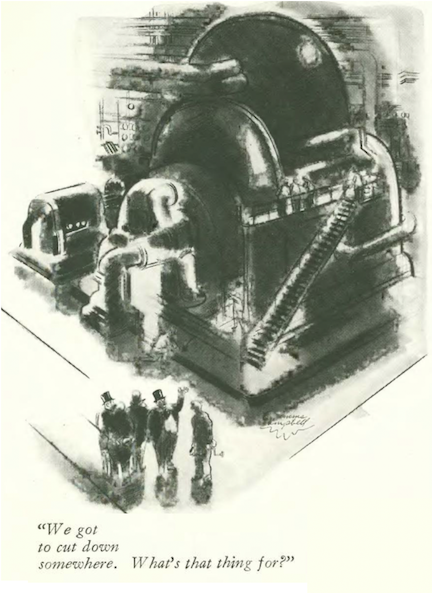
…and we close with E. Simms Campbell, and the yawning gulf between owners and workers…

Next Time: A Slice of Paradise…


Modernism Lite

Above: “The Fountain of Youth” mural by Ezra Winter in the Main Foyer of Radio City Music Hall. (Architectural Digest)

The opening of two new theaters at Rockefeller Center no doubt brightened a few souls at the start of 1933, but art and architecture critic Lewis Mumford wasn’t particularly dazzled by the “watered-down” modernism of the buildings’ much-ballyhooed decor.

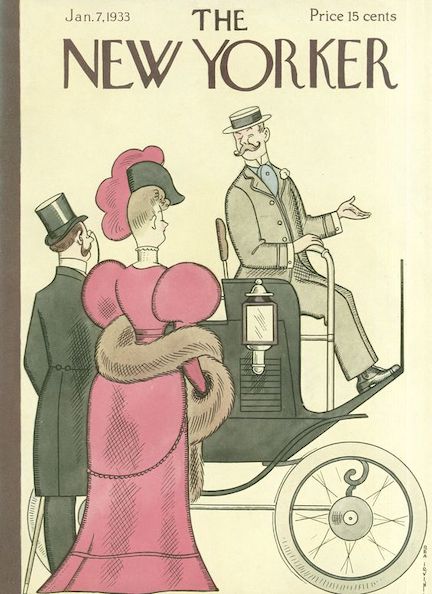
Jan. 7, 1933 cover by Rea Irvin, in a nod to the annual automobile show in New York City.

Oddly, it was a philosophy professor from the University of Nebraska, Hartley Burr Alexander, who was tasked with creating an artistic vision for Rockefeller Center, developed along the theme of “Frontiers of Time.” According to Mumford, Alexander’s “classic-banal” vision, executed under the “virtuous glare” of theatrical impresario Samuel L. “Roxy” Rothafel, resulted in the first “large-scale vulgar tryout of modern art.” Excerpts from Mumford’s column:

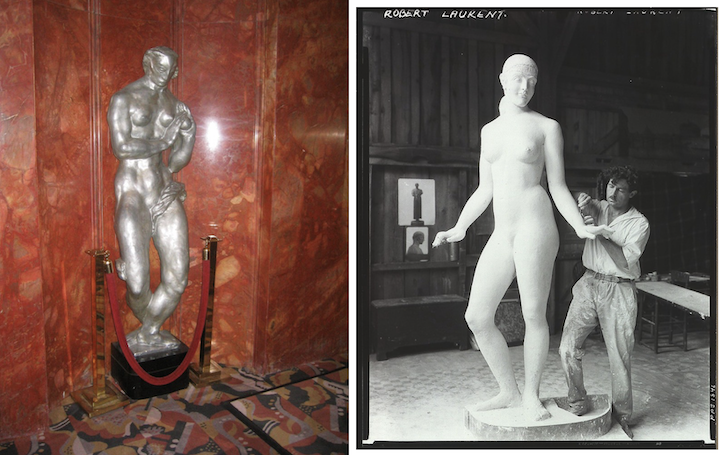
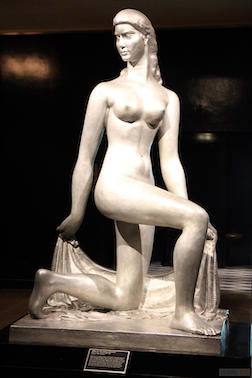
Several aluminum sculptures in Radio City Music Hall no doubt pleased Mumford—Gwen Lux’s Eve sculpture, William Zorach’s Spirit of the Dance, and Robert Laurent’s Goose Girl. However, thanks to Roxy Rothafel’s “virtuous glare” and worries that the nudes might hurt ticket sales, all three sculptures were temporarily banned from RCMH.

NAKED AND AFRAID…A flare-up of puritanism led to the temporary removal of aluminum sculptures at Radio City Music Hall. At left, Eve by Gwen LuxRobert Laurent (right) working on Goose Girl in his studio. Below, William Zorach’s Spirit of the Dance. (Smithsonian/viewingnyc.com)

Radio City Music Hall also featured an array of murals that should have brought some delight to Mumford…
SHOW BEFORE THE SHOW…Radio City Music Hall featured a number of murals including, clockwise from top left, a detail of Donald Deskey’s The History of Nicotine (The Life of Saint Nicotine) in a second floor men’s lounge; a textile piece titled The History of Theatre by Ruth Reeves, which covers the back wall of Radio City Music Hall; Stuart Davis’s mural Men without Women in the  men’s lounge; Yasuo Kuniyoshi’s mural in the women’s powder room. (melwithpals.medium.com/viewingnyc.com/evergreen.com)

*  *  *

Mea Cuppa

“The Talk of the Town” shared this account of fifteen Harvard freshman who dared to pay a call on the home of visiting poet T.S. Eliot

TEA-DIUM…Fifteen nervous Harvard freshman confronted this visage until one of them finally broke the ice. Photo above taken during one of T.S. Eliot’s visits to Monk’s House, the 16th century cottage of Virginia Woolf. (blogs.harvard.edu)

*  *  *

Country Cousins

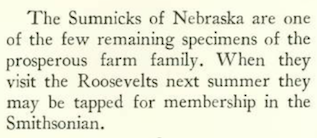
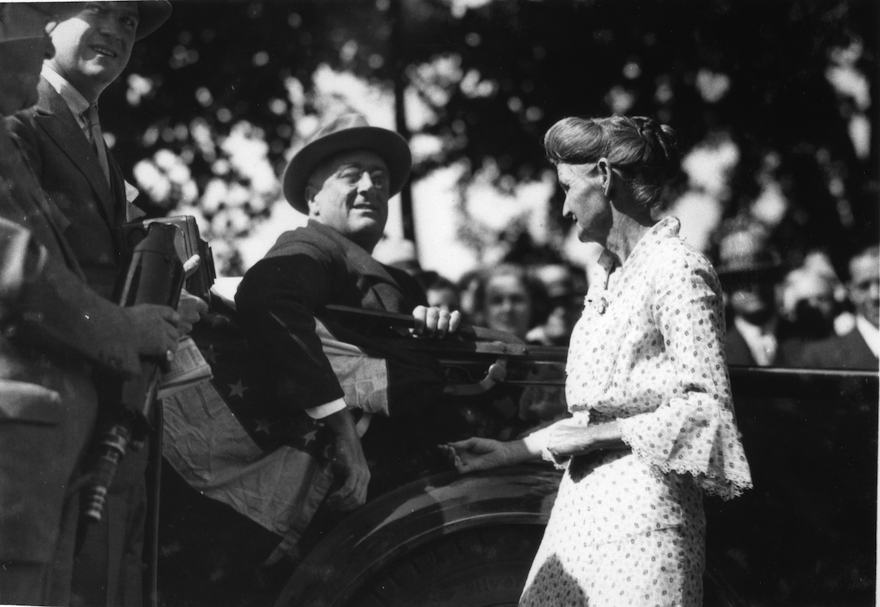
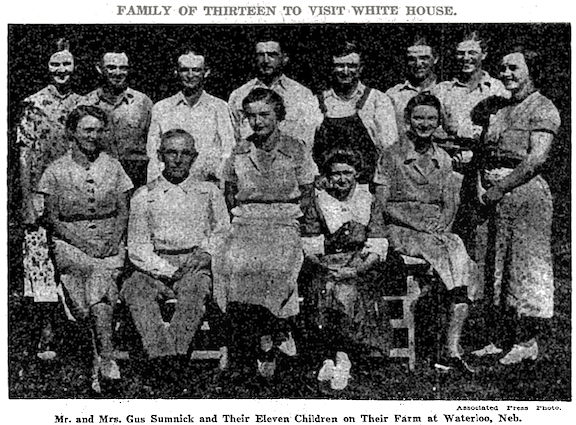
During his 1932 presidential campaign Franklin D. Roosevelt paid a Sept. 29 visit to the Waterloo, Nebraska farm of Gustav “Gus” and Mary (Kenneway) Sumnick. Mary served FDR a chicken dinner and pie before he addressed a crowd of 8,000 at a rally on the Sumnick farm. Gustav, a German immigrant, and Mary, a daughter of Irish immigrants, were successful farmers even during those tough years. The visit would turn the Sumnicks into national celebrities, and in later years FDR would return to visit the family and would also stay in touch by telephone. Howard Brubaker, in “Of All Things,” made this observation about the celebrated farm family:

TIME FOR SOME VIDDLES!…Mary Sumnick chats with presidential candidate Franklin D. Roosevelt during his Sept. 29, 1932 visit to the Sumnick farm. (douglascohistory.org)
ENOUGH FOR A FOOTBALL TEAM…A lengthy article in the Dec. 4, 1932 New York Times described life on the Sumnick farm and their upcoming visit with President Roosevelt in the spring. Gus and Mary and their 11 children all planned to make the trip. (NYT)

*  *  *

The Gang’s All Here

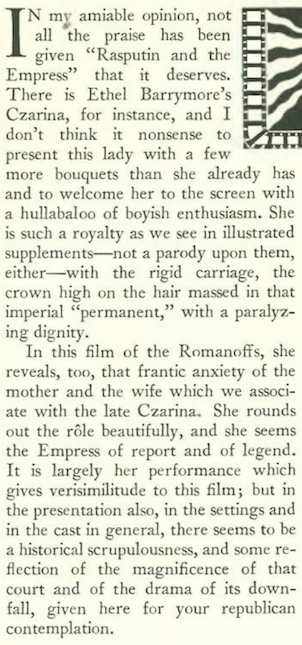
Siblings Ethel, John and Lionel Barrymore of the famed Barrymore theatrical family appeared together in just one film—Rasputin and the Empress—and you would think that would have been enough to guarantee multiple awards along with box office gold. However, the film actually lost money, and on top of that attracted a lawsuit that further dipped into the pockets of MGM producer Irving Thalberg. Critic John Mosher was wowed by Ethel’s performance, but wasn’t exactly charmed by the overall production:

ACTING ROYALTY ACTING ROYAL…Lionel Barrymore, Ethel Barrymore, and John Barrymore in Rasputin and the Empress. It is only film in which all three siblings appeared together. (parkcircus.com)

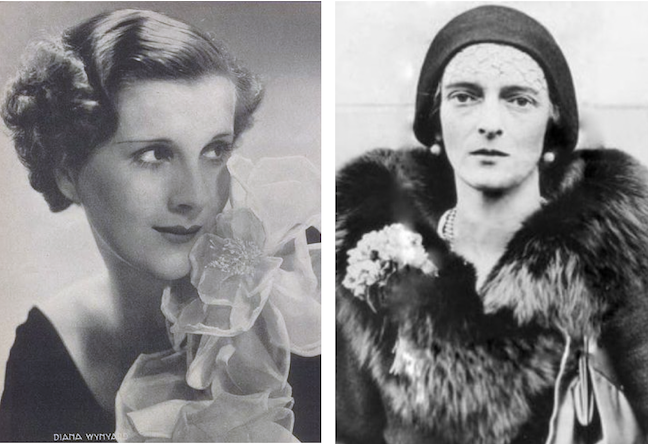
About that lawsuit: The film used the real-life Princess Irina Yusupov as a model for Princess Natasha, portrayed by English actress Diana Wynyard. The film implied that Rasputin raped Princess Natasha (that is, Irina), which wasn’t true, so she sued MGM and won $127,373 from an English court; MGM reportedly  settled out of court in New York for the sum of $250,000 (roughly equivalent to nearly $5 million today). The ubiquitous “all persons fictitious” disclaimer that appears in TV and film credits is the result of that lawsuit.

NO HARD FEELINGS?…English actress Diana Wynyard (left) portrayed Princess Natasha in the Barrymore family vehicle Rasputin and the Empress. Her portrayal, however, drew the ire of a real Russian royal, Princess Irina Yusupov, who successfully sued MGM in 1933 for invasion of privacy and libel. (Wikipedia)

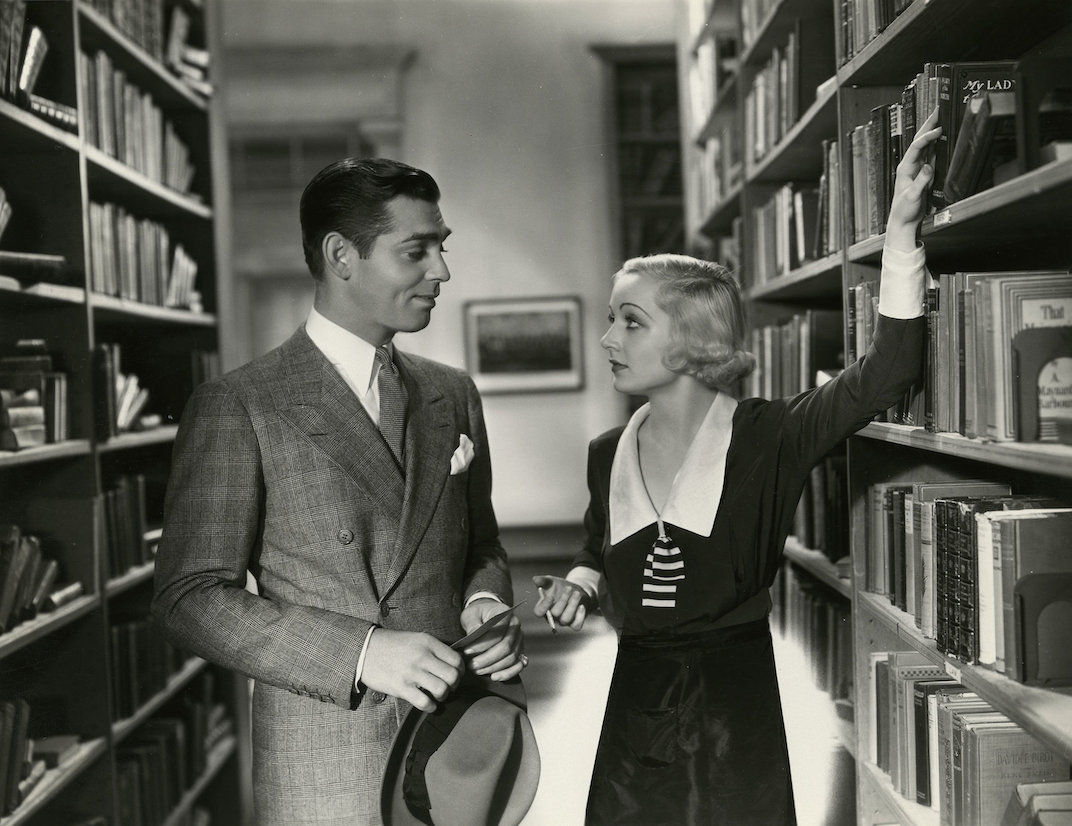
A much-less controversial film was the “glib” No Man of Her Own, a pre-Code romantic comedy-drama starring Clark Gable and Carole Lombard in their only film together:

LET’S PLAY HOUSE…Clark Gable romances Carole Lombard in the pre-Code romantic comedy-drama No Man of Her Own. It was their only film together, and several years before they became a married couple in real life. (ha.com)

*  *  *

Vroom-Vroom

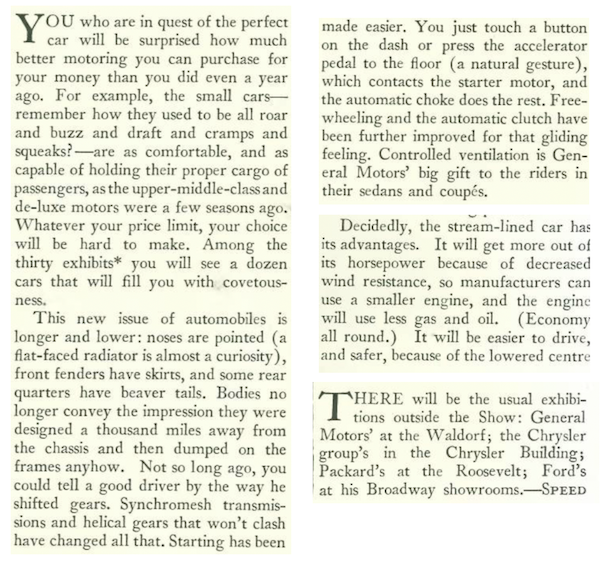
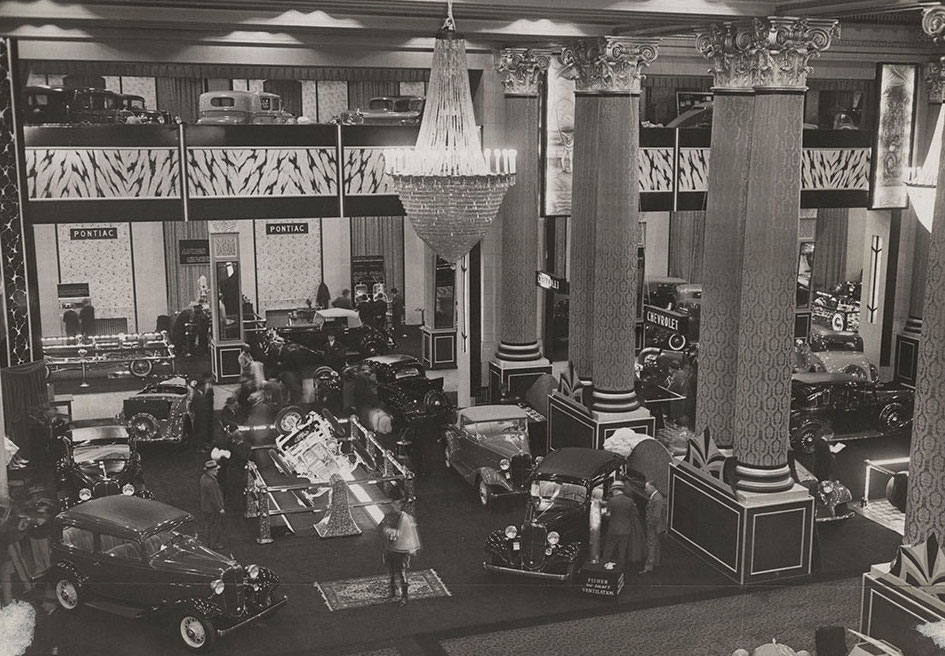
The annual National Automobile Show opened at the Grand Central Palace and other locations in Midtown, promising an array of affordable models:

DECISIONS, DECISIONS… The 1933 National Automobile Show offered a number of affordable options to car buyers including these shiny new Pontiacs on display at the Grand Central Palace. (libwww.freelibrary.org)
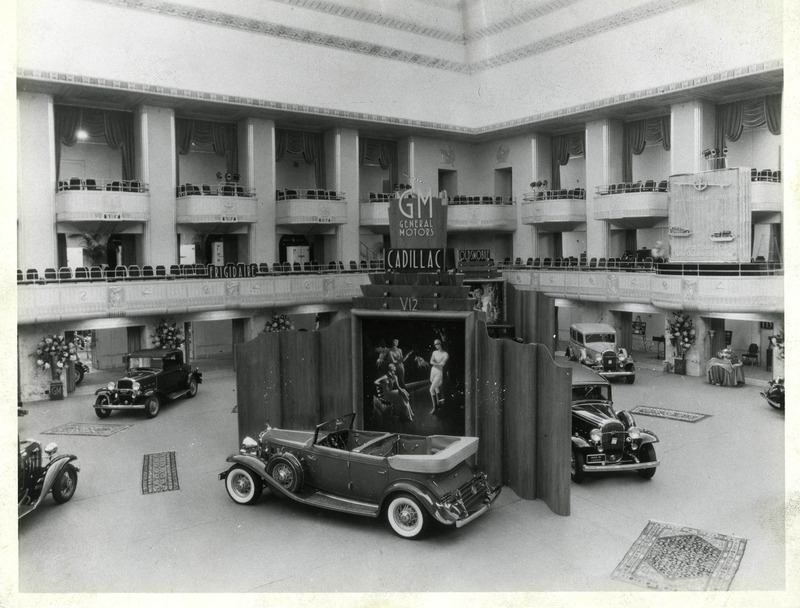
BUT LOOK OVER HERE…General Motors also displayed its models at the first “Motorama” held in the Waldorf-Astoria’s Grand Ballroom in 1933. (waldorfnewyorkcity.com)

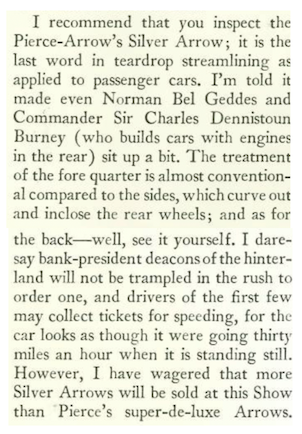
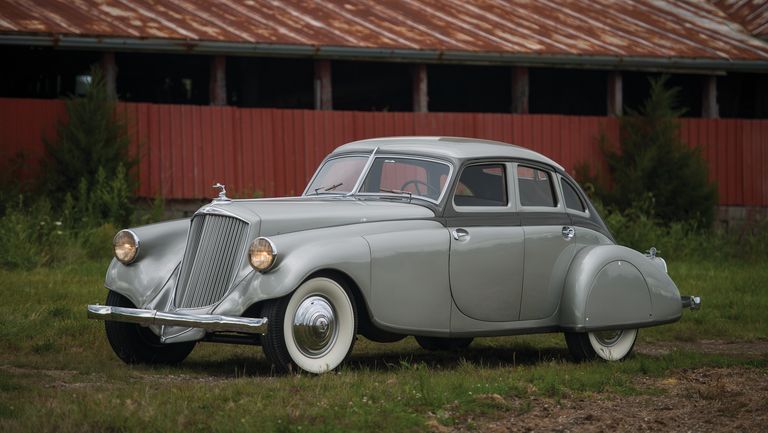
Auto Show visitors also got a glimpse of their streamlined future in the form of a 1933 Pierce-Arrow Silver Arrow…

FAST & FURIOUS…Powered by a V12 engine, the aerodynamic 1933 Pierce-Arrow Silver Arrow could exceed 100 miles per hour. Unveiled at the 1933 National Automobile Show, the car grabbed the spotlight with its futuristic, streamlined design. Just five of these were built, and only three are known to exist today. The Silver Arrow was one of Pierce-Arrow’s final attempts to appeal to its wealthy clientele, but even they were feeling Depression’s pinch. The company folded in 1938. (Sotheby’s)

 *  *  *

From Our Advertisers

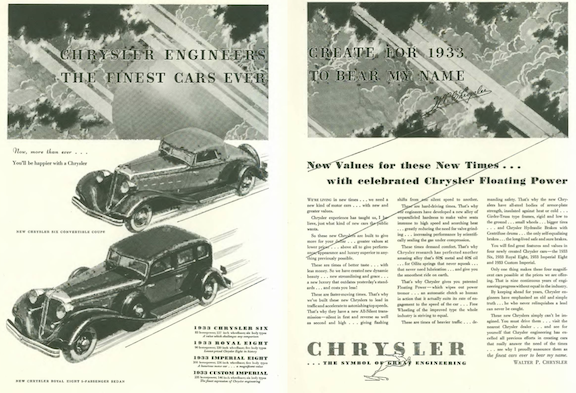
The New Yorker had unusually thin issues over the holidays, so the magazine’s bean-counters must have been thrilled by the dozens of ads that poured in ahead of the National Automobile Show. As usual Walter Chrysler took out several two-page ads to promote his Chryslers, Plymouths, Dodges and DeSotos…

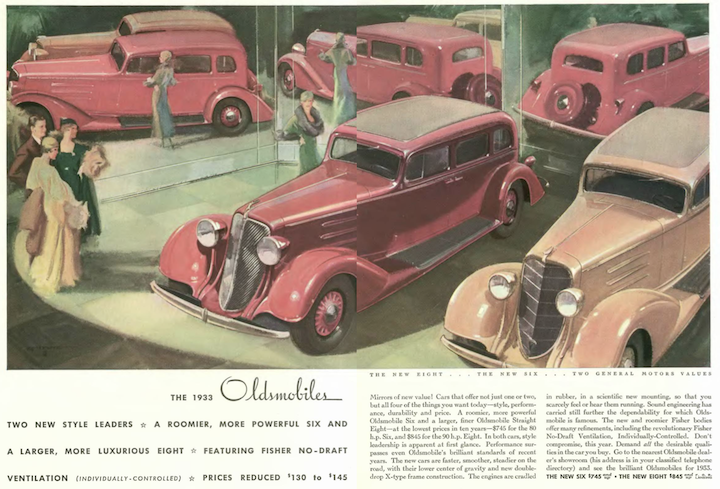
…while GM one-upped Walter with its own series of two-page ads—in color—sprinkled throughout the magazine…everything from the affordable Oldsmobile…

…to the high-end Cadillac…

…General Motors also featured this Peter Arno-themed ad (Arno-inspired wood carvings featuring the sugar-daddy walrus) to promote its posh new venue at the Waldorf-Astoria…

…the folks at struggling Hupmobile tried to wow not with shiny cars but rather with the announcement of their…drum roll, please…annual report…

…companies that supported the auto industry also got in on the act, including the makers of leaded fuel…this image says a lot about the lack of safety concerns in the 1930s…

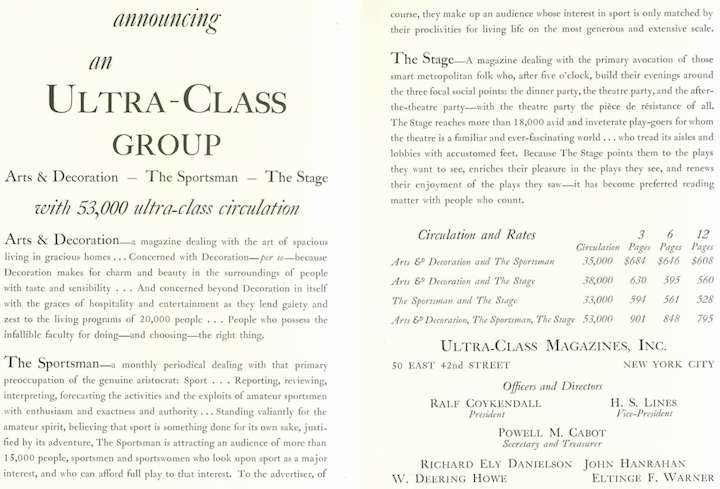
John Hanrahan, who early on served as The New Yorker’s policy council and guided it through its lean first years, be­came the publisher of Stage magazine (formerly The Theatre Guild Magazine) in 1932. In 1933 Stage became part of the Ultra-Class Magazine Group’s line-up that included Arts & Decoration and The Sportsman. Stage published its last issue in 1939, and I don’t believe the other two survived the 1930s either…

ULTRA-CLASS GROUP was the over-the-top name used to describe this line-up of magazines.

…on to our cartoons, we join Peter Arno for some fine dining…

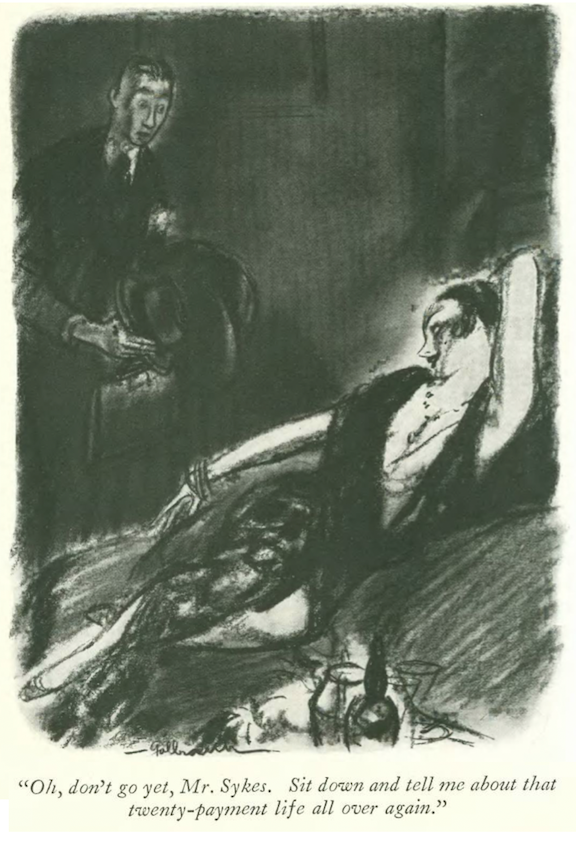
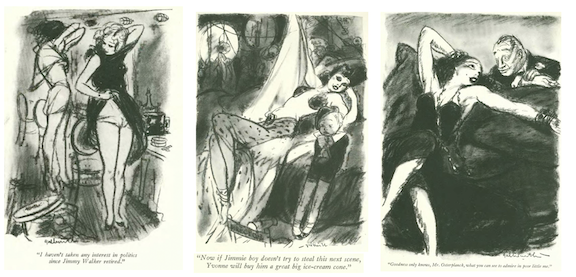
…based on the what we have seen lately from William Crawford Galbraith, he seems to be hung up on seductresses and showgirls…

…to my point, some of Galbraith’s recent entries…

…we move on to Richard Decker and a dangerous cold front…

Garrett Price pondered the wisdom of children…

Gluyas Williams was back with the latest industrial crisis…

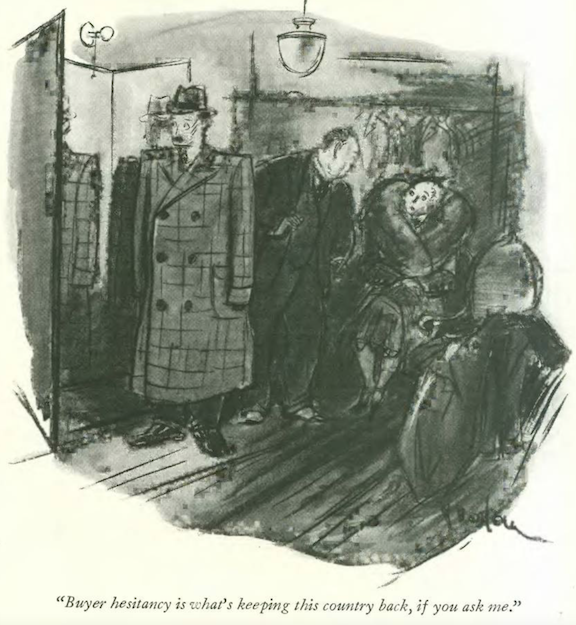
Perry Barlow found some ill-fitting words to go with an ill-fitting coat…

…and we close with James Thurber, and some very fitting words for those times, and ours…

Next Time: March of Time…


Pining for Tin Lizzy

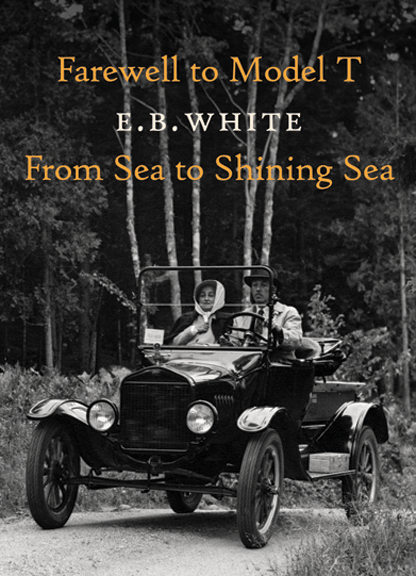
In 1922, a young Cornell graduate named E.B. White set off across America in a Model T with a typewriter and a sense of adventure.

Nov. 12, 1932 cover by Constantin Alajalov.

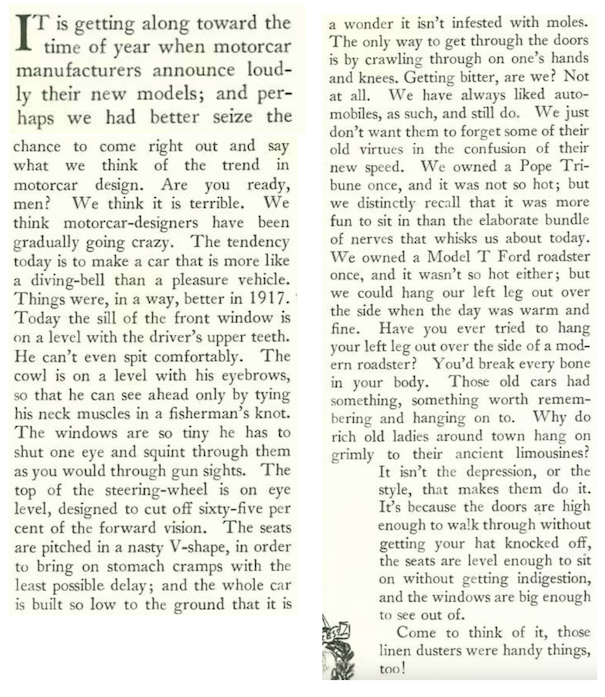
Years later, 1936 exactly, White would recall the America he had discovered as a 22-year old in his book From Sea to Shining Sea, which would include an essay “Farewell to Model T” that first appeared in The New Yorker as “Farewell My Lovely.” For this Nov. 12, 1932 “Notes and Comment” column, it appears White is already pondering his paean to the Model T, contrasting its freedom with the glassed-in claustrophobia of modern cars:

OUT WITH THE NEW, IN WITH THE OLD…Despite their many shortcomings, E.B. White seemed to prefer the cars of yesteryear, including (above) the 1904 Pope Tribune and 1917 Ford Model T Roadster; White likened modern cars, such as the 1932 Ford and Chevrolet sedans (bottom, left and right) to riding in a “diving bell.”(Wikimedia/vintagecarcollector.com/Pinterest)

Here’s the cover of From Sea to Shining Sea, which features a photo of White and his wife, Katharine, in a Model T Roadster…

*  *  *

An Appreciation

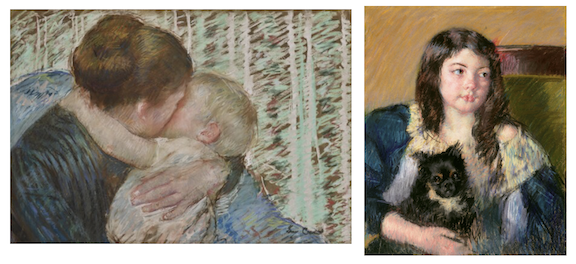
Mary Cassatt (1844-1926) was an American painter who for most of her adult life lived in France among fellow Impressionists. Like her friend Edgar Degas, Cassatt excelled in pastels, works that were admired by critic Lewis Mumford in an exhibition at New York’s Durand-Ruel Galleries:

TRY A LITTLE TENDERNESS…Mothers and children were Mary Cassatt’s favorite subjects. Among the examples shown in 1932 at the Durand-Ruel Galleries’ Exhibition of Pastels were Cassatt’s A Goodnight Hug (1880) and Françoise, Holding a Little Dog, Looking Far to the Right (1909). (Sotheby’s/Christie’s)

*  *  *

Hollywood Slump

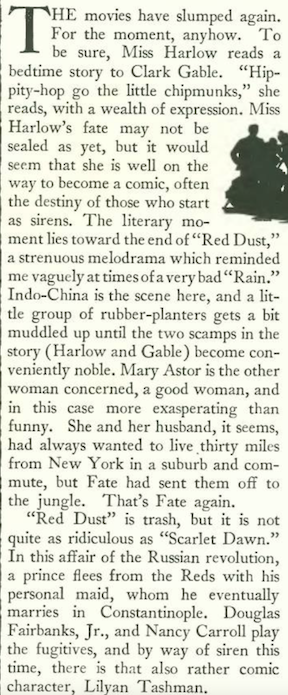
We go from treasure to trash with John Mosher’s latest cinema dispatch, in which he recounts his experience watching the “strenuous melodrama” Red Dust, starring Clark Gable and Jean Harlow. Mosher assured readers that the film is trash, but better trash than Scarlet Dawn with Douglas Fairbanks Jr. and Nancy Carroll.

DUMB AND DUMBER…Jean Harlow attempts to distract Clark Gable from his work in Red Dust; at right, Douglas Fairbanks Jr. is tempted by a servant girl’s affection (Nancy Carroll) in Scarlet Dawn. (IMDB)

*  *  *

From Our Advertisers

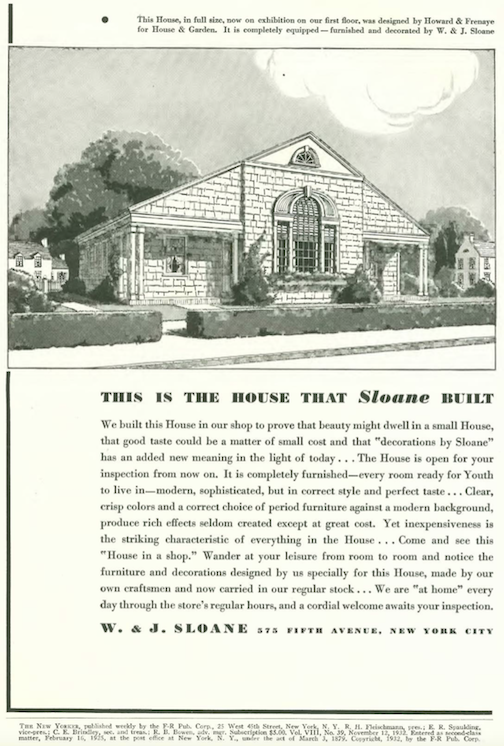
The folks at W.J. Sloane decided that the best way to sell their housewares would be to build an actual house in their Fifth Avenue store…

…do you really want to buy Kraft cheese after looking at this ad? From the look on the woman’s face, that tiresome old wheeze-bag probably smells like aged cheese, and not in a good way…

…The makers of Log Cabin syrup continued to parody the popular taglines of tobacco companies with ads featuring a several New Yorker cartoonists, here Peter Arno

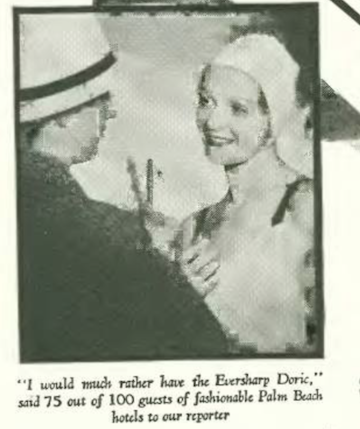
…yep, when I’m relaxing on the beach I like to talk about ink pens, especially those Eversharp ones…

…nor do I mind some weirdo in a dark coat seeking my opinion of said pen while I frolic near my fashionable Palm Beach hotel…

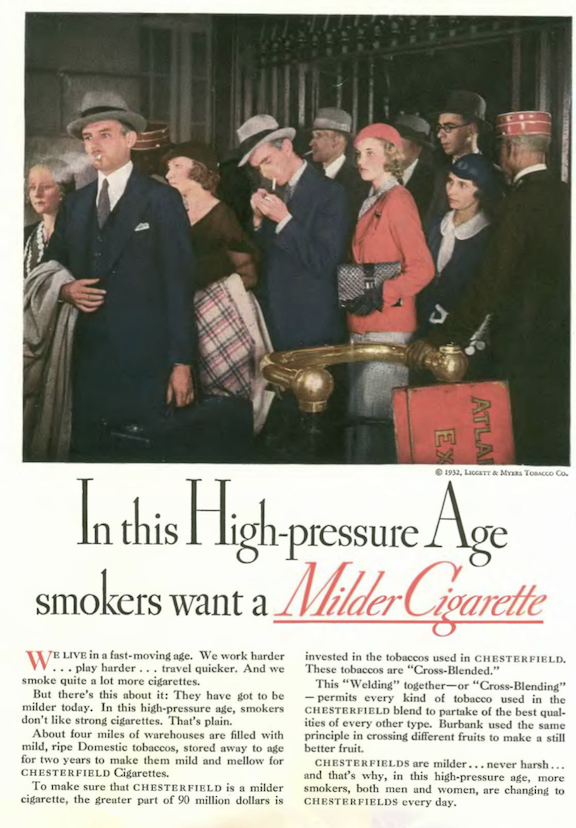
…yes, we all know that Chesterfields are milder, but will someone help that poor man on the left who appears to be blowing out his aorta…

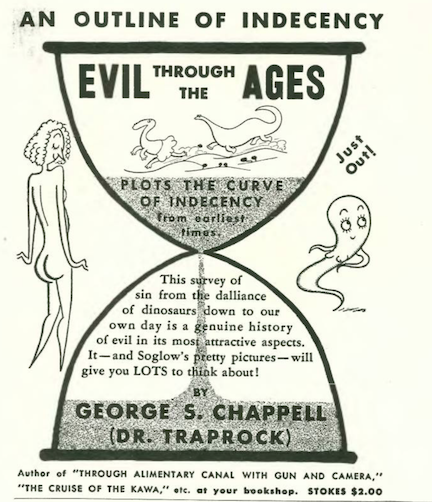
The New Yorker’s former architecture critic George S. Chappell (who wrote under the pen-name T-Square) had moved on to other things, namely parodies of societal mores, including this new book written under his other pen-name, Walter E. Traprock, with illustrations by Otto Soglow

…on to our cartoons, we begin with James Thurber and the travails of menfolk…

Richard Decker gave us the prelude to one man’s nightmare…

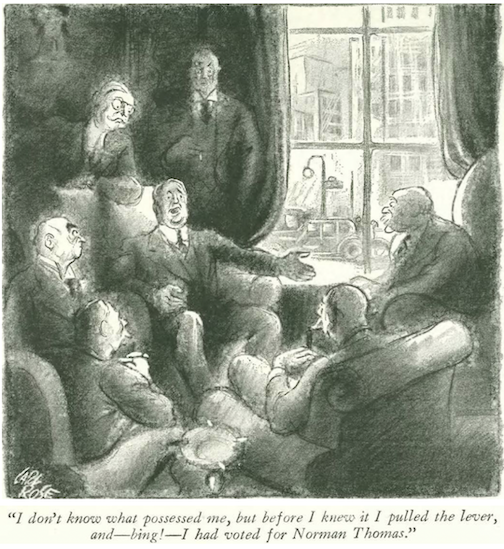
Carl Rose found a titan of industry puzzling over his vote for a socialist candidate…

…and we move on to Nov. 19, 1932…

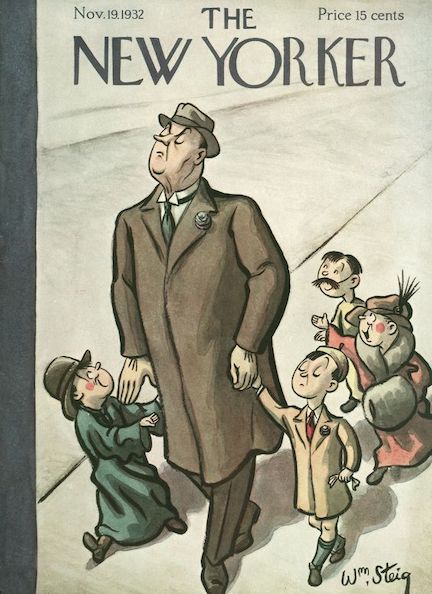
Nov. 19, 1932 cover by William Steig.

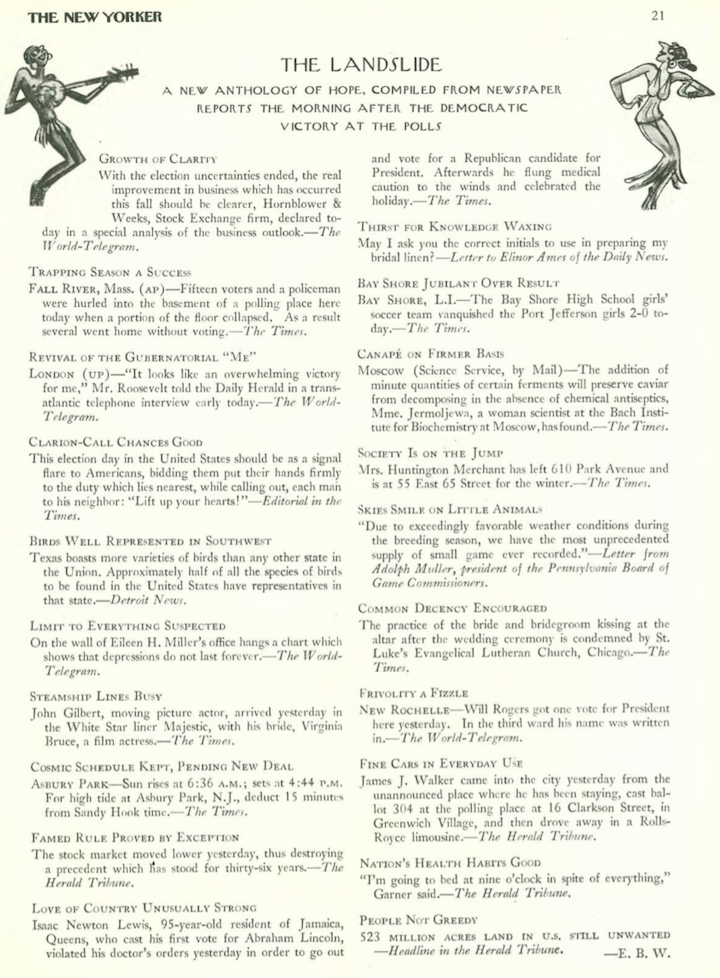
…and this compendium of election highlights by E.B. White

…and Howard Brubaker’s wry observation of the same…

BUSY DAYS AHEAD…Franklin D. Roosevelt celebrates his landslide victory over Herbert Hoover in the 1932 presidential elections. (Associated Press)

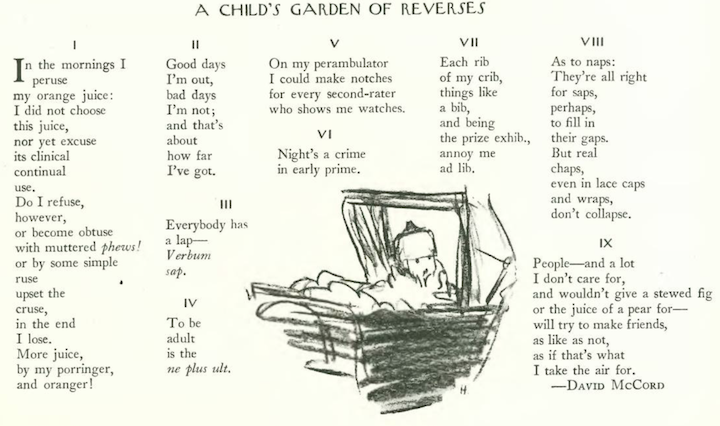
…and on an even lighter side, poet David McCord’s take on a Robert Louis Stevenson classic…

…speaking of children, the New Yorker was looking ahead to Christmas, and what the little ones might be hoping for under the tree…

ALL HUNG UP ON MICKEY…Mickey Mouse puppet was popular with the kiddies in 1932. (Ebay)

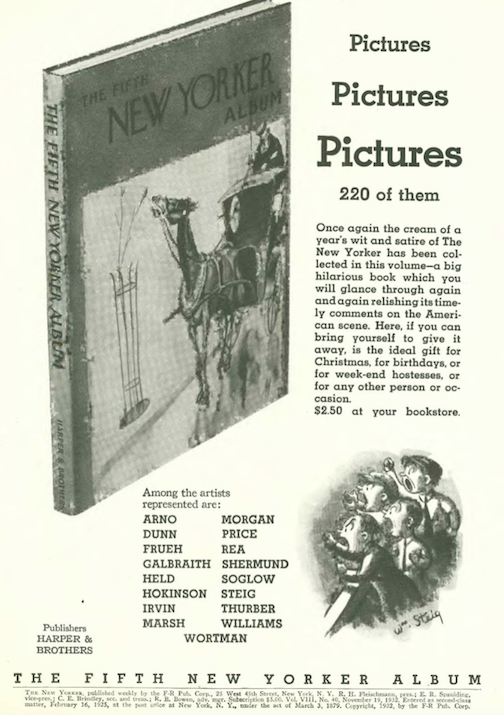
…if Mickey Mouse wasn’t your thing, you could spring for The Fifth New Yorker Album

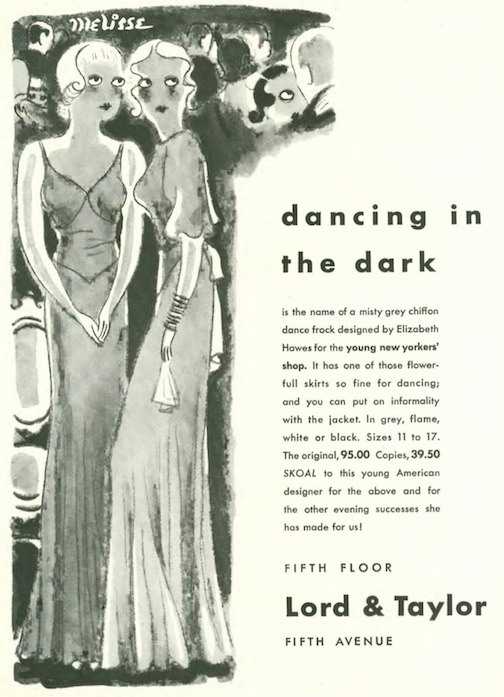
…on to our other Nov. 19 advertisements, Mildred Oppenheim (aka Melisse) illustrated another whimsical Lord & Taylor ad…

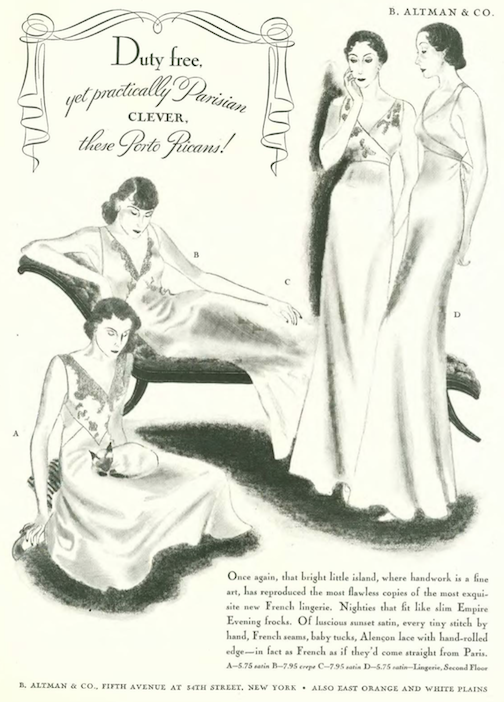
…while B. Altman maintained its staid approach to fashion to tout these duty-free, “practically Parisian” nighties created by “clever Porto Ricans”…

Walter Chrysler continued to spend big advertising bucks to promote his company’s “floating power”…

…in my last entry I noted E.B. White’s musings regarding Lucky Strike’s new “raw” campaign…this appeared on the Nov. 19th issue’s back cover…

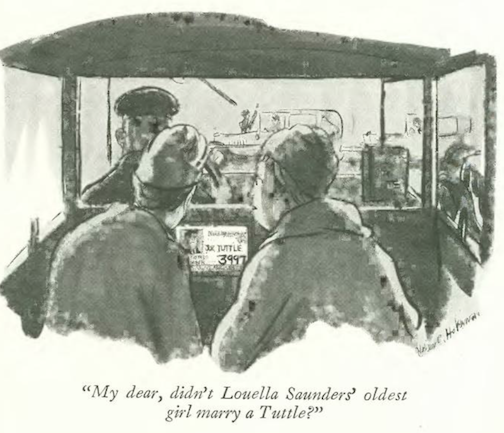
…on to our cartoons, we have Helen Hokinson’s girls pondering the social implications of a cabbie’s identity…

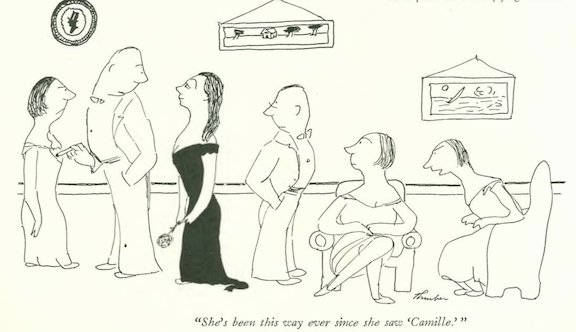
James Thurber explored the dynamic tension provided by passion dropped into mixed company…

Carl Rose offered a bird’s eye view of the 1932 election…

William Crawford Galbraith showed us one woman’s idea of sage advice…

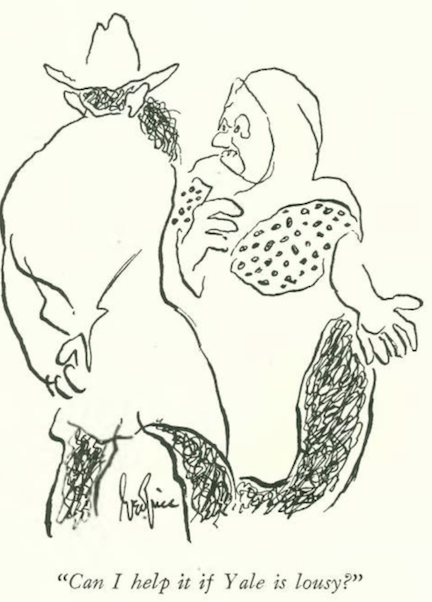
…and George Price continued to introduce his strange cast of characters to The New Yorker in a career that would span six decades…

…on to our Nov. 26 issue, and a cover by William Crawford Galbraith that recalled the post-impressionist poster designs of Toulouse-Lautrec

Nov. 26, 1932 cover by William Crawford Galbraith.

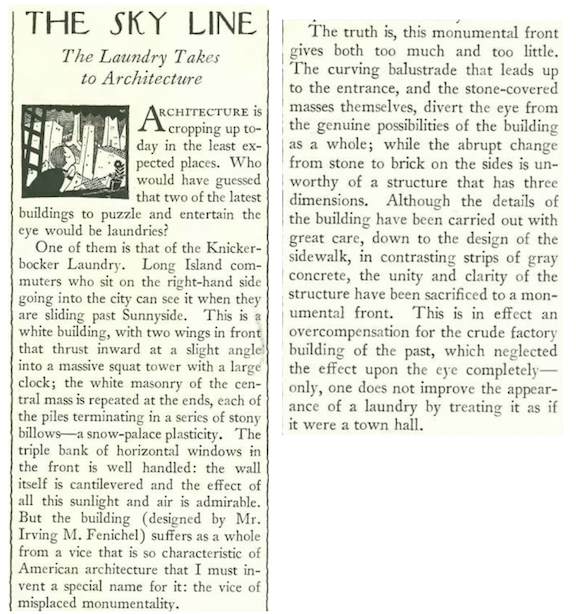
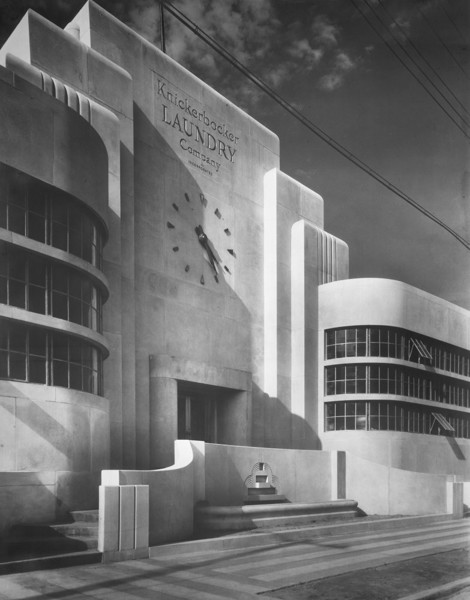
…and in this issue we have Lewis Mumford back on the streets assessing New York’s ever-changing landscape, including an unexpectedly “monumental” design for a Laundry company:

ALL WASHED UP?…Irving M. Fenichel’s Knickerbocker Laundry Building seemed a bit too monumental for Lewis Mumford. (ribapix.com)

…the building still stands, but is substantially altered (now used as a church)…

 *  *  *

Wie Bitte?

Attributed to E.B. White, this “Talk of the Town” item, “Besichtigung” (sightseeing) told readers — in pidgen German — about a visit to the German Cruiser Karlsruhe docked in the New York harbor.

…I try my best to avoid contemporary political commentary (this blog should be a respite from all that!), so I will let Howard Brubaker (in “Of All Things”) speak for himself regarding the outcome of the 1932 presidential election:

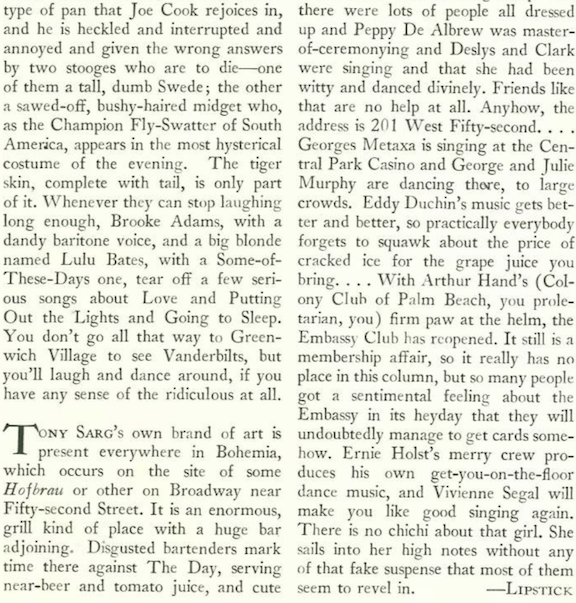
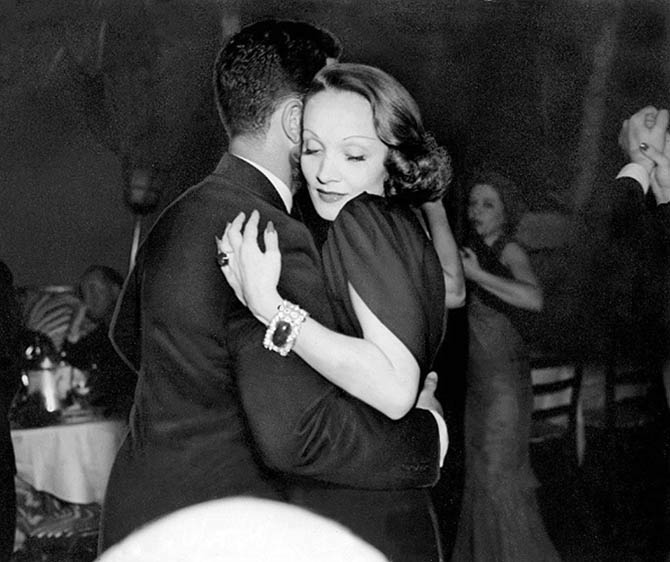
…in researching the life and work of Lois Long, there seems to be a consensus out there in the interwebs that her “Tables for Two” column ended in June 1930, however she continued the write the column from time to time, including this entry for Nov. 26 with a bonus illustration by James Thurber

MARLENE DIETRICHING…was how Lois Long described the star’s appearance at the Bohemia club. Above is a photo of Marlene Dietrich and Cornelius Vanderbilt Whitney dancing at the New York club El Morocco in 1938. (Beinecke Rare Book and Manuscript Library)

*  *  *

From Our Advertisers

More Christmas ideas from the folks at Rogers Peet…hey, I could use a new opera hat!…and look at all those swell ash trays…

…yes, Prohibition is still around for another year, but the wets are ascendent, FDR is in office, so let’s get the party started…

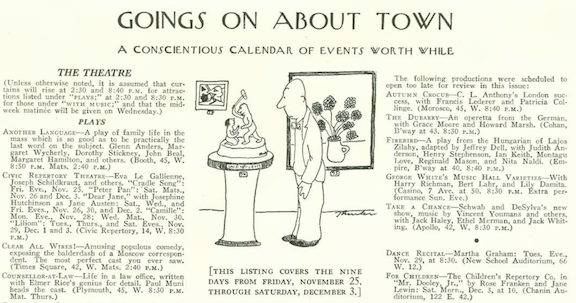
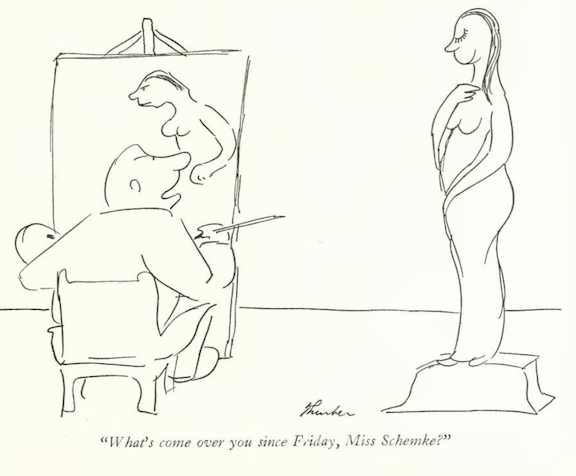
…on to our cartoonists, we begin with this illustration by James Thurber for the magazine’s events section…note the familiar theme of the sculpture, pondered by the young man…

…we are off to the races with William Steig, and some news that should kick this fella into high gear…

…and we close, with all due modesty, via the great James Thurber

Next Time: Cheers For Beer…

A Picture’s Worth

James Thurber made a rare appearance in the “Reporter at Large” column—usually the purview of the departing Morris Markey—to offer a glimpse into the life of Albert Davis and his extensive collection of theatrical and sports photographs.

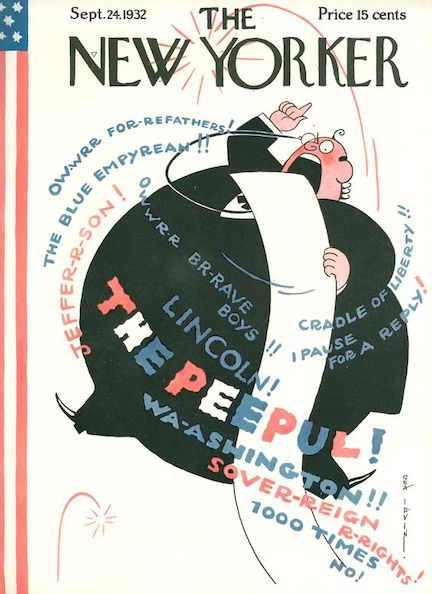
Sept. 24, 1932 cover by Rea Irvin.

A publicist by trade, Davis (1865-1942) collected thousands of photographs, clippings, programs, scripts and playbills from hundreds of productions mainly from the 1890s to the 1920s. In this excerpt, Thurber took a look into Davis’s rarefied world:

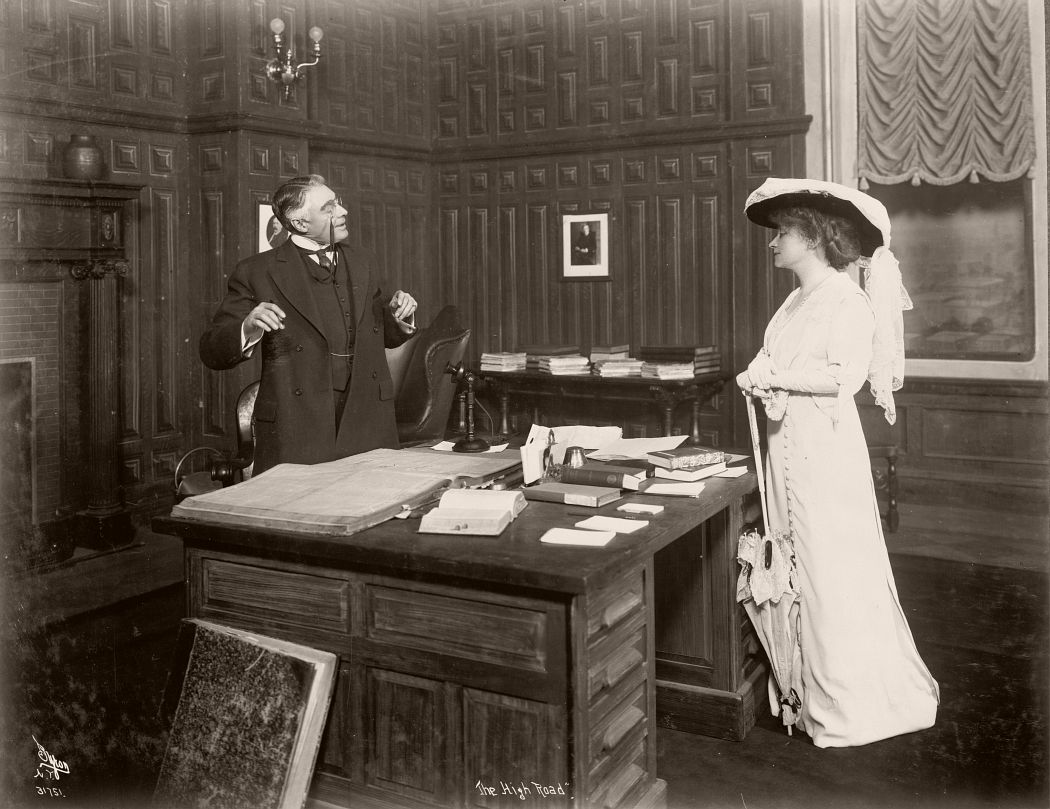
PLAYING MAKE-BELIEVE…Among the photographers collected by Davis was Joseph Byron, who captured this scene from the 1912 play The High Road by American playwright Edward Sheldon. Pictured are actors Frederick Perry and Minnie Maddern Fiske. (monovisions.com)
OSCAR THE FIRST…Theatre impresario Oscar Hammerstein (left) at Manhattan Opera House, which opened December 3, 1906. Hammerstein was the first person with whom Davis traded photographs. He was also the father of famed lyricist and musical comedy author Oscar Hammerstein II. (monovisions.com)
WHEN ALL PERFORMANCES WERE LIVE…Images of performers from the Davis collection included actor Bert Williams (ca. 1895); sharpshooter Annie Oakley (ca.1886); and actor Theodore Drury as Escamillo in Carmen (ca. 1905). (Harry Ransom Center, UT Austin)

Thurber pointed out that the collection was quite valuable, and its sale could reap a considerable sum for Davis. It seems Davis intended to present the collection to his university’s library, a wish more or less fulfilled.

Davis’s collection also contained hundreds of sports figures, mostly from the world of boxing.

TOUGH GUYS…Omaha-born Max Baer (left) defeated German champion Max Schmeling at Yankee Stadium in 1933 and took the heavyweight title in 1934; Paul Berlenbach (right) was a light-heavyweight champ from 1923 to 1926. An interesting footnote: Baer acted in 20 films, and one of his three children, Max Baer Jr., portrayed Jethro Bodine on The Beverly Hillbillies. (Stark Center for Physical Culture and Sports, UT Austin)
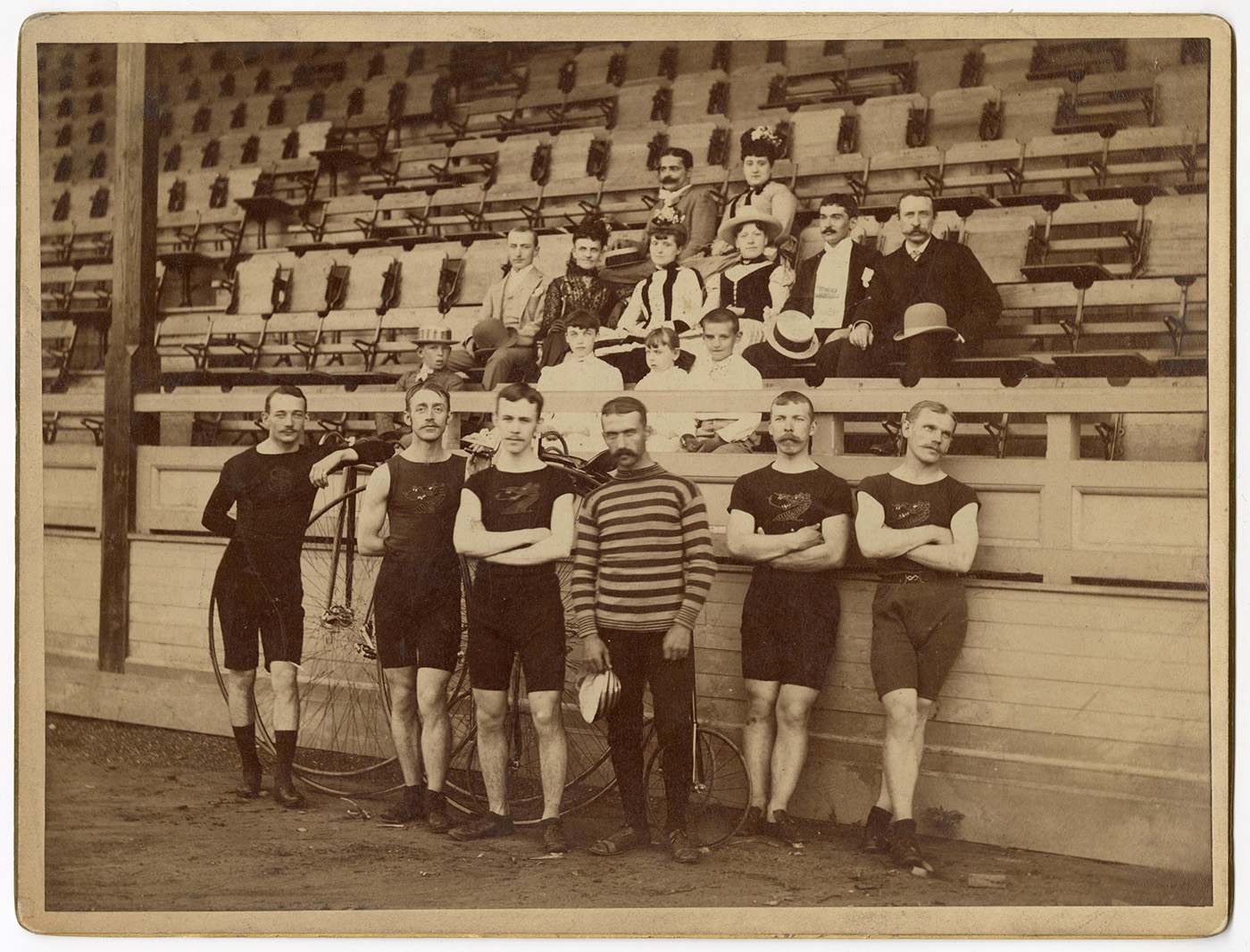
PEDDLERS…Bicycle racers at the Hartford Wheel Club’s bicycle tournament pose for an 1889 photograph in Stamford, Connecticut. (Stark Center)

Endnote: Davis wanted his collection to go to a university library, and so it finally did: it resides at the University of Texas at Austin; the theatrical photos and memorabilia are at the Harry Ransom Center, and the sports-related items are housed at the Stark Center for Physical Culture and Sports.

 *  *  *

Is It Beer-Thirty Yet?

Brewer, politician and owner of the New York Yankees baseball franchise  Jacob Ruppert Jr. (1867–1939) inherited the Jacob Ruppert Brewing Company and the Yankees upon his father’s death in 1915. It was Ruppert who purchased the contract of Babe Ruth (from the Red Sox in 1919) and built famed Yankee Stadium (1923), moves that helped propel a middling franchise to the top of the major leagues. Alva Johnston profiled Ruppert in the Sept. 24 issue; here is the opening paragraph:

LOOK WHAT I JUST BOUGHT…Jacob Ruppert purchased the contract of Babe Ruth from the Red Sox in 1919; Ruppert also inherited the Knickerbocker brewery at 92nd Street and 3rd Avenue (demolished in 1969). (historywithkev.com/brookstonbeerbulletin.com)

 *  *  *

Pol Mole

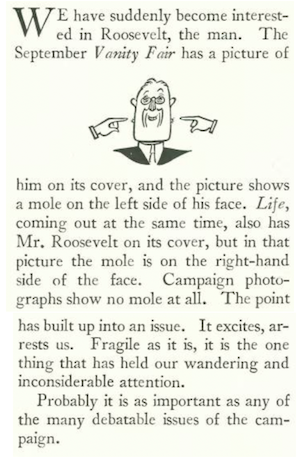
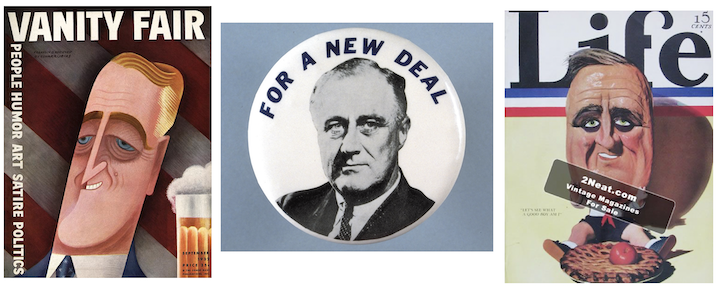
With the 1932 presidential election just weeks away, E.B. White’s focus was on an apparently elusive mole that decorated the left side of Franklin D. Roosevelt’s face, or possibly the right, or perhaps not at all…

REPRESENTING THE LEFT AND THE RIGHT…E.B. White mused on FDR’s apparently shifting mole, which appeared on the right cheek on the cover of Vanity Fair, on the left on the cover of Life, and not at all on the campaign button. (picclick.com/Britannica/2Neat.com)

This wouldn’t be the last time someone discussed FDR’s dermatology. Health experts today still debate whether a pigmented lesion above FDR’s left eyebrow was a melanoma—some even speculate that it led to his death at age 63, although the official cause of FDR’s death on April 12, 1945 was cerebral hemorrhage associated with high blood pressure. Incidentally, most photographs show the cheek mole on the right side.

 *  *  *

Words Were Their Bond

What a treat it must have been for a New Yorker reader to turn to pages 15-16 and find Dorothy Parker’s “A Young Woman in Green Lace,” followed by Parker’s dear friend and confidant Robert Benchley’s “Filling That Hiatus” on pages 17-18.

GETTING TO KNOW YOU…Dorothy Parker and Robert Benchley (far right) with their employers in 1919: Vanity Fair editor Frank Crowninshield, Vogue editor Edna Chase, and publisher Condé Nast. (publicdomainreview.org)

Benchley and Parker’s friendship began when he was hired as Vanity Fair’s managing editor in the winter of 1919 (and would become Parker’s office mate the following May). That same year they were among the founders of the famed Algonquin Round Table.

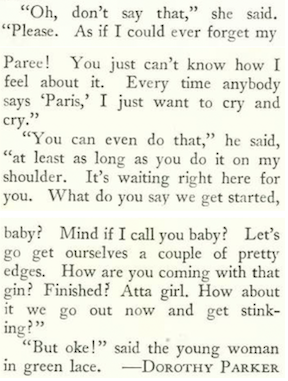
“A Young Woman in Green Lace” reveals how Parker regarded some of the modern women of those times, this next-generation flapper, a bit childish and snobbish, wishing she were back in “Paree.” In the story a man presses his charms as the woman descends into drunkenness and drops her Continental facade:

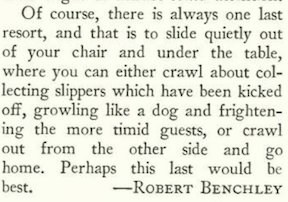
Where disillusion creates a darkly comic mood in Parker’s piece, in Benchley’s world disillusion provided a nice opening for some silliness. In ”Filling That Hiatus” Benchley addressed a seldom-discussed dinner-party etiquette situation in which both your right- and left-hand partners become engaged in conversation with someone else. He concluded:

 *  *  *

His Country, Too

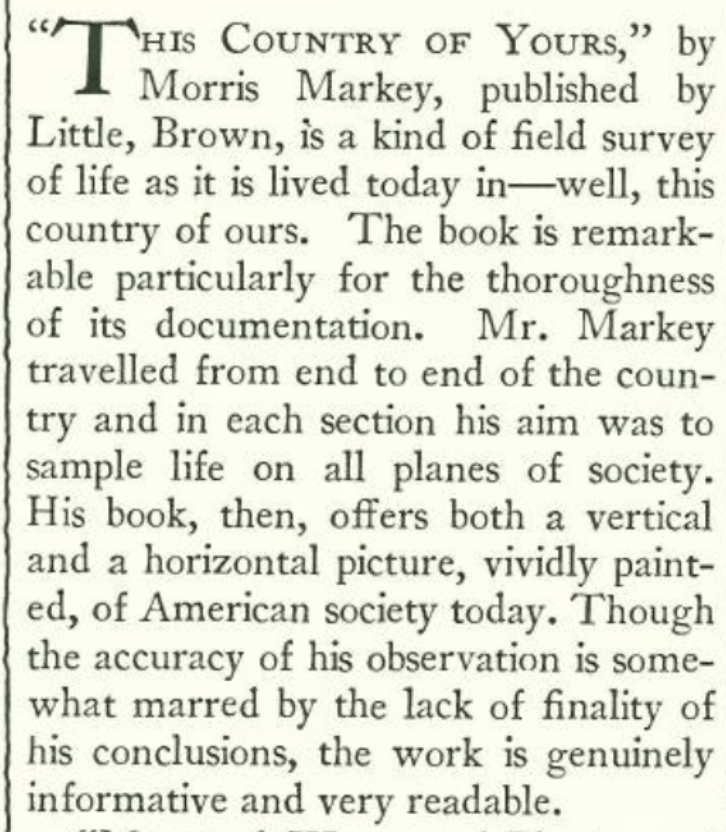
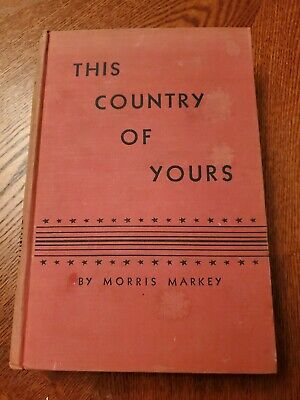
It is always with a tinge of sadness that I write about Morris Markey, who from the start wrote for virtually every department at The New Yorker and was best known for his “A Reporter at Large” feature. According to his obituary in The New York Times, Markey won his greatest recognition for the book This Country of Yours, published after he left The New Yorker. That magazine’s review was brief, and read thusly:

The book is mostly forgotten today, as is Markey, who was found shot to death on July 12, 1950 at his home in Halifax, Virginia. He was just 51 years old. There was insufficient evidence as to whether the wound behind his right ear was the result of accident, homicide, or suicide.

Here is what the Times (Sept. 10, 1932) had to say about Markey’s book:

 *  *  *

From Our Advertisers

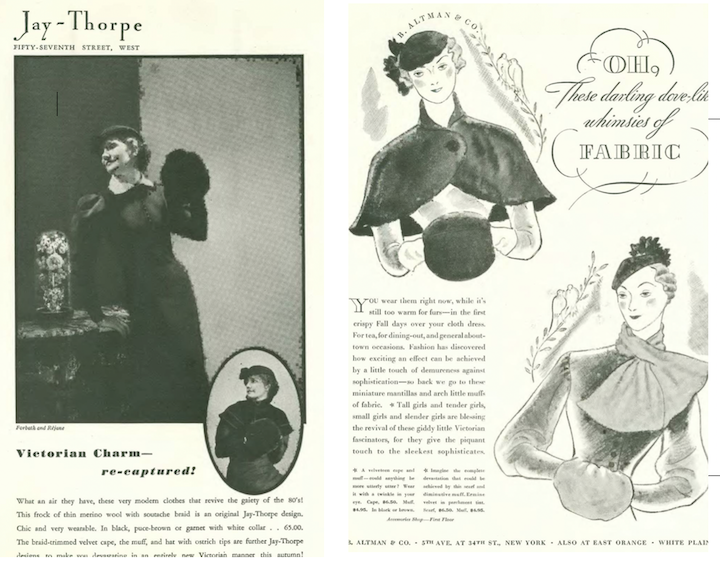
With cold weather arriving during the Depression’s worst year, fashions continued to borrow from the past for a more conservative look (these are two ads from Jay-Thorpe and B. Altman)…

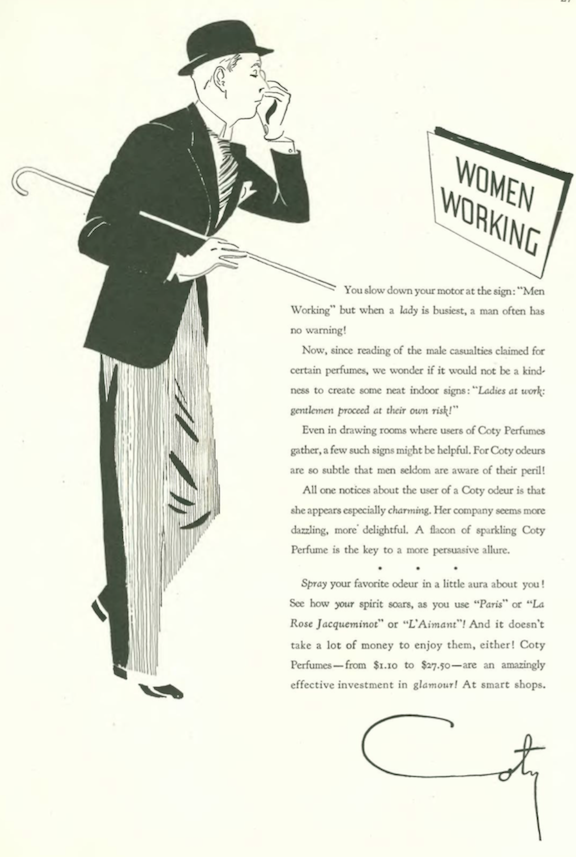
…as for the gentleman, fashion continued to emphasize a genteel look (although there is a bit of the Little Tramp about this fellow)…

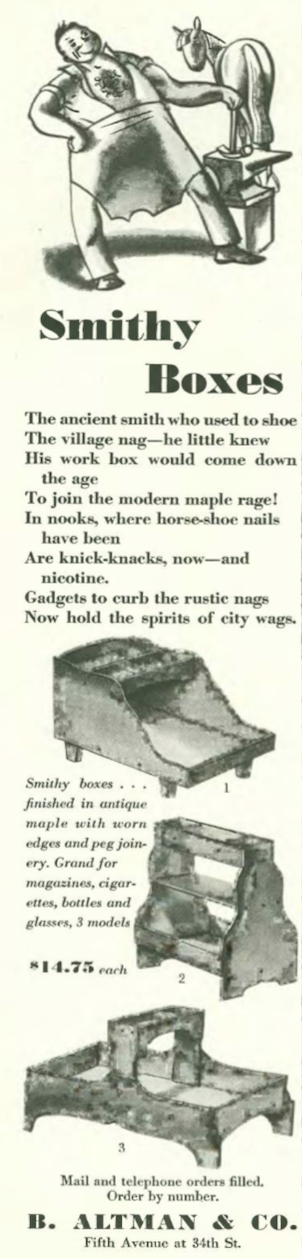
…then as now, folks turned toward the rustic to find a bit of comfort in uncertain times…

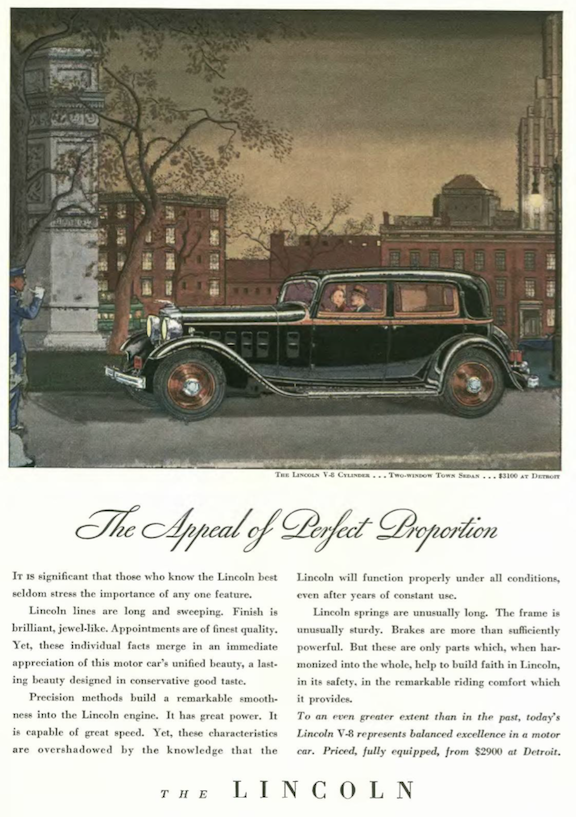
…and if they could afford it, the comforts of the stolid, solid Lincoln motorcar…

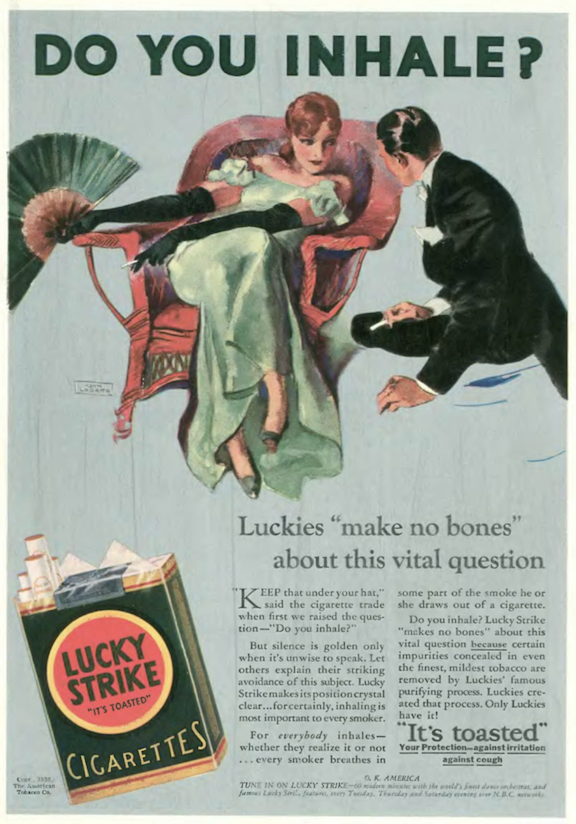
…the folks at Lucky Strike continued to ask this question…

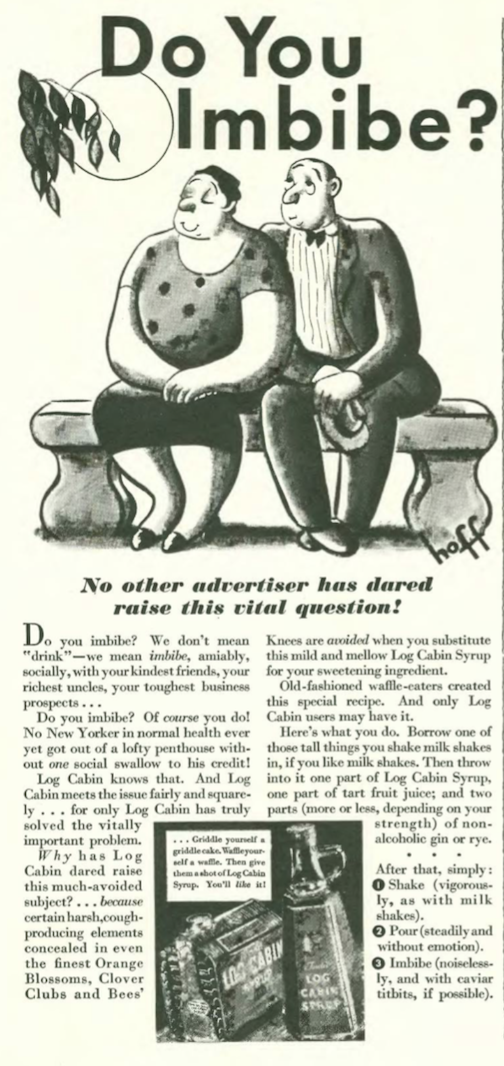
…and with the help of Syd Hoff, the makers of Log Cabin syrup ran this parody ad (in the Oct. 1 issue) of the Lucky Strike campaign…Hoff was among the newest members of The New Yorker cartooning cast…

…as was William Steig, who featured one of his “Small Fry” to tout the benefits of decaf coffee…

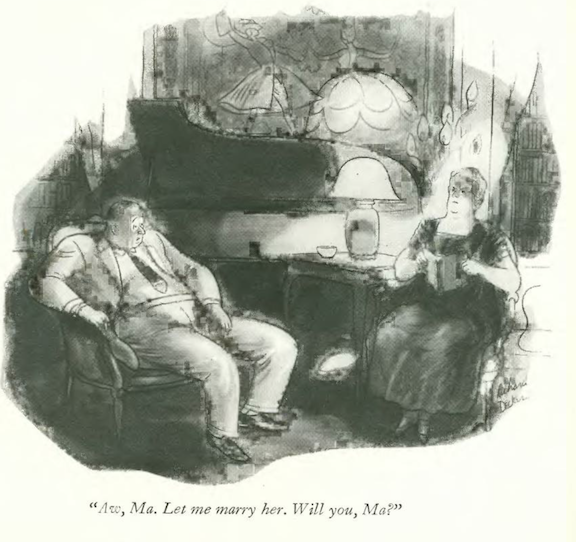
…our cartoon from the Sept. 24 issue is by Richard Decker

…on to Oct. 1, 1932…

Oct. 1, 1932 cover by Peter Arno.

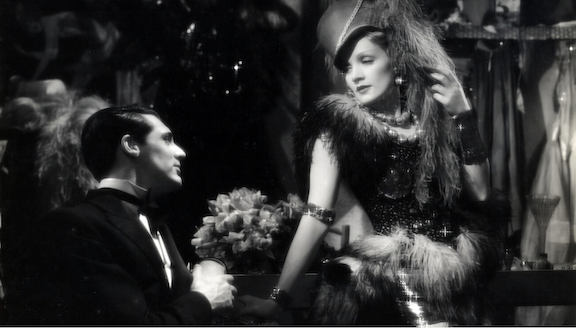
…where film critic John Mosher took in the latest from Marlene Dietrich and came away less than dazzled by Blonde Venus

Now something of a cult film, reviews were mixed when Blonde Venus was released in 1932. The New York Times’ critic Mordaunt Hall went even further than Mosher, calling the film a “muddled, unimaginative and generally hapless piece of work, relieved somewhat by the talent and charm of the German actress…”

WELL HELLO THERE…Cary Grant made his film debut in 1932 in This Is the Night—he went on to appear in eight films that year, including Blonde Venus with Marlene Dietrich. (MoMA)

 *  *  *

Unlucky in Luck

In its early years The New Yorker paid little attention to baseball, but “The Talk of the Town” did appreciate a human interest story from the field every now and then, and Yankee batboy Eddie Bennett filled that bill—this was the second time Bennett was featured in the column…

LUCKY EDDIE…Top, Eddie Bennett in 1921, the year he became the Yankees’ batboy; below, with slugger Babe Ruth in 1927; at right, newspaper profile the year after the 1927 World Series. As an infant Bennett twisted his spine in a carriage accident that stunted his growth and gave him a misshapen back.(Library of Congress/The New York Times/Brooklyn Citizen)

Throughout the 1920s Bennett was a famed good luck charm for the Yankees, but when a taxicab struck him in 1932 his batboy career ended. According to The New York Times (April 2, 2021) “Three years later, Mr. Bennett was found dead in a furnished room on West 84th Street. Autographed photos from Herb Pennock and Waite Hoyt, both pitchers for the Yankees, hung on the walls…Balls and bats signed by Ruth and Lou Gehrig decorated the room. An autopsy found that Mr. Bennett had died of alcoholism. He was 31.”

For 85 years, Bennett rested in an unmarked grave at St. John’s Cemetery in Queens, but last November he was remembered with a new marker and a simple ceremony. You can read more about it in this Times article.

 *  *  *

Original Verse

Ogden Nash was working as an editor at Doubleday when he submitted some rhymes to The New Yorker. Harold Ross (New Yorker founder/editor) saw the submissions and asked for more, apparently stating “they are about the most original stuff we have had lately.” Here is one of the later submissions:

 *  *  *

From Our Advertisers

If you were of the male persuasion and a member of the smart set you probably dressed down in something like this for a day with your dressage buddies…

…the modern woman of the 1930s could also be a successful business woman in this “successful” frock (how that translated into reality was another thing)…what is also interesting about this ad is how it features both an illustration and a photograph of the same outfit—it’s as though they’ve acknowledged that the attenuated figure in the illustration, although eye-catching, does not resemble an actual body type…

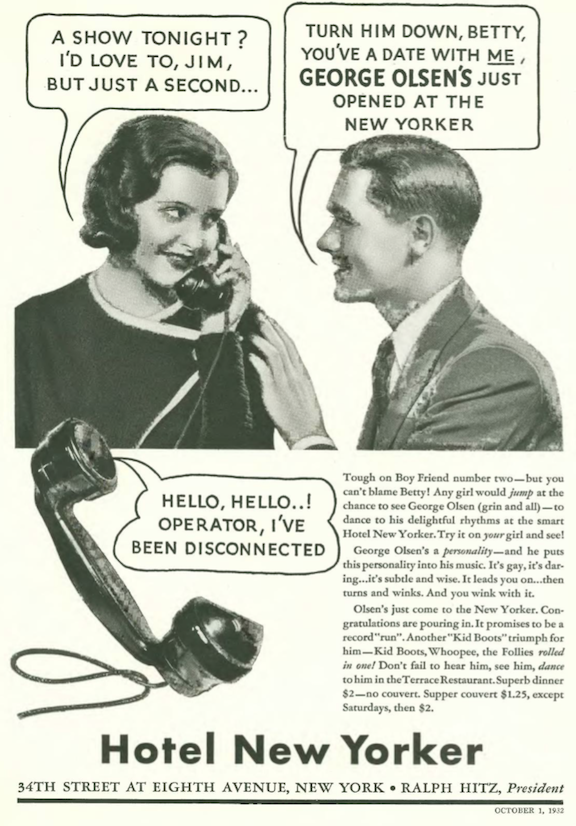
…here was see an early use of the word balloon in an advertisement featuring real people—I wonder if this was inspired by the comics, or by Bernarr Mcfadden’s “composographs” featured in his New York Evening Graphic?…

…on to our cartoonists, we begin with a strange bit of bedside manner courtesy Gardner Rea

Robert Day introduced us to a modest suspect…

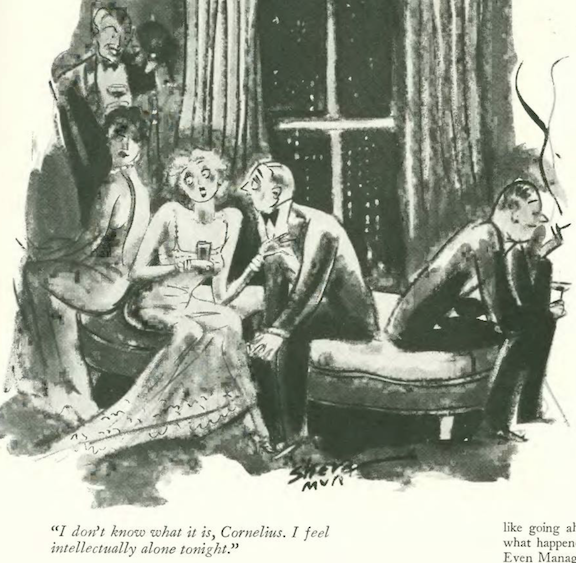
Barbara Shermund continued to explore the travails of modern women…

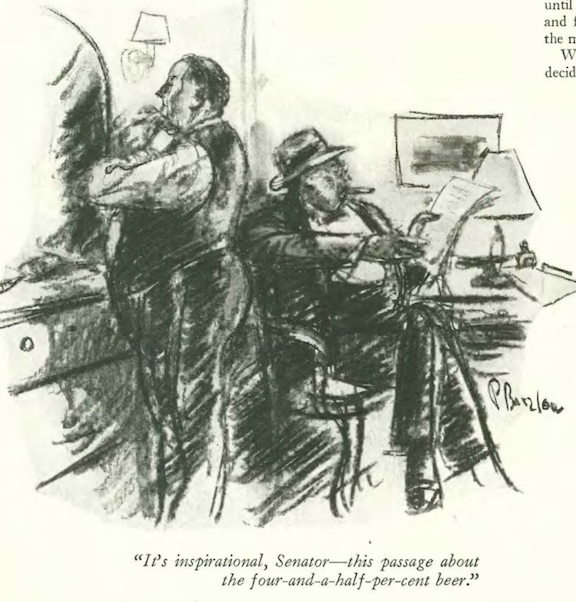
…while this woman (via Perry Barlow) seems quite content with her lot…

…Mayor Jimmy Walker was out, but not down, like these fellows presented by Alan Dunn

…and we close with Peter Arno, announcing some upcoming nuptials…

Next Time: An Instant Star…


A New Outlook

Above: Former Governor Alfred E. Smith points out the sights of the city to Governor Franklin D. Roosevelt from an Empire State Building observation floor on May 1, 1931. (Empire State Realty Trust)

New York Governor Al Smith and the man who succeeded him in that office, Franklin D. Roosevelt, were both Democrats, but when it came to personalities, they were more like oil and water.

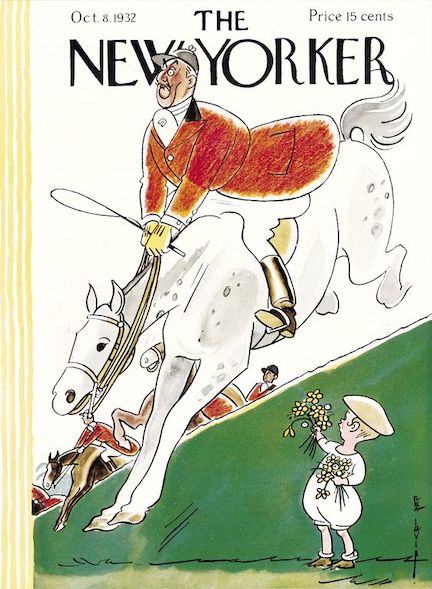
Sept. 3, 1932 cover by Ilonka Karasz.

A popular governor (1923 to 1928) from working-class roots, Smith thought he could ride that popularity to the White House, but lost to Herbert Hoover in the ’28 presidential elections. He then hoped to be of some use to his gubernatorial successor FDR, but was more or less snubbed by his fellow Democrat – the regal Roosevelt branded himself as a reformer, and didn’t want Smith’s deep Irish Tammany connections to sully that reputation. Smith did find something to do, however, by becoming president of the corporation that built and operated the Empire State Building.

THINGS ARE LOOKING UP…Al Smith (pointing) extolls the wonders of the Empire State Building at the May 1, 1931 grand opening. (chrismurphy.com)

But after the building’s dedication, Smith took another shot at the White House, this time against Roosevelt in the 1932 Democratic presidential primaries. Smith lost the nomination in a bitter convention battle (he eventually endorsed FDR) but kept busy with another venture: editor of the New Outlook magazine…

SECULAR SHIFT…The Outlook began publication as The Christian Union (1870–1893). The issue at left is from July 1, 1893, when the magazine became The Outlook to reflect its shift from religious subjects to social and political issues. That magazine went bankrupt and became the New Outlook in 1932; the issue at right is from October 1933, a year after Al Smith became editor. The magazine folded in 1935. (Wikipedia/Abe Books)

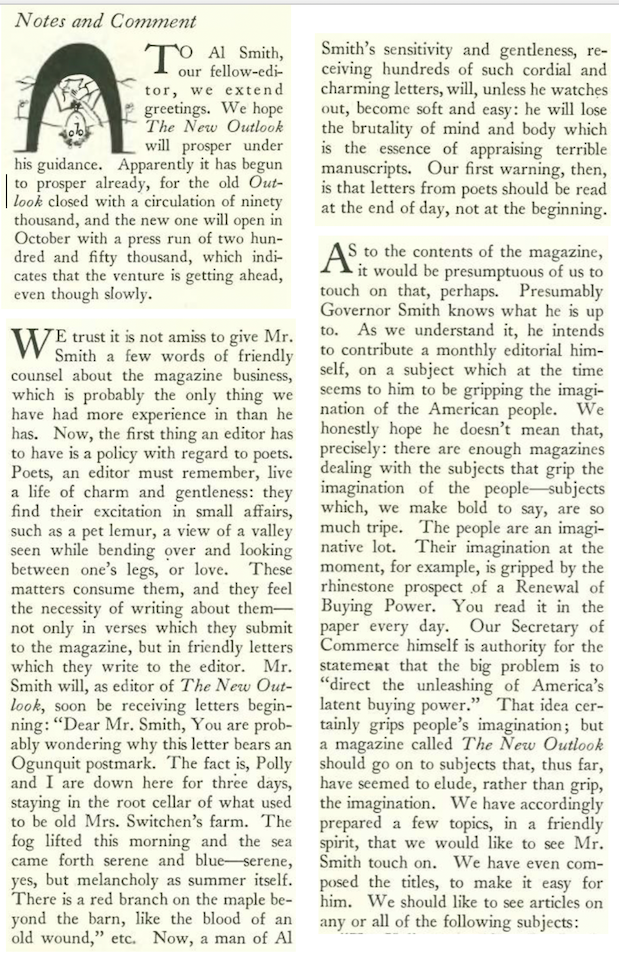
…which Smith used as a platform to attack his Democratic rival, and, particularly the New Deal policies following Roosevelt’s successful election to the White House. The election was still a couple months away when E.B. White offered these observations about Smith’s new publishing venture:

Otto Soglow provided this interpretation of Smith’s new job for “Notes and Comment”…

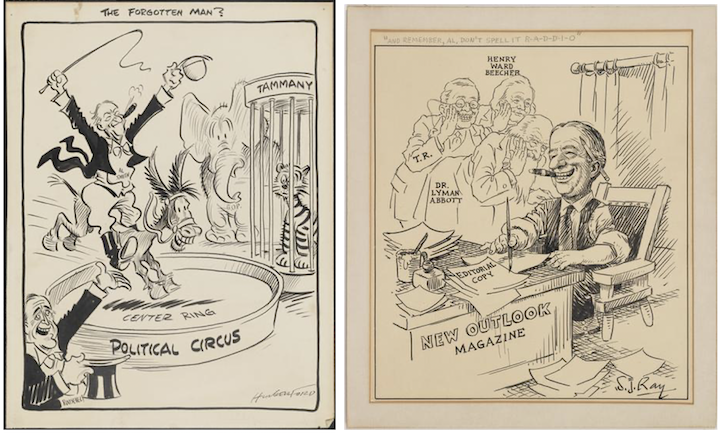
…while other cartoonists made hay over the Roosevelt/Smith rift:

COMIC APPEAL…Cyrus Cotton “Cy” Hungerford produced daily cartoons for the Pittsburgh Post-Gazette for 50 years, including this gem at left that aptly illustrated the political circus that featured Al Smith as its star attraction; during his 32 years as editorial cartoonist for The Kansas City Star, Silvey Jackson (S. J. or Sil) Ray amassed a portfolio of roughly 10,000 cartoons, including the one at right that depicts the ghosts of past Outlook contributors and editors including Teddy Roosevelt, Lyman J. Abbott and Henry Ward Beecher. (Museum of the City of New York/kchistory.org)

 *  *  *

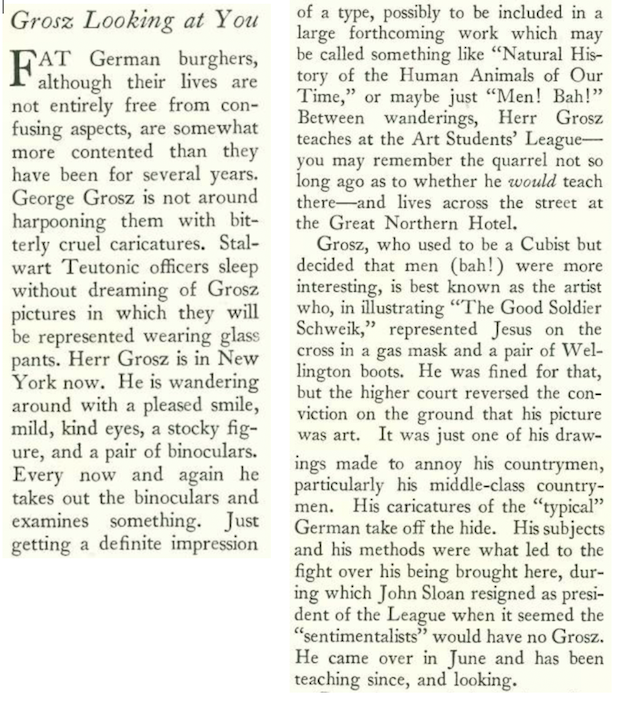
Nein Bitte

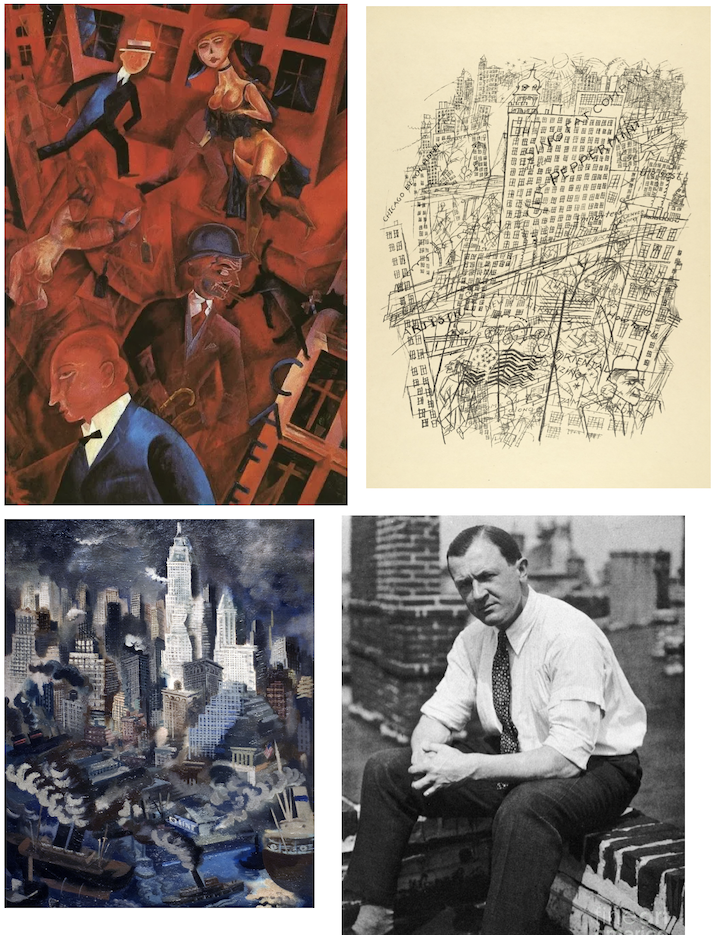
The German artist George Grosz (1893–1959) was perhaps best known for his bitter caricatures and paintings of Berlin’s Weimar years (roughly 1918 to 1933). In June 1932 he accepted an invitation to teach the summer semester at the Art Students League of New York, then briefly returned to Germany before emigrating to the U.S. with his family in January 1933.

SEEING RED…Clockwise, from top left, George Grosz depicted Berlin as a hellscape awash in blood and corruption in Metropolis (1917); by contrast, Grosz celebrated the energy and freedom of New York in his 1915–16 work Memory of New York; Grosz in New York, circa 1932; after emigrating to the US in 1933, Grosz abandoned his harsh caricatures and corrupted cityscapes in favor of nudes and landscapes. He returned to the subject of the New York skyline a number of times, including his 1934 painting Lower Manhattan. (MoMA/Flickr)

 *  *  *

From Our Advertisers

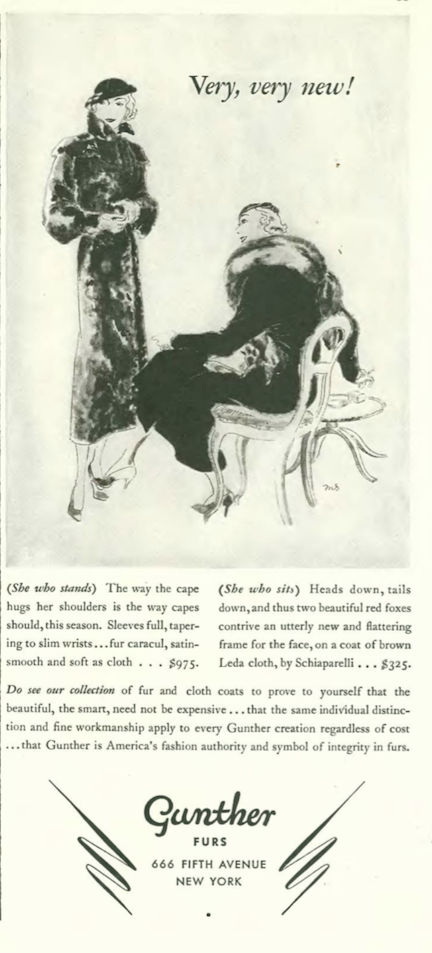
Back in the day when it was still acceptable to drape dead animals around your neck, Gunther Furs offered these ensembles…the coat at left would cost the equivalent of $17,000 today…

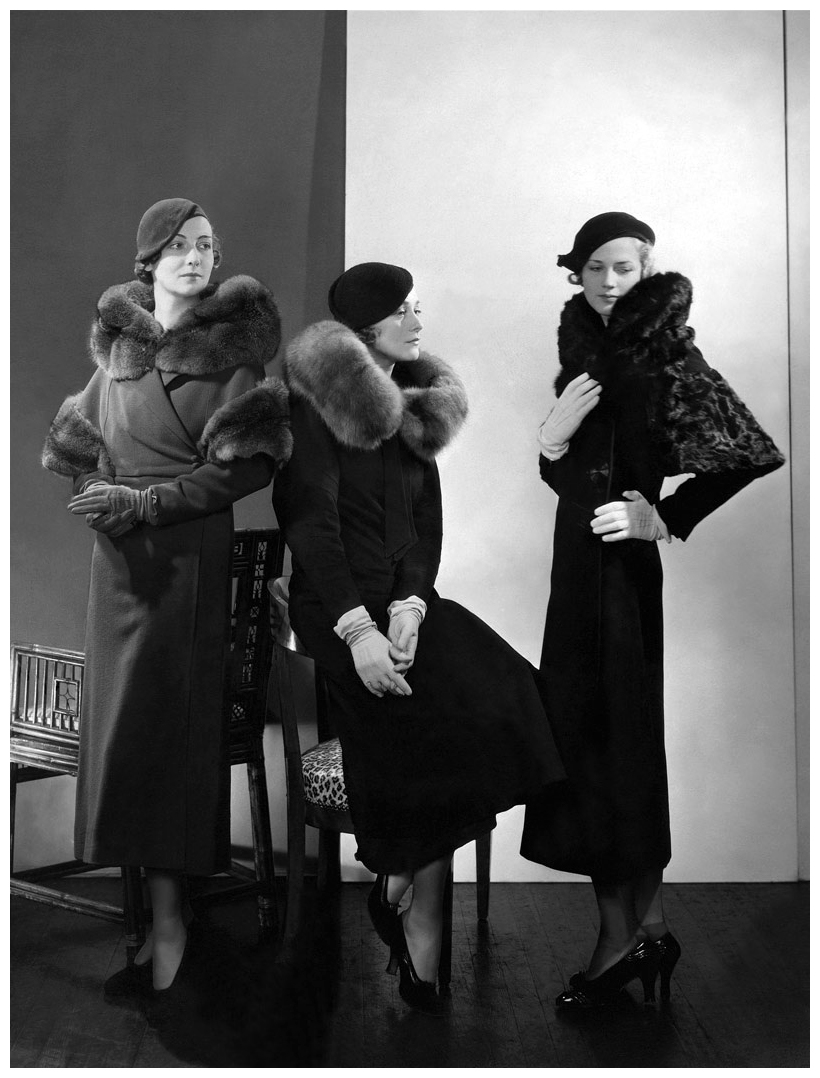
…this 1932 photo gives us some idea of how these coats might have appeared…

FUR SURE…Models in 1932 wearing (from left) wool coat with fur collar and armbands; wool coat with blue fox collar by Lanvin; and wool coat with caracal collar and sleeve trimming by Mainbocher. Photo by Edward Steichen. (pleasurephotoroom.wordpress.com)

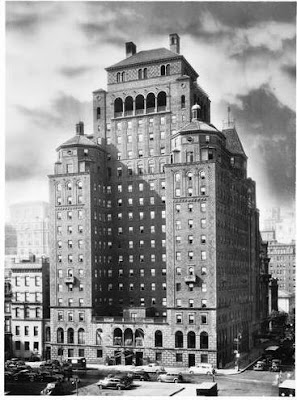
…perhaps you could wear one of the coats on a breezy day atop Ten Park Avenue…even this posh address felt the need to emphasize its affordability in those depressed times…also note the advertisement at the bottom for a “Milk Farm”…

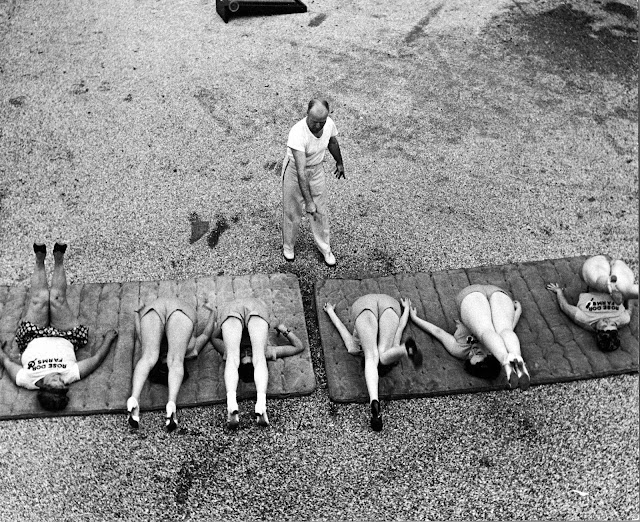
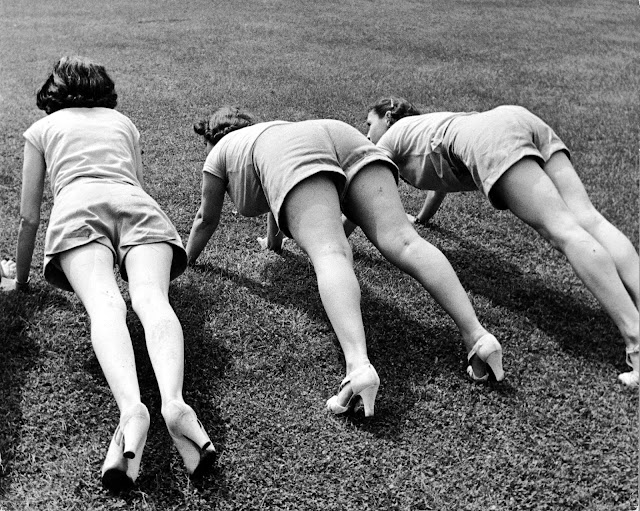
…the 1930s saw a weight-loss fad that included dairy as a dietary must; one such “milk farm” was the Rose Dor Farm just up the Hudson from New York…

HUMP DAY…Top, Rose Dor Farm trainer Steve Finan directs mat exercises calculated to reduce hips and remove “widow’s humps” in the 1930s. Below, note the choice of footwear for the workout. (vintag.es)

…back to our apartment hunting, The Lombardy was built in the 1920s by William Randolph Hearst for his movie star mistress Marion Davies…unlike Ten Park Avenue, it wasn’t on Park, but the ad makes sure to note its close proximity, and the illustration assured that the clientele were sufficiently dour in their good taste…also note the ad for the Fraternity Clubs Building, which was going co-ed…

The New York Times reported in August 1932 that “the ninety rooms of the fourth and fifth floors of the building have been redecorated and furnished with a ‘feminine touch'”…

NO ANIMAL HOUSE…The Fraternity Clubs Building, erected in 1923, went co-ed in 1932. The Renaissance Revival-style building was designed by the firm Murgatroyd & Ogden. Today it serves as the Jolly Madison Towers hotel. (New York Public Library via Daytonian in Manhattan)

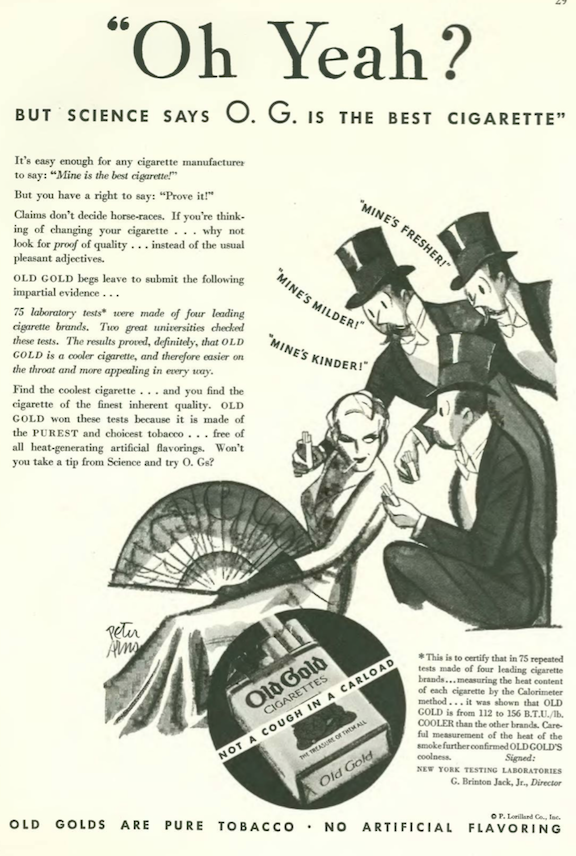
…time to step out for a smoke with another Old Gold ad illustrated by Peter Arno

…in contrast to Arno’s defiant vamp, this woman enjoyed her smoke with a sense of ease…

…if you’ve never heard of Richard Himber, he made a name for himself in New York beginning with his days in vaudeville and Tin Pan Alley. Described in a Wikipedia entry as “American bandleader, composer, violinist, magician and practical joker,” Himber ran a band-booking agency before forming an orchestra of his own at the Essex House that performed over NBC Radio…

…our last ad is a most unlikely one from the Sterling Engine Company of Buffalo, New York, definitely an outlier among the other New Yorker ads…

…our cartoonists include Perry Barlow on the campaign trail…

…along with Alain (Daniel Brustlein)

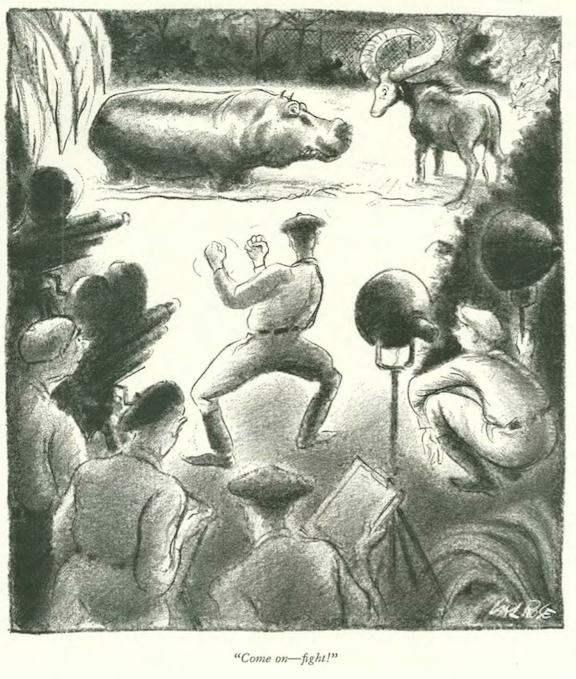
Carl Rose gave us two zoo animals who were less than keen to become movie stars…

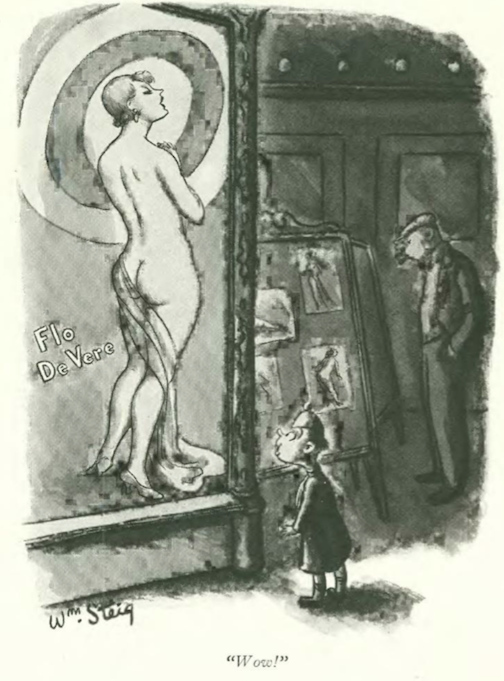
…and we close with William Steig, who showed us one of his Small Fry coming of age…

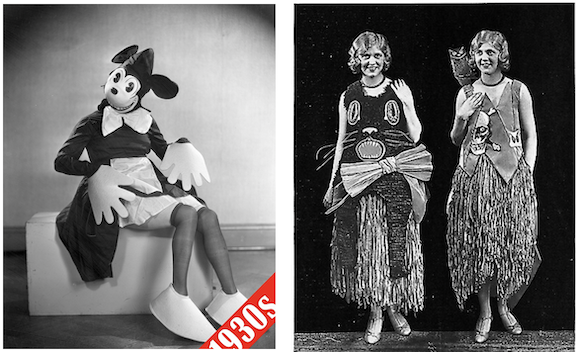
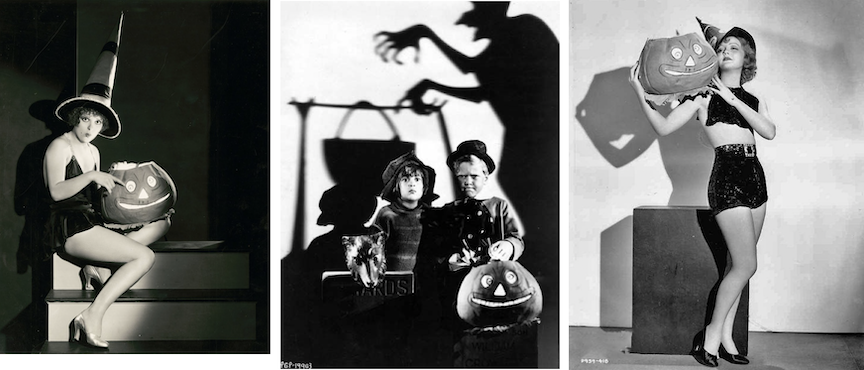
…but before we close, here’s a brief nod to Halloween, 1932, and some popular costumes for the grown-ups, including a Minnie Mouse costume that is unintentionally creepy…

…Hollywood liked to get in on the fun by releasing studio “pin-ups” featuring stars of the day…

BOO…Paramount stars all pose with the same prop Jack ‘o Lantern circa 1931-32. From left, the original “It Girl” Clara Bow, who would retire from movies in 1933 at age 28 and become a rancher; Robert Coogan and Jackie Cooper were child stars of the film Sooky; Nancy Carroll’s latest film, Hot Saturday, was released a few days before Halloween 1932. The film also starred Cary Grant in his first leading role. (vintag.es/twitter/Pinterest)

Next Time: The Red House…

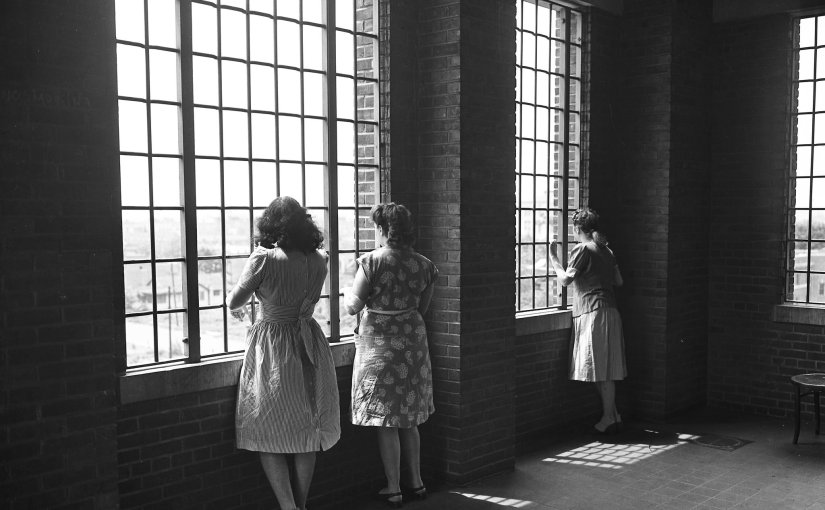
On Detention

Twentieth century New York saw a lot of paradise paved (see Moses, Robert), but there is one spot in New York that saw paradise reclaimed—not from a parking lot but from an eleven-story prison that once stood at 10 Greenwich Avenue.

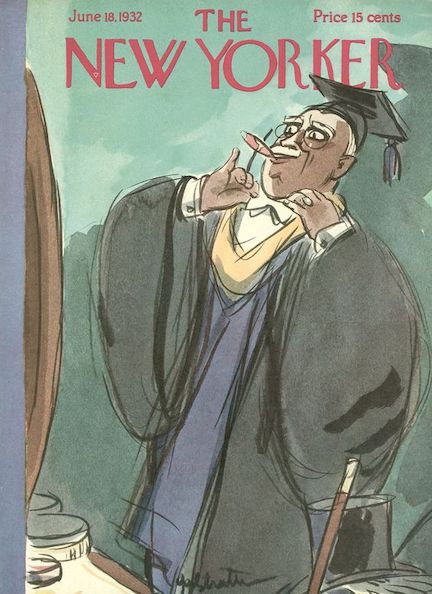
June 18, 1932 cover by William Crawford Galbraith.

The Jefferson Market Garden in Greenwich Village was once the site of a women’s prison designed to be a more humane corrections facility, but between its opening in 1932 and its closing in 1971 the Women’s House of Detention went from noteworthy to notorious.

It was designed by a firm known for its Art Deco buildings—Sloan and Robertson—and although it still looked rather stark and institutional on the inside, attempts were made to gussy it up with artworks commissioned by the WPA. The New Yorker’s E.B. White found a certain “sanitary elegance” to the place.

WELCOME INMATES!…When the Women’s House of Detention opened in 1932 it focused on more humane practices, including vocational training and other reform measures. Clockwise from top right, a 1938 photo shows how the prison once loomed over the Sixth Avenue El;

by the late 1960s the jail had become squalid, overcrowded and violent. He wrote: “I can still hear the desperate pleas of inmates shouting through the windows as I walked home from school every day.”

BIG, BAD HOUSE…Clockwise from top, left, protestor outside the New York Women’s House of Detention at the Prisoners’ Rights and “Free the Panther 21” demonstration in 1970; illustrious inmates at the prison included Ethel Rosenberg (pictured Aug. 8, 1950), Angela Davis, and Valerie Solanas (who shot Andy Warhol in 1968); demonstrators outside the prison in 1970; 1956 publicity still taken by the Department of Corrections. (Diana Davies via Smith College/

In the late 1960s Village residents began holding town hall meetings to discuss the removal of the overcrowded prison, many complaining of the friends and families of inmates who lingered outside day and night, yelling up to their loved ones behind bars. The protests were successful; the prison closed in 1971 and was demolished three years later.

A BIT OF EARTH…Top photo is an overhead view of the Jefferson Market Garden, planted on the site of the former Women’s House of Detention. Below, a verdant pathway takes a turn through Jefferson Market Garden. Photos courtesy of amny.com and Jefferson Market Garden.

 *  *  *

How Dry I Ain’t

Franklin D. Roosevelt was a canny politician, seemingly able at times to please both sides of a divisive issue. This was the case in 1932, when teetotaling New Yorkers touted FDR’s long record of supporting such causes as the Anti-Saloon League, while city dwellers such as E.B. White knew better…

LIBERAL LIBATION…Franklin D. Roosevelt was an enthusiastic drinker, especially of his famed martinis. (thrillist.com)

*  *  *

From Our Advertisers

In the days before air conditioning, most folks had to rely upon whatever cooling breezes they could channel into their homes, and apparently in Tudor City they could find some relief from the East River, at least when the wind was blowing from that direction…

…if the wind wasn’t in your favor, you could switch on an electric fan, an appliance that didn’t come into common use until the 1920s…this ad also demonstrated the power of the dictum “sex sells,” even if applied subtly…

…it would be awhile before air-conditioning became common, but in 1932 you could at least keep your goodies cool with a GE refrigerator, its radiating coils offering a novel way to disperse this smoker’s emissions…

…we jump to our cartoons, with Kemp Starrett in some mixed company…

Garrett Price illustrated the peril one faced when driving through Chelsea, where one could encounter freight trains at street level…

…for almost one hundred years this street-level freight line on 11th Avenue—known as “Death Avenue”—claimed the lives and limbs of hundreds of (mostly poor) New Yorkers…

HEADS UP!…the Hudson River Railroad at 11th Avenue and West 41st Street. (forgotten-ny.com)

…happily, we move on to June 25, 1932…

June 25, 1932 cover by Adolph K. Kronengold.

…which featured a profile of Samuel Klein (1886-1942), founder of Union Square’s discount department store S. Klein, famous for its “bargain bins.” The profile included this column-busting caricature of Klein as rendered by Abe Birnbaum

YOU COULDN’T MISS IT…The S. Klein Department Store was a Union Square fixture from 1910 to its closing in 1975. At right, undated photo of founder Samuel Klein. The building is long gone, the Zeckendorf Towers now occupying the site. (theclio.com/bklyn.newspapers.com)

…and we roll right into our advertisements, and this spot from the makers of B.V.D.s, who found a new market for men’s shorts and continued the 1920s trend toward a more casual, androgynous look among “modern debs”…

…you likely wouldn’t catch Helena Rubinstein wearing B.V.D.s., busy here shaming women into using her line of beauty products…

…on to our cartoons, we have this spot illustration by James Thurber

…and another travelogue image from Rea Irvin

Douglas Ryan gave us an unlikely Shakespeare lover (unless the boxer was Gene Tunney)…

…and we end with a bit of Prohibition humor from Gardner Rea

Next Time: Help Wanted