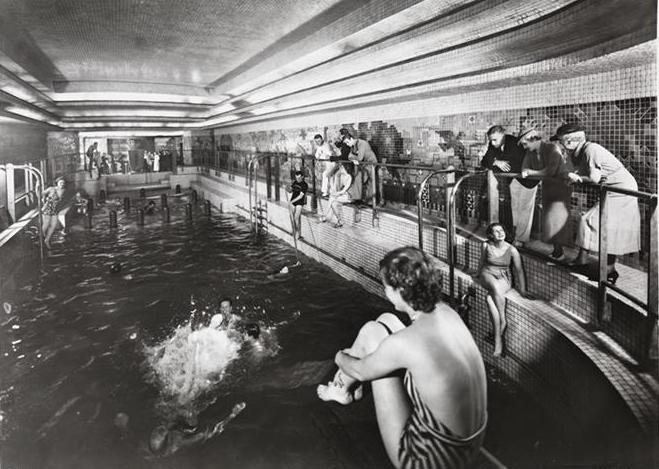
Above: An indoor swimming pool and bar on the S.S. Normandie, ca. 1935 (Museum of the City of New York)
I’m always a bit wistful when writing about travel in the 1930s, and no mode of transportation from that decade seems more bygone than that of the great ocean liners.
April 16, 1932 cover by Sue Williams.
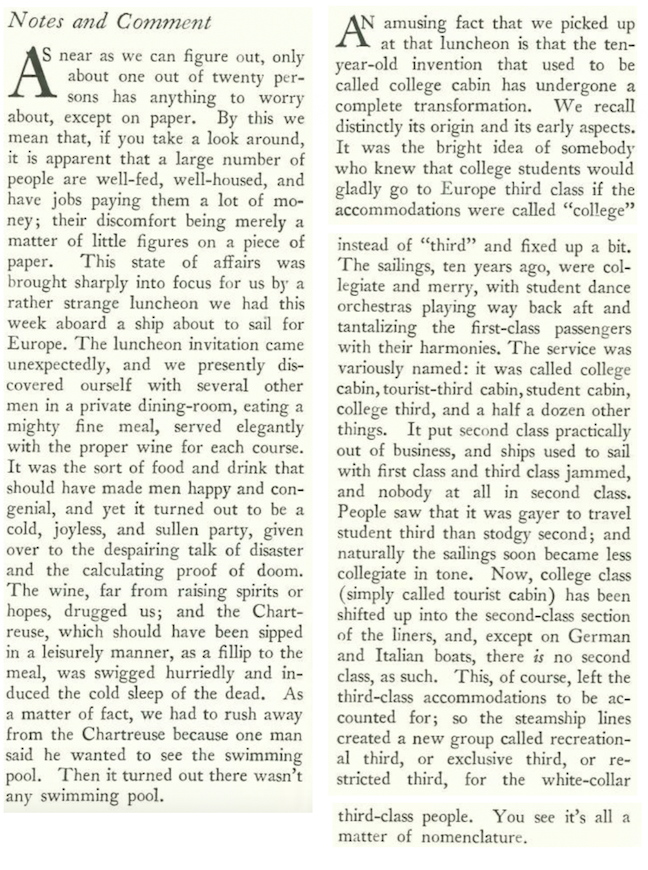
During the Depression many of the shipping lines looked for new ways to make up for lost passenger revenue, and this included catering to those of more modest means by introducing revised cabin classes and other amenities. E.B. White explained:
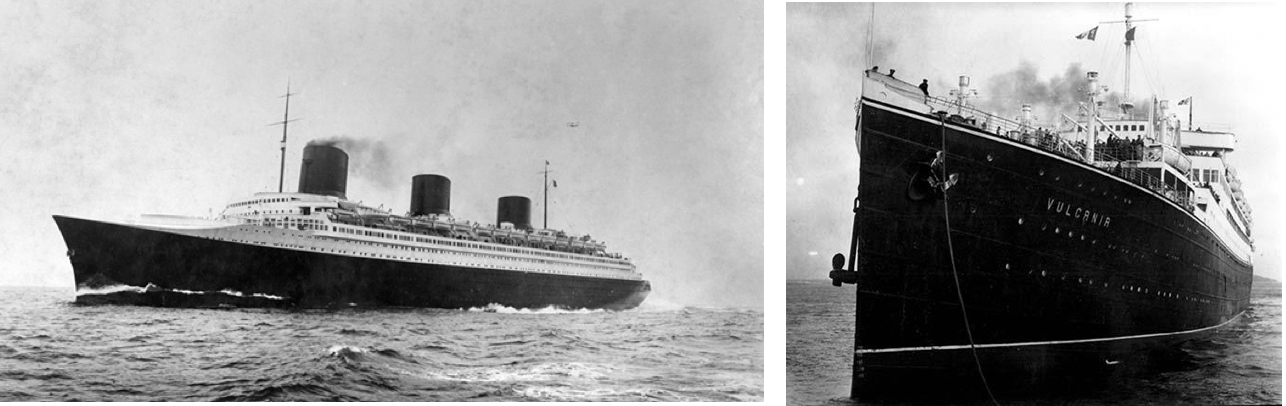
NOT A WATER SLIDE IN SIGHT…The French Line’s S.S. Normandie (left) and Italy’s M.S. Vulcania proudly plied the seas in the 1930s.
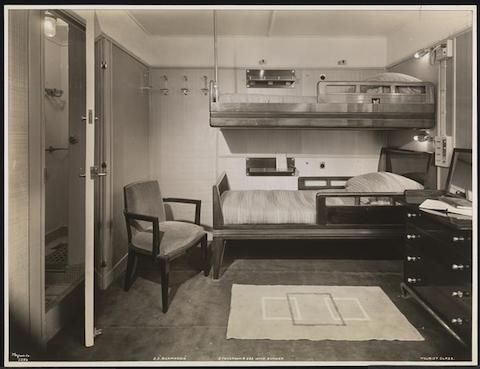
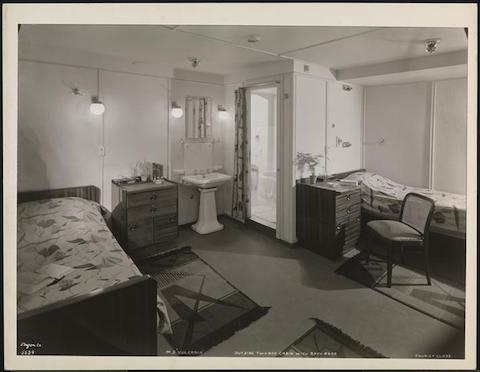
Let’s take a look inside at what White might have glimpsed on his tour aboard a 1930s liner…all of these images are of the less-pricey “tourist class” cabins…Stateroom #282 on the S.S. Normandie offered modern decor and a shower…
…the Italian Line’s M.S. Vulcania tourist class berth #409 offered two beds with a bath…
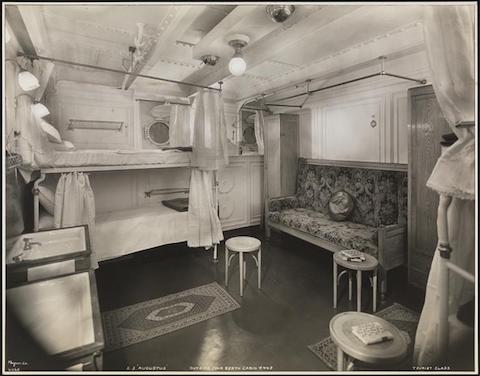
…also from the Italian Line, “Four Berth Cabin #443, Tourist Class” on the S.S. Augustus…
All cabin images courtesy of the Museum of the City of New York.
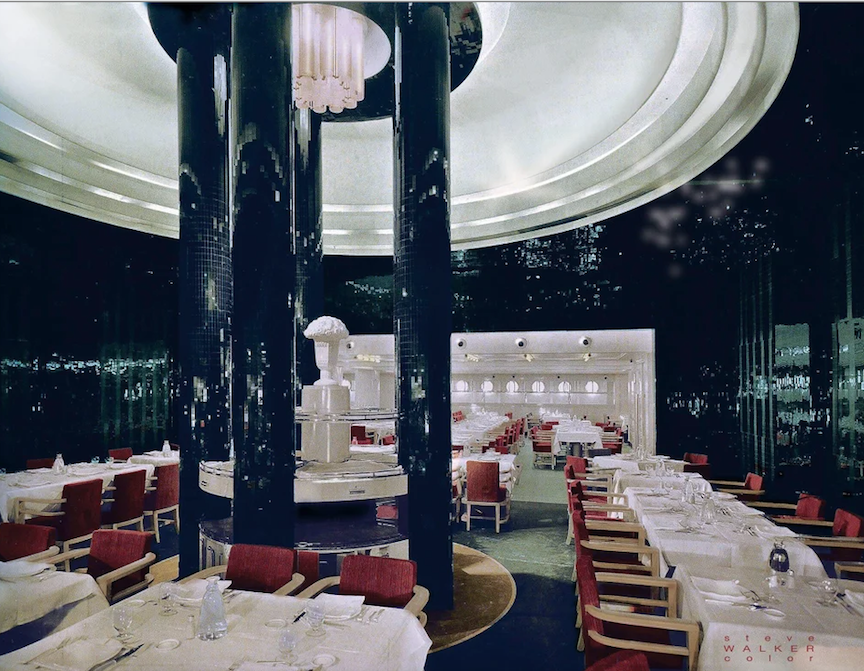
…as for “tourist class” dining, if you were on the S.S. Normandie, here is what awaited you…
EVEN THE CHEAP SEATS WERE NICE. (Oceanlinerporn via Reddit)
…what you would not have seen in this room: flip flops, tee shirts, or all-you-can eat buffets…
* * *
Casting Stones
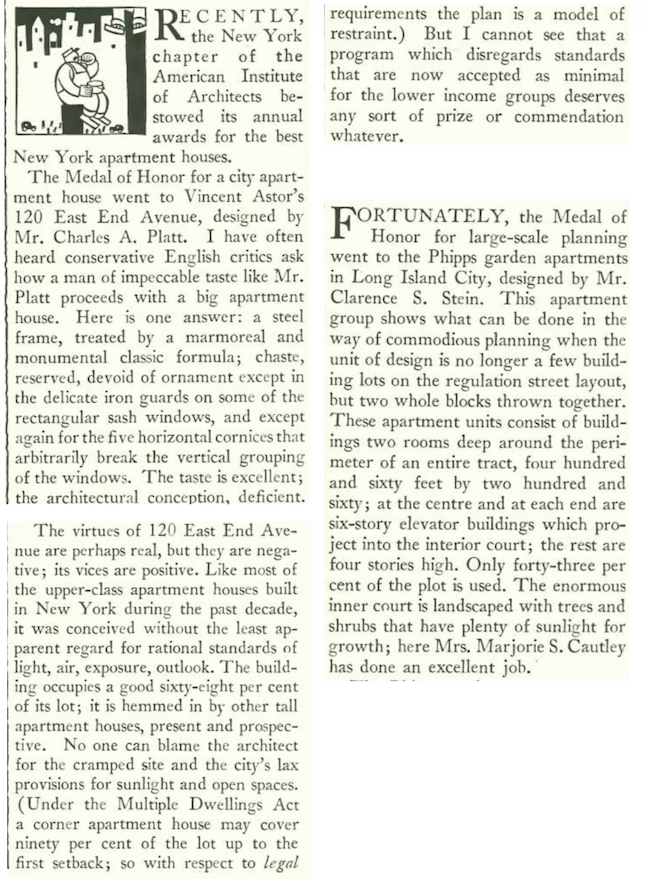
Architectural critic Lewis Mumford did not suffer fools, or foolish architecture, gladly, and when it came time for the American Institute of Architects’ annual Medal of Honor, he found that even good taste could not compensate for poor design:
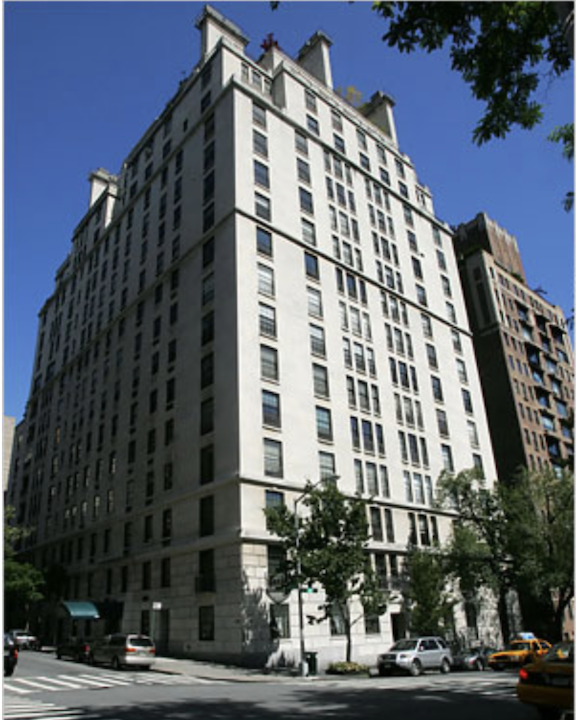
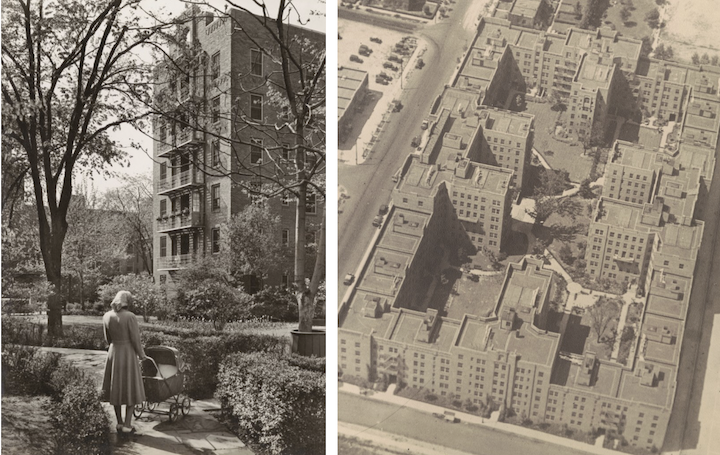
DEFICIENT was how Lewis Mumford described the conception of 120 East End Avenue. Nearly eighty years later, in a 2009 “Streetscapes” column, New York Times writer Christopher Gray called the building “impeccably reserved,” and noted that it served as the home of famed philanthropist Brooke Astor during her six years of marriage to Vincent Astor. (Ruby Washington, NYT)RARE PRAISE was offered by Mumford, however, to Clarence Stein’s Phipps garden apartments, a reminder that in addition to being an architecture critic, Mumford was also a city planner, concerned not only for aesthetics and function but also for how a building or buildings worked within the context of neighborhood and city. (cornell.edu)
* * *
From Our Advertisers
We begin with this understated advertisement from Tiffany & Company. You don’t see the word “silversmiths” in their marketing anymore (they are now “artisans”) but they still have a lot of silver things to offer…
…including some items you couldn’t buy in 1932, like this silver coffee can for $1,550…
(tiffany.com)
…speaking of silver, Gorham Sterling boasted that its sterling silverware was owned by miss etiquette herself, Emily Post, although here she is still quaintly referred to as “Mrs. Price Post”…
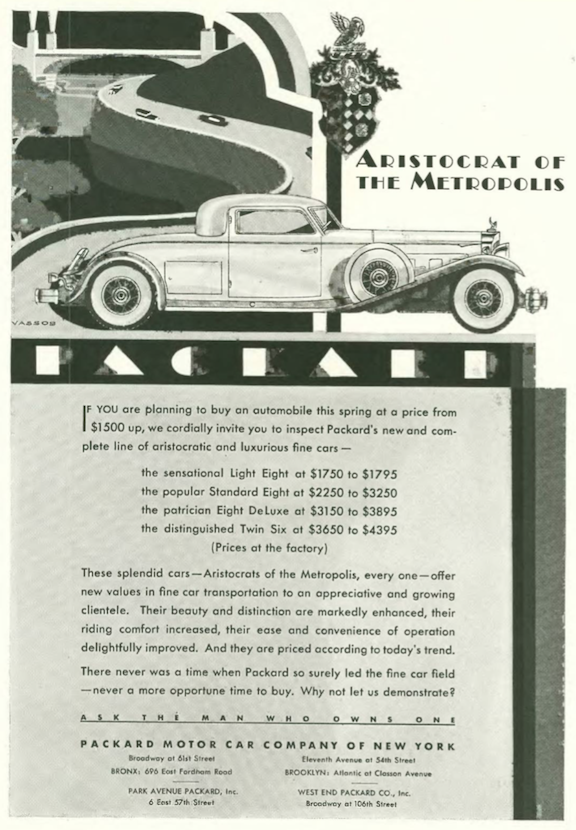
…if you were looking for sterling qualities in an automobile, Packard offered a range of “Aristocrats of the Metropolis”…
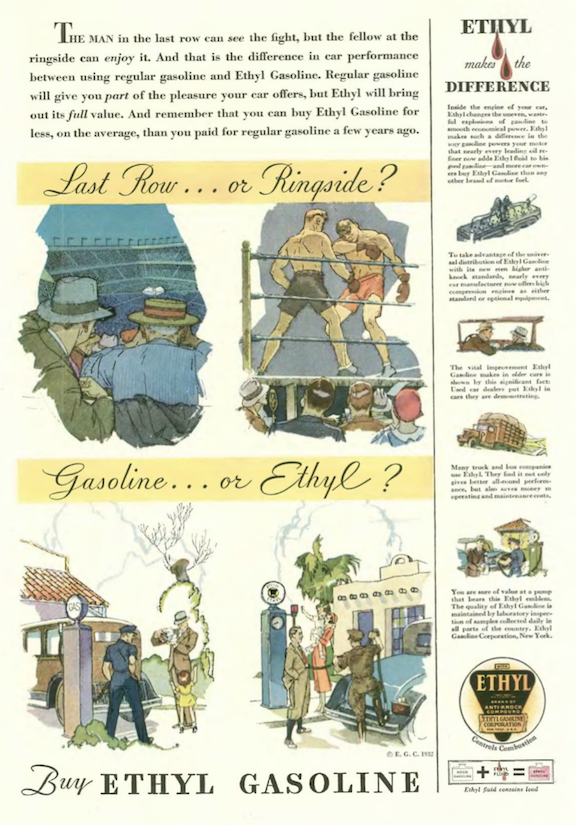
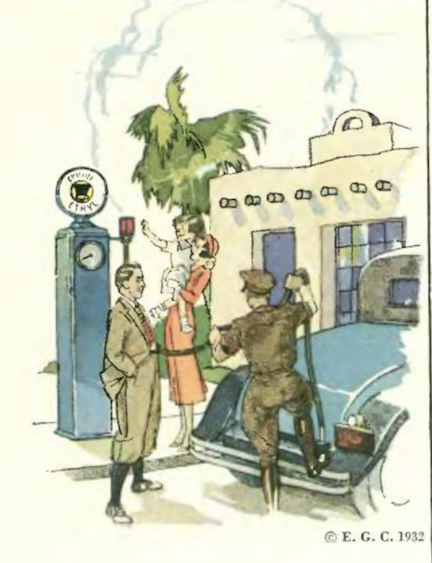
…to treat that Packard right, you’d want to give it the best in fuels, in this case leaded Ethyl Gasoline…
…the makers of Ethyl ran a series of these illustrated ads (above) that compared lesser fuels to downscale choices in life. However, I don’t quite get the final two illustrations in this ad…the first panel depicts a man who is apparently lost, therefore lacking confidence and therefore choosing to put mere “Gas” into his outdated sedan. Also the wife is missing. I mean, who wants to be seen with this guy? On the other hand, the confident man who chose Ethyl is seen casually chatting with an attendant as the precious fuel flows into his sporty roadster. His lovely wife and child seem delighted to watch the amber fuel spin in a little side gauge. Yes, life was good when you switched to Ethyl…
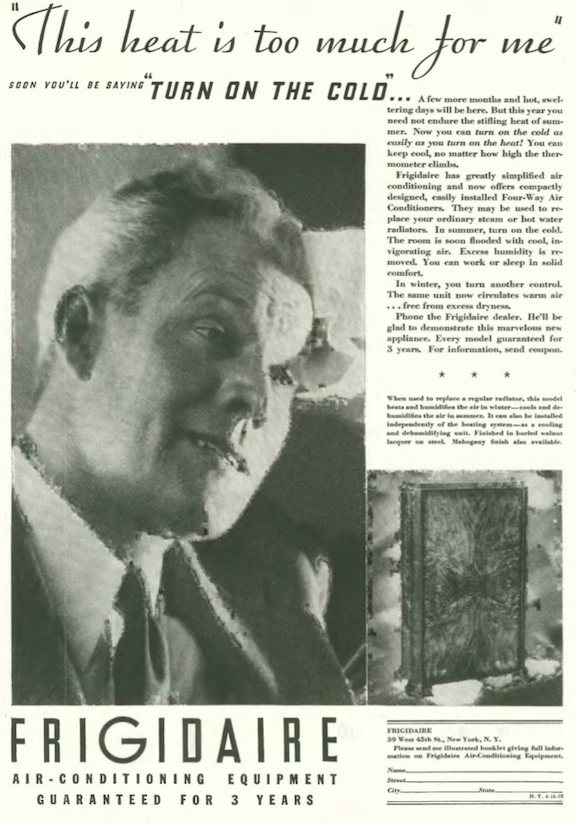
…if you were a person of substantial means you could also contemplate air conditioning for your home, something that almost no one possessed in 1932. Indeed, air-conditioning for the home was only introduced in 1932, when H.H. Schultz and J.Q. Sherman sold an individual room air conditioner that sat on a window ledge. According to Popular Mechanics (Jan. 1, 2015), the units “were only enjoyed by the people least likely to work up a sweat—the wealthy. (The large cooling systems cost between $10,000 and $50,000. That’s equivalent to $120,000 to $600,000 today.)”…
…in addition to being rich, the pilot of this plane also happened to be cultured and fascinating, and a smoker of Rameses II cigarettes…
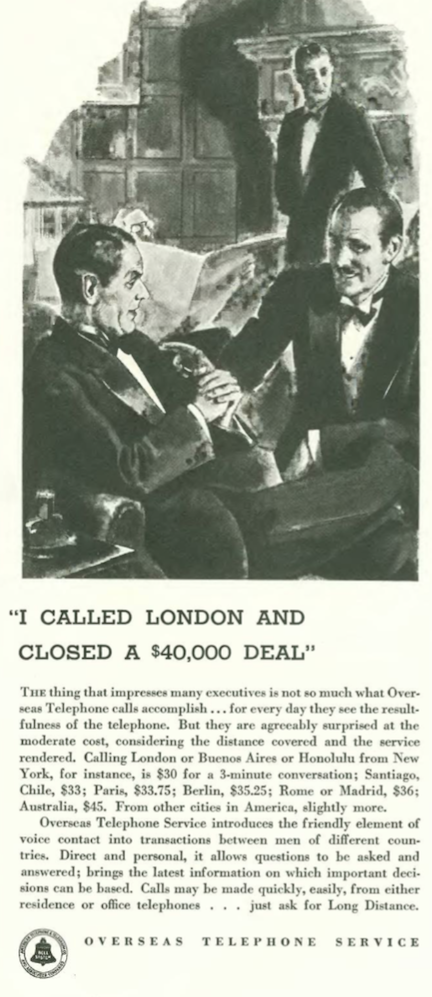
…and here’s another activity reserved for the very few—overseas telephone calls. At $30 for three minutes to London, it would be equivalent to about $600 today (consider that your average stenographer was pulling in maybe $15 a week in 1932, a sales clerk less than $10)…
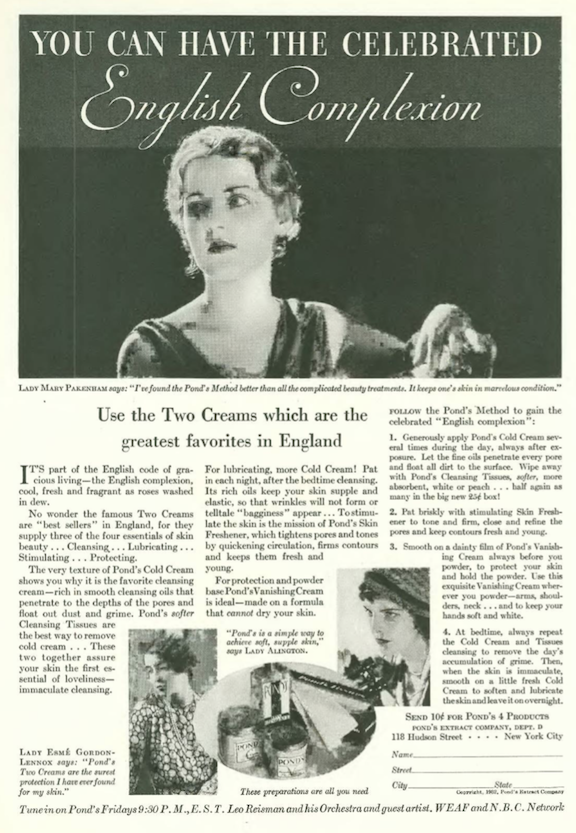
…that sales clerk, however, likely could afford a jar of Pond’s and aspire to have a “celebrated English complexion” like Lady Mary Katherine ClivePakenham…
…Born into the Anglo-Irish Longford family, Pakenham (1907-2010) was a British writer and historian best known for memoirs of her family and time as a debutante in 1926…
THOSE DOWDY DEBS… Lady Mary Katherine ClivePakenham’s memoir of life as a debutante, Brought Up and Brought Out (1938), recounted 1926 as a “bumper dowdy year” for debutantes, the men she encountered “practically deformed…Some were without chins. Some had no foreheads. Hardly any of them had backs to their heads.” (Cecil Beaton Studio Archive)
…we continue with the fashionable by way of Lord & Taylor and an illustration that looks very New Yorker-esque but I can’t quite identify the illustrator…possibly Mildred Oppenheim Melisse…
…I do, however, know this is by our dear Barbara Shermund…
…Richard Decker presented an odd moment in a manor house…
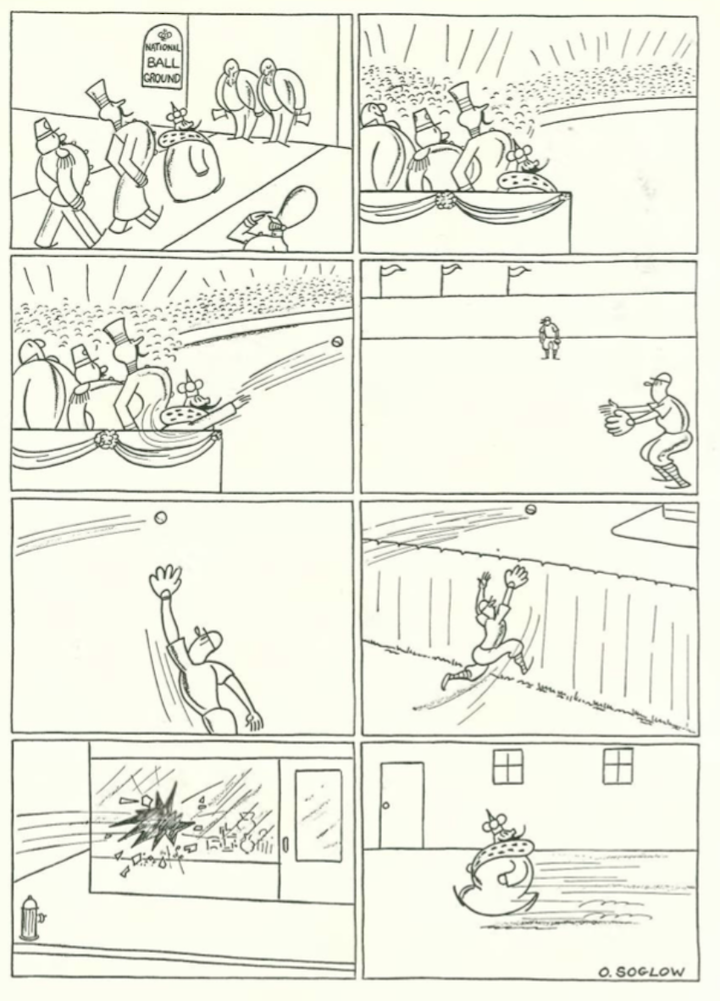
…Otto Soglow’s Little King was up to his old tricks…
…Robert Day discovered an unlikely hitch-hiker…
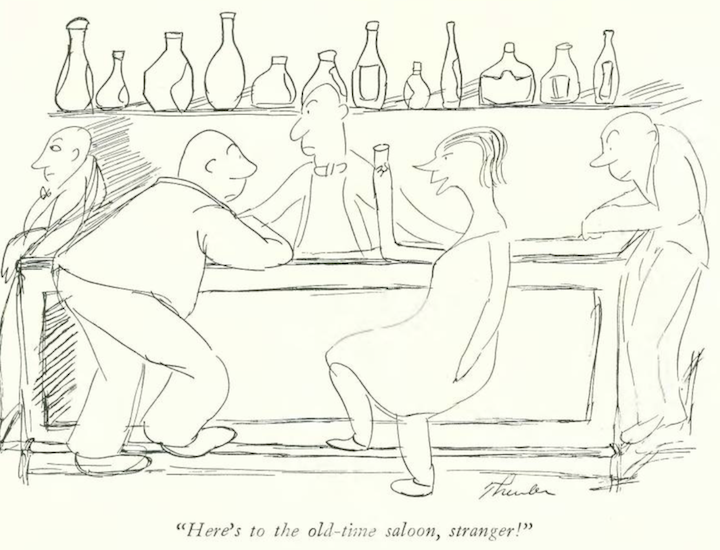
…James Thurber illustrated some easy speaking in a speakeasy…
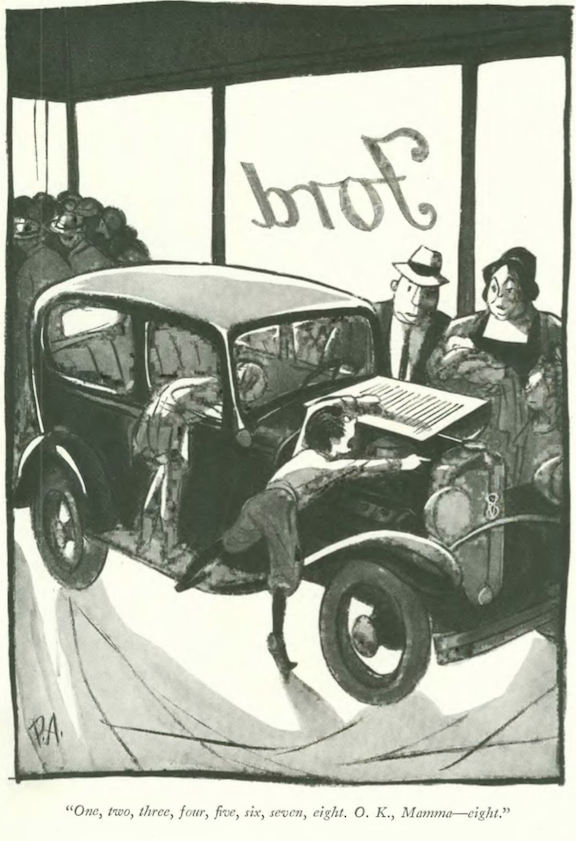
…and with the “cylinder wars” in full force among the automakers, one young lad made sure Ford was telling the truth about their new “eight”…with Peter Arno…
After completing a major in French in just three years, 19-year-old Libby Holman became the youngest woman to graduate from the University of Cincinnati in 1923. But it was her unique style of torch-singing—a trademark throaty mumble—that would launch a career on Broadway and a life of seemingly endless scandal.
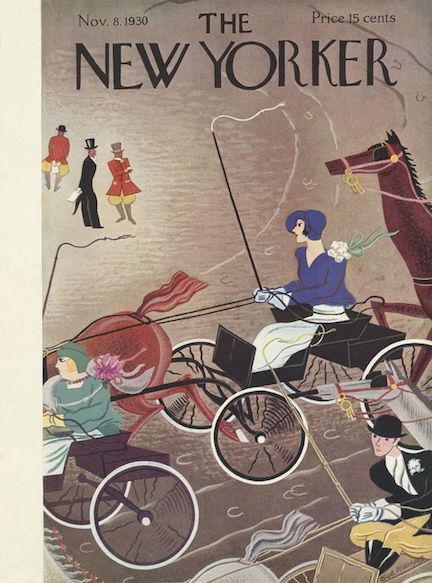
Nov. 8, 1930 cover by Sue Williams.
After performing in the The Greenwich Village Follies, Holman (1904–1971) landed her first big role in 1925 in the Rodgers and Hart production of Garrick Gaieties. But it was a signature song, “Moanin’ Low,” from Clifton Webb’sThe Little Show that would make her a star. When Three’s a Crowd (by Howard Dietz and Arthur Schwartz) opened at the Selwyn Theater on October 15, 1930, Holman was well-known to audiences not only for her voice but also for her unconventional lifestyle.
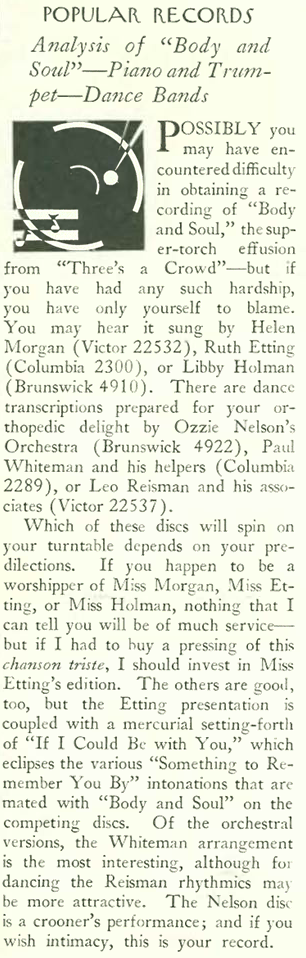
Three’s a Crowd proved to be a hit for Holman, and it gave her another hit song, “Body and Soul,” which was banned from the radio for “obscenity” but nevertheless became one of the year’s most popular songs. So popular, in fact, that it was recorded by Holman as well as by fellow torch singer Helen Morgan and Ziegfeld star Ruth Etting. This was the age of the Great American Songbook, when the song itself, and not necessarily its performer, reigned supreme. So when sheet music was distributed from a popular stage show, any number of entertainers would record it.
NAME THAT TUNE…From top to bottom, Helen Morgan, Ruth Etting and Libby Holman all recorded versions of “Body and Soul,” but Holman would make it one of her signature numbers. (YouTube/ruthetting.com/Wikipedia)
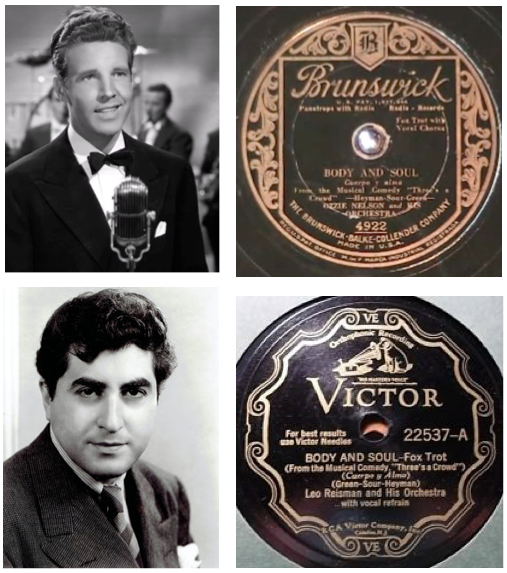
…for the hoofers, there were also a couple of dance versions of “Body and Soul” created by bandleaders Ozzie Nelson and Leo Reisman…
GOOD BEAT, EASY TO DANCE TO…Bandleaders Ozzie Nelson and Leo Reisman recorded dance versions of “Body and Soul.” (YouTube)
Openly bisexual, Holman partied hard and swore like a sailor, and during her life she would lose one husband in a suspected murder (Holman herself was briefly a suspect) and another to suicide. She would take her own life in 1971. You can read more about Holman’s colorful, tragic life in the Jewish Women’s Archive.
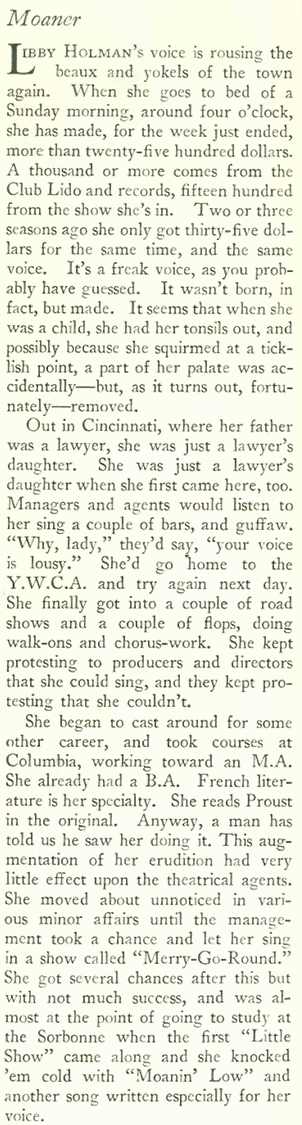
We temporarily skip to the next issue of The New Yorker (Nov. 15, 1930), which featured Holman in a “Talk of the Town” brief, and some insight into her unique singing style. An excerpt:
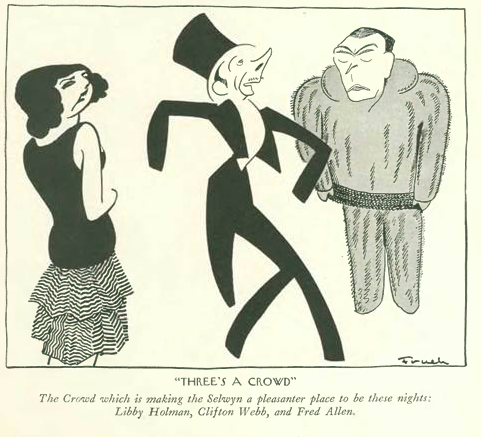
The same issue also featured this drawing of the “Three’s a Crowd” cast by Al Frueh in the theater review section:
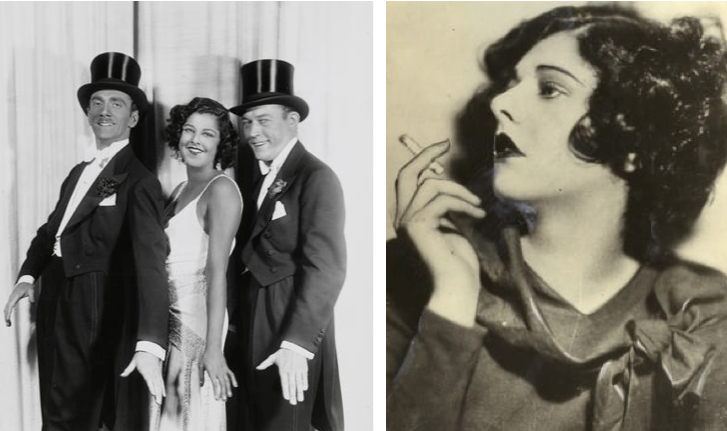
and finally, a publicity photo of the cast from 1930-31:
A FUN CROWD…Clifton Webb, Libby Holman and Fred Allen in Three’s a Crowd. At right, undated publicity photo of Holman. (performerstuff.com)
* * *
Horsin’ Around
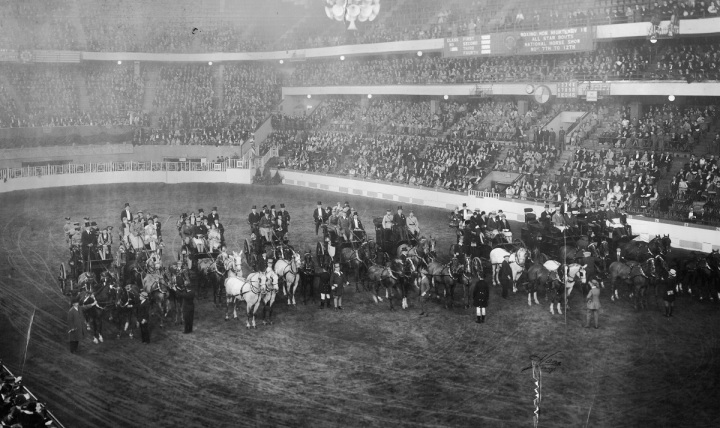
The National Horse Show was a major event on New York’s social calendar, first held at the original Madison Square Garden in 1883 before moving to the second Madison Square Garden in 1890 and again to the third Madison Square Garden in 1926. This account in the Nov. 8, 1930 New Yorker noted how the horse show’s patrician air contrasted with the rodeo held at MSG the previous week.
NOT FOR GOAT-ROPERS, THIS…The coaching parade on display at the 1927 National Horse Show in Madison Square Garden. (National Sporting Library & Museum)SOON WE’LL BE FIGHTING EACH OTHER…The National Horse Show began including a military competition in 1925. This photo from the Nov. 6, 1930 New York Times featured some international guests at the 1930 show. (NY TIMES)
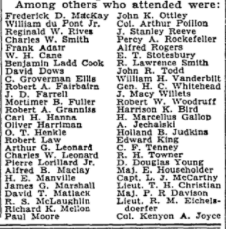
Along with the above photo, the Times included this partial lists of guests to the Horse Show Luncheon, a who’s who of New York society. Indeed, the National Horse Show’s 1887 directory provided the basis for the first New York Social Register.
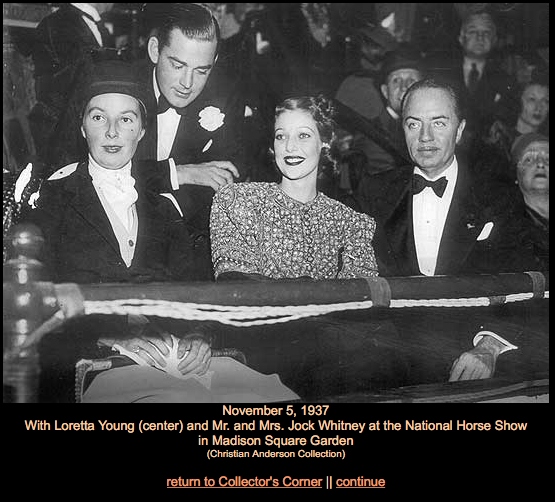
DRESSING UP FOR THE HORSES…Champion horsewoman Mary Elizabeth Whitney (left) with actors Loretta Young and William Powell at the National Horse Show in Madison Square Garden, Nov. 5, 1937. Standing behind Mary Elizabeth is her husband, Jock Whitney, a noted ambassador, art collector, philanthropist and investor. (Christian Anderson Collection)HIGH STEPPIN’…After a brief stint in Florida, the National Horse Show moved to Kentucky in 2011. Perhaps a tad less formal, it nevertheless remains an important society event. Above, noted horsewoman Misdee Wrigley Miller rides World Grand Champion Grande Gil at the 2012 National Horse Show. (Doug Shiflet)
* * *
A Lesson in Poetry
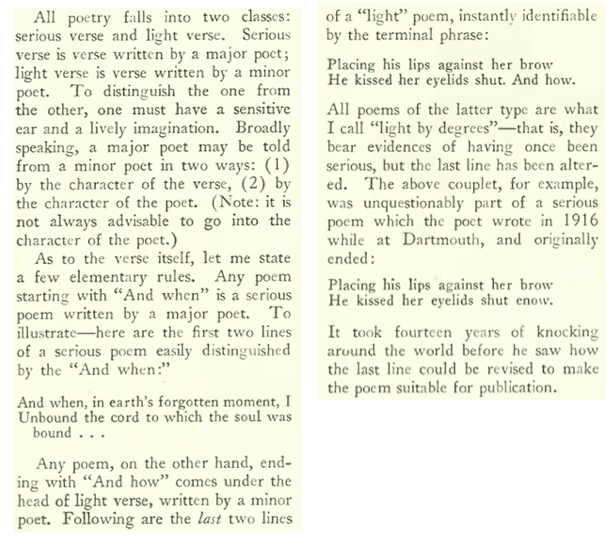
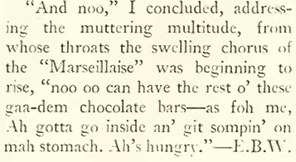
In a casual for the Nov. 8 issue, E.B. White instructed readers on how to “Tell a Major Poet From a Minor Poet.” An excerpt.
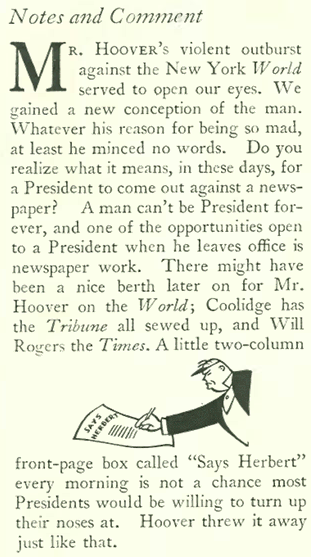
And in his “Notes and Comment,” White suggested that criticism of the press was a major no-no for a sitting U.S. President:
Christmas shopping suggestions began to trickle into Lois Long’s section on fashion, house and home, including this bit of advice that reminds us just how distant 1930 is from our own time:
* * *
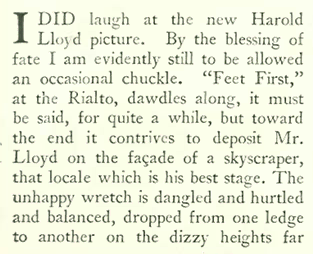
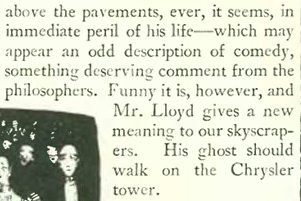
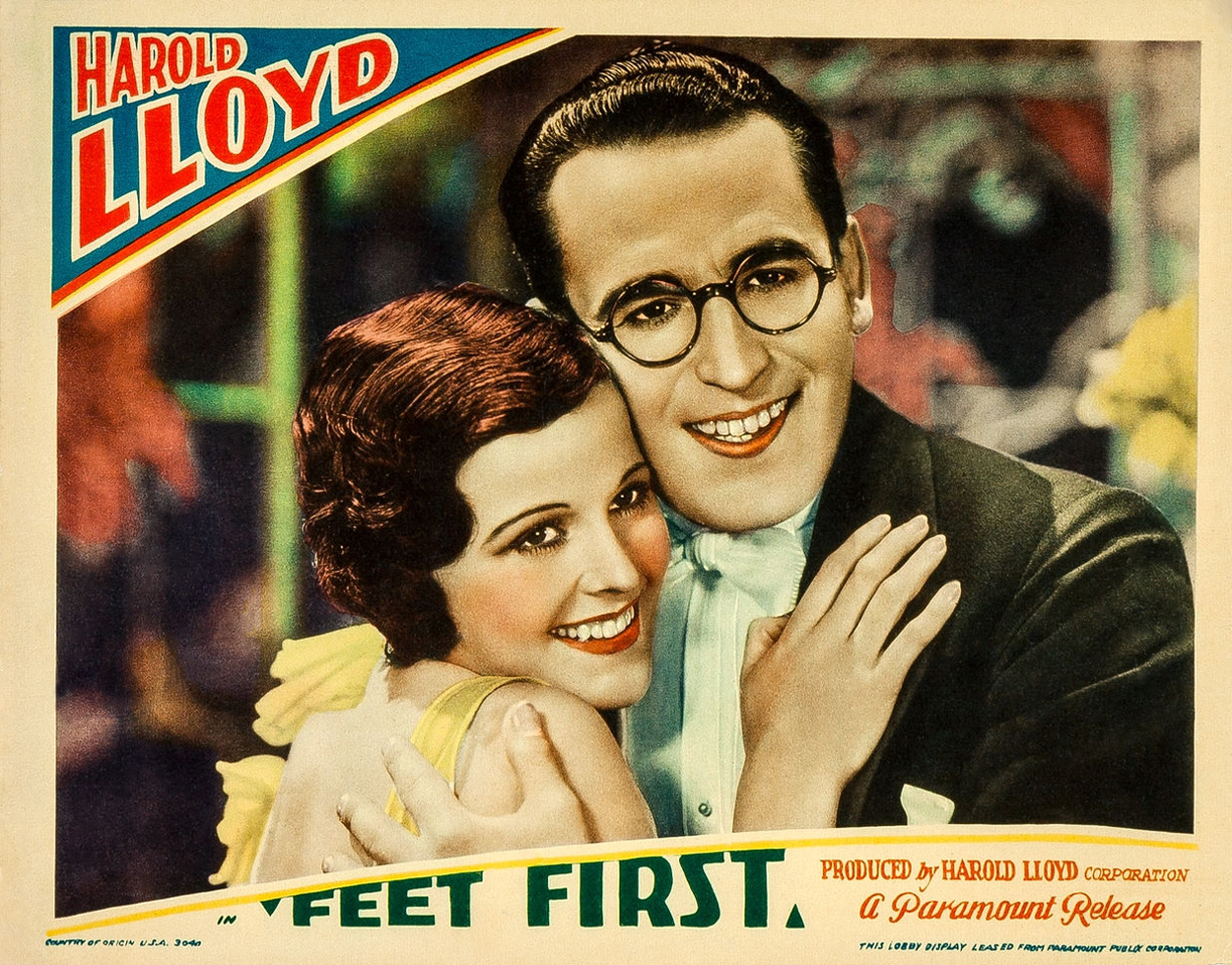
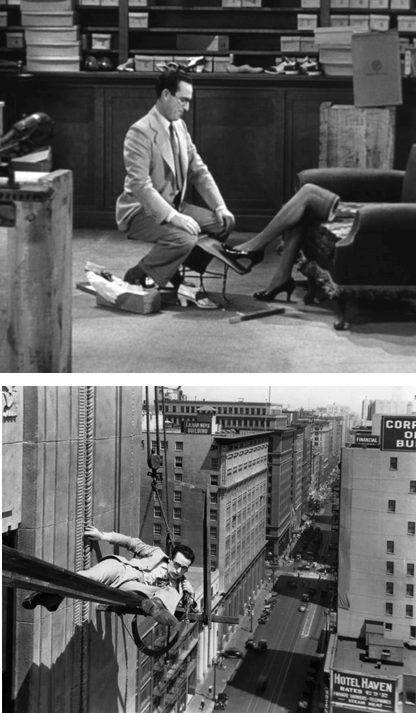
Film critic John Mosher took in the latest offering from silent film star Harold Lloyd, who was making his second foray into the talkies with his portrayal of a hapless shoe salesman in Feet First…
TEETH FIRST…Theater card for 1930’s Feet First featuring Barbara Kent and Harold Lloyd. (IMDB)GETTING A LEG UP…Top, Harold Lloyd practices the art of shoe salesmanship with a pair of dummy legs in Feet First; below, Lloyd once again finds himself in a precarious situation high above a city street. (IMDB)
* * *
From Our Advertisers
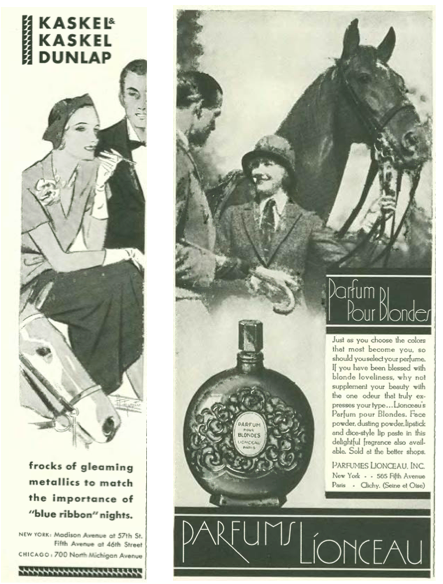
The National Horse Show was on the minds of several advertisers in The New Yorker, including these fashion merchants targeting the patrician set…
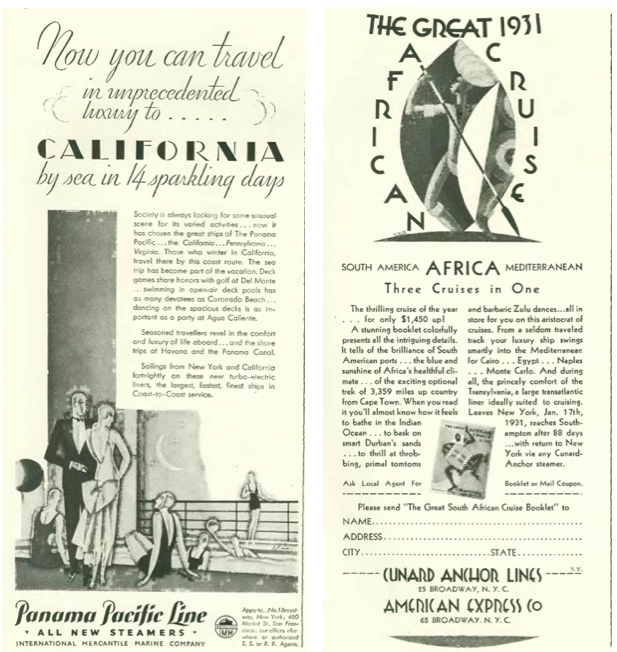
…speaking of the well-heeled, with winter approaching travel agencies enticed those with means to take a steamer through the Panama Canal to California, or for the more adventurous, a three-continent tour package…
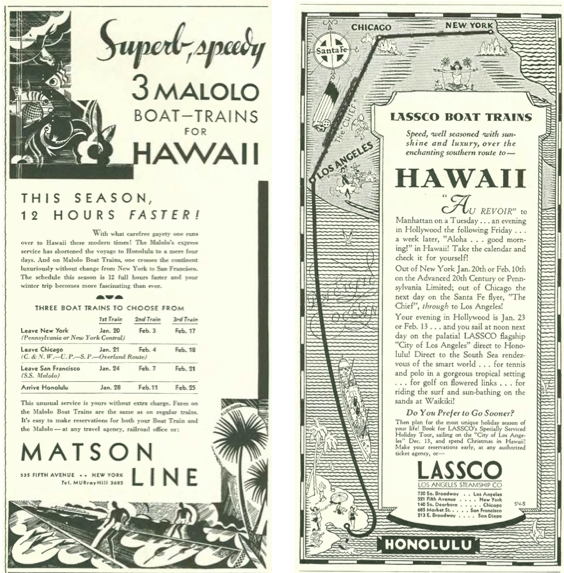
…and of course Hawaii beckoned snowbirds, who could make their way across the Lower 48 by train and then hop a boat to the islands…
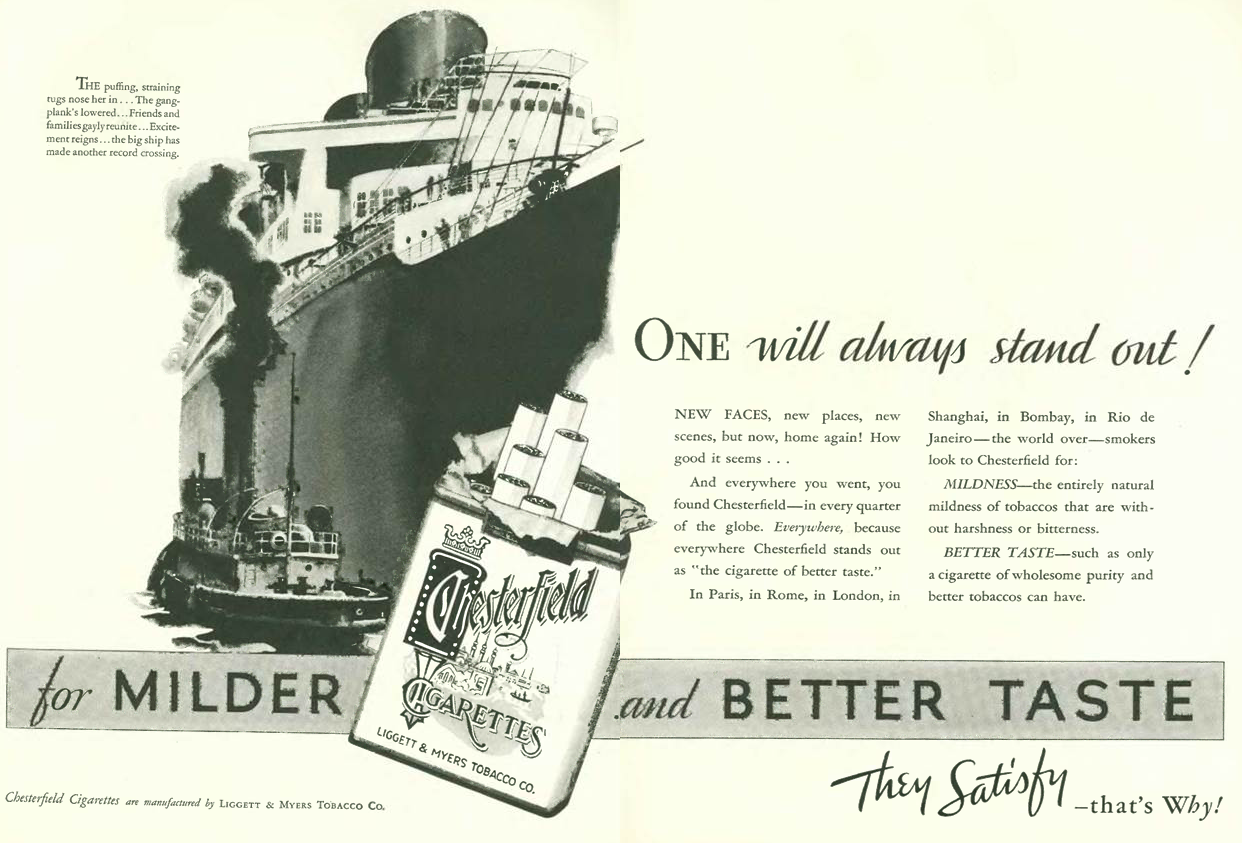
…the makers of Chesterfield cigarettes were on board with the travel theme…
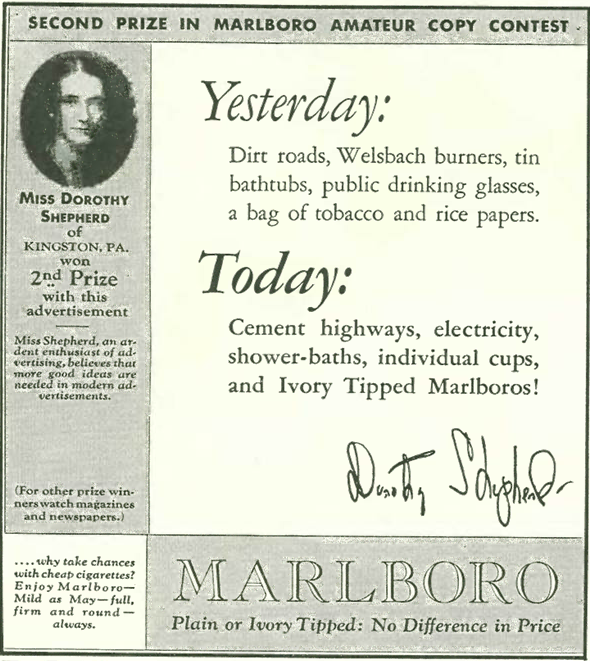
…while the folks at Marlboro stuck with their dopey handwriting and jingle contests to push their smokes…
…as the luxury market grew ever tighter in the Depression, the sellers of finer things sought to distinguish their wares from competitors. L.P. Hollander kicked off a series of wordy ads regarding the provenance of their hats, gloves and other accessories (in short, they ain’t cheap copies)…
…no doubt the folks at L.P. Hollander were looking down their noses at the likes of Russeks, which offered copies of Lucien Lelong gowns. Apparently old Lucien was okay with this, as this “Radiogram” purportedly attests…
…Lucien pops again in another ad, this one for his perfume line…
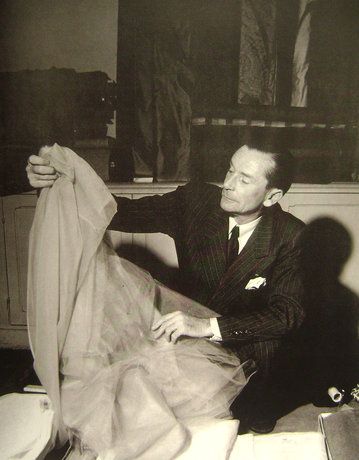
…and for reference, here’s a photo of Monsieur Lelong, circa 1940…
(comm396-s16.ascjclass.org)
…on to our cartoonists, the Nov. 8 issue featured these great spot illustrations by Constantin Alajalov, the first, running along the bottom of “The Talk of the Town,” referenced the horse show at Madison Square Garden…
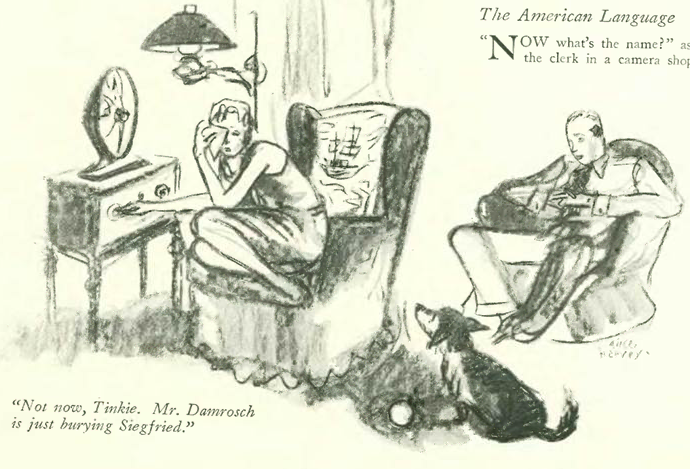
…Alice Harvey listened in on a radio soap…
…William Crawford Galbraith found some admirers of art…
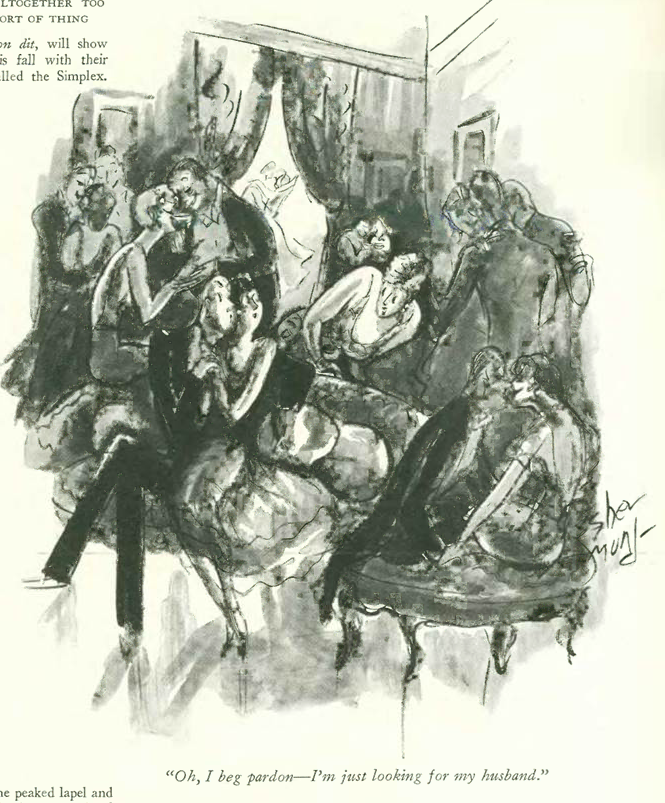
…Barbara Shermund continued to share her sharp observations of parlor hijinks…
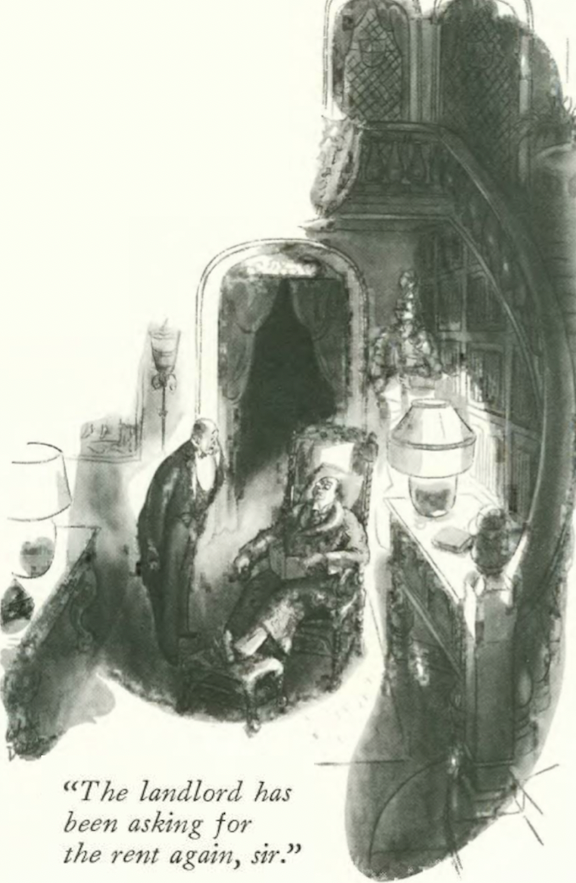
…Garrett Price illustrated the challenges of modern design…
…and we end with Peter Arno, and a stomach-turning moment…
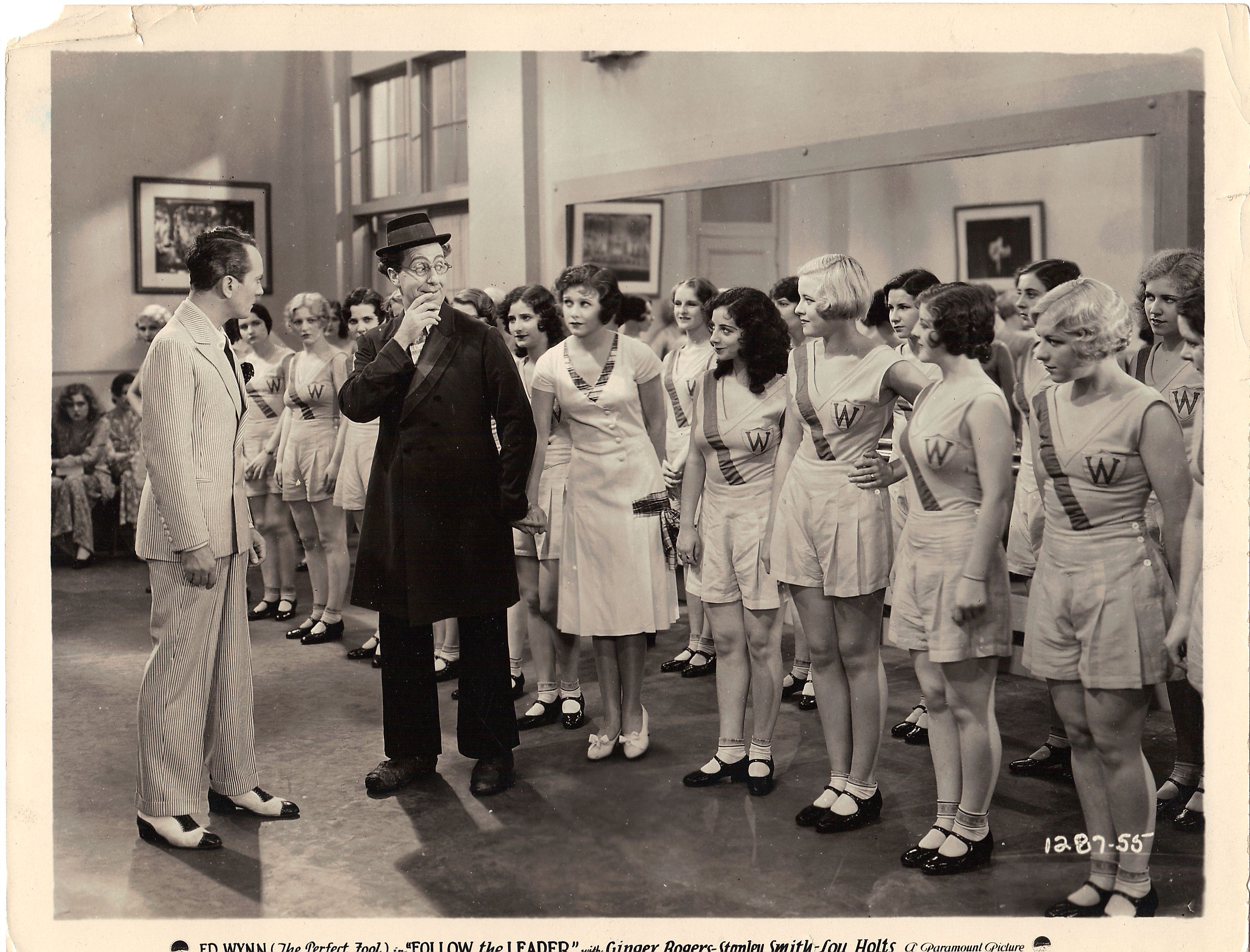
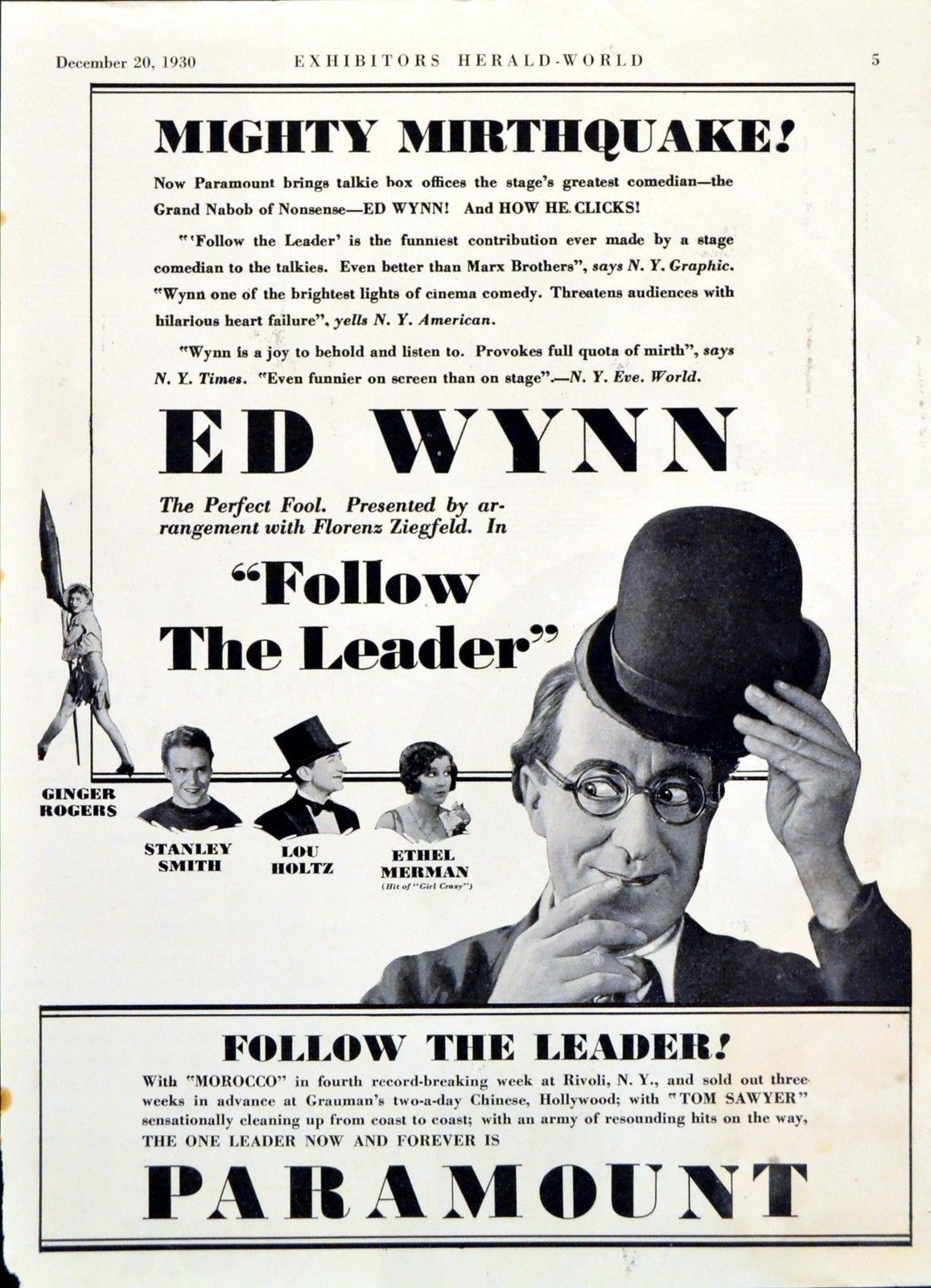
Comedian Ed Wynn began his long acting career on a vaudeville stage in 1903, and beginning in 1914 his giggly voice would delight Broadway crowds flocking to the Ziegfeld Follies. So when he stepped in front of a movie camera for a talking picture, it was something of a sensation.
September 27, 1930 cover by Sue Williams.
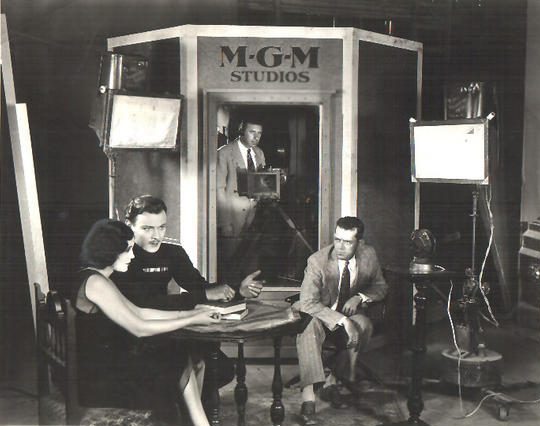
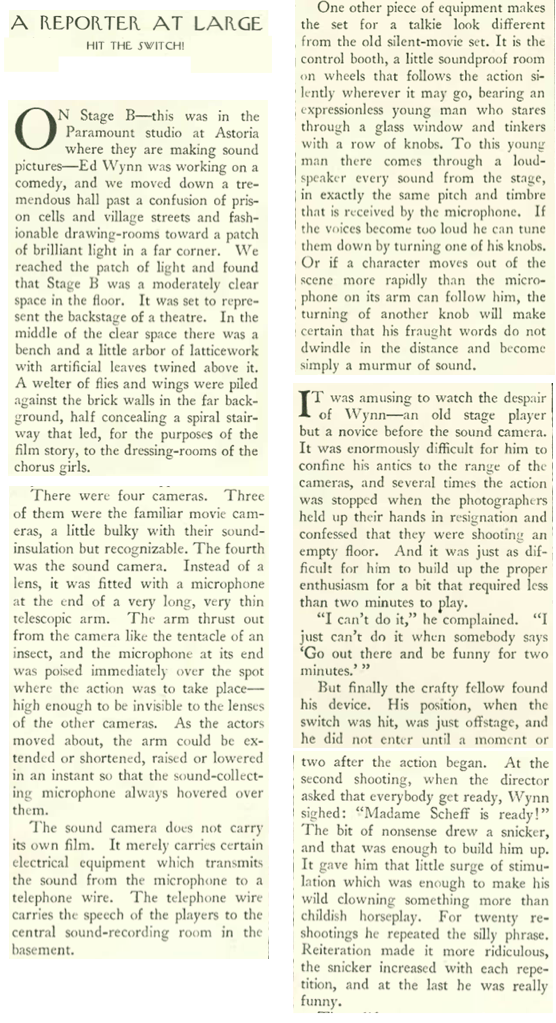
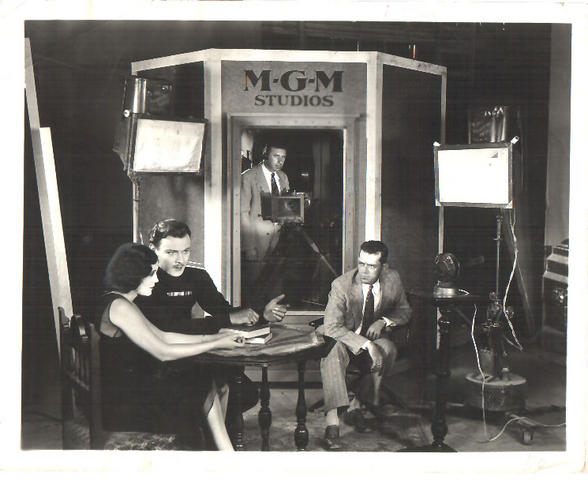
It was not an easy transition for the stage veteran. As you can see from Morris Markey’s account below in “A Reporter at Large,” the early talkies presented all manner of challenges and restrictions for stage actors accustomed to a bit more freedom of movement and expression.
SCANDALOUS BUNCH…Ed Wynn (in hat) portrayed a character he developed on Broadway — “Crickets” — in his film debut Follow the Leader. At left is actor Stanley Smith, and at center, holding Wynn’s hand, is a brunette Ginger Rogers, with chorus girls from George White’s Scandals. (IMDB)
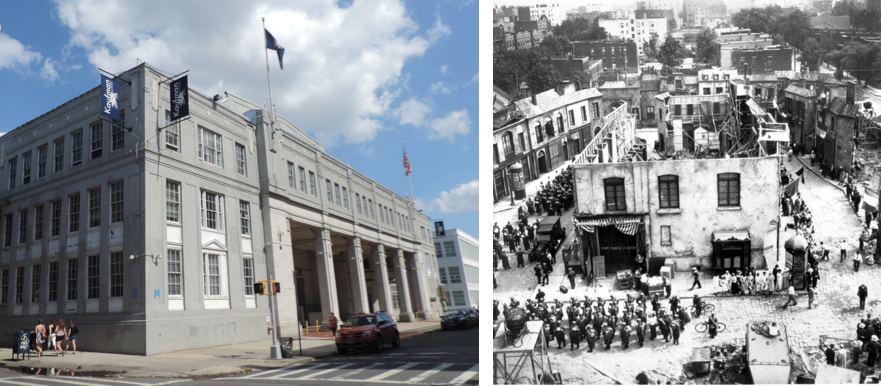
PAY NO ATTENTION TO THE MAN BEHIND THE WINDOW…Noisy cameras were enclosed in soundproof boxes in the early days of the talkies. Above, Woody Van Dyke directs Raquel Torres and Nils Asther in 1930’s The Sea Bat. (nilsasther.blogspot.com)TINSELTOWN IN QUEENS…For his article, Morris Markey visited the set of Follow the Leader at Astoria Studios in Queens. The original studio building, at 35th Avenue, is on the National Register of Historic Places. Although Paramount moved its movie operations to Hollywood in the early 1930s, the studio continued to be used for both film and television productions. At right, a bit of Paris was erected in the midst of Queens for the filming of 1929’sThe Gay Lady. (Wikipedia/Kaufman Astoria Studios)FILM DEBUT…A December 1930 magazine advertisement touting Ed Wynn’s first motion picture. (IMBD)
* * *
False Modesty?
In Morris Markey’s second installment of his profile on Charles Lindbergh, Markey suggested that Lindbergh’s aversion to publicity might be a pose…
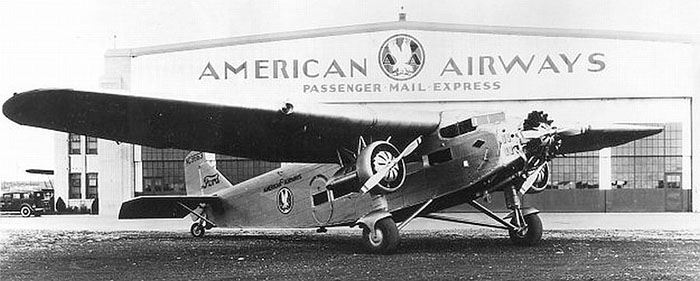
NO WI-FI, BUT YOU COULD SMOKE…Top, the posh set take wing with TWA circa 1930; below, passengers prepare to board an American Airways Curtiss Condor II in 1933. (historydaily.org/Sweezey Pictures/Ken Sweezey)
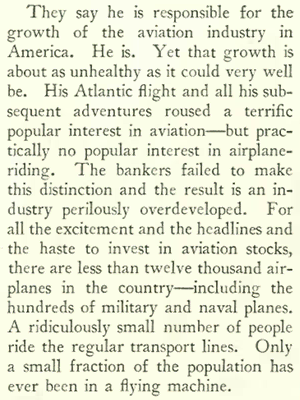
…and also wondered how much credit Lindbergh could take for sparking the aviation industry, given that flying was still an activity reserved for a very few…
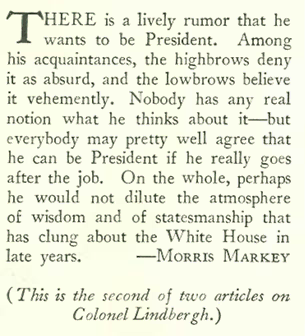
…Markey also noted a “lively rumor” that Lindbergh wanted to be President…
…fortunately Lindbergh did not give truth to the rumor, or fulfill the alternate history created by Philip Roth in his 2004 novel The Plot Against America…
HANGIN’ WITH A BAD CROWD…Top, Charles Lindbergh accepts a ceremonial sword from Hermann Göring during a 1936 visit to Nazi Germany; below, right, Lindbergh in Germany, 1937. Philip Roth’s novel imagined Lindbergh’s election to the Presidency in 1940 and its chilling results. (Reddit/The New Yorker/Goodreads)
* * *
Bad Moon Rising
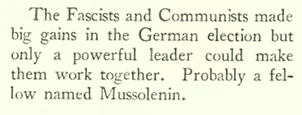
In 1930 few, if anyone, were aware of Lindbergh’s proclivities toward nationalism and antisemitism. And lacking a crystal ball, Markey’s New Yorker colleague, Howard Brubaker, had little reason to be alarmed by the federal elections in Germany, which gave the Nazis the second largest number of seats in the Reichstag. In his “Of All Things” column, Brubaker quipped:
INCOMPATIBLE…As Howard Brubaker noted in “Of All Things,” the fascists led by Adolf Hitler, left, and the communists led by Ernst Thälmann (right) made big gains in the 1930 German elections. After gaining power in 1933, Hitler would arrest Thälmann and later have him shot. (Wikipedia)
* * *
Gummed to Death
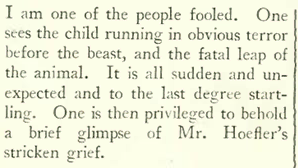
The New Yorker’sJohn Mosher took in the latest travelogue to exploit and misrepresent life on the African savannah. Africa Speaks included a scene depicting a fatal attack on a “native boy” by a lion — an attack that was actually staged at a Los Angeles zoo and involved a toothless lion…
STRANGE INDEED…At left, movie poster for Africa Speaks; top right, Pygmy drummers in the film; bottom right, explorer Paul Hoefler getting closer to nature. (IMDB/Wikimedia)
* * *
From Our Advertisers
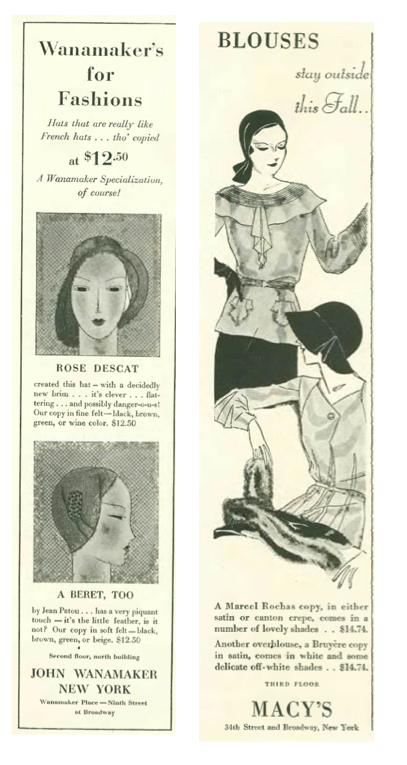
When Paris unveiled is spring and fall fashions, large department stores were always quick to respond with “copies”…
…while the higher end boutiques offered originals to “poor little rich girls”…
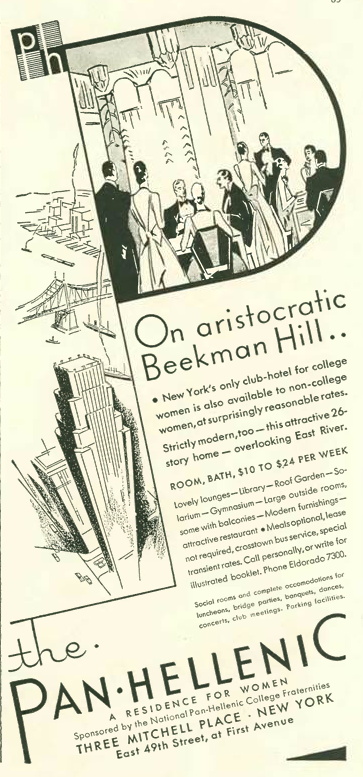
…perhaps some of these “poor little rich girls” socialized at the Panhellenic, a “club-hotel for college women”…
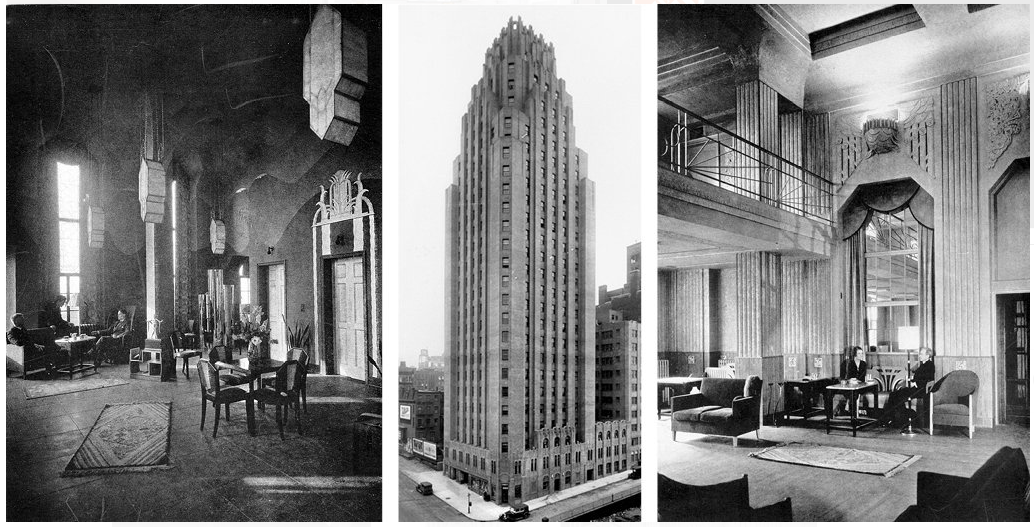
…and here are some views of the Panhellenic House, circa 1929…
Center, The Panhellenic House, at First Avenue and 49th Street; at left, the solarium; at right, a ballroom. (Avery Library/Museum of The City of New York)
…the makers of Old Gold cigarettes had some of the weirdest ads to push their smokes, including this one…
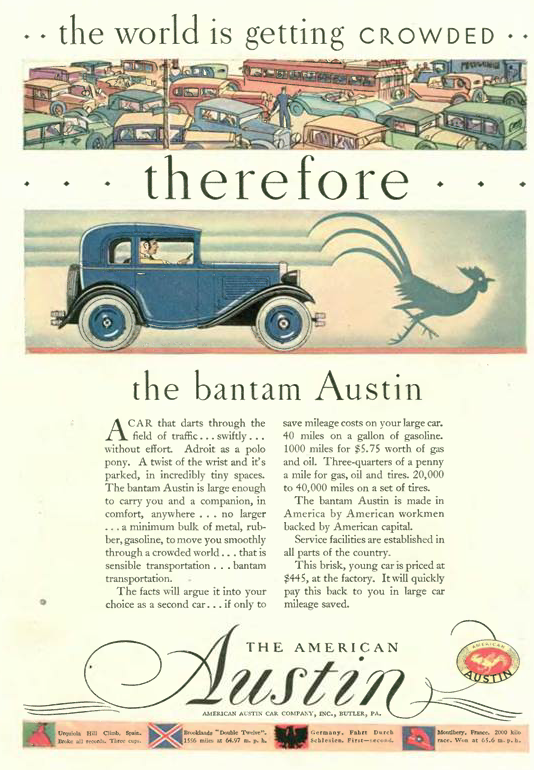
…and one wonders what the world would be like (and especially the U.S.) if car buyers would have favored a more compact version of the motorcar going forward…
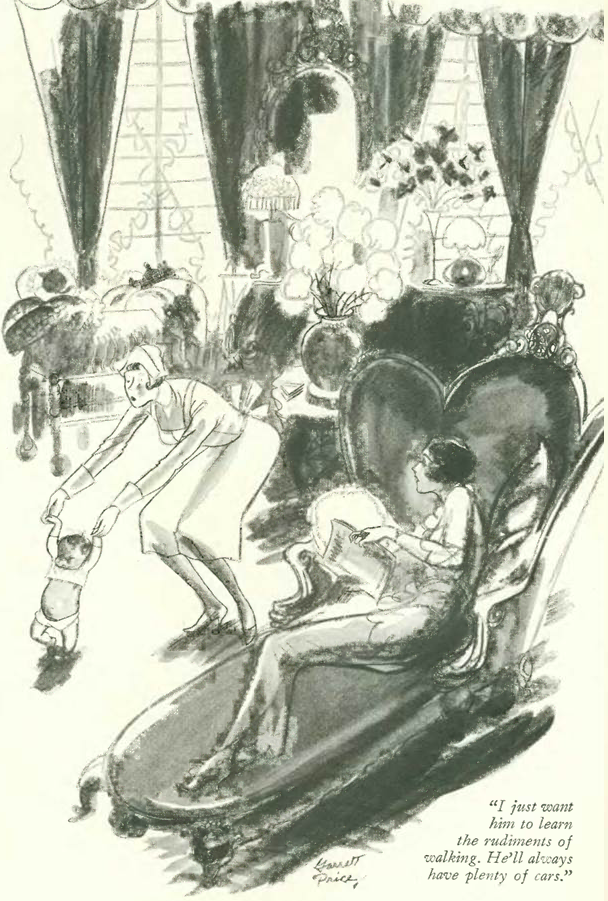
…on to our cartoons…we begin with parenting tips from the posh set, courtesy Garrett Price…
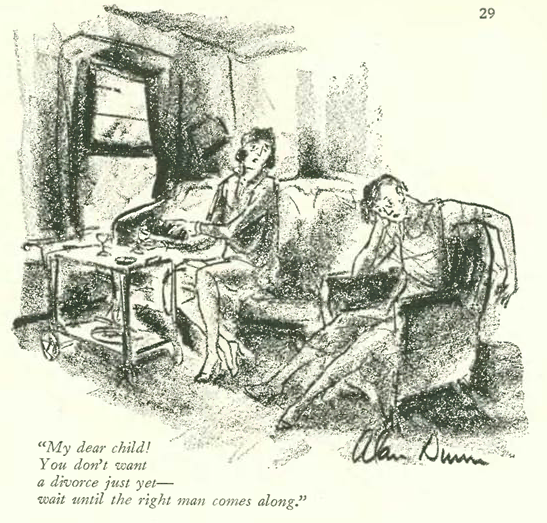
…Alan Dunn explored modern matrimony…
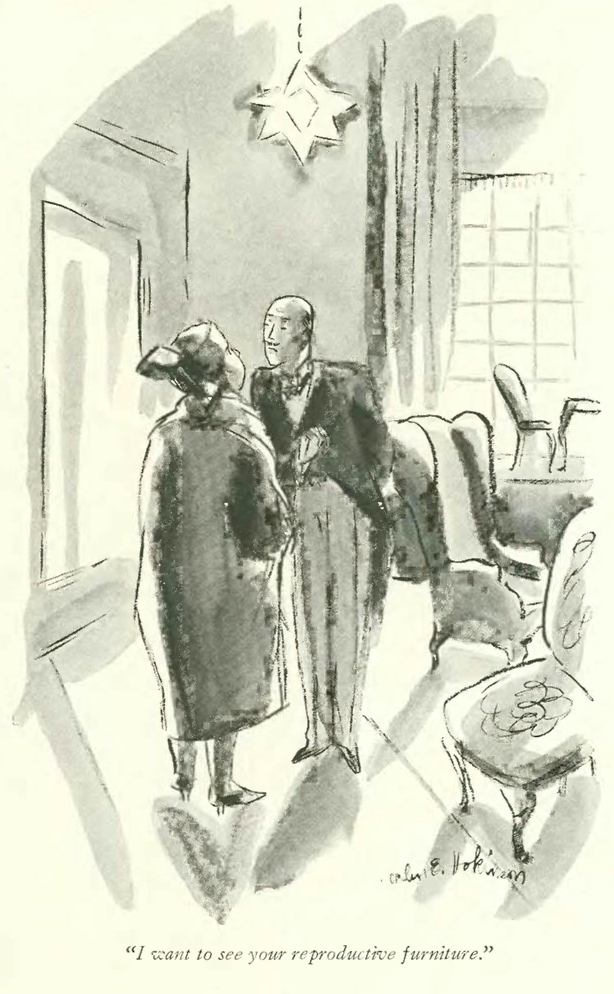
…one of Helen Hokinson’s ladies demonstrated a unique taste in furniture…
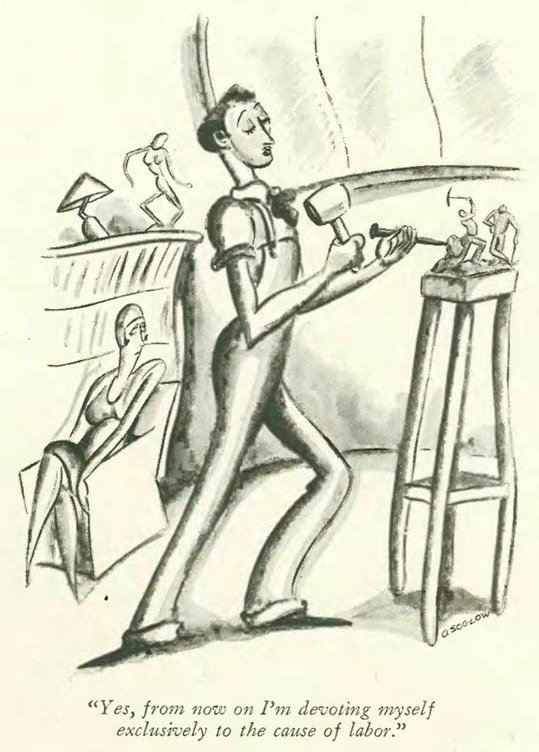
…Otto Soglow continued to explore humor in a wavy fashion…
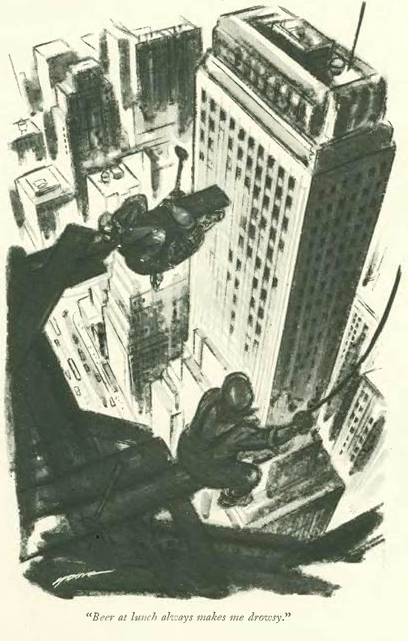
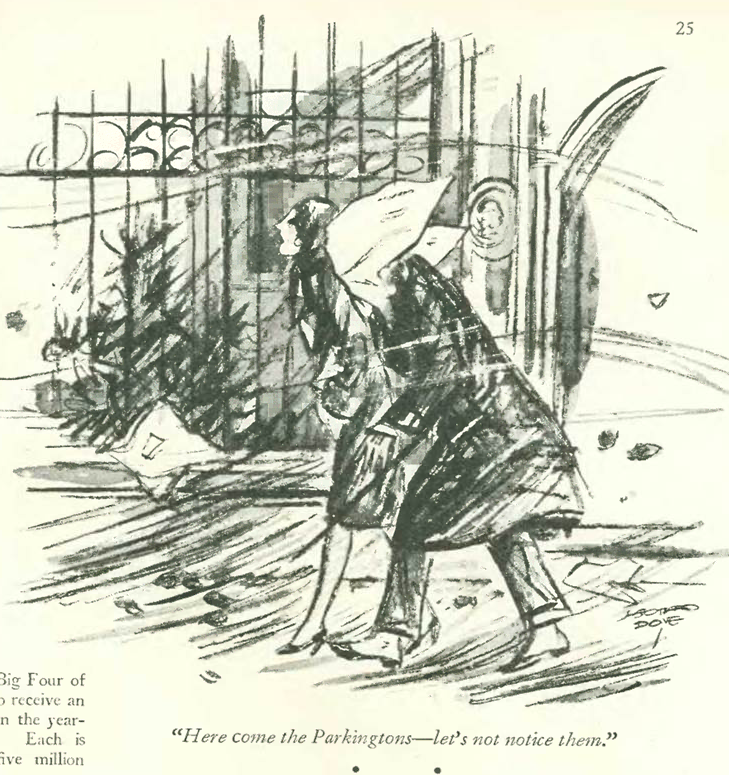
…and we close with this vertiginous view provided by Leonard Dove…
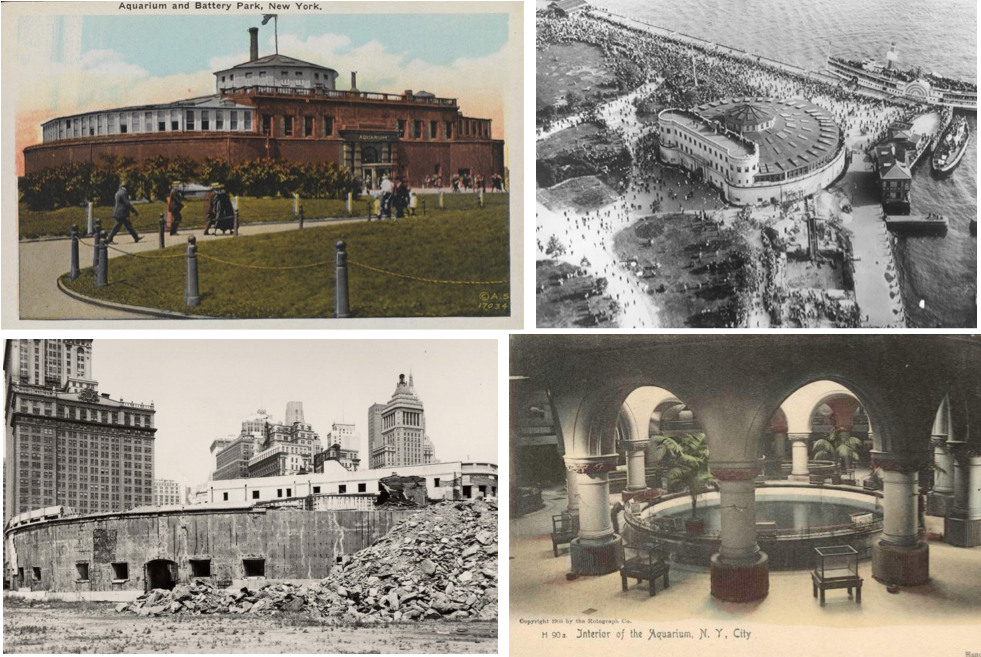
Before we launch into the Jan. 25 issue, the rendering of the old New York Aquarium in this Sue Williams cover bears some consideration.
Jan. 25, 1930 cover by Sue Williams.
The aquarium was housed within the historic walls the South West Battery, constructed off the tip of Manhattan between 1808 and 1811 as a defense against the British. Renamed Castle Clinton in 1817 (in honor of former Mayor/Governor Dewitt Clinton), it was deeded to the city in 1823 to be used as an entertainment center. From 1855 to 1890 it served as an immigrant landing depot, then remodeled in 1896 (by the architectural firm McKim, Mead, and White) to become the popular New York City Aquarium.
FISH OUT OF WATER…Postcard image of the New York City Aquarium from the early 1900s; aerial view of the aquarium circa 1934; postcard image of aquarium interior; demolition of the aquarium in 1941, on orders from city planner Robert Moses. (thebattery.org/nycgovparks.org)
Although the aquarium proved to be a cultural and educational magnet, it stood in the way of master planner Robert Moses’s designs to build a bridge from The Battery to Brooklyn. After residents, preservationists and even Eleanor and President Franklin Roosevelt protested, the city opted instead to construct a tunnel under the East River. Nevertheless, Moses managed to get the aquarium knocked down before demolition was halted by the outbreak of World War II. After the war, Congress passed a bill declaring the site a National Monument, and preserved the walls of Castle Clinton.
HIGH AND DRY…Until it was demolished in 1941, the New York City Aquarium occupied the space in the center of Castle Clinton, which was added to National Register of Historic Places in 1966. (nps.gov)
* * *
Now, About That Band…
A play that satirized America’s enthusiasm for war—Strike Up the Band—was loved by critics but spurned by audiences when it opened in Philadelphia in 1927. Written by George S. Kaufman, with music and lyrics by George and Ira Gershwin, the play had the pedigree for success, but audiences weren’t quite ready for a show that poked fun at the U.S. military just nine years after the end of World War I (in the original play, America is goaded into declaring war on Switzerland by an American cheese tycoon).
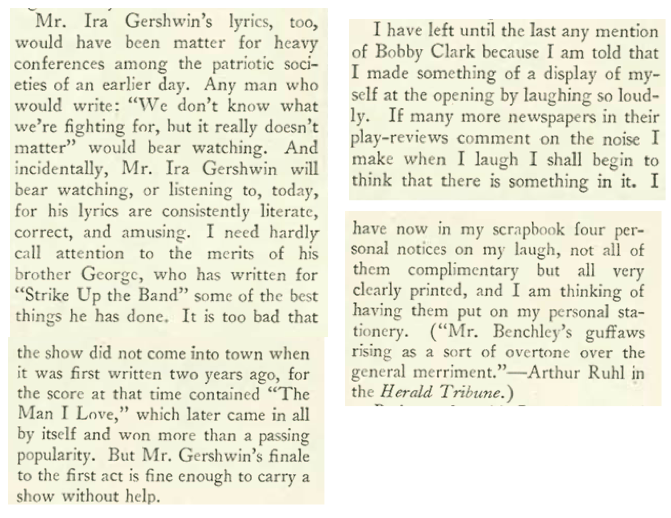
Enter lyricist Morrie Ryskind, who reworked the script, softening its political message and remaking the war plot into a dream sequence. The revised play proved to a be hit, running for 191 performances at the Times Square Theatre. It also introduced a number of popular songs, including “The Man I Love” and “Strike Up the Band.” Robert Benchley was on hand for opening night:
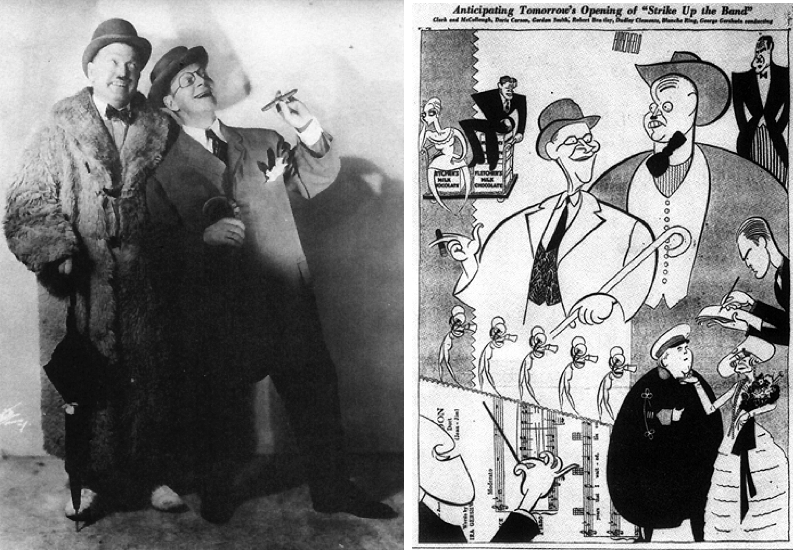
TEAMWORK…Clockwise, from top, Ira (left) and George Gershwin at work circa 1930; lyricist Morrie Ryskind, who softened the tone of George S. Kaufman’s original script. (U of Michigan/Wikipedia)
Benchley noted that the antics of comedian Bobby Clark caused him to laugh so loud that his guffaws were even noted in the Herald Tribune’s review:
MAKE ‘EM LAUGH…The comedy team of Paul McCullough (left) and Bobby Clark were one of the play’s big draws. At right, Herald-Tribune illustration by Al Hirschfeld announcing the Broadway opening of Strike Up the Band. (aaronneathery.org)
* * *
Duncan Yo-Yos
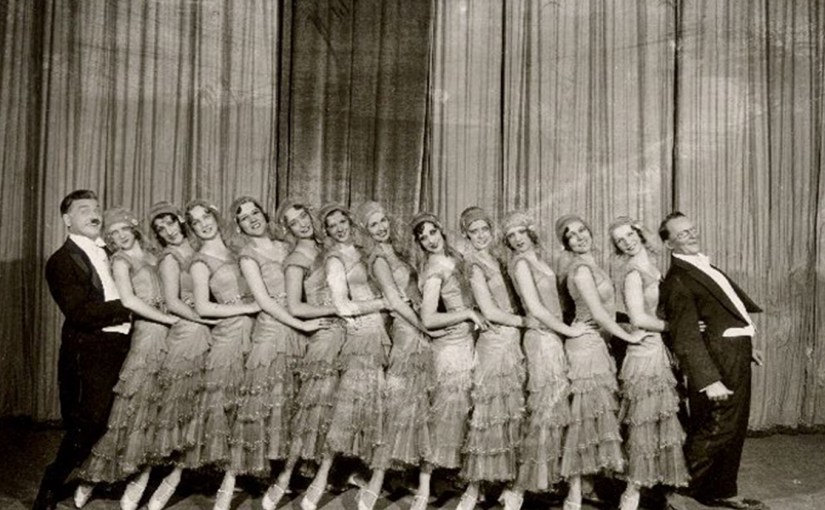
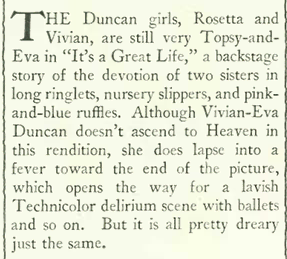
We’ve seen the Duncan Sisters (Rosetta and Vivian) before in this blog, the sister vaudeville act that became famous with the 1923 hit musical Topsy and Eva, which inspired a silent 1927 film starring the duo. They were back on the screen in late 1929 with It’s a Great Life, which TheNew Yorker’sJohn Mosher found to be “pretty dreary”…
NOT SO GREAT, THIS…Clockwise from top, promotional poster for It’s a Great Life; a scene from a dance number in the film; Rosetta (in blackface) and Vivian Duncan as Topsy and Eva (characters derived from the novel Uncle Tom’s Cabin). It’s a Great Life flopped at the box office, along with the Duncan’s brief movie careers. In the years to follow the duo would became popular nightclub entertainers and would continue to perform their Topsy and Eva routine even though appearing in blackface was increasingly considered offensive. (Wikipedia/freewebs.com)
* * *
Miracle Worker
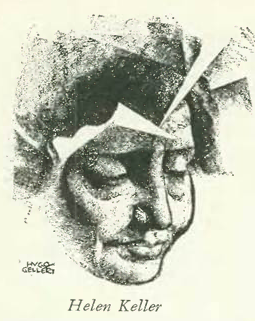
TheNew Yorker profile, written by Robert Coates, featured Helen Keller (with illustration by Hugo Gellert). A brief excerpt:
* * *
From Our Advertisers
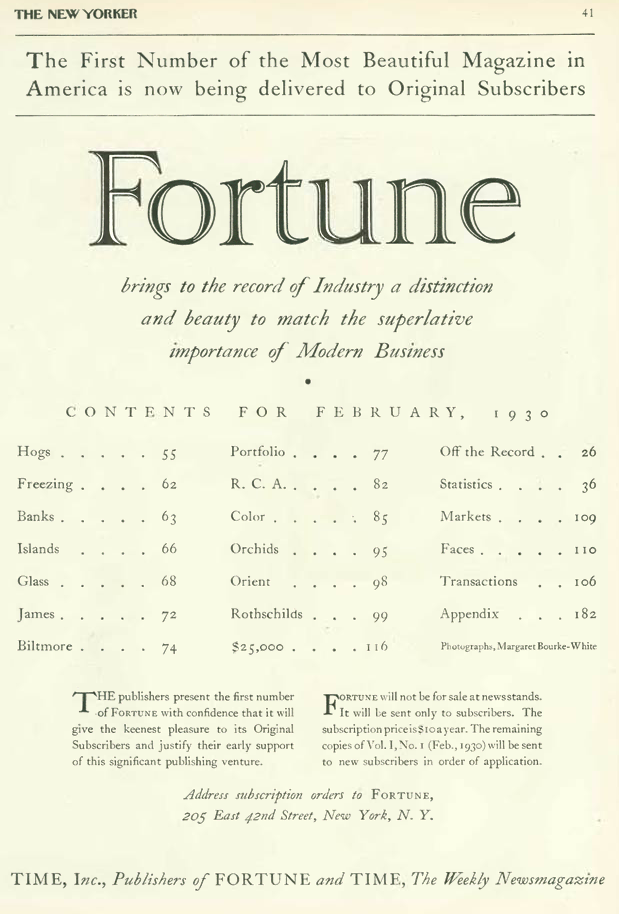
Advertisers in the Jan. 25 issue included the new Fortune magazine, which announced its first issue with this full-page ad:
…the table of contents is fascinating, spare in descriptions of everything from “Hogs” to “Orchids”…
From left, issue No. 1, February 1930; table contents for the issue; a prototype of the magazine, September 1929. (Fortune)
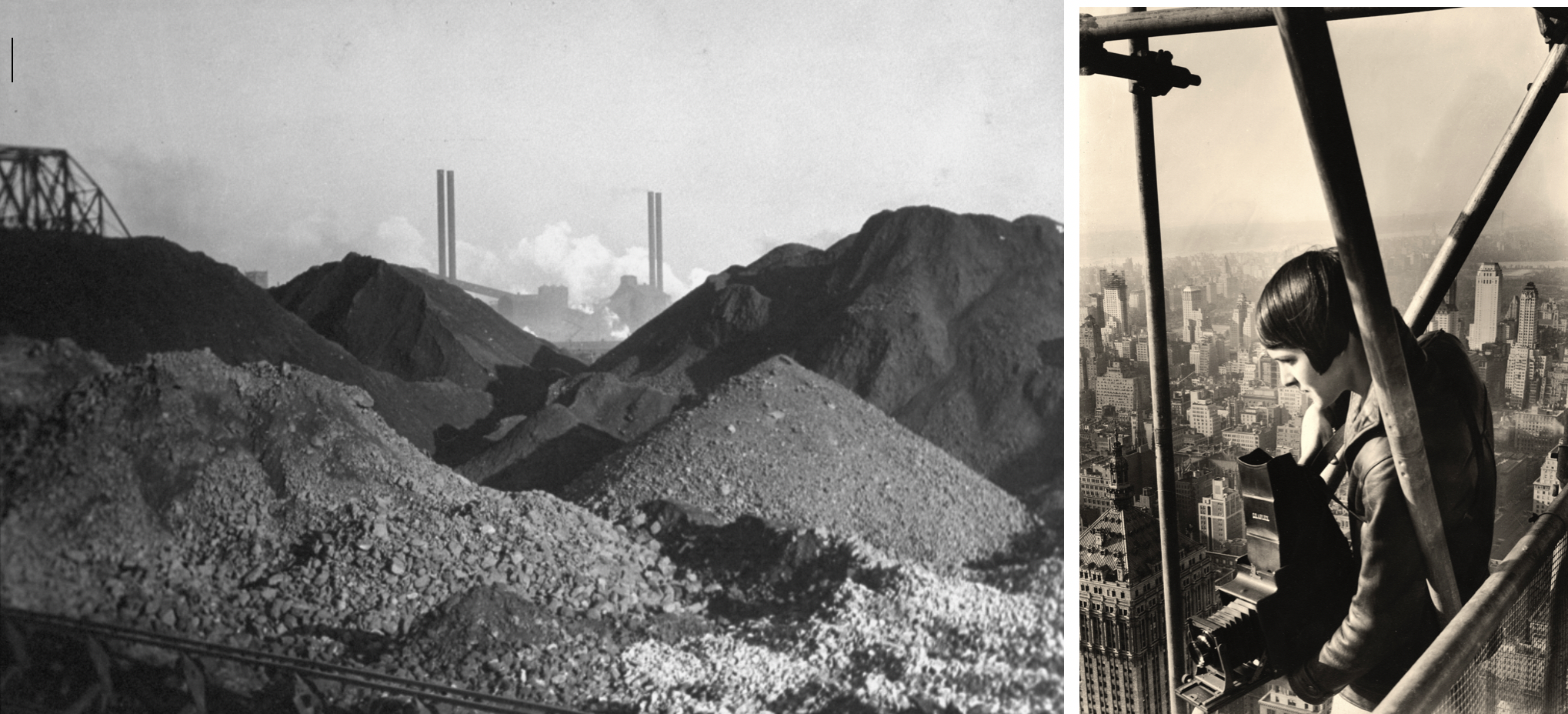
…also listed in the new magazine’s table of contents was the name of a 24-year-old photographer, Margaret Bourke-White…
A photo of coal piles by Margaret Bourke-White in the first issue of Fortune magazine. At right, Bourke-White photographing atop a skyscraper circa 1930. (Fortune)
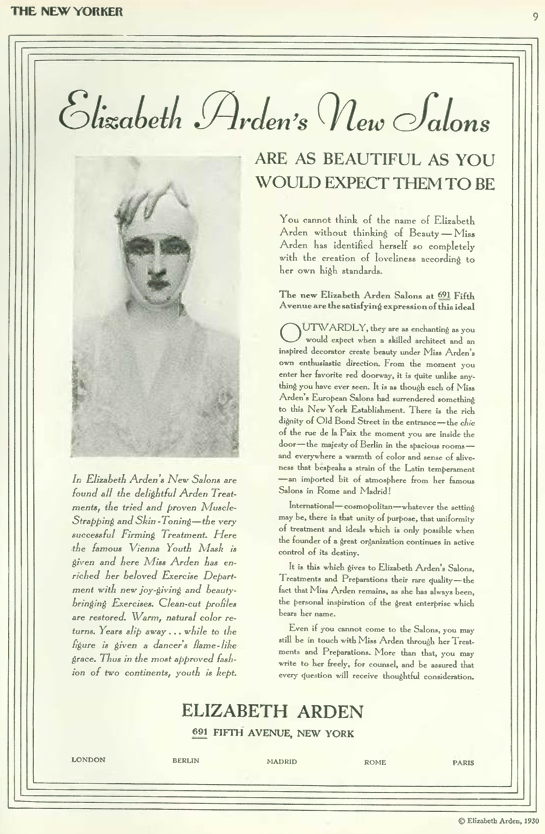
…on to our other advertisements, we have this entry from Elizabeth Arden…ads from this salon chain in the 1920s and 30s featured this ubiquitous image of a woman with a distant stare, her head tightly bound — mummy-like — as part of a firming treatment called “muscle-strapping”…
…in contrast to the rather cold, clinical look of the Elizabeth Arden ad, the Primrose House appealed more to social climbing than skin toning…
…while the makers of Pond’s cold cream continued to draw from their stable of debutantes and society ladies to move their product…
…long before there was Joe Camel, R.J. Reynolds also appealed to social climbers with a series of ads beautifully illustrated by fashion artist Carl Erickson…
…society’s smokers were advised to pack a tube of Bost toothpaste, or have their French maid do it for them…
…and once again we have an ad by Dr. Seuss for Flit insecticide that is very much of its time…
…as is this cartoon by Isadore Klein, perhaps the first in The New Yorker that depicted African Americans as something other than minstrel show stereotypes. Nevertheless, the rendering is still a bit crude — especially the boy’s face — as is the idea behind the “joke” — that a black boy could actually aspire to be a great violinist like Jascha Heifetz…
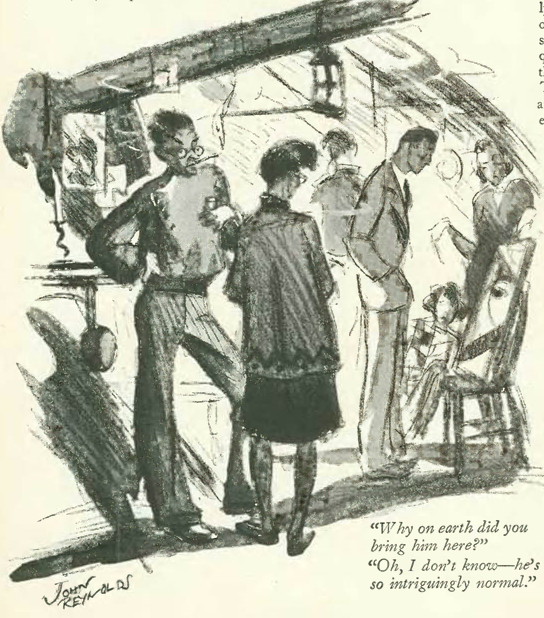
…John Reynolds explored a less troubling juxtaposition among the bohemian set…
…and we end with this peek into society life courtesy Barbara Shermund…
Avery Hopwood’s 1919 Broadway hit, The Gold Diggers, was among cultural events of the late teens that signaled the dawn of new age; namely, the Jazz Age.
Sept. 7, 1929 cover by Sue Williams.
So it seems appropriate that the play, when adapted to the screen in 1929 as a Technicolor talkie, would also signal the end of that age. As the New Yorker’s film critic John Mosher observed in his review of The Gold Diggers of Broadway, the themes that seemed new and daring a decade earlier had been played out, the “general humors” of the picture having “become very familiar”…
The film featured Nancy Welford, Winnie Lightner and Ann Pennington as three chorus girls who try to entice a wealthy backer to invest money in their struggling Broadway show. The film was a big hit, and it made a star of Winnie Lightner (1899-1971), who played the boldest “Gold Digger” of the trio.
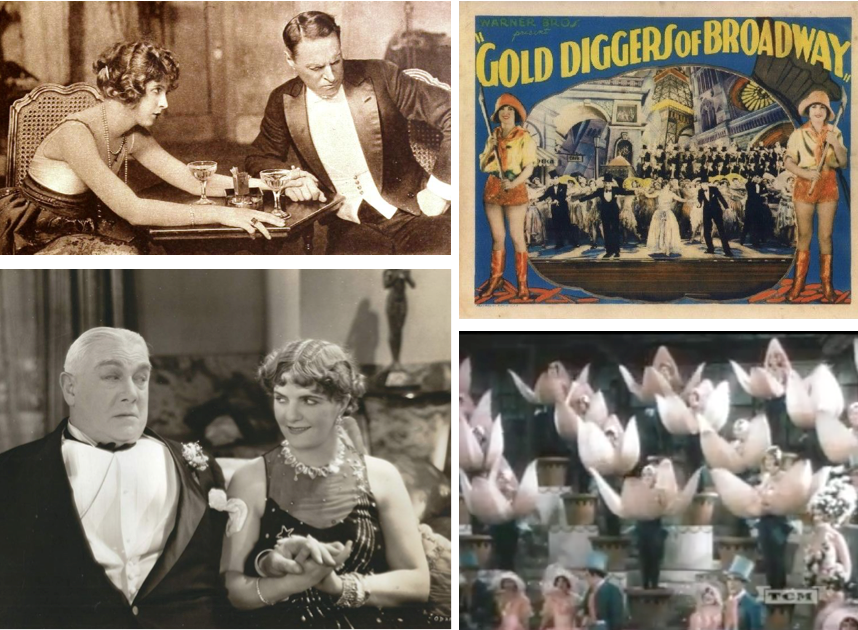
PROSPECTORS…Clockwise from top left, Ina Claire as the original “Gold Digger” with Bruce McRae in the 1919 Broadway play The Gold Diggers; lobby card for the 1929 film Gold Diggers of Broadway; image from the film’s “Tiptoe Thru the Tulips” song-and-dance number; Winnie Lightner works her charms on Albert Gran in a scene from the film. (Wikipedia/IMDB/TCM-YouTube)IT’S FUN MAKING PICTURES…Helen Foster, Ann Pennington, Nancy Welford and William Bakewell in a publicity photo from 1929’s Gold Diggers of Broadway. (IMDB)
Lightner wasn’t the only actor to steal the show. The film also proved a winner for crooner Nick Lucas (1897-1982), who performed two hit songs written for the movie — “Painting the Clouds with Sunshine” and “Tiptoe through the Tulips.” Yes, that second song was the very same tune Tiny Tim rode to fame nearly 40 years later.
TIPTOE THROUGH HISTORY…At left, Nick Lucas sings what would be become his signature song “Tiptoe through the Tulips” to Lilyan Tashman in the Gold Diggers of Broadway. At right, forty years later, Lucas sang the song on The Tonight Show With Johnny Carson (apparently using the same guitar) on the occasion of singer Tiny Tim’s televised wedding to Victoria Mae Budinger (“Miss Vicky”). Tiny Tim (inset) also made “Tiptoe through the Tulips” his signature song, although his was a campier version, sung in a falsetto, vibrato voice accompanied by his trademark ukulele. (YouTube)
The Gold Diggers of Broadway was a “pre-code” film, that is, a film made during a brief period of the early sound era (roughly 1929 through mid-1934) when censorship codes were not enforced and many films openly depicted themes ranging from promiscuity and prostitution to amoral acts of violence.
A LEG UP ON THE CENSORS…Warner Brothers publicity photo of Dorothy Mackaill, who played a secretary-turned-prostitute in 1931’s Safe in Hell. (Wikipedia)
Those unenforced codes had their origins in the early 1920s. In response to outcries from preachers and politicians alike over the immortality of Hollywood (both on- and off-screen), the president of Paramount Pictures, Adolph Zukor — fearing that cries for censorship would cut into his profits — called a February 1921 meeting of his studio rivals at Delmonico’s restaurant on 5th Avenue. At the meeting Zukor (1873-1976) distributed a set of 14 rules that would guide every Paramount production (Zukor’s studio at that time was actually known as Famous Players-Lasky). The rules covered everything from “improper sex attraction” to “unnecessary depictions of bloodshed.”
It was also Zukor’s idea to appoint the former U.S. Postmaster General, Will Hays, as President of the Motion Picture Producers and Distributors of America. It would be Hays’ job to enforce the code and generally “clean up” Hollywood. However, until mid-1934 both Hays and the code served mostly as publicity ploys to keep the preachers and politicians off the backs of studio execs.
Zukor was profiled by Niven Busch, Jr. in the Sept. 7 issue (with portrait by George Shellhase). In his opening paragraph, Busch commented on “Pop” Zukor’s efforts to stave off the censors:
* * *
Delmonico’s Redux
The famed Delmonico’s restaurant that provided the setting for Adolph Zukor’s “14 rules” meeting in 1921 closed its doors in 1923, a victim of Prohibition (more people dined at home, where they could still drink). Writing in the Sept. 7 “Talk of the Town,” Bernard A. Bergman described plans for the long-awaited opening of a new Delmonico’s in a skyscraper bearing the same name…
RICH DESSERTS…Dinner in honor of French Navy Admiral Paul Campion at the old Delmonico’s in 1906. (Wikipedia/Library of Congress)AND SALAD DAYS…Delmonico’s wait staff pose for a photograph in 1902. (Museum of the City of New York)
A former Delmonico’s chef, Nicholas Sabatini, hoped to bring back some of old waiters and cooks from the restaurant’s glory days, but it seemed most were far too long in the tooth. It is unclear if he ever got his dream off the ground, or if the grill room was able to crank out fare comparable to that of the old Delmonico’s. Probably not…
THE KITCHEN IS CLOSED…The 1928 Hotel Delmonico, as shown in a 1937 photograph. It was purchased by Donald Trump in 2002 and converted into luxury condominiums. It would not host a great restaurant, but the Beatles would stay there in 1964. (New York Public Library)
* * *
Relax. You’re in Omaha
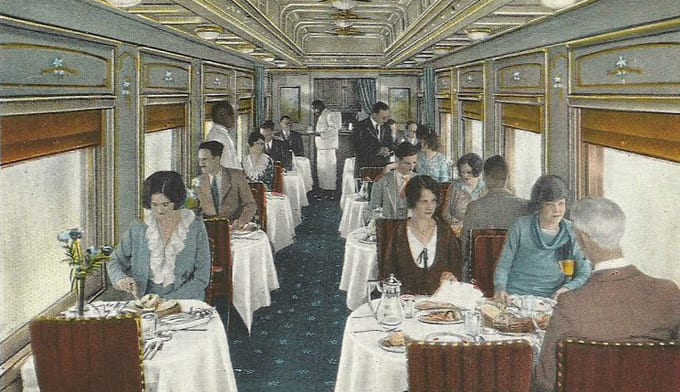
E.B. White’s “Notes and Comment” entry in the Sept. 7 “Talk of the Town” described travel on the Union Pacific’s Overland Limited, and the “mystic dividing line” that separated laid-back Westerners from buttoned-up Easterners:
MIND YOUR MANNERS, AT LEAST UNTIL YOU LEAVE CHICAGO…Tinted photo postcard depicting the dining car on a Union Pacific train that traveled the Chicago to Denver route in the 1920s. (myutahparks.com)
* * *
Write What You Know
The Wisconsin-born Marion Clinch Calkins (1895 – 1968) often wrote humorous rhymes for The New Yorker under the pen name Majollica Wattles. While many writers reveled in the party atmosphere of the Roaring Twenties, Calkins worked as a vocational counselor and social worker at Lillian Wald’s Henry Street Settlement. This experience doubtless led her to more serious writing after the 1929 market crash — her critically acclaimed book, Some Folks Won’t Work (1930), is considered a seminal document on the Great Depression.
But in September 1929, Calkins was still in a humorous vein, and published this satirical piece on the role of an ideal housewife in the Sept. 7 issue. Excerpts:
CALL ME CLINCH…Marion Clinch Calkins circa 1905 and 1945. She wrote under the name of Clinch Calkins because she wanted her authorship to be gender-neutral. (evansvillehistory.net/NEH)
* * *
Information Please
The New Yorker’s art critic Murdock Pemberton did not suffer fools gladly, and whenever the local museums seemed less than up to snuff, he was there to provide some correctional advice…
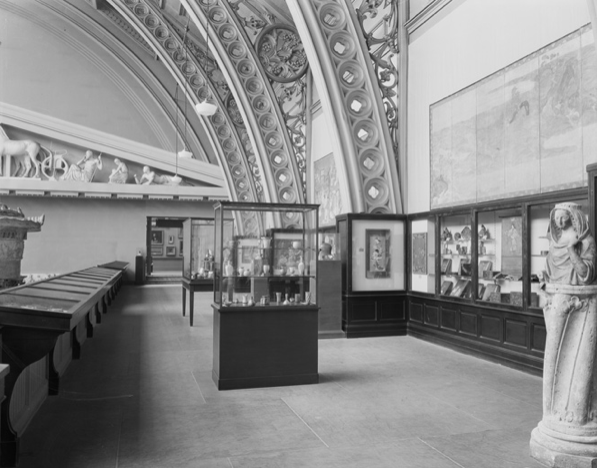
NEED AN AUDIO GUIDE? STILL WORKING ON THAT…The Metropolitan Museum of Art’s H.O. Havemeyer Collection, 1930. (The Metropolitan Museum of Art)
* * *
From Our Advertisers
Despite the advances made by women in the 1920s, they still lived under a patriarchy, especially when it came to the patrician classes. And so the young bride of Gifford Pinchot II was identified only as a “Mrs.” in the headline for this Pond’s cold cream ad…
…Mrs. Gifford Pinchot II was actually Janine Voisin (1910-2010). She must have had more than a healthy complexion, as she lived 100 years…
Janine Voisin Pinchot in 1933. (history.blogberth.com)
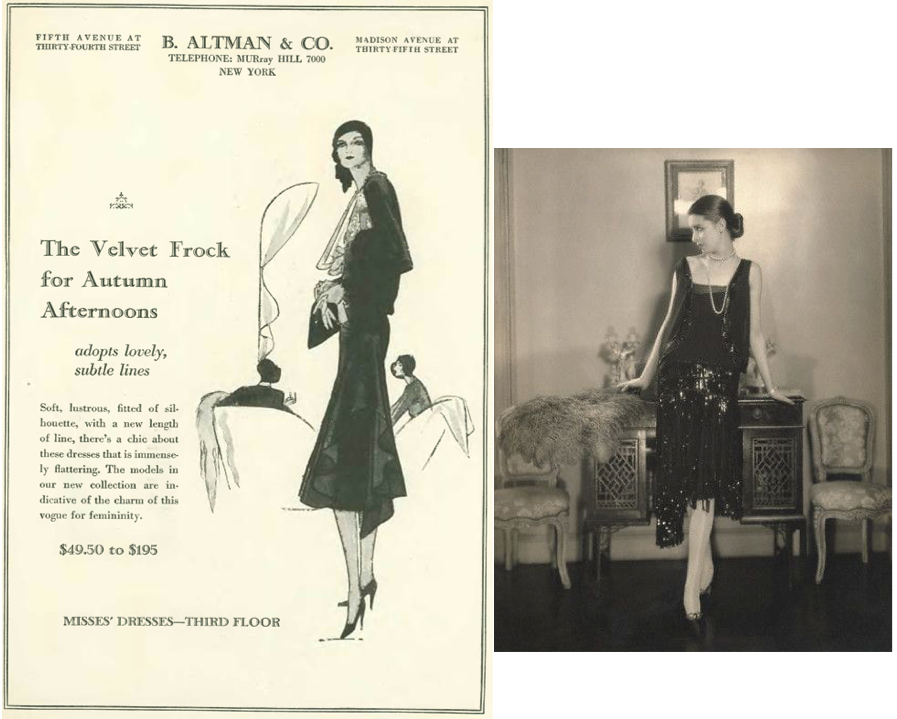
Another woman known for her beauty in the 1920s was the model Marion Morehouse (who was married to poet E.E. Cummings from 1934 until his death in 1962). Considered by some to be the first “supermodel,” I include an image of Morehouse below (right) to demonstrate how artists exaggerated the female form in fashion ads of the day…
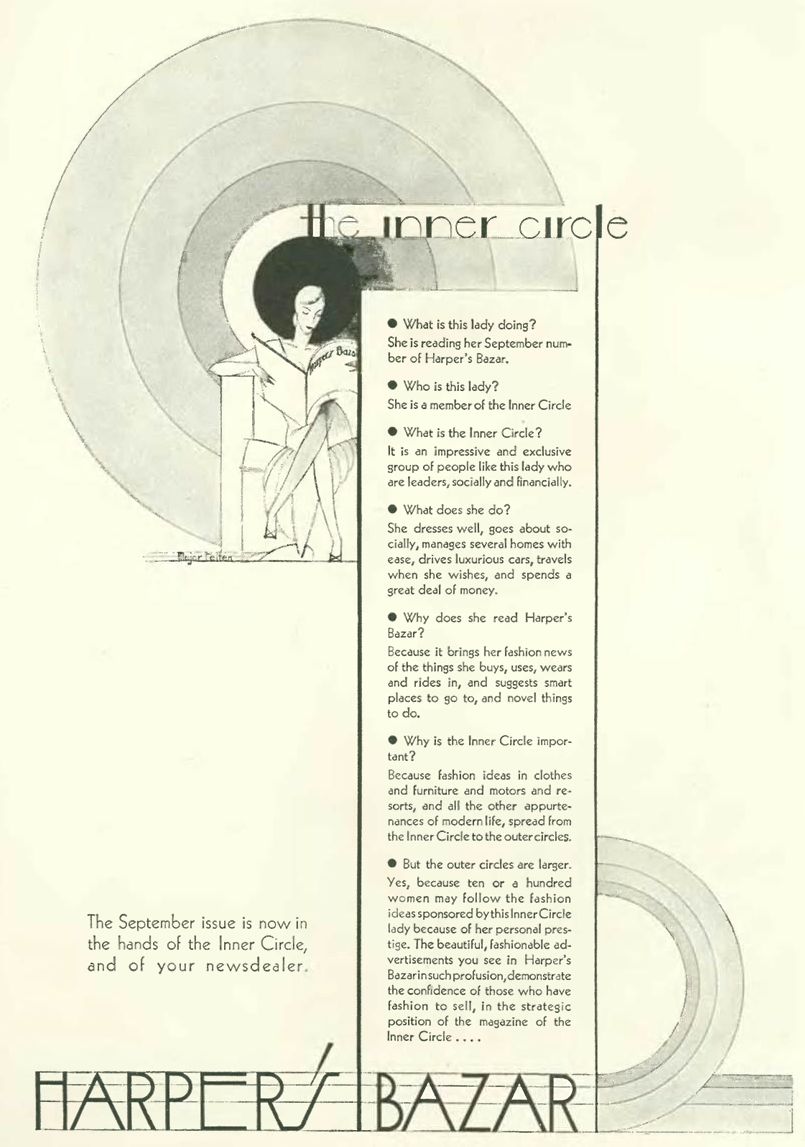
…the body wasn’t the only thing subject to exaggeration, or hyperbole, as this ad from Harper’s Bazar attested in defining the exclusivity of its readership…
…the New York Sun also appealed to social mores in an attempt to sell more newspapers…
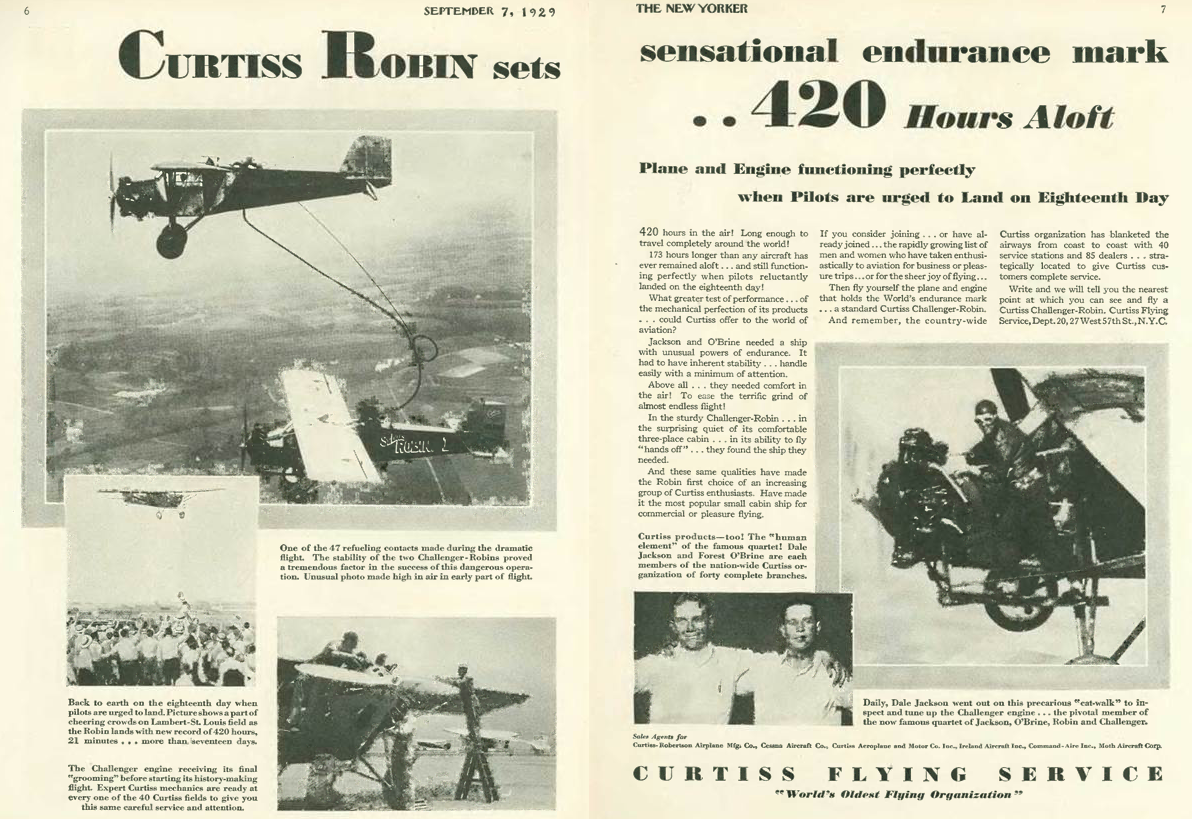
…the Curtiss Robin Flying Service touted their latest achievement — the St. Louis Robin being refueled during its flight to a new world’s endurance record of 420 hours — greatly surpassing the record of 150 hours set by the Army’s “Question Mark” airplane at the beginning of 1929…
…our cartoonists from the Sept. 7 issue include Gluyas Williams, who had some fun at the expense of Alice Foote MacDougall, who was the “Starbucks” of her day, at least in New York…
…MacDougall turned her coffee business into a restaurant empire in the 1920s. She opened several restaurants in Manhattan, all decorated in a signature style meant to evoke European cafés…
EURO AMBIENCE…Interior of Alice Foote MacDougall’sFirenze, 6 West 46th Street, New York City, 1925. (New York Historical Society)
…other cartoons included this commentary on public advertising by Leonard Dove…
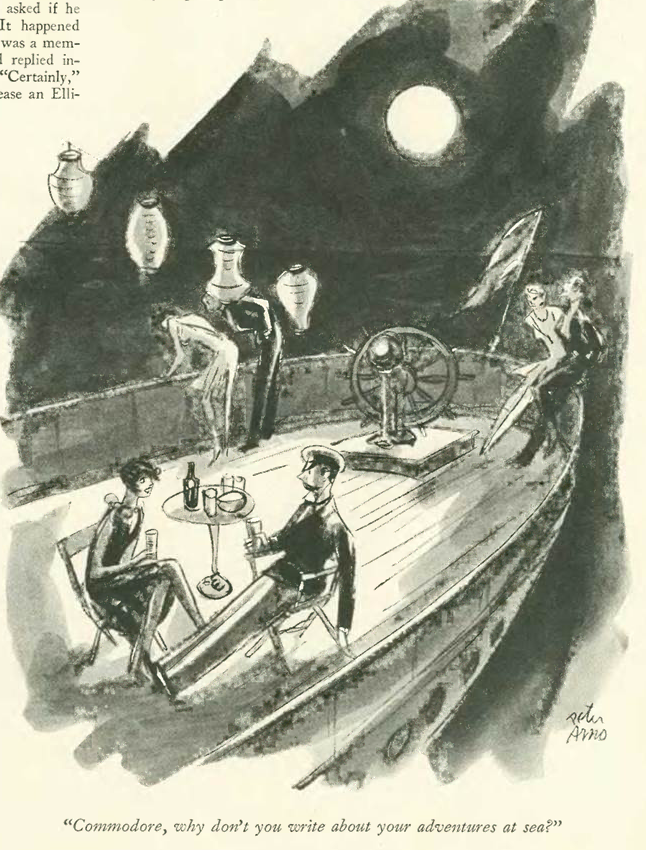
…Peter Arno’s unique take on the seafaring life…
…Helen Hokinson eavesdropped on some tween talk…
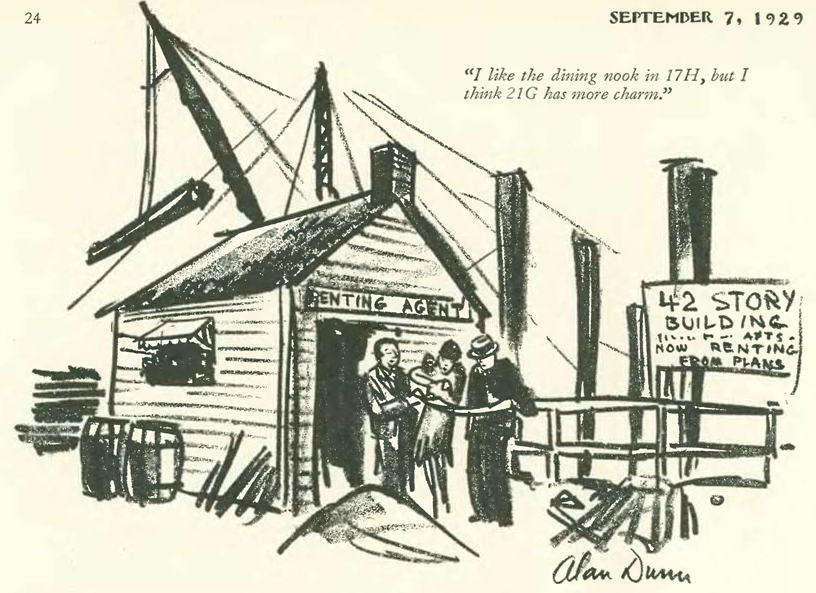
…and Alan Dunn gave us some perspective on the fast pace of city life…
While the Empire State Building developers were preparing to reduce the old Waldorf-Astoria Hotel to rubble, another venerable relic of the Victorian age, the Murray Hill Hotel, was still clinging to the earth at its prime location next to the Grand Central Depot.
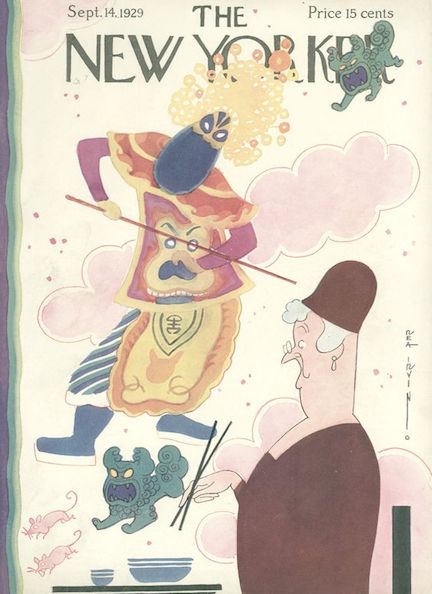
June 15, 1929 cover by Sue Williams.
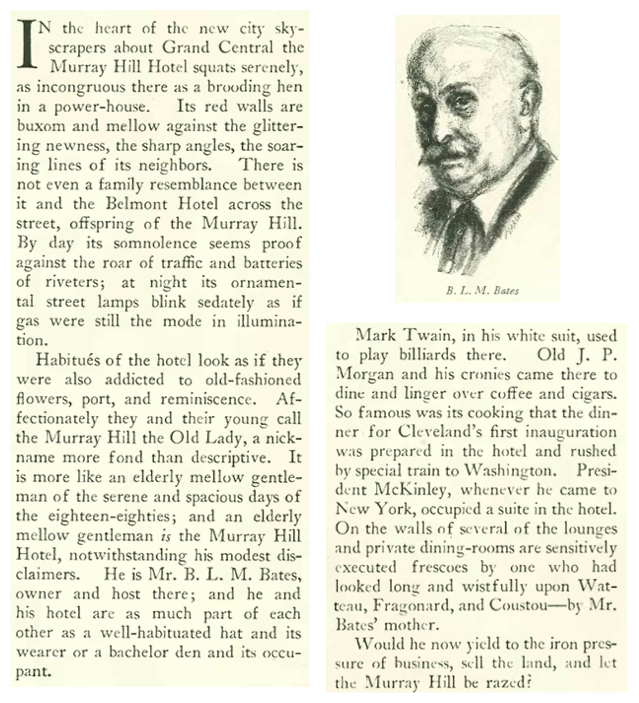
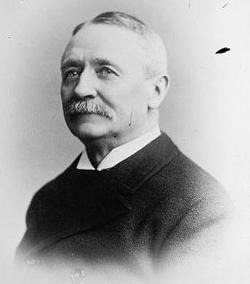
The hotel’s survival was due in part to its owner, Benjamin L. M. Bates (1864-1935), who seemed as much a part of the hotel as its heavy drapes and overstuffed chairs. Bates, who started out at the hotel as assistant night clerk, was profiled in the June 15, 1929 issue by Joseph Gollomb (with portrait by Reginald Marsh) Some excerpts:
The hotel was just 26 years old when Bates bought it in 1910. But by the Roaring Twenties Murray Hill Hotel seemed as ancient as grandmother’s Hepplewhite…
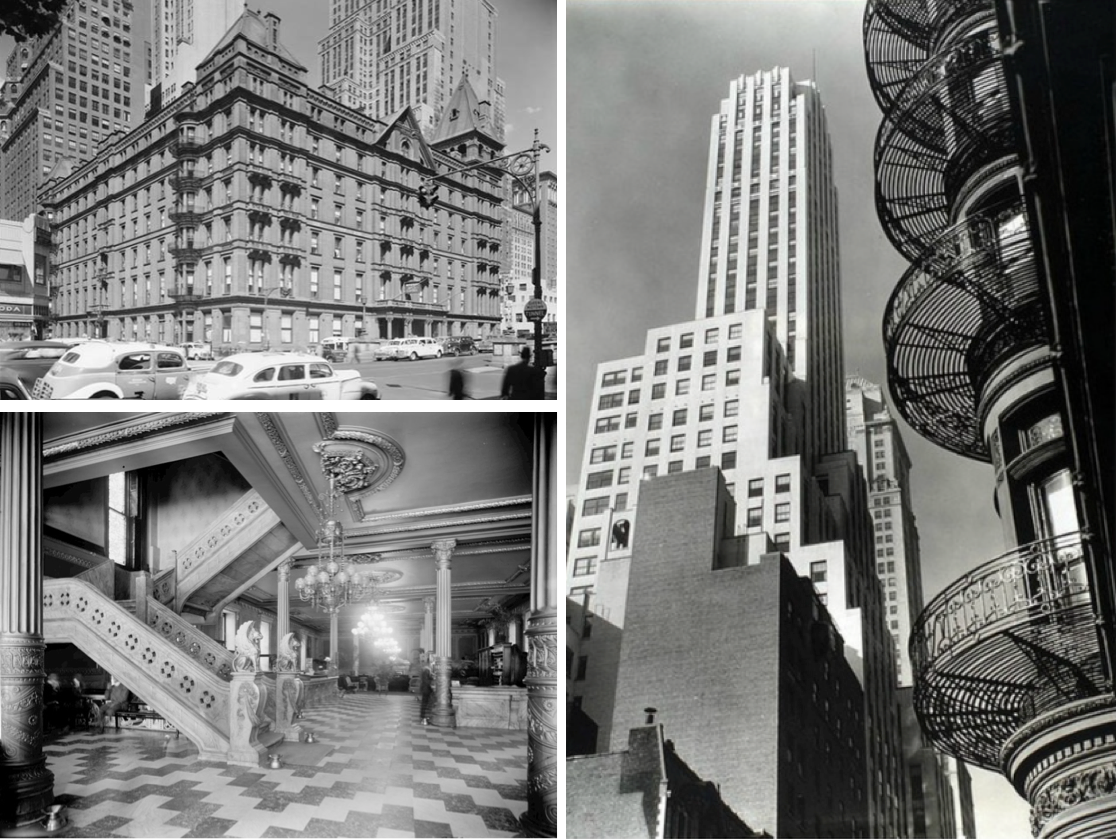
Clockwise, from top, left, The Murray Hill Hotel in September 1946, just months before it was demolished; the hotel’s ornate spiral fire escape, seen at the right in a 1935 photograph of 22 East 40th Street by Berenice Abbott; the hotel’s office and foyer. The hotel featured 600 rooms and two courtyards. (Museum of the City of New York (1 & 2)/Wikipedia)
…but to the very end it continued to be a popular gathering spot for New York notables, including Christopher Morley’s prestigious literary society, the Baker Street Irregulars…
FAMILIAR HAUNT…Three members of the exclusive literary group, the Baker Street Irregulars — Fletcher Pratt, Christopher Morley and Rex Stout —swap stories at the Murray Hill Hotel in 1944. (Wikipedia)
…with the hotel’s prime location near Grand Central Depot (and its replacement, Grand Central Station), the party couldn’t last forever, and the Murray Hill Hotel yielded to the wrecking ball in 1947…
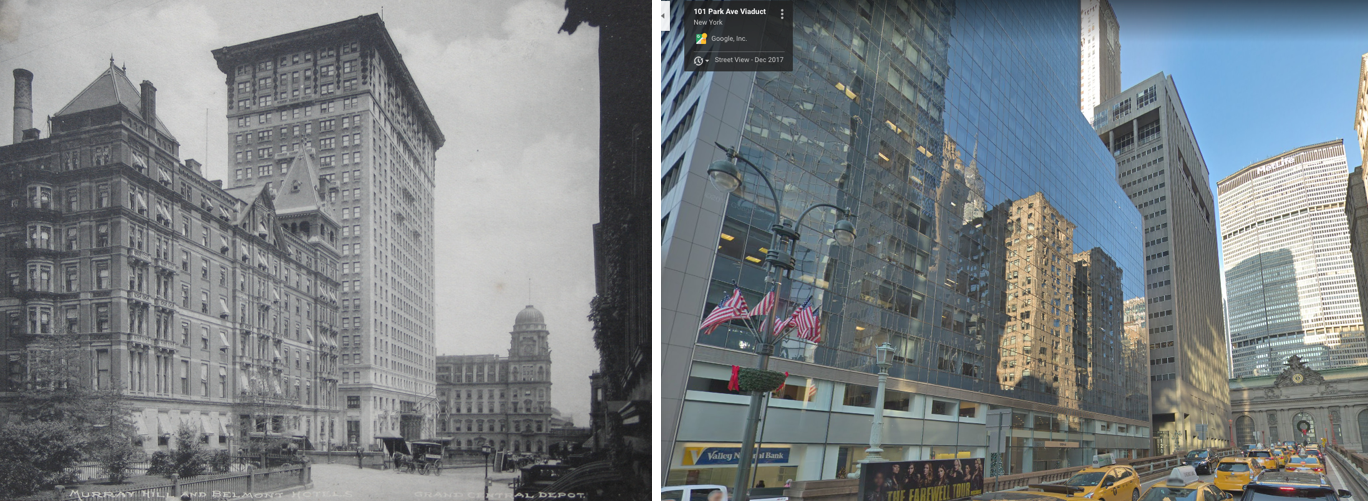
THEN AND NOW, the Murray Hill Hotel, circa 1905. The adjacent 25-story Belmont Hotel, erected in 1904-06 and a skyscraper for its time, would be razed in 1931. Note the old Grand Central Depot in the background, which would be replaced in 1913 by Grand Central Station. At right, a Google Maps view of the same location today.
Some parting notes about the Murray Hill Hotel: In 1905, delegates from 58 colleges and universities gathered at the hotel to address brutality in college football and reform the sport. They formed the Intercollegiate Athletic Association of the United States, which would later become the NCAA.
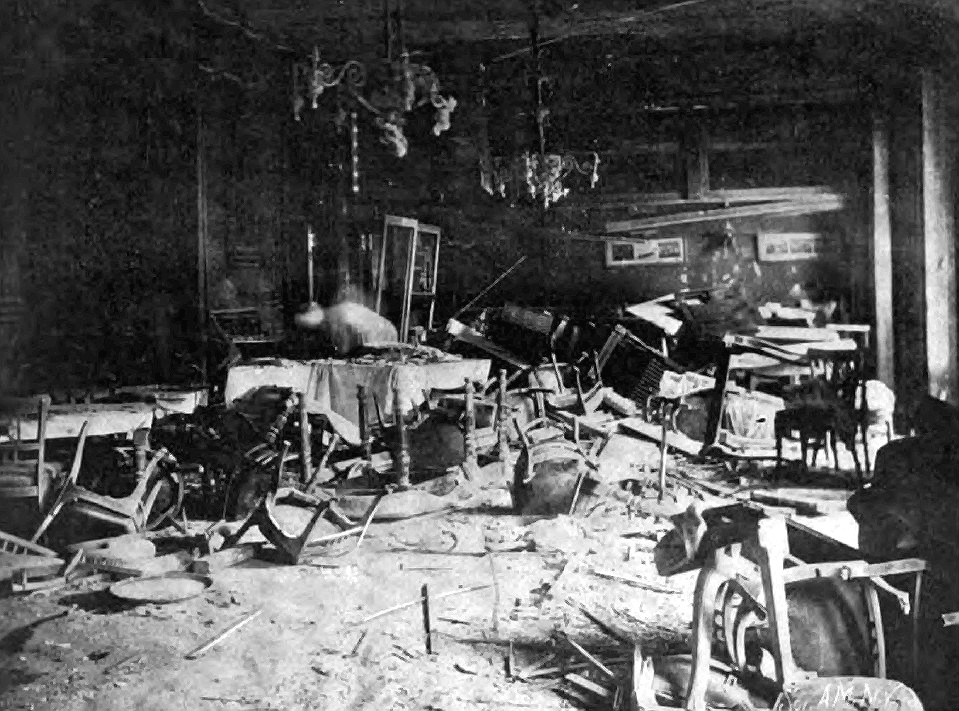
The hotel was also the site of a massive explosion in 1902, when workers constructing a subway tunnel under Park Avenue accidentally set a dynamite shed ablaze. Every window along Park Avenue and 40th Street was blown out, and the blast opened a pit, 10 feet deep and 30 feet wide, in front of the building. Five people were killed by the blast—three of them at the Murray Hill Hotel.
AFTERMATH…The Murray Hill Hotel’s cafe following the 1902 explosion. (Wikimedia Commons)
* * *
Irwin S. Chanin, fresh from erecting his Art Deco masterpiece, the Chanin Building, was now setting his sights on the Century Theatre, barely twenty years old but already obsolete due to its poor acoustics and inconvenient location. “The Talk of the Town” takes it from there…
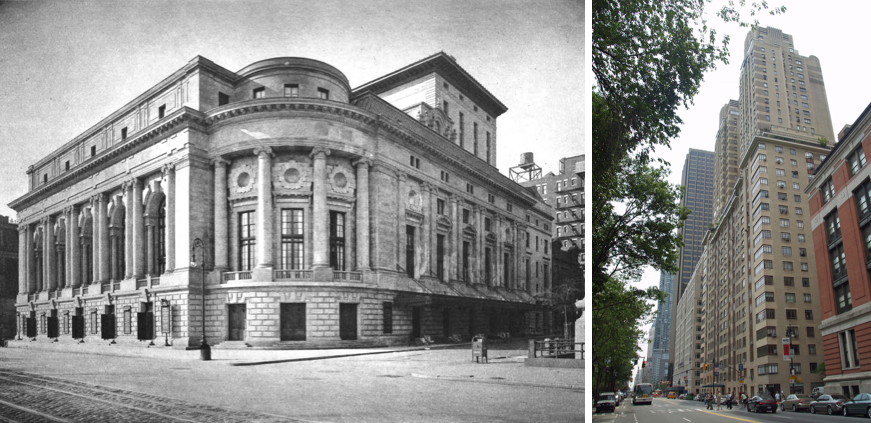
BIGGER PLANS…The Century Theatre, located at 62nd Street and Central Park West, opened on November 6, 1909. Plagued by poor acoustics and an inconvenient location, it was demolished in 1931 and replaced by the Irwin S. Chanin’s Century Apartments building. (The New-York-Architect, November 1909/David Shankbone via Wikipedia)
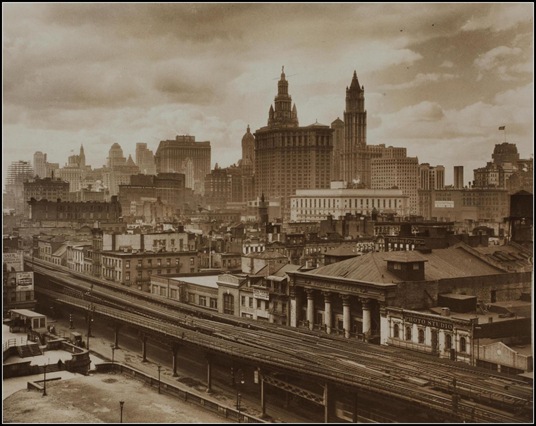
As the Century Theatre marked its last days, an older and more successful theater in the Bowery went up in flames. The Thalia Theatre (also known as “Bowery Theatre” and other names) was a popular entertainment venue for 19th century New Yorkers and for the Bowery’s succession of immigrant groups. A series of buildings (it burned four times in 17 years) housed Irish, German and Yiddish theater and later Italian and Chinese vaudeville. The 1929 fire marked the end of the line. “Talk” noted its passing…
UP IN SMOKE…The Bowery’s Thalia Theatre (building with columns) went up in flames on June 5, 1929. The photo was taken in 1928, one year before the final fire. Note the elevated train tracks in front of the building. (Manhattan Unlocked)
While we are on the subject of the changing skyline, I will toss in this cartoon from the issue by Reginald Marsh…the caption read: “I tell you, Gus, this town ain’t what it used to be.”
* * *
Down for the Count
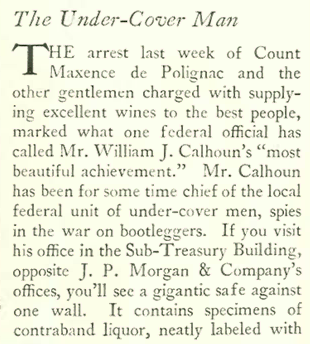
There was a bit of a sensation in the June newspapers when a European count was arrested for running a bootlegging ring among socially prominent circles. A headline in a June 8, 1929 edition of the New York Times shouted: LIQUOR RING PATRONS FACING SUBPOENAS; Socially Prominent Customers Are Listed in Papers Found in de Polignac Raids. COUNT SAILS FOR PARIS. Goes, After Nearly Losing Bail Bond, Smilingly Calling the Affair ‘Misapprehension.’
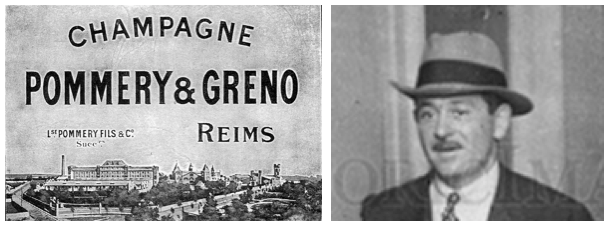
What the Times so breathlessly recounted were the activities of Count Maxence de Polignac (1857–1936), who owned one of France’s most prominent Champagne houses, Pommery & Greno.
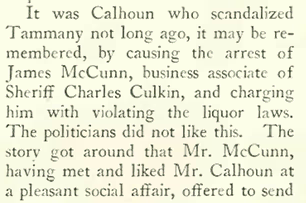
The Times reported that an undercover federal agent, William J. Calhoun, led a raid that netted the Count and 34 others in a liquor ring connected to many Park Avenue and Fifth Avenue residents. Calhoun’s agents interrupted the Count’s morning bath (at his suite in the Savoy-Plaza Hotal) to make the arrest. They seized more than “seven cases of champage and liquors” in the suite, which the count said were for his personal use. Denying all charges, de Polignac was nevertheless arrested. Thanks to a guarantee provided by his friends at the Equitable Surety Company, he made the $25,000 bail and quickly set sail for Paris. “Talk” reported…
IT WAS JUST A LITTLE SIDE BUSINESS…Count Maxence de Polignac owned the house of Pommery & Greno, one of the largest Champagnes firms in France. (Wikipedia/tcreims.com)
“Talk” concluded the dispatch with some notes on Calhoun’s character as a federal agent…
…and a final bit of trivia, Count Maxence de Polignac was the father of Prince Pierre of Monaco, Duke of Valentinois, who in turn was the father of Rainier III of Monaco, who famously married the actress Grace Kelly. Grace Kelly, by the way, was born in November 1929, just months after her grandfather-in-law’s run-in with Prohibition authorities.
* * *
Underwhelmed
Once again “Talk” looked in on aviation hero Charles Lindbergh, and his dispassionate approach to matters of fame…
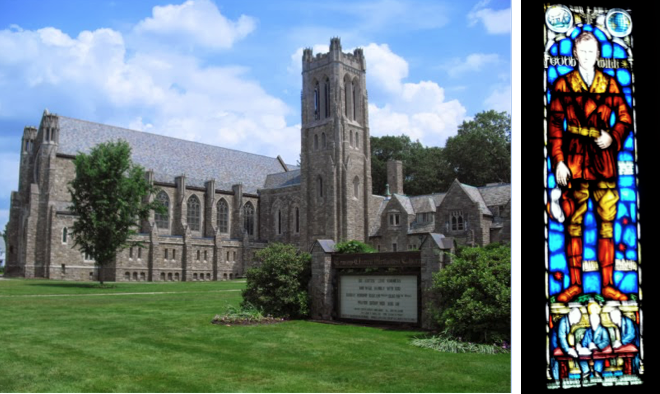
GOODWILL, OR WHATEVER…Trinity Methodist Episcopal Church in Springfield, Mass., features a series of 24 stained-glass windows representing historic personages with the theme, “The Light of Christ in the Life of Civilization.” Charles Lindbergh’s pane represents “Goodwill.” (tm01001.blogspot.com)
* * *
Mr. Monroe Outwits a Bat
James Thurber submitted a humorous piece on a husband and wife at a weekend cabin retreat. The husband encounters a bat, and feigns to dispatch it while his wife remains behind closed doors. A brief clip:
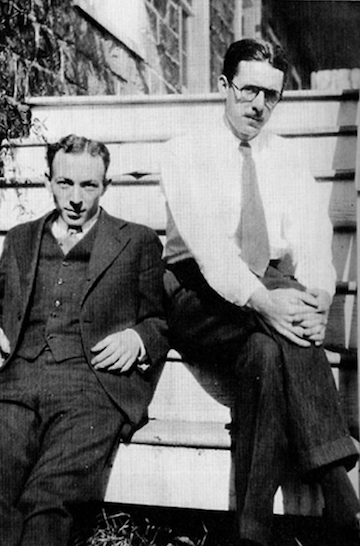
E.B. White and James Thurber, circa late 1920s.
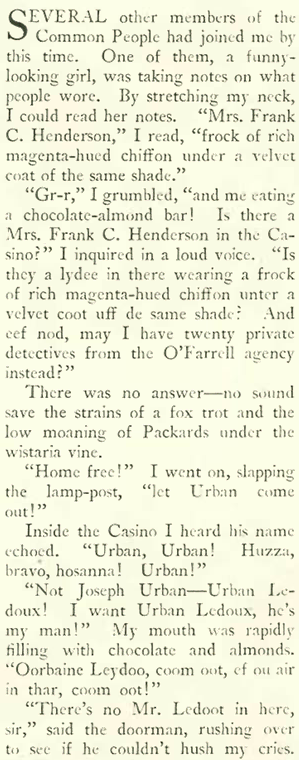
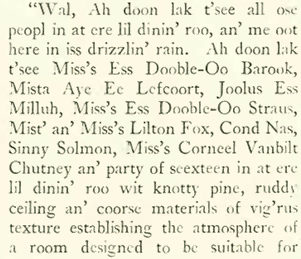
Thurber’s office mate and friend, E.B. White, penned a piece on the opening of the Central Park Casino (“Casino, I Love You”) in which he pretended to be a hobo loitering outside the Casino’s recent grand re-opening. Some excerpts…
White’s character confuses Urbain Ledoux with Casino designer Joseph Urban. Ledoux was known to New Yorkers as “Mr. Zero,” a local humanitarian who managed breadlines for the poor. White’s character continues to name off the notables present at the event…
* * *
From Our Advertisers
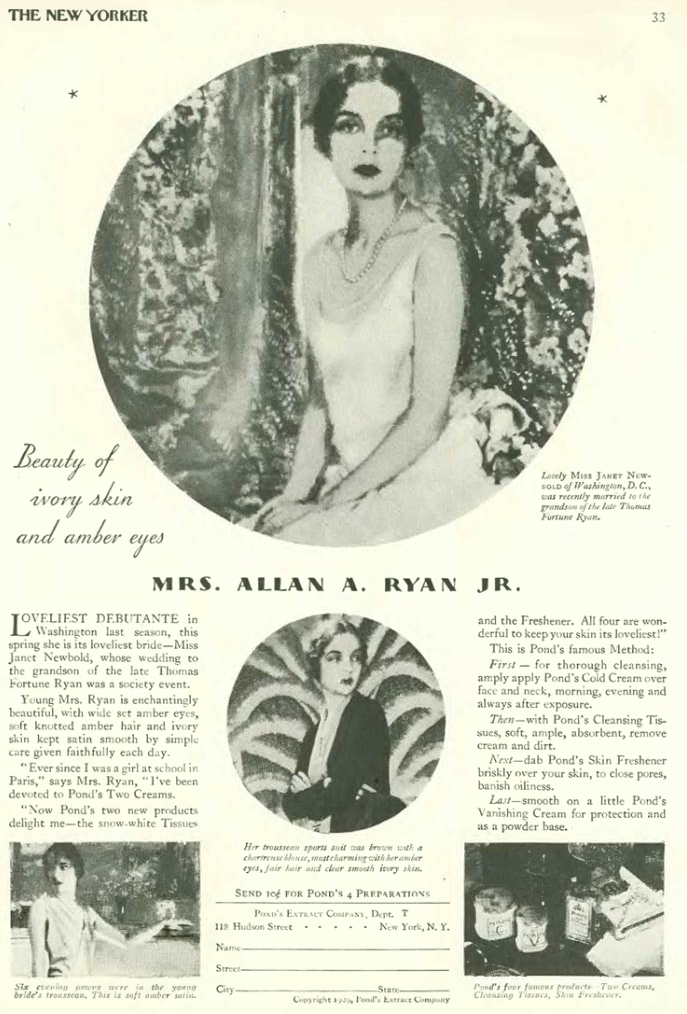
We begin with a Pond’s cold cream ad featuring Janet Newbold (1908-1982), who was known in some circles as “the most beautiful woman in New York”…
MIRROR, MIRROR…Left, an iconic photo of Janet Newbold by Erwin Blumenfeld, “Woman and Mirror,” was published in Harper’s Bazaar in November 1941. “Janet Newbold Wearing A Sari,” photo by John Rawlings, was published in Vogue in 1947. Thrice married, her last marriage (in 1948) was to James S. Bush, uncle of U.S. President George H.W. Bush. (Harper’s Bazaar/Vogue)
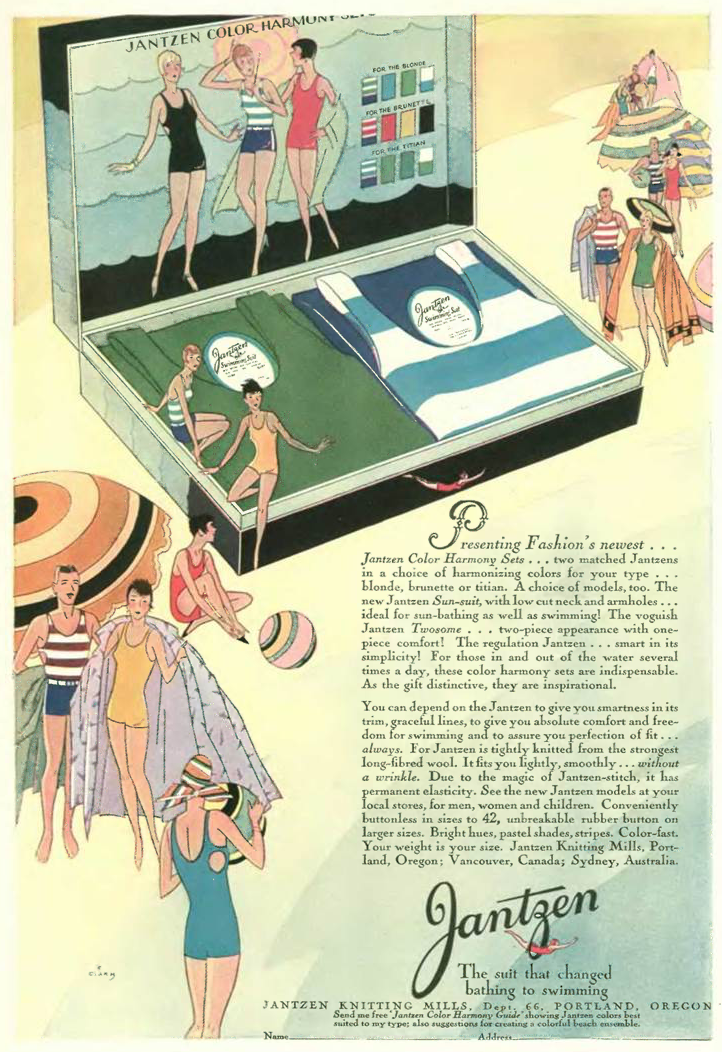
…some of the more colorful ads in the June 15 issue included this entry by Jantzen…
…and this ad for the REO Flying Cloud, a name that suggested speed and lightness, and changed the way cars would be named in the future (e.g. “Mustang” rather than “Model A”)…
…and if you think gimmicky razors are something new, think again…
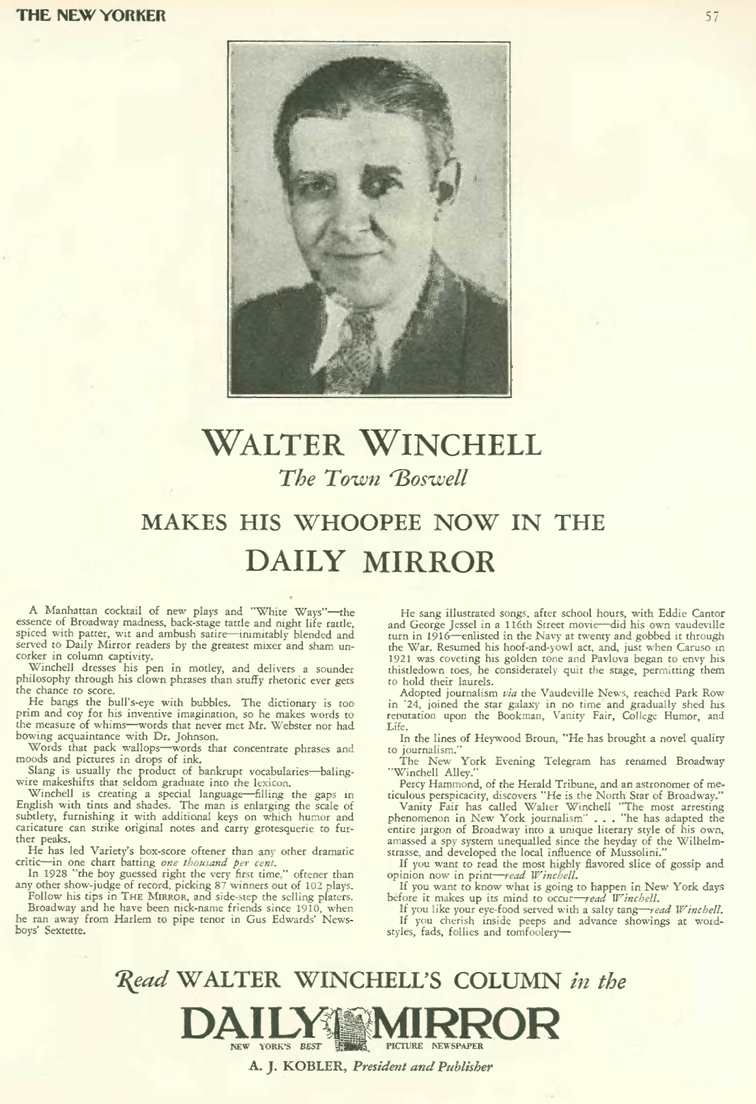
…this ad announcing Walter Winchell’s employment with the New York Daily Mirror is significant in that in marks the beginning of the first syndicated gossip column. Winchell’s column, On-Broadway, was syndicated nationwide by King Features. A year later he would make his radio debut over New York’s WABC…
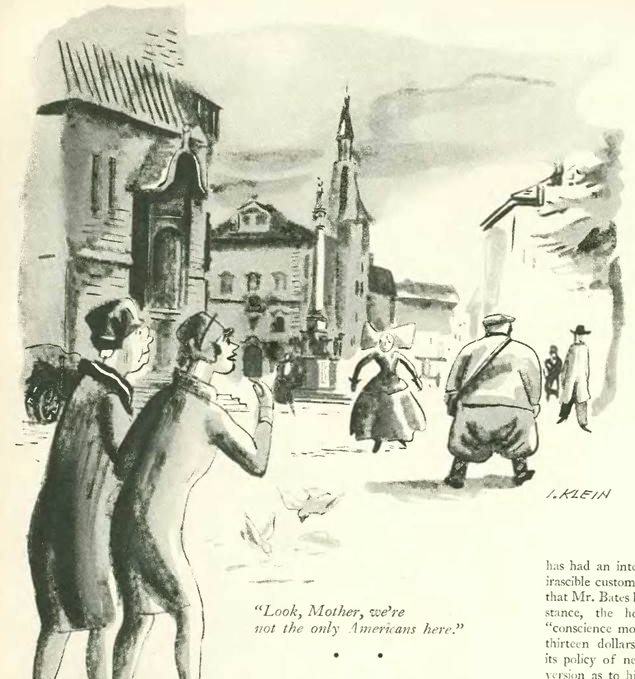
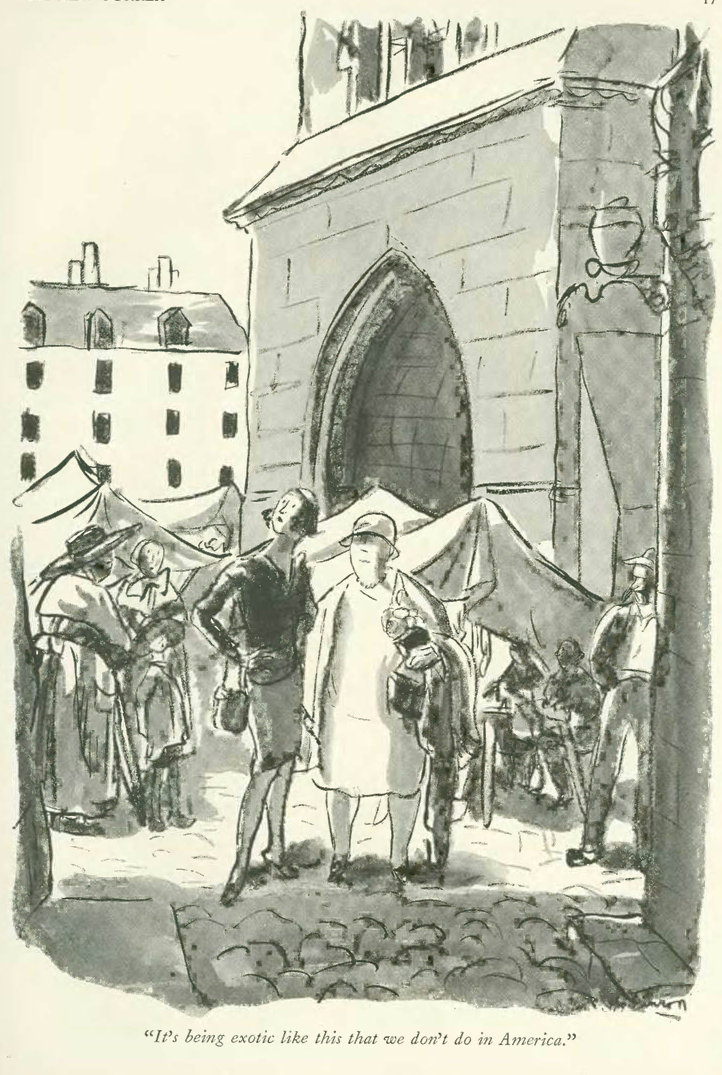
…for our June 15 cartoons, Isadore Klein confirms that stereotypes regarding American tourists haven’t changed much in 90 years…
…a quick footnote on Klein. In his long and colorful career, he would contribute cartoons to the New Yorker and many other publications. He also drew cartoons for silent movies, including Mutt and Jeff and Krazy Kat, and later worked for major animation studios including Screen Gems, Hal Seeger Productions, and Walt Disney. He was a writer and animator for such popular cartoons as Mighty Mouse, Casper, Little Lulu and Popeye.
Isadore Klein (1897–1986) holding the National Cartoonists Society “Silver T-Square.” He received the honor from his fellow members on April 22, 1974. (michaelspornanimation.com)
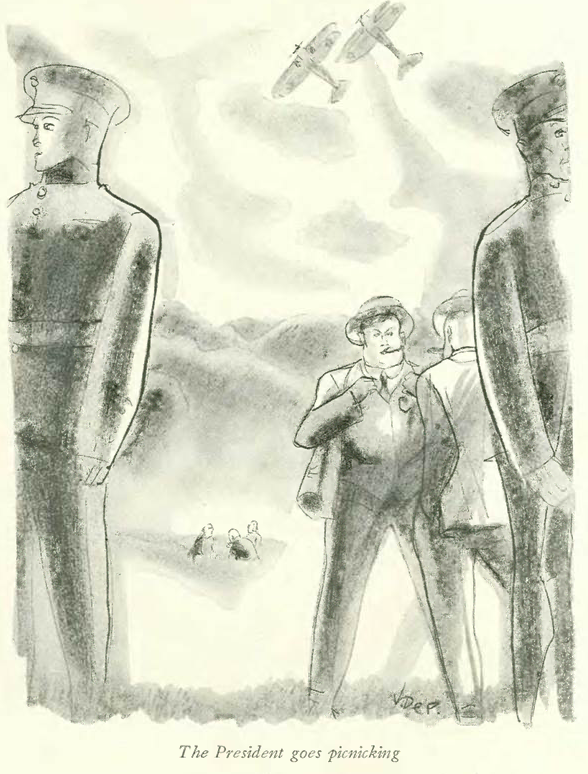
…Belgium-born artist Victor De Pauw depicted President Herbert Hoover picnicking, as viewed through his security detail…
…and a quick note on De Pauw…well known during his lifetime, he illustrated seven covers for The New Yorker and drew many social and political cartoons for magazines such as Vanity Fair, Fortune and Life. He also had a career as a serious painter, and some of his work can be found at the Museum of Modern Art…
Victor de Pauw (1902-1971) and one of his New Yorker covers from Nov. 20, 1943. (Smithsonian/Conde Nast)
…Helen Hokinson looked in on two of her society women in need of some uplift…
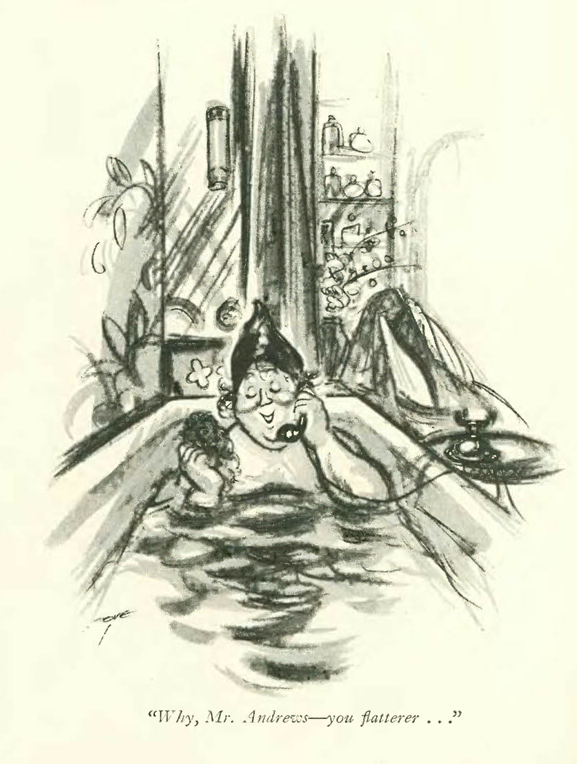
…and Leonard Dove looked in on another enjoying a soak…
Moving along to the June 22, 1929 issue, “The Talk of the Town” offered more news on the city’s changing skyline…
June 22, 1929 cover by Constantin Alajalov.
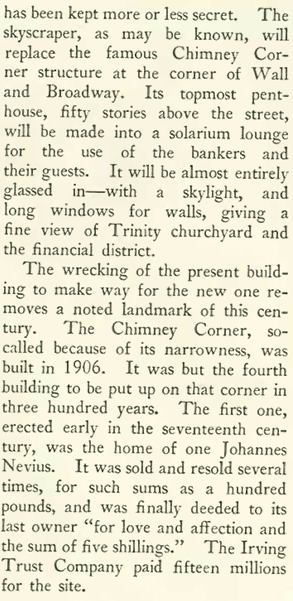
…and noted that the slender 1906 “Chimney Corner” building at Wall and Broadway had a date with the wrecking ball…
FAILED THE TEST OF TIME…At left, 18-story “Chimney Building” was demolished in 1929 along neighboring properties to make way for the Irving Trust Building (now 1 Wall Street), an Art Deco masterpiece by architect Ralph Walker. Note the scale of the two buildings relative to the church spire. (skyscraper.org/architectsandartisans.com)
* * *
Apartheid on the Seas
“Talk” also featured this sad account of a theatrical company setting sale for England and discovering that racial discrimination did not end at the docks of New York Harbor. It is also sad that The New Yorker didn’t seem to have any problem with this injustice, and rather saw it as nothing more than fodder for an amusing anecdote…
NOT THE GOOD OLD DAYS…Percy Verwayne, Frank H. Wilson and Evelyn Ellis were part of the cast in the original Broadway production of Porgy in 1927. The play, by Dorothy and DuBose Heyward, was the basis for the libretto in the George Gershwin’s 1935 Porgy and Bess. (Wikipedia)
* * *
The profile for June 22 featured 100-year-old John R. Voorhis (1829-1932), Chairman of New York City’s Board of Elections. A fixture of the Tammany Hall Democratic political machine, in 1931 Tammany members created a special title for the old man—Great Grand Sachem. He died the next year at age 102.
John Voorhies in 1900, when he was a bouncy youth of 71.
* * *
From Our Advertisers
Another colorful entry from the makers of Jantzen swimwear to celebrate the summer season…
…famed composer George Gershwin urged his fans to light up a Lucky Strike…
…and with help from Rea Irwin, Knox Hatters offered yet another example of the faux pas one might suffer without the proper headgear…
…for our June 22 cartoons, Helen Hokinson caught up with some American tourists…
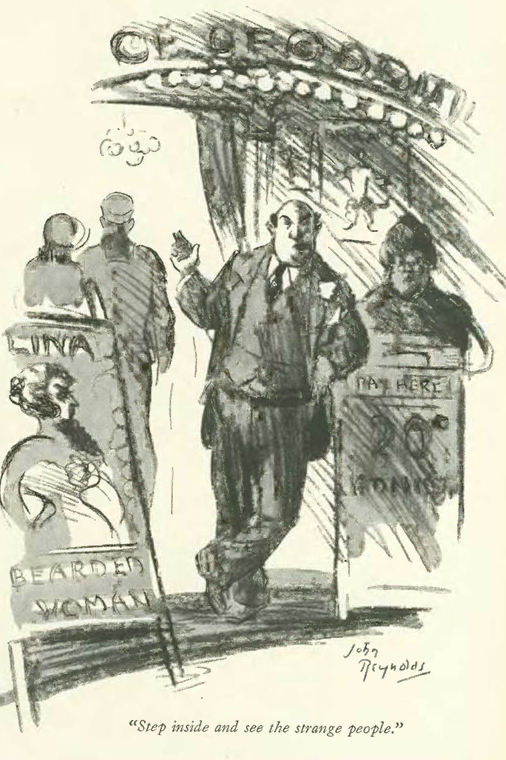
…John Reynolds found a bit of irony in one carnival barker’s claim…
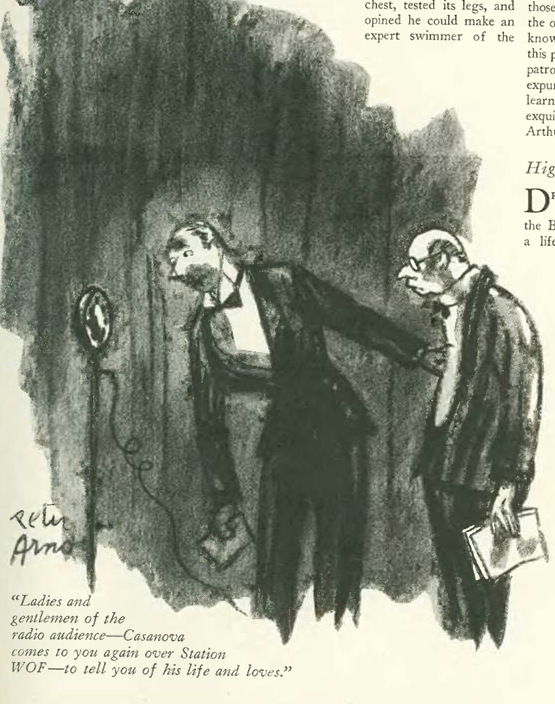
…and Peter Arno revealed a less than glamorous face behind a radio broadcast…
Florida’s Palm Beach became a popular destination in the 1920s for well-heeled New Yorkers seeking a respite from winter’s cold and gloom.
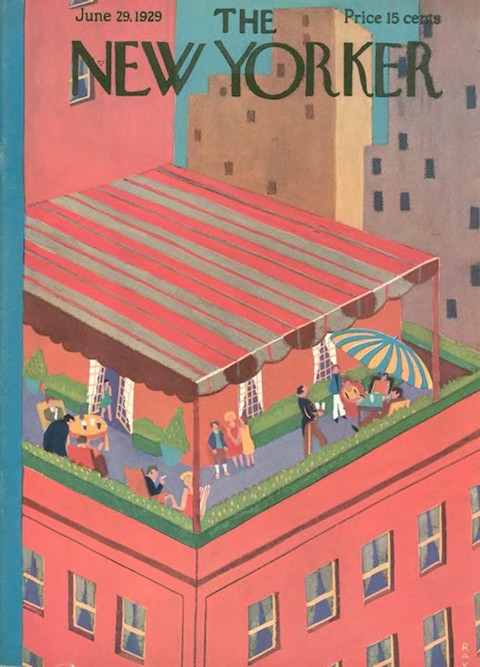
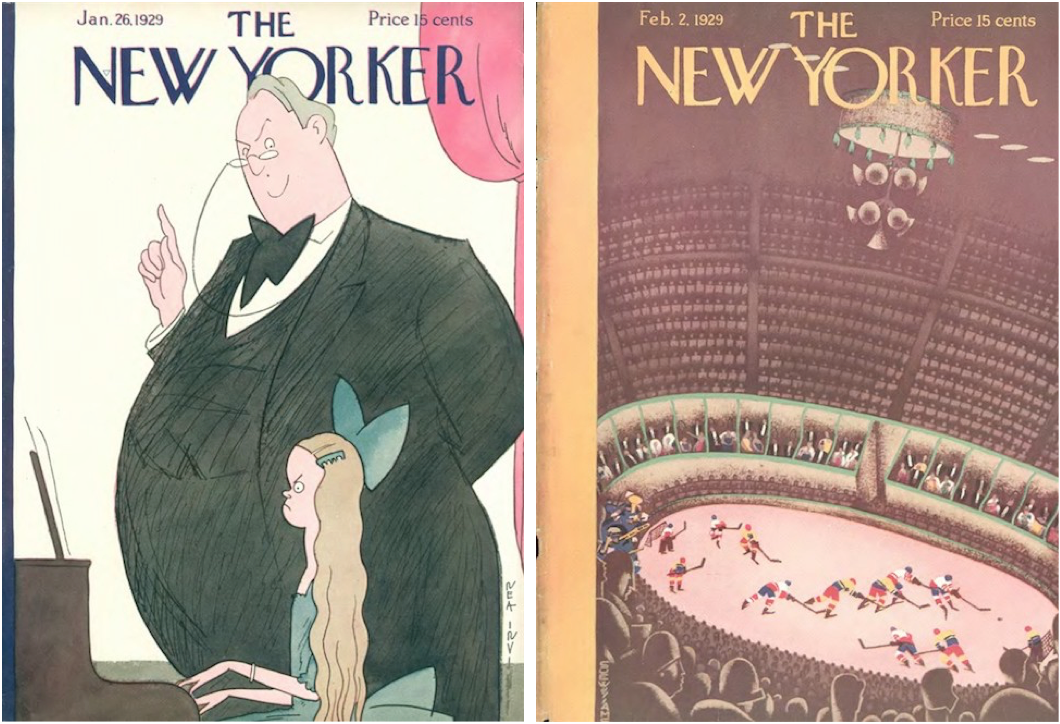
Jan. 26, 1929 cover by Rea Irvin / Feb. 2, 1929 cover by Sue Williams.
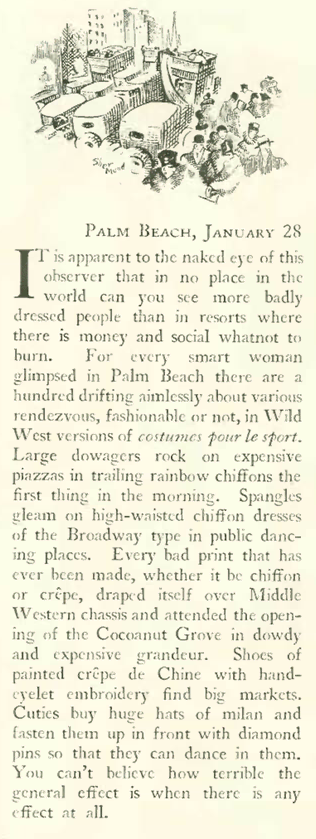
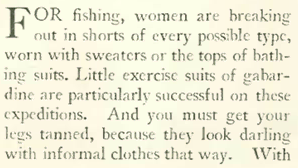
Among them was the New Yorker’s nightlife correspondent and fashion critic Lois Long, who (writing in the Feb. 2 issue) discovered that many snowbirds left their fashion sense back home, or in some cases didn’t have any in the first place…
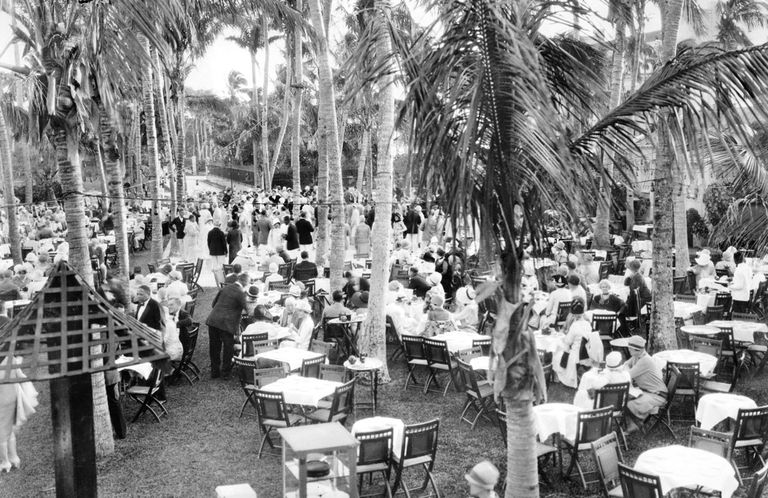
THOSE GENTLE BREEZES…Dining at the Coconut Grove in Palm Beach, 1928. (Town and Country)
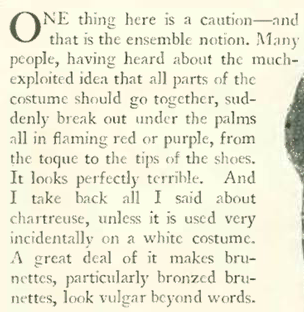
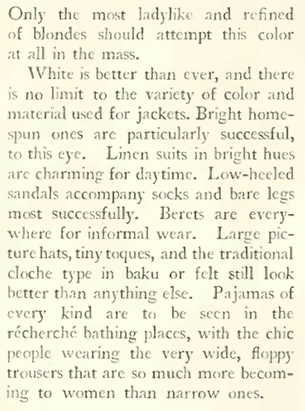
Sufficiently appalled by the fashion scene, Long then offered some advice for those seeking a smarter look in the southern climes…
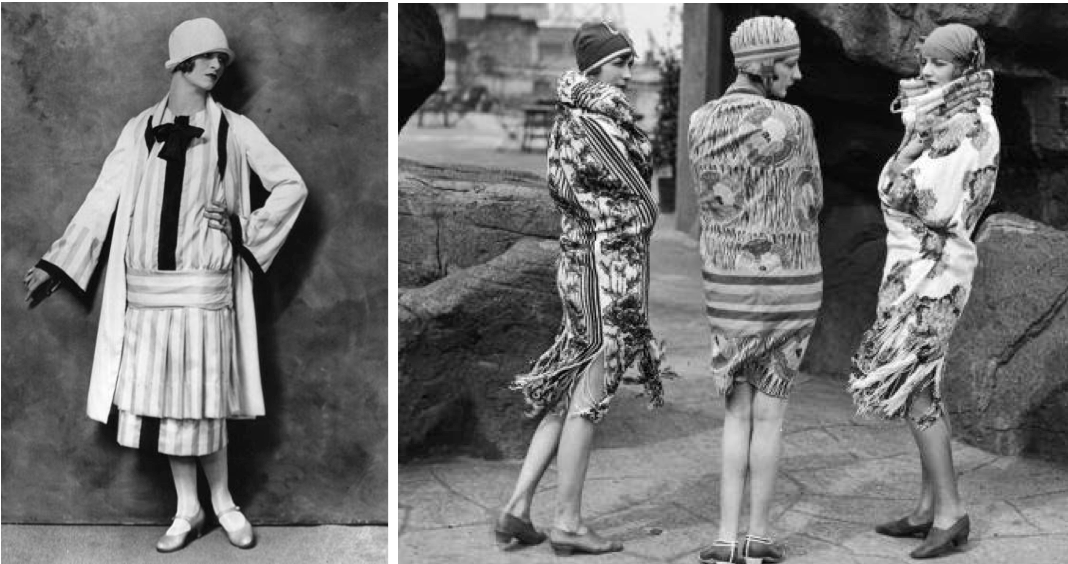
AHOY THERE…Beach pajamas were a popular choice in the 1920s. (artdecogal.com)BIG BOOSTER…The financier Otto Kahn was one of Palm Beach’s biggest promoters. Here he relaxes with friends at one of his Palm Beach “cottages” (this one is the Oheka Cottage, designed by August Geiger, on North Ocean Boulevard). L to R: New York socialite Sarah Jane Sanford, Otto Kahn, Margaret “Nin” Kahn Ryan (Kahn’s eldest daughter), Betty Bonstetten (of the Rothschild banking fortune), and seated, Nancy Yuille (tobacco heiress who would later marry the Viscount Adair and become the Countess of Dunraven) and Swiss architect Maurice Fatio. (Ellen Glendinning Ordway Collection via New York Social Diary)LOIS IS WATCHING YOU…A sampling of 1920s Palm Beach fashions Lois Long might have spotted during her visit. (vintage.es/picgran.com)
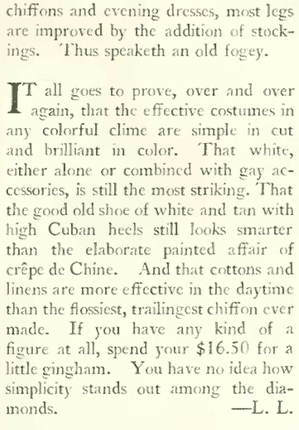
Long concluded her fashion advice with the dictum that when in doubt, keep it simple…
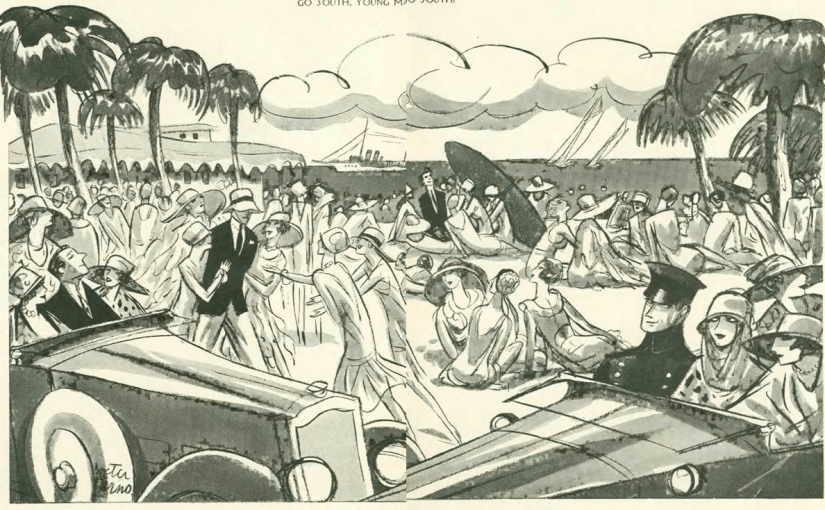
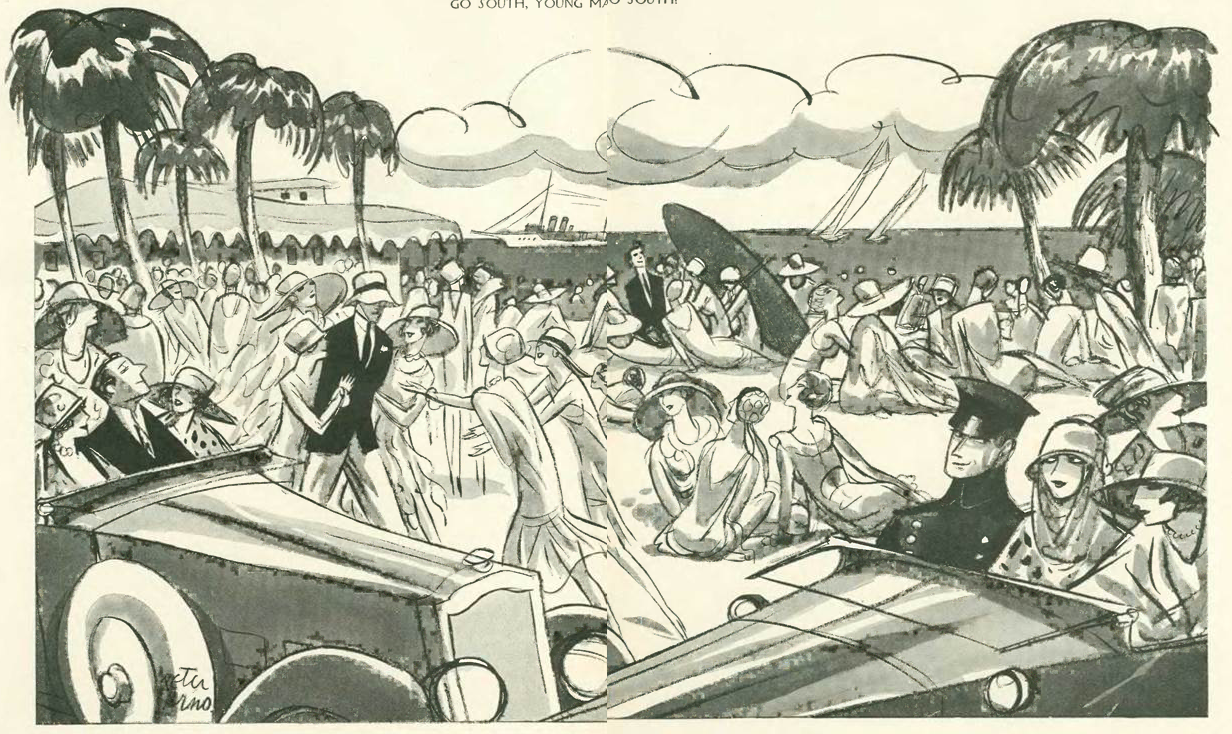
Long must have made the trip with her husband, the New Yorker cartoonist Peter Arno, since he contributed his own take on the scene in the Feb. 16, 1929 issue — a two-page illustration titled “Go South, Young Man, Go South.” (click image to enlarge)
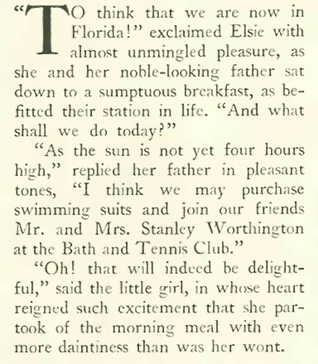
Palm Beach was also on the minds of the New Yorker editors when they composed the Jan. 26 issue, which featured a parody by Josie Turner of the popular Elsie Dinsmore book series: “Elsie Dinsmore at Palm Beach.” A brief excerpt:
Note: The Elsie Dinsmore books (there were 28 of them) featured an impossibly upright eight-year-old and were hugely popular in the late 19th and early 20th century.
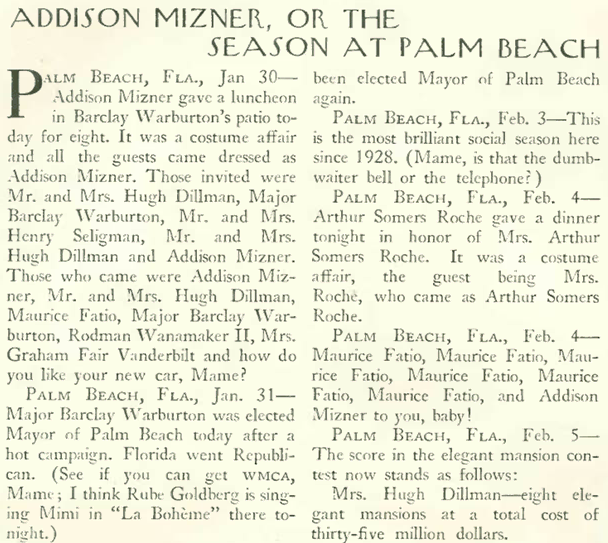
The Feb. 2, 1929 issue featured another Palm Beach-themed parody — this one by Frank Sullivan — that took a poke at Addison Mizner (1872-1933) a fixture of Palm Beach social life who designed resorts and houses for the rich and famous. He is often credited with giving South Florida its signature Mediterranean Revival and Spanish Colonial Revival styles of architecture (Augustus Mayhew, writing for the New York Social Diary, begs to differ: he notes that architect August Geiger established the style in Palm Beach three years before Mizner). An excerpt from Sullivan’s New Yorker parody:
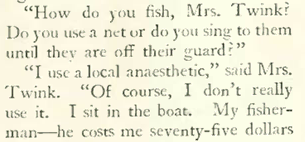
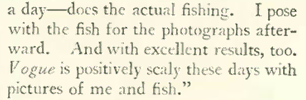
Later in the piece, Sullivan took a crack at a fictitious member of Palm Beach society, a “Mrs. Twink,” who was engaged in the latest “fad” — fishing:
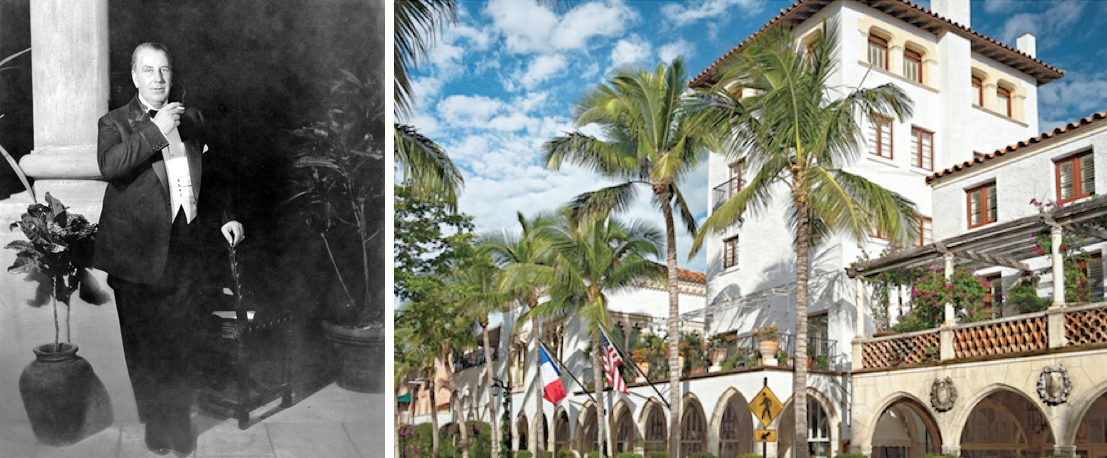
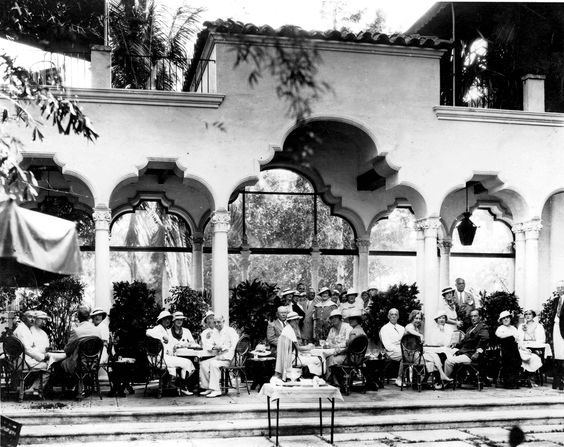
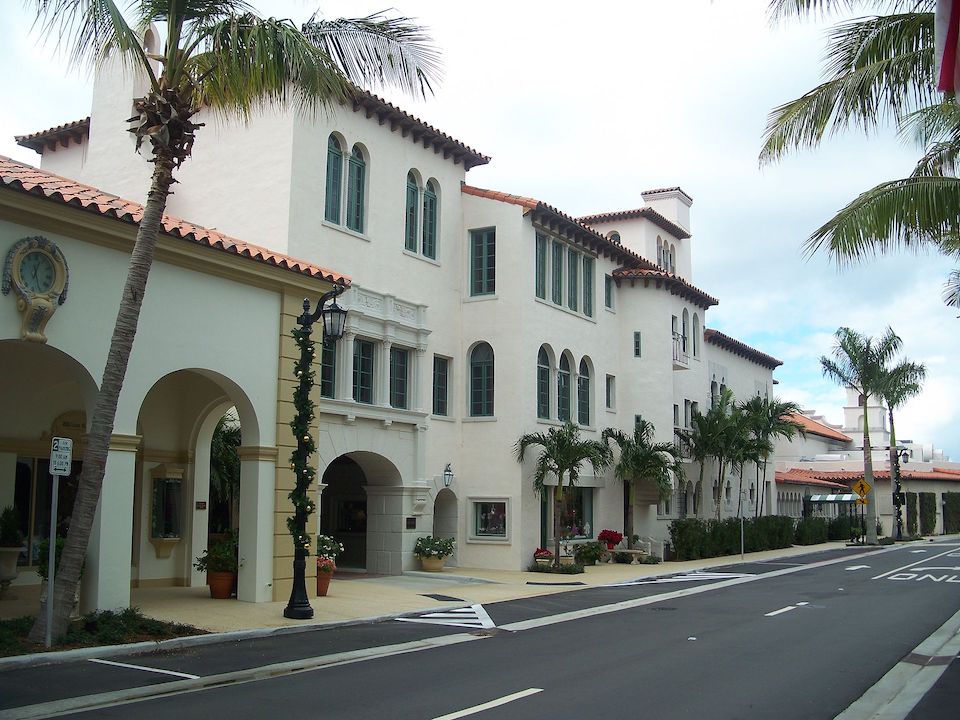
STORYTELLER IN BRICK AND STONE…Addison Mizner epitomized the “society architect.” He was known for making new buildings look like they had taken centuries to construct, even creating stories for his houses that described how they “evolved” through their many owners and historical eras. At right, Mizner’s own Palm Beach residence, Villa Mizner, on Worth Avenue in Palm Beach. It was built in 1924. (palmbeachdailynews.com/Merritt Hewitt)HIS KIND OF PEOPLE…Fashionably dressed members of the Mizner-designed Everglades Club gather in the Marble Patio in the 1920s. (Historical Society of Palm Beach County)STILL THERE…The Everglades Club today. Opened in January 1919, it was Mizner’s first big commission. (Wikipedia)
The Feb. 2 issue also featured this Peter Arno cartoon of one snowbird’s reaction to Palm Beach living:
* * *
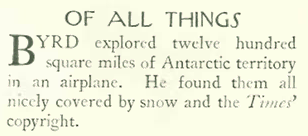
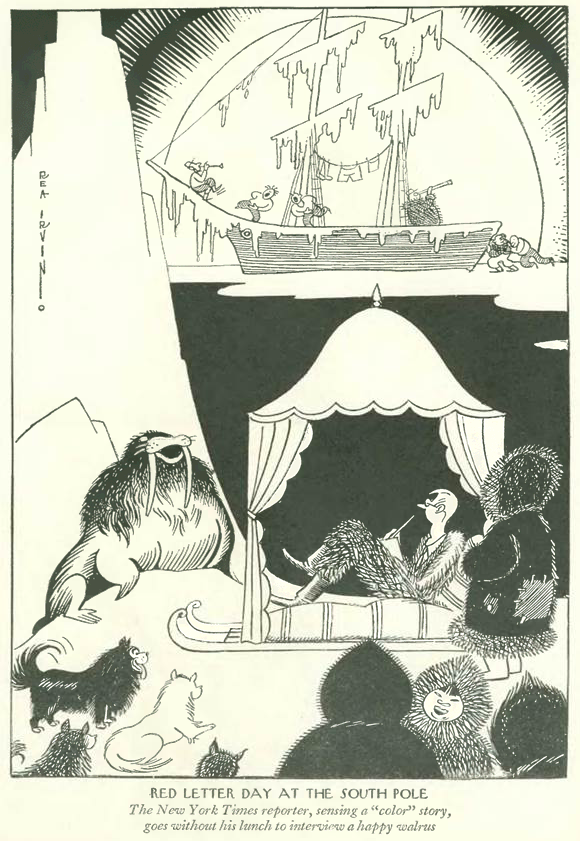
The New Yorker loved to take potshots at the news media, and particularly at the then rather staid New York Times, which apparently had secured exclusive rights to cover Admiral Richard Byrd’s famed exploration of the South Pole by airplane. In his Jan. 26 “Of All Things” column, Howard Brubaker quipped:
In the following issue, Feb 2, Rea Irvin imagined how a coddled Times reporter might cover the historic expedition:
ONE TOUGH BYRD…Admiral Robert Byrd (inset) led expeditions in the Antarctic from 1928 to 1930 by snowshoe, dog-sled, snowmobile and three airplanes that were transported (partially disassembled) by ship to a base camp on the Ross Ice Shelf. Pictured are Harold June, Commander Byrd, and Bernt Balchen in front of a Fairchild airplane, dubbed “Stars and Stripes.” The plane was used to take aerial photographs. (Richard E. Byrd Papers, The Ohio State University)
* * *
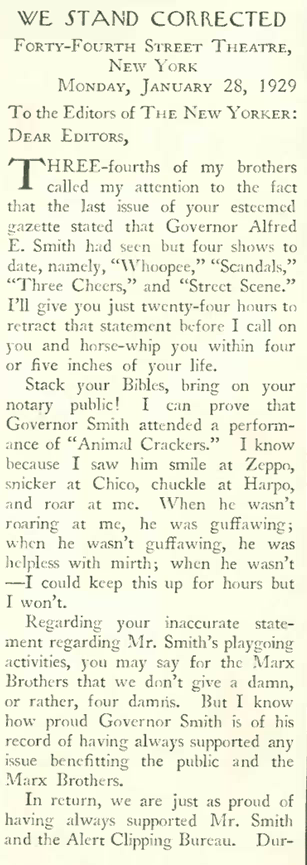
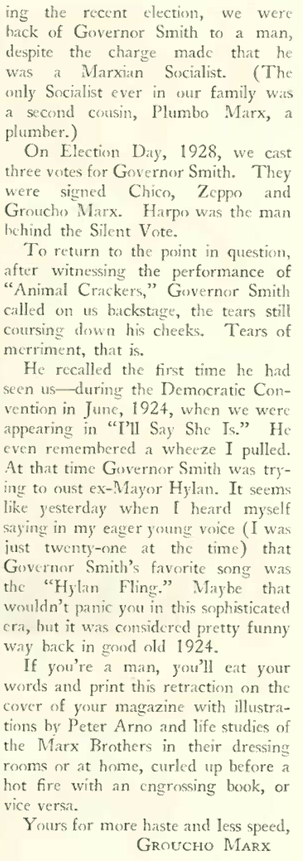
Grouchy Groucho
Near the back of the Feb. 2 issue (page 61), comedian Groucho Marx contributed this tongue-in-cheek demand for a retraction from the New Yorker editors:
WIT…A young Groucho Marx in 1930. (Wikipedia)
* * *
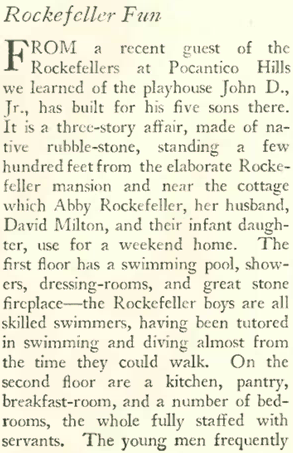
Fun With the Rockefellers
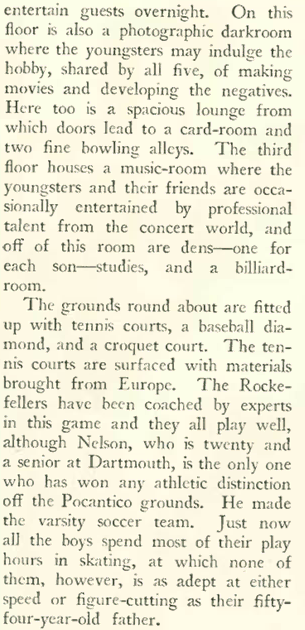
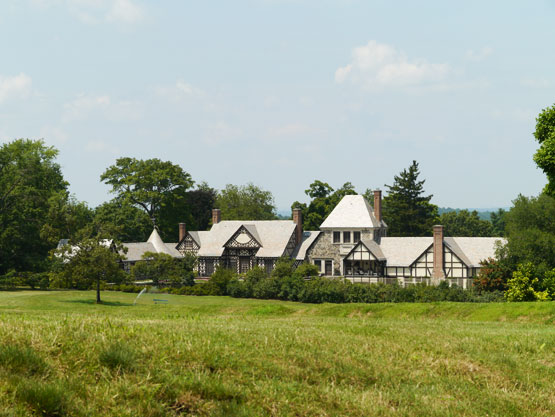
John K. Winkler contributed this piece to the Feb. 2, 1929 “Talk of the Town” that described a “playhouse” John D. Rockefeller Jr. had built for his five sons:
NOT FOR PEEWEE…The three-story playhouse on the Rockefeller estate at Pocantico Hills. (New York Social Diary)
* * *
From Our Advertisers
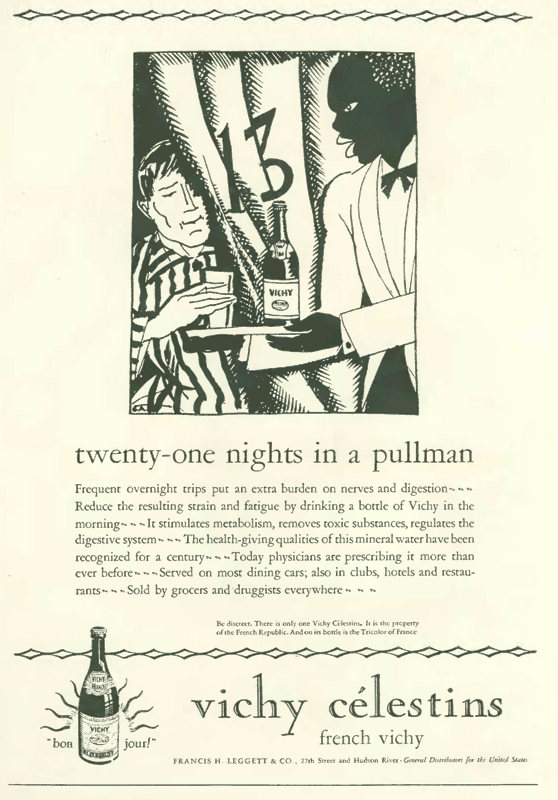
Heading to Palm Beach on a Pullman? Have too much of that bootleg gin the porter slipped you the night before? Then try…
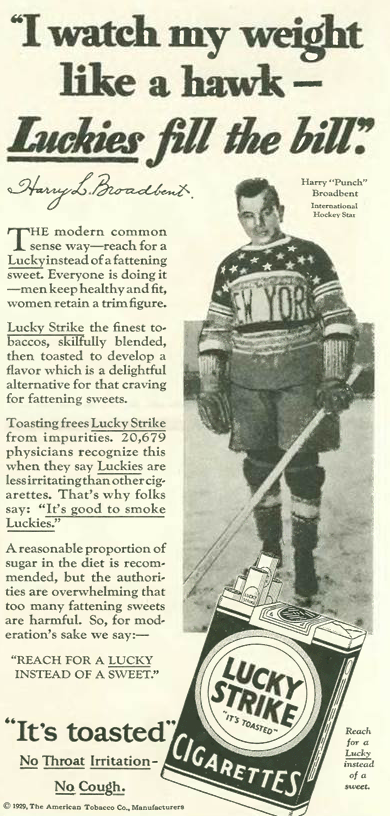
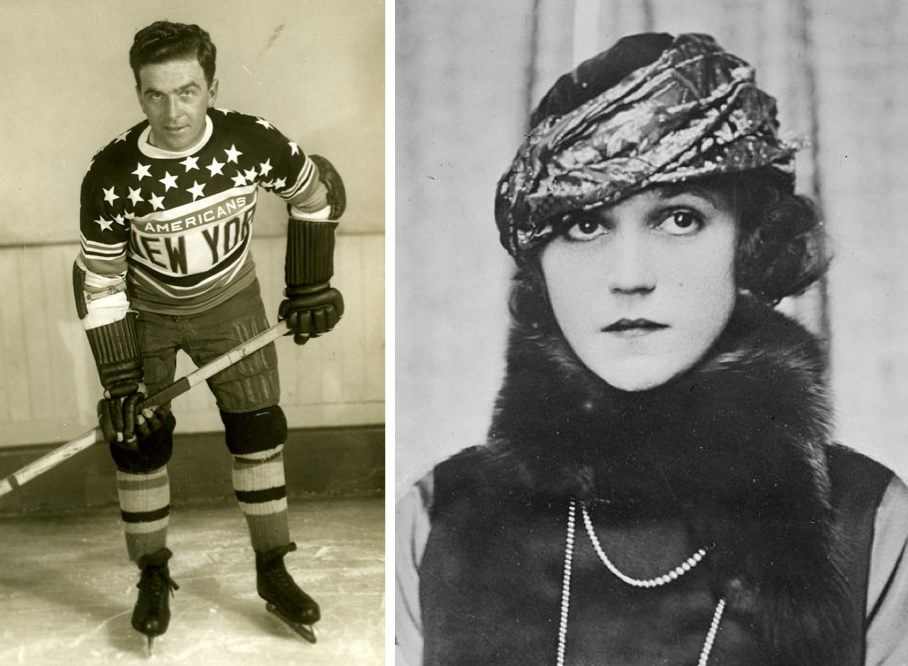
…perhaps you want to stay in shape, like this hockey star. Then grab a Lucky…
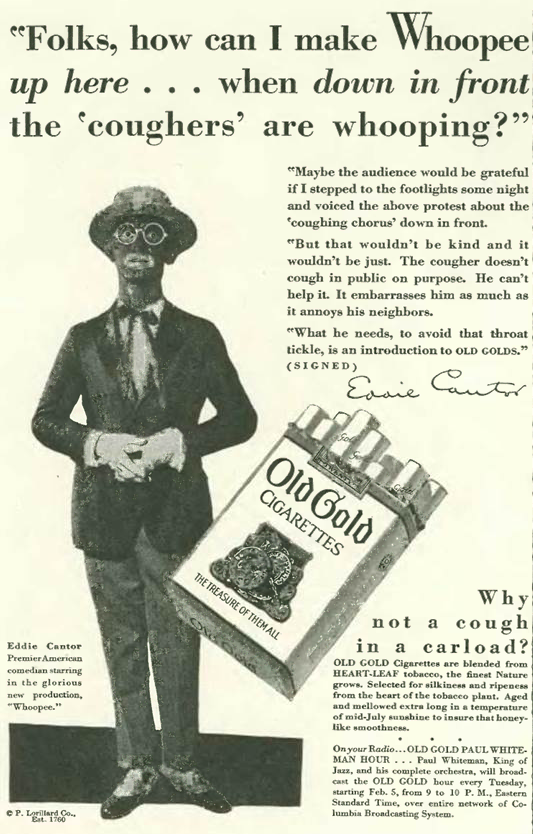
…or maybe you’d like to sing like Eddie Cantor, who soothed his throat with an Old Gold…
…and we close with these comic observations of life among New York society, again featuring the work of Peter Arno…
…and back to the cold New York City winter, with Leonard Dove …
Perhaps no decade was more transformative to New York City than the 1920s. From the loosening of social mores to countless technological advances, the city was a very different place as it entered the last year of the Roaring Twenties.
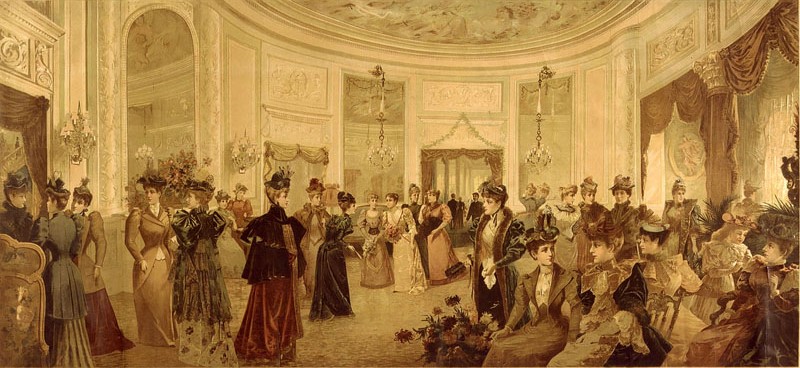
Jan. 5, 1929 cover by Sue Williams. Opening image depicts the original Waldorf Hotel’s Octagon Room in 1893.
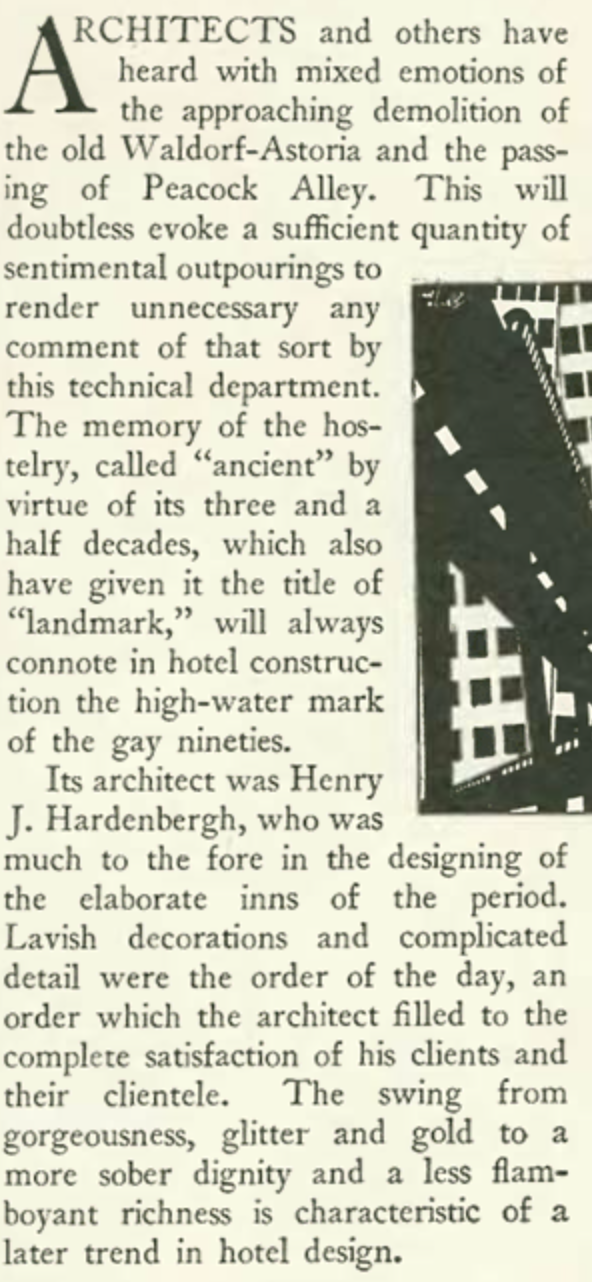
Vestiges of the 19th century were quickly erased during the decade as old neighborhoods and stately mansions gave way to massive apartment blocks and towering skyscrapers. Such was the fate of the original Waldorf-Astoria Hotel, its Victorian lavishness out of style in a streamlined age. Writing under the pen name T-Square, New Yorker architecture critic George S. Chappell commented on the planned demolition of the old* Waldorf-Astoria Hotel:
*Although outdated in appearance, the hotel was little more than 30 years old in 1929.
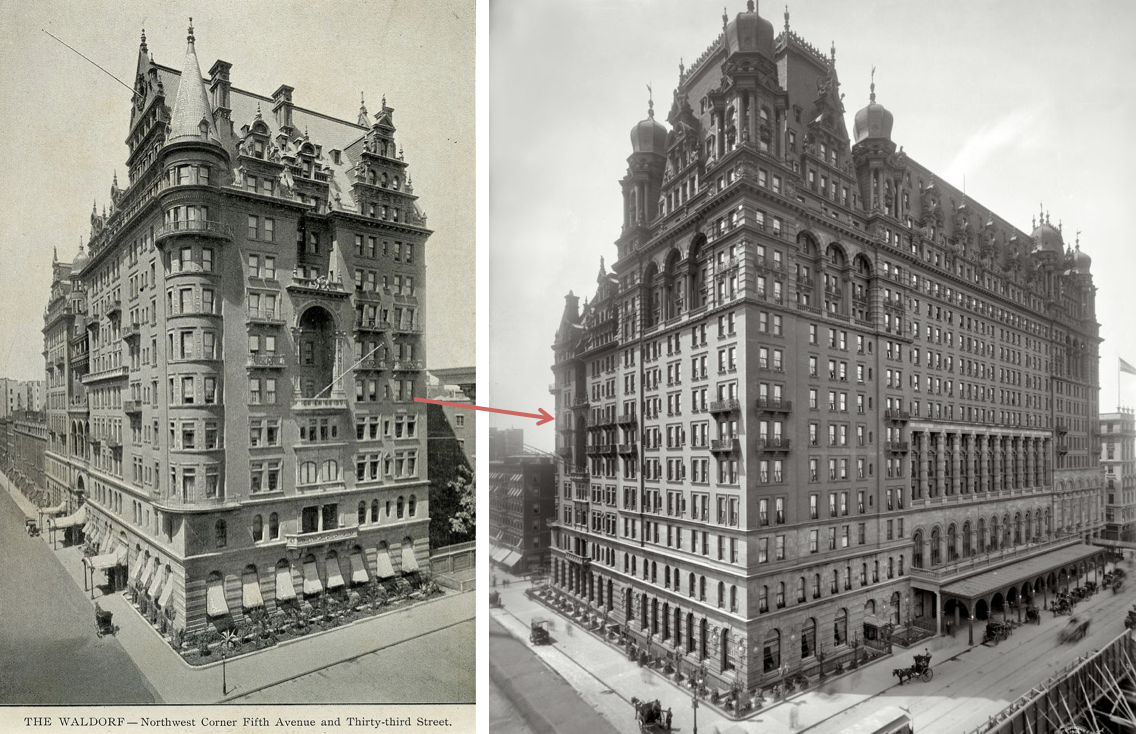
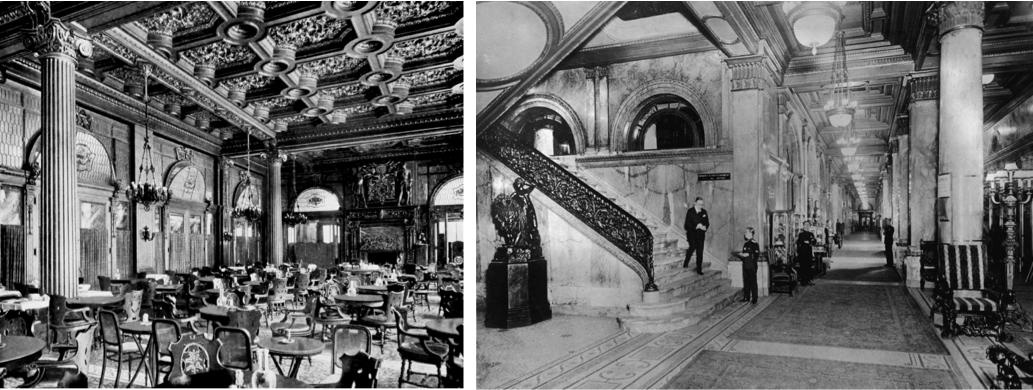
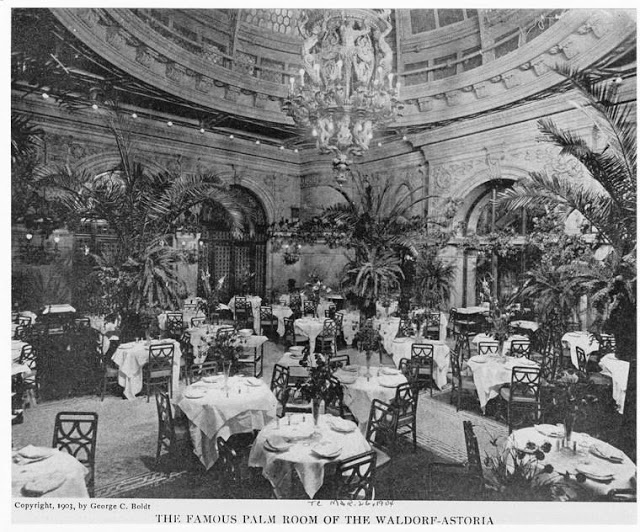
TALE OF TWO HOTELS…The Waldorf-Astoria was actually two hotels joined together. The Waldorf, at left, was built in 1893. The much larger Astoria (right) was constructed in 1897. Note the arrow indicating the original Waldorf in relation to the Astoria. (Wikipedia/Detroit Photography Archive)PLACES TO SEE AND BE SEEN…At left, the “Gentleman’s Cafe” in the Waldorf Hotel. At right, lobby entrance to the marble-lined “Peacock Alley” that connected the two hotels. (Wikipedia/justcocktails.com)DINE IN STYLE…The Palm Room in the Astoria section of the original Waldorf-Astoria Hotel. (New York Public Library)
Chappell wrote that the prime building site was slated to be occupied by a 50-story office building…
…but as it turned out, Floyd Brown was unable to make the final payments on the property, so he sold his claim to the bank. John J. Raskob, a wealthy finance executive and chair of the National Democratic Committee, joined with entrepreneur Pierre du Pont and former New York Governor Al Smith (who lost his bid for the U.S. Presidency in 1928) to buy the property. They had much bigger plans than Floyd Brown: In August 1929 they announced their plan to build the tallest building in the world — what would become the Empire State Building.
TRY, TRY AGAIN…The architecture firm Shreve & Lamb developed this concept (left) for Floyd Brown’s proposed 50-story office building on the site of the old Waldorf-Astoria. At right, what occupies the site today: the Empire State Building, also designed by Shreve & Lamb. (Pinterest/oldstructures.com)
* * *
Car Culture
The Jan. 5 issue featured a lengthy review of the 29th Annual National Automobile Show at Grand Central Palace, as well as numerous advertisements by auto manufacturers hoping to entice New Yorker readers with their latest models.
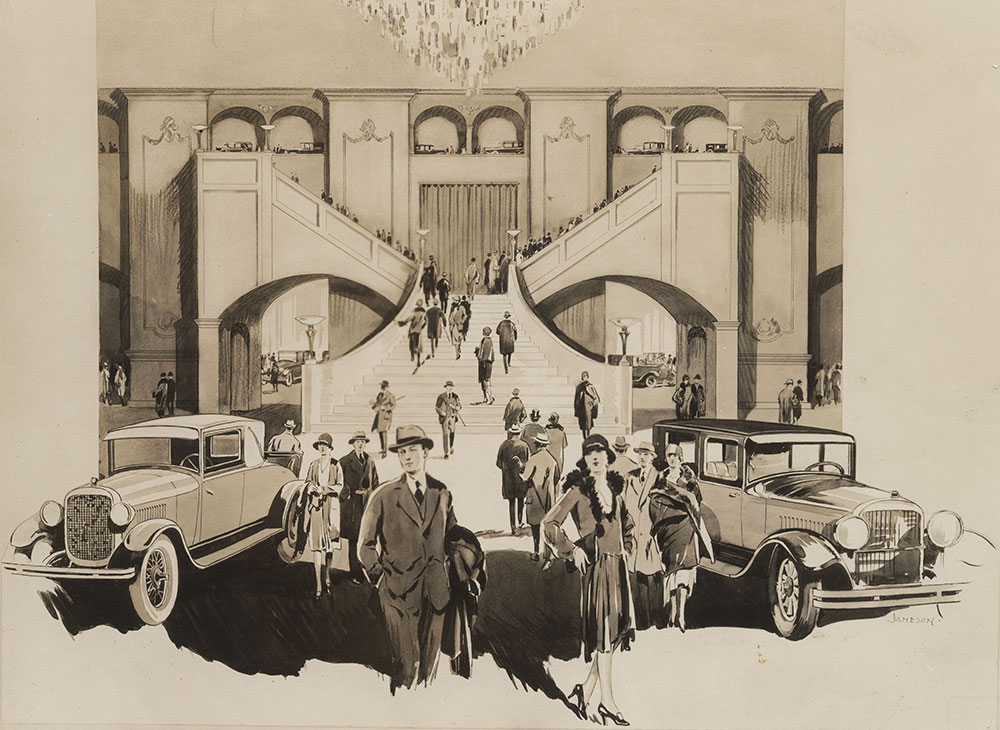
Promoters of the event touted the addition of a grand staircase to Grand Central’s mezzanine level that would ease access to both levels of the show:
AIN’T IT GRAND?…Design drawing created for the 1929 National Automobile Show at Grand Central Palace touting the addition of an equally grand new staircase. (Free Library of Philadelphia)How the new staircase actually appeared at the 1929 show. Note the background where the movement of workmen on ladders lends a ghostly appearance. (Free Library of Philadelphia)A view of the 1929 National Automobile Show from the mezzanine of the Grand Central Palace. (Free Library of Philadelphia)
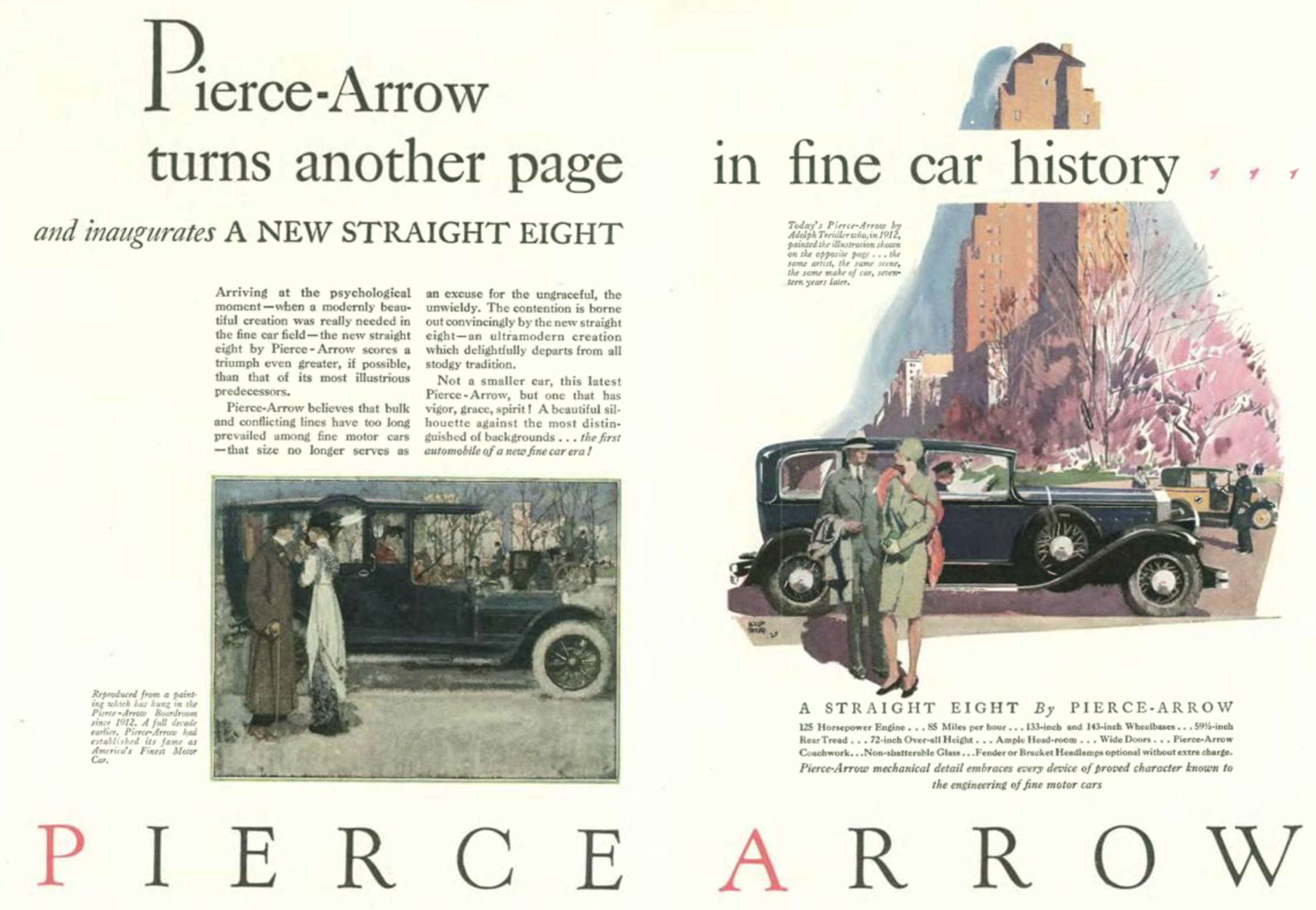
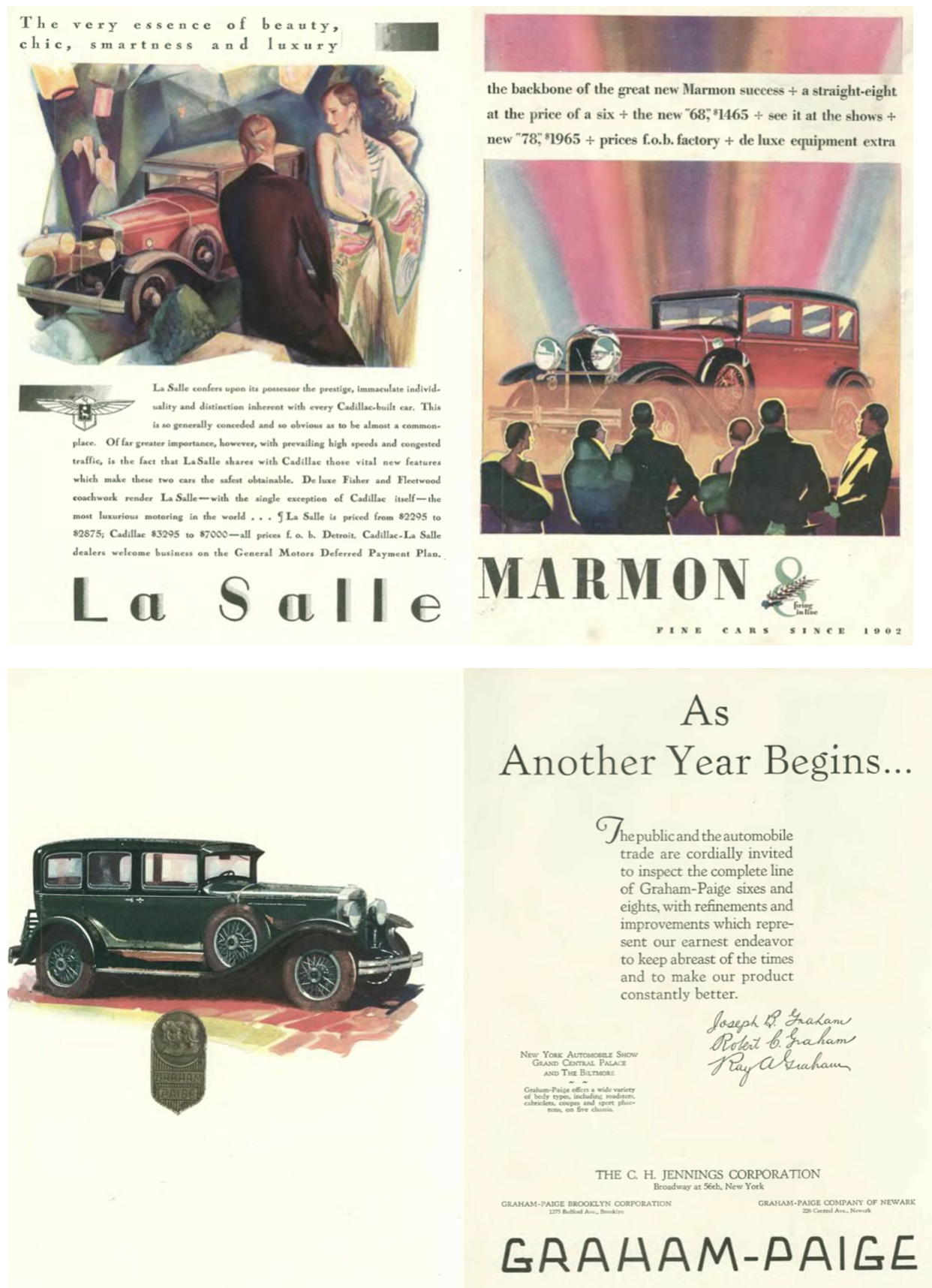
As I mentioned, the Jan. 5 issue was filled with car ads, mostly from long-gone automobile manufacturers. A constant in all of these ads is their appeal to New York’s chic, smart set. Here’s a sampling of a few of them: (click ads to enlarge):
Hupmobile was a successful car company that began its decline in the late 1920s precisely because it turned its back on buyers of medium-priced cars and went after what it perceived to be the more lucrative luxury buyer (see ad above). Hupmobile went out of business in 1939 (after briefly joining forces with Graham-Paige, which also went under that year).
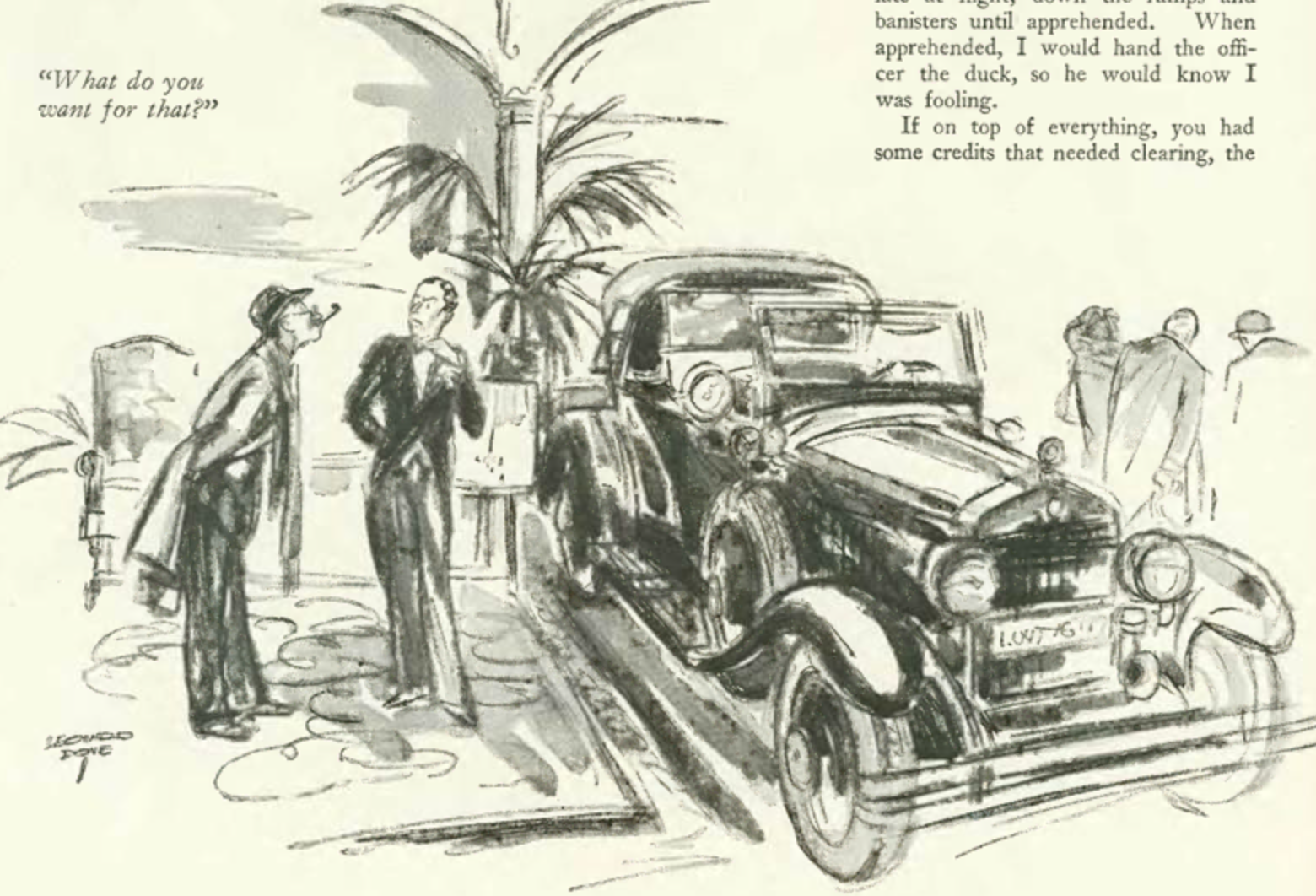
Cartoonist Leonard Dove found humor derived from these very class distinctions when he visited the auto show:
* * *
The Game, Served Up Cold
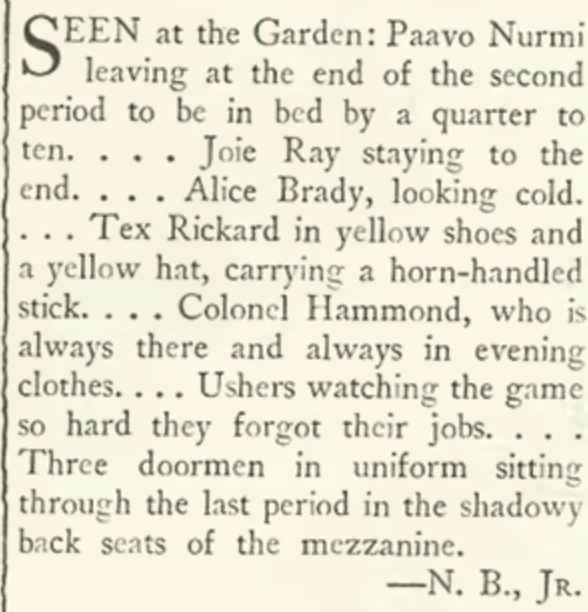
In other diversions from the Jan. 5 issue, Niven Busch Jr. attended the hockey game between the New York Rangers and the New York Americans at Madison Square Garden, noting famous faces in the crowd including Finnish track star Paavo Nurmi and American track star Joie Ray. Also noted were Tex Rickard, builder of Madison Square and founder of the Rangers, ex-football star and businessman Col. Harry Hammond, and film star Alice Brady.
AT THE GARDEN…Not even the exciting hockey play of Billy Boyd (left) and his fellow New York Americans could keep actress Alice Brady warm. (Pinterest/Alchetron)
* * *
From our non-automobile advertisers, another installment of a Theodore Geisel (Dr. Seuss) ad for Flit insecticide (this is the first instance — at least in the Flit ads— in which Geisel signs his art as “Dr. S” instead of “Seuss”).
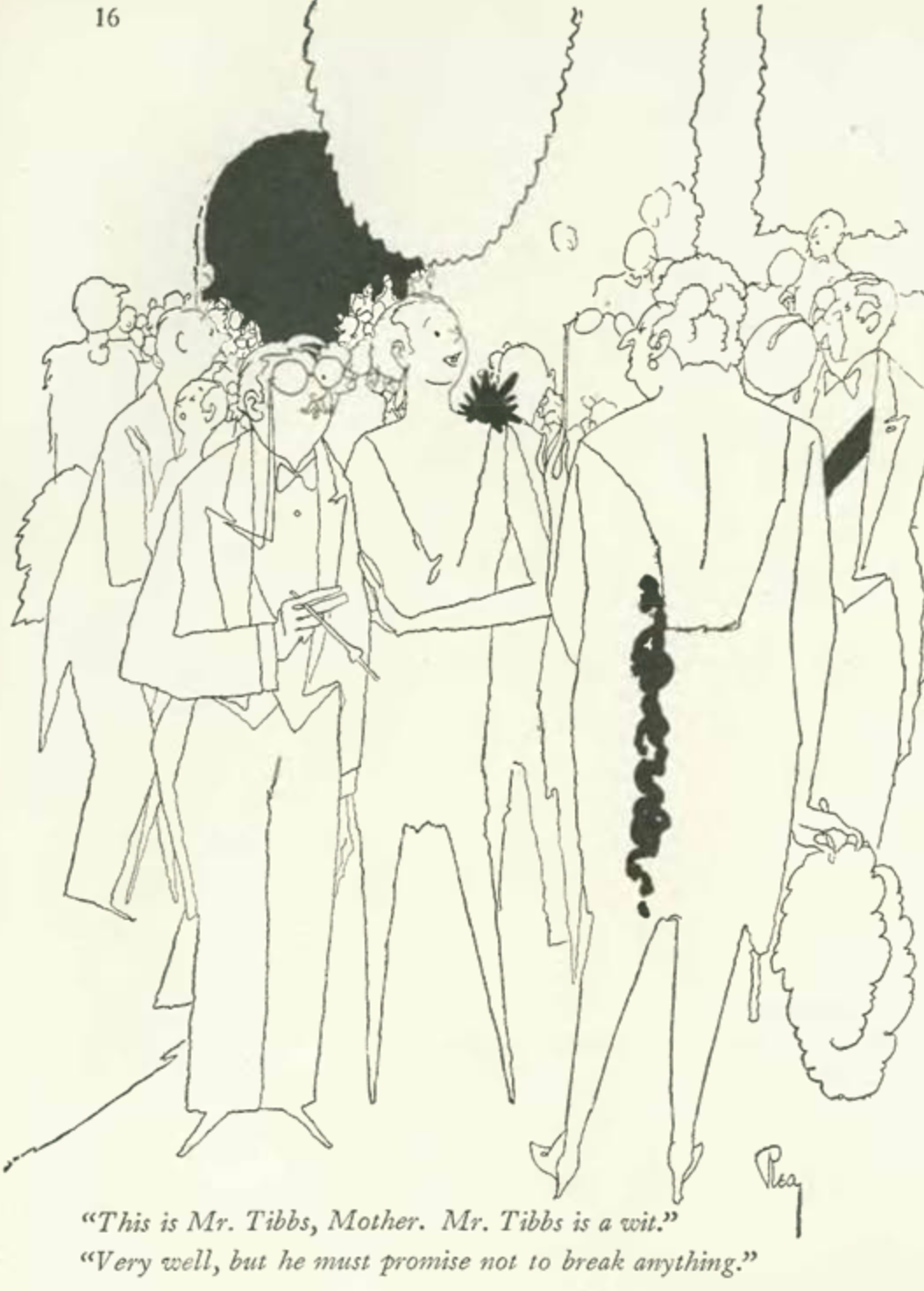
And another cartoon from the Jan. 5 issue, courtesy Gardner Rea:
* * *
Arno Addendum
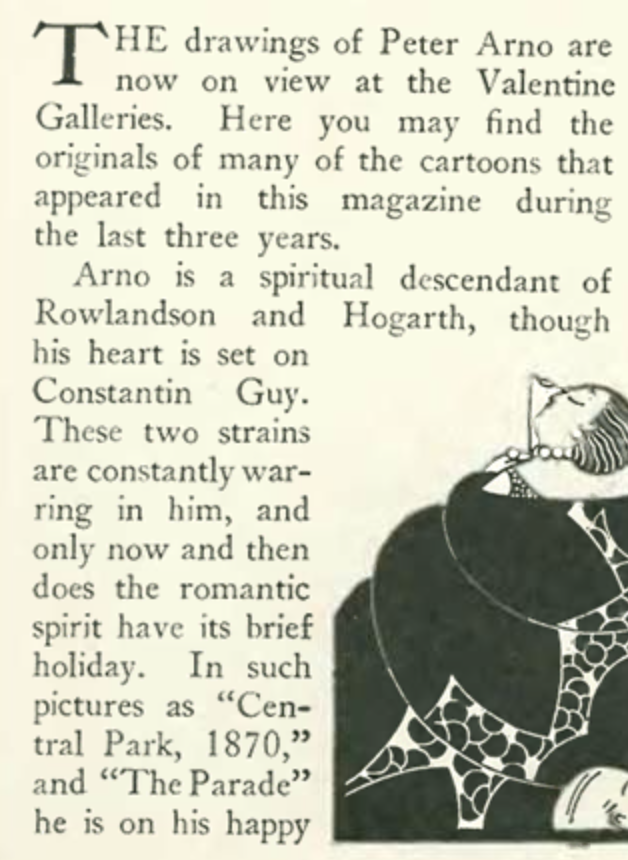
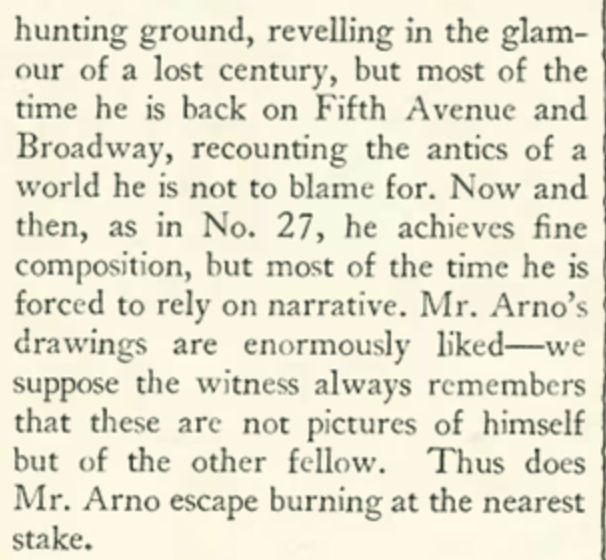
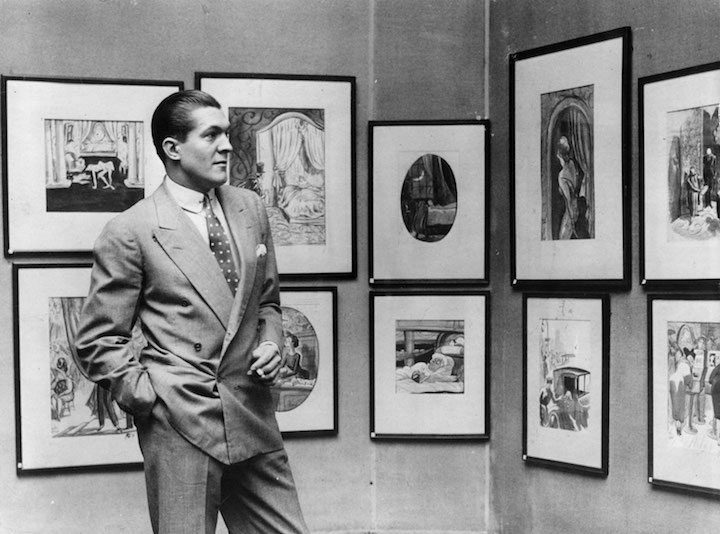
In the rush of the recent holidays I missed an item from the Dec. 22, 1928 issue — namely, art critic Murdock Pemberton’s tongue cheek review (in “The Art Galleries” column) of cartoonist Peter Arno’s December 1928 exhibition of drawings at the Valentine Gallery:
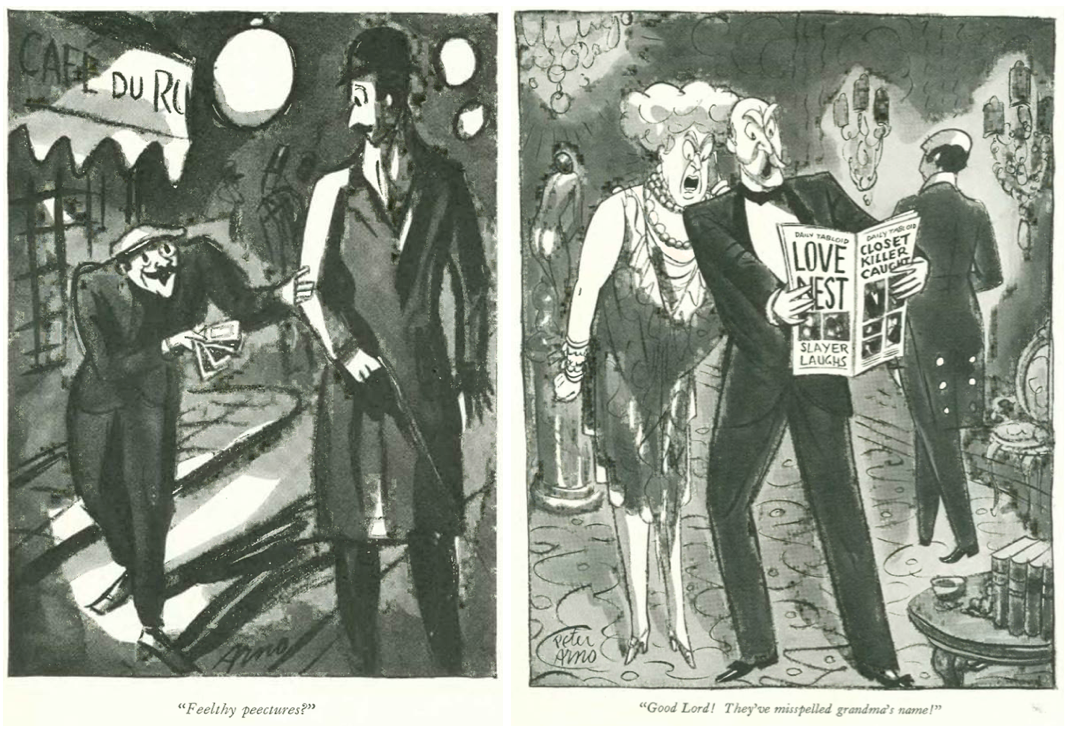
Here are two Arno drawings that were featured in the Valentine exhibition (click to enlarge):
INTERNATIONAL APPEAL…less than four years after his Valentine Galleries debut, Peter Arno exhibited his drawings to great acclaim at the Leicester Galleries in London, October 1932. (Encyclopædia Britannica)
Although the Roaring Twenties saw the relaxing of many moral strictures — particularly in major cities like New York — Mae West’s frank portrayals of sex on an off-Broadway stage could still create a stir in the newspapers and among arbiters of American probity.
Nov. 19, 1928 cover by Theodore G. Haupt.
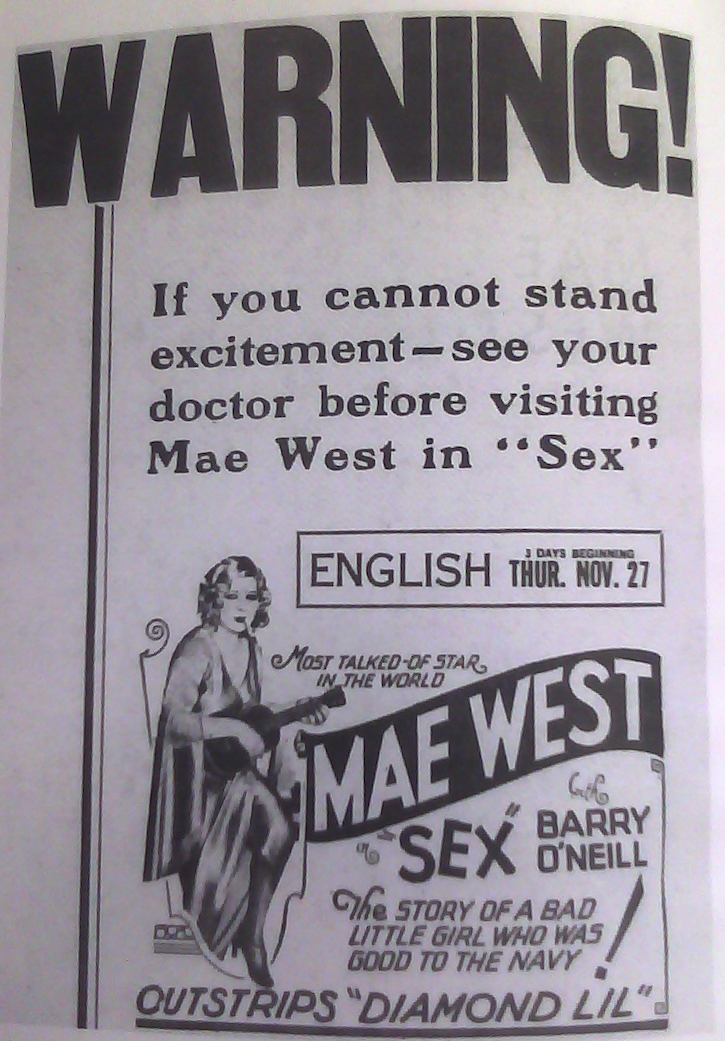
Before she appeared in films (mostly in the 1930s) Mae West was well known to New Yorkers both in vaudeville and on Broadway. Her wider fame came in 1927, when many Americans read about her arrest on obscenity charges linked to a scandalous play simply titled Sex. A story of a Montreal prostitute, Sex opened at Daly’s 63rd Street Theatre on April 1926 to modest audiences and mostly scathing reviews. The New York Times, for example, called it a “crude and inept play, cheaply produced and poorly acted.” Perhaps because of the negative reviews, which mostly focused on the play’s morality, curious audiences flocked to see it. Ironically (at least, I imagine, to the critics), Sex was the only play on Broadway in 1926 to stay open through the summer and into the following year.
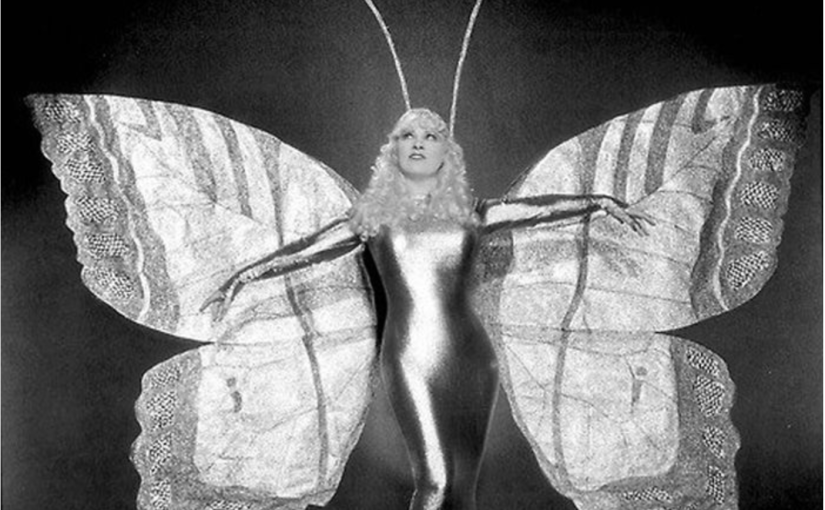
NOW THAT I HAVE YOUR ATTENTION…Mae West in a publicity photo from 1926. At right, promotional poster for Sex, which touted the play as the “Biggest Sensation Since The Armistice.” (maewest.blogspot.com/boweryboyshistory.com)
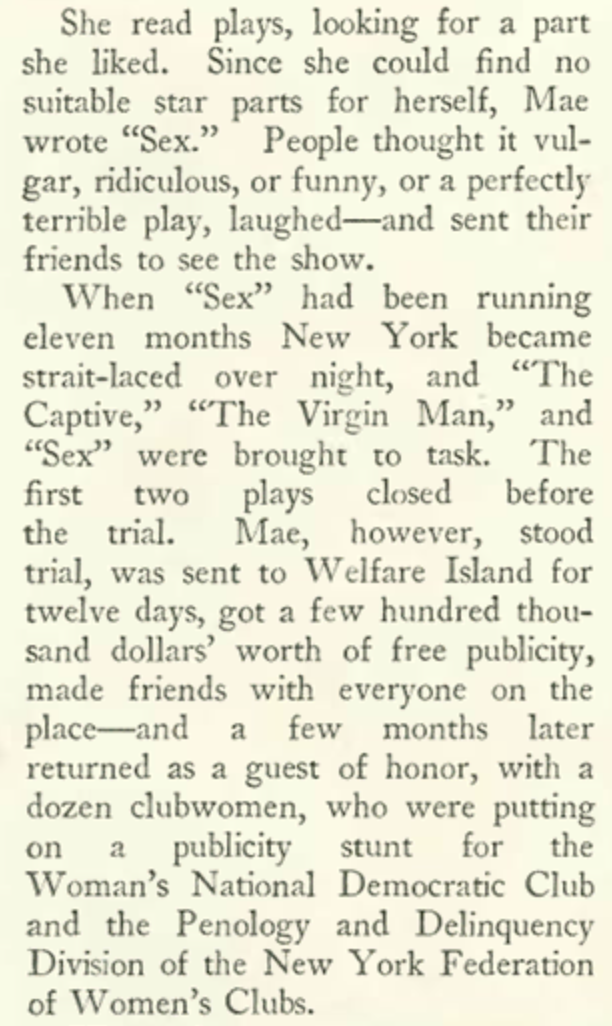
The fun ended when New York City police raided West’s production company in February 1927 and charged her with obscenity. In another ironic and hypocritical twist (many in the police department and in the city’s court system had enjoyed the play themselves, along with approximately 325,000 others during the play’s 10-month run), authorities fined West $500 and sentenced her to ten days in a workhouse on Welfare Island. Always the entrepreneur, West used the sentence to her advantage, and even arrived at the prison in a limousine. It was during her short stint in prison that she began work on her smash hit Diamond Lil.
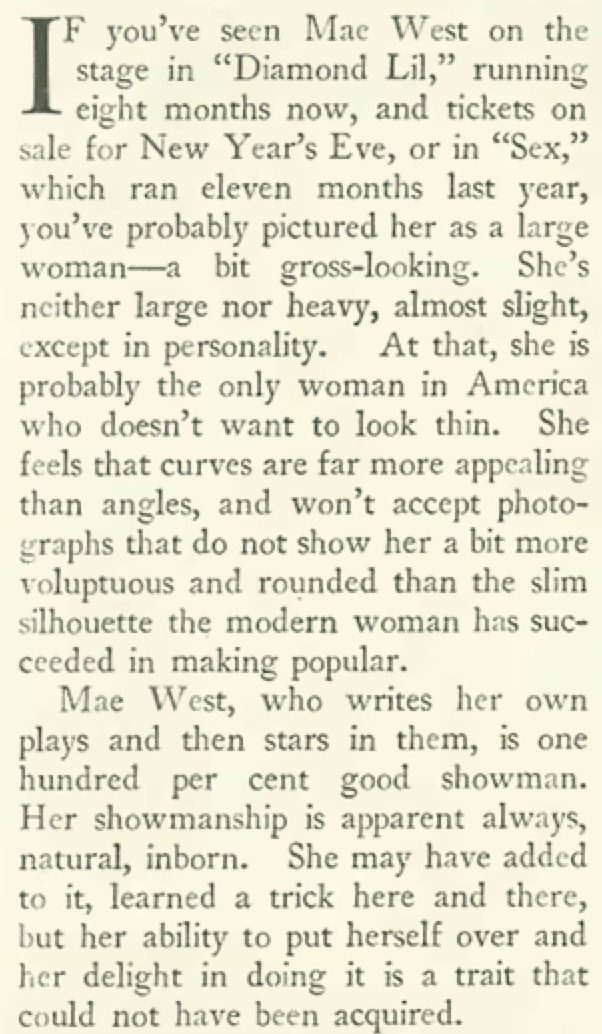
Thyra Samter Winslow, a writer who often exposed the hypocrisy and prejudice in American life in her short fiction, profiled West for the Nov. 10, 1928 issue:
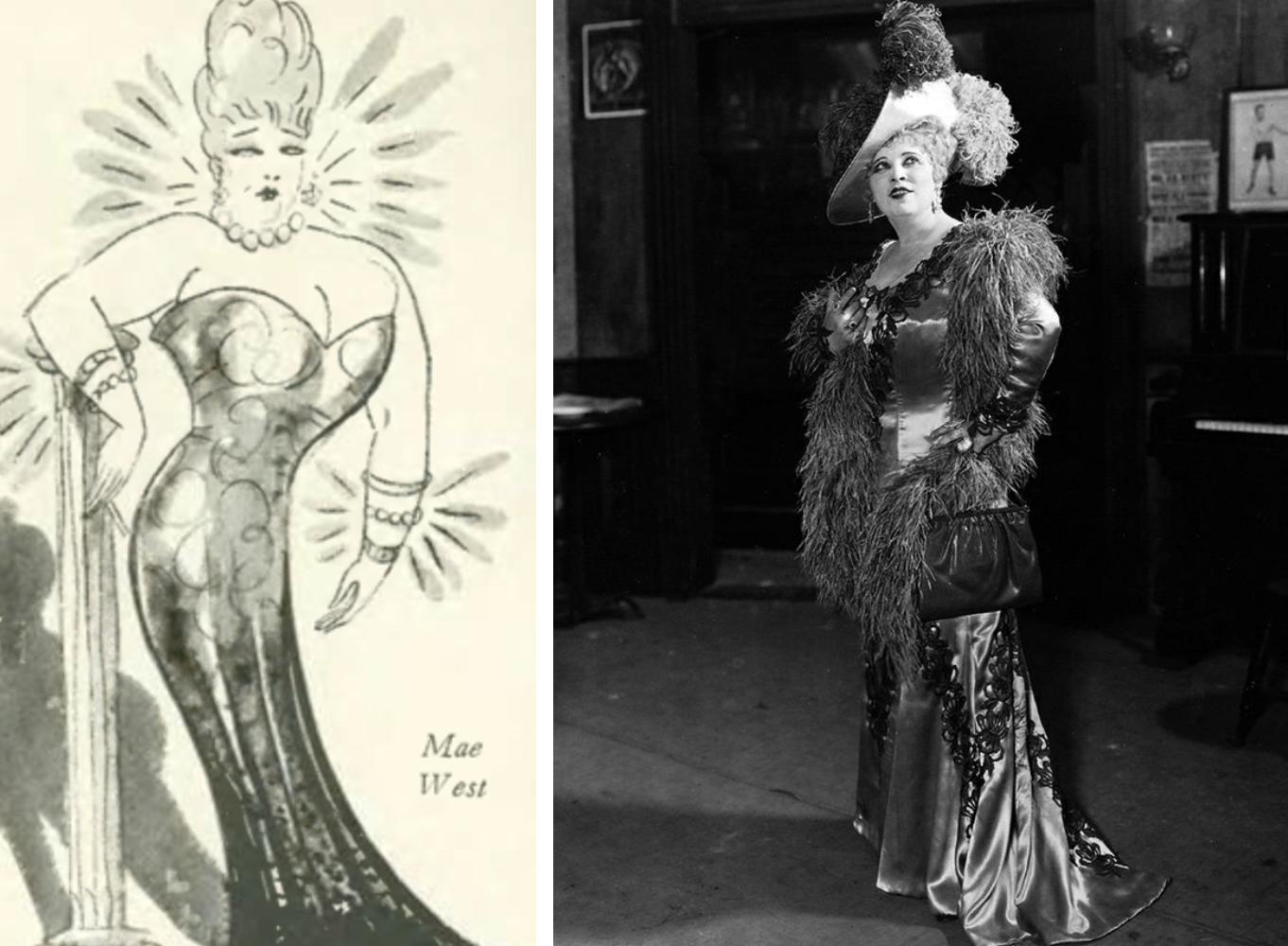
Note Winslow’s surprise to find West to be much smaller than she imagined (indeed, West barely stood five feet tall). Because West preferred a curvy, buxom figure to the thin flapper look, many like Winslow assumed her to be a much larger woman. No doubt her lavish costumes also suggested greater proportions:
West explained to Winslow that she was simply giving the people what they wanted, whether it was outlandish costumes or some “dirt” in their entertainments. Behind this facade, however, was a private, hard-working woman who wrote much of her own material and had the savvy to market it.
BE STILL MY HEART…Page from a 1926 Playbill. (New York Public Library, Shubert Archive)
In her profile, Winslow noted West’s marketing savvy during her incarceration, where she won many new friends along the way:
Winslow concluded her piece wondering if West had peaked in her success, and would “fade out” along with so many other vaudeville stars…
…. In less than seven years, West at age 42 would become Hollywood’s highest paid star and second only to William Randolph Hearst as the highest paid person in America. Ninety-two years after Sex, West remains an icon of popular culture around the world.
ALL THAT GLITTERS…Drawing of Mae West that accompanied the New Yorker profile. At right, publicity photo for Diamond Lil, 1928. (Playbill)
* * *
From Our Advertisers
The Nov. 10 issue featured this all American endorsement for Lucky Strike cigarettes from World Series winning pitcher Waite Hoyt…never mind that TheNew Yorker itself completely ignored the World Series and baseball in general.
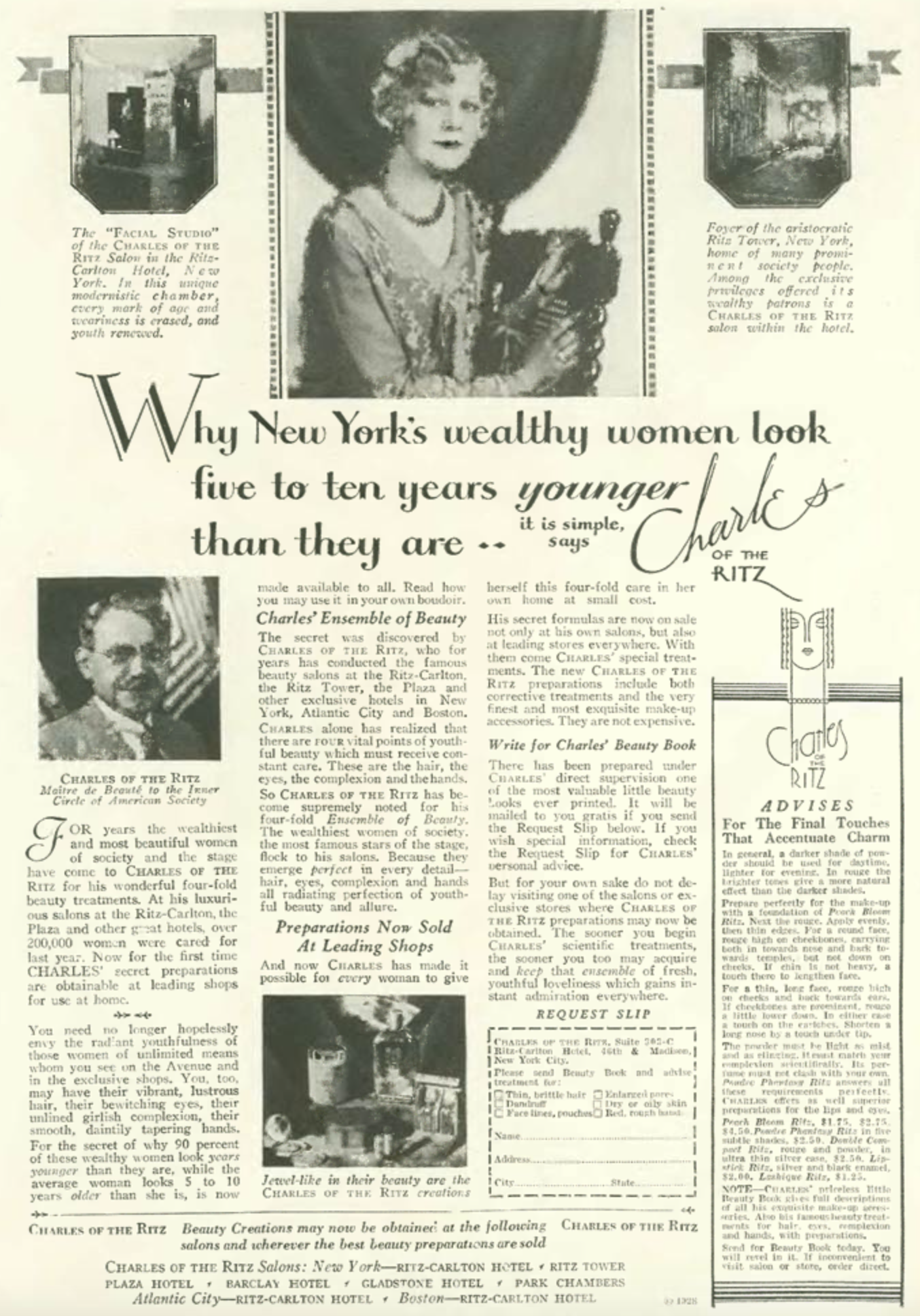
…and Charles of the Ritz used a combination of vanity, snob appeal and class anxiety to promote their latest beauty ensemble…
The comics glimpsed the foibles of the upper classes, including this terrific entry by 22-year-old Ben Hur Baz, a Mexico-born artist who would go on to become famous for his pin-ups in the 1940s and 50s, many of them appearing in Esquire:
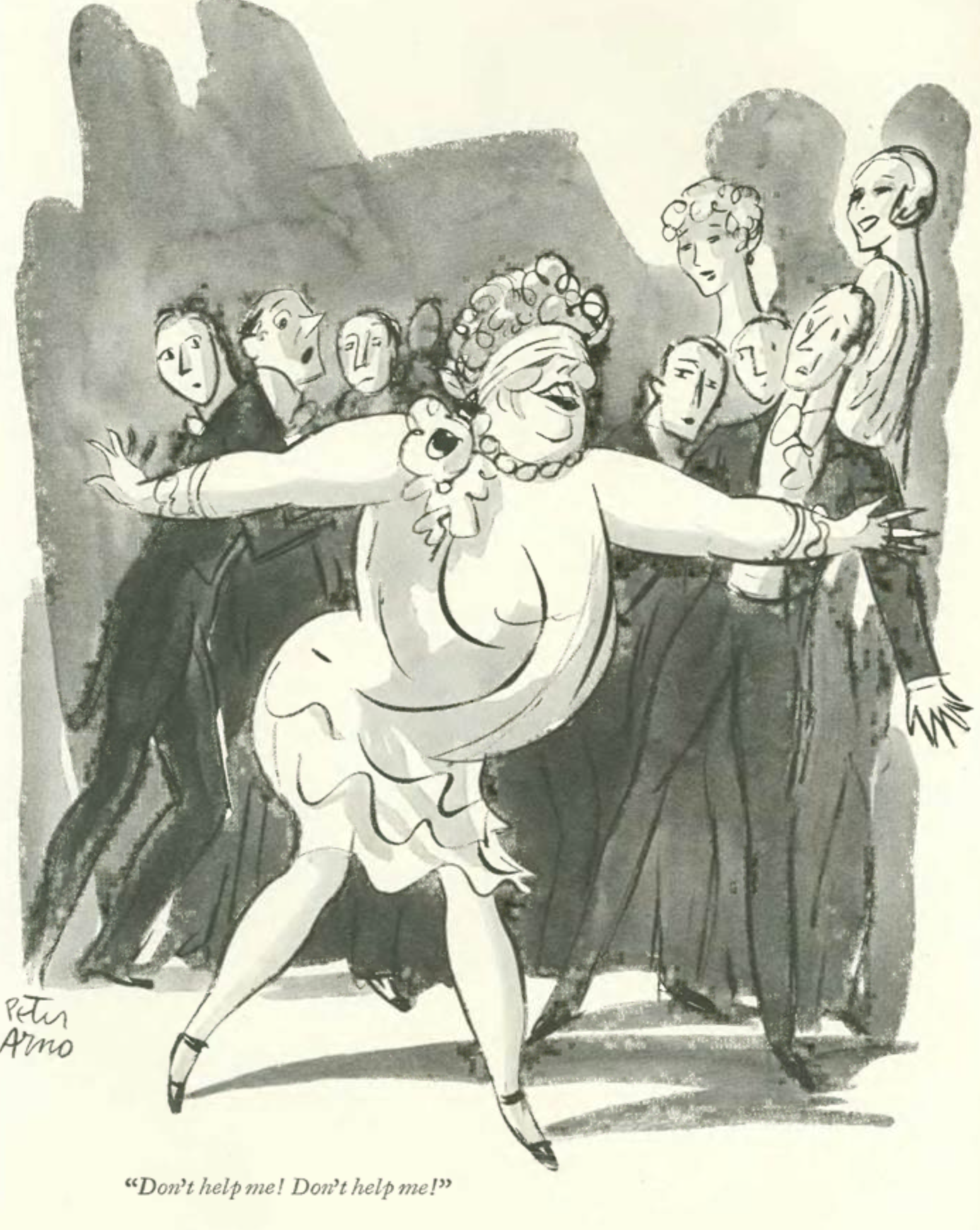
…and a game of blind man’s bluff (or some say ‘buff’) as rendered by Peter Arno:
* * *
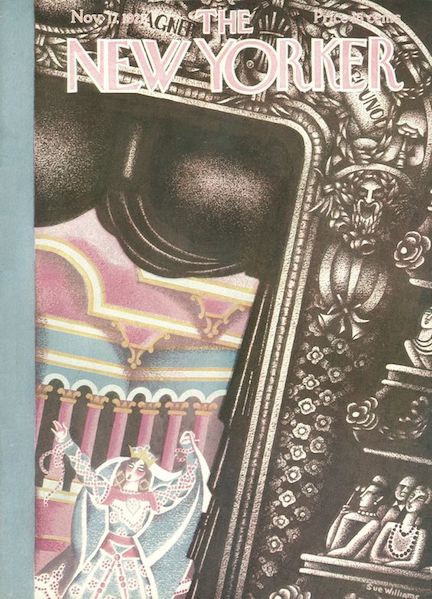
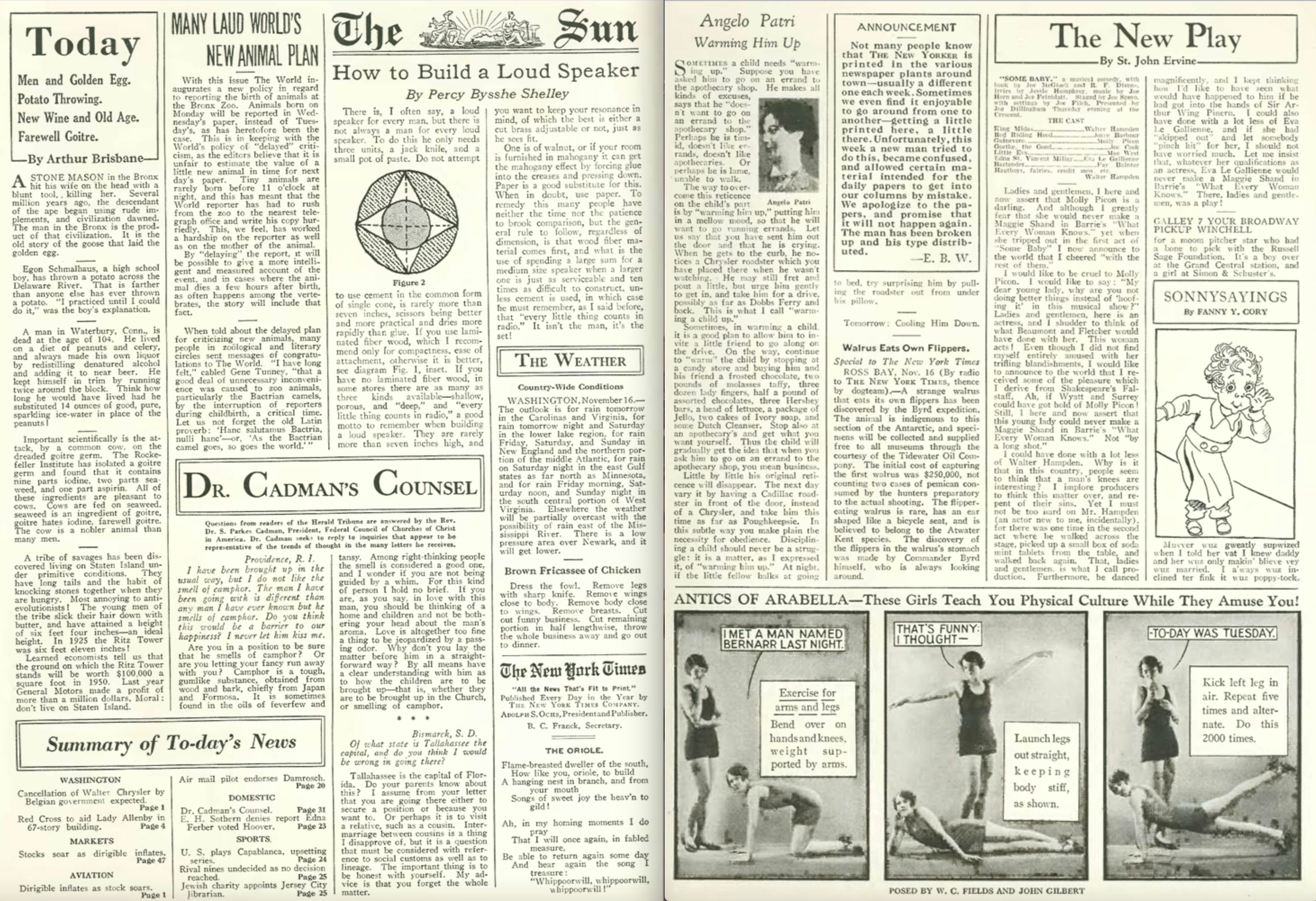
The Nov. 17 issue featured an unusual entry by E.B. White, who, like many of his New Yorker colleagues, found many reasons to be critical of the media, including the dumbing down of newspapers that increasingly favored trivia, sensation and promotion over serious discourse.
Nov. 17, 1928 cover by Sue Williams.
White skewered the news of the day in this two-page spread that parodied the look and language of contemporary newspapers (click to enlarge):
* * *
The issue’s “Talk of the Town” featured a lengthy entry on Notre Dame football coach Knute Rockne, a figure greatly admired and generally lauded by the magazine’s sportswriters. A brief excerpt:
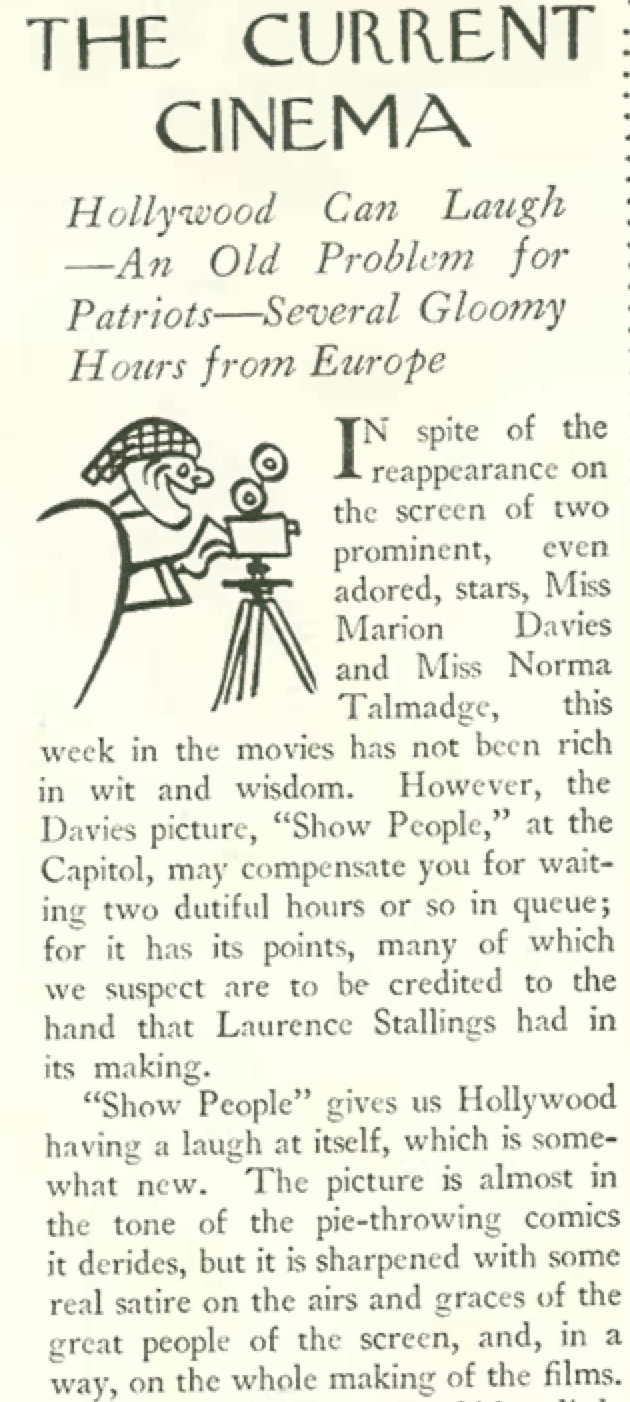
The Nov. 17 film reviews gave a rare thumbs up to an American movie, Show People, which starred Marion Davies.
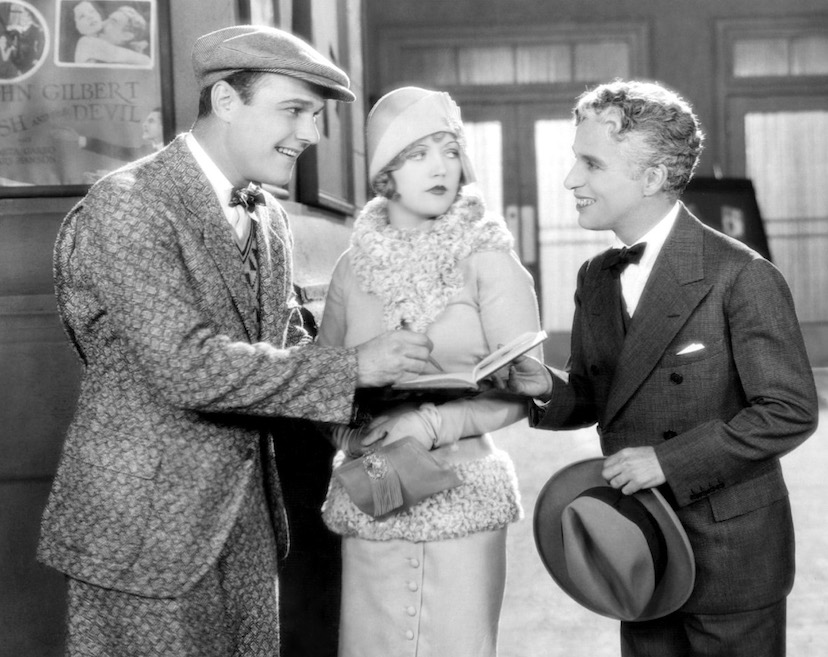
HE LOOKS FAMILIAR…William Haines (left) and Marion Davies meet Charlie Chaplin in the 1928 Hollywood send-up film, Show People, directed by King Vidor. Chaplin made this rare appearance as himself, without his “Little Tramp” makeup. He was uncredited in the film, and asked to be paid the extra’s fee of only $7.50. (silent-volume.blogspot.com)
* * *
From Our Advertisers
Although you couldn’t legally procure a drink in 1928, you could (unlike today) legally purchase of box of Cuban cigars for you special someone:
…or if you preferred, a carton Chesterfields. Apparently someone in marketing thought conjuring up the horrors of trench warfare would help sell some smokes…
And finally, Peter Arno found out what’s for dinner at the table of a great outdoorsman:
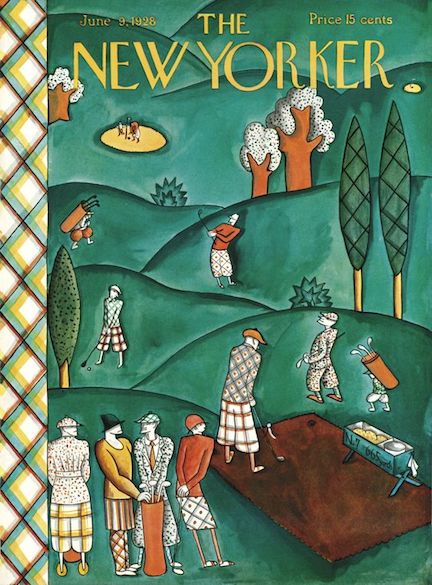
New Yorker writers in the 1920s by and large displayed a resistance to popular enthusiasms when they looked around at the changing the world, but when it came to advancements in aviation, they tended to drop the casual pose and get all dreamy-eyed.
June 2, 1928 cover by Sue Williams.
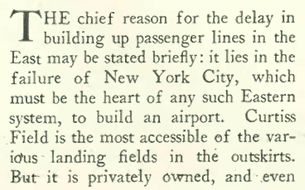
Such was the case with even a clear-headed writer like Morris Markey, who in his “A Reporter at Large” column looked at our progress in aviation. Public interest in air travel grew dramatically after Charles Lindbergh’s 1927 Atlantic crossing, as did the expansion of air mail and passenger service and the growth of private plane ownership. As Markey noted in this opening paragraph, for all the advances in American aviation, the Europeans were well ahead in establishing regular passenger service, as it had become “commonplace”:
FORERUNNER…In 1920s the Boeing Model 40 served as a U.S. mail plane. The single-engined biplane was also the first aircraft built by the Boeing company to carry passengers. Note the pilot was still seated in the open air, behind the passenger compartment. Many early pilots were unhappy when the next generation of planes forced them into an enclosed cockpit. (Boeing)
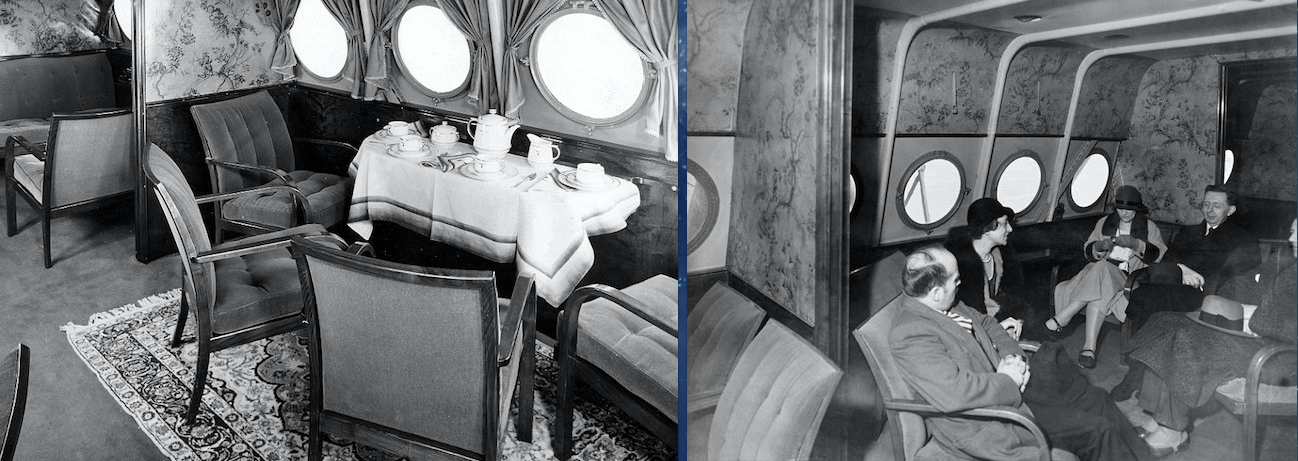
To get some sense of European (and specifically German) aviation superiority, look no further than the Dornier Do-X, a massive seaplane developed by the Germans in the mid-1920s that began regular passenger service in July 1929. While America’s biggest planes could carry 12 to 18 passengers, the spacious and luxurious Do-X could comfortably seat 70 to 100 passengers and included a dining salon, smoking lounge and wet bar. A few months after its first flight the Do-X broke a world record by carrying 169 passengers—astonishing when one considers only 25 years had passed since the Wright Brothers at Kitty Hawk.
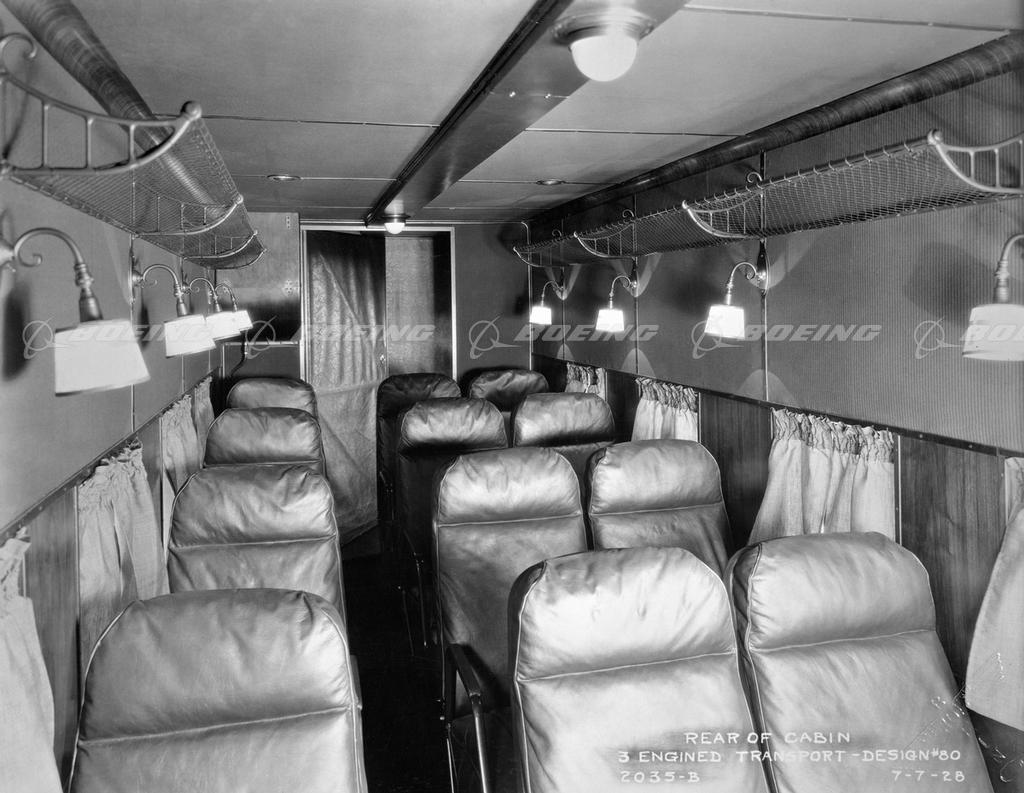
BEHEMOTH…169 people flew aboard the Dornier Do-X on October 21, 1929. The plane’s hull was made of aluminum, but the sides were made of heavy duty linen cloth coated with aluminum paint. (Ullstein Bild)MAKING HISTORY…Excited passengers—169 of them—await take-off on October 21, 1929. Powered by a dozen engines, take-off weight for the Do-X was more than 61 tons. Note the crew members atop the craft manually turning the propellers—all 12 of them—to circulate the oil in the engines prior to take-off. (Ullstein Bild)LEGROOM NOT OPTIONAL…The dining salon (left) and a passenger compartment in the Dornier Do-X. (Ullstein Bild)MODEST, BUT NICE…Over in America, the 1928 Boeing Model 80 carried passengers in a spacious cabin appointed with leather upholstery, reading lamps, forced-air ventilation, and hot and cold running water. The first version carried 12 people, and it was followed by a larger, 18-passenger Model 80A, which made its first flight on Sept. 12, 1929. The plane’s fuselage was made of welded-steel tubing covered with fabric, and its wooden wingtips were removable so the airplane could fit into the primitive hangars along its route. (Boeing)COZY…Interior of the Boeing Model 80. Ellen Church, a registered nurse, convinced Boeing managers that women could work as stewards, so nurses serving aboard the Model 80A became aviation’s first female flight attendants. (Boeing)
Markey noted the growing interest in commuter flights among business executives. What seemed like a high demand to Markey was an average of three commuter flights a day.
Markey also lamented New York’s lag in building up passenger service, especially when air travel was growing leaps and bounds in the Midwest and West, and especially in rival Chicago:
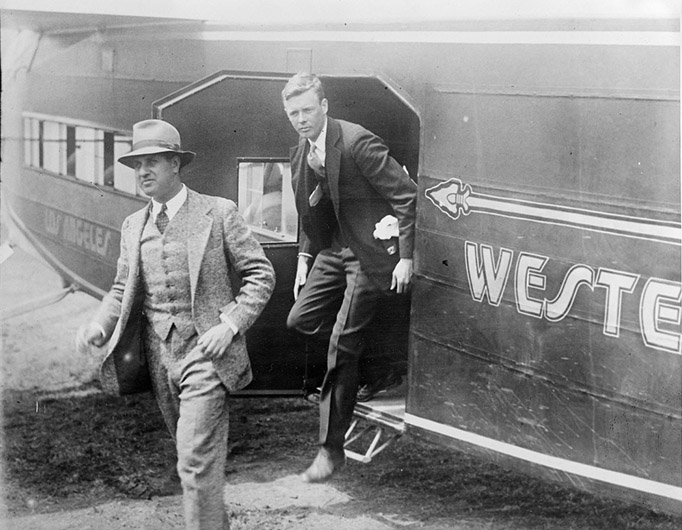
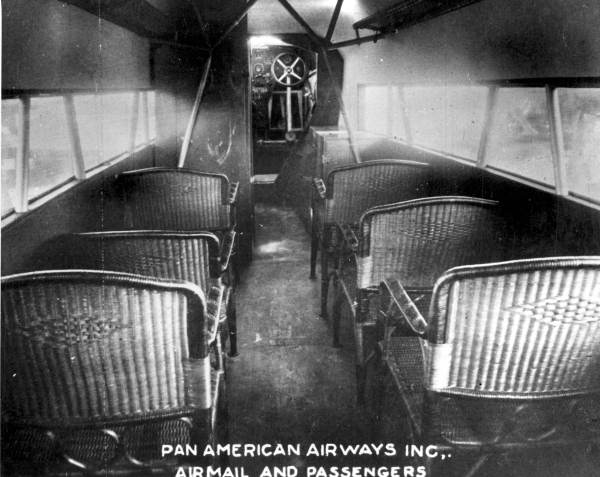
BIRTH OF TWA…Harry Guggenheim and Charles Lindbergh step off a Western Air Express Fokker F-10 in 1928. Diplomat, publisher and philanthropist, Guggenheim provided funding to mail carrier Western Air Express in 1927 in an effort to create a “model airline” that was safe, dependable and economically feasible. By 1930 Western was the nation’s largest airline. It was short-lived, however; in 1930 Postmaster General William Folger Brown forced it to merge with Transcontinental Air Transport, creating Transcontinental and Western Airlines, or TWA. (Boston Public Library)NO TSA LINES HERE…Passengers board a Western Air Express Fokker F-10 in the late 1920s. The Fokker F-10 was called “The Queen of the Model Airline,” but it fell out of favor after a much-publicized March 31, 1931 crash in Kansas that killed eight people, including football coaching legend Knute Rockne. (birthofaviation.org)NO FRILLS…Passenger compartment of a Fokker F-10. (birthofaviation.org)HERE’S LUCY…Actress Lucille Ball was all smiles after a flight on a Western Air Express Fokker F-10. (birthofaviation.org)
Markey also noted the modest number of planes in private hands, but expected private ownership to increase dramatically in the coming months:
TIN GOOSE…Henry Ford briefly got into the aviation business with his company’s popular Ford Trimotor. Dubbed the “Tin Goose,” it was the first all-metal, multi-engine transport in the United States and the first plane designed primarily to carry passengers (12) rather than mail. It was the first plane to be used for transcontinental passenger service, as well as the first plane to fly over the South Pole. The Great Depression would end the plane’s short but successful run—a total of 199 were produced. (birthofaviation.org)BE YOUR OWN LINDBERGH…Looking for your own set of wings? The 1929 Cessna Model AW was just around the corner. (airpigz.squarespace.com)
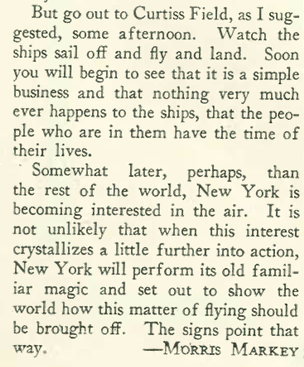
Although Markey lamented the slow growth of New York aviation, he was nevertheless dazzled by the “ships” taking to the skies at Curtiss Field.
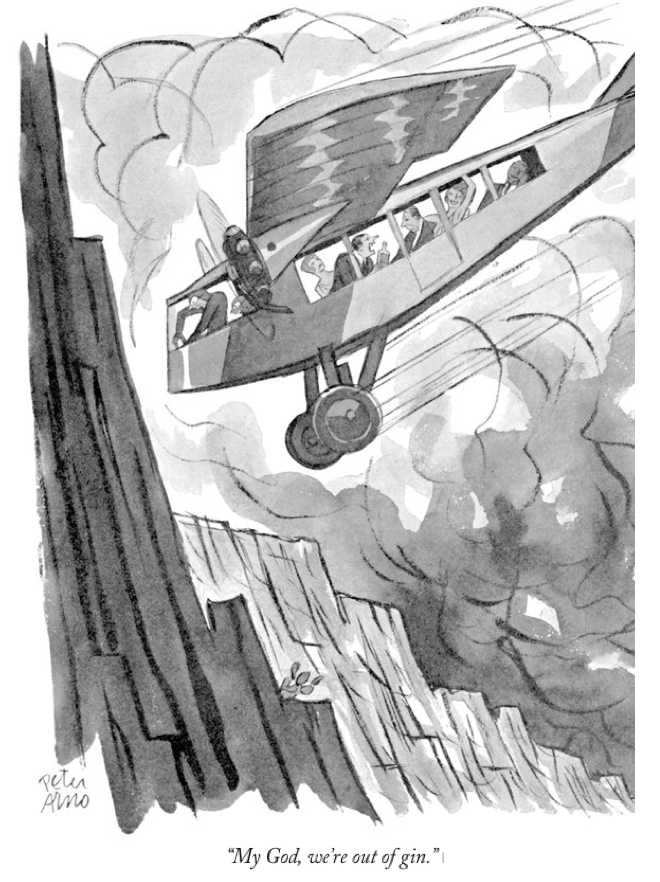
Jumping ahead a couple of years, New Yorker cartoonist Peter Arno offered this view of passenger flight (in a Fokker F-10), the passengers in this case a bunch of silly toffs (April 12, 1930).
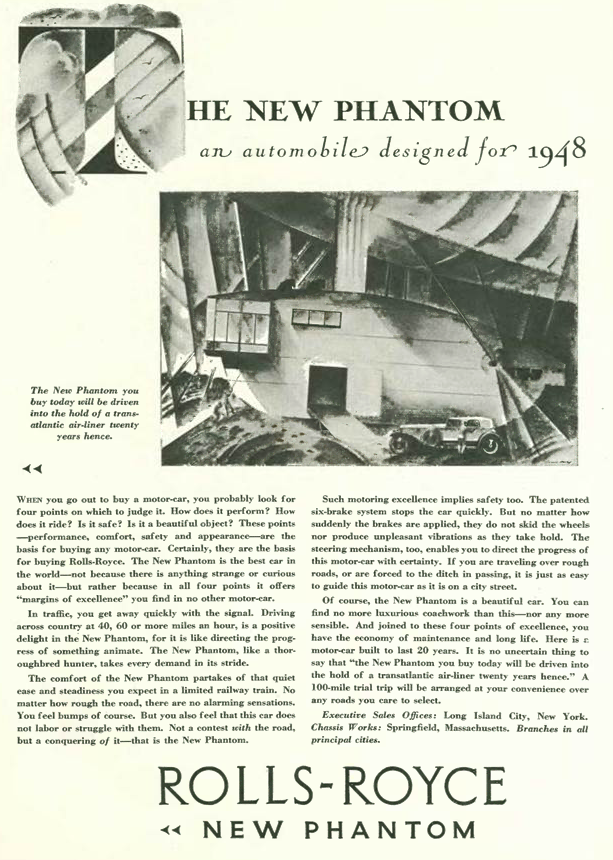
And back to the June 2, 1928 issue, we find this ad for Rolls Royce that offered a vision of a future airliner—in the year 1948. Since the artist had no clue what the future would hold, he conjured up this contraption that looked like a streamlined Noah’s Ark attached to a huge zeppelin.
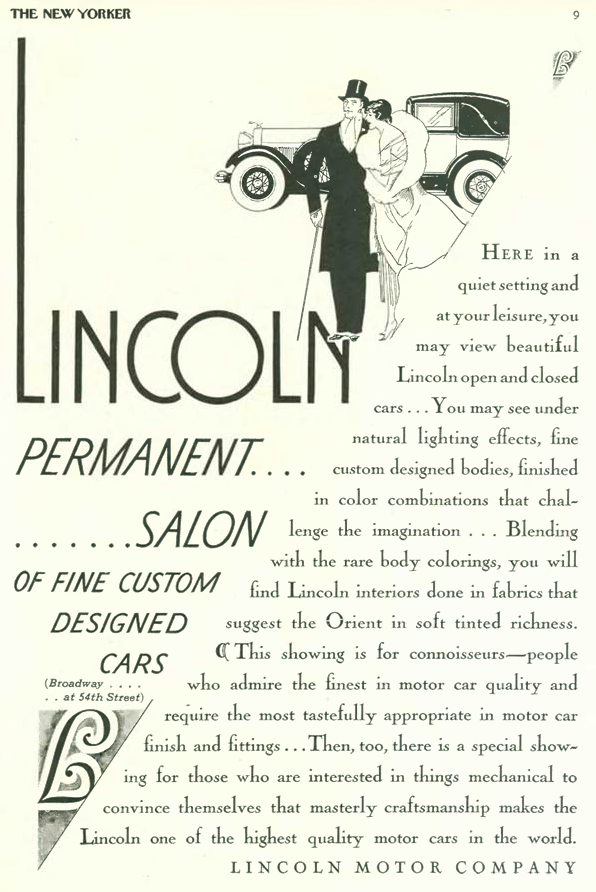
And just for kicks (and contrast), this ad for Lincoln was all about tradition, except for the nice typographical flourish on the letter “L” —a definite nod to modernism.
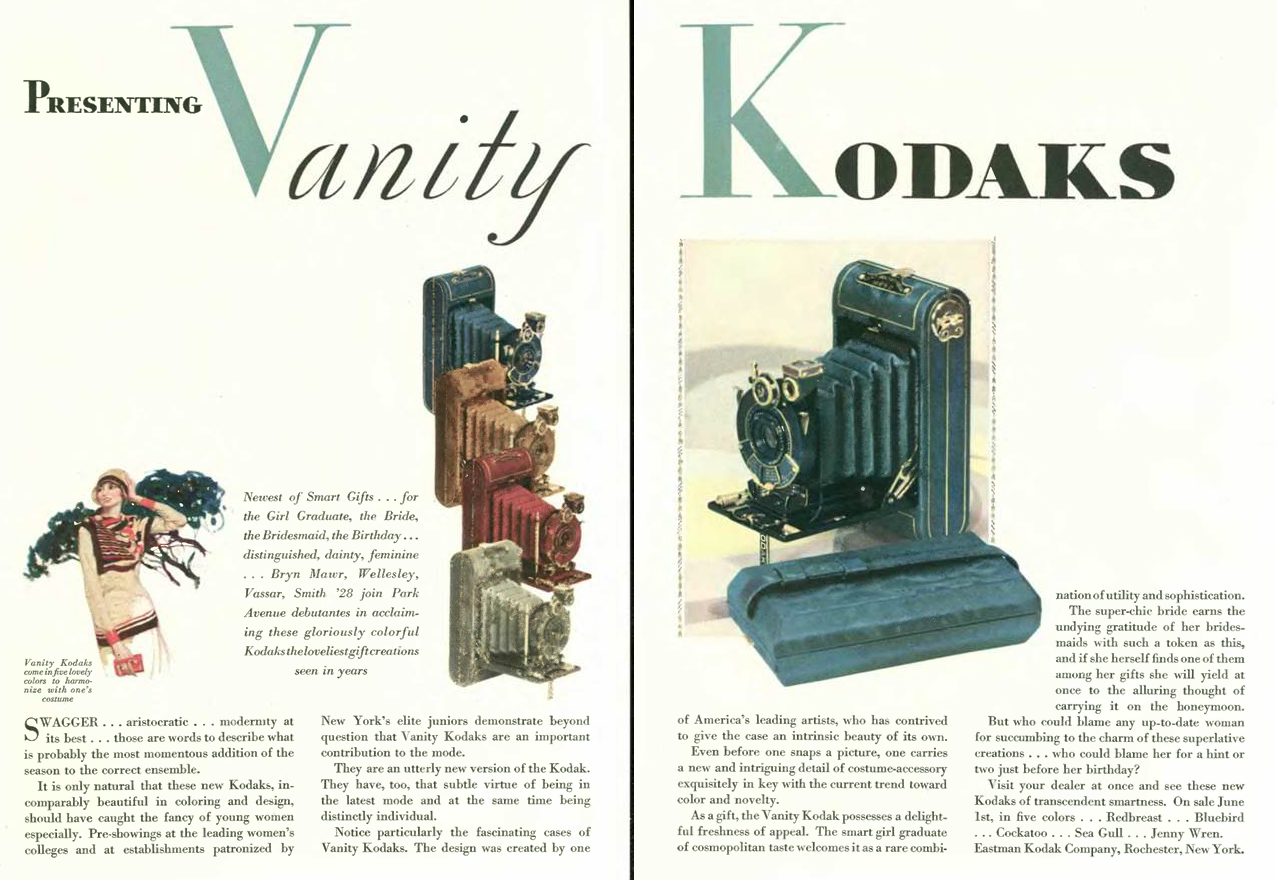
And if you thought novelty in our gadgets is a fairly recent thing, check out these portable Kodak cameras that were available in five colors. From automobiles to typewriters, manufacturers in the 1920s were discovering that color distinguished their products and even drove demand (click image to enlarge).
Advertisers could also create demand by appealing to readers’ cravings for status. The following ad for a Lord and Burnham greenhouse is an especially egregious example of the use of status shaming to sell a product. Note how the foursome in the illustration, presumably all greenhouse owners, look at the man without a greenhouse as though he’s a child molester or worse.
Before Green Eggs and Ham
In 1928 ads for Flit insecticide began to appear in the New Yorker, illustrated by none other than Theodore “Dr. Seuss” Geisel. This is the first Flit ad to appear in the magazine, in the June 2, 1928 issue:
In the 1920s people didn’t seem too concerned about the toxicity of the products they used (for example, we’ve seen Lysol used in feminine hygiene and as a birth control method). Although the Flit ads aimed to be humorous, it still seems odd to imply that one might gargle with the insecticide. As we shall see, subsequent Flit ads will show the product being sprayed indiscriminately over food, children, pets etc.
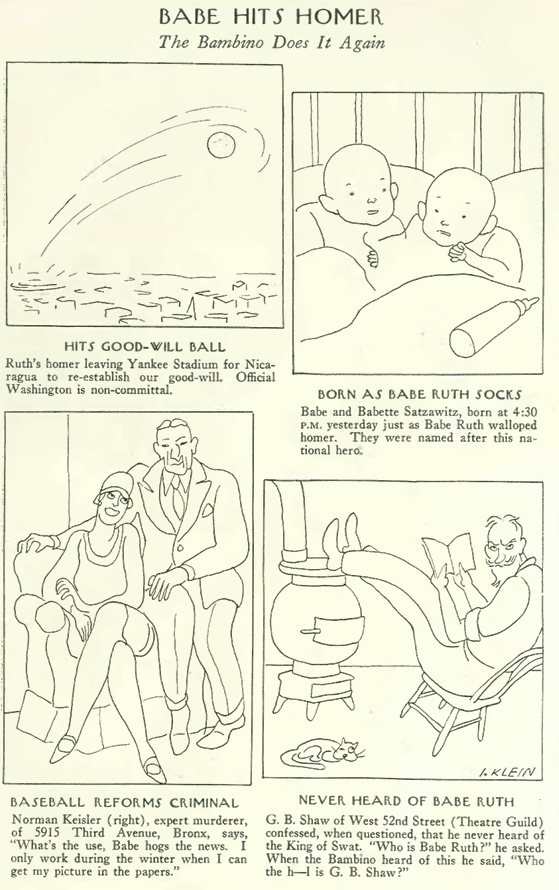
Taking a Shot at the Babe
The cartoonist Isadore Klein had some fun with the hyperbole often attached to the athletic feats of the Sultan of Swat:
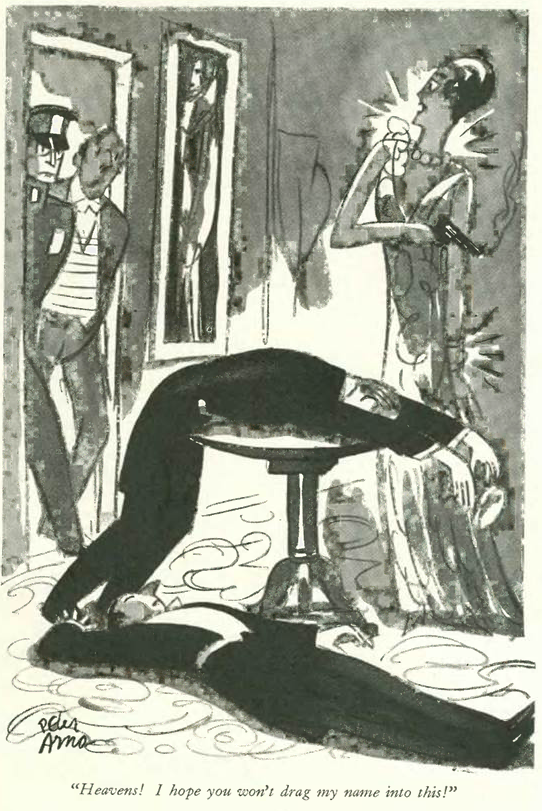
And finally, Peter Arno looked at murder among the upper classes:






















































































































 A New Yorker State of Mind