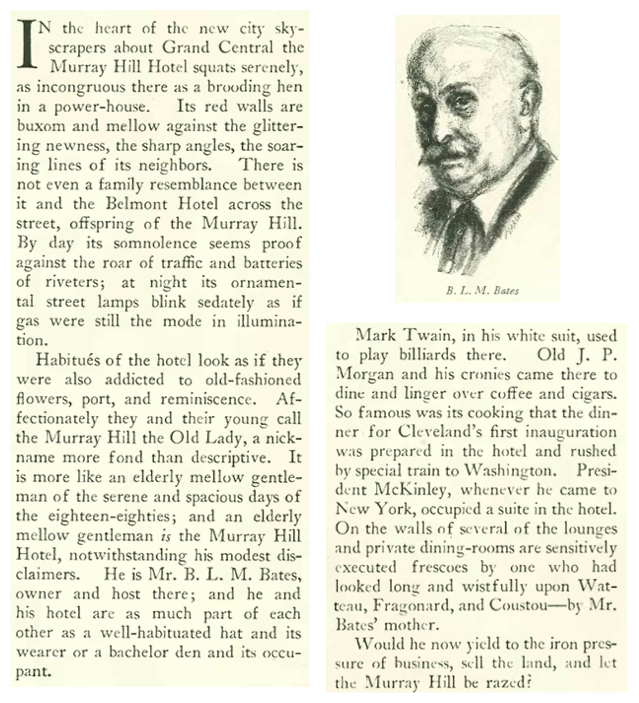
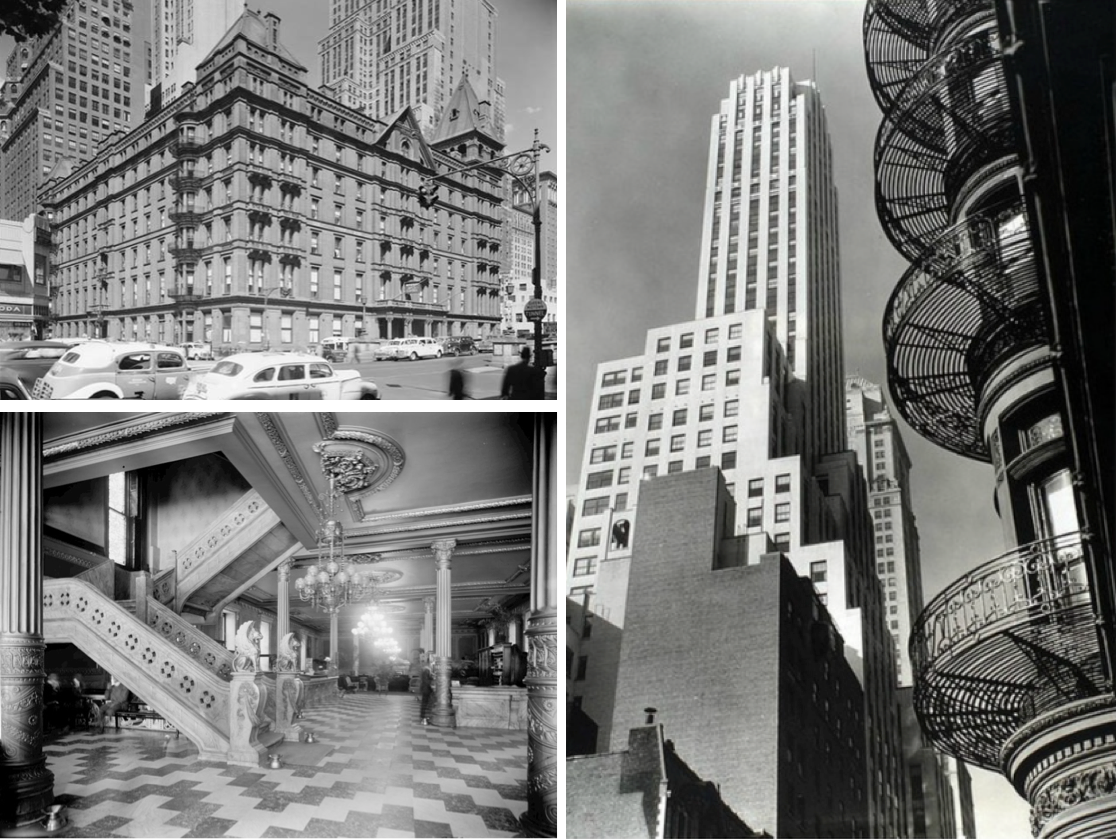
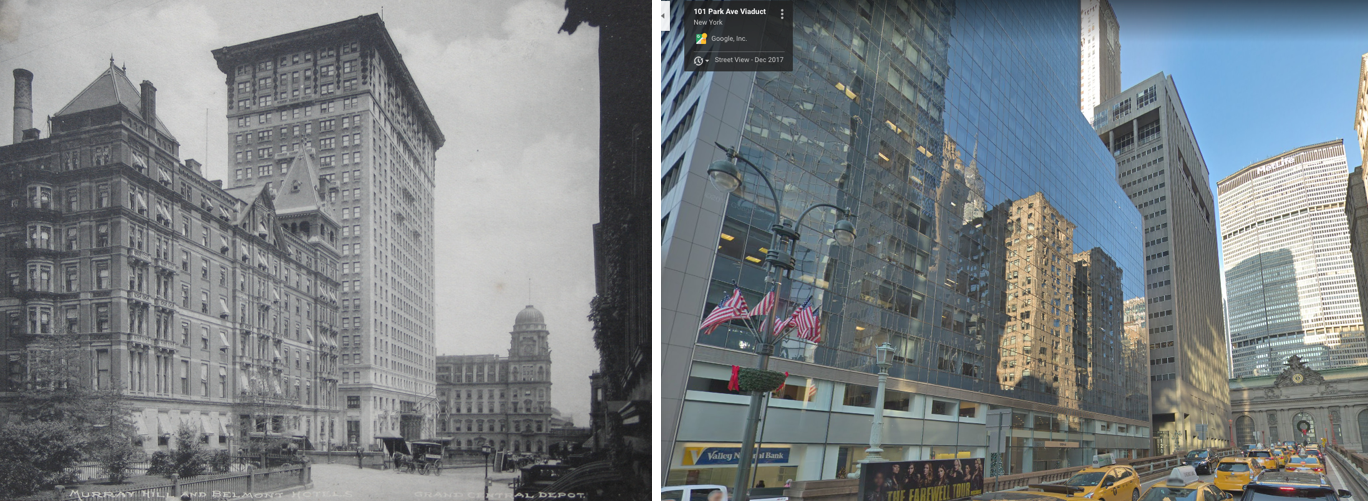
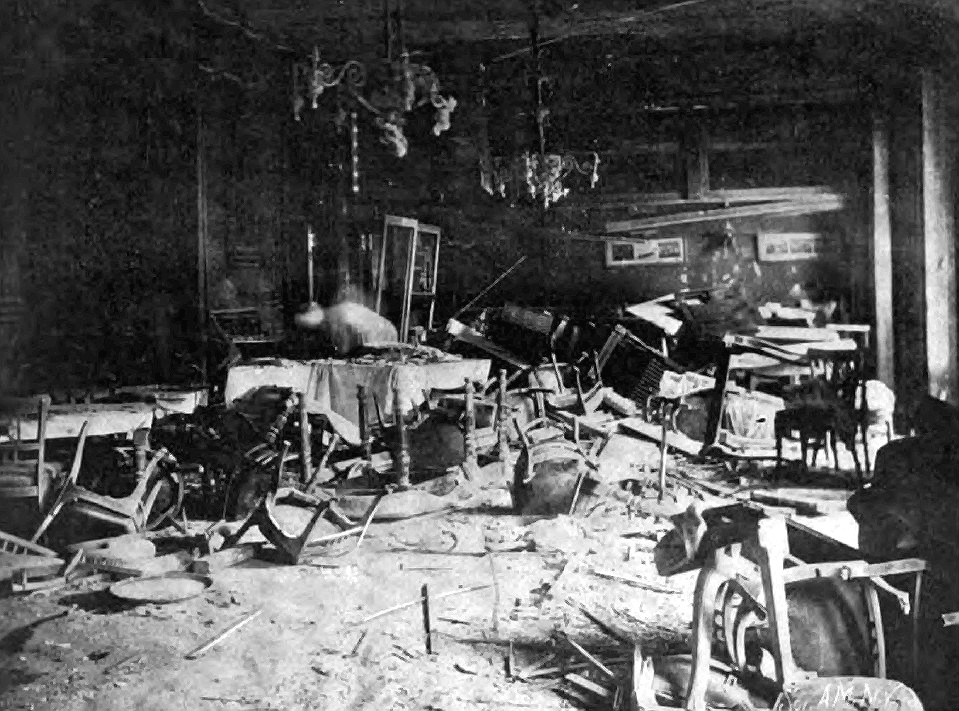
A Bridge Too Far

Despite the rise of the professional classes in the 20th century (and their attendant rules for accreditation and licensing) there still existed individuals who practiced at the highest levels with little or no formal training.

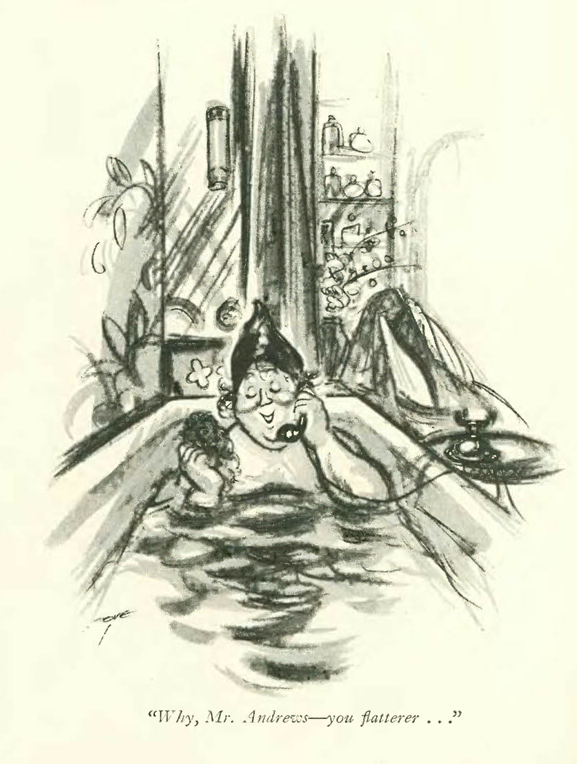
June 8, 1929 cover by Julien de Miskey.

Gustav Lindenthal (1850-1935) was a case in point. An Austrian immigrant who designed New York’s Hell Gate Bridge among others had little formal education and no degree in civil engineering. Rather, he learned by working as an assistant on various construction projects and teaching himself mathematics, metallurgy, engineering, hydraulics and other principles of the building profession.

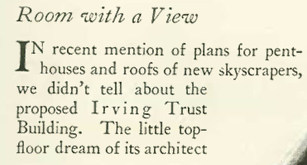
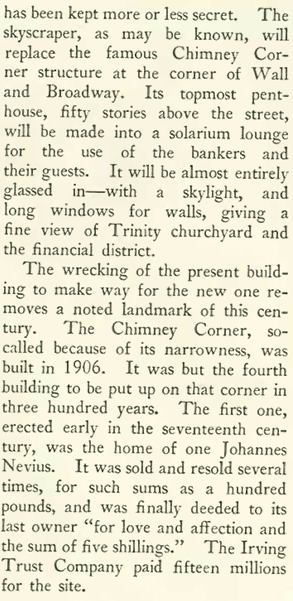
Lindenthal was praised for his innovations in bridge design as well as for his artistic eye, but one project eluded him throughout his career: the largest bridge in the world—a massive double-decker that would span the Hudson River from 57th Street in New York City to Hoboken in New Jersey. The June 8, 1929 “Talk of the Town” checked in on the nearly 80-year-old bridge builder:

A cornerstone for the Hudson bridge was laid in 1895, but a series of bad breaks, including the 1898 Depression and various political setbacks, served to continually delay the project. The New York Tribune anticipated the bridge in its April 28, 1907 edition…
(untapped cities) click to enlarge

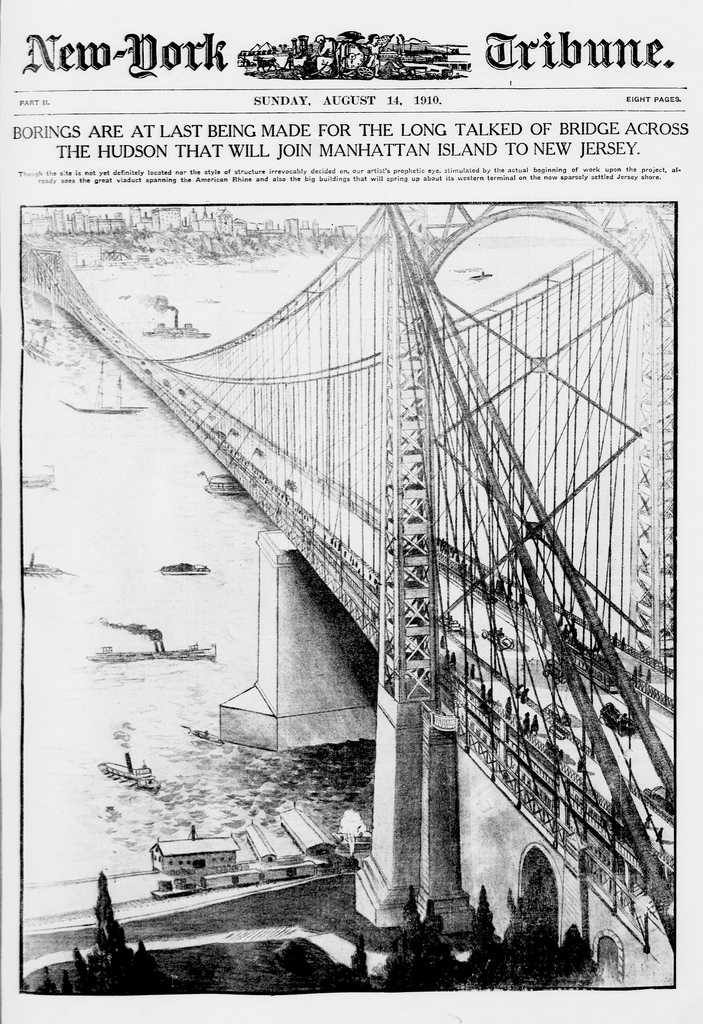
…and three years later the Tribune seemed confident that work was finally underway…

(untapped cities)

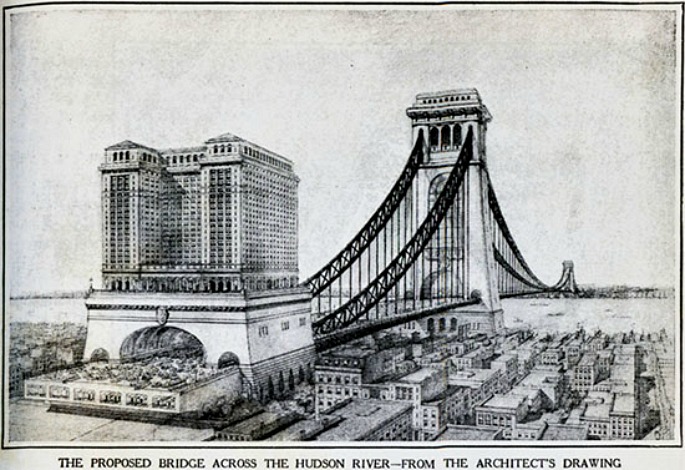
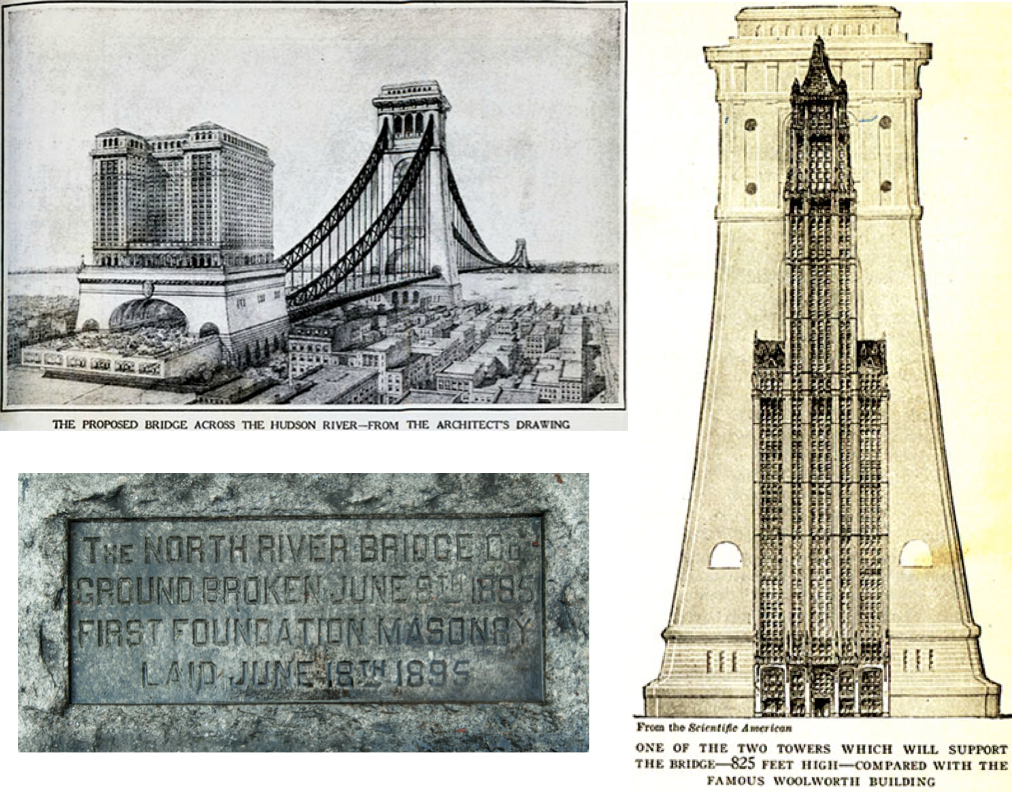
…however by the 1920s the bridge was still a dream. In 1921 Scientific American offered the latest glimpse of Lindenthal’s proposed 57th Street Bridge — a span 6,000 feet in length, with a 200-foot-wide double deck accommodating 24 lanes of traffic and 12 railroad tracks. An artist’s rendering included a massive building, on an arched plinth, positioned over the bridge deck:

BIG PLANS…Clockwise, from top left: Artist’s rendering of Gustav Lindenthal’s proposed 57th Street bridge from the June 25, 1921 issue of Scientific American. That same issue featured a size comparison with the then-tallest building in the world—the Woolworth Building. Below, the 1895 cornerstone, recently recovered from a crumbling pier on the New Jersey side of the Hudson and relocated to the grounds of Steven’s Institute of Technology in Hoboken. (untappedcities.com)

The New Yorker suggested that Lindenthal’s legacy was already secure, and with his determination and vigorous constitution, he still might still win the day:

Despite his vigor, Lindenthal would not live to see his dream realized. However, he is remembered for building some of New York’s most iconic bridges, including the Hell Gate and Queensboro:

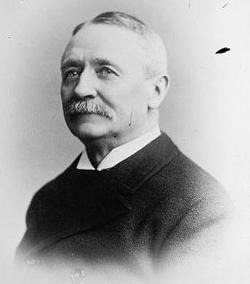
LEGACY…Clockwise, from top left, Hell Gate Bridge; Gustav Lindenthal, circa 1920; Queensboro Bridge. (Library of Congress/Britannica/Pinterest)

 *  *  *

Keeping Up With the Lindberghs

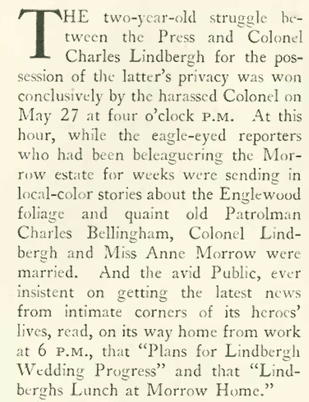
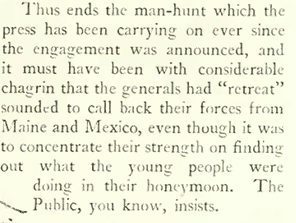
Despite his worldwide fame, Charles Lindbergh (1902-1974) detested the limelight, particularly when it came to his personal life. Writing in the column “The Wayward Press,” humorist Robert Benchley mocked the newspapers for their invasions into the lives of the celebrated, including newlyweds Charles and Anne Morrow Lindbergh:

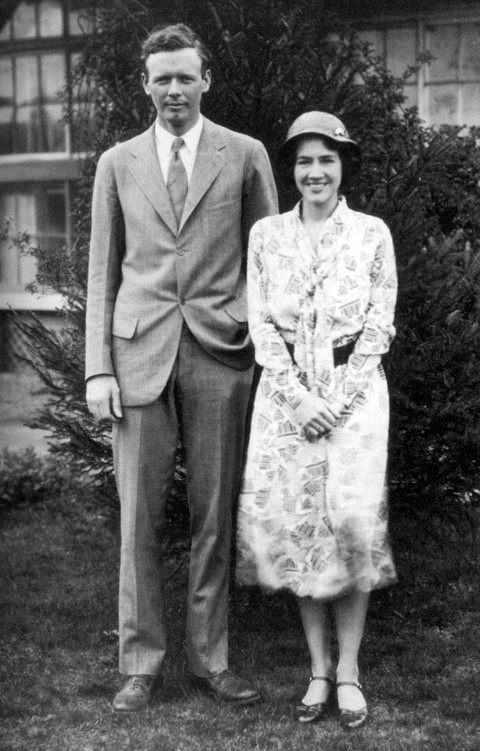
MIND YOUR OWN BEESWAX…Charles and Anne Morrow Lindbergh after their marriage in a private ceremony on May 27, 1929, at the home of her parents in Englewood, New Jersey. (Library of Congress)

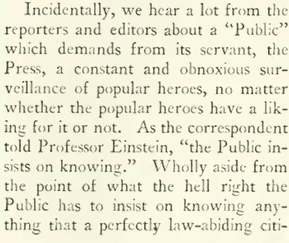
Benchley wasn’t buying the newspaper industry’s insistence that the public demanded to know the facts about the flyboy’s nuptials:

 *  *  *

Let the Good Times Roll

With the newly remodeled Central Park Casino officially christened by Mayor Jimmy Walker and his cronies, The New Yorker’s Lois Long (in “Tables for Two”) decided to pay a visit to see what all the fuss was about:

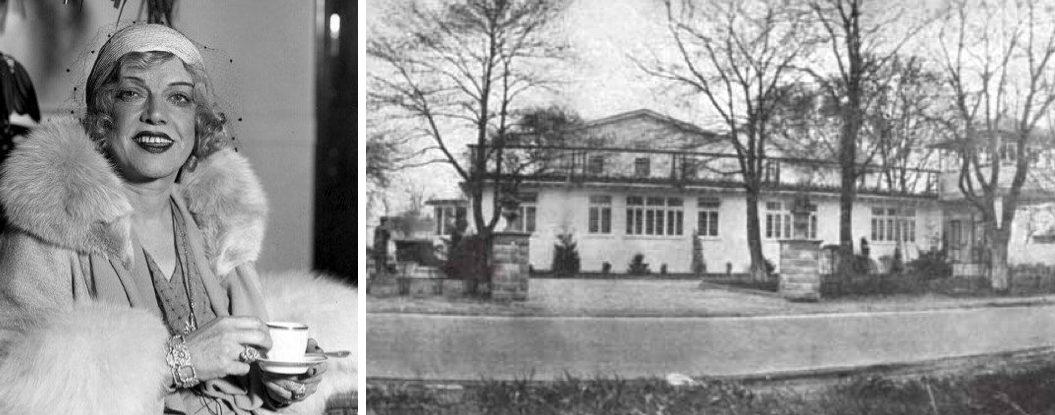
Long also commented on the declining fortunes of another familiar face of New York nightlife, Texas Guinan, who had fled Manhatten’s smoky speakeasy scene for the bucolic climes of Nassau County…

GOODBYE CITY LIFE…Texas Guinan took her nightclub to the quiet village of Valley Stream, New York, located just south of Queens in Nassau County. Guinan didn’t abandon all the trappings of city life: she drove to Valley Stream in a lavender Rolls Royce, and continued to greet her patrons with her famous “Hello, Sucker!” (jhgraham.com/texasguinanblogspot.com)

Long concluded that regardless where one ended up on a summer evening, one should be aware that a shabbier crowd awaited their company:

 *  *  *

Cuba Libre

Now we look at another New Yorker contributor who today is not exactly a household name: Donald Barr Chidsey (1902-1981), an American writer, biographer, historian and novelist best known for his adventure fiction. In this short column he offered some insights into the Cuban drinking scene:

ADVENTURESOME LAD…Donald Barr Chidsey wrote more than 50 books, including many action-adventure titles such as Captain Adam, from 1953. Note the resemblance of the hero on the cover to the author. (etsy/Amazon)

 *  *  *

Waxing Poetic

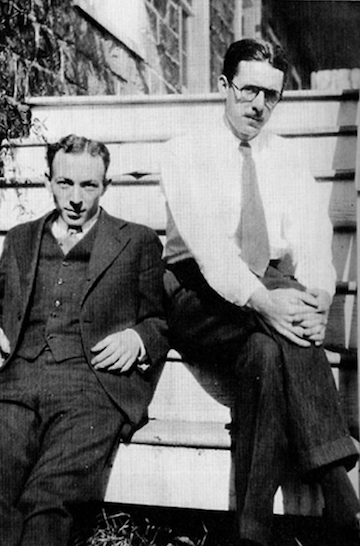
From its very first issue, The New Yorker also published a wide variety of poets, including Nicholas Samstag (1904-1968),who contributed several poems to the magazine in 1928 and 1929. Samstag later went on to a successful career in advertising, and was a close associate of  Edward Bernays, considered the father of public relations and propaganda.

A frequent contributor to The New Yorker, writer, poet and critic Mark Van Doren (1894-1972) published more than three dozen poems in the magazine from 1929 to 1972. Here is his first contribution, in the June 8, 1929 issue:

Van Doren’s last contribution to The New Yorker was published on Nov. 18, 1972, less than a month before his death. It was appropriately titled “Good Riddance”…

DID THE APPLE FALL FAR FROM THE TREE?…At left, a circa 1925 portrait of Mark Van Doren. He was the father of Charles Van Doren, who achieved brief renown as the 1957 winner of the rigged game show Twenty One. He is pictured at far right with fellow contestant Vivienne Nearing and game show host Jack Barry. (art.net/Wikipedia)

 *  *  *

From Our Advertisers

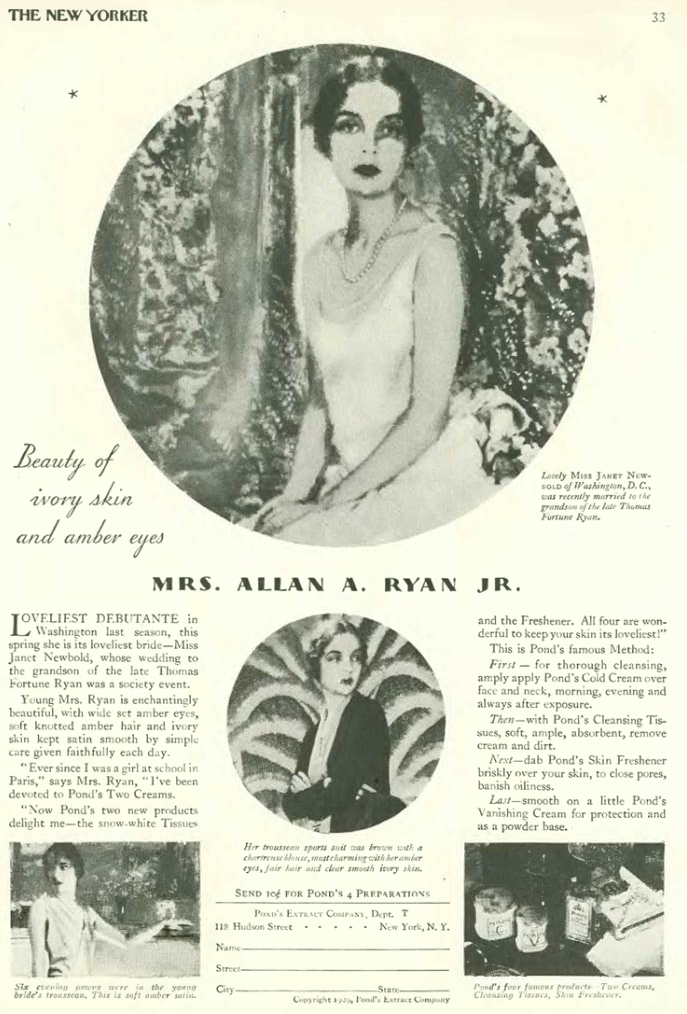
As summer approached some distinct themes emerged in ads aimed at female consumers. Here is a collection of ads from the June 8 issue that capitalized on the new tanning craze of the late 1920s…

click to enlarge

…and another big craze of the 1920s, the permanent wave, seemed to be a necessity as summer approached…

click to enlarge

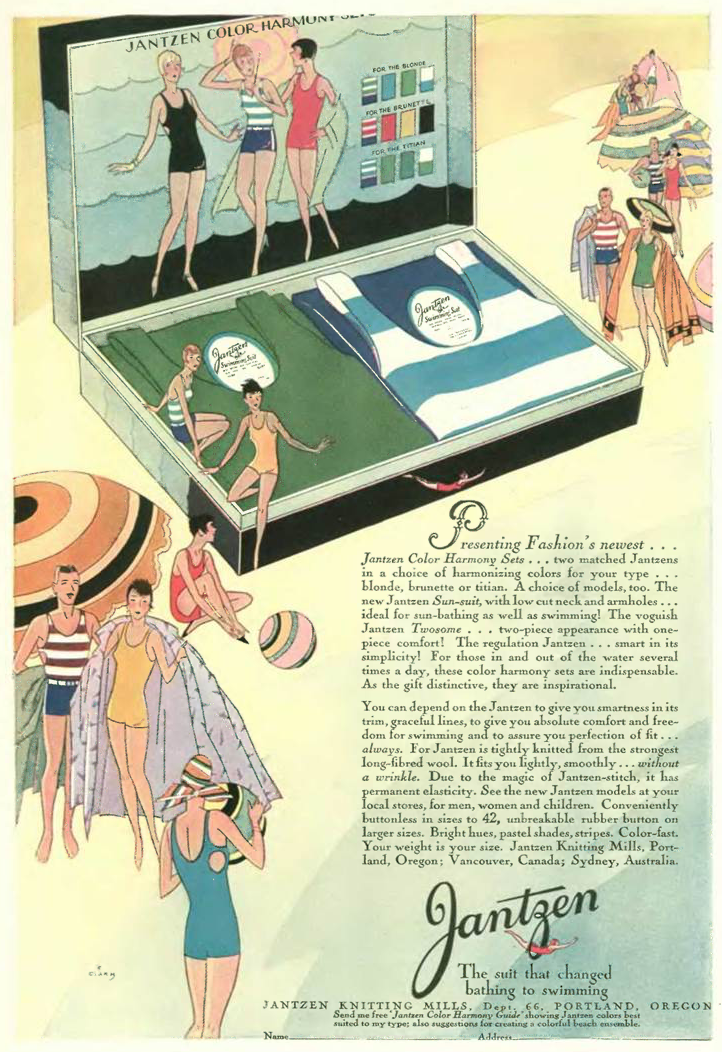
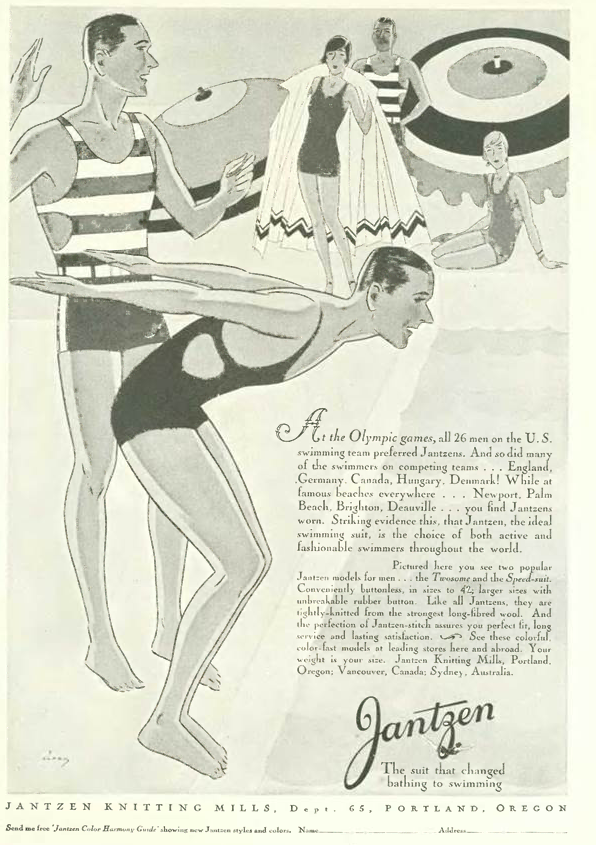
…as for the gents, check out this new line of Jantzen swimwear modeled by what appear to be identical twins…

…and when you’re out of the water, a pair of “fashion welts” were all the rage for tip-toeing across the hot sands of Southampton…

…this ad from B. Altman depicted two women clad for “open motoring” (not sure how those long, lithe figures will fit into that tiny rumble seat)…

…for a less dusty mode of transportation, you could hop aboard The Broadway Limited for a quick 20-hour jaunt to Chicago…

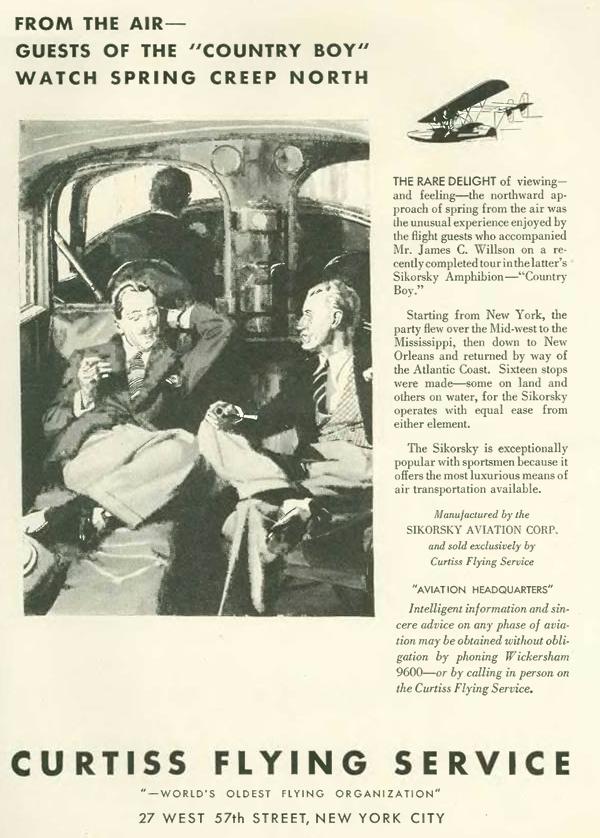
…or better yet, have a relaxing smoke with one of your chums aboard a Sikorsky seaplane…

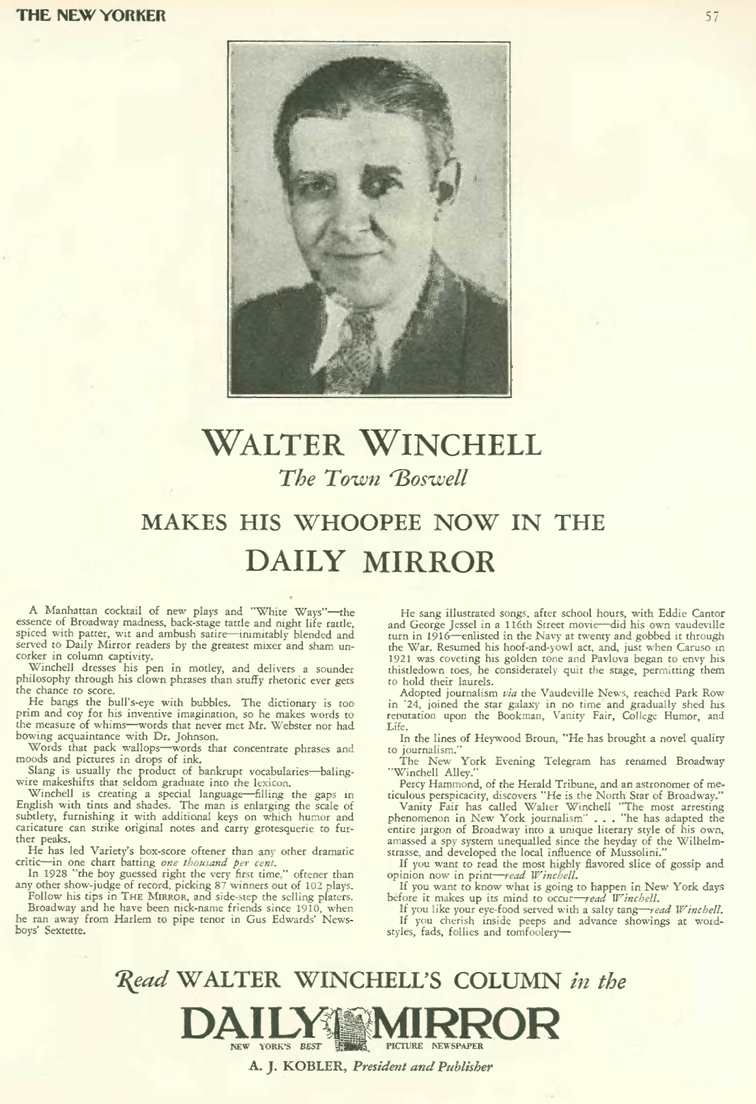
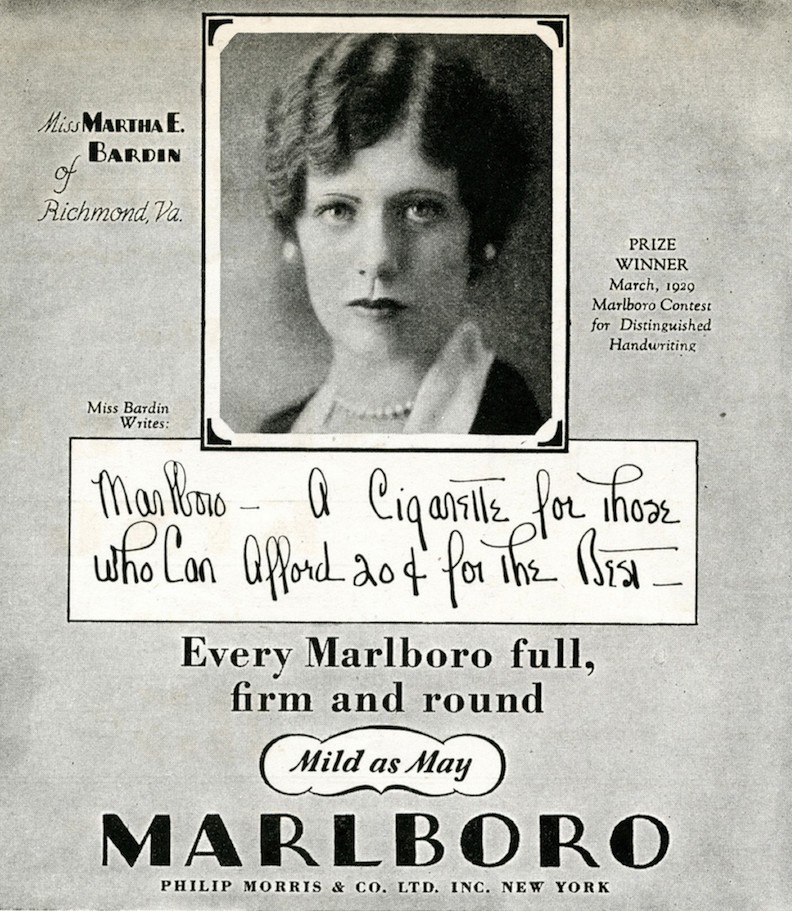
…our cigarette ad for this week comes from Philip Morris, makers of Marlboro, who once again exploited the nation’s youth with a bogus handwriting contest that doubled as a product endorsement…

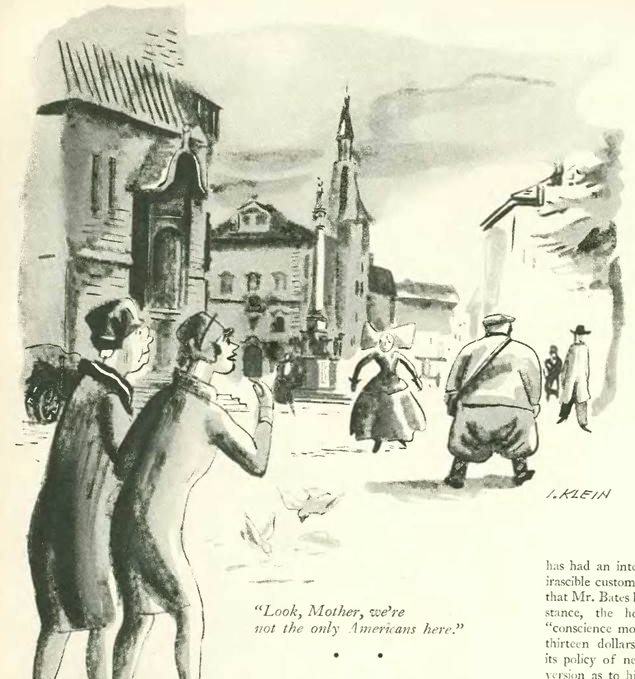
…our June 8 comics are from Helen Hokinson, who offered a full page of illustrations from a “Fifth Avenue Wedding”…

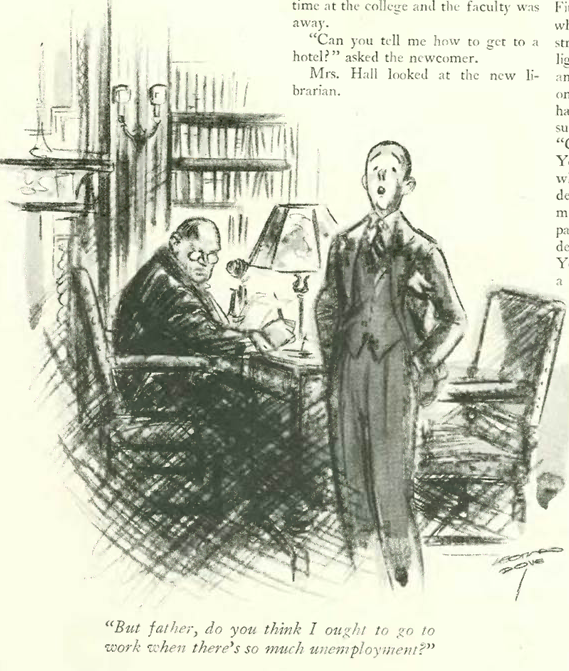
…while Leonard Dove peeked in on a wastrel son and his disappointed father…

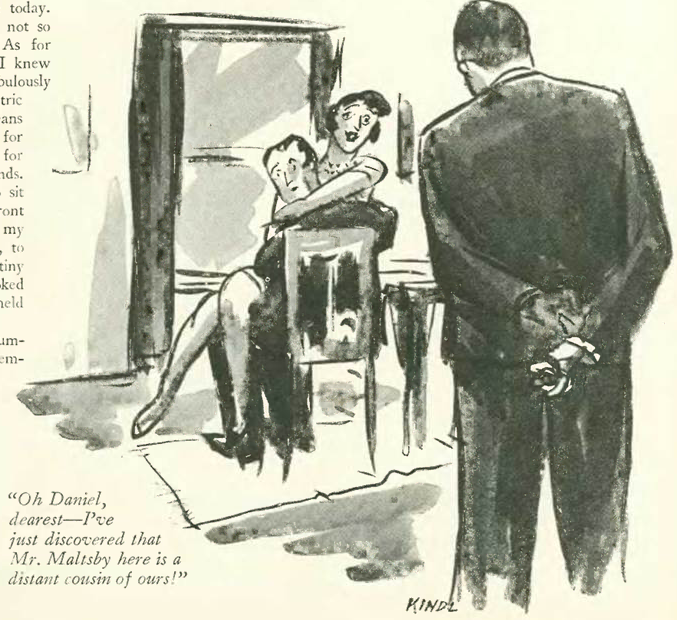
…and we have an awkward moment revealed by Carl Kindl

…and an observation by C.W. Anderson on the minimalism of modernist design…

…and finally, Peter Arno’s take on the challenges of shooting sound motion pictures…

Caption: “Lord, Mr. Rolbert, you’ll have to develop a more robust sneeze—the public will think you’re a sissy!”

Next Time: Something Old, Something New…

Hello Molly

While the New Yorker was happy to send singer Marion Talley packing back to Midwest (see last post), it was wholly embracing one of its own, Molly Picon. But as we will see, it had every reason to do so.

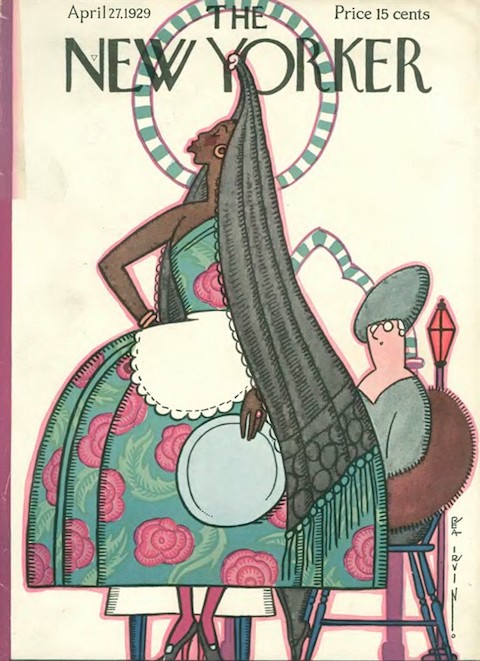
April 27, 1929 cover by Rea Irvin.

The daughter of Polish immigrants, Molly Picon (1898-1992) was born Małka Opiekun in New York City on Feb. 28, 1898, and became of a star of Yiddish theatre and film before moving to English language productions in the 1930s.

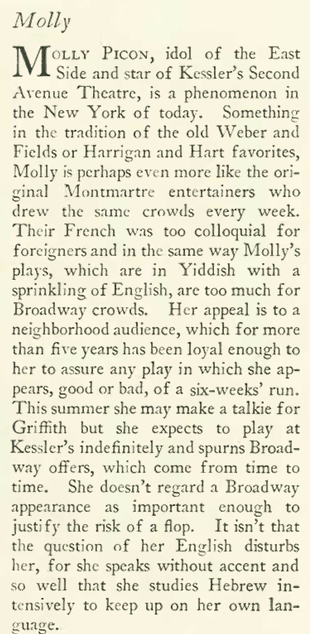
Writing in “The Talk of the Town,” James Thurber described Picon as an “idol of the East Side”…

PRECOCIOUS…Molly Picon began performing in the Yiddish Theatre at age six. Pictured, from left, is 10-year-old Molly in a 1908 Nickelodeon short of a vaudeville act, Fagan’s Decision; an undated press photo; in The Jolly Orphan, 1929. (Jewish Women’s Archive/Wikipedia/Museum of the City of New York)
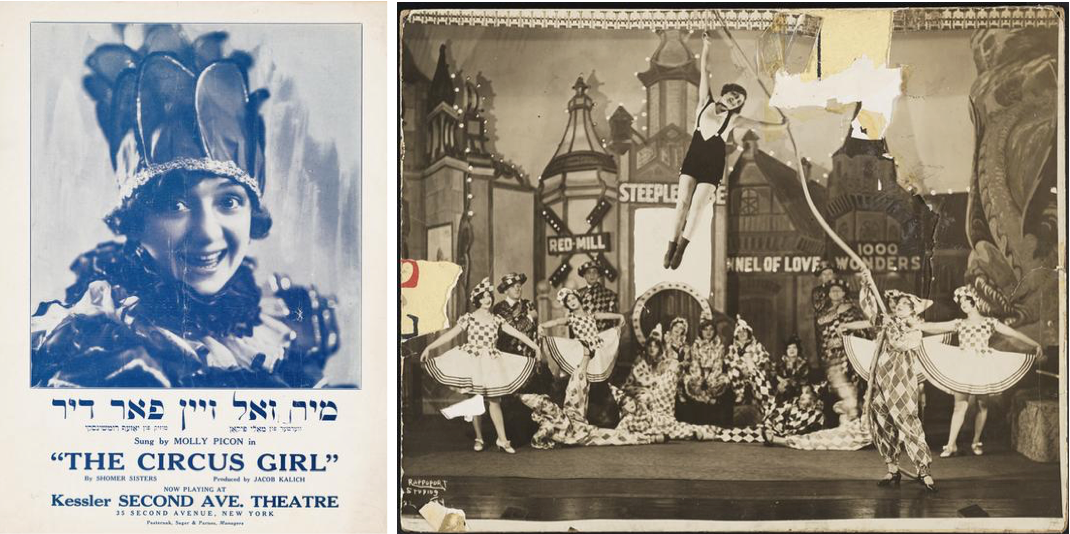
At left, music sung by Molly Picot in the a Yiddish theatre production, Tsirkus meydl (The Circus Girl), 1928. At right, a scene from the play. (Museum of the City of New York)
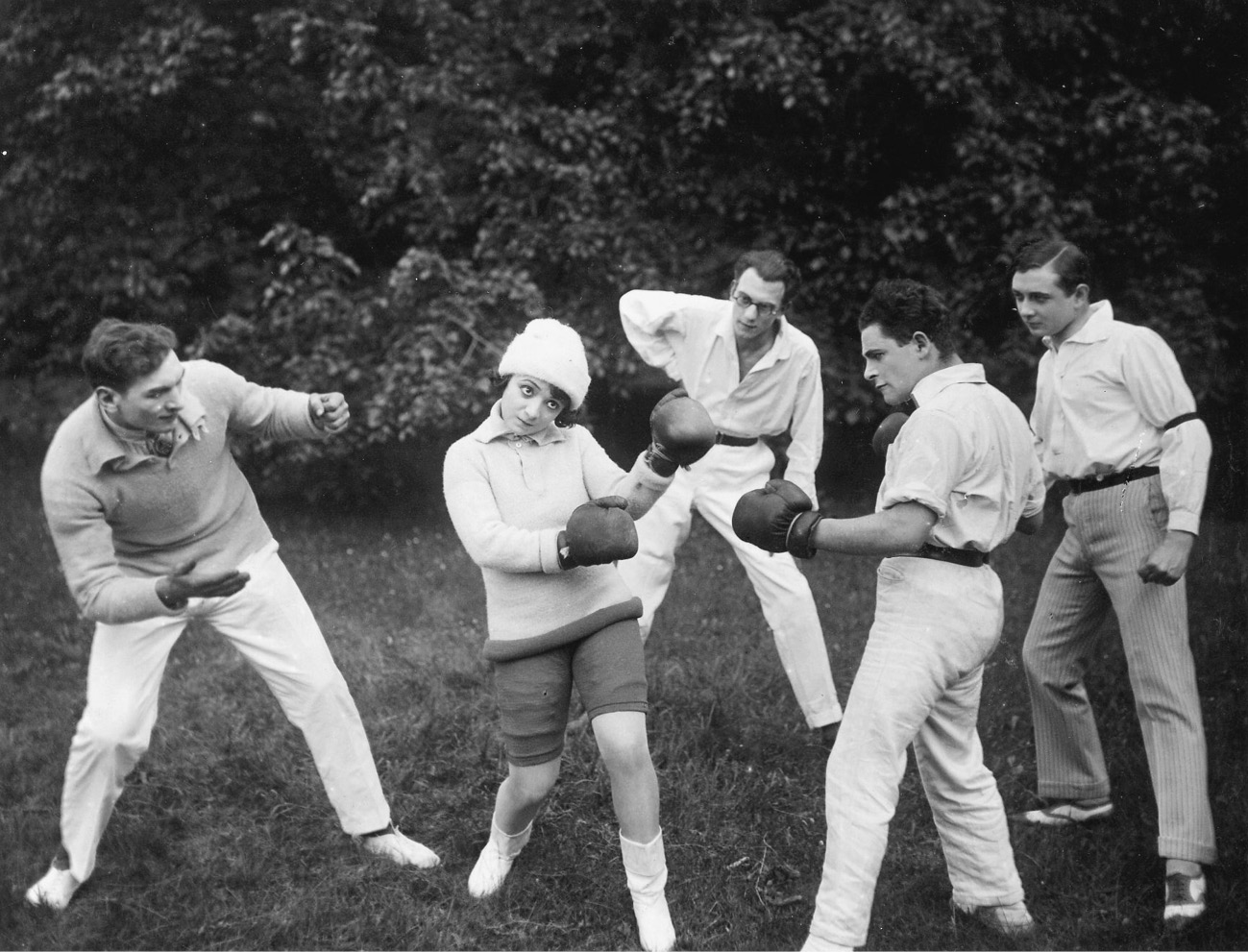
PUT ‘EM UP…Molly Picot tries her hand at boxing in the silent comedy, East and West, originally produced in Austria in 1923. In this film about assimilation and Jewish values, a sophisticated New Yorker travels back to his village to attend his niece’s traditional wedding. There he encounters the rambunctious Molly, whose hijinks include boxing, and teaching other young villagers to shimmy. (Image: National Center for Jewish Film / Caption: UC Berkeley Library)

Thurber described Picon’s personal life as simple and focused on her family, a path she followed throughout her 94 years:

Picon met her husband, Jacob “Yonkel” Kalich (1891-1975) in 1918 and they married a year later. In an exhibition at the American Jewish Historical Society, Picon is quoted on how meeting Kalich changed her life:

“When we met in Boston, I was the All-American Girl full of hurdy-gurdys and absolutely illiterate about Jewish culture. Yonkel, on the other hand, was the complete intellectual who knew not only classic Yiddish but its plays, theater and writers.”

After they married in 1919, the couple toured Eastern European cities with large Jewish populations in order that she could improve her Yiddish and gain experience as a performer. Kalich served as her manager and creator of many of her roles, and they often performed together, including in two films nearly 50 years apart—East and West (1923) and Fiddler on the Roof (1971).

Top photos, left to right, Molly Picon in the Yiddish Theatre comedy Di Tsvey Kuni Lemels (The Two Kuni Lemels), 1926; with husband Jacob “Yonkel” Kalich in the 1923 silent film comedy, East and West; with Kalich that same year in Vienna. Bottom row, left to right, Picon tapes the Maxwell House Radio Show, 1938, and below, on the set of the Fiddler on the Roof (1971) with husband Jacob “Yonkel” Kalich; with Frank Sinatra in Come Blow Your Horn (1963); and on the TV show The Facts of Life (1979). (Wikimedia Commons/American Jewish Historical Society/Jewish Women’s Archive)

Picon appeared on a variety of TV shows from the 1960s through the 1980s including Car 54, Where Are You?, Gomer Pyle, The Facts of Life, and Trapper John M.D. Movie appearances during that time included Fiddler on the Roof (1971); For Pete’s Sake (with Barbra Streisand, 1974); and perhaps one of her oddest roles, as Roger Moore’s longsuffering mother in The Cannonball Run (1981) and 1984’s The Cannonball Run II (In those films, Moore portrayed Seymour Goldfarb, heir to the Goldfarb Girdles fortune, who preferred the life of pretending to be a spy to girdle manufacturing).

Thurber observed that Picon was only interested in comedic roles, a preference she stuck to throughout her long career.

Molly Picon as Mrs. Bronson in the television show Car 54, Where Are You? (1962) (Wikimedia Commons)

To learn more about Molly Picon’s fascinating life, visit the online exhibition at the American Jewish Historical Society.

 *  *  *

Sober as a Judge

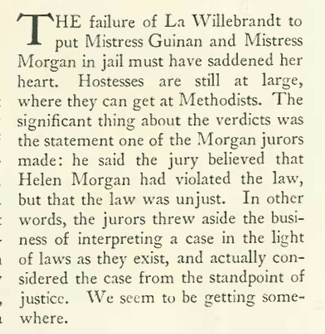
Despite Prohibition, booze flowed freely in New York in the late 1920s thanks to bootleggers and corrupt cops. U.S. Assistant Attorney General Mabel Walker Willebrandt tried her best to crack down on violations, arresting (among many others) the operators of two of Manhattan’s most popular nightclubs, actress Texas Guinan (300 Club) and torch singer Helen Morgan (Chez Morgan). In the “Talk of the Town,” the New Yorker found hope in the acquittal of Guinan and Morgan, and in the opinion of one of the jurors:

In the same issue, this cartoon by Oscar Howard tells us a lot about New York’s approach to Prohibition enforcement in 1929…

 *  *  *

Captive Audience

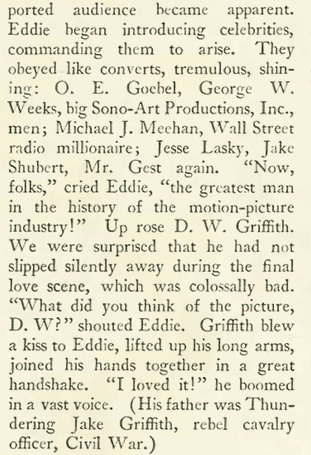
In the April 27 “Talk of the Town” James Thurber also turned his attention to the latest treacle flowing out of Hollywood—the premiere of The Rainbow Man, starring Eddie Dowling in his first talking picture. Thurber found the film to be “alarmingly bad.” But that was only the beginning…

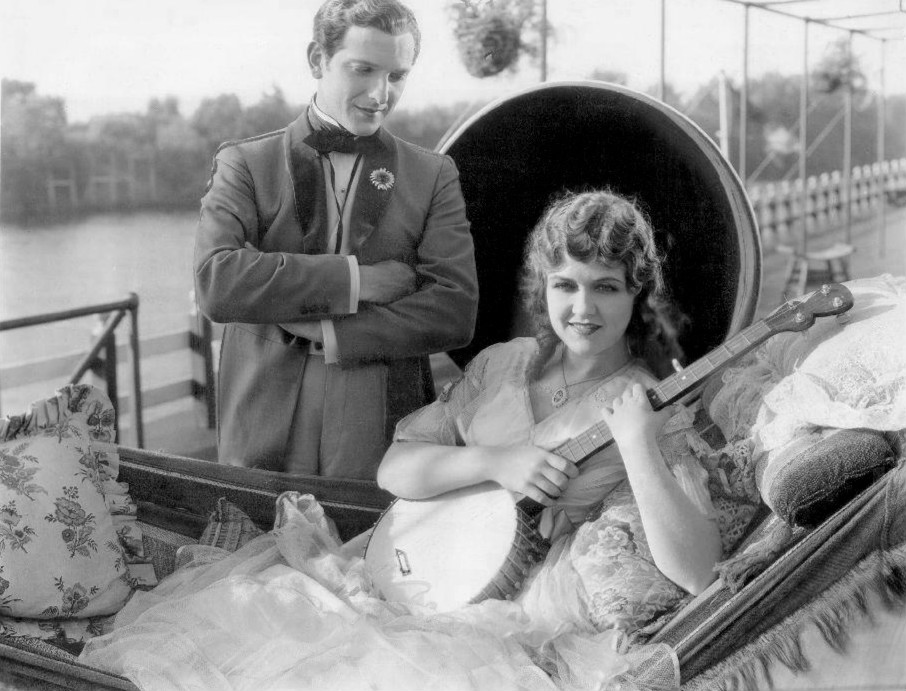
TIRED OF ME YET?…Lloyd Ingraham, Eddie Dowling, and Marian Nixon in The Rainbow Man (1929) (IMDB)

Thurber wrote that the film was followed by live performances from “a Kate Smith” and by Eddie Dowling himself, who piled more ham on the proceedings.

PILING IT ON…Eddie Dowling gave audiences more than they needed (at least in the view of James Thurber) at the premiere of The Rainbow Man. Dowling would share the stage with Kate Smith, apparently unknown to Thurber at that time. She would go on to massive stardom. Dowling, not so much. (IMDB/Pinterest)

 *  *  *

Slow Man River

Things didn’t look much better in the magazine’s movie review section, where the 1929 film version of the huge 1927 Broadway hit musical Showboat seemed stuck on sandbar:

SLOW BOAT…Scene from the 1929 film Show Boat featuring Laura LaPlante as Magnolia Hawks and Joseph Schildkraut as Gaylord Ravenal. (Wikipedia)

 *  *  *

Elsie Dinsmore Revisited

Phyllis Crawford (writing under the pseudonym Josie Turner) contributed another parody of the Elsie Dinsmore book series. The original books (28 in all), were written in the late 19th and early 20th century and featured an impossibly upright eight-year-old as the main character.

Crawford, herself an author of children’s books (including the award-winning Hello, the Boat!), had some fun with the Dinsmore books, her parody featuring a still pious and innocent Elsie living with her father in New York, where she encounters his circle of friends including gamblers and chorus girls (the collected pieces were published as a book in 1930: Elsie Dinsmore on the Loose). In this brief excerpt from Crawford’s piece in the April 27 issue (“Elsie Dinsmore Entertains at Tea”), little Elsie tries her best to entertain a friend of her “dear Papa”…

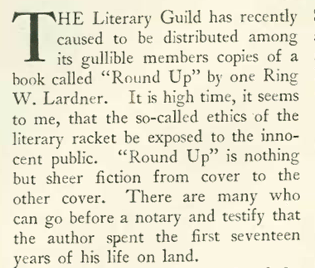
On the topic of books, Dorothy Parker, in her “Reading and Writing” column, took aim at middlebrow book clubs such as the Literary Guild, expressing (in her way) surprise that such a club would actually recommend something with literary merit…

Advertisement in the April 27 issue for Ring Lardner’s Round Up. At right, Lardner and Dorothy Parker, circa 1930. (thenationalpastimemuseum.com/selectedshorts.org)

 *  *  *

From Our Advertisers

We begin with a colorful ad from the makers B.V.D., a brand name that would become synonymous with men’s underwear…

…Russian prima ballerina Anna Pavlova demonstrated the wonders of Cutex nail polish in her famous “Dying Swan” costume (Pavlova would be dead herself in less than two years)…

…while the Wizard of Menlo Park applied his genius to the cause for better toast…

…and actor John Gilbert was the latest actor to “reach for a Lucky instead of a sweet”…

…this ad in the back pages enticed readers to visit the International Exposition of Barcelona…those fortunate enough to have made the trip would have seen Mies Van Der Rohe’s “Barcelona House” (pictured) and the first-ever Barcelona chair…

(thomortiz.tumblr.com)

…on to cartoons and illustrations, in the theatre section this contribution by Miguel Covarrubias

…Covarrubias (pictured) was an early contributor to the New Yorker, indeed he contributed to the very first issue with this rendering of Italian opera manager Giulio Gatti-Casazza for the first-ever profile…

Gluyas Williams illustrated the collective shaming of a commuter by residents of Tudor City…

…Tudor City was touted in many early New Yorker ads as having all the amenities of the suburbs but within walking distance of the city…here is an ad from the March 26, 1927 issue of The New Yorker

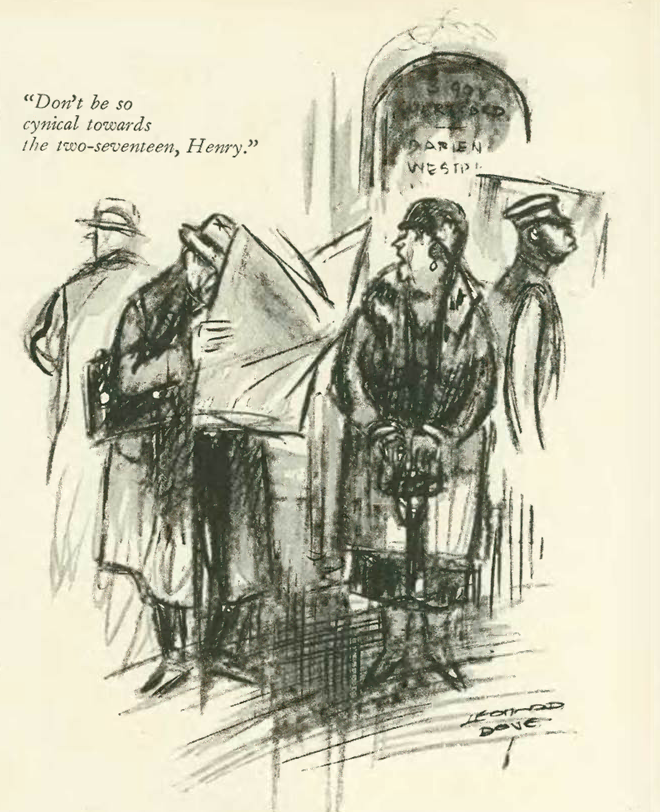
…and then we have the English cartoonist Leonard Dove, who looks in on a couple who are obviously not from Tudor City…

…and finally, a terrific cartoon by an artist I have failed to identify (if anyone knows, please comment!)…

Next Time: From Broadway to Babylon…

While You Were Away

During the Roaring Twenties New Yorkers took a wrecking ball to much of their past, and at a breathtaking pace that left many residents little time to ponder what was lost.

March 30, 1929 cover by Julian de Miskey.

Writer and cultural critic Gilbert Seldes succinctly summed up this spirit of the times in a tongue-in-cheek “reminiscence” of the “old” New York—that is, how the city appeared the previous fall before he left to spend the winter in Bermuda:

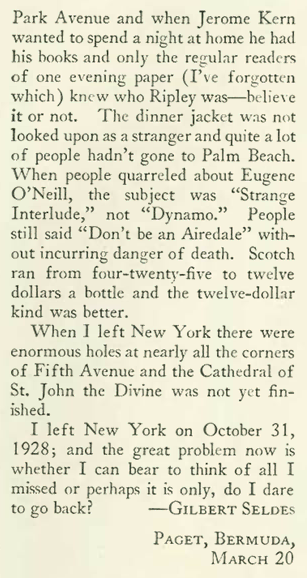
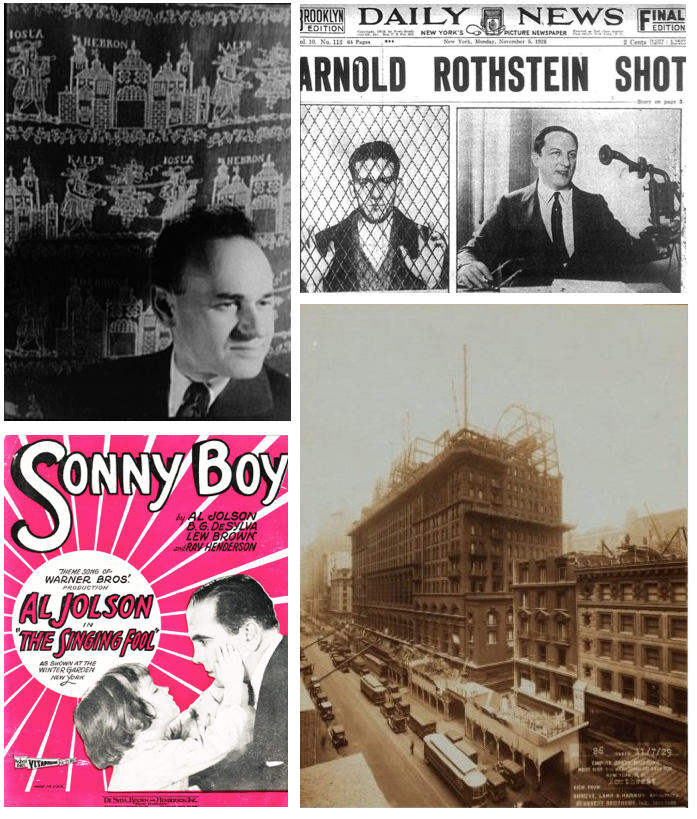
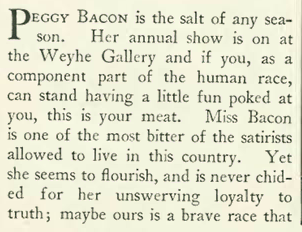
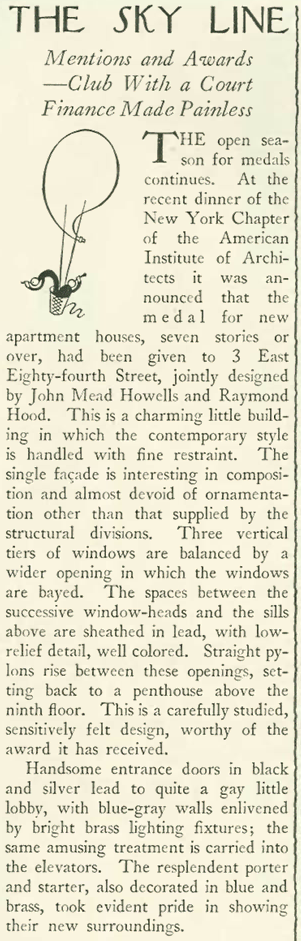
NOW WHERE WILL I GET A WALDORF SALAD? Writer Gilbert Seldes (top left) ticked off some of the many changes to his city while he was away for the winter, including (clockwise, from top right), the murder of racketeer Arnold Rothstein; the planned demolition of the Waldorf Astoria to make room for the Empire State Building (photo of the partially demolished hotel); and perhaps the first song to be overplayed on the radio ad nauseumAl Jolson’s “Sonny Boy.” (Wikipedia, Daily News, New York Public Library, musicals101.com)

A member of the intellectual elite but also a strong advocate for cultural democracy, Seldes began writing for the New Yorker in late 1925 and would be a frequent contributor through 1936. In 1937 he would join CBS as its first director of television programs, and would also become one of television’s first critics thanks to his 1937 Atlantic Monthly article, “The ‘Errors’ of Television.” (Note: There were only 50 experimental TV sets in the New York area in 1937, and the first commercially available sets weren’t sold until 1939). In 1958—when there would be 42 million U.S. households with a television—Seldes would serve as the host of NBC’s The Subject is Jazz.

 *  *  *

Peggy Bacon Did It All

Another early contributor to the New Yorker was Peggy Bacon, who displayed her sharp wit in her nearly 50 articles and poems for the magazine from 1926 to 1950. But Bacon was also well-known for displaying her talent and wit in the many paintings and illustrations she created throughout her long career. The New Yorker’s art critic Murdock Pemberton sang her praises in the March 30, 1929 issue after visiting her show at the Weyhe Gallery.

A FEW IDEAS was the title of this 1927 drypoint work featured in Peggy Bacon’s Weyhe Gallery show. At right, Bacon, circa 1920s. (artnet.com/wikipedia)
A sampling of Peggy Bacon drypoint works from the 1920s, clockwise, from top: Frenzied Effort, 1925; Vanity, 1929; Penguin Island, 1926. (Brooklyn Museum/Artnet/1stdibs.com)

 *  *  *

The March 30 profile featured aviation innovator Giuseppe Mario Bellanca, who in 1922 designed the first enclosed-cabin monoplane in the U.S. Perhaps even more significant, his design in 1913 of a plane with a propeller in front, a wing in the middle and tail at the end set the standard for all aircraft built since. (Before 1913 many planes were propelled from the rear, with the “tail” projected in front of the craft). The profile writer, William Weimer (with art by Hugo Gellert) admired Bellanca’s ability to stand toe-to-toe with the mighty du Pont family:

Bellanca founded the Roos-Bellanca Aircraft Company in Omaha in 1927, and was featured on the cover of Time. In 1929 he created the Delaware-based Bellanca Aircraft Corporation of America in a financial partnership with the du Ponts.

AVIATION PIONEER Giuseppe Mario Bellanca (center) at the new Bellanca Airfield in New Castle, Delaware, 1928. Bellanca’s planes would establish numerous records for altitude, endurance, and speed. (Delaware Public Archives)

 *  *  *

Showing Some Restraint

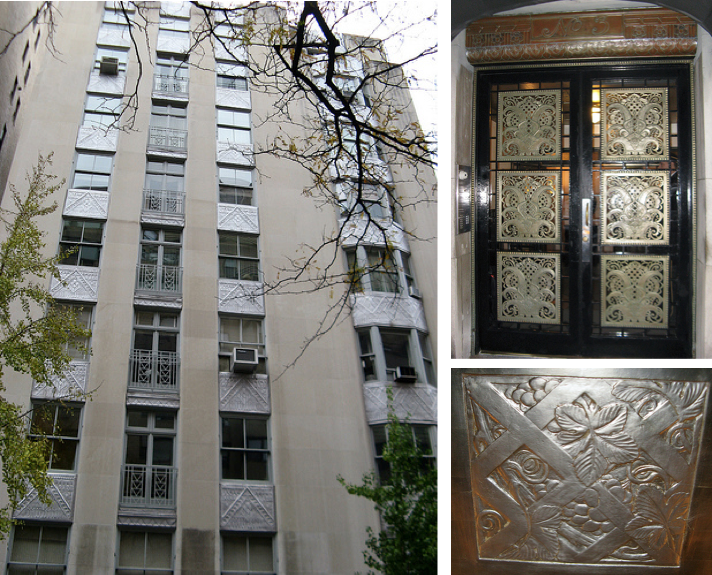
In his “Sky Line” column, the New Yorker architecture critic George S. Chappell (aka “T-Square”) praised an award-winning 1928 apartment at 3 East 84th Street for its contemporary charm and “fine restraint.” Designed by Raymond Hood and John Mead Howells, the 9-story building was commissioned by Joseph Medill Patterson, owner of the New York Daily News. The design would be influential in Hood’s much more ambitious projects two years later—the Daily News Building (1930) and Rockefeller Center (1931).


The Raymond Hood– and John Mead Howells-designed 3 East 84th Street. Top right, the front entrance; and bottom right, ceiling’s silver leaf squares. (Susan DeMark–mindfulwalker.com)

 *  *  *

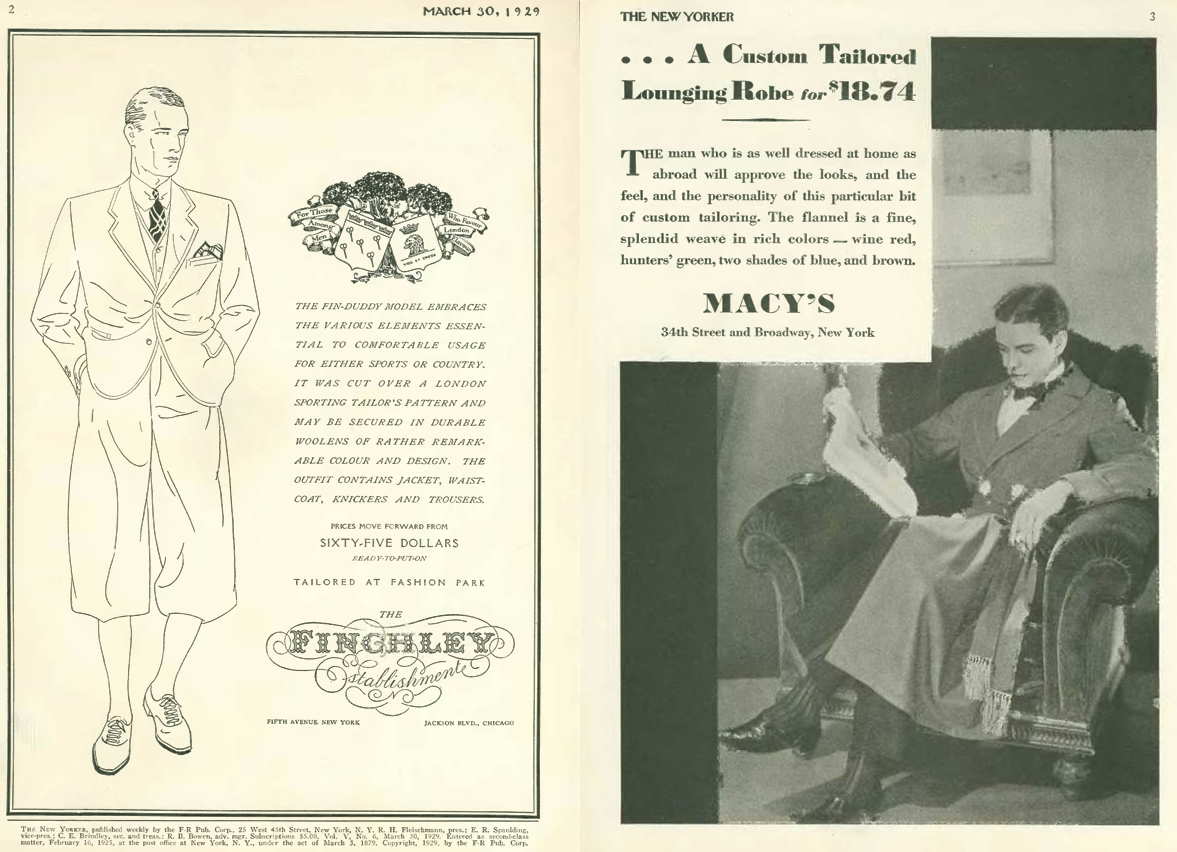
Advertisers in the March 30 issue offered various garments for the gentleman, including this sports-country ensemble at left from Finchley and a custom lounging robe from Macy’s…

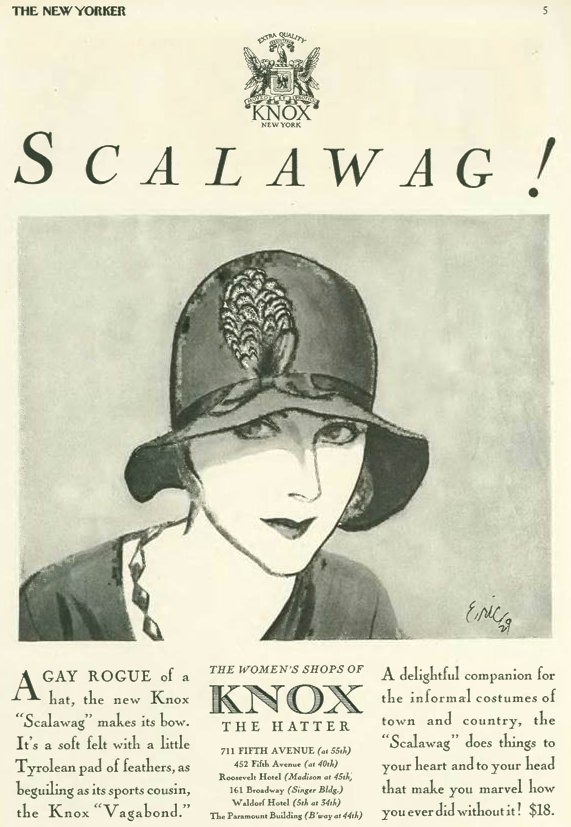
…and for fashionable, amusingly mischievous woman there was the new “Scalawag” hat by Knox (ad illustrated by the great Carl Erickson)

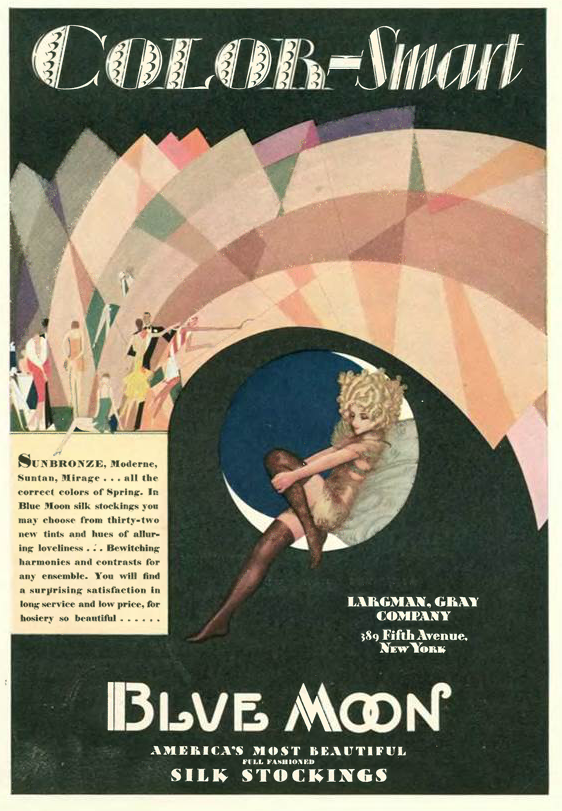
…Blue Moon’s blonde fairy girl was one of the Jazz Age’s most recognizable labels…here she is matched with an Art Deco-inspired spectrum of stocking colors…

…Ligget & Myers Tobacco Company joined the ranks of sophisticated advertisers who touted a product—in this case Fatima cigarettes—without actually showing the product…

…on the other hand, American Tobacco Company, the makers of Lucky Strike, made doubly sure you wouldn’t forget that bright red bullseye, or Rosalie Adele Nelson, “The Original Lucky Poster Girl”…

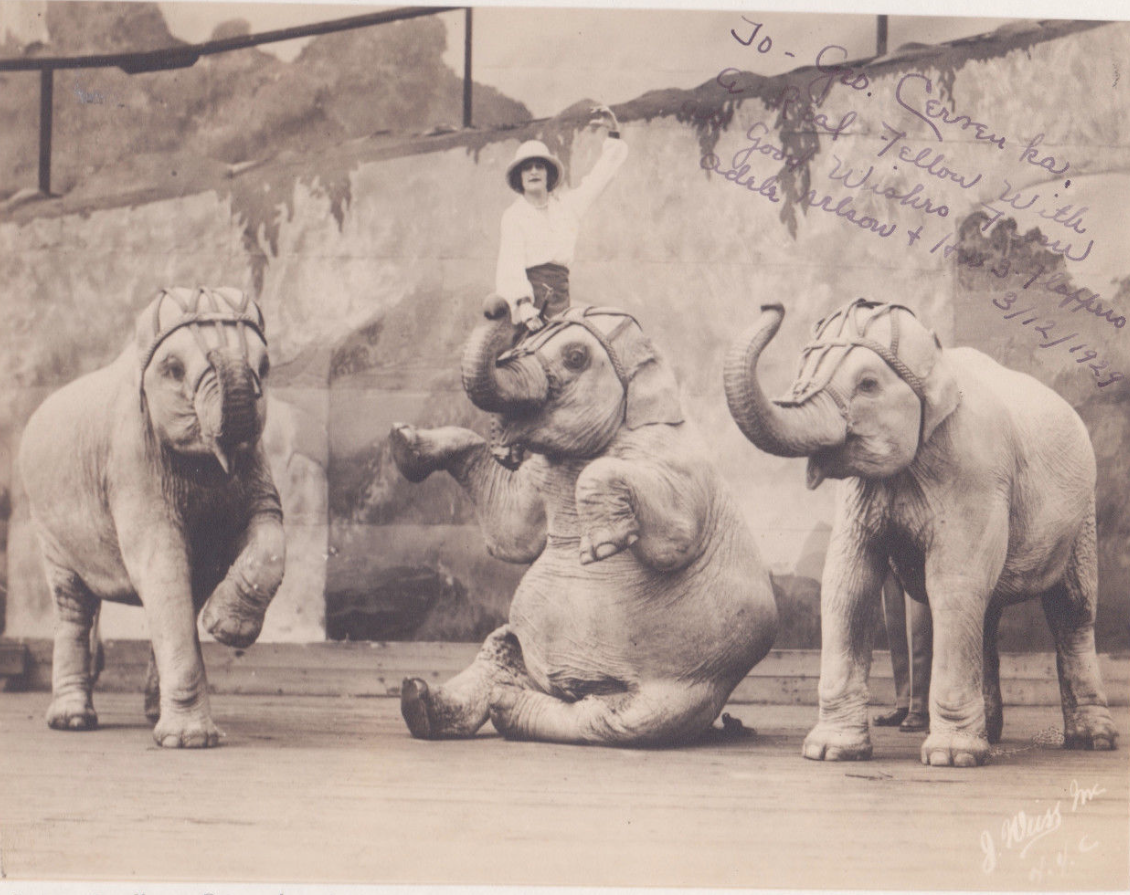
Nelson’s image for Lucky Strike was almost as ubiquitous as the fairy in the Blue Moon ads. Apparently she was also a member the Nelson family of circus acrobats and performed her own signature act with baby elephants:

Rosalie Adele Nelson with her baby elephant act, 1929 (eBay)

Philip Morris took an entirely different (and unusual) approach to selling its relatively new brand of Marlboro cigarettes by touting the achievements of Gretchen Colnik, winner of the “1928 Marlboro Contest for Distinguished Handwriting….”

Like Rosalie Adele Nelson, Gretchen Colnik would go on to minor fame of her own. She was managing editor of the Great Neck, NY, newspaper before returning to her hometown—Milwaukee, Wisconsin. From 1952 to 1966 Gretchen was the Martha Stewart of Milwaukee, hosting a TV show that provided advice on interior design, food and crafts. “The Gretchen Colnik Show” was sponsored by Mrs. Karl’s Bread.

Our cartoon is by Leonard Dove, who looks in on an architect at work:

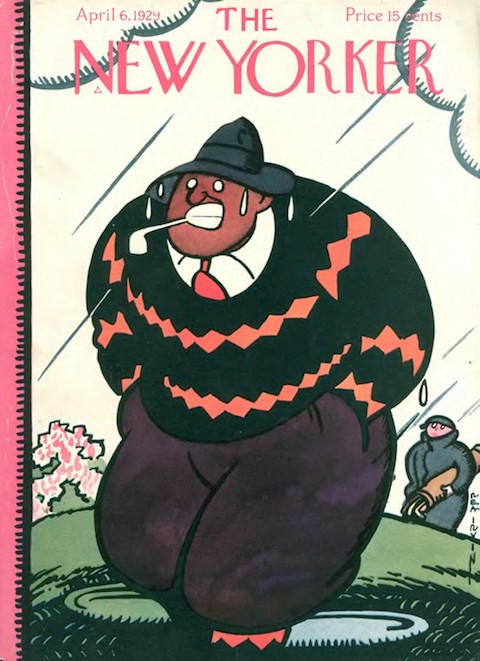
The Cruelest Month

The film reviews for the April 6, 1929 issue found the New Yorker once again at odds with Hollywood and favoring cinematic products from the Old World.

April 6, 1929 cover by Rea Irvin.

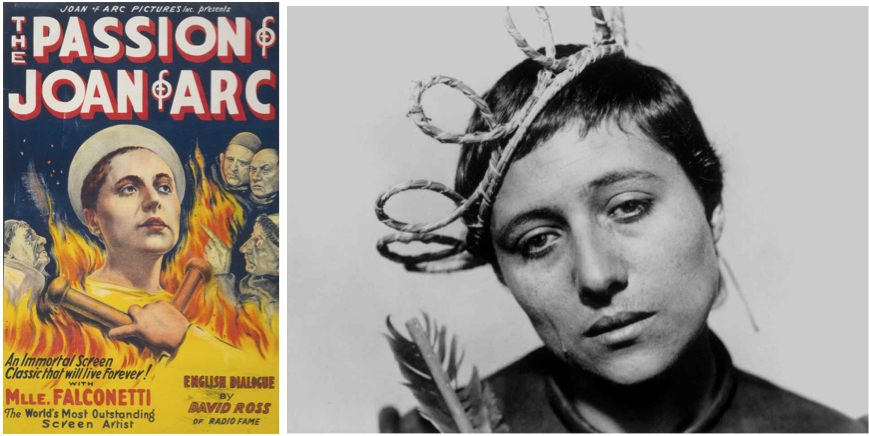
In the case it was a French film, The Passion of Joan of Arc, which even today is regarded as a cinematic landmark.

A LOT AT STAKE…American poster for The Passion of Joan of Arc; at right, Maria Falconetti in the title role. (Wikipedia/Film Forum)

The New Yorker review praised the film as “one of the few of the year which merit serious attention”…

On the other hand, there were the latest products from Hollywood, which stood on the other side of a “vast abyss” from the French film:

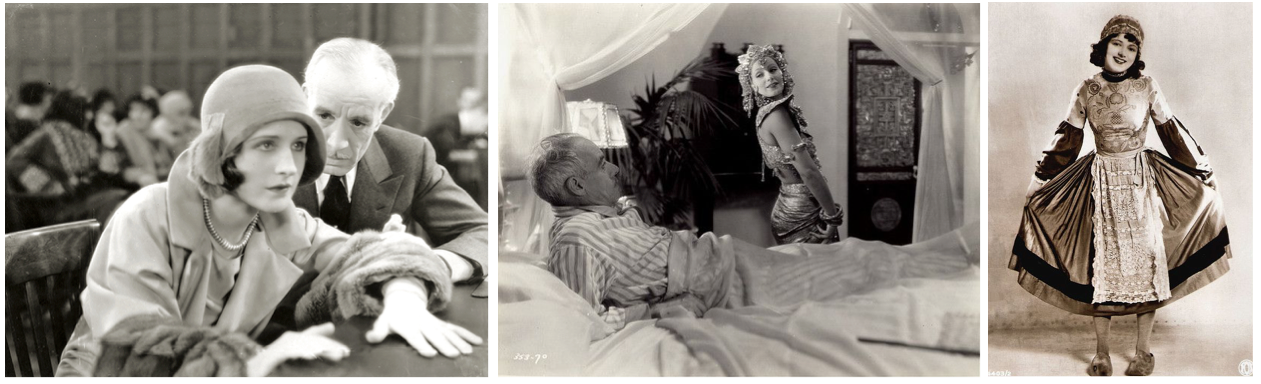
HO HUM FOR HOLLYWOOD…At left, Mary Dugan (Norma Shearer) with her conniving lawyer, Edward West (Lewis Stone) in The Trial of Mary Dugan; Lewis Stone was a apparently a busy man in the late 1920s—here he is again (center image), this time portraying John Sterling, a tea plantation investor lacking the mojo to keep up with his much younger wife, Lillie (Greta Garbo) in Wild Orchids; and at right, Janet Gaynor as a little Dutch girl in Christina, a film now considered lost. Click image to enlarge (normashearer.com/pinterest)

 *  *  *

From Our Advertisers

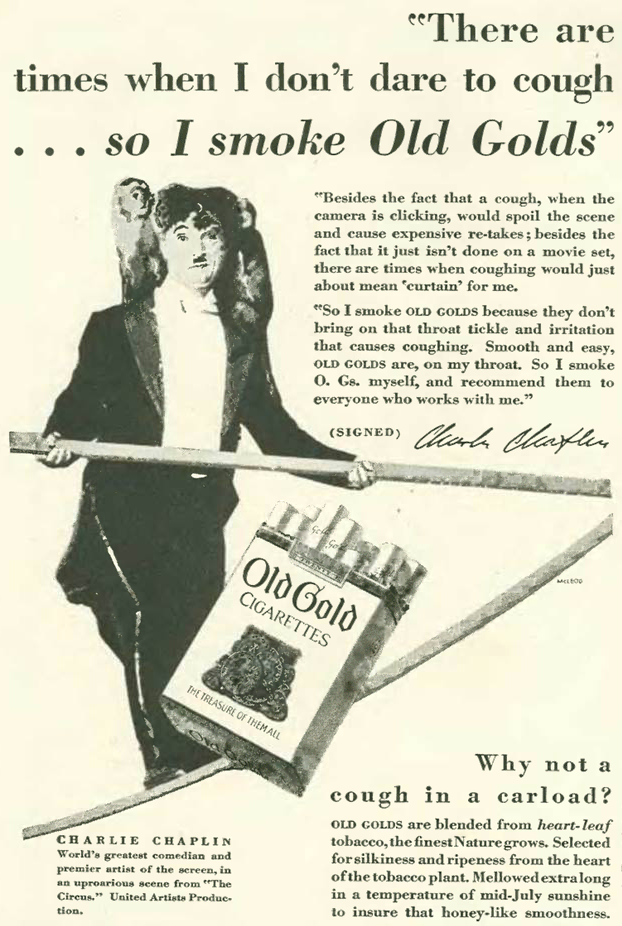
The April 6 issue found Charlie Chaplin getting in on the action of Old Gold cigarette endorsements…

…while Curtiss Flying Service thought it might interest some of the more well-heeled New Yorker readers in the purchase of an airplane…

…a couple weeks later, in the April 20 issue, the New Yorker would make this observation about the ad in “The Talk of the Town”…

…and finally, our cartoon by R. Van Buren, looking in on yet another sugar daddy and his much younger companion on a night out…

Next Time: Generation of Vipers…

Million Dollar Mermaid

Our sense of what is old and what it is new becomes skewed during periods of rapid change, and such was the case in 1920s New York when large swaths of the old city were swept away and replaced by massive towers that seemingly rose overnight. Places like the Hippodrome Theatre, a 1905 Beaux-Arts confection barely 24 years old, seemed positively ancient in those heady times.

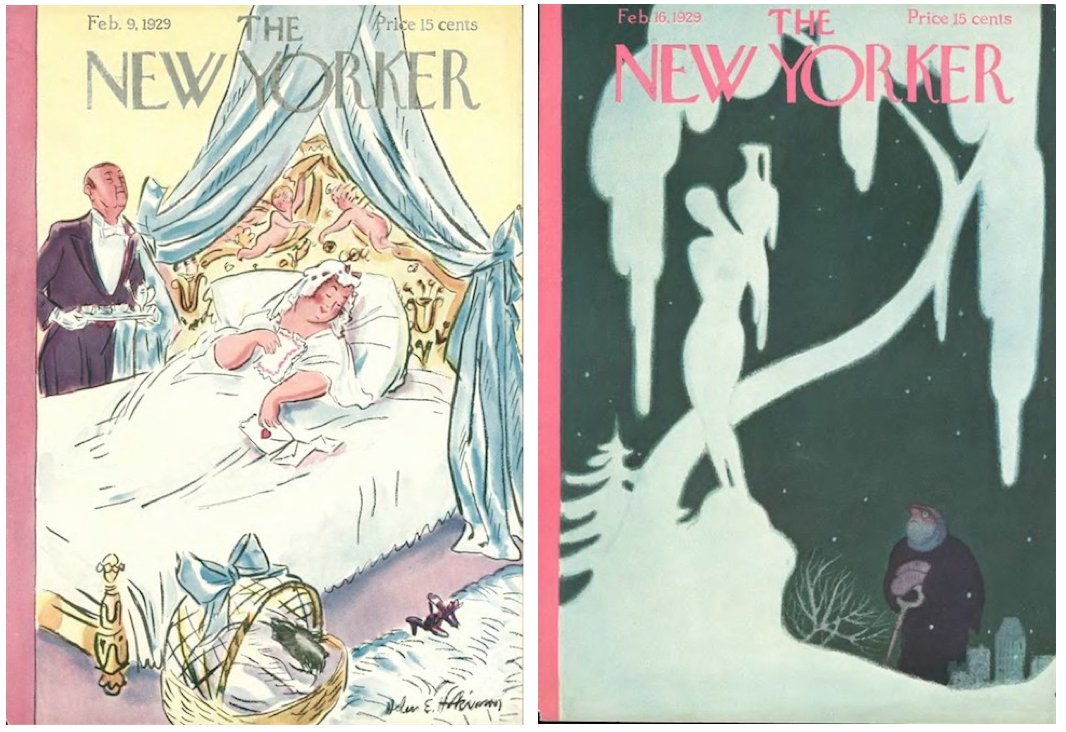
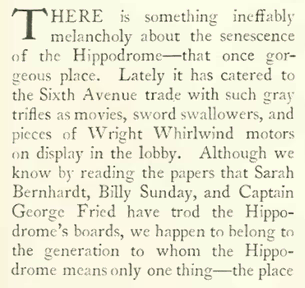
Feb. 9, 1929 cover by Helen Hokinson. Feb. 16, 1929 cover by Rea Irvin.

For the most part the New Yorker was enthusiastic about the changing skyline, as its namesake was claiming the crown as America’s premier city; but occasionally a melancholy note would be struck when a familiar institution appeared in decline or fated for the wrecking ball. In the Feb. 9, 1929 “Talk of the Town,” E.B. White wistfully recalled the old days of the Hippodrome, once the largest theatre in the world and the pride of turn-of-the-century New York:

FOR THE MASSES…The Hippodrome, built in 1905, provided entertainment to millions of New Yorkers who couldn’t afford a ticket to a Broadway play. The brainchild of Frederick Thompson and Elmer S. Dundy, entrepreneurs of Coney Island’s Luna Park, the Hippodrome was torn down in 1939 after more than a decade of decline. (1905 photo courtesy Library of Congress)
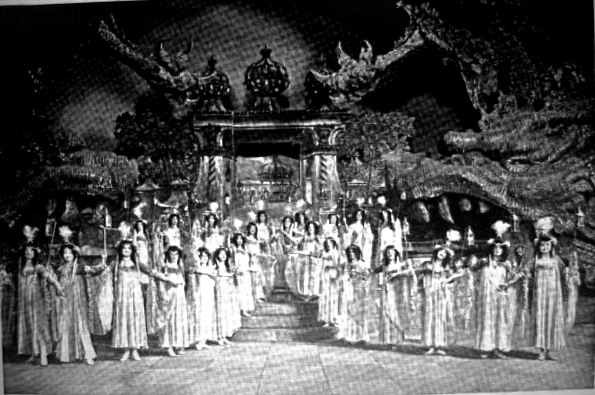
A REALLY BIG SHOOO…One of the first performances at the Hippodrome was a four-hour spectacle: A Yankee Circus on Mars (advertised on the theatre’s marquee in photo above). The 1905 production included 280 chorus girls, 480 soldiers, a parade of cars driven by elephants, an equestrienne ballet, acrobats, and a cavalry charge through a lake. (Image from Harper’s Weekly via daytoninmanhattan.blogspot.com)
The Hippodrome’s main theatre could accommodate 5,300 patrons in seats that were four inches wider than normal theatre seats. The dome over the “Roman style” auditorium encompassed an acre. (Broadway Magazine 1905 via daytoninmanhattan.blogspot.com)

The Hippodrome held such a place in the heart of the New Yorker that the magazine offered further reminiscences in the Feb. 16 issue, this time penned by managing editor Harold Ross:

For demonstrations of diving and “mermaid spectacles,” the Hippodrome stage featured an eight-foot high steel tank in four sections, with a front of plate glass. Manned diving bells were also used to raise and lower “mermaids” during performances.

OLD TIMEY FX…Illustration from Nature magazine (left) depicts a diving bell used in the Hippodrome’s swimming and diving tank to raise and lower performers. At top, circa 1910 advertisement; at bottom, the “Court of the Golden Fountain” in the the theatre’s 1905-06 presentation of A Society Circus. (les-sources-du-nil.tumblr.com/flickr/NYC Architecture)

Ross wrote about the Hippodrome’s “diving girls,” who would dive into a tank of water from a height of 90 feet, sometimes at a serious cost to their health:

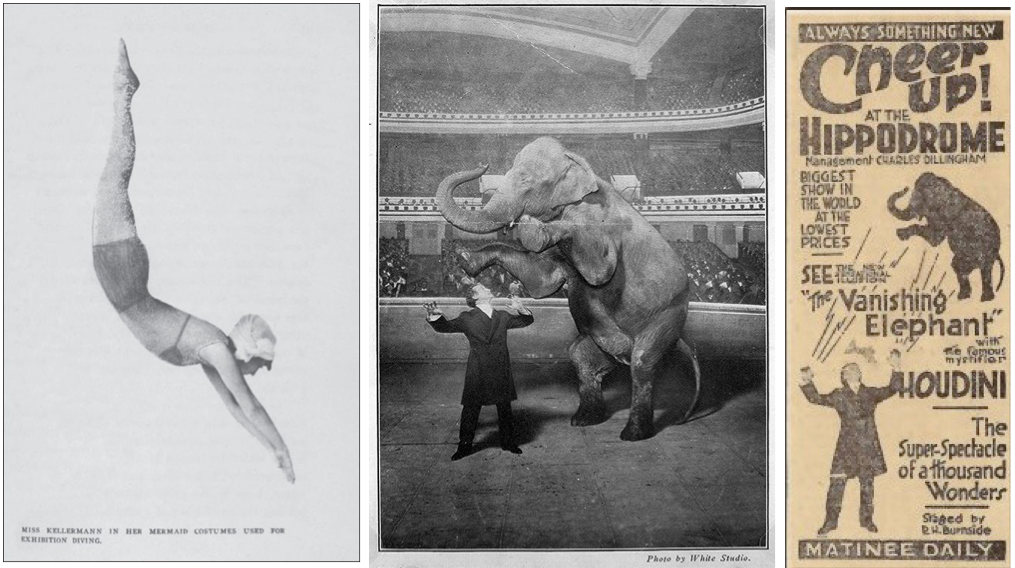
HIPPODROME’S HEYDAYS…In the early 1900s Australian swimmer and diver Annette Kellerman (left, in an image from her 1918 book, How to Swim) was a famed performer at the Hippodrome, as was illusionist and stunt performer Harry Houdini, shown here in 1918  with Jennie the Elephant in a performance of the vanishing elephant trick. (Monash University/americaslibrary.gov/wildabouthoudini.com)
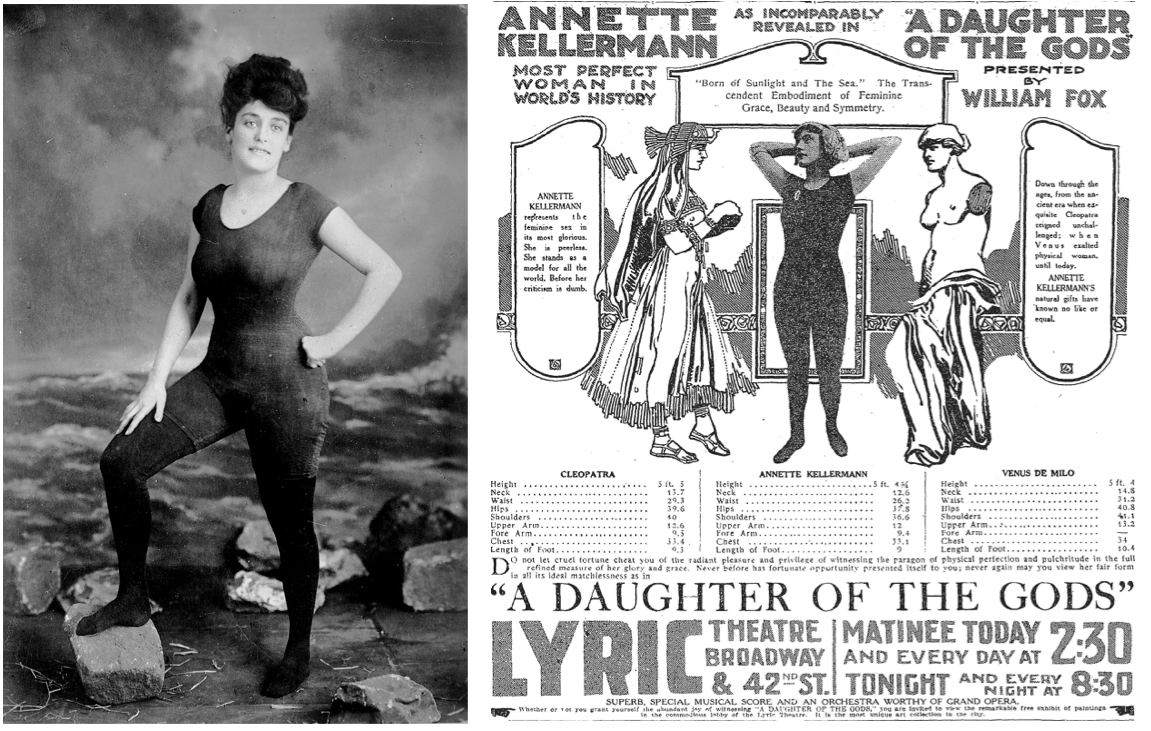
MILLION DOLLAR MERMAID…famed around the world by that moniker, swimmer and later actress Annette Kellerman is considered the originator of the one‐piece bathing suit, which she models at left in a photo taken around 1907. At right, advertisement for Kellerman’s 1916 film A Daughter of the Gods (now lost), in which Kellerman achieved another first: the first complete nude scene by a major star. The William Fox Studio made much of Kellerman’s figure, promoting her as the perfect woman by “comparing” her measurements to the likes of Cleopatra and Venus de Milo. (Wikipedia/consumingcultures.net)

Australian swimmer Annette Kellerman was a big draw at the Hippodrome, and helped popularize the sport of synchronised swimming after her 1907 performance of the first water ballet in theatre’s giant plate glass tank. In that same year she shocked Bostonians by appearing on a local beach in a “daring” one‐piece bathing suit (shown above), and was arrested for indecency. This was at a time when a woman’s standard bathing apparel consisted of a blouse, skirt, stockings and swimming shoes.

Unlike some of the unfortunate Hippodrome divers who later lost their eyesight due to cranial pressure from high dives, Kellerman went on to a long and active life (she died in 1975, at age 88). Known throughout the world as Australia’s “Million Dollar Mermaid” (and portrayed by Esther Williams in a 1952 movie by the same name), Kellerman appeared in more than a dozen films between 1909 and 1924. She also launched her own line of swimwear and wrote several books on swimming, beauty and fitness.

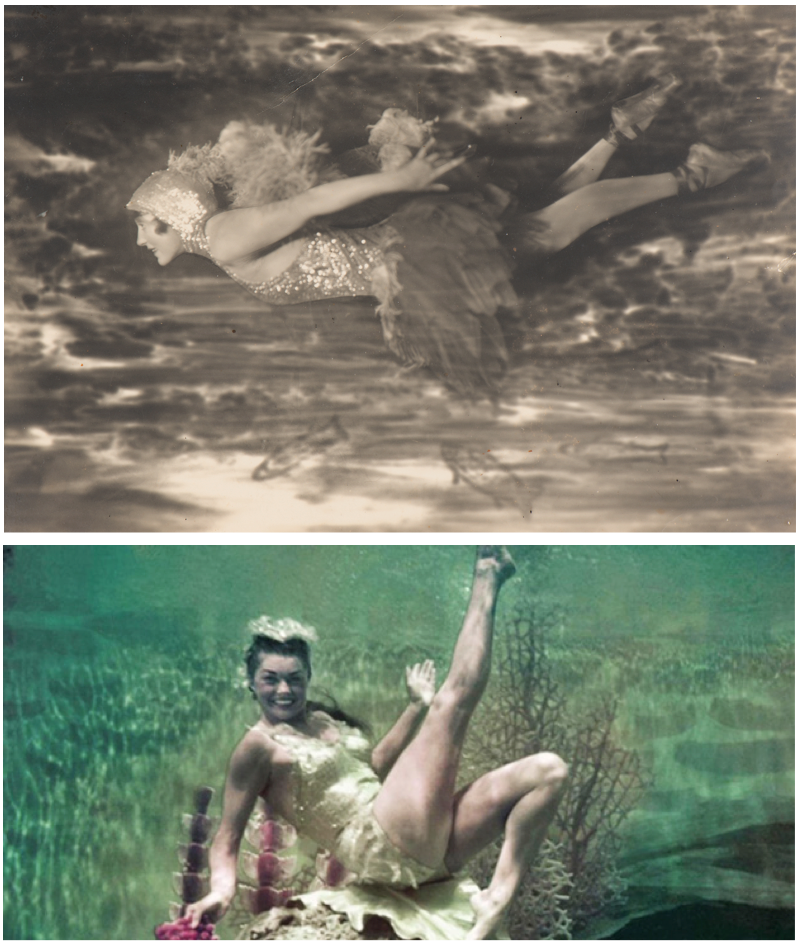
ALL WET…At top, Annette Kellerman swimming underwater in a gold sequined dress, possibly from  Queen of the Sea (1918, now lost). Thirty-four years later Esther Williams (below) would portray Kellerman in Million Dollar Mermaid. (historycouncilnsw.org.au/gsgs/movieactors.com)

*  *  *

City of Lights

While E.B. White got misty-eyed about the old Hippodrome in the Feb. 9 issue, his fellow New Yorker writer and friend James Thurber was thrilling on the new skyscrapers lighting the city’s skyline:

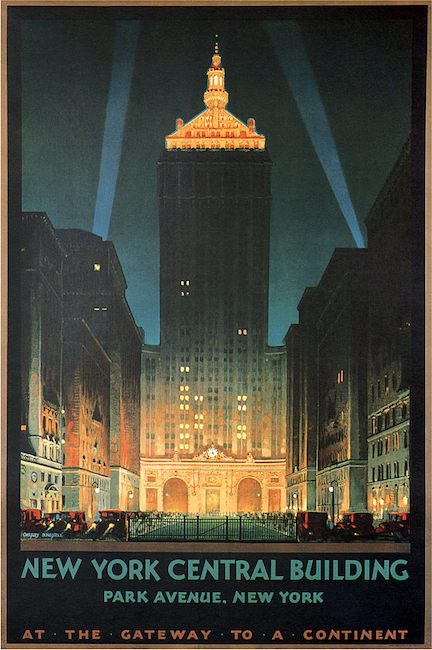
BEJEWELED CROWN…The New York Central Building depicted in a 1929 promotional painting by Chesley Bonestell. (albanyinstitute.org)

Thurber noted that “100,000 candlepower” would light the golden crown of the New York Central Building, the tallest structure in the Grand Central complex. Over at the new Chanin Building, a whopping 25 million candle-power would be trained on its art deco crown.

YOU CAN’T MISS IT…At left, the nearly 700-foot-tall Chanin Building joined the race for the sky in 1928-29. At right, a 1929 drypoint etching by Australian-born artist Martin Lewis depicted the magical glow of the Chanin Building from the viewpoint of a tenement dweller on a fire escape. (NYPL/ephemeralnewyork.wordpress.com)

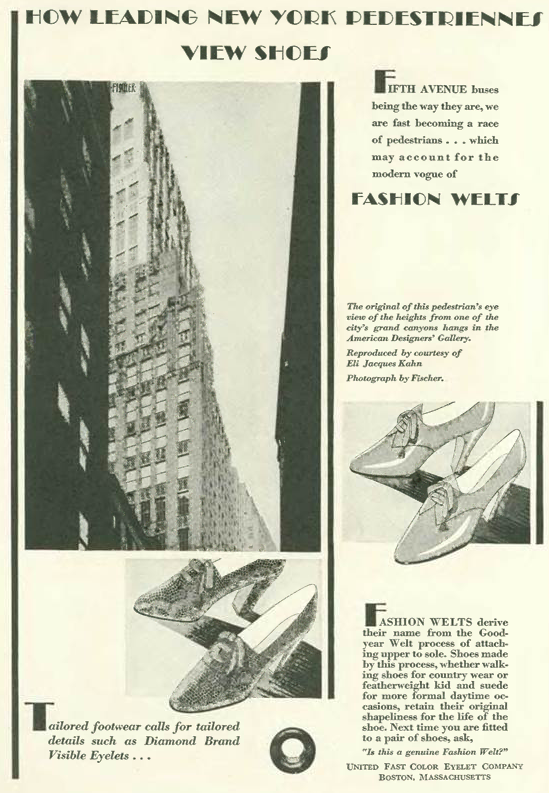
Advertisers in the New Yorker reflected the mood of this new city of skyscraper canyons. From the Feb. 16 issue:

Ralph Ingersoll and Thurber also wrote in the Feb. 16 “Talk” about plans for “Rockefeller City…”

…and as we know, this was to become the famed Rockefeller Center, a complex of 19 buildings covering 22 acres between 48th and 51st streets. Led by by John D. Rockefeller Jr., the complex was conceived as an urban renewal project to revitalize Midtown (hard to imagine today). The land was originally envisioned as a site for a new Metropolitan Opera house, but when financing fell through the land’s owner, Columbia University, leased it to Rockefeller. Of the anticipated effect of the project, Ingersoll and Thurber wrote:

And for the record, the Feb. 9 issue featured another name that would shape the future of the city—J. Pierpont Morgan was the subject of a lengthy two-part profile penned by John K. Winkler.

 * * *

Shouts & Murmurs

The Feb. 16 marks a significant date on the New Yorker calendar—the first appearance of Alexander Woollcott’s famed “Shouts & Murmurs” column:

Writing in the “Double Take” section in the July 18, 2012 issue of the New Yorker, Jon Michaud notes that “Shouts & Murmurs” was Woollcott’s personal column, appearing weekly in the magazine for five years. Perhaps no person other Harold Ross himself could be more associated with the earliest origins of the magazine —  Woollcott was a colleague of Ross’s at Stars and Stripes during the First World War, and introduced Ross to his first wife, Jane Grant, who was also a considerable influence on the early magazine.

Michaud writes that Woollcott used the column “to opine on, lampoon, and attack the culture and society of the day. In his distinct and at times excessive style, he reviewed books, wrote spoofs, distributed gossip, and generally rankled as many people as he could.” Woollcott ended the column in December 1934, but it was revived in 1992 as a regular venue for many notable humorists, and continues to this day.

A REAL CHARACTER…Alexander Woollcott, in his idea of casual wear. He once informed his friend and New Yorker colleague Corey Ford: “Ford, I plan to spend three days at your house in New Hampshire next week.” Not overly pleased to be hosting such a demanding guest, Ford uttered a meek “That will be swell.” “I’ll be the judge of that,” Woolcott warned him. (From Elizabeth Olliff, “An Evening at the Algonquin.”)

* * *

Up In Smoke

Jumping back to the Feb. 9 “Talk of the Town,” we have this complaint from the magazine regarding celebrity cigarette endorsements. Although the magazine derived a lot of revenue from cigarette ads, Harold Ross insisted on a strict separation between editorial and advertising, allowing his writers free reign to bite the hands that fed them, if they so wished:

Here’s the offending ad, which was featured in the Feb. 23 issue:

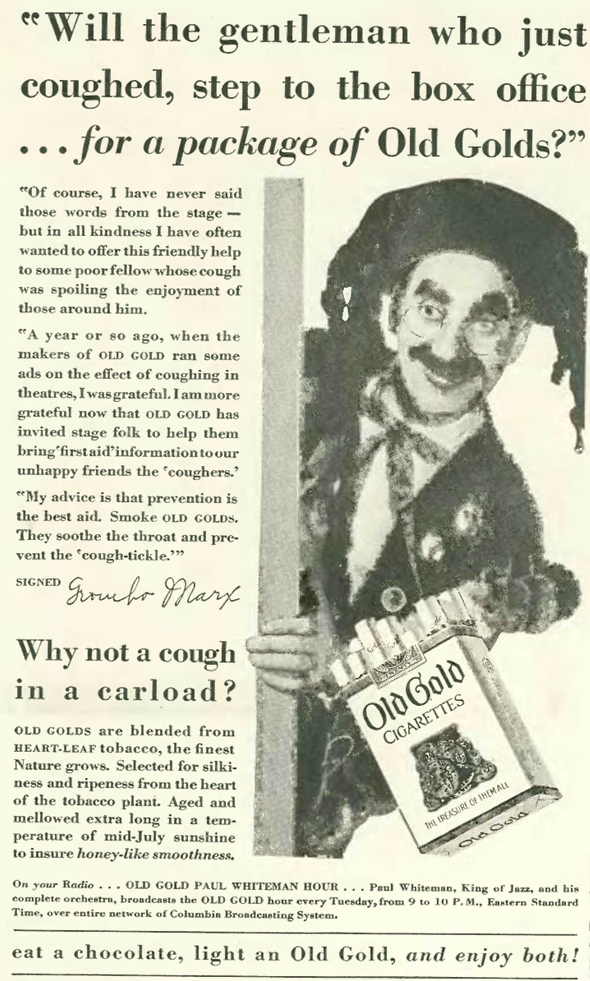
In the Feb. 9 issue, Groucho Marx couldn’t resist getting in on the endorsement action…

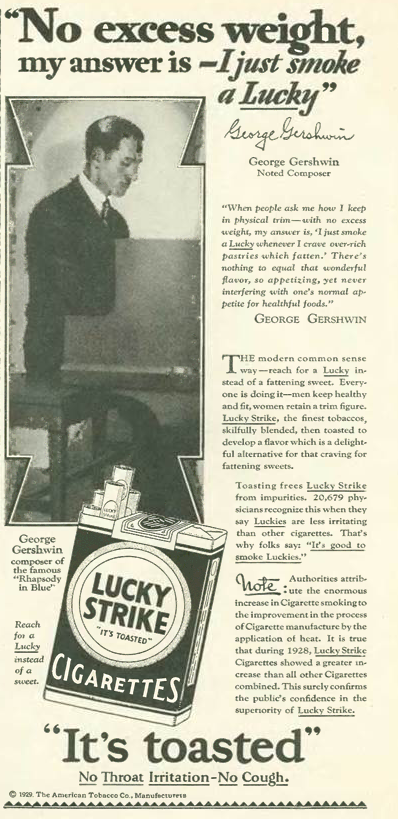
…nor could Ross’s old friend George Gershwin, who touted the health benefits of Lucky Strikes in the Feb. 16 issue…

In other ads from the Feb. 16 issue, we find that for all of the technological advances in the 1920s, a decent car heater still eluded automakers. Hence…

…on the other hand, we also have this very up-to-date product—the forerunner of today’s rolling airplane luggage…

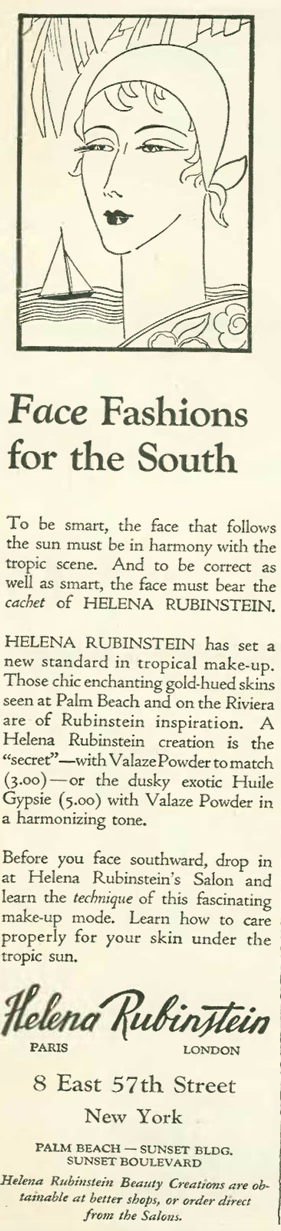
…and if you happened to be flying south, you might have first checked in with Helena Rubinstein to make sure you had the right “face fashions”…

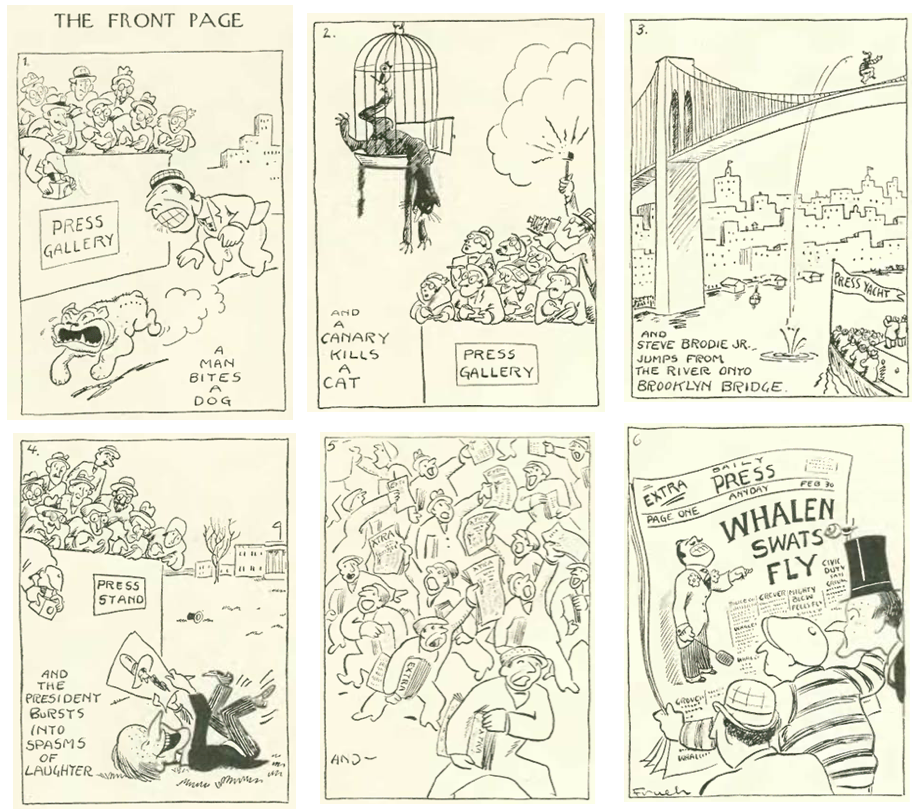
And finally our cartoons, all from the Feb. 9 issue. This first is a six-panel series by Al Frueh that originally ran diagonally, top to bottom, across a two-page spread. It took a shot at the self-promoting police commissioner, Grover Whalen, who was not a friend to the New Yorker due to his ham-fisted approach to Prohibition enforcement…

…and Leonard Dove took a shot at some posh folks outside of their urban element…

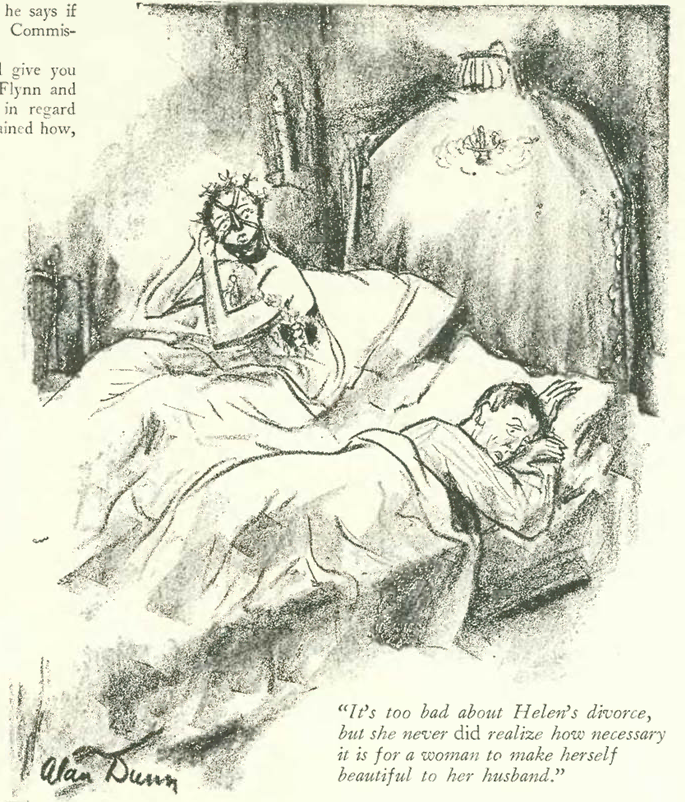
…and finally, Alan Dunn examined the wages of beauty…

Next Time: Modern English Usage…

Life Among the Snowbirds

Florida’s Palm Beach became a popular destination in the 1920s for well-heeled New Yorkers seeking a respite from winter’s cold and gloom.

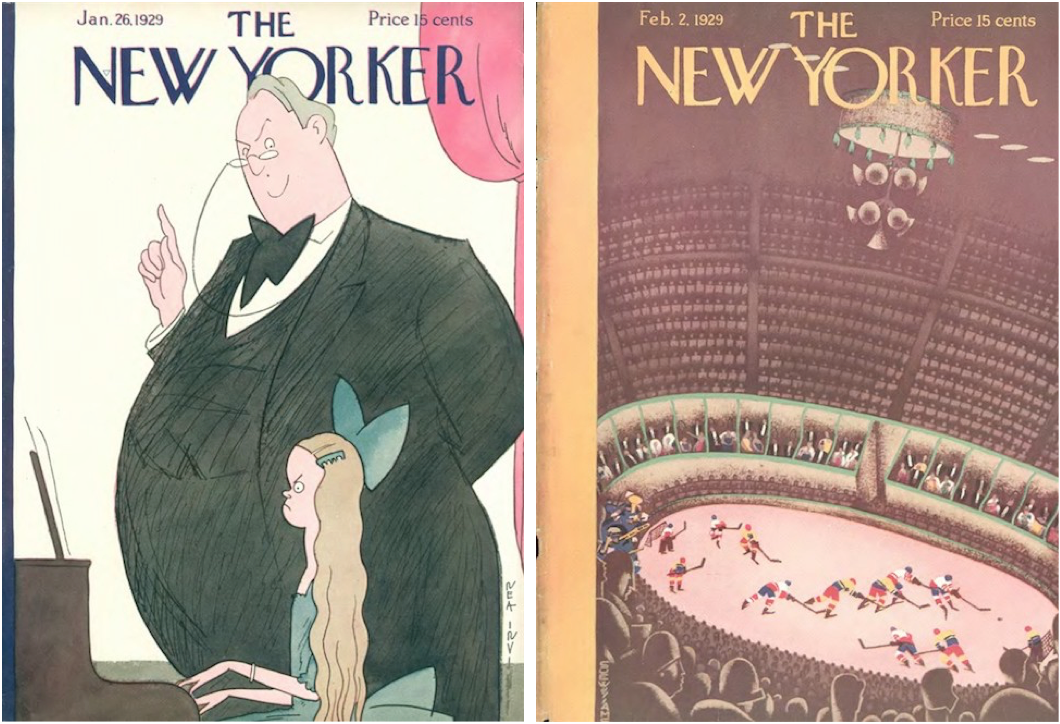
Jan. 26, 1929 cover by Rea Irvin / Feb. 2, 1929 cover by Sue Williams.

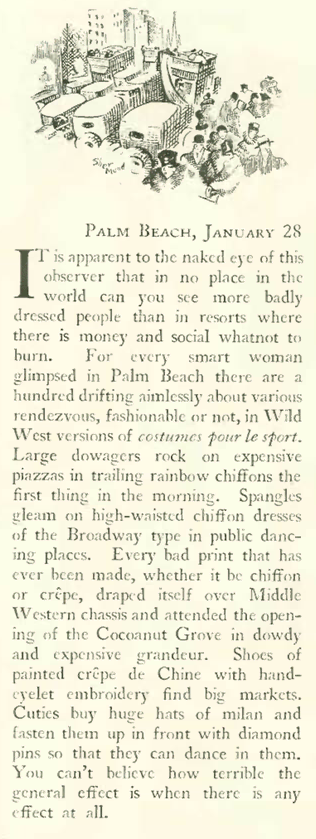
Among them was the New Yorker’s nightlife correspondent and fashion critic Lois Long, who (writing in the Feb. 2 issue) discovered that many snowbirds left their fashion sense back home, or in some cases didn’t have any in the first place…

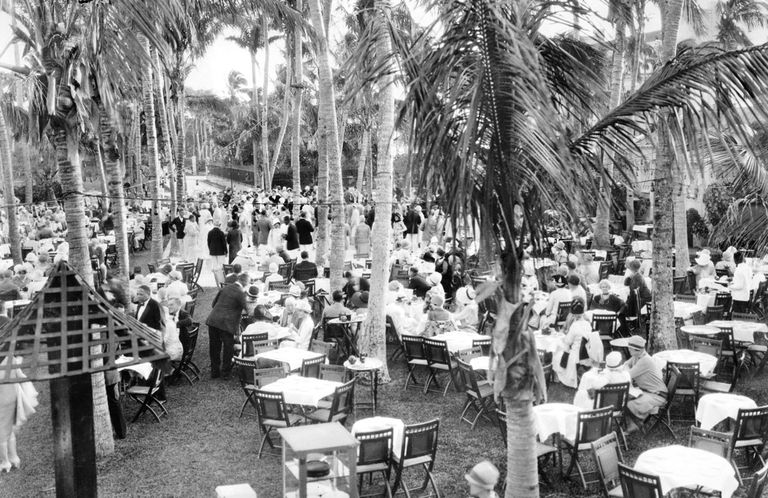
THOSE GENTLE BREEZES…Dining at the Coconut Grove in Palm Beach, 1928. (Town and Country)
Sufficiently appalled by the fashion scene, Long then offered some advice for those seeking a smarter look in the southern climes…

AHOY THERE…Beach pajamas were a popular choice in the 1920s. (artdecogal.com)
BIG BOOSTER…The financier Otto Kahn was one of Palm Beach’s biggest promoters. Here he relaxes with friends at one of his Palm Beach “cottages” (this one is the Oheka Cottage, designed by August Geiger, on North Ocean Boulevard). L to R: New York socialite  Sarah Jane Sanford, Otto Kahn, Margaret “Nin” Kahn Ryan (Kahn’s eldest daughter), Betty Bonstetten (of the Rothschild banking fortune), and seated, Nancy Yuille (tobacco heiress who would later marry the Viscount Adair and become the Countess of Dunraven) and Swiss architect Maurice Fatio. (Ellen Glendinning Ordway Collection via New York Social Diary)
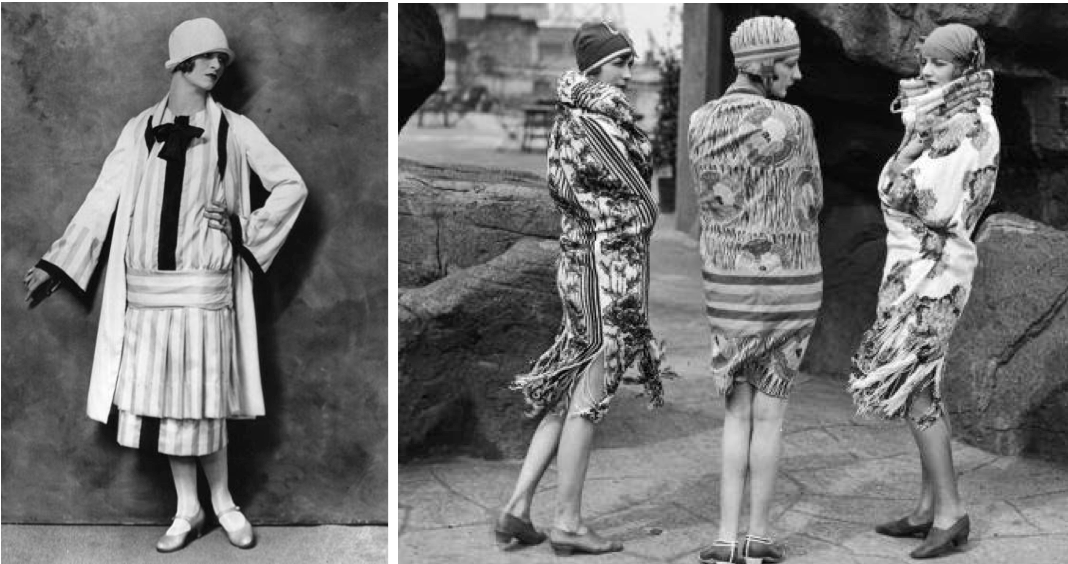
LOIS IS WATCHING YOU…A sampling of 1920s Palm Beach fashions Lois Long might have spotted during her visit. (vintage.es/picgran.com)

Long concluded her fashion advice with the dictum that when in doubt, keep it simple…

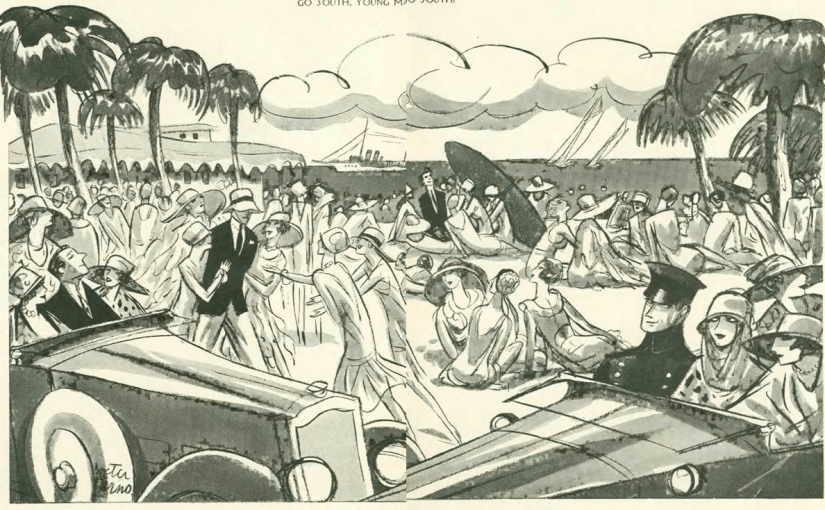
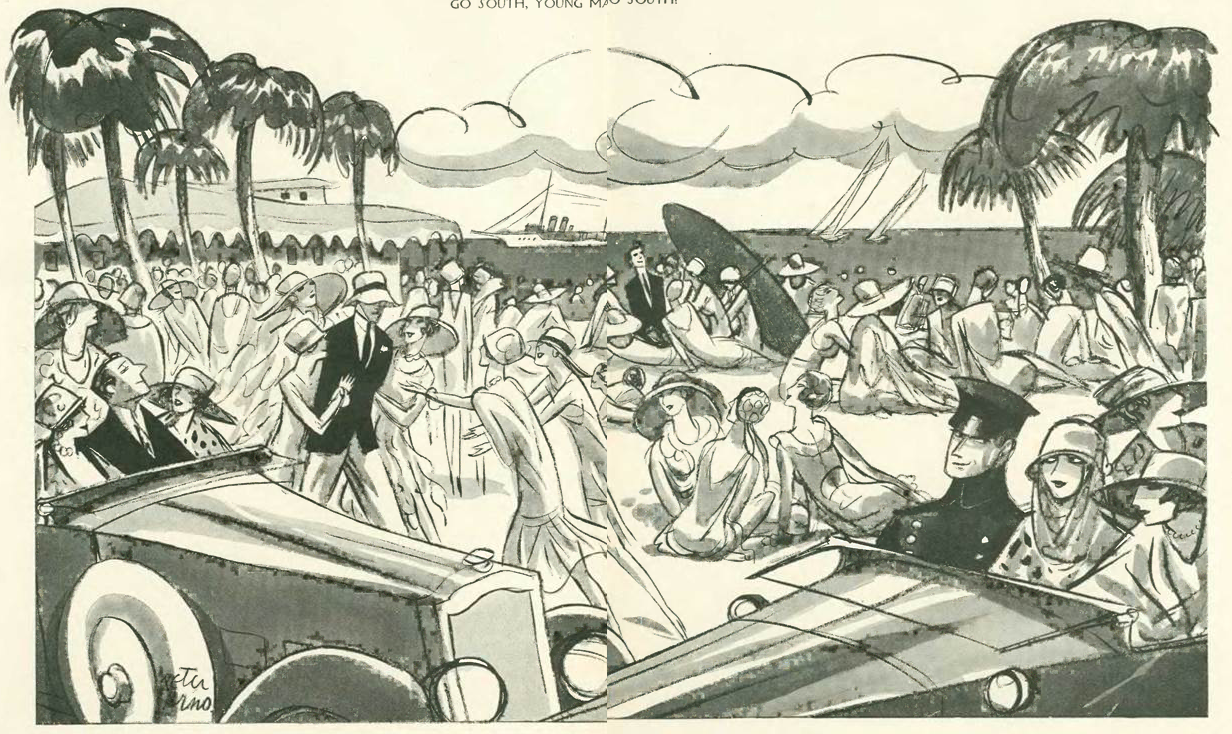
Long must have made the trip with her husband, the New Yorker cartoonist Peter Arno, since he contributed his own take on the scene in the Feb. 16, 1929 issue — a two-page illustration titled “Go South, Young Man, Go South.” (click image to enlarge)

Palm Beach was also on the minds of the New Yorker editors when they composed the Jan. 26 issue, which featured a parody by Josie Turner of the popular Elsie Dinsmore book series: “Elsie Dinsmore at Palm Beach.” A brief excerpt:

Note: The Elsie Dinsmore books (there were 28 of them) featured an impossibly upright eight-year-old and were hugely popular in the late 19th and early 20th century.

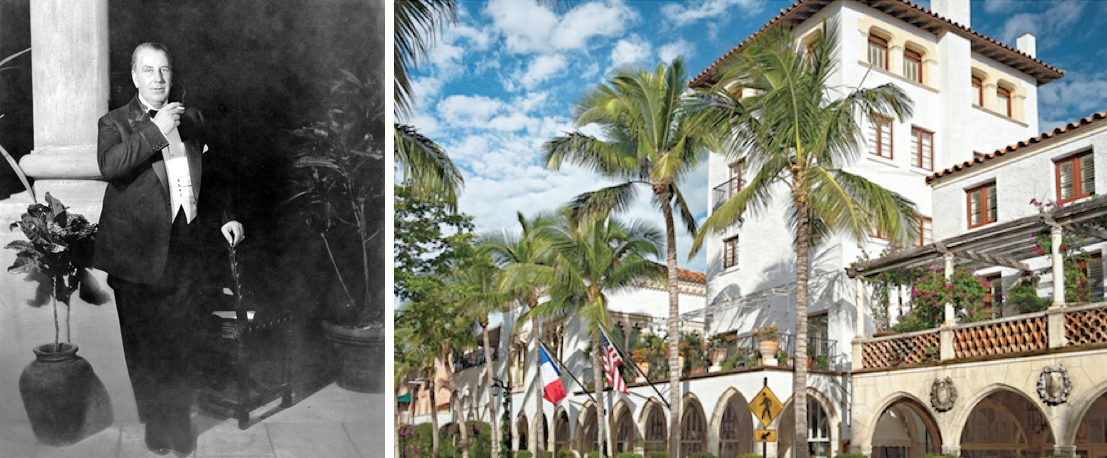
The Feb. 2, 1929 issue featured another Palm Beach-themed parody — this one by Frank Sullivan — that took a poke at Addison Mizner (1872-1933) a fixture of Palm Beach social life who designed resorts and houses for the rich and famous. He is often credited with giving South Florida its signature Mediterranean Revival and Spanish Colonial Revival styles of architecture (Augustus Mayhew, writing for the New York Social Diary, begs to differ: he notes that architect August Geiger established the style in Palm Beach three years before Mizner). An excerpt from Sullivan’s New Yorker parody:

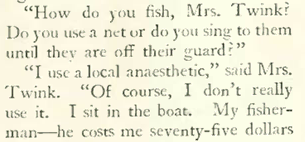
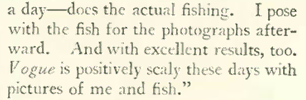
Later in the piece, Sullivan took a crack at a fictitious member of Palm Beach society, a “Mrs. Twink,” who was engaged in the latest “fad” — fishing:

STORYTELLER IN BRICK AND STONE…Addison Mizner epitomized the “society architect.” He was known for making new buildings look like they had taken centuries to construct, even creating stories for his houses that described how they “evolved” through their many owners and historical eras. At right, Mizner’s own Palm Beach residence, Villa Mizner, on Worth Avenue in Palm Beach. It was built in 1924. (palmbeachdailynews.com/Merritt Hewitt)
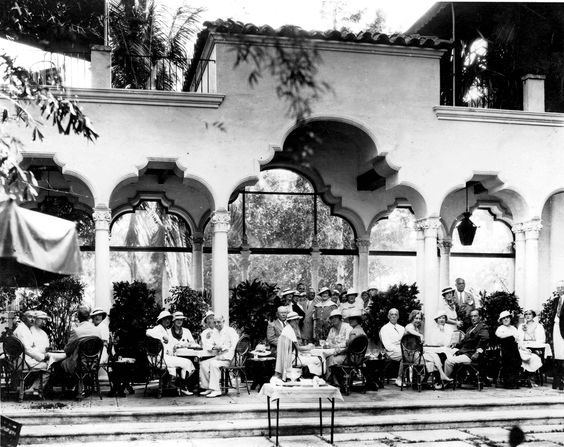
HIS KIND OF PEOPLE…Fashionably dressed members of the Mizner-designed Everglades Club gather in the Marble Patio in the 1920s. (Historical Society of Palm Beach County)
STILL THERE…The Everglades Club today. Opened in January 1919, it was Mizner’s first big commission. (Wikipedia)

The Feb. 2 issue also featured this Peter Arno cartoon of one snowbird’s reaction to Palm Beach living:

 * * *

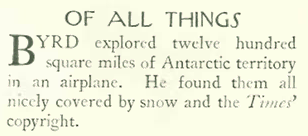
The New Yorker loved to take potshots at the news media, and particularly at the then rather staid New York Times, which apparently had secured exclusive rights to cover Admiral Richard Byrd’s famed exploration of the South Pole by airplane. In his Jan. 26 “Of All Things” column, Howard Brubaker quipped:

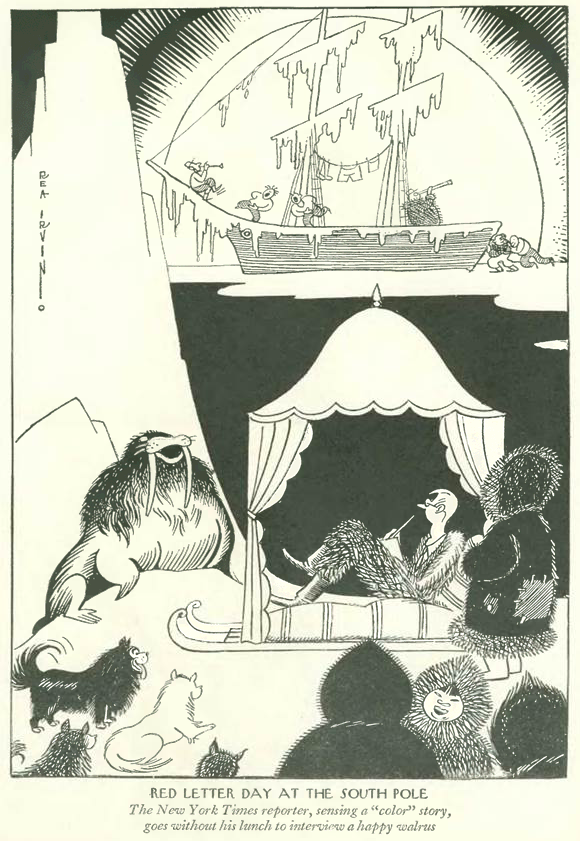
In the following issue, Feb 2, Rea Irvin imagined how a coddled Times reporter might cover the historic expedition:

ONE TOUGH BYRD…Admiral Robert Byrd (inset) led expeditions in the Antarctic from 1928 to 1930 by snowshoe, dog-sled, snowmobile and three airplanes that were transported (partially disassembled) by ship to a base camp on the Ross Ice Shelf. Pictured are Harold June, Commander Byrd, and Bernt Balchen in front of a Fairchild airplane, dubbed “Stars and Stripes.” The plane was used to take aerial photographs. (Richard E. Byrd Papers, The Ohio State University)

* * *

Grouchy Groucho

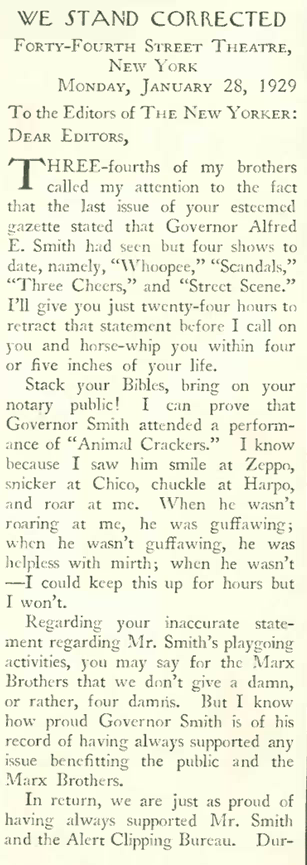
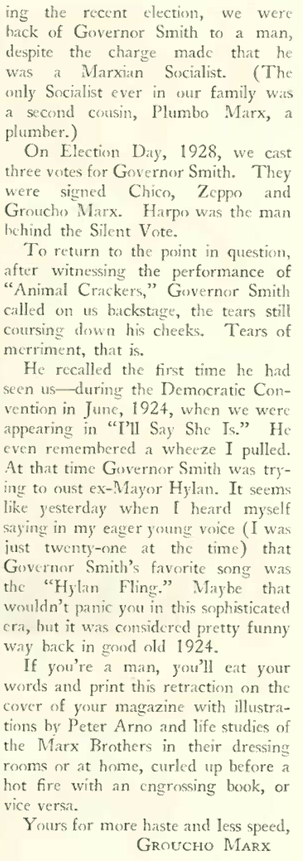
Near the back of the Feb. 2 issue (page 61), comedian Groucho Marx contributed this tongue-in-cheek demand for a retraction from the New Yorker editors:

WIT…A young Groucho Marx in 1930. (Wikipedia)

* * *

Fun With the Rockefellers

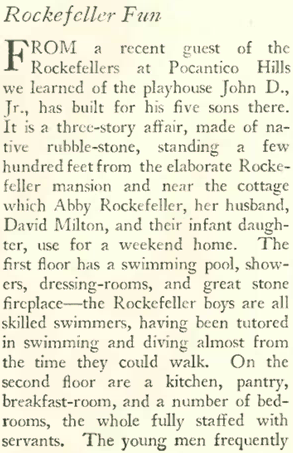
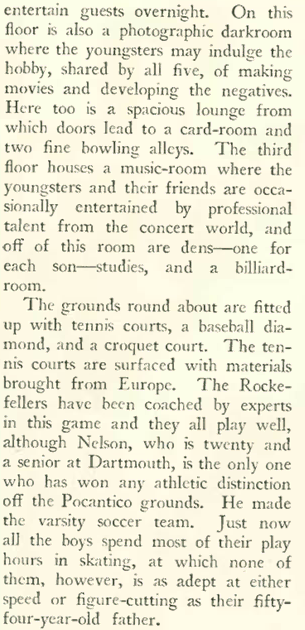
John K. Winkler contributed this piece to the Feb. 2, 1929 “Talk of the Town” that described a “playhouse” John D. Rockefeller Jr. had built for his five sons:

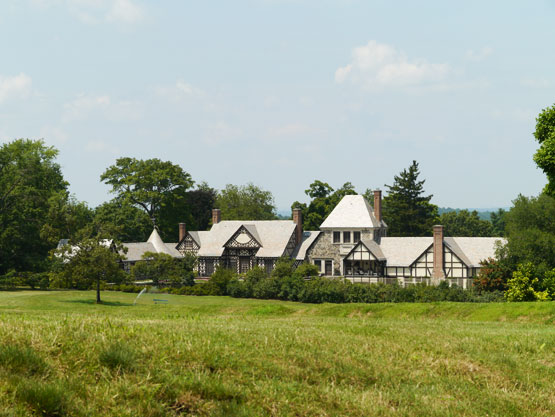
NOT FOR PEEWEE…The three-story playhouse on the Rockefeller estate at Pocantico Hills. (New York Social Diary)

 * * *

From Our Advertisers

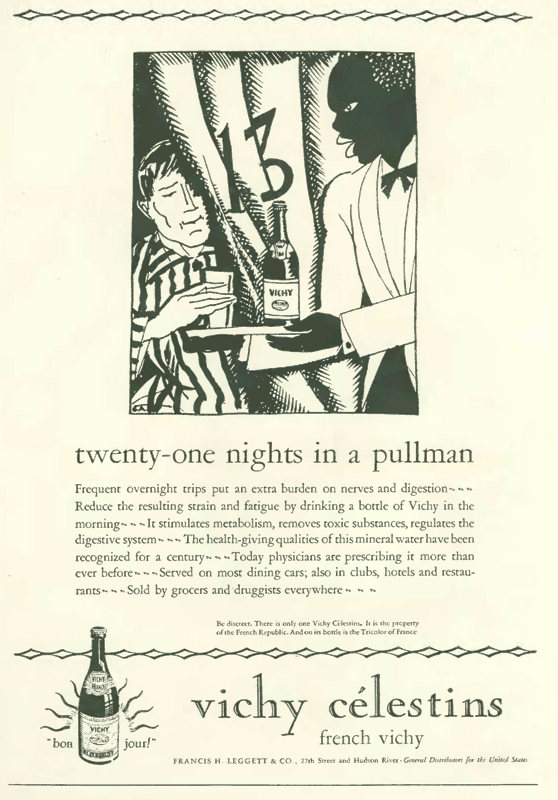
Heading to Palm Beach on a Pullman? Have too much of that bootleg gin the porter slipped you the night before? Then try…

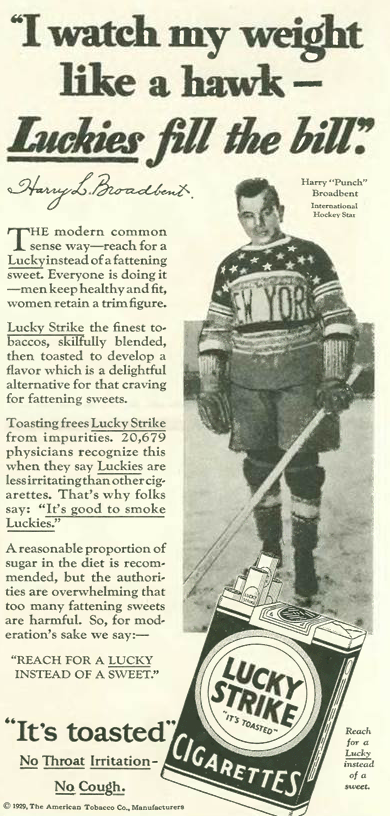
…perhaps you want to stay in shape, like this hockey star. Then grab a Lucky…

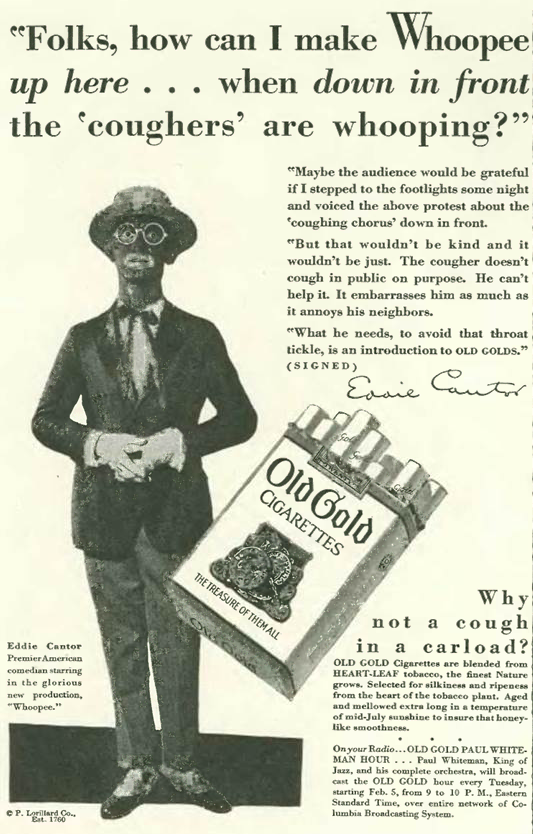
…or maybe you’d like to sing like Eddie Cantor, who soothed his throat with an Old Gold…

…and we close with these comic observations of life among New York society, again featuring the work of Peter Arno

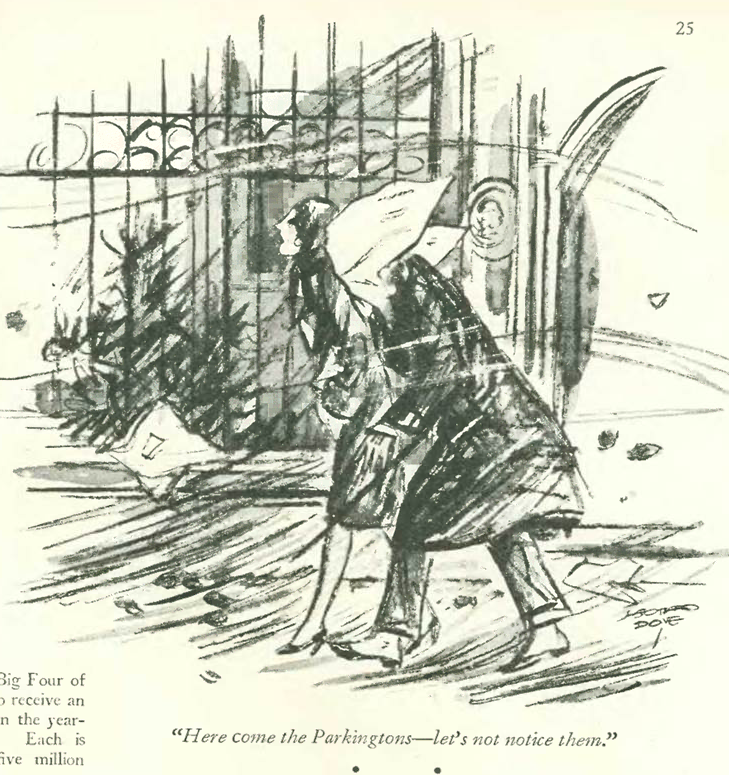
…and back to the cold New York City winter, with Leonard Dove

Next Time: Million Dollar Mermaid…


Out With the Old

Perhaps no decade was more transformative to New York City than the 1920s. From the loosening of social mores to countless technological advances, the city was a very different place as it entered the last year of the Roaring Twenties.

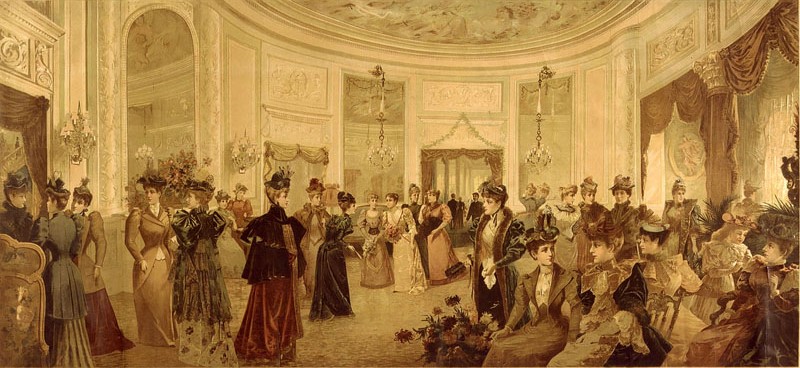
Jan. 5, 1929 cover by Sue Williams. Opening image depicts the original Waldorf Hotel’s Octagon Room in 1893.

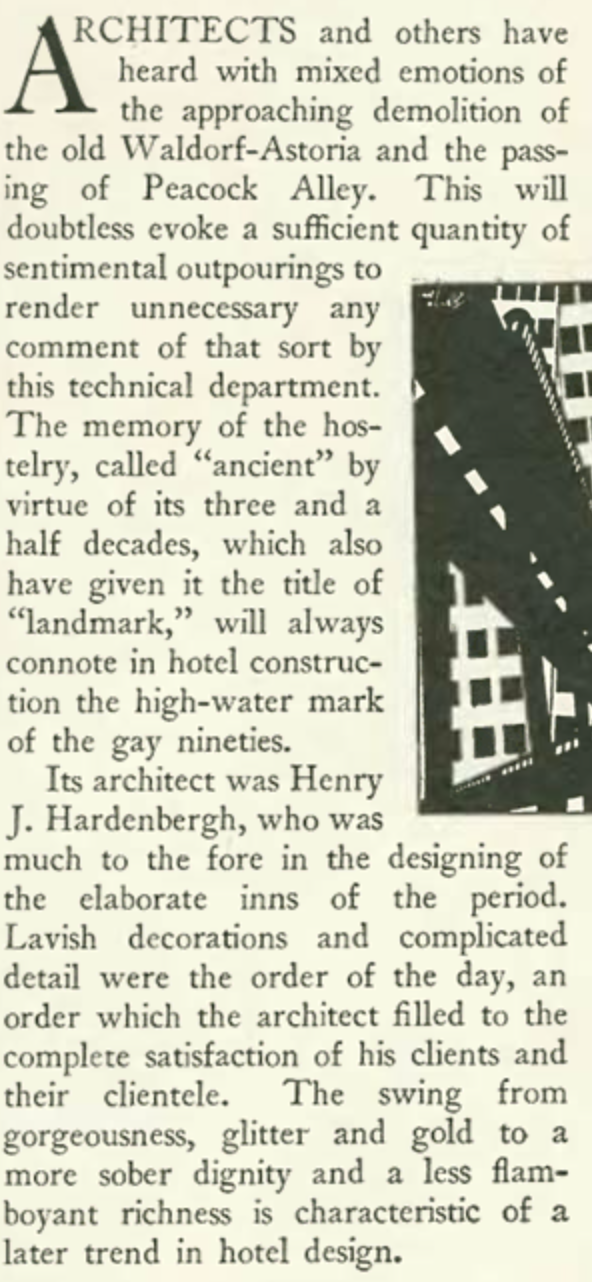
Vestiges of the 19th century were quickly erased during the decade as old neighborhoods and stately mansions gave way to massive apartment blocks and towering skyscrapers. Such was the fate of the original Waldorf-Astoria Hotel, its Victorian lavishness out of style in a streamlined age. Writing under the pen name T-Square, New Yorker architecture critic George S. Chappell commented on the planned demolition of the old* Waldorf-Astoria Hotel:

*Although outdated in appearance, the hotel was little more than 30 years old in 1929.

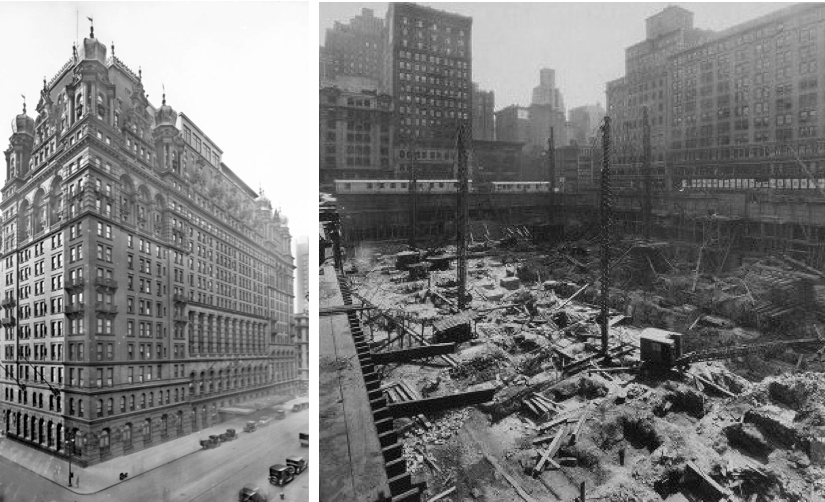
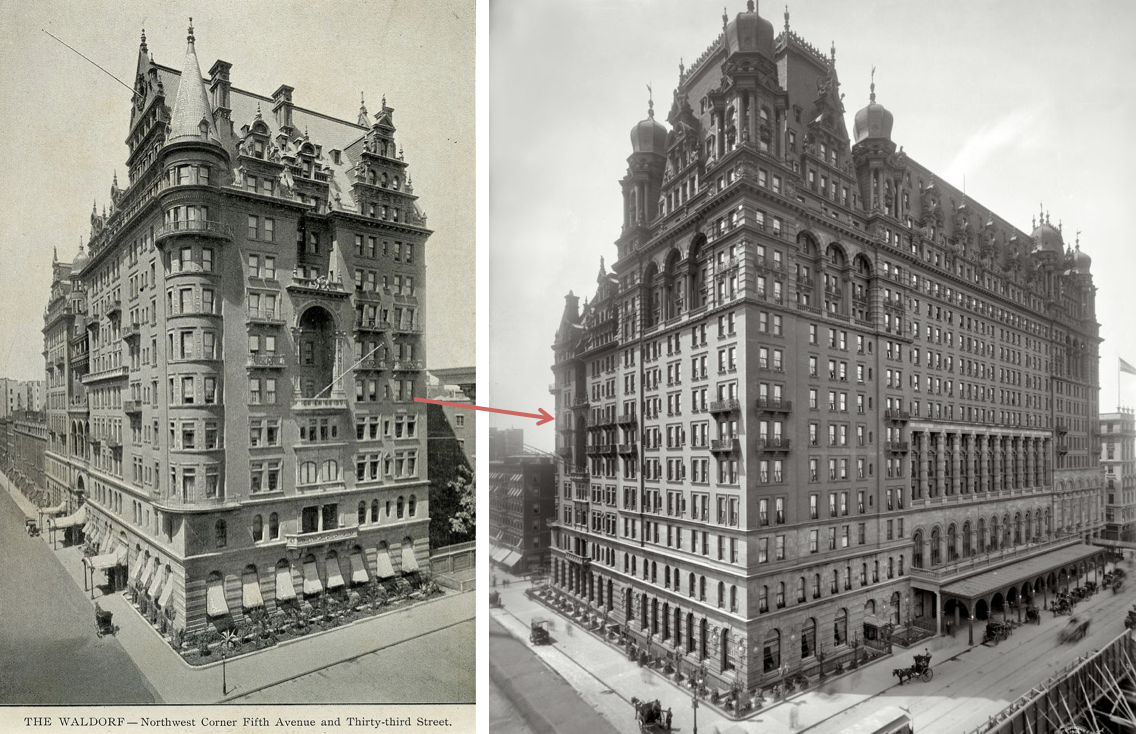
TALE OF TWO HOTELS…The Waldorf-Astoria was actually two hotels joined together. The Waldorf, at left, was built in 1893. The much larger Astoria (right) was constructed in 1897. Note the arrow indicating the original Waldorf in relation to the Astoria. (Wikipedia/Detroit Photography Archive)
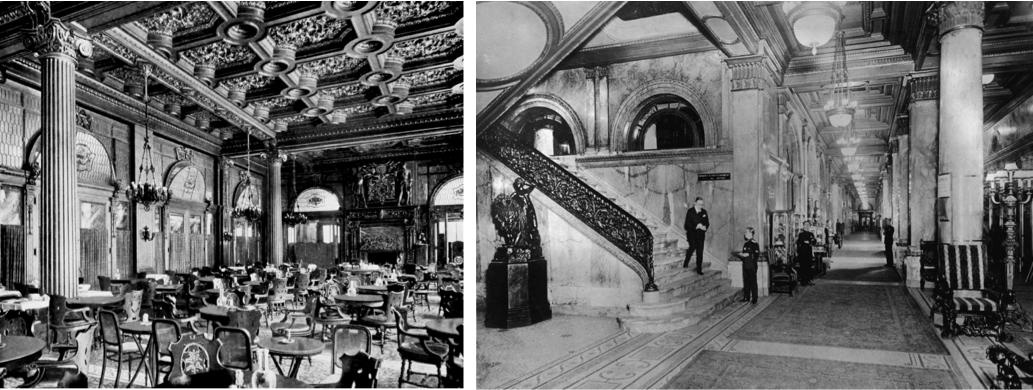
PLACES TO SEE AND BE SEEN…At left, the “Gentleman’s Cafe” in the Waldorf Hotel. At right, lobby entrance to the marble-lined “Peacock Alley” that connected the two hotels. (Wikipedia/justcocktails.com)
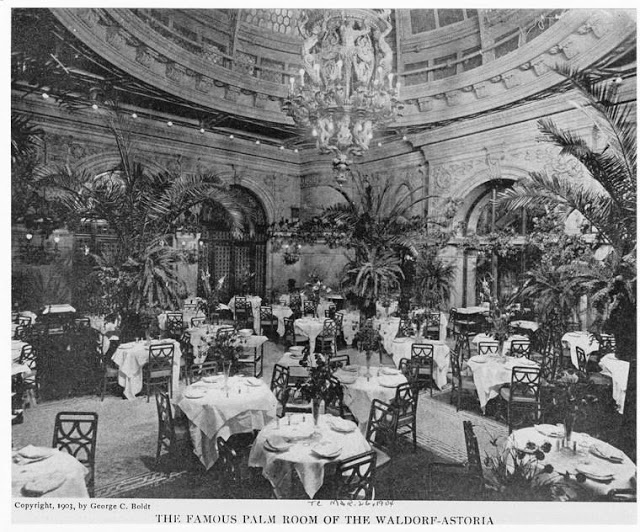
DINE IN STYLE…The Palm Room in the Astoria section of the original Waldorf-Astoria Hotel. (New York Public Library)

Chappell wrote that the prime building site was slated to be occupied by a 50-story office building…

…but as it turned out, Floyd Brown was unable to make the final payments on the property, so he sold his claim to the bank. John J. Raskob, a wealthy finance executive and chair of the National Democratic Committee, joined with entrepreneur Pierre du Pont and former New York Governor Al Smith (who lost his bid for the U.S. Presidency in 1928) to buy the property. They had much bigger plans than Floyd Brown: In August 1929 they announced their plan to build the tallest building in the world — what would become the Empire State Building.

TRY, TRY AGAIN…The architecture firm Shreve & Lamb developed this concept (left) for Floyd Brown’s proposed 50-story office building on the site of the old Waldorf-Astoria. At right, what occupies the site today: the Empire State Building, also designed by Shreve & Lamb. (Pinterest/oldstructures.com)

 * * *

Car Culture

The Jan. 5 issue featured a lengthy review of the 29th Annual National Automobile Show at Grand Central Palace, as well as numerous advertisements by auto manufacturers hoping to entice New Yorker readers with their latest models.

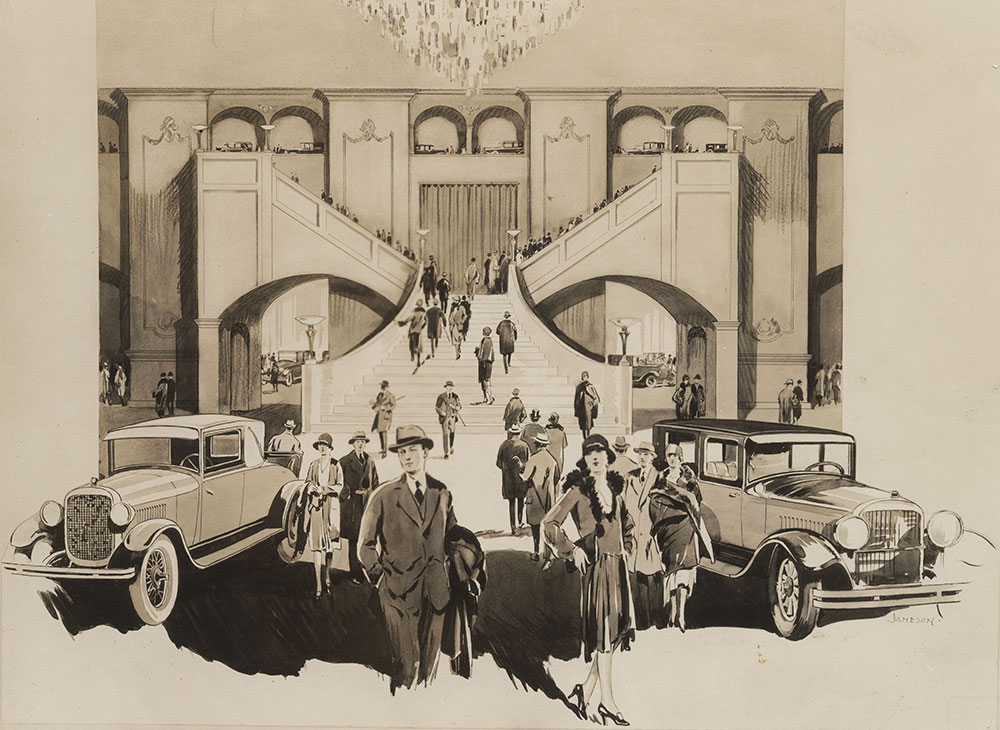
Promoters of the event touted the addition of a grand staircase to Grand Central’s mezzanine level that would ease access to both levels of the show:

AIN’T IT GRAND?…Design drawing created for the 1929 National Automobile Show at Grand Central Palace touting the addition of an equally grand new staircase. (Free Library of Philadelphia)
How the new staircase actually appeared at the 1929 show. Note the background where the movement of workmen on ladders lends a ghostly appearance. (Free Library of Philadelphia)
A view of the 1929 National Automobile Show from the mezzanine of the Grand Central Palace. (Free Library of Philadelphia)

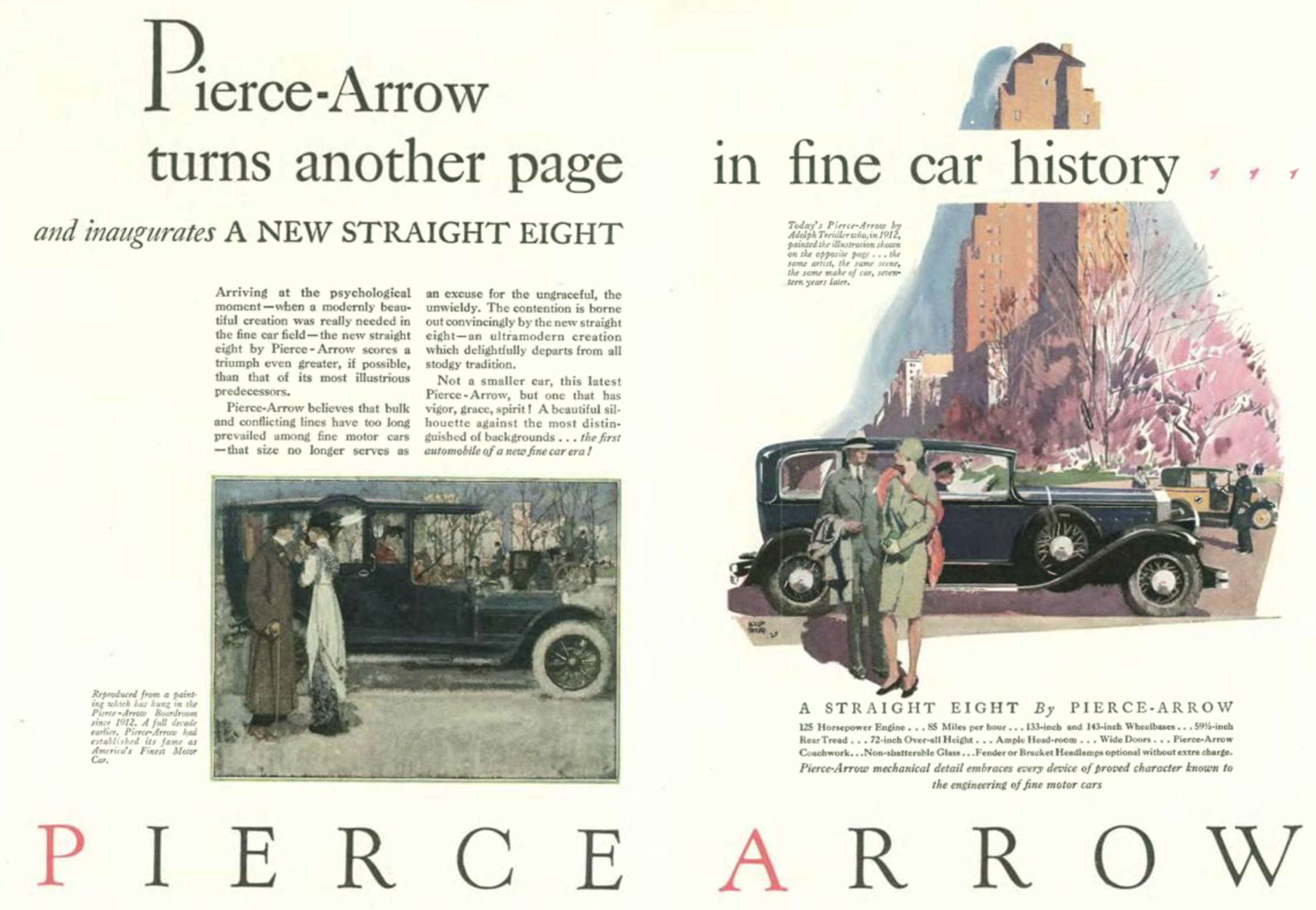
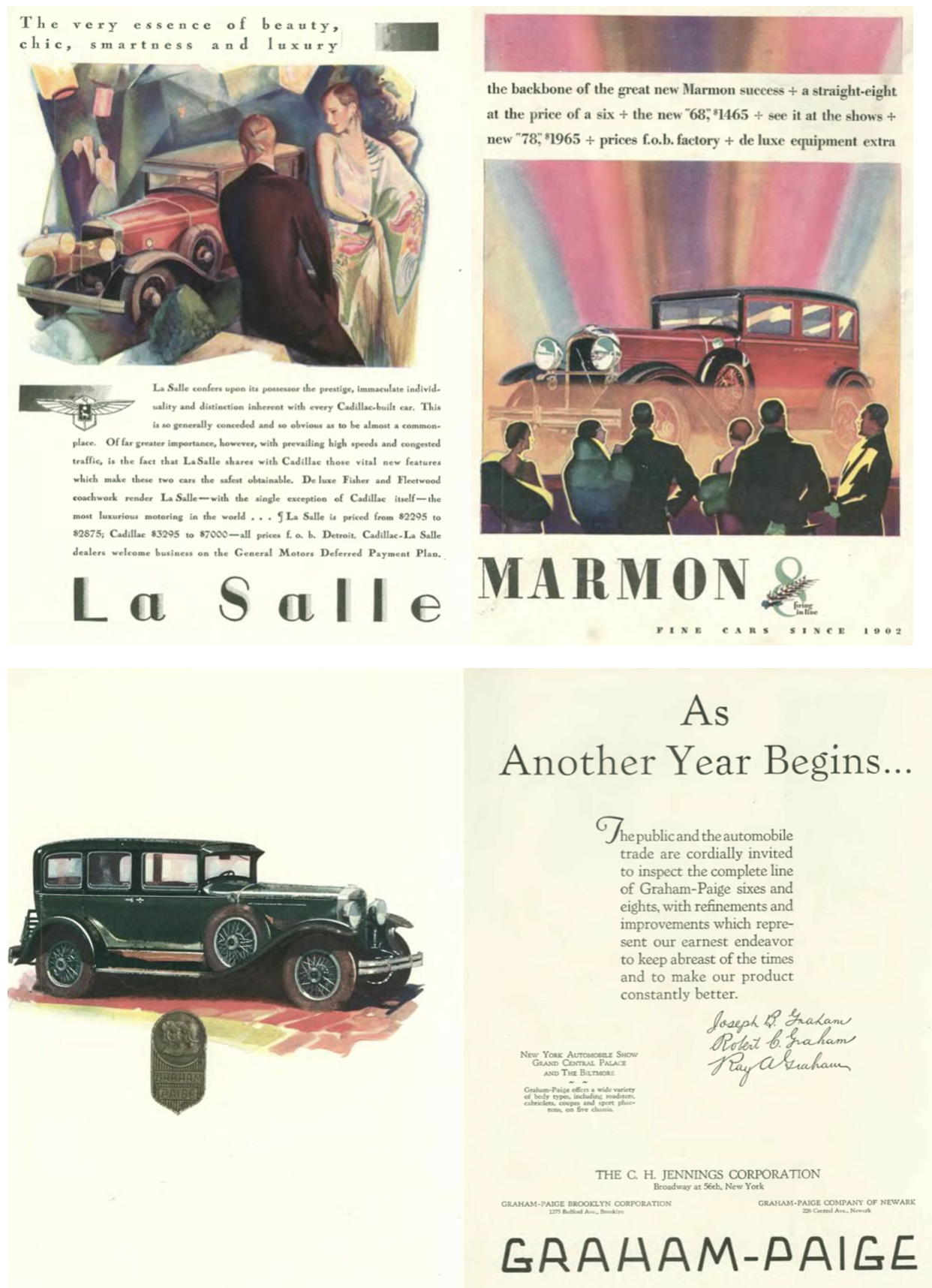
As I mentioned, the Jan. 5 issue was filled with car ads, mostly from long-gone automobile manufacturers. A constant in all of these ads is their appeal to New  York’s chic, smart set. Here’s a sampling of a few of them: (click ads to enlarge):

Hupmobile was a successful car company that began its decline in the late 1920s  precisely because it turned its back on buyers of medium-priced cars and went after what it perceived to be the more lucrative luxury buyer (see ad above). Hupmobile went out of business in 1939 (after briefly joining forces with Graham-Paige, which also went under that year).

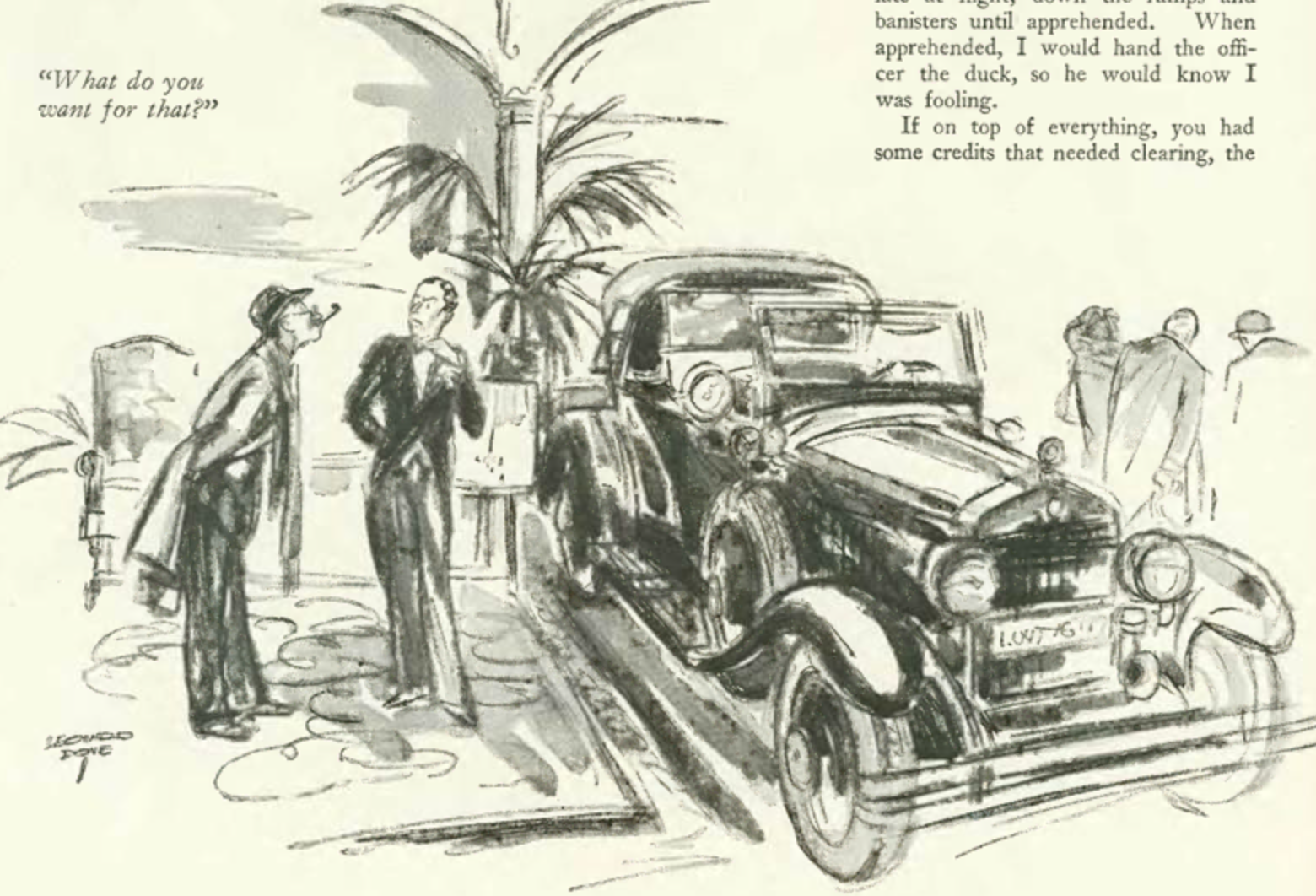
Cartoonist Leonard Dove found humor derived from these very class distinctions when he visited the auto show:

 * * *

The Game, Served Up Cold

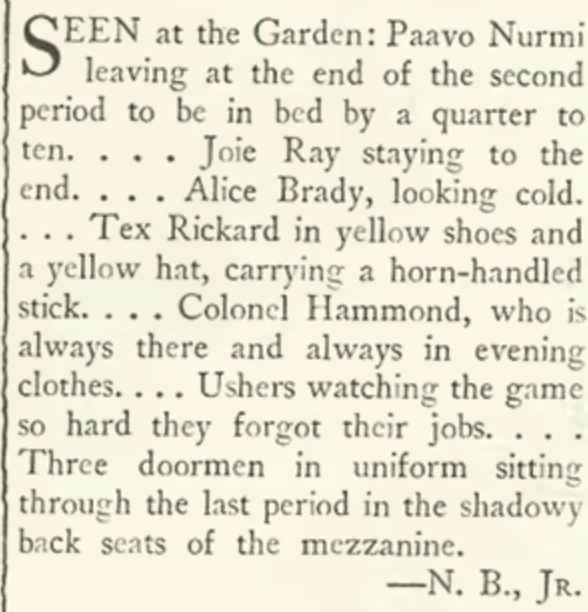
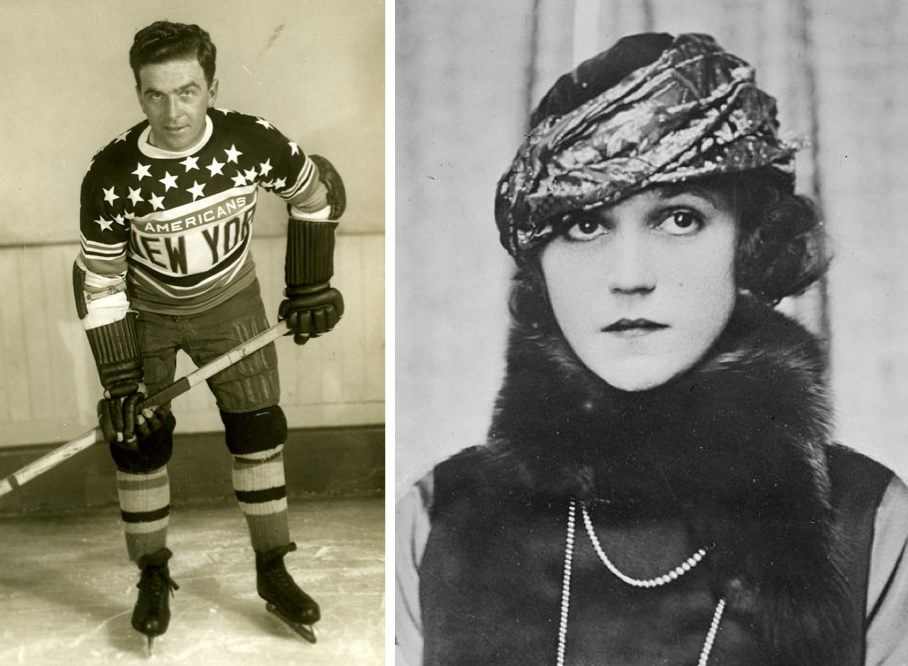
In other diversions from the Jan. 5 issue, Niven Busch Jr. attended the hockey game between the New York Rangers and the New York Americans at Madison Square Garden, noting famous faces in the crowd including Finnish track star Paavo Nurmi and American track star Joie Ray. Also noted were Tex Rickard, builder of Madison Square and founder of the Rangers, ex-football star and businessman Col. Harry Hammond, and film star Alice Brady.

AT THE GARDEN…Not even the exciting hockey play of Billy Boyd (left) and his fellow New York Americans could keep actress Alice Brady warm. (Pinterest/Alchetron)

 * * *

From our non-automobile advertisers, another installment of a Theodore Geisel (Dr. Seuss) ad for Flit insecticide (this is the first instance — at least in the Flit ads— in which Geisel signs his art as “Dr. S” instead of “Seuss”).

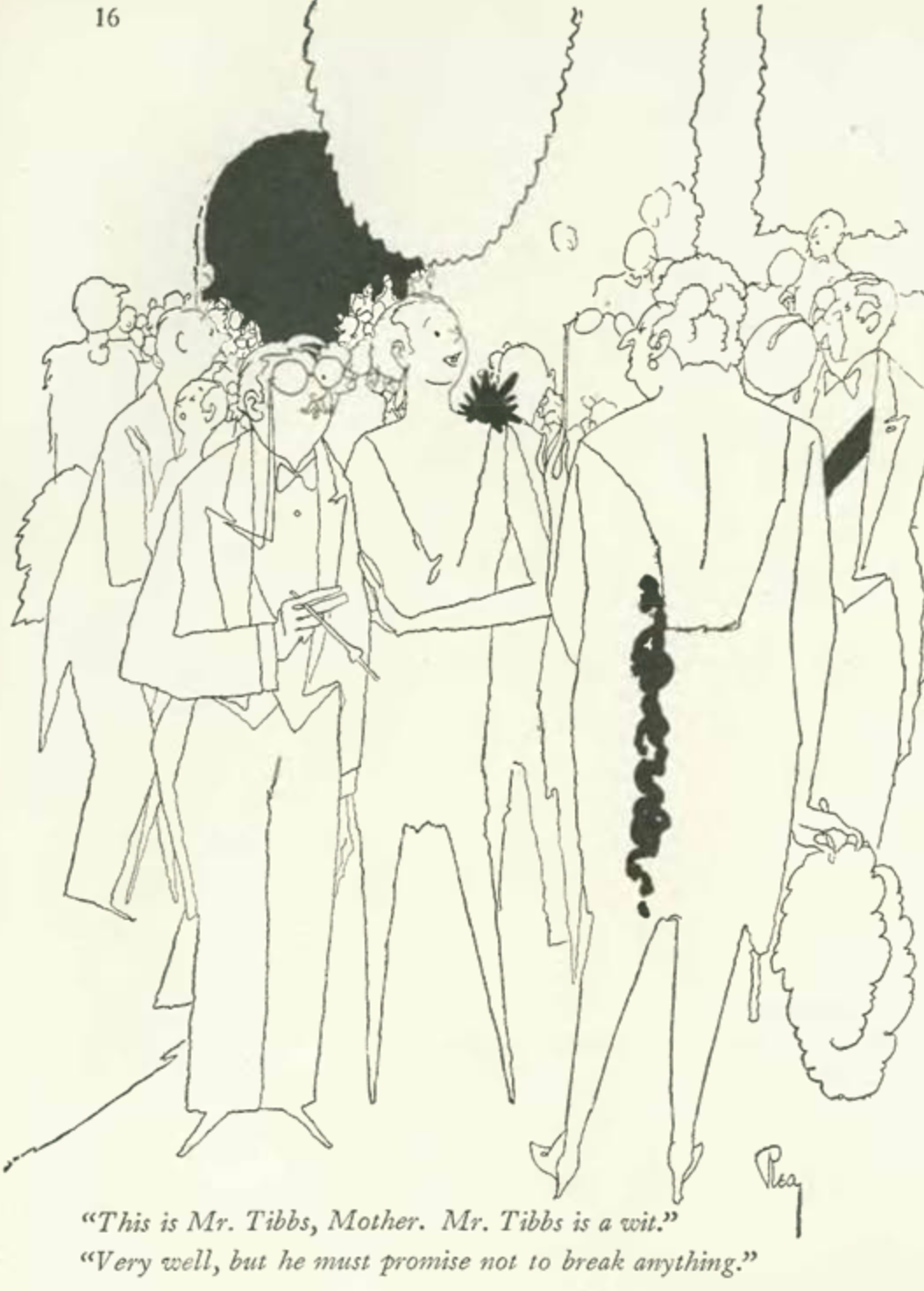
And another cartoon from the Jan. 5 issue, courtesy Gardner Rea:

 * * *

Arno Addendum

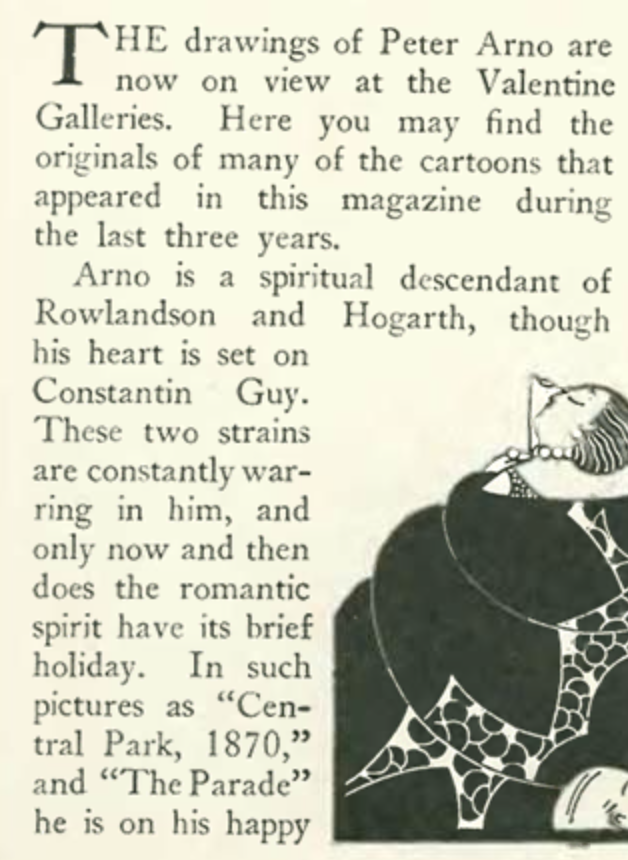
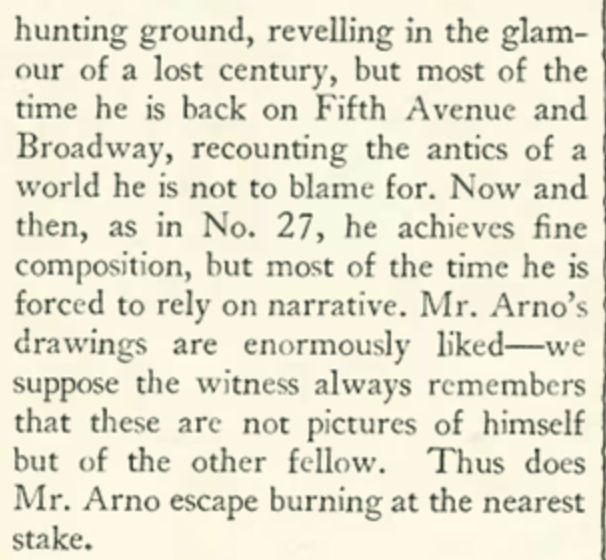
In the rush of the recent holidays I missed an item from the Dec. 22, 1928 issue — namely, art critic Murdock Pemberton’s tongue cheek review (in “The Art Galleries” column) of cartoonist Peter Arno’s December 1928 exhibition of drawings at the Valentine Gallery:

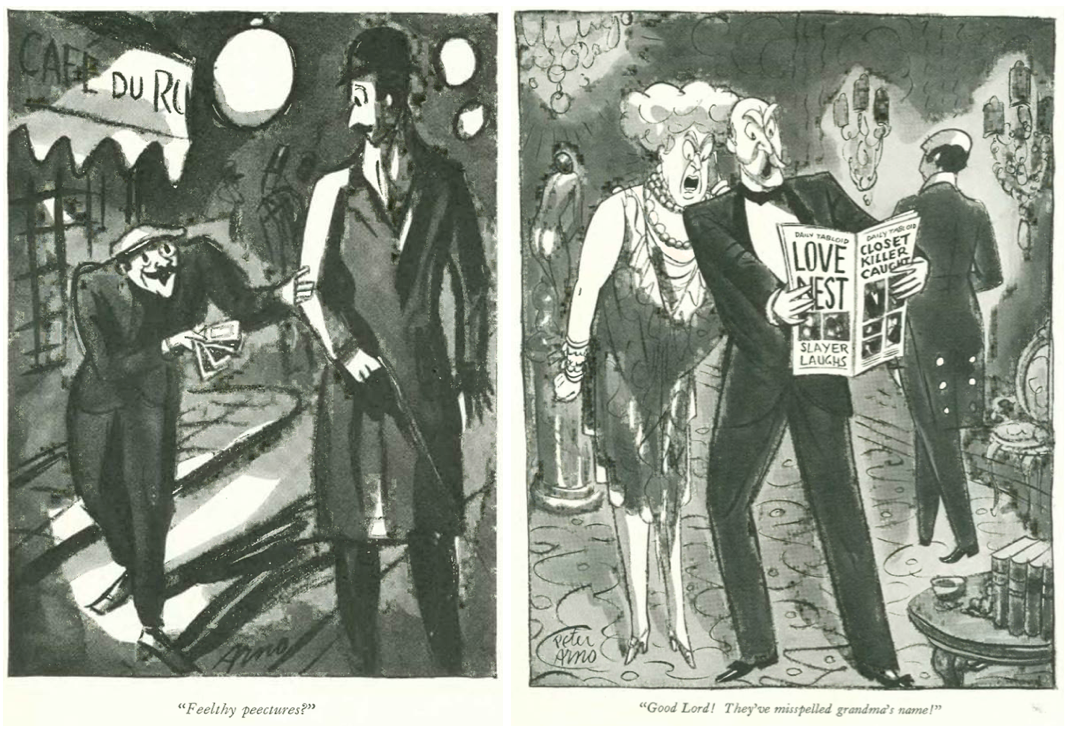
Here are two Arno drawings that were featured in the Valentine exhibition (click to enlarge):

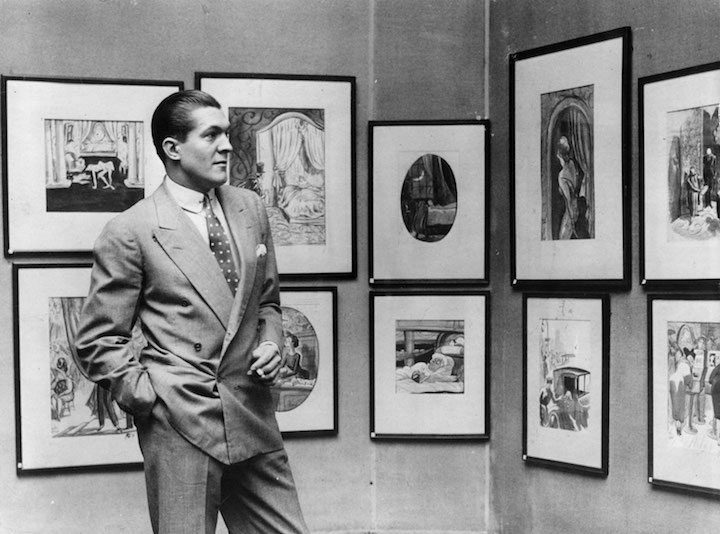
INTERNATIONAL APPEAL…less than four years after his Valentine Galleries debut, Peter Arno exhibited his drawings to great acclaim at the Leicester Galleries in London, October 1932. (Encyclopædia Britannica)

Next Time: Midnight Frolic…

Happy 1929!

I’ve been writing this blog for nearly three years, and during that stretch have managed to cover more than 200 issues of The New Yorker, or about the first four years of the magazine.

Dec. 22, 1928 and Dec. 29, 1928 covers by Rea Irvin.

The amount of young talent on display in those early issues is truly astounding, from writers such as E.B. White, Dorothy Parker and James Thurber (writer and cartoonist) to illustrators and cartoonists including Peter Arno, Rea Irvin, Helen Hokinson, Miguel Covarrubias and Ilonka Karasz, to name just a few. Among the contributing artists was Abe Birnbaum, who illustrated more than 150 covers for The New Yorker from the 1940s to 1970s. One of his earliest contributions to the magazine was this illustration for the “Profile” section in the Dec. 22 issue:

Canadian artist Shelley Davies writes in her blog that Birnbaum “charmingly captured some of life’s quieter moments with a deft eye.” In addition to The New Yorker, Birnbaum illustrated numerous covers for Stage and Arts In America, and won a Caldecott Award in 1954 for his children’s book, Green Eyes.

ON THE QUIETER SIDE…Abe Birnbaum (pictured here circa 1960) created more than 150 covers for The New Yorker from the 1940s to the 1970s. At right, a cover from March 17, 1962. (google.com.br)

 * * *

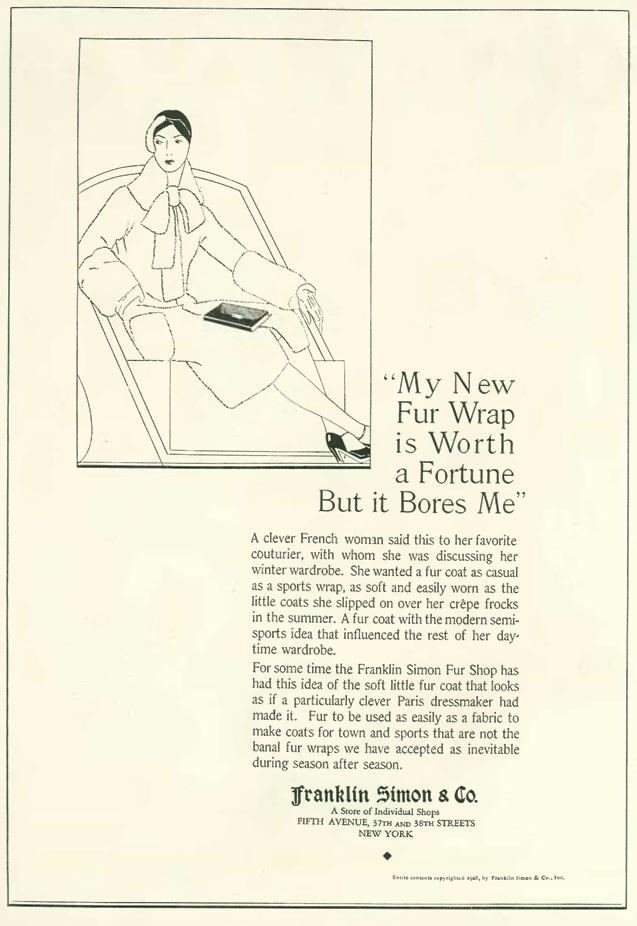
A couple of select advertisements from the Dec. 22 reveal what retailers knew, or thought they knew, about the magazine’s readership. Franklin & Simon, seeking perhaps to broaden their market for furs, suggested that even a stylish French woman might prefer a fur fashioned as a modest “sports wrap”…

…as for the guys, Saks appealed to the anglophilia that apparently was rife among New York’s smart set. Check out the ridiculous hat gracing the noggin of this young dandy…

Well-heeled readers who could afford to flee the New York winter were targeted by these various enticements in the Dec. 22 issue (this is a collage of select ads found in the back pages of the issue):

 * * *

Hello Down There

Writing about New Yorker humor derived from class distinctions, Ben Yagoda (About Town: The New Yorker and the World It Made, p. 63) noted a series of cartoons by Otto Soglow that began with this one in the Dec. 22, 1928 issue and continued through thirty installments that ran to early 1930, when the workers, Joe and Bill, finally emerged from the manhole:

This running gag, according to Yagoda, “came from the conceit that the laborers spoke with the same assumptions and in the same catchphrases as those with ‘higher’ places in society.”

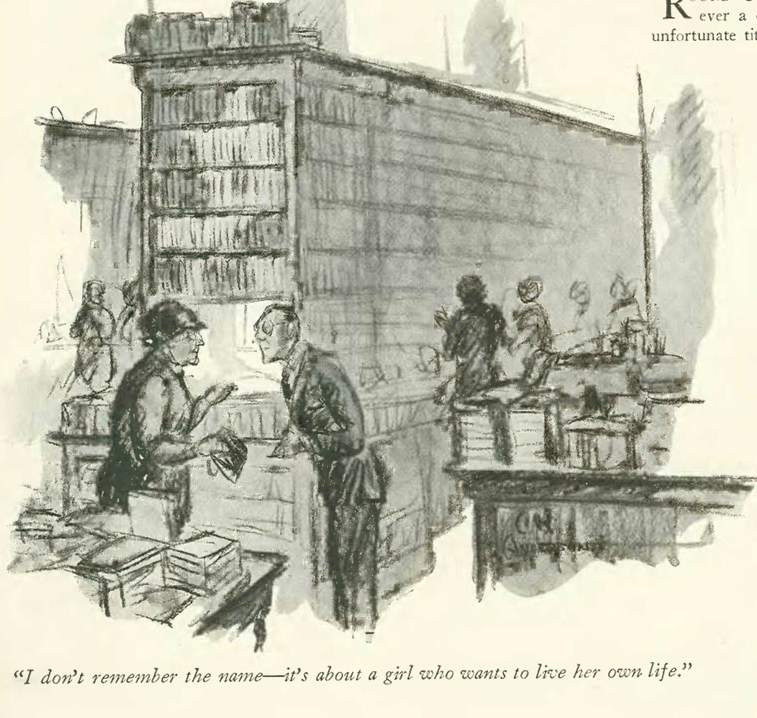
Also from the Dec. 22 issue, this terrific cartoon by Leonard Dove that showed a bookish man who had accidentally entered the wrong type of book-making establishment:

* * *

The Girl Who Wouldn’t Grow Up

Maude Adams was a major Broadway star in the early years of the 20th century. Appearing in more than 25 productions from 1888 to 1916, she was most famous for her portrayal of Peter Pan in the Broadway production of Peter Pan; or, The Boy Who Wouldn’t Grow Up. She performed that role first in 1905-06 and again in 1912 and 1915. The highest-paid performer of her day, at her peak she earned more than $1 million a year, a staggering sum more than a century ago. James Thurber, writing in the Dec. 29 “Talk of the Town,” reported that after a decade-long absence from the stage, Adams was planning a comeback as a director:

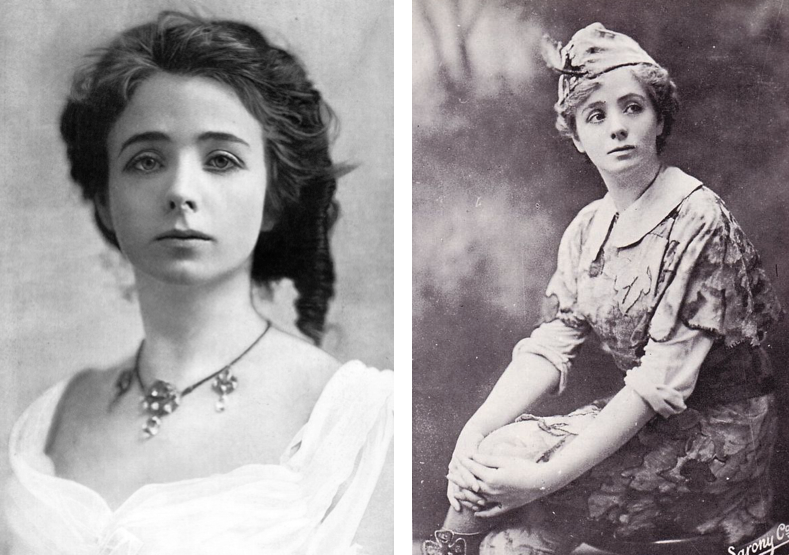
STAR POWER…At left, American actress Maude Adams, circa 1900. At right, Adams as Peter Pan, her most famous stage role. Adams was the first American to portray Peter Pan on the stage. She played the role 1,500 times between 1905-1915. She retired from the stage in 1918 after a severe bout with the flu. She died at age 80 in 1953. (Wikipedia/Oakland Tribune)

Thurber also noted that Adams was working with General Electric in the development of color photography. According to the Trivia Library, it has been suggested that her motivation might have been a wish to appear in a color film version of Peter Pan. She eventually returned to acting in the 1930s, with occasional appearances in regional productions of Shakespeare plays.

 * * *

A Lukewarm Welcome to 1929

The Dec. 29 New Yorker opened with these lamentations for the last issue of 1928. At least it appears that one could obtain a decent bottle of French champagne to toast the New Year:

JAM SESSION…1929 photo of traffic on Fifth Avenue. (theoldmotor.com)

 * * *

The Passing of a Poet

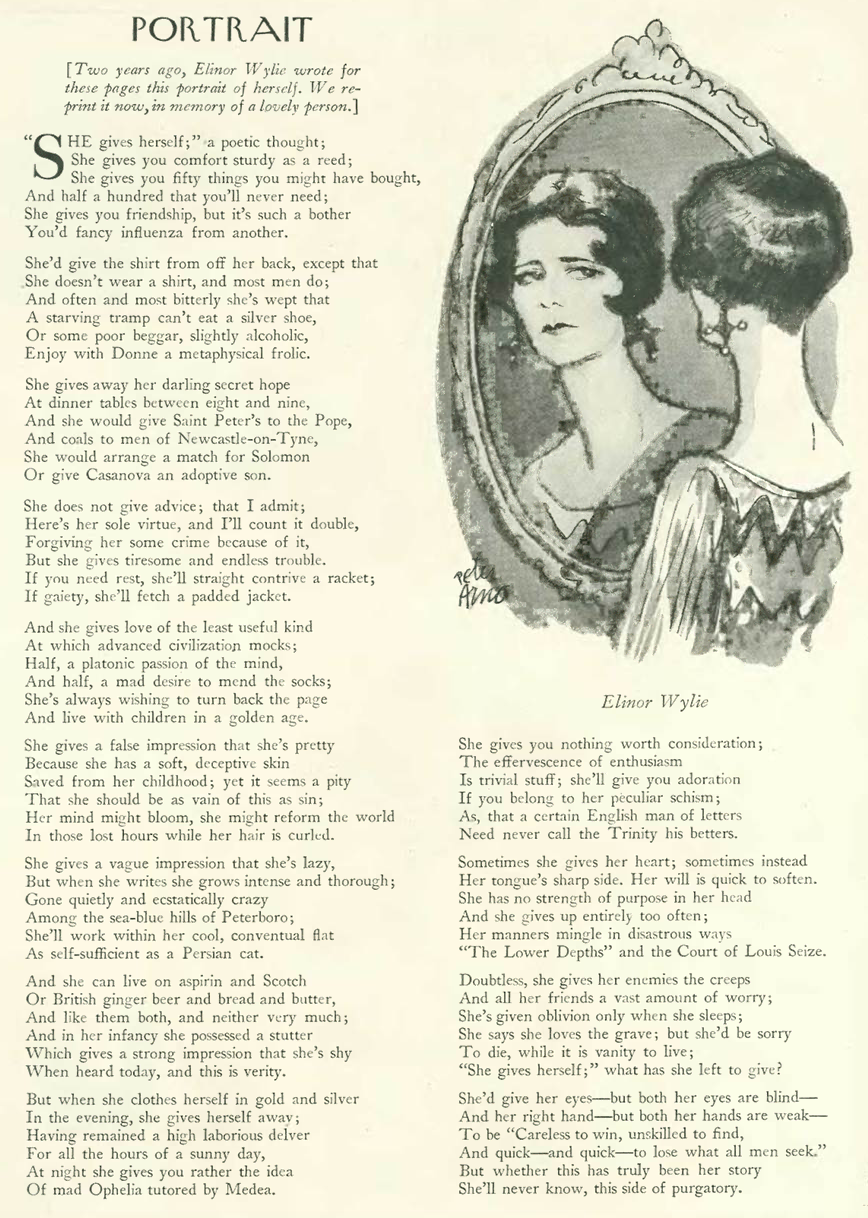
The Dec. 29 issue featured something unprecedented in The New Yorker up to that point: the reprinting of an entire piece previously featured in the magazine. In this case, it was in tribute to the sudden passing of poet and author Elinor Wylie:

PORTRAITS…Elinor Wylie posed for her friend Carl Van Vechten in this 1922 portrait (left). The photo at right, probably taken around 1926, was clearly the inspiration for the illustration by Peter Arno that accompanied “Portrait.” (Yale University/humorinamerica.wordpress.com)

It is no wonder that The New Yorker had such affection for Wylie, for she was as colorful a personality as could be found in 1920s literary circles. A Columbia University Press bio notes that “she was famous during her life almost as much for her ethereal beauty and personality as for her melodious, sensuous poetry.” Born to a socially prominent family and trained for a life in society, she instead became notorious for her multiple marriages and love affairs. She also suffered from extremely high blood pressure that gave her unbearable migraines.

Wylie died on Dec. 16, 1928, while going over a typescript of her poetry collection, Angels and Earthly Creatures, with her estranged third husband, William Rose Benét. According to Karen Stein (in the Dictionary of Literary Biography), Wylie, while picking up a volume of John Donne’s poems, asked Benét for a glass of water. When he returned with it, she reportedly walked toward him and murmured, “Is that all it is?,” and fell to the floor, dead of a stroke. She was 43.

* * *

Age of Innocence

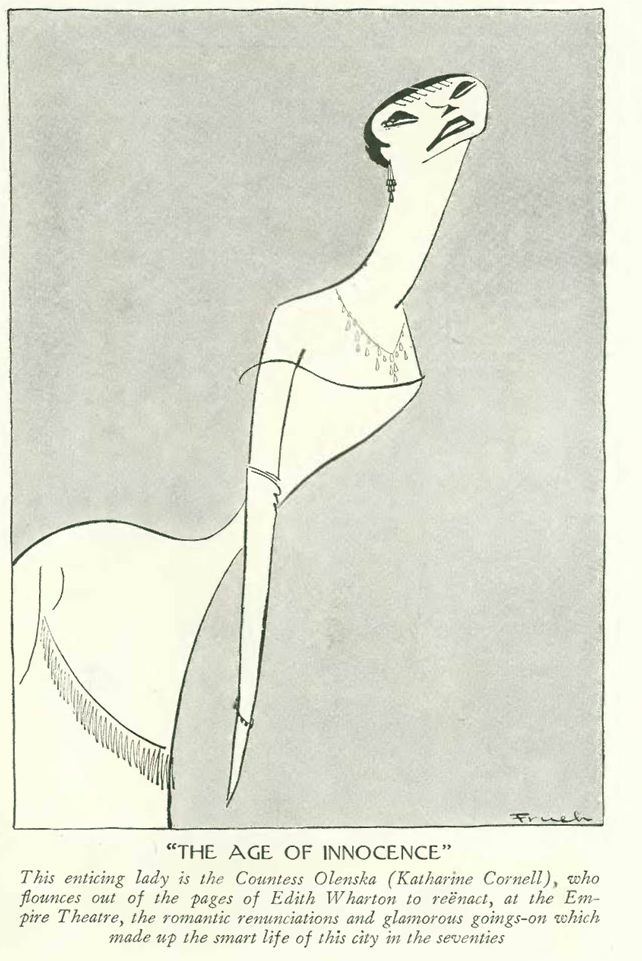
The Dec. 29 theatre review section featured this illustration by Al Frueh of Katharine Cornell in the Empire Theatre’s production of The Age of Innocence:

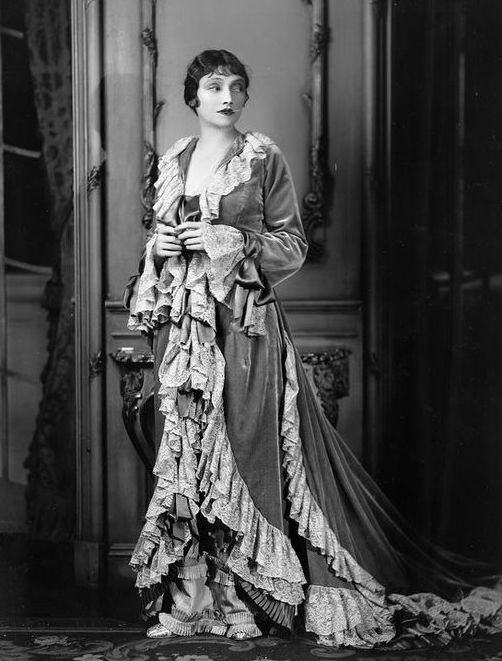
And below, a studio portrait of Cornell from the same play:

HOW SHE REALLY LOOKED…Katharine Cornell as ‘Countess Ellen Olenska’ in this Vandamm Studio portrait dated November 27, 1928. (Billy Rose Theatre Collection, The New York Public Library)

 * * *

Before Baby Snooks

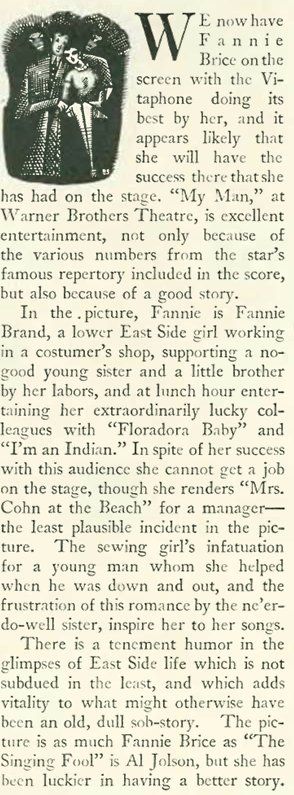
Although it was still a few years before singer and actress Fanny Brice would make her radio debut as the bratty toddler named “Snooks,” she was already well-known to New York audiences for her work in the Ziegfeld Follies (beginning in 1910). In its Dec. 29 issue The New Yorker favorably reviewed Brice’s first motion picture, My Man, which included musical scenes with Vitaphone sound:

MY MAN…Fanny Brice, Guinn Williams, and Edna Murphy on the set of the partially silent film My Man, 1928. Her first movie appearance, Brice played Fanny Brand, a poor girl who becomes a star. The film is now considered lost, since only an incomplete version survives. (brice.nl)
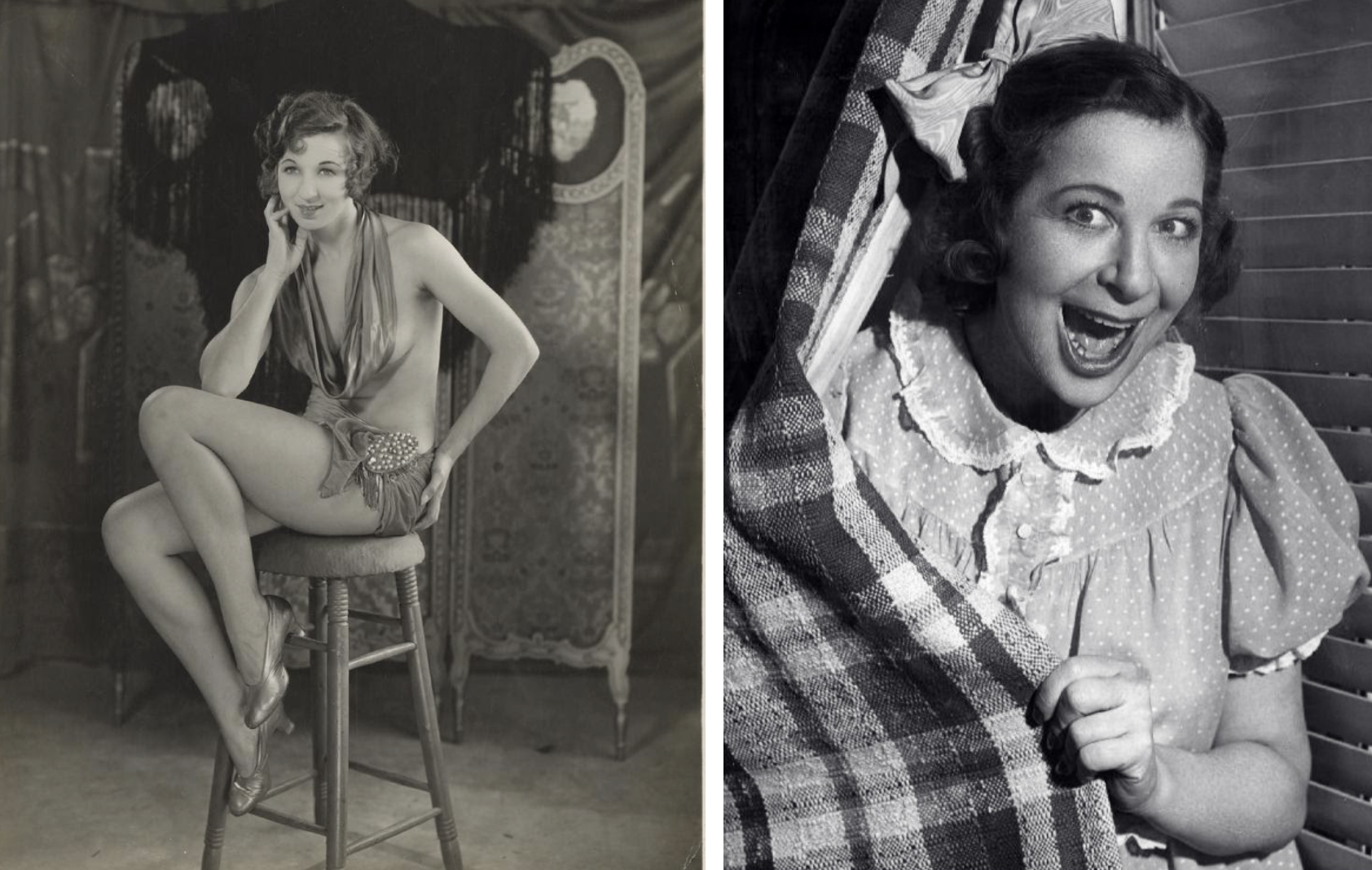
THROUGH THE YEARS…At left, singer and actress Fanny Brice from the time she was a Ziegfeld Follies girl, circa 1915. At right, Brice in the role of Baby Snooks, 1940. (Vintage Everyday/Wikipedia)

 * * *

Let’s Get Physical

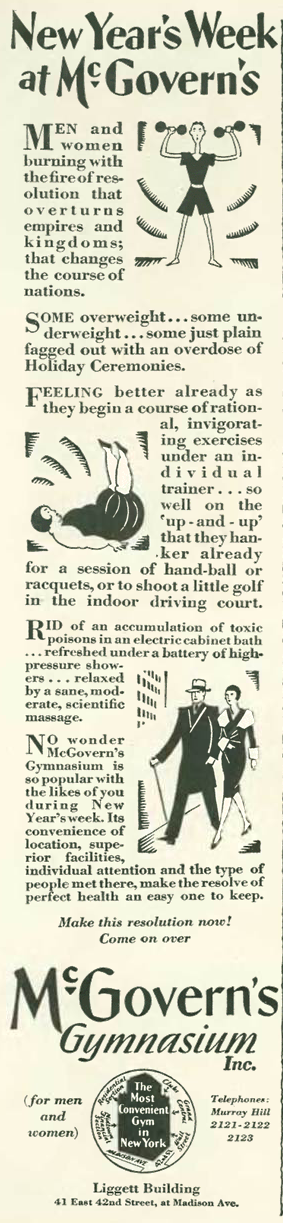
Even 90 years ago some folks (or at least some New Yorkers) resolved to get healthy and hit the gym in the New Year. In this ad, McGovern’s Gymnasium announced it was ready for them:

Babe Ruth trains at Artie McGovern’s Gym for the upcoming baseball season, February 9, 1928. (twitter.com/BSmile)

And to close out 1928, a cartoon from John Reehill

Next Time: Out With the Old…

Hit of the Century

NINETY YEARS AGO, when former Chicago reporters Ben Hecht and Charles MacArthur sat down to write The Front Page, they might have sensed they had a Broadway hit in the making, but probably had no idea their play would still grace a Broadway stage well into the 21st century.

August 25, 1928 cover by Leonard Dove.

The Front Page made a big splash on the Great White Way when it premiered on August 14, 1928 at Times Square Theatre. Featuring a story about tabloid newspaper reporters on the police beat, the play’s wisecracking, rapid-fire dialogue (which would become a staple of Hollywood’s screwball comedies), was a big hit with audiences, and with E.B. White, who reviewed the play in the Aug. 25, 1928 New Yorker:

DREAM TEAM…The Front Page was written by former Chicago reporters Ben Hecht (left) and Charles MacArthur (center) and produced by Jed Harris (at right, in a 1928 photo used on the cover of Time magazine). Hecht, an occasional New Yorker contributor, would go on to a successful career as a screenwriter, director, producer and playwright. Like Hecht, screenwriter/playwright MacArthur was friends with members of the Algonquin Round Table. He was married to actress Helen Hayes, with whom he adopted a son, James MacArthur (“Danno” on TV’s Hawaii 5-0). Harris was responsible for some of Broadway’s most successful productions in the ’20s and ’30s including Uncle Vanya, Our Town and The Crucible. (IMDB, Kentucky Digital Library, Time)
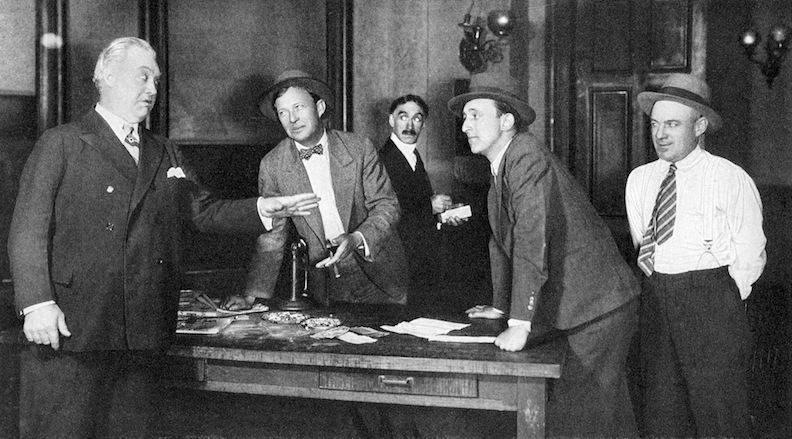
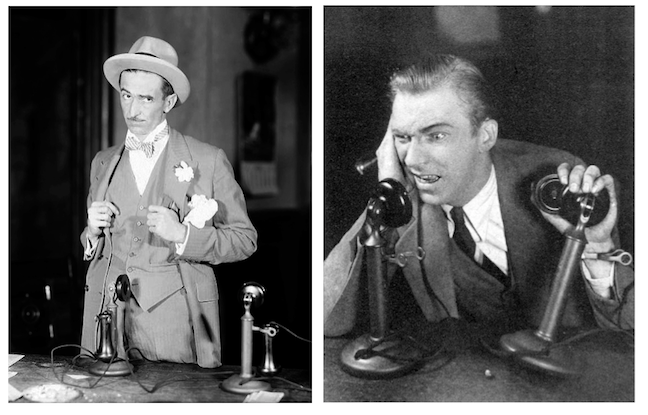
TROUBLE IN WINDY CITY…Set entirely in a dingy press room of Chicago’s Criminal Courts Building, The Front Page featured reporters who passed the time playing poker and exchanging wisecracks—until a convicted killer escapes jail and makes things lively. Worried about his chances for re-election, the crooked Mayor, played by George Barbier, far left, confronts three reporters — Murphy (Willard Robertson), Endicott (Allen Jenkins), and McCue (William Foran). In the background is Claude Cooper, as the crooked Sheriff Hartman. (Theatre Magazine, August 1928) 

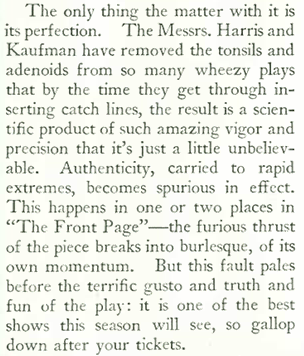
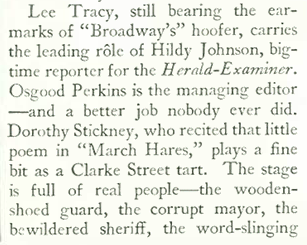
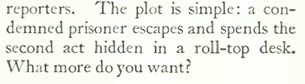
White was so taken by the play, in fact, that he found it to be nearly perfect, like a scientific instrument of exacting precision. And considering how many times the play has been adapted to stage and screen (most recently on Broadway in 2016), he was probably right. It still plays pretty well after all these years:

WISE GUYS…Promotional photographs of Osgood Perkins as Walter Burns (left) and Lee Tracy as Hildy Johnson in the 1928 Broadway production of The Front Page. (Theatre Magazine, August 1928) 
ENTER, STAGE RIGHT…Escaped prisoner Earl Williams (George Leach) surprises reporter Hildy Johnson (Lee Tracy) in The Front Page. (Theatre Magazine, August 1928) 

The play was restaged four more times on Broadway — 1946, 1969, 1986 and 2016 — the 2016 production starred Nathan Lane as Walter Burns, John Slattery as Hildy Johnson and John Goodman as Sheriff Hartman. Film adaptions included The Front Page in 1931 and His Girl Friday (directed by Howard Hawks) in 1940 — the latter added a twist to the play by changing the Hildy character to a woman, played by Rosalind Russell as the ex-wife of Walter Burns (Cary Grant). The play returned to the big screen in 1974 as The Front Page, directed by Billy Wilder and starring Jack Lemmon as Hildy and Walter Matthau as Walter Burns.

Still Some Fight Left in Him

Although boxer Gene Tunney had retired from the ring, he was still making headlines fighting off a different foe: the paparazzi.

Tunney’s engagement to Connecticut socialite and Carnegie heiress Polly Lauder was front-page news across the country, and photographers were eager to capture a photo of the couple, who up until the announcement had enjoyed a mostly secret romance. “The Talk of the Town” described the couple’s attempts to elude a persistent press:

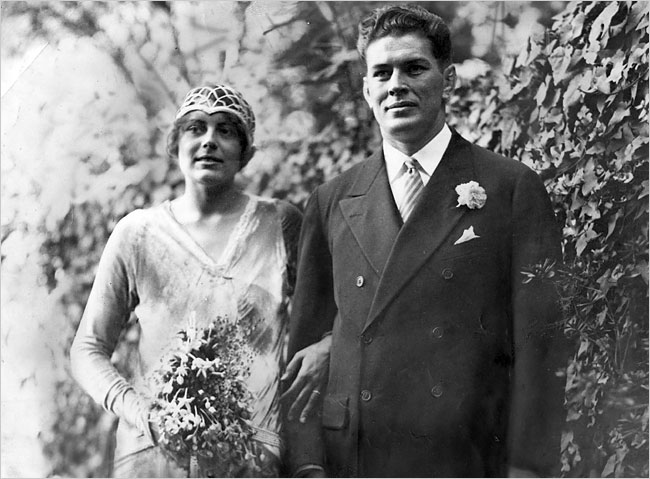
MAYBE IT’S QUIETER OVER HERE…21-year-old Polly Lauder Tunney and 31-year-old Gene Tunney after marrying in Rome on Oct. 3, 1928. The marriage would last 50 years. (Wikipedia)

In September 1928 the couple took separate trips to Rome and married in a small ceremony on Oct. 3. Unfortunately, they attracted the attentions of Rome’s original paparazzi: According to The New York Times “the scene after the wedding looked mighty like a riot as clothes were torn and cameras smashed in a melee of photographers jostling to capture images of the couple.”

After traveling in Europe they returned to the U.S. and made their home in North Stamford, Connecticut, where they restored an 18th century farmhouse and raised Hereford cattle and sheep. They would be married 50 years until Tunney’s death at age 81 in 1978. Polly continued to live at her home in Stamford until her death in 2008 at age 100.

 *  *  *

Dorothy Recuperates

Dorothy Parker’s “Constant Reader” signature at the end of the book review section was absent during part of the summer of 1928 as she was recuperating from an appendectomy. Fortunately her rapier wit remained intact when she returned in the Aug. 25 issue…

Dorothy Parker in 1928 (natedsanders.com)

…where she found the strength to skewer The Lion Tamer, the latest novel by romance writer E.M. Hull:

I’D RATHER BE IN SURGERY…E.M. Hull’s The Lion Tamer. Dodd, Mead and Co. 1928. (yesterdaysgallery.com)

*  *  *

Long Before Starbucks

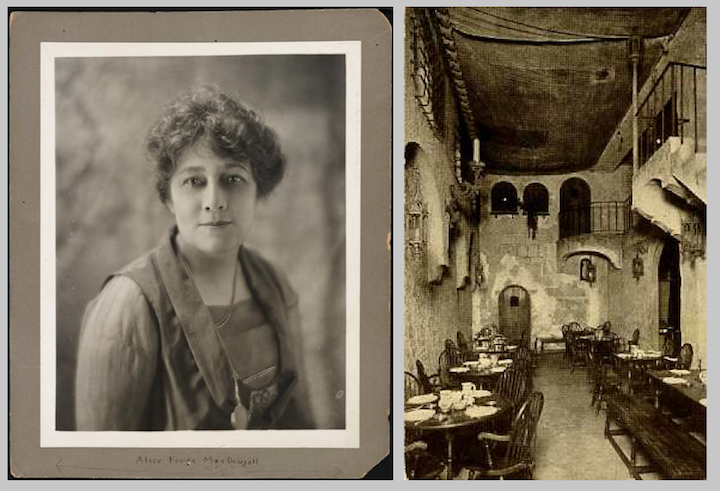
If you were a New Yorker in the 1920s, this cartoon by Rea Irvin would make perfect sense, because nearly everyone knew that Alice Foote MacDougall was the queen of New York’s coffee scene, a one-woman Starbucks of her day.

According to Jan Whitaker, writing for the blog Restaurant-ing Through History, MacDougall kept a carefully crafted persona. In numerous magazine stories crafted by her publicity agent, “she was widely known as the poor widow with three children who built a coffee wholesaling and restaurant empire on $38.”

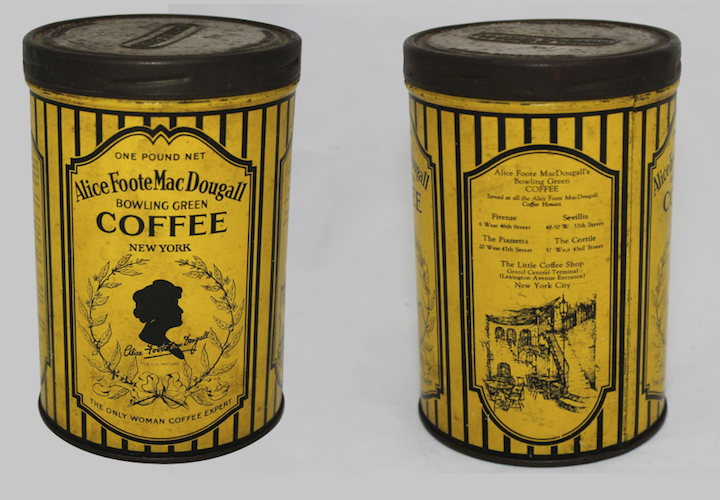
MacDougall was actually from a distinguished New York City family, and her coffee wholesaling career began in 1909 after her husband’s death. Whitaker writes: “In the 1920s she was said to be the only woman expert in coffee grading and blending in the U.S. She opened her first eating place, The Little Coffee Shop, in Grand Central Station in New York in December 1919. Waffles were the specialty in her homey café which was decorated with a plate rail and shelves holding decorative china. (Evidently tips were good, because MacDougall had the nerve to charge her waitresses $10 a day to work there.) By 1927 she had signed a $1 million lease for her fifth coffee house, Sevillia, at West Fifty-seventh Street. Her places became known for their Italian-Spanish scene setting. The reason, she said, was that it provided a way to disguise long, narrow spaces.”

BEANS TO RICHES…Alice Foote MacDougall, ca. 1910. At right, Sevillia, at West Fifty-seventh Street, in the late 1920s. (restaurant-ingthroughhistory.com)
TIN GOLD…Canisters of Alice Foote MacDougall’s famed coffee, ca. 1927. (ruby lane.com)

 *  *  *

The Friendly Skies

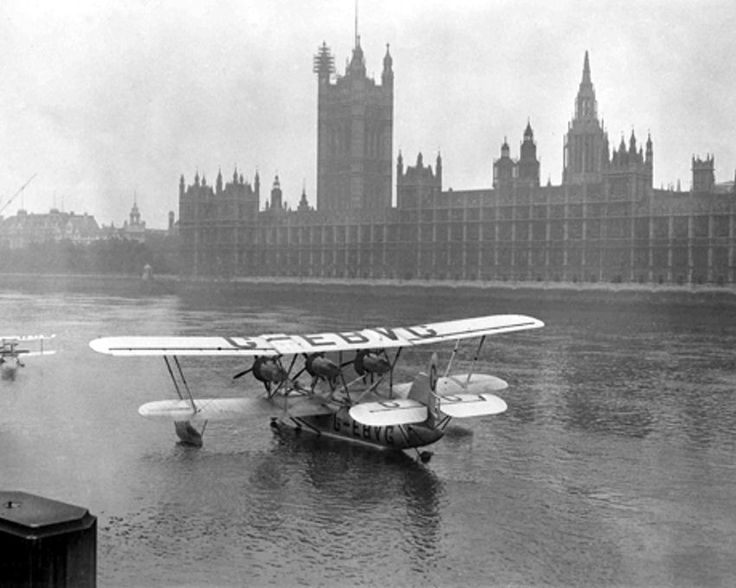
E.B. White made another appearance in the Aug. 25 issue, this time with a poem describing his recent flight from London to Paris aboard an Imperial Airways trimotor biplane. If White seems to rhapsodize a bit here (especially to jaded fliers of the 21st century), it is understandable, considering that White’s flight to France was only 25 years removed from the Wright Brothers at Kitty Hawk. It was still something miraculous:

TOP, the Imperial Airways “Calcutta” trimotor flying boat on the Mediterranean, 1928. Below, the “Calcutta” moored on the River Thames in 1928. (Claude Boullevraye de Passillé / AP)

 *  *  *

Missing the Boys of Summer

The New Yorker continued to ignore the sport of baseball in its pages, even though it enthusiastically covered almost everything else: college football, hockey, tennis, golf, lacrosse, polo, rowing and yacht racing. Strange because the New York Yankees had one of the winningest lineups in baseball (Murderer’s Row, with sluggers Babe Ruth and Lou Gehrig), had won the 1927 World Series, and were poised to win it again in 1928. Unless I missed something, the first mention of baseball in the 1928 New Yorker was this bit in Howard Brubaker’s Aug. 25 “Of All Things” column:

The Yankees would sweep the favored St. Louis Cardinals in the ’28 World Series.

From Our Advertisers

This creepy advertisement from the Aug. 25 issue comes courtesy of the Clark Lighting Company. The tagline, “Clark Always Works,” has a double meaning, the ad copy suggesting that a woman is so simple (described here as a “little minx”) that she will be captivated by the very flick of a lighter:

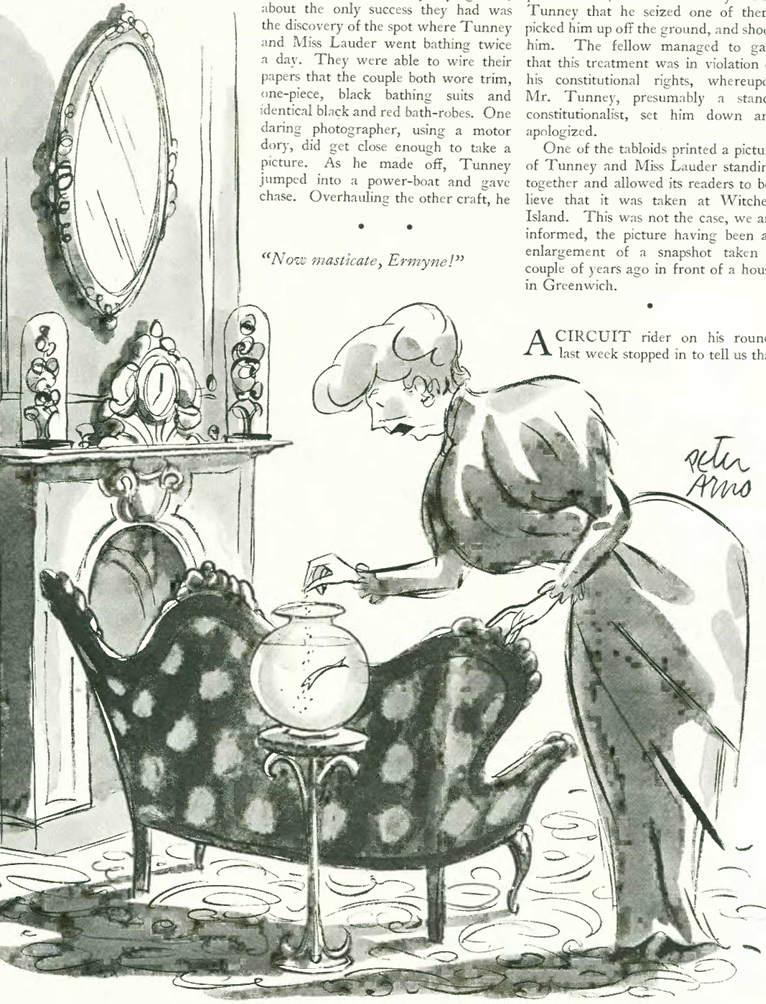
Our cartoon is by Peter Arno, who was making light of a diet fad from the late 19th and early 20th century (hence the woman’s age and dress) made famous by Horace Fletcher, who was known as the “Great Masticator” for his diet that involved chewing each mouthful of food a minimum of 100 times. The cartoon’s caption reads: “Now masticate, Ermyne!”

Next Time: Dorothy Parker Goes to the Movies…

(Another) Fight of the Century

It seems that each generation has its “Fight of the Century,” a phenomenon that emerges from the alchemy of mass marketing, a lust for blood sport, and the madness of crowds. Gene Tunney — a boxer who also wanted to be a public intellectual — was party to at least two of these spectacles in the 1920s.

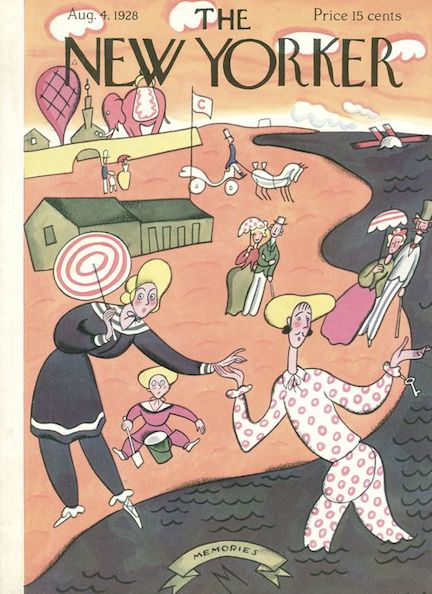
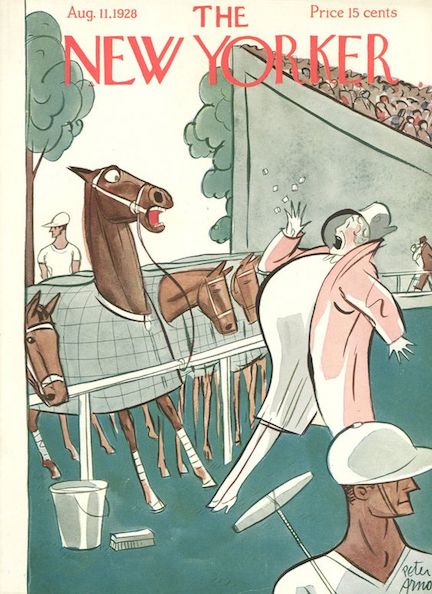
August 4, 1928 cover by Julian de Miskey.

Tunney is most famous for his fights against Jack Dempsey—in some ways they were the Ali–Frazier of their day. Tunney took the heavyweight title from Dempsey in 1926, and again defeated Dempsey in the controversial “long count” rematch one year later, on Sept. 22, 1927. That match was a huge spectacle, staged at Chicago’s Soldier Field in front of 105,000 spectators.

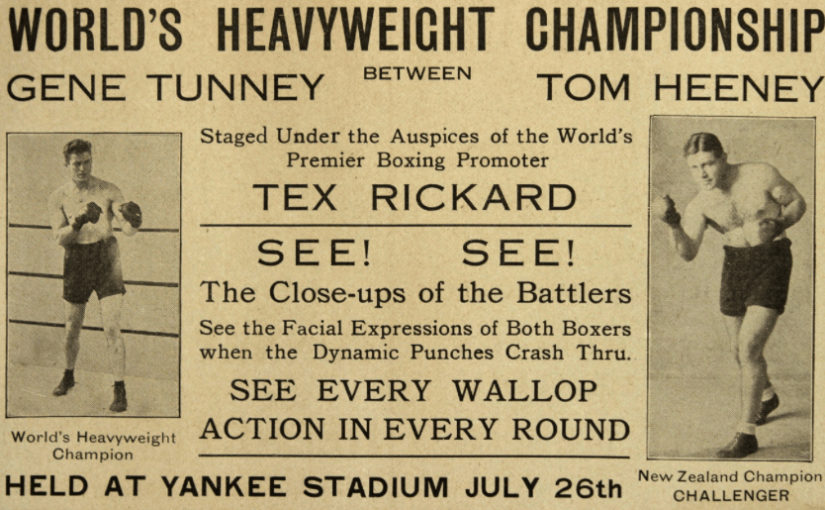
Boxing promoter Tex Rickard saw dollar signs when a scrappy New Zealander named Tom Heeney challenged the champ to a match. Heeney had won the Australian heavyweight title in 1922, and after arriving in the U.S. in 1926 found enough success in the ring to be ranked fourth among the world’s heavyweight boxers.

Writing in his column, “Sports of the Week,” in the July 21, 1928 issue of The New Yorker, Niven Busch Jr. assessed Heeney as a formidable opponent:

NO PALOOKAS HERE…Tom Heeny (left), and Gene Tunney in the late 1920s. (boxrec.com / Alchetron)

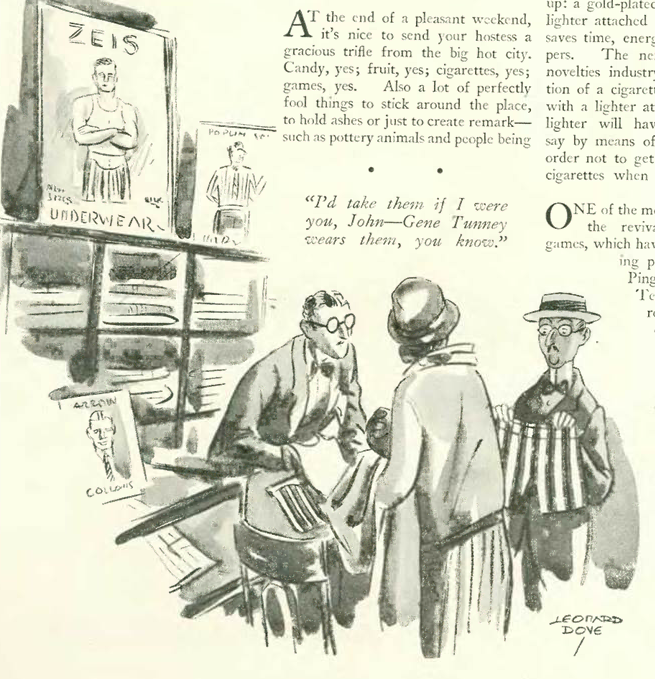
This cartoon by Leonard Dove, also in the July 21 issue, joined in the fun…

As for the actual fight at Yankee Stadium on July 26, 1928, Tunney won by a TKO in the 11th round. Perhaps the boxer from Down Under wasn’t in such great shape after all, or so surmised Niven Busch Jr in the August 4 issue:

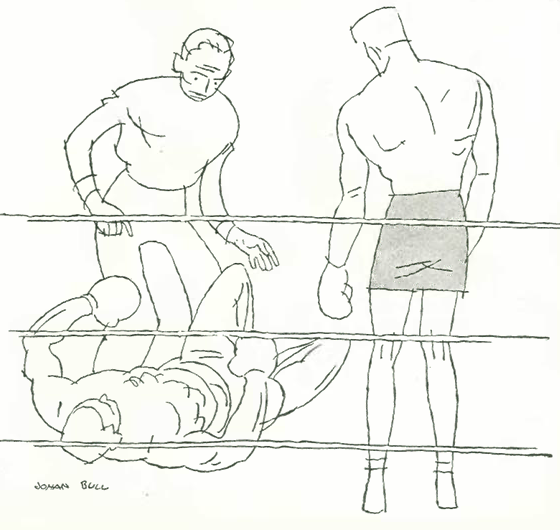
New Yorker illustrator Johan Bull offered this perspective in artwork that accompanied Busch’s article…


Tunney’s winning purse was $525,000 (about $7.3 million today) and Heeney’s was $100,000 ($1.4 million), modest when compared to the recent debacle in Las Vegas that pitted professional boxer Floyd Mayweather Jr. against mixed martial arts champion Conor McGregor.  Mayweather earned a disclosed purse of $100 million while Conor McGregor brought home $30 million.

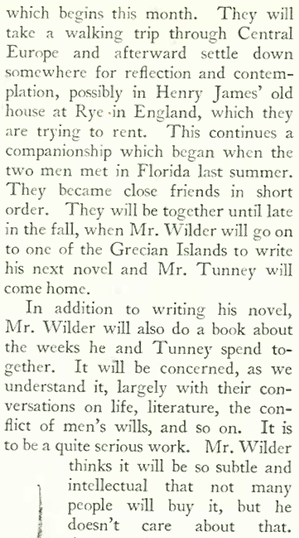
Heeney would remain in the U.S. and fight a few more bouts before retiring to Florida, where he ran a bar and fished with his friend, Ernest Hemingway. Tunney, on the other hand, announced his retirement from boxing just five days after the fight. It was time to finally devote himself to a life of the mind. Norman Klein, writing in the Aug. 4 “Talk of Town,” offered a glimpse into that new life:

BRAIN OVER BRAWN…Boxing champ Gene Tunney, left, and writer George Bernard Shaw on a 1929 vacation to Brioni. (Associated Press)

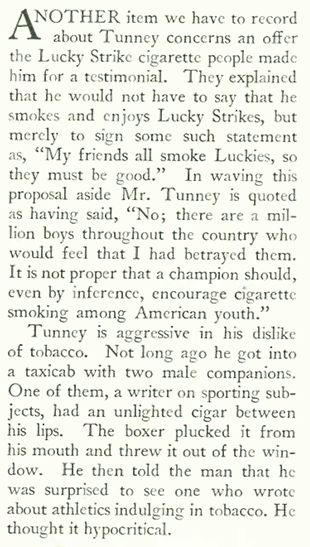
Still not getting enough of The Champ, “Talk” also related this story about Lucky Strike cigarettes, and how that company’s publicists tried unsuccessfully to persuade Tunney to endorse their product:

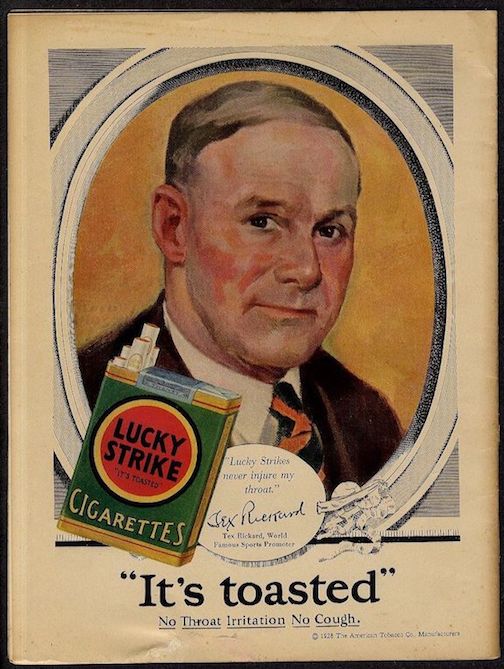
However the promoter of the Tunney–Heeney fight, Tex Rickard, had no problem taking money from the American Tobacco Company:

THEN I’LL TAKE THE MONEY…The promoter of the Tunney – Heeney fight, Tex Rickard, had no problem endorsing Lucky Strikes in this 1928 advertisement. Rickard would die the following year at age 59, from an appendectomy of all things. (eBay)

*  *  *

Tunney Was More Exciting

“The Talk of the Town” cast a jaded eye toward the Ninth Olympic Games in Amsterdam:

Poster from the 1928 games. (www.olympic.org)

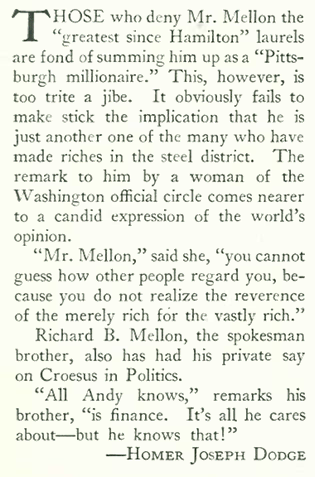
And perhaps even less exciting than the Olympics was the magazine’s “Profile” subject, Andrew W. Mellon, referred to in the title as “Croesus in Politics.” Mellon was no Gene Tunney, but he did ensure his immortal fame through his philanthropy, still expressed today by the Andrew W. Mellon Foundation. Below are the concluding lines of the profile, written by Homer Joseph Dodge:

The article featured this terrific caricature by illustrator Abe Birnbaum

Planned Obsolescence

The magazine’s “Motors” column touted Chrysler’s new “peaked” radiators, which no doubt caused many insecure Chrysler owners to consider junking their non-peaked models of yesteryear:

This ad in the same issue screamed “new, new, new” for what appeared to be mostly the same old, same old…

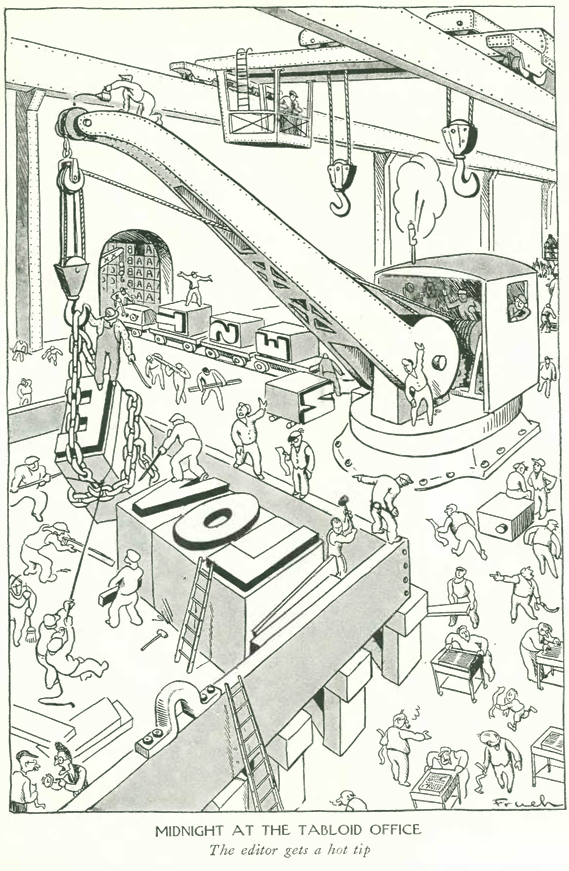
Our comic comes courtesy Al Frueh, who looks in on the workings of a printing press at a celebrity tabloid:

Next Time: Shadows of the South Seas…

A 100 Percent Talker

Lights of New York would be a forgettable film if not for the fact it was the world’s first 100 percent talking motion picture. Yes, it was a bad film, but…

July 14, 1928 cover by Leonard Dove.

…even the July 14, 1928 New Yorker had the foresight to note that the film was destined to be a “museum piece.” Despite the corny plot and bad acting, the magazine’s critic “O.C.” had to concede that the film offered proof that sound would improve the motion picture experience.

Theatre Card for Lights of New York. (untappedcities.com)
MAKING SOME NOISE…Helene Costello with a cast of nightclub dancers in Lights of New York. (vintage45.wordpress.com)

The Jazz Singer (1927) launched a “talkie revolution” that would culminate nine months later in Lights of New York, and by the end of 1929 Hollywood was almost exclusively making sound films. But studios still released silent films into the 1930s, since not every theatre in the country was wired for sound.

The New Yorker had been slow to embrace sound in motion pictures (see my previous posts). What helped to win them over was the further refinement of the Movietone process, in which the sound track was printed directly onto the film strip (The Jazz Singer used Vitaphone, which essentially synched a record player with a film and provided a sporadic rather than continuous sound track).

In the same issue, writer Robert Benchley also predicted (in “The Talk of the Town”) that sound in movies would challenge actors whose voices weren’t as attractive as their screen images:

IT’S COMPLICATED…It is a common assumption that sound motion pictures killed the careers of many silent stars, however big names like John Gilbert (left) and Clara Bow left the pictures for other reasons. Studio politics ended Gilbert’s career, and he drank himself to death by 1936. Bow—famously known as the “It Girl,”—made a few sound pictures, but retired from acting in 1931 to become a Nevada rancher. (Wikipedia)
SILENCED…Some silent actors such as Wallace Beery (left), were sidelined not because of their voices but because of their high salaries. On the other hand Raymond Griffith (right), who made only one sound movie, spoke with a hoarse whisper not suited for the talkies. (Wikipedia / silentfilmstillarchive.com)

The New Yorker also noted that sound pictures would prove to a great “bonanza” to voice teachers:

Transition to sound in the late 1920s would later provide the theme for the 1952 musical Singin’ In The Rain, in which Jean Hagen portrayed silent film star Lina Lamont, whose voice was ill-suited for talking pictures. 

SAY WHAT?…Actress Lina Lamont (Jean Hagen) tries the patience of her director (Chet Brandenburg) while her co-star (Gene Kelly) looks on. The scene demonstrated the challenges of acclimating former silent stars (like Lina Lamont, whose voice sounded like squeaky hinge) to “talking pictures.” (MGM/YouTube Movieclips)

The New Yorker also noted that the advent of sound in motion pictures would put an end to many theatres operating on the vaudeville  circuit:

In his regular column, “Of All Things,” Howard Brubaker gave his two cents about the new world of talking movies:

Paving Over Paradise

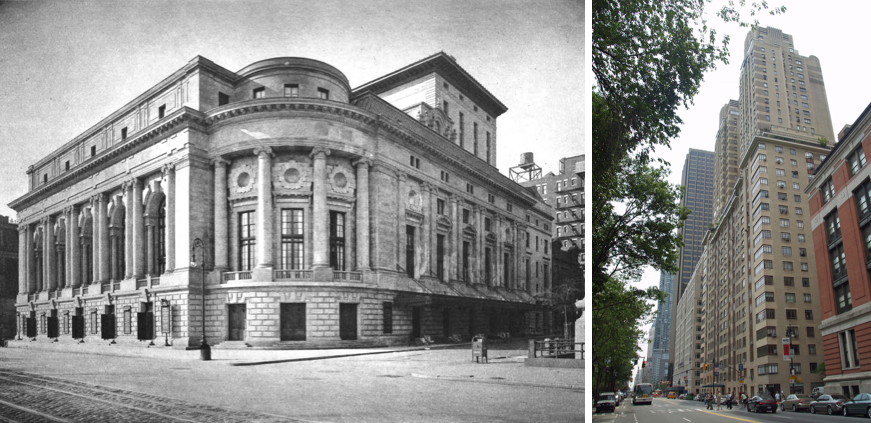
The July 14 “Talk of the Town” offered more bittersweet commentary on the city’s rapidly changing landscape. This time it was a famous stretch of lawns on West 23rd Street—London Terrace— that were being uprooted to make way for a massive new apartment block:

According to Tom Miller (writing for his blog Daytonian in Manhattan), Clement Moore, the writer to whom “A Visit from St. Nicholas” (“The Night Before Christmas”) “had developed the block when he divided up his family estate, ‘Chelsea.’ On the 23rd Street block, in 1845, he commissioned Alexander Jackson Davis to design 36 elegant Greek Revival brownstone townhouses. The row was designed to appear as a single, uniform structure or ‘terrace’ (a design not lost on The New Yorker). Unusual for Manhattan, each had deep front yards planted with shrubbery and trees. He called his development ‘London Terrace.'”

A BIT O’ GREEN…London Terrace, circa 1920. (ephemeralnewyork)

By October 1929, writes Miller, “a few weeks before the collapse of the stock market and the onset of the Great Depression, (developer Henry Mandel) had acquired and demolished all the structures on the enormous block of land. All except for Tillie Hart’s house. Hart leased 429 West 23rd Street and, although her lease had legally expired, she refused to leave, firing a barrage of bricks and rocks at anyone who approached the sole-surviving house. A court battle ensued while she barricaded herself inside. Finally, just four days before Black Tuesday, sheriffs gained entry and moved all of Hart’s things onto the street. She held out one more night, sleeping on newspapers in her once-grand bedroom, then gave up. The following day her house was destroyed.”

IT’S YUGE…Farrar & Watmough designed this massive, Tuscan-inspired apartment block, completed during 1930-31. The developer Henry Mandel, kept the site’s original name, London Terrace. (ephemeralnewyork)

Miller writes, “to describe the new London Terrace was to use superlatives. Consuming the entire city block, it was the largest apartment building in the world with 1,665 apartments. It boasted the largest swimming pool in the city – 75 feet by 35 feet, with mosaic walls and viewing balconies. Twenty-one stories above the street a “marine deck” was designed to mimic that of a luxury ocean liner. It had a fully-equipped gymnasium, a recreation club, a rooftop children’s play yard with professional supervisors, and a large dining room. The doormen were dressed as London bobbies.”

STILL THERE…London Terrace today. (Brick Underground)

 *  *  *

In other diversions, Isadore Klein looked askew at the latest headlines, namely the big fight between Gene Tunney and Tom Heeney, one of the 20th century’s many “battles of the century”…

…while Helen Hokinson, on the other hand, offered some sketches of seafaring life…

…and looked in on the challenges of buying a hat…


And to close, a cartoon by Leonard Dove

…that referenced ads such as this one from the June 2, 1928 issue…

…and a comedy of manners, courtesy Peter Arno

Next Time: Beyond 96th Street…