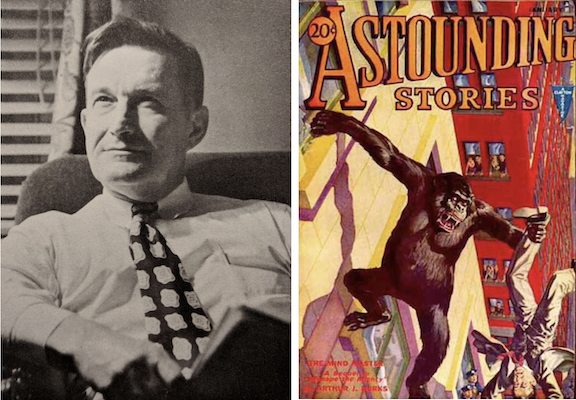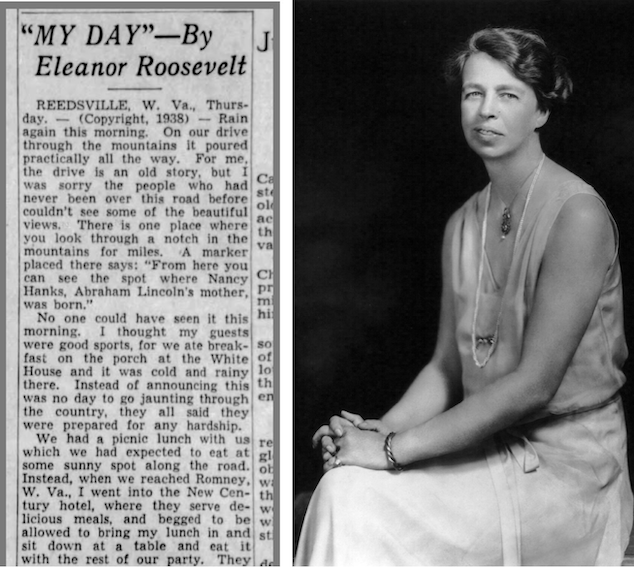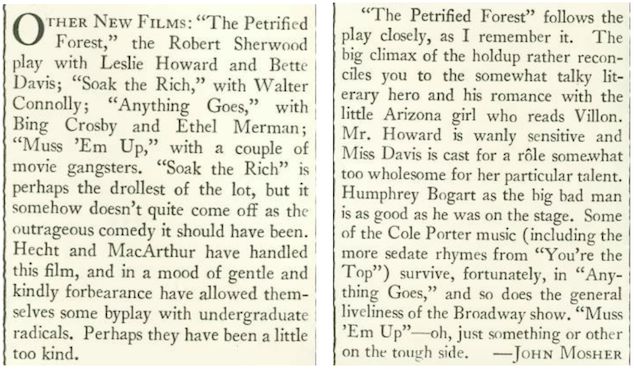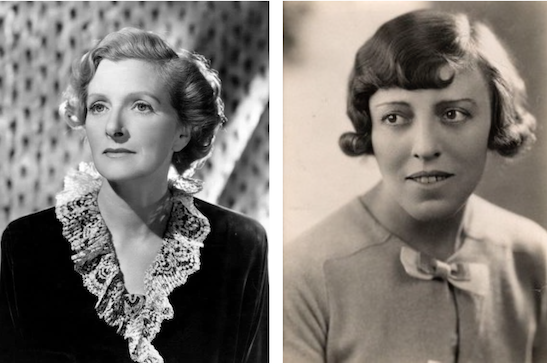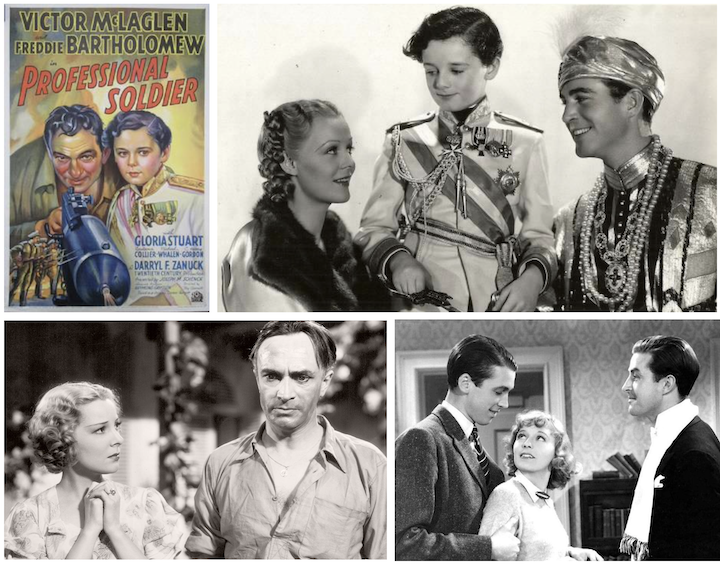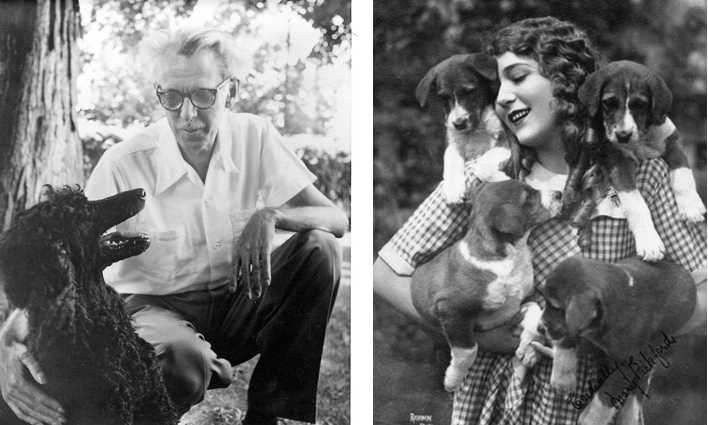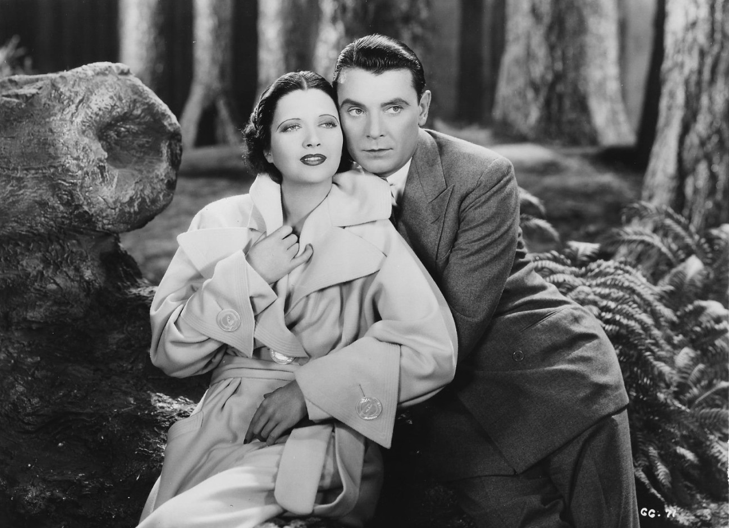
Above: James Thurber with his beloved Christabel, circa 1950s, and Mary Pickford enjoying some puppy love, circa 1920. (The Thurber Estate/Pinterest)
James Thurber and silent film star Mary Pickford had one thing in common; they loved their dogs.
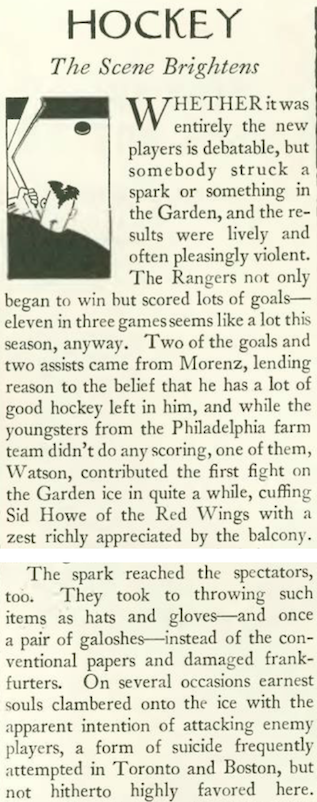
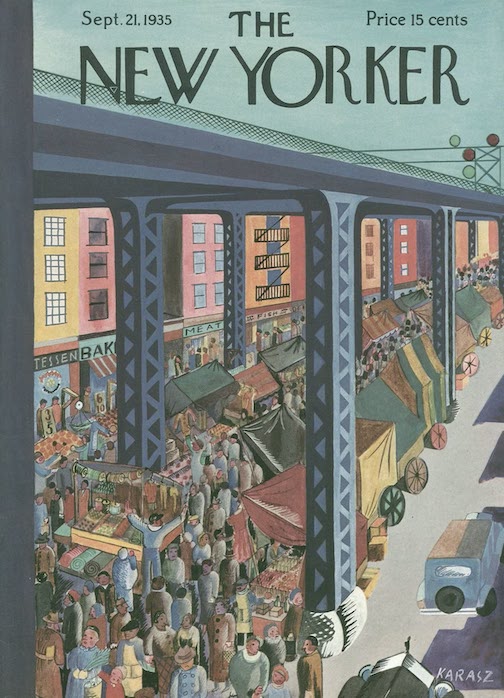
September 21, 1935 cover by Ilonka Karasz. Antiques magazine (March 8, 2018) described Karasz’s covers as “leafy modernism,” evolving from “dynamic modern depictions of urban life to enchanting, peaceful images of leisure activities…recording details like family picnics or the insects and flowers in her garden.” Many depict scenes around Brewster, New York, where she lived with husband, Willem Nyland, a Dutch-American chemist and pianist. Karasz contributed 186 covers across six decades, beginning with her first on April 4, 1925.
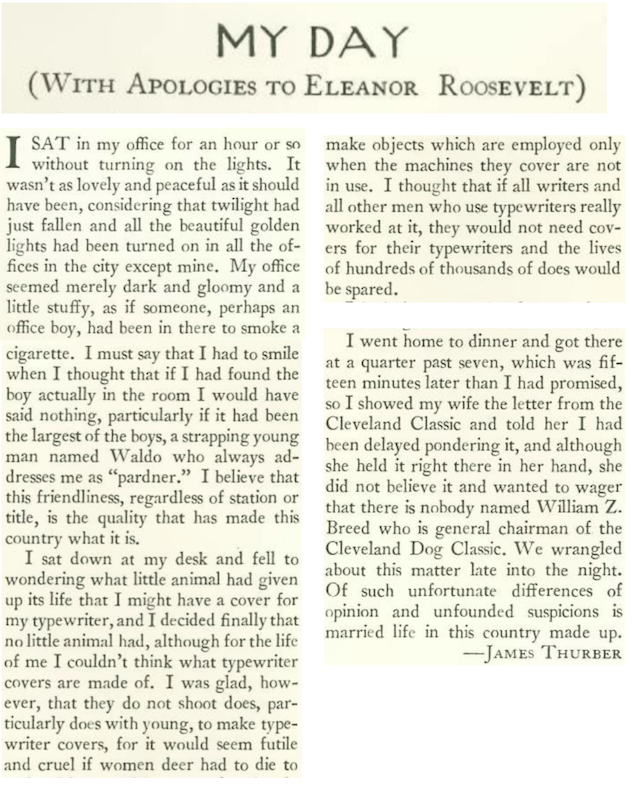
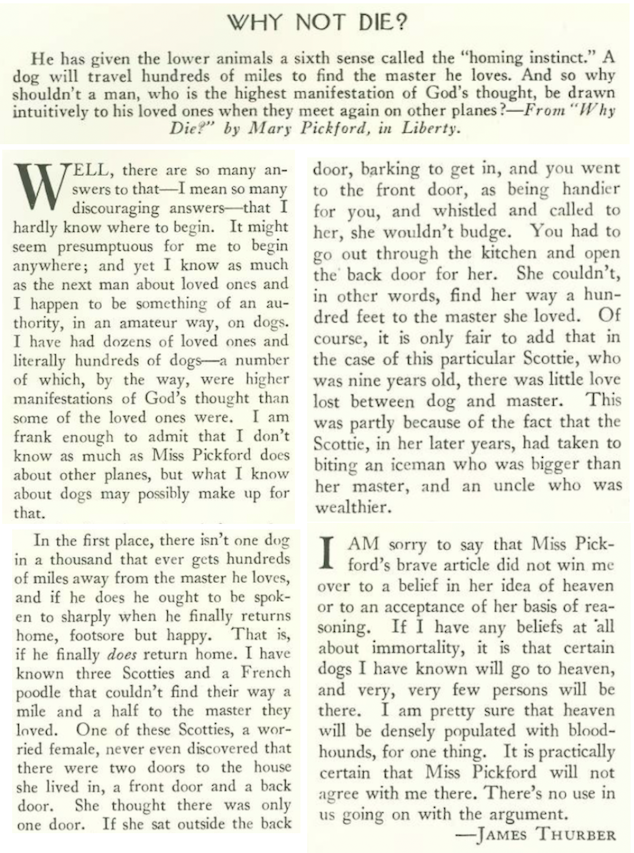
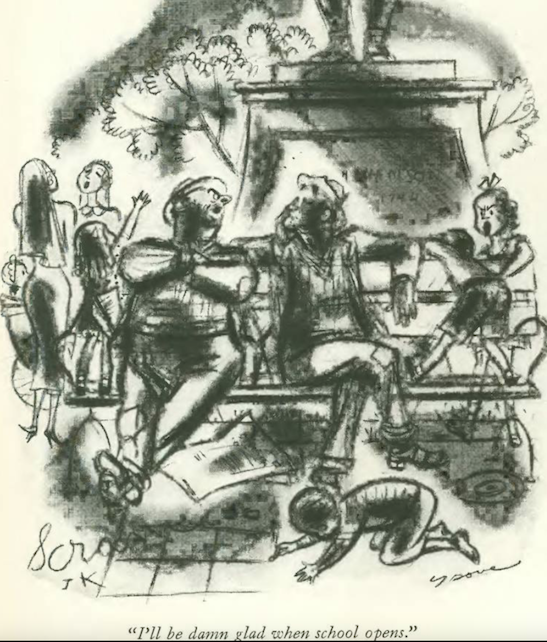
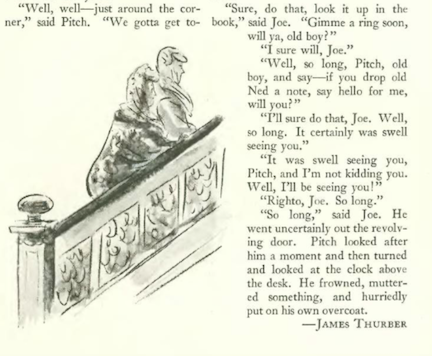
From that point of agreement, however, these contemporaries (Pickford was born in 1892; Thurber in 1894) diverged. Consider Thurber’s response (excerpted) to Pickford’s spiritual musings in a Liberty magazine article titled “Why Die?”
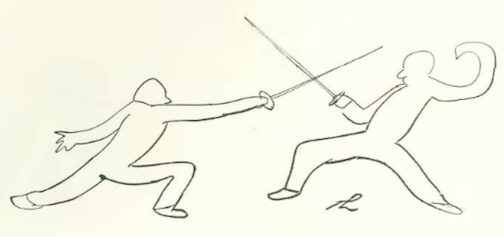
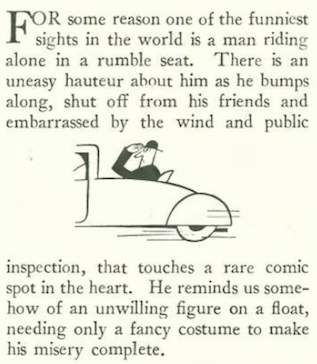
…Thurber contributed this spot drawing for his rebuttal…
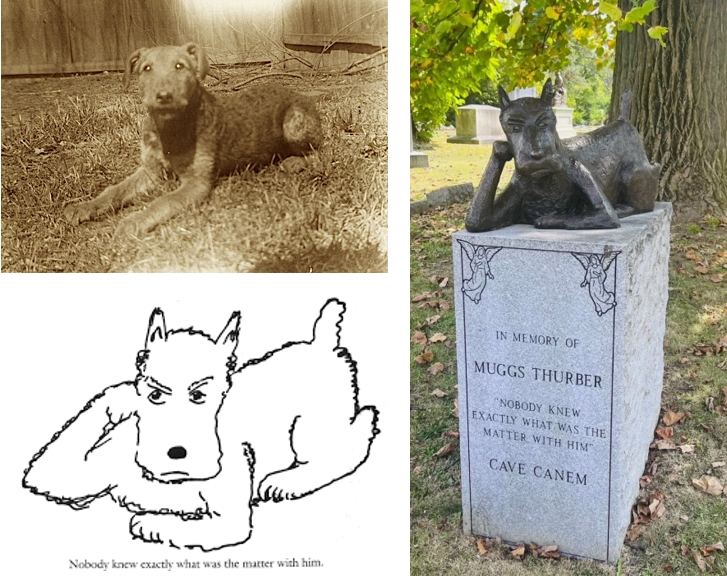
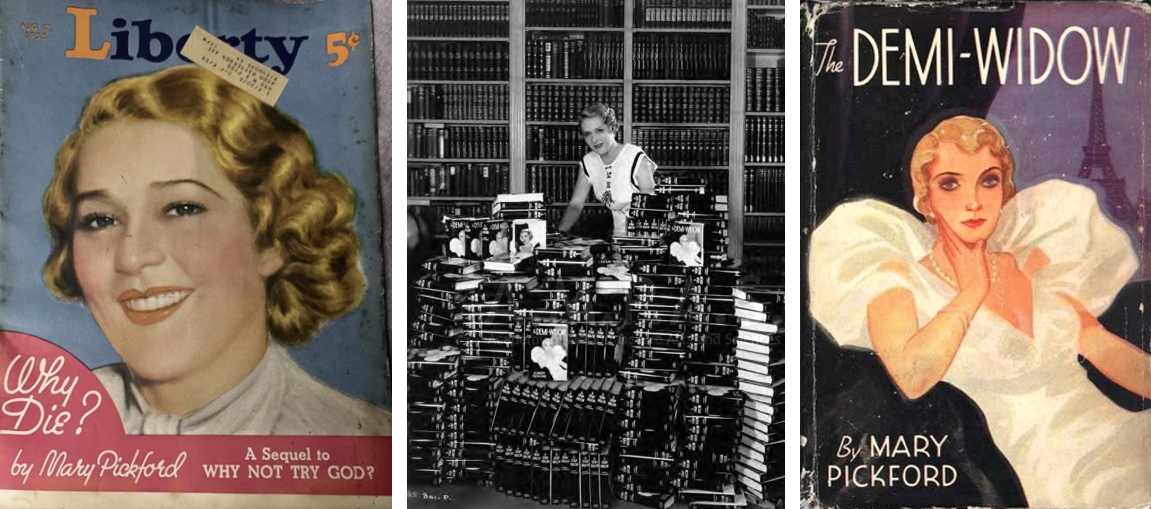
ONE OF A KIND…James Thurber immortalized his Airdale, Muggs, in a 1933 story, “The Dog that Bit People.” Muggs, who died in 1928, has his own monument in Green Lawn Cemetery, Columbus, Ohio, installed in 2021. The inscription, taken from Thurber’s short story, reads, “Nobody knew exactly what was the matter with him.” (https://www.dispatch.com/Facebook)AMERICA’S SWEETHEART was well-known as animal lover. At left, Mary Pickford in 1916; at right, with husband Douglas Fairbanks at their mansion, Pickfair, in the 1920s. (Wikipedia/Pinterest)SECOND LIFE…Mary Pickford gave up acting in 1933 to pursue her writing career. In 1934 she penned the tract, Why Not Try God?, followed in 1935 by another spiritual bestseller, My Rendezvous with Life. That same year she also published a novel, The Demi-Widow. From left, cover of Liberty magazine with her essay, “Why Die?,” Aug. 18, 1935; Pickford posing with copies of The Demi-Widow, ca. 1935. Kirkus Reviews (Aug. 1, 1935) dubbed The Demi-Widow “Good hammock reading for hot days — light and not too dreadful froth…” (picclick.com.au/digitalcollections.oscars.org/Goodreads)
* * *
Rumble Humbled
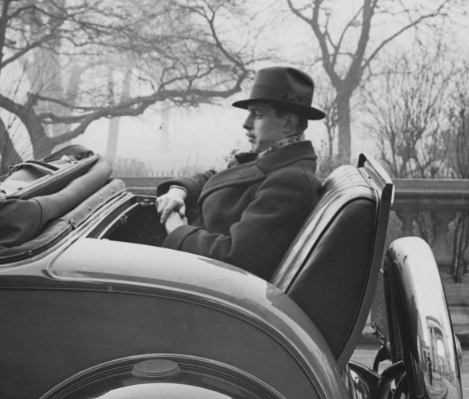
In his “Notes and Comment” E.B. White observed the absurdity of a grown man riding alone in a rumble seat. These seats were phased out by 1939 in American autos (the British, who called them “dickies,” abandoned them a decade later). Rumble seats were unsafe, to be sure, but it was also unpleasant to sit near the exhaust pipe and collect the dust, grit and bugs that would merrily dance around one’s eyes, nose and mouth.
BONE RATTLER…Detail from a photo of man riding in a rumble seat, 1935. (General Photographic Agency/Hulton Archive/Getty Images)
A Red By Any Other Name
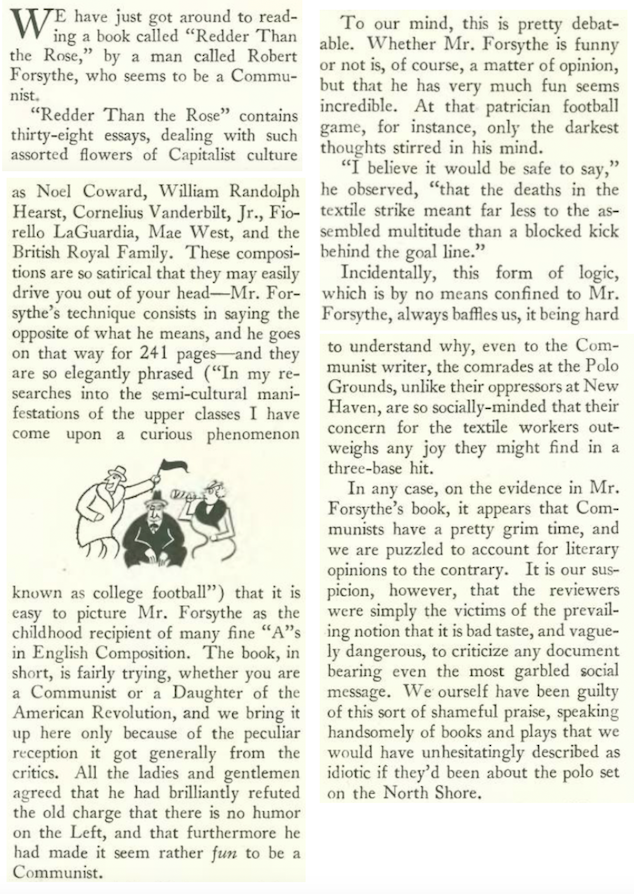
White also considered the intentions behind a new book by Robert Forsythe, Redder Than a Rose. Kyle Crichton (1896-1960) used the Forsythe nom de plume whenever he wrote for communist publications such as the Daily Worker. A former coal miner and steel worker, Crichton was also a writer and editor for Collier’s magazine.
* * *
Fight Night
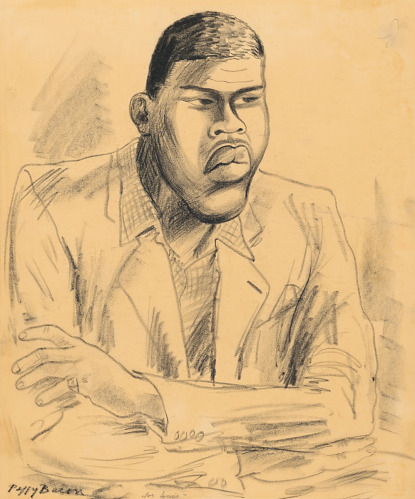
In anticipation of the boxing match between Joe Louis and Max Baer, The New Yorker featured a Peggy Bacon portrait of Louis at the bottom of its events section, which also contained a listing under “Sports” of the upcoming fight at Yankee Stadium. The caption below the Louis portrait was a quote attributed to Bacon: An out-size in juveniles, simple, unruffled, a shade sullen, practically expressionless, hoarding his energies with the inarticulate dignity and pride of some monster vegetable.–P.B.
a better view of Peggy Bacon’s portrait of Joe Louis…
(Smithsonian National Portrait Gallery)
* * *
At the Movies
Well, the fun couldn’t last forever, as critic John Mosher discovered with the latest batch of films to roll out of Tinseltown. Here he tried to make sense of The Big Broadcast of 1936, and gave a closing nod to Dorothy Parker.
A LITTLE OF THIS, A LITTLE OF THAT…Theatre card promoting the appearances of Gracie Allen and George Burns in The Big Broadcast of 1936. These films were essentially long promo pieces for Paramount’s stable of stars. (IMDB)
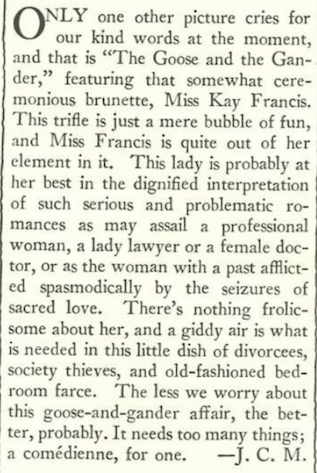
Mosher also took in The Goose and the Gander, featuring Kay Francis, one of Warner Brothers’ biggest stars and one of Hollywood’s highest-paid actors. Known for her roles as a long-suffering heroine and her lavish wardrobes, Mosher found Francis ill-suited to a comedic role.
NEEDED A BIT MORE GOOSE…Kay Francis and George Brent in The Goose and the Gander. (IMDB)
* * *
From Our Advertisers
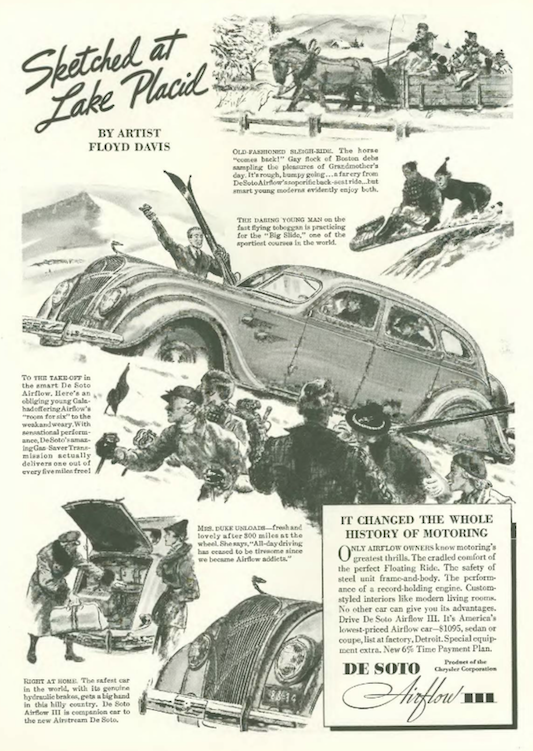
The 1920s and 30s saw a proliferation of all sorts of electric gadgets, one of them being the toaster, here serving as a centerpiece for a cocktail party…
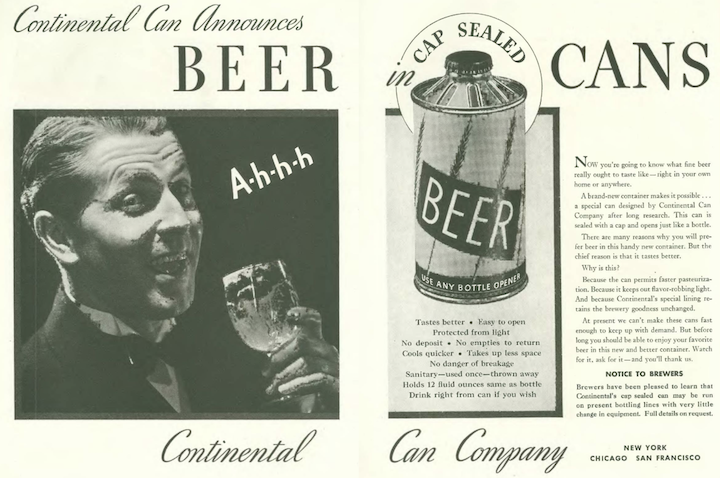
…before 1935 beer cans were not feasible because they couldn’t withstand the internal pressure of a carbonated liquid…it was the American Can Company (not Continental) that solved the problem by developing an internally-lined can that could contain the pressure…the lining also prevented the beer from tasting metallic…
…R.J. Reynolds continued to build its tobacco empire by lining up scads of famous athletes to endorse the health benefits of their Camel cigarettes…
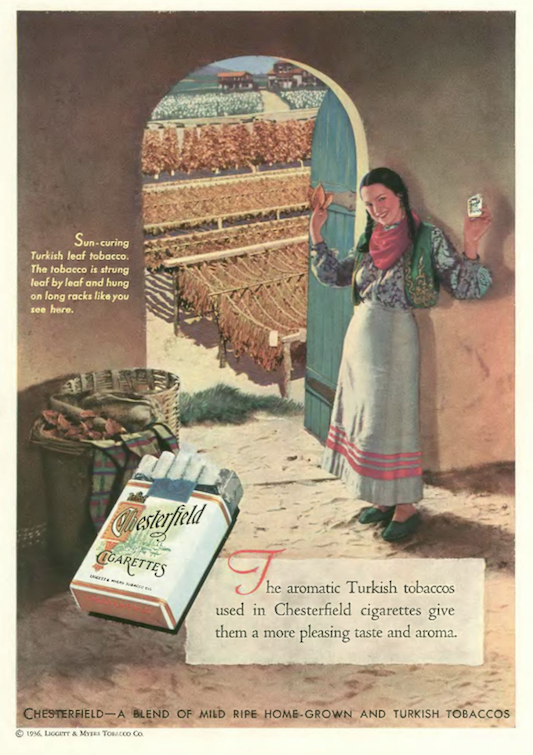
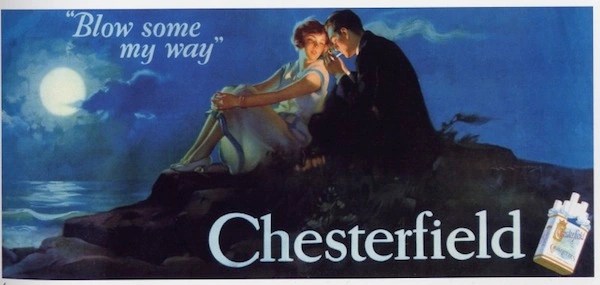
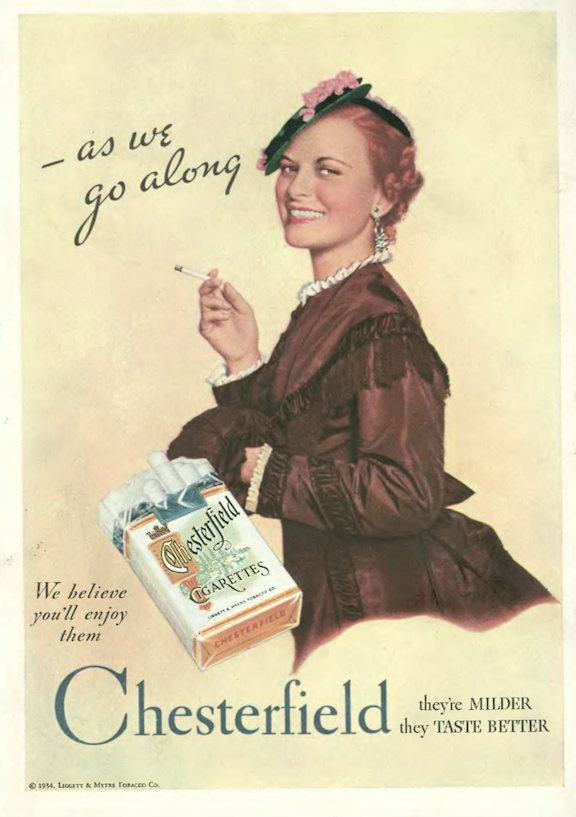
… Liggett & Myers, who in 1926 launched their “Blow some my way” advertising campaign to target women smokers, continued to employ images of young lovers in romantic settings to push their Chesterfields…
…for reference, a Chesterfield ad from 1931…
…on to our cartoons, we start with this spot from Perry Barlow…
…Alain looked in on a tender moment between father and son…
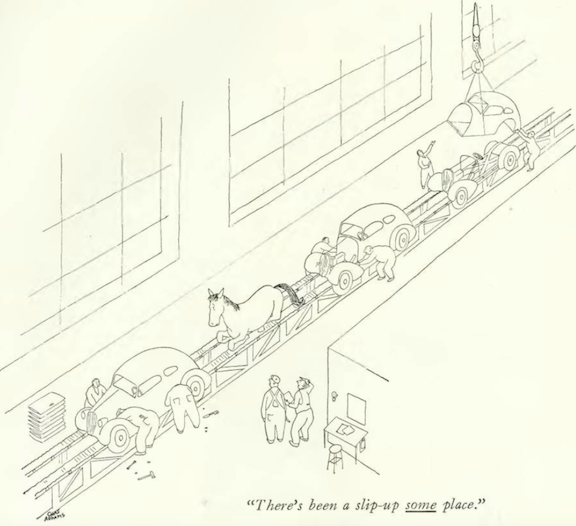
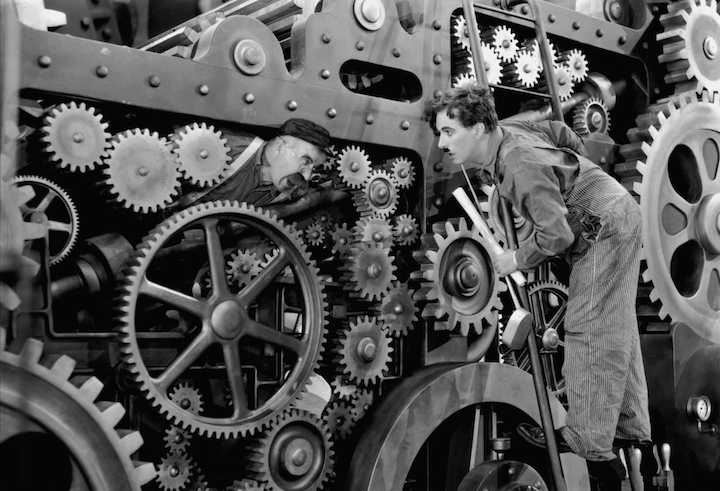
…Charles Addams found a glitch on the assembly line…
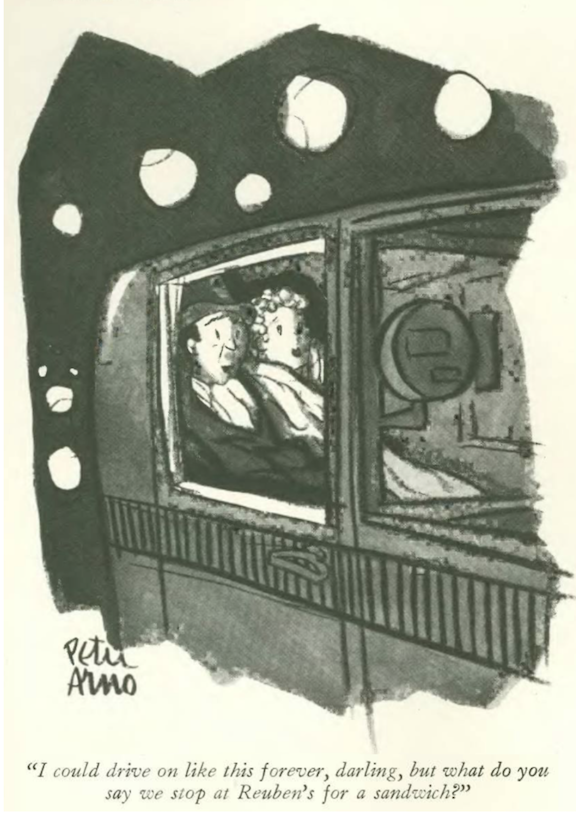
…Peter Arno drew up two old toffs looking for some adventure…
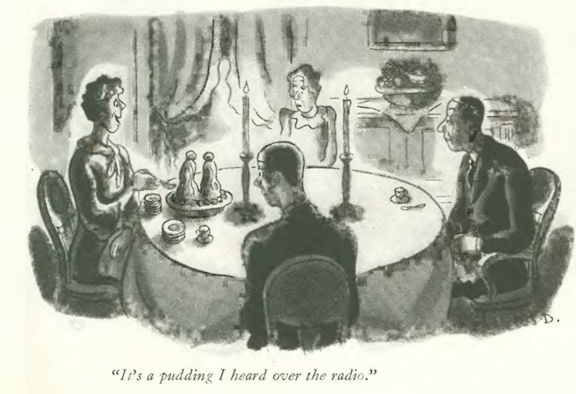
…Robert Day offered up the latest twist in the culinary arts…
…and we close with Helen Hokinson, who was just passing the time…
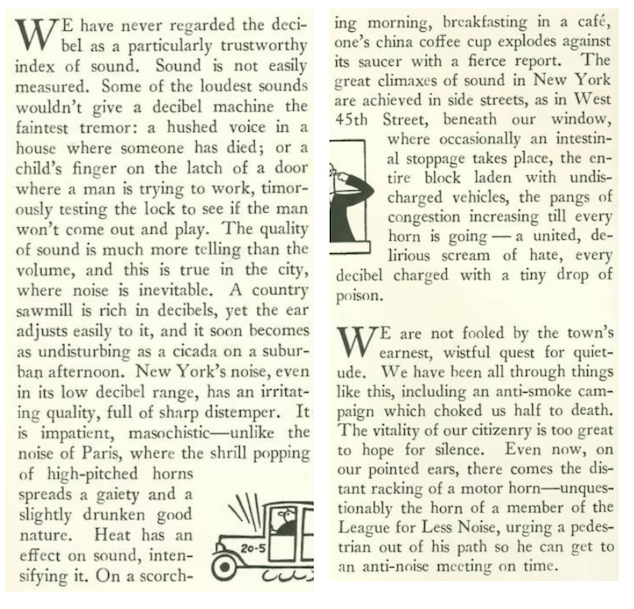
City life is a noisy life, especially in places like Manhattan, one of the most densely populated places in the world.
August 24, 1935 cover by Rea Irvin.
In his “Notes and Comment” column, E.B. White described the occasional “intestinal stoppage” of traffic outside The New Yorker’s offices at West 45th Street, an entire block “laden with undischarged vehicles, the pangs of congestion increasing till every horn is going—a united, delirious scream of hate, every decibel charged with a tiny drop of poison.”
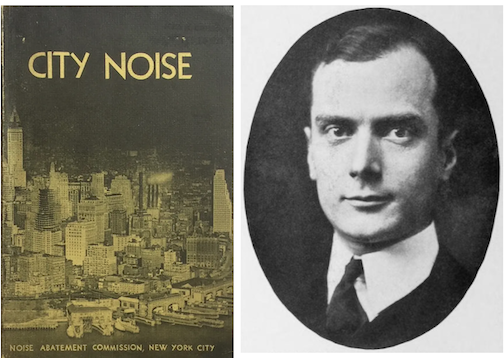
ABOVE THE FRAY…E.B. White with his pet dachshund Minnie at the West 45th Street offices of The New Yorker. (New York Times)AND DON’T CALL ME SHIRLEY…New York City’s Commissioner of Health, Shirley Wynne (right), created a Noise Abatement Commission in 1929. After eight months of research the Commission published City Noise, which included recommendations for a quieter city. (Wikipedia/trevianbooks.com)
The city began addressing the problem in 1929, when New York City’s Commissioner of Health, Shirley Wynne (1882-1942), created a Noise Abatement Commission, likely the first such commission in the U.S. The Commission cited the “mounting roar and crash of traffic, building, manufacture and sundry other noises which have accompanied the growth of the city.” After eight months of research the Commission published City Noise, which included recommendations for a quieter city.
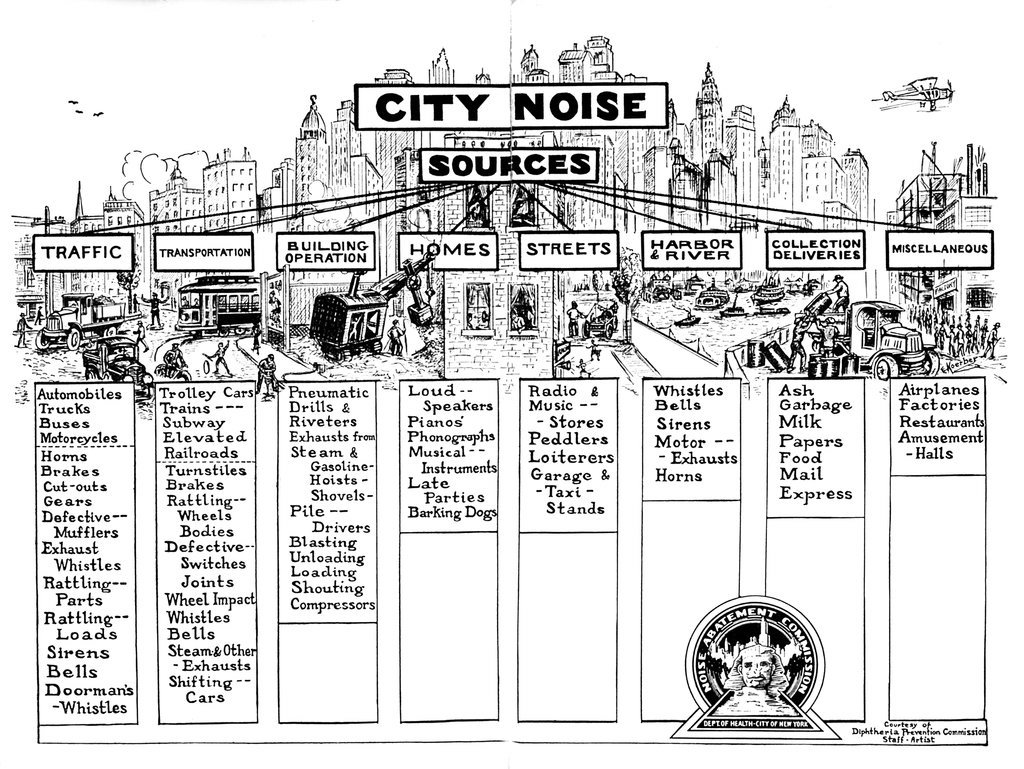
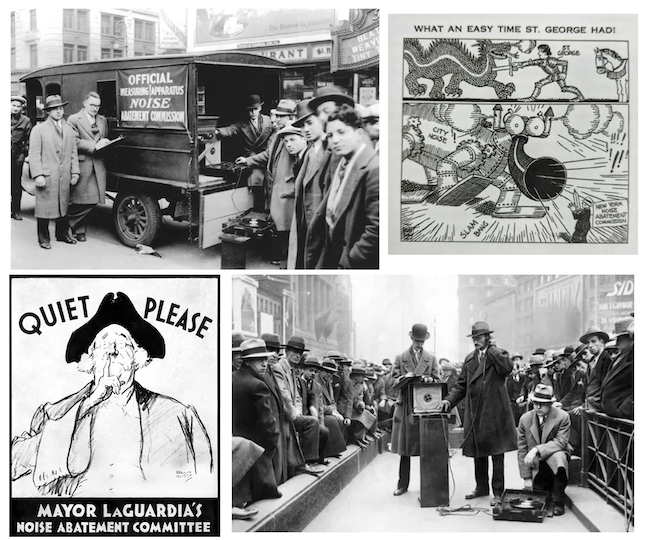
URBAN CHORUS…A chart featured in City Noise depicted some of sources of noise in New York City.PIPE DOWN!…Clockwise, from top left: The Noise Abatement Commission took to the streets with a municipal acoustics-measuring truck in 1930; cartoon in the New York Herald Tribune illustrated the challenge ahead; Commission officials conducting noise tests in Times Square, circa 1930; poster circa 1936 promoted Mayor Fiorello La Guardia’s anti-noise drives. A 1936 noise code put sound restrictions on everything from radios to the “prolonged and unreasonable blowing of a horn.” A first offense cost $1; the second, if committed within the next year, $2. (hii-mag.com/Bloomberg.com/NYTimes.com)
Not one to leave a stone unturned, White also added this note about the noisy doors on Pullman train car toilets…
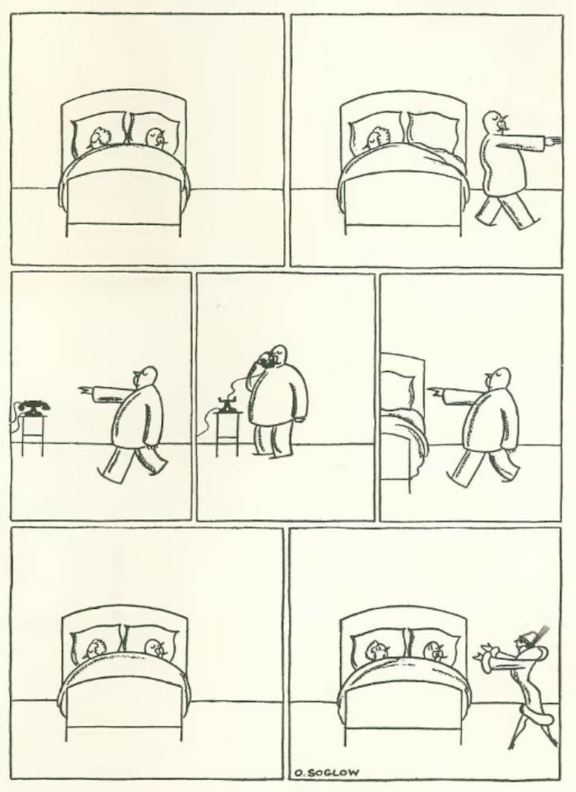
Here are the Otto Soglow spot drawings that accompanied the “Talk” piece:
Final note: A colorful exploration of sound can be found on the One Thousand Birds site,Hii Magazine.Check it out!
* * *
Puff Pushers
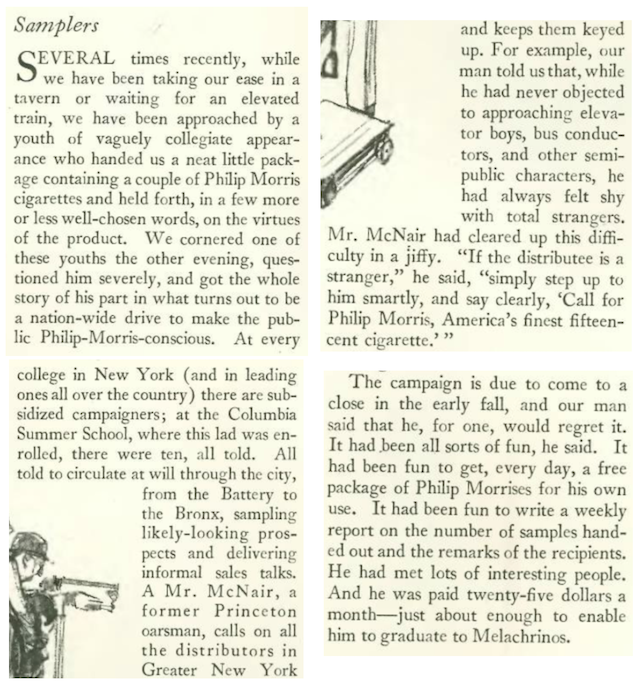
Tobacco companies like Philip Morris have long been savvy in finding ways to expand their market, including taking their product directly to the consumer, as “The Talk of the Town” explained in this entry:
SMOKE FREE…Sample pack of Philip Morris cigarettes, circa 1930s. (Ebay)
* * *
A Rare Glimpse
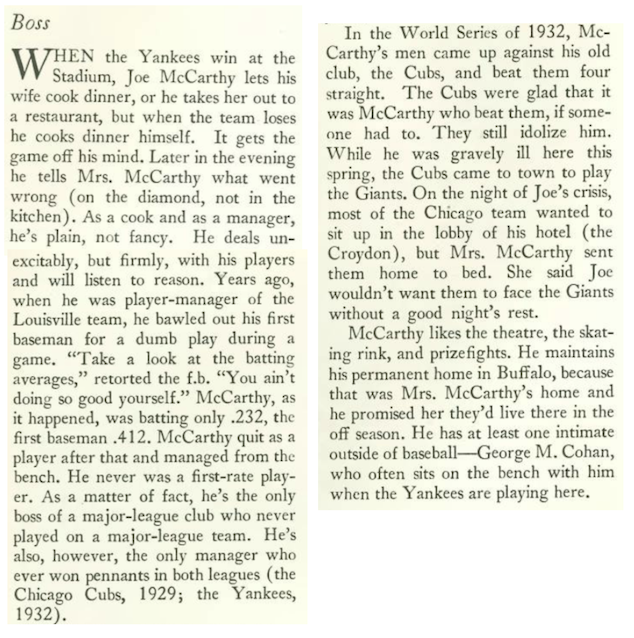
Before Roger Angell started writing about baseball in 1962, there wasn’t a whole lot written about the sport in the pages of The New Yorker. In the magazine’s early years, the game was probably perceived as too low-brow, while other athletic pursuits such as golf, tennis, and polo were more in line with the desired or perceived readership. Early contributors such as Ring Lardner had also soured on the sport, thanks to the Black Sox Scandal of 1919 and the greed of team owners. So here is a rare look at baseball, and Yankee coach Joe McCarthy (1887-1978), in “The Talk of the Town.” Excerpts:
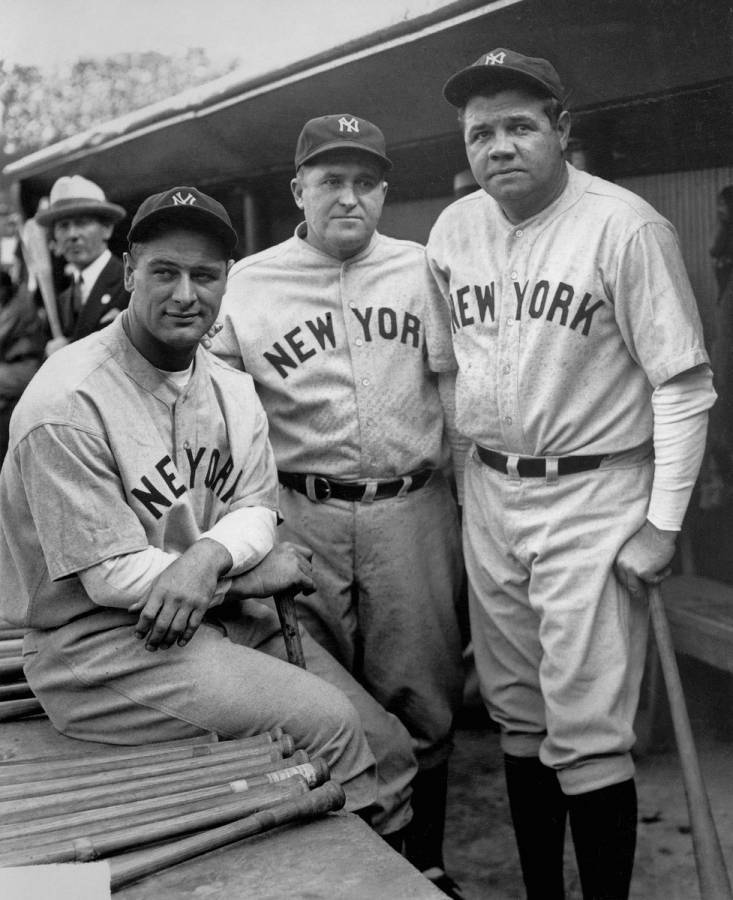
BRONX BOMBERS…Coach Joe McCarthy (center) with sluggers Lou Gehrig, left, and Babe Ruth during the 1932 World Series. The first manager to win pennants in both the National and American leagues, McCarthy’s teams would win a total nine league pennants and seven World Series championships. (CARLI Digital Collections)
* * *
Music Under the Stars
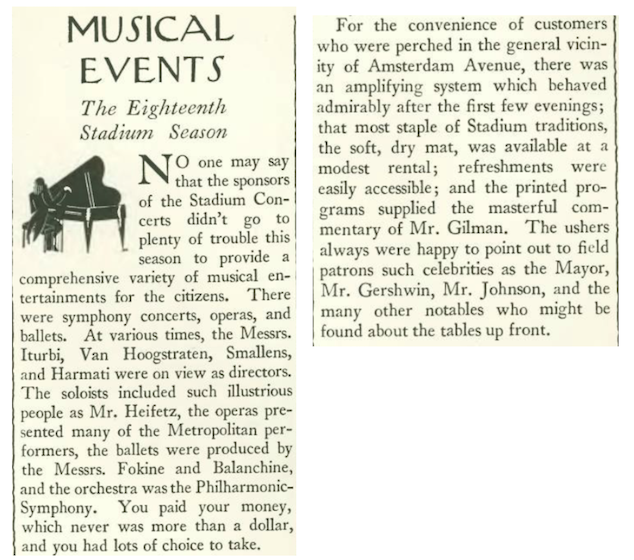
The monumental Lewisohn Stadium was a popular classical music venue on the City College of New York campus until its unfortunate demolition in 1973. According to BBC Music Magazine, “for nearly half a century, Lewisohn Stadium gave people from all walks of life the chance to hear performances by the likes of violinist Fritz Kreisler, soprano Leontyne Price and clarinettist Benny Goodman for as little as 25 cents admission. The New Yorker paid a visit during eighteenth season of the Stadium Concerts. Excerpts:
CLASSICAL MASSES…At left, cover of the 1935 Stadium Concerts Review; at right, Andre Kostelanetz conducts before a crowd of thousands at Lewisohn Stadium in 1939. The stadium was demolished in 1973 to make way for City College of New York’s North Academic Center. SeeThe New York Philharmonic Archive for the complete digital version of the 1935 Stadium Concerts Review. (NY Philharmonic Archive/PressReader.com)
* * *
At the Movies
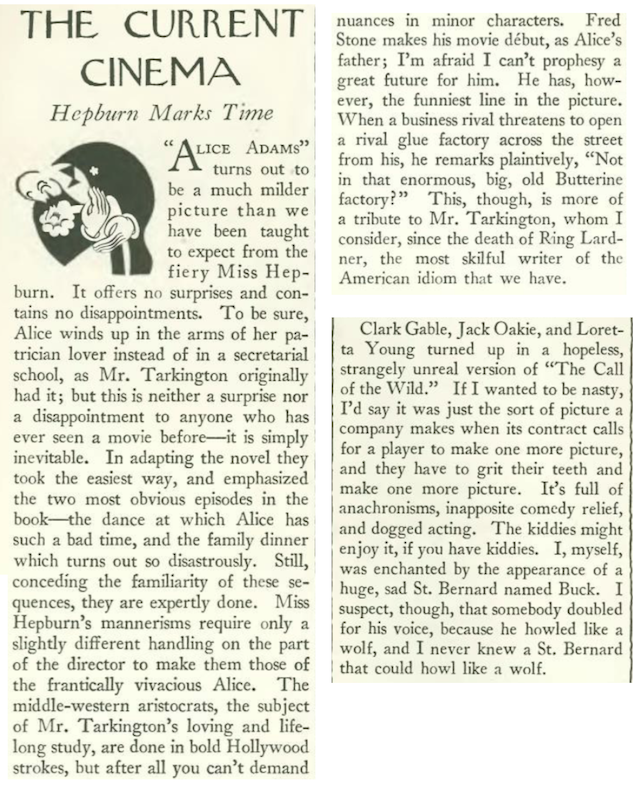
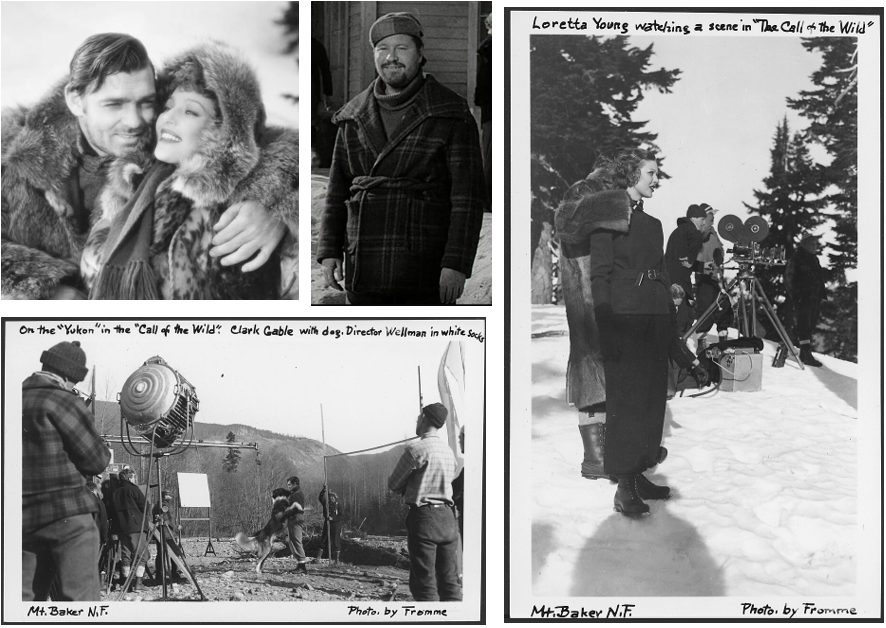
Film critic John Mosher continued to search in vain for a film he could endorse, but he came away empty-handed after screening a star-studded screen adaptation of Jack London’s novel The Call of the Wild. Star power also fell short for Mosher in the screen version of Booth Tarkington’sAlice Adams.
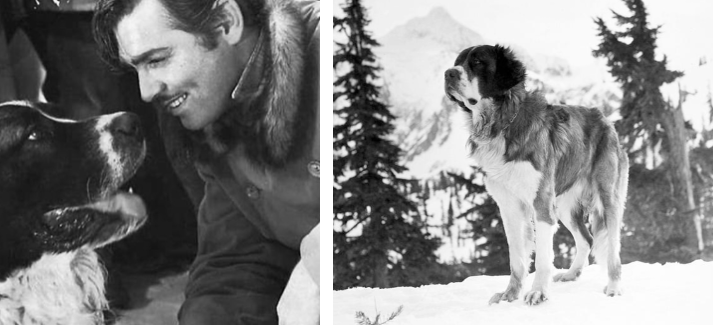
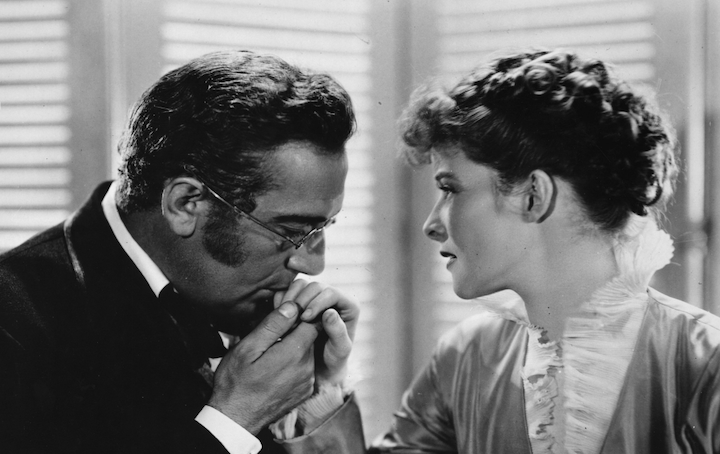
SMALL TALK…The film adaption of Booth Tarkington’sAlice Adams seemed to have all of the right elements in place, including director George Stevens and stars Katharine Hepburn and Fred MacMurray (left), but critic John Mosher found it somewhat average. In a 1991 retrospective review, however, The New Yorker’sPauline Kael deemed the romantic comedy “a classic” and stated that “Hepburn gives one of her two or three finest performances.” At right, the character of Alice Adams was first portrayed on the silver screen by Florence Vidor in a 1923 silent film. (Toronto Film Society/Wikipedia)THE BIG CHILL…Clockwise, from top left, Clark Gable and Loretta Young brave the Yukon wilds (actually Washington State) in The Call of the Wild; Jack Oakie provided comic relief as Gable’s sidekick Shorty Hoolihan; Young watches the filming of a scene on location at Mt. Baker National Forest; Gable shoots a scene with the St. Bernard Buck. (IMDB/Wikimedia)CLARK’S BEST FRIEND…Dog lover Clark Gable became very close with Buck during the filming of The Call of the Wild. Buck appeared in seven more films from 1935 to 1940, even receiving star billing as “Buck the Wonder Dog.” (Facebook/Pinterest)
* * *
From Our Advertisers
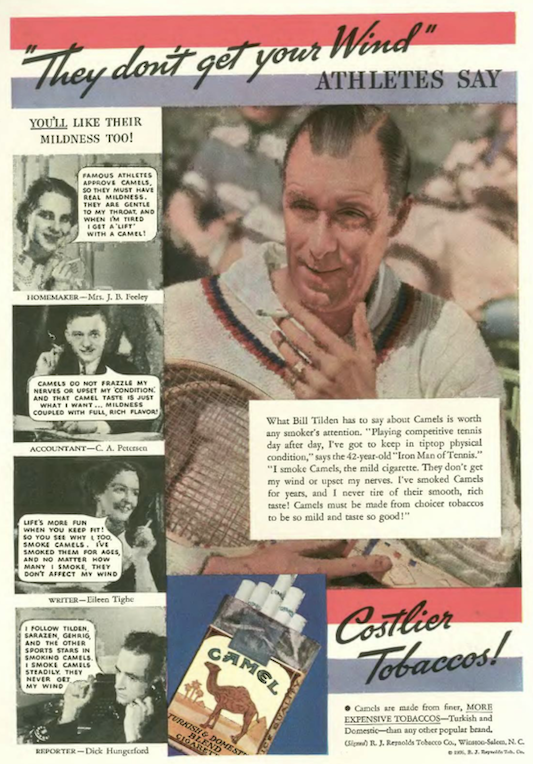
Colorful ads returned to the August 24 issue, featuring familiar sponsors who could afford full-page, full-color spots, namely tobacco and liquor producers…Camel was back with their athletic theme, however they might have chosen someone other than Bill Tilden, who looked perfectly ancient…
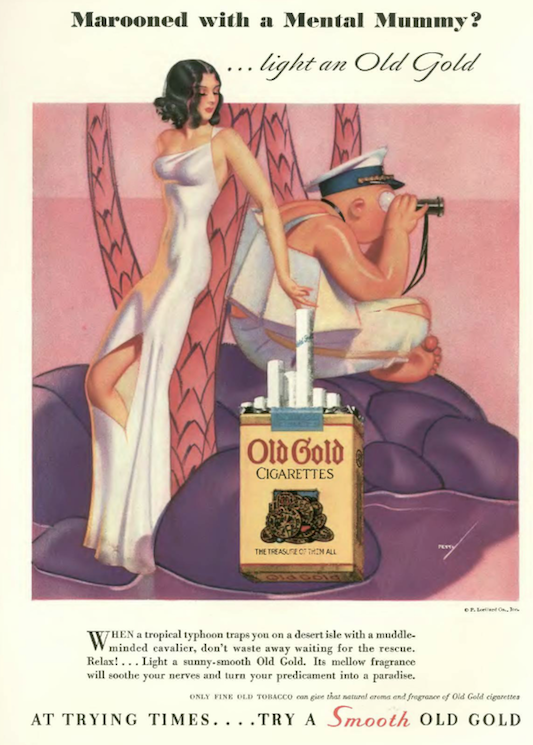
…Old Gold returned with another George Petty-illustrated ad…
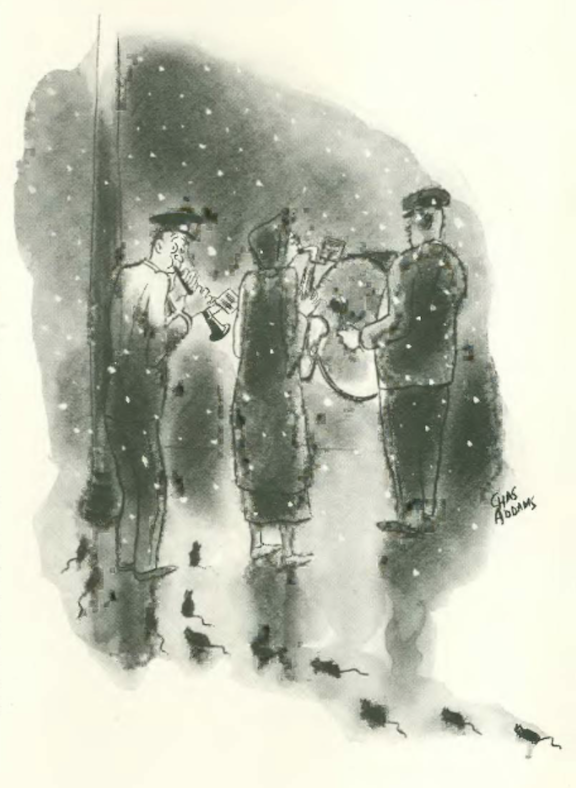
…Courvoisier cognac took the back page spot…
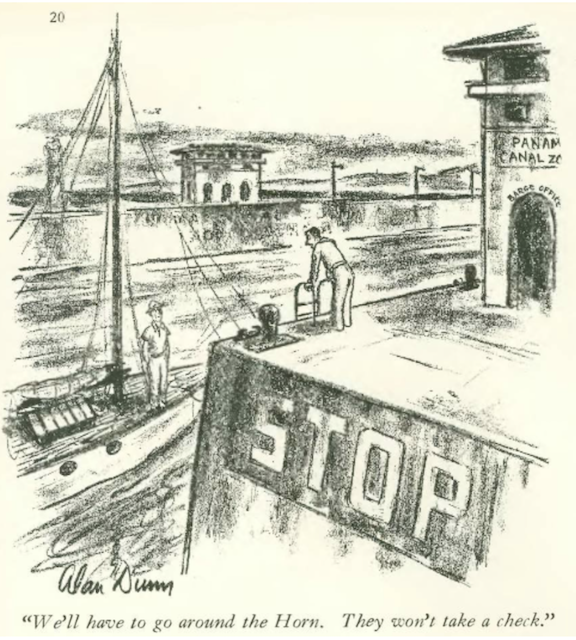
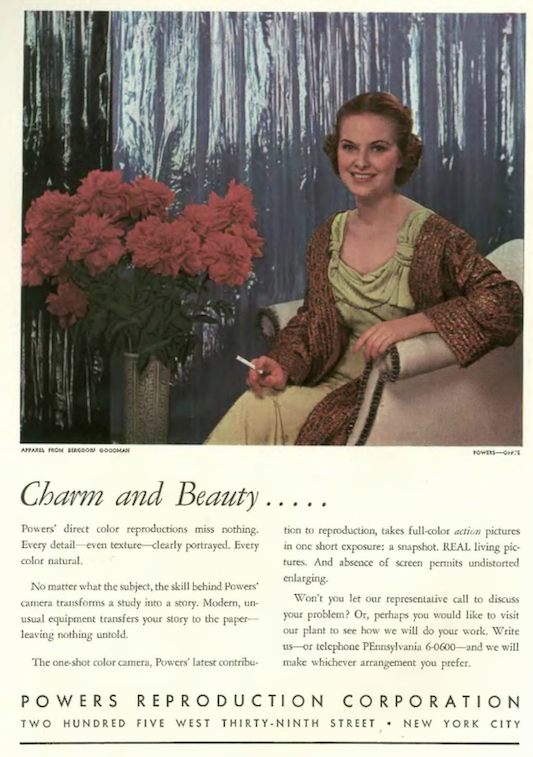
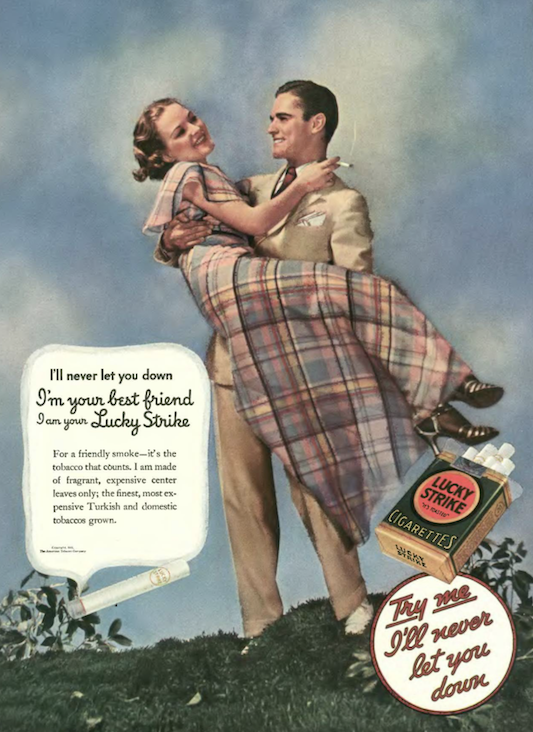
…Powers Reproduction showed off their color printing expertise…I wonder if that is a Lucky she is smoking…
…because I believe she is the same woman who appeared in this ad from the July 27 issue:
…back to August 24, where we were encouraged to enjoy a Johnny Walker highball to stave off the late summer heat…
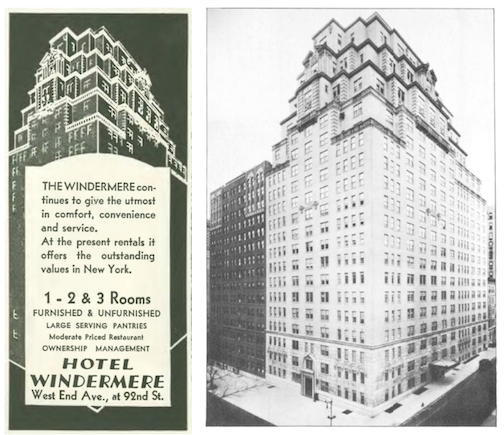
…the distinctive crown of Hotel Windemere on the Upper West Side was an eye-catcher even in this one-column ad from the back of the book…photo at right from around the time it was completed, 1927…
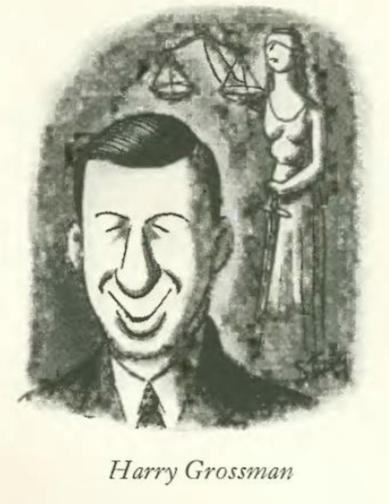
…on to our cartoonists, an unexpected profile caricature by William Steig (this two-part profile featured process-server Harry Grossman)…
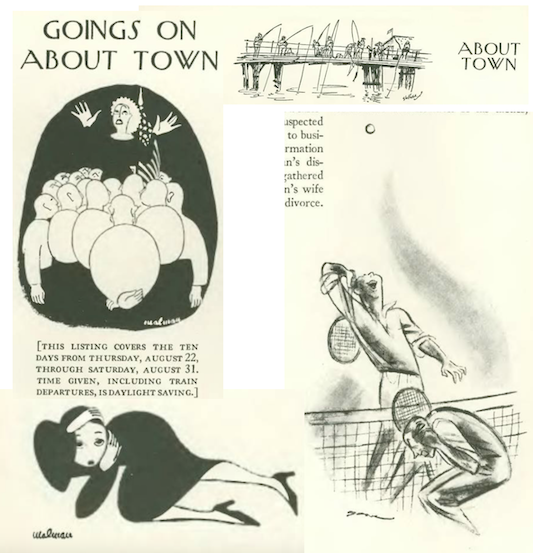
…interesting spot drawings by George Shellhase (top) and Leonard Dove (bottom right), and at left, two by Christina Malman…
…Malman (1912-1959) produced at least two-dozen covers for The New Yorker between 1937 and 1956, including this gem from 1941:
…some baby names have real meaning, according to Alan Dunn…
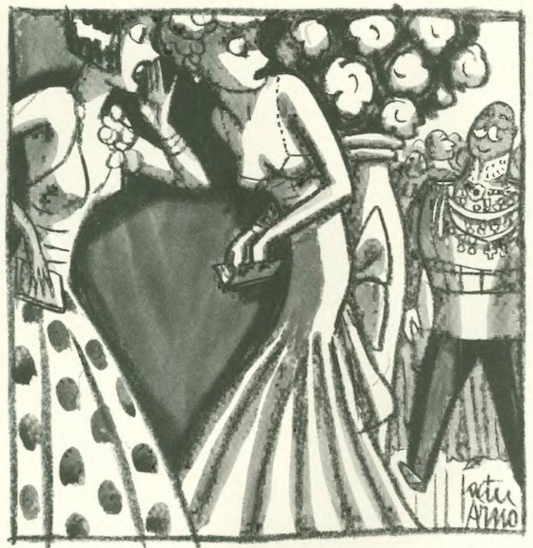
…Peter Arno offered caution about dancing with a prickly Colonel…
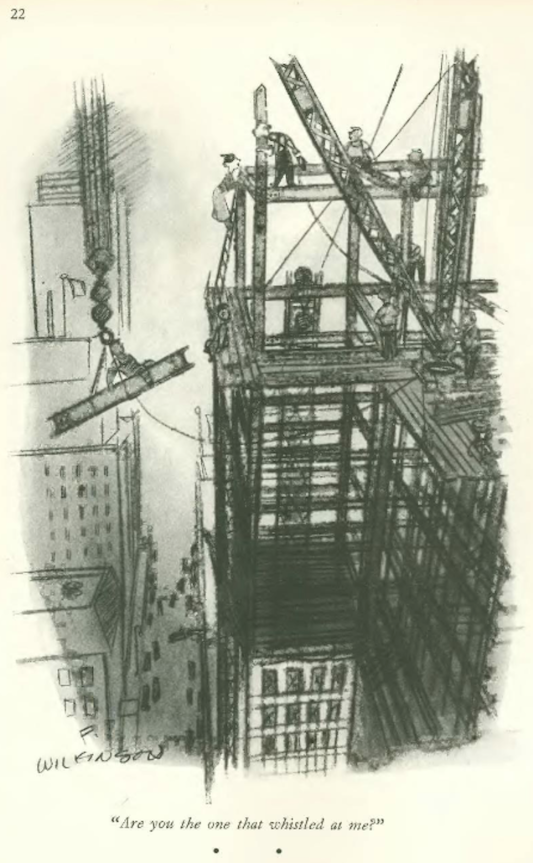
…Fritz Wilkinson answered one cat call high above the city…
…Franz Shubert met Busby Berkeley, via Carl Rose…
…George Price persisted in threading a needle…
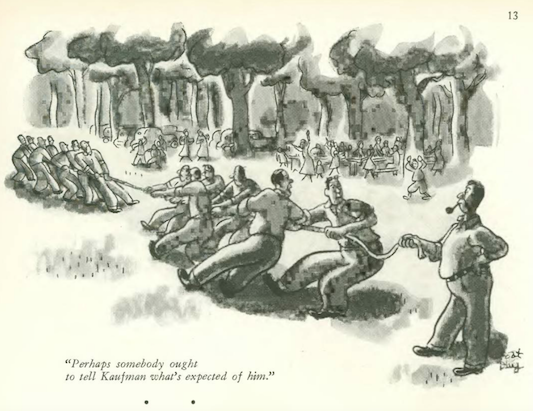
…Robert Day gave us a pacifist of sorts in a game of tug-of-war…
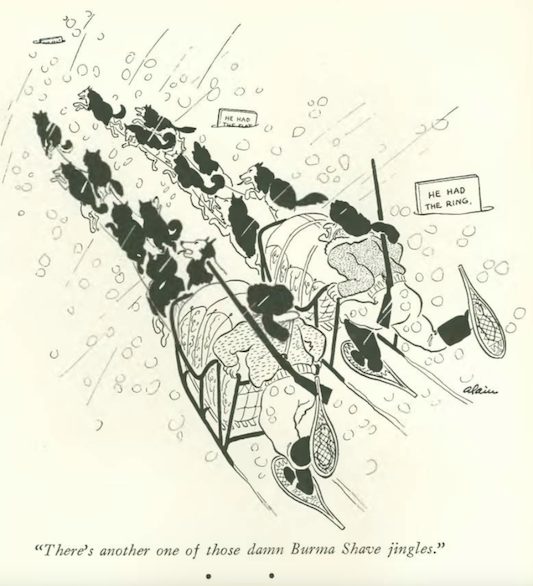
…Burma Shave jingles seemed to be everywhere in the 1930s, per Alain…
…An example of replica Burma Shave signs along Route 66:
(roadsideamerica.com)
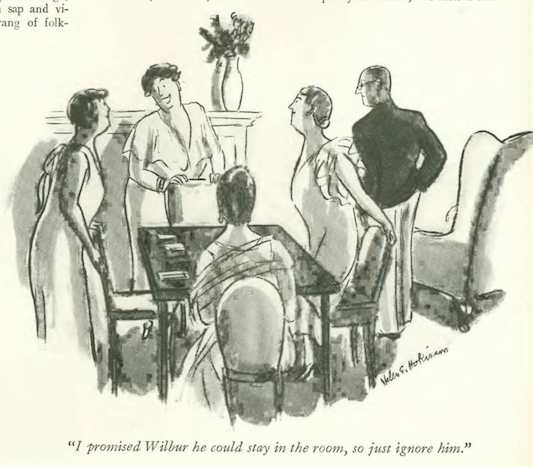
…some parenting tips came our way via Helen Hokinson…
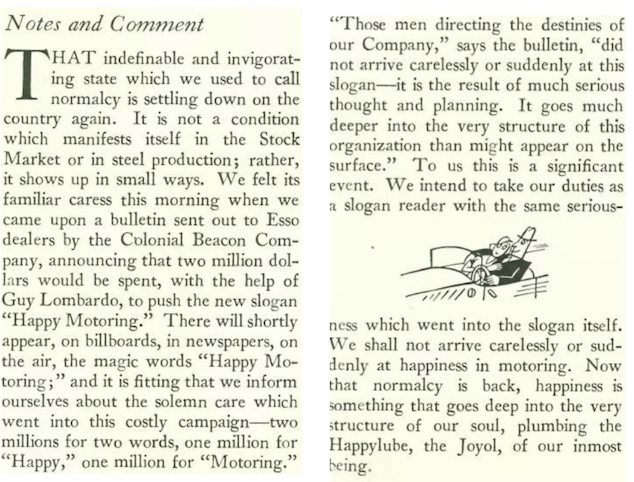
In 1933 the U.S. economy began a slow recovery from the 1929 market crash, but the recovery stalled in 1934 and 1935, and folks including E.B. White were looking for any indication of brighter days ahead.
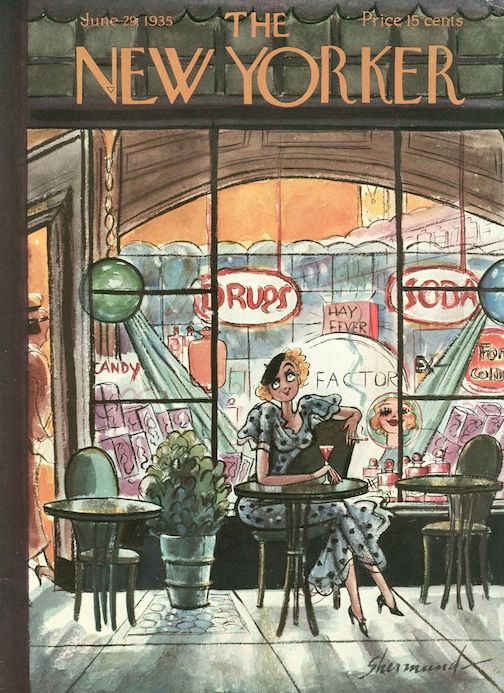
June 29, 1935 cover by Barbara Shermund. A prolific contributor of cartoons to The New Yorker (600 in all), Shermund also illustrated eight covers, including this charmer.
White suggested that Americans look for smaller signs of normalcy, such as the new slogan, “Happy Motoring,” that was being rolled out by Standard Oil’s Esso.
IT’S A GAS…At left, Gasoline Station, Tenth Avenue, photo by Berenice Abbott, 1935; at right, newspaper ad, May 1935. (metmuseum.org/wataugademocrat.com)
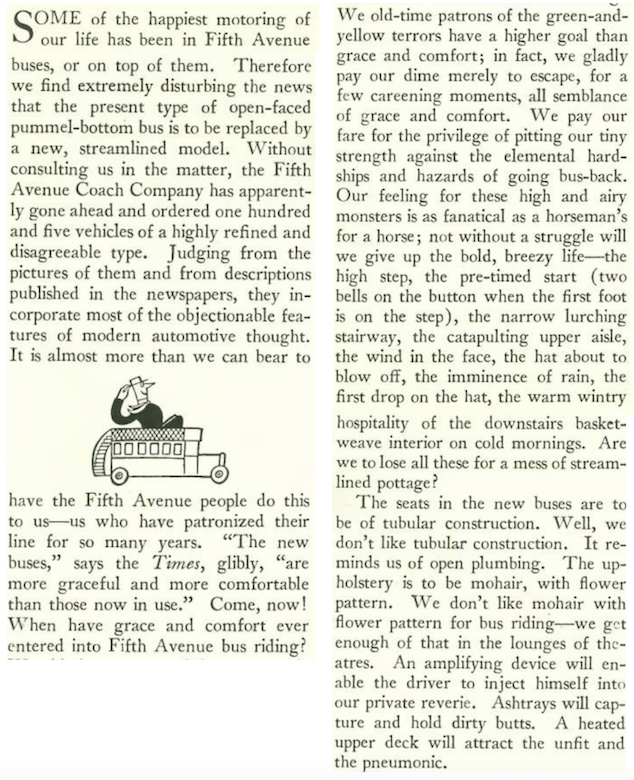
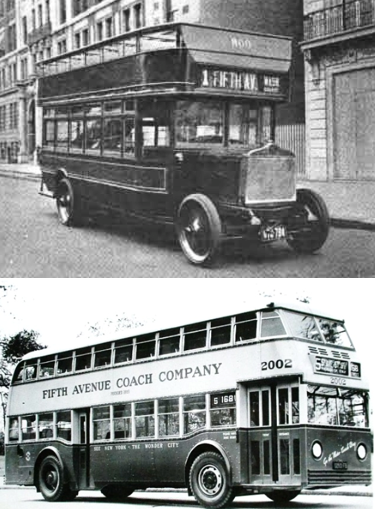
Like many of us, White was a study in contradictions, enthusiastically embracing the age of air travel while rejecting the style and comforts of modern automobiles (he famously loved his Model T). It is no surprise that he also preferred Fifth Avenue’s spartan green and yellow omnibuses over the new streamlined buses that would soon be plying the streets of Manhattan.
NO THANKS…E.B. White preferred the spartan accommodations of the old Fifth Avenue buses to the comforts of their replacements. (coachbuilt.com)
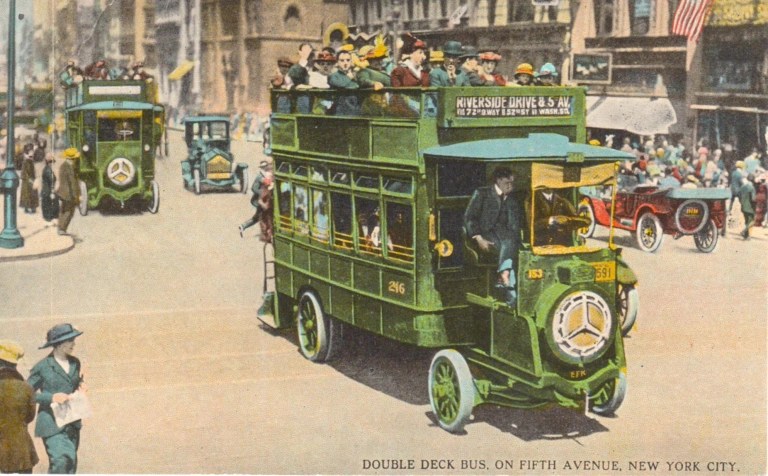
White elaborated on the advantages of the older buses:
STYLE OVER COMFORT…Of the old Fifth Avenue buses, E.B. White wrote that he preferred the “hard wooden benches on the sun deck, conducive to an erect posture, sparkling clean after a rain.” (Ephemeral New York)
* * *
Cinderella Story
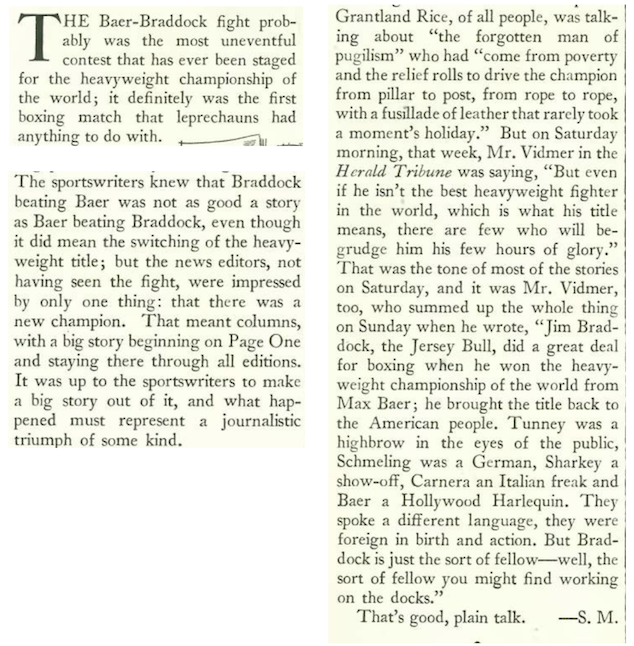
Challenger James J. Braddock achieved one of boxing’s greatest upsets by defeating the heavily favored (and reigning champ) Max Baer. For this feat he was given the nickname “Cinderella Man” by journalist Damon Runyon. The writer of the “Wayward Press” (byline “S.M.”) seemed less impressed, and mocked the national media for their sudden pivot on the bout’s unlikely outcome.
BRINGING THE FIGHT…Challenger James J. Braddock lays into defending champ Max Baer during a heavyweight boxing title match on June 13, 1935, at the Madison Square Garden Bowl in Long Island City. Although the national media dismissed Braddock’s chances of winning, Braddock trained hard for the fight while Baer spent more time clowning around than training. Braddock won by unanimous decision, eight rounds to six. (thefightcity.com)
* * *
Seemed Like a Nice Guy
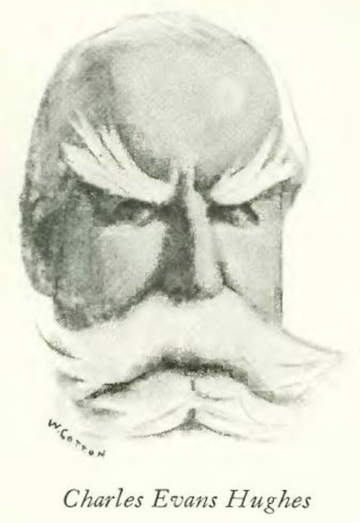
Henry Pringle penned the first part of a three-part profile of Supreme Court Chief Justice Charles Evans Hughes (1862–1948), who was also a former New York governor and U.S. secretary of state. William Cotton rendered a rather severe-looking Hughes in this caricature for the profile…
…although in reality he tended to look more like this…
PROGRESSIVE THINKER…Supreme Court Chief Justice Charles Evans Hughes in 1931. Known as a reformer who fought corruption, Hughes was a popular public figure in New York. (Wikipedia)
* * *
From Our Advertisers
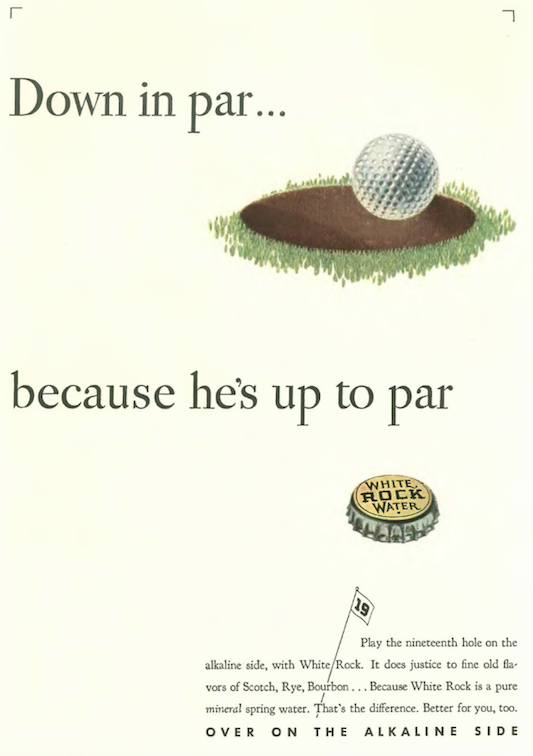
We begin with an advertisement that goes down easy, with its minimal style…
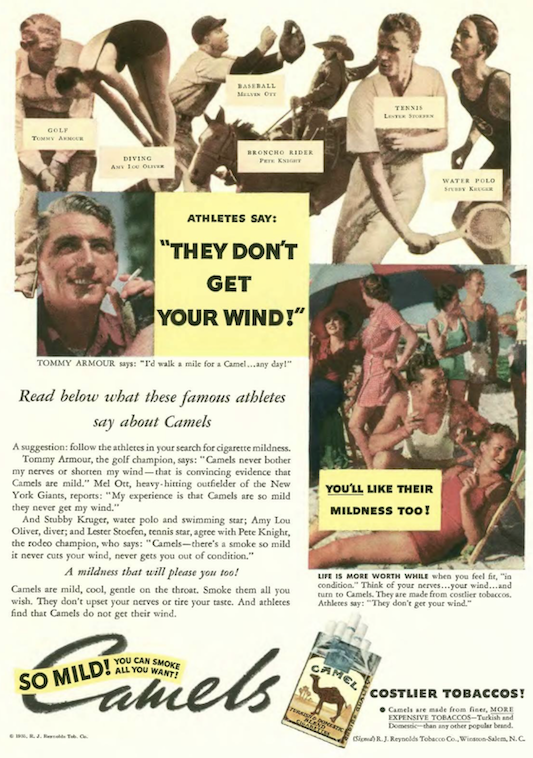
…by contrast, a busy Camel advertisement…R.J. Reynolds alternated full-page ads featuring society women with these health-themed spots that linked smoking with athletic prowess…
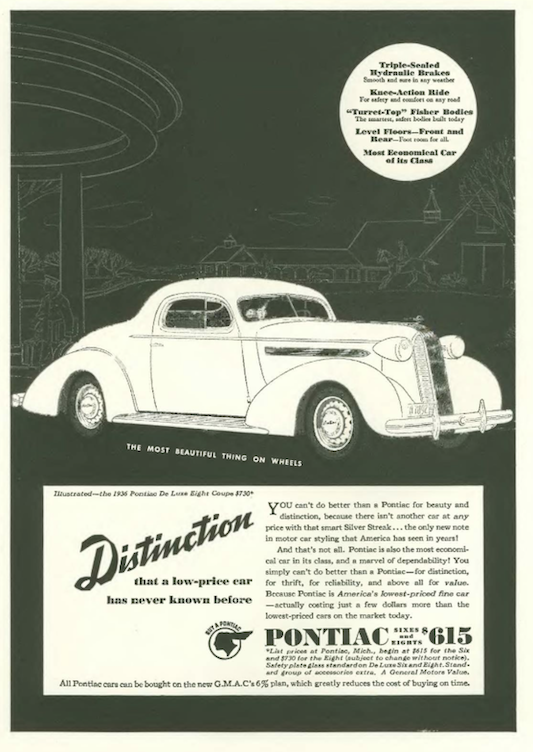
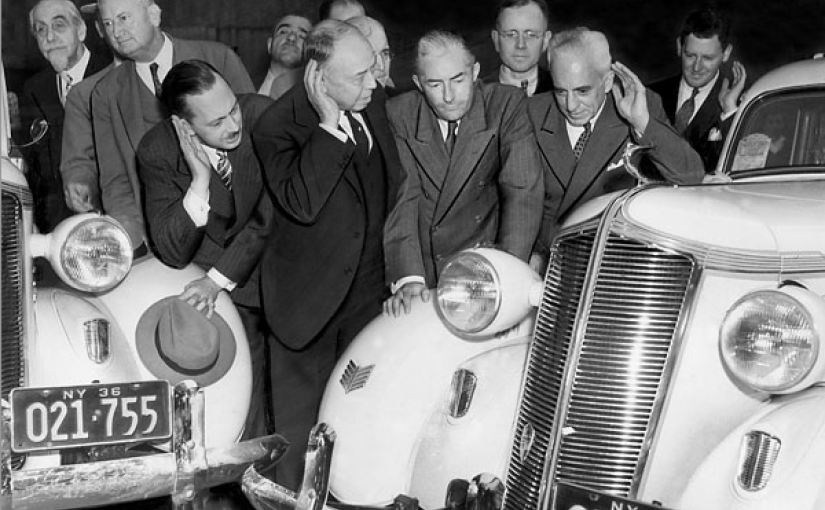
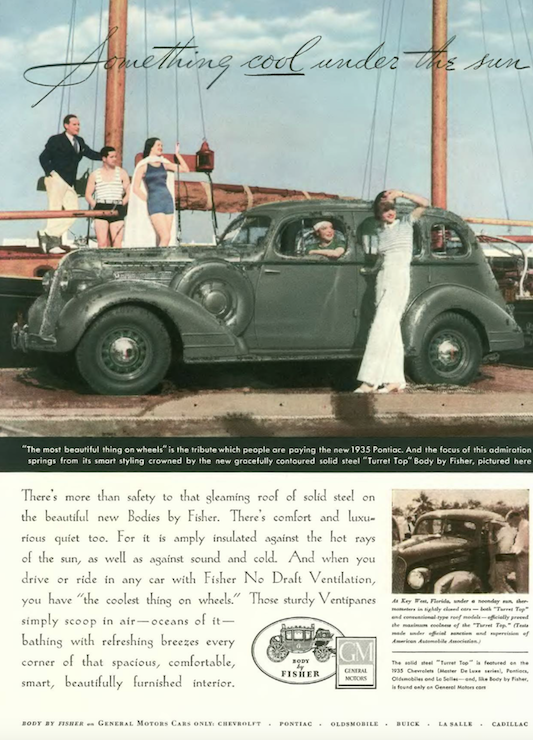
…this advertisement by Fisher claimed the 1935 Pontiac was “The most beautiful thing on wheels,” however here it looks perfectly ancient…
…as does this Nash on the inside back cover…
…the back cover was claimed by Highland Queen, a blend of some very fine distilleries…
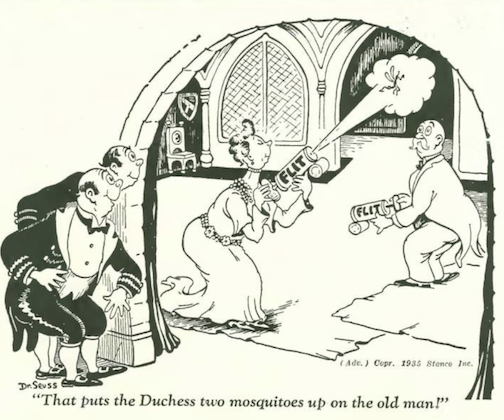
…Theodore Seuss Geisel continued his ongoing saga against the mighty mosquito…
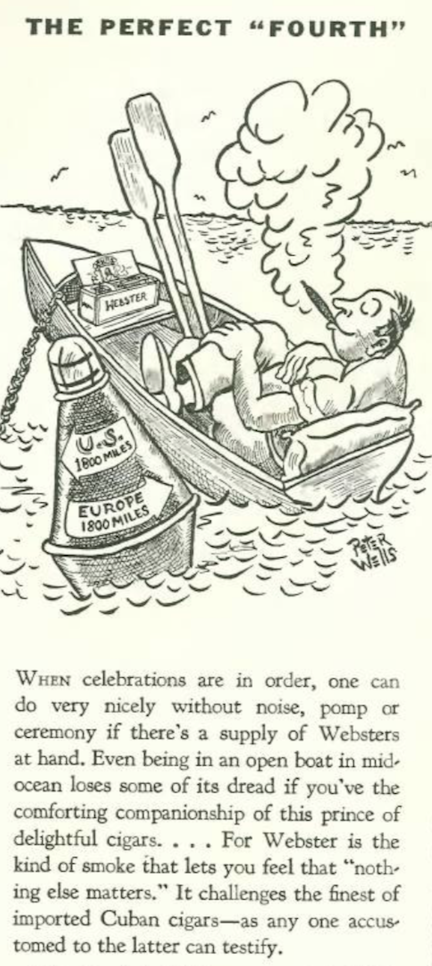
…and we have this back of the book ad for Webster cigars, who enlisted the talents of Peter Wells…
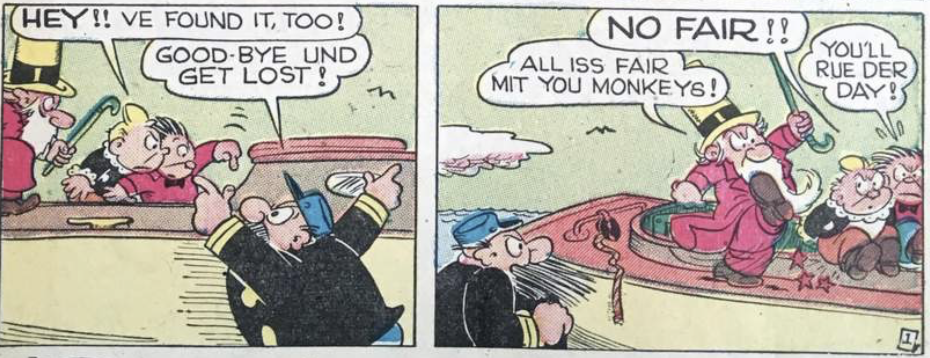
…Wells (1912–1995) was also a children’s book writer, most famous for contributing drawings to the Katzenjammer Kids comic strip …
Peter Wells, detail from the opening page from “The Katzenjammer Kids,” #16, Spring 1951, King Features Syndicate, Inc.
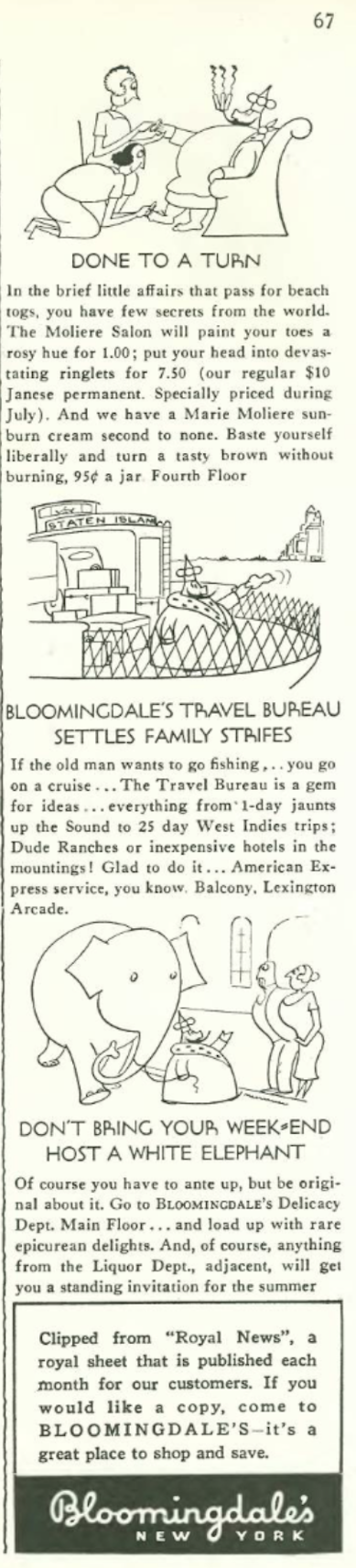
…and of course we are all familiar with Otto Soglow, who sold his beloved Little King to Hearst (and made a pile) but was still able to feature his diminutive potentate in the The New Yorker in a series of ads for Bloomingdales…
…which brings us to our cartoonists, and a familiar torment for our beloved James Thurber…
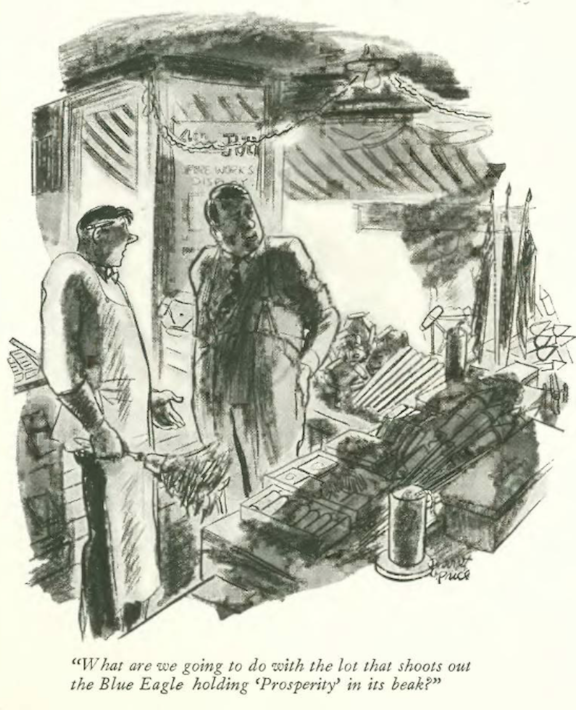
…Independence Day offered a marketing challenge to these shopkeepers, per Garrett Price…
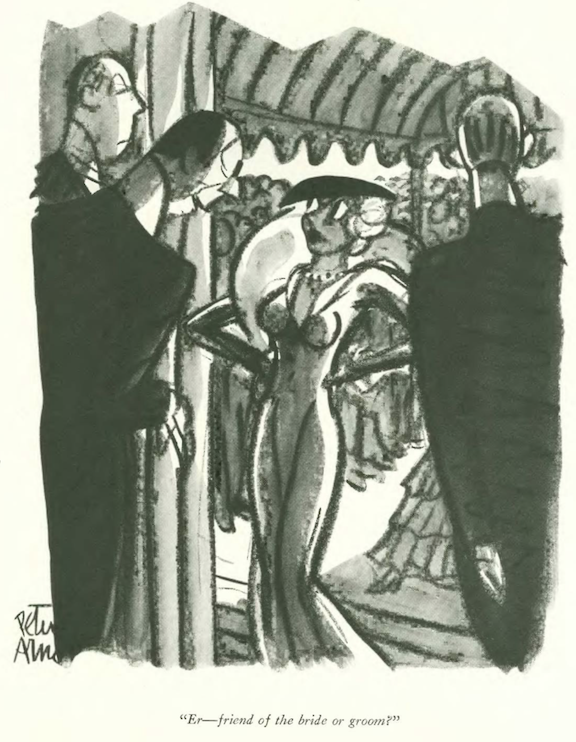
…Peter Arno was at his best, in his element…
…Charles Addams explored the unnatural, which would become his calling card…
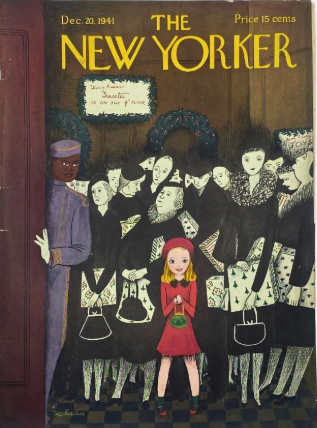
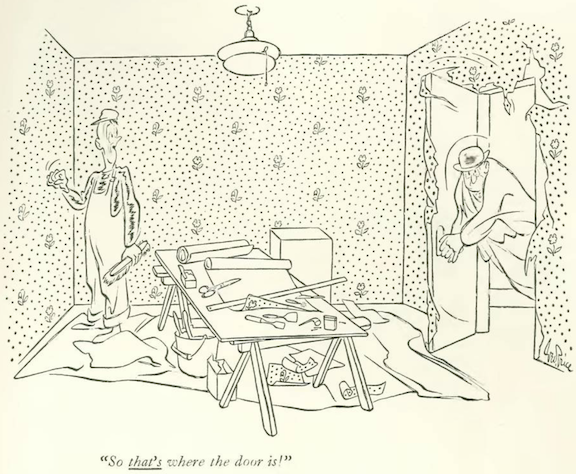
…Robert Day offered a new twist to the tonsorial arts…
…William Steig gave examples of some budding “tough guys”…
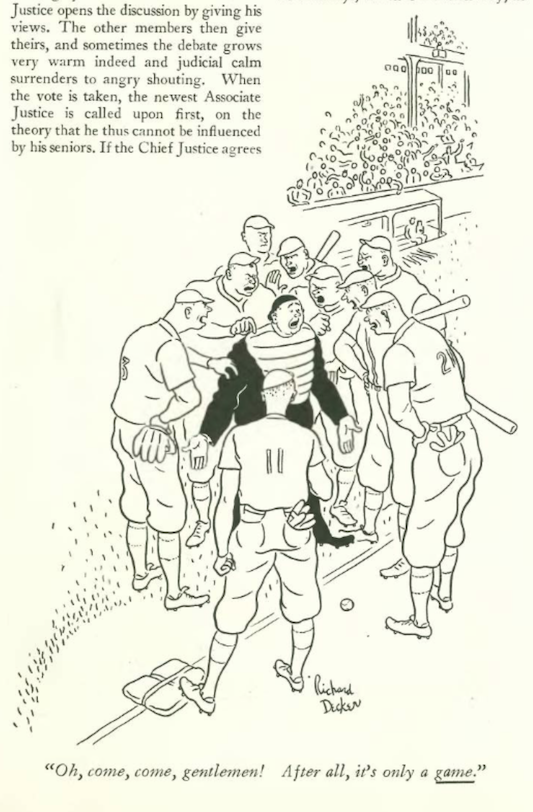
…a rare baseball-themed cartoon from Richard Decker (editor Harold Ross was not a baseball fan)…
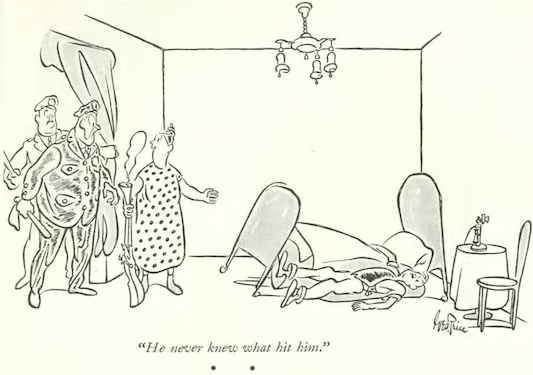
…from George Price, what appears to be the end of his “floating man” series, which began in September 1934…
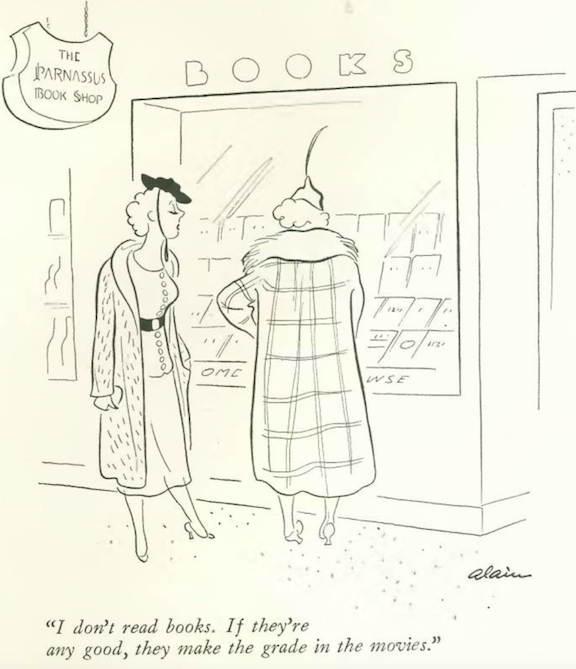
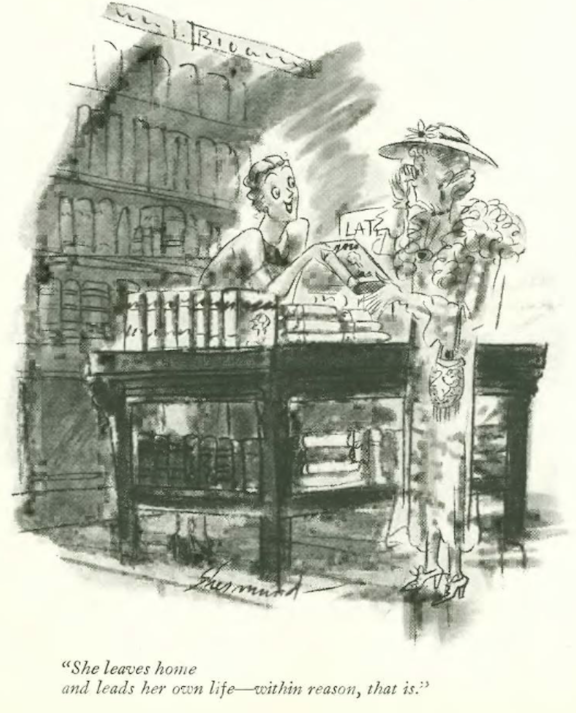
…and we close with one my favorite cartoonists, Barbara Shermund, here at the bookstore…
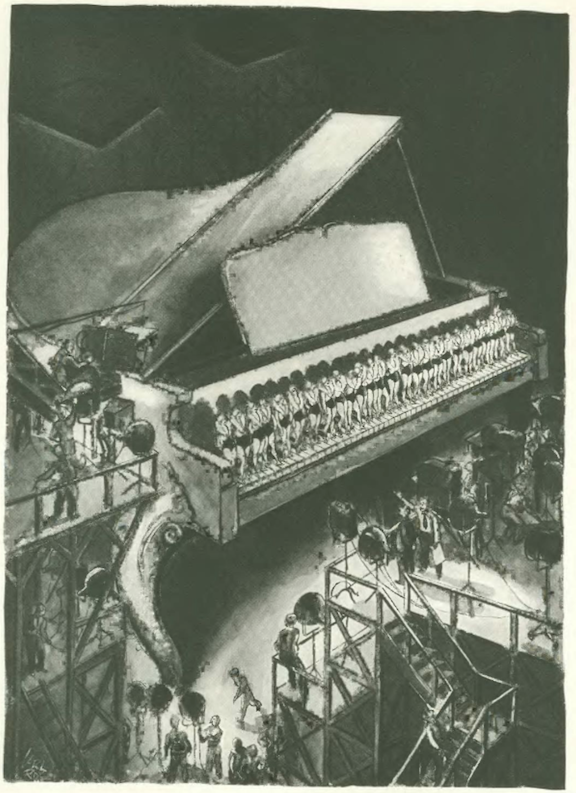
And what can be more frivolous than a Busby Berkeley musical, with scores of leggy showgirls tap-dancing in perfect rhythm, or dressed in identical white gowns while playing flying pianos. Make sense? No, and that was the whole point.
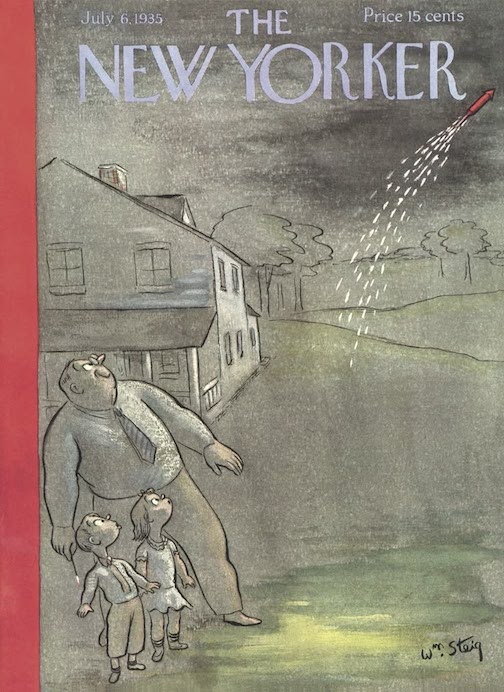
March 23, 1935 cover by Peter Arno. The color, contrast and composition are striking; it looks more like a cover from the 50s or 60s.
“In an era of breadlines, depression and wars, I tried to help people get away from all the misery…” Berkeley once remarked. “I wanted to make people happy, if only for an hour.” Gold Diggers of 1935 was Berkeley’s second “Gold Digger” picture (he choreographed or directed four; there were six in all, including one silent), and it was the first in which he served as sole director. Critic John Mosher didn’t know what to make of the film, likening it more to an earthquake than an entertainment.
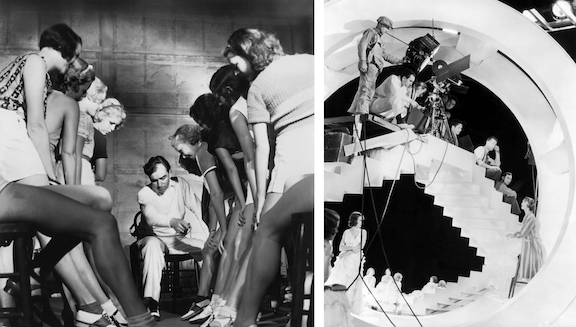
SOMEONE HAS TO DO IT…Busby Berkeley (1895-1976) works with dancers (left) during the production of 1933’s 42nd Street; right, at work on one of his lavish sets, circa 1930s. (IMDB)
The “harmless jingle” Mosher referred to, Harry Warren and Al Dubin’s “Lullaby of Broadway,” received an Oscar for Best Original Song (it also gave me an earworm for a week).
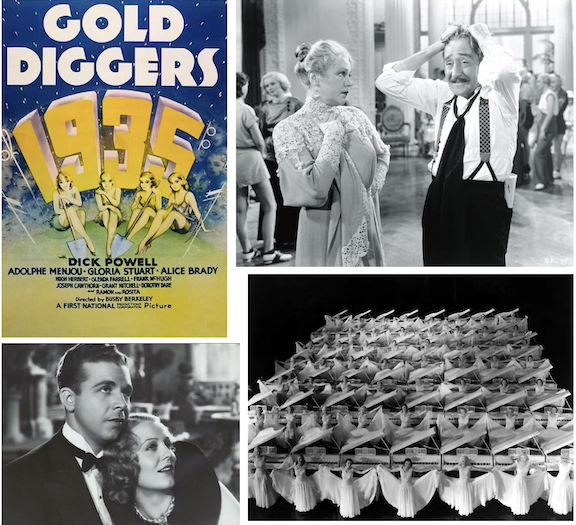
GOLDEN GIRLS…Clockwise, from top left, Alice Brady as the parsimonious Matilda Prentiss and Adolphe Menjou as the conniving Russian dance director Nicolai Nicoleff in Gold Diggers of 1935; a scene from the dancing pianos sequence; Dick Powell and Gloria Stuart as the film’s sweethearts. (Wikipedia/YouTube/IMDB)
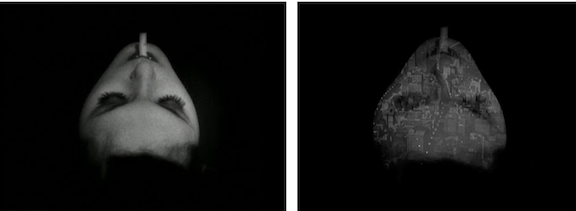
Amid the frivolity, Mosher noted the juxtaposition of the jingly “Lullaby of Broadway” with the haunting, two-minute sequence of Wini Shaw singing “Lullaby” as her disembodied face emerges from the blackness toward the viewer.
The scene continues as the woman (Shaw) turns onto her back, her head slowly dissolving into the nighttime city…after a raucous, mass tap-dancing scene, she falls to her death, and the sequence is reversed, her face disappearing into the blackness. The blog Acidemic gives an interesting take on this part of the film, which is more reminiscent of a German avant-garde film than Berkeley’s usual fare…
(YouTube)
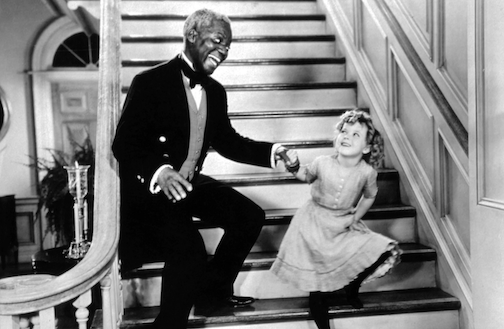
…Mosher found the scene “terrifying.” Perhaps Shirley Temple helped calm his nerves with her precocious antics in The Little Colonel…
NO FLOATING HEADS HERE…Shirley Temple and Bill Robinson doing the famous staircase dance in The Little Colonel (1935). (TCM)
* * *
Up In Smoke
In “Notes and Comment” E.B. White considered the possibility that cigarette smoking might be harmful to unborn babies, and wryly suggested that embryos could replace grandmothers as a new growth market for big tobacco:
…White referred to the advertisement below, which appeared in the Feb. 9, 1935 issue of The New Yorker:
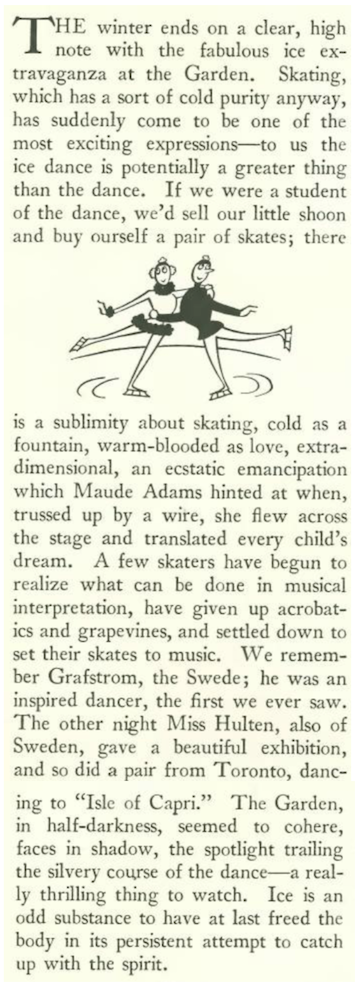
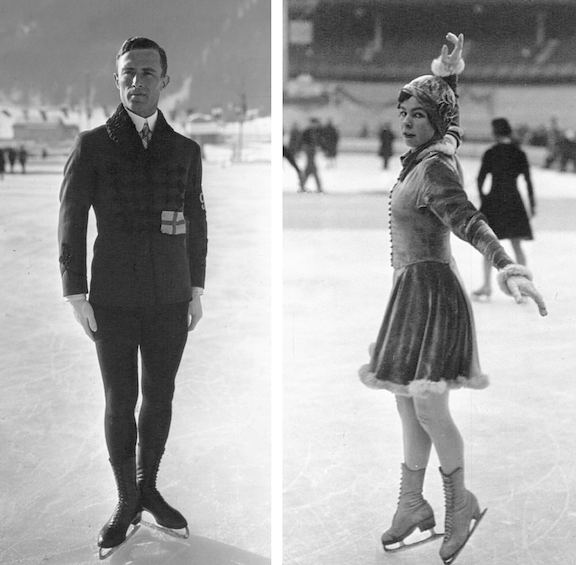
…White also commented on his recent visit to Madison Square Garden’s winter skating carnival…
THE DOUBLE AXEL was still thirteen years in the future when Swedish skaters Gillis Emanuel Grafström (left) and Vivi-Anne Hultén delighted E.B. White at Madison Square Garden. Photos are from 1924 and 1932, respectively. (Wikipedia)
* * *
Prescience of Mind
We have more from E.B. White, this time in a humorous piece titled “The Dove’s Nest,” in which White took a poke at the most influential newspaper editor in the country, Arthur Brisbane. A close friend of William Randolph Hearst, Brisbane essentially ran Hearst’s newspaper empire. The New Yorker often ridiculed Hearst’s (and Brisbane’s) jingoistic approach to the news that included giant headlines warning of war. Excerpts:
William A. Swanberg, author of the 1961 biography Citizen Hearst, described Brisbane as “a one-time socialist who had drifted pleasantly into the profit system…in some respects a vest-pocket Hearst–a personal enigma, a workhorse, a madman for circulation, a liberal who had grown conservative, an investor.”
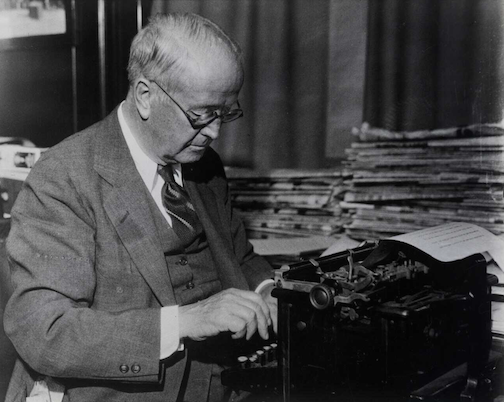
DAMN THOSE TORPEDOES…Arthur Brisbane in 1933. His grandson, Arthur S. Brisbane, now retired, served as public editor of The New York Times from 2010 to 2012. (credo.library.umass.edu)
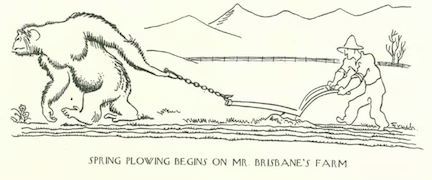
The New Yorker continued to take jabs at Brisbane in the following issue (March 30). Brisbane owned a large estate (including a horse farm) in New Jersey that he made available to New Deal work programs during the Depression. I suppose this Al Frueh cartoon was some kind of reference to that…
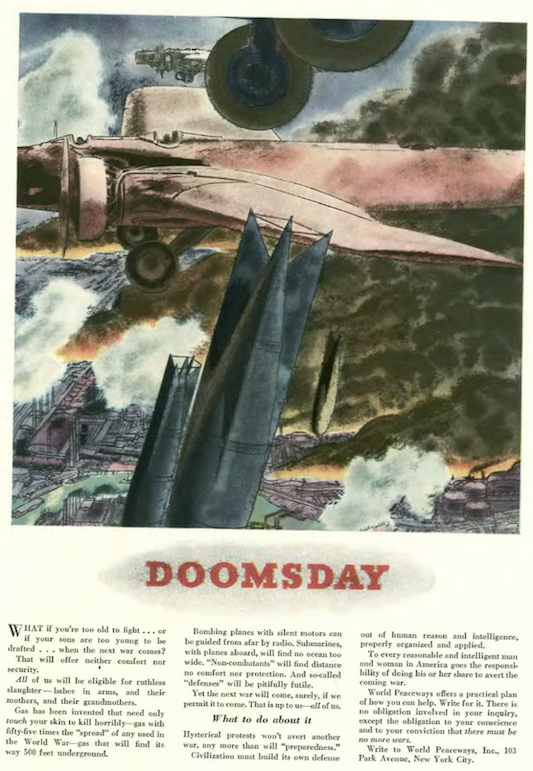
…also in the March 30 issue was this ad from World Peaceways, which raised alarms about possible war and bombs raining down from the sky…
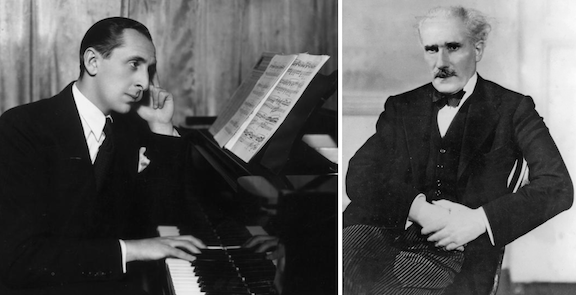
…back to the March 23 issue, where we find the calming strains of a Brahms concerto at Carnegie Hall, conducted by Arturo Toscanini with some support from his son-in-law, Vladimir Horowitz…
MAY I CALL YOU DAD?…Not likely something said by young Vladimir Horowitz, left, to father-in-law Arturo Toscanini. (WQXR/Britannica)
* * *
From Our Advertisers
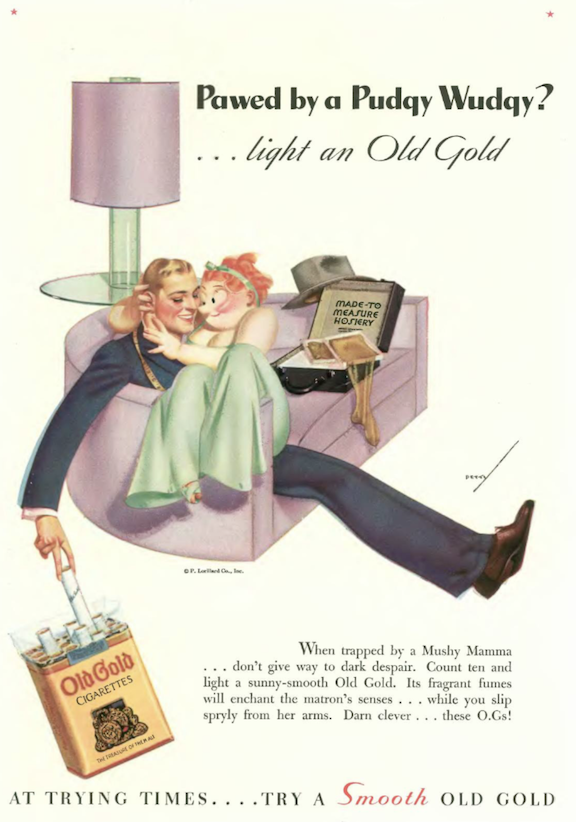
Beginning in 1934 the makers of Old Gold cigarettes hired pin-up artist George Petty to create a series of ads featuring a homely, clueless sugar daddy and his leggy mistress…here he turns the tables, introducing a “Pudgy Wudgy” matron putting the moves on a handsome hosiery salesman…
…this Petty ad appeared in the Feb. 9, 1935 issue of The New Yorker…
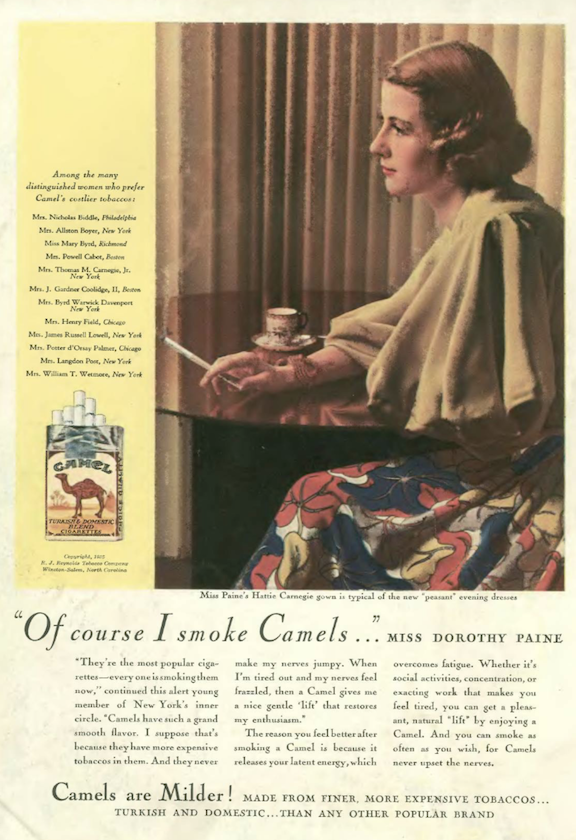
…the makers of Camels continued their campaign of “distinguished women” who enjoyed their product…here we have a former debutante, Dorothy Paine, an “alert young member of New York’s inner circle.” Not much of a record of Dorothy, who married a man named Walter H. Sterling in 1935…apparently they moved to Phoenix and bought up property in the Southwest…
…the makers of General Tire offered this grim assessment of tire safety…the lad seems to be a mere investment of time…
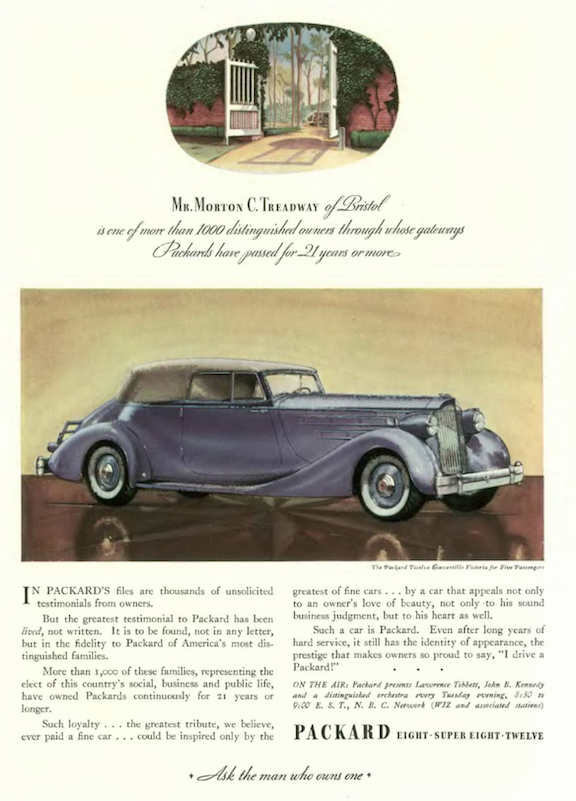
…although prestige brands suffered mightily during the Depression, the folks at Packard were doubling down on the elite status of their automobile…
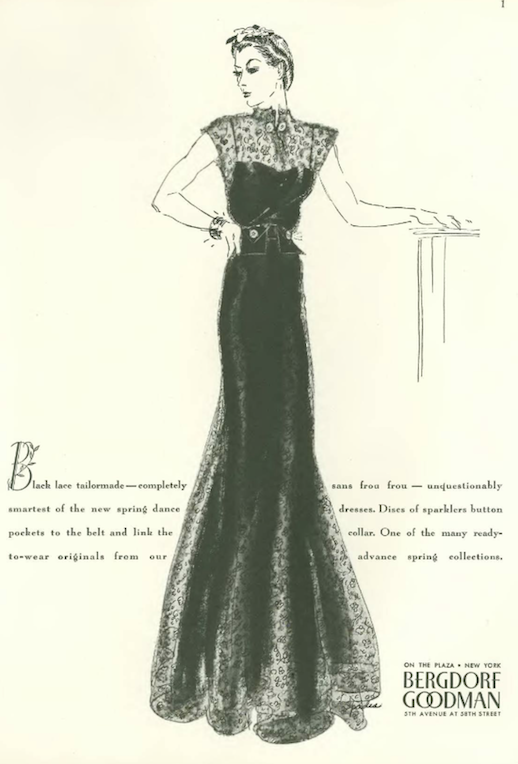
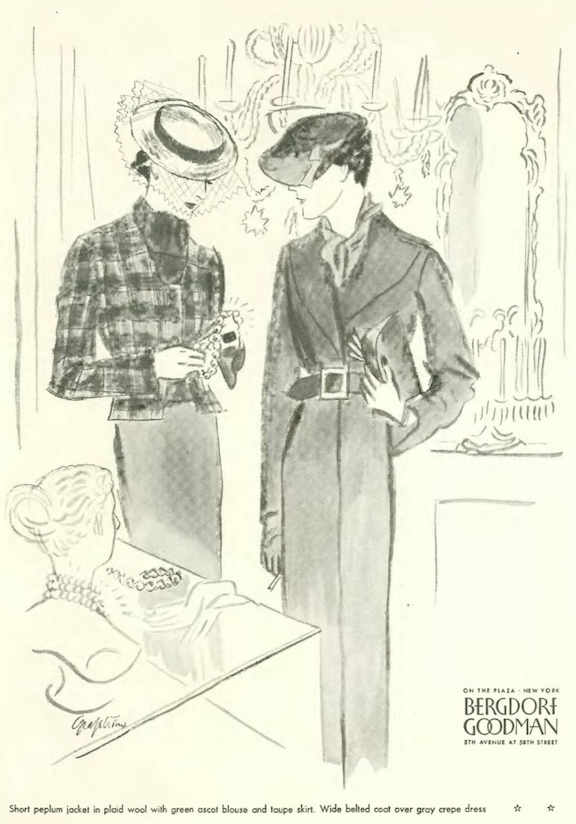
…we’ve seen the work of fashion illustrator Ruth Sigrid Grafstrom before in ads for Spud cigarettes…here she contributes some elegant lines to a spot for Bergdorf Goodman (is the woman on the right smoking a Spud?)…
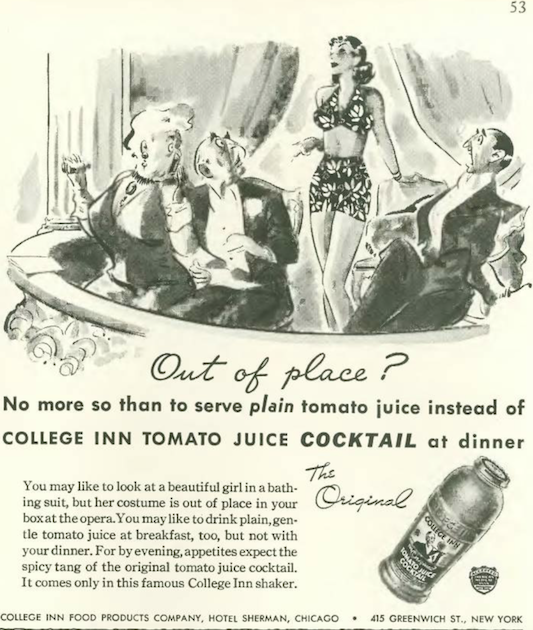
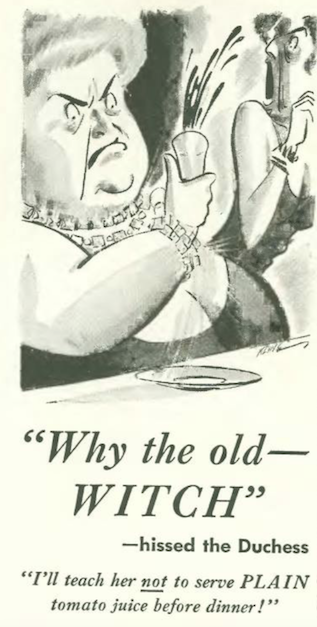
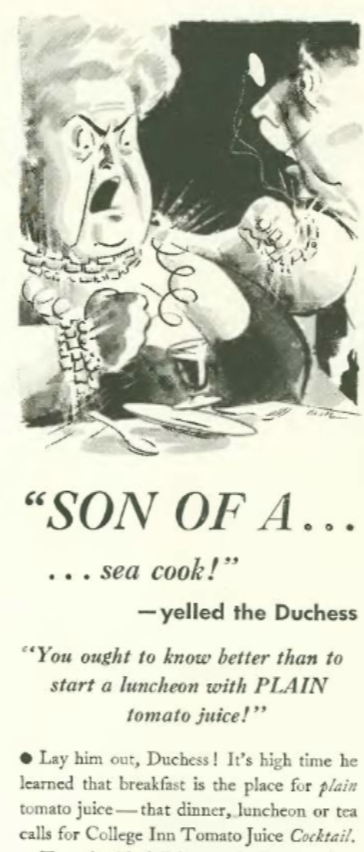
…here’s the Duchess again, still blowing her top over College Inn tomato juice…just look at her clenched fists…that fop with a monocle looks like he just took a left hook to the chops…
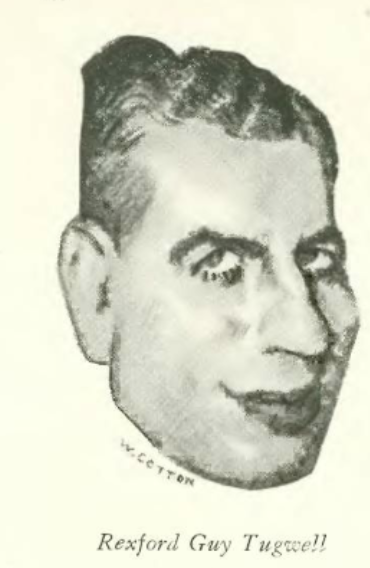
…on to our illustrators, William Cotton created this caricature of Rexford Guy Tugwell for Russell Lord’s two-part profile…Tugwell and President Franklin D. Roosevelt created the Resettlement Administration, which relocated rural unemployed to “Greenbelt Cities” near urban job markets. Critics called him “Rex the Red” for his social engineering experiments, and after he was forced out of federal government, Tugwell was appointed in 1938 as the first director of the NYC Planning Commission. Naturally, he would butt heads with Robert Moses…
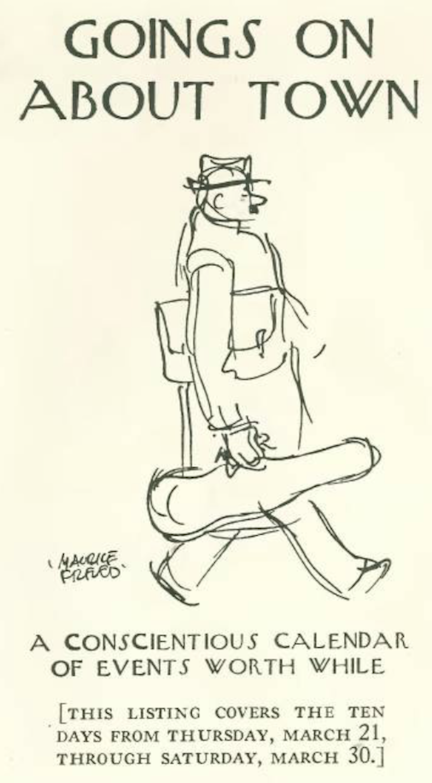
…illustrator and painter Maurice Freed kicked off the calendar section…
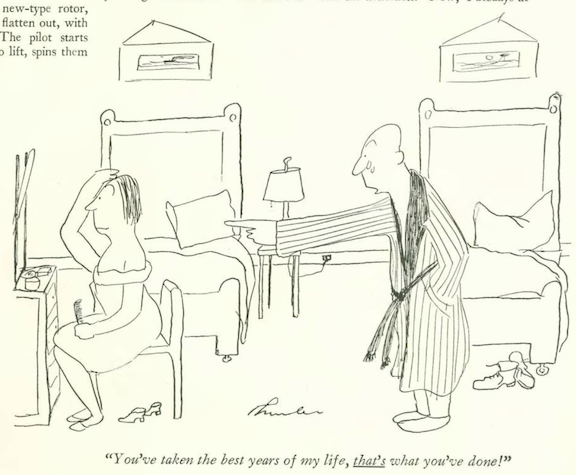
…bookended on the bottom of page 4 by one of James Thurber’s most recognized drawings…
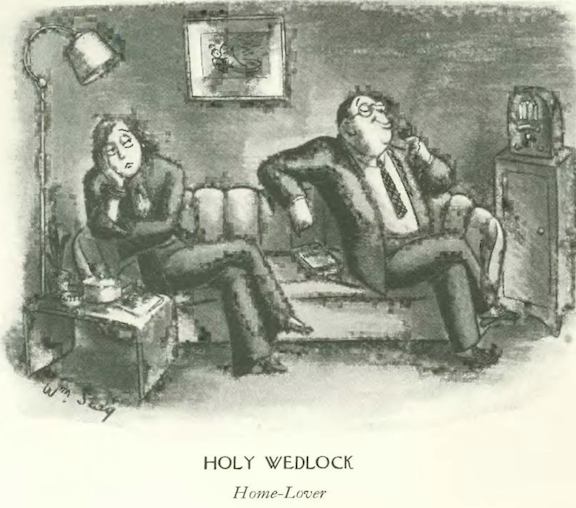
…Thurber again, and more woes between the sexes…
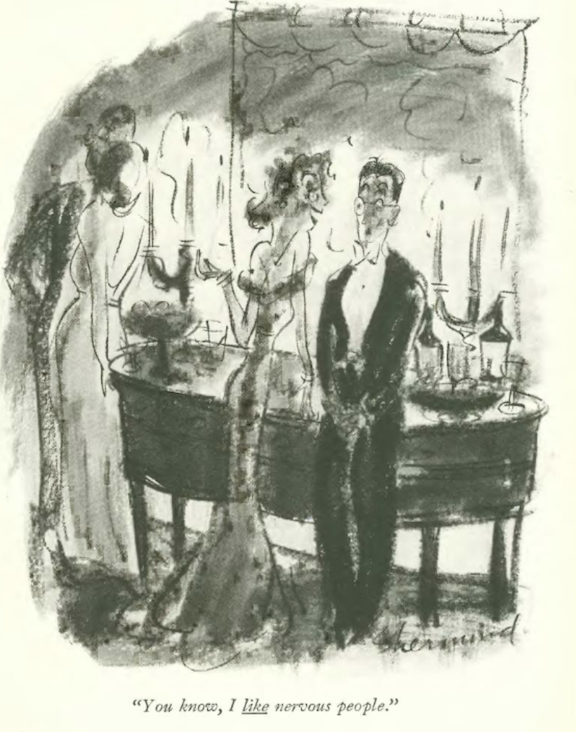
…we continue with our cartoonists by looking in on Barbara Shermund…
…George Price found a new wrinkle for his recurring floating man cartoon…
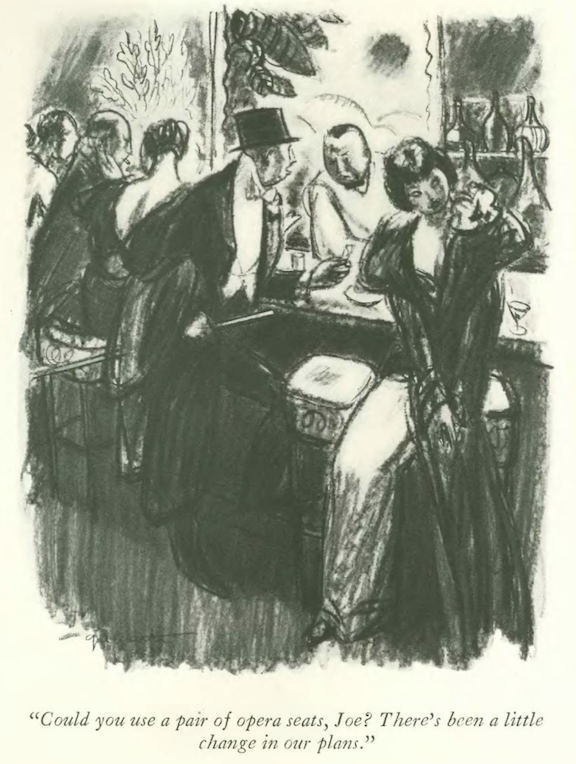
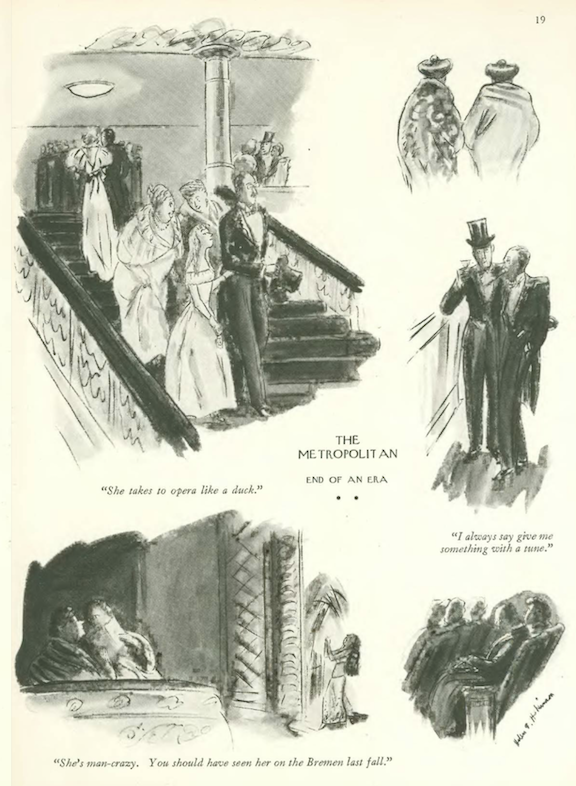
…Helen Hokinson graced page 19 with scenes from the opera…
…leaving an extra drawing stranded on page 18…
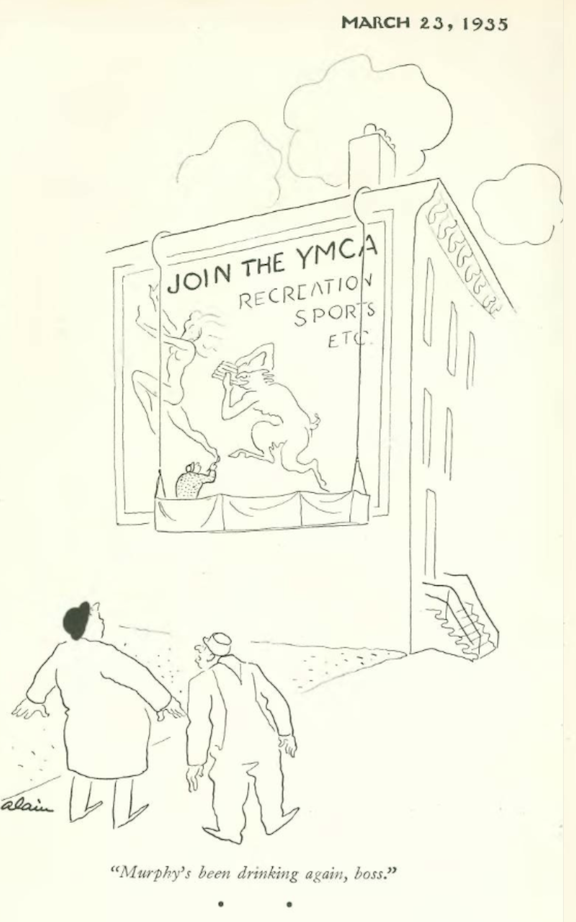
…Alain offered a new twist on the promotion of physical fitness…
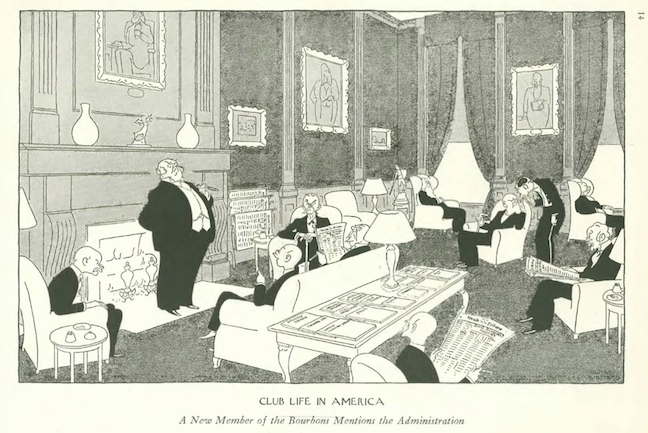
…Gluyas Williams brought us to the stuffy confines of club life (the cartoon was originally featured vertically)…
…and we close with Richard Decker, and a lucky draw at the IRS…
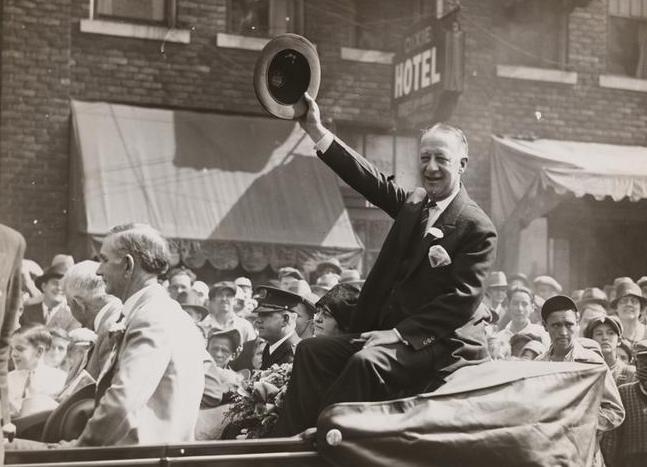
Above: Al Smith waving to crowds on arrival at Chattanooga, Tennessee during his presidential campaign in 1928. (Museum of the City of New York)
It’s hard to not like Al Smith, the governor of New York from 1923 to 1928, a man who avoided the temptations of political power and stayed true to his working class roots of the Lower East Side.
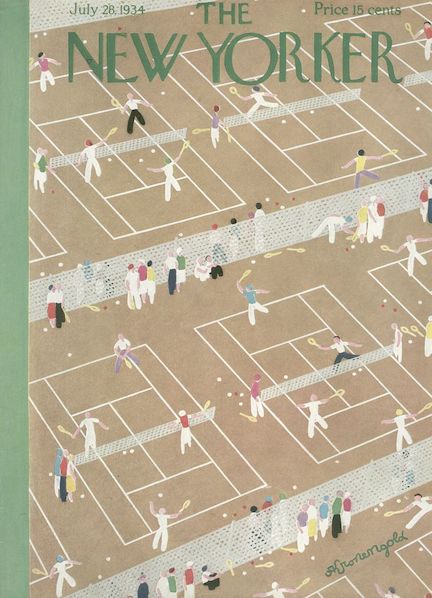
July 14, 1934 cover by Rea Irvin.
The son of Irish, Italian and German immigrants, Alfred Emanuel Smith (1873–1944) was raised in the Tammany Hall-dominated Fourth Ward, and although he was indebted to Tammany’s political machine throughout much of his professional life (including stints in the New York State Assembly and as York County Sheriff, President of the Board of Alderman, and finally Governor) he remained untarnished by corruption. Smith’s unsuccessful bid for the U.S. presidency in 1928 put an end to his political life, but there was still much to do, as “The Talk of the Town” explained:
HALL MONITORS…At left, Charles “Silent Charlie” Murphy with Al Smith in 1915. Murphy was the longest-serving head of Tammany Hall (1902 to 1924), and was known for transforming Tammany’s image from one of corruption to semi-respectability; at right, in 1929, Smith greets Franklin D. Roosevelt, who had just succeeded him as governor. (Library of Congress/Wikipedia)
Smith first sought the Democratic presidential nomination in 1924. According to historian Robert Slayton, Smith advanced the cause of civil liberty by decrying lynching and racial violence at the 1924 Democratic National Convention, where Franklin D. Roosevelt delivered the nominating speech for Smith and saluted him as “the Happy Warrior of the political battlefield.”
Following his 1928 presidential election loss to Herbert Hoover, Smith became president of Empire State, Inc., the corporation that built and also operated the Empire State Building, which was then the tallest building in the world. Smith was also known for his fondness of animals, and in 1934 Parks Commissioner Robert Moses made Smith “Honorary Night Zookeeper” of the renovated Central Park Zoo. Smith was given keys to the zoo and often took guests to see the animals after hours. According to Rebekah Burgess of the NYC Department of Parks and Recreation, “As a resident of 820 Fifth Avenue, directly across the street from the entrance of the Central Park Zoo, Smith was known to appear with snacks for the animals or to launch into impromptu lectures for visitors. Al Smith took his honorary title to heart. Throughout the rest of his life, Smith could often be found attending to the animals at the zookeepers’ sides during open hours. At night, Smith visited with guests, or more often, one-on-one with the animals.”
Smith was also a humanitarian, and in addition to advocating for the working class, he was an early critic of the Nazi regime in Germany, vigorously supporting the Anti-Nazi boycott of 1933. Here is another excerpt from the “Talk” piece:
LIFE OUTSIDE THE OFFICE…Scenes of post-political life, clockwise from top left: Al Smith fishing in 1933; with his family at the May 1, 1931 opening of the Empire State Building—Smith’s grandchildren cut the ribbon; golfing in 1930 with baseball great Babe Ruth in Coral Gables, Florida; with Rosie, the hippopotamus, at the Central Park Zoo, 1928. (Museum of the City of New York/Wikipedia)
* * *
Culture Club
In the Nov. 9, 1929 issue of The New YorkerMurdock Pemberton hailed the opening of the Roerich Museum. For the July 14, 1934 issue, “The Talk of the Town” took another look. A brief excerpt:
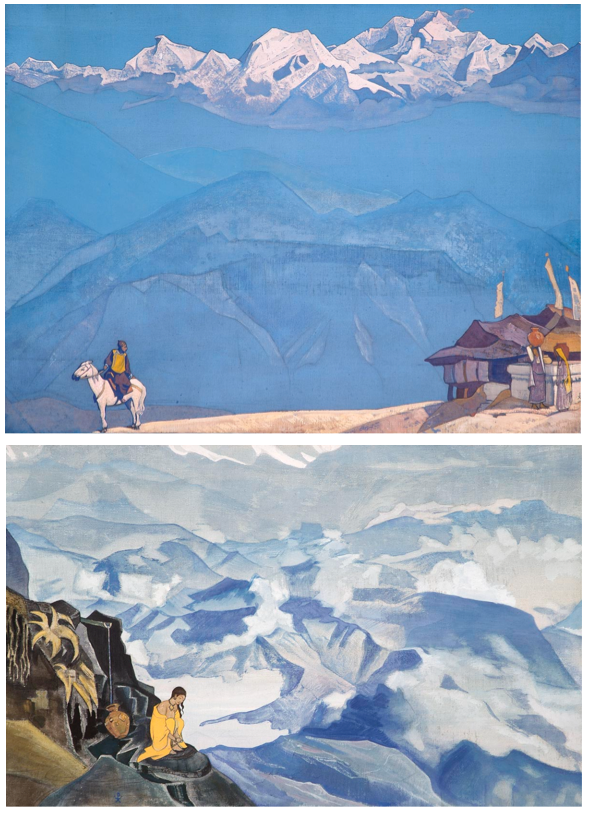
MORE THAN A BUILDING…”The Talk of the Town” noted the changing shades of the art deco landmark Master Building on Riverside Drive (left, in 1929) which originally housed the Nicholas Roerich Museum. Today the Roerich is located in this brownstone at 319 West 107th. (Wikipedia)FOOTNOTES FROM A FULL LIFE…Two of Nicholas Roerich’s paintings from the 1920s: at top, Remember, 1924; below, Drops of Life, 1924. (roerich.org)
* * *
Itinerant Showman
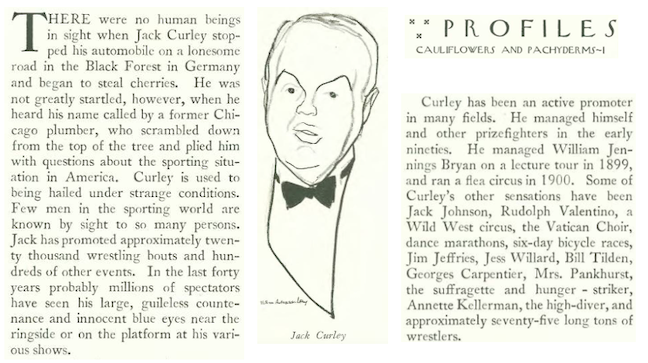
Alva Johnston filed the first installment of a three-part profile of famed sports promoter Jack Curley (1876–1937). A brief excerpt:
FIGHT CLUB…Sports promoter Jack Curley (left) with boxing manager Eddie Kane, circa 1920. (Library of Congress)
* * *
Over There
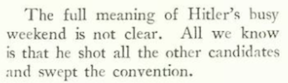
In his column “Of All Things,” Howard Brubaker made this brief mention of the “Night of the Long Knives;” on June 30, 1934 Adolf Hitler ordered SS guards to murder the leaders of the paramilitary SA along with hundreds of other perceived or imagined opponents.
Here is a clip from the front page of The New York Times, July 3, 1934:
(The New York Times)
* * *
Pimm’s and Soda
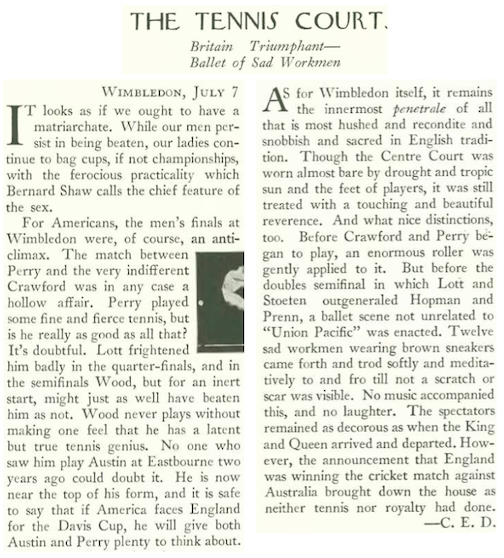
July in England meant Wimbledon, and The New Yorker was there to observe the “snobbish and sacred” rite…
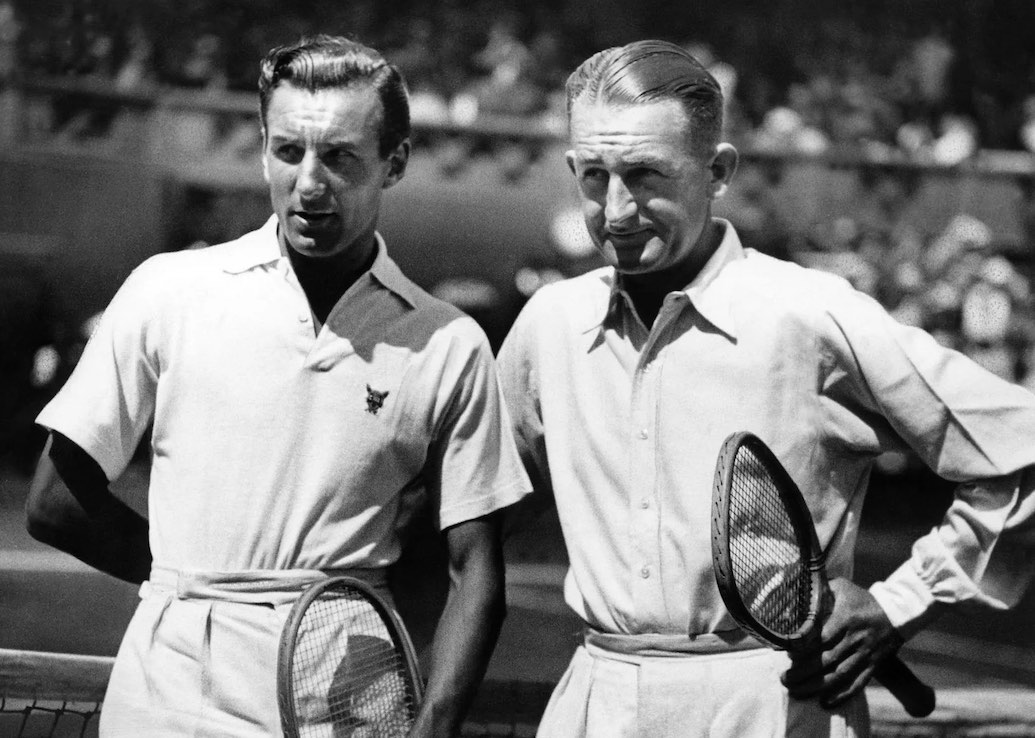
WATCH THE BOUNCING BALL…British tennis great Fred Perry (left) and Australian Jack Crawford before their men’s singles final at the 1934 Wimbledon tournament, which Perry won. Perry would claim three consecutive titles between 1934 and 1936. (Image: Mirrorpix)
* * *
Midsummer Dreams
In the summertime (and before widespread use of air conditioning) stage entertainments such as theater and musical performances took to the outdoors during their off-season, seeking the evening cool of intimate rooftops or large, open venues such as Lewisohn Stadium, A brief excerpt describing a performance of Samson et Dalila:
EVENING SHADE: Andre Kostelanetz conducts at Lewisohn Stadium in 1939. The stadium was demolished in 1973 to make way for City College of New York’s North Academic Center. (PressReader.com)
* * *
From Our Advertisers
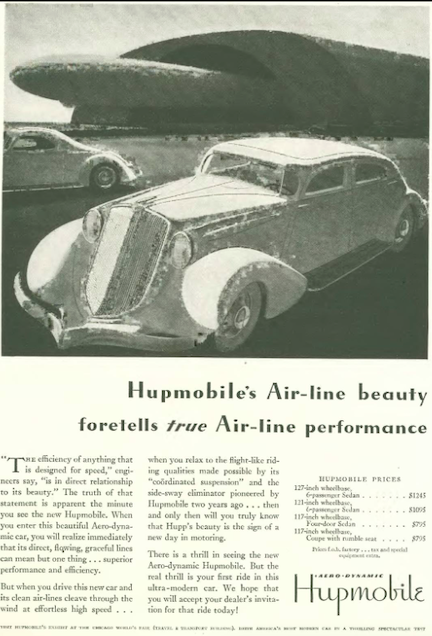
The folks at struggling carmaker Hupmobile took out this bold, full-page ad to tout their flashy “Aero-Dynamic” by noted designer Raymond Loewy…
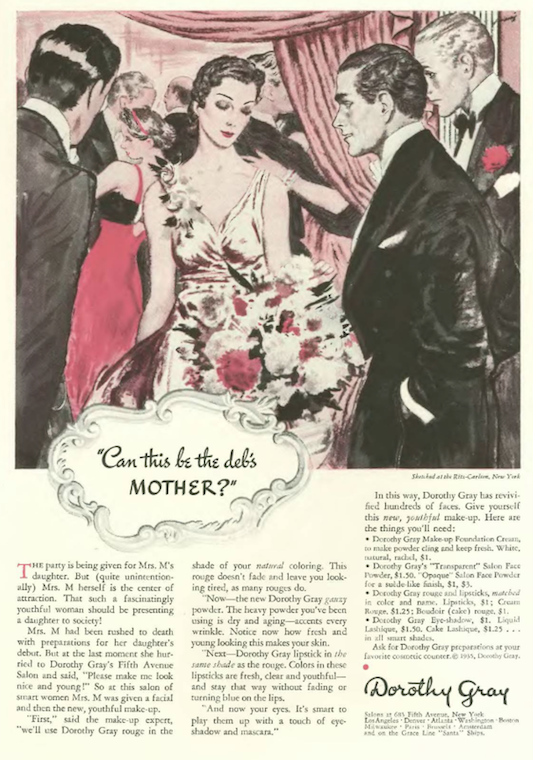
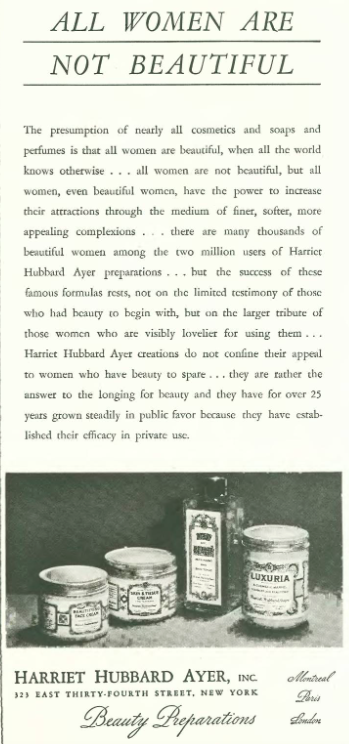
…this ad from Harriet Hubbard Ayer was bold in a very different way, essentially calling some women ugly unless they used the company’s “beauty preparations”…
…consommé, a clear soup that was particularly popular among the upper classes, offered up some keen competition between two food giants…here Heinz enlisted the help of William Steig to move their product…
…while the folks at Campbell’s offered up this lovely patio setting for their “invigorating” consommé…
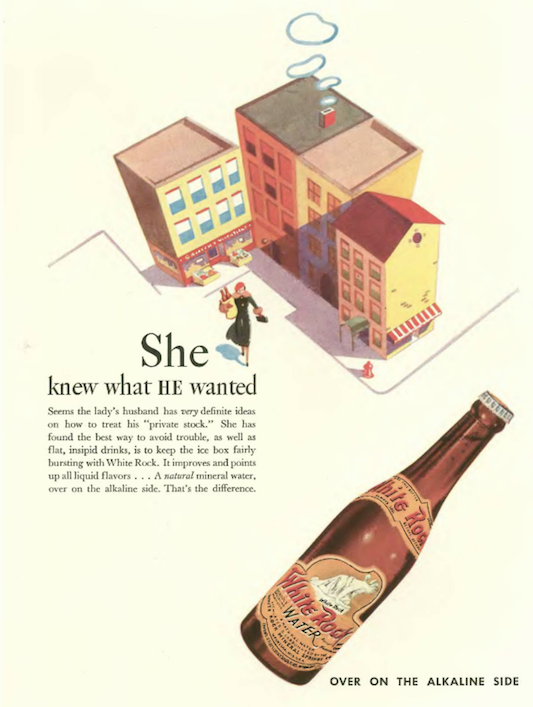
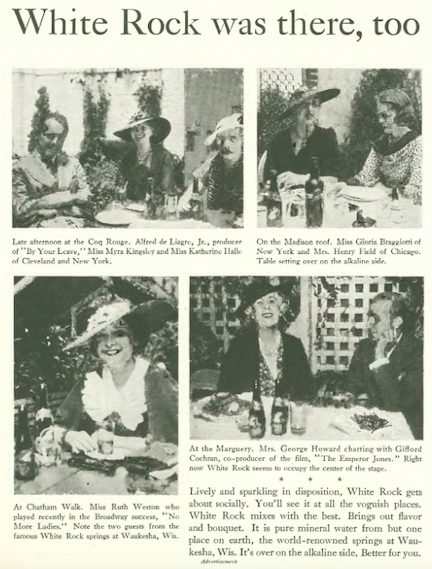
…meanwhile, White Rock mineral water could be found on patios all over Manhattan, as this ad attested…
…this is a reminder that most city folks had their milk and other dairy products delivered in the early part of the 20th century…by the early 1960s about 30 percent of consumers still had their milk delivered, dropping to 7 percent by 1975 and .4 percent by 2005…
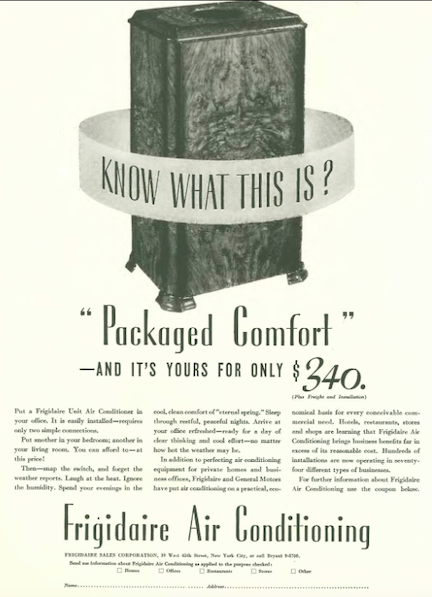
…affordable home air-conditioning wouldn’t be available to the masses until after World War II…this unit (designed for a single room) from Frigidaire retailed for $340 (a little less than $8,000 today)…
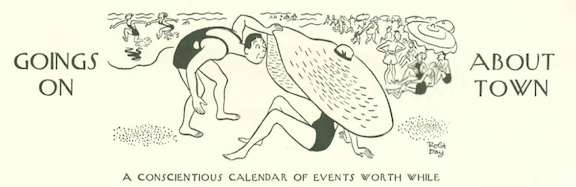
…on to our cartoonists, we begin with Robert Day in the “Goings On’ section…
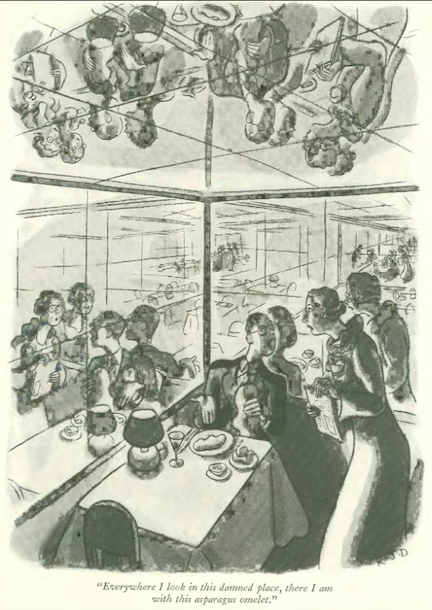
…Day again, exploring the baffling, glassy interiors of modern restaurants…
…the birdwatching continued with Rea Irvin…
…Alain (Daniel Brustlein) gave us a swimming somnambulist…
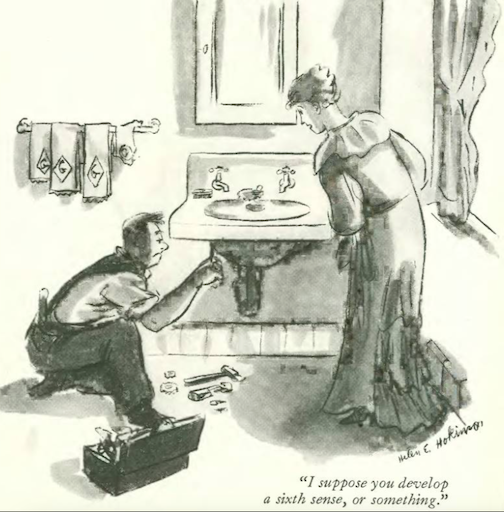
…Helen Hokinson explored the paranormal, via domestic plumbing…
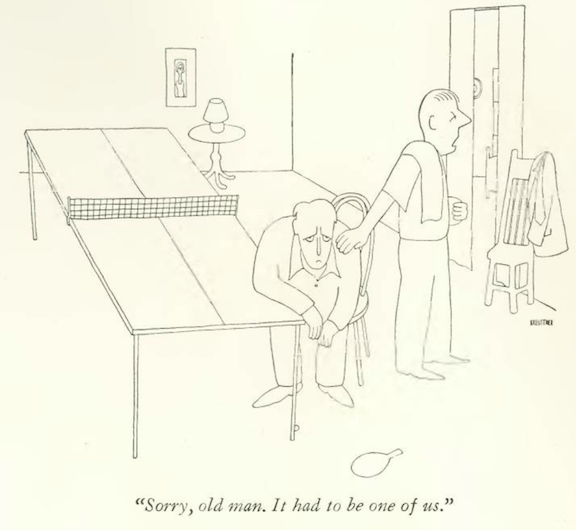
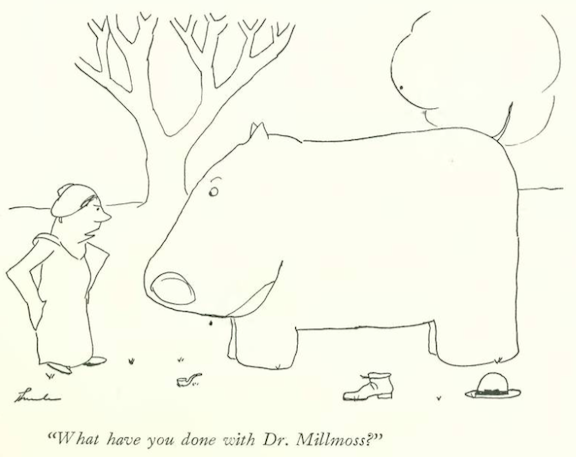
…and we close with James Thurber, and the missing Dr. Millmoss…
Above: British architect Norman Foster's 2010 recreation of R. Buckminster Fuller's 1933 Dymaxion car. (Wikipedia)
Despite the limitations of 1930s technology, a few architects and designers were hell-bent on building a streamlined future that until then was mostly the stuff of movies and science fiction magazines.
May 5, 1934 cover by Rea Irvin.
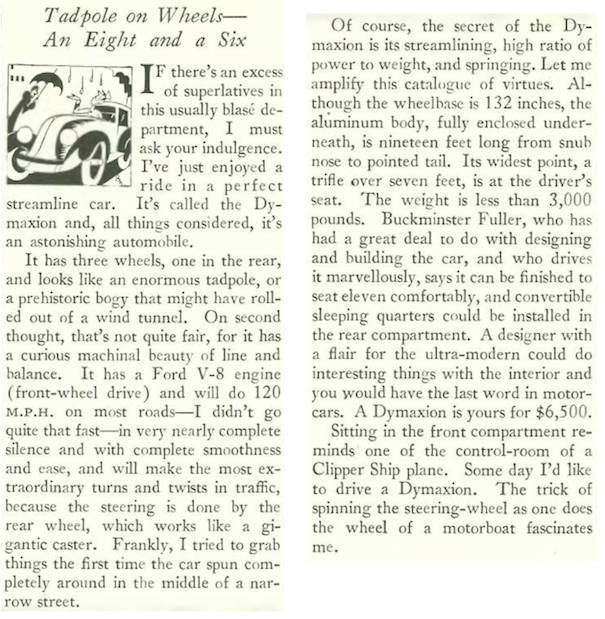
One of them was R. Buckminster Fuller (1895–1983), architect, designer, and futurist probably best known today as the inventor of the geodesic dome (think Disney’s Epcot Center). In the 1930s Fuller was all about a concept he called Dymaxion. Derived from the words dynamic, maximum, and tension, when applied to architecture and design it would supposedly deliver maximum gain from minimal energy input. The writer of the New Yorker article (pseud. “Speed”) was fascinated by the Dymaxion’s motorboat-type steering, no coincidence since Fuller intended to adapt his futuristic car for use on and under the water, as well as in the air.
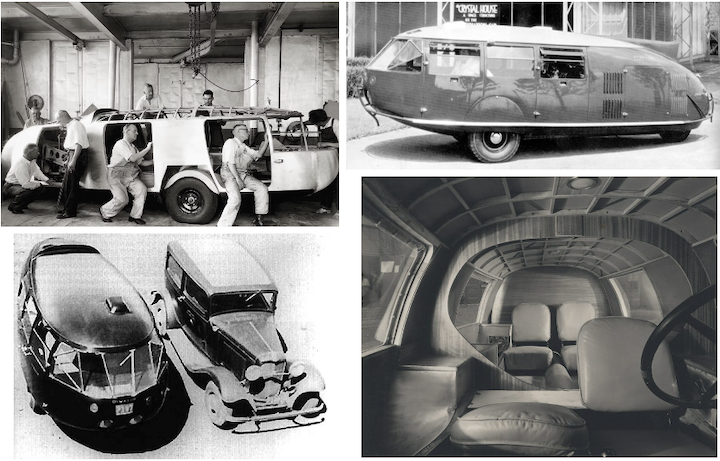
THE SHAPE OF THINGS TO COME…Clockwise, from top left: Workers at a Bridgeport, Conn., plant creating the first of three Dymaxion cars; the Dymaxion at Chicago’s 1933 Century of Progress exposition—the car was involved in a fatal accident at the fair; interior view of the Dymaxion; using the same engine and transmission as a Ford sedan (pictured), the Dymaxion offered three times the interior volume with half the fuel consumption and a 50 percent increase in top speed. (Buckminster Fuller Institute/Poet Architecture)THINKING WITHOUT THE BOX…In 1927 R. Buckminster Fuller (pictured) developed a Dymaxion House, a “Dwelling Machine” that would be the last word in self-sufficiency. Although the aluminum house was intended to be mass-produced, flat-packaged and shipped throughout the world, the design never made it to market (however its ideas influenced other architects); at right, a Fuller geodesic dome at Disney’s Epcot Center in Florida. (archdaily.com/Wikipedia)
The 1933 Century of Progress exposition in Chicago was supposed to be a major showcase for Fuller, but when professional driver Francis Turner was killed while demonstrating the first prototype of the Dymaxion, the car’s prospects dimmed considerably. According to an article by Stephanie d’Arc Taylor (cnn.com Oct. 30, 2019), during the demonstration a local politician tried to drive his own car close to the Dymaxion—to get a better look—and ended up crashing into the unwieldy prototype, which rolled over, killing the driver and injuring its passengers. “The politician’s car was removed from the fracas before police arrived, so the Dymaxion was blamed for the accident,” writes Taylor, who notes that the rear wheel–powered car, though unconventional, was not necessarily the problem. However, “the thing that made the Fuller death-mobile singularly deadly was the fact it was also steered by the rear wheel, making it hard to control and prone to all kinds of terrifying issues.”
That history did not stop architect Norman Foster from building a replica of the Dymaxion in 2010. Foster worked with Fuller from 1971 to 1983, and considers Fuller a design hero.
GIVING IT ANOTHER GO…Architect Norman Foster with his 2010 recreation of the Dymaxion. To build a new Dymaxion, Foster sent a restorer to the National Automobile Museum in Reno, Nevada (home of the only surviving Dymaxion, Car No. 2), and after thousands of photos and measurements Foster had the car recreated using only materials available in 1933: Foster’s Dymaxion consists of an ash frame sheathed in hand-beaten aluminum, mounted on the chassis of an old 1934 Ford Tudor Sedan. (CNN/The Guardian)
According to Taylor, Foster cleaved so closely to Fuller’s original designs that he refers to his creation as a fourth genuine Dymaxion—not a replica. “The car is such a beautiful object that I very much wanted to own it, to be able to touch as well as contemplate the reality for its delight in the same spirit as a sculpture,” said Foster. “Everything in (the car) was either made in 1934, or recreated using techniques and materials that Bucky would have had access to in that period.”
* * *
Meanwhile, At The Tracks…
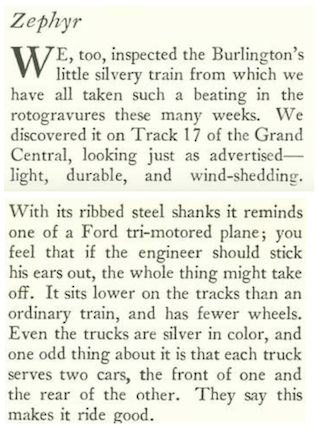
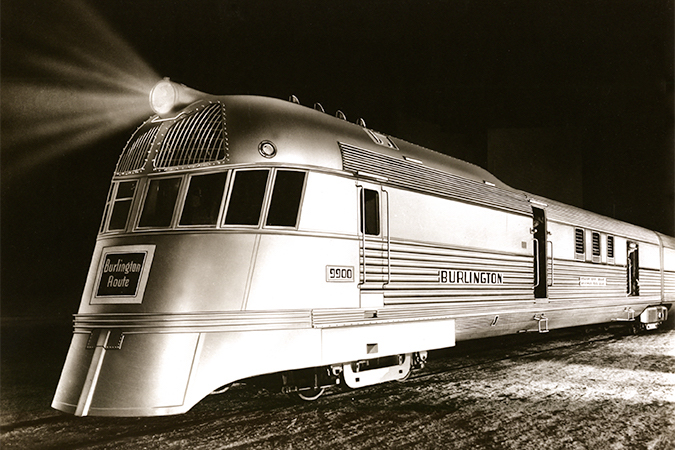
If Fuller’s attempt at the streamlined future was a bit of bust, the Burlington railroad was making a splash with its gleaming new Zephyr. E.B. White reported:
ZOOM ZOOM…The Burlington Zephyr set a speed record for travel between Denver and Chicago when it made a 1,015.4-mile (1,633 km) non-stop “Dawn-to-Dusk” dash in 13 hours 5 minutes at an average speed of almost 78 mph (124 km/h). In one section of the run it reached a speed of 112.5 mph. Following a promotional tour that included New York, it was placed in regular service between Kansas City, Missouri, and Omaha and Lincoln, Nebraska, on November 11, 1934. Other routes would be added later in the Midwest and West. (BNSF)
…we continue with E.B. White, here with some observations regarding Mother’s Day and bank robber/murderer John Dillinger, who had escaped from prison in March 1934 and was on the FBI’s Most Wanted List…
I REMEMBER MAMA…John Dillinger posed with Lake County prosecutor Robert Estill, left, in the jail at Crown Point, Ind. while he awaited his trial for murder in January 1934. Dillinger would escape from the jail in March and would be on the lam until July, when FBI agents would gun him down outside a Chicago movie theatre. (NY Daily News)
…and a last word from White, about an important change at Radio City:
* * *
Voice In The Wilderness
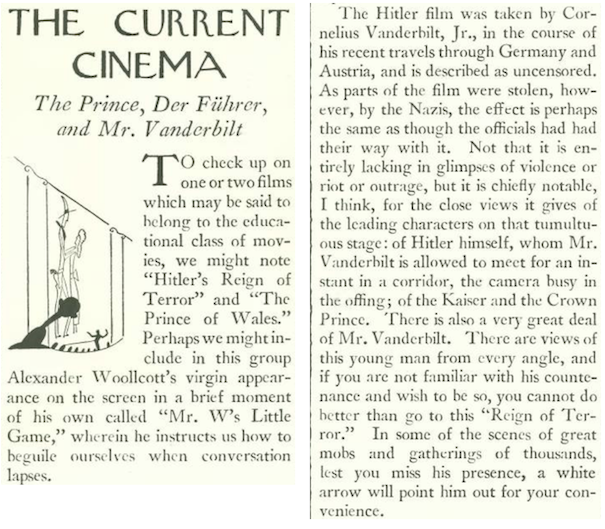
A combination of newsreel footage, documentary, and reenactment, Cornelius Vanderbilt Jr’sHitler’s Reign of Terror played to capacity crowds for two weeks in New York City, despite the refusal of the state’s censor to license the film. Disinherited by his parents when he became a newspaper publisher, Vanderbilt was a determined journalist, covertly filming scenes in Nazi Germany and even briefly encountering Adolf Hitler outside the Reichstag, where Vanderbilt yelled to Der Führer, “And what about the Jews, Your Excellency?” (Hitler ignored the question and referred Vanderbilt to one of his lackeys). Unfortunately, Vanderbilt wasn’t much of a filmmaker, and although he warned Americans about the emerging threat in Germany, few took the film, or his warning, seriously, including John Mosher:
UNHEEDED…Audiences flocked to see Cornelius Vanderbilt Jr’sHitler’s Reign of Terror, but critics dismissed the rather amateurish film—Film Daily scoffed at the film’s prediction that Hitler’s Germany was a future threat to world peace; at right, in the film Vanderbilt confronted “Hitler” in a recreation. (TMDB/Library of Congress)
* * *
From Our Advertisers
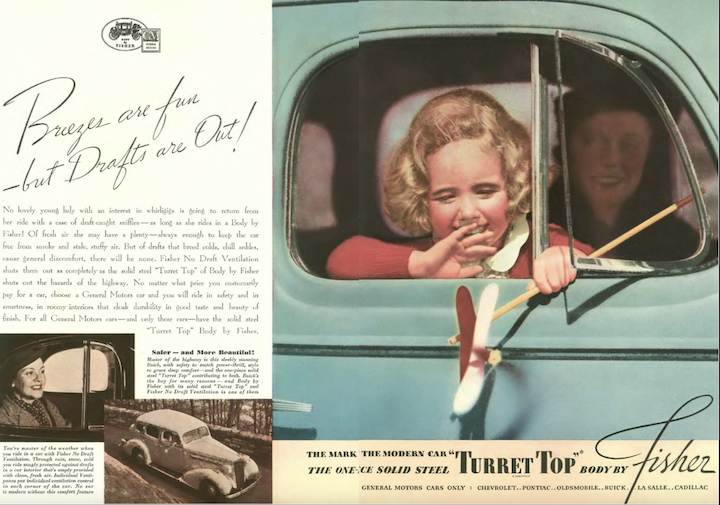
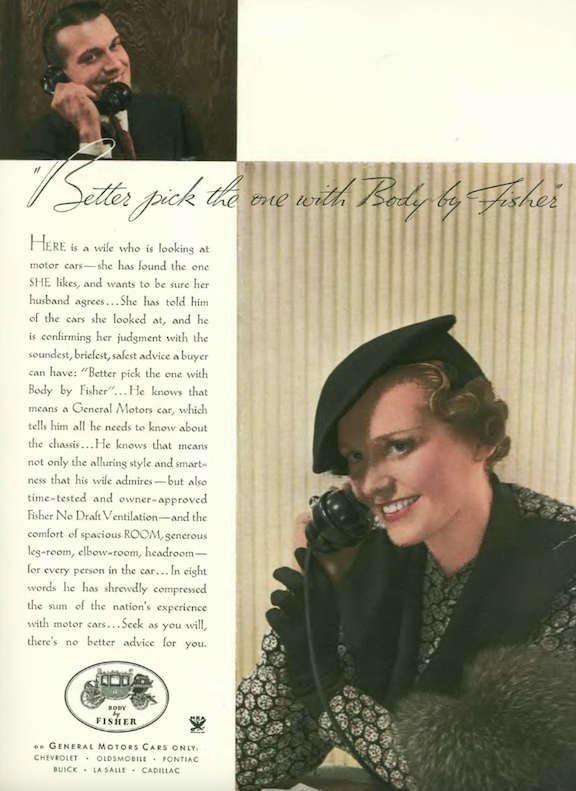
It wouldn’t seat eleven people like a Dymaxion, but a Body by Fisher (coach builder to General Motors) certainly impressed this young woman…but better check with the hubby just in case…
…in this next ad, we find what looks like the same woman, perhaps celebrating her decision with a nice smoke…
…this spot seems out of place in the New Yorker, like it snuck over from Better Homes & Gardens...
…on to our cartoons…with James Thurber’s war of the sexes over, life returned to normal…
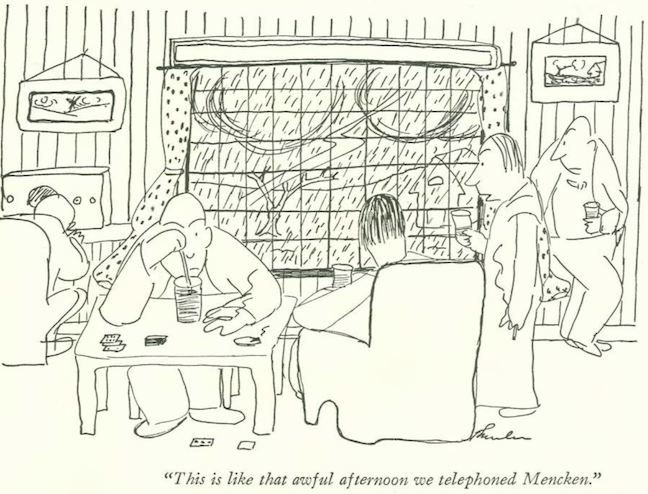
…and both sides shared in the gloom of a rainy afternoon…
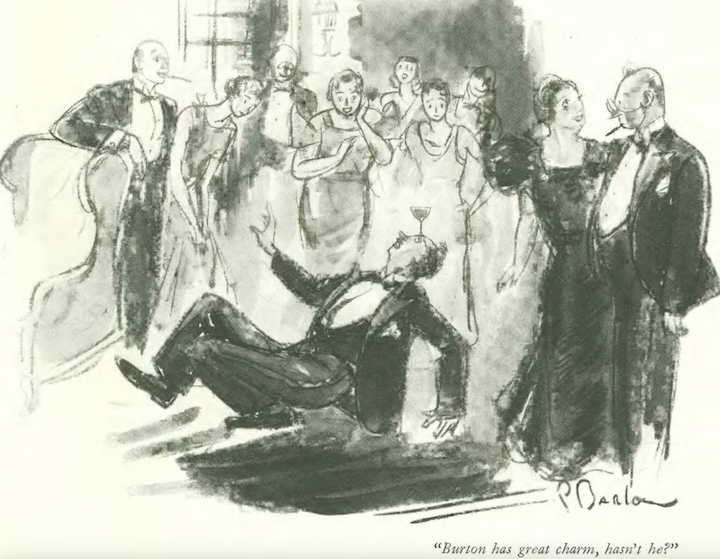
…by contrast, Perry Barlow brightened things up with this life of the party…
…but a good time doesn’t always translate over the airwaves, per George Price…
…Alain illustrated the consequences of losing one’s nest egg…
…Peter Arno didn’t leave any room for dessert…
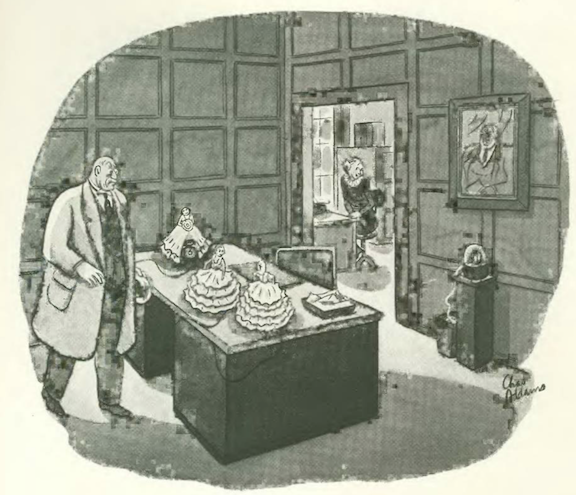
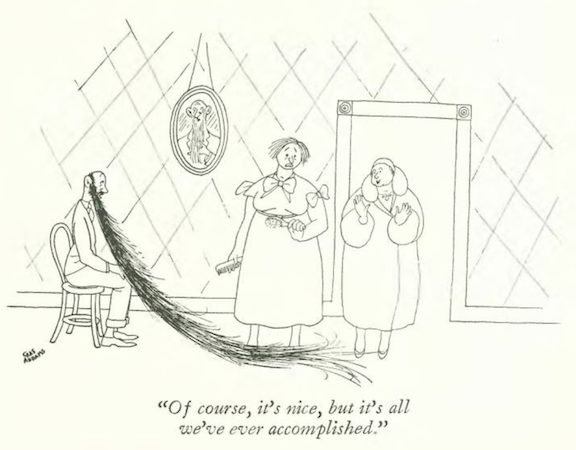
…and Charles Addams returned, a macabre cast of characters still percolating in his brain…
…on to May 12, 1934…
May 12, 1934 cover by Leonard Dove.
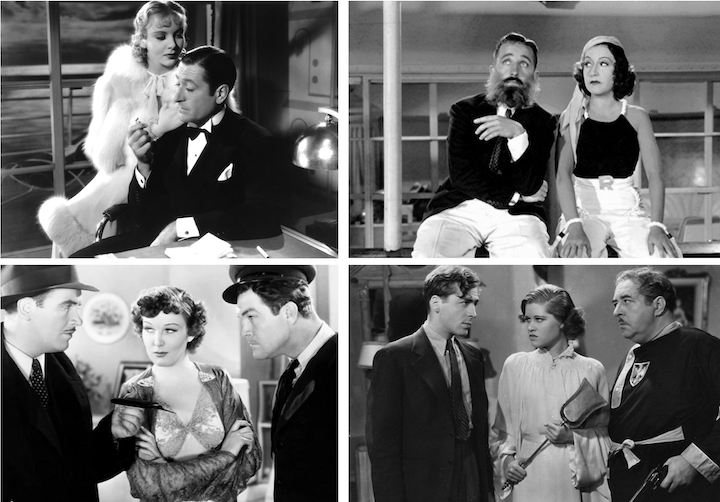
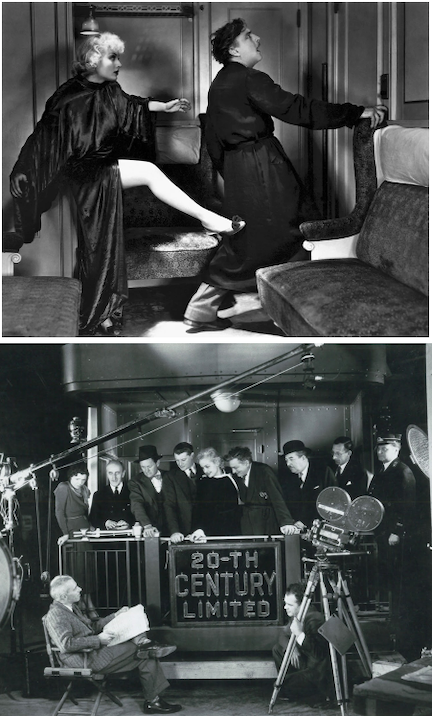
…and back to the movies, this time critic John Mosher found more cheery fare in 20th Century, a pre-Code screwball comedy directed by Howard Hawks and starring John Barrymore and Carole Lombard. Battling alcohol abuse since age 14, Barrymore nevertheless managed to display his rare genius as a comedian and turned in what is considered to be his last great film performance.
GETTING HER KICKS…Top, Carole Lombard delivers a swift one to John Barrymore in the screwball comedy 20th Century. Below, director Howard Hawks with the cast. (greenbriarpictureshows.blogspot.com)
* * *
Playing the Ponies
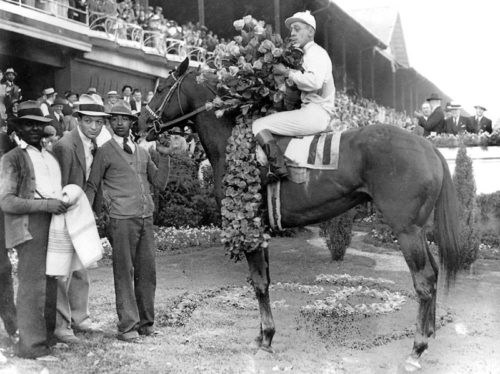
Horse racing correspondent George F. T. Ryall (pseud. “Audax Minor”) considered a losing wager at the Kentucky Derby in his column, “The Race Track.”
A HORSE OF COURSE…Jockey Mack Garner rode Cavalcade to victory at the 1934 Kentucky Derby. (Appanoose County Historical Society)
* * *
More From Our Advertisers
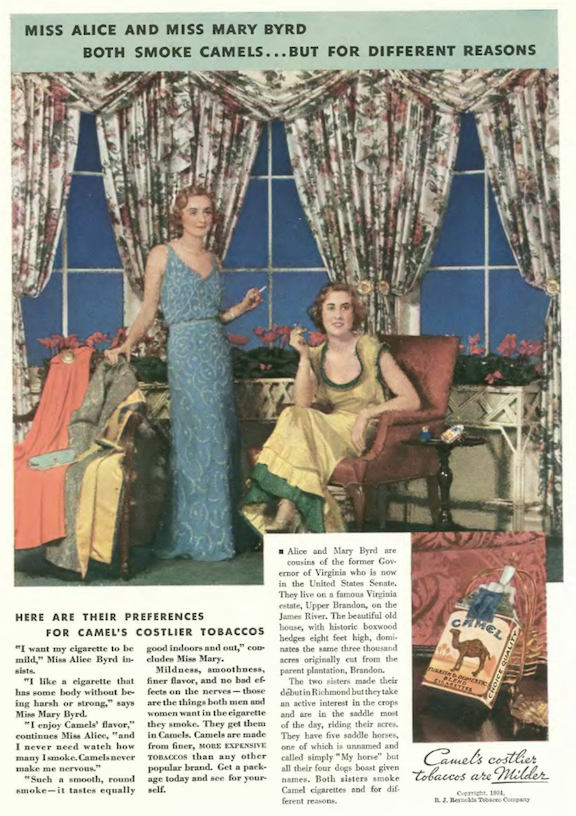
We begin with Camel cigarette endorsers Alice and Mary Byrd, residents of Virginia’s famous Brandon plantation and cousins of Virginia Senator and Governor Harry F. Byrd, known for his fights against the New Deal and his “massive resistance” to federally mandated school desegregation...
…also to the manor born, Whitney Bourne, a New York deb who would go on to a brief stage and film career that would end when she married her first husband (diplomat Stanton Griffis) in 1939…
AN EYE FOR STYLE…Whitney Bourne in a scene with Solly Ward in 1937’s Flight From Glory. Named in 1933 as one of America’s best dressed women, Bourne was a noted New York socialite, skier, golfer and tennis player as well as an occasional actress.
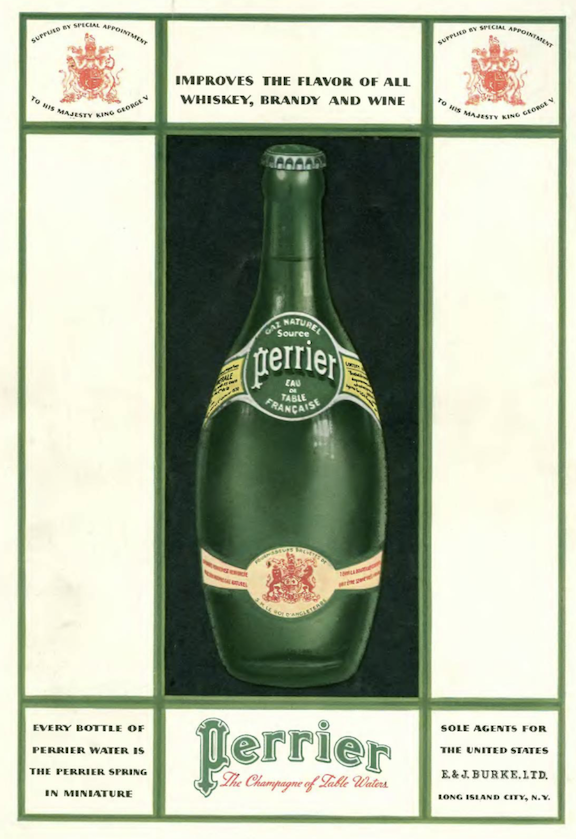
…we move along from the effervescent Whitney Bourne to the sparkling waters of Perrier…
…Gardner Rea followed other New Yorker cartoonists by illustrating an ad for Heinz…
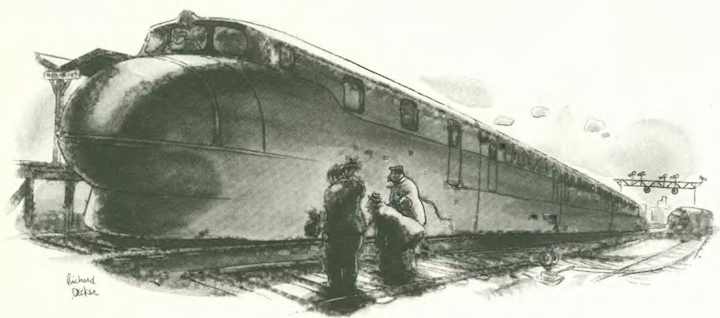
…which brings is to more cartoons, where according to Richard Decker, the move to streamlined trains wasn’t welcomed by everyone…
…Carl Rose illustrated this two-page spread with an imagined right-wing response to the recent left-wing May Day parades…
…William Steig eavesdropped onto a saucy little conversation…
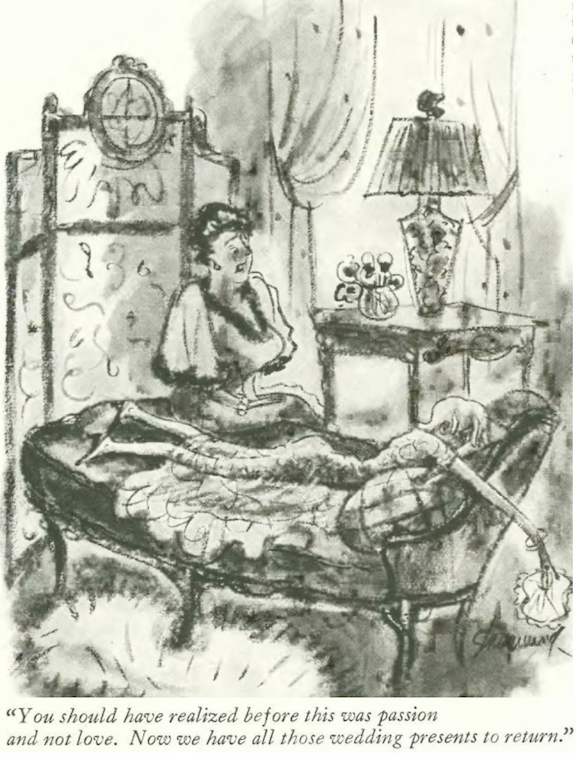
…Barbara Shermund continued her explorations into the trials of the modern woman…
…James Thurber was back to his old tricks…
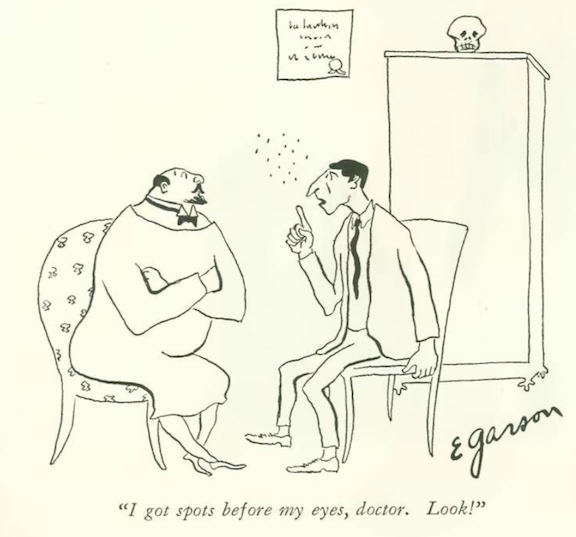
…and we conclude our cartoons with Eli Garson, and a new perspective…
Before I close, a bit of housekeeping. The first issues in 1925 sometimes ended “The Talk of the Town” with…
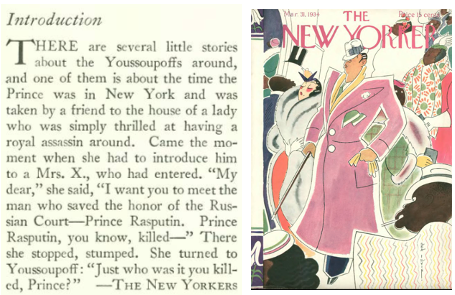
…but on May 23, 1925, “Talk” signed off with —The New Yorkers. That continued until the March 31, 1934 issue (below), the last time the New Yorker signed off “The Talk of the Town” with —The New Yorkers:
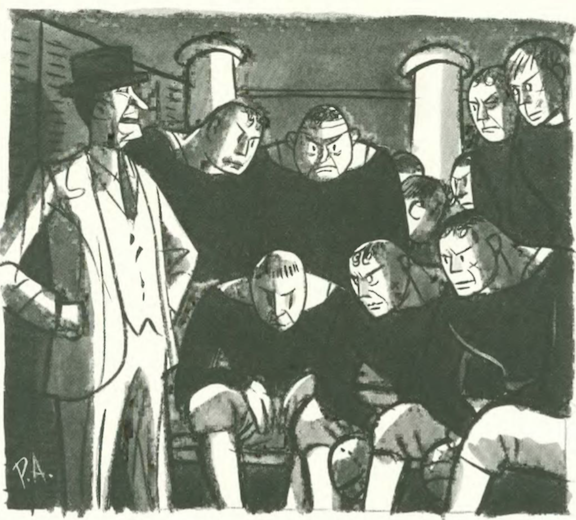
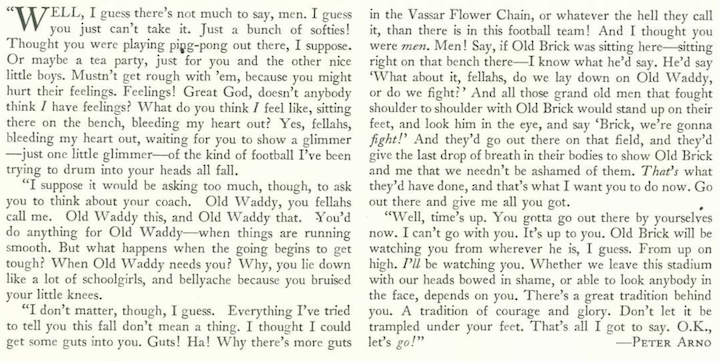
Peter Arno departed from his usual one-liners in the Nov. 18, 1933 issue with a football-themed cartoon that featured a four-paragraph caption…
Nov. 18, 1933 cover by Abner Dean.
…that consisted of a pep talk from a football coach—”Old Waddy”…
…Arno had visited the football theme before, notably in this early cover from 1928…
Arno cover from Oct. 7, 1928.
…and he referenced it again in the years ahead…
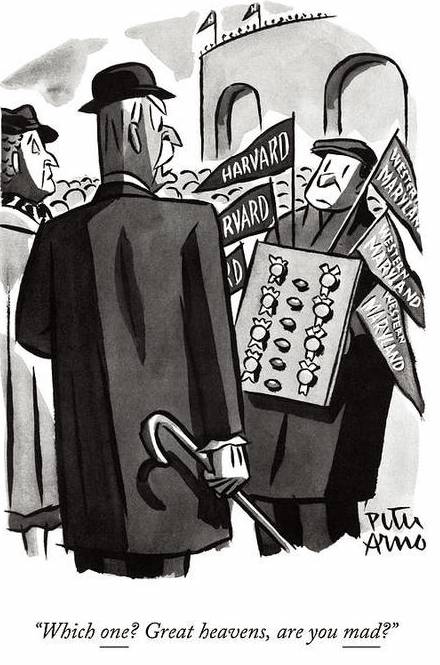
HAIL VARSITY…Peter Arno delivered another, much shorter pep talk in a cartoon (left) from the Nov. 20, 1937 issue; at right, Arno’s last football-themed gag, published in The New Yorker of November 25, 1967, just three months before the cartoonist’s death. Check out one of my favorite New Yorker sites, Attempted Bloggery, for more on the 1937 cartoon.
…and one more from Arno, a classic from September 27, 1947…
* * *
Pre-emptive Nostalgia
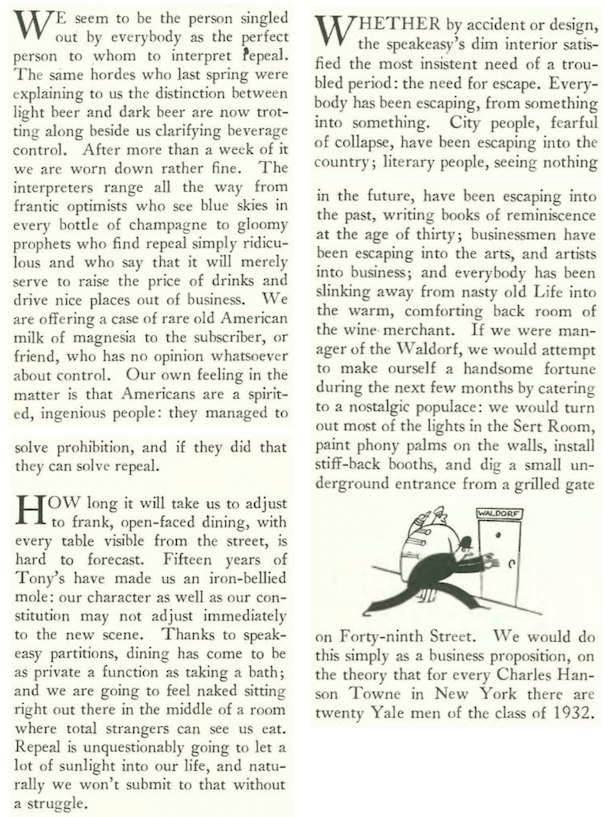
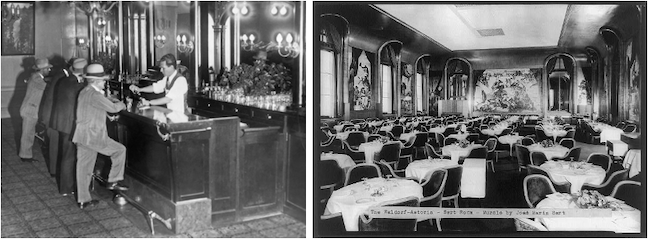
Although E.B. White welcomed the end of Prohibition with open arms, he also wondered what could be lost when drinkers emerged from the shadows of the speakeasy world…
THAT HOMEY FEELING…E.B. White suggested transforming the Waldorf-Astoria’s Sert Room (right) into a dingy dive to help ease drinkers back into the world of legal alcohol. (Britannica/Library of Congress)
White also referenced his many years at Tony’s, a speakeasy and Italian restaurant popular with writers and others in the New Yorker’s orbit. Tony Soma operated the speakeasy until 1929, when John D. Rockefeller bought Soma’s building along with other properties to make way for Rockefeller Center. Soma would later open another popular (and legit) restaurant and also become known as a yoga practitioner and the grandfather of actress Angelica Huston. You can read more about Soma at The Speakeasy King.
* * *
The French Underground
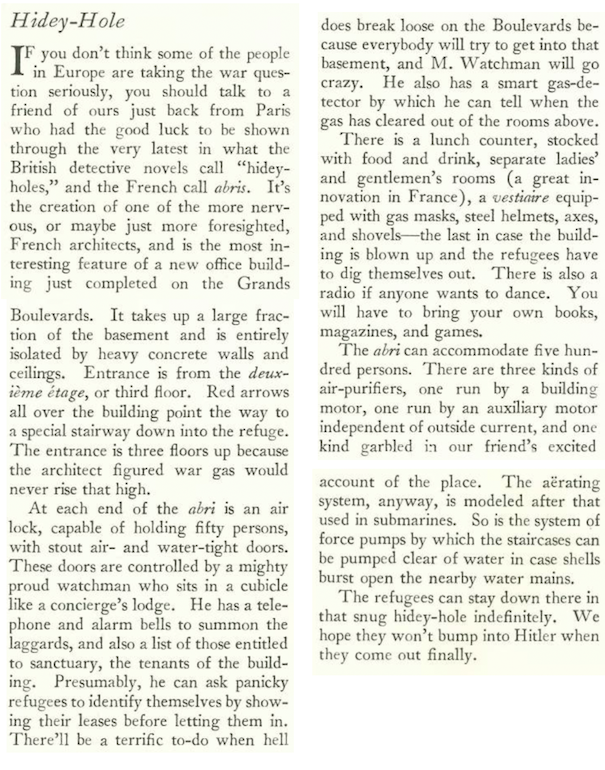
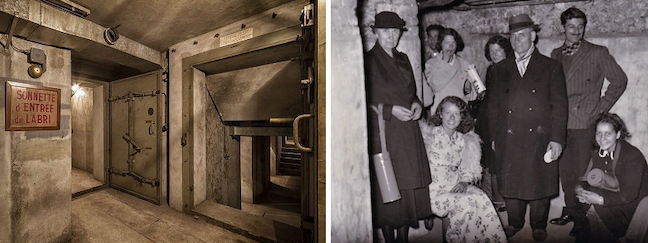
Although war seemed like a distant rumor to most Americans, the French were busy preparing for that likelihood, according to this “Talk of the Town” piece attributed to Europe-based documentary filmmaker Richard de Rochemont and New Yorker stalwart James Thurber.
LOOK OUT BELOW…At left, a preserved WWII abris can be found below platforms 2 and 3 at Paris’ Gare de l’Est; right, Parisians take shelter in an abris in 1939. (Trip Adviser/Ebay)
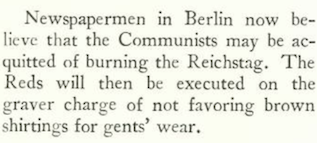
…in his column, “Of All Things,” Howard Brubaker mused on the latest rumblings from Berlin…
DEMOCRACY IN ASHES…An arson attack on the Reichstag (home of the German parliament) on February 27, 1933 was used by Adolf Hitler as pretext to suspend civil liberties and conduct a ruthless pursuit of “communists,” both real and imagined. (Wikipedia)
* * *
Little Women, Big Film
On the brighter side, we turn to Hollywood and John Mosher’s review of George Cukor’s critically acclaimed Little Women, which featured a cast led by Katharine Hepburn and Joan Bennett.
MEINE LIEBCHEN…Impoverished German linguist Professor Bhaer (Paul Lukas) proposes to Jo (Katharine Hepburn) in 1933’s Little Women. (IMDB)SEW WITH JO…From left, the March family as portrayed by Jean Parker (as Beth), Joan Bennett (Amy), Spring Byington (Marmee March), Frances Dee (Meg), and Katharine Hepburn (Jo) in the George Cukor-directed Little Women. (IMDB)
…Mosher also found something to like in the MGM romance The Prizefighter and the Lady, which starred Myrna Loy along with professional boxers Max Baer, Primo Carnera, and Jack Dempsey.
THE NEW “IT” MAN was how MGM publicists promoted professional boxer Max Baer in his film debut. Top right, Baer in a scene with Myrna Loy; bottom right, professional boxer Primo Carnera with Loy and Baer—Carnera was the world heavyweight boxing champion at the time of the film’s release, however Baer would defeat the Italian giant in their real-life 1934 fight; bottom center, Baer’s son, Max Baer Jr., would also find Hollywood fame in the 1960s playing Jethro Bodine on TV’s The Beverly Hillbillies. (IMDB/Wikipedia)
* * *
Sausage Factory
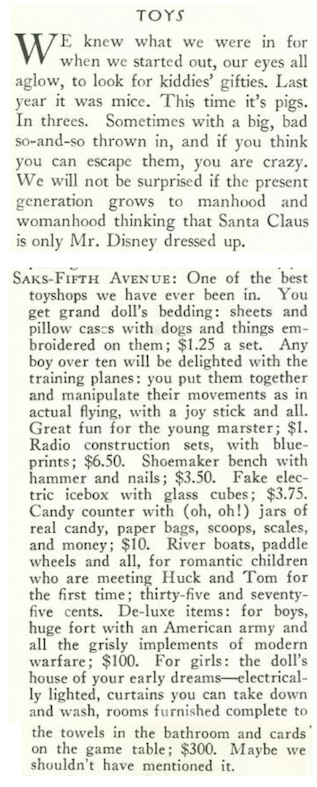
We’ve previously looked at the smashing success of Walt Disney’sThree Little Pigs cartoon and its theme song, which took the country by storm in the fall of 1933. So it was no surprise that the piggies could be found in toy departments across the metropolis as the Christmas season approached. These are brief snippets from a lengthy holiday shopping column that was appended annually to Lois Long’s “On and Off The Avenue” every November and December.
HOG HAVEN…You could help the Three Little Pigs find their way to safety in this 1933 Disney board game. As in the film, the final leg of the board game’s journey has the wolf landing in a cauldron of boiling water. As if that wasn’t bad enough, the Disney film also featured one of the pigs adding turpentine to the cauldron. (Ebay)
This being America in the 1930s, and early Disney, the Three Little Pigs cartoon contained an offensive scene in which the Big Bad Wolf disguises himself as a Jewish peddler, complete with a fake nose, glasses, and beard (accompanied by a fiddle, the wolf also adopts a Yiddish accent).* The character was included in the above board game:
* The film was finally edited in 1948 with a redesign of the Wolf’s disguise—as a Fuller Brush salesman.
* * *
From Our Advertisers
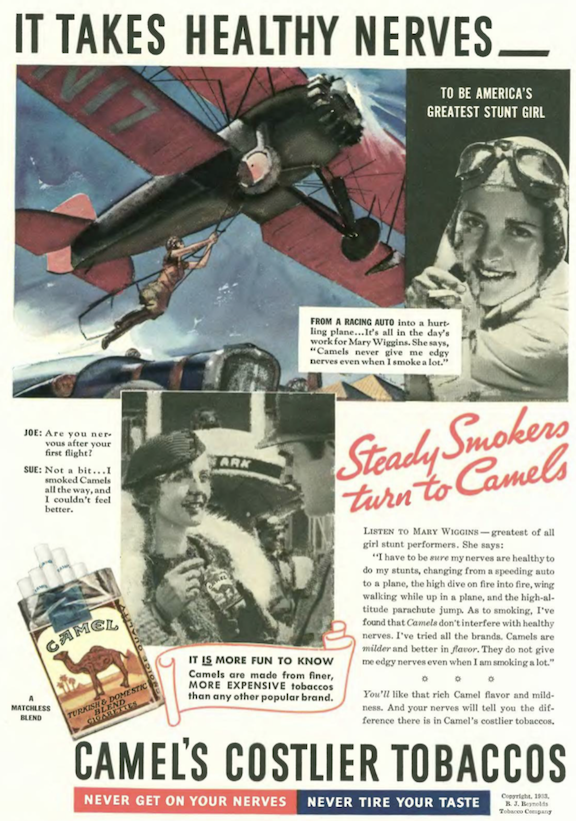
We kick off our ads with more “healthy nerves” testimonials from Camel smokers, including stuntwoman/pilot Mary Wiggins…
…Caron Paris also went aloft with one of their famed “En Avion” adverts…
…back on the ground, this hapless couple found themselves taking a slow car to a soaking…although wearing a fur coat while riding in a rumble seat probably wasn’t a good idea, regardless of the weather…
…for those rainy days, you could get yourself a Salisbury overcoat from Brooks Brothers…this sports-themed illustration was a new twist for the usually staid BB…
…and there’s always one or two really weird ads, like this one from The Sun newspaper that touted baloney sales at Gimbels as proof of advertising prowess…
…collectors of Art Deco are well-acquainted with the work of Hans Flato, who did a series of ads (and related merchandise) for New York-based Ruppert’s Beer in the early 1930s…Flato (1887-1950) worked in a variety of styles, but the characters he created for Ruppert’s stand out…for reasons known only to the Flato, the feet of the Ruppert’s characters were always attached to yellow disks, like toy dolls…
…James Thurber was keeping busy illustrating ads aimed at folks wanting to escape the cold…
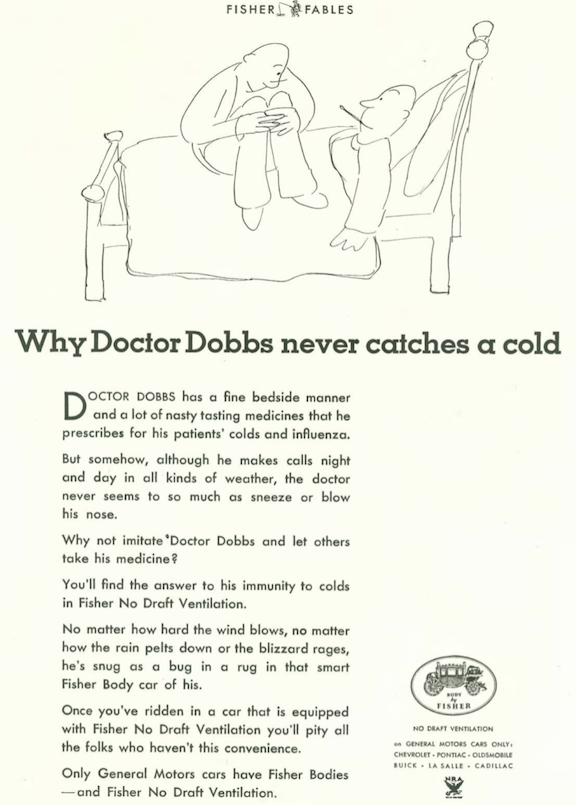
…as well as those who caught a cold in a drafty automobile…
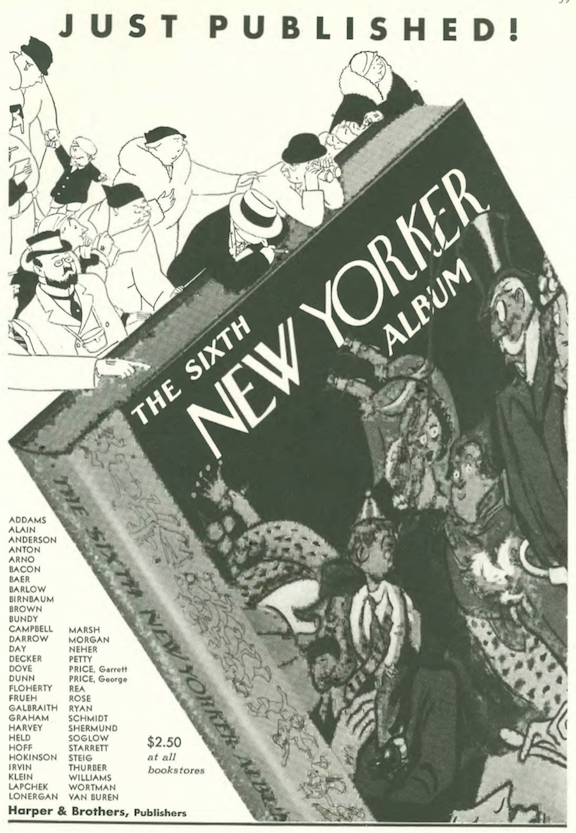
…The New Yorker announced the publication of its sixth album, with an illustration by Gluyas Williams…
…while Otto Soglow, in a much smaller back-page ad, proclaimed the publication of his first The Little King collection…Soglow had just ten months left on his contract with The New Yorker—his Little King would relocate to William Randolph Hearst’s King Features Syndicate in September 1934…
…speaking of Soglow, we kick off the cartoons with his potentate’s latest adventure…
…William Steig gave us a sneeze and a chorus…
…and we close with Eli Garson, and a tale from the Almost Wanted…
E.B. White was not known for his sports reporting, but when the Third Winter Olympic Games opened in Lake Placid, New York, on Feb. 4, 1932, it was White who represented The New Yorker at the first-ever winter games in the U.S.
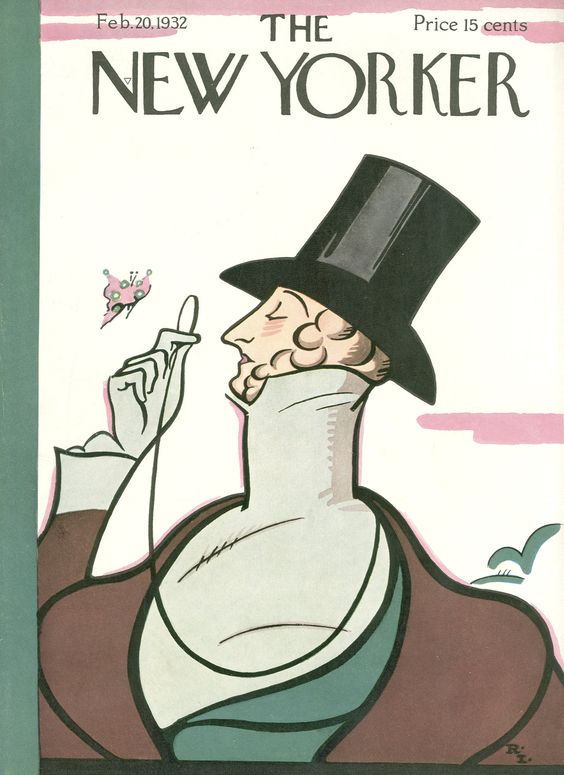
Feb. 20, 1932—seventh anniversary cover by, of course, Rea Irvin!
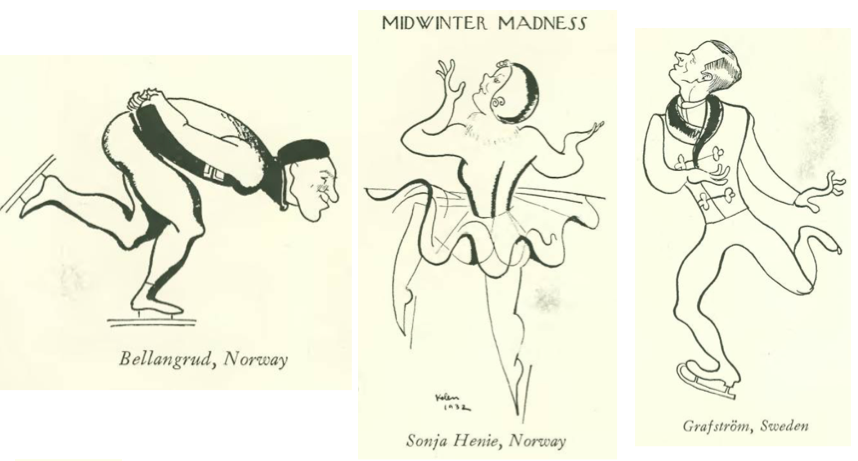
Famed caricaturist Emery Kelen (1896-1964) provided the artwork for White’s account of the games…
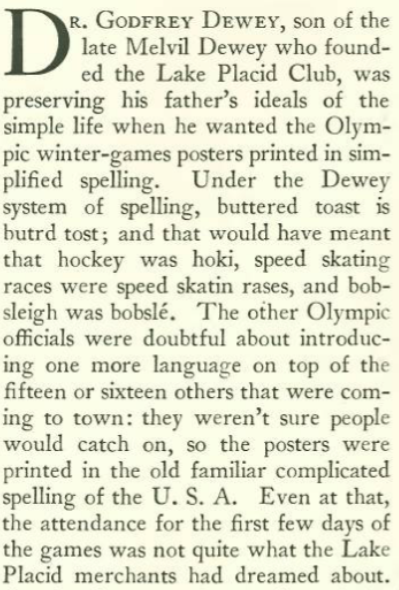
…which was featured in the “A Reporter at Large” section under the title, “Midwinter Madness.” White opened the piece with some observations on Godfrey Dewey, head of the Lake Placid Club, and son of Melvil Dewey, inventor of the Dewey Decimal System. It seems that Dewey wanted the Olympic posters printed in the simplified Dewey system of spelling:
BEFORE BOB COSTAS…Opening ceremonies were a far simpler affair. Clockwise, from top left, the III Winter Olympic Games officially opened on Feb. 4; Sonja Henie of Norway and Karl Schäfer of Austria were gold medal winners in ladies’ and men’s singles figure skating; the rather uninspired official poster for the event; as a pusher in the four-man bobsleigh team, Edward Eagan (center) won the gold medal with the USA I team. Twelve years earlier Eagan had been crowned Olympic champion in the light heavyweight boxing competition at Antwerp. He was the first and only person to win gold at both the summer and winter games. Note the leather helmets and the fact that, unlike today, the sled is actually a real sled. (olympic.org/Wikipedia)
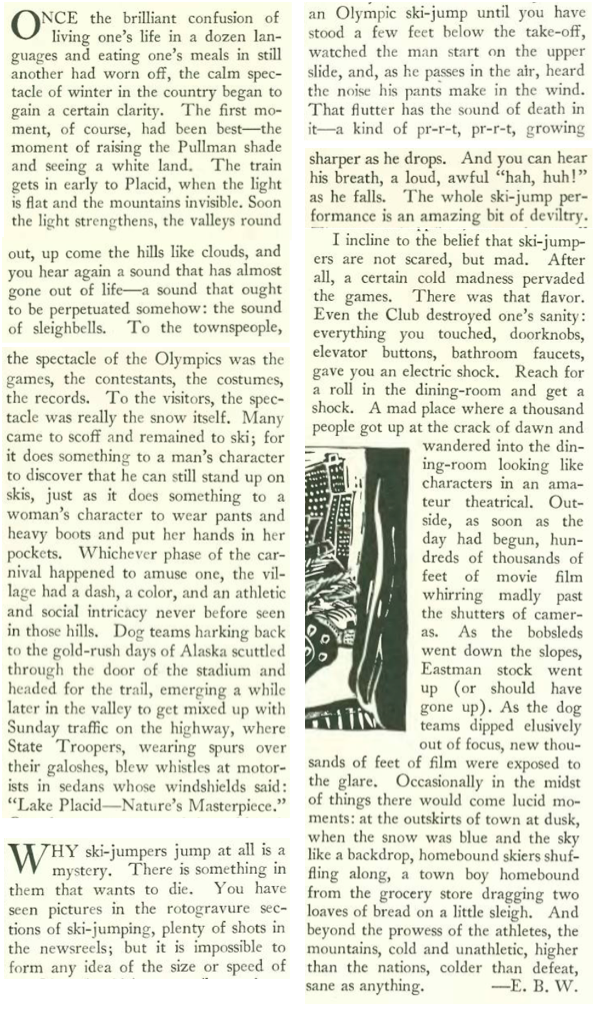
True to form, White set the stage for the games by describing his train journey to Lake Placid. At the games he observed dogsled teams—dogsled racing was one of nine sports featured at the III Winter Olympics—and marveled at the derring-do of the ski-jumpers.
Writing in the Atlantic (Feb. 10, 2014), Philip Bump described the 1932 Games as looking “way more fun and dangerous” than today’s games, “like a group of guys who set up a competition in the woods behind their house. The Jackass Games, really.” They were a lot smaller, too. The 2018 Olympics in Pyeongchang, South Korea featured entrants from 92 countries participating in 102 events over 15 disciplines. By contrast, just 17 countries participated the 1932 games.
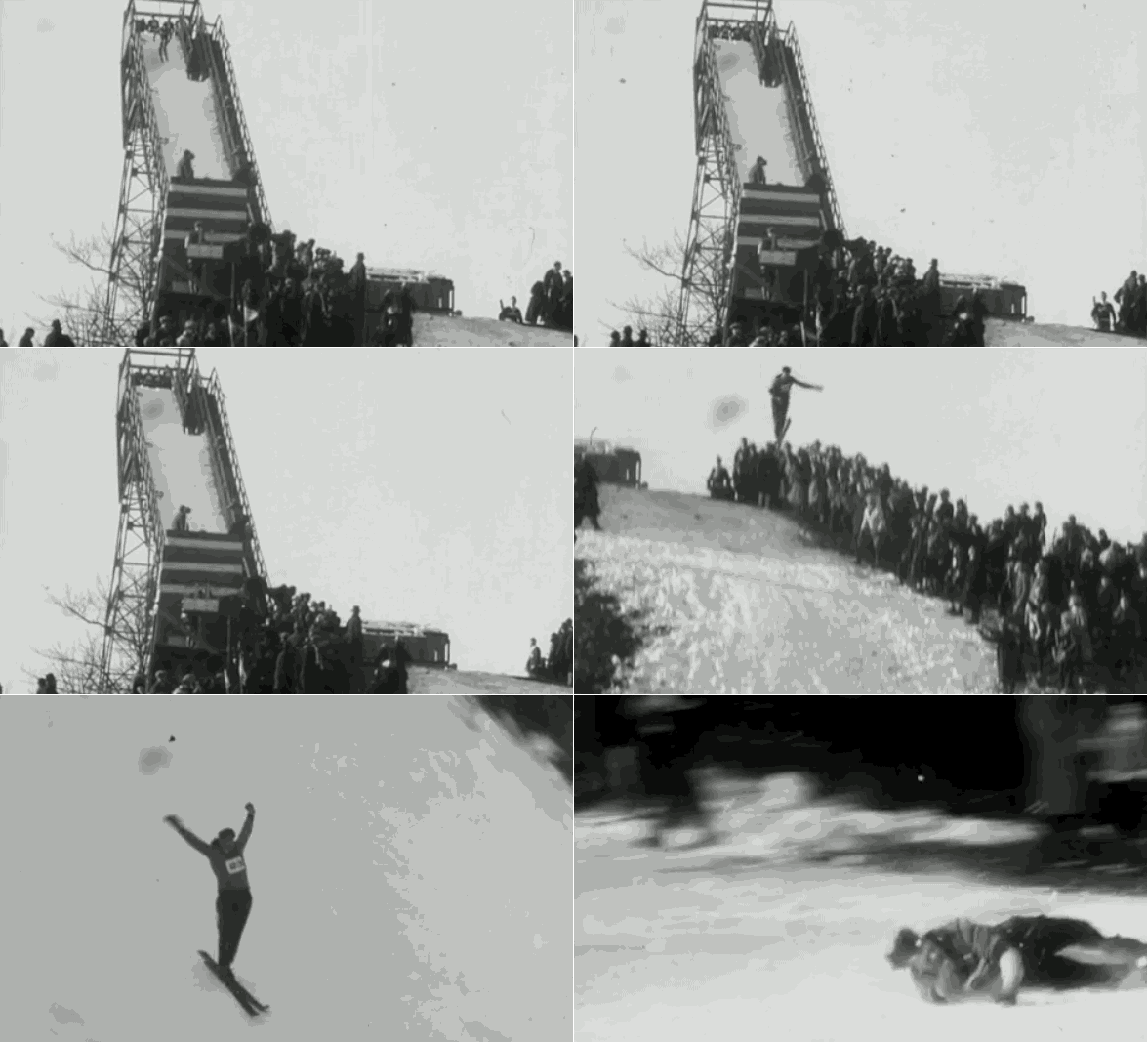
HOVERING HANS…Norwegian Olympic skier Hans Vinjarengen took Bronze at the 1932 games. At right, ski jump at Lake Placid. (olympic.com/Wikipedia)
And we close with this gif of an unidentified ski jumper at the ’32 games…
* * *
Seeing Red
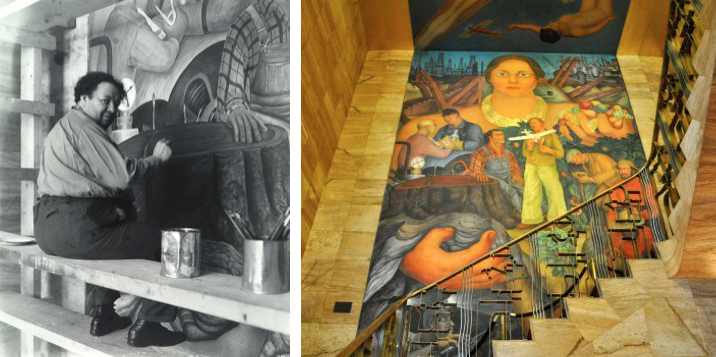
The Mexican painter Diego Rivera was sympathetic to the Soviet cause (with a Trotsky twist), but to the party faithful, painting a mural for some money-grubbing capitalists was unforgivable, as “The Talk of the Town” related…
NO GOODNIK…Left, Diego Rivera at work on Allegory of California at the San Francisco Stock Exchange Luncheon Club, 1931. At right, the mural still graces the stairwell of the building, now called “City Club.” (sfhistory.org).
* * *
Thank Heaven For Little Smiles
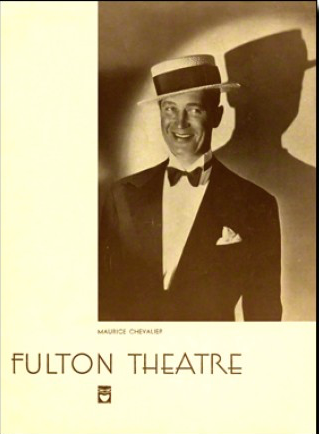
It is a challenge to find an image of Maurice Chevalier without his sunny smile, but as “The Talk of the Town” revealed, even the French crooner needed a break from all that mirth…
GRIN AND BEAR IT...Maurice Chevalier headlined an evening of song and dance at the Fulton Theatre in February 1932. (playbill.com)
* * *
Survivor
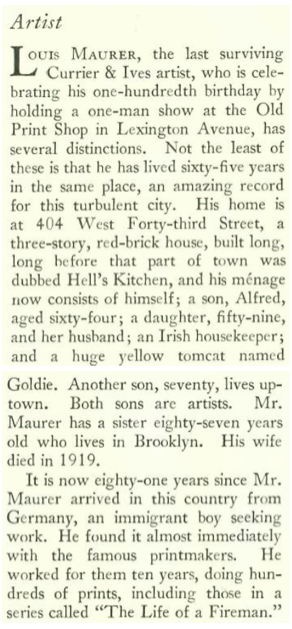
The last surviving artist of the old Currier & Ives print shop, Louis Maurer (1832–1932) celebrated his 100th birthday, and “The Talk of the Town” was there to fete the old man…
AMERICANA’S FINEST…Louis Maurer poses with one of his works on the centenary of his birth. (findagrave.com)
* * *
Silence is Golden
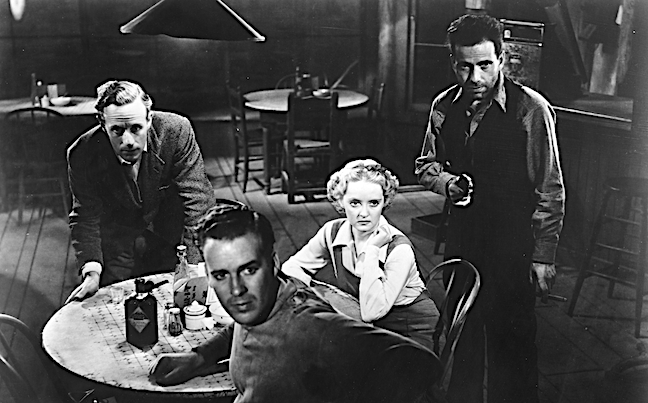
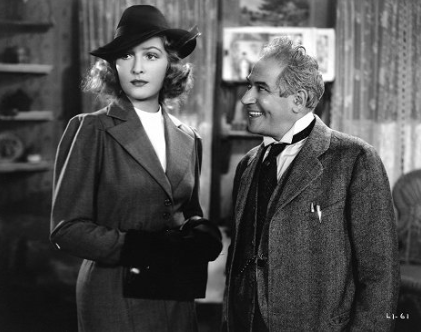
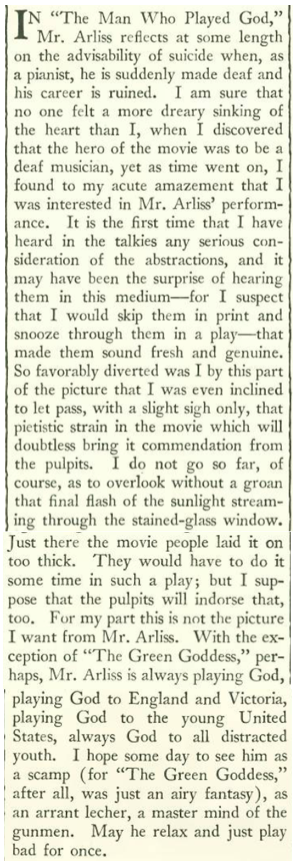
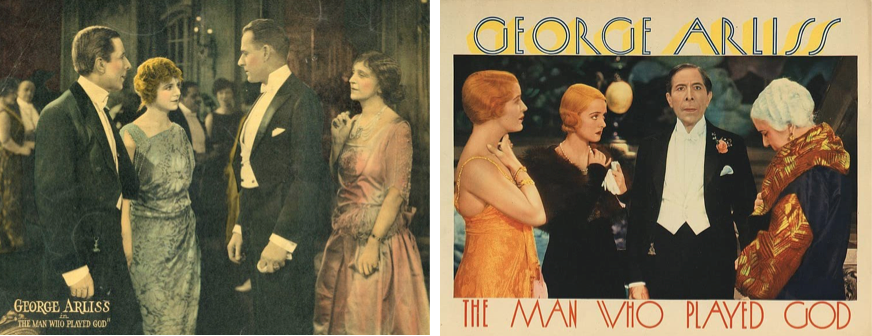
One of the older actors working in Hollywood, British actor George Arliss (1868–1946) was best known for his role in Disraeli (1929), and he is also credited with promoting the career of 23-year-old actress Bette Davis, who would have her breakout role in The Man Who Played God. This remake of a 1922 silent (that also featured Arliss) told the story of a concert pianist, Montgomery Royale, who believes his career is over when he loses his hearing. However, he finds a new purpose when he uses his lip-reading skills to help others, including himself when he calls off his engagement to Grace (Davis) after learning she is in love with another man. Critic John Mosher was impressed by Arliss, but found the film sanctimonious and wished the actor would play a baddie for a change.
TWO-TIMER…George Arliss appeared in both silent (1922) and talking (1932) versions of the The Man Who Played God. The latter film featured 23-year-old Bette Davis (second from left) in her breakout role. (IMDB)DRAMA KING…Concert pianist Montgomery Royale (George Arliss) considers suicide when he loses his hearing in 1932’s The Man Who Played God. Arliss was the first British actor to win an Academy Award for his role as PM Benjamin Disraeli in 1929’s Disraeli. (IMDB)
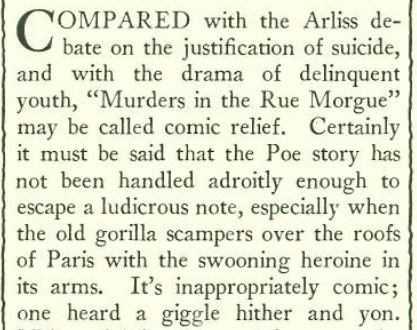
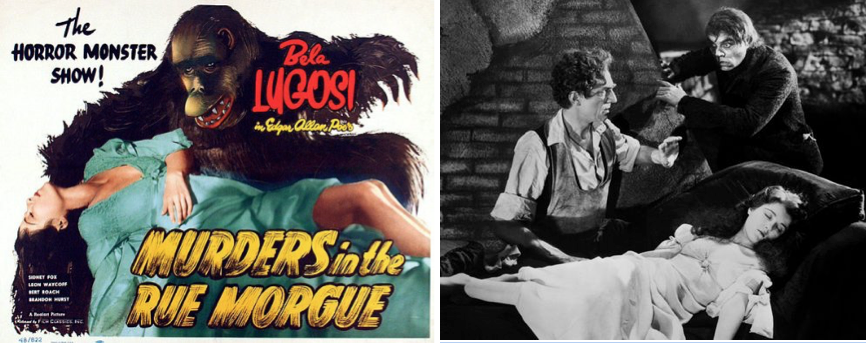
While Mosher found The Man Who Played God a bit too preachy, Murders in the Rue Morgue (1932) was way too campy to be taken seriously as a horror film. Thanks to his newfound Dracula fame, Bela Lugosi headlined the film, which debuted another young star, Arlene Francis (1907–2001), who would find her greatest fame in television from 1949 to 1983, most notably on the long-running quiz show What’s My Line?
HORROR MONSTER SHOW…or so the producers of Murders in the Rue Morgue (1932) claimed. Still image from the movie featured Bela Lugosi (left), Noble Johnson and Arlene Francis. (IMDB)
* * *
From Our Advertisers
Planning a visit to England? Don’t be mistaken for a clod-kicking Yankee and get yourself over to Lord & Taylor’s…
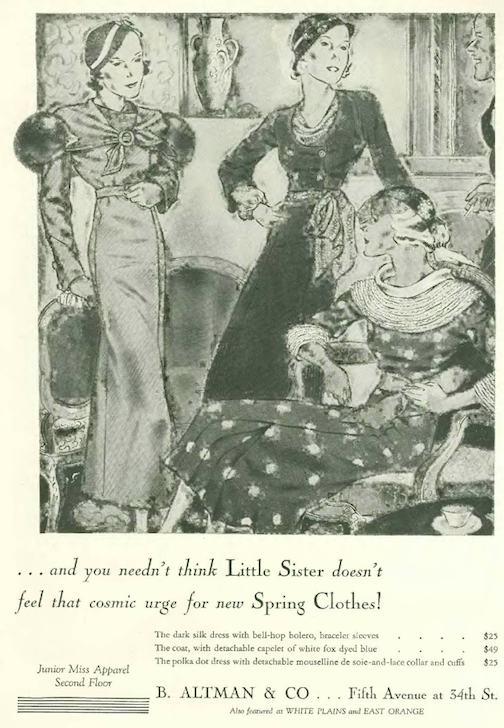
…and with spring in the air make sure little sis has the right duds to look like a 40-year-old woman…
…if you’re taking the train, you wouldn’t dare sit with the proles (I mean, look at that woman eating god-knows-what from a wrapper, and some filthy urchin wandering the aisles, and what the hell does Mr. Creepo have in that box?), so why settle for plain old gas when you can sweeten it with some lead?…
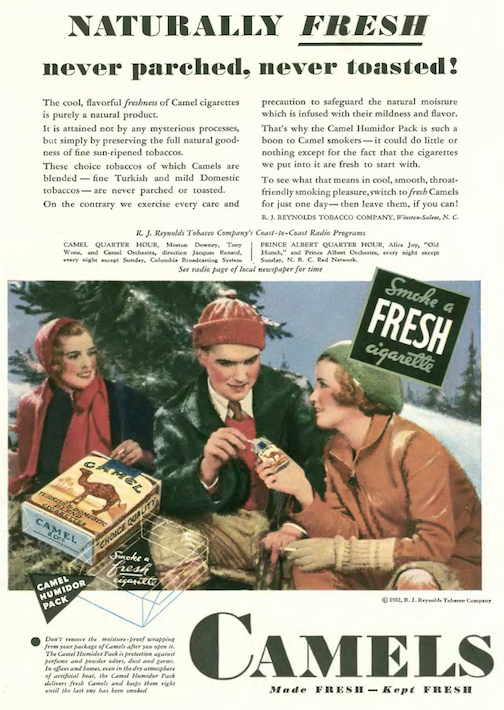
…nothing better than traveling out into the fresh air to breathe in some nice fresh tobacco smoke…it’s naturally fresh, so it’s just as good as mountain air, maybe even better…
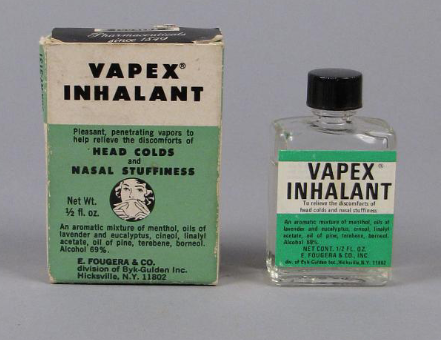
…this poor chap can’t breathe well at all, or so he claims, and that’s why he needs Vapex…
…which puts him right to sleep because it contains 70 percent alcohol, so why not take a couple of chasers with that snort…you’ll get used to the menthol flavor (it’s in your Spud cigarettes after all) and before long it’s nighty-night, oh hell I’ll just drink this and put a little ether on my pillow…yeah that’s the ticket…
…for others, why even bother pretending Prohibition is still a thing?…
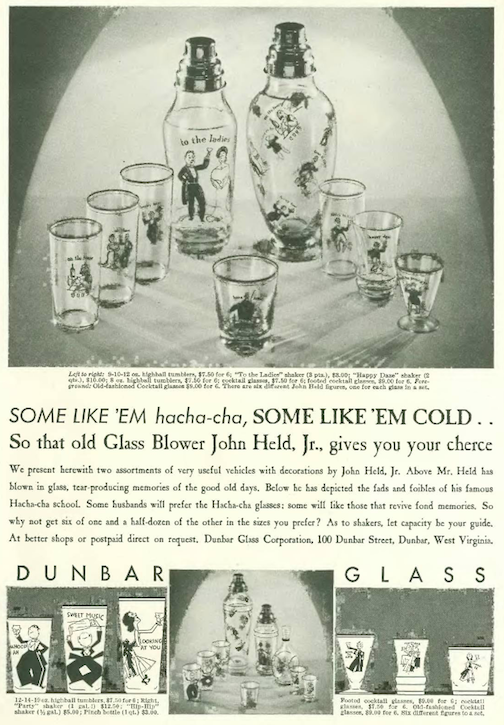
…and look at this swell cocktail set you could stock in your Bantam Bar, designed by The New Yorker’s own John Held Jr…
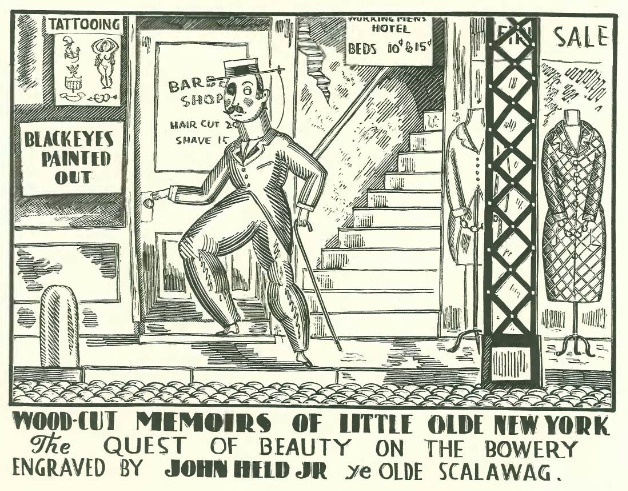
…on to our cartoons, we have Held again with another look at those naughty Victorian days…
…Rea Irvin continued his commentary on the “improving” economy…
...Richard Decker gave us a master of understatement…
…William Steig captured a special father-son moment…
…Barbara Shermund continued to explore the ways of her modern women…
…given the recent kerfuffle over Dr. Seuss, Carl Rose confirms just how acceptable racist stereotypes were back in the day…
…and we end with Peter Arno, and one sugar daddy finding himself on the skids, temporarily at least…
In an age of toe-tapping musicals and screwball comedies — which served to distract from the grim realities of the Great Depression—one playwright was content to continue mining the deep veins of tragedy and pessimism than ran through the 1930s.
Nov. 7, 1931 cover by Margaret Schloeman.
A Chekhovian realist, Eugene O’Neill (1888–1953) had yet to write his masterpiece, Long Day’s Journey into Night, but in 1931 he was already well established as America’s preeminent playwright. When his naturalistic Mourning Becomes Electra hit the Guild Theatre stage, New Yorker theatre critic Robert Benchley had little doubt about O’Neill’s greatness as a playwright, even if he wasn’t so sure about the play itself:
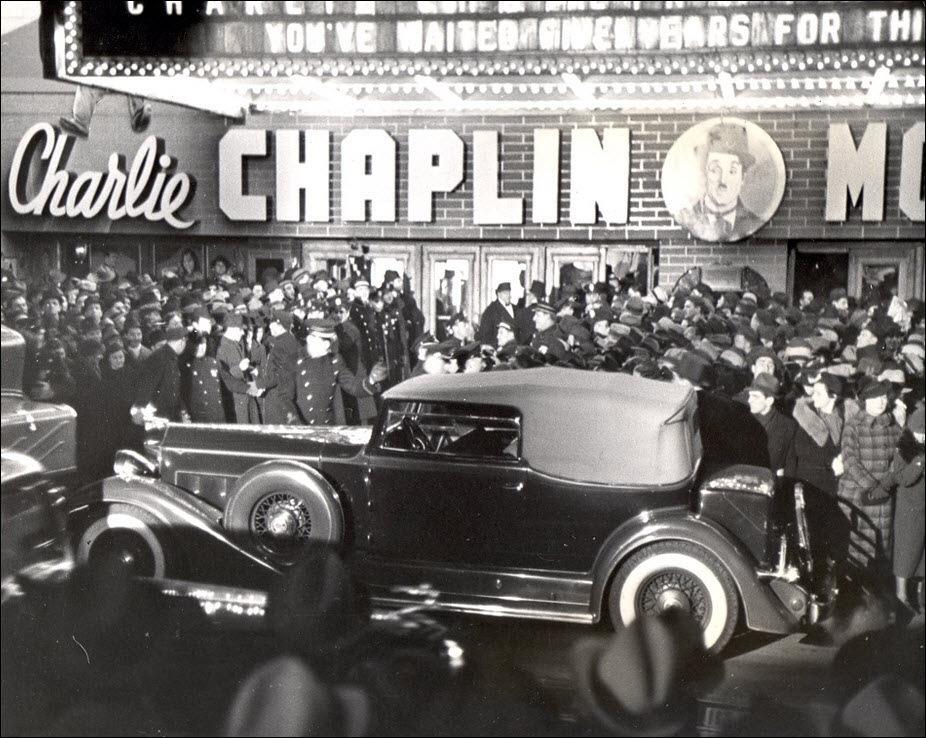
O’Neill’s tragic pose was borne from childhood, the son of an alcoholic father and a mother who became addicted to morphine after his difficult birth. His older brother, Jamie, would drink himself to death. It doesn’t end there. O’Neill’s own two sons would commit suicide, and he would disown his remaining daughter, Oona O’Neill, when at age 18 she married silent film star Charlie Chaplin, 36 years her senior. An odd footnote: Chaplin was best friends with Ralph Barton, a cartoonist for the early New Yorker who took his own life after Eugene O’Neill married Barton’s ex, Carlotta Monterey. To close the loop, O’Neill and Monterey had a mess of a marriage between his alcoholism and her addiction to sedatives. No wonder the man rarely smiled.
WRONG MEDS, MY DEAR…Christine Mannon (Alla Nazimova) recoils from her husband, Ezra (Lee Baker) after giving him a poison that he mistakes for his heart medicine. At right, Christine and her daughter, Lavinia (Alice Brady), await the return of Ezra from battle. All three actors were part of the original cast of Eugene O’Neill’sMourning Becomes Electra, which was a retelling of Oresteia by Aeschylus. (allanazimova.com)FAMILIAR FACE…Eugene O’Neill made his third appearance on the cover of Time magazine for the Nov. 2, 1931 issue. He made a total of four appearances on the magazine’s cover (1924, 1928, 1931 and 1946). At right, cover of Guild Theatre program. (Time/Pinterest)SAY CHEESE…Eugene O’Neill wore his familiar scowl in this undated portrait with his third (and final) wife, stage and film actress Carlotta Monterey. (famousfix.com)
* * *
Go West, William
When Mae West announced she was going to present a modern version of William Shakespeare’s Macbeth and play the part of Lady Macbeth, Wolcott Gibbs went to work on possible scenarios for such a production. Here is one of them:
LADIES MACBETH?…Actually, only two of these women made the cut to play Lady Macbeth. Gladys Cooper (center) appeared as Lady Macbeth in a 1935 production at the Ethel Barrymore Theatre that lasted barely a month. The following year Edna Thomas (right) portrayed Lady Macbeth in a Federal Theatre Project production of Macbeth with an all-Black cast. Orson Welles adapted and directed the production, which was staged at Harlem’s Lafayette Theatre. It became a box office and critical sensation.
* * *
Those Hats Again
And now to E.B. White, who once again explored the mysteries of the Empress hat:
TAKE THIS, MR. LIPPMANN…Thelma Todd wearing an Empress Eugénie hat in the 1932 comedy Speak Easily. (Wikipedia)
* * *
Rah, Rah, Sis Boom Bah
And so, in a city with one of the most storied teams in Major League Baseball, The New Yorker continued to ignore that sport as it gushed over college football, John Tunis even going the extra mile to check out homecoming at Ohio State.
HOMECOMING ROYALTY…THE Ohio State football team went 6-3 in 1931, but they blanked Navy 20-0 in their homecoming game. (elevenwarriors.com)
* * *
Boxing Brainiac
Several times before in this blog we have encountered boxing great Gene Tunney and his taste for the literary life. E.B. White gave us the latest on the Champ in “The Talk of the Town”…
THE FINER THINGS…Heavyweight Boxing Champion Gene Tunney, left, discusses things that don’t involve hitting people with writer George Bernard Shaw during a 1929 vacation to Brioni. (Associated Press)
* * *
From Our Advertisers
It’s the Depression, Prohibition is still in force (kind of), so what’s a body to do to blow off some steam? Well, you could take up smoking, every waking moment, at least when it came to this guy…
…and these were the days when tobacco companies offered competing claims about the health benefits of their cigarettes (weight loss, calmer nerves etc.). So the folks at Listerine, who were all about keeping you safe from nasty mouth germs, launched a cigarette of their own, which was “taking the country by storm,” at least in their estimation…
…and I throw this in to give you an idea of how far cigarette companies would go, and how folks would respond in the early 1930s…at left is a 1932 advertisement from the back cover of Popular Mechanics, telling us that “Everybody” is deeply inhaling their product…of course people became addicted, including this young woman (right) featured in a 1931 Popular Science news item who managed to smoke and read a book while reducing her figure…
…back to the ads from the Nov. 7 issue, here is one that offered a “scientific” way to remove nicotine from cigarettes, allowing only “pure tobacco” to enter your pink lungs…
…and now a couple of lovely color ads for Houbigant cosmetics…
…and our friends at Alcoa, diligently working to convince Americans that aluminum furniture was the modern way to keep your house “in step” with the times…
…and finally, RCA Victor was offering an early version of the LP record, so you wouldn’t have to stop necking to turn the damn record…
…on to our cartoons, we begin with Gardner Rea…
…John Reehill gave us a lover who probably watched too many romance movies…
…contrasting with this fellow illustrated by Carl Rose, who doesn’t lift a finger to find some romance…
…and while we are on the subject of love, here is a modern twist offered by Barbara Shermund…
…William Crawford Galbraith gave us a far more detached view of the game of love…
…while Helen Hokinson found an attraction of a different sort with one of her “girls”…
…Alan Dunn looked in on the baking business, industrial-sized…
…and we end with Richard Decker, and the price of war…
Clark Gable made such an impression as a charming rogue in 1931’s A Free Soul that it transformed him almost overnight from a bit actor to into one of Hollywood’s biggest stars of the 1930s.
June 13, 1931 cover by Helen Hokinson.
When the film was released it was Norma Shearer who was the biggest name, supported by Lionel Barrymore and Leslie Howard. As this was “Pre-Code” Hollywood, MGM played up the film’s risqué themes of gangsters, drunks and infidelity. After all, according to this ad, Norma was “born in an age of FREEDOM!”
Although critic John Mosher—already weary of the fledgling gangster film genre—found the film pretentious, the public voted it one of the best films of 1931, and Barrymore took home an Oscar for his performance as a successful but conflicted (and alcoholic) attorney…
TRUST ME, HE WON’T BITE…Defense lawyer Stephen Ashe (Lionel Barrymore) introduces Ace Wilfong (Clark Gable), a bootlegger he successfully defends from a murder charge. Unfortunately, Ashe’s daughter Jan (Norma Shearer), who was betrothed to another (the squeaky-clean Dwight Winthrop, played by Leslie Howard), ends up falling for his shady client. (IMDB)DECISIONS, DECISIONS…Jan Ashe (Norma Shearer) must decide between bad boy and goody two-shoes in 1931’s A Free Soul. Clark Gable and Leslie Howard would again play rivals for a woman’s affections eight years later in 1939’s Gone With The Wind. (IMDB)
* * *
Speaking of Gangsters
A real one was profiled in The New Yorker by novelist and screenwriter Joel Sayre — Jack “Legs” Diamond — a thug who seemed to have nine lives but would be dead before the year was out (spoiler: he would not die from natural causes). An excerpt:
IN TROUBLE AGAIN?…Jack Diamond, aka “Legs Diamond” being escorted to the courthouse in Troy, New York in July 1931. (Everett)
* * *
Some Real Guts
“The Talk of the Town” (via E.B. White) looked in on the work of famed aerial photographer Albert Stevens, who back in the day employed the common practice of chucking “flashlight bombs” out of airplanes to illuminate subjects below, including buildings along Riverside Drive that had their windows blown out during one of his aerial photo sessions…
Captains Albert Stevens (left, with the devil-may-care smile) and St. Clair Streett prepare for a high-altitude airplane flight in 1935. At right, Stevens readies his camera for an aerial photo session. (National Air and Space Museum).
Below is something similar to what Stevens dropped from the plane to get the effect he needed during nighttime shots…
Nighttime aerial photography owes its origins to pioneers like George Goddard, who stunned residents of Rochester, NY, in 1925 when he ignited an 80-pound flash bomb to illuminate the city (image at left). It is considered the first aerial night photograph. At right, Manhattan at night, 1931.
(16thphototech.wordpress.com)
* * *
Poetic Pugilist
Throughout his career and into his retirement, heavyweight boxing champion Gene Tunney took great pains to distinguish himself from the other brutes who practiced his violent trade, and was known for his love of the higher and gentler arts. In his “Notes and Comment” E. B. White further explored this phenomenon upon the boxer’s return to the States:
I’M NO PALOOKA…Gene Tunney chewing the fat with playwright George Bernard Shaw during a holiday in Brioni, 1929. (Associated Press)
* * *
Not So Brief
I include this entire page to feature both Garrett Price’s cartoon (Judge Benjamin Barr Lindsey, a leader in abolishing child labor, supported the idea of unmarried couples living together, hence the caption), and Wolcott Gibbs’ thoughts on applying for an advertising position…
* * *
And speaking of advertising, we have this summer-themed ad from Macy’s (yes, they had inflatables back then, too)…
…for reference, here’s a 1930s photo of actress Una Merkel astride an inflatable horse like the one featured in the ad…
Publicity photo of Una Merkel for the 1933 film “Her First Mate.”
…R.J. Reynolds continued to market Camel cigarettes to women, but the ads moved away from illustrations of Continental leisure and instead emphasized the freshness of the product, thanks to the cellophane-wrapped “Humidor pack”…
…while cigarette smoking continued to increase in America, the sale of alcohol remained illegal — it didn’t stop people from drinking, and if you got a bad batch of bootleg, or just had too much, there were remedies available…
…perhaps a fortunate few were able to just sleep it off on a lovely bed fitted with Wamsutta sheets…
…on to our cartoons, Rea Irvin continued to explore his alter ego, “Du Maurier Irvin”…
…Alan Dunn showed us why some “can’t make it there” in New York, New York…
…Otto Soglow revealed that his Little King preferred beer to bubbly…
…William Steig found an unlikely customer for a photo button…
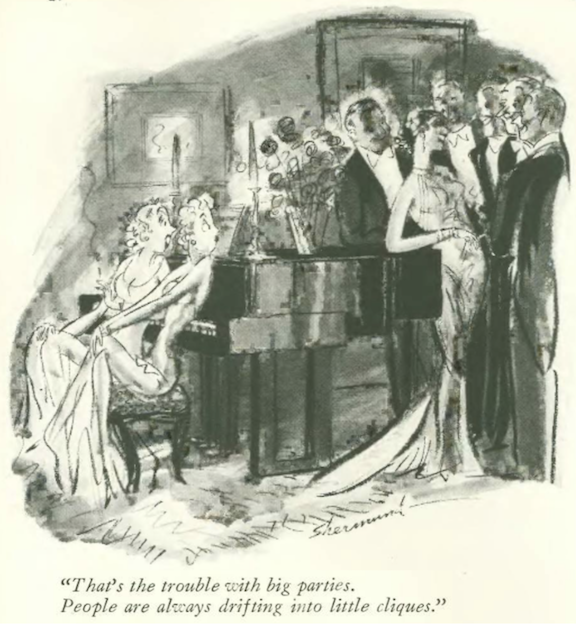
…Barbara Shermund explored politics between the sheets…
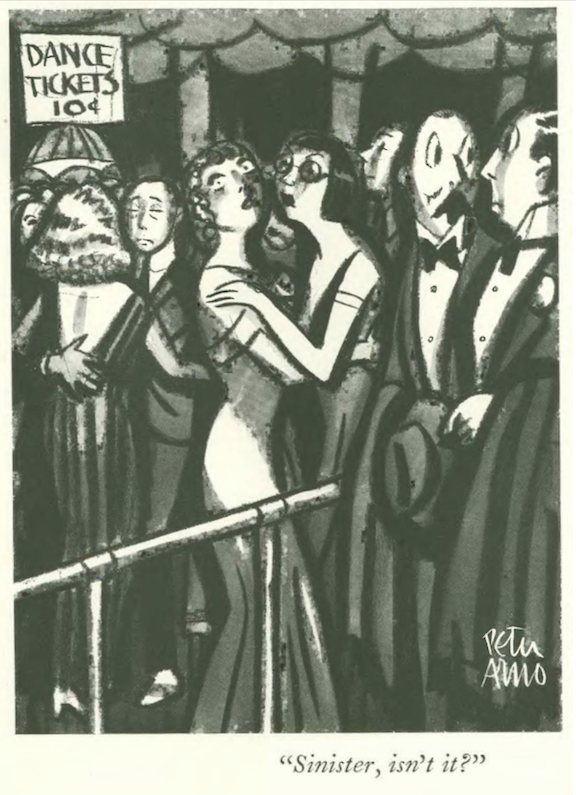
…and Peter Arno gave us his Major with a major itch to scratch…