A Picture’s Worth

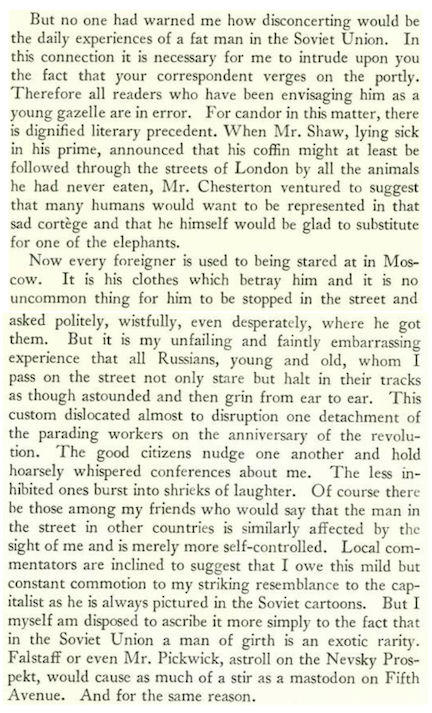
James Thurber made a rare appearance in the “Reporter at Large” column—usually the purview of the departing Morris Markey—to offer a glimpse into the life of Albert Davis and his extensive collection of theatrical and sports photographs.

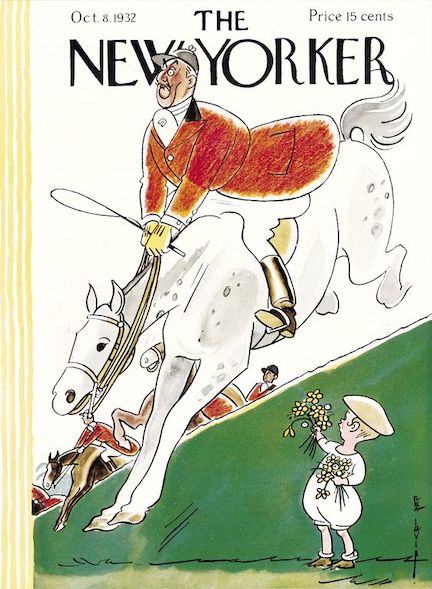
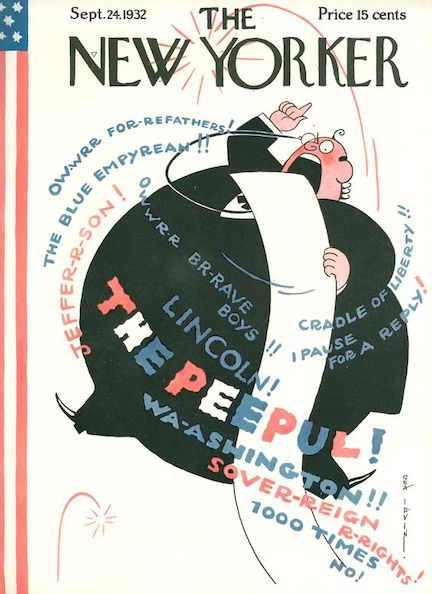
Sept. 24, 1932 cover by Rea Irvin.

A publicist by trade, Davis (1865-1942) collected thousands of photographs, clippings, programs, scripts and playbills from hundreds of productions mainly from the 1890s to the 1920s. In this excerpt, Thurber took a look into Davis’s rarefied world:

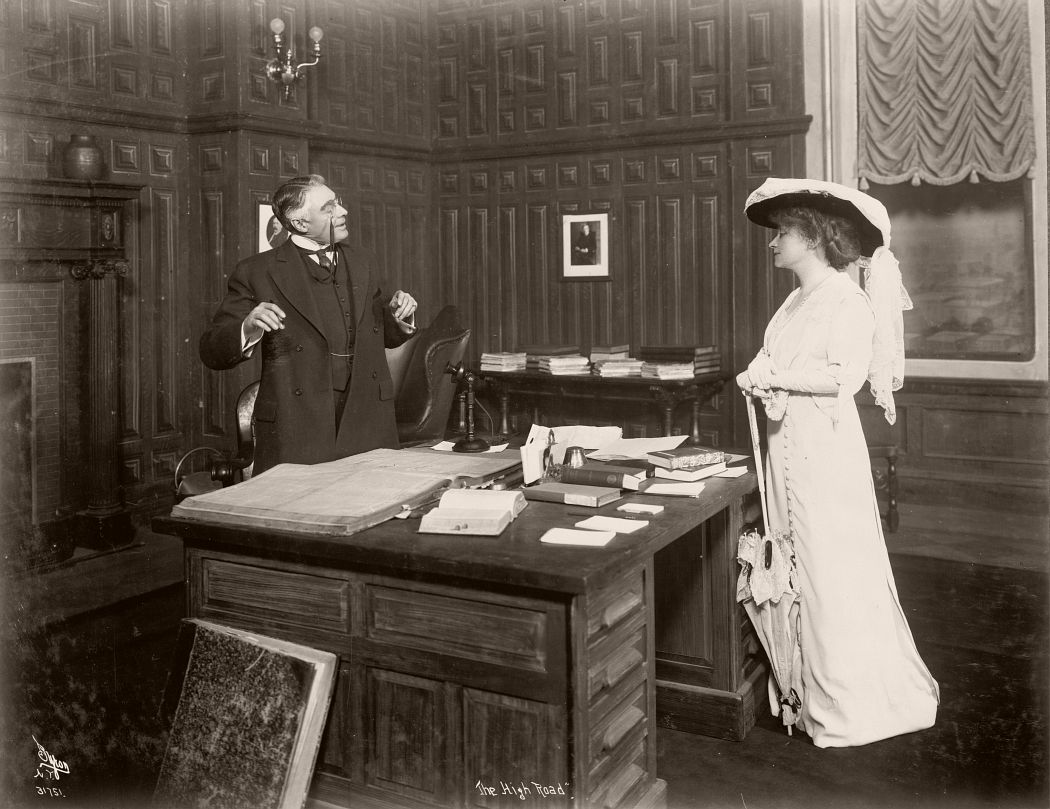
PLAYING MAKE-BELIEVE…Among the photographers collected by Davis was Joseph Byron, who captured this scene from the 1912 play The High Road by American playwright Edward Sheldon. Pictured are actors Frederick Perry and Minnie Maddern Fiske. (monovisions.com)
OSCAR THE FIRST…Theatre impresario Oscar Hammerstein (left) at Manhattan Opera House, which opened December 3, 1906. Hammerstein was the first person with whom Davis traded photographs. He was also the father of famed lyricist and musical comedy author Oscar Hammerstein II. (monovisions.com)
WHEN ALL PERFORMANCES WERE LIVE…Images of performers from the Davis collection included actor Bert Williams (ca. 1895); sharpshooter Annie Oakley (ca.1886); and actor Theodore Drury as Escamillo in Carmen (ca. 1905). (Harry Ransom Center, UT Austin)

Thurber pointed out that the collection was quite valuable, and its sale could reap a considerable sum for Davis. It seems Davis intended to present the collection to his university’s library, a wish more or less fulfilled.

Davis’s collection also contained hundreds of sports figures, mostly from the world of boxing.

TOUGH GUYS…Omaha-born Max Baer (left) defeated German champion Max Schmeling at Yankee Stadium in 1933 and took the heavyweight title in 1934; Paul Berlenbach (right) was a light-heavyweight champ from 1923 to 1926. An interesting footnote: Baer acted in 20 films, and one of his three children, Max Baer Jr., portrayed Jethro Bodine on The Beverly Hillbillies. (Stark Center for Physical Culture and Sports, UT Austin)
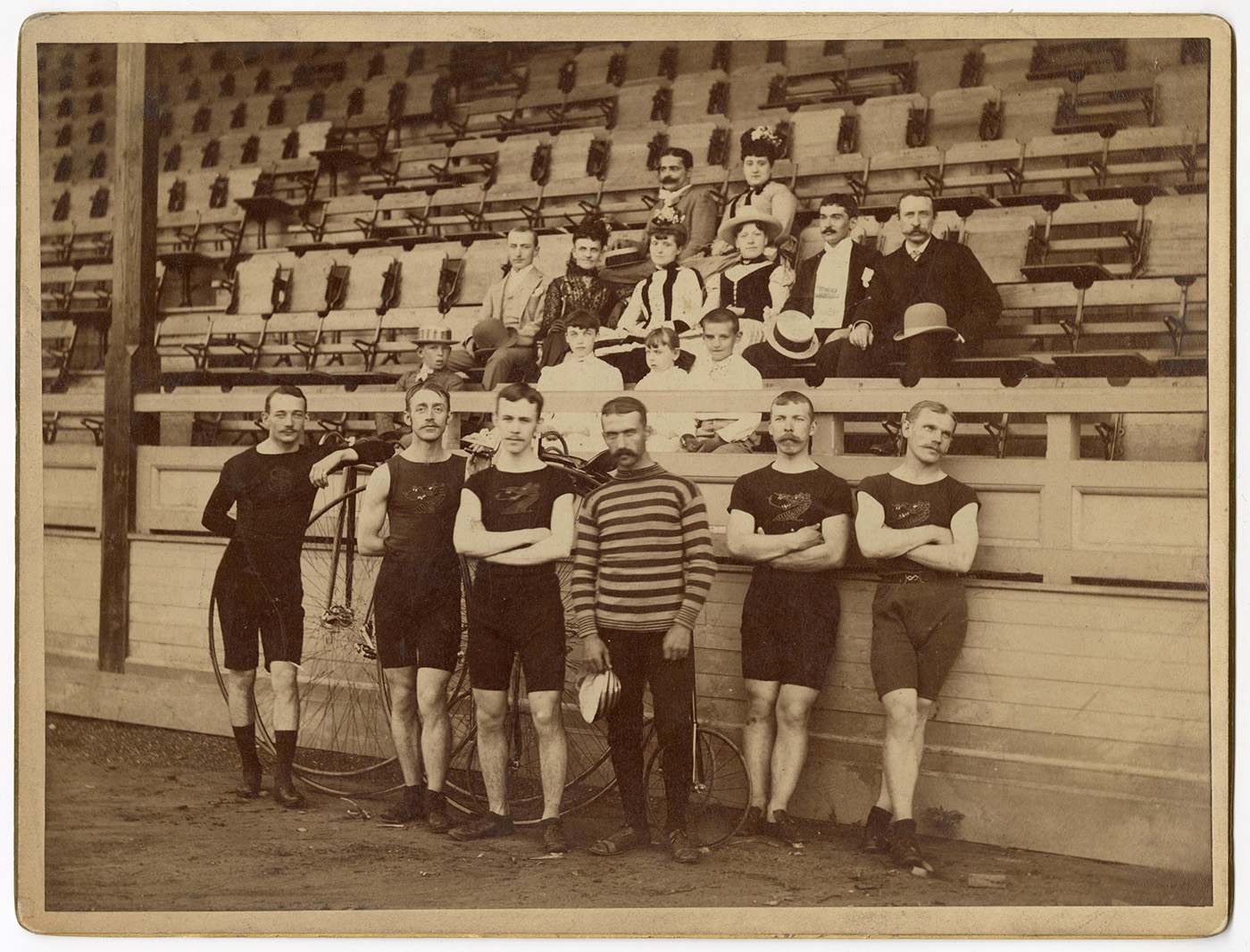
PEDDLERS…Bicycle racers at the Hartford Wheel Club’s bicycle tournament pose for an 1889 photograph in Stamford, Connecticut. (Stark Center)

Endnote: Davis wanted his collection to go to a university library, and so it finally did: it resides at the University of Texas at Austin; the theatrical photos and memorabilia are at the Harry Ransom Center, and the sports-related items are housed at the Stark Center for Physical Culture and Sports.

 *  *  *

Is It Beer-Thirty Yet?

Brewer, politician and owner of the New York Yankees baseball franchise  Jacob Ruppert Jr. (1867–1939) inherited the Jacob Ruppert Brewing Company and the Yankees upon his father’s death in 1915. It was Ruppert who purchased the contract of Babe Ruth (from the Red Sox in 1919) and built famed Yankee Stadium (1923), moves that helped propel a middling franchise to the top of the major leagues. Alva Johnston profiled Ruppert in the Sept. 24 issue; here is the opening paragraph:

LOOK WHAT I JUST BOUGHT…Jacob Ruppert purchased the contract of Babe Ruth from the Red Sox in 1919; Ruppert also inherited the Knickerbocker brewery at 92nd Street and 3rd Avenue (demolished in 1969). (historywithkev.com/brookstonbeerbulletin.com)

 *  *  *

Pol Mole

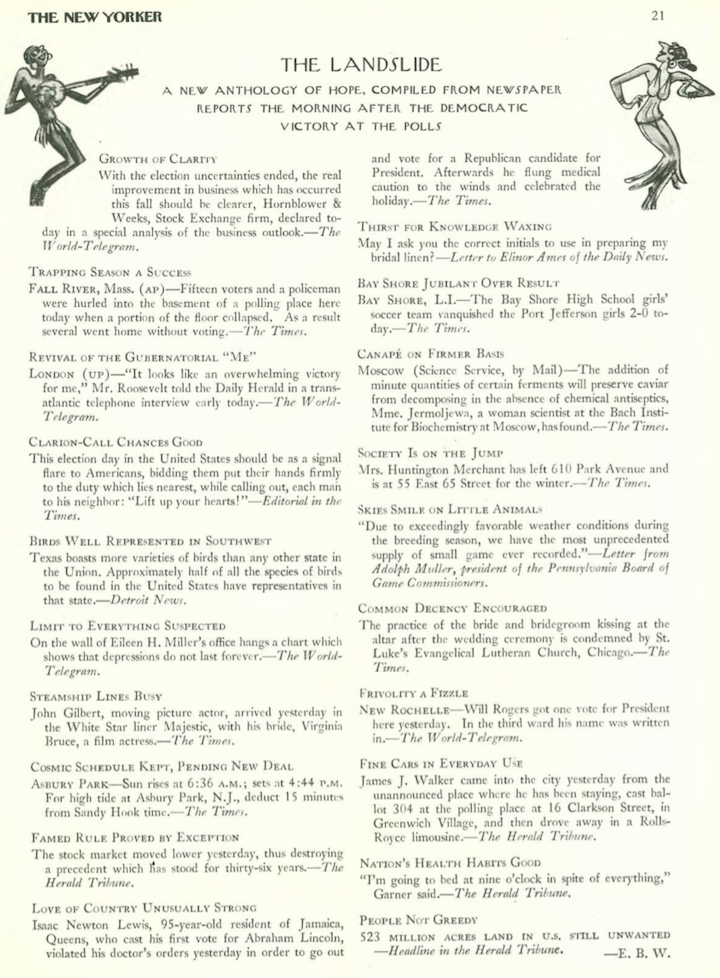
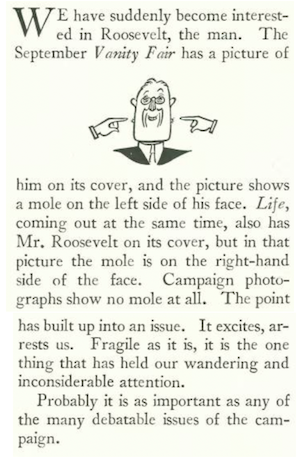
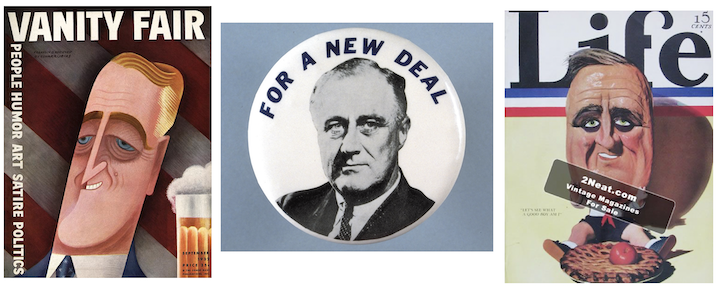
With the 1932 presidential election just weeks away, E.B. White’s focus was on an apparently elusive mole that decorated the left side of Franklin D. Roosevelt’s face, or possibly the right, or perhaps not at all…

REPRESENTING THE LEFT AND THE RIGHT…E.B. White mused on FDR’s apparently shifting mole, which appeared on the right cheek on the cover of Vanity Fair, on the left on the cover of Life, and not at all on the campaign button. (picclick.com/Britannica/2Neat.com)

This wouldn’t be the last time someone discussed FDR’s dermatology. Health experts today still debate whether a pigmented lesion above FDR’s left eyebrow was a melanoma—some even speculate that it led to his death at age 63, although the official cause of FDR’s death on April 12, 1945 was cerebral hemorrhage associated with high blood pressure. Incidentally, most photographs show the cheek mole on the right side.

 *  *  *

Words Were Their Bond

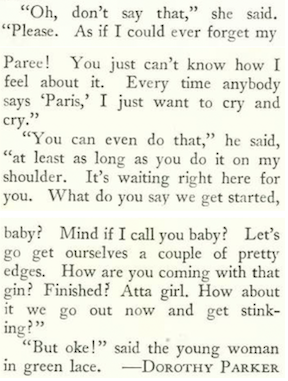
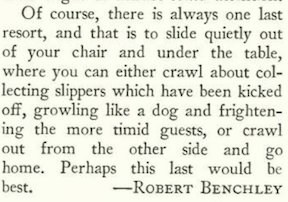
What a treat it must have been for a New Yorker reader to turn to pages 15-16 and find Dorothy Parker’s “A Young Woman in Green Lace,” followed by Parker’s dear friend and confidant Robert Benchley’s “Filling That Hiatus” on pages 17-18.

GETTING TO KNOW YOU…Dorothy Parker and Robert Benchley (far right) with their employers in 1919: Vanity Fair editor Frank Crowninshield, Vogue editor Edna Chase, and publisher Condé Nast. (publicdomainreview.org)

Benchley and Parker’s friendship began when he was hired as Vanity Fair’s managing editor in the winter of 1919 (and would become Parker’s office mate the following May). That same year they were among the founders of the famed Algonquin Round Table.

“A Young Woman in Green Lace” reveals how Parker regarded some of the modern women of those times, this next-generation flapper, a bit childish and snobbish, wishing she were back in “Paree.” In the story a man presses his charms as the woman descends into drunkenness and drops her Continental facade:

Where disillusion creates a darkly comic mood in Parker’s piece, in Benchley’s world disillusion provided a nice opening for some silliness. In ”Filling That Hiatus” Benchley addressed a seldom-discussed dinner-party etiquette situation in which both your right- and left-hand partners become engaged in conversation with someone else. He concluded:

 *  *  *

His Country, Too

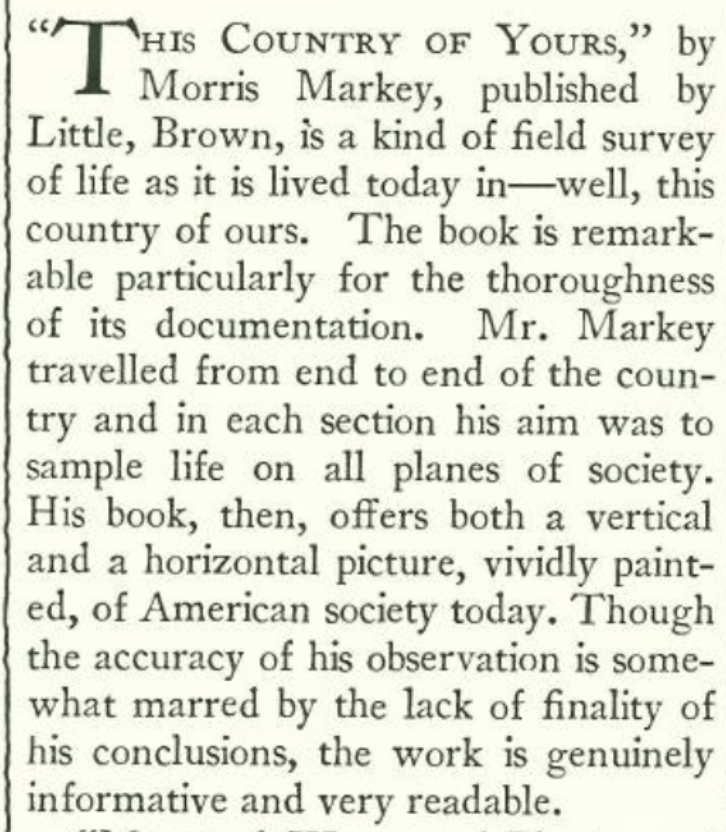
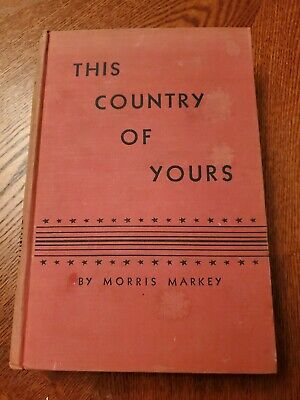
It is always with a tinge of sadness that I write about Morris Markey, who from the start wrote for virtually every department at The New Yorker and was best known for his “A Reporter at Large” feature. According to his obituary in The New York Times, Markey won his greatest recognition for the book This Country of Yours, published after he left The New Yorker. That magazine’s review was brief, and read thusly:

The book is mostly forgotten today, as is Markey, who was found shot to death on July 12, 1950 at his home in Halifax, Virginia. He was just 51 years old. There was insufficient evidence as to whether the wound behind his right ear was the result of accident, homicide, or suicide.

Here is what the Times (Sept. 10, 1932) had to say about Markey’s book:

 *  *  *

From Our Advertisers

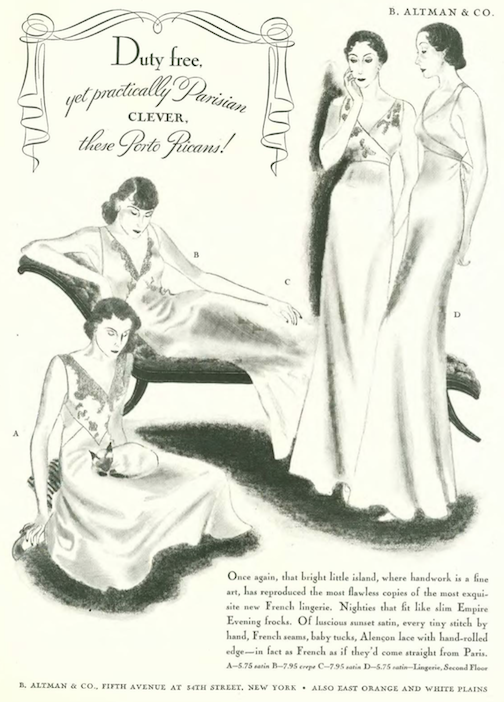
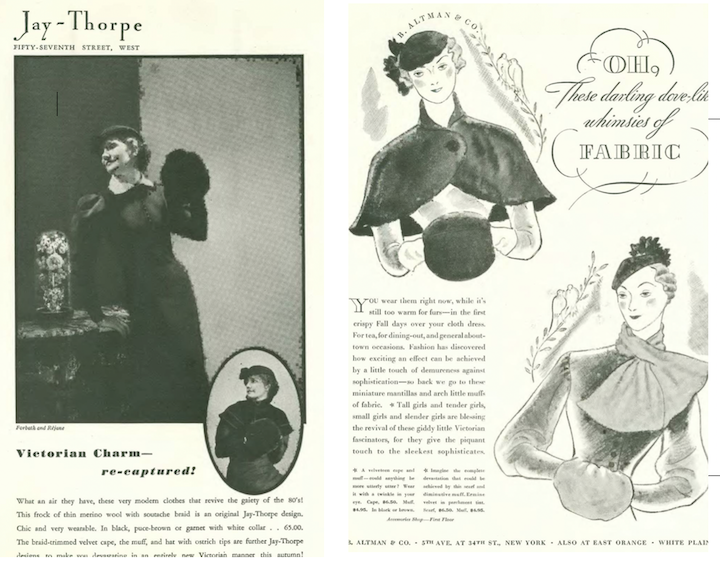
With cold weather arriving during the Depression’s worst year, fashions continued to borrow from the past for a more conservative look (these are two ads from Jay-Thorpe and B. Altman)…

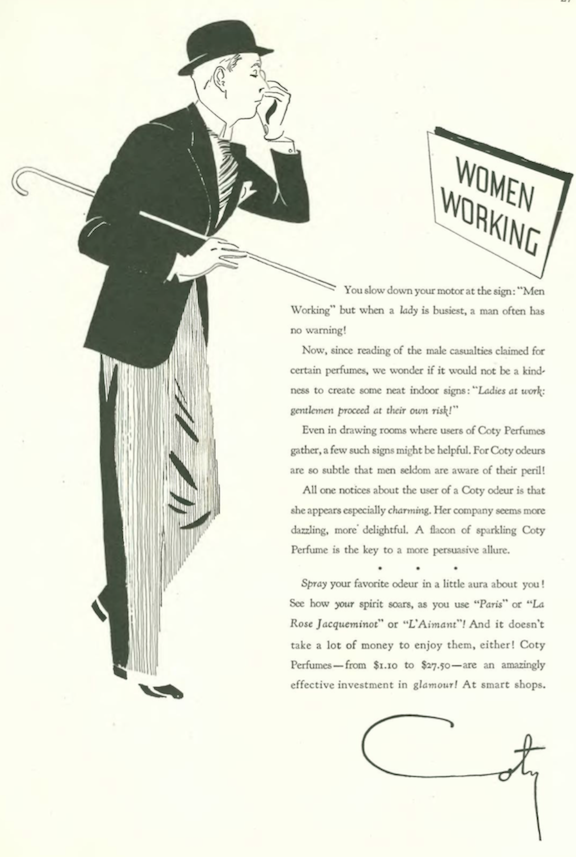
…as for the gentleman, fashion continued to emphasize a genteel look (although there is a bit of the Little Tramp about this fellow)…

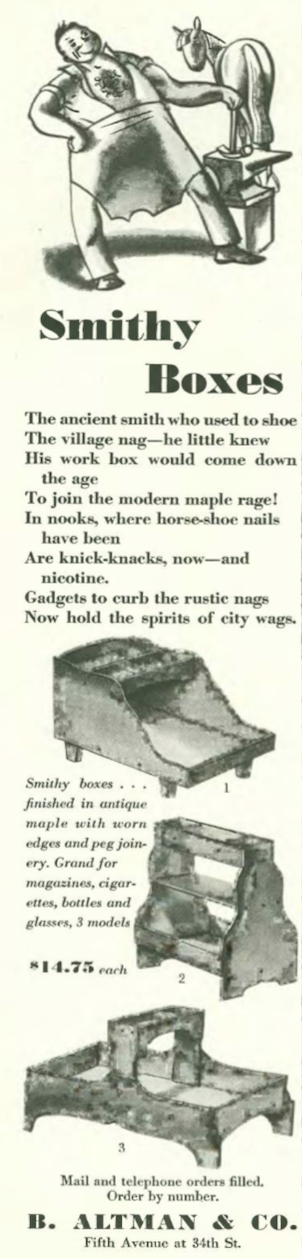
…then as now, folks turned toward the rustic to find a bit of comfort in uncertain times…

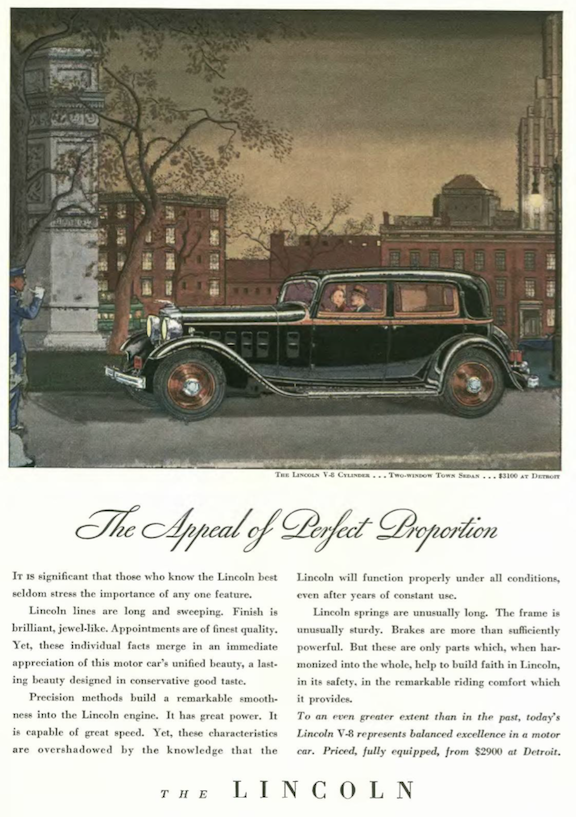
…and if they could afford it, the comforts of the stolid, solid Lincoln motorcar…

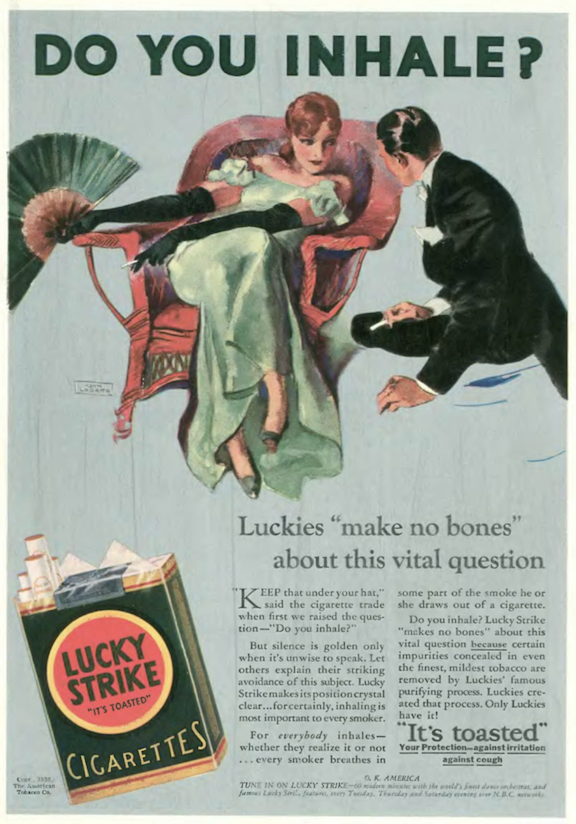
…the folks at Lucky Strike continued to ask this question…

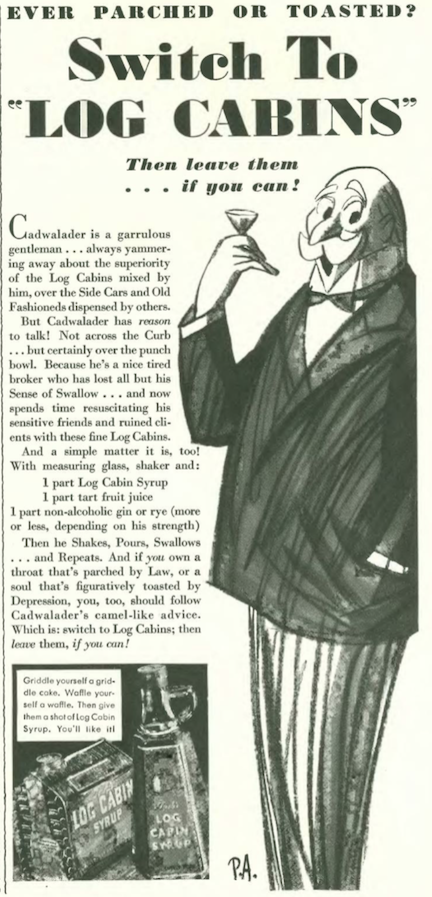
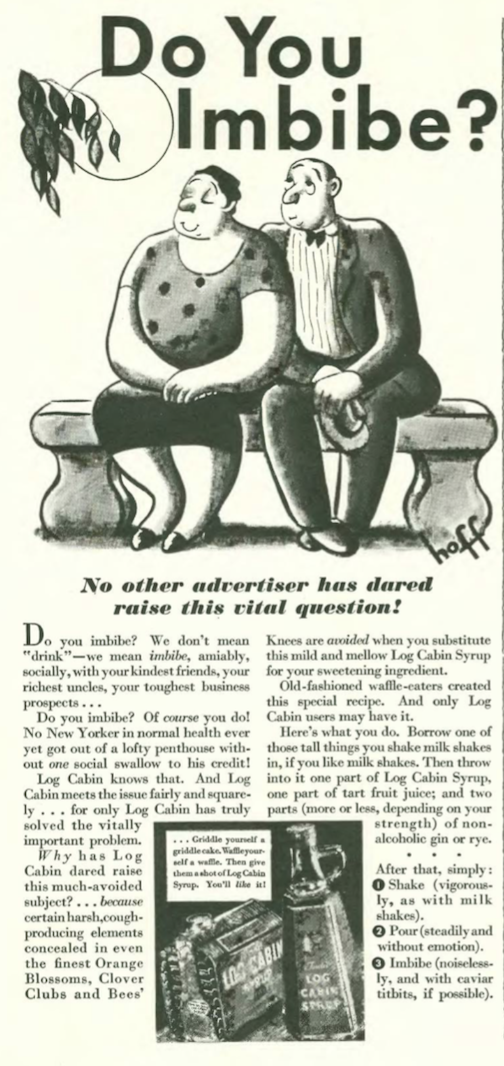
…and with the help of Syd Hoff, the makers of Log Cabin syrup ran this parody ad (in the Oct. 1 issue) of the Lucky Strike campaign…Hoff was among the newest members of The New Yorker cartooning cast…

…as was William Steig, who featured one of his “Small Fry” to tout the benefits of decaf coffee…

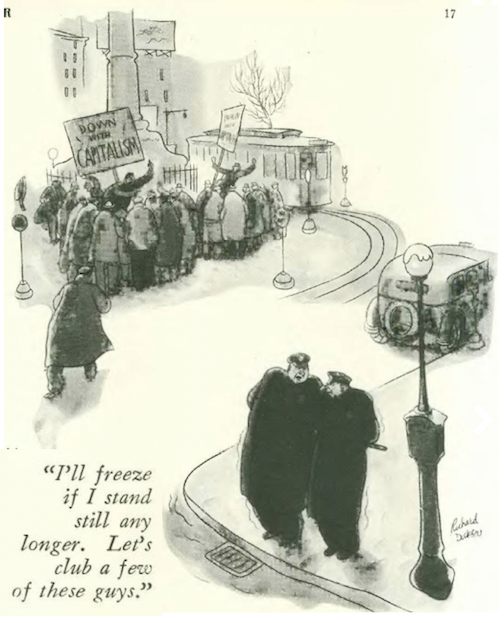
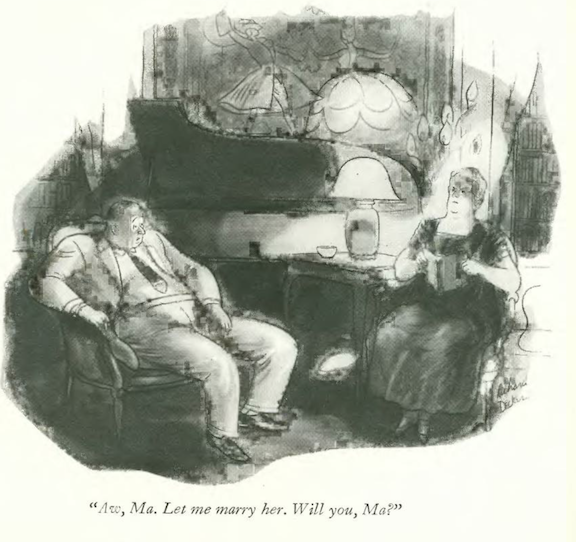
…our cartoon from the Sept. 24 issue is by Richard Decker

…on to Oct. 1, 1932…

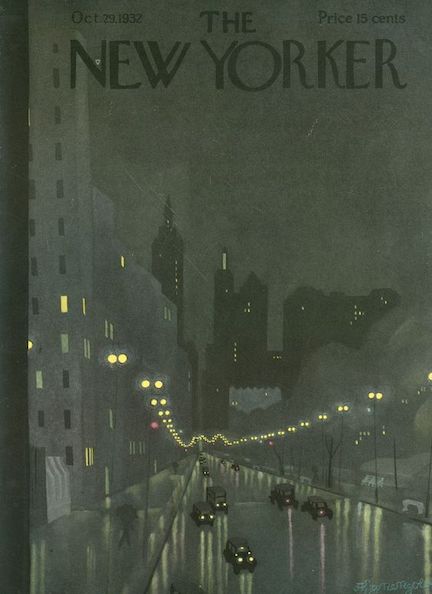
Oct. 1, 1932 cover by Peter Arno.

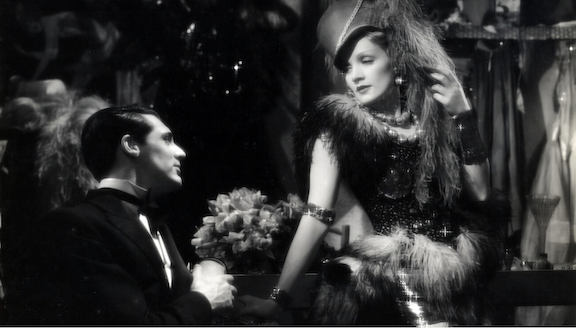
…where film critic John Mosher took in the latest from Marlene Dietrich and came away less than dazzled by Blonde Venus

Now something of a cult film, reviews were mixed when Blonde Venus was released in 1932. The New York Times’ critic Mordaunt Hall went even further than Mosher, calling the film a “muddled, unimaginative and generally hapless piece of work, relieved somewhat by the talent and charm of the German actress…”

WELL HELLO THERE…Cary Grant made his film debut in 1932 in This Is the Night—he went on to appear in eight films that year, including Blonde Venus with Marlene Dietrich. (MoMA)

 *  *  *

Unlucky in Luck

In its early years The New Yorker paid little attention to baseball, but “The Talk of the Town” did appreciate a human interest story from the field every now and then, and Yankee batboy Eddie Bennett filled that bill—this was the second time Bennett was featured in the column…

LUCKY EDDIE…Top, Eddie Bennett in 1921, the year he became the Yankees’ batboy; below, with slugger Babe Ruth in 1927; at right, newspaper profile the year after the 1927 World Series. As an infant Bennett twisted his spine in a carriage accident that stunted his growth and gave him a misshapen back.(Library of Congress/The New York Times/Brooklyn Citizen)

Throughout the 1920s Bennett was a famed good luck charm for the Yankees, but when a taxicab struck him in 1932 his batboy career ended. According to The New York Times (April 2, 2021) “Three years later, Mr. Bennett was found dead in a furnished room on West 84th Street. Autographed photos from Herb Pennock and Waite Hoyt, both pitchers for the Yankees, hung on the walls…Balls and bats signed by Ruth and Lou Gehrig decorated the room. An autopsy found that Mr. Bennett had died of alcoholism. He was 31.”

For 85 years, Bennett rested in an unmarked grave at St. John’s Cemetery in Queens, but last November he was remembered with a new marker and a simple ceremony. You can read more about it in this Times article.

 *  *  *

Original Verse

Ogden Nash was working as an editor at Doubleday when he submitted some rhymes to The New Yorker. Harold Ross (New Yorker founder/editor) saw the submissions and asked for more, apparently stating “they are about the most original stuff we have had lately.” Here is one of the later submissions:

 *  *  *

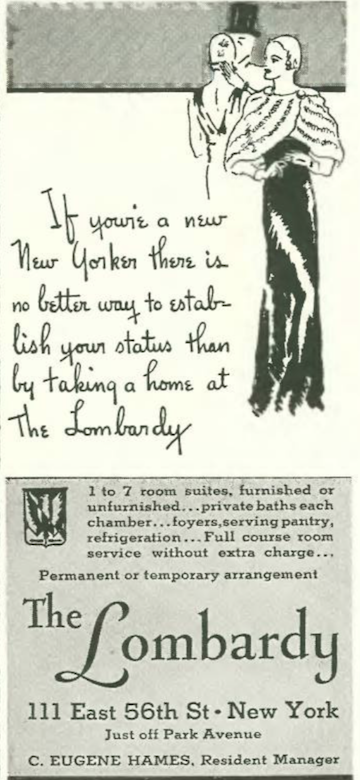
From Our Advertisers

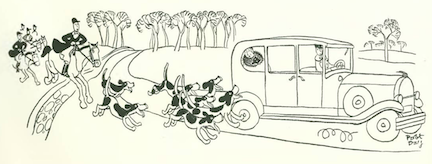
If you were of the male persuasion and a member of the smart set you probably dressed down in something like this for a day with your dressage buddies…

…the modern woman of the 1930s could also be a successful business woman in this “successful” frock (how that translated into reality was another thing)…what is also interesting about this ad is how it features both an illustration and a photograph of the same outfit—it’s as though they’ve acknowledged that the attenuated figure in the illustration, although eye-catching, does not resemble an actual body type…

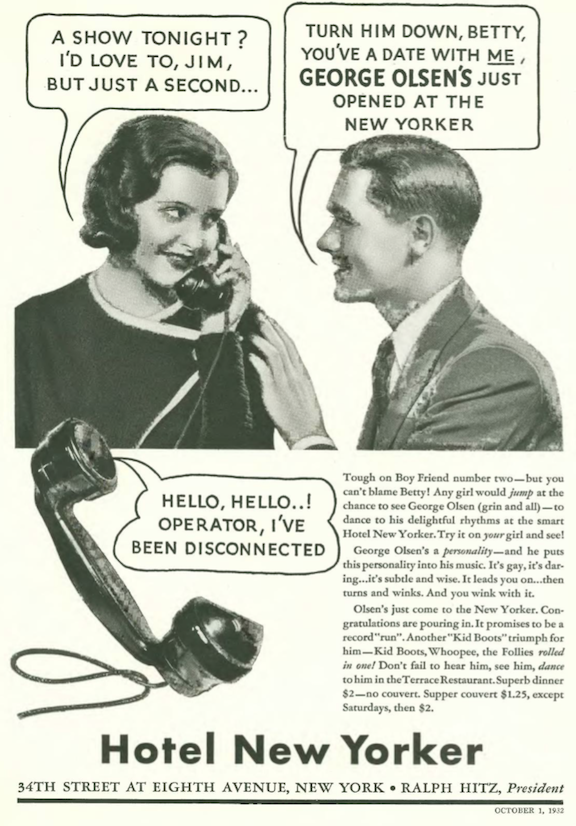
…here was see an early use of the word balloon in an advertisement featuring real people—I wonder if this was inspired by the comics, or by Bernarr Mcfadden’s “composographs” featured in his New York Evening Graphic?…

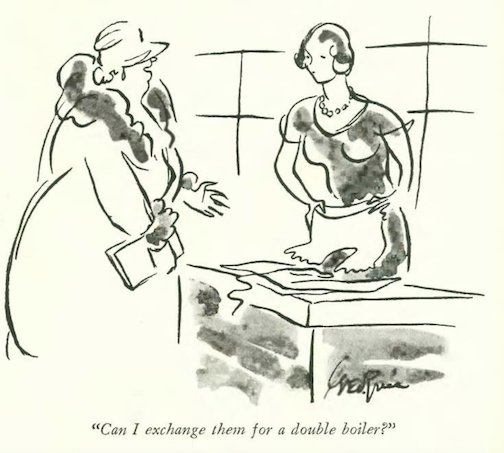
…on to our cartoonists, we begin with a strange bit of bedside manner courtesy Gardner Rea

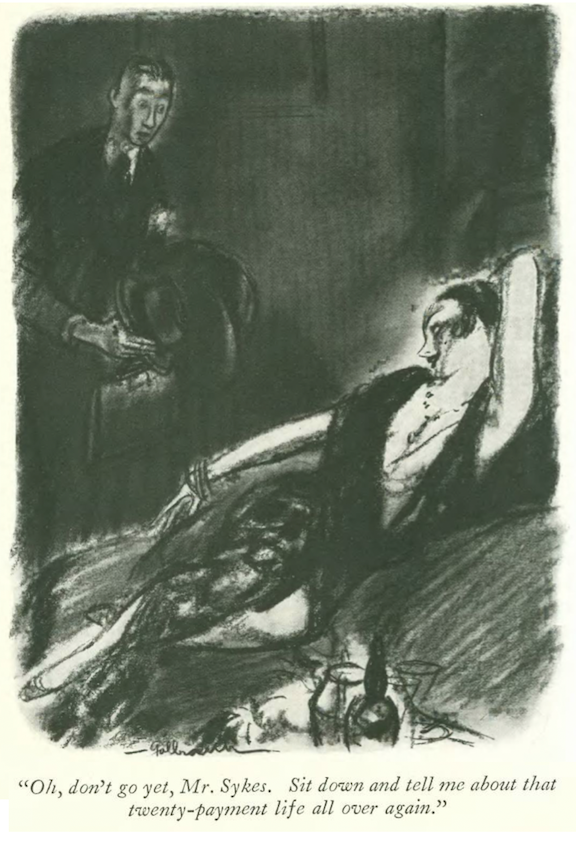
Robert Day introduced us to a modest suspect…

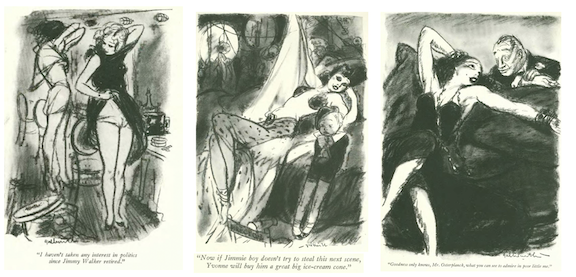
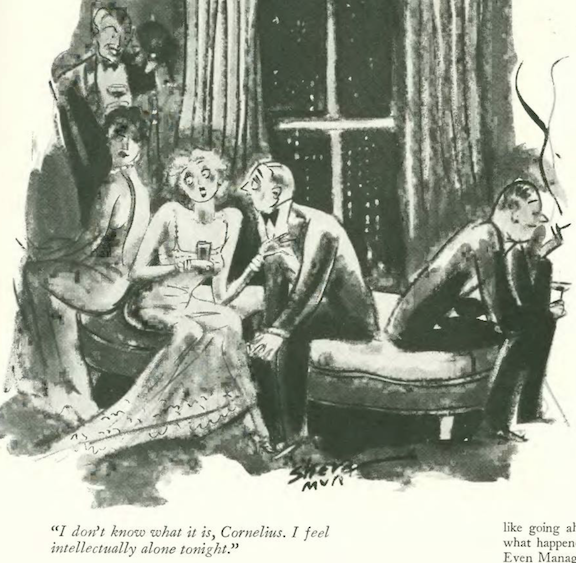
Barbara Shermund continued to explore the travails of modern women…

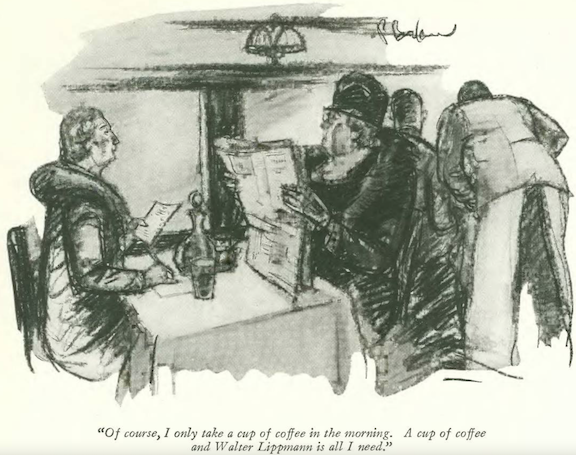
…while this woman (via Perry Barlow) seems quite content with her lot…

…Mayor Jimmy Walker was out, but not down, like these fellows presented by Alan Dunn

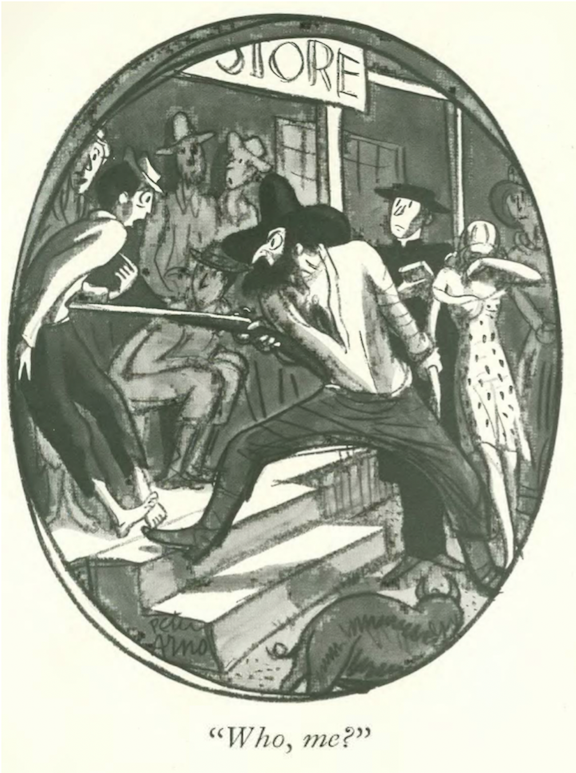
…and we close with Peter Arno, announcing some upcoming nuptials…

Next Time: An Instant Star…


The Red House

From the 1930s until the 1950s, New York City was the one place where American communists almost became a mass movement.


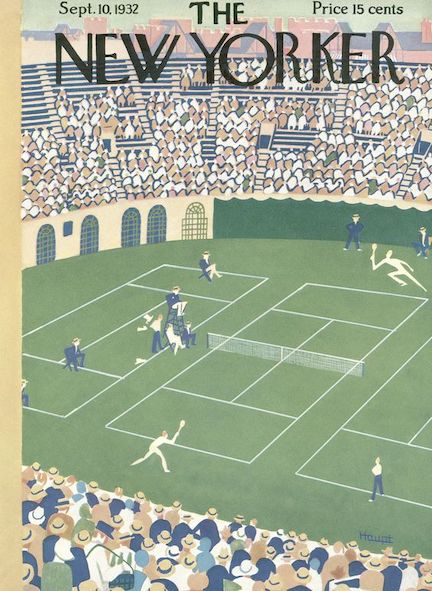
Sept. 10, 1932 cover by Theodore Haupt.

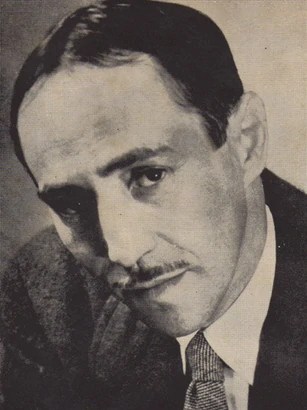
Writing in The New York Times opinion section (Oct. 20, 2017), Maurice Isserman observed how in those days New York party members “could live in a milieu where co-workers, neighbors and the family dentist were fellow Communists; they bought life insurance policies from party-controlled fraternal organizations; they could even spend their evenings out in night clubs run by Communist sympathizers…” we skip to the Sept . 17 issue in which journalist Matthew Josephson penned a report on the movement for the Reporter at Large” column titled “The Red House”…excerpts:

According to Isserman (a professor of history at Hamilton College), in 1938 the Communist Party of America counted 38,000 members in New York State alone, most of them living in New York City. A Communist candidate for president of the board of aldermen received nearly 100,000 votes that same year, with party members playing a central role in promoting trade unions.

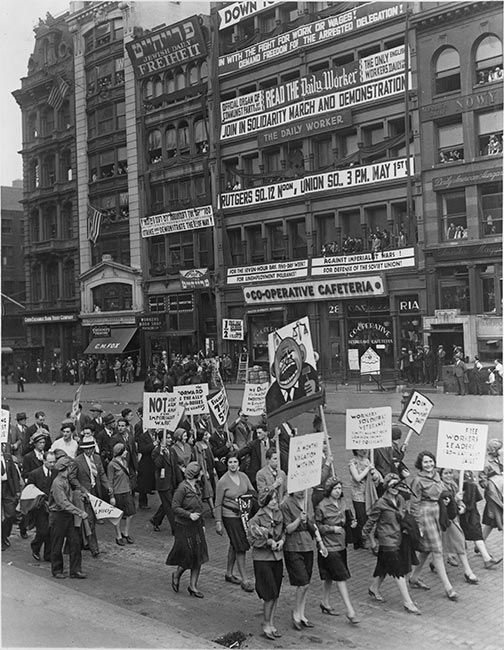
BOSS’S DAY…Communists march at Union Square against “the boss class” at a 1930 rally in New York City.  (Oxford Research Encyclopedias)
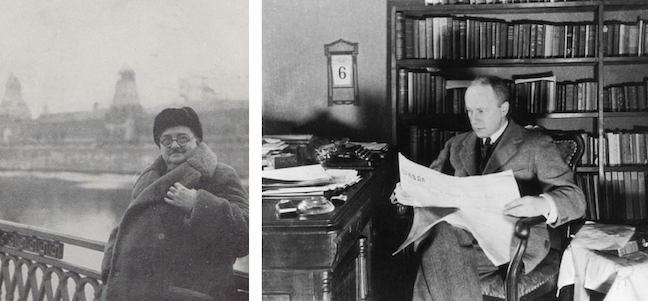
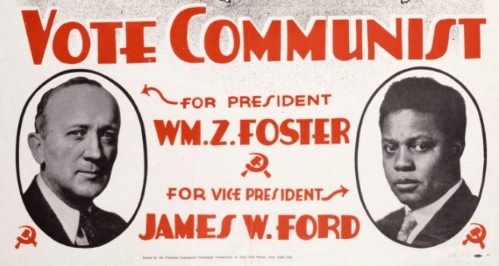
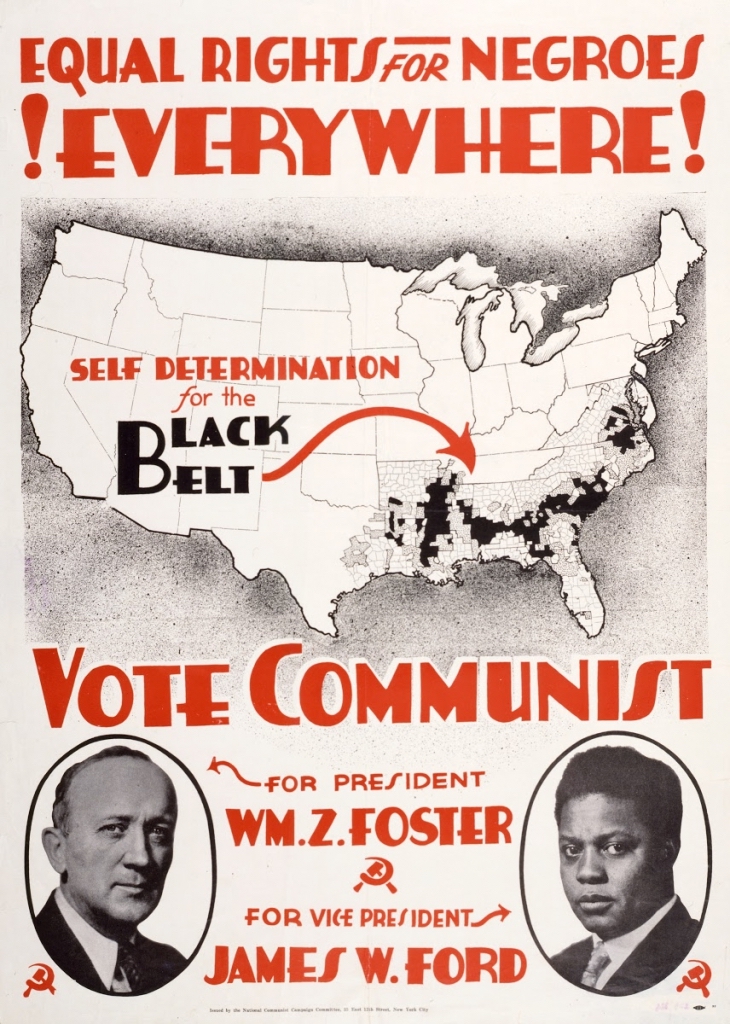
PARTY INVITATION…William Z. Foster and James W. Ford were on the Communist ticket in the 1932 U.S. presidential elections. Ford (1893–1957) was also on the 1936 and 1940 tickets as a vice-presidential candidate. (peoplesworld.org)

Josephson commented on the candidates appearing on the Communist ticket in the 1932 U.S. presidential elections, finding James W. Ford to be “much more intellectual” than his running mate:

THE HQ…Communist Party of America headquarters, 13th St., New York City, 1934; a close-up view of the Workers’ Bookshop display window in 1942. (USC Libraries/Library of Congress)
A regular New Yorker contributor, journalist Matthew Josephson (1899–1978) popularized the term “robber baron” with the publication of his 1934 book, The Robber Barons: The Great American Capitalists. (nationalbook.org)

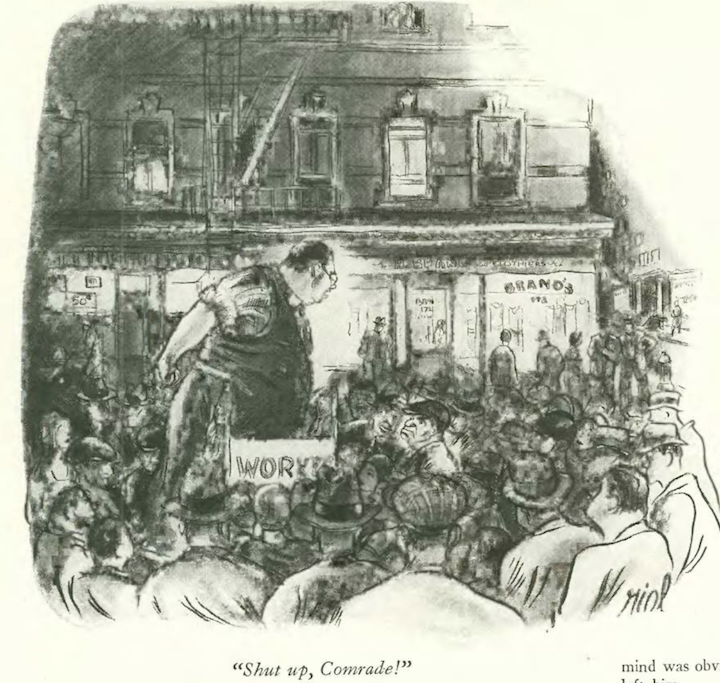
Josephson concluded his article with observation of a party protest event, and one unmoved police officer…

Postscript: The Cold War in the 1950s and a renewed Red Scare spelled the end of the party’s heyday, as did Nikita Khrushchev’s 1956 speech that denounced the murderous legacy of his predecessor, Josef Stalin.

*  *  *

Très Chic

For those with means, the idea of living in the same building with other non-family humans seemed unseemly, but in 1870 Rutherford Stuyvesant hired Richard Morris Hunt to design a five-story apartment building for middle-class folks that had a decidedly Parisian flair. The Sept. 10 “Talk of the Town” explained:


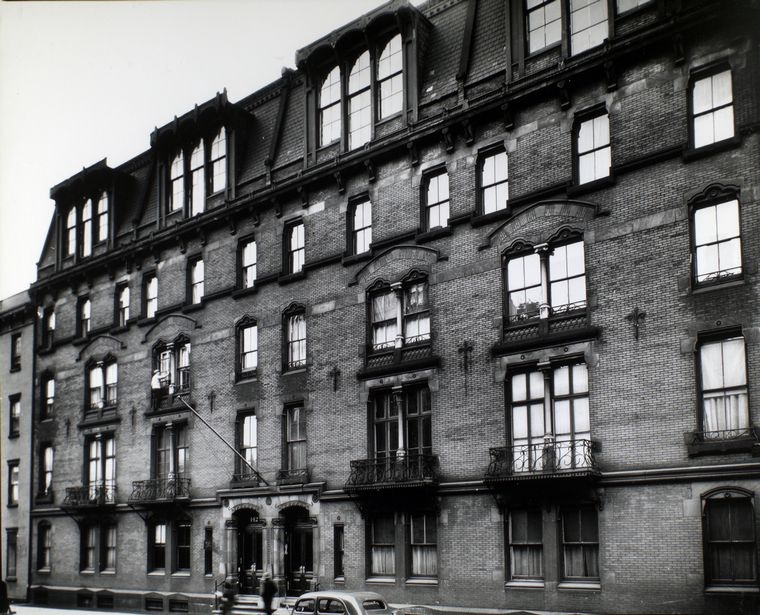
According to Ephemeral New York, the apartments were initially dubbed a “folly,” but the building’s 16 apartments and four artists’ studios—located near chic Union Square—were quickly snapped up, creating a demand for more apartments. The building remained fully occupied until it was demolished in 1958. According to another favorite blog—Daytonian in Manhattan—demolition of Morris Hunt’s soundly built, sound-proof building was a challenge.

IT DIDN’T GO QUIETLY…Stuyvesant Flats at 142 East 18th Street, 1935, in a photo by Berenice Abbott. It was demolished in 1958. (New York Public Library)

*  *  *

Some Characters

I include this brief snippet of the Sept. 10 “Profile” for the jolly illustration by Abe Birnbaum of Al Smith, Jimmy Hayes and the Prince of Wales…

*  *  *

Down In Front

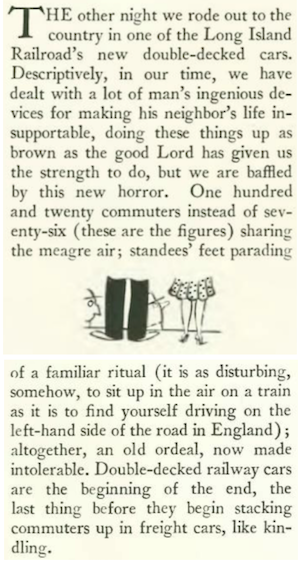
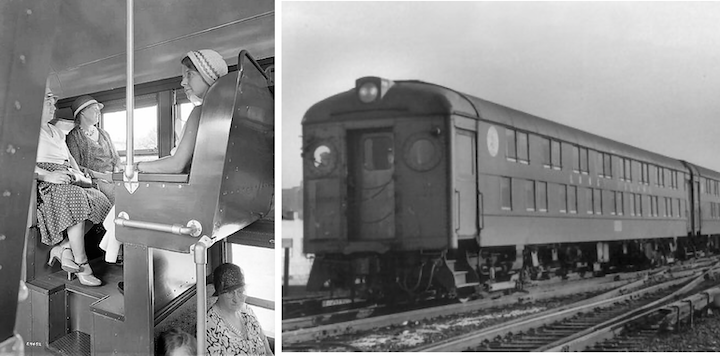
E.B. White was always on the lookout for the newfangled in the world of transportation, but this latest development by the Long Island Railroad was not a breath of fresh air…

STACK ‘EM UP…A woman wears a bemused expression (left) as she takes in her surroundings on one of the Long Island Railroad’s new double-decked cars in 1932. (trainsarefun.com)

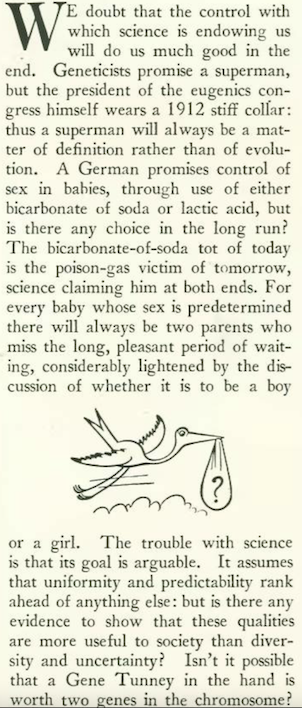
White also looked in on the latest news from the world of genetics—with hindsight we can read about these developments with a degree of alarm, since Hitler was months away from taking control of Germany…

*  *  *

Showing His Colors

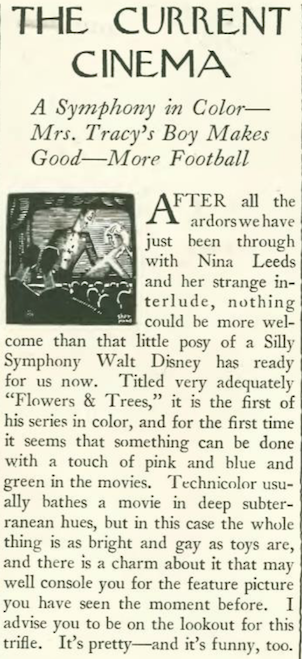
On to lighter matters, critic John Mosher enjoyed an eight-minute animated Walt Disney short, Flowers and Trees—the first commercially released film made in full-color Technicolor…

SEEING GREEN…Walt Disney’s Flowers and Trees won the very first Academy Award for Best Animated Short Film in 1932. (intanibase.com)

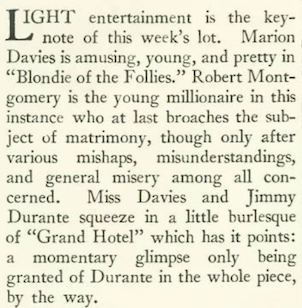
…Mosher also took in light entertainment of the live-action variety with Marion Davies and Billie Dove providing some amusement in Blonde of the Follies, although the picture could have used a bit more Jimmy Durante, billed as a co-star but making an all-too-brief appearance…

WHERE’S THE DUDE WITH THE SCHNOZ?…Billie Dove (left) starred with headliner Marion Davies in Blondie of the Follies, but another co-star, comedian Jimmy Durante, was mostly absent from the picture. (IMDB)

*  *  *

From Our Advertisers

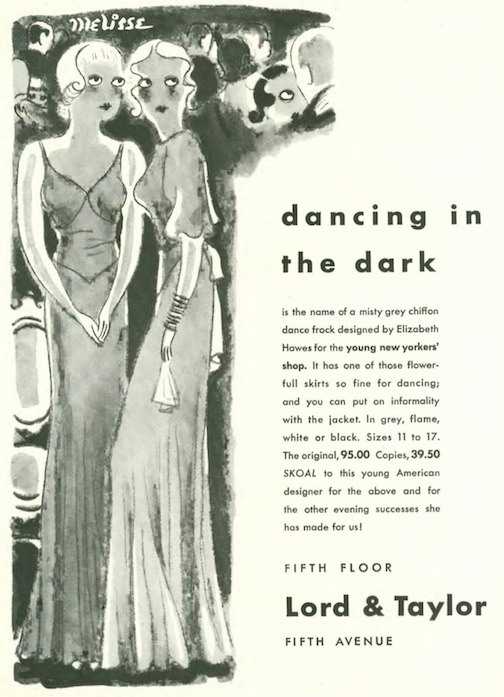
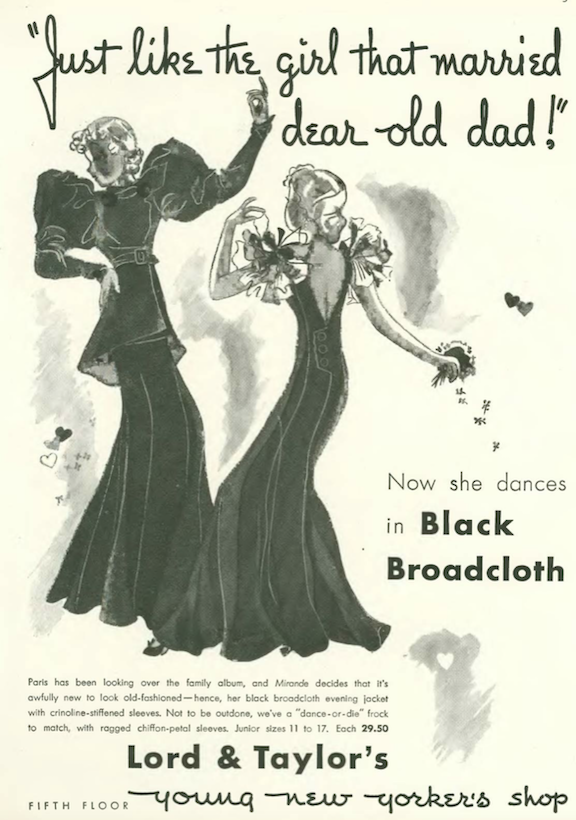
Lord & Taylor announced the return of Edwardian styles as the latest in fashion among the younger set, once again proving what goes around comes around, ad infinitum

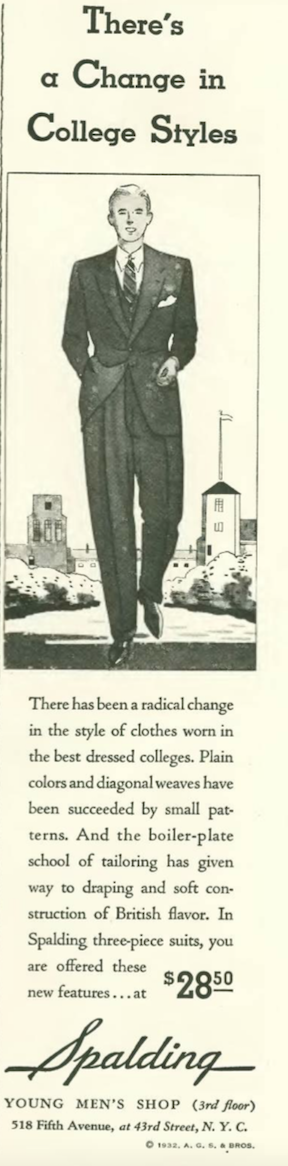
…except when it comes to “college styles”…I don’t see this look returning to our campuses anytime soon…

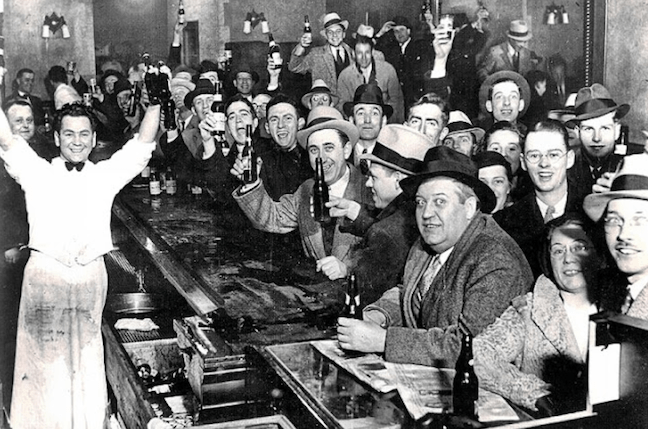
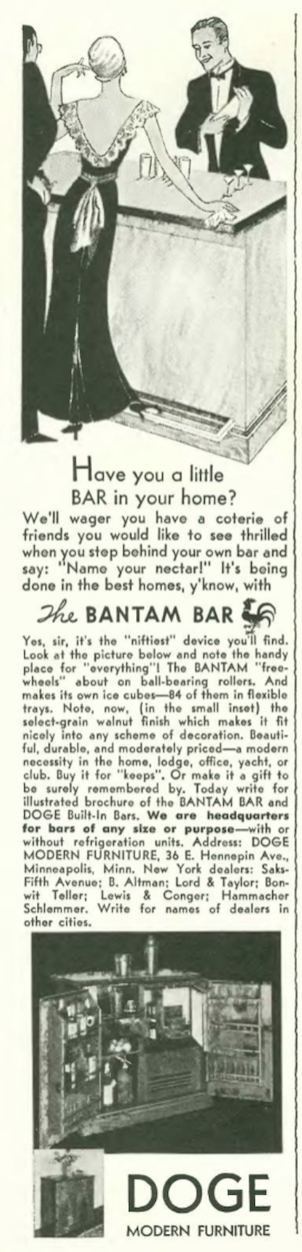
…the end of Prohibition was still a year away, but at least in New York it was all but over…I like the Hoffman ad and its winking line “with or without”…

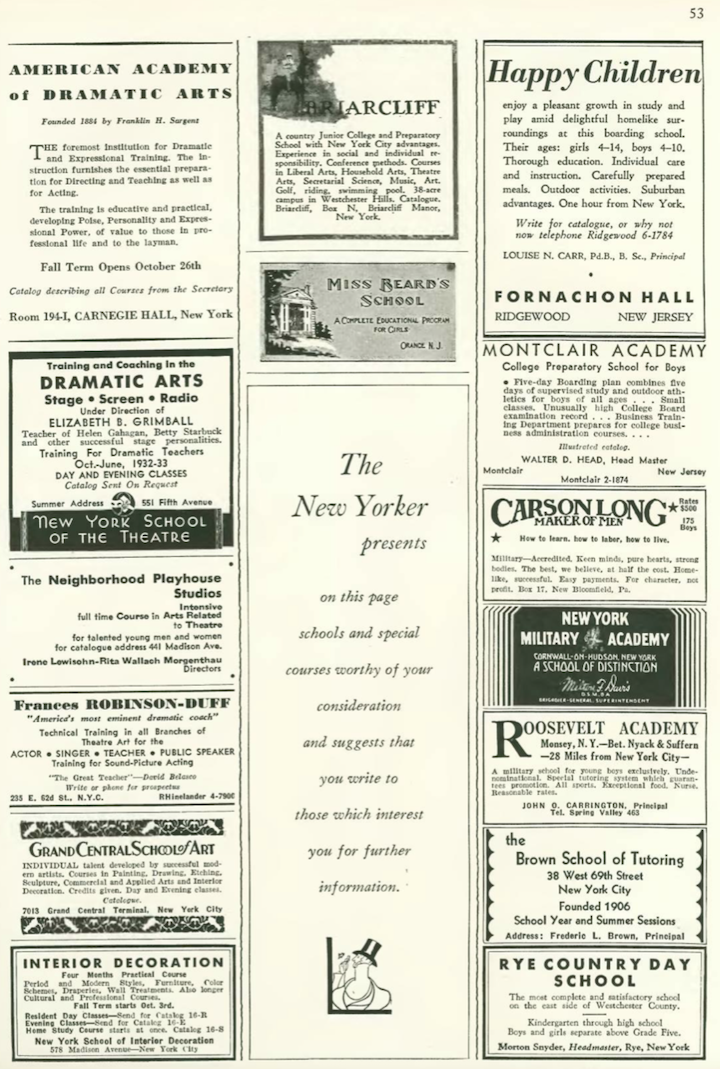
…as a courtesy to readers (and to fill a blank space) the New Yorker    “presented” a full page of signature ads touting a variety of specialty schools and courses…the Carson Long Military Academy (right hand column) closed in 2018 after 182 years of “making men”…

…on to our cartoonists and illustrators, we begin with this Isadore Klein illustration in the opening pages…

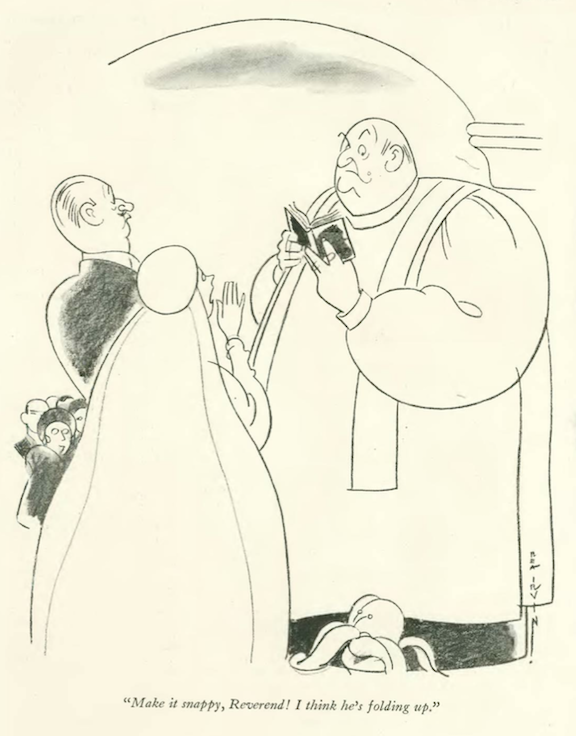
Rea Irvin gave us a nervous moment at the altar…

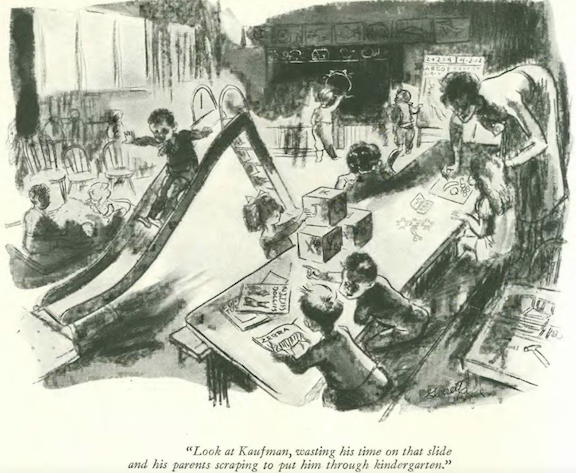
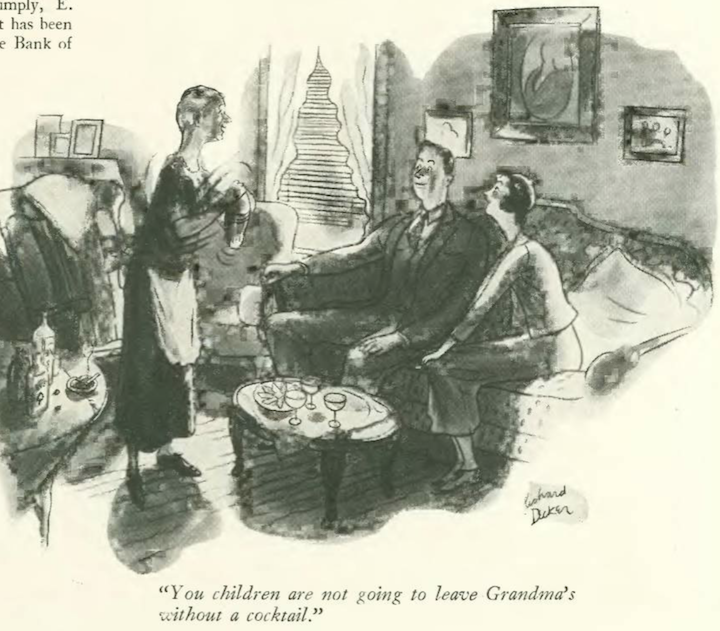
…and Richard Decker showed us one groovy grandma…

…on to the Sept. 17 issue (which we dipped into at the start)…and what a way to begin with this terrific cover by Peter Arno

Sept. 17, 1932 cover by Peter Arno.

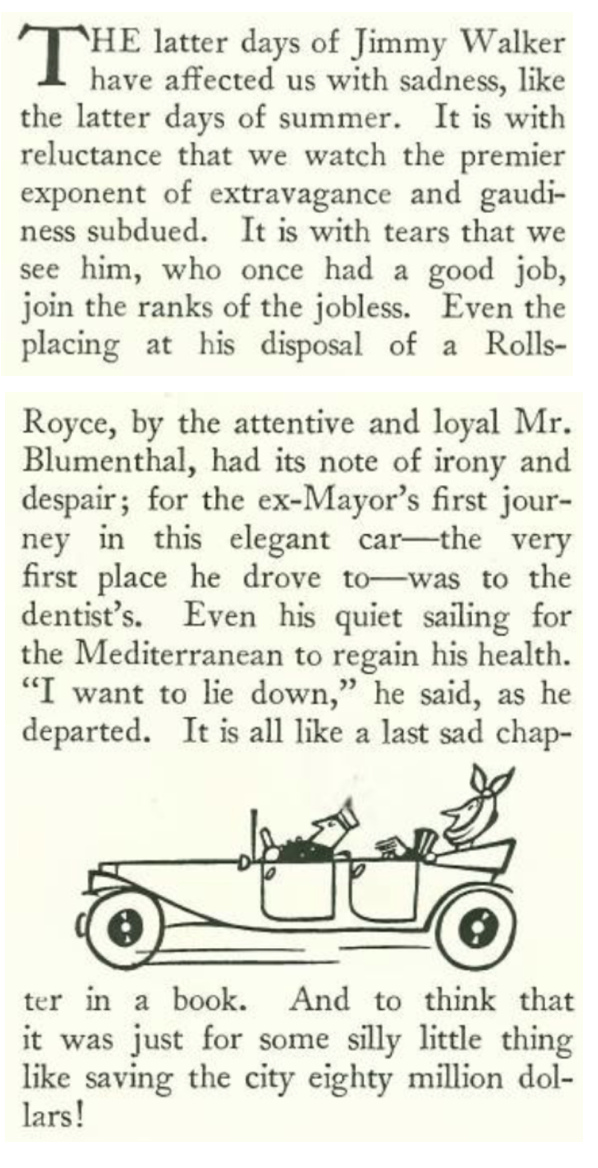
…in his “Notes and Comments,” E.B. White offered some parting words for the departing (and scandal-ridden) Mayor Jimmy Walker

THAT’S ALL FOLKS…Deposed New York Mayor Jimmy Walker skipped town shortly after he left office and caught a boat to Europe. He is seen here at his wedding to Betty Compton in Cannes, April 1933. (Library of Congress)

…and Howard Brubaker added his two cents regarding Walker and his replacement, Joseph McKee, who served as acting mayor until Dec. 31, 1932…

*  *  *

Heady Role

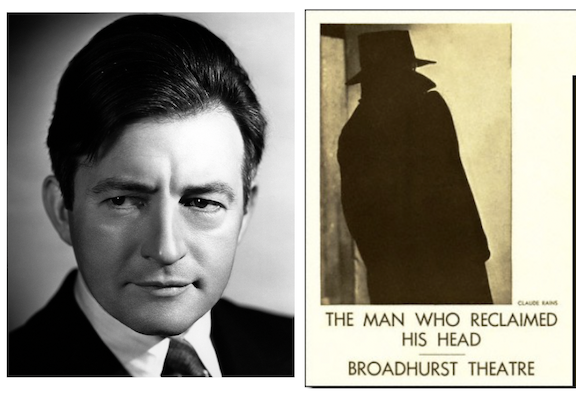
The British actor Claude Rains earned his acting chops on the London Stage before coming to Broadway, where in 1932 he appeared in The Man Who Reclaimed His HeadE.B. White was subbing for regular critic Robert Benchley, and concluded that Rains should have used his own head before agreeing to appear in such silly stuff…

NO MORE HEAD JOKES, PLEASE…Although he got a late start on his Hollywood career, Claude Rains (1889—1967) became one of the silver screen’s great character stars. (Playbill)

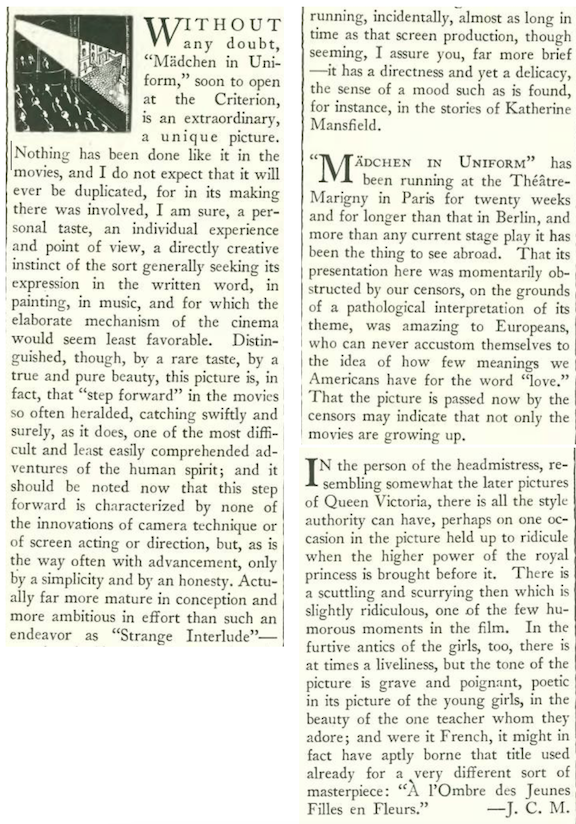
…and speaking of the silver screen, we turn to critic John Mosher and his review of the 1931 German film

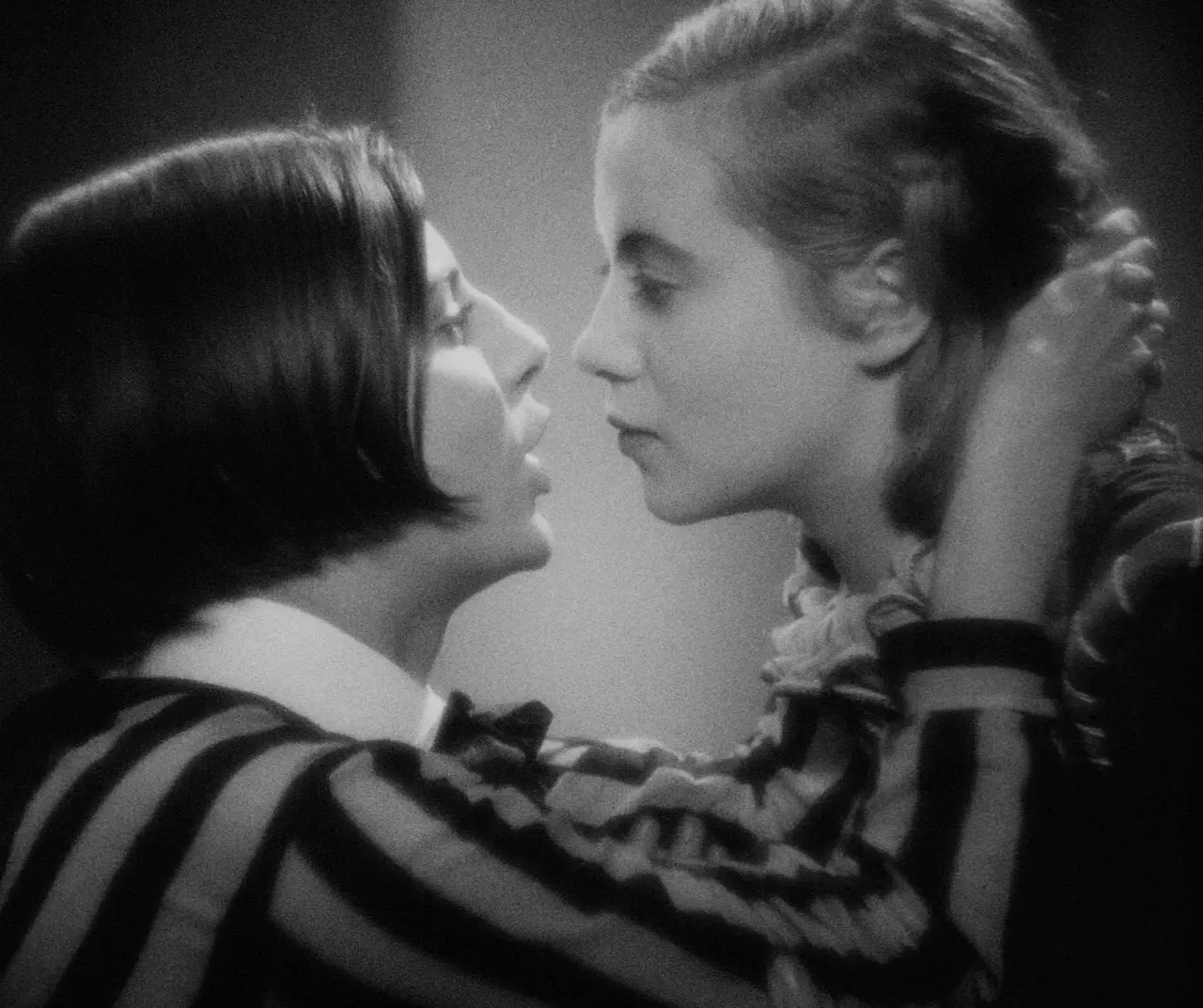
WOMEN IN REVOLT…The New York Times (in 2020) describes 1931’s  “expression of anti-fascism and a lesbian coming-out story.” The film was a success throughout Europe, but was later banned as “decadent” by the Nazi regime. Above, Ellen Schwanneke, left, and Hertha Thiele in Mädchen in Uniform. (Kino Lorber)

Mädchen in Uniform was almost banned in the U.S., but Eleanor Roosevelt spoke highly of the film, resulting in a limited US release (albeit a heavily-cut version) in 1932–33.

*  *  *

From Our Advertisers

I’m featuring this detail from an Elizabeth Arden ad because the illustrator’s style is so distinct…if someone knows the identity of the artist, please let us know (on other drawings I’ve seen a signature that looks like “coco”)…

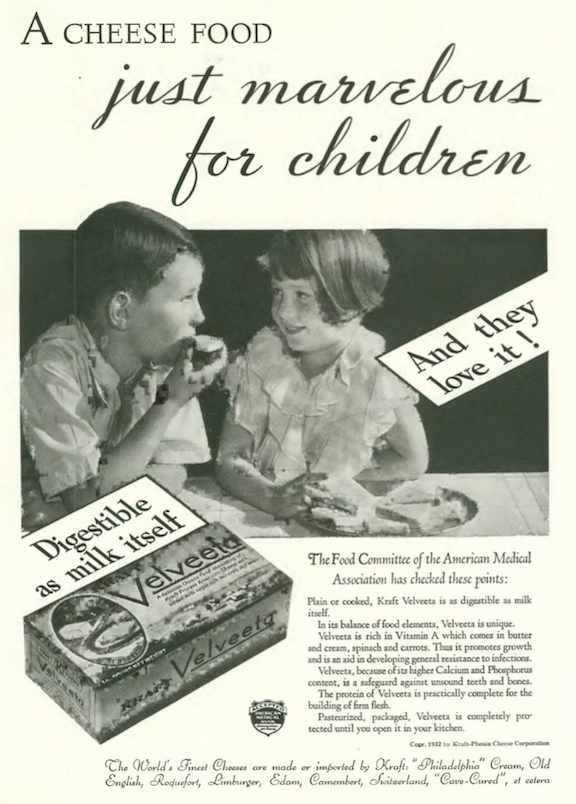
…invented in 1918, this “cheese food” made from milk, water, whey, milk protein concentrate, milkfat, whey protein concentrate and sodium phosphates—among other things—was acquired by Kraft in 1927 and marketed in the 1930s as a nutritious health food…I have to say I haven’t seen any Velveeta ads in The New Yorker as of late…

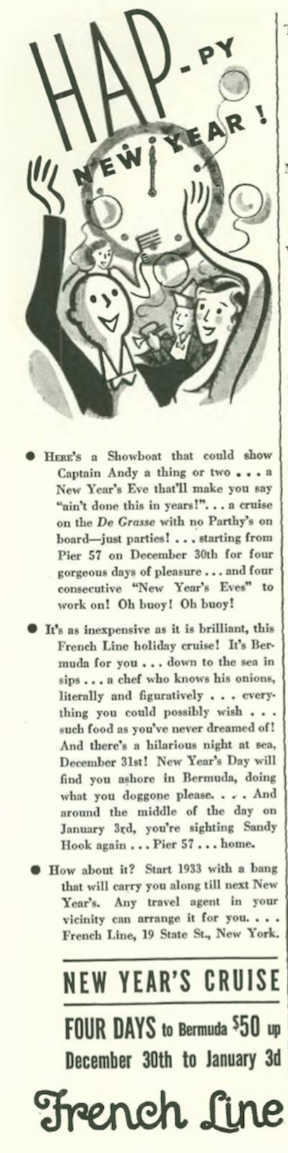
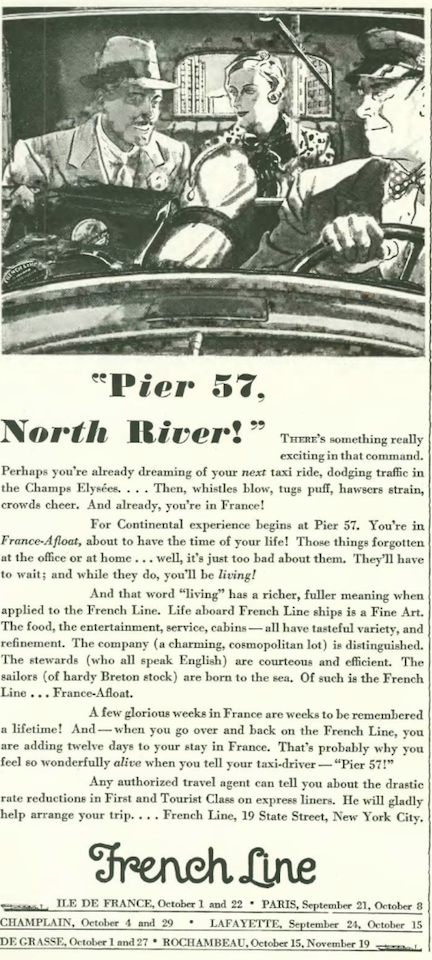
…”Pier 57, North River!” barks the successful-looking man to the admiring cabby who’s thinking “lucky dog!”…

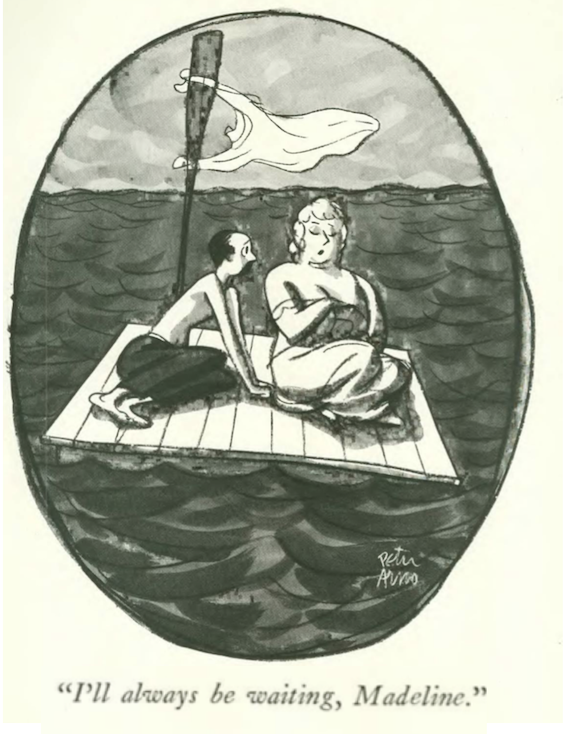
…on the other hand, Peter Arno (kicking off our Sept. 17 cartoons) gave us a Milquetoast who wasn’t getting anywhere near the French Line, or First Base…

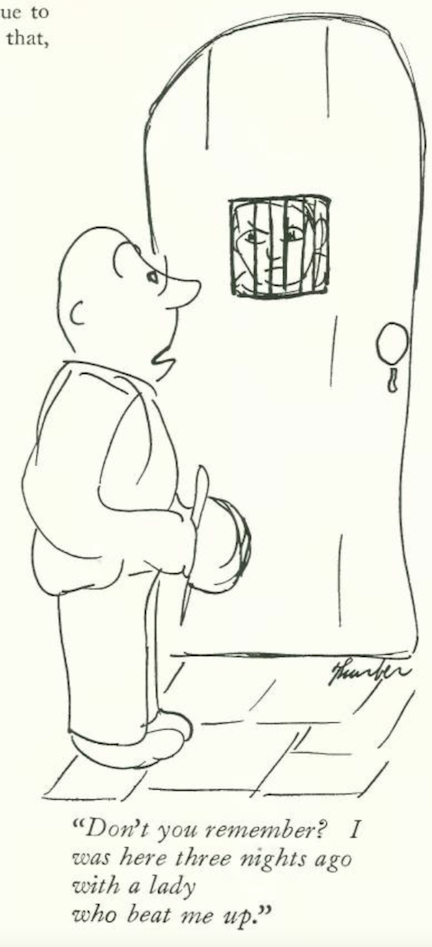
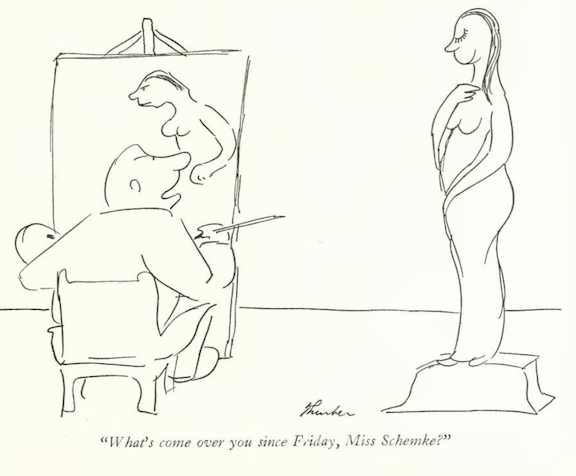
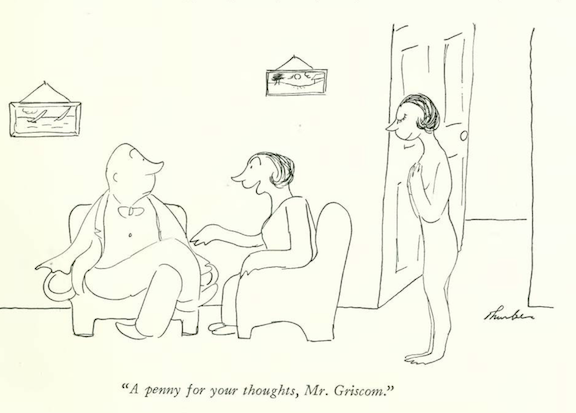
…and speaking of the mild-mannered, James Thurber offered up this fellow…

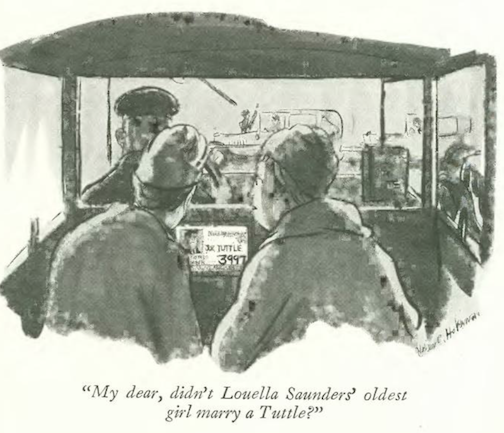
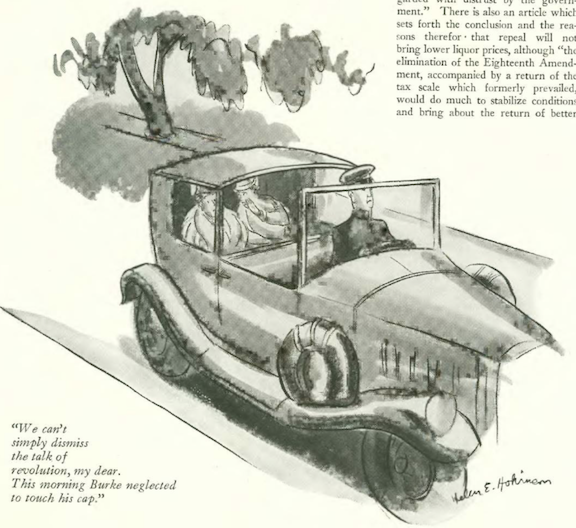
Helen Hokinson’s “girls” were perhaps wondering if their driver was among the Commies at Union Square…

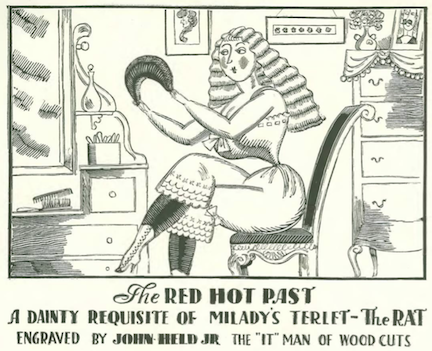
John Held Jr. entertained with another “naughty” Victorian portrait…

Robert Day, and wish unfulfilled at the zoo…

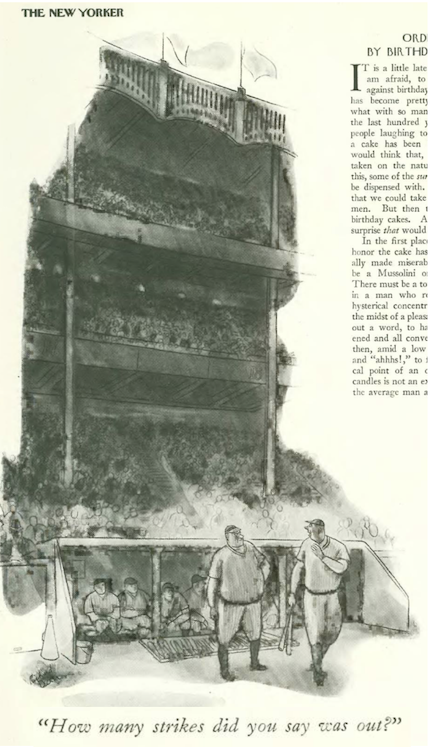
…and we close with Richard Decker, and trouble in the Yankee dugout…

Next Time: A Picture’s Worth…

Sounds of Silence

In 1928 both sound and silent films appeared on screens across America, but by 1929 sound was ascendent, and in 1932 silents were mostly a distant memory.

August 13, 1932 cover by Rea Irvin.

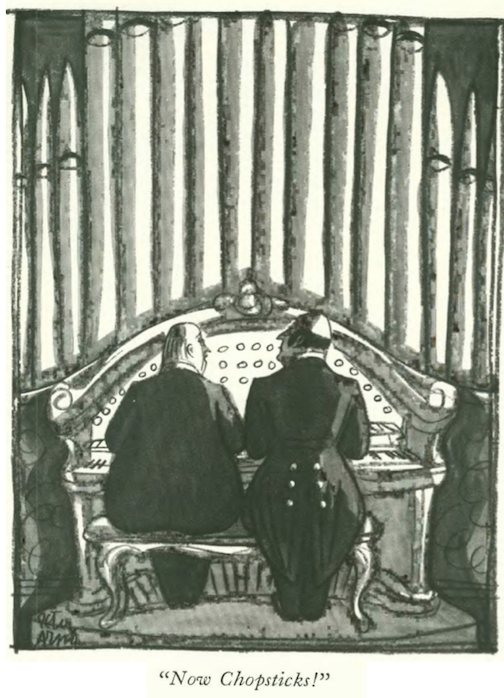
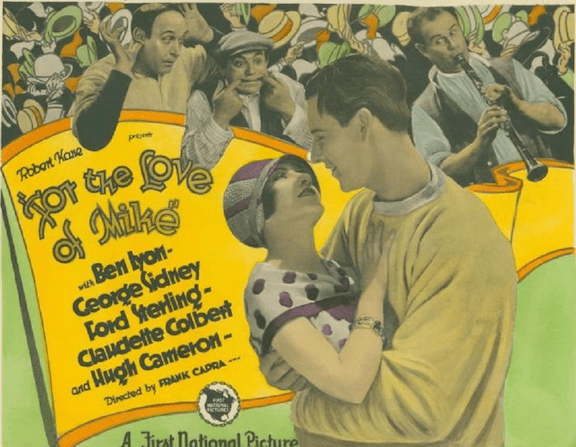
The New Yorker was slow to embrace sound—in reviews of early talkies, critic John Mosher found the technology stultifying in both dialogue and action, but as equipment and techniques improved he came to embrace the new medium. E.B. White, however, still missed the silent theatre, and the strains of its pipe organ…

SILENCE IS GOLDEN…E.B. White was likely attending a late evening showing of For the Love of Mike, Claudette Colbert’s only silent film. After the Frank Capra-directed film received poor reviews, the 24-year-old Colbert vowed she would never make another movie. Fortunately for her fans, she changed her mind and signed with Paramount in 1929. At right, promotional photograph of Colbert for the 1928 Broadway production La Gringa. (IMDB/Wikipedia)
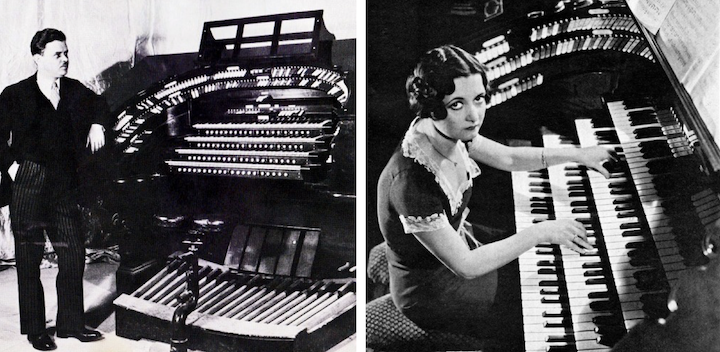
VITAL ORGANISTS…Jesse and Helen Crawford both recorded music on Paramount’s mighty Wurlitzer, sounds that were music to the ears of E.B. White. (theatreorgans.com)

 *  *  *

World’s Fastest Man

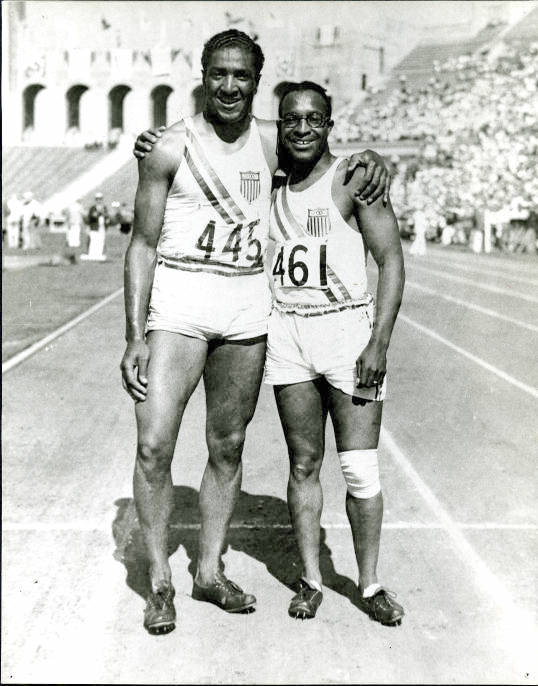
That title went to Eddie Tolan after the 1932 Summer Olympic Games, and his fame won him a long entry in the “The Talk of the Town,” although the column (excerpted) took a patronizing tone toward the athlete:

FASTEST IN THE WORLD…U.S. sprinters Ralph Metcalfe (left) and Eddie Tolan pose on the track at 1932 Los Angeles Olympics. Tolan would receive the title of the “world’s fastest human” after winning gold medals in the 100- and 200- meter events. Metcalfe, who be elected to the U.S. Congress in the 1970s, was considered the world’s fastest human in 1934-35. (Marquette University)

 *  *  *

From Our Advertisers

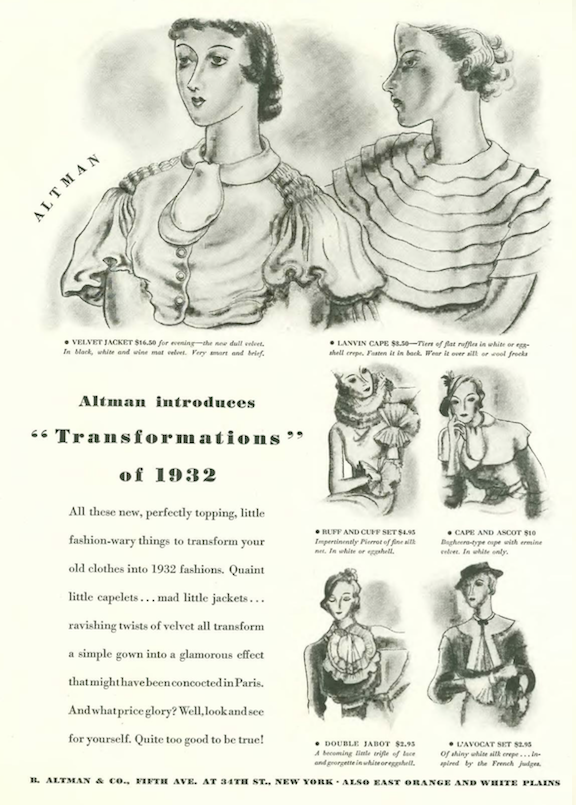
You could tell times were tough when a luxury department store felt the need to sell capes and cuffs designed to “transform” old clothes in to 1932 fashions…

…however, things seemed to be looking up for the folks at Powers Reproduction, who touted the naturalness of their DeSoto ads…

…such as this two-pager that appeared in The New Yorker’s July 23 issue…

…we move on to our cartoonists, beginning with Paul Webb…

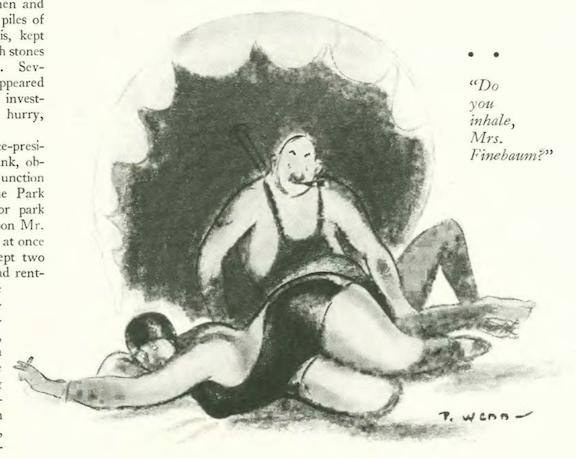
…who referenced a recent New Yorker ad (also from the July 23 issue)…

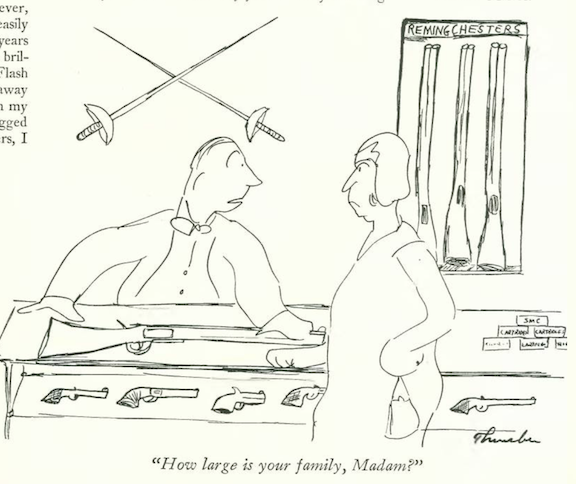
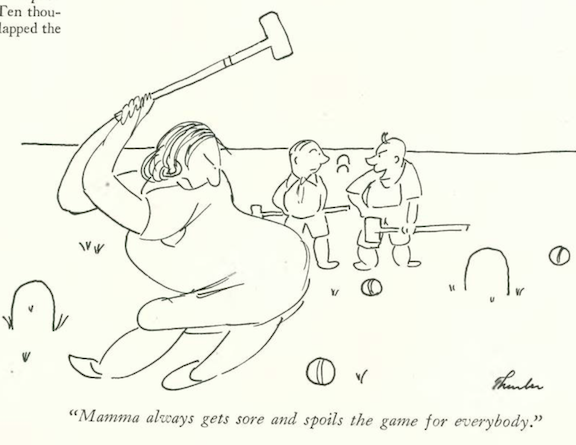
James Thurber gave us two examples of female aggression…

…this one a bit less deadly…

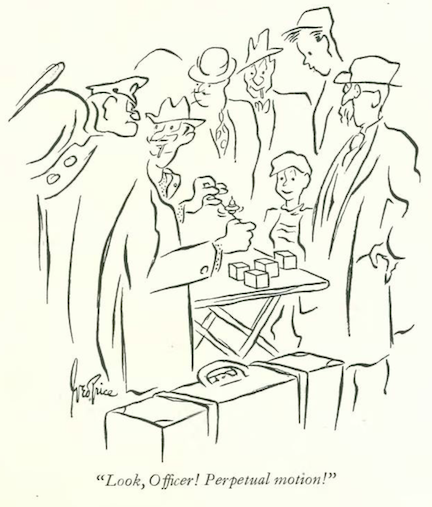
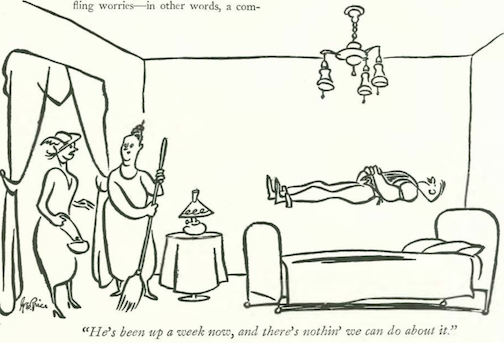
…here’s an early work by the great George Price (1901-1995), who beginning in 1929 contributed New Yorker cartoons for almost six decades…

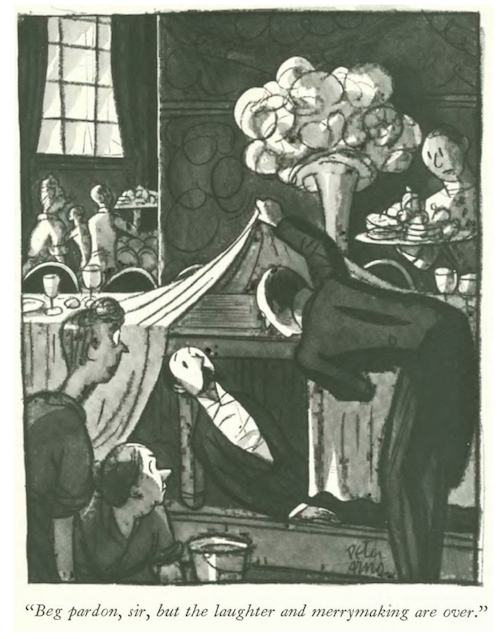
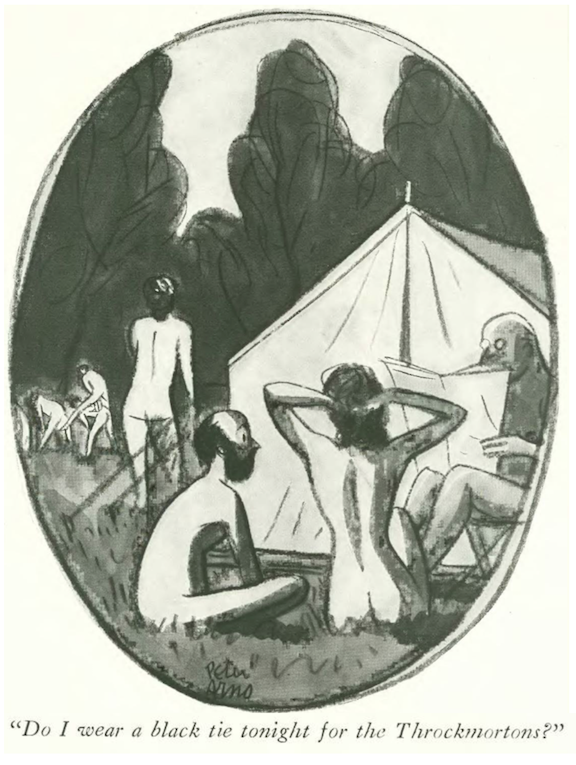
Peter Arno showed us that among the uppers, even nudism had its class distinctions…

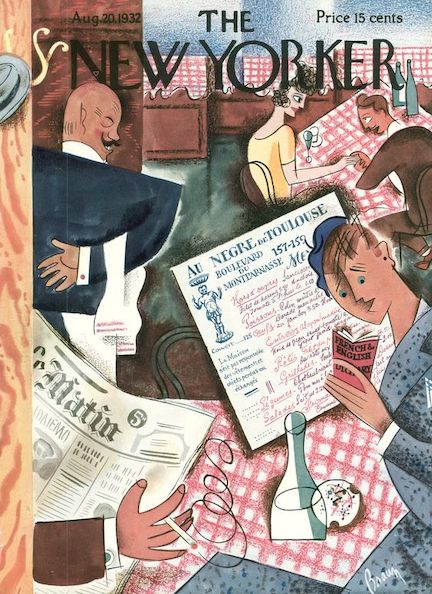
…on to our August 20, 1932 issue, and this terrific cover by Harry Brown. With a style reminiscent of the French artist Raoul Dufy, Brown illustrated a number of memorable New Yorker covers during the 1930s…

August 20, 1932 cover by Harry Brown.

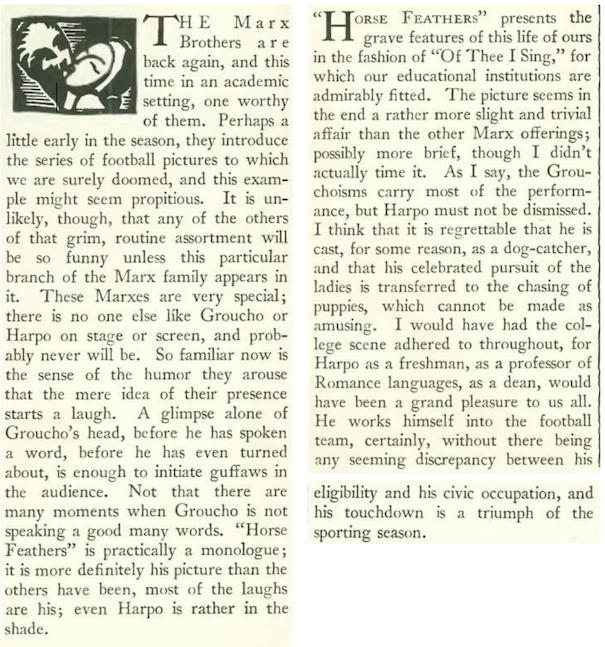
…the Marx Brothers were back in cinemas with Horse Feathers, and, according to critic John Mosher, delivered the comic goods…

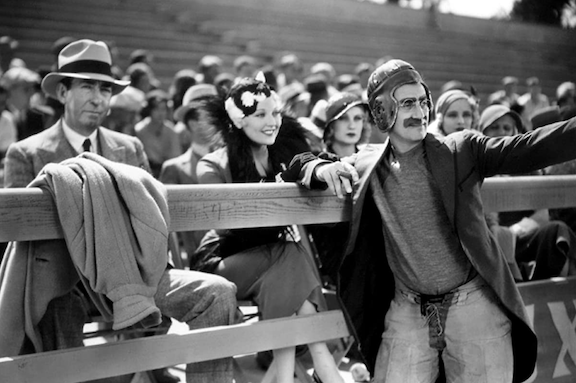
Xs AND OsGroucho Marx shows David Landau and Thelma Todd how the game of football is really played in Horse Feathers (1932). (IMDB)

 *  *  *

 Author, Author

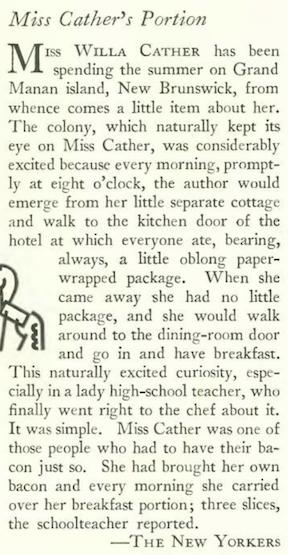
“The Talk of the Town” included this bit of news regarding the Pulitzer Prize-winning author Willa Cather. Beginning in the early 1920s, Cather and her partner, Edith Lewis, spent summers at Manan Island in New Brunswick, Canada:

THESE NEED SOME EDITING…Willa Cather pruning her roses on Manon Island. (University of Nebraska-Lincoln)

 *  *  *

While Cather was enjoying the peace of island life, there were disturbing rumblings on the other side of the ocean, even if Howard Brubaker (writing in his column “Of All Things”) found humor in them…

…the result, however was no laughing matter…

NOT HIS USUAL STYLE…After being appointed as German chancellor, Adolf Hitler greets President Paul von Hindenburg in Potsdam, Germany, on March 21, 1933. This image, intended to project an image of Hitler as non-threatening, was made into a popular postcard. The photo also appeared widely in the international press. (www.ushmm.org)

…Brubaker also commented on the upcoming U.S. presidential elections, and, more importantly, the absence of Greta Garbo, who returned to Sweden after her MGM contract expired…

NOT FEELIN’ IT, PAL…Melvyn Douglas romances Greta Garbo in 1932’s As You Desire Me. Garbo would leave for Sweden after the film wrapped. She would return after a nearly a year of contract negotiations. (IMDB)

 *  *  *

From Our Advertisers

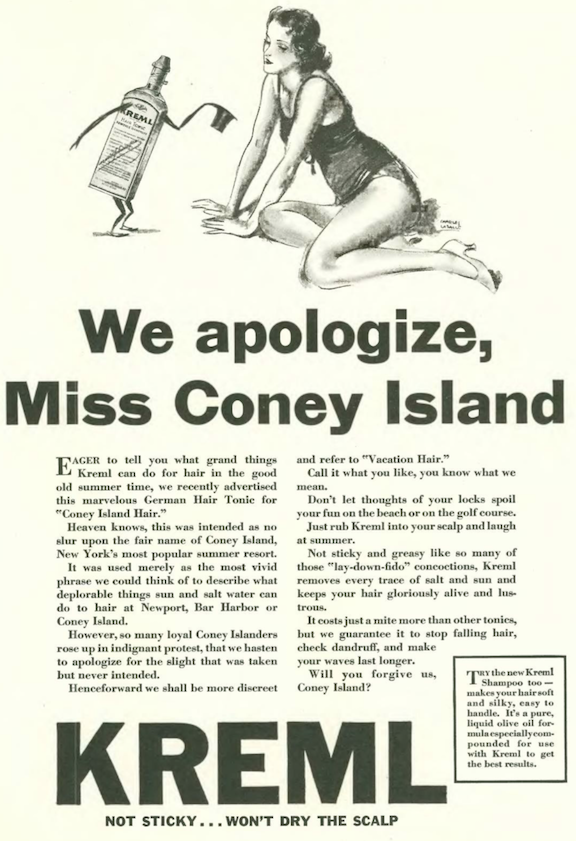
Illustrator Charles LaSalle, who would later be known for his Western-themed art, provided this odd bit of art for the makers of a German hair tonic…

…on to our cartoons, Rea Irvin continued his travelogue of famed tourist destinations…

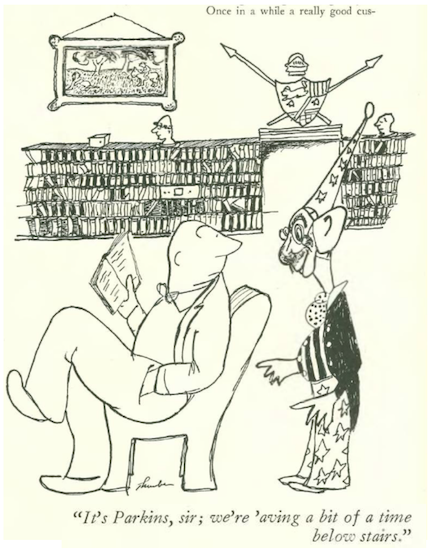
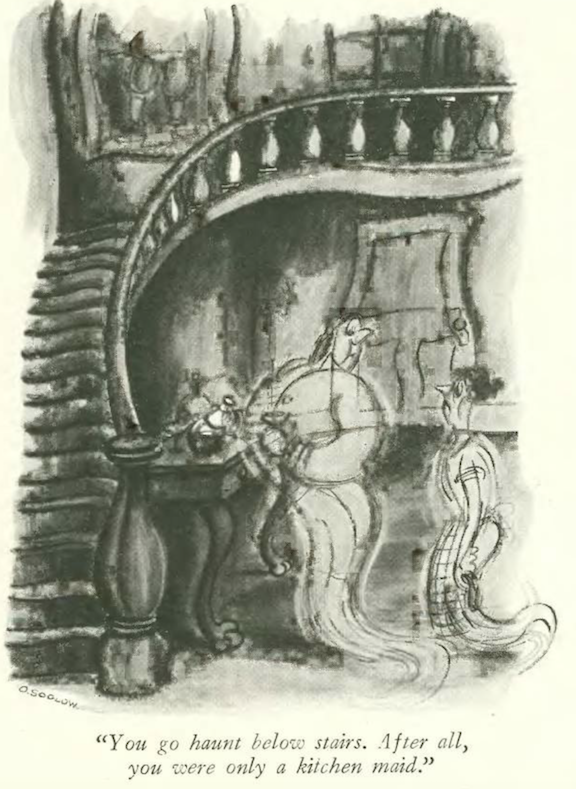
Otto Soglow showed us that even the spirit world has its version of Upstairs, Downstairs

Carl Rose rendered a cow and a calf made homeless for art’s sake…

Leo Soretsky contributed only one cartoon to The New Yorker, but it was a doozy…

…on to August 27, 1932…

August 27, 1932 cover by S. Liam Dunne.

…in which the “Talk of the Town” contributors decided to pay homage to Lewis Gaylord Clark (1808–1873), who was editor and publisher of the old The Knickerbocker magazine (1833 – 1865)…

…here is one of the entries, with accompanying artwork, written in the style of the old magazine…

 *  *  *

From Our Advertisers

William Steig had illustrated several ads for Old Gold, and now it was Peter Arno’s turn to entice readers to the national habit…

…Lucky Strike, on the other hand, preferred these illustrations of young women, who also happened to be their biggest growth market…by the way, this is not an official “Miss America”—there was no pageant in 1932…

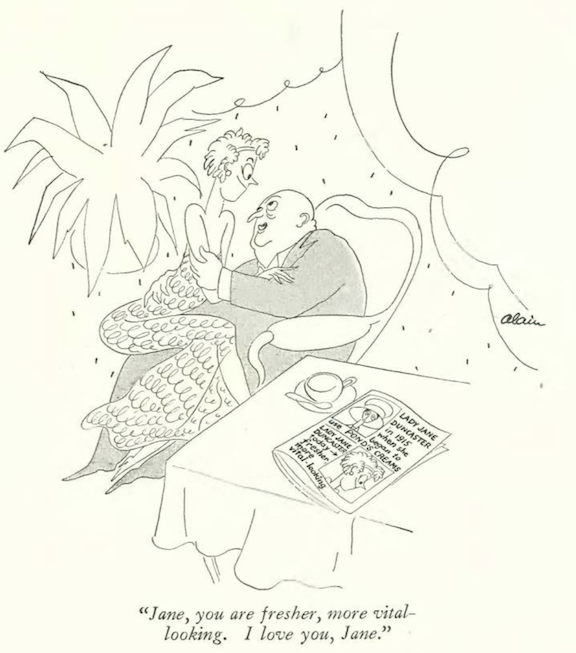
…and we end with cartoons that ponder the female form by Daniel Brustlein (1904–1996), who contributed cartoons and covers to The New Yorker from the 1930s to the 1950s under the pen name Alain

…and C.W. Anderson

Next Time: A New Outlook…

Rebecca and the Zombies

As we recently saw in the 1932 film Freaks, there were some truly weird motion pictures produced in Hollywood during the pre-Code era, including four that were reviewed in the July 30 and August 6 editions of The New Yorker.

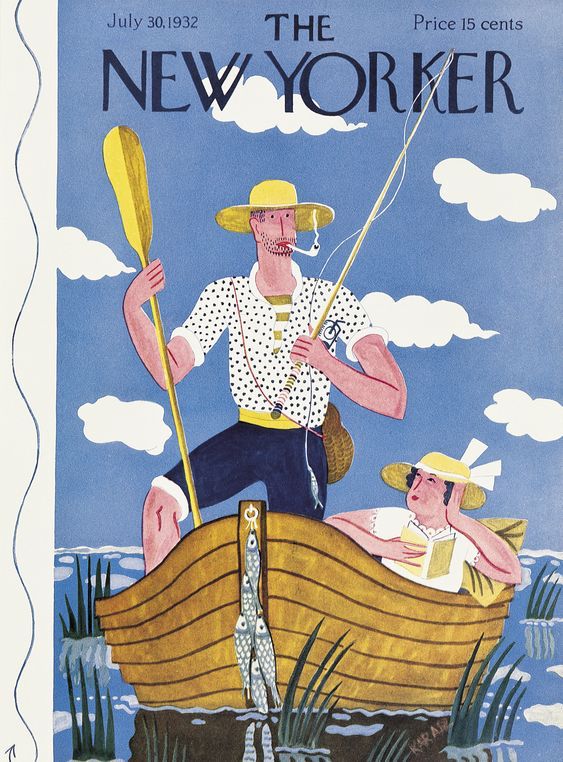
July 30, 1932 cover by Ilonka Karasz.

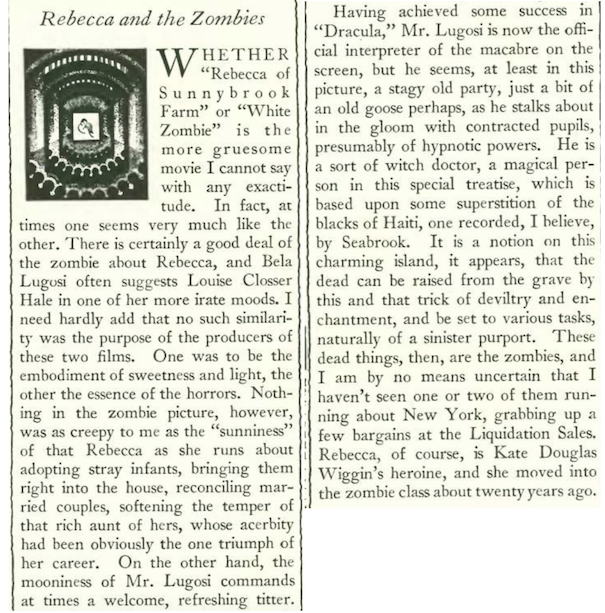
According to critic John Mosher, some of those films were not intended to be viewed as such, including Rebecca of Sunnybrook Farm (reviewed in the Aug. 6 issue), which Mosher found more gruesome than the Bela Lugosi vehicle White Zombie:

THE HORROR…After seeing Rebecca of Sunnybrook Farm, critic John Mosher concluded that too much sweetness and sunniness could be creepier than a bunch of zombies. Pictured above is Marian Nixon as Rebecca and Ralph Bellamy as her suitor, Dr. Ladd. (IMDB)
THE BELA BUNCH…Following up on his 1931 hit Dracula, Bela Lugosi inexplicably chose to star in the low-budget horror film White Zombie. Considered to be the first feature-length zombie movie, it served as a model for subsequent zombie pictures. Clockwise, from top left, white Haitian voodoo master “Murder” Legendre (Lugosi) leads his crew of zombies; Legendre toasting his evil intentions; coach driver (Clarence Muse), warns his passengers about zombies on the highway (although the film is set in Haiti — actually a Hollywood studio lot — Muse was the only Black actor with a speaking part, albeit quite brief); as was common in those days, John T. Printz, a white actor, portrayed the Black character Ledot, a former witch doctor; Legendre (Lugosi) transforms Madeleine Short (Madge Bellamy) into a zombie and orders her to kill her fiancé. Also pictured is Robert Frazer, who portrayed a plantation owner. Filmed in just eleven days, the majority of the cast in White Zombie were actors whose careers had waned since the silent era. (IMDB)

In the July 30 issue Mosher had another encounter with the strange, this time two documentaries that were very much products of their time.

In case a film about the hardships on the Alaskan tundra wasn’t enough to entice moviegoers, Universal Pictures served up this lobby card featuring a topless Nuwuk woman to promote Igloo…

Igloo lobby card. (Pinterest)

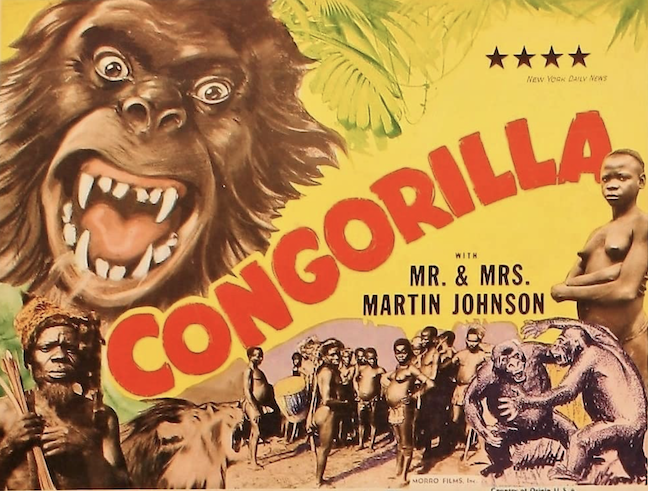
…in a similar vein, husband and wife filmmakers Martin E. and Osa Johnson offered up some topless images to accompany the action promised in Congorilla. It’s a familiar National Geographic-style trope—an over-the-counter magazine or film in the 1930s wouldn’t dare show a European woman topless (there were decency laws after all!) but these folks were “primitive,” and therefore weren’t subject to the Hays Code or other “decency standards.”

Congorilla lobby card. (IMDB)

The Johnson’s documentary was partly staged, including this scene with “child-like pygmies” that is just plain weird (um, didn’t “modern” jazz have its roots in Africa?):

 *  *  *

Life of the Party

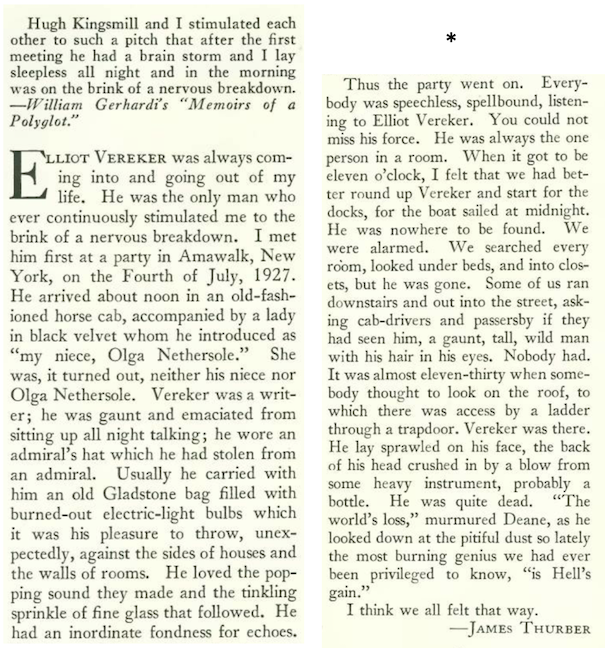
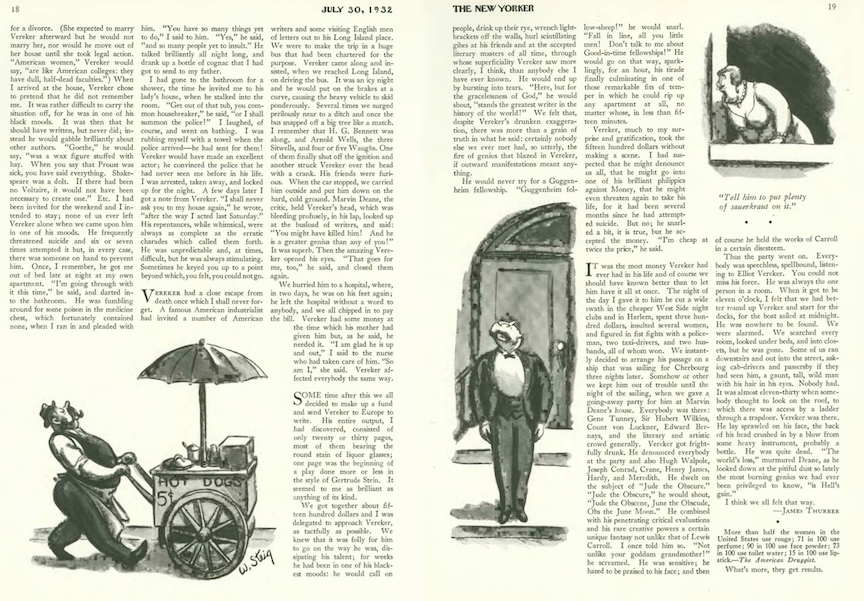
James Thurber penned this unusual July 30 profile, a parody of artistic genius- types who are loved and admired despite also being a drunken assholes. I include the opening paragraph, and the concluding paragraph, which follows a decision by Elliot Vereker’s literary friends to put him on a boat to France; during a farewell party he roundly insults them all.

MIRROR, MIRROR…James Thurber and his “Profile” subject, Elliot Vereker. Some critics suggest Vereker’s character was the result of some self-reflection on Thurber’s part. (thurberhouse.org/The New Yorker)

*  *  *

From Our Advertisers

William Steig continued illustrating these full-page ads for Old Gold (no surprise that tobacco companies were doing quite well during the Depression)…

…as we’ve seen, a number of New Yorker cartoonists earned extra money illustrating ads for a variety of companies, but one cartoonist, Peter Arno, also collaborated with artists, playwrights and musicians including Paul Whiteman…no doubt this collaboration was inspired in Arno’s youth, as noted New Yorker cartoonist Michael Maslin explains in this Inkspill entry

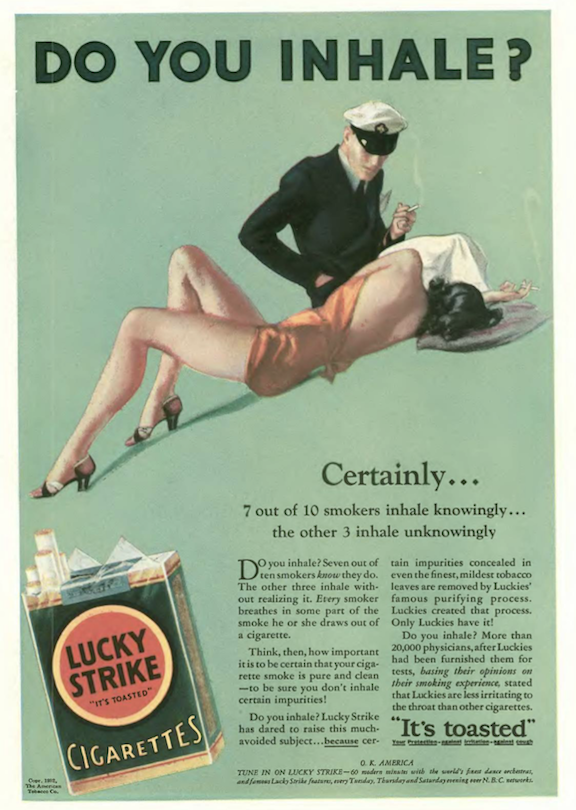
…and we have another in the continuing series of Lucky Strike ads encouraging smokers to inhale its “pure” tobacco, the better to draw in all that addictive nicotine…

…on to our cartoons…William Steig got a clever two-page layout with the caption, “Tell him to put plenty of sauerkraut on it”…

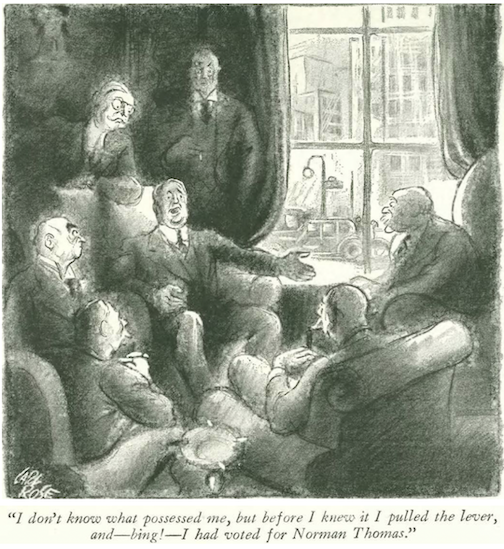
Carl Rose offered his thoughts on the slate of wishy-washy candidates in the upcoming 1932 elections…

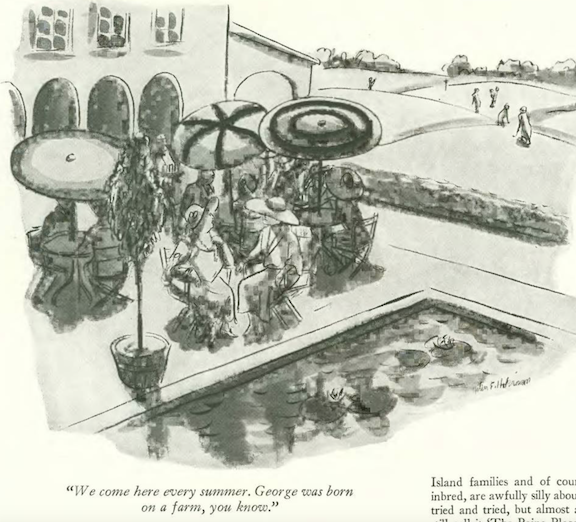
Helen Hokinson explored the simple ways of rural living…

Barbara Shermund looked in on the charmed lives of her modern women…

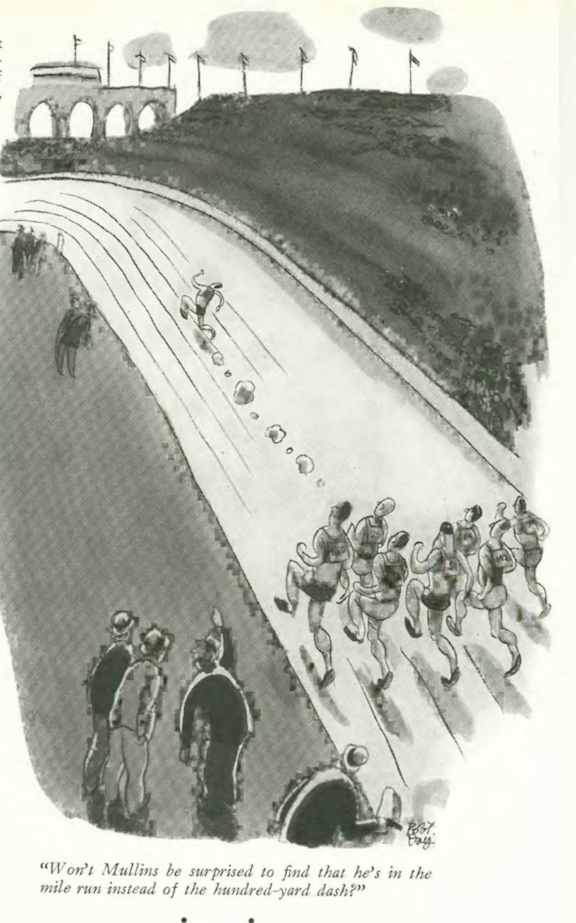
Robert Day gave us an athlete with a big surprise ahead (and not a happy one…I made this same mistake years ago in a junior high track meet)…

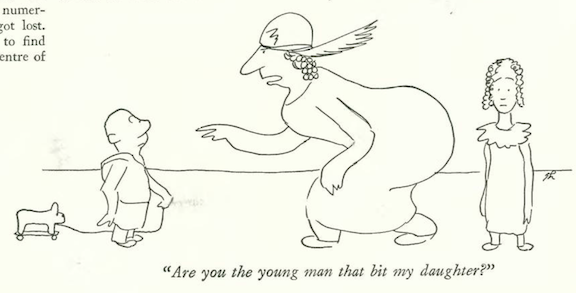
...James Thurber explored the junior edition of his “War Between Men and Women”…

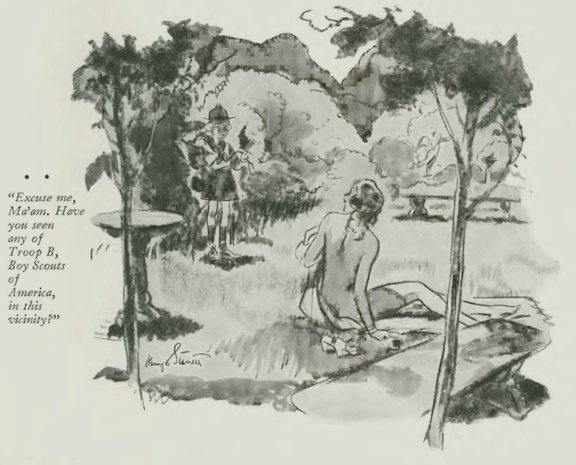
…and Kemp Starrett illustrated a Boy Scout who lost his troop along with some of his innocence…

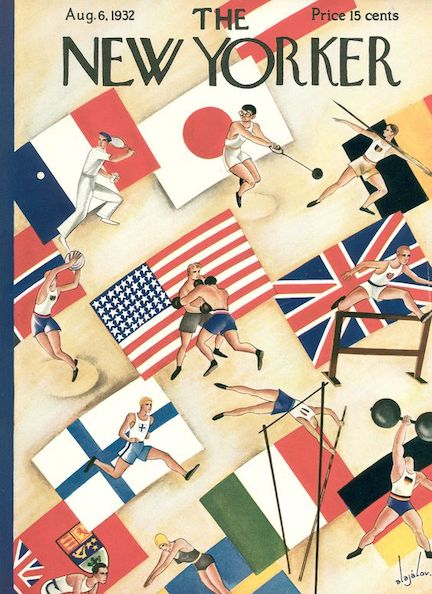
…and we continue with the Aug. 6 issue, cover artist Constantin Alajalov choosing the 1932 Summer Olympics as his theme:

August 6, 1932 cover by Constantin Alajalov.

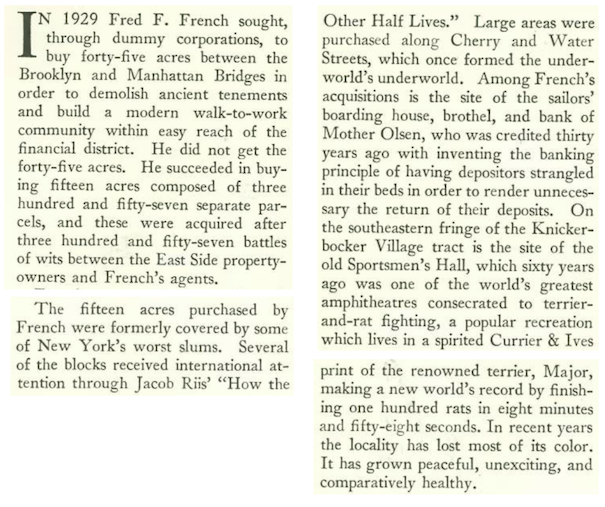
Alva Johnston penned the first part of a two-part “A Reporter At Large” feature on Knickerbocker Village. Yet to be built when this article was written (construction began in 1933 and was completed in 1934), Knickerbocker Village was the first apartment development in the U.S. to receive federal funding. It came from the Congress-authorized Reconstruction Finance Corporation (RFC), which gave loans to private developers like Fred French for the construction of low-income housing in slum-clearance areas.

CLEARANCE SALE…Tenements in Lower East Side were razed in 1933 to make way for Knickerbocker Village. The site was known as “Lung Block,” because of its high tuberculosis mortality rate. Developer Fred French, who also created Manhattan’s Tudor City, received federal funding to replace slums with more healthful housing. However, the 1,590 small apartments in Knickerbocker Village were eventually occupied by white collar, middle-income residents. Rather than provide better housing for former tenement dwellers, the project displaced them to other slum areas in the city. (Ewing Galloway/NYT)
STILL STANDING…Knickerbocker Village today. The complex was severely damaged during Hurricane Sandy in 2012. In 2019, the City Council passed a bill that keeps Knickerbocker Village relatively affordable for the next 50 years in exchange for a $3 million annual tax abatement. (Wikipedia)

*  *  *

From Our Advertisers

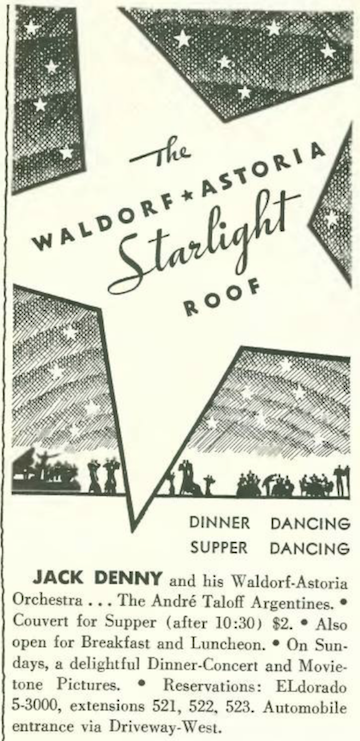
The new Waldorf-Astoria touted its Starlight Roof’s many attractions, including, no doubt, escape from the heat and dust of the city streets…

ON TOP OF THE WORLD…View of the Waldorf-Astoria’s famed Starlight Roof and the cover of its wine list, circa 1934. (Waldorf Astoria)

…I find these Ethyl ads endlessly fascinating, not only for pushing leaded gasoline on the public, but for class-shaming them into using their product…

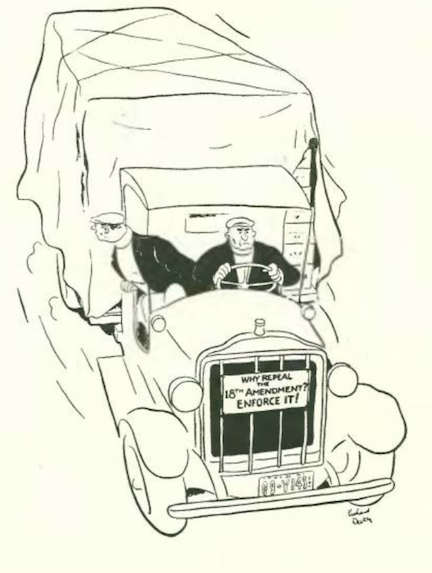
…on to our cartoons, Richard Decker showed how not all Prohibition supporters were teetotalers…

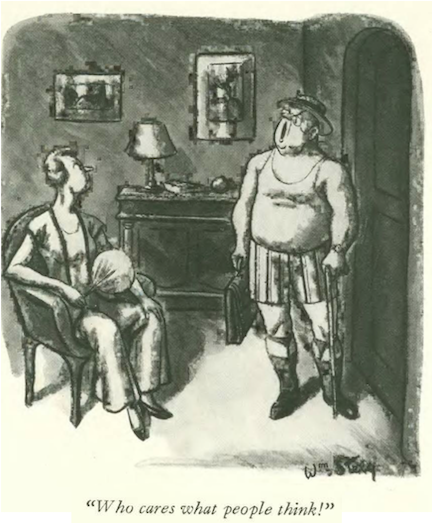
William Steig gave us one man’s reaction to August weather…

Barbara Shermund drew a man drawing a line on his place of birth…

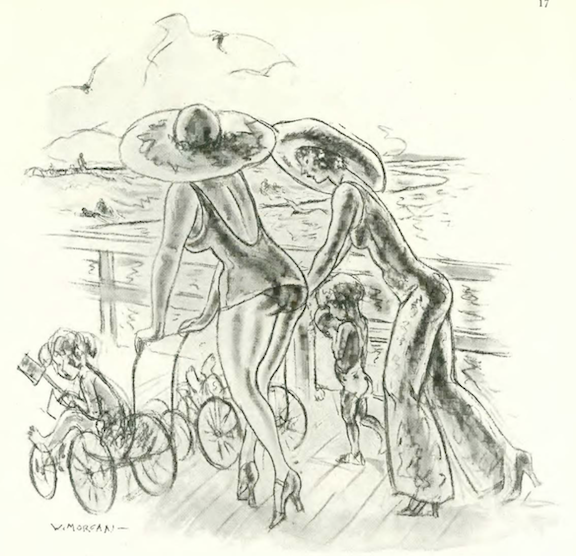
…and we end with a cartoon by Wallace Morgan…there is a joke here related to the attire of the two women, but I am at a loss (any suggestions?)…

Next Time: Silence is Golden…


Not for the Kiddies

Over the years Tod Browning’s 1932 pre-code film Freaks has been called everything from grotesque and exploitive to sympathetic and compassionate. Now a cult classic, the film’s closing scenes are regarded by some critics as among the most terrifying ever put to film.

July 16, 1932 cover by Rea Irvin.

What disturbed so many about Freaks was Browning’s use of actual sideshow performers with real disabilities to tell the story of a conniving trapeze artist who plots to seduce and then kill a dwarf performer to gain his inheritance. The film was not well-received by audiences and many critics. The Kansas City Star’s John Moffitt wrote, “There is no excuse for this picture. It took a weak mind to produce it and it takes a strong stomach to look at it.” However, The New Yorker’s John Mosher, along several other New York critics, gave the film a rather favorable review:

ONE OF US…Although audiences and critics found Tod Browning’s 1932 film Freaks grotesque and exploitive, today many regard the film as a rare (for its time), sympathetic portrayal of persons with disabilities. Clockwise, from top left, Browning with some of the members of his Freaks cast; French-American actress Rose Dione portrayed Madame Tetrallini, operator of the sideshow; Daisy and Violet Hilton with actor Wallace Ford in a scene from Freaks. Born fused at the pelvis, the sisters were joined at their hips and buttocks and shared blood circulation; limbless sideshow performer Prince Randian, who wore a one-piece wool garment over his body, appeared in the film as “The Living Torso.” (IMDB)
IT HAD A PLOT, ACTUALLY…Freaks told the story of a conniving trapeze artist named Cleopatra (portrayed by Russian actress Olga Baclanova, bottom right) who plots to seduce and then kill a dwarf performer, Hans (portrayed by Harry Earles) to gain his inheritance. Top photo: assembled “freaks” chant their acceptance of Cleopatra at the wedding feast of Hans and Cleopatra; bottom left, the kind-hearted seal trainer Venus (portrayed by Leila Hyams) consoles Frieda (Daisy Earles), who worries about Hans (Daisy and Harry Earles were members of a famous quartet of sibling entertainers known as The Doll Family. The quartet also appeared as members of The Munchkins in 1939’s The Wizard of Oz.)(IMDB)
SURPRISE…Leila Hyams (1905–1977) was something of a surprising presence in the controversial film Freaks, given that she was a popular leading lady in the 1920s and 30s. Known for both her comedic and dramatic talents, she retired from films in 1936; another unlikely cast member was Henry Victor (1892–1945) whose physique didn’t necessarily support his role as circus strongman. (dangerousminds.net)
TRUE GRIT…Perhaps only a Russian actress in 1932 had the grit to transform herself from an exotic blonde temptress to a grotesque “human duck” for the movie Freaks. In the film, Olga Baclanova (1893 – 1974) portrayed a conniving trapeze artist named Cleopatra. Near the end of film the “freaks” capture Cleopatra, gouge out her right eye, remove her legs and tongue and melt her hands to look like duck feet. For critics and audiences, the horror was just too much. As for Baclanova — who was a popular silent film actress known as the “Russian Tigress” — her heavy accent did not translate well to talking films, and she left the movie business altogether in 1943. (muni.com/IMDB)

 *  *  *

Tennis Anyone?

Helen Moody was the top women’s singles tennis player for nearly a decade in the 1920s and 30s, winning Wimbledon eight times, including a match in 1932 against her rival Helen Jacobs. However to sportswriter John Tunis, the women had reached such a level in their play that it had become robotic and tedious to watch. At least James Thurber livened things up with some keen illustrations.

RACKETEERS…Helen Jacobs (left) and Helen Moody (right, in a 1929 photo) were tennis rivals known for their explosive matches. Except, apparently, for the one attended at Wimbeldon in 1932 by John Tunis. (nickelinthemachine.com)

 *  *  *

From Our Advertisers

Sensing that the end of Prohibition was near, the makers of Budweiser reminded readers of the good ol’ days of beer drinking and such…

…if you could afford something better than beer, then you might have contemplated a trip on the SS Manhattan, which along with her sister ship SS Washington were the largest liners ever built in the US…

TO AND FRO…Beginning in August 1932 the SS Manhattan operated the New York – Hamburg route until 1939, when instead of taking passengers to Germany the ship began taking Jewish refugees and others away from Nazi-occupied Europe. It was turned into a troopship in 1941 and never returned to commercial service. The SS Manhattan was sold for scrap in 1965. (cruiselinehistory.com)

…if your thing wasn’t traveling to Germany to see that country being transformed into the Third Reich, you could instead become a Bermuda “Commuter”…

…back home, William Steig joined other New Yorker cartoonists who earned extra money off of the big tobacco companies…

…which segues into our cartoonists, beginning with Victor Bobritsky’s illustration for “Goings On About Town”…

Otto Soglow offered more Little King adventures…

…and Carl Rose gave us a man striding into a factory, apparently a rare sight in 1932…

…on to July 23…

July 23, 1932 cover by Antonio Petruccelli (1907 – 1994). This is the first of six covers Petruccelli created for the New Yorker from 1932 to 1938. He also did numerous covers and illustrations for Fortune, Colliers and other publications.

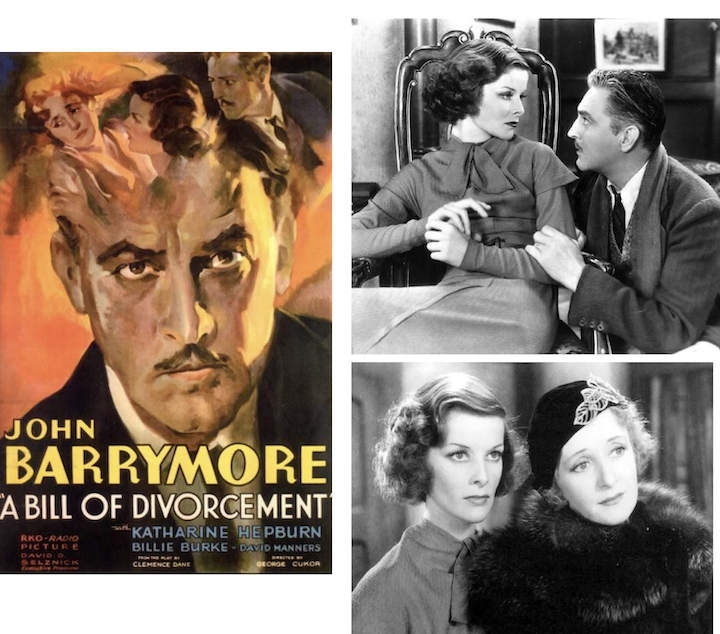
…and we have another John Mosher film review, in which he refers to Freaks as a “dainty prelude” to another film about the lives of entertainers, in this case George Cukor’s What Price Hollywood, a pre-Code drama starring Constance Bennett and Lowell Sherman with a storyline that anticipated 1937’s A Star Is Born—namely, a famous but fading male star who helps an ingénue rise to stardom while he descends into a pit of alcoholic despair.

FUN WHILE IT LASTED…Top image: Waitress and aspiring actress Mary Evans (Constance Bennett) has the good fortune to meet film director Maximillan Carey (Lowell Sherman) when she serves him one night at the Brown Derby. Bottom: Mary and her polo player boyfriend Lonny Borden (Neil Hamilton) look down with pity at the down-on-his-luck Maximillan in What Price Hollywood? (Wikipedia/IMDB)

 *  *  *

From Our Advertisers

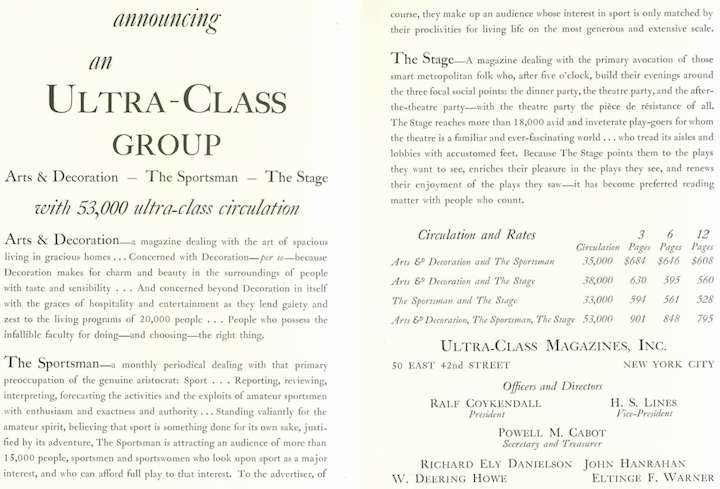
Originally published by Adam Budge, Inc. in 1910 and later by Joseph Judd Publishing and others, Arts & Decoration magazine hoped to stay alive in the Depression with a promise that its August 1932 issue would be “compellingly readable”…

…and here is the cover of that issue…Arts & Decoration would hang on for another ten years before folding in 1942…

…one of the stars of Ziegfeld Follies of 1931 was actress and dancer Patricia Boots Mallory (1913 – 1958), who posed for this portrait to demonstrate the wonders of color reproduction…

…and here’s Boots Mallory in a scene from the 1932 film Handle With Care with comedian Elmer “El” Brendel (standing) and actor James Dunn

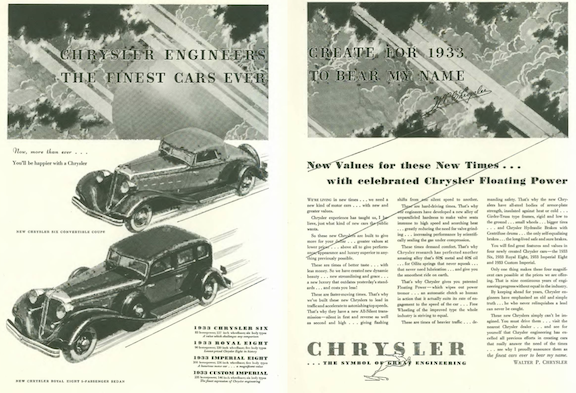
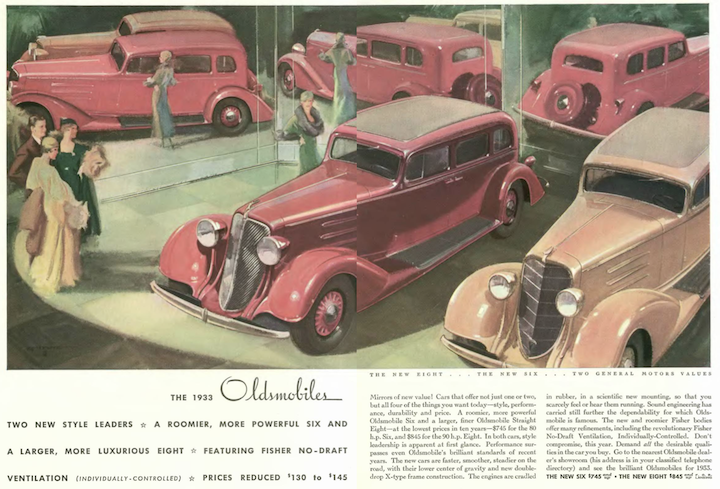
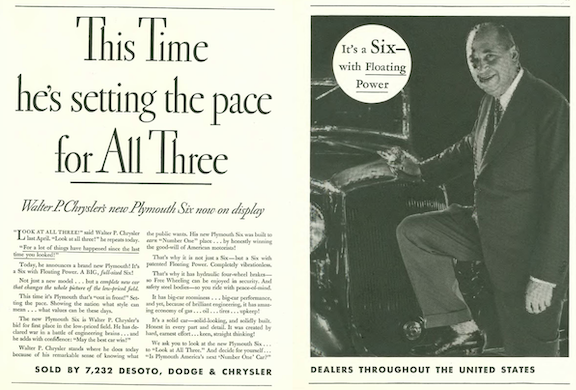
…not everyone could be a movie star, but you could pretend to be one in this swell new (and low-priced) DeSoto…Walter Chrysler must have laid out some big bucks for this two-page color spread…

…for those with greater means you could skip the roads altogether and fly the friendly skies of Ludington Airlines…the airline was founded by wealthy New York socialite Charles Townsend Ludington and his brother Nicholas…

…founded in 1929, Ludington Airlines was the first airline with flights every hour on the hour and the first to carry passengers only (others carried mail, an important source of revenue). The airline offered service between Washington, D.C. and New York City—with stops in Philadelphia, Baltimore, Norfolk, Virginia, Nashville and Knoxville, Tennessee—using seven Stinson tri-motor 6000 aircraft in its fleet, each carrying up to ten passengers…the airline went bankrupt in 1933 (mostly due to the lack of mail revenue) but left behind an astonishing record—in its first two years it flew more than 3.4 million miles and carried 133,000 passengers, a record at the time…
A Stinson SM-6000 airliner similar to the type flown by Ludington Airlines from 1929 to 1933.

…back to earth, sort of, we have this Lucky Strike ad with the famed “Do You Inhale?” campaign that oozed innuendo and no doubt prompted a few young men to take up the habit posthaste…
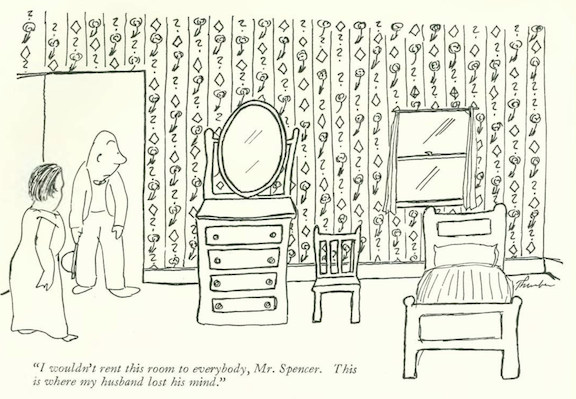
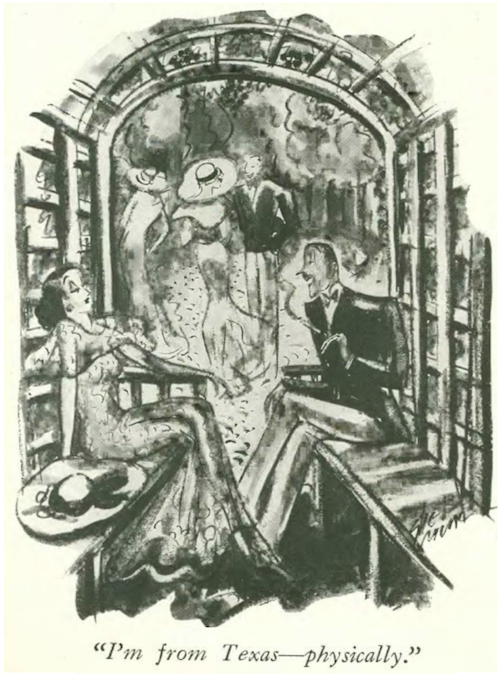
…on to cartoons, beginning with this spot art by James Thurber

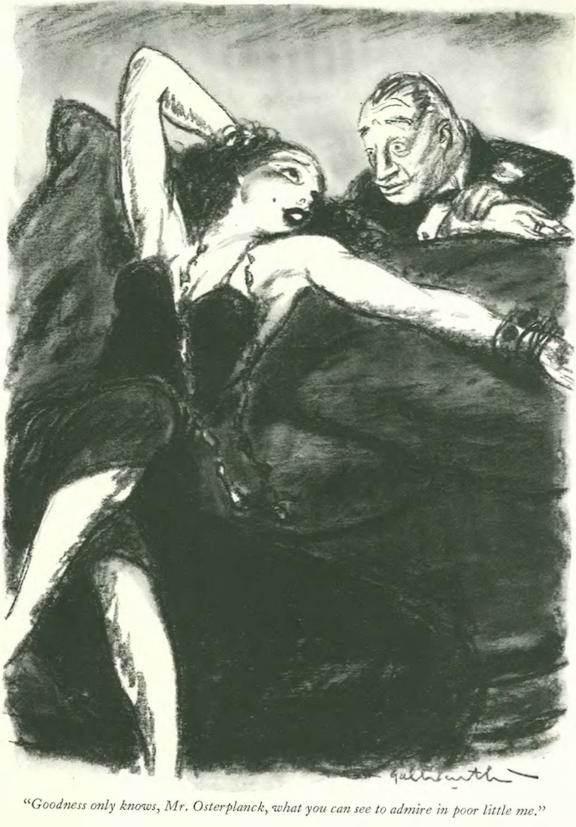
Gardner Rea showed us a man getting his nickel’s worth of sin and repentence…
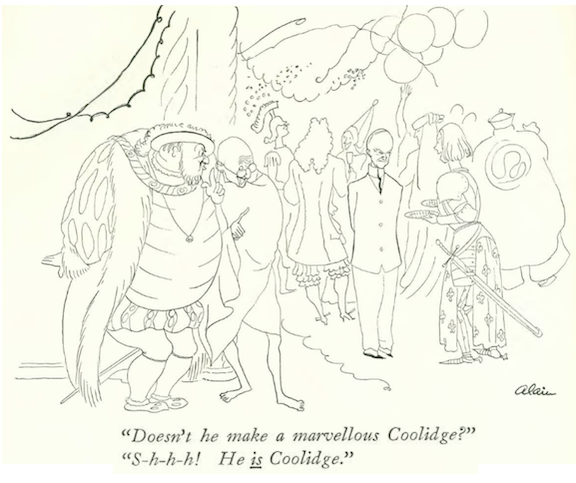
…and we end with the delightfully unrepentant Peter Arno

Next Time: Rebecca and the Zombies…

Help Wanted

Above image: The 1937 painting, titled "Employment Agency," was by Isaac Soyer (1902-1981). Like Reginald Marsh, he was considered a social realist painter who painted scenes of working class life. (Whitney Museum of American Art)

Nineteen thirty-two was a tough year for most Americans, as the Depression approached rock bottom and jobless numbers continued to mount as one out of every four workers was unemployed.

July 2, 1932 cover by William Steig.

Despite the Depression, The New Yorker was on solid footing, although judging by these next two issues advertising had fallen off. Other indications things weren’t so rosy included the occasional broadsides penned by E.B. White in his “Notes and Comment” column that opened “The Talk of the Town.” White anticipated Franklin D. Roosevelt’s New Deal, calling for “direction from above” and the creation of a peacetime army that would give purpose to the unemployed.

White filed his column while the nation was experiencing a summer of unrest, men and women across the country joining demonstrations demanding relief from the federal government, which under President Herbert Hoover mostly refused to provide funds for the jobless and homeless.

Writing for The Conversation, James N. Gregory, professor of history at the University of Washington, developed a mapping project that has recorded 389 hunger marches, eviction fights and other protests in 138 cities during 1932.

THE UNWANTED…Clockwise, from top left, a man advertises his worth on a sandwich board, ca. 1930; unemployed gather in front of an employment agency, ca. 1930; long line of jobless and homeless men wait outside to get free dinner at a New York municipal lodging house, 1932; even with the New Deal times remained tough for many rural folks — in 1936 Los Angeles Police Chief James E. Davis declared a “Bum Blockade” to stop the mass emigration of poor families fleeing from the Dust Bowl states of the Midwest. (rarehistoricalphotos.com/dailybulletin.com/Associated Press)

White’s column was prescient in many ways, including the need for Americans to laugh during tough times: Abbott & Costello, Burns & Allen, Laurel & Hardy and the Three Stooges, among many other acts, enjoyed their heydays during the Depression and war years.

SWORDS, NOT PLOUGHSHARES were offered to those protesting in the summer of ’32. Above, tanks and mounted troops advance to break up a Bonus Marchers’ camp of veterans protesting lost wages in Washington D.C. on  July 28, 1932. Below, the marchers at the Capitol. (PhotoQuest/The Conversation)

*  *  *

From Our Advertisers

As noted earlier, advertising had fallen off a bit in The New Yorker, but those who still had means to market their wares included the folks at Goodyear, who continued their campaign of comparing their tires to “masterpieces”…

…this B. Altman ad presented a “fashion artist” who was doing quite well despite the Depression…

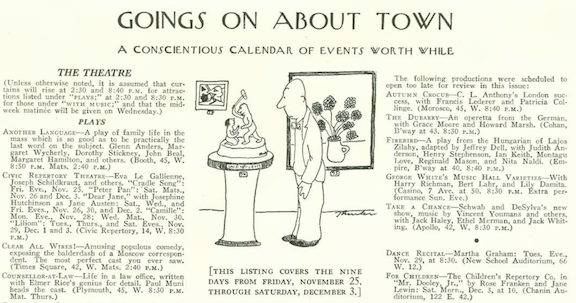
…on to our cartoonists, the top of page 2 and the bottom of page 3 in the “Goings On About Town” were decorated by Julian de Miskey

William Steig put one of his “Small Fry” in a barber’s chair…

James Thurber continued to plumb the depths of courtship…

…as did Barbara Shermund

…while Peter Arno was perfecting one his classic tropes…

…on to July 9, 1932…

July 9, 1932 cover by Virginia Andrews.

…where we look at John Mosher’s review of Red Headed Woman, a romantic comedy about an ambitious secretary (Jean Harlow) who tries to sleep her way into high society.

(IMDB)

Harlow (1911-1937) was already famed as a “platinum blonde,” which made her turn as a redhead a major selling point for the pre-code film. Although based on a novel by Katharine Brush, it was Anita Loos’ humorous treatment of the script that made the film more than just a sex romp.

SEEING RED…Jean Harlow seduces her wealthy boss William “Bill” Legendre Jr. (Chester Morris) and breaks up his marriage to his wife Irene (Leila Hyams, photo at right). (IMDB)
LIFE & ART…In many ways Jean Harlow embodied Lorelei Lee, the ambitious gold-digger Anita Loos created for her 1925 novel Gentlemen Prefer Blondes. When Loos (left, photo by Cecil Beaton) ) adapted Katharine Brush’s (right) novel for the 1932 film Red-Headed Woman, MGM made hay of the whole arrangement, seen in this 1932 publicity photo (center) of Harlow and Loos. (silentlondon.co.uk/Cinemania/Goodreads)

*  *  *

From Our Advertisers

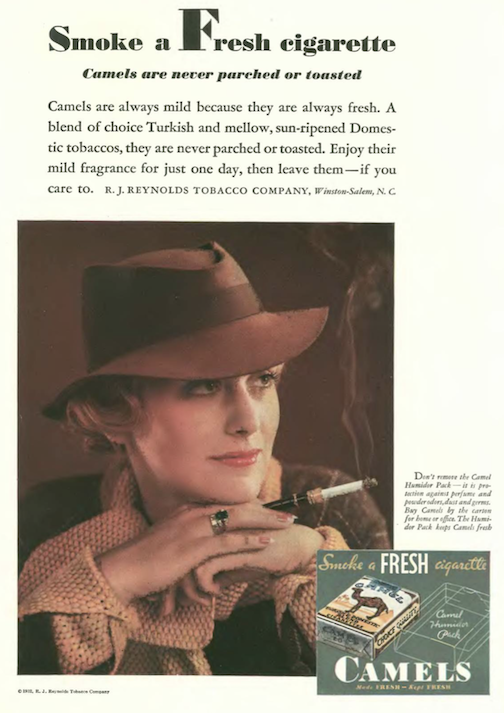
Speaking of redheads, we have this one encouraging us to become addicted to Camel cigarettes and then daring us to “leave them if you can”…

…Longchamps was a chain of restaurants in Manhattan that brought a taste of Continental refinement to middle class New Yorkers…

…the terrific Driving for Deco blog site tells us that wholesaler Henry Lustig opened his first Longchamps restaurant in 1919 at Madison and 78th, specializing in an American version of French cuisine at affordable prices. During the mid to late 1930s the chain rapidly expanded, opening seven restaurants within five years. Four of these restaurants were known for interior designs by Winold Reiss…

HIGH STYLE, LOW PRICES…Clockwise, from top left, the 1931 Continental Building was home to this Longchamps restaurant at Broadway and 41st Street (circa 1937); entrance on 42nd Street to the Longchamps in the Chanin Building, circa 1935; late 1930s matchbook cover from Longchamps; interior design by Winold Reiss in the Chanin Building location. (nyneon.blogspot.com/drivingfordeco.com)

…on to our cartoons with Rea Irvin and another view of French elegance…
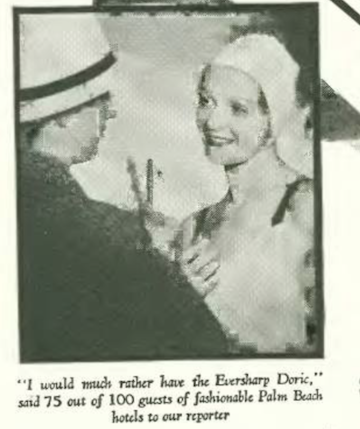
…and we close with Barbara Shermund, evesdropping on her Manhattan demimonde…
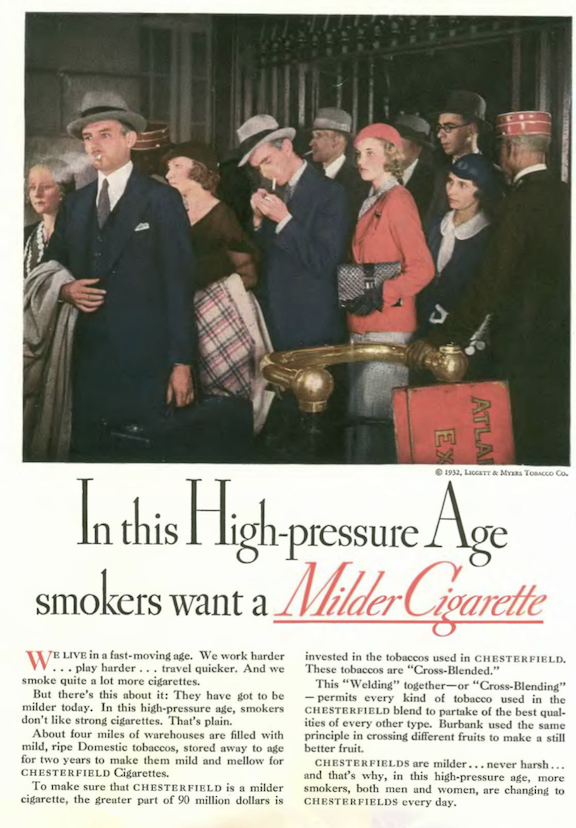
Next Time: Not For the Kiddies…

Summer Indulgences

Writing under the pseudonym Guy Fawkes, Robert Benchley (1889-1945) tried to keep the newspaper industry honest through regular criticism in his “Wayward Press” column.

June 11, 1932 cover by Helen Hokinson.

As the summer of ’32 approached, Benchley recalled the barrage of sensational headlines that dominated the month of May—everything from Amelia Earhart’s solo crossing of the Atlantic to John Curtis’ false confession in the Lindbergh baby kidnapping. Here is the opening paragraph:

THE NOBLE AND IGNOBLE marked a busy May 1932. On May 20–21, Amelia Earhart became the first woman—and the only person since Charles Lindbergh—to fly nonstop and alone across the Atlantic. She is shown here after arriving in Culmore, Northern Ireland after her solo flight; At top, right, John Hughes Curtis, a bankrupt shipbuilder from Norfolk, Virginia, who falsely claimed he was in contact with the actual kidnappers of the Lindbergh baby, leading investigators on a wild goose chase; bottom right, Jimmy Walker’s days as mayor of New York were numbered as investigations into corruption continued. (pioneersofflight.si.edu/Wikipedia)

*  *  *

News From Texas

Lois Long filed another installment of “Tables for Two,” noting that folks at Broadway and Seventh Avenue “still own most of the motorcars that sally out of town,” with some of those cars ending up at Texas Guinan’s new La Casa Guinan on Merrick Road.

TEXAS TEA…Following the market crash of 1929, Mary Louise Cecilia “Texas” Guinan left Manhattan’s speakeasy life and in time started a new club near Valley Stream, Long Island. Formerly known as Hoffman’s, Guinan renamed the club La Casa Guinan in 1932. (liherald.com)

 *  *  *

Dud Stud

Writing under his pseudonym Audax Minor, George F. T. Ryall reported on the latest news from the track, namely the race at Belmont that produced a surprise winner.

FAIR FAIRENO scored his first major victory of 1932 in the Belmont Stakes. Unfortunately, Faireno fared less well with the fillies—he was found to be completely sterile when tried at stud.(americanclassicpedigrees.com)

*  *  *

Appreciating ZaSu

ZaSu Pitts (1894 – 1963) began her acting career in silent dramas, but moved on to comic roles with the advent of sound, most famously pairing up with Thelma Todd in a string of comedy shorts. Producer Hal Roach saw the duo as a female version of Laurel and Hardy, although Pitts and Todd’s characters were smarter and more streetwise. Pitts was also known for playing many secondary parts in B films, mostly portraying fretful spinsters. According to critic John Mosher, this typecasting did not do justice to the Pitts’ obvious talents, which were on display in 1932’s Strangers of the Evening.

UNSUNG HEROINE is how critic John Mosher described actor ZaSu Pitts, seen at left in a circa 1930 publicity photo. Anticipating Lucy and Ethel from I Love Lucy, Pitts teamed up with Thelma Todd in a string of comedy shorts in the early 1930s. Pitts was featured in dozens of films in her 50-year career, including appearances in 18 films in 1932 alone. (IMDB)

Mosher was also a big fan of Greta Garbo, her recent appearance in Grand Hotel prompting a raft of superlatives from the usually reserved critic. But in her latest outing, As You Desire Me, the enigmatic star seemed to drift a bit closer to earth.

GET OFF MY BACK…Critic John Mosher was a big fan of Greta Garbo, but her appearance in As You Desire Me was a bit of a letdown. Maybe it was the blonde wig. (IMDB)

*  *  *

From Our Advertisers

Chelsea’s London Terrace opened in 1930 as largest apartment building in the world, and it was a world unto itself, noted for its “Garden Quiet” as this ad claimed…

…and its terraces continue to provide respite from the clamor below…

NOW AND THEN…London Terrace today and in 1930. (londonterracestories.com)

…next is another testimonial ad from Pond’s Cold Cream, this time featuring “Mrs. John Davis Lodge,” aka Francesca Braggiotti (1902-1998), an Italian dancer and actor who married fellow actor John Davis Lodge in 1929 (they co-starred in the 1938 film Tonight at Eleven)…

…A member of a prominent political family, John Davis Lodge (1903-1985) later served as governor of Connecticut, a U.S. House representative, and ambassador to Spain, Argentina, and Switzerland…

SECOND ACT… Francesca Braggiotti married fellow actor John Davis Lodge in 1929, but gave up the acting life when her husband entered politics in the 1940s. At left, the couple in 1938; at right, a 1931 portrait of Braggiotti by Arnold Genthe. The couple had two children, one of whom is Lily Lodge, co-founder of Actors Conservatory in NYC. (Wikipedia/geni.com)

…on with the rest of the ads, we have this one from the maker of Camels, R.J. Reynolds, who took a shot at rival American Tobacco, and their “toasted” Lucky Strikes…

…and we get a dose of retrofuturism thanks to Charles Kaiser and his illustrations of life unbounded with the autogiro, a predecessor to the modern helicopter…

…and it makes a nice segue to our cartoons, beginning with Robert Day

…and the next series are of a scandalous nature, beginning with Otto Soglow’s comment on Mayor Walker’s corruption charge, and an “unnamed” whistleblower…

…and we have scandalous whispers for a dowager at Versailles, with Rea Irvin

…and we let our imaginations run wild with Helen Hokinson here…

…and again here…

…and we end with another James Thurber classic…

Next Time: On Detention…

A Visit to Minskyville

During the 1930s few people could afford the luxury of a Broadway show, but a trip to “Minskyville” was in reach of nearly anyone looking to escape the gloom of the Depression, at least for a few hours.

May 28, 1930 cover by Constantin Alajalov.

The Minsky family—brothers Billy, Herbert, Morton and Abe—built the beginnings of a New York burlesque empire, writes actress, author and documentarian Leslie Zemeckis: “Abe, the eldest, started showing racy films in a nickelodeon theater on the Lower East Side. His father—believing that if his son was gonna be a perv, he might as well make real money at it—bought the National Winter Garden theater on Houston Street near Second Avenue (where a Whole Foods stands today), and gave Abe the sixth floor to run his burlesque shows.” Alva Johnson paid a visit to Houston Street and environs for the “A Reporter at Large” column:

LITTLE EGYPT, aka Farida Mazar Spyropoulos, top left, both titillated and scandalized crowds at the 1893 Chicago World’s Fair (really?); clockwise, from center top, three of Minsky Brothers – Billy, Morton and Herbert; the Minsky Brothers owned several burlesque theaters in New York, including Minsky’s Oriental on 51st Street and Broadway, where stripper Julie Bryan was a top draw in 1936; Billy Minsky brought the Minsky brand to Broadway when he leased the Republic Theatre on 42nd Street in 1931; the last two images are by Margaret Bourke-White, backstage at the Republic in 1936. (Wikipedia/Daily News/Estate of Margaret Bourke-White)
NEED A CAREER?…Well, in the 1930s an aspiring dancer or comedian could earn some chops on the burlesque stage. Gypsy Rose Lee (aka Rose Louise Hovick), left, who became the world’s most famous stripper (as well as an actress, author and playwright), was one of the biggest stars of Minsky’s Burlesque; breaks between burlesque performances were commonly filled by comedians, including Abbott and Costello (pictured above in their 1930s burlesque days), who first worked together in 1935 at the Eltinge Burlesque Theater on 42nd Street, at right.

According to Zemeckis, “burlesque caught on among the recent immigrants of the Lower East Side. The shows were cheap, the humor broad, and the allure of beautiful, barely-clothed women transcended language barriers.” But if striptease wasn’t your thing, Minskyville offered plenty of other diversions:

ONE LUMP OR TWO?…Minskyville’s entrepreneurs (top images) added a modern twist to the study of head bumps and cranium size — called Phrenology — with the electronic “Psycograph” (sic); at bottom, Prof. William Heckler’s Trained Flea Circus at Hubert’s Museum on West 42nd Street attracted some gents itching to see Heckler’s fleas in action; according to Alva Johnston, Minskyville’s penny arcade peepshows (such as the one at bottom right) would take your penny or nickel in exchange for photos of a woman old enough to give your grandpa the glad eye. (Museum of Questionable Medical Devices/sideshowworld.com)
LET’S SEE THAT AGAIN…Folks who didn’t want to look at forty-year-old photos of bathing beauties could check out the most popular attraction at Minskyville’s penny arcades — a clip from the famed Long Count Fight, a 1927 rematch between world heavyweight champion Gene Tunney and former champ Jack Dempsey, which Tunney won in a unanimous decision despite being knocked down in the seventh round. It was, and is, the subject of endless debate. (www.wbaboxing.com )

*  *  *

Not a Gearhead

“The Talk of the Town” noted that young Walter P. Chrysler, Jr. preferred arts and literature over things that went zoom:

SOMEDAY THIS WILL ALL BE YOURS, RIGHT?…Walter P. Chrysler Sr. and Walter P. Chrysler Jr. share a father-son moment in 1930. Junior Chrysler devoted much of his life to building a multimillion-dollar collection of paintings (some of which were later found to be forgeries) and made substantial forays into collecting stamps, rare books and glassworks. He also produced a movie, The Joe Louis Story, released in 1953. (chrysler.org)

 *  *  *

Rat-a-tat

Today most movie lovers associate Scarface with the 1983 Brian DePalma film (starring Al Pacino), but the original Scarface in 1932 was far more influential in that it helped define the American gangster film genre. Directed by Howard Hawks and produced by Hawks and Howard Hughes, the screenplay was penned by early New Yorker contributor Ben Hecht. Mild by today’s standards, the film’s violent scenes caused it to be banned by many theaters around the country. Along with 1931’s Little Caesar and The Public Enemy, Scarface is regarded as among the most significant gangster films. Here is what critic John Mosher thought of it:

JUST IN CASE YOU GET THE WRONG IDEA…Also known as Scarface: The Shame of the Nation, this 1932 gangster film opened with some cautionary words (top left). Clockwise, from top right, gangster “Tony” Camonte (Paul Muni) is flanked by his cronies during a hit on a rival; Tony (Muni) shows his softer side with his dear sister Francesca (Ann Dvorak). United Artists promotional poster (note how Boris Karloff was billed with a reference to his 1931 Frankenstein role). (IMDB)

 *  *  *

From Our Advertisers

Just when I thought it was safe to go back into the water, out comes another line of wool swimsuits. I honestly can’t imagine how they must have felt, especially when wet and clinging to your skin after you left the water…

…the ad below from DuPont was just the sort of thing that drove New Yorker fashion critic Lois Long nuts…a couple of downscale royals shilling their fashion lines to an unsuspecting public…the paychecks from DuPont must have been substantial enough for these bluebloods to publicly embrace synthetics…

TWO HEADS ARE BETTER THAN ONE…Here is the real Countess Borea de Buzzaccarini Regoli, left, and the Princess de Rohan, who played to America’s insatiable thirst for nobility while shilling for a chemical company. (Wikimedia)

…if you had the money and the steady nerves, you could have hopped aboard an almost 32-hour flight to the West Coast assured that a “coordinated mechanism” of men and machine would get you there in one piece…

…perhaps you could have steadied your nerves by dragging on a Tally-Ho — for some weird reason the Lorillard Tobacco Company (who also made Old Gold) thought some folks might prefer an oval-shaped cigarette (I include the remainder of the back-page ads for context)…

…despite the Depression, The New Yorker was holding its own in sales and subscriptions, but it never hurt to place a house ad every now and then to convince a few who might be holding out…

…on to our cartoons, Garrett Price showed us the result of a bad hand…

James Thurber offered up this spot illustration in the opening pages…

…and this terrific cartoon…

Gardner Rea demonstrated the perils of summoning the dead…

…the departed soul mentioned in Rea’s cartoon was prolific British crime writer, journalist and playwright Edgar Wallace (1875-1932), who wrote 175 novels, 24 plays, and countless articles in newspapers and journals in his relatively short life. He is most famous today as the co-creator of the film King Kong…

PRODUCTIVE SCRIBBLER…Edgar Wallace. (Wikipedia)

…and we end with this gem from Kemp Starrett, and some high-jinks…

Next Time: Jimmy’s Jam…


High Anxiety

The New Yorker profiled authors, composers, civic and world leaders and other notables in its early years, but every so often it would turn the spotlight on a member of the working class.

May 7, 1932 cover by William Steig, the first of 117 covers he would contribute to the magazine over his long life and career.

“The Man With The Squeegee,” a profile written by journalist (and later, playwright) Russel Crouse, detailed the life and work of Stanley Norris, a son of Polish immigrants who daily defied death as a window cleaner on Manhattan’s skyscrapers.

Profile illustration by Hugo Gellert

Below is an excerpt that includes a couple of Norris’ harrowing experiences high above the city streets:

LOOK MA, NO HANDS!…Clockwise, from top left…attached to the side of the Empire State Building, just two leather straps separated this brave window washer from oblivion in March 1936; a lone worker confronts his task in 1935; window washers in 1930; window washers on the 34th street side of the building, January 1932. There are 6,400 windows on the Empire State Building, and each worker averaged 76 panes per day. (retronaut.com/cnn/considerable.com/reddit)

During the 1930s one out of every 200 window cleaners in New York City fell to their deaths annually. In the previous decade, more than 80 fell to their deaths. In another excerpt, Norris recalled one of those unfortunate deaths.

 *  *  *

Vintage Whines

E.B. White enjoyed both wine and spirits, but like many of his fellow Americans he was growing sick and tired of Prohibition, and in his “Notes and Comment” looked abroad for a better way to live.

White concluded the entry with this observation…

…which referenced the sad grape “bricks” folks could order by mail…

Grape growers sold these bricks with a warning that they were not to be used for fermentation — a warning that kept them within the law. Naturally both seller and consumer understood that the end product would likely be something stronger than grape juice.

(vinepair.com)

Where White did procure his cocktails is revealed later in “Notes” — he tells us of an encounter with a night-club host while out walking with his wife, Katharine White, and toddler Joel.

SOMETIMES E.B. JOINED THEM…Katharine White taking baby Joel for a stroll with the White’s beloved Scotty Daisy in New York City, 1931. (brainpickings.org)

 *  *  *

News Stooges

In “The Wayward Press” column, Robert Benchley (writing under the pseudonym Guy Fawkes) took the newspapers to task for their tasteless reporting on the Lindbergh baby kidnapping, and their general sullying of a once proud profession (Benchley himself was an experienced journalist):

TRAGEDY SELLS…The kidnapping of Charles and Ann Lindbergh’s infant son, Charles Jr., dominated headlines across the country in the spring of 1932. This March 3 edition of the St. Petersburg (Fla.) Evening Independent ran this headline just two days after the boy’s disappearance. The body of Charles Jr. was found on May 12, 1932. (Pinterest)

 *  *  *

Rising Stars

The pre-Code drama So Big!, based on Edna Ferber’s 1924 Pulitzer Prize-winning novel, featured two iconic Hollywood actors, but in 1932 only one of them, Barbara Stanwyck, was a bankable star. The film also featured the soon-to-be-famous Bette Davis, who had a much smaller role but was nevertheless grateful to be cast in a prestigious Barbara Stanwyck film. For critic John Mosher, the film proved to be a breakout role for Stanwyck.

SO BIG!…Barbara Stanwyck (left) was a marquee attraction in 1932, but Bette Davis would soon emerge as another major star in the Warner Brothers universe. (IMDB)

 *  *  *

From Our Advertisers

Clothes spun from cotton have been around for thousands of years, but this B. Altman advertisement suggests they were relatively novel for summer wear, at least among the upper orders. Both men and women wore wool bathing suits up until the 1930s, so perhaps there was something new about this cool, casual material…

…no doubt the landed gentry helped keep the Davey Tree Surgeons in business during the Depression, but in those lean times it didn’t hurt to reach out to those with modest means…

…they did something right, because this 141-year-old company still thrives today, the ninth-largest employee-owned company in the U.S…

…launched in 1906, the RMS Mauretania was beloved for her Edwardian elegance and style, but as sleeker ships came into service in 1930, the Mauretania was removed from Atlantic crossings and relegated to running shorter cruises from New York to Nova Scotia and Bermuda…

OLD RELIABLE…The RMS Mauretania was the world’s largest and fastest ship after it left the Port of Liverpool in 1906. The liner was scrapped in 1935-37, much to the dismay of many of its former passengers, including President Franklin D. Roosevelt. (Wikipedia)

…with Mother’s Day around the corner, one company suggested a silver cigarette box as a suitable gift…

…on to our cartoons, Otto Soglow marked the upcoming holiday with this choreographed group…

Denys Wortman gave us another side of motherhood…

…other women were busy organizing political gatherings, per Garrett Price

…and Helen Hokinson

James Thurber gave us a dog in distress…

Robert Day illustrated the dilemma of two bootleggers…

…and Barbara Shermund takes us out…

Next Time: Under the Boardwalk…


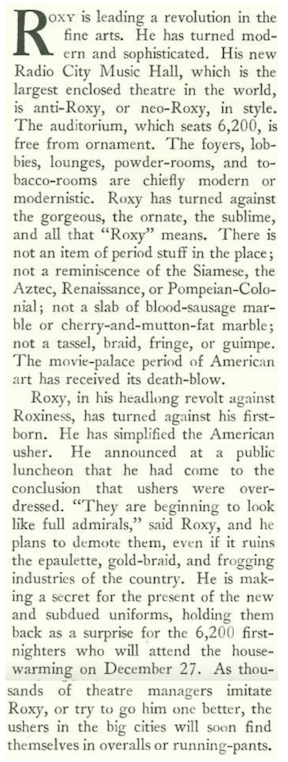
The Grand Garbo

Joan Crawford was an MGM star by the 1930s, and according to many critics, an absolute scene-stealer in 1932’s Grand Hotel. However, The New Yorker’s film critic John Mosher saw Garbo, and only Garbo, in this Academy Award-winning pre-code drama.

April 23, 1932 cover by E.B. White. Although White’s friend and early office mate James Thurber had been contributing drawings for more than a year, it was White who would land the first cover—his only one (Thurber’s first cover would come in 1936). Maria Popova (brainpickings.org) shares this excerpt from a 1969 Paris Review interview, during which White explained to George Plimpton: “I’m not an artist and never did any drawings for The New Yorker. I did turn in a cover and it was published. I can’t draw or paint, but I was sick in bed with tonsillitis or something, and I had nothing to occupy me, but I had a cover idea—of a sea horse wearing a nose bag. I borrowed my son’s watercolor set, copied a sea horse from a picture in Webster’s dictionary, and managed to produce a cover that was bought. It wasn’t much of a thing. I even loused up the whole business finally by printing the word ‘oats’ on the nose bag, lest somebody fail to get the point.”

Greta Garbo’s previous films hadn’t exactly wowed Mosher, but the gossip he was hearing even before he screened Grand Hotel suggested it was not to be missed. Mosher touted the unseen film (in the April 16 issue), expressing his hope that the rumors would prove true—he feared Garbo would quit the business altogether and leave the country if she didn’t land a hit. His fears were laid to rest:

Adapted from the 1929 German novel Menschen im Hotel by Vicki BaumGrand Hotel is considered the first all-star epic. The brainchild of MGM’s production head Irving Thalberg, the film proved a triumph for director Edmund Goulding, who somehow managed to direct five leading roles into one film classic.

GRAND OPENING…The April 12, 1932 opening of Grand Hotel at Broadway’s famed Astor Theatre was much anticipated by critic John Mosher and pretty much everyone else. (ny.curbed.com)
STELLAR CAST…Set at a luxurious Berlin hotel, Grand Hotel brought together the stories of five seemingly unrelated lives. Clockwise, from top left, crooked industrialist Preysing (Wallace Beery), trades innuendos with an ambitious stenographer, Flaemmchen (Joan Crawford); Baron Felix von Gaigern (John Barrymore), a once wealthy man fallen on hard times, supports himself by stealing from vulnerable marks like the depressed ballerina Grusinskaya (Greta Garbo), and also teams up with a gravely ill accountant (Lionel Barrymore, John’s real brother, not pictured here); hotel entrance from the film; MGM movie poster deftly juggled the film’s five big stars; advertisement from the April 16, 1932 New Yorker made much of the film’s star power. (Wikipedia/IMDB)
THE OTHER BIG STAR in Grand Hotel was the luxurious Art Deco set created by Cedric Gibbons. Centered on the hotel’s reception desk, the set allowed filming in 360 degrees. (IMDB)

And let’s not forget that it was in this film Garbo famously uttered “I want to be alone” — it ranks number 30 in AFI’s 100 Years…100 Movie Quotes. In 2007 Grand Hotel was selected for preservation in the United States National Film Registry by the Library of Congress.

* * *

She’s Back

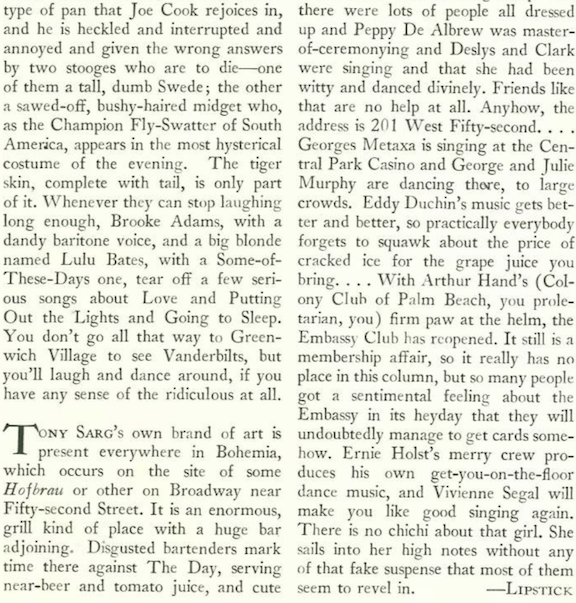
Lois Long aka “Lipstick” turned in yet another “Tables for Two,” even though she had abandoned that column as a regular feature two years earlier. Unlike those earlier columns, Long seemed to have had her fill of the night life, but occasionally she found a diversion or two worth mentioning. She also offered her thoughts about the decline of civilization, indicated by such behaviors as dining at the early hour of 7 p.m.—”rawboned” she called it…

NIGHT LIGHTS…Singer Kate Smith and comedic performer Beatrice Lillie managed to keep Lois Long awake in the wee hours of nightclub entertainments. (katesmith.org/The Poster Corp)

*  *  *

Notes, and More Notes

Despite his cover contribution, and his continued presence in the “Notes and Comment” section, the year 1932 is regarded as one of E.B. White’s leanest as a full-time writer for The New Yorker. According to Scott Elledge in E.B. White: A Biography, White published only a few “Talk” pieces or signed contributions. With a toddler about the house (Joel White had just turned 1 the previous December), White and wife Katharine enjoyed what Elledge describes as perhaps “the happiest of their years together, “able to enjoy fully their professional and private lives in the city they both loved.” So perhaps that explains this particular “Notes” entry for the April 23 issue. Still, it’s good stuff:

(Note Otto Soglow’s Tammany-themed spot cartoon — the political machine was still chugging along, but its days were numbered)

 *  *  *

From Our Advertisers

We begin with this colorful ad from McCutcheon’s to brighten our day…

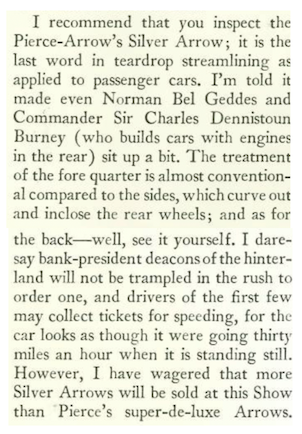
…the Franklin Automobile Company responded to competition from other luxury car makers by introducing its own 12-cylinder model, the only American car to be powered by a 12-cylinder air-cooled engine (according to the H.H. Franklin Club)…

…introducing a 12-cylinder luxury car was not a good move in 1932—one of the worst years of the Depression—and the company folded by 1934…but what a swell-looking car…

(Courtesy H.H. Franklin Club)

…one innovation that would stick around, however, was the lighted refrigerator, something to brighten those dim days of 1932, that is if you could even afford an electric fridge…

…named to evoke the luxury automobile, the British-made Rolls Razor made its debut in the back pages of The New Yorker with this panel cartoon ad featuring a hapless suitor and his girlfriend’s nosy kid brother…

…the razor came in a rigid case enclosed by two detachable lids; one carried a sharpening stone and the other a leather strop. When a lid was removed, the razor’s oscillating a handle drove a shaft along the frame, pushing the solid, hollow ground blade forward against the stone or dragging it against the strop…

…and here’s an ad you don’t see often in The New Yorker…one featuring children…

…on to our cartoonists, we have more kids via William Steig’s Small Fry…

James Thurber continued to ply his cartooning craft with one of his favorite subjects:

…here is a more detailed look at the above…

John Held Jr. continued to take us back to those saucy days of yore…

Gardner Rea sketched this hereditary pratfall…

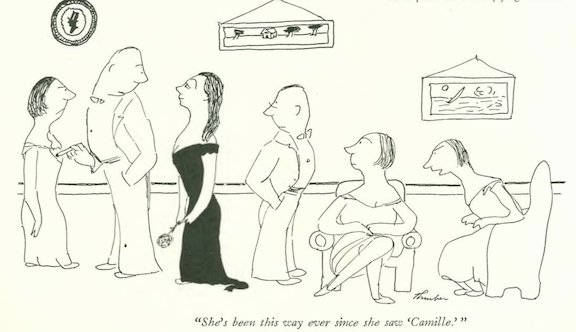
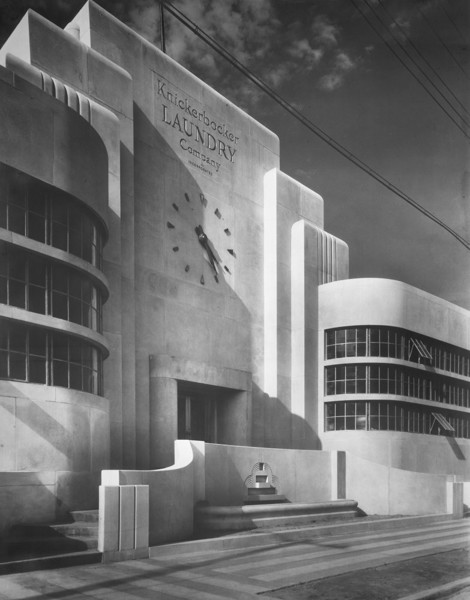
E. McNerney gave us a woman whose beau was in alliance with architecture critic Lewis Mumford

Alan Dunn looked in on the fast-paced world of business…

…and Leonard Dove takes us out on a droll note…

Next Time: The Quiet Man…