Highfalutin Absurdities

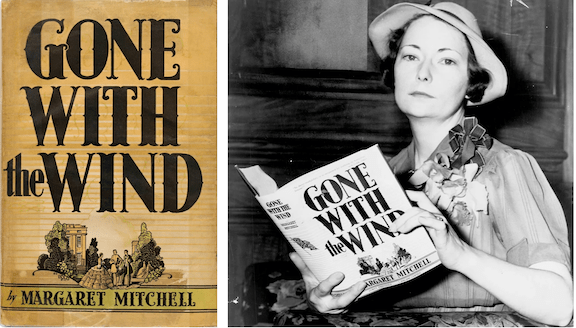
Above: Margaret Mitchell poses with her award-winning novel, c. 1938. Mitchell won the National Book Award for Fiction for Most Distinguished Novel of 1936 and the Pulitzer Prize for Fiction in 1937. Gone With the Wind was the only novel she published in her lifetime. (britannica.com)

Margaret Mitchell’s 1936 novel Gone With the Wind and the 1939 film it inspired have both served as controversial reference points for cultural critics and scholars, particularly for the stereotypical and derogatory portrayals of African Americans in the 19th century South.
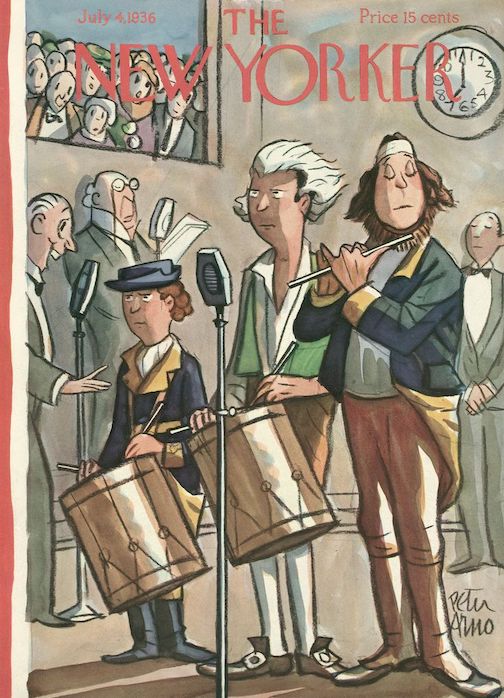
July 4, 1936 cover by Peter Arno.

Ninety years later the novel still proves divisive; it also remains one of America’s most-loved books. Worldwide, more than 30 million copies have been printed in the U.S. and abroad.

In 1936 the novel quickly rose to the top of fiction bestseller lists, and was generally well received by critics. Novelist and literary critic Louis Kronenberger (1904–1980), who sat in for Clifton Fadiman in The New Yorker’s book section, praised the novel for its “highfalutin absurdities,” calling it a “masterpiece of pure escapism.” Kronenberger wrote that Gone with the Wind provided “a kind of catharsis…of all the false sentiment and heady goo that even the austerest mind somehow accumulates and periodically needs to get rid of.” He correctly predicted that the novel would be “very feverishly discussed” once people found the time to read its thousand-plus pages. Excerpts:
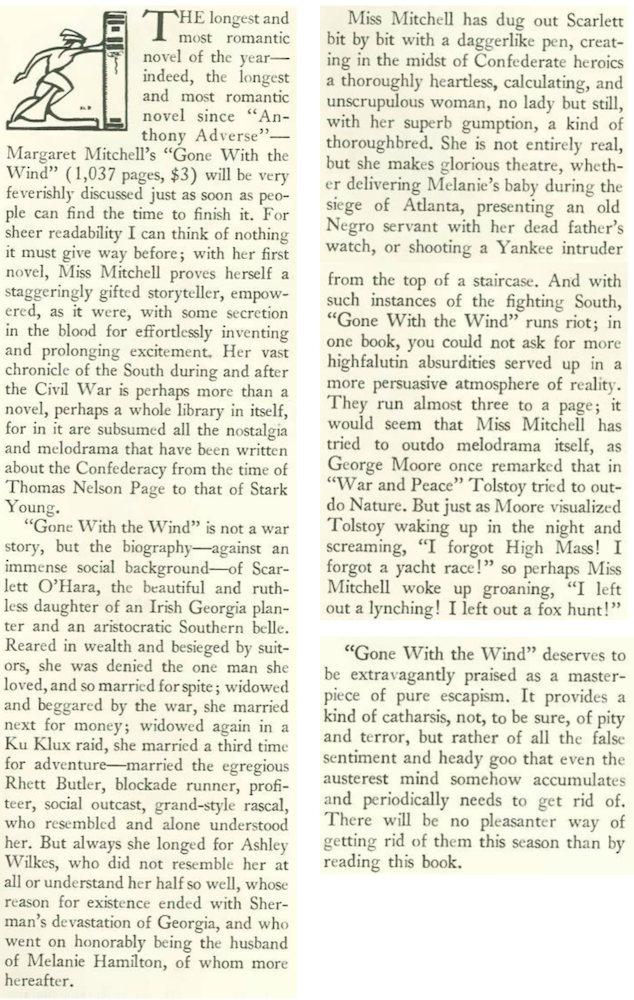
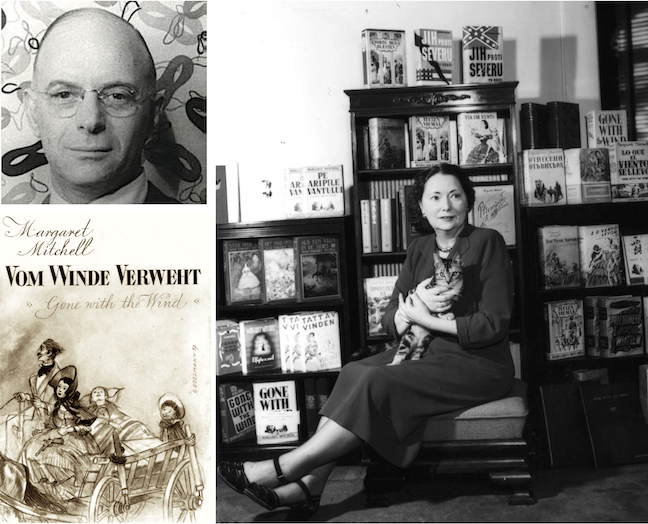
GOO GONE…Clockwise, from top left: Reading Gone With the Wind will clear one’s “heady goo,” according to critic Louis Kronenberger; Margaret Mitchell (1900–1949) seated before a selection of Gone With the Wind translations; an example of a German version of the novel—Gone With the Wind was translated into at least forty different languages with eight hundred unique international printings. (azquotes.com/Atlanta Journal-Constitution/georgiaencyclopedia.org)
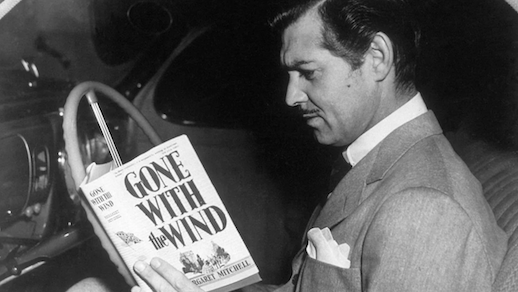
IT HAS HOW MANY PAGES?!…Clark Gable, who portrayed Rhett Butler in the 1939 film adaptation of Gone with the Wind, has a look at Margaret Mitchell’s doorstop of a book. Mitchell was not involved in the screenplay or film production. (yahoo.com)

 * * *

Tweet From Tinseltown

Apparently actress Mary Astor was a New Yorker reader, having read an E.B. White “Notes” column that mentioned his stained-glass hummingbird feeders.
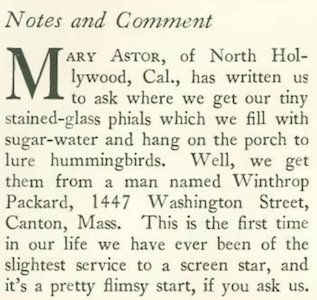
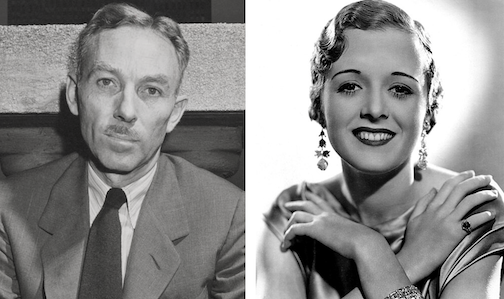
FOR THE BIRDS…A New Yorker column by E.B. White inspired actress Mary Astor to feed Hollywood’s hummingbirds. (Wikipedia)

 * * *

Going, Going, Gone

A “Talk of the Town” piece co-written by A. J. Liebling and Russell Maloney tracked down what remained of the Central Park Casino, which had been demolished under the orders of Parks Commissioner Robert Moses.
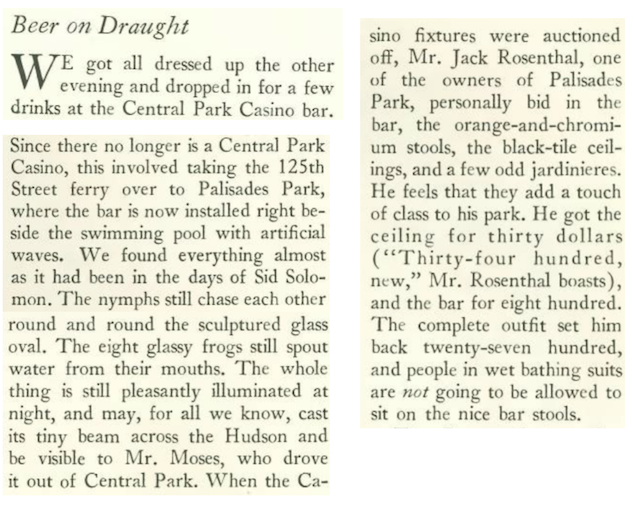
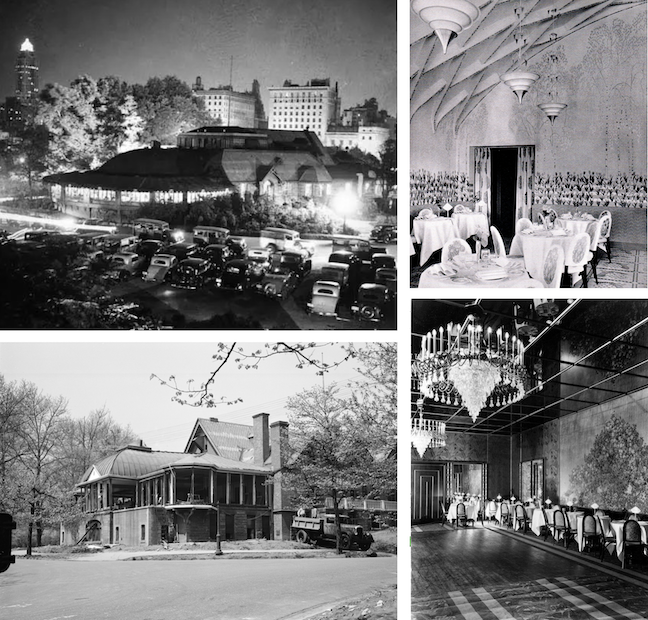
Moses hated former Mayor Jimmy Walker, and by association he hated Walker’s favorite haunt, the Central Park Casino. Despite pleas from preservationists to save the famous Art Deco supper club, which had been beautifully rebuilt by the late designer Joseph Urban, Moses moved as quickly as possible to demolish the building. Following a public auction, the iconic horseshoe-shaped bar and some interior fixtures were acquired by the Palisades Amusement Park in New Jersey and subsequently installed beside the park’s wave pool.

FROM GLITTER TO RUIN…Clockwise, from top left, the Central Park Casino on the evening of Sept.10, 1935; interior images of Joseph Urban’s elegant Art Deco designs; workers remove windows and interior fixtures as demolition commences in May 1936. (nycgovparks.com/centralpark.org/mcny.org)

 * * *

Maddy Returns

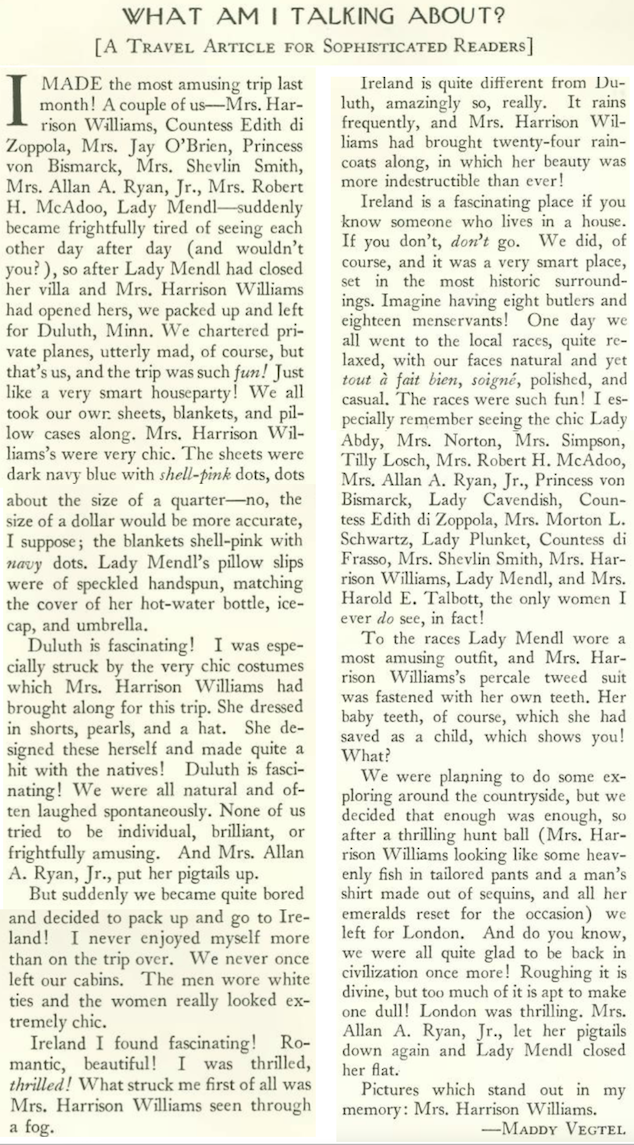
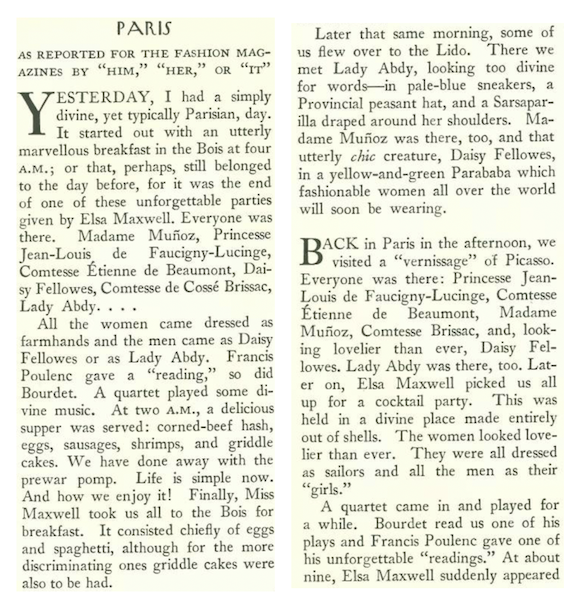
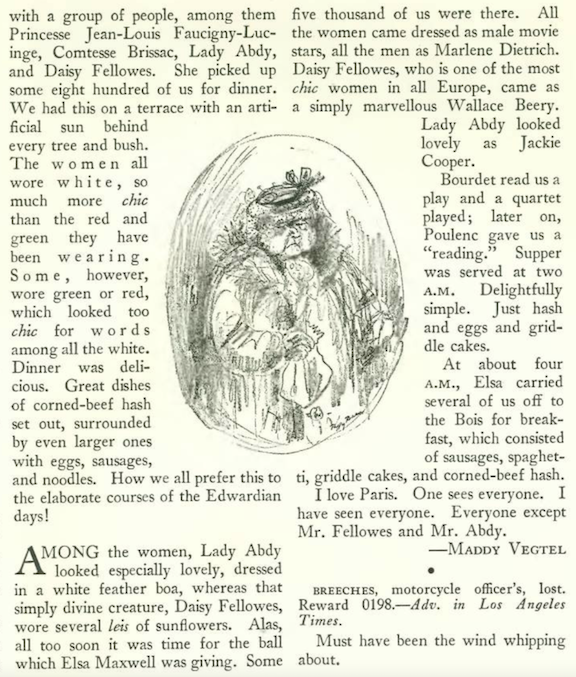
It’s a shame that writer Maddy Vegtel is largely forgotten today. She wrote with great wit and verve, and was well known in the 1920s and 30s for her Vanity Fair profiles and for her articles about Holland, her native land. A contributor to The New Yorker from 1926 to 1956, she published this casual in July 4 issue.

 * * *

Bad Men and Mad Men

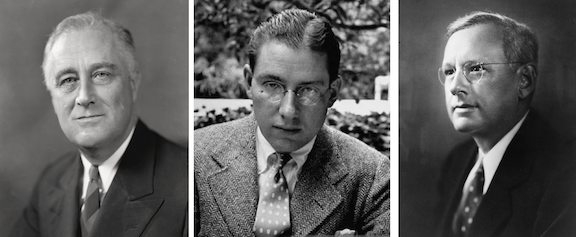
The poet Ogden Nash shared his thoughts on the summer political convention season:
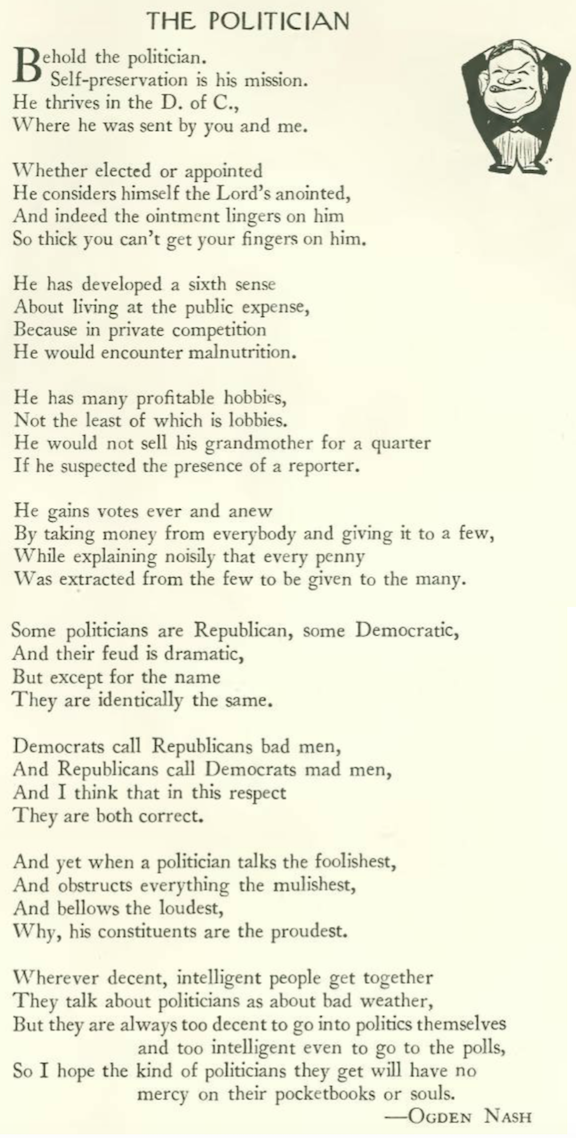
THE LORD’S ANOINTED…Ogden Nash (center) observed this belief in the political animal; at left and right, the Democratic and Republican nominees for president in 1936, Franklin D. Roosevelt and Alf Landon. (Wikimedia/poetryverse.com/Wikipedia)

 * * *

At the Movies

Critic John Mosher was on board for MGM’s musical-drama disaster film San Francisco, which told the story of a saloon keeper, a singer, and a priest caught up in 1906 San Francisco earthquake.
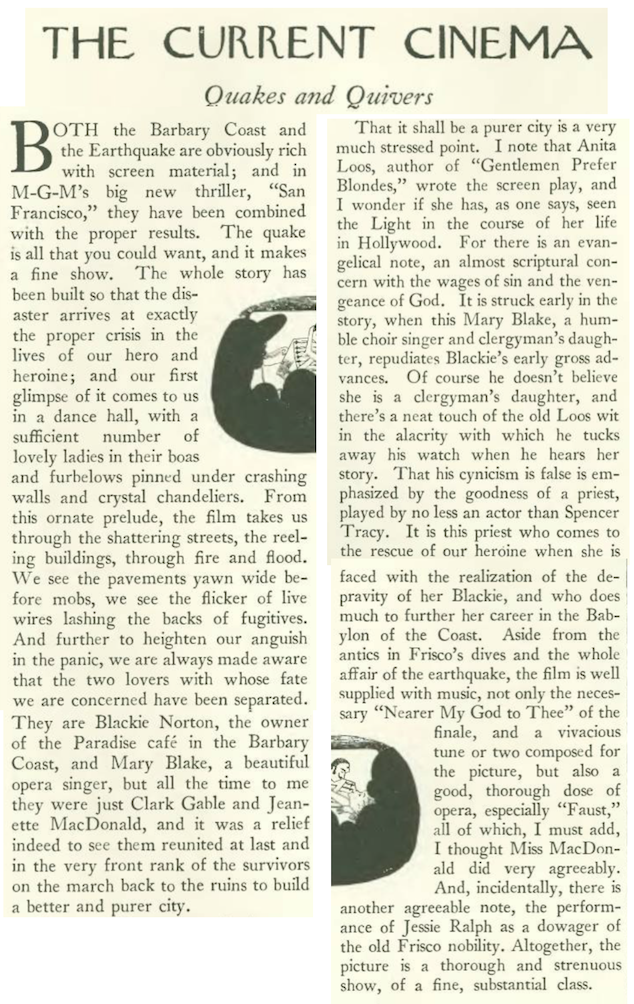
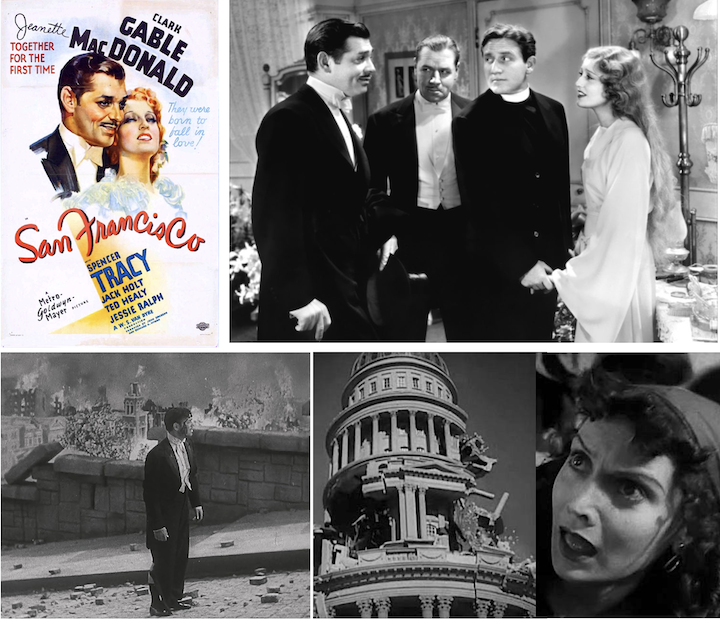
SHAKING IN THEIR BOOTS…Clockwise, from top left: MGM poster for San Francisco touts the first-time pairing of Clark Gable and Jeanette MacDonald in a film; scene from the film featuring, from left, Gable, Jack Holt, Spencer Tracy and MacDonald; the film included stunning effects, including an earthquake montage sequence that interspersed scenes of wreckage with the faces of terrified victims; Gable assesses the carnage in a scene from the film. (imdb.com/kittypackard.wordpress.com)

Mosher offered a tongue-cheek assessment of Shirley Temple’s appearance in her latest film, The Poor Little Rich Girl, noting that “There’s not the slightest indication of aging in Miss Temple.” The child star was just shy of eight years old when she filmed the picture. As for the The White Angel, Mosher found the Florence Nightingale biopic—with Kay Francis in the title role—”a little schoolbookish [and] quite on the dull side.”
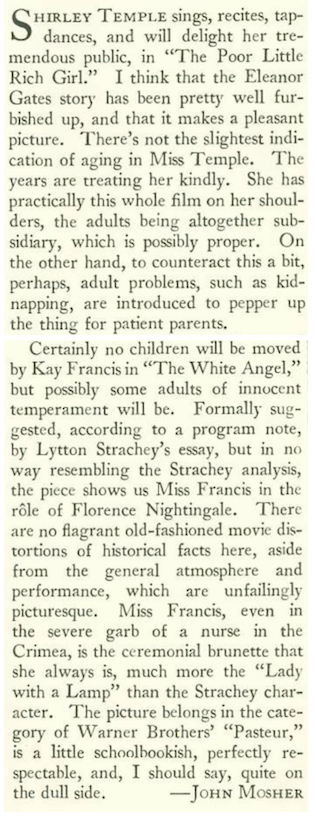
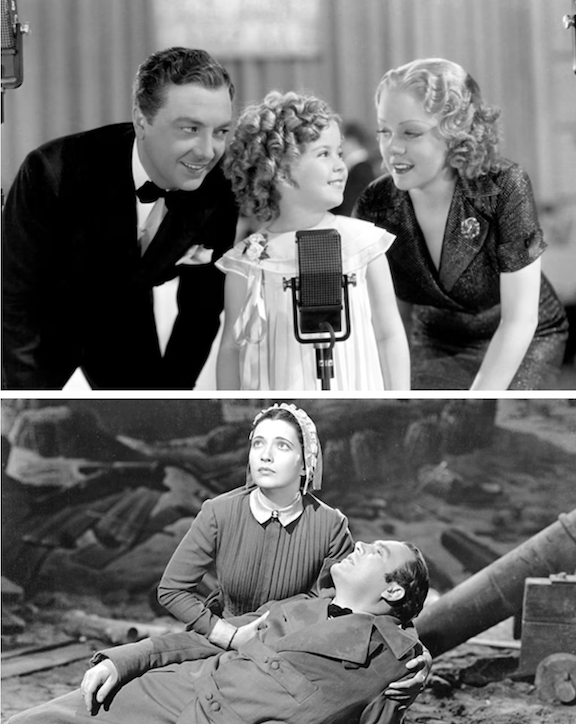
THAT YOUTHFUL GLOW…Top photo: Critic John Mosher found Shirley Temple still able to “delight her tremendous public” in The Poor Little Rich Girl—she is seen here with co-stars Jack Haley and Alice Faye; Below: Kay Francis and Ian Hunter in The White Angel, a film about Florence Nightingale’s pioneering work as a nurse during the Crimean War. (tcm.com)

 * * *

From Our Advertisers

Sunscreen as we understand it today wasn’t available to New Yorkers in 1936, so they relied on zinc oxide and other mineral applications to avoid sunburns…however, Eugene Schueler, founder of L’Oréal, developed the first tanning oil with UV radiation-filtering properties in Europe in 1935 (active ingredient was benzyl salicylate), and later marketed it to the U.S. as Ambre Solaire…the brand is still sold today…

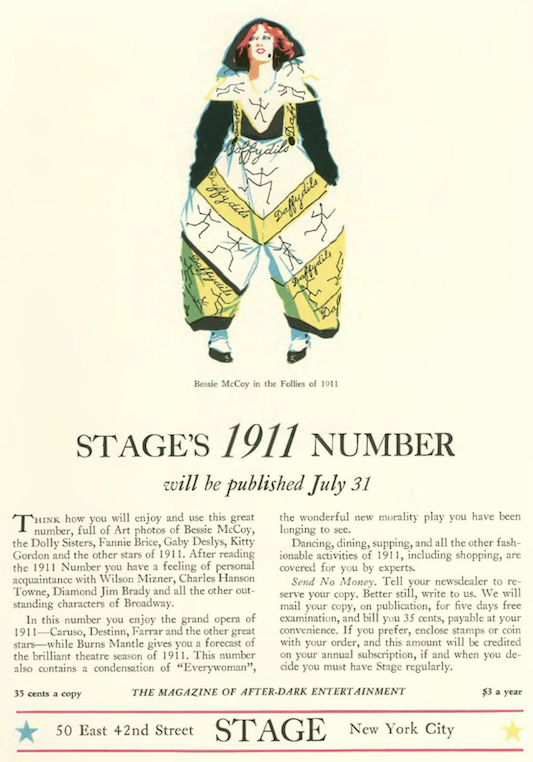
Stage magazine continued to promote their 1911 throwback issue…
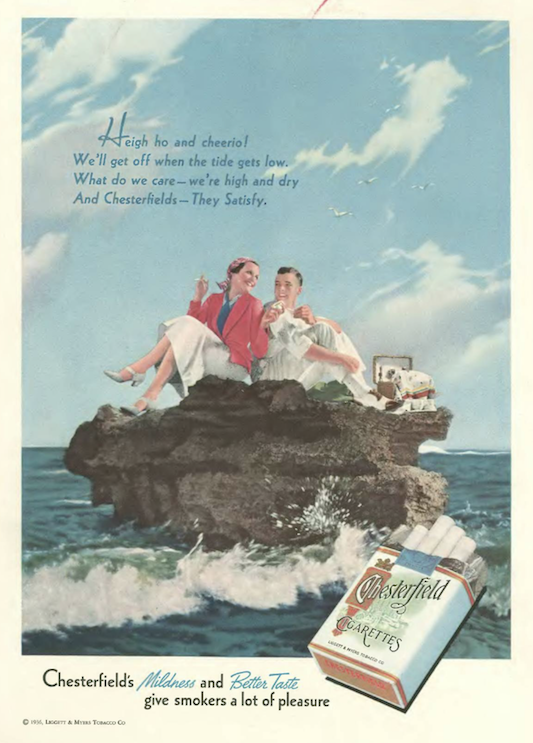
…the back cover belonged to Liggett & Myers, offering another romantic couple enjoying their Chesterfields…
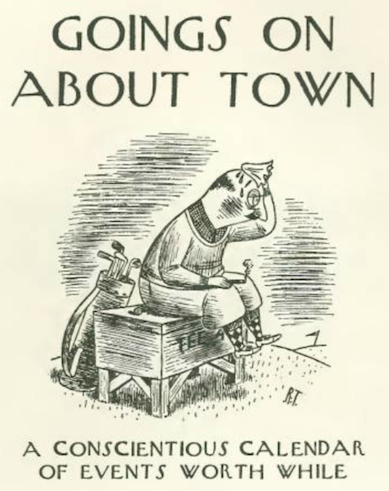
…we open the cartoons with Richard Taylor, who felt the heat as summer took hold in the city…on July 4, 1936, the official high temperature in Central Park reached an unseasonably warm 93 degrees F (34 c), hitting 106 F (41C) five days later on July 9…that mark remains the city’s all-time absolute highest temperature…
Otto Soglow’s spot art showed us how one well-heeled family escaped the hot city…

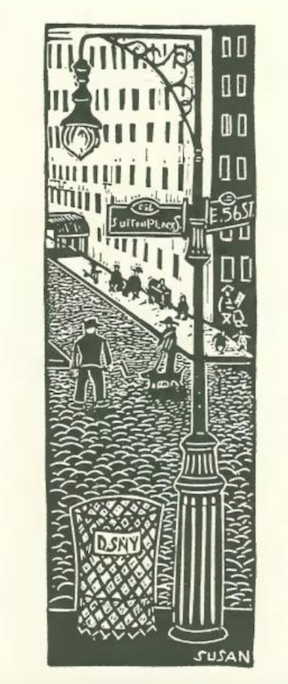
…while Susan Willard Flint offered a woodcut if a quiet cobbled street…
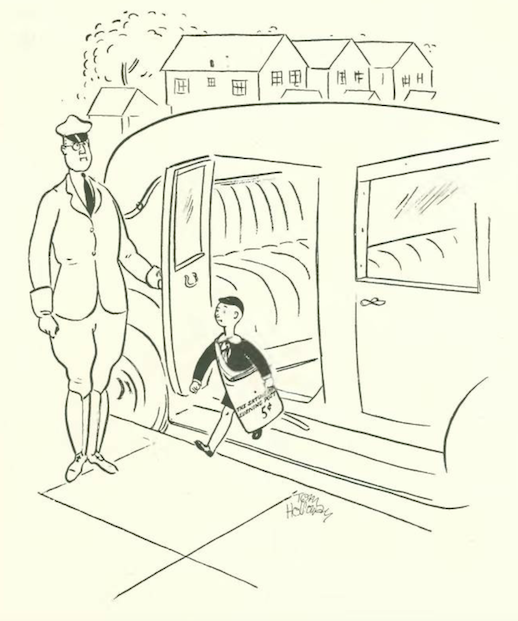
Tom Holloway showed us how one posh kid delivered the Saturday Evening Post (Holloway was a cartoonist for the Post, contributing just two drawings to The New Yorker, both in 1936)…
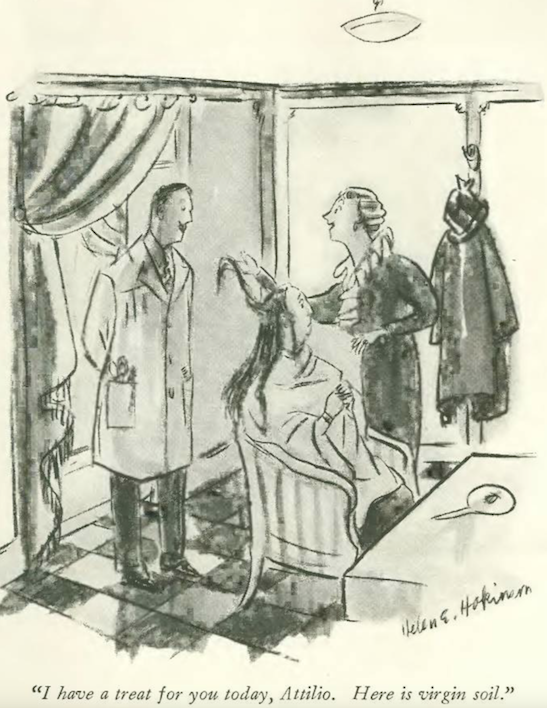
…the woman’s expression says it all in this Helen Hokinson cartoon…
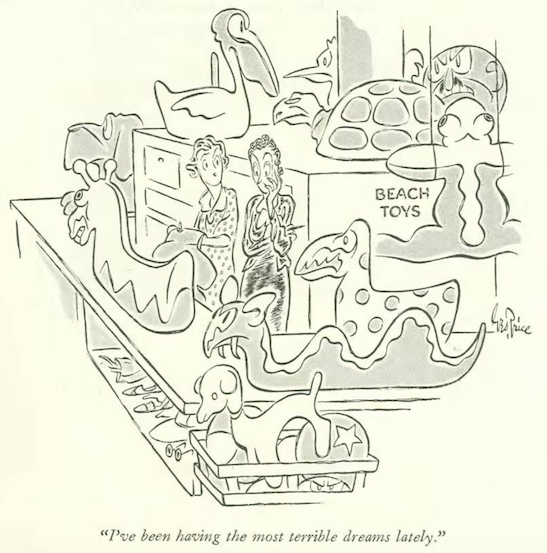
George Price gave us a saleswoman who saw one two many pool floats…
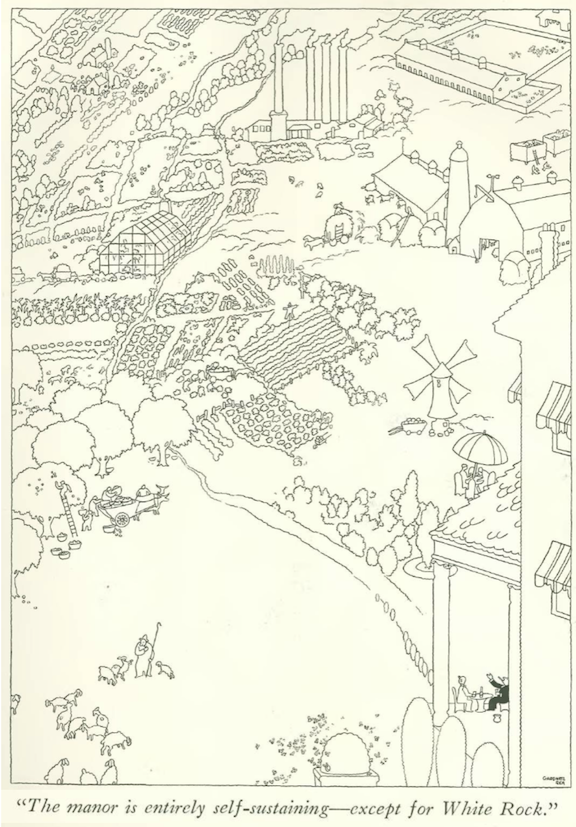
Gardner Rea drew up a vast estate for a man who (almost) had it all…
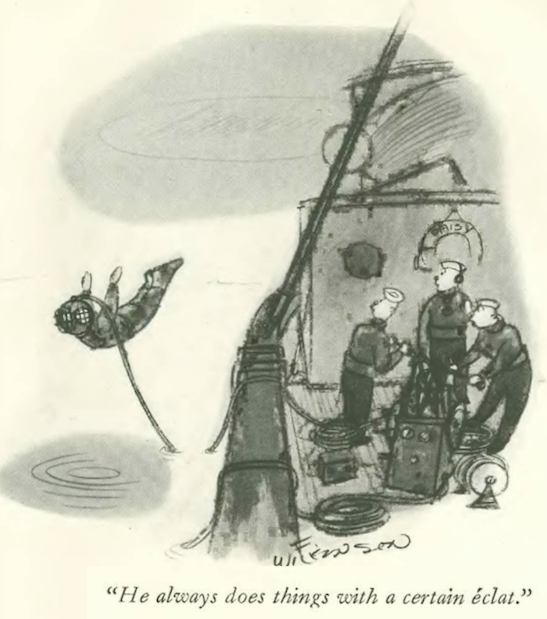
Fritz Wilkinson did some deep sea swan diving…
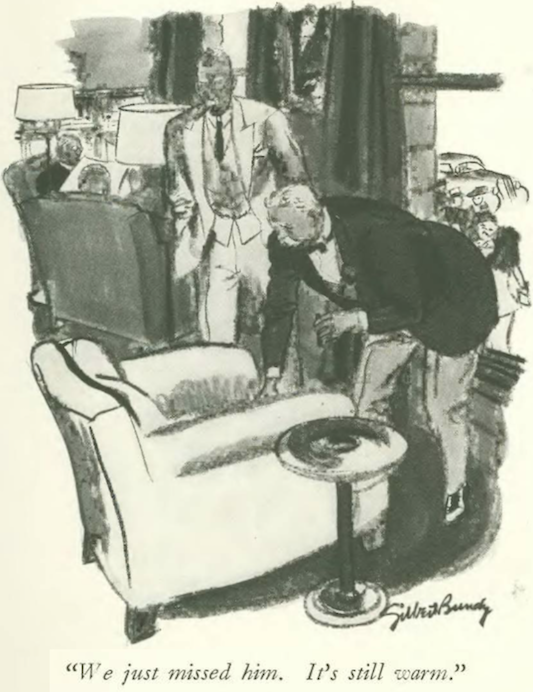
Gilbert Bundy found a clue at the gentleman’s club…
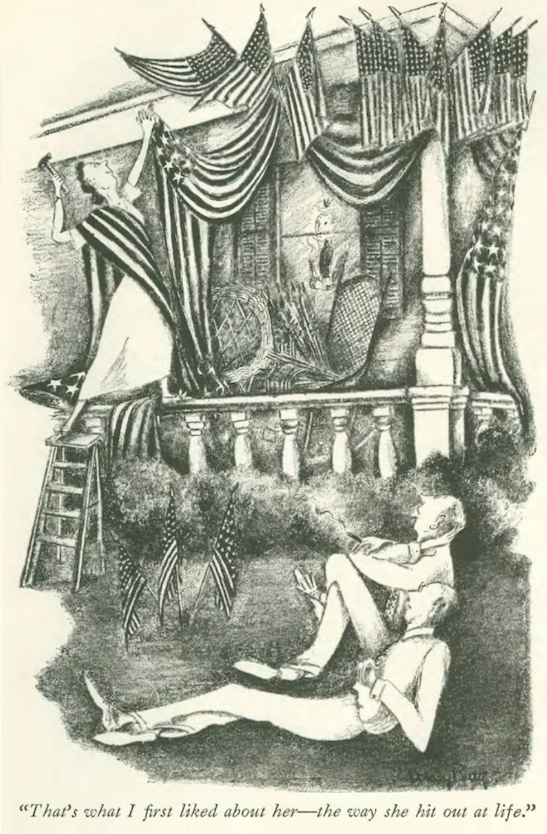
Mary Petty went all out for the Fourth of July…
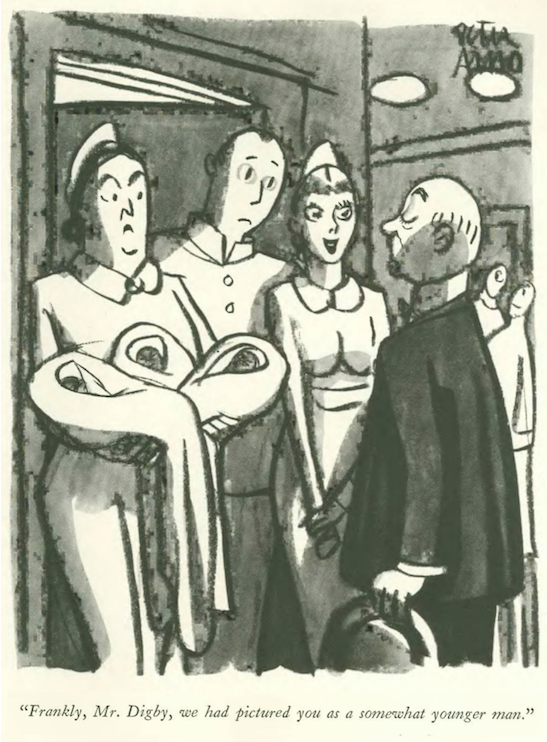
…and we close with Peter Arno, and the miracle of birth…
Next Time: Better Living Through Fiction…
Gas Tanks & Towers

Lewis Mumford (1895–1990) is best known as a critic of art, architecture and urban design, but he was unique—especially for his time—in how he approached these subjects, going far beyond aesthetics to consider how things aligned, or mis-aligned, with necessary human qualities ranging from comfort and scale to the quality of our air, water and even diet.

Oct. 22, 1932 cover by Peter Arno.

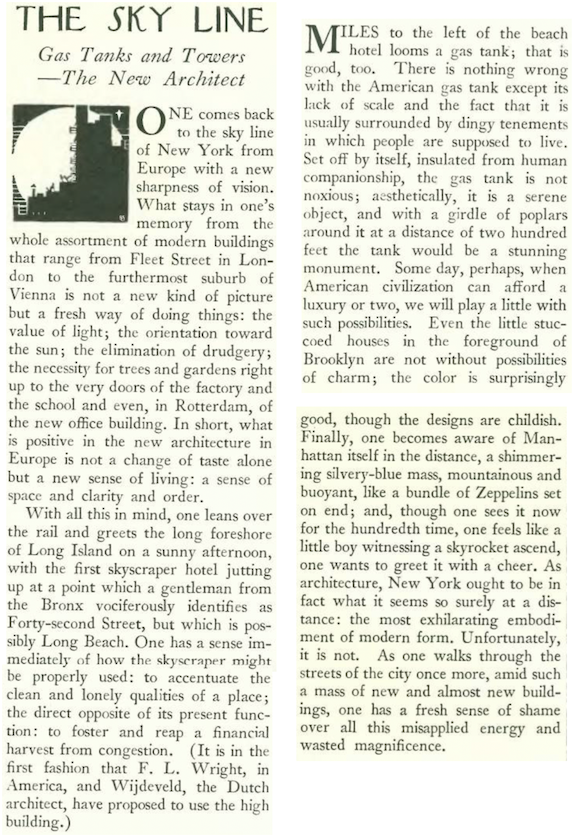
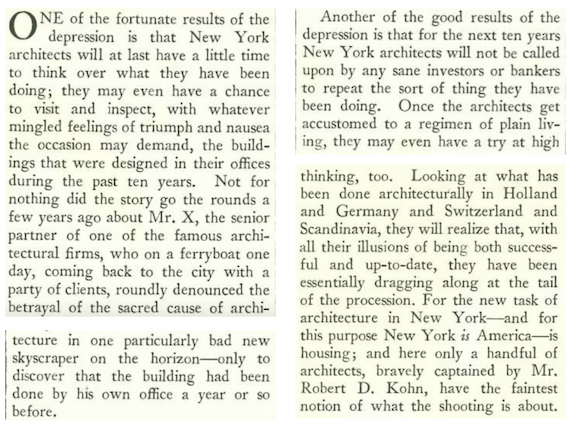
Returning home from a trip to Europe, Mumford pondered the New York skyline as his ship approached the harbor, contrasting his city’s approach to architecture with what he had seen abroad. He was not pleased:

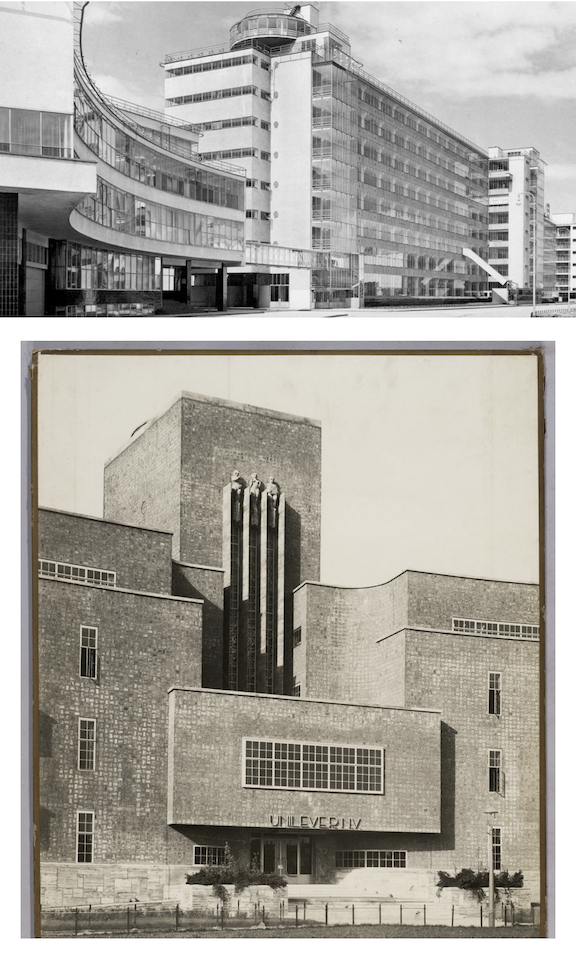
NOT JUST ANOTHER PRETTY FACE…Lewis Mumford praised the sense of “space, clarity and order” he found in the buildings of Rotterdam—perhaps he was referring in part to Leendert van der Vlugt’s 1931 Van Nelle Factory (top) and H.F. Mertens’ 1931 Unilever office building. (metalocus.es/Wikimedia)
WELCOME BACK, LEWIS…Manhattan skyline with gas tank, 1932. (nycurbanism.com)

Mumford was among the few in 1931 who saw a bright side to the Depression, since a pause in building would afford American architects an opportunity to reflect on their past transgressions…

Mumford, among others, was regarded as a visionary in urban planning, anticipating the “New Urbanism” of the late 20th century which was proposed as an antidote to the dehumanizing free-market development Mumford rightly feared would degrade the quality of urban life, not to mention its deleterious effects on the natural environment.

Inspired by the Garden City movement in the U.K., Robert D. Kohn (mentioned above) founded the Regional Planning Association of America, which led to the development of some of the first modern zoning standards in the U.S.

MAVERICKS…Robert D. Kohn (seated in light-colored suit) was president of AIA when the association held their convention in San Antonio in 1931. Seated at left is Dr. Aureliano Urrutia, a prominent San Antonio physician who established the famed Miraflores gardens (mostly gone, sadly) in that city. (sanantonioreport.org)
Along with Mumford and Kohn, Henry Wright (left) and Frederick Ackerman were strong advocates for zoning laws unsullied by free market forces. Wright (1878–1936) was the brainchild behind the Hillside Group Housing model (described by Mumford below) and he also co-designed Radburn (pictured below) among other projects. Ackerman (1878–1950) became the first Technical Director of New York City Housing in 1934.(sunnysidegardens.us)

Mumford praised the work of architect and planner Henry Wright (1878–1936), who had co-created a “Garden City” plan for Radburn, N.J. (with Clarence Stein) and had recently produced a proposal for “Hillside Group Housing”…

NICE PLACE, THIS…Apartments around a courtyard in Radburn, a community designed by Henry Wright and Clarence Stein. Stein was an early supporter of bicycle paths. (thepolisblog.org)

 *  *  *

Shining Some Light

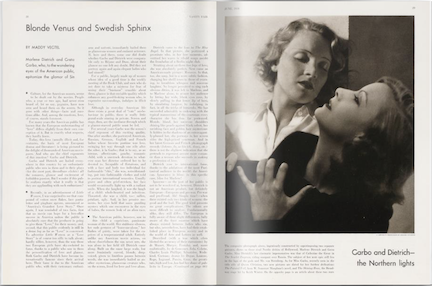
Now I’d like to offer a tribute of sorts to the almost-forgotten Maddy Vegtel, a writer known in 1920s and 30s for her Vanity Fair profiles (she penned “Blonde Venus and Swedish Sphinx” — about Marlene Dietrich and Greta Garbo in the June 1934 issue of VF) and articles about her European roots (Holland) in The New Yorker from 1926 to 1956. She particularly enjoyed skewering smug upper middle-class types. Here is her short piece, “Paris.”

…and for the record, the opening spread of Vegtel’s 1934 Vanity Fair piece on Garbo and Dietrich…

(Vanity Fair)

 *  *  *

Play It Again

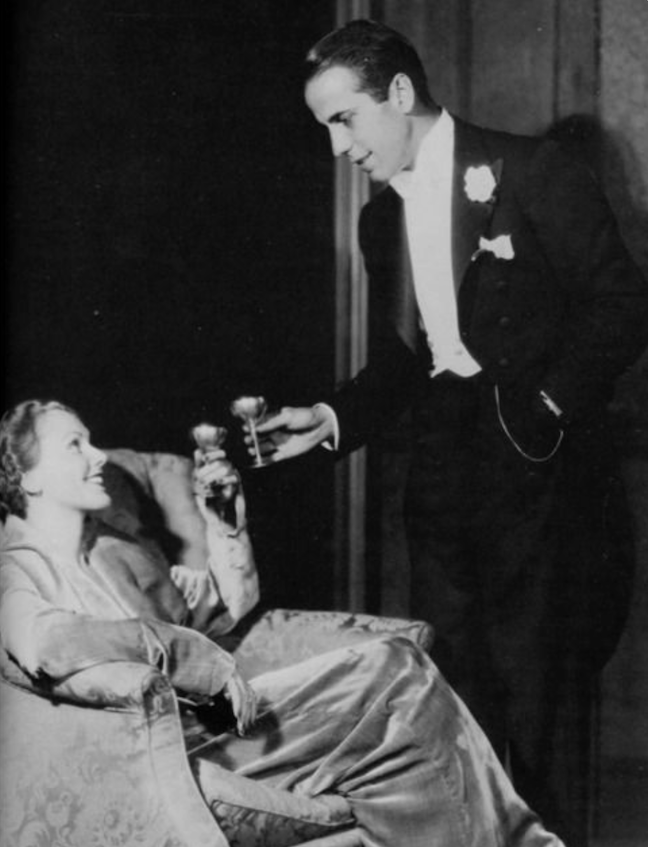
Robert Benchley was back to writing stage reviews, this time taking in the drama I Loved You Wednesday (at the Sam Harris Theatre) featuring Frances Fuller and Humphrey Bogart — Bogie appeared in a number of stage productions before becoming the familiar hardboiled antihero of Hollywood’s golden age.

Bogart began his stage career in 1921, delivering one line (as a Japanese butler!) in the play Drifting. He would go on to appear in 17 Broadway productions between 1922 and 1935, and would make his screen debut in 1930 in A Devil With Women.

HERE’S LOOKING AT YOU, KID…Francis Fuller and Humphrey Bogart in a 1932 stage production of I Loved You Wednesday. It ran for 63 performances at the Sam Harris Theatre. (Pinterest)

 *  *  *

Off-white Christmas

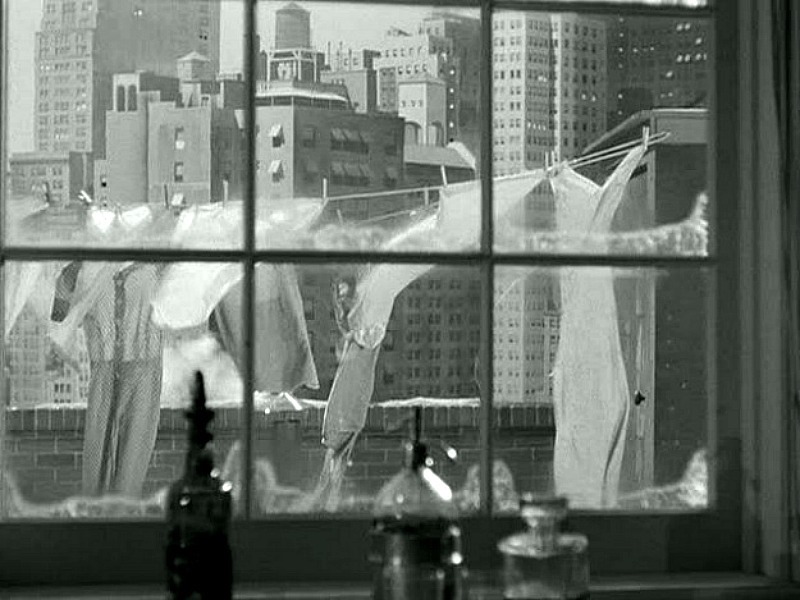
In the midst of wading through poetry submissions to The New Yorker, E.B. White allowed his thoughts to drift toward the coming winter…

…and what would likely be his winter scene in Manhattan…actually this is a screenshot from the 1945 comedy Christmas in Connecticut, and this was the view through writer Elizabeth Lane’s (Barbara Stanwyck) window, which was actually part of a Hollywood sound stage…

(hookedonhouses.net)

 *  *  *

Seeing Red

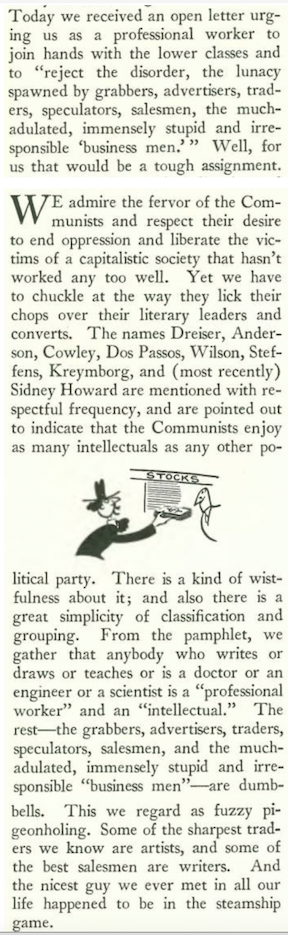
Along with the poetry submissions, E.B. White also received a letter from the local Communists urging The New Yorker to join hands with the oppressed classes. White, however, found that class divisions weren’t always what they seemed…

FREEDOM AND SOME FREE STUFF, PLEASE…About 10,000 Communists and unemployed march on New York’s City Hall in 1932. (NY Daily News)

 *  *  *

From Our Advertisers

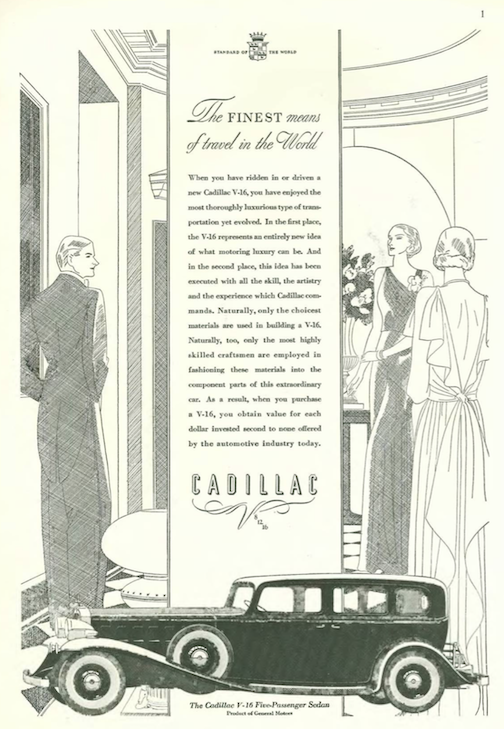
While the Communists marched for jobs and free milk, another class of New Yorkers pondered this ad for a V-16 Cadillac…

…in my last post we saw how RCA’s mascot “Nipper” enjoyed the newfangled “bi-acoustic” radio…

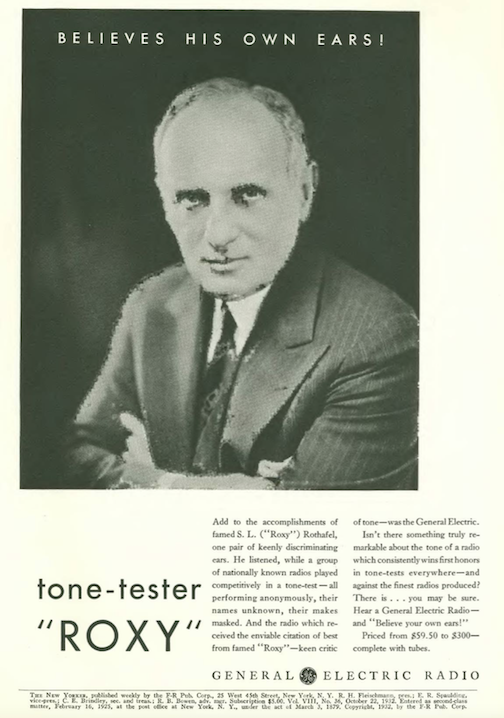
…and so General Electric answered in the Oct. 22 issue with a two-legged expert, who perhaps didn’t have the same range of hearing as a terrier mix, but was nevertheless blessed with “keenly discriminating ears”…

Samuel Lionel “Roxy” Rothafel’s greatest achievement was the Roxy Theatre, which opened March 11, 1927. He was also behind the opening of Radio City Music Hall, home of the Roxyettes (later renamed The Rockettes). Rothafel (1882–1936) is also the great-grandfather of actress Amanda Peet

S.L. “Roxy” Rothafel greets wife Rosa Freedman (right) and daughter Beta Rothafel after their return from abroad aboard the S.S. Paris, Sept. 19, 1932. (Associated Press)

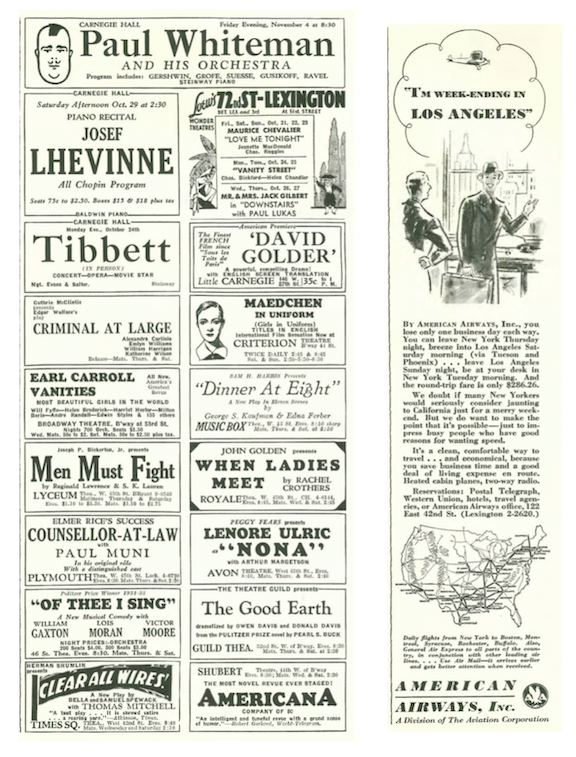
…and we continue in the back pages, which included signature ads for various entertainments and an ad for American Airways, which depicted a jaunty young man announcing his plans for “week-ending in Los Angeles”…now read the fine print…in order to “breeze into Los Angeles on Saturday morning,” this fellow would need to depart on Thursday evening, and no doubt experience some bumps along the way…

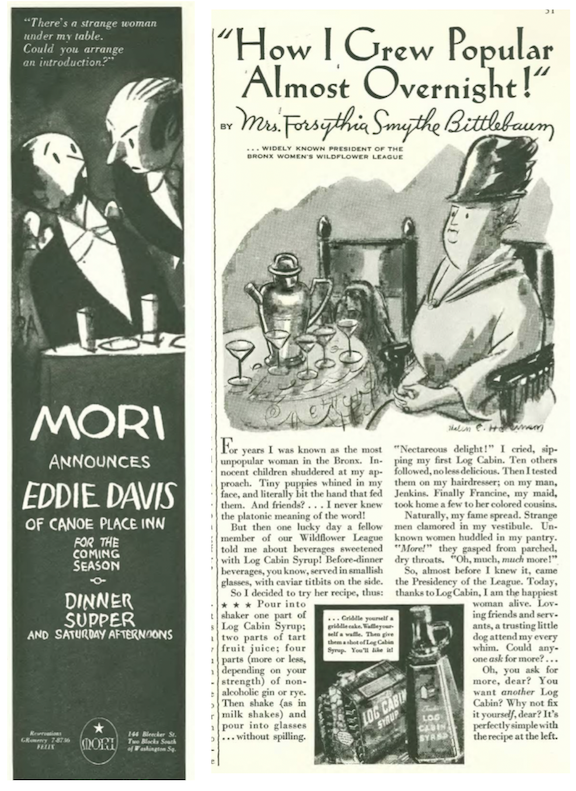
…here’s a couple of ads featuring New Yorker talent, cartoonists Peter Arno and Helen Hokinson

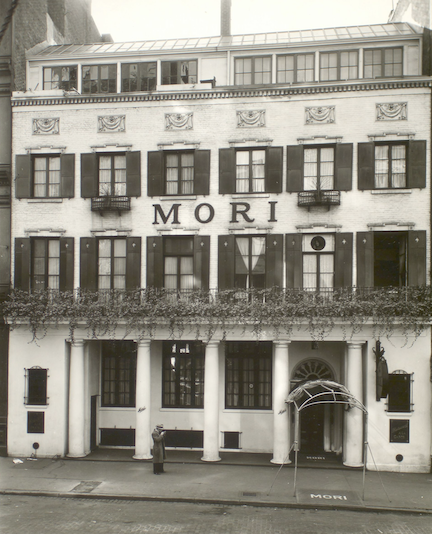
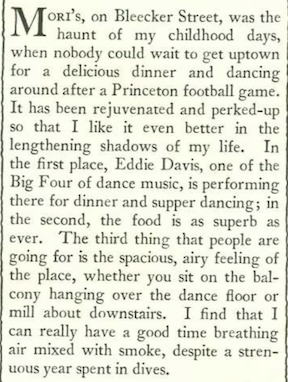
…Mori was an Italian restaurant in Greenwich Village (144 Bleecker Street) that managed to survive Prohibition and most of the Depression before closing in 1937…the building is still there, sans the charm…

A photograph of Mori’s Restaurant taken by Berenice Abbott for the Federal Art Project in 1935. (New York Public Library)

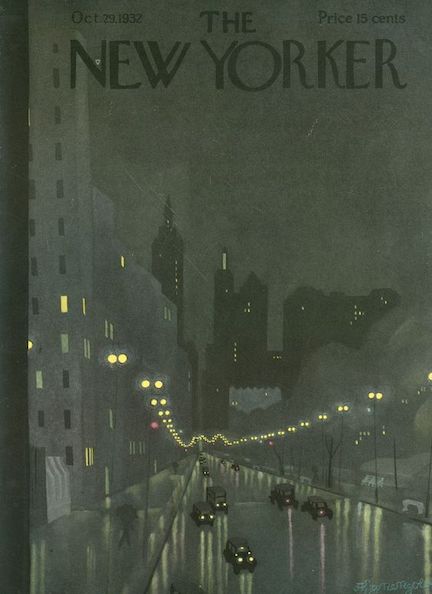
Lois Long had this to say about Mori in her Oct. 29, 1932 “Tables for Two” column:

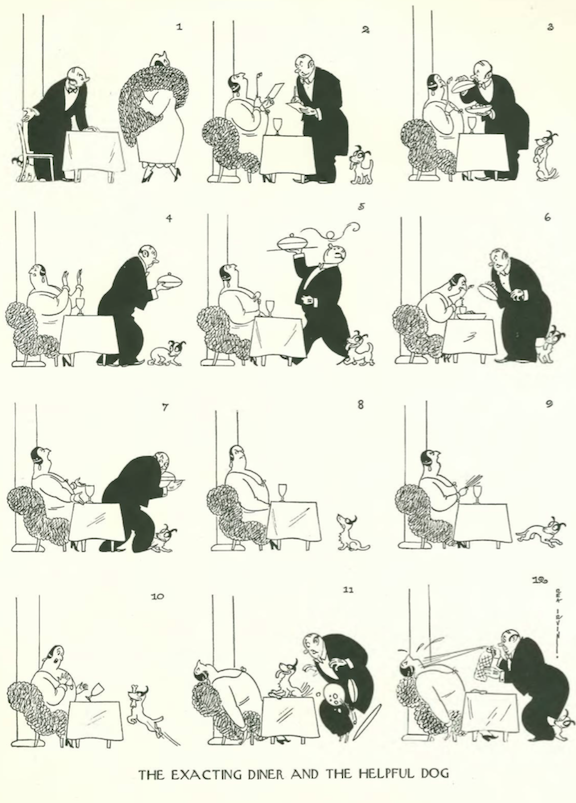
…on to our cartoonists, beginning with Rea Irvin

…this relatively straightforward cartoon feels like a departure from James Thurber’s usual work…

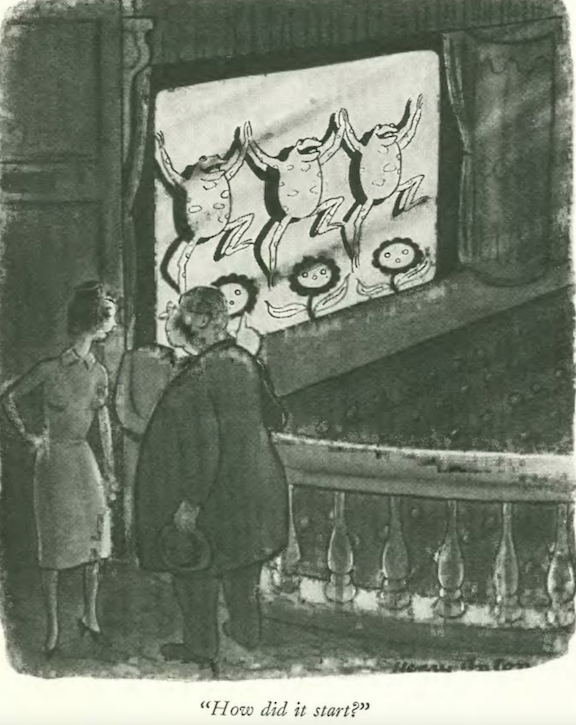
…and here we have Henry Anton’s first-ever cartoon in The New Yorker (Anton was William Steig’s brother)…

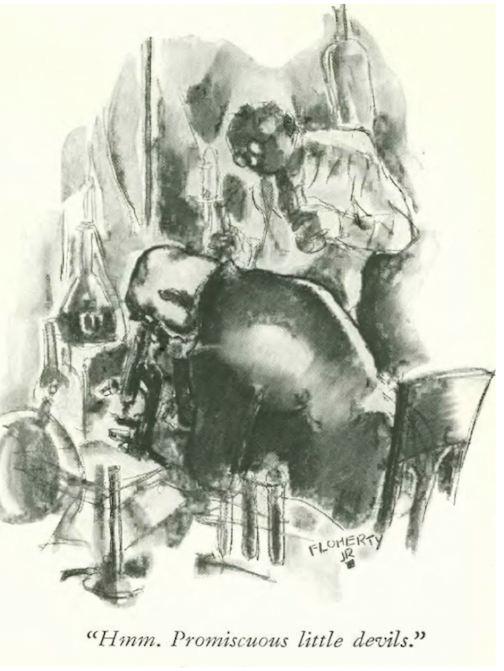
John Floherty Jr. found some racy action among the amoeba…

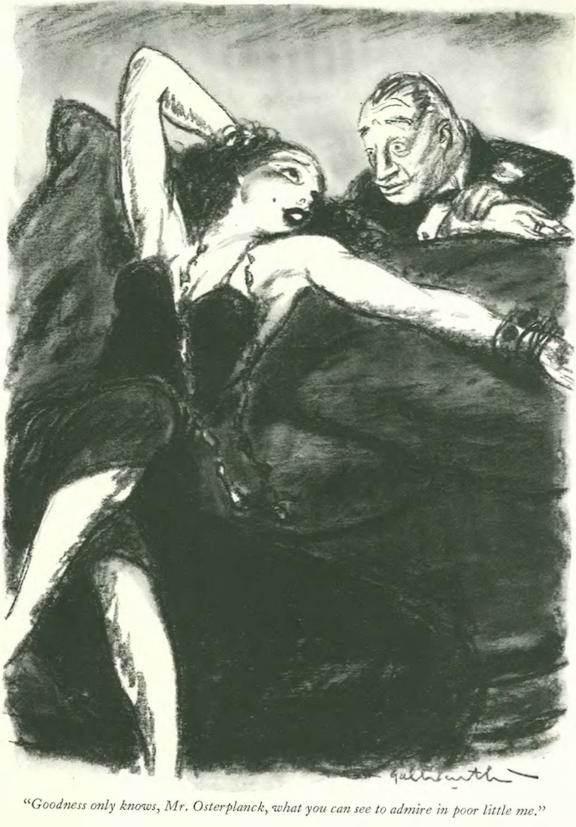
…while William Crawford Galbraith dialed up the familiar sugar daddy trope…

…and we close with Peter Arno, on firm ground with a bit of his own naughtiness…

Next Time: The Faux Prince…