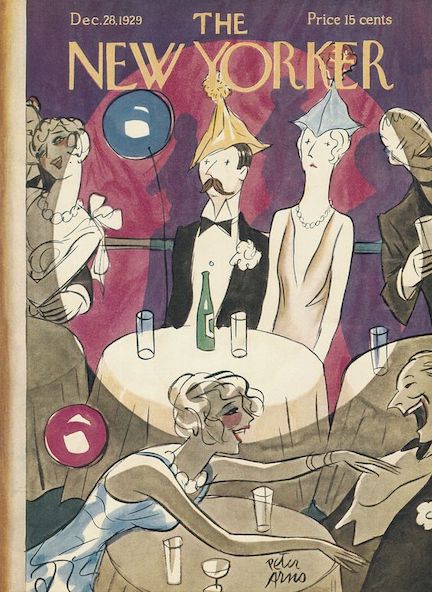
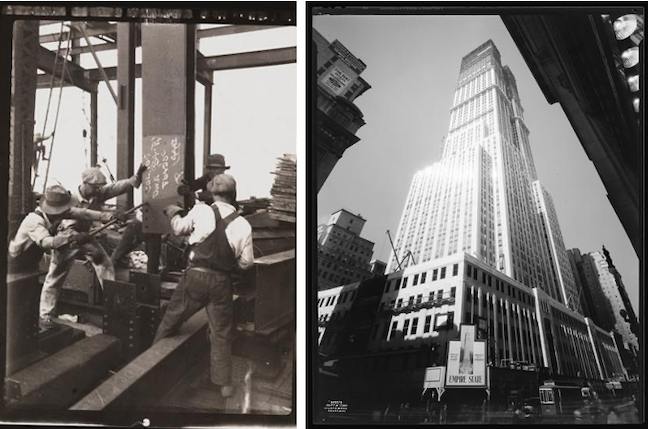
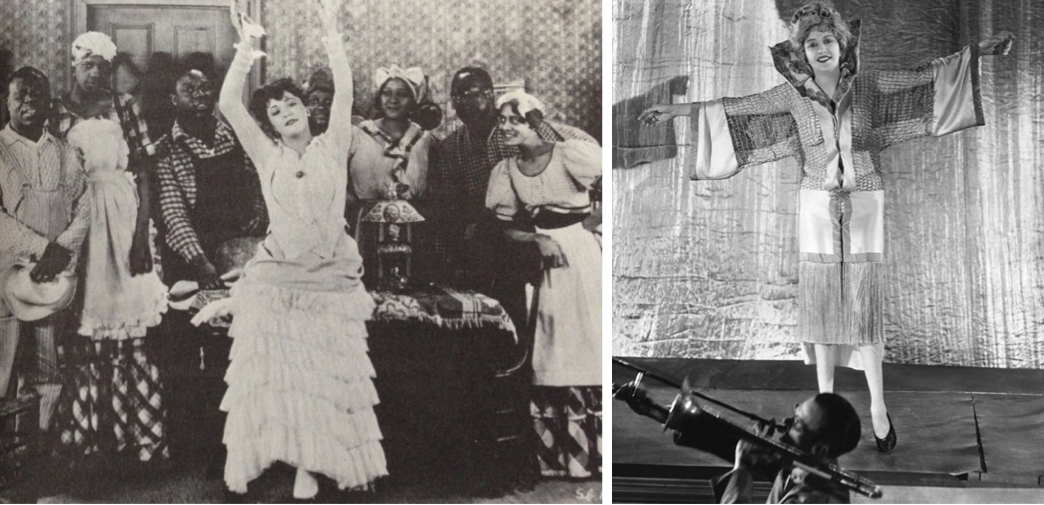
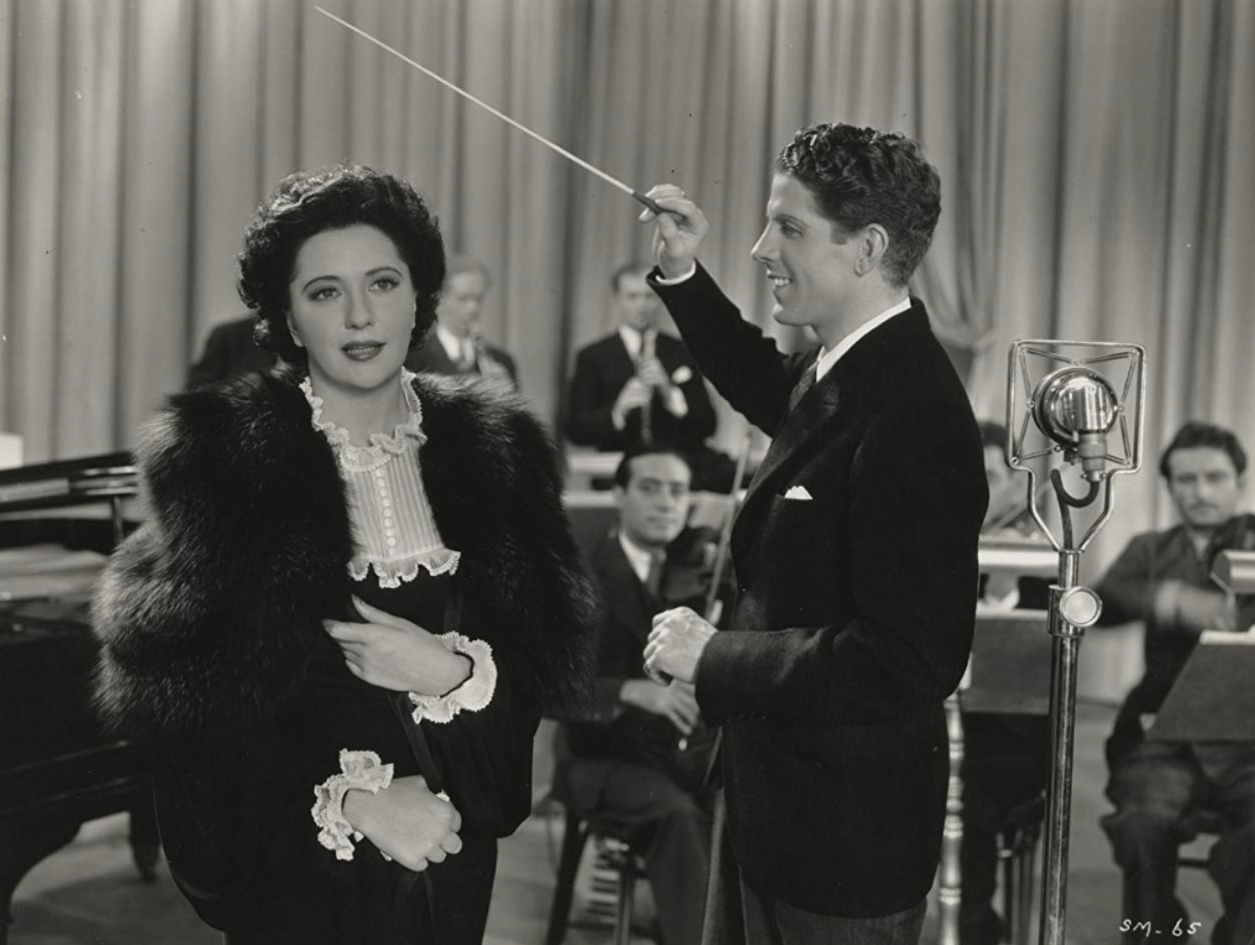
Construction workers line up for pay beside the first Rockefeller Center Christmas tree in New York in 1931. (ASSOCIATED PRESS)
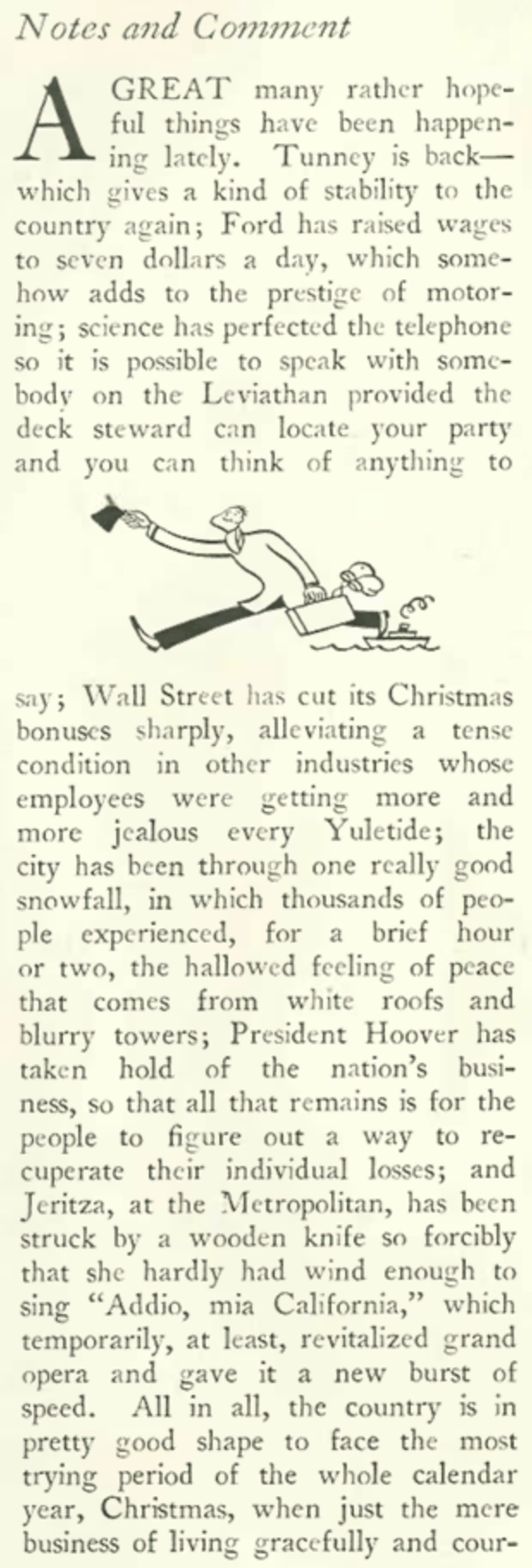
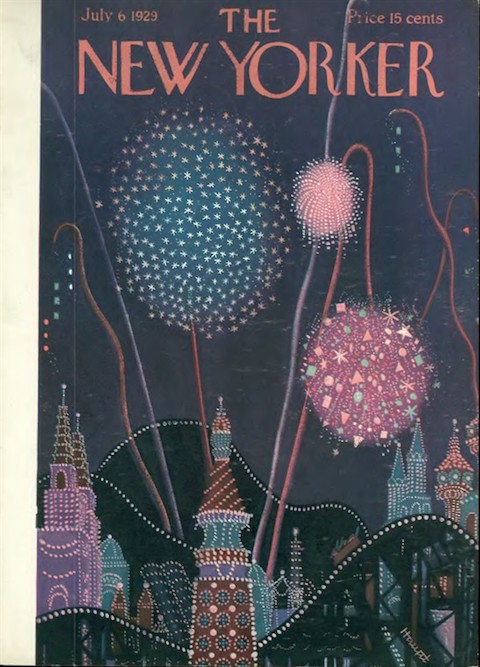
E.B. White’s “Notes and Comment” column led off The New Yorker’s “Talk of the Town,” and as such helped set the tone for what was to follow in the magazine.
Dec. 14, 1929 cover by Theodore Haupt. Opening image: Construction workers line up for pay beside the first Rockefeller Center Christmas tree in New York in 1931. (NY Daily News)
For the Dec. 14 issue White attempted to strike a positive note in the aftermath of the stock market crash, offering a few nuggets of hope for the holiday season:
HEAVYWEIGHTS…Both President Herbert Hoover and retired prizefighter Gene Tunney offered signs of stability to a nation reeling from economic collapse. At right, Gene and Mary Tunney return to New York on the ocean liner Vulcania after 14 months in Europe. (Wikipedia/AP)
Alexander Woollcott, however, described his financial woes in his “Shouts and Murmurs” column, where he parodied newspapers that listed charity cases during the Christmas season:
BOOK-END POOR…Alexander Woollcott, in a 1939 portrait by Carl Van Vechten. (Wikipedia)
Paris correspondent Janet Flanner noted how the ripples of the market crash were being felt in Paris: Americans no longer had wads of cash to lavish on booze, jewelry, antiques and real estate:
DON’T RAIN ON OUR PARADE…The Place de la Nation, Paris, 1930. (thevintagenews.com)
Flanner added that despite the past boorish behavior of American tourists, the level of schaudenfreude among the French was remarkably low…
* * *
Sinful Diversions
For yet another sign that the Roaring Twenties were decidedly over, it appeared that even “Sex” had run its course. Theater critic Robert Benchley noted that Mae West’s scandalous 1926 play inspired a spate of shows that had little new to offer, save for amping up the salacious content: A Primer for Lovers, The Amorous Antic, and Young Sinners. Audiences were unimpressed. A Primer for Lovers closed after just 24 performances, The Amorous Antic after just eight. Only Young Sinners would survive into the spring season.
JUST LOOK WHAT YOU STARTED…”Sex” was panned by critics as vulgar, but Broadway audiences in 1926 loved it. After 375 performances police arrested Mae West on obscenity charges, which landed her in a prison workhouse for ten days. (boweryboyshistory.com)Actress Phoebe Foster (left) found success on Broadway, but not so much in The Amorous Antic, which closed after just eight performances. Dorothy Appleby (right) had better success with Young Sinners, which ran for 289 performances through August 1930. (IMDB)
* * *
Final Bows
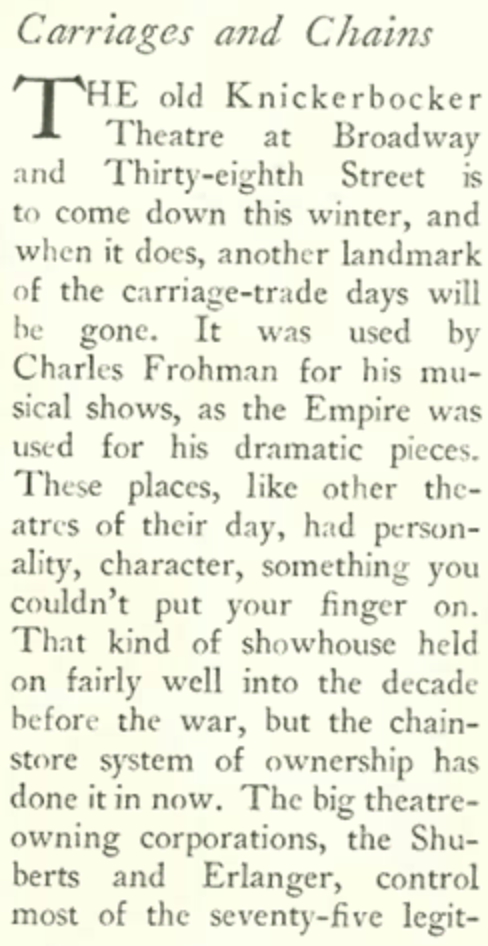
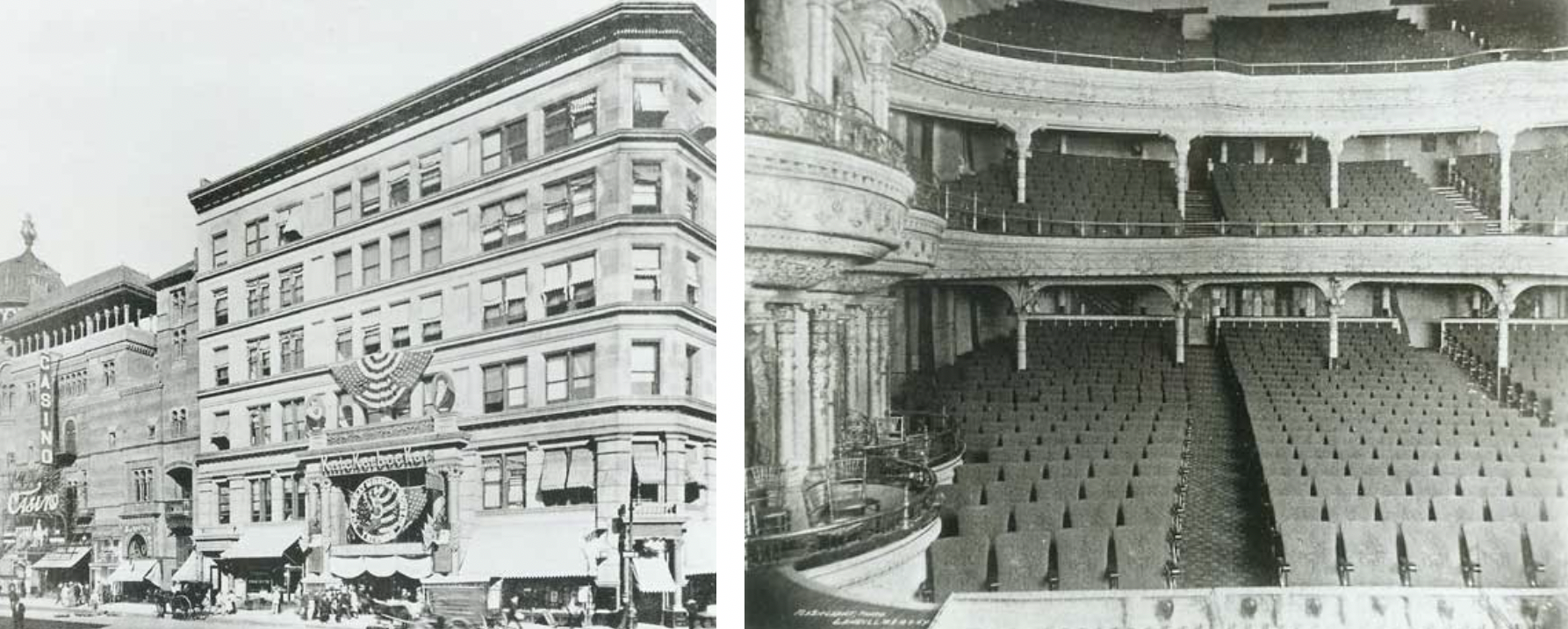
Theater was changing in other ways too. In the late 19th and early 20th century audiences patronized various playhouses based more on their reputation and tradition than on a particular play. E.B. White, in the “Talk of the Town” noted the imminent passing of one such house, the Knickerbocker Theatre, slated for demolition in 1930. The 33-year-old theater was Broadway’s first to display a moving electric sign (1906).
A HOUSE OF GOOD REPUTE…The Knickerbocker Theatre at 1396 Broadway was built in 1896 and demolished in 1930. (Internet Broadway Database)
White noted that smaller venues like the Knickerbocker, with their own distinct character and clientele, were falling victim to big theater-owning corporations that introduced more homogeneity into the play-going scene. In White’s estimation just two old-timers remained:
Both buildings still stand. The New Amsterdam, constructed in 1902–03, is now the oldest theater on Broadway. In the 1910s and 1920s it hosted the Ziegfeld Follies on its main stage and the racier Ziegfeld Midnight Frolics on the building’s rooftop. The Music Box was constructed in 1921 by composer Irving Berlin and producer Sam H. Harris to house Berlin’s Music Box Revues.
DISNEYFIED…The New Amsterdam, constructed in 1902–03, still stands today, now operated by the Disney Company, which signed a 99-year lease with the city in 1993. When it was built it was the largest theater in New York, with a seating capacity of 1,702. (Wikipedia)IRVING’S PLACE…The Music Box Theatre at 239 West 45th Street was constructed in 1921 by composer Irving Berlin and producer Sam H. Harris to house Berlin’s Music Box Revues. It was later co-owned by Berlin’s estate and the Shubert Organization until Shubert assumed full ownership in 2007. (Wikipedia)
* * *
Stocks Down, Arno Up
Peter Arno could be found all over the Dec. 14 issue: an ad promoting his new book Peter Arno’s Parade, a blurb in the book section touting the same…this ad for Peck & Peck featuring his handiwork…
…in the cartoons, a full page with the economy as a theme…
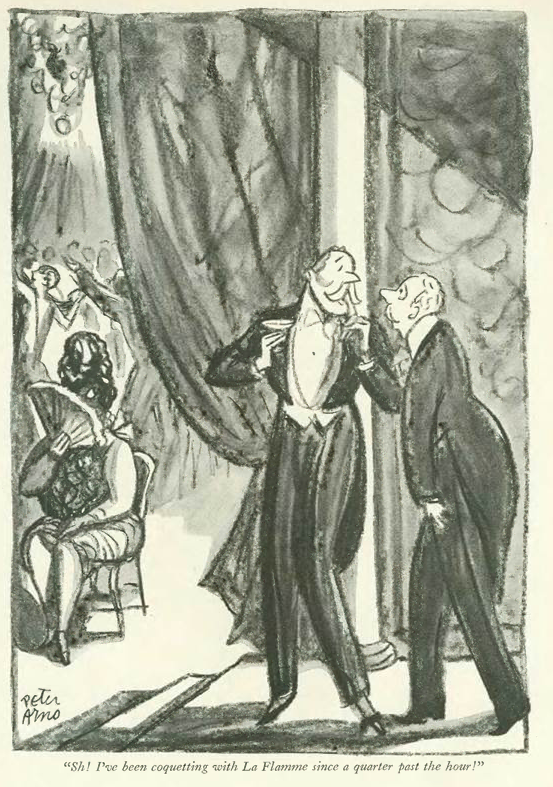
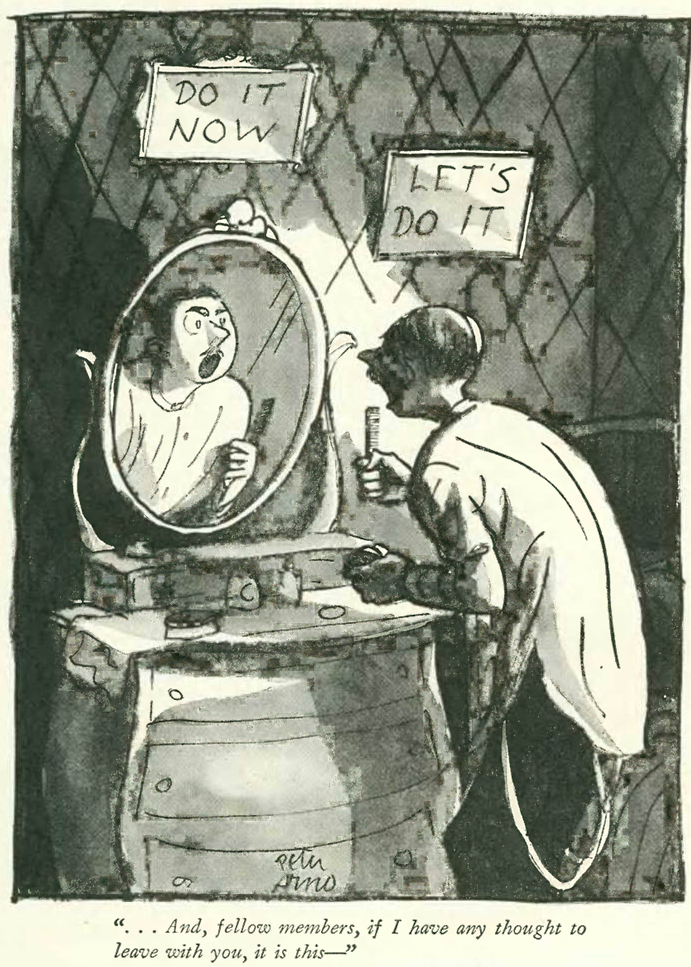
…and this submission that was doubtless inspired by Arno’s own home life and his brief, tempestuous marriage to New Yorker colleague Lois Long…
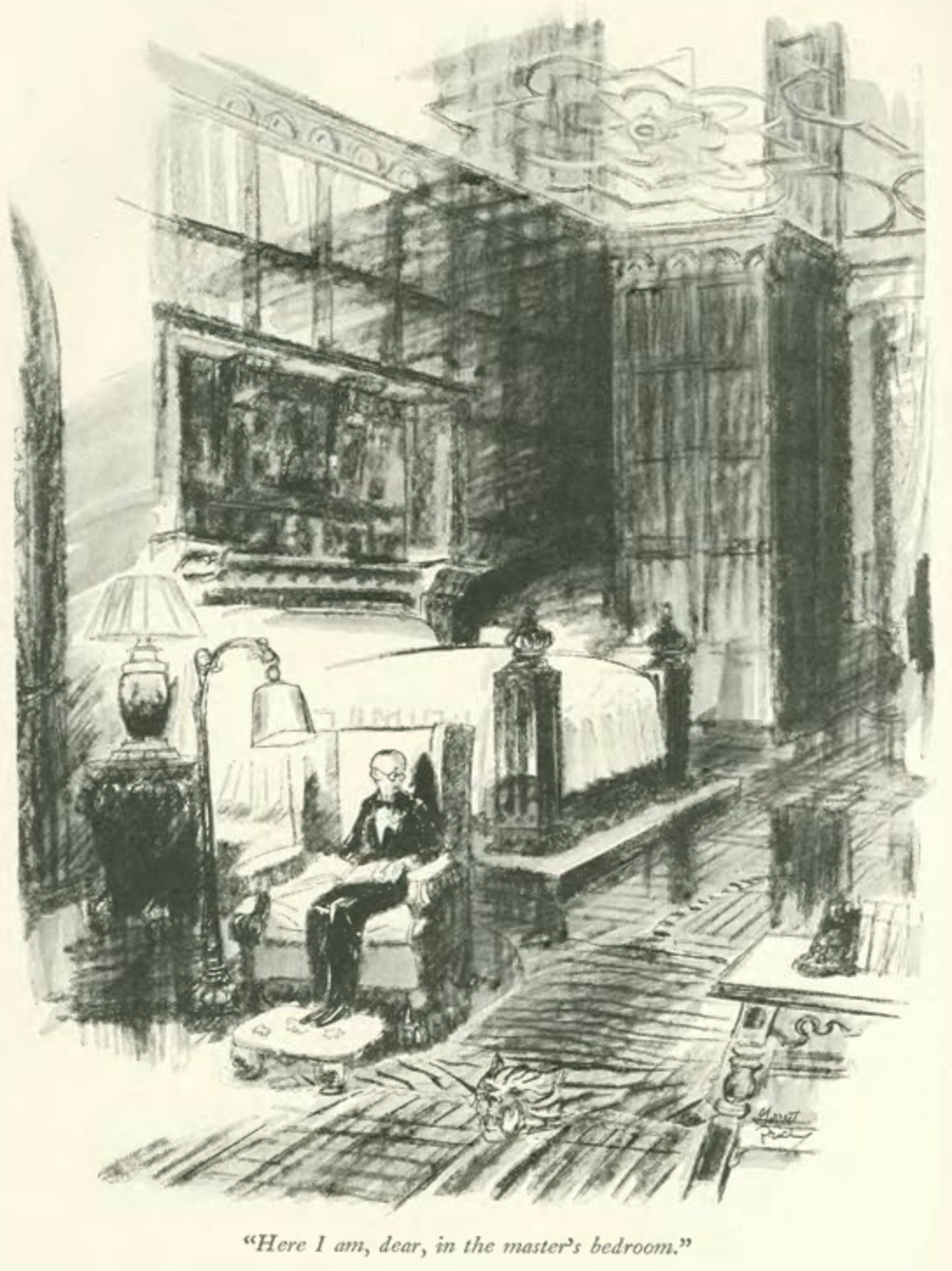
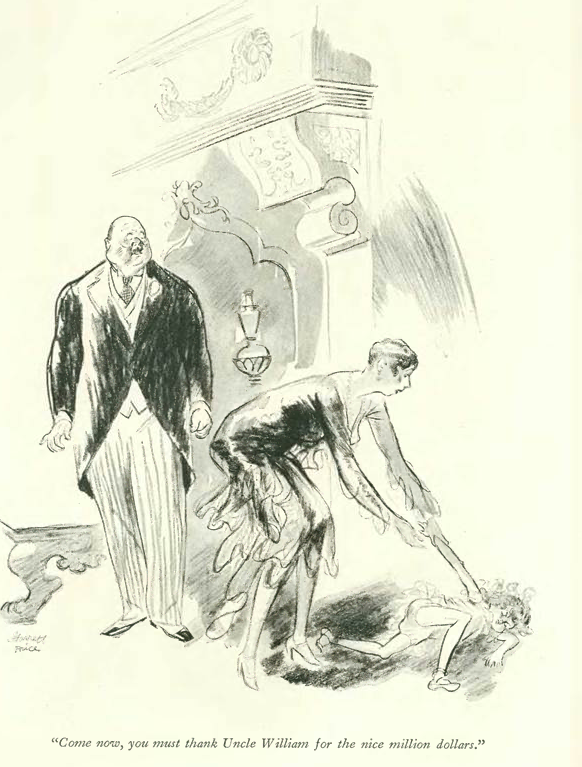
…here’s a couple of comics featuring Milquetoast characters…this one by Garrett Price…
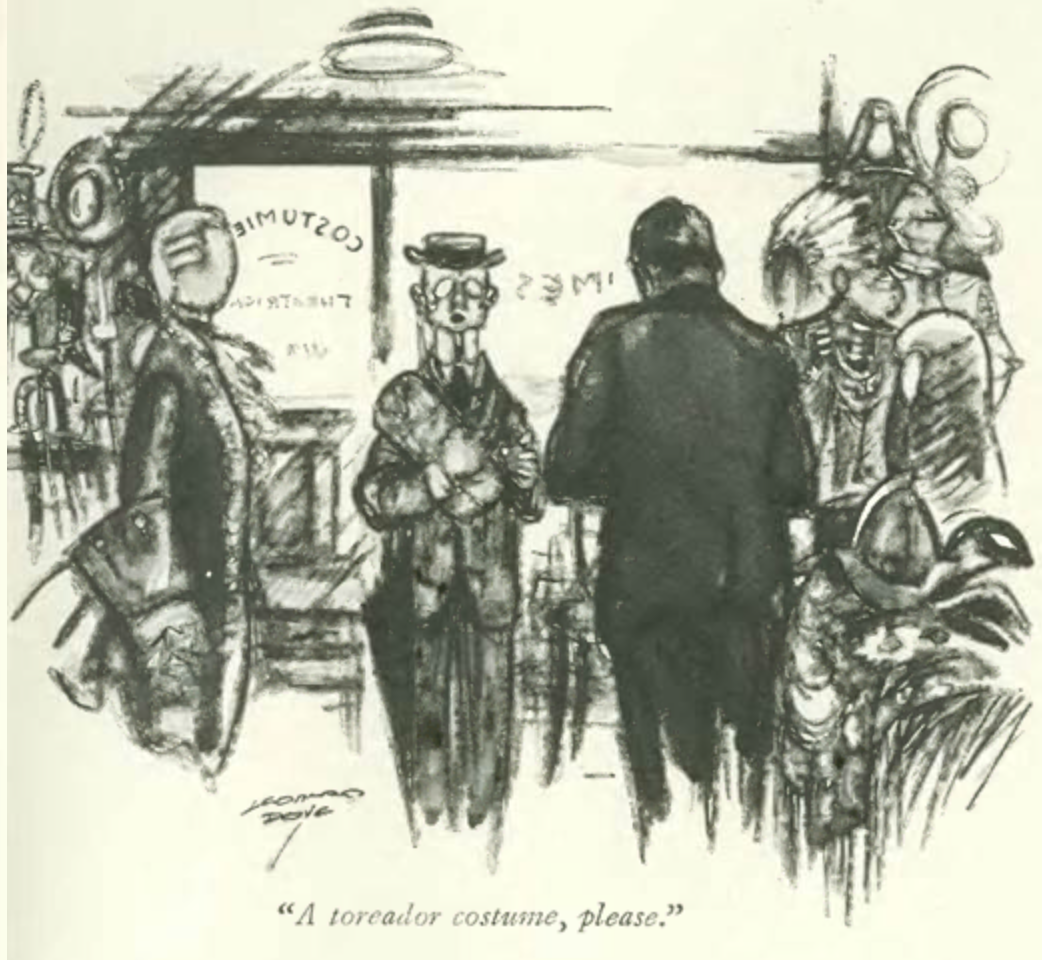
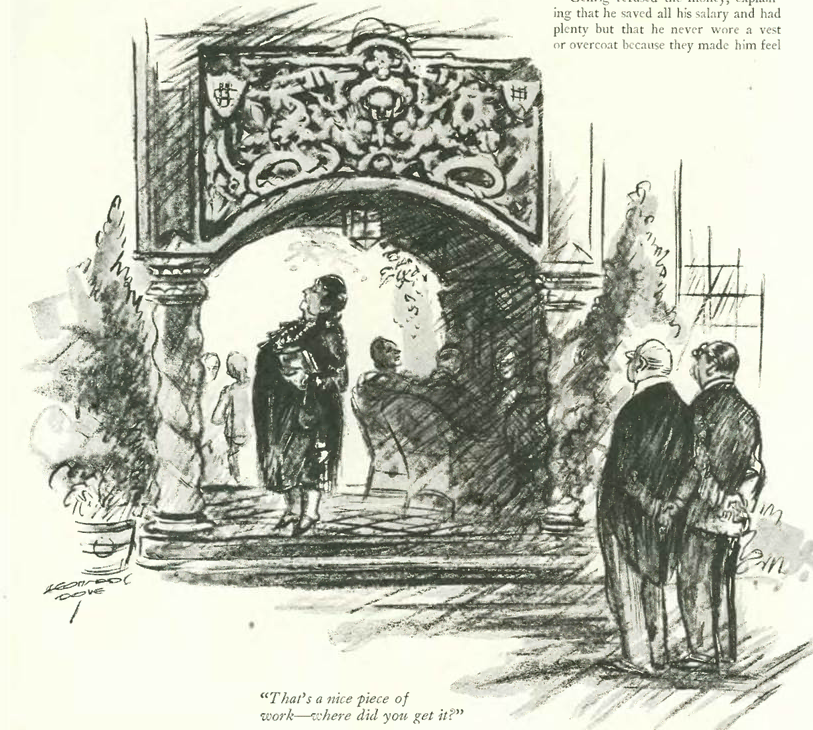
…and another by Leonard Dove…
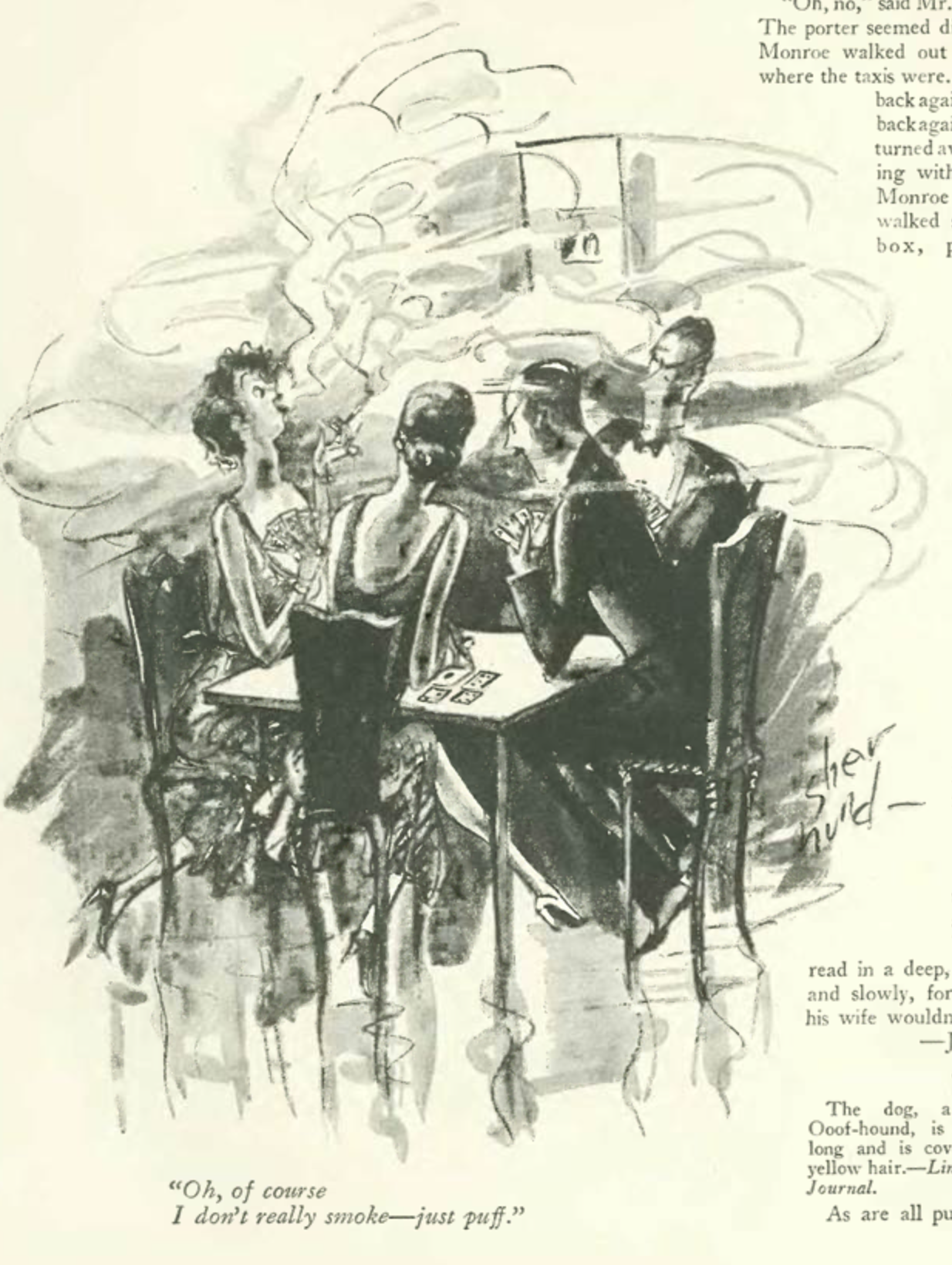
…and two submissions from one of my favorite cartoonists, Barbara Shermund, so ahead of her time…
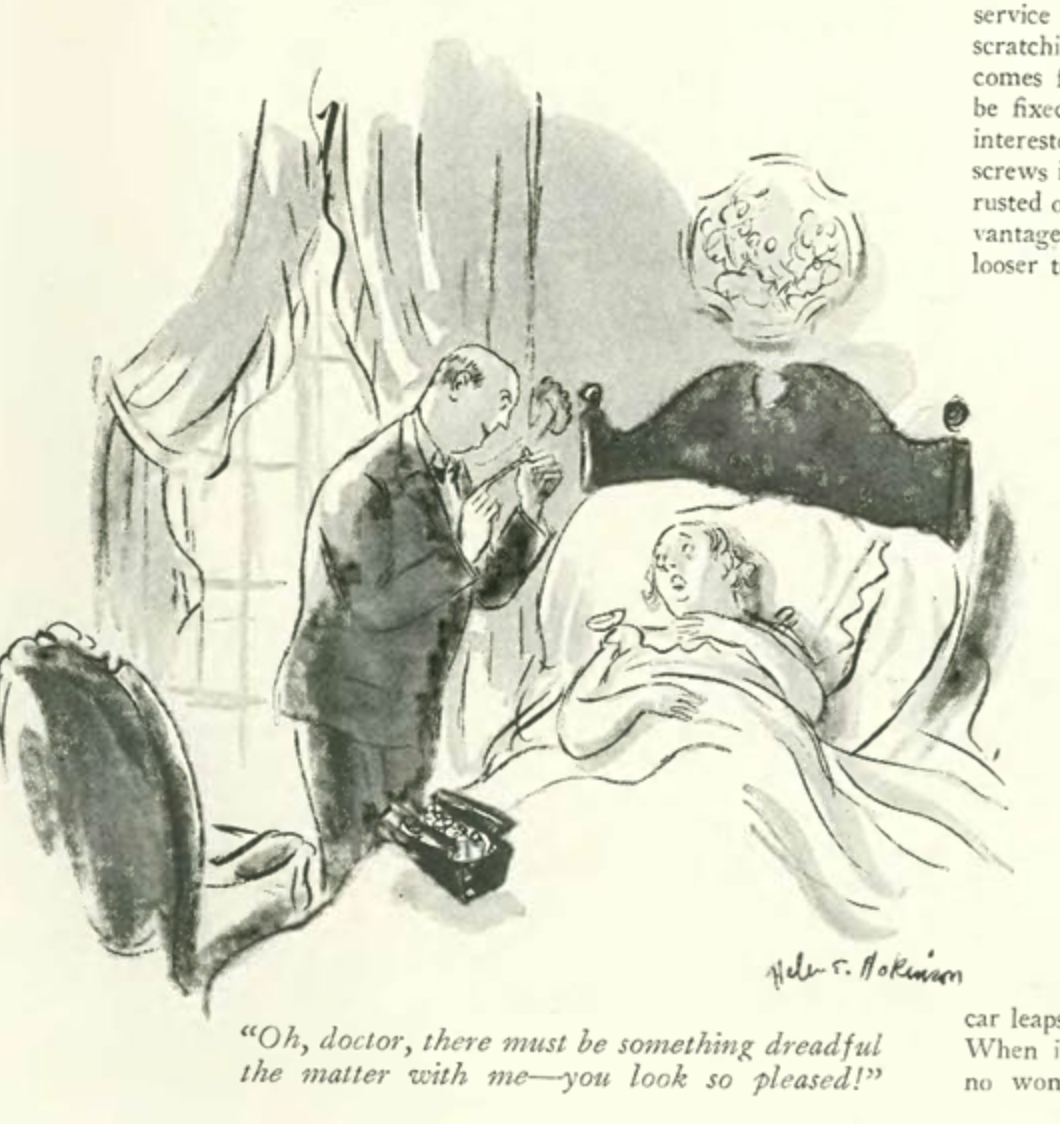
…Helen Hokinson examined a physician’s bedside manner…
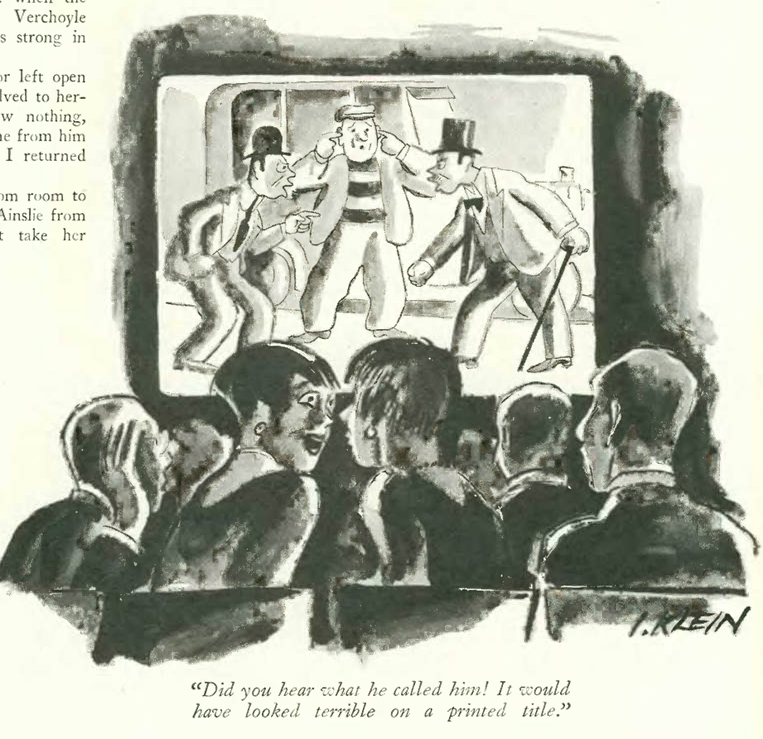
…and I. Klein offered his take on the new economy…
* * *
We move right along to the Dec. 21, 1929 issue, where things seemed to turn a bit more sour…
Dec. 21, 1929 cover by Rea Irvin.
…Elmer Rice’s serialized novel, A Voyage to Purilia, finally concluded in its 11th installment in the New Yorker…and E.B. White took on a more choleric disposition in his “Notes and Comment”…
Lois Long contributed a “Tables for Two” column, a feature that had become infrequent as she turned her full attentions to her fashion column “On and Off the Avenue.” In this installment of “Tables” we get her first mention of the market calamity…
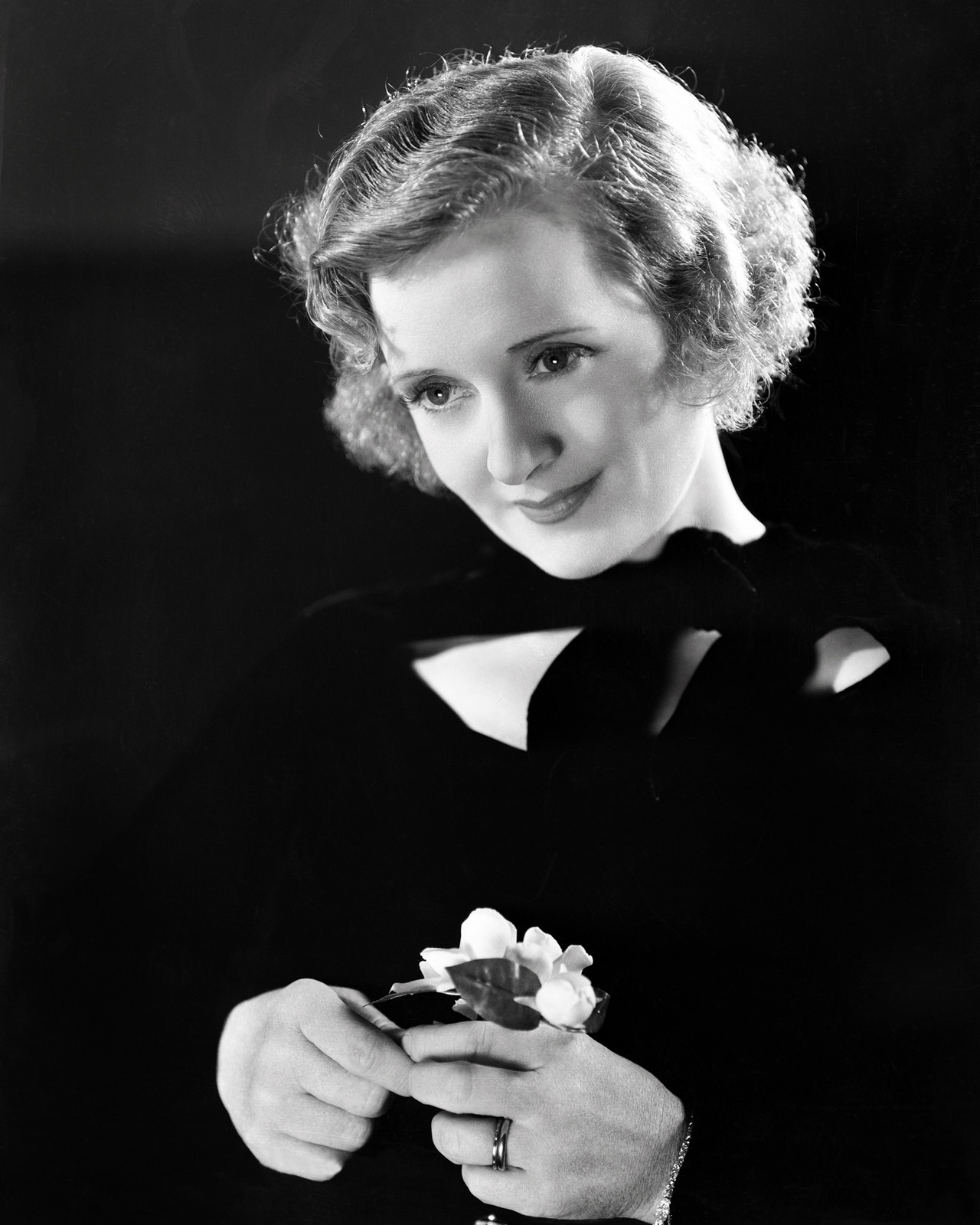
…Robert Benchley finally found something to like on Broadway, because Billie Burke was the star attraction…
SHE”S THE GOOD ONE…Billie Burke in 1933. Most of us know her today for her performance as Glinda the Good Witch of the North in the 1939 film The Wizard of Oz. (Wikipedia)
* * *
Violin Prodigy 2.0
The New Yorker raved about the twelve-year-old violinist Yehudi Menuhin when he wowed audiences at the Berlin Philharmonic earlier in the year. So when the ten-year-old Ruggiero Ricci expertly fiddled with the Manhattan Symphony, well…
YEAH, I GOT THIS…Ruggiero Ricci, about 1930, by then a touring professional. At age six Ricci began lessons with Louis Persinger, who also taught another San Francisco prodigy, Yehudi Menuhin. (Text and image, The New York Times)
* * *
Namesake
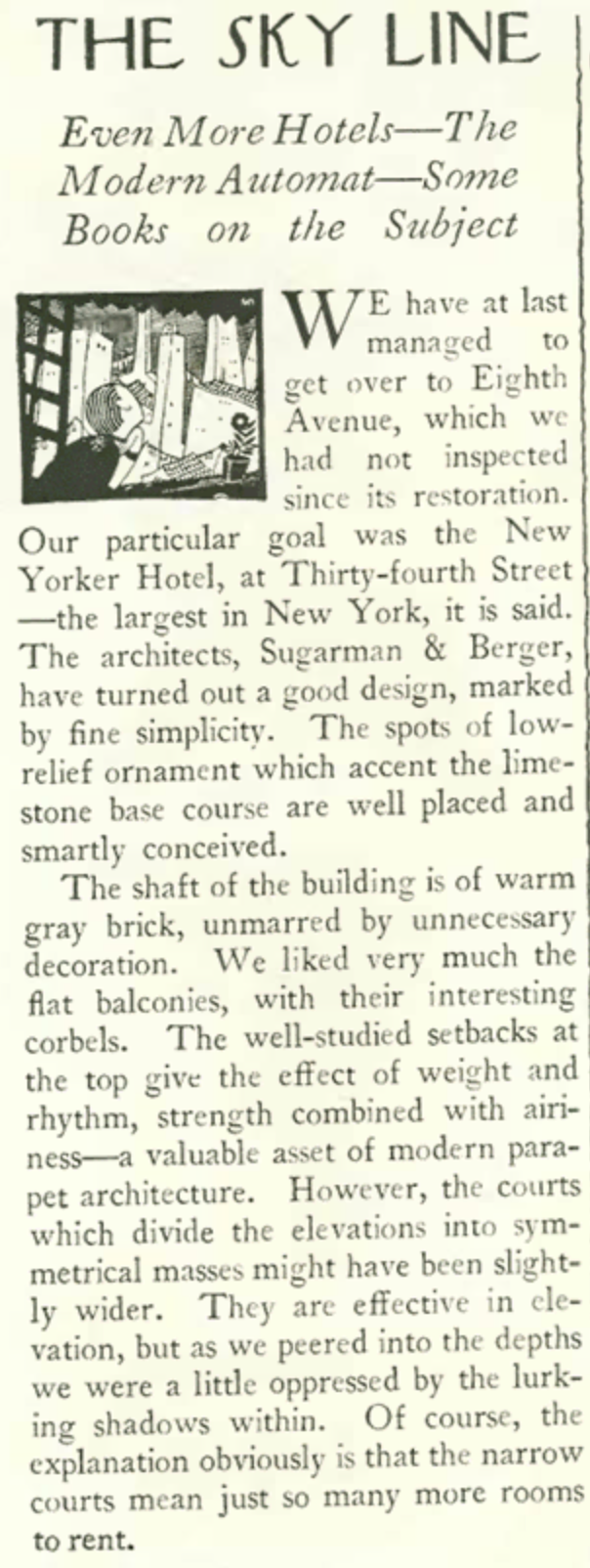
Despite the market crash, the skyline continued to change at a rapid pace, and as we enter the 1930s the city would add some of its most iconic buildings to the skyline. George Chappell, The New Yorker’s architecture critic, had this to say about the magazine’s “namesake”…
ROOMY…The New Yorker Hotel, at 481 Eighth Avenue. When the 43-story Art Deco hotel opened 1930, it contained 2,500 rooms, making it the city’s largest for many years. (Wikipedia)
* * *
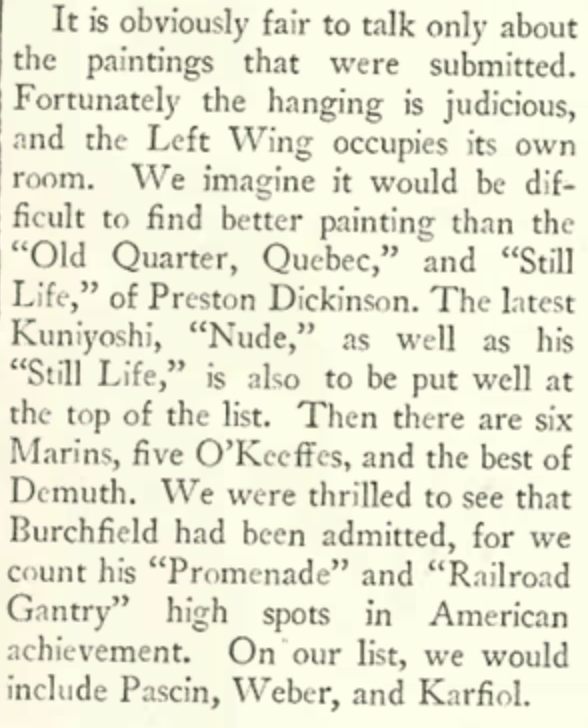
Art critic Murdock Pemberton continued his quest to make sense of the upstart Museum of Modern Art…
…and the American artists showcased there…
…I would add Edward Hopper, John Sloan, Lyonel Feininger, and Rockwell Kent (also displayed at the exhibition) but then again, I have the advantage of hindsight…
* * *
From Our Advertisers
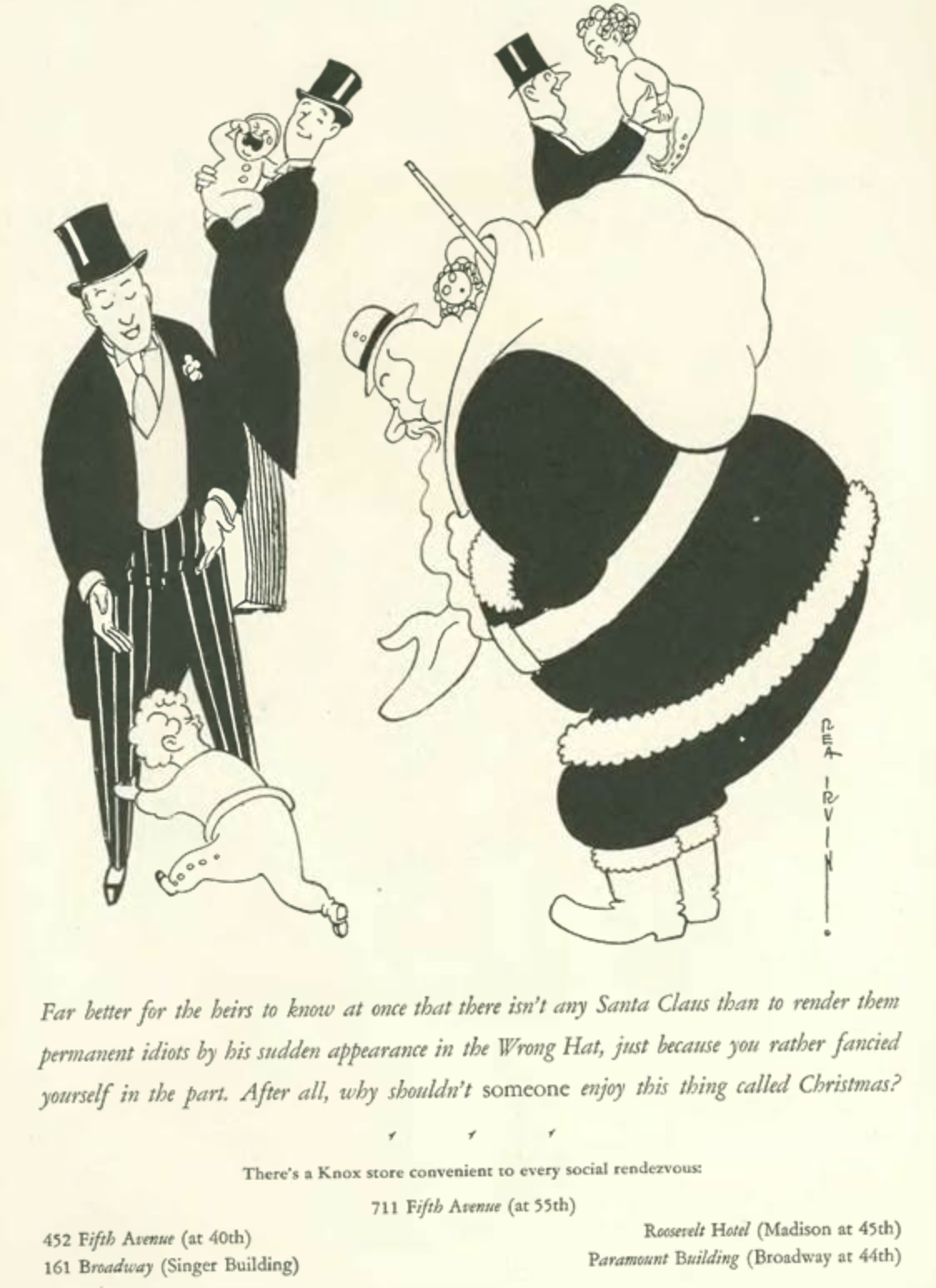
We have more New Yorker cartoonists augmenting their income through advertising, including (once again) Rea Irvin for Knox Hatters…
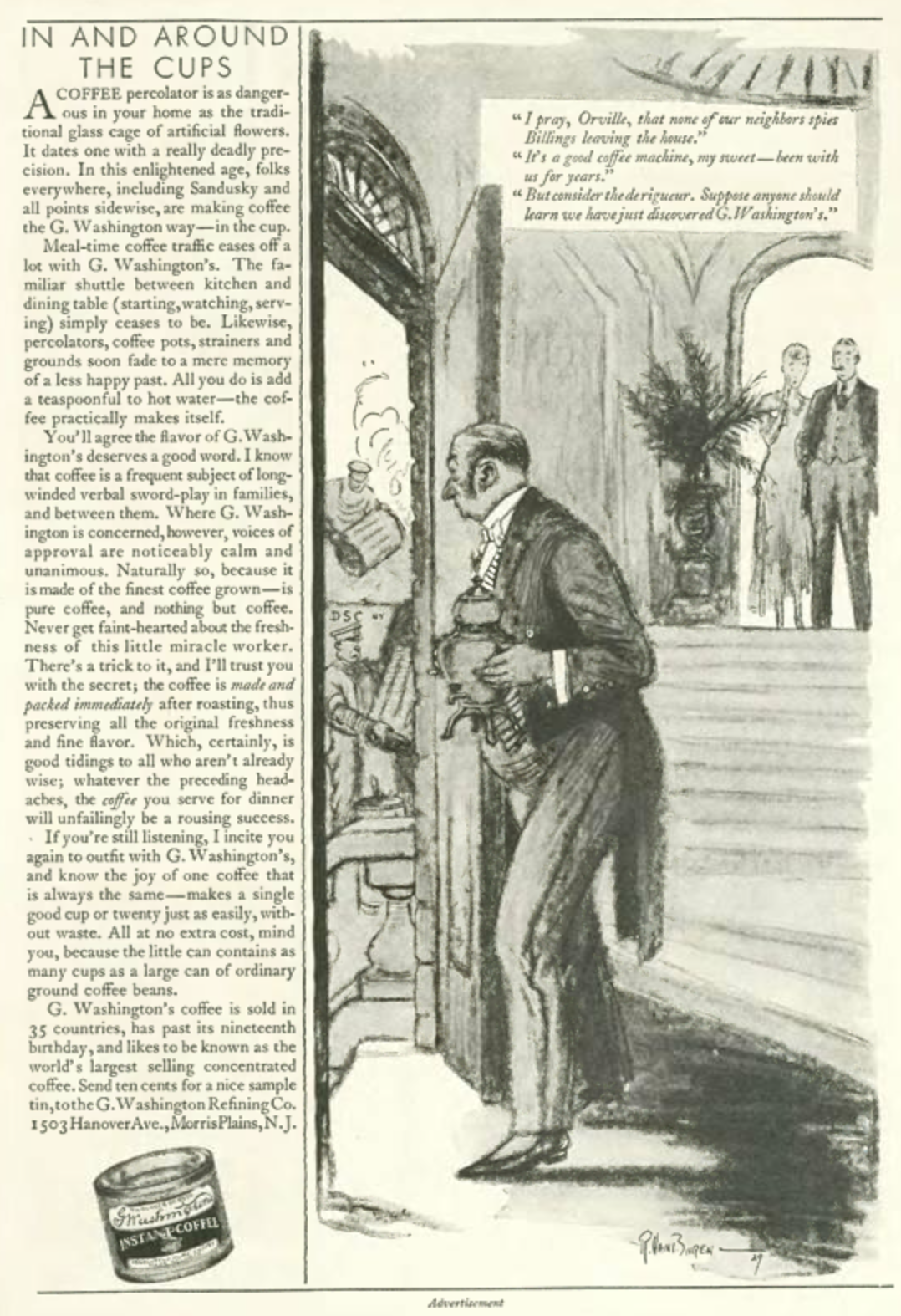
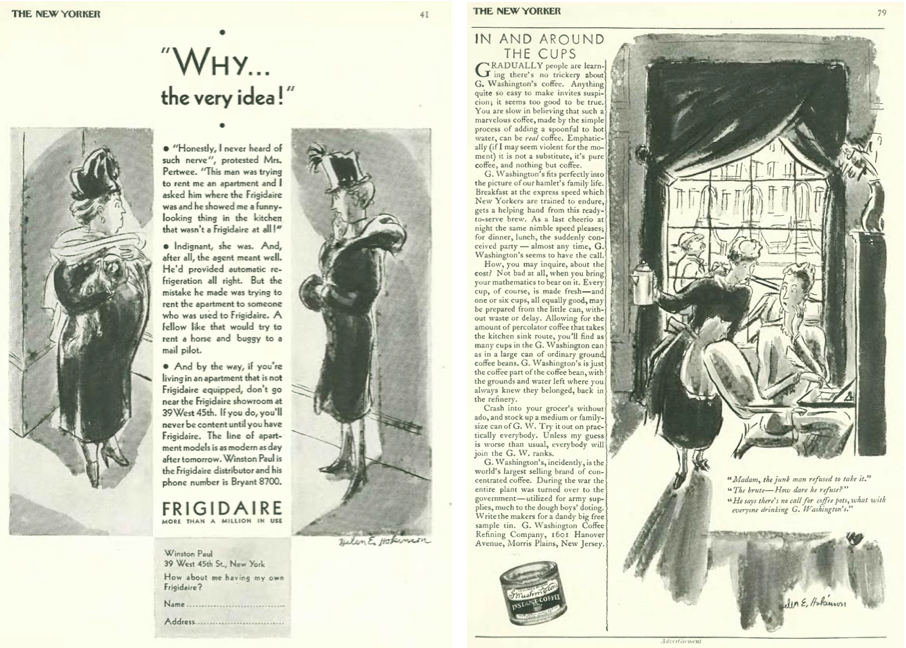
…Raeburn Van Buren for G. Washington’s instant coffee (also a client of Helen Hokinson’s)…
…and Helen Hokinson for Frigidaire…
…and on to cartoons for Dec. 21, Hokinson again…
…and we end with Peter Arno, and another peek into marital bliss…
Just nine days after the stock market crash, three women opened a new museum on Fifth Avenue that would play a major role in defining the type of city that would emerge from the other side of the Depression and World War II.
Nov. 23, 1929 cover by Theodore Haupt.
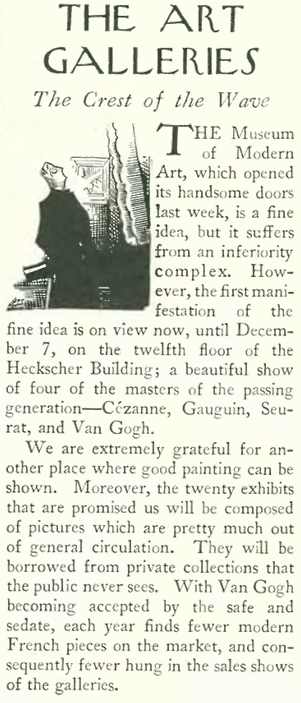
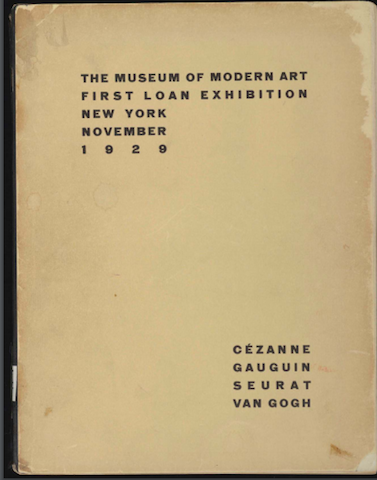
These visionary women would borrow works from modernists of the past century — the post-impressionists — to stage the first-ever exhibit of the Museum of Modern Art. Abby Aldrich Rockefeller, along with her friends Lillie P. Bliss and Mary Quinn Sullivan, had rented six rooms on the 12th floor of the Heckscher Building, and on Nov. 7, 1929, they opened the doors to the museum’s first exhibition, simply titled Cézanne, Gauguin, Seurat, Van Gogh. The New Yorker’s art critic Murdock Pemberton was on hand for the opening:
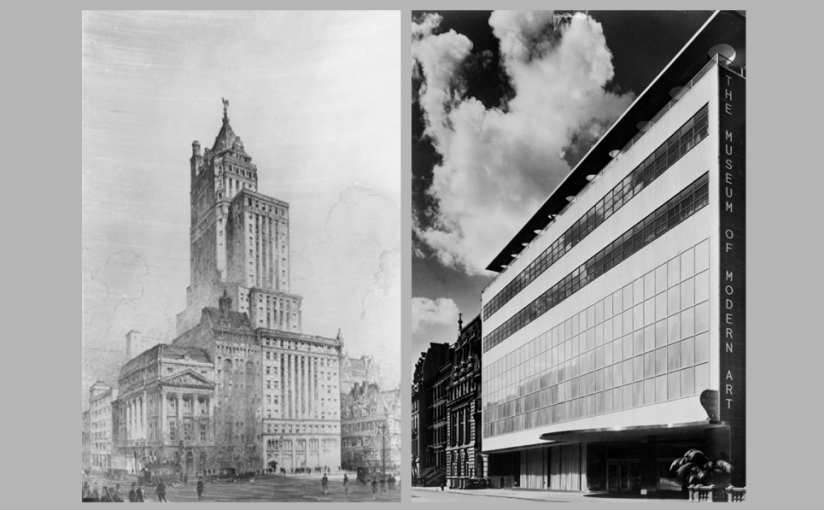
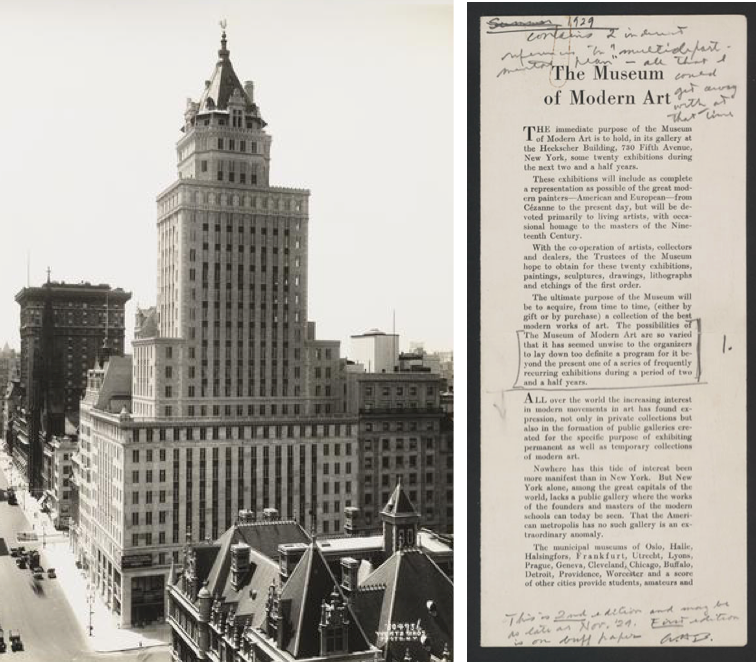
THE FOUNDERS…Mary Sullivan, Lillie Bliss and Abby Rockefeller, known socially as “the daring ladies,” founded the Museum of Modern Art in 1929. (virginiafitzgerald.blogspot.com/MoMA)OLD AND NEW…The 12th floor of the Heckscher Building (now called the Crown Building) at Fifth Avenue and 57th Street served as the first location of the Museum of Modern Art. The 1921 building was designed by Warren and Wetmore, the same architects who designed Grand Central Terminal. Note in the foreground the rooftop of the Vanderbilt mansion, demolished in 1926 to make way for the Bergdorf Goodman department store; at right, a page from the new museum’s brochure. (Museum of the City of New York/MoMA)
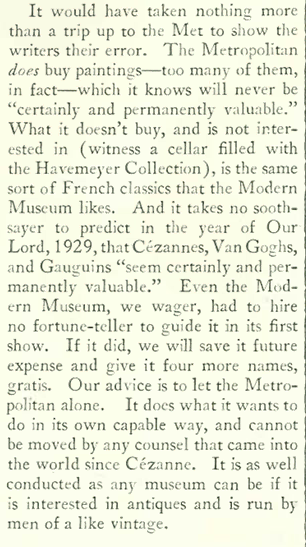
The gallery rooms in the Heckscher were modest — although Abby’s husband was John D. Rockefeller Jr., she had to find funding on her own (he was opposed to the museum, and to modern art). In his review, Pemberton noted the “inferiority complex” that had already set in at the new museum, which took a preemptive swipe at the Met in its pamphlet (pictured above):
AMBITIOUS…Although the museum was small and had no curatorial departments, MoMA produced a 157-page exhibition catalogue for its first show. (Image and text courtesy MoMA)MODEST BEGINNINGS…MoMA’s first gallery spaces on the 12th floor of the Heckscher Building were indeed modest, as these photos of the first exhibition attest. (MoMA)HOW THEY LOOKED IN COLOR…Works featured in MoMA’s first exhibition included The Bedroom (1889) by Vincent Van Gogh, and Pines and Rocks (c. 1897), by Paul Cézanne. (Art Institute of Chicago/MoMA)
Pemberton attempted to set MoMA straight regarding the Met’s reputation:
HOME AT LAST…After moving three times over the course of ten years, the Museum of Modern Art finally found a permanent home in Midtown in 1939. Although Abby Rockefeller’s husband, John D. Rockefeller Jr., was initially opposed to the museum, he eventually came around and donated the land for the 1939 museum (designed by Philip L. Goodwin and Edward Durell Stone) and became one of the museum’s biggest supporters. (MoMA)
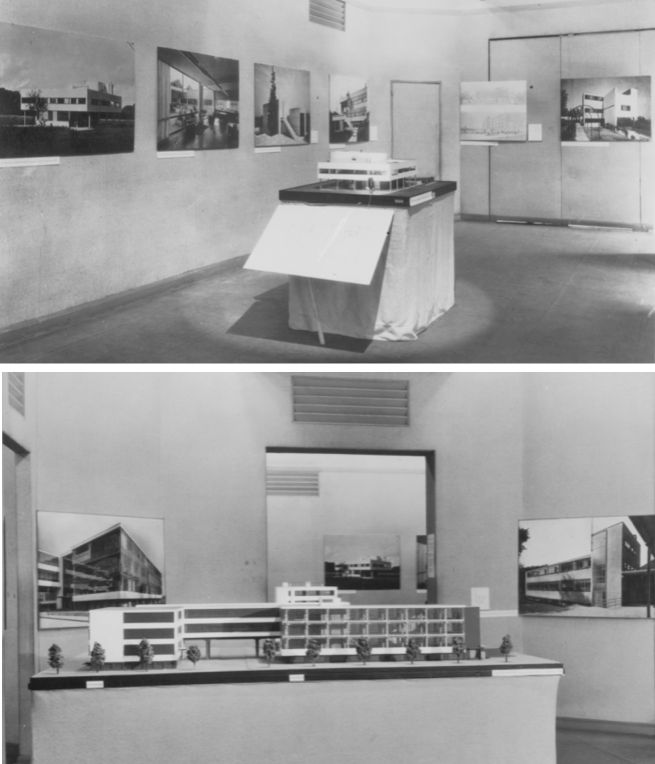
Less than three years later, the museum would point to the world to come in 1932’s Modern Architecture: International Exhibition, curated by Philip Johnson and Henry-Russell Hitchcock. The exhibition showcased an emerging architectural style that would dominate the New York skyline in the postwar years.
Top, model of Le Corbusier’s Villa Savoye from MoMA’s 1932 Modern Architecture: International Exhibition; below, model and photographs of works by Walter Gropius. Both architects would have major influences on the postwar New York skyline. (MoMA)
A footnote: The Museum of Modern Art hosts a remarkable website that features photographs of 4,875 exhibitions (plus images of catalogs and other materials) from 1929 to the present.
* * *
That’s Entertainment?
Theater critic Robert Benchley was looking for something to take his mind off the economic collapse, but he wasn’t finding it on Broadway. He found the drama Veneer to be depressing, and apparently so did a lot of other theatergoers; it closed the next month after just 31 performances at the Sam Harris Theatre:
NO LAUGHS HERE, EITHER…Joanna Roos and Osgood Perkins during a 1930 performance of the Chekhov play Uncle Vanya at the Cort Theatre. Roos was also in 1929’s Veneer, and she was singled out for praise by critic Robert Benchley, who otherwise found the play depressing. (New York Public Library)
Benchley also found little cheer in the play Cross Roads, which also closed the next month after just 28 performances at the Morosco Theatre:
FOR CRYING OUT LOUD…Actress Sylvia Sidney bawled out her lines in Cross Roads. (Photoplay, 1932)
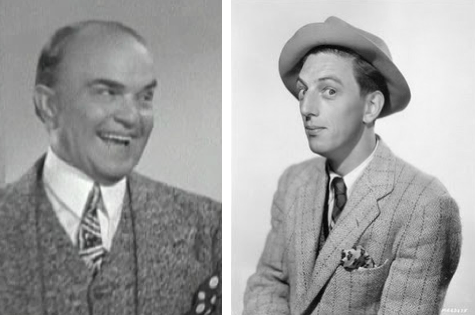
Benchley finally found something to laugh about at the Alvin Theatre, which featured the musical comedy Heads Up! Tellingly, it ran much longer than its more somber competition: 144 performances…
CLOWNS…Victor Moore, left, and Ray Bolger delivered comic relief in Heads Up! Both actors provided much-needed levity on the Broadway stage during the Depression. (movie-mine.com/Pinterest)
* * *
Ideas for a Post-Crash Christmas
Creighton Peet (1899-1977) was best known as an author of books for young people with titles ranging from Mike the Cat (1934) to How Things Work (1941). A regular contributor to The New Yorker from 1925 to 1957, in the Nov. 23 issue Peet offered up some suggestions for a post-crash Christmas in a short piece titled “Helpful Hints for Marginaires.” An excerpt:
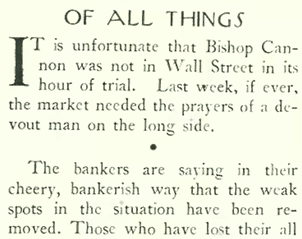
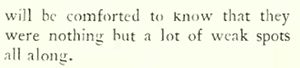
The recent market crash was also on the mind of Howard Brubaker. In his weekly column, “Of All Things,” he looked for divine guidance…
CAN YOU PUT IN A GOOD WORD? James Cannon Jr. was a bishop of the southern Methodist Church and a relentless advocate of Prohibition. (encyclopediavirginia.org)
…in the wake of recent elections, Brubaker also made this observation about voting rights in the South…
* * *
Solace of the Silver Screen
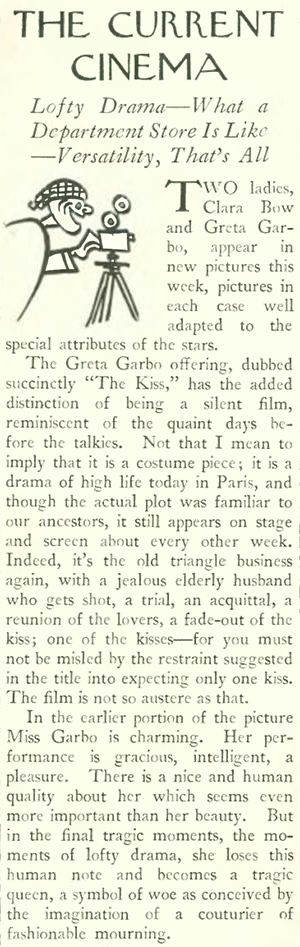
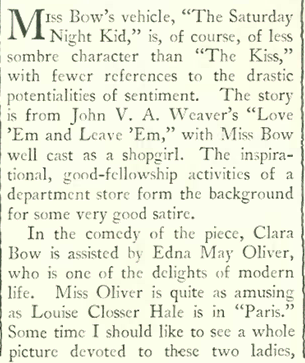
Americans would turn to the movies for a much-needed distraction from their economic woes, and critic John Mosher found a couple of mild diversions starring Greta Garbo and Clara Bow…
MUM’S THE WORD…Greta Garbo and Lew Ayres in The Kiss. The film was a rare silent in the new age of the talkies (although it did feature a Movietone orchestral score and sound effects). Audiences would have to wait until 1930’s Anna Christie to hear the voice of Garbo. (IMDB)PLEASE PASS THE BITTERS, DEAR…Greta Garbo and Anders Randolf trapped in a loveless marriage in The Kiss. (IMDB)
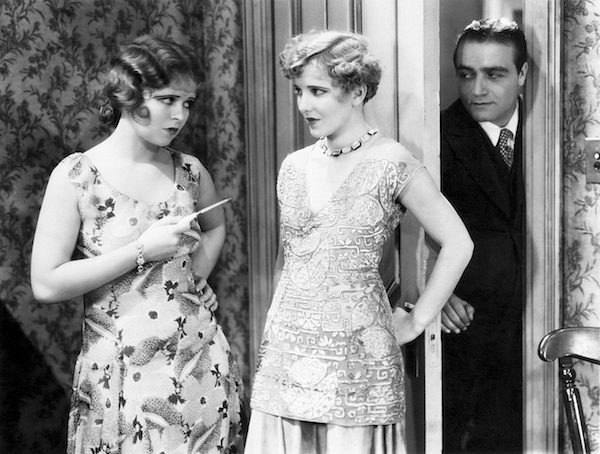
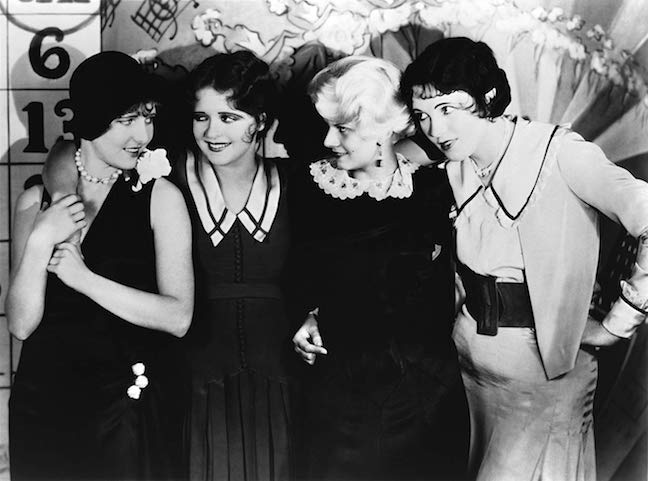
For a few laughs, moviegoers could check out Clara Bow’s second talkie, The Saturday Night Kid. A sex symbol of the Roaring Twenties, Bow’s career began to wane with the advent of the talkies and the onset of the Depression. Her kind would be eclipsed by a new type of sex symbol — the platinum blonde — embodied by the likes of Jean Harlow, who also appeared in The Saturday Night Kid, her first credited role…
SIBLING RIVALRY…Sisters Mayme (Clara Bow) and Janie (Jean Arthur) vie for the affections of next door neighbor William (James Hall) in a scene from The Saturday Night Kid. (doctormacro.com)SATURDAY NIGHT FEVER…Jean Arthur, Clara Bow, Jean Harlow and Leone Lane in a publicity photo for The Saturday Night Kid. (IMDB)
* * *
From Our Advertisers
We begin with a couple of ads featured on back-to-back pages of products that no longer exist — the first promotes the use of Ethyl gasoline to increase performance and eliminate engine knock. Ethyl (tetraethyl lead) — a big contributor to soil, air and water lead pollution — was removed from gasoline beginning in the 1970s…the Marmon Motor Car Company introduced a more affordable (under $1,000) car to New Yorker readers in 1929, but it was too late for the struggling company, which due to the Depression folded in 1933…
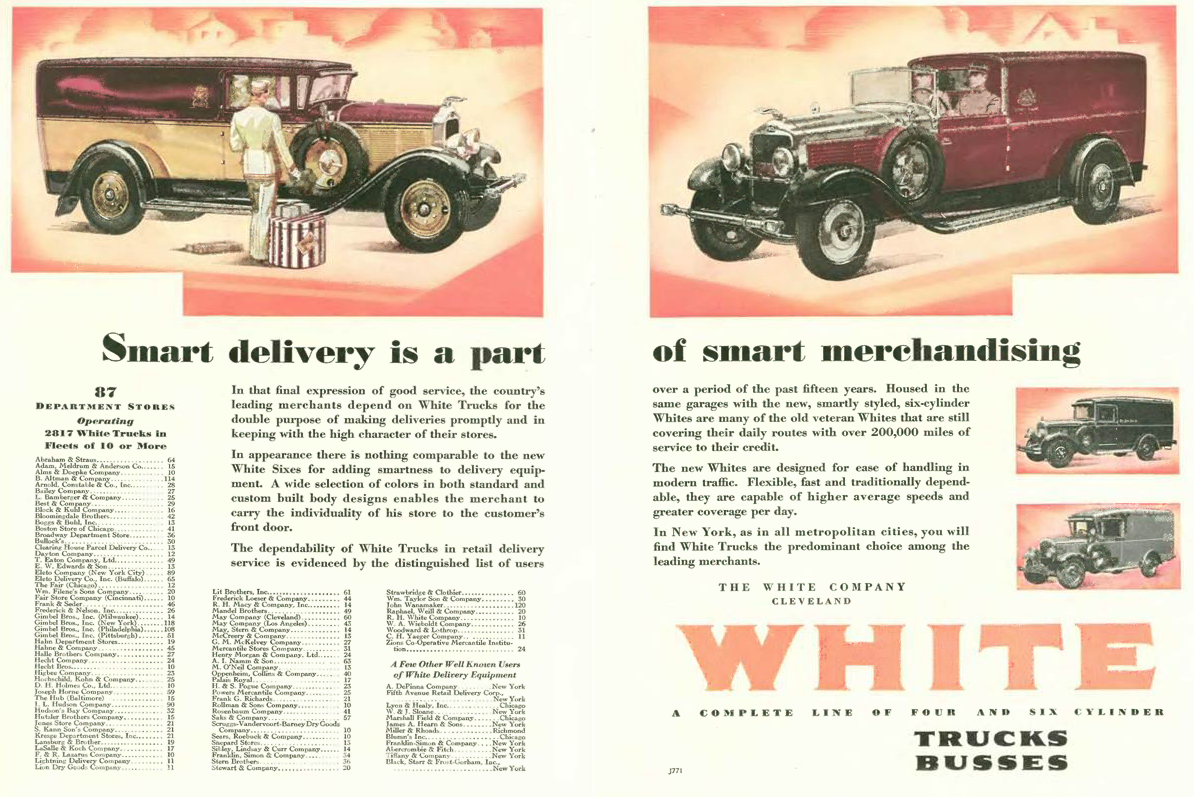
…this seems an unusual ad for the New Yorker, but then again perhaps the White Company hoped to reach well-heeled readers who were also owners of companies in need of such things, although it is doubtful a lot of truck-buying was taking place after the crash…
…the 1920s are considered a golden age for American road-building, but if you wanted to travel across country, the national highway system was limited to just a few, mostly two-lane routes…
…with their frayed nerves, folks were doubtless smoking like chimneys…the makers of Fatima cigarettes acknowledged the pain felt by the market crash, while nevertheless justifying the higher cost of their brand…
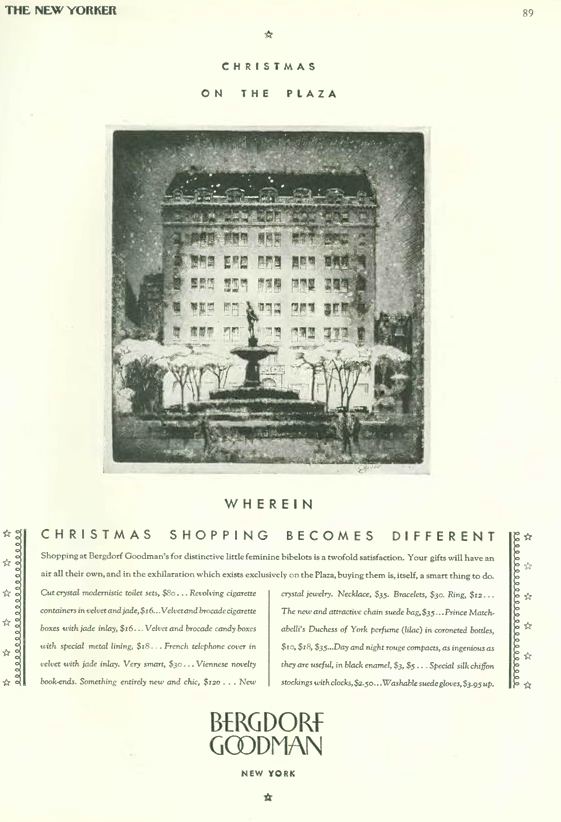
…the holiday season was fast-approaching, and Bergdorf Goodman was ready to set the mood…
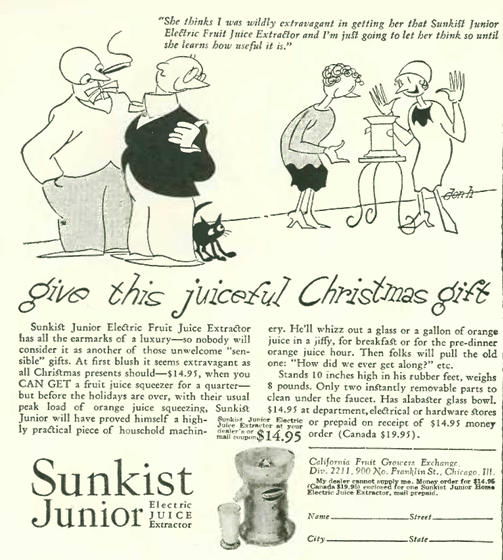
…on the lower end of the scale, the California Fruit Growers offered up this dandy “juice extractor” as the gift to delight a loved one (with illustration by Don Herold)…
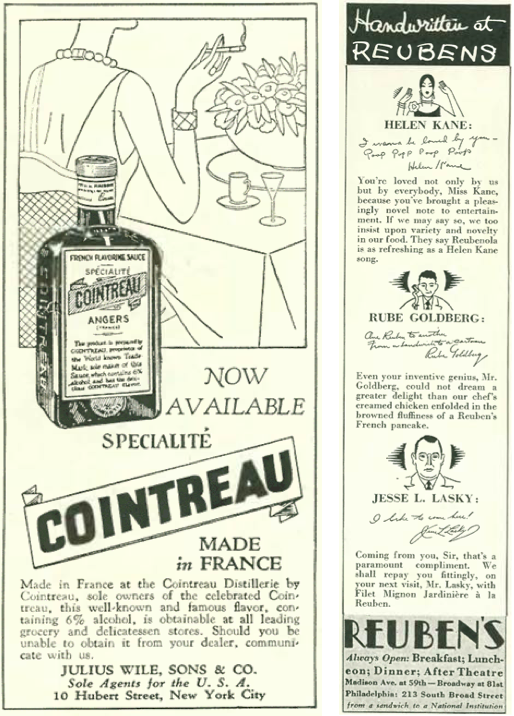
…I suppose given its quasi-medicinal (digestif) qualities, Cointreau was able to sell their product at 6% alcohol content to dry Americans (although the full- strength Cointreau, not legally available to Americans, was rated at 40%)…at right, another back page ad from Reuben’s restaurant, with more handwritten endorsements from stars including singer Helen Kane (Boop-Boop-a-Doop), cartoonist Rube Goldberg, and Paramount Studio co-founder Jesse Lasky…
…Helen Hokinson’s society women were featured in two separate ads in the Nov. 23 issue…
…and the folks at Frigidare got an extra plug thanks to Leonard Dove…
…Lois Long’s “On and Off the Avenue” column began to grow in length as the holiday season approached, peppered with spot drawings including these two by Julian De Miskey and Barbara Shermund…
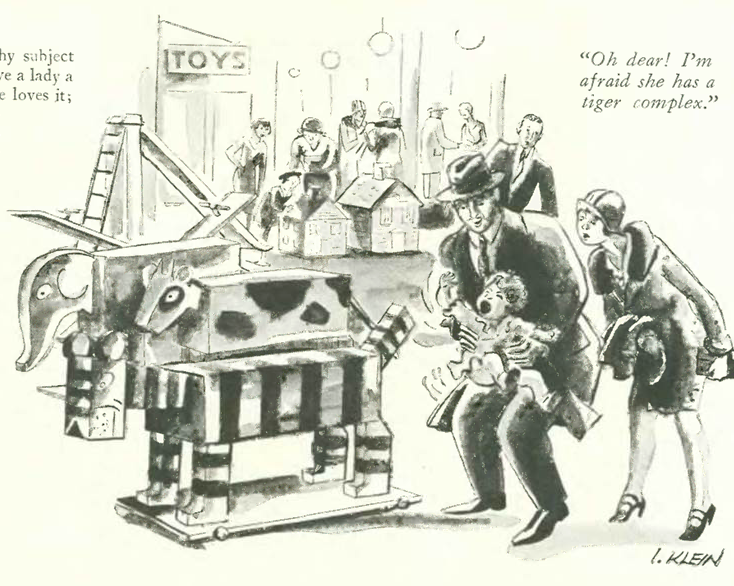
…and Isadore Klein offered his own take on the holiday shopping scene…
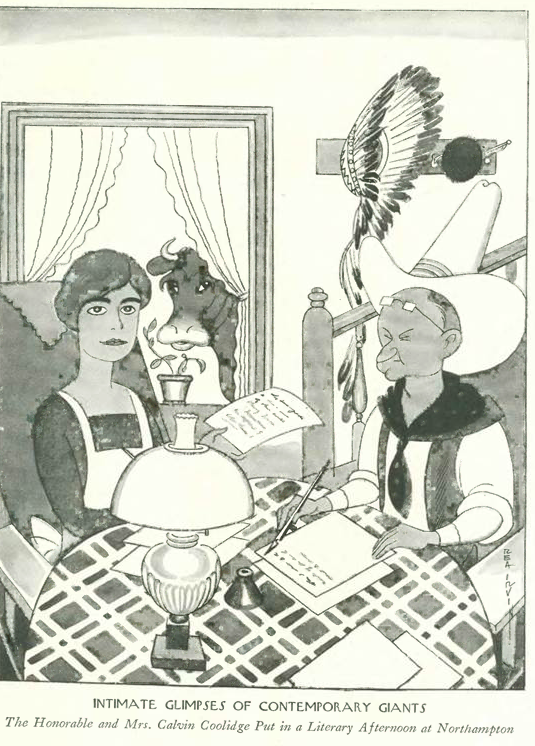
…Rea Irvin reprised his folk-satirical approach to life at the Coolidge house…
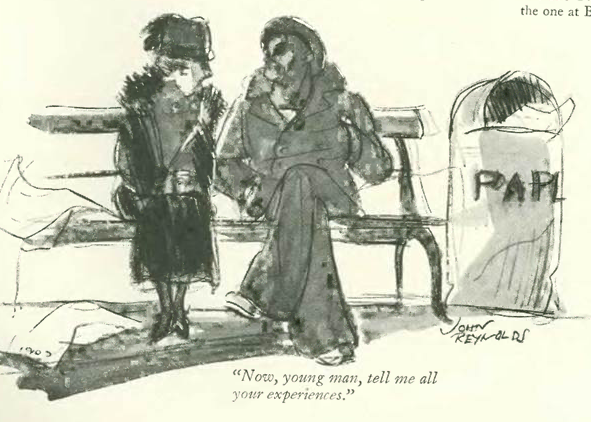
…John Reynolds found more humor in the clash of cultures…
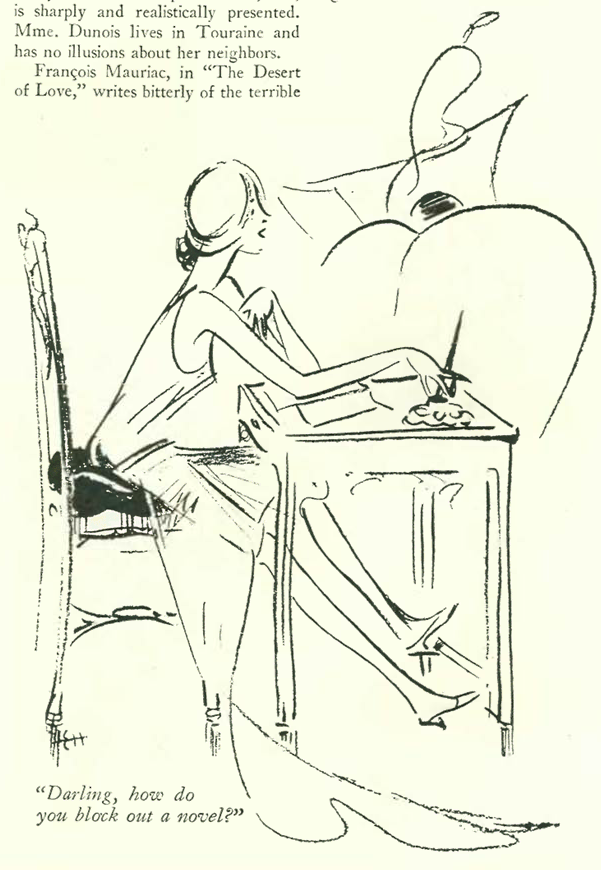
…Helen Hokinson contributed this very modern rendering of writer’s block…
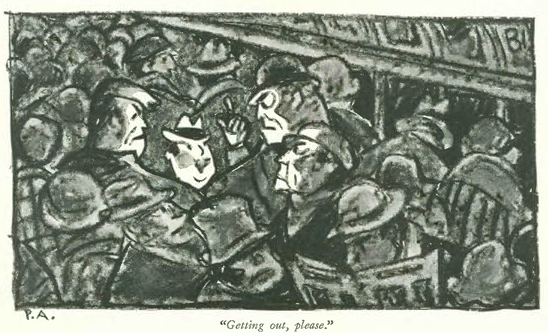
…and Peter Arno looked in on the challenges of commuting…
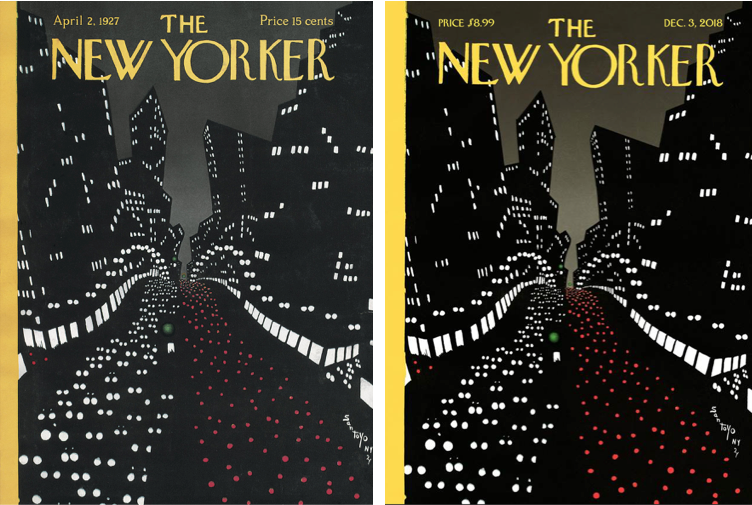
…and a quick note regarding a recent issue of The New Yorker (Dec. 3, 2018)…the cover featured a reprint of a Matias Santoyo cover from April 2, 1927…very cool…
Two weeks had passed since the “Black Tuesday” collapse of share prices on the New York Stock Exchange, but the New Yorker went about business as usual, E.B. White opening his “Notes and Comment” with a complaint — not about the economy — but about a marketing ploy that had New York University shilling magazines on behalf of Funk & Wagnalls.
Nov. 16, 1929 cover by Peter Arno. No doubt Arno drew inspiration from his own domestic situation (with wife and New Yorker columnist Lois Long and their infant daughter Patricia Arno).
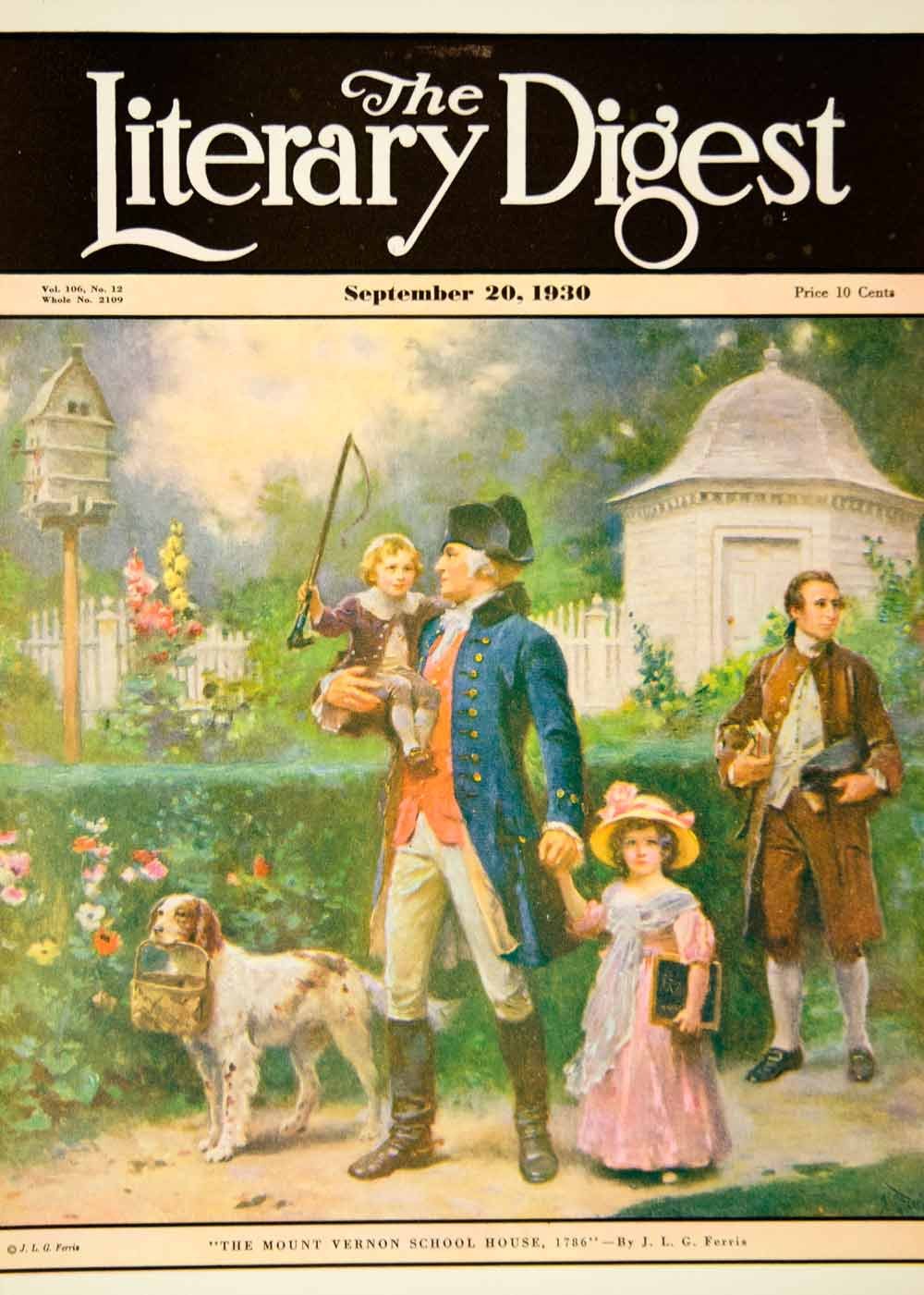
White mocked the contents of a letter from NYU that promised a “free” education to subscribers of Funk & Wagnalls’ middlebrow Literary Digest.
EASY-CHAIR EDUCATION…Founded in 1890 by Isaac Funk (of Funk & Wagnalls fame), the Literary Digest offered readers condensed articles from various American and European publications. The weekly magazine surpassed the one million circulation mark in 1927, but declined precipitously in 1936 after its famed (and usually reliable) presidential poll picked Alf Landon over FDR. It folded in 1938. (Pinterest)
White detailed how NYU’s director of public information promised untold riches to potential Literary Digest subscribers…
YOU CAN BE FAMOUS, FOR JUST PENNIES A DAY…E.B. White mocked an NYU letter that promoted its “hook-up” with the Literary Digest, wryly suggesting that recognition in NYU’s Hall of Fame for Great Americans was within reach of magazine subscribers. The photo above (circa 1935) shows the Hall of Fame’s colonnade, which half-encircled the university library (both designed by Stanford White) and housed 98 bronze busts. A financially strapped NYU sold its University Heights Campus, along with the Hall of Fame and library, to the City University of New York in 1973. (WPA photo via boweryboyshistory.com)
…and the not so subtle revelation that the “free” education came with a price:
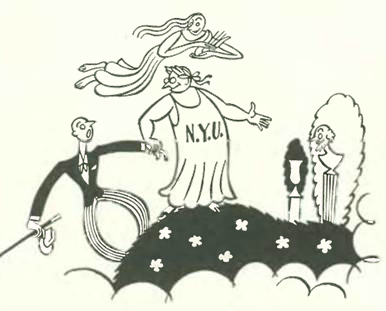
Here’s Julian De Miskey’s illustration that accompanied White’s “Notes”…
* * *
The Lighter Side of Bankruptcy
Evidence of the recent stock market crash was scant in the Nov. 16 issue, save for this blurb from Howard Brubaker…
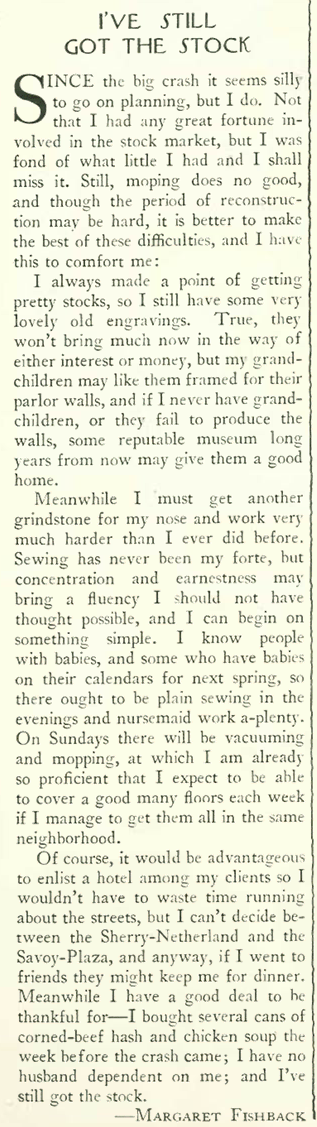
…and this short piece by Margaret Fishback, who took a characteristically lighthearted approach to the devastating news:
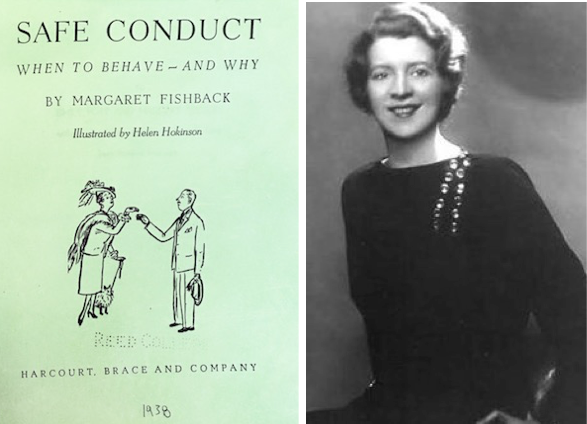
Fishback (1900-1985), a widely published poet and prose author from the late 1920s to the 1960s, was also a successful advertising copywriter for Macy’s and a number of other companies.
A WAY WITH WORDS…Margaret Fishback wrote a number of poetry and prose books, including Safe Conduct: When to Behave–and Why, a book of etiquette illustrated by The New Yorker’sHelen Hokinson. During the 1930s Fishback was reputed to be the world’s highest-paid female advertising copywriter. (necessaryfiction.com/Wikipedia)
* * *
We Stand Corrected
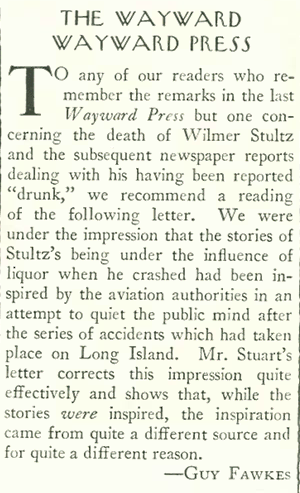
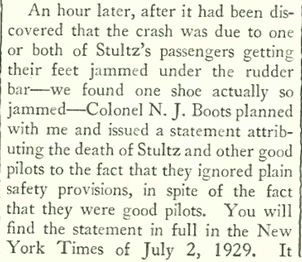
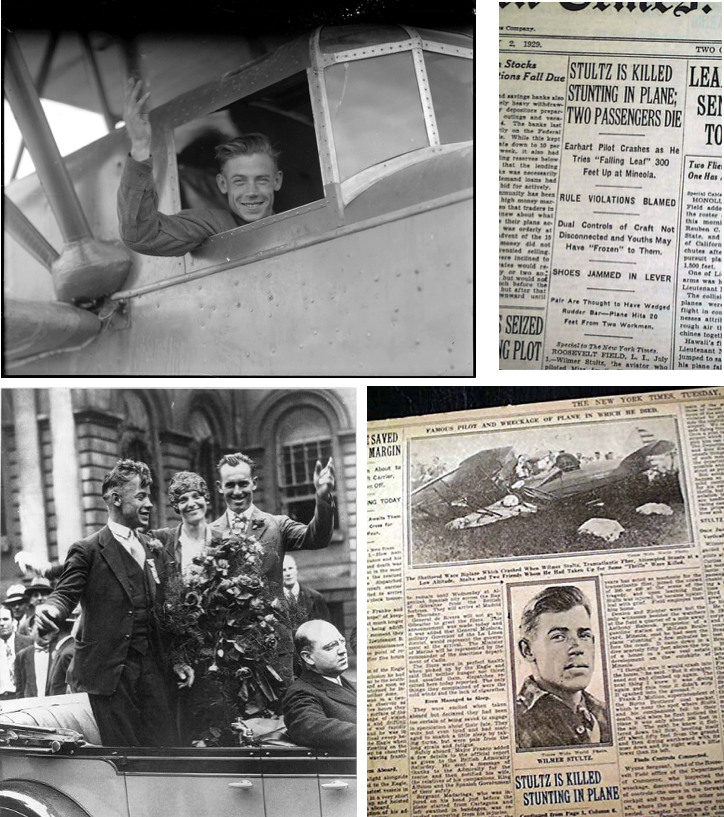
A correction of sorts was offered by Robert Benchley (aka “Guy Fawkes”) regarding one of his recent “Wayward Press” columns, in which the fatal crash of famed aviator Wilmer Stultz’s stunt plane was misattributed to drunkenness:
Following the above intro, Benchley included this letter from a representative of the Roosevelt Flying Corporation, John McK. Stuart, in which Stuart explained the real reason for the pilot’s fatal crash, and the source of a vicious rumor:
The cause of the crash, as reported in The New York Times, was attributed to two young men who begged for a ride on Stultz’s stunt plane, a Waco Taperwing, in the early afternoon of July 1, 1929. An investigation of the wreckage found shoes from both passengers jammed under a bar connected to the rudder, rendering it inoperable. In his letter, Stuart explained:
Apparently Stultz’s passengers had braced themselves during stunt maneuvers by jamming their feet under the rudder bar. According to the Times, after a couple of rolling stunts the plane began to climb again from about 200 feet when it rotated nose down and plunged into the ground. Both passengers were killed instantly. Stultz died shortly thereafter at a Long Island hospital.
BRIEF FLIGHT THROUGH LIFE…Clockwise, from top left, Wilmer Stultz (1900-1929) in undated photo; coverage of the fatal crash in the July 2, 1929 New York Times; Stultz, Amelia Earhart, and Lou Gordon feted in front of City Hall, New York City, following their successful flight across the Atlantic in June 1928. Stultz was the pilot of the Fokker Trimotor “Friendship,” aboard which Earhart became the first woman passenger to cross the Atlantic by airplane. Gordon served as the flight’s on-board mechanic. (Boston Public Library/New York Times/Amazon)
* * *
Cowardly Attack
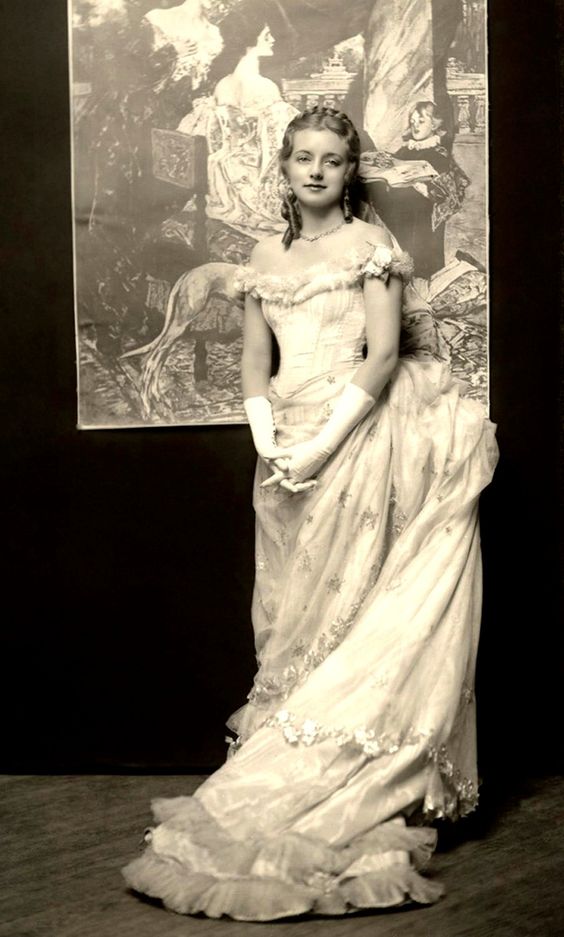
The acclaimed English playwright and composer Noël Coward was much beloved by The New Yorker, so it pained Robert Benchley to write an unflattering review of Coward’s operetta, Bitter Sweet:
IN THE SOPRANO KEY…British musical star Evelyn Laye (1900-1996) played the leading role of Sari in Noël Coward’s Broadway production of Bitter Sweet. (From The Bygone)
* * *
Hat Shop Heroine
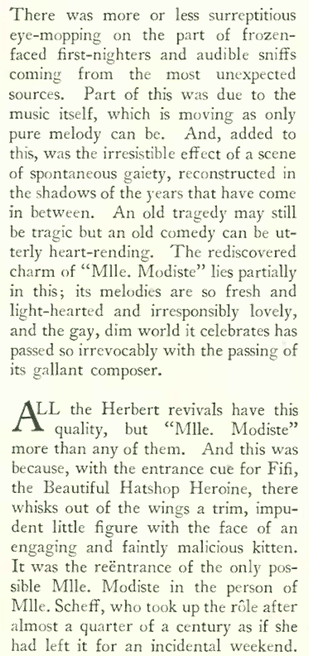
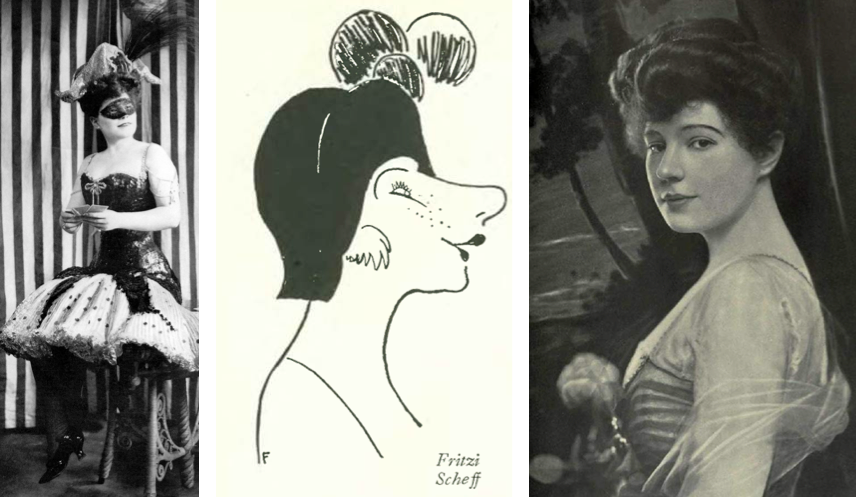
Another operetta — Mlle. Modiste — was getting a Broadway revival at Jolson’s 59th Street Theatre. Its star, Fritzi Scheff (1879-1954), was the subject of a short profile penned by Alison Smith. The operetta, written expressly for Scheff, premiered on Broadway in 1905 at the Knickerbocker Theatre, and enjoyed many revivals. Smith found that after nearly 25 years, Scheff still embodied the role of the hat shop girl who dreamed of being an opera singer. An excerpt:
From left, Fritzi Scheff in Mlle. Modiste (1905); Al Frueh’s caricature of Scheff for the profile; Scheff circa 1910. (Wikipedia/IMDB)
* * *
Best of Both Worlds
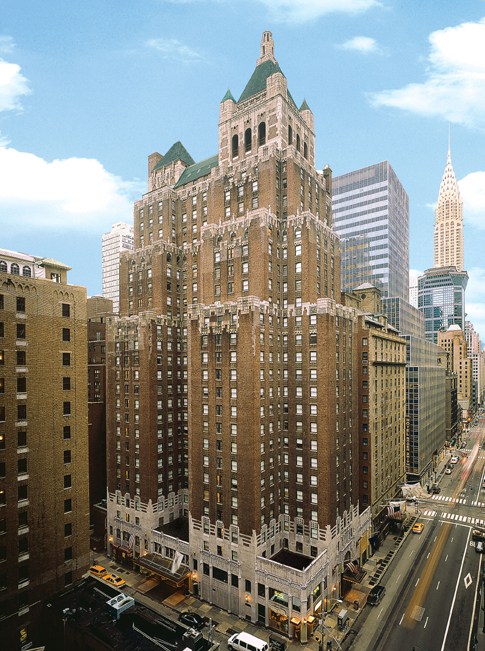
Although the Gothic style was quickly falling out of fashion in the age of Art Deco, architecture critic George S. Chappell found much to admire in Schultze & Weaver’s new Hotel Lexington, part of the hotel construction boom in New York’s Midtown:
STILL ATTACHED TO THE EARTH…The Lexington today, now a Marriott property, at 511 Lexington Avenue and 48th Street. (ohrllc.com)
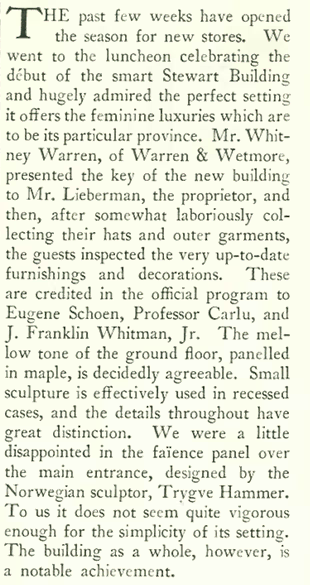
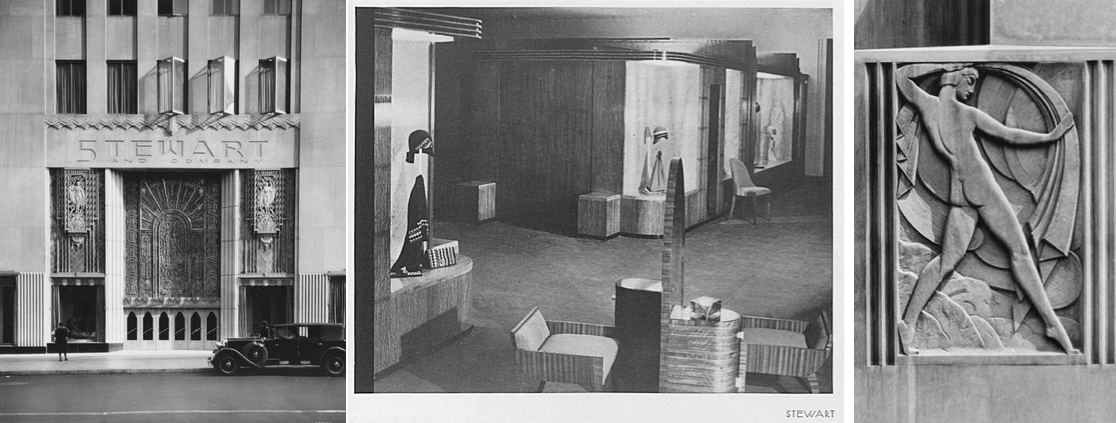
Chappell also admired the “smart” new Stewart Building, calling it the perfect setting for “feminine luxuries”…
Sadly, the Stewart Company folded just months after the opening of its new building, an early victim of the Depression. Bonwit Teller took over the building in 1930 and stayed until 1979. It was demolished in 1980 to make way for Trump Tower.
BYGONE ELEGANCE…Stewart and Company’s metal and ceramic 5th Avenue entrance, detail, 1929; Stewart Millinery Shop, 1929 (image from Vogue); detail from ornamental frieze above the 8th story, 1929. The building was demolished in 1980 to make way for Trump Tower. Neither the frieze nor the ornate ironwork were saved. (Museum of the City of New York/Vogue via drivingfordeco.com)
* * *
A Survivor’s Tale
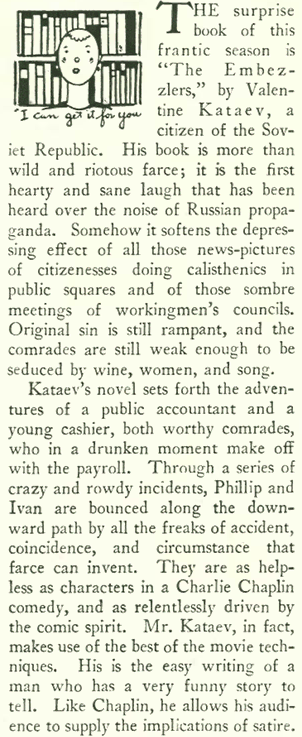
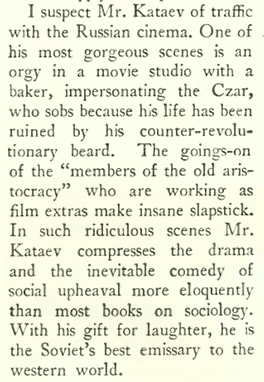
The New Yorker hailed Soviet writer Valentine Kataev’s debut novel, The Embezzlers, as “the first hearty and sane laugh that has been heard over the noise of Russian propaganda.” Published in 1926 and translated into English in 1929, the novel was a satire of bureaucracy in the new Soviet state. Remarkably, Kataev (1897-1986) was able to write challenging, satirical works throughout his long life and career without running afoul of Soviet authorities, or falling victim to Stalin’s terror campaigns:
SATIRICAL SOVIET…Valentine Kataev circa 1930. His 1926 debut novel, The Embezzlers, was a satire of Soviet bureaucracy. (russkiymir.ru)
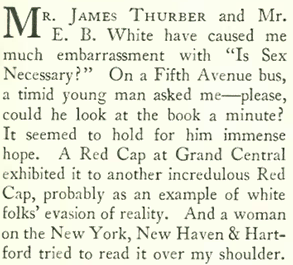
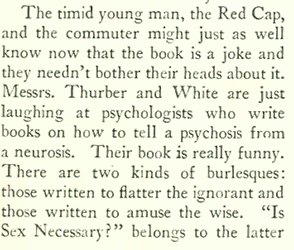
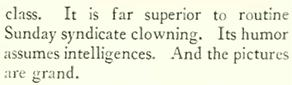
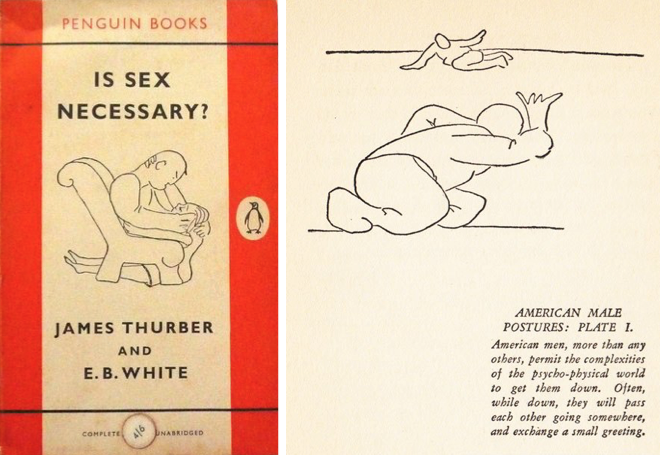
Another title receiving a favorable review, Is Sex Necessary? — a spoof of popular sex manuals and how-to books — was co-written by The New Yorker’sJames Thurber and E.B. White, with illustrations provided by Thurber.
HE CAN DRAW, TOO…Although James Thurber had yet to publish one of his drawings in The New Yorker, the book Is Sex Necessary? featured 42 of them, including the illustration at right that demonstrated the male greeting posture, and below, the posture of a man who could not discern the difference between love and passion. (brainpickings.org)
* * *
Old News
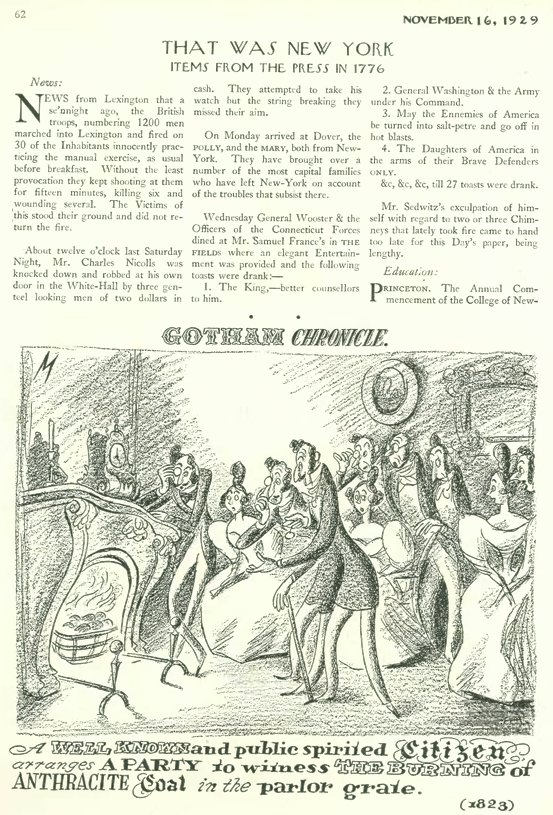
Writer (and later screenwriter) David Boehm temporarily took over the history column “That Was New York” from playwright Russell Crouse and contributed the first in a series of articles featuring clippings from 18th century newspapers (with illustration by Julian De Miskey):
* * *
From Our Advertisers
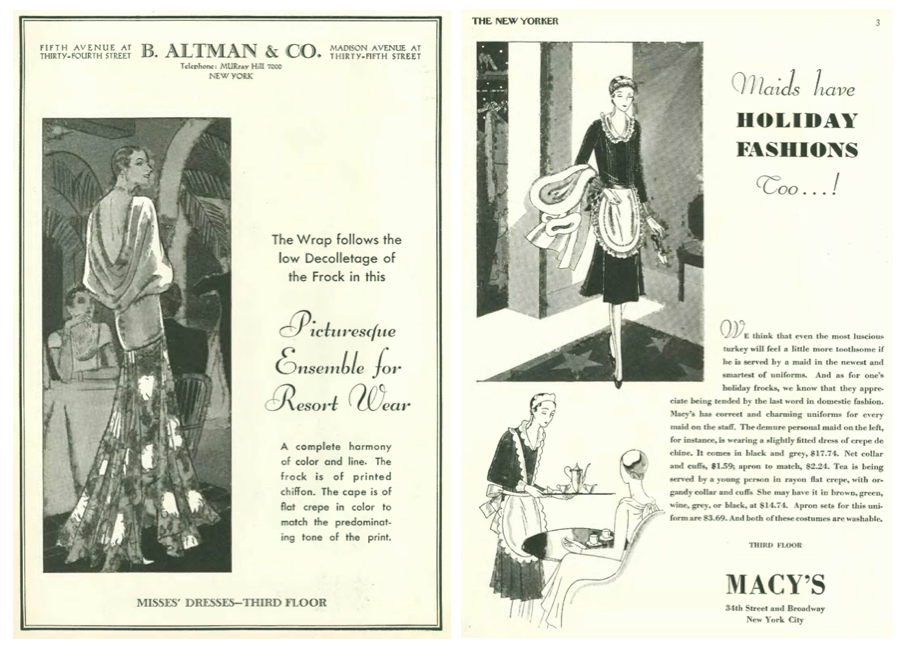
The Depression was coming, but you wouldn’t know it by the ads that appeared in the Nov. 16 issue, which featured the latest in resort wear, and holiday fashions for the maid…
…the Jay Thorpe store assumed some readers had $1,250 to spare for this coat and muff (equivalent to about $18,000 today), while Udall and Ballou jewelers offered a brooch for $9,000 (or nearly $130,000 today)…
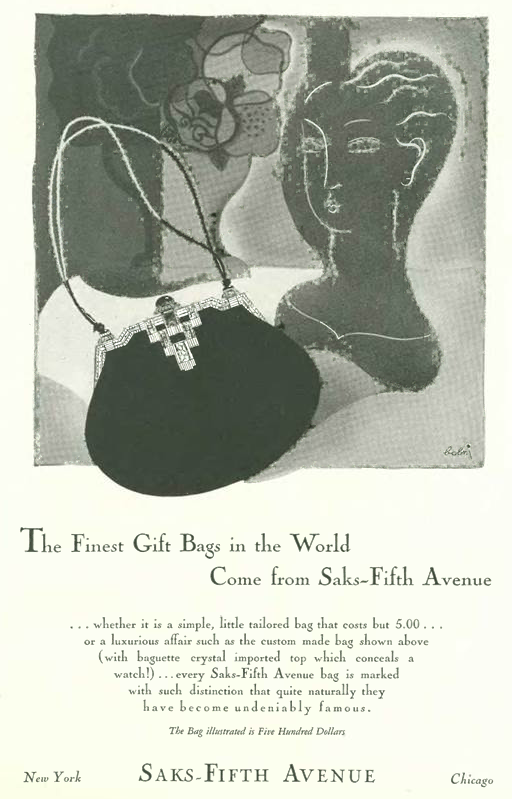
…Saks offered a “simple little tailored bag” for $5, although the one pictured in the ad would set you back $500 ($7,200 today)…
…in this clever ad for Kayser silk hosiery, illustrator Ian Oliver drew a shelf from negative space to allow the model some room to lean…
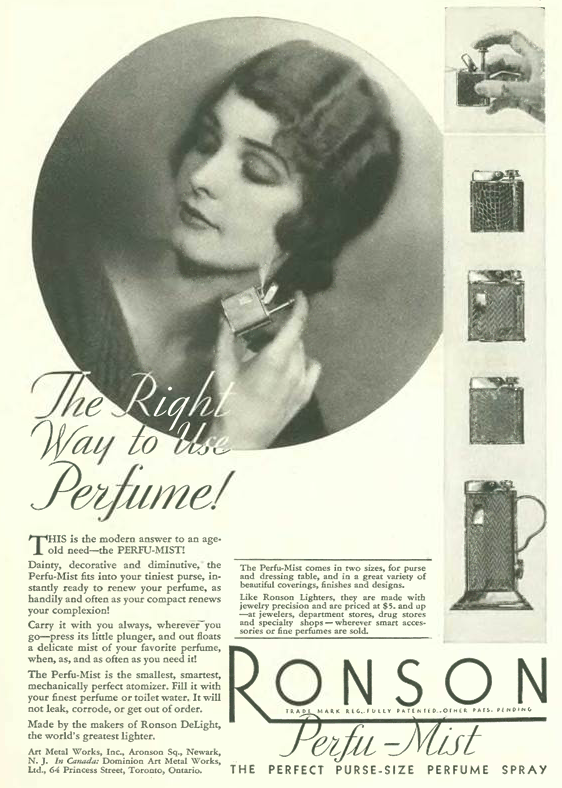
…makers of the Ronson cigarette lighter found a new use for their product, adapting it to serve as a perfume atomizer…I wonder how many women accidentally lit their hair on fire, or took a shot of perfume to the eyes when they wished to have a smoke…
…while you had the lighter handy, you could light up an Old Gold, and thanks to the lack of truth-in-advertising standards, you could do it believing that you were also warding off a winter cold…
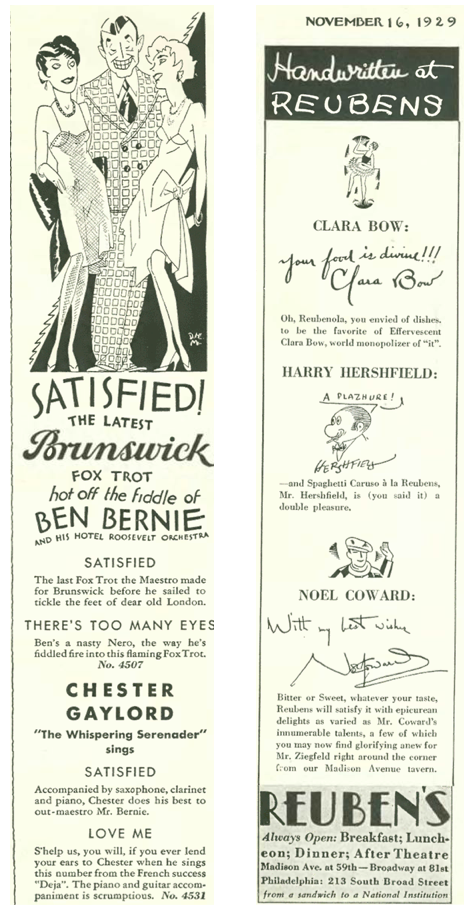
…from the back pages we have these gems from Brunswick records, and Reuben’s restaurant, which featured written testimonials from famous clientele including the “It Girl” actress Clara Bow, cartoonist Harry Hershfield, and playwright Noël Coward …
…Dr. Seuss offered his latest take on the uses of Flit insecticide, here sprayed directly into a user’s face for maximum benefit…
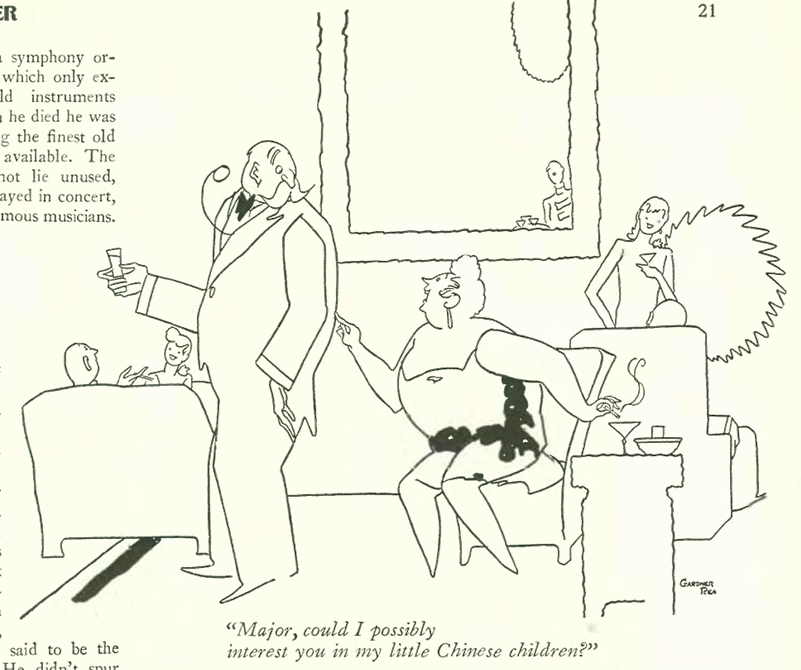
…our cartoons come courtesy of Gardner Rea, who looked in on an act of charity…
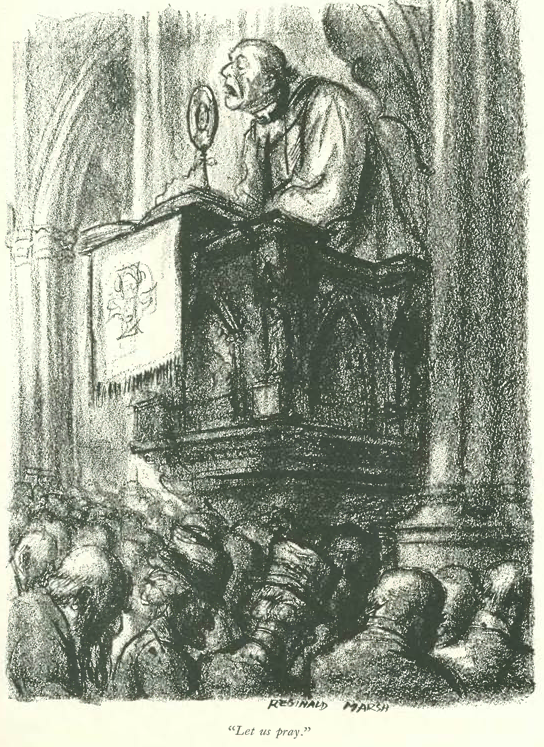
…Reginald Marsh illustrated a new use for broadcast radio…
…Barbara Shermund put the “idle” in “idle rich”…
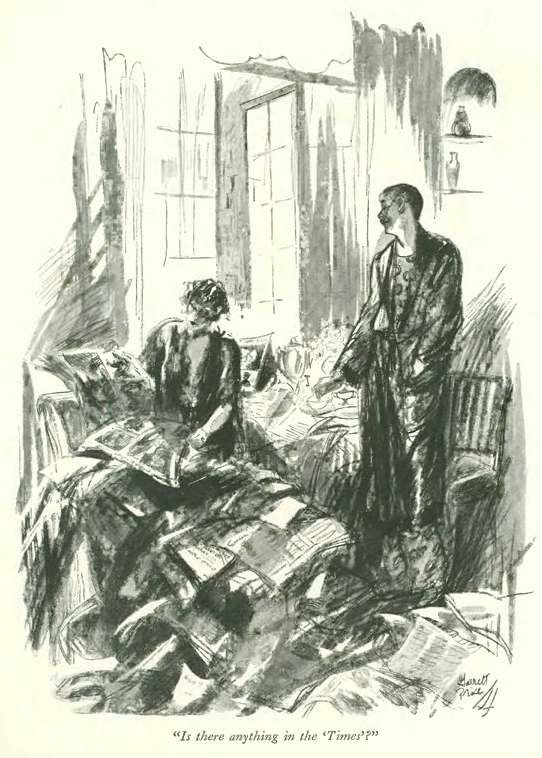
…Garrett Price gave us this lovely illustration of a casual reader…
…and Helen Hokinson went shopping with one of her society women…
Although two months remained in the decade, The New Yorker of the Roaring Twenties effectively ended with this issue, just days before a massive market crash sent the nation spiraling into the Great Depression.
Oct. 26, 1929 cover by Theodore Haupt. Wonderful rendering of The New York Central Building, with shades of Georgia O’Keeffe.
Not a soul at The New Yorker had an inkling of the bleakness that lay ahead — rampant unemployment, the rise of the Nazi party, the Dust Bowl, Busby Berkeley musicals…
E.B. White, in “Notes & Comment,” was concerned with little more than the changing countryside…
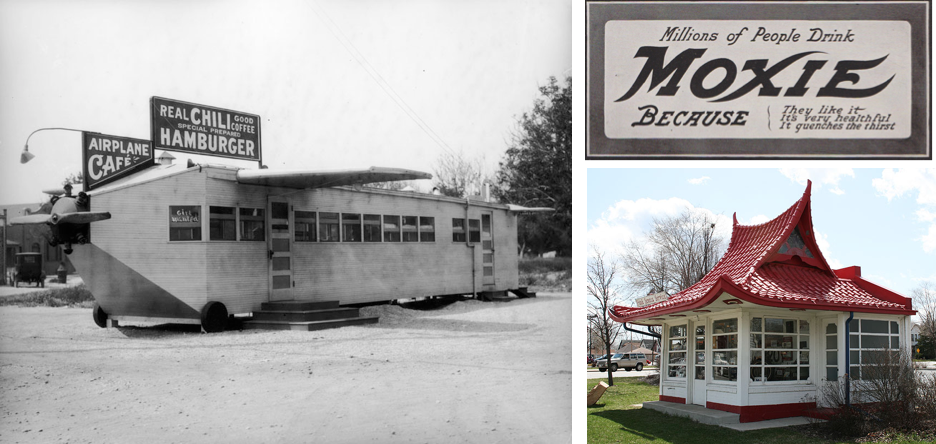
MADE YOU LOOK…Examples of roadside vernacular architecture from the 1920s included the Airplane Cafe in in the San Fernando Valley (1924) and a 1927 Wadham’s gas station in West Allis, Illinois, now on the U.S. National Register of Historic Places. More than 100 of Wadham’s “pagodas” were built, but like much of roadside America, few examples remain. At top, right, a 1920s billboard advertising Moxie soft drinks. (last1onthebus.com/Pinterest/Wikipedia)THE DUCK STOPS HERE…The Big Duck in Flanders, New York, was built in 1930-31 by Long Island duck farmer Martin Maurer to sell duck and duck eggs to passing motorists. It was listed on the National Register of Historic Places in 2008. (Google Maps)
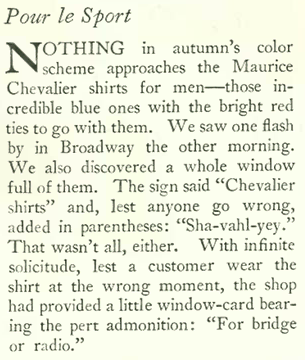
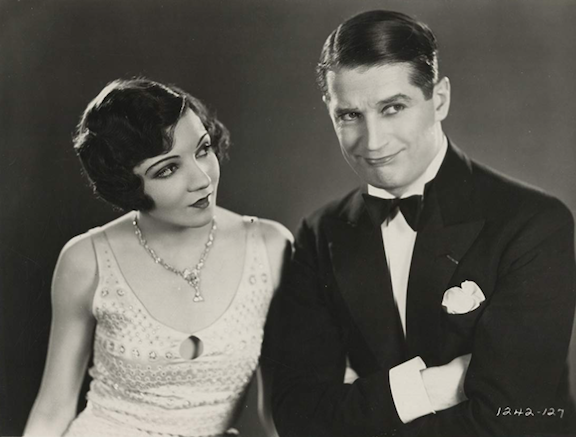
…and further on in “The Talk of the Town,” White shared these observations regarding the popularity of shirts worn by French actor Maurice Chevalier…
THAT’S SHA-VAHL-YEY…Claudette Colbert and Maurice Chevalier in 1930’s The Big Pond. (IMDB)
* * *
Born to Be
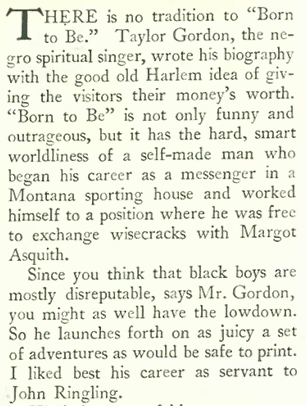
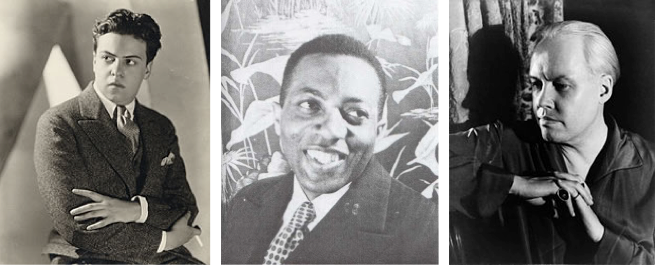
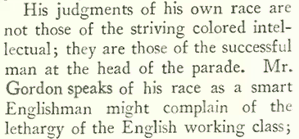
The book review featured an autobiography, Born to Be, written by Taylor Gordon (1893-1971), a famed singer of the Harlem Renaissance, that traced his life journey from Montana to New York. The book included ten full-page illustrations by Mexican artist Miguel Covarrubias, and forwards by Carl Van Vechten and Muriel Draper.
COMBINED TALENTS come together in Taylor Gordon’sBorn to Be: Mexican painter, caricaturist, and illustrator Miguel Covarrubias (left, in a 1920s photo by Nickolas Muray) and Harlem Renaissance singer Gordon (center, in a photo by Carl Van Vechten, who is pictured in a self-portrait at right). (Pinterest/minormoderns.blogspot.com/Wikipedia)
FROM MONTANA TO HARLEM…First edition of Taylor Gordon’sBorn to Be, and illustrations from the book by Miguel Covarrubias (including cover image). The image at bottom left features patron of the Harlem Renaissance Carl Van Vechten, with Gordon. (qbbooks.com/klinebooks.com/Pinterest)
* * *
Little Narcissus
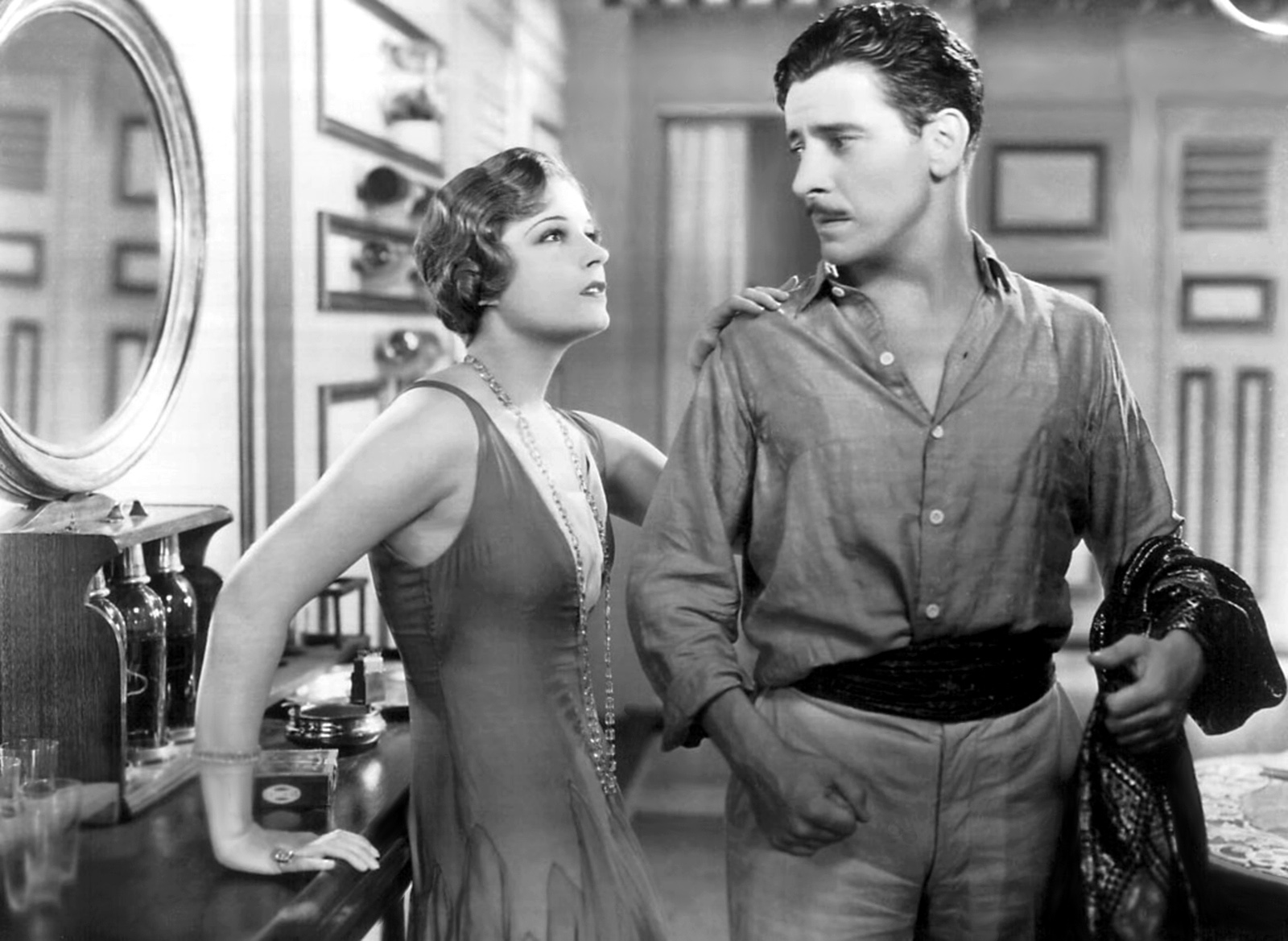
Although today she is known mostly as Errol Flynn’s first wife, the tempestuous French actress Lily Damita (1904-1994) knew how to light up New York and get noticed in Hollywood when she made her American debut in 1929. Henry F. Pringle looked in on Damita’s daily life in the Oct. 26 “Profile.” A brief excerpt:
Lily Damita in a 1931 publicity photo. (Flickr)DEBUT FILM…Lily Damita and Ronald Coleman in 1929’s The Rescue, Damita’s first Hollywood film. (Dr. Macro)
* * *
A Master Achievement
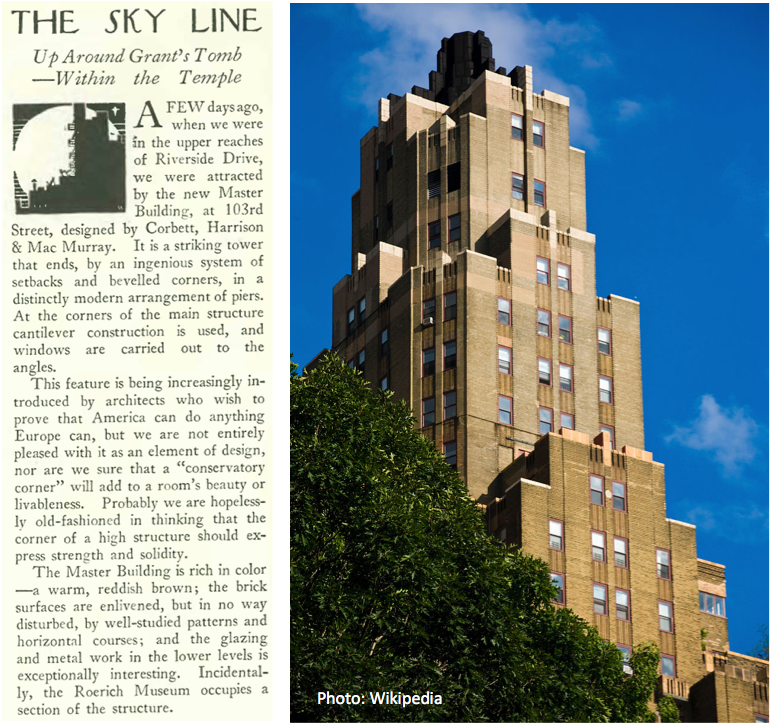
Architecture critic George Chappell gazed upward in admiration for the new Master Building on Riverside Drive. It was one of the city’s first mixed-use structures and the first New York skyscraper to feature corner windows. The apartment building originally housed a museum, a school of the fine and performing arts, and an international art center on its first three floors. The building fell into decline in the late 1960s, but today it thrives as a housing co-operative. The Master was listed on the National Register of Historic Places in 2016.
…on to our advertisements, we find another art deco landmark, the 1930 Squibb building, designed Ely Jacques Kahn…
The Squibb Building at 745 5th Avenue, circa 1930. (Museum of the City of New York)
…Halloween was just around the corner and although it wasn’t a huge holiday as it is today, its presence still permeated the pages of The New Yorker, including a humorous piece by John O’Hara on the challenges of planning a Halloween party…
From left, excerpt from John O’Hara’s piece; an ad from Doubleday featuring a jack-o-lantern; an ad from Breyer’s ice cream that employed the older spelling of the holiday; at bottom, a filler illustration by Julian De Miskey.
…the makers of Marmon autos offered this lovely autumn scene…
…here is an unusual ad from a milliner named Mercedes who bid adieu to former clients in this hand-written, full-page entry…
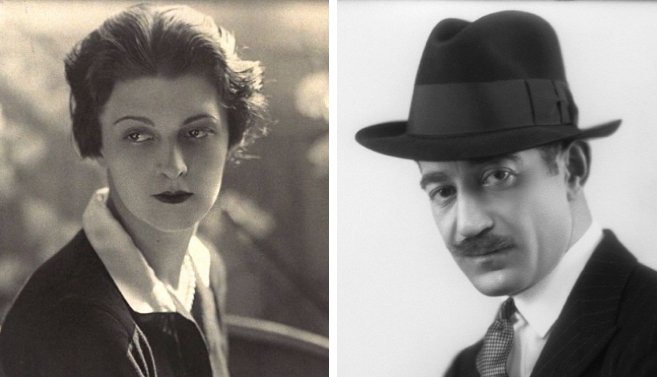
…the name Michael Arlen no doubt caught many a reader’s eye in the Oct. 26 issue. The comings-and-goings of this hugely popular author of thrillers such as The Green Hat (1924) provided much-needed fodder for readers of the first issues of the fledging New Yorker. In this ad, Arlen’s wife, the Countess Atalanta Mercati, shills for Cutex nail polish…
The Countess Atalanta Mercati of Greece and author Michael Arlen were married in France in 1928. (Conde Nast/insiderguide.me)
…and we have more of the torch singer Helen Morgan, this time in an ad for Lux Toilet Soap…
…a couple of back page ads…the now ubiquitous metal folding table (and chairs) was something of a novelty in 1929…the ad on the right from Brunswick Records offers up the latest schmaltz from Al Jolson (I know it’s 1929, but come on Al, really?)…
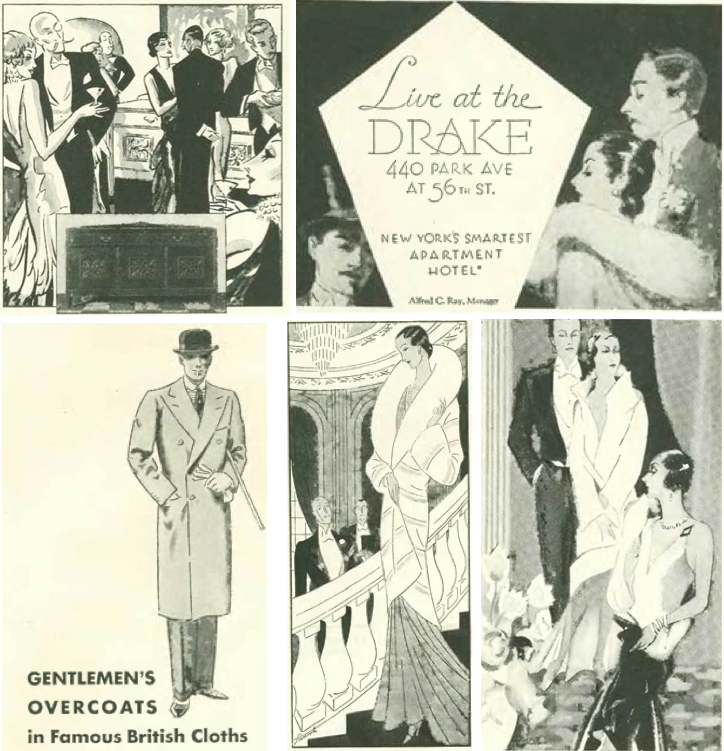
…and since this is the last edition before the big market crash, here’s a collection of images clipped from various ads in the Oct. 26 issue…featuring high-living folks who should appear a bit less smug after they lose their mink coats and boiled shirts to the Depression…
Clockwise, top left, a sampling of illustrations from ads in the Oct. 26 issue: there seemed to be no item too mundane for the posh treatment—an illustration that graced an ad from Frigidaire; superior airs displayed on behalf of the Drake apartments, and below, also on behalf of (sniff) Gotham Gold Stripe stockings; “Arabella” surveys two of her hapless conquests as she descends the stair in an illustration for a Marie Earle salon ad; and an appeal to the city’s rampant Anglophilia from De Pinna of Fifth Avenue.
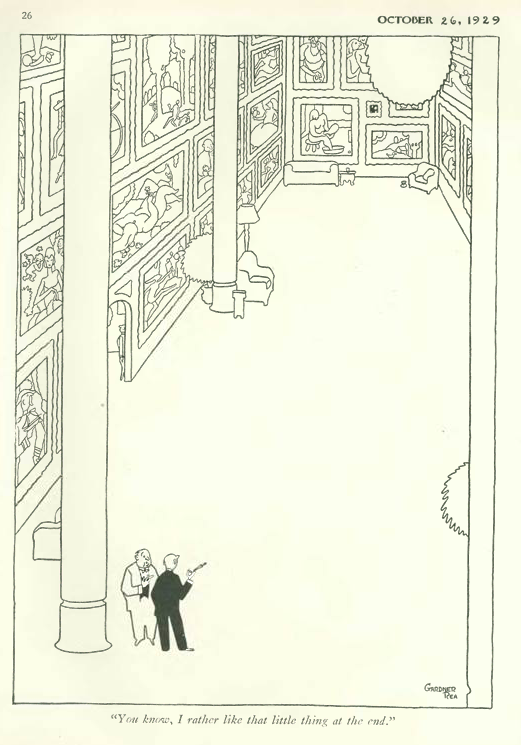
…on to our cartoons, Garner Rea demonstrated his mastery of space in this full-page entry…
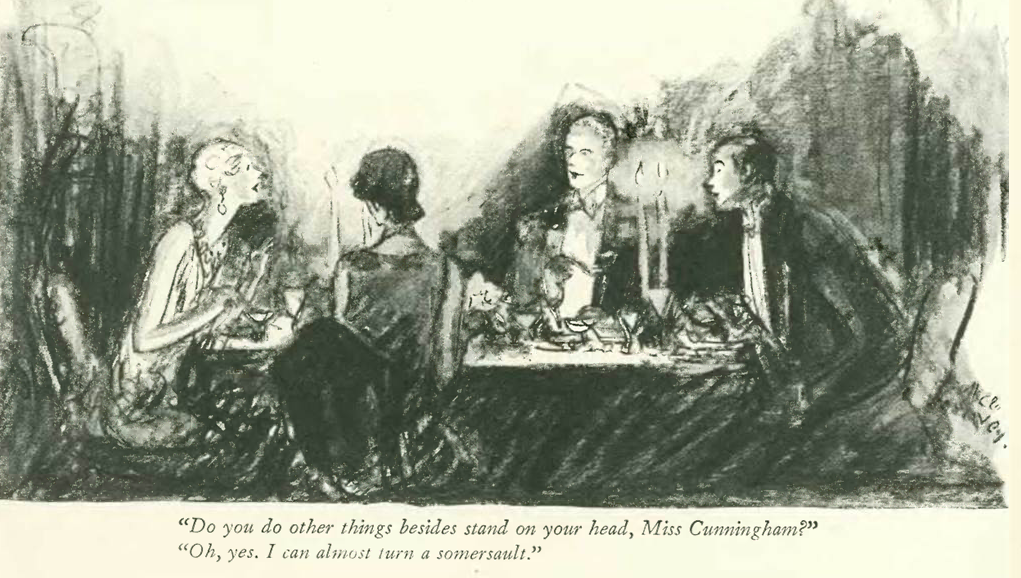
…Alice Harvey eavesdropped on the chit-chat of some toffs at dinner…
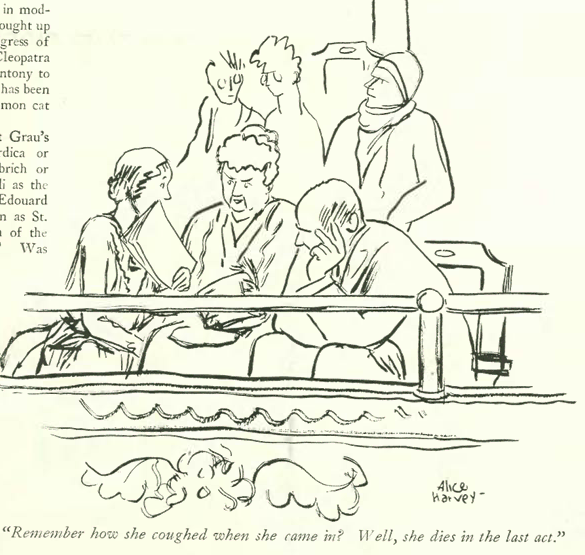
…and Alice Harvey again in this sparer illustration of a spoiler at the opera…
…Peter Arno illustrated unexpected intimacy on a commuter train…
…and from John Reynolds, with a sign of things to come…
The New Yorker, via the pen of E.B. White, looked to the metropolis of the future in the Oct. 19, 1929 issue — to a city of glass towers that were ready to move from drafting table to reality. That is, until the stock market crash, just days away, which would put a heavy damper on those visions.
Oct. 19, 1929 cover by Rea Irvin.
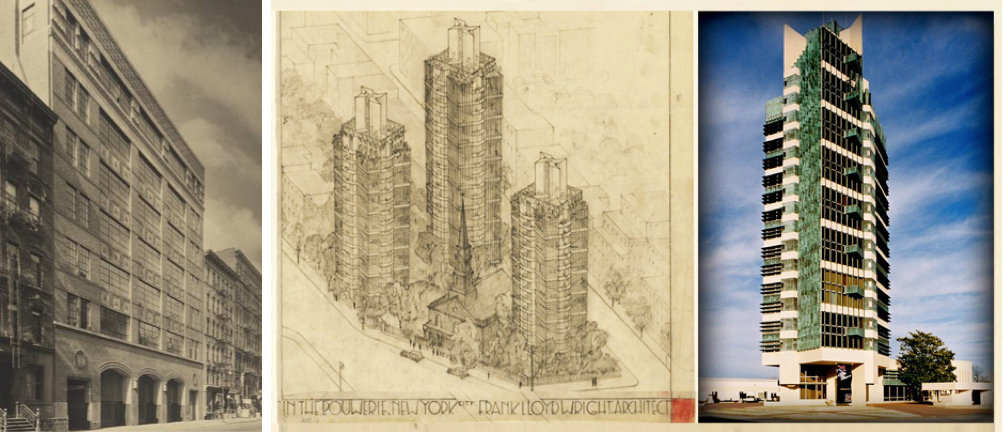
White reported in “The Talk of the Town” that several “all-glass” buildings were in the works, including “four apartment houses of glass” designed by Frank Lloyd Wright:
The 1926 Pinaud cosmetics factory designed by Ely Jacques Kahn and Albert-Buchman was poised to get a three-story addition (by Kahn) constructed entirely of glass block, but the market crash likely killed the project. The Depression probably didn’t help Wright’s project either, which would have constituted his first buildings in New York City, and the first with all-glass exteriors.
BEST-LAID PLANS…The 1926 Pinaud factory (left), now home to The School of Visual Arts, did not get its Ely Jacques Kahn-designed glass block addition in 1929; center and at right, Frank Lloyd Wright’s 1929 design for three skyscrapers surrounding St. Mark’s Church-in-the-Bowery. A single tower of similar design was eventually built in 1956—not in NYC—but out on the prairies in Bartlesville, Oklahoma. Click images to enlarge. (collectingvintagecompacts.blogspot.com; 6sqft.com)
Thanks to the Depression, and World War II, Gotham would have to wait 23 years for its houses of glass…
LATE ARRIVALS…Left, the 1952 Lever House, by Gordon Bunshaft and Natalie de Blois of SOM; right, the 1959 Seagram Building, by Mies van der Rohe. (Shorpy/ArchDaily)
and let’s not forget one of the most important post-war modernist statements to rise near the East River…
INTERNATIONAL STYLE…The 505-foot-tall United Nations Secretariat Building, constructed between 1947 and 1952. The building was designed by the Brazilian architect Oscar Niemeyer and the Swiss-French architect Le Corbusier. (United Nations)
* * *
Rising From the Ashes
While most architects were looking to the future, some still gazed into the past, and in the case of Whitney Warren, rather bitterly. It was Warren who designed a new library in Louvain, Belgium, to replace one that was burned to ground by invading German troops during World War I. Around three hundred thousand books and a thousand manuscripts were destroyed in the fire, not to mention thousands of civilians who died during the invasion and occupation. TheNew Yorker seemed ready to forgive, but given the scale of the atrocity just fifteen years earlier, one could understand Warren’s obstinance:
And to add insult to injury, the second library designed by Warren was also destroyed by the Germans in the World War II. What stands today is a restoration of that building.
A TALE OF TWO LIBRARIES…Clockwise, from top left, a comparison of the Louvain university library in 1913, and after its destruction by the Germans in 1914 (the postcard photo at top right became almost instantly famous around the world). At bottom, left, the replacement designed by Warren, which was also destroyed by the Germans in World War II. Inset, Whitney Warren, circa 1915. (Associated Press/Wikipedia)
* * *
Belles Lettres? Non!
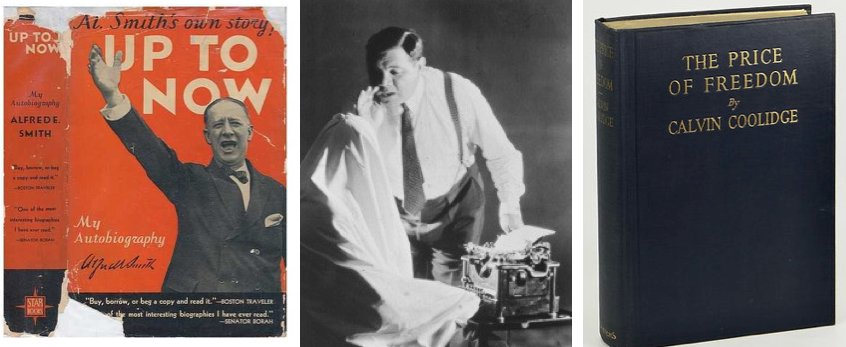
E.B. White, in his “Notes and Comment,” noted a new trend in the world of letters: celebrity authors. White lamented that the job of writing books and newspaper articles was being usurped by politicians, actors and athletes:
ASPIRING SCRIBBLERS…Former New York Gov. Al Smith, slugger Babe Ruth (dictating to his “ghost” writer) and former President Calvin Coolidge all got in on the act of book publishing. (Amazon/ourgame.mlblogs.com)
* * *
Where Babies Come From
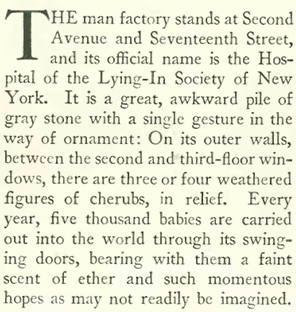
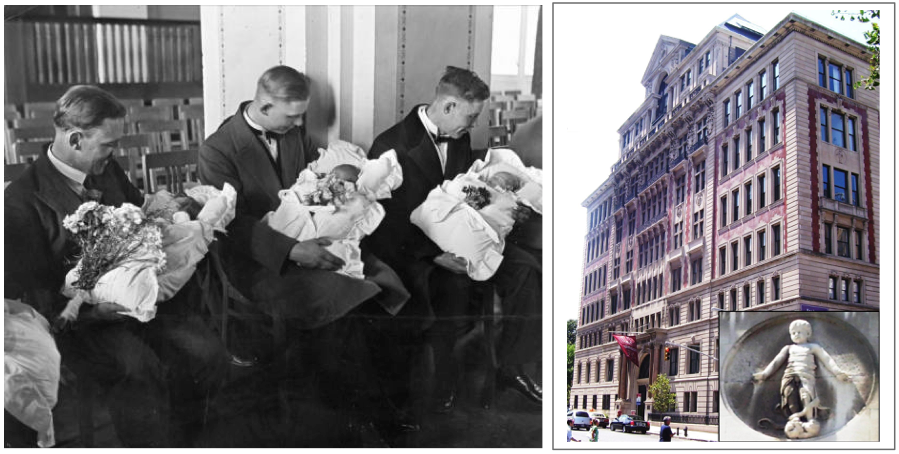
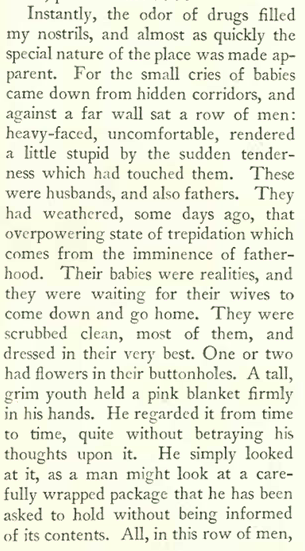
For his “A Reporter at Large” column, Morris Markey paid a visit to the Lying-In Society of New York, amaternity hospital now known asRutherford Place. I include a few excerpts below to give some idea how times have changed in the past 89 years…
THE EASY PART…Fathers admire their newborns in this circa 1920s photo. At right, the building that housed the Lying-In Society of New York. Inset, one of the cherubs carved into the building’s facade. (Wikipedia)
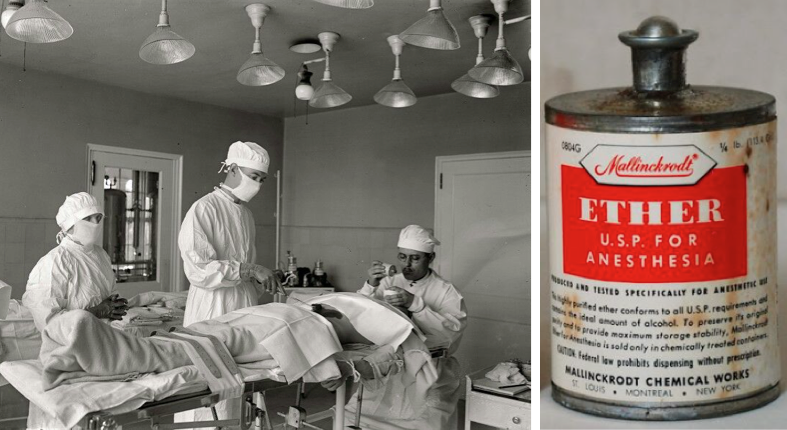
…imagine, if you will, the scent of ether (then commonly used as an anesthetic) and other drugs as you entered the hospital (no air-conditioning or HVAC to whisk those odors away!)…
NIGHTY NIGHT…Anesthesiologist administers ether and nitrous oxide to a patient before surgery in a Washington hospital, 1922. (Internet Archive: archive.org)
…not to mention the sweat of anxious fathers banished from delivery or recovery rooms…
WELCOME TO THE WORLD…Nurse learning to care for infants, Philadelphia General Hospital, c. 1930; nurses caring for infants at Long Hospital, Indiana University, in the 1920s. Note row of cribs fastened to the wall, which seemed to be a standard design back then. (upenn.edu/comet.soic.iupui.edu)
…or hospital stays for mothers that averaged ten days…
* * *
Should Have Stayed Home
Dorothy Parker was dealing with a “baby’ of her in own, in this case a grown man with the conversational skills of brick wall. She related her experience in a casual titled, “But the One on the Right…” An excerpt:
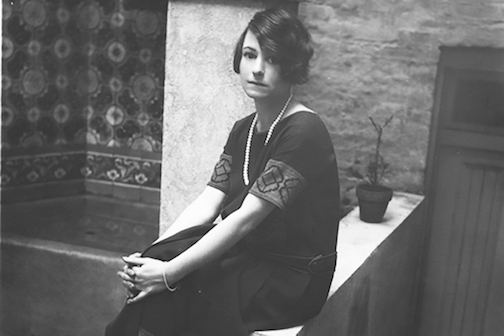
Dorothy Parker, happily at home, in 1924. (New York Public Library)
* * *
More Applause for Helen
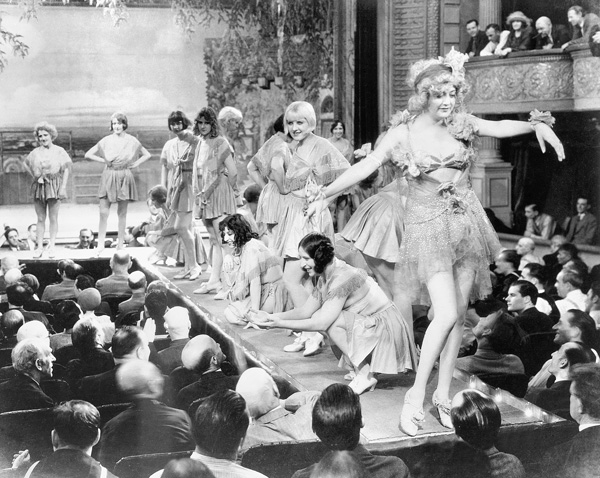
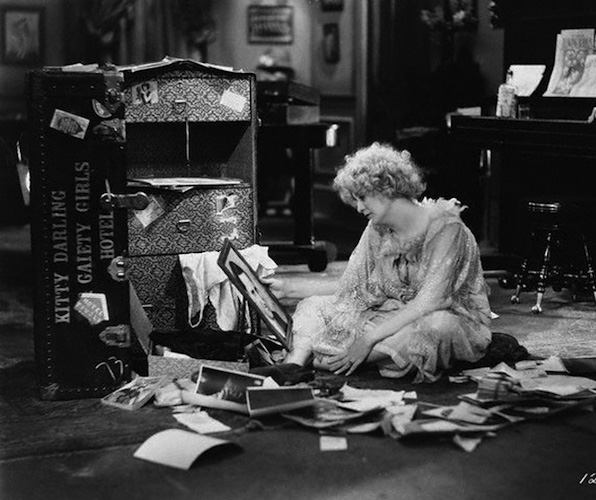
The New Yorker continued to shine an approving light on the work of nightclub singer Helen Morgan, this time in her first talking picture, Applause:
FALLING STAR…Helen Morgan (foreground, right) portrayed a fading burlesque star named Kitty Darling in 1929’s Applause, Morgan’s first all-talking picture. (MOMA)
On a sad note, Morgan’s real life had parallels to the film, including the abandonment of a child and a death due to alcohol and drugs — in the film Kitty overdoses on sleeping pills before a show; in real life Morgan would collapse onstage during a Chicago performance of George White’s Scandals. She would die of cirrhosis of the liver in 1941, at age 41.
IMITATING LIFE…Helen Morgan as Kitty Darling in Applause. Her best days behind her, Darling becomes an alcoholic who lives in the past. Sadly, Morgan’s real life had parallels to the movie. (art fuse.org)
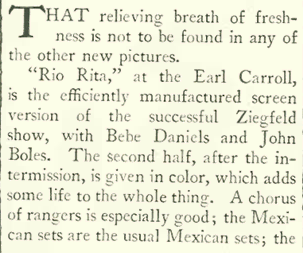
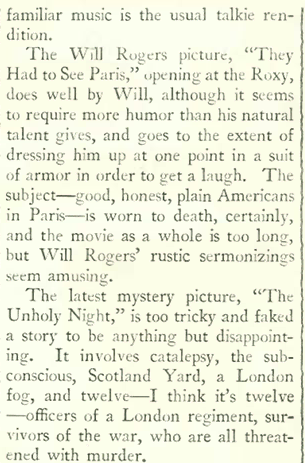
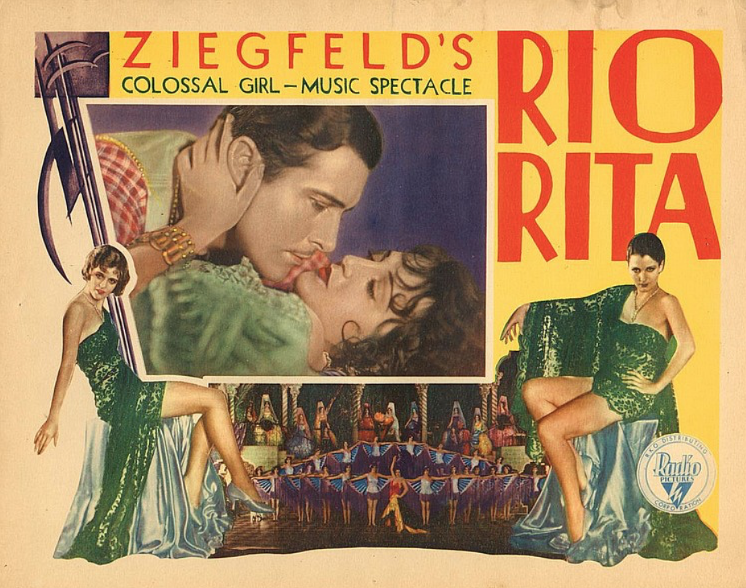
There was no such applause from The New Yorker for another talkie, the screen adaptation of the popular Ziegfeld Broadway stage show Rio Rita:
BEEN THERE, DONE THAT…Lobby Card for Rio Rita, featuring John Boles and Bebe Daniels. (IMDB)
* * *
From Our Advertisers
The Stewart fashion shop on Fifth Avenue featured a series of attractive, modern ads, these two appearing in the Oct. 19 and 26 issues…
According to the terrific website Driving for Deco, “Stewart and Company broke away from the traditional department store layout. Instead of aisle after aisle of display cases the new store comprised many shops. These “shops” were not individually owned as in a present day mall. They were rooms or alcoves devoted to specific merchandise. The design of the shops and floors fell to several different interior design firms…”
Clockwise, from top, artist rending of the Stewart women’s shoe department; Stewart and Company building at 721 5th Avenue; Stewart Millinery Shop. (Vogue/Museum of the City of New York, all via drivingfordeco.com)
The Depression brought an end to Stewart and Company, which went out of business in the spring of 1930. Later that year Bonwit Teller opened in the former Stewart Building. They would close their doors to business 49 years later.
Sadly the building was demolished in 1980 to make way for a monument to a massive ego: Trump Tower.
Demolition of the former Stewart & Company building in 1980. The Rene Paul Chambellan bas-relief sculptures on the building’s facade were supposedly destined to the Metropolitan Museum of Art. Developer Donald Trump thought the removal of the sculptures was cost-prohibitive, so they were smashed by jackhammers. (drivingfordeco.com)
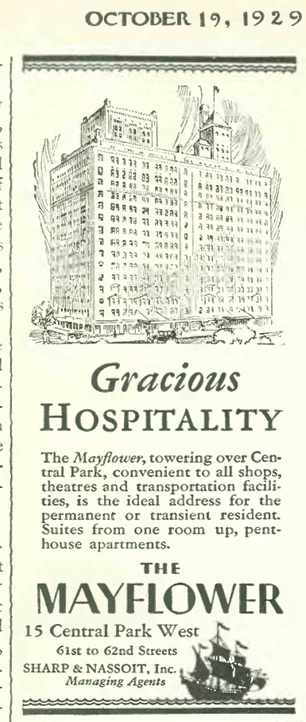
…back to the ads, we have another image of a building that is now but a ghost (I am writing this on Halloween)…
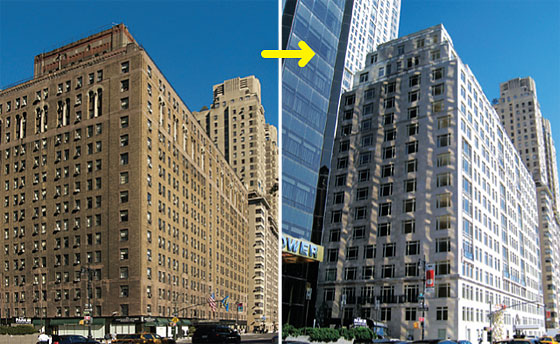
The Mayflower Hotel, left, a 1926 building designed by Emery Roth, was demolished in 2005 to make way for Robert A.M. Stern’s luxury condominiums, 15 Central Park West. (nymag.com)
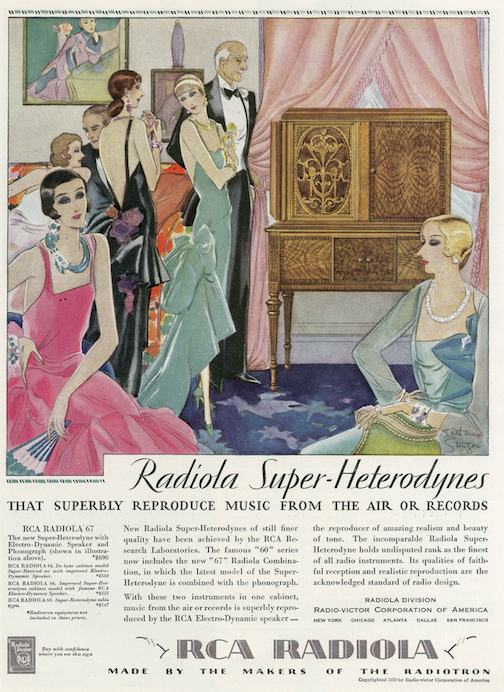
…speaking of luxury, these posh types seem to be almost lulled to sleep by RCA’s “Radiola Super-Heterodyne”…
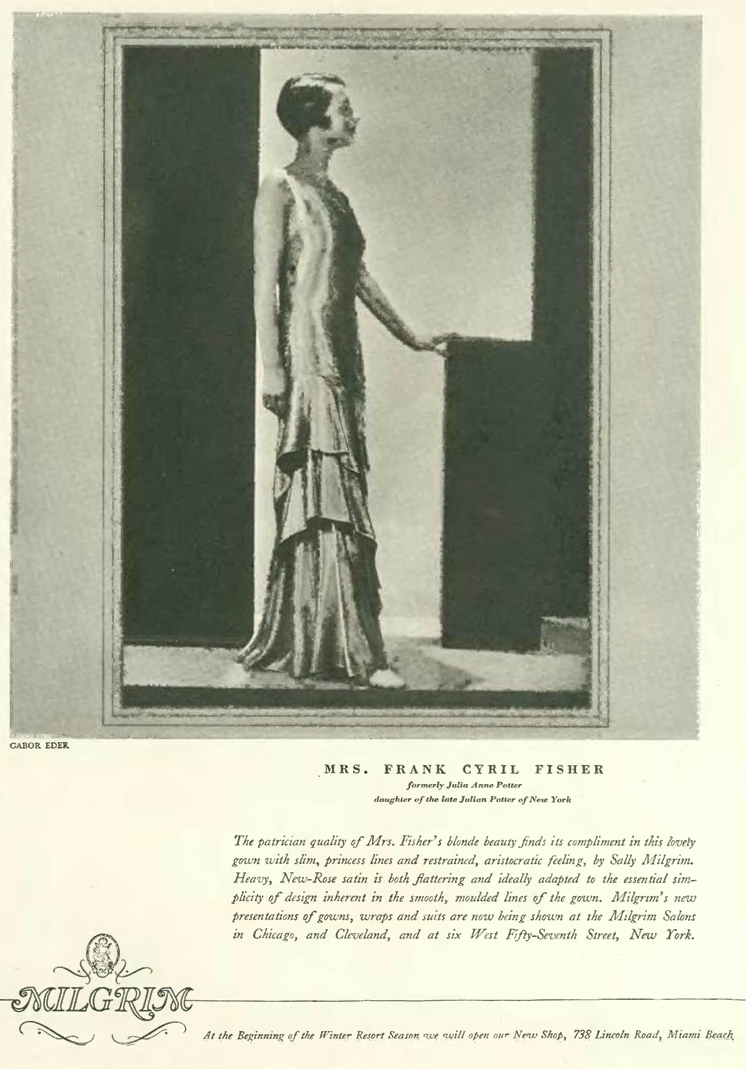
…and I throw in this ad from Milgrim for its use of the word “patrician” to appeal to the aristocratic yearnings of some New Yorker readers…
…perhaps those patricians would have preferred a move to “aristocratic” Scarsdale, as the middle ad below suggests, or perhaps they would have chosen something more “unusual” in East Orange…
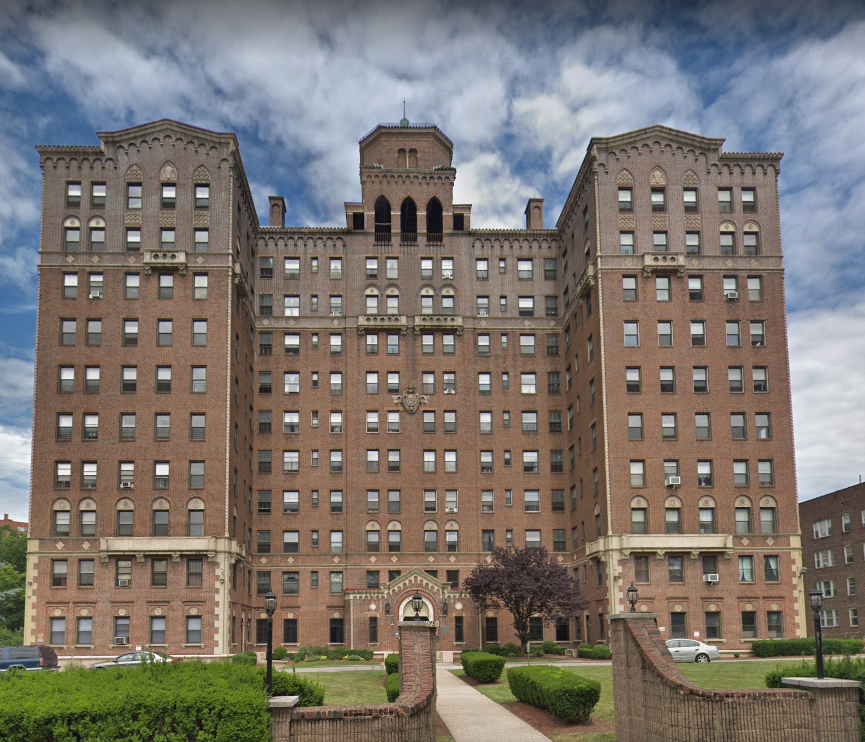
…for reference, here is a Google street view image of 75 Prospect in East Orange, New Jersey…
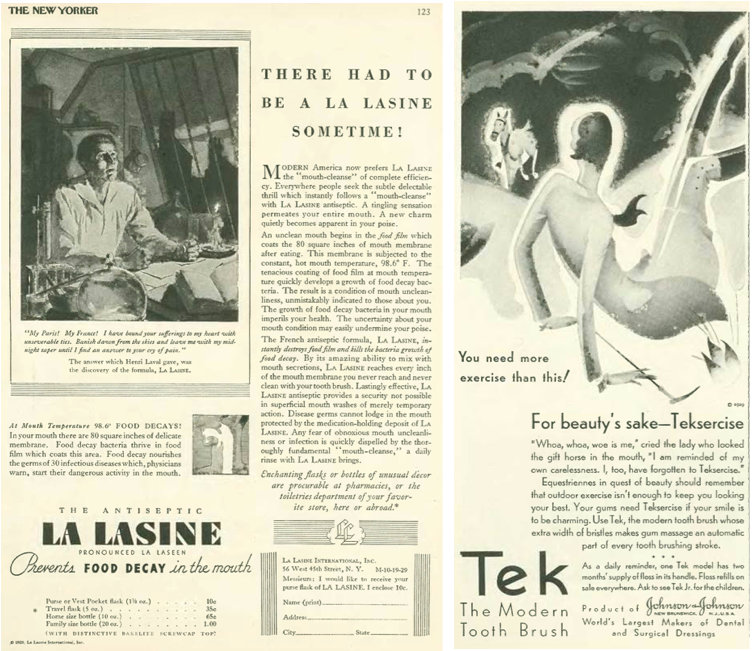
…and if you were of the upper classes, you probably would have wanted the latest in toothbrushes and “French” mouthwashes…
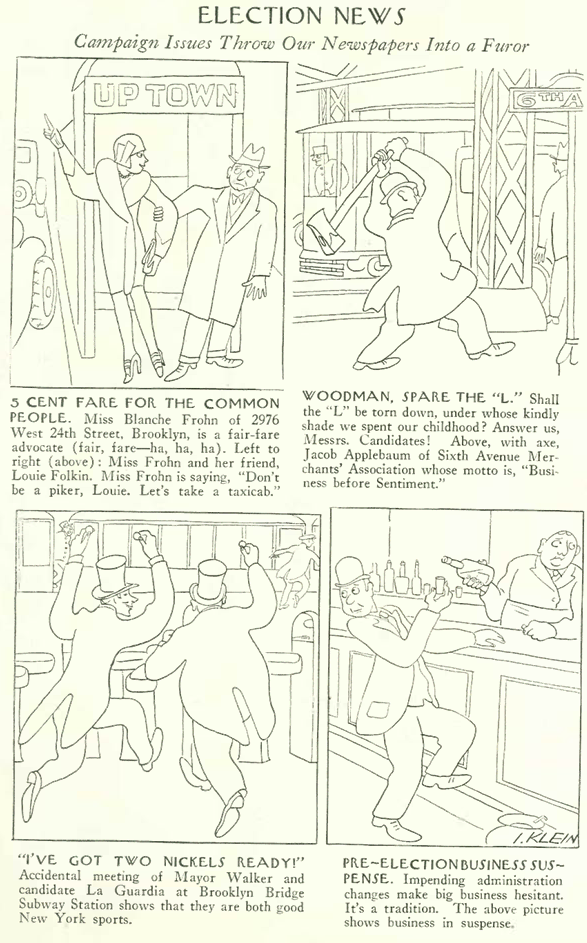
…on to our illustrators and cartoonists, Isadore Klein looked in on the elections…
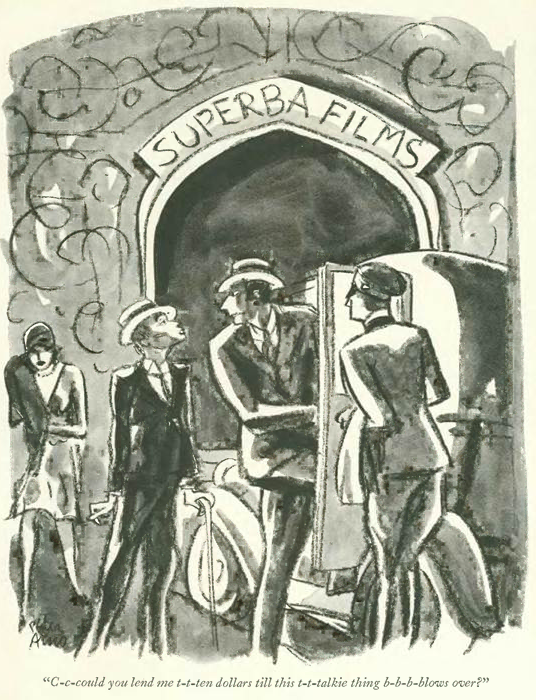
…Peter Arno illustrated the plight of a hapless silent film actor…
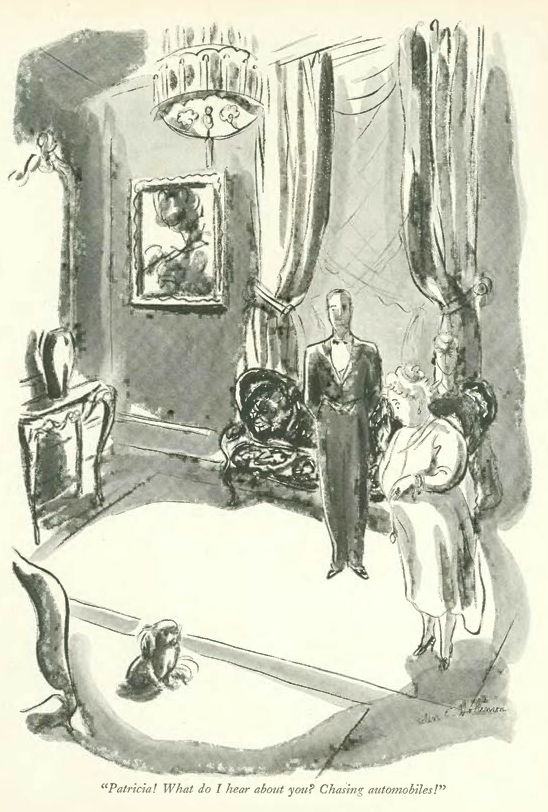
…and Helen Hokinson eavesdropped on a canine faux pas…
Almost ninety years after the lights went out on the Roaring Twenties, our collective imagination of New York City still harks back to that time…the sights and sounds of nightclubs and speakeasies and Broadway lights set to the tune of the Jazz Age.
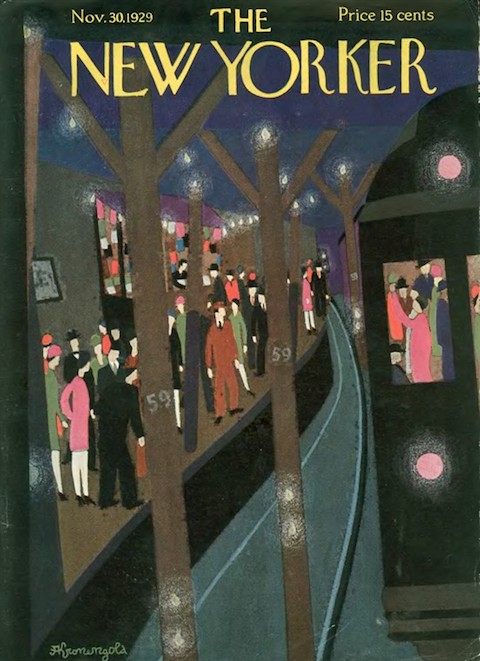
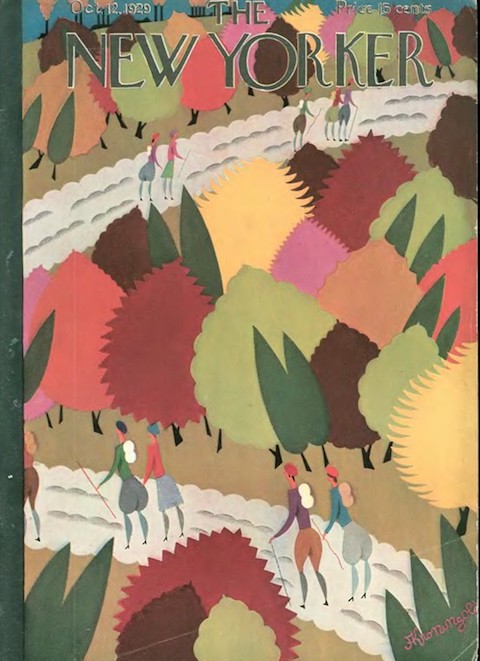
Oct. 12, 1929 cover by Adolph K. Kronengold.
And no wonder, since that decade made the city what it is today. Changing social mores, along with labor-saving electrical appliances and the ubiquitous automobile, altered the tempo of life. And this quickened pace was also reflected in the built environment, old landmarks reduced to rubble while gleaming skyscrapers rose up in their place seemingly overnight. A Victorian edifice like the Waldorf-Astoria — little more than 30 years old — seemed positively ancient to Jazz Age New Yorkers, who unceremoniously knocked it down to make way for what would become the city’s most iconic landmark.
New Yorker architecture critic George S. Chappell (aka “T-Square”) sensed that something big was on the horizon with his regular “Sky Line” updates on the city’s “tallest-building-in-the-world” contest. In the Oct. 12, 1929 issue he looked on admiringly as the Chrysler Building’s distinctive dome began to take shape:
IT’LL BE A SURPRISE…The Chrysler Building still lacked its gleaming art deco dome in this photo taken in the fall of 1929. At left is the Chanin Building, completed earlier that year. (reddit/adamunderhill.wordpress.com)
Chappell observed that the Chrysler Building’s claim as the world’s tallest would be short-lived, as plans for the Waldorf-Astoria site called for a much taller structure…
DOOMED…The old Waldorf-Astoria hotel (left), completed in 1897, was scarcely more than 30 years old when it was demolished to make way for the Empire State Building. The former governor of New York, Al Smith (inset) led the corporation that knocked down the old hotel and erected the world’s tallest building on the site. Demolition of the hotel began on October 1, 1929 (images at right). In his 2014 book The Empire State Building: The Making of a Landmark,John Tauranac observes the demolition was an arduous process, as the hotel had been constructed using more rigid material than what was found in earlier buildings. Those materials — granite, wood, and metals such as lead, brass, and zinc — were not in high demand. Most of the wood was deposited into a woodpile on nearby 30th Street or burned in a swamp. Other materials, including the granite and bronze, were dumped into the Atlantic near Sandy Hook, NJ. (New York Historical Society/New York Public Library Digital Gallery)RISING FROM THE RUBBLE…The Empire State Building under construction in 1930. When completed in 1931, the 1,250 foot (1,454 with antenna) building would claim the title as the world’s tallest. It was something of a definitive victory, as the building held that record for nearly forty years. (Museum of the City of New York)
Although Al Smith’s building seemed assured to win the “world’s tallest” title, another giant was taking shape on the drawing boards…
LAND OF THE GIANTS…City Bank-Farmers Trust Building (left), now known as 20 Exchange Place, was originally designed in 1929 to be the world’s tallest building at 846 feet, but the realities of the Depression brought it down to a more modest 741 feet, making it the fourth-tallest building in New York when it was completed in 1931. At right, the 22-year-old Century Theatre on Central Park West was demolished to make way for Irwin Chanin’s Century Apartments, also completed in 1931. (Museum of the City of New York/nyc-architecture.com)
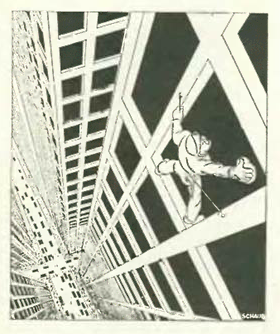
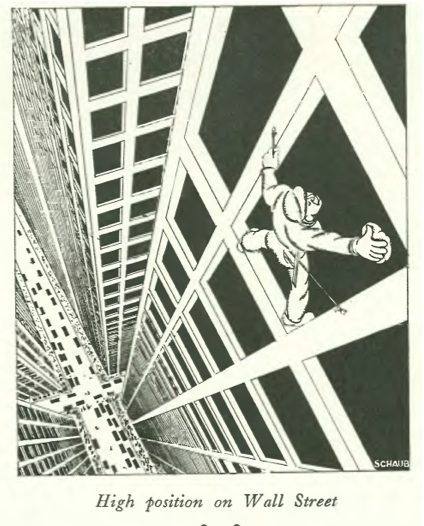
…while we are on the subject of skyscrapers, The New Yorker reprinted this illustration by Andre De Schaub to fill in a space at the bottom of page 54 in the Oct. 12 issue…
…the drawing originally appeared in the magazine three years earlier, as a cartoon in the October 16, 1926 issue. It included a caption: “High position on Wall Street” (thanks to Michael Maslin’s invaluable Ink Spill for helping me track this one down)…
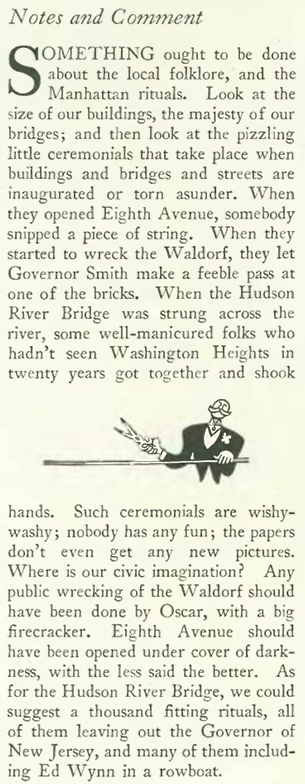
As the demolition crews picked apart the old Waldorf, E.B. White wondered why more fanfare wasn’t attached to such occasions, whether they be demolitions or ribbon-cuttings…
NEEDS MORE HOOPLA…Al Smith with his wife Catherine Dunn Smith, and two of his grandchildren at the opening ceremony of the Empire State Building, May 1, 1931. President Herbert Hoover officially dedicated the building by pressing a button in the White House that turned on the building’s lights (it was merely symbolic; they were actually turned on by some unknown maintenance worker in New York). (Museum of the City of New York)
* * *
A Novel Idea
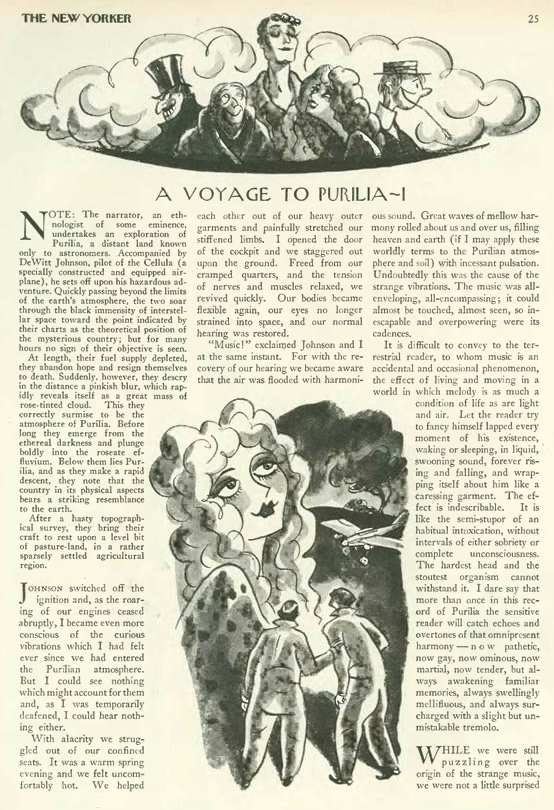
My last post featured a brief excerpt of an Oct. 5 theater review by Robert Benchley, who sized up Elmer Rice’s new play, See Naples and Die. Rice pops up again in the Oct. 12 issue, this time as the author of A Voyage to Purilia, the first novel serialized in The New Yorker. The novel was a satire on the silent film industry, set in the fictional land of Purilia. Here is the first page of the piece, with illustrations provided by Peter Arno:
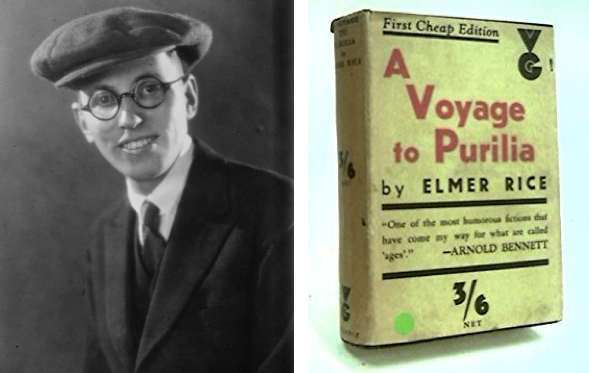
SENDING UP THE SILENTS…Elmer Rice in 1920; his satirical novel about the silent film industry, A Voyage to Purilla, was serialized in The New Yorker in 1929 and published the following year. It was re-published in the 1950s as a science fiction novel. (Wikipedia/Amazon)
* * *
Siren Song
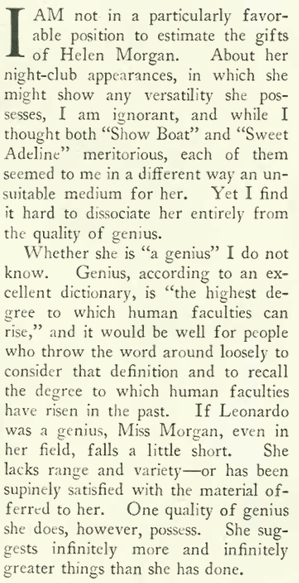
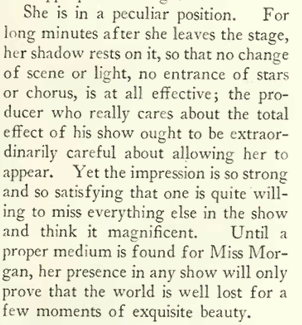
Writer and cultural critic Gilbert Seldes trained his discerning eye on the famed torch singer and speakeasy denizen Helen Morgan, attempting to understand the hard-living singer’s allure…
Helen Morgan, circa 1930. (masterworksbroadway.com)
RIGHT AT HOME…Helen Morgan made the draped-over-the-piano look of a torch singer her signature style. (Pinterest.UK)LIGHTING UP BROADWAY…Helen Morgan (left) as Julie LaVerne in the original Broadway cast of Show Boat, 1927. It was her best-known role. At right, Morgan in Applause, 1929. (Pinterest/IMDB)
Seldes struggled to understand Morgan’s appeal, which seemed to draw from an assemblage of personas…
PLUMBING EMOTIONAL DEPTHS…Helen Morgan and Rudy Vallee in Sweet Music, 1935. (IMDB)
Seldes concluded that Morgan belonged with other artistic greats in her ability to create a sense of expectancy…
* * *
The Invention of Distracted Driving
Writing in his “Motors” column, Nicholas Trott noted the advent of the car radio, a “new complication” to an “already over-elaborate existence.” Note that Trott viewed the car radio as something to be listened to while parked — car radios were fairly controversial back then, akin to driving while texting today.
EASY TO INSTALL…New Yorker automotive critic Nicholas Trott observed that cars were now being wired to receive radio sets (you still had to buy one and install it yourself). The system above featured battery-powered vacuum tubes, a dash-mounted dial and mono speaker. (hemmings.com)
* * *
From Our Advertisers
To the refined owner of a Pierce-Arrow, a car radio would have been a crass novelty. After all, your driver was there to drive, and listen to your orders…
…unlike the Pierce-Arrow, which took pride in its heritage, the folks at Chrysler were known for their forward-thinking in design and technical innovation…
…on to some of the back page ads, we find appeals to flee the oncoming winter and escape to the golden sands of Waikiki…note the second ad, and its rather democratic invitation…
…and then we have the ads that hoped to catch the eye of the grasping Francophile, with delicacies from Louis Sherry or mock bubbly from the makers of applesauce…the second ad is particularly heartbreaking, the copy writer trying his or her best to conjure the glamour of Champagne from a bottle of apple juice. Zut!…
…fake Champagne isn’t for you? Well Leonard Dove offered us a salesman doing his best to sell a bottle of mock gin…
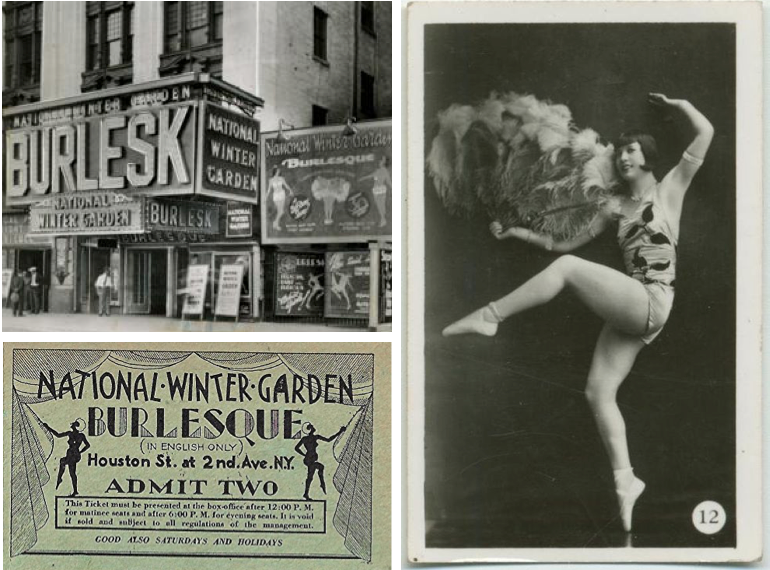
…returning to the ads, here’s one more from the back pages that references Harold Ross’s original prospectus for his magazine: “The New Yorker will be the magazine which is not edited for the old lady in Dubuque.” The ad is for Billy Minsky’s National Winter Garden, where the art of burlesque got its start. Despite the cheapness of the ad and the implied salaciousness, uptown New Yorkers loved “slumming” at Minsky’s burlesque, including artists and writers (Hart Crane even wrote a poem called “National Winter Garden”). No doubt a few New Yorker staffers found their way inside as well…
Clockwise from top left, Billy Minsky’s National Winter Garden; a 1920’s burlesque performer; a ticket for two to the show. (New York Post/Amazon/Pinterest)
…on to the illustrators and cartoonists, a nice street scene by Reginald Marsh…
…John Held Jr. contributed one of his famed “woodcuts” to the Oct. 12 issue. Held was an old childhood friend of New Yorker founding editor Harold Ross. It was Ross who encouraged Held to deviate from his popular flapper caricatures — he recalled how his friend had produced clever woodcuts in high school, and wanted something similar for his magazine…
A John Held Jr. illustration for Life magazine, 1927. (Library of Congress)
…Peter Arno went behind the scenes at a posh nightclub (a familiar setting for Arno)…
…Helen Hokinson found confusion at the elections…
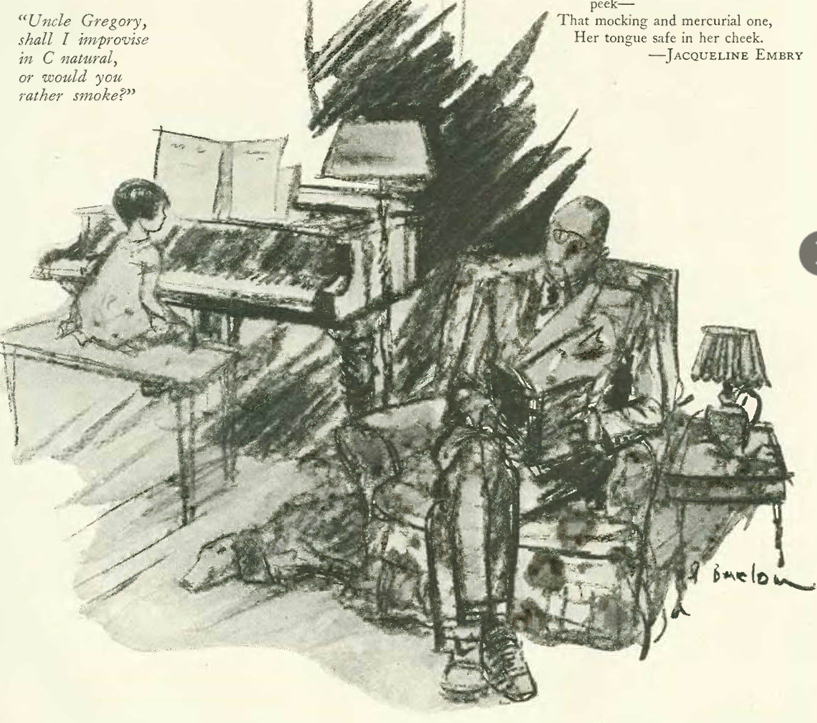
…Perry Barlow offered up this sweet slice of family life…
…and Denys Wortman illustrated the power of the pen…
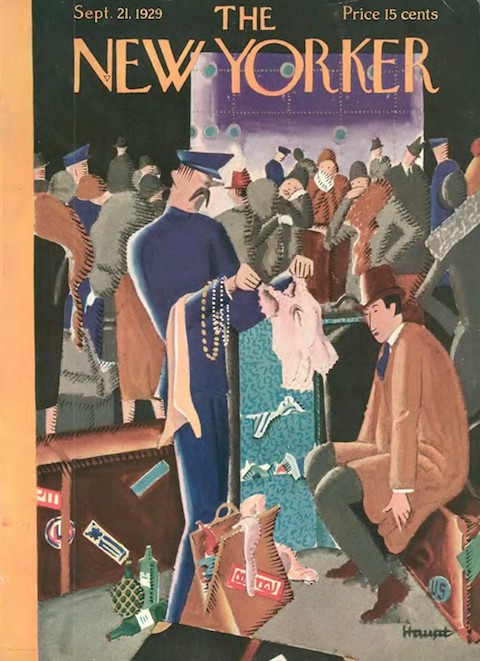
E.B. White gazed 50 years into the future in the Sept. 21, 1929 issue, predicting that New York City would be much the same if not a little worse by the time the calendar turned to 1979.
Sept. 21, 1929 cover by Theodore G. Haupt.
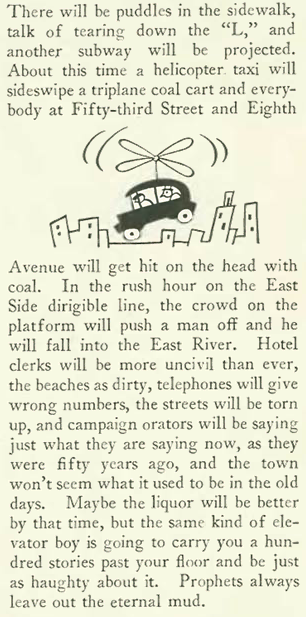
White dismissed the popular notion that the future would be one of push-button happiness and gleaming white cities. And as it turned out, he was mostly right on the mark with his predictions:
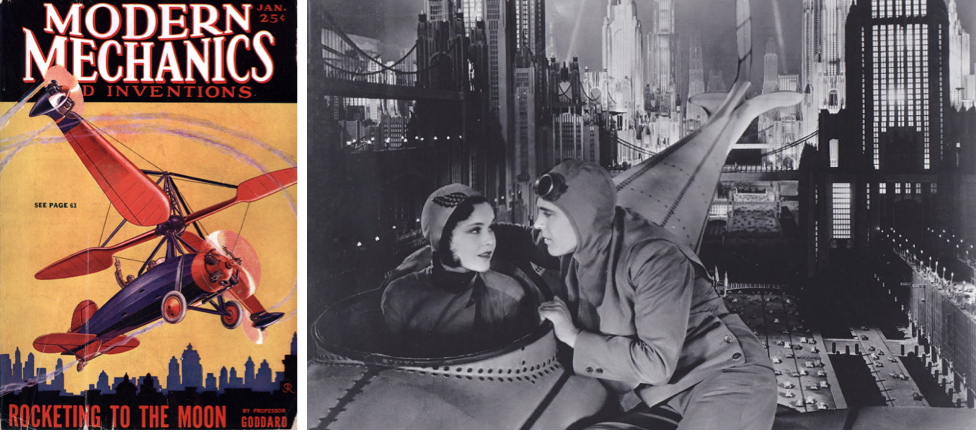
LOVE IS IN THE AIR…Autogyros (as illustrated on a 1930 cover of Modern Mechanics) were often seen as the future of transportation in the 1920s and 30s; Maureen O’Sullivan (as “LN-18”) and John Garrick (“J-21”) glide above 1980 Manhattan in 1930’s Just Imagine. (modernmechanix.com/pre-code.com)
Instead of the antiseptic fantasy world predicted in such movies as 1930’s Just Imagine (a futuristic musical set in 1980), White correctly foresaw a city that, despite technological advances, would still be a gritty rat race. And if you lived in New York City in 1979 (I was but a visitor then, as now), you would have found a city that indeed was quite dirty and crime-ridden (check out the 1979 movie The Warriors to get a sense of how Hollywood perceived the city at that time). As White observed, “Prophets always leave out the eternal mud”…
A LOT OF HOT AIR…In addition to autogyros, futurists in the 1920s and 30s also saw dirigibles as integral to future transportation. At top left is an illustration of a solar-powered aerial landing field atop a dirigible on the cover of Modern Mechanix magazine, October, 1934; top right, Manhattan in 1980 as depicted in the the 1930 film Just Imagine; bottom right, workers dismantling the Third Avenue Elevated line in 1955; bottom left, Times Square in 1979. (airships.net/IMDB/gothamist.com/viewoftheblue.com)
* * *
Cradle of Civilization
Dorothy Parker took aim at ugly Americans abroad in a casual titled “The Cradle of Civilization.” In these excerpts, Parker commented on the pretensions of young New Yorkers in France, including their ridiculous costumes…
…their bad French, and their even worse manners…
WELL, THEY GOT AWAY WITH IT…Actors Leslie Howard and Ingrid Bergman don the look of French fishermen during the filming of Intermezzo: A Love Story, in 1938. Howard and Bergman were supposed to look like a couple visiting the French Riviera, but in reality it was all filmed near Hollywood. The film was Bergman’s Hollywood debut. (Pinterest)
* * *
A Penny Saved
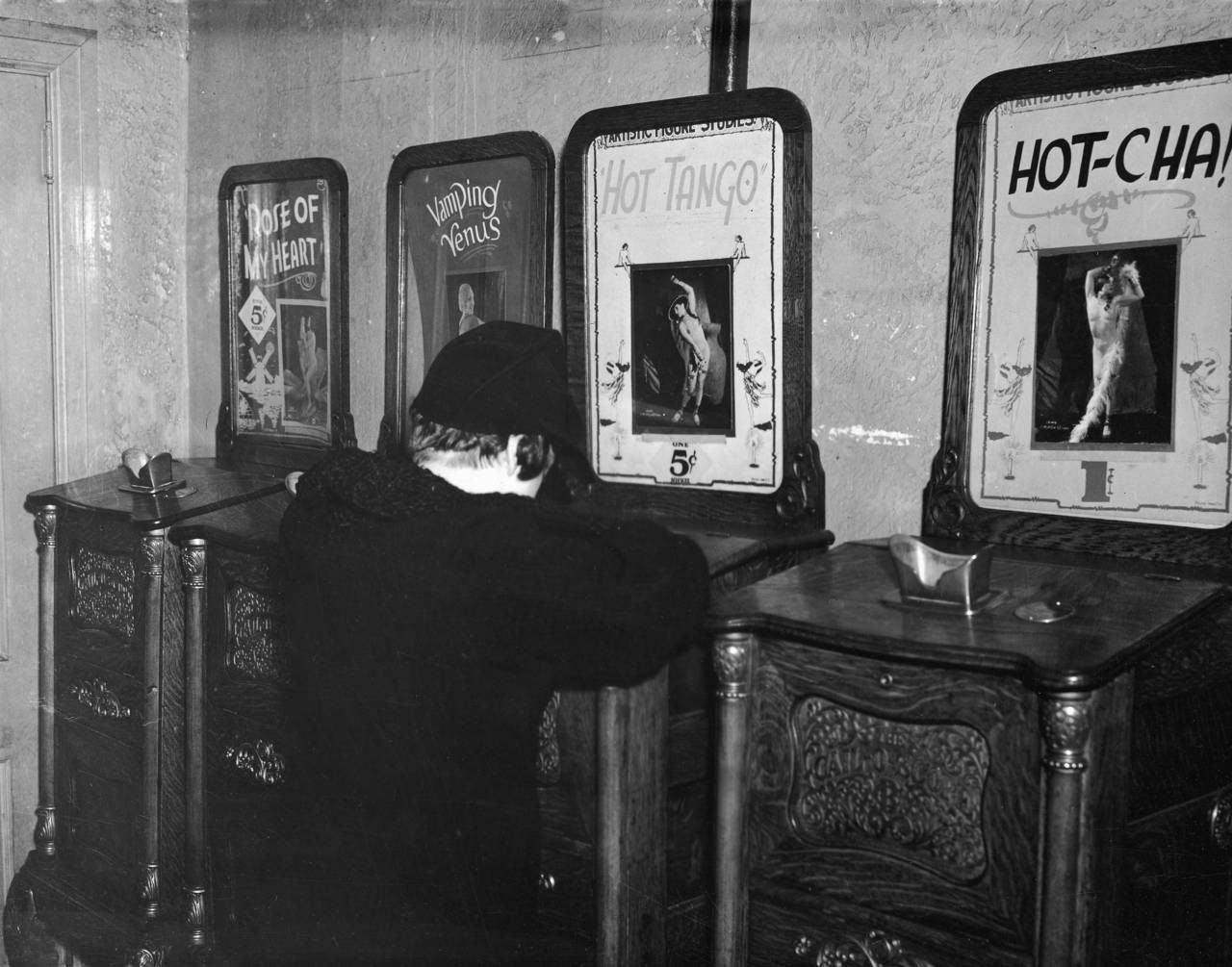
Back stateside, Wolcott Gibbs looked in on the dying art of the penny-arcade peepshow, and expressed his disappointment with the quality of that product in general…
DON’T JUDGE A PEEP BY ITS COVER…A patron checks out “Hot Tango” at a penny peepshow parlor of the 1920s. (Pinterest)
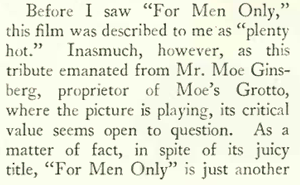
Gibbs seemed particularly miffed by a film with the misleading title “For Men Only”…
* * *
Uncle Jed
Jed Harris (1900-1979) was a wunderkind of Broadway, producing and directing 31 shows between 1925 and 1956. Before he turned 28 he produced a record four consecutive Broadway hits over the course of 18 months (including the 1928 smash hit The Front Page), and so it was time for some rest. “The Talk of the Town” reported…
Although it was rumored Harris would retire at age 30, he would instead return in the spring of 1930 with a production of Anton Chekhov’sUncle Vanya, and continue producing on Broadway through the 1950s.
WUNDERKIND…A 1928 portrait of Jed Harris that was featured on the Sept. 3, 1928 cover of Time magazine. (Wikipedia)
* * *
Dueling Cassandras
About a month before the big stock market crash we find this curious little item in Howard Brubaker’s “Of All Things” column…
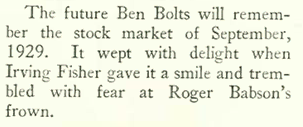
…Considered the first “celebrity economist,” Irving Fisher stated in September 1929 that the stock market had reached “a permanently high plateau,” while around the same time (Sept. 5, 1929) rival economist Roger Babson warned in a speech that “sooner or later a crash is coming, and it may be terrific.” Note: “Ben Bolts” refers to a character in a popular 1842 poem that became an oft-parodied popular song. Each stanza begins with a variation of “Oh don’t you remember…”
* * *
Parental Advisory
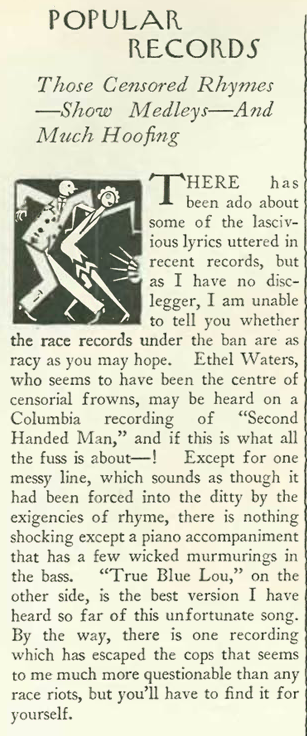
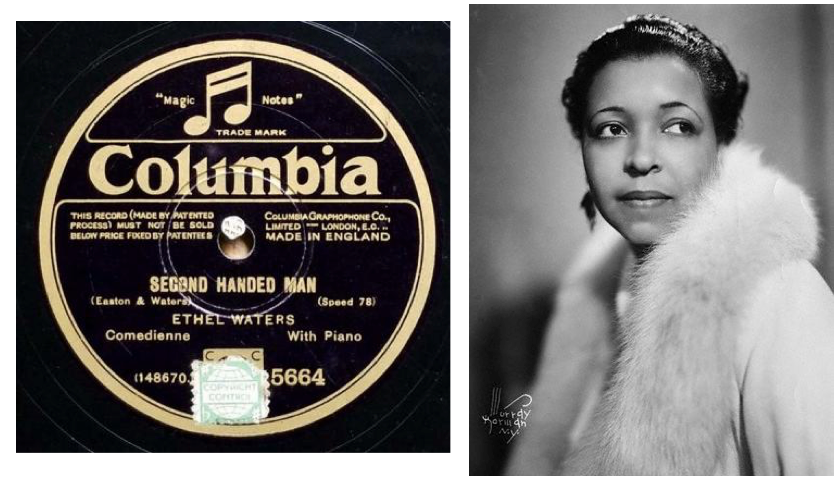
Fifty-five years before Tipper Gore and the Parents Music Resource Center pushed the music industry to place warning labels on records containing explicit lyrics, there was much ado about “lascivious lyrics” uttered on “race records” — the term referred to 78-rpm records marketed to African Americans from the 1920s and 1940s. The Sept. 21 “Popular Records” column looked at the controversy surrounding Ethel Waters’ “Second Handed Man,” and didn’t find any…
MUCH ADO…Ethel Waters (circa 1930) and her recording of “Second Handed Man.” (discogs.com/YouTube)
* * *
New Kids on the Block
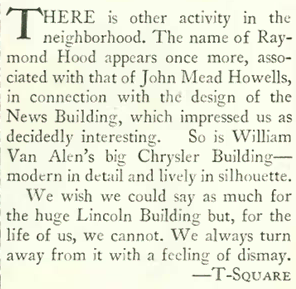
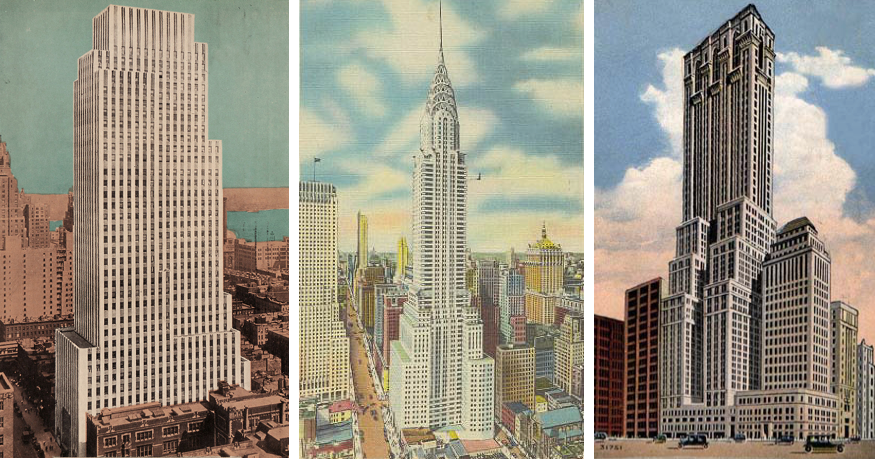
Architecture critic George S. Chappell (aka “T-Square”) concluded his Sept. 21 column with praise for the designs of the yet-to-be-built Daily News and Chrysler buildings, but expressed dismay at the recently completed Lincoln Building…
BAD COMPANY…New Yorker architecture critic George S. Chappell was excited about the designs for the Daily News Building (left) and Chrysler Building (center), but the Lincoln Building left him wanting. No doubt its gothic topper seemed dated in contrast to the sleek lines of the other buildings. (nyc-architecture.com)
* * *
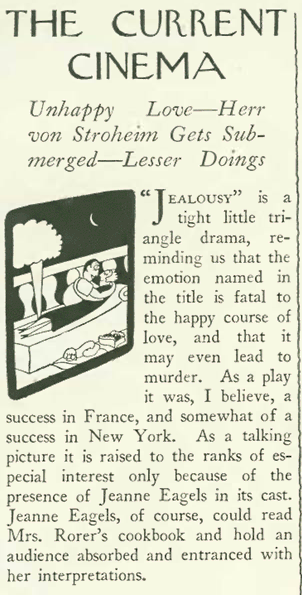
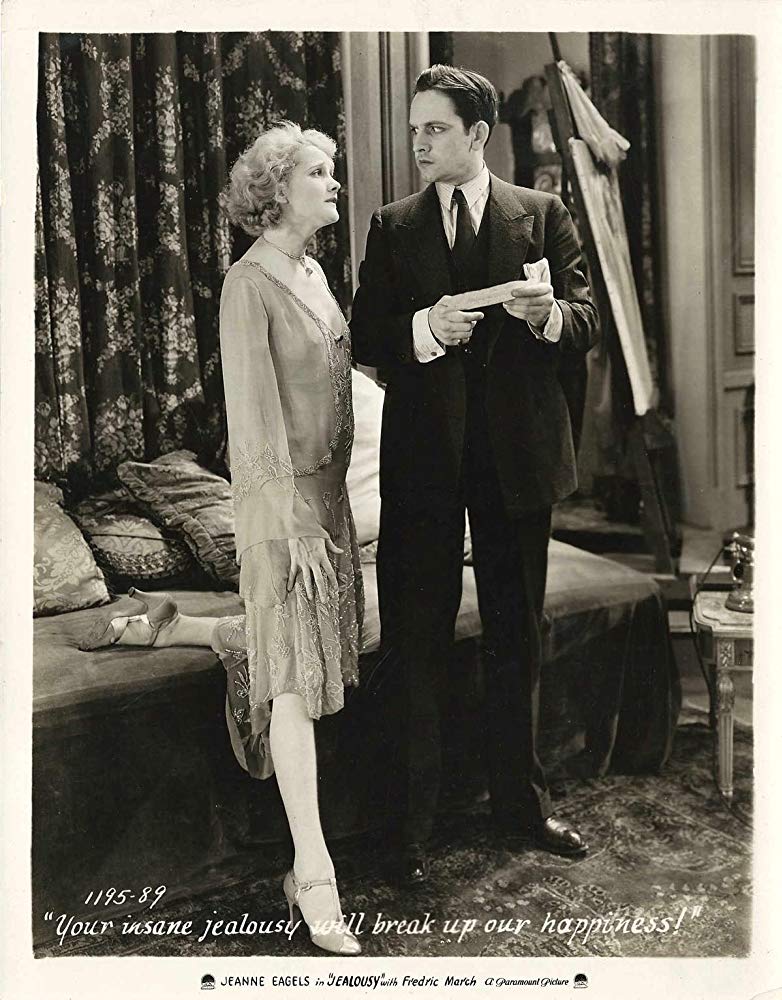
Movie critic John Mosher took in a couple of new films including Paramount’s 1929 pre-Code drama Jealousy…
FINAL CURTAIN…Jeanne Eagels and Fredric March in a publicity photo for Jealousy. Eagels died of a drug overdose on Oct. 3, 1929, just days after Mosher’s review appeared in The New Yorker. (IMDB)
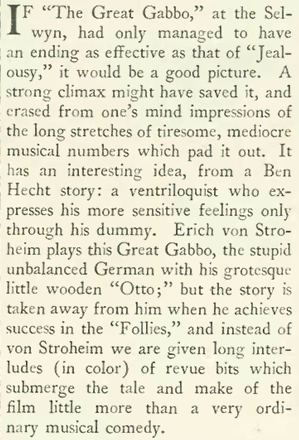
…and Mosher also reviewed the musical drama The Great Gabbo, which was derived from a story by occasional New Yorker contributor Ben Hecht…
WHO ARE YOU CALLING DUMMY?…Erich von Stroheim has issues with his co-star in The Great Gabbo. (MoMA)
* * *
From Our Advertisers
What appeared to be an unassuming ad from General Motors was actually a plan for world domination, at least in the area of ground transportation. GM gobbled up a number of car companies in the 1920s (see the ad’s fine print) as well as shares in power plants and home appliances. It would overtake Ford in sales in the late 1920s, and thanks to propaganda efforts including those illustrated in the ad below, it would lead a streetcar removal conspiracy that would destroy intercity train transport systems across the U.S. (and convert them to GM buses, naturally)…
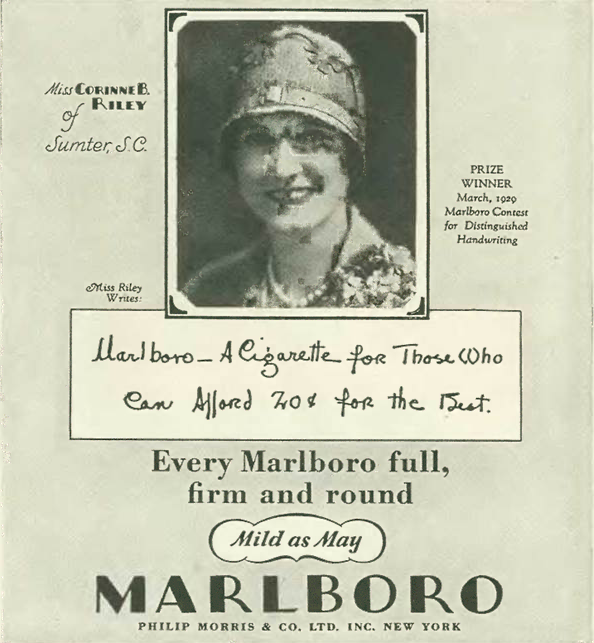
Here we have yet another “distinguished handwriting contest” ad from the makers of Marlboro, this time exploiting the efforts of Corinne B. Riley of Sumter, S.C….
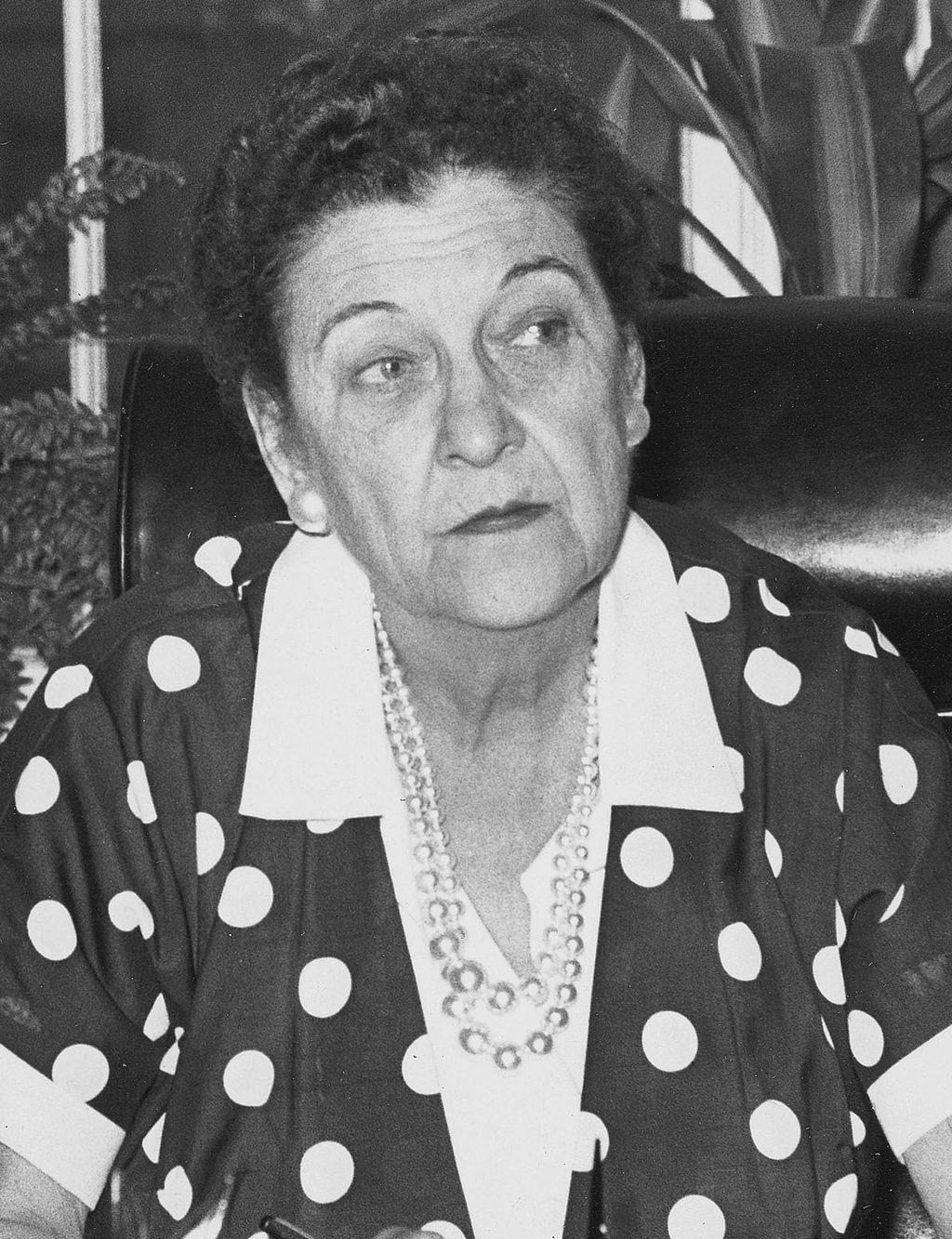
…Riley would win more than a handwriting contest, however. She would be elected as a Democrat to Congress in 1962 to fill a vacancy left by her husband, Congressman John Jacob Riley.
Corrine B. Riley in 1962. (Wikipedia)
On to our illustrators and cartoons, we begin with this two-page drawing by Reginald Marsh that appeared along the the bottom of “Talk of the Town”…
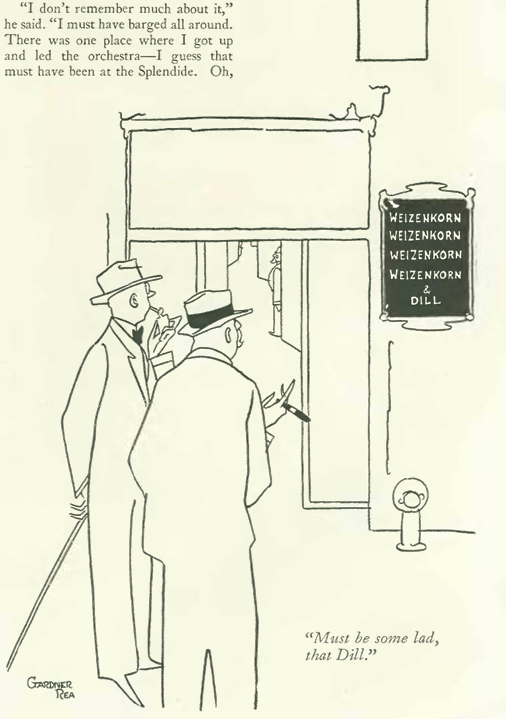
…Gardner Rea lent his spare style to this peek into Wall Street…
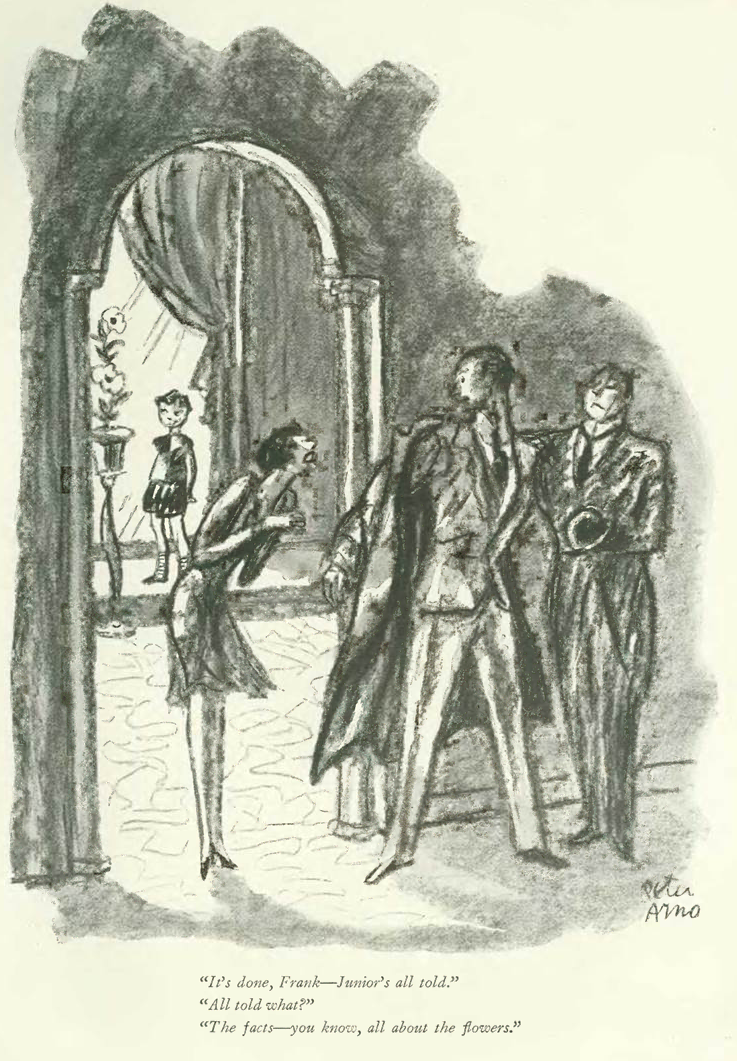
…Peter Arno appeared to be experimenting with yet another style of drawing…
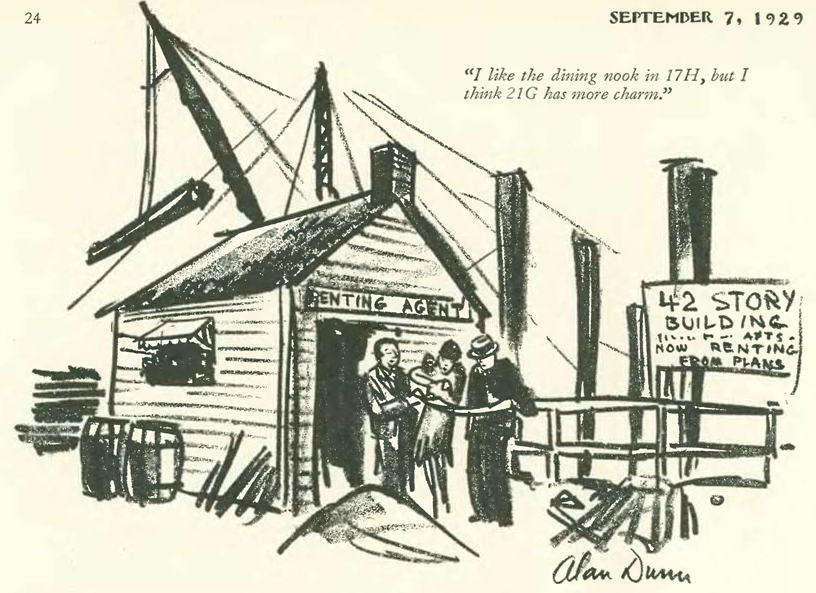
…that in some ways looked similar to Alan Dunn’s…
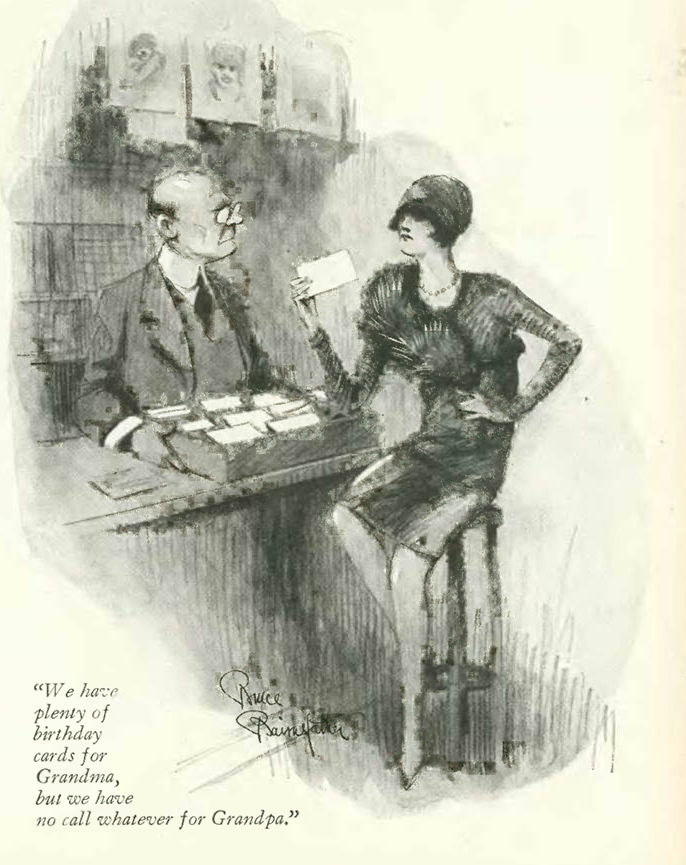
…the British cartoonist Bruce Bairnsfather provided this sumptuous drawing of an exchange at a card shop…
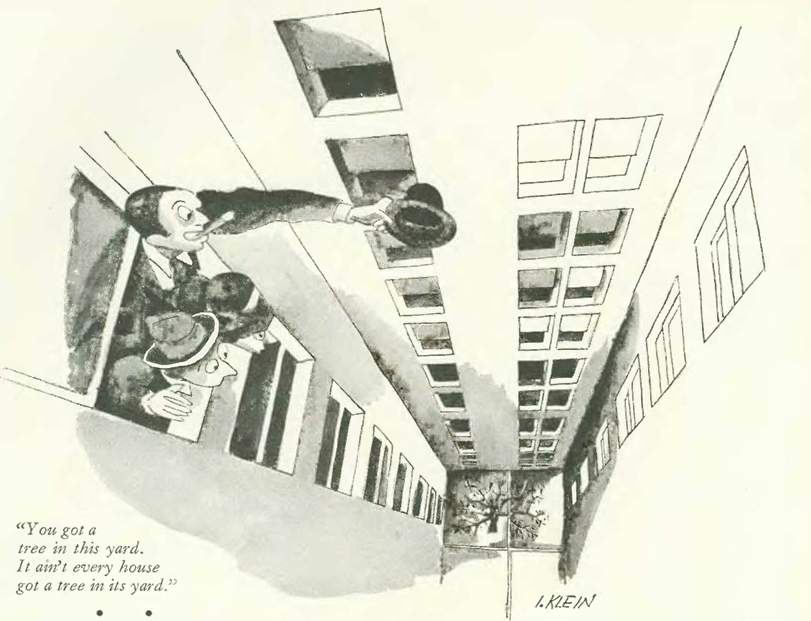
…and Isadore Klein gave a vertiginous perspective to home buying…
Avery Hopwood’s 1919 Broadway hit, The Gold Diggers, was among cultural events of the late teens that signaled the dawn of new age; namely, the Jazz Age.
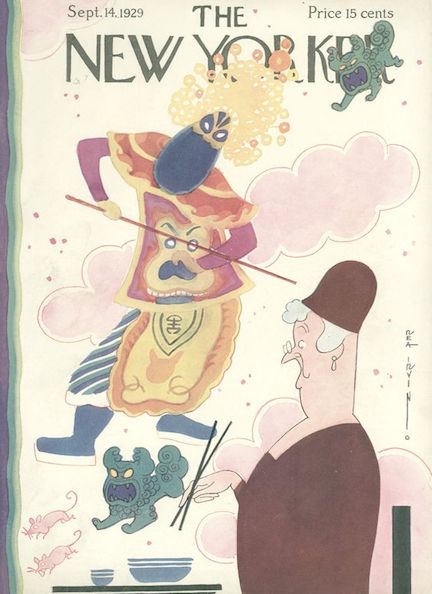
Sept. 7, 1929 cover by Sue Williams.
So it seems appropriate that the play, when adapted to the screen in 1929 as a Technicolor talkie, would also signal the end of that age. As the New Yorker’s film critic John Mosher observed in his review of The Gold Diggers of Broadway, the themes that seemed new and daring a decade earlier had been played out, the “general humors” of the picture having “become very familiar”…
The film featured Nancy Welford, Winnie Lightner and Ann Pennington as three chorus girls who try to entice a wealthy backer to invest money in their struggling Broadway show. The film was a big hit, and it made a star of Winnie Lightner (1899-1971), who played the boldest “Gold Digger” of the trio.
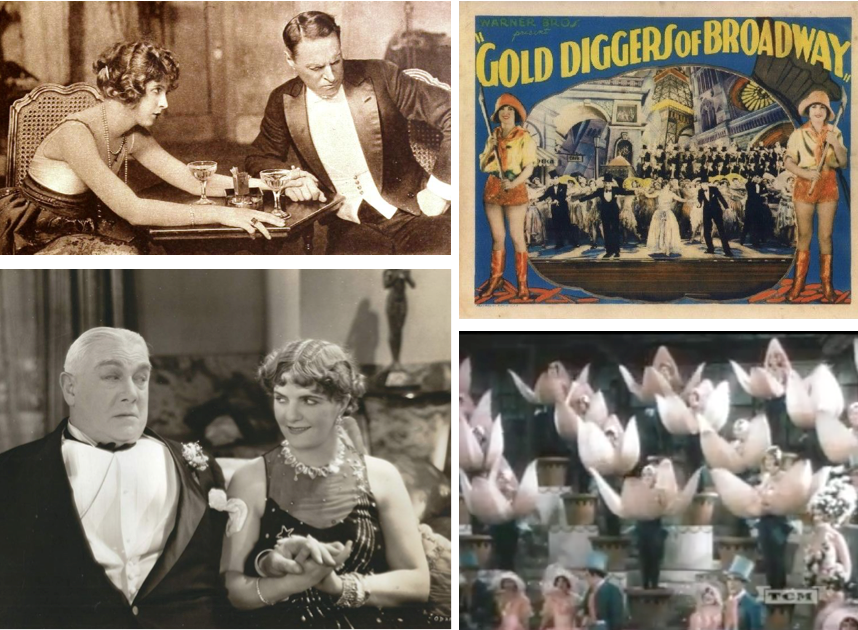
PROSPECTORS…Clockwise from top left, Ina Claire as the original “Gold Digger” with Bruce McRae in the 1919 Broadway play The Gold Diggers; lobby card for the 1929 film Gold Diggers of Broadway; image from the film’s “Tiptoe Thru the Tulips” song-and-dance number; Winnie Lightner works her charms on Albert Gran in a scene from the film. (Wikipedia/IMDB/TCM-YouTube)IT’S FUN MAKING PICTURES…Helen Foster, Ann Pennington, Nancy Welford and William Bakewell in a publicity photo from 1929’s Gold Diggers of Broadway. (IMDB)
Lightner wasn’t the only actor to steal the show. The film also proved a winner for crooner Nick Lucas (1897-1982), who performed two hit songs written for the movie — “Painting the Clouds with Sunshine” and “Tiptoe through the Tulips.” Yes, that second song was the very same tune Tiny Tim rode to fame nearly 40 years later.
TIPTOE THROUGH HISTORY…At left, Nick Lucas sings what would be become his signature song “Tiptoe through the Tulips” to Lilyan Tashman in the Gold Diggers of Broadway. At right, forty years later, Lucas sang the song on The Tonight Show With Johnny Carson (apparently using the same guitar) on the occasion of singer Tiny Tim’s televised wedding to Victoria Mae Budinger (“Miss Vicky”). Tiny Tim (inset) also made “Tiptoe through the Tulips” his signature song, although his was a campier version, sung in a falsetto, vibrato voice accompanied by his trademark ukulele. (YouTube)
The Gold Diggers of Broadway was a “pre-code” film, that is, a film made during a brief period of the early sound era (roughly 1929 through mid-1934) when censorship codes were not enforced and many films openly depicted themes ranging from promiscuity and prostitution to amoral acts of violence.
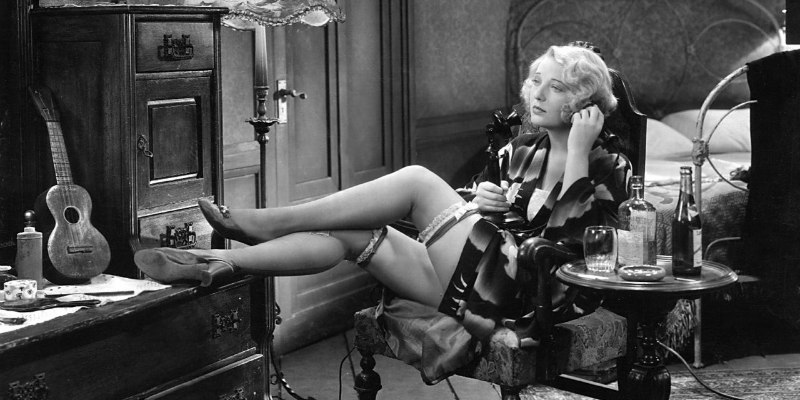
A LEG UP ON THE CENSORS…Warner Brothers publicity photo of Dorothy Mackaill, who played a secretary-turned-prostitute in 1931’s Safe in Hell. (Wikipedia)
Those unenforced codes had their origins in the early 1920s. In response to outcries from preachers and politicians alike over the immortality of Hollywood (both on- and off-screen), the president of Paramount Pictures, Adolph Zukor — fearing that cries for censorship would cut into his profits — called a February 1921 meeting of his studio rivals at Delmonico’s restaurant on 5th Avenue. At the meeting Zukor (1873-1976) distributed a set of 14 rules that would guide every Paramount production (Zukor’s studio at that time was actually known as Famous Players-Lasky). The rules covered everything from “improper sex attraction” to “unnecessary depictions of bloodshed.”
It was also Zukor’s idea to appoint the former U.S. Postmaster General, Will Hays, as President of the Motion Picture Producers and Distributors of America. It would be Hays’ job to enforce the code and generally “clean up” Hollywood. However, until mid-1934 both Hays and the code served mostly as publicity ploys to keep the preachers and politicians off the backs of studio execs.
Zukor was profiled by Niven Busch, Jr. in the Sept. 7 issue (with portrait by George Shellhase). In his opening paragraph, Busch commented on “Pop” Zukor’s efforts to stave off the censors:
* * *
Delmonico’s Redux
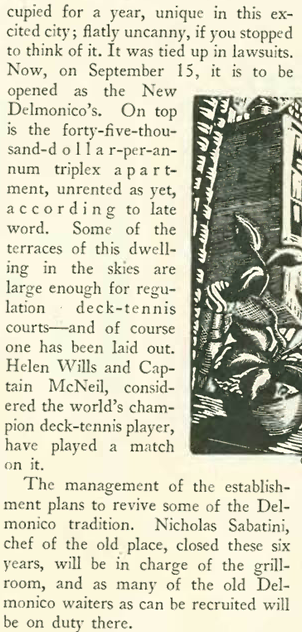
The famed Delmonico’s restaurant that provided the setting for Adolph Zukor’s “14 rules” meeting in 1921 closed its doors in 1923, a victim of Prohibition (more people dined at home, where they could still drink). Writing in the Sept. 7 “Talk of the Town,” Bernard A. Bergman described plans for the long-awaited opening of a new Delmonico’s in a skyscraper bearing the same name…
RICH DESSERTS…Dinner in honor of French Navy Admiral Paul Campion at the old Delmonico’s in 1906. (Wikipedia/Library of Congress)AND SALAD DAYS…Delmonico’s wait staff pose for a photograph in 1902. (Museum of the City of New York)
A former Delmonico’s chef, Nicholas Sabatini, hoped to bring back some of old waiters and cooks from the restaurant’s glory days, but it seemed most were far too long in the tooth. It is unclear if he ever got his dream off the ground, or if the grill room was able to crank out fare comparable to that of the old Delmonico’s. Probably not…
THE KITCHEN IS CLOSED…The 1928 Hotel Delmonico, as shown in a 1937 photograph. It was purchased by Donald Trump in 2002 and converted into luxury condominiums. It would not host a great restaurant, but the Beatles would stay there in 1964. (New York Public Library)
* * *
Relax. You’re in Omaha
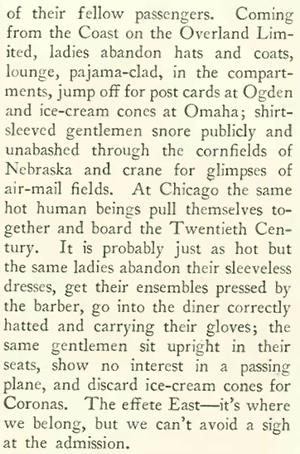
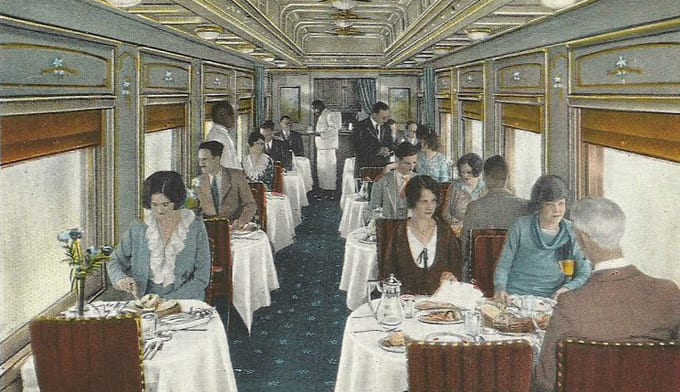
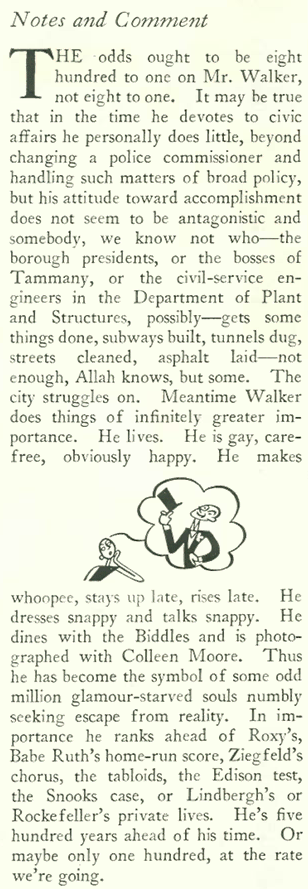
E.B. White’s “Notes and Comment” entry in the Sept. 7 “Talk of the Town” described travel on the Union Pacific’s Overland Limited, and the “mystic dividing line” that separated laid-back Westerners from buttoned-up Easterners:
MIND YOUR MANNERS, AT LEAST UNTIL YOU LEAVE CHICAGO…Tinted photo postcard depicting the dining car on a Union Pacific train that traveled the Chicago to Denver route in the 1920s. (myutahparks.com)
* * *
Write What You Know
The Wisconsin-born Marion Clinch Calkins (1895 – 1968) often wrote humorous rhymes for The New Yorker under the pen name Majollica Wattles. While many writers reveled in the party atmosphere of the Roaring Twenties, Calkins worked as a vocational counselor and social worker at Lillian Wald’s Henry Street Settlement. This experience doubtless led her to more serious writing after the 1929 market crash — her critically acclaimed book, Some Folks Won’t Work (1930), is considered a seminal document on the Great Depression.
But in September 1929, Calkins was still in a humorous vein, and published this satirical piece on the role of an ideal housewife in the Sept. 7 issue. Excerpts:
CALL ME CLINCH…Marion Clinch Calkins circa 1905 and 1945. She wrote under the name of Clinch Calkins because she wanted her authorship to be gender-neutral. (evansvillehistory.net/NEH)
* * *
Information Please
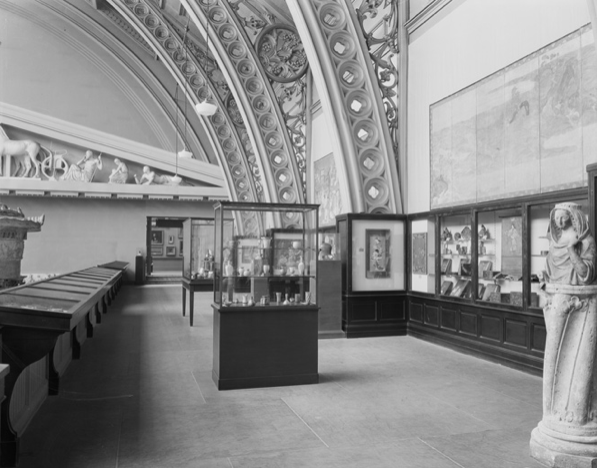
The New Yorker’s art critic Murdock Pemberton did not suffer fools gladly, and whenever the local museums seemed less than up to snuff, he was there to provide some correctional advice…
NEED AN AUDIO GUIDE? STILL WORKING ON THAT…The Metropolitan Museum of Art’s H.O. Havemeyer Collection, 1930. (The Metropolitan Museum of Art)
* * *
From Our Advertisers
Despite the advances made by women in the 1920s, they still lived under a patriarchy, especially when it came to the patrician classes. And so the young bride of Gifford Pinchot II was identified only as a “Mrs.” in the headline for this Pond’s cold cream ad…
…Mrs. Gifford Pinchot II was actually Janine Voisin (1910-2010). She must have had more than a healthy complexion, as she lived 100 years…
Janine Voisin Pinchot in 1933. (history.blogberth.com)
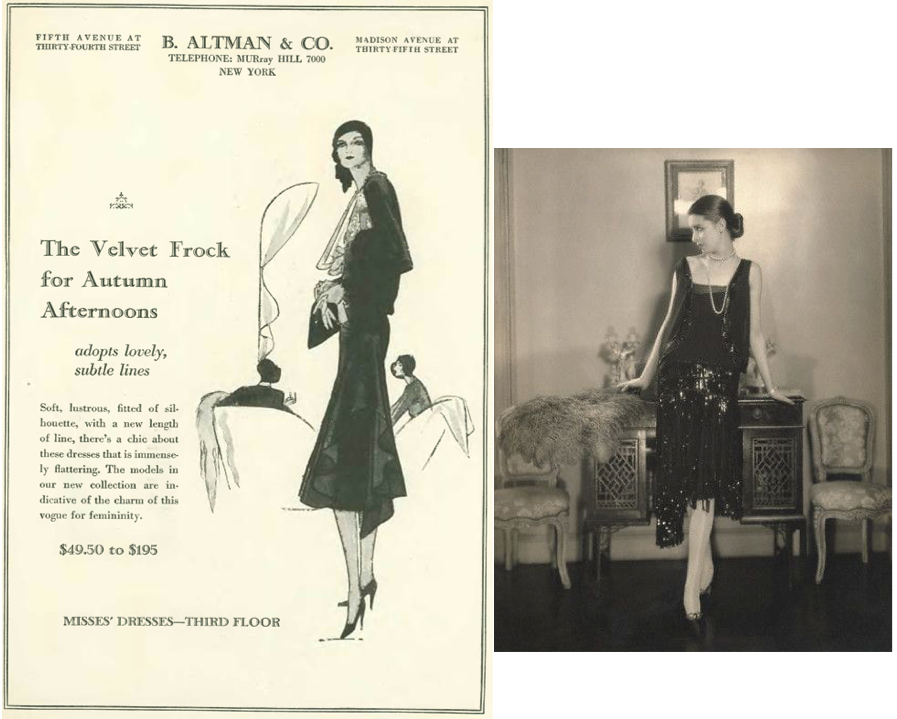
Another woman known for her beauty in the 1920s was the model Marion Morehouse (who was married to poet E.E. Cummings from 1934 until his death in 1962). Considered by some to be the first “supermodel,” I include an image of Morehouse below (right) to demonstrate how artists exaggerated the female form in fashion ads of the day…
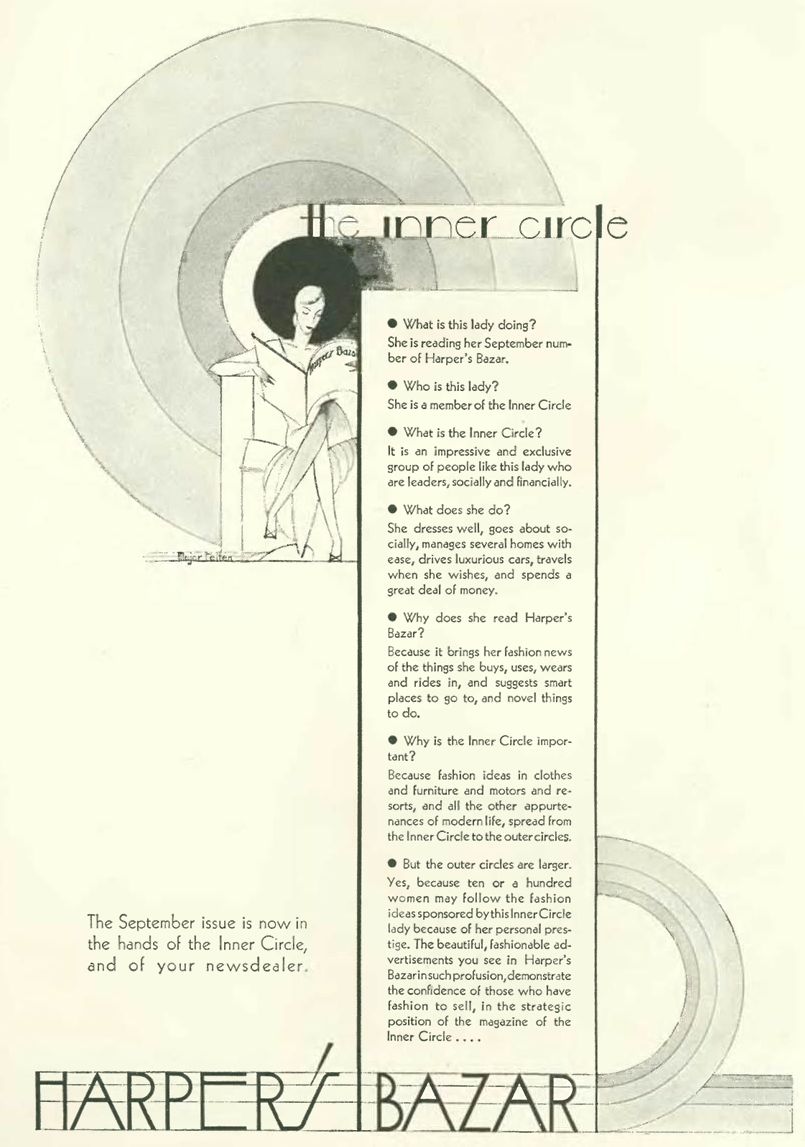
…the body wasn’t the only thing subject to exaggeration, or hyperbole, as this ad from Harper’s Bazar attested in defining the exclusivity of its readership…
…the New York Sun also appealed to social mores in an attempt to sell more newspapers…
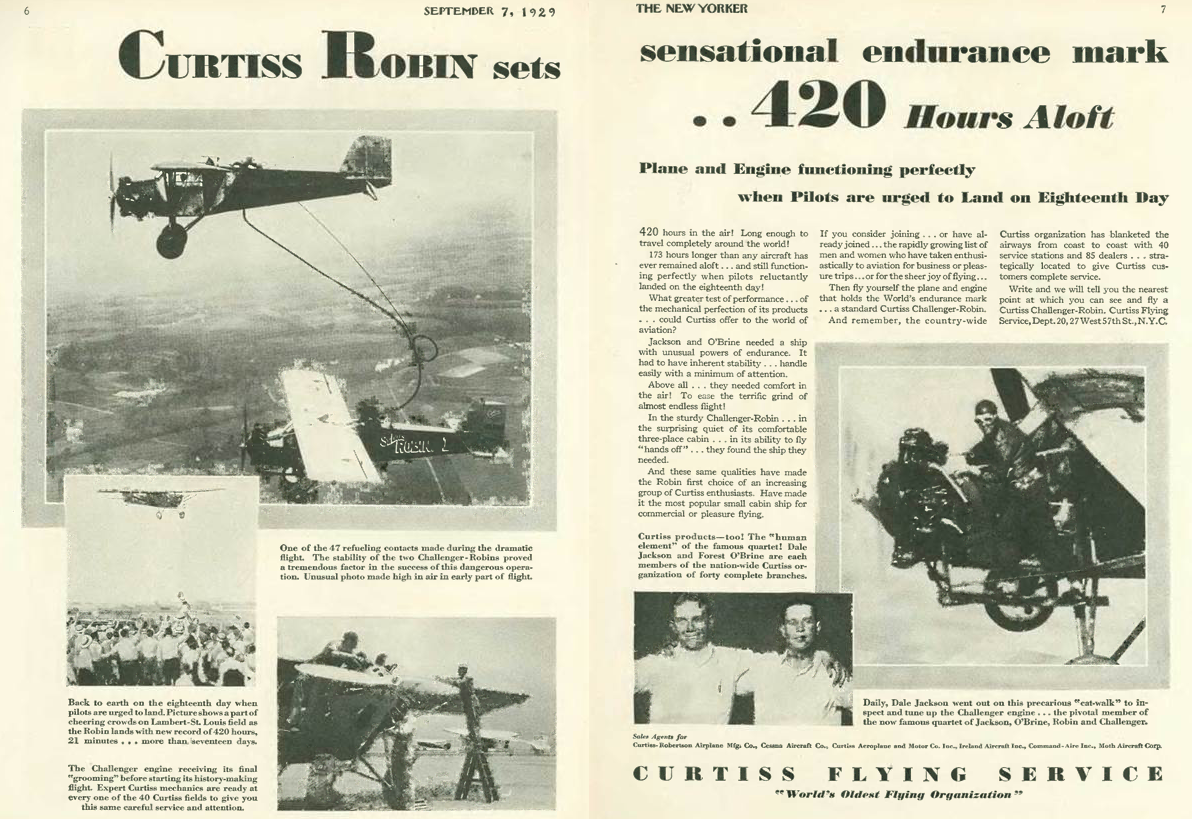
…the Curtiss Robin Flying Service touted their latest achievement — the St. Louis Robin being refueled during its flight to a new world’s endurance record of 420 hours — greatly surpassing the record of 150 hours set by the Army’s “Question Mark” airplane at the beginning of 1929…
…our cartoonists from the Sept. 7 issue include Gluyas Williams, who had some fun at the expense of Alice Foote MacDougall, who was the “Starbucks” of her day, at least in New York…
…MacDougall turned her coffee business into a restaurant empire in the 1920s. She opened several restaurants in Manhattan, all decorated in a signature style meant to evoke European cafés…
EURO AMBIENCE…Interior of Alice Foote MacDougall’sFirenze, 6 West 46th Street, New York City, 1925. (New York Historical Society)
…other cartoons included this commentary on public advertising by Leonard Dove…
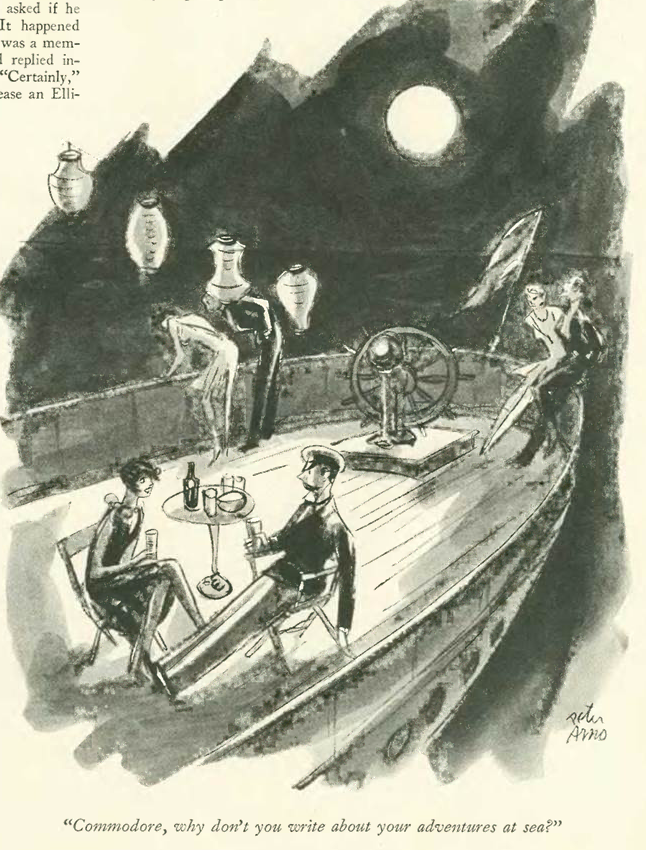
…Peter Arno’s unique take on the seafaring life…
…Helen Hokinson eavesdropped on some tween talk…
…and Alan Dunn gave us some perspective on the fast pace of city life…
Winding down the last summer of the 1920s — an unusually hot one — one detects subtle changes in The New Yorker’s mood; weary from the decade-long party known as the Roaring Twenties, a bit more mature, and more confident in its voice thanks to the regular writings of James Thurber, E.B. White and Lois Long and copious cartoons and illustrations by such notables as Peter Arno, Barbara Shermund and Helen Hokinson that gave the magazine a distinctively modern feel as it headed into the 1930s.
Aug. 10, 1929 cover by Theodore Haupt; Aug. 17 cover by Peter Arno.
The exuberance associated with the rapidly changing skyline was still there, however, as the Aug. 17 “Talk of the Town” speculated on the race for the world’s tallest building. The article not only anticipated an architect’s sleight of hand, but also a Zeppelin docking station that in the end would top the world’s tallest building:
As it turned out, William Van Alen did not have to compete against himself, the commission for One Wall Street instead going to Ralph Walker, who would design a beautiful art deco landmark that, at 50 stories, would not vie for the title of the world’s tallest building. Unbeknownst to The New Yorker, and perhaps Van Alen, the challenger would instead be 40 Wall Street, which would hold the crown as world’s tallest for about a month. Thanks to some sleight of hand (see caption below) the Chrysler building would quickly surpass 40 Wall Street and hold the title for just eleven months, bested in the end by the Empire State Building (which would sport a “Zeppelin superstructure”).
DECO DELIGHTS…40 Wall Street (left) vied with the Chrysler Building for the title of the world’s tallest building. The 927-foot 40 Wall Street would claim the title in late April 1930. One month later, the Chrysler building would sprout a needle-like spire (secretly constructed inside the building) bringing its total height to 1,046 feet. The builders of 40 Wall Street cried foul and claimed that their building contained the world’s highest usable floor, whereas the Chrysler’s spire was strictly ornamental and inaccessible. Less than a year later the point was made moot when the Empire State Building soared above them both. (Wikipedia/The Skyscraper Museum)ERECTILE DYSFUNCTION…Clockwise, from top left, progression of designs for the Chrysler Building; the building’s architect, William Van Alen; drawing from Popular Science Monthly (Aug. 1930) revealed the inner workings of the spire’s clandestine construction; Zeppelin docking station for the Empire State Building as imagined in a composite (faked) photograph. At 1,250 feet, the wind-whipped mooring mast proved not only impractical, but downright dangerous. In September 1931 a dirigible briefly lashed itself to the mast in 40 mph winds, and two weeks later the Goodyear Blimp Columbia managed to deliver a stack of Evening Journals to a man stationed on the tower. Contrary to the faked photograph, no passengers ever transferred from the tower to a Zeppelin. (Skyscraper City/Wikipedia/NY Times)
* * *
What, Me Worry?
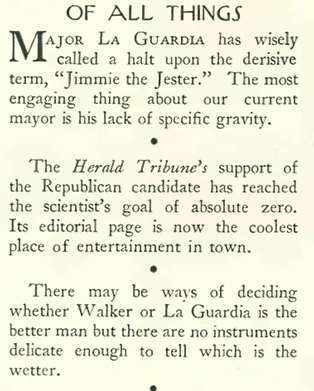
The famously flamboyant New York City Mayor Jimmy Walker lived the easy life during his initial years as Hizzonner, riding a booming economy, partying with the rich and famous (while flaunting Prohibition laws), carousing with his mistress (Ziegfield dancer Betty Compton) and sleeping until noon. When reform-minded Fiorello La Guardia challenged Walker’s reelection bid in 1929, Walker left the dirty work to his Tammany Hall cronies and continued to charm the public, and The New Yorker. The Aug. 17 “Talk of the Town” observed:
IT’S EASY BEING ME…Mayor Jimmy Walker accompanied actress Colleen Moore to the October 1928 premiere of her latest film, Lilac Time. (konreioldnewyork.blogspot.com)I HAVE MY EYE ON YOU…Reform-minded Fiorello La Guardia (right) detested Jimmy Walker and his Tammany cronies, but that wasn’t enough to get him elected in 1929. The Great Depression would soon turn the tables. (Wikipedia)
Howard Brubaker, in his Aug. 17 “Of All Things” column, suggested that La Guardia had a zero chance of getting elected. Just three years later, Walker would resign amid scandal and flee to Europe. La Guardia, on the other hand, would be elected to the first of his three terms as mayor in 1933, riding the wave of the New Deal.
* * *
Peek-A-Boo
Politics might have been business as usual, but in the world of fashion the vampish hat styles associated with flappers were giving way to a new rolled-brim look that seemed to suggest an aviator’s helmet. In her Aug. 17 fashion column “On and Off the Avenue,” Lois Long reported:
FACING THE FUTURE…Vampish hats of 1928, pictured at top, gave way to the rolled-brim or flare look of 1929. (Images gleaned from magazine/catalog images posted on Pinterest)
Long seemed to welcome the idea that women should once again bare their foreheads…
* * *
Twain Wreck
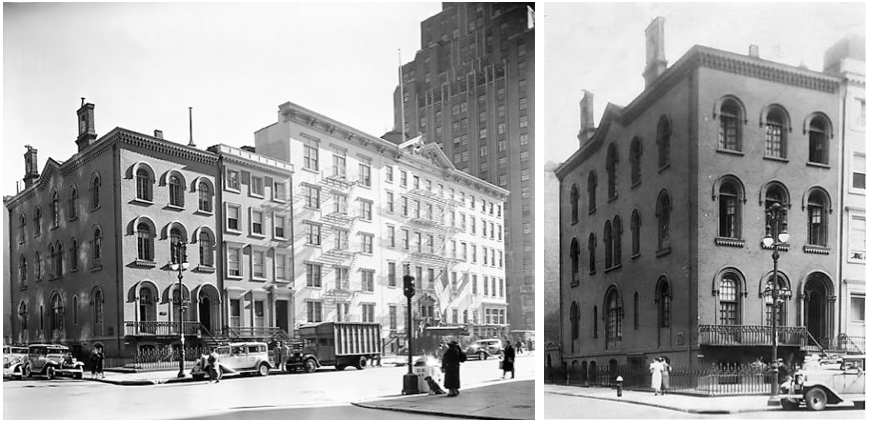
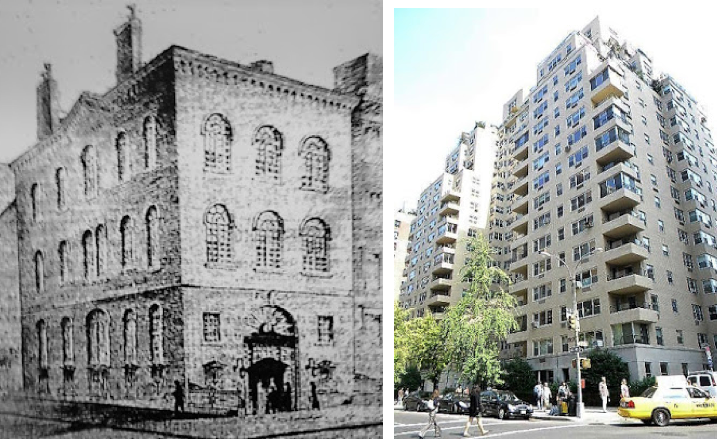
Jumping back to the Aug. 10 issue, “The Talk of the Town” reported on the possible remodeling or demolition of a house once occupied by Samuel Clemens, aka Mark Twain. The house in question was a lavish old mansion built by Henry Brevoort, Jr. in 1834, at the northwest corner of Fifth Avenue and 9th Street. Twain lived in the house from 1905 to 1908, and it was there that Twain’s biographer Albert Paine conducted interviews with the author and wrote the four-volume Mark Twain, a Biography; The Personal and Literary Life of Samuel Langhorne Clemens. When millionaires abandoned their Fifth Avenue mansions in the 1920s and high-rise apartments took their place, there was pressure to either convert an old mansion like the Breevoort house at 21 Fifth Avenue to apartments or demolish it altogether.
LOOKING GOOD AFTER A CENTURY…At left, Berenice Abbott took this photograph of No. 21 Fifth Avenue in 1935. At right, in a close-up shot from the same period, the 1924 plaque from the Greenwich Village Historical Society is visible on the side of the house. (Museum of the City of New York/Greenwich Village Historical Society)A NOW FOR SOMETHING COMPLETELY DIFFERENT…A proposed 1929 remodeling (left) moved the front door of the old Brevoort mansion to the center and lowered it to street level. At right, today the 1955 Brevoort apartment house occupies the site. (daytoninmanhattan.blogspot.com)
The Greenwich Village Historical Society did what it could to save the house, and in 1924 affixed a bronze plaque to a side wall noting that both Twain and Washington Irving were once occupants. When the house was slated for demolition in 1954, the Society appealed to New Yorkers to raise the $70,000 needed to move the building, but only a fraction of that amount was secured. No. 21 was demolished in 1954 along with the rest of the houses on that block.
* * *
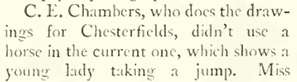
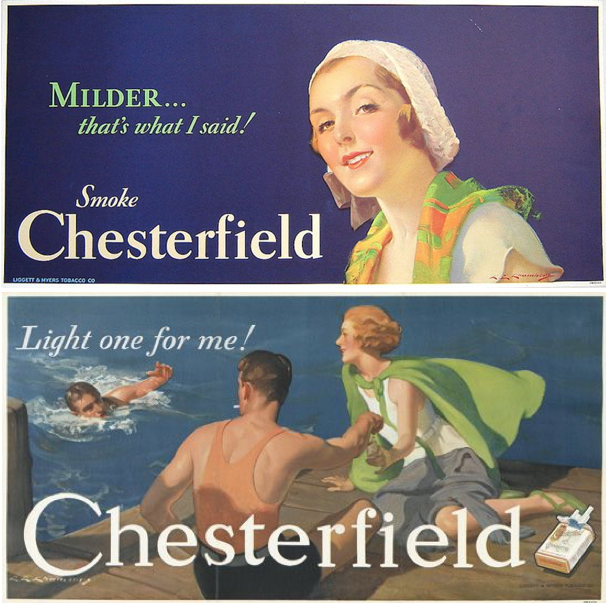
Charles Edward Chambers was an American illustrator probably best known for his Chesterfield ads, although he also illustrated stories for a number of popular magazines from the early 1900s until his death in 1941. The Aug. 10 “Talk of the Town” looked in on his work with model Virginia Maurice:
QUICK…THROW THAT MAN A CIGARETTE!…Examples of Charles Edward Chambers’ Chesterfield ads from 1929 featuring model Virginia Maurice. Note that Maurice is wearing the latest “rolled brim” hat style in the upper image. (Pinterest)HIS NONSMOKING SECTION…A 1919 Harper’s cover illustration by Charles Edward Chambers. (Wikipedia)
* * *
Mama’s Boy
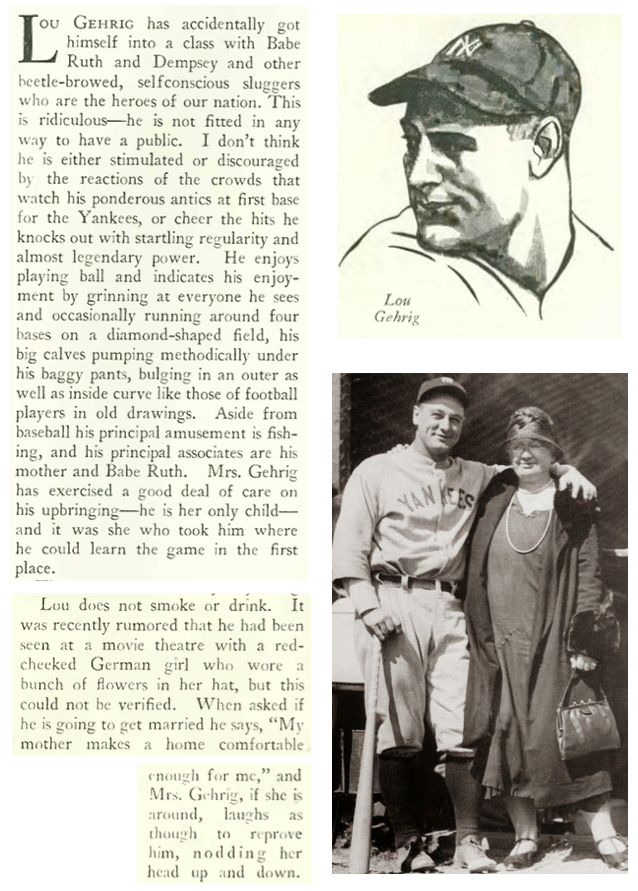
Lou Gehrig rivaled Babe Ruth as a top Murderer’s Row slugger for the 1929 Yankees, yet he couldn’t be more opposite in his lifestyle. A teetotaler and nonsmoker, Gehrig was completely devoted to mom (pictured below in 1927). Niven Busch Jr. submitted this profile of Gehrig for the Aug. 10 issue. Excerpts:
* * *
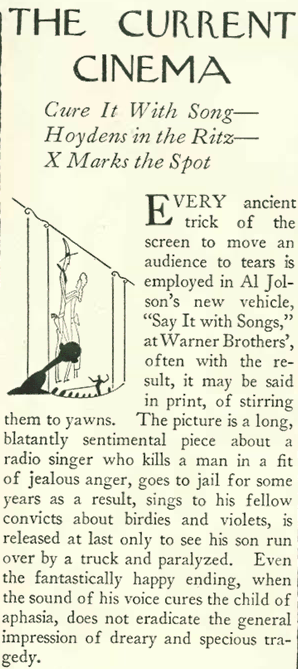
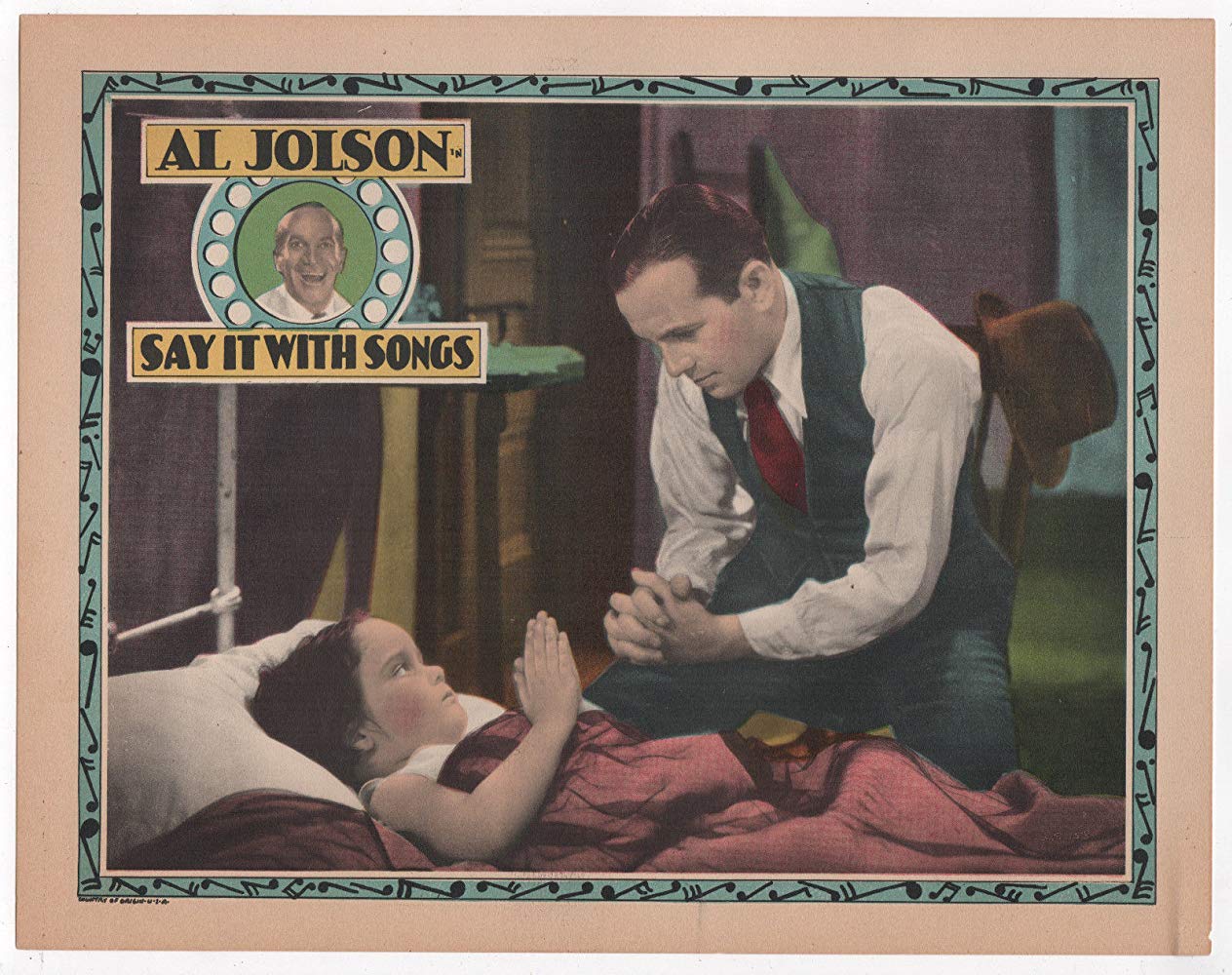
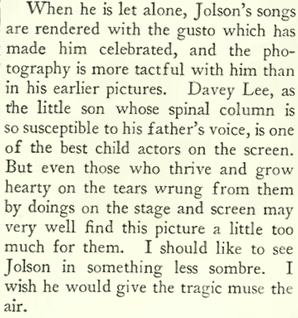
After appearing as Al Jolson’s dying son in The Singing Fool (1928), the child actor Davey Lee returned to the screen for yet another Jolson weeper, 1929’s Say It With Songs. Once again portraying Jolson’s son—this time crippled and rendered dumb after being hit by a truck—he miraculously recovers at the end of the film. The New Yorker wasn’t having any of this sentimental treacle, especially served up for a second time…
LET’S PRAY FOR A BIG BOX OFFICE…Davey Lee and Al Jolson in Say It With Songs. (IMDB)
…and the magazine hoped for something a bit less somber from Jolson in the future, suggesting that he “give the tragic muse the air”…
In the same issue of The New Yorker, this advertisement touted Jolson’s recording of “Little Pal” from Say It With Songs (note the blackface image of Jolson—his unfortunate trademark back in the day)…
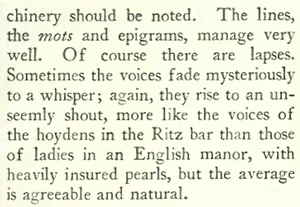
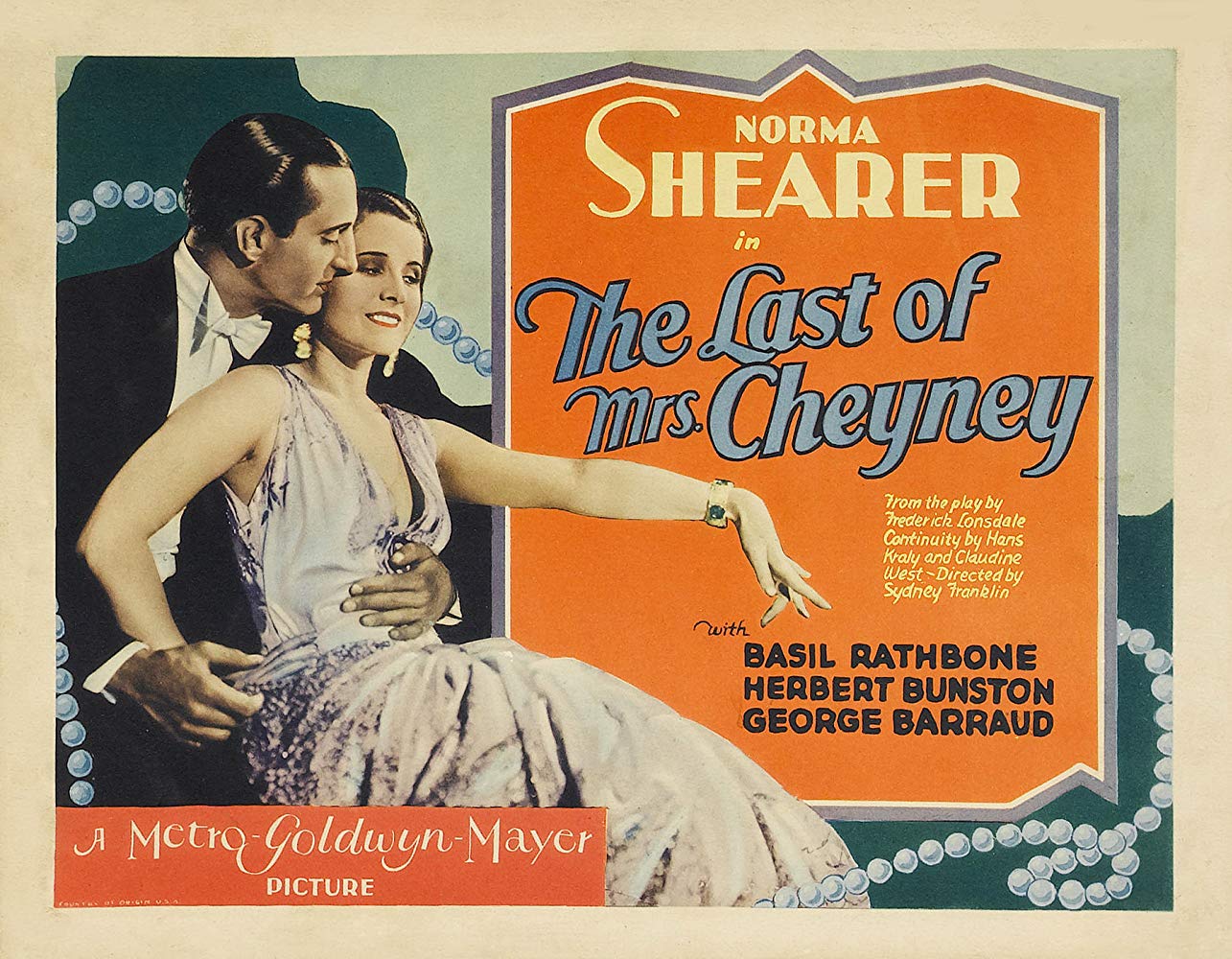
…happily, there were other movies that offered less schmaltzy diversions, including Norma Shearer’s comedy-drama The Last of Mrs. Cheyney, in which Shearer portrayed the jewel thief Fay Cheyney…
OH BASIL YOU ANIMAL…Theatre card for The Last of Mrs. Cheyney. (IMDB)
…often cast as a heavy in silent films, it was the “talkies” that made William Powell a star, his pleasant voice more suited to a hero or leading man than a villain. In The Greene Murder Case, Powell portrayed amateur detective Philo Vance, a role that he played in another 1929 release, The Canary Murder Case (originally filmed as a silent in 1928), both based on mystery novels by S.S. Van Dine. Powell would portray Philo Vance in three more films from 1930 to 1933 until he took on the role of another amateur detective, Nick Charles, in 1934’s The Thin Man (a role he would reprise five times from 1936 to 1947)…
WHODUNNIT? YOUDUNNIT!…William Powell as detective Philo Vance, Florence Eldridge as Sibella Greene, and Jean Arthur as Ada Greene in 1929’s The Greene Murder Case. (IMDB)KEEPING IT QUIET…William Powell as Philo Vance and Louise Brooks as “the Canary,” a scheming nightclub singer, in The Canary Murder Case. Brooks was a huge star in the silent era and the iconic flapper. According to IMDB, the film was shot as a silent in 1928, but producers decided to rework it as a more profitable “talkie.” When Brooks refused to return from Germany (where she was filming Pandora’s Box) to dub the movie, Paramount spread the word that Brooks’ voice was not suited to sound film, although later productions made by Brooks proved this to be wrong. Actress Margaret Livingston ultimately supplied Brooks’ voice for Canary. (IMDB)
* * *
From Our Advertisers
We look at some advertisements from the August 17 issue, including this one from Past Blue Ribbon. Note that nowhere in the ad is the word “beer” used, this being a “near-beer” with less than 1% alcohol content by volume. In addition to making cheese (a Velveeta-like product), Pabst hoped to keep its company alive by selling this “brew” during the unusually hot summer of 1929…
…and with that blazing sun advertisers also promoted a number of face creams and powders to those “enjoying the sunny outdoor life,” including this two-page spread from Richard Hudnut and Poudre Le Début…
…the outdoor life could also be enjoyed in a convertible Packard 640, a car that was a cut above a Lincoln or Cadillac, and was considered by some to be America’s answer to the Rolls Royce…
A 1929 Packard 640 Convertible. This particular model can be had today for about $130,000. (Hemmings Motor News)
…I found this ad in the back pages interesting for its crude design yet overt appeal to snobbishness with this haughty pair…
…and here is what the Park Lane looked like when it opened in 1924…
Circa 1924 advertisement from the Sargent lock and hardware company touting its fixtures in the new Park Lane hotel apartments. At right, circa 1924 image from The American Architect depicting the Park Lane’s dining room. The building is long gone, razed some time in the 1960s to make way for an office tower. (Pinterest)
* * *
This week’s featured illustration is by Constantin Alajalov, who depicted a summer scene from the Southampton Beach Club…click to enlarge…
…our cartoonists from the Aug. 10 issue include Helen Hokinson, who looked at the challenges of Americans abroad…
…Isadore Klein observed the changing mores of movie houses (a couple of “damns” were apparently uttered in the talking pictures of 1929)…
…and Leonard Dove offered up a double entendre of sorts…
…cartoons for the Aug. 17 issue included a peek behind the scenes at a motivational speaker courtesy Peter Arno…
…Carl Kindl had some fun with the juxtaposition of a matron and a flapper hat…
…and for reference, the cloche hat called a “Scalawag” was featured in this ad by Knox in the March 30, 1929 New Yorker…drawing by Carl “Eric” Erickson…
…Garrett Price portrayed the antics of an ungrateful trust fund brat, who probably did not have that million dollars after the market crash…
…and this fellow, depicted by Mary Petty, who doubtless would be less nonchalant come Oct. 28, or what we know as “Black Monday”…
Although artist Georgia O’Keeffe has long been celebrated for her desert imagery and interpretations of natural forms, during the 1920s her heart was very much in New York City.
July 6, 1929 cover by Theodore Haupt.
And New York City was where it all began for O’Keeffe (1887-1986). In January 1916, the famed photographer Alfred Stieglitz (1864-1946) was shown a portfolio of charcoal drawings by O’Keeffe’s friend, Anita Pollitzer. Stieglitz was so impressed that he immediately made plans to exhibit the drawings—without O’Keeffe’s permission. The longtime art critic for TheNew Yorker, Robert Coates, told the story in the opening lines of his July 6 profile piece on the artist:
O’Keeffe moved from Texas to New York in 1918, and she and Stieglitz would marry in 1924, a marriage that would last until his death in 1946 (despite the fact he took a longtime lover, 22-year-old Dorothy Norman, in 1927).
TWO OF A KIND…Alfred Stieglitz, left, photographed by Paul Strand at Lake George, New York, in 1929. Exhausted and depressed, Stieglitz had retreated to the lake for the summer after learning that his exhibition space in the Anderson Galleries, which he called “The Room,” would be demolished along with the gallery building. ∞ Center, a photo Stieglitz had attached to a July 10, 1929 letter to O’Keeffe, who had begun spending summers painting in New Mexico. Below the photograph he wrote, “I have destroyed 300 prints to-day. And much more literature. I haven’t the heart to destroy this…” ∞ O’Keeffe in a 1929 photograph by Stieglitz, after her return from New Mexico. (aperture.org/Yale Beinecke Library/flashbak.com) click to enlarge
Following O’Keeffe’s first exhibition at the 291 gallery, Stieglitz established a firm hold over the display and sale of her work:
During the 1920s O’Keeffe found much inspiration on the streets of Manhattan, and particularly in the proximity of the Shelton Hotel, where she lived from 1925 to 1936. The Shelton, which opened in Midtown in 1924 as the tallest hotel in the world, provided a perfect vantage point for O’Keeffe to observe city life:
EYE OF THE BEHOLDER…Georgia O’Keeffe was captivated by her adopted city, particularly views from and around New York’s Shelton Hotel, where she lived from 1925 to 1936. Top row, from left: New York Street with Moon (1925) ∞ New York Street No. 1 (1926) ∞ Shelton Hotel New York No. 1 (1926) ∞ The Shelton with Sunspots (1926) ∞East River From the Shelton (1926) || Bottom row, from left: New York Night (1929) ∞Radiator Building – Night, New York (1927) ∞ East River From the 30th Story of the Shelton Hotel (1928) ∞ Ritz Tower, Night (1928). (museothyssen.org/okeeffemuseum.org/curiator.com/virginia.edu/isak.typepad.com/ theartstack.com (2)/ephemeralnewyork.wordpress.com/artnet.com) click to enlarge
* * *
During the early decades of the 20th century Martin Couney (1870-1950) was renowned for his baby incubator exhibits at various world’s fairs and for his long-standing display of incubating babies at New York’s Coney Island, wedged between the usual sideshow attractions of freaks and burlesques. Couney charged visitors 25 cents to view the infants (in order that their parents would not have to pay for their medical care). “The Talk of the Town” looked in on Couney…
I’M NOT A DOCTOR. I JUST PLAY ONE IN REAL LIFE…Clockwise, from top left, Incubator display building on Coney Island circa 1920s; Martin Couney with babies in undated photo; Couney’s early infant incubators in operation at the Trans-Mississippi Exposition in Omaha, 1898; the infant Beth Allen in a Coney Island incubator, 1941. (NPR/New York Public Library Digital Collections/Beth Allen)
Although many physicians at the time reviled Couney as a showman and a quack (he was most likely not a trained medical doctor), he nevertheless saved the lives of thousands of infants who would have died if left to the care of hospitals that were slow to catch on to this lifesaving device (they weren’t widely adopted until after Couney’s death in 1950). The “Talk” article credited Couney for saving “about six thousand lives.” Many of those babies went on to live long and healthy lives:
SEEING IS BELIEVING…Beth Allen (pictured, at left, in 2016, and as an infant in the photo montage above) was born three months premature in Brooklyn in 1941. Her mother initially rejected putting Beth in one of Couney’s Coney Island incubators, but her father persuaded Martin Couney to talk to his wife, who acquiesced. At right,Lucille Horn (pictured with daughter Barbara in 2015) was given little hope by doctors when she was born premature in 1920. The hospital staff told her father that they didn’t have a place for her, and that she had no chance of survival. Nevertheless, her father grabbed a blanket to wrap her in, hailed a taxicab and took her to Couney’s infant exhibit at Coney Island. Barely 2 pounds in 1920, she lived to age 96. (AP/NPR StoryCorps)
* * *
The Electric Company
The 1920’s saw an explosion of labor-saving electric appliances, ranging from electric fans and irons to vacuum cleaners and refrigerators. The decade also saw a massive proliferation of electric lights, and the huge power plants that would be needed to keep everything running. “Talk” looked in on the Edison Company’s East River power plant to see how it all worked:
STILL HUMMING…Edison’s East River power plant (now ConEd), entered service in 1926 and is still in operation today (with a number of updates and additions over the years). At right, a 1920s view of the Broadway lights (newtownpentacle.com/Museum of the City of New York)
The opening of the Edison plant on the East River was a big deal in 1926. According to the ConEd website, “the six-story boilers installed at Fourteenth Street and East River were so large that a luncheon for nearly 100 people was served inside one of them before the renovated station went into operation… during the opening day ceremony in 1926, Queen Marie of Rumania flipped the switch to start the 100,000 horsepower turbine generator.”
“Talk” also offered some interesting insights into the plant’s complex operations, including an unusual storm warning system:
YOU GET THE IDEA…A Philadelphia Electric Company control room in the 1920s. New York’s was undoubtedly much larger. (IEEE Computer Society)
* * *
From Our Advertisers
Fleischmann Yeast was a regular advertiser in TheNew Yorker for a good reason: Raoul Fleischmann (of the New York yeast and baking giant) hated the baking business but loved hanging out with the Algonquin Round Table crowd, which included New Yorker founding editor Harold Ross. When the fledging magazine nearly went belly up in 1925, Fleischmann kicked in the money (and on a number of occasions thereafter) to keep it going. Hence the “free” advertising he received for his product, touted not as a baking aid, but rather as a cure for constipation and other intestinal turmoils. In this ad, a physician who “treated German Royalty” endorsed the generous consumption of yeast cakes…
…a footnote on the Fleischmann ad: Dr. Kurt Henius (1882-1947) was a doctor of medicine and a professor on the Friedrich-Wilhelms (now Humboldt) University medicine faculty at the Charité hospital in Berlin, Germany. Because he was Jewish, he was dismissed from the university in 1935, and in 1939 he fled from the Nazis to safety in Luxembourg, where he died in 1947.
* * *
During prohibition we see plenty of ads in TheNew Yorker for ginger ale and sparkling water, but this one for Pabst Blue Ribbon beer caught my eye. This was, of course, “near-beer,” with an alcohol content of 0.5%…
According to Forbes magazine, the few breweries that managed to survive during Prohibition made everything from ceramics and ice cream to the barely alcoholic near beer. Pabst also turned to making cheese, which was aged in the brewery’s ice cellars. The brand, “Pabst-ett,” was sold to Kraft in 1933 at the end of Prohibition…
(Courtesy Pabst Blue Ribbon)
…and this colorful ad comes courtesy of Texaco. Did you ever see two young people more enamored with petroleum products?…
…before we get to the cartoons, here is a two-page illustration in the July 6 issue by Constantin Alajalov (click to enlarge)…
…this peek into the world of trolley car conductors appears to be by Perry Barlow…
…and finally, Peter Arno revealed the thankless work of one stuntman…