Queen of the Night Clubs

In the Roaring Twenties, Mary Louise Cecilia—aka Texas Guinan—was the undisputed queen of New York’s boozy, bawdy nightclub and speakeasy scene.

March 23, 1929 cover by Gardner Rea.

During the 1920s Guinan operated one of New York’s most famed speakeasies, The El Fey Club, which attracted the likes of Mayor Jimmy Walker, actors George Raft and Peggy Hopkins Joyce, writers including Ring Larder and Damon Runyon, and gossip columnists Walter Winchell, Mark Hellinger, and Ed Sullivan (yep, the same Ed who later hosted TV’s most famous variety show).

It was still months before the big stock market crash, but in the pages of the New Yorker you could already sense a change in its voice; it was maturing, to be sure, but it also seemed to be growing weary of the party. The magazine’s nightlife correspondent, Lois Long, contributed sporadically to her once-lively “Tables for Two” column (she was now a mother, and would abandon the column altogether in 1930). As for the queen of nightlife, Texas Guinan, New Yorkers were ready for something different.

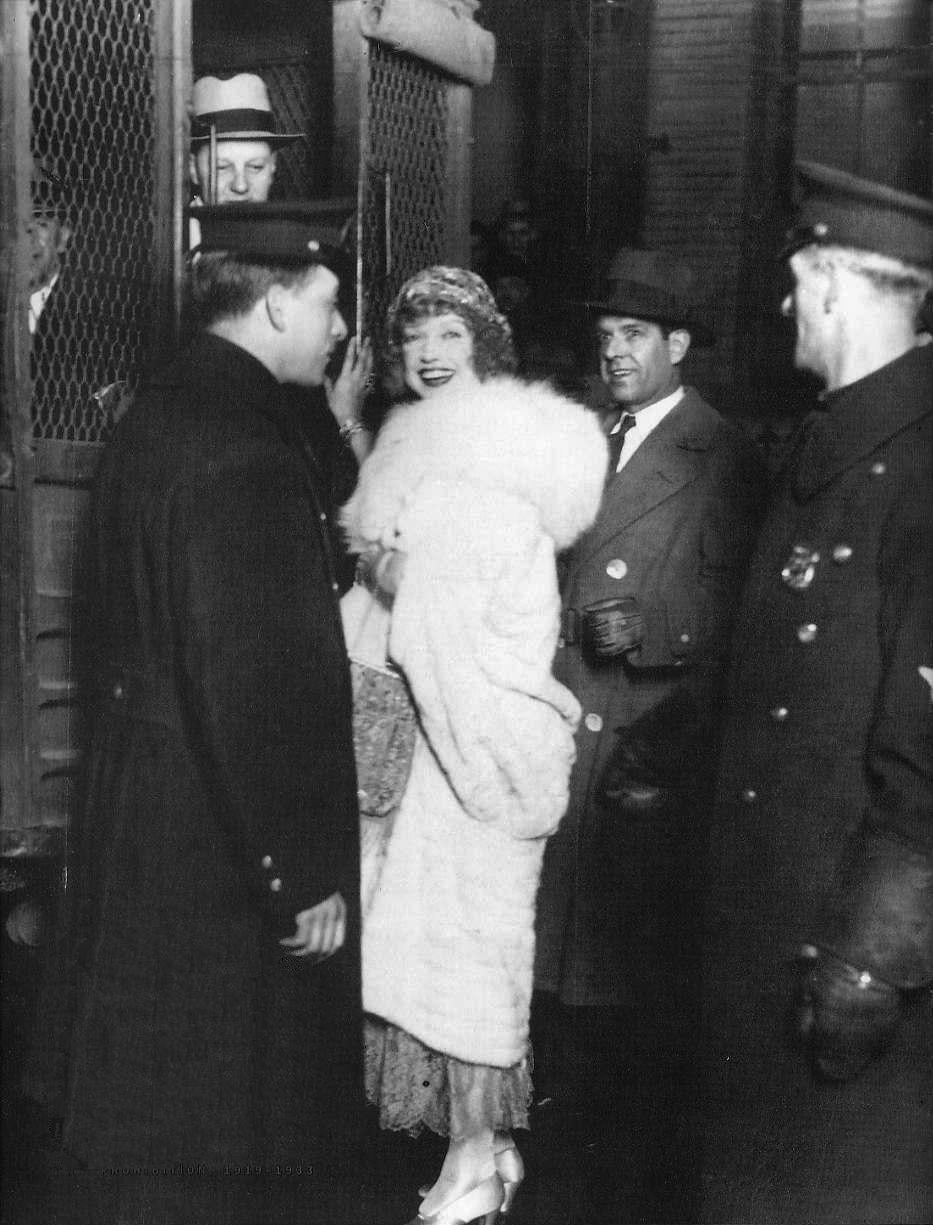
BEATING THE RAP…In June 1928 Texas Guinan and other New York speakeasy operators were arrested and indicted by a federal grand jury. Guinan beat the rap, and was acquitted in April 1929. (ephemeralness york)

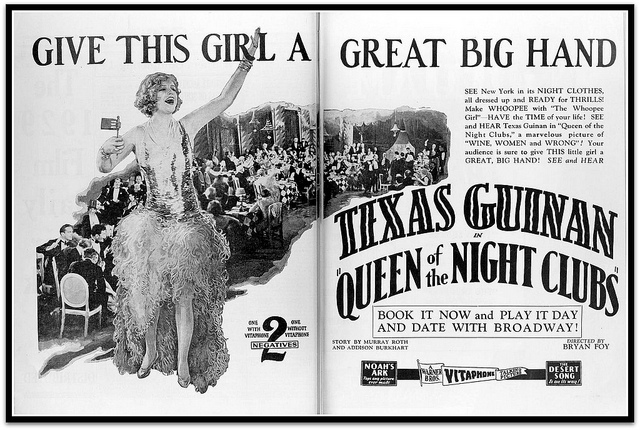
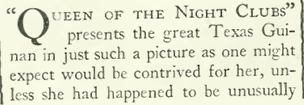
In a review of her latest movie, Queen of the Night Clubs, the New Yorker found that Guinan lacked her famed charm and vitality, and that the camera was “not kind to her looks.”

THE FINAL CURTAIN…Clockwise from top left: Texas Guinan in a nightclub scene from Queen of the Night Clubs; trading lines in the film with John Davidson; a 1929 portrait of Guinan by Cecil Beaton; and a scene from the film with co-star Lila Lee (far right). The film is considered lost. (boweryboyshistory.com/texasguinan.blogspot.com)

The film in many ways marked the end of Texas Guinan, not so much because it was a bad film but because she had simply run her course and was going out of style. The market crash later that year was the final straw. She took her show on the road, made an unsuccessful attempt at a European tour, then returned to the States. She made one final film, Broadway Thru A Keyhole, which was based on a story by Guinan acolyte Walter Winchell. Guinan died on Nov. 5, 1933, three days after the film’s release; her death was due to ulcerative colitis brought on by a case of amoebic dysentery contracted during a visit to Chicago. She was 49. One month later, Prohibition would be repealed.

A final note: Queen of the Night Clubs would be Texas Guinan’s final starring role (the film is considered lost), but before she became a night club fixture she was a popular star in dozens of shorts and two-reelers—with mostly Western themes— from 1917 to 1921.

HAPPIER TRAILS…Texas Guinan featured in a movie poster and publicity photo for The Two-Gun Woman, 1918. (Columbia University)

 *  *  *

A Film of Biblical Proportions

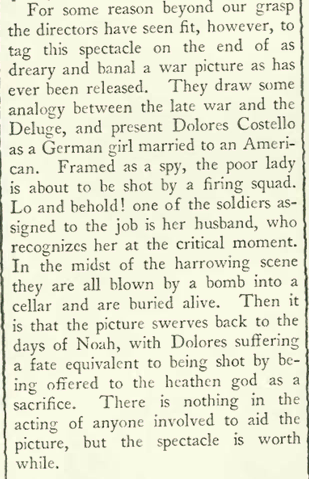
The New Yorker’s May 23 film review also sized up the latest epic to come out of Hollywood—Noah’s Ark—a picture with parallel storylines known mostly for its innovations in special effects.

The film premiered in late 1928 as a silent and was re-released in 1929 as a “part-talkie.” It told the story of Noah and the Great Flood, connected to another story featuring cabaret singers, soldiers and espionage during the First World War. Here is the New Yorker’s take on the film:

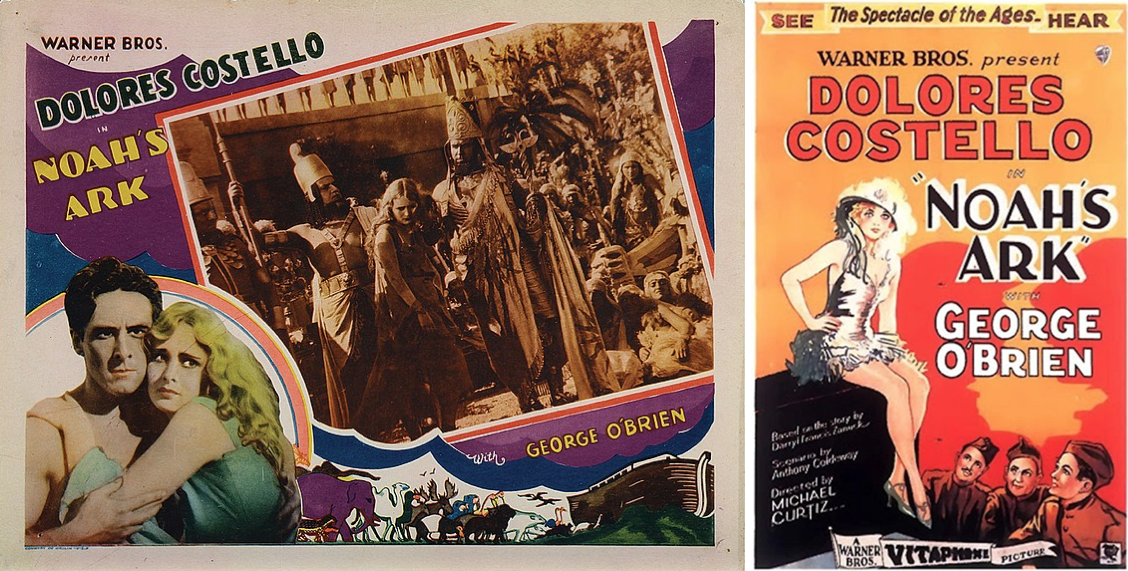
IDENTITY CRISES…Various promotional posters touted different aspects of the partial-sound film, Noah’s Ark. The one at left promoted the film’s biblical story, while the one at right played up Dolores Costello’s sex appeal. (IMDB)

The New Yorker concluded that the film was worth seeing for the Noah story’s special effects, despite its attachment to a “dreary and banal” war picture.

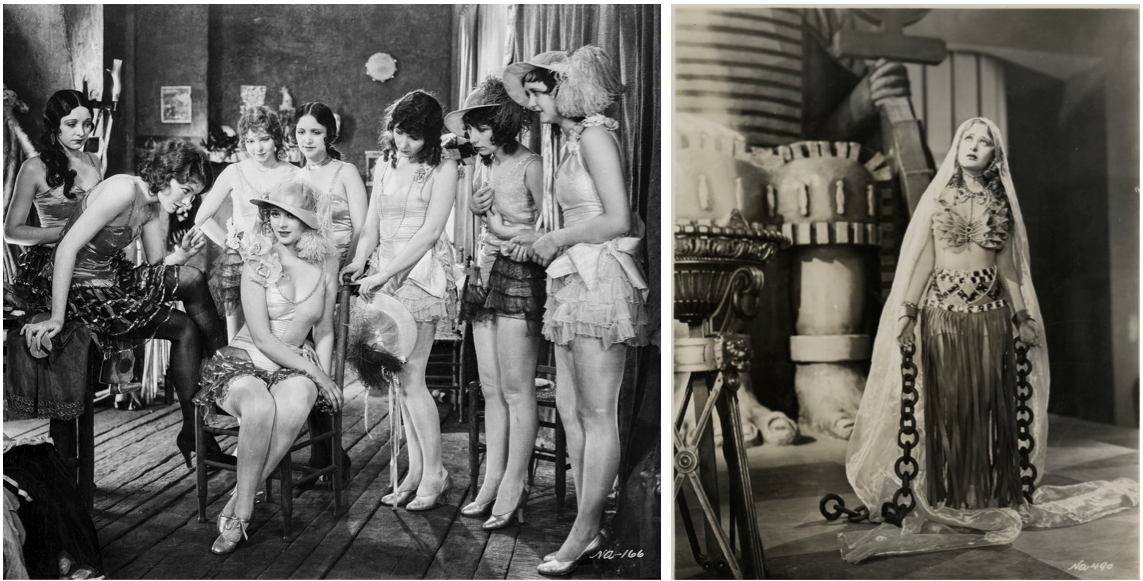
DUAL ROLES…Dolores Costello (seated, at left) played both a cabaret dancer, Marie, and Noah’s handmaiden Miriam, in Noah’s Ark. Note in the first photo the actress at far left, with her leg propped up on the chair—that’s Myrna Loy, who would become one of Hollywood’s biggest stars in the 30s and 40s. As for Costello, known as “The Goddess of the Silent Screen,” her greatest success was in the silent era. Click image to enlarge. (1stdibs.com, IMDB)
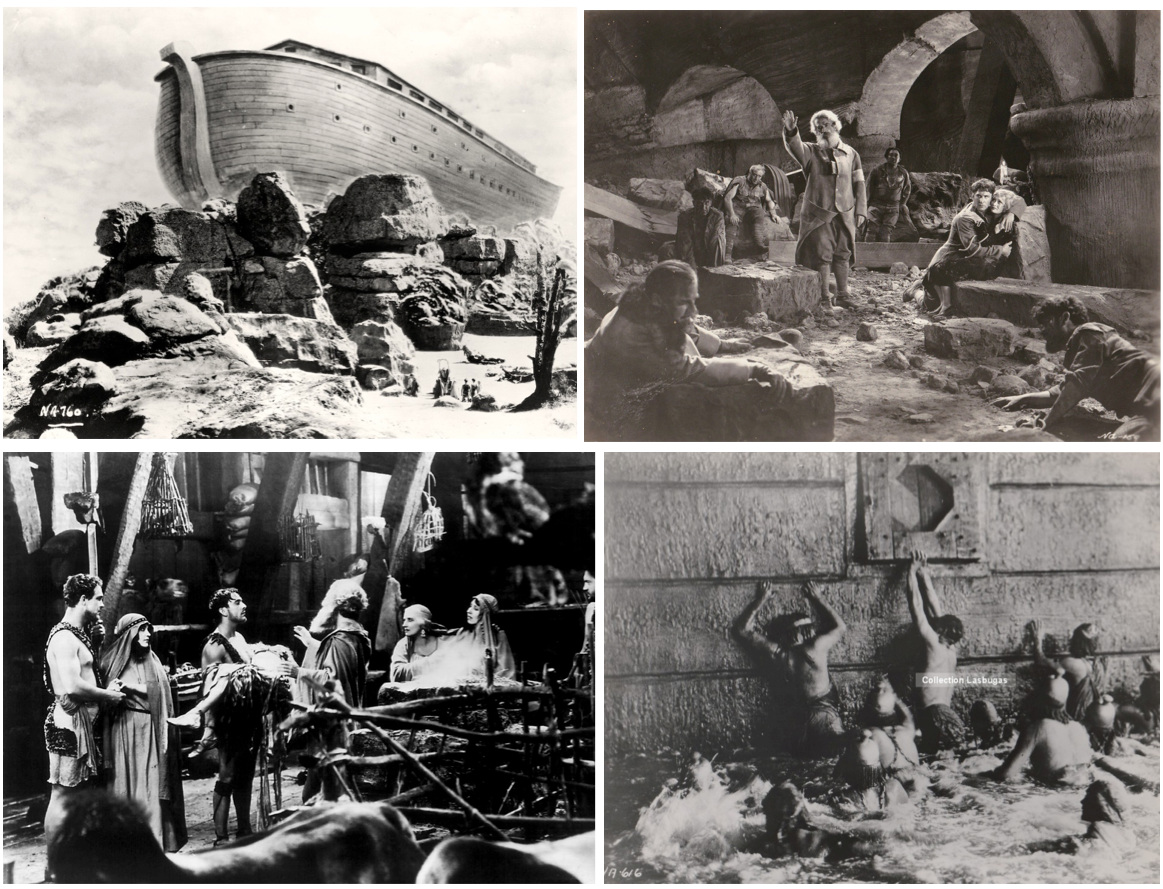
BIG SHOW…Portions of Noah’s Ark were filmed at the famed Iverson Movie Ranch in Chatsworth, California, including the opening shot that featured a massive ark (top, left) beached on the boulders of the movie ranch’s Garden of the Gods. Other scenes from the film included (moving clockwise, from top right) Paul McAllister as Noah, issuing a warning to the heathen as Noah’s son Japheth (George O’Brien) and servant girl Miriam (Dolores Costello) cower at right; the heathen masses desperately clamoring to board the ark as they are engulfed by the flood (600,000 gallons of water was used in the scene—three of the extras actually drowned during the filming); Japheth carries the rescued Miriam into the ark. Click image to enlarge. (IMDB, Wikipedia, dukewayne.com, medium.com)

Notable about these silent epics is the lack of precaution they took with both the actors and the extras. A huge amount of water—600,000 gallons—was used to film the the climactic flood scene. Three extras drowned and many others suffered broken bones and other serious injuries. One extra had to have his leg amputated. As for the stars, Dolores Costello caught a severe case of pneumonia during the filming.

Here’s a clip to give you an idea of what the extras had to deal with:

Some trivia: John Wayne was an extra in the film, and also worked in the prop department. The director of Noah’s Ark, Michael Curtiz, would go on to direct some of the most well-known films of the 20th century, including The Adventures of Robin Hood with Errol Flynn, Angels with Dirty Faces with James Cagney and Humphrey Bogart, Casablanca with Bogart and Ingrid BergmanMildred Pierce with Joan Crawford, and White Christmas with Bing Crosby and Rosemary Clooney. He would also direct an Elvis Presley movie, King Creole, and in his final film would reunite with John Wayne in 1961’s The Comancheros.

 *  *  *

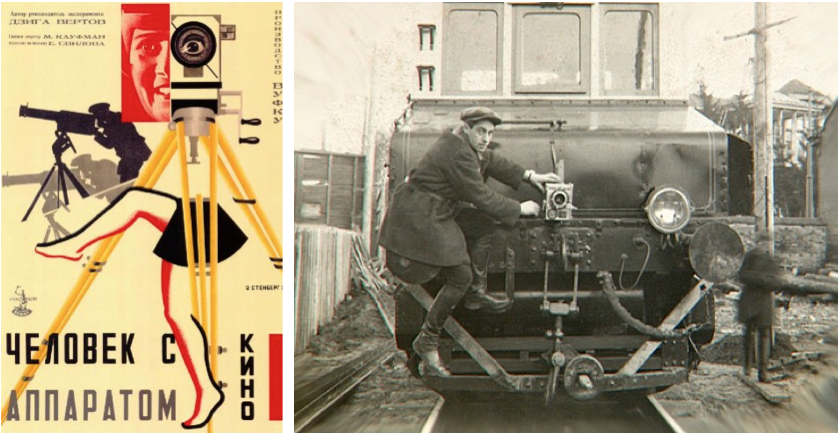
While Americans were enjoying epic filmmaking, Russian audiences were being served up the latest in propaganda, although this was propaganda presented with stunning film innovations and avant-garde sequences. In this item from the March 23 “Talk of the Town” the film is referred to as Through Russia With A Camera, but today it is known as Man with a Movie Camera. This experimental silent film from 1929 supposedly documented ordinary life in Soviet Union (with no signs of the famine that claimed 5 million Soviet citizens in the early 1920s). Directed by Dziga Vertov, the documentary’s famed cinematography was by Mikhail Kaufman. “Talk” observed:

AVANT GARDE…Poster for Man with a Movie Camera rendered in the Constructivist style. At right, cinematographer Mikhail Kaufman risks his life for a unique camera angle. (Wikipedia)
Clockwise, from top left: Cinematographer Mikhail Kaufman prepares to set up for a Black Sea beach sequence near Odessa; images of ordinary life include a woman at a hairdresser and a young woman fastening her bra; the eye through the camera lens, the film’s final image. (ascmag.com)

 *  *  *

From Our Advertisers

A sampling of advertisements from the pages of the March 23 issue include this nearly two-page spread for Pond’s cold cream…no doubt Pond’s was thrilled with this endorsement by “Mrs. Cornelius Vanderbilt Jr,” otherwise known as Mary Weir of Davenport, Iowa. Mary was wife No. 2 of Cornelius Vanderbilt’s seven wives. Mary and Cornelius were married in 1928 and divorced in 1931…

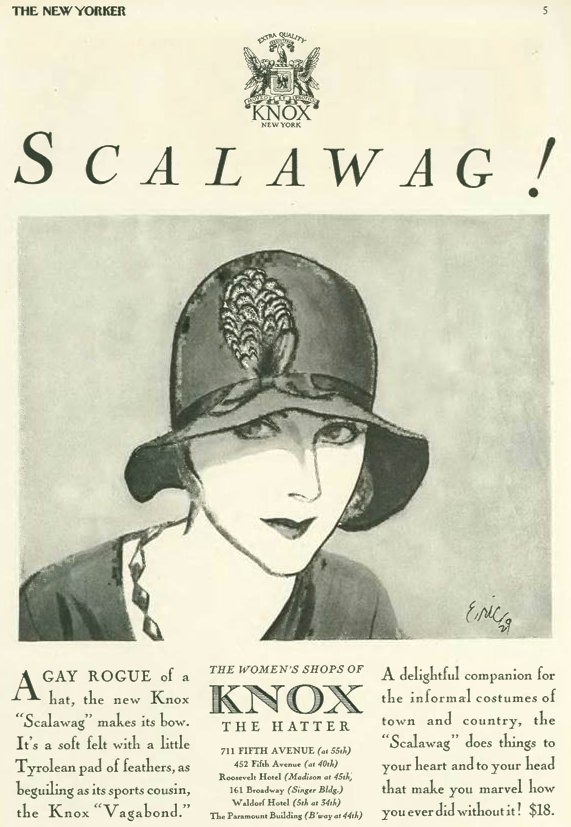
…and then we have this advertisement from Knox hatters, illustrated by the New Yorker’s own Rea Irvin

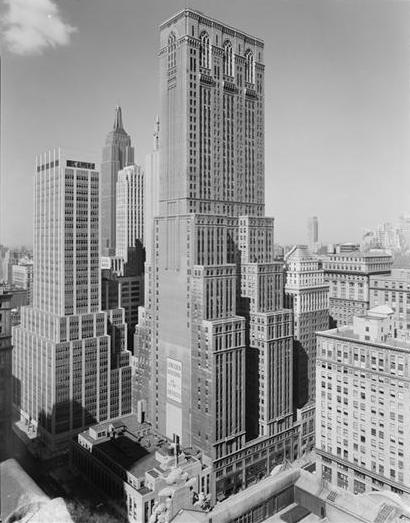
…this advertisement for the new Lincoln Building played up the building’s dominating form on Madison Avenue…

…a dominance that continues to this day. I know it’s not cool to gaze up at buildings in Manhattan, but if you’re ever in the neighborhood you must look upward at least once and gaze at the canyon that splits the Lincoln Building’s massive facade…

Lincoln Building, circa 1950. (Museum of the City of New York)

…this Remington typewriter was the closest thing to a desktop computer in 1929…I own one of these and I must attest that it isn’t exactly noiseless…

…this next ad caught my eye because it encouraged people to commit negligent homicide by throwing their product out of a high-rise window…it is also interesting because today Crosley is still a big name in radios and record players, although today’s Crosley is similar in name only. The original Crosley Corporation was a major player in early radio broadcasting, and in addition to manufacturing radios Crosley would go on to build refrigerators, a line of inexpensive subcompact cars and trucks (from 1939 to ’52) cars, and even small airplanes (1929-’36). Crosley ceased as a brand name in 1956, but the name was revived in 1984 by Modern Marketing Concepts. Today Crosley is a leading manufacturer of vintage-styled turntables, radios and other electronics…

…speaking of encouraging ridiculous behavior, some clever marketer at Ronson lighters found a great way not only to sell lighters, but also to encourage customers to waste lots of lighter fluid…

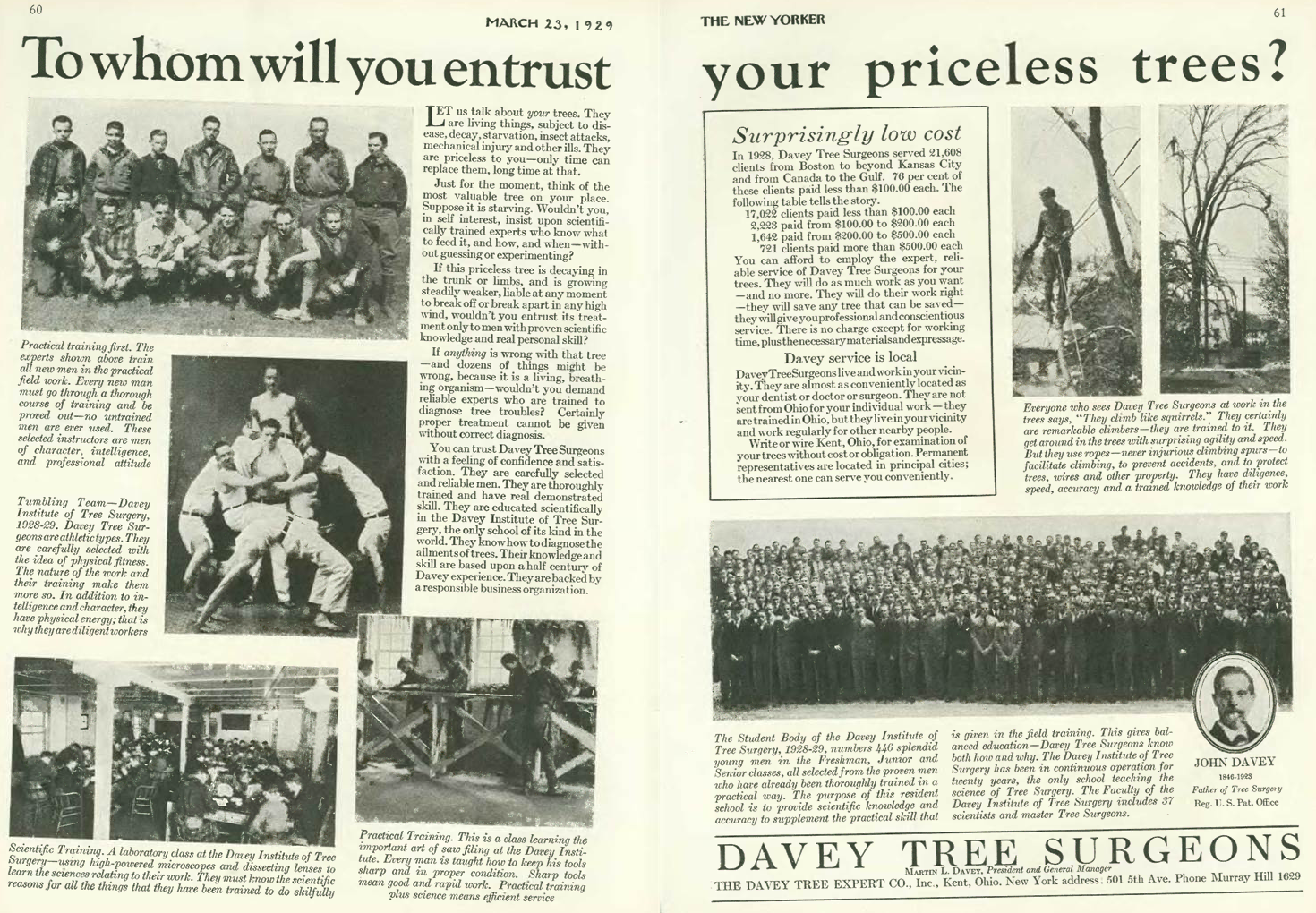
…and then we have this, one of the unlikeliest advertisements ever to appear in the New Yorker—at first I thought it was one of E.B. White’s fake newspapers, but it was actually a two-page spread promoting Davey Tree Surgeons of all things…

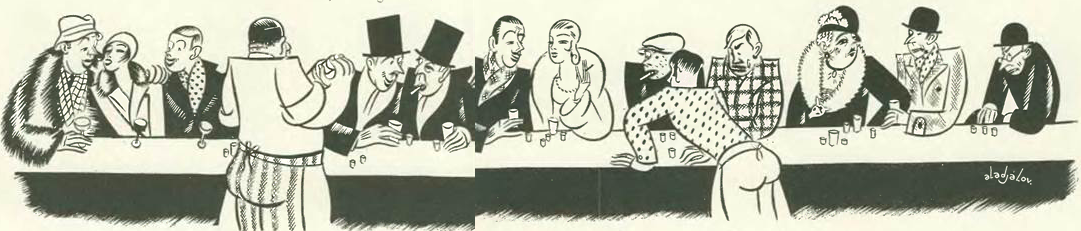
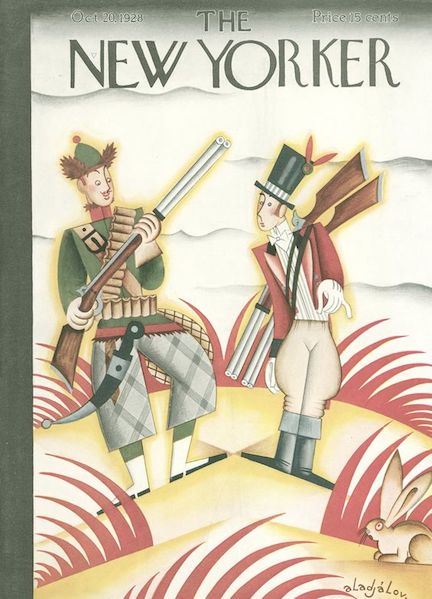
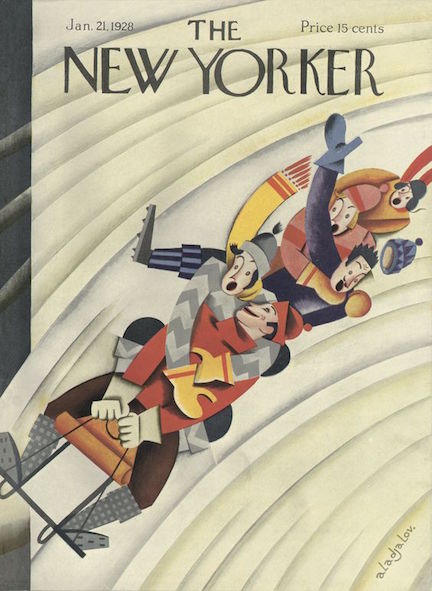
…just for fun I am tossing in this illustration by Constantin Aladjalov that appeared along the bottom of a two-page spread…

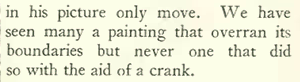
…and finally, our cartoon from Otto Soglow, in which our subject is either referring to a popular board game from 1929, or a particular sequence in a domino game…

Next Time: While You Were Away…


That Moderne Feeling

A defining moment for Art Deco design in America occurred at New York’s Metropolitan Museum of Art during a 1929 exhibition that showcased everything from household furnishings to garden design.

March 9, 1929 cover by Theodore Haupt. Between 1927 and 1933, Haupt would illustrate 45 covers for the New Yorker.

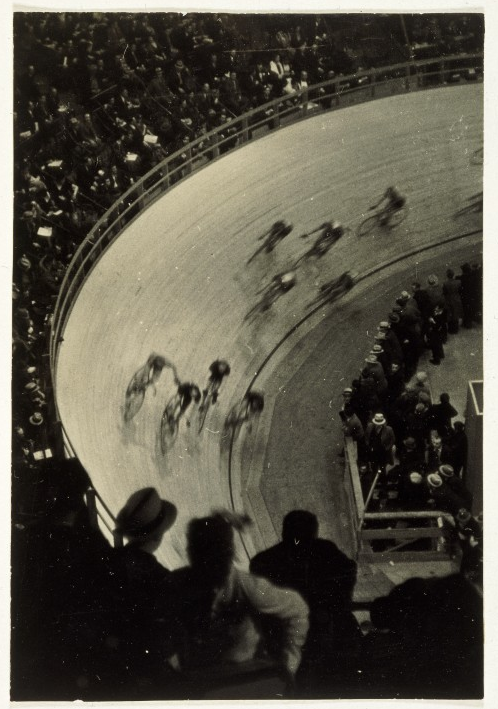
Before we delve into the Met’s exhibition, The Architect and the Industrial Arts, a quick note about the New Yorker’s Theodore Haupt-illustrated cover, which referenced the annual Six-Day Cycling Race that was taking place at the Madison Square Garden Velodrome. The event, which began at the old Madison Square Garden in 1891 and lasted until 1950, featured a beer garden (after Prohibition) in the center of the oval and drew such celebrities as Bing Crosby, Barbara Stanwyck and Peggy Joyce. It was said that Crosby even paid the hospital bills of riders who fell during the race.

THIS MIGHT TAKE AWHILE…The Six-Day Cycling Race at the Madison Square Garden Velodrome, 1932. (Victoria & Albert Museum)

The March 9 issue was lively with another contribution from Groucho Marx (“Press Agents I Have Known”) and an Alexander Woollcott-penned profile of playwright and screenwriter Charles Gordon MacArthur (husband of stage actress Helen Hayes and father of James “Book ’em Danno” MacArthur).

But as the blog title suggests, it was also filled with articles and ads that told of a city embracing all things new and modern, including a piece by architecture critic George S. Chappell on the Metropolitan Museum of Art’s eleventh Exhibition of Contemporary American Design, titled The Architect and the Industrial Arts. It was curated by the Met’s Richard F. Bach, who organized 15 annual exhibitions of contemporary industrial art at the museum between 1917 and 1940.

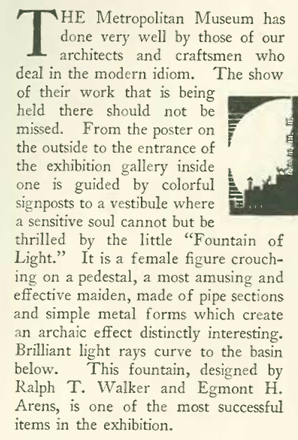
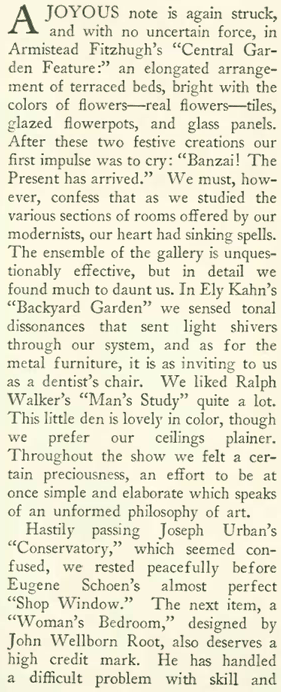
The 1929 exhibition of Art Deco works was the biggest yet, inspired by the Art Moderne movement in Europe and particularly the 1925 Paris Exposition International des Arts Decoratifs et Industriels). The Met exhibition, wrote Chappell, “should not be missed”…

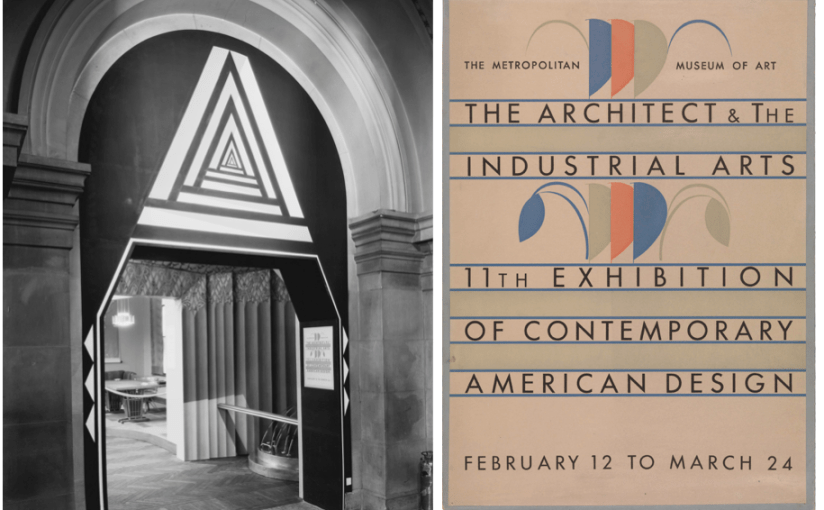
PORTAL TO THE FUTURE…Entrance to The Architect & the Industrial Arts exhibition at The Metropolitan Museum of Art, designed by Joseph Urban. The above exhibition poster (seen mounted on the doorway in the photo) was by W.A. Dwiggins. (Metropolitan Museum of Art)
Ornaments created by W.A. Diggins for the exhibition catalogue included, from left, “Conservatory,” for a section on  Joseph Urban; ornament on a page devoted to curator Richard F. Bach; “Backyard Garden” for a section on Ely Jacques Kahn; and an ornament that graced the acknowledgements page. (Metropolitan Museum of Art, via paulshawletterdesign.com)
NOT YOUR GRANDMOTHER’S GARDEN…Mosaic semi-circular bench designed by Austin Purves, Jr. was featured in architect Ely Jacques Kahn’s “Backyard Garden” display by at the The Architect & the Industrial Arts exhibition at the Metropolitan Museum of Art. (Pencil Points Magazine, January 1929)

Chappell found the exhibit to be “stimulating,” although he hoped designers in the future would “curb cleverness” and focus more on fundamentals:

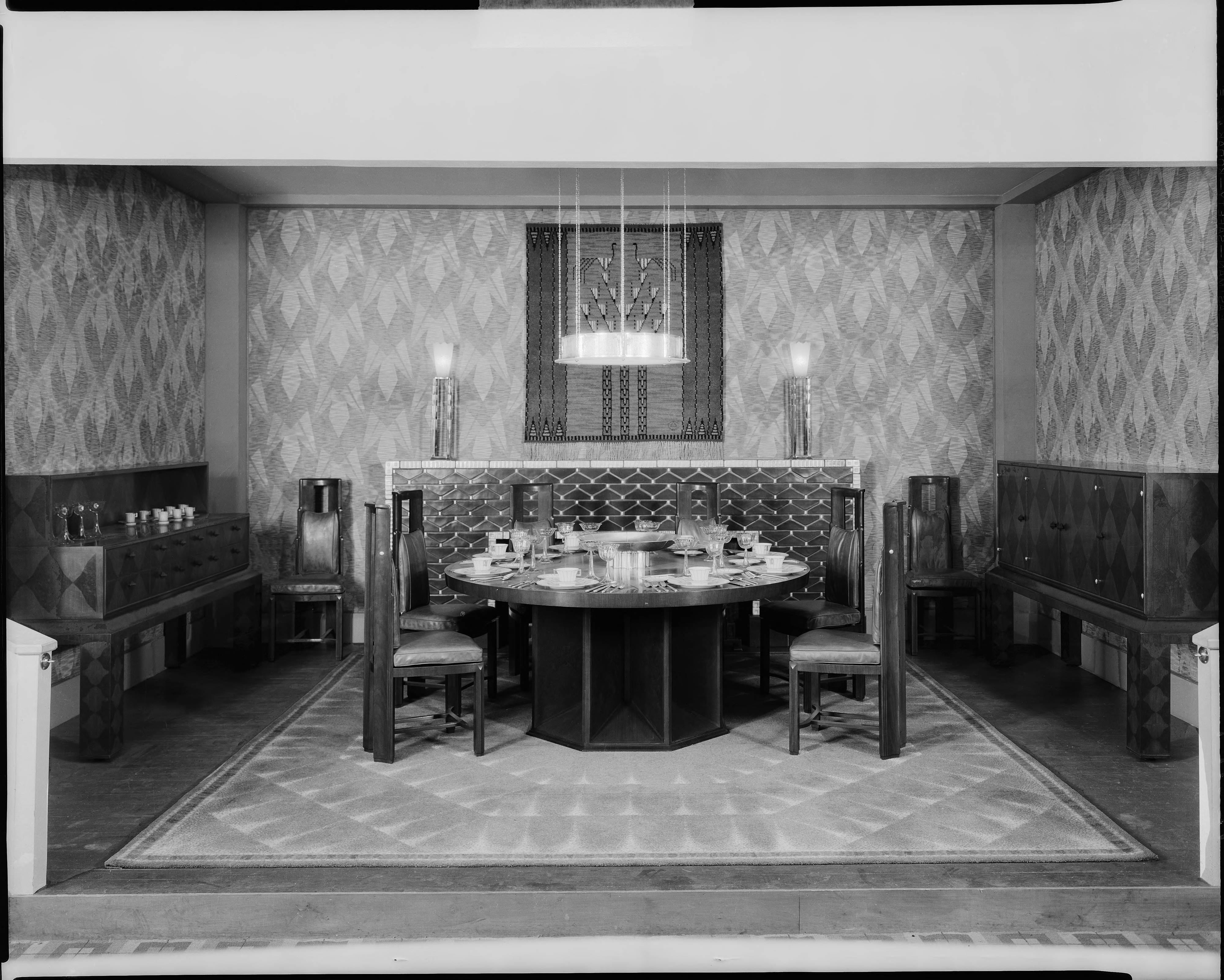
DINING IN STYLE…A dining room designed by Finnish architect Eliel Saarinen for The Architect and the Industrial Arts exhibition at the Metropolitan Museum of Art. (Metropolitan Museum of Art)
VISIONARIES…The Cooperating Committee for 1929 The Architect and the Industrial Arts exhibition were, standing, left to right, architects Raymond Hood, Eugene Schoen and Ely Jacques Kahn. Seated, left to right, architects Ralph T. Walker, John Wellborn Root, Jr. and Eliel Saarinen; ceramist, painter and graphic artist Leon V. Solon; and architect, illustrator and scenic designer Joseph Urban. (Metropolitan Museum of Art)
COZY…Ralph Walker’s “Man’s Study for a Country House” at the The Architect and the Industrial Arts exhibition. (architectsandartisans.com)
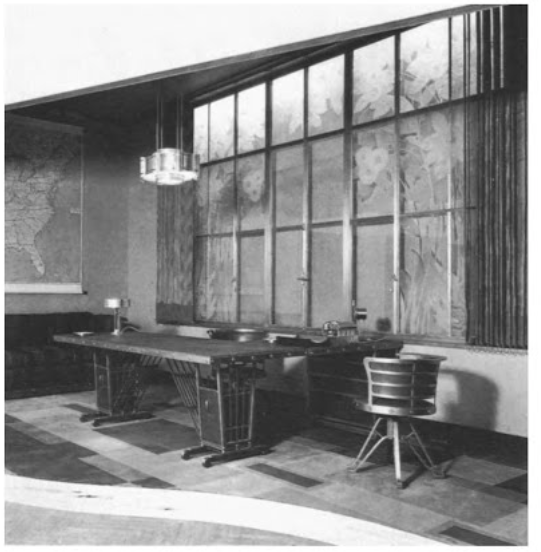
ALL BUSINESS…Raymond Hood’s “Business Executive’s Office” featured at The Architect and the Industrial Arts exhibition. (Metropolitan Museum of Art)

Writing in the February 1929 Bulletin of the Metropolitan Museum of Art, curator Richard S. Bach posed bold questions for this new age: “What is the tempo of our day? What are the dominant elements of our culture, our activities, our thinking? Is this a speed age or are we sedate? Have we time to be dignified and stately about frills or are we air-minded? Do we wait for months, as once all did, for the silkworm to complete his labors before beginning to make thread from his cocoon…or (do we) make a few bales of vegetable silk out of chemically treated wood fiber between breakfast and lunch as a regular chore of a business week-day? And is this the mechanistic millennium which shrivels the soul and makes mockery of imagination, or are these fabulous industries, these automatic instruments of production, the means of bringing within range of vision the real potentialities of our crowded lives and of interpreting our aspirations and achievements?

Pumping Iron Into the Sky

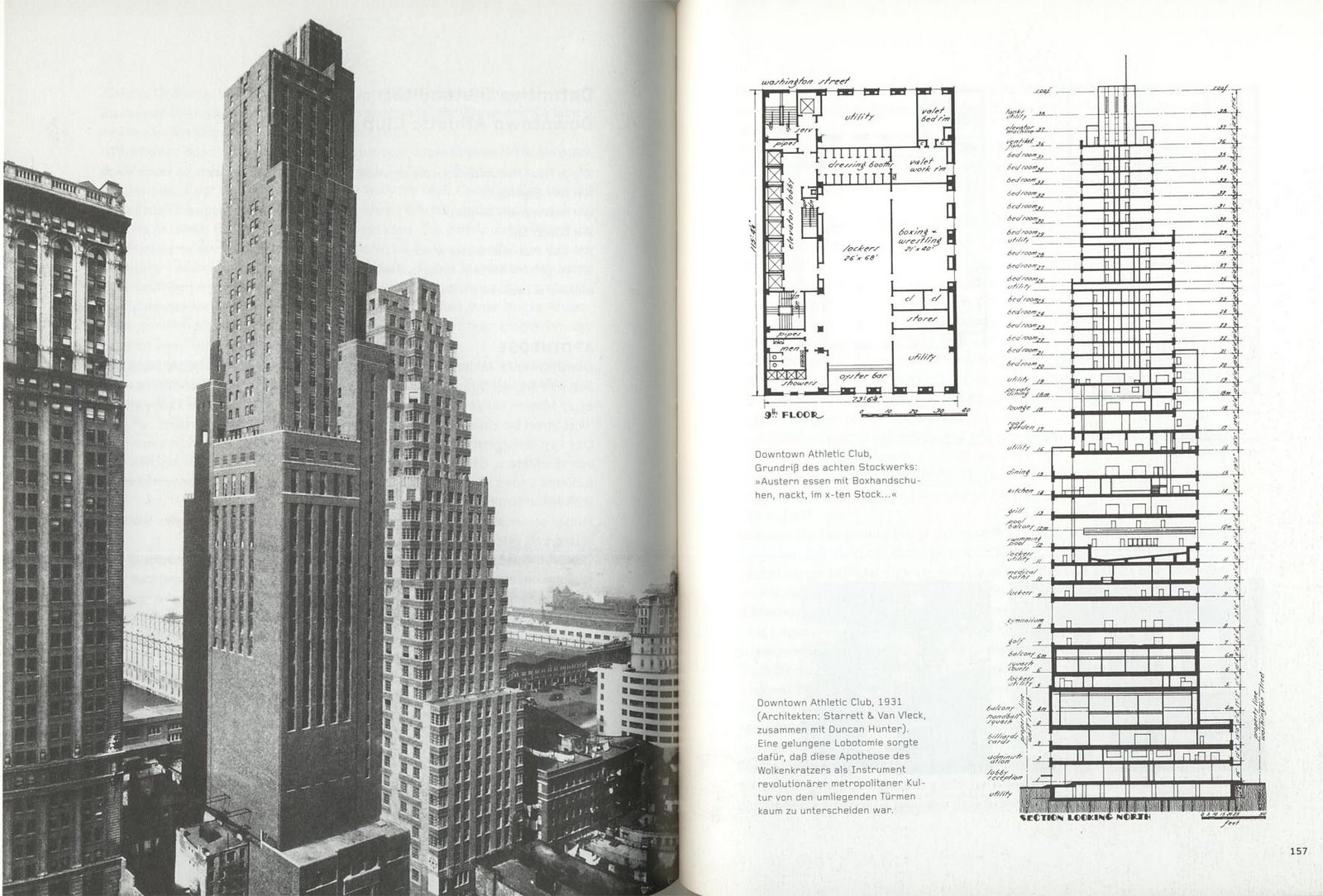
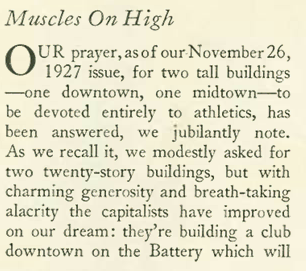
The architecture firm Starrett & van Vleck saw the “real potentialities of our crowded lives” when they designed a new Art Deco skyscraper to house the Downtown Athletic Club. Writing in Lost City NewsMary Hohlt cites the architect Rem Koolhaas, who sees the Downtown Athletic Club as “the ideal of a hyper-reality in the burgeoning urban form of hyper-density and congestion.” The Club is “the everything-at-your-fingertips self-improvement incubator for men…It is a place for men to indulge on self-improvement; to better themselves in a place only the constructed, hyper-reality of Manhattan can provide.”

SELF-IMPROVEMENT INCUBATOR…the Downtown Athletic Club by Starrett & van Vleck, 1930. (4.bp.blogspot.com) click to enlarge

Hohlt writes that Koolhaas sees the Downtown Athletic Club as a sterile place: “Towering in the sky, the Club removes men from the rest of the world and allows them a kind of aesthetic improvement that cannot be passed on.” E.B. White took a less jaded view in this “Talk of the Town” segment:

STILL A WINNER…Famous for serving as the site of the annual awarding of the Heisman Trophy, the Downtown Athletic Club closed in 2001 following the 9/11 attacks. The club was within a “frozen zone” closed to the public during the long clean-up that followed, and could not withstand the financial impact of such a long closure. It reopened in 2005 as a residential tower. (newyorkitecture.com)

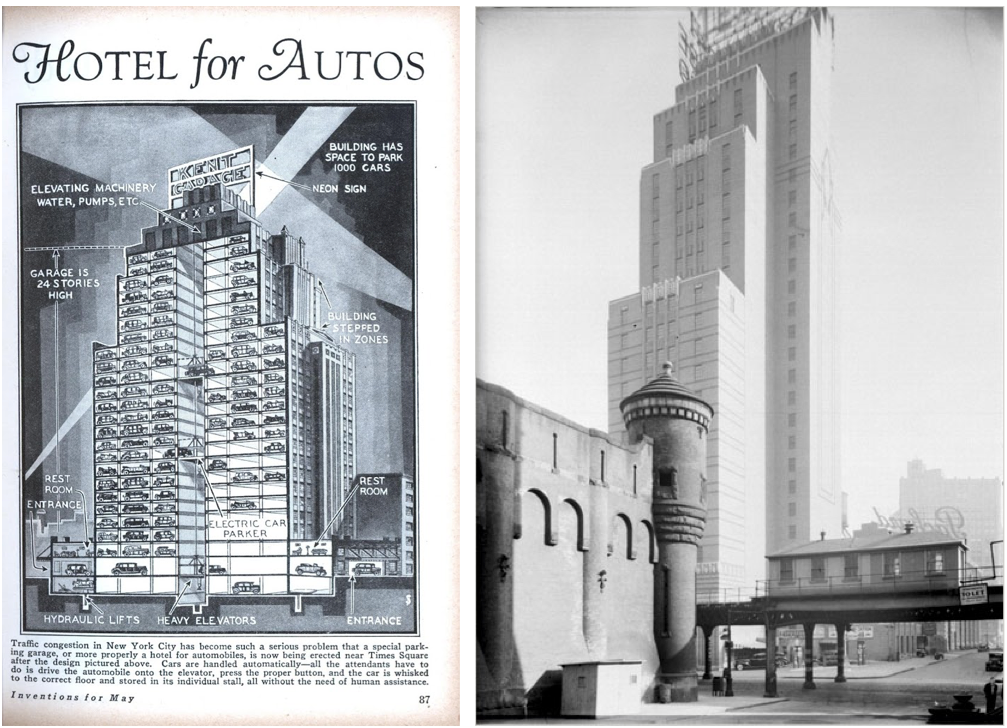
Another New Yorker who saw the “real potentialities of our crowded lives” was insurance salesman Milton A. Kent, who in 1928-29 erected a brick and terra-cotta Art Deco tower that could park 1,000 cars using an automatic elevator system.

MONUMENT TO THE CAR…The May 1928 issue of Modern Mechanix featured this cutaway illustration of Milton Kent’s high-rise, automated parking garage. (boweryboyshistory.com) click image to enlarge

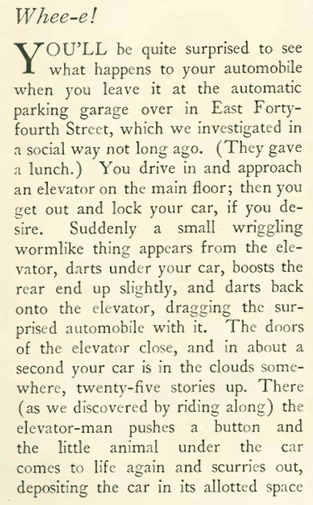
Once again E.B. White was on hand to render this observation for “Talk”…

HUMAN SCALE…Kent’s fantastic garage still stands at West 61st Street, but today it serves as—you guessed it—an apartment building. (boweryboyshistory.com)

 *  *  *

Death of a Can-Can Dancer

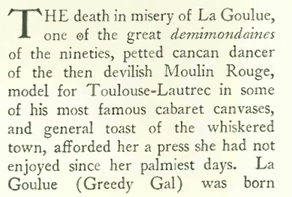
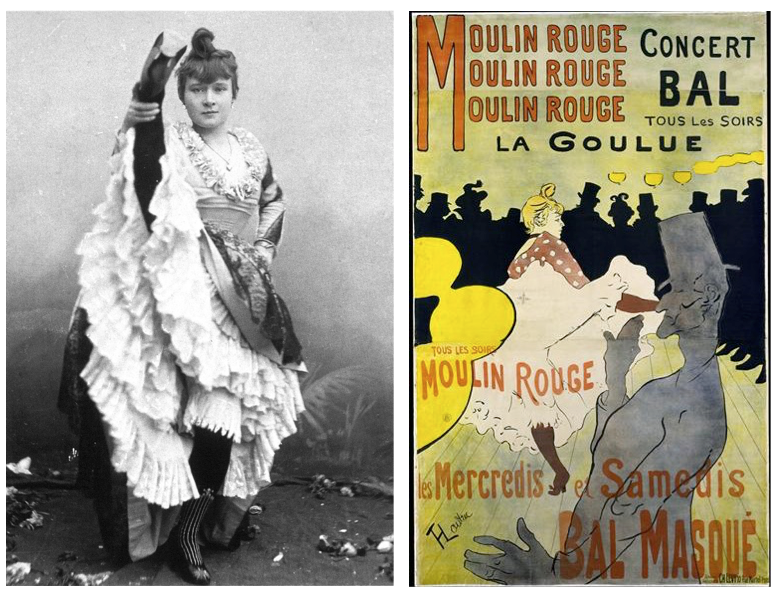
The sad death of Louise Weber, aka La Goulue, was announced in Janet Flanner’s “Letter from Paris” column. Weber was a can-can dancer at the Moulin Rouge in Paris and a model for some of Henri de Toulouse-Lautrec’s most famous cabaret paintings. Flanner wrote of La Goulue’s rise to fame…

JUST FOR KICKS… Louise Weber, aka La Goulue, circa 1890, and an 1891 poster by Toulouse-Lautrec advertising the performers La Goulue and “No-Bones” Valentin at the new Paris dance hall Moulin Rouge. (Wikipedia)

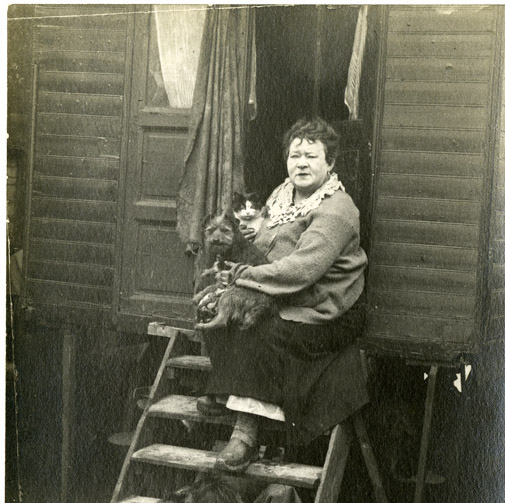
…and her sad downfall into a life of poverty among the rag-pickers:

SAD DECLINE…La Goulue, her face freshly powdered, sat on the steps of her small trailer for an unknown postcard photographer in the 1920s. This image is a detail of the original photograph, held at the Wheaton College Permanent Collection.

 *  *  *

From Our Advertisers

An advertisement on page 45 for Mohawk carpets featured two Cockney charwomen admiring the new carpets at the General Motors headquarters:

A corresponding note: Shreve & Lamb’s 1927 General Motors Building was the hub of Columbus Circle’s Automobile Row. A hideous 2012 remodel, which clad the entire structure in reflective glass, has rendered the former landmark unrecognizable:

Museum of the City of New York/nyc-architecture.com

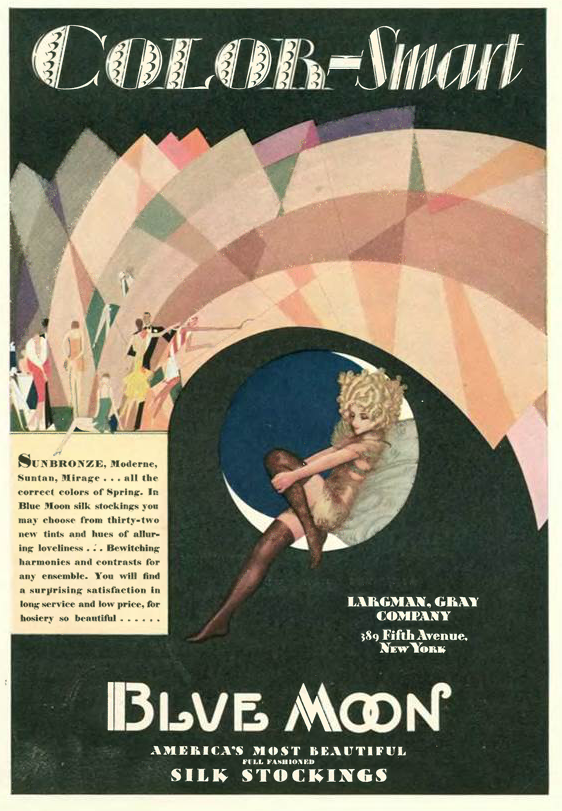
Getting back to all things “moderne,” these facing ads on pages 8-9 offered some new looks for spring…

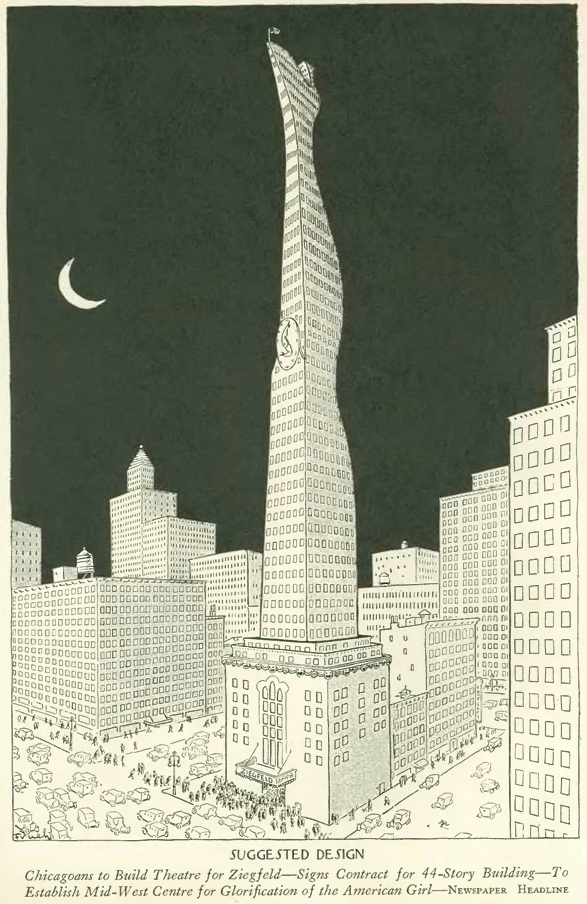
…and in the cartoons, a tongue-in-cheek vision of a modern high-rise by Al Frueh, prompted by the news that Florenz Ziegfeld planned to build a 44-story building in his native Chicago. Thanks to the market crash later in the year, it was never realized.

In drawings sprinkled across pages 24-25, Helen Hokinson examined various approaches to tax season, including these two examples…

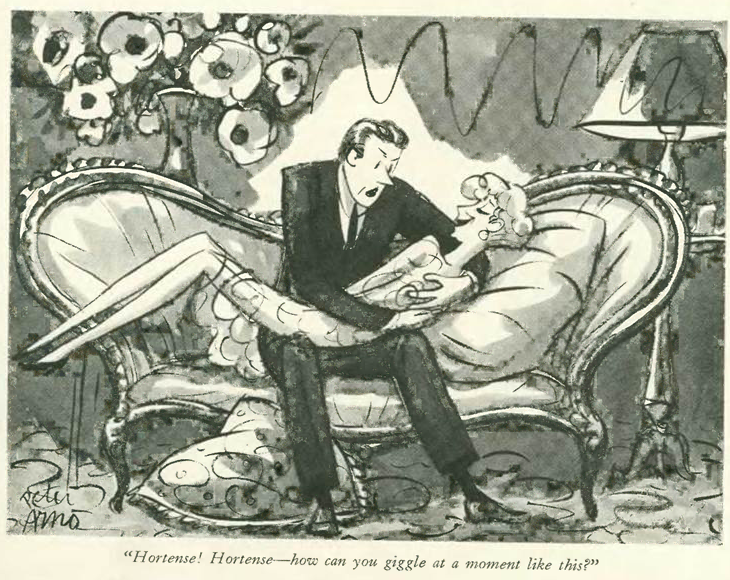
…and finally, Peter Arno caught a theatre performer with his pants down…

Next Time: Babbitt Babble…


Million Dollar Mermaid

Our sense of what is old and what it is new becomes skewed during periods of rapid change, and such was the case in 1920s New York when large swaths of the old city were swept away and replaced by massive towers that seemingly rose overnight. Places like the Hippodrome Theatre, a 1905 Beaux-Arts confection barely 24 years old, seemed positively ancient in those heady times.

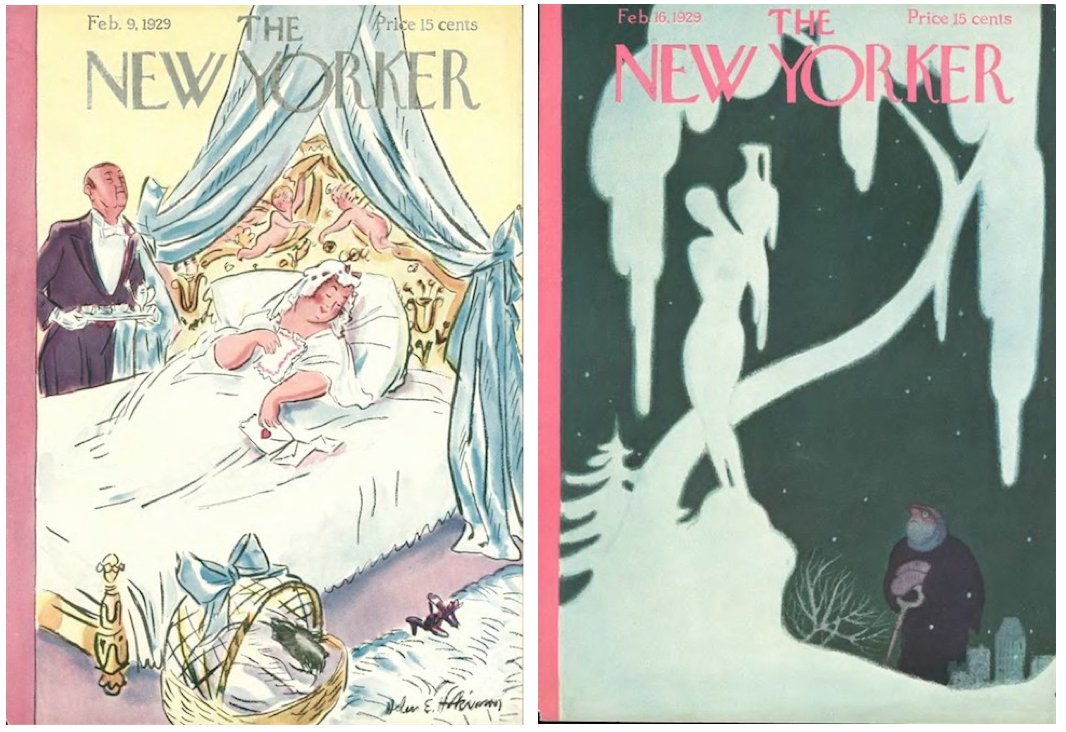
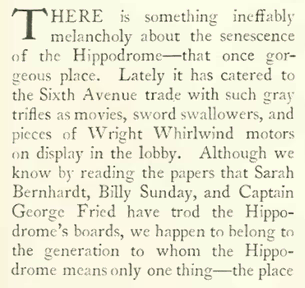
Feb. 9, 1929 cover by Helen Hokinson. Feb. 16, 1929 cover by Rea Irvin.

For the most part the New Yorker was enthusiastic about the changing skyline, as its namesake was claiming the crown as America’s premier city; but occasionally a melancholy note would be struck when a familiar institution appeared in decline or fated for the wrecking ball. In the Feb. 9, 1929 “Talk of the Town,” E.B. White wistfully recalled the old days of the Hippodrome, once the largest theatre in the world and the pride of turn-of-the-century New York:

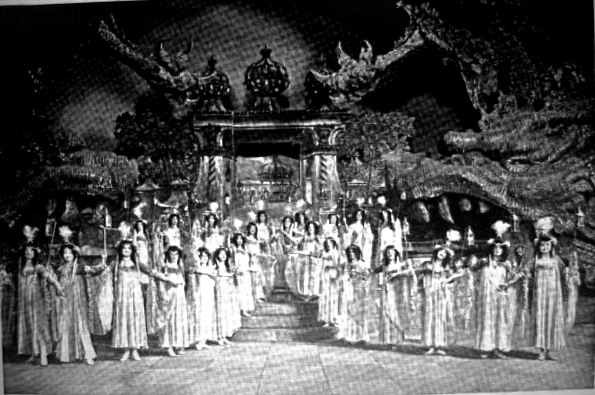
FOR THE MASSES…The Hippodrome, built in 1905, provided entertainment to millions of New Yorkers who couldn’t afford a ticket to a Broadway play. The brainchild of Frederick Thompson and Elmer S. Dundy, entrepreneurs of Coney Island’s Luna Park, the Hippodrome was torn down in 1939 after more than a decade of decline. (1905 photo courtesy Library of Congress)
A REALLY BIG SHOOO…One of the first performances at the Hippodrome was a four-hour spectacle: A Yankee Circus on Mars (advertised on the theatre’s marquee in photo above). The 1905 production included 280 chorus girls, 480 soldiers, a parade of cars driven by elephants, an equestrienne ballet, acrobats, and a cavalry charge through a lake. (Image from Harper’s Weekly via daytoninmanhattan.blogspot.com)
The Hippodrome’s main theatre could accommodate 5,300 patrons in seats that were four inches wider than normal theatre seats. The dome over the “Roman style” auditorium encompassed an acre. (Broadway Magazine 1905 via daytoninmanhattan.blogspot.com)

The Hippodrome held such a place in the heart of the New Yorker that the magazine offered further reminiscences in the Feb. 16 issue, this time penned by managing editor Harold Ross:

For demonstrations of diving and “mermaid spectacles,” the Hippodrome stage featured an eight-foot high steel tank in four sections, with a front of plate glass. Manned diving bells were also used to raise and lower “mermaids” during performances.

OLD TIMEY FX…Illustration from Nature magazine (left) depicts a diving bell used in the Hippodrome’s swimming and diving tank to raise and lower performers. At top, circa 1910 advertisement; at bottom, the “Court of the Golden Fountain” in the the theatre’s 1905-06 presentation of A Society Circus. (les-sources-du-nil.tumblr.com/flickr/NYC Architecture)

Ross wrote about the Hippodrome’s “diving girls,” who would dive into a tank of water from a height of 90 feet, sometimes at a serious cost to their health:

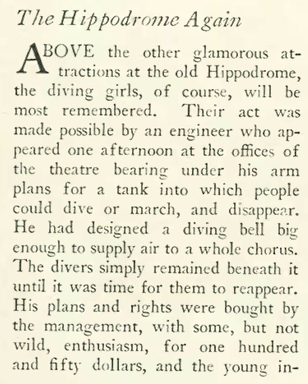
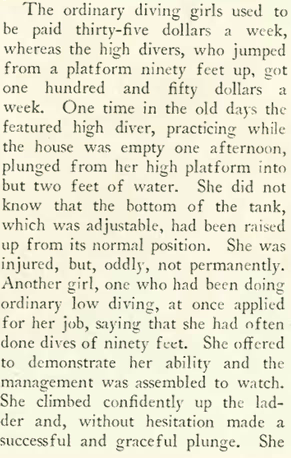
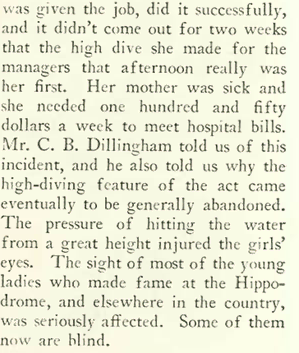
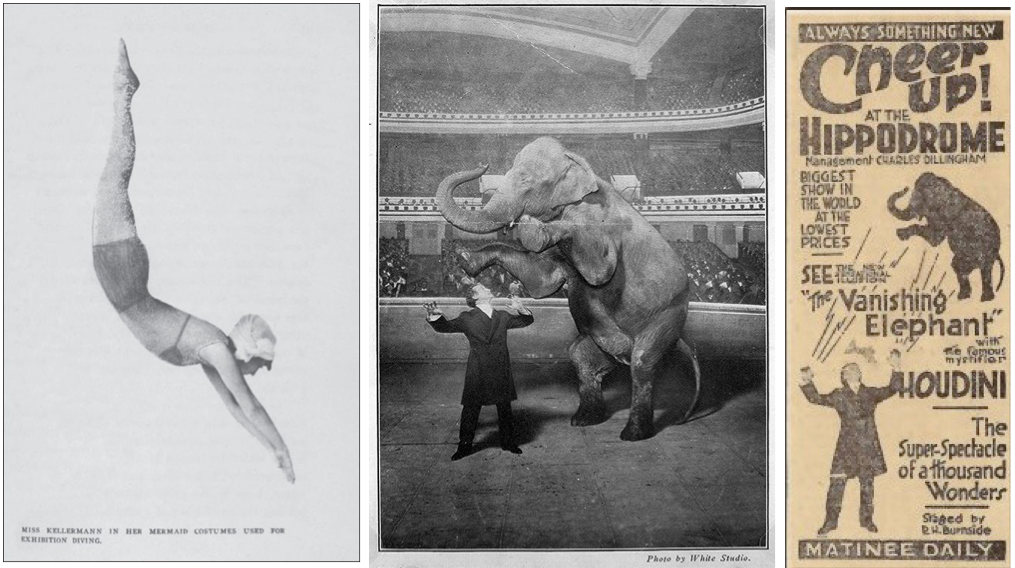
HIPPODROME’S HEYDAYS…In the early 1900s Australian swimmer and diver Annette Kellerman (left, in an image from her 1918 book, How to Swim) was a famed performer at the Hippodrome, as was illusionist and stunt performer Harry Houdini, shown here in 1918  with Jennie the Elephant in a performance of the vanishing elephant trick. (Monash University/americaslibrary.gov/wildabouthoudini.com)
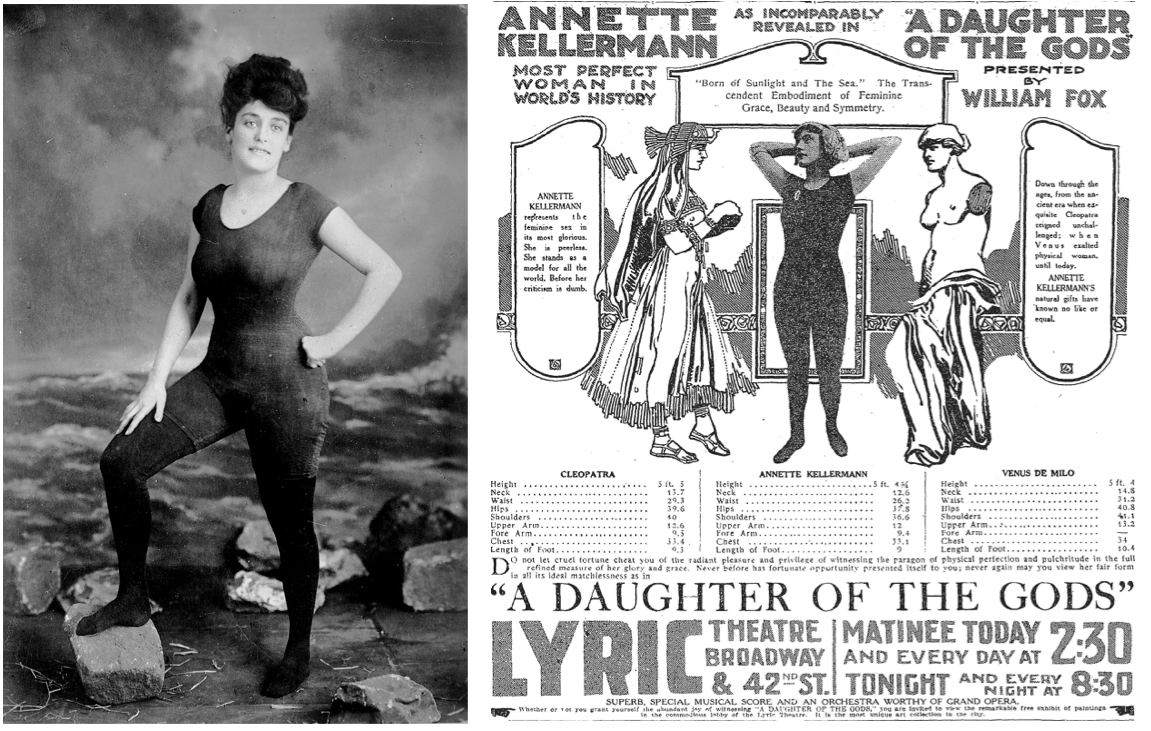
MILLION DOLLAR MERMAID…famed around the world by that moniker, swimmer and later actress Annette Kellerman is considered the originator of the one‐piece bathing suit, which she models at left in a photo taken around 1907. At right, advertisement for Kellerman’s 1916 film A Daughter of the Gods (now lost), in which Kellerman achieved another first: the first complete nude scene by a major star. The William Fox Studio made much of Kellerman’s figure, promoting her as the perfect woman by “comparing” her measurements to the likes of Cleopatra and Venus de Milo. (Wikipedia/consumingcultures.net)

Australian swimmer Annette Kellerman was a big draw at the Hippodrome, and helped popularize the sport of synchronised swimming after her 1907 performance of the first water ballet in theatre’s giant plate glass tank. In that same year she shocked Bostonians by appearing on a local beach in a “daring” one‐piece bathing suit (shown above), and was arrested for indecency. This was at a time when a woman’s standard bathing apparel consisted of a blouse, skirt, stockings and swimming shoes.

Unlike some of the unfortunate Hippodrome divers who later lost their eyesight due to cranial pressure from high dives, Kellerman went on to a long and active life (she died in 1975, at age 88). Known throughout the world as Australia’s “Million Dollar Mermaid” (and portrayed by Esther Williams in a 1952 movie by the same name), Kellerman appeared in more than a dozen films between 1909 and 1924. She also launched her own line of swimwear and wrote several books on swimming, beauty and fitness.

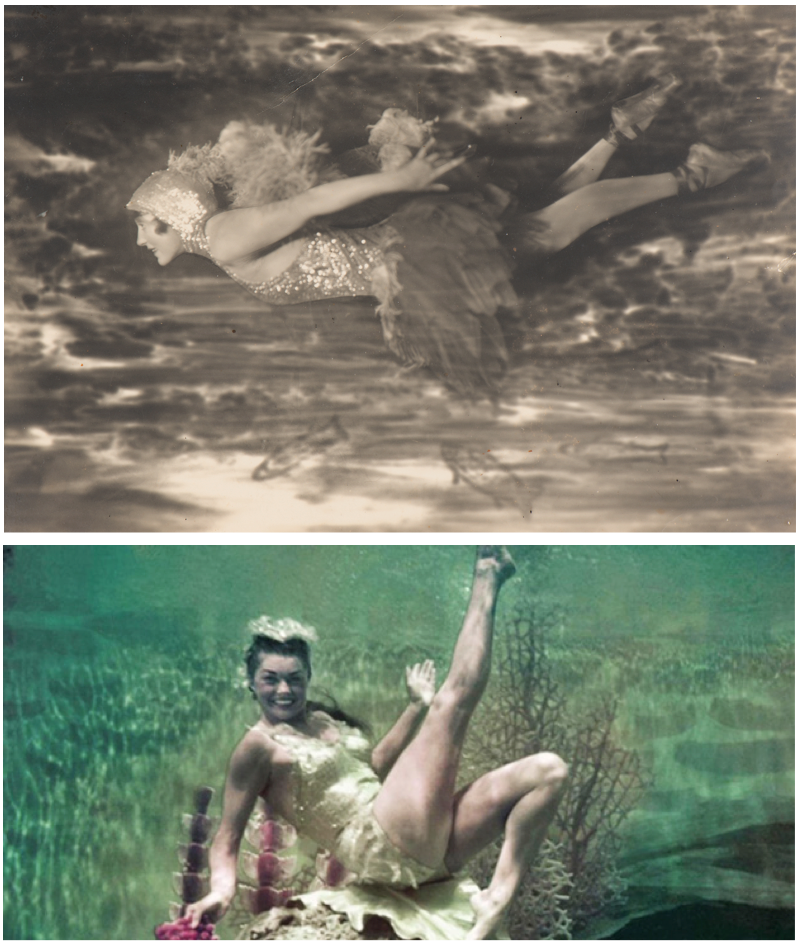
ALL WET…At top, Annette Kellerman swimming underwater in a gold sequined dress, possibly from  Queen of the Sea (1918, now lost). Thirty-four years later Esther Williams (below) would portray Kellerman in Million Dollar Mermaid. (historycouncilnsw.org.au/gsgs/movieactors.com)

*  *  *

City of Lights

While E.B. White got misty-eyed about the old Hippodrome in the Feb. 9 issue, his fellow New Yorker writer and friend James Thurber was thrilling on the new skyscrapers lighting the city’s skyline:

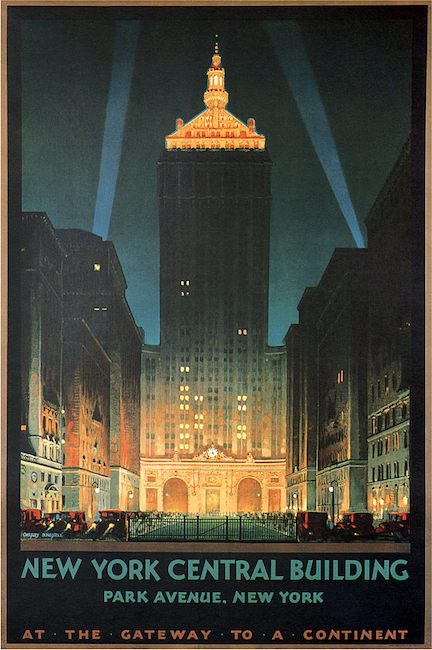
BEJEWELED CROWN…The New York Central Building depicted in a 1929 promotional painting by Chesley Bonestell. (albanyinstitute.org)

Thurber noted that “100,000 candlepower” would light the golden crown of the New York Central Building, the tallest structure in the Grand Central complex. Over at the new Chanin Building, a whopping 25 million candle-power would be trained on its art deco crown.

YOU CAN’T MISS IT…At left, the nearly 700-foot-tall Chanin Building joined the race for the sky in 1928-29. At right, a 1929 drypoint etching by Australian-born artist Martin Lewis depicted the magical glow of the Chanin Building from the viewpoint of a tenement dweller on a fire escape. (NYPL/ephemeralnewyork.wordpress.com)

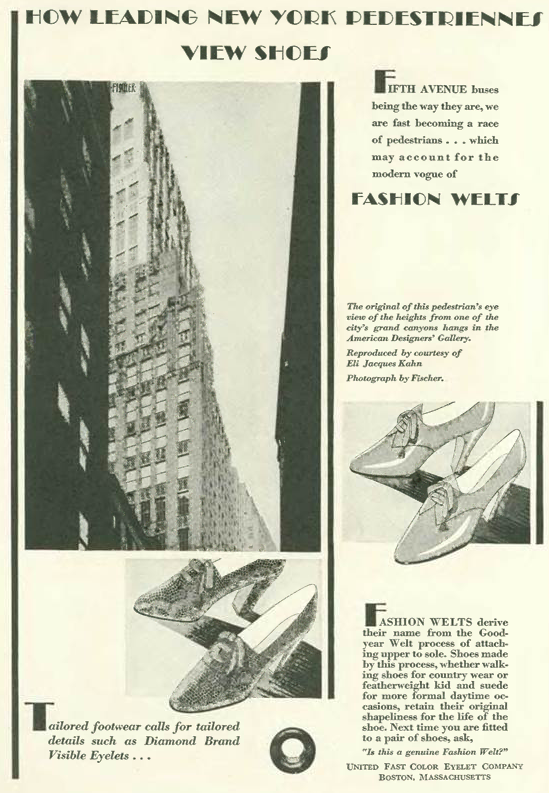
Advertisers in the New Yorker reflected the mood of this new city of skyscraper canyons. From the Feb. 16 issue:

Ralph Ingersoll and Thurber also wrote in the Feb. 16 “Talk” about plans for “Rockefeller City…”

…and as we know, this was to become the famed Rockefeller Center, a complex of 19 buildings covering 22 acres between 48th and 51st streets. Led by by John D. Rockefeller Jr., the complex was conceived as an urban renewal project to revitalize Midtown (hard to imagine today). The land was originally envisioned as a site for a new Metropolitan Opera house, but when financing fell through the land’s owner, Columbia University, leased it to Rockefeller. Of the anticipated effect of the project, Ingersoll and Thurber wrote:

And for the record, the Feb. 9 issue featured another name that would shape the future of the city—J. Pierpont Morgan was the subject of a lengthy two-part profile penned by John K. Winkler.

 * * *

Shouts & Murmurs

The Feb. 16 marks a significant date on the New Yorker calendar—the first appearance of Alexander Woollcott’s famed “Shouts & Murmurs” column:

Writing in the “Double Take” section in the July 18, 2012 issue of the New Yorker, Jon Michaud notes that “Shouts & Murmurs” was Woollcott’s personal column, appearing weekly in the magazine for five years. Perhaps no person other Harold Ross himself could be more associated with the earliest origins of the magazine —  Woollcott was a colleague of Ross’s at Stars and Stripes during the First World War, and introduced Ross to his first wife, Jane Grant, who was also a considerable influence on the early magazine.

Michaud writes that Woollcott used the column “to opine on, lampoon, and attack the culture and society of the day. In his distinct and at times excessive style, he reviewed books, wrote spoofs, distributed gossip, and generally rankled as many people as he could.” Woollcott ended the column in December 1934, but it was revived in 1992 as a regular venue for many notable humorists, and continues to this day.

A REAL CHARACTER…Alexander Woollcott, in his idea of casual wear. He once informed his friend and New Yorker colleague Corey Ford: “Ford, I plan to spend three days at your house in New Hampshire next week.” Not overly pleased to be hosting such a demanding guest, Ford uttered a meek “That will be swell.” “I’ll be the judge of that,” Woolcott warned him. (From Elizabeth Olliff, “An Evening at the Algonquin.”)

* * *

Up In Smoke

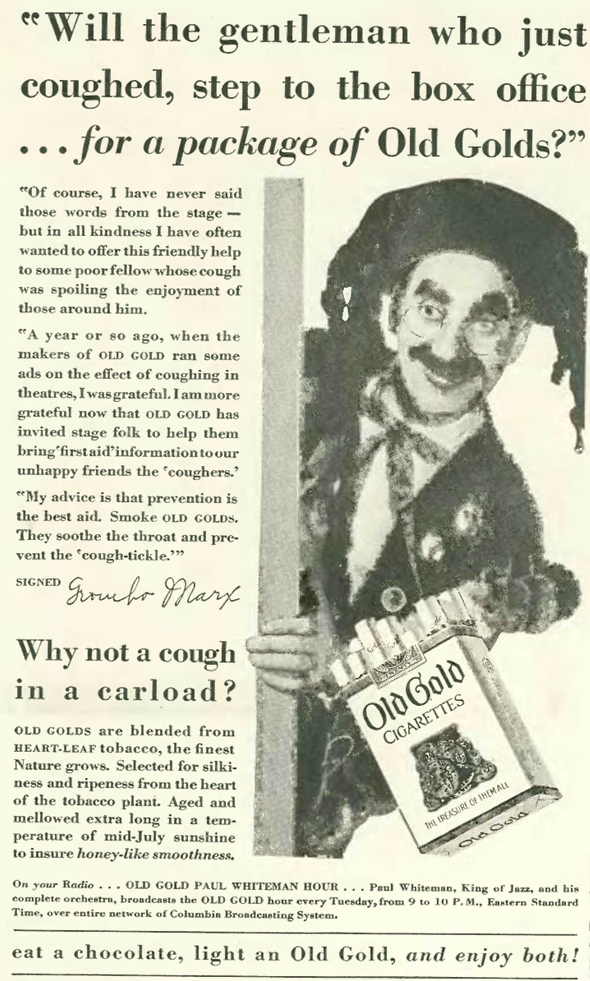
Jumping back to the Feb. 9 “Talk of the Town,” we have this complaint from the magazine regarding celebrity cigarette endorsements. Although the magazine derived a lot of revenue from cigarette ads, Harold Ross insisted on a strict separation between editorial and advertising, allowing his writers free reign to bite the hands that fed them, if they so wished:

Here’s the offending ad, which was featured in the Feb. 23 issue:

In the Feb. 9 issue, Groucho Marx couldn’t resist getting in on the endorsement action…

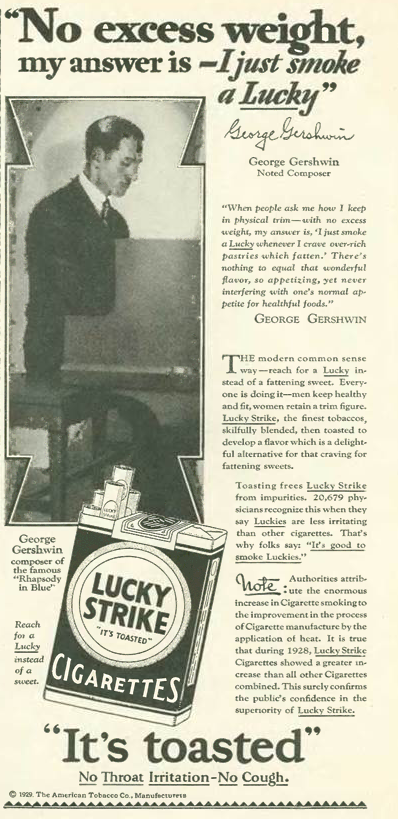
…nor could Ross’s old friend George Gershwin, who touted the health benefits of Lucky Strikes in the Feb. 16 issue…

In other ads from the Feb. 16 issue, we find that for all of the technological advances in the 1920s, a decent car heater still eluded automakers. Hence…

…on the other hand, we also have this very up-to-date product—the forerunner of today’s rolling airplane luggage…

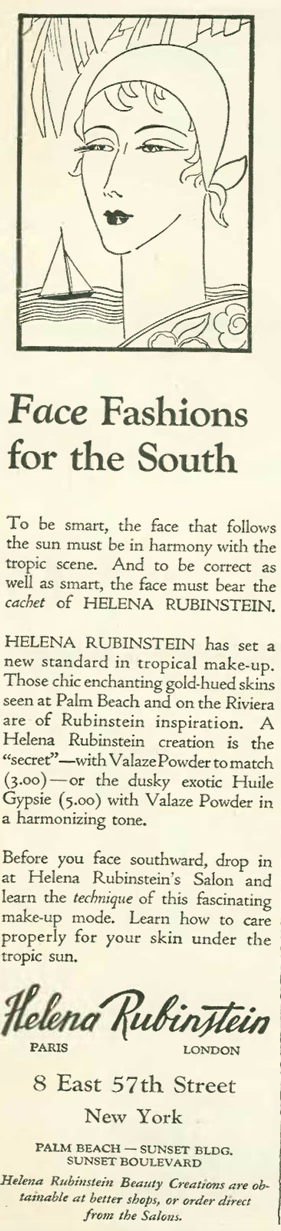
…and if you happened to be flying south, you might have first checked in with Helena Rubinstein to make sure you had the right “face fashions”…

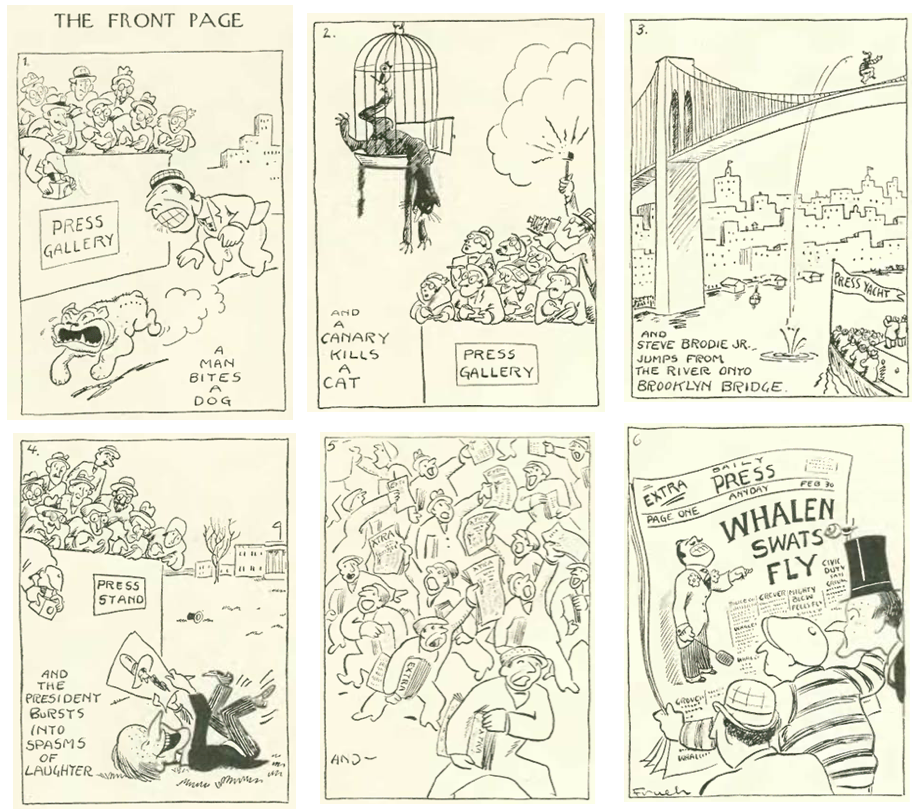
And finally our cartoons, all from the Feb. 9 issue. This first is a six-panel series by Al Frueh that originally ran diagonally, top to bottom, across a two-page spread. It took a shot at the self-promoting police commissioner, Grover Whalen, who was not a friend to the New Yorker due to his ham-fisted approach to Prohibition enforcement…

…and Leonard Dove took a shot at some posh folks outside of their urban element…

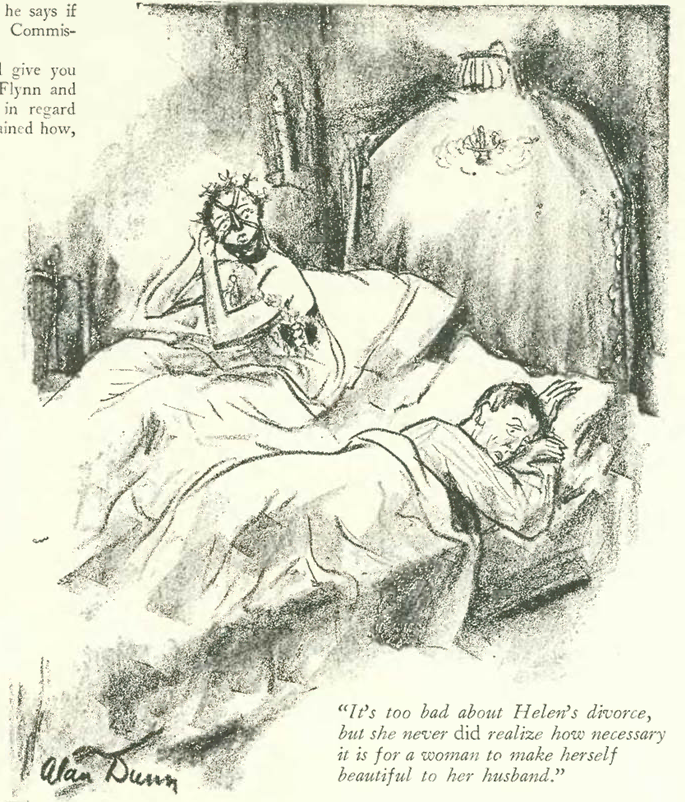
…and finally, Alan Dunn examined the wages of beauty…

Next Time: Modern English Usage…

Out With the Old

Perhaps no decade was more transformative to New York City than the 1920s. From the loosening of social mores to countless technological advances, the city was a very different place as it entered the last year of the Roaring Twenties.

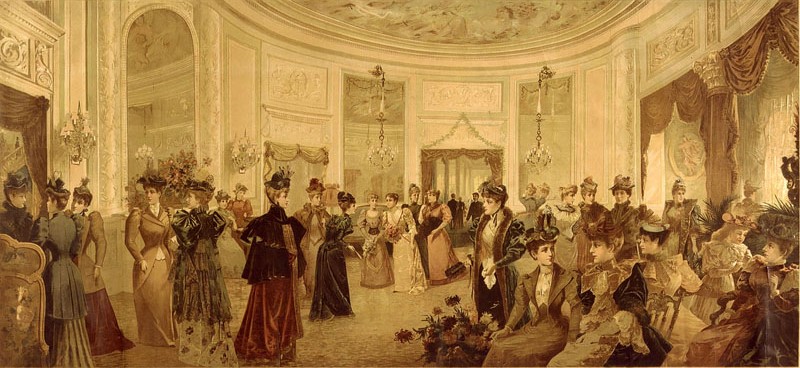
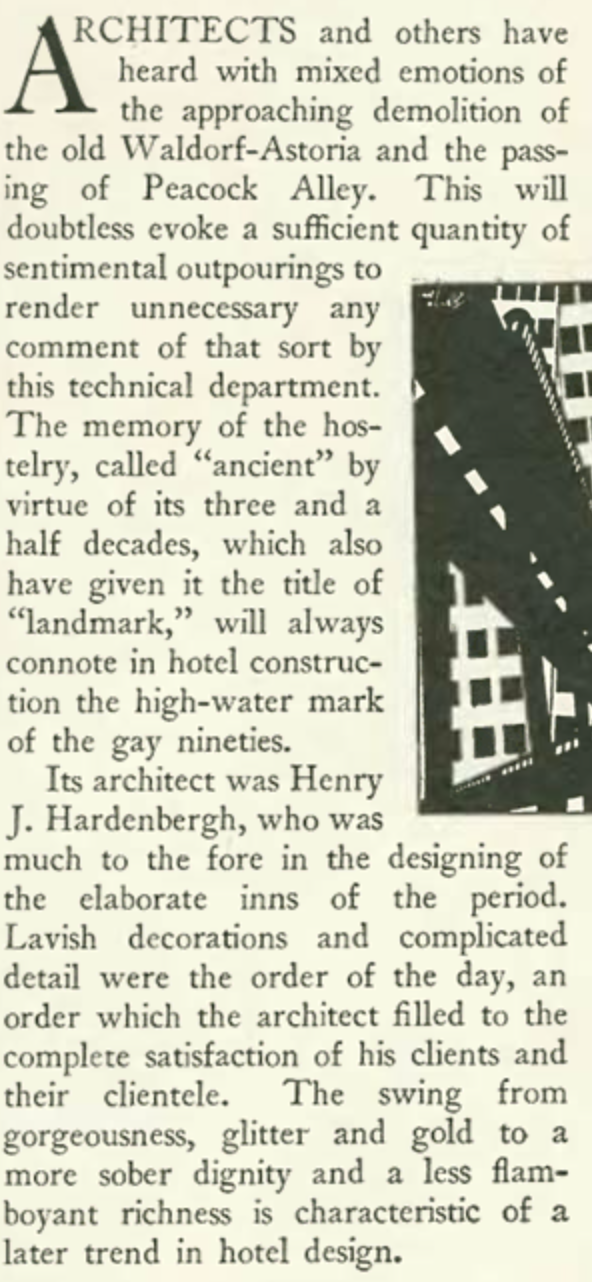
Jan. 5, 1929 cover by Sue Williams. Opening image depicts the original Waldorf Hotel’s Octagon Room in 1893.

Vestiges of the 19th century were quickly erased during the decade as old neighborhoods and stately mansions gave way to massive apartment blocks and towering skyscrapers. Such was the fate of the original Waldorf-Astoria Hotel, its Victorian lavishness out of style in a streamlined age. Writing under the pen name T-Square, New Yorker architecture critic George S. Chappell commented on the planned demolition of the old* Waldorf-Astoria Hotel:

*Although outdated in appearance, the hotel was little more than 30 years old in 1929.

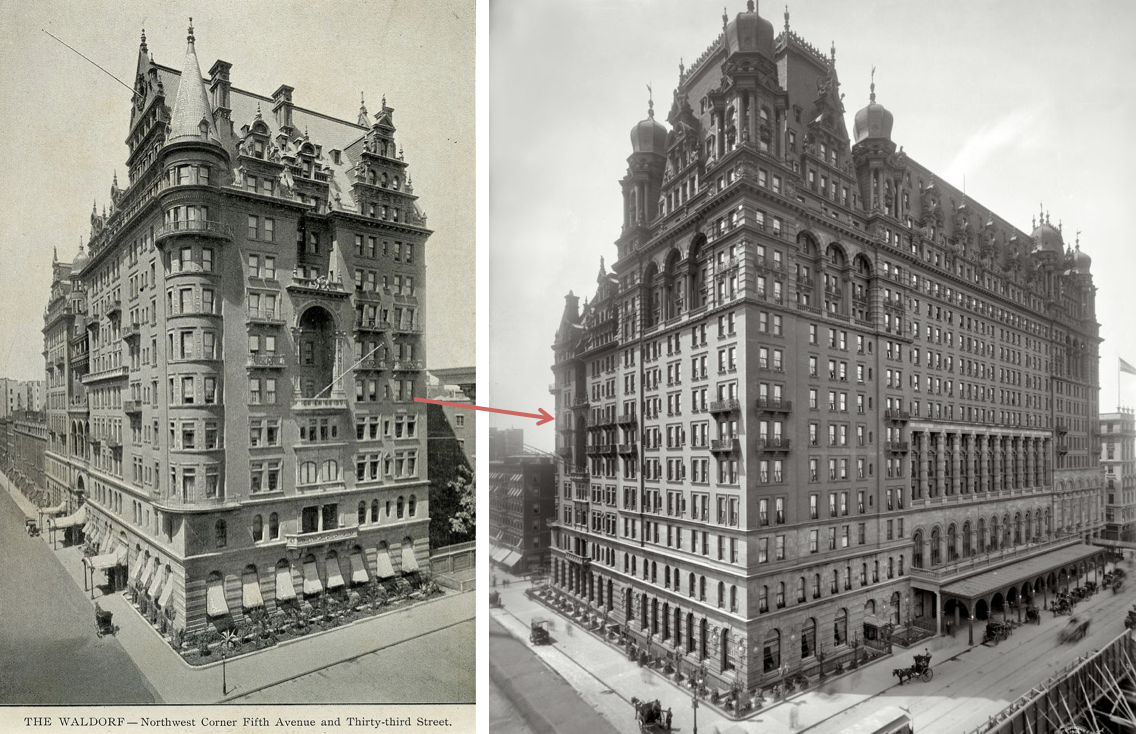
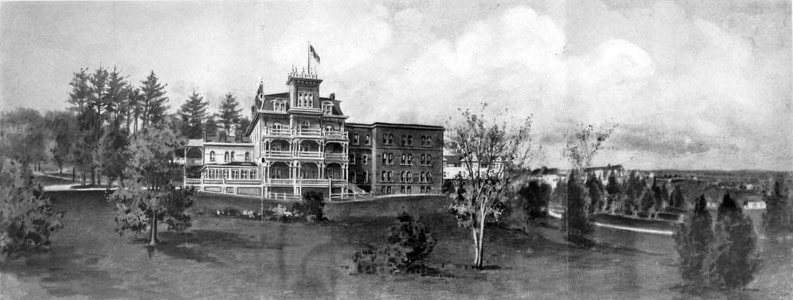
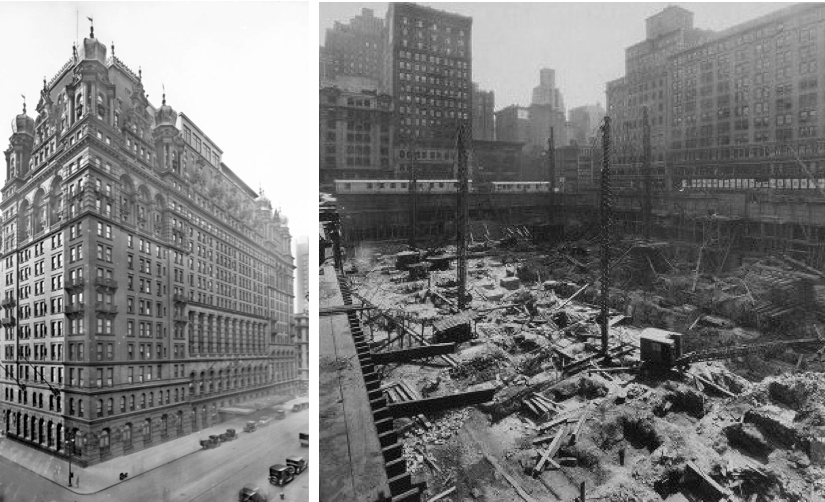
TALE OF TWO HOTELS…The Waldorf-Astoria was actually two hotels joined together. The Waldorf, at left, was built in 1893. The much larger Astoria (right) was constructed in 1897. Note the arrow indicating the original Waldorf in relation to the Astoria. (Wikipedia/Detroit Photography Archive)
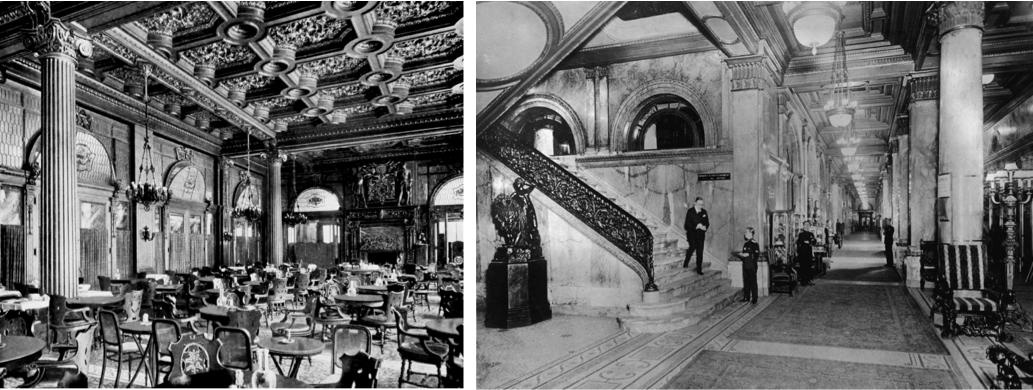
PLACES TO SEE AND BE SEEN…At left, the “Gentleman’s Cafe” in the Waldorf Hotel. At right, lobby entrance to the marble-lined “Peacock Alley” that connected the two hotels. (Wikipedia/justcocktails.com)
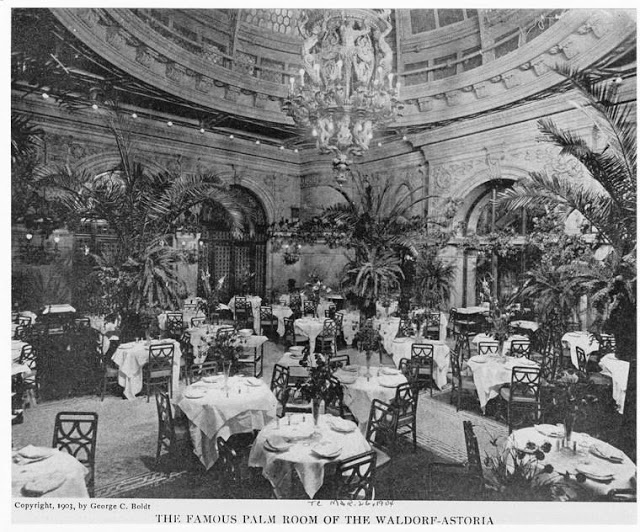
DINE IN STYLE…The Palm Room in the Astoria section of the original Waldorf-Astoria Hotel. (New York Public Library)

Chappell wrote that the prime building site was slated to be occupied by a 50-story office building…

…but as it turned out, Floyd Brown was unable to make the final payments on the property, so he sold his claim to the bank. John J. Raskob, a wealthy finance executive and chair of the National Democratic Committee, joined with entrepreneur Pierre du Pont and former New York Governor Al Smith (who lost his bid for the U.S. Presidency in 1928) to buy the property. They had much bigger plans than Floyd Brown: In August 1929 they announced their plan to build the tallest building in the world — what would become the Empire State Building.

TRY, TRY AGAIN…The architecture firm Shreve & Lamb developed this concept (left) for Floyd Brown’s proposed 50-story office building on the site of the old Waldorf-Astoria. At right, what occupies the site today: the Empire State Building, also designed by Shreve & Lamb. (Pinterest/oldstructures.com)

 * * *

Car Culture

The Jan. 5 issue featured a lengthy review of the 29th Annual National Automobile Show at Grand Central Palace, as well as numerous advertisements by auto manufacturers hoping to entice New Yorker readers with their latest models.

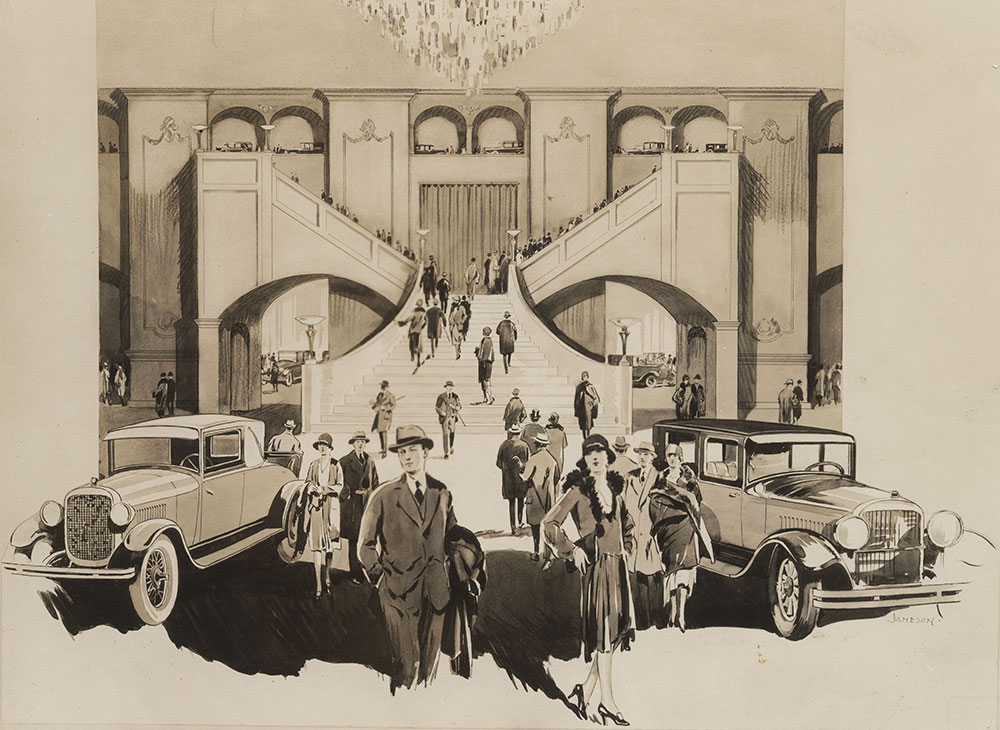
Promoters of the event touted the addition of a grand staircase to Grand Central’s mezzanine level that would ease access to both levels of the show:

AIN’T IT GRAND?…Design drawing created for the 1929 National Automobile Show at Grand Central Palace touting the addition of an equally grand new staircase. (Free Library of Philadelphia)
How the new staircase actually appeared at the 1929 show. Note the background where the movement of workmen on ladders lends a ghostly appearance. (Free Library of Philadelphia)
A view of the 1929 National Automobile Show from the mezzanine of the Grand Central Palace. (Free Library of Philadelphia)

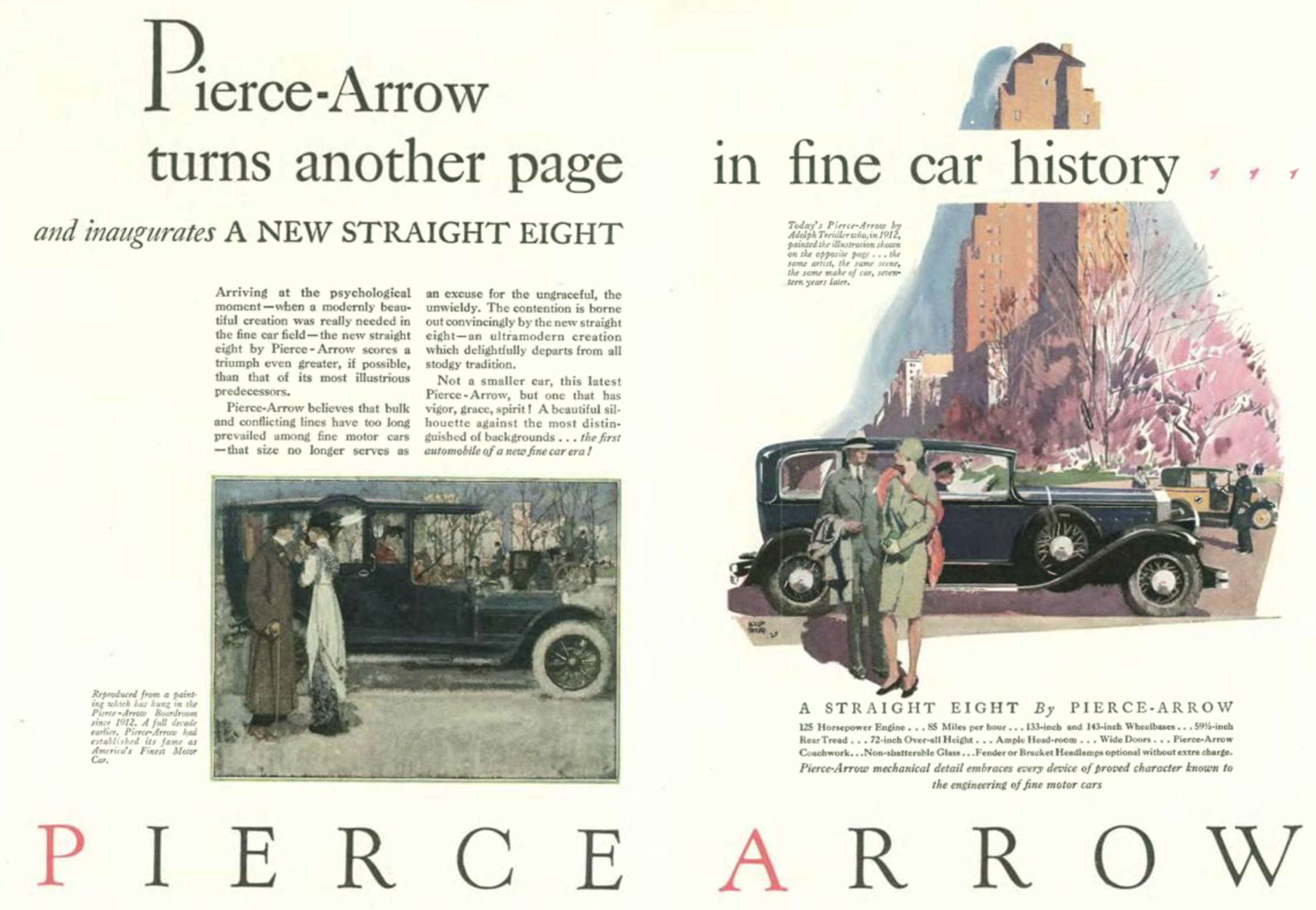
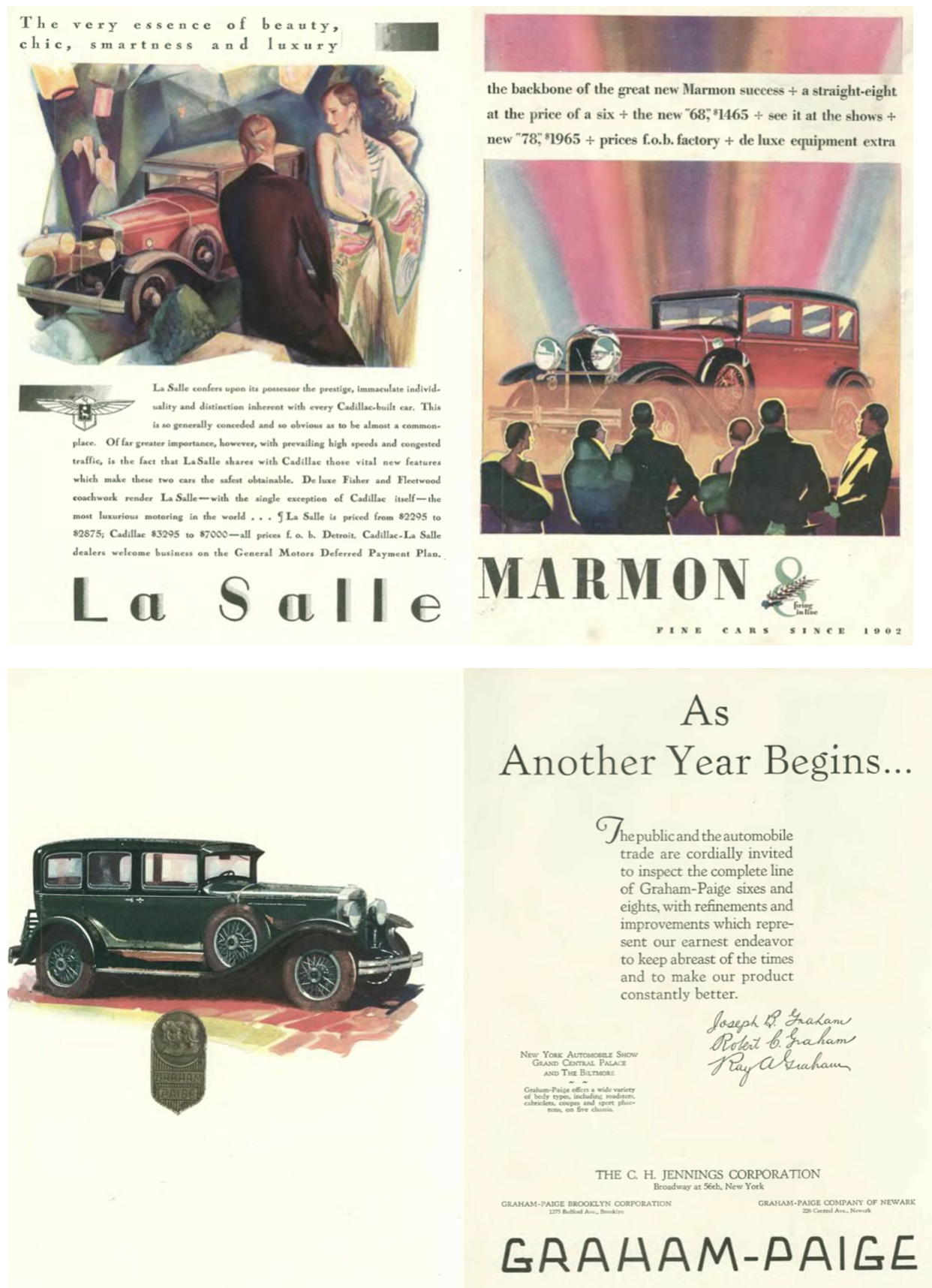
As I mentioned, the Jan. 5 issue was filled with car ads, mostly from long-gone automobile manufacturers. A constant in all of these ads is their appeal to New  York’s chic, smart set. Here’s a sampling of a few of them: (click ads to enlarge):

Hupmobile was a successful car company that began its decline in the late 1920s  precisely because it turned its back on buyers of medium-priced cars and went after what it perceived to be the more lucrative luxury buyer (see ad above). Hupmobile went out of business in 1939 (after briefly joining forces with Graham-Paige, which also went under that year).

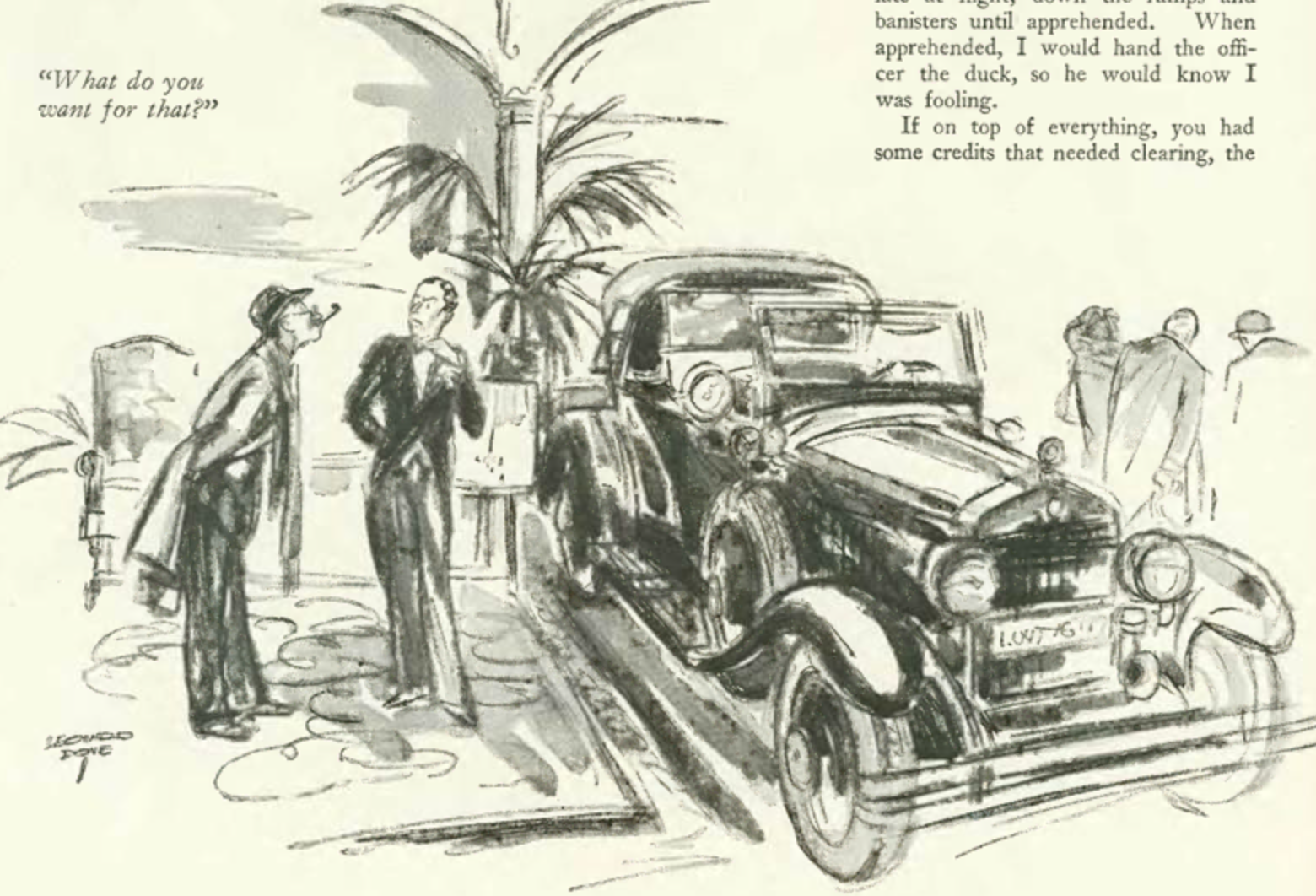
Cartoonist Leonard Dove found humor derived from these very class distinctions when he visited the auto show:

 * * *

The Game, Served Up Cold

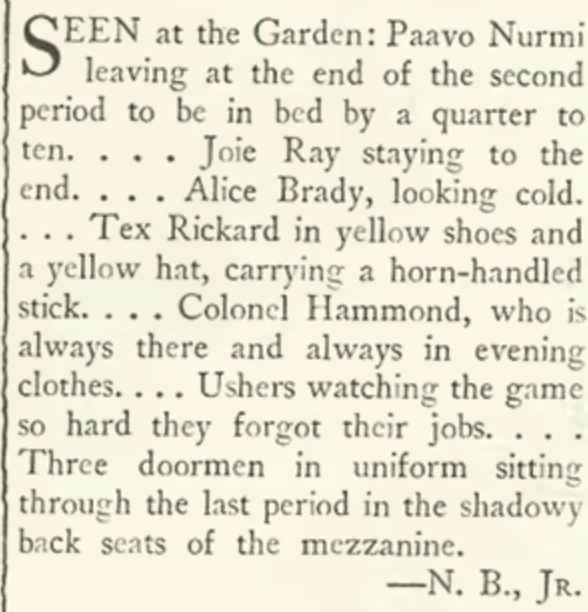
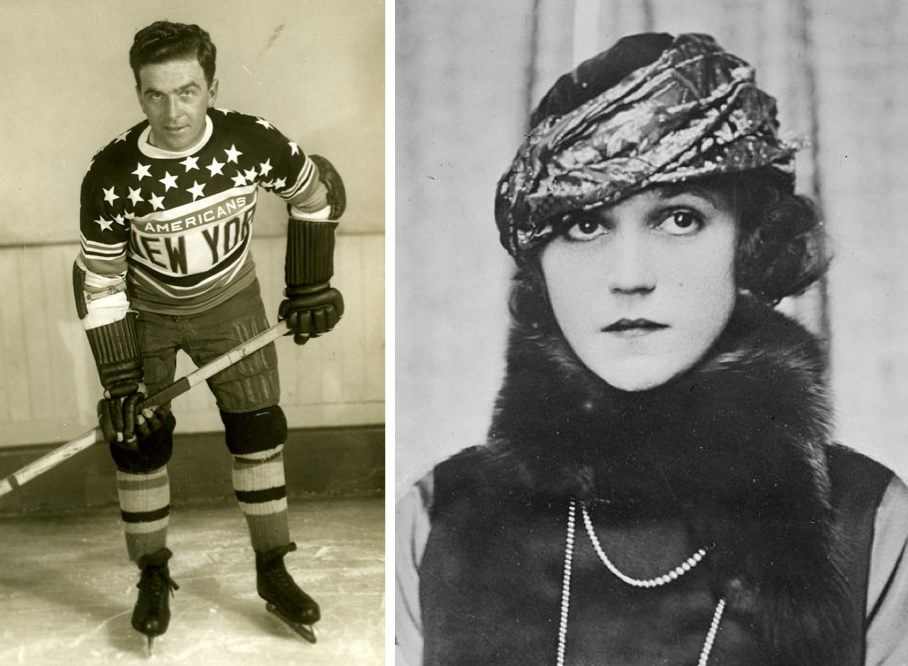
In other diversions from the Jan. 5 issue, Niven Busch Jr. attended the hockey game between the New York Rangers and the New York Americans at Madison Square Garden, noting famous faces in the crowd including Finnish track star Paavo Nurmi and American track star Joie Ray. Also noted were Tex Rickard, builder of Madison Square and founder of the Rangers, ex-football star and businessman Col. Harry Hammond, and film star Alice Brady.

AT THE GARDEN…Not even the exciting hockey play of Billy Boyd (left) and his fellow New York Americans could keep actress Alice Brady warm. (Pinterest/Alchetron)

 * * *

From our non-automobile advertisers, another installment of a Theodore Geisel (Dr. Seuss) ad for Flit insecticide (this is the first instance — at least in the Flit ads— in which Geisel signs his art as “Dr. S” instead of “Seuss”).

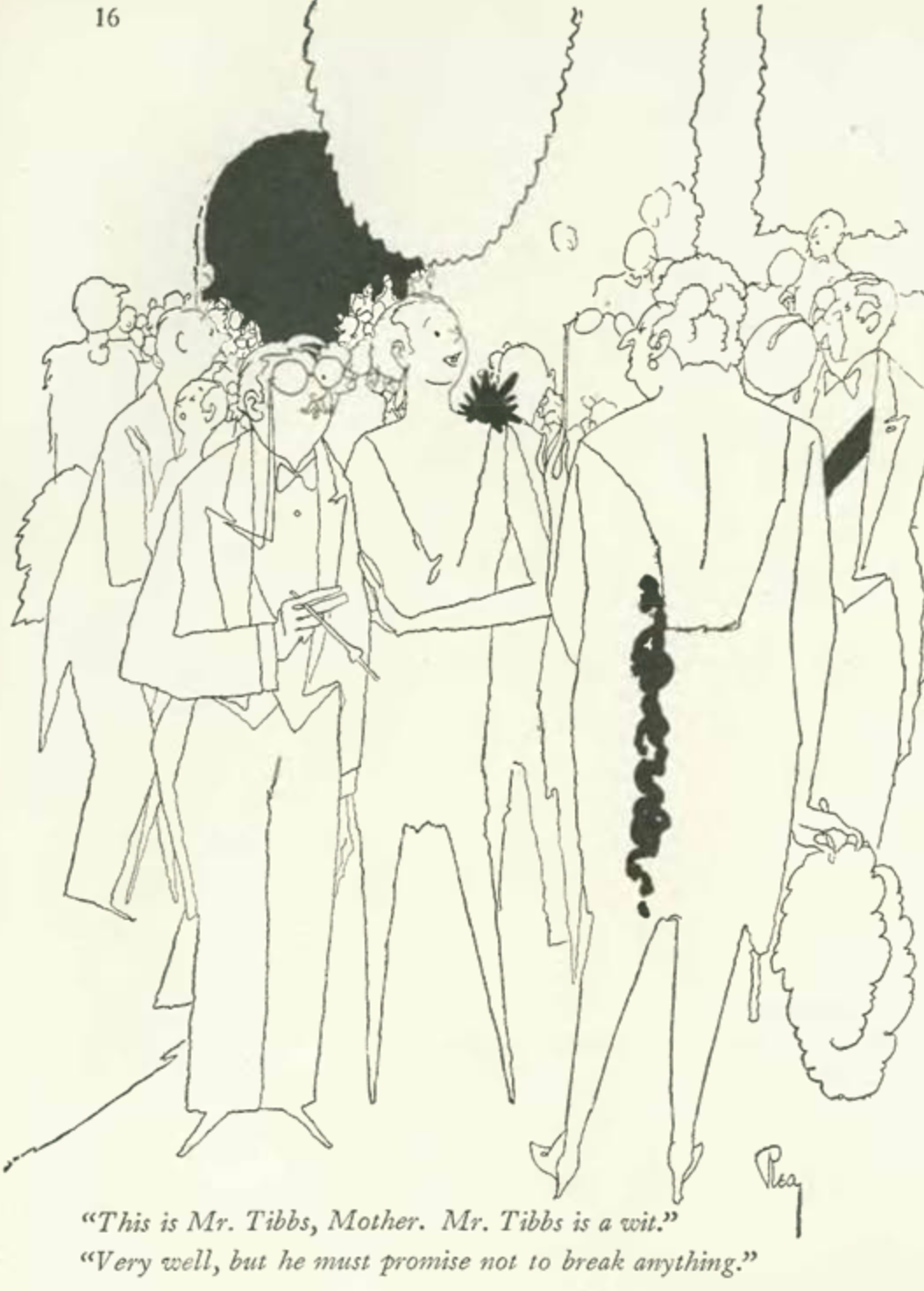
And another cartoon from the Jan. 5 issue, courtesy Gardner Rea:

 * * *

Arno Addendum

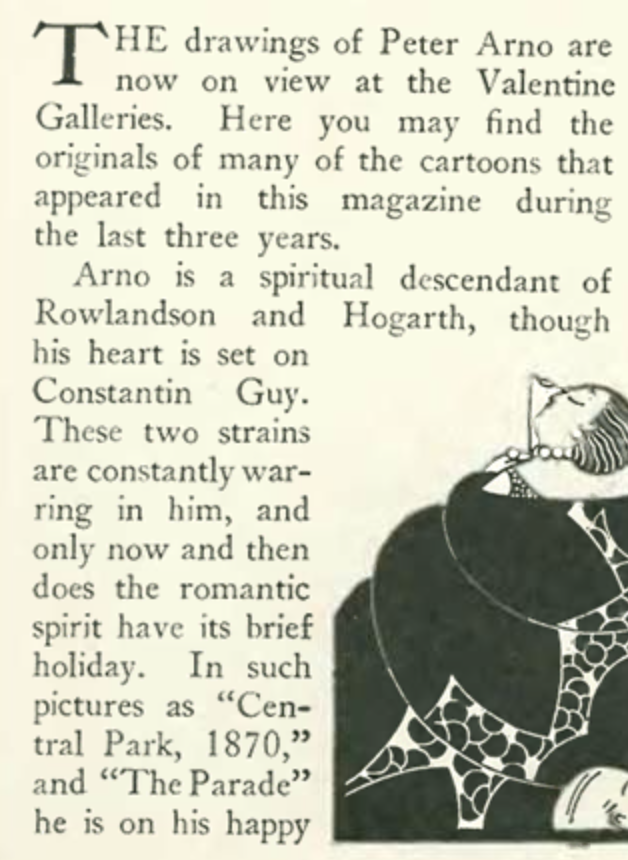
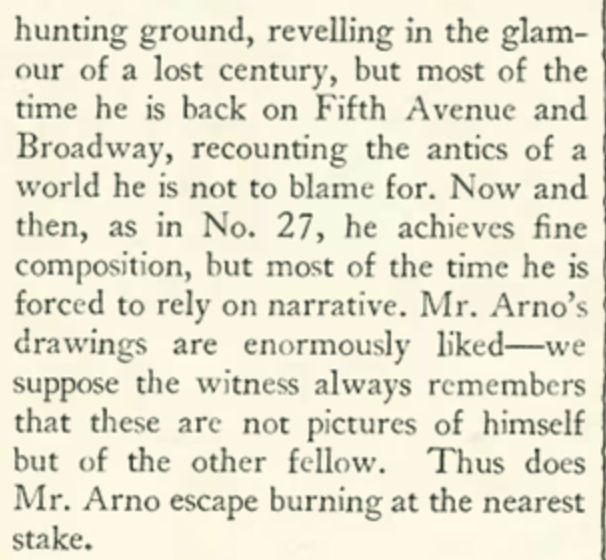
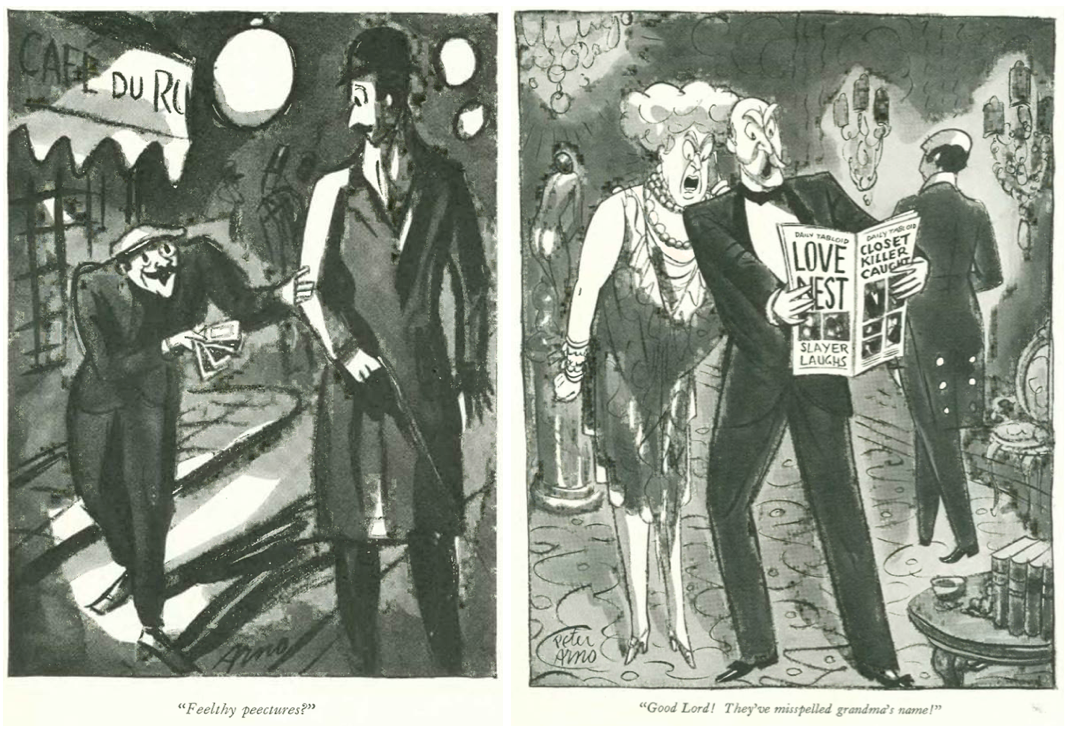
In the rush of the recent holidays I missed an item from the Dec. 22, 1928 issue — namely, art critic Murdock Pemberton’s tongue cheek review (in “The Art Galleries” column) of cartoonist Peter Arno’s December 1928 exhibition of drawings at the Valentine Gallery:

Here are two Arno drawings that were featured in the Valentine exhibition (click to enlarge):

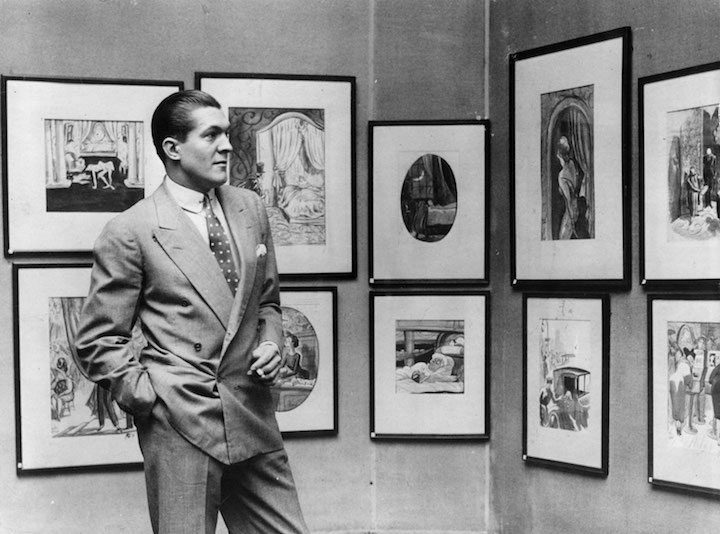
INTERNATIONAL APPEAL…less than four years after his Valentine Galleries debut, Peter Arno exhibited his drawings to great acclaim at the Leicester Galleries in London, October 1932. (Encyclopædia Britannica)

Next Time: Midnight Frolic…

Lighter Than Air

Just a decade after German Zeppelins sowed terror across the skies of Europe and Great Britain, Germany’s new Graf Zeppelin was enthusiastically welcomed by a throng gathered at Lakehurst, New Jersey, the massive airship having completed its first intercontinental trip across the Atlantic.

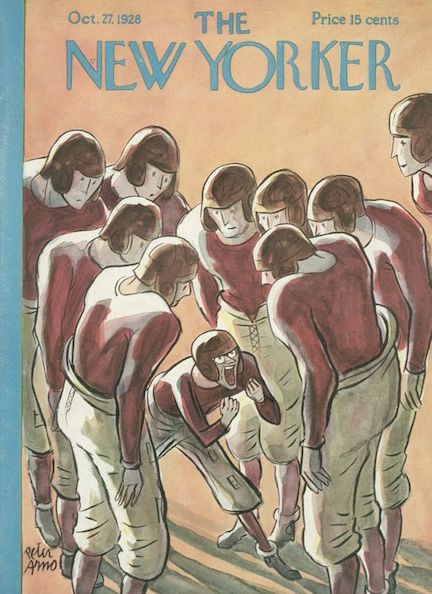
Oct. 27, 1928 cover by Peter Arno.

It had been only ten years and two months since German Zeppelins dropped their last bombs on the British, which had dubbed the airships “baby killers” for the mostly civilian casualties they inflicted. Beginning in 1915, Zeppelin raids on London killed nearly 700 and seriously injured almost 2,000 over the course of more than 50 attacks. It must have been a terrifying sight, something straight out of science fiction — flying ships more than the length of two football fields, blotting out the stars as they loomed overhead. Their size, however, was also their downfall, as Britain soon developed air defenses (searchlights, antiaircraft guns, and fighter planes) that shot many of these hydrogen gasbags out of the sky (77 of Germany’s 115 airships were either shot down or disabled).

TERROR IN THE SKIES…Image from a German postcard celebrating the bombing of Warsaw by the Zeppelin Schütte Lanz in 1914. Here’s a weird fact: There was a shortage of sausages in Germany during WWI, since cow intestines normally used for casings were instead used to create special bags to hold the hydrogen gas that kept Zeppelins aloft. It took more than 250,000 cows to make one airship. (Wikipedia)

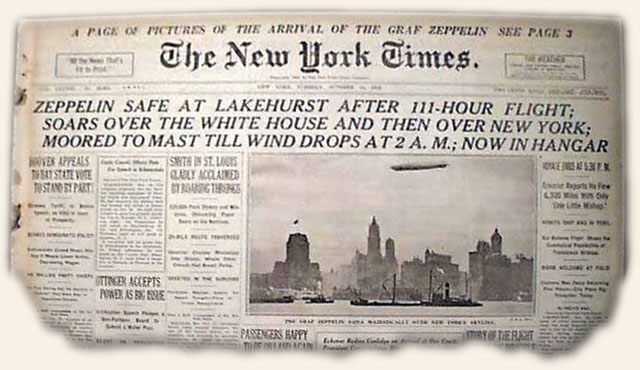
So when the 776-foot Graf Zeppelin loomed over the New York City skyline on Oct. 15, 1928, the reaction was one of awe rather than terror. The New York Times heralded its safe arrival on the front page…

(rarenewspaper.com)
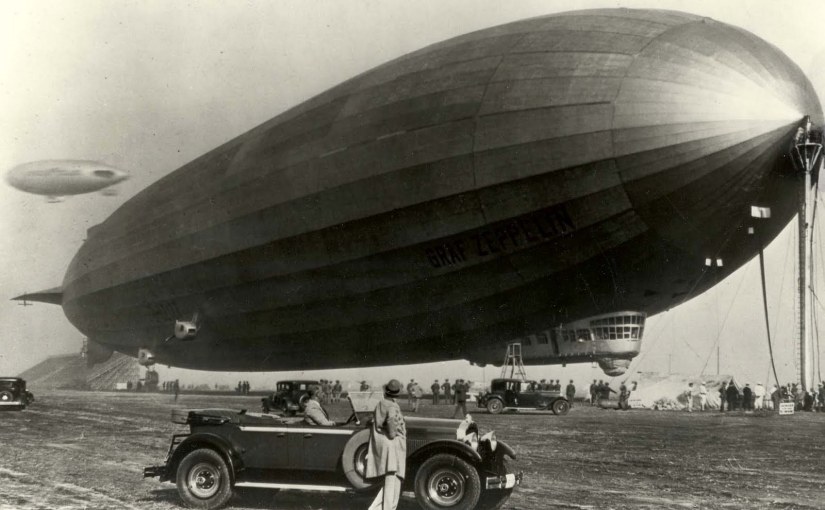
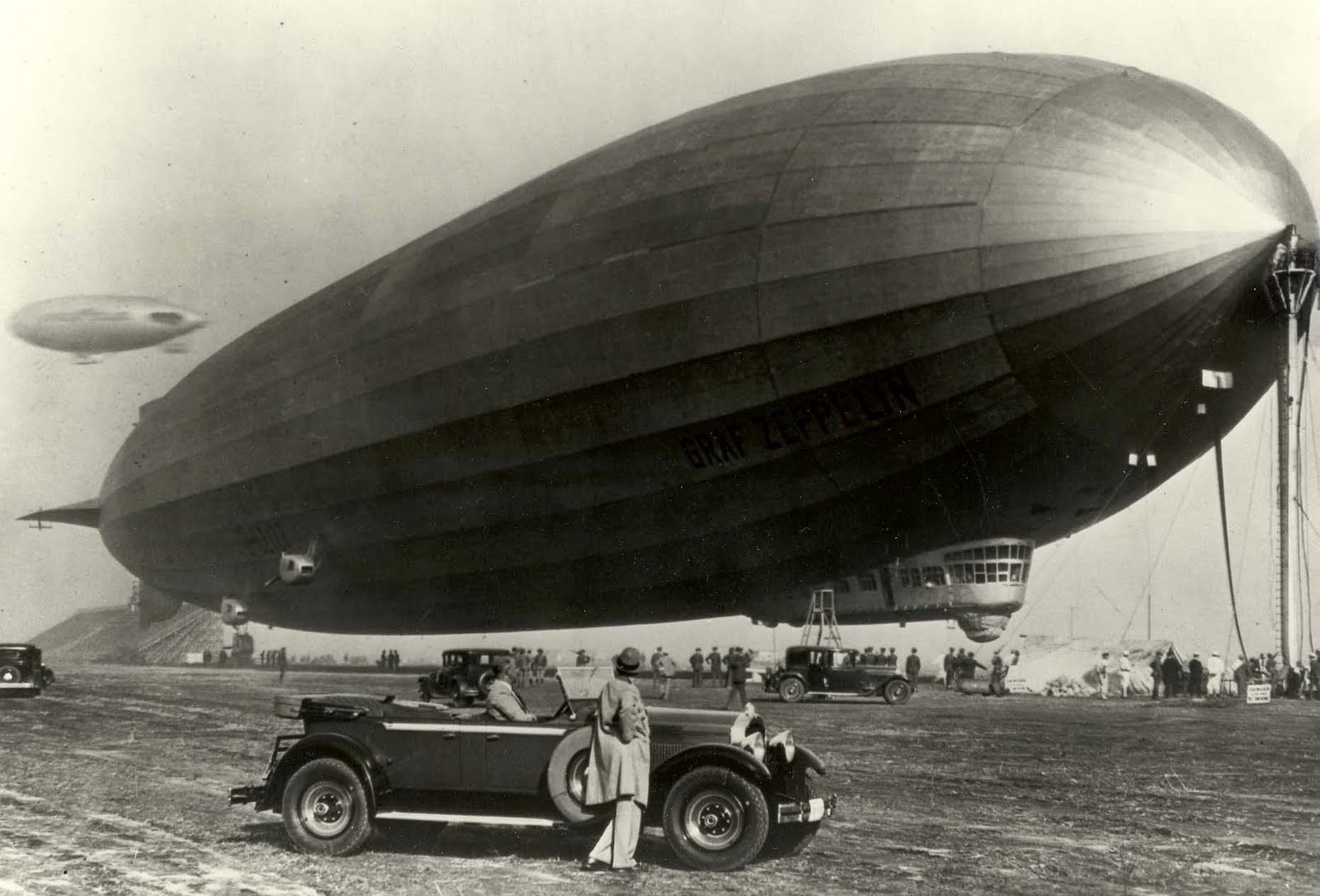
The Graf Zeppelin at Lakehurst, N.J., 1929. (rarehistoricalphotos.com)

…and The New Yorker’s James Thurber (writing in “The Talk of the Town”) was on hand to assess the welcoming crowds gathered at Lakehurst, N.J….

…who in their enthusiasm could have easily destroyed the vessel, which had already sustained damage during a storm over Bermuda…

OLD GAS BAG…The Graf Zeppelin arriving at Mines Field (now Los Angeles International Airport) on August 26, 1929. Newspaper magnate William Randolph Hearst sent the Graf Zeppelin dirigible on a 20-day flight that circumnavigated the world in 1929. (martinturnbull.com)
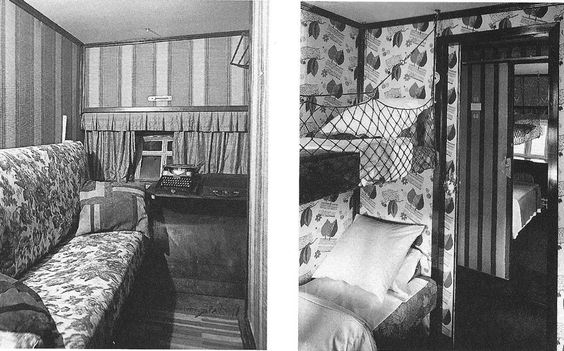
Living quarters of the Graf Zeppelin. Cozy, if you could forget that your room was contained within an envelope of highly explosive hydrogen gas. (airships.net)

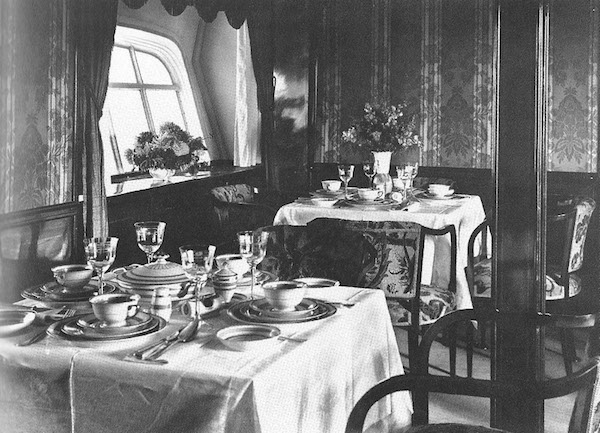
Dining aboard the Graf Zeppelin. (Top, airshipsonline.com, bottom, airships.net)

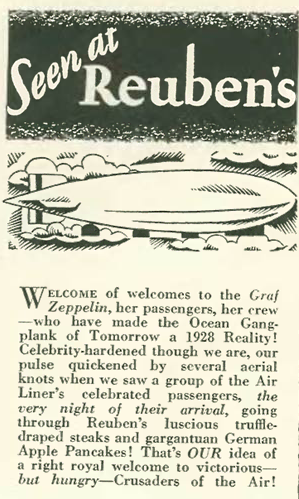
Reuben’s restaurant in New York seized the opportunity to cash in on the spectacle, boasting (in this hastily placed ad in the Oct. 27 issue) that the Graf Zeppelin’s passengers dined at their establishment on the very night of their arrival…

A final note: Considering the hazards of flying these ungainly, flammable machines (e.g. the Hindenburg in 1937) Graf Zeppelin flew more than one million miles in its career (the first aircraft in history to do so), making 590 flights (144 of them oceanic crossings, including one across the Pacific), and carrying more than 13,000 passengers — all without injury to passengers or crew.

 *  *  *

Rough Riders

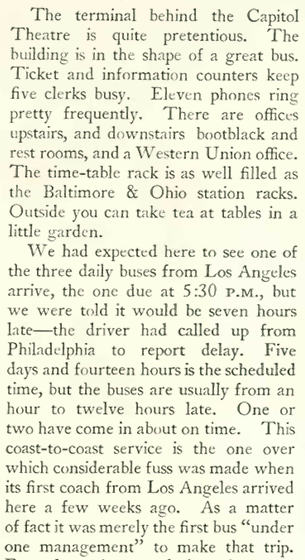
Back on the ground, “The Talk of the Town” looked in on a somewhat less exotic form of long-distance travel — the recently inaugurated coast-to-coast bus service from New York to Los Angeles:

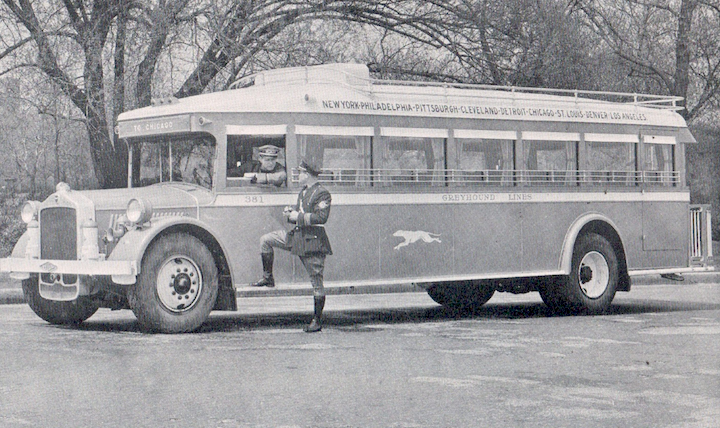
LONG HAUL…This Greyhound bus from 1929 was probably similar to those leaving the New York bus stations for points west in 1928. (flickr)

 *  *  *

From Our Advertisers

On the subject of rolling transportation, Buick trumpeted the introduction of “adjustable front seats” in its silver anniversary model. Curiously, this improvement was touted as a convenience solely for women drivers…

Our cartoon (a two-pager) for Oct. 27 comes from Gardner Rea, the latest among The New Yorker’s staff to mock the quality of sound motion pictures. The cartoon is labeled at the bottom: “The Firtht One Hundred Per Thent Thound Movie Breakth All Houth Recordth.” (click image to enlarge)

 *  *  *

If you wanted to get a glimpse of New York’s “royalty” in 1928, you could secure a seat at the Metropolitan Opera, especially one with a view of its famed “Diamond Horseshoe” seats.

November 3, 1928 cover by Julian de Miskey.

The “Diamond Horseshoe” described a ring of seats at the Metropolitan Opera House occupied by New York’s social elite. Not unlike today’s stadium skyboxes, the Met reserved these boxes for purchase by the wealthy. “The Talk of Town” for Nov. 3, 1928 noted how many of these were still held by the same families that had secured spots after the Met opened in 1883:

CULTURAL LANDMARK…The Metropolitan Opera House at Broadway and 39th Street circa 1905. (Wikipedia)
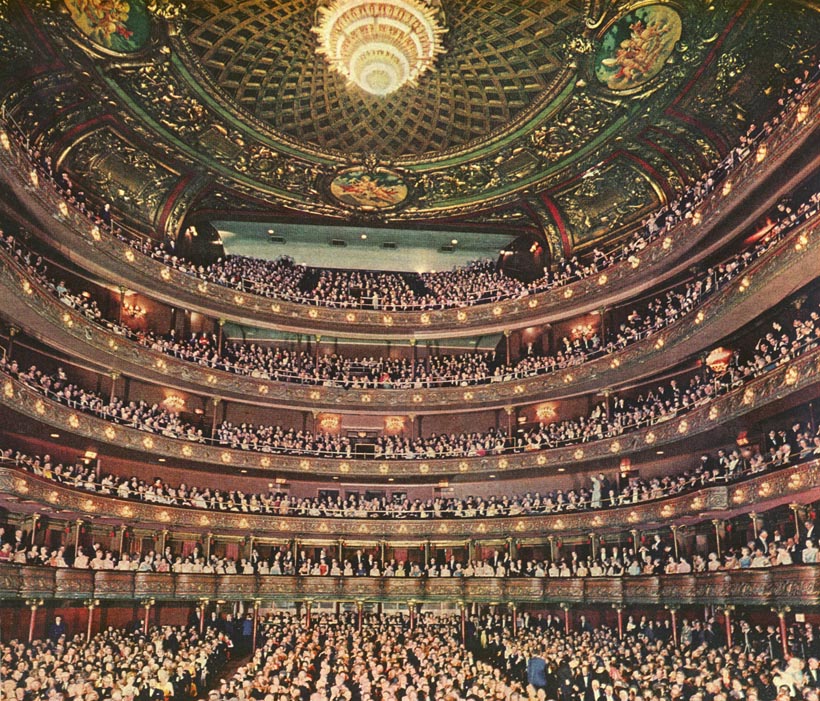
SEE AND BE SEEN…The Diamond Horseshoe at the Metropolitan Opera House, as seen from the rear of the stage for a concert by pianist Josef Hofmann, November 28, 1937. (newyorksocialdiary.com)

“Talk” also noted that some of the boxes in the Diamond Horseshoe were coming into new ownerships among the newly rich (E.F. Hutton) and even (gasp) immigrants such as Otto Kahn:

DUST TO DUST…Above, a view of the “Diamond Horseshoe” at the Metropolitan Opera’s gala farewell performance on April 16, 1966. Below, patrons say goodbye to the old house at Broadway at the farewell performance. The building was torn down in 1967 and replaced by a 40-story office tower. (Time/Life)

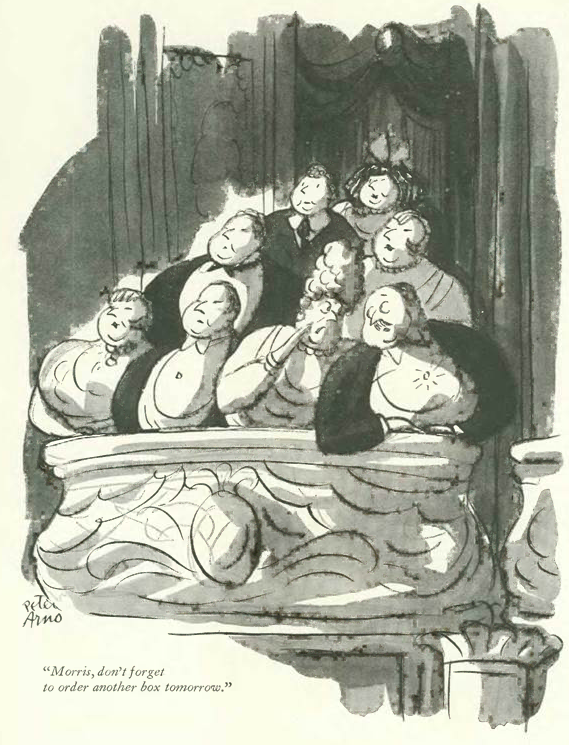
Also in the Nov. 3 issue was this cartoon by Peter Arno depicting one of the Met’s boxes stuffed with overfed toffs:

 *  *  *

Poet With a Green Thumb

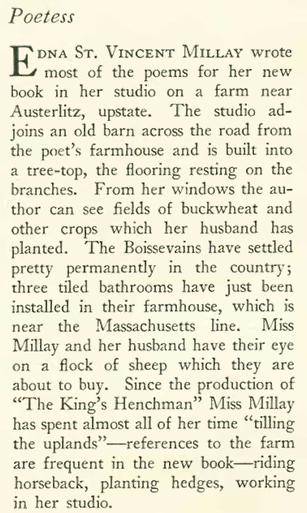
The Nov. 3 “Talk” also featured a bit by James Thurber on American poet and playwright Edna St. Vincent Millay, a major figure in New York’s Greenwich Village literary scene as well as a feminist leader. A Pulitzer-Prize winner (1923), Millay was also an avid gardener who preferred the solitude of her farm, Steepletop, to the limelight usually accorded a literary star:

RARE PHOTOGRAPH…Edna St. Vincent Millay raised her own vegetables at Steepletop, a former blueberry farm located near Austerlitz, New York that she owned with her husband Eugen Jan Boissevain. Photo is circa 1928. (Library of Congress)

Thurber noted that even her publisher, Harper & Sons, had to use an old photo of the publicity-shy poet for a new book release:

On the topic of photography, “Profiles” (written by film historian Terry Ramsaye) looked in on the quiet life of photography pioneer George Eastman, who founded the Eastman Kodak Company and popularized the use of roll film.

A quintessential “mamma’s boy,” Eastman never married…

…and by all accounts died a celibate less than four years after this profile was written, taking his own life at age 77. Suffering from intense pain caused by a spinal disorder, Eastman shot himself in the heart on March 14, 1932, leaving a note which simply read, “To my friends: my work is done. Why wait?”

Odds and Ends

Other items of note from the Nov. 3 issue included a humorous piece by Rube Goldberg, “The Red Light District,” in which the president of the Blink Stop-Go Traffic Company summons a doctor to treat a strange malady. The doctor gets held up by traffic lights on the way to the “emergency,” and when he discovers the problem is only hives, he shoots the patient. The piece was headlined by this artwork, also by Goldberg (shades of George Herriman and R. Crumb, yes?)…

Goldberg is still known today thanks to his series of cartoons depicting deliberately complex contraptions invented to perform simple tasks, such as the “Self-Operating Napkin” below, from 1931:

1931 (Wikipedia)

Cartooning’s highest honor, The Reuben Award, was named after Goldberg, who was a longtime honorary president of the National Cartoonists Society.

 *  *  *

The Roaring 20s saw a rapid transformation of the New York skyline, with massive skyscrapers rising from the dust of old 18th and 19th century institutions. But few would signal the new age more than the Chrysler Building, an Art Deco landmark that would stand as the world’s tallest building for nearly a year (knocked from the top spot in May 1931 by the Empire State Building). Architecture critic George S. Chappell (“T-Square”) had this observation about the planned building:

EVOLUTION OF AN ICON…Stages in the design for the Chrysler building, from the July-December 1929 issue of Progressive Architecture.

*  *  *

More from our advertisers…in the Nov. 3 issue Hawaii beckoned well-heeled New Yorkers who were contemplating the coming winter…

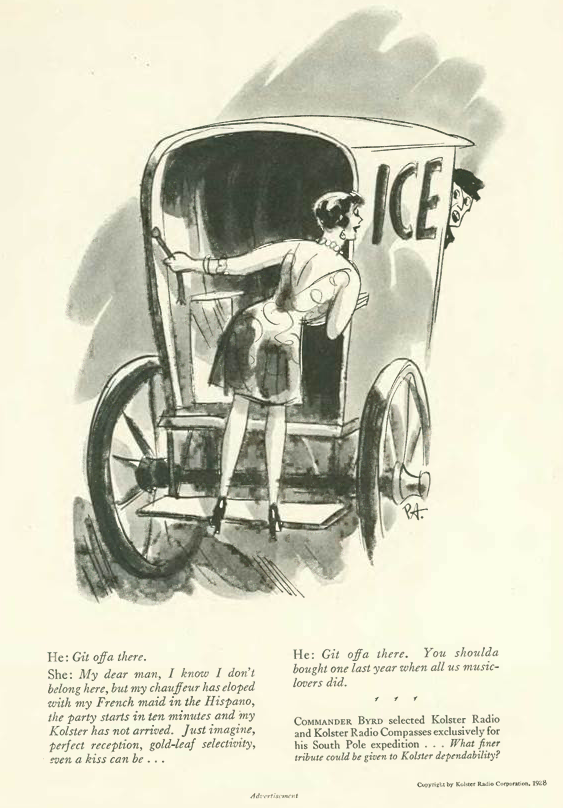
…and then there was this poorly executed ad for Kolster radios, the whole point seeming to be the drawing they commissioned from New Yorker cartoonist Peter Arno:

And finally, a cartoon by Alan Dunn, who looked in on an Ivy League football huddle:

Next Time: Diamond Lil…


A Bird’s Eye View

The New Yorker’s E.B. White was an aviation enthusiast who rhapsodized about his flights into the clouds, but also had prescience to see the darker side of this modern thrill ride.

October 6, 1928 cover by Ilonka Karasz.

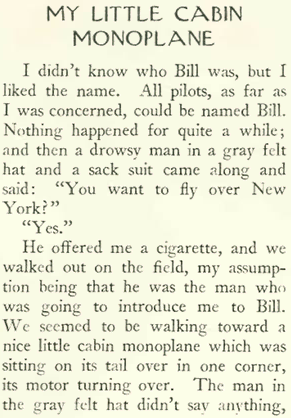
Writing in the “Reporter at Large” column for the Oct. 6, 1928 issue, White described his visit to Curtiss Field, where he inquired about a pilot who could fly him over New York City. He was told someone named Bill would take him up.

EARLY BIRD…This Fairchild FC-2 Cabin Monoplane, with strut-supported wing, was probably similar to the plane E.B. White rode in his flight over New York City. (Quora)

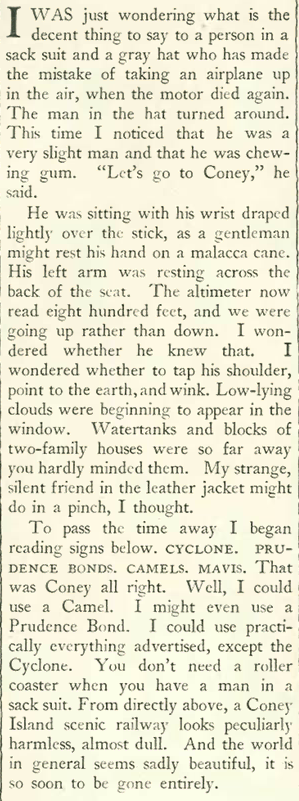
After a half hour wait, a man in a gray felt hat and sack suit offered White a cigarette and said, “You want to fly over New York?” Although the man didn’t look like a pilot, White followed him to a “little cabin monoplane.” Without saying another word the man took the plane up into the air, much to White’s surprise:

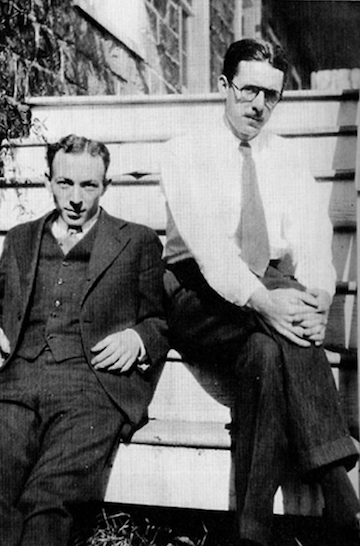
FLYBOY…E.B. White (left) with friend and New Yorker colleague James Thurber in 1929. (University of Virginia)

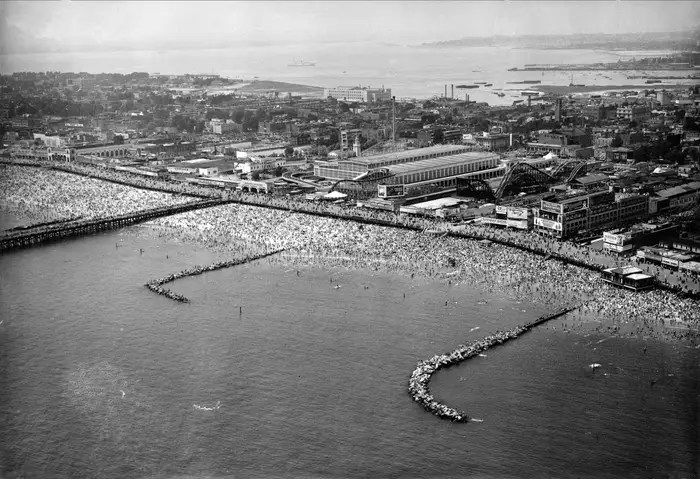
White described the various sites from 800 feet up, including Coney Island, a view at once beautiful and foreboding…

Aerial view of Coney Island, 1937. (AP/lunaparknyc.com)

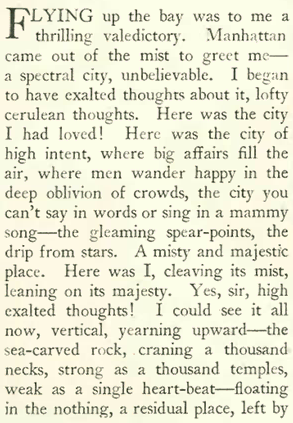
…and the thrill of the approaching city skyline as his plane soared up the Bay toward Manhattan:

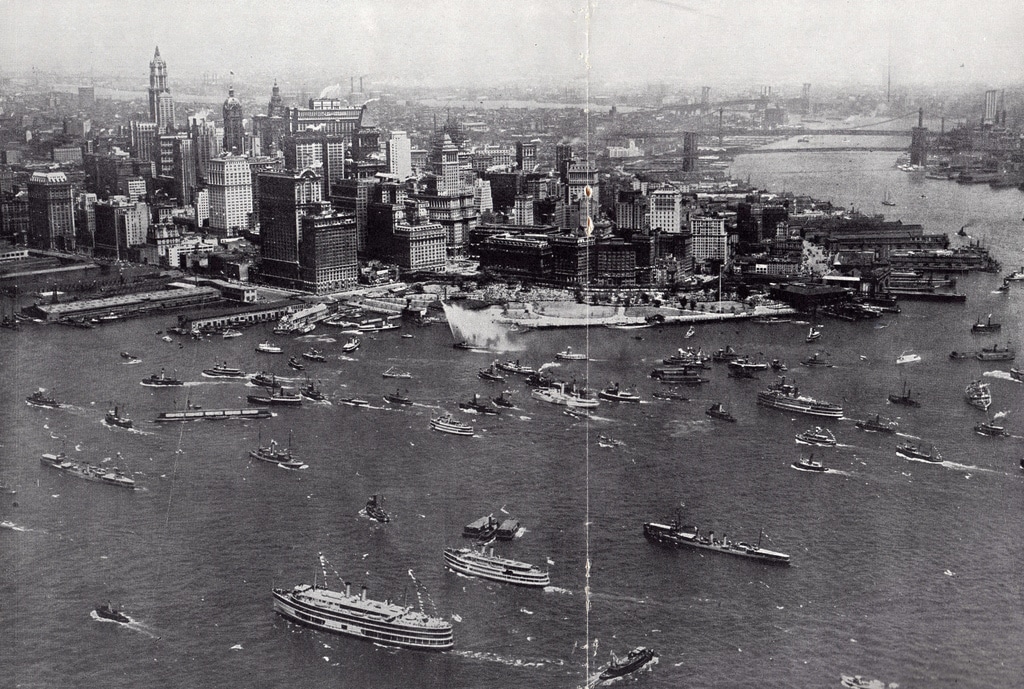
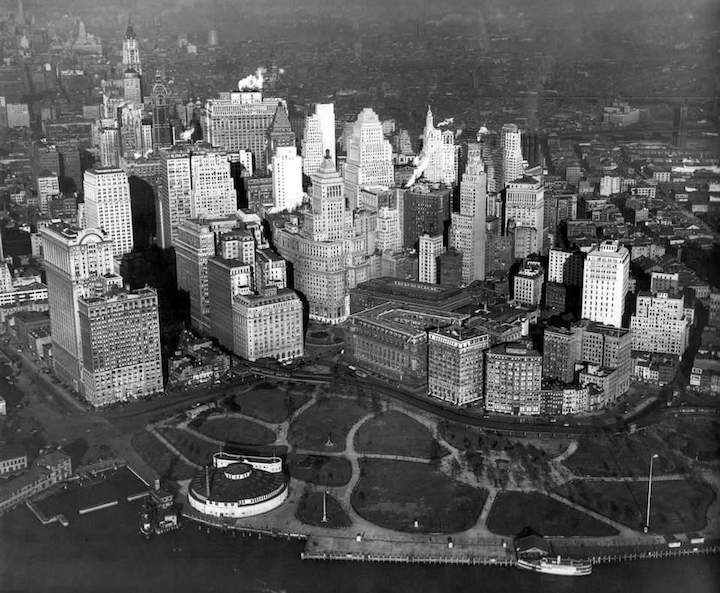
Lower Manhattan looking northeast from the Bay in July 1927. This is approximately the view described by E.B. White as his plane approached Manhattan. (Favrify.com)
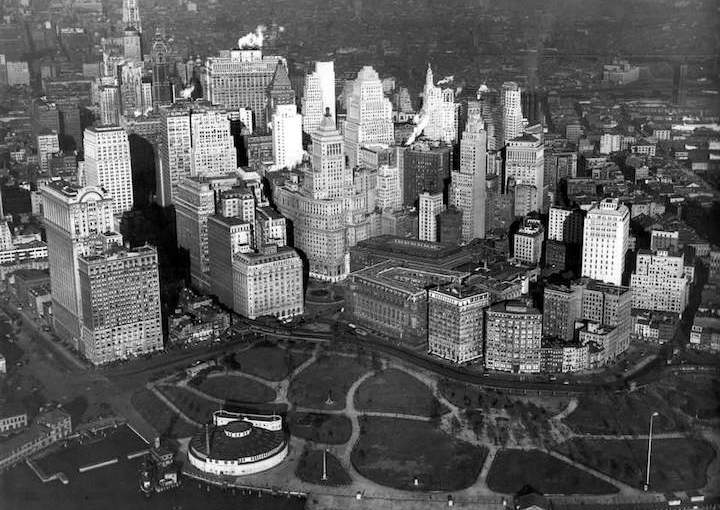
A closer view of lower Manhattan as it would have appeared to E.B. White on his 1928 flight over New York City. (Fairchild Aerial Survey photo, 1928)

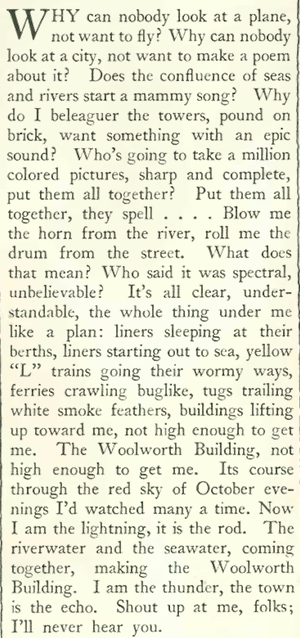
Once over the city, White could not help but contain his exuberance, soaring high above the towering spires and teeming crowds below:

And yet as I noted earlier, his observations were tinged with melancholy and foreboding. In describing his flight over Coney Island, for example, White concluded that “the world in general seems sadly beautiful, it is so soon to be gone entirely.”

Perhaps he referred to the rapid changes seen daily in the city during the 1920s, when nothing seemed permanent. Or did this bird’s eye view suggest something else to White? Twenty years later, in his 1948 essay “Here is New York,” White would write:

A single flight of planes no bigger than a wedge of geese can quickly end this island fantasy, burn the towers, crumble the bridges, turn the underground passages into lethal chambers. The intimation of mortality is part of New York now: in the sound of jets overhead, in the black headlines of the latest edition.

Unlike 1928, White had the hindsight of World War II, of entire cities leveled by waves of heavy bombers, or in the case of Hiroshima and Nagasaki, just a single bomb. The foreshadowing of 9/11 is contained in his words as well.

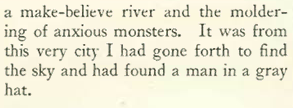
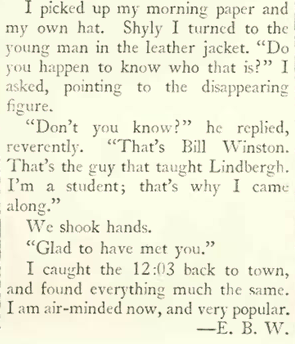
Back on the ground at Curtiss Field, White would finally learn the identity of the man who didn’t look like a pilot, but had just flown him over the city:

Another Vantage Point

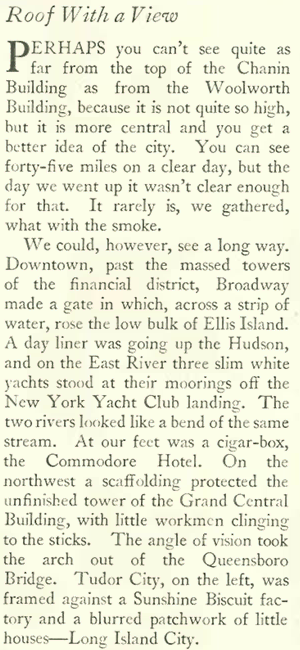
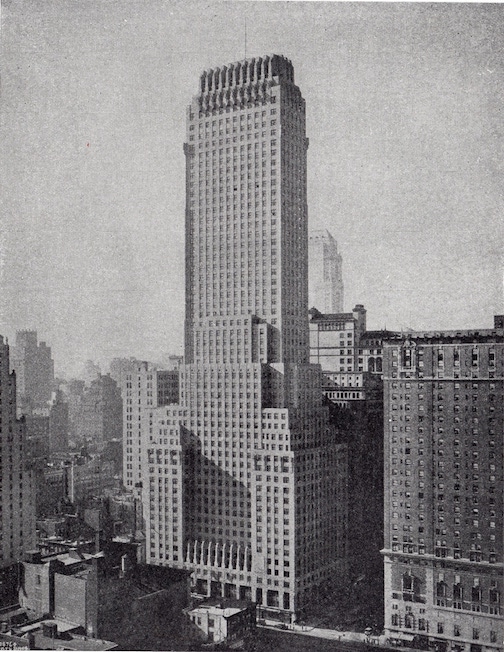
With buildings rising ever higher in Manhattan, you could get a pretty good view of the surrounding city by taking an elevator to the rooftop of the latest skyscraper. The Oct. 6 “Talk of the Town” found a good perch atop the 680-foot-tall Chanin building on the southwestern corner of Lexington Avenue and 42nd Street.

THINGS ARE LOOKING UP…The Chanin Building at Lexington and 42nd. Sloan & Robertson Architects, 1928. (New York Public Library)

 *  *  *

From Our Advertisers

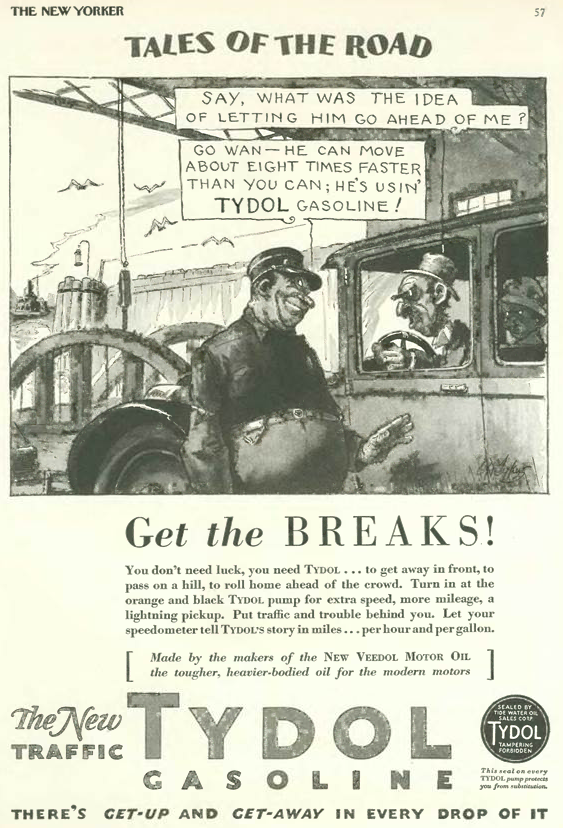
Something you never see in The New Yorker anymore, or in most magazines for that matter, are ads promoting various brands of gasoline. This one touts the benefits of Tydol, produced by the (now defunct) Tide Water Oil Company of New York:

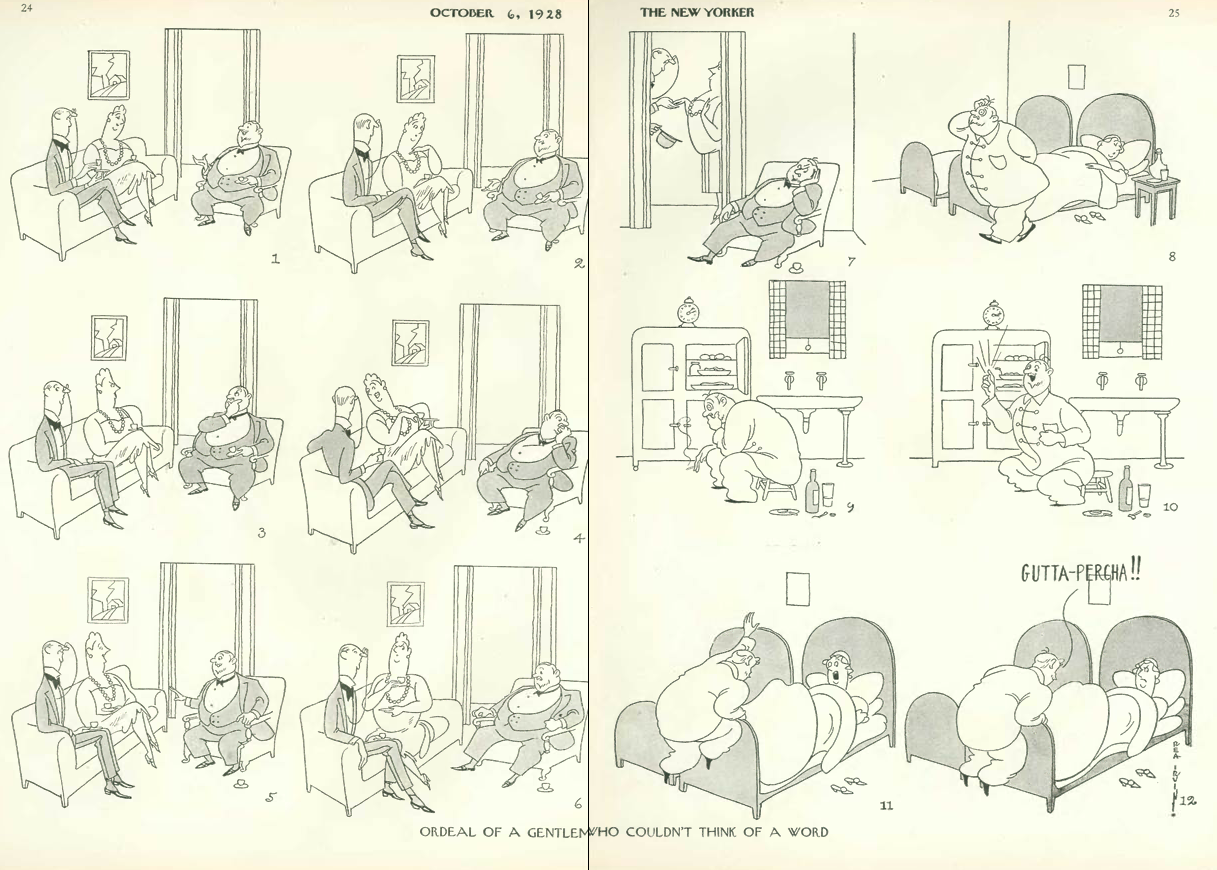
For our Oct. 6 cartoon, here is one of Rea Irvin’s occasional multi-panel, two-page comic spreads, this one exploring the ordeal of a man who couldn’t think of the word for a type of natural plastic used in the 1920s (click to enlarge image):

 *  *  *

The Oct. 13, 1928 issue featured a notable short story by Thyra Samter Winslow, a writer who contributed nearly a dozen pieces to The New Yorker in 1927 and 1928.

October 13, 1928 cover by Julian de Miskey.

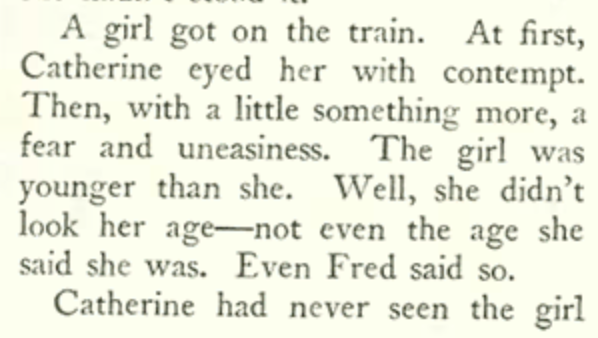
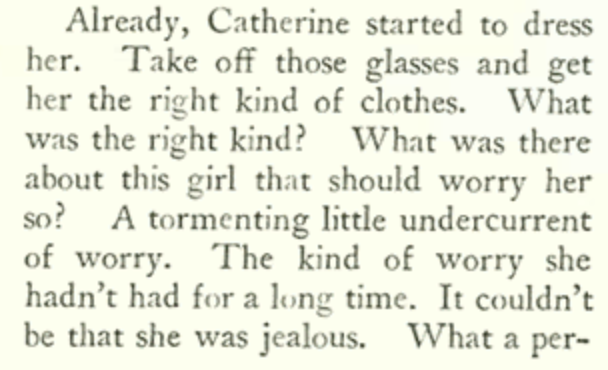
Her short story on page 25, “But for the Grace of God,” was a “key transitional work” for the magazine, according to Ben Yagoda in his book About Town: The New Yorker and the World It Made. He writes: “Realistic fiction thrives in periods of social ambiguity and flux, and the attention to class was on of the factors working to propel New Yorker writing from two-dimensional sketches to fleshed out short stories.” Yagoda observes that Winslow’s story, “in its carefully selected details, its mild epiphany, and its attention to the potency of class…is an accomplished and poignant piece of short fiction.” Excerpts:

Thyra Samter Winslow, in 1936. (findagrave.com)

* * *

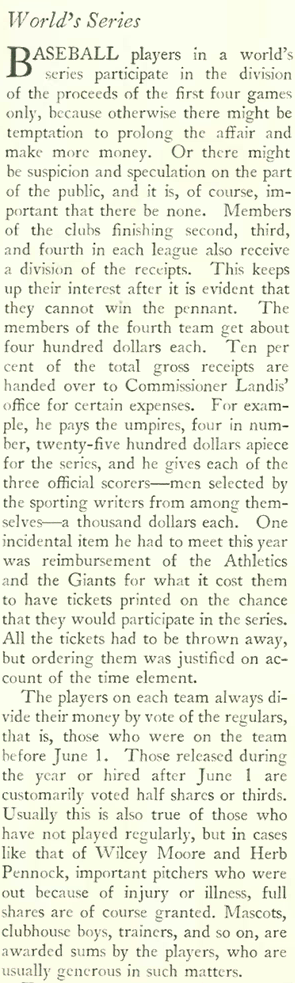
The New Yorker continued its stubborn refusal to report on baseball in its sports section, even though the Yankees were in the process of taking their second consecutive World Series title with a 4-0 sweep over the favored St. Louis Cardinals. The magazine did, however, mention the game in the Oct. 13, 1928 “Talk of the Town” — not on how it was played, but rather on how the championship money was distributed among players and assistants:

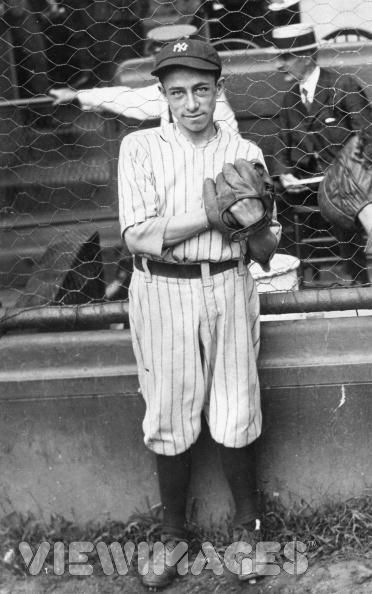
Money matters in the game of sport were more informal 90 years ago, with players themselves divvying up money to other players, trainers, mascots and batboys. For example, in 1927 Yankees batboy Eddie Bennett received $700 for the one-eighth World Series share voted him by the team. This sum earned over the four days of the series nearly equalled a batboy’s pay for a full year.

GOOD LUCK CHARM…Yankee batboy Eddie Bennett in the 1920s. Although a spinal injury as an infant left him hunchbacked, Bennett would serve as Yankee batboy for 12 years — a period that would include seven pennants and four World Series titles. (sabr.org)

 *  *  *

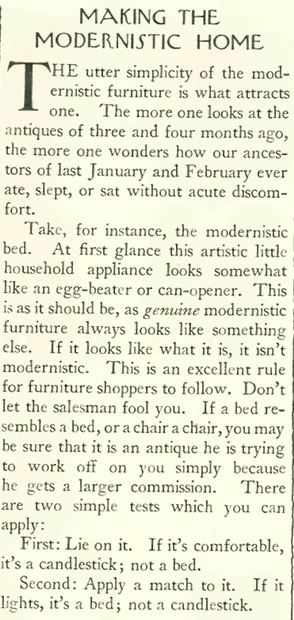
Although European-inspired modern furniture was all the rage among certain members of the New York smart set, writer Joseph Fulling Fishman (best known for his writing on contemporary prison conditions) offered a dissenting view in the Oct. 13 edition. An excerpt:

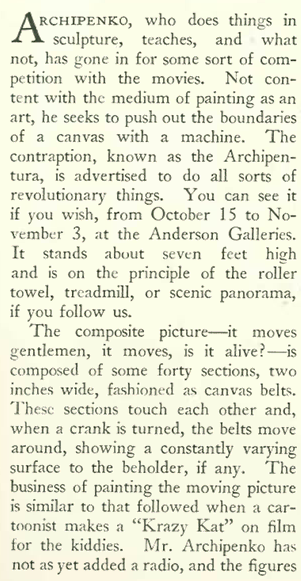
In the art review section, critic Murdock Pemberton also seemed a bit perplexed by modern design, in this case by the work of Ukrainian-born avant-garde artist Alexander Archipenko. His Archipentura was an electronic machine that displayed pre-loaded images of a female undressing by rolling painted canvas through a complex system of sprockets and belts. He intended the machine “to do for painting what the motion picture did for photography.” Pemberton observed:

THINK DIFFERENTLY…Alexander Archipenko (right, circa 1920), intended his intended his Archipentura machine (pictured in front and side views) “to do for painting what the motion picture did for photography.” (Wikipedia/Archipenko Foundation)

*  *  *

From Our Oct. 13 Advertisers

Yet another endorsement for cigarettes from the posh set. This time Melachrino Cigarettes got in on the action with this endorsement by Augusta Barney Harriman.

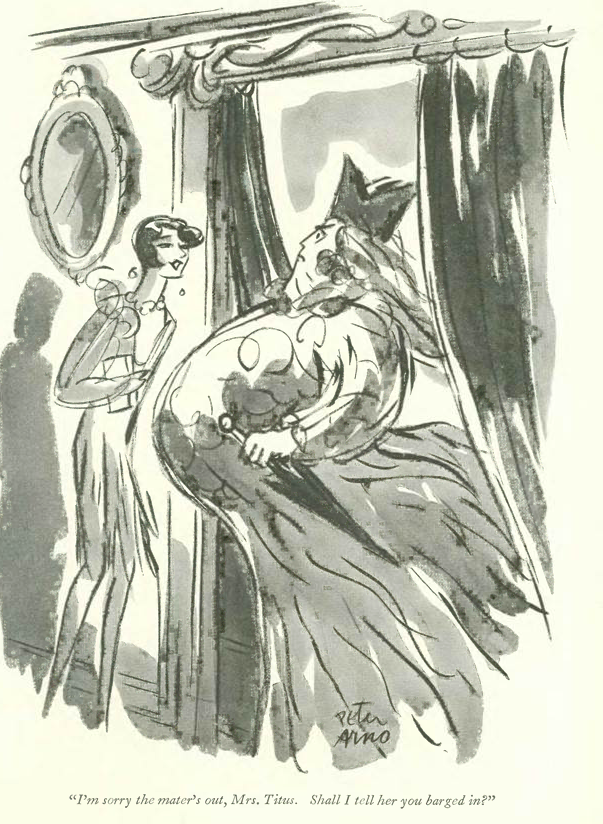
For our cartoon, Peter Arno once again looked in on the mannerisms of the upper class, contrasting a lithe young flapper with the imposing presence of a battle-axe. Note how the young woman uses the archaic British “mater” in reference to her mother…

Next Time: The Prohibition Portia…

A 100 Percent Talker

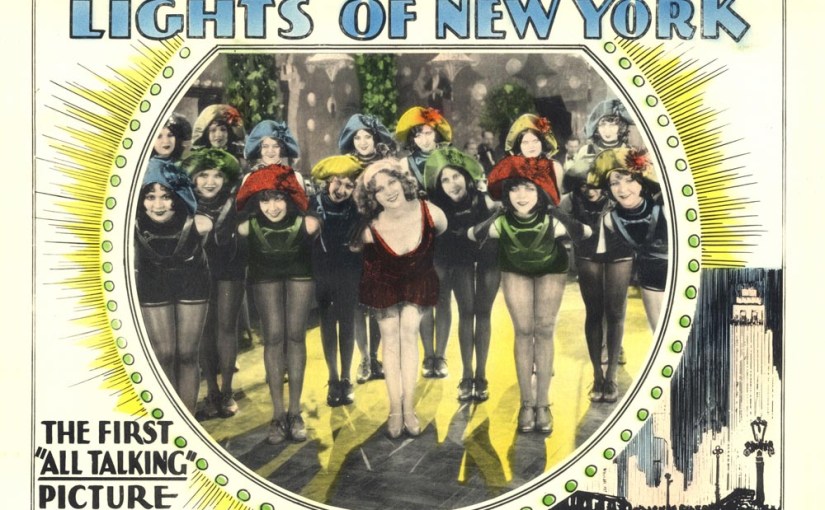
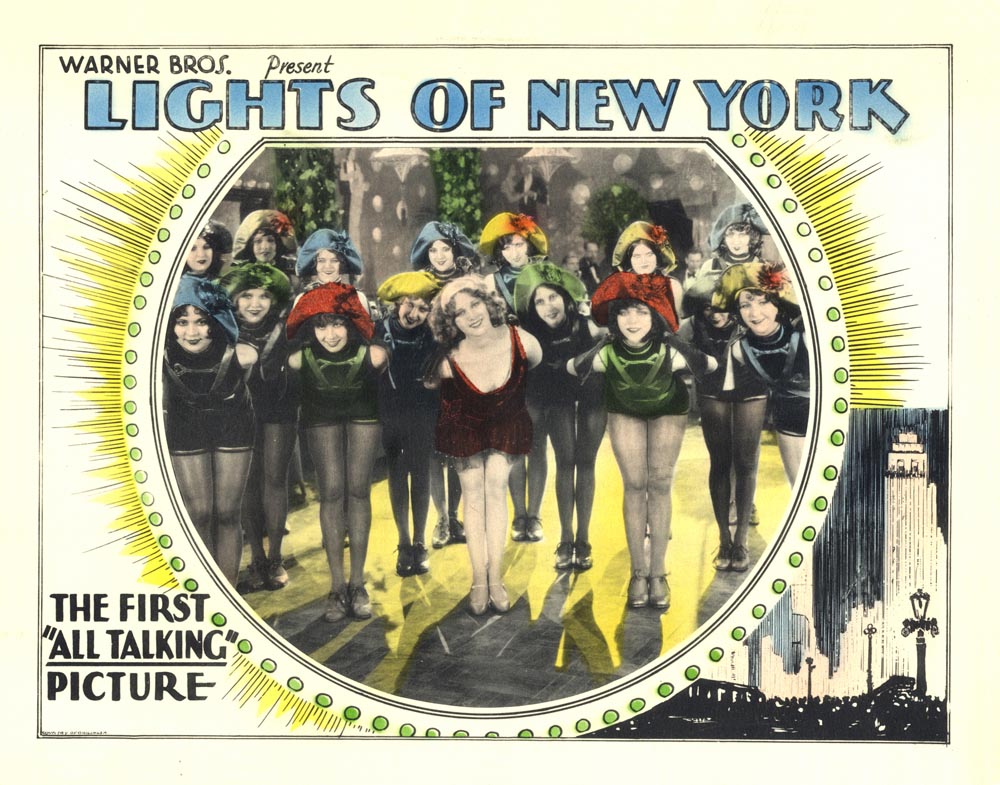
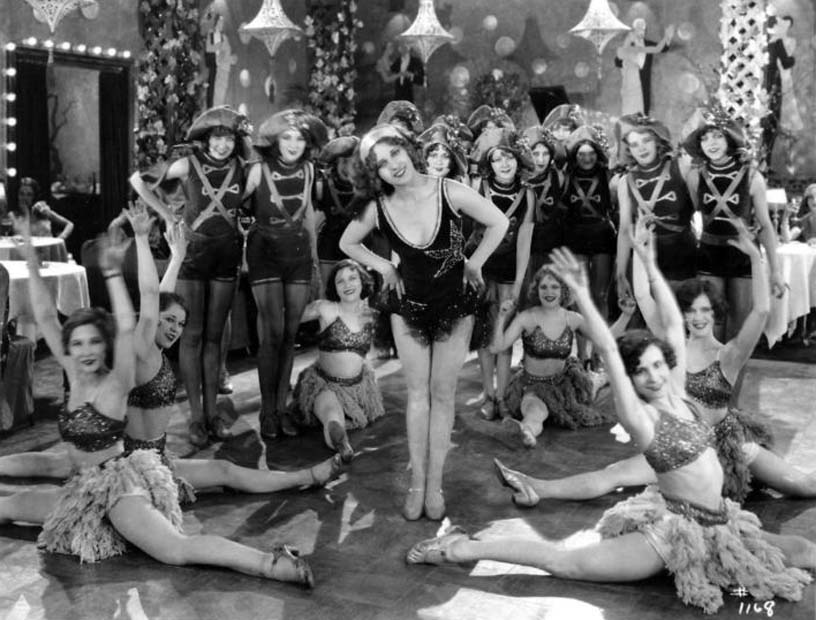
Lights of New York would be a forgettable film if not for the fact it was the world’s first 100 percent talking motion picture. Yes, it was a bad film, but…

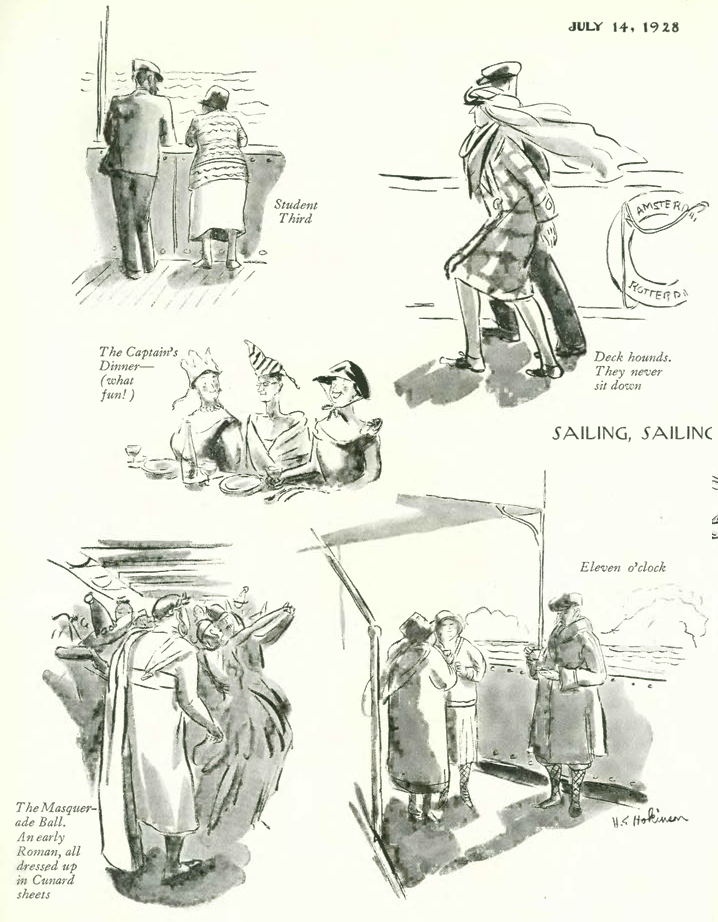
July 14, 1928 cover by Leonard Dove.

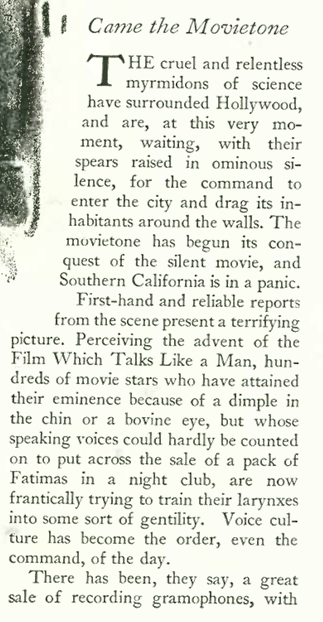
…even the July 14, 1928 New Yorker had the foresight to note that the film was destined to be a “museum piece.” Despite the corny plot and bad acting, the magazine’s critic “O.C.” had to concede that the film offered proof that sound would improve the motion picture experience.

Theatre Card for Lights of New York. (untappedcities.com)
MAKING SOME NOISE…Helene Costello with a cast of nightclub dancers in Lights of New York. (vintage45.wordpress.com)

The Jazz Singer (1927) launched a “talkie revolution” that would culminate nine months later in Lights of New York, and by the end of 1929 Hollywood was almost exclusively making sound films. But studios still released silent films into the 1930s, since not every theatre in the country was wired for sound.

The New Yorker had been slow to embrace sound in motion pictures (see my previous posts). What helped to win them over was the further refinement of the Movietone process, in which the sound track was printed directly onto the film strip (The Jazz Singer used Vitaphone, which essentially synched a record player with a film and provided a sporadic rather than continuous sound track).

In the same issue, writer Robert Benchley also predicted (in “The Talk of the Town”) that sound in movies would challenge actors whose voices weren’t as attractive as their screen images:

IT’S COMPLICATED…It is a common assumption that sound motion pictures killed the careers of many silent stars, however big names like John Gilbert (left) and Clara Bow left the pictures for other reasons. Studio politics ended Gilbert’s career, and he drank himself to death by 1936. Bow—famously known as the “It Girl,”—made a few sound pictures, but retired from acting in 1931 to become a Nevada rancher. (Wikipedia)
SILENCED…Some silent actors such as Wallace Beery (left), were sidelined not because of their voices but because of their high salaries. On the other hand Raymond Griffith (right), who made only one sound movie, spoke with a hoarse whisper not suited for the talkies. (Wikipedia / silentfilmstillarchive.com)

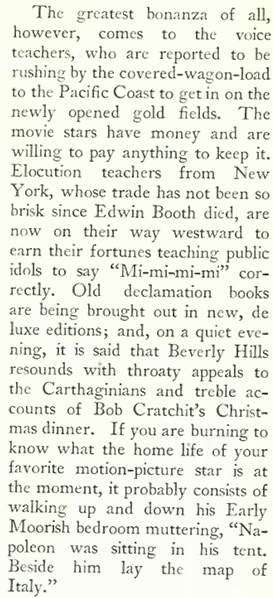
The New Yorker also noted that sound pictures would prove to a great “bonanza” to voice teachers:

Transition to sound in the late 1920s would later provide the theme for the 1952 musical Singin’ In The Rain, in which Jean Hagen portrayed silent film star Lina Lamont, whose voice was ill-suited for talking pictures. 

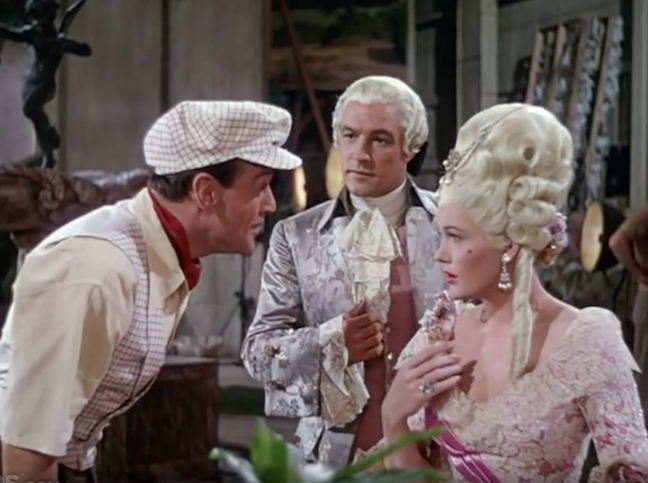
SAY WHAT?…Actress Lina Lamont (Jean Hagen) tries the patience of her director (Chet Brandenburg) while her co-star (Gene Kelly) looks on. The scene demonstrated the challenges of acclimating former silent stars (like Lina Lamont, whose voice sounded like squeaky hinge) to “talking pictures.” (MGM/YouTube Movieclips)

The New Yorker also noted that the advent of sound in motion pictures would put an end to many theatres operating on the vaudeville  circuit:

In his regular column, “Of All Things,” Howard Brubaker gave his two cents about the new world of talking movies:

Paving Over Paradise

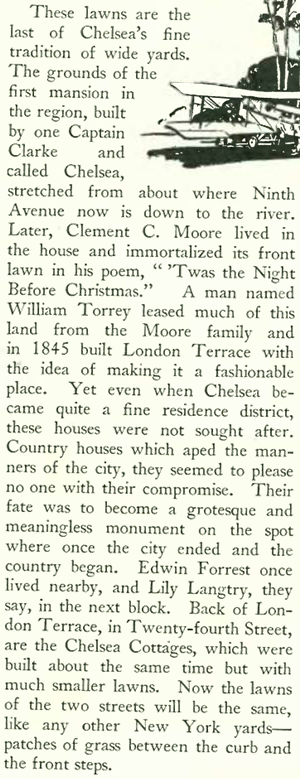
The July 14 “Talk of the Town” offered more bittersweet commentary on the city’s rapidly changing landscape. This time it was a famous stretch of lawns on West 23rd Street—London Terrace— that were being uprooted to make way for a massive new apartment block:

According to Tom Miller (writing for his blog Daytonian in Manhattan), Clement Moore, the writer to whom “A Visit from St. Nicholas” (“The Night Before Christmas”) “had developed the block when he divided up his family estate, ‘Chelsea.’ On the 23rd Street block, in 1845, he commissioned Alexander Jackson Davis to design 36 elegant Greek Revival brownstone townhouses. The row was designed to appear as a single, uniform structure or ‘terrace’ (a design not lost on The New Yorker). Unusual for Manhattan, each had deep front yards planted with shrubbery and trees. He called his development ‘London Terrace.'”

A BIT O’ GREEN…London Terrace, circa 1920. (ephemeralnewyork)

By October 1929, writes Miller, “a few weeks before the collapse of the stock market and the onset of the Great Depression, (developer Henry Mandel) had acquired and demolished all the structures on the enormous block of land. All except for Tillie Hart’s house. Hart leased 429 West 23rd Street and, although her lease had legally expired, she refused to leave, firing a barrage of bricks and rocks at anyone who approached the sole-surviving house. A court battle ensued while she barricaded herself inside. Finally, just four days before Black Tuesday, sheriffs gained entry and moved all of Hart’s things onto the street. She held out one more night, sleeping on newspapers in her once-grand bedroom, then gave up. The following day her house was destroyed.”

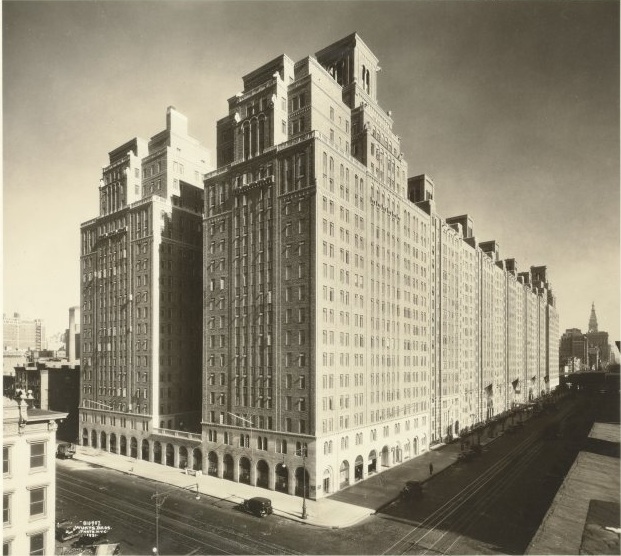
IT’S YUGE…Farrar & Watmough designed this massive, Tuscan-inspired apartment block, completed during 1930-31. The developer Henry Mandel, kept the site’s original name, London Terrace. (ephemeralnewyork)

Miller writes, “to describe the new London Terrace was to use superlatives. Consuming the entire city block, it was the largest apartment building in the world with 1,665 apartments. It boasted the largest swimming pool in the city – 75 feet by 35 feet, with mosaic walls and viewing balconies. Twenty-one stories above the street a “marine deck” was designed to mimic that of a luxury ocean liner. It had a fully-equipped gymnasium, a recreation club, a rooftop children’s play yard with professional supervisors, and a large dining room. The doormen were dressed as London bobbies.”

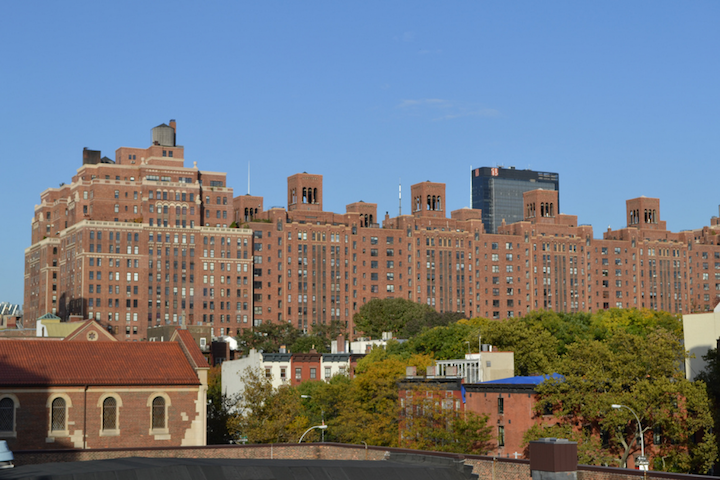
STILL THERE…London Terrace today. (Brick Underground)

 *  *  *

In other diversions, Isadore Klein looked askew at the latest headlines, namely the big fight between Gene Tunney and Tom Heeney, one of the 20th century’s many “battles of the century”…

…while Helen Hokinson, on the other hand, offered some sketches of seafaring life…

…and looked in on the challenges of buying a hat…


And to close, a cartoon by Leonard Dove

…that referenced ads such as this one from the June 2, 1928 issue…

…and a comedy of manners, courtesy Peter Arno

Next Time: Beyond 96th Street…

Man About Town

When Jimmy Walker was elected mayor of New York City in 1926, the city finally had a leader that matched the mood of the times. A dapper lover of music and nightlife, he openly took a Ziegfield dancer as his mistress, often fled the city for European vacations, and was known to begin meetings with the pop of a Champagne cork.

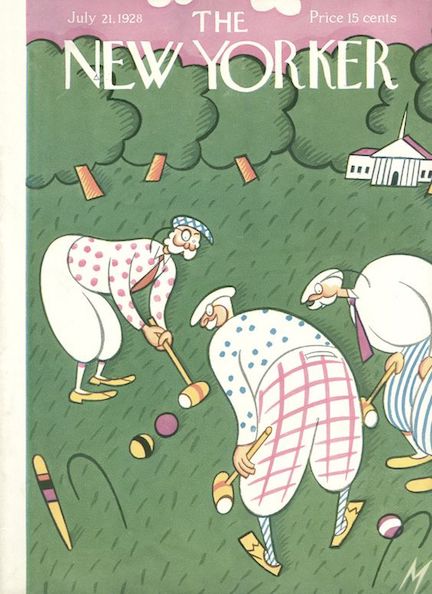
May 19, 1928 cover by Ilonka Karasz.

No doubt many New Yorker readers liked the Jazz Age spirit of their mayor, and who really cared about his “accomplishments” as long as the city continued to boom and its smart set continued to prosper? E.B. White, writing for the magazine’s “The Talk of the Town,” concluded as much:

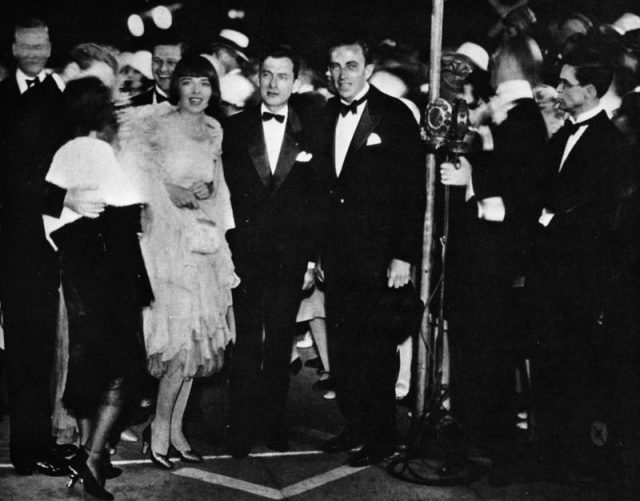
LIGHTS, CAMERA, ACTION!…Mayor Jimmy Walker accompanies actress Colleen Moore to the October 1928 premiere of her latest film, Lilac Time. (konreioldnewyork.blogspot.com)
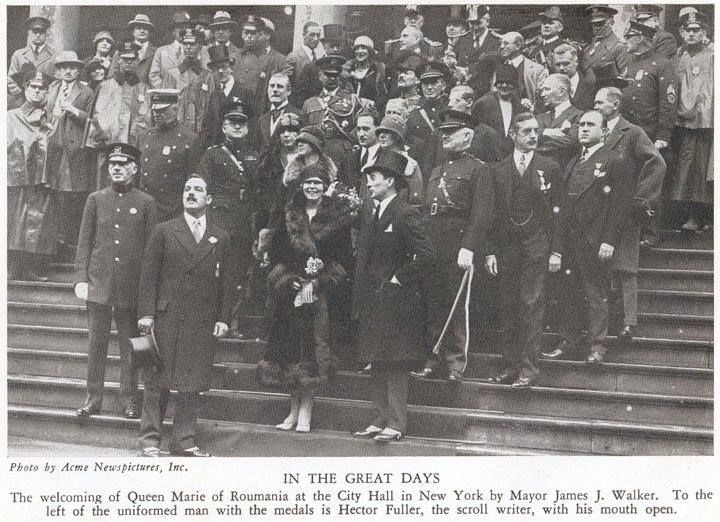
QUEEN FOR A DAY…Mayor Walker (in top hat) welcomes Queen Marie of Romania on the steps of City Hall in October 1926. Huge and enthusiastic crowds braved the rain to welcome the queen to the city. (Acme Newspapers)
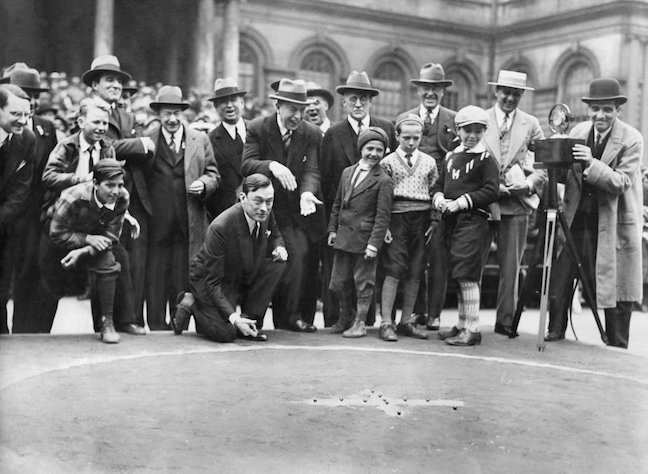
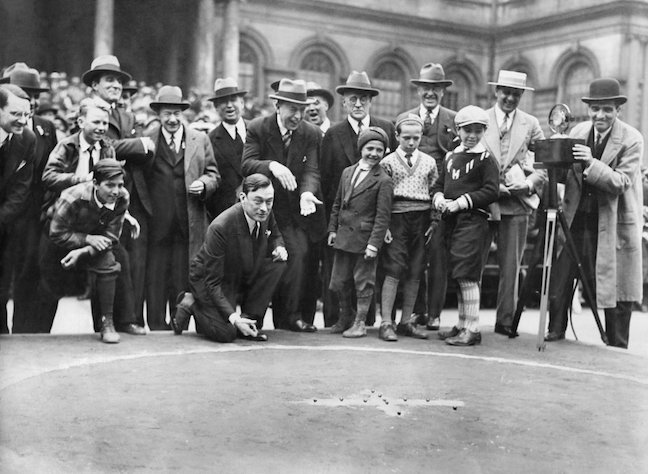
GOOD SPORT…Mayor Walker presides over the first shot in the city’s annual marble tournament on June 3, 1928. (New York Times)

 *  *  *

Remembrance of Things Past

Although The New Yorker embraced the spirit imbued in the city’s rapidly changing skyline, there was always a tinge of regret when landmarks fell to wrecking balls and the city erased its past faster than one could comprehend. And so the magazine was a strong and early supporter of the establishment of the Museum of the City of New York, founded in 1923 and housed in Gracie Mansion (now the mayor’s official residence) until a permanent, neo-Georgian-style museum was finally erected in 1929-30 on Fifth Avenue between 103rd and 104th streets.

KEEPING TIME…Museum of the City of New York. (Wikipedia)

 *  *  *

No Beer Left to Cry In

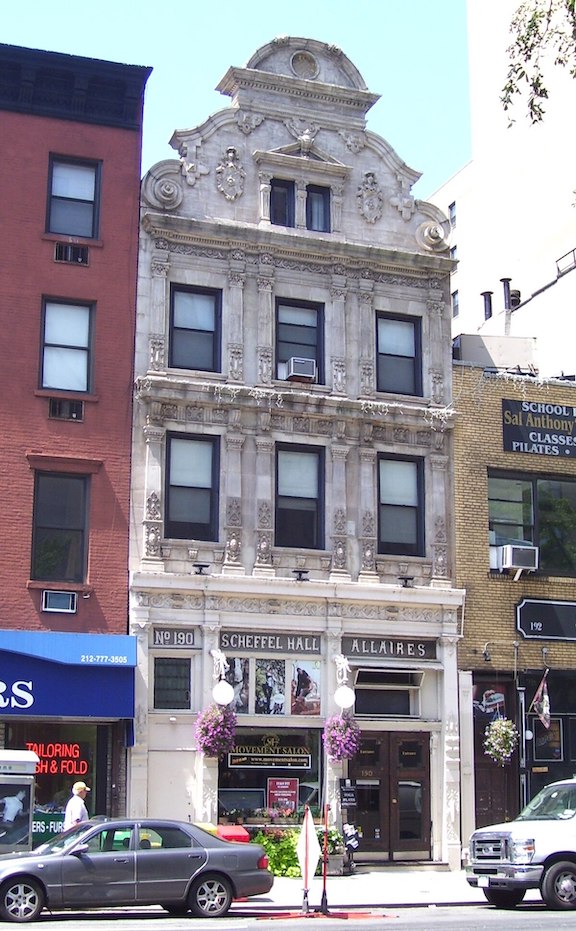
As the Museum of the City of New York scrambled to preserve a past that was quickly being erased across Manhattan, another venerable institution prepared to close its doors for good—Allaire’s Scheffel Hall—which in its heyday was a favorite watering hole of artists, musicians, and writers including Stephen Crane. Allaire’s, located in a Gramercy Park neighborhood known as Kleindeutschland, or “Little Germany,” was the latest victim of Prohibition; it was, after all, hard to run a beer hall without the beer.

SIGN OF THE TIMES…Scheffel Hall at 190 Third Avenue. It was designated a New York City landmark in 1997. (Wikipedia)

 *  *  *

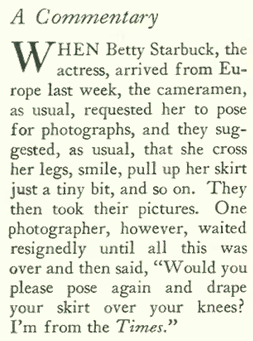
The “Talk of the Town” had its usual bits and pieces of happenings in the city, including this mild jab at the rather staid New York Times:

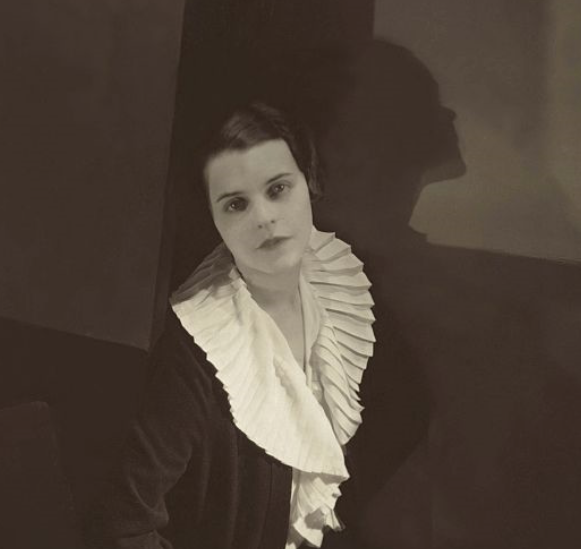
KEEPING IT DECENT…The actress Betty Starbuck, detail of a photo by Edward Steichen, circa 1930. (CondeNast)

 *  *  *

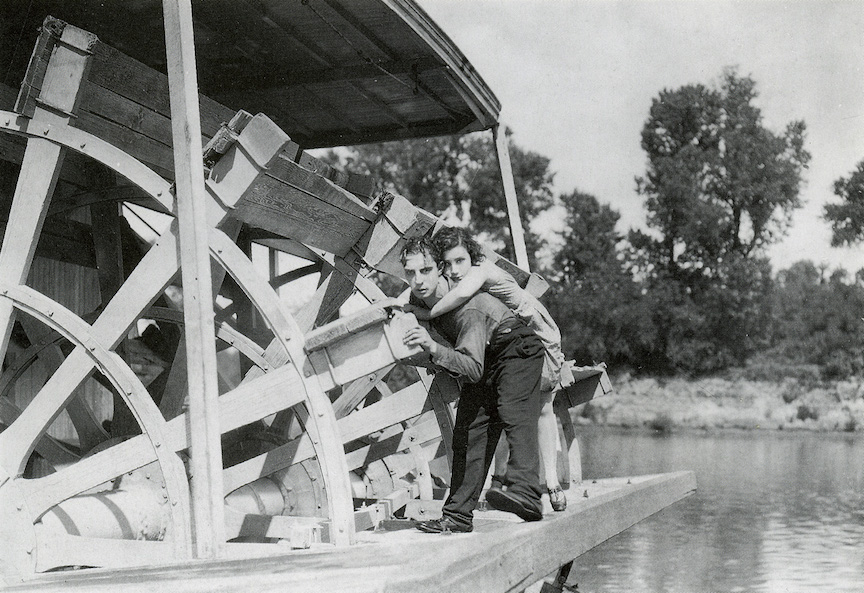
Silent film star Buster Keaton’s latest picture, Steamboat Bill, Jr., won the approval of New Yorker film critic O.C., and Keaton’s co-star Marion Byron received extra props for her “gusto”…

HANGING IN THERE…Marion Byron and Buster Keaton in 1928’s Steamboat Bill Jr. (Virtual History)

 *  *  *

Truth in Advertising

Outside of politics this is one of the most cynical uses of the word “truth” I’ve ever seen. Since the woman isn’t smoking herself, I’m guessing she is reading a letter from someone (son, daughter, boyfriend) who has learned the truth about Camels and has decided to share it in a letter. How sweet.

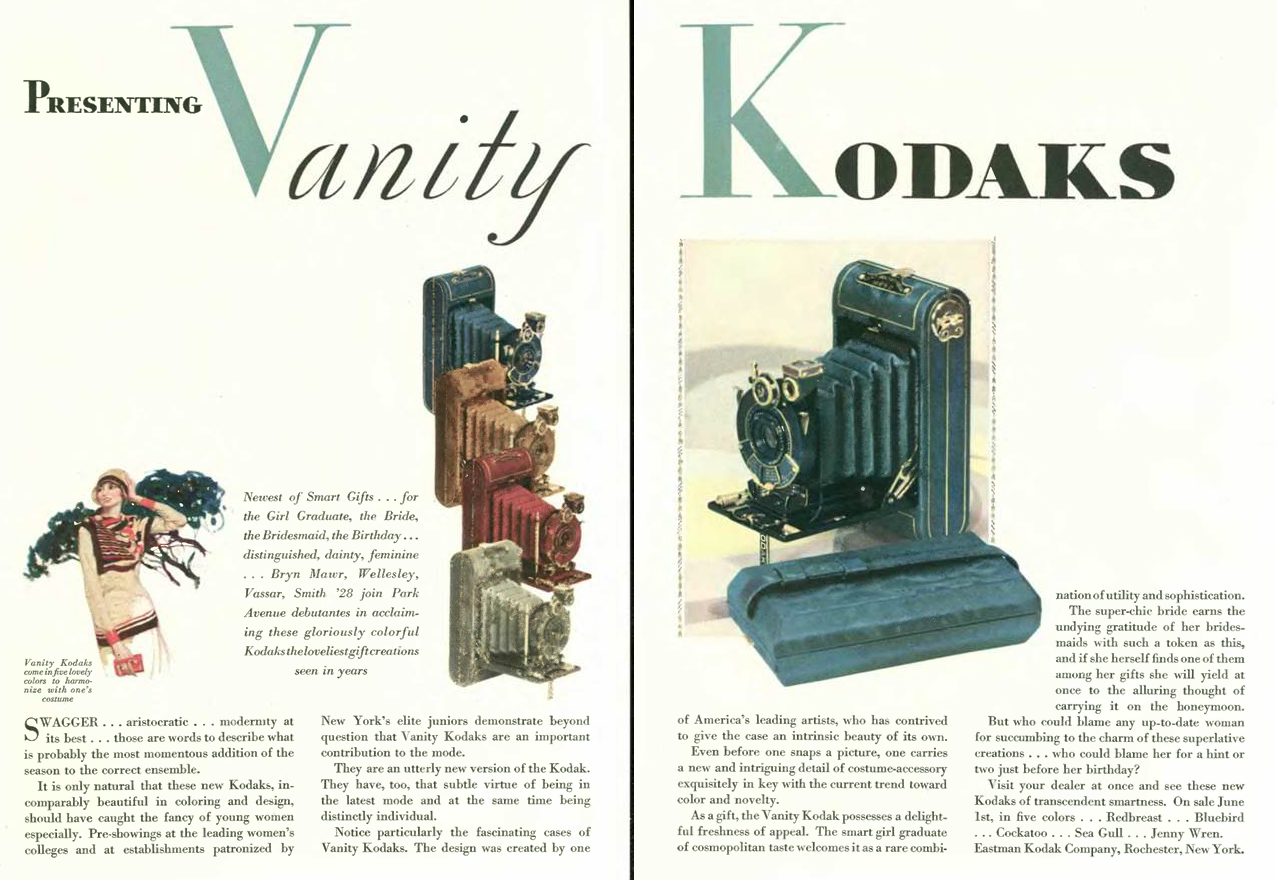
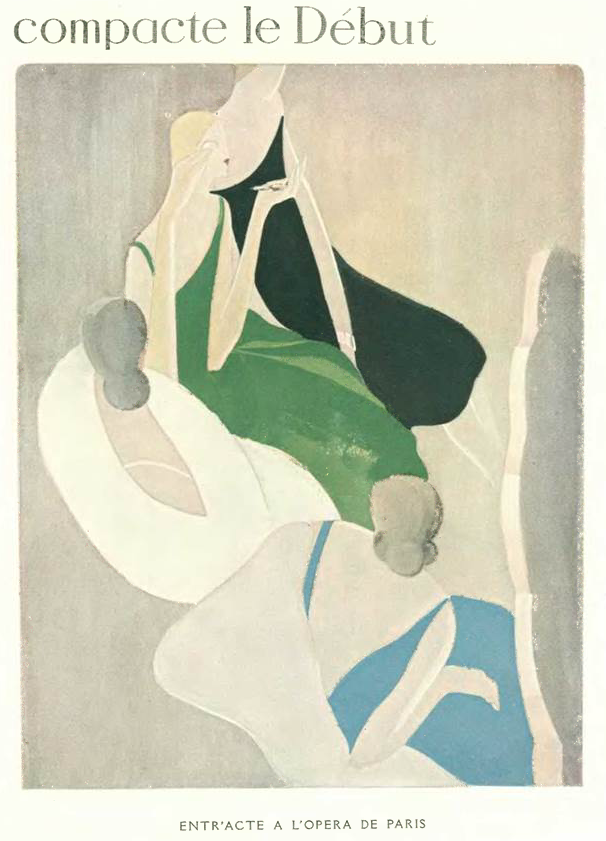
In 1928 color images such as the Camel ad above brightened an increasing number of New Yorker ads. Color was artfully used in a number of spots, including the left panel of this two-page ad for a new cosmetic compact…

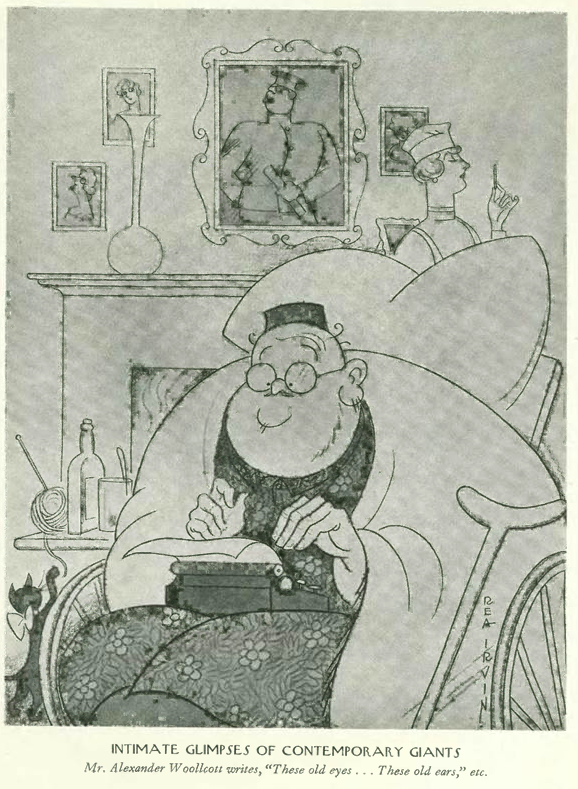
The issue also featured this cartoon by Rea Irvin of New Yorker critic (and hypochondriac) Alexander Woollcott…

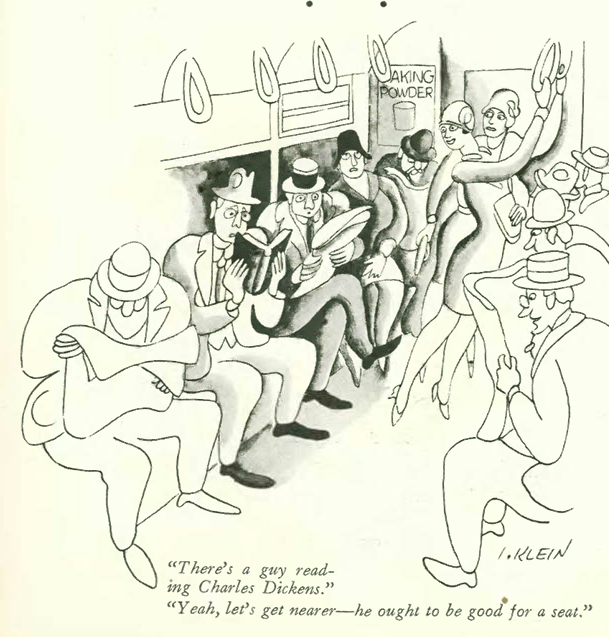
…and keeping on the literary side, this cartoon by Isadore Klein

 *  *  *

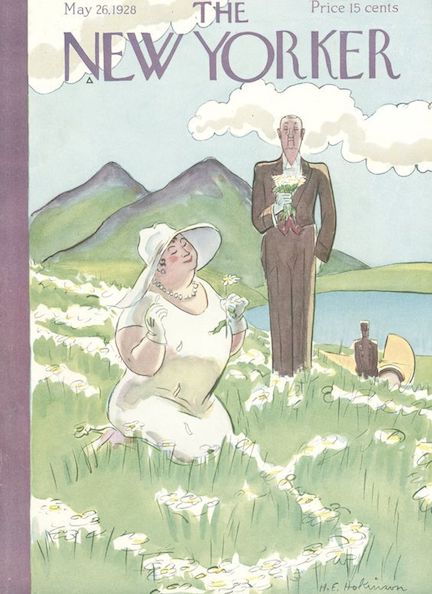
The May 26, 1928 issue the “The Talk of the Town” turned its attention to sound in motion pictures, or rather, turned its ears away from the “movie tone” sound effects becoming common in the waning days of the Silent Era.

May 26, 1928 cover by Helen Hokinson.

Everyday sounds, in particular, proved jarring to the ears of those who were accustomed to the relative quiet of silent movies:

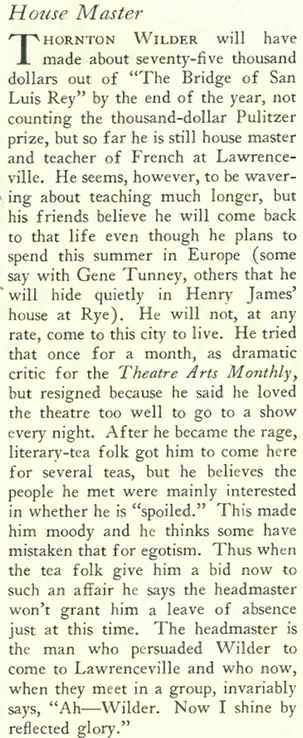
“Talk” also looked in on the writer Thornton Wilder, who was planning to summer in Europe with his friend, the literary-minded boxer Gene Tunney.

REFLECTING GLORY…Thornton Wilder returning to the U.S. on the S.S. Britannic, 1935. (thorntonwilder.com)

 *  *  *

More Truth in Advertising

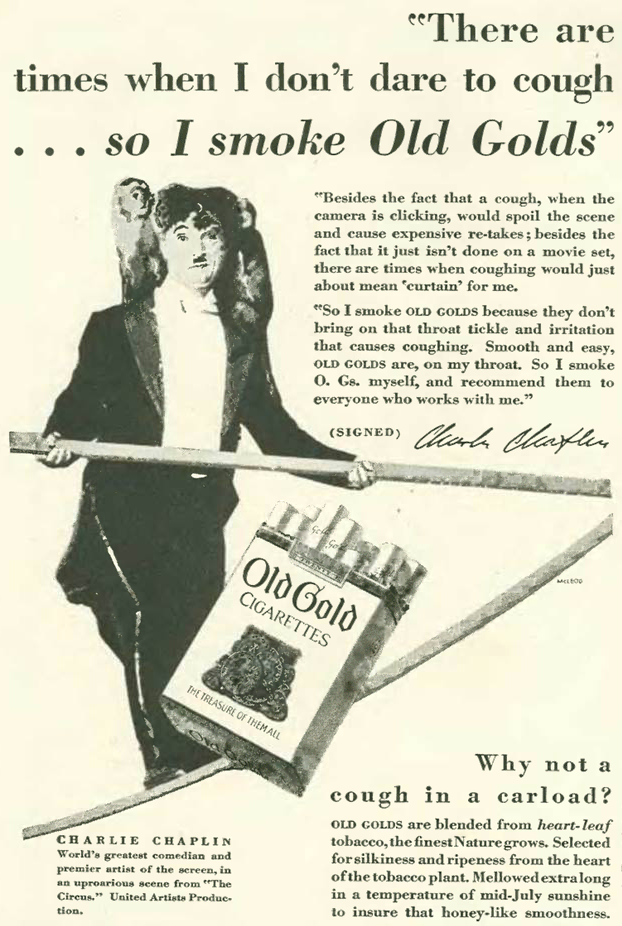
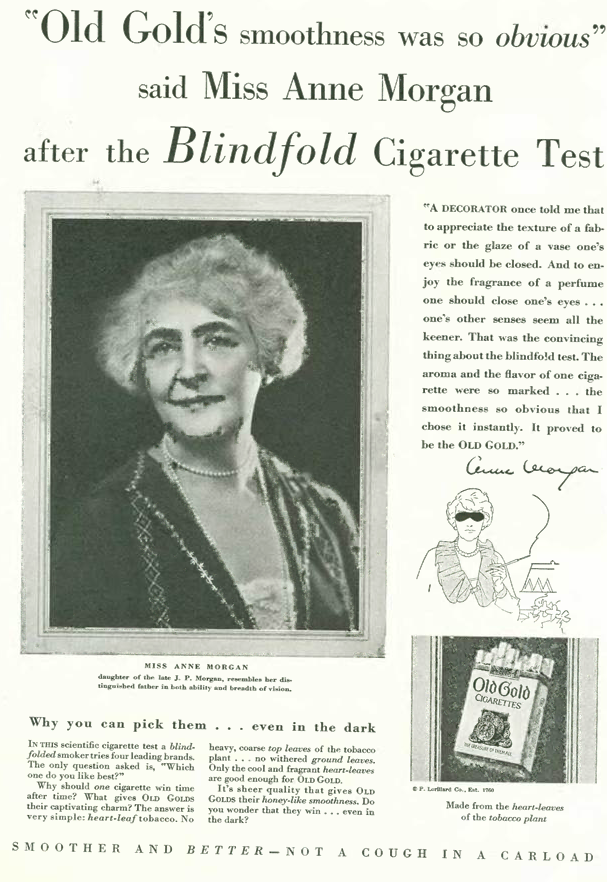
The manufacturers of Old Gold cigarettes were also in pursuit of the truth in this ad featured in the May 26 issue, backing up the claim with a “blindfold test” on none other than the daughter of J. P. Morgan…

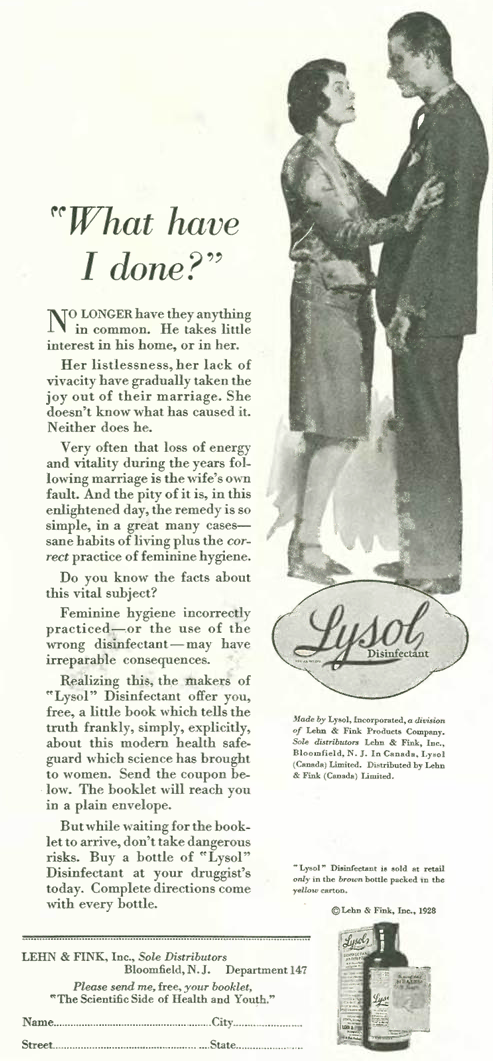
Deception in advertising wasn’t limited to cigarettes, however. The makers of Lysol had their own nefarious scheme that shamed women into using their product as a form of birth control (referred to in the ad below with the euphemism “feminine hygiene”). Not only was it ineffective as a contraceptive, it was also corrosive to one’s privates.

The ad is also appalling for casting the responsibility for birth control entirely on the woman. But then again, where are we today?

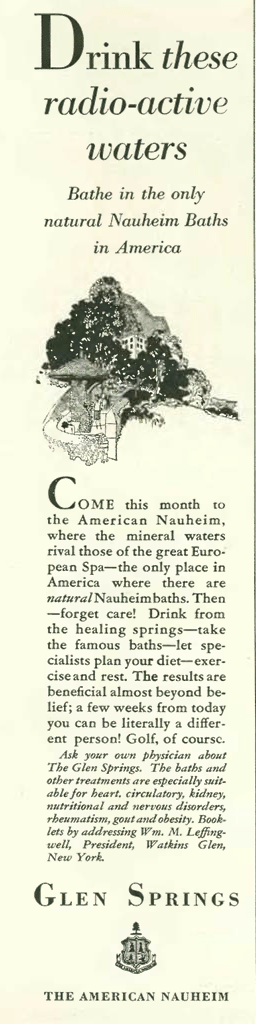
On to other questionable health pursuits, this ad in the May 26 issue touted the “radio-active waters” of Glen Springs, a hotel and sanatorium located above Seneca Lake in New York. Searching for oil on the site in late 19th century, the owners struck not black gold but rather a black, briny water that they claimed had greater curative powers than those found in Germany’s famed Nauheim Springs.

Why they called the waters “radio-active” escapes me. There were a lot of quack medical cures floating around in the 1920s—some of them quite dangerous—so I’m guessing that the proprietors of Glen Springs were adding radium to the water in some of their treatments, or maybe just claiming that radium was present in the water. Although Marie Curie (a pioneering researcher on radioactivity) and others protested against radiation therapies, a number of corporations and physicians marketed radioactive substances as miracle cure-alls, including radium enema treatments and radium-containing water tonics.

The Glen Springs Hotel at Watkins Glen, NY. It remained a noted landmark of the area until it was demolished in 1996. (nyfalls.com)

 *  *  *

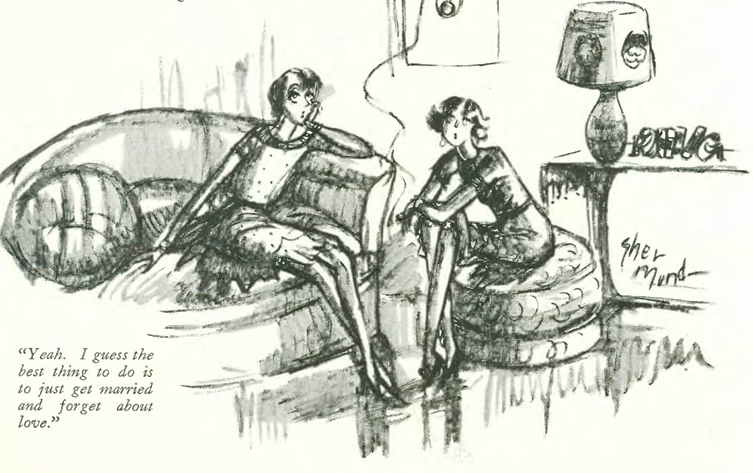
And finally, our cartoons for the May 26 issue, in which Barbara Shermund and Peter Arno explore the ups and downs of courtship…

Next Time: Toward the Air…


Guess Who’s Coming to Dinner

Gene Tunney was not your typical boxer. Holder of the heavyweight title from 1926 to 1928, he defeated his rival Jack Dempsey in 1926 and again in 1927 in the famous “Long Count Fight.” But Tunney was no Palooka—he preferred to be known as a cultured gentleman, and made a number of friends in the literary world including George Bernard Shaw, Ernest Hemingway and Thornton Wilder.

d30ba2edfc3289f6c04c8dfd337ef06c
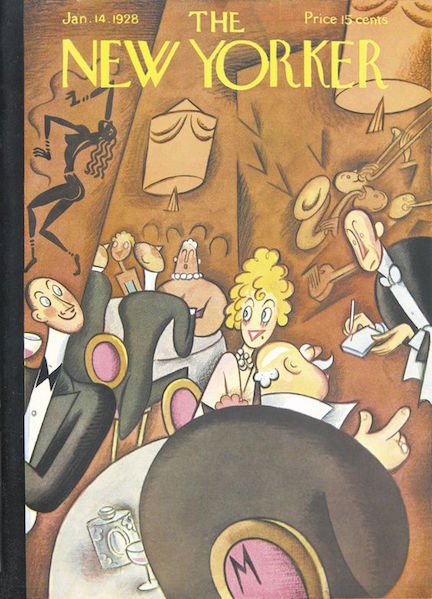
January 14, 1928 cover by Julian de Miskey.

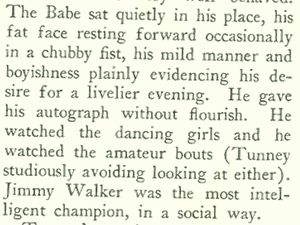
So when given the opportunity to say a few words, Tunney made the most of it, including at a dinner hosted by boxing and hockey promoter Tex Rickard to honor champions in various sports. The New Yorker’s E.B. White was there tell us about it:

screen-shot-2017-02-10-at-12-52-28-pm

d2cf24cb8345bcbf47135ea359d6eaa4
FETED FOR FEATS…World champion athletes are shown here from top row, left to right; Babe Ruth (baseball), Gene Tunney (boxing), Johnny Weissmuller (swimming), Bill Cook (hockey). On the bottom row is from left to right, Bill Tilden (tennis), Bobby Jones (golf), Fred Spencer and Charlie Winters (six-day bicycle race).

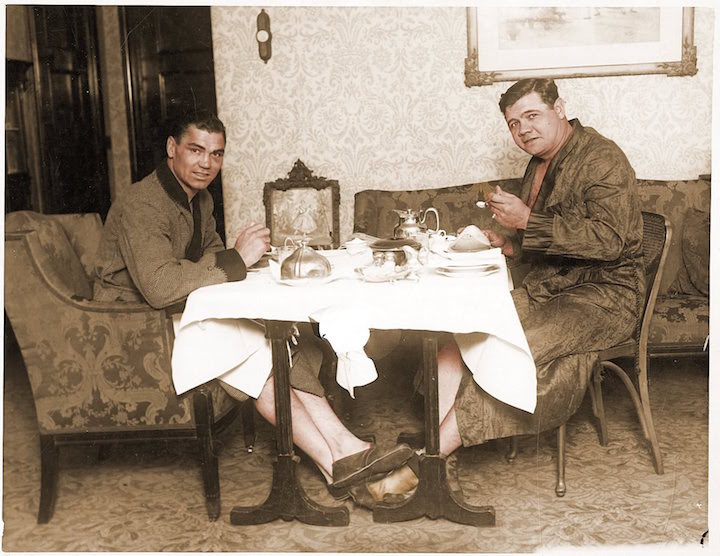
While Tunney was doubtless composing his thoughts at the banquet table, baseball legend Babe Ruth was wishing he could be someplace else…

screen-shot-2017-02-10-at-12-53-12-pm

…like hanging out with his old buddy Jack Dempsey

ruthdempsey
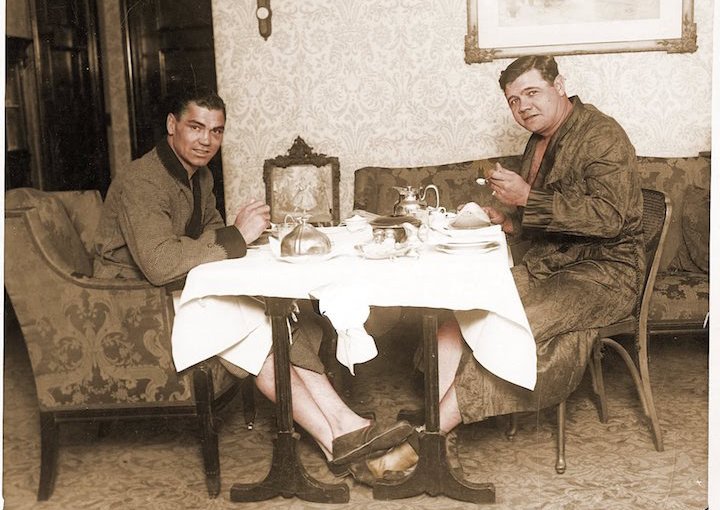
BREAKFAST OF CHAMPIONS…Babe Ruth having breakfast with his friend, heavyweight boxing champion Jack Dempsey, at Ruth’s residence at the Ansonia Hotel in New York City, 1927. Dempsey reigned as the champ from 1919 until 1926, when he was defeated by Gene Tunney. (captainsblog.info)

Instead, the Babe would have to listen to a surprise speech by Tunney, who sought to prove to those in attendance that he had brains to match his brawn. No doubt to the relief of many in attendance, New York City’s flamboyant mayor, Jimmy Walker, was able to return the proceedings to party mode.

screen-shot-2017-02-10-at-12-54-25-pm

screen-shot-2017-02-14-at-3-00-04-pm
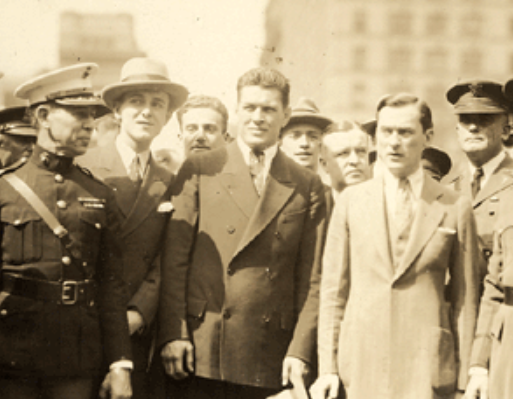
THAT’LL DO, GENE, THAT’LL DO…Newly crowned heavyweight boxing champion Gene Tunney (center) meets with New York City Mayor Jimmy Walker (right) at City Hall, September 1926. (josportsinc.com)

 *  *  *

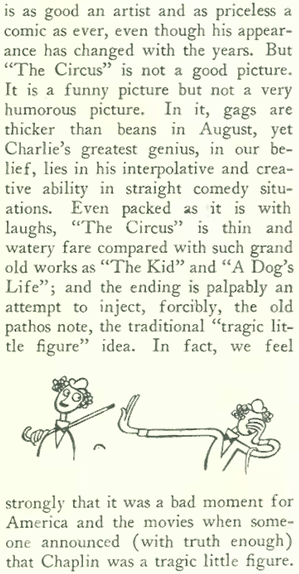
The New Yorker writers found little to like about Hollywood, but Charlie Chaplin could always be counted on to knock out a humorous film. At least most of the time. Here is what “The Talk of the Town” had to say about his latest, The Circus:

screen-shot-2017-02-10-at-12-48-54-pm

screen-shot-2017-02-10-at-12-49-02-pm

LIGHTEN UP, CHARLIE…Merna Kennedy, Charlie Chaplin and Harry Crocker in The Circus. (1928). (Turner Classic Movies)

 *  *  *

Give ‘Em Dirty Laundry

In these days of clickbait and other news designed to attract our prurient interest, we can look back 89 years a see that the tabloids were doing much of the same, particularly in Bernarr Macfadden’s New York Graphic, which was making the most of the final days of death row inmates Ruth Snyder and Judd Gray. “The Talk of the Town” (likely Robert Benchley) made this observation:

screen-shot-2017-02-10-at-12-49-34-pmscreen-shot-2017-02-10-at-12-49-56-pm

screen-shot-2017-02-14-at-4-48-21-pm
TSK, TSK…Evangelist Aimee Semple McPherson (left), received a tidy sum to write about convicted murderer Ruth Snyder for the New York Evening Graphic. (Wikipedia/Murderpedia)

Former lovers Snyder and Gray were sentenced to death in 1927 for the premeditated murder of Snyder’s husband (they went to the electric chair at Sing Sing prison on Jan. 12, 1928). Newspapers across the country sensationalized their trial, but the Graphic went the extra step by paying large sums to celebrity correspondents, including evangelist Aimee Semple McPherson, to write about the sordid case. Sister Aimee used her Graphic column to encourage young men to “want a wife like mother — not a Red Hot cutie.” Semple McPherson herself would later be accused of an affair, but then what else is new in the business of casting stones?

screen-shot-2017-02-15-at-10-57-28-am
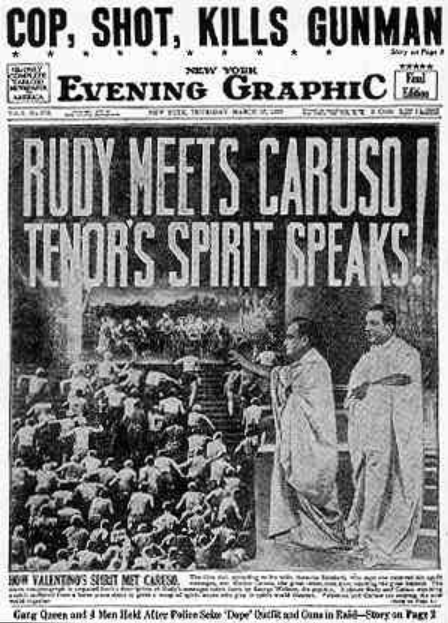
FAKE NEWS…Before the National Enquirer and Weekly World News (and Facebook, Twitter, Instagram etc.), Benarr Mcfadden’s Evening Graphic was the tabloid of choice among the less discerning. This issue from March 17, 1927, depicted silent actor Rudolph Valentino meeting the famed tenor Enrico Caruso in heaven. The Graphic was famous for these “Composographs,” — images cut and pasted together using the heads or faces of current celebrities and glued onto staged images created by employees in Macfadden’s studio. (bernarrmacfadden.com)

 *  *  *

Even His Skivvies?

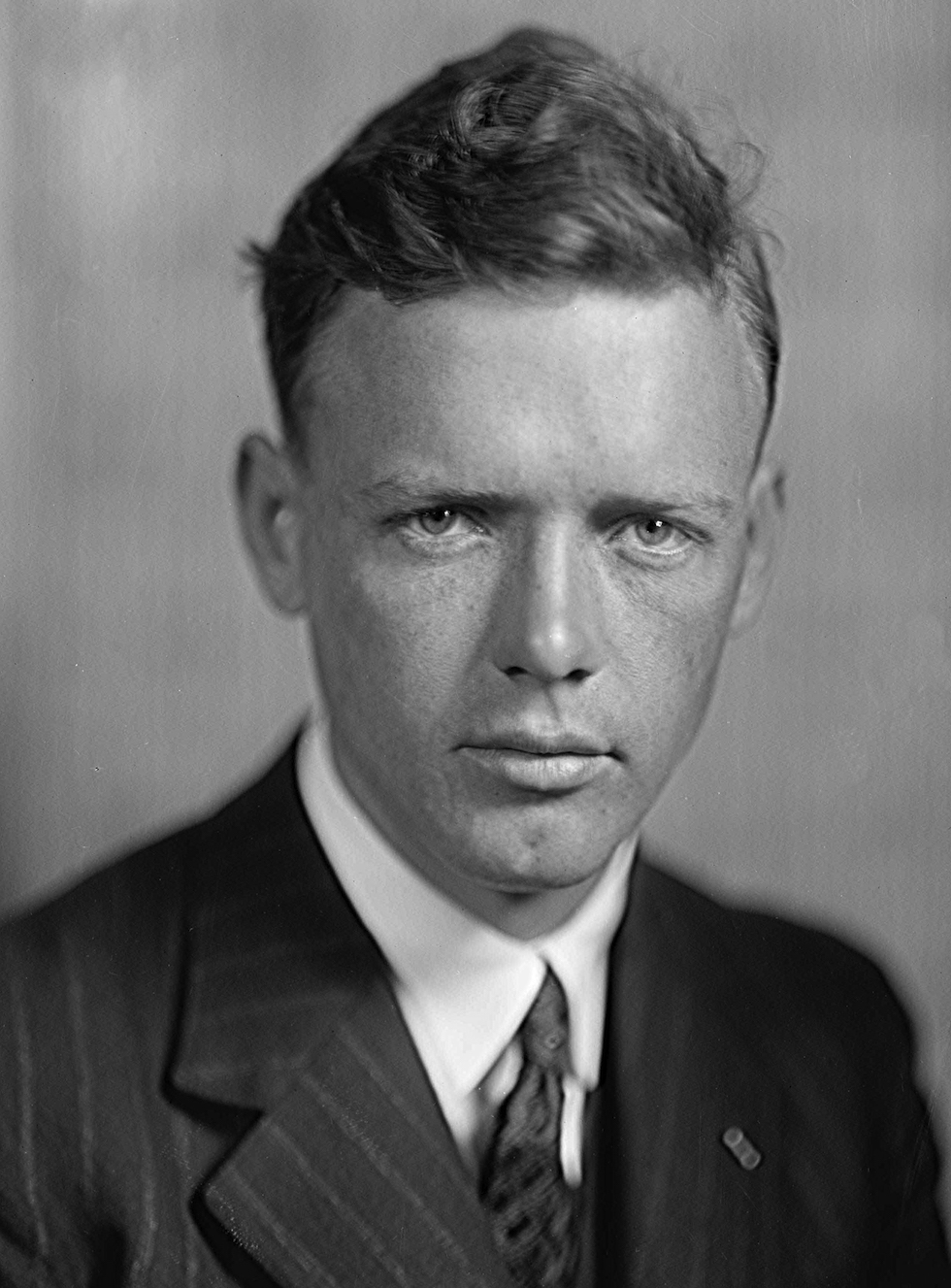
We can also look back 89 years and see that people were just as celebrity-crazed then as they are now. Charles Lindbergh could barely keep the clothes on his back while being pursued by adoring mobs, according to “The Talk of the Town”…

screen-shot-2017-02-10-at-12-50-39-pm

col_charles_lindbergh
KEEP YOUR HANDS OFF MY BVDS

 *  *  *

Kindred Spirits

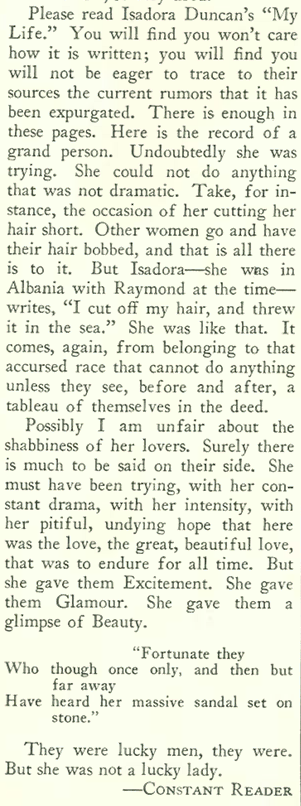
Dorothy Parker wrote a vigorous, even impassioned defense of the late dancer Isadora Duncan in her column, “Reading and Writing.” Parker reviewed Duncan’s posthumously published autobiography, My Life, which she found “interesting and proudly moving” even if the book itself was “abominably written,” filled with passages of “idiotic naïveté” and “horrendously flowery verbiage.” In this “mess of prose” Parker also found passion, suffering and glamour—three words that Parker could have used to describe her own life.

Parker elaborated on the word “glamour,” which she thought had been cheapened in her day to something merely glittery and all surface. True glamour, wrote Parker, was that of Isadora Duncan, coming from her “great, torn, bewildered, foolhardy soul.” Parker concluded with this plea:

screen-shot-2017-02-10-at-1-06-00-pm

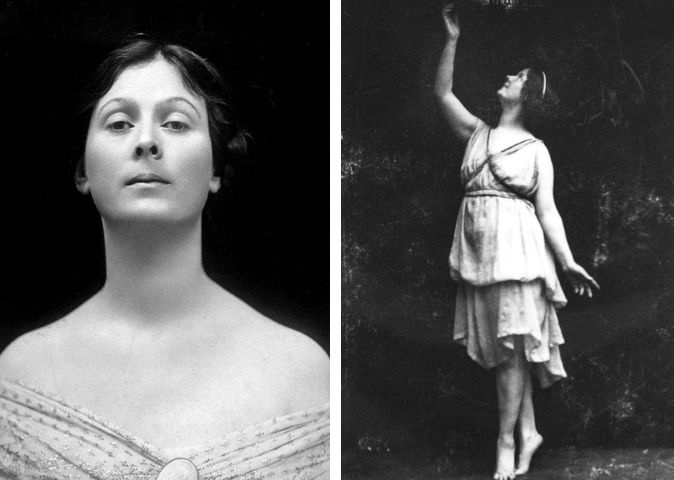
Isadora Duncan circa 1910 (left), and Duncan in a publicity photo circa 1903. (Wikipedia)

 *  *  *

New Kid on the Block

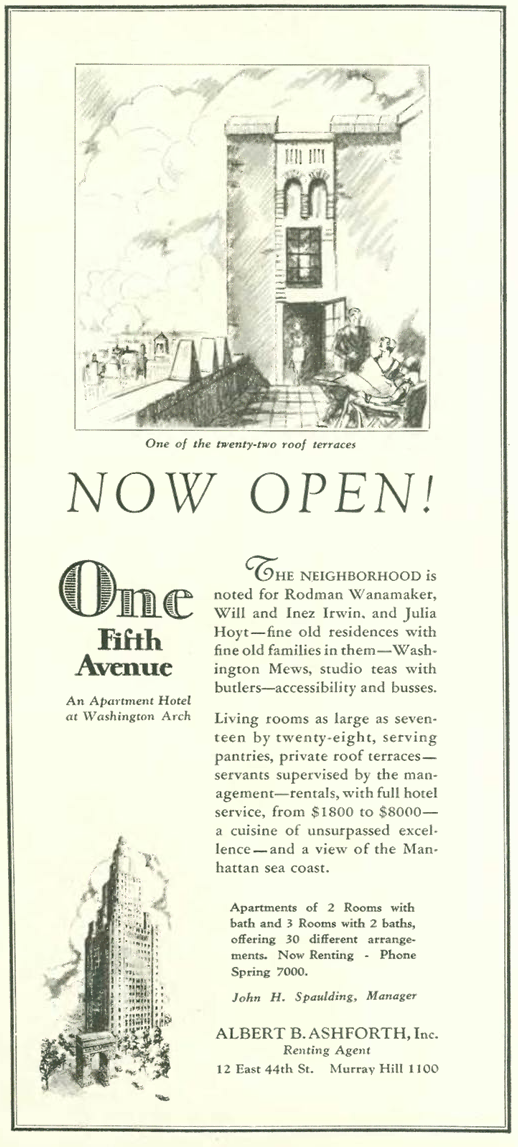
Yet another high-rise dwelling was available to Jazz Age New Yorkers—One Fifth Avenue in Greenwich Village. One Fifth Avenue was an apartment with the word “hotel” attached to justify its 27-story height. To meet zoning requirements, the apartments had “pantries” instead of kitchens. But then again, your “servant” would fetch your dinner anyway…

screen-shot-2017-02-10-at-1-00-01-pm

one-fifth-avenue-december-1928
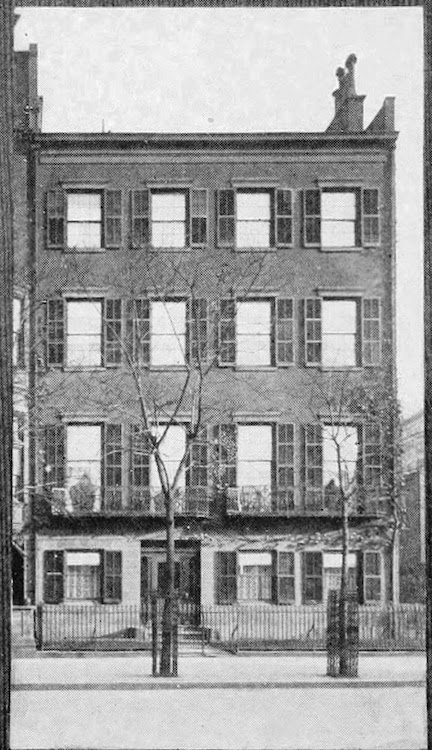
GOING UP…The art deco landmark One Fifth Avenue signaled a dramatic change from the four-story mansions that once occupied the site.  (New York Public Library)

Historical note: One Fifth Avenue marked a dramatic change in the character of Washington Square, one of the most prestigious residential neighborhoods of early New York City. A previous occupant of the One Fifth Avenue site was the brownstone mansion of William Butler Duncan. In addition to One Fifth Avenue, the residences at 3, 5, and 7 Fifth Avenue were also demolished to make way for the new art deco “apartment hotel.”

01-fifth_william-butler-duncan
DUST TO DUST…The William Butler Duncan residence at One Fifth Avenue. (daytoninmanhattan)

*  *  *

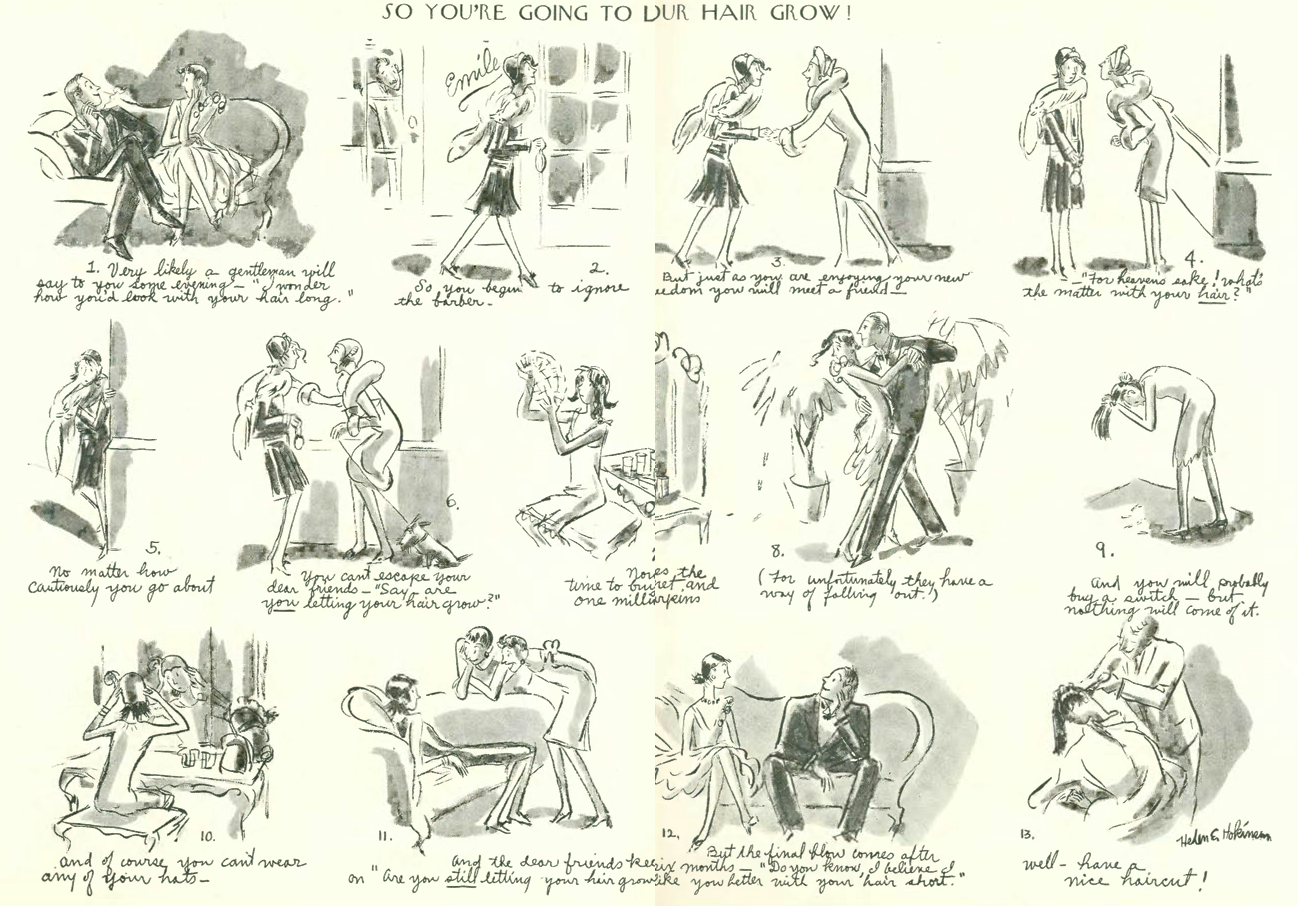
To close, a two-page spread by Helen Hokinson exploring one woman’s challenge with the “flapper bob” (sorry about the crease in the scan–that is how it is reproduced in the online archive). Click the image to enlarge.

screen-shot-2017-02-10-at-12-56-38-pm

And a bit of fun on the streetcar, courtesy of cartoonist Leonard Dove

screen-shot-2017-02-10-at-12-57-46-pm

…and a confession, from Otto Soglow…

Next Time: Machine Age Bromance…

986198649aa5ada2614b8158443db596


The Perfect Gift for 1927

We close out 1927 by looking at the final December issues, which grew fat with Christmas advertising catering to the tastes of New York’s smart set.

dec-10
December 10, 1927 cover by Gardner Rea.

Before we jump to the ads, let’s look in on Lois Long, who in the Dec. 10 issue continued her lamentations regarding the quality of New York’s Prohibition-era night life and reminded readers that her job was far from a “soft snap”…

screen-shot-2017-02-06-at-10-03-06-am

The problem, as diagnosed by Long, was that there were not enough talented entertainers to fill the needs of an overabundance of nightclubs…

screen-shot-2017-02-06-at-10-04-09-am

vit-94-bobbe-arnst1
LOIS THOUGHT BOBBIE ARNST WAS PRETTY SWELL when she appeared at Helen Morgan’s nightclub. A noted broadway singer and dancer, Arnst is pictured above in a publicity photo from the 1929 film Rhythms in Blue. (picking.com)
screen-shot-2017-02-07-at-12-33-26-pm
ON THE OTHER HAND…Evelyn Nesbit’s tearoom (and later speakeasy) couldn’t survive on notoriety alone. In the early 20th century Nesbit’s face was everywhere—from advertisements to calendars—but in 1906 her fame took a nasty turn when her jealous husband, Harry Thaw, shot and killed suspected lover and famed architect Stanford White at Madison Square Garden’s rooftop theatre. At left, Nesbit in 1900. At right, Nesbit in her tea room on West 52nd Street, near Broadway, circa 1922. (Library of Congress / restaurant-ingthroughhistory.com)

Long also railed against the white appropriation of Harlem entertainment, which she felt was draining the place of its soulfulness. In particular she called out writer and photographer Carl Van Vechten, who among white writers was the most prominent in intellectualizing the “Harlem Renaissance”…

screen-shot-2017-02-06-at-11-43-27-am

What to Buy in ’27

The Dec. 10 and Dec. 17 issues grew fat with holiday advertising, averaging 120+ pages as opposed to the usual 60 or so pages. The advertisements mostly appealed to upscale readers, ranging from this almost Victorian-style ad from the staid Brooks Brothers…
screen-shot-2017-02-06-at-9-46-21-am

…to this ad from Rex Cole promoting the latest in modern conveniences…

screen-shot-2017-02-06-at-9-56-44-am

And I’ll toss in this cartoon from the Dec. 10 issue, in which Peter Arno allows us to listen in on an unlikely conversation between a couple of toffs…

screen-shot-2017-02-06-at-9-53-54-am

screen-shot-2017-02-06-at-9-54-11-am

Lois is Also Tired of the Holidays

On to the Dec. 17 issue, in which Lois Long also shared with readers her weariness of Christmas shopping in her column, “On and Off the Avenue.”

dec-17
December 17, 1927 cover by Theodore G. Haupt.

The “Parisite” Long referred to in this excerpt was actually Elizabeth Hawes, who occasionally contributed to Long’s column (with cables sent from Paris) regarding the latest in French fashions. More on Hawes another time…

screen-shot-2017-02-06-at-12-11-30-pm

As for ads in the Dec. 17 issue, we get this one from Dunhill, maker of fine English cigarettes and accessories: a woman’s compact that resembles a lighter…

screen-shot-2017-02-06-at-12-07-21-pm

…and the same issue offers this glimpse into the life a spoiled rich kid, home from college for the holidays. The cartoon is by Alan Dunn, one of the most published New Yorker cartoonists (1,906 cartoons from 1926 to 1974)…

screen-shot-2017-02-06-at-11-52-12-am

With Christmas advertising over, the magazine’s page length dropped by half from the Dec. 17 to the Dec. 24 issue…

dec-24
December 24, 1927 cover by Andre De Schaub.

…in which we find this holiday-themed illustration by Al Frueh:

screen-shot-2017-02-06-at-12-26-56-pm

Why We Sing Auld Lang Syne

This advertisement in the Dec. 24 issue invited readers to celebrate the New Year at The Roosevelt Hotel…

screen-shot-2017-02-06-at-12-27-47-pm

roosevelt-hotel-1924
The Roosevelt Hotel after its completion in 1924 (Museum of the City of New York)
1387211957-0
AULD ACQUAINTANCE…If you want to know why we sing “Auld Lang Syne” on New Year’s Eve, you can thank Guy Lombardo and his Royal Canadian Band, which made the song a staple at his New Year’s performances beginning in 1929 at the Roosevelt Hotel. Their performance that night was broadcast on the radio before midnight Eastern time on CBS, then after midnight on NBC radio. (neatorama.com)

 *  *  *

Now Let’s Get Out of Here

With the holidays out of the way, New Yorkers still faced a good three months of winter. That is, unless you were well-heeled enough to head south to Palm Beach. Considering the abundance of ads promoting travel to southern climes in the Dec. 24 and 31 issues, apparently many of the magazine’s readers possessed the means to do just that…

screen-shot-2017-02-06-at-12-29-05-pm

screen-shot-2017-02-06-at-12-29-15-pm

And we close this entry, and the year of 1927, with this cover…

dec-31
December 31, 1927 cover by Rea Irvin.

…and another tropical-themed advertisement, courtesy of Russeks…
screen-shot-2017-02-06-at-12-31-07-pm

…and this cartoon by Mary Petty depicting those who were left behind, still returning their Christmas gifts…

screen-shot-2017-02-06-at-12-32-39-pm

Next Time: Odious Odes…

jan-7