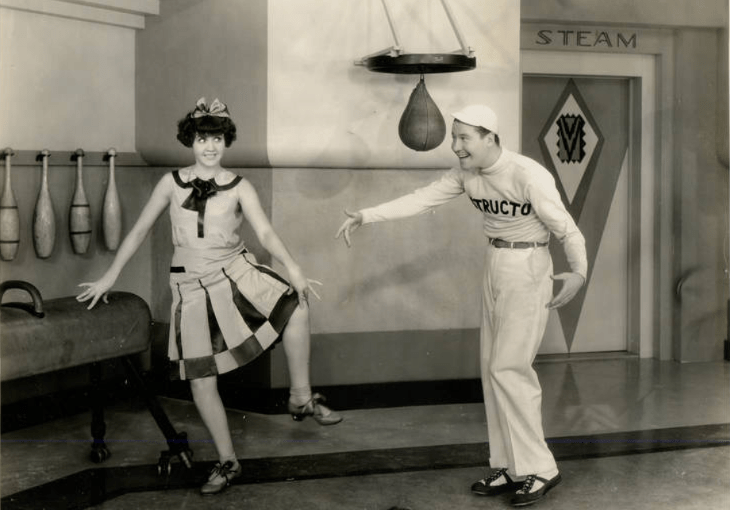
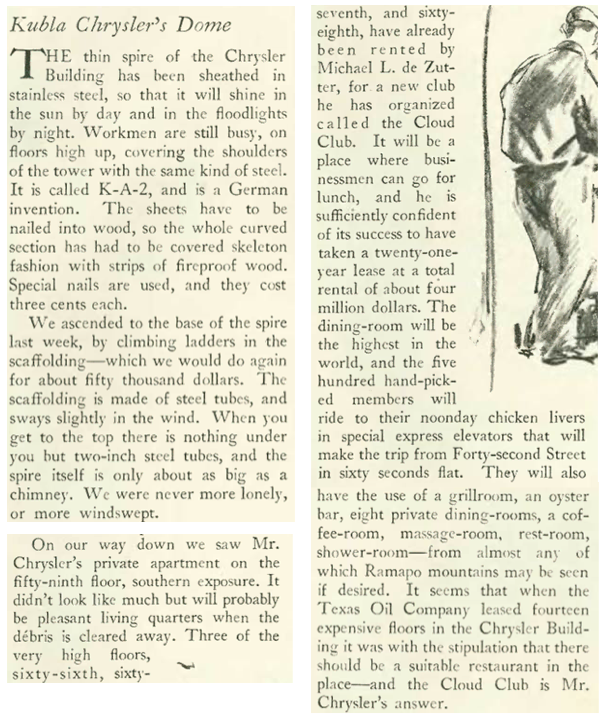
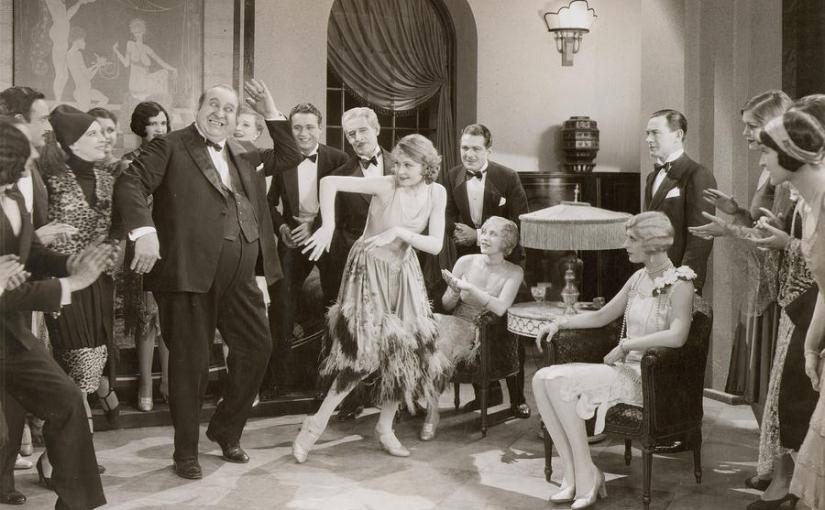
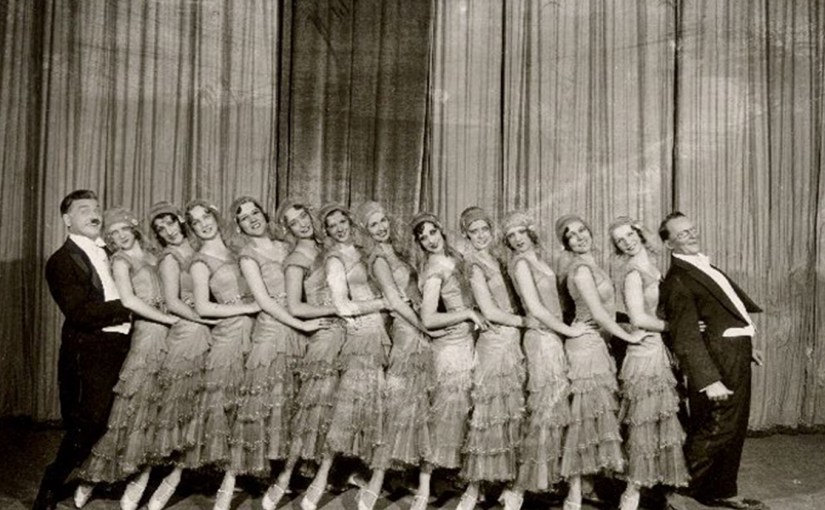
Above image: Groucho Marx, Margaret Dumont, and Lillian Roth in the Marx Brothers second film, Animal Crackers, 1930 (IMDB)
The Marx Brothers were famous for a string of hit films in the 1930s, but some of the comedy on which those films were based went all the way back to the days of vaudeville and 1920s Broadway.
Sept. 6, 1930 cover by Peter Arno.
Animal Crackers was their second film (the first was 1929’s The Cocoanuts), and the last to be adapted from one of their stage shows. It was also the last Marx Brothers movie to be filmed at Paramount’s Astoria Studio in Queens before the brothers headed for Hollywood.
MUSICAL CIRCUS…Animal Crackers began as a Broadway stage production in 1928 before moving to film in 1930; from left to right: Groucho, Harpo, Chico and Zeppo in a publicity photo for the stage version of Animal Crackers. (www.georgeskaufman.com)
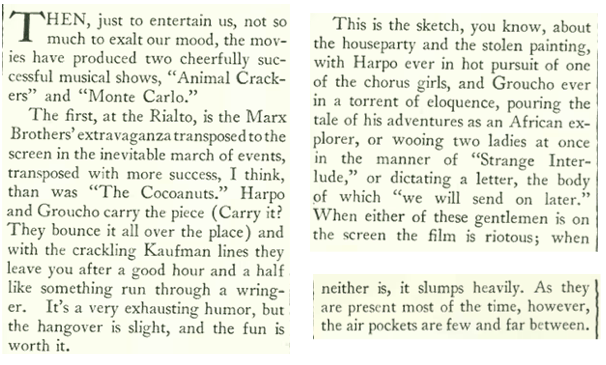
The New Yorker’s John Mosher reviewed the film version, which was playing at the Rialto Theatre:
SO LONG, NEW YORK…Animal Crackers was the second and final Marx Brothers movie to be filmed at Astoria Studios in Queens; from left, Chico, Zeppo, Groucho and Harpo Marx pose for a 1930 publicity photo. (IMDB)
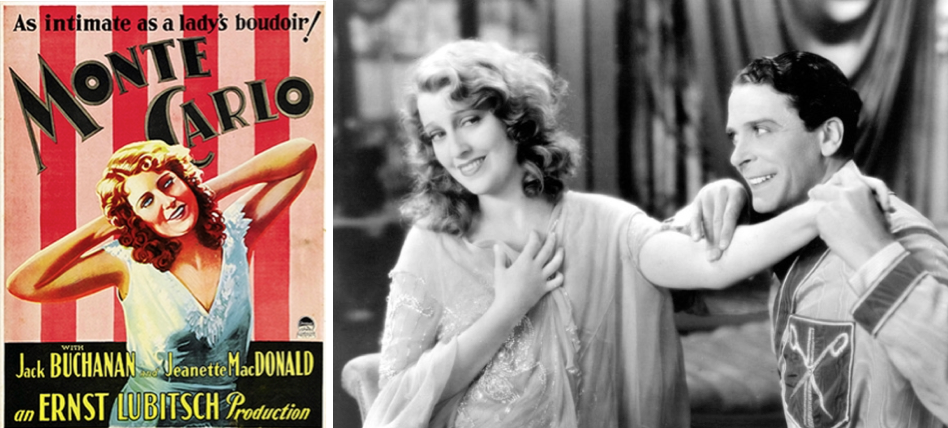
Always partial to European directors, Mosher found Ernst Lubitsch’sMonte Carlo among the better films playing in the late summer.
OH YOU CAD!…Jeanette MacDonald and Jack Buchanan in Monte Carlo. (IMDB)
* * *
Fox in the Hen House
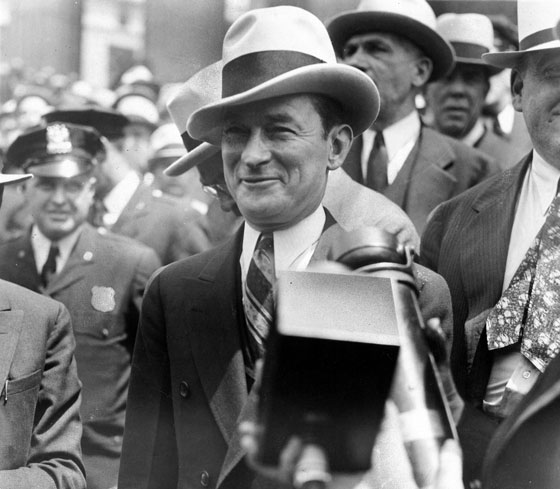
“The Talk of the Town” made light of Mayor Jimmy Walker’s plan to “rid the city of graft.” Ironically, Jimmy himself would be drummed out of office two years later for accepting bribes…
WHAT ME WORRY? Yes maybe. Mayor Jimmy Walker in 1930. (nymag.com)
* * *
From Our Advertisers
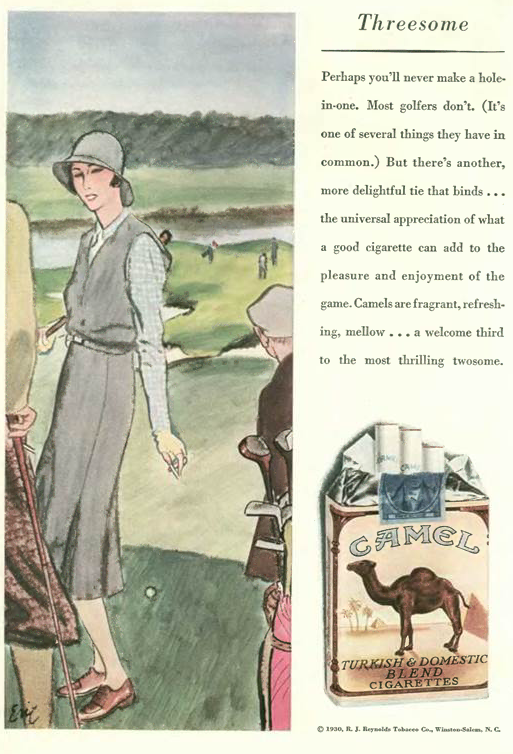
We have another lovely illustration from Carl “Eric” Erickson promoting the joys of smoking unfiltered cigarettes…
…these small ads for apartments in the back pages of the magazine promoted the bucolic vistas in Westchester…
Images of Fleetwood Hills from The American Architect, June 1926.
…and European-style living on East 44th Street…
The Beaux-Arts Apartments (which still stand) consisted of buildings on both sides of E. 44th Street. (Museum of the City of New York)
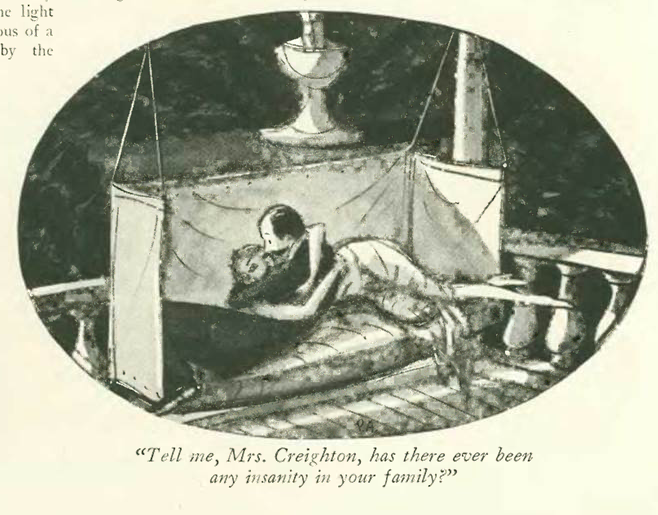
…as for cartoons, Peter Arno continued this running gag…
…as did Rea Irvin in another tableaux (originally running sideways, full page) featuring the clash of country bumpkins and city elites…
…Garrett Price looked in on the burdens of the wealthy…
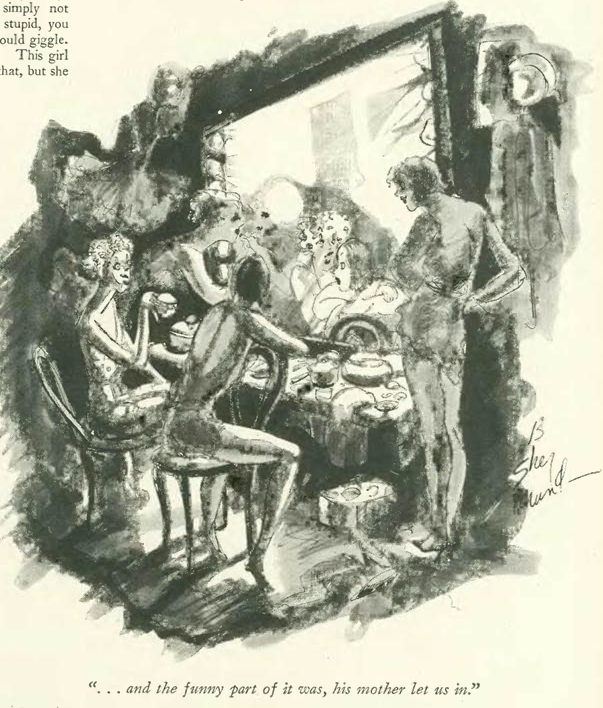
…and Barbara Shermund caught some small talk at a cafe…
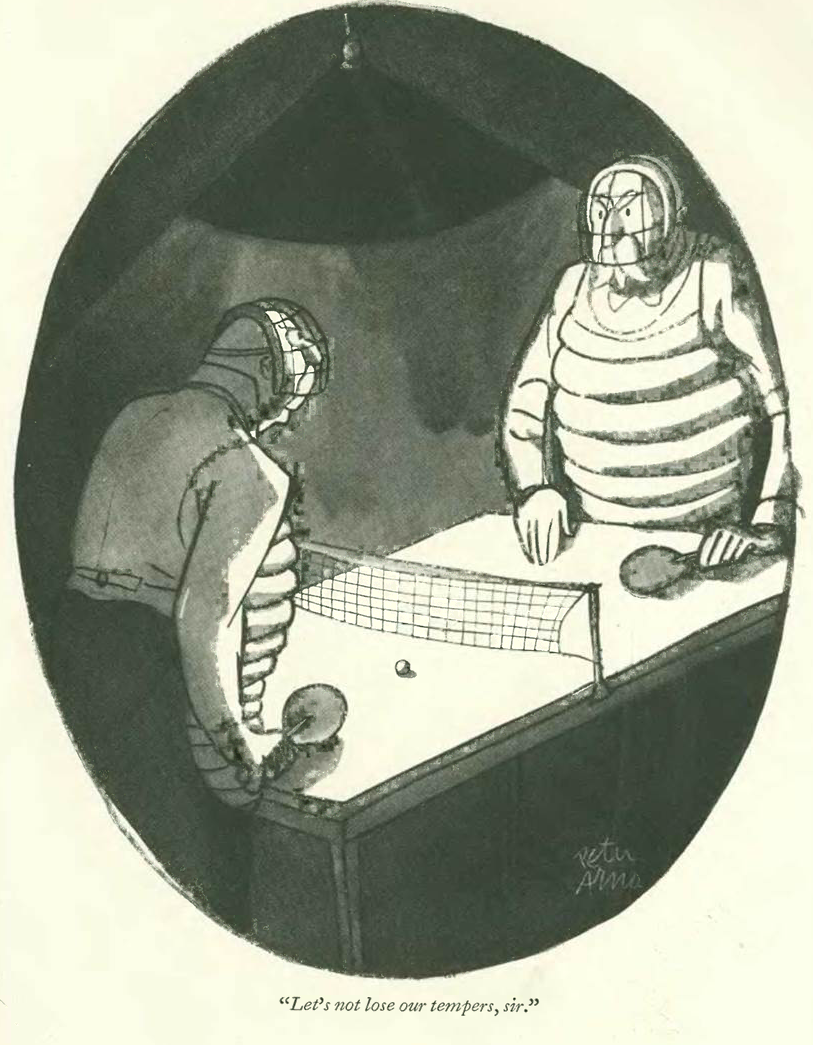
…back to Peter Arno, and a heated game of table tennis…
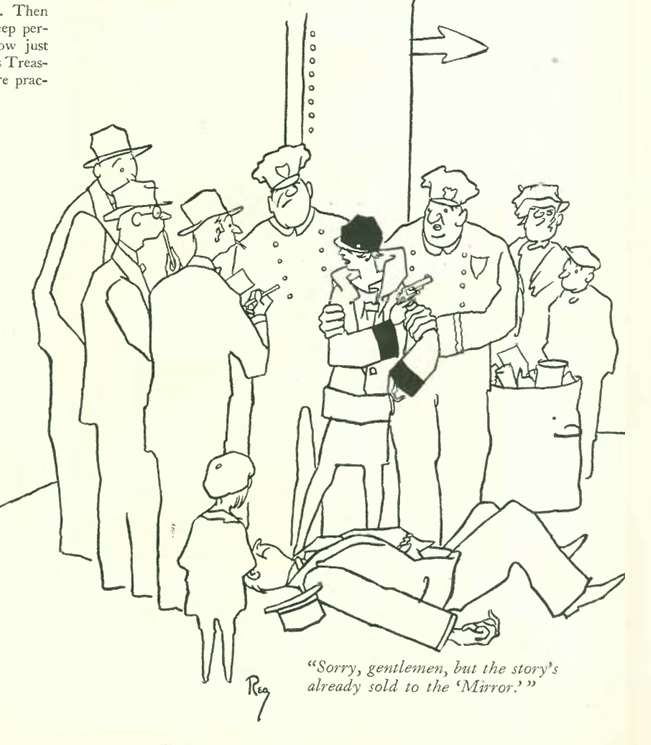
…and Gardner Rea, witness to modern-day crime reporting…
On to the Sept. 13, 1930 issue…
Sept. 13, 1930: yet another satirical kakemono cover by Rea Irvin.
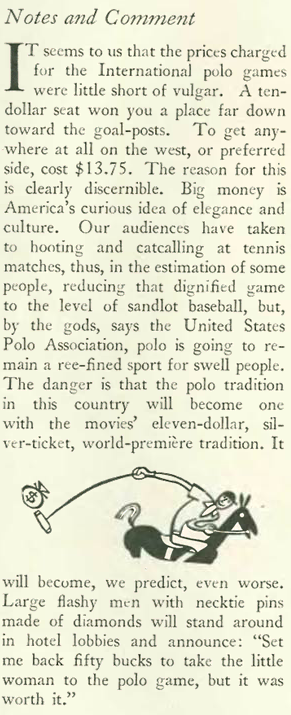
As I’ve noted many times before, the early New Yorker covered every sport under the sun (and especially elite sports such as yacht racing, tennis and badminton, golf and polo) but to my knowledge never covered a major league baseball game in its then five-year existence. Here, E.B. White, in his “Notes and Comment,” complains about the high price of tickets to polo matches…
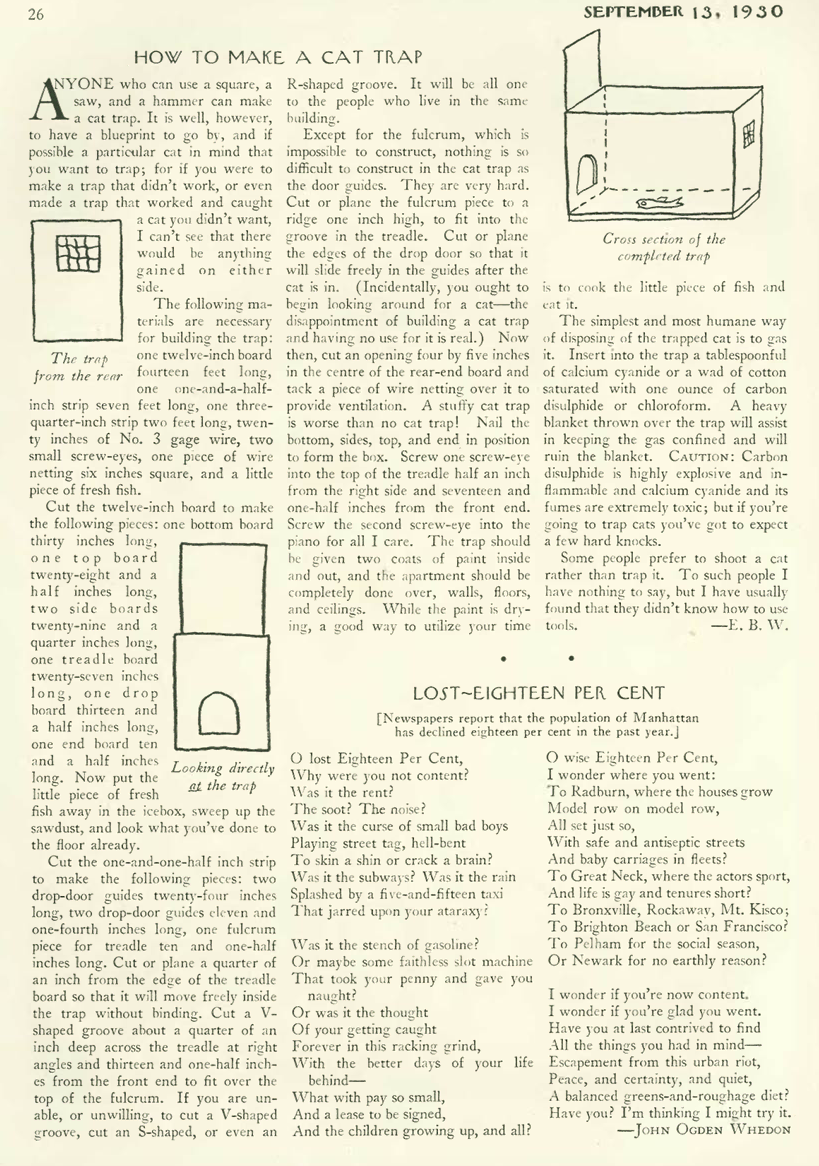
…White, a well-known dog lover, offered a rather cruel solution to a problem cat in this feature:
* * *
Oh Never Mind
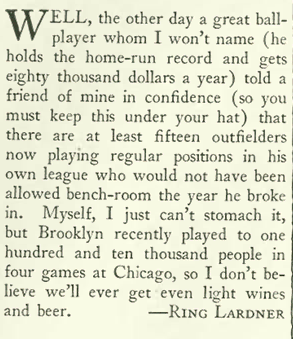
At first glance I thought this might actually be an article about a baseball game, but alas, it was a column by Ring Lardner (titled “Br’er Rabbit Ball”) that showed little enthusiasm for the game (the 1919 “Black Sox” scandal apparently soured his love for baseball). Excerpts:
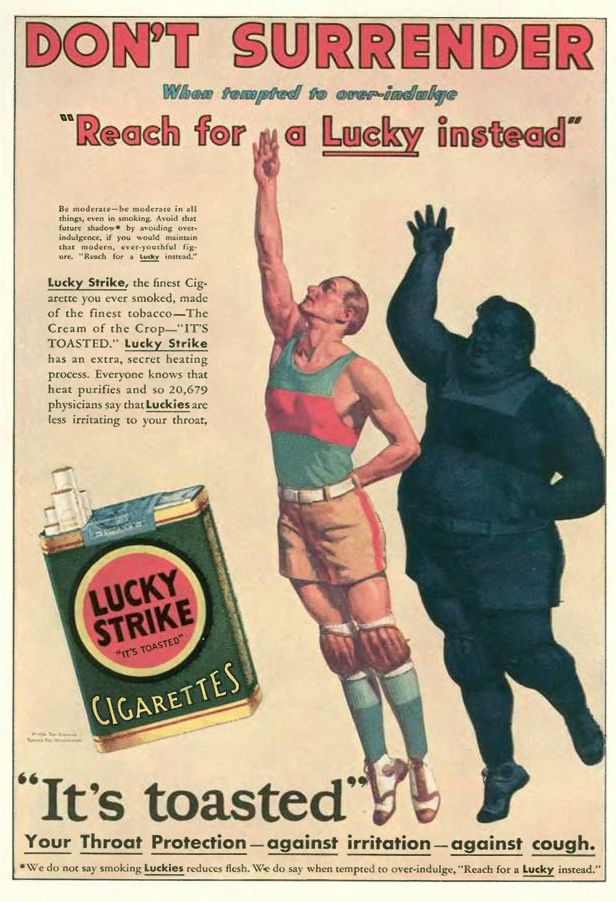
Speaking of sports, we move to the advertisements and the helpful folks from Lucky Strike, who wanted to help you get in shape with a smoke…
…and another ad for Flit insecticide by Dr. Seuss, featuring an elephant that looked a lot like the future Horton, and some unfortunate racist imagery…
…yet another Peter Arno repeat with a new caption…
…and another in a series of 1930’s images by Ralph Barton…
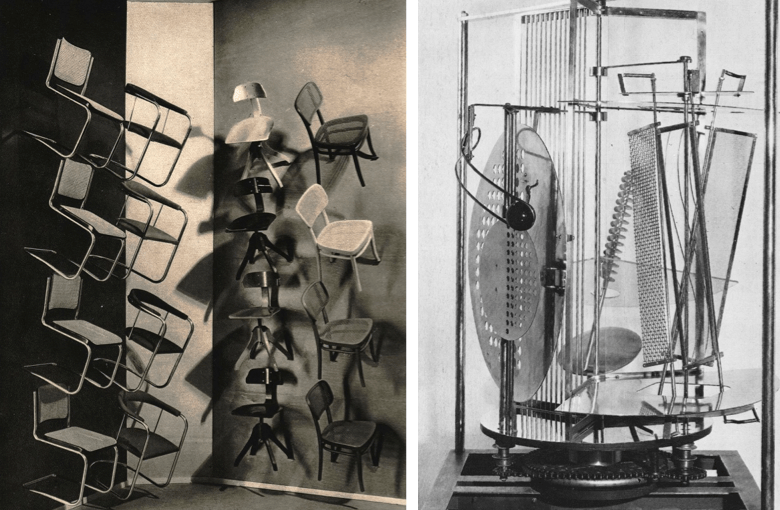
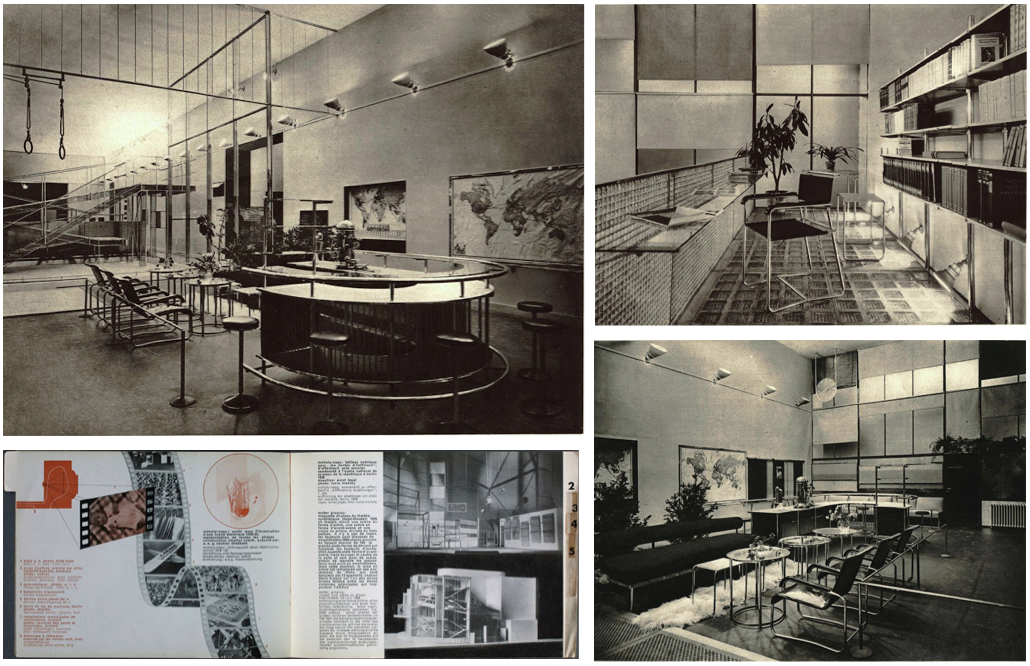
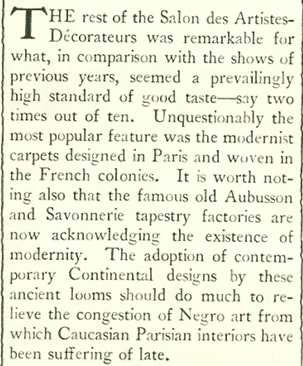
The annual Salon of the Société des Artistes Décorateurs in Paris reflected the growing importance of design as a profession, although it was primarily attuned to an affluent urban elite. Then along came the Germans.
June 14, 1930 cover by Helen Hokinson.
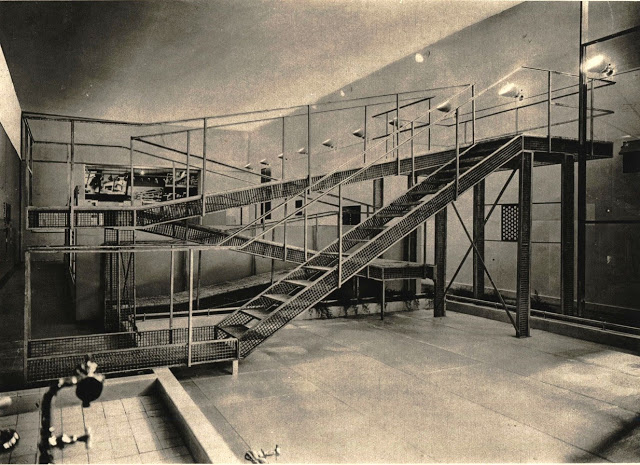
A radical new wind blew through Paris in 1930 when Bauhaus designers were invited to exhibit in their own special section at the Salon. According to The New Yorker’s Paris correspondent Janet Flanner, the Germans put on a display in their Section Allemande that left some French designers scratching their heads.
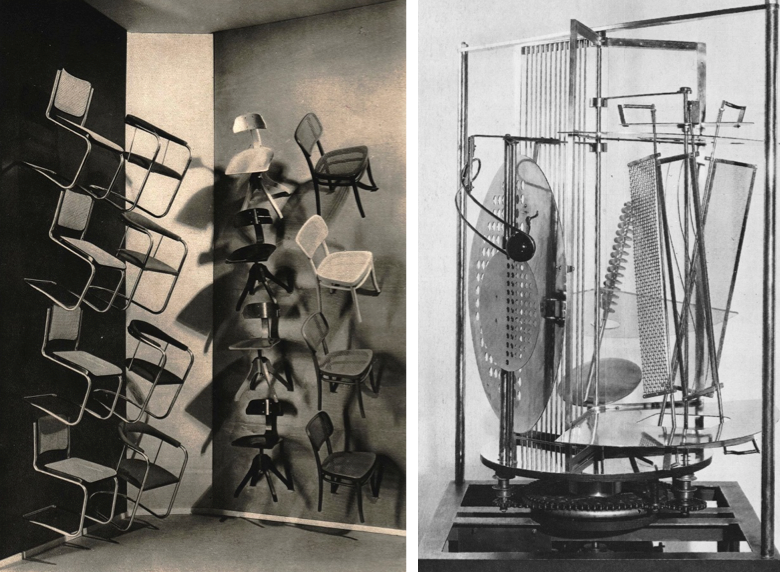
KEEPING IT CLEAN…Members of the Bauhaus Werkbund displayed their wares in the Section Allemande (German section) of the annual Salon of the Société des Artistes Décorateurs in Paris. Clockwise, from top left, examples of reception areas and workspaces by Walter Gropius; bottom left, inside pages of the exhibition catalogue for the Section Allemande. (journal.eahn.org)STAIRWAY TO THE FUTURE…A staircase fashioned from galvanized chicken wire, by Walter Gropius, on display in Section Allemande of the 1930 Salon of the Société des Artistes Décorateurs. (journal.eahn.org)UNKNOWN THEN, COMMON NOW…The Section Allemande also featured building models, including this multi-story apartment with communal facilities, designed by Walter Gropius. (Journal of Design History, 2004)HOW IT STACKED UP…Rather than dazzle audiences with the latest in posh decor, the Germans confronted Salon audiences with their radical approaches to furniture and interior spaces. At left, chairs by Marcel Breuer and others; at right, Light Prop for an Electric Stage by László Moholy-Nagy. (journal.eahn.org/Artists Rights Society)
Many critics and commentators at the time characterized the Salon as a nationalistic showdown between French luxury decor and German efficiency and standardization. Flanner suggested that while the Germans seemed to be throwing out the rule book, the French were accepting modernity at a much slower pace:
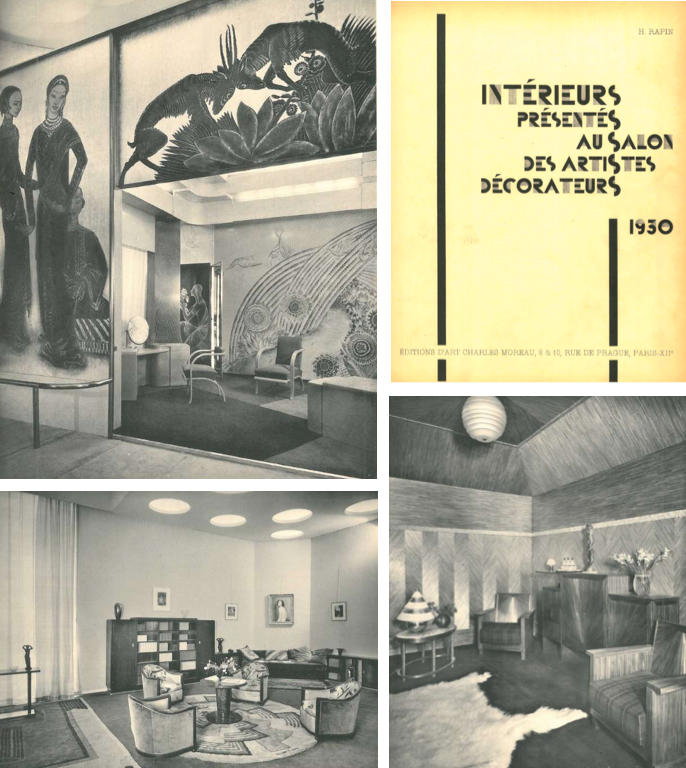
MODE DE VIE…Salon entries by French designers had a more art deco bent. Clockwise, from top left, vestibule of a boudoir by Jean Dunand; cover of the Salon’s catalogue; Petit Salon by André Groult; a living room by Jules Leleu. (art-utile.blogspot.com)
Of course we know how this story in turns out. In just three years the Nazis would shut down the Bauhaus, scattering its faculty and students abroad, including many to America, where they would find fertile soil to continue their work and eventually spread their design philosophy and aesthetic (for better or worse) across the U.S. and to every corner of the world.
* * *
A Gay Old Time
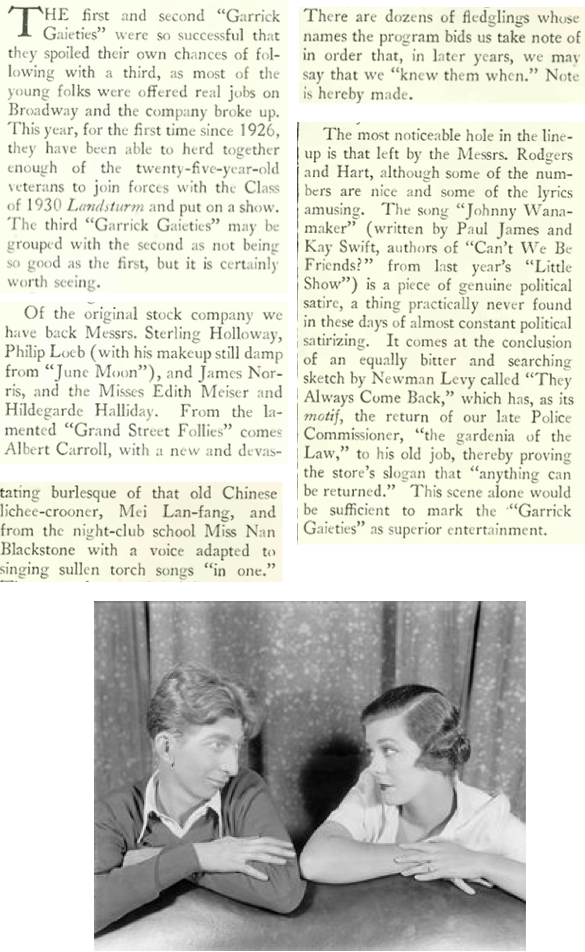
New Yorkers could escape the summer heat by taking in the latest incarnation of the Garrick Gaities at Broadway’s Guild Theatre. Character and voice actor Sterling Holloway Jr., (1905-1992) best known today as the voice of Disney’s Winnie the Pooh, appeared in all three Garrick Gaiety revues (1925, 1926, 1930), which were staged as benefits for New York’s Theatre Guild. Robert Benchley offered this review:
Sterling Holloway, left, with June Cochran in Garrick Gaieties.
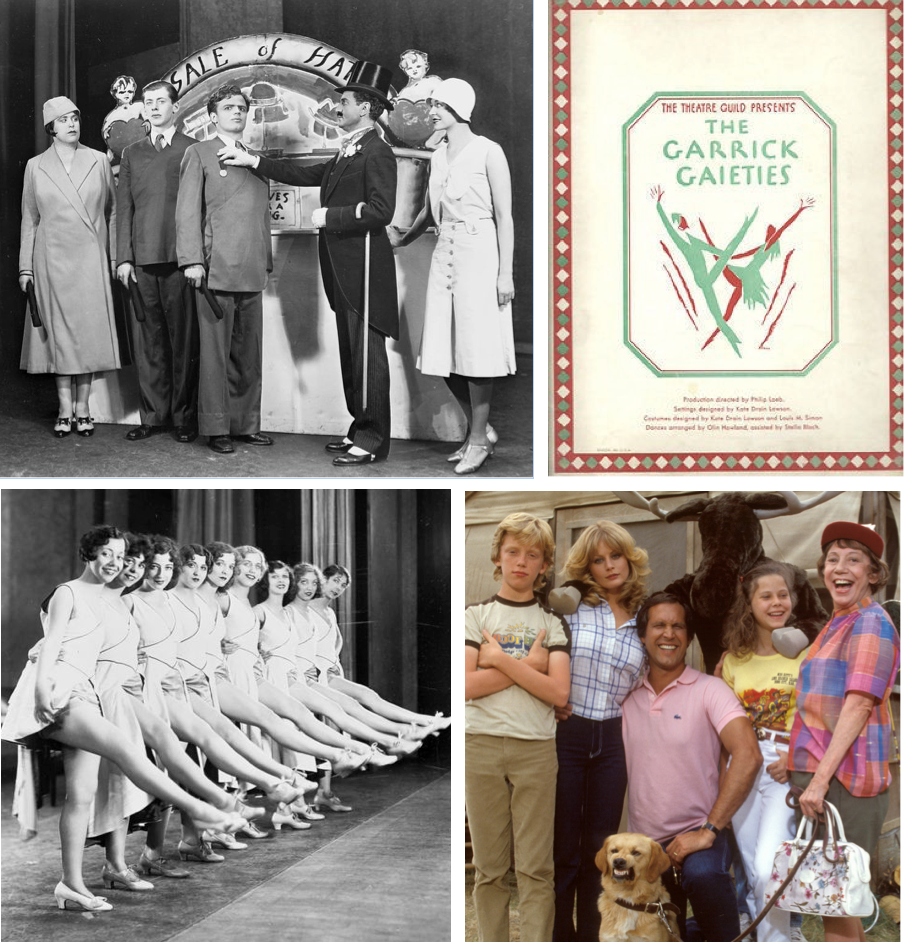
Another familiar face in the Garrick Gaieties was Imogene Coca (1908-2001), a pioneer of early television (with Sid Caesar on Your Show of Shows) who is best known today for her role as Aunt Edna in National Lampoon’s Vacation (1983).
KEEP ‘EM LAUGHING…Clockwise, from top left, Scene from the 1930 Garrick Gaieties revue, with Philip Loeb in the high hat and Thelma Tipson standing behind him. Also from left are Ruth Chorpenning, Donald Stewart and Ted Fetter; cover of the program for the 1930 revue; publicity photo from 1983’s National Lampoon’s Vacation, with Imogene Coca as Aunt Edna; Coca, far left, in the chorus line for the 1930 Garrick Gaieties. (New York Public Library/IBDB/ifccenter.com)
* * *
Ahh-Choo
A child of New York City’s suburbs, E.B. White developed a love of the natural world thanks to a severe bout of hay fever he had as a child — on the advice of a doctor, he was sent to Maine for the summer. White’s allergies, and his love of country living, would prompt him to buy a summer residence on the Maine Coast in 1933. He and his wife, New Yorker writer and fiction editor Katherine Angell White, would make it their permanent home four years later. In 1930, however, White was still putting up with the bad summer air of the city:
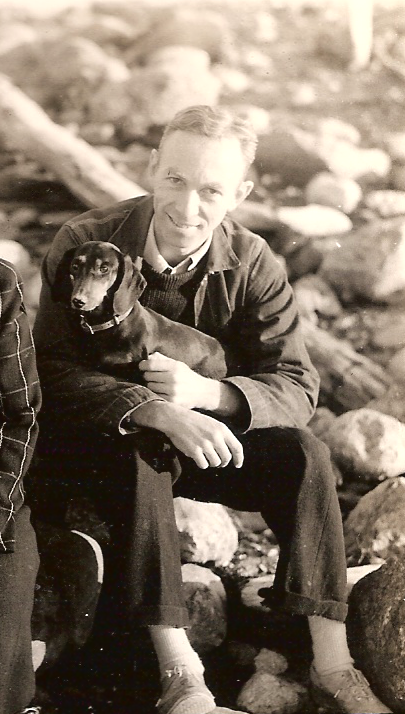
THANK GOD I’M A COUNTRY BOY…E.B. White on the beach with his dog Minnie, circa 1940s. (Wikipedia)
* * *
It Didn’t Work Then, Either
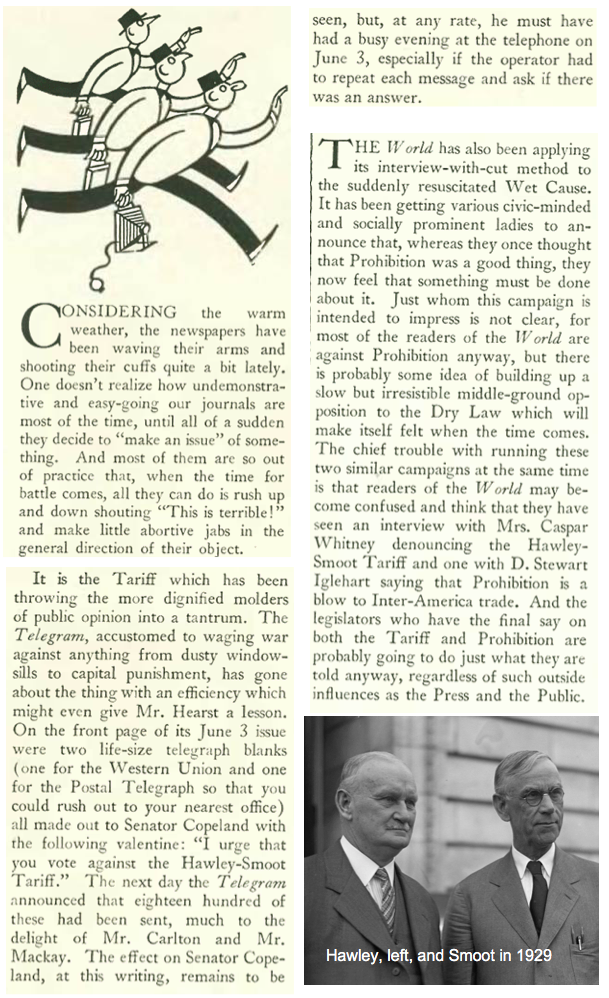
Some things never change. The Hawley–Smoot Tariff Act, sponsored by Representative Willis C. Hawley and Senator Reed Smoot and approved June 17, 1930, raised tariffs on more than 20,000 imported goods. Promoted as a way to protect American businesses and farmers, it put additional strain on international markets already reeling from the effects of the Depression. A resulting trade war severely reduced imports and exports. Writing for “The Wayward Press,” Robert Benchley (under the pen name Guy Fawkes) shared these observations:
* * *
How Dry I Ain’t
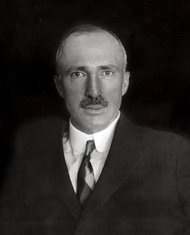
Despite his sober demeanor, Henry Hastings Curran (1877-1966) was a champion for those seeking the repeal of Prohibition laws. A longtime city manager in several roles, in 1930 he was president of the Association Against Prohibition Amendment. According to profile writer Henry Pringle, Curran predicted the end of Prohibition in five years. Happily for the wet side, they would get their wish in just three. A brief excerpt from the profile, titled “The Wet Hope.”
Henry H. Curran (Underwood and Underwood)
* * *
From Our Advertisers
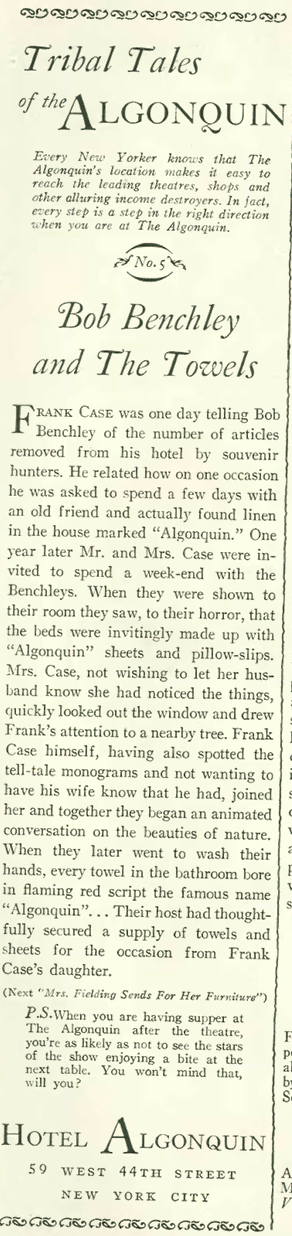
The Hotel Algonquin ran a series of ads in the back pages of The New Yorker that capitalized on its reputation as a place where stars and other notables gather. And although the Algonquin Round Table was a thing of the past, the hotel made sure to showcase names forever associated with the famed table, including Robert Benchley and the hotel’s manager, Frank Case…
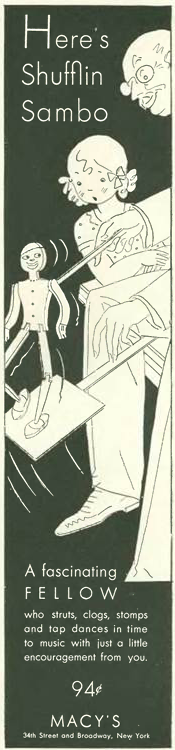
…hoping for some crossover interest from New Yorker readers, William Randolph Hearst’sCosmopolitan (then a publisher of fiction, not sex tips) promoted this fictionalized autobiography of a famous tap dancer in this full page ad…
…introduced in 1924, Kleenex was originally marketed as a cold cream remover, and not as something you would blow your nose into, for goodness sake…
…however, after 1930 Kleenex was being marketed with the slogan “Don’t Carry a Cold in Your Pocket”…
DON’T BLOW IT…Kleenex boxes circa 1925. (Kleenex.com)
…and artist Carl Erickson remained busy making Camel cigarettes look so darn appealing…
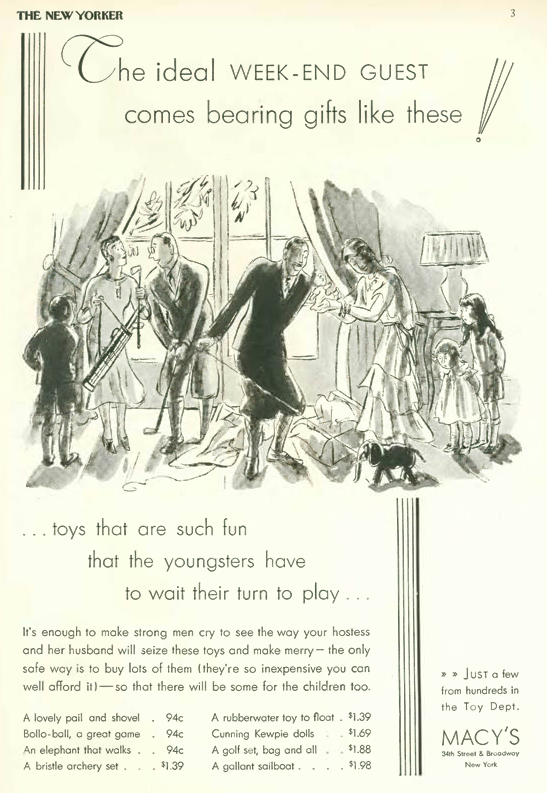
…from Macy’s we have a jolly ad illustrated by Helen Hokinson…
…and for our cartoons, Peter Arno, and an awkward moment in a parking lot…
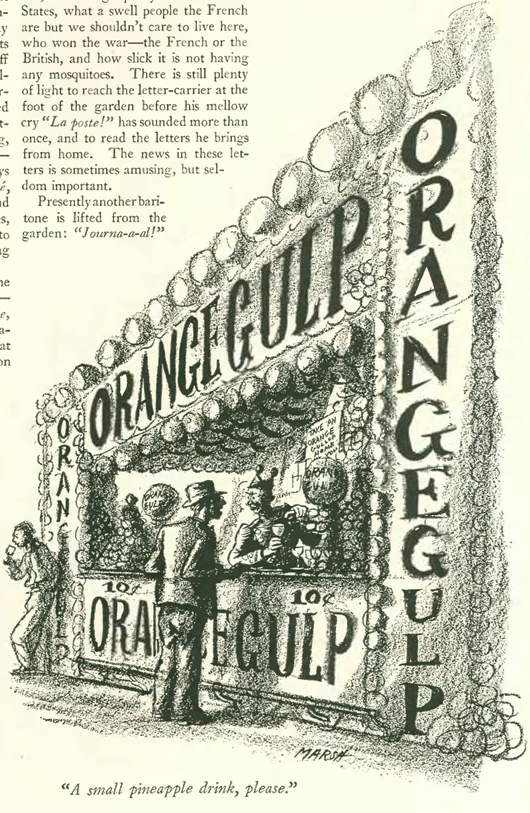
…Reginald Marsh visited Coney Island…
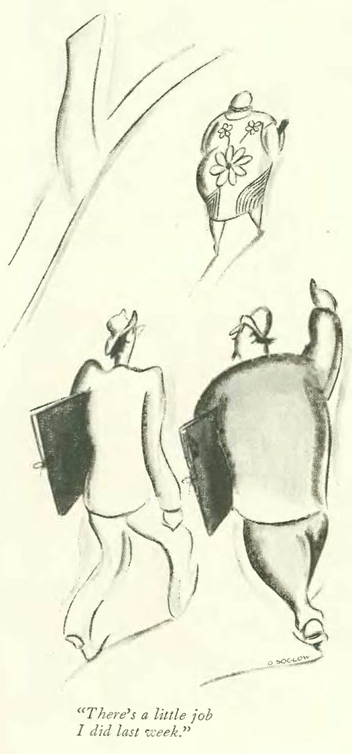
…fresh off his first “Little King” strip for The New Yorker, Otto Soglow returned with this wry observation…
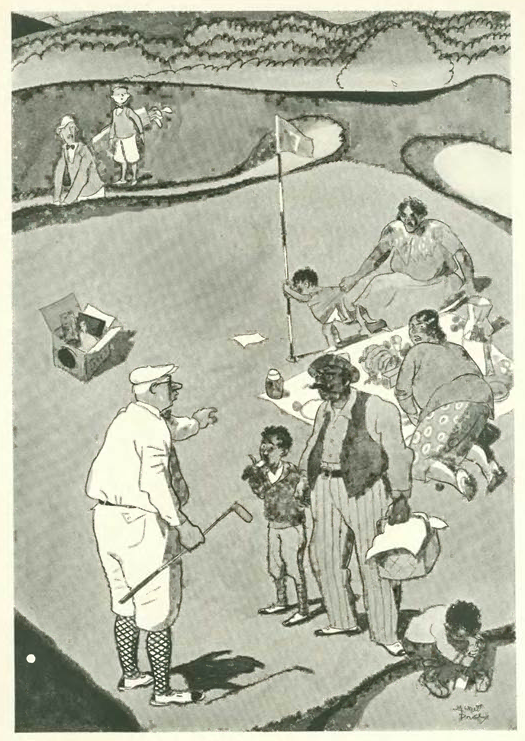
...Garrett Price looked in on a clash of cultures at a golf course…
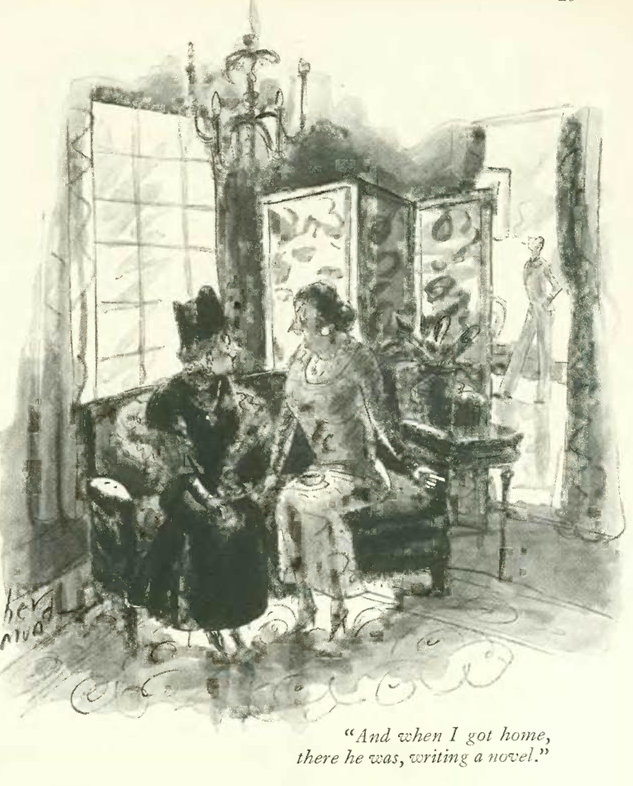
…Barbara Shermund found a bit of trouble at home…
…while Art Young offered this woman a choice of her daily mayhem…
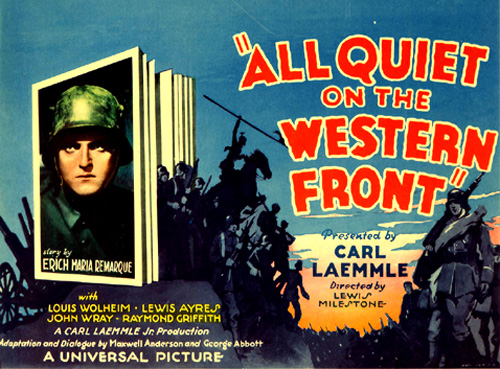
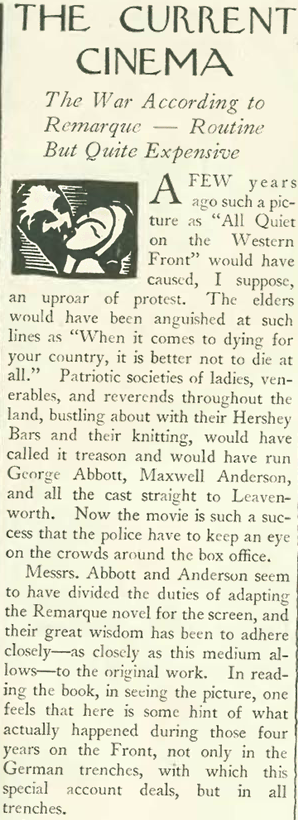
Still considered one of the greatest anti-war films ever made, All Quiet on the Western Front opened in New York on April 29, 1930 to strong reviews. Based on Erich Maria Remarque’s novel of the same name, the film’s depictions of the horrors of war were so realistic and harrowing that it was banned in a number of countries outside of the U.S.
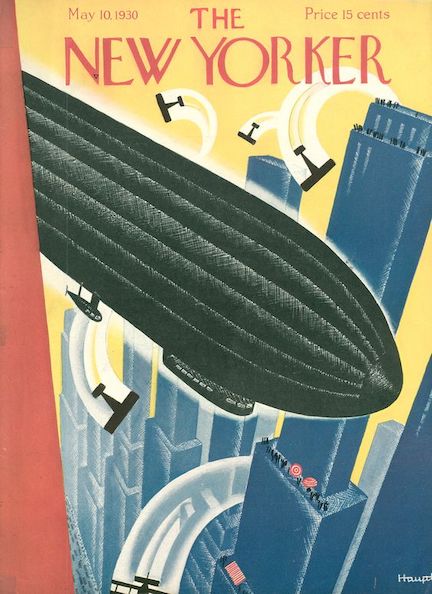
May 10, 1930 cover by Theodore Haupt.
Banned, that is, by nations gearing up for war. In Germany, Nazi brownshirts disrupted viewings during its brief run in that country, tossing smoke bombs into cinemas among other acts of mayhem. Back in the U.S., The New Yorker’sJohn Mosher attended a screening at a “packed” Central Theatre:
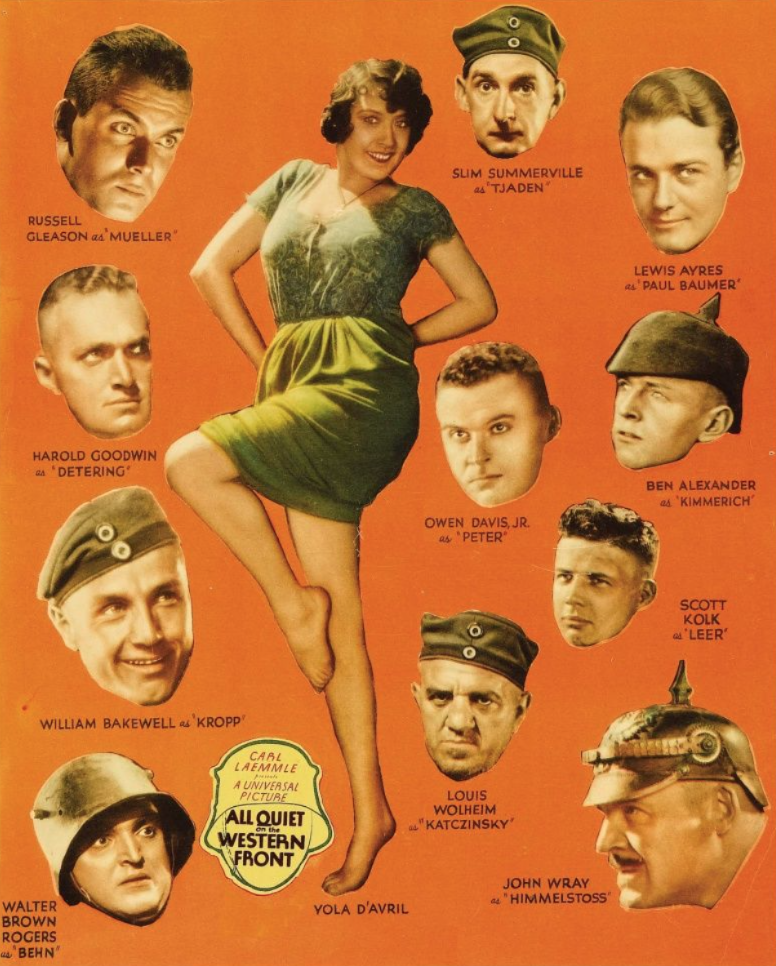
WAR IS HELL…Clockwise, from top left, movie poster for 1930’s All Quiet on the Western Front; German soldier Paul Bäumer (Lew Ayres), falls into a shell crater with a French soldier and draws his knife; in one of the most moving scenes in cinema, Bäumer is forced to spend the night in the crater, where he vainly tries to safe the life of the Frenchman he has mortally wounded; a German soldier crawls through the mud in a German training camp. (IMDB/Universal).
Mosher found the film’s adaption from the novel wanting in places, but overall praised the acting and the quality of the picture…
…and just in case some audiences were put off by the blood and guts, Universal promoted other themes on its lobby cards…
(IMDB)
* * *
More Than a Stunt
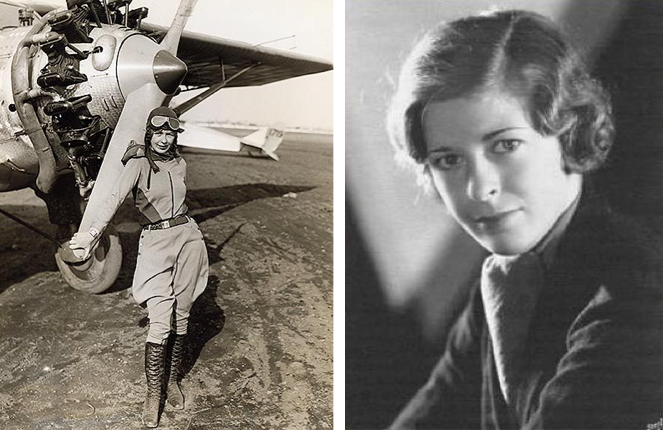
In her profile of aviator Elinor Smith (1911-2010), writer Helena Huntington Smith took great pains to distinguish Elinor from other “lady fliers” who were little more than passengers in various flying exploits. Like Amelia Earhart, Smith had the bona fides of a true aviator: in 1927 she become the youngest licensed pilot in the world at age 16, learning stunt flying at an early age. When she was 17 she smashed the women’s flying endurance record by soloing 26½ hours, and in the following month set a woman’s world speed record of 190.8 miles per hour. In March 1930 she set a women’s world altitude record of 27,419 feet (8,357 m), breaking that record in 1931 with a flight reaching 32,576 feet. Smith would continue to fly well into old age. In 2000 she flew NASA’s Space Shuttle vertical motion simulator and became the oldest pilot to succeed in a simulated shuttle landing. In 2001 (at age 89) she would pilot an experimental flight at Langley AFB. An excerpt from the profile:
HEAD IN THE CLOUDS…Elinor Smith’s flying career would extend from age 16 and into her 90s. At left, Smith poses in Long Island with the Bellanca monoplane she used to beat the solo flight record in 1929. Right, portrait of Smith circa 1930s. (findagrave.com)
* * *
I’d Rather Be in Philadelphia
Theatre critic Robert Benchley was over the moon regarding a performance of Lysistrata staged by the Philadelphia Theatre Association. Benchley suggested the Philadelphians had “put New York to shame” in staging such a “festival of beauty and bawdiness…never seen on an American stage before.”
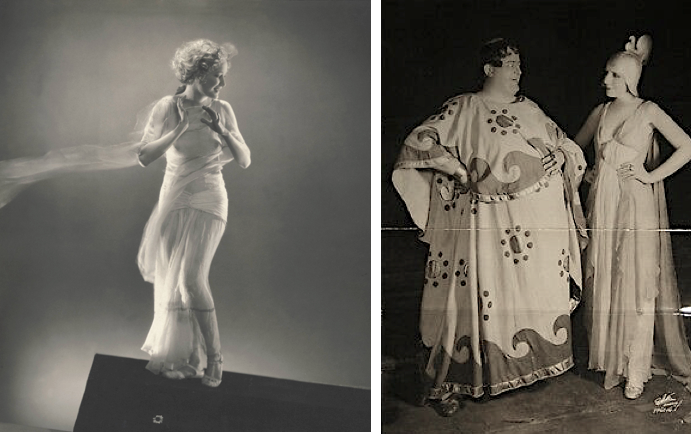
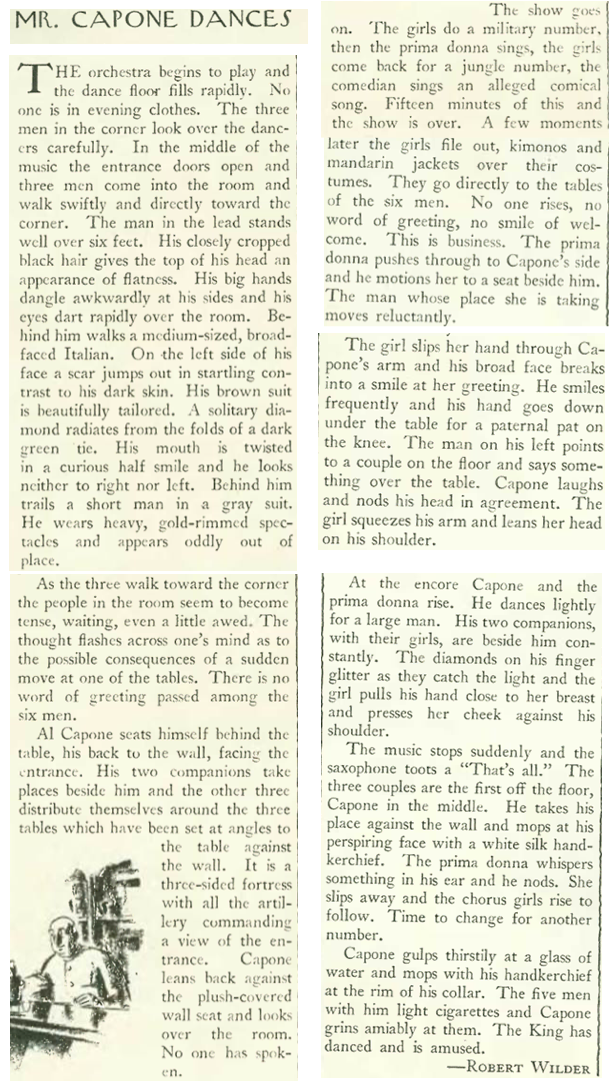
NO MORE HANKY PANKY…Left, actress Miriam Hopkins in Aristophanes’ Lysistrata, as photographed by Edward Steichen; at right, Sydney Greenstreet with unidentified actress from the 1930 Philadelphia production of Lysistrata. (timeline.com)
Benchley praised the seemingly advanced tastes of Philadelphia audiences as he continued to the lament the fact that the City of Brotherly Love had beaten New York to the punch with the staging of the play. He needn’t have worried much longer; the play would open on Broadway on June 5, 1930, at the 44th Street Theatre.
LOVER COME BACK…Production photograph for Norman-Bel Geddes’s staging for Lysistrata, titled “the women of Greece return to their men.” (hrc.utexas.edu)
While we are on the subject of theater, Constantin Alajálov provided this lovely illustration of Anton Chekhov’sUncle Vanya for The New Yorker’s theater review section…
* * *
Make ‘Em Dance, Boys
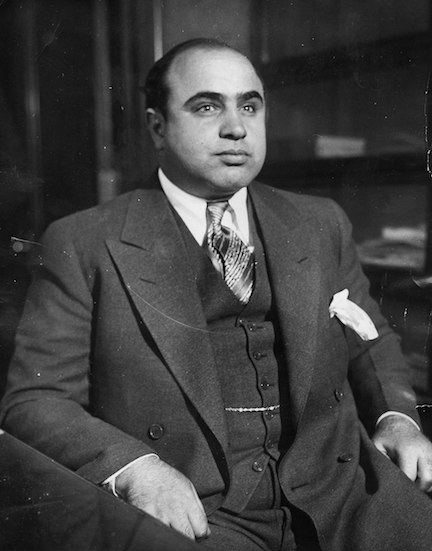
The author Robert Wilder contributed this interesting casual about the appearance of gangster Al Capone at a Chicago nightclub. Excerpts:
LIGHT ON HIS FEET…Al Capone in 1930. (Wikipedia)
* * *
You Say You Want a Revolution?
Alva Johnston offered his thoughts on how America could stage its own “Red Revolution,” given that Russia and several European countries had already experienced communist uprisings of their own, and also given that New York Police Commissioner Grover Whalen, always in search of problems that didn’t exist, had announced a new “Red Scare” in his fight against communism.
Tongue firmly in cheek, Johnston suggested how American know-how could be brought to bear in inciting a Red Terror. An excerpt:
YANKEE INGENUITY…Alva Johnston, left, offered some innovative ideas for a uniquely American “Red Revolution.” At right, soldiers stand behind a barricade during Germany’s communist Spartacist uprising of January 1919. (Wikipedia)
* * *
Speaking of Revolutionaries
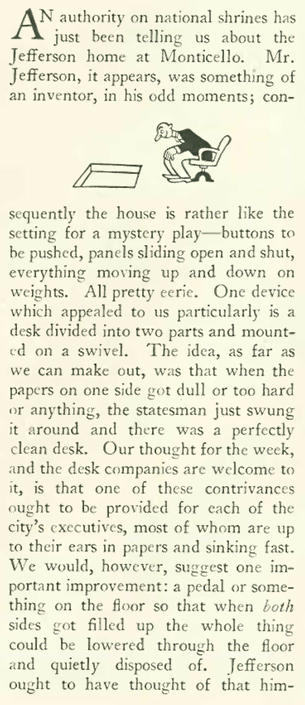
Thomas Jefferson’s home at Monticello is one of America’s most-visited historical sites, but in 1930 it was still something of a regional curiosity, having only been acquired in 1923 for the purposes of turning it into a public museum. Although Jefferson is well known today for his various inventions at Monticello, E.B. White was just learning about this side of the president in his weekly “Notes and Comment” dispatch:
THIS OLD HOUSE…Left, a combination of neglect and Civil War vandalism left Thomas Jefferson’s Monticello enmeshed in weeds and in a state of near collapse by the 1870s. At right, students of the University of Virginia pose outside Monticello in 1930. (UVA/Hulton Archive)
* * *
Play Ball?
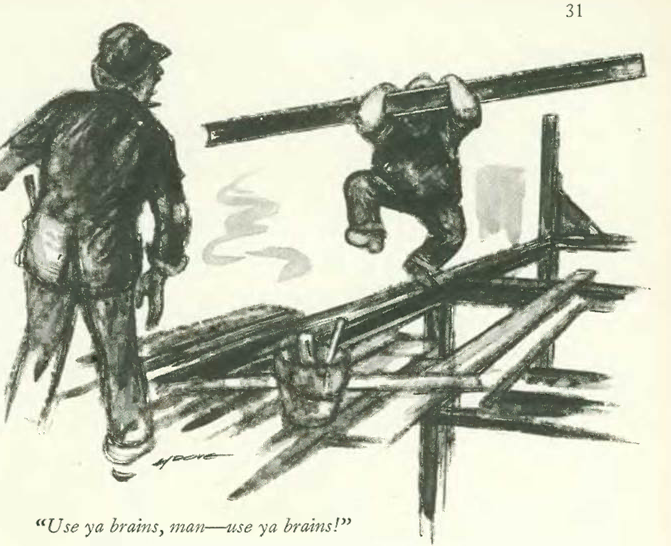
We are well into the spring of 1930, yet The New Yorker stood firm in its complete lack of baseball coverage. As I’ve noted before, the magazine covered virtually every sport from horse racing to rowing to badminton, and even lowered itself to regular features on college football and professional hockey, but not a line on baseball, save for an occasional note about the antics of Babe Ruth or the homespun goodness of Lou Gehrig. There were signs, however, that baseball was being played in a city blessed with three major league teams; we do find game times in the “Goings On About Town” section, as well as occasional baseball-themed filler art, and a comic panel in the May 10 issue by Leonard Dove:
From Our Advertisers
We begin with an endorsement for Chase & Sanborn coffee by the soprano Alma Gluck, wife of famed violinist and composer Efrem Zimbalist Sr. Originally I thought she was enjoying coffee with a sister in law named “Mrs. Zimbalist,” but as reader Frank Wilhoit astutely points out, the “Alma Gluck” (celebrity) and “Mrs. Zimbalist” (housewife) are alternate personae of the same individual. And now that I look at the ad again, the clothes and hair styles are identical. I will try to locate a clearer image of the ad…
…and from the makers of White Rock we have a group of swells and their airborne friends enjoying some bubbles that are doubtless mixed with illegal hootch…
…Dr. Seuss continued to offer his artistry on behalf of Flit insecticide…
…and on to our cartoons, Peter Arno illustrated the hazards of the road…
…while Leonard Dove explored the hazards high above the streets of Manhattan…
…Constantin Alajálov explored an odd encounter in a park…
…Isadore Klein mused on the tricks of mass transit…
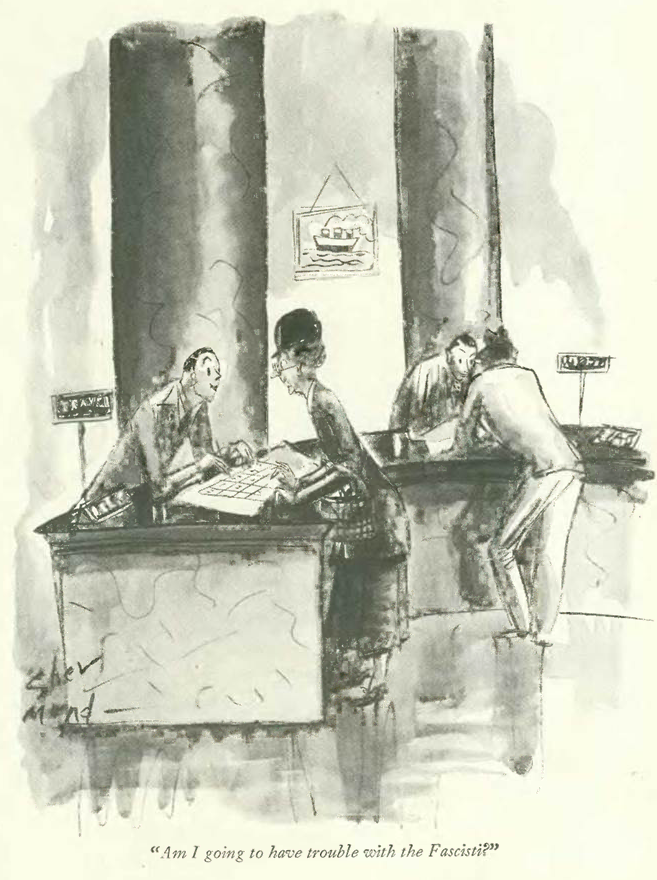
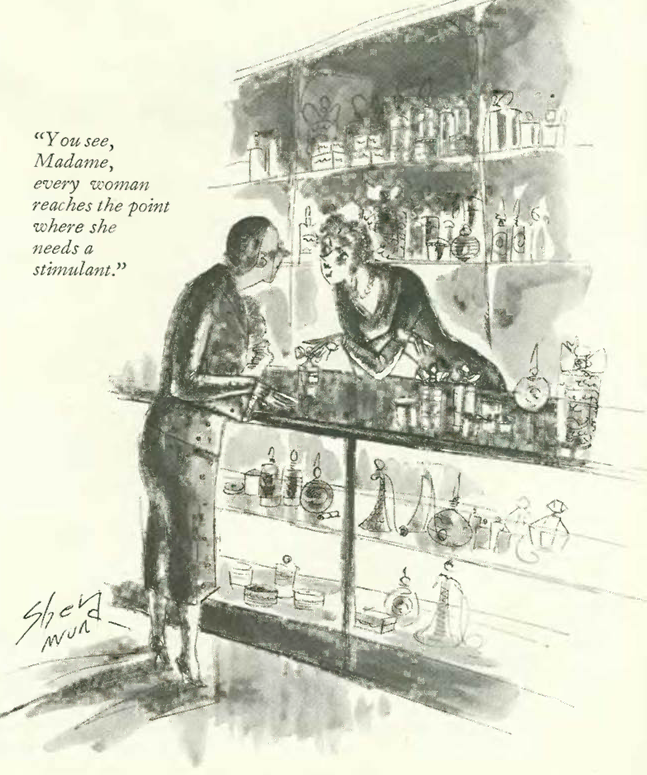
…and two from Barbara Shermund, who looked in on one tourist’s plans for a trip to Mussolini’s Italy…
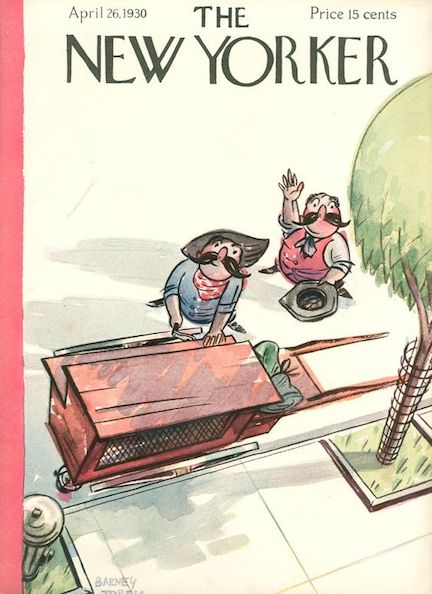
Before we launch into the latest offering from Tinseltown, a note about the cover artist for the April 26, 1930 issue.
April 26, 1930 cover by Barney Tobey.
Barney Tobey (1906-1989) was known for gently humorous cartoons that appeared in The New Yorker for more than fifty years. He also contributed four covers, the first of which appears above. In the Sept. 21, 1998 issue, illustrator Richard Merkin offered this remembrance:
* * *
Star-spangled Banter
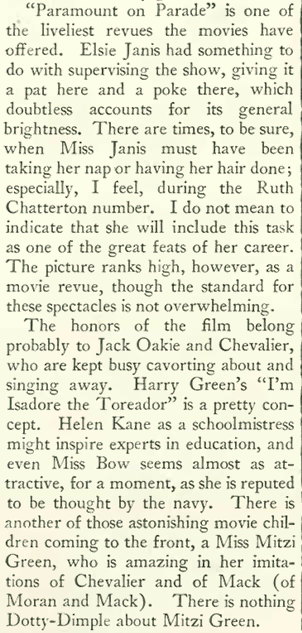
All-star musicals were all the rage in the early sound era, as they gave studios the opportunity to showcase contract players (who were virtually owned by the studios) doing things they usually didn’t do on screen. Following the success of MGM’s Hollywood Revue of 1929, Paramount Studios released Paramount on Parade in April 1930, much to the liking of New Yorker critic John Mosher, who also praised the film’s accompanying cartoon, 1929’s The Prisoner’s Song:
You can watch Max Fleischer’s The Prisoner’s Song here (and ponder how far animation has advanced)…
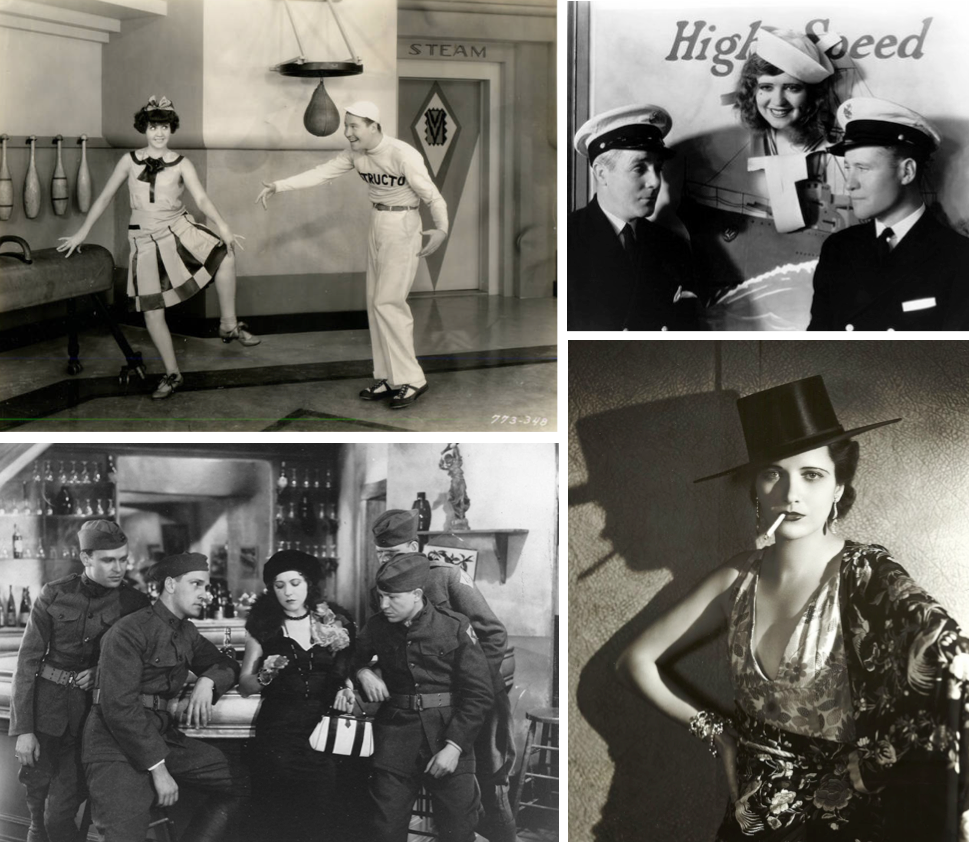
Mosher also praised a number of Paramount’s contract players, and especially actors Jack Oakie and Maurice Chevalier…
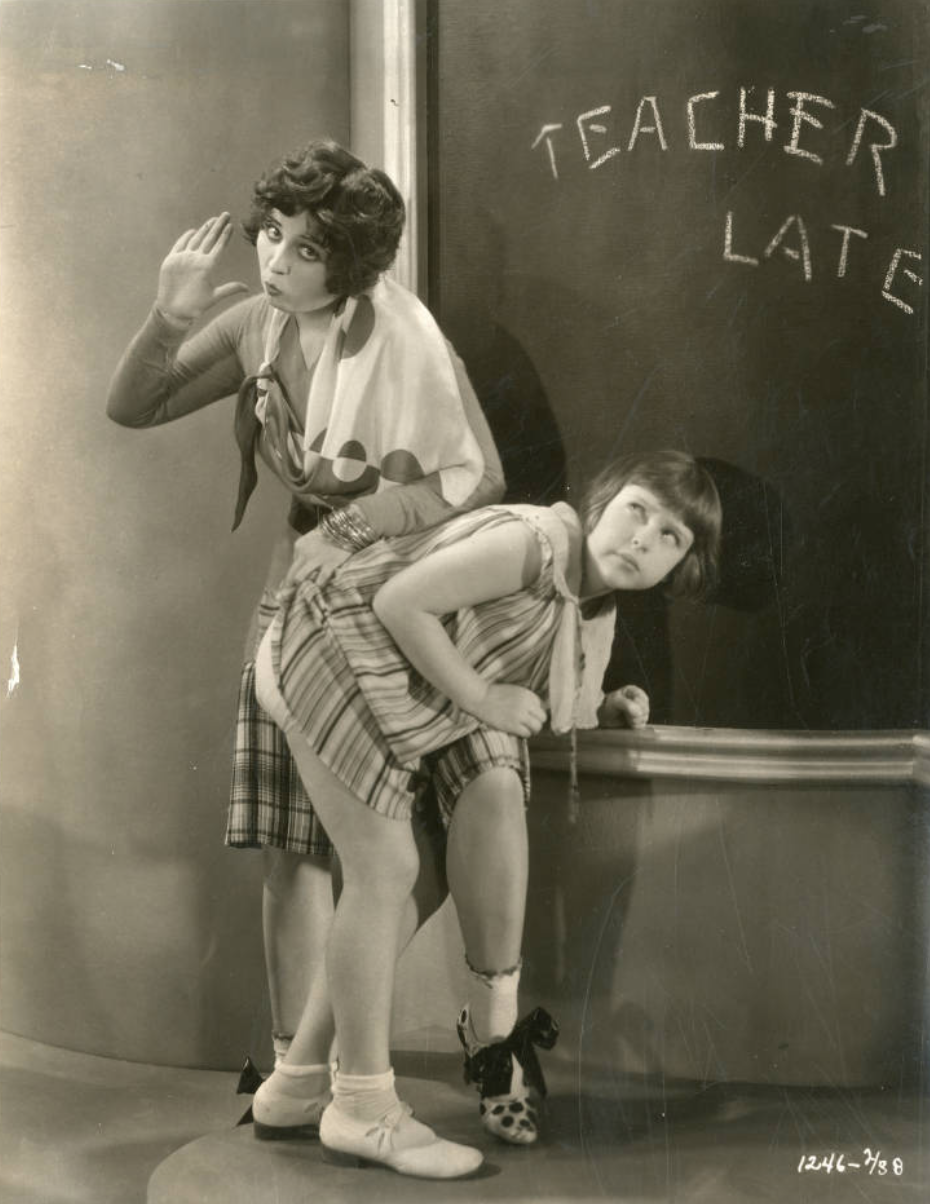
MUCH ADO…A great crowd gathers for the premiere of “Paramount on Parade” at the New York’s Rialto Theatre in April 1930. (cinematreasures.org)SEEING STARS…Clockwise, from top left, Helen Kane (possibly the inspiration for the cartoon character “Betty Boop”) and Jack Oakie do a little footwork; Clara Bow, Hollywood’s “It Girl,” pops through a Navy recruitment poster at the beginning of her song and dance number (with Stuart Erwin and Richard ‘Skeets’ Gallagher); one of Hollywood’s top actresses in 1930, Kay Francis, portrays “Carmen” in the revue; Ruth Chatterton entertains doughboys Stuart Erwin, Fredric March, Jack Oakie, and Stanley Smith in Paramount on Parade. (IMDB)BOOP GIVES A BOP…Helen Kane (left) and child star Mitzi Green in a sketch from Paramount on Parade. (IMDB)
* * *
Lost In the Crowd
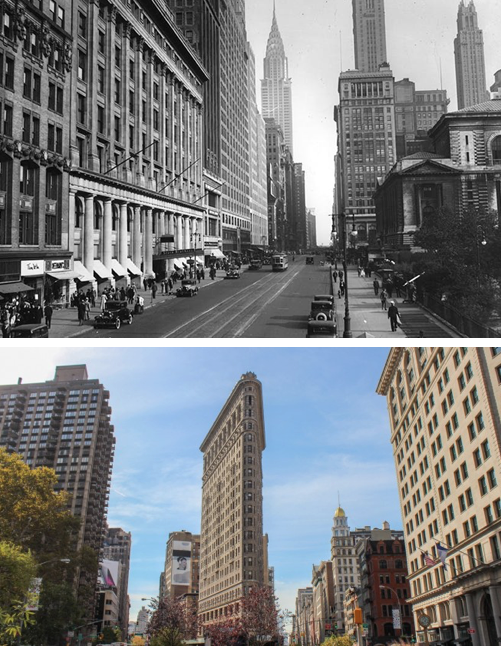
In his “Notes and Comment,” E.B. White lamented the fact that the world’s tallest building appeared less than lofty, since neighboring skyscrapers were nullifying its grandeur:
DOWN IN FRONT…E.B. White found the streetview of the world’s tallest building wanting after it was completed in 1930; the iconic Flatiron Building, however, enjoys some elbow room even today. (spectator.co.uk/walksofnewyork.com)
* * *
Full of Hot Air
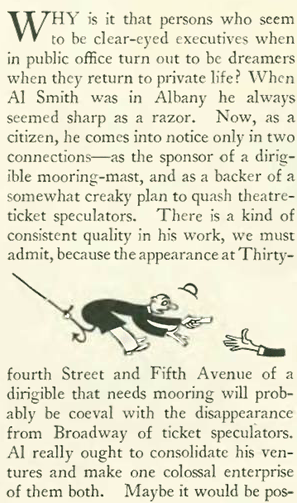
That was another opinion shared by E.B. White, this time regarding the Empire State Building’s top promotor, former New York Governor Al Smith, who spoke of plans to attach a mooring mast to the top of his skyscraper (which would eclipse the Chrysler as the world’s tallest in 1931):
* * *
View From the Top
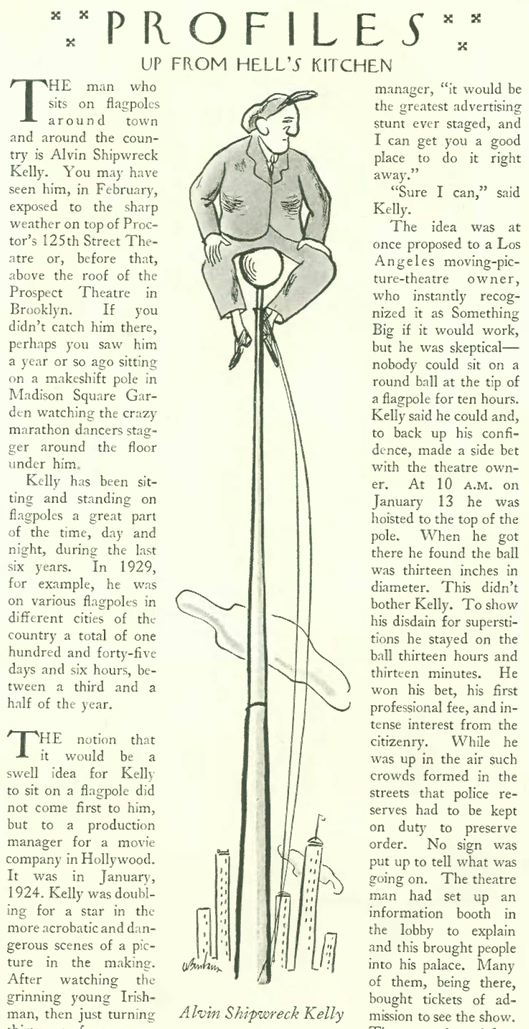
The New Yorker featured a profile of Aloysius Anthony Kelly (1893?-1952), better known as the Roaring Twenties most famous pole-sitter, “Shipwreck” Kelly. He achieved his greatest fame in the 1920s and 1930s, sitting for days at a time on elevated perches — often atop buildings — throughout the U.S.
Kelly’s fame was already on the wane when this profile appeared, and by 1934 he was reportedly working as a dance hall gigolo. Kelly’s last flagpole stunt was at a 1952 event sponsored by a Lion’s Club in Orange, Texas — he suffered two heart attacks while sitting atop their 65-foot flagpole. After climbing down he announced, “This is it. I’m through.” He died one week later after he was struck by car on West 51st Street in Manhattan.
LOFTY AMBITIONS…Alvin ‘Shipwreck’ Kelly atop a flagpole near College Park, Maryland, in October 1942. At right, undated photo circa 1940s. (CSU Archives/Digital Commonwealth)
* * *
Brand X
Folks were still abuzz about the discovery of a ninth planet in the solar system, soon to be dubbed “Pluto” by an English schoolgirl. Howard Brubaker, in “Of All Things,” observed…
…and Carl Kindl illustrated the problem a new planet posed for astrologers…
* * *
I Beg Your Pardon
Will Rogers was a beloved comedian with a few rope tricks up his sleeve, but I’ve never known him for working blue. However, one critic for The New Yorker (“A.S.”– not sure who this is) found Rogers’ new radio show both humorless and gauche…
CAN YOU TAKE A JOKE?…In photo above, Will Rogers debuts his new radio show in April 1930. It would become the most popular Sunday evening radio show, and Rogers would prove to be the second biggest motion picture box office draw in the U.S. before his death in 1935. (Will Rogers Memorial Museum)
* * *
Before He Got Axed
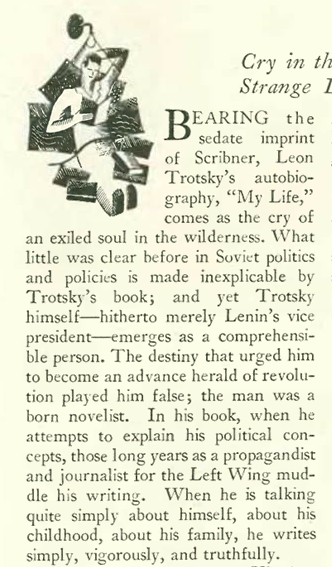
Ten years before he was murdered by one of Stalin’s NKVD agents, Leon Trotsky published an autobiography that was written in his first year of exile in Turkey. The review is signed “G.H.” so I am assuming the author is Geoffrey Hellman, who contributed for decades to The New Yorker’s “Talk of the Town.” Excerpts from the review:
RED ALERT…Leon Trotsky wrote his autobiography, My Life, while exiled in Turkey. (Wikimedia)
* * *
From Our Advertisers
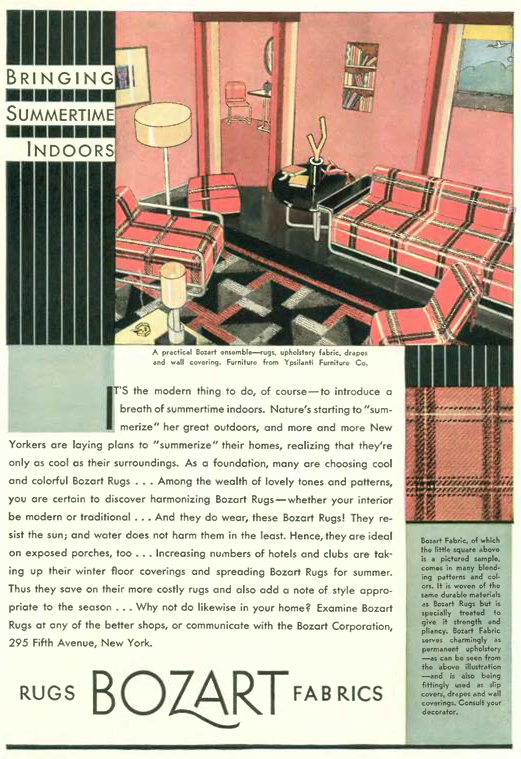
The makers of Bozart rugs and fabrics invited New Yorker readers to “introduce a breath of summertime indoors”…
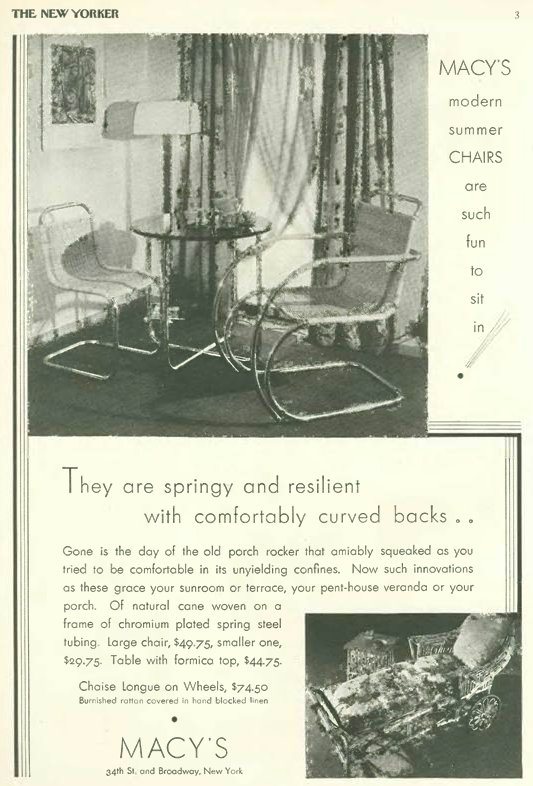
…while Macy’s urged the same by gracing a sunroom or terrace with one of their Marcel Breuer-inspired chairs…
…Colonial Airways touted an early form of radar — an “invisible pilot” — as the latest safety feature in its airplanes…
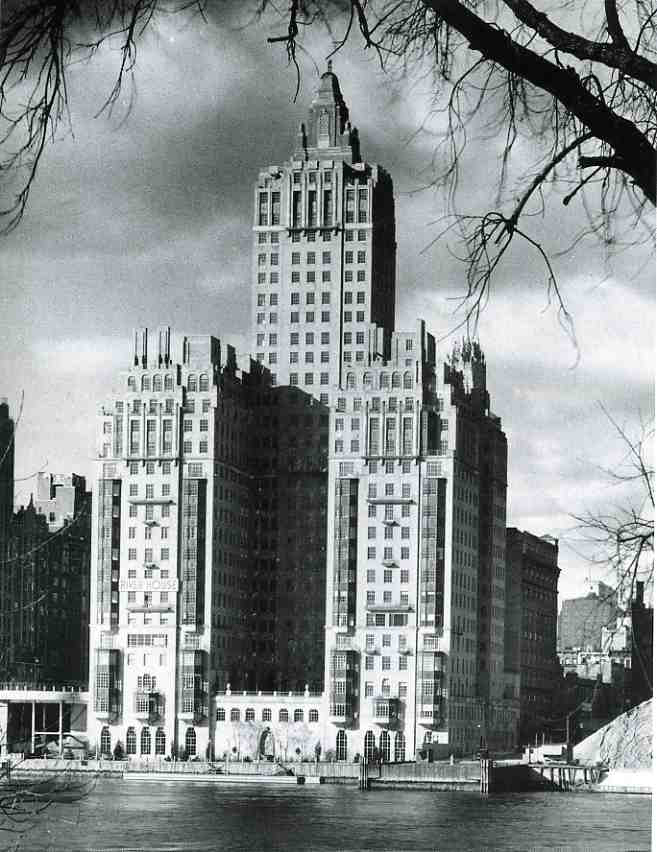
…the Douglas L. Elliman company promoted its yet unbuilt River House, which would feature a pier where residents could dock their yachts…
The 26-story River House in the 1930s. Originally, the Art Deco building featured a pier where residents could dock their yachts, but that feature was lost with the construction of FDR Drive in the early 1950s, effectively sealing the building off from the water. The building has been home to author Barbara Taylor Bradford, US Secretary of State Henry Kissinger, and actress Uma Thurman. (observer.com)
…and then we have our more unfortunate ads, such as this one from Macy’s that shows grandpa passing along his racist tendencies to a grandchild…
…and this sad appeal from the makers of Lucky Strike to keep puffing and avoid that hideous double chin…
…our cartoons include Garrett Price and thoughts of spring…
…Barbara Shermund eavesdropped on tea time…
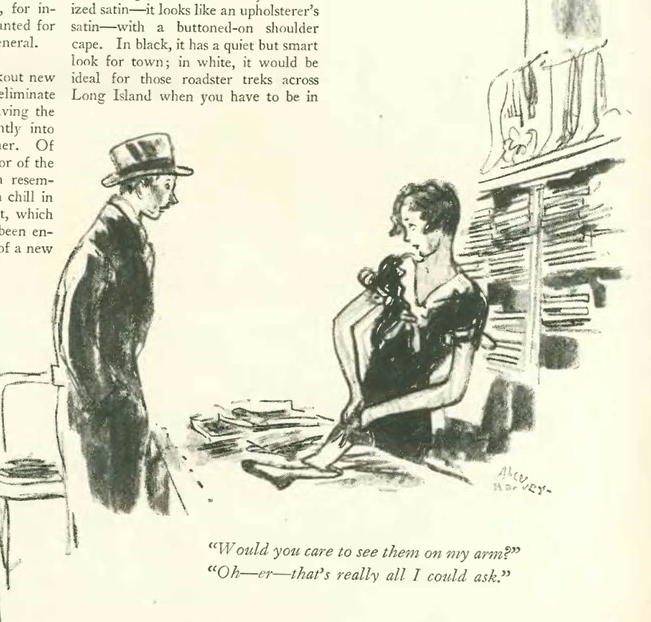
…Alice Harvey found an awkward moment in a hosiery department…
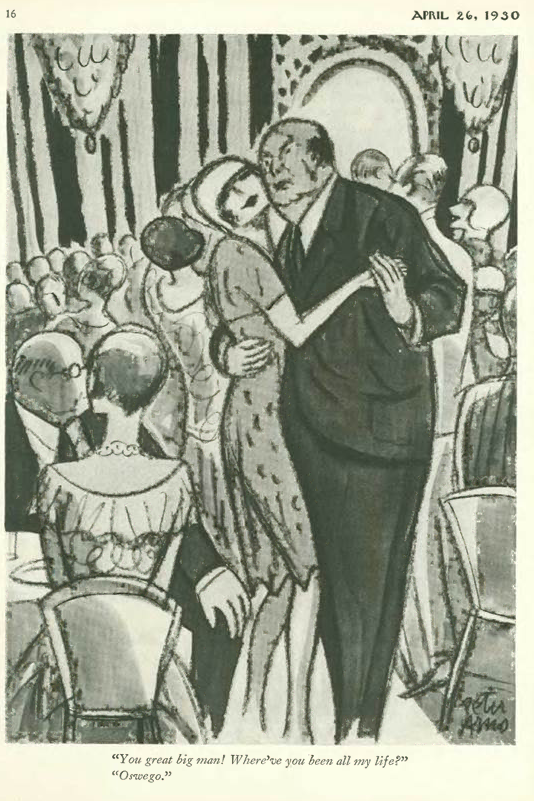
…Peter Arno revisits a familiar theme — chorus girls and sugar daddies…
…and Otto Soglow looked in on a fat cat’s moment of pride…
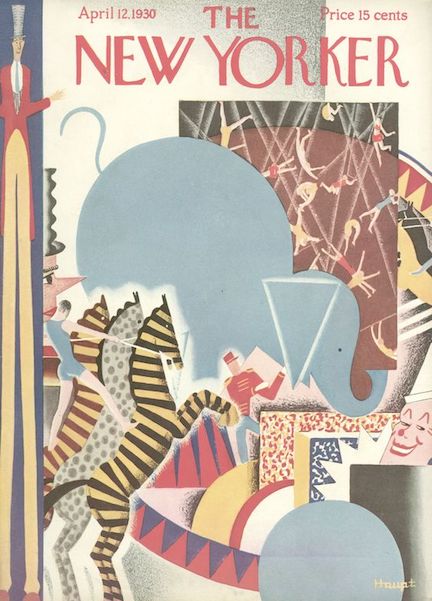
With the Chrysler Building nearing completion and the Empire State Building beginning to rise from the old Waldorf-Astoria site, the New York City skyline was taking on the iconic form most of us now associate with the city.
April 12, 1930 cover by Theodore Haupt.
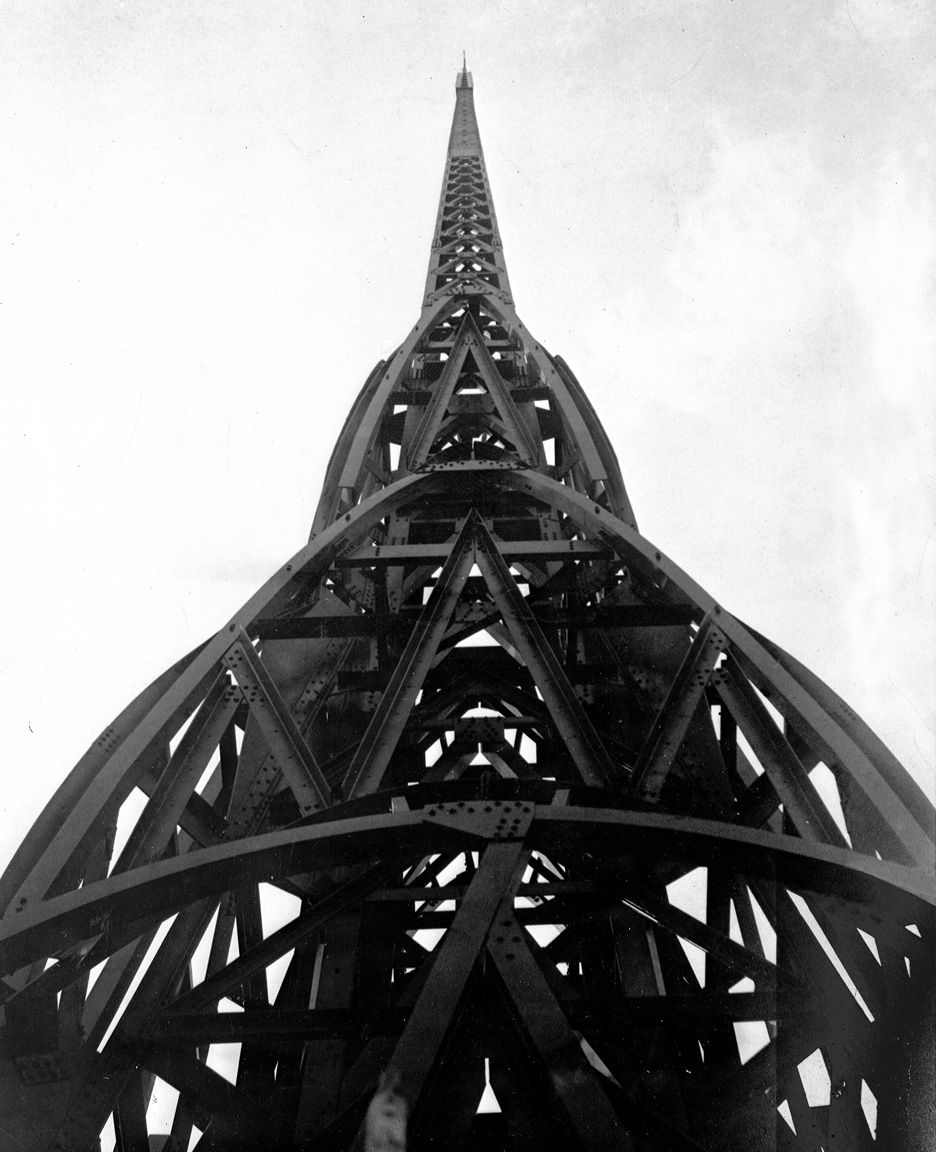
Dubbed “hot jazz in stone and steel” by modernist architect Le Corbusier, the Chrysler Building’s gleaming spire beckoned The New Yorker’s E.B. White and real estate journalist David G. Bareuther (New York Sun) to its summit for a closer look…
BARE BONES…The spire in place atop the Chrysler building, the dome awaiting its metal skin. (skyscraper.org)WHAT LIES BENEATH…The stainless steel spire still gleams atop the Chrysler Building; beneath the spire, a maze of scaffolding — navigated by E.B. White and David G. Bareuther for their “Talk of the Town” piece, supports the upper portions of the building’s dome. (yahoo.com/nygeschichte.blogspot.com)THE HIGH LIFE…The Chrysler Building’s exclusive Cloud Club was located on the 66th, 67th, and 68th floors. At one time it was the highest lunch club in the world. It closed in 1979. (decopix.com)
If you want to get a sense of what E.B. White and David Bareuther experienced during their climb through the Chrysler’s dome, take a look at this video featuring American radio personality “Opie” (Gregg Hughes) and Hidden Cities author Moses Gates…
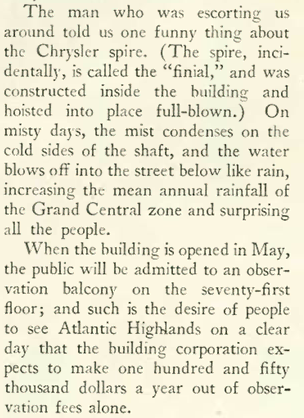
The article also noted that an “observation balcony” would be available for visitors to the 71st floor (actually an enclosed room inside the dome), but I’m sure the expectations for revenue fell quite short, given the competition it would soon receive from the much larger, higher, open air observation deck of the Empire State Building…
REACHING FOR THE STARS…When the Chrysler Building officially opened in 1931, visitors could go up to the 71st-floor observatory (in the dome) and view the city through its triangular windows. The observatory closed in 1945. (nygeschichte.blogspot.com)
…a bit of a digression, but I couldn’t help but notice the observatory’s resemblance to this set from the 1920 silent film The Cabinet of Dr. Caligari…
(silent-volume.blogspot.com)
…and here is a terrific graphic from Popular Science (August 1930) demonstrating how the spire, which was assembled inside the dome, was raised into its final position…
…and finally, some great archival footage documenting the achievement…
* * *
Tragic Theater
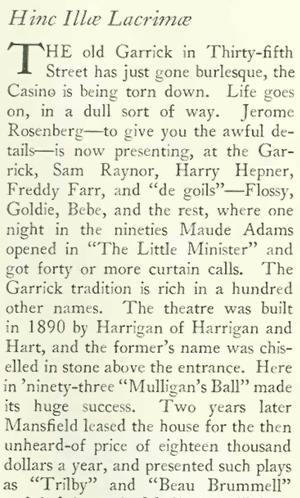
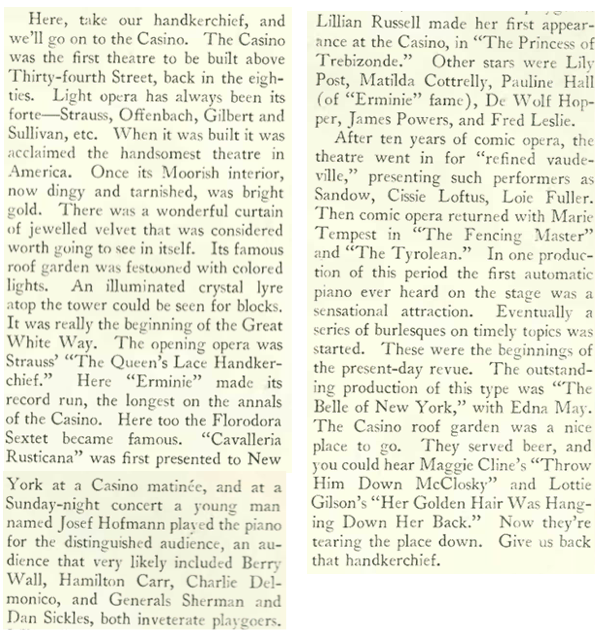
We continue our forays into the built environment of 1930 New York by looking at what was lost, including two beloved Broadway theaters. “The Talk of the Town” lamented the decline of the Garrick…
FINAL CURTAIN…Built in 1890 and originally named Harrigan’s Theatre, The Garrick closed as a playhouse in 1929. After a short run of burlesque, the building was demolished in 1932.
HEYDAY…Clockwise, from top left, circa 1910 postcard image of The Casino Theatre at Broadway & 39th; an audience on the Casino’s roof garden glimpses the performance below; interior of the Casino; the British musical comedy Floradora would become one of Broadway’s greatest hits — the New York production opened in 1900 and ran for 552 performances. (Museum of the City of New York )
* * *
From Jazz to Gothic
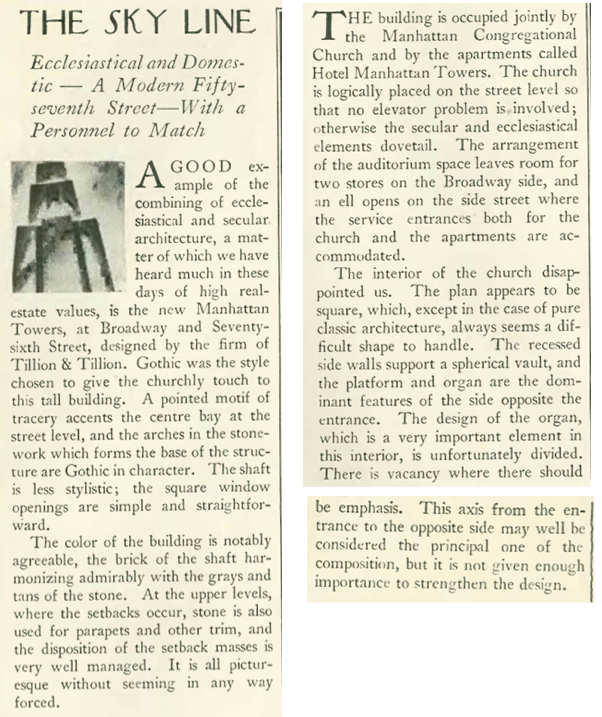
We return our gaze to the skies with three more new buildings reviewed by architecture critic George S. Chappell in his “Sky Line” column. He began with the Manhattan Towers Hotel, which thanks to the Depression would soon fall on hard times, going into foreclosure by October of 1931 and becoming a favorite gangster hideout (read more about the hotel at Daytonian in Manhattan)…
GOD AND MAMMON…Clockwise, from top left, the Manhattan Congregational Church in 1927. The church was torn down in 1928 and replaced by the Manhattan Towers Hotel at Broadway and 76th; the completed hotel, designed to wrap around the three-story Jones Speedometer Building, seen in the lower right of the photo; the first five floors of the building were dedicated to church use; after falling into disrepair, in 1980-83 the 626-room hotel was converted into 113 cooperative apartments. Note that the Speedometer Building still stands, sadly shorn of its ornamentation. (New York Public Library/Daytonian in Manhattan)
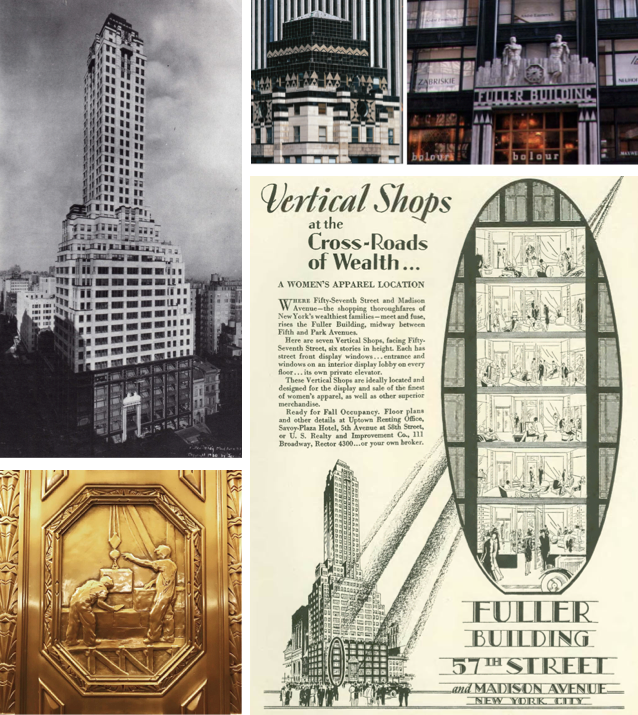
…Chappell also found much to admire in the new Fuller and Squibb buildings…
FULLER HOUSE…Clockwise, from top left, the 1929 Fuller Building was the third home of the George A. Fuller Company (its second home was the 1903 Flatiron Building); detailed views of the building’s tiled pinnacle and unique glass display windows that distinguish the building’s first six stories; an advertisement from the March 2, 1929 New Yorker that touted these gallery spaces for “superior merchandise”; detail of a coffered panel on an elevator door. (deskgram.net/nyc-architecture.com)Clockwise, from top left, entrance to the Squibb Building, now known as 745 Fifth Avenue; the cool white marble of the building’s base so admired by critic George Chappell; today, the building at dusk, the slender profile of 432 Park Avenue rising in the background. (OzBibliophile/paramount-group.com/landmarkbranding.com)
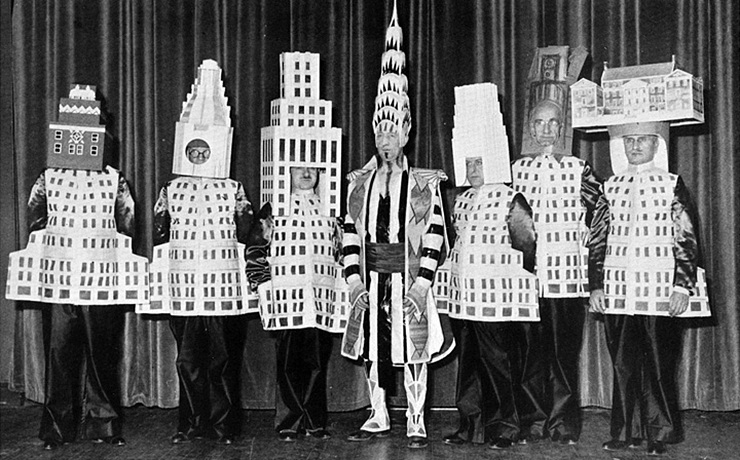
…From the Chrysler Building to the Fuller and Squibb, these new buildings, their architects, and the city’s ever-changing skyline were famously celebrated at the January 1931 Beaux Arts Ball…
HEADS IN THE CLOUDS…the Chrysler Building’s architect, William Van Alen (center), flanked by, from left to right, Stewart Walker (The Fuller Building), Leonard Schultze (The Waldorf-Astoria), Ely Jacques Kahn (The Squibb Building), Ralph Walker (1 Wall Street), D.E. Ward (The Metropolitan Tower), and Joseph H. Freelander (Museum of the City of New York). The New York Times referred to the group as “a tableau vivant of the New York Skyline.” (Van Alen Institute)
* * *
Quiet on the Set
The early days of sound movies created numerous challenges for directors who not only had to adjust the action to accommodate cumbersome microphones, but also to keep out unwanted noises or bad enunciation. “The Talk of the Town” explained…
CLOSETED…In the early days of the talkies, cameras had to be soundproofed in cabinets so their noisy motors would not be picked up by primitive sound equipment. (coloradocollege.edu/Library of Congress)
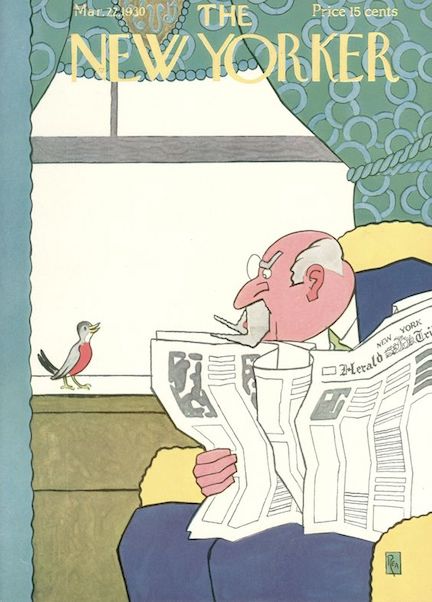
…Peter Arno illustrated the predicament of filming in nature in this cartoon from the April 5, 1930 issue…(caption: “Well, we can’t start till we get that robin out of there.”)…
* * *
One of Ours
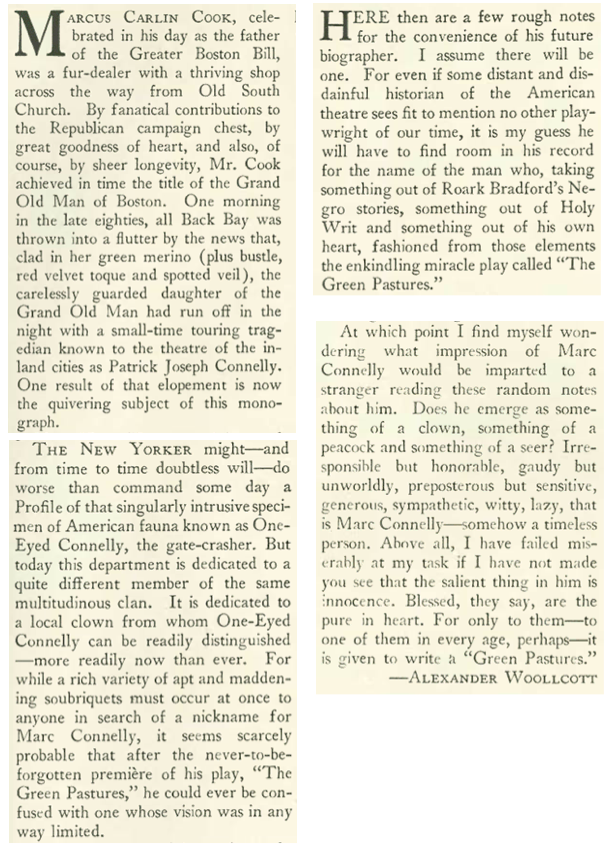
In the story of The New Yorker, Alexander Woollcott and Marc Connelly were there at the beginning as founding members of the Algonquin Round Table and advisory editors to the first issues of the magazine. Basking in the success of his latest play, The Green Pastures (for which he would receive a 1930 Pulitzer Prize for Drama), Connelly was the subject of a April 12, 1930 profile titled “Two-Eyed Connelly,” which was written by Woollcott. Some excerpts, and a caricature by Al Frueh…
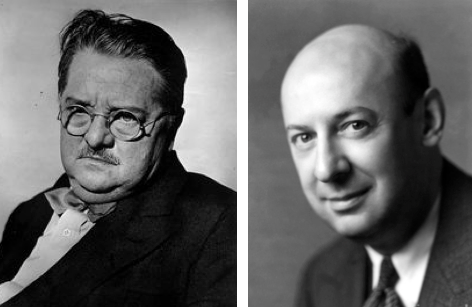
FAMILIAR WITH THE SUBJECT…Alexander Woollcott, left, explored the life of his old friend Marc Connelly in the April 12 profile. (goodreads.com/Fine Art America)
* * *
The Party is Really Over
Lois Long’s column “Tables for Two,” which in the 1920s was a must-read for those interested in Jazz Age night life, appeared intermittently in its last year, and its April 12 installment was not even written by Long, but by a writer who signed the column “F.D.” — I assume this is Fairfax Downey, who tried his best to capture Long’s style…
* * *
From Our Advertisers
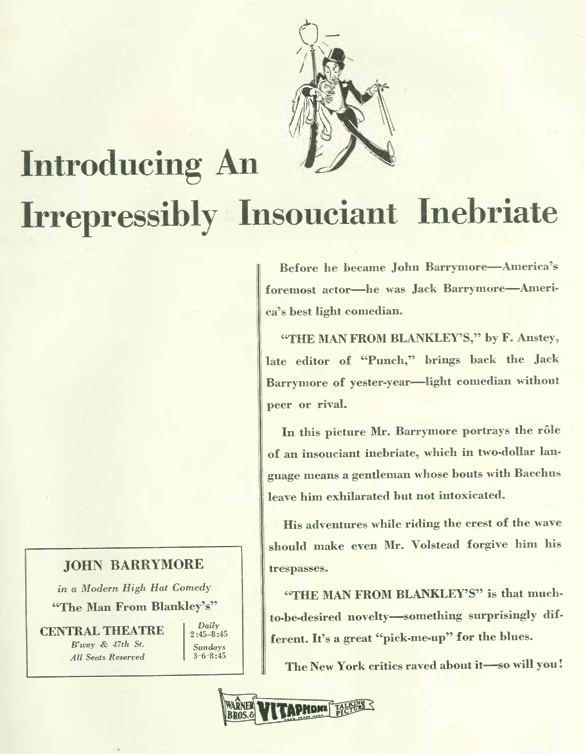
Warner Brothers opened their pocketbooks to publicize John Barrymore’s latest film, The Man From Blankey’s, which the studio described as a “Modern High Hat Comedy”…
WHEN ALCOHOLISM WAS FUNNY…Loretta Young, John Barrymore and Angella Mawby in The Man from Blankley’s. (IMDB)
…Thanks to William Randolph Hearst and his King Features Syndicate, Robert Ripley, the P.T. Barnum of the funny pages, soared to fame in the 1930s with his “Believe It or Not” panel…here he begins his 14-year run on the radio…
HELLO SUCKERS…Robert Ripley in 1930 with a drawing of “the Horned Man of South Africa.” (RIPLEY ENTERTAINMENT INC.)
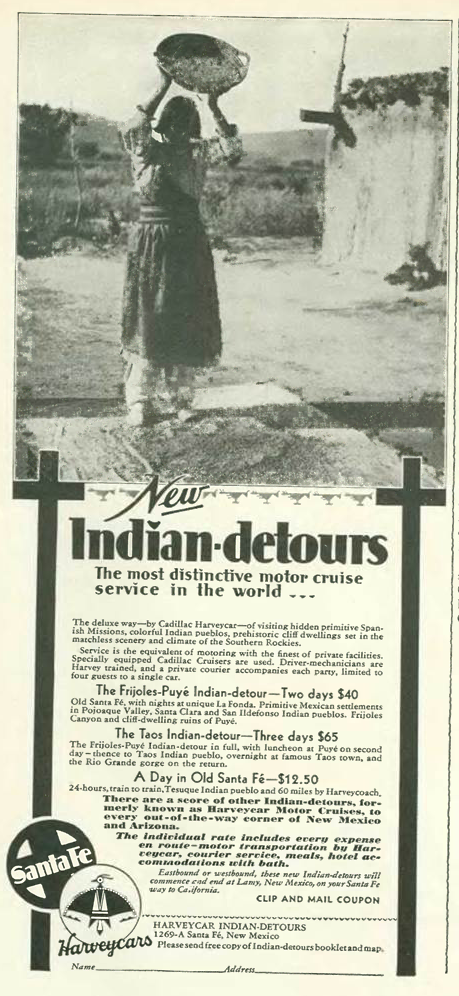
…and here’s an ad for another questionable but very American diversion — Fred Harvey’s “Indian Detours”…
WE’RE NOT IN KANSAS ANYMORE…The Fred Harvey Company was renowned for its chain of eating houses hosted by the famed “Harvey Girls” along the Atchison, Topeka & Santa Fe Railroad between 1876 and 1968. To encourage train travel (and Harvey business) in the Southwest, the Harvey company developed “Indian Detours.” The photo at left is of an “Indian Building” in Albuquerque, which featured displays of art and “live exhibits” that included Native Americans from many tribes around New Mexico. (santafeselection.com)EASY RIDER…1929 Cadillac Harvey Indian Detour Car outside La Fonda, Santa Fe. (Palace of the Governors photo archive)
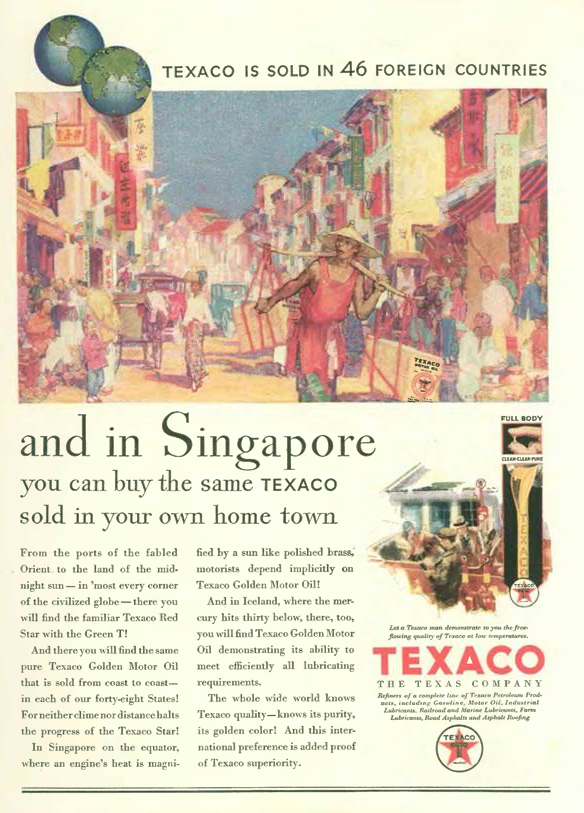
…if you preferred to travel abroad, Texaco wanted you to know that you could still gas up with their product, even in distant Singapore…
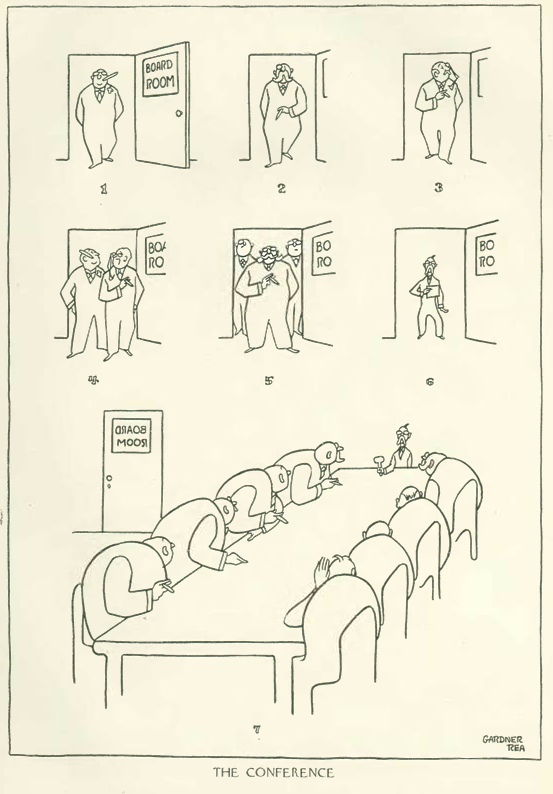
…we begin our cartoons with the spare stylings of Gardner Rea…
…and Otto Soglow…
…we find one of Helen Hokinson’s ladies on her way to fitness…
…William Crawford Galbraith showed us an enterprising young man…
…Art Young illustrated the challenges of the lecture circuit…
…and one of my all-time favorite Peter Arno cartoons…
It’s easy to get into the weeds while digging through The New Yorker archives, as it is filled with a richly interconnected cast of characters whose lives and work still resonate with us today.
March 15, 1930 cover by Rose Silver. (Please see note on this artist at the end of this blog entry)
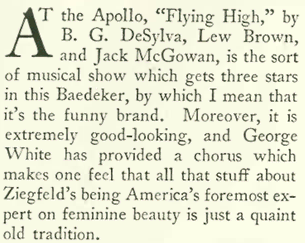
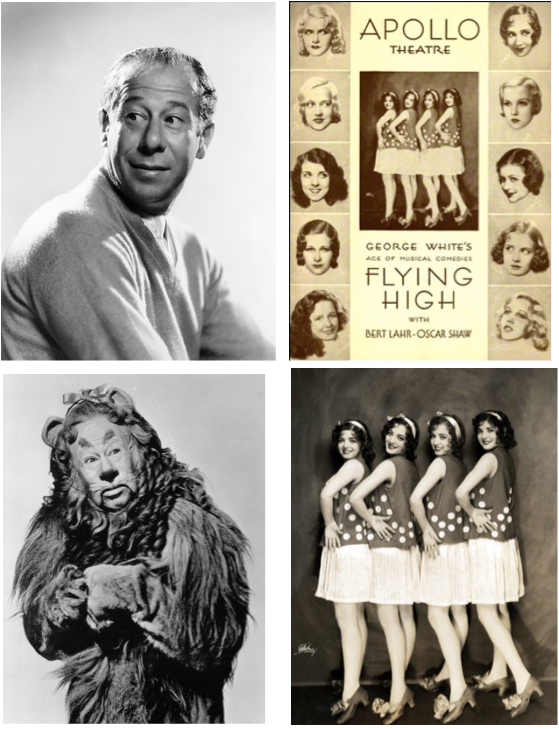
A case in point is Bert Lahr (1895-1967), who at age 15 dropped out of high school and joined the vaudeville circuit, working his way up to top billing in Broadway musical comedies including 1930’s Flying High, which received an enthusiastic welcome from New Yorker critic Charles Brackett…
…Brackett enjoyed the “feminine beauty” offered by a George White chorus that included the “Gale Quadruplets,” described in the Playbill as “The only Quadruplets in the world appearing on the stage”…
…although in fact the Gale Quadruplets were actually two sets of twins: June and Jane, and Jean and Joan (real names were Doris, Lenore, Helen and Lorraine Gilmartin). But I digress.
What really caught Brackett’s eye were the antics of Bert Lahr:
ONLY ONE BERT…Clockwise, from top left, publicity photo of Bert Lahr from the 1931 film version of Flying High; cover of the Apollo Theatre Playbill; the Gale Quadruplets, circa 1930; Lahr as the Cowardly Lion in the 1939 film The Wizard of Oz. (Everett/Playbill/Pinterest/Wikiwand)
The Gale Quadruplets are long forgotten, but the work of Bert Lahr still lives on thanks to his role as the Cowardly Lion in The Wizard of Oz (a film, incidentally, that was panned in 1939 by New Yorker critic Russell Maloney, who called it “a stinkeroo” that showed “no trace of imagination, good taste, or ingenuity”).
Lahr also connects us to today’s New Yorker magazine, where his son, John Lahr, has been a staff writer and critic since 1992. Lahr has written a number of stage adaptions (he won a Tony award in 2002, the first drama critic to do so) as well as nearly twenty books, including a 2017 biography of his father, Notes on a Cowardly Lion: The Biography of Bert Lahr.
DRAMATIC DUO…John Lahr with his father, Bert, backstage at the Belasco Theatre in the late 1940s; John Lahr today. (NY Times/Amazon)
* * *
Greener Pastures
We remain on Broadway with another writer who was deeply connected to The New Yorker’s origins. Marc Connelly (1890-1980) was a playwright, director, producer and performer who collaborated with George S. Kaufman on five Broadway comedies in the 1920s. Connelly was also a founding member of the Algonquin Round Table, around which orbited a number of writers, critics and assorted wits who would help bring The New Yorker to life in 1925. Connelly was listed as an advisory editor on the masthead of the very first issue:
Connelly’s play, The Green Pastures (based on stories from the Old Testament), had just opened on Broadway, drawing much acclaim for both Connelly and actor Richard B. Harrison (1864-1935). “The Talk of the Town” looked in on the playwright and the actor:
DID YOU HEAR SOMETHING?...Richard B. Harrison (left) and unidentified actor in 1930’s The Green Pastures. At right, Wesley Hill as the Angel Gabriel. (blackarchives.org/ngv.vic.gov.au)FINAL BOW…Richard B. Harrison in a 1930 publicity photo for the Broadway play, The Green Pastures. At right, Harrison on the cover of the March 4, 1935, Time magazine. He died of heart failure ten days after appearing on the cover. (Henrietta Alice Metcalf Collection/Time)
Connelly would receive the 1930 Pulitzer Prize for Drama for The Green Pastures. And nearly 60 years later he would be featured in a 1987 documentary about the Algonquin Round Table (The Ten-Year Lunch) as the Table’s last survivor. It would win an Academy Award for Best Documentary Feature. During his long career Connelly would act in 21 movies, including the 1960 romantic comedy Tall Story with Jane Fonda and Anthony Perkins. He also did some TV, included a stint from 1962 to 1964 as Judge Rampell in The Defenders.
HE COULD ACT TOO…Clockwise, from top left, Marc Connelly in a 1937 photo by Carl Van Vechten; a page from the Playbill for The Green Pastures; college student June Ryder (Jane Fonda) collides on campus with Professor Charles Osmond (Marc Connelly) in the 1960 romantic comedy Tall Story. (Wikipedia/Playbill/ridesabike.com)
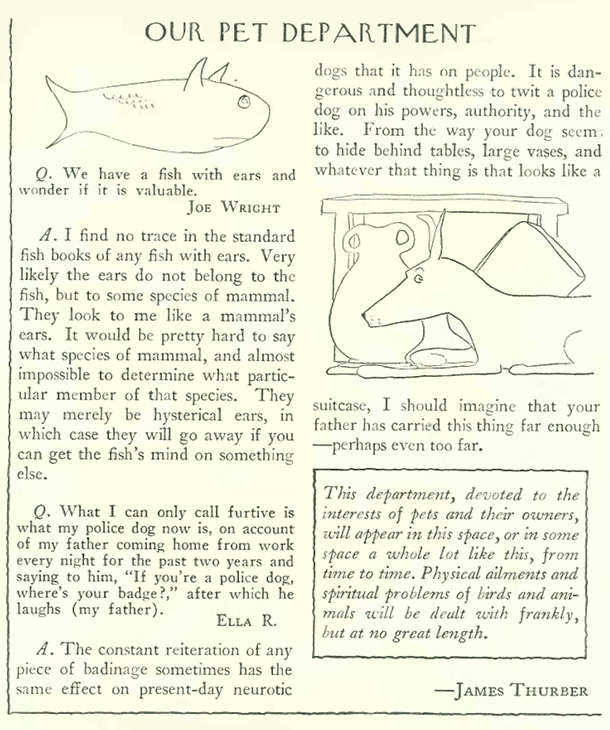
Also in the “Talk of the Town” section of the March 15 issue was James Thurber’s latest installment of pet advice:
* * *
Lipstick’s Lamentations
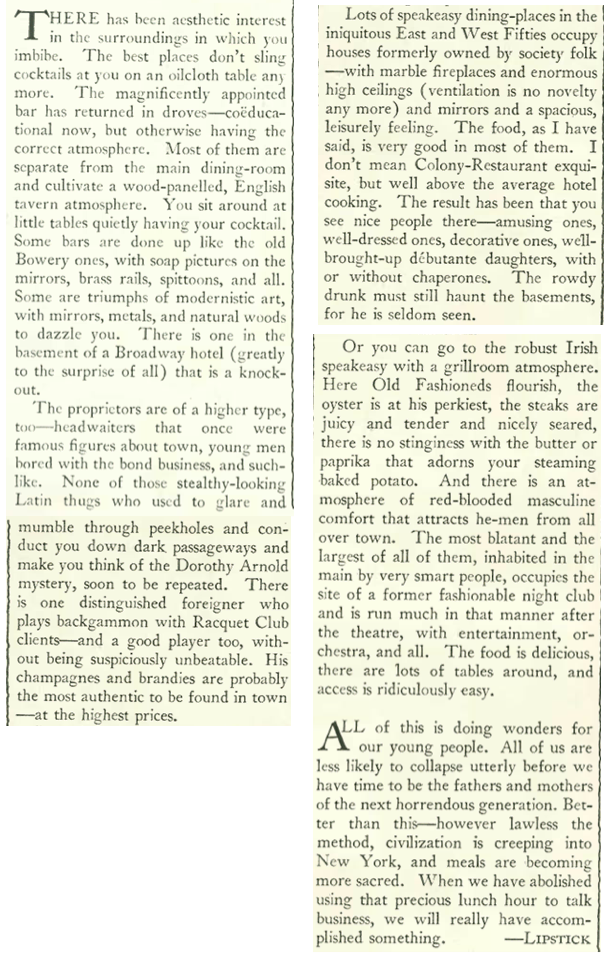
Once the place to read about wild speakeasies and other nighttime diversions of the Roaring Twenties, Lois Long’s “Tables for Two” column had quickly become anachronistic in the Depression years. Although the decade was still young, Long reminisced about her column’s “golden days” as if they had existed in some distant time, and lamented the state of the speakeasy; once a place for cheap and sordid frivolity, it had become staid and even snobbish…
THAT WAS THEN…Lois Long lamented the state of the speakeasy in 1930. Once sordid and given to frivolity, it had become a rather staid institution. (prohibition.themobmuseum.org/Time-Life)
…and Long described some of these new upscale speakeasies, where the oilcloth had been replaced with fine linen…
* * *
Ozark Oeuvre
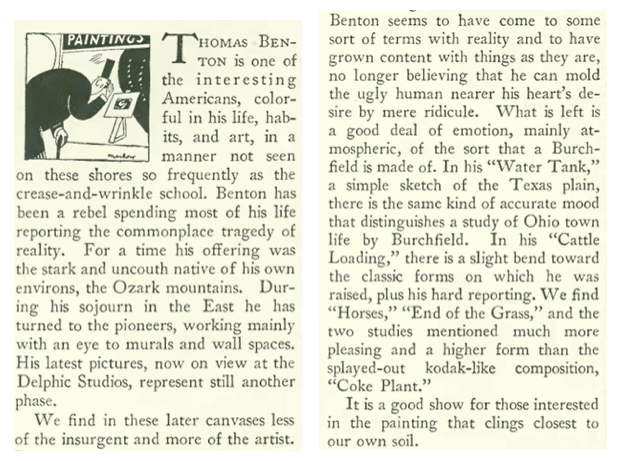
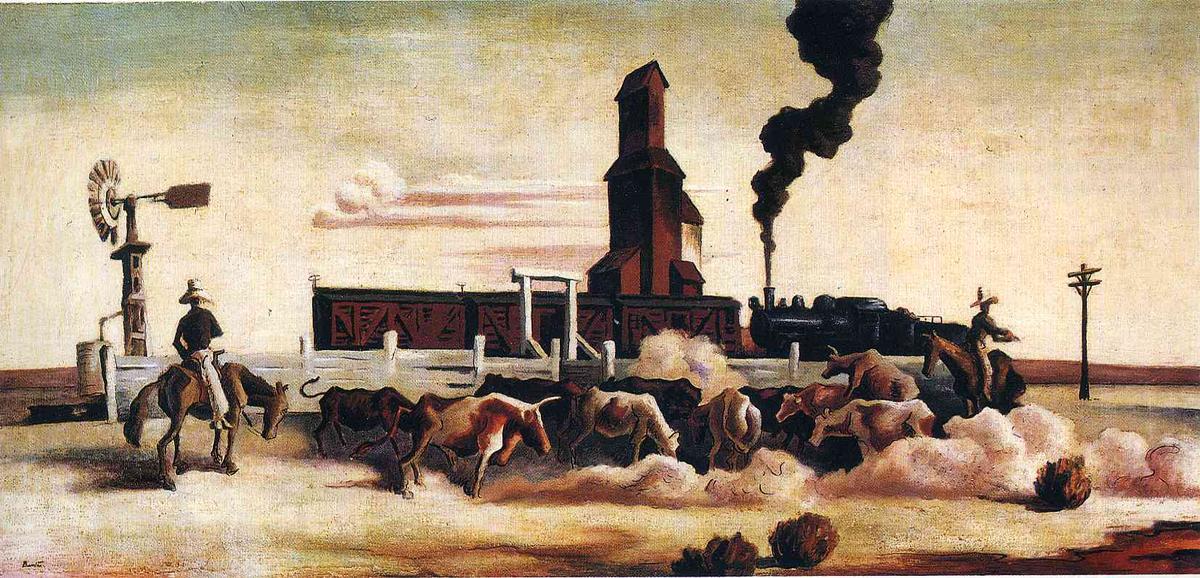
New Yorker art critic Murdock Pemberton, in his ongoing search for America’s best artists, took another look at that once “uncouth native” from the Ozarks, Thomas Hart Benton…
PAINTING FROM THE SOIL…Cattle Loading, oil on canvas, by Thomas Hart Benton, 1930. It was one of the works viewed by critic Murdock Pemberton at the Delphic Studios in New York. (wahooart.com)
* * *
From Our Advertisers
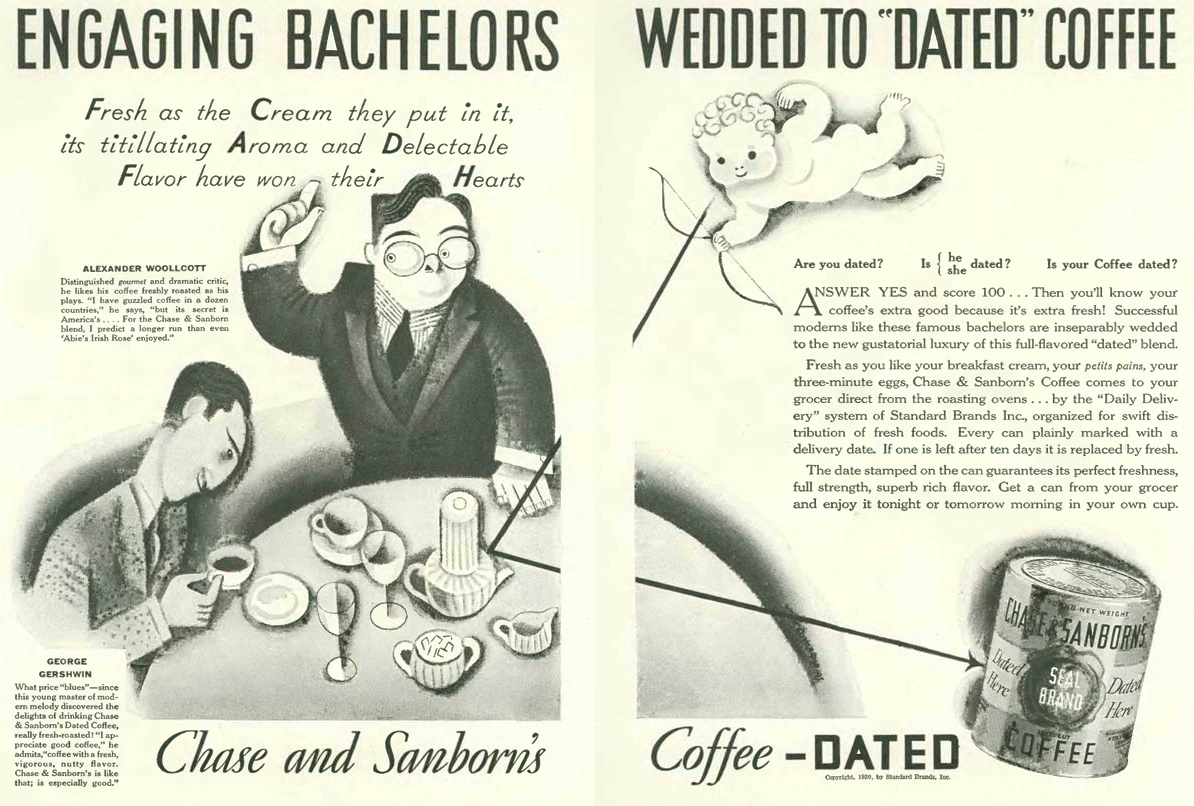
We start off with a couple of two-page ads, the first featuring caricatures of George Gershwin and Alexander Woollcott as rendered by the great Miguel Covarrubias…
click image to enlarge
…and then we have this ad from the makers of Lux Toilet Soap, who must have had a bottomless advertising budget given all the splashy ads and celebrity endorsements…
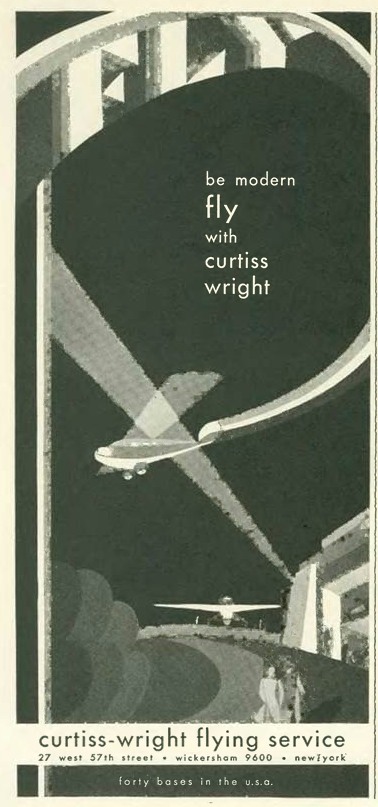
…in the ads we also find clashes between the old and new…the new being this art deco-styled appeal for the newest form of transportation…
…and the old, the makers of the luxury car Pierce-Arrow, still harking back to its patrician origins (“The Tyranny of Tradition”)…the firm would not survive the lean years of the 1930s…
…and once again a colorful ad from Church using snob appeal to sell something as pedestrian as a toilet seat…”Toilet Seats For Better Bathrooms”…
…on to our cartoons, we have a voyeur’s perspective courtesy Helen Hokinson…
…an exploration of the generation gap by Alice Harvey…
…and this terrifically quaint encounter, rendered by Perry Barlow…
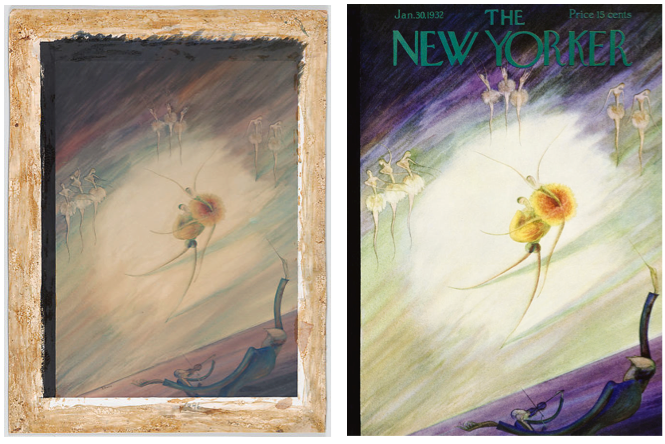
…and before we go, a note about this week’s cover artist, Lisa Rhana, a.k.a. Rose Silver (1902-1985) who illustrated several New Yorker covers in the 1920s and early 30s. Her work is included in the permanent collections at the Whitney Museum, the Museum of the City of New York, and The Metropolitan Museum of Art, which holds this watercolor (left) that graced the cover of the Jan. 30, 1932 issue:
The October 1929 stock market crash took most people by surprise, but one man, Roger Babson, knew all along it was coming…thanks to Sir Isaac Newton…
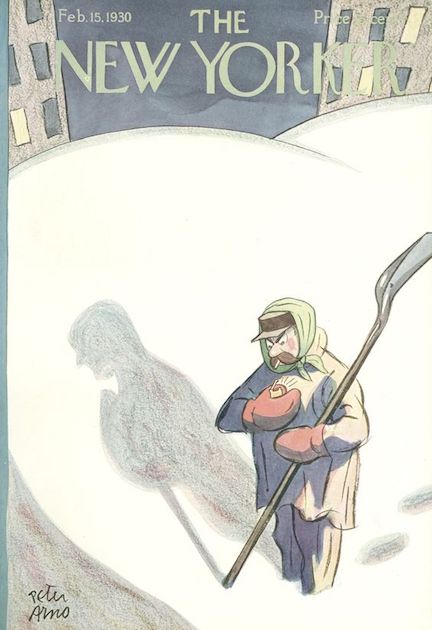
Feb. 15, 1930 cover by Peter Arno.
Babson (1875-1967) is perhaps best known today as the man who predicted the market crash and the Great Depression that followed. He employed an economic assessment tool called the “Babsonchart” that was based on Newton’s Third Law: For every action, there is an equal and opposite reaction. In the Feb. 15, 1929 “Profile” (titled “Prophet of Doom”) Henry Pringle tried to make sense of this eccentric businessman, who would go on to wage war against gravity itself:
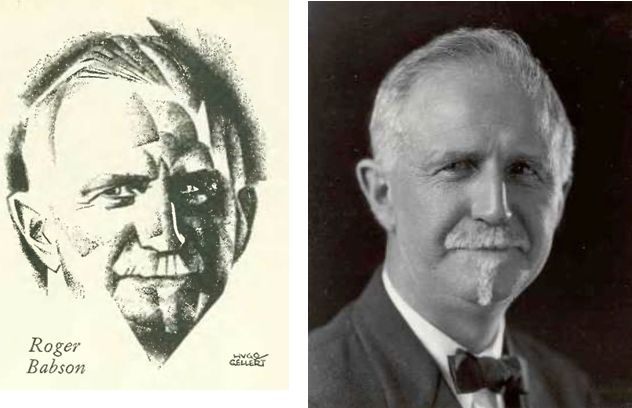
TOLD YOU SO…Illustration by Hugo Gellert for the profile on Roger Babson, who famously predicted the stock market crash; at right, Babson circa 1930. (Gravity Research Foundation)BIG THINKER…Roger Babson dedicates the world’s largest spinning globe at Babson College in 1955; at right, the globe as it appears today. Founded by Babson in 1919, Babson College is often ranked as the most prestigious entrepreneurship college in the U.S. (babson.edu/Wikipedia)
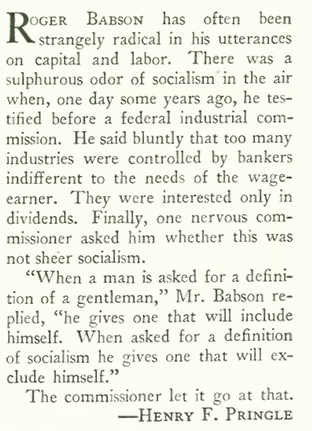
Pringle concluded his profile on a confused note, wondering if his subject — a product of sober New England stock — could possibly be a socialist in disguise…
In any case, it is difficult to assign Babson to any one category. Some considered him a genius and visionary, while others thought him a crackpot, particularly in the late 1940s when, following the death of a grandson by drowning, he began to wage war against gravity itself. In 1948 essay “Gravity – Our Enemy Number One,” he wrote: “Broken hips and other broken bones as well as numerous circulatory, intestinal and other internal troubles are directly due to the people’s inability to counteract Gravity at a critical moment.”
That same year Babson founded the Gravity Research Foundation to expedite the discovery of a “gravity shield.” The foundation is still in operation, but rather than seeking to block gravity it works to better understand it. It continues to hold an annual essay prize contest — remarkably, five of its winners have gone on to win the Nobel Prize in physics. The essay contest’s 1971 winner was none other than physicist Stephen Hawking.
ROCK STAR…Clockwise, from top left: Roger Babson at home with a portrait of Sir Isaac Newton; Babson was the Prohibition Party’s candidate for President of the United States in 1940; Babson provided charitable assistance to unemployed stonecutters in Gloucester, Mass., during the Great Depression, commissioning them to carve inspirational inscriptions on more than 20 boulders near the abandoned settlement of Dogtown. (centennial.babson.edu/Wikipedia)
* * *
An Imperfect Romance
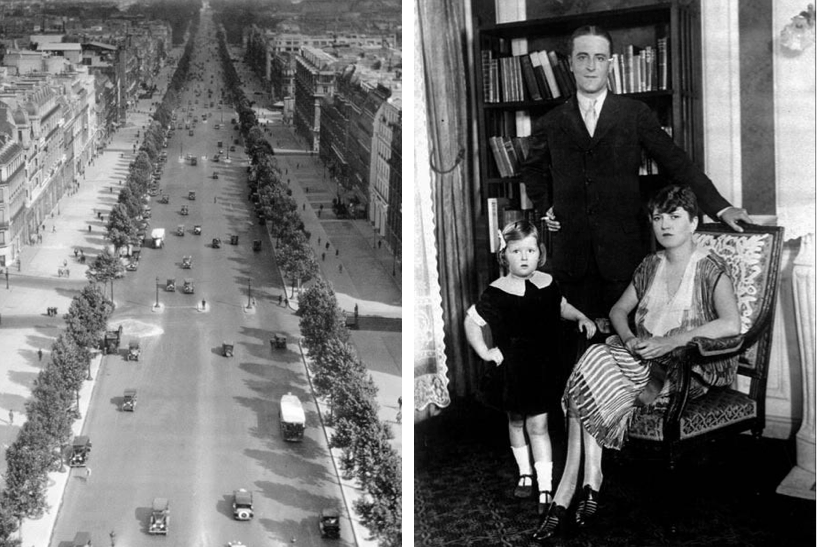
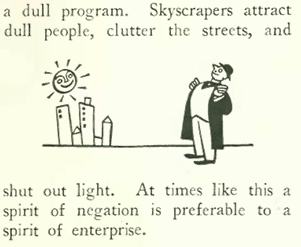
Born in the midst of the Jazz Age, it would seem that The New Yorker would have been a perfect fit for the most prominent chronicler of that era, F. Scott Fitzgerald. But it was mostly not to be: Fitzgerald would publish just two poems and three humorous shorts in The New Yorker between 1929 and 1937, including “Salesmanship in the Champs-Élysées” in Feb. 15 issue.
In all fairness, The New Yorker wasn’t exactly enamored of the young author. In its book review section for the May 23, 1925 issue, the magazine singled out three books for review, the first (and longest) review was devoted to James Boyd’s historical novel Drums. This was followed by a brief review of Fitzgerald’s The Great Gatsby, the reviewer writing that the book revived his interest in the author but “not in a Byronic promise he probably never had,” and referred to the character of Jay Gatsby as “a good deal of a nut.”
The following year Fitzgerald was the subject of a New Yorker profile titled “That Sad Young Man.” In the magazine’s March 12, 2017 issue, Erin Overbey and Joshua Rothman note that the profile (by John Mosher) would be called “snarky” in today’s lingo. They also point out that “Fitzgerald, for his part, appeared to take a rather snobbish view of Harold Ross’s new publication, referring to the short stories he published in it as “hors d’oeuvres.”
With that, here is one of F. Scott Fitzgerald’s “hors d’oeuvres” … “Salesmanship in the Champs-Élysées.”
SOUR GRAPES…The Champs-Elysées in 1929; F. Scott Fitzgerald with his daughter, Scottie, and wife Zelda in Paris in 1925. Despite being products of the Jazz Age, the author and The New Yorker were mostly at odds. In a letter to his daughter, Scottie, Fitzgerald advised that she expand her knowledge of literature “instead of skimming Life + The New Yorker.” (fr.wikibooks.org/Associated Press)
* * *
The Empire-less State
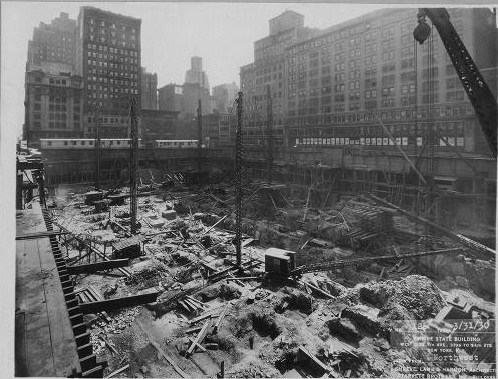
In his “Notes and Comment,” E.B. White pondered the possibilities of a large lot at the corner of Fifth Avenue and 34th Street previously occupied by the Waldorf-Astoria hotel. Although construction of the Empire State Building would soon commence at the site, White mused about other possibilities…
LIGHT THERE BE LIGHT…E.B. White found the newly excavated space at Fifth Avenue and 34th Street (former site of the Waldorf-Astoria) to be a refreshing change. It would be short-lived, as the first beams of the Empire State Building would begin to rise from the site in March 1930. (NYPL Digital Gallery)
* * *
Westminster People Show
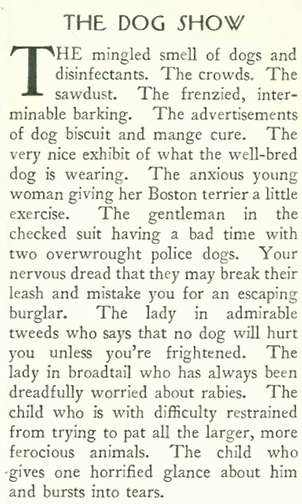
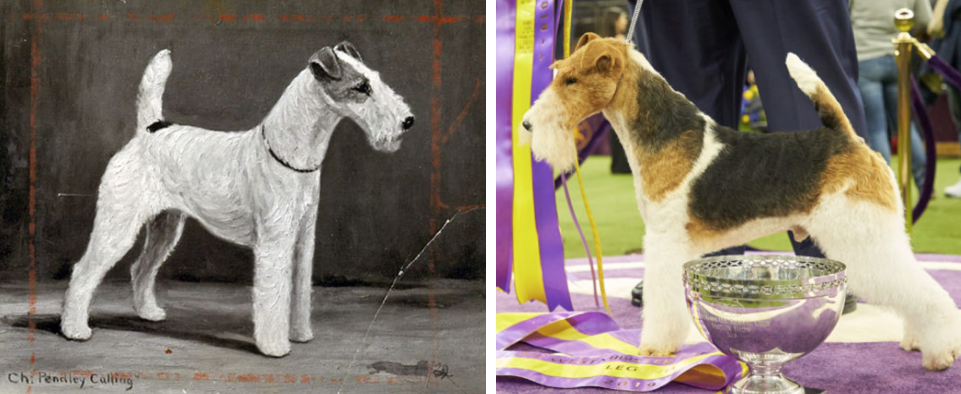
Although it’s now customary to retire Westminster Kennel Club Dog Show winners, back in 1930 a wire terrier called Pendley Calling of Blarney won Best of Show in 1930 and won the title again the following year. Alice Frankforter was on hand for the event, but found the people at the show every bit as diverting as the animals. Some excerpts…
DOGGONE FUN…The 1932 Westminster Kennel Club Dog Show at Madison Square Garden. (westminsterkennelclub.org)
REIGN OF TERRIER…Wire Fox Terrier Pendley Calling of Blarney, left, won back-to-back Westminster Kennel Club Best of Show titles in 1930-31. At right, King’s Best of Show win in February 2019 made him the 15th Wire Fox Terrier in Westminster history to earn the top prize. Terriers are by far the winningest breed at Westminster. (aka.org)
* * *
Why Can’t We Be Friends?
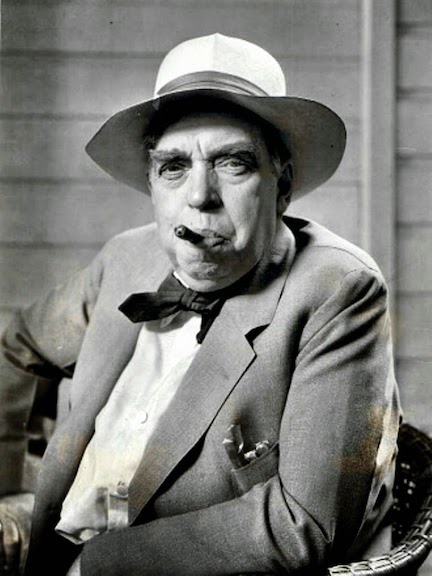
Robert Benchley struck a pre-emptive pose in his review of a new Broadway play titled Rebound — written by his good friend (and fellow Algonquin Round Table alumnus) Donald Ogden Stewart (1894-1980) — and responded to “a chorus of yawps” that accused him of log-rolling…
A FRIEND INDEED…Robert Benchley (right) said his friendship with playwright and screenwriter Donald Ogden Stewart (left) had no influence over his review of Stewart’s latest play, Rebound. It seems Benchley was in safe territory here, since Stewart’s output was generally high in quality. Indeed, in 1940 Stewart would win an Academy Award for Best Adapted Screenplay for the The Philadelphia Story. (IMDB/theattic.space)
* * *
Georgia On His Mind
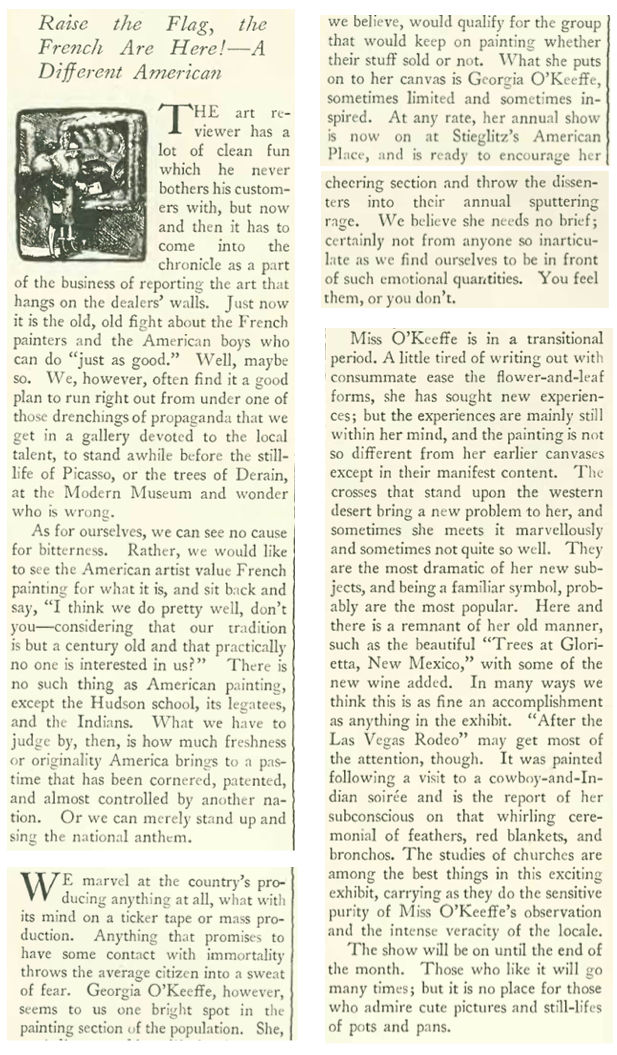
The opening of the Museum of Modern Art in late 1929 had a profound effect on The New Yorker’s art critic MurdockPemberton. In the beginning he dismissed the museum as just another place for the old money crowd to throw parties, but with the opening of its third exhibition, “Painting in Paris” — which featured an extensive display of the works of French modernists — Pemberton began to come around to the idea that this new MoMA was a place to see groundbreaking works of art. In his Feb. 15 column Pemberton looked beyond France for signs of talented modernists in the States, and found only one who stood out — GeorgiaO’Keeffe.
MOD COUPLE…Clockwise, from left, Alfred Stieglitz attached this photograph to a letter for Georgia O’Keeffe, dated July 10, 1929; Georgia O’Keeffe Exhibition of Paintings (1919-1934), at Stieglitz’s An American Place gallery, 1935; O’Keeffe’s Trees at Glorieta, New Mexico, 1929. (Beinecke Library, Yale/Georgia O’Keeffe Foundation)
* * *
From Our Advertisers
Just as hemlines were dropping after the stock market crash, so were the brims of women’s hats — the flapper caps of the 1920s now sprouted droopy ears…
…this ad for Chase and Sanborn coffee featured a weirdly distended image of the writer and humorist Irvin Cobb…
…Cobb as he actually appeared, circa 1930…
(talesofmytery.blogspot.com)
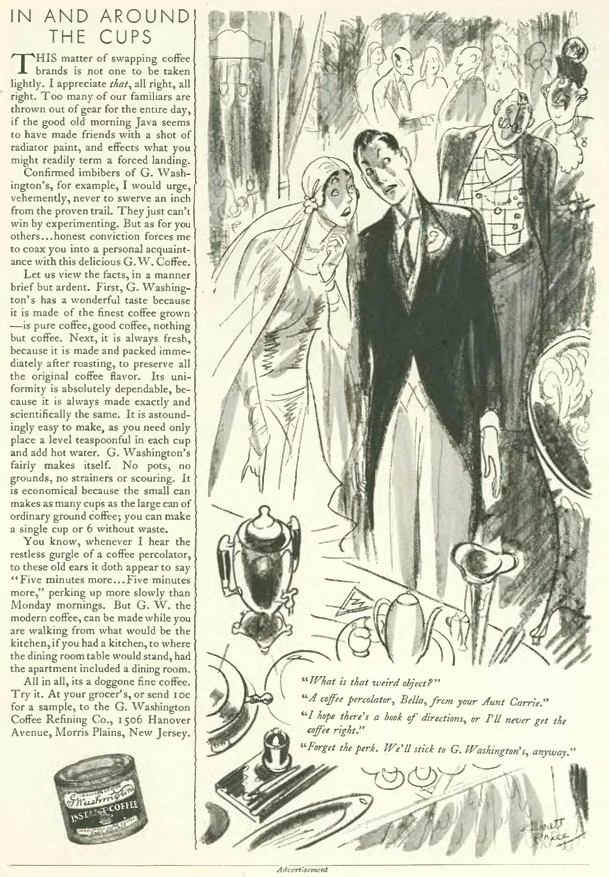
…G. Washington coffee, on the other hand, continued to draw from The New Yorker’s stable of cartoonists, including Garrett Price, for its illustrated ads…
…I was surprised to see this ad for two reasons: I wasn’t aware floss was in common use 90 years ago, or that it once came in the handle of a toothbrush…
…and then we have this sad little back page ad (just above a tiny ad for piano lessons) promoting Peggy Joyce’s ghostwritten “tell all” — Men, Marriage and Me. A former Ziegfeld girl and occasional actress who cultivated fame for fame’s sake, Joyce (1893-1957) was mostly known for her six marriages and extravagant lifestyle. By feeding the media a steady stream of scandals and other adventures (she often received reporters in her bedroom, dressed in a see-through negligee) she remained in the celebrity spotlight throughout the 1920s…
Peggy Joyce in 1923; cover of the first edition of her “tell all” — Men, Marriage and Me. Celebrated in the 1920’s as a swinging golddigger, her fame quickly evaporated into the mists of the Great Depression. (Wikipedia/Abe Books)
…speaking of celebrity, advertisers were so eager for endorsements of the famous that even “Mrs. Ring Lardner” (Ellis Abbott) got a piece of the action…
…as travel by airplane became more fashionable, automobile manufacturers increasingly paired their products with flying machines…
…for those who wished to stay on the ground, the Pickwick-Greyhound bus system featured “Nite Coaches” with 14 sleeping compartments (for 28 passengers), hot and cold water in each compartment, and hot meals served by stewards…
…on to our comics, IsadoreKlein illustrated the excitement of heavyweight boxing…
…PerryBarlow paid a visit to a writer and his dimwitted visitor…
…HelenHokinson looked in on a prep school dance…
…BarbaraShermund demonstrated the finer points of beauty…
…and we end with PeterArno, and one woman’s plan for a costume party…
In his 2006 book, Flapper, Joshua Zeitz refers to The New Yorker’sLois Long as the epitome of the 1920s flapper, an “absolutely a wild woman” who wrote about Jazz Age nightlife “with a wicked sort of sexual sense of humor.”
Feb. 8, 1930 cover by Theodore Haupt (the annual Westminster Kennel Club dog show was in town…)
This Vassar-educated daughter of a Congregational minister began her New Yorker career in the summer of 1925, at age 23. She took over Charles Baskerville’s rather dry column, “When Nights are Bold,” renamed it “Tables for Two,” and using the pen name “Lipstick” plunged into the nightlife scene with considerable brio.
TIMES CHANGE…At left, in a still image from a 1920s home movie, Lois Long relaxes on a beach; at right, Long with newborn daughter Patricia Arno in 1929. (PBS/Patricia Arno)
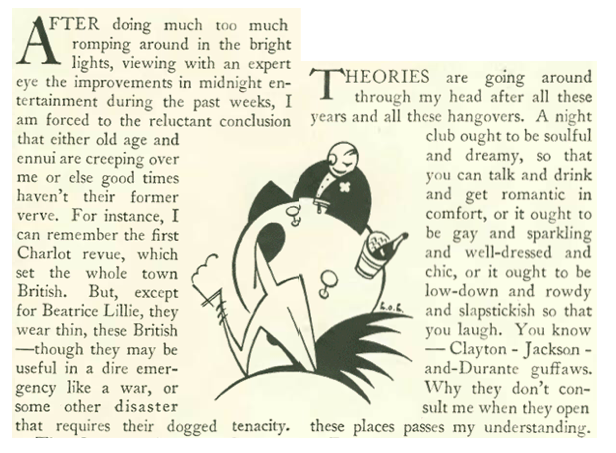
Two years later she would marry cartoonist Peter Arno, and in 1929 would give birth to a daughter, Patricia. During this time the almost weekly “Tables” column would appear infrequently as Long turned her attentions to her family and her fashion column, “On and Off the Avenue.” But as I’ve noted before, Long, along with many of her New Yorker colleagues, had grown weary of the Roaring Twenties many months before they were over. She would put an end (for awhile) to the “Tables” column in June 1930; the good times, as Long noted in her Feb. 8 column, had lost their “verve”…
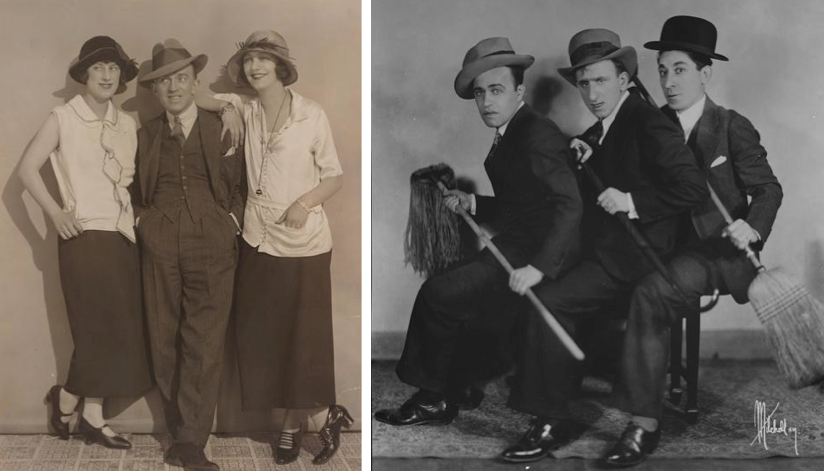
BRITS AND TWITS…Lois Long recalled the nightlife entertainments of the past and present in one of her last “Tables for Two” columns. Photo at left (from left to right), Beatrice Lillie, Nelson Keys, and Gertrude Lawrence in Andre Charlot’s Revue of 1924. At right, the comedy trio Eddie Jackson, Jimmy Durante and Lou Clayton. (Museum of the City of New York/Herbert Mitchell Collection)
…Long found Don Dickerman’s latest themed restaurant, the Daffydil, to be a mildly amusing distraction…
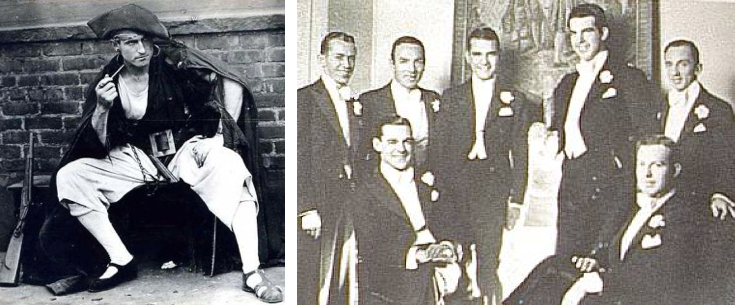
HE WAS AN ARRRTIST…Greenwich Village personality and pirate aficionado Don Dickerman (left) failed to make a living as an artist, but found success with his various themed restaurants including the Pirate’s Cove, the Blue Horse, the Heigh-Ho (where Rudy Vallee started out), the County Fair and the Daffydil (which was financed by Vallee). At right, singing at the Daffydil were the California Collegians, a group that included actor Fred MacMurray (tallest in the photo). (Restaurant-ing through history)
…and she also looked to Harlem for some nighttime diversions, but the ex-flapper just wasn’t up for a rowdy scene…
FOR THE YOUNG AT HEART…Dancing the Lindy Hop at the Savoy in Harlem, circa 1930. (Pinterest)
…ten years later, in The New Yorker’s fifteenth anniversary issue (Feb. 17, 1940), the 38-year-old Long would look back to the Roaring Twenties in the column “That Was New York,” reprising her signature “Lipstick” as she recalled the days when “Harlem was a thrill” and “we smiled when we went dancing in 1925 even though there wasn’t a candid camera within miles. In those days people frequently laughed out loud in public.” She concluded the piece with this observation:
* * *
Rise of the Débutantes
New York’s débutantes and The New Yorker had something of a symbiotic relationship during the magazine’s early days, beginning with a piece written by 22-year-old Ellin Mackay for the Nov. 28, 1925 issue that served as a manifesto of sorts for a new kind of débutante. Mackay’s essay explained why modern women were abandoning the forced social matchmaking of débutante balls in favor of the more egalitarian (and fun) night club scene.
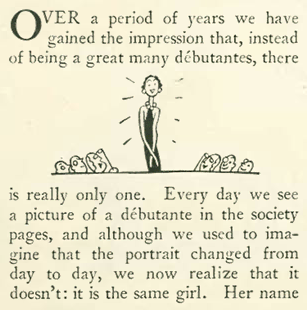
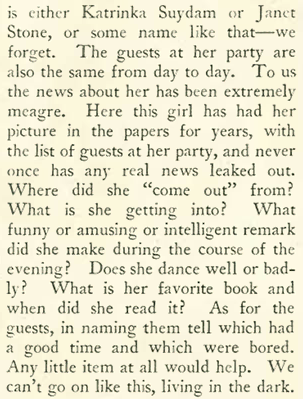
Mackay’s piece provided a huge boost to The New Yorker’s circulation, the magazine barely staying afloat at the time. Nevertheless, its writers couldn’t resist taking occasional shots at the seemingly frivolous existence of debs, including E.B. White, who called out a one Katrinka Suydam in his “Notes and Comment” column for Jan. 4, 1930:
Perhaps White came across Suydam’s name in the Sept. 7, 1929 New York Times:
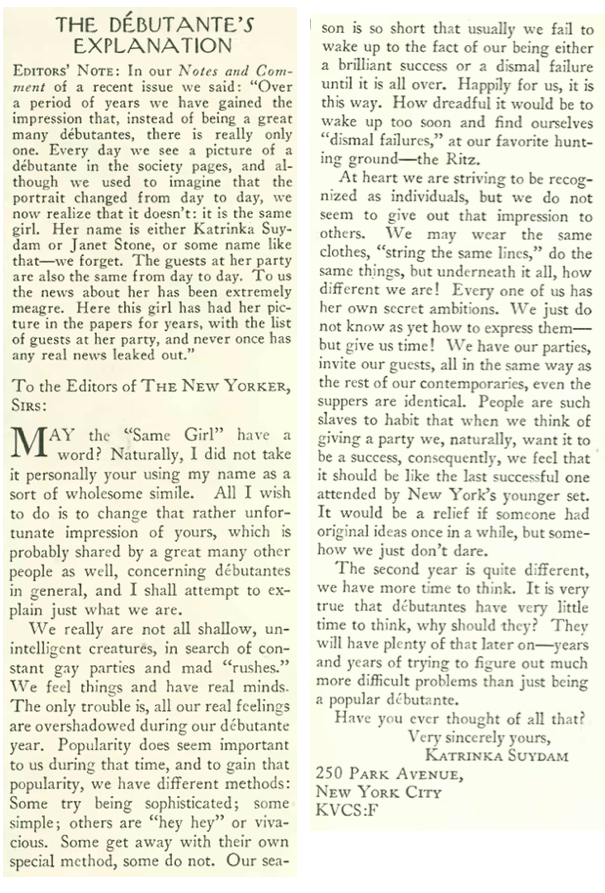
What he probably didn’t expect was a reply from Suydam herself, an act that seemed to impress the magazine’s editors, who printed the proud débutante’s letter in full on page 32:
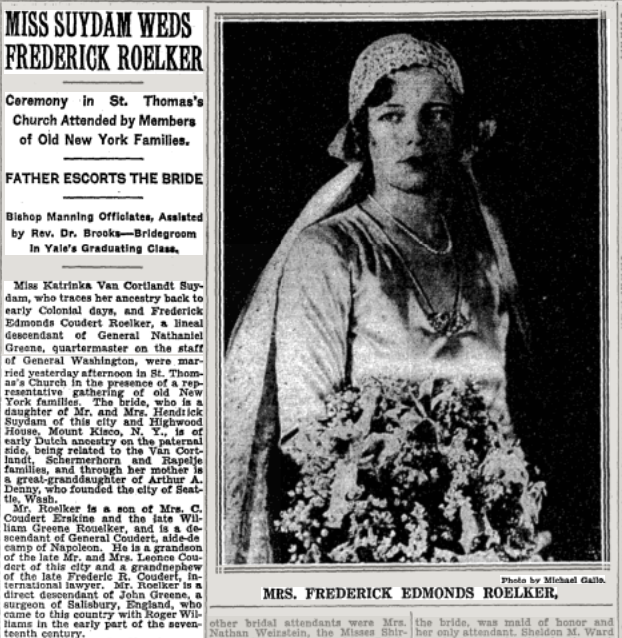
Suydam would go on to marry Frederick Roelker later that June. Note in this excerpted wedding write-up how the couples’ European and colonial pedigrees were carefully detailed in the first paragraphs, distinguishing their union from couplings enjoyed by the unwashed masses…
Katrinka Suydam’s wedding as reported in the June 12, 1930 issue of The New York Times.
* * *
Skirt Stakes
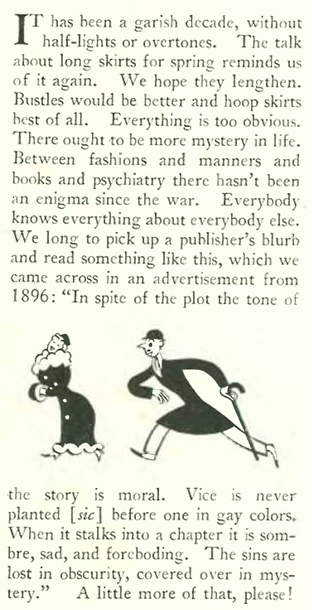
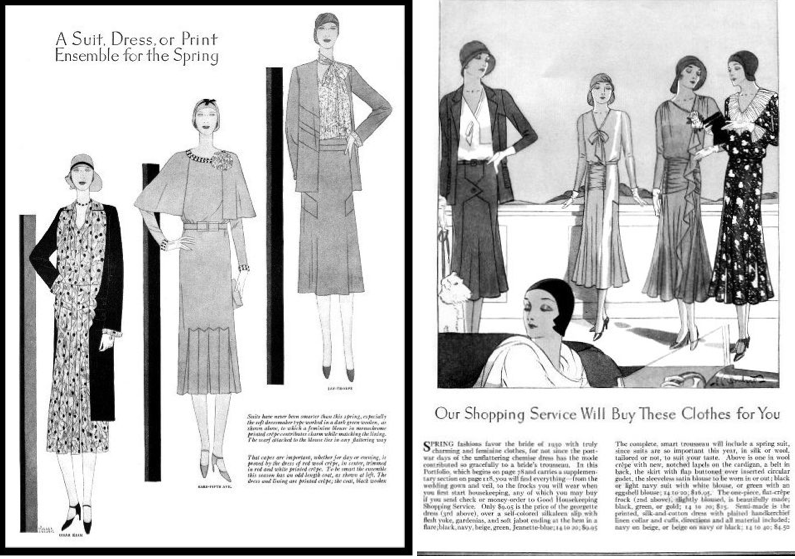
In 1930 hemlines plummeted along with the stock market. E.B. White, in “Notes,” welcomed the return of “mystery” to women’s fashions:
THEY DROPPED WITH THE MARKET…Women’s spring fashions with lowered hemlines on display in the April 1930 issue of Good Housekeeping. (fashion-era.com)
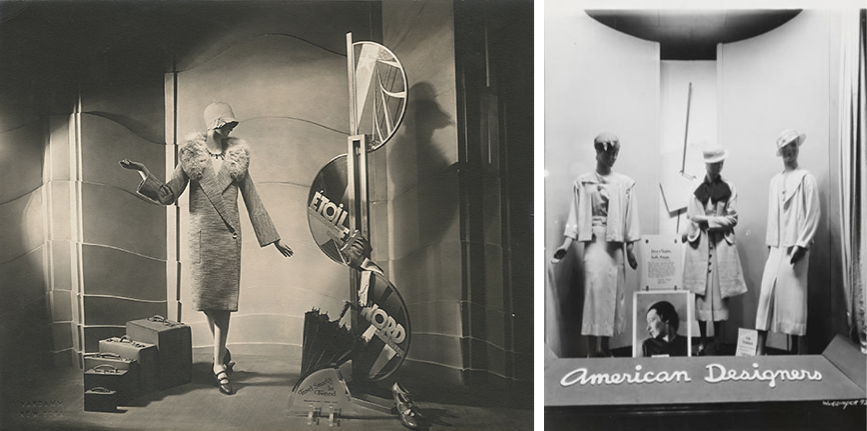
Frederick Lewis Allen, on the other hand, was having difficulty understanding the modern woman, circa 1930, based on what he was seeing in the display windows along Fifth Avenue. Excerpts:
NO NONSENSE WOMEN…Window displays on Fifth Avenue included (left) this “Travel Smartly in Tweed” window display for Franklin Simon (1929-30); and right, a window at Lord & Taylor, 1933. (Harry Ransom Center/Museum of the City of New York)
Allen noted that the “snooty” mannequins on display along Fifth Avenue represented a certain type who wouldn’t be caught dead riding a bus…
Whether or not he liked the Altman girls, the 39-year-old Allen felt like an “old fogey” in the presence of these “no nonsense” women:
* * *
Get A Room
Marion Sturges Jones pondered the life of another kind of modern woman, namely that of Virginia Woolf, who had recently published the extended essay A Room of One’s Own. Jones discovered that finding such a room was easier said than done…
IN HER ROOM…Virginia Woolf at Monk’s House in East Sussex, 1932; dust jacket of the first edition of A Room of One’s Own. (kaykeys.net/Beinecke Library, Yale)
* * *
The Way You Really Look
Franklin P. Adams penned a profile of the legendary songwriter and stage producer Jerome Kern, who created dozens of Broadway musicals and Hollywood films and wrote a substantial chunk of the American songbook (more than 700 songs) with such hits as “Ol’ Man River”, “A Fine Romance”, “Smoke Gets in Your Eyes”, and “The Way You Look Tonight.” Peter Arno provided this less-than-flattering caricature of the man…
…and this is how Kern actually looked, circa 1930…
(bloggingtonybennett.com)
* * *
At the Talkies
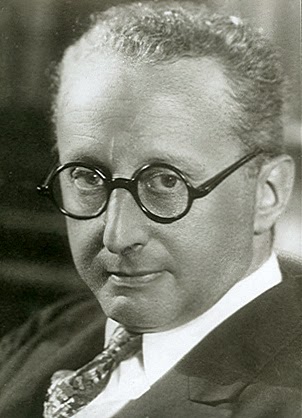
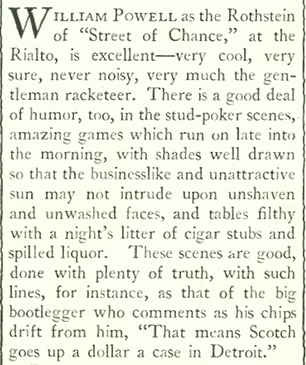
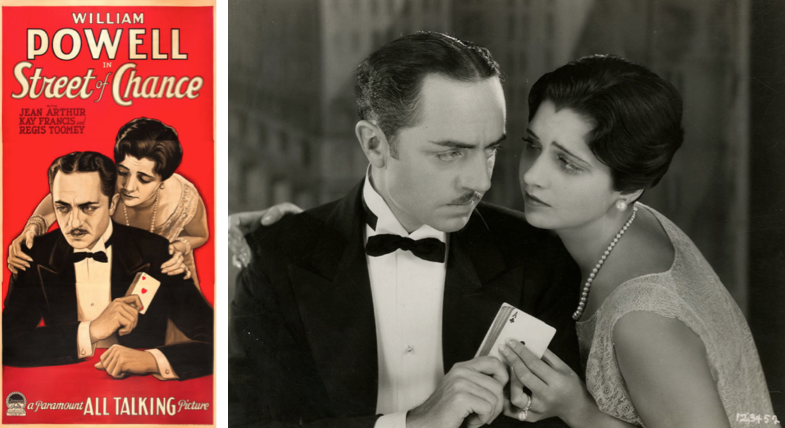
Speaking of showbiz, New Yorker film critic John Mosher offered high praise for William Powell’s latest film, Street of Chance. Although Powell is often linked professionally to actress Myrna Loy thanks to their six Thin Man films (1934 – 1947), from 1930 to 1932 he also appeared with Kay Francis in six films, including Street of Chance. Both Powell and Francis would become major stars of the 1930s, and between 1930 and 1936 Francis would be the number one female star at Warner Brothers and the highest-paid American film actress. Francis was no stranger to wild living — she was a longtime friend of Lois Long’s (see above) and also shared an apartment with her at 381 Park Avenue before Long married Peter Arno. Mosher’s review:
TOUGH ODDS…William Powell and Kay Francis in Street of Chance (1930). Francis was a longtime friend of New Yorker columnist Lois Long. (IMDB)
* * *
From Our Advertisers
We have an advertisement from the aforementioned County Fair, one of the themed restaurants operated by Greenwich village artist and personality Don Dickerman, who illustrated his own ads…
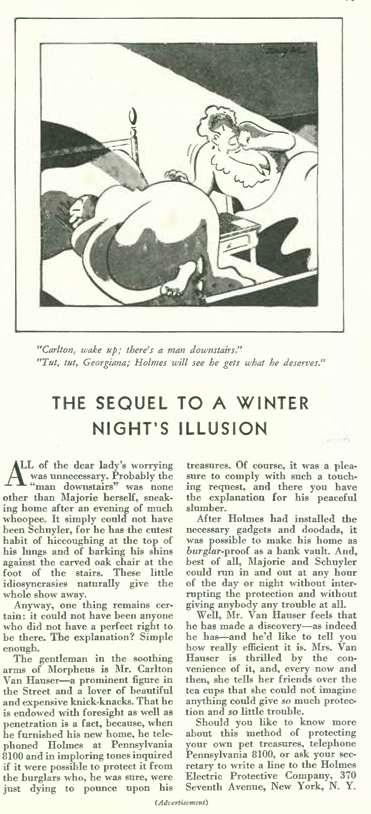
…I’m not sure who drew this Arno-esque illustration below for the Holmes Electric Protective Company, but I can tell you that the name Holmes was synonymous with home security in 1930…in 1857 Edwin Holmes bought a patent for an electric burglar alarm (invented in 1853 by Augustus Pope) and went on to successfully commercialize and popularize the electromagnetic burglar alarm. Holmes is also credited with creating the first large-scale alarm network in the United States…
…but I do know that Abe Birnbaum contributed this drawing (in “Talk of the Town”) of the beloved Colony restaurant owner Eugene Cavallero…
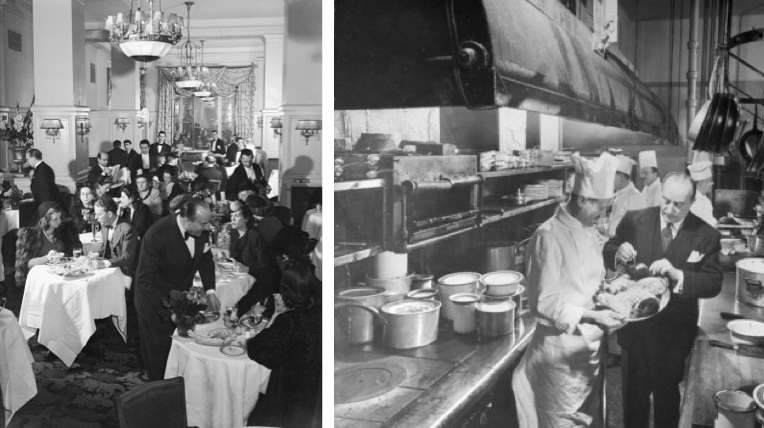
A PLACE TO SEE AND BE SEEN…From the 1920s to the 1960s New York’s smart set dined at the Colony. Rian James, in Dining In New York (1930) wrote “the Colony is the restaurant of the cosmopolite and the connoisseur; the rendezvous of the social register; the retreat of the Four Hundred.” Critic George Jean Nathan said the Colony was one of “civilization’s last strongholds in the department of cuisine.” Photo at left of the dining room around 1940; at right, owner Eugene Cavallero consults with a chef. (lostpastremembered.blogspot.com)
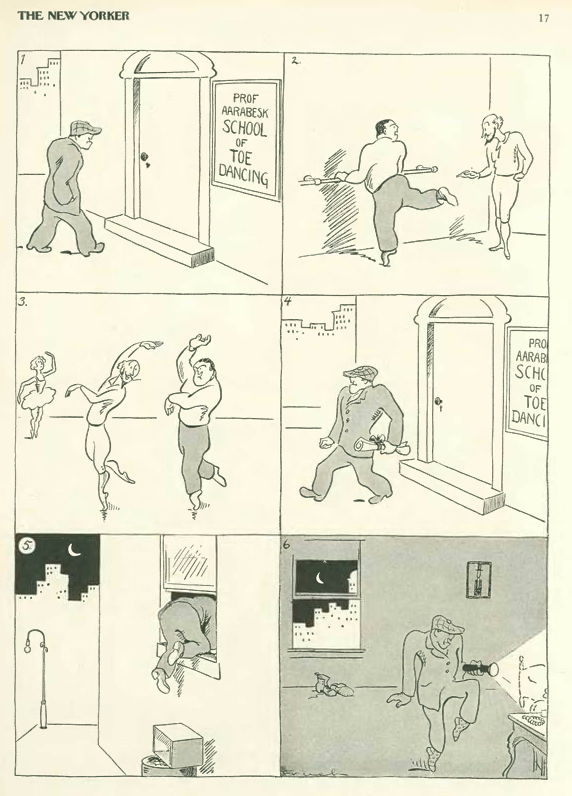
…on to our cartoons, we have a full page from Al Frueh…
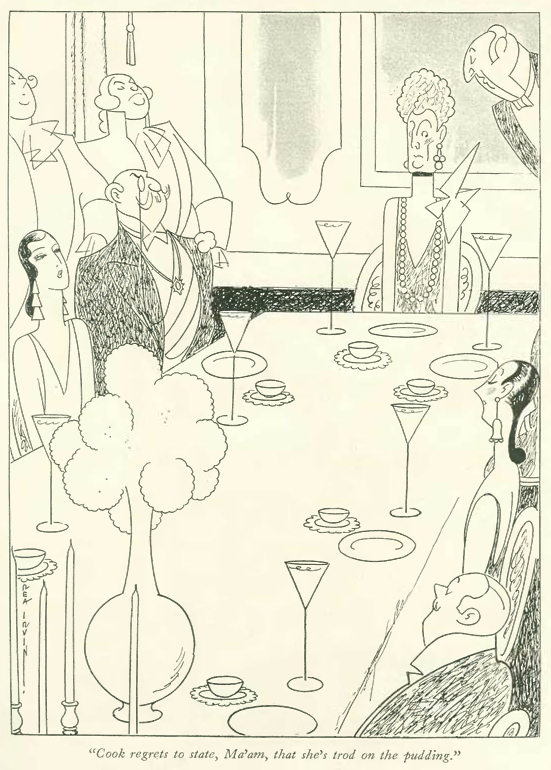
…and another full-page from Rea Irvin…
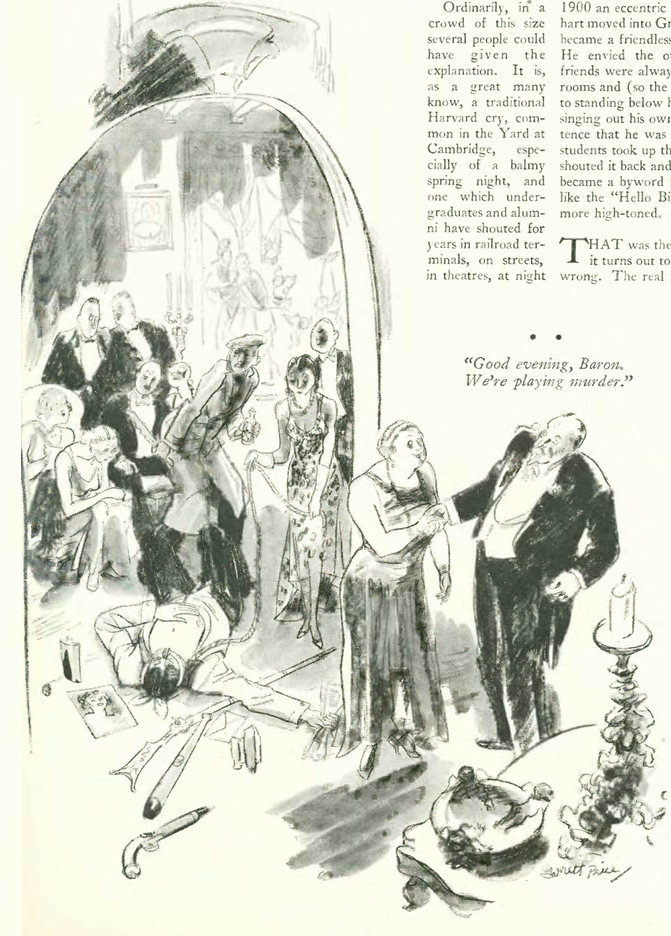
…this terrific party scene courtesy Garrett Price…
A host of nature programs from Mutual of Omaha’s Wild Kingdom to Planet Earth owe their origins to a few intrepid filmmakers who 100 years ago gave Americans some of their first glimpses of life in exotic, remote regions of the world.
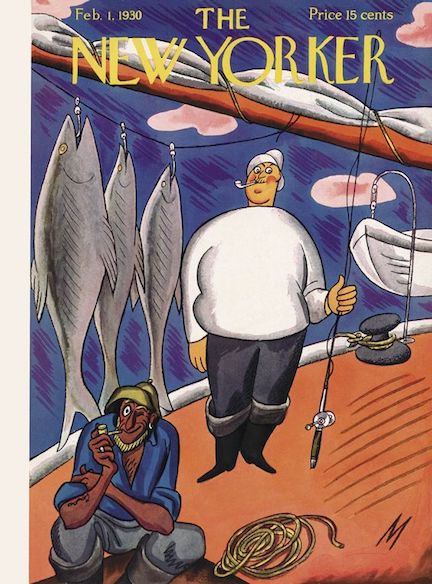
Feb. 1, 1930 cover by Julian De Miskey.
Among the first to do it were a couple from Kansas, Osa and Martin Johnson, who together explored unknown lands and brought back footage of the wildlife and peoples of the African continent, the South Pacific Islands and British North Borneo. Their first film, Among the Cannibal Isles of the South Seas (1918), was followed by several more, including Across the World with Mr. and Mrs. Johnson, which was released in early 1930.
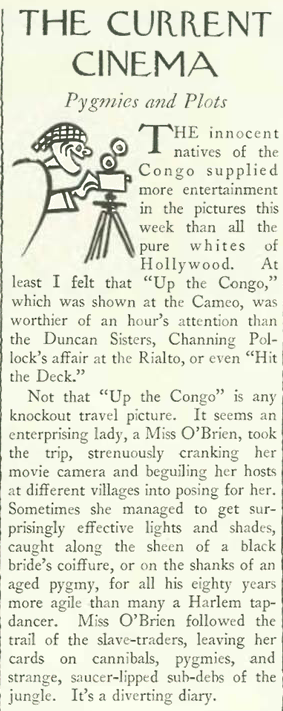
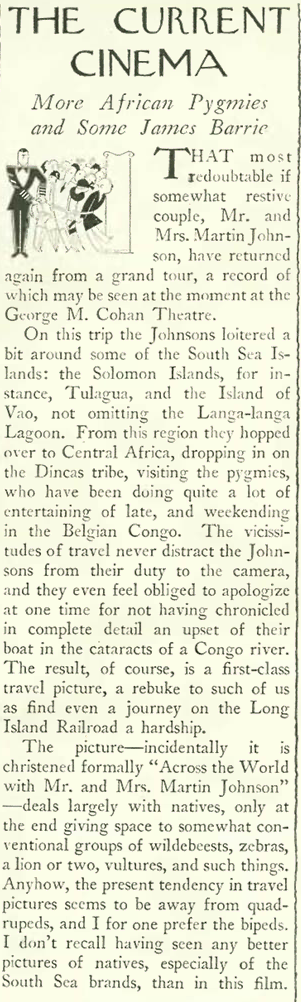
The New Yorker film critic John Mosher was as eager as any audience to take in the adventures of the Johnsons, or even of someone who was inspired by the Johnsons, in this case a “Miss O’Brien” who had just released a “diverting diary” called Up the Congo. Mosher wrote about it in the Jan. 25 issue:
CONTACT…Image of a family from an unidentified Pygmy tribe posing with a European explorer in a 1921 Collier’s New Encyclopedia entry; a group of Mbuti posing with explorer Osa Johnson in 1930. (Wikipedia)
I can find no record of the film UptheCongo, however the exploits of the Johnsons are well documented thanks to the Martin and Osa Johnson Safari Museum in Chanute, Kansas, which has a treasure trove of photos and other information on the explorers.
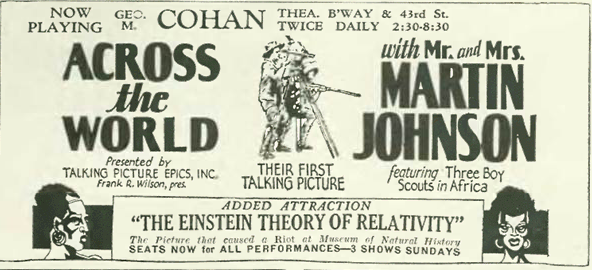
The ad in the Feb. 1, 1930 New Yorker promoting Across the World with Mr. and Mrs. Johnson included an interesting “added attraction”…a film about Einstein’s theory of relativity that had caused a Jan. 8 “riot” at the American Museum of Natural History. That particular screening was intended for members of the Amateur Astronomers Association, but word got out and three times the invited number showed up at the museum, breaking down the lobby gates. Hard to imagine a mob today clamoring to view a science film…
Although the Johnsons made their movies under the auspices of the American Museum of Natural History, much of the footage was staged or edited to maximize the thrills (Mutual of Omaha’s Wild Kingdom did this in the 1960s and 70s, as did producers of Disney’s nature films from the 50s and 60s. The practice continues to this day on cable television).
The Johnsons also didn’t hesitate to gun down animals in the course of their movie-making…
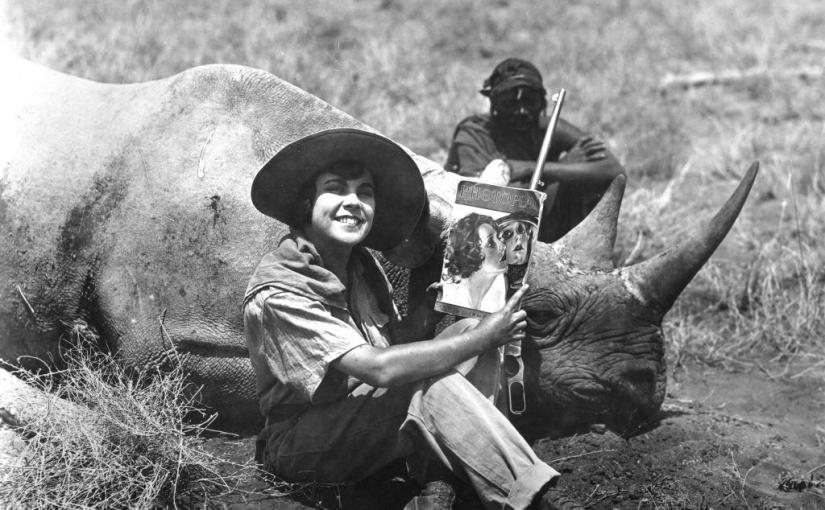
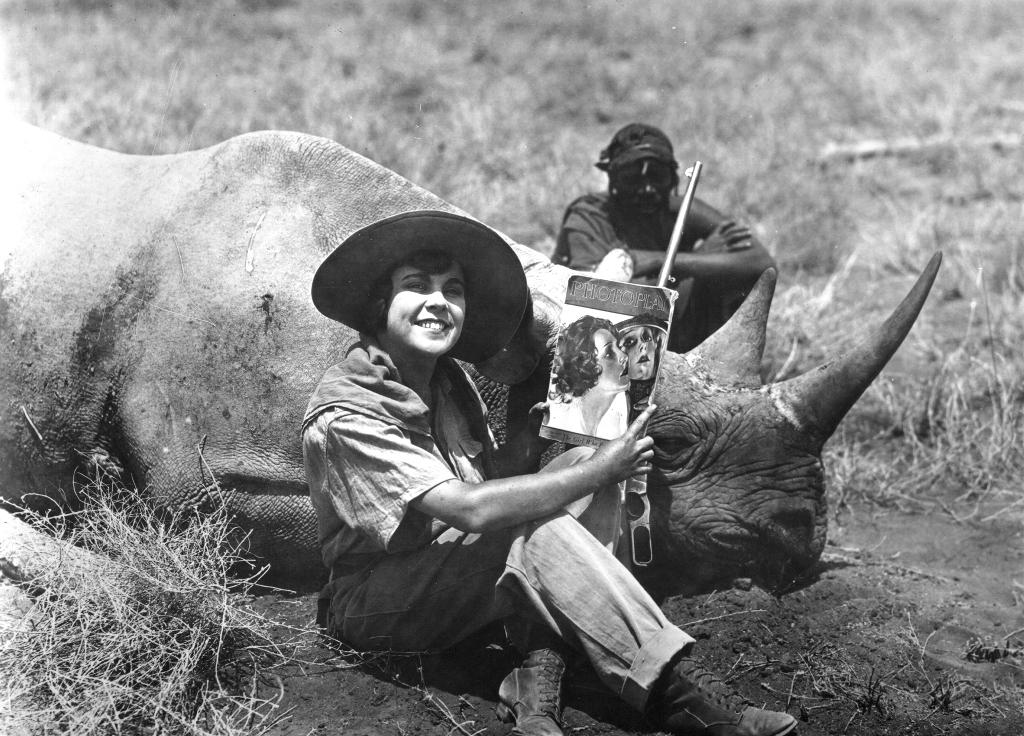
YEP, THAT’S JUXTAPOSITION…Osa Johnson poses with a Photoplay magazine, a dead rhino, and a tribesman, circa 1930. (columbia.edu)
According to a 2011 review from Wild Film History, “in stark contrast to the conservation-themed wildlife films of today, the Johnsons approached their subjects armed with both camera and rifle, with the production including provoked behaviour, staged confrontations and animals shot to death on film. Relying heavily on cutting in kills from professional marksmen, numerous hunting scenes culminate in a heart-stopping sequence where, with the use of clever editing, the adventurous Mrs Johnson appears to bring down a charging rhinoceros with one well-aimed shot.”
Across the World with Mr. and Mrs. Johnson is presented as if the Johnsons were showing their film to a few friends in their New York City apartment. The film is a “silent with sound,” that is, scenes in the field are silent, but the cocktail party “home movie” opening has sound, including “mood music” Osa provides by turning on the radio as the film begins. For all of their film experience, the acting between Osa and Martin is wooden, as is Martin’s narration. The critic John Mosher, however, enjoyed the ride, writing in his Feb. 1 column:
If you are curious, you can watch some of the film here, including the opening home movie scene with Osa and Martin in cocktail attire…
* * *
My Kinda Town
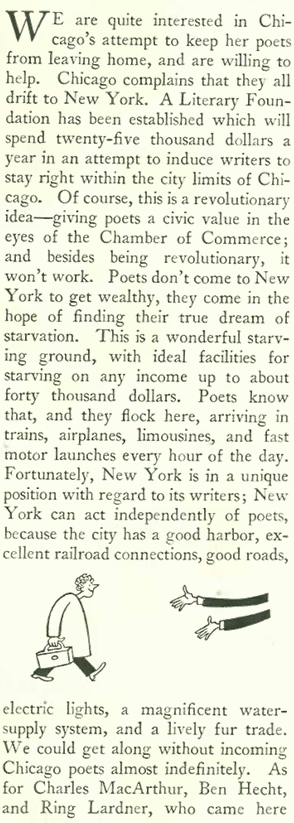
TheNew Yorker occasionally enjoyed taking potshots at the Second City, as well as some good-natured jabs at a few of its former residents who were also denizens of the Algonquin Round Table. Here is E.B. White in the Feb. 1 “Notes and Comment”…
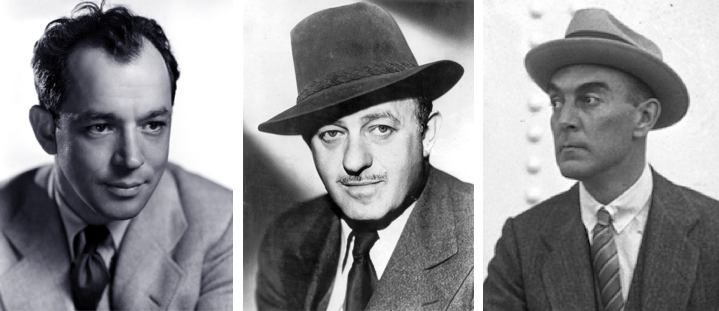
WINDY WITS…Chicagoans Charles MacArthur, Ben Hecht and Ring Lardner were well-known to The New Yorker crowd. (Wikipedia)
* * *
Not In This Century
This item from the Feb. 1 “Talk of the Town” is noteworthy for placing its admiration of technical achievement over any concerns for a child’s welfare. Today the couple would be arrested for this…
* * *
ThePerilsofAging
Irish-American actress and writer Patricia Collinge (1892-1974) wrote a series of short stories for The NewYorker, including this piece for the Feb. 1 issue written when she was 37 years old. It is a sad story about an older actress (37) who hoped to land the part of a younger woman. Some excerpts…
…the actress in the story is led to believe the part was intended for a woman of 28, and is crushed to learn that the agent was looking for “a young twenty-two”…
OH TO BE YOUNG…At left, Gladys Cooper, Alexandra Carlisle and 20-year-old Patricia Collinge in the Drury Lane production of Everywoman (1912); at right, Collinge in 1941. Unlike the sad actress in her short story, Collinge’s career spanned more than 60 years. (Wikipedia)
* * *
ComingAround
In previous issues art critic MurdockPemberton expressed skepticism about the new Museum of Modern of Art, founded by wealthy society women in November 1929. Pemberton held egalitarian views about art, and wondered if the old money set could create a venue for true modern artists. His review of “Painting in Paris,” MoMA’s third exhibition, seemed to allay his concerns…
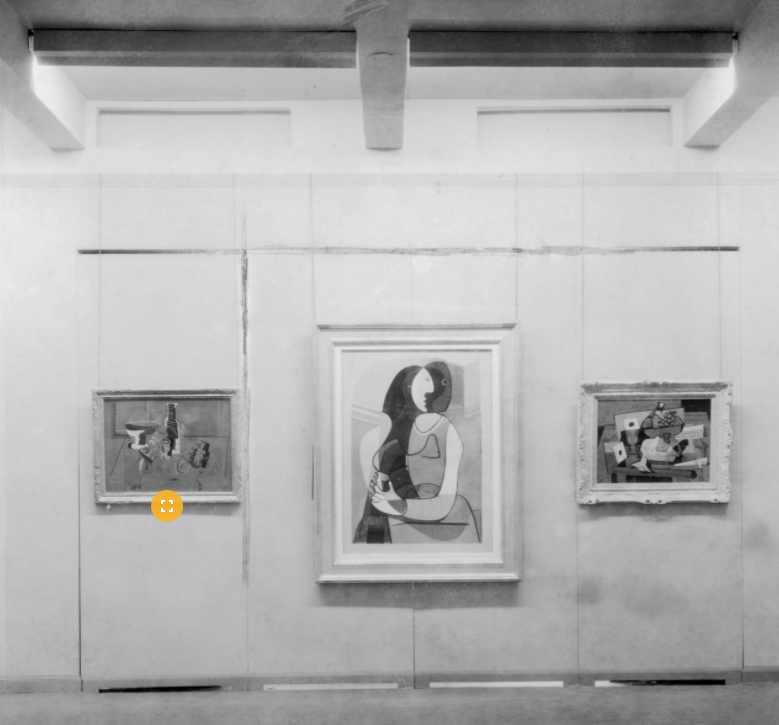
PAINTING IN PARIS was the title of the Museum of Modern Art’s third exhibition featuring works by Georges Braque, Georges Rouault, Pablo Picasso, Joan Miró, Marc Chagall, Robert Delauney, Fernand Leger, Henri Matisse and Andre Derain among others. Image above is from the original exhibition at MOMA’s first home in the Heckscher Building at 730 Fifth Avenue. (MOMA)
Images above in color, from left, Pablo Picasso’sGreen Still Life Avignon (1914) and Seated Woman (1927); Georges Braque’sStill life (1927). (MOMA/WikiArt)
Pemberton expressed enthusiasm for the show’s new works that contained few traces of the familiar…
* * *
The King’s Speech
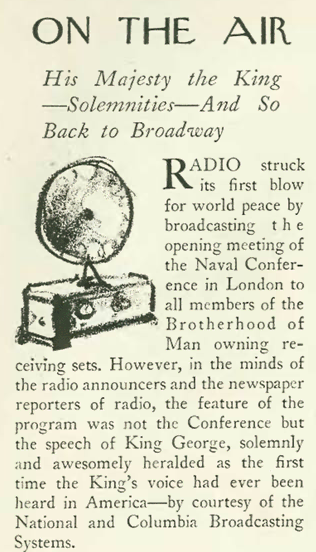
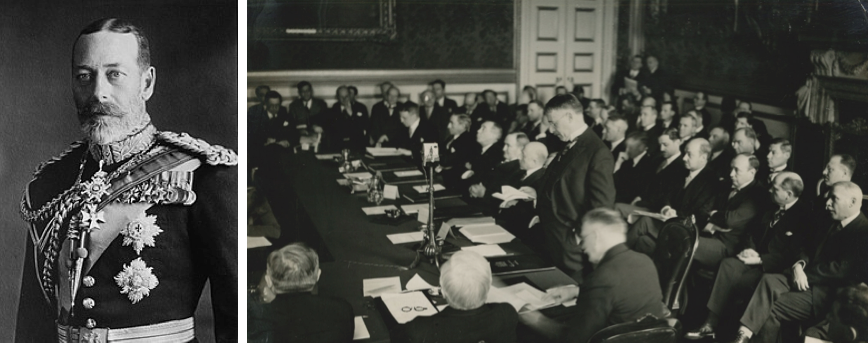
KingGeorgeV was not known for his public speaking, but when he addressed the third meeting of the London Naval Conference it was a big deal, even to American listeners who for the first time heard his voice over broadcast radio, still a very new medium in 1930…
ON THE AIR…The voice of King George V (pictured here in 1923) was broadcast across the Atlantic for the opening of the London Naval Conference at St. James’s Palace in 1930. The third in a series of five meetings, the conference was formed with the purpose of placing limits on the naval capacity of the world’s largest naval powers. (Wikipedia/Churchill Archives Centre)
* * *
Good Clean Fun?
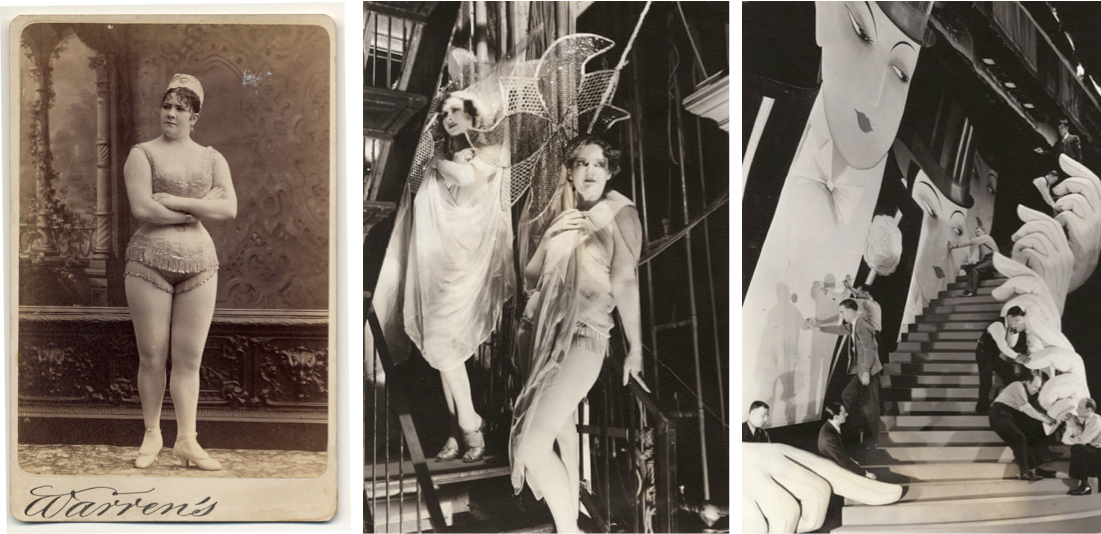
In his theater review column, RobertBenchley lamented the state of burlesque shows at the National Winter Garden, where “leviathans of an earlier day” were being displaced by “agile wisps” in third-rate Broadway productions…
ON THE SHOULDERS OF GIANTS…from left, Viola Clifton, a fuller-figured 1890s burlesque dancer; center and right, Margaret Bourke-White photos from Minsky’s National Winter Garden, 1936. Theater critic Robert Benchley wrote that he missed the “leviathans” of an earlier age, who were replaced by girls who were nothing but “agile wisps.”(mashable.com/theguardian.com)
* * *
From Our Advertisers
Just a couple of ads from the Feb. 1 issue, including this entry from the Shelton Looms offering advice on how one should appear among the Havana social set…
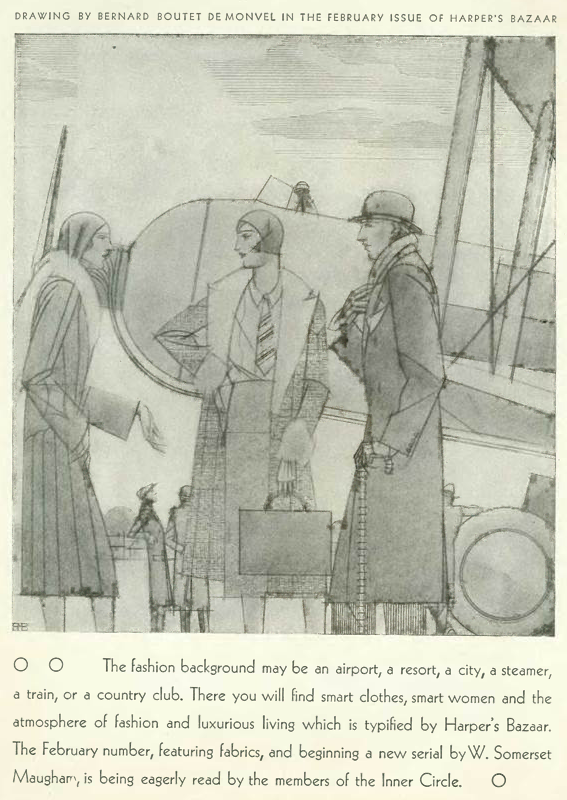
…and this ad from Harper’s Bazaar, also appealing to the smart set…
…our cartoons include this two-page illustration by ReaIrvin…
…AlanDunn’s look into the challenges of running a power plant…
…at the opera with PerryBarlow…
…GardnerRea and some bedroom hinjinks…
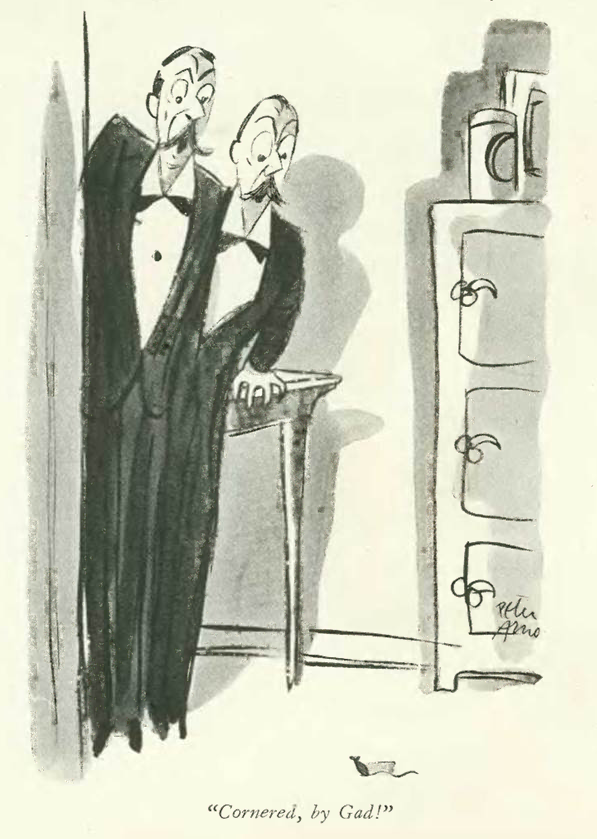
…man vs. mouse, by PeterArno…
…and this by LeonardDove, seemingly anticipating the work of CharlesAddams…
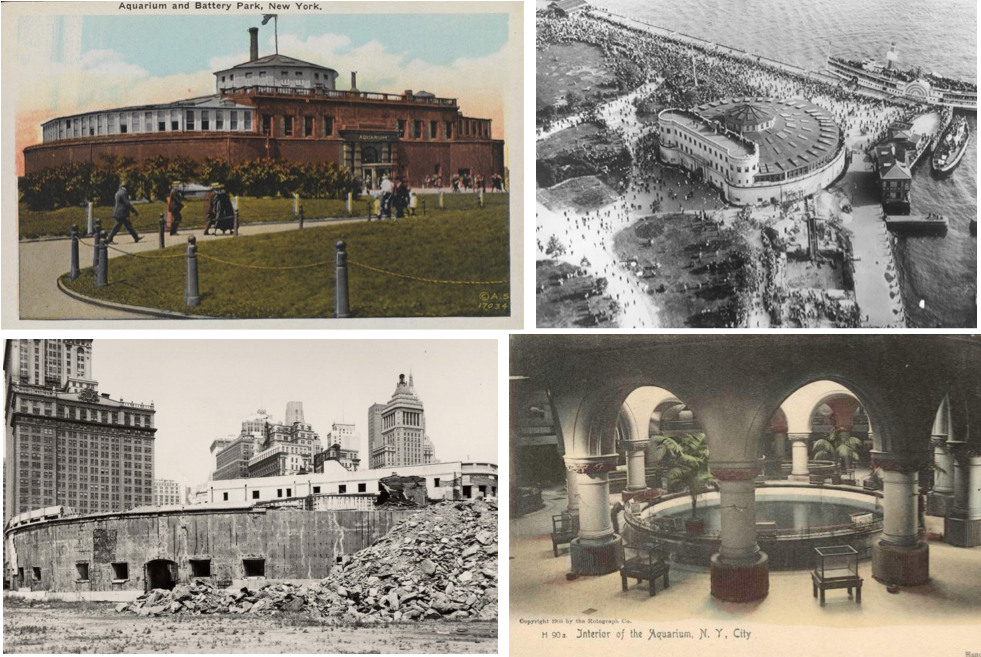
Before we launch into the Jan. 25 issue, the rendering of the old New York Aquarium in this Sue Williams cover bears some consideration.
Jan. 25, 1930 cover by Sue Williams.
The aquarium was housed within the historic walls the South West Battery, constructed off the tip of Manhattan between 1808 and 1811 as a defense against the British. Renamed Castle Clinton in 1817 (in honor of former Mayor/Governor Dewitt Clinton), it was deeded to the city in 1823 to be used as an entertainment center. From 1855 to 1890 it served as an immigrant landing depot, then remodeled in 1896 (by the architectural firm McKim, Mead, and White) to become the popular New York City Aquarium.
FISH OUT OF WATER…Postcard image of the New York City Aquarium from the early 1900s; aerial view of the aquarium circa 1934; postcard image of aquarium interior; demolition of the aquarium in 1941, on orders from city planner Robert Moses. (thebattery.org/nycgovparks.org)
Although the aquarium proved to be a cultural and educational magnet, it stood in the way of master planner Robert Moses’s designs to build a bridge from The Battery to Brooklyn. After residents, preservationists and even Eleanor and President Franklin Roosevelt protested, the city opted instead to construct a tunnel under the East River. Nevertheless, Moses managed to get the aquarium knocked down before demolition was halted by the outbreak of World War II. After the war, Congress passed a bill declaring the site a National Monument, and preserved the walls of Castle Clinton.
HIGH AND DRY…Until it was demolished in 1941, the New York City Aquarium occupied the space in the center of Castle Clinton, which was added to National Register of Historic Places in 1966. (nps.gov)
* * *
Now, About That Band…
A play that satirized America’s enthusiasm for war—Strike Up the Band—was loved by critics but spurned by audiences when it opened in Philadelphia in 1927. Written by George S. Kaufman, with music and lyrics by George and Ira Gershwin, the play had the pedigree for success, but audiences weren’t quite ready for a show that poked fun at the U.S. military just nine years after the end of World War I (in the original play, America is goaded into declaring war on Switzerland by an American cheese tycoon).
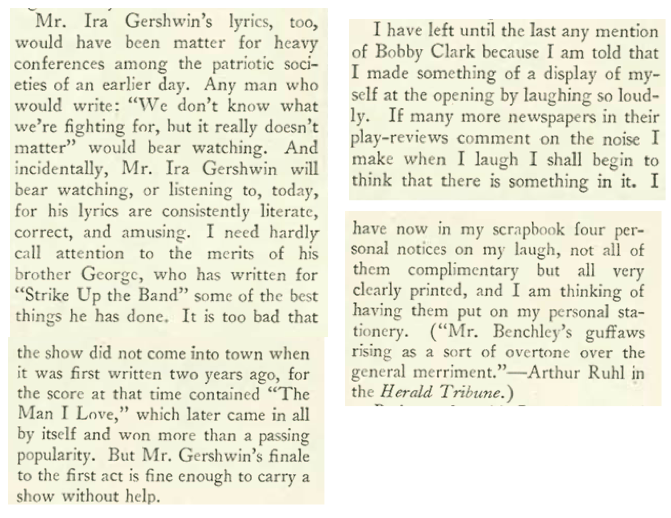
Enter lyricist Morrie Ryskind, who reworked the script, softening its political message and remaking the war plot into a dream sequence. The revised play proved to a be hit, running for 191 performances at the Times Square Theatre. It also introduced a number of popular songs, including “The Man I Love” and “Strike Up the Band.” Robert Benchley was on hand for opening night:
TEAMWORK…Clockwise, from top, Ira (left) and George Gershwin at work circa 1930; lyricist Morrie Ryskind, who softened the tone of George S. Kaufman’s original script. (U of Michigan/Wikipedia)
Benchley noted that the antics of comedian Bobby Clark caused him to laugh so loud that his guffaws were even noted in the Herald Tribune’s review:
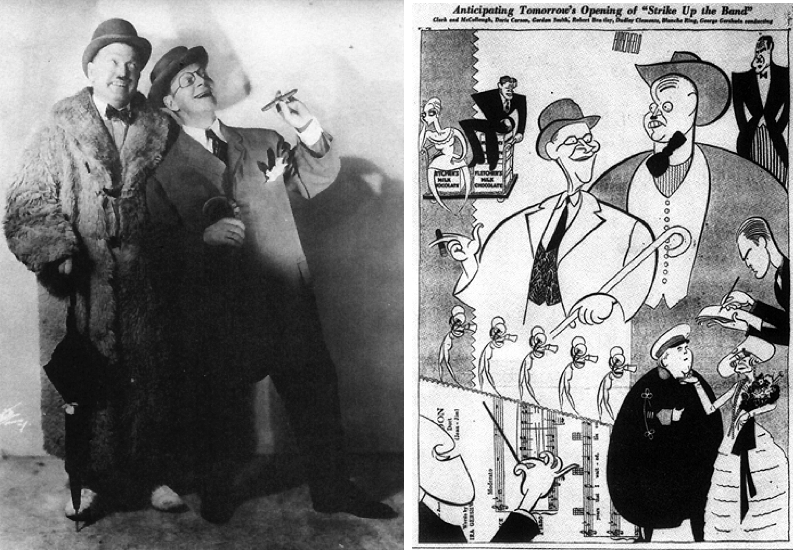
MAKE ‘EM LAUGH…The comedy team of Paul McCullough (left) and Bobby Clark were one of the play’s big draws. At right, Herald-Tribune illustration by Al Hirschfeld announcing the Broadway opening of Strike Up the Band. (aaronneathery.org)
* * *
Duncan Yo-Yos
We’ve seen the Duncan Sisters (Rosetta and Vivian) before in this blog, the sister vaudeville act that became famous with the 1923 hit musical Topsy and Eva, which inspired a silent 1927 film starring the duo. They were back on the screen in late 1929 with It’s a Great Life, which TheNew Yorker’sJohn Mosher found to be “pretty dreary”…
NOT SO GREAT, THIS…Clockwise from top, promotional poster for It’s a Great Life; a scene from a dance number in the film; Rosetta (in blackface) and Vivian Duncan as Topsy and Eva (characters derived from the novel Uncle Tom’s Cabin). It’s a Great Life flopped at the box office, along with the Duncan’s brief movie careers. In the years to follow the duo would became popular nightclub entertainers and would continue to perform their Topsy and Eva routine even though appearing in blackface was increasingly considered offensive. (Wikipedia/freewebs.com)
* * *
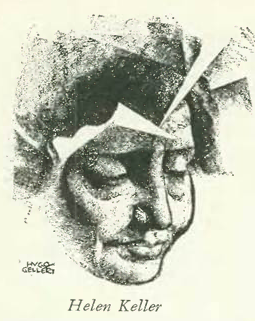
Miracle Worker
TheNew Yorker profile, written by Robert Coates, featured Helen Keller (with illustration by Hugo Gellert). A brief excerpt:
* * *
From Our Advertisers
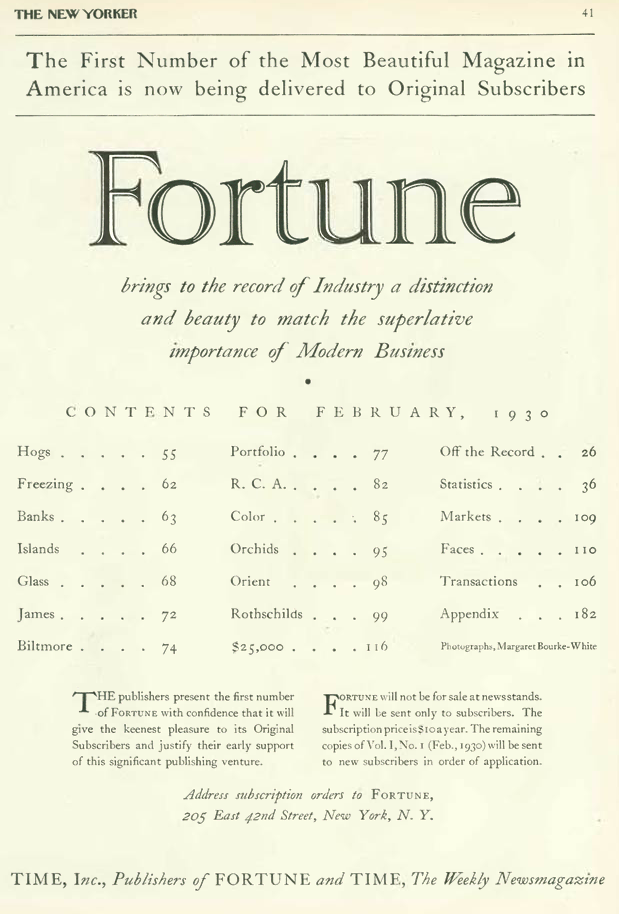
Advertisers in the Jan. 25 issue included the new Fortune magazine, which announced its first issue with this full-page ad:
…the table of contents is fascinating, spare in descriptions of everything from “Hogs” to “Orchids”…
From left, issue No. 1, February 1930; table contents for the issue; a prototype of the magazine, September 1929. (Fortune)
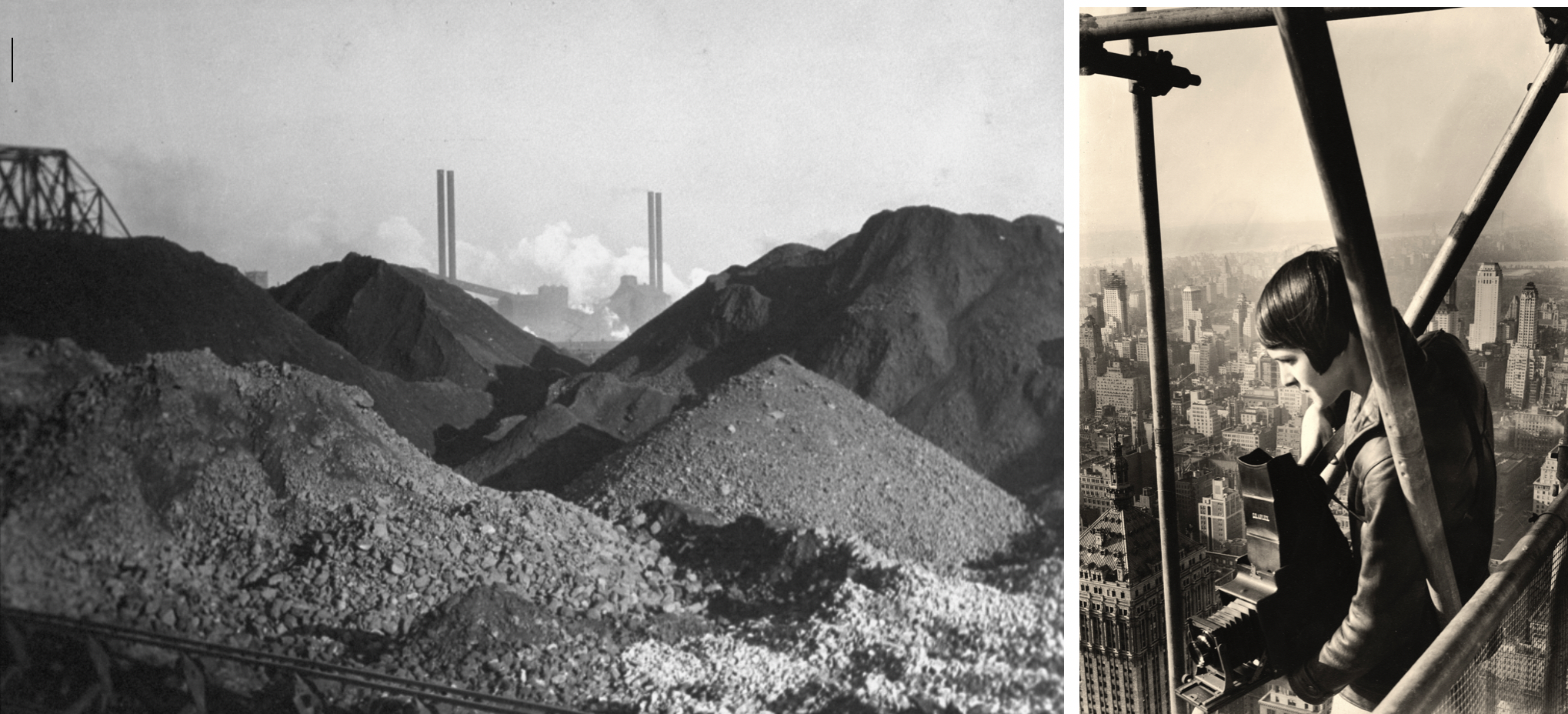
…also listed in the new magazine’s table of contents was the name of a 24-year-old photographer, Margaret Bourke-White…
A photo of coal piles by Margaret Bourke-White in the first issue of Fortune magazine. At right, Bourke-White photographing atop a skyscraper circa 1930. (Fortune)
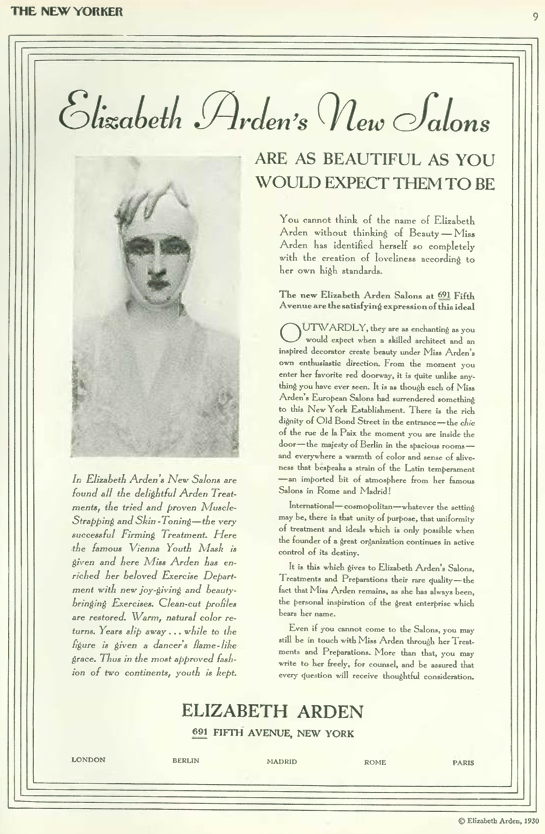
…on to our other advertisements, we have this entry from Elizabeth Arden…ads from this salon chain in the 1920s and 30s featured this ubiquitous image of a woman with a distant stare, her head tightly bound — mummy-like — as part of a firming treatment called “muscle-strapping”…
…in contrast to the rather cold, clinical look of the Elizabeth Arden ad, the Primrose House appealed more to social climbing than skin toning…
…while the makers of Pond’s cold cream continued to draw from their stable of debutantes and society ladies to move their product…
…long before there was Joe Camel, R.J. Reynolds also appealed to social climbers with a series of ads beautifully illustrated by fashion artist Carl Erickson…
…society’s smokers were advised to pack a tube of Bost toothpaste, or have their French maid do it for them…
…and once again we have an ad by Dr. Seuss for Flit insecticide that is very much of its time…
…as is this cartoon by Isadore Klein, perhaps the first in The New Yorker that depicted African Americans as something other than minstrel show stereotypes. Nevertheless, the rendering is still a bit crude — especially the boy’s face — as is the idea behind the “joke” — that a black boy could actually aspire to be a great violinist like Jascha Heifetz…
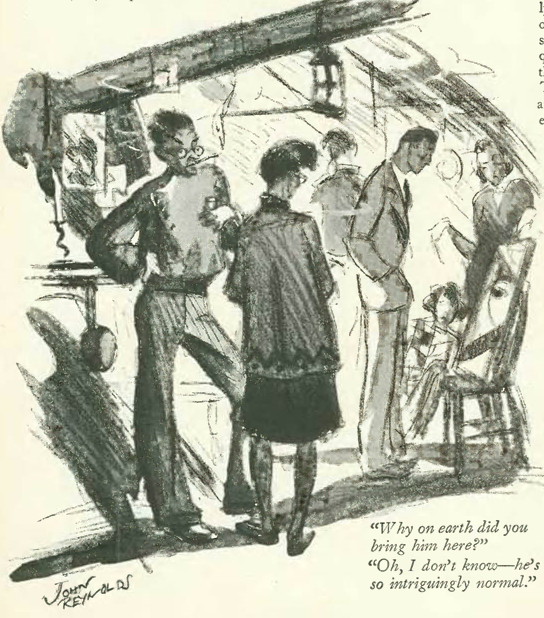
…John Reynolds explored a less troubling juxtaposition among the bohemian set…
…and we end with this peek into society life courtesy Barbara Shermund…