The Red House

From the 1930s until the 1950s, New York City was the one place where American communists almost became a mass movement.


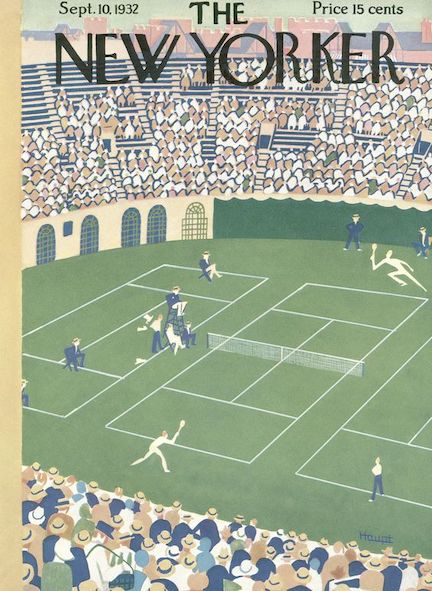
Sept. 10, 1932 cover by Theodore Haupt.

Writing in The New York Times opinion section (Oct. 20, 2017), Maurice Isserman observed how in those days New York party members “could live in a milieu where co-workers, neighbors and the family dentist were fellow Communists; they bought life insurance policies from party-controlled fraternal organizations; they could even spend their evenings out in night clubs run by Communist sympathizers…” we skip to the Sept . 17 issue in which journalist Matthew Josephson penned a report on the movement for the Reporter at Large” column titled “The Red House”…excerpts:

According to Isserman (a professor of history at Hamilton College), in 1938 the Communist Party of America counted 38,000 members in New York State alone, most of them living in New York City. A Communist candidate for president of the board of aldermen received nearly 100,000 votes that same year, with party members playing a central role in promoting trade unions.

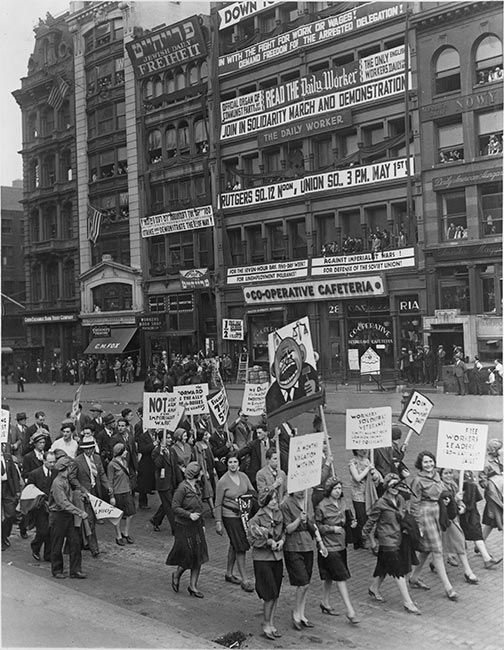
BOSS’S DAY…Communists march at Union Square against “the boss class” at a 1930 rally in New York City.  (Oxford Research Encyclopedias)
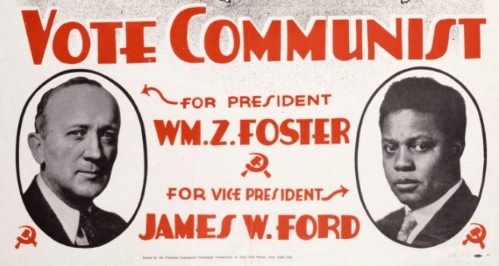
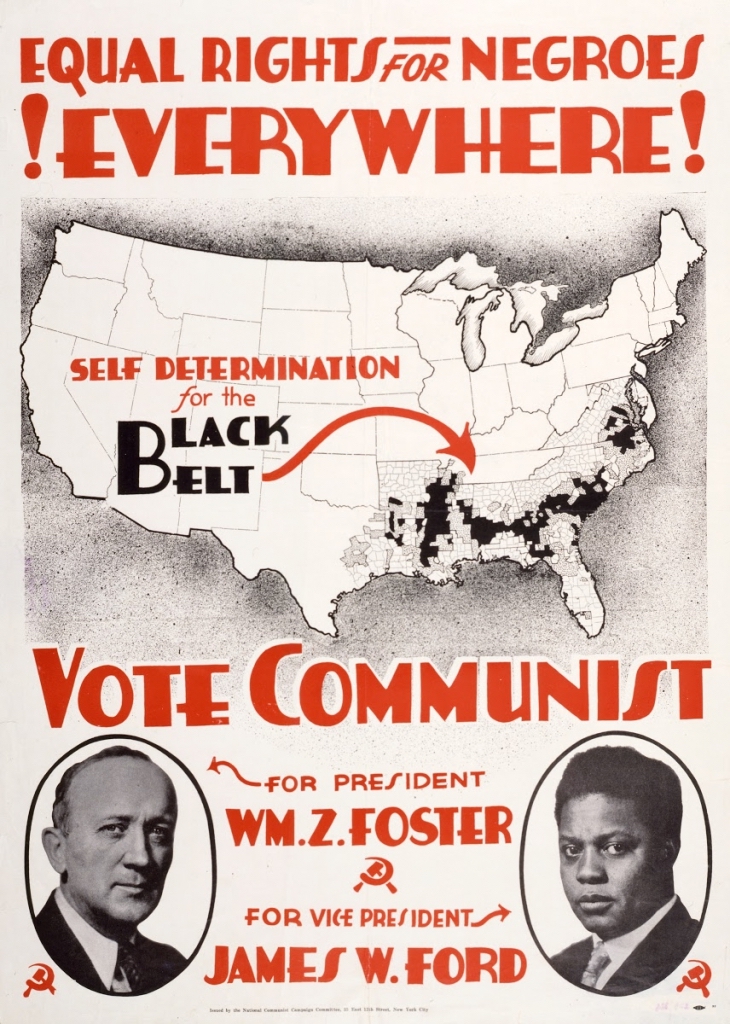
PARTY INVITATION…William Z. Foster and James W. Ford were on the Communist ticket in the 1932 U.S. presidential elections. Ford (1893–1957) was also on the 1936 and 1940 tickets as a vice-presidential candidate. (peoplesworld.org)

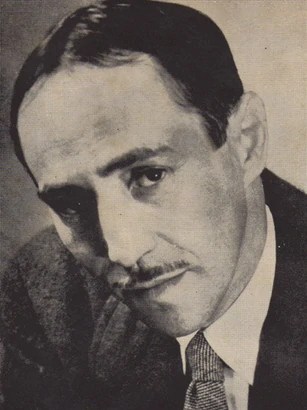
Josephson commented on the candidates appearing on the Communist ticket in the 1932 U.S. presidential elections, finding James W. Ford to be “much more intellectual” than his running mate:

THE HQ…Communist Party of America headquarters, 13th St., New York City, 1934; a close-up view of the Workers’ Bookshop display window in 1942. (USC Libraries/Library of Congress)
A regular New Yorker contributor, journalist Matthew Josephson (1899–1978) popularized the term “robber baron” with the publication of his 1934 book, The Robber Barons: The Great American Capitalists. (nationalbook.org)

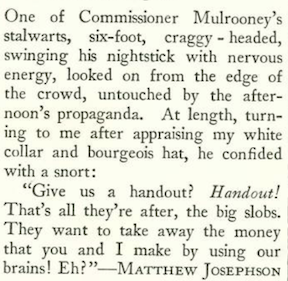
Josephson concluded his article with observation of a party protest event, and one unmoved police officer…

Postscript: The Cold War in the 1950s and a renewed Red Scare spelled the end of the party’s heyday, as did Nikita Khrushchev’s 1956 speech that denounced the murderous legacy of his predecessor, Josef Stalin.

*  *  *

Très Chic

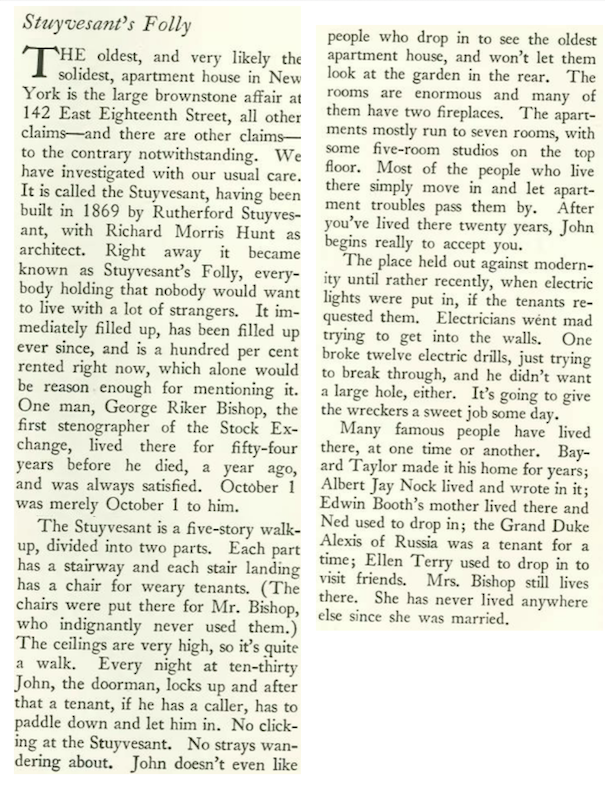
For those with means, the idea of living in the same building with other non-family humans seemed unseemly, but in 1870 Rutherford Stuyvesant hired Richard Morris Hunt to design a five-story apartment building for middle-class folks that had a decidedly Parisian flair. The Sept. 10 “Talk of the Town” explained:


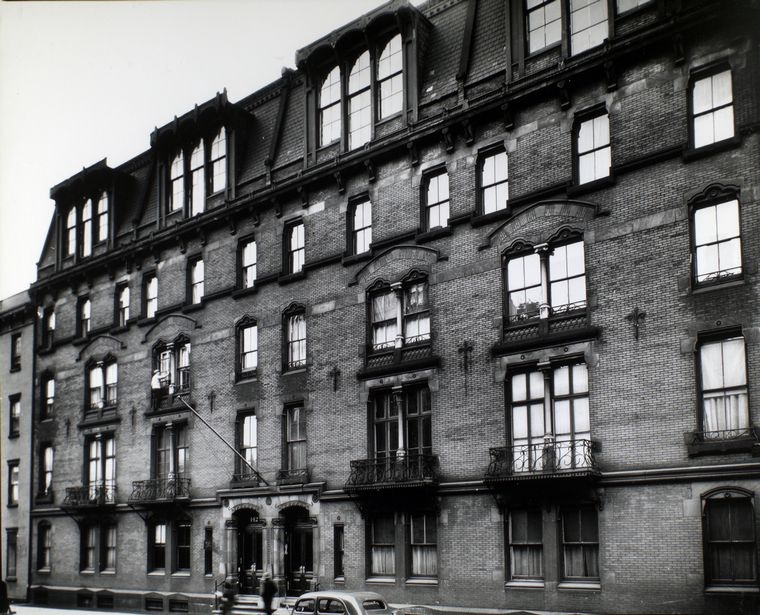
According to Ephemeral New York, the apartments were initially dubbed a “folly,” but the building’s 16 apartments and four artists’ studios—located near chic Union Square—were quickly snapped up, creating a demand for more apartments. The building remained fully occupied until it was demolished in 1958. According to another favorite blog—Daytonian in Manhattan—demolition of Morris Hunt’s soundly built, sound-proof building was a challenge.

IT DIDN’T GO QUIETLY…Stuyvesant Flats at 142 East 18th Street, 1935, in a photo by Berenice Abbott. It was demolished in 1958. (New York Public Library)

*  *  *

Some Characters

I include this brief snippet of the Sept. 10 “Profile” for the jolly illustration by Abe Birnbaum of Al Smith, Jimmy Hayes and the Prince of Wales…

*  *  *

Down In Front

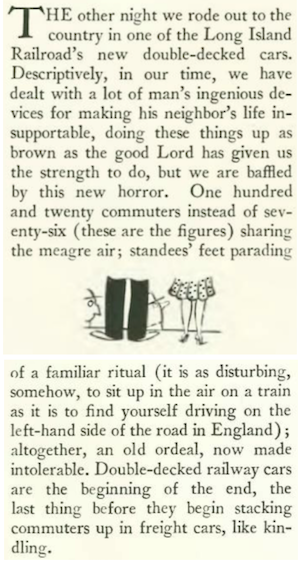
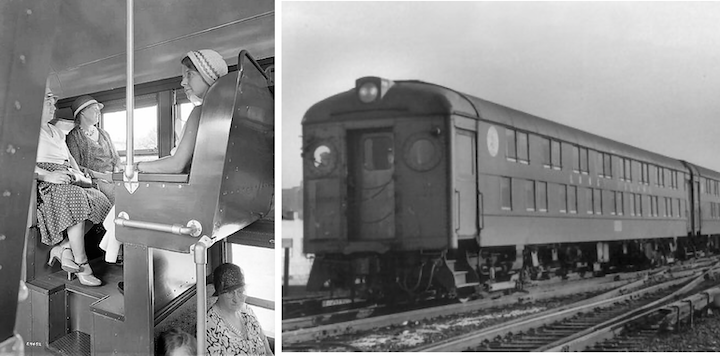
E.B. White was always on the lookout for the newfangled in the world of transportation, but this latest development by the Long Island Railroad was not a breath of fresh air…

STACK ‘EM UP…A woman wears a bemused expression (left) as she takes in her surroundings on one of the Long Island Railroad’s new double-decked cars in 1932. (trainsarefun.com)

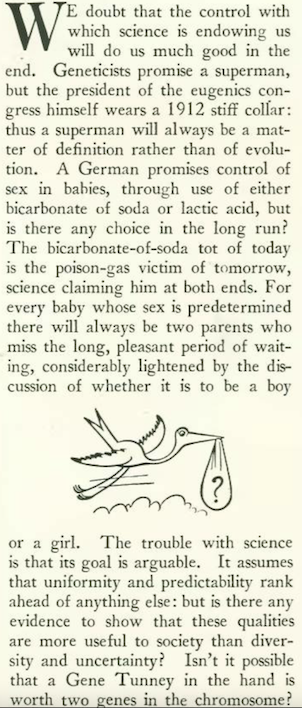
White also looked in on the latest news from the world of genetics—with hindsight we can read about these developments with a degree of alarm, since Hitler was months away from taking control of Germany…

*  *  *

Showing His Colors

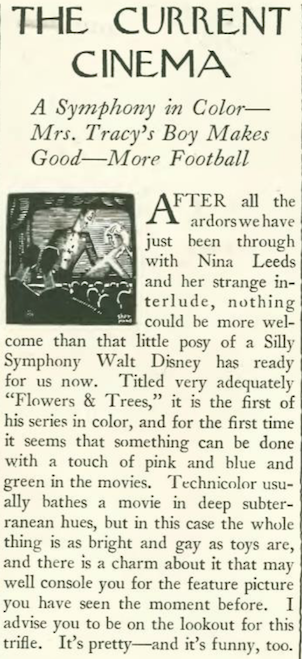
On to lighter matters, critic John Mosher enjoyed an eight-minute animated Walt Disney short, Flowers and Trees—the first commercially released film made in full-color Technicolor…

SEEING GREEN…Walt Disney’s Flowers and Trees won the very first Academy Award for Best Animated Short Film in 1932. (intanibase.com)

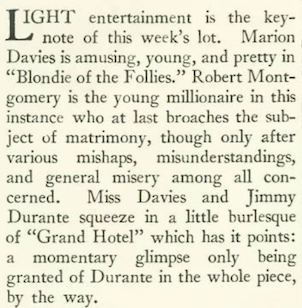
…Mosher also took in light entertainment of the live-action variety with Marion Davies and Billie Dove providing some amusement in Blonde of the Follies, although the picture could have used a bit more Jimmy Durante, billed as a co-star but making an all-too-brief appearance…

WHERE’S THE DUDE WITH THE SCHNOZ?…Billie Dove (left) starred with headliner Marion Davies in Blondie of the Follies, but another co-star, comedian Jimmy Durante, was mostly absent from the picture. (IMDB)

*  *  *

From Our Advertisers

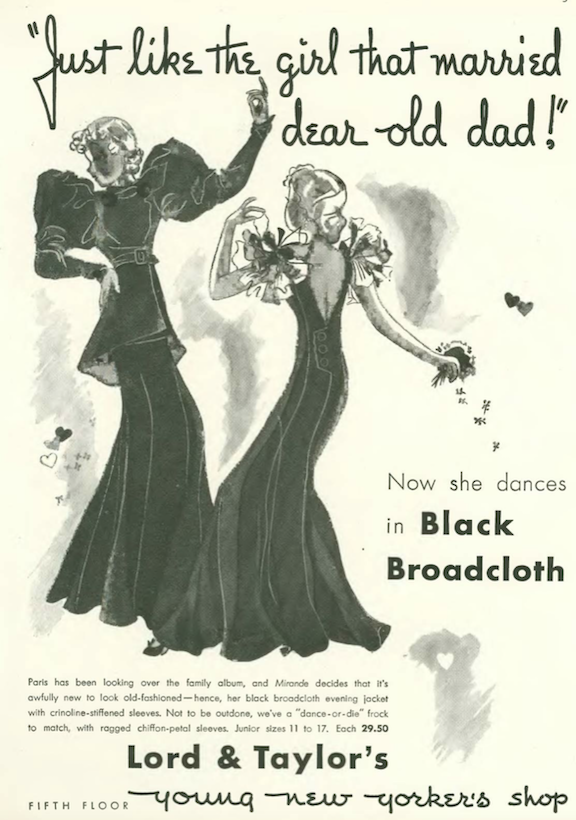
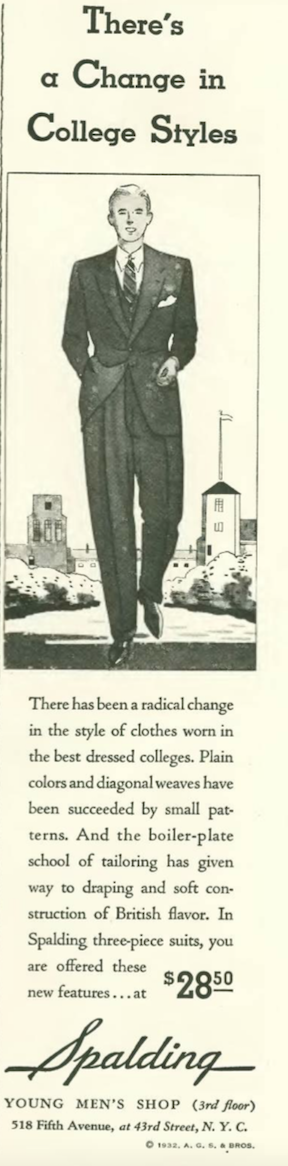
Lord & Taylor announced the return of Edwardian styles as the latest in fashion among the younger set, once again proving what goes around comes around, ad infinitum

…except when it comes to “college styles”…I don’t see this look returning to our campuses anytime soon…

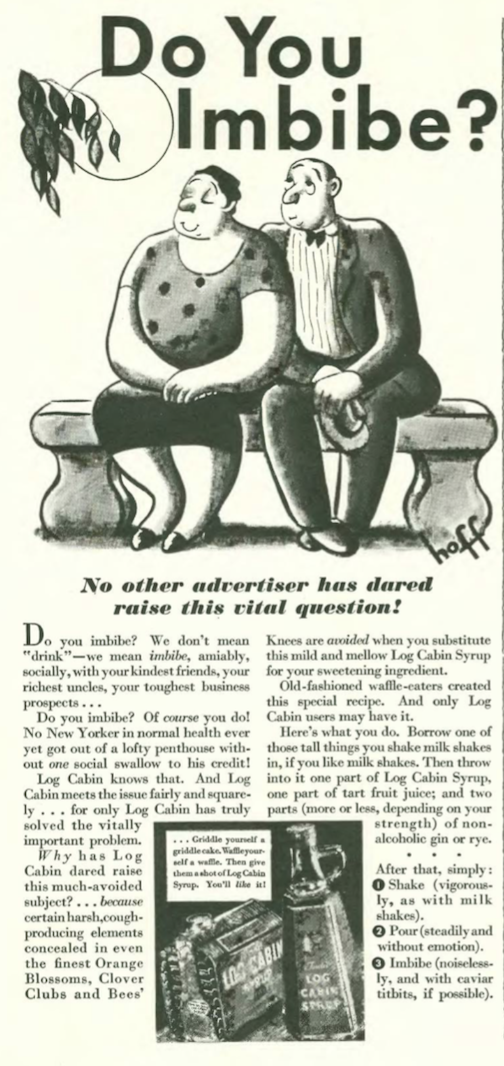
…the end of Prohibition was still a year away, but at least in New York it was all but over…I like the Hoffman ad and its winking line “with or without”…

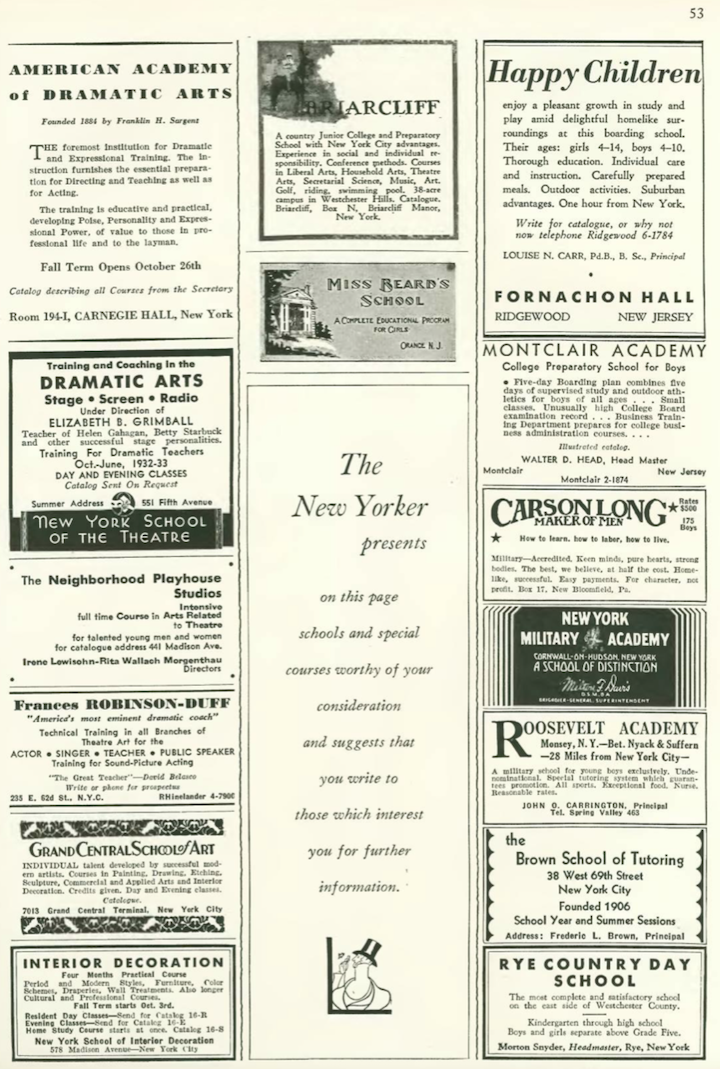
…as a courtesy to readers (and to fill a blank space) the New Yorker    “presented” a full page of signature ads touting a variety of specialty schools and courses…the Carson Long Military Academy (right hand column) closed in 2018 after 182 years of “making men”…

…on to our cartoonists and illustrators, we begin with this Isadore Klein illustration in the opening pages…

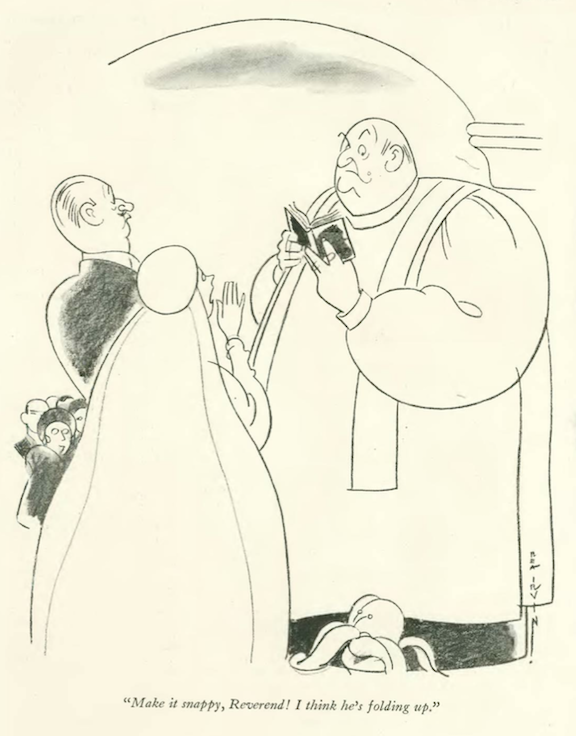
Rea Irvin gave us a nervous moment at the altar…

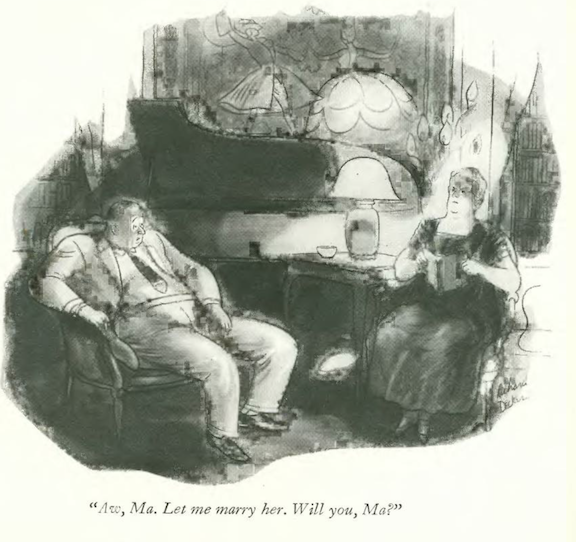
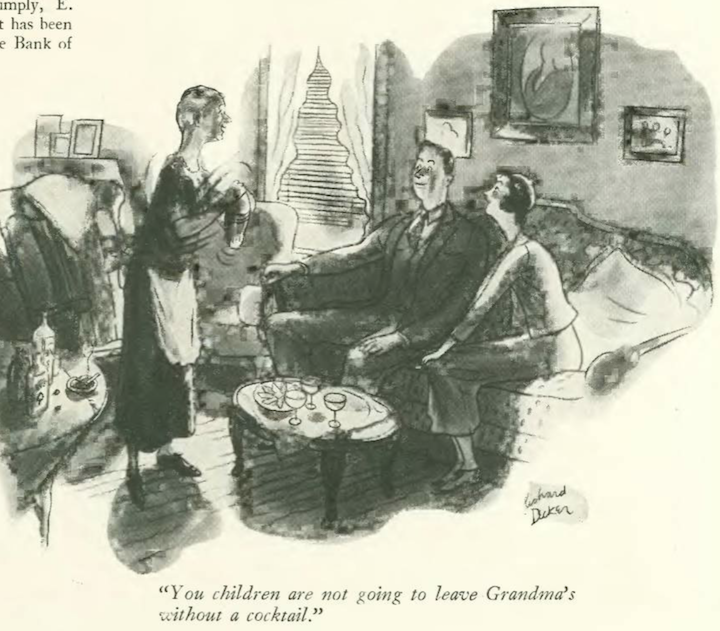
…and Richard Decker showed us one groovy grandma…

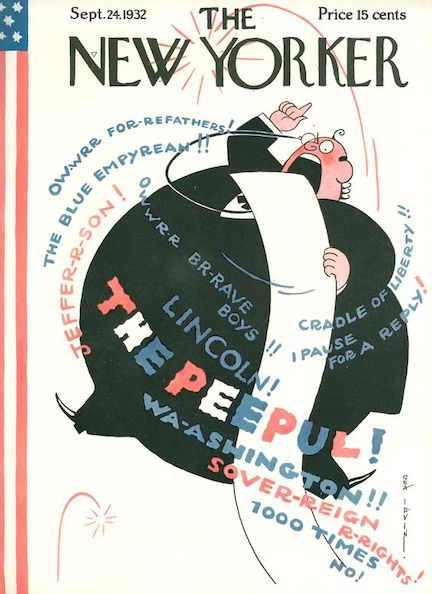
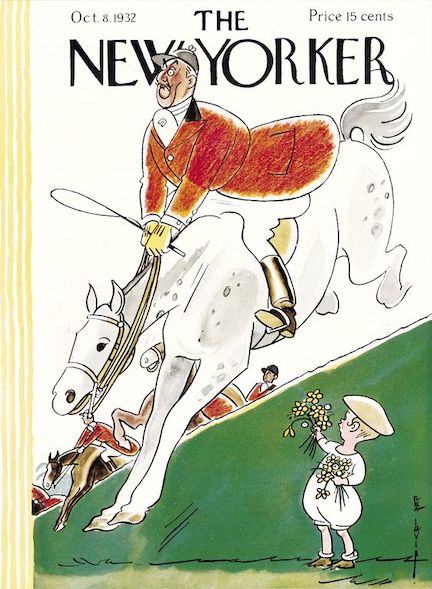
…on to the Sept. 17 issue (which we dipped into at the start)…and what a way to begin with this terrific cover by Peter Arno

Sept. 17, 1932 cover by Peter Arno.

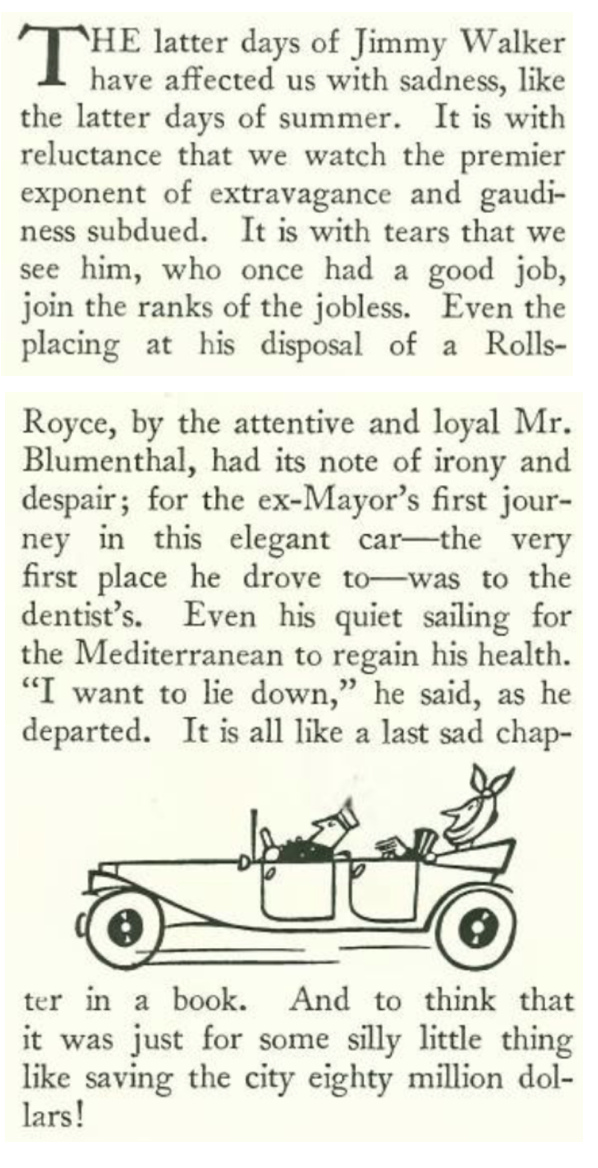
…in his “Notes and Comments,” E.B. White offered some parting words for the departing (and scandal-ridden) Mayor Jimmy Walker

THAT’S ALL FOLKS…Deposed New York Mayor Jimmy Walker skipped town shortly after he left office and caught a boat to Europe. He is seen here at his wedding to Betty Compton in Cannes, April 1933. (Library of Congress)

…and Howard Brubaker added his two cents regarding Walker and his replacement, Joseph McKee, who served as acting mayor until Dec. 31, 1932…

*  *  *

Heady Role

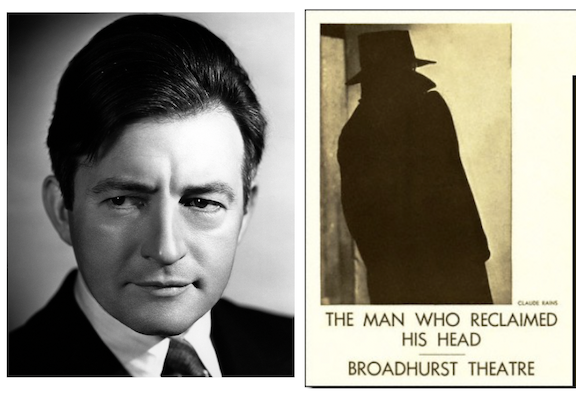
The British actor Claude Rains earned his acting chops on the London Stage before coming to Broadway, where in 1932 he appeared in The Man Who Reclaimed His HeadE.B. White was subbing for regular critic Robert Benchley, and concluded that Rains should have used his own head before agreeing to appear in such silly stuff…

NO MORE HEAD JOKES, PLEASE…Although he got a late start on his Hollywood career, Claude Rains (1889—1967) became one of the silver screen’s great character stars. (Playbill)

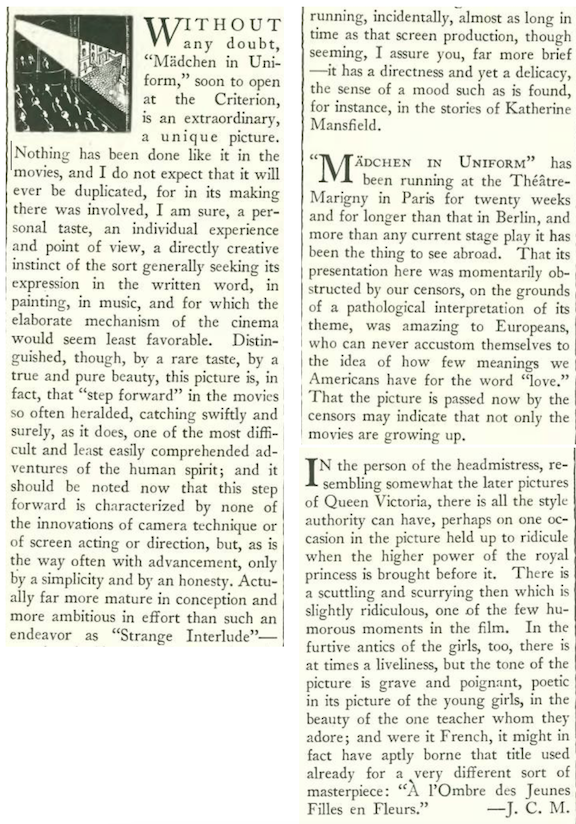
…and speaking of the silver screen, we turn to critic John Mosher and his review of the 1931 German film

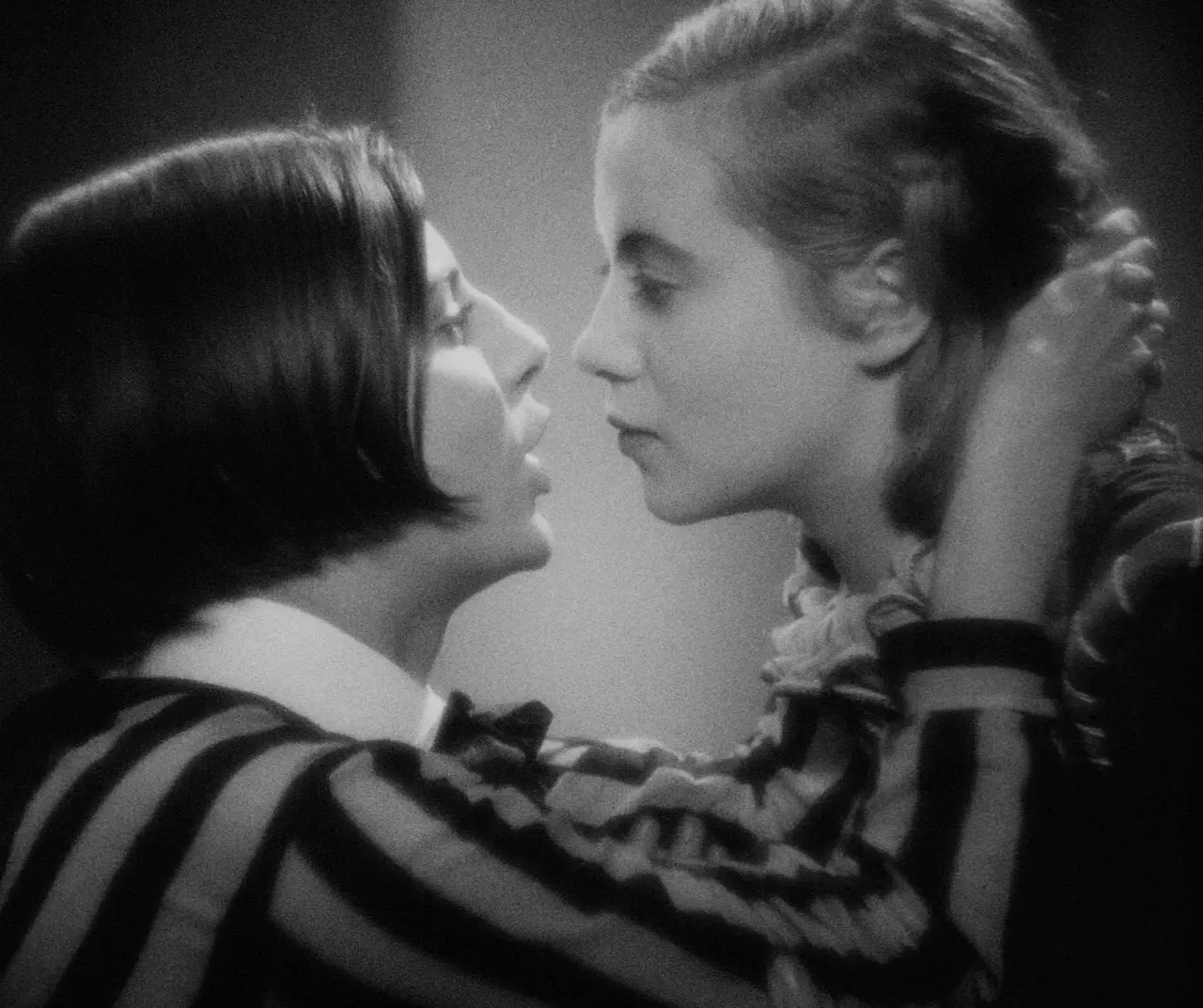
WOMEN IN REVOLT…The New York Times (in 2020) describes 1931’s  “expression of anti-fascism and a lesbian coming-out story.” The film was a success throughout Europe, but was later banned as “decadent” by the Nazi regime. Above, Ellen Schwanneke, left, and Hertha Thiele in Mädchen in Uniform. (Kino Lorber)

Mädchen in Uniform was almost banned in the U.S., but Eleanor Roosevelt spoke highly of the film, resulting in a limited US release (albeit a heavily-cut version) in 1932–33.

*  *  *

From Our Advertisers

I’m featuring this detail from an Elizabeth Arden ad because the illustrator’s style is so distinct…if someone knows the identity of the artist, please let us know (on other drawings I’ve seen a signature that looks like “coco”)…

…invented in 1918, this “cheese food” made from milk, water, whey, milk protein concentrate, milkfat, whey protein concentrate and sodium phosphates—among other things—was acquired by Kraft in 1927 and marketed in the 1930s as a nutritious health food…I have to say I haven’t seen any Velveeta ads in The New Yorker as of late…

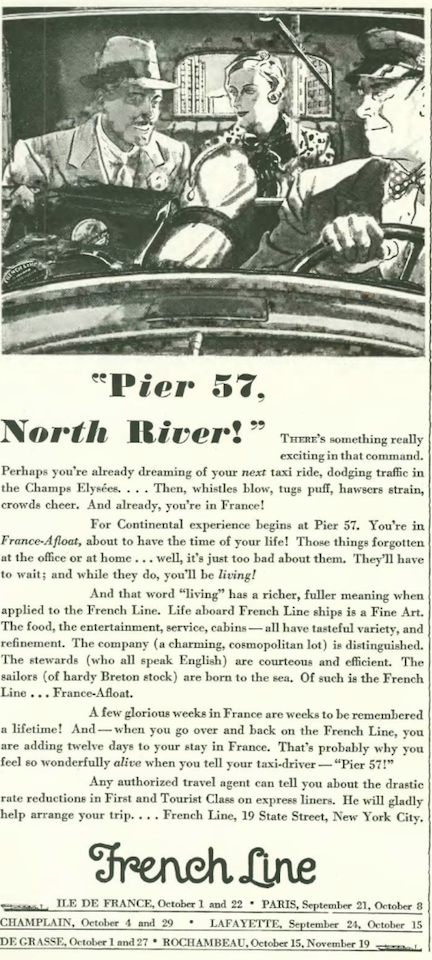
…”Pier 57, North River!” barks the successful-looking man to the admiring cabby who’s thinking “lucky dog!”…

…on the other hand, Peter Arno (kicking off our Sept. 17 cartoons) gave us a Milquetoast who wasn’t getting anywhere near the French Line, or First Base…

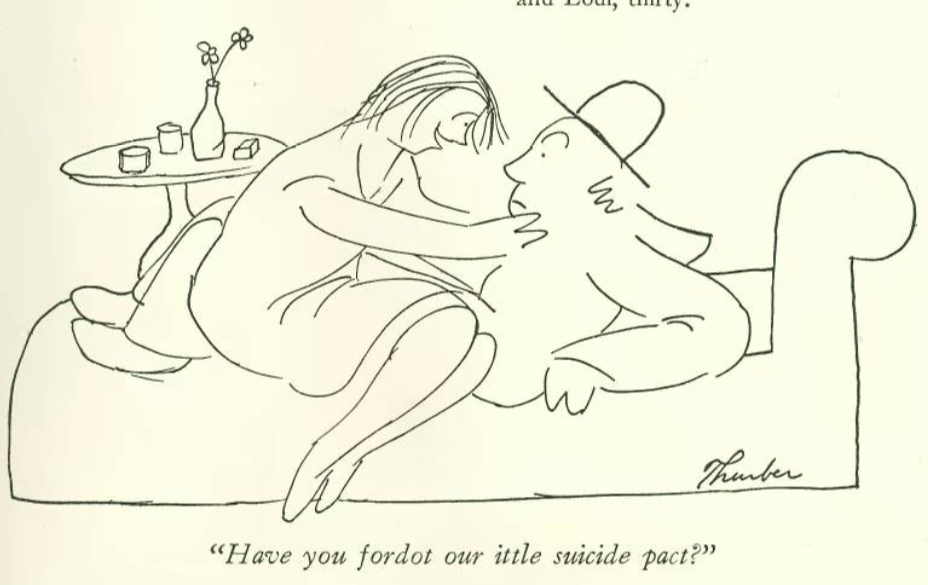
…and speaking of the mild-mannered, James Thurber offered up this fellow…

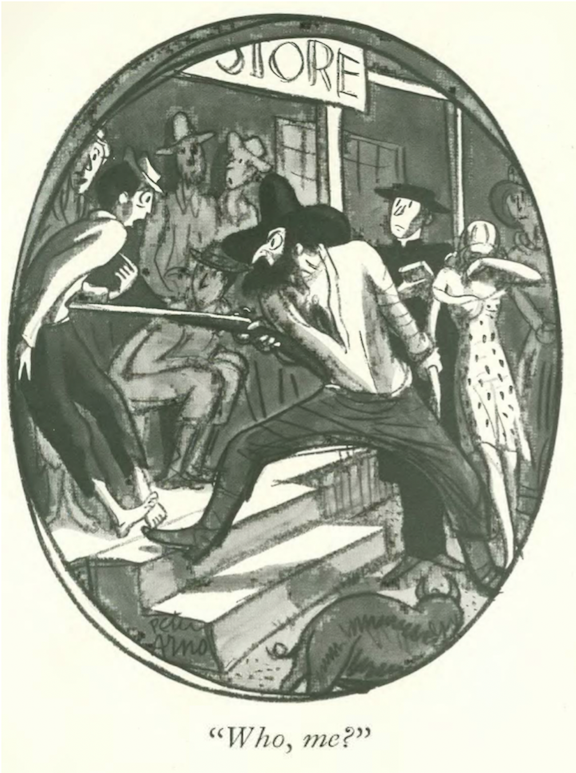
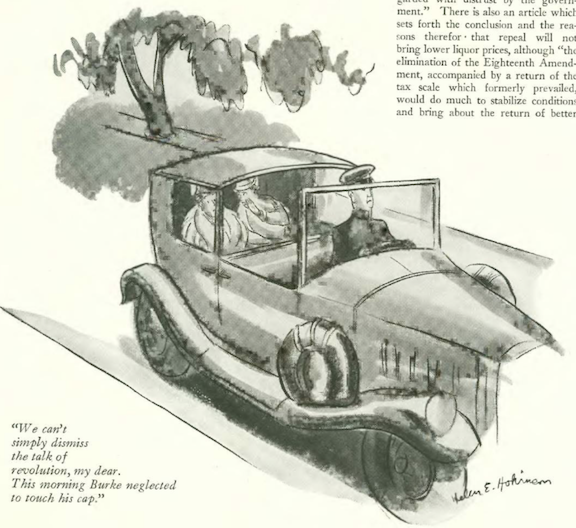
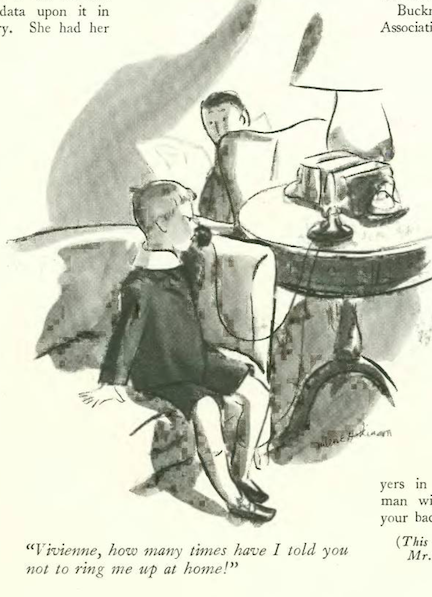
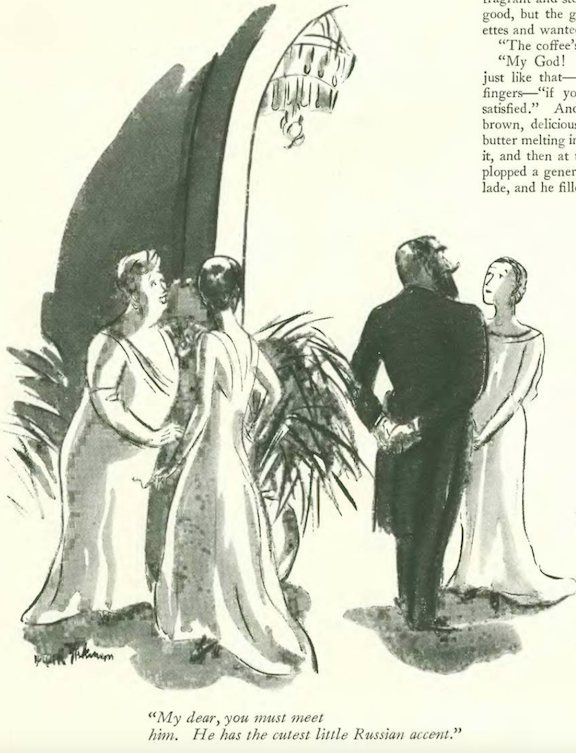
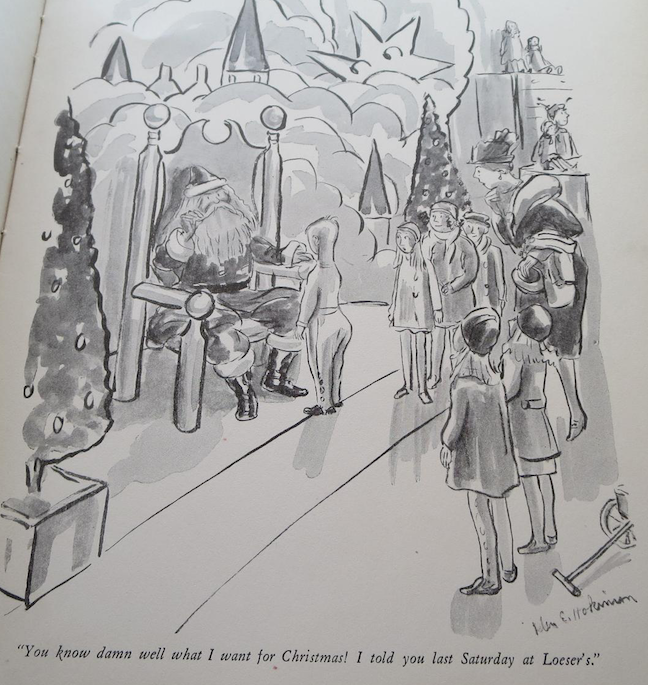
Helen Hokinson’s “girls” were perhaps wondering if their driver was among the Commies at Union Square…

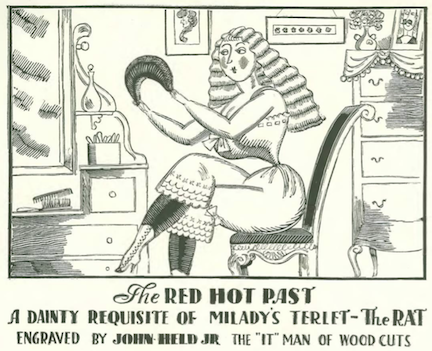
John Held Jr. entertained with another “naughty” Victorian portrait…

Robert Day, and wish unfulfilled at the zoo…

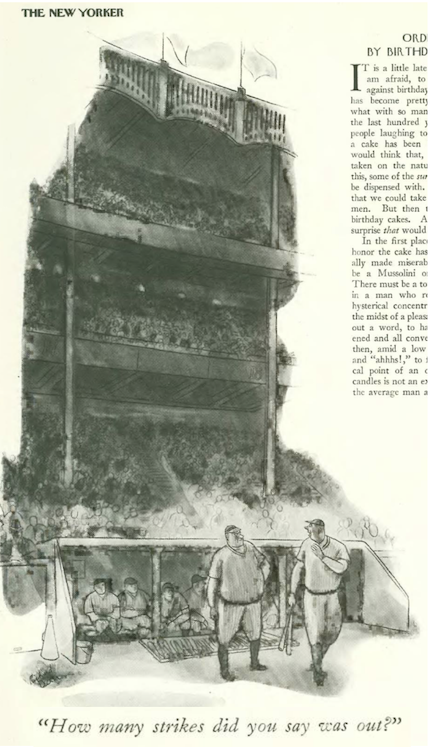
…and we close with Richard Decker, and trouble in the Yankee dugout…

Next Time: A Picture’s Worth…

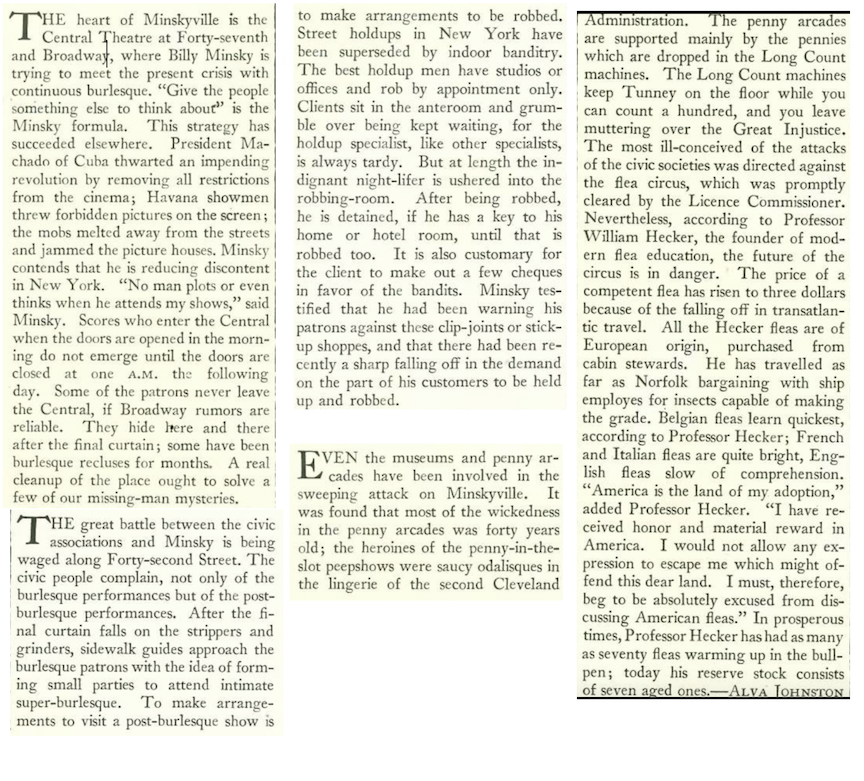
A Visit to Minskyville

During the 1930s few people could afford the luxury of a Broadway show, but a trip to “Minskyville” was in reach of nearly anyone looking to escape the gloom of the Depression, at least for a few hours.

May 28, 1930 cover by Constantin Alajalov.

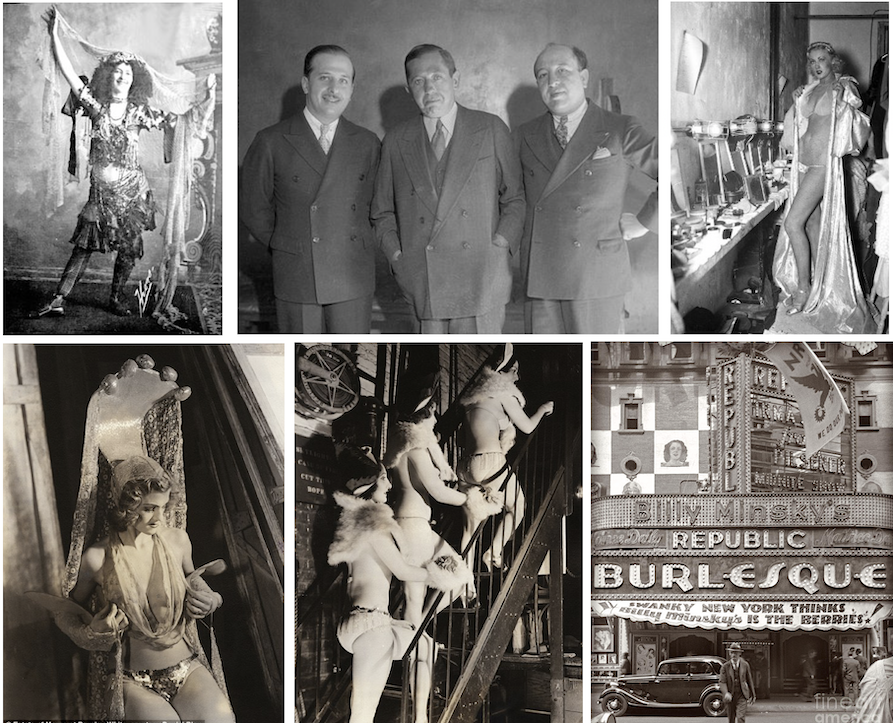
The Minsky family—brothers Billy, Herbert, Morton and Abe—built the beginnings of a New York burlesque empire, writes actress, author and documentarian Leslie Zemeckis: “Abe, the eldest, started showing racy films in a nickelodeon theater on the Lower East Side. His father—believing that if his son was gonna be a perv, he might as well make real money at it—bought the National Winter Garden theater on Houston Street near Second Avenue (where a Whole Foods stands today), and gave Abe the sixth floor to run his burlesque shows.” Alva Johnson paid a visit to Houston Street and environs for the “A Reporter at Large” column:

LITTLE EGYPT, aka Farida Mazar Spyropoulos, top left, both titillated and scandalized crowds at the 1893 Chicago World’s Fair (really?); clockwise, from center top, three of Minsky Brothers – Billy, Morton and Herbert; the Minsky Brothers owned several burlesque theaters in New York, including Minsky’s Oriental on 51st Street and Broadway, where stripper Julie Bryan was a top draw in 1936; Billy Minsky brought the Minsky brand to Broadway when he leased the Republic Theatre on 42nd Street in 1931; the last two images are by Margaret Bourke-White, backstage at the Republic in 1936. (Wikipedia/Daily News/Estate of Margaret Bourke-White)
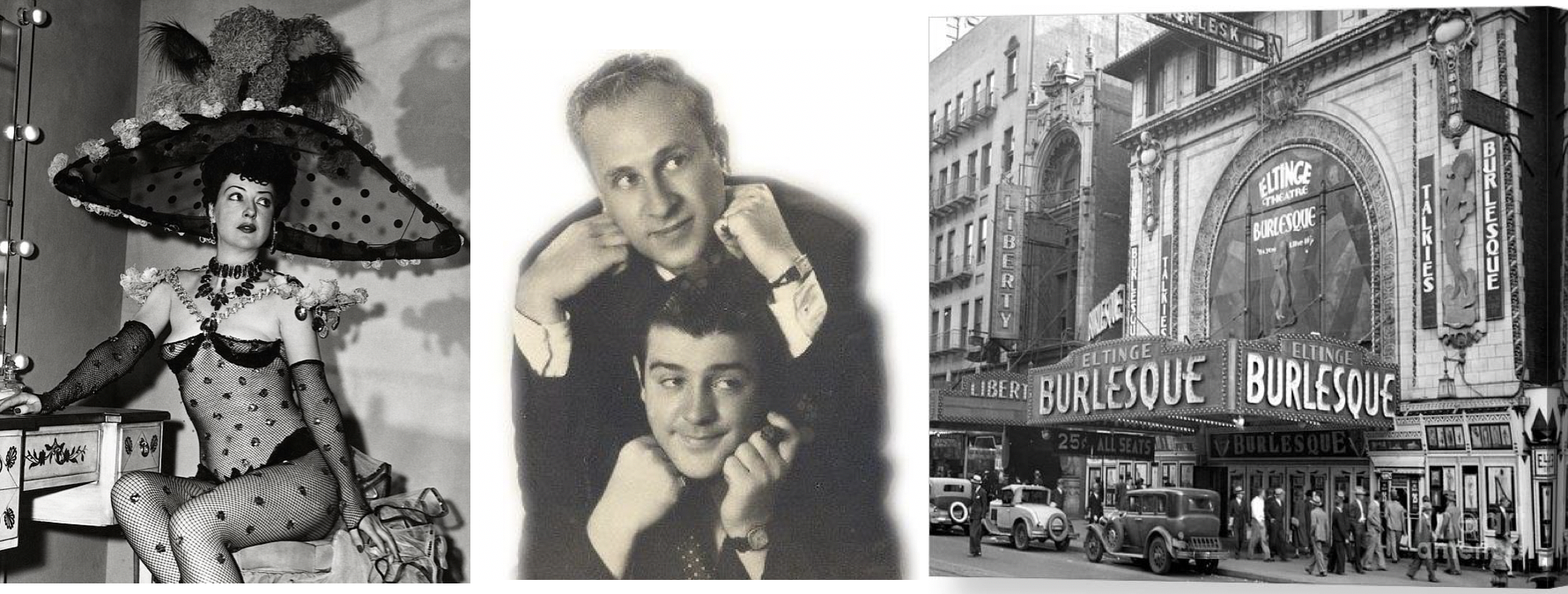
NEED A CAREER?…Well, in the 1930s an aspiring dancer or comedian could earn some chops on the burlesque stage. Gypsy Rose Lee (aka Rose Louise Hovick), left, who became the world’s most famous stripper (as well as an actress, author and playwright), was one of the biggest stars of Minsky’s Burlesque; breaks between burlesque performances were commonly filled by comedians, including Abbott and Costello (pictured above in their 1930s burlesque days), who first worked together in 1935 at the Eltinge Burlesque Theater on 42nd Street, at right.

According to Zemeckis, “burlesque caught on among the recent immigrants of the Lower East Side. The shows were cheap, the humor broad, and the allure of beautiful, barely-clothed women transcended language barriers.” But if striptease wasn’t your thing, Minskyville offered plenty of other diversions:

ONE LUMP OR TWO?…Minskyville’s entrepreneurs (top images) added a modern twist to the study of head bumps and cranium size — called Phrenology — with the electronic “Psycograph” (sic); at bottom, Prof. William Heckler’s Trained Flea Circus at Hubert’s Museum on West 42nd Street attracted some gents itching to see Heckler’s fleas in action; according to Alva Johnston, Minskyville’s penny arcade peepshows (such as the one at bottom right) would take your penny or nickel in exchange for photos of a woman old enough to give your grandpa the glad eye. (Museum of Questionable Medical Devices/sideshowworld.com)
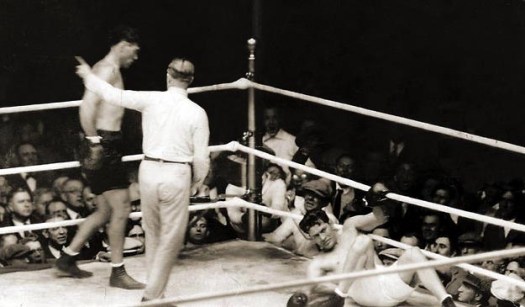
LET’S SEE THAT AGAIN…Folks who didn’t want to look at forty-year-old photos of bathing beauties could check out the most popular attraction at Minskyville’s penny arcades — a clip from the famed Long Count Fight, a 1927 rematch between world heavyweight champion Gene Tunney and former champ Jack Dempsey, which Tunney won in a unanimous decision despite being knocked down in the seventh round. It was, and is, the subject of endless debate. (www.wbaboxing.com )

*  *  *

Not a Gearhead

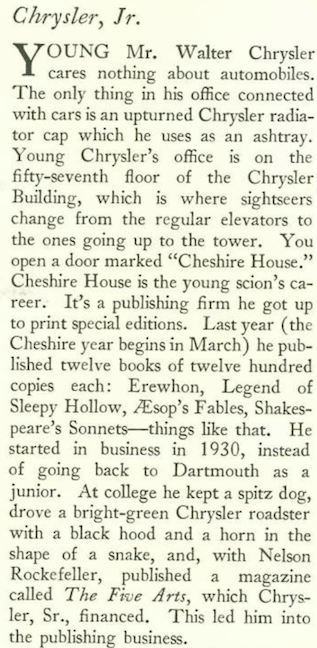
“The Talk of the Town” noted that young Walter P. Chrysler, Jr. preferred arts and literature over things that went zoom:

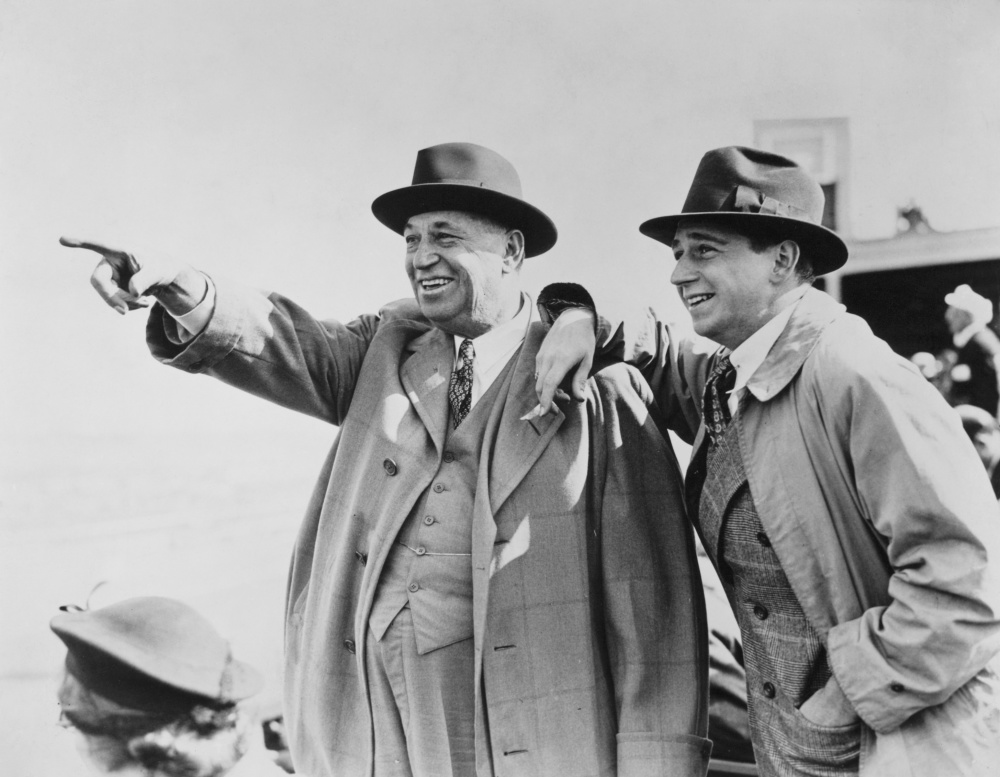
SOMEDAY THIS WILL ALL BE YOURS, RIGHT?…Walter P. Chrysler Sr. and Walter P. Chrysler Jr. share a father-son moment in 1930. Junior Chrysler devoted much of his life to building a multimillion-dollar collection of paintings (some of which were later found to be forgeries) and made substantial forays into collecting stamps, rare books and glassworks. He also produced a movie, The Joe Louis Story, released in 1953. (chrysler.org)

 *  *  *

Rat-a-tat

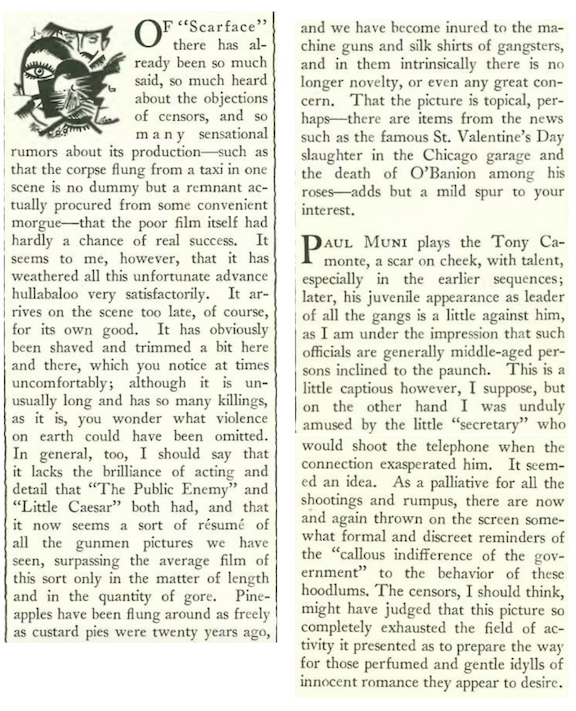
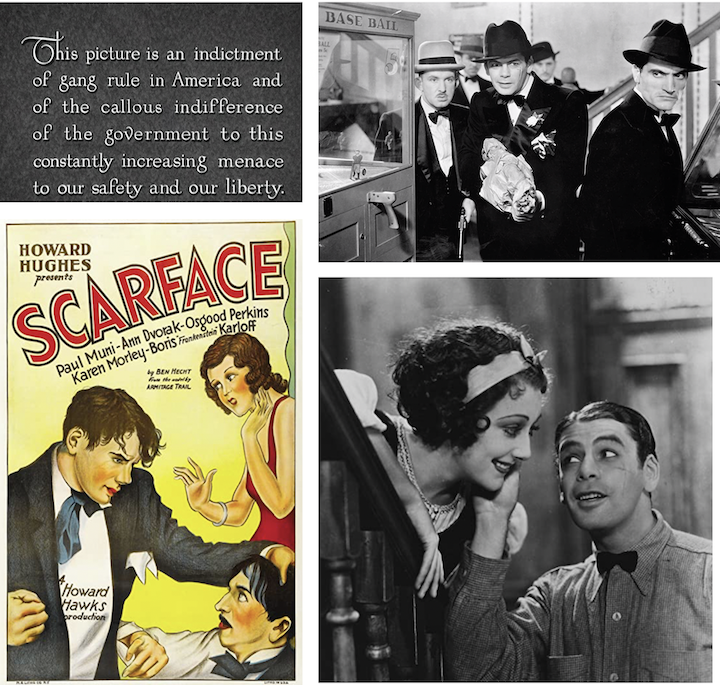
Today most movie lovers associate Scarface with the 1983 Brian DePalma film (starring Al Pacino), but the original Scarface in 1932 was far more influential in that it helped define the American gangster film genre. Directed by Howard Hawks and produced by Hawks and Howard Hughes, the screenplay was penned by early New Yorker contributor Ben Hecht. Mild by today’s standards, the film’s violent scenes caused it to be banned by many theaters around the country. Along with 1931’s Little Caesar and The Public Enemy, Scarface is regarded as among the most significant gangster films. Here is what critic John Mosher thought of it:

JUST IN CASE YOU GET THE WRONG IDEA…Also known as Scarface: The Shame of the Nation, this 1932 gangster film opened with some cautionary words (top left). Clockwise, from top right, gangster “Tony” Camonte (Paul Muni) is flanked by his cronies during a hit on a rival; Tony (Muni) shows his softer side with his dear sister Francesca (Ann Dvorak). United Artists promotional poster (note how Boris Karloff was billed with a reference to his 1931 Frankenstein role). (IMDB)

 *  *  *

From Our Advertisers

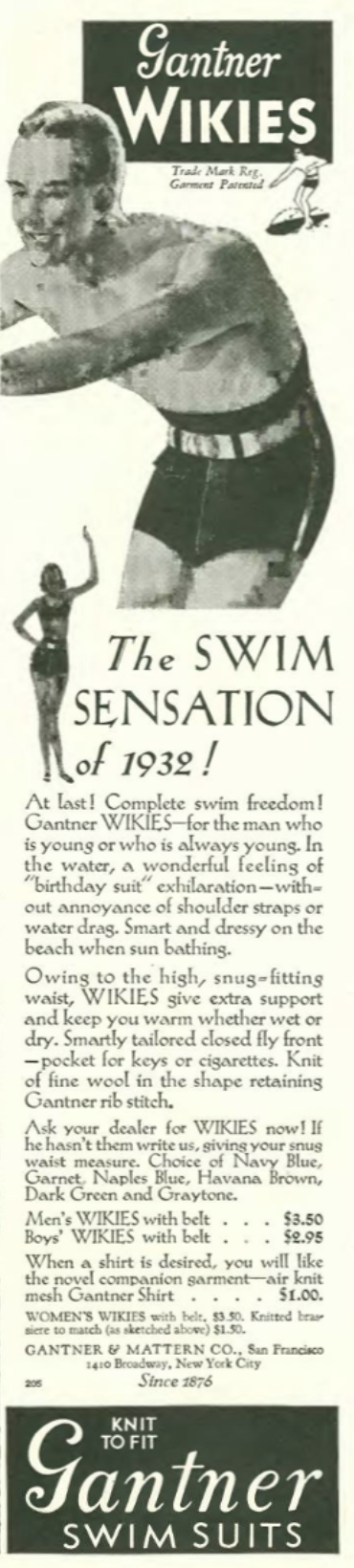
Just when I thought it was safe to go back into the water, out comes another line of wool swimsuits. I honestly can’t imagine how they must have felt, especially when wet and clinging to your skin after you left the water…

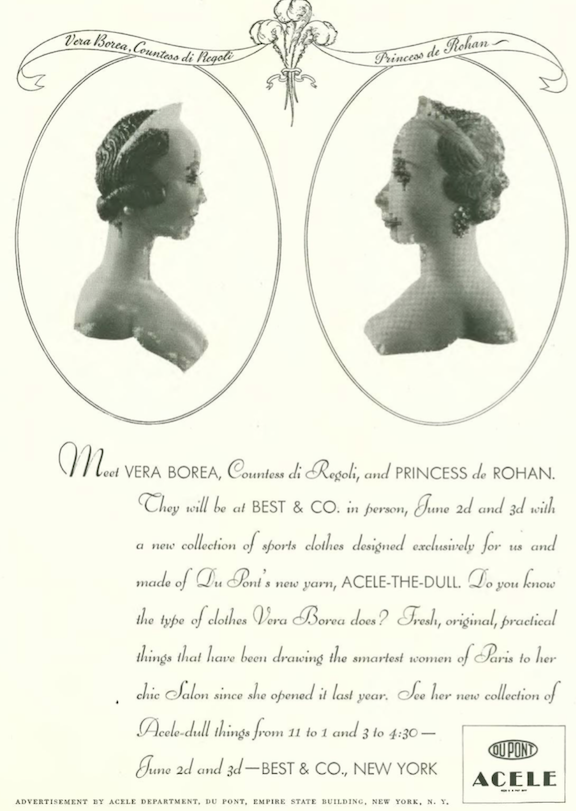
…the ad below from DuPont was just the sort of thing that drove New Yorker fashion critic Lois Long nuts…a couple of downscale royals shilling their fashion lines to an unsuspecting public…the paychecks from DuPont must have been substantial enough for these bluebloods to publicly embrace synthetics…

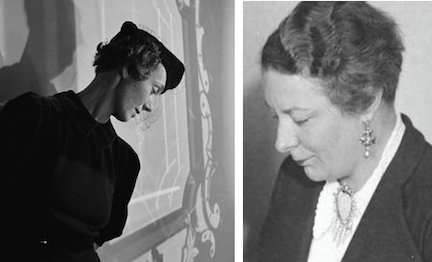
TWO HEADS ARE BETTER THAN ONE…Here is the real Countess Borea de Buzzaccarini Regoli, left, and the Princess de Rohan, who played to America’s insatiable thirst for nobility while shilling for a chemical company. (Wikimedia)

…if you had the money and the steady nerves, you could have hopped aboard an almost 32-hour flight to the West Coast assured that a “coordinated mechanism” of men and machine would get you there in one piece…

…perhaps you could have steadied your nerves by dragging on a Tally-Ho — for some weird reason the Lorillard Tobacco Company (who also made Old Gold) thought some folks might prefer an oval-shaped cigarette (I include the remainder of the back-page ads for context)…

…despite the Depression, The New Yorker was holding its own in sales and subscriptions, but it never hurt to place a house ad every now and then to convince a few who might be holding out…

…on to our cartoons, Garrett Price showed us the result of a bad hand…

James Thurber offered up this spot illustration in the opening pages…

…and this terrific cartoon…

Gardner Rea demonstrated the perils of summoning the dead…

…the departed soul mentioned in Rea’s cartoon was prolific British crime writer, journalist and playwright Edgar Wallace (1875-1932), who wrote 175 novels, 24 plays, and countless articles in newspapers and journals in his relatively short life. He is most famous today as the co-creator of the film King Kong…

PRODUCTIVE SCRIBBLER…Edgar Wallace. (Wikipedia)

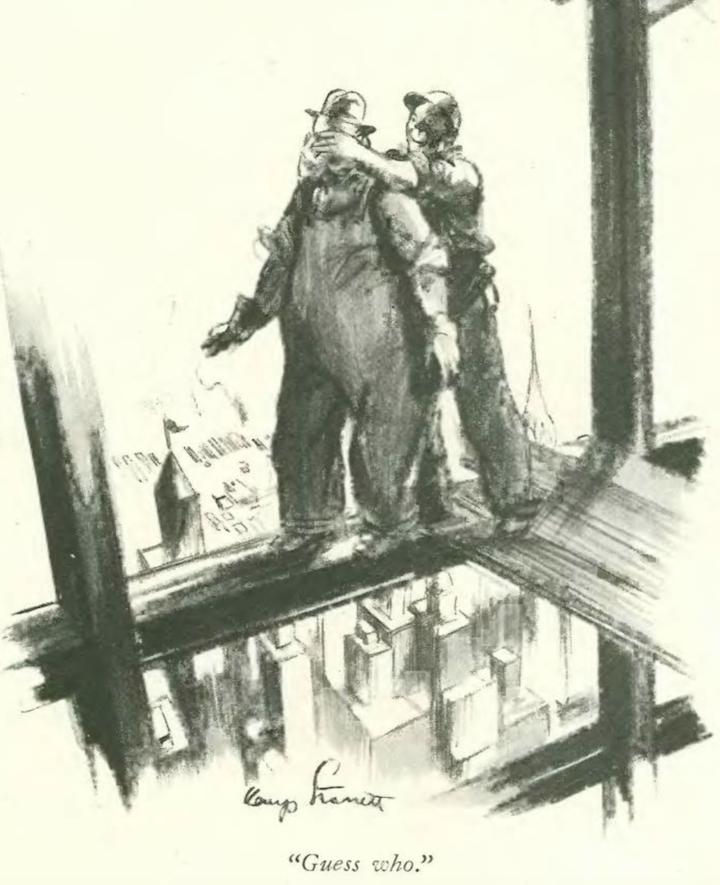
…and we end with this gem from Kemp Starrett, and some high-jinks…

Next Time: Jimmy’s Jam…


Back to the Nightlife

Photo above: Courtesy legendsofamerica.com

Although she served as The New Yorker’s fashion editor for decades, and even laid the groundwork for fashion criticism in general, Lois Long will always be known as one of the pivotal early writers who shaped the magazine’s voice and image.

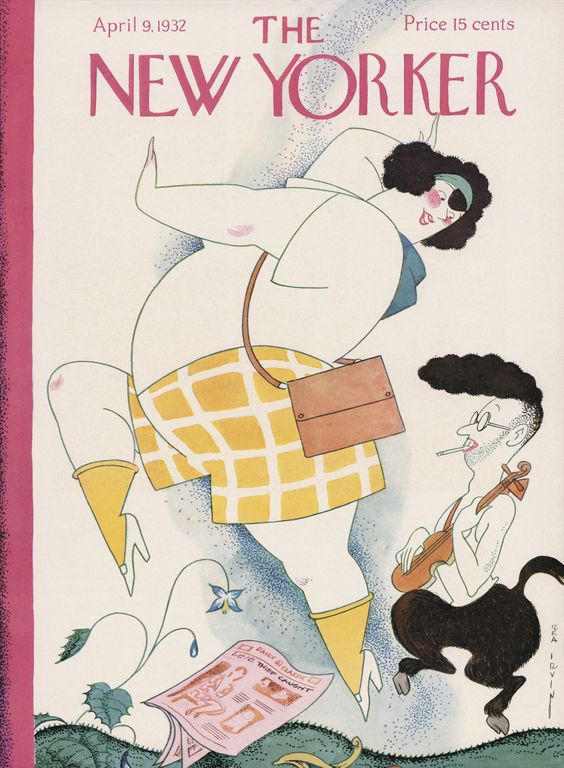
April 9, 1932 cover by Rea Irvin.

The New Yorker’s stated mission to be both “witty and sophisticated” was fulfilled in Long’s “Tables for Two” column, in which she—perhaps more than any other writer of the Roaring Twenties—vividly captured the decadence of New York’s speakeasy nightlife. Long wrote the weekly “Tables” column from September 1925 to June 1930, when she dropped the column for a time to focus on her weekly fashion review “On and Off the Avenue” (she was also married to cartoonist Peter Arno, and they had a one-year-old daughter, Patricia, which doubtless put a cramp in her nightlife routines).

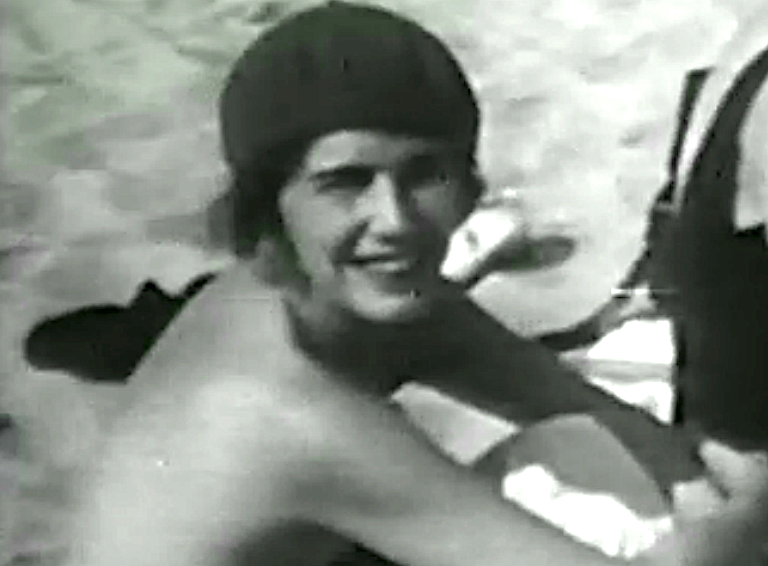
SALAD DAYS…Lois Long relaxes on a beach in this still image from a 1920s home movie; it was a time when hopping speakeasies until 4 a.m. — and writing about it — was her forte. (PBS)

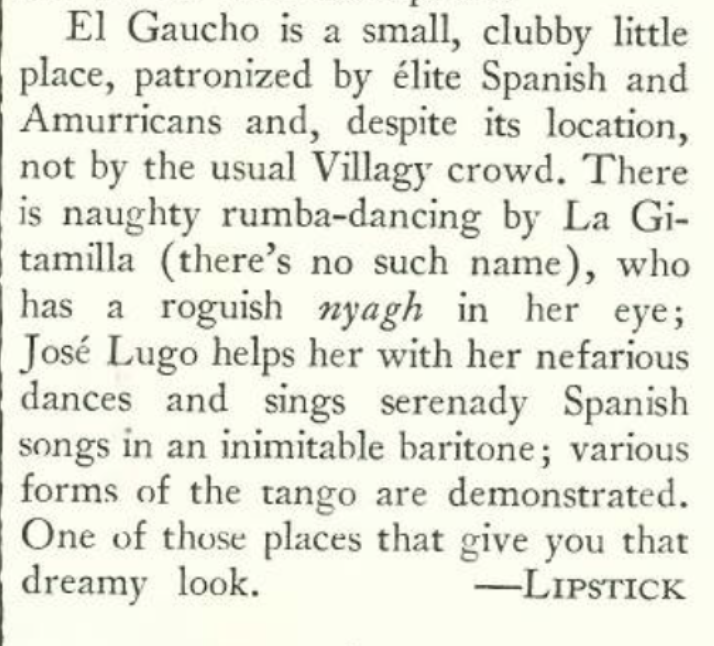
In the midst of divorcing Arno in early 1931, Long embarked on a six-part series titled “Doldrums,” lamenting the state of New York nightlife, which she found to have very little life. However, in June of that year, her divorce was almost finalized, she filed another “Tables for Two” column. Here she is, nearly a year later, with another “Tables” column, again with the familiar pen name “Lipstick,” now finding herself too old (at age 30) for the nightlife at the Pennsylvania Grill and the New Lido Club. Some excerpts:

HE DID IT ALL…Moonlighting from his Ziegfeld gig on Broadway, the versatile Buddy Rogers (top left) was also acting as bandleader at the Pennsylvania Grill — the popular stage and screen actor happily fronted various bands for the publicity, which he received from both Lois Long and from an ad in the back pages of The New Yorker; clockwise, from top right, the Hotel Pennsylvania; the hotel’s Grill restaurant; among the celebs spotted by Long was Broadway/gossip columnist Ed Sullivan, who would go on to other things; and Jeannette Loff, who “sang nicely” for those who danced along with the band. (Wikipedia/edsullivan.com/bizarrela.com)

About Buddy Rogers, Long wrote he “has a gleaming smile for the world and his-well-not-exactly wife,” a reference to famed silent film star Mary Pickford, also in the audience, and also married to actor Douglas Fairbanks (Pickford and Rogers had been carrying on a not-so-secret romance since 1927).

PICKY PICKFORD…Mary Pickford in 1932. (Culver Pictures)

Long also paid a visit to the Folies Bergère, which was basically a road show produced by the famed Parisian theater of the same name. She found the performances second-rate, and didn’t quite see the appeal of the cross-dressing comedian Jean Malin, whom we’ve seen in this blog before doing his Mae West schtick.

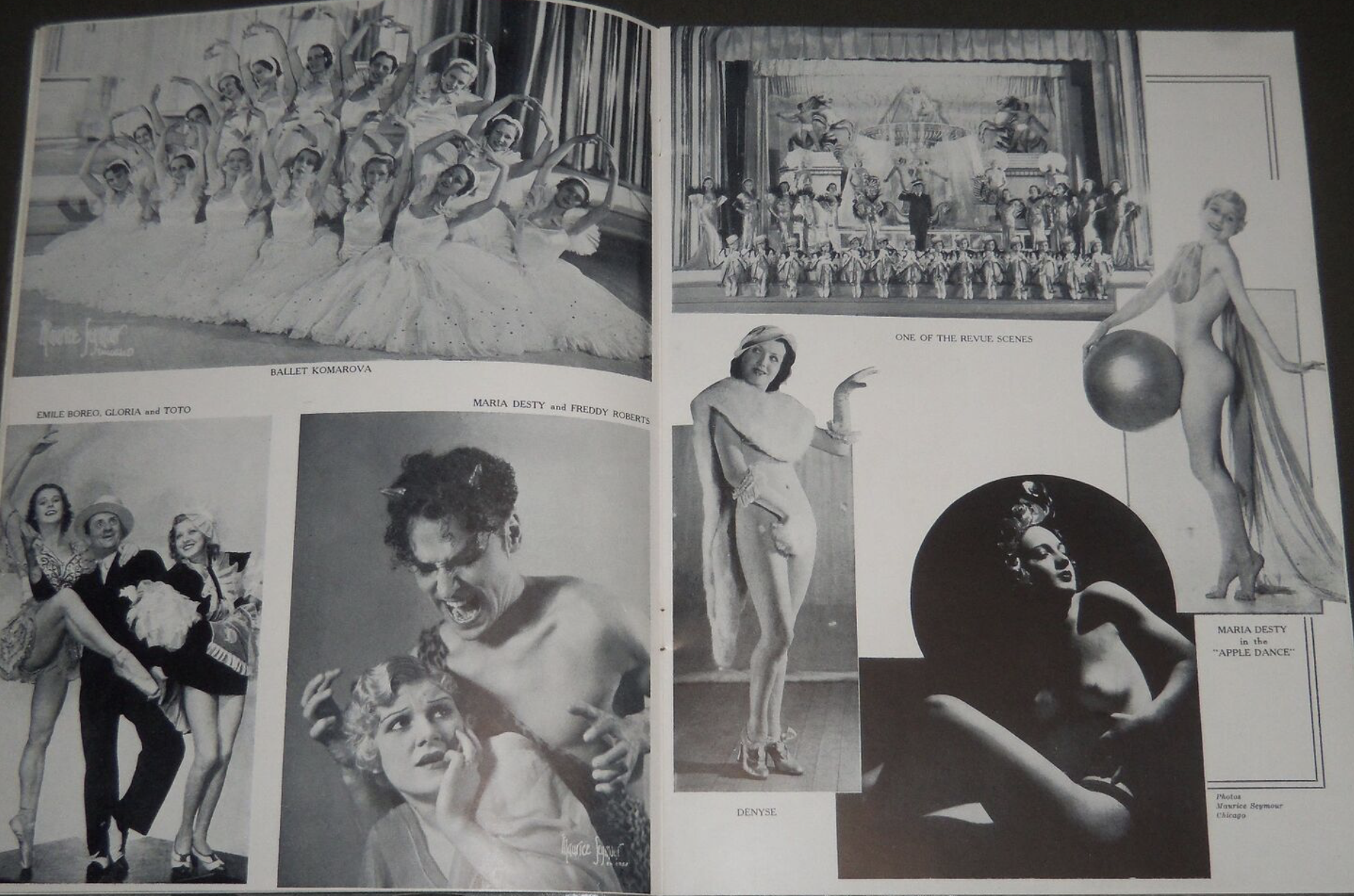
UNDER COVER…Program for the New York version of the Folies Bergère from 1933; at right, Jean Malin with and without (inset) his costume. (Ebay/Pinterest)

A perusal of the 1933 Folies Bergère program suggests this was not family-friendly fare…

Long concluded her column with the familiar signature, and perhaps a sigh…

 *  *  *

The Other Lois

We aren’t quite finished with Lois Long. I happened to notice this ad in the back pages of the issue—although the folks at Van Raalte believed fishnet stockings (first introduced in the 1920s) were all a civilized girl could desire, Long maintained a skeptical distance in her “On and Off the Avenue” fashion column:

 *  *  *

The Brothers Mills

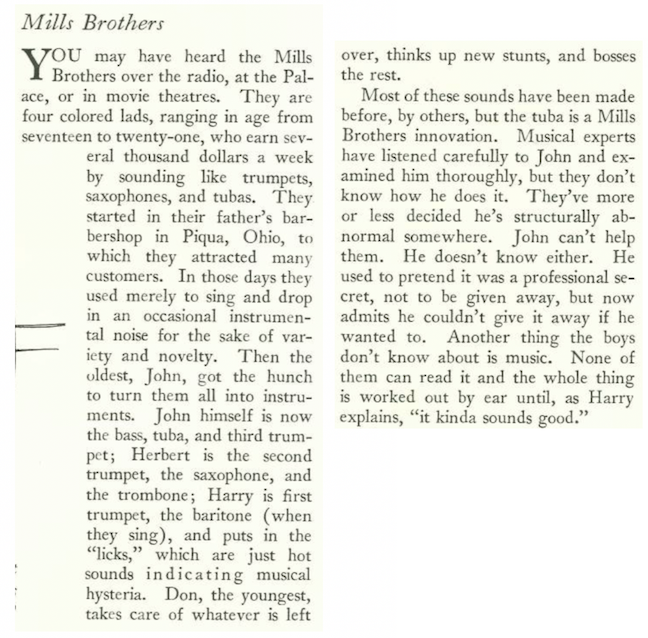
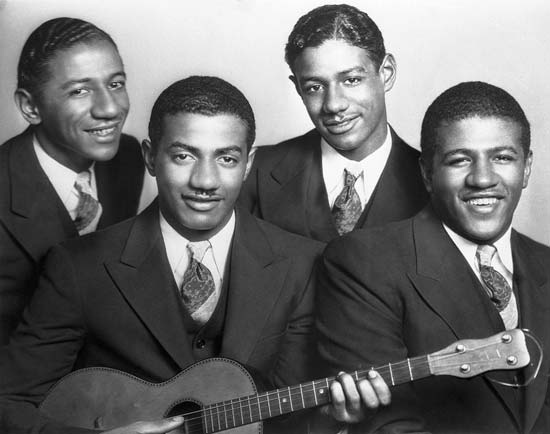
The “Talk of the Town” introduced readers to the Mills Brothers (Donald, Herbert, Harry and John Jr.), and if you haven’t heard of them, your parents or grandparents sure thought they were swell. Perhaps the most popular vocal group of all time, you can still hear them today, especially in old Christmas carol compilations.

SOLID GOLD…the jazz and pop vocal quartet, the Mills Brothers, made more than 2,000 recordings that sold more than 50 million copies. They garnered dozens of gold records. (Remarkable Ohio)

 *  *  *

Car Wars

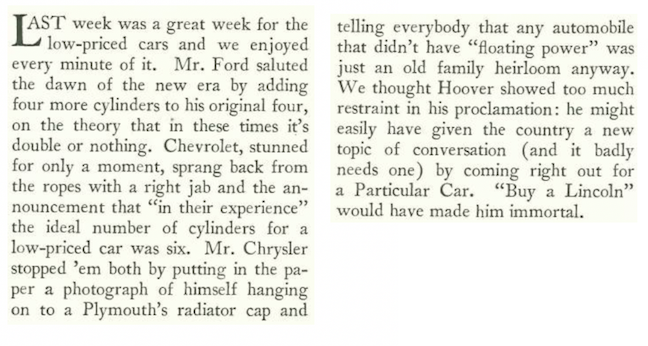
As the Great Depression slowly crushed some of the smaller automobile manufacturers, the Big Three (Ford, GM and Chrysler) were duking it out in the advertising pages, much to the amusement of E.B. White, who filed this in his “Notes and Comment” section:

FLOATS LIKE A BUTTERFLY…While Ford and GM fought over cylinders, Walter Chrysler outflanked them with his “Floating Power” Plymouth. (americanbusinesshistory.org)

 *  *  *

From Our Advertisers

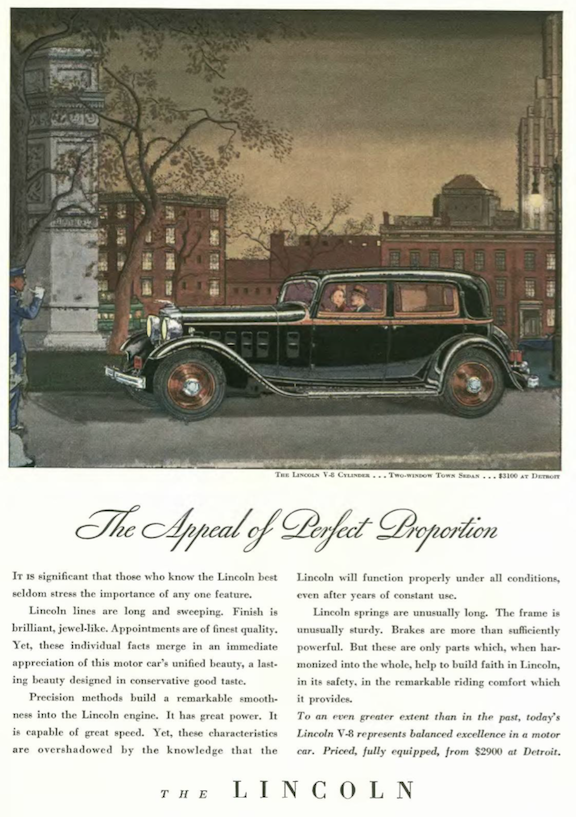
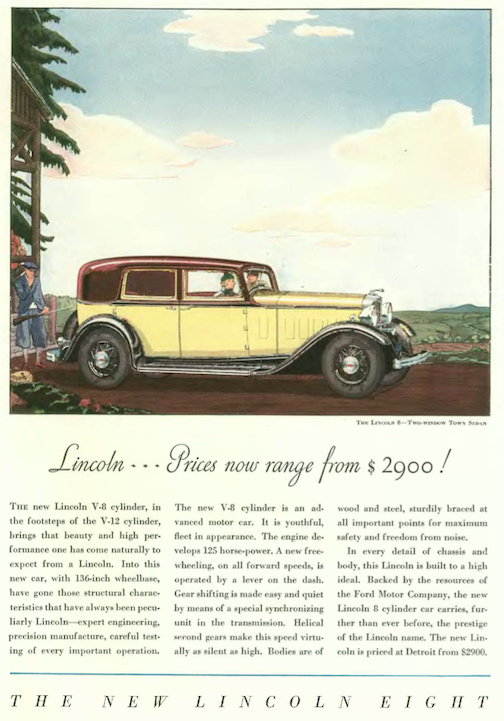
E.B. White provides us a nice segue into our advertising section, where desperate automakers vied for the attention of cash-strapped Americans, including the makers of the luxury brand Lincoln, who hoped to convince the upper-middles that this 8-cylinder model was every bit as good as their 12-cylinder monster…

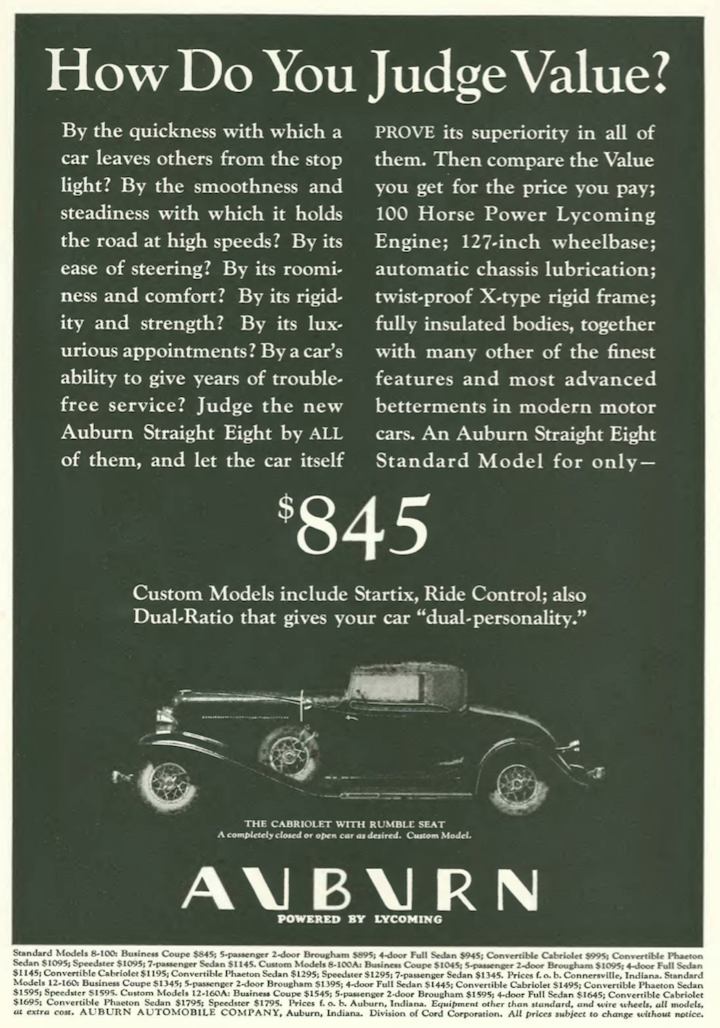
…the Lincoln Eight would still set you back a cool $2,900, roughly equivalent to a car costing $60k today…if I had a time machine I would opt for this sweet little Auburn, a bargain from a company that made some bonafide classics before the Depression plowed it under…

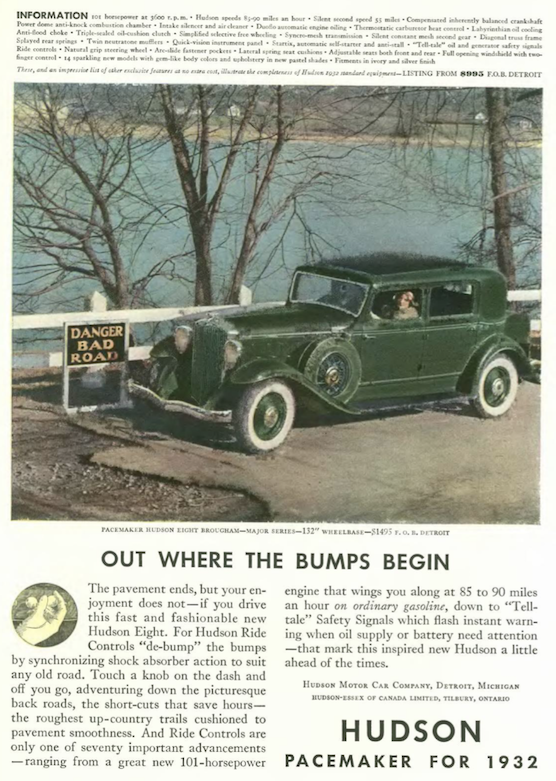
…Hudson would manage to hang around until the 1950s, when it merged with Nash to form American Motors, but I include this ad to remind readers that in 1932 many roads were like this, especially when you cruised beyond the city limits and headed upstate…

…the ads in The New Yorker are rife with social class cues, even unintended ones, like this illustration from Arrow shirts that suggested “old Cuthbert” was out of step with the more nattily dressed, when in fact old Cuthbert might have been old money and couldn’t have given a damn about his collar, let alone the opinions of the grasping new money crowd…

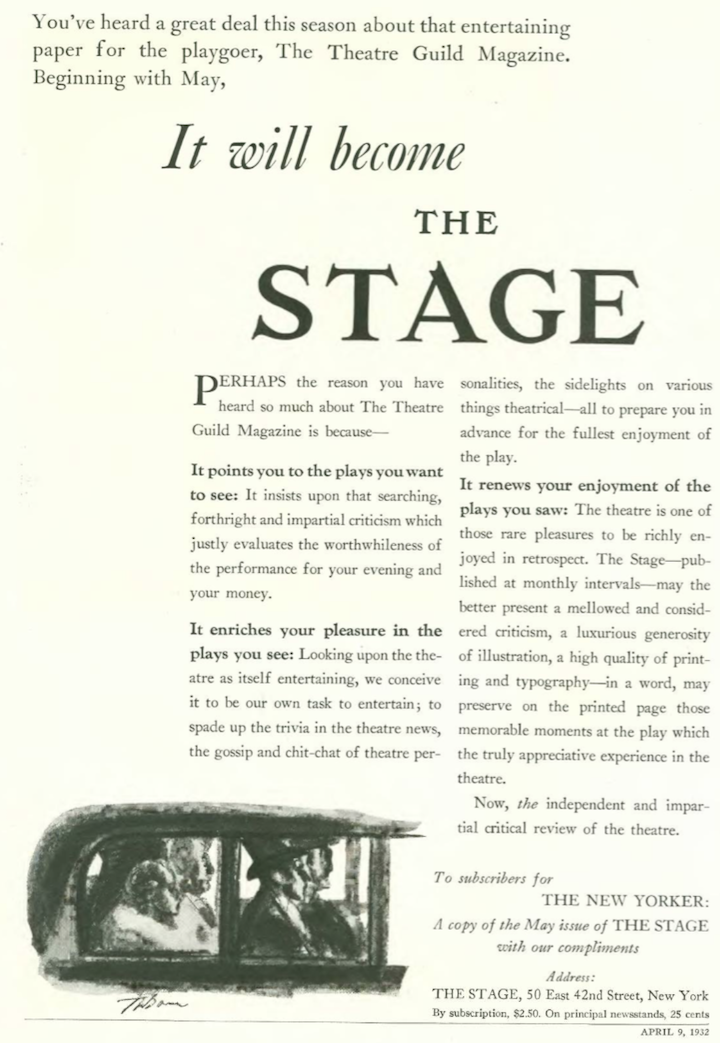
…this advertisement caught my eye initially because it was from the Theatre Guild, an organization not known to be flush with enough dough to spring for full-page spreads, but there’s more…

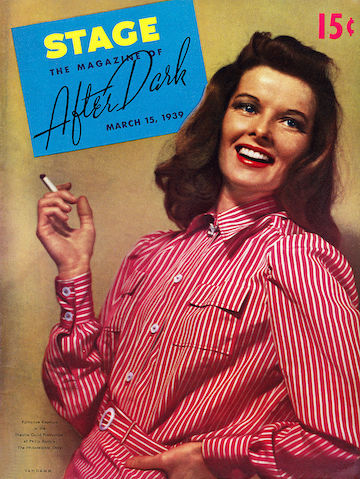
John Hanrahan, who also served as The New Yorker’s policy council, be­came the publisher of The Stage magazine in 1932, so he likely got a break from The New Yorker’s advertising department, and deservedly so: it was Hanrahan who helped put the fledgling New Yorker on a firm financial footing during some of its toughest years.

According to Lucy Moore’s book, Anything Goes: A Biography of the Roaring Twenties (excerpt found on Erenow)The New Yorker was ‘the outstanding flop of 1925.’ Advertisers failed to materialize. Circulation dipped below 3,000. In early May, (Harold) Ross, (Raoul) Fleishmann, Hawley Truax and the professional publisher John Hanrahan met at the Princeton Club and decided to cut their losses. The initial investment of $45,000 had gone and Fleishmann was owed another $65,000. It was costing between $5,000 and $8,000 a week to keep the magazine afloat. As they walked away from the meeting, Fleishmann overheard Hanrahan say, ‘I can’t blame Ross for calling it off, but it surely is like killing something that’s alive.’ Hanrahan’s words struck Fleishmann deeply, and when he saw Ross later that afternoon he told him that he was willing to try and raise outside capital to help The New Yorker survive.”

As for The Stage magazine, it managed to survive the Depression, but ceased publication in 1939. Here is the final issue:

(Wikimedia Commons)

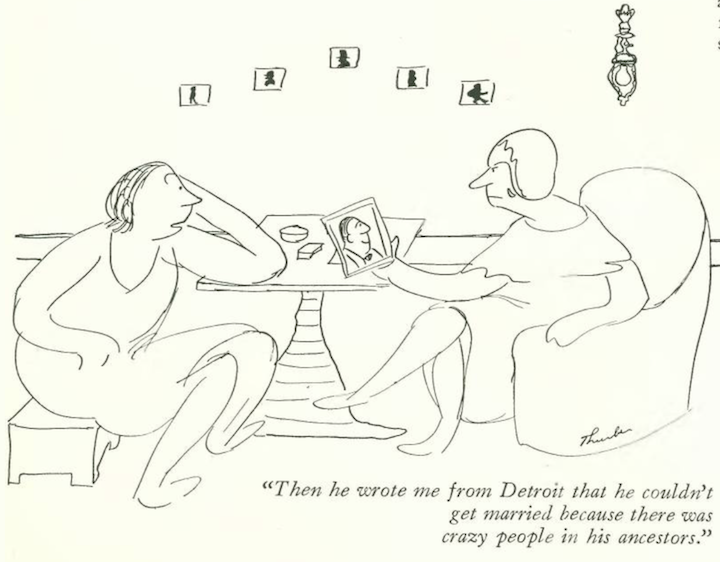
…on to our cartoonists, we begin with this nice spot illustration by James Thurber

…and Thurber’s cartoon contribution to the issue…

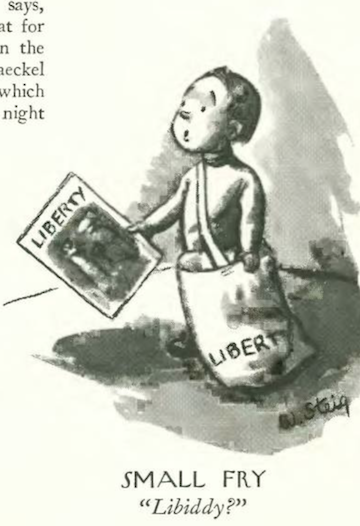
William Steig gave us another of his “Small Fry,” coming dangerously close to being too cute for The New Yorker

Leonard Dove showed us some speakeasy owners appreciating an addition to the decor…

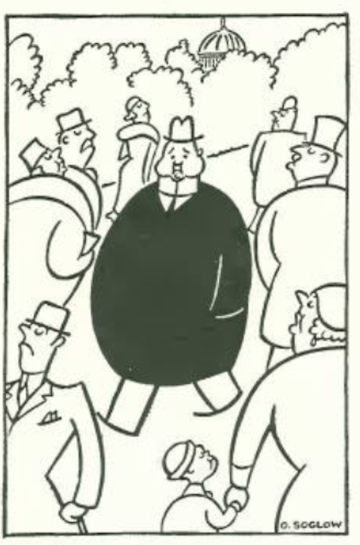
…this Otto Soglow contribution was a spot illustration, but had a lot to say about the approval ratings of President Herbert Hoover in 1932…

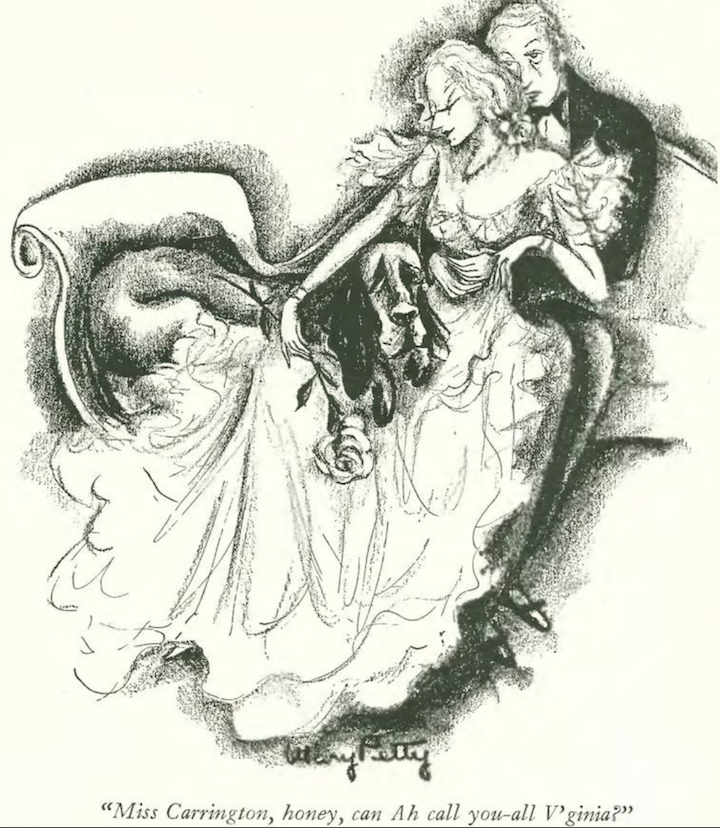
…those celebrated Southern manners, Mary Petty found, could be tedious in tender moments…

…and we close with the great Peter Arno, who gave us a peep into an awkward moment…

Next Time: The Shipping News…


dkdkd

The Final Curtain

Nearly a century after his passing, many still regard Florenz Ziegfeld Jr as the most important and influential producer of Broadway musicals. His theatrical revues, filled with leggy chorines and wisecracking comics, set a standard for everything from Busby Berkeley productions to the Fats Waller stage celebration Ain’t Misbehavin’.

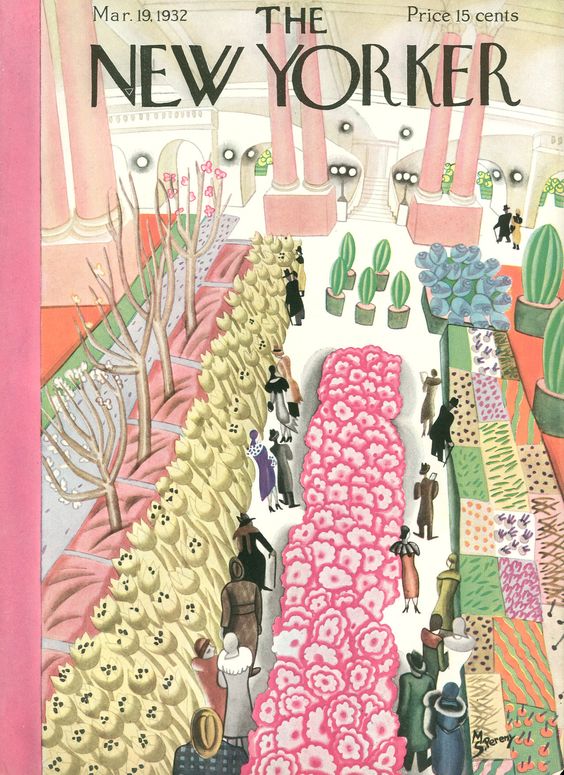
March 19, 1932 cover by Madeline S. Pereny, who gave us a glimpse of the annual International Flower Show at Grand Central Palace.

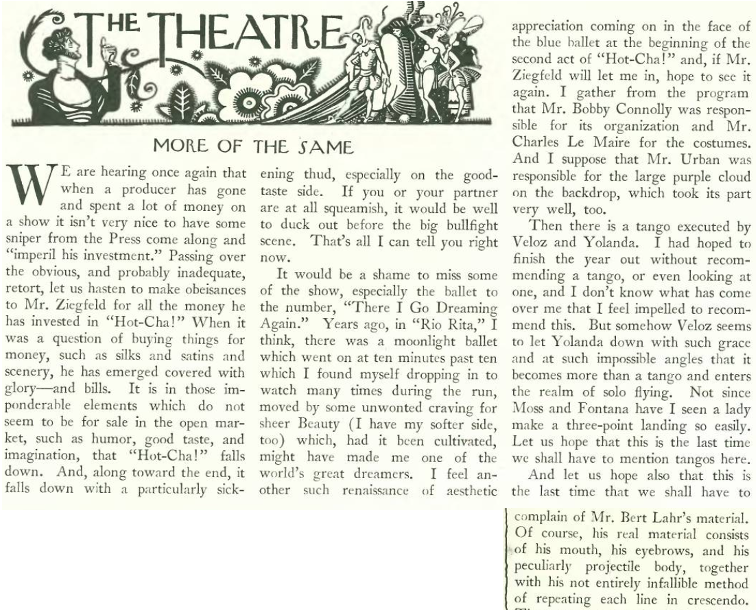
But when Robert Benchley checked out Ziegfeld’s latest revue, Hot-Cha, which opened at the Ziegfeld Theatre on March 8, 1932, he found it tiresome, and no amount of expensive scenery could keep the show from ending on a “particularly sickening thud.” What Benchley couldn’t know, however, was that Hot-Cha would be the last original musical-comedy produced by Ziegfeld, who in just four months would punch his final ticket.

NOT SO HOT-CHA!…Florenz Ziegfeld’s final revue brought out the stars, but it wasn’t enough to dazzle drama critic Robert Benchley. Clockwise, from top left, program for the revue; Lupe Velez, Charles “Buddy” Rogers, and June Knight in Hot-Cha; Benchley was more critical of Bert Lahr’s material than of the comedian himself — many years later Lahr’s son, John Lahr, would follow in Benchley’s footsteps and serve as the New Yorker’s drama critic; Frank Veloz and Yolanda Casazza were among the highest-paid dance acts in the 1930s and 40s, but Benchley had simply lost his appetite for yet another tango. (playbill.com/Pinterest/Smithsonian/Wikimedia)

Selections from the Ziegfeld Theatre program promised a stageful of talents, including 75 “Glorified Girls”…

…and Ziegfeld (1867–1932) would be back in May for a revival of Show Boat, which once again proved to be a hit, but a bout of pleurisy would claim his life on July 22, 1932. As Benchley alluded in his review, these lavish shows led to equally lavish expenses, and Ziegfeld, having lost much of his money in the stock market crash, would leave his actress wife Billy Burke with substantial debts. The plucky Burke, however, marched on with a successful acting career that included her appearance as Glinda the Good Witch in 1939’s Wizard of Oz.

SECOND ACT…Florenz Ziegfeld Jr. and his wife, actress Billie Burke, pose for an Edward Steichen photo, 1927. At right, Burke as Glinda the Good Witch in 1939’s Wizard of Oz. (Condé Nast/IMDB)

 *  *  *

Everyone’s a Critic

The March 19 issue also featured drama criticism from Alexander Woollcott in his “Shouts and Murmurs” column. In this case, Woollcott had a bone to pick with the famed playwright Eugene O’Neill, as well as with Guild Theatre’s coughing patrons, who called to mind a chorus of frogs:

SHSSS!…Alexander Woollcott would have preferred an empty Guild Theatre to one filled with “bronchial” patrons. (goodreads.com)

 *  *  *

Down in Old Mexico

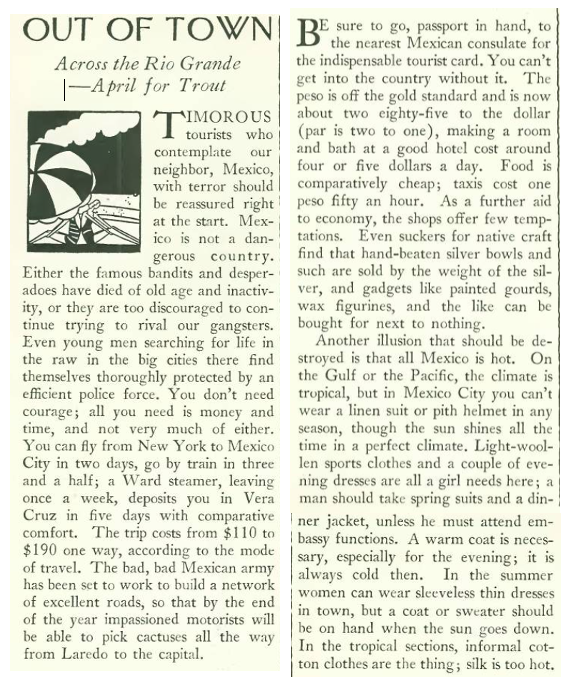
The New Yorker’s latest “Out of Town” feature assured travelers that Mexico was a safe destination, and advised men to pack “spring suits and a dinner jacket” if they planned to visit Mexico City. The author of this piece (signed “P.L.”) cautioned travelers “to get insulated against liquid lightning before getting flip with the national drinks: pulque and tequila. Bootleg liquor is no preparation for the havoc these work even on the sternest drinker.”

 *  *  *

Sweating With the Stars

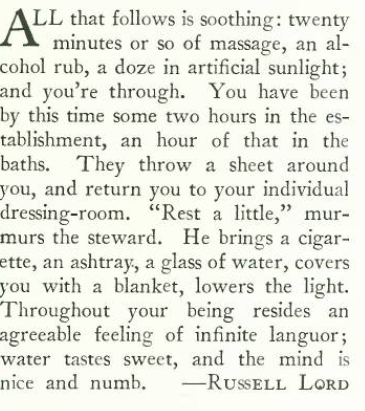
The March 19 “A Reporter at Large” column carried the simple title “Exercise.” Written by journalist Russell Lord* (1895-1964), this excerpt revealed some high-powered clients of one of the world’s first celebrity trainers:

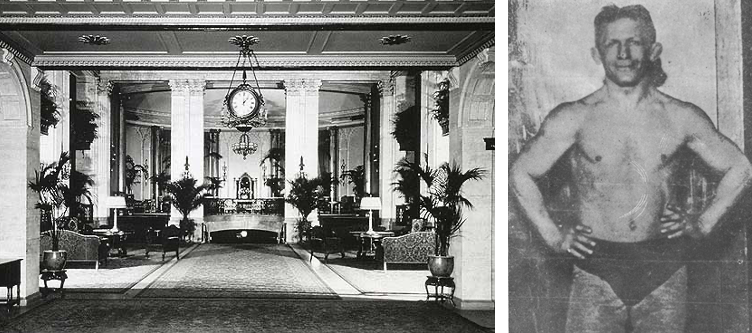
GUY LOMBARDO’S DOOR IS ON THE LEFT…Izzy Winter’s health and exercise “institute” was tucked away on the second floor of the Roosevelt Hotel. Patrons passed through the hotel’s lobby to access an “honest sweat.” Izzy is pictured at right. (Roosevelt Hotel/Yale University)

In Lord’s conclusion, he noted that after a workout patrons were treated to a doze under a sunlamp…and a cigarette…

* In his day, Russell Lord was a noted agricultural writer and editor of the agricultural literary journal The Land, which promoted ecologically responsible agricultural practices.

 *  *  *

Fame and Infamy

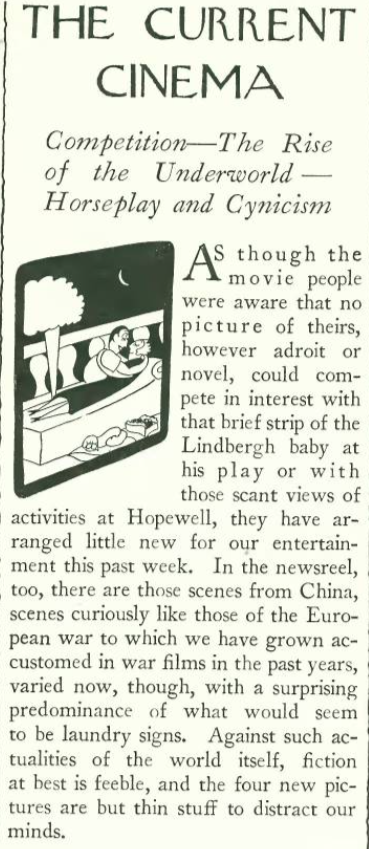
I include this snippet from John Mosher’s film column to note the first reference in The New Yorker to the March 1, 1932 kidnapping of the baby of Charles and Anne Morrow Lindbergh…the lives and various doings of the Lindberghs were frequent subjects in the early days of the magazine…

  *  *  *

From Our Advertisers

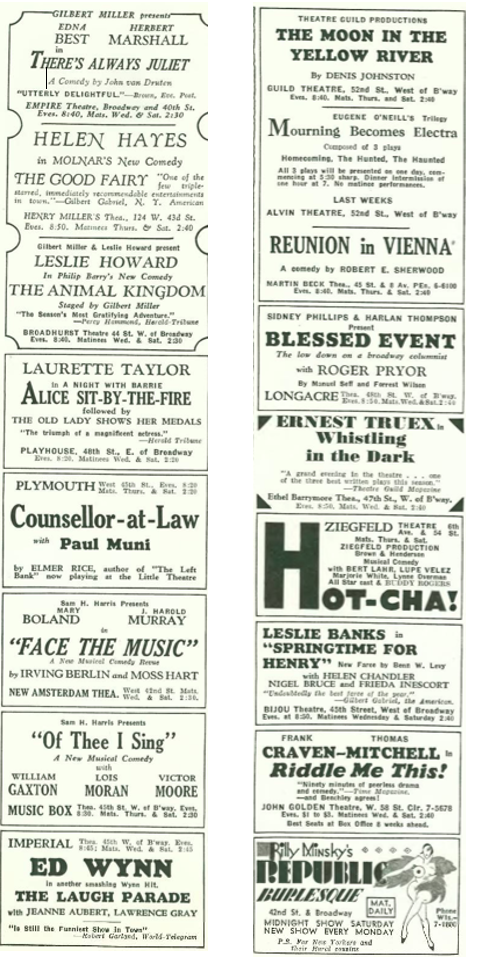
We’ll start by sampling some of the wares in the back pages…looks like Ziegfeld got a big bang for his small investment with his Hot-Cha ad…

…while Ziegfeld ran a cheap ad for his lavish production, the R.F. Simmons Company decided to go big with this ad for…drum roll please…watch chains…

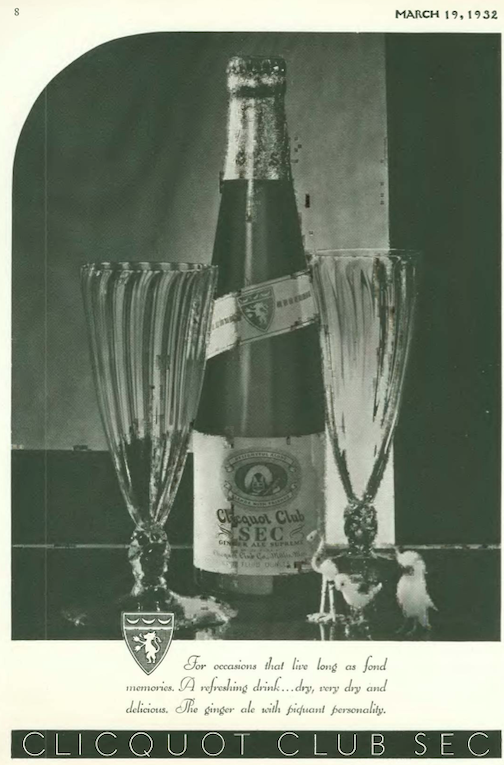
…the makers of Cliquot Club Ginger Ale also did their best to promote a mundane product, claiming their beverage had a “piquant personality”…yeah, especially with a splash or two of some bootleg whisky…

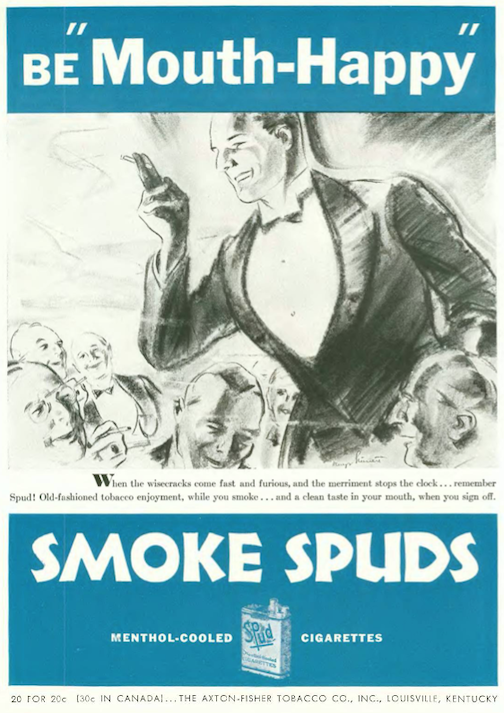
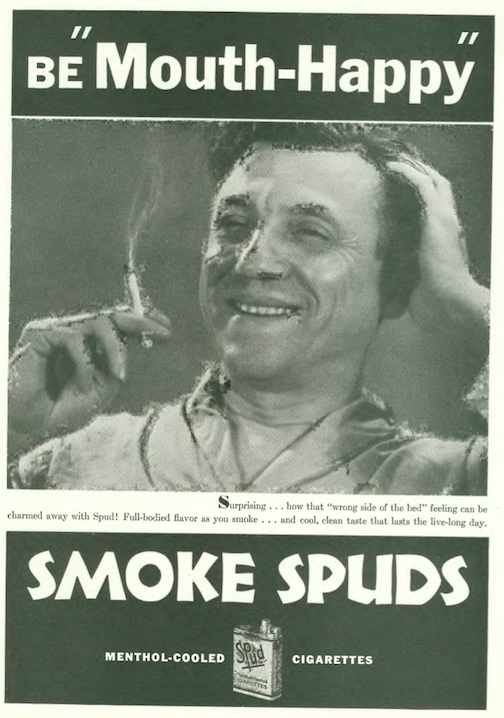
…the makers of Spuds were staying with their stupid “Mouth-Happy” theme, assuring menthol cigarette smokers they will be the life the party…a party filled with old gasbags, that is…

…R.J. Reynolds continued to push their Camels on the growing market of women smokers, demonstrating the effects of a fresh cigarette with this image of a rosy-cheeked nurse…

…DeSoto (a division of Chrysler) gave Depression-era readers something to smile about with this full-color, two-page advertisement featuring a sunny beach scene and an affordable automobile…

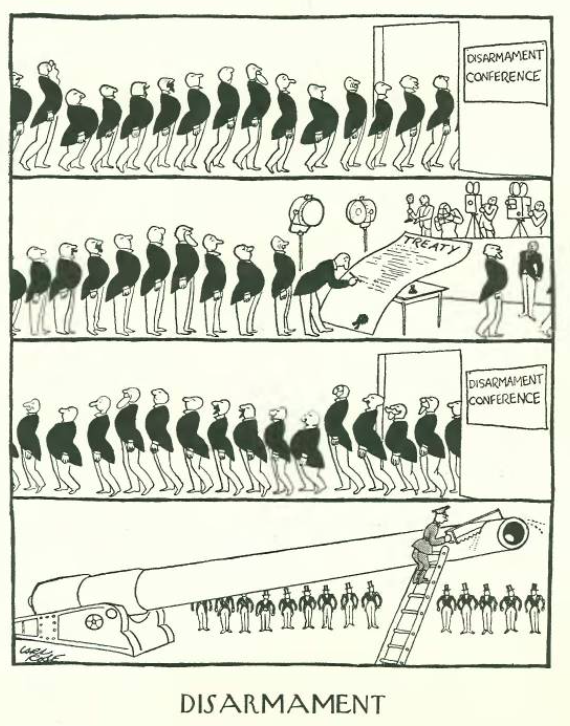
…on to our cartoons, here’s Carl Rose’s perspective on the Disarmament Conference taking place in Geneva, Switzerland…

…while the Otto Soglow’s Little King had his own way of projecting power…

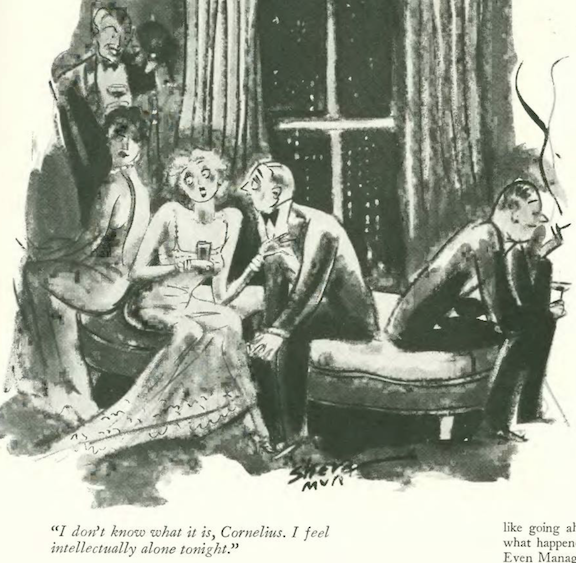
…on the domestic scene, Barbara Shermund’s modern women were channeling  René Descartes

…and William Steig showed us a couple debating an equally weighty matter…

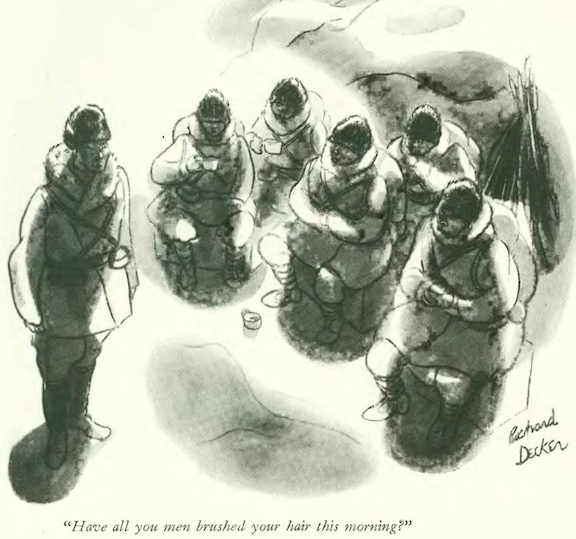
…and via Richard Decker, some well-groomed polar explorers…

…two of Helen Hokinson’s “girls” stopped by the International Flower Show at Grand Central Palace…

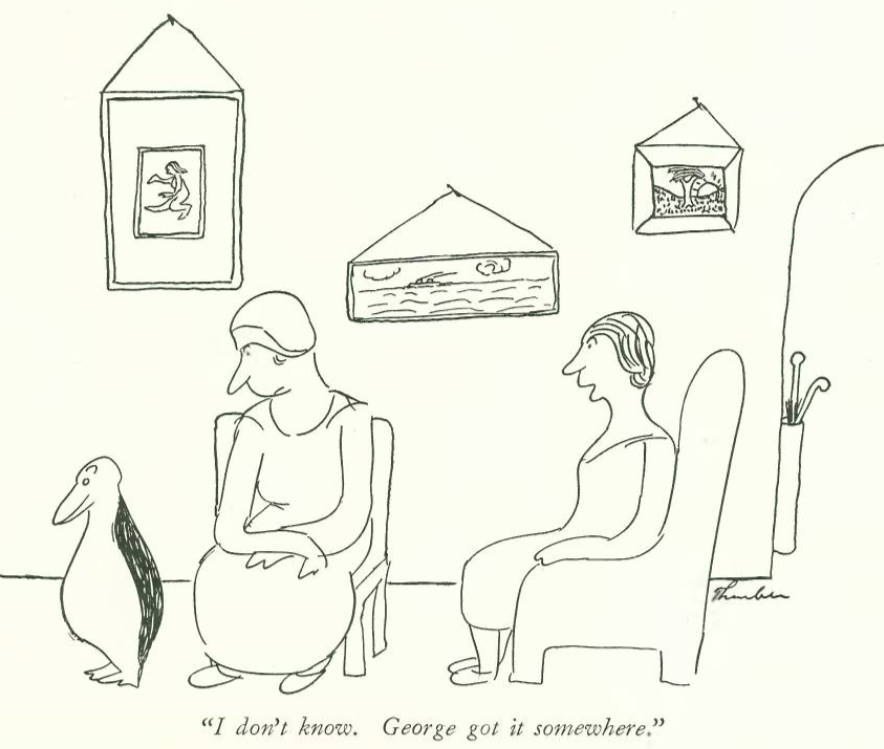
…and we end with another classic from James Thurber

Next Time: Dirge for a Dirigible…

The Milne Menace

Dorothy Parker was no fan of A. A. Milne of “Winnie-the-Pooh” fame, and neither was her dear friend Robert Benchley, the latter having had the misfortune of reviewing Milne’s latest Broadway play, They Don’t Mean Any Harm, which opened on Feb. 23, 1932, and closed (mercifully, one gathers) after one week.

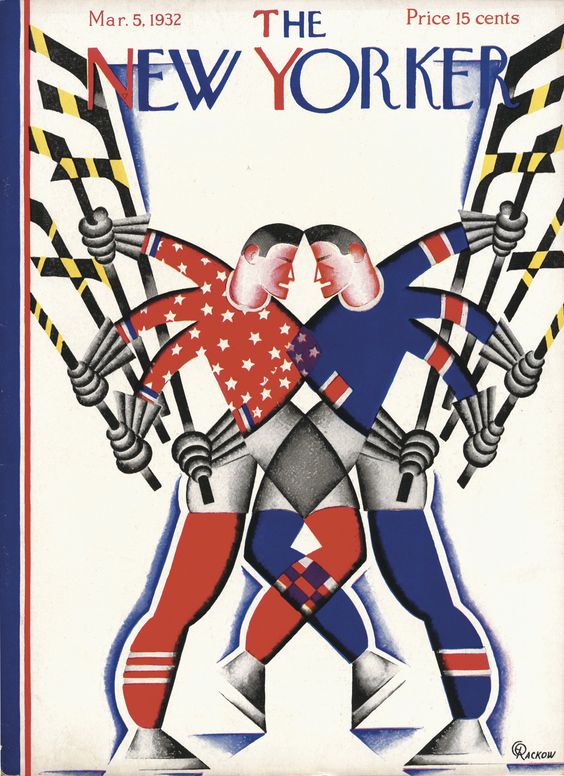
March 5, 1932 cover by Leo Rachow commemorated the US Vs. Canada hockey match at the 1932 Winter Olympics at Lake Placid, NY. Canada won its fourth consecutive Olympic gold by narrowly edging the US (silver) in total points.

Parker, as readers may recall, famously ridiculed Milne’s The House at Pooh Corner in The New Yorker, beginning with a quote from the book: “‘Well, you’ll see, Piglet, when you listen. Because this is how it begins. The more it snows, tiddely-pom’ – ‘Tiddely what’ said Piglet. ‘Pom,’ said Pooh. ‘I put that to make it more hummy.’ And it is that word ‘hummy’, my darlings, that marks the first place in The House at Pooh Corner at which Tonstant Weader Fwowed up” (Parker wrote her book reviews under the pseudonym “Constant Reader”).

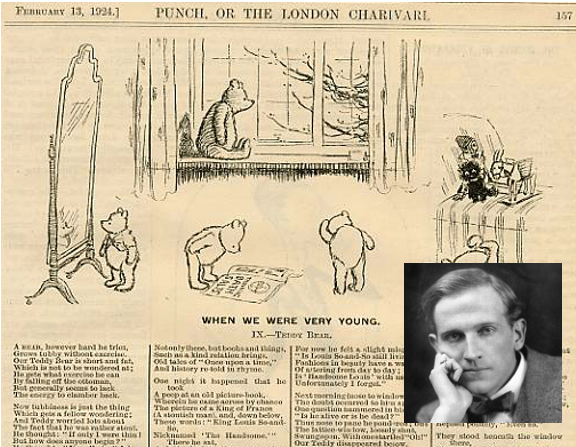
As for Benchley, he fondly recalled Milne’s earlier work, when he wrote silly verse and essays in the British humor magazine Punch, but apparently Milne’s downfall began when he published some “Pooh” poetry in the Feb. 13, 1924 issue…

WELL, DISNEY LIKED IT…A. A. Milne (1882–1956) pictured in his younger days (inset) joined the humor magazine Punch in 1906 and served as its assistant editor. After his son was born in 1920, he compiled a collection of poems for children, When We Were Very Young, illustrated by Punch cartoonist E. H. Shepard. An excerpt from the Feb. 13, 1924 issue appears above.  (Pinterest)

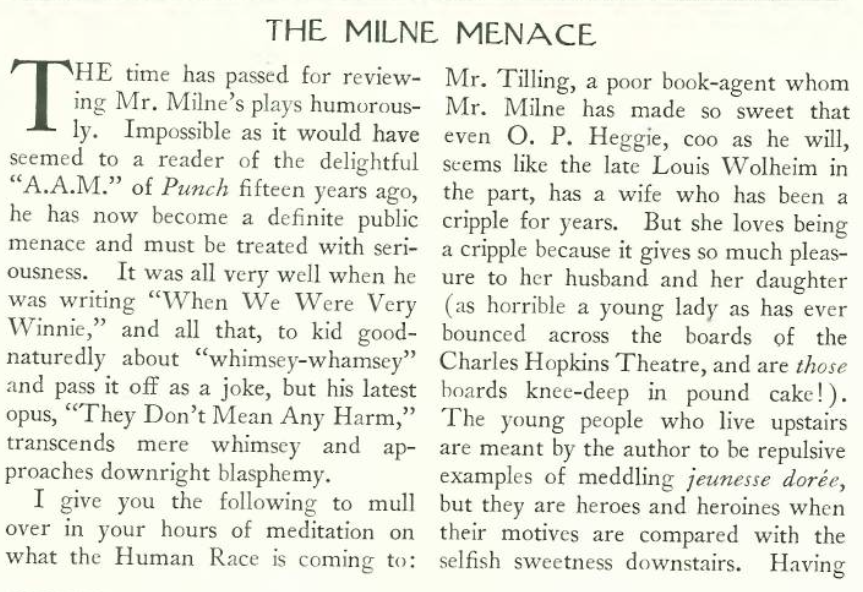
Parker, of course, did not think much of Milne as a children’s author, and Benchley also found him wanting (more than once) as a playwright. Here is the first part of Benchley’s scathing review of They Don’t Mean Any Harm, which was presented at the Charles Hopkins Theatre on 49th Street.

…Benchley’s evisceration continues on the left column…

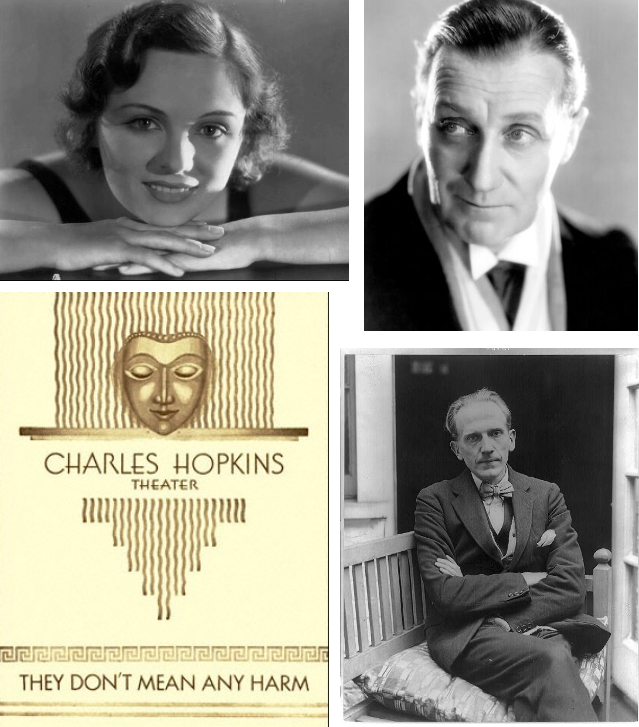
NO ACTORS WERE HARMED IN THE MAKING OF THIS PLAY…They Don’t Mean Any Harm closed after just a week (15 performances), but it would give rising young star Marion Burns (top left) her debut on a New York stage. Also appearing was veteran actor O.P. Heggie, who had to dial up the schmaltz to play a character so sweet (the role of Mr. Tilling, a humble, poor book agent) that it achieved just the opposite effect for critic Robert Benchley, who wrote he had never seen “a fouler character than Mr. Tilling”; pictured at bottom, A. A. Milne circa 1920s, and the cover of the program. (imdv.com/RKO Radio Pictures/Wikipedia/Playbill)

 *  *  *

Meanwhile, Beneath the City…

Eric Hodgins (author of the popular novel Mr. Blandings Builds His Dream House) filed a two-part feature on the New York subway system, marveling at the complexities of a transportation network that daily served millions while under constant development. Excerpts:

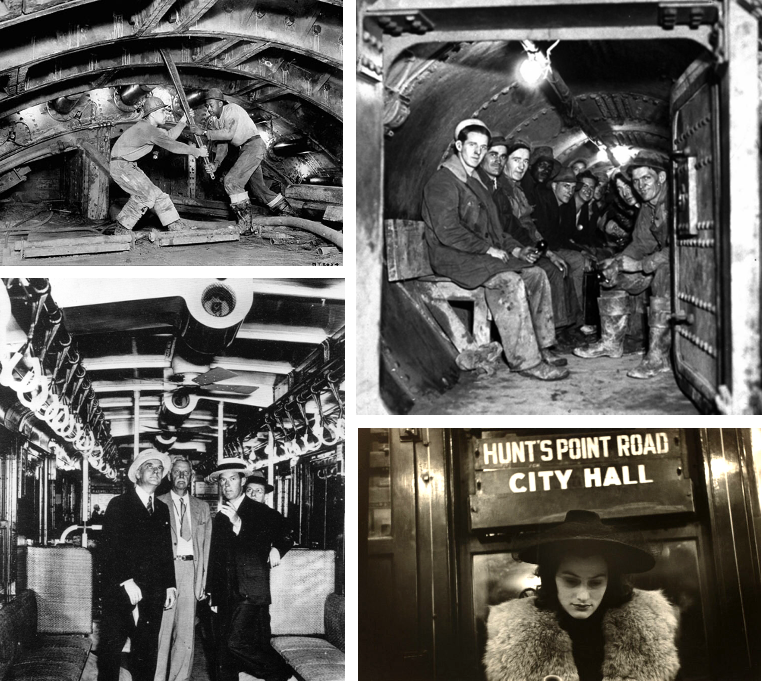
IN THE NAME OF PROGRESS…Today’s sandhogs (tunnel diggers) work in much safer conditions than in the 1930s, but some of the technology described in Eric Hodgin’s article was still around in 2015 (see below). Top photos, left, sandhogs tightening a bolt on a tunnel connection; right, subway tunnelers who worked under the East River are shown in a decompression chamber. Bottom photos, left, city officials in 1933 showing off a ventilation system installed to cool down trains (but air-conditioning was still decades away); and right, a 1938 Walker Evans photo from his subway series. (Daily News/public delivery.org/ephemeralnewyork.wordpress.com)

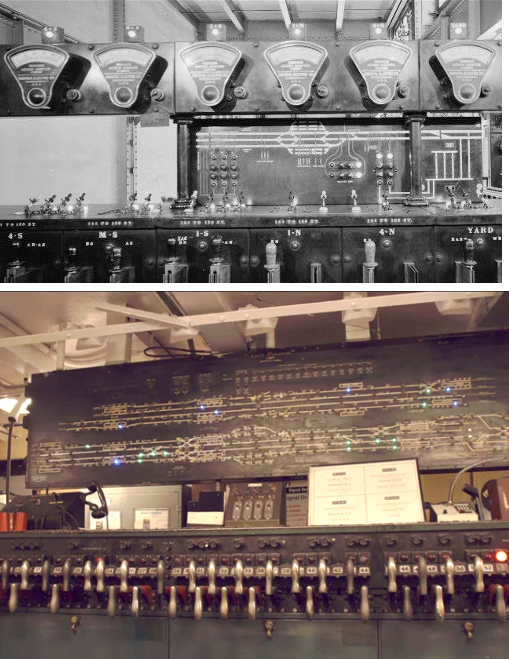
Six years ago Business Insider described the “100-year-old technology” still used by the Metropolitan Transportation Authority (MTA), and you can see that in 2015 (bottom photo) the switches and control panels were similar to ones in the 1930s (top photo). Also note the old handset (possibly bakelite) at left center of the 2015 photo.

(businessinsider.com)

I am not including these images to ridicule the MTA, but rather to admire the hard work, technological prowess and creativity of our forebears. Improving these vast, complex systems takes time and money, and especially money, lots of it.

 *  *  *

Coming Up For Air

Stuffy, crowded subway cars were largely unknown to those New Yorkers who still had means in the 1930s, and who could escape the city’s late winter doldrums and flee to sunny Bermuda. The “Out of Town” column offered some travel tips:

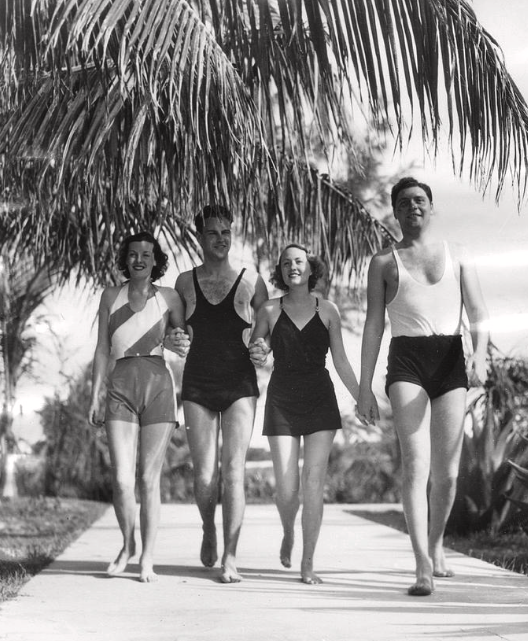
WISH YOU WEREN’T HERE…These fortunate New Yorkers enjoyed Bermuda’s sunny climes in 1932. (New York Historical Society)

*  *  *

From Our Advertisers

We begin with advertisement for the lovely Hotel Pierre, still a landmark of luxury in Manhattan. In 1932, however, the Depression forced the new hotel (opened in 1930) into bankruptcy. And so, we read this ad with tinge of sadness for Charles Pierre and his short-lived dream…

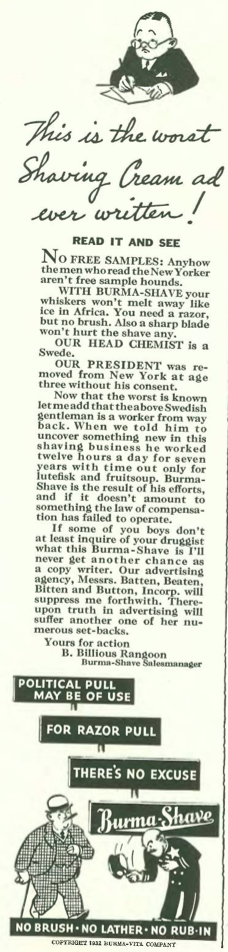
…one thing the Depression didn’t destroy was the need to shave one’s whiskers, and this is the first time (at least that I have noticed) that Burma Shave referenced its famous roadside jingles in a New Yorker ad…

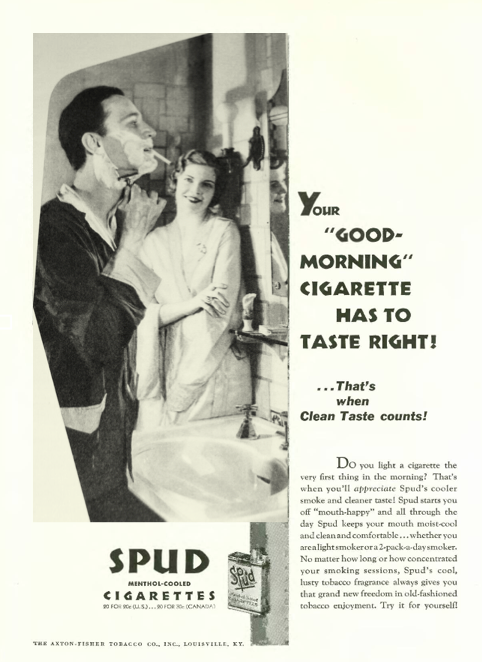
…the concept of being “mouth-happy” was the tagline used by the makers of Spud menthol cigarettes, who encouraged smokers to light up even before they got out of their PJs…

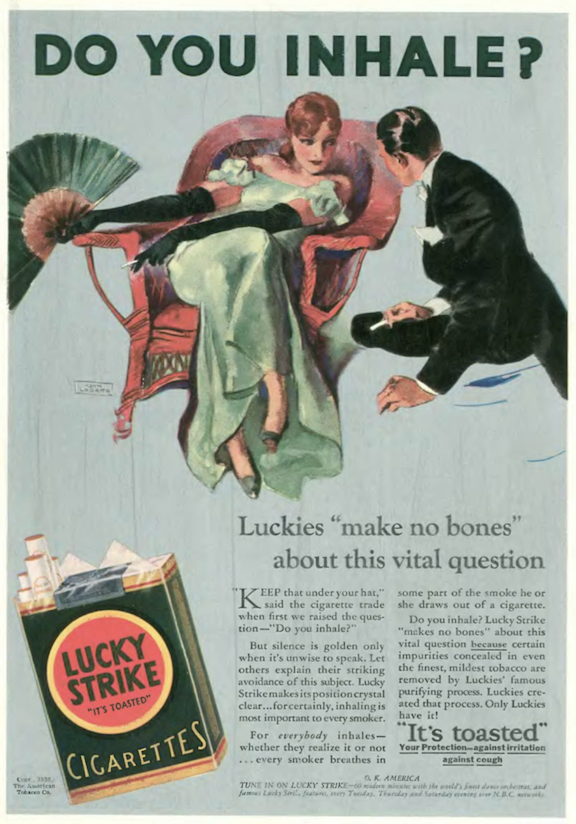
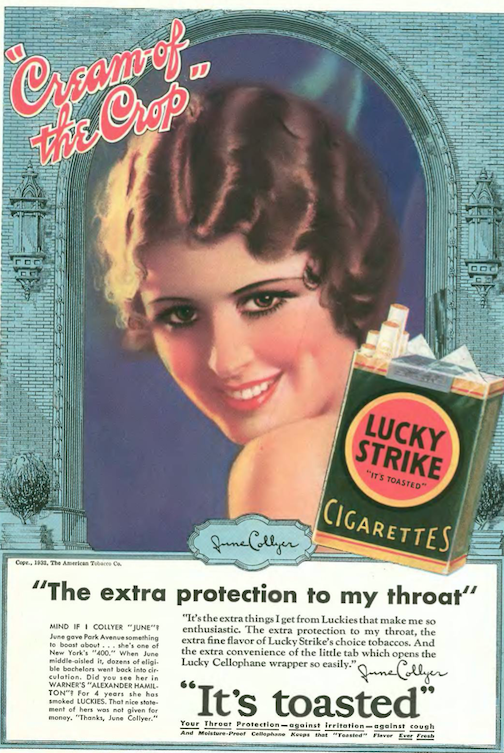
…Lucky Strike, meanwhile, stuck with their “toasted” claims, and to images of fame, youth and beauty to suggest that your looks as well as your throat would benefit from their product…

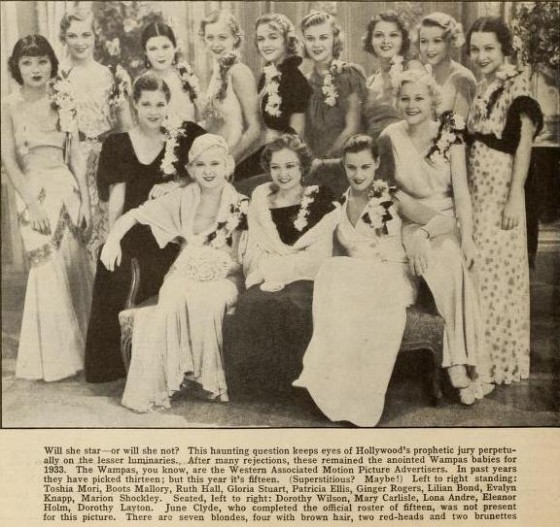
…the woman in the Lucky ad, June Collyer (1906-1968), was one of 13 women selected as “WAMPAS Baby Stars” in 1928. During the 1920s and early 30s, the Western Association of Motion Picture Advertisers (WAMPAS) honored 13 or so young actresses each year whom they believed to be on the threshold of movie stardom (In the 1940s Collyer’s brother “Bud” Collyer provided the voice of Superman on the radio). While I digress, here is a photo of the WAMPAS Baby Stars of 1932:

WAMPAS Baby Stars of 1932. Back row: Toshia Mori, Boots Mallory, Ruth Hall, Gloria Stuart, Patricia Ellis, Ginger Rogers, Lilian Bond, Evalyn Knapp, Marian Shockley. Seated in front row: Dorothy Wilson, Mary Carlisle, Lona Andre, Eleanor Holm and Dorothy Layton (June Clyde is not pictured).

…on to our cartoons, we go from the glamorous to the everyday with William Steig

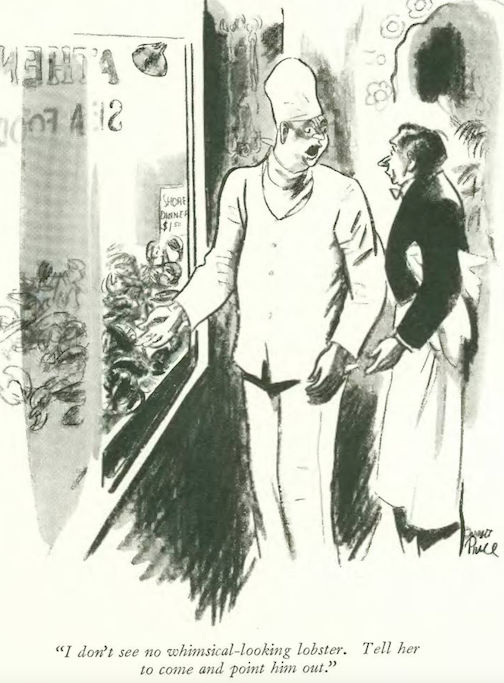
…and Garrett Price

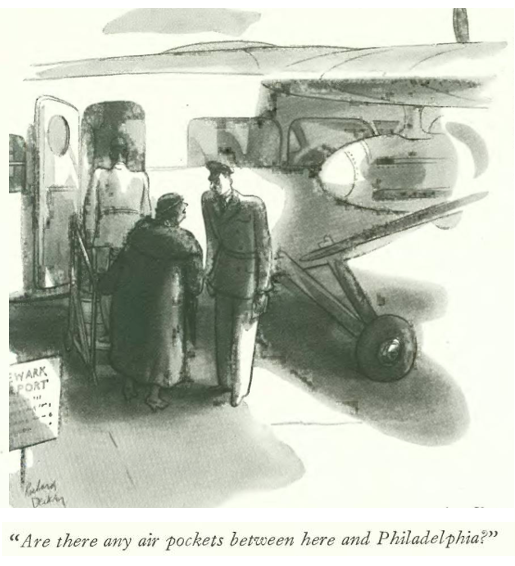
Richard Decker suggested someone might be in for a bumpy ride…

…and Decker again, illustrating the perils of another form of transportation…

Barbara Shermund gave us a wealthy matron eager for show and tell…

…and Peter Arno looked in on one of his ancient walruses, pining for the olden days…

…on to the March 12, 1932 issue…

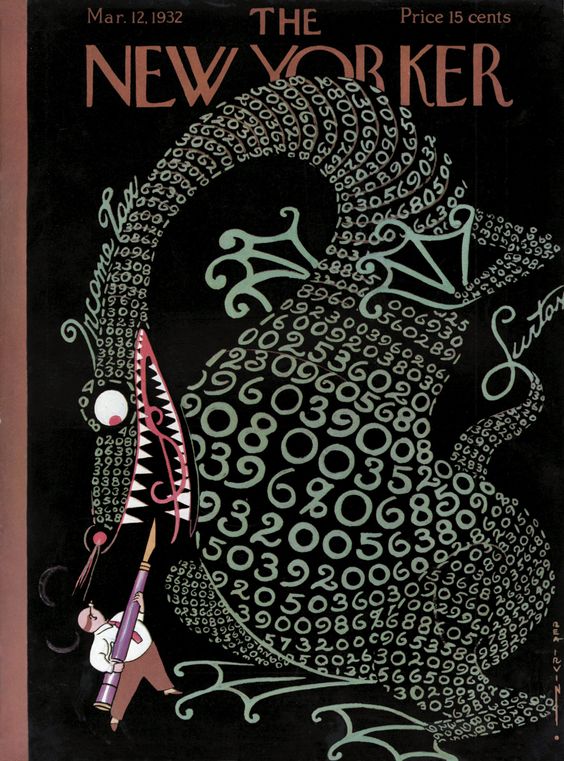
March 12, 1932 cover by Rea Irvin.

…and some insights into a variety of world events, large and small, by E.B. White:

GR-R-ATE was the word used by one newsreel announcer to describe Malcolm Campbell’s land speed record of 253.96 miles per hour, achieved on the sands of Florida’s Daytona Beach on Feb. 24, 1932. E.B. White wanted to know why this achievement was so gr-r-ate. (floridamemory.com)

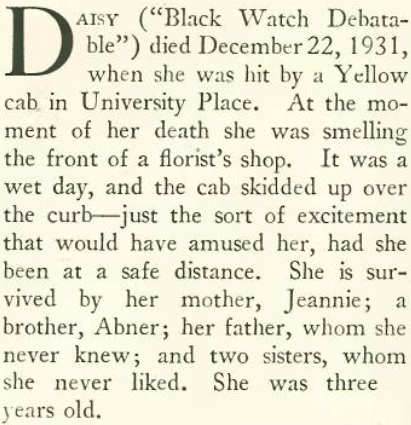
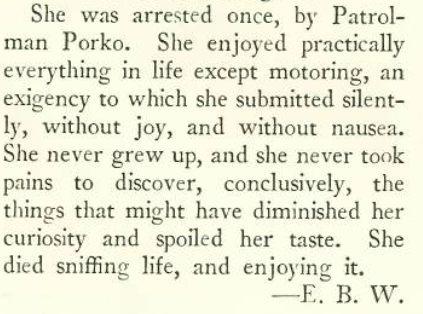
And we have White again, who we all know loved dogs, and especially Daisy, his beloved Scotty. When she was killed by a swerving taxicab, he wrote a beautiful remembrance in the New Yorker. Here are the first and last paragraphs.

TRAVELING COMPANION…Katharine White with Daisy on a leash in New York City, 1931. In the pram is baby Joel. (brainpickings.org)

One more by White, this time admiring the heavenly beauty of a GE refrigerator in the window of a Rex Cole store on East 21st Street:

KING OF COLD…The Eagle Building (right) on East 21st held the Rex Cole showroom admired by E.B. White. To get some idea of Rex Cole’s theatrical fridge displays, the image at left is of a Bronx storefront. (MCNY/Daytonian in Manhattan)

 *  *  *

From Our Advertisers

With the Depression still deepening, even the rich needed a break, so Lincoln rolled out an eight-cylinder model, at $2,900 still too steep for most folks…

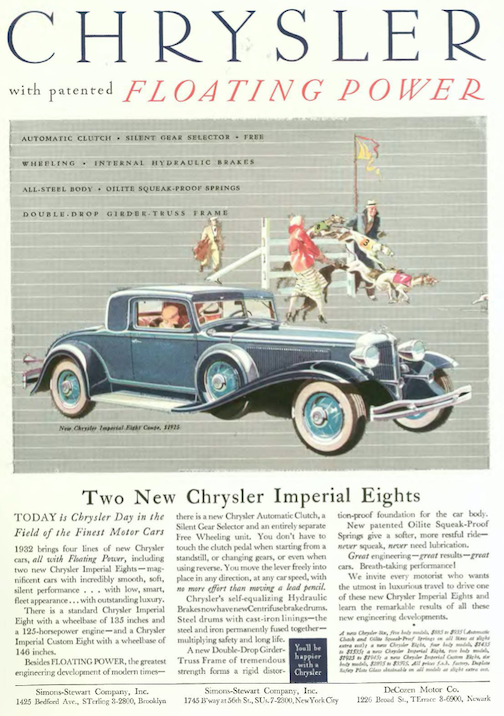
…and priced competitively with the Lincoln, the Chrysler Imperial Eight looked a lot more fun…

…and we have another stylish and very modern Coty advertisement by American fashion illustrator Ruth Sigrid Grafstrom…

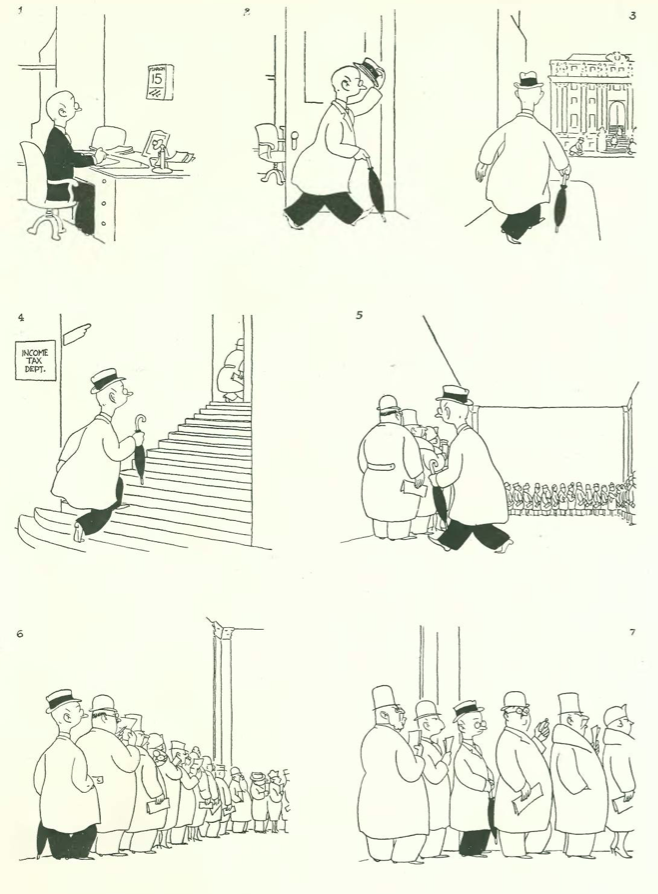
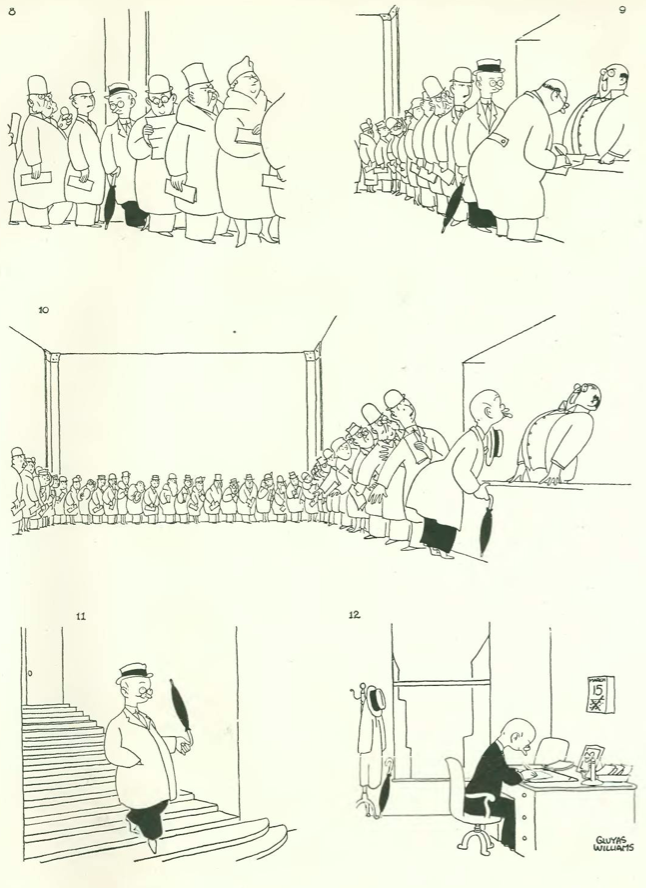
…on to cartoons, Gluyas Williams demonstrated that sometimes words alone don’t have the same effect as a simple gesture…

dd

Garrett Price found a hapless fellow on a train to nowhere…

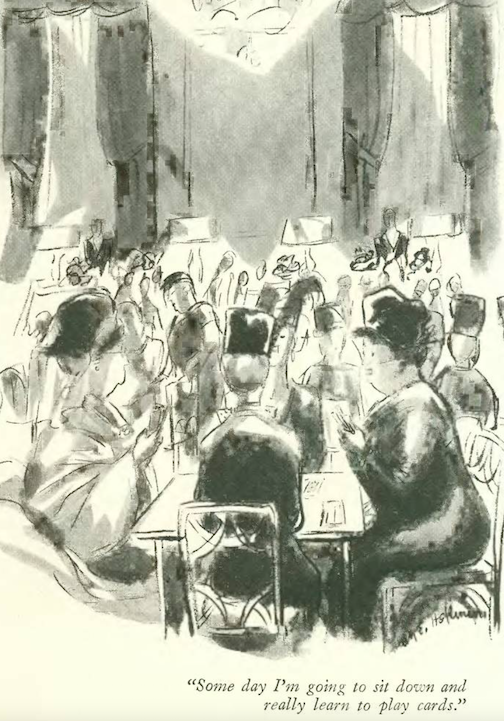
Helen Hokinson’s “girls” were going through the motions at a bridge tournament…

…and Helen again with the lives and loves of our youth…

…and we close with James Thurber, his war between the sexes taking a new twist…

Next Time: The Final Curtain…

The Mouse That Roared

In the spring of 1928, Walt Disney collaborated with cartoonist Ub Iwerks in creating a new cartoon character, Mickey Mouse, and later that year Mickey would be featured in the first-ever post-produced sound cartoon, Steamboat Willie. The film was an immediate hit, bringing almost instant fame to Disney.

Dec. 19, 1931…A classic cover by Peter Arno.

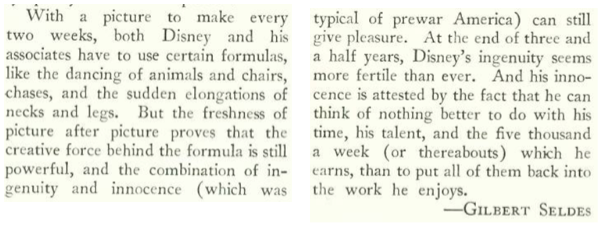
Just three years after the birth of Mickey, Disney had already carved a place for himself in American culture, drawing the attention of millions of Mickey fans—and one critic for The New Yorker—Gilbert Seldes, who penned a profile of the “Mickey-Mouse Maker” (illustration by Hugo Gellert). Note in the second of these two excerpts how Disney was already connecting his product to patriotism and clean living through his Mickey Mouse Clubs:

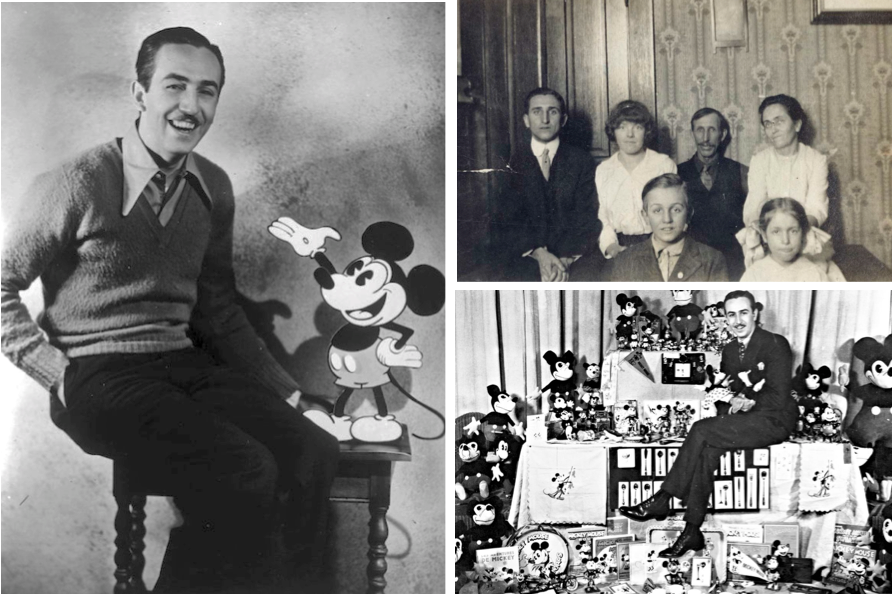
CASH COW…ER…MOUSE…Left, Walt Disney poses with his famous creation in 1935; top right, the Disney family in 1915: Parents Elias and Flora Disney in back row, right; Walt is seated with sister Ruth in front; photo of Disney proves the merchandising value of his little mouse from the very start. (IMDB/PBS/The Telegraph)
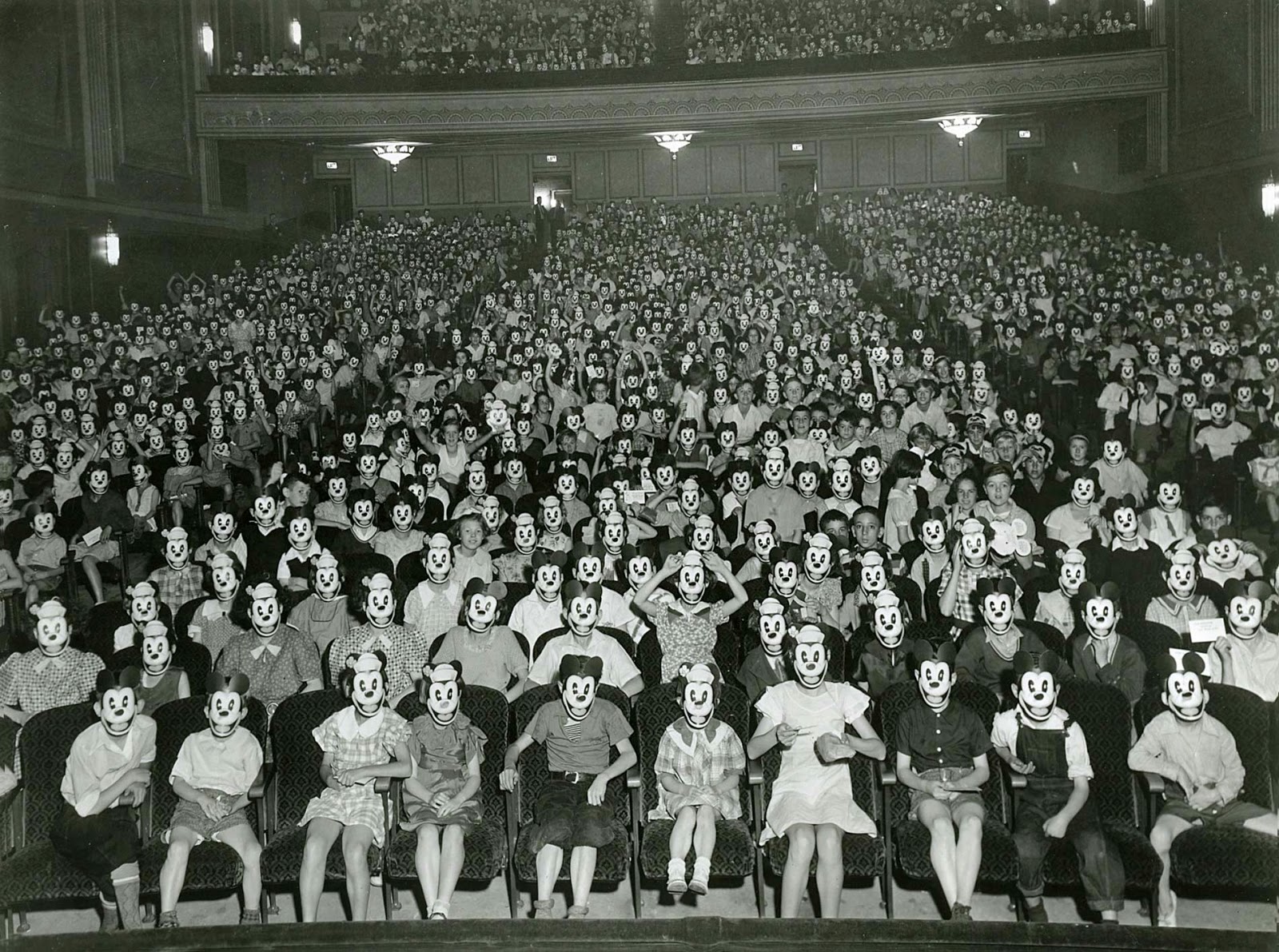
A THING OF NIGHTMARES…Before the television show there was a theater-based Mickey Mouse Club. Pictured above is an early meeting of the Club at a theater in Ocean Park, California. Although the Club had a million members in the U.S. by 1932, Disney pulled the plug on the clubs in 1935. They were revived through several television series in 1955-59, 1977-79, and 1989-1994 (that last class featured a number of future stars including Ryan Gosling, Britney Spears, Christina Aguilera, and Justin Timberlake). (www.vintag.es)

In his conclusion, Seldes marveled at Disney’s productivity—a new picture made every two weeks—and his seemingly endless creativity. Little could Seldes imagine that one day the man and his mouse would become a multinational mass media and entertainment conglomerate.

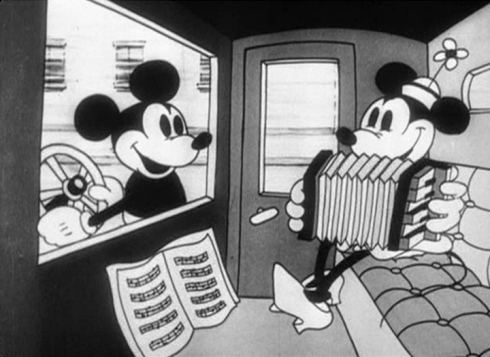
I’M YOUR VEHICLE, BABY…Mickey gives Minnie a ride in his cab in 1931’s Traffic Troubles. (YouTube)

You can watch 1931’s Traffic Troubles here:

 *  *  *

Big Man on Canvas

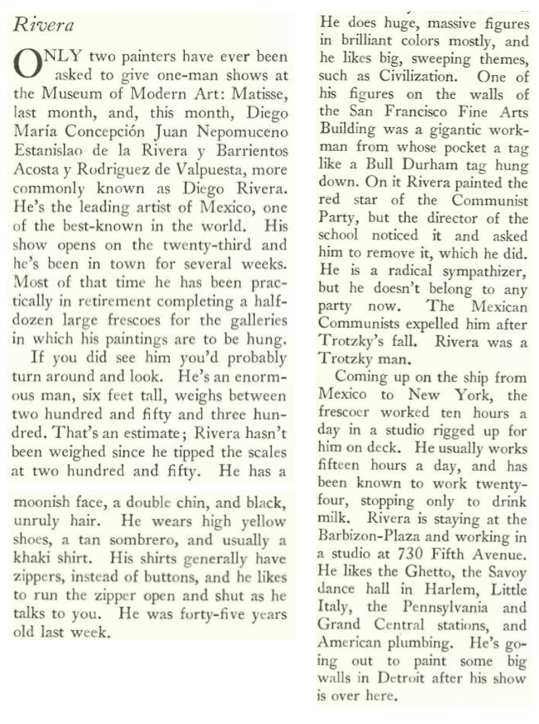
It seems the earth almost shook when Mexican artist Diego Rivera arrived in New York for only the second one-man show at the Museum of Modern Art. His work habits, his comings and goings, and his enormous girth (modest by today’s standards) were reported in The New Yorker, including this entry in “The Talk of the Town”…

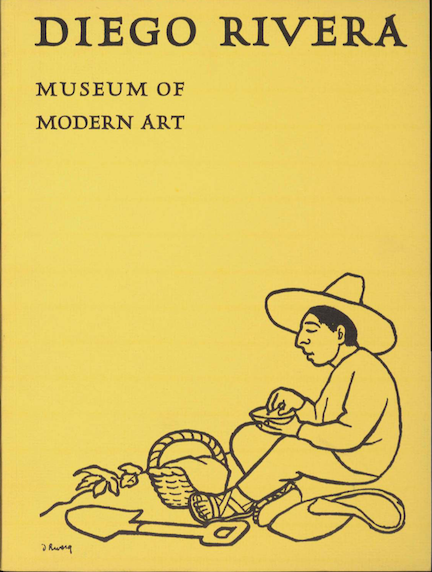
COME TO MOMA…Cover of the Museum of Modern Art’s catalog for the Diego Rivera exhibition. (MoMA)
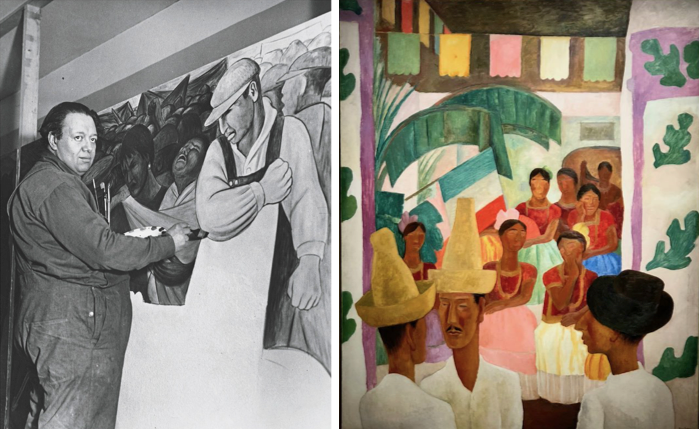
MAN AT WORK…Left, Diego Rivera at work on The Uprising, at the Museum of Modern Art, in 1931. Rivera painted five frescoes on portable supports of steel-braced cement in conjunction with his MoMA exhibition. Among the works featured was The Rivals (right), which sold for $9.76 million in 2018, overtaking an auction record for Latin American art previously set by his wife, Frida Kahlo. Her Two Nudes in the Forest sold for $8 million in 2016. (MoMA/Pinterest)

 *  *  *

Winds of War

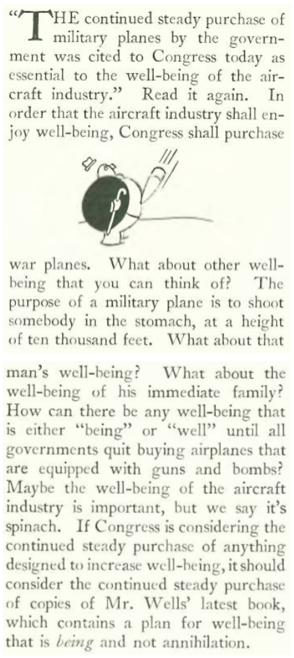
It’s the end of 1931, but one can already detect the rumblings of the future to come, namely world war. The former Allied and Axis powers of the First World War were all busy developing new weapons, particularly of the airborne variety that all believed would provide a decisive edge if (or rather when) the next war commenced. Japan was already making moves on China, and in just four years the Germans would reoccupy the Saarland and Italy would invade Ethiopia. E.B. White, in his “Notes and Comment,” found the current state of affairs more than a bit troubling…

PUSHING THE ENVELOPE…Wars and rumors of wars drove rapid advances in aviation in the 28 years following the Wright Brothers’ first flight. The Curtiss Aeroplane and Motor Company developed the A-8 (above) in 1930-31 to serve as a ground-attack aircraft. (ww2aircraft.net)

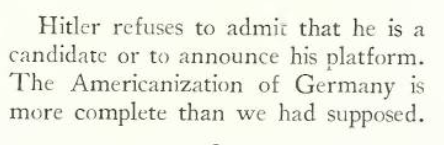
…and hints of the world to come could also be found in Howard Brubaker’s “Of All Things” column, where he made this observation:

Brubaker was likely referring to Franklin D. Roosevelt’s cautious approach to announcing his candidacy for president. The outcome, of course, proved quite different for the German people.

*  *  *

From Our Advertisers

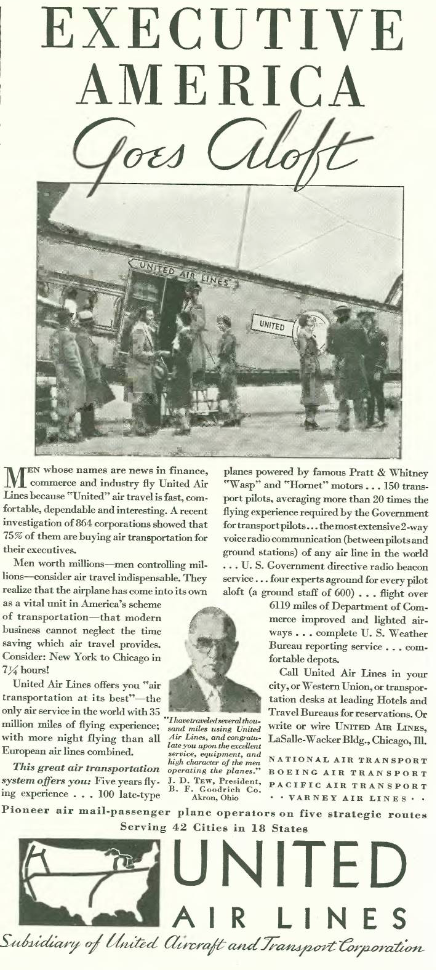
Preparations for war drove the development of the aircraft industry, which quickly adapted its designs during peacetime for civilian purposes. This ad from United Airlines touted the advantages of plane over train travel for corporate executives. Within 30 years the airlines would indeed supplant railroads as the preferred means for business travel…

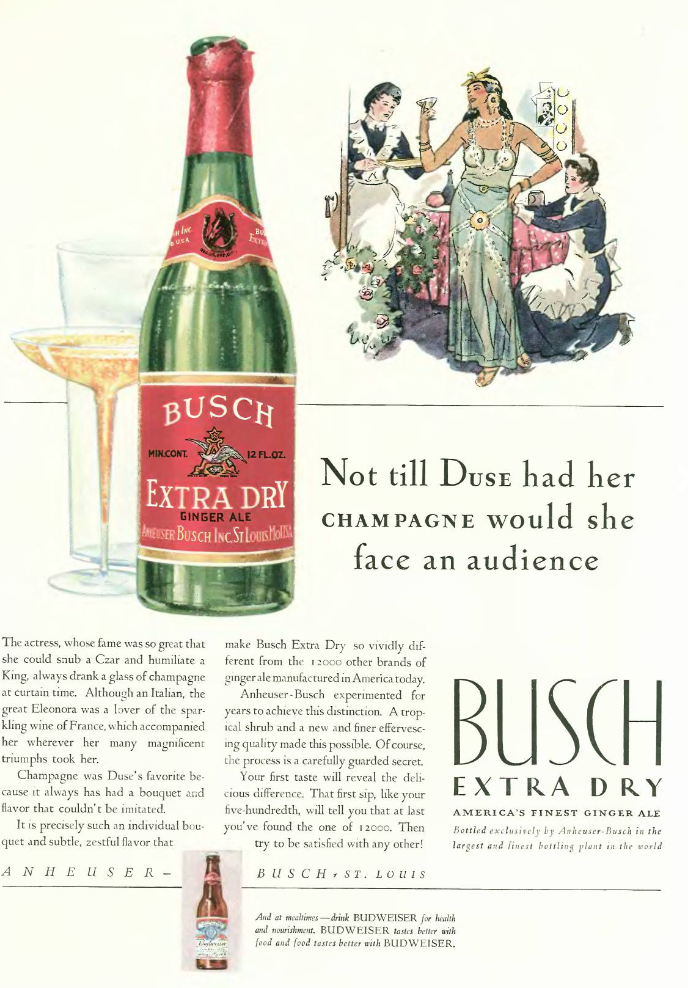
…Prohibition would remain in force until the end of 1933, so brewers like Anheuser-Busch continued finding ways to link their non-alcoholic products to the ghosts of drinking past…

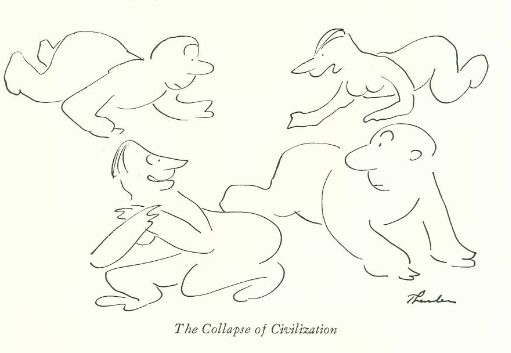
…on to our cartoons, James Thurber rendered this apt portrait of our civilization…

Barbara Shermund gave us an actress with a reputation to protect…

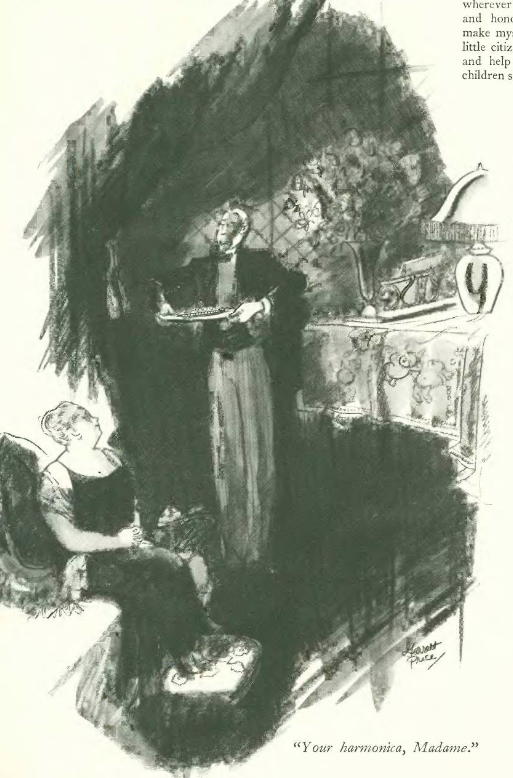
…and Garrett Price presented an unlikely harmonica player…

…on to our next issue, where we find more Diego Rivera

Dec. 26, 1931 cover by Madeline S. Pereny. Artist’s note: Pereny (1893–1970) was born in Kecskemet, Hungary. A baroness, she studied at Vienna Art Academy before emigrating to the U.S. in the early 1930’s. In addition to creating cover art and illustrations for The New Yorker, she was also a cartoonist for the Disney Studios.

…and we begin with this entry from “The Talk of the Town,” attributed to James Thurber

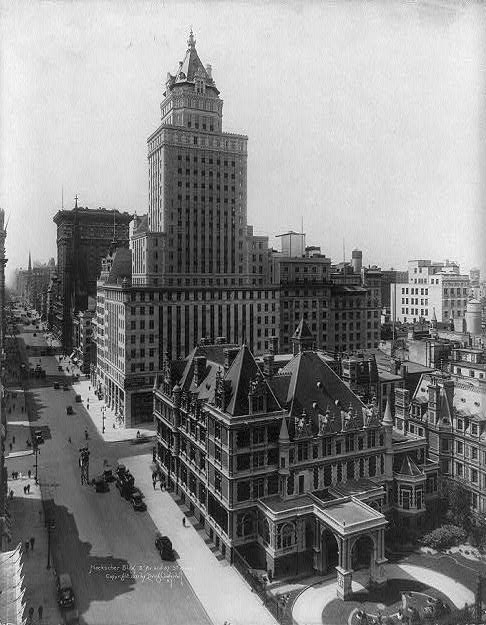
WHERE’S DIEGO?…in December 1931 he could be found working on his frescoes on the sixth floor of the Heckscher Building—the Museum of Modern Art’s first home. In the foreground is the Cornelius Vanderbilt mansion, demolished in 1926. (Library of Congress)
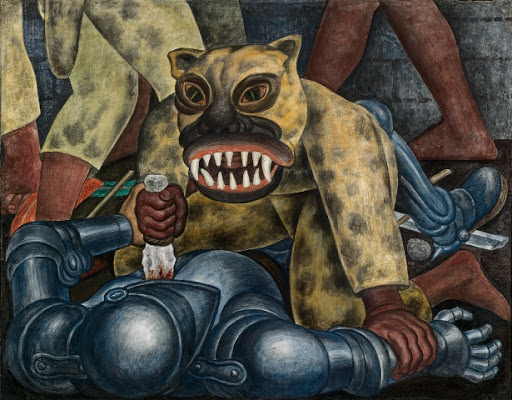
GET THE POINT?…Thurber referred to Diego Rivera’s Indian Warrior, one of five frescoes Rivera created during his Museum of Modern Art exhibition.

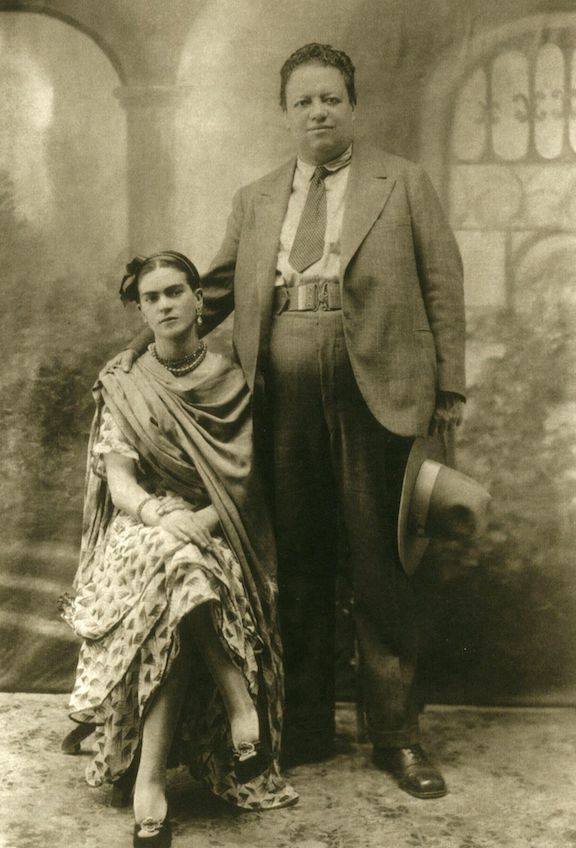
Thurber refers to “a lady” who accompanied Rivera, most likely Frida Kahlo, who was emerging as an artist in her own right around this time.

PORTRAIT OF A LADY…Wedding photograph of Frida Kahlo and Diego Rivera, 1929. (Throckmorton Fine Art)

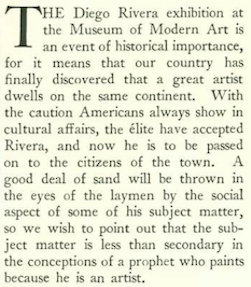
More on Diego could be found in the art review section, where critic Murdock Pemberton offered a cautionary message to the rabble who might not abide some of the artist’s controversial themes:

 *  *  *

Head Cracker

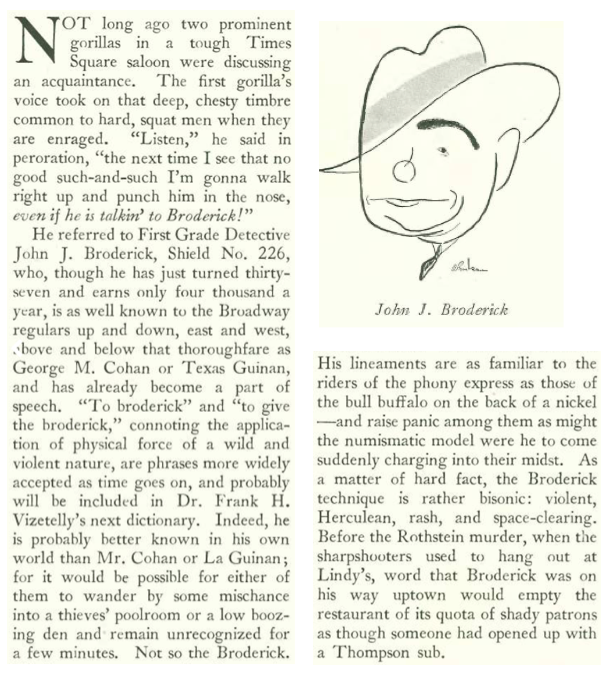
In the 1920s and 30s Johnny Broderick was known as New York’s toughest cop, known for personally assaulting gangsters (and suspects) and for once facing down armed gunmen during a prison break at the Tombs. His valor won him many fans (and some detractors), making him a local celebrity and a subject of gossip columns. Reporter Joel Sayre offered his assessment of Broderick in a “Profile” for the Dec. 26 issue (illustration by Abe Birnbaum). Excerpts:

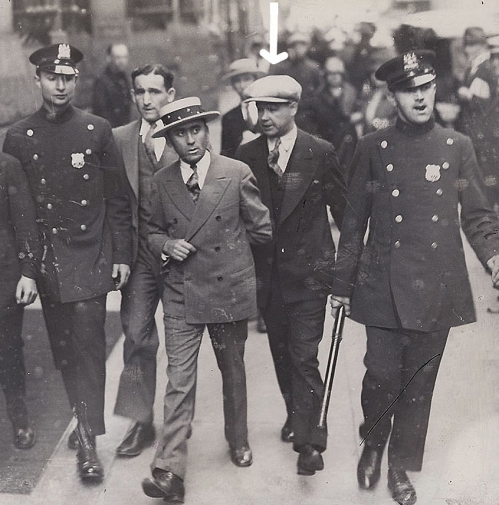
WISE GUY, EH?…Johnny Broderick (see arrow) escorts an unfortunate perp in 1927. (Public Domain)

 *  *  *

Something to Cheer About

On the lighter side, Hollywood took a shot at Noel Coward’s 1930 comedy of manners, Private Lives. The original play featured Gertrude Lawrence and Laurence Olivier, while the Hollywood version Norma Shearer and Robert Montgomery.  For once, critic John Mosher actually liked this screen adaptation:

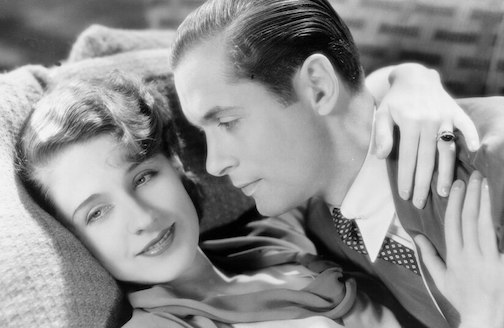
GIVE ME THAT LOVIN’ FEELING…Norma Shearer and Robert Montgomery in the film adaptation of Noel Coward’s Private Lives. (TCM)

 *  *  *

From Our Advertisers

Just one ad from the Dec. 26 issue to close out the year, and what better way to say “Merry Christmas” than with a fresh cigarette…

…on to our cartoonists, William Crawford Galbraith offered a look backstage in this two-page illustration across the bottom of “The Talk of the Town”…

Richard Decker showed us the importance of making oneself clear, especially when aloft in a dirigible…

Robert Day found humor in a barren landscape…

Garrett Price offered us a cheesy predicament…

Helen Hokinson found a man about to make an important point…

…and we end 1931 with this classic from James Thurber

Next Time: Thurber’s Dogs…

The Tragic Pose

In an age of toe-tapping musicals and screwball comedies — which served to distract from the grim realities of the Great Depression—one playwright was content to continue mining the deep veins of tragedy and pessimism than ran through the 1930s.

Nov. 7, 1931 cover by Margaret Schloeman.

A Chekhovian realistEugene O’Neill (1888–1953) had yet to write his masterpiece, Long Day’s Journey into Night, but in 1931 he was already well established as America’s preeminent playwright. When his naturalistic Mourning Becomes Electra hit the Guild Theatre stage, New Yorker theatre critic Robert Benchley had little doubt about O’Neill’s greatness as a playwright, even if he wasn’t so sure about the play itself:

O’Neill’s tragic pose was borne from childhood, the son of an alcoholic father and a mother who became addicted to morphine after his difficult birth. His older brother, Jamie, would drink himself to death. It doesn’t end there. O’Neill’s own  two sons would commit suicide, and he would disown his remaining daughter, Oona O’Neill, when at age 18 she married silent film star Charlie Chaplin, 36 years her senior. An odd footnote: Chaplin was best friends with Ralph Barton, a cartoonist for the early New Yorker who took his own life after Eugene O’Neill married Barton’s ex, Carlotta Monterey. To close the loop, O’Neill and Monterey had a mess of a marriage between his alcoholism and her addiction to sedatives. No wonder the man rarely smiled.

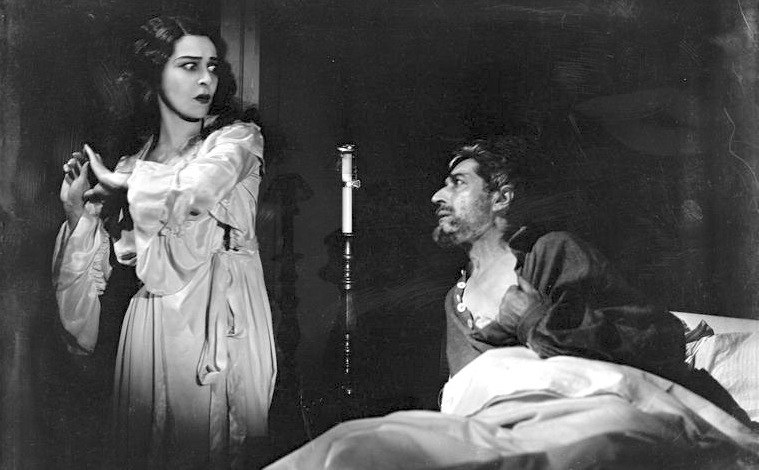
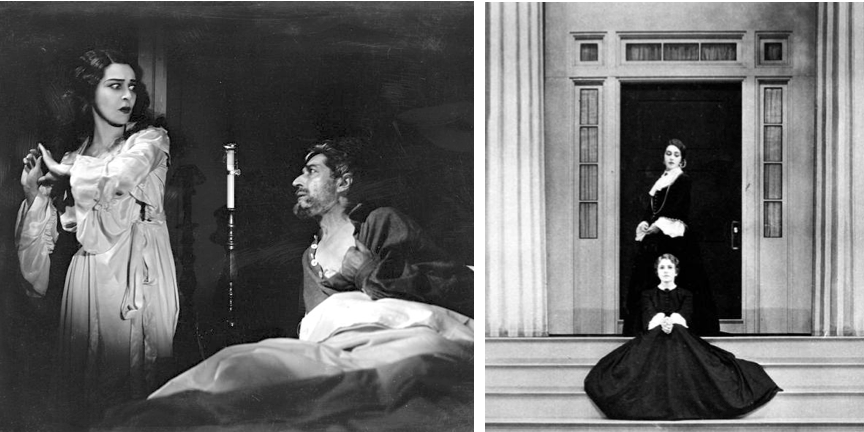
WRONG MEDS, MY DEAR…Christine Mannon (Alla Nazimova) recoils from her husband, Ezra (Lee Baker) after giving him a poison that he mistakes for his heart medicine. At right, Christine and her daughter, Lavinia (Alice Brady), await the return of Ezra from battle. All three actors were part of the original cast of Eugene O’Neill’s Mourning Becomes Electra, which was a retelling of Oresteia by Aeschylus. (allanazimova.com)
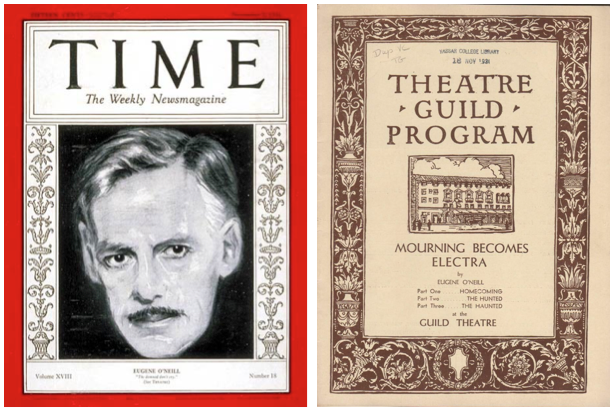
FAMILIAR FACE…Eugene O’Neill made his third appearance on the cover of Time magazine for the Nov. 2, 1931 issue. He made a total of four appearances on the magazine’s cover (1924, 1928, 1931 and 1946). At right, cover of Guild Theatre program. (Time/Pinterest)
SAY CHEESE…Eugene O’Neill wore his familiar scowl in this undated portrait with his third (and final) wife, stage and film actress Carlotta Monterey. (famousfix.com)

 *  *  *

Go West, William

When Mae West announced she was going to present a modern version of William Shakespeare’s Macbeth and play the part of Lady Macbeth, Wolcott Gibbs went to work on possible scenarios for such a production. Here is one of them:

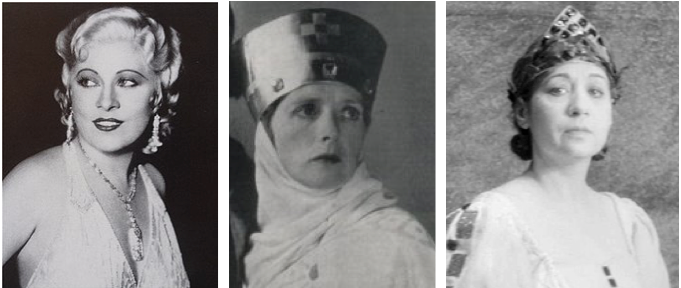
LADIES MACBETH?…Actually, only two of these women made the cut to play Lady Macbeth. Gladys Cooper (center) appeared as Lady Macbeth in a 1935 production at the Ethel Barrymore Theatre that lasted barely a month. The following year Edna Thomas (right) portrayed Lady Macbeth in a Federal Theatre Project production of Macbeth with an all-Black cast. Orson Welles adapted and directed the production, which was staged at Harlem’s Lafayette Theatre. It became a box office and critical sensation.

 *  *  *

Those Hats Again

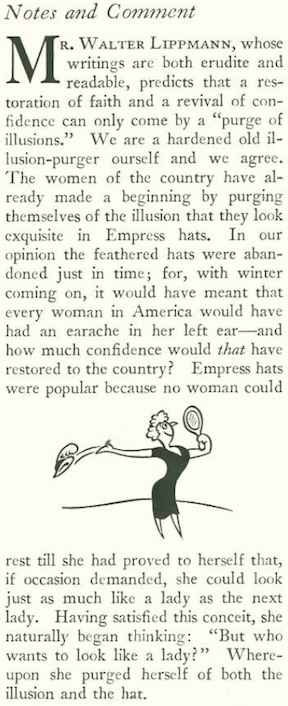
And now to E.B. White, who once again explored the mysteries of the Empress hat:

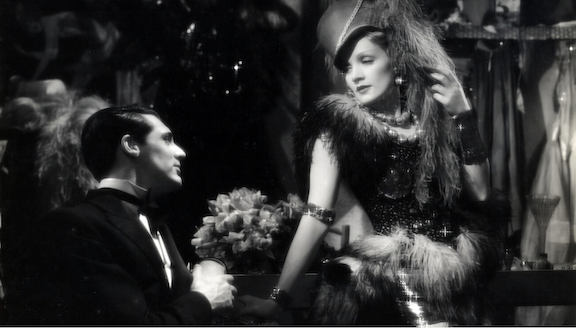
TAKE THIS, MR. LIPPMANN…Thelma Todd wearing an Empress Eugénie hat in the 1932 comedy Speak Easily. (Wikipedia)

  *  *  *

Rah, Rah, Sis Boom Bah

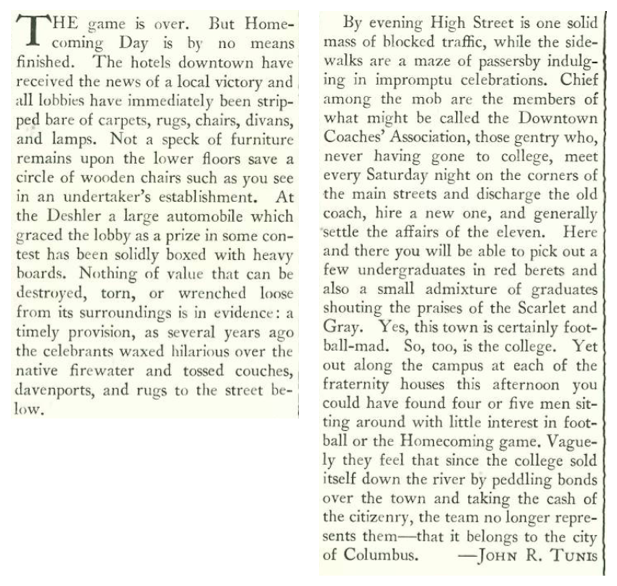
And so, in a city with one of the most storied teams in Major League Baseball, The New Yorker continued to ignore that sport as it gushed over college football, John Tunis even going the extra mile to check out homecoming at Ohio State.

HOMECOMING ROYALTY…THE Ohio State football team went 6-3 in 1931, but they blanked Navy 20-0 in their homecoming game. (elevenwarriors.com)

*  *  *

Boxing Brainiac

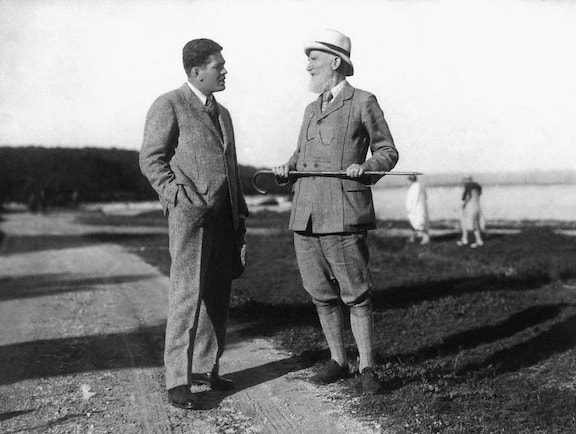
Several times before in this blog we have encountered boxing great Gene Tunney and his taste for the literary life. E.B. White gave us the latest on the Champ in “The Talk of the Town”…

THE FINER THINGS…Heavyweight Boxing Champion Gene Tunney, left, discusses things that don’t involve hitting people with writer George Bernard Shaw during a 1929 vacation to Brioni. (Associated Press)

 *  *  *

From Our Advertisers

It’s the Depression, Prohibition is still in force (kind of), so what’s a body to do to blow off some steam? Well, you could take up smoking, every waking moment, at least when it came to this guy…

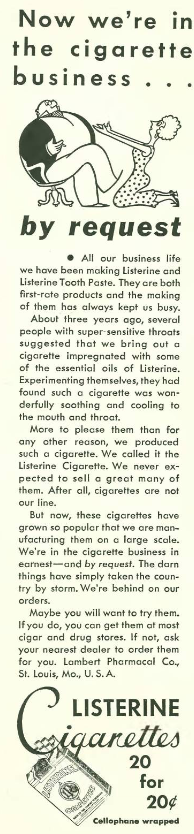
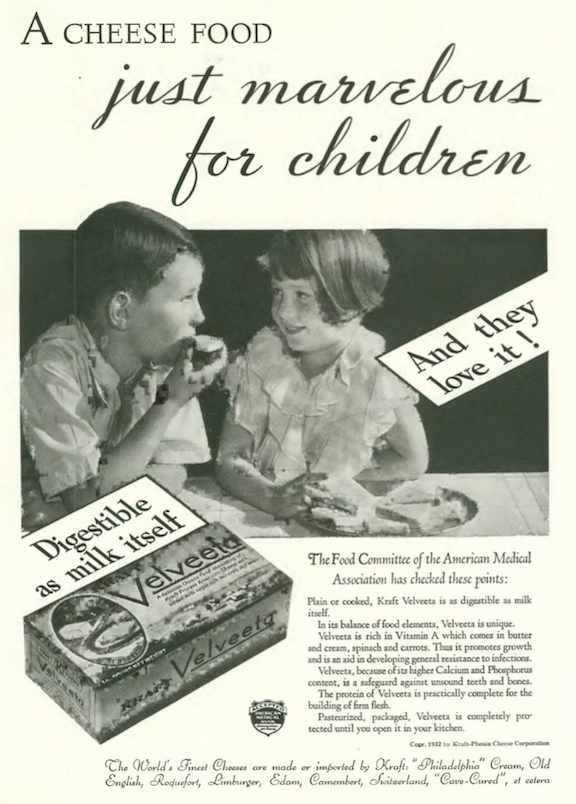
…and these were the days when tobacco companies offered competing claims about the health benefits of their cigarettes (weight loss, calmer nerves etc.). So the folks at Listerine, who were all about keeping you safe from nasty mouth germs, launched a cigarette of their own, which was “taking the country by storm,” at least in their estimation…

…and I throw this in to give you an idea of how far cigarette companies would go, and how folks would respond in the early 1930s…at left is a 1932 advertisement from the back cover of Popular Mechanics, telling us that “Everybody” is deeply inhaling their product…of course people became addicted, including this young woman (right) featured in a 1931 Popular Science news item who managed to smoke and read a book while reducing her figure…

…back to the ads from the Nov. 7 issue, here is one that offered a “scientific” way to remove nicotine from cigarettes, allowing only “pure tobacco” to enter your pink lungs…

…and now a couple of lovely color ads for Houbigant cosmetics…

…and our friends at Alcoa, diligently working to convince Americans that aluminum furniture was the modern way to keep your house “in step” with the times…

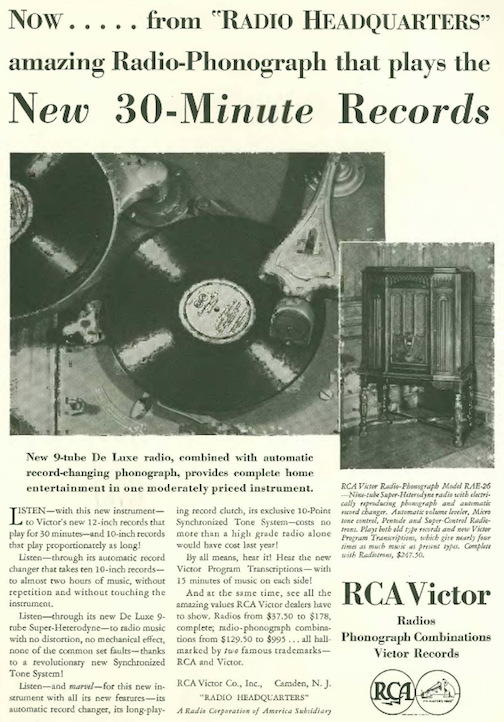
…and finally, RCA Victor was offering an early version of the LP record, so you wouldn’t have to stop necking to turn the damn record…

…on to our cartoons, we begin with Gardner Rea

…John Reehill gave us a lover who probably watched too many romance movies…

…contrasting with this fellow illustrated by Carl Rose, who doesn’t lift a finger to find some romance…

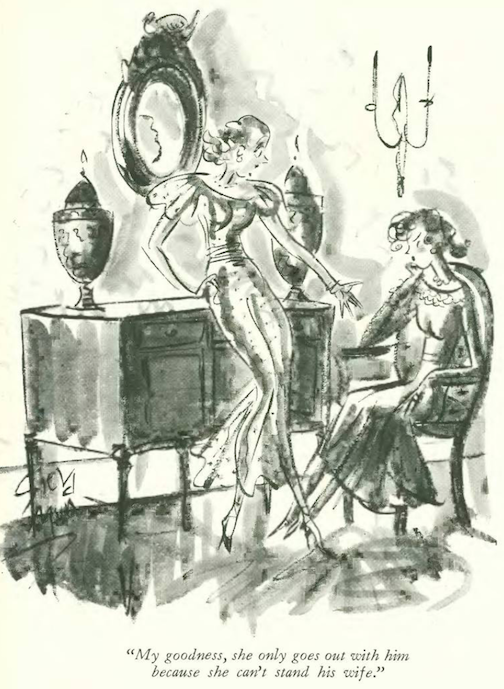
…and while we are on the subject of love, here is a modern twist offered by Barbara Shermund

William Crawford Galbraith gave us a far more detached view of the game of love…

…while Helen Hokinson found an attraction of a different sort with one of her “girls”…

Alan Dunn looked in on the baking business, industrial-sized…

…and we end with Richard Decker, and the price of war…
Next Time: All That Glitters Is Not Gold…

The Wayward Press

Robert Benchley is remembered today as an American humorist, and his funny side was on display in his New Yorker theater reviews and other contributions. It was his background as a journalist, however, that shown through in his column “The Wayward Press.”

Oct. 10, 1931 cover by Theodore Haupt.

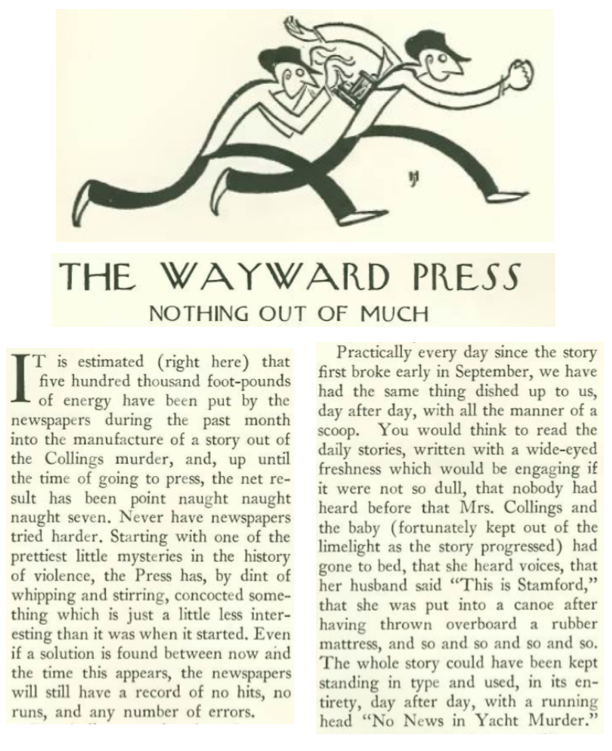
Benchley’s more serious side as a reporter (though still sprinkled with wit) demonstrated his ability to expose the conspiratorial nature of the 1930s press — which seemed to be in bed with moneyed interests — and decry its insatiable appetite for sensationalism. His October 10 column took aim at the coverage of the death of banking heir Benjamin Collings, who was murdered on Long Island Sound while aboard his yacht, Penguin. The investigation went on for weeks with scant developments, but that didn’t stop the newspapers from trying to squeeze every ounce of blood from this turnip.

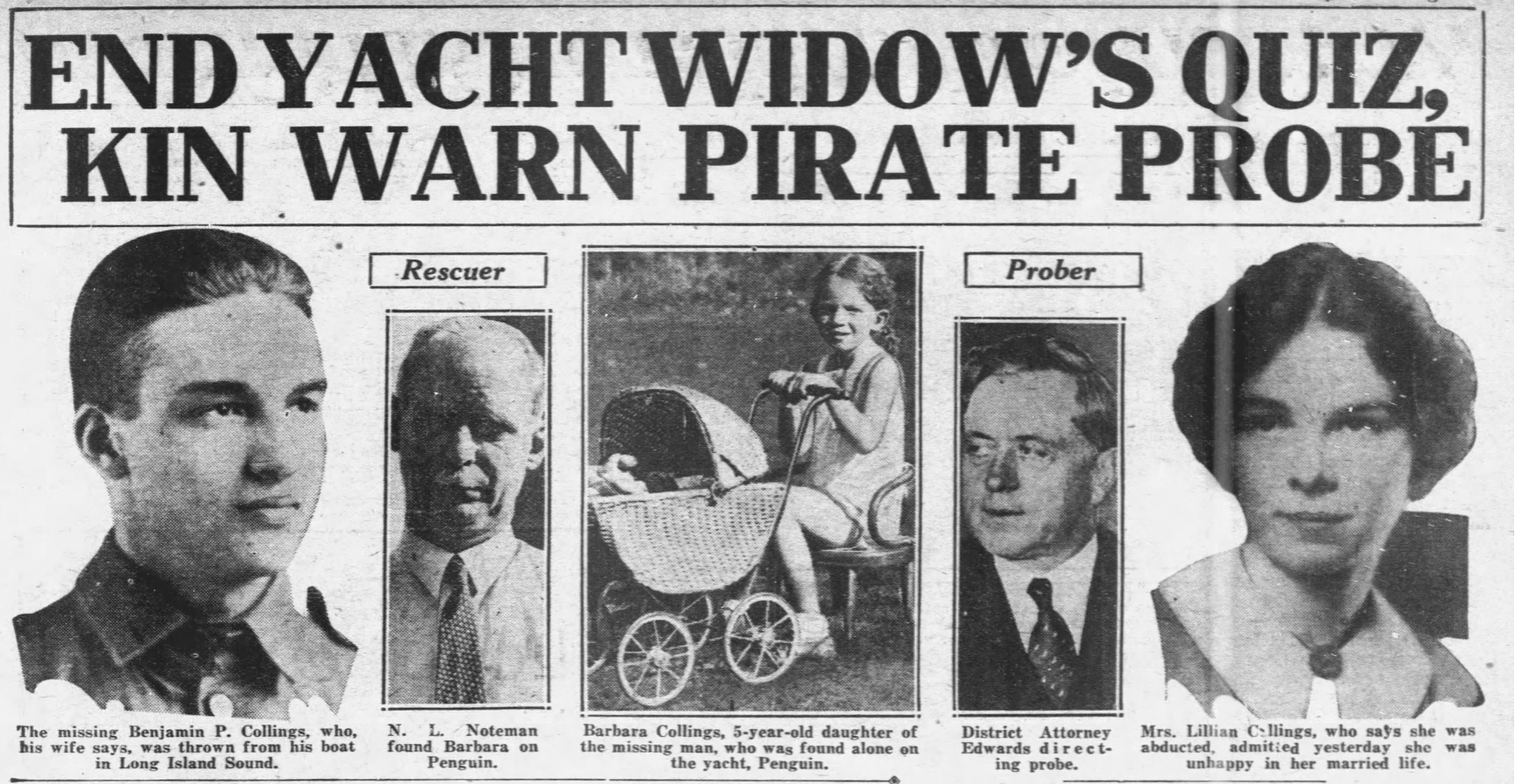
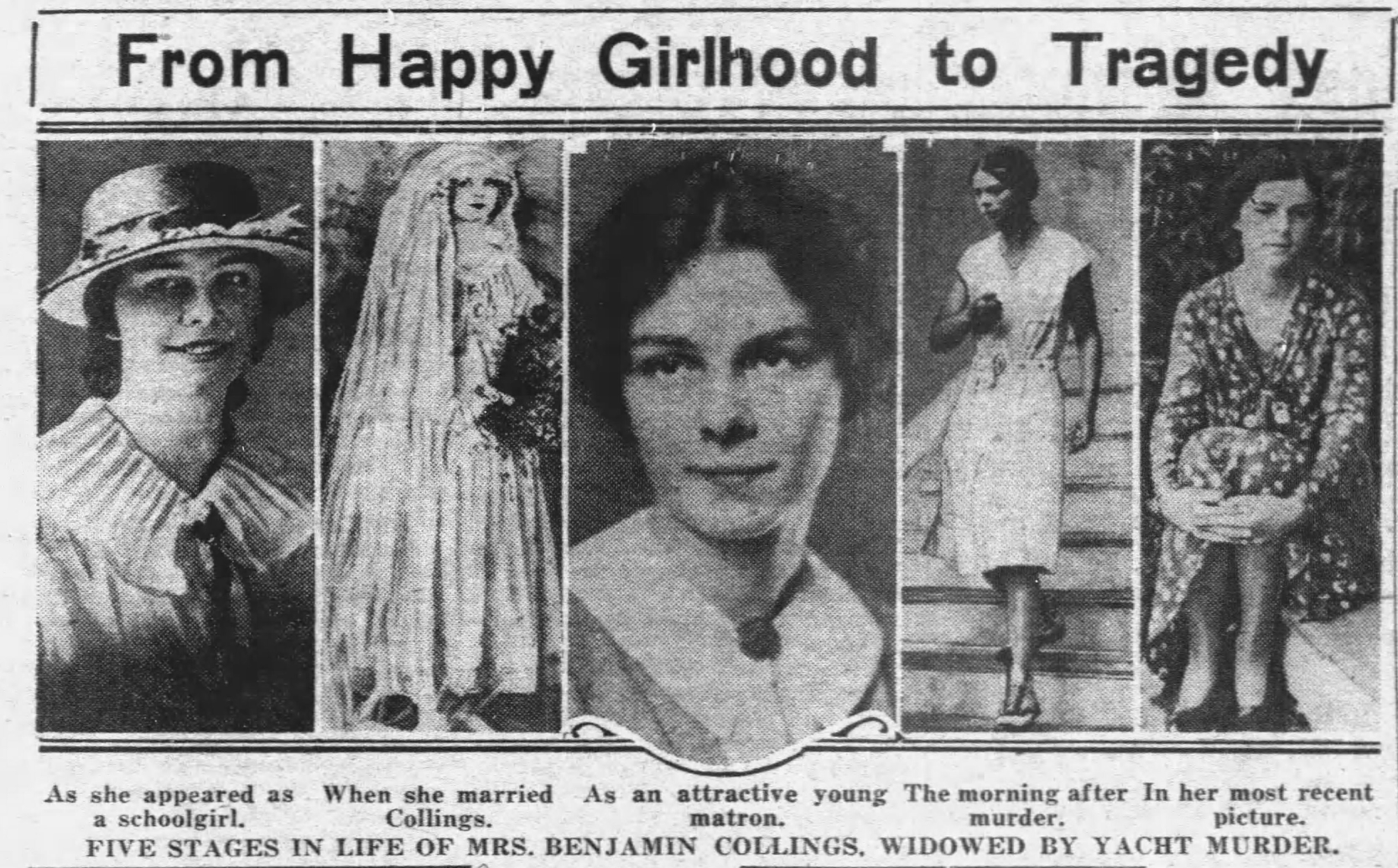
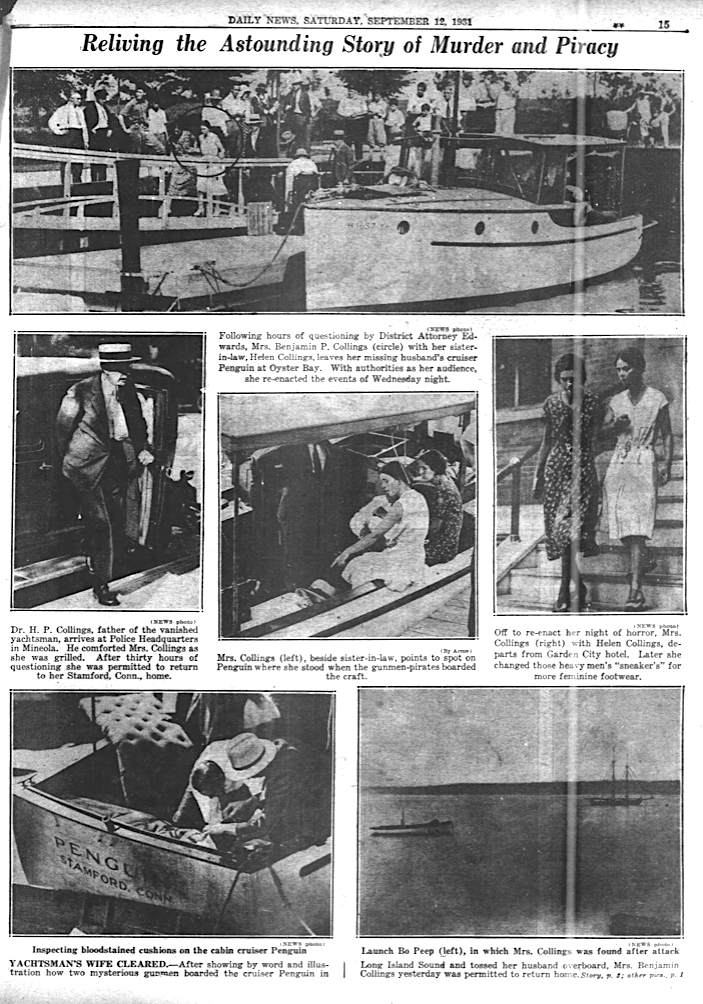
The New York Daily News milked the incident for all its worth, the heading of this first article featuring photos of the slain Benjamin Collings (far left), his widow (and briefly a suspect) Lillian Collings, as well as an image of their five-year-old daughter, Barbara. According to Lillian, all three were sleeping aboard the family yacht Penguin when two men paddled a canoe up to their boat. When Ben went on deck to confront the pair, these “pirates” (as she called them) seized control of the boat, and threw Ben overboard. According to Lillian, the men forced her into the canoe, then cut the Penguin’s anchor and set it adrift with little Barbara still on board. While the girl was quickly rescued by another yachtsman, the “pirates” deposited Lillian in a moored motorboat on Oyster Bay before disappearing into the night. The Suffolk County DA found Lillian’s account unbelievable, and newspapers subsequently described her story as bizarre and illogical. The Daily News headline below indicates Lillian’s family wanted her interrogation to end…

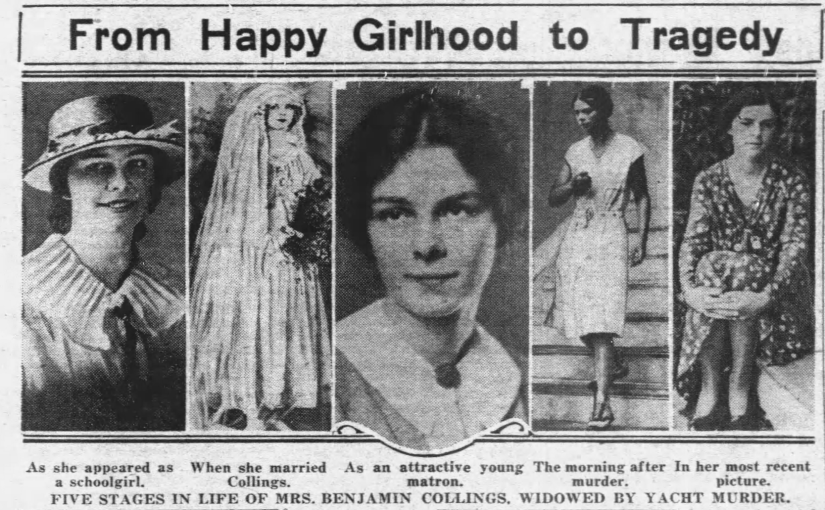
…lacking any other details, the Daily News nevertheless kept the story alive with features such as this one below that described Five Stages in Life of Mrs. Benjamin Collings, Widowed by Yacht Murder

…and in case readers still wanted more, the paper rehashed the whole thing in photos in its Sept. 12 edition…

A few days after the yacht incident the body of Ben Collings washed up on the North Shore, his hands bound and his skull bashed in. The Suffolk County DA then began hauling in pairs of suspects who somewhat matched Lillian’s description—a 50-year-old man with gray hair and a skinny teenager—but none were quite right. The crime has never been solved.

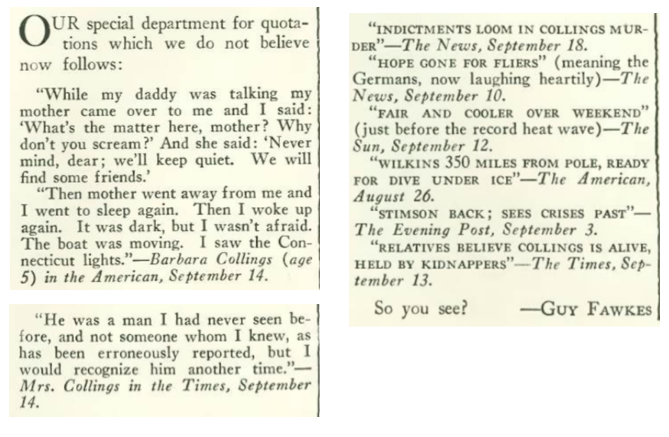
Benchley concluded his column with some quotations which he “did not believe”…

 *  *  *

And Now For Something Ironic…

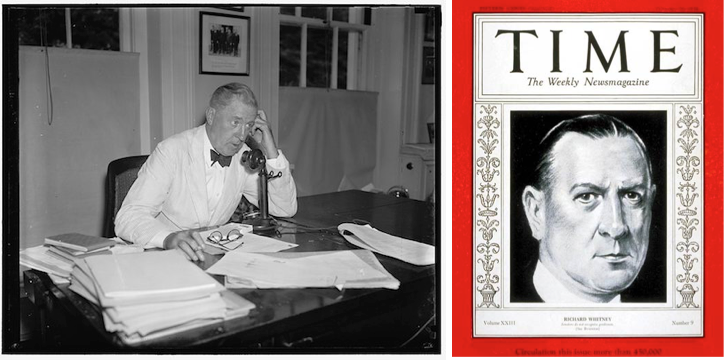
In his “Notes and Comment,” E.B. White teased New York Stock Exchange President Richard Whitney for blaming the market crash on “human vanity and selfishness,” when it was indeed those qualities that drove the markets in the first place. Before the decade was out Whitney would succumb to the very vices he named, and would serve three years and four months at Sing Sing for embezzlement.

HE DID TIME, THEN HE DID SOME MORE TIME…Richard Whitney made the cover of the Feb. 26, 1934 issue of Time magazine for his work as president of the New York Stock Exchange. At left, Whitney in 1937. He was sentenced to five to ten years for embezzlement, but was released early from Sing Sing for good behavior. He went on to a simpler life, managing a dairy farm and then a textile company before his death in 1974 at age 86. (Wikipedia/Time)

 *  *  *

The What Goes Up Department

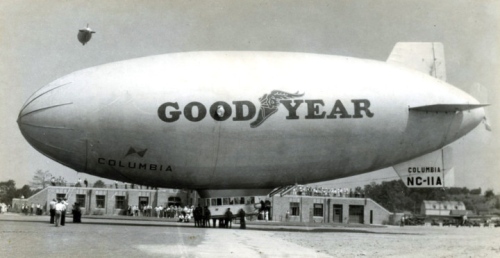
E.B. White also commented on the latest edition of the Goodyear Blimp, christened Columbia, which he spotted hanging around the Empire State Building. Note E.B. White’s last line

Columbia was flying around the Empire State Building because Goodyear was running a sightseeing service in which passengers paid $3 for a 15-minute flight around Manhattan. The blimp also performed publicity stunts such as delivering newspapers to a man standing on the Empire State’s mooring mast—that particular stunt was supposedly a test to see if airships could anchor on the mast for passenger loading and unloading (and as we know, they couldn’t and wouldn’t).

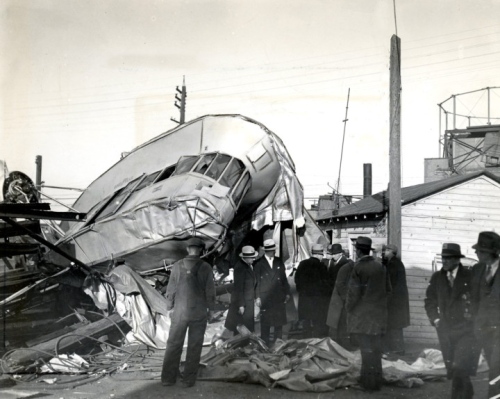
Just four months after White watched Columbia hover over Manhattan, the airship would indeed bust into a thousand pieces, meeting its demise near the Queens airport (today’s LaGuardia). Caught in unexpected high winds, Columbia dipped into the ground, tearing off its landing gear and bending its propellers. The ground crew tried to secure the blimp but an updraft ripped the airship from their hands and sent it sailing over Flushing Bay.

As Columbia once again drifted back over land, the 23-year pilot Prescott Dixon ordered his chief mechanic, John Blair, to pull a rip cord that would release most of the air from the blimp. As Blair reached from the cabin for the cord the blimp shifted, and Blair fell to his death. Columbia then knocked two men off a warehouse roof (injuring them), then struck a factory and some power lines before crashing along the tracks of the Long Island Railroad. Dixon survived after being extricated from the crumpled gondola.

CHRISTENED WITH A BOTTLE OF LIQUID AIR, the Goodyear Blimp Columbia was readied for its inaugural flight over Akron, Ohio, in July 1931.
A SHORT LIFE…Just seven months after its inaugural flight, Columbia crashed near Flushing Bay on Feb. 12, 1932. (kathrynsreport.com)

 *  *  *

When Bridges Were Crowd-Pleasers

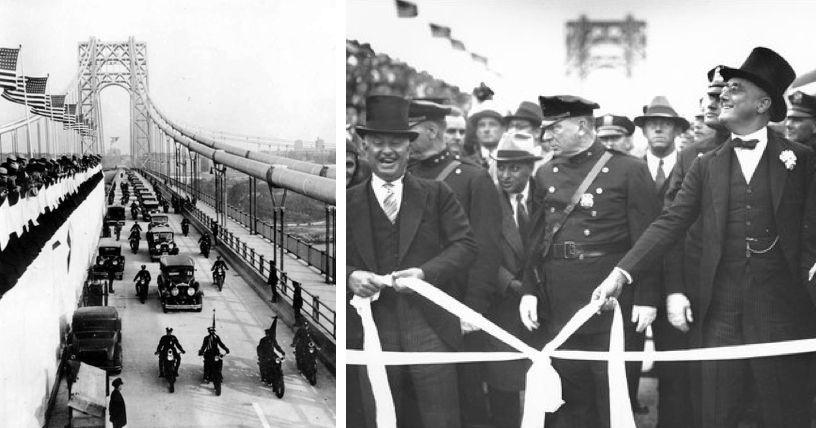
“The Talk of the Town” announced the imminent opening of the Jeffreys Hook Bridge, to be known thence as the George Washington Bridge:

BREAK OUT YOUR TOP HAT…New Yorkers turned out in droves to mark the official opening of the George Washington Bridge on Oct. 24, 1931. Gov. Morgan F. Larson of New Jersey, left, and Gov. Franklin D. Roosevelt of New York, right, did the ribbon honors at the dedication. (New Haven Register/AP)

 *  *  *

They Couldn’t Say ‘Hooters’ Either

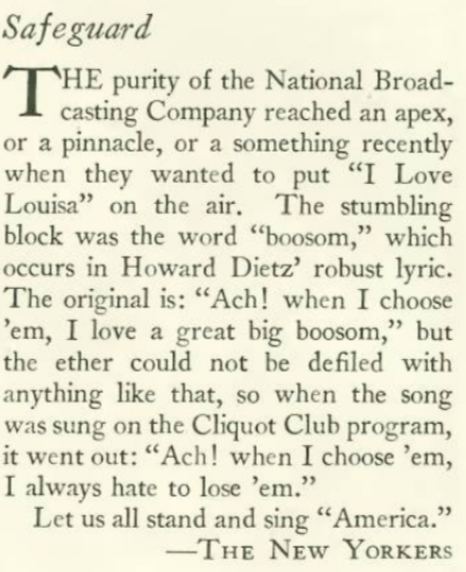
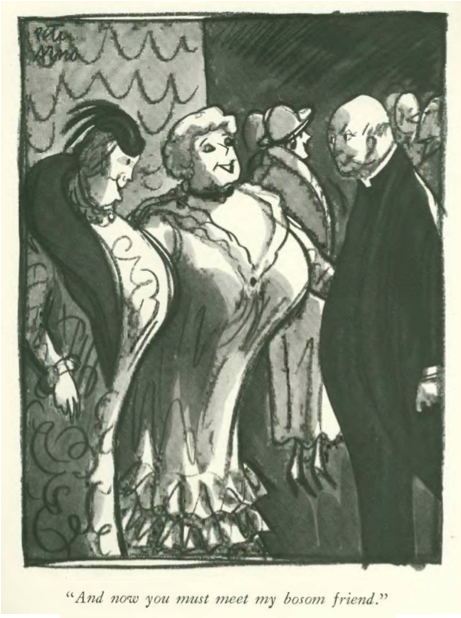
In these coarser times it is hard to believe that 89 years ago the word “bosom” was a “no-no” on the nation’s airwaves, per this “Talk” item…

 *  *  *

An Actor’s Actor

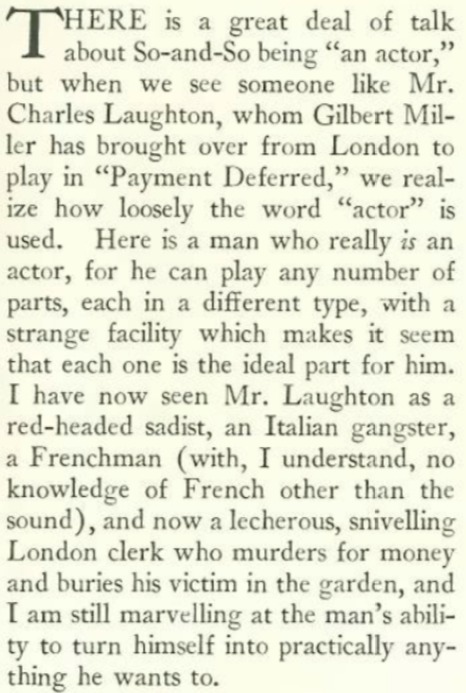
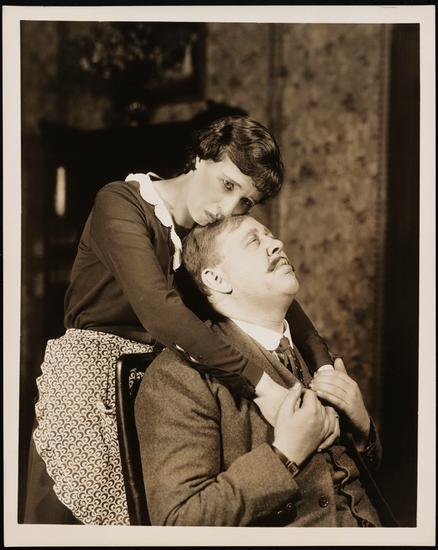
Theater critic Robert Benchley wasn’t the only one who noticed the talents of newcomer Charles Laughton in his New York stage debut — Hollywood would immediately come calling for the 32-year-old English actor:

WE’LL KEEP HIM…Cicely Oates as Annie Marble and Charles Laughton as William Marble in the 1931 play Payment Deferred. (Museum of the City of New York)

 *  *  *

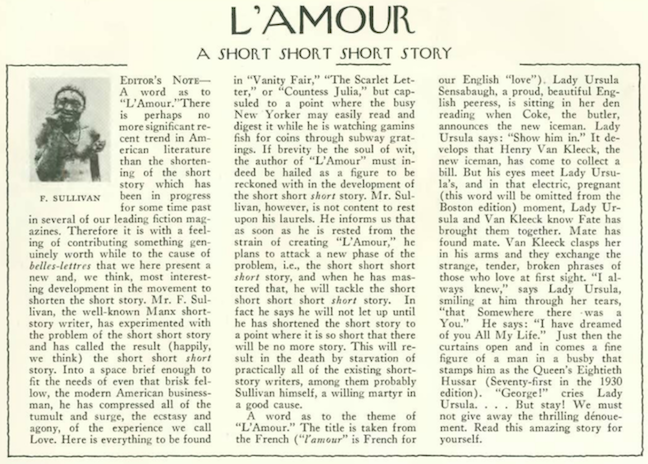
Kinda Long For Being Short

Humorist Frank Sullivan claimed to be following the trend for shorter short stories by turning in this piece with an editor’s note longer than the story itself:

 *  *  *

Lurid Lit

Our dear Dorothy Parker is back with another of her entertaining book columns, and in this installment we have her taking on the world of literary and not-so-literary sex romps. Excerpts:

DIRTY LITTLE BOOKS?…The three books featured in Dorothy Parker’s column included, from left, Young and Healthy by Donald Henderson Clarke (issued here under a different title in a pulp 1948 Novel Library edition); Theodore Wilde’s Moonblind, which featured a hermaphrodite character and homosexual encounters; and although attributed to Anonymous, Lady Chatterley’s Husbands was actually written by Anthony Gudaitis, aka Anton Gud, who often wrote anonymously for erotica publisher Samuel Roth. Although it was publicized as a sequel to D.H. Lawrence’s Lady Chatterley’s Lover, Gud’s book actually had less sex than the Lawrence original. After all, in the sequel Lady Chatterley gets tired of horny old Mellors. (Goodreads/Amazon)

…and before we leave Dorothy, please note her last line in the review, where she quotes Carl Rose’s famed 1928 cartoon (with caption by E.B. White)…

 *  *  *

From Our Advertisers

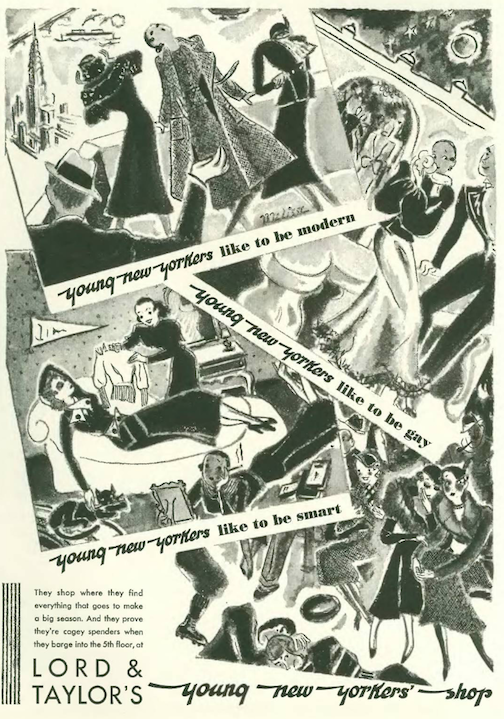
Just a couple quick ones (I will have more in the next installment)…this Lord & Taylor ad (illustrated by Mildred Oppenheim Melisse) showed young New Yorkers how to look smart for the fall (Lord & Taylor, the oldest department store in the United States (founded 1826), recently closed all 38 of its stores due to the pandemic, and it was announced in August that Lord & Taylor would be liquidated. Apparently its name will continue as an online-only business…

…and Helen Hokinson offered this illustration of one of her “girls” shilling for Frigidaire refrigerators…

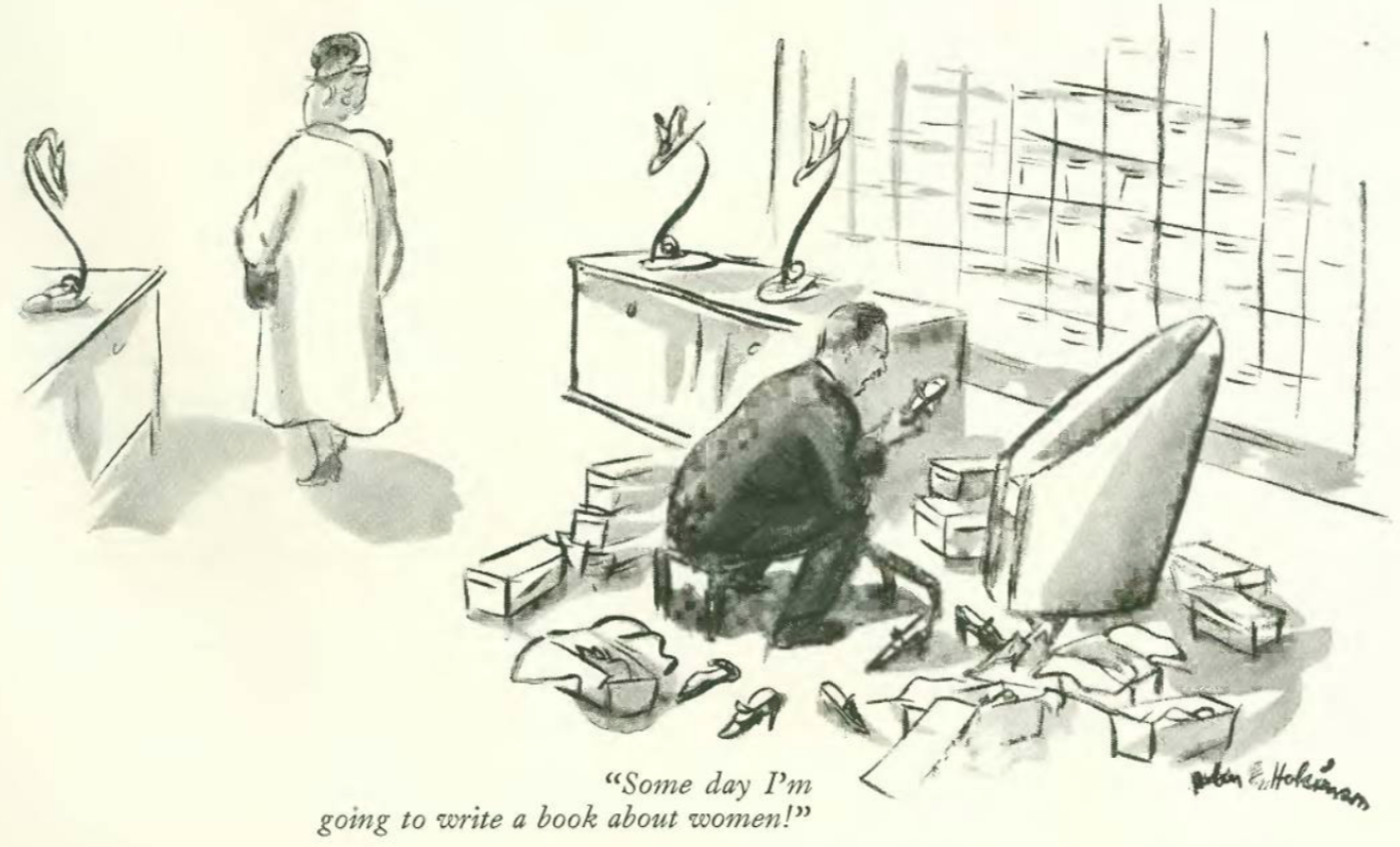
…and two more from Helen in the Oct. 10 cartoons…

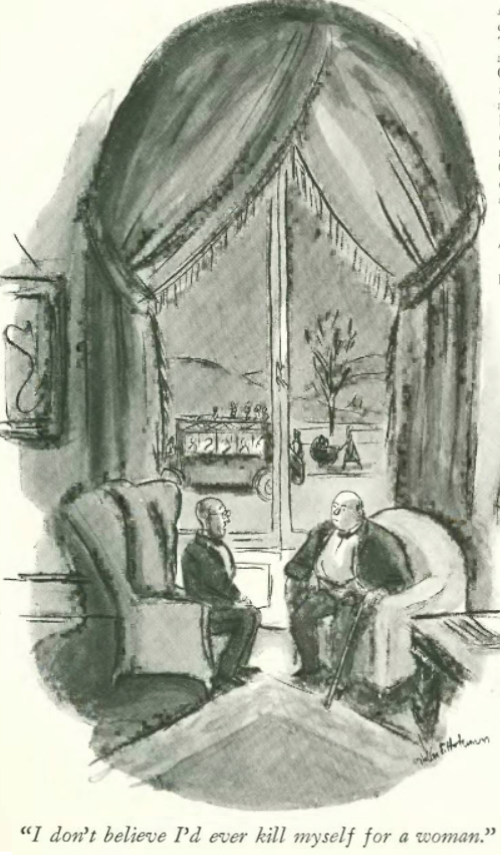
…exploring men’s attitudes toward the opposite sex…

Garrett Price visited a seemingly unappetizing banquet…

Kemp Starrett gave us a man looking at life on the bright side…

William Steig explored home decor…
Barbara Shermund found some bedtime gossip…
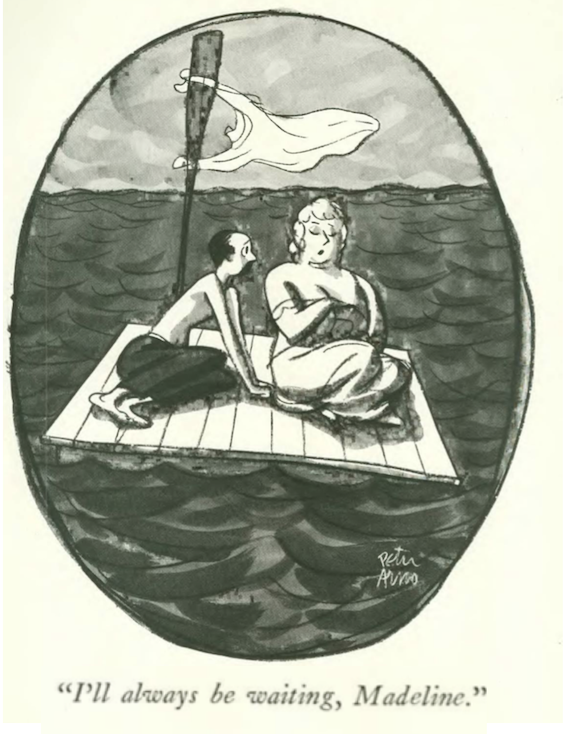
…and recalling our earlier “Talk” item regarding bosoms, here’s Peter Arno

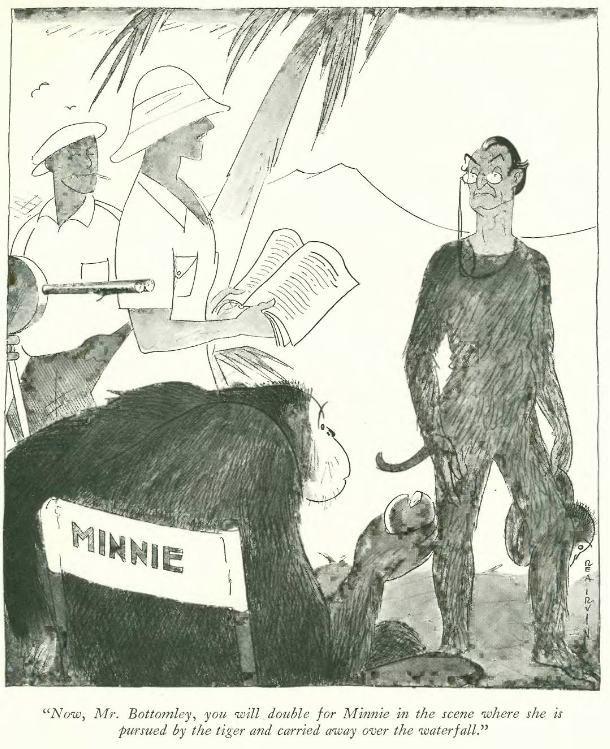
Next Time: Monkey Business…


From Stage to Screen

There’s good reason why one of Broadway’s finest theatres is named after Alfred Lunt and Lynn Fontanne; no couple has lit up the stage quite like this husband-wife team.

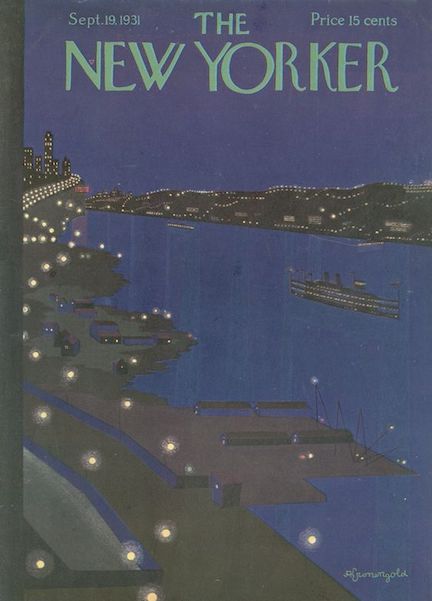
Sept. 19, 1931 cover by Adolph K. Kronengold.

Some say Richard Burton and Elizabeth Taylor were modern successors, but they only appeared together on Broadway once (a 1983 revival of Noël Coward’s Private Lives, at the Lunt-Fontanne Theatre of all places), and they shared a tempestuous, on-and-off relationship that sharply contrasted with Lunt and Fontanne, who were inseparable both on and off the stage during their 55-year marriage. And unlike Burton and Taylor, Lunt and Fontanne appeared in just a handful of films, including a 1931 adaptation of their 1924 Broadway play, The Guardsman. John Mosher filed this review:

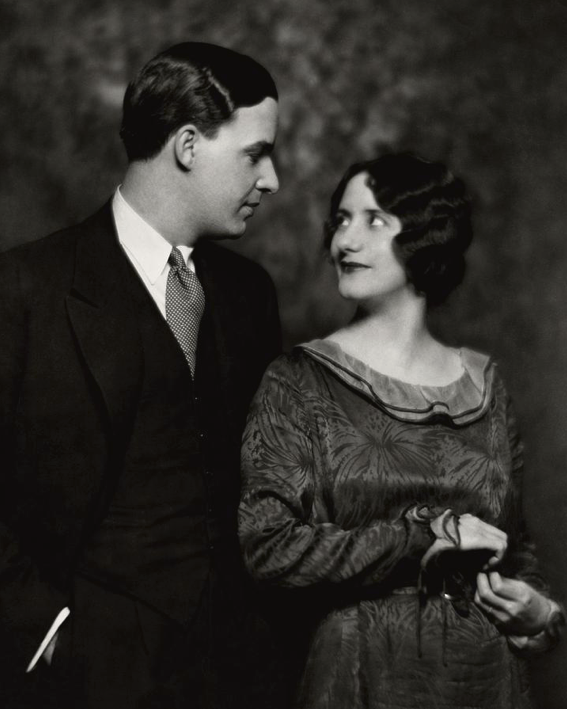
INSEPARABLE…Alfred Lunt and Lynn Fontanne pose for photographer Nickolas Muray in this 1924 portrait for Vanity Fair magazine. They married in 1922, and were inseparable until Lunt’s passing in 1977. (Conde Nast)
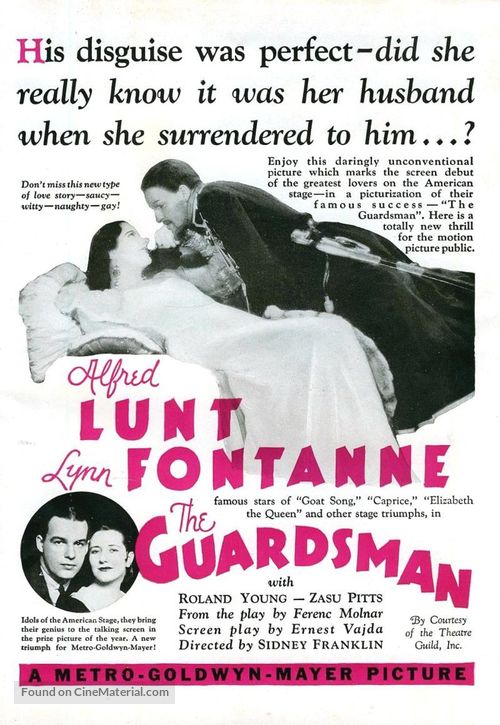
NAUGHTY, NAUGHTY!…These were Pre-Code times, so MGM played up the film’s “saucy” and “unconventional” themes. (IMDB)
I’VE GROWN ACCUSTOMED TO YOUR FACE…Although Lunt and Fontanne appeared together numerous times on Broadway, the 1931 film adaptation of their 1924 stage play, The Guardsman, would be their only film appearance together. (Museum of the City of New York/IMDB)
STAGE TO SCREEN…at top, Lunt and Fontanne in 1924’s The Guardsman on Broadway; below, a scene from the 1931 film adaptation featuring, from left, Alfred Lunt, Lynn Fontanne, Maude Eburne and Zasu Pitts; at right, Fontanne reviews fashions for the film designed by Adrian Adolph Greenburg. Lunt and Fontanne would be nominated for Academy Awards as Best Actor in a Leading Role and Best Actress in a Leading Role, respectively. (Museum of the City of New York/IMDB)

 *  *  *

One Giant Leap

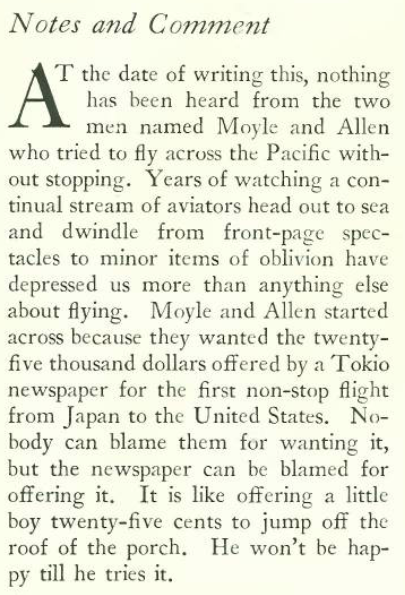
Charles Lindbergh crossed the Atlantic without stopping in 1927, but it would take four more years before anyone could accomplish the same feat across the Pacific. Don Moyle and Cecil Allen took up the challenge, hoping to fly their plane, Clasina Madge, 4,400 miles from Japan to Seattle to win a $25,000 prize from a Japanese newspaper. The lads took off from Tokyo in early September, but then went missing. E.B. White wrote:

As it turned out, Moyle and Allen were caught in a storm between Japan and Alaska that forced them to land on a small, uninhabited island in the Aleutian chain. Stranded for more than a week, the flyboys were finally able to make contact through a U.S. Coast Guard patrol and report they were safe.

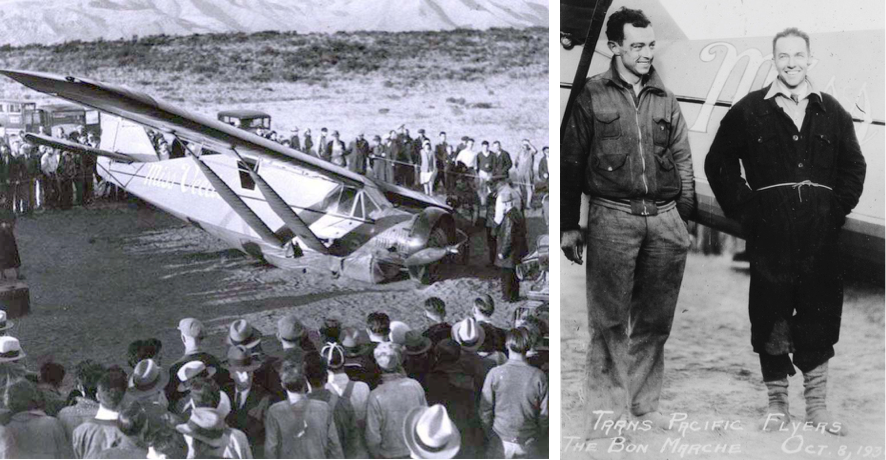
THESE ARE MY BOYS…at left, Cecil Allen and Don Moyle standing with financial backer John Buffelin and Buffelin’s daughter, Clasina Madge, the namesake for their hopefully record-setting airplane; At right, Moyle and Allen with a Japanese official, possibly before one of their attempts, or perhaps they are looking at their consolation prize (see below). (University of Washington)

Moyle and Allen sent word that they would return to Washington and prepare for another attempt. They flew back home by way of Nome, Alaska, where they landed on Sept. 21, 1931. Five days later they reached Fairbanks, and after weather delays finally made it to Tacoma, Washington, on Oct. 6. There they learned that Clyde Pangborn and Hugh Herndon Jr. had already won the $25,000 prize, having arrived from Japan the day before. The Tokyo newspaper did, however, give Moyle and Allen $2,500 for their efforts.

SPOILERS…at left, Hugh Herndon, Jr. and Clyde Pangborn pose next to their crash-landed plane in the hills of East Wenatchee, Washington, after becoming the first to fly non-stop across the northern Pacific Ocean. The 41-hour flight from Japan won them the 1931 Harmon Trophy and $25,000 from a Japanese newspaper. The crash-landing of their plane was deliberate — before the flight it was modified to carry 930 gallons of fuel. They had jettisoned the landing gear after takeoff to save fuel. (historylink.org/imagesofoldhawaii.com)

 *  *  *

Thurber Gets Serious

We know James Thurber as a humorist, both for his writings and his cartoons. In the Sept. 19 issue, however, Thurber offered this touching remembrance of a subway newsstand proprietor, who he later learns is killed in the crossfire of a robbery. Here are the opening passages:


 *  *  *

Did You Miss Me?

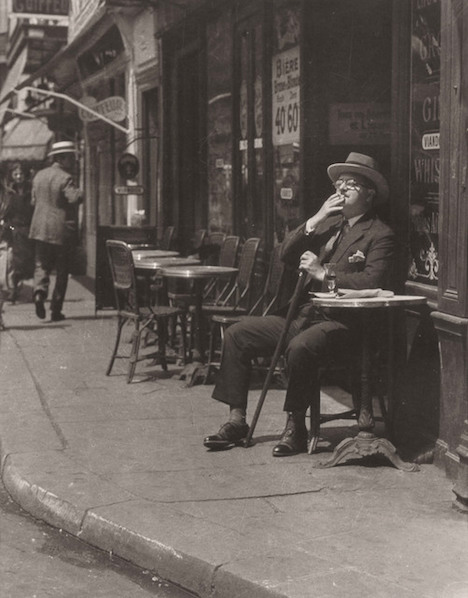
After a long absence (in Europe, presumably),  returned to his “Shouts and Murmurs,” column, offering this “Triple Warning” that included his observations of H.G. Wells, who wondered if all his musings for the future would fall to swarms of lowly insects…

WORK CAN WAIT…Alexander Woollcott relaxes in front of a Paris bar, late 1920s. Photo by James Abbe. (artsy.net)

 *  *  *

From Our Advertisers

With the arrival of fall come new fashions…these “wearables” below are suggested by B. Altman as suitable attire for attending a football game…

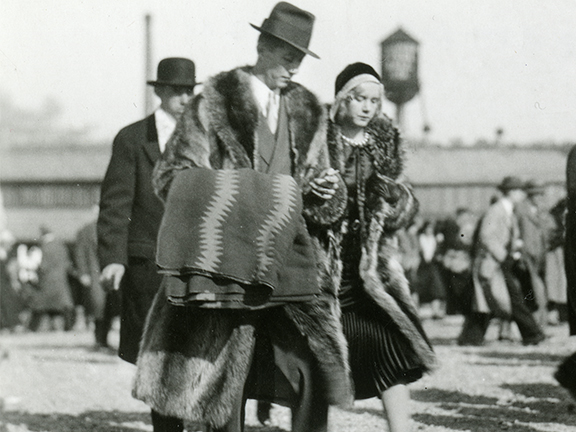
…smart fashions for young people weren’t confined to New York…this is how students at the University of Michigan dressed for a 1930 homecoming game against Illinois…

…well, times have changed, but folks still wear fur of a sort…

Jan 1, 201USA TODAY Sports

…wearing a real fur these days will draw the ire of animal rights advocates almost everywhere, but in 1931 few had problems with turning leopards and seals into coats for fashionable young women…

…then as now, folks enjoyed their pork sausage…the Jones Family of Wisconsin apparently saw a market for their products among New Yorker readers…

…after 131 years in business, the Jones Family and their sausages are still going strong…as is their farmhouse logo (the old farmhouse is real and still stands)…

…another back pages ad promoted Helen Hokinson’s first cartoon collection, So You’re Going to Buy a Book!

…the collection including Hokinson’s beloved dowagers, but it also featured this gem…

(attemptedbloggery.blogspot.com)

…on to our cartoons from the Sept. 19 issue, we begin with William Steig and a couple of would-be renters…

E. McNerney explored the trials of teenage life…

Leonard Dove drew a crowd in a packed subway car…

Otto Soglow displayed the playful side of his Little King…

…and Rea Irvin found an actor upstaged by an unlikely rival…

Next Time: Big Fish, Little Fish…

Bonfire of the Vanities

When Earl Carroll’s Vanities hit the Broadway revue scene in 1923, it faced strong competition from George White’s Scandals and the long-running Ziegfeld Follies. Carroll’s answer: More of everything.

Sept. 5, 1931 cover by Theodore Haupt.

That included more nudity than the other revues. Critics, including the New Yorker’s Robert Benchley, found the nudity gratuitous, a titillating distraction from what was otherwise a mess of a show. It also landed Carroll in court from time to time on charges of public indecency. All of this, of course, was just more publicity to drive audiences to his theatre at 753 Seventh Avenue, which he built in 1922 and then partially tore down just nine years later to replace it with an even grander venue. This is where Benchley found himself on the evening of August 27 — at the grand opening of the Earl Carroll Theatre and the 1931 edition of the Vanities. Benchley found nothing grand about it:

AUTOGRAPHS, ANYONE?…Accompanied by his Vanities showgirls, Earl Carroll leaves the Essex Market Police Court on July 20,1930, after appearing to answer charges of public indecency. Police raided a Vanities matinee on July 9, arresting eleven including famed burlesque dancer Faith Bacon, who performed in nothing but fans made of ostrich feathers. No doubt police were tipped off by critics who called the 1930 edition the “nudest” cast in American theatre history. From the looks on their faces, it seems even the police enjoyed the spectacle. (Worthpoint)
IS THERE A PROBLEM, OFFICER?…Faith Bacon in a less-revealing pose with the ostrich-feather fans that brought the police ‘a calling. (fanpix.net)

Carroll’s ambitions were always big, whether it was the size or lavishness of his stage shows or the Art Deco theatre (designed by George W. Keister) he erected in 1931 in answer to Flo Ziegfeld’s 1927 Joseph Urban-designed theatre on Sixth Avenue. With 3,000 seats, Carroll’s theatre was nearly twice the size of Ziegfeld’s.

THEY DON’T COME FOR THE SCRIPTWRITING…Earl Carroll made it clear what audiences could expect in his 1931 Art Deco-style theatre, which featured black velvet-covered walls relieved with gold and silver-colored highlights. Its 3,000 seats made it one of the largest theatres in the world. Clockwise, from top left, portrait of Carroll (a gift from the 1930 Vanities showgirls) flanked by busts of Vanities girls Doris Andrese and Beryl Wallace in the theatre lobby; sign above theatre entrance; a two-page spread from the theatre’s “Beauty Souvenir” booklet; cover of the booklet, featuring singer Lillian Roth. (New York Historical Society).
DECO DRAMA…Clockwise, from top left, Earl Carroll circa 1925; ceiling detail inside the Earl Carroll Theatre; mezzanine lounge; the stage. (New York Historical Society).

The show itself left Benchley baffled, a mishmash of lights, colors, and effects including a drooling dinosaur that dropped a naked woman on stage for a dance number…

LAUNCH SITE….The Vanities stage helped launch the careers of many entertainers. Clockwise, from top left, undated photo of a Vanities production — some shows would feature more than 100 women on stage at one time; singer Lillian Roth was a star attraction; Vanities alumni included William Demarest (Uncle Charlie!), Jack Benny and Vincente Minnelli. (assumption.edu/flickr.com/classicmoviehub.com/amazon.com/sensesofcinema.com)

This wasn’t last word from The New Yorker on the new theatre; the Sept. 12 issue featured these observations by Creighton Peet:

In the end, Carroll’s ambitions were too big for the deepening Depression, and just six months after his theatre’s opening he would lose it to creditors. The property would be snapped up by rival Florenz Ziegfeld and renamed the Casino, but the Ziegfeld connection would be short-lived; Ziegfeld would die a few months later in July 1932. Later that year another rival, George White, would take over the venue to stage his Music Hall Varieties, which ended in 1933 with middling results. The theatre would go through several more tenants—including Billy Rose—until 1940 when the discount “dime store” Woolworth’s would move in, demolishing the lobby and walling off the remaining ceiling and walls. Woolworth’s would close the location in the late 1980s—the store, and the last remnants of the Earl Carroll Theatre, would be demolished in 1990.

CLOSING NUMBER…At left, a sneak peek behind the false walls of Woolworth’s in 1988 shows a detail of the theatre’s proscenium, ceiling and sidewall. At right, top to bottom, the second Earl Carroll Theatre at 7th Avenue & 50th Street; the Woolworth’s store that replaced it, circa 1980; the site today. (Large image from the book Lost Broadway Theatres, via drivingfordeco.com/Google Maps)

*  *  *

From Our Advertisers

Fall is upon us, and so the social season begins, according to the Hotel St. Regis…
…and what better way to prepare for the season than to acquire a new mink coat…

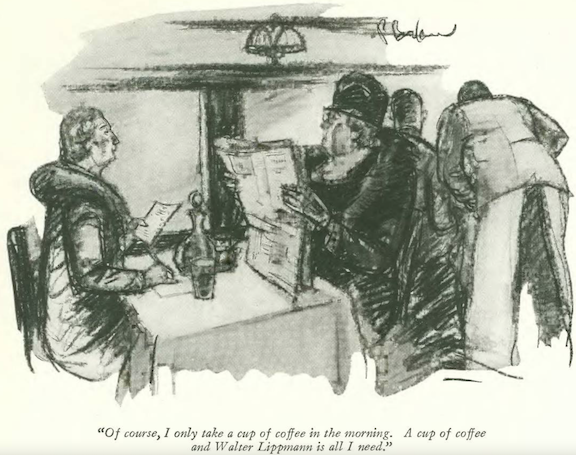
…maybe politics and world affairs were more your bag, in which case you probably wanted to get a subscription to the Herald Tribune and read the latest from commentator Walter Lippmann

…the makers of Marlboro cigarettes, an upstart brand that initially targeted women, continued with their prize contests, but now they began courting men as well…

…on the other hand, the more established brand Chesterfield had the resources to run a color back-cover ad with endorsements from the brother-sister dance team Fred and Adele Astaire

…Fleishmann’s continued to run their full-page ads touting the wonders of daily yeast consumption (“Eat three cakes a day”). The ads were there because Raoul Fleishmann used his wealth from the family baking business to keep the New Yorker afloat during its fledgling years…

…Farrar and Rinehart announced the arrival of Otto Soglow’s first book, Pretty Pictures

…here is the cover of the book…

…and we move on to the cartoons with the character that would make Soglow rich and famous…The Little King

…although Fleischmann likely saved The New Yorker with large infusions of cash, its cartoonists, including Gardner Rea, still took an occasional poke at the company’s health claims…

…anticipating his “Small Fry” cartoons, William Steig finds two of them examining the wonders of human physiology…

Rea Irvin looked in on some stuffy Western Union censors…

…newcomer Robert Day illustrated the challenges of a doorman (Day would be a longtime contributor)…

Garrett Price found humor abuzz between the bold and the meek…

Alan Dunn tracked down a clueless hunter…

…and we end with Leonard Dove, who takes flight and anticipates our next installment…

Next Time: A Big Bird…