The Coming War

While many Americans partied through the Roaring Twenties, there were a few voices out there, barely audible, that warned of economic collapse and another world war.

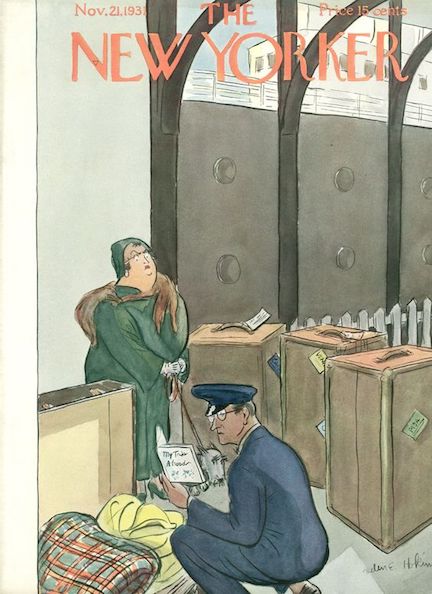
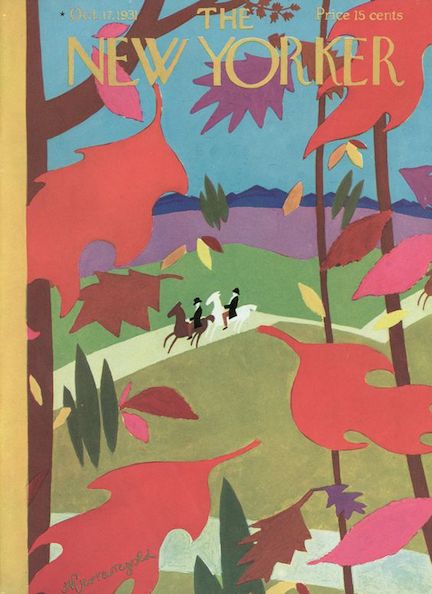
Oct. 3, 1931 cover by Helen Hokinson.

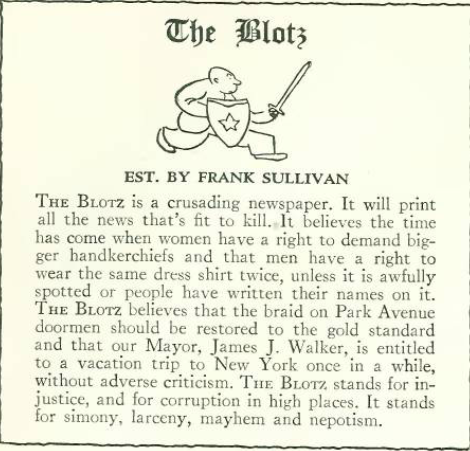
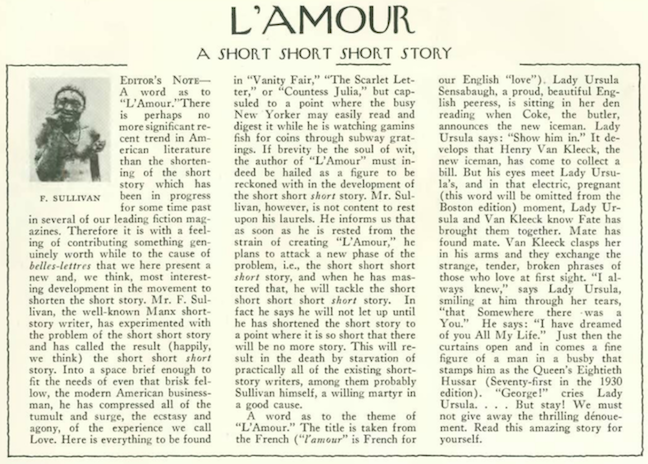
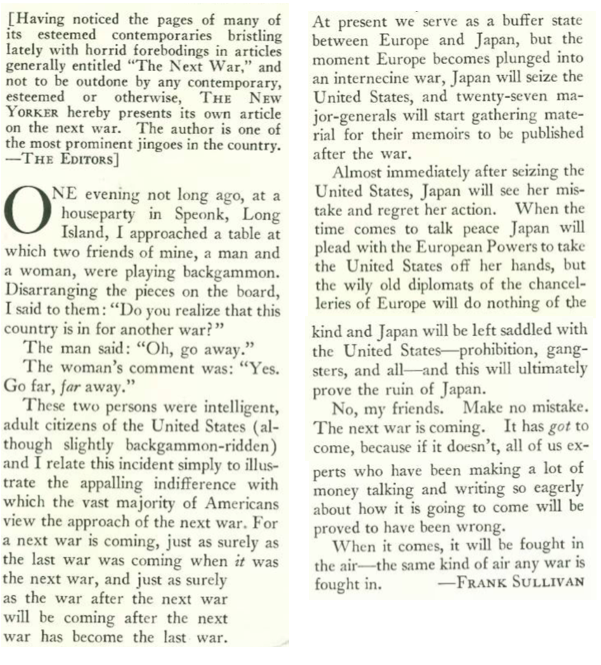
The humorist and New Yorker contributor Frank Sullivan was among the few who took notice of the dire predictions (of war, anyway) and turned it into a funny take on how a European war might unfold. Excerpts:

Sullivan’s last line is a wordplay on “air,” and not likely a prediction of the horrible firebombing and V-2 attacks that would devastate Europe in the following decade.

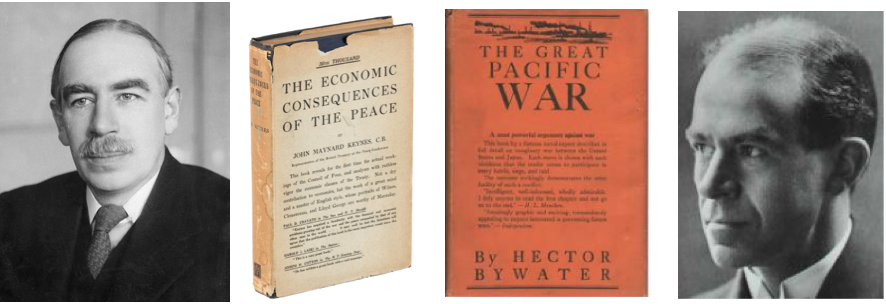
In Sullivan’s day two notable predictions of war came from British economist John Maynard Keynes and British author Hector Charles Bywater. In his 1919 book, The Economic Consequences of the Peace, Keynes warned that “unstable elements,” destroyed during the Great War (WWI), had not been replaced with more stable networks or institutions. Bywater’s prescient 1925 novel, The Great Pacific War, featured a hypothetical future war between Japan and the U.S. that predicted a number of events in World War Two’s Pacific Theatre.

I SEE DEAD PEOPLE…Economist John Maynard Keynes and British author Hector Charles Bywater both didn’t like what they saw coming on the horizon.

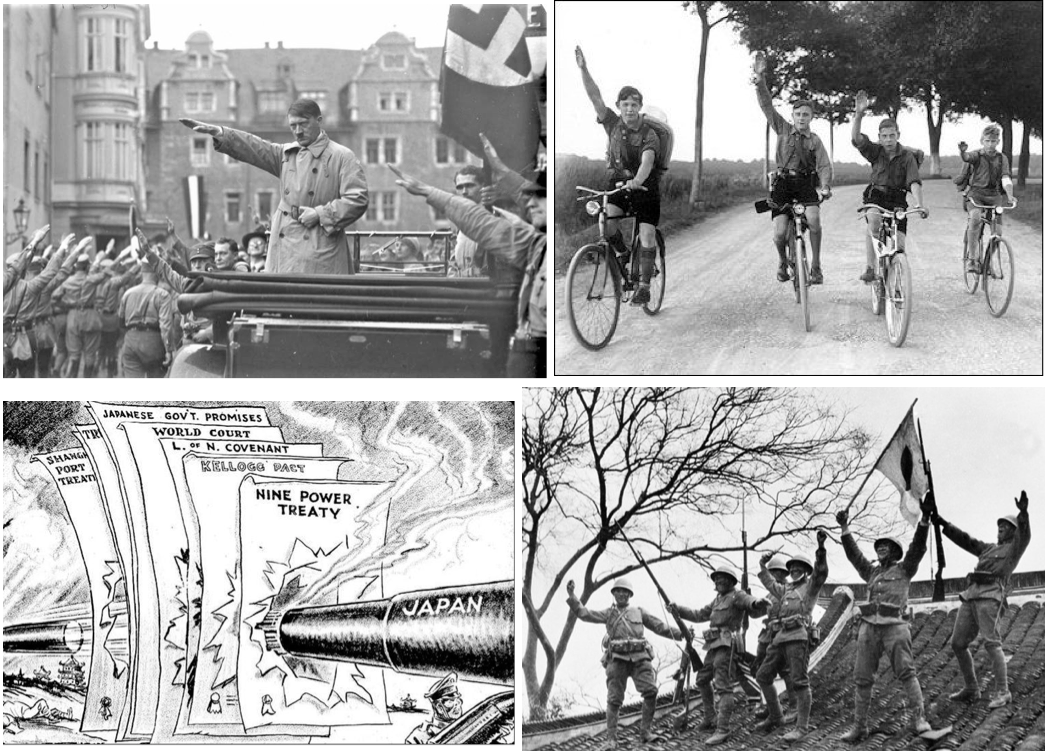
There were reasons for Keynes to be concerned. Germany found many ways to subvert restrictions imposed by the Treaty of Versailles, and continued to make technological advances in armaments and air power. Moreover, the Treaty’s humiliating terms and demands for costly reparations would lead to a rise in German nationalism in the midst of mass unemployment and a volatile economy. In just a little over a year Adolf Hitler and his Nazi Party would seize control of the German state.

And as Bywater feared, the Japanese invaded Manchuria (under false pretenses) on Sept. 18, 1931, and then ignored orders to withdraw from the League of Nations (which had been established by a covenant included in the Treaty of Versailles). Japanese warlords were emboldened by the ease of this takeover and the toothless response from the international community. This scenario would be replayed by the Nazis when they invaded Czechoslovakia in 1939.

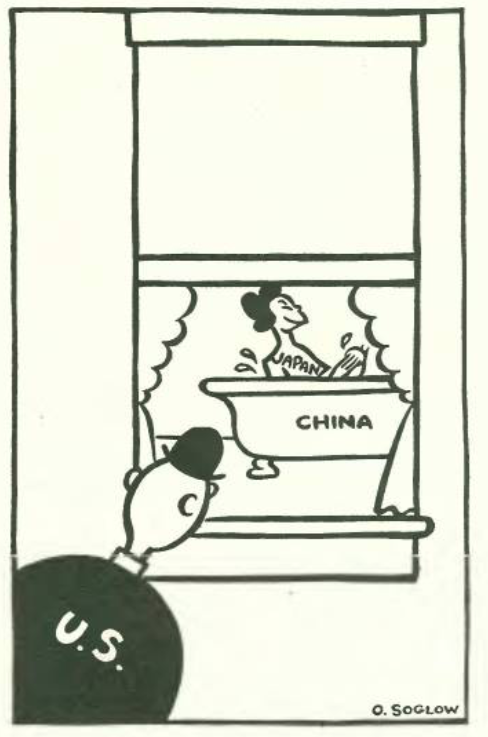
UGH, IT’S THAT GUY…Clockwise, from top left, Adolf Hitler rolls into Weimar as the Nazi Party continued to gain power in 1930; Hitler youth out for a bike ride in 1932; Japanese troops celebrate their easy invasion of Manchuria in September 1931; political cartoon illustrated Japan’s attitude toward international treaties. (Wikipedia/Pinterest)

 *  *  *

The Man Who Would Not Be King

The world that was gradually setting the stage for World War II was also the world of Edward VIII, the Prince of Wales. A renowned womanizer and major disappointment to his father, George V, this heir to the British throne would begin a secret affair with American socialite Wallis Simpson that would later lead to his abdication as king after a reign of just 326 days. In a two-part profile, the New Yorker’s London correspondent Anthony Gibbs could already see that Edward would not be like other monarchs, this lonely “fish out of water” bored with court protocol and finding escape in a bottle of whisky. Excerpts from Part I (caricature by Al Frueh):

HITLER HONEYMOON…Edward VIII abdicated the British throne in December 1936 and married the newly divorced Wallis Simpson in June 1937. Four months later (right) they would pay a visit to Adolf Hitler and his thugs at Hitler’s mountain retreat above Berchtesgaden. Edward was known to be sympathetic to the Nazis, and favored the type of appeasement that would embolden Der Führer to invade Czechoslovakia and much of Europe beginning in 1939. (Pinterest/Wikipedia)

 *  *  *

From Our Advertisers

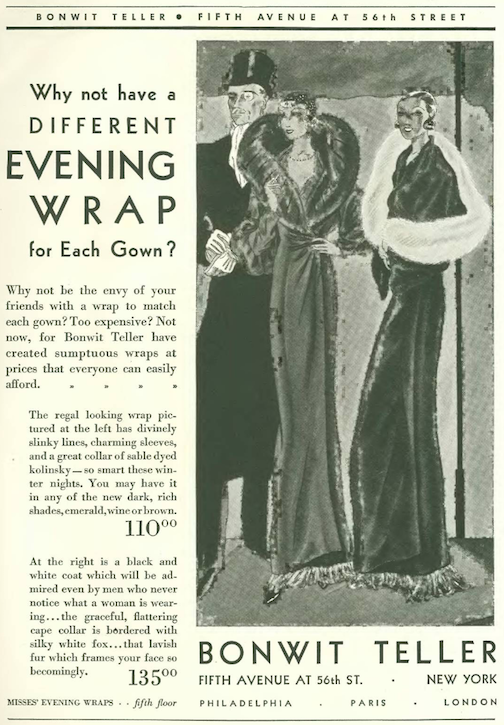
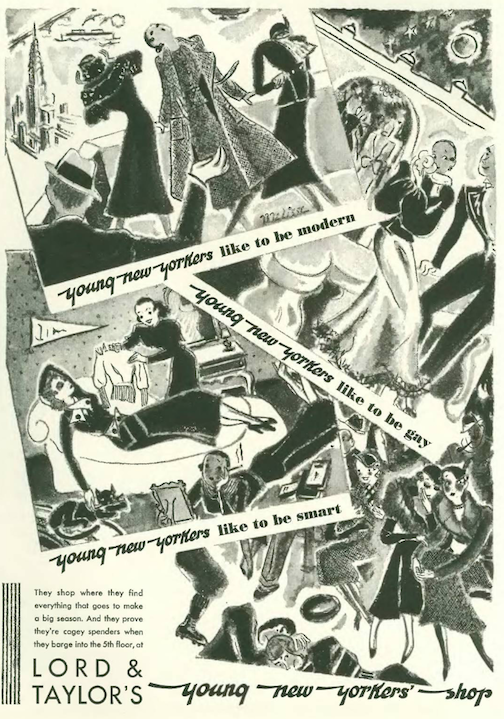
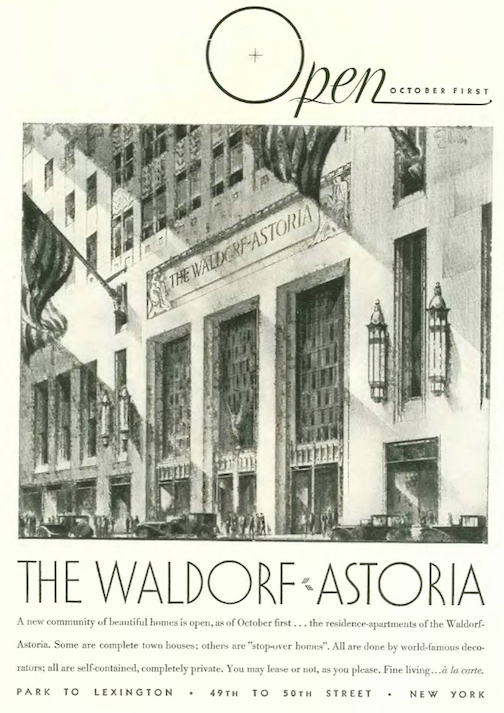
The opening of the new Waldorf-Astoria Hotel on Park Avenue had everyone and their dog getting in on a piece of the action, including manufacturers who hoped to associate their wares with the world’s tallest hotel…we begin with an ad from the hotel’s promoters…

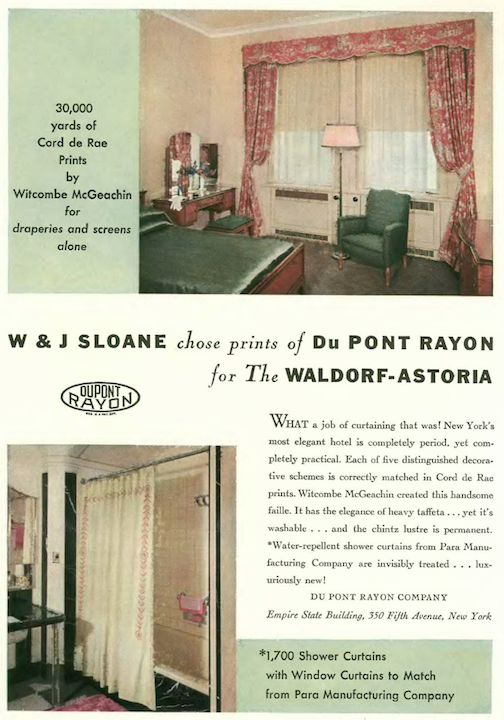
…I surprised to find pedestrian products such as rayon curtains and aluminum chairs associated with the luxury hotel…

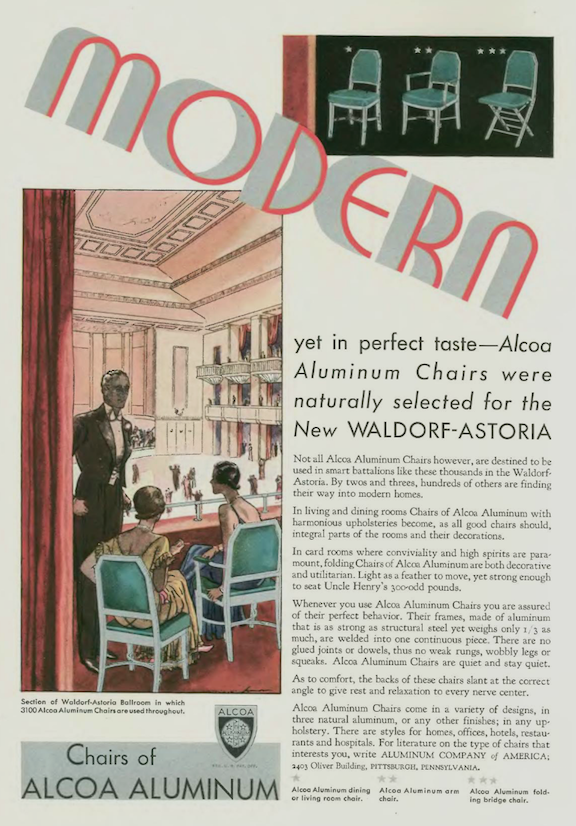
…but perhaps the novelty of these things made them “must-haves” associated with modern living in 1931…this ad from the Oct 10 issue…

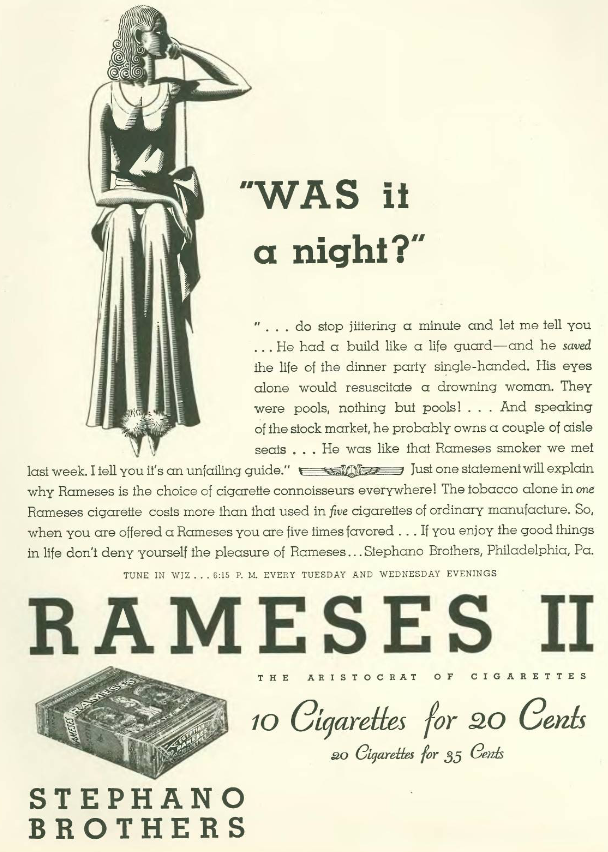
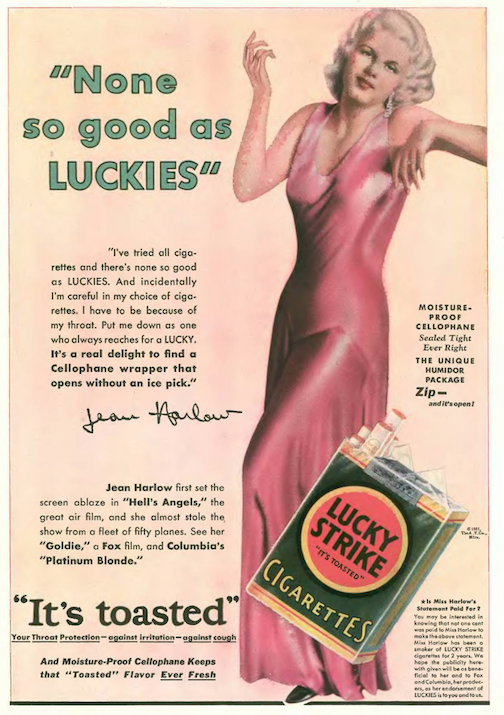
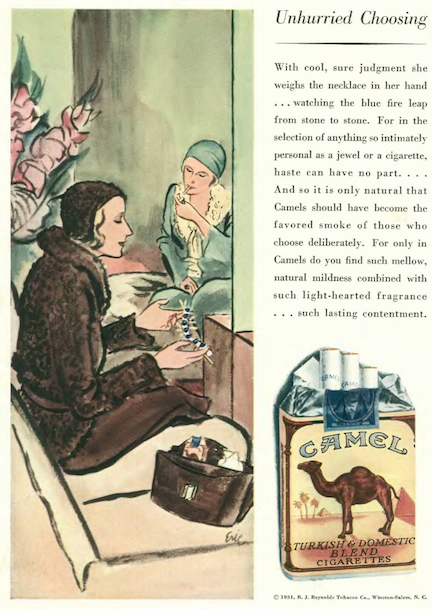
…one habit of modern living was cigarette smoking, and thanks to aggressive advertising droves of women were joining the menfolk in this activity…

…Camels were originally promoted as a woman’s cigarette, and in 1931 R.J. Reynolds shifted their ad style from chic illustrations of disinterested, continental types, such as the one below by Carl Erickson from the March 21, 1931 issue (and imitated by the Spud ad above)…

…to photographs of fresh-faced American women…

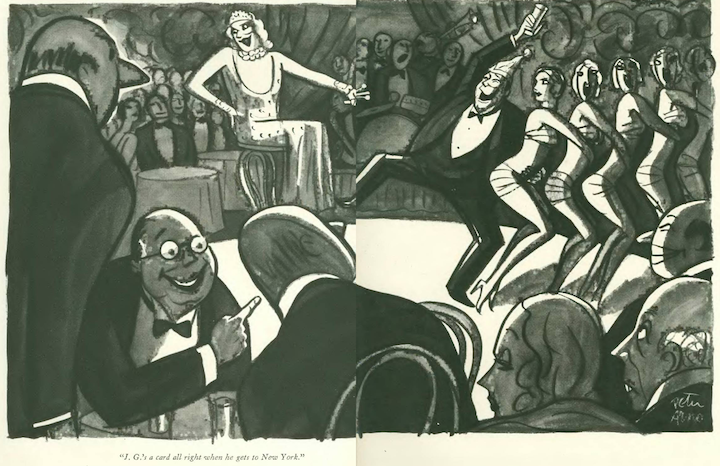
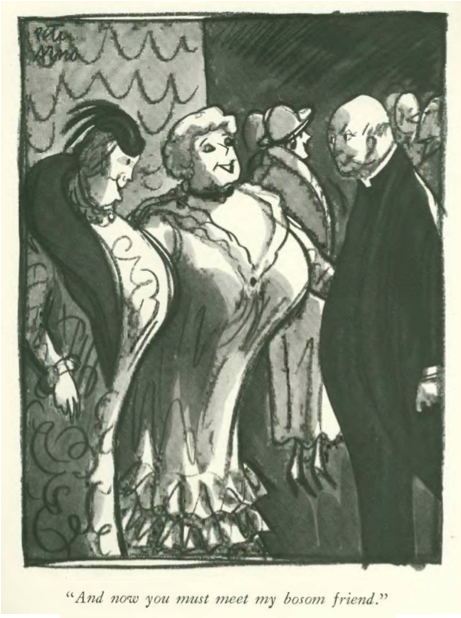
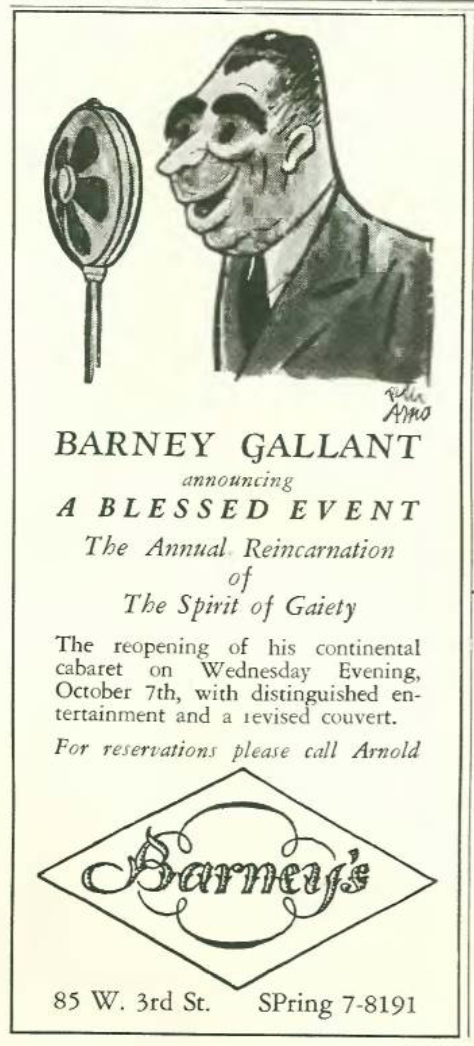
…Barney’s ran this recurring ad (with illustration by Peter Arno) in the back pages of the New Yorker, the latest touting the reopening of Barney Gallant’s “continental cabaret”…

GOOD TIME BARNEY…Barney Gallant was a celebrity and a hero to many New Yorkers for his defiance of Prohibition. At left, actor/writer/producer John Murray Anderson (seated) and Gallant in a photo by Nickolas Muray. At right, illustration by Joseph Golinken of Gallant’s speakeasy Speako de Luxe at 19 Washington Square North. The first New Yorker to be prosecuted under the Volstead Act (serving 30 days in the Tombs), Gallant operated several Bohemian speakeasies in Greenwich Village during the 1920s. Stanley Walker (writing in his 1933 history, The Night Club Era) described the clientele as “youngsters with strange stirrings in their  breasts, who had come from remote villages on the prairie; women of social position and money who wanted to do things — all sorts of things — in a bohemian setting; businessmen who had made quick money and wanted to breathe the faintly naughty atmosphere in safety, and ordinary people who got thirsty now and then and wanted to sit down and have a drink.” (Metropolitan Museum/New York Historical Society)

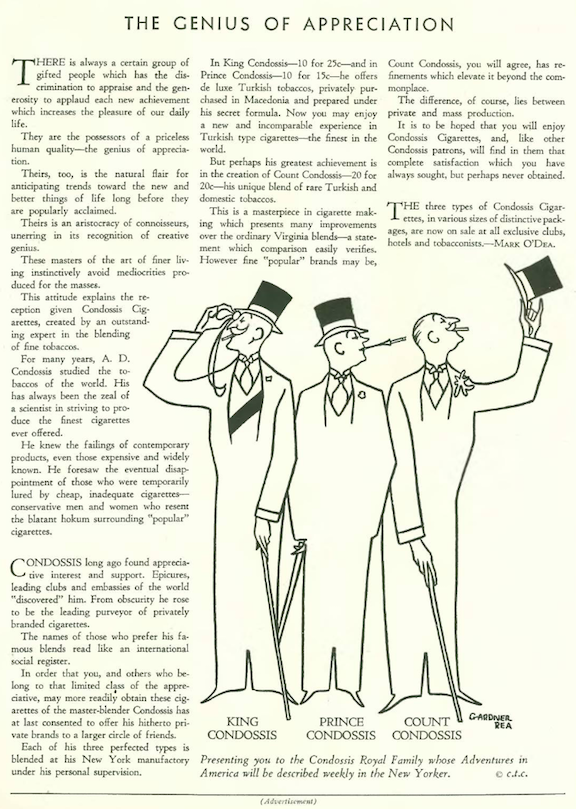
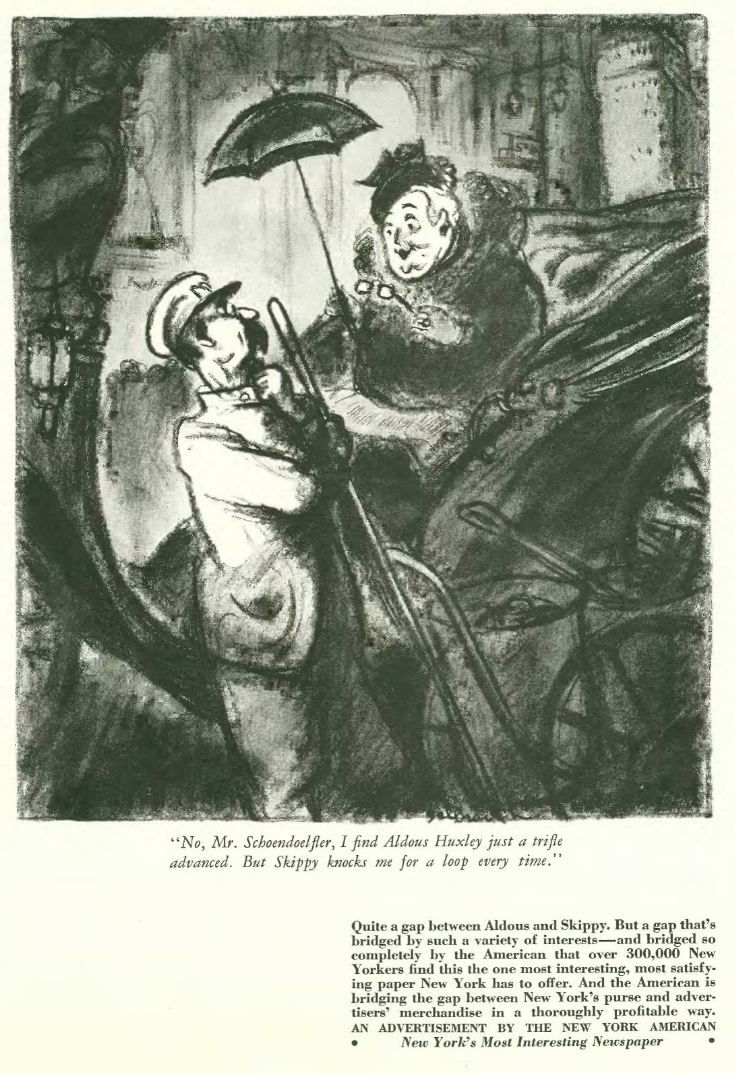
New Yorker cartoonist William Crawford Galbraith picked up some extra income illustrating this ad for The New York American

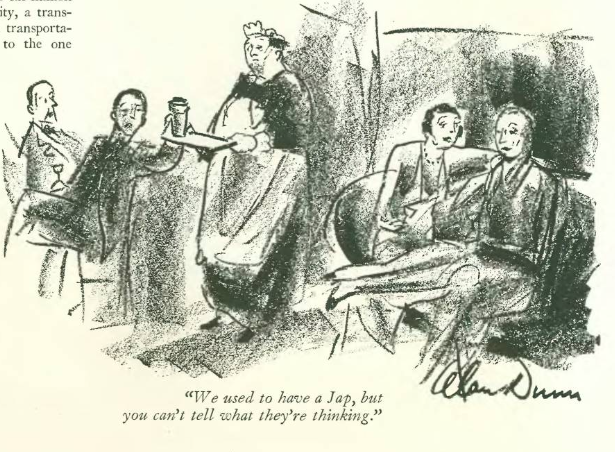
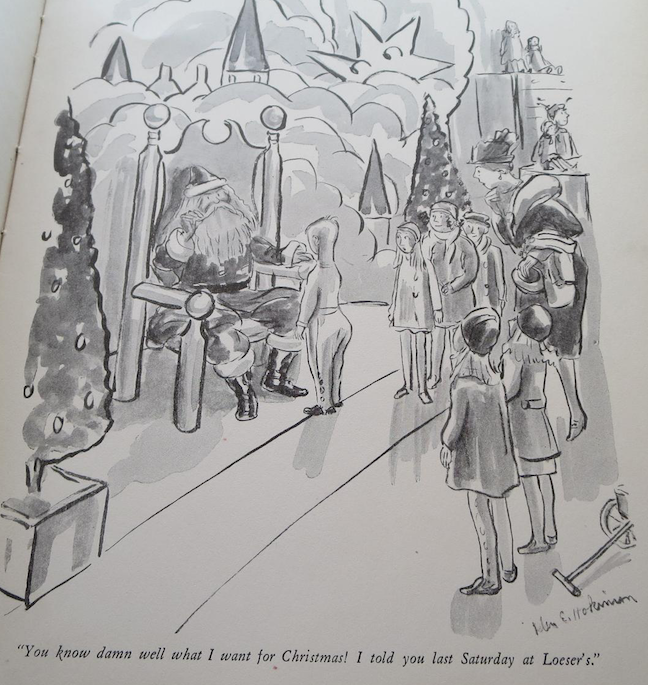
…which segues into our cartoons, beginning with Alan Dunn and the art of the dance,

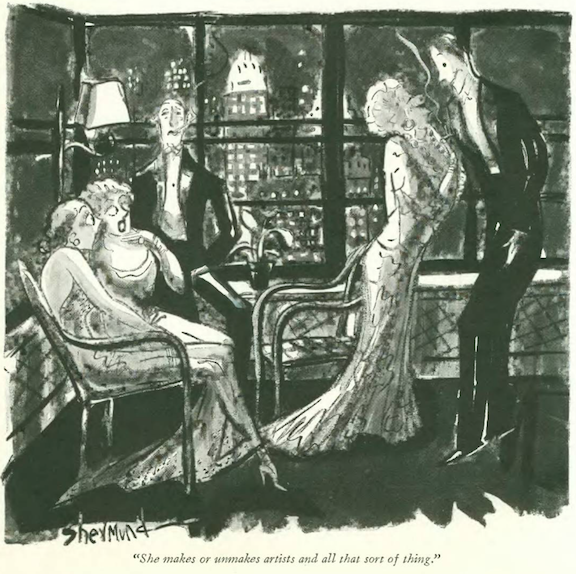
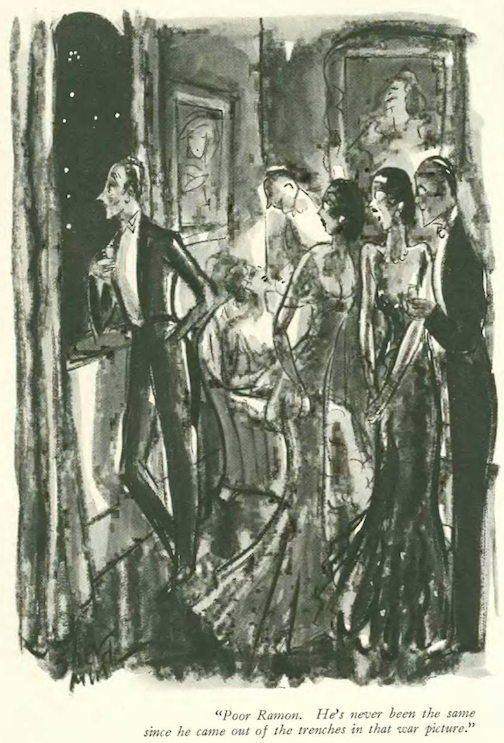
Barbara Shermund, who showed us that a war (movie) is hell…

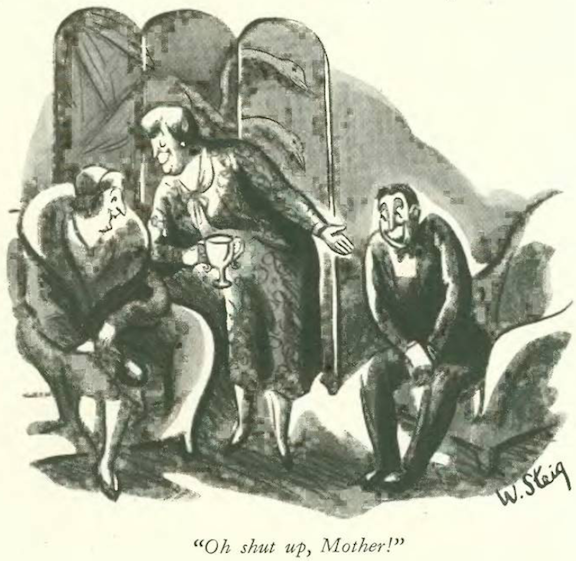
William Steig continued to develop his repertoire of cartoons with precocious children…

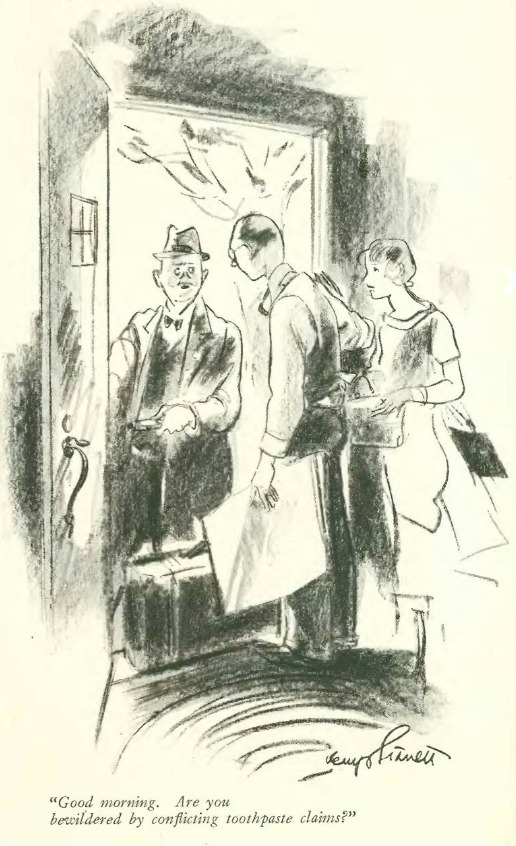
Kemp Starrett gave us a salesman who put more than his foot in the door…

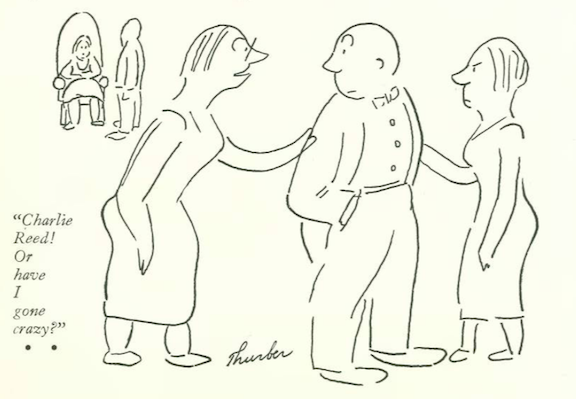
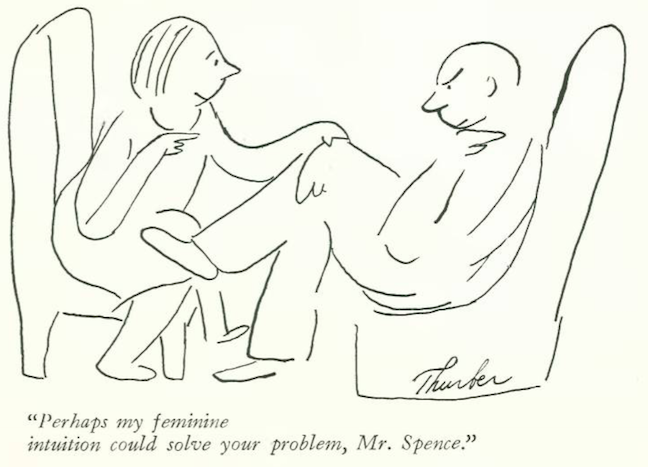
James Thurber continued his ongoing “dialogue” between the sexes..,

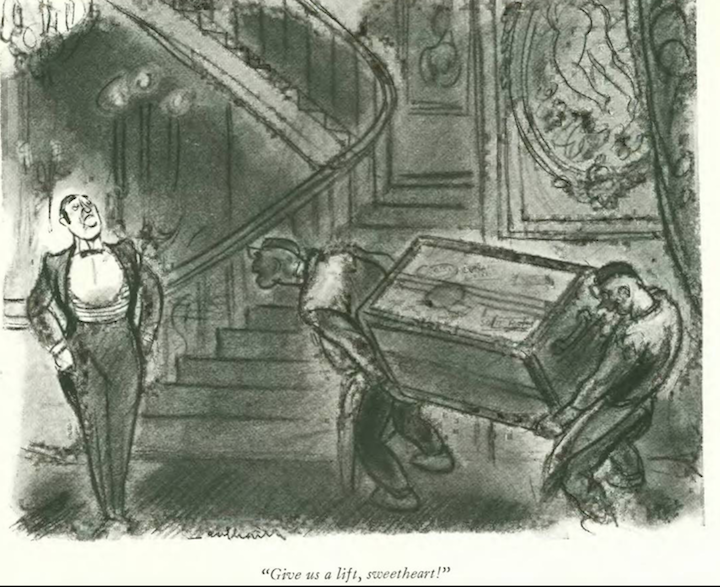
William Crawford Galbraith again, with his take on “Upstairs, Downstairs”…

Rea Irvin also exploring the theme in this two-page spread (click to enlarge)…

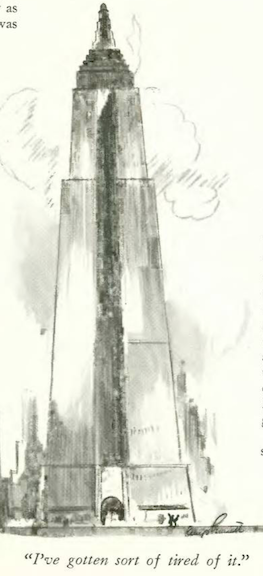
…and we end with another by Kemp Starrett, and the blasé attitude New Yorkers might display before the world’s tallest building…

Next Time: The Wayward Press…


From Stage to Screen

There’s good reason why one of Broadway’s finest theatres is named after Alfred Lunt and Lynn Fontanne; no couple has lit up the stage quite like this husband-wife team.

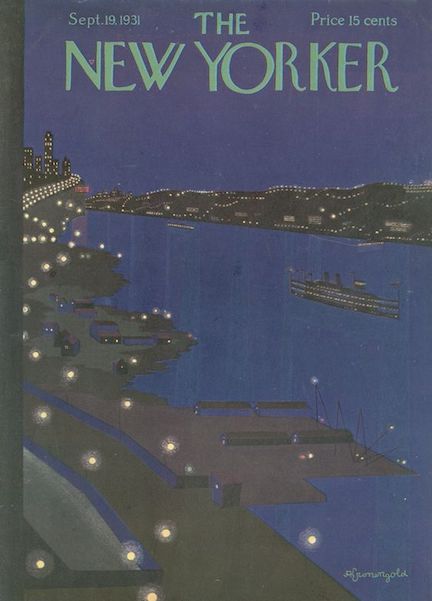
Sept. 19, 1931 cover by Adolph K. Kronengold.

Some say Richard Burton and Elizabeth Taylor were modern successors, but they only appeared together on Broadway once (a 1983 revival of Noël Coward’s Private Lives, at the Lunt-Fontanne Theatre of all places), and they shared a tempestuous, on-and-off relationship that sharply contrasted with Lunt and Fontanne, who were inseparable both on and off the stage during their 55-year marriage. And unlike Burton and Taylor, Lunt and Fontanne appeared in just a handful of films, including a 1931 adaptation of their 1924 Broadway play, The Guardsman. John Mosher filed this review:

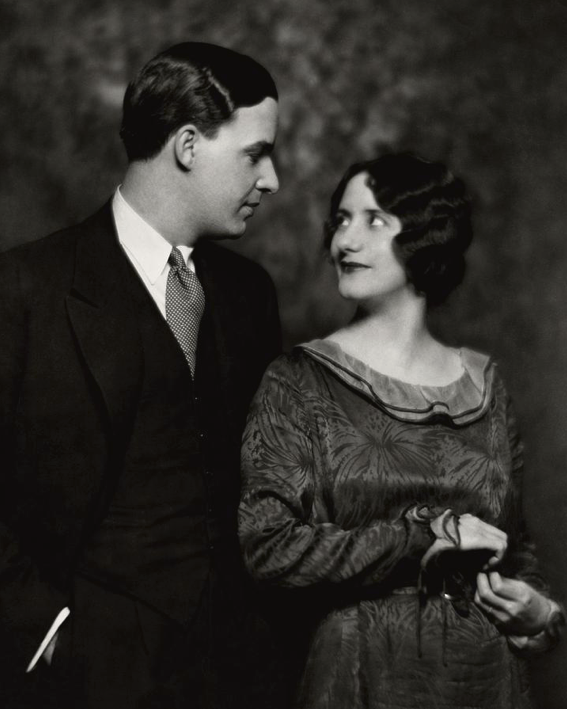
INSEPARABLE…Alfred Lunt and Lynn Fontanne pose for photographer Nickolas Muray in this 1924 portrait for Vanity Fair magazine. They married in 1922, and were inseparable until Lunt’s passing in 1977. (Conde Nast)
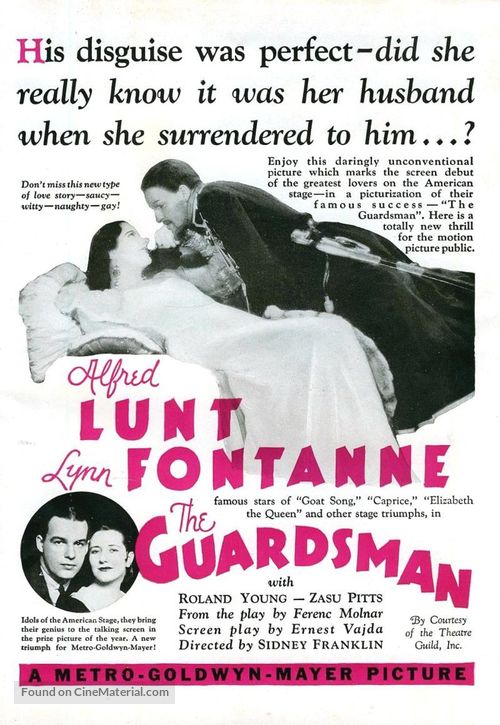
NAUGHTY, NAUGHTY!…These were Pre-Code times, so MGM played up the film’s “saucy” and “unconventional” themes. (IMDB)
I’VE GROWN ACCUSTOMED TO YOUR FACE…Although Lunt and Fontanne appeared together numerous times on Broadway, the 1931 film adaptation of their 1924 stage play, The Guardsman, would be their only film appearance together. (Museum of the City of New York/IMDB)
STAGE TO SCREEN…at top, Lunt and Fontanne in 1924’s The Guardsman on Broadway; below, a scene from the 1931 film adaptation featuring, from left, Alfred Lunt, Lynn Fontanne, Maude Eburne and Zasu Pitts; at right, Fontanne reviews fashions for the film designed by Adrian Adolph Greenburg. Lunt and Fontanne would be nominated for Academy Awards as Best Actor in a Leading Role and Best Actress in a Leading Role, respectively. (Museum of the City of New York/IMDB)

 *  *  *

One Giant Leap

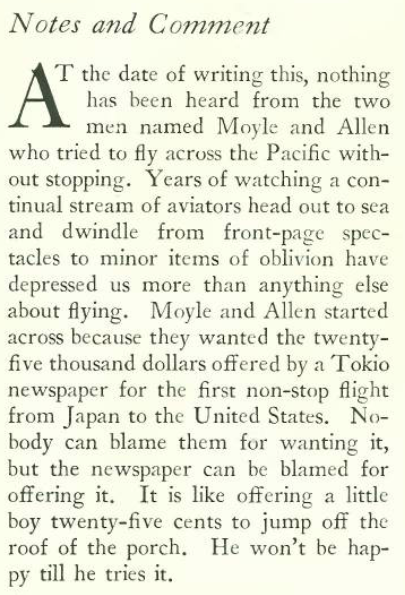
Charles Lindbergh crossed the Atlantic without stopping in 1927, but it would take four more years before anyone could accomplish the same feat across the Pacific. Don Moyle and Cecil Allen took up the challenge, hoping to fly their plane, Clasina Madge, 4,400 miles from Japan to Seattle to win a $25,000 prize from a Japanese newspaper. The lads took off from Tokyo in early September, but then went missing. E.B. White wrote:

As it turned out, Moyle and Allen were caught in a storm between Japan and Alaska that forced them to land on a small, uninhabited island in the Aleutian chain. Stranded for more than a week, the flyboys were finally able to make contact through a U.S. Coast Guard patrol and report they were safe.

THESE ARE MY BOYS…at left, Cecil Allen and Don Moyle standing with financial backer John Buffelin and Buffelin’s daughter, Clasina Madge, the namesake for their hopefully record-setting airplane; At right, Moyle and Allen with a Japanese official, possibly before one of their attempts, or perhaps they are looking at their consolation prize (see below). (University of Washington)

Moyle and Allen sent word that they would return to Washington and prepare for another attempt. They flew back home by way of Nome, Alaska, where they landed on Sept. 21, 1931. Five days later they reached Fairbanks, and after weather delays finally made it to Tacoma, Washington, on Oct. 6. There they learned that Clyde Pangborn and Hugh Herndon Jr. had already won the $25,000 prize, having arrived from Japan the day before. The Tokyo newspaper did, however, give Moyle and Allen $2,500 for their efforts.

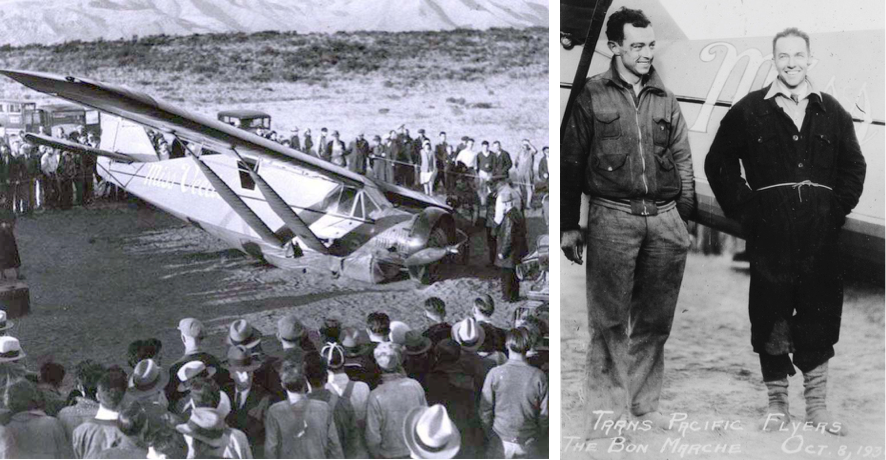
SPOILERS…at left, Hugh Herndon, Jr. and Clyde Pangborn pose next to their crash-landed plane in the hills of East Wenatchee, Washington, after becoming the first to fly non-stop across the northern Pacific Ocean. The 41-hour flight from Japan won them the 1931 Harmon Trophy and $25,000 from a Japanese newspaper. The crash-landing of their plane was deliberate — before the flight it was modified to carry 930 gallons of fuel. They had jettisoned the landing gear after takeoff to save fuel. (historylink.org/imagesofoldhawaii.com)

 *  *  *

Thurber Gets Serious

We know James Thurber as a humorist, both for his writings and his cartoons. In the Sept. 19 issue, however, Thurber offered this touching remembrance of a subway newsstand proprietor, who he later learns is killed in the crossfire of a robbery. Here are the opening passages:


 *  *  *

Did You Miss Me?

After a long absence (in Europe, presumably),  returned to his “Shouts and Murmurs,” column, offering this “Triple Warning” that included his observations of H.G. Wells, who wondered if all his musings for the future would fall to swarms of lowly insects…

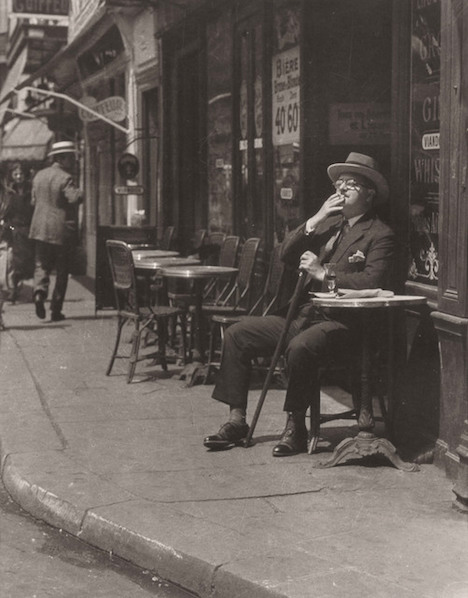
WORK CAN WAIT…Alexander Woollcott relaxes in front of a Paris bar, late 1920s. Photo by James Abbe. (artsy.net)

 *  *  *

From Our Advertisers

With the arrival of fall come new fashions…these “wearables” below are suggested by B. Altman as suitable attire for attending a football game…

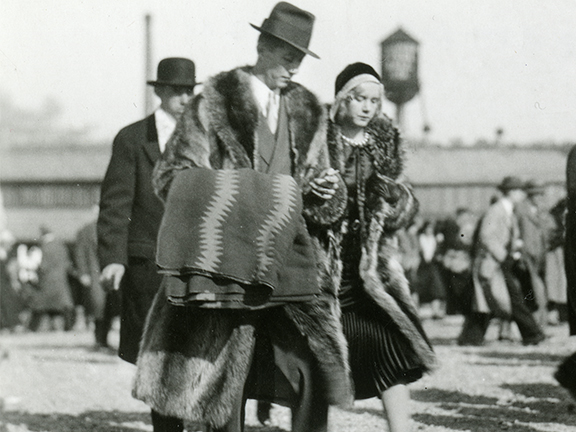
…smart fashions for young people weren’t confined to New York…this is how students at the University of Michigan dressed for a 1930 homecoming game against Illinois…

…well, times have changed, but folks still wear fur of a sort…

Jan 1, 201USA TODAY Sports

…wearing a real fur these days will draw the ire of animal rights advocates almost everywhere, but in 1931 few had problems with turning leopards and seals into coats for fashionable young women…

…then as now, folks enjoyed their pork sausage…the Jones Family of Wisconsin apparently saw a market for their products among New Yorker readers…

…after 131 years in business, the Jones Family and their sausages are still going strong…as is their farmhouse logo (the old farmhouse is real and still stands)…

…another back pages ad promoted Helen Hokinson’s first cartoon collection, So You’re Going to Buy a Book!

…the collection including Hokinson’s beloved dowagers, but it also featured this gem…

(attemptedbloggery.blogspot.com)

…on to our cartoons from the Sept. 19 issue, we begin with William Steig and a couple of would-be renters…

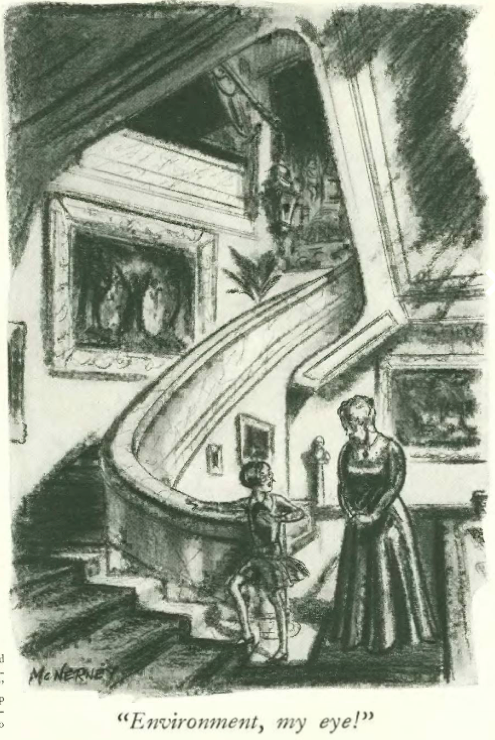
E. McNerney explored the trials of teenage life…

Leonard Dove drew a crowd in a packed subway car…

Otto Soglow displayed the playful side of his Little King…

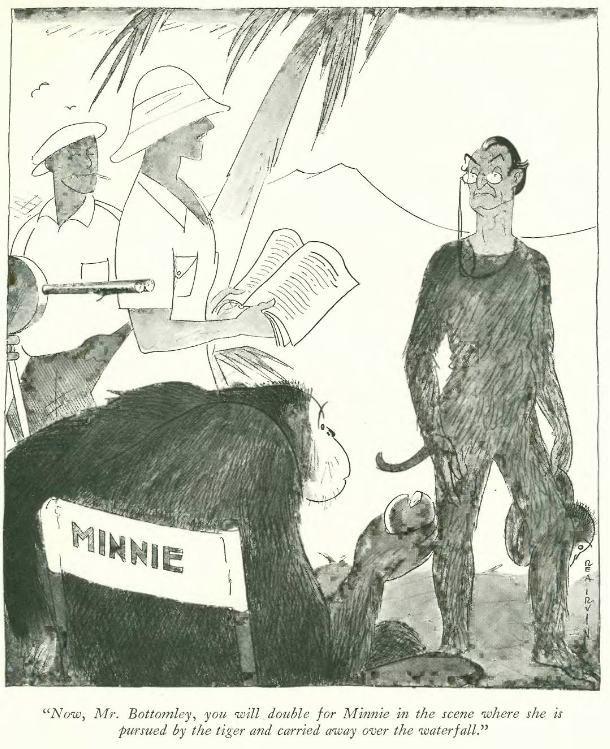
…and Rea Irvin found an actor upstaged by an unlikely rival…

Next Time: Big Fish, Little Fish…

The Big Bird

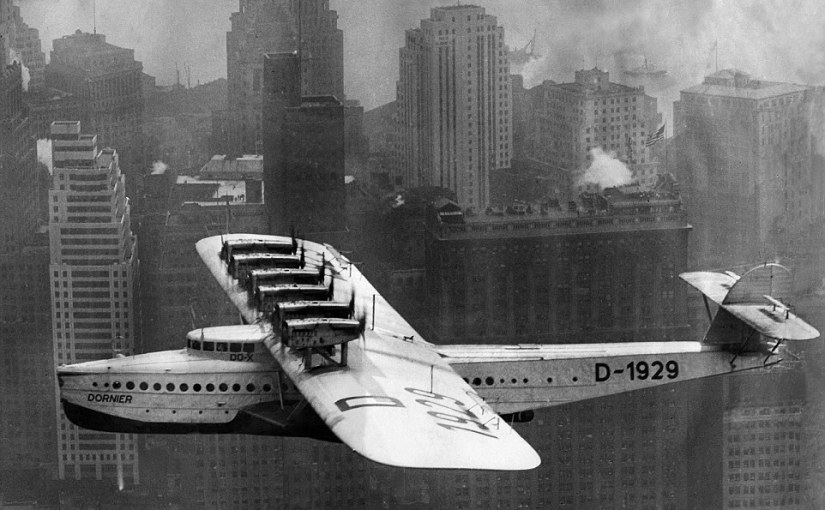
I wonder what the French or the British thought when, in 1929—just a little over a decade after the Great War—their former enemies were able to fly a 56-ton aircraft, carrying 169 passengers, into the skies above Switzerland.

Sept. 12, 1931 cover by Helen Hokinson.

And I wonder what some Americans thought in 1931 when this same aircraft toured Europe and Africa before breezing across the Atlantic—just four years after Lindbergh’s famous flight—making publicity stops from Brazil to New York.

Why, you might ask, did the WWI Allies allow Germany to build something that could easily be converted into a long-range bomber? The Treaty of Versailles forbade the development of such an aircraft, but the German Transport Ministry circumvented the treaty by building the Dornier Do-X on the Swiss side of Lake Constance. It was above this lake the Do-X made its 1929 record flight with 169 passengers and crew, including nine stowaways.

A New York visit by the Do-X was the event of fall 1931, and Morris Markey was there to file a story for his “Reporter at Large” column. Markey joined 71 other passengers on a flight around the city:

A CLOSER LOOK…Morris Markey found it difficult to comprehend the sheer scale of the Do-X until his launch approached this “monstrous craft” with a 157-foot wingspan. Gazing up at the underside of the wing, Markey wrote that it looked like “the roof of some factory building, lifted off to serve a new, fantastic purpose.” (Mashable)

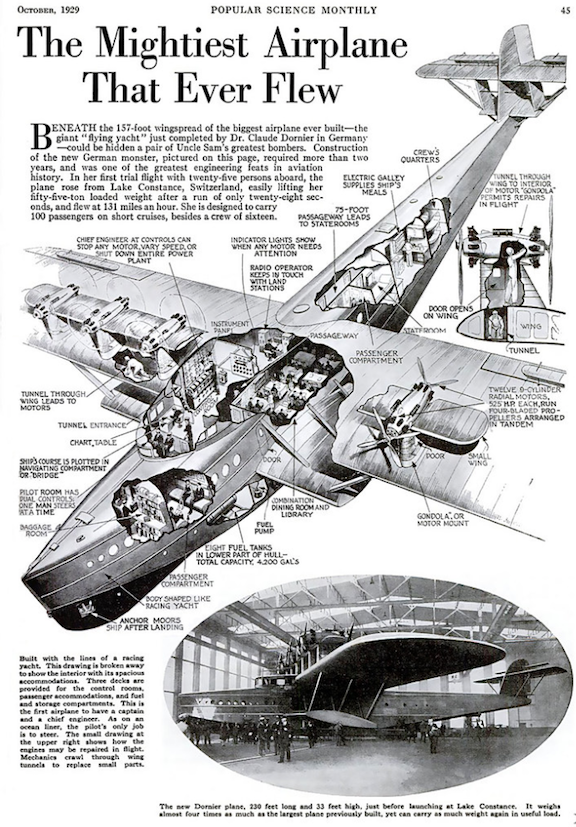
Conceived by German airplane designer Claude Dornier in 1924, the flying ship was launched for its first test flight on July 12, 1929, and later that year Popular Science reported on “The Mightiest Airplane”…

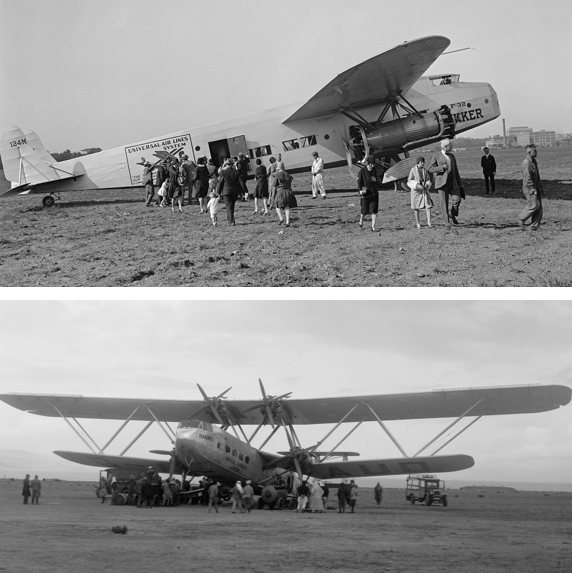
At a time when American and British planes carried no more than 20 or so passengers, the Do-X seemed like something out of a sci-fi-magazine…

DREAM BECOMES REALITY. Although an image of pure fantasy, this July 1922 Popular Science magazine seemed to anticipate the Do-X. (Google Books)
LITTLE COUSINS…These American and British planes were seen as giants until the Do-X came to town. At top, an American-built Fokker F.32; below, although smaller than the Do-X, the Handley Page H.P. 42 held the distinction of being the largest airliner in regular use when it was introduced in 1931. The plane was a workhorse for Britain’s Imperial Airways, keeping the island nation connected to its vast empire. (Wikipedia)

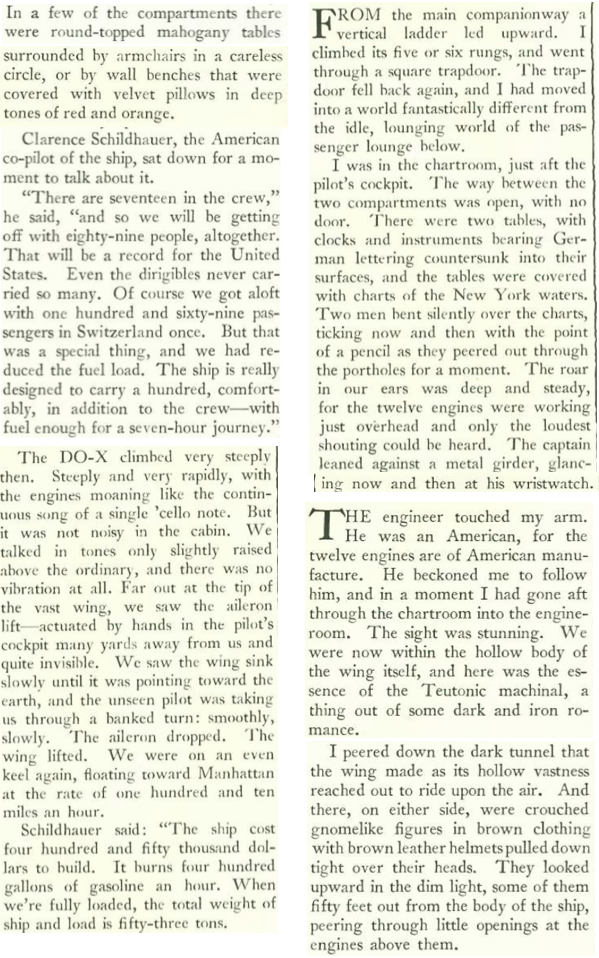
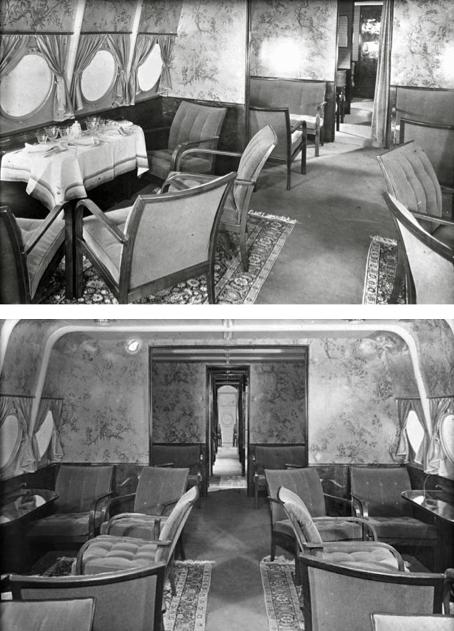
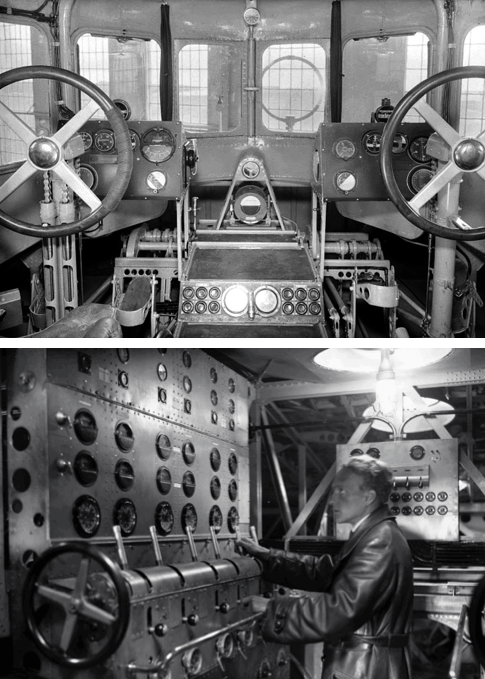
Markey described the Do-X’s sumptuous interior, decked out like an ocean liner with plush chairs and mahogany tables. He was also allowed into the plane’s cockpit and chartroom, where tables “were covered with charts of the New York waters.” Behind the chartroom Markey also took in the stunning sight of men moving within the hollow wings, maintaining the plane’s twelve engines while it was in flight:

FLY THE FRIENDLY SKIES, REALLY…Interior views of the Do-X show armchairs arranged in “careless circles,” a far cry from the spine crushers we experience today. (Mashable)
NO SEATBELTS?…British journalist Lady Grace Drummond Hay and Hearst correspondent Karl von Wiegand enjoy a flight aboard the Dornier DO-X in November 1930. (Pinterest)

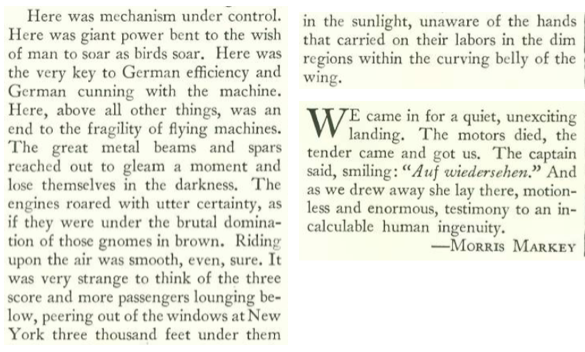
Markey concluded his column with this lyrical tribute to the Do-X:

A STEAMPUNK’S DREAM…at top, the Dornier Do-X cockpit; below, a machinist in the engine room of the flying boat. (Mashable)

In the previous issue of The New Yorker (Sept. 5), E.B. White filed this report about the Do-X and its visiting delegation. I was surprised that Markey, and not White, took the flight around the city, given White’s unbridled enthusiasm for flying machines.

To get some idea of what it was like to fly on the Do-X, here is a short film from YouTube. The first three minutes (with some weird lounge-y background music) feature a 1929 flight during which the DO-X carried 169 passengers—a world record not broken for 20 years. The New York visit is at the 3:00 mark.

 *  *  *

Back to Earth

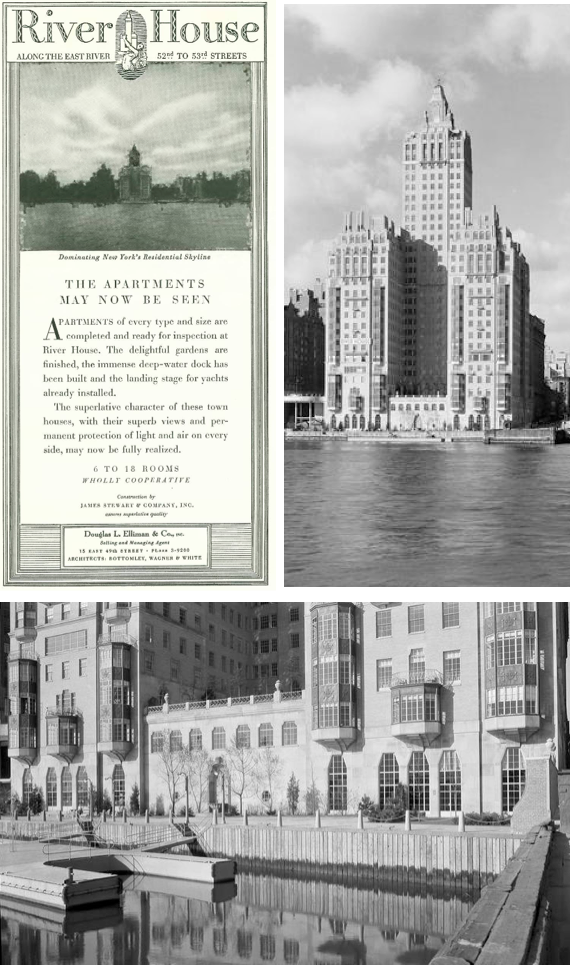
Our feet firmly back on terra firma, we turn to The New Yorker’s review of the new River House on the East River, where residents once parked the yachts they would use to sail to their Long Island estates. This luxury was short-lived thanks to Robert Moses, who reigned over public works and plowed the East River Drive (now FDR Drive) between River House and the river, effectively ending any practical use of the docks.

FUN WHILE IT LASTED…Top left, advertisement in the Sept. 12, 1931 New Yorker announcing the new River House. At top, River House around the time of its completion, and below, a view of the short-lived docks. (Museum of the City of New York)

 *  *  *

Something’s Fishy

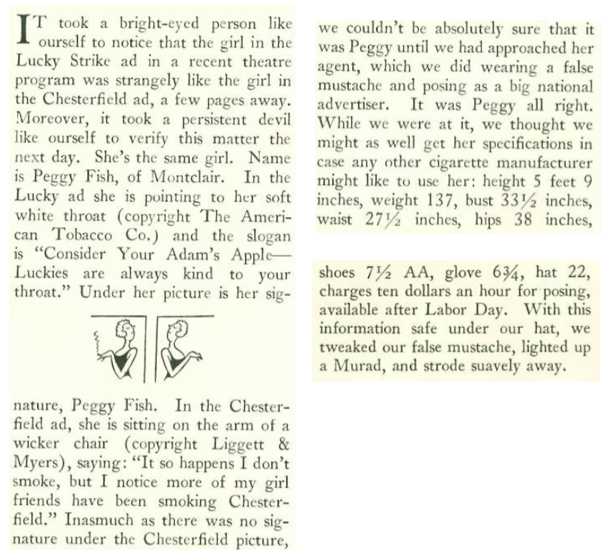
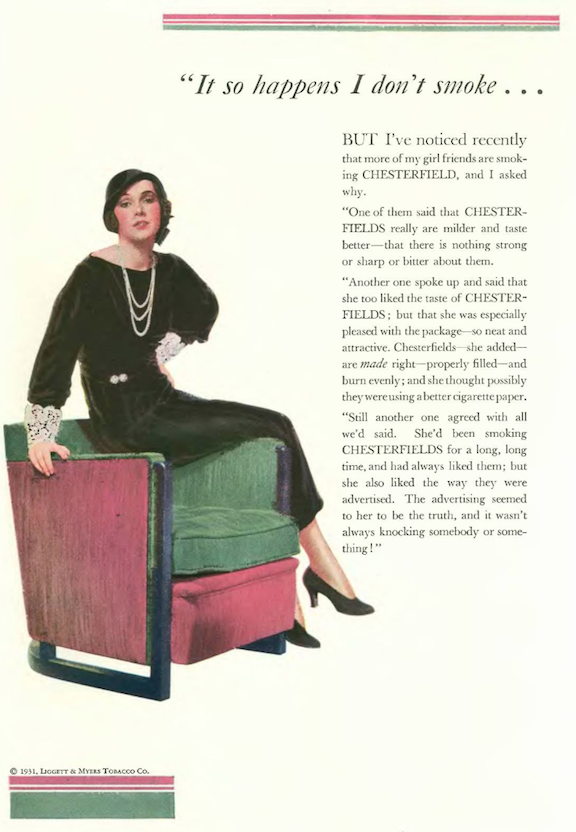
In his “Notes and Comment,” E.B. White reveled in his powers of observation, having spotted the same model, Peggy Fish, in ads for competing cigarette brands:

DOUBLE TAKE…A 1931 Chesterfield ad (left) referred to by E.B. White featuring Peggy Fish, who apparently was a go-to model for fashion magazines in the 1920s and 30s; at right, Fish modeling a dress in the January 1928 issue of Vogue, photo by Edward Steichen. Bottom image, another version of the ad, which appeared in the Oct. 3 issue of The New Yorker. (April 1931 Cosmopolitan via Stanford University/Conde Nast)

 *  *  *

From Our Advertisers

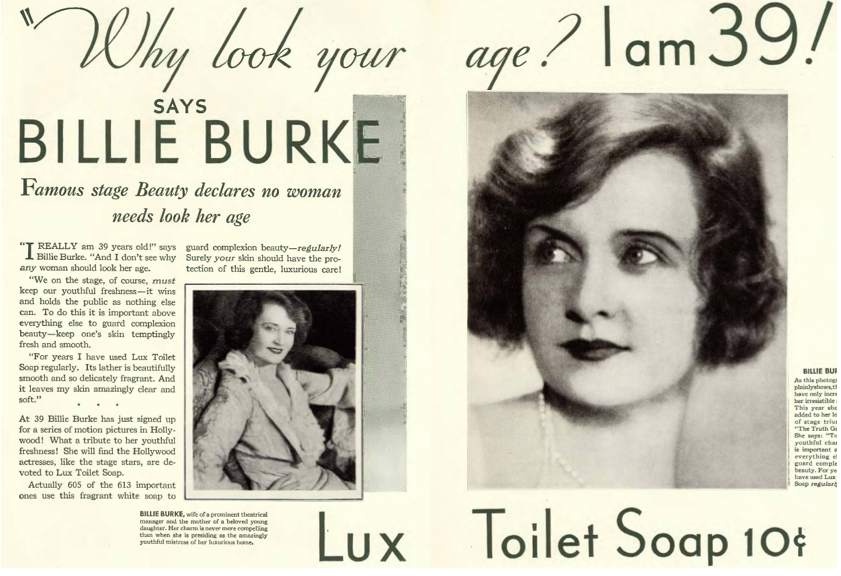
We kick off our advertising section with this two-page spread for Lux Toilet Soap. What is curious about this ad is not that Billie Burke (1884 – 1970) looked great at 39, but that she looked great at 47, her actual age when she made this endorsement for Lux. You would think the greater age would be an even better selling point for the soap makers, but either they decided 39 sounded better or maybe she just fooled Lux, and everyone else, about her true age…

BROADWAY BILLIE…at left, Billie Burke with her husband, Broadway impresario Florenz Ziegfeld, in a 1927 portrait by Edward Steichen that was featured in Vanity Fair. Burke never remarried after Ziegfeld’s death in 1932; at right, Burke as Glinda the Good Witch with Judy Garland and Toto in 1939’s The Wizard of Oz. (Pinterest)

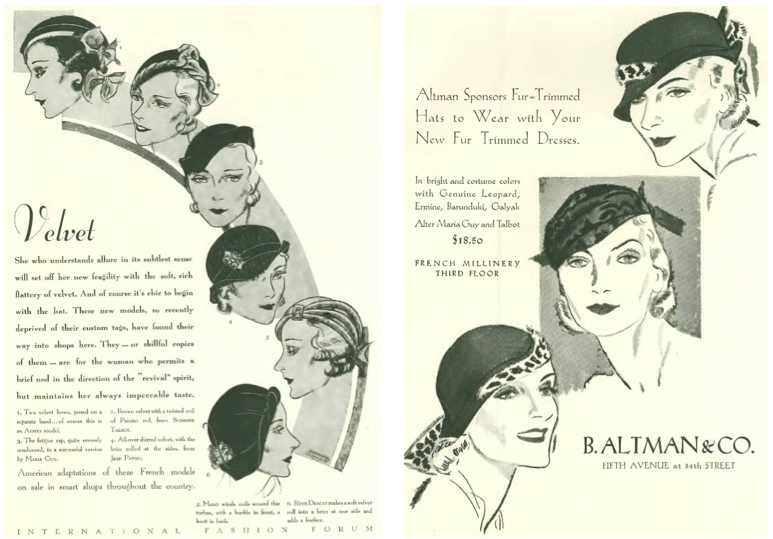
…fall fashions abounded, as did ads for hats — these two were from different advertisers on separate pages…apparently hats looked good on women displayed in angled formations…

…Alcoa was expanding its market for aluminum products with a line of chairs it touted as being “in perfect taste” (note the snotty-looking butler at right)…my parents had a set of these, relegated to the basement as knock-about furniture…

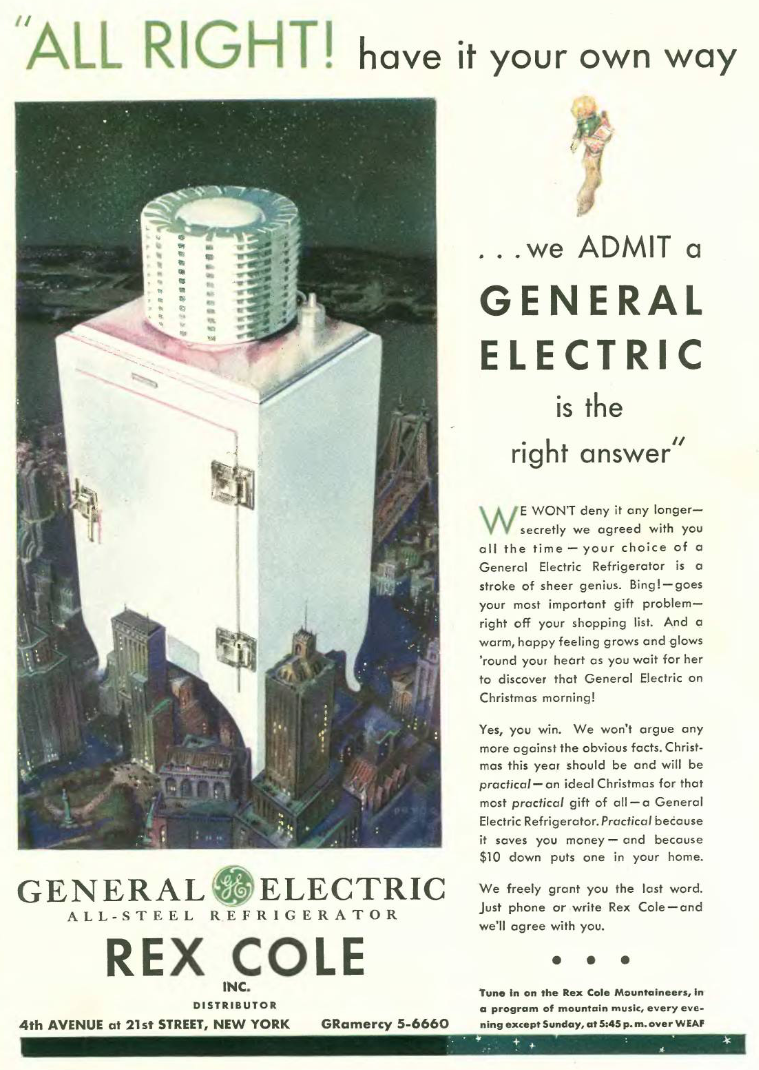
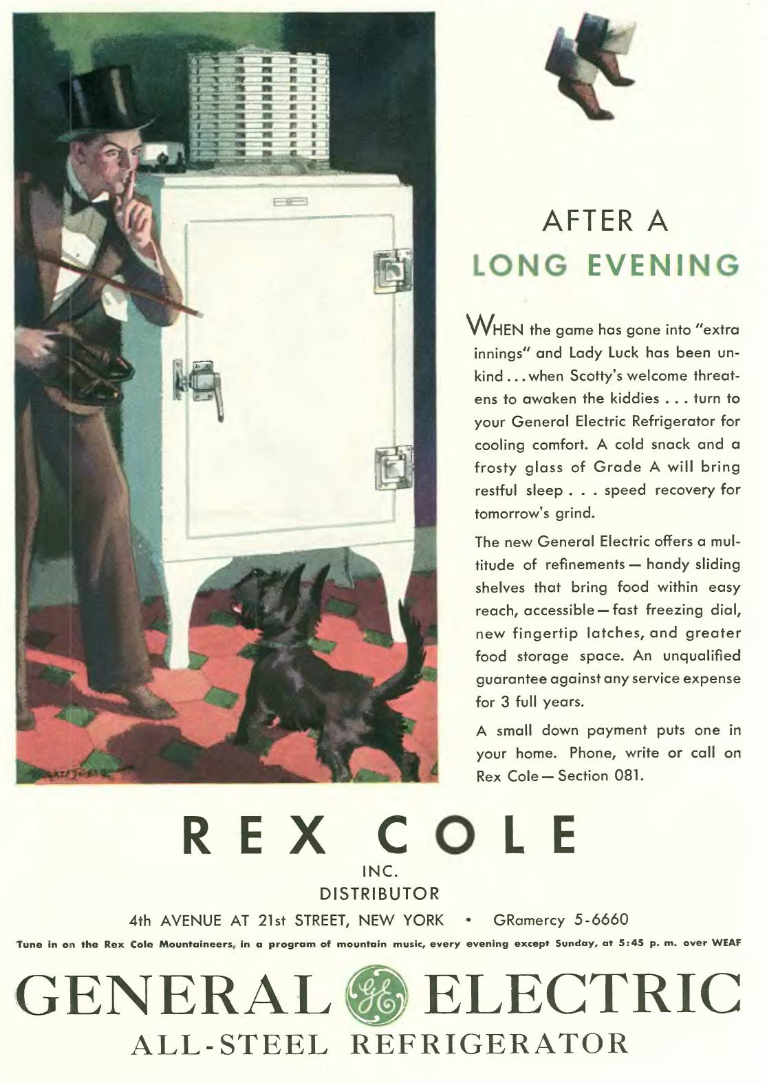
…I love these ads by Rex Cole that elevate the lowly icebox to heroic heights (perhaps this is how Ayn Rand viewed her kitchen)…

…and we move on to our cartoons, where famed gold digger Peggy Joyce is the focus of a Peter Arno cartoon (Joyce was married six times, and claimed she was engaged about fifty times). After publishing a ghostwritten “tell-all,” Men, Marriage and Me in 1930, Joyce purportedly wrote a column for a spicy New York rag about various scandals in New York and London. It is possible or even likely these columns were also ghostwritten: after meeting Joyce in the late 1920s, Harpo Marx concluded she was illiterate…

ILLITERARY?…Peggy Joyce, circa 1922. (famousfix.com)

E. McNerney showed us a girl with little appreciation for her silver spoon…

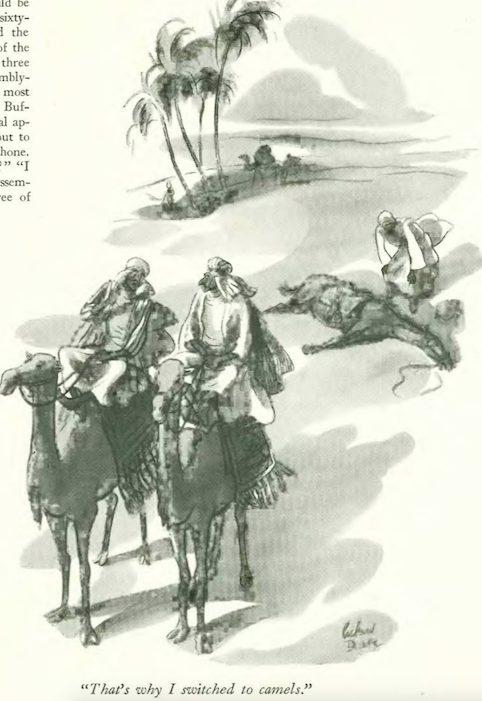
Richard Decker found humor in the desert sands…

Barbara Shermund was back with some juicy gossip…

…and we close with two by William Steig…the awkward suitor…

…and some questionable bedside mannerisms…

Next Time: From Stage to Screen…

Bonfire of the Vanities

When Earl Carroll’s Vanities hit the Broadway revue scene in 1923, it faced strong competition from George White’s Scandals and the long-running Ziegfeld Follies. Carroll’s answer: More of everything.

Sept. 5, 1931 cover by Theodore Haupt.

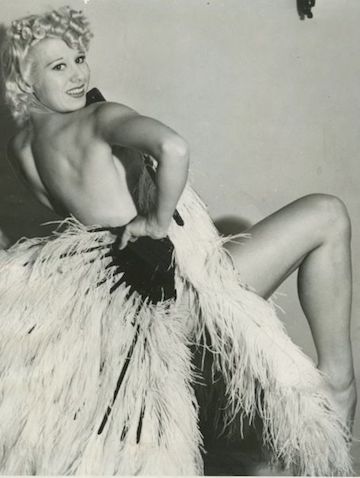
That included more nudity than the other revues. Critics, including the New Yorker’s Robert Benchley, found the nudity gratuitous, a titillating distraction from what was otherwise a mess of a show. It also landed Carroll in court from time to time on charges of public indecency. All of this, of course, was just more publicity to drive audiences to his theatre at 753 Seventh Avenue, which he built in 1922 and then partially tore down just nine years later to replace it with an even grander venue. This is where Benchley found himself on the evening of August 27 — at the grand opening of the Earl Carroll Theatre and the 1931 edition of the Vanities. Benchley found nothing grand about it:

AUTOGRAPHS, ANYONE?…Accompanied by his Vanities showgirls, Earl Carroll leaves the Essex Market Police Court on July 20,1930, after appearing to answer charges of public indecency. Police raided a Vanities matinee on July 9, arresting eleven including famed burlesque dancer Faith Bacon, who performed in nothing but fans made of ostrich feathers. No doubt police were tipped off by critics who called the 1930 edition the “nudest” cast in American theatre history. From the looks on their faces, it seems even the police enjoyed the spectacle. (Worthpoint)
IS THERE A PROBLEM, OFFICER?…Faith Bacon in a less-revealing pose with the ostrich-feather fans that brought the police ‘a calling. (fanpix.net)

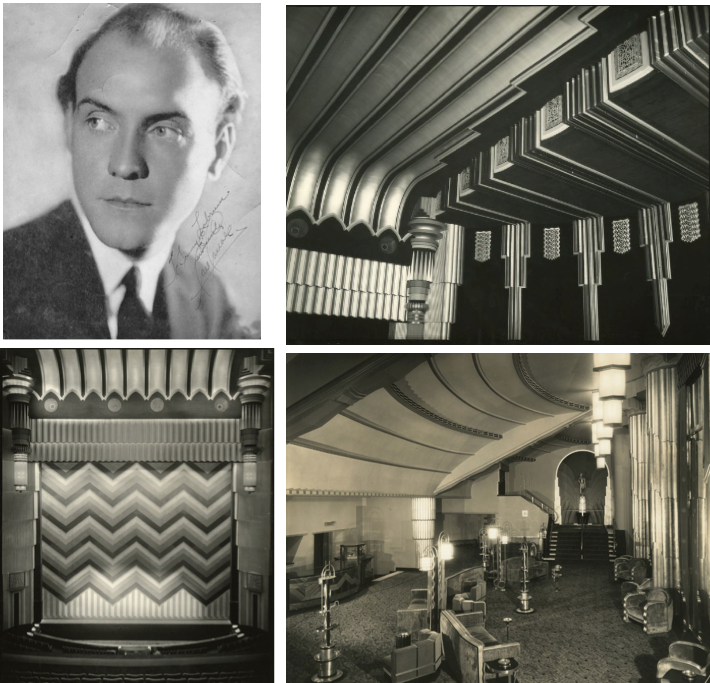
Carroll’s ambitions were always big, whether it was the size or lavishness of his stage shows or the Art Deco theatre (designed by George W. Keister) he erected in 1931 in answer to Flo Ziegfeld’s 1927 Joseph Urban-designed theatre on Sixth Avenue. With 3,000 seats, Carroll’s theatre was nearly twice the size of Ziegfeld’s.

THEY DON’T COME FOR THE SCRIPTWRITING…Earl Carroll made it clear what audiences could expect in his 1931 Art Deco-style theatre, which featured black velvet-covered walls relieved with gold and silver-colored highlights. Its 3,000 seats made it one of the largest theatres in the world. Clockwise, from top left, portrait of Carroll (a gift from the 1930 Vanities showgirls) flanked by busts of Vanities girls Doris Andrese and Beryl Wallace in the theatre lobby; sign above theatre entrance; a two-page spread from the theatre’s “Beauty Souvenir” booklet; cover of the booklet, featuring singer Lillian Roth. (New York Historical Society).
DECO DRAMA…Clockwise, from top left, Earl Carroll circa 1925; ceiling detail inside the Earl Carroll Theatre; mezzanine lounge; the stage. (New York Historical Society).

The show itself left Benchley baffled, a mishmash of lights, colors, and effects including a drooling dinosaur that dropped a naked woman on stage for a dance number…

LAUNCH SITE….The Vanities stage helped launch the careers of many entertainers. Clockwise, from top left, undated photo of a Vanities production — some shows would feature more than 100 women on stage at one time; singer Lillian Roth was a star attraction; Vanities alumni included William Demarest (Uncle Charlie!), Jack Benny and Vincente Minnelli. (assumption.edu/flickr.com/classicmoviehub.com/amazon.com/sensesofcinema.com)

This wasn’t last word from The New Yorker on the new theatre; the Sept. 12 issue featured these observations by Creighton Peet:

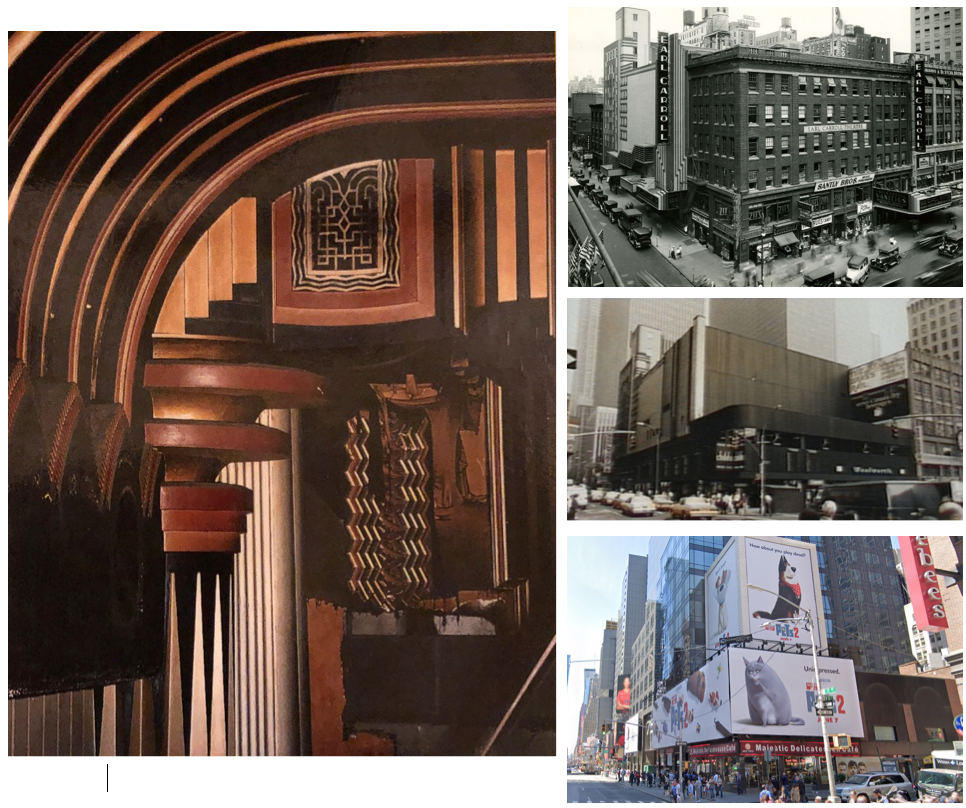
In the end, Carroll’s ambitions were too big for the deepening Depression, and just six months after his theatre’s opening he would lose it to creditors. The property would be snapped up by rival Florenz Ziegfeld and renamed the Casino, but the Ziegfeld connection would be short-lived; Ziegfeld would die a few months later in July 1932. Later that year another rival, George White, would take over the venue to stage his Music Hall Varieties, which ended in 1933 with middling results. The theatre would go through several more tenants—including Billy Rose—until 1940 when the discount “dime store” Woolworth’s would move in, demolishing the lobby and walling off the remaining ceiling and walls. Woolworth’s would close the location in the late 1980s—the store, and the last remnants of the Earl Carroll Theatre, would be demolished in 1990.

CLOSING NUMBER…At left, a sneak peek behind the false walls of Woolworth’s in 1988 shows a detail of the theatre’s proscenium, ceiling and sidewall. At right, top to bottom, the second Earl Carroll Theatre at 7th Avenue & 50th Street; the Woolworth’s store that replaced it, circa 1980; the site today. (Large image from the book Lost Broadway Theatres, via drivingfordeco.com/Google Maps)

*  *  *

From Our Advertisers

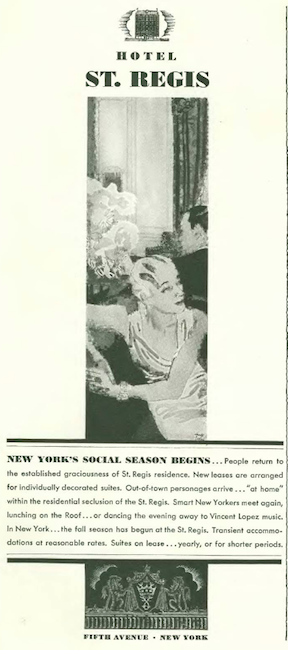
Fall is upon us, and so the social season begins, according to the Hotel St. Regis…

…and what better way to prepare for the season than to acquire a new mink coat…

…maybe politics and world affairs were more your bag, in which case you probably wanted to get a subscription to the Herald Tribune and read the latest from commentator Walter Lippmann

…the makers of Marlboro cigarettes, an upstart brand that initially targeted women, continued with their prize contests, but now they began courting men as well…

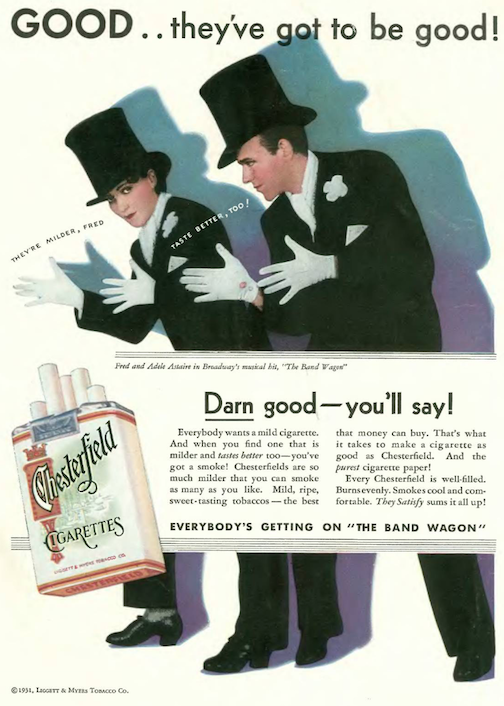
…on the other hand, the more established brand Chesterfield had the resources to run a color back-cover ad with endorsements from the brother-sister dance team Fred and Adele Astaire

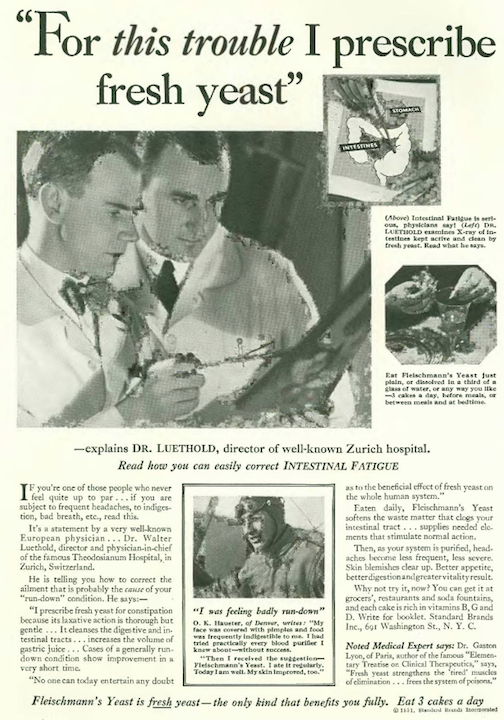
…Fleishmann’s continued to run their full-page ads touting the wonders of daily yeast consumption (“Eat three cakes a day”). The ads were there because Raoul Fleishmann used his wealth from the family baking business to keep the New Yorker afloat during its fledgling years…

…Farrar and Rinehart announced the arrival of Otto Soglow’s first book, Pretty Pictures

…here is the cover of the book…

…and we move on to the cartoons with the character that would make Soglow rich and famous…The Little King

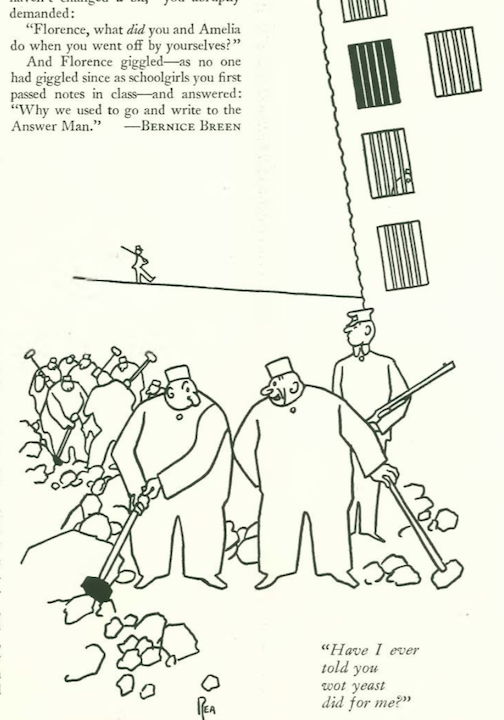
…although Fleischmann likely saved The New Yorker with large infusions of cash, its cartoonists, including Gardner Rea, still took an occasional poke at the company’s health claims…

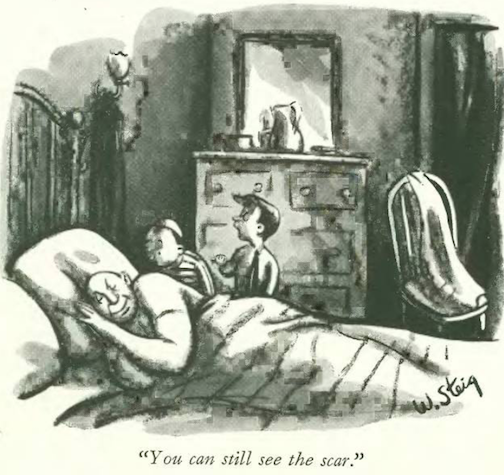
…anticipating his “Small Fry” cartoons, William Steig finds two of them examining the wonders of human physiology…

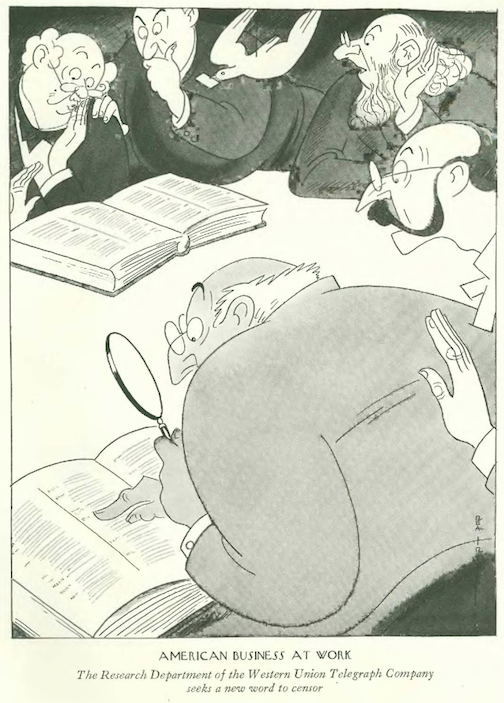
Rea Irvin looked in on some stuffy Western Union censors…

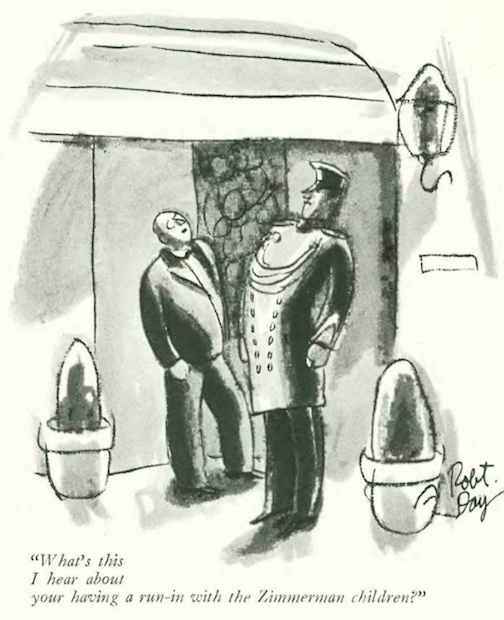
…newcomer Robert Day illustrated the challenges of a doorman (Day would be a longtime contributor)…

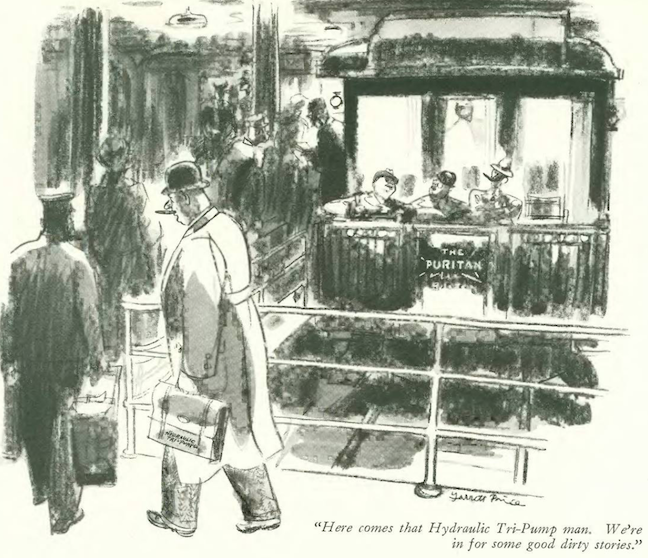
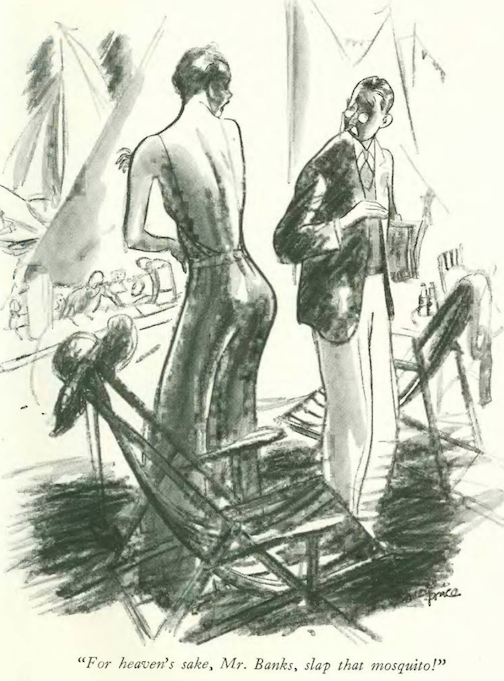
Garrett Price found humor abuzz between the bold and the meek…

Alan Dunn tracked down a clueless hunter…

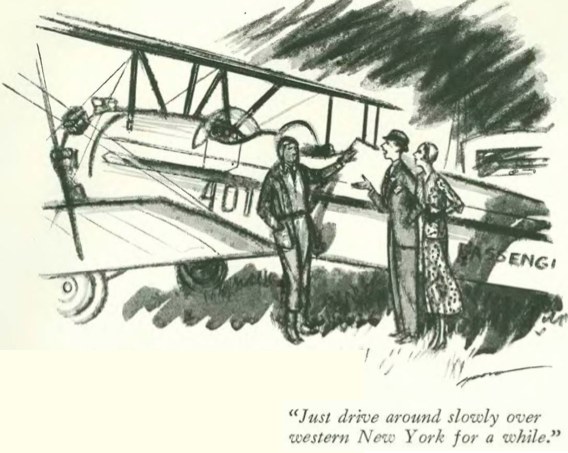
…and we end with Leonard Dove, who takes flight and anticipates our next installment…

Next Time: A Big Bird…


Asphalt Jungle

The zoos of yesteryear were joyless places, that is, if you were one of the animals. Children squealed with fear and delight at the sight of a caged lion, and many an adult had fun tossing peanuts at elephants or teasing enraged gorillas locked behind bars; but if you were a zoo animal in 1931, life was endless hours of boredom, sprinkled with moments of terror and humiliation.

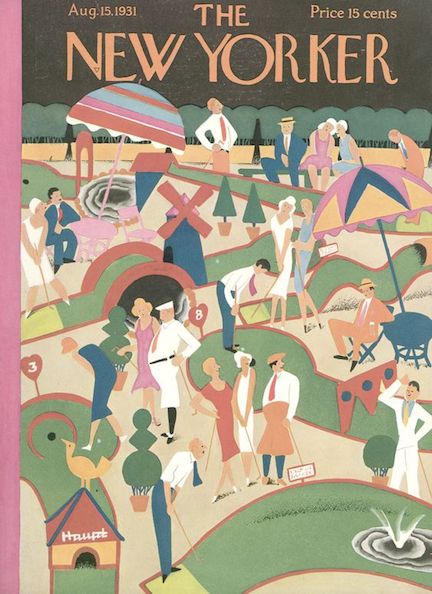
Aug. 15, 1931 cover by Theodore Haupt.

It is instructive to look back 89 years and see how far we’ve come, and how far we still have to go, to see our fellow creatures as more than curiosities and amusements to be captured and gawked at, and to see their environments as something to be preserved, not only for their survival but for ours as well.

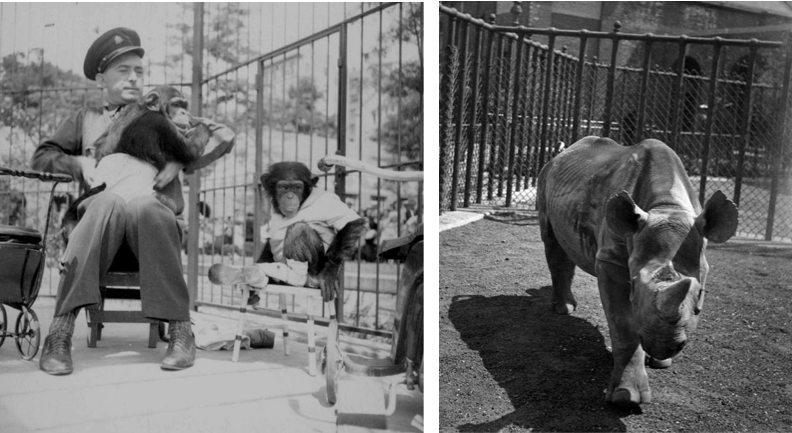
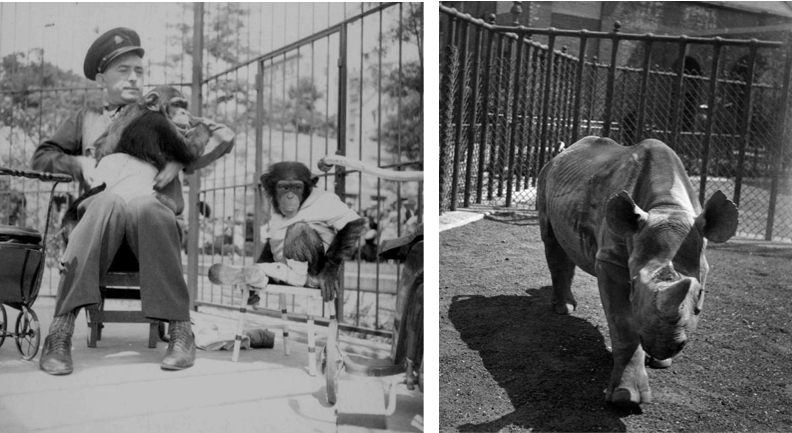
LIFE BEHIND BARS…Left, a zookeeper with chimps at the Central Park Zoo, 1936. Right, a rhino paces in a barred enclosure, 1937. (nycgovparks.org)

E.B. White paid a visit to the Central Park Zoo, and found it wanting in a number of respects:

Many zoos back then were more collections of curiosities than places where you could learn about various habitats. So when David Sarnoff, president of RCA, bagged a live opossum in the South, the critter was given a new home in an antelope enclosure, per this item in the Dec. 20, 1931 New York Times:

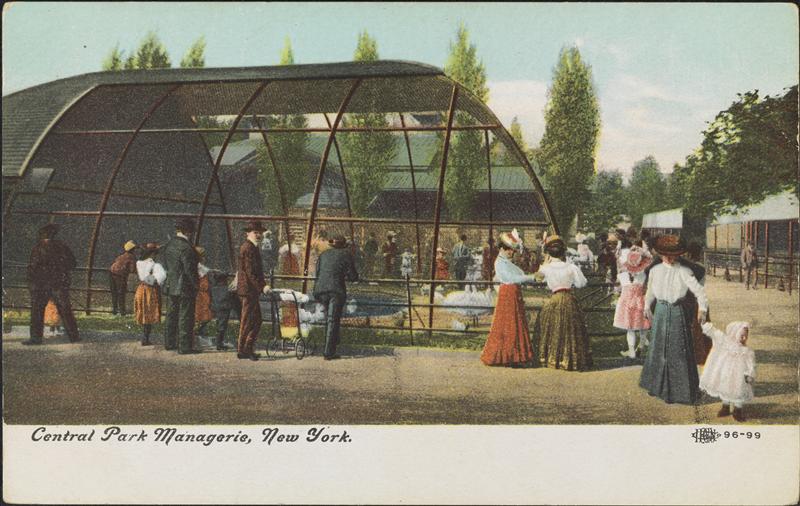
The Central Park Zoo was established in the 1860s as a “menagerie” behind the Arsenal, and by the turn of the century attracted millions of visitors to its displays of exotic animals.

GETTING AWAY FROM IT ALL…Postcard image of the Menagerie in Central Park, New York, 1905. (Museum of the City of New York—MCNY)
ANIMAL ATTRACTION…Postcard image of folks enjoying caged birds at the Menagerie, 1905. (MCNY)
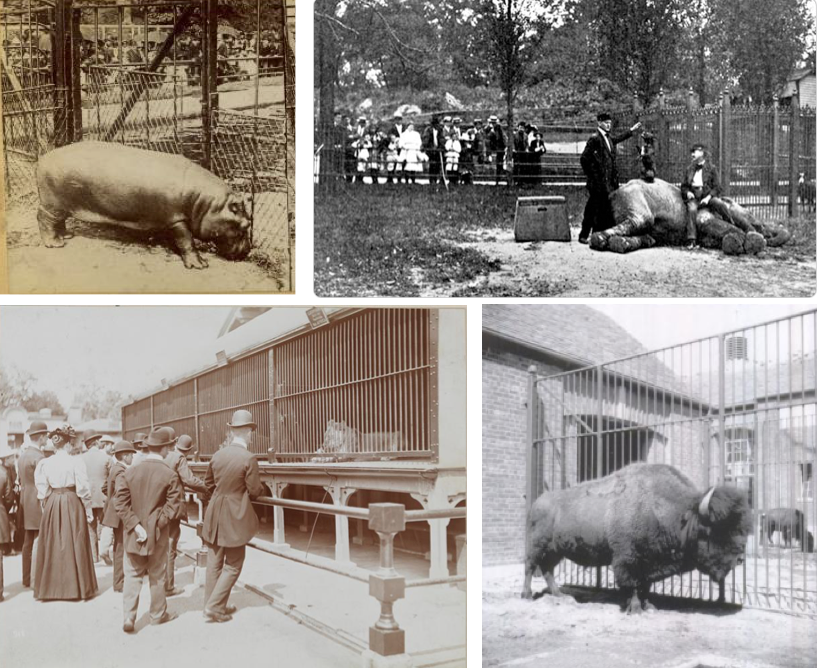
O GIVE ME A HOME…In the early days of zoos, animals were presented in cages and fenced enclosures with no hint as to what their natural habitat might look like. Clockwise, from top left, “Fatima” the hippo, image from an 1896 stereograph card; a 1911 photo of a trainer and a dog perched on top of a hapless elephant; a bull bison around the turn of the century; a group of people observe animals in cages at the Central Park Menagerie, 1895. (Library of Congress/nycgovparks.org/MCNY)

 *  *  *

He’s Your Future

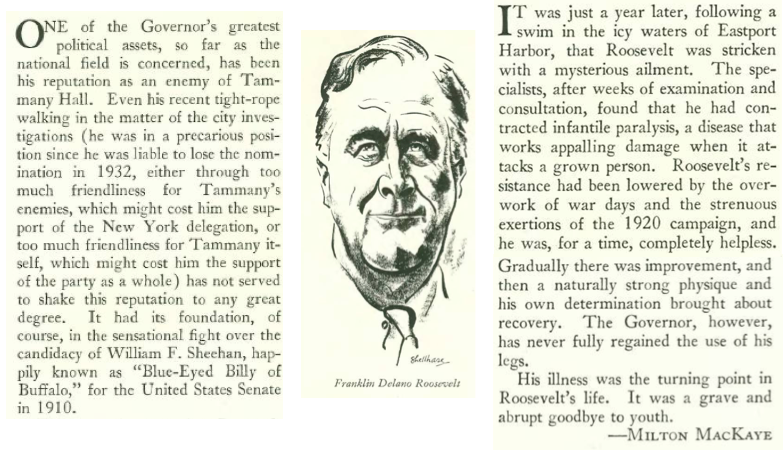
The New Yorker featured two-part profile of the governor of New York, Franklin D. Roosevelt, who unbeknownst to writer Milton MacKaye would soon become the next president of the United States. Two excerpts (not continuous)…

  *  *  *

From Our Advertisers

Ah yes, the first time I visited the Empire State Building’s observation deck (in the 1970s) a heavy smog enveloped the city (the air is much cleaner today). I like how the promoters spin disappointment into an opportunity — “The mysterious beauty of the city has a million constantly changing aspects”…

…if you were looking for bluer skies, Bermuda could have been an option if you had the means…

…or you could have stayed closer to home at a Long Island beach resort, as Helen Hokinson illustrated, and as we segue into our cartoons…

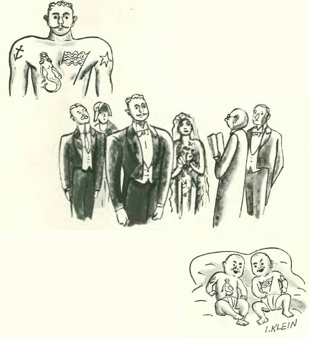
Isadore Klein gave us a very unscientific, albeit humorous view of genetics…

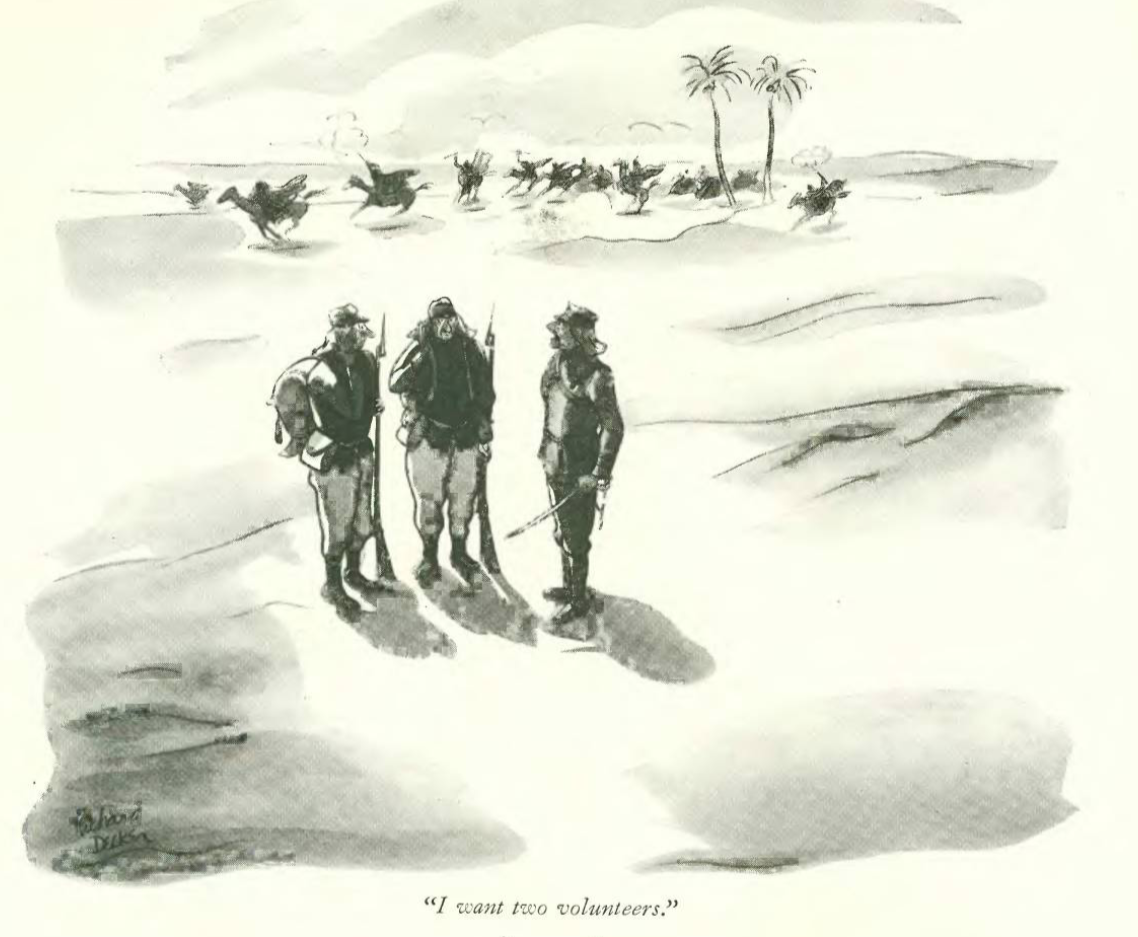
Richard Decker redefined the meaning of “volunteers”…

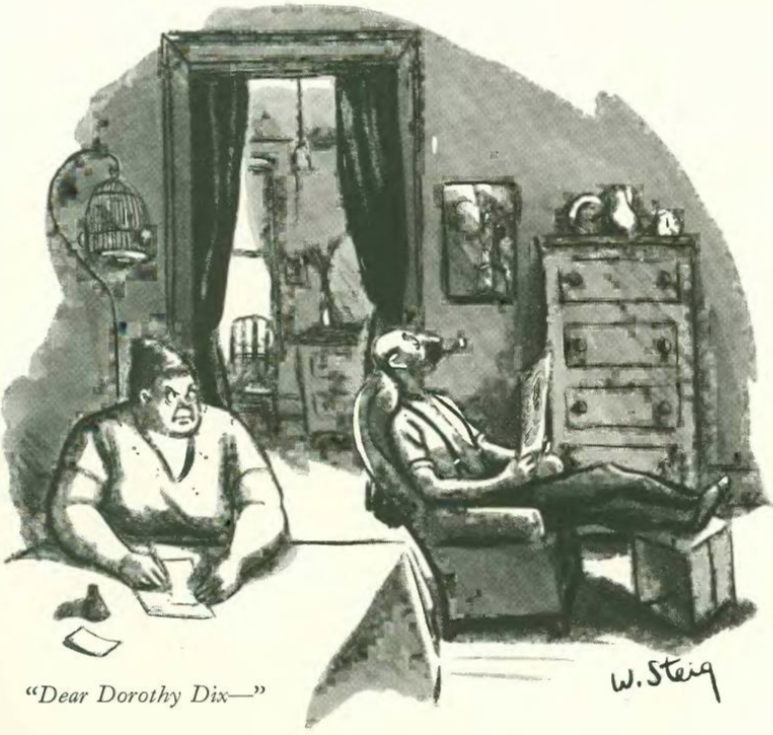
…and William Steig summoned the advice of Dorothy Dix, a forerunner of “Dear Abby” who was the most widely read female journalist of her time…

We move on to the Aug. 22, 1931 issue…

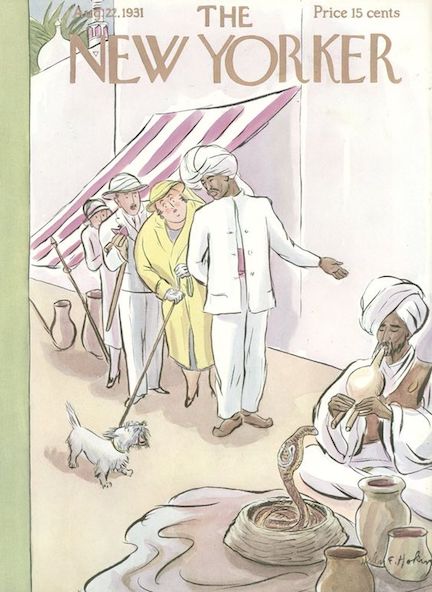
Aug. 22, 1931 cover by Helen Hokinson.

…in which James Thurber wrote about his experience with early television in “The Talk of the Town”…

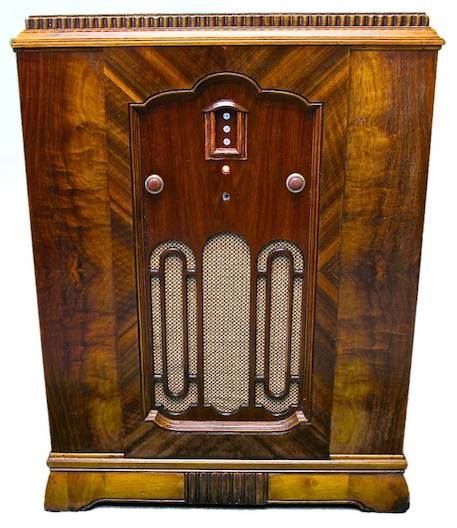
NO CABLE BILL, YET…Charles Francis Jenkins demonstrates his “Radiovisor” console television in 1929. At right, the inner workings featured a rotating disc punctured with tiny holes, each projecting a line across the glass screen to compose an image. As Thurber noted, the pictures commonly were too dark for viewers to see anything more than silhouettes. Not to mention Thurber’s eyesight was also terrible. (earlytelevision.org)

 *  *  *

The Other Moving Pictures

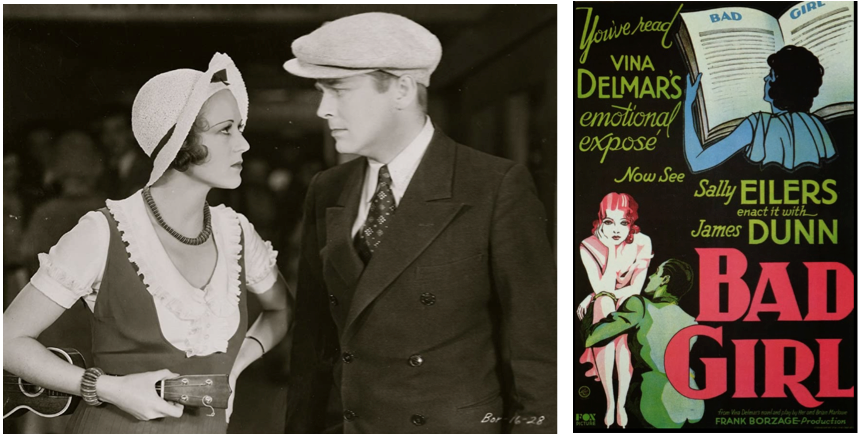
The movies still had nothing to fear from television in 1931, and Hollywood continued to draw large audiences to “Pre-Code” films that featured doses of sex and violence. Novelist Viña Delmar gained famed in 1928 with her suggestively titled book Bad Girl, so when it was adapted into a film, audiences came running—even if the screen adaptation proved to be a bit tamer than the novel that inspired it. Critic John Mosher observed:

I’M JUST A LITTLE BAD…Sally Eilers played the title character in Bad Girl with co-star James Dunn. The film won two Oscars in 1932 for Best Director (Frank Borzage) and Best Writing, Adaptation (Edwin J. Burke). (IMDB)

 *  *  *

Chic Chapeau

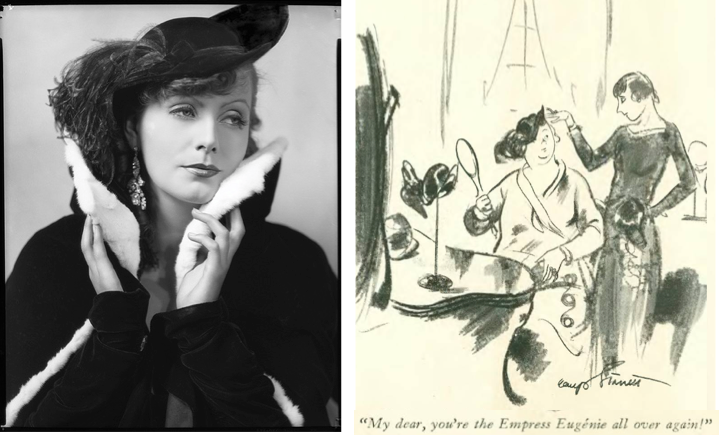
The Empress Eugénie hat was named for 19th century French empress Eugénie de Montijo, who was known as a fashion trendsetter. The hat was revived in 1930 after Greta Garbo was seen wearing a version of one in the popular film Romance. E.B. White was not exaggerating when he noted (in his “Notes and Comment”) that the jaunty hat was seen on “every other head” in the city.
 

LOOK WHAT YOU STARTED…Greta Garbo sported an Empress Eugénie hat in the 1930 film Romance, setting off a fashion craze that persisted through much of the decade. At right, Kemp Starrett referenced the trend in this Aug. 8, 1931 cartoon in The New Yorker. (Pinterest)

 *  *  *

From Our Advertisers

Speaking of trends, these “roughies” were all the rage among the young folks, in the dorms and on the beach…

…one trend I wasn’t aware still persisted in 1931 was a top hat and tails for an evening out among the smart set…

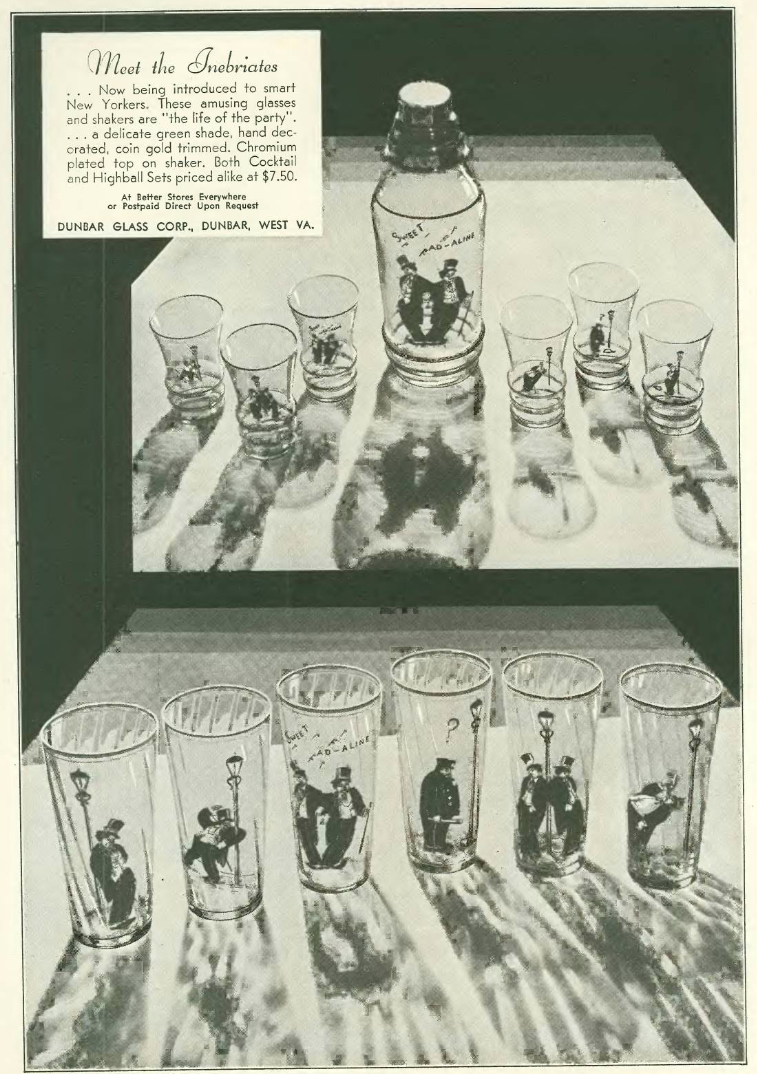
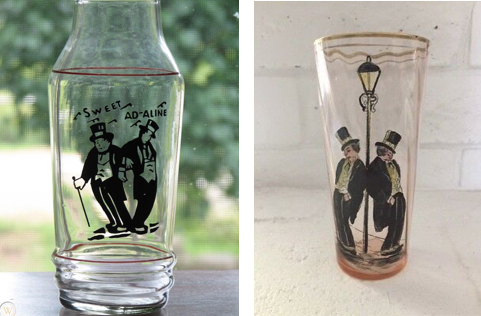
…according to this ad, if you were a “smart” and fashionable New Yorker, then you needed an “Inebriates” themed cocktail set…

…examples of the glassware for sale on Worthpoint…

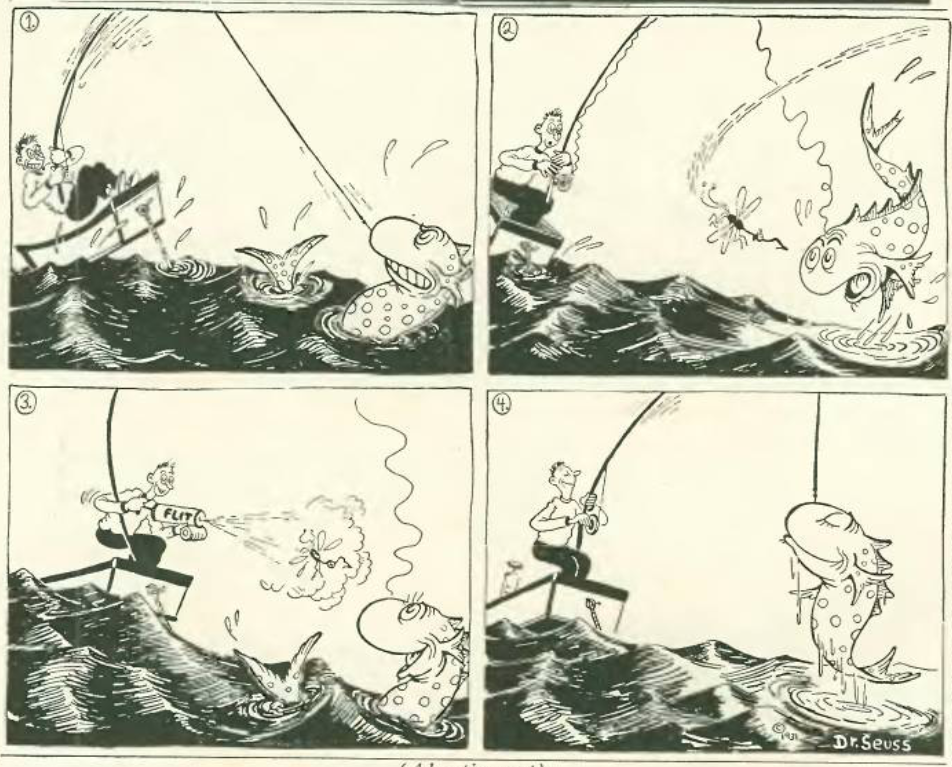
Dr. Seuss was still busy selling pesticide with this four-panel ad…

…on to the cartoons, we start with James Thurber

…and Rea Irvin continued to experiment with various motifs, this time an Egyptian-themed cartoon referencing the “wine bricks” sold by enterprising vineyards during Prohibition…

Peter Arno found a big surprise during a mansion tour…

…and we end with Otto Soglow

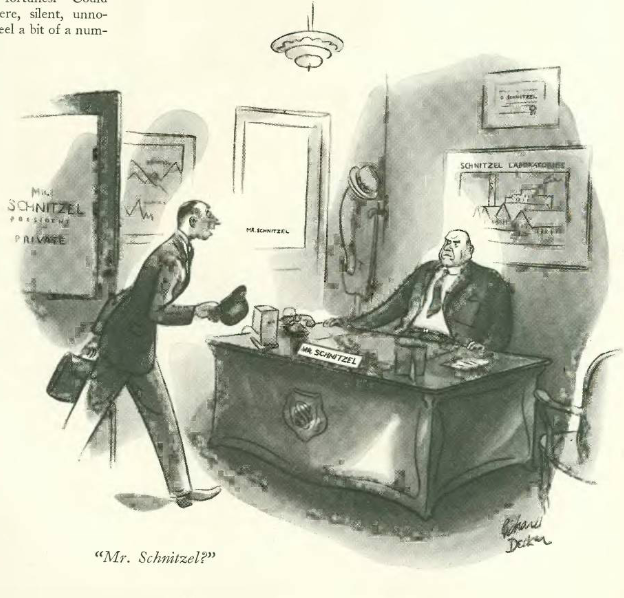
…and Richard Decker…both cartoons reminded me of Al Jaffee’s Snappy Answers to Stupid Questions

…I grew up reading Mad magazine, and always looked forward to Jaffee’s fold-ins…he just retired from Mad at the young age of 99, so we conclude with one of his Snappy Answers panels from Mad #98, Oct. 1965…

Next Time: Unnatural History…


Markey’s Road Trip

With the explosion of car ownership in the 1920s and 30s came improved highways across America, but if one were to undertake a long-distance journey, like The New Yorker’s Morris Markey, you were bound to find a wide range of conditions, from concrete highways to muddy dirt roads.

July 25, 1931 cover by Gardner Rea.

Markey wrote about his experience of driving from New York City to Atlanta for his “Reporter at Large” column, noting that stops at filling stations also offered opportunities to fill up on bootleg gin. Drunk driving, it seems, wasn’t a big concern in the early 1930s.

BLUE HIGHWAYS…Although the U.S. launched into major roadbuilding projects in the 1920s and 30s, rutted and muddy roads were still common in many areas of the country. Clockwise, from top left, Route 1 winds through Maryland in the 1920s; marker indicating the Mason and Dixon Line dividing Pennsylvania from Maryland, circa 1930; a 1930s dirt road in the Eastern U.S.; a policeman directs traffic in Richmond, Va., in the 1930s. (Library of Congress/fhwa.dot.gov/theshockoeexaminer.blogspot.com)
TIME TO GIN UP…James H. Brown (left), at the first of his four service stations in Richmond, Va., circa 1930. Some service stations offered Morris Markey bootleg gin during his journey to Atlanta. My use of this photo, however, does not imply that Mr. Brown offered the same service. (vintagerva.blogspot.com)

Unfortunately, Markey shared the sensibilities of many of his fellow Americans 89 years ago, and made this observation about drivers below the Mason and Dixon Line:

 *  *  *

Pale Riders

Since the mid-19th century Chelsea’s Tenth Avenue was known as “Death Avenue” due to the killing and maiming of hundreds who got in the way of freight trains that plowed through 10th and 11th Avenues in the service of warehouses and factories in the district. In the 1850s the freight line hired horsemen known as “West Side Cowboys” to warn wagons and pedestrians of oncoming trains, but even with this precaution nearly 450 people were killed by trains between 1852 and 1908, with almost 200 deaths occurring in the decade preceding 1908. Calls for an elevated railroad were finally answered with the opening of the High Line in 1934. “The Talk of the Town” looked in on the last of these urban cowboys:

WESTSIDE COWBOYS…Clockwise, from top left, a steam locomotive rumbles down 11th Avenue in the 1920s; a West Side Cowboy William Connolly rides ahead of a train to warn pedestrians in 1932; George Hayde led the final ride of the West Side cowboys up 10th Avenue on March 24, 1941; aerial view of the High Line from 18th Street heading north. Opened in 1934, the High Line lifted most train traffic 30 feet above the street. Today it serves only pedestrians, and is one of New York’s biggest tourist draws. (Forgotten NY/AP/NY Times/thehighline.org)

 *  *  *

Guys and Dolls

“The Talk of the Town” had some fun with a little-known aspect of a notorious gangster’s life; namely, the doll-filled house belonging to Jack “Legs” Diamond:

DOLL HOUSE…This house on Route 23 near Cairo, New York, once sheltered gangster Jack “Legs” Diamond, his wife, Alice, and her extensive collection of dolls and other knick-knacks. (nydailynews.com/Zillow)

“Talk” also made joking reference to the number of times Diamond had been shot and survived to tell about it.

Diamond’s luck would run out at the end of 1931 — Dec. 18, to be exact — when gunmen would break into his hotel room in Troy, NY, and put three bullets into his head.

 *  *  *

Ziggy’s Stardust

Florenz Ziegfeld (1867-1932) had a knack for show business, launching the careers of many entertainers through his Ziegfeld Follies, which got its start in 1907 during vaudeville’s heyday. The advent of sound movies signaled the end of the vaudeville era and of Ziegfeld himself, who would stage one final Follies before his death in 1932. Gilbert Seldes penned a two-part profile of Ziegfeld under the title “Glorifier” (caricature by the great Abe Birnbaum). An excerpt:

GO WITH THE FLO…Broadway impresario Florenz “Flo” Ziegfeld Jr with his Follies cast, 1931. It would prove to be his last Follies show. Revivals following his death in 1932 would prove to be much less successful. (Wall Street Journal)

 *  *  *

If Looks Could Kill

The New Yorker’s film critic John Mosher had a difficult time making sense of Murder by the Clock and its lead actress, Lilyan Tashman, who gave a tongue-in-cheek performance as the film’s femme fatale.

ARE YOU NUTS?…Irving Pichel and Lilyan Tashman in Murder by the Clock (1931). Tashman was known for her tongue-in-cheek portrayals of villainesses in films she made before her untimely death in 1934. (IMDB)

 *  *  *

Eine Kleine Nachtmusik

Open-air performances of classical music and opera were popular summertime diversions in the days before air-conditioning. In 1931 crowds gathered in Lewisohn Stadium to hear the New York Philharmonic perform under the direction of Willem van Hoogstraten, who conducted the Lewisohn summer concert series from 1922 to 1939. Here is a listing in The New Yorker’s “Goings On About Town” section:

MUSIC IN THE AIR…Cover of the 1931 program for concerts at Lewisohn Stadium, College of the City of New York. Bottom right, signed photo of Willem van Hoogstraten from 1930. (digitalcollections.nypl.org/ebay.com)

 *  *  *

From Our Advertisers

Flo Ziegfeld’s 1931 Follies were lavish productions, but his advertising in The New Yorker was anything but as evidenced in this tiny ad that appeared at the bottom of page 52…

…no doubt anticipating the demise of Prohibition, the makers of Anheuser-Busch beverages ramped up the promotion of their non-alcoholic products to create associations with pre-Prohibition times…

…not to be outdone by the East Coast chocolates giant Schrafft’s, Whitman’s took out this full page ad to suggest how you might enjoy their product…

…which was in sharp contrast to the approach Schrafft’s took in this full-page ad featured in the April 25, 1931 New Yorker, which touted the health benefits of its candy…

…on to our cartoons, Richard Decker took us swimming with a middle-aged man who was anything but bored…

Barbara Shermund went en plein air with a couple of her ditzy debs…

Garrett Price also went to the country to find a bit of humor…

Helen Hokinson found a home away from home for a couple looking to take the sea air…

James Thurber continued to explore his brewing war between the sexes…

Harry Haenigsen gave us a novel approach to landing a trophy fish…

William Steig illustrated the wonders of the tailoring profession…

…and Alan Dunn aptly summed up the generation gap of the 1930s…

…on to the Aug. 1, 1931 issue…

August 1, 1931 cover by Rose Silver.

…”The Talk of the Town” mused about the advertising jingles made famous by the makers of Sapolio soap…

…Bret Harte actually did write jingles for the brand, once described by Time magazine as “probably the world’s best-advertised product” in its heyday. With a huge market share, Sapolio was so well known in the early 20th century that its owners decided they no longer needed to spend money on advertising. It was a poor decision, and by 1940 the product disappeared from the marketplace.

SEEING THE LIGHT OF DAY…A 19th century Sapolio sign on Broadway and Morris Street revealed after an adjoining building was demolished in 1930. (Museum of the City of New York)
MONEY WELL SPENT…Sapolio ad from its heyday in the early 20th century. (Pinterest)

 *  *  *

Tough Love

As a charter member of the famed Algonquin Round Table, Heywood Broun was a friend to many of the founding writers and editors of The New Yorker. And so it must have been quite a task to review his play, Shoot the Works, which The New Yorker found wanting in a number of aspects. And because he was so close to Broun himself, Robert Benchley left the review writing to someone who signed the column “S. Finny.” I can’t find any record of an S. Finny at The New Yorker, and I don’t believe this is a Benchley pseudonym (he used “Guy Fawkes” in The New Yorker). At any rate, here is an excerpt:

SHOOT GETS SHOT…The New Yorker wasn’t crazy about Heywood Broun’s play, which ran for 87 performances at George M. Cohan’s Theatre. (Playbill)

 *  *  *

From Our Advertisers

The makers of the “Flexo” ice cube tray continued to tout the wonders of their product with these Ripley-themed ads. This might appear rather mundane to modern eyes, but electric refrigerators with built-in freezers were still rather novel in 1931…

…another way to stay cool in the summer of 1931 was to take an excursion to the Northern climes…

…this ad for the New York American featured an illustration by Herbert Roese, whose early work strongly resembled that of Peter Arno’s

…on to our cartoons, we have the latest antics of the Little King courtesy Otto Soglow

William Steig added levity to a heavy moment…

Barbara Shermund found humor at an antiques shop…

...John Held Jr continued his revels into our “naughty” Victorian past…

…and we end with Garrett Price, and a look at the ways of the modern family…

Next Time: An American Classic…


The Black Eagle

Charles Lindbergh gained worldwide fame when he flew solo across the Atlantic in 1927, but the staid Lindy had nothing on Hubert Fauntleroy Julian when it came to personality (and politics, as we shall see). The Trinidad-born Black aviator not only pushed the limits of early 20th century aviation, but did it all with style and pizzazz.

July 18, 1931 cover by Helen Hokinson. More on Helen’s 1931 travel covers in the cartoon section at the end of this blog entry.

Julian (1897-1983), known as “The Black Eagle,” left Trinidad in 1914 for Montreal, where he first learned to fly. He moved on to Harlem in 1921, where he polished his flying skills with aviator Clarence Chamberlin and practiced his parachute jumps. In the first of a two-part “Profile,” Morris Markey related Julian’s first encounter with Chamberlin:

DOING IT WITH STYLE…At left, Hugo Gellert portrait for The New Yorker “Profile;” at right, the dapper Hubert Julian in 1937 (note the monocle hanging in front of his waistcoat). (harlemworldmagazine.com)

Julian did everything with brio; during one jump in New Jersey in 1923, he played “I’m Running Wild” on the saxophone while plummeting toward the earth. Keep in mind that the first planned free-fall jump from an airplane with a packed parachute occurred just four years earlier, in 1919. Heaven only knows how Julian made it to age 85.

BRING IT ON…Julian poses with his airplane, Ethiopia I, in the 1920s. At right, a 1935 syndicated feature on Julian’s exploits. In 1931 he became the first flyer of African descent to fly coast-to-coast in the United States. (Brooklyn Eagle/Pittsburgh Courier, Feb. 2, 1935)
THIS IS HOW WE DO IT…In the early days, parachute jumpers often climbed onto a wing to make their jump. Pictured here is Leslie Irvin, who on April 28, 1919, became the first aviator to make a descent with a “free type” manually operated parachute. (wondersofworldaviation.com)

During the 1930s Julian briefly headed the Ethiopian Air Corps, then returned to the States to tour as a member of an all-Black flying troupe, “The Five Blackbirds.” Incensed over comments Nazi leaders were making about Blacks and other races during World War II, Julian famously challenged Hermann Göring, commander of the Luftwaffe, to an aerial duel above the English Channel (Göring did not respond to the challenge). By contrast, Charles Lindbergh received a medal from Göring during a dinner at the American Embassy in Berlin in 1938, and praised the Nazi regime that would later go to war against his own country.

Julian was no choirboy, however, and after the war he became a licensed arms dealer, which eventually got him in trouble with the United Nations and earned him a four-month stint in jail. After his release, Julian retired, appearing on talk shows (including The Tonight Show with Johnny Carson) and hobnobbing with celebrities such as boxer Muhammad Ali.

(Louisville Courier-Journal, March 21, 1964)

 *  *  *

I’ll Take a Dozen

“The Talk of the Town” followed its sweet tooth to a Broadway storefront where Adolph Levitt’s famed doughnut-making machine was cranking out 1,200 doughnuts an hour before hungry, wondering crowds.

MR DOUGHNUT…Clockwise, top left, doughnut machine inventor Adolph Levitt (front row, dark suit) with some chums at a train station; doughnut gawkers gather before the window at Levitt’s Mayflower Doughnuts, 1933 (photo by Martin Munkácsi); ad touting one of Levitt’s machines as a form of entertainment; and an illustration by Robert McCloskey from his beloved children’s book, Homer Price, of a doughnut machine gone berserk. (ice.org/econlife.com/Pinterest)

 *  *  *

Surfing the Jersey Cliffs

Along with doughnut machine-watching, another fun summertime diversion was New Jersey’s Palisades Amusement Park, which was purchased in 1909 by brothers Nicholas and Joseph Schenck and transformed into one of the most visited amusement parks in the country. “The Talk of the Town” recalled its origins:

COME HITHER suggests the sign for Palisades Amusement Park, offering dancing, vaudeville and surf-bathing among other diversions. Circa-1940 postcards featured the mechanically generated surfing pool and the famed “Cyclone” roller-coaster. (Pinterest)

And these were the guys responsible for all of that fun…

 Joseph (left) and Nicholas Schenck might not look like carefree sorts, but both had a knack for the entertainment world that would make them two of the most powerful executives in mid-century Hollywood. Among other things, Joseph played a key role in launching the career of Marilyn Monroe. He was, naturally, infatuated with her.

IS THAT YOUR GRANDDAUGHTER?…Joe Schenck and Marilyn Monroe are flanked by Walter Winchell and Louella Parsons at a birthday party for Winchell at Ciro’s Nightclub, May 13, 1953. (Pinterest)

 *  *  *

Claptrap

Robert Benchley couldn’t seem to let go of his recent experience at the revived Ziegfeld Follies. In his latest theatre column, he groused about the witless rubes in the audience who clapped over the sound of the performances, including Ruth Etting’s signature “Shine on Harvest Moon.” Take it away, Bob…

HOLD YOUR APPLAUSE…PLEASE…It was impossible to hear the trademark “cry” in Ruth Etting’s voice let alone anything else over the incessant applause at Ziegfeld Theatre.

 *  *  *

Coping With a Dry Climate

In his “Notes and Comment,” E.B. White mused over the explosion of corkscrews, flasks and other drinking accessories that were patented during Prohibition:

WHERE THERE’S A WILL…Flapper displays her garter flask in this photo from 1926. At right, a Demley “Old Snifter” corkscrew and bottle opener. (Wikipedia)

 *  *  *

From Our Advertisers

If you needed a stiff drink and an escape from the summer heat, well the heavenly shores of Bermuda might have been your (ahem) cup of tea…

…or you could have enjoyed the merriment aboard one of Cunard’s liners, which were headed both south to Bermuda and north to Nova Scotia (note Cunard’s continuing use of New Yorker cartoonists for their ads, Peter Arno, H.O. Hofman, and this week Barbara Shermund)…

…and we have another ad from Canadian Pacific announcing its around-the-world cruise on the Empress of Britain

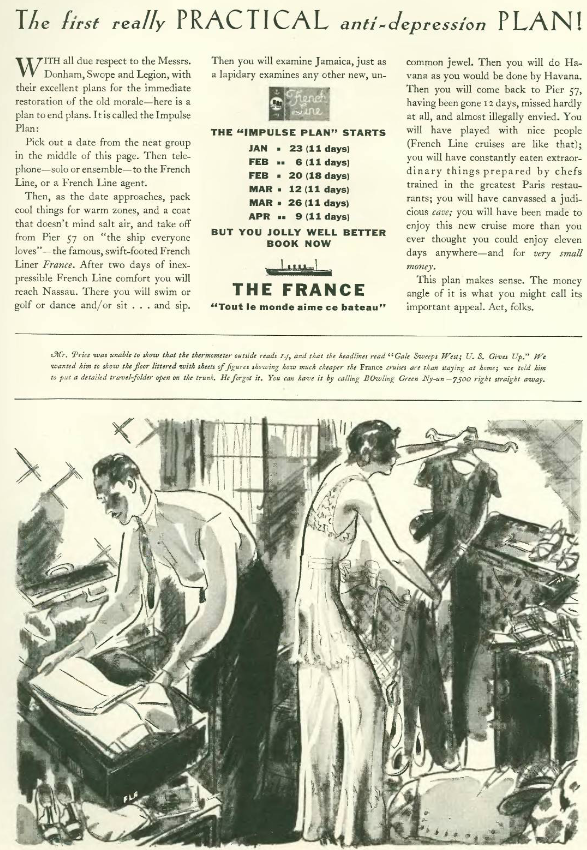
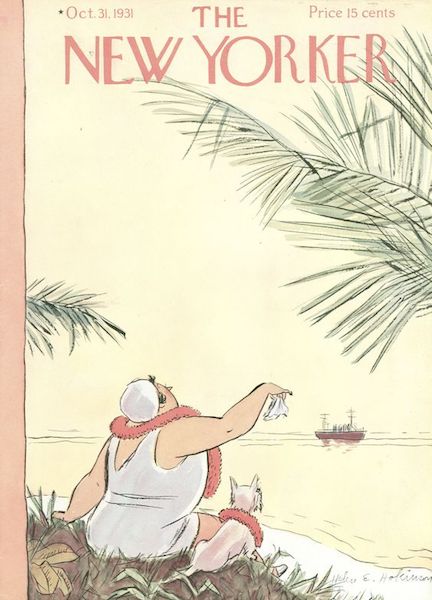
…which brings us to our cartoonists, or specifically, Helen Hokinson, who featured one of her “Best Girls” — a plump, wealthy, society woman — on an around-the-world cruise of her own, chronicled on a total of 11 covers in 1931.

Today’s cover marks the mid-way point of the dowager’s journey, where she encounters a situation perhaps not described in her travel folder…

…and here are the 11 covers that take us from bon voyage in March to the customs office in November…

…and appropriately, we launch into the cartoons with one of Hokinson’s “girls” being a bit naughty, even smoking a cigarette…

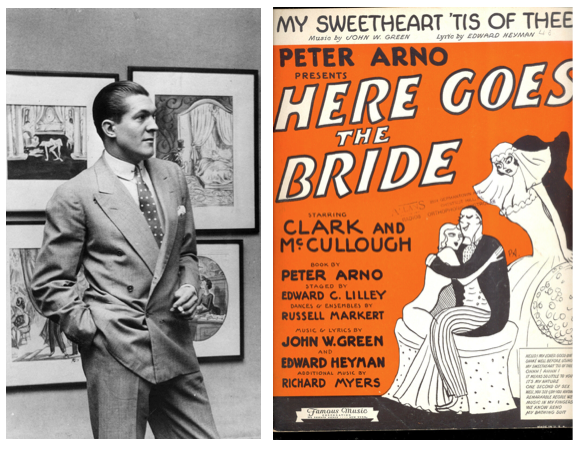
…one artist we don’t see much of during the summer of 1931 was Peter Arno, and for good reason: he ended a tempestuous marriage to Lois Long (relocating to Reno to obtain the divorce) in June, then immediately got involved in a sex scandal with a socialite, all the while working on a Broadway musical. Taking up the slack were cartoonists like Barbara Shermund, who for a time could be seen as a “near doppelgänger” of Arno, according to Michael Maslin in his excellent book, Peter Arno: The Mad, Mad World of The New Yorker’s Greatest Cartoonist (also see chapter six for more on Arno’s crazy summer of ’31). I feature two from Shermund in this issue:

…moving along, Garrett Price makes me wonder if drunken driving laws were enforced in 1931…

William Steig gave us a couple of buddies discussing their literary tastes…

…and yet another cartoon with precocious kids, this time by Alice Harvey

…speaking of being alone, a day at the beach would not be an option according to Gardner Rea

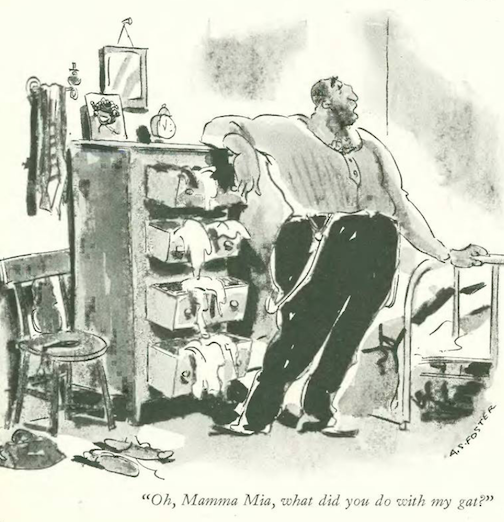
…and we end with A.S. Foster, and a very modern-looking cartoon not only for its style but for the fact that it features anthropomorphic animal characters, rare in the early New Yorker

Next Time: Markey’s Road Trip…


Frozen at 30 Rock

To call Lewis Mumford an architecture critic would do him a disservice. He was indeed an outspoken voice on New York’s changing skyline, informed by a keen understanding of history and aesthetics, but his criticisms were also those of a philosopher, a political commentator, a city planner, and an authority on matters concerning art, literature, society and culture.

June 20, 1931 cover by S. Liam Dunne.

The June 20, 1931 issue marks the entrance of Mumford (1895-1990) to our New Yorker story, and just in time to offer his perspectives on the Rockefeller Center project, which was about to commence.

THERE GOES THE NEIGHBORHOOD…This Midtown neighborhood was torn down shortly after the photo was taken to make room for the massive Rockefeller Center project. The view is from the corner of 6th Avenue and 51st Street looking to the southeast. One of the spires of St. Patrick’s is visible at far left, and the Chrysler Building can be glimpsed in the distant center. Lewis Mumford was no fan of giant skyscrapers or other “mega” building projects, and would have preferred something more on this smaller scale for Rockefeller Center. (Museum of the City of New York)

The proposed project — then referred to as “Radio City” — received negative reviews from a number of critics, although the most pointed came from Mumford, who disliked “mega” building projects such as Rockefeller’s, labeling it as “weakly conceived, reckless, romantic chaos.”

RECKLESS, ROMANTIC CHAOS is how Lewis Mumford, left, described plans for Rockefeller Center. At right, the May 1931 issue of Popular Science featured the project’s plans. (Pinterest/Google Books)

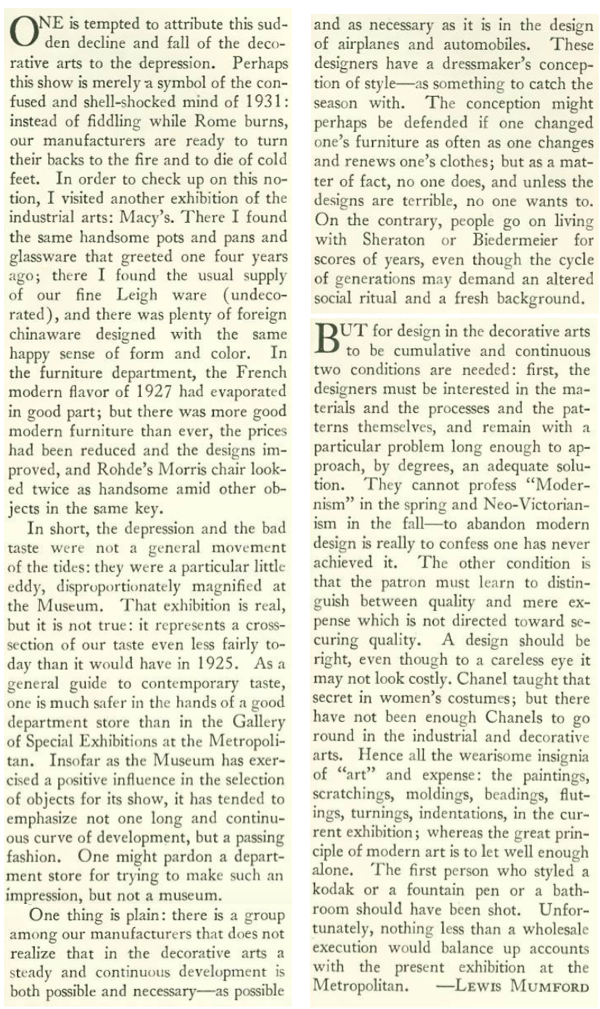
Mumford’s Emersonian temperament favored simplicity, self-sufficiency and community; he believed skyscrapers and other “megamachines” were dehumanizing and even dishonest. In this next excerpt he poses a question about the so-called pragmatic “money men” behind the project: “Are the practical men practical?” We read on…

WELCOME TO CLOUDCUCKOOLAND…That was Mumford’s own term to describe plans for Rockefeller’s “Radio City.” An early rendering from 1928 (left) referred to the project as “Metropolitan Square,” and for a time it was slated to include a new Metropolitan Opera house.  Joseph Urban proposed this Fifth Avenue-facing design (right) in 1927, but plans were waylaid by the Great Depression. (ephemeralnewyork)
BLANK SLATE…With the site mostly cleared, construction commenced in the fall of 1931. This image is from December 16, 1931. (Museum of the City of New York)

Mumford concluded that the opportunity to create a restful respite from the clamor of the city had been lost on the project, which just promised more “razzle-dazzle” and “incongruous jangle,” an interesting observation given that other New Yorker writers were generally dazzled by the skyscrapers and other gigantic projects that were rapidly erasing the old city.

True to his beliefs, Mumford lived a simple life in an old country house in Amenia, New York, a small town in the northern reaches of the Hudson Valley region.

FAR FROM THE RAZZLE-DAZZLE…Mumford house in Amenia, NY. (Wikipedia)

Historian Daniel Okrent, author of Great Fortune, The Epic of Rockefeller Center, notes that Mumford was eventually won over by Rockefeller Center in the end, calling it “a serene eyeful” and “the most exciting mass of buildings in the city.” I have to agree.

SERENE EYEFUL…Images of Rockefeller Center from 1939 (left) and 1935. (flickr.com/(Museum of the City of New York)

 *  *  *

Summertime Reads

A quick glance at the new books listed at the end of the New Yorker’s book review column shows us a nice variety of summertime diversions, including a book about Josef Stalin written before his Great Purge that murdered a million of his own citizens…then there was the memoir Blood on the Moon written by Jim Tully, “America’s most famous hobo author”…the book Life Among the Lowbrows by Eleanor Rowland Wembridge also caught my eye…I believe I’m almost set for the summer…

A STUDY IN CONTRASTS…Misfits and lowlifes peppered the books of both “hobo writer” Jim Tully (left) and psychologist Eleanor Rowland Wembridge, although from very different perspectives. While Wembridge took a more clinical approach to the underclasses, Tully used them for material in his hardscrabble stories. Guess which one ended up in Hollywood. (scpr.org/apadivisions.org)

 *  *  *

From Our Advertisers

The makers of Jantzen swimwear took a slightly risqué approach in advertising their latest women’s line…

…the owners of the Majestic, on the other hand, used snob appeal and a sense of heightened grandeur to promote their Central Park West apartments…

…advertisers of non-alcoholic drinks tried their best to capture the allure of cocktails, and I imagine much of their product was mixed with something a bit more interesting…

William Steig was hitting his stride as one of the newer cartoon contributors to The New Yorker

…with two of his entries featured in the June 20 issue…Steig would live 95 years and be productive throughout his life…nearly 60 years after these cartoons appeared in The New Yorker he would publish the children’s book Shrek!, the basis for the popular movie series…

…earlier in his career, Steig would also find fame for his series of Small Fry cartoons featuring children in adult situations, anticipating Charles Schulz’s Peanuts…this next cartoon, however, is not by Steig but by Alan Dunn, perhaps anticipating Steig…

Gardner Rea continued to explore the foibles of the well-heeled…

John Held Jr amused us with another of his rustic “woodcuts”…

Garrett Price shot the rapids with a hapless suitor…

…here is one the six cartoons Crawford Young contributed to The New Yorker in 1931-32, capturing a moment in which the chicken-egg question is largely moot…

…and another look into the leisure classes courtesy Barbara Shermund

…and we close the June 20 issue with James Thurber, who showed us a fellow who probably regretted his evening out…

…Thurber also brings into the next issue, June 27…

June 27, 1931 cover by Gardner Rea

…in which he recounted his adventures in bird-watching and the mating habits of crows…

 *  *  *

A Falling (Lone) Star

In her “Letter From Paris,” Janet Flanner reported that the allure of the “Queen of the Nightclubs,” Texas Guinan, did not extend to French shores, where among other things she ran afoul of labor laws that dissuaded non-citizens from working in France.

BEGINNING OF THE END…Associated with risqué entertainments in various speakeasies during the Roaring Twenties, the Great Depression prompted Texas Guinan to take to the road with her show. After attempting (and failing) to make a tour of Europe, she returned to the States for one final road trip. Above left, Guinan in the 1933 film Broadway Through a Keyhole, which would open just three days before her death. At right, headline from the Rochester Democrat and Chronicle trumpeting Guinan’s French debacle. (pre-code.com/

Upon her return to the States, Guinan took advantage of her well-publicized dismissal from France and launched the satirical revue Too Hot for Paris. This traveling show would also mark the beginning of the end for Guinan, who would contract amoebic dysentery during a run of the show at the Chicago World’s Fair. It would claim her life on Nov. 5, 1933, at age 49.

 *  *  *

They Put the Ping Into Pong

“They” being the Parker Brothers, who took umbrage at anyone who questioned their sole right to market genuine “Ping-Pong” balls. “The Talk of the Town” explained:

The “Talk” item ended with a little surprise about Mr. George Parker himself:

VINTAGE…A 1902 ping-pong set from Parker Brothers. (Worthpoint)

 *  *  *

From Our Advertisers

Some lovely color ads, including this message that paired playful porpoises with leaded gasoline…

…this ad was about color itself, and how Powers Reproduction Corporation could make your images pop…

…and another sad Prohibition-era ad from the makers of Budweiser, in this case, a non-alcoholic version that looks like the real thing…of course what is even sadder about this ad is the suggestion that plantation life was something one should fondly hearken back to…

…on to our cartoons, and another terrific illustration from Barbara Shermund

…and we have Otto Soglow’s Little King, who temporarily lost his crown…

…and another from Soglow, at the men’s store…

Carl Rose gave us a chap contemplating the burdens of a Guggenheim “genius” grant…

Peter Arno revealed that his Major had two left feet…

…and in anticipation of the Fourth of July, we end as we began, with Gardner Rea

Next Time: Firecracker Lane…


A Star is Born

Clark Gable made such an impression as a charming rogue in 1931’s A Free Soul that it transformed him almost overnight from a bit actor to into one of Hollywood’s biggest stars of the 1930s.

June 13, 1931 cover by Helen Hokinson.

When the film was released it was Norma Shearer who was the biggest name, supported by Lionel Barrymore and Leslie Howard. As this was “Pre-Code” Hollywood, MGM played up the film’s risqué themes of gangsters, drunks and infidelity. After all, according to this ad, Norma was “born in an age of FREEDOM!”

Although critic John Mosher—already weary of the fledgling gangster film genre—found the film pretentious, the public voted it one of the best films of 1931, and Barrymore took home an Oscar for his performance as a successful but conflicted (and alcoholic) attorney…

TRUST ME, HE WON’T BITE…Defense lawyer Stephen Ashe (Lionel Barrymore) introduces Ace Wilfong (Clark Gable), a bootlegger he successfully defends from a murder charge. Unfortunately, Ashe’s daughter Jan (Norma Shearer), who was betrothed to another (the squeaky-clean Dwight Winthrop, played by Leslie Howard), ends up falling for his shady client. (IMDB)
DECISIONS, DECISIONS…Jan Ashe (Norma Shearer) must decide between bad boy and goody two-shoes in 1931’s A Free Soul. Clark Gable and Leslie Howard would again play rivals for a woman’s affections eight years later in 1939’s Gone With The Wind. (IMDB)

 *  *  *

Speaking of Gangsters

A real one was profiled in The New Yorker by novelist and screenwriter Joel Sayre — Jack “Legs” Diamond — a thug who seemed to have nine lives but would be dead before the year was out (spoiler: he would not die from natural causes). An excerpt:

IN TROUBLE AGAIN?…Jack Diamond, aka “Legs Diamond” being escorted to the courthouse in Troy, New York in July 1931. (Everett)

 *  *  *

Some Real Guts

“The Talk of the Town” (via E.B. White) looked in on the work of famed aerial photographer Albert Stevens, who back in the day employed the common practice of chucking “flashlight bombs” out of airplanes to illuminate subjects below, including buildings along Riverside Drive that had their windows blown out during one of his aerial photo sessions…

Captains Albert Stevens (left, with the devil-may-care smile) and St. Clair Streett prepare for a high-altitude airplane flight in 1935. At right, Stevens readies his camera for an aerial photo session. (National Air and Space Museum).

Below is something similar to what Stevens dropped from the plane to get the effect he needed during nighttime shots…

Nighttime aerial photography owes its origins to pioneers like George Goddard, who stunned residents of Rochester, NY, in 1925 when he ignited an 80-pound flash bomb to illuminate the city (image at left). It is considered the first aerial night photograph. At right, Manhattan at night, 1931.

(16thphototech.wordpress.com)

 *  *  *

Poetic Pugilist

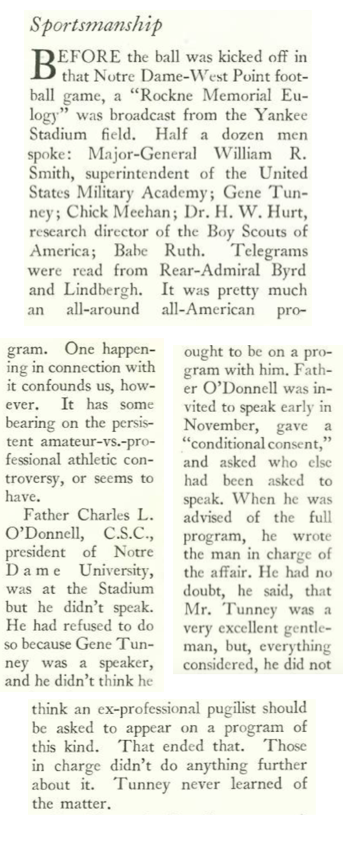
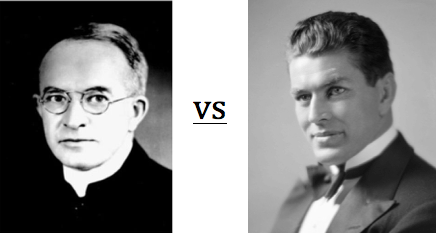
Throughout his career and into his retirement, heavyweight boxing champion Gene Tunney took great pains to distinguish himself from the other brutes who practiced his violent trade, and was known for his love of the higher and gentler arts. In his “Notes and Comment” E. B. White further explored this phenomenon upon the boxer’s return to the States:

I’M NO PALOOKA…Gene Tunney chewing the fat with playwright George Bernard Shaw during a holiday in Brioni, 1929. (Associated Press)

 *  *  *

Not So Brief

I include this entire page to feature both Garrett Price’s cartoon (Judge Benjamin Barr Lindsey, a leader in abolishing child labor, supported the idea of unmarried couples living together, hence the caption), and Wolcott Gibbs’ thoughts on applying for an advertising position…

 *  *  *

And speaking of advertising, we have this summer-themed ad from Macy’s (yes, they had inflatables back then, too)…

…for reference, here’s a 1930s photo of actress Una Merkel astride an inflatable horse like the one featured in the ad…

Publicity photo of Una Merkel for the 1933 film “Her First Mate.”

…R.J. Reynolds continued to market Camel cigarettes to women, but the ads moved away from illustrations of Continental leisure and instead emphasized the freshness of the product, thanks to the cellophane-wrapped “Humidor pack”…
…while cigarette smoking continued to increase in America, the sale of alcohol remained illegal — it didn’t stop people from drinking, and if you got a bad batch of bootleg, or just had too much, there were remedies available…

…perhaps a fortunate few were able to just sleep it off on a lovely bed fitted with Wamsutta sheets…

…on to our cartoons, Rea Irvin continued to explore his alter ego, “Du Maurier Irvin”…

Alan Dunn showed us why some “can’t make it there” in New York, New York…

Otto Soglow revealed that his Little King preferred beer to bubbly…

William Steig found an unlikely customer for a photo button…

Barbara Shermund explored politics between the sheets…

…and Peter Arno gave us his Major with a major itch to scratch…

Next Time: Frozen at 30 Rock…


Flying the Friendly Skies

A few posts ago (the April 11 issue) I wrote about E.B. White’s love of flying, and how his (and the nation’s) exuberance for aviation suddenly came crashing down along with Knute Rockne’s plane in a Kansas wheat field.

May 23, 1931 cover by Garrett Price.

The death of the famed Notre Dame football coach had White pondering a new, safer path for aviation that seemed to be embodied in a contraption called the autogiro. White had previously written about the potential of the autogiro back in 1929 (Dec. 7 issue). Half-helicopter and half-airplane, it was considered not only safer, but easier to fly, possibly opening up the sky to everyday commuters.

PHOTO OP…A Pitcairn PCA-2 Autogiro paid a visit to the White House on April 22, 1931. President Herbert Hoover is second from left. (Library of Congress)

On a windy day White boarded the autogiro at an airport “in awful Queens” — most likely the current site of La Guardia — and filed this report for the “A Reporter at Large” column:

In the article, White referenced this Pitcairn Autogiro ad from the April 25, 1931 issue. No doubt the folks at Pitcairn had the Rockne accident in mind when they touted the safety of their craft, which seemed impossible to crash.

White wasn’t the only one enthused about the autogiro. It was the darling of modernist architects and futurists of 1920s and 30s, who saw the flying machine taking its place alongside the automobile in the house of the future.

SWEET…The Swiss-born architect and designer William Lescaze rendered this “House of the Future” in the late 1920s with a bullet-shaped motorcar in the carport and an autogiro perched on the roof. (From my print collection)
COMMONPLACE, AT LEAST IN THE IMAGINATION…The autogiro appealed to the average Joe or Jill as well, featured in magazines such as the U.K.’s Practical Mechanics (June 1934) and Meccano Magazine (May 1931). At center, a Pitcairn ad from 1930. (vtol.org)
WELL, IT WORKED…This two-seat AC-35 Autogiro (left) was developed for a Department of Commerce competition to create an “Aerial Model T.” James G. Ray, vice president and chief pilot of the Autogiro Company of America, landed the AC-35 in a small downtown park in Washington. D.C. on Oct. 2, 1936; at right, a still image from a 1936 film, Things to Come, which showed people of the year 2036 getting around in autogiros while wearing groovy futuristic togas. (Smithsonian/gutenberg.net.au)

Prompted by a New York Times editorial, White pondered the day when the air would be thick with personal aircraft:

AND THEY LAND WHERE?…The idea of city skies filled with flying commuters is nothing new, as this 1911 illustration by Richard Rummell from King’s Views of New York attests. (The Guardian)

White offered still more observations on aviation safety in his “Notes and Comment” column…

…and in the same column he also pondered the future in terms of his infant son, Joel White:

Sadly, Joel didn’t quite make it to the turn of the century — he died in 1997. He did, however, have a successful life as a noted naval architect and founder of the Brooklin Boat Yard in Brooklin, Maine.

ON GOLDEN POND…Joel White took to the water at a very young age, seen at left rowing a boat in an image from a home movie by E.B. and Katharine White; at right, Joel in his design office at the Brooklin Boat Yard, which he founded in 1960. (E.B. White Collection, Northeast Historic Film/Billy Black)

One more from E.B. White, this the lead item for his column which made jest of a debate at Yale over dropping the requirement for Latin. It says something to the effect that “Yale’s lead on the issue frees the rest of us to follow our fiduciary duty, toss tradition into the fire, and focus on practical matters such as traffic studies.”

 *  *  *

From Our Advertisers

The makers of Dawn “Ring-Lit” cigarettes seemed to have a winner on their hands with a smoke you could light like a match, but I can’t find any record of the company. Most likely this was a local brand sold at nightclubs, restaurants and hotels, and not through retail…

…Murad, on the other hand, was widely available, but the brand faded as tastes moved away from Turkish-style cigarettes…Rea Irvin illustrated a long series of ads for the brand, presenting various “embarrassing moments,” including this familiar trope involving office hijinx…

…summer was on the way, and the makers of Jantzen swimwear were establishing their brand as both the choice for athletes as well as the fashion-conscious…

…and you might have packed a Jantzen or two for this around-the-world cruise on the Empress of Britain, arranged through Canadian Pacific. Your fare, if you wanted an “apartment with a bath,” would set you back $3,950, or a cool $63,000 in today’s currency…

…if the cruise was too rich for your budget, perhaps you could put your money toward a durable good like a GE all-steel refrigerator. Note how GE contrasted its product with the overly complicated gadgets demonstrated on stage by popular vaudeville comedian Joe Cook

…on to the cartoons, William Steig gave us a glimpse of the important work taking place behind an exec’s closed doors…

Helen Hokinson eavesdropped on a couple’s travel plans…

Wallace Morgan took us on a trot through Central Park…

Perry Barlow probed labor relations in an estate garden (and a caption with The New Yorker’s signature diaeresis on the word “coöperation”)

…and Carl Kindl gave a look into the latest maneuvers in the canned soup wars…

…and we end our May 23 cartoons on a sad note, with Ralph Barton’s final contribution to The New Yorker, a “Hero of the Week” illustration featuring the Prince of Wales:

On May 19, 1931, Ralph Waldo Emerson Barton, who suffered from severe manic-depression, shot himself through the right temple in his East Midtown penthouse. He was 39 years old.

From the outside one would have thought Barton had a wonderful life as a successful artist who lived in style, spent long vacations relaxing in France, and who hobnobbed with celebrities such as his close friend Charlie Chaplin.

To lose a longtime contributor and friend must have been a real blow to the staff at The New Yorker. Barton had been there from the beginning, his name appearing on the magazine’s first masthead as an honorary advisory editor:

He was a prominent contributor to the magazine, from recurring features like his weekly take on the news—”The Graphic Section”—to theatrical caricatures that included clever caption-length reviews. He was married four times in his short life, most notably to actress Carlotta Monterey, his third (he was also her third marriage). She divorced Barton in 1926 and married playwright Eugene O’Neill in 1929.

In his suicide note, Barton wrote that he had irrevocably lost the only woman he ever loved, referring to Carlotta. But some speculate this claim was a final dramatic flourish, and that the end came because he feared he was on the verge of total insanity. He also wrote in the note: “I have had few difficulties, many friends, great successes; I have gone from wife to wife and house to house, visited great countries of the world—but I am fed up with inventing devices to fill up twenty-four hours of the day.”

A CHARMED, TROUBLED LIFE…Clockwise, from top left, Ralph Barton with the love of his life, his third wife, actress Carlotta Monterey; Barton with best friend Charlie Chaplin, photographed by Nickolas Muray in 1927; after leaving Barton, Monterey would marry playwright Eugene O’Neill, who in a weird coincidence would become Chaplin’s father-in-law in 1943; a 1922 portrait of Carlotta by Barton; and a self-portrait from 1925, in the style of El Greco. “The human soul would be a hideous object if it were possible to lay it bare,” Barton wrote in 1926. (illustrationart.com/Pinterest/MCNY/curiator.com/npg.si.edu)

The following issue of The New Yorker (May 30, 1931)…

May 30, 1931 cover by Barney Tobey.

…featured this brief obituary on the bottom of page 28. I like the observation on the last line…his work had the rare and discomforting tingle of genius.

 *  *  *

The Gray & The Blue

We are reminded of the span of time and history that separate us from 1931 with this small item in “The Talk of the Town” that notes “fewer than a hundred” Civil War veterans were still alive in New York City. We just marked the 76th anniversary of D-Day, an event still 13 years into the future for this New Yorker writer:

OLD WARRIORS…Union Civil War veterans stand in front a monument at Gettysburg, July 12, 1931. (National Geographic)

 *  *  *

From Our Advertisers

American brewers could sense the tide was turning on Prohibition laws, among them Augustus Busch, who took out a full page ad featuring “An Open Letter to the American People” that suggested a return to beer brewing would help relieve the unemployment situation caused by the Depression — note how the ad featured a variety of non-alcoholic products, but put the alcoholic beer at the head of the line…

…Walking east on 24th Street past Chelsea’s London Terrace and on to Madison Square Park is one of my favorite strolls in Manhattan…there is something almost cozy about walking by this massive building, once the largest apartment house in the world…Electrolux found it impressive enough to pair it with their latest model refrigerator…

…a photo of London Terrace I took in December…

…on to our cartoons, we begin with Otto Soglow’s Little King…

Richard Decker gave us another familiar comic trope, the postman and the housewife…

Helen Hokinson eavesdropped on some small talk…

Garrett Price explored the joys of parenthood…
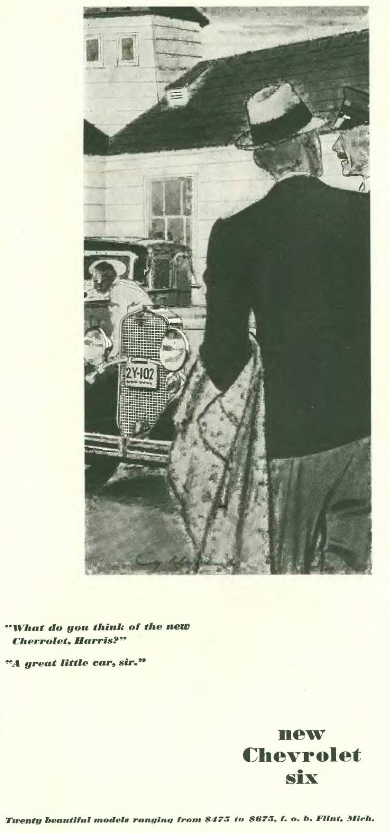
…and we close with Peter Arno’s unique take on family life…

Next Time: Rooftop Romance…