One of Hollywood’s most famous motion pictures was a story about a giant ape that (literally) falls for a beautiful woman.
March 11, 1933 cover by Rea Irvin.
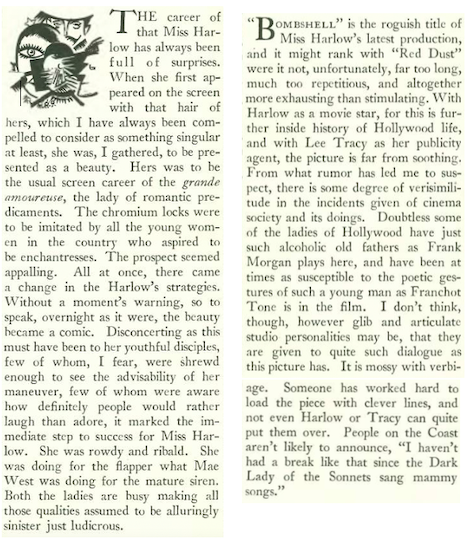
New Yorker film critic John Mosher found the premise of King Kong ridiculous, but he also found many of its scenes diverting, especially those featuring Kong and a number of prehistoric creatures (created by Marcel Delgado), miniature models brought to life through stop-motion animation techniques pioneered by Willis O’Brien and his assistant, Buzz Gibson. Mosher’s review:
THE TRIALS OF GIANT APEHOOD…King Kong battled nature and man in the eponymous 1933 film that featured a silly love story between actors Bruce Cabot and Fay Wray (lower right, with Robert Armstrong); this being a pre-Code film, Wray had trouble keeping on her blouse, although a scene depicting Kong undressing her and sniffing his fingers was cut, as were some of the more gruesome scenes featuring Kong stomping and chomping his way through Manhattan. (IMDB)
By today’s standards the film’s special effects are quite dated, but they astonished audiences in 1933 and again in a 1952 re-release.
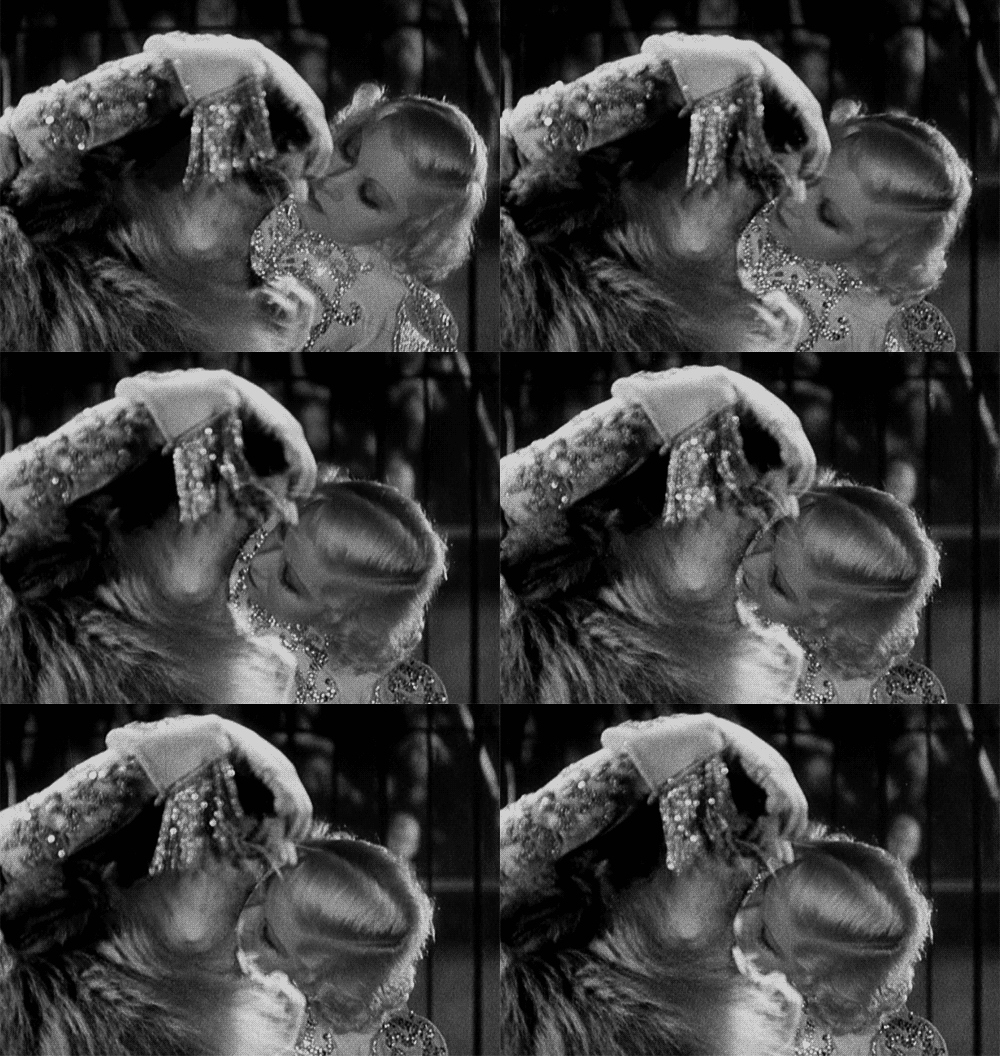
NEW YORK OR BUST…A huge bust of King Kong’s head and torso was fashioned from wood, cloth, rubber and bearskin by Marcel Delgado, Buzz Gibson and Fred Reese. Three operators inside the bust used metal levers, hinges, and an air compressor to manipulate the mouth and facial expressions. In addition, two versions of the ape’s right arm were constructed of steel, rubber and bearskin — one was non-articulated, mounted on a crane, and the other had articulated fingers that allowed Kong to grasp Fay Wray in close-ups (below). A separate non-articulated leg was also mounted on a crane for scenes depicting Kong stomping on villagers. (reddit.com/Pinterest)
* * *
Oh Baby
Before child labor laws were finally enforced in the late 1930s, children were routinely exploited for profit, most famously the Dionne quintuplets by Dr. Allan Roy Defoe, not to mention the many child stars fed into the Hollywood meat grinder. For a public seeking novelty as a distraction from the Depression, there were also numerous “baby orchestras” organized by one Karl Moldrem. “The Talk of the Town” commented:
NURSERY SONGS…One of Karl Moldrem’s baby orchestras assembled in Southern California, 1931. (digitallibrary.usc.edu)
* * *
Edible Art
“The Talk of the Town” has always been a source for light anecdotes, including this brief account of a hungry Vanity Fair photographer:
Alexander Woollcott led his “Shouts and Murmurs” column with an account from a recent benefit performance, during which his friend Noël Coward decided to strike up a conversation regarding the survival of the stage in an era of talking films:
TALKING TALKIES… Noël Coward (left) voiced his concerns about the future of stage entertainment with Alexander Woollcott during a benefit performance likely held on behalf of the theatrical world. (npg.org)
* * *
From Our Advertisers
Ah, we begin with signs of spring, glimpsed beyond the gleaming cowl of a 12-cylinder Lincoln…
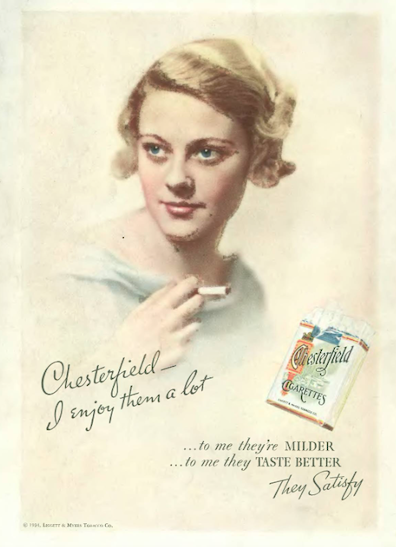
…and catch a whiff of that springtime breeze, savored between puffs of your Chesterfield…
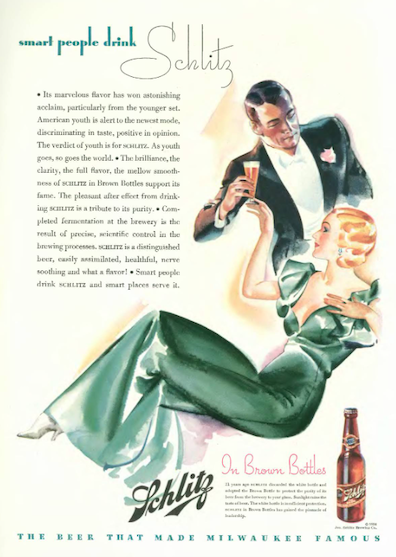
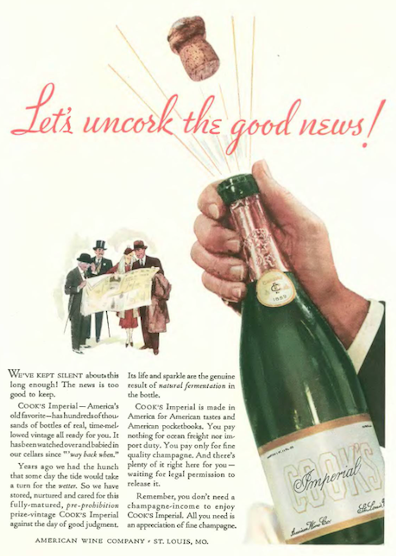
…this guy has some spring in his step thanks to the sparkling water he just splashed into his bootleg gin…
…the folks at Dorothy Gray presented a nameless woman (“slim and straight as a gallant boy, yet feminine to her finger tips”) who was ready to greet spring until she saw those “little lines under her eyes”…the horror indeed…
…Coty again presented an attenuated trio in a sexless courtship dance, oozing with anglophilic longing…
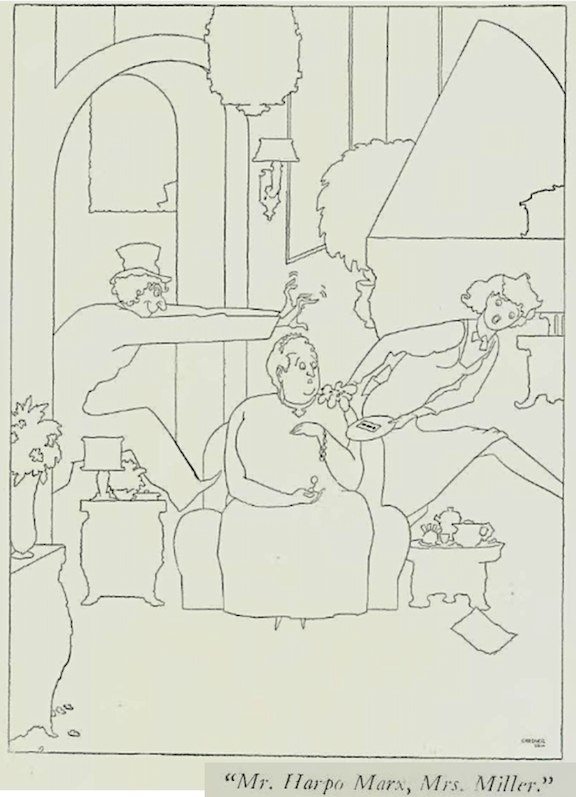
…I include this ad solely for the terrific illustration by Mac Harshberger, famed for his elegant, simplified line…
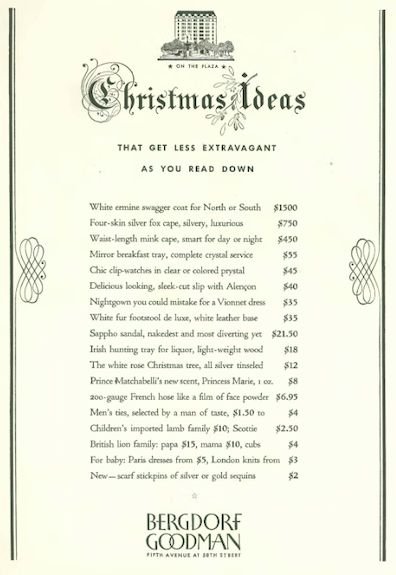
…and a couple of back pagers…thanks to Sonotone, the deafened shall not only hear but will also be stricken by a sudden voiding of the bowels…and below, a surprising ad from the Plaza, one place I never thought would need to advertise…but those were tough times…
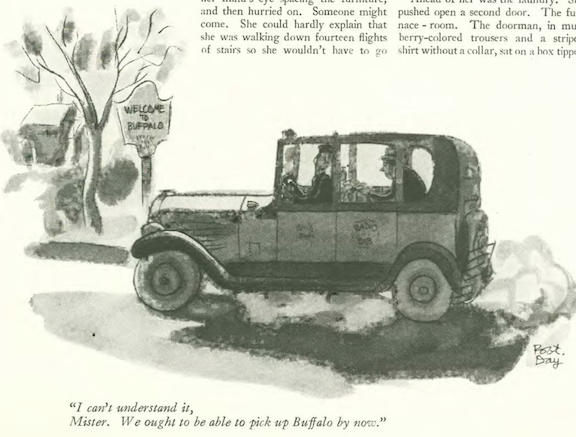
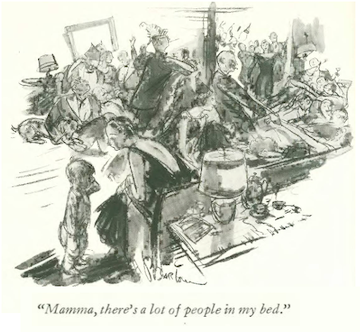
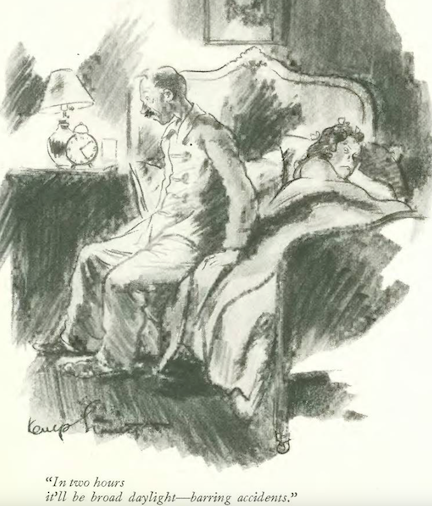
…and on to our cartoons, and this spot drawing from Peggy Bacon, whom we haven’t seen in awhile…
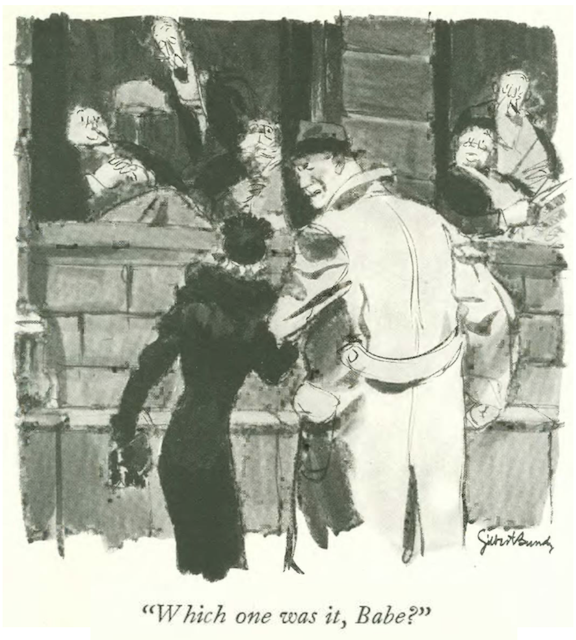
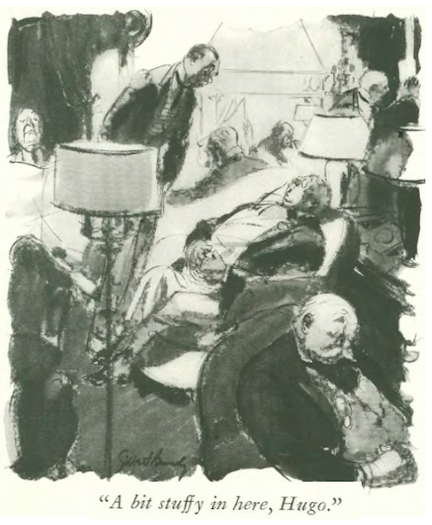
…Gilbert Bundy took us to a sanctuary of song…
…another day with our fellow citizens, and Gluyas Williams…
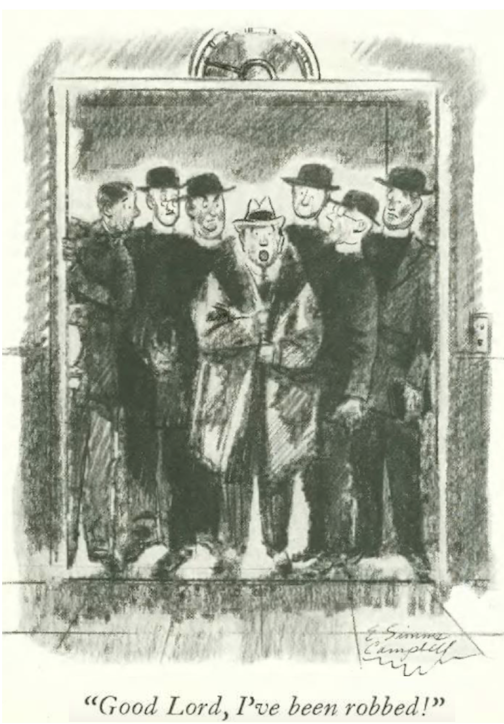
…one from E. Simms Campbell…
…who was the first Black cartoonist published in nationally distributed, “slick” magazines…
…and also the creator of Esky, the pop-eyed mascot of Esquire magazine…
…Carl Rose gave us a night at the opera in this two-page cartoon with the Depression-inspired caption: The artists will now pass among you. Anything you can give will be greatly appreciated….
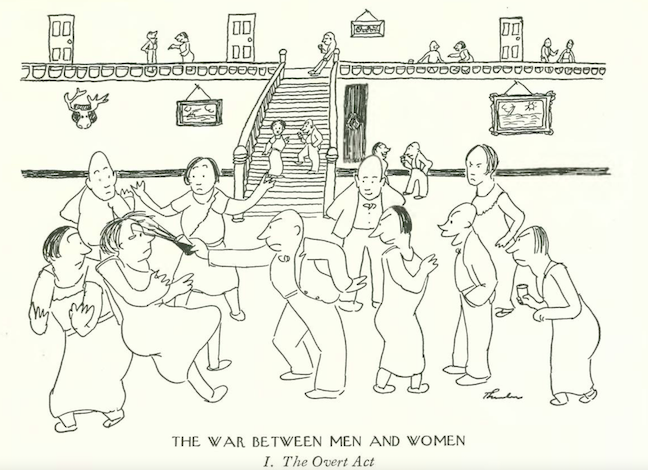
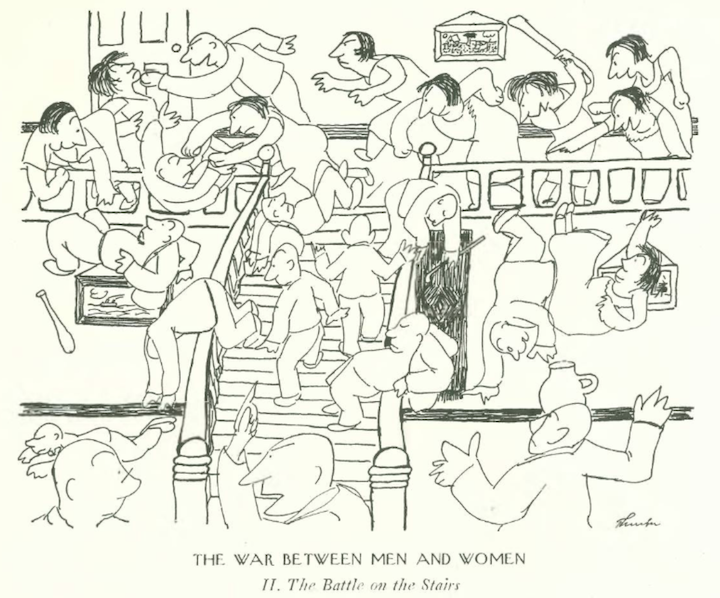
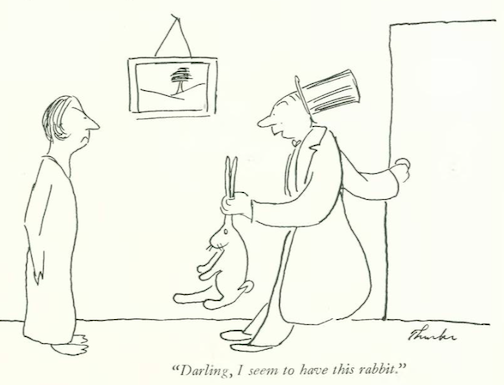
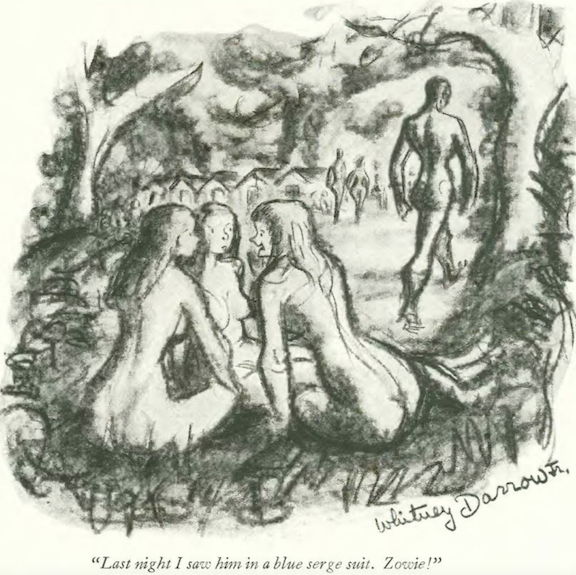
…and James Thurber returned to the nudist colony for another look at the age-old struggle between the sexes…
Above, Donald Deskey's Design for a Sportshack, 1940 (Cooper Hewitt)
If you’ve never heard of Donald Deskey, you’ve most likely seen his work.
Feb. 25, 1933 cover by Rea Irvin.
Cultural critic Gilbert Seldes featured Deskey in the Feb. 25 profile (“The Long Road to Roxy” — with illustration by Al Frueh), noting that his subject had come to his profession as an industrial designer in a rather roundabout fashion. Here is a brief excerpt:
Deskey (1894–1989) was locally known in the late 1920s for his window displays at New York’s Franklin Simon Department Store, but it was his work at Roxy Rothafel’s new Radio City Music Hall that made him a marquee name in the design world. Although known for popularizing the Art Deco style, his interior designs for RCMH were noted for their restraint, signaling a break from the lavish, ornate designs of the city’s earlier performance spaces.
FEAST FOR THE EYES…Donald Deskey designed more than thirty spaces in Radio City Music Hall, including the Grand Foyer (left) and several lounges, each featuring a distinct visual motif. At bottom right, auditorium’s “Singing Woman” carpeting. (archdaily.com/drivingfordeco.com)
Original Deskey creations are highly prized today by collectors and museums…
DESIGN IN MOTION…Clockwise, from top left, Deskey’s “Guest Bedroom for Mrs. John D. Rockefeller, Jr.” (Abby Aldrich Rockefeller), on display at the 1931 American Union of Decorative Artists exhibition; Deskey table lamp, circa 1927; linen panel, circa 1930s; Deskey desk, circa 1930. (brooklynmuseum.org/artic.edu/Pinterest)
…and if that wasn’t enough, Deskey also designed logos for many consumer products in the late 1940s and 1950s…
THE TOTAL PACKAGE…Deskey designed some of the most iconic logos of midcentury America, including, clockwise from top left, Tide laundry detergent (1947); Gleem (1956) and Crest (1955) toothpastes; Cheer laundry detergent (1952); JIF peanut butter (1956) and Joy dishwashing liquid (1950).
* * *
From Our Advertisers
It seems appropriate to follow Mr. Deskey with some words and images from our sponsors, including the folks at Cadillac who continued to hammer home the snob appeal of their motorcar while also giving a nod to those hard times by emphasizing the car’s economy…
…meanwhile, Studebaker was back with another full page ad—again featuring the admiring giant woman—in a vain attempt to push their fledgling, and unpopular line of Rockne automobiles…
…and Helena Rubenstein continued her series of ads disguised as advice columns…the advice here was to shame women into buying her products…
…after Helena removed your wrinkles you could restore them with GE’s Mazda sunlight lamp…
…Otto Soglow, on the brink of becoming a very wealthy man thanks to his Little King cartoons, continued to lay down some ink on behalf of the makers of Sanka decaf…
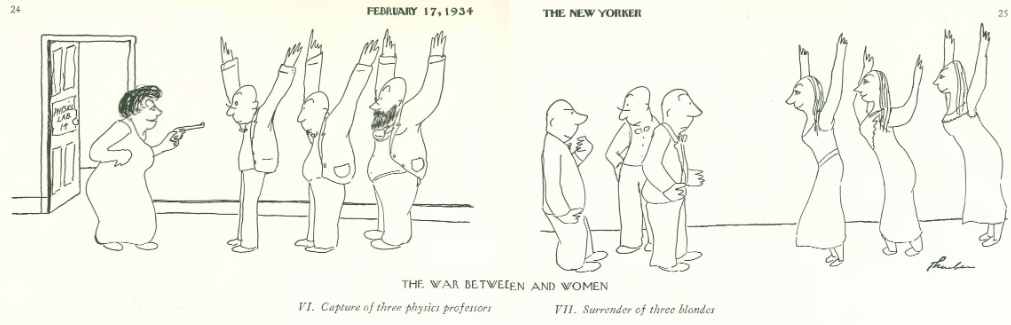
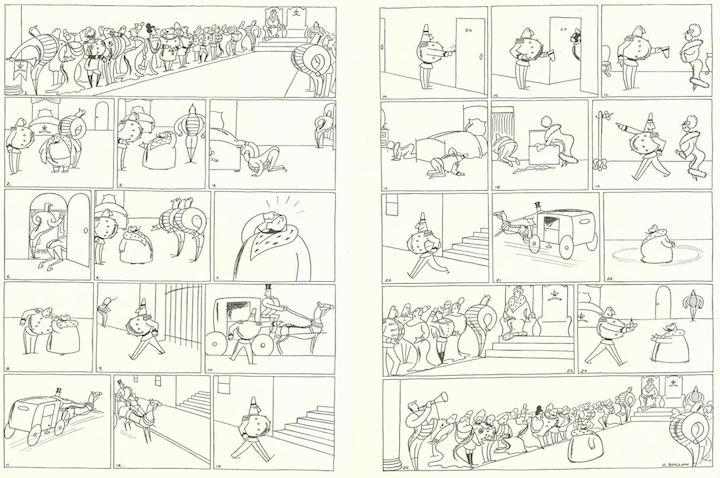
…and we move along to Soglow’s fellow cartoonists, beginning with Gardner Rea and a cartoon sequence spread across pages 24-25…
…here it is again, rearranged for closer inspection…
…and we have another terrific “Fellow Citizens” drawing by Gluyas Williams, which originally ran sideways on a full page…
…I like this James Thurber drawing for its utter disregard of scale—but of course (and thankfully) it wouldn’t be a Thurber if he cared about such things…
…William Crawford Galbraith was still hung up on showgirls and sirens…
…while Peter Arno explored his spiritual side, as only Arno could…
…and we move along to March 4, 1933…
March 4, 1933 cover by Rea Irvin.
…in which The New Yorker’s Paris correspondent Janet Flanner (“Genêt”) wrote about a new book of “extreme interest to both sides of the Atlantic”…
BOOK OF REVELATION…Alice B. Toklas and Gertrude Stein were well known in the ex-pat community of 1920s Paris, but the publication of the American edition of The Autobiography of Alice B. Toklas (written by Stein) brought them fame in the wider world. Stein claimed she wrote the book — now considered a 20th century classic — in six weeks to amuse herself and to make money. At right, Toklas and Stein at 27 Rue de Fleurus in a portrait by Man Ray, 1922. (Library of Congress)
* * *
Hope Springs Eternal
Even in the deepest depths of the Depression signs of hope abounded in works of public art, including a mosaic of one million hand-cut and hand-set glass tiles being prepared for the Sixth Avenue entrance to Rockefeller Center. Intelligence Awakening Mankind, by Barry Faulkner, celebrated the triumph of knowledge over the evil of ignorance. “The Talk of the Town” explained:
GOOD VIBES…Details of Intelligence Awakening Mankind include the central figure of Intelligence (top) sending knowledge into the far corners of the world. (Pinterest)
* * *
From Our Advertisers
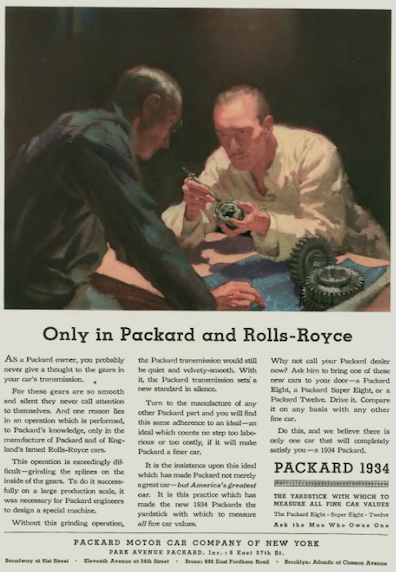
The folks at luxury brand Packard continued to counter their stodgy image with ads that emphasized other qualities including speed, durability, and here, serenity…despite the lengthy text, the ad also suggested modernity, with the sliced-off image and the single word “Hush!” to entice prospective buyers…
…if you couldn’t afford $3,720 for a 12-cylinder Packard, then you might have considered a Buick, “livable as a fine home” this ad claimed. And look at that back seat — you could comfortably fit three adults and a baby elephant in there…
…and then there’s Hupmobile—for the price of a Packard 12 you could have purchased three Hupmobile Victorias (pictured below) with a good chunk of change left over…here the company celebrates its silver anniversary…a couple of odd facts: in 1914 a Minnesota Hupmobile salesman used an unsold vehicle to found Greyhound bus lines…the National Football League also traces its origins to Hupmobile — the league was created in 1920 at a Hupmobile dealership in Canton, Ohio…both Greyhound and the NFL survive Hupmobile, which went belly up in 1939…
…and now we move to the world of fashion, and some cultural appropriation by Lord & Taylor…
…in 1929 J. Walter Thompson President Stanley Resor observed how people instinctively wanted to be told what to do by authorities they respected. Applying this thinking to the marketing of Pond’s cold cream, Resor’s firm hired famed photographers to create idealized portraits of society women…
…Writing for Indy Week (July 7, 2010) Amy White observes that a 1933 portrait (above) of Mrs. Reginald Vanderbilt, aka Gloria Mercedes Morgan, reveals patrician eyes as “languid jet pools, her lips full and dark, her finely coiffed hair oiled to ebony perfection. However, a bit of backstory might explain the painful and hollow look Mrs. Vanderbilt can barely suppress. In that same year, she was declared by the courts to be unfit as a parent, and her young daughter was placed under the guardianship of her sister, Gertrude.” That young daughter, Gloria Vanderbilt, would later find fame for her designer jeans, her glittering lifestyle, and as mother of newscaster Anderson Cooper. White concludes, “I wonder if somehow, subconsciously, those consumers saw the pain in the eyes of some of those upper-crust spokeswomen, and it was basic humanness and empathy, as well as desire for wealth and beauty, that won them over”…
Mrs. Reginald Vanderbilt, aka Gloria Mercedes Morgan, and her daughter, “Little Gloria,” in 1928. (Wikipedia)
…and we move along to the toasted pleasures of Luckies, and Howard Chandler Christy’s “Christy Girl” looking the picture of health and vitality in this back cover ad…
…we make an abrupt switch to the cheaper ads in the magazine’s nether pages…here “Miss Eleanor, formerly with Mme. Binner,” announced her selection of modern corsets for the “debutante and young matron”…and below, in a sign of the times, repossessed homes for sale…
…looks like Fifi had a bit too much of the Green Ribbon-flavored bootleg…
…and if you thought taking probiotics was a new thing…
…the French Line once again featured the art of James Thurber to promote its Mediterranean cruises…
…and Thurber kicks off our cartoons with spot art that headed the “Goings On About Town” section…
…and this gem with one of Thurber’s beloved dogs…
…below is the second New Yorker cartoon by Gruff with the “Buy American” slogan juxtaposed with an ethnic stereotype…I have no idea who this artist is, or if “Gruff” is a pen name — the style looks familiar but I haven’t had any luck chasing this artist down…
…here is the first one from the Feb. 18 issue…
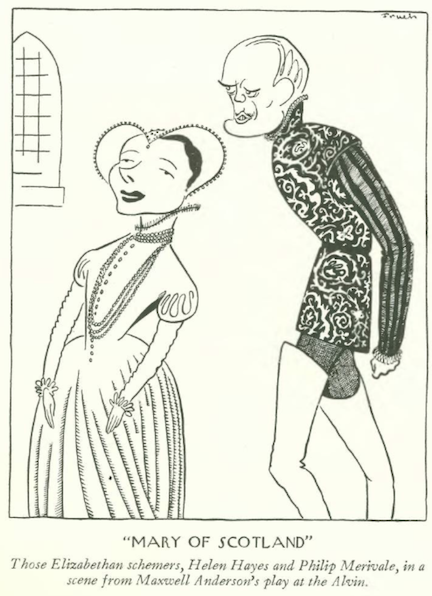
…but we all know Al Frueh, who contributed this delightful bit of art to the theater review section…
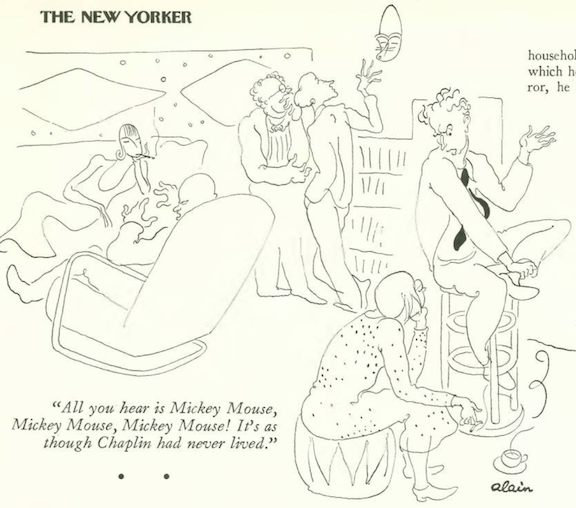
…Daniel ‘Alain’ Brustlein gave us an enterprising Frenchman offering peeks at exiled New York Mayor Jimmy Walker sunning on a beach at Cannes…
…and we close with Peter Arno, and the first signs of spring…
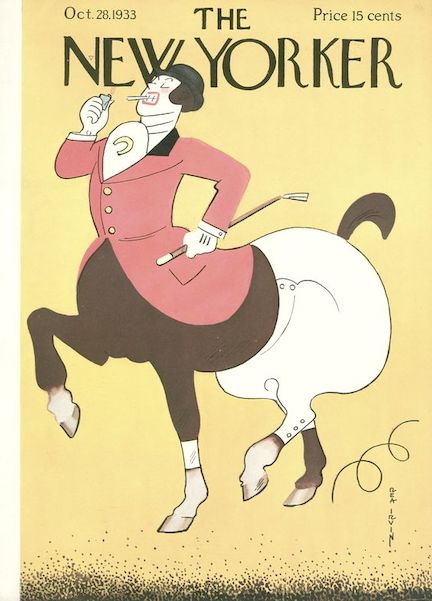
Once again The New Yorker marked its anniversary—the eighth—with a repeat of its very first cover, a tradition that would last until 1993. Unlike previous years, E.B. White made no special mention of the occasion in his “Notes and Comment,” no doubt feeling confident about the magazine’s prospects despite the challenges of the Depression. In 1933 The New Yorker could count on nearly 117,000 readers.
Feb. 18, 1933 cover by Rea Irvin.
And so we look to another of the magazine’s star contributors, humorist and stage critic Robert Benchley, who was rarely impressed with Broadway’s middlebrow fare. It was in such an environment that Benchley found himself separating the wheat from the chaff, listing a selection of scenes from various plays that together might represent a “perfect night” of entertainment:
A BROADWAY BUFFET…Clockwise, from top left, Robert Benchley recommended Jack Haley’s bedroom scene and Ethel Merman’s rendition of “Eadie Was a Lady” in Take a Chance as worthy of a look; he also found George M. Cohan’s telephone call to police HQ in Pigeons and People memorable, and Beatrice Lillie was apparently a delight in the dressing room scene from Walk a Little Faster. (playbill.com)TRIPPING THE LIGHT FANTASTIC in Cole Porter’s musical Gay Divorce were Claire Luce and Fred Astaire, dancing to the hit song “Night and Day.” It was Astaire’s last Broadway show before he headed to Hollywood for even greater stardom; Jack Pearl and Barbara Newberry in Pardon My English; Eva Le Gallienne as the White Queen and Josephine Hutchinson as Alice in the 1932-33 production of Alice in Wonderland at Le Gallienne’s own Civic Repertory Theatre; Alice (Hutchinson) encounters Tweedledee (Burgess Meredith) and Tweedledum (Landon Herrick) in Alice in Wonderland. (Pinterest/gershwin.com/blog.mcny.org)
* * *
Spring Cleaning
While passing by the Vanderbilts’ “Triple Palace” on 51st and Fifth Avenue, E.B. White (“Notes and Comment”) noted signs of neglect at the famed mansion:
HOME SWEET HOME…At top, Alva Vanderbilt engaged Richard Morris Hunt to build a “Petite Chateau” on the northwest corner of 52nd Street; below, the drawing room. The Triple Palace was demolished in 1947-49. (mcny.org/Wikimedia Commons)
The Triple Palace site today:
(daytoninmanhattan.blogspot.com)
* * *
Going Round and Round
No one was landing quad flips at New York’s Ice House in 1933, but for ice skating enthusiasts it was the place to be for both figure skating competitors as well as for those just interested in a leisurely skate to the strains of a live orchestra. “The Talk of the Town” explains in this excerpt:
CHILLING SIGHT…Top and below, the Ice House was located on the top floor of a four-story building attached to Madison Square Garden. (Pinterest)
In both Europe and America ice skating in the 19th and early 20th century was something of an elaborate ritual in urban areas; skating rinks included tea rooms as well as places to dance or ice skate to the gentle rhythms of a live orchestra…
TEA COSY…The Biltmore Hotel Ice Gardens offered guests a warm place to watch the cold weather fun of the hotel’s outdoor ice skating rink, circa 1915. (mcny.org)
* * *
The Jig Is Up
Jigsaw puzzles have been around since the late 1700s (they were handmade then), but their popularity really took off in the 20th century with advancements in manufacturing and especially during the Depression when folks sought affordable forms of entertainment they could enjoy at home. The 1930s also saw jigsaw puzzles become more complex. “The Talk of the Town” observed:
In 1933 the Long Island City-based puzzle manufacturer Einson-Freeman introduced a line of puzzles that included clues to solving mysteries described in an accompanying novelette…
(worthpoint.com)
* * *
Small But Deadly
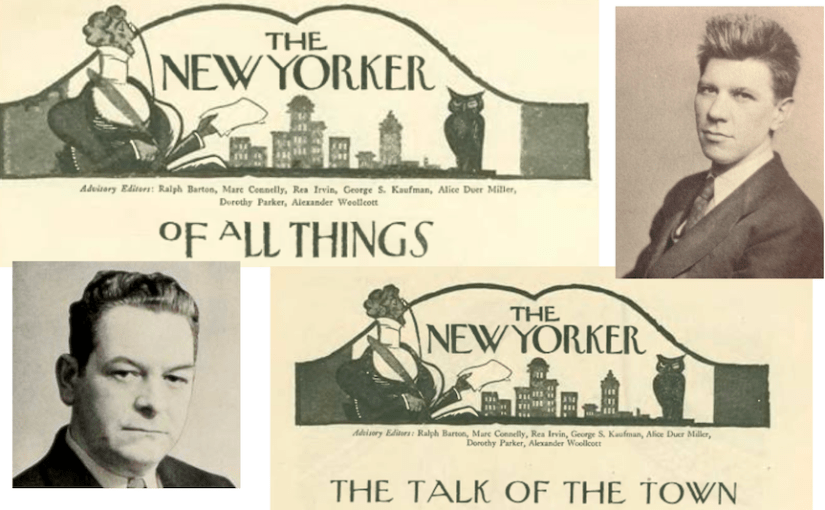
Howard Brubaker’s “Of All Things” column, which ran from 1925 to 1951, was a series of brief, satirical comments on the events of the day, including some that to modern eyes point to the catastrophic events that awaited Brubaker’s world (reader Frank W. notes that “the ‘aged piano-player’ was Ignacy Paderewski, who had served as Prime Minister in the immediate aftermath of WWI, and who was the nearest thing the Poles had to a national-unity figure”):
* * *
Her Protégé
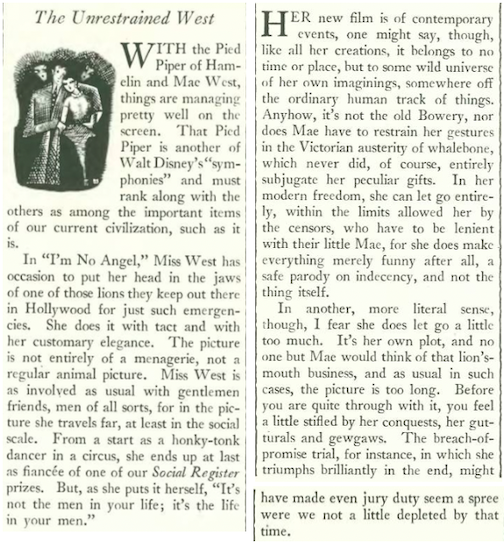
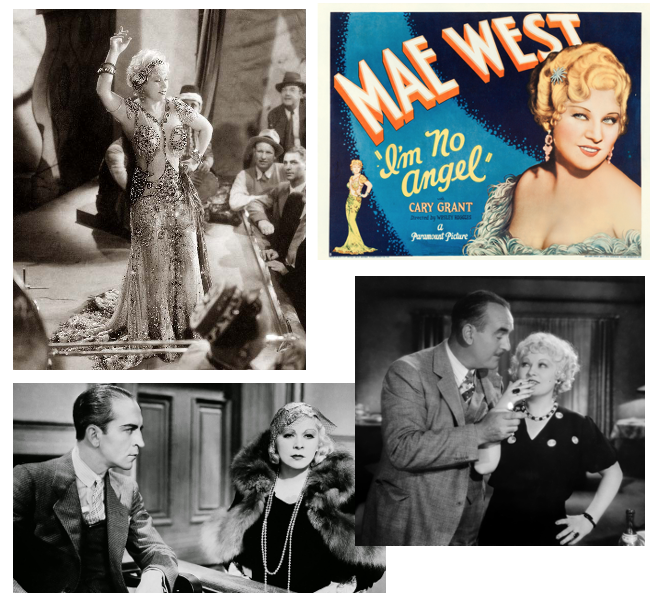
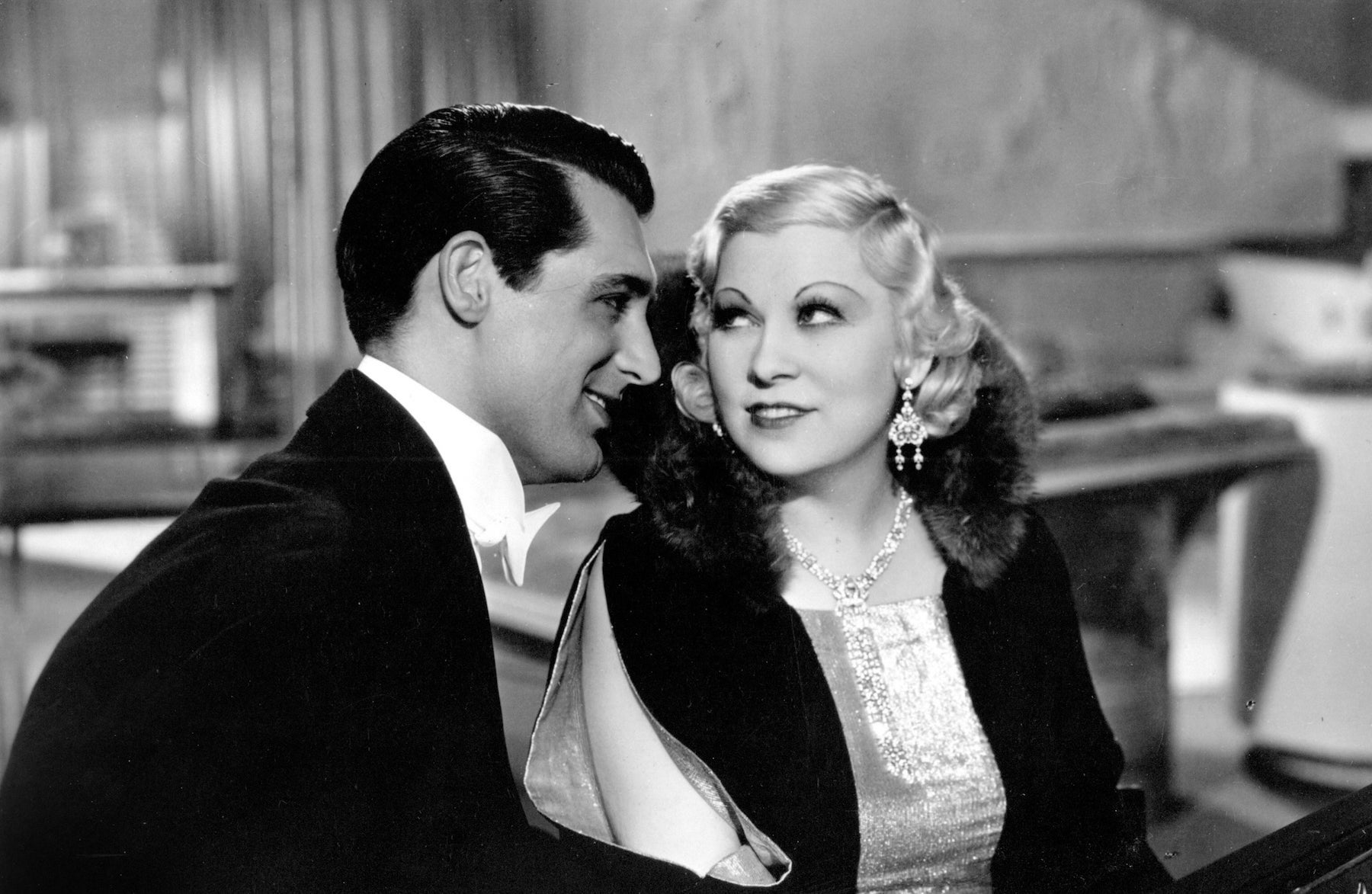
When Mae West adapted her 1928 Broadway play Diamond Lil into the 1933 film She Done Him Wrong, the puritanical backers of the Hays Code (which would be enforced in 1934) demanded that the film make no reference to the “scandalous” play. But because it was still the pre-Code era, West’s film featured many double entendres and her famous (and famously misquoted) quip, “Why don’t you come up sometime and see me?” That line was spoken to Cary Grant—whom West would later claim as her discovery even though Grant had drawn considerable attention in the previous year for his work opposite Marlene Dietrich in Blonde Venus. For the record, Grant, who would be paired again with West in 1933’s I’m No Angel, would later credit West, and She Done Him Wrong, for giving his career a major boost. New Yorker critic John Mosher lauded the film for the much-needed laughs it provided to Depression-weary audiences.
SHOWING HIM THE ROPES…The nearly forty-year-old Mae West was 11 years older than Hollywood newcomer Cary Grant when they appeared together in 1933’s She Done Him Wrong. The film was nominated for an Academy Award (Best Picture), and in 1996 was selected for preservation in the National Film Registry by the Library of Congress. (filmreference.com)
* * *
From Our Advertisers
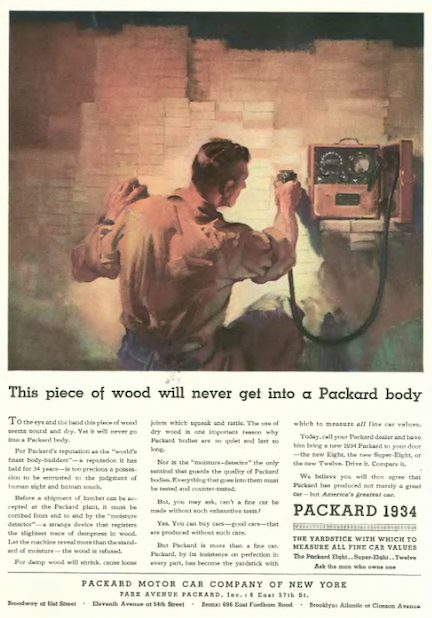
The folks at Packard took a new advertising tack by demonstrating the durability of their luxury automobile…
…hopefully the Packard was riding on “Double Eagle” tires by Goodyear…however, this is an odd illustration to emphasize a child’s safety, when the kid’s posh mum seems more concerned about her appearance than anything else…also, does she plan to drive home with the windshield down?…
…Log Cabin continued its series of ads featuring New Yorker cartoonists…here Peter Arno lends one of his dirty old walruses to the cause of syrupy waffles and pancakes…
…on to our cartoonists, we have Arno again, keeping up appearances among high society…
…Gluyas Willams demonstrated his knack for illustrating the foibles of his fellow citizens…
…Helen Hokinson looked in on a man aspiring to become the next T.S. Eliot…
…the growing popularity of the gangster film knew no bounds, according to Perry Barlow…
…and we close with James Thurber, and a speakeasy standoff…
“Nobody said not to go” was a phrase often used by Emily “Mickey” Hahn when returning from one of her far-flung and often wild adventures.
Feb. 4, 1933 cover by Rea Irvin.
And nobody ever told Hahn (1905–1997) what she could write about, and so she wrote, with brio and authority, on a variety of subjects ranging from feminism, diamond mining, and animal behavior to Chinese history and cooking. The author of 54 books, Hahn also penned a number of biographies including those of Leonardo da Vinci, Chiang Kai-shek, and D. H. Lawrence among others. In the Feb. 4 issue Hahn wrote about spending the night at a New York flophouse, not out of necessity but rather to write about the experience. Excerpts:
NO RITZ, THIS…Entrance to a flophouse in the Bowery, photo by Walker Evans, 1934.
In the following two excerpts, Hahn described her sleepless night, and her exit from the flophouse the following morning…
More on Emily Hahn, who defied convention from the very start of her adult life: before graduating from the University of Wisconsin in 1926 (the first woman to earn a degree in mining engineering there), she drove across the U.S. in a Model T, dressed a man. She wrote about her experiences in letters to her brother-in-law who, unbeknownst to Hahn, shared them with New Yorker editors. This would lead to a longtime relationship with the magazine, to which she would contribute nearly 200 articles (and one poem) between 1929 and 1996. She would also serve as China correspondent from 1935 to 1943.
In 1930 she traveled to the Belgian Congo, where she lived for two years with a pygmy tribe while working for the Red Cross; she later crossed Central Africa alone on foot. In his 2006 memoir, Let Me Finish, Roger Angell described Hahn as the magazine’s “Belle Geste,” a woman “deeply, almost domestically, at home in the world. Driven by curiosity and energy, she went there and did that, and then wrote about it without fuss.”
AT HOME IN THE WORLD…Clockwise, from top left, Emily “Mickey” Hahn poses with her pet gibbon, Mr. Mills, in Shanghai, circa 1935; undated photo with more of her furry friends; Hahn as a teenager, circa 1920; cover photo from her 1944 book, China to Me; Hahn in 1944 with her daughter Carola, following their return from occupied China. (Wikipedia/Lilly Library, Indiana U)
* * *
Chief Stooge
Theatrical promoter Alfred Cleveland Blumenthal (1885–1957) was well-known to New Yorkers in the 1920s and 30s as a speakeasy owner, buddy to Mayor Jimmy Walker and husband to actress Peggy Fears. Although “Blumey” is largely forgotten today, in 1933 he merited a two-part profile by Alva Johnston. Here are excerpts from the opening lines:
ONLY THE SHADOW KNOWS…A.C. “Blumey” Blumenthal (at left in the light suit) was often seen shadowing Mayor Jimmy Walker in his role as chief counselor and chief stooge. Here the mayor is escorted by Blumey and New York’s finest during corruption hearings in 1931. At right, Blumey’s wife Peggy Fears (1903–1994) in her most notable film role, 1935’s The Lottery Lover. Their tempestuous marriage lasted from 1927 to 1950. (avenuemagazine.com)
* * *
Coward’s Ménage
Playwright Noel Coward existed in the orbit of the Algonquin Round Table, so it was doubtless challenging for Robert Benchley to critically review his friend’s work. Fortunately, Benchley found Design For Living mostly to his liking. Note how Benchley subtly refers to the play’s gay subtext, and to the fact that it mirrored the real-life relationships of the play’s trio.
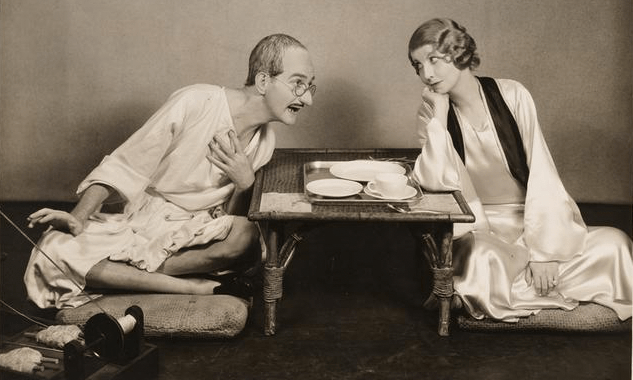
THREE’S COMPANY…A studio in Paris. A penthouse in New York. A flat in London. These were the settings for Noël Coward’s play Design for Living at the Ethel Barrymore Theatre, which starred the wife-husband team Lynn Fontanne and Alfred Lunt and their close friend Coward in a Broadway run of 135 performances from January to May 1933. (Vandamm theatrical photos via wisc.edu)
Benchley did have a few quibbles, but reasoned there was no need to be overly critical when there was such a dearth of quality stage entertainment. Note the great caricatures by Al Frueh (below) that accompanied the review.
Benchley had a different sort of dilemma criticizing Elmer Rice’s earnestly patriotic We, the People, a play about the misfortunes of a working class family in Depression America.
Rice, who won the Pulitzer Prize for Drama in 1929, was an occasional contributor to The New Yorker from 1929 to 1931, including his sci-fi satire on the film industry, Voyage to Purila, which was serialized in eleven installments (with illustrations by Peter Arno) in The New Yorker from Oct. 12 to Dec. 21, 1929.
LET’S MAKE A MOVIE…Elmer Rice (standing) joins theatre producer Joseph P. Bickerton, Jr. (left), and Universal’s Carl Laemmle Jr. to sign a contract for the film version of Rice’s 1931 Broadway play Counsellor at Law. The film proved to a critical success. (Wikipedia)
Meanwhile, film critic John Mosher was trying his best to enjoy the latest Hollywood fare, another Broadway play adapted to the silver screen. Whistling in the Dark…
MURDER MOST AMUSING…The 1933 American pre-Code comedy-mystery film Whistling in the Dark starred Ernest Truex and Una Merkel. (IMDB)
However, Mosher was surprisingly enthused by the rustic charms of Iowa country folk in State Fair…
THE TRIUMPH OF PRIZE PICKLES and other delights awaited viewers of 1933’s State Fair, which gave star billing to Will Rogers and Janet Gaynor. At right, Lew Ayres sweet-talks Gaynor at the fairgrounds. (IMDB)
* * *
Form Follows Function
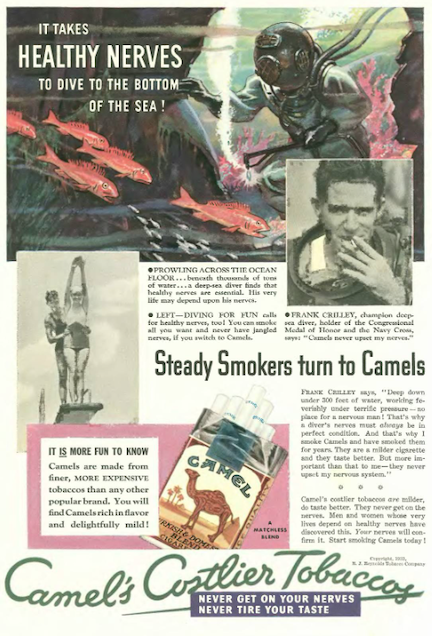
E.B. White paid close attention to all the little details of daily life, including the advertisements that appeared in The New Yorker. In “The Talk of the Town” he wrote about a Camel ad that inspired a sudden fashion trend:
…here is the Dec. 24, 1932 New Yorker ad to which White referred:
* * *
From Our Advertisers
We keep our cigs lit for our first ad, from Lucky Strike, keeping it simple with their familiar slogan…
…this ad from Powers Reproduction shows us the beach caps that were all the rage in the early ’30s…
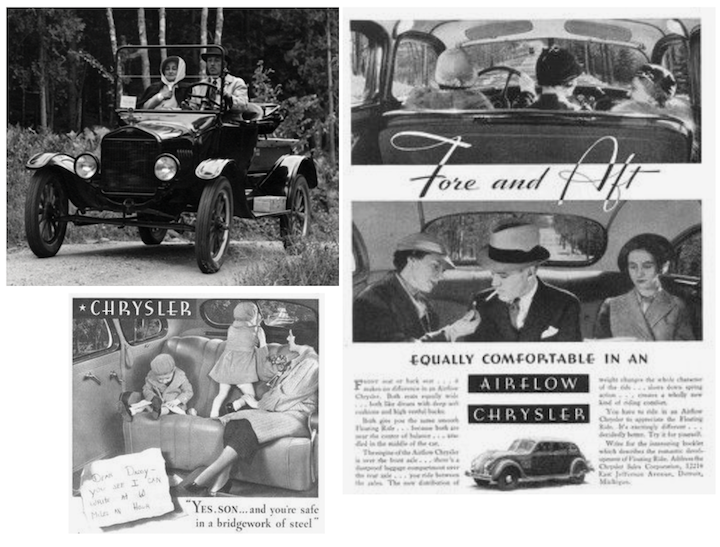
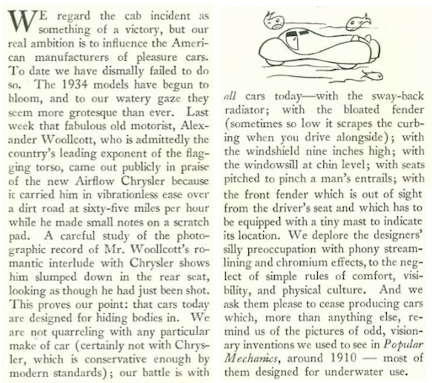
…this may look like an old car to modern eyes, but in 1933 these sweeping curves were la dernière mode in the auto world…
…and then there was Hupmobile, trying its best to stay relevant in the Depression…
…the company folded in 1939, but a few reminders live on…
HUP HUP HOORAY…The 1917 Hupmobile dealership at 25th and Farnam in Omaha, NE, was located along the old Lincoln Highway and is the last preserved Hupmobile dealership in the United States. On the National Register since 2014, it now houses apartments. (Flickr)
…Valentine’s Day was just around the corner, so time to buy your sweetheart something special, like this scarf that was all the rage among the Miami snowbirds…
…Greenwich Village restaurateur and personality Don Dickerman took out this two-page ad to trumpet his partnership with puppeteer and illustrator Tony Sarg at the Bohemia restaurant on Broadway…
…the German-American Sarg is also known as the creator, in 1927, of the first giant balloons for Macy’s Thanksgiving Parade…
THE OLD GASBAG…Tony Sarg (upper right hand corner) and assistants painting one of his Macy’s parade balloons. (Fotograms News Photo Service via Pinterest)
…on to our cartoons, and what a big day for The New Yorker…the Feb. 4, 1933 issue featured the first captioned cartoon by Charles Addams…
…for the record, Addams’s very first contribution to the magazine was this spot illustration (below) featured on page 65 of the Feb. 6, 1932 issue…
…one of the original contributing artists to The New Yorker,Gardner Rea, continued his skewering of America’s plutocrats…
…William Steig took us before the bench to make an honest plea…
…James Thurber gave us another skirmish between the sexes…
…and recalling my Jan. 12 post (about the Jan. 7, 1933 issue), in which the puritans got their knickers in a bunch over Robert Laurent’sGoose Girl sculpture in the Radio City Music Hall lobby…
…we end with Helen Hokinson, inspired by Laurent’s work…
Above: “The Fountain of Youth” mural by Ezra Winter in the Main Foyer of Radio City Music Hall. (Architectural Digest)
The opening of two new theaters at Rockefeller Center no doubt brightened a few souls at the start of 1933, but art and architecture critic Lewis Mumford wasn’t particularly dazzled by the “watered-down” modernism of the buildings’ much-ballyhooed decor.
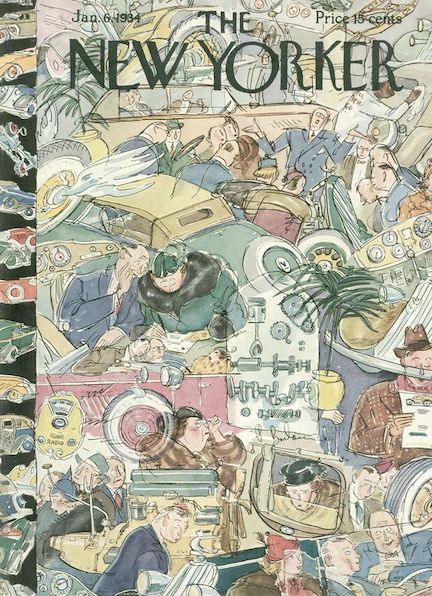
Jan. 7, 1933 cover by Rea Irvin, in a nod to the annual automobile show in New York City.
Oddly, it was a philosophy professor from the University of Nebraska, Hartley Burr Alexander, who was tasked with creating an artistic vision for Rockefeller Center, developed along the theme of “Frontiers of Time.” According to Mumford, Alexander’s “classic-banal” vision, executed under the “virtuous glare” of theatrical impresario Samuel L. “Roxy” Rothafel, resulted in the first “large-scale vulgar tryout of modern art.” Excerpts from Mumford’s column:
Several aluminum sculptures in Radio City Music Hall no doubt pleased Mumford—Gwen Lux’sEve sculpture, William Zorach’s Spirit of the Dance, and Robert Laurent’sGoose Girl. However, thanks to Roxy Rothafel’s “virtuous glare” and worries that the nudes might hurt ticket sales, all three sculptures were temporarily banned from RCMH.
NAKED AND AFRAID…A flare-up of puritanism led to the temporary removal of aluminum sculptures at Radio City Music Hall. At left, Eve by Gwen Lux; Robert Laurent (right) working on Goose Girl in his studio. Below, William Zorach’s Spirit of the Dance. (Smithsonian/viewingnyc.com)
Radio City Music Hall also featured an array of murals that should have brought some delight to Mumford…
SHOW BEFORE THE SHOW…Radio City Music Hall featured a number of murals including, clockwise from top left, a detail of Donald Deskey’sThe History of Nicotine (The Life of Saint Nicotine) in a second floor men’s lounge; a textile piece titled The History of Theatre by Ruth Reeves, which covers the back wall of Radio City Music Hall; Stuart Davis’s mural Men without Women in the men’s lounge; Yasuo Kuniyoshi’s mural in the women’s powder room. (melwithpals.medium.com/viewingnyc.com/evergreen.com)
* * *
Mea Cuppa
“The Talk of the Town” shared this account of fifteen Harvard freshman who dared to pay a call on the home of visiting poet T.S. Eliot…
TEA-DIUM…Fifteen nervous Harvard freshman confronted this visage until one of them finally broke the ice. Photo above taken during one of T.S. Eliot’s visits to Monk’s House, the 16th century cottage of Virginia Woolf. (blogs.harvard.edu)
* * *
Country Cousins
During his 1932 presidential campaign Franklin D. Roosevelt paid a Sept. 29 visit to the Waterloo, Nebraska farm of Gustav “Gus” and Mary (Kenneway) Sumnick. Mary served FDR a chicken dinner and pie before he addressed a crowd of 8,000 at a rally on the Sumnick farm. Gustav, a German immigrant, and Mary, a daughter of Irish immigrants, were successful farmers even during those tough years. The visit would turn the Sumnicks into national celebrities, and in later years FDR would return to visit the family and would also stay in touch by telephone. Howard Brubaker, in “Of All Things,” made this observation about the celebrated farm family:
TIME FOR SOME VIDDLES!…Mary Sumnick chats with presidential candidate Franklin D. Roosevelt during his Sept. 29, 1932 visit to the Sumnick farm. (douglascohistory.org)ENOUGH FOR A FOOTBALL TEAM…A lengthy article in the Dec. 4, 1932 New York Times described life on the Sumnick farm and their upcoming visit with President Roosevelt in the spring. Gus and Mary and their 11 children all planned to make the trip. (NYT)
* * *
The Gang’s All Here
Siblings Ethel, John and Lionel Barrymore of the famed Barrymore theatrical family appeared together in just one film—Rasputin and the Empress—and you would think that would have been enough to guarantee multiple awards along with box office gold. However, the film actually lost money, and on top of that attracted a lawsuit that further dipped into the pockets of MGM producer Irving Thalberg. Critic John Mosher was wowed by Ethel’s performance, but wasn’t exactly charmed by the overall production:
ACTING ROYALTY ACTING ROYAL…Lionel Barrymore, Ethel Barrymore, and John Barrymore in Rasputin and the Empress. It is only film in which all three siblings appeared together. (parkcircus.com)
About that lawsuit: The film used the real-life Princess Irina Yusupov as a model for Princess Natasha, portrayed by English actress Diana Wynyard. The film implied that Rasputin raped Princess Natasha (that is, Irina), which wasn’t true, so she sued MGM and won $127,373 from an English court; MGM reportedly settled out of court in New York for the sum of $250,000 (roughly equivalent to nearly $5 million today). The ubiquitous “all persons fictitious” disclaimer that appears in TV and film credits is the result of that lawsuit.
NO HARD FEELINGS?…English actress Diana Wynyard (left) portrayed Princess Natasha in the Barrymore family vehicle Rasputin and the Empress. Her portrayal, however, drew the ire of a real Russian royal, Princess Irina Yusupov, who successfully sued MGM in 1933 for invasion of privacy and libel. (Wikipedia)
A much-less controversial film was the “glib” No Man of Her Own, a pre-Code romantic comedy-drama starring Clark Gable and Carole Lombard in their only film together:
LET’S PLAY HOUSE…Clark Gable romances Carole Lombard in the pre-Code romantic comedy-drama No Man of Her Own. It was their only film together, and several years before they became a married couple in real life. (ha.com)
* * *
Vroom-Vroom
The annual National Automobile Show opened at the Grand Central Palace and other locations in Midtown, promising an array of affordable models:
DECISIONS, DECISIONS… The 1933 National Automobile Show offered a number of affordable options to car buyers including these shiny new Pontiacs on display at the Grand Central Palace. (libwww.freelibrary.org)BUT LOOK OVER HERE…General Motors also displayed its models at the first “Motorama” held in the Waldorf-Astoria’s Grand Ballroom in 1933. (waldorfnewyorkcity.com)
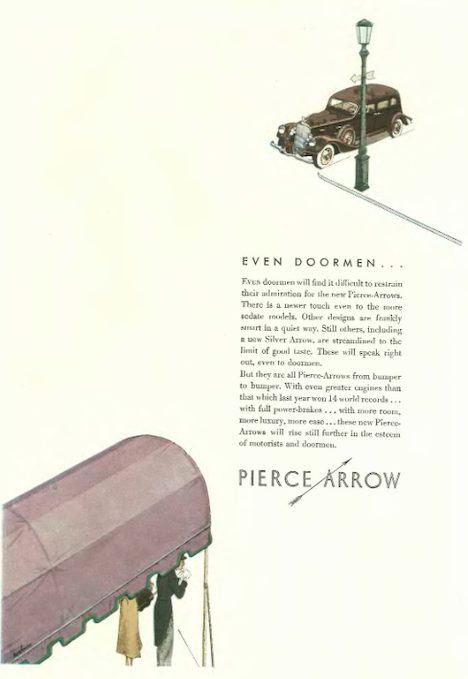
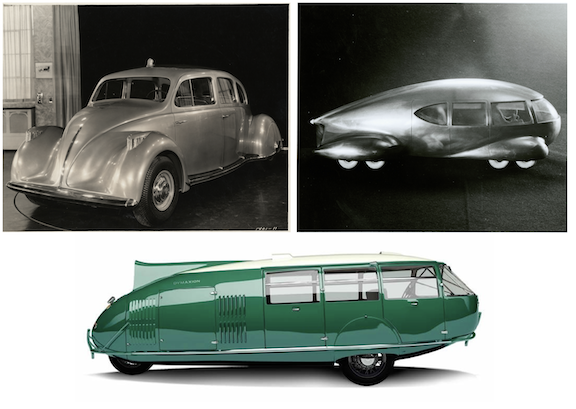
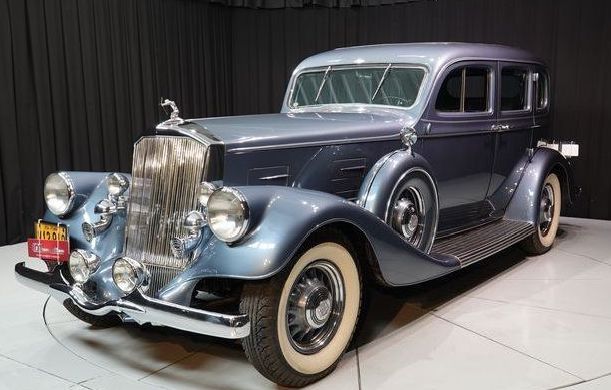
Auto Show visitors also got a glimpse of their streamlined future in the form of a 1933 Pierce-Arrow Silver Arrow…
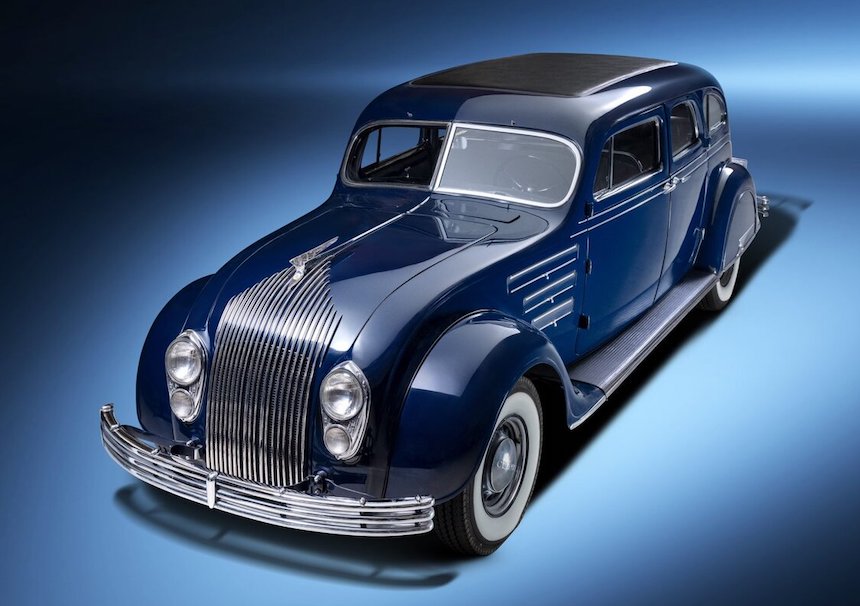
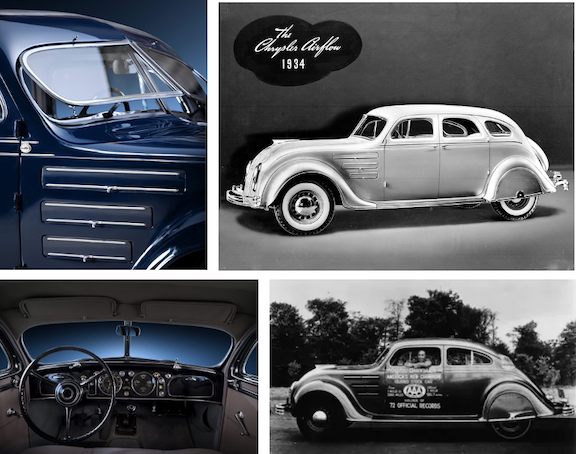
FAST & FURIOUS…Powered by a V12 engine, the aerodynamic 1933 Pierce-Arrow Silver Arrow could exceed 100 miles per hour. Unveiled at the 1933 National Automobile Show, the car grabbed the spotlight with its futuristic, streamlined design. Just five of these were built, and only three are known to exist today. The Silver Arrow was one of Pierce-Arrow’s final attempts to appeal to its wealthy clientele, but even they were feeling Depression’s pinch. The company folded in 1938. (Sotheby’s)
* * *
From Our Advertisers
The New Yorker had unusually thin issues over the holidays, so the magazine’s bean-counters must have been thrilled by the dozens of ads that poured in ahead of the National Automobile Show. As usual Walter Chrysler took out several two-page ads to promote his Chryslers, Plymouths, Dodges and DeSotos…
…while GM one-upped Walter with its own series of two-page ads—in color—sprinkled throughout the magazine…everything from the affordable Oldsmobile…
…to the high-end Cadillac…
…General Motors also featured this Peter Arno-themed ad (Arno-inspired wood carvings featuring the sugar-daddy walrus) to promote its posh new venue at the Waldorf-Astoria…
…the folks at struggling Hupmobile tried to wow not with shiny cars but rather with the announcement of their…drum roll, please…annual report…
…companies that supported the auto industry also got in on the act, including the makers of leaded fuel…this image says a lot about the lack of safety concerns in the 1930s…
…John Hanrahan, who early on served as The New Yorker’s policy council and guided it through its lean first years, became the publisher of Stage magazine (formerly The Theatre Guild Magazine) in 1932. In 1933 Stage became part of the Ultra-Class Magazine Group’s line-up that included Arts & Decoration and The Sportsman. Stage published its last issue in 1939, and I don’t believe the other two survived the 1930s either…
ULTRA-CLASS GROUP was the over-the-top name used to describe this line-up of magazines.
…on to our cartoons, we join Peter Arno for some fine dining…
…based on the what we have seen lately from William Crawford Galbraith, he seems to be hung up on seductresses and showgirls…
…to my point, some of Galbraith’s recent entries…
…we move on to Richard Decker and a dangerous cold front…
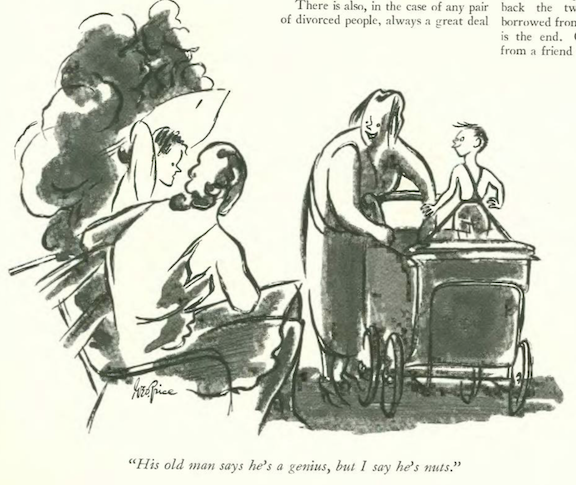
…Garrett Price pondered the wisdom of children…
…Gluyas Williams was back with the latest industrial crisis…
…Perry Barlow found some ill-fitting words to go with an ill-fitting coat…
…and we close with James Thurber, and some very fitting words for those times, and ours…
If folks thought things were bad in Depression-era America, they could ponder the famine-ravaged masses in the Soviet Union…
Dec. 24, 1932 cover by Rea Irvin.
…not that Alexander Woollcott seemed to notice or care all that much. In the autumn of 1932 he traveled to Moscow to check out some Russian theater and enjoy the fine food and drink provided by his friend Walter Duranty, Moscow bureau chief for The New York Times. In his “Shouts and Murmurs” column…
…Woollcott reflected on his Moscow visit, his humor at odds with the stark reality all around him…
ELEPHANT IN THE ROOM…Alexander Woollcott (left) was amused by the stares of starving Russians he encountered with his substantial bulk on the streets on Moscow; Walter Duranty (1884–1957), Moscow bureau chief for The New York Times, played host to his old friend Woollcott. (Pinterest/Daily Mail)
Woollcott wrote of “spindle-shanked kids” singing cheerless songs about tractor production, recounted a conversation with a hungry moppet at a boot factory, and noted the “appreciative grin” he received from a teenager who both envied and admired his girth:
PERHAPS A SIDE TRIP TO UKRAINE?…Starved peasants on a street inKharkiv, 1933. Millions of Ukrainians died during Stalin’s enforced famine. (Wikipedia)
* * *
Happier Thoughts
The Dec. 24 issue marked the beginning of a New Yorker tradition: Frank Sullivan’s annual holiday poem, “Greetings, Friends!” Writing for the Dec. 17, 2009 issue of The New Yorker (“Behind the Writing: “Greetings, Friends!”) Jenna Krajeski observes that “as far as holiday poems go, ‘Greetings, Friends!’…is as much an acknowledgment of the season as a noting of the times.” Frank Sullivan faithfully continued the tradition until 1974; after his death in 1976, New Yorker editor William Shawn asked Roger Angell to take over the writing of the poem. In 2012 Angell passed the duty along to Ian Frazier, the magazine’s current Yuletide bard.
CHEERFUL BUNCH…The holiday poem “Greetings, Friends!” has been a New Yorker tradition since 1932. It was originated by Frank Sullivan (left) and carried on by Roger Angell (center) and Ian Frazier. (hillcountryobserver.com/latimes.com/gf.org)
* * *
Waxing Poetic, Part II
In the Dec. 17, 1932 issue humorist and poet Arthur Guiterman penned this petition to Acting Mayor Joseph McKee on behalf of the city’s statues…
…to which Mayor McKee replied in the Dec. 24 issue:
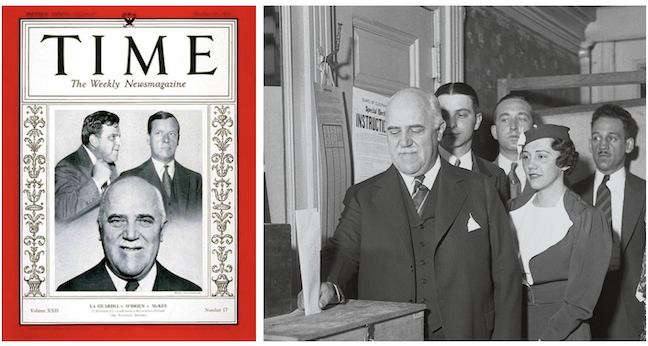
DUELING POETS…Acting New York Mayor Joseph McKee (left) rarely smiled in photographs, but he seems to have been a person of good humor in his poetic reply to Arthur Guiterman. Both photos are from 1932. (Wikipedia/credo.library.umass.edu)
* * *
From Our Advertisers
New York’s fashion merchandisers continued to tout their latest copies of Paris styles such as this “Poppy Dress” from Lord & Taylor (illustration by Mildred “Melisse” Oppenheim)…
…Radio City Music Hall and the RKO Roxy Theatre announced their grand openings…
…Radio City featuring a cavalcade of stars along with the “Roxyettes” (soon to be renamed “Rockettes”) while the RKO Roxy presented the pre-Code romantic comedy The Animal Kingdom…
LIGHT IN THE DARKNESS…It was winter, and the Depression was still on, but there were bright spots to be found on the stage at the opening of Radio City Music Hall and on the screen at the RKO Roxy; at right, Ann Harding, Leslie Howard and Myrna Loy in The Animal Kingdom. (Pinterest/IMDB)
…the folks at R.J. Reynolds challenged smokers to “leave” their product, if they cared to, knowing full well they were hooking new smokers by the thousands every day…
…we ring in the New Year with some hijinks from James Thurber…
…and this unlikely dispatch from a New York police officer via Peter Arno…
…ringing in the year with Harry Brown’s Dec. 31 cover…
Dec. 31, 1932 cover by Harry Brown.
…and Alexander Woollcott’s continuing account of his visit to Moscow, where he was shown the town by his friend Walter Duranty. In this excerpt, Woollcott makes a rare political observation regarding his friend: “Except for a few such men from Mars as Walter Duranty, all visitors might be roughly divided into two classes: those who come here hoping to see the Communist scheme succeed, and those who come here hoping to see it fail.”
For the record, Duranty has been widely criticized, especially since the 1950s, for his failure to report on the 1932-33 famine (which claimed as many as 7 million lives) and for covering up other atrocities of the Stalin regime. In the 1990s there were even calls to revoke Duranty’s 1932 Pulitzer Prize, which was awarded for his reporting on the Soviet Union.
GOOD & PLENTY…Walter Duranty (center, seated) at a dinner party in his Moscow apartment. (spartacus-educational.com)
* * *
Rocky Theme
As Rockefeller Center prepared to open its doors to its first buildings (there would be fourteen in all) American playwright and screenwriter Robert E. Sherwood penned this hymn to the “Citadel of Static”…
STANDING TALL…American playwright and screenwriter Robert E. Sherwood, one of the original members of the Algonquin Round Table, was moved to verse by the opening of Rockefeller Center’s first buildings. At left, Rockefeller Center in 1933. (Wikipedia)
* * *
Oh Chute
In 1929 Geoffrey Hellman secured a position with The New Yorker as a writer for “The Talk of Town” and also contributed a number of profiles, including this one about a parachute stunt-jumper named Joe Crane. Here is the opening paragraph and an illustation by Abe Birnbaum:
On Feb. 18, 1932, Joe Crane amazed crowds at Roosevelt Field with double parachute descent, in which he opened a second parachute through the first. If you are wondering, Crane died in 1968…of natural causes. (Pinterest)
* * *
From Our Advertisers
Illustrator Howard Chandler Christy (1872-1952) is best remembered for his patriotic poster designs of World War I, which might explain why this fellow looks a bit outdated…
…Christy also originated the popular “Christy Girl,” the embodiment of the ideal American woman in the early 1900s (note the Christy Girl’s resemblance to the woman in the ad above)…
A “Christy Girl,” from 1906. (Internet Archive)
…speaking of ideal, imagine a movie featuring this trinity of actors: John, Ethel and Lionel Barrymore…John Mosher will give us his review in Jan. 7 issue…
…the Lyric Theatre saw its glory years during the 1920s when it hosted stage shows featuring such talents as The Marx Brothers,Fred and Adele Astaire and a young Cole Porter, who hit it big in 1929 with Fifty Million Frenchmen…the 1930s, however, saw the Lyric’s fortunes diminish and in another year it would be converted into a movie house…also note the influence of Italian Futurists in this ad for an Italian theater troupe…
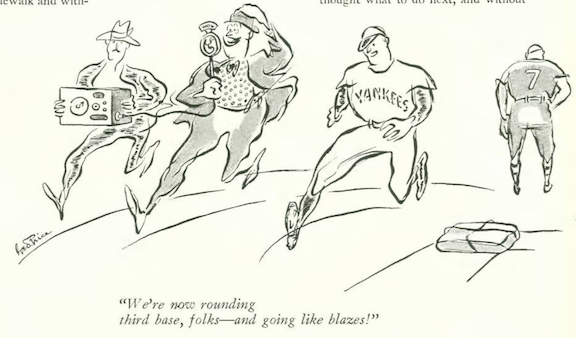
…and there’s also a futuristic bent to this Garrett Price cartoon, which steers more in a Kandinsky direction…
…cartoonists were also finding inspiration in the magazine’s advertising, Pond’s cold cream providing the spark for Alain (aka Daniel Brustlein)…
…for reference, a Pond’s ad from 1933 comparing Lady Diana Manners complexion to her former visage, circa 1924…
…Lady Chatterley’s Lover, by D. H. Lawrence, was banned for obscenity in the United States in 1929, but Helen Hokinson’s enterprising librarian was still able to deliver the goods…
…on the other hand, it is doubtful George Price’s sales clerk will also deliver…
…a great one by James Thurber, with more detail than his usual spare line…
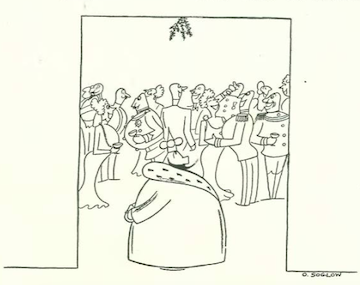
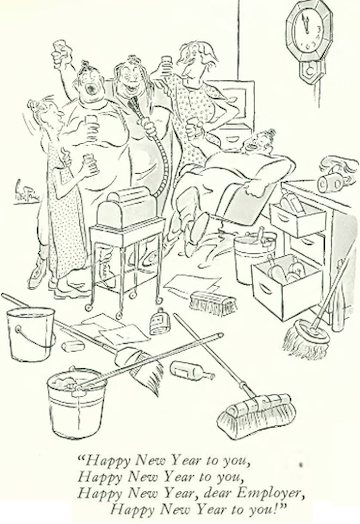
…and we say goodbye to 1932 with Alain, and a New Year’s Eve party with some familiar faces…
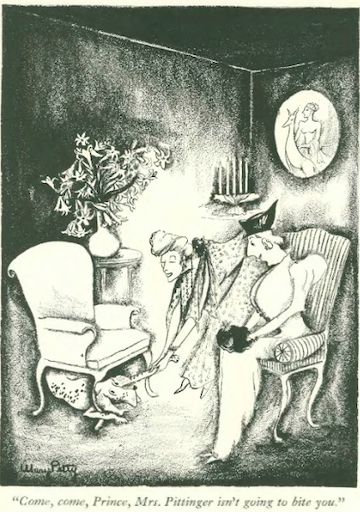
He was variously a restaurateur, con man and actor, but one thing Prince Michael Alexandrovitch Dmitry Obolensky Romanoff was not was a prince.
Oct. 29, 1932 cover by Adolph K. Kronengold.
But apparently to many movers and shakers he was a lot of fun, and so much of a character that Alva Johnston penned a five-part profile of Romanoff. A brief excerpt of Part One:
Born Hershel Geguzin in Lithuania, Romanoff (1890–1971) immigrated to New York City in 1900 and changed his name to Harry F. Gerguson. An odd-jobber and sometime crook (passing bad checks, etc.), at some point Romanoff raised the ante to become a professional imposter, and among other guises began passing himself off as a member of Russia’s royal House of Romanov. Few believed him, but it didn’t matter because his antics (aided by an eager press) got him invited to all sorts of soirees. And what better place than America to re-invent yourself, and especially Hollywood, where in 1941 Romanoff cashed in on his fame to establish a popular Rodeo Drive restaurant.
ALL THAT GLITTERS…Although Romanoff’s attracted all matter of glitterati, from Sophia Loren and Jayne Mansfield (in a famous photo) to Marilyn Monroe and Clark Gable, Romanoff mostly ignored his clientele, preferring to dine with his dogs. (stuffymuffy.com)
Here’s the terrific cover of the Romanoff’s menu:
Romanoff appeared in various films — both credited and uncredited — from 1937 to 1967…
ON THE SCREEN…Michael Romanoff (right) with Louis Calhern in 1948’s Arch of Triumph. (IMDB)
…and apparently he didn’t ignore all celebrities…
…AND OFF…Romanoff in the 1950s and early 60s with some of his pals including, clockwise, from top left, Cary Grant, Humphrey Bogart, rat-packers Dean Martin and Frank Sinatra, and Bob Hope. (Pinterest)
…and if you are hungry for more, there is a recipe named for Romanoff, still available from the folks at Betty Crocker:
* * *
Return to Sender
In his “Notes and Comment,” E.B. White exposed the corrupt ways of the Tammany-dominated Department of Taxes and Assessments thanks to The New Yorker’s fictional figurehead Eustace Tilley:
IN ARREARS…Neither death, nor taxes, bothered the inimitable Eustace Tilley.
* * *
Chinese Checkered
White actors portraying Asian characters was all too common in the 20th century, but Alla Nazimova’s portrayal of O-Lan in the Guild Theatre’s stage adaptation of Pearl Buck’sThe Good Earth was just too much for critic Robert Benchley:
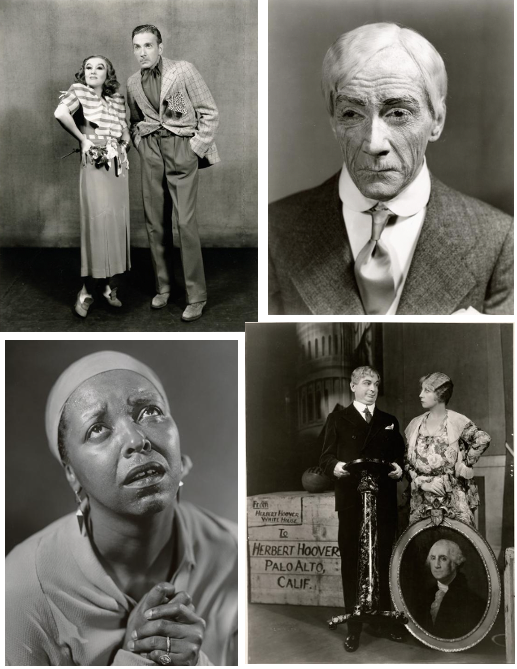
WHAT’S SO GOOD ABOUT IT?…Claude Rains as Wang Lung and Alla Nazimova as O-Lan in the Guild Theatre’s The Good Earth. At right, Nazimova as O-Lan. (allanazimova.com)
In all fairness to Rains and Nazimova, many of their white Hollywood compatriots portrayed Asian characters, including Katherine Hepburn in another adaptation of a Pearl Buck novel:
IN ON THE ACT…Luise Rainer as O-Lan and Paul Muni as Wang Lung in the 1937 film adaptation of Pearl Buck’sThe Good Earth; at right, Katherine Hepburn in the 1944 film adaptation of Buck’s Dragon Seed. For the record, The New Yorker’s John Mosher called the 1937 film “vast and rich.” (IMDB/history.com)
* * *
From Our Advertisers
We begin with some good old-fashioned sexism from the makers of Packard automobiles…if this woman had a job outside of the home (uncommon before the war) she could have just gone and bought the damn car…right?…
…and don’t forget the ANTI-FREEZE, as this two-page ad from Union Carbide helpfully suggested (Prestone anti-freeze, that is, not the other crap on the market)…
…some back-page ads…the one on right featured a rather somber-looking Jack Denny, appearing at the Waldorf’s famed Empire Room…and then there is the Schick Dry Shaver…I owned a Schick in the 1980s and had a permanent 5 o’clock shadow until I switched to blades; I can’t imagine how these things would have performed 89 years ago…
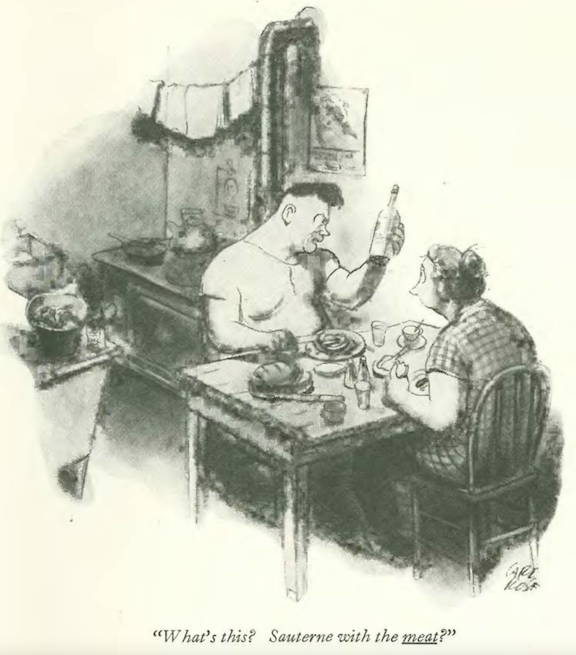
…cartoonist Otto Soglow continued to extoll the virtues of decaf coffee…
…and on to our cartoons, William Crawford Galbraith eavesdropped on a backstage political discussion…
…Peter Arno found a lovelorn soul in a furniture department…
…Soglow again, this time hinting at the Little King’s naughty side…
…as a former newspaper editor, this entry from Garrett Price really hit home…I used to get calls about all sorts of interesting critters and misshapen vegetables…
…Rea Irvin gave us a former bank teller all washed up by the Depression…
…and James Thurber continued to explore the growing war between the sexes…
…we continue on to Nov. 5, 1932…
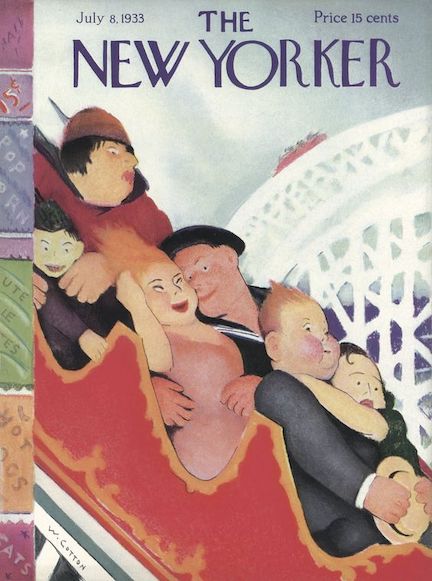
Nov. 5, 1932 cover by William Cotton.
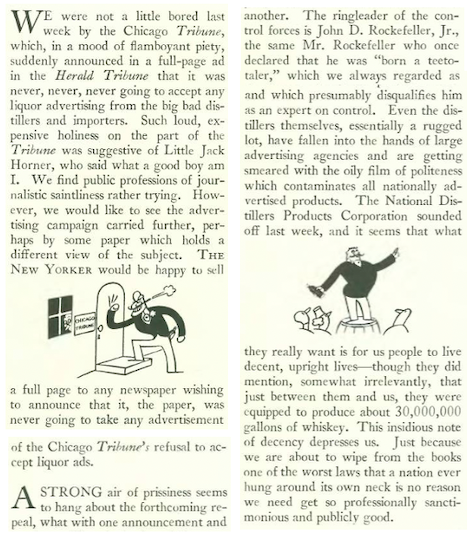
…and this observation by E.B. White on the state of cigarette ads, namely the latest from Lucky Strike…
…one of the ads that caught White’s eye…
…the Nov. 5 issue featured another edition of the parody newspaper “The Blotz,” but what caught my eye was the upper right-hand corner…
…intended as a joke, of course, referring to political changes in Germany…but to our eyes quite ominous…
…and here we have a Lord & Taylor ad that begs the question, “What’s wrong with this picture?” Aside from the weirdly attenuated figures (admittedly standard in fashion illustration), the fellow in the lounger appears to be sitting at floor level, contemplating a photograph that seems to be of some interest to his companions, none of whom appear to be all that cheerful…
…the Nov. 5 issue also offered readers several options for stockings…
…on to our cartoonists, James Thurber provided these sketches for the magazine’s football column (except the one at bottom left, which appeared in the events section in the Oct. 29 issue)…
…Americans were turning out for the 1932 presidential elections, some in their own way per Helen Hokinson…
…twenty-year old Syd Hoff gave us some late night hijinks…
…William Crawford Galbraith continued to probe the entertainment world…
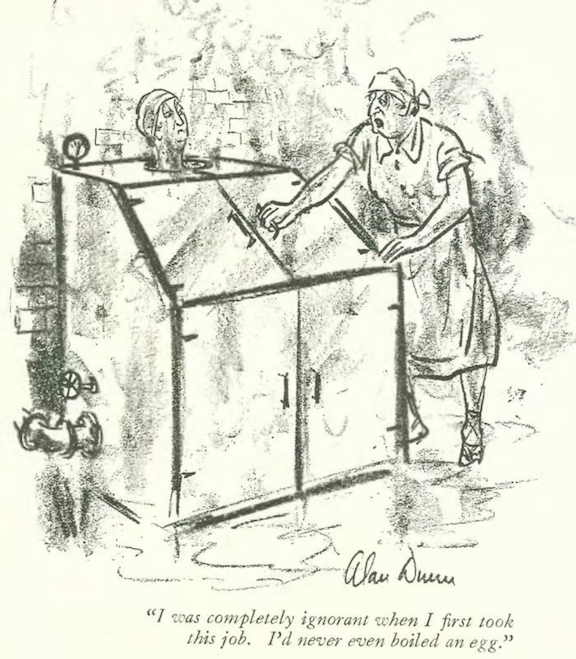
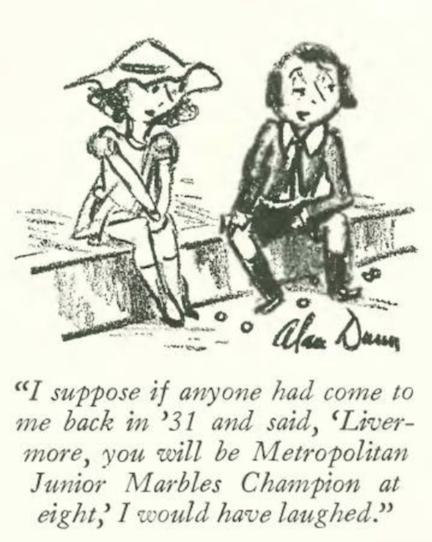
…and we close with Alan Dunn, who takes us out with a bang…
Lewis Mumford (1895–1990) is best known as a critic of art, architecture and urban design, but he was unique—especially for his time—in how he approached these subjects, going far beyond aesthetics to consider how things aligned, or mis-aligned, with necessary human qualities ranging from comfort and scale to the quality of our air, water and even diet.
Oct. 22, 1932 cover by Peter Arno.
Returning home from a trip to Europe, Mumford pondered the New York skyline as his ship approached the harbor, contrasting his city’s approach to architecture with what he had seen abroad. He was not pleased:
NOT JUST ANOTHER PRETTY FACE…Lewis Mumford praised the sense of “space, clarity and order” he found in the buildings of Rotterdam—perhaps he was referring in part to Leendert van der Vlugt’s 1931 Van Nelle Factory (top) and H.F. Mertens’ 1931 Unilever office building. (metalocus.es/Wikimedia)WELCOME BACK, LEWIS…Manhattan skyline with gas tank, 1932. (nycurbanism.com)
Mumford was among the few in 1931 who saw a bright side to the Depression, since a pause in building would afford American architects an opportunity to reflect on their past transgressions…
Mumford, among others, was regarded as a visionary in urban planning, anticipating the “New Urbanism” of the late 20th century which was proposed as an antidote to the dehumanizing free-market development Mumford rightly feared would degrade the quality of urban life, not to mention its deleterious effects on the natural environment.
Inspired by the Garden City movement in the U.K., Robert D. Kohn (mentioned above) founded the Regional Planning Association of America, which led to the development of some of the first modern zoning standards in the U.S.
MAVERICKS…Robert D. Kohn (seated in light-colored suit) was president of AIA when the association held their convention in San Antonio in 1931. Seated at left is Dr. Aureliano Urrutia, a prominent San Antonio physician who established the famed Miraflores gardens (mostly gone, sadly) in that city. (sanantonioreport.org)Along with Mumford and Kohn, Henry Wright (left) and Frederick Ackerman were strong advocates for zoning laws unsullied by free market forces. Wright (1878–1936) was the brainchild behind the Hillside Group Housing model (described by Mumford below) and he also co-designed Radburn (pictured below) among other projects. Ackerman (1878–1950) became the first Technical Director of New York City Housing in 1934.(sunnysidegardens.us)
Mumford praised the work of architect and planner Henry Wright (1878–1936), who had co-created a “Garden City” plan for Radburn, N.J. (with Clarence Stein) and had recently produced a proposal for “Hillside Group Housing”…
NICE PLACE, THIS…Apartments around a courtyard in Radburn, a community designed by Henry Wright and Clarence Stein. Stein was an early supporter of bicycle paths. (thepolisblog.org)
* * *
Shining Some Light
Now I’d like to offer a tribute of sorts to the almost-forgotten Maddy Vegtel, a writer known in 1920s and 30s for her Vanity Fair profiles (she penned “Blonde Venus and Swedish Sphinx” — about Marlene Dietrich and Greta Garbo in the June 1934 issue of VF) and articles about her European roots (Holland) in The New Yorker from 1926 to 1956. She particularly enjoyed skewering smug upper middle-class types. Here is her short piece, “Paris.”
…and for the record, the opening spread of Vegtel’s 1934 Vanity Fair piece on Garbo and Dietrich…
(Vanity Fair)
* * *
Play It Again
Robert Benchley was back to writing stage reviews, this time taking in the drama I Loved You Wednesday (at the Sam Harris Theatre) featuring Frances Fuller and Humphrey Bogart — Bogie appeared in a number of stage productions before becoming the familiar hardboiled antihero of Hollywood’s golden age.
Bogart began his stage career in 1921, delivering one line (as a Japanese butler!) in the play Drifting. He would go on to appear in 17 Broadway productions between 1922 and 1935, and would make his screen debut in 1930 in A Devil With Women.
HERE’S LOOKING AT YOU, KID…Francis Fuller and Humphrey Bogart in a 1932 stage production of I Loved You Wednesday. It ran for 63 performances at the Sam Harris Theatre. (Pinterest)
* * *
Off-white Christmas
In the midst of wading through poetry submissions to The New Yorker, E.B. White allowed his thoughts to drift toward the coming winter…
…and what would likely be his winter scene in Manhattan…actually this is a screenshot from the 1945 comedy Christmas in Connecticut, and this was the view through writer Elizabeth Lane’s (Barbara Stanwyck) window, which was actually part of a Hollywood sound stage…
(hookedonhouses.net)
* * *
Seeing Red
Along with the poetry submissions, E.B. White also received a letter from the local Communists urging The New Yorker to join hands with the oppressed classes. White, however, found that class divisions weren’t always what they seemed…
FREEDOM AND SOME FREE STUFF, PLEASE…About 10,000 Communists and unemployed march on New York’s City Hall in 1932. (NY Daily News)
* * *
From Our Advertisers
While the Communists marched for jobs and free milk, another class of New Yorkers pondered this ad for a V-16 Cadillac…
…in my last post we saw how RCA’s mascot “Nipper” enjoyed the newfangled “bi-acoustic” radio…
…and so General Electric answered in the Oct. 22 issue with a two-legged expert, who perhaps didn’t have the same range of hearing as a terrier mix, but was nevertheless blessed with “keenly discriminating ears”…
…Samuel Lionel “Roxy” Rothafel’s greatest achievement was the Roxy Theatre, which opened March 11, 1927. He was also behind the opening of Radio City Music Hall, home of the Roxyettes (later renamed The Rockettes). Rothafel (1882–1936) is also the great-grandfather of actress Amanda Peet…
S.L. “Roxy” Rothafel greets wife Rosa Freedman (right) and daughter Beta Rothafel after their return from abroad aboard the S.S. Paris, Sept. 19, 1932. (Associated Press)
…and we continue in the back pages, which included signature ads for various entertainments and an ad for American Airways, which depicted a jaunty young man announcing his plans for “week-ending in Los Angeles”…now read the fine print…in order to “breeze into Los Angeles on Saturday morning,” this fellow would need to depart on Thursday evening, and no doubt experience some bumps along the way…
…here’s a couple of ads featuring New Yorker talent, cartoonists Peter Arno and Helen Hokinson…
…Mori was an Italian restaurant in Greenwich Village (144 Bleecker Street) that managed to survive Prohibition and most of the Depression before closing in 1937…the building is still there, sans the charm…
A photograph of Mori’s Restaurant taken by Berenice Abbott for the Federal Art Project in 1935. (New York Public Library)
…Lois Long had this to say about Mori in her Oct. 29, 1932 “Tables for Two” column:
…on to our cartoonists, beginning with Rea Irvin…
…this relatively straightforward cartoon feels like a departure from James Thurber’s usual work…
…and here we have Henry Anton’s first-ever cartoon in The New Yorker (Anton was William Steig’s brother)…
…John Floherty Jr. found some racy action among the amoeba…
…while William Crawford Galbraith dialed up the familiar sugar daddy trope…
…and we close with Peter Arno, on firm ground with a bit of his own naughtiness…
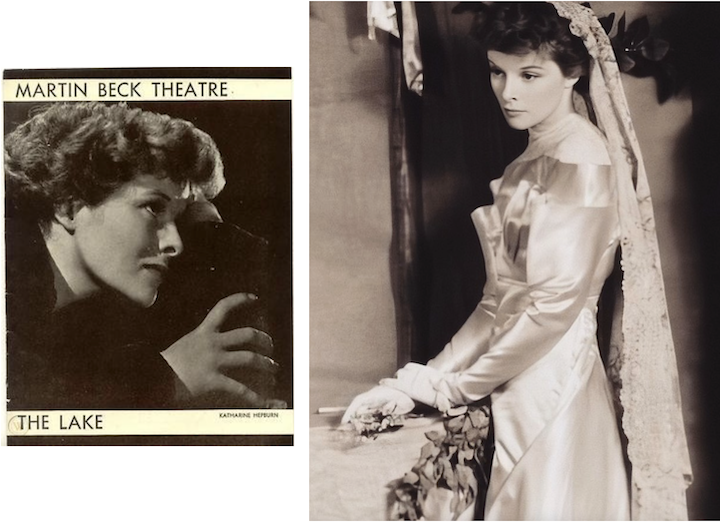
George Cukor’s 1932 pre-Code film A Bill of Divorcement would make Katharine Hepburn an instant star in her screen debut…
Oct. 8, 1932 cover by Rea Irvin.
… but New Yorker critic John Mosher seems to have missed the boat in spotting this new talent, who would go on to be—at least according to the American Film Institute, “the greatest female star of classic Hollywood cinema.” In A Bill of Divorcement, Hepburn portrays a young woman who fears she has inherited the same psychiatric problems that plague her father (John Barrymore). Mosher wrote:
A LOT ON HIS MIND…In A Bill of Divorcement, John Barrymore portrays a man who escapes from a mental hospital after 15 years of confinement, seeking to return to wife and family; his daughter, Sydney (Katharine Hepburn), fears she has inherited his psychiatric problems, while Sydney’s mother, Meg (Billie Burke) wants to start a new life with another man. (IMDB)
Although Mosher offered a rather tepid response to Hepburn’s debut role, critic Mordaunt Hall of The New York Times called the film “intelligent, restrained and often stirring.” Of Hepburn he wrote: “Miss Hepburn’s characterization is one of the finest seen on the screen and the producers have been wise in not minimizing the importance of her part because Mr. Barrymore is the star of the film.”
* * *
On Shaky Ground
E.B. White noted the sad state of the Pulitzer Fountain, which had stood at the Plaza since 1916. Although Joseph Pulitzer’s sons had put up funds to restore the landmark, the city had yet to act on a plan.
Fortunately the fountain still stands, thanks to restorations in 1933-35, 1971 and 1985-90. As to White’s concerns, the city finally accepted the Pulitzers’ offer, and after delays due to labor disputes it was completed in June 1935. The original limestone basin was rebuilt in Italian marble, and a limestone balustrade and columns that surrounded the fountain were demolished.
WHEN WE WERE YOUNG…The Pulitzer Fountain after it was completed in 1916. (New York Public Library)
White also mused about the nature of Long Island, soon to be transformed under Robert Moses’ system of parkways that would stretch across the island’s vast expanses.
EAT ME…Hundreds of truck farms dotted Long Island in the early 20th century, especially known for their potatoes. (Newsday)
…and we have more from White, also serving as the magazine’s theater critic and taking in the latest installment of Earl Carroll’sVanities…I include this mainly to note the young vaudevillian Milton Berle’s first appearance on a big stage…
BEFORE UNCLE MILTIE…Milton Berle (1908–2002) made his first appearance on a big stage with Earl Carroll’s 1932 Vanities. It is also noteworthy that in that same year Chicago native Vincente Minnelli (see program cover) was getting his first breaks on Broadway as a stage and costume designer. (tralfaz.blogspot.com/Playbill)
* * *
Delirious Nights
Although Lois Long was primarily focused on her fashion column, she continued to file an occasional “Tables for Two” that gave readers a glimpse into New York nightlife, including the star-studded (Walter Chrysler, Howard Hughes, among others) opening of the Pierrette Club in the Waldorf-Astoria’s Sert Room…
DANCING WITH THE STARS…Lois Long reported on the star-studded opening of the Pierrette Club in the Waldorf-Astoria’s Sert Room, which featured a series of Saturday night supper dances; images of the Sert Room left and right; at center, The New York Times’ account of the club’s opening, Oct. 2, 1932. (geographicguide.com/The New York Times/jstor.org)
* * *
From Our Advertisers
Simon & Schuster promoted George Gershwin’s Song Book, illustrated by New Yorker regular Constantin Alajalov…
…signed first editions go for up to $8000 these days…
(raptisrarebooks.com)
…meanwhile, Farrar & Rinehart trumpeted the release of Evelyn Waugh’s latest novel (his third)…Black Mischief satirized the ways Europeans attempted to impose their customs and beliefs on other cultures…
…Squibb helped The New Yorker’s bottom line with three separate ads scattered throughout the magazine…back in the day the Squibb brand was associated with everything from toothpaste…
…to aspirin and shaving cream…founded in 1858, it merged with Bristol Meyers in 1989 to form one of the world’s largest pharmaceutical companies, Bristol Myers Squibb, which today is mostly known for manufacturing dozens of prescription pharmaceuticals and biologics…
…Squibb & Sons were the primary tenant (the top 12 floors) of New York’s landmark Squibb Building when it opened its doors in 1930…
(Museum of the City of New York)
…moving on, here are a couple of ads that show us one thing that has definitely changed in the past 89 years…when was the last time you wore a fur coat to a football game?…
…cigarette manufacturers had plenty of money to advertise during the depths of the Depression, but apparently so did the folks at Wamsutta Mills…Wamsutta sheets are no longer made in New Bedford—part of the circa 1847 mill complex is now loft-style housing…however, the Wamsutta brand still exists in the U.S. through Bed, Bath & Beyond and internationally as part of a Brazilian textile conglomerate…
…Micarta was a substance developed by Westinghouse in the early 20th century for use with electrical equipment…produced from a combination of linen, canvas, paper, fiberglass and other materials processed under heat and pressure, Westinghouse found a new use for this laminate — serving trays designed by George Switzer…you can read more about Micarta trays at Driving for Deco…reader Chris notes that Micarta is “still available in a wide range of grades and designer colors and is popular with hobbyists and craftsmen the world over”…
…in the Oct. 29 issue, E.B. White made this observation about Micarta trays…
…on to our cartoons, William Steig’s “Small Fry” learned about the birds and the bees…
…Gardner Rea visited some tobacco researchers challenged to keep pace with advertising claims…
…Barbara Shermund looked into the love lives of the modern woman…
…and Peter Arno got playful at the pipe organ…
…on to our Oct. 15, 1932 issue…
Oct. 15, 1932 cover by William Steig.
…where we check in on John O’Hara (1905–1970), who defined the short story at The New Yorker (and contributed more shorts to the magazine than any other writer). For the Oct. 15 issue O’Hara submitted a profile titled “Of Thee I Sing, Baby.” The profile is unusual because it is told as a story rather than as a biography, and the subject, a chorus girl, is not identified by her real name. A brief excerpt:
WRITING MACHINE…John O’Hara (pictured here in 1945) contributed more short stories to The New Yorker than any other writer. (Library of Congress)
* * *
…William Steig (1907–2003) was both a writer and illustrator, and every bit as prolific as O’Hara, publishing more than 50 books during his long life and career, including his very first, which received this mention at the end of the Oct. 15 book review section:
…on to our Oct. 15 advertisers, we have the makers of Chesterfields pairing their product with the sophistication of Paris fashions…
…Carl “Eric” Erickson illustrated a number of ads for R.J. Reynolds’ Camel cigarettes in the late 1920s and early 1930s…here he employed his signature sophisticated style for the French Line…
…RCA promoted the next great advance in radio technology—”bi-acoustic” sound that added “two more octaves” to radio broadcasts…it would take thirty more years to roll out something we take for granted today—stereo…
…on to our cartoons, Robert Day joined a misdirected fox hunt…
…Richard Decker gave us one man’s simple solution to a perilous situation…
James Thurber made a rare appearance in the “Reporter at Large” column—usually the purview of the departing Morris Markey—to offer a glimpse into the life of Albert Davis and his extensive collection of theatrical and sports photographs.
Sept. 24, 1932 cover by Rea Irvin.
A publicist by trade, Davis (1865-1942) collected thousands of photographs, clippings, programs, scripts and playbills from hundreds of productions mainly from the 1890s to the 1920s. In this excerpt, Thurber took a look into Davis’s rarefied world:
PLAYING MAKE-BELIEVE…Among the photographers collected by Davis was Joseph Byron, who captured this scene from the 1912 play The High Road by American playwright Edward Sheldon. Pictured are actors Frederick Perry and Minnie Maddern Fiske. (monovisions.com)OSCAR THE FIRST…Theatre impresario Oscar Hammerstein (left) at Manhattan Opera House, which opened December 3, 1906. Hammerstein was the first person with whom Davis traded photographs. He was also the father of famed lyricist and musical comedy author Oscar Hammerstein II. (monovisions.com)WHEN ALL PERFORMANCES WERE LIVE…Images of performers from the Davis collection included actor Bert Williams (ca. 1895); sharpshooter Annie Oakley (ca.1886); and actor Theodore Drury as Escamillo in Carmen (ca. 1905). (Harry Ransom Center, UT Austin)
Thurber pointed out that the collection was quite valuable, and its sale could reap a considerable sum for Davis. It seems Davis intended to present the collection to his university’s library, a wish more or less fulfilled.
Davis’s collection also contained hundreds of sports figures, mostly from the world of boxing.
TOUGH GUYS…Omaha-born Max Baer (left) defeated German champion Max Schmeling at Yankee Stadium in 1933 and took the heavyweight title in 1934; Paul Berlenbach (right) was a light-heavyweight champ from 1923 to 1926. An interesting footnote: Baer acted in 20 films, and one of his three children, Max Baer Jr., portrayed Jethro Bodine on The Beverly Hillbillies. (Stark Center for Physical Culture and Sports, UT Austin)PEDDLERS…Bicycle racers at the Hartford Wheel Club’s bicycle tournament pose for an 1889 photograph in Stamford, Connecticut. (Stark Center)
Endnote: Davis wanted his collection to go to a university library, and so it finally did: it resides at the University of Texas at Austin; the theatrical photos and memorabilia are at the Harry Ransom Center, and the sports-related items are housed at the Stark Center for Physical Culture and Sports.
* * *
Is It Beer-Thirty Yet?
Brewer, politician and owner of the New York Yankees baseball franchise Jacob Ruppert Jr. (1867–1939) inherited the Jacob Ruppert Brewing Company and the Yankees upon his father’s death in 1915. It was Ruppert who purchased the contract of Babe Ruth (from the Red Sox in 1919) and built famed Yankee Stadium (1923), moves that helped propel a middling franchise to the top of the major leagues. Alva Johnston profiled Ruppert in the Sept. 24 issue; here is the opening paragraph:
LOOK WHAT I JUST BOUGHT…Jacob Ruppert purchased the contract of Babe Ruth from the Red Sox in 1919; Ruppert also inherited the Knickerbocker brewery at 92nd Street and 3rd Avenue (demolished in 1969). (historywithkev.com/brookstonbeerbulletin.com)
* * *
Pol Mole
With the 1932 presidential election just weeks away, E.B. White’s focus was on an apparently elusive mole that decorated the left side of Franklin D. Roosevelt’s face, or possibly the right, or perhaps not at all…
REPRESENTING THE LEFT AND THE RIGHT…E.B. White mused on FDR’s apparently shifting mole, which appeared on the right cheek on the cover of Vanity Fair, on the left on the cover of Life, and not at all on the campaign button. (picclick.com/Britannica/2Neat.com)
This wouldn’t be the last time someone discussed FDR’s dermatology. Health experts today still debate whether a pigmented lesion above FDR’s left eyebrow was a melanoma—some even speculate that it led to his death at age 63, although the official cause of FDR’s death on April 12, 1945 was cerebral hemorrhage associated with high blood pressure. Incidentally, most photographs show the cheek mole on the right side.
* * *
Words Were Their Bond
What a treat it must have been for a New Yorker reader to turn to pages 15-16 and find Dorothy Parker’s “A Young Woman in Green Lace,” followed by Parker’s dear friend and confidant Robert Benchley’s “Filling That Hiatus” on pages 17-18.
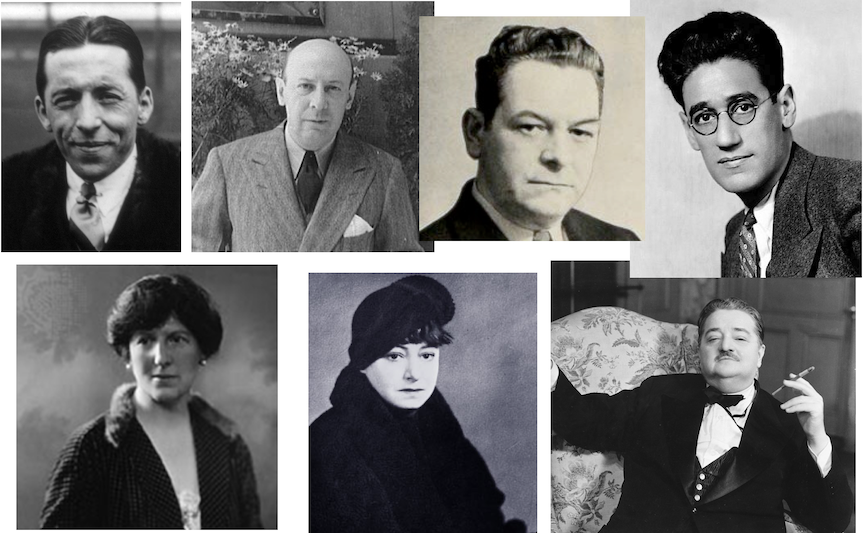
GETTING TO KNOW YOU…Dorothy Parker and Robert Benchley (far right) with their employers in 1919: Vanity Fair editor Frank Crowninshield, Vogue editor Edna Chase, and publisher Condé Nast. (publicdomainreview.org)
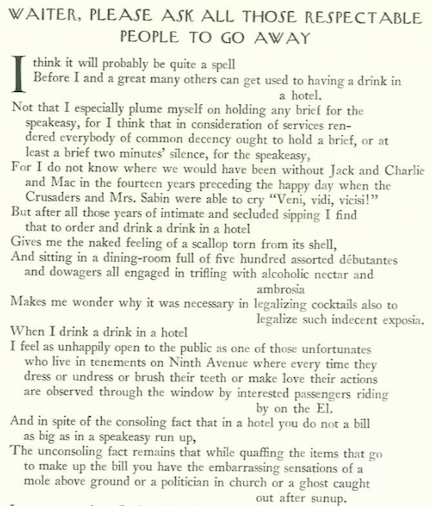
Benchley and Parker’s friendship began when he was hired as Vanity Fair’s managing editor in the winter of 1919 (and would become Parker’s office mate the following May). That same year they were among the founders of the famed Algonquin Round Table.
“A Young Woman in Green Lace” reveals how Parker regarded some of the modern women of those times, this next-generation flapper, a bit childish and snobbish, wishing she were back in “Paree.” In the story a man presses his charms as the woman descends into drunkenness and drops her Continental facade:
Where disillusion creates a darkly comic mood in Parker’s piece, in Benchley’s world disillusion provided a nice opening for some silliness. In ”Filling That Hiatus” Benchley addressed a seldom-discussed dinner-party etiquette situation in which both your right- and left-hand partners become engaged in conversation with someone else. He concluded:
* * *
His Country, Too
It is always with a tinge of sadness that I write about Morris Markey, who from the start wrote for virtually every department at The New Yorker and was best known for his “A Reporter at Large” feature. According to his obituary in The New York Times, Markey won his greatest recognition for the book This Country of Yours, published after he left The New Yorker. That magazine’s review was brief, and read thusly:
The book is mostly forgotten today, as is Markey, who was found shot to death on July 12, 1950 at his home in Halifax, Virginia. He was just 51 years old. There was insufficient evidence as to whether the wound behind his right ear was the result of accident, homicide, or suicide.
Here is what the Times (Sept. 10, 1932) had to say about Markey’s book:
* * *
From Our Advertisers
With cold weather arriving during the Depression’s worst year, fashions continued to borrow from the past for a more conservative look (these are two ads from Jay-Thorpe and B. Altman)…
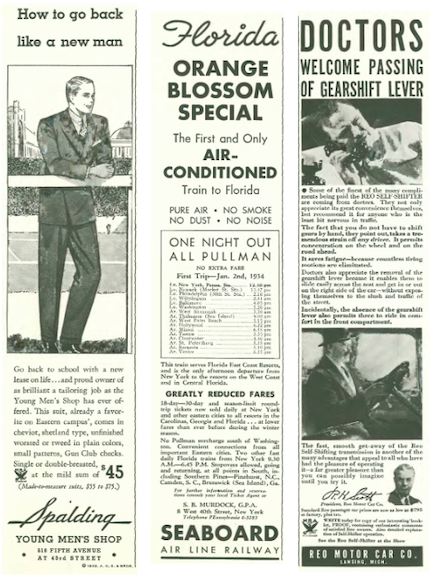
…as for the gentleman, fashion continued to emphasize a genteel look (although there is a bit of the Little Tramp about this fellow)…
…then as now, folks turned toward the rustic to find a bit of comfort in uncertain times…
…and if they could afford it, the comforts of the stolid, solid Lincoln motorcar…
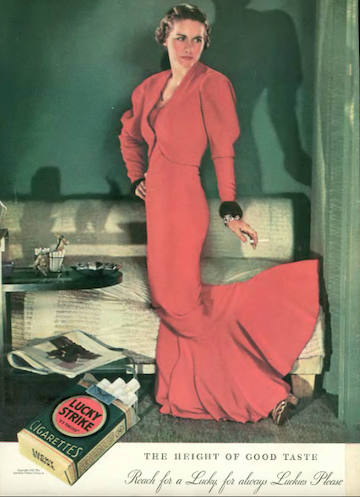
…the folks at Lucky Strike continued to ask this question…
…and with the help of Syd Hoff, the makers of Log Cabin syrup ran this parody ad (in the Oct. 1 issue) of the Lucky Strike campaign…Hoff was among the newest members of The New Yorker cartooning cast…
…as was William Steig, who featured one of his “Small Fry” to tout the benefits of decaf coffee…
…our cartoon from the Sept. 24 issue is by Richard Decker…
…on to Oct. 1, 1932…
Oct. 1, 1932 cover by Peter Arno.
…where film critic John Mosher took in the latest from Marlene Dietrich and came away less than dazzled by Blonde Venus…
Now something of a cult film, reviews were mixed when Blonde Venus was released in 1932. The New York Times’ critic Mordaunt Hall went even further than Mosher, calling the film a “muddled, unimaginative and generally hapless piece of work, relieved somewhat by the talent and charm of the German actress…”
WELL HELLO THERE…Cary Grant made his film debut in 1932 in This Is the Night—he went on to appear in eight films that year, including Blonde Venus with Marlene Dietrich. (MoMA)
* * *
Unlucky in Luck
In its early years The New Yorker paid little attention to baseball, but “The Talk of the Town” did appreciate a human interest story from the field every now and then, and Yankee batboy Eddie Bennett filled that bill—this was the second time Bennett was featured in the column…
LUCKY EDDIE…Top, Eddie Bennett in 1921, the year he became the Yankees’ batboy; below, with slugger Babe Ruth in 1927; at right, newspaper profile the year after the 1927 World Series. As an infant Bennett twisted his spine in a carriage accident that stunted his growth and gave him a misshapen back.(Library of Congress/The New York Times/Brooklyn Citizen)
Throughout the 1920s Bennett was a famed good luck charm for the Yankees, but when a taxicab struck him in 1932 his batboy career ended. According to The New York Times (April 2, 2021) “Three years later, Mr. Bennett was found dead in a furnished room on West 84th Street. Autographed photos from Herb Pennock and Waite Hoyt, both pitchers for the Yankees, hung on the walls…Balls and bats signed by Ruth and Lou Gehrig decorated the room. An autopsy found that Mr. Bennett had died of alcoholism. He was 31.”
For 85 years, Bennett rested in an unmarked grave at St. John’s Cemetery in Queens, but last November he was remembered with a new marker and a simple ceremony. You can read more about it in this Times article.
* * *
Original Verse
Ogden Nash was working as an editor at Doubleday when he submitted some rhymes to The New Yorker. Harold Ross (New Yorker founder/editor) saw the submissions and asked for more, apparently stating “they are about the most original stuff we have had lately.” Here is one of the later submissions:
* * *
From Our Advertisers
If you were of the male persuasion and a member of the smart set you probably dressed down in something like this for a day with your dressage buddies…
…the modern woman of the 1930s could also be a successful business woman in this “successful” frock (how that translated into reality was another thing)…what is also interesting about this ad is how it features both an illustration and a photograph of the same outfit—it’s as though they’ve acknowledged that the attenuated figure in the illustration, although eye-catching, does not resemble an actual body type…
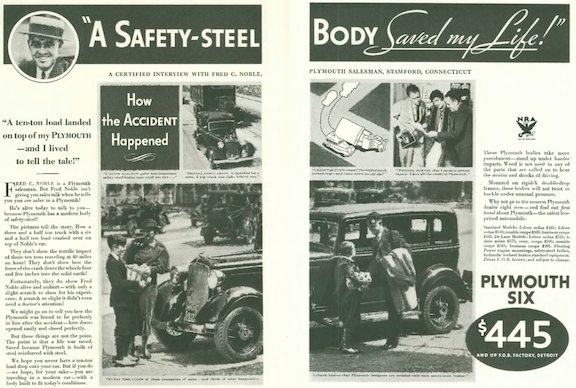
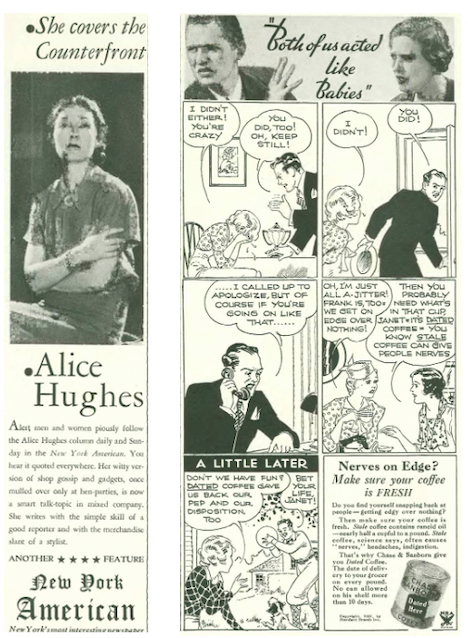
…here was see an early use of the word balloon in an advertisement featuring real people—I wonder if this was inspired by the comics, or by Bernarr Mcfadden’s“composographs” featured in his New York Evening Graphic?…
…on to our cartoonists, we begin with a strange bit of bedside manner courtesy Gardner Rea…
…Robert Day introduced us to a modest suspect…
…Barbara Shermund continued to explore the travails of modern women…
…while this woman (via Perry Barlow) seems quite content with her lot…
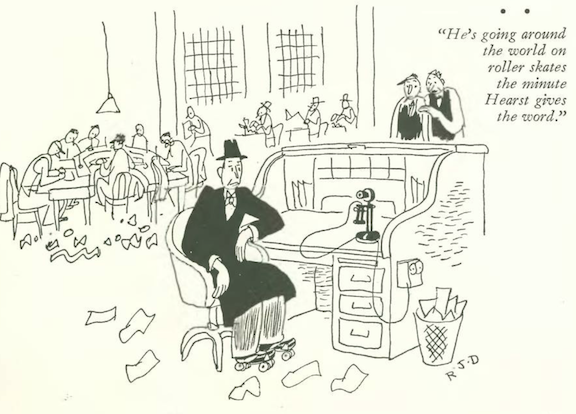
…Mayor Jimmy Walker was out, but not down, like these fellows presented by Alan Dunn…
…and we close with Peter Arno, announcing some upcoming nuptials…