The Last Summer

Winding down the last summer of the 1920s — an unusually hot one — one detects subtle changes in The New Yorker’s mood; weary from the decade-long party known as the Roaring Twenties, a bit more mature, and more confident in its voice thanks to the regular writings of James Thurber, E.B. White and Lois Long and copious cartoons and illustrations by such notables as Peter Arno, Barbara Shermund and Helen Hokinson that gave the magazine a distinctively modern feel as it headed into the 1930s.

Aug. 10, 1929 cover by Theodore Haupt; Aug. 17 cover by Peter Arno.

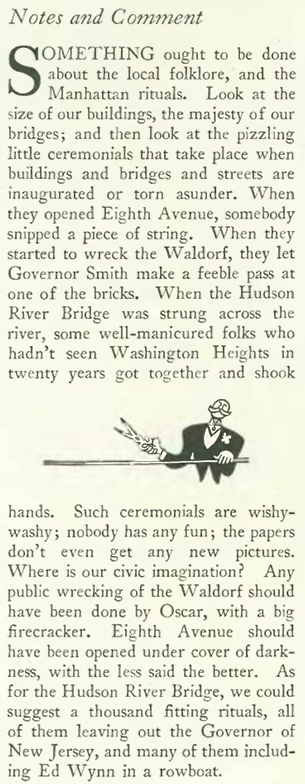
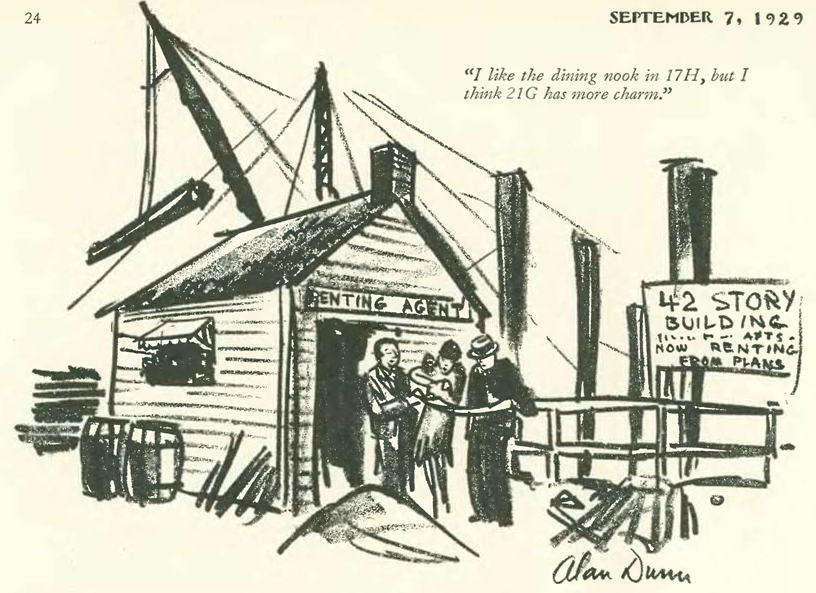
The exuberance associated with the rapidly changing skyline was still there, however, as the Aug. 17 “Talk of the Town” speculated on the race for the world’s tallest building. The article not only anticipated an architect’s sleight of hand, but also a Zeppelin docking station that in the end would top the world’s tallest building:

As it turned out, William Van Alen did not have to compete against himself, the commission for One Wall Street instead going to Ralph Walker, who would design a beautiful art deco landmark that, at 50 stories, would not vie for the title of the world’s tallest building. Unbeknownst to The New Yorker, and perhaps Van Alen, the challenger would instead be 40 Wall Street, which would hold the crown as world’s tallest for about a month. Thanks to some sleight of hand (see caption below) the Chrysler building would quickly surpass 40 Wall Street and hold the title for just eleven months, bested in the end by the Empire State Building (which would sport a “Zeppelin superstructure”).

DECO DELIGHTS…40 Wall Street (left) vied with the Chrysler Building for the title of the world’s tallest building. The 927-foot 40 Wall Street would claim the title in late April 1930. One month later, the Chrysler building would sprout a needle-like spire (secretly constructed inside the building) bringing its total height to 1,046 feet. The builders of 40 Wall Street cried foul and claimed that their building contained the world’s highest usable floor, whereas the Chrysler’s spire was strictly ornamental and inaccessible. Less than a year later the point was made moot when the Empire State Building soared above them both. (Wikipedia/The Skyscraper Museum)
ERECTILE DYSFUNCTION…Clockwise, from top left, progression of designs for the Chrysler Building; the building’s architect, William Van Alen; drawing from Popular Science Monthly (Aug. 1930) revealed the inner workings of the spire’s clandestine construction; Zeppelin docking station for the Empire State Building as imagined in a composite (faked) photograph. At 1,250 feet, the wind-whipped mooring mast proved not only impractical, but downright dangerous. In September 1931 a dirigible briefly lashed itself to the mast in 40 mph winds, and two weeks later the Goodyear Blimp Columbia managed to deliver a stack of Evening Journals to a man stationed on the tower. Contrary to the faked photograph, no passengers ever transferred from the tower to a Zeppelin. (Skyscraper City/Wikipedia/NY Times)

*  *  *

What, Me Worry?

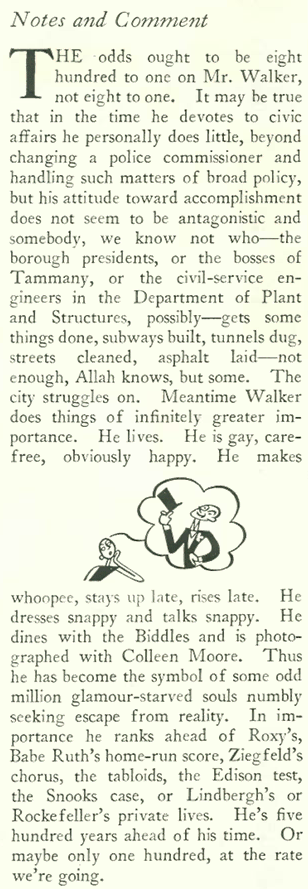
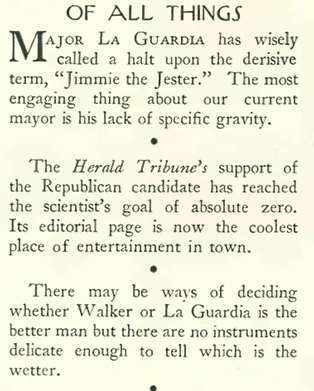
The famously flamboyant New York City Mayor Jimmy Walker lived the easy life during his initial years as Hizzonner, riding a booming economy, partying with the rich and famous (while flaunting Prohibition laws), carousing with his mistress (Ziegfield dancer Betty Compton) and sleeping until noon. When reform-minded Fiorello La Guardia challenged Walker’s reelection bid in 1929, Walker left the dirty work to his Tammany Hall cronies and continued to charm the public, and The New Yorker. The Aug. 17 “Talk of the Town” observed:

IT’S EASY BEING ME…Mayor Jimmy Walker accompanied actress Colleen Moore to the October 1928 premiere of her latest film, Lilac Time. (konreioldnewyork.blogspot.com)
I HAVE MY EYE ON YOU…Reform-minded Fiorello La Guardia (right) detested Jimmy Walker and his Tammany cronies, but that wasn’t enough to get him elected in 1929. The Great Depression would soon turn the tables. (Wikipedia)

Howard Brubaker, in his Aug. 17 “Of All Things” column, suggested that La Guardia had a zero chance of getting elected. Just three years later, Walker would resign amid scandal and flee to Europe. La Guardia, on the other hand, would be elected to the first of his three terms as mayor in 1933, riding the wave of the New Deal.

 *  *  *

Peek-A-Boo

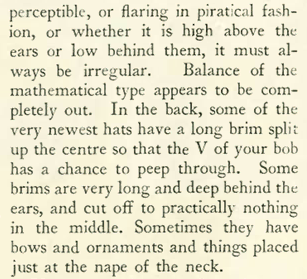
Politics might have been business as usual, but in the world of fashion the vampish hat styles associated with flappers were giving way to a new rolled-brim look that seemed to suggest an aviator’s helmet. In her Aug. 17 fashion column “On and Off the Avenue,” Lois Long reported:

FACING THE FUTURE…Vampish hats of 1928, pictured at top, gave way to the rolled-brim or flare look of 1929. (Images gleaned from magazine/catalog images posted on Pinterest)

Long seemed to welcome the idea that women should once again bare their foreheads…

 *  *  *

Twain Wreck

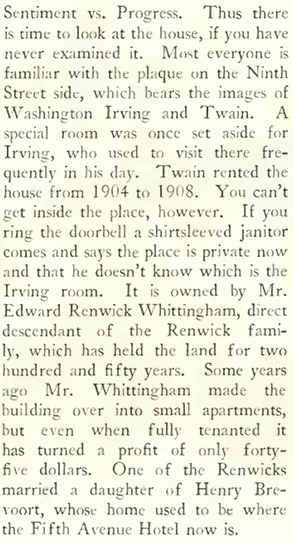
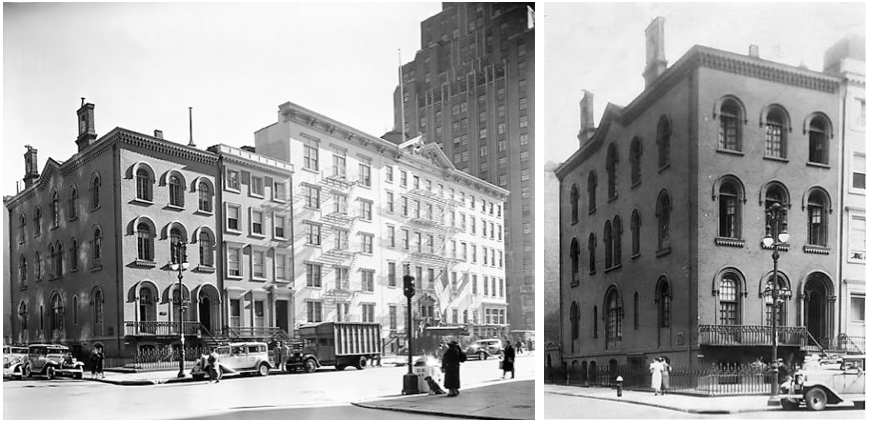
Jumping back to the Aug. 10 issue, “The Talk of the Town” reported on the possible remodeling or demolition of a house once occupied by Samuel Clemens, aka Mark Twain. The house in question was a lavish old mansion built by Henry Brevoort, Jr. in 1834, at the northwest corner of Fifth Avenue and 9th Street. Twain lived in the house from 1905 to 1908, and it was there that Twain’s biographer Albert Paine conducted interviews with the author and wrote the four-volume Mark Twain, a Biography; The Personal and Literary Life of Samuel Langhorne Clemens. When millionaires abandoned their Fifth Avenue mansions in the 1920s and high-rise apartments took their place, there was pressure to either convert an old mansion like the Breevoort house at 21 Fifth Avenue to apartments or demolish it altogether.

LOOKING GOOD AFTER A CENTURY…At left, Berenice Abbott took this photograph of No. 21 Fifth Avenue in 1935. At right, in a close-up shot from the same period, the 1924 plaque from the Greenwich Village Historical Society is visible on the side of the house. (Museum of the City of New York/Greenwich Village Historical Society)
A NOW FOR SOMETHING COMPLETELY DIFFERENT…A proposed 1929 remodeling (left) moved the front door of the old Brevoort mansion to the center and lowered it to street level. At right, today the 1955 Brevoort apartment house occupies the site. (daytoninmanhattan.blogspot.com)

The Greenwich Village Historical Society did what it could to save the house, and in 1924 affixed a bronze plaque to a side wall noting that both Twain and Washington Irving were once occupants. When the house was slated for demolition in 1954, the Society appealed to New Yorkers to raise the $70,000 needed to move the building, but only a fraction of that amount was secured. No. 21 was demolished in 1954 along with the rest of the houses on that block.

 *  *  *

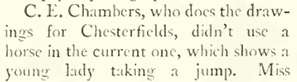
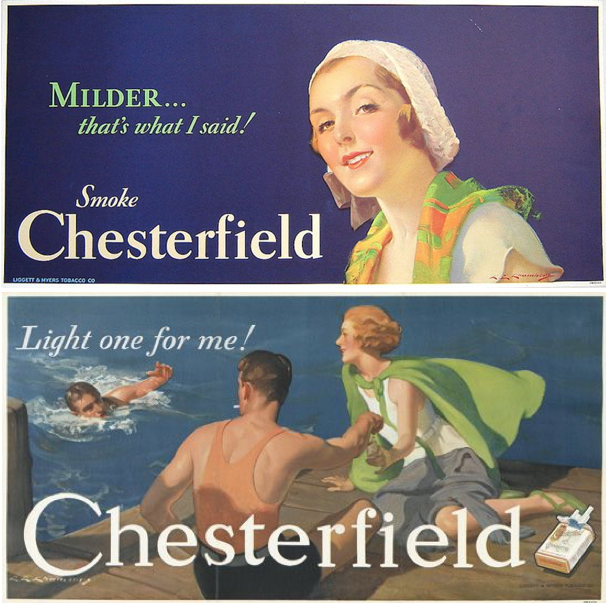
Charles Edward Chambers was an American illustrator probably best known for his Chesterfield ads, although he also illustrated stories for a number of popular magazines from the early 1900s until his death in 1941. The Aug. 10 “Talk of the Town” looked in on his work with model Virginia Maurice:

QUICK…THROW THAT MAN A CIGARETTE!…Examples of Charles Edward Chambers’ Chesterfield ads from 1929 featuring model Virginia Maurice. Note that Maurice is wearing the latest “rolled brim” hat style in the upper image. (Pinterest)
HIS NONSMOKING SECTION…A 1919 Harper’s cover illustration by Charles Edward Chambers. (Wikipedia)

*  *  *

Mama’s Boy

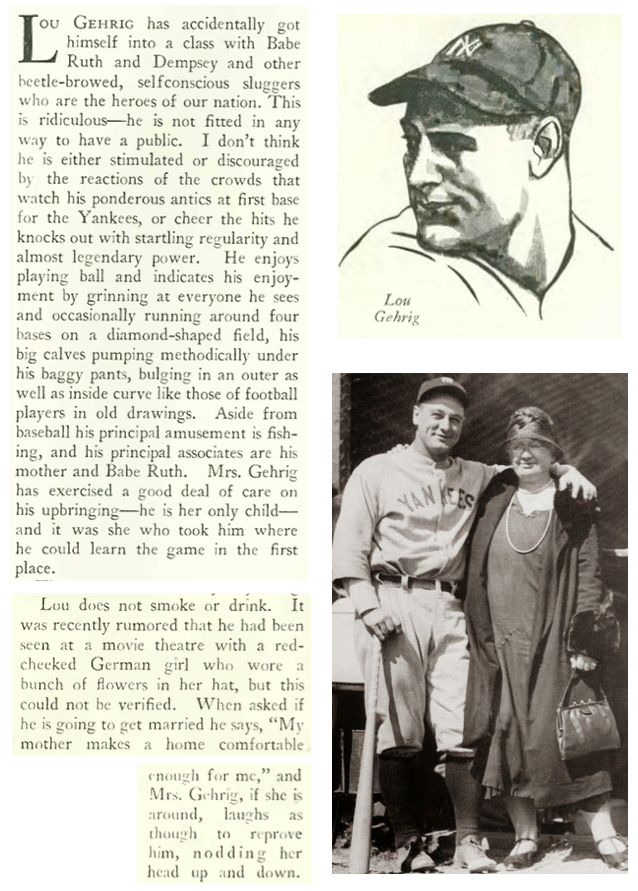
Lou Gehrig rivaled Babe Ruth as a top Murderer’s Row slugger for the 1929 Yankees, yet he couldn’t be more opposite in his lifestyle. A teetotaler and nonsmoker, Gehrig was completely devoted to mom (pictured below in 1927). Niven Busch Jr. submitted this profile of Gehrig for the Aug. 10 issue. Excerpts:

 *  *  *

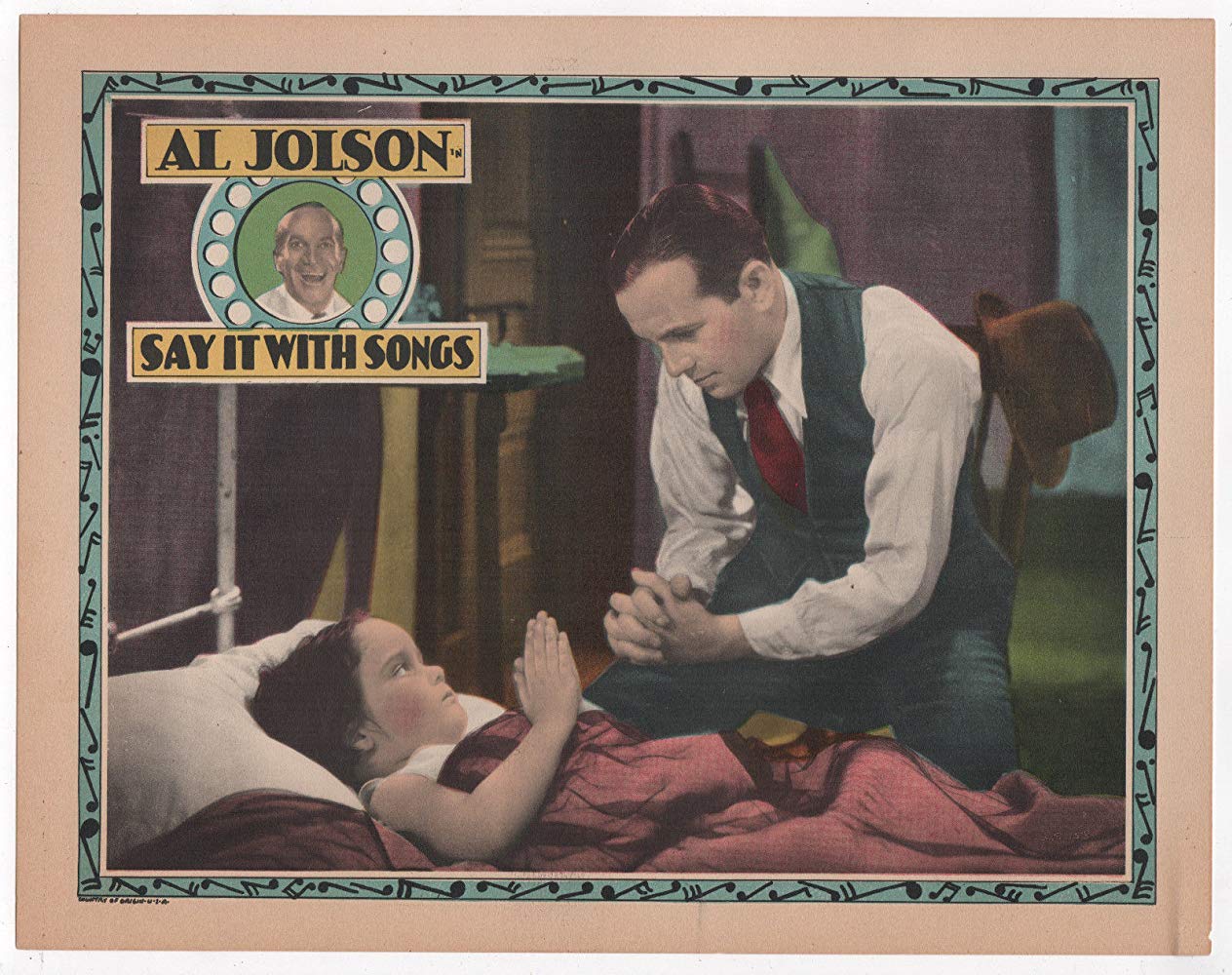
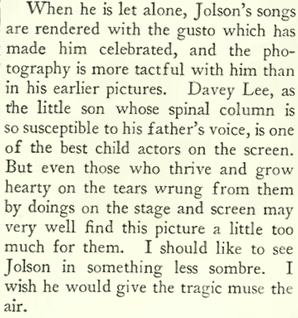
After appearing as Al Jolson’s dying son in The Singing Fool (1928), the child actor Davey Lee returned to the screen for yet another Jolson weeper, 1929’s Say It With Songs. Once again portraying Jolson’s son—this time crippled and rendered dumb after being hit by a truck—he miraculously recovers at the end of the film. The New Yorker wasn’t having any of this sentimental treacle, especially served up for a second time…

LET’S PRAY FOR A BIG BOX OFFICE…Davey Lee and Al Jolson in Say It With Songs. (IMDB)

…and the magazine hoped for something a bit less somber from Jolson in the future, suggesting that he “give the tragic muse the air”…

In the same issue of The New Yorker, this advertisement touted Jolson’s recording of “Little Pal” from Say It With Songs (note the blackface image of Jolson—his unfortunate trademark back in the day)…

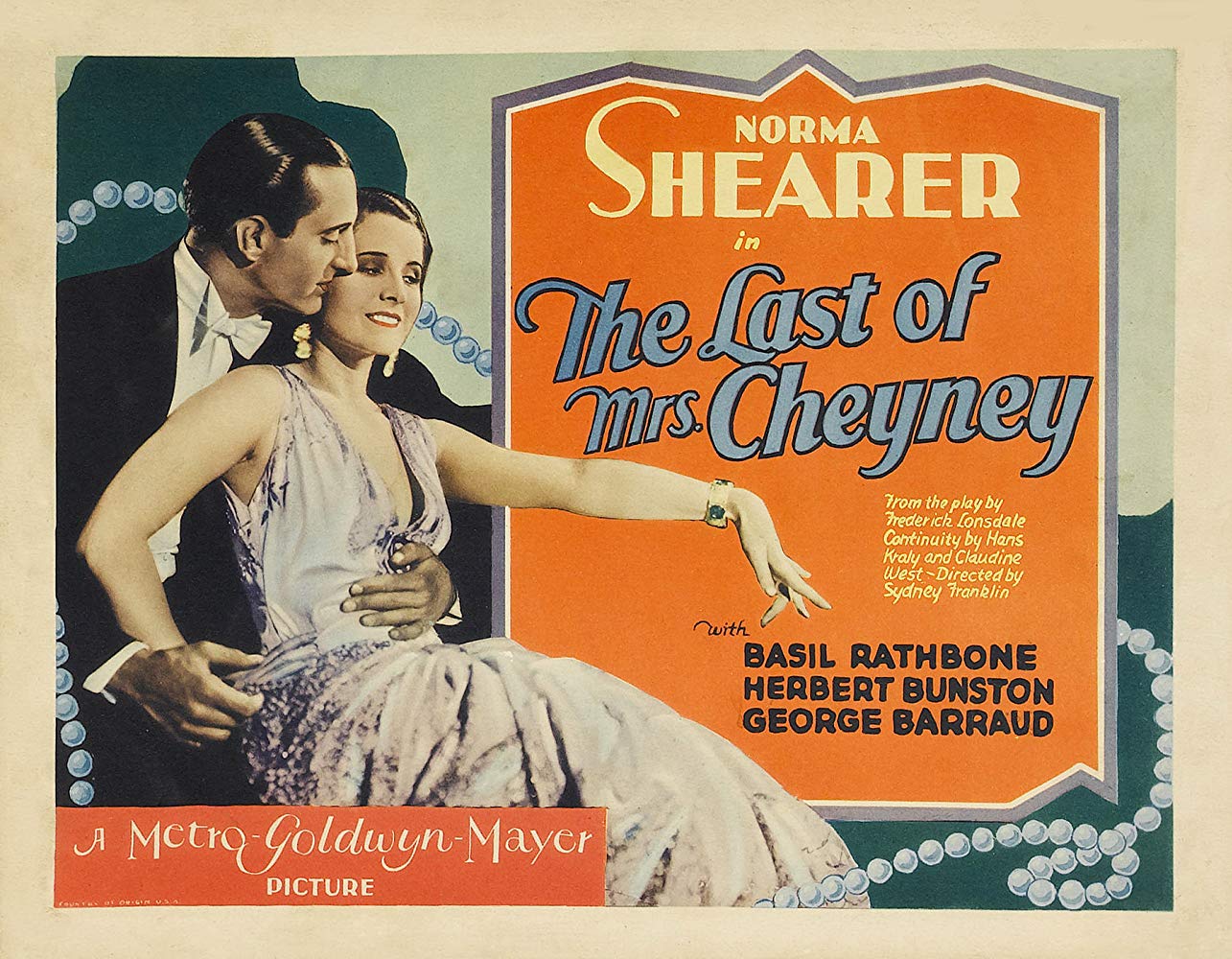
…happily, there were other movies that offered less schmaltzy diversions, including Norma Shearer’s comedy-drama The Last of Mrs. Cheyney, in which Shearer portrayed the jewel thief Fay Cheyney…

OH BASIL YOU ANIMAL…Theatre card for The Last of Mrs. Cheyney. (IMDB)

…often cast as a heavy in silent films, it was the “talkies” that made William Powell a star, his pleasant voice more suited to a hero or leading man than a villain. In The Greene Murder Case, Powell portrayed amateur detective Philo Vance, a role that he played in another 1929 release, The Canary Murder Case (originally filmed as a silent in 1928), both based on mystery novels by S.S. Van Dine. Powell would portray Philo Vance in three more films from 1930 to 1933 until he took on the role of another amateur detective, Nick Charles, in 1934’s The Thin Man (a role he would reprise five times from 1936 to 1947)…

WHODUNNIT? YOUDUNNIT!…William Powell as detective Philo Vance, Florence Eldridge as Sibella Greene, and Jean Arthur as Ada Greene in 1929’s The Greene Murder Case. (IMDB)
KEEPING IT QUIET…William Powell as Philo Vance and Louise Brooks as “the Canary,” a scheming nightclub singer, in The Canary Murder Case. Brooks was a huge star in the silent era and the iconic flapper. According to IMDB, the film was shot as a silent in 1928, but producers decided to rework it as a more profitable “talkie.” When Brooks refused to return from Germany (where she was filming Pandora’s Box) to dub the movie, Paramount spread the word that Brooks’ voice was not suited to sound film, although later productions made by Brooks proved this to be wrong. Actress Margaret Livingston ultimately supplied Brooks’ voice for Canary. (IMDB)

*  *  *

From Our Advertisers

We look at some advertisements from the August 17 issue, including this one from Past Blue Ribbon. Note that nowhere in the ad is the word “beer” used, this being a “near-beer” with less than 1% alcohol content by volume. In addition to making cheese (a Velveeta-like product), Pabst hoped to keep its company alive by selling this “brew” during the unusually hot summer of 1929…

…and with that blazing sun advertisers also promoted a number of face creams and powders to those “enjoying the sunny outdoor life,” including this two-page spread from Richard Hudnut and Poudre Le Début

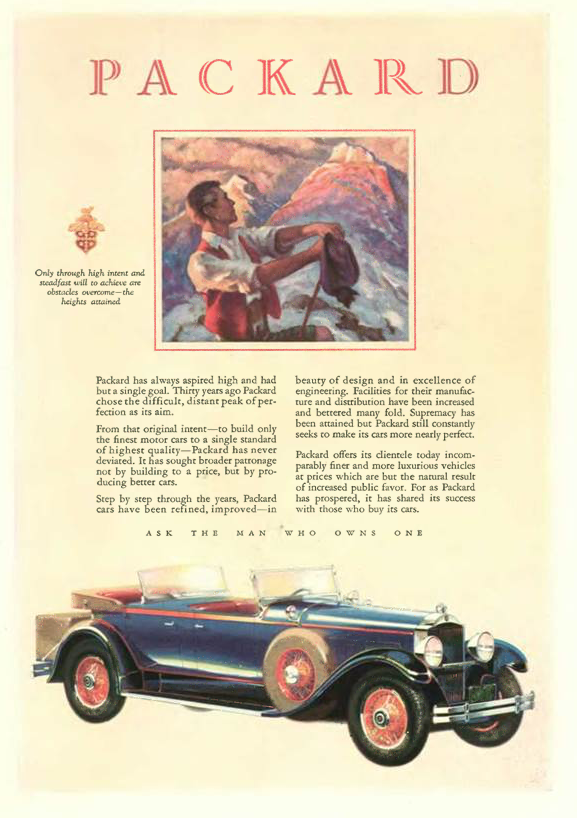
…the outdoor life could also be enjoyed in a convertible Packard 640, a car that was a cut above a Lincoln or Cadillac, and was considered by some to be America’s answer to the Rolls Royce…

A 1929 Packard 640 Convertible. This particular model can be had today for about $130,000. (Hemmings Motor News)

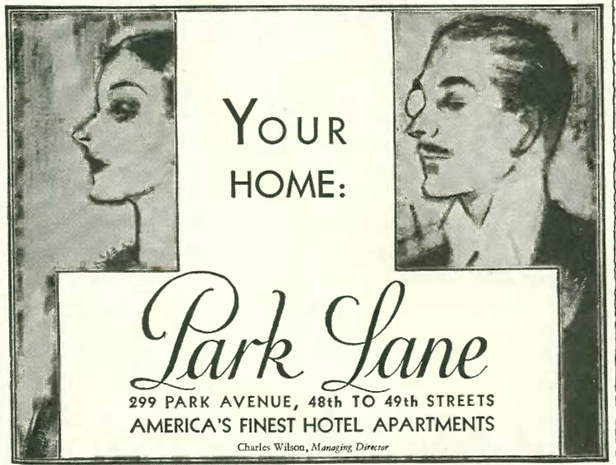
…I found this ad in the back pages interesting for its crude design yet overt appeal to snobbishness with this haughty pair…

…and here is what the Park Lane looked like when it opened in 1924…

Circa 1924 advertisement from the Sargent lock and hardware company touting its fixtures in the new Park Lane hotel apartments. At right, circa 1924 image from The American Architect depicting the Park Lane’s dining room. The building is long gone, razed some time in the 1960s to make way for an office tower. (Pinterest)

 *  *  *

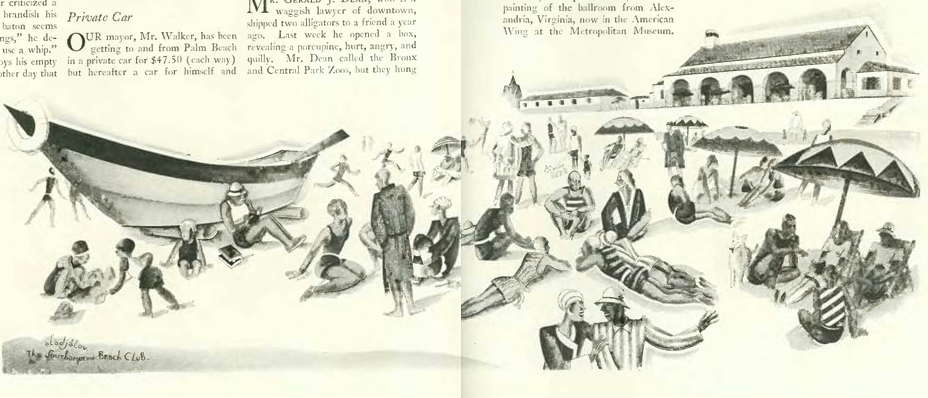
This week’s featured illustration is by Constantin Alajalov, who depicted a summer scene from the Southampton Beach Club…click to enlarge…

…our cartoonists from the Aug. 10 issue include Helen Hokinson, who looked at the challenges of Americans abroad…

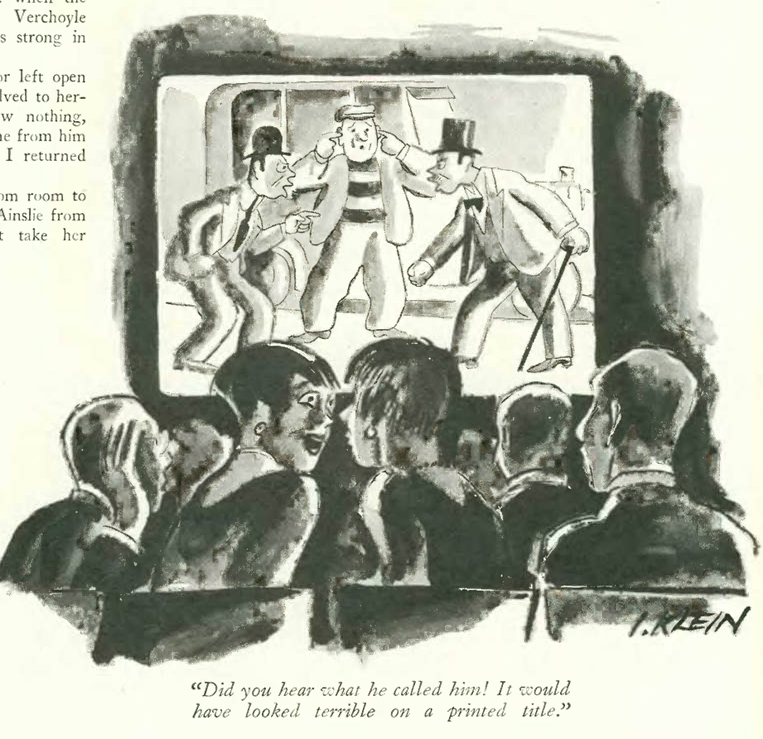
Isadore Klein observed the changing mores of movie houses (a couple of “damns” were apparently uttered in the talking pictures of 1929)…

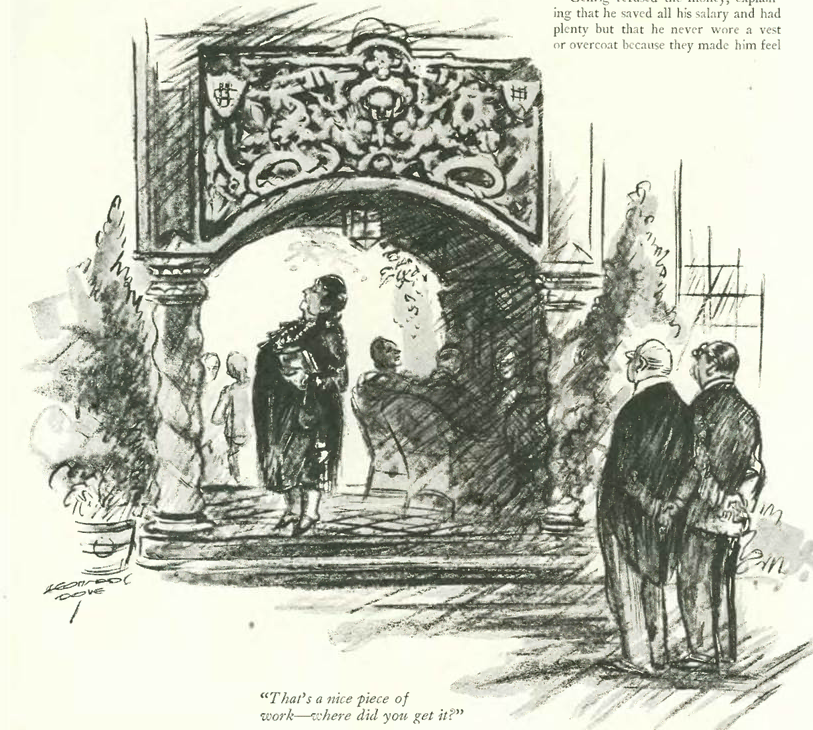
…and Leonard Dove offered up a double entendre of sorts…

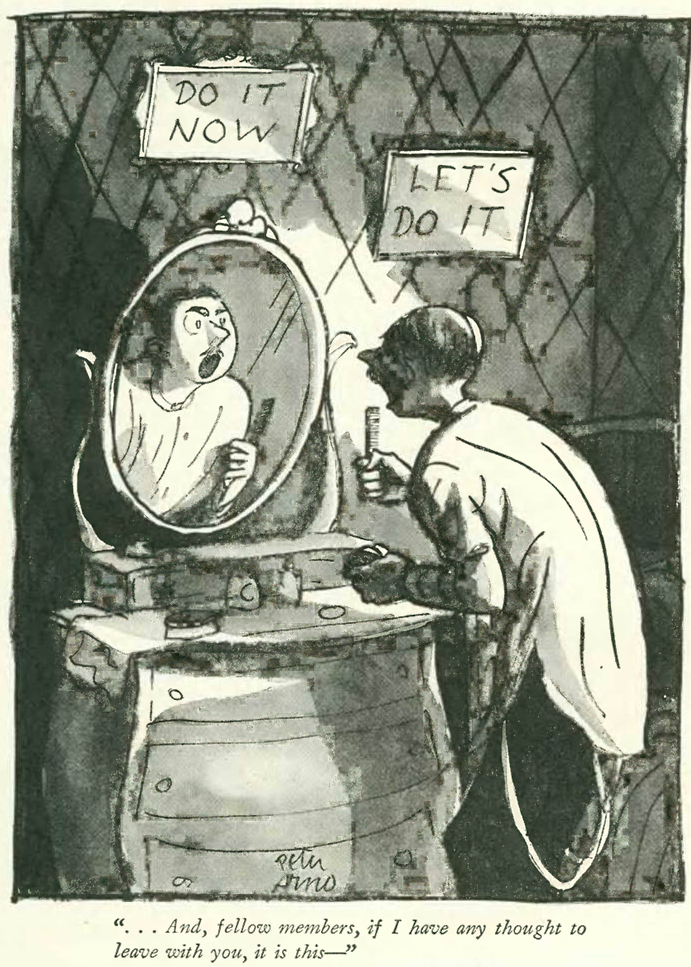
…cartoons for the Aug. 17 issue included a peek behind the scenes at a motivational speaker courtesy Peter Arno

Carl Kindl had some fun with the juxtaposition of a matron and a flapper hat…

…and for reference, the cloche hat called a “Scalawag” was featured in this ad by Knox in the March 30, 1929 New Yorker…drawing by Carl “Eric” Erickson

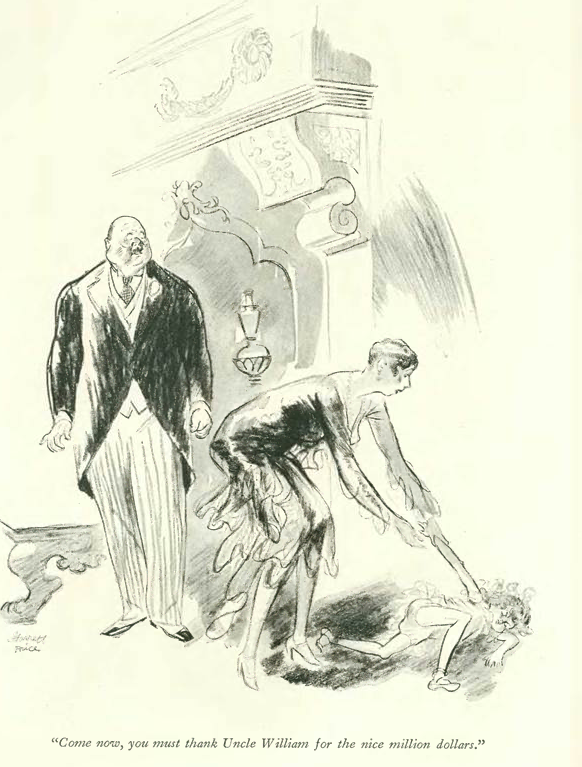
Garrett Price portrayed the antics of an ungrateful trust fund brat, who probably did not have that million dollars after the market crash…

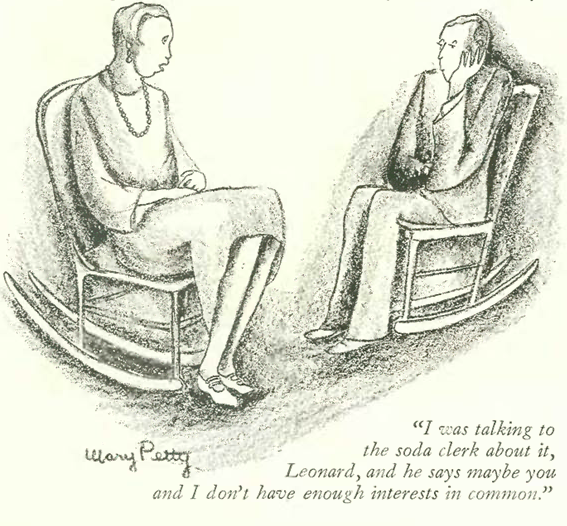
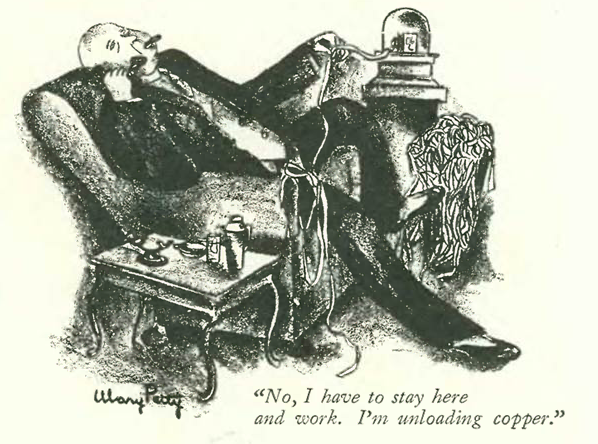
…and this fellow, depicted by Mary Petty, who doubtless would be less nonchalant come Oct. 28, or what we know as “Black Monday”…

Next Time: Hooray for Hollywood…


Ride of the Century

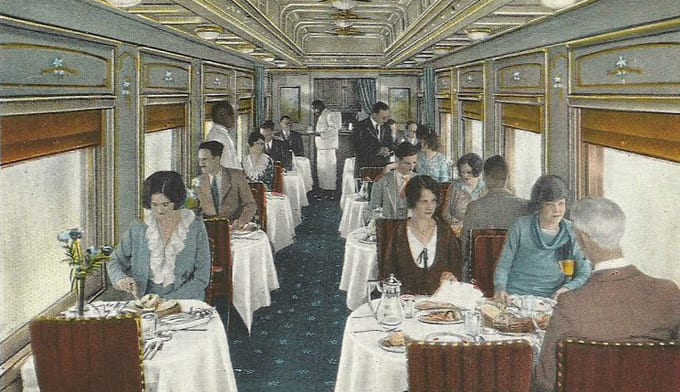
Train travel in the U.S. was at the height of its glory in the late 1920s—you could hop on train in New York City and travel to virtually anywhere in the country, even to some of the remotest towns in America’s vast hinterlands.

July 27, 1929 cover by Theodore G. Haupt.

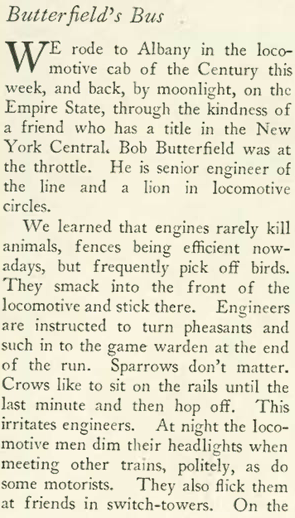
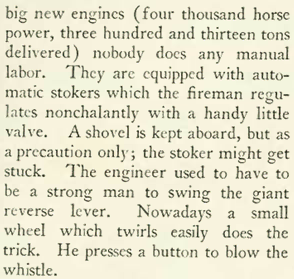
The New Yorker’s managing editor, Ralph Ingersoll (1900-1985) writing in “The Talk of Town,” climbed aboard the locomotives of outbound 20th Century and an inbound Empire State trains to survey the latest technology in rail travel. What one gleans from reading this account is how much this mode of travel has declined (in the U.S.) over the past 90 years:

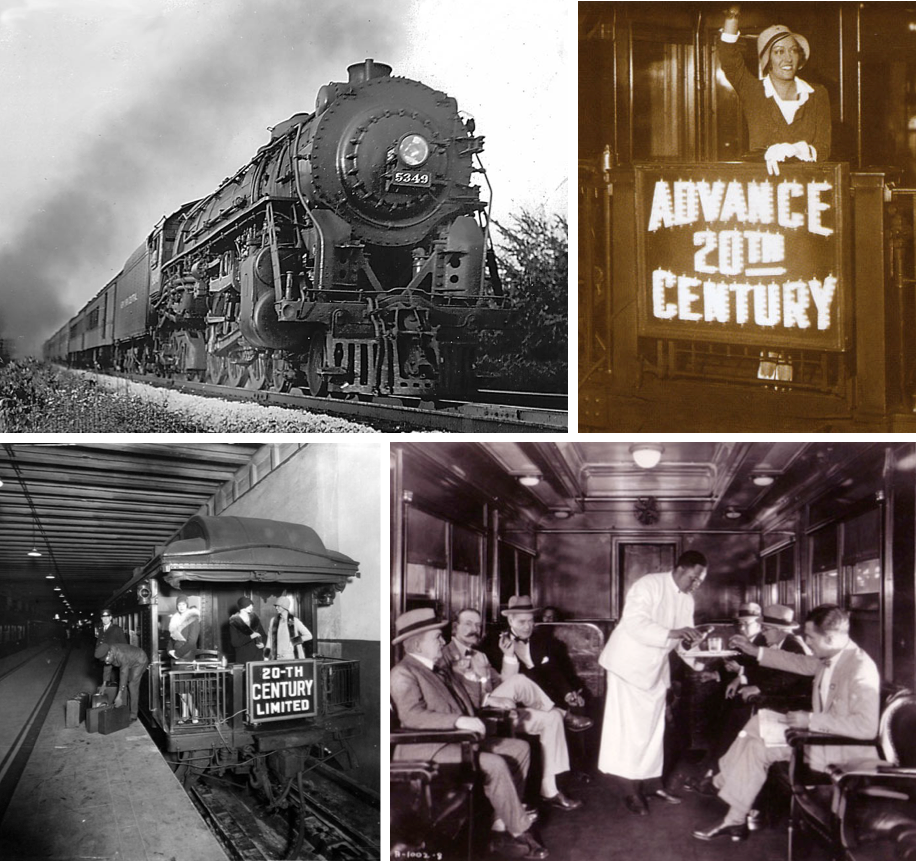
ROMANCE OF THE RAILS…Clockwise, from top left: Hudson locomotives served the Century and Empire State express trains; silent film star Gloria Swanson waves farewell from the observation platform as the 20th Century Limited pulls out of Grand Central during the 1920s; lounge car on the 20th Century during the 1920s; the 20th Century ready to depart Grand Central, circa 1930. (steamlocomotive.com/newyorksocialdiary.com/cruiselinehistory.com)

In terms of speed and safety, it seems little has changed since 1929, and perhaps things have actually gotten worse…

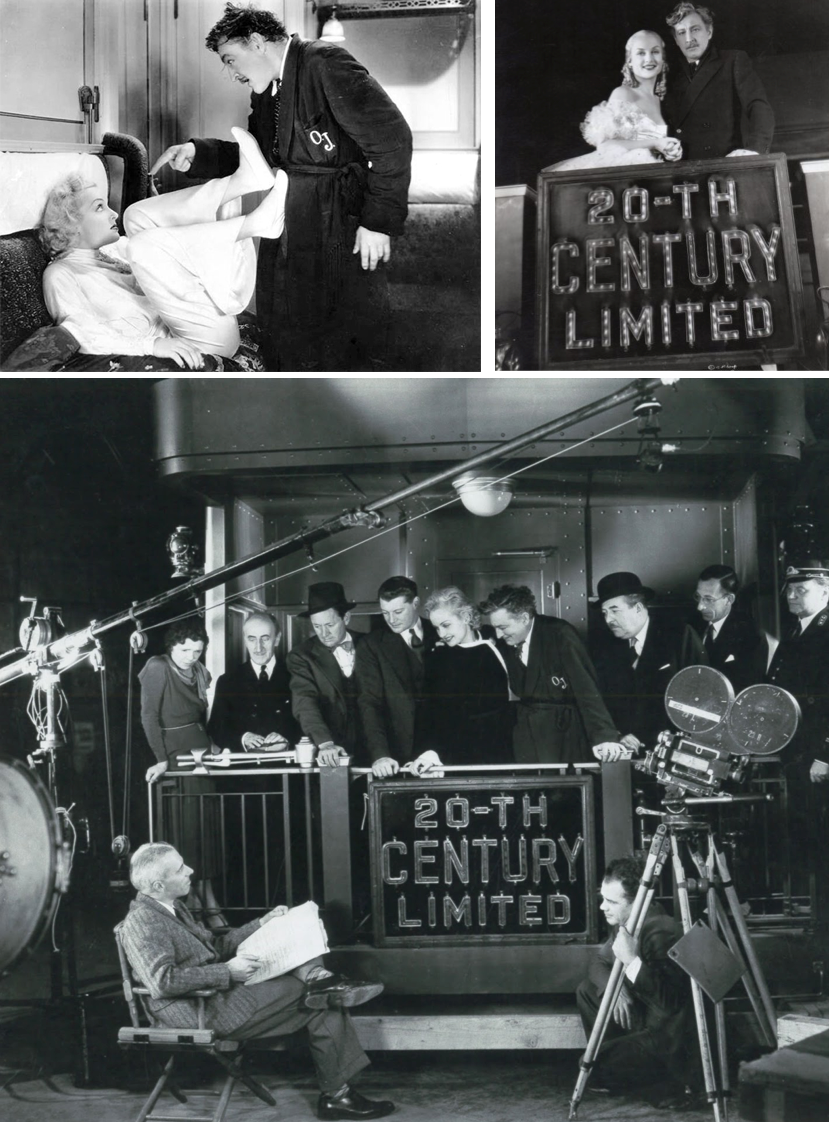
CELEBRATED LINE…The 20th Century was widely celebrated in popular culture through the 1950s. Five years after Ingersoll’s article, Howard Hawks directed the screwball comedy, 20th Century. Clockwise, from top left, the film’s stars, Carole Lombard and John Barrymore in a scene from the film; the stars pose for a publicity shot; with director Hawks along with some of the cast and crew. (austinfilm.org/greenbriarpictureshows.blogspot.com)

* * *

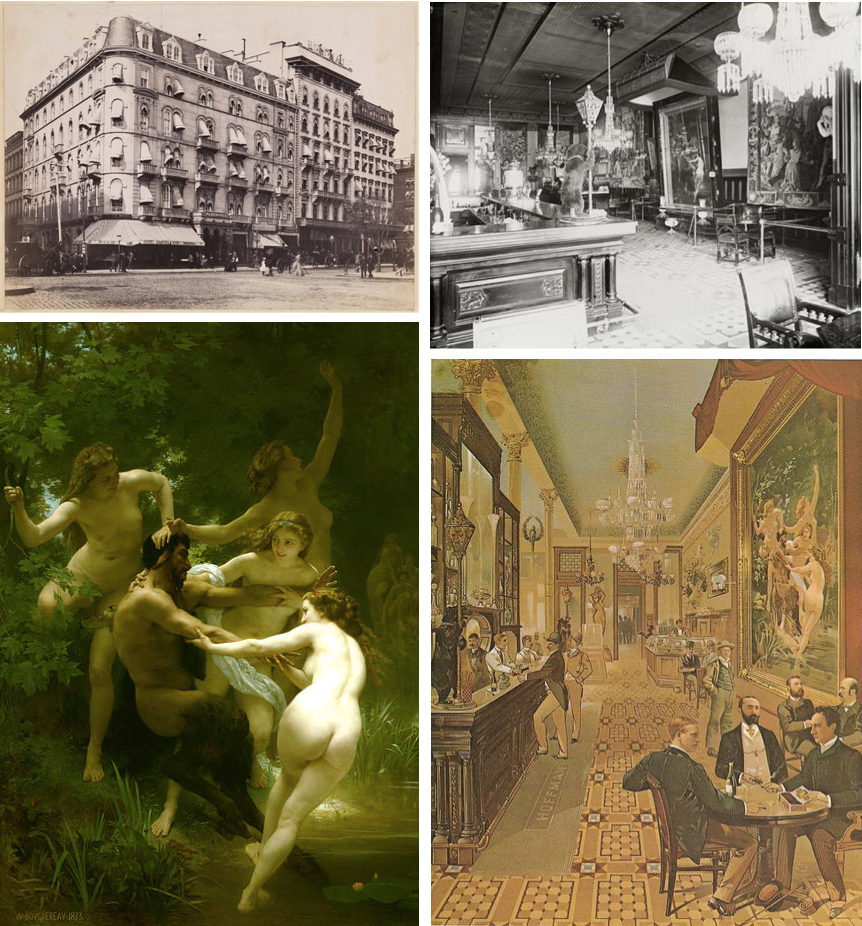
From 1928 until his death in 1950, the journalist Alva Johnston (1888-1950) wrote on a diverse range of topics for The New Yorker, including this “Reporter at Large” piece on the proliferation of barrooms in private residences, hidden from the prying eyes of Prohibition agents and sometimes furnished with the bits and pieces that once graced some of New York’s finest watering holes, including the famed Hoffman House:

POPULAR WATERING HOLE…Clockwise, from top left: The Hoffman House Hotel at Madison Square in 1885; the Hoffman House bar, which prominently displayed William-Adolphe Bouguereau’s painting Nymphs and Satyr. According to Alva Johnston’s article, the painting was the second-most popular decorative motif in New York’s finer drinking establishments; artist’s rendering of the barroom; and Bouguereau’s Nymphs and Satyr. (Museum of the City of New York/Wikipedia)

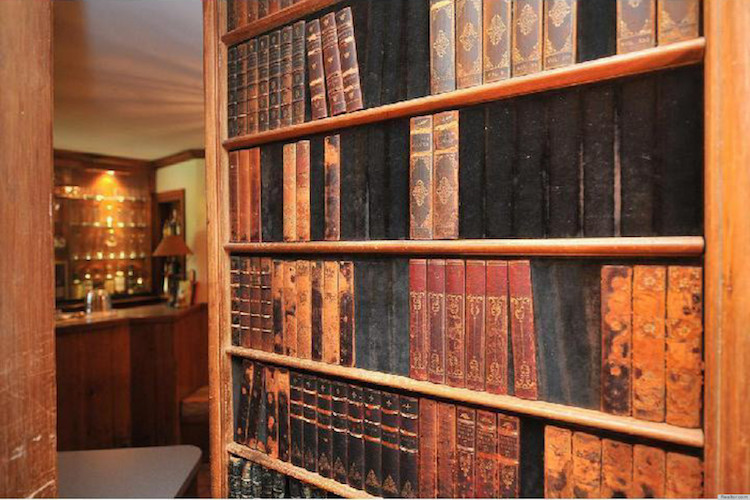
Johnston noted the clever tricks homeowners used to conceal their secret bars:

DON’T JUDGE A BOOK BY ITS COVER…Alva Johnston described how one library’s walls “had literature on one side, gin and rye on the other.” (Huffington Post)

Johnston concluded his piece on an ironic note, pointing out that the finest cocktail sets could be obtained at Kresge department stores, which were owned by one of the biggest supporters of Prohibition, S.S. Kresge:

 *  *  *

The Sound of Peggy Wood

The Brooklyn-born Peggy Wood (1892-1978) made her stage debut in 1910 and was an established Broadway star before she made her first talking picture, Wonder of Women (a film believed to be lost). A member of the Algonquin Round Table, she was well acquainted with the New Yorker crowd. And the magazine in turn was very impressed with her acting talents, even if the picture she was in proved a bit of a downer:

RECOGNIZE HER NOW?…Clockwise, from top left: theatre card for the 1929 film, Wonder of Women; Leila Hyams and Lewis Stone in a tender moment from the film (Stone was romantically paired with much younger women in several films around that time); Peggy Wood in the 1920s; Wood as Mother Abbess in 1965’s The Sound of Music; Stone and Wood in a scene from Wonder of Women, with four-year-old child actor Wally Albright. With his waifish demeanor and curly hair, Albright was highly sought after in films needing a cute kid. He appeared in seven films in 1929 alone. In the 1930s he would appear in several Our Gang/Little Rascal shorts, and would pop up in bit roles through the 1940s and early 50s. Unlike so many other child stars, he seems to have led a normal adult life. He won the Men’s National Track and Ski Championship in 1957, and later started a successful trucking firm. (IMDB/Pinterest)

…the review continued, suggesting that Wood’s acting alone carried the picture…

…if you weren’t into weepers like Wonder of Women, you could have instead checked out The Mysterious Dr. Fu Manchu at the Rialto Theatre…

LIKE A SIDESHOW ACT…New York’s Rialto Theatre donned a masked front and door entry wrappers for the premiere of The Mysterious Dr. Fu Manchu; promotional poster; Jean Arthur and Warner Oland in the film. Oland was not the least bit Asian. A Swedish-American actor, his work in the hit film led to three more Fu Manchu movies. Oland would then go on to play another Asian character, Charlie Chan, in a string of popular movies in the 1930s until his death in 1938. (cinematreasures.org)

 * * *

Just Sad

Yet another note in “Talk of the Town” describing the plight of African Americans in segregated America, without a hint of empathy:

Potters Field on Hart Island, New York, circa 1890. (Wikipedia)

 *  *  *

From Our Advertisers

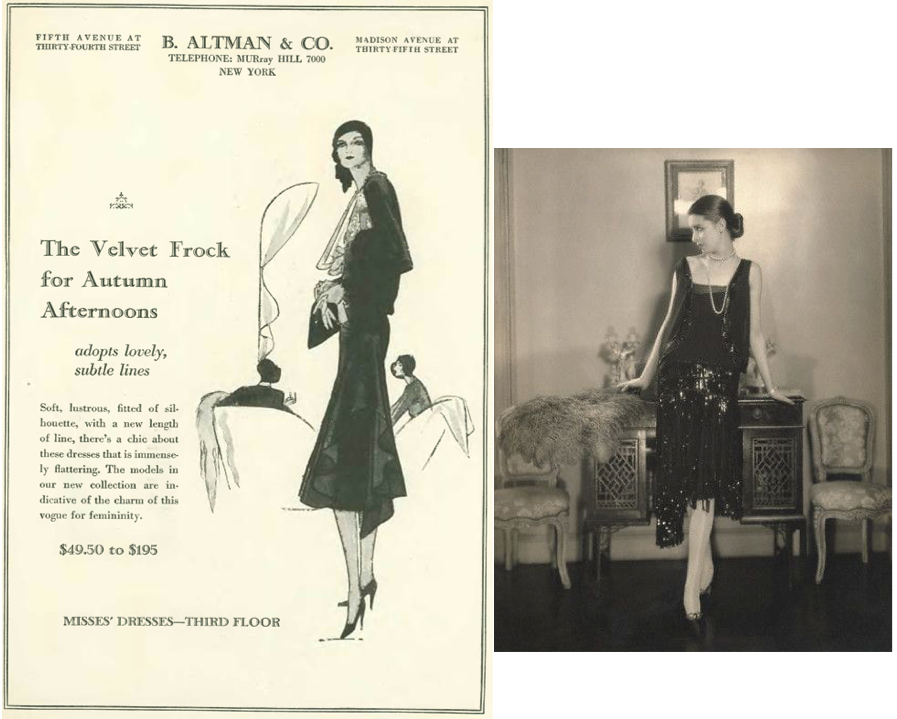
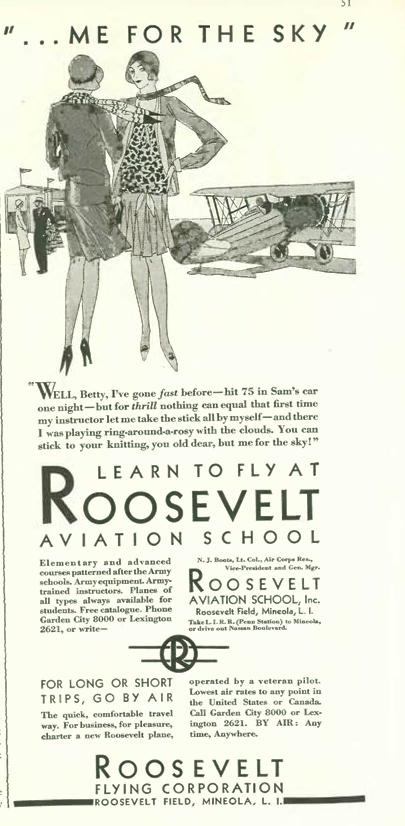
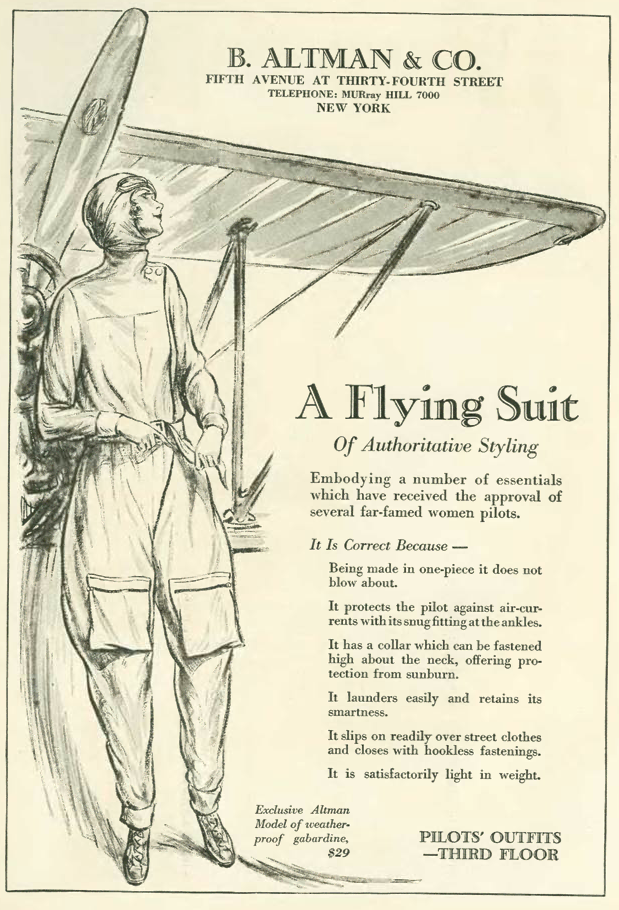
Last week B. Altman offered rugged coats for those brave souls riding in rumble seats. This week Altman rolled out some stylish wear for the enterprising pilot of 1929…

…and while you were up there, you could calm those nerves with a Chesterfield (a two-page ad that appeared regularly in The New Yorker)…

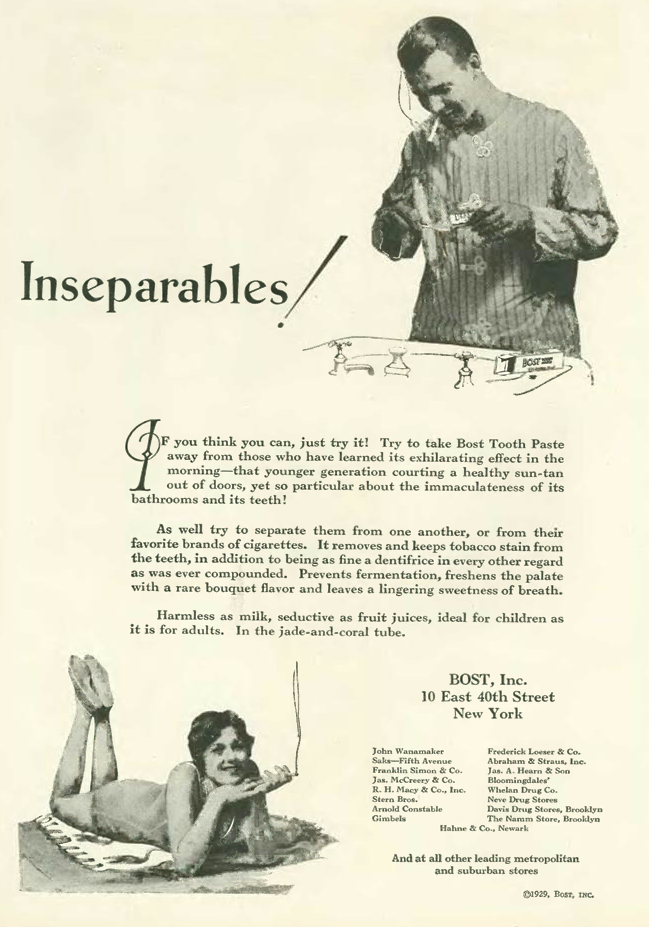
,,,back on the ground, the makers of Most toothpaste reminded readers to brush those tobacco stains off their teeth, apparently even while they’re smoking…

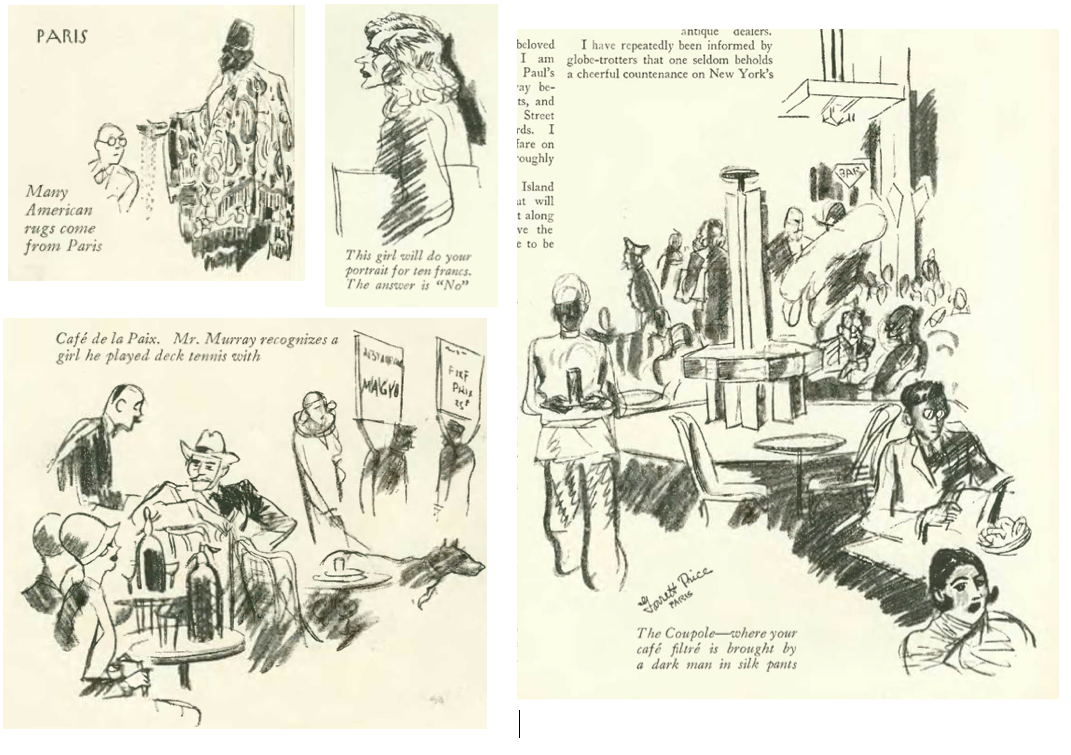
…here is another sampling of drawings by Garrett Price, rendered after a recent trip to Paris…

…our cartoons come from Leonard Dove (note the backward signature)…

…here we have A. Edwin Macon’s take on modern furniture…

Helen Hokinson looked in on a visit to an eye doctor…

Perry Barlow’s take on the wonders of radio…

Rea Irvin depicted how timing is everything in an ice delivery…

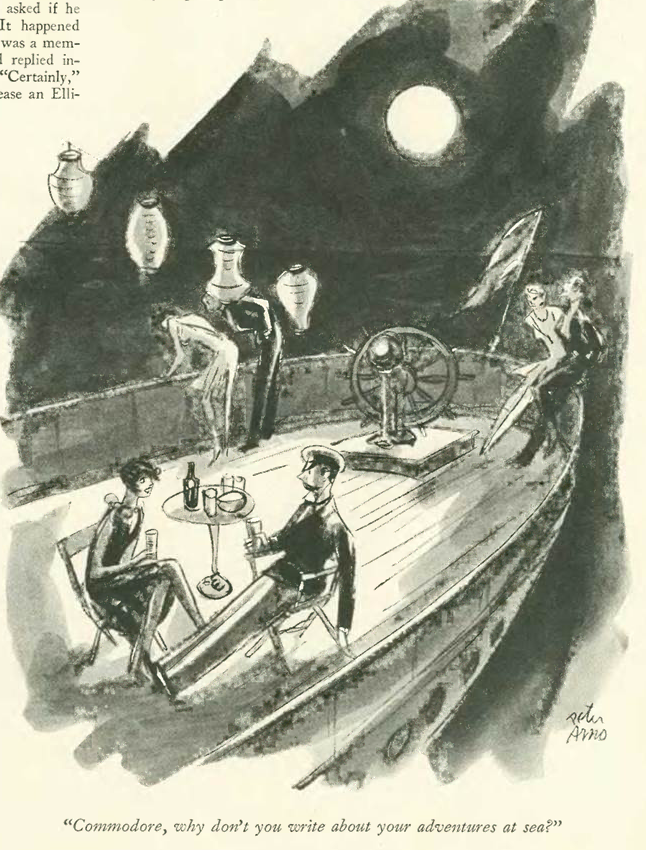
…and Peter Arno peeked in on habits of the idle rich…

Next Time: The Art of Peace…


On the Flatfoot Beat

In 1929, some of New York’s Finest also enjoyed working at one of the finest police headquarters to be found anywhere.

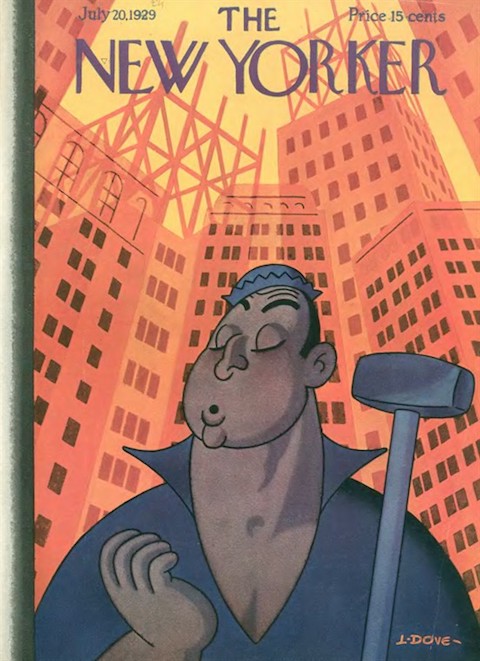
July 20, 1929 cover by Leonard Dove. Note the construction worker’s whoopee cap—a popular hat among laborers, especially auto mechanics, in the 1920s and 30s. Hardhats did not come into general use until the late 1930s and 1940s. In popular culture, the whoopee cap was worn by the gas station attendant “Goober” on the Andy Griffith Show. The character “Jughead” also sported one in the Archie comic book series.

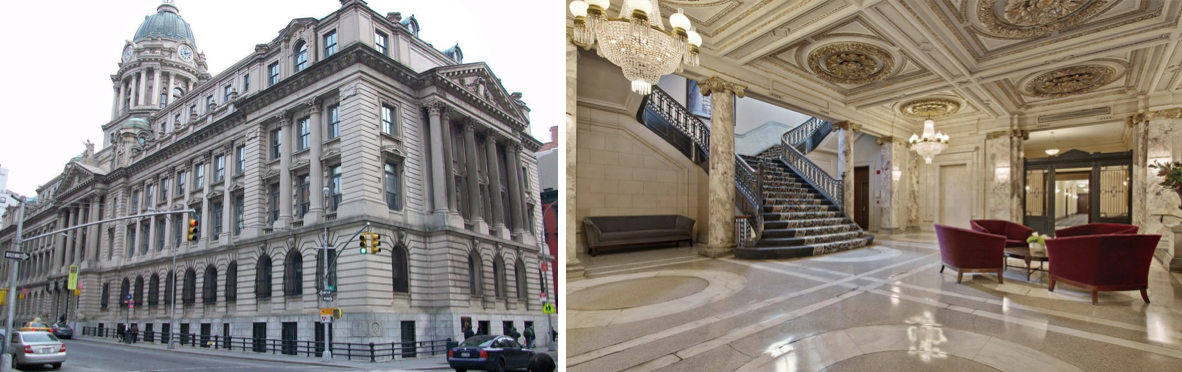
NYPD’s elegant headquarters at 240 Centre Street, designed by architects Hoppin & Koen, were built in 1909 to serve a newly consolidated police department charged with overseeing the city’s five boroughs (which had been united a decade earlier). Made of Indiana limestone, the building included 75 basement cells, a drill room, and a gymnasium.

Writing for the July 20, 1929 “Reporter at Large” column, Niven Busch, Jr. looked in on a day in the life of the 20-year-old headquarters:

WHERE THE ACTION IS…Clockwise, from top left: Postcard depicting the new police headquarters at 240 Centre Street, built in 1909 to serve the newly consolidated five-borough police department; a woman in a cell at the Tenderloin station, probably similar to the cells described in Busch’s article; prisoner posing for a mug shot; the building’s Rogues Gallery. All images from 1909. (Ephemeral New York/Library of Congress (3)) click to enlarge images

Busch described the morning routine of lining up prisoners in the gymnasium for their mug shots…

…and how confiscated weapons were stored, and periodically dumped into the Narrows…

AT THE BOTTOM OF THE SEA…Weapons seized in Chinatown by the NYPD in 1922. The police periodically dumped their inventory of seized weapons into the Narrows between Brooklyn and Staten Island. (NYPD Public Records)

Busch also described the methods used by “drug peddlers,” and the prevalence of drug use among perps:

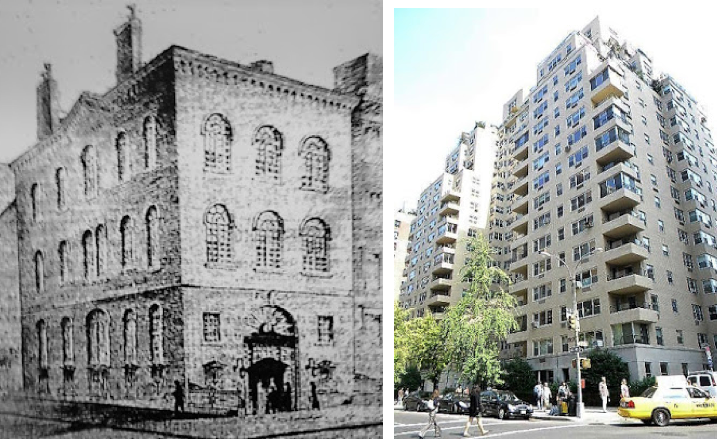
Where detectives gathered and where prisoners were once processed is now home to luxury condos in a posh district called “Nolita” (although some folks still call the area “Little Italy”)…

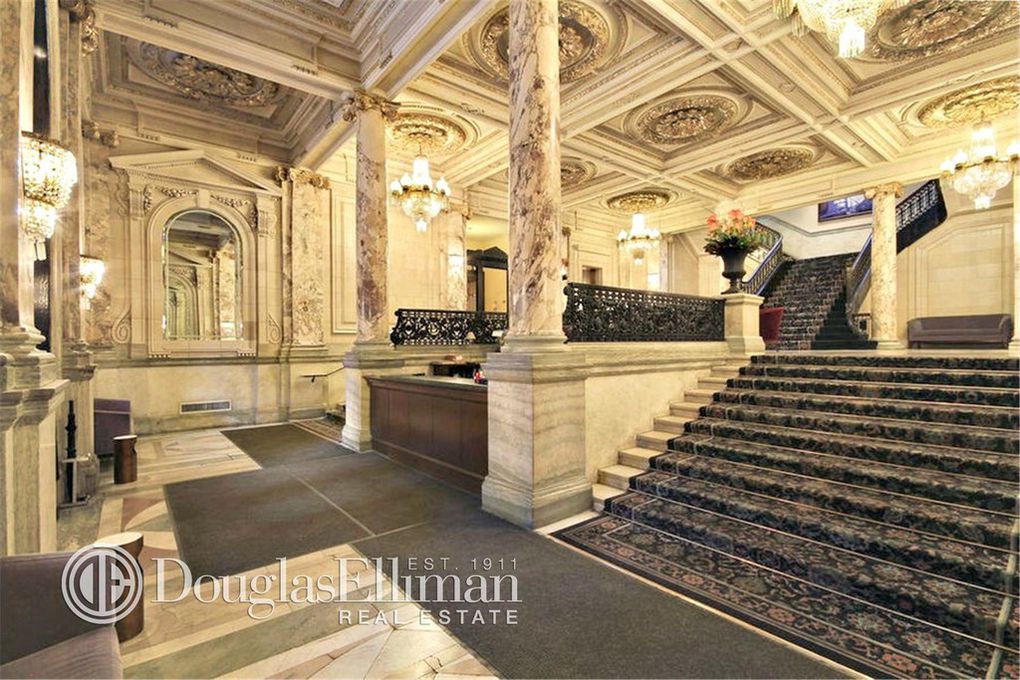
CRIME DOES NOT PAY?…The 1909 Police Headquarters Building at 240 Centre Street was remodeled into luxury co-op apartments in 1988. A contemporary photo of the lobby gives some idea of the elegance of the old HQ. Adding to that elegance, the area surrounding the building is no longer “Little Italy.” Rather, it is surrounded by posh shops in an area now known as “Nolita.” (street easy.com)
Another view of the sumptuous lobby at 240 Centre Street. (realtor.com)

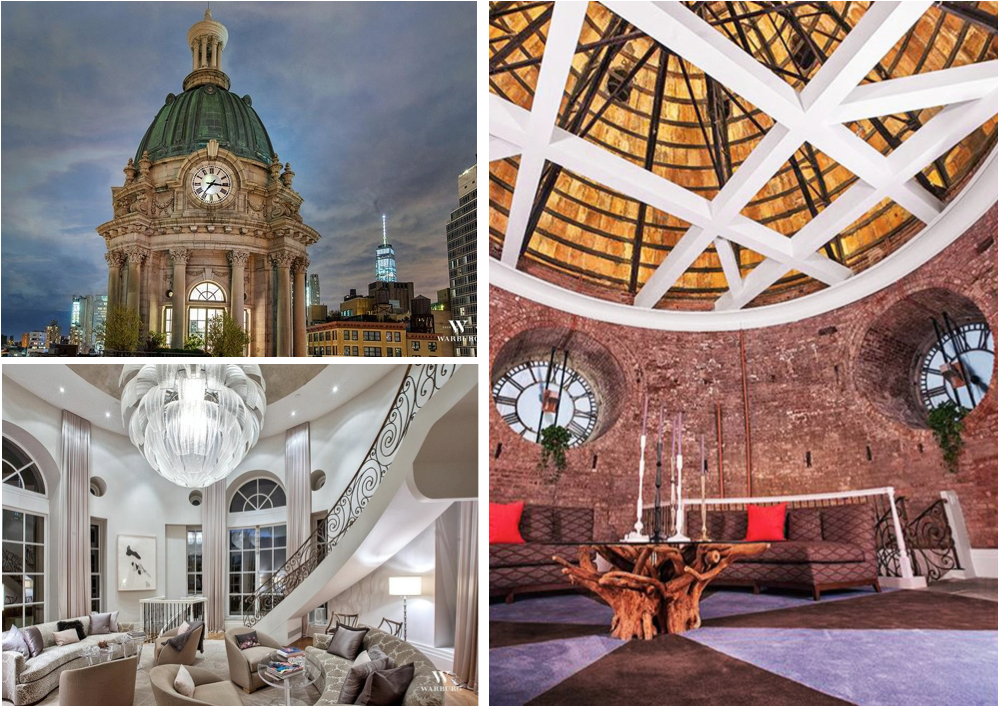
…and in the gymnasium where hardened criminals once lined up for mugshots we now find a four-bedroom condo that has been priced as high as $31 million…

Architect Charles Gwathmey designed this 6,600-square-foot condo in what was once the police gymnasium—which also functioned as the room where mugshots were taken. On and off the market since 2008, at one point the asking price was $31 million. (6sqft.com)…and at the top of the building, a 5,500-square-foot penthouse can be found in the central clock tower. Spanning four stories and including two kitchens, a media room, a library, an elevator, the space was once owned by Calvin Klein

The penthouse at the top of the old police headquarters spans four stories. It has been priced as high as $40 million. (Architectural Digest)

 *  *  *

Before Bow Bowed Out

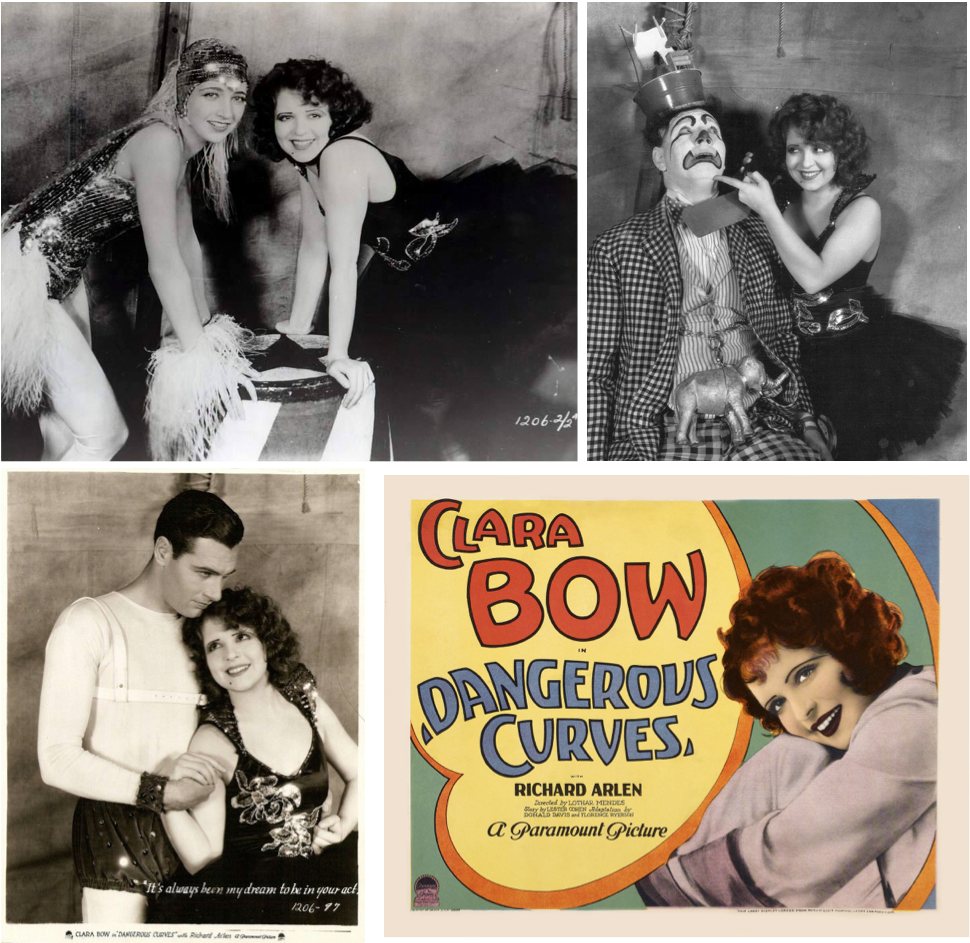
One of the biggest stars of the silent film era, Clara Bow (1905-1965) made a successful transition to the “talkies,” thanks in part to her huge and loyal following. But as the Roaring Twenties slowly lost its fizz, one of its biggest icons also seemed a bit flat in the new age of sound motion pictures. And indeed, Bow herself would walk away from it all two years later, retiring to her Nevada ranch at the age of 25. In the July 20 issue, The New Yorker reviewed Bow’s first talking picture, Dangerous Curves:

Clockwise, from top left, Kay Francis and Clara Bow as circus performers in 1929’s Dangerous Curves; Bow with clown in publicity shot for the movie; promotional poster; with co-star Richard Arlen, who also appeared with Bow in the 1927 romantic war picture, Wings. (IMDB/Pinterest)

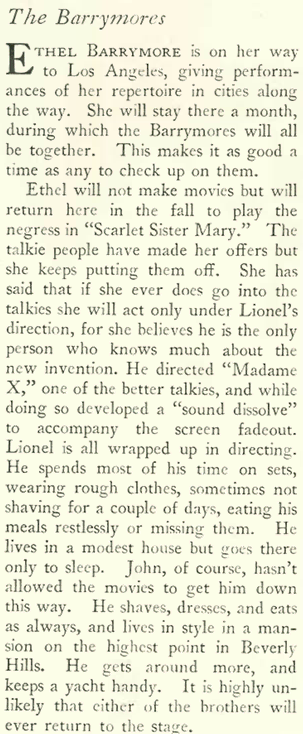
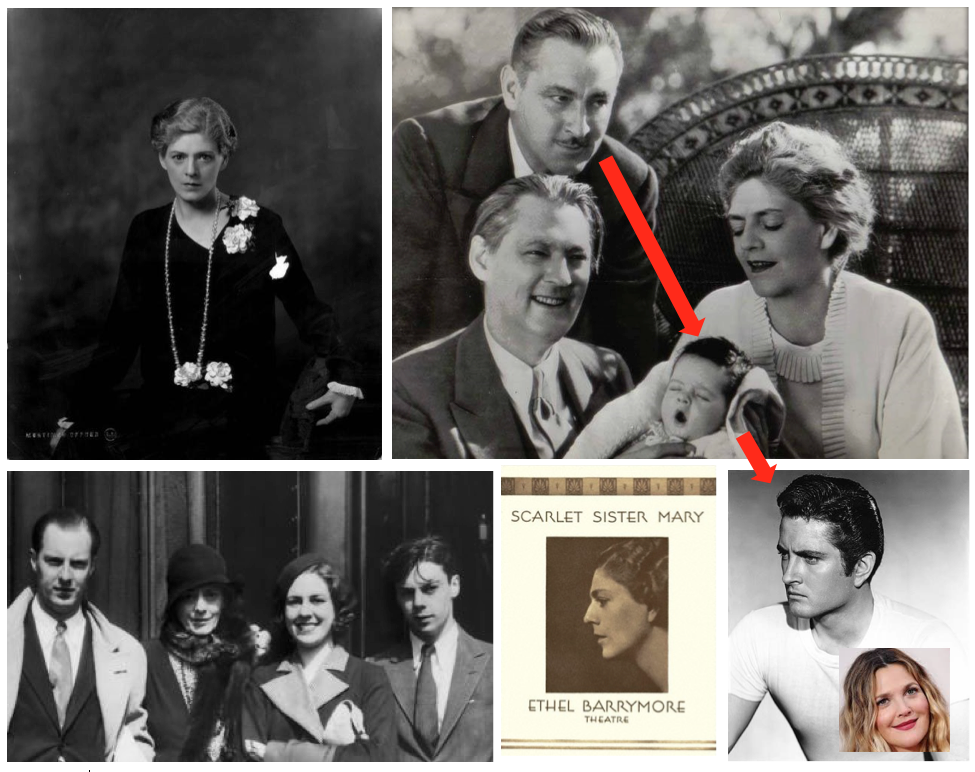
And while we are on the topic of celebrity actors, “The Talk of the Town” looked in on Ethel Barrymore (1879-1959), a prominent member of the famed, multigenerational Barrymore acting family…

“Talk” mentioned Barrymore’s children, including an “oldest son, Russell,” but there is no mention of such a child in any records. My best guess is that her oldest son, Samuel, went by his father’s name—Russell Griswold Colt. Barrymore and Colt divorced in 1923, and she never remarried…

Clockwise, from top left, Ethel Barrymore circa 1930; Siblings John Barrymore (standing) Lionel Barrymore, and Ethel with John’s son, John Barrymore Jr, who was the father of Drew Barrymore (inset); cover of program for Scarlet Sister Mary; Ethel with her children Samuel Peabody Colt, Ethel Barrymore Colt and John Drew Colt in the 1930s. (crystalkalyana.wordpress.com/Playbill/Pinterest)

 * * *

From Our Advertisers

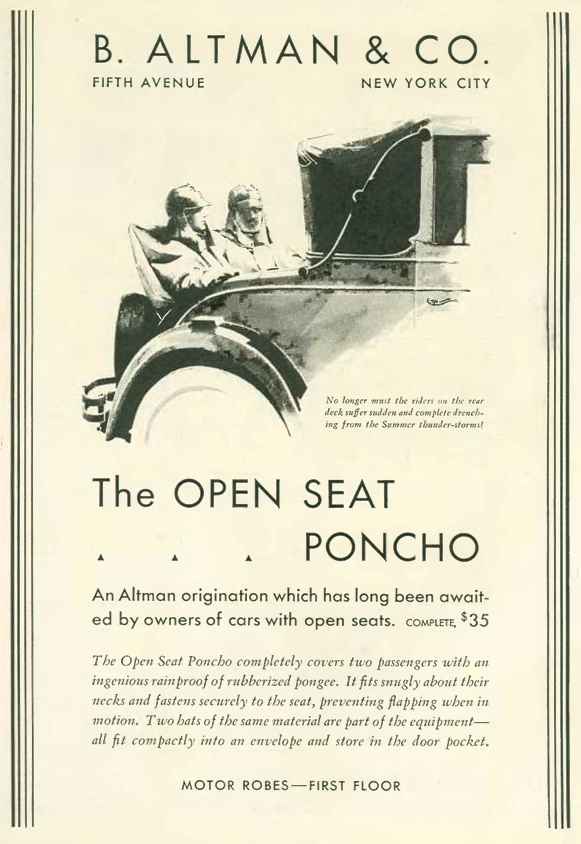
We begin with an “open seat poncho” offered by B. Altman to those unfortunate souls who were relegated to the rumble seat. I am perplexed by this feature in some early autos—it looks kind of fun if you’re a kid, but I can’t imagine a worse place to sit in a car. Not only are you open to the elements, but you’re also subject to peltings by dust, gravel, rocks and other road debris, not the mention the exhaust your sucking into your lungs sitting near the tailpipe. And then you are positioned over the car’s rear axle—must have been a chiropractor’s dream…

…and that exhaust you were breathing likely contained tetraethyl lead, which helped to eliminate the “knock” in your engine…

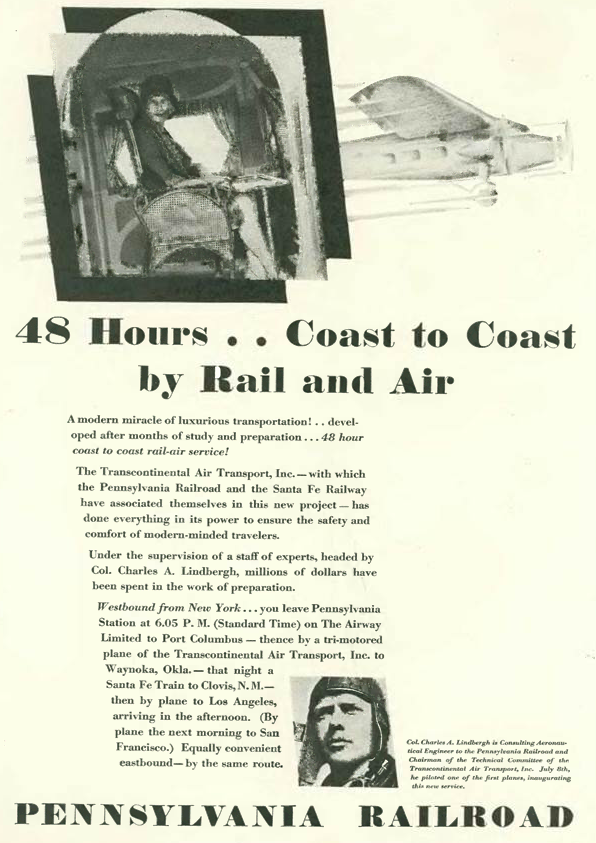
…perhaps a better way to travel—if you could afford it—was a combination of rail and air, a service supervised by a “staff of experts” headed by none other than Charles Lindbergh

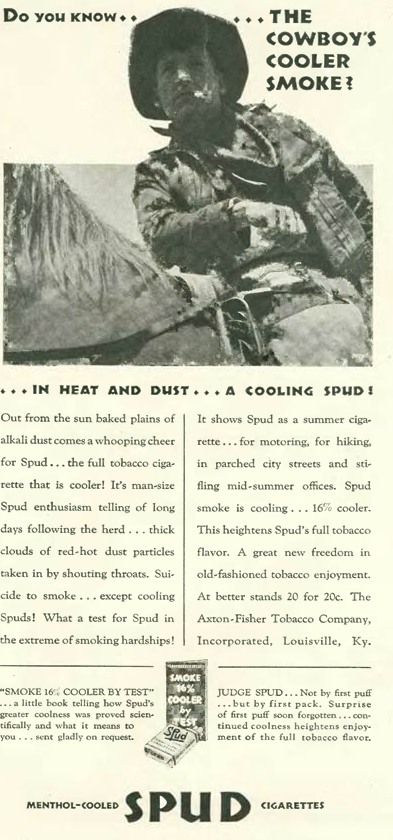
…when we think of the cigarette ads of yore, the “Marlboro Man” typically comes to mind. But Marlboro wasn’t the first to trade on the macho image of the working cowboy. That honor goes to the makers of menthol-cooled Spud cigarettes…

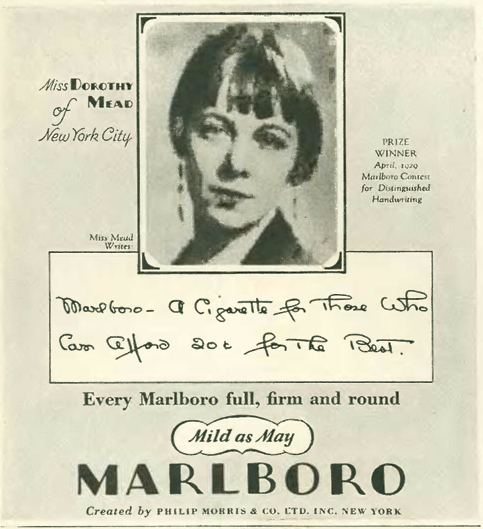
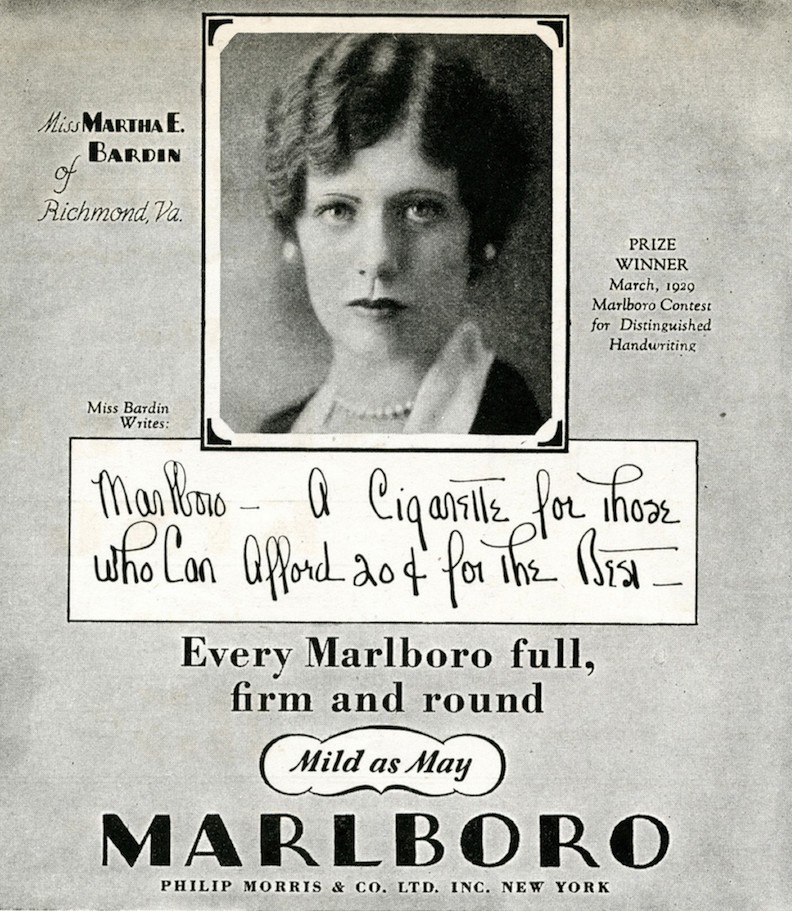
…and how was Marlboro being marketed at this time? Well, they were still exploiting young women who had been conned into participating in a “handwriting contest”…

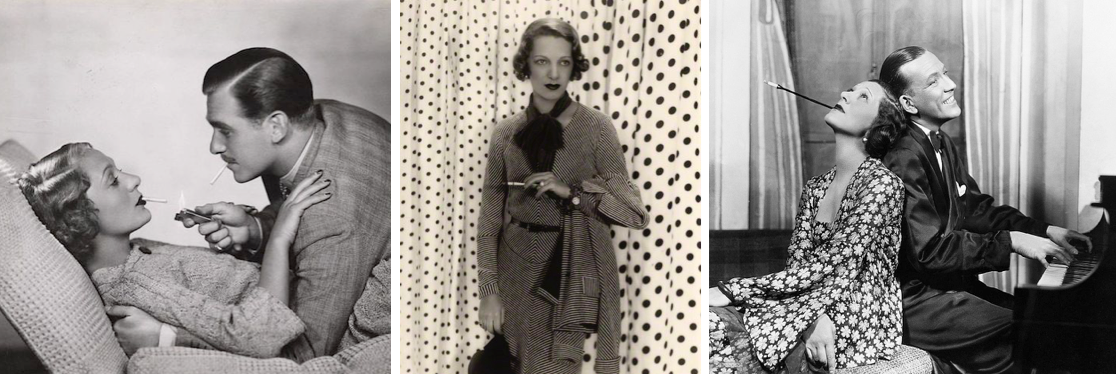
…as for the makers of Lucky, they continued to get endorsements from some of the biggest celebrities of the day. In this ad we have English actress, singer and dancer Gertrude Lawrence (1898 – 1952). I have to say the drawing does not resemble her much at all…

SHE REALLY DID REACH FOR A LUCKY…Gertrude Lawrence enjoying a smoke with Douglas Fairbanks, Jr in 1939 (photo by Dorothy Wilding); a 1932 portrait of Lawrence by Paul Tanqueray; Lawrence and Noël Coward in Private Lives, 1931 (pinterest.co.uk/Wikipedia)
 * * *
…our comics are courtesy of Denys Wortman…

…and G. Wright…

Next Time: Ride of the Century…


Something Old, Something New

Above: The split image is from a New Yorker video: Eighty Years of New York City, Then and Now.

While the Empire State Building developers were preparing to reduce the old Waldorf-Astoria Hotel to rubble, another venerable relic of the Victorian age, the Murray Hill Hotel, was still clinging to the earth at its prime location next to the Grand Central Depot.

June 15, 1929 cover by Sue Williams.

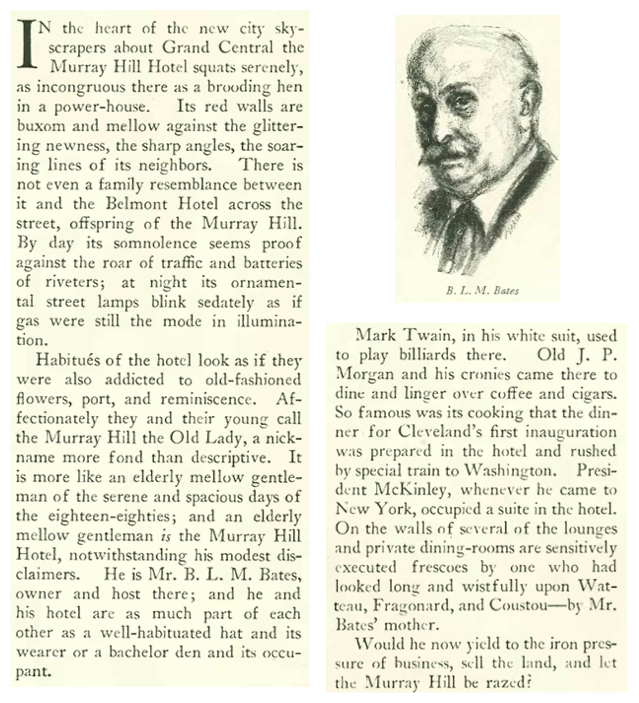
The hotel’s survival was due in part to its owner, Benjamin L. M. Bates (1864-1935), who seemed as much a part of the hotel as its heavy drapes and overstuffed chairs. Bates, who started out at the hotel as assistant night clerk, was profiled in the June 15, 1929 issue by Joseph Gollomb (with portrait by Reginald Marsh) Some excerpts:

The hotel was just 26 years old when Bates bought it in 1910. But by the Roaring Twenties Murray Hill Hotel seemed as ancient as grandmother’s Hepplewhite…

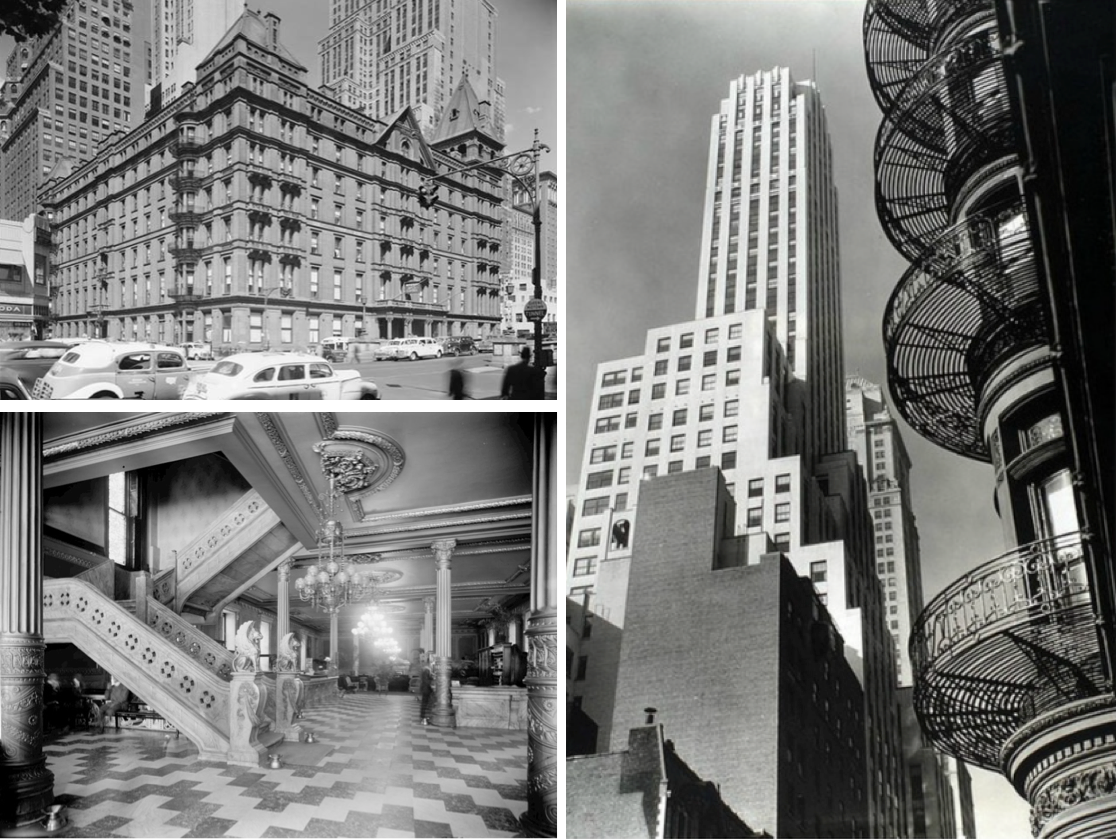
Clockwise, from top, left, The Murray Hill Hotel in September 1946, just months before it was demolished; the hotel’s ornate spiral fire escape, seen at the right in a 1935 photograph of 22 East 40th Street by Berenice Abbott; the hotel’s office and foyer. The hotel featured 600 rooms and two courtyards. (Museum of the City of New York (1 & 2)/Wikipedia)

…but to the very end it continued to be a popular gathering spot for New York notables, including Christopher Morley’s prestigious literary society, the Baker Street Irregulars…

FAMILIAR HAUNT…Three members of the exclusive literary group, the Baker Street Irregulars — Fletcher Pratt, Christopher Morley and Rex Stout —swap stories at the Murray Hill Hotel in 1944. (Wikipedia)

…with the hotel’s prime location near Grand Central Depot (and its replacement, Grand Central Station), the party couldn’t last forever, and the Murray Hill Hotel yielded to the wrecking ball in 1947…

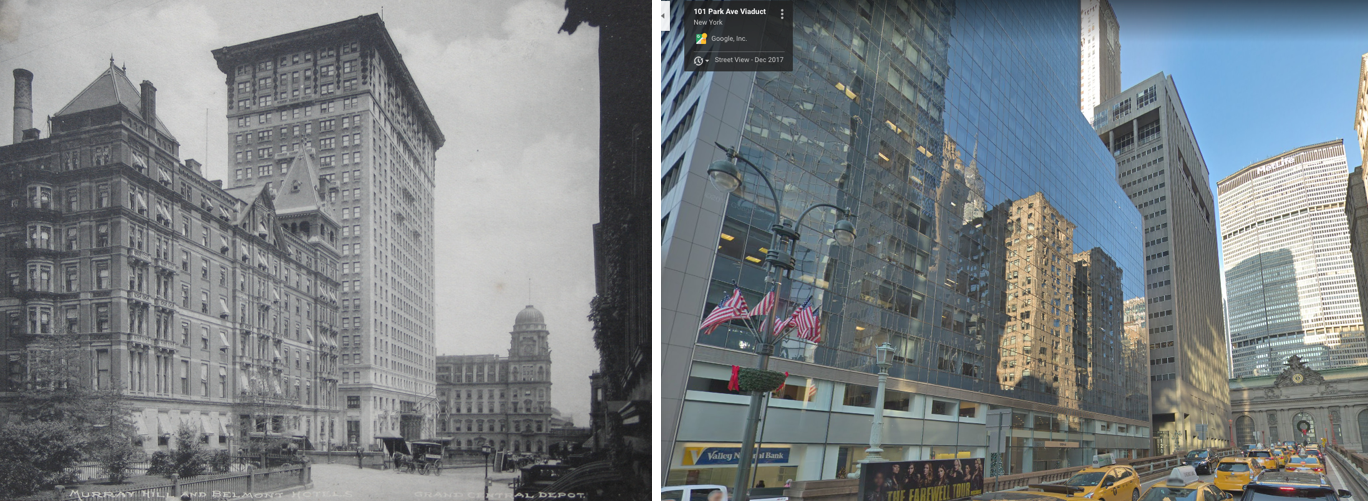
THEN AND NOW, the Murray Hill Hotel, circa 1905. The adjacent 25-story Belmont Hotel, erected in 1904-06 and a skyscraper for its time, would be razed in 1931. Note the old Grand Central Depot in the background, which would be replaced in 1913 by Grand Central Station. At right, a Google Maps view of the same location today.

Some parting notes about the Murray Hill Hotel: In 1905, delegates from 58 colleges and universities gathered at the hotel to address brutality in college football and reform the sport. They formed the Intercollegiate Athletic Association of the United States, which would later become the NCAA.

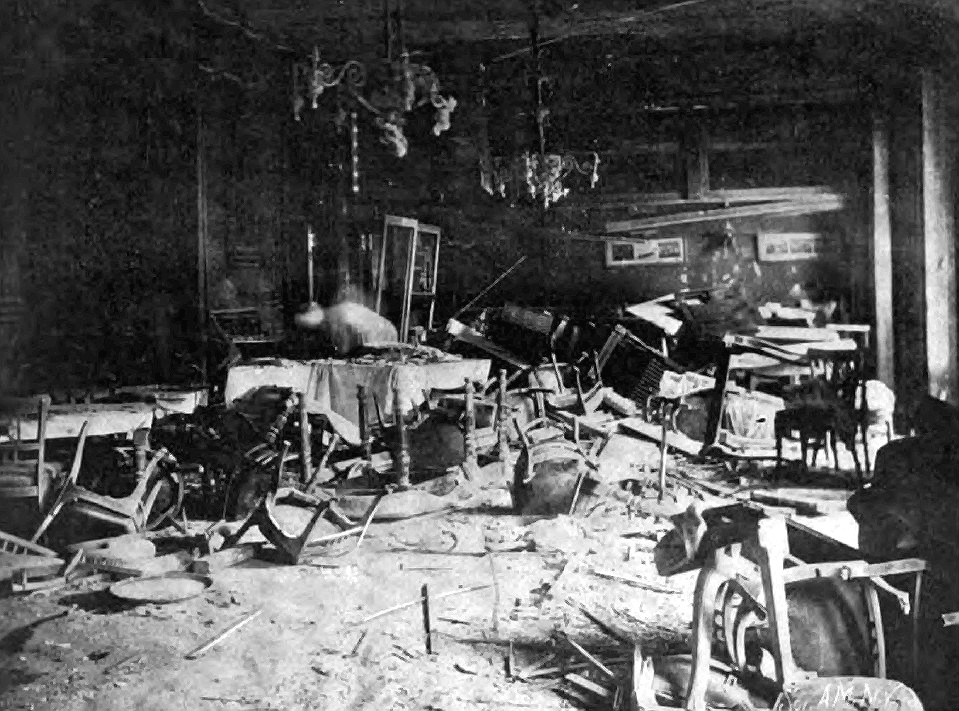
The hotel was also the site of a massive explosion in 1902, when workers constructing a subway tunnel under Park Avenue accidentally set a dynamite shed ablaze. Every window along Park Avenue and 40th Street was blown out, and the blast opened a pit, 10 feet deep and 30 feet wide, in front of the building. Five people were killed by the blast—three of them at the Murray Hill Hotel.

AFTERMATH…The Murray Hill Hotel’s cafe following the 1902 explosion. (Wikimedia Commons)

 *  *  *

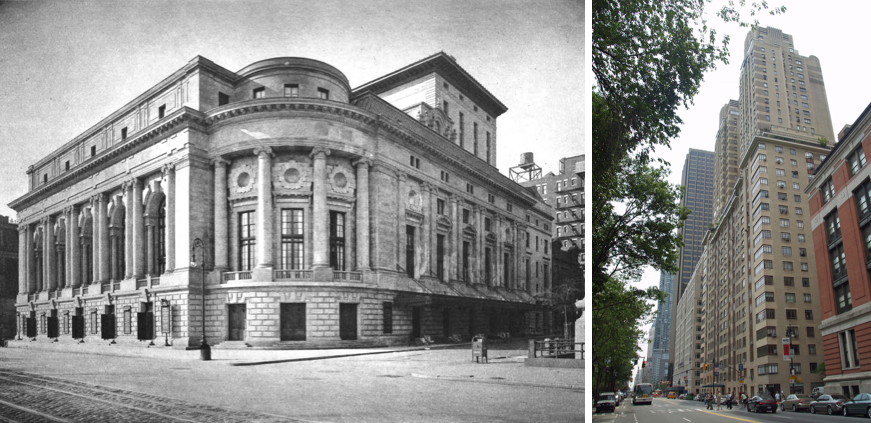
Irwin S. Chanin, fresh from erecting his Art Deco masterpiece, the Chanin Building, was now setting his sights on the Century Theatre, barely twenty years old but already obsolete due to its poor acoustics and inconvenient location. “The Talk of the Town” takes it from there…

BIGGER PLANS…The Century Theatre, located at 62nd Street and Central Park West, opened on November 6, 1909. Plagued by poor acoustics and an inconvenient location, it was demolished in 1931 and replaced by the Irwin S. Chanin’s Century Apartments building. (The New-York-Architect, November 1909/David Shankbone via Wikipedia)

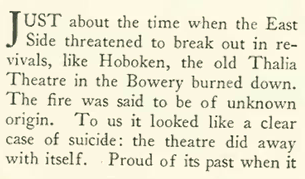
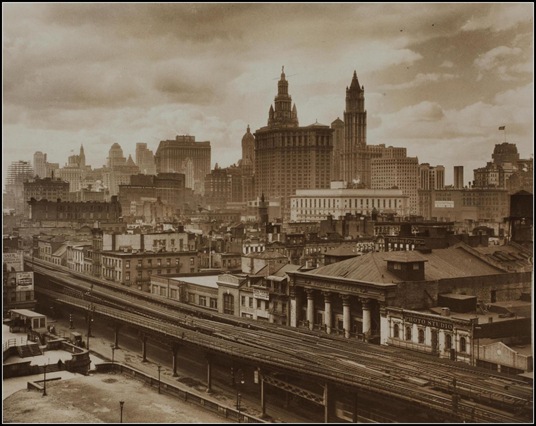
As the Century Theatre marked its last days, an older and more successful theater in the Bowery went up in flames. The Thalia Theatre (also known as “Bowery Theatre” and other names) was a popular entertainment venue for 19th century New Yorkers and for the Bowery’s succession of immigrant groups. A series of buildings (it burned four times in 17 years) housed Irish, German and Yiddish theater and later Italian and Chinese vaudeville. The 1929 fire marked the end of the line. “Talk” noted its passing…

UP IN SMOKE…The Bowery’s Thalia Theatre (building with columns) went up in flames on June 5, 1929. The photo was taken in 1928, one year before the final fire. Note the elevated train tracks in front of the building. (Manhattan Unlocked)

While we are on the subject of the changing skyline, I will toss in this cartoon from the issue by Reginald Marsh…the caption read: “I tell you, Gus, this town ain’t what it used to be.”

 *  *  *

Down for the Count

There was a bit of a sensation in the June newspapers when a European count was arrested for running a bootlegging ring among socially prominent circles. A headline in a June 8, 1929 edition of the New York Times shouted: LIQUOR RING PATRONS FACING SUBPOENAS; Socially Prominent Customers Are Listed in Papers Found in de Polignac Raids. COUNT SAILS FOR PARIS. Goes, After Nearly Losing Bail Bond, Smilingly Calling the Affair ‘Misapprehension.’

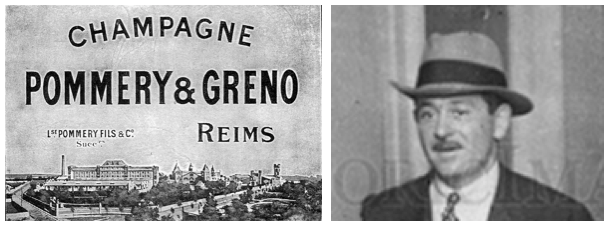
What the Times so breathlessly recounted were the activities of Count Maxence de Polignac (1857–1936), who owned one of France’s most prominent Champagne houses, Pommery & Greno.

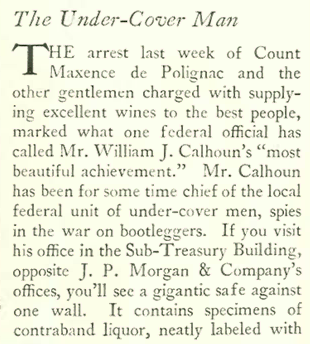
The Times reported that an undercover federal agent, William J. Calhoun, led a raid that netted the Count and 34 others in a liquor ring connected to many Park Avenue and Fifth Avenue residents. Calhoun’s agents interrupted the Count’s morning bath (at his suite in the Savoy-Plaza Hotal) to make the arrest. They seized more than “seven cases of champage and liquors” in the suite, which the count said were for his personal use. Denying all charges, de Polignac was nevertheless arrested. Thanks to a guarantee provided by his friends at the Equitable Surety Company, he made the $25,000 bail and quickly set sail for Paris. “Talk” reported…

IT WAS JUST A LITTLE SIDE BUSINESS…Count Maxence de Polignac owned the house of Pommery & Greno, one of the largest Champagnes firms in France. (Wikipedia/tcreims.com)

“Talk” concluded the dispatch with some notes on Calhoun’s character as a federal agent…

…and a final bit of trivia, Count Maxence de Polignac was the father of Prince Pierre of Monaco, Duke of Valentinois, who in turn was the father of Rainier III of Monaco, who famously married the actress Grace Kelly. Grace Kelly, by the way, was born in November 1929, just months after her grandfather-in-law’s run-in with Prohibition authorities.

 *  *  *

Underwhelmed

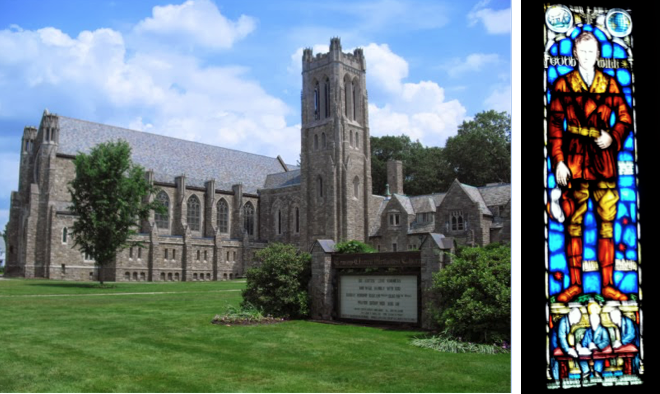
Once again “Talk” looked in on aviation hero Charles Lindbergh, and his dispassionate approach to matters of fame…

GOODWILL, OR WHATEVER…Trinity Methodist Episcopal Church in Springfield, Mass., features a series of 24 stained-glass windows representing historic personages with the theme, “The Light of Christ in the Life of Civilization.” Charles Lindbergh’s pane represents “Goodwill.” (tm01001.blogspot.com)

 *  *  *

Mr. Monroe Outwits a Bat

James Thurber submitted a humorous piece on a husband and wife at a weekend cabin retreat. The husband encounters a bat, and feigns to dispatch it while his wife remains behind closed doors. A brief clip:

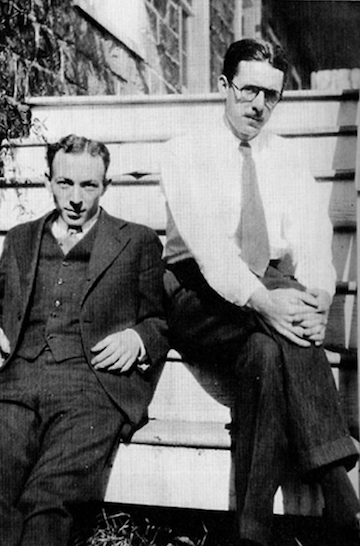
E.B. White and James Thurber, circa late 1920s.

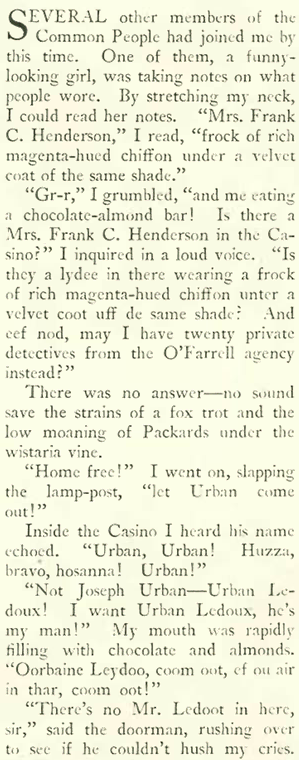
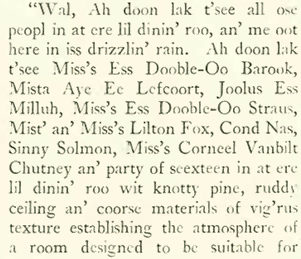
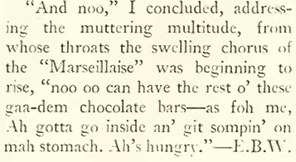
Thurber’s office mate and friend, E.B. White, penned a piece on the opening of the Central Park Casino (“Casino, I Love You”) in which he pretended to be a hobo loitering outside the Casino’s recent grand re-opening. Some excerpts…

White’s character confuses Urbain Ledoux with Casino designer Joseph Urban. Ledoux was known to New Yorkers as “Mr. Zero,” a local humanitarian who managed breadlines for the poor. White’s character continues to name off the notables present at the event…

*  *  *

From Our Advertisers

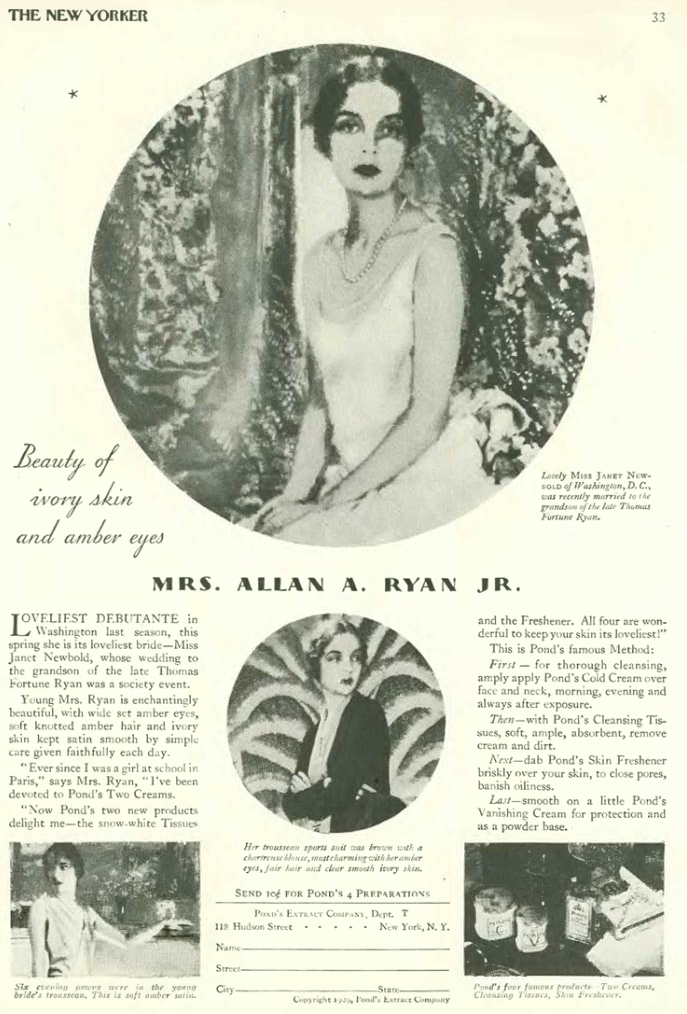
We begin with a Pond’s cold cream ad featuring Janet Newbold (1908-1982), who was known in some circles as “the most beautiful woman in New York”…

MIRROR, MIRROR…Left, an iconic photo of Janet Newbold by Erwin Blumenfeld, “Woman and Mirror,” was published in Harper’s Bazaar in November 1941. “Janet Newbold Wearing A Sari,” photo by John Rawlings, was published in Vogue in 1947. Thrice married, her last marriage (in 1948) was to James S. Bush, uncle of U.S. President George H.W. Bush. (Harper’s Bazaar/Vogue)

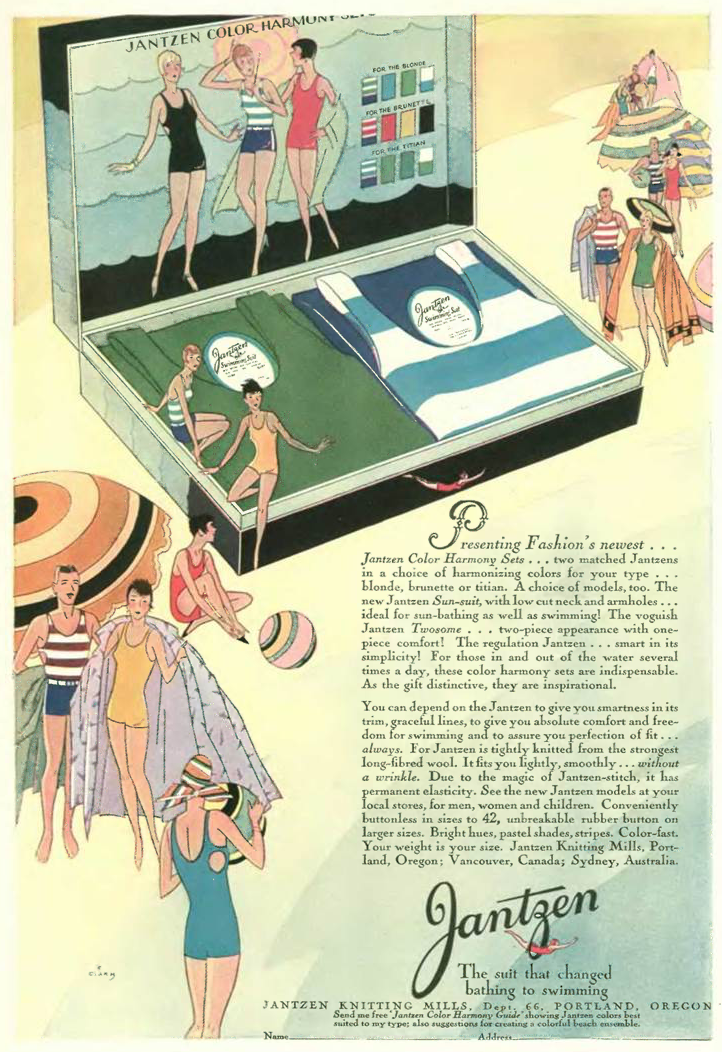
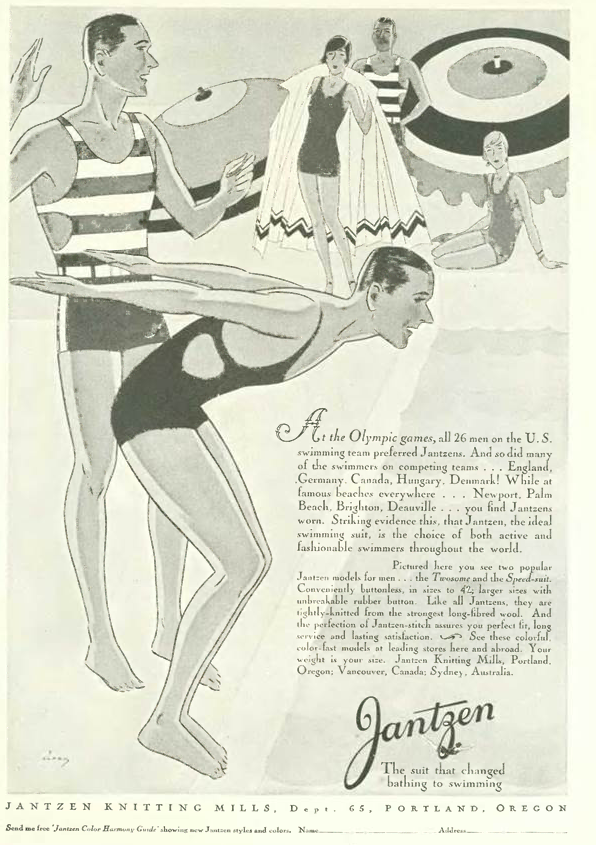
…some of the more colorful ads in the June 15 issue included this entry by Jantzen…

…and this ad for the REO Flying Cloud, a name that suggested speed and lightness, and changed the way cars would be named in the future (e.g. “Mustang” rather than “Model A”)…

…and if you think gimmicky razors are something new, think again…

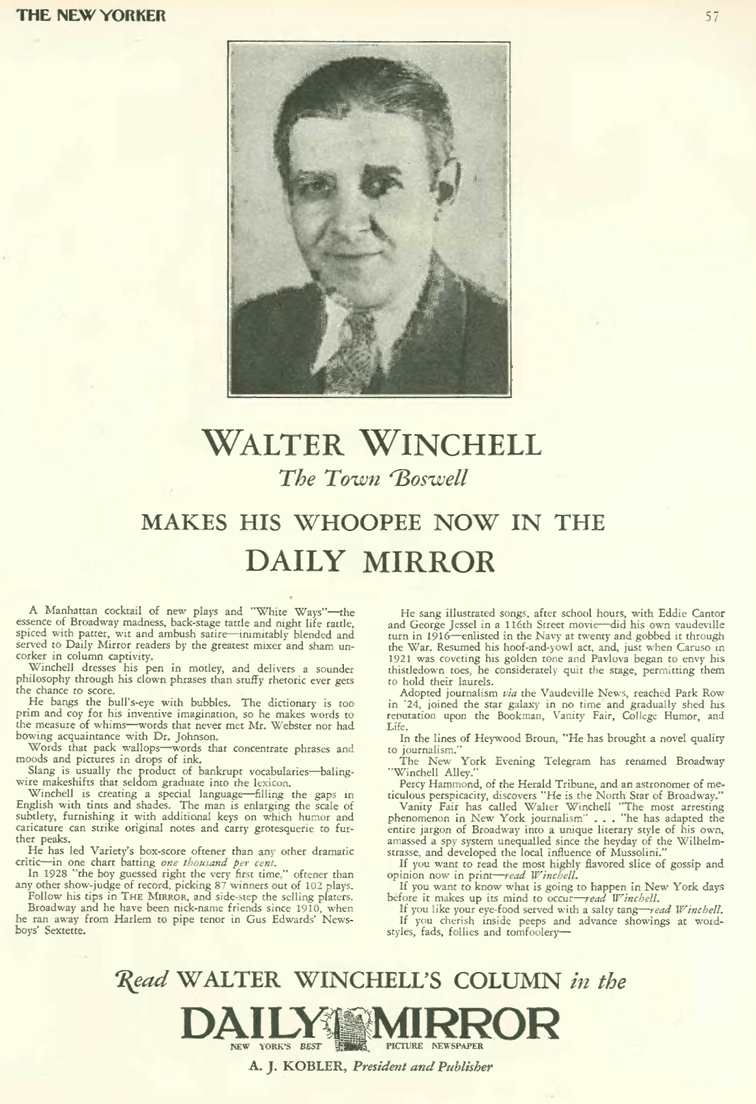
…this ad announcing Walter Winchell’s employment with the New York Daily Mirror is significant in that in marks the beginning of the first syndicated gossip column. Winchell’s column, On-Broadway, was syndicated nationwide by King Features. A year later he would make his radio debut over New York’s WABC…

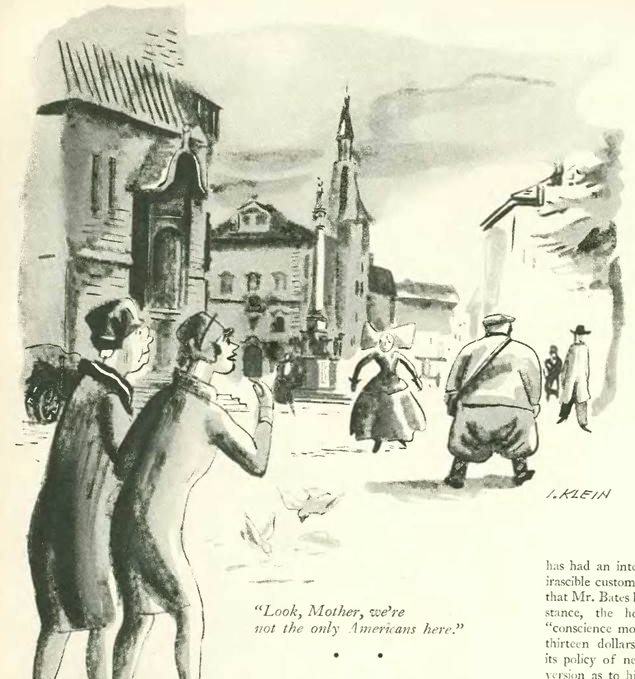
…for our June 15 cartoons, Isadore Klein confirms that stereotypes regarding American tourists haven’t changed much in 90 years…

…a quick footnote on Klein. In his long and colorful career, he would contribute cartoons to the New Yorker and many other publications. He also drew cartoons for silent movies, including Mutt and Jeff and Krazy Kat, and later worked for major animation studios including Screen Gems, Hal Seeger Productions, and Walt Disney. He was a writer and animator for such popular cartoons as Mighty MouseCasper, Little Lulu and Popeye.

Isadore Klein (1897–1986) holding the National Cartoonists Society “Silver T-Square.” He received the honor from his fellow members on April 22, 1974. (michaelspornanimation.com)

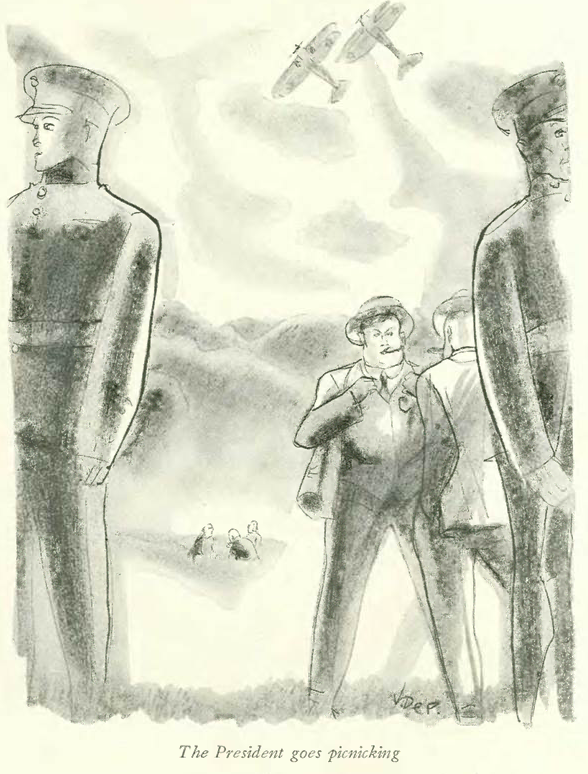
…Belgium-born artist Victor De Pauw depicted President Herbert Hoover picnicking, as viewed through his security detail…

…and a quick note on De Pauw…well known during his lifetime, he illustrated seven covers for The New Yorker and drew many social and political cartoons for magazines such as Vanity Fair, Fortune and Life. He also had a career as a serious painter, and some of his work can be found at the Museum of Modern Art…

Victor de Pauw (1902-1971) and one of his New Yorker covers from Nov. 20, 1943. (Smithsonian/Conde Nast)

Helen Hokinson looked in on two of her society women in need of some uplift…

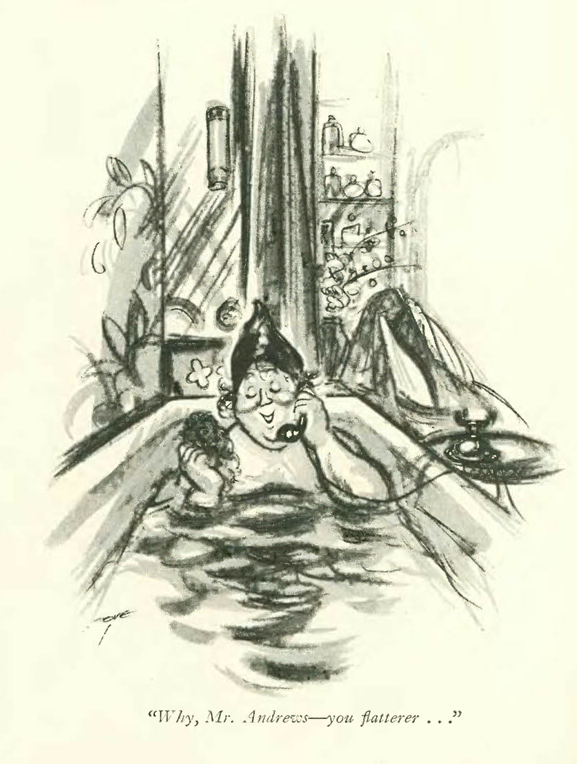
…and Leonard Dove looked in on another enjoying a soak…

Moving along to the June 22, 1929 issue, “The Talk of the Town” offered more news on the city’s changing skyline…

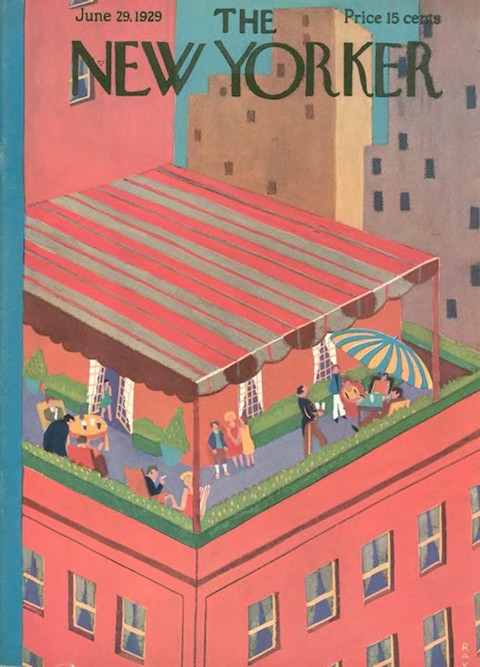
June 22, 1929 cover by Constantin Alajalov.

…and noted that the slender 1906 “Chimney Corner” building at Wall and Broadway had a date with the wrecking ball…

FAILED THE TEST OF TIME…At left, 18-story “Chimney Building” was demolished in 1929 along neighboring properties to make way for the Irving Trust Building (now 1 Wall Street), an Art Deco masterpiece by architect Ralph Walker. Note the scale of the two buildings relative to the church spire. (skyscraper.org/architectsandartisans.com)

 * * *

Apartheid on the Seas

“Talk” also featured this sad account of a theatrical company setting sale for England and discovering that racial discrimination did not end at the docks of New York Harbor. It is also sad that The New Yorker didn’t seem to have any problem with this injustice, and rather saw it as nothing more than fodder for an amusing anecdote…

NOT THE GOOD OLD DAYS…Percy Verwayne, Frank H. Wilson and Evelyn Ellis were part of the cast in the original Broadway production of Porgy in 1927. The play, by Dorothy and DuBose Heyward, was the basis for the libretto in the George Gershwin’s 1935 Porgy and Bess. (Wikipedia)

* * *

The profile for June 22 featured 100-year-old John R. Voorhis (1829-1932), Chairman of New York City’s Board of Elections. A fixture of the Tammany Hall Democratic political machine, in 1931 Tammany members created a special title for the old man—Great Grand Sachem. He died the next year at age 102.

John Voorhies in 1900, when he was a bouncy youth of 71.

 * * *

From Our Advertisers

Another colorful entry from the makers of Jantzen swimwear to celebrate the summer season…

…famed composer George Gershwin urged his fans to light up a Lucky Strike…

…and with help from Rea Irwin, Knox Hatters offered yet another example of the faux pas one might suffer without the proper headgear…

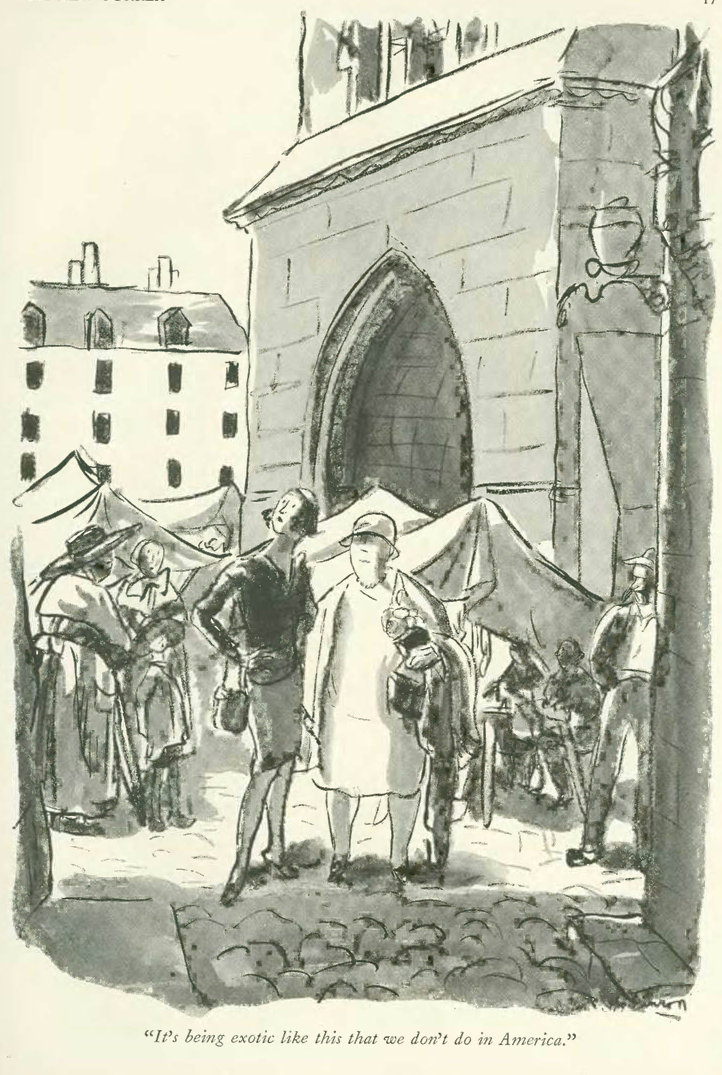
…for our June 22 cartoons, Helen Hokinson caught up with some American tourists…

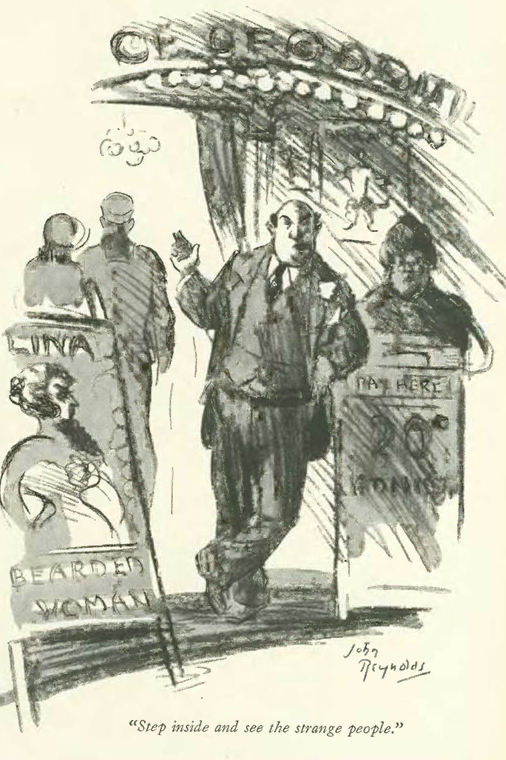
John Reynolds found a bit of irony in one carnival barker’s claim…

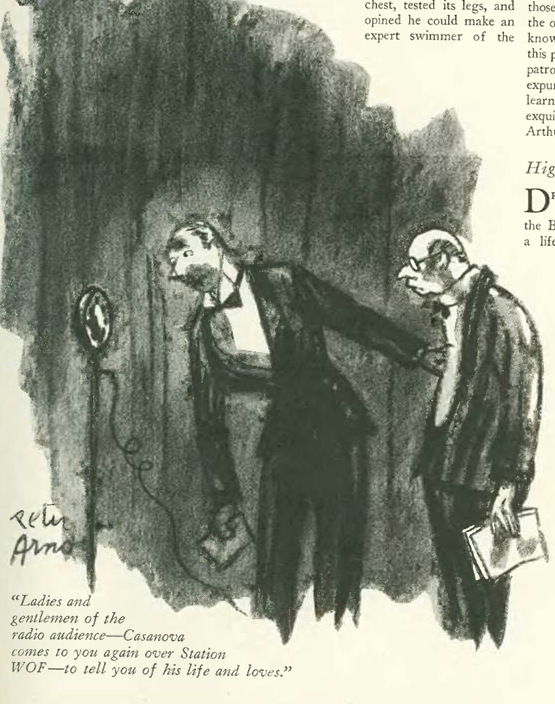
…and Peter Arno revealed a less than glamorous face behind a radio broadcast…

Next Time: New York, 1965…

A Bridge Too Far

Despite the rise of the professional classes in the 20th century (and their attendant rules for accreditation and licensing) there still existed individuals who practiced at the highest levels with little or no formal training.

June 8, 1929 cover by Julien de Miskey.

Gustav Lindenthal (1850-1935) was a case in point. An Austrian immigrant who designed New York’s Hell Gate Bridge among others had little formal education and no degree in civil engineering. Rather, he learned by working as an assistant on various construction projects and teaching himself mathematics, metallurgy, engineering, hydraulics and other principles of the building profession.

Lindenthal was praised for his innovations in bridge design as well as for his artistic eye, but one project eluded him throughout his career: the largest bridge in the world—a massive double-decker that would span the Hudson River from 57th Street in New York City to Hoboken in New Jersey. The June 8, 1929 “Talk of the Town” checked in on the nearly 80-year-old bridge builder:

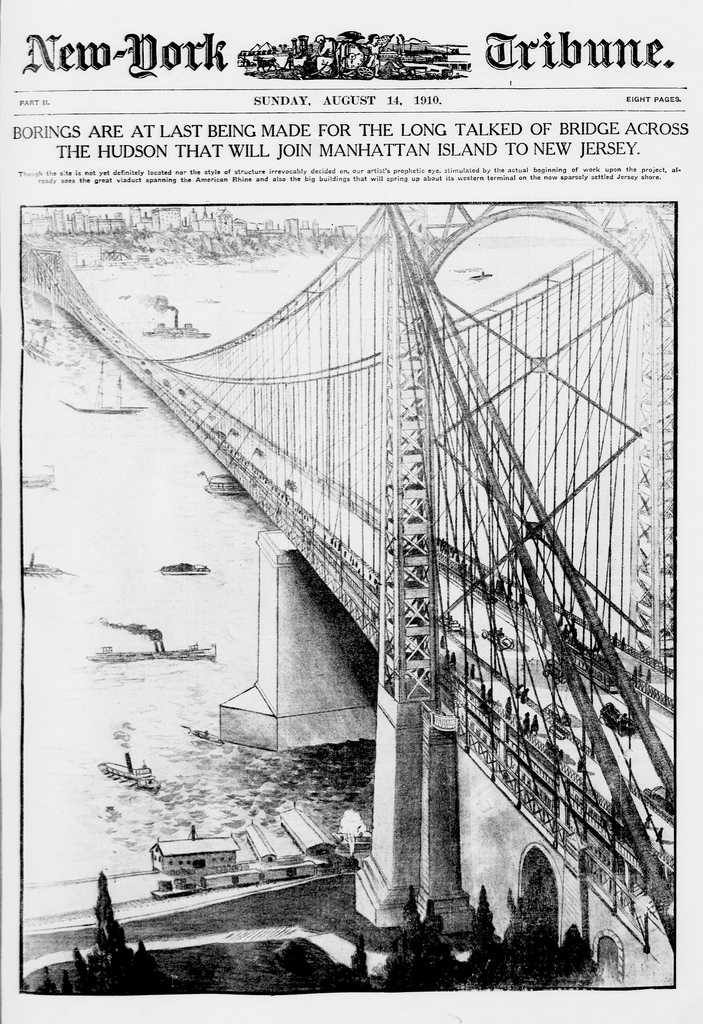
A cornerstone for the Hudson bridge was laid in 1895, but a series of bad breaks, including the 1898 Depression and various political setbacks, served to continually delay the project. The New York Tribune anticipated the bridge in its April 28, 1907 edition…

(untapped cities) click to enlarge

…and three years later the Tribune seemed confident that work was finally underway…

(untapped cities)

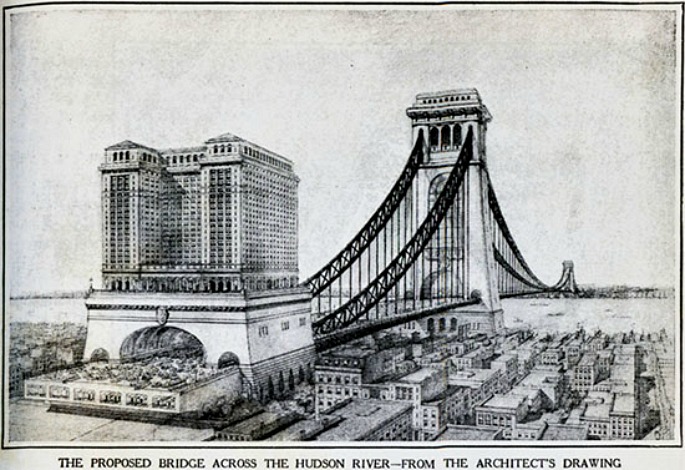
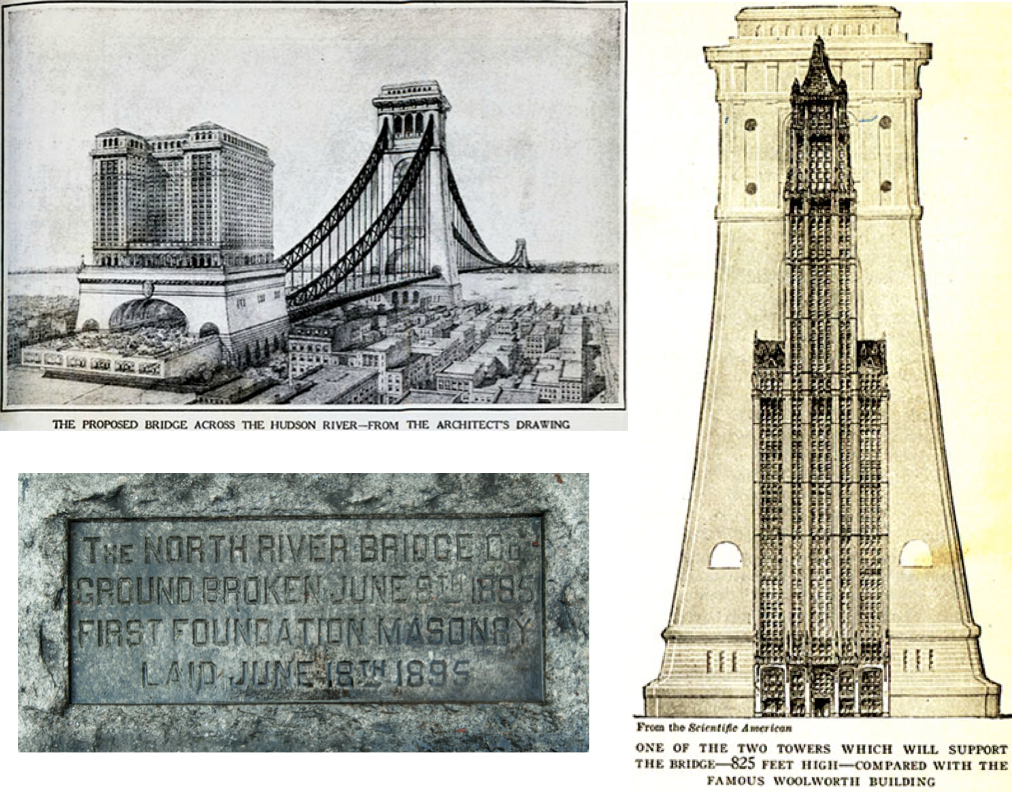
…however by the 1920s the bridge was still a dream. In 1921 Scientific American offered the latest glimpse of Lindenthal’s proposed 57th Street Bridge — a span 6,000 feet in length, with a 200-foot-wide double deck accommodating 24 lanes of traffic and 12 railroad tracks. An artist’s rendering included a massive building, on an arched plinth, positioned over the bridge deck:

BIG PLANS…Clockwise, from top left: Artist’s rendering of Gustav Lindenthal’s proposed 57th Street bridge from the June 25, 1921 issue of Scientific American. That same issue featured a size comparison with the then-tallest building in the world—the Woolworth Building. Below, the 1895 cornerstone, recently recovered from a crumbling pier on the New Jersey side of the Hudson and relocated to the grounds of Steven’s Institute of Technology in Hoboken. (untappedcities.com)

The New Yorker suggested that Lindenthal’s legacy was already secure, and with his determination and vigorous constitution, he still might still win the day:

Despite his vigor, Lindenthal would not live to see his dream realized. However, he is remembered for building some of New York’s most iconic bridges, including the Hell Gate and Queensboro:

LEGACY…Clockwise, from top left, Hell Gate Bridge; Gustav Lindenthal, circa 1920; Queensboro Bridge. (Library of Congress/Britannica/Pinterest)

 *  *  *

Keeping Up With the Lindberghs

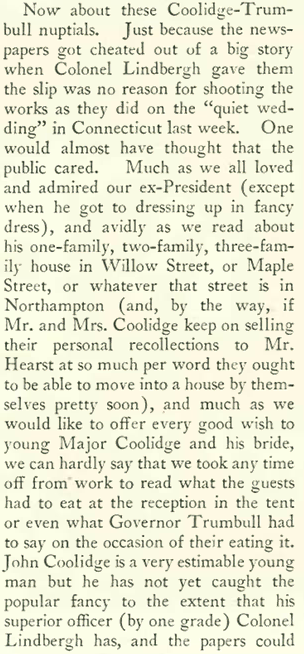
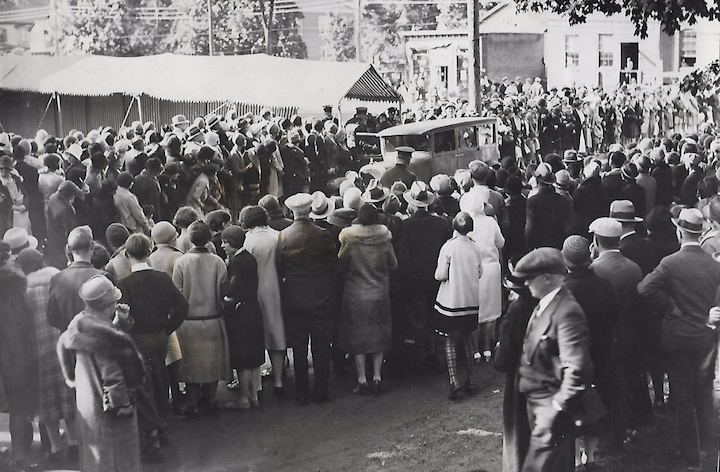
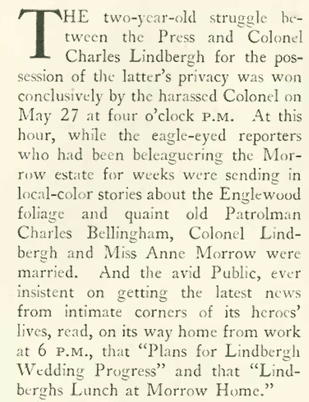
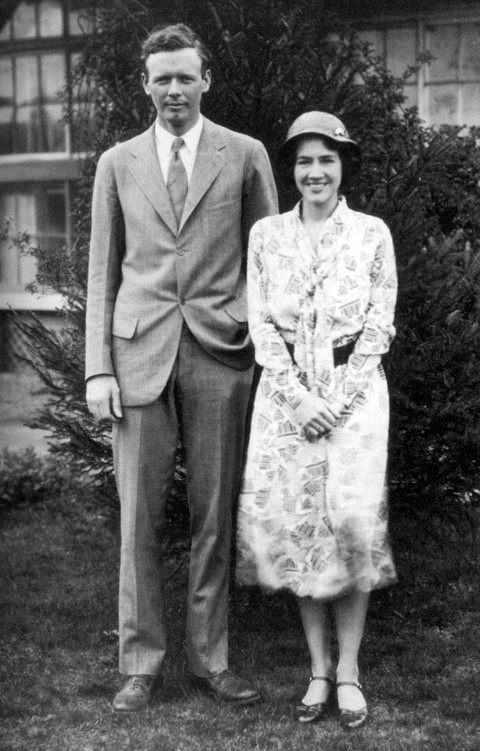
Despite his worldwide fame, Charles Lindbergh (1902-1974) detested the limelight, particularly when it came to his personal life. Writing in the column “The Wayward Press,” humorist Robert Benchley mocked the newspapers for their invasions into the lives of the celebrated, including newlyweds Charles and Anne Morrow Lindbergh:

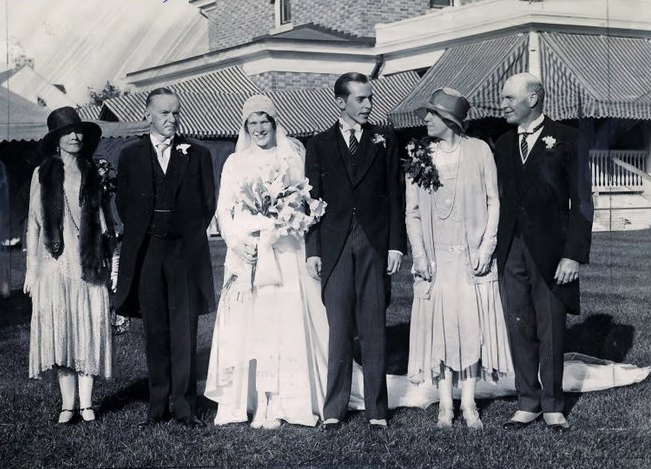
MIND YOUR OWN BEESWAX…Charles and Anne Morrow Lindbergh after their marriage in a private ceremony on May 27, 1929, at the home of her parents in Englewood, New Jersey. (Library of Congress)

Benchley wasn’t buying the newspaper industry’s insistence that the public demanded to know the facts about the flyboy’s nuptials:

 *  *  *

Let the Good Times Roll

With the newly remodeled Central Park Casino officially christened by Mayor Jimmy Walker and his cronies, The New Yorker’s Lois Long (in “Tables for Two”) decided to pay a visit to see what all the fuss was about:

Long also commented on the declining fortunes of another familiar face of New York nightlife, Texas Guinan, who had fled Manhatten’s smoky speakeasy scene for the bucolic climes of Nassau County…

GOODBYE CITY LIFE…Texas Guinan took her nightclub to the quiet village of Valley Stream, New York, located just south of Queens in Nassau County. Guinan didn’t abandon all the trappings of city life: she drove to Valley Stream in a lavender Rolls Royce, and continued to greet her patrons with her famous “Hello, Sucker!” (jhgraham.com/texasguinanblogspot.com)

Long concluded that regardless where one ended up on a summer evening, one should be aware that a shabbier crowd awaited their company:

 *  *  *

Cuba Libre

Now we look at another New Yorker contributor who today is not exactly a household name: Donald Barr Chidsey (1902-1981), an American writer, biographer, historian and novelist best known for his adventure fiction. In this short column he offered some insights into the Cuban drinking scene:

ADVENTURESOME LAD…Donald Barr Chidsey wrote more than 50 books, including many action-adventure titles such as Captain Adam, from 1953. Note the resemblance of the hero on the cover to the author. (etsy/Amazon)

 *  *  *

Waxing Poetic

From its very first issue, The New Yorker also published a wide variety of poets, including Nicholas Samstag (1904-1968),who contributed several poems to the magazine in 1928 and 1929. Samstag later went on to a successful career in advertising, and was a close associate of  Edward Bernays, considered the father of public relations and propaganda.

A frequent contributor to The New Yorker, writer, poet and critic Mark Van Doren (1894-1972) published more than three dozen poems in the magazine from 1929 to 1972. Here is his first contribution, in the June 8, 1929 issue:

Van Doren’s last contribution to The New Yorker was published on Nov. 18, 1972, less than a month before his death. It was appropriately titled “Good Riddance”…

DID THE APPLE FALL FAR FROM THE TREE?…At left, a circa 1925 portrait of Mark Van Doren. He was the father of Charles Van Doren, who achieved brief renown as the 1957 winner of the rigged game show Twenty One. He is pictured at far right with fellow contestant Vivienne Nearing and game show host Jack Barry. (art.net/Wikipedia)

 *  *  *

From Our Advertisers

As summer approached some distinct themes emerged in ads aimed at female consumers. Here is a collection of ads from the June 8 issue that capitalized on the new tanning craze of the late 1920s…

click to enlarge

…and another big craze of the 1920s, the permanent wave, seemed to be a necessity as summer approached…

click to enlarge

…as for the gents, check out this new line of Jantzen swimwear modeled by what appear to be identical twins…

…and when you’re out of the water, a pair of “fashion welts” were all the rage for tip-toeing across the hot sands of Southampton…

…this ad from B. Altman depicted two women clad for “open motoring” (not sure how those long, lithe figures will fit into that tiny rumble seat)…

…for a less dusty mode of transportation, you could hop aboard The Broadway Limited for a quick 20-hour jaunt to Chicago…

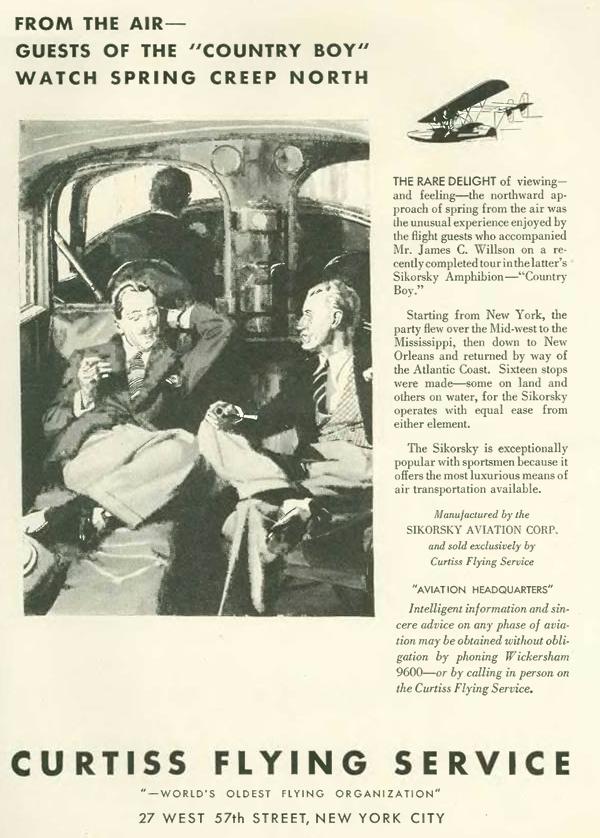
…or better yet, have a relaxing smoke with one of your chums aboard a Sikorsky seaplane…

…our cigarette ad for this week comes from Philip Morris, makers of Marlboro, who once again exploited the nation’s youth with a bogus handwriting contest that doubled as a product endorsement…

…our June 8 comics are from Helen Hokinson, who offered a full page of illustrations from a “Fifth Avenue Wedding”…

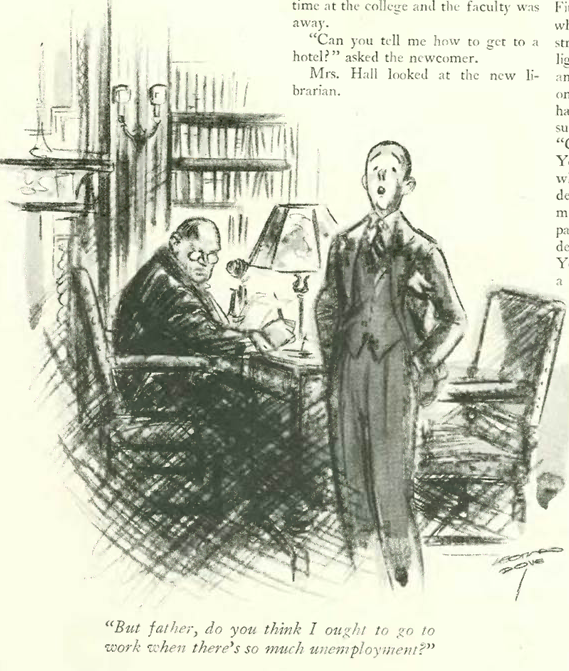
…while Leonard Dove peeked in on a wastrel son and his disappointed father…

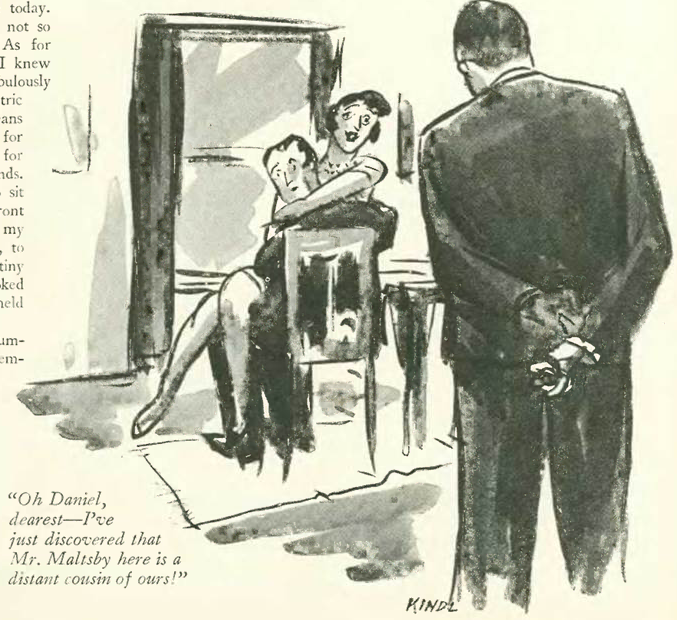
…and we have an awkward moment revealed by Carl Kindl

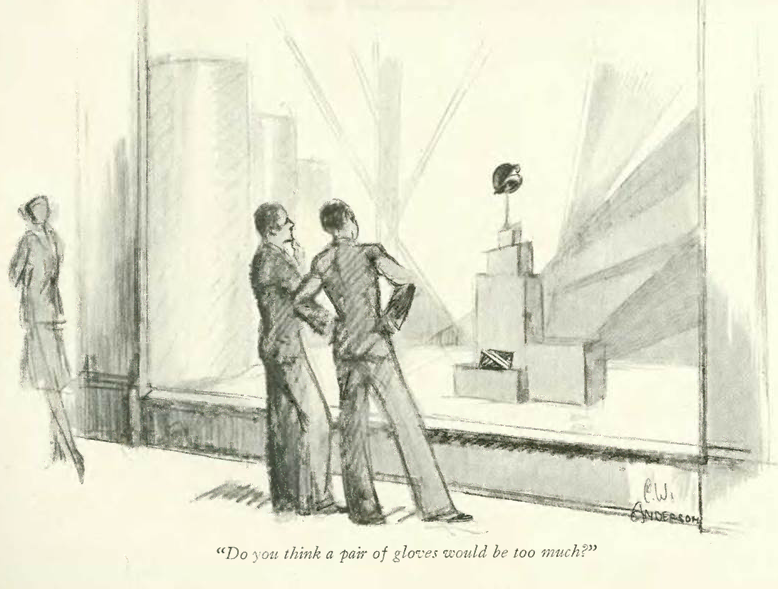
…and an observation by C.W. Anderson on the minimalism of modernist design…

…and finally, Peter Arno’s take on the challenges of shooting sound motion pictures…

Caption: “Lord, Mr. Rolbert, you’ll have to develop a more robust sneeze—the public will think you’re a sissy!”

Next Time: Something Old, Something New…

Hello Molly

While the New Yorker was happy to send singer Marion Talley packing back to Midwest (see last post), it was wholly embracing one of its own, Molly Picon. But as we will see, it had every reason to do so.

April 27, 1929 cover by Rea Irvin.

The daughter of Polish immigrants, Molly Picon (1898-1992) was born Małka Opiekun in New York City on Feb. 28, 1898, and became of a star of Yiddish theatre and film before moving to English language productions in the 1930s.

Writing in “The Talk of the Town,” James Thurber described Picon as an “idol of the East Side”…

PRECOCIOUS…Molly Picon began performing in the Yiddish Theatre at age six. Pictured, from left, is 10-year-old Molly in a 1908 Nickelodeon short of a vaudeville act, Fagan’s Decision; an undated press photo; in The Jolly Orphan, 1929. (Jewish Women’s Archive/Wikipedia/Museum of the City of New York)
At left, music sung by Molly Picot in the a Yiddish theatre production, Tsirkus meydl (The Circus Girl), 1928. At right, a scene from the play. (Museum of the City of New York)
PUT ‘EM UP…Molly Picot tries her hand at boxing in the silent comedy, East and West, originally produced in Austria in 1923. In this film about assimilation and Jewish values, a sophisticated New Yorker travels back to his village to attend his niece’s traditional wedding. There he encounters the rambunctious Molly, whose hijinks include boxing, and teaching other young villagers to shimmy. (Image: National Center for Jewish Film / Caption: UC Berkeley Library)

Thurber described Picon’s personal life as simple and focused on her family, a path she followed throughout her 94 years:

Picon met her husband, Jacob “Yonkel” Kalich (1891-1975) in 1918 and they married a year later. In an exhibition at the American Jewish Historical Society, Picon is quoted on how meeting Kalich changed her life:

“When we met in Boston, I was the All-American Girl full of hurdy-gurdys and absolutely illiterate about Jewish culture. Yonkel, on the other hand, was the complete intellectual who knew not only classic Yiddish but its plays, theater and writers.”

After they married in 1919, the couple toured Eastern European cities with large Jewish populations in order that she could improve her Yiddish and gain experience as a performer. Kalich served as her manager and creator of many of her roles, and they often performed together, including in two films nearly 50 years apart—East and West (1923) and Fiddler on the Roof (1971).

Top photos, left to right, Molly Picon in the Yiddish Theatre comedy Di Tsvey Kuni Lemels (The Two Kuni Lemels), 1926; with husband Jacob “Yonkel” Kalich in the 1923 silent film comedy, East and West; with Kalich that same year in Vienna. Bottom row, left to right, Picon tapes the Maxwell House Radio Show, 1938, and below, on the set of the Fiddler on the Roof (1971) with husband Jacob “Yonkel” Kalich; with Frank Sinatra in Come Blow Your Horn (1963); and on the TV show The Facts of Life (1979). (Wikimedia Commons/American Jewish Historical Society/Jewish Women’s Archive)

Picon appeared on a variety of TV shows from the 1960s through the 1980s including Car 54, Where Are You?, Gomer Pyle, The Facts of Life, and Trapper John M.D. Movie appearances during that time included Fiddler on the Roof (1971); For Pete’s Sake (with Barbra Streisand, 1974); and perhaps one of her oddest roles, as Roger Moore’s longsuffering mother in The Cannonball Run (1981) and 1984’s The Cannonball Run II (In those films, Moore portrayed Seymour Goldfarb, heir to the Goldfarb Girdles fortune, who preferred the life of pretending to be a spy to girdle manufacturing).

Thurber observed that Picon was only interested in comedic roles, a preference she stuck to throughout her long career.

Molly Picon as Mrs. Bronson in the television show Car 54, Where Are You? (1962) (Wikimedia Commons)

To learn more about Molly Picon’s fascinating life, visit the online exhibition at the American Jewish Historical Society.

 *  *  *

Sober as a Judge

Despite Prohibition, booze flowed freely in New York in the late 1920s thanks to bootleggers and corrupt cops. U.S. Assistant Attorney General Mabel Walker Willebrandt tried her best to crack down on violations, arresting (among many others) the operators of two of Manhattan’s most popular nightclubs, actress Texas Guinan (300 Club) and torch singer Helen Morgan (Chez Morgan). In the “Talk of the Town,” the New Yorker found hope in the acquittal of Guinan and Morgan, and in the opinion of one of the jurors:

In the same issue, this cartoon by Oscar Howard tells us a lot about New York’s approach to Prohibition enforcement in 1929…

 *  *  *

Captive Audience

In the April 27 “Talk of the Town” James Thurber also turned his attention to the latest treacle flowing out of Hollywood—the premiere of The Rainbow Man, starring Eddie Dowling in his first talking picture. Thurber found the film to be “alarmingly bad.” But that was only the beginning…

TIRED OF ME YET?…Lloyd Ingraham, Eddie Dowling, and Marian Nixon in The Rainbow Man (1929) (IMDB)

Thurber wrote that the film was followed by live performances from “a Kate Smith” and by Eddie Dowling himself, who piled more ham on the proceedings.

PILING IT ON…Eddie Dowling gave audiences more than they needed (at least in the view of James Thurber) at the premiere of The Rainbow Man. Dowling would share the stage with Kate Smith, apparently unknown to Thurber at that time. She would go on to massive stardom. Dowling, not so much. (IMDB/Pinterest)

 *  *  *

Slow Man River

Things didn’t look much better in the magazine’s movie review section, where the 1929 film version of the huge 1927 Broadway hit musical Showboat seemed stuck on sandbar:

SLOW BOAT…Scene from the 1929 film Show Boat featuring Laura LaPlante as Magnolia Hawks and Joseph Schildkraut as Gaylord Ravenal. (Wikipedia)

 *  *  *

Elsie Dinsmore Revisited

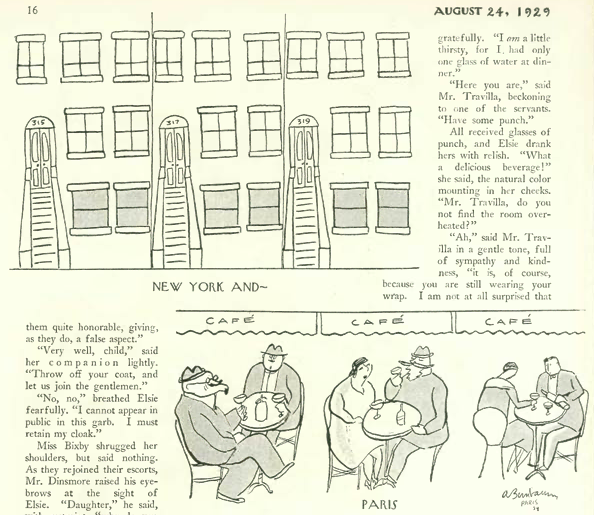
Phyllis Crawford (writing under the pseudonym Josie Turner) contributed another parody of the Elsie Dinsmore book series. The original books (28 in all), were written in the late 19th and early 20th century and featured an impossibly upright eight-year-old as the main character.

Crawford, herself an author of children’s books (including the award-winning Hello, the Boat!), had some fun with the Dinsmore books, her parody featuring a still pious and innocent Elsie living with her father in New York, where she encounters his circle of friends including gamblers and chorus girls (the collected pieces were published as a book in 1930: Elsie Dinsmore on the Loose). In this brief excerpt from Crawford’s piece in the April 27 issue (“Elsie Dinsmore Entertains at Tea”), little Elsie tries her best to entertain a friend of her “dear Papa”…

On the topic of books, Dorothy Parker, in her “Reading and Writing” column, took aim at middlebrow book clubs such as the Literary Guild, expressing (in her way) surprise that such a club would actually recommend something with literary merit…

Advertisement in the April 27 issue for Ring Lardner’s Round Up. At right, Lardner and Dorothy Parker, circa 1930. (thenationalpastimemuseum.com/selectedshorts.org)

 *  *  *

From Our Advertisers

We begin with a colorful ad from the makers B.V.D., a brand name that would become synonymous with men’s underwear…

…Russian prima ballerina Anna Pavlova demonstrated the wonders of Cutex nail polish in her famous “Dying Swan” costume (Pavlova would be dead herself in less than two years)…

…while the Wizard of Menlo Park applied his genius to the cause for better toast…

…and actor John Gilbert was the latest actor to “reach for a Lucky instead of a sweet”…

…this ad in the back pages enticed readers to visit the International Exposition of Barcelona…those fortunate enough to have made the trip would have seen Mies Van Der Rohe’s “Barcelona House” (pictured) and the first-ever Barcelona chair…

(thomortiz.tumblr.com)

…on to cartoons and illustrations, in the theatre section this contribution by Miguel Covarrubias

…Covarrubias (pictured) was an early contributor to the New Yorker, indeed he contributed to the very first issue with this rendering of Italian opera manager Giulio Gatti-Casazza for the first-ever profile…

Gluyas Williams illustrated the collective shaming of a commuter by residents of Tudor City…

…Tudor City was touted in many early New Yorker ads as having all the amenities of the suburbs but within walking distance of the city…here is an ad from the March 26, 1927 issue of The New Yorker

…and then we have the English cartoonist Leonard Dove, who looks in on a couple who are obviously not from Tudor City…

…and finally, a terrific cartoon by an artist I have failed to identify (if anyone knows, please comment!)…

Next Time: From Broadway to Babylon…

While You Were Away

During the Roaring Twenties New Yorkers took a wrecking ball to much of their past, and at a breathtaking pace that left many residents little time to ponder what was lost.

March 30, 1929 cover by Julian de Miskey.

Writer and cultural critic Gilbert Seldes succinctly summed up this spirit of the times in a tongue-in-cheek “reminiscence” of the “old” New York—that is, how the city appeared the previous fall before he left to spend the winter in Bermuda:

NOW WHERE WILL I GET A WALDORF SALAD? Writer Gilbert Seldes (top left) ticked off some of the many changes to his city while he was away for the winter, including (clockwise, from top right), the murder of racketeer Arnold Rothstein; the planned demolition of the Waldorf Astoria to make room for the Empire State Building (photo of the partially demolished hotel); and perhaps the first song to be overplayed on the radio ad nauseumAl Jolson’s “Sonny Boy.” (Wikipedia, Daily News, New York Public Library, musicals101.com)

A member of the intellectual elite but also a strong advocate for cultural democracy, Seldes began writing for the New Yorker in late 1925 and would be a frequent contributor through 1936. In 1937 he would join CBS as its first director of television programs, and would also become one of television’s first critics thanks to his 1937 Atlantic Monthly article, “The ‘Errors’ of Television.” (Note: There were only 50 experimental TV sets in the New York area in 1937, and the first commercially available sets weren’t sold until 1939). In 1958—when there would be 42 million U.S. households with a television—Seldes would serve as the host of NBC’s The Subject is Jazz.

 *  *  *

Peggy Bacon Did It All

Another early contributor to the New Yorker was Peggy Bacon, who displayed her sharp wit in her nearly 50 articles and poems for the magazine from 1926 to 1950. But Bacon was also well-known for displaying her talent and wit in the many paintings and illustrations she created throughout her long career. The New Yorker’s art critic Murdock Pemberton sang her praises in the March 30, 1929 issue after visiting her show at the Weyhe Gallery.

A FEW IDEAS was the title of this 1927 drypoint work featured in Peggy Bacon’s Weyhe Gallery show. At right, Bacon, circa 1920s. (artnet.com/wikipedia)
A sampling of Peggy Bacon drypoint works from the 1920s, clockwise, from top: Frenzied Effort, 1925; Vanity, 1929; Penguin Island, 1926. (Brooklyn Museum/Artnet/1stdibs.com)

 *  *  *

The March 30 profile featured aviation innovator Giuseppe Mario Bellanca, who in 1922 designed the first enclosed-cabin monoplane in the U.S. Perhaps even more significant, his design in 1913 of a plane with a propeller in front, a wing in the middle and tail at the end set the standard for all aircraft built since. (Before 1913 many planes were propelled from the rear, with the “tail” projected in front of the craft). The profile writer, William Weimer (with art by Hugo Gellert) admired Bellanca’s ability to stand toe-to-toe with the mighty du Pont family:

Bellanca founded the Roos-Bellanca Aircraft Company in Omaha in 1927, and was featured on the cover of Time. In 1929 he created the Delaware-based Bellanca Aircraft Corporation of America in a financial partnership with the du Ponts.

AVIATION PIONEER Giuseppe Mario Bellanca (center) at the new Bellanca Airfield in New Castle, Delaware, 1928. Bellanca’s planes would establish numerous records for altitude, endurance, and speed. (Delaware Public Archives)

 *  *  *

Showing Some Restraint

In his “Sky Line” column, the New Yorker architecture critic George S. Chappell (aka “T-Square”) praised an award-winning 1928 apartment at 3 East 84th Street for its contemporary charm and “fine restraint.” Designed by Raymond Hood and John Mead Howells, the 9-story building was commissioned by Joseph Medill Patterson, owner of the New York Daily News. The design would be influential in Hood’s much more ambitious projects two years later—the Daily News Building (1930) and Rockefeller Center (1931).


The Raymond Hood– and John Mead Howells-designed 3 East 84th Street. Top right, the front entrance; and bottom right, ceiling’s silver leaf squares. (Susan DeMark–mindfulwalker.com)

 *  *  *

Advertisers in the March 30 issue offered various garments for the gentleman, including this sports-country ensemble at left from Finchley and a custom lounging robe from Macy’s…

…and for fashionable, amusingly mischievous woman there was the new “Scalawag” hat by Knox (ad illustrated by the great Carl Erickson)

…Blue Moon’s blonde fairy girl was one of the Jazz Age’s most recognizable labels…here she is matched with an Art Deco-inspired spectrum of stocking colors…

…Ligget & Myers Tobacco Company joined the ranks of sophisticated advertisers who touted a product—in this case Fatima cigarettes—without actually showing the product…

…on the other hand, American Tobacco Company, the makers of Lucky Strike, made doubly sure you wouldn’t forget that bright red bullseye, or Rosalie Adele Nelson, “The Original Lucky Poster Girl”…

Nelson’s image for Lucky Strike was almost as ubiquitous as the fairy in the Blue Moon ads. Apparently she was also a member the Nelson family of circus acrobats and performed her own signature act with baby elephants:

Rosalie Adele Nelson with her baby elephant act, 1929 (eBay)

Philip Morris took an entirely different (and unusual) approach to selling its relatively new brand of Marlboro cigarettes by touting the achievements of Gretchen Colnik, winner of the “1928 Marlboro Contest for Distinguished Handwriting….”

Like Rosalie Adele Nelson, Gretchen Colnik would go on to minor fame of her own. She was managing editor of the Great Neck, NY, newspaper before returning to her hometown—Milwaukee, Wisconsin. From 1952 to 1966 Gretchen was the Martha Stewart of Milwaukee, hosting a TV show that provided advice on interior design, food and crafts. “The Gretchen Colnik Show” was sponsored by Mrs. Karl’s Bread.

Our cartoon is by Leonard Dove, who looks in on an architect at work:

The Cruelest Month

The film reviews for the April 6, 1929 issue found the New Yorker once again at odds with Hollywood and favoring cinematic products from the Old World.

April 6, 1929 cover by Rea Irvin.

In the case it was a French film, The Passion of Joan of Arc, which even today is regarded as a cinematic landmark.

A LOT AT STAKE…American poster for The Passion of Joan of Arc; at right, Maria Falconetti in the title role. (Wikipedia/Film Forum)

The New Yorker review praised the film as “one of the few of the year which merit serious attention”…

On the other hand, there were the latest products from Hollywood, which stood on the other side of a “vast abyss” from the French film:

HO HUM FOR HOLLYWOOD…At left, Mary Dugan (Norma Shearer) with her conniving lawyer, Edward West (Lewis Stone) in The Trial of Mary Dugan; Lewis Stone was a apparently a busy man in the late 1920s—here he is again (center image), this time portraying John Sterling, a tea plantation investor lacking the mojo to keep up with his much younger wife, Lillie (Greta Garbo) in Wild Orchids; and at right, Janet Gaynor as a little Dutch girl in Christina, a film now considered lost. Click image to enlarge (normashearer.com/pinterest)

 *  *  *

From Our Advertisers

The April 6 issue found Charlie Chaplin getting in on the action of Old Gold cigarette endorsements…

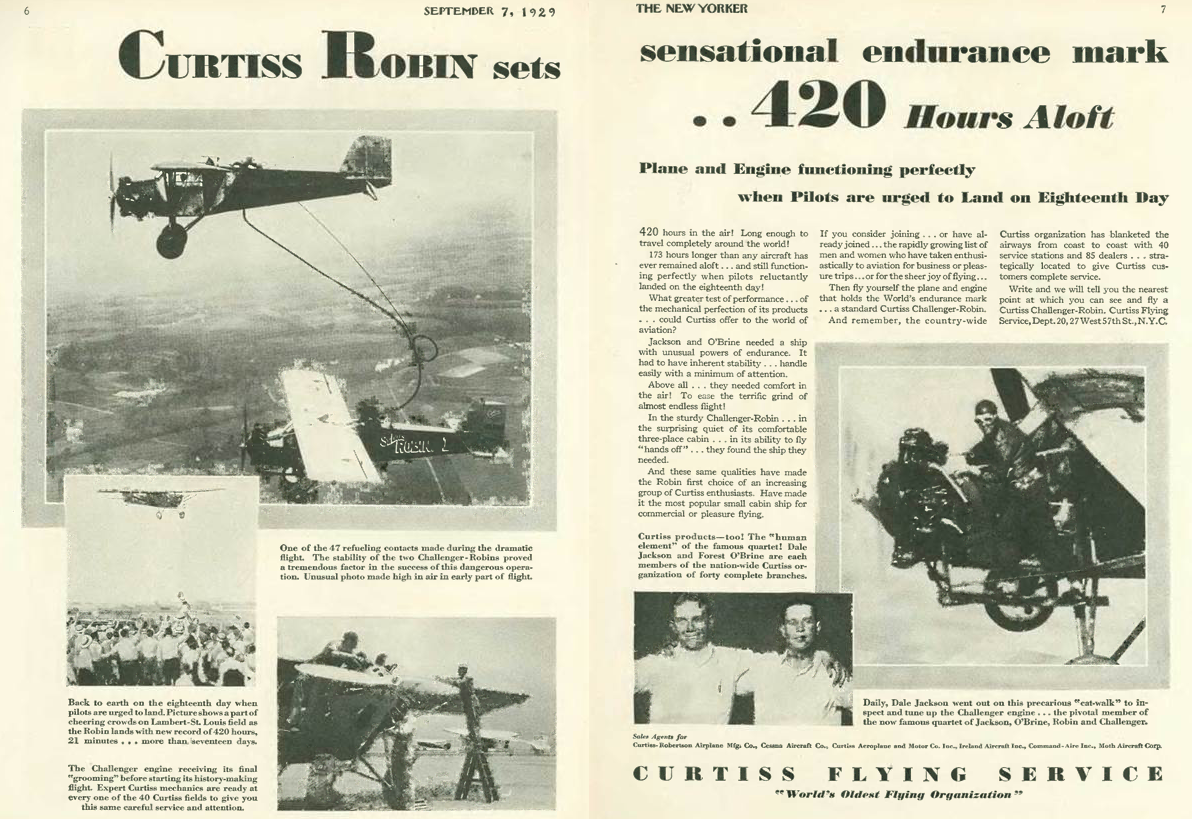
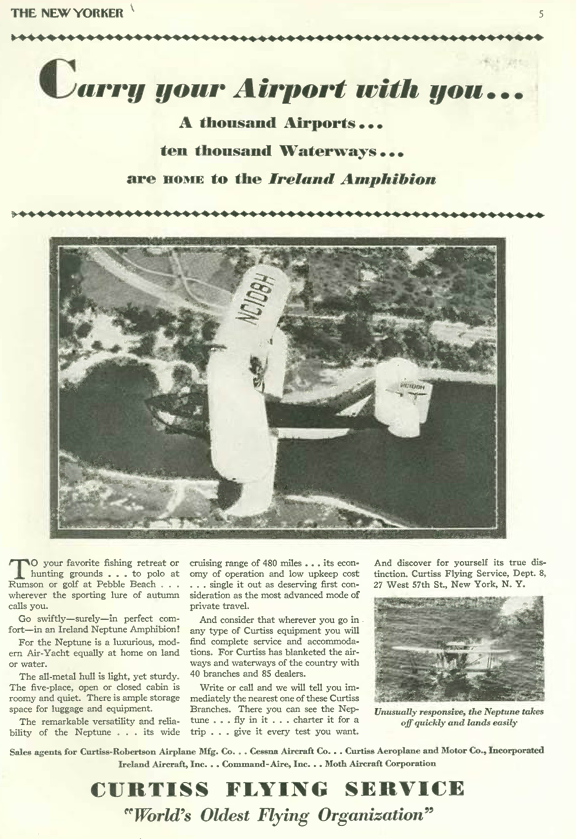
…while Curtiss Flying Service thought it might interest some of the more well-heeled New Yorker readers in the purchase of an airplane…

…a couple weeks later, in the April 20 issue, the New Yorker would make this observation about the ad in “The Talk of the Town”…

…and finally, our cartoon by R. Van Buren, looking in on yet another sugar daddy and his much younger companion on a night out…

Next Time: Generation of Vipers…

Million Dollar Mermaid

Our sense of what is old and what it is new becomes skewed during periods of rapid change, and such was the case in 1920s New York when large swaths of the old city were swept away and replaced by massive towers that seemingly rose overnight. Places like the Hippodrome Theatre, a 1905 Beaux-Arts confection barely 24 years old, seemed positively ancient in those heady times.

Feb. 9, 1929 cover by Helen Hokinson. Feb. 16, 1929 cover by Rea Irvin.

For the most part the New Yorker was enthusiastic about the changing skyline, as its namesake was claiming the crown as America’s premier city; but occasionally a melancholy note would be struck when a familiar institution appeared in decline or fated for the wrecking ball. In the Feb. 9, 1929 “Talk of the Town,” E.B. White wistfully recalled the old days of the Hippodrome, once the largest theatre in the world and the pride of turn-of-the-century New York:

FOR THE MASSES…The Hippodrome, built in 1905, provided entertainment to millions of New Yorkers who couldn’t afford a ticket to a Broadway play. The brainchild of Frederick Thompson and Elmer S. Dundy, entrepreneurs of Coney Island’s Luna Park, the Hippodrome was torn down in 1939 after more than a decade of decline. (1905 photo courtesy Library of Congress)
A REALLY BIG SHOOO…One of the first performances at the Hippodrome was a four-hour spectacle: A Yankee Circus on Mars (advertised on the theatre’s marquee in photo above). The 1905 production included 280 chorus girls, 480 soldiers, a parade of cars driven by elephants, an equestrienne ballet, acrobats, and a cavalry charge through a lake. (Image from Harper’s Weekly via daytoninmanhattan.blogspot.com)
The Hippodrome’s main theatre could accommodate 5,300 patrons in seats that were four inches wider than normal theatre seats. The dome over the “Roman style” auditorium encompassed an acre. (Broadway Magazine 1905 via daytoninmanhattan.blogspot.com)

The Hippodrome held such a place in the heart of the New Yorker that the magazine offered further reminiscences in the Feb. 16 issue, this time penned by managing editor Harold Ross:

For demonstrations of diving and “mermaid spectacles,” the Hippodrome stage featured an eight-foot high steel tank in four sections, with a front of plate glass. Manned diving bells were also used to raise and lower “mermaids” during performances.

OLD TIMEY FX…Illustration from Nature magazine (left) depicts a diving bell used in the Hippodrome’s swimming and diving tank to raise and lower performers. At top, circa 1910 advertisement; at bottom, the “Court of the Golden Fountain” in the the theatre’s 1905-06 presentation of A Society Circus. (les-sources-du-nil.tumblr.com/flickr/NYC Architecture)

Ross wrote about the Hippodrome’s “diving girls,” who would dive into a tank of water from a height of 90 feet, sometimes at a serious cost to their health:

HIPPODROME’S HEYDAYS…In the early 1900s Australian swimmer and diver Annette Kellerman (left, in an image from her 1918 book, How to Swim) was a famed performer at the Hippodrome, as was illusionist and stunt performer Harry Houdini, shown here in 1918  with Jennie the Elephant in a performance of the vanishing elephant trick. (Monash University/americaslibrary.gov/wildabouthoudini.com)
MILLION DOLLAR MERMAID…famed around the world by that moniker, swimmer and later actress Annette Kellerman is considered the originator of the one‐piece bathing suit, which she models at left in a photo taken around 1907. At right, advertisement for Kellerman’s 1916 film A Daughter of the Gods (now lost), in which Kellerman achieved another first: the first complete nude scene by a major star. The William Fox Studio made much of Kellerman’s figure, promoting her as the perfect woman by “comparing” her measurements to the likes of Cleopatra and Venus de Milo. (Wikipedia/consumingcultures.net)

Australian swimmer Annette Kellerman was a big draw at the Hippodrome, and helped popularize the sport of synchronised swimming after her 1907 performance of the first water ballet in theatre’s giant plate glass tank. In that same year she shocked Bostonians by appearing on a local beach in a “daring” one‐piece bathing suit (shown above), and was arrested for indecency. This was at a time when a woman’s standard bathing apparel consisted of a blouse, skirt, stockings and swimming shoes.

Unlike some of the unfortunate Hippodrome divers who later lost their eyesight due to cranial pressure from high dives, Kellerman went on to a long and active life (she died in 1975, at age 88). Known throughout the world as Australia’s “Million Dollar Mermaid” (and portrayed by Esther Williams in a 1952 movie by the same name), Kellerman appeared in more than a dozen films between 1909 and 1924. She also launched her own line of swimwear and wrote several books on swimming, beauty and fitness.

ALL WET…At top, Annette Kellerman swimming underwater in a gold sequined dress, possibly from  Queen of the Sea (1918, now lost). Thirty-four years later Esther Williams (below) would portray Kellerman in Million Dollar Mermaid. (historycouncilnsw.org.au/gsgs/movieactors.com)

*  *  *

City of Lights

While E.B. White got misty-eyed about the old Hippodrome in the Feb. 9 issue, his fellow New Yorker writer and friend James Thurber was thrilling on the new skyscrapers lighting the city’s skyline:

BEJEWELED CROWN…The New York Central Building depicted in a 1929 promotional painting by Chesley Bonestell. (albanyinstitute.org)

Thurber noted that “100,000 candlepower” would light the golden crown of the New York Central Building, the tallest structure in the Grand Central complex. Over at the new Chanin Building, a whopping 25 million candle-power would be trained on its art deco crown.

YOU CAN’T MISS IT…At left, the nearly 700-foot-tall Chanin Building joined the race for the sky in 1928-29. At right, a 1929 drypoint etching by Australian-born artist Martin Lewis depicted the magical glow of the Chanin Building from the viewpoint of a tenement dweller on a fire escape. (NYPL/ephemeralnewyork.wordpress.com)

Advertisers in the New Yorker reflected the mood of this new city of skyscraper canyons. From the Feb. 16 issue:

Ralph Ingersoll and Thurber also wrote in the Feb. 16 “Talk” about plans for “Rockefeller City…”

…and as we know, this was to become the famed Rockefeller Center, a complex of 19 buildings covering 22 acres between 48th and 51st streets. Led by by John D. Rockefeller Jr., the complex was conceived as an urban renewal project to revitalize Midtown (hard to imagine today). The land was originally envisioned as a site for a new Metropolitan Opera house, but when financing fell through the land’s owner, Columbia University, leased it to Rockefeller. Of the anticipated effect of the project, Ingersoll and Thurber wrote:

And for the record, the Feb. 9 issue featured another name that would shape the future of the city—J. Pierpont Morgan was the subject of a lengthy two-part profile penned by John K. Winkler.

 * * *

Shouts & Murmurs

The Feb. 16 marks a significant date on the New Yorker calendar—the first appearance of Alexander Woollcott’s famed “Shouts & Murmurs” column:

Writing in the “Double Take” section in the July 18, 2012 issue of the New Yorker, Jon Michaud notes that “Shouts & Murmurs” was Woollcott’s personal column, appearing weekly in the magazine for five years. Perhaps no person other Harold Ross himself could be more associated with the earliest origins of the magazine —  Woollcott was a colleague of Ross’s at Stars and Stripes during the First World War, and introduced Ross to his first wife, Jane Grant, who was also a considerable influence on the early magazine.

Michaud writes that Woollcott used the column “to opine on, lampoon, and attack the culture and society of the day. In his distinct and at times excessive style, he reviewed books, wrote spoofs, distributed gossip, and generally rankled as many people as he could.” Woollcott ended the column in December 1934, but it was revived in 1992 as a regular venue for many notable humorists, and continues to this day.

A REAL CHARACTER…Alexander Woollcott, in his idea of casual wear. He once informed his friend and New Yorker colleague Corey Ford: “Ford, I plan to spend three days at your house in New Hampshire next week.” Not overly pleased to be hosting such a demanding guest, Ford uttered a meek “That will be swell.” “I’ll be the judge of that,” Woolcott warned him. (From Elizabeth Olliff, “An Evening at the Algonquin.”)

* * *

Up In Smoke

Jumping back to the Feb. 9 “Talk of the Town,” we have this complaint from the magazine regarding celebrity cigarette endorsements. Although the magazine derived a lot of revenue from cigarette ads, Harold Ross insisted on a strict separation between editorial and advertising, allowing his writers free reign to bite the hands that fed them, if they so wished:

Here’s the offending ad, which was featured in the Feb. 23 issue:

In the Feb. 9 issue, Groucho Marx couldn’t resist getting in on the endorsement action…

…nor could Ross’s old friend George Gershwin, who touted the health benefits of Lucky Strikes in the Feb. 16 issue…

In other ads from the Feb. 16 issue, we find that for all of the technological advances in the 1920s, a decent car heater still eluded automakers. Hence…

…on the other hand, we also have this very up-to-date product—the forerunner of today’s rolling airplane luggage…

…and if you happened to be flying south, you might have first checked in with Helena Rubinstein to make sure you had the right “face fashions”…

And finally our cartoons, all from the Feb. 9 issue. This first is a six-panel series by Al Frueh that originally ran diagonally, top to bottom, across a two-page spread. It took a shot at the self-promoting police commissioner, Grover Whalen, who was not a friend to the New Yorker due to his ham-fisted approach to Prohibition enforcement…
…and Leonard Dove took a shot at some posh folks outside of their urban element…

…and finally, Alan Dunn examined the wages of beauty…

Next Time: Modern English Usage…

Life Among the Snowbirds

Florida’s Palm Beach became a popular destination in the 1920s for well-heeled New Yorkers seeking a respite from winter’s cold and gloom.

Jan. 26, 1929 cover by Rea Irvin / Feb. 2, 1929 cover by Sue Williams.

Among them was the New Yorker’s nightlife correspondent and fashion critic Lois Long, who (writing in the Feb. 2 issue) discovered that many snowbirds left their fashion sense back home, or in some cases didn’t have any in the first place…

THOSE GENTLE BREEZES…Dining at the Coconut Grove in Palm Beach, 1928. (Town and Country)
Sufficiently appalled by the fashion scene, Long then offered some advice for those seeking a smarter look in the southern climes…

AHOY THERE…Beach pajamas were a popular choice in the 1920s. (artdecogal.com)
BIG BOOSTER…The financier Otto Kahn was one of Palm Beach’s biggest promoters. Here he relaxes with friends at one of his Palm Beach “cottages” (this one is the Oheka Cottage, designed by August Geiger, on North Ocean Boulevard). L to R: New York socialite  Sarah Jane Sanford, Otto Kahn, Margaret “Nin” Kahn Ryan (Kahn’s eldest daughter), Betty Bonstetten (of the Rothschild banking fortune), and seated, Nancy Yuille (tobacco heiress who would later marry the Viscount Adair and become the Countess of Dunraven) and Swiss architect Maurice Fatio. (Ellen Glendinning Ordway Collection via New York Social Diary)
LOIS IS WATCHING YOU…A sampling of 1920s Palm Beach fashions Lois Long might have spotted during her visit. (vintage.es/picgran.com)

Long concluded her fashion advice with the dictum that when in doubt, keep it simple…

Long must have made the trip with her husband, the New Yorker cartoonist Peter Arno, since he contributed his own take on the scene in the Feb. 16, 1929 issue — a two-page illustration titled “Go South, Young Man, Go South.” (click image to enlarge)

Palm Beach was also on the minds of the New Yorker editors when they composed the Jan. 26 issue, which featured a parody by Josie Turner of the popular Elsie Dinsmore book series: “Elsie Dinsmore at Palm Beach.” A brief excerpt:

Note: The Elsie Dinsmore books (there were 28 of them) featured an impossibly upright eight-year-old and were hugely popular in the late 19th and early 20th century.

The Feb. 2, 1929 issue featured another Palm Beach-themed parody — this one by Frank Sullivan — that took a poke at Addison Mizner (1872-1933) a fixture of Palm Beach social life who designed resorts and houses for the rich and famous. He is often credited with giving South Florida its signature Mediterranean Revival and Spanish Colonial Revival styles of architecture (Augustus Mayhew, writing for the New York Social Diary, begs to differ: he notes that architect August Geiger established the style in Palm Beach three years before Mizner). An excerpt from Sullivan’s New Yorker parody:

Later in the piece, Sullivan took a crack at a fictitious member of Palm Beach society, a “Mrs. Twink,” who was engaged in the latest “fad” — fishing:

STORYTELLER IN BRICK AND STONE…Addison Mizner epitomized the “society architect.” He was known for making new buildings look like they had taken centuries to construct, even creating stories for his houses that described how they “evolved” through their many owners and historical eras. At right, Mizner’s own Palm Beach residence, Villa Mizner, on Worth Avenue in Palm Beach. It was built in 1924. (palmbeachdailynews.com/Merritt Hewitt)
HIS KIND OF PEOPLE…Fashionably dressed members of the Mizner-designed Everglades Club gather in the Marble Patio in the 1920s. (Historical Society of Palm Beach County)
STILL THERE…The Everglades Club today. Opened in January 1919, it was Mizner’s first big commission. (Wikipedia)

The Feb. 2 issue also featured this Peter Arno cartoon of one snowbird’s reaction to Palm Beach living:

 * * *

The New Yorker loved to take potshots at the news media, and particularly at the then rather staid New York Times, which apparently had secured exclusive rights to cover Admiral Richard Byrd’s famed exploration of the South Pole by airplane. In his Jan. 26 “Of All Things” column, Howard Brubaker quipped:

In the following issue, Feb 2, Rea Irvin imagined how a coddled Times reporter might cover the historic expedition:

ONE TOUGH BYRD…Admiral Robert Byrd (inset) led expeditions in the Antarctic from 1928 to 1930 by snowshoe, dog-sled, snowmobile and three airplanes that were transported (partially disassembled) by ship to a base camp on the Ross Ice Shelf. Pictured are Harold June, Commander Byrd, and Bernt Balchen in front of a Fairchild airplane, dubbed “Stars and Stripes.” The plane was used to take aerial photographs. (Richard E. Byrd Papers, The Ohio State University)

* * *

Grouchy Groucho

Near the back of the Feb. 2 issue (page 61), comedian Groucho Marx contributed this tongue-in-cheek demand for a retraction from the New Yorker editors:

WIT…A young Groucho Marx in 1930. (Wikipedia)

* * *

Fun With the Rockefellers

John K. Winkler contributed this piece to the Feb. 2, 1929 “Talk of the Town” that described a “playhouse” John D. Rockefeller Jr. had built for his five sons:

NOT FOR PEEWEE…The three-story playhouse on the Rockefeller estate at Pocantico Hills. (New York Social Diary)

 * * *

From Our Advertisers

Heading to Palm Beach on a Pullman? Have too much of that bootleg gin the porter slipped you the night before? Then try…

…perhaps you want to stay in shape, like this hockey star. Then grab a Lucky…

…or maybe you’d like to sing like Eddie Cantor, who soothed his throat with an Old Gold…

…and we close with these comic observations of life among New York society, again featuring the work of Peter Arno

…and back to the cold New York City winter, with Leonard Dove

Next Time: Million Dollar Mermaid…


Out With the Old

Perhaps no decade was more transformative to New York City than the 1920s. From the loosening of social mores to countless technological advances, the city was a very different place as it entered the last year of the Roaring Twenties.

Jan. 5, 1929 cover by Sue Williams. Opening image depicts the original Waldorf Hotel’s Octagon Room in 1893.

Vestiges of the 19th century were quickly erased during the decade as old neighborhoods and stately mansions gave way to massive apartment blocks and towering skyscrapers. Such was the fate of the original Waldorf-Astoria Hotel, its Victorian lavishness out of style in a streamlined age. Writing under the pen name T-Square, New Yorker architecture critic George S. Chappell commented on the planned demolition of the old* Waldorf-Astoria Hotel:

*Although outdated in appearance, the hotel was little more than 30 years old in 1929.

TALE OF TWO HOTELS…The Waldorf-Astoria was actually two hotels joined together. The Waldorf, at left, was built in 1893. The much larger Astoria (right) was constructed in 1897. Note the arrow indicating the original Waldorf in relation to the Astoria. (Wikipedia/Detroit Photography Archive)
PLACES TO SEE AND BE SEEN…At left, the “Gentleman’s Cafe” in the Waldorf Hotel. At right, lobby entrance to the marble-lined “Peacock Alley” that connected the two hotels. (Wikipedia/justcocktails.com)
DINE IN STYLE…The Palm Room in the Astoria section of the original Waldorf-Astoria Hotel. (New York Public Library)

Chappell wrote that the prime building site was slated to be occupied by a 50-story office building…

…but as it turned out, Floyd Brown was unable to make the final payments on the property, so he sold his claim to the bank. John J. Raskob, a wealthy finance executive and chair of the National Democratic Committee, joined with entrepreneur Pierre du Pont and former New York Governor Al Smith (who lost his bid for the U.S. Presidency in 1928) to buy the property. They had much bigger plans than Floyd Brown: In August 1929 they announced their plan to build the tallest building in the world — what would become the Empire State Building.

TRY, TRY AGAIN…The architecture firm Shreve & Lamb developed this concept (left) for Floyd Brown’s proposed 50-story office building on the site of the old Waldorf-Astoria. At right, what occupies the site today: the Empire State Building, also designed by Shreve & Lamb. (Pinterest/oldstructures.com)

 * * *

Car Culture

The Jan. 5 issue featured a lengthy review of the 29th Annual National Automobile Show at Grand Central Palace, as well as numerous advertisements by auto manufacturers hoping to entice New Yorker readers with their latest models.

Promoters of the event touted the addition of a grand staircase to Grand Central’s mezzanine level that would ease access to both levels of the show:

AIN’T IT GRAND?…Design drawing created for the 1929 National Automobile Show at Grand Central Palace touting the addition of an equally grand new staircase. (Free Library of Philadelphia)
How the new staircase actually appeared at the 1929 show. Note the background where the movement of workmen on ladders lends a ghostly appearance. (Free Library of Philadelphia)
A view of the 1929 National Automobile Show from the mezzanine of the Grand Central Palace. (Free Library of Philadelphia)

As I mentioned, the Jan. 5 issue was filled with car ads, mostly from long-gone automobile manufacturers. A constant in all of these ads is their appeal to New  York’s chic, smart set. Here’s a sampling of a few of them: (click ads to enlarge):

Hupmobile was a successful car company that began its decline in the late 1920s  precisely because it turned its back on buyers of medium-priced cars and went after what it perceived to be the more lucrative luxury buyer (see ad above). Hupmobile went out of business in 1939 (after briefly joining forces with Graham-Paige, which also went under that year).

Cartoonist Leonard Dove found humor derived from these very class distinctions when he visited the auto show:

 * * *

The Game, Served Up Cold

In other diversions from the Jan. 5 issue, Niven Busch Jr. attended the hockey game between the New York Rangers and the New York Americans at Madison Square Garden, noting famous faces in the crowd including Finnish track star Paavo Nurmi and American track star Joie Ray. Also noted were Tex Rickard, builder of Madison Square and founder of the Rangers, ex-football star and businessman Col. Harry Hammond, and film star Alice Brady.

AT THE GARDEN…Not even the exciting hockey play of Billy Boyd (left) and his fellow New York Americans could keep actress Alice Brady warm. (Pinterest/Alchetron)

 * * *

From our non-automobile advertisers, another installment of a Theodore Geisel (Dr. Seuss) ad for Flit insecticide (this is the first instance — at least in the Flit ads— in which Geisel signs his art as “Dr. S” instead of “Seuss”).

And another cartoon from the Jan. 5 issue, courtesy Gardner Rea:

 * * *

Arno Addendum

In the rush of the recent holidays I missed an item from the Dec. 22, 1928 issue — namely, art critic Murdock Pemberton’s tongue cheek review (in “The Art Galleries” column) of cartoonist Peter Arno’s December 1928 exhibition of drawings at the Valentine Gallery:

Here are two Arno drawings that were featured in the Valentine exhibition (click to enlarge):

INTERNATIONAL APPEAL…less than four years after his Valentine Galleries debut, Peter Arno exhibited his drawings to great acclaim at the Leicester Galleries in London, October 1932. (Encyclopædia Britannica)

Next Time: Midnight Frolic…