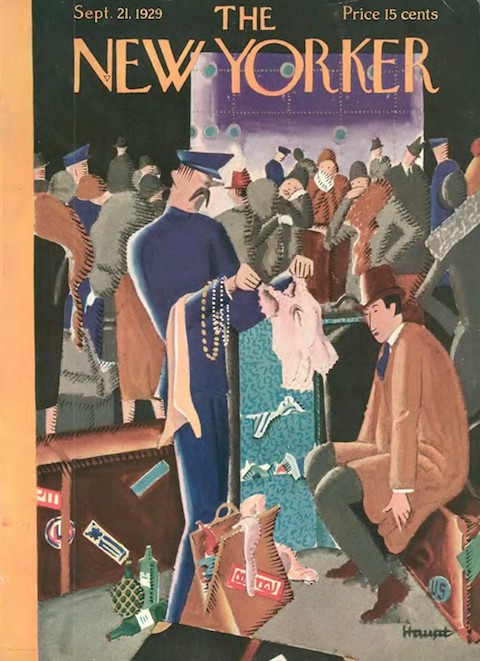
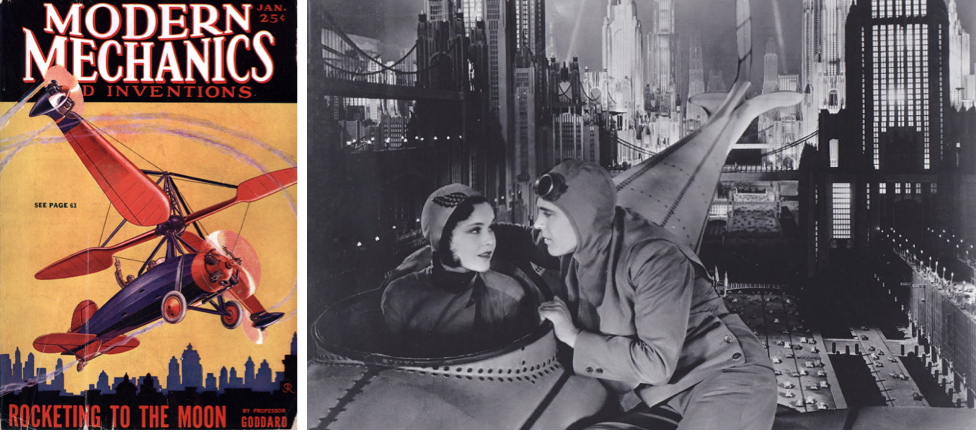
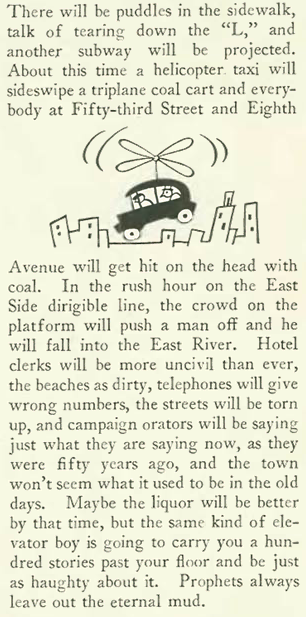
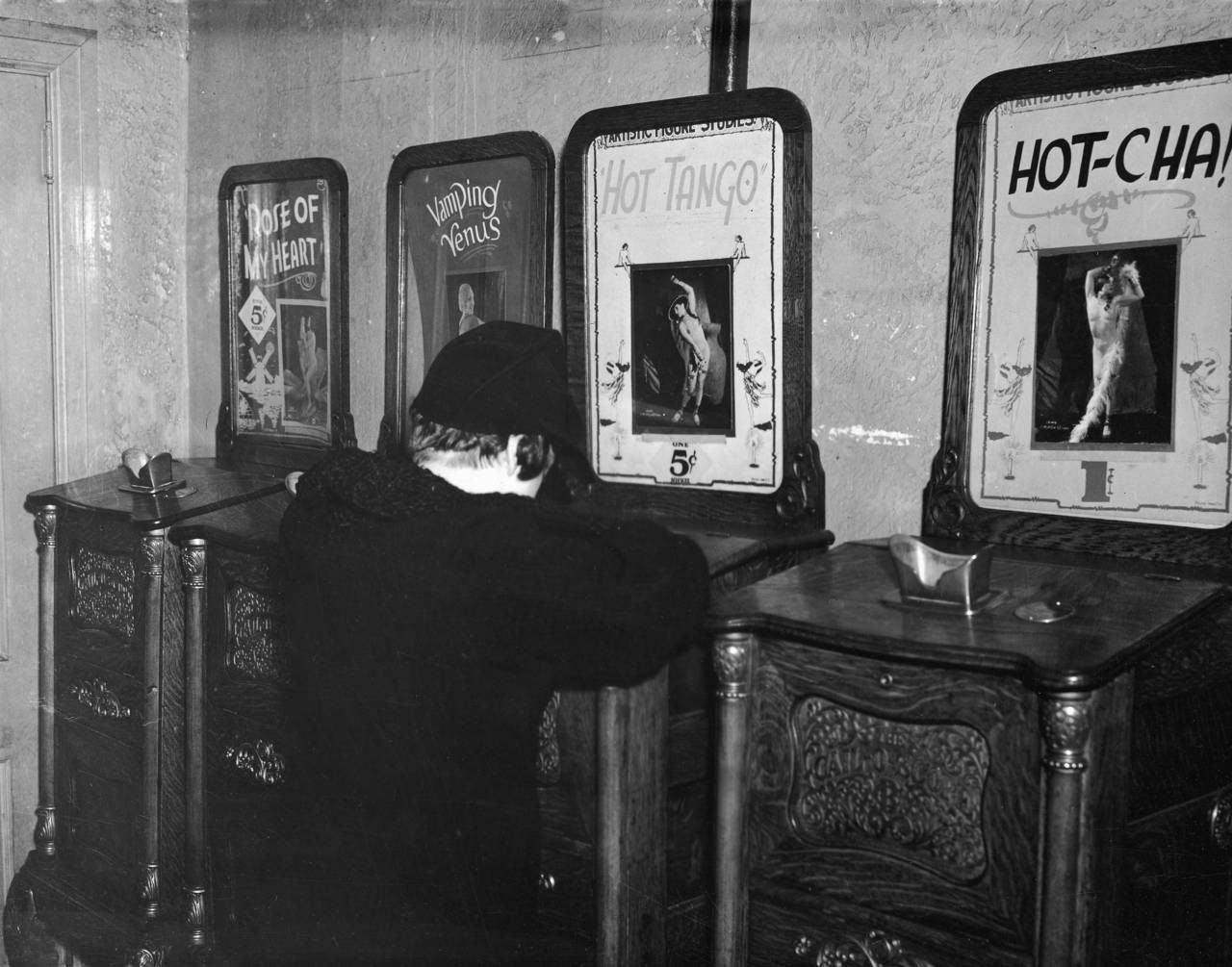
The Art of Peace

In July of 1928, war was officially banned from the earth. Or so it was hoped when the Kellogg–Briand Pact became effective on July 24, 1929.

Aug. 3, 1929 cover by Gardner Rea.

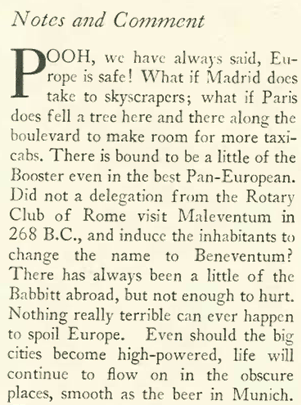
Also known as the “Pact of Paris” and more officially the “General Treaty for Renunciation of War as an Instrument of National Policy,” its authors, United States Secretary of State Frank B. Kellogg and French foreign minister Aristide Briand, gathered world powers in Paris on Aug. 28, 1928 to sign a treaty that denounced the use of war and called for the peaceful settlement of all future disputes. The New Yorker, in the opening “Notes and Comment” section of “The Talk of the Town,” took its usual “What, Me Worry?” approach to world affairs, finding the whole thing unnecessary given that (in its view) Europe was already a peaceful, even benign continent:

GIVE PEACE A CHANCE…French foreign minister Aristide Briand, Myron T. Herrick (U.S. ambassador to France), and U.S. Secretary of State Frank B. Kellogg meet in the French Foreign Office for the signing of the General Treaty for Renunciation of War as an Instrument of National Policy, August 1928; at right, Briand speaking to the assembly. (theinternationalistsbook.com//Wikipedia)

In January 1929 the U.S. Senate officially ratified the Kellogg–Briand Pact with a nearly unanimous vote, 85-1. John James Blaine, senator from Wisconsin, cast the lone dissenting vote (although four years later Blaine would author another piece of legislation that would have a much greater impact, at least at the time: the 21st Amendment, which ended Prohibition).

SURE, WHY NOT?…The U.S. Senate approved the Kellogg–Briand Pact on Jan. 15, 1929. The treaty went into effect later that year on July 24. (The New York Times)

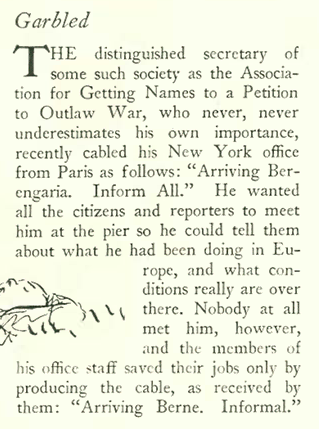
Another item in “The Talk of the Town” made further reference to the pact…

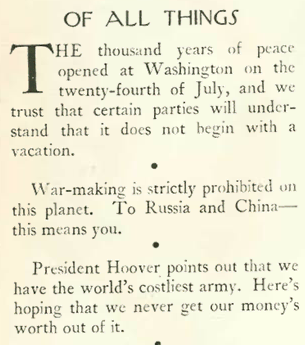
…and Howard Brubaker, in his column “Of All Things,” made special mention of the Sino-Soviet border conflict in referencing the pact:

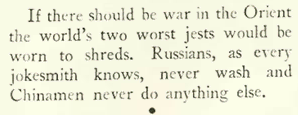
Brubaker mockingly suggested that the pact marked the beginning of a thousand years of peace, an inadvertently prescient remark considering that in less than four years Hitler would seize power in Germany and announce the beginning of his “Thousand Year Reich” — which we know was quite the opposite of peace. Brubaker was also off the mark with this crude observation:

Just two years after Brubaker wrote those words, Japan would invade Manchuria. And only a decade would pass before Germany and Russia would invade Poland and ignite the biggest war of all time.

PARTY POOPERS…The New Yorker wasn’t alone in poking fun at the Kellogg–Briand Pact. At left, the pact is mocked during the Paris Carnaval in 1929; at right, British cartoonist Sidney Conrad Strube reminded readers of the outcome of America’s earlier efforts at world peace. (Wikipedia/Pinterest) click to enlarge.
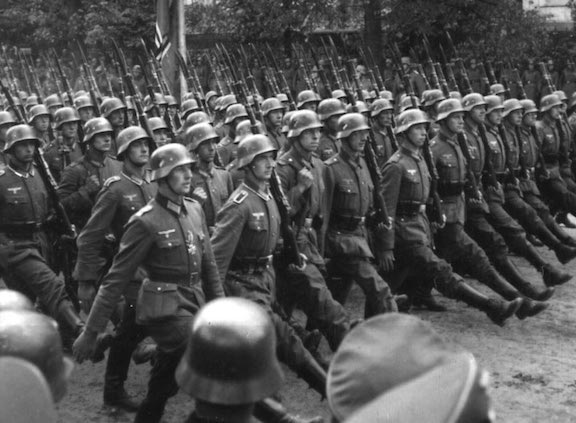
WE JUST CAME TO SAY HELLO…Germany, the first signatory to the Kellogg-Briand Pact banning all war, invaded Poland just ten years after that treaty went into effect. Above, German troops parade through Warsaw after the invasion, September 28-30, 1939. (National Archives and Records Administration)

Although the pact was ridiculed for its perceived naïveté, and for the fact that it did not prevent the largest war in human history, some modern scholars see otherwise. Political scientists Oona A. Hathaway and Scott J. Shapiro observed (in 2017) that the pact “catalyzed the human rights revolution, enabled the use of economic sanctions as a tool of law enforcement, and ignited the explosion in the number of international organizations that regulate so many aspects of our daily lives.” In his recent book Enlightenment Now, Steven Pinker notes “virtually every acre of land that was conquered after 1928 has been returned to the state that lost it. Frank Kellogg and Aristide Briand may deserve the last laugh.”

*  *  *

Gallows Humor

Other items in “The Talk of Town” included this brief anecdote, which I doubt many would find humorous today:

 *  *  *

On The Bowery

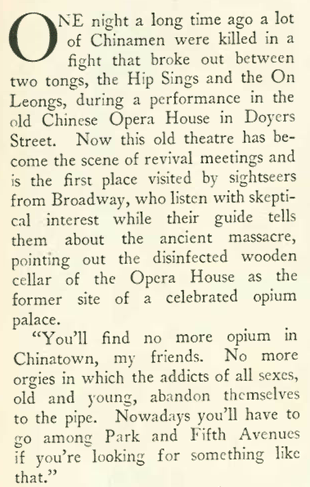
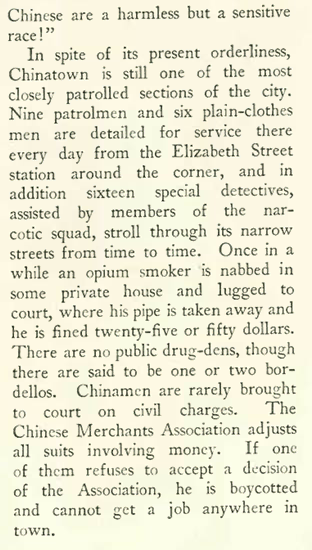
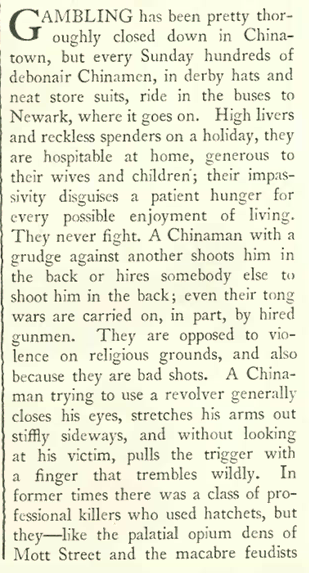
In the “Reporter at Large” column, Niven Busch Jr. paid a visit to “The Yellow Bowery,” as the piece was titled. Notable in this article (and in Brubaker’s quip above) is the use of term “Chinaman,” a term considered offensive today but in the 1920s was used indiscriminately for East Asians. Here it seems pejorative:

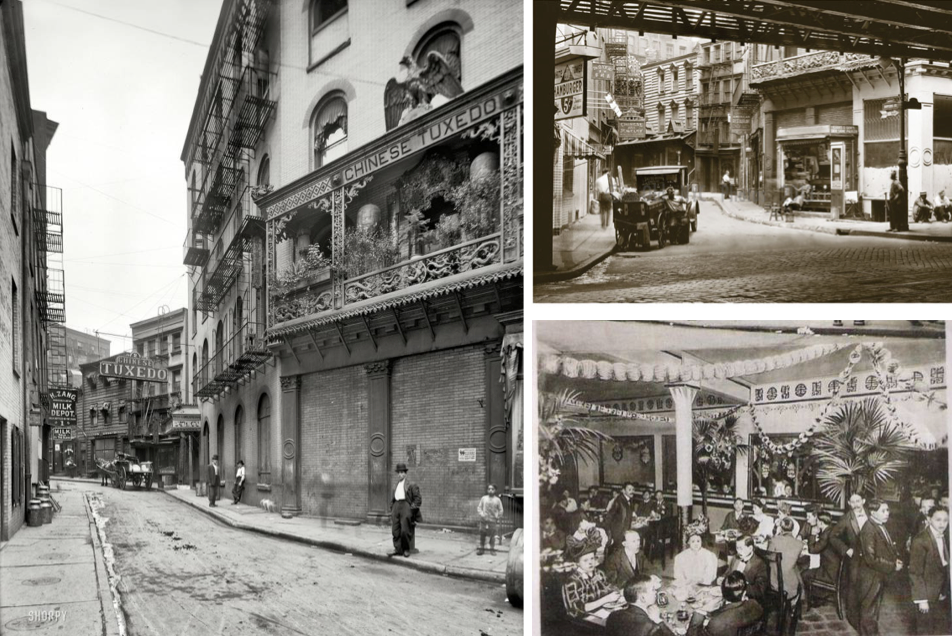
THE BLOODY ANGLE…Clockwise, from top, this bend in Chinatown’s Doyer Street was known as “The Bloody Angle” due to the numerous killings among the Tong gangs that lasted into the 1930s. Hatchets were a popular weapon of choice, leading to the creation of the expression, “hatchet man”; another perspective of Doyer Street from 1932; the street was also the site of the first Chinese language theater in New York City. (boweryboyshistory.com/Museum of the City of New York/Wikipedia)

Busch’s piece was rife with stereotypes…

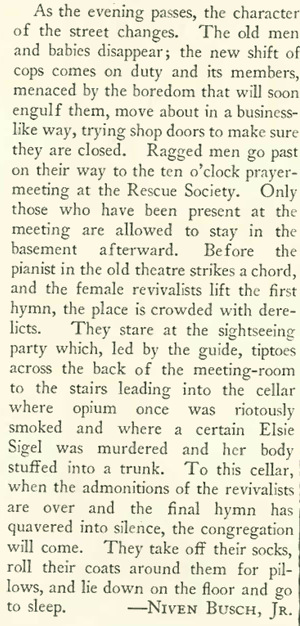
…and referenced the unsolved Bowery murder of 19-year-old Elsie Sigel, a missionary in Chinatown who was found in a trunk, strangled, in 1909…

THE OTHER SIDE OF THE TRACKS…2 Doyer Street was the address of the Chinese Tuxedo Restaurant. It attracted non-Chinese patrons, particularly those who considered themselves ‘Bohemians’ as well as businessmen looking for an ‘exotic’ night on the town. And it helped that the Tuxedo was near the elevated train. (Courtesy Flickr/straatis/thelodownny.com)

*  *  *

It Grows on You

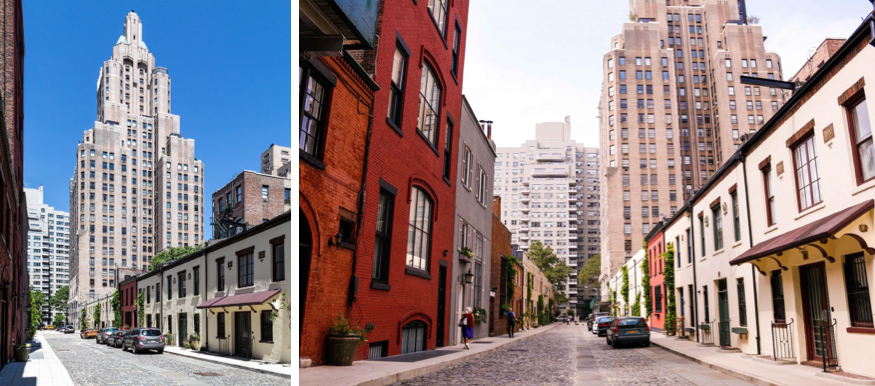
The rapid demolition of old New York was a recurring theme in The New Yorker of the 1920s, the magazine often wavering between nostalgia and the thrill of the new. No place was perhaps more sacred than the stately row houses of Washington Square. When news circulated that a section consisting of the old Rhinelander mansion would soon fall (for the sake of a new apartment building), “Talk” tried its best to process the change:

IT LOOMS, BUT WE GOT USED TO IT…The New Yorker once resented the intrusion of the One Fifth Avenue building (built in 1927), looming above the cobbles of the early 19th century Washington Mews. (newyorkitecture.com/Viola Mai, Washington Square News)
MIND THE GAP…Clockwise, from top, just east of this row of houses stood the mansion of William Rhinelander; although The New Yorker noted that its demolition was imminent in 1929, the mansion stood until 1951, when it was demolished and replaced by the 20-story 2 Fifth Avenue; next to the gap between the old row houses and the apartment stands the Roger Shattuck House, No. 19 Washington Square North. The Shattuck House was the scene of one of most sensational robberies in the city’s history—in 1922. (nyc-architecture.com/Google Maps)

 *  *  *

Old Boy

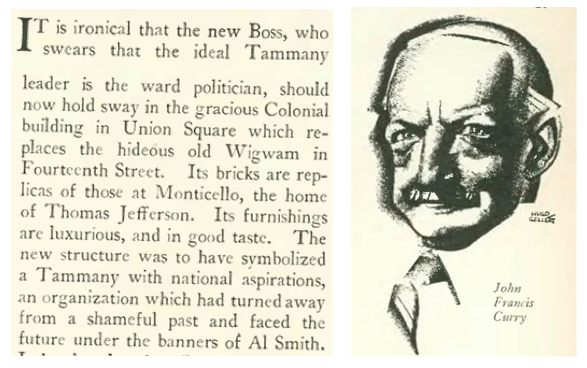
In one of my recent posts (Not Your Grandpa’s Tammany Hall) I noted a “Talk” item that described the new Tammany headquarters. In the August 3 issue the magazine introduced the patriotic society’s new leader, John Francis Curry, in a profile written by Henry F. Pringle. In the piece, titled “Local Boy Makes Good,” Pringle suggested that Curry’s old-fashioned approach to politics stood in contrast to the new image Tammany Hall was attempting to project:

Curry’s tenure would end abruptly in 1934 — the first Tammany boss to be booted out by his own followers. Curry made some bad decisions during a time when the political winds were shifting away from machine politics. It was under his leadership that Tammany backed Al Smith over the reform-minded Franklin Roosevelt for the 1932 Democratic presidential nomination. That same year, Tammany-backed New York Mayor Jimmy Walker would be forced from office amid scandal.

*  *  *

Well, She Didn’t Write the Script

We all know Greta Garbo as one of the greatest film stars of classic Hollywood. Her mysterious aura and subtlety of expression are still lauded by film critics today. The New Yorker, however, never seemed particularly enamored of the star’s performances. Here is a review of her 1929 silent film, The Single Standard:

THE KID STAYS IN THE PICTURE…Little Wally Albright played Greta Garbo’s son in The Single Standard. We just saw four-year-old Wally in my last post, in which he also appeared as Peggy Wood’s son in Wonder of Women. Apparently when a director needed a cute, curly head kid, they went for Wally—he appeared in seven films in 1929 alone. (Rotten Tomatoes)

*  *  *

From Our Advertisers

Our first advertisement (image at right) is from the back pages of the Aug. 3 issue. It announced the opening of Long Island’s Atlantic Beach Club, which featured the entertainment of Rudy Vallée and his orchestra…

CAN YOU HEAR ME NOW? Images, top to bottom, aerial view of The Atlantic Beach Club; Rudy Vallée performing with emblematic megaphone, 1929; postcard image of the Nautilus Hotel on the Boardwalk of Atlantic Beach, Long Island. (longbeachlibrary.org/YouTube)

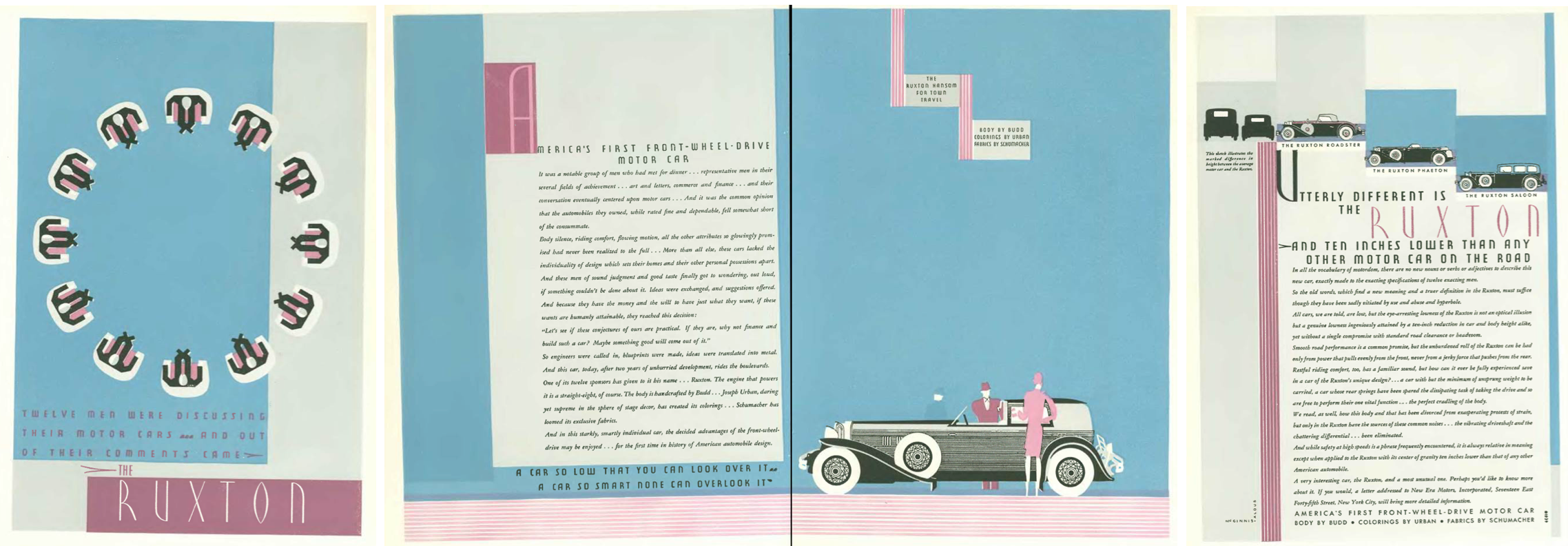
…a brand-new car—The Ruxton— was introduced to New Yorker readers in this color advertisement that spanned four pages (click image to enlarge)…

…produced in 1929-30 by the New Era Motors company of New York, the car was marketed for its innovative front-wheel drive and its distinctive low profile (a feat accomplished by eliminating the drive shaft to the rear wheels). While most cars in the late 1920s had an average height of 6 feet (1.8 meters); the Ruxton was less than 4 and half feet (1.3 meters) high. Producers of the car hoped to sell the rights of the Ruxton to an established car manufacturer. Moon Motors of St. Louis built just 96 of the cars during regular production (from June to October, 1930) before the whole deal fell apart…

SHORT RUN…Clockwise, from top left, Ruxton logo affixed to grille; dancer Rita La Roy poses with her Ruxton, 1930; some models sported Joseph Urban color schemes designed to lengthen the appearance of the car. (allcarcentral.com/Pinterest/hemmings.com)

…if you were one of the fortunate few to own a Ruxton, you might take it for a spin on the Lincoln Highway…or maybe not. Despite the appearance of this ad, a fully paved, transcontinental highway was still an incomplete dream in 1929. Although sections of the road were quite smooth from New York to Omaha, further west things could get a bit bumpy, especially on the unpaved stretches. However, as the ad claims, what really made the road viable was the availability of regularly spaced gas stations along the way…

…I liked this ad for its sheer complexity…

…and then we have this ad from Saks, which somehow conflated new shoes with an intimate encounter with Aphrodite.,,

…on to our cartoonists, we have Helen Hokinson’s observations at “Old Narragansett…

…while out to sea, Alan Dunn found humor in a sensitive swabbie…

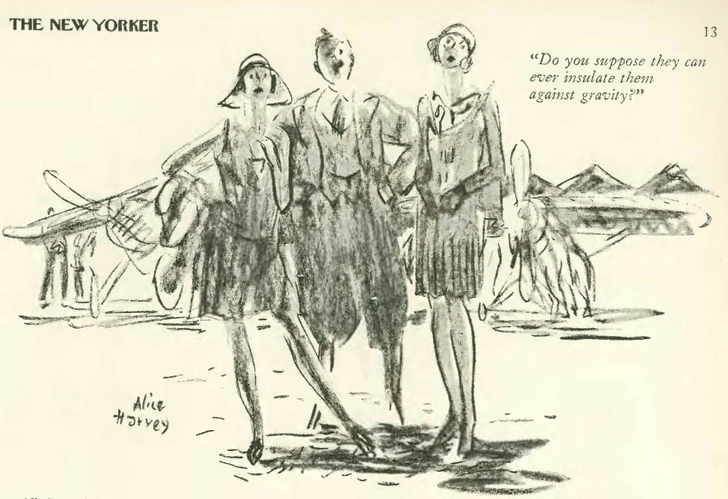
Alice Harvey observed those still skeptical of human flight…

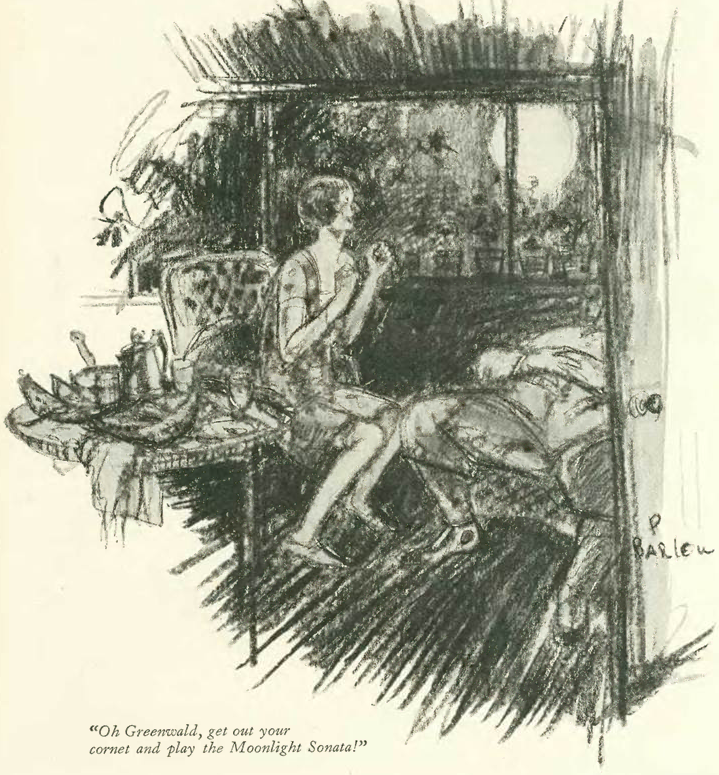
Perry Barlow peeked in on a moonstruck woman…

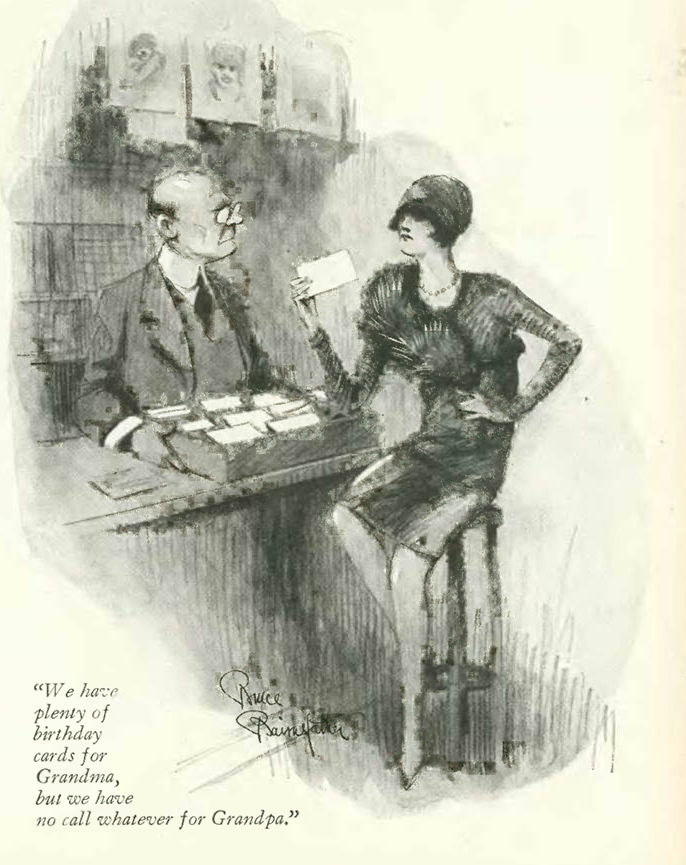
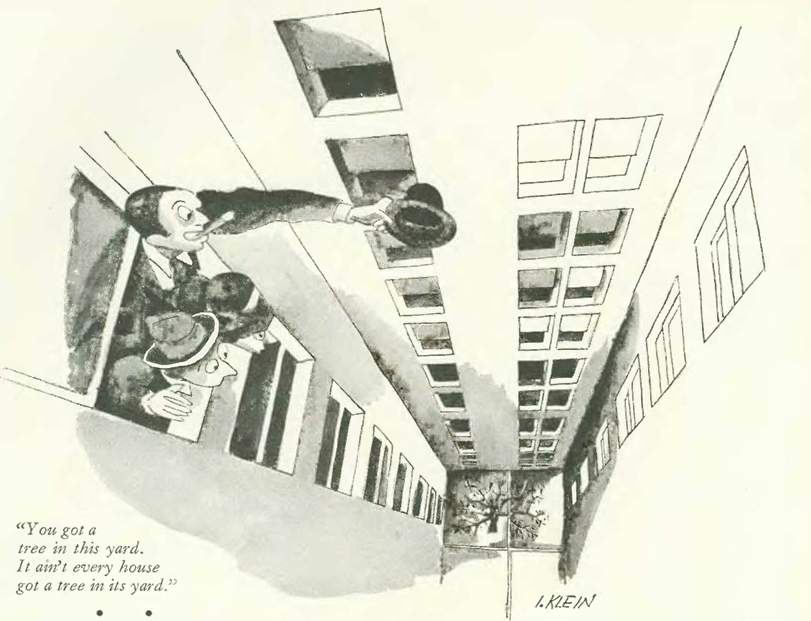
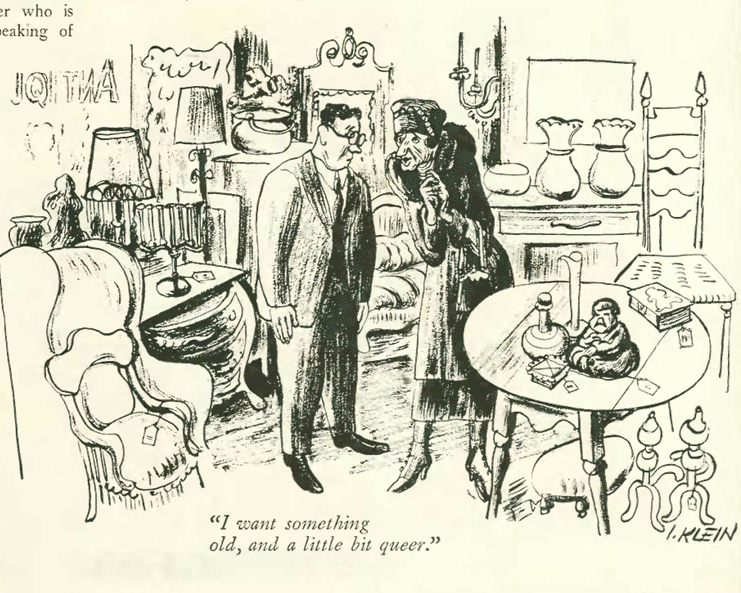
…and finally, Isadore Klein visited an antique shop…
Next Time: The Last Summer…


How Charles Shaw Felt About Things

Some people really do lead charmed lives: Take for example Charles Green Shaw. Born to wealth, he was a fixture in the glamorous social scene of Jazz Age New York, but was also a key player in its intellectual and artistic life. An accomplished author as well as a poet and illustrator, Shaw turned to painting in his late thirties and became a leading figure in the world of abstract art.

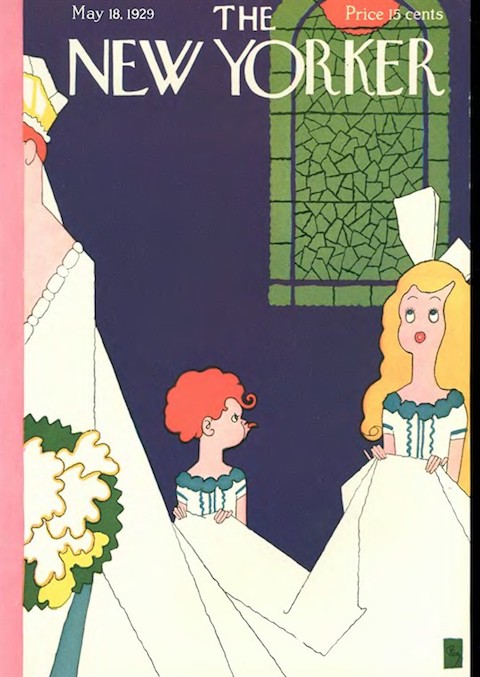
May 18, 1929 cover by Gardner Rea.

Shaw (1892-1974) was an early contributor to The New Yorker, penning more than thirty pieces for the magazine between 1925 and 1932, including three short contributions to the very first issue (Feb. 21, 1925). Here’s one of them:

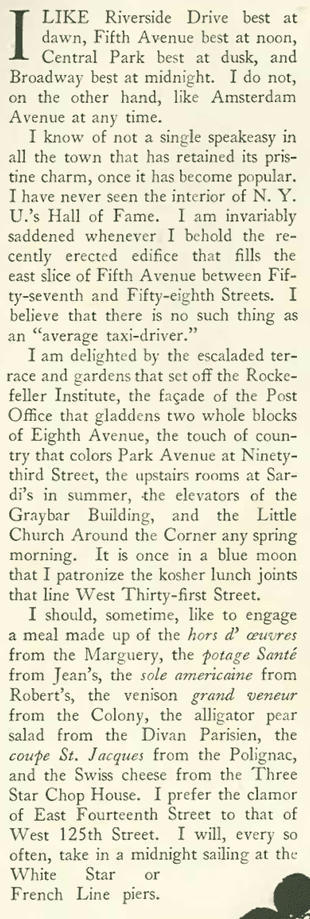
That short piece anticipated a much longer entry by Shaw four years later—in the May 18, 1929 New Yorker—in a column titled “How I Feel About Things.” An excerpt…

YEAH & MEH…Charles Shaw liked Central Park at dusk; Amsterdam Avenue, not so much. (Time Freeze Photos/NYC Municipal Archives)
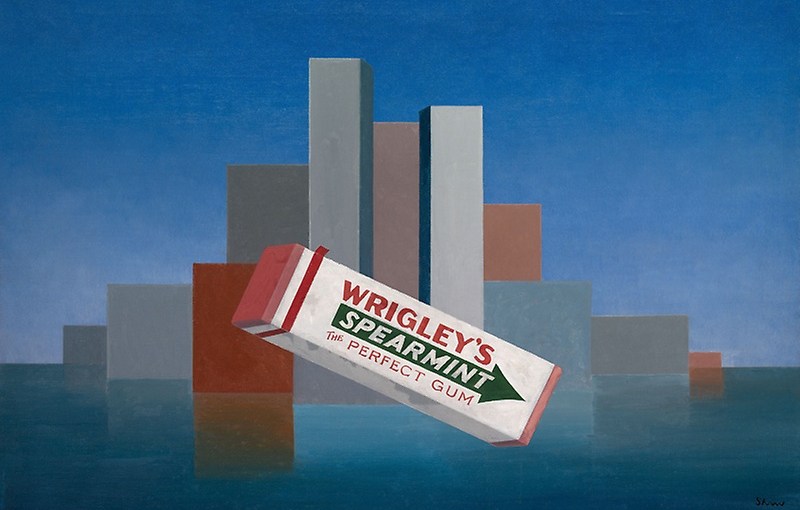
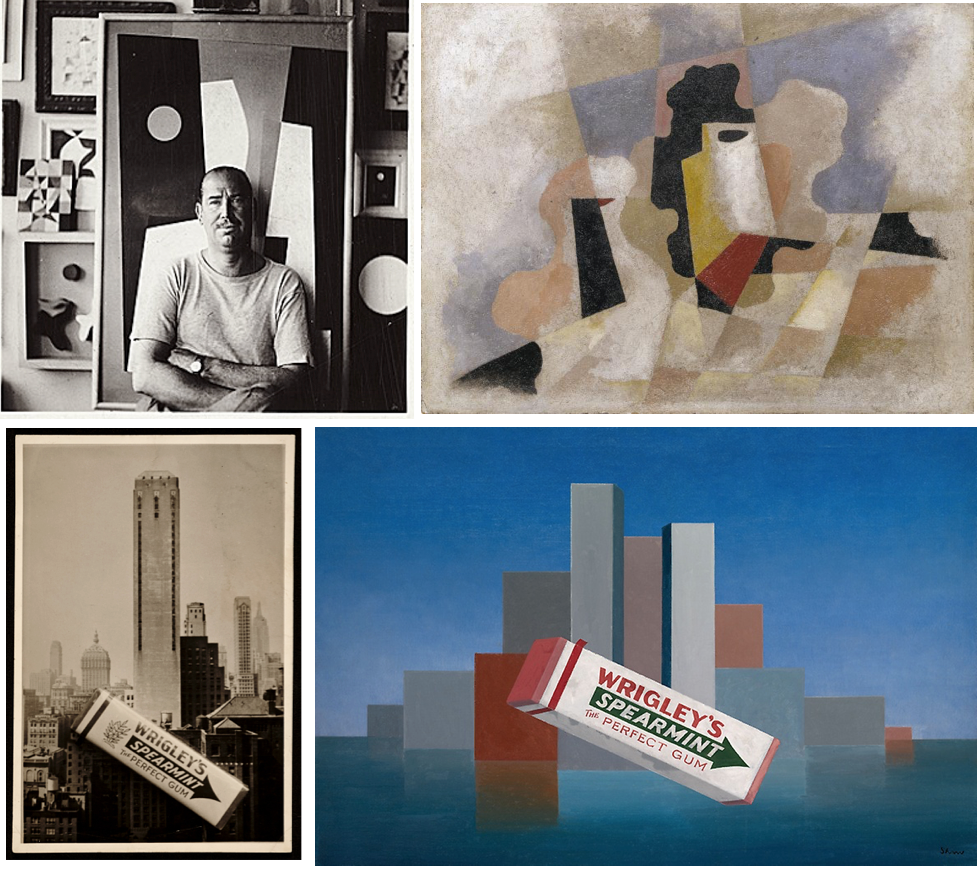
SOMETHING TO CHEW ON…Top left, Charles G. Shaw in 1945. Clockwise, from top right, Untitled Abstraction, 1943, oil on fiberboard; Wrigley’s, 1937, oil on canvas; photo of Wrigley’s gum package on top of a postcard image of New York City. On the back of the photo Shaw had written “idea for montage.” (Wrigley painting courtesy Art Institute of Chicago/other images from Archives of American Art, Smithsonian Institution)

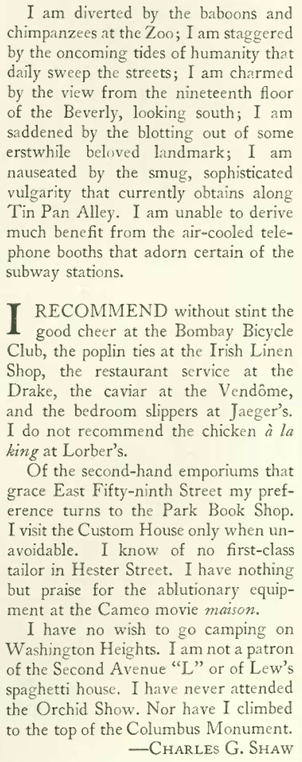
…one more excerpt from the Shaw column…
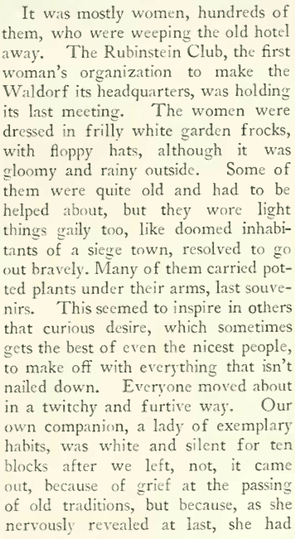
Shaw would contribute more columns to The New Yorker in this vein: four more titled “How I Feel About Things” (1929-1931) followed by “How I Look at Things in General” (1931), and his final two New Yorker columns (1931-1932), “Things I Have Never Liked.”

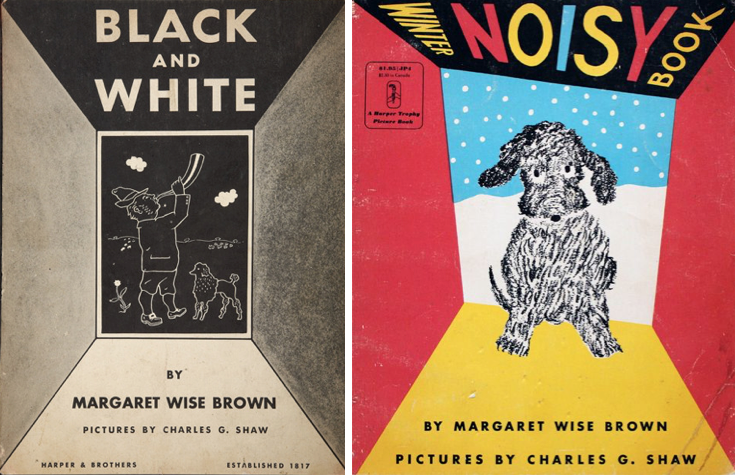
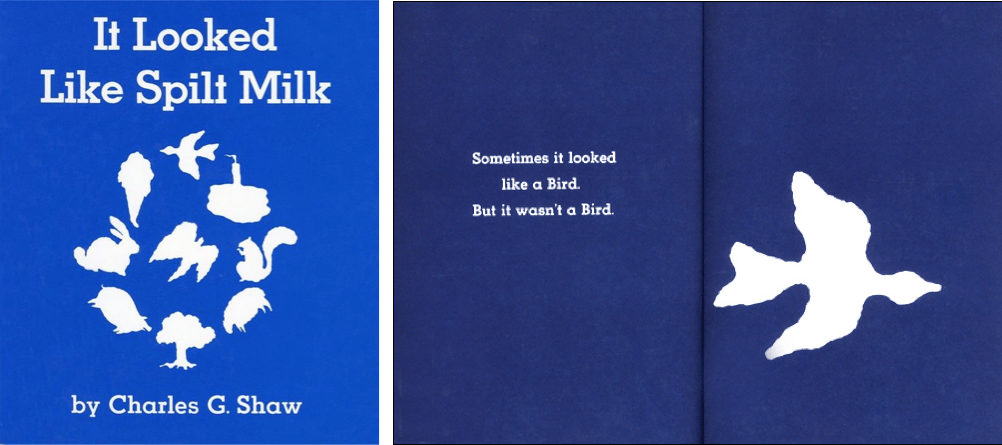
He also illustrated children’s books, including two by Margaret Wise Brown (of Goodnight Moon fame). In 1947, Shaw published It Looked Like Spilt Milk, a book that introduced children to abstract art. It remains in print and popular today.

SOMETHING FOR THE KIDS…Shaw provided illustrations for Margaret Wise Brown’s Black and White (1944) and The Winter Noisy Book (1947). (Harper)
STILL POPULAR…Shaw published It Looked Like Spilt Milk as a children’s introduction to abstract art. (Kinder Books)

 *  *  *

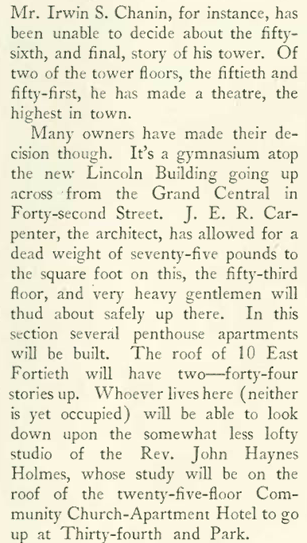
In the “The Talk of the Town,” James Thurber looked at “high-living” trends among occupants atop the city’s newest skyscrapers, including developer Irwin Chanin:

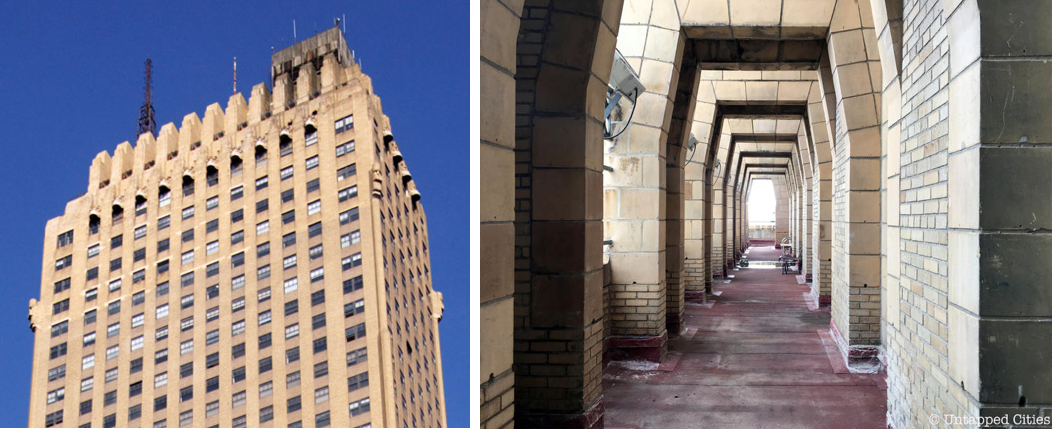
CROWN JEWELS…The Chanin Building at 122 E. 42nd Street sports a distinctive crown that contains a wraparound terrace (now closed) at the 56th floor. A theater on the 50th and 51st floors, just below Irwin S. Chanin’s executive suite, was later converted into office space.(aviewoncities.com/untappedcities.com)
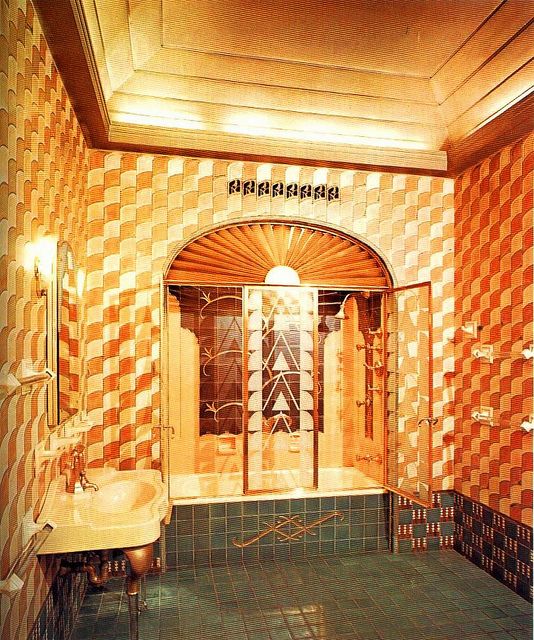
A THRONE IN THE SKY…The art deco bathroom in the 52nd floor executive suite of architect and real estate developer Irwin S. Chanin was designed by Jacques Delamarre. (Pinterest)
AERIAL GYMNASTICS…1930s postcard image of the Lincoln Building at 60 East 42nd. At right, the building’s rooftop gymnasium. (nyc-architecture.com/Tony Hisgett)

…Thurber continued his survey downtown in the financial district, and noted the proliferation of “lanterns” atop various skyscrapers…

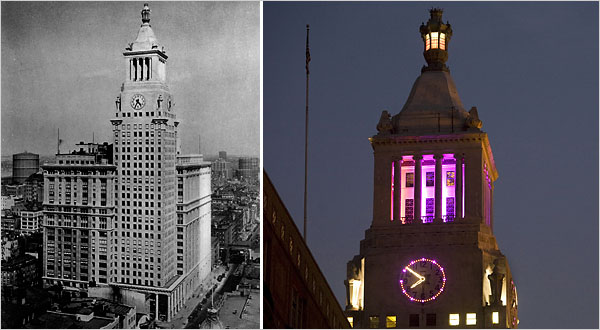
ALL THE RAGE…”Lanterns” of various styles were popular toppers to Jazz Age skyscrapers. Above, the 24-story Consolidated Gas Building (now the Con Edison tower) by day and night. (Architect/Office for Metropolitan History/Michael Falco for The New York Times)
TRY TO TOP THIS…The distinctive lantern of the New York Central Building at 230 Park Avenue, now called the Helmsley Building  (andrewcusack.com/Wikipedia)

*  *  *

Waldorf Adieu, Part Two

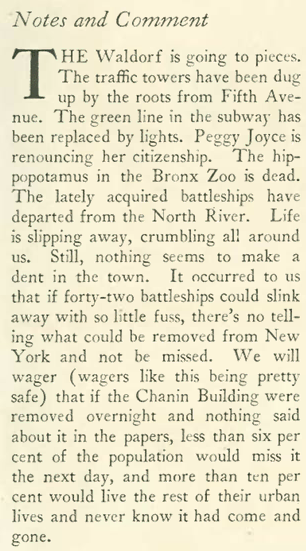
For a second week “The Talk of the Town” led off with an item about the demise of the Waldorf-Astoria hotel, this time attempting to put it into some perspective…

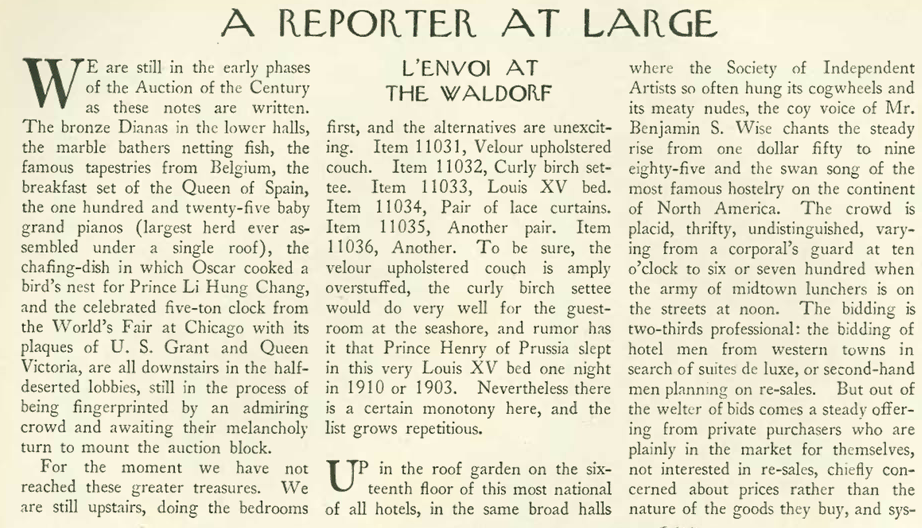
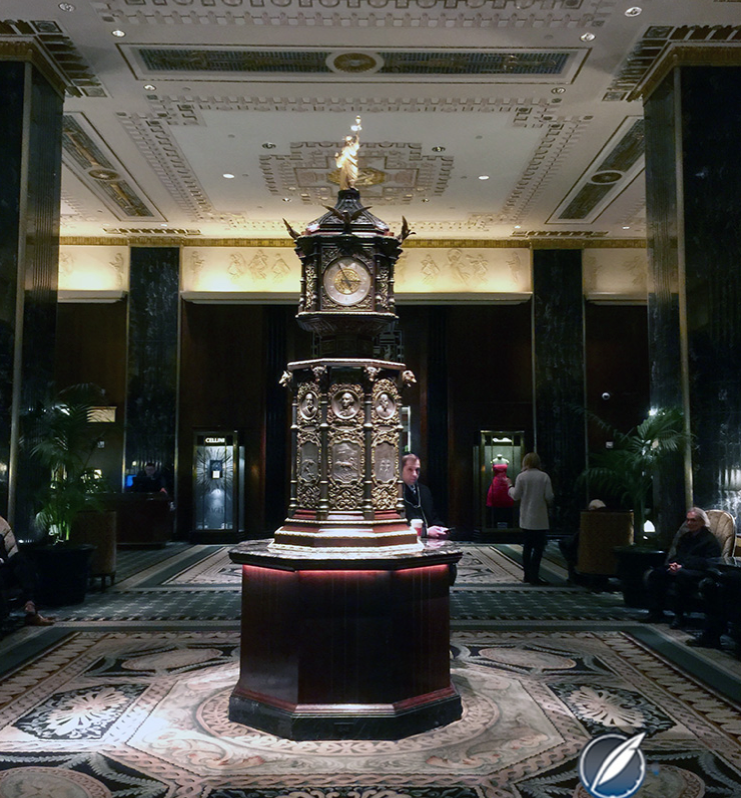
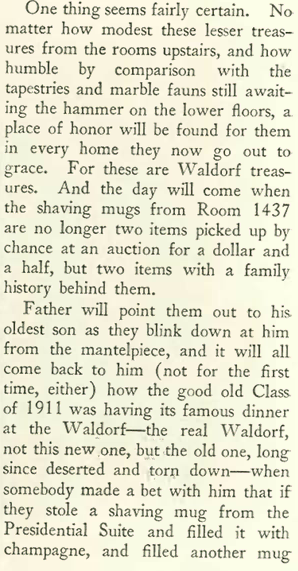
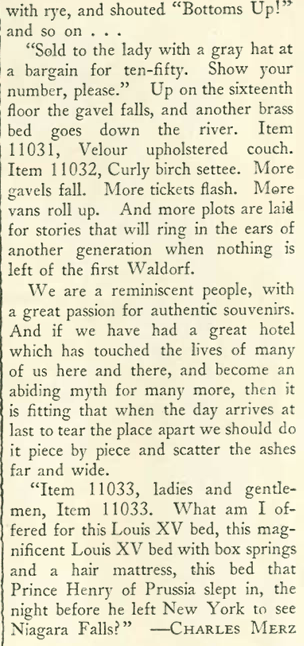
…and Charles Merz offered a lengthy account of the auctions that were already taking place at the hotel as everything from grand pianos (125 in all) to a nine-foot-tall, five-ton, bronze-and-mahogany clock either went on the block or into storage…

GOING, GOING…Illustration depicting an auction of items from the hotel. At right, the Waldorf’s nine-foot-tall, five-ton clock, shown here on display at the 1893 Chicago World’s Fair. A gift from Queen Victoria, the clock was acquired after the fair by John Jacob Astor IV, builder of the Astoria part of the old Waldorf-Astoria. He had it placed near the old hotel’s Rose Room restaurant. (Museum of the City of New York/Wikimedia)
STILL TICKING…The clock as it appears today in the lobby of the new Waldorf-Astoria, which was completed in 1931. A gilded Statue of Liberty was added to the top of the clock in 1902, a gift from the French government. (Wikimedia/Elizabeth Doerr)

…Merz observed that although lavish tapestries, statuary, heavy furniture and other large items were up for sale, many buyers showed up merely to acquire a small memento…

IF THAT IS YOUR THING…Ornate furnishings (such as this French rococo-style furniture) were likely purchased at the auction by someone who actually had room for them. (Pinterest)

…Merz concluded that in the end, these “lesser treasures” will serve as props that will be handed down to the next generations, along with stories about the great and not-so-great who once slept or dined at the old hotel…

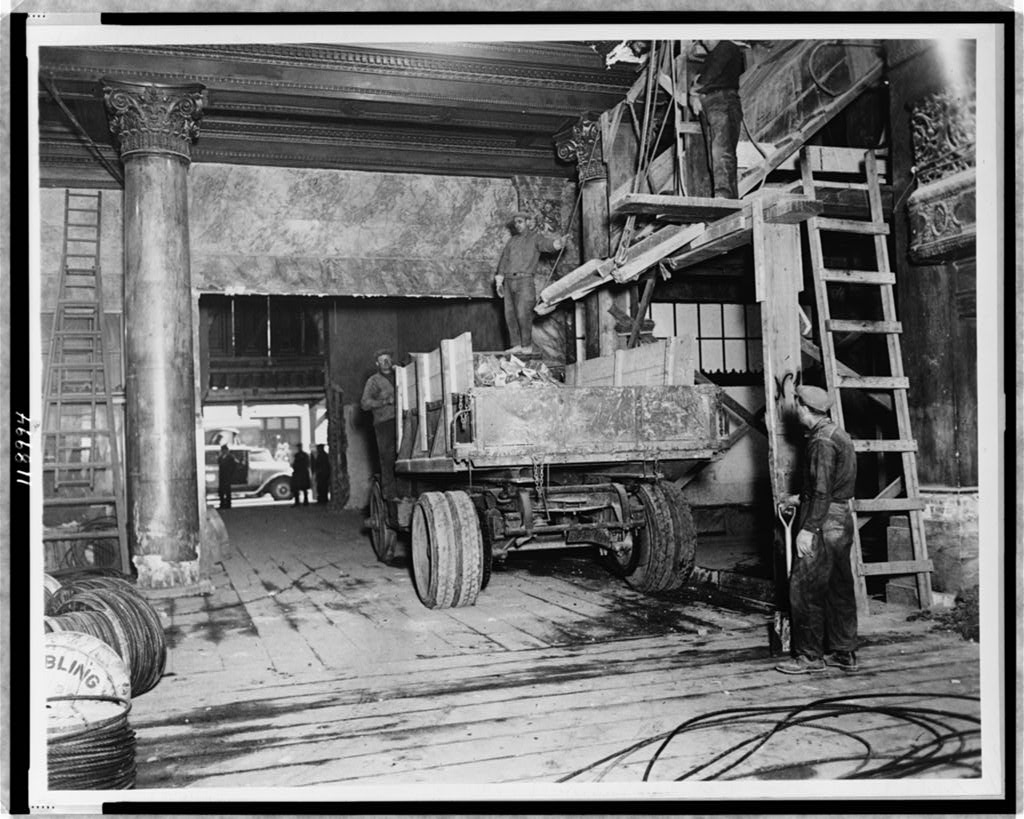
LAST DANCE…Workers emptying the old Waldorf-Astoria ballroom in 1929. (Library of Congress)

The May 18 issue featured yet another item on the Waldorf-Astoria — in “The Wayward Press” column, Robert Benchley (under the pseudonym “Guy Fawkes”) suggested that the story on the hotel’s demise had been milked for all it was worth….

 *  *  *

The Algonquin Wits

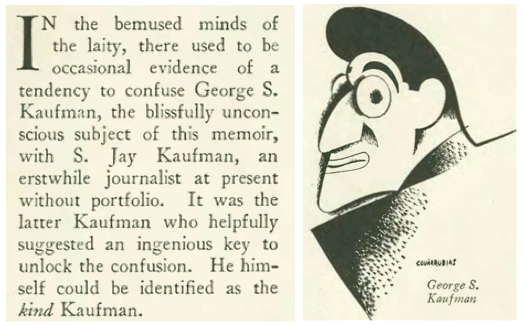
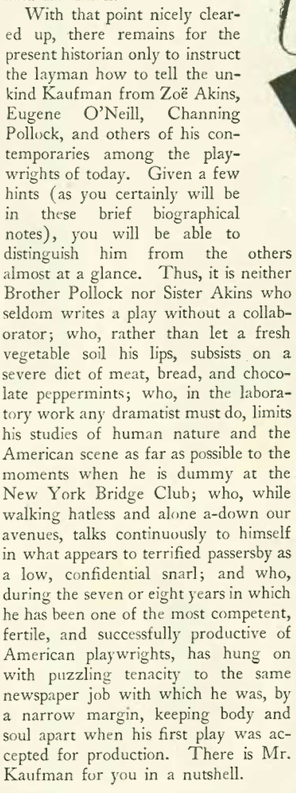
Speaking of milking a story, Alexander Woollcott playfully referenced his own material in the May 18 issue—indeed, quoting a profile he had written in the very same issue. Woollcott penned a humorous piece on friend and fellow Algonquin Round Table wit George S. Kaufman (caricature by Miguel Covarrubias). An excerpt:

…a bit later in the profile, Woollcott observed…

…a few pages later in the same issue, Woollcott offered more observations on his friend in his weekly “Shouts and Murmurs” column…quoting the above paragraph…

Kaufman would have his own say in 1939 with his hit play, The Man Who Came to Dinner (written with Moss Hart). The play’s main character, a cantankerous misanthrope named Sheridan Whiteside, was closely based on Woollcott.

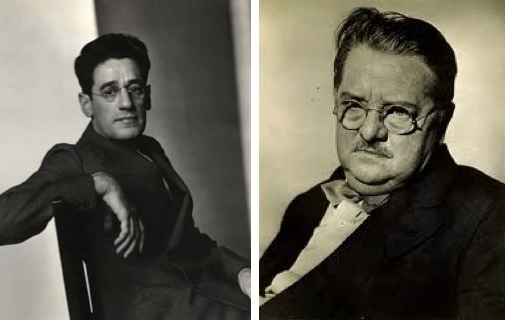
SPARRING PARTNERS…George S. Kaufman and Alexander Woollcott often matched wits around the famed Algonquin Round Table. (Pinterest)
OUT OF SORTS…The cantankerous misanthrope Sheridan Whiteside (a character based on Alexander Woollcott) was portrayed by Monty Woolley in the 1939 hit play, The Man Who Came to Dinner. The play was adapted into a 1942 movie with Woolley (left) reprising his role as Sheridan Whiteside. Playing opposite Woolley are Bette Davis (center) and Ann Sheridan. (oldhollywoodtimes.com)

What did Woollcott think of the treatment? According to an article featured in Story of the Week (Library of America), he loved it: “When the play went on its West Coast tour, he even stepped into the lead role, treating audiences to the sight of a celebrity acting as a satirical version of a character based on his own public persona. At the end of one performance, cheered on by repeated curtain calls, Woollcott riffed off one of his character’s signature lines from the play and announced to the audience that he planned to sue the authors for $150,000.”

Those were the days…

 *  *  *

Distracted Drivers

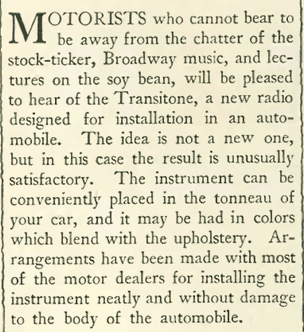
In his “Motors” column, Nicholas Trott described a new gadget that could bring new levels of pleasure (or danger) to the driving experience: the car radio:

The Transitone was probably the first production car radio in the U.S., and looked something like this (left image):

VACUUM TUBES are exposed under the dash of this car (left) outfitted with a Transitone radio. At right, a Crosley car radio from 1931. (radiomuseum.org)

 *  *  *

From Our Advertisers

The makers of Pond’s cold cream continued to land endorsements from the landed gentry, this time from 30-year-old Lady Violet Astor (née Violet Mary Elliot-Murray-Kynynmound, Dame of the Order of St. John), whose hair was described “as ripe as wheat,” her skin “pink and white as a hedge rose.” Okay, I’ll try a jar…

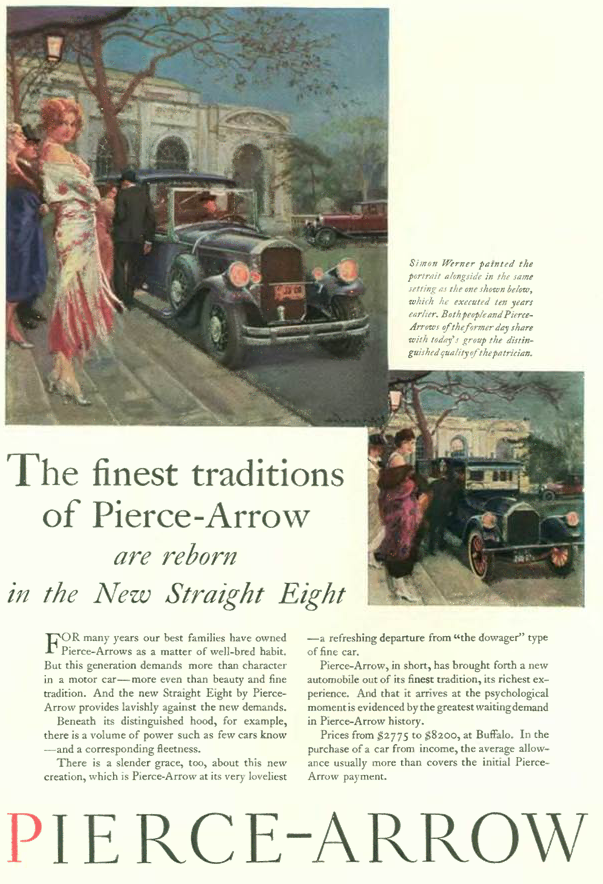
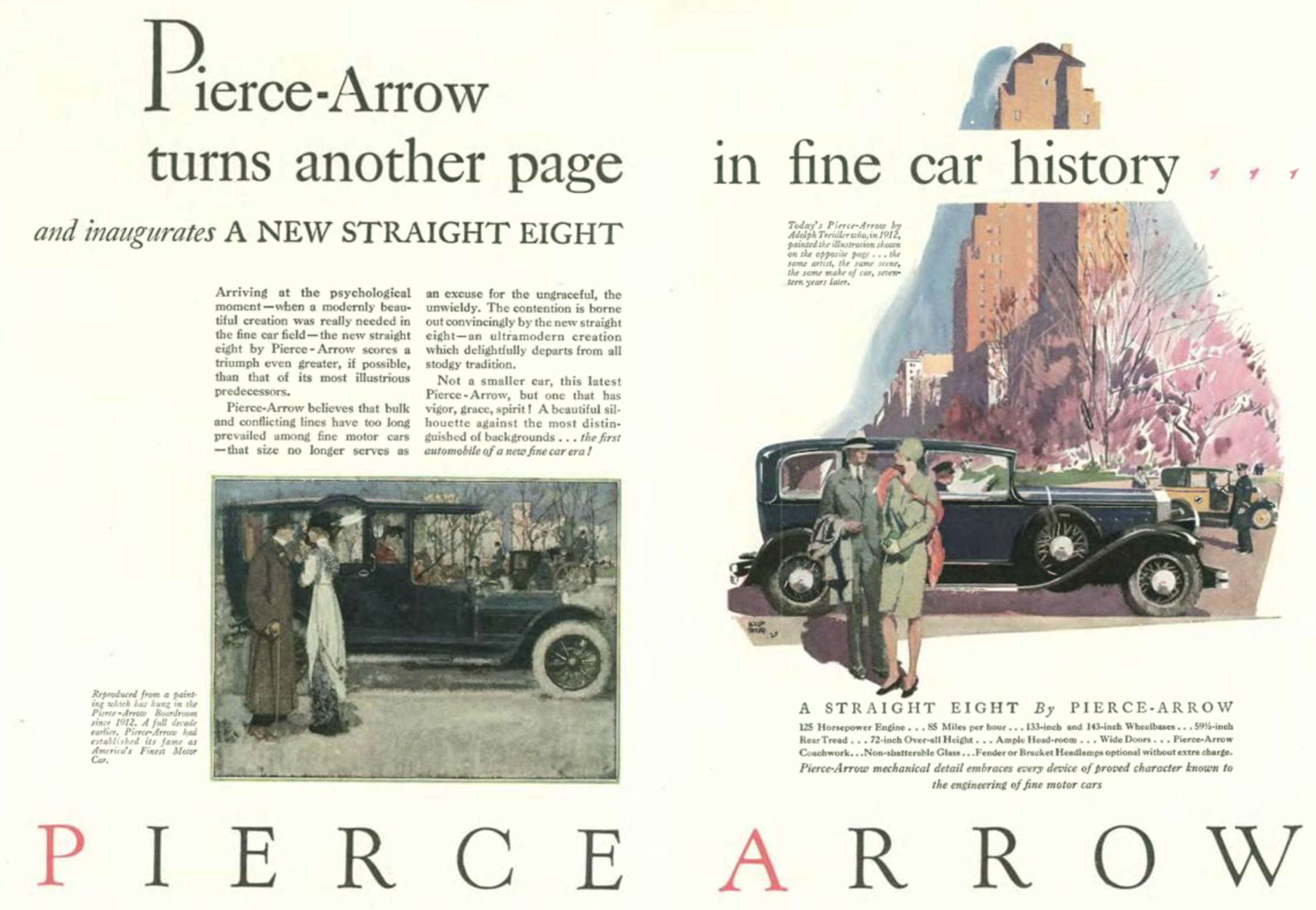
…and for more snob appeal, advertisements from American luxury carmaker Pierce-Arrow often featured messages that linked its cars to a lineage of earlier models, suggesting their automobiles had a well-bred, timeless quality (as opposed to the novelties found in cars driven by the plebeian classes). The caption reads: “Both people and Pierce-Arrows of the former day share with today’s group the distinguished quality of the patrician”…

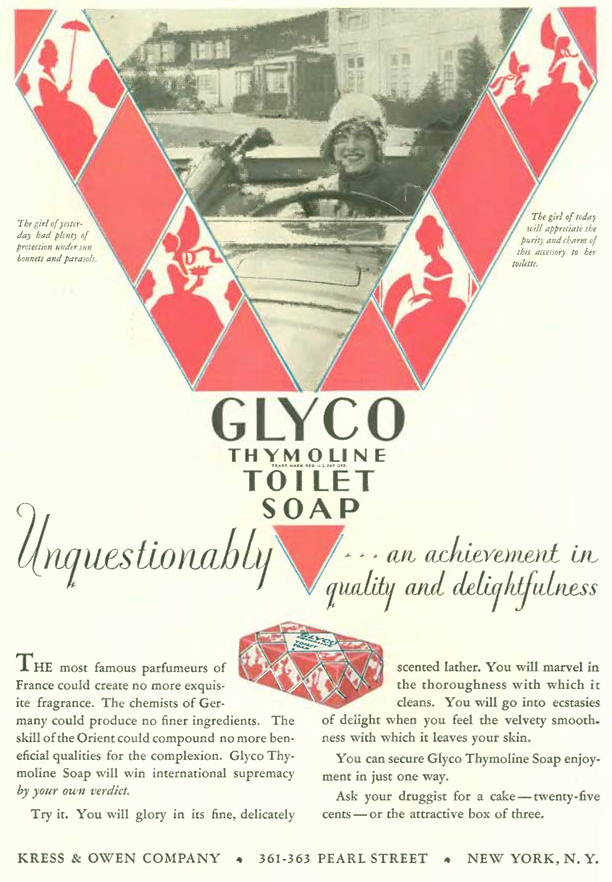
…the makers of Glyco “Thymoline” also drew upon the past to make a point about their soap, stating that “the girl of yesteryear had plenty of protection under sun bonnets and parasols,” whereas today’s young woman boldly races off to play golf without even bothering to put up the windshield. She’ll need Glyco to scrub off the bugs, dust and bits of gravel that will likely kick up into her face…

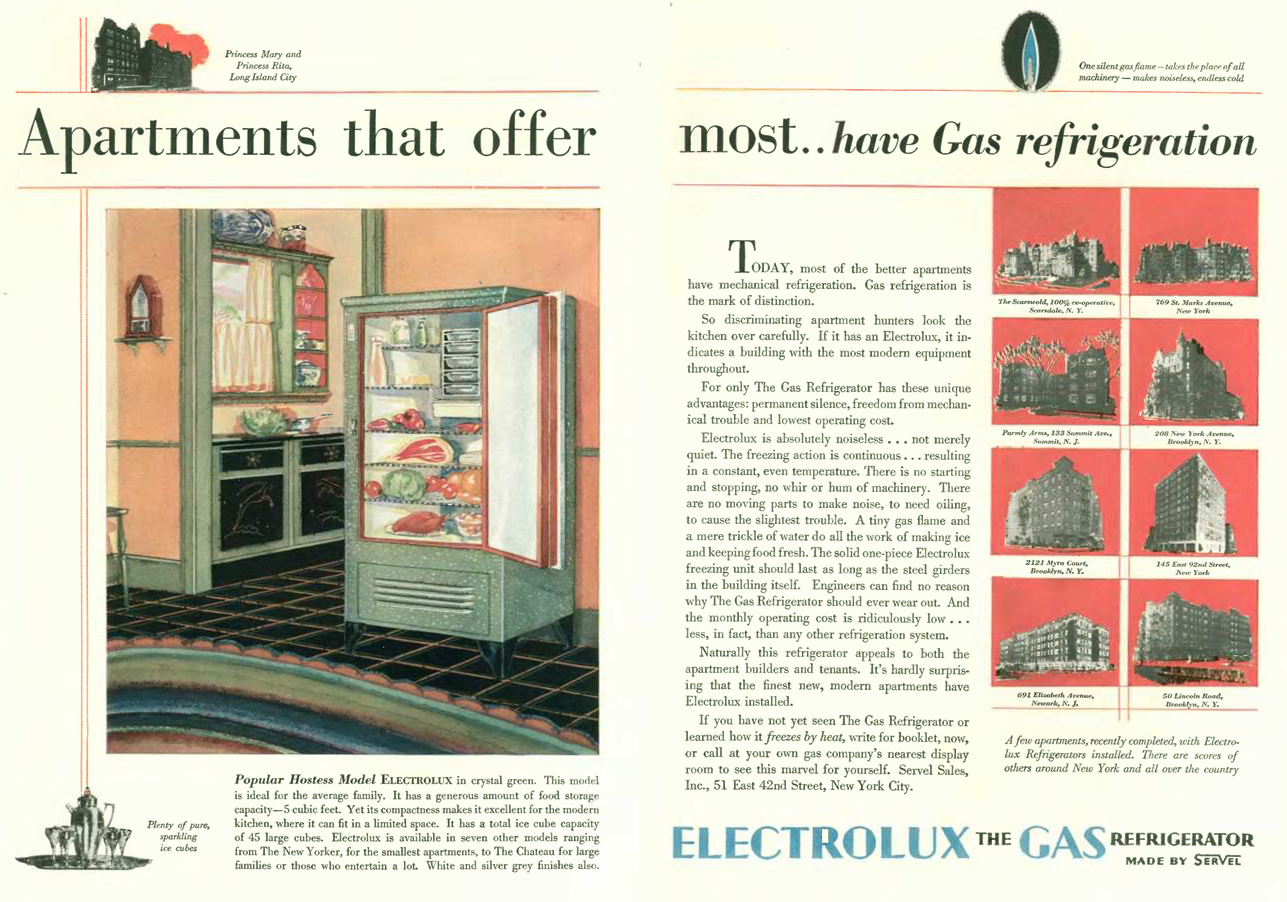
…One thing you notice at the end of the 20’s is the proliferation of color ads in The New Yorker, some quite lavish including this appeal from Electrolux, which depicted all of the new apartments popping up around the city powered by their gas appliances…

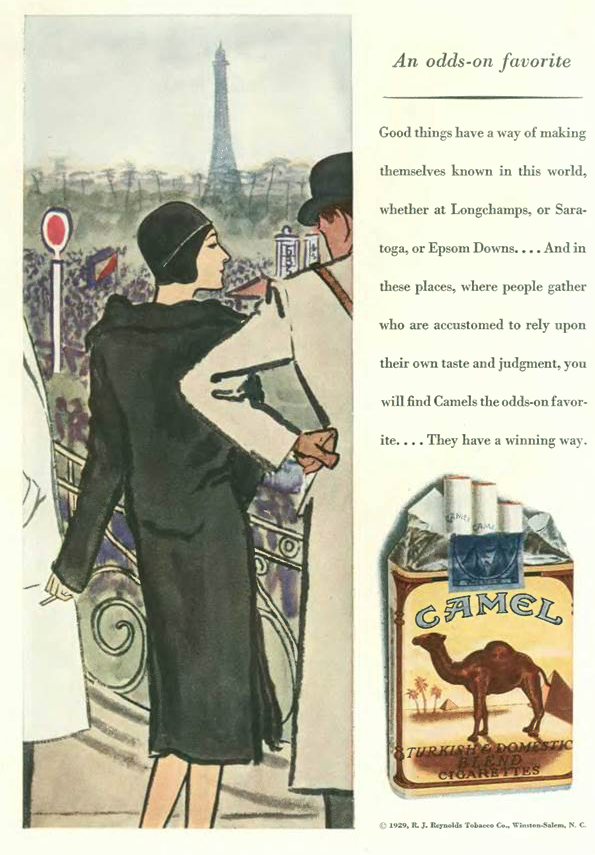
…and we have another lovely rendering by Carl “Eric” Erickson urging readers to smoke Camel cigarettes…

…and this ad caught my eye for its depiction of a house in the future, namely the year 1949 — you land your personal airplane on the roof and relax in your dynamic, angular furniture while a robot butler shakes up cocktails for you and your top-hatted friend…

…the house in the ad somewhat resembles this 1929 drawing by Swiss-American architect William Lescaze

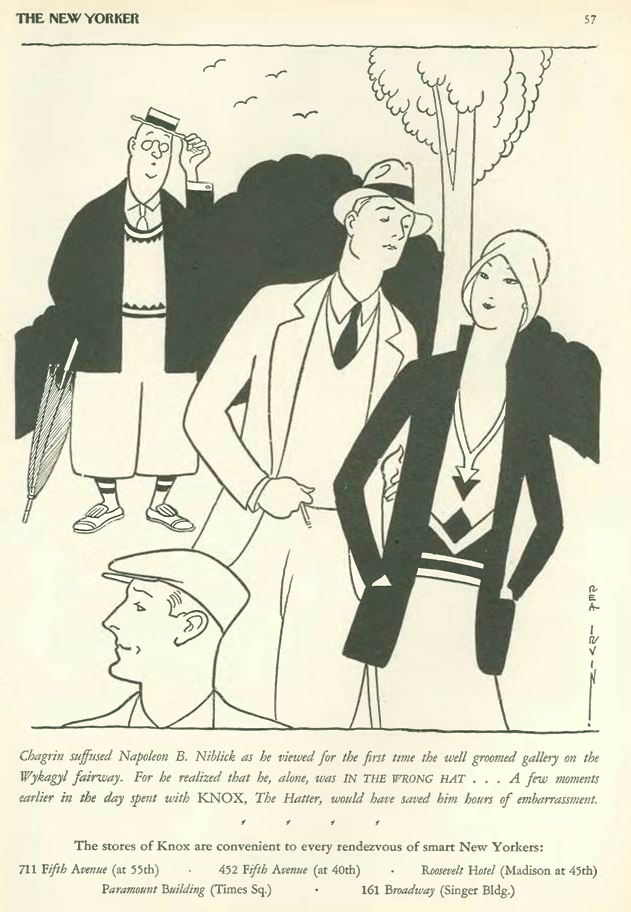
…we have another ad from Knox hatters (drawn by Rea Irvin) that featured an unfashionable, portly man (Napoleon B. Niblick) being snubbed by some Westchester toffs…

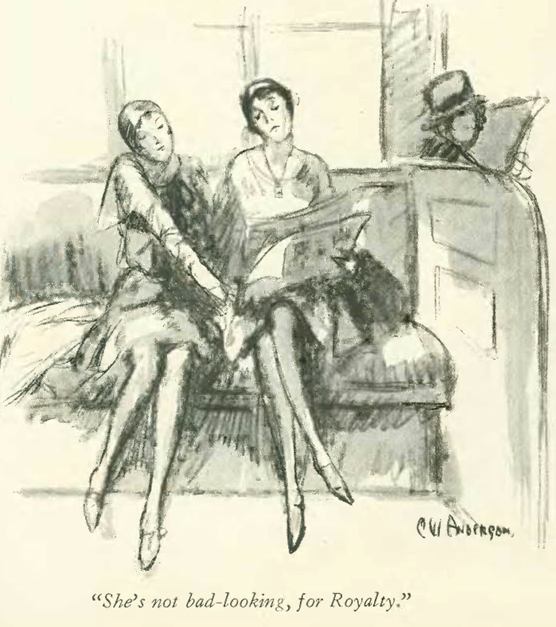
…our comics are provided by C.W. Anderson

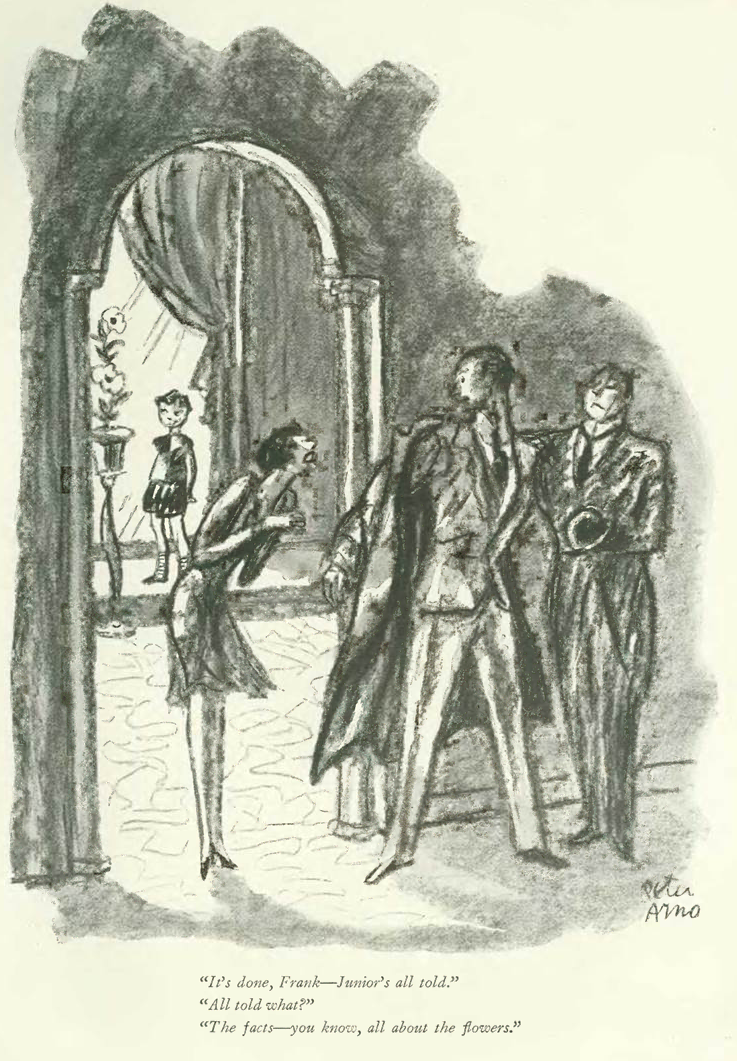
…and Peter Arno

Next Time: Let Them Eat Cake…


Waldorf’s Salad Days

While Manhattan is home to some of the world’s most iconic buildings, it is also known for knocking them down. Sometimes it was a matter of changing tastes, but more often than not it was the steamroller of economic progress that flattened any sentimental soul that stood in its path.

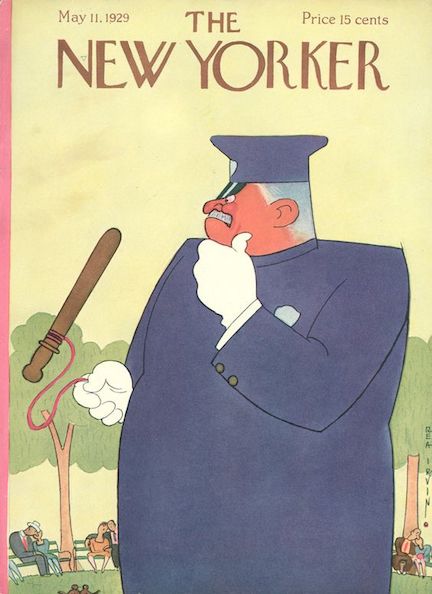
May 11, 1929 cover by Rea Irvin.

The old Waldorf-Astoria symbolized the wealth and power of the Gilded Age, but in the Roaring Twenties the storied hotel — with all its Victorian turrents, gables and other doo-dads — looked hopelessly dated despite being just a bit over 30 years old (the Waldorf opened in 1893, and the much larger Astoria rose alongside it four years later). A group of businessmen, led by former mayor Al Smith, bought the property to build the Empire State Building — an art deco edifice that would scream Jazz Age but would be completed at the start of the Great Depression. The New Yorker’s James Thurber reported on the old hotel’s last day in the May 11, 1929 “Talk of the Town”…

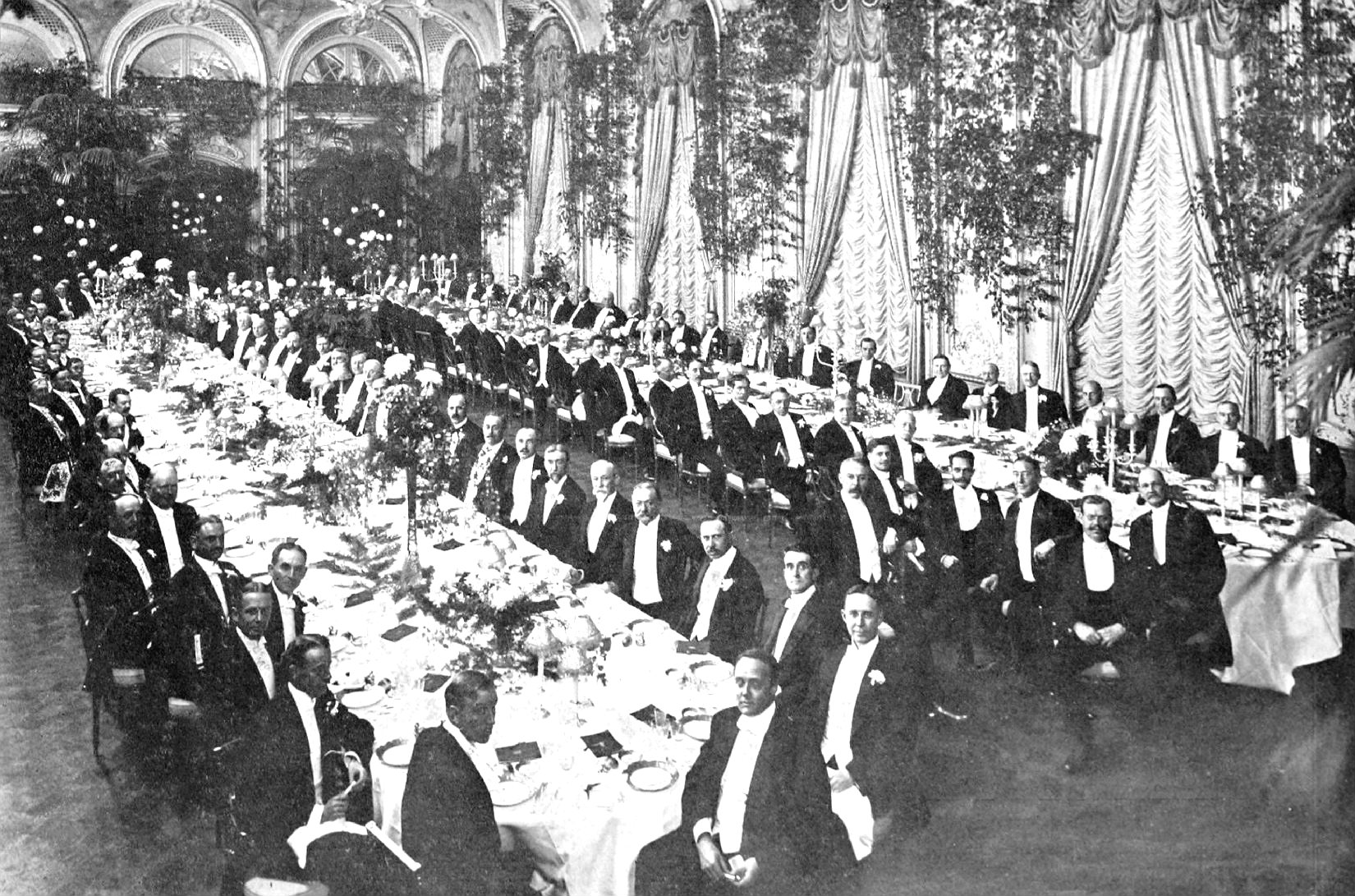
THEY LIKED RICH FOOD…1909 banquet in the Grand Ballroom at the Waldorf-Astoria honoring US Steel founder Elbert Gary. (Wikimedia Commons)

Thurber wrote of the hundreds of club women who mourned the loss of their familiar meeting rooms, and one elevator operator who would not be joining their chorus of sobs…

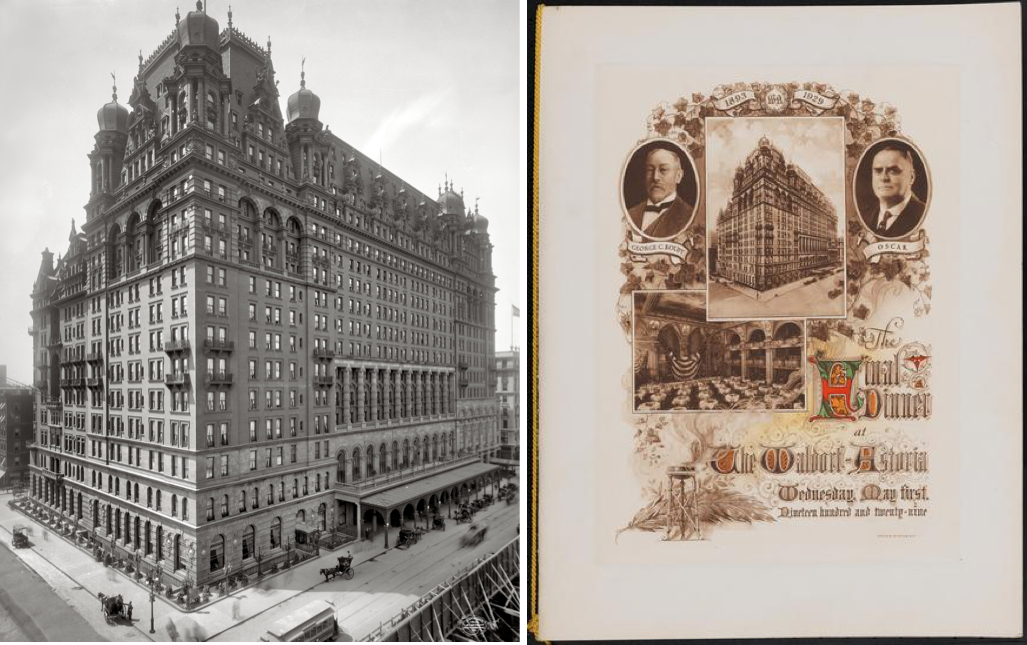
HEYDAY…the old Waldorf-Astoria hotel circa 1900, and the cover for the menu announcing “The Final Dinner.” The menu included a cherrystone clam cocktail, turtle soup, crown of bass (in lobster sauce), mignon of spring lamb (chasseur), supreme of guinea hen (tyrolienne), bombe mercedes ice cream, and coffee. (Bowery Boys/Museum of the City of New York)
THEY’RE SELLING YOU…Illustration depicting an auction of items from the hotel. (Museum of the City of New York)

In the “Reporter at Large” column, humorist Robert Benchley supplied his own perspective on the closing of the venerable hotel, and the countless speeches that reverberated between its walls…

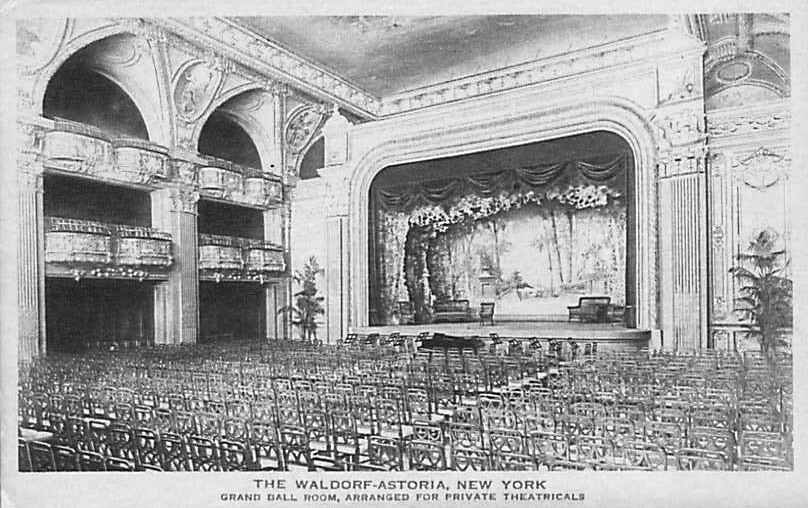
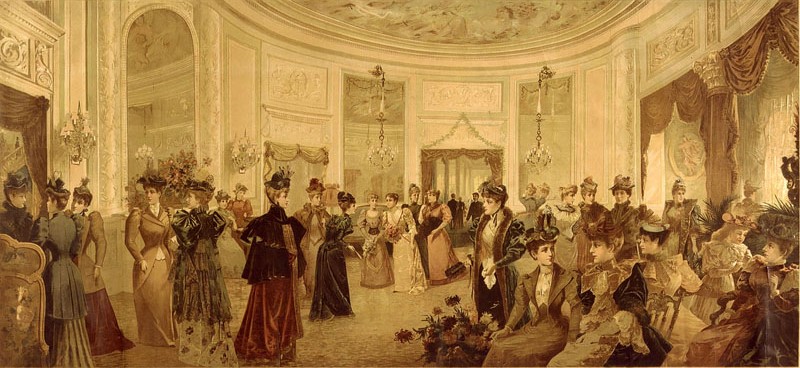
A 1903 image of the Grand Ball Room, “arranged for private theatricals. “(New York Public Library)

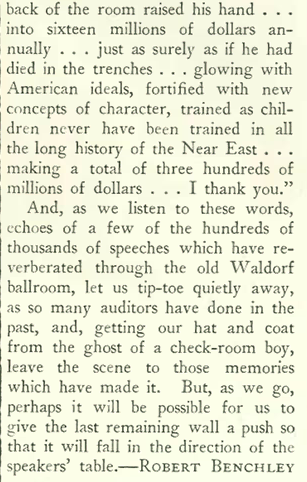
Benchley offered excerpts from dozens of hypothetical speeches, and then offered this final benediction to the old hotel:

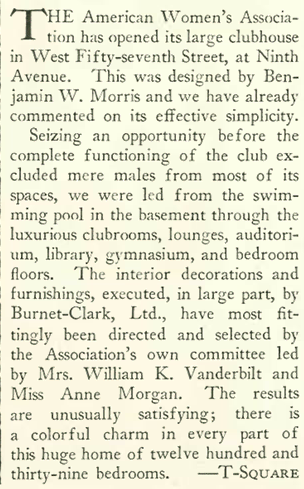
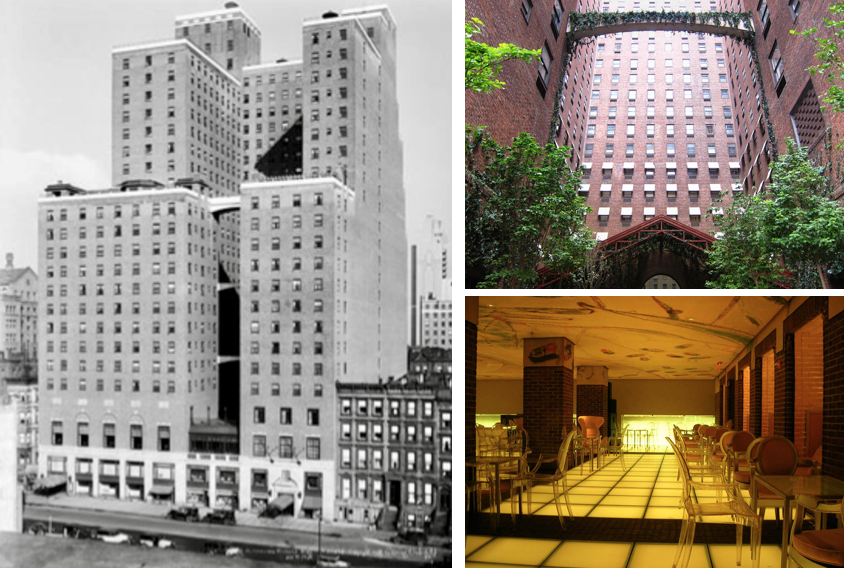
In his “The Sky Line” column, architecture critic George S. Chappell (aka T-Square) looked in on the newly completed American Woman’s Association clubhouse and residence for young women on West 58th Street. Developed by Anne Morgan, daughter of J.P. Morgan, the building contained 1,250 rooms and featured a swimming pool, restaurant, gymnasium and music rooms along with various meeting rooms.

TRAINING GROUND…At left, the American Woman’s Association clubhouse and residence in 1932. At right, view of the central atrium of the AWA residence, now the Hudson Hotel. Below, the Hudson Bar (renovated after 1997), which has been featured in a number of TV shows including Gossip Girl and Sex and the City. (Liza DeCamp/Nan Palmero top right/RoryRory bottom)

In a 1998 New York Times “Streetscapes” feature, Christoper Gray cites a 1927 Saturday Evening Post interview with Anne Morgan, who said she believed women were at a temporary disadvantage in the business world and therefore founded the American Woman’s Association as “a training school for leadership, a mental exchange” where women “can hear what other women are doing.” After the AWA went bankrupt in 1941, the building was converted into The Henry Hudson Hotel, open to both men and women. From 1982 until 1997 the building’s second through ninth floors served as the headquarters for public television station WNET. The MacNeil/Lehrer NewsHour (now the PBS NewsHour) was broadcast from the building during that time.

*  *  *

Punching for Peace

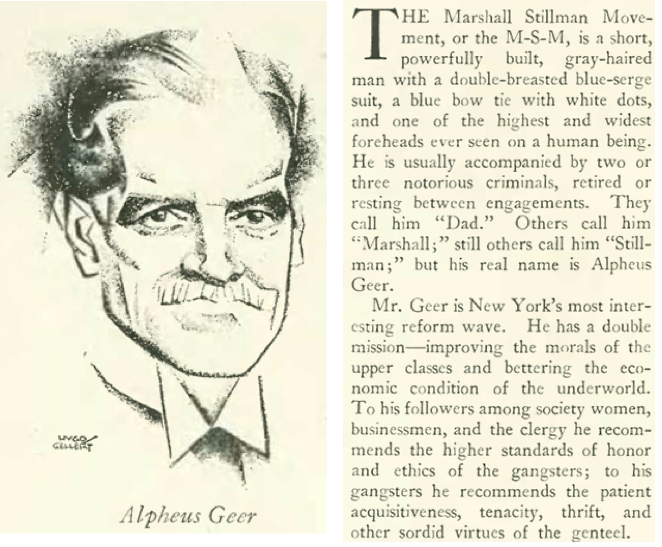
The old New Yorker was filled with personalities virtually unknown today, but who had tremendous influence in their time. Among them was Alpheus Geer (1863-1941), who founded the Marshall Stillman Movement, which promoted the sport of boxing as a way to steer young men away from a life of crime. An excerpt (with illustration by Hugo Gellert):

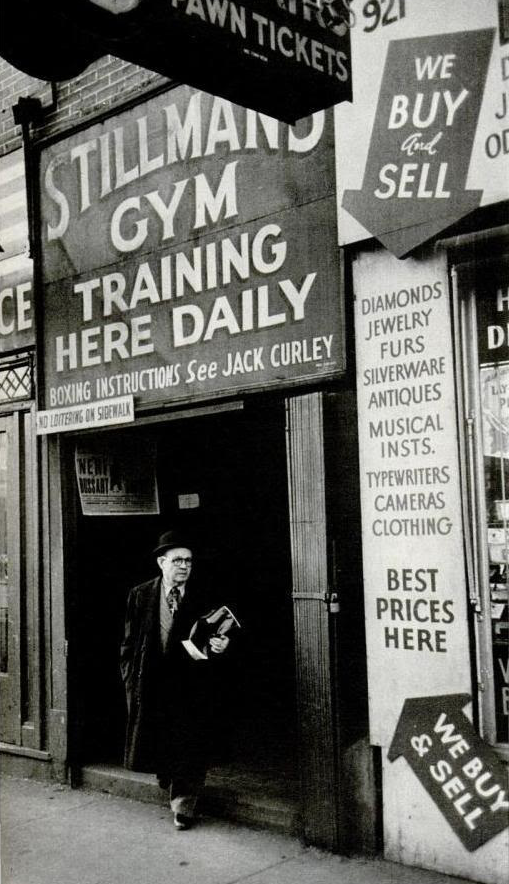
Alpheus Geer help found Stillman’s Gym in 1919 as a way to promote his Marshall Stillman Movement methods of boxing. Many famous fighters trained in the dank, smoky atmosphere of Stillman’s, including Jack Dempsey, Joe Louis and Rocky Marciano. Pictured above is famed boxing trainer Charley Goldman leaving Stillman’s Gym, circa 1940s. (easthamptonstar.com)

 *  *  *

Before we turn to the ads, this “Out of Town” column from the back pages struck an unusual tone regarding the types of tourists planning a summer in Germany…

…and from our advertisers, this ad promoting Louis Sherry’s new “informal restaurant” at Madison and 62nd Street…

WHAT’S IN A NAME…The Louis Sherry restaurant at Madison and 62nd, circa 1930. At right, the building today, now occupied by the French fashion company Hermès. (McKim, Mead & White / nycarchitecture.com)

Louis Sherry ran a famous restaurant at Fifth Avenue and 44th Street from 1898 to 1919 (like many famed restaurants, Prohibition helped put an end to it). Sherry died in 1926, so the owners of the new restaurant were merely trading on his name. In addition to a “delicacies shop” (gourmet foods were arrayed in the plate glass windows) Louis Sherry also contained a tea room, ice cream parlor and a balcony restaurant…

…like the Sherry restaurant, the new Hotel Delmonico traded on the fame of the old Delmonico’s Restaurant, which also fell victim to Prohibition by 1923. Today the hotel is best known as the place where the Beatles stayed in August 1964…

…here is another ad from Clicquot Club trying its best to sell its aged “Ginger Ale Supreme” to dry Americans. Famed avant-garde-art patron and party host Count Etienne de Beaumont (who looked like he’d had a few of something) testified how Cliquot “blends very agreeably” with the champagne most Americans cannot have…

…well, if you couldn’t have a legal drink, maybe you could entertain your friends with TICKER…”The New Wall Street Game That is Sweeping America!” My guess is this game didn’t sell so well after Black Tuesday, Oct. 29, 1929…

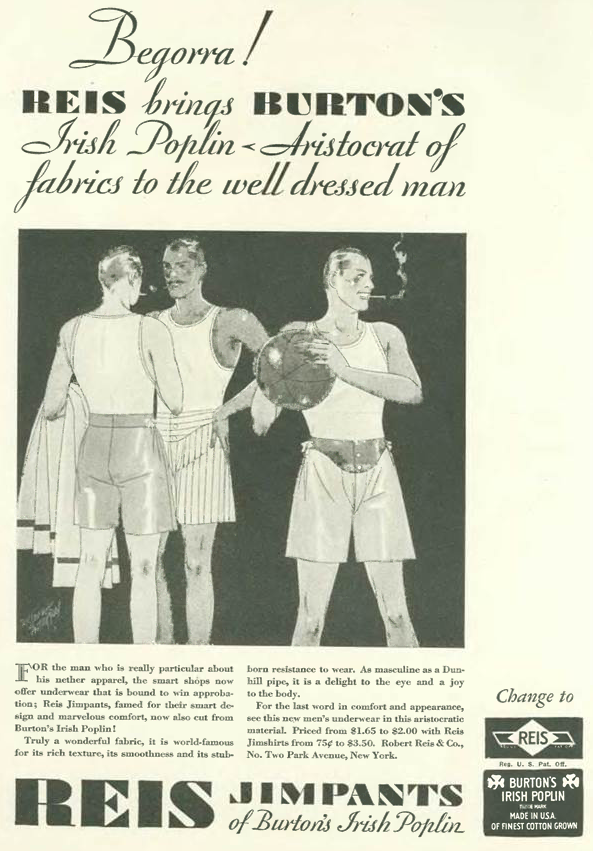
…those BVD’s aren’t good enough for you? Then try the “Aristocrat of fabrics” (and have a smoke while you toss the medicine ball around with the gents)…

…and here is more evidence that the Roaring Twenties were losing their growl even before the big crash—the straight flapper figure was out; it was now the “season of curves”…

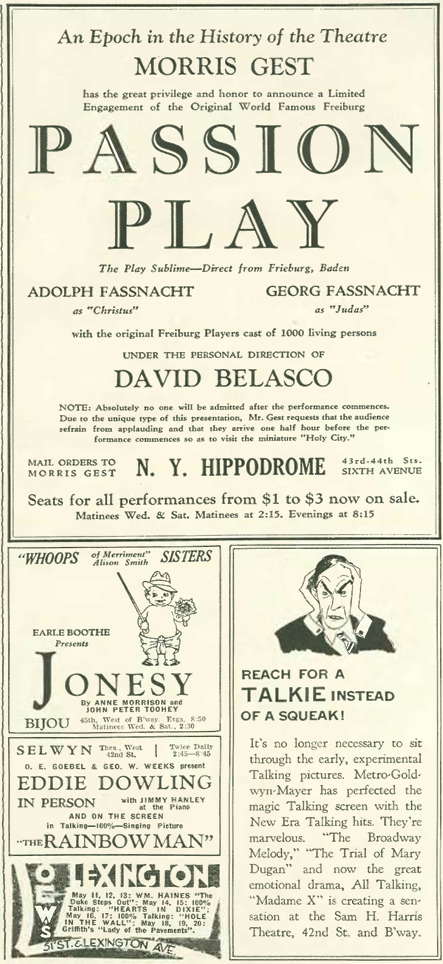
…a look at some of the cheap ads in the back of the magazine, including the one at bottom left from the Sam Harris Theater that played on the Lucky Strike cigarette slogan (“Reach for a Lucky instead of a sweet!”)…

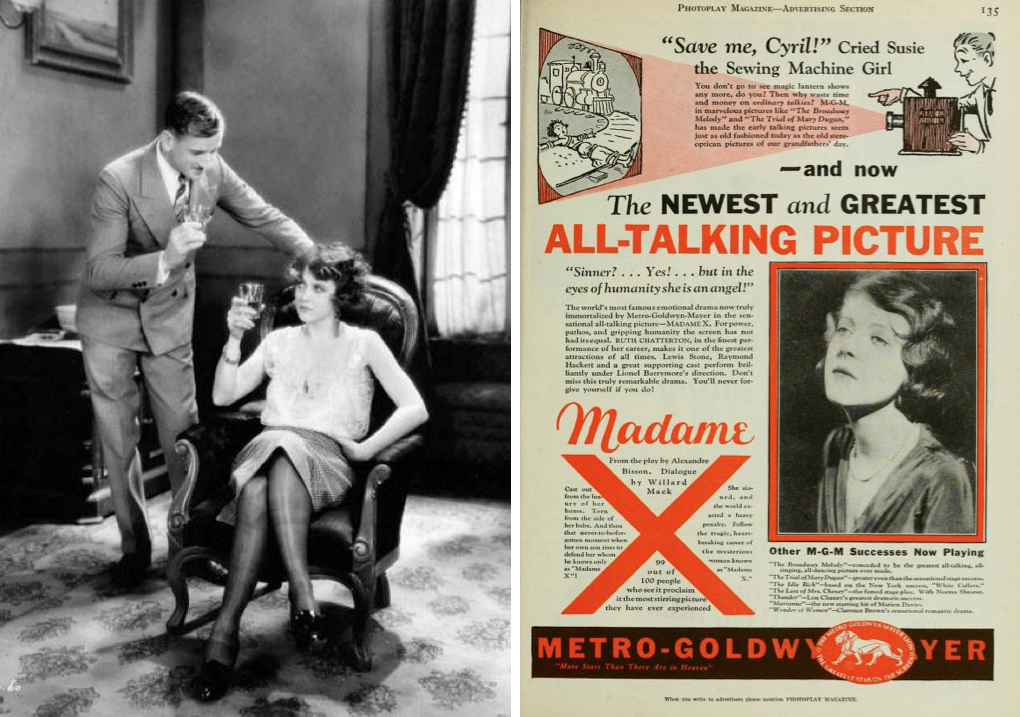
…one of the films featured at the Sam Harris Theatre was Madame X, a movie about a woman who leaves her wealthy (but cold) husband, turns to a life of crime, then tries to reclaim her son. The ad is correct in that it did create something of a sensation when it was released. It is also important to note that the film premiered at the Sam Harris for a reason: The director, Lionel Barrymore, didn’t want audiences to think his film was just another song and dance picture (like most of the first sound films) but rather a serious drama presented at a legitimate stage venue rather than a movie house…

UP TO NO GOOD…Ullrich Haupt as the cardsharp Laroque and Ruth Chatterton as Jacqueline Floriot in Madame X. At right, ad in Photoplay promoting the film. Click to enlarge. (Wikipedia/IMDB)

…back to our ads, here’s a remarkably crude one from the racist misogynists who made Muriel cigars (they being Lorillard, who also manufactured Old Golds)…

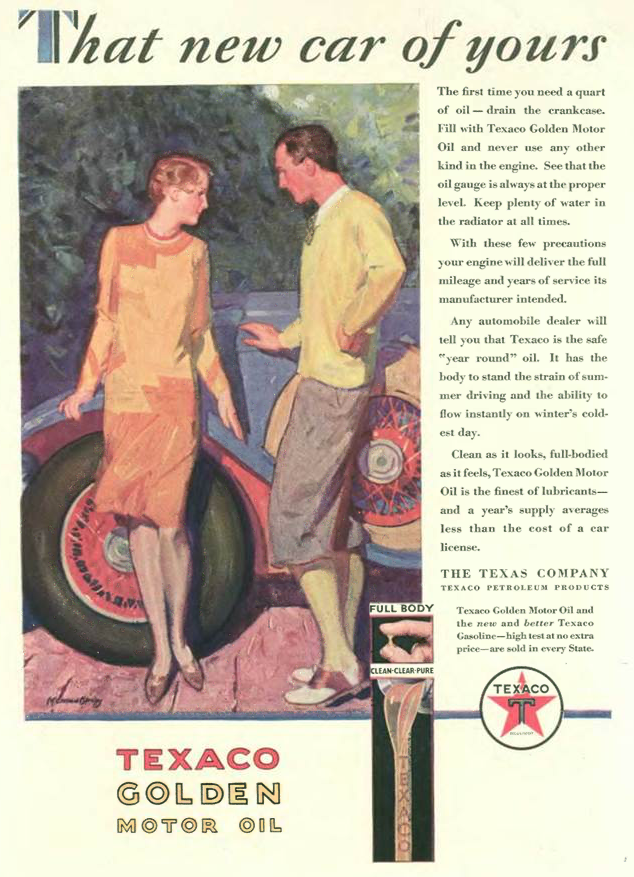
…and a softer message from The Texas Company, manufacturer of Texaco “golden” motor oil…

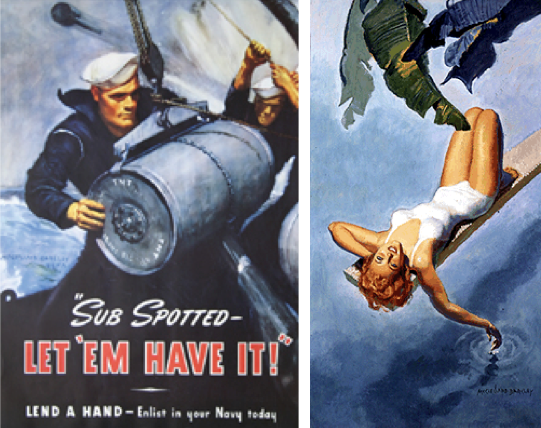
…the artist who rendered the above couple in those golden hues was American illustrator McClelland Barclay (1891-1943). Published widely in The Saturday Evening Post, Ladies’ Home Journal, and Cosmopolitan, Barclay was known for war posters as well as pin-ups:

VERSATILE…Navy recruitment poster by McClelland Barclay, and an illustration for the cover of a 1942 Saturday Home Magazine. (Wikipedia/illustrationhouse.com)

In 1940 Barclay reported for active duty in the US Navy, serving in the New York recruiting office and illustrating posters. Determined to be a front-line combat artist, he served in both the Atlantic and Pacific theatres until he was reported missing in action after his boat was torpedoed in the Solomon Islands.

 *  *  *

Our comics are supplied by Alan Dunn, who probed the vagaries of movie magazine gossip…

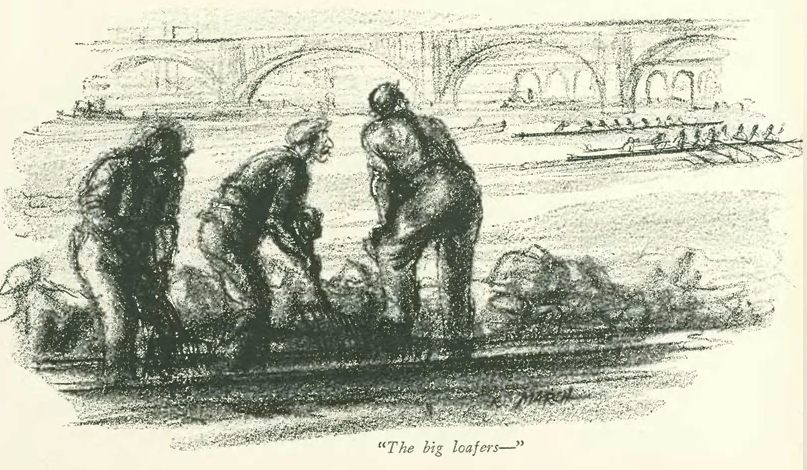
…and Reginald Marsh, known for his social realistic depictions of working life in New York, including these stevedores eyeing a regatta…

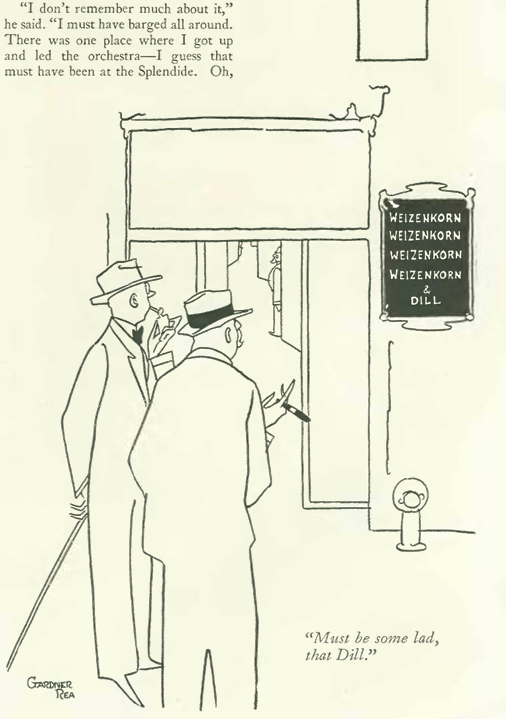
…and finally, Gardner Rea looked in on a young man displaying early signs of cynicism…

Next Time…How Charles Shaw Felt About Things…


Out With the Old

Perhaps no decade was more transformative to New York City than the 1920s. From the loosening of social mores to countless technological advances, the city was a very different place as it entered the last year of the Roaring Twenties.

Jan. 5, 1929 cover by Sue Williams. Opening image depicts the original Waldorf Hotel’s Octagon Room in 1893.

Vestiges of the 19th century were quickly erased during the decade as old neighborhoods and stately mansions gave way to massive apartment blocks and towering skyscrapers. Such was the fate of the original Waldorf-Astoria Hotel, its Victorian lavishness out of style in a streamlined age. Writing under the pen name T-Square, New Yorker architecture critic George S. Chappell commented on the planned demolition of the old* Waldorf-Astoria Hotel:

*Although outdated in appearance, the hotel was little more than 30 years old in 1929.

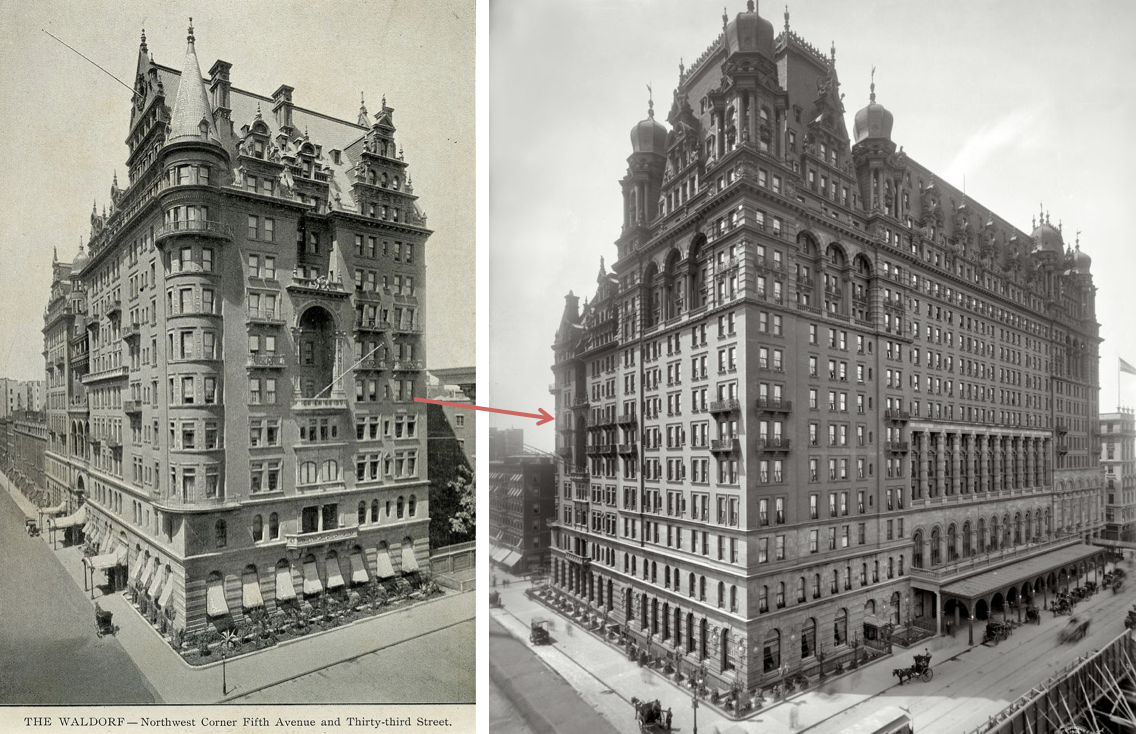
TALE OF TWO HOTELS…The Waldorf-Astoria was actually two hotels joined together. The Waldorf, at left, was built in 1893. The much larger Astoria (right) was constructed in 1897. Note the arrow indicating the original Waldorf in relation to the Astoria. (Wikipedia/Detroit Photography Archive)
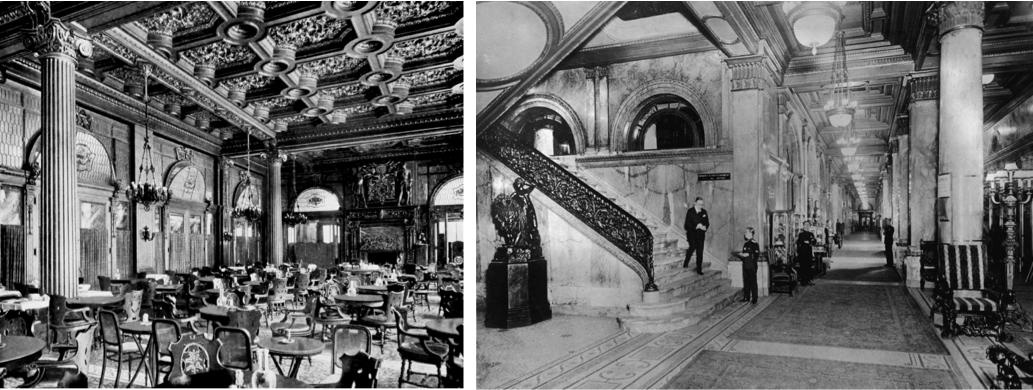
PLACES TO SEE AND BE SEEN…At left, the “Gentleman’s Cafe” in the Waldorf Hotel. At right, lobby entrance to the marble-lined “Peacock Alley” that connected the two hotels. (Wikipedia/justcocktails.com)
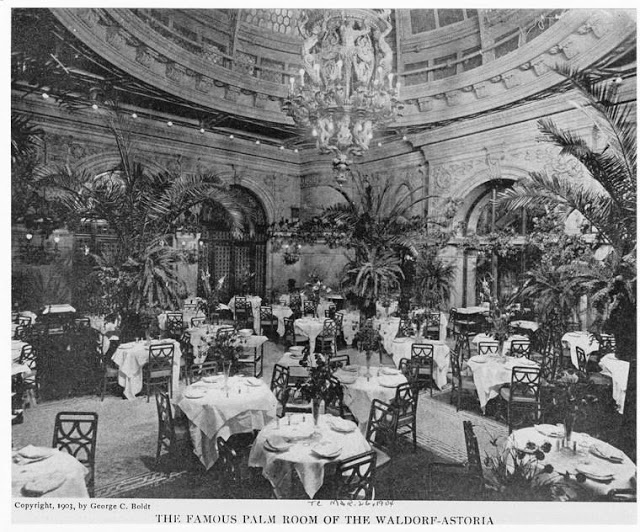
DINE IN STYLE…The Palm Room in the Astoria section of the original Waldorf-Astoria Hotel. (New York Public Library)

Chappell wrote that the prime building site was slated to be occupied by a 50-story office building…

…but as it turned out, Floyd Brown was unable to make the final payments on the property, so he sold his claim to the bank. John J. Raskob, a wealthy finance executive and chair of the National Democratic Committee, joined with entrepreneur Pierre du Pont and former New York Governor Al Smith (who lost his bid for the U.S. Presidency in 1928) to buy the property. They had much bigger plans than Floyd Brown: In August 1929 they announced their plan to build the tallest building in the world — what would become the Empire State Building.

TRY, TRY AGAIN…The architecture firm Shreve & Lamb developed this concept (left) for Floyd Brown’s proposed 50-story office building on the site of the old Waldorf-Astoria. At right, what occupies the site today: the Empire State Building, also designed by Shreve & Lamb. (Pinterest/oldstructures.com)

 * * *

Car Culture

The Jan. 5 issue featured a lengthy review of the 29th Annual National Automobile Show at Grand Central Palace, as well as numerous advertisements by auto manufacturers hoping to entice New Yorker readers with their latest models.

Promoters of the event touted the addition of a grand staircase to Grand Central’s mezzanine level that would ease access to both levels of the show:

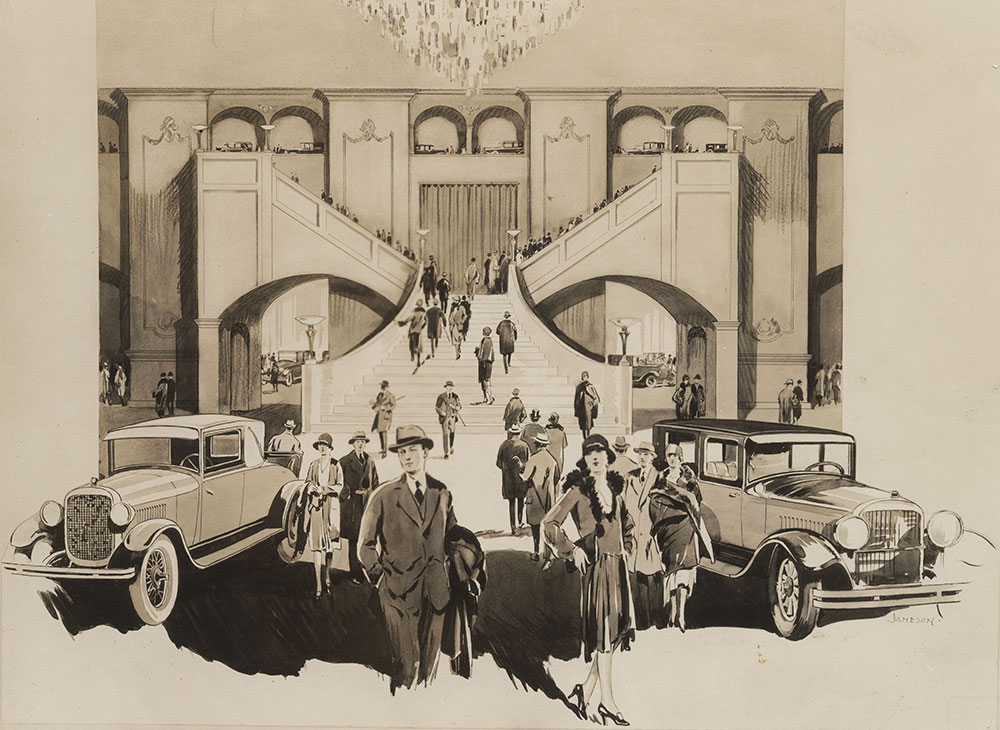
AIN’T IT GRAND?…Design drawing created for the 1929 National Automobile Show at Grand Central Palace touting the addition of an equally grand new staircase. (Free Library of Philadelphia)
How the new staircase actually appeared at the 1929 show. Note the background where the movement of workmen on ladders lends a ghostly appearance. (Free Library of Philadelphia)
A view of the 1929 National Automobile Show from the mezzanine of the Grand Central Palace. (Free Library of Philadelphia)

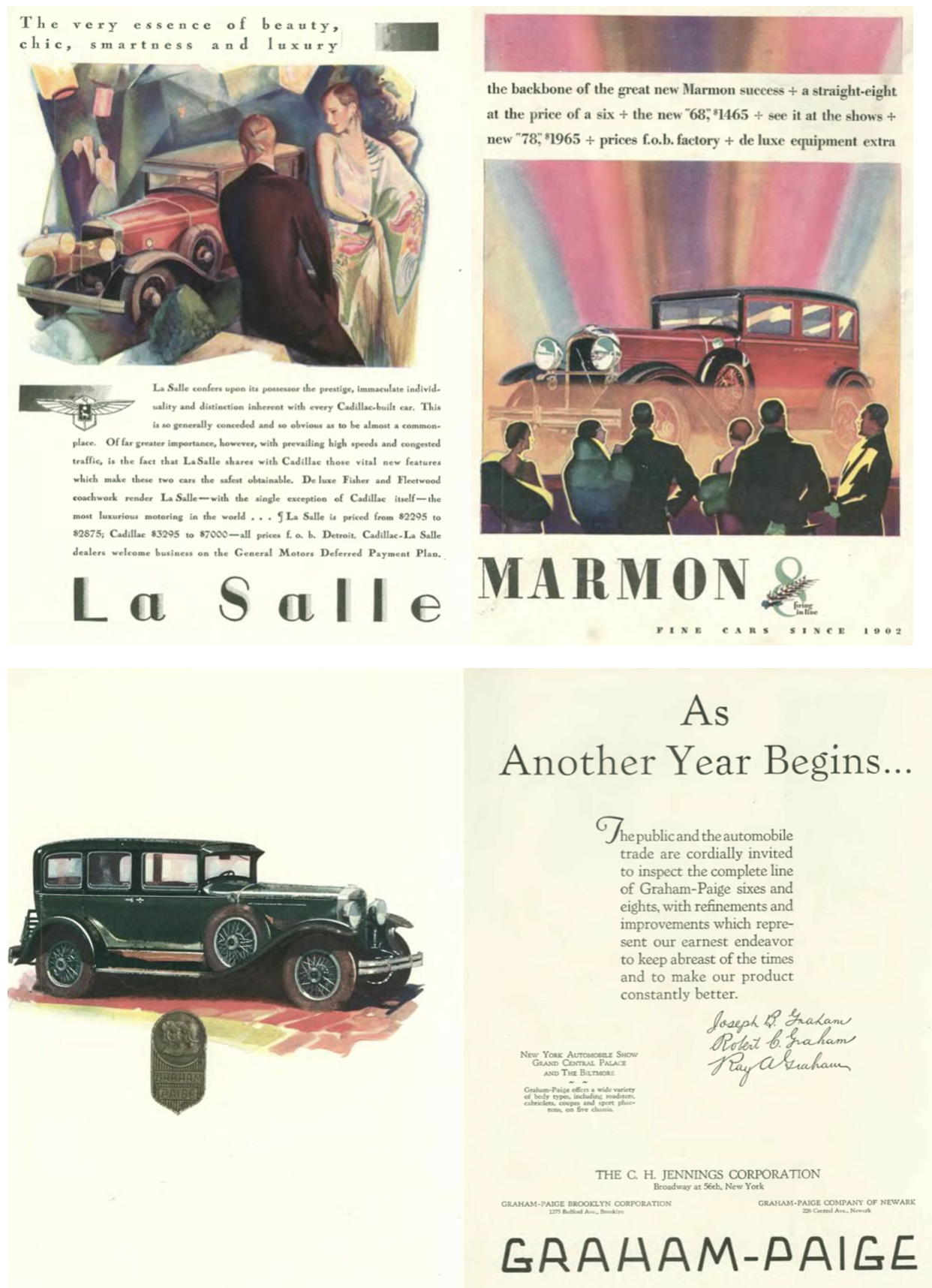
As I mentioned, the Jan. 5 issue was filled with car ads, mostly from long-gone automobile manufacturers. A constant in all of these ads is their appeal to New  York’s chic, smart set. Here’s a sampling of a few of them: (click ads to enlarge):

Hupmobile was a successful car company that began its decline in the late 1920s  precisely because it turned its back on buyers of medium-priced cars and went after what it perceived to be the more lucrative luxury buyer (see ad above). Hupmobile went out of business in 1939 (after briefly joining forces with Graham-Paige, which also went under that year).

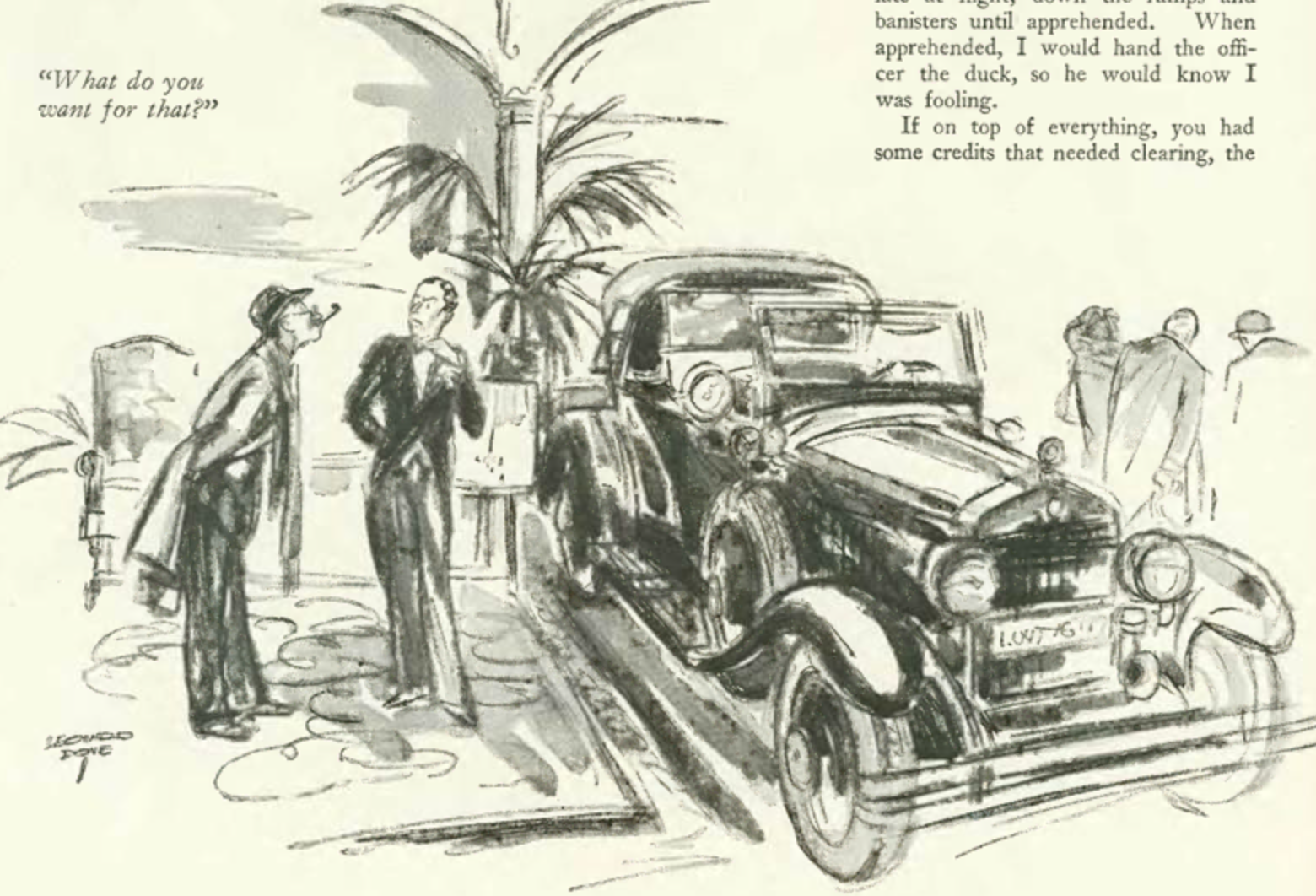
Cartoonist Leonard Dove found humor derived from these very class distinctions when he visited the auto show:

 * * *

The Game, Served Up Cold

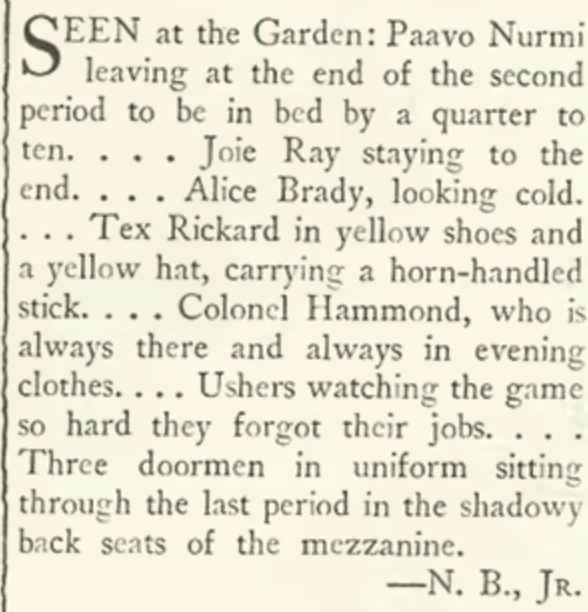
In other diversions from the Jan. 5 issue, Niven Busch Jr. attended the hockey game between the New York Rangers and the New York Americans at Madison Square Garden, noting famous faces in the crowd including Finnish track star Paavo Nurmi and American track star Joie Ray. Also noted were Tex Rickard, builder of Madison Square and founder of the Rangers, ex-football star and businessman Col. Harry Hammond, and film star Alice Brady.

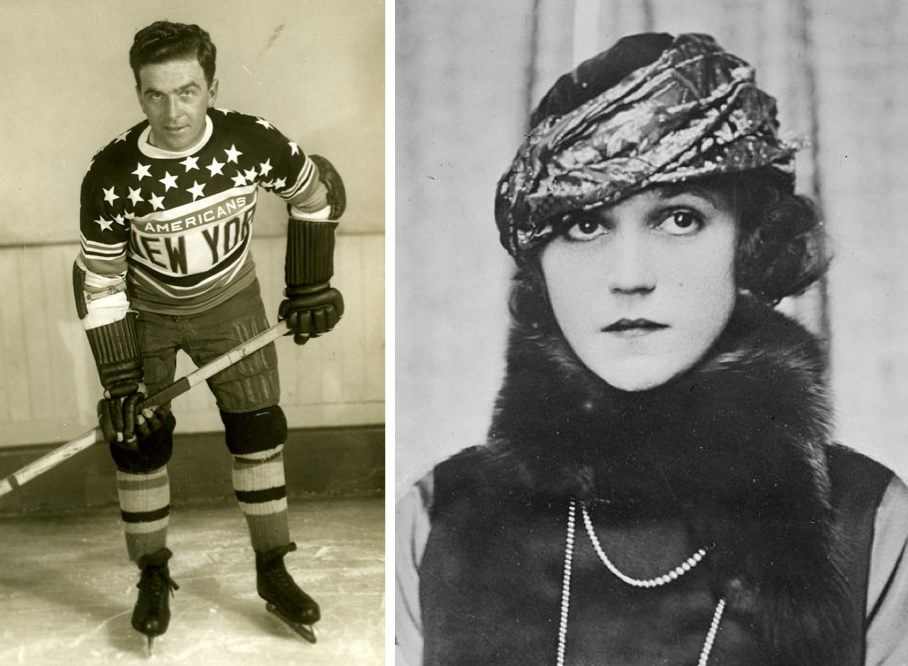
AT THE GARDEN…Not even the exciting hockey play of Billy Boyd (left) and his fellow New York Americans could keep actress Alice Brady warm. (Pinterest/Alchetron)

 * * *

From our non-automobile advertisers, another installment of a Theodore Geisel (Dr. Seuss) ad for Flit insecticide (this is the first instance — at least in the Flit ads— in which Geisel signs his art as “Dr. S” instead of “Seuss”).

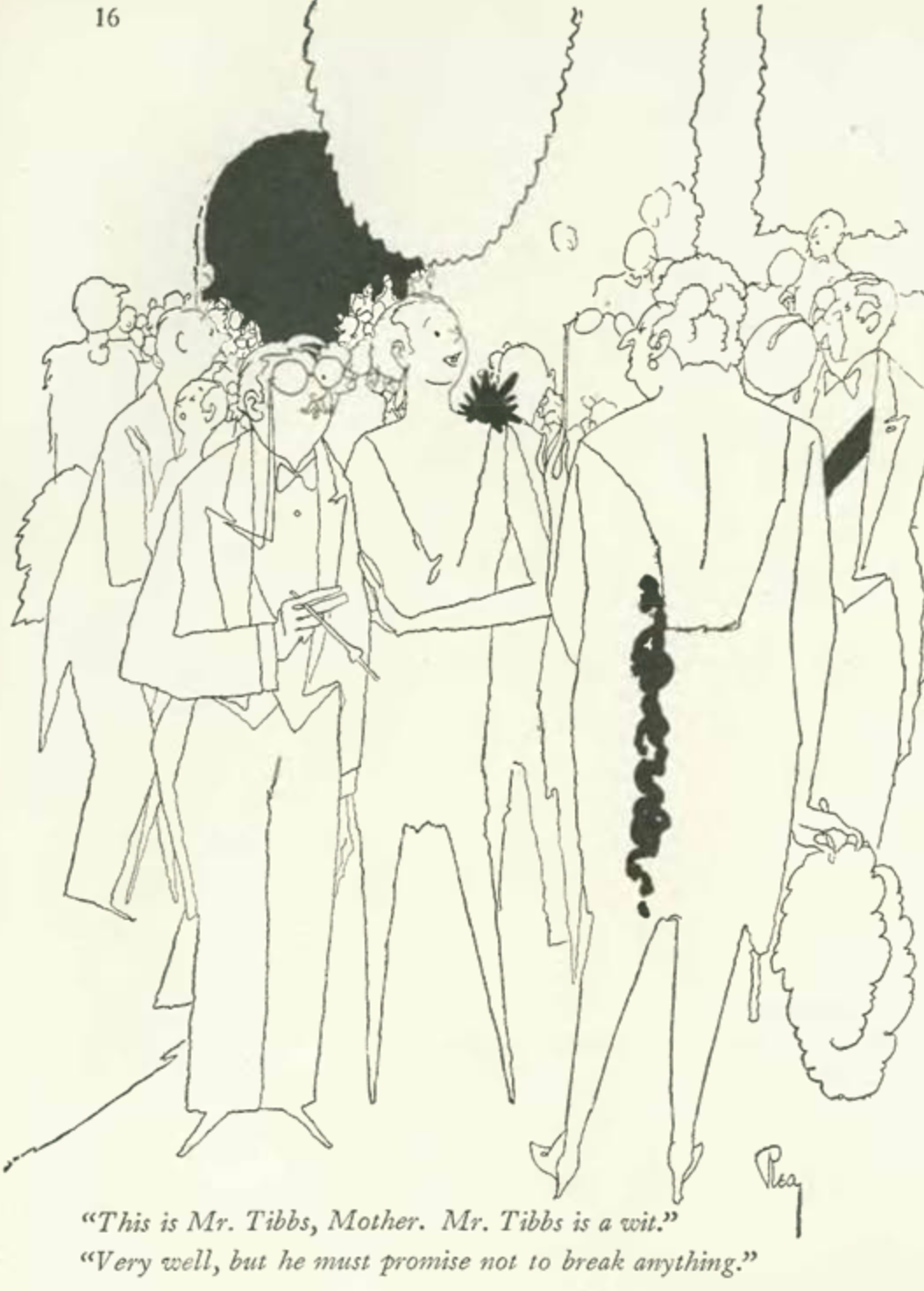
And another cartoon from the Jan. 5 issue, courtesy Gardner Rea:

 * * *

Arno Addendum

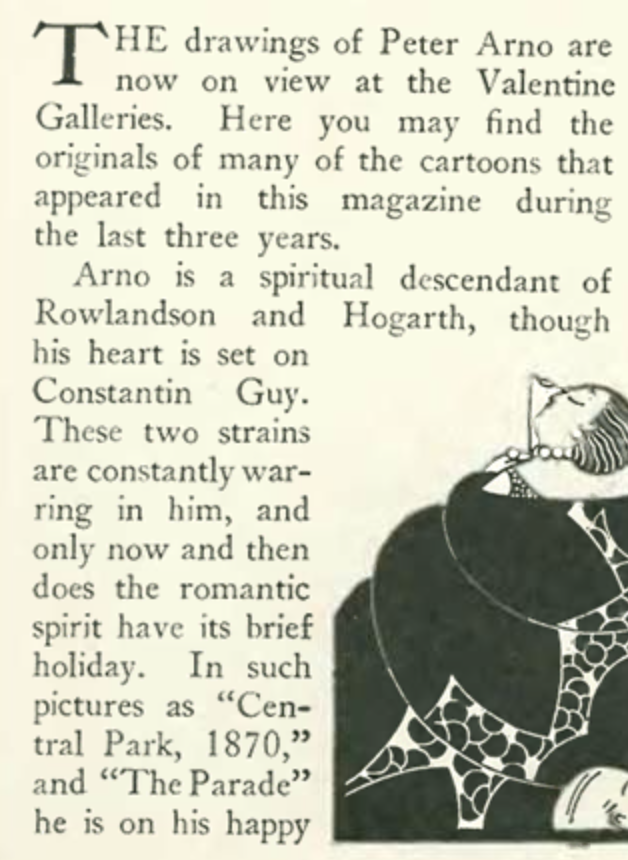
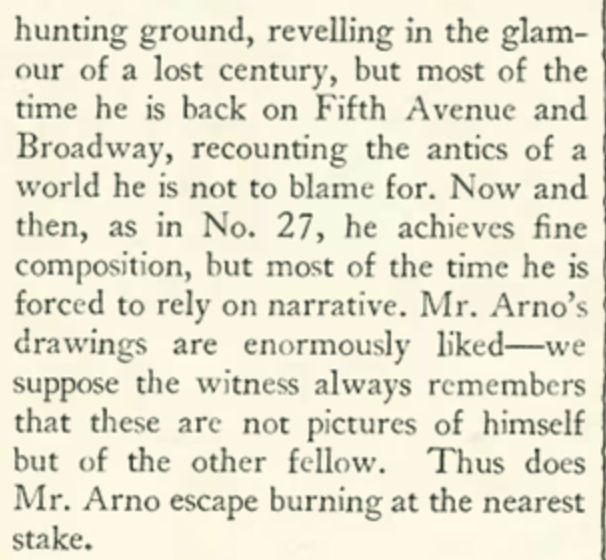
In the rush of the recent holidays I missed an item from the Dec. 22, 1928 issue — namely, art critic Murdock Pemberton’s tongue cheek review (in “The Art Galleries” column) of cartoonist Peter Arno’s December 1928 exhibition of drawings at the Valentine Gallery:

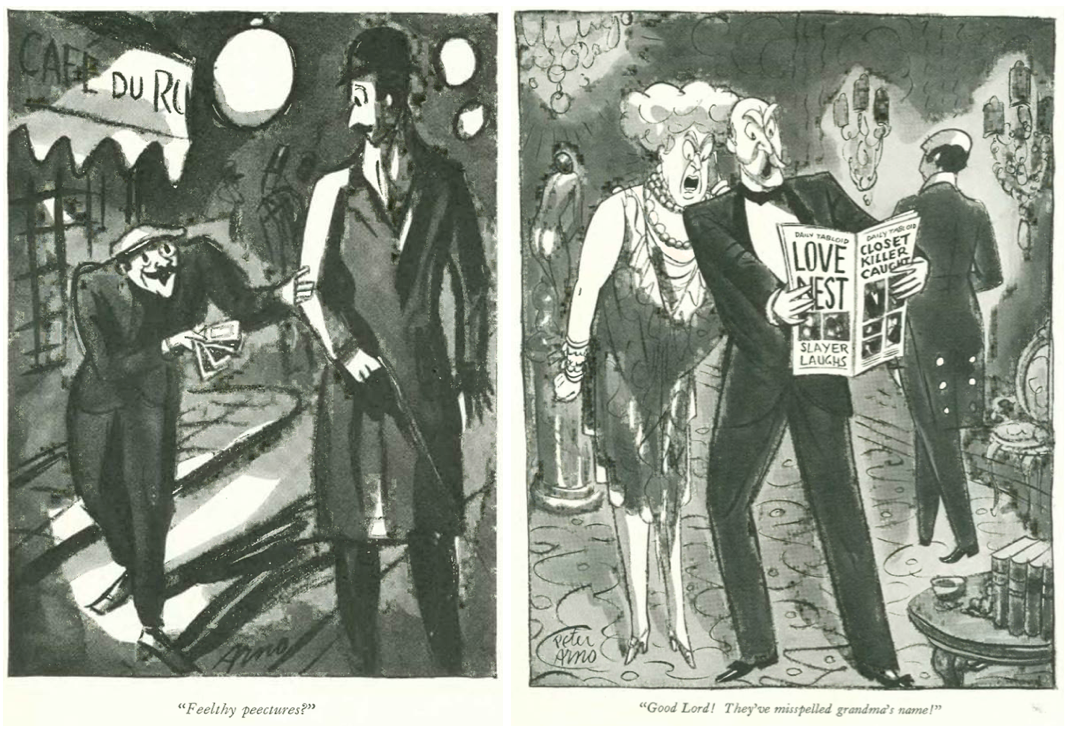
Here are two Arno drawings that were featured in the Valentine exhibition (click to enlarge):

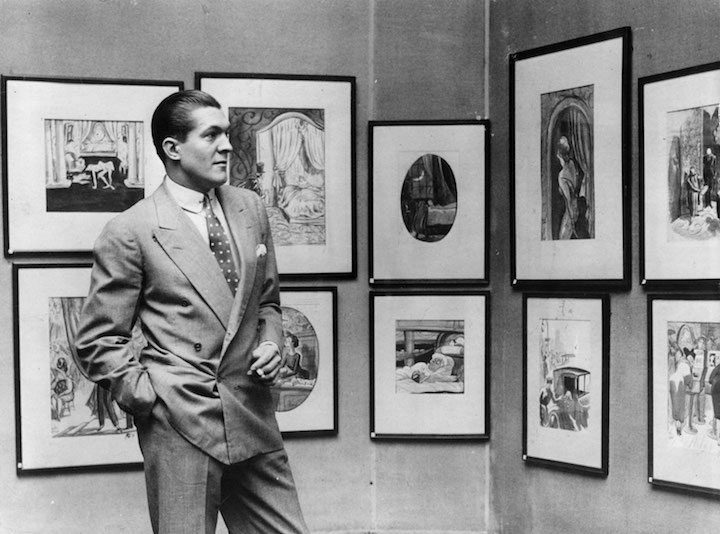
INTERNATIONAL APPEAL…less than four years after his Valentine Galleries debut, Peter Arno exhibited his drawings to great acclaim at the Leicester Galleries in London, October 1932. (Encyclopædia Britannica)

Next Time: Midnight Frolic…

Lighter Than Air

Just a decade after German Zeppelins sowed terror across the skies of Europe and Great Britain, Germany’s new Graf Zeppelin was enthusiastically welcomed by a throng gathered at Lakehurst, New Jersey, the massive airship having completed its first intercontinental trip across the Atlantic.

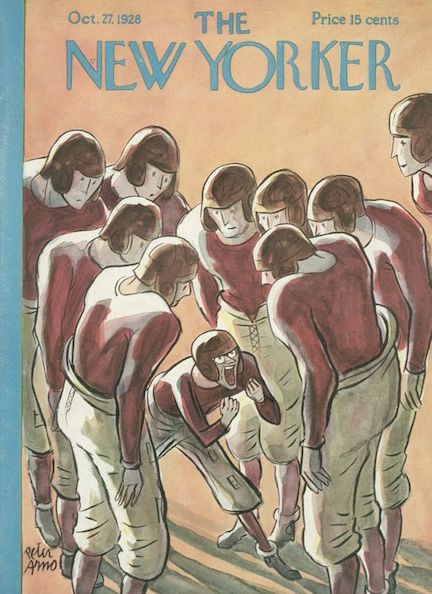
Oct. 27, 1928 cover by Peter Arno.

It had been only ten years and two months since German Zeppelins dropped their last bombs on the British, which had dubbed the airships “baby killers” for the mostly civilian casualties they inflicted. Beginning in 1915, Zeppelin raids on London killed nearly 700 and seriously injured almost 2,000 over the course of more than 50 attacks. It must have been a terrifying sight, something straight out of science fiction — flying ships more than the length of two football fields, blotting out the stars as they loomed overhead. Their size, however, was also their downfall, as Britain soon developed air defenses (searchlights, antiaircraft guns, and fighter planes) that shot many of these hydrogen gasbags out of the sky (77 of Germany’s 115 airships were either shot down or disabled).

TERROR IN THE SKIES…Image from a German postcard celebrating the bombing of Warsaw by the Zeppelin Schütte Lanz in 1914. Here’s a weird fact: There was a shortage of sausages in Germany during WWI, since cow intestines normally used for casings were instead used to create special bags to hold the hydrogen gas that kept Zeppelins aloft. It took more than 250,000 cows to make one airship. (Wikipedia)

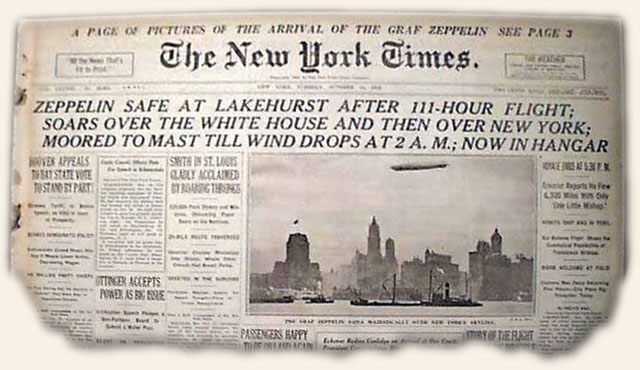
So when the 776-foot Graf Zeppelin loomed over the New York City skyline on Oct. 15, 1928, the reaction was one of awe rather than terror. The New York Times heralded its safe arrival on the front page…

(rarenewspaper.com)
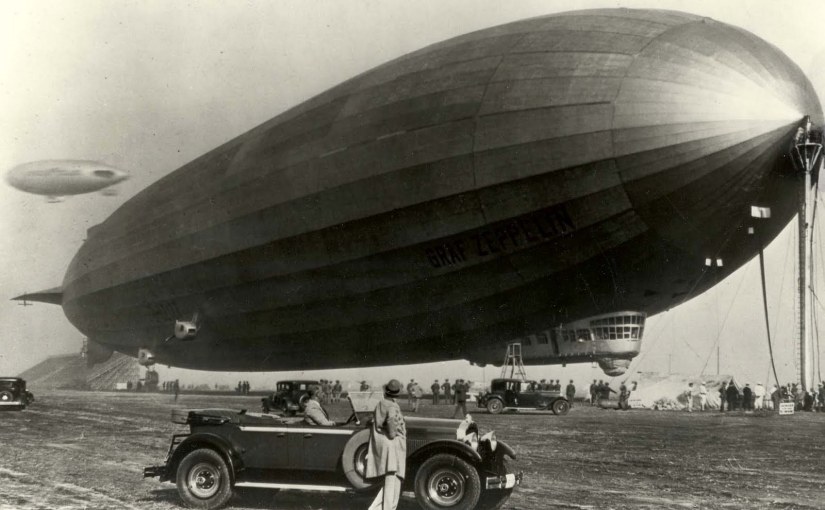
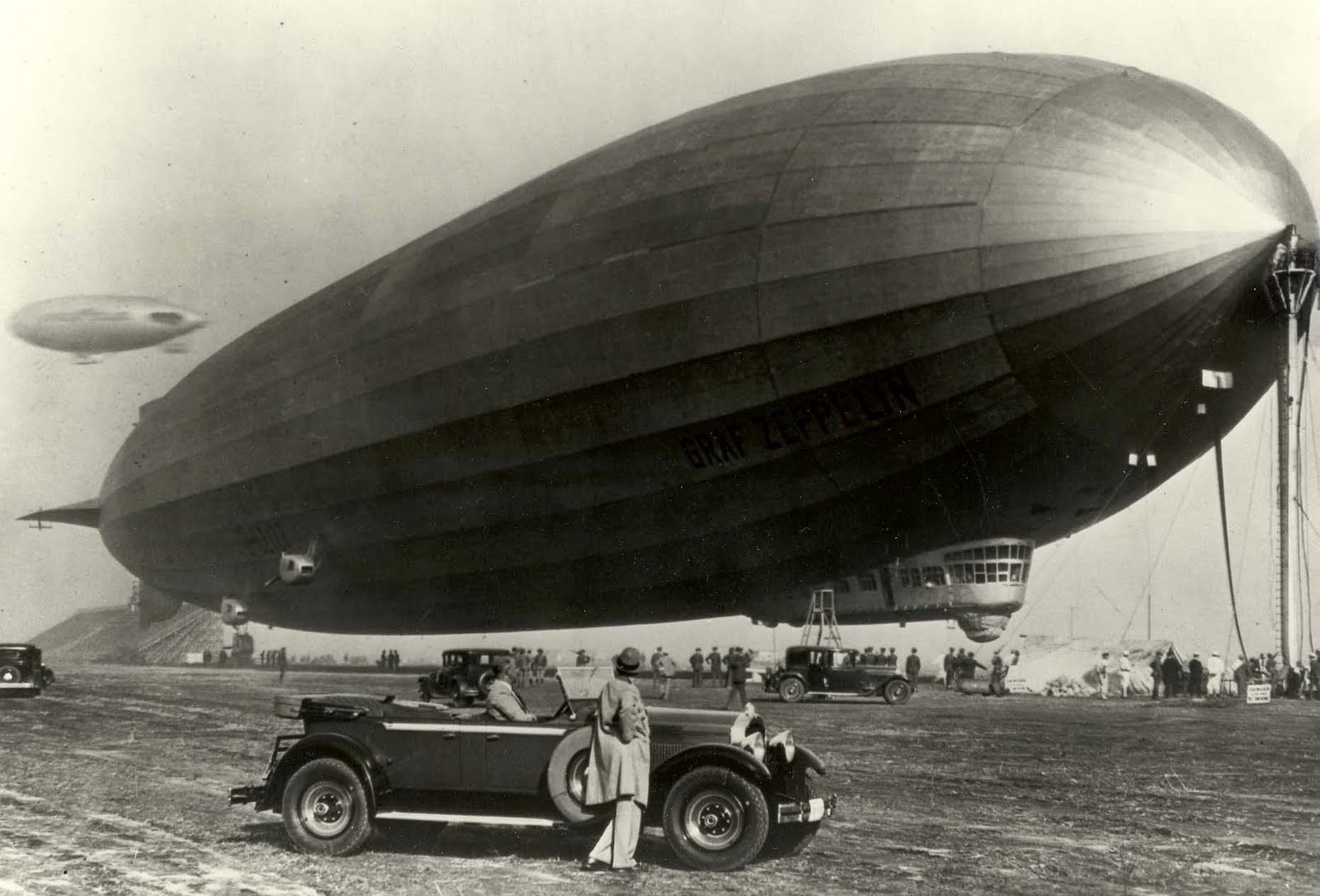
The Graf Zeppelin at Lakehurst, N.J., 1929. (rarehistoricalphotos.com)

…and The New Yorker’s James Thurber (writing in “The Talk of the Town”) was on hand to assess the welcoming crowds gathered at Lakehurst, N.J….

…who in their enthusiasm could have easily destroyed the vessel, which had already sustained damage during a storm over Bermuda…

OLD GAS BAG…The Graf Zeppelin arriving at Mines Field (now Los Angeles International Airport) on August 26, 1929. Newspaper magnate William Randolph Hearst sent the Graf Zeppelin dirigible on a 20-day flight that circumnavigated the world in 1929. (martinturnbull.com)
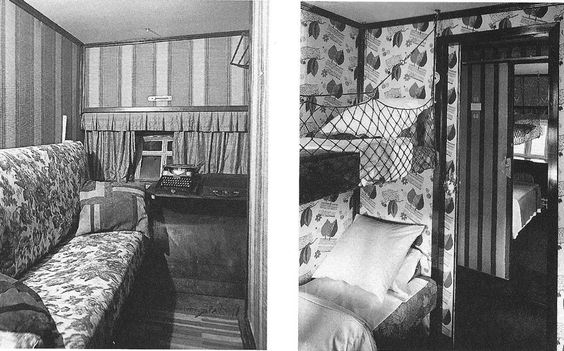
Living quarters of the Graf Zeppelin. Cozy, if you could forget that your room was contained within an envelope of highly explosive hydrogen gas. (airships.net)

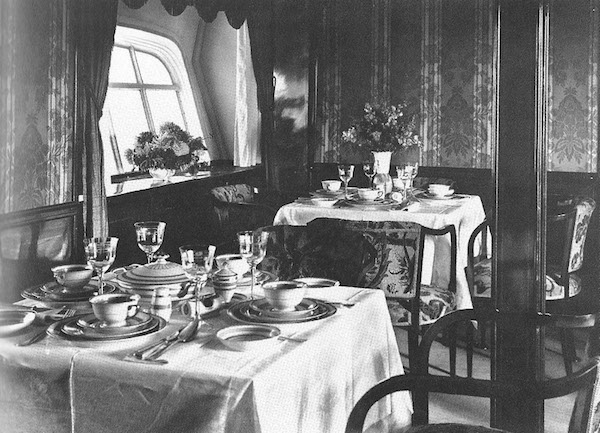
Dining aboard the Graf Zeppelin. (Top, airshipsonline.com, bottom, airships.net)

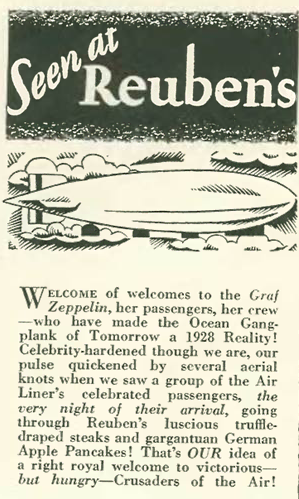
Reuben’s restaurant in New York seized the opportunity to cash in on the spectacle, boasting (in this hastily placed ad in the Oct. 27 issue) that the Graf Zeppelin’s passengers dined at their establishment on the very night of their arrival…

A final note: Considering the hazards of flying these ungainly, flammable machines (e.g. the Hindenburg in 1937) Graf Zeppelin flew more than one million miles in its career (the first aircraft in history to do so), making 590 flights (144 of them oceanic crossings, including one across the Pacific), and carrying more than 13,000 passengers — all without injury to passengers or crew.

 *  *  *

Rough Riders

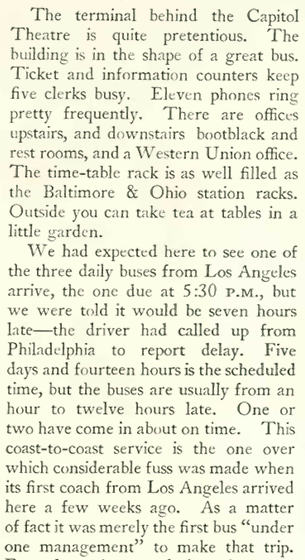
Back on the ground, “The Talk of the Town” looked in on a somewhat less exotic form of long-distance travel — the recently inaugurated coast-to-coast bus service from New York to Los Angeles:

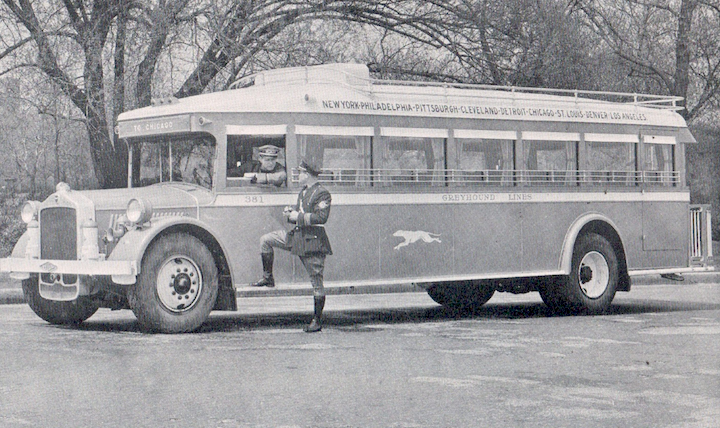
LONG HAUL…This Greyhound bus from 1929 was probably similar to those leaving the New York bus stations for points west in 1928. (flickr)

 *  *  *

From Our Advertisers

On the subject of rolling transportation, Buick trumpeted the introduction of “adjustable front seats” in its silver anniversary model. Curiously, this improvement was touted as a convenience solely for women drivers…

Our cartoon (a two-pager) for Oct. 27 comes from Gardner Rea, the latest among The New Yorker’s staff to mock the quality of sound motion pictures. The cartoon is labeled at the bottom: “The Firtht One Hundred Per Thent Thound Movie Breakth All Houth Recordth.” (click image to enlarge)

 *  *  *

If you wanted to get a glimpse of New York’s “royalty” in 1928, you could secure a seat at the Metropolitan Opera, especially one with a view of its famed “Diamond Horseshoe” seats.

November 3, 1928 cover by Julian de Miskey.

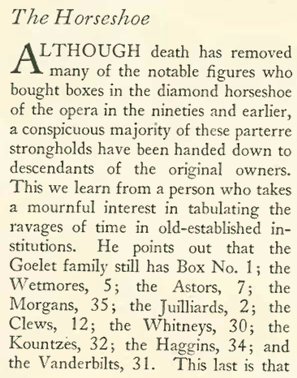
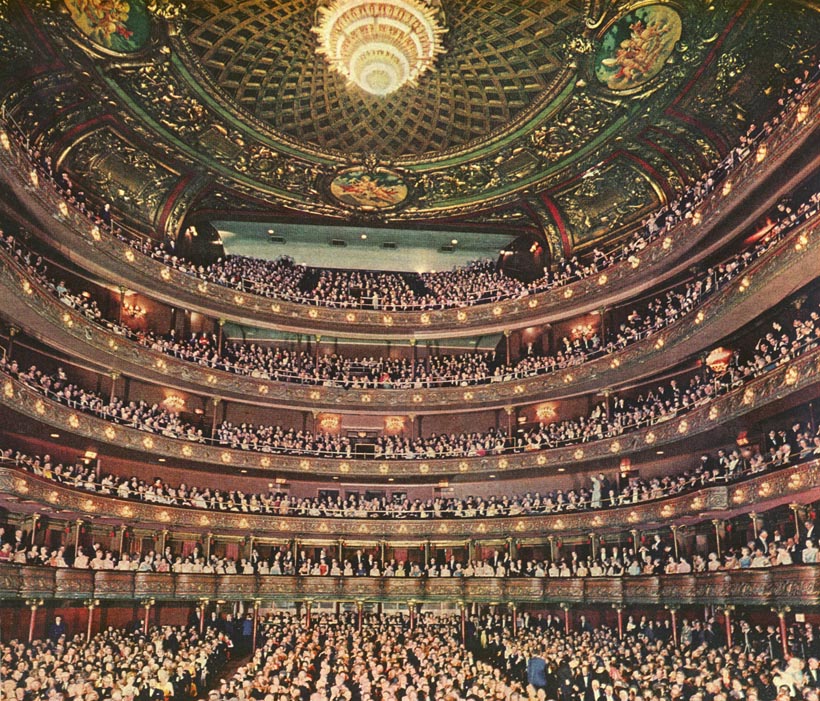
The “Diamond Horseshoe” described a ring of seats at the Metropolitan Opera House occupied by New York’s social elite. Not unlike today’s stadium skyboxes, the Met reserved these boxes for purchase by the wealthy. “The Talk of Town” for Nov. 3, 1928 noted how many of these were still held by the same families that had secured spots after the Met opened in 1883:

CULTURAL LANDMARK…The Metropolitan Opera House at Broadway and 39th Street circa 1905. (Wikipedia)
SEE AND BE SEEN…The Diamond Horseshoe at the Metropolitan Opera House, as seen from the rear of the stage for a concert by pianist Josef Hofmann, November 28, 1937. (newyorksocialdiary.com)

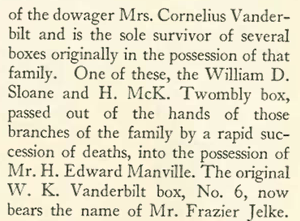
“Talk” also noted that some of the boxes in the Diamond Horseshoe were coming into new ownerships among the newly rich (E.F. Hutton) and even (gasp) immigrants such as Otto Kahn:

DUST TO DUST…Above, a view of the “Diamond Horseshoe” at the Metropolitan Opera’s gala farewell performance on April 16, 1966. Below, patrons say goodbye to the old house at Broadway at the farewell performance. The building was torn down in 1967 and replaced by a 40-story office tower. (Time/Life)

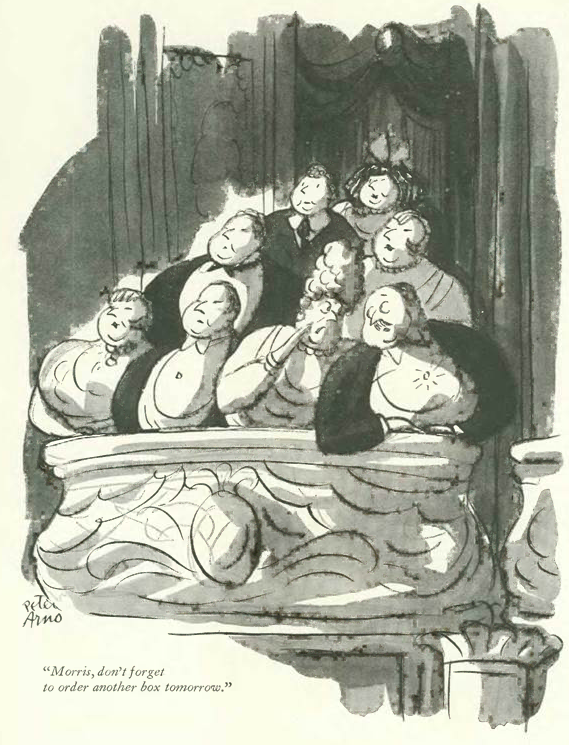
Also in the Nov. 3 issue was this cartoon by Peter Arno depicting one of the Met’s boxes stuffed with overfed toffs:

 *  *  *

Poet With a Green Thumb

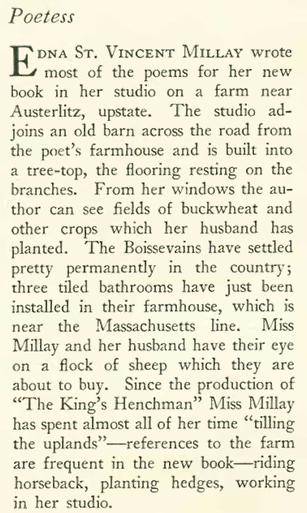
The Nov. 3 “Talk” also featured a bit by James Thurber on American poet and playwright Edna St. Vincent Millay, a major figure in New York’s Greenwich Village literary scene as well as a feminist leader. A Pulitzer-Prize winner (1923), Millay was also an avid gardener who preferred the solitude of her farm, Steepletop, to the limelight usually accorded a literary star:

RARE PHOTOGRAPH…Edna St. Vincent Millay raised her own vegetables at Steepletop, a former blueberry farm located near Austerlitz, New York that she owned with her husband Eugen Jan Boissevain. Photo is circa 1928. (Library of Congress)

Thurber noted that even her publisher, Harper & Sons, had to use an old photo of the publicity-shy poet for a new book release:

On the topic of photography, “Profiles” (written by film historian Terry Ramsaye) looked in on the quiet life of photography pioneer George Eastman, who founded the Eastman Kodak Company and popularized the use of roll film.

A quintessential “mamma’s boy,” Eastman never married…

…and by all accounts died a celibate less than four years after this profile was written, taking his own life at age 77. Suffering from intense pain caused by a spinal disorder, Eastman shot himself in the heart on March 14, 1932, leaving a note which simply read, “To my friends: my work is done. Why wait?”

Odds and Ends

Other items of note from the Nov. 3 issue included a humorous piece by Rube Goldberg, “The Red Light District,” in which the president of the Blink Stop-Go Traffic Company summons a doctor to treat a strange malady. The doctor gets held up by traffic lights on the way to the “emergency,” and when he discovers the problem is only hives, he shoots the patient. The piece was headlined by this artwork, also by Goldberg (shades of George Herriman and R. Crumb, yes?)…

Goldberg is still known today thanks to his series of cartoons depicting deliberately complex contraptions invented to perform simple tasks, such as the “Self-Operating Napkin” below, from 1931:

1931 (Wikipedia)

Cartooning’s highest honor, The Reuben Award, was named after Goldberg, who was a longtime honorary president of the National Cartoonists Society.

 *  *  *

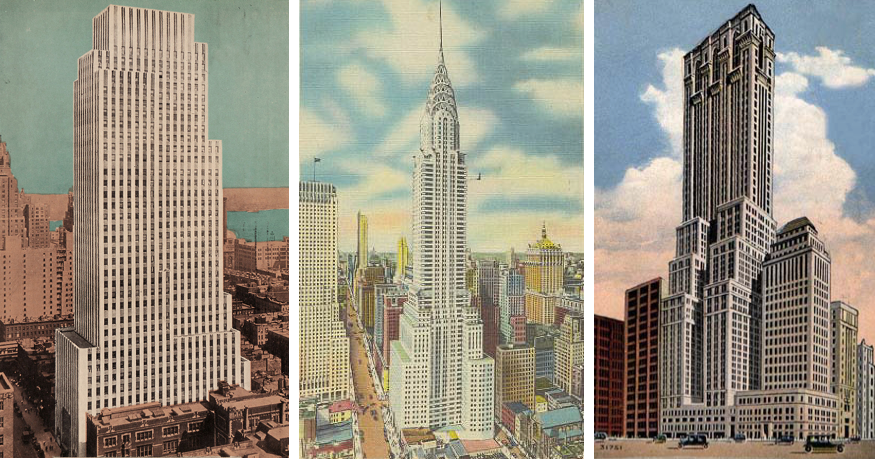
The Roaring 20s saw a rapid transformation of the New York skyline, with massive skyscrapers rising from the dust of old 18th and 19th century institutions. But few would signal the new age more than the Chrysler Building, an Art Deco landmark that would stand as the world’s tallest building for nearly a year (knocked from the top spot in May 1931 by the Empire State Building). Architecture critic George S. Chappell (“T-Square”) had this observation about the planned building:

EVOLUTION OF AN ICON…Stages in the design for the Chrysler building, from the July-December 1929 issue of Progressive Architecture.

*  *  *

More from our advertisers…in the Nov. 3 issue Hawaii beckoned well-heeled New Yorkers who were contemplating the coming winter…

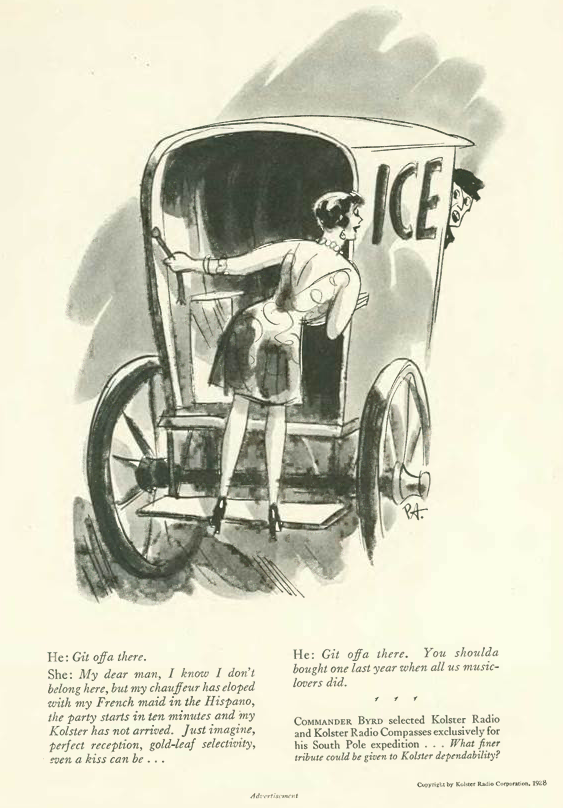
…and then there was this poorly executed ad for Kolster radios, the whole point seeming to be the drawing they commissioned from New Yorker cartoonist Peter Arno:

And finally, a cartoon by Alan Dunn, who looked in on an Ivy League football huddle:

Next Time: Diamond Lil…


The Prohibition Portia

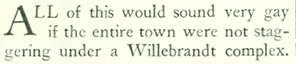
Despite Prohibition, booze flowed freely in 1928 New York thanks to bootleggers and lax enforcement by everyone from cops to judges. One major exception was Mabel Walker Willebrandt, a U.S. Assistant Attorney General from 1921 to 1929 who among other things handled cases concerning violations of the Volstead Act.

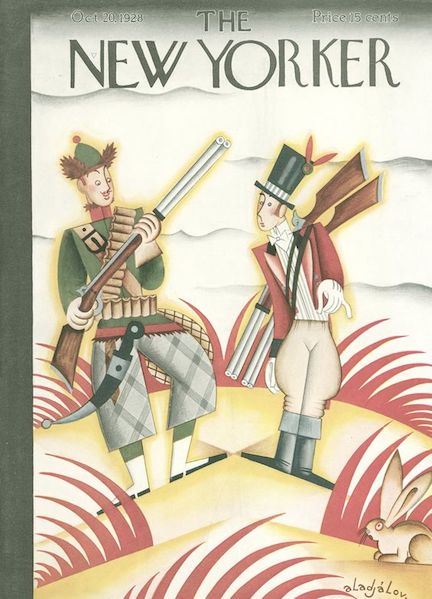
Oct. 20, 1928 cover by Constantin Alajálov.

Although Willebrandt herself enjoyed the occasional drink (she was personally opposed to prohibition), she was nevertheless serious about enforcing the law, and rather than chasing small-time bootleggers or padlocking speakeasies, she targeted the big-time operators.

How Willebrandt fits into this blog entry can be found in Lois Long’s “Table for Two” column in the Oct. 20, 1928 issue, in which Long described the current state of affairs of Manhattan’s nightlife, including the departure of boozy torch singer Helen Morgan from the speakeasy scene for Flo Ziegfeld’s late-night Broadway revue, the Ziegfeld Midnight Frolic:

WELL-KNOWN TO THE POLICE…Helen Morgan started singing in Chicago speakeasies in the early 1920s, where she defined the look of the torch singer, including the draped-over-the-piano pose, which was her signature. (amanandamouse.blogspot.com)

Morgan, who at the time was also starring in Broadway’s Show Boat, had been arrested the previous December for violation of liquor laws at her own popular nightclub, Chez Morgan. She would not return to performing in nightclubs until after the repeal of Prohibition.

Long also looked in on the popular Harlem nightclubs, where the dance music was “throbbier than ever.”

HOPPING IN HARLEM…Lois Long wrote that you couldn’t get near the popular Small’s (left) on a Saturday night, while Connie’s Inn (right) offered a new show that was “as torrid as ever.” (harlemworldmag.com, New York Public Library)

There was a sober undercurrent to all of this merry-making, namely Willebrandt’s determined efforts to go after the big bootlegging operations that were fueling all of this mirth. Long wrote:

PROHIBITION PORTIA…At left, Mabel Walker Willebrandt being sworn in as U.S. Assistant Attorney General in 1921. At right, Willebrandt on the cover of Time magazine, August 26, 1929. (legallegacy.wordpress.com/Time)

Willebrandt decried the political interference and the incompetence (or corruption) of public officials who undermined the enforcement of the Volstead Act, and even fired a number of prosecutors. As her office also oversaw the enforcement of tax laws, she developed the strategy for prosecuting major crime bosses for income tax evasion. It was an approach that would finally put the famed Chicago gangster Al Capone behind bars in 1931.

Lois Long’s mention of Willebrandt was doubtless due to the 1928 presidential campaign, during which Willebrandt openly campaigned for the “dry” candidate, Republican Herbert Hoover, over the “wet” Al Smith, who referred to Willebrandt as “The Prohibition Portia.” Smith was referencing Shakespeare’s The Merchant of Venice, in which the play’s heroine, Portia, outwits the merchant Shylock in a court case by referring to the exact language of the law.

Jim Dandy

New York Mayor Jimmy Walker was well-known for his taste in clothes (as well as for the nightlife), so E.B. White (writing in “The Talk of the Town”) decided to pay a visit to the mayor’s personal tailor to see how the “royal garments” were created. Excerpts:

JIM DANDY…New York Mayor Jimmy Walker was a well-known dandy and a familiar face at Manhattan nightclubs. Rarely seen at City Hall, Walker used the lavish Casino nightclub in Central Park as his unofficial headquarters. (Encyclopedia Britannica)

 *  *  *

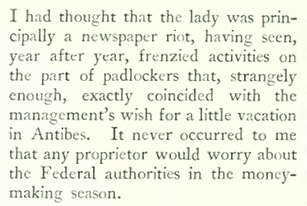
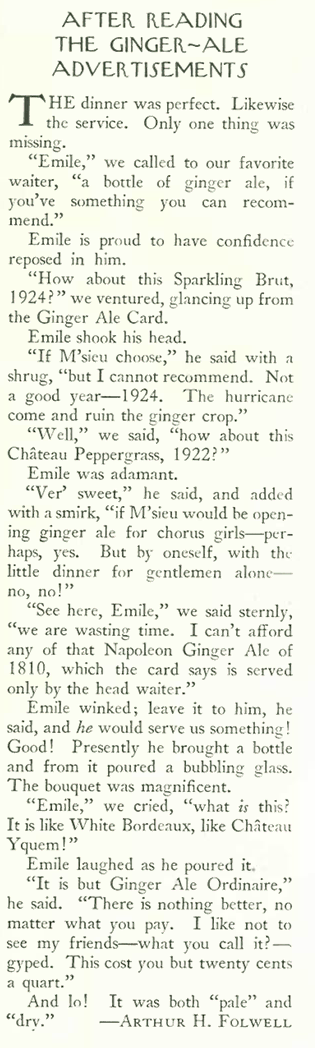
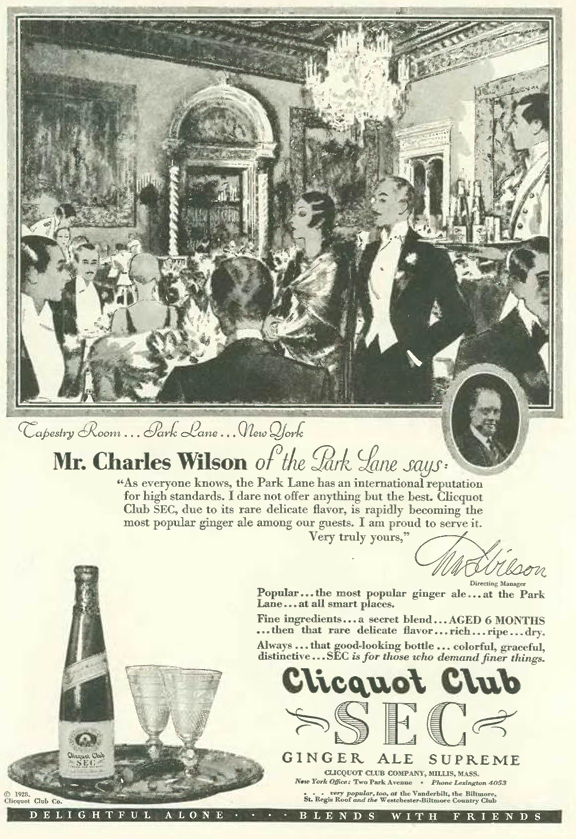
In one of my recent entries (The Tastemakers, posted Nov. 28) I noted how Prohibition had driven some advertisers to absurd lengths, including manufacturers of non-alcoholic beverages who appealed to the refined tastes (and snobbishness) usually associated with fine wines (see Clicquot Club ad below). Gag writer Arthur H. Folwell had some fun with such pretensions:

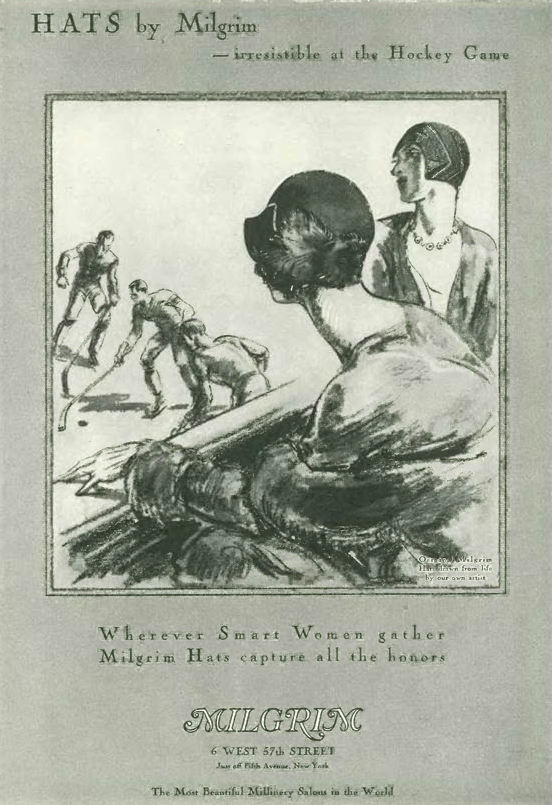
Speaking of refinement, when was the last time you saw someone dressed like this at a hockey game?

Before they graced the silver screen, the Marx Brothers were one of Broadway’s biggest draws, including their 1928 hit “Animal Crackers,” advertised in the back pages of the Oct. 20 New Yorker.

Our cartoons are courtesy Peter Arno, who looked in on a Hollywood movie set…

…and Gardner Rea, who rendered a scenario for an upper class emergency…

Next Time: Lighter Than Air…


This Thing Called Baseball

In the early years of The New Yorker, baseball as a sport was almost entirely ignored by the magazine, which otherwise gave exhaustive coverage to polo, yacht racing, tennis, and golf. There were also articles on badminton, rowing, and even auto racing, and college football received a lot of enthusiastic ink. But none for baseball. With the Sept. 22, 1928 issue I think I finally understand why.

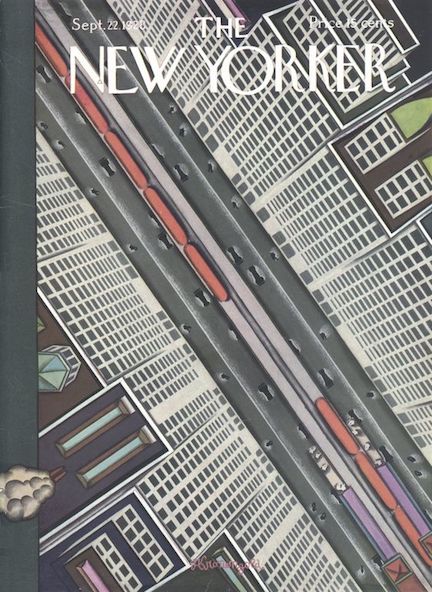
Sept. 22, 1928 issue by Adolph K. Kronengold.

It has something to do with The New Yorker’s parochial view of the world, so aptly illustrated by Saul Steinberg on the magazine’s March 29, 1976 cover, in which anything beyond the Hudson was essentially terra incognita:

A lot of New York Yankee fans came from “out there,” according to James Thurber in a “Talk of the Town” segment titled “Peanuts and Crackerjack.” Thurber wrote of his experience at a pennant race game between the Yankees and the Philadelphia A’s. The game of baseball was described as something for the out-of-towners who were “a bit mad,” a mass spectacle in which the game itself was of minor importance. In short, it wasn’t cool to be a Yankees fan if you counted yourself among Manhattan’s smart set:

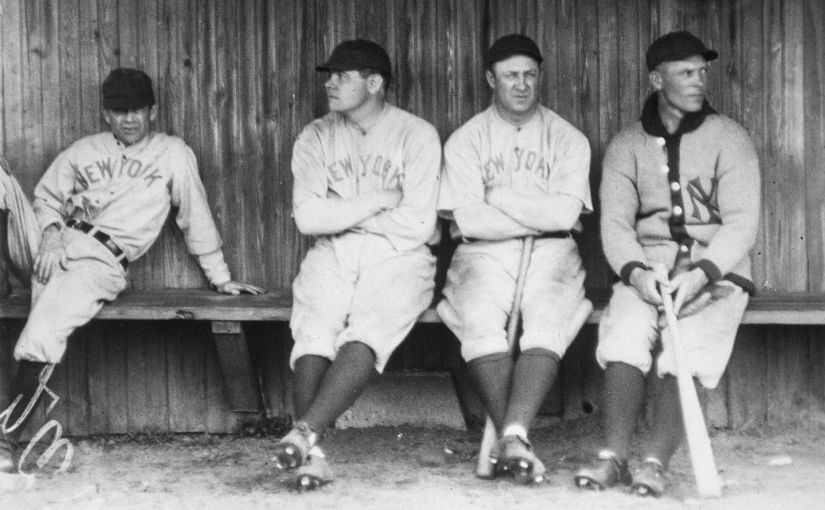
This “Talk” item was written when the Yankees were on the verge of winning their second consecutive World Series championship over the favored St. Louis Cardinals. The 1928 team featured the famed “Murderer’s Row” lineup with the likes of Babe Ruth and Lou Gehrig. In all, nine players from the ’28 team would be elected to the Hall of Fame, a major league record. But as of the Sept. 22 issue neither the 1927 or ’28 Yankees merited a line in The New Yorker’s sports pages.

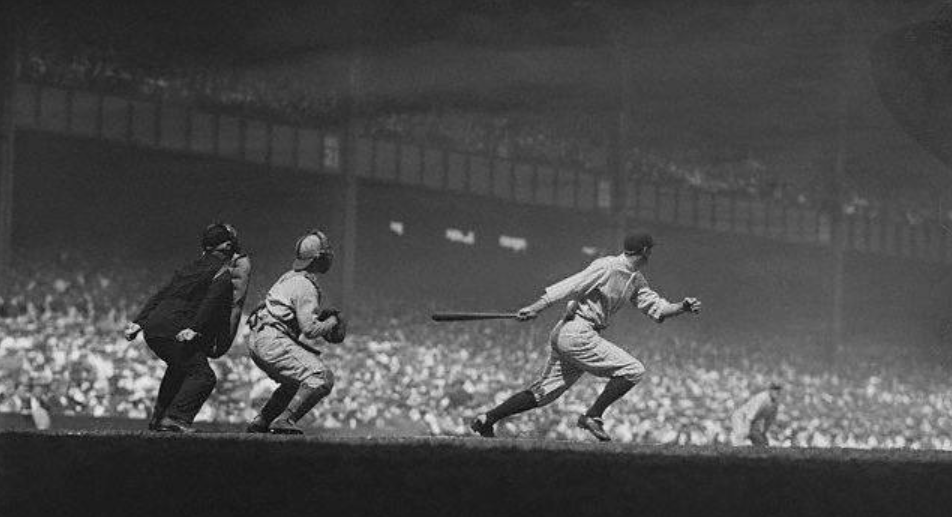
HIT ONE FOR THE OUT-OF TOWNERS…The Yankees’ Earle Combs leads off with base hit against the Philadelphia A’s in a key AL pennant race game on Sept. 9, 1928. A record crowd of 85,265 attended the game, won by the Yankees, who gained half-game lead over the A’s with the victory. (baseballhistorycomesalive.com)

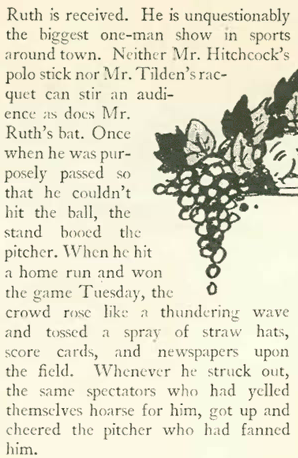
Thurber wrote that one could learn much about those in attendance at the game by the way they received Yankee star Babe Ruth:

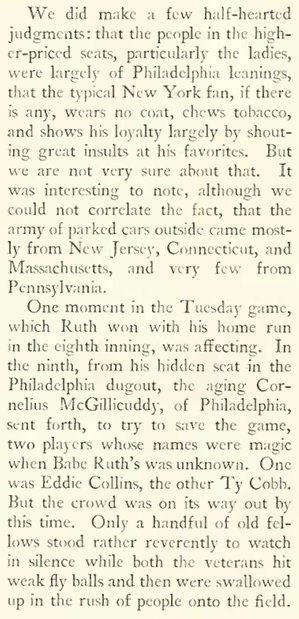
Thurber proved his point about out-of-towners by noting the origin of license plates in the “army of parked cars” outside of the stadium. He also noted the appearance in the game of an ancient Ty Cobb, who hit a weak fly ball while a few old-time fans looked on in reverence:

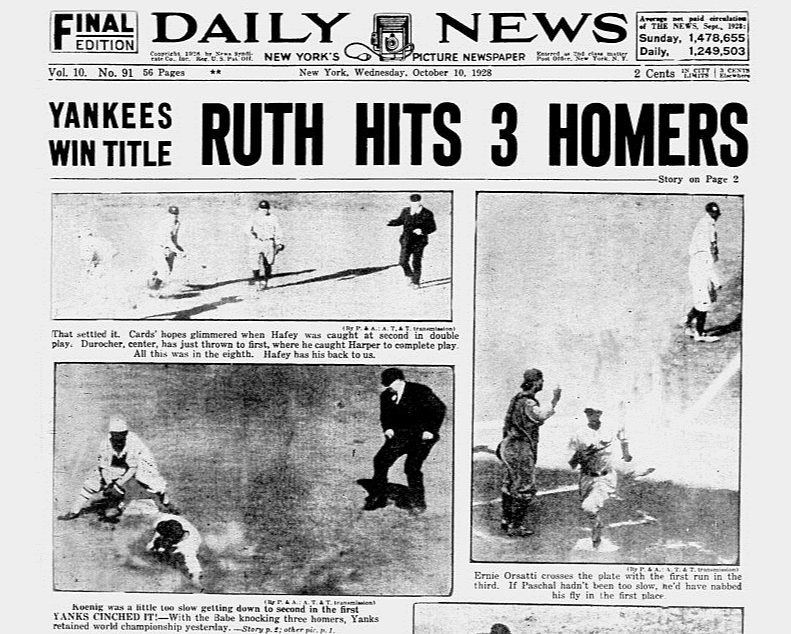
WHERE YOU COULD READ ALL ABOUT IT…The Oct. 10, 1928 edition of the Daily News splashed its front page with photographs of the Yankee’s triumphant title win. (NY Daily News)

 *  *  *

An Eye-dropping Art Collector

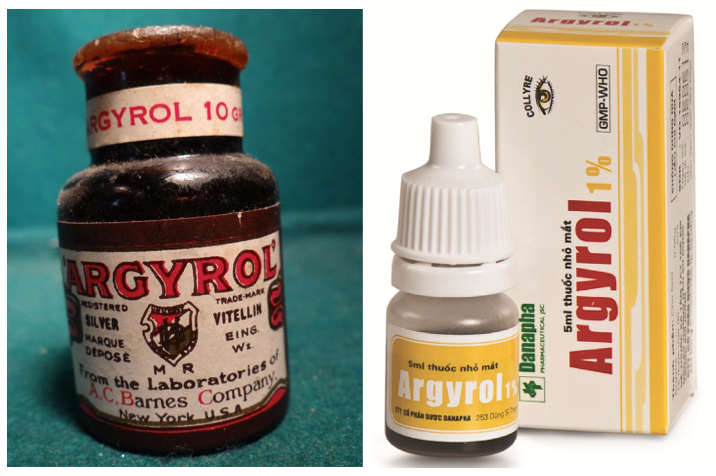
The Sept. 22 issue A.H. Shaw profiled “De Medici in Merion” Dr. Albert Barnes, who made his fortune by developing in 1901 (with German chemist Hermann Hille) a silver nitrate-based antiseptic marketed as Argyrol. In the days before antibiotics, Argyrol was used to treat eye infections and prevent newborn infant blindness caused by gonorrhea. The profile featured this rather fearsome illustration by Hugo Gellert:

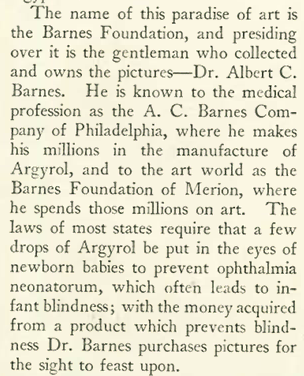
The lengthy piece detailed Barnes’ coming of age, and how his promotion of Argyrol helped bankroll his famed art collection. A brief excerpt:

IT FUELED A FORTUNE…Invented in 1901, Argyrol eye drops would finance one of the world’s greatest private art collections. Although was no longer marketed in U.S. after 1996, it is still available today, as seen at right in this Vietnamese product. (todocoleccion / ydvn.net)
HMMM, THAT LOOKS FAMILIAR…Henri Matisse views his 1917 painting The Music Lesson during a 1933 visit to the Barnes Foundation in Lower Merion Township, near Philadelphia. (The Morgan Library & Museum)
HE LIKED DOGS, TOO…Dr. Albert Barnes and his dog Fidèle with Matisse’s Red Madras Headdress, in 1942. (Barnes Foundation Archives)

  *  *  *

A One-eyed Monster Comes to Life

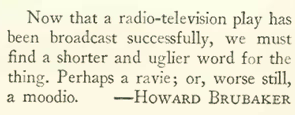
It’s always interesting to note the mentions of emerging technology in the early New Yorker, including this bit in Howard Brubaker’s column “Of All Things” about the successful broadcast of a “radio-television play.” Brubaker mused about what this new invention might called:

The first television broadcast in July 1928 was not exactly must-see TV. For two hours a day, General Electric’s experimental station W2XB broadcast the image of a 13-inch paper mache Felix the Cat, simply rotating on a turntable.

THE DAYS BEFORE VIAGRA ADS…A 13-inch Felix the Cat figure (top) was used to test an early television broadcast from General Electric’s experimental station W2XB in Schenectady, N.Y. Rotating on a record player turntable, the Felix figure was broadcast using a mechanical scanning disk, and was received as a 2-inch high image (below left) on an electronic kinescope. At bottom right, a 1928 television from General Electric that received alternating sound and picture. (NBC / Imgur / tvhistory.tv)

Then on September 11, 1928, W2XB (with WGY radio providing audio) broadcast a 40-minute one-act melodrama, The Queen’s Messenger. Northern State University’s Larry Wild writes that because TV screens were so small, only an actor’s face or hands could be shown. “The play had only two characters. A female Russian spy and a British Diplomatic Courier. Four actors were used. Two for the character’s faces, and two for their hands.”

The Queen’s Messenger was the first television drama, received by 3-inch televisions (most likely similar to the General Electric Octagon TV set pictured at left) that were set up in various places in the New York City area. At right, actors on the set of The Queen’s Messenger. The crude, flickering image marked the beginning of a revolution. (General Electric)

 *  *  *

From Our Advertisers

Advertisers were always looking for clever angles to capture the attention of The New Yorker’s upscale readers, including the use of subtle and not-so-subtle racist cues to get their points across. Two examples from the Sept. 22 issue have the makers of Oshkosh trunks helpfully pointing out that their product is not intended for African “natives”…

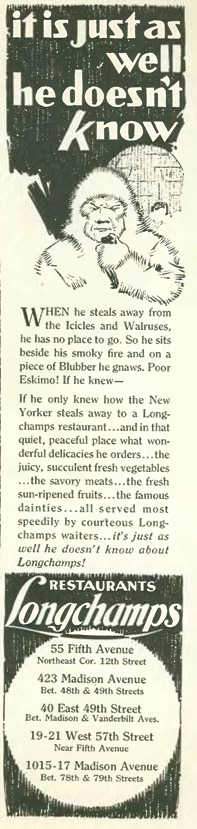
…or the folks from Longchamps restaurants, who depict the joyless life of a blubber-eating Eskimo as an appropriate juxtaposition to the succulent delicacies awaiting readers at their five New York locations:

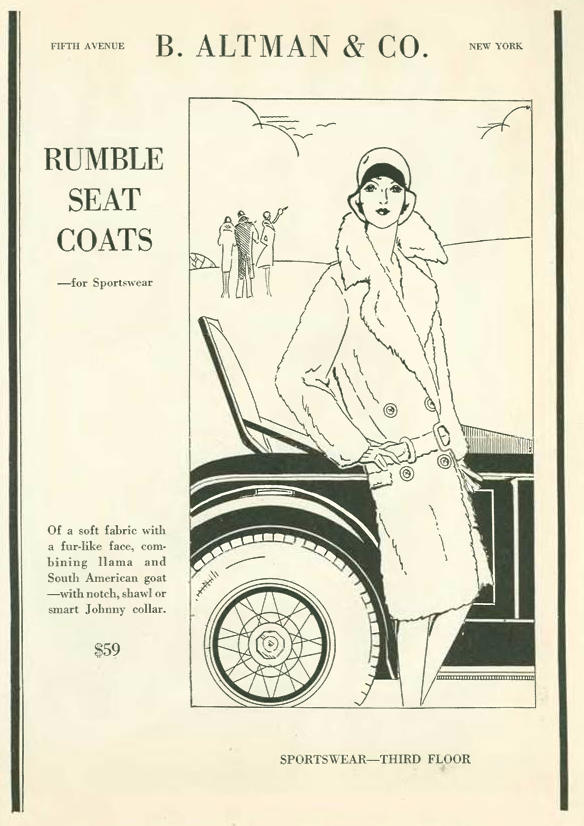
We might associate rumble seats with the carefree joys of the Roaring Twenties, but in reality passengers in these jump seats received little protection from the elements (or flying gravel), and the ride was no doubt jarring atop the rear axle. No wonder you needed a special coat:

Our cartoons for Sept. 22 include this whimsy from Gardner Rea

…and this cartoon by Al Frueh, which depicts the deserted surroundings of the Flatiron Building on Yom Kippur. Robert Mankoff, who served as The New Yorker’s cartoon editor from 1997 to 2017, observed in the Cartoon Desk (Sept. 26, 2012) that “the rapid growth of Jewish-owned businesses in New York made the cartoon relevant in a way that it’s not today. Through modern, politically correct eyes, the cartoon may seem anti-Semitic, but I don’t see it that way. It just depicts the reality of those times, exaggerated for comic effect.”

Next Time: The Tastemakers…


Good Vibrations

A decidedly new sound reverberated in the ears of New Yorkers who attended a Feb. 1928 performance of the New York Philharmonic that featured guest artist Leon Theremin, a Russian inventor who played music by moving his hands through the air, or more accurately, a magnetic field.

February 4, 1928 cover by Gardner Rea.

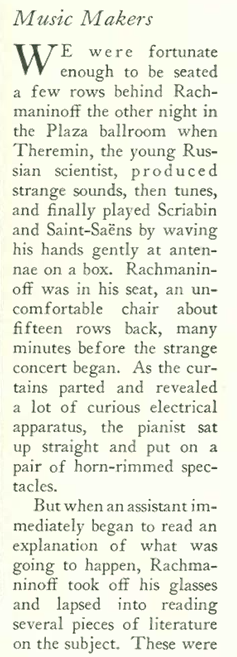
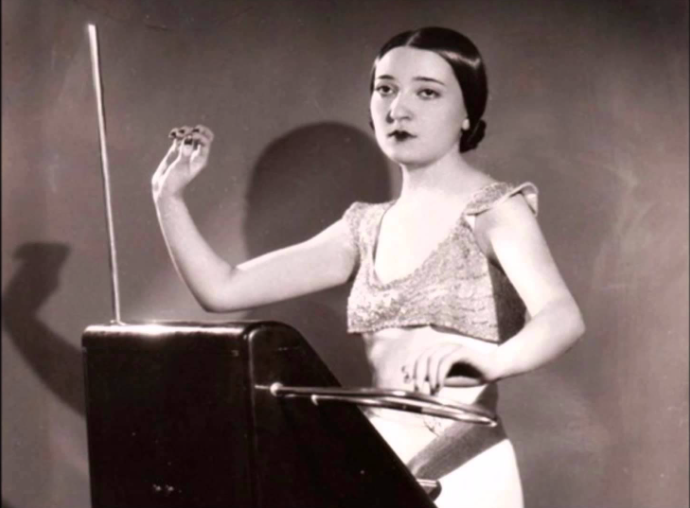
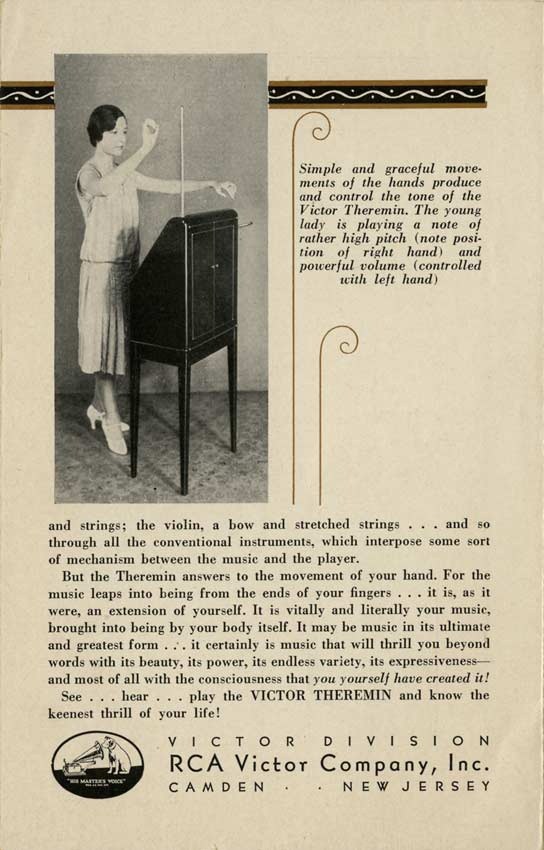
Theremin’s eponymous instrument had neither keys nor strings, but rather two metal antennas attached to an electronic oscillator. Music was produced by moving one’s hands between the antennas, which sensed the relative position of the players hands—one antenna controlled for pitch while the other adjusted the instrument’s volume. The sound produced is best described as “otherworldly.” James Thurber, writing for the “Talk of the Town” (in a piece titled “Music Makers”), found Theremin’s performance intriguing, but of even greater interest was the great Russian pianist and composer Sergei Rachmaninoff—who was in attendance—and his reaction to the strange instrument:

HMMMM…At left, Sergei Rachmaninoff in 1921, as photographed by Kubey Rembrandt. At right, Leon Theremin plays his eponymous instrument at a demonstration concert in Paris on December 8, 1927. (Wikimedia)

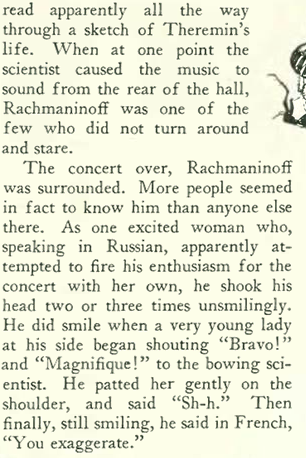
The New Yorker’s voyeuristic account of Rachmaninoff continued, with the great man now becoming more engaged in the performance…

The Theremin would grow in popularity, however more as a novelty than a serious instrument:

ON THE AIR…Alexandra Stepanoff playing the Theremin on NBC Radio in 1930. A Russian immigrant to the U.S., the former concert singer was Theremin’s first student in the United States. (Wikimedia)
VIRTUOSO…The Russian-born Clara (Reisenberg) Rockmore holds a unique place in music history as the virtuoso performer of the Theremin. Leon Theremin built a custom version of his instrument for Rockmore, which added greater range and sensitivity. Rockmore would sometimes perform concerts with her sister, accomplished pianist Nadia Reisenberg. Photo circa 1930. (PHOTO BY RENATO TOPPO, COURTESY OF THE NADIA REISENBERG – CLARA ROCKMORE FOUNDATION)

Theremin would be granted a U.S. patent for the instrument in 1928, which was marketed and distributed in the U.S. by RCA during the 1930’s in either DIY kit form or as a finished instrument:

(120years.net)

Interest in the instrument as a novelty continued into the 40’s and 50’s in the DIY market…

(120years.net)

Robert Moog, pioneer of modern electronic music and inventor of the Moog synthesizer, made and sold a transistorized version of the Theremin in the 1950s.

The Theremin would become best known to mass culture through its use in producing “eerie” sound effects in 1940s and 50s films, including Bernard Herrmann’s use of the instrument for the soundtrack to the 1951 sci-fi thriller, The Day The Earth Stood Still. And nearly everyone on the planet has heard the Theremin-inspired sound of the Beach Boy’s song Good Vibrations, created by an electro-Theremin that was developed in the late 1950s to mimic the sound of the original Theremin.

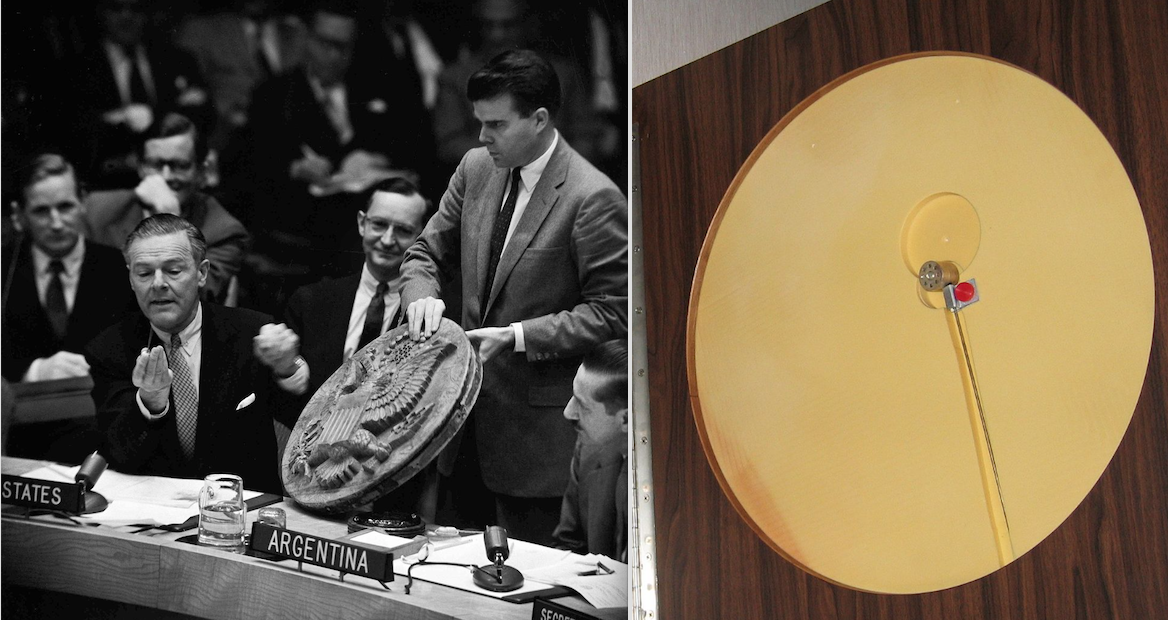
As for Leon Theremin himself, he would also gain notoriety as the inventor of The Thing, a listening device most famously used by the Soviets to bug the U.S. Embassy in Moscow. The device was hidden behind a wood carving of the U.S. Great Seal, which in 1945 was presented by Soviet schoolchildren to the U.S. ambassador, who subsequently hung it in his office.

GOTCHA…American Ambassador to the UN Henry Cabot Lodge displays The Thing before the UN Security Council in 1960. At right, the device which was hidden behind the seal. The Americans discovered the bug in 1952, but didn’t reveal its existence until 1960 in the wake of the U-2 spy plane incident. The Soviet Union had convened the meeting of the United Nations Security Council to accuse the Americans of spying with the U2; in response Cabot displayed The Thing as proof spying between the two countries was a mutual endeavor. (crytomuseum.com/Wikimedia)

The reasons why Theremin developed The Thing for the KGB are a mystery. When he suddenly disappeared from New York in 1938 it was rumored that he had been kidnapped and possibly executed by the KGB. What we do know is that Soviet spooks put him to work in a secret laboratory in the Gulag camp system, where he developed The Thing.

In 1991, filmmaker Steven Martin brought Leon Theremin back to New York to film a documentary about his life. Theremin gave one last performance in 1993, and died that year at age 97.

Wild Kingdom

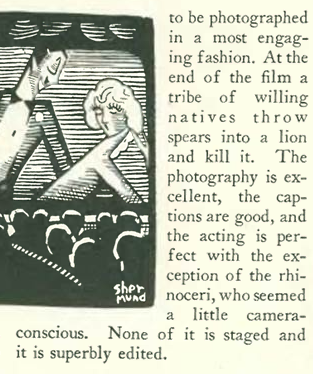
The New Yorker’s review of the hit film Simba revealed a very different approach to the natural world 89 years ago, when the wilds of Africa were exploited purely for adventure and thrills rather than for any real understanding of natural systems and the animals and humans that inhabited them. Martin and Osa Johnson were celebrated for their filmed exploits in the wilds, including Simba; they touted their movie—shot in Kenya—as being made under the auspices of the American Museum of Natural History, although much of the film was staged or edited in ways to maximize the thrills.

The New Yorker found the film to be “darn good fun”…

Despite its flaws, the film does offer us a glimpse of Africa when wildlife hadn’t been hunted to near extinction, although the Johnsons didn’t hesitate to gun down animals left and right in the course of their movie-making.

According to a 2011 review from Wild Film History, “in stark contrast to the conservation-themed wildlife films of today, the Johnsons approached their subjects armed with both camera and rifle, with the production including provoked behavior, staged confrontations and animals shot to death on film. Relying heavily on cutting in kills from professional marksmen, numerous hunting scenes culminate in a heart-stopping sequence where, with the use of clever editing, the adventurous Mrs Johnson appears to bring down a charging rhinoceros with one well-aimed shot.

A FUN-LOVING NATURE…Osa Johnson saddles up a hapless zebra. (Daily Mail)

 *  *  *

From the Advertising Department

There were three automobile ads in the Feb. 4 issue, all from long-gone companies—Pierce-Arrow, Hudson-Essex, and Nash, which featured this endorsement by the brother-sister dancing duo Fred and Adele Astaire:

This ad for Dynamique showcased the art deco stylings of its furniture line…

And finally, a Peter Arno cartoon of an upper class faux pas

Next Time: Literary Rotarians…

The Perfect Gift for 1927

We close out 1927 by looking at the final December issues, which grew fat with Christmas advertising catering to the tastes of New York’s smart set.

dec-10
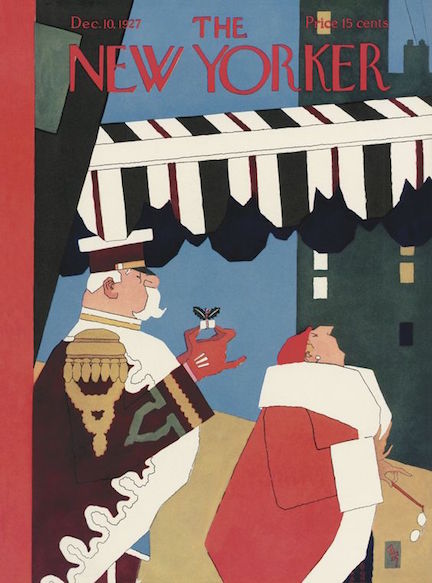
December 10, 1927 cover by Gardner Rea.

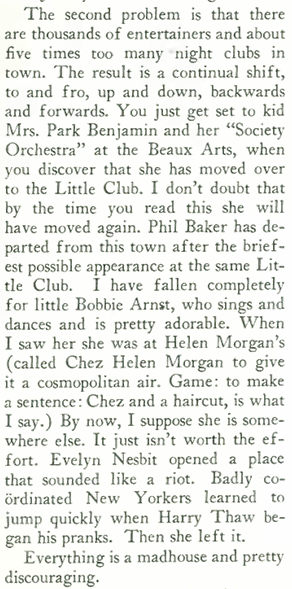
Before we jump to the ads, let’s look in on Lois Long, who in the Dec. 10 issue continued her lamentations regarding the quality of New York’s Prohibition-era night life and reminded readers that her job was far from a “soft snap”…

screen-shot-2017-02-06-at-10-03-06-am

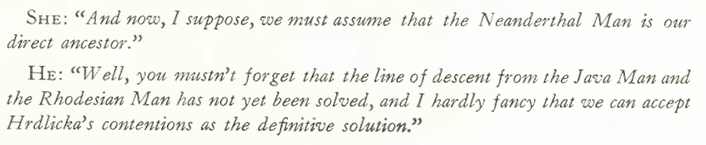
The problem, as diagnosed by Long, was that there were not enough talented entertainers to fill the needs of an overabundance of nightclubs…

screen-shot-2017-02-06-at-10-04-09-am

vit-94-bobbe-arnst1
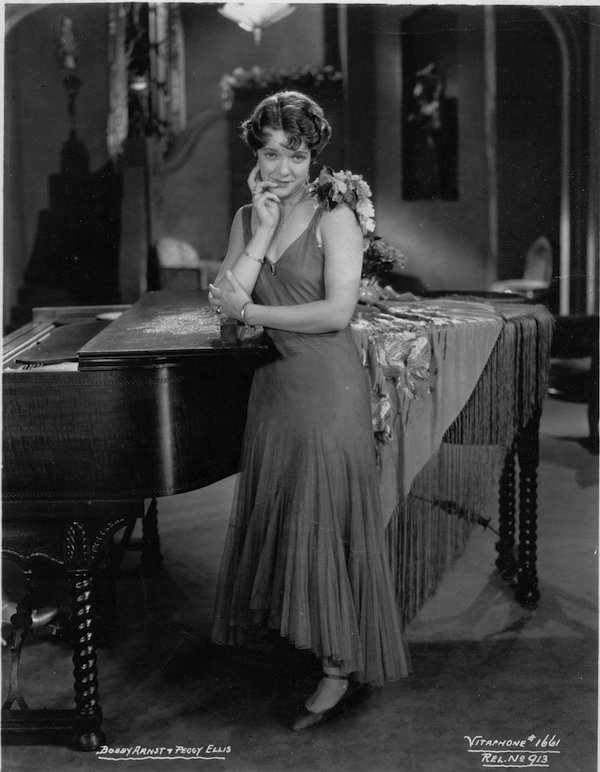
LOIS THOUGHT BOBBIE ARNST WAS PRETTY SWELL when she appeared at Helen Morgan’s nightclub. A noted broadway singer and dancer, Arnst is pictured above in a publicity photo from the 1929 film Rhythms in Blue. (picking.com)
screen-shot-2017-02-07-at-12-33-26-pm
ON THE OTHER HAND…Evelyn Nesbit’s tearoom (and later speakeasy) couldn’t survive on notoriety alone. In the early 20th century Nesbit’s face was everywhere—from advertisements to calendars—but in 1906 her fame took a nasty turn when her jealous husband, Harry Thaw, shot and killed suspected lover and famed architect Stanford White at Madison Square Garden’s rooftop theatre. At left, Nesbit in 1900. At right, Nesbit in her tea room on West 52nd Street, near Broadway, circa 1922. (Library of Congress / restaurant-ingthroughhistory.com)

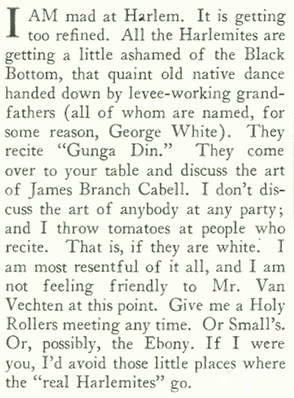
Long also railed against the white appropriation of Harlem entertainment, which she felt was draining the place of its soulfulness. In particular she called out writer and photographer Carl Van Vechten, who among white writers was the most prominent in intellectualizing the “Harlem Renaissance”…

screen-shot-2017-02-06-at-11-43-27-am

What to Buy in ’27

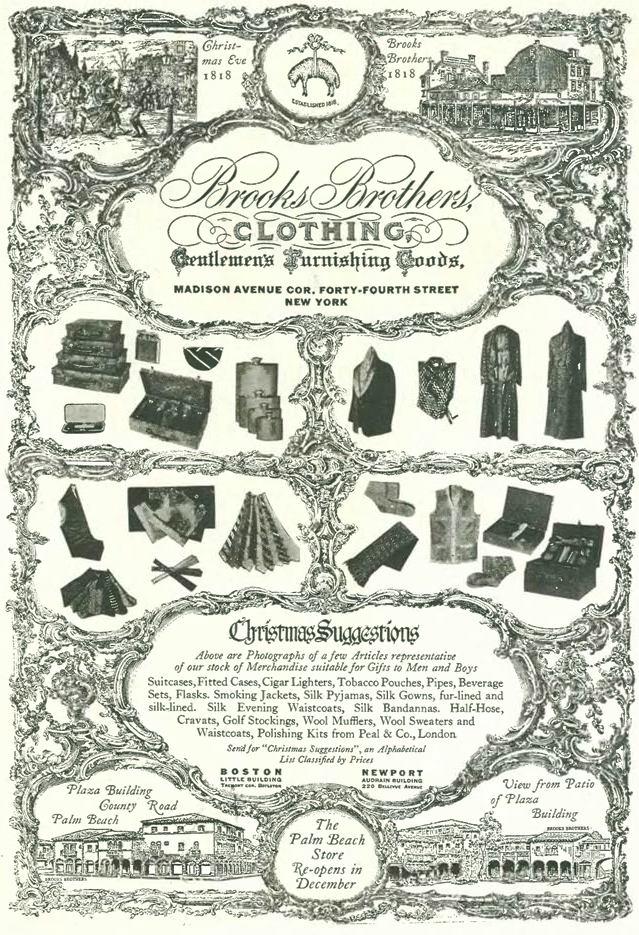
The Dec. 10 and Dec. 17 issues grew fat with holiday advertising, averaging 120+ pages as opposed to the usual 60 or so pages. The advertisements mostly appealed to upscale readers, ranging from this almost Victorian-style ad from the staid Brooks Brothers…

screen-shot-2017-02-06-at-9-46-21-am

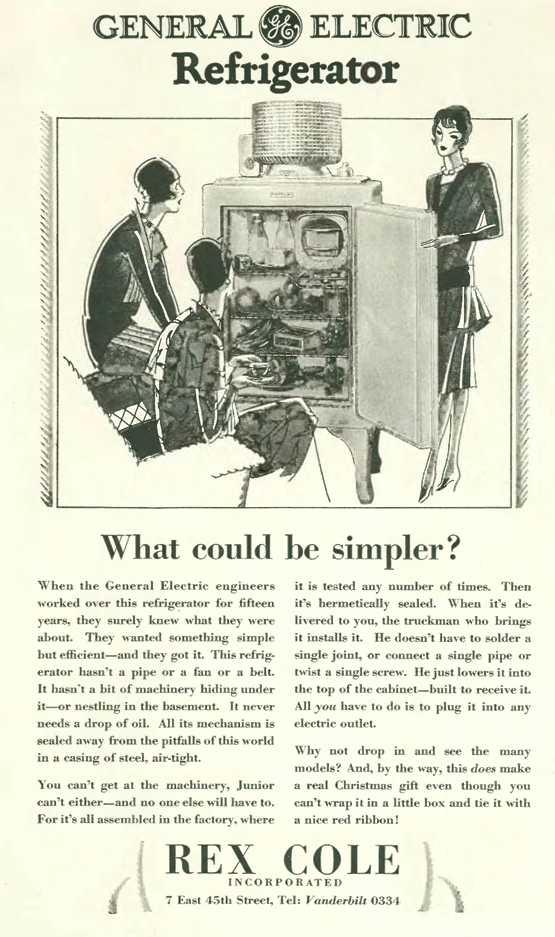
…to this ad from Rex Cole promoting the latest in modern conveniences…

screen-shot-2017-02-06-at-9-56-44-am

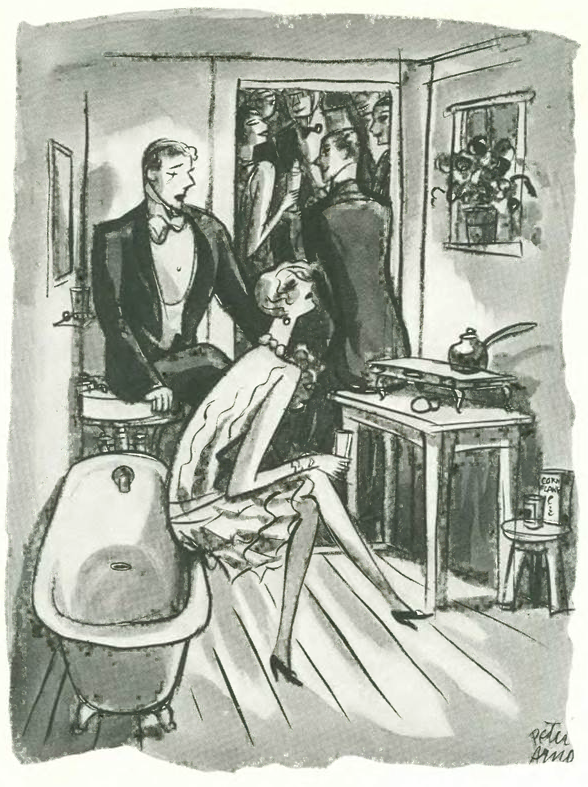
And I’ll toss in this cartoon from the Dec. 10 issue, in which Peter Arno allows us to listen in on an unlikely conversation between a couple of toffs…

screen-shot-2017-02-06-at-9-53-54-am

screen-shot-2017-02-06-at-9-54-11-am

Lois is Also Tired of the Holidays

On to the Dec. 17 issue, in which Lois Long also shared with readers her weariness of Christmas shopping in her column, “On and Off the Avenue.”

dec-17
December 17, 1927 cover by Theodore G. Haupt.

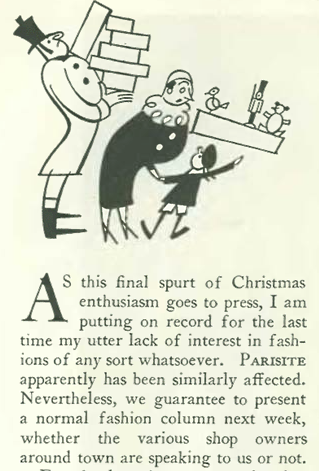
The “Parisite” Long referred to in this excerpt was actually Elizabeth Hawes, who occasionally contributed to Long’s column (with cables sent from Paris) regarding the latest in French fashions. More on Hawes another time…

screen-shot-2017-02-06-at-12-11-30-pm

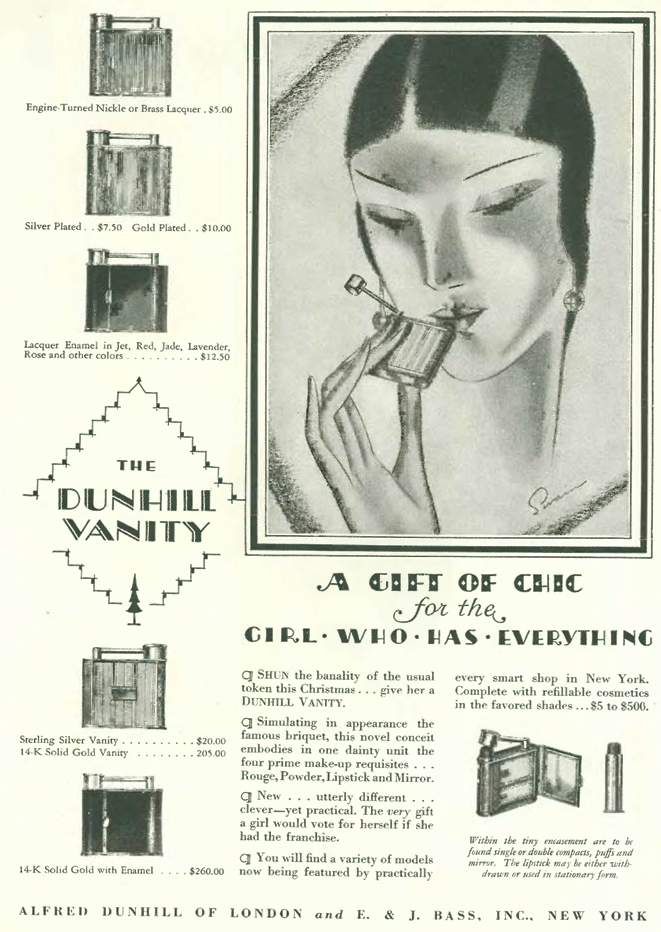
As for ads in the Dec. 17 issue, we get this one from Dunhill, maker of fine English cigarettes and accessories: a woman’s compact that resembles a lighter…

screen-shot-2017-02-06-at-12-07-21-pm

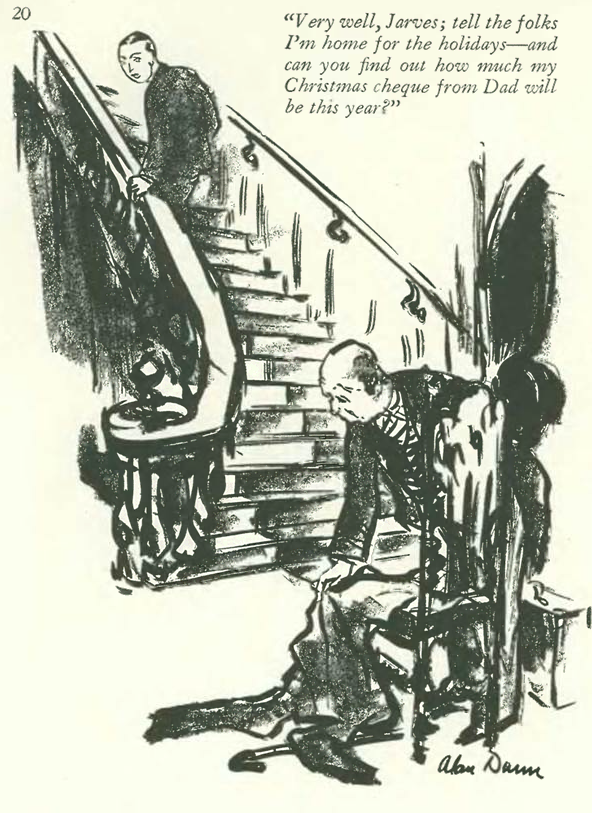
…and the same issue offers this glimpse into the life a spoiled rich kid, home from college for the holidays. The cartoon is by Alan Dunn, one of the most published New Yorker cartoonists (1,906 cartoons from 1926 to 1974)…

screen-shot-2017-02-06-at-11-52-12-am

With Christmas advertising over, the magazine’s page length dropped by half from the Dec. 17 to the Dec. 24 issue…

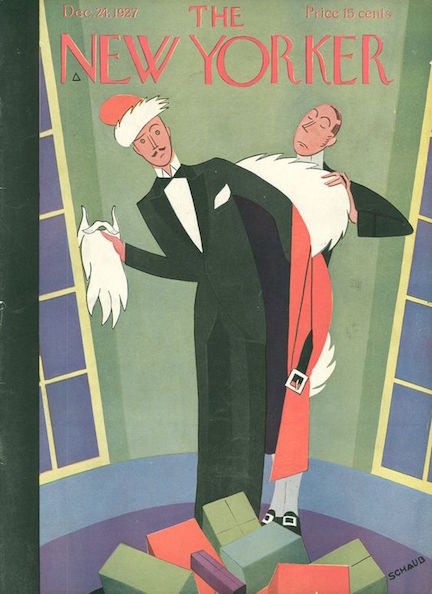
dec-24
December 24, 1927 cover by Andre De Schaub.

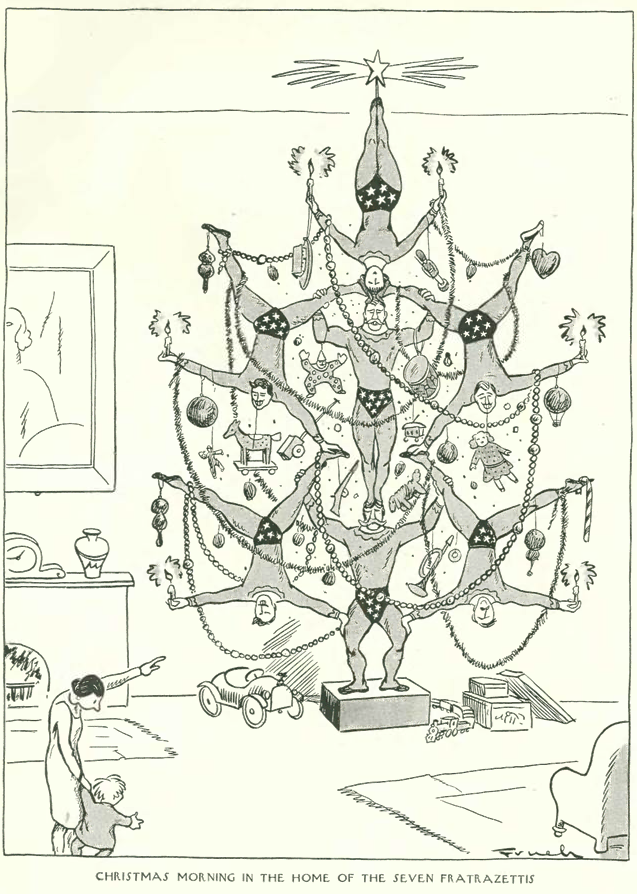
…in which we find this holiday-themed illustration by Al Frueh:

screen-shot-2017-02-06-at-12-26-56-pm

Why We Sing Auld Lang Syne

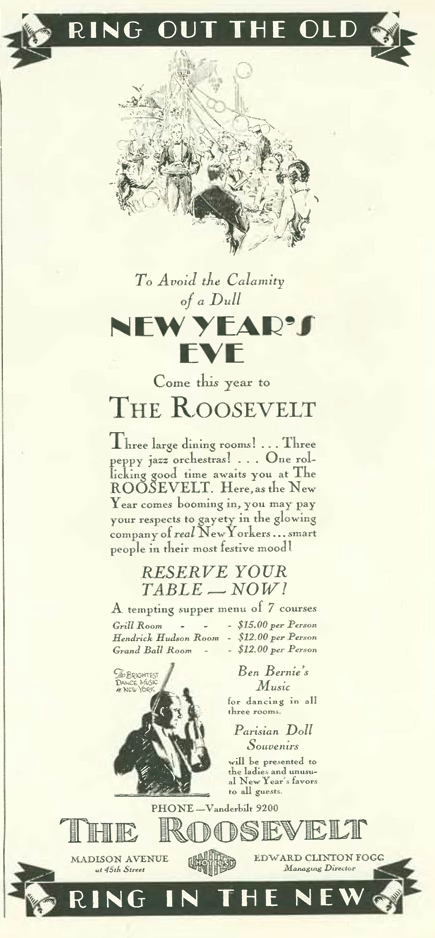
This advertisement in the Dec. 24 issue invited readers to celebrate the New Year at The Roosevelt Hotel…

screen-shot-2017-02-06-at-12-27-47-pm

roosevelt-hotel-1924
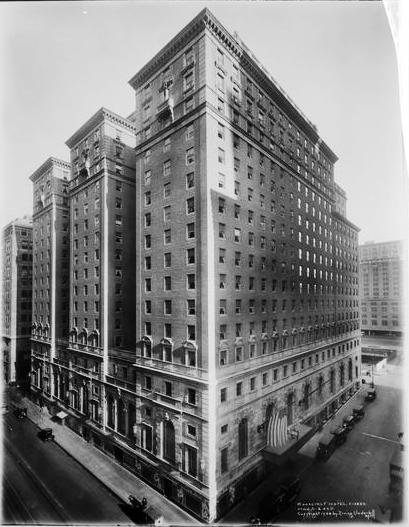
The Roosevelt Hotel after its completion in 1924 (Museum of the City of New York)
1387211957-0
AULD ACQUAINTANCE…If you want to know why we sing “Auld Lang Syne” on New Year’s Eve, you can thank Guy Lombardo and his Royal Canadian Band, which made the song a staple at his New Year’s performances beginning in 1929 at the Roosevelt Hotel. Their performance that night was broadcast on the radio before midnight Eastern time on CBS, then after midnight on NBC radio. (neatorama.com)

 *  *  *

Now Let’s Get Out of Here

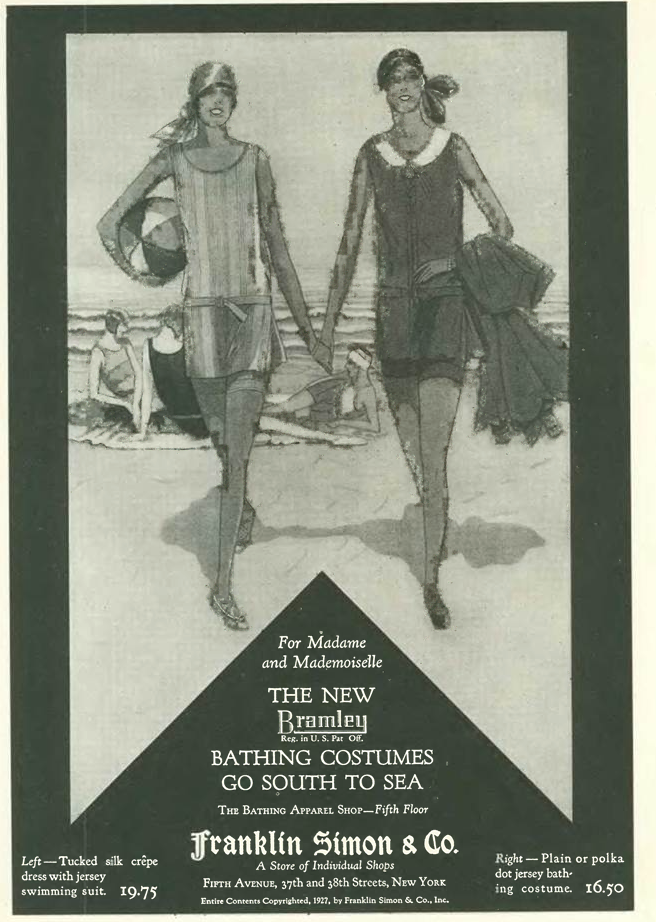
With the holidays out of the way, New Yorkers still faced a good three months of winter. That is, unless you were well-heeled enough to head south to Palm Beach. Considering the abundance of ads promoting travel to southern climes in the Dec. 24 and 31 issues, apparently many of the magazine’s readers possessed the means to do just that…

screen-shot-2017-02-06-at-12-29-05-pm

screen-shot-2017-02-06-at-12-29-15-pm

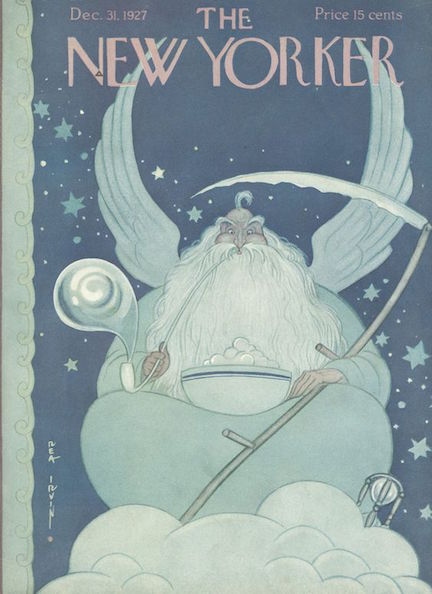
And we close this entry, and the year of 1927, with this cover…

dec-31
December 31, 1927 cover by Rea Irvin.

…and another tropical-themed advertisement, courtesy of Russeks…

screen-shot-2017-02-06-at-12-31-07-pm

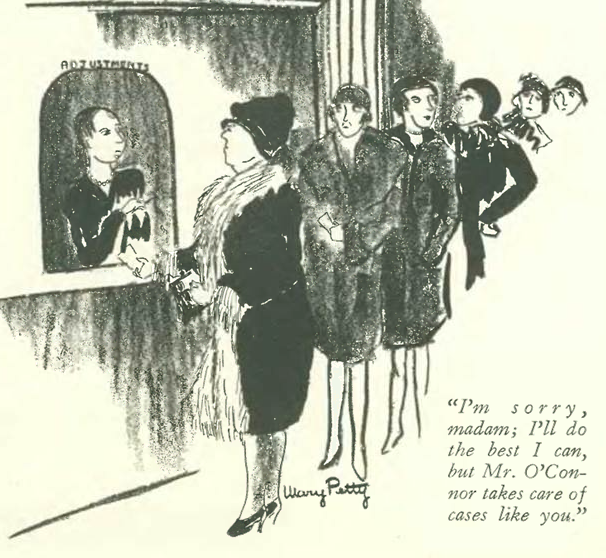
…and this cartoon by Mary Petty depicting those who were left behind, still returning their Christmas gifts…

screen-shot-2017-02-06-at-12-32-39-pm

Next Time: Odious Odes…

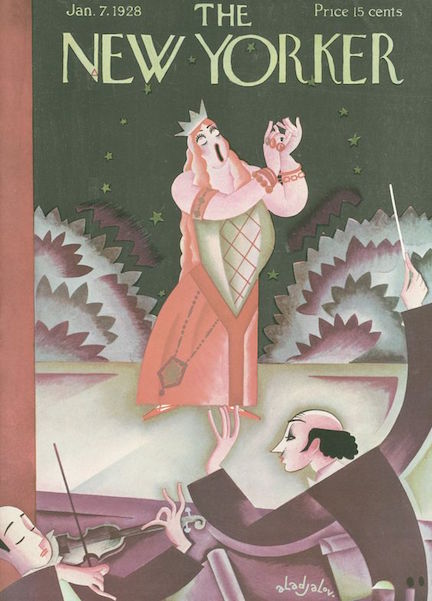
jan-7


Wits of the Round Table

Two big voices from the famed Algonquin Round Table were prominently featured in the Oct. 1 and Oct. 8, 1927 issues of the New Yorker–journalist and champion of the underdog Heywood Broun wrote his own “Profile” under the title, “The Rabbit That Bit the Bulldog,” and Dorothy Parker served up biting satire in “Arrangement in Black and White,” a clever exposé of racism among the fashionably “open-minded” upper classes.

488a50459a792547010d30e8bfe5ddf4
October 1, 1927 cover by Gardner Rea.

The Rabbit That Bit the Bulldog

Hiding under the signature “R.A.”, Heywood Broun (1888–1939) was merciless as his own profiler, describing himself as a coward, hypochondriac, and a slob (there is truth to the latter, however, as friends often likened him to “an unmade bed”).

screen-shot-2016-12-08-at-9-06-52-am

Broun cut his teeth in journalism as a sportswriter and war correspondent. In 1921 he went to work for the New York World, where he penned his popular syndicated column “It Seems to Me.” Broun’s New Yorker “Profile” was written after he was fired from the World following a disagreement with his editor over his critical commentary on the sentencing of anarchists Sacco and Vanzetti. Broun would move on to The Nation, where he would write a regular column, “It Seems to Heywood Broun,” that would offer criticism on a number of topics including his former employer, the World.

Heywood Broun. (Denver Newspaper Guild)

The New Yorker profile included this caricature by Peter Arno

screen-shot-2016-12-06-at-9-46-21-am

…a portrayal Broun claimed was inaccurate due to his “habitual stoop,” among other faults…

screen-shot-2016-12-06-at-9-52-23-am

screen-shot-2016-12-06-at-9-52-34-am

…and he mused about his future with the Nation, and how that august publication would square with his various foibles…

screen-shot-2016-12-06-at-9-52-45-am

…and as for his personal appearance and habits, Broun weighed in thusly…

screen-shot-2016-12-06-at-9-55-18-am

Broun married social activist Ruth Hale in 1917. A son born the following year, Heywood Hale Broun, would have a long and successful career as an author, sportswriter, commentator and actor.

*  *  *  *  *

The Long Count

Oddly, The New Yorker had little to say about the famous Chicago rematch between heavyweight boxers Gene Tunney and Jack Dempsey, which Tunney won after the controversial “long count.” The fight took place under new rules that gave a fallen fighter ten seconds to rise to his feet, but the count would not begin until his opponent moved to a neutral corner.

tumblr_mti3g257h11rnxl9do1_500
DAZED AND CONFUSED…Referee Dave Barry motions Jack Dempsey to a neutral corner before he begins his count. Gene Tunney got back up and went on to win the fight. (Chicago Tribune archive photo)

Although Tunney dominated the fight, Dempsey unleashed a flurry in the seventh round that knocked Tunney to the canvas–it was the first time in Tunney’s career that he’d been knocked down. Instead of going immediately to a neutral corner, Dempsey just stood and observed his opponent for several seconds until finally retreating. Those extra seconds proved just enough time to allow Tunney to return to his feet and eventually win the bout. To one observer quoted in “The Talk of Town,” those extra seconds really dragged…

screen-shot-2016-12-06-at-9-44-49-am

screen-shot-2016-12-06-at-9-44-55-am

From the Ad Department

We feature this Julian de Miskey-illustrated advertisement for Faultless Nobelt Pajamas. Apparently these special PJs had some sort of newfangled rubber elastic band…

screen-shot-2016-12-06-at-9-57-42-am

…and this cartoon from the Oct. 1 issue featured Helen Hokinson’s ditsy society women at New York’s Fashion Week…

screen-shot-2016-12-06-at-9-43-37-am

 *  *  *  *  *

Dorothy Takes On the Snobs

In the Oct. 8 issue, our other Round Table wit, Dorothy Parker, took aim at the less savory aspects of society women in her short fiction piece, “Arrangement in Black and White.”

f19964a9d1e1b6179fe2715bb3b1aa72
October 8, 1927 cover by Rea Irvin.

Parker began her piece by introducing us to a woman who enters a party wearing a wreath of “pink velvet poppies” in her golden hair. In short order she asks the party’s host to “pretty please” introduce her to the party’s guest of honor, an African American singer named Walter Williams.

The woman with the pink velvet poppies goes on to tell her host that she came to the party alone because her husband, Burton, preferred not to socialize with “colored people”–but she however was “simply crazy” about some of them. “They’re just like children–just as easy-going, and always singing and laughing and everything.” Before she met the singer she observed to the host:

screen-shot-2016-12-06-at-1-18-25-pm

screen-shot-2016-12-06-at-1-19-09-pm

screen-shot-2016-12-06-at-1-16-57-pm
The woman with the pink velvet poppies meets the singer Walter Williams, as illustrated by Peter Arno.

Then the woman with the pink velvet poppies meets Walter Williams:

screen-shot-2016-12-06-at-1-19-42-pm

She continues to patronize the guest of honor, then notices a stage actress at the party:

screen-shot-2016-12-08-at-12-32-44-pm

Finally, the host guides the woman with the pink velvet poppies away from Walter Williams…

screen-shot-2016-12-06-at-1-21-59-pm

screen-shot-2016-12-06-at-1-22-30-pm

05325779fdf286303013d76dc9e89388
BITING WIT…Dorothy Parker in the 1920s.

We will see more of Dorothy Parker in issues to come as she continues to take aim at the pretentious, hypocritical, self-absorbed snobs of the Jazz Age and beyond.

Baseball’s Lament

The Oct. 1 and 8 issues covered yacht racing, polo, tennis, golf and college football, but still no baseball. The 1927 New York Yankees would be one of the greatest teams of all time, but as the World Series commenced all we got from The New Yorker was a personality profile of Yankees manager Miller Huggins in the Oct. 8 issue (with a drawing by Reginald Marsh)…screen-shot-2016-12-06-at-1-24-05-pm

…and this advertisement for “Sport Glasses” for those attending the World Series…

screen-shot-2016-12-06-at-4-34-19-pm

Perhaps The New Yorker had no one on staff who could competently write about baseball. The strangest reference to the game was this article about polo, but for some reason it was illustrated with baseball images. Perhaps the editors felt sheepish about their lack of baseball coverage, and offered these illustrations by Howard Baer as a token acknowledgement…

screen-shot-2016-12-06-at-1-28-18-pm

At any rate, we end with this cartoon by Julien de Miskey, who like his colleagues explored the comic richness of wealthy old men paired with their young mistresses…

screen-shot-2016-12-06-at-1-16-04-pm

Next Time: The Ephemeral City…

f19964a9d1e1b6179fe2715bb3b1aa72