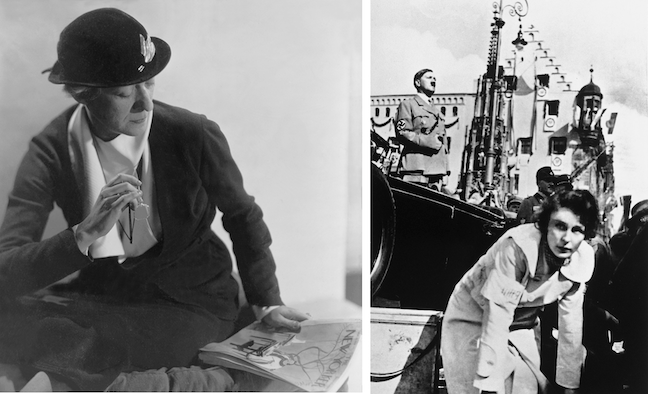
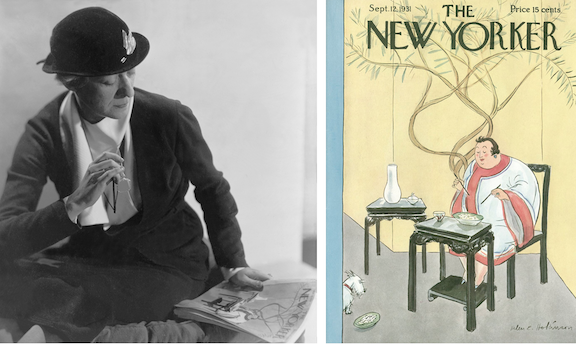
Above, left, Janet Flanner regards the cover of the Sept. 13, 1931 issue of The New Yorker; at right, Adolf Hitler's chosen filmmaker Leni Riefenstahl at Nuremberg's "Shovel Day" parade, 1936. (Library of Congress/Sueddeutscher Verlag)
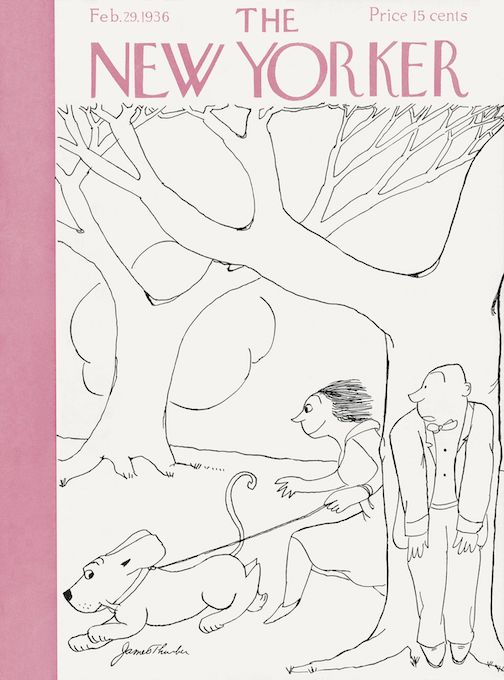
The February 29, 1936 issue stands out from pack not only for its cover—James Thurber’s first—but also for the magazine’s first in-depth look at a man who would spark the deadliest conflict in human history.
February 29, 1936 cover by James Thurber. This was the first of six covers Thurber contributed to The New Yorker. You can see all six covers at Michael Maslin’s Ink Spill, the go-to site for all things Thurber and so much more. UPDATE: Also check Maslin’s post regarding the repeat of this cover on Sept. 4, 2023. Fascinating read!
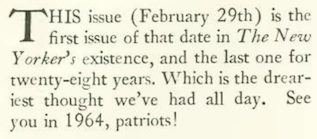
Before we jump in…Thurber’s close friend E.B. White noted another unusual fact about this issue…
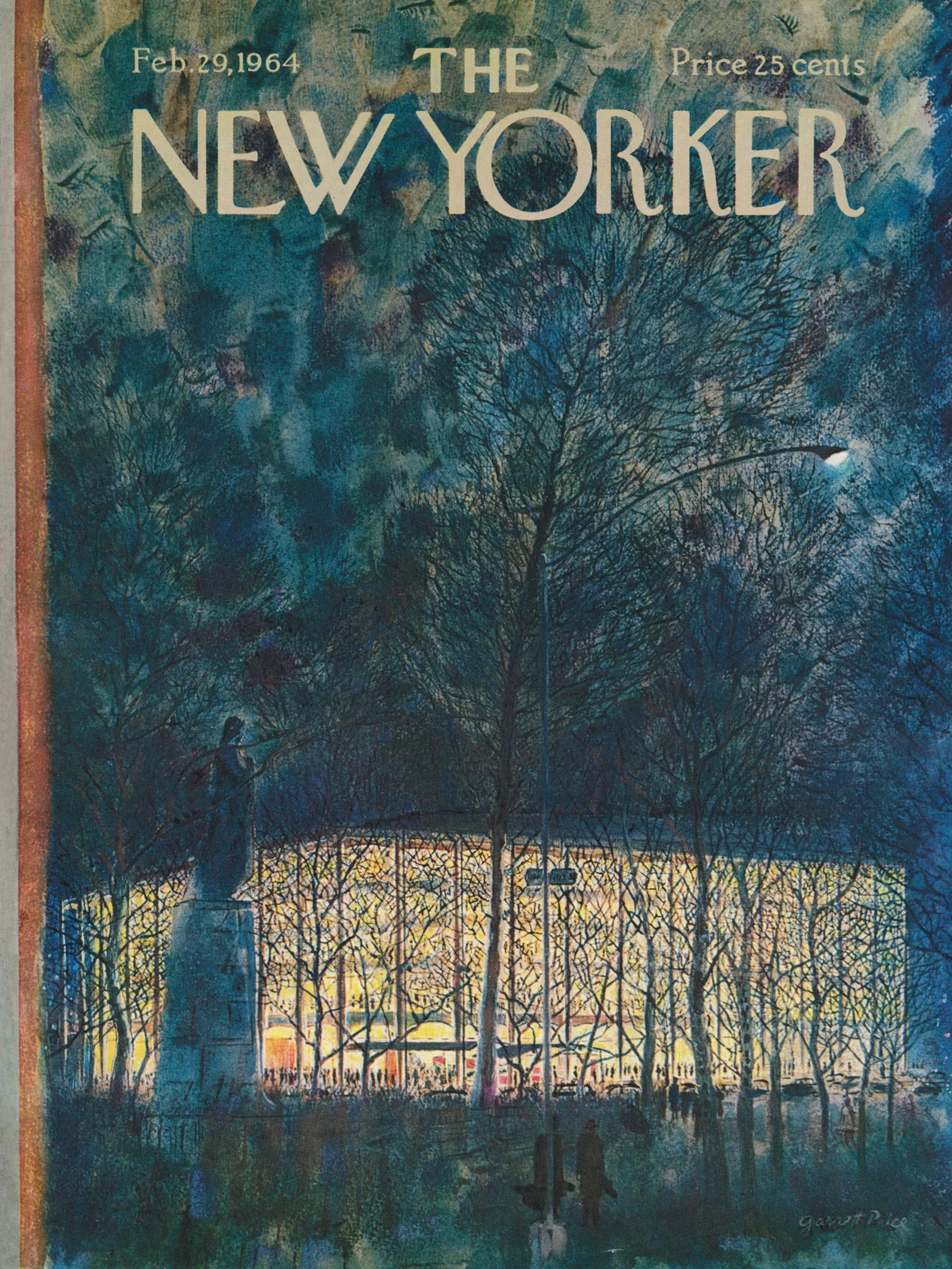
…twenty-eight years later, and a dime extra (cover by Garrett Price)…
* * *
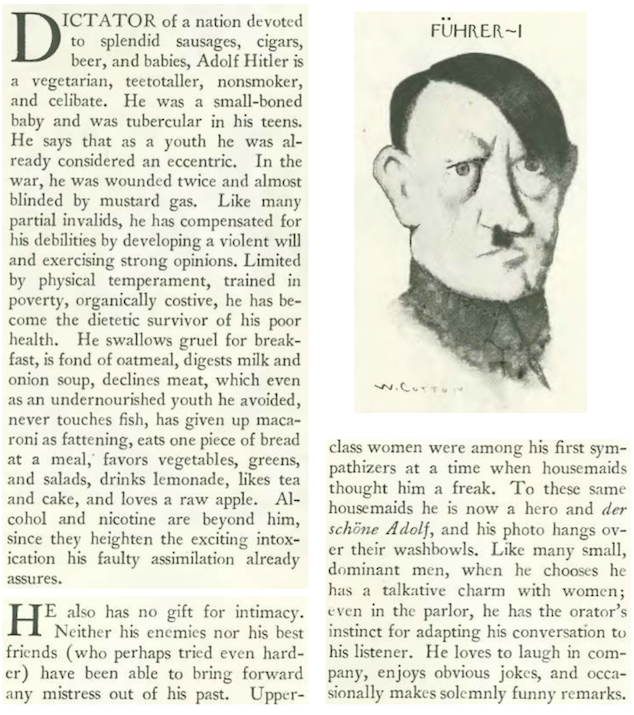
Inside the Feb. 29 issue, The New Yorker’s Paris correspondent Janet Flanner published the first part of a three-part profile on German dictator Adolf Hitler. In this first excerpt she described the Führer’s ascetic diet and personality (caricature by William Cotton).
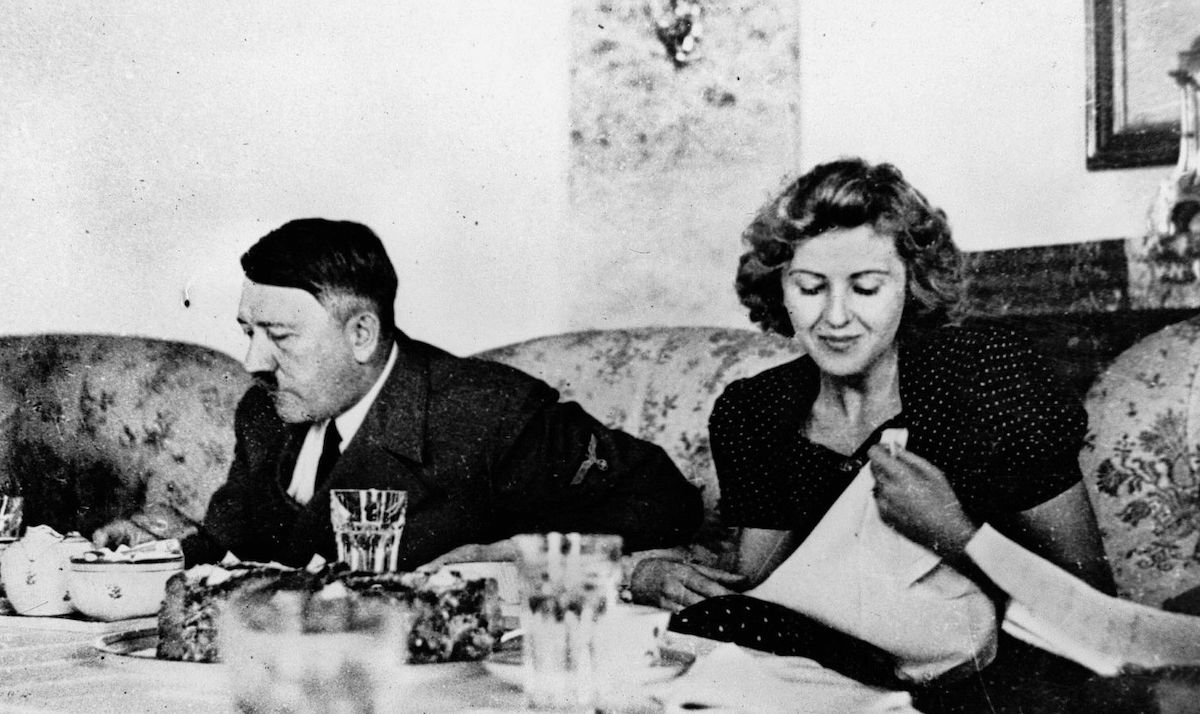
NAZI NUM NUMS….Adolf Hitler with one of his official food tasters, Margot Woelk, during World War II. Woelk later claimed she was the sole survivor from a group of food tasters who were summarily executed by the Red Army after the fall of Berlin. (warfarehistorynetwork.com)
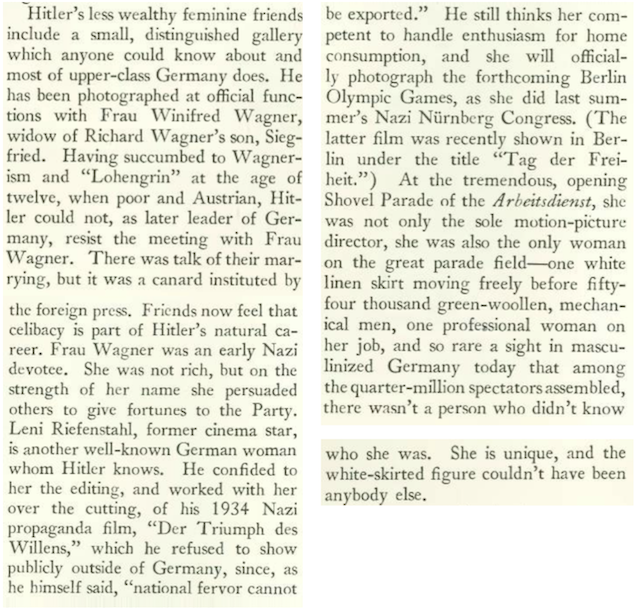
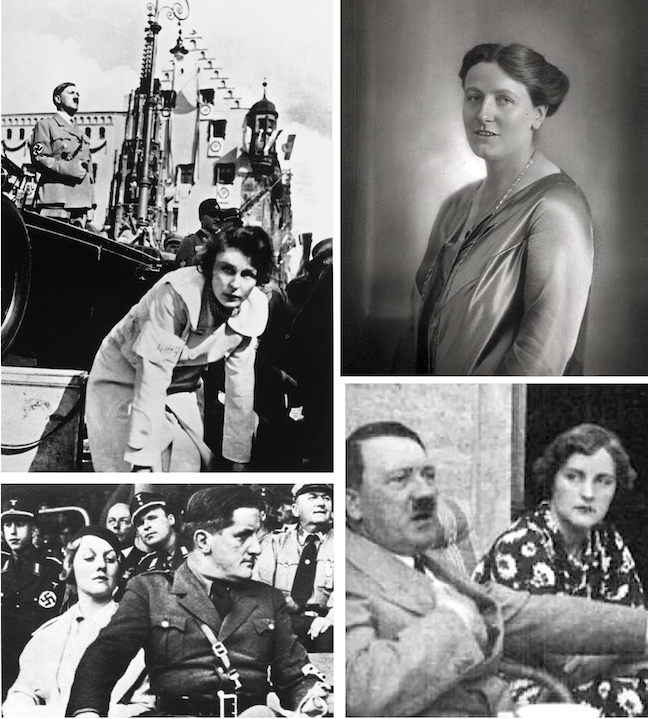
Flanner described Hitler’s relationships with influential women, particularly filmmaker Leni Riefenstahl.
FRIENDS WITH BENEFITS…Adolf Hitler had influential admirers both in and outside of Germany, including, clockwise, from top left, filmmaker Leni Riefenstahl (in the white skirt described by Flanner) at the 1936 “Shovel Day” in Nuremburg; Winifred Wagner, daughter-in-law of composer Richard Wagner, in 1925; Hitler with Unity Mitford, one of six aristocratic Mitford sisters and a fanatical Nazi; Ernst Franz Sedgwick Hanfstaengl with another Mitford sister, Diana Mitford, at a 1934 Nuremberg rally. Diana as married to Oswald Mosley, leader of the British Union of Fascists, and Hanfstaengl was the son of Katharina Wilhelmina Hanfstaengl, a prominent Munich art publisher who helped finance Hitler’s rise to power. (Sueddeutscher Verlag/Wikipedia/historyreader.com)
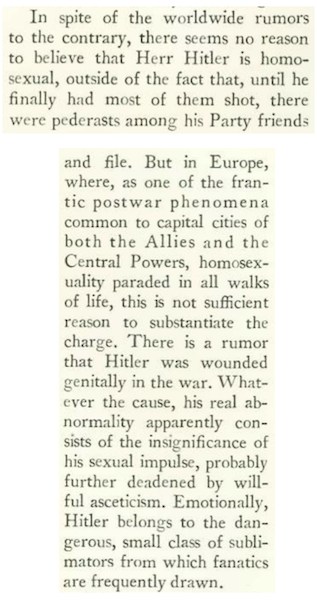
Flanner concluded the piece with a look at Hitler’s sexuality, which seemed non-existent, and drew an ominous conclusion about his personality type.
EXPENDABLE…Ernst Röhm with Adolf Hitler in 1933. Although Hitler knew Röhm was gay, he also valued Röhm’s leadership and organizational skills, that is until his presence proved a liability. Röhm was murdered by the SS in 1934 during the “Night of the Long Knives.” (Wikipedia)
As part of a centenary series, The New Yorker’s Andrew Marantz recently looked at Flanner’s profile of Hitler, noting that she was “neither an antifascist, like her friend Dorothy Parker, nor a Fascist, like her friend Ezra Pound; she was against crude bigotry, but she was not the world’s greatest philo-Semite.”
* * *
Lamour Amour
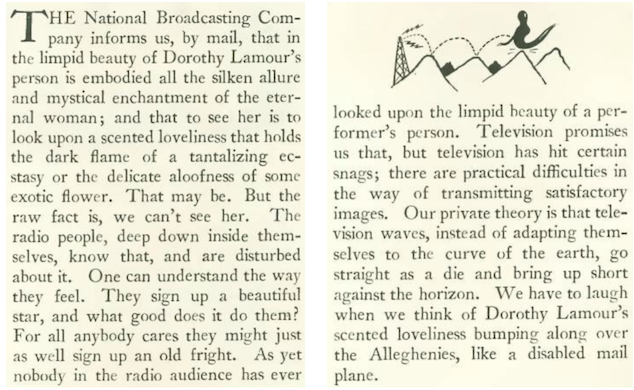
In his “Notes and Comment,” E.B. White pointed out the challenges of expressing physical beauty over a non-visual medium like radio:
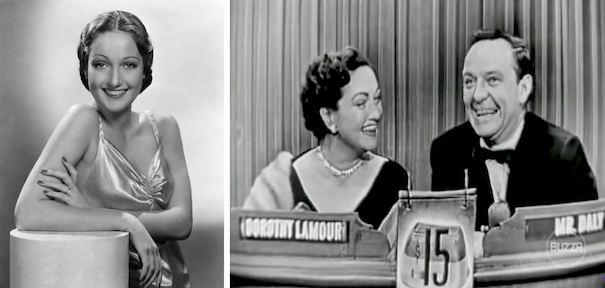
TELEGENIC…Hopefully E.B. White managed to see Dorothy Lamour on the “television waves… bumping along over the Alleghenies.” At left, publicity photo of Lamour from 1937; at right, Lamour appeared as a mystery guest on What’s My Line?, Feb. 20, 1955, seen here with host John Daly. In later years Lamour was a guest on a number of television shows, ranging from Marcus Welby, M.D. to Remington Steele. (Wikipedia/YouTube.com)
* * *
Shadow Plays
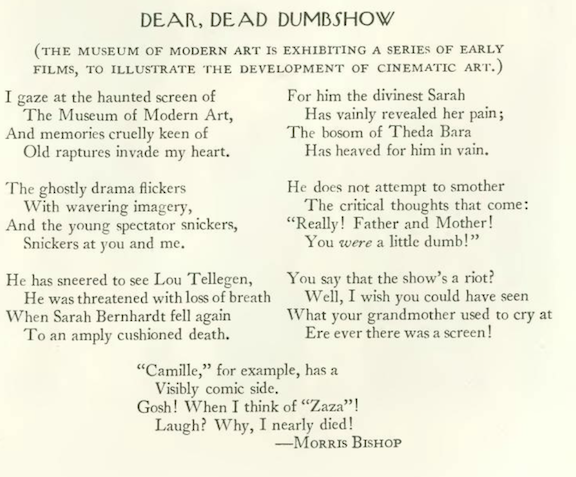
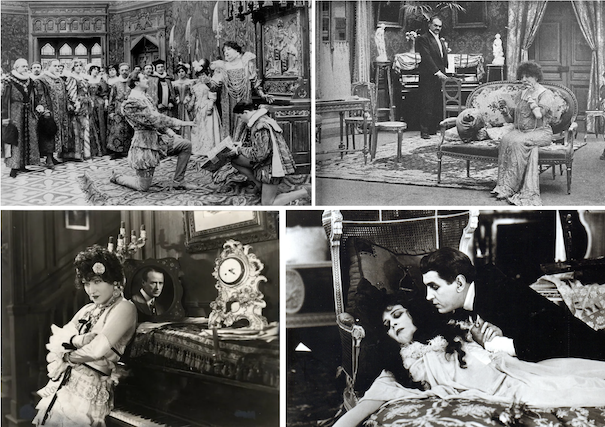
Morris Bishop (1893-1973), a noted scholar of the Middle Ages as well as a writer of light verse, offered up these lines after screening early silent films at the Museum of Modern Art. The screenings were curated by Iris Barry to showcase MoMA’s new film library and to advance the study of film as a serious art form.
TIME CAPSULES…The Museum of Modern Art was a pioneer in the study of film as a modern art form. Among the films screened at MoMA in 1936 (clockwise, from top left): famed stage actress Sarah Bernhardt as Queen Elizabeth in the Les Amours de la reine Élisabeth (The Loves of Queen Elizabeth) with Lou Tellegen, 1912; Bernhardt in the film Camille (La Dame aux camélias) with André Calmettes, 1911; Theda Bara’s 1917 take on Camille, in a scene with Alan Roscoe; Gloria Swanson in Zaza, 1923. (Wikipedia/imdb.com/YouTube.com)
* * *
A Reporter’s Chops
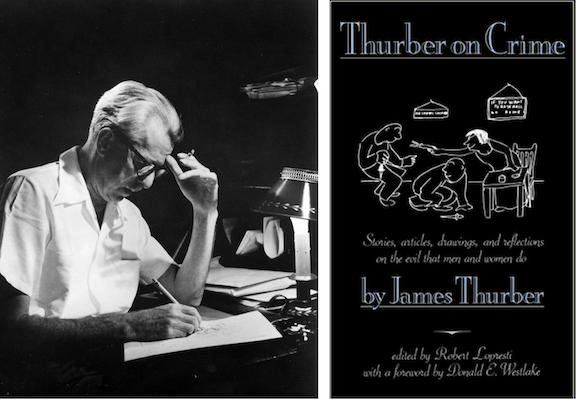
With so much attention given to James Thurber as a humorist, it is easy to forget that he was an experienced journalist, and that he could apply his considerable gifts as a writer to narrative non-fiction. For the Feb. 29 “A Reporter at Large” column, Thurber penned “Crime in the Cumberlands.”I can’t do it justice through excerpts, but I highly recommend giving it a read as a prime example of Thurber’s skills as a reporter.
SERIOUSLY SERIOUS WRITER…You can find both humorous and not-so-humorous crime stories (and drawings, of course) in 1991’s Thurber on Crime, edited by Robert Lopresti. “Crime in the Cumberlands” is included in the collection. (jamesthurber.org/barnesandnoble.com)
* * *
At the Movies
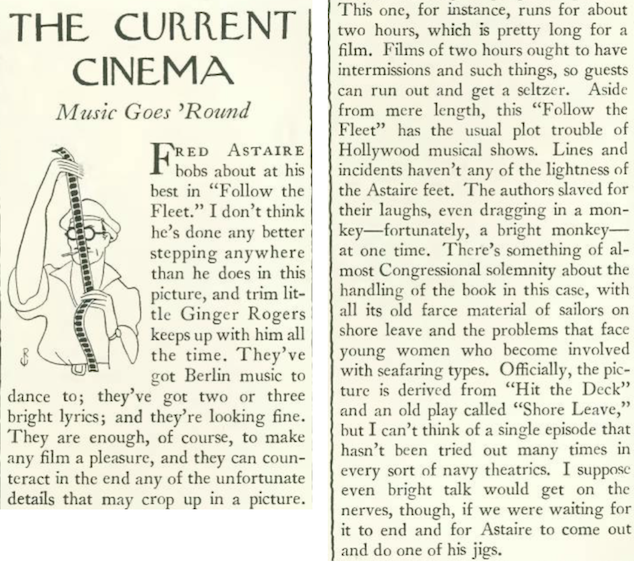
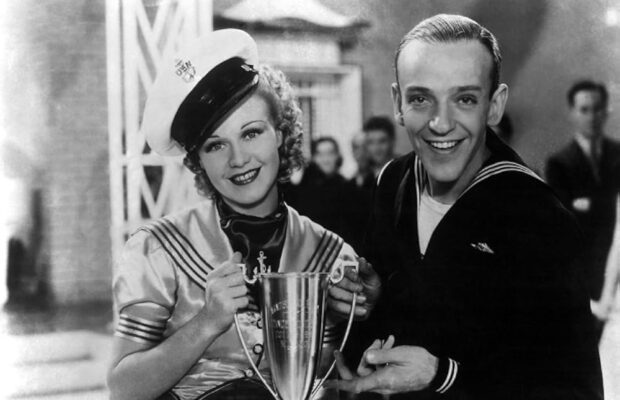
Not so serious were the films being churned out by Hollywood, including the Fred Astaire/Ginger Rogers toe-tapper Follow the Fleet, set to an Irving Berlin score that featured the hit “Let’s Face the Music and Dance.” Critic John Mosher was on board for the ride.
GOOD CLEAN FUN…Dance partners “Bake” Baker (Fred Astaire) and Sherry Martin (Ginger Rogers) find love during shore leave in Follow the Fleet.(Toronto Film Society)
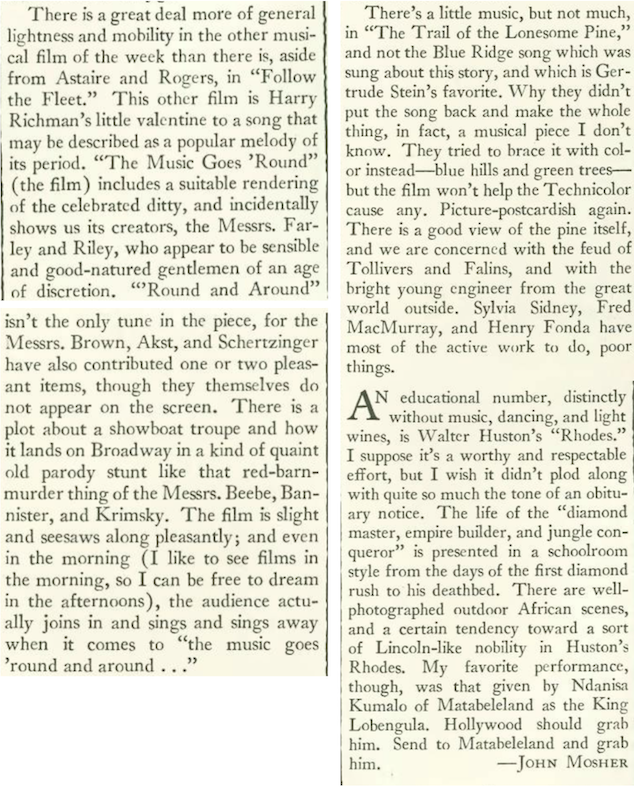
Bandleader Harry Richman, well known in the New York nightlife scene of the 1920s and 30s, showed his acting chops in The Music Goes ‘Round…
I CAN SING TOO…Rochelle Hudson and Harry Richman in The Music Goes ‘Round. (imdb.com)
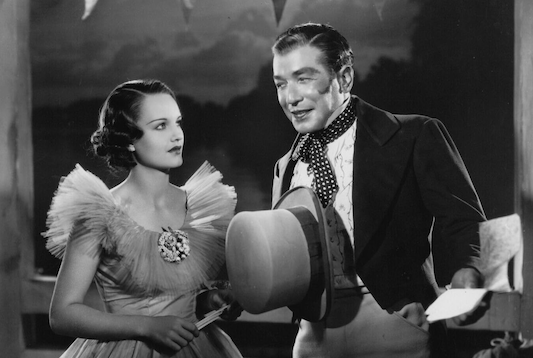
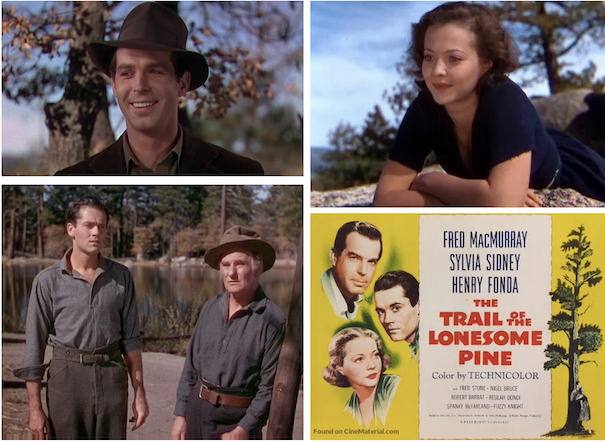
…Fred MacMurray, Sylvia Sydney, Henry Fonda and Fred Stone appeared in living color in The Trail of the Lonesome Pine–it was just the second full-length feature to be shot in three-strip Technicolor and the first to be shot outdoors in Technicolor…
LIFELIKE…Clockwise, from top left: Fred MacMurray; Sylvia Sydney; a Paramount movie poster; Henry Fonda and Fred Stone.(moviesalamark.com/imdb.com)
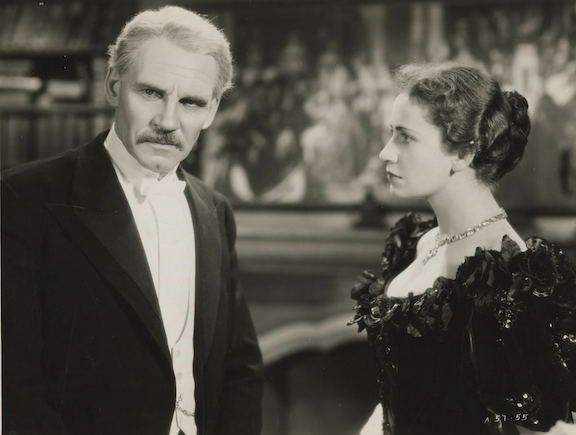
…the 1936 film Rhodes (aka Rhodes of Africa) featured the massive acting talents of Walter Huston and Peggy Ashcroft; not surprisingly, the subject matter of the film has not aged well…a 2015 review in The Guardianis headlined: “Rhodes of Africa: only slightly less offensive than the man himself”…
COLONIAL KLINK…Walter Huston and Peggy Ashcroft in Rhodes.(imdb.com)
* * *
From Our Advertisers
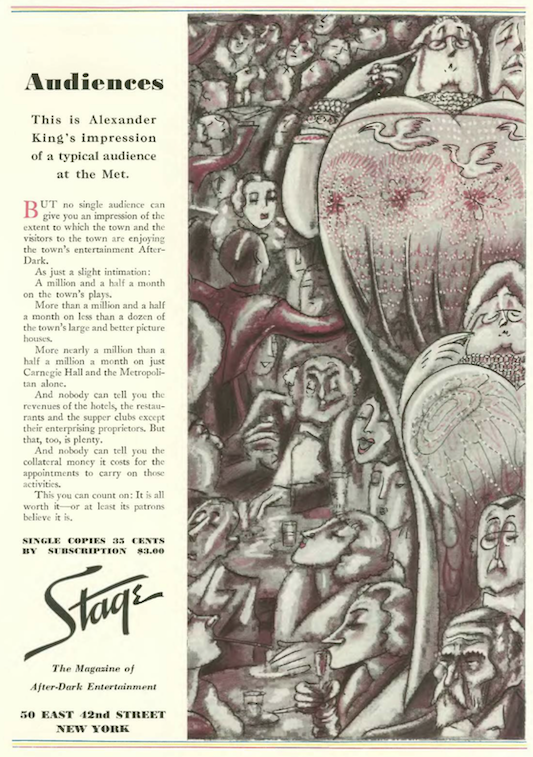
We begin with a Stage magazine ad from the inside front cover, featuring an illustration by Alexander King…
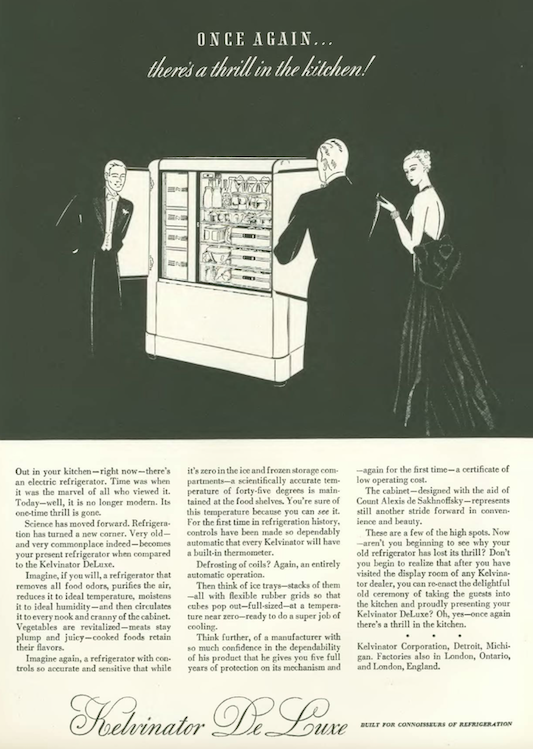
…only new-money swells would be seen doing this…old money wouldn’t dare enter the kitchen, unless they needed to sack the cook…
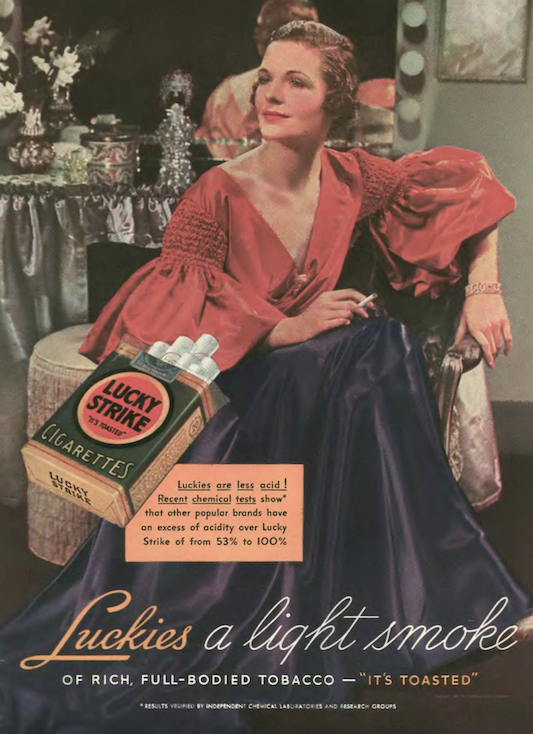
…on the back cover of the Feb. 29 issue you would find this elegant woman taking a break from her vanity to enjoy a “toasted” Lucky…
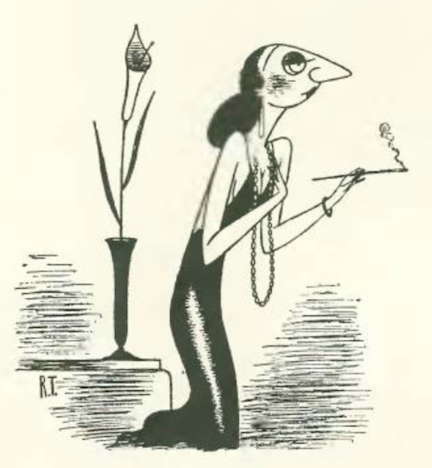
…we join our cartoonists, starting with this spot by Richard Taylor…
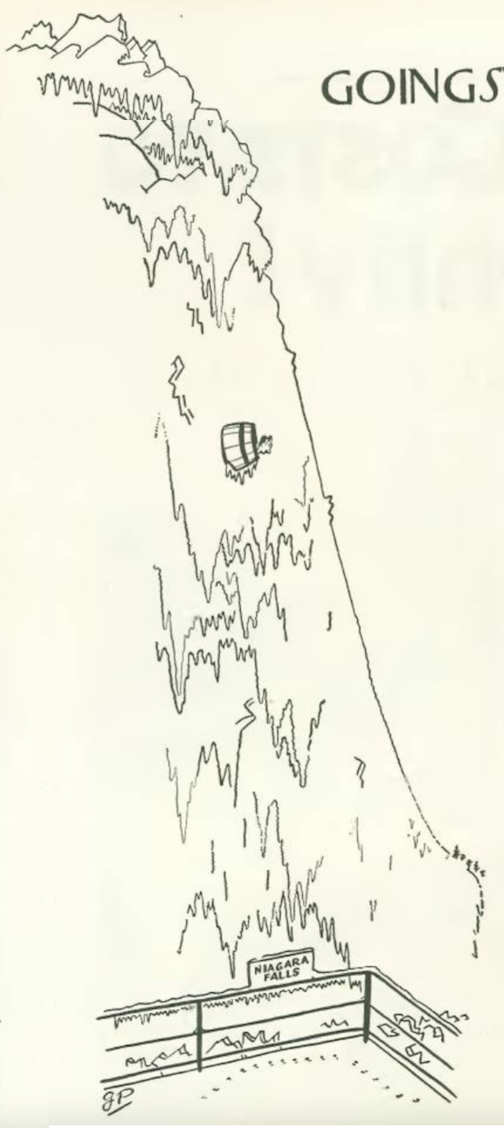
…Garrett Price got stuck over the frozen falls…
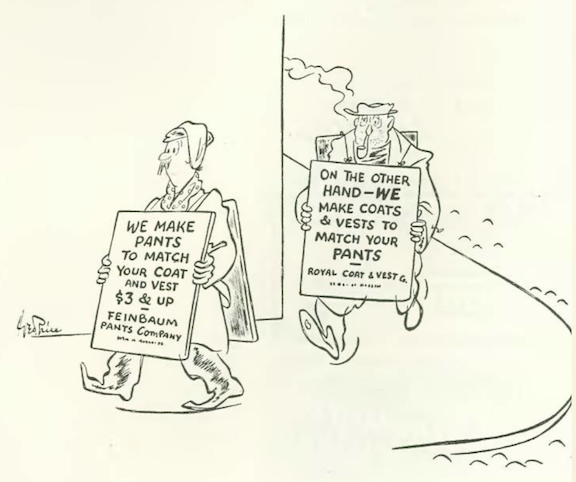
…George Price drew up a sandwich board competition…
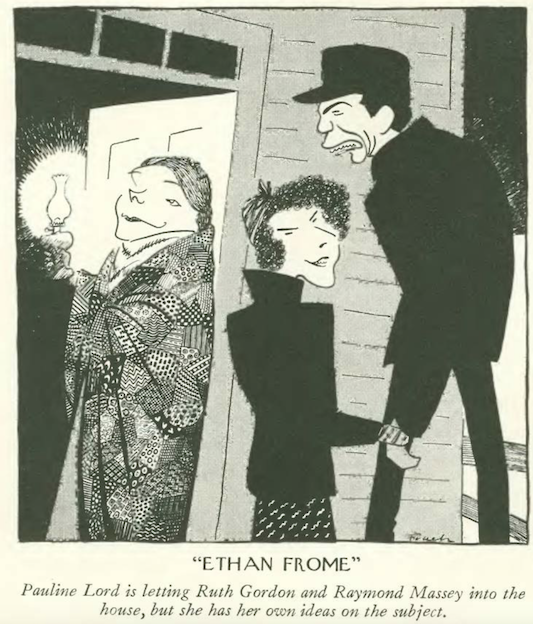
…Al Frueh continued to illuminate “The Theatre” section…
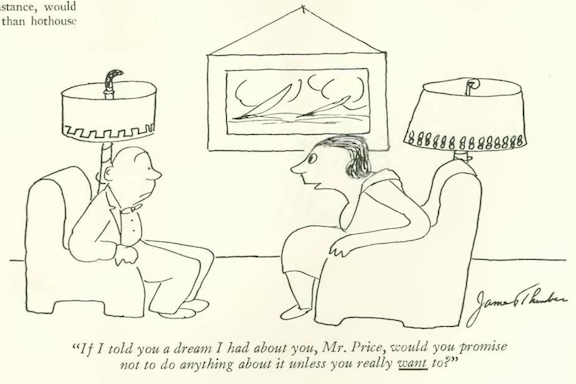
…James Thurber posed a loaded question…
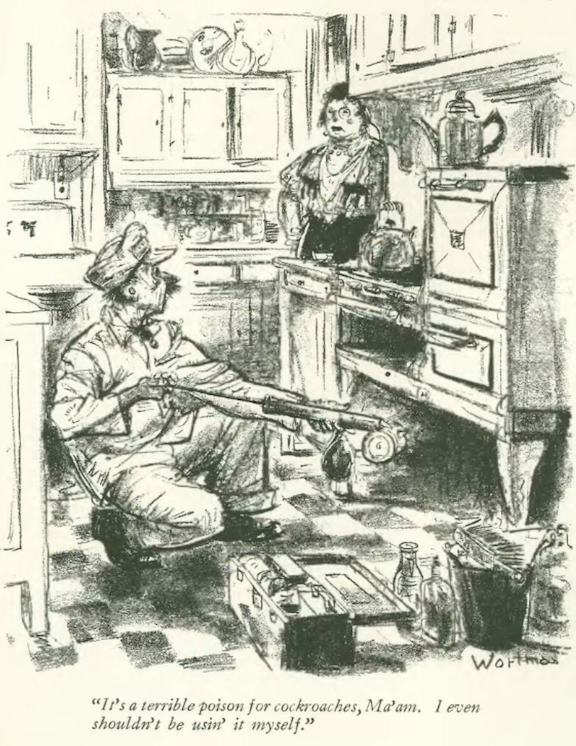
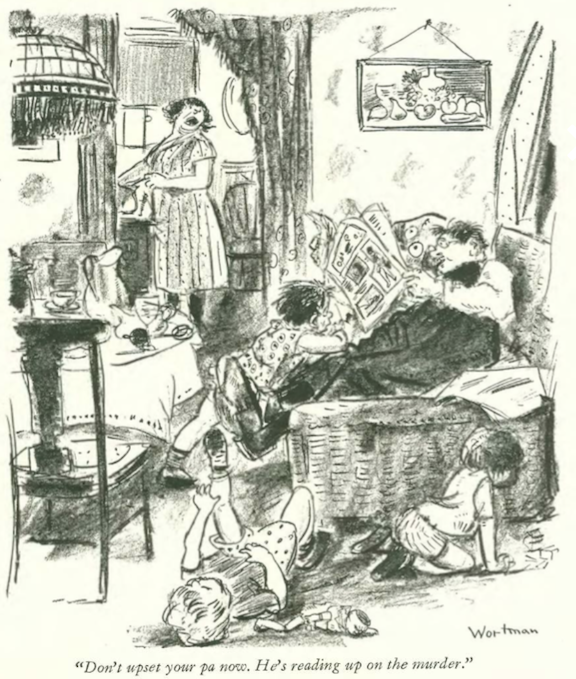
…Denys Wortman got down to some debugging…
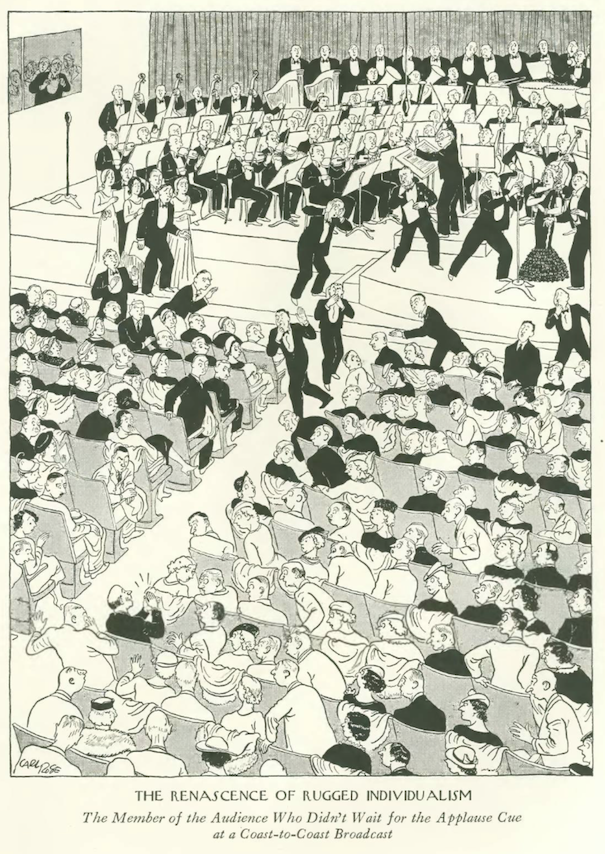
…Carl Rose offered up another example of rugged individualism…
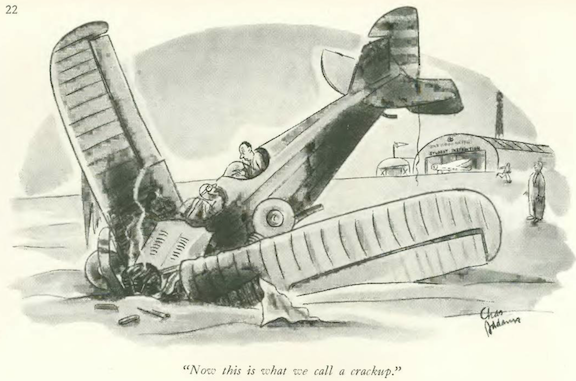
…Charles Addams came down to earth…
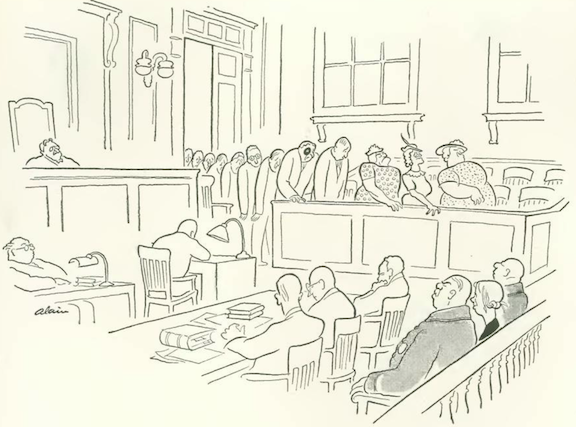
…Alain illustrated a case of jury tampering…
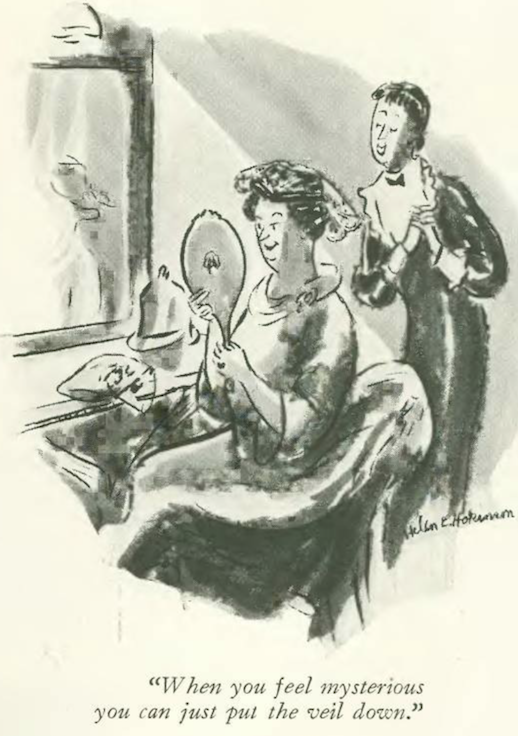
…Helen Hokinson demonstrated the allure of a netted hat…
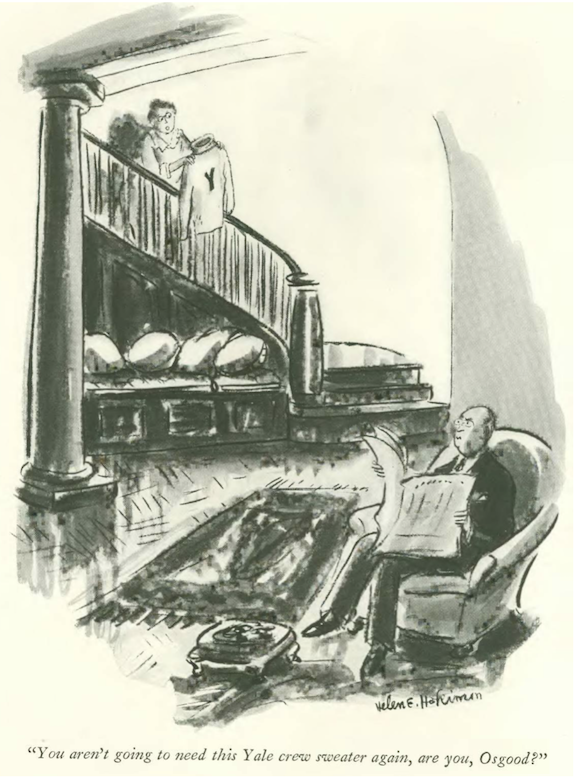
…and Hokinson again, doing some early spring cleaning…
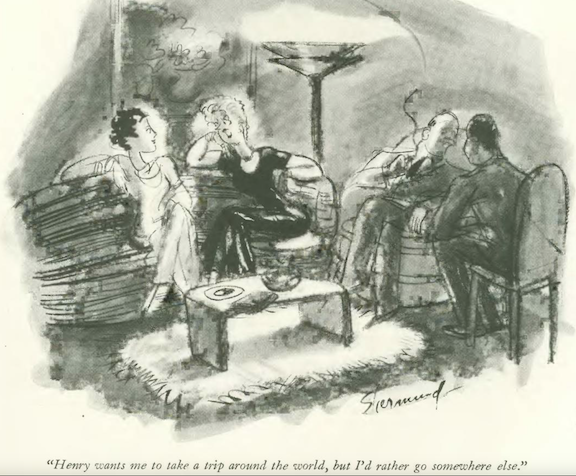
…and Barbara Shermund explored the idyll of wanderlust…
…and before we go, here is the New Yorker cover—by Helen Hokinson, Sept. 12, 1931—that was the object of Janet Flanner’s attention…
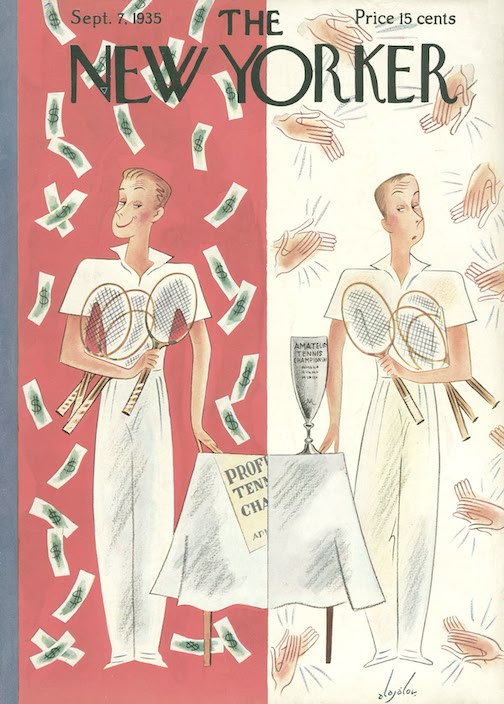
Morris Markey embodied the ideal of “A Reporter at Large,” and for his Sept. 7 column he decided to stroll the steamy streets of Manhattan on a late summer night, finding the sidewalks alive with folks seeking a break from their stifling dwellings.
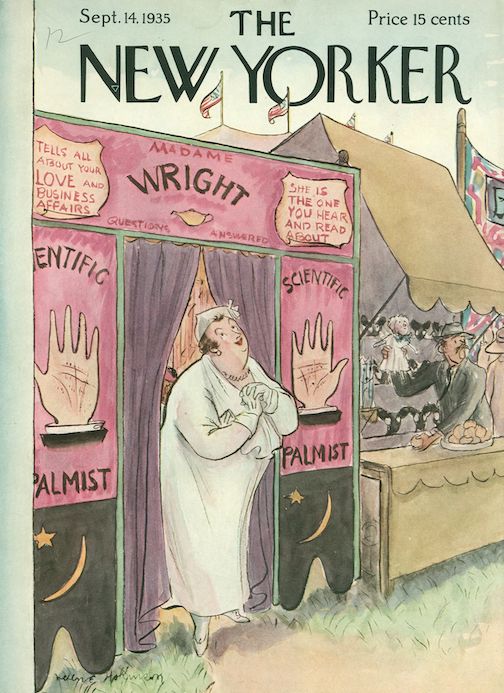
September 7, 1935 cover by Constantin Alajalov.
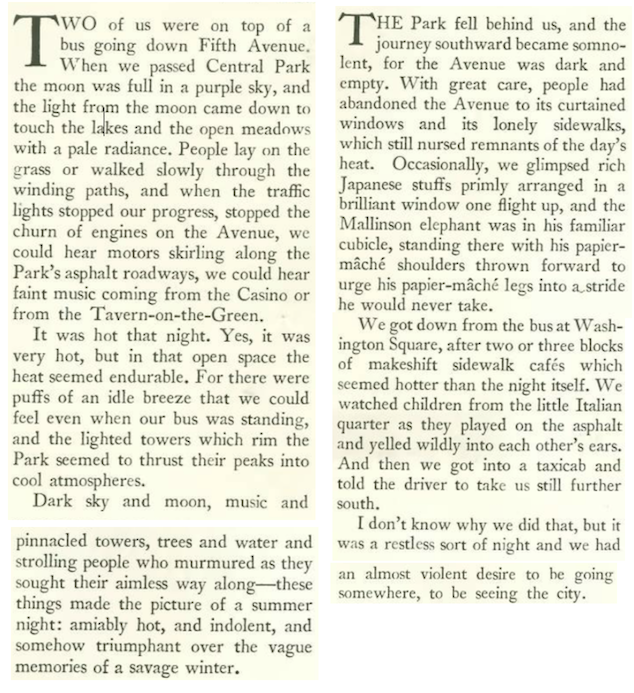
Markey (1899-1950) began “Summer Night” by describing a bus ride from Midtown to Washington Square with (I assume) his wife, Helen Turman Markey. They enjoyed the breeze atop the bus as they passed Central Park and heard the faint strains of music in the air.
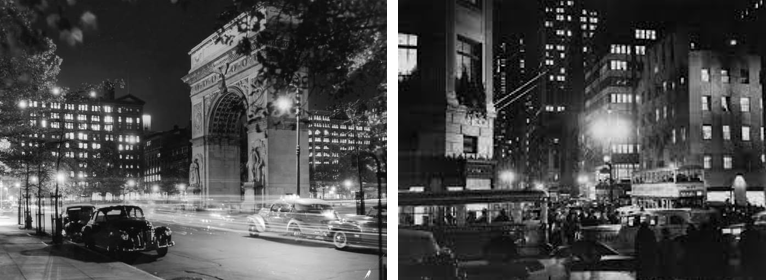
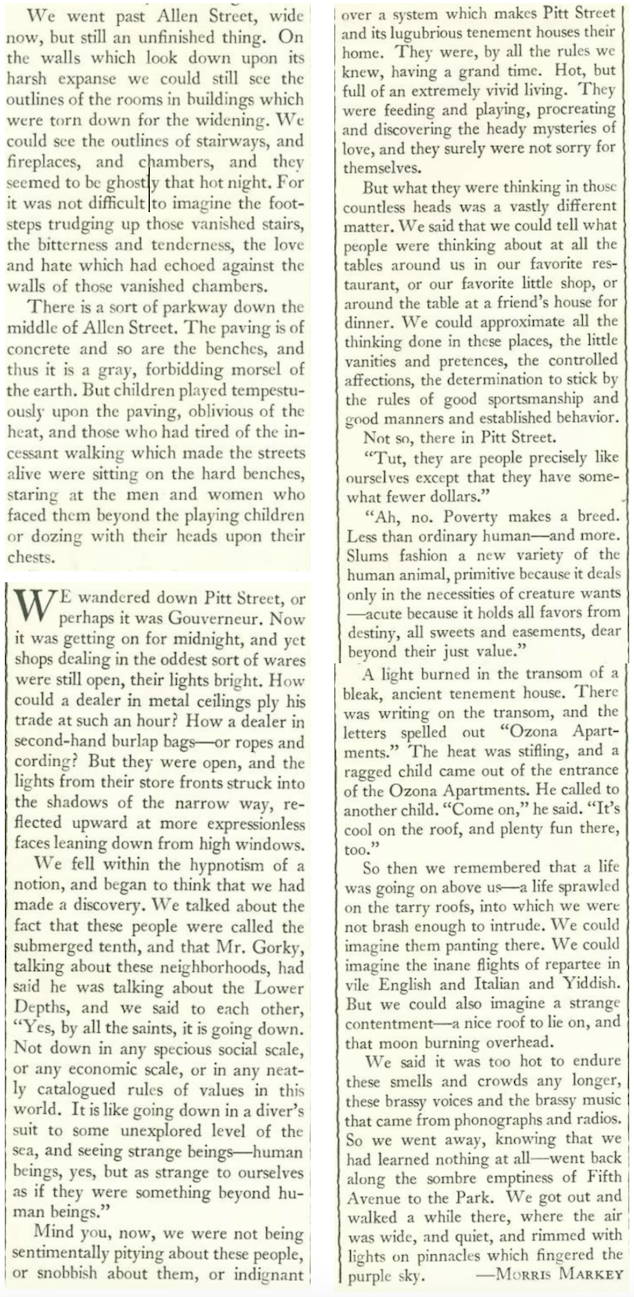
FINAL NOTES…Morris Markey thought he heard music coming from the Central Park Casino (left) on that hot summer night; it would prove to be one of the Casino’s last summer nights since Robert Moses would have it demolished the following May; at right, Adolf Dehn lithograph Central Park at Night, 1934. (NYC Parks/Art Institute of Chicago)AMID THE BUSTLE the Markeys hopped off the bus at Washington Square and set out on foot. At left, Washington Square by night, 1945; at right, cacophony on Fifth Avenue, circa 1940. (Facebook)
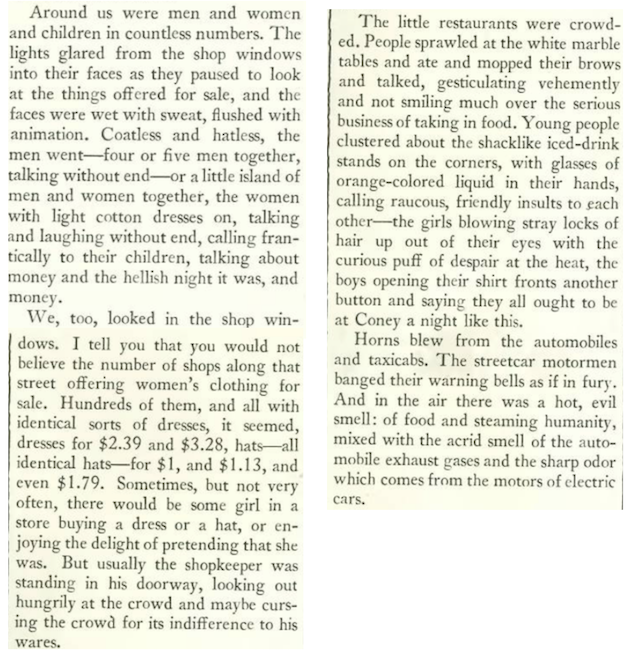
The scenes described by Markey offer a glimpse of what has changed and what still remains of Manhattan night life after ninety years.
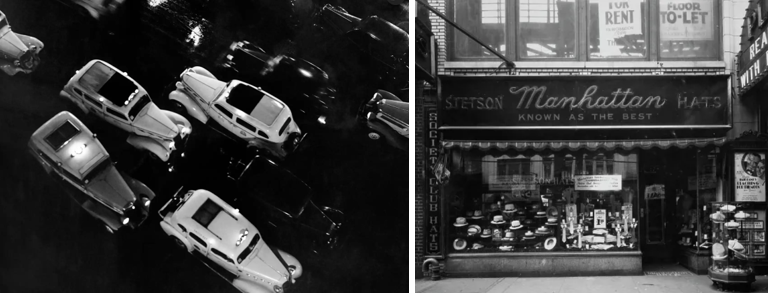
GO BLOW YOUR HORN…Something taxis did then and do now; Markey described folks looking at hats in a shop window, probably similar to this 1930s store at right. (theguardian.com/Pinterest)
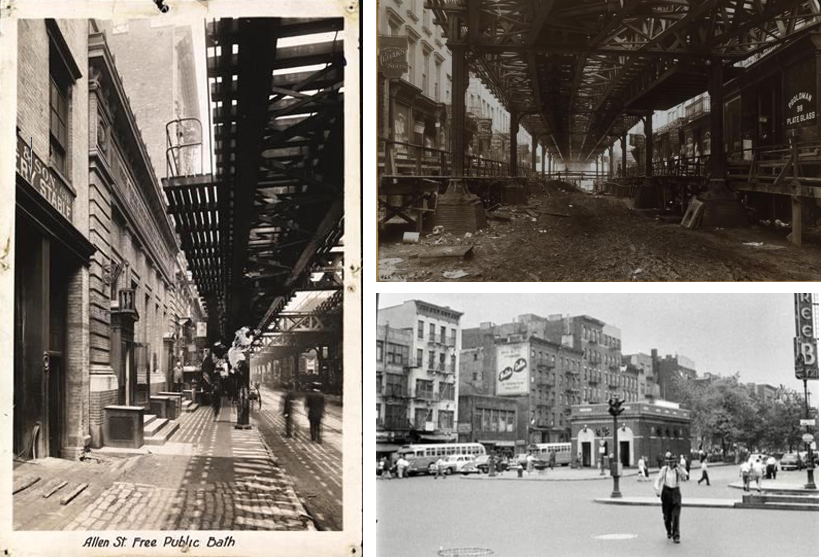
They concluded their stroll on the Lower East Side, where Markey noted a tenement clearance project on Allen Street. Considered one of the most densely populated places in the world, the street was widened by demolishing all of the buildings on its east side from Division to Houston Street.
HERE COMES THE SUN…The densely populated Allen Street was called “a place where the sun never shines.” The narrow street was mostly under the shadow of the elevated train tracks until it was widened in 1930s by demolishing all of buildings on its east side. Photo at left shows the public bath at 133 Allen Street (now used as a church). The demolition project, and the removal of the overhead “El” tracks in 1942, created a broad thoroughfare with a meridian mall in the center, as seen in the bottom photo of the intersection of Allen and Delancey circa 1950. (mcny.org/leshp.org/Facebook)
* * *
At the Movies
Film critic John Mosher finally found a film he could gush about in Anna Karenina, and most notably its star Greta Garbo, who in Mosher’s words “sets the pace and the tone for the whole thing.” Mosher was not alone in his praise: Writing for The Spectator in 1935, Graham Greene wrote that Garbo’s acting in the film overwhelmed the acting of all the supporting cast save that of Basil Rathbone. This observation was later echoed by Roland Barthes, who wrote in 1957 that Garbo belonged “to that moment in cinema when the apprehension of the human countenance plunged crowds into the greatest perturbation, where people literally lost themselves in the human image.” Here is Mosher’s review:
GARBO AND THE OTHERS…Greta Garbo dominated the screen in 1935’s Anna Karenina. Clockwise, from top left, MGM poster for the film; Garbo with Fredric March as Anna’s lover, Count Vronksy; Garbo with Basil Rathbone, who portrayed Anna’s husband Karenin, and child actor Freddie Bartholomew as their son, Sergei; Maureen O’Sullivan took a break from the Tarzan films to portray Anna’s friend Kitty (here with Gyles Isham as Levin). (filmforum.org/Wikipedia/IMDB)
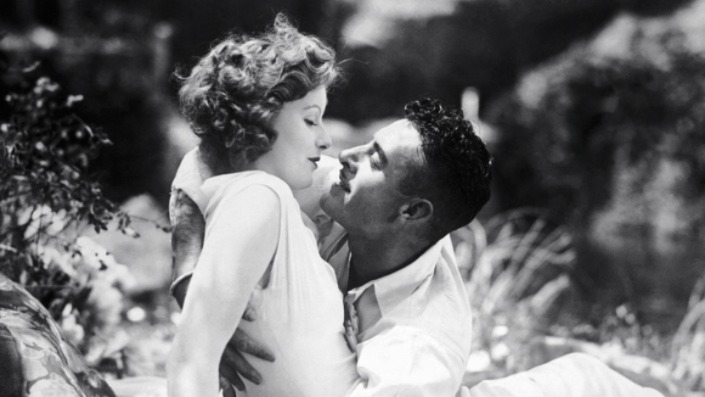
As Mosher noted, Garbo also portrayed Anna Karenina in the 1927 silent film Love, in which she co-starred with John Gilbert as Count Vronsky.
BEEN HERE BEFORE…Greta Garbo as Anna Karenina and John Gilbert as Count Vronsky in the 1927 silent film Love, the second of four films they made together. They were also lovers off-screen in the 1920s, but with the advent of sound pictures her star rose as his began to fall; in their last film together, Queen Christina (1933), Garbo insisted that Gilbert be cast opposite her in a final attempt to revive his declining career. He essentially drank himself to an early grave, dying of a heart attack in January 1936. (rottentomatoes.com)
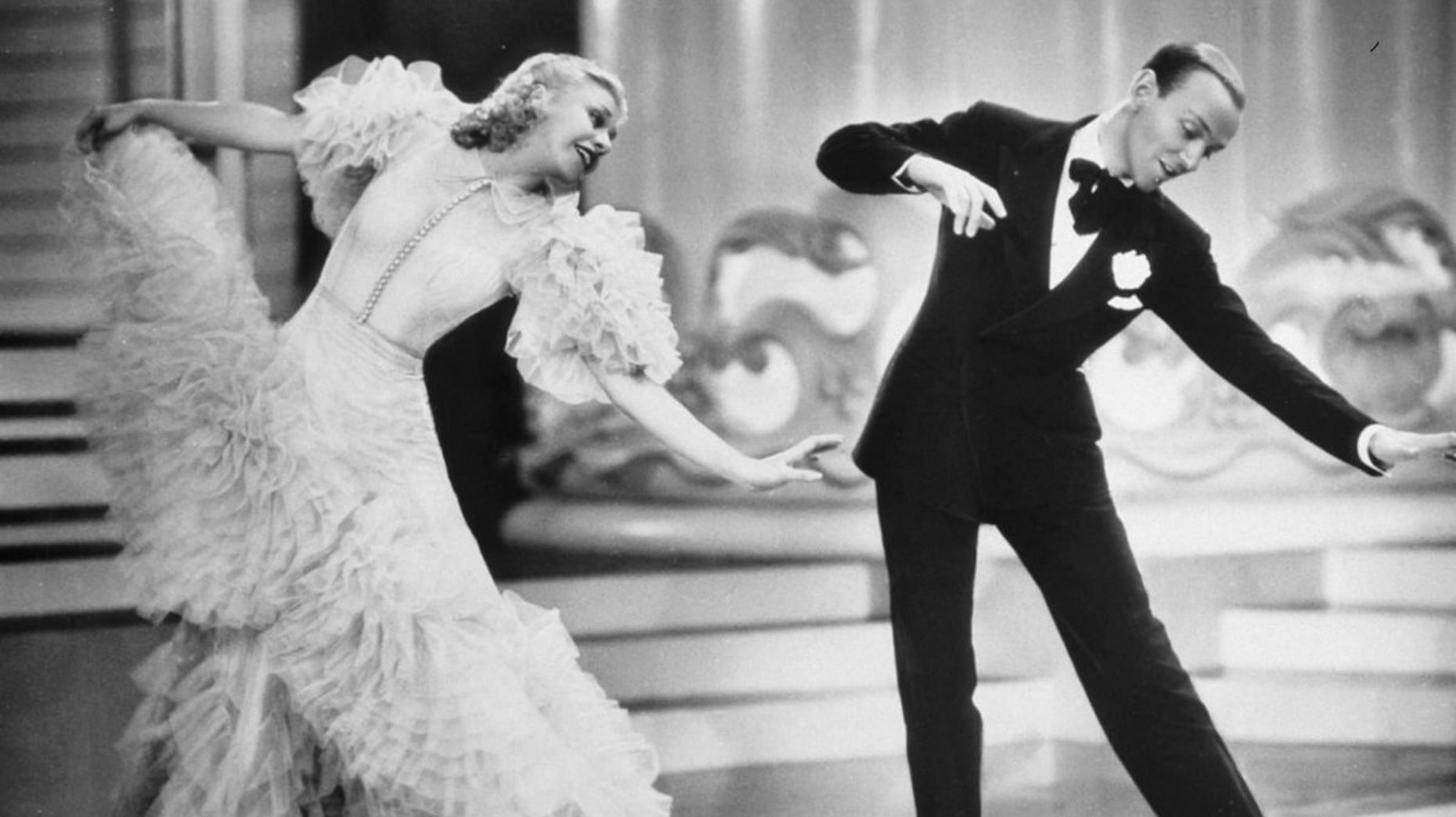
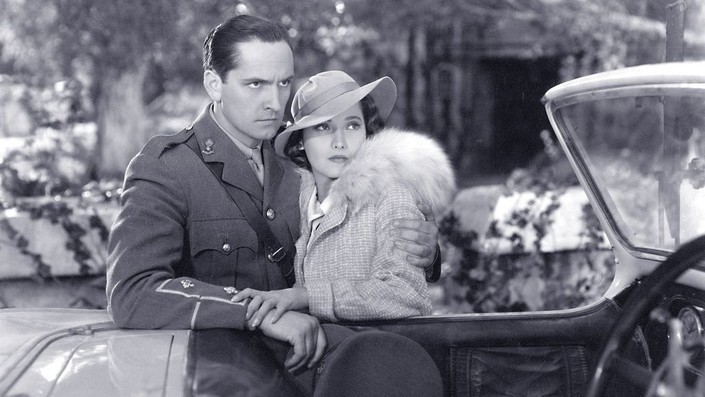
Mosher also enjoyed the dance moves of Fred Astaire and Ginger Rogers in Top Hat (although it could have used less “patter and piffle”), and brought out his hankie for The Dark Angel, where he once again encountered the acting of Fredric March.
DEFYING GRAVITY…Ginger Rogers and Fred Astaire made their complex dance moves look effortless as they glided through Top Hat, the fourth of ten films they made together. (americancinematheque.com)TEARS FOR FEARS…Fredric March and Merle Oberon portrayed old friends and lovers facing a rival lover and the horrors of World War I in the 1935 weeper The Dark Angel. (rottentomatoes.com)
* * *
From Our Advertisers
We begin with a splash of color from the makers of Imperial washable wallpapers…not sure why a wire fox terrier is featured in the advertisement…they were a popular breed, and maybe Fido was the reason one needed washable walls…
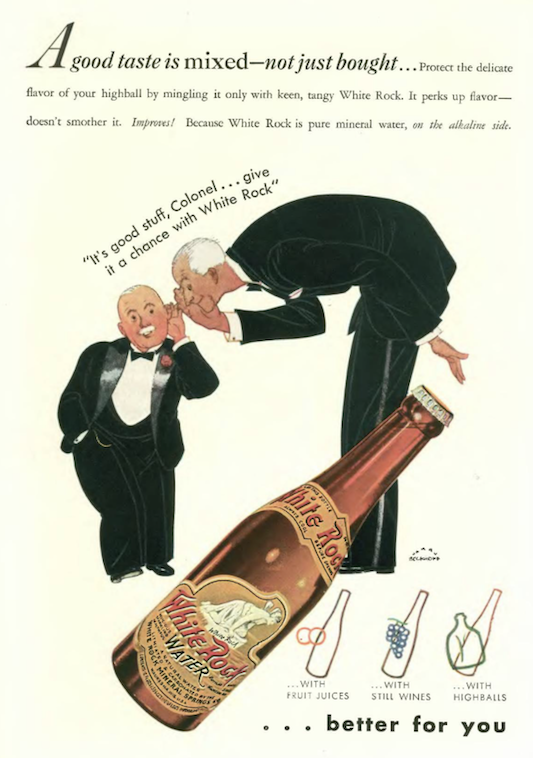
…White Rock rolled out their tiny Colonel to promote mineral water as an ideal mixer…
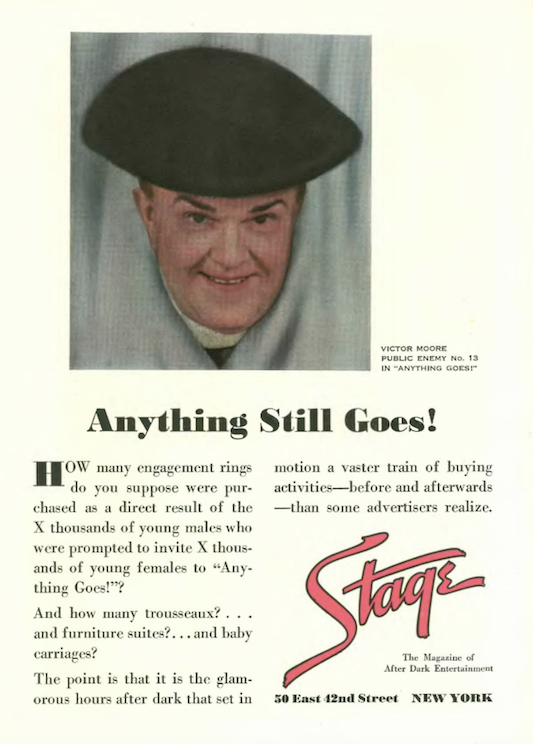
…ever heard of Victor Moore?…well, he was quite the comedian back in the day, playing timid, mild-mannered characters on stage and screen…Moore (1876-1962) was also famous for his 1942 marriage to dancer Shirley Paige when Moore was 65 and Paige was 20…
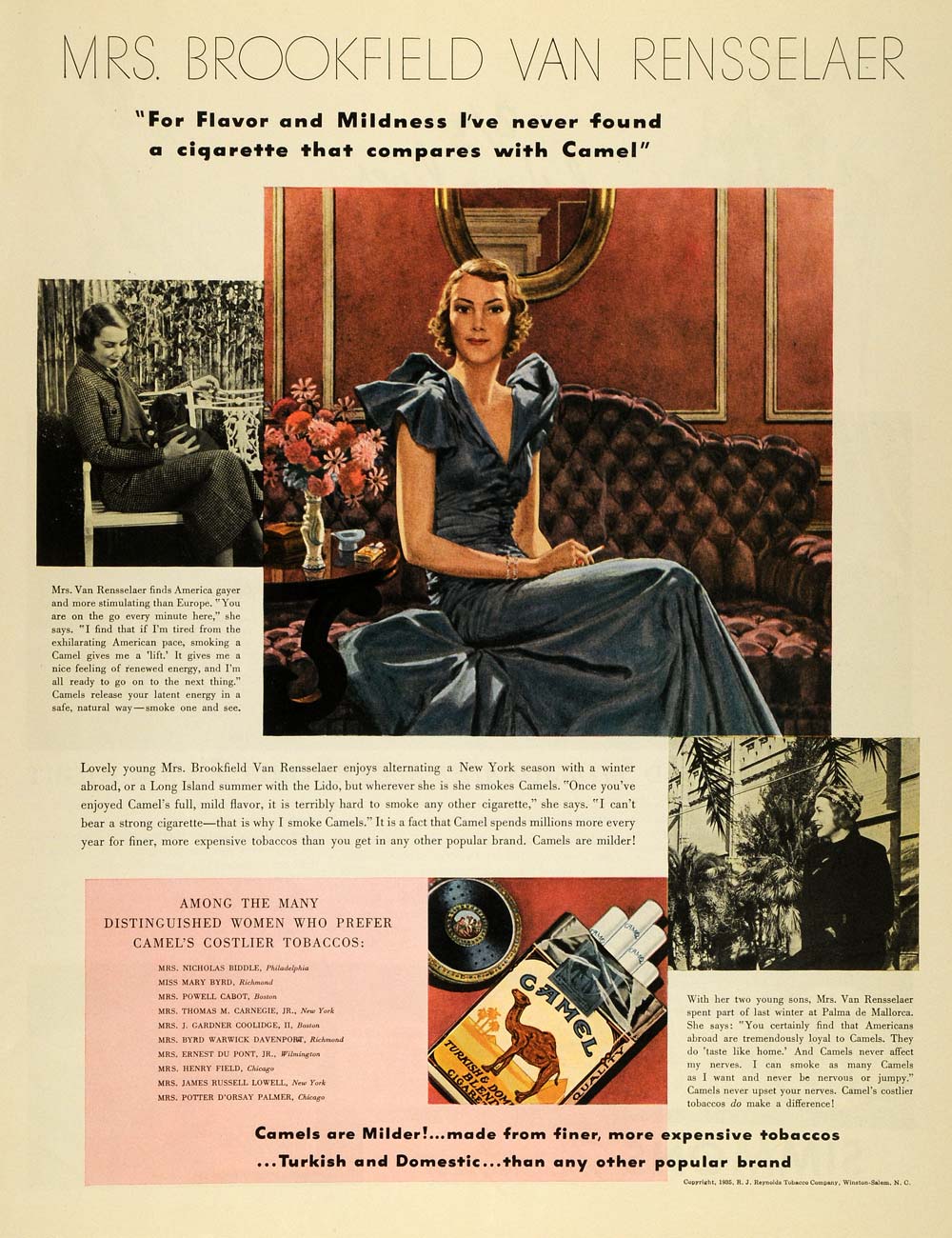
…Camel rolled out another high society endorser, Maude Adele Brookfield van Rensselaer (1904-1945)…her color image is a watercolor by Leslie Saalburg…
…on to our cartoonists, we begin with spot art by Abe Birnbaum…
and Maurice Freed…
…also in the opening pages this wordless contribution by James Thurber…
…Gluyas Williams found this midday repast anything but relaxing…
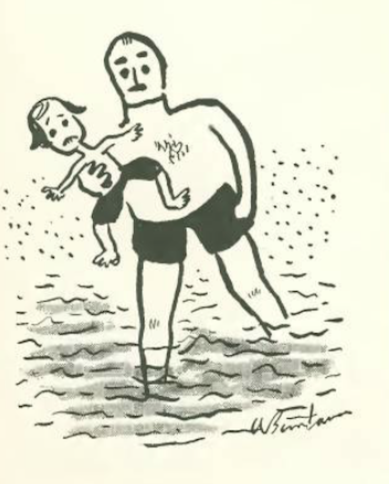
…Otto Soglow found a new “man’s best friend”…
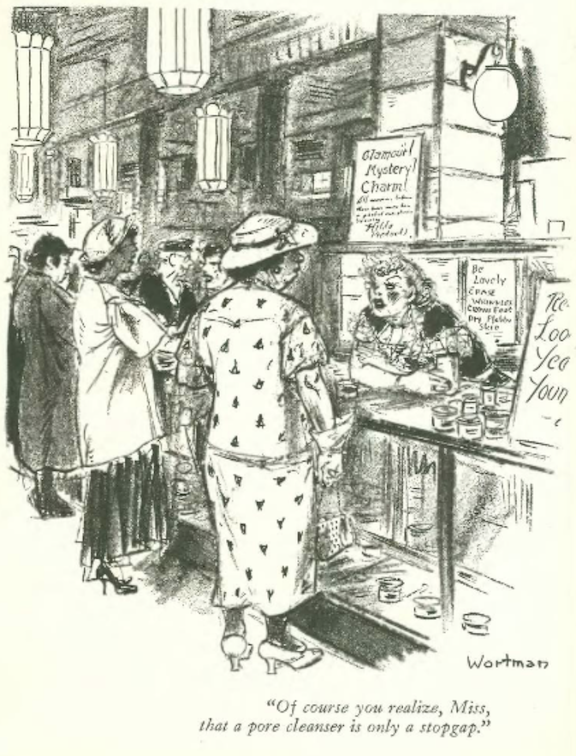
…Denys Wortman encountered some frank advice at the cosmetics counter…
…Helen Hokinson found appreciation for the “strong and silent” acting style…
…Peter Arno gave us a department store clerk in need of some time off…
…and we close with Richard Decker, finding some truth in advertising…
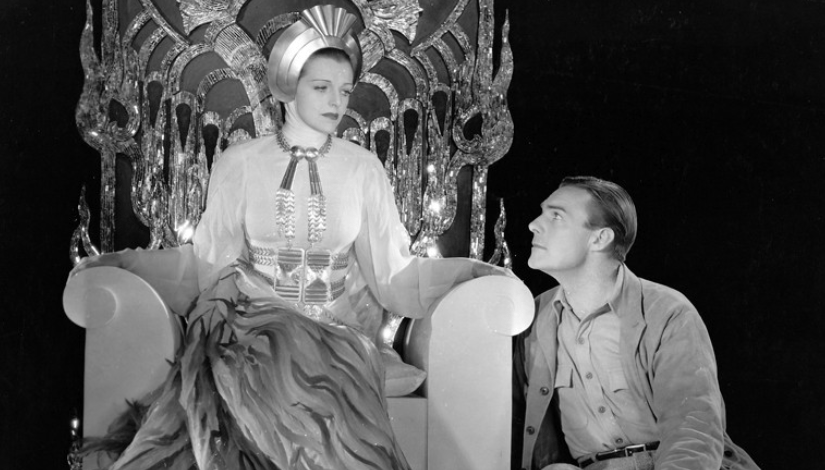
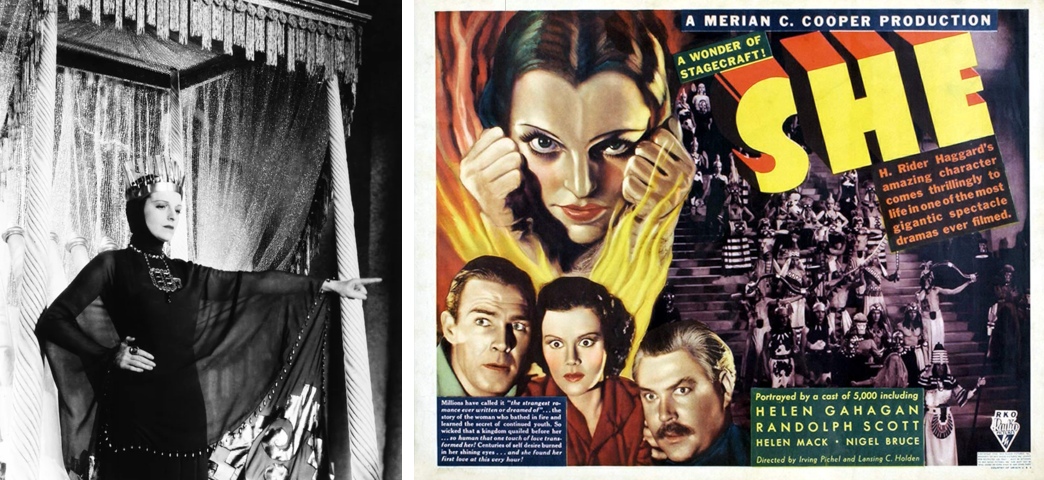
The 1935 film She was one of those old movies you’d see on television during the 1970s when there were only three or four channels (plus UHF) and local stations would tap into the “B” movie vault to fill airtime. One of those films was She.
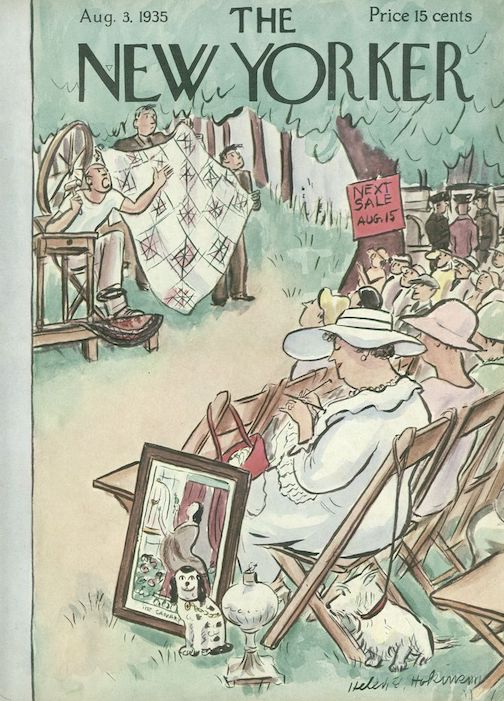
August 3, 1935 cover by Helen Hokinson.
Film critic John Mosher felt a bit sorry for Helen Gahagan, who portrayed “She Who Must Be Obeyed” (aka “She”)—an immortal who ruled an exotic, lost civilization near the Arctic Circle. The challenge for Gahagan was to seem imperious before her co-stars Randolph Scott and Helen Mack, who seemed more suited to the high school hijinks of an Andy Hardy picture. The film was a pretty standard adventure tale, in the mold of producer Marian C. Cooper’s 1933 King Kong, with two explorers falling in love during a perilous journey.
ARCHETYPE…At left, Helen Gahagan as “She” (Who Must Be Obeyed). Her costume possibly inspired the Evil Queen in Disney’s 1937 animated Snow White and the Seven Dwarfs. At right, lobby card that promoted the film. (Scifist.net/Reddit)WHEN YOU PLAY WITH FIRE…She Who Must Be Obeyed (Helen Gahagan), believing that the explorer Leo Vincey (Randolph Scott) was a reincarnation of his ancestor (whom she loved), and jealous of his girlfriend Tanya (Helen Mack), invites Leo to join her in the eternal flame. Unfortunately, her re-entry into the flame that gave her immortality turned her into a dying, withered crone. (The Nitrate Diva/Scifist.net)
The 1887 H. Rider Haggard novel, She, inspired eponymous silent films in 1908, 1911, 1916, 1917, and 1925. The 1935 film reviewed here received tepid reviews and lost money on its first release, however in a 1949 re-release it fared much better. She was re-made in 1965 with Ursula Andress in the lead role, and again in 1984 in a post-apocalyptic film that had virtually nothing to do with Haggard’s novel.
SHE THROUGH THE YEARS…Clockwise, from top left, “She” (Marguerite Snow) offers a dagger to Leo Vincey (James Cruze) in a 1911 two-reel (24 min.) adaptation; Valeska Suratt as “She” in the 1917 film (now lost); Betty Blythe took the title role in the 1925 production, considered to be the most faithful to the 1887 H. Rider Haggard novel; Sandahl Bergman appeared dressed for a Jazzercise video in the 1984 post-apocalyptic She; and finally, Ursula Andress and John Richardson in the 1965 CinemaScope production of She. (Wikipedia / digitalcollections.lib.washington.edu / cultcelebrities.com / Reddit)
* * *
Colonial Ambitions
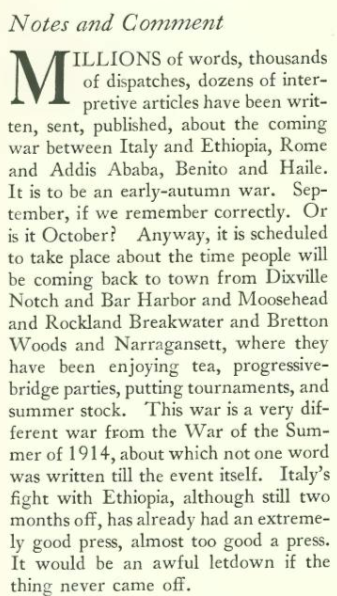
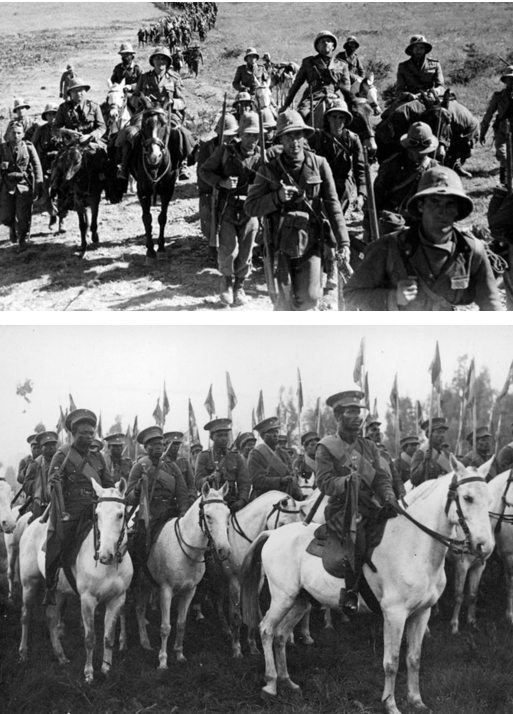
With most of Africa carved up by other European powers (Britain, France, Belgium etc.) in the 19th century, Italy set its sights on Ethiopia, which by the end of the 19th century was the only independent country left on the continent. Ethiopia fought off Italy’s first attempt at conquest in the Battle of Adwa (1896), but with the rise of fascist dictator Benito Mussolini, Italy paid a return visit, this time with heavy artillery and airstrikes that included chemical weapons. E.B. White tried to make sense of this latest invasion in his opening comments.
THOSE GUYS AGAIN…Italy invaded Ethiopia on October 3, 1935, a significant act of aggression in the lead up to World War II. Despite facing a technologically superior Italian army (top) equipped with modern weapons, including tanks, aircraft, and chemical weapons, the Ethiopian forces (bottom photo) mounted a strong resistance. (Wikipedia)
In his weekly column, Howard Brubaker mused on the Italian aggressions and other rumblings of the coming European war.
* * *
Author, Author
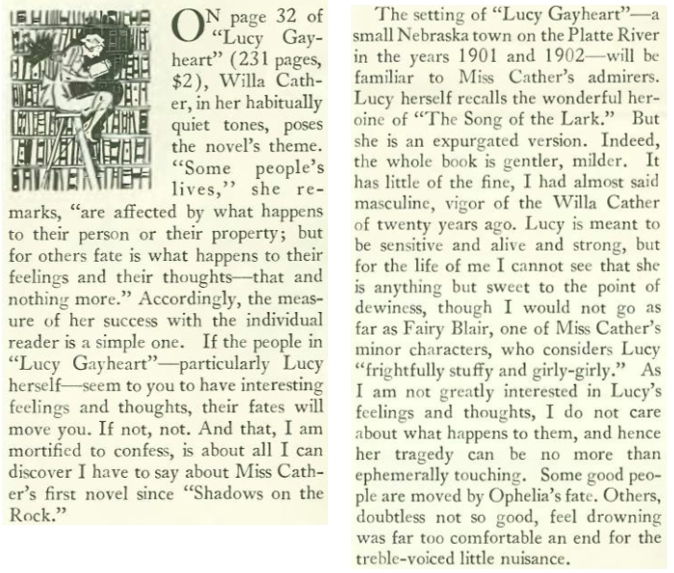
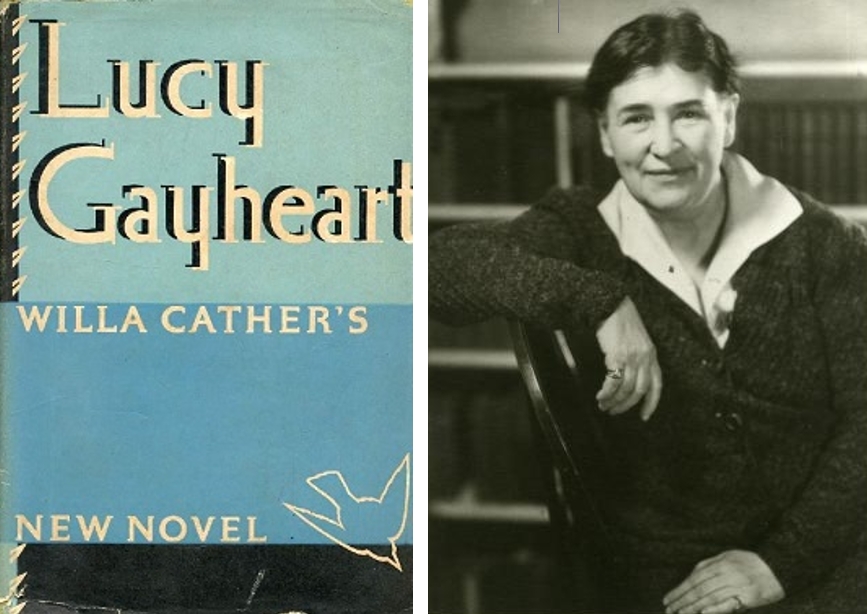
The writer Willa Cather was a favorite of New Yorker critics, including Clifton Fadiman, however her latest novel was a bit too mild for his tastes.
HERE’S LUCY…Clifton Fadiman confessed he was “mortified” to admit that he found Willa Cather’s latest novel a bit too gentle. At right, portrait of Cather on her birthday, December 7, 1936. (willacather.org)
* * *
From Our Advertisers
We begin with more fearmongering from the folks at Goodyear, who offered weekly reminders of the perils of not choosing their all-weather tires…
…the Liggett and Myers Tobacco Company conjured up this “naughty maiden” to encourage even timid souls to take up the habit…
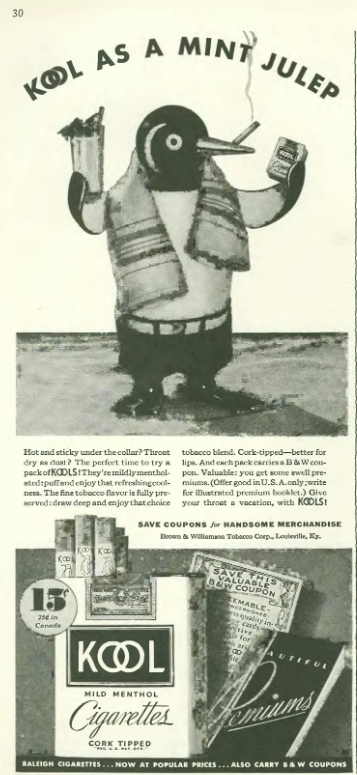
…on the other hand, the makers of the upstart KOOL brand kept it simple with their chain-smoking penguin, who was grabbing ever more market share from rival menthol pusher SPUD…
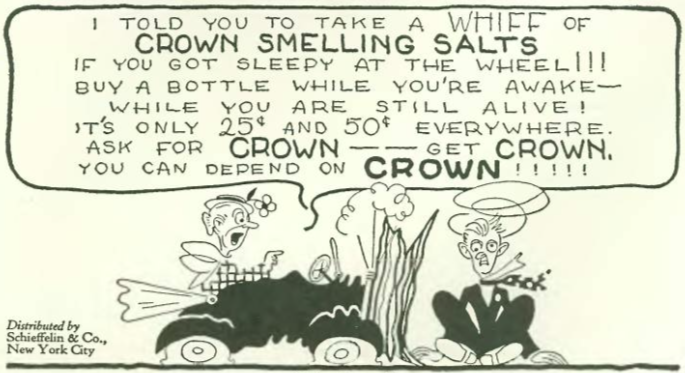
…ads in the back of the book offered up even less sophisticated products, such as Crown Smelling Salts…
…while Dr. Seuss and Norman Z. McLeod continued to make a living with their distinctive illustrations…
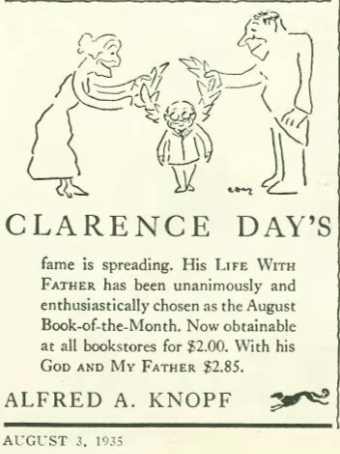
…at the very back of the magazine, this tiny ad from Knopf promoted Clarence Day’sLife With Father, published just months before Day’s death on Dec. 28…
…which brings us to our cartoonists…Constantin Alajalov kicked us off with this happy number…
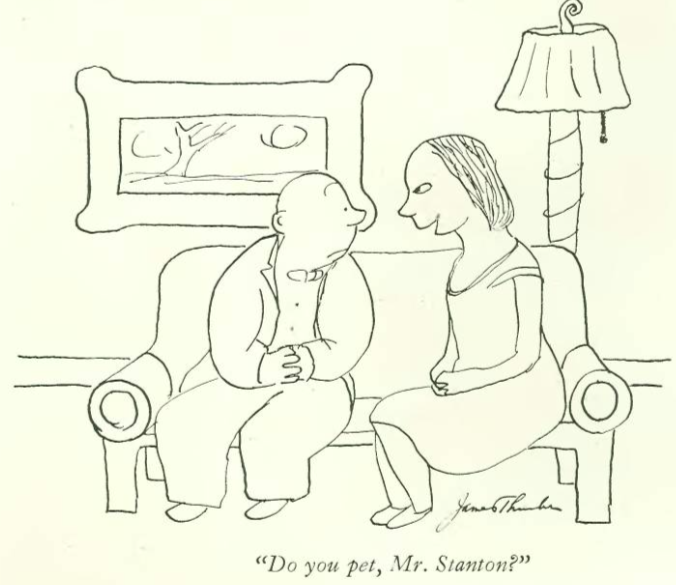
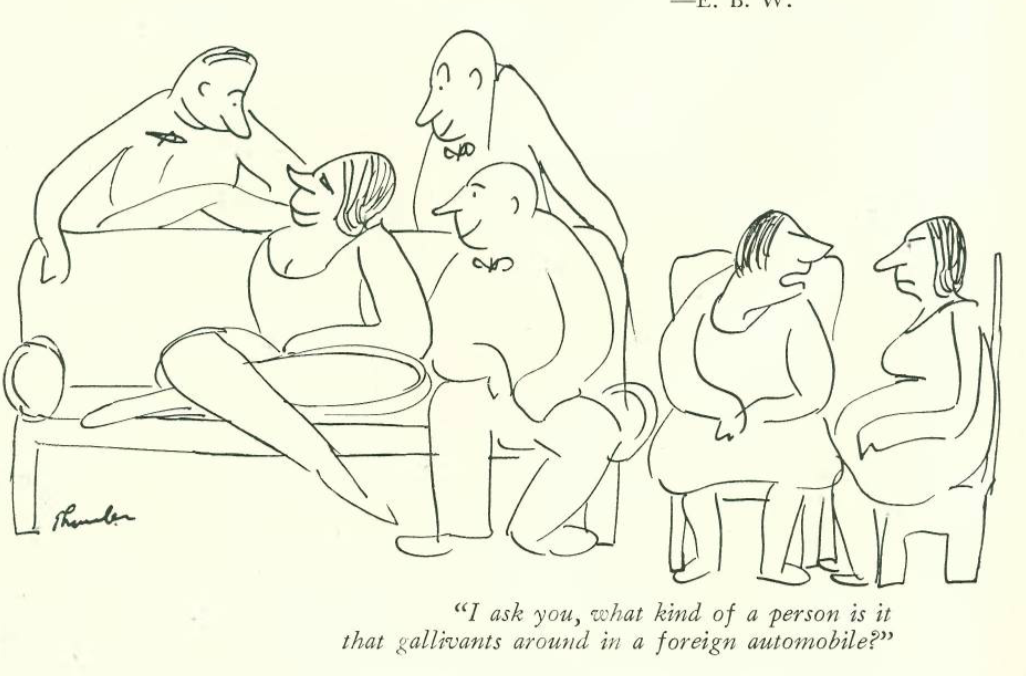
…James Thurber found steamy goings on in the parlor…
…Charles Addams came down to earth with this pair…
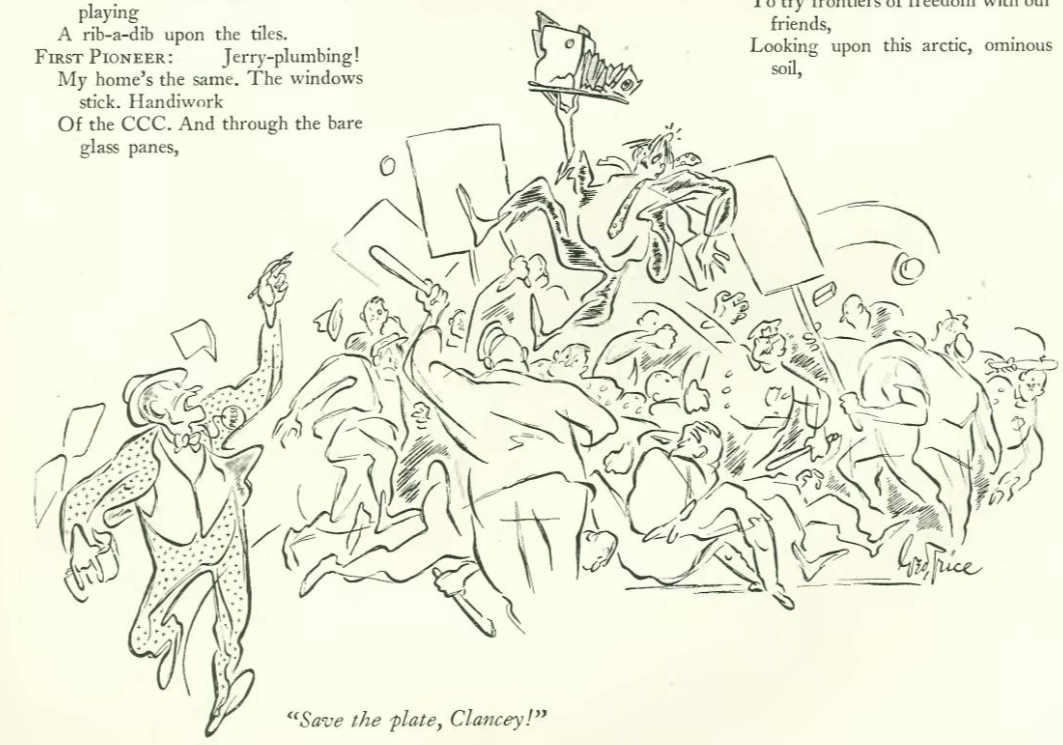
…George Price showed us the rough and tumble of news reporting…
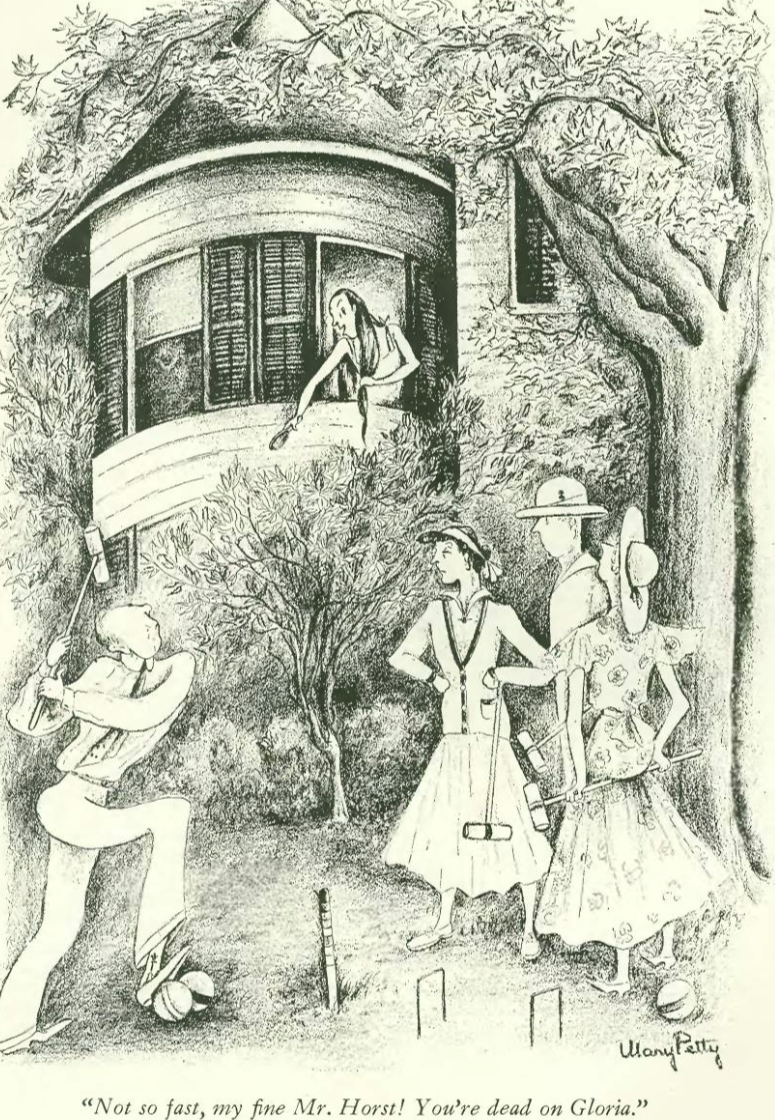
…Mary Petty contributed this sumptuous drawing of a croquet match…
…Helen Hokinson was in a transcendental mood…
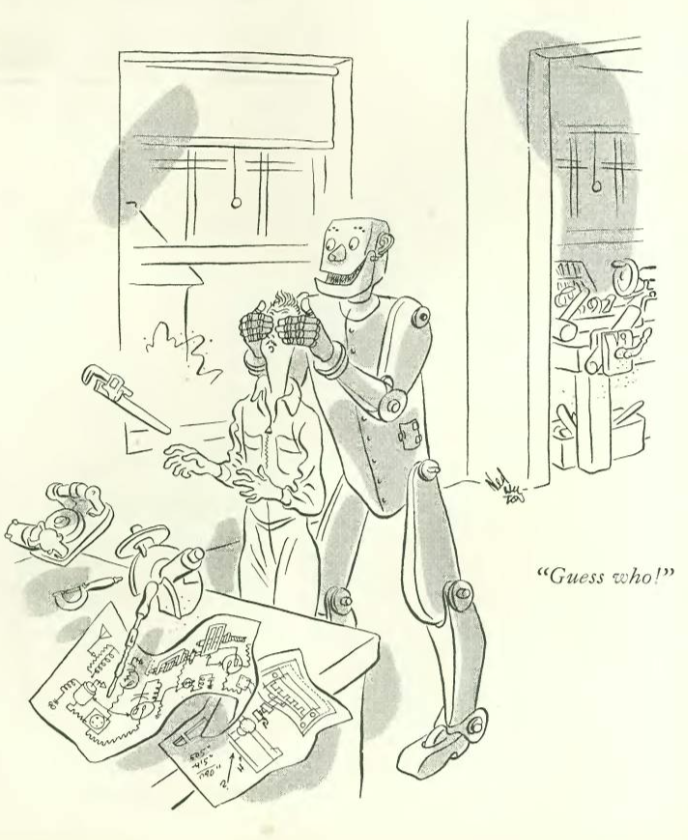
…and Ned Hilton had a big surprise for one garage tinkerer…
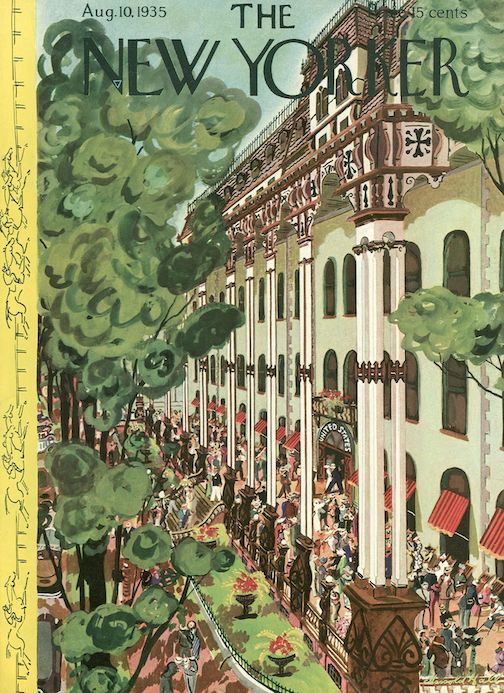
…on to August 10 and a rich summer scene by Arnold Hall:
August 10, 1935 cover by Arnold Hall.
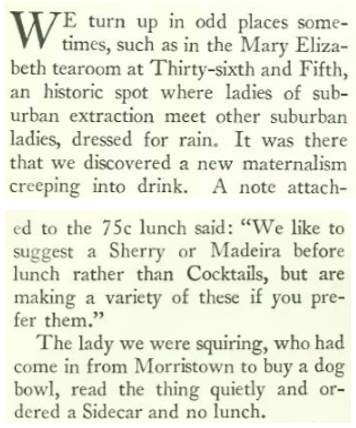
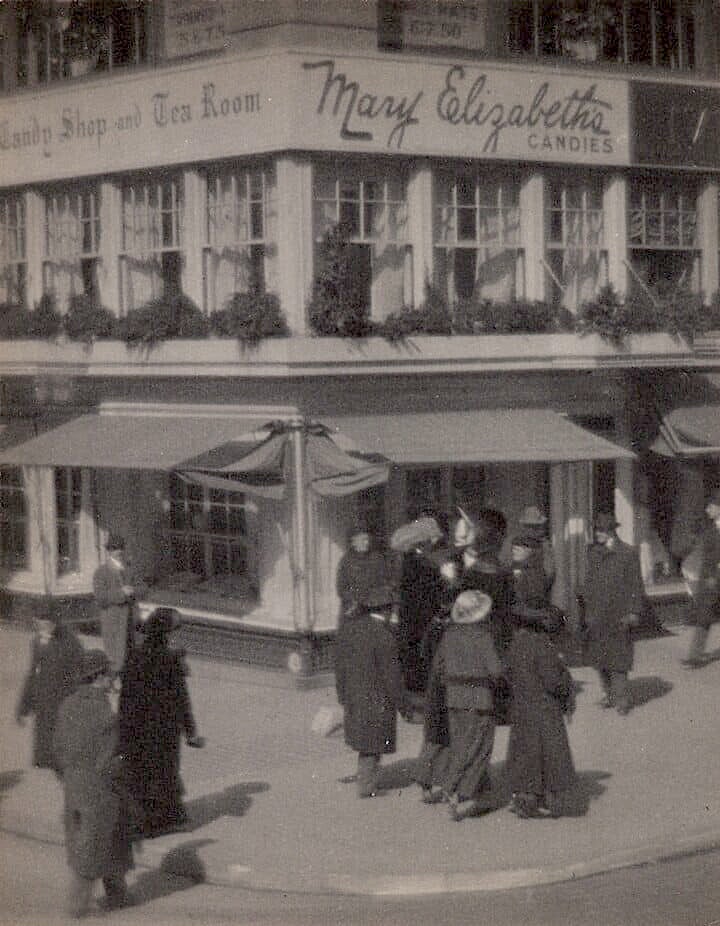
“The Talk of the Town” checked the lunch crowd at Mary Elizabeth’s Tea Room, where some preferred to drink their lunch.
TEA AND SWEETS (and cocktails) were among the offerings at Mary Elizabeth’s Tea Room at 36th and Fifth, seen here circa 1912. (Photo by Karl Struss via Facebook)
* * *
Comic Relief
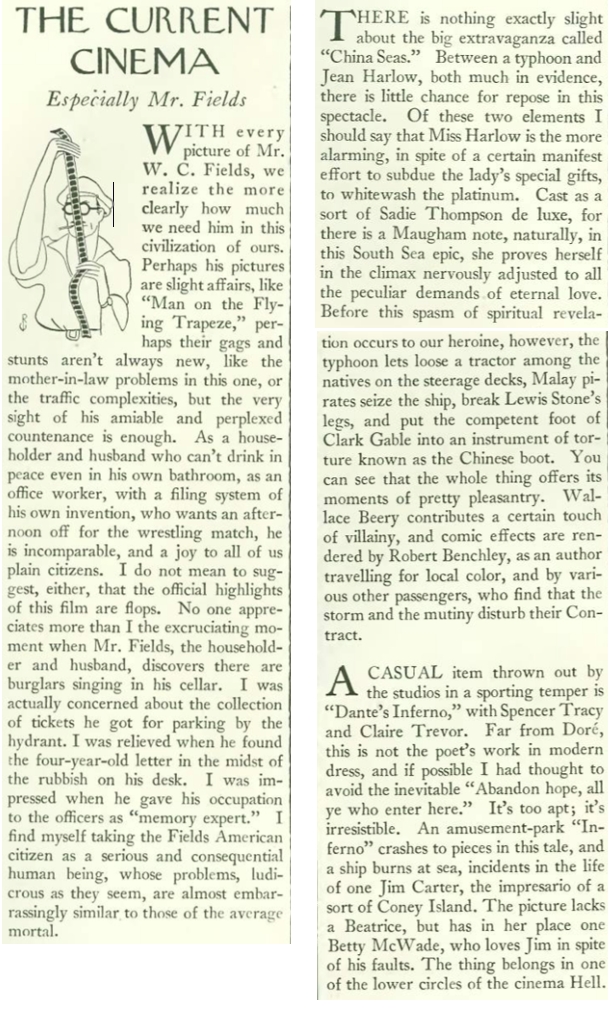
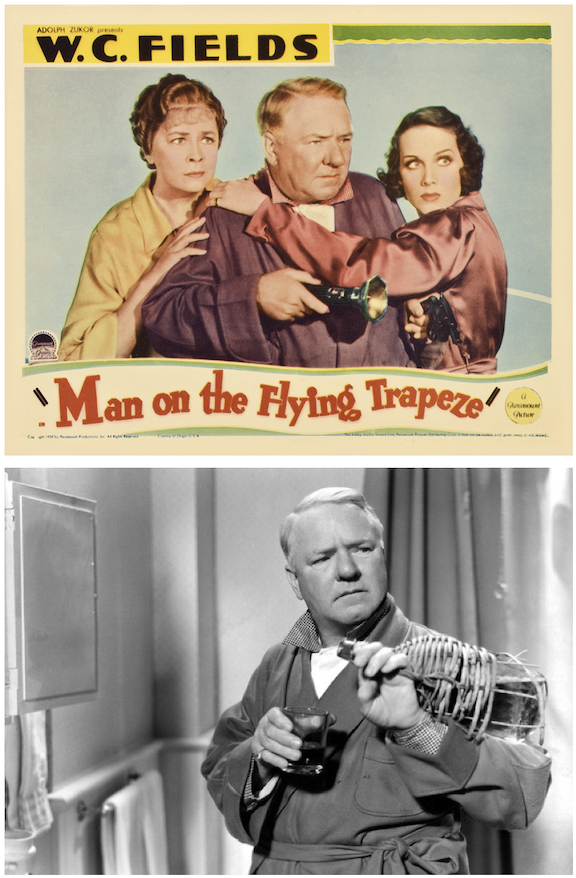
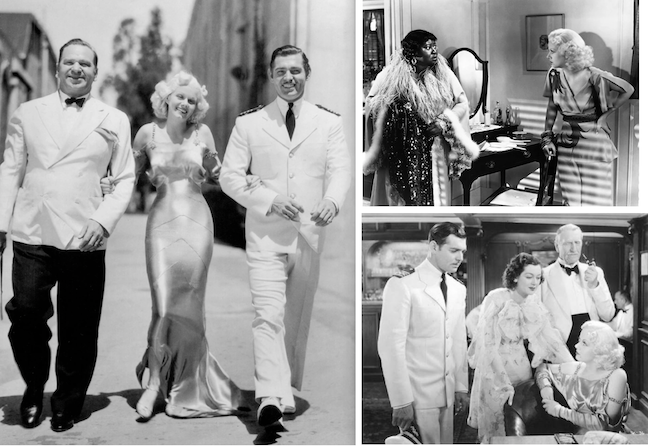
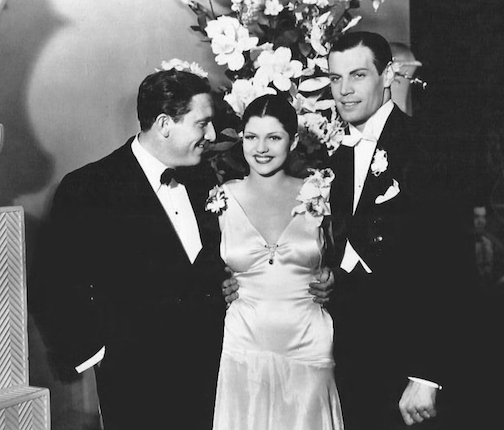
Film critic John Mosher offered an appreciation of W.C. Fields, noting that civilization needed films like Man on the Flying Trapeze during those hard years. Mosher also found some worthy distractions in the Jean Harlow vehicle China Seas, but was prepared to consign Spencer Tracey’s latest offering to the “lower circles of cinema hell.”
ANSWERING HIS NATION’S CALL…W.C. Fields brought joy to millions during the Depression in movies such as Man on the Flying Trapeze. Above, from left, Kathleen Howard, Fields, and Mary Brian. (IMDB/Rotten Tomatoes)SHORE LEAVE…At left, Wallace Beery, Jean Harlow, and Clark Gable on the set of China Seas; top right, Hattie McDaniel with Harlow in a scene from the film; below, Gable, Rosalind Russell, and C. Aubrey Smith with Harlow in China Seas. (musingsofaclassicfilmaddict.wordpress.com / Pinterest)FRESH FACE…Cinema newcomer Rita Hayworth was credited as Rita Cansino (she was born Margarita Carmen Cansino) in Dante’s Inferno. Here she is flanked by Spencer Tracy and Gary Leon. Dante’s Inferno was Spencer Tracy’s final film for 20th Century Fox. It was at MGM where his career really took off. (IMDB)
* * *
All Wet
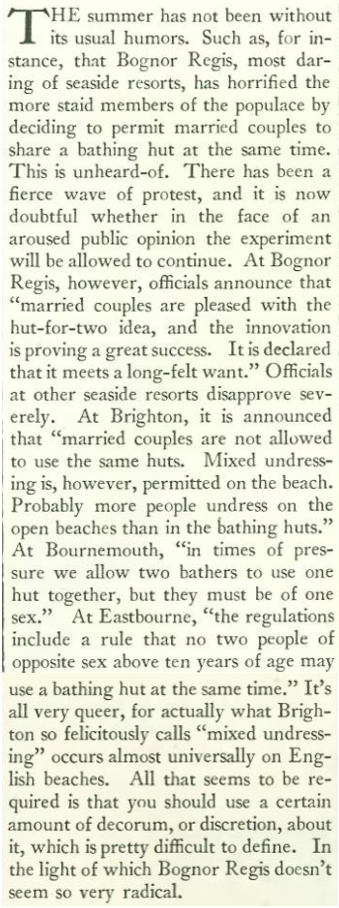
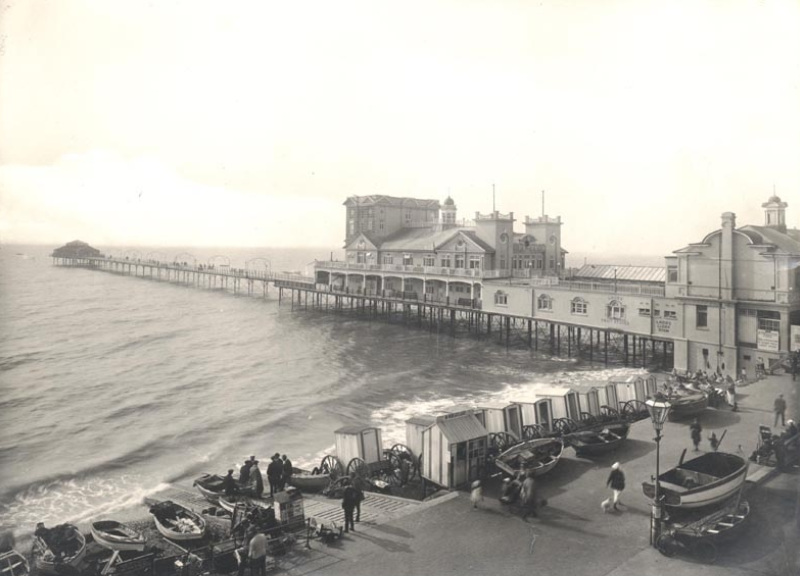
In his London Letter, Conrad Aiken (pen name Samuel Jeake Jr) examined the priggish ways of England’s seaside resorts.
SITE OF SCANDAL…Bathing huts at Bognor Regis, circa 1921. (bognorregistrails.co.uk)
* * *
Beware the Bachelor
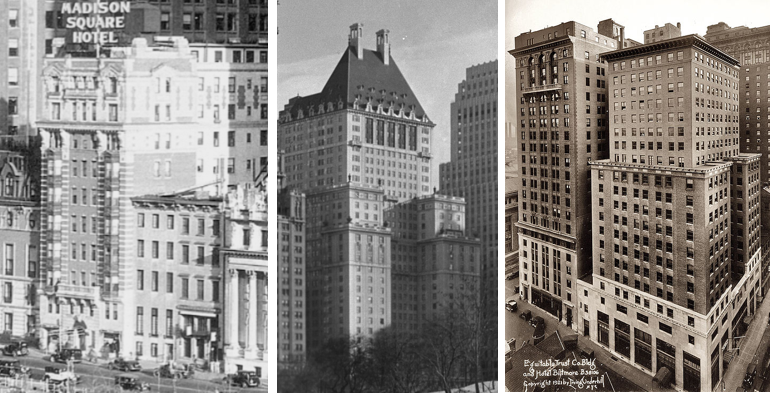
In her “Tables for Two” column, Lois Long examined some of the city’s seasonal escapes for “summer bachelors.”
GHOSTS OF THE PAST…Lois Long recommended the air-conditioned lounges of the Madison Square Hotel and the Savoy Plaza (center) or the cooling breezes of the Biltmore roof (right), which featured music by Morton Downey. Sadly, all three of these beautiful buildings have been demolished. (geographicguide.com/Wikipedia)
Other more casual venues recommended by Long included Nick’s Merry-Go-Round…
…a menu from Nick’s dated 1937…
(nypl.org)
…and its cryptic back cover…
From Our Advertisers
…speaking of the Biltmore and Morton Downey, we kick off our advertising section…
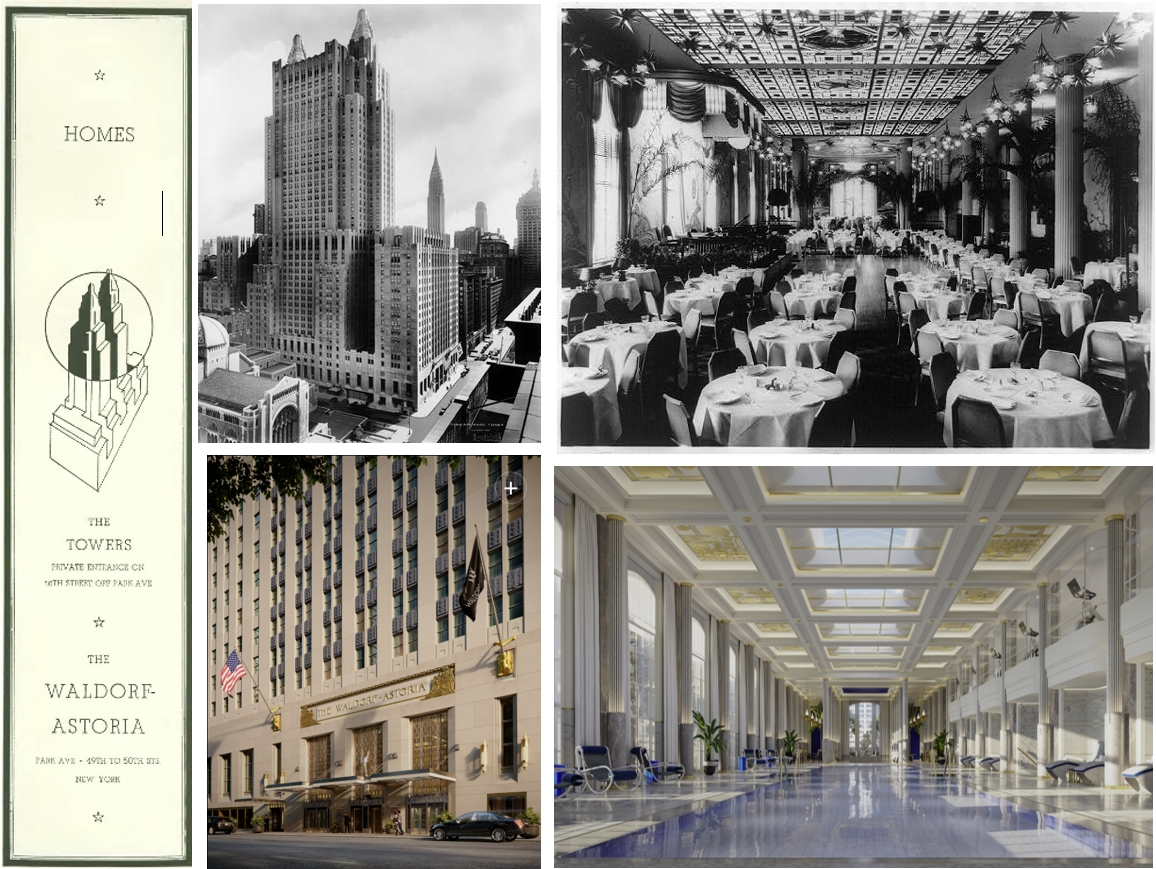
…the ad on the left announced the private residences at the Waldorf-Astoria…
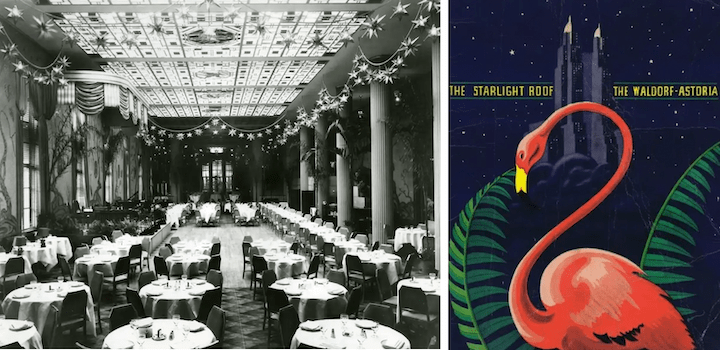
Clockwise, from top left, the Waldorf Astoria circa 1930; the Waldorf’s Starlight Roof in the 1930s; after eight years and billions in restorations and renovations, the hotel has seen many changes including the transformation of the Starlight Roof into a swimming pool. Decades of grime were also cleaned from the building’s exterior. (mcny.org/loc.gov/som.com)
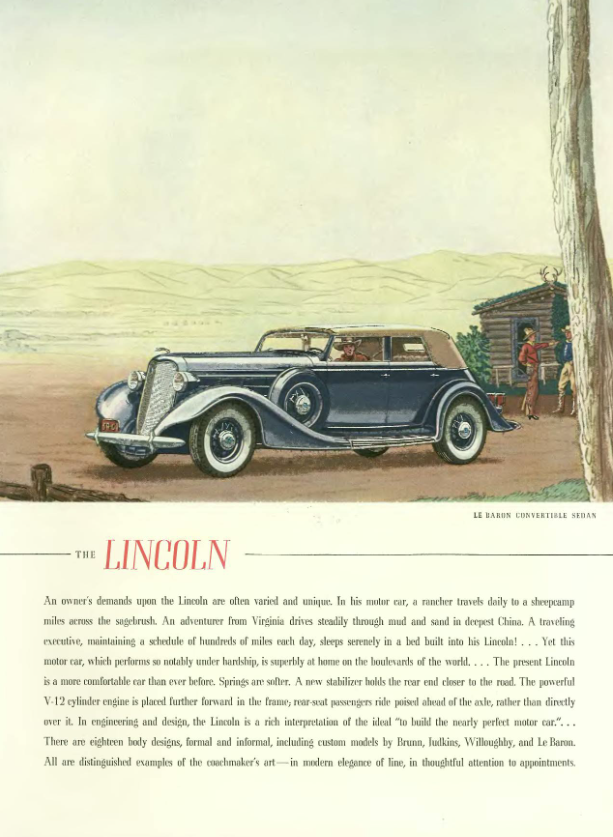
…another ad from the makers of Lincoln suggesting that the market for their luxury auto wasn’t confined to citified execs…
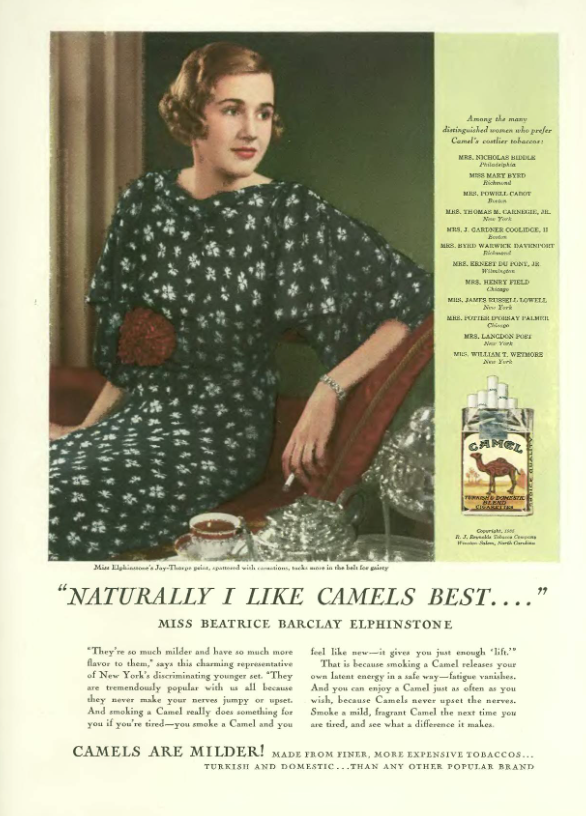
…the Camel folks introduced us to their latest society shill…
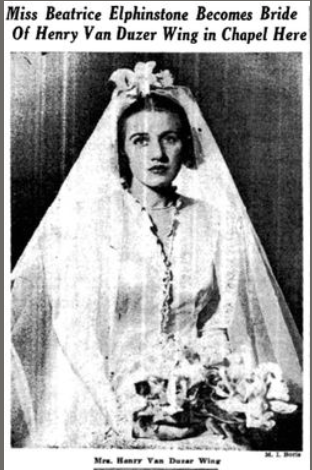
…I didn’t find much about Beatrice Barclay Elphinstone (1916-1977), described in the Camel ad as a “charming representative of New York’s discriminating younger set”…she did make the Times‘ Dec. 10, 1937 society wedding announcements, however…
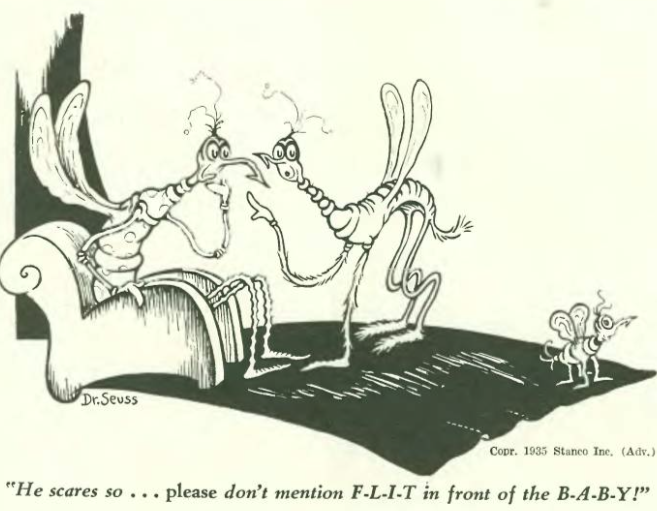
…Dr. Seuss was back with another twist on Flit insecticide…
…on to our illustrators and cartoonists, a nice charcoal by Hugo Gellert for a profile titled “Yankee Horse Trader,” written by Arthur C. Bartlett…the harness horse racing legend Walter Cox (1868-1941) was known in New England as “the king of the half-milers”…
…James Thurber contributed this cat and dog face-off to the opening pages…
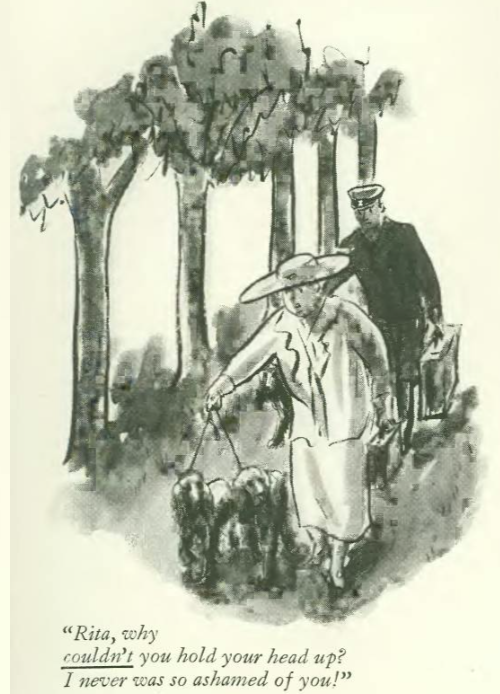
…Helen Hokinson offered her perspectives on the summer dog show across pages 16-17…
…and for a closer look…
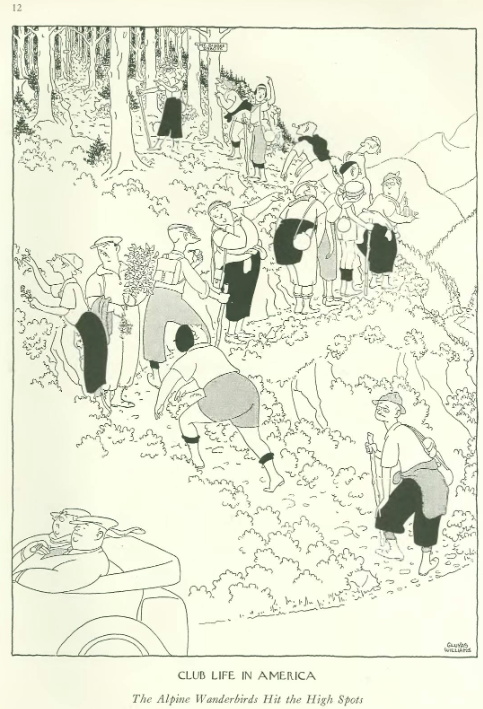
…Gluyas Williams went back to nature in his “Club Life” series…
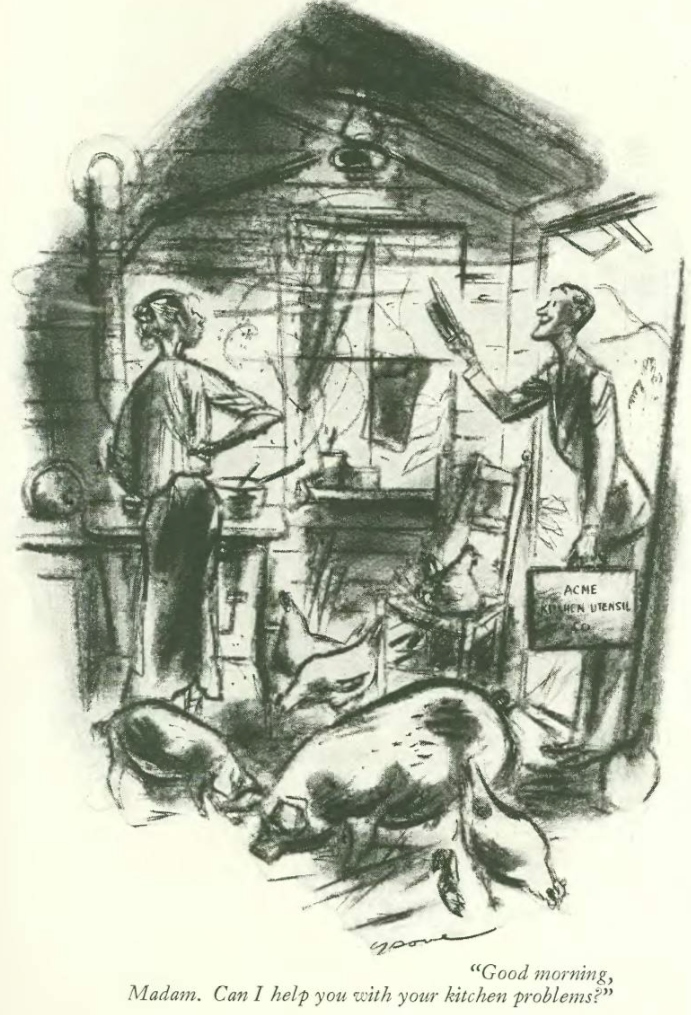
…Leonard Dove introduced us to an undaunted salesman…
…in the world of George Price, crime didn’t pay…
…Barbara Shermund gave us a rare glimpse into the secret lives of men…
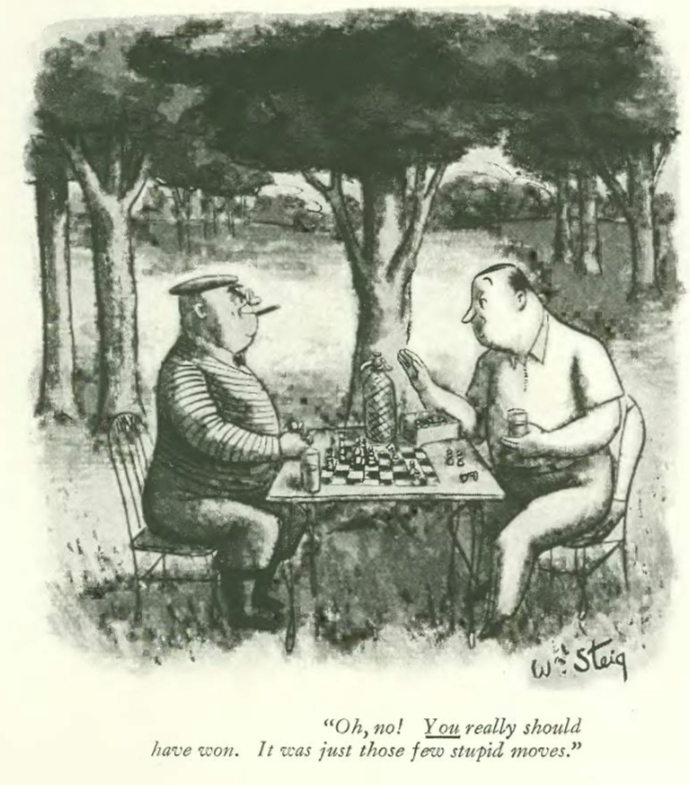
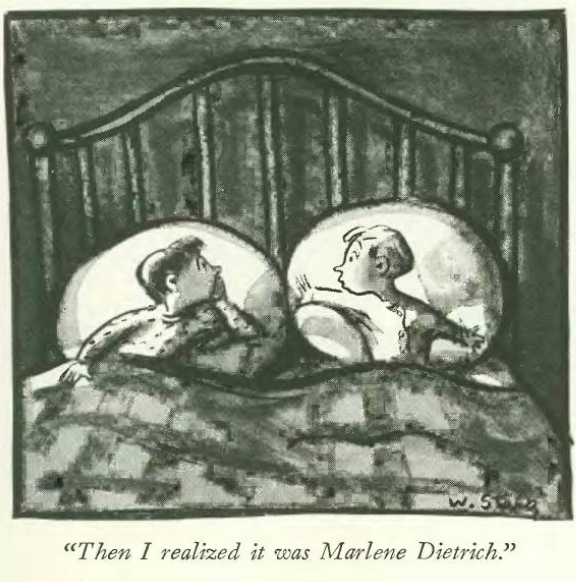
…patronizing words were unwelcome at this chess match, per William Steig…
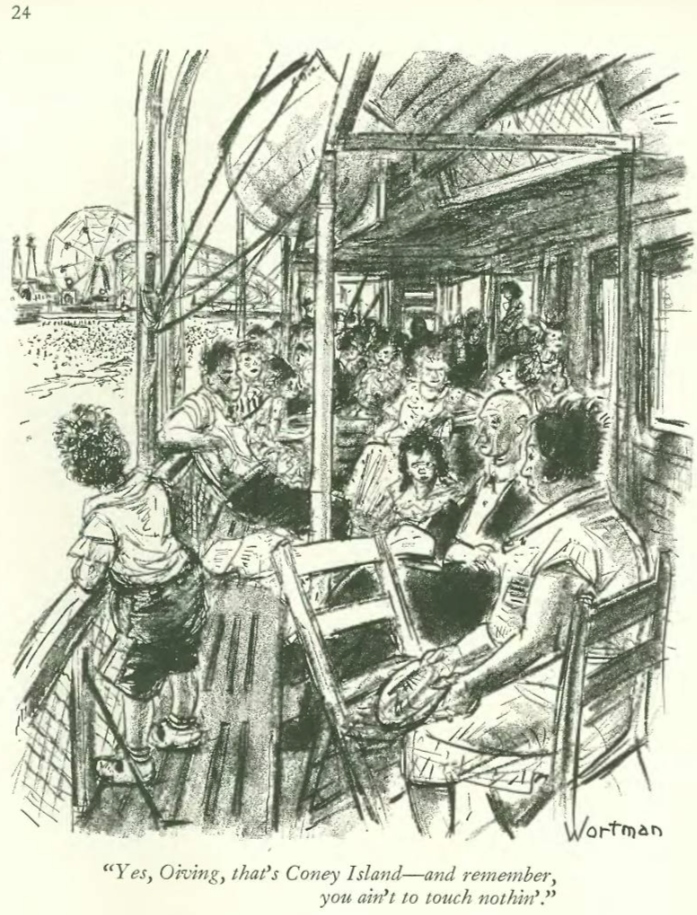
…Denys Wortman took us on a family outing…
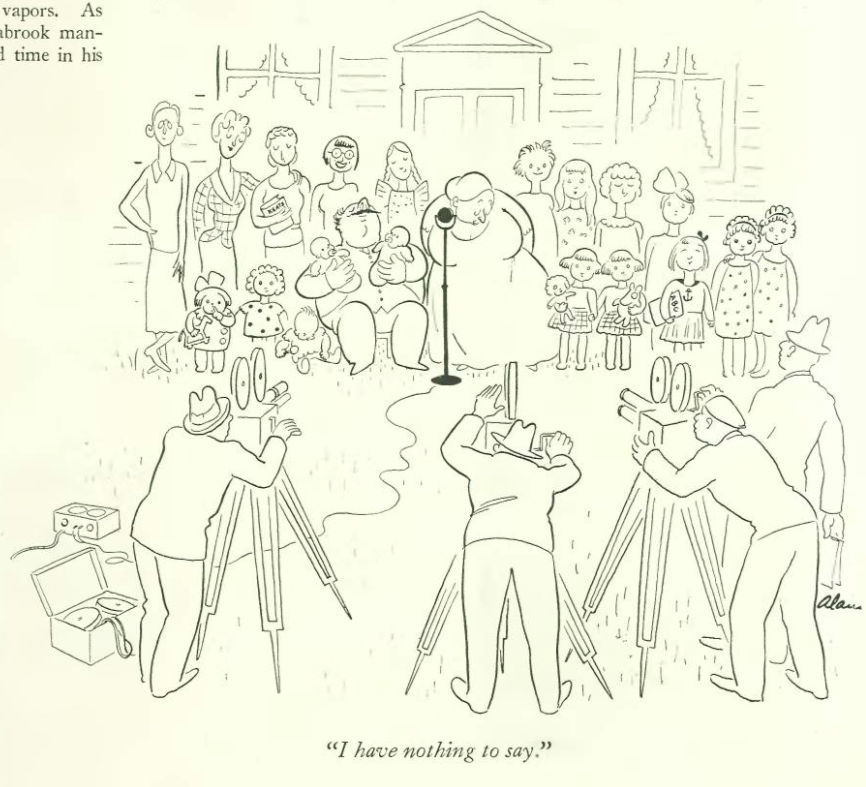
…and we close with Alain, and a mother of multiples…except words…
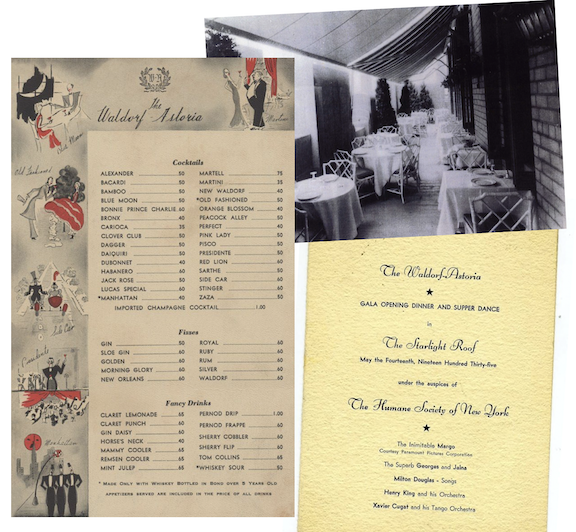
Above: The Waldorf-Astoria's Starlight Roof, and a 1930s menu cover. (Facebook/Pinterest)
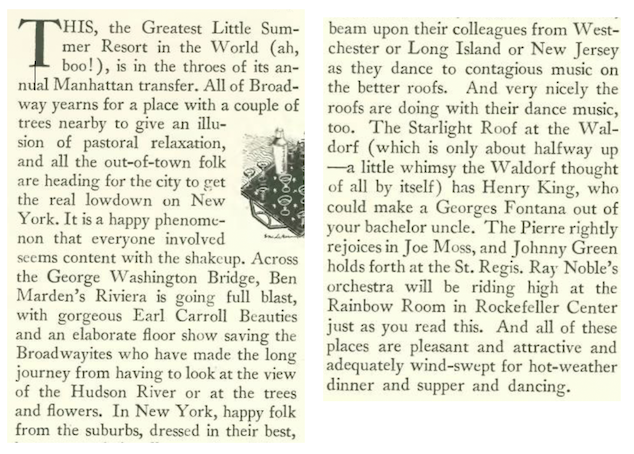
With summer approaching, the rooftop restaurants were in full swing, and Lois Long continued her exploration of favorite haunts, including one nightclub that drew many Manhattanites across the Hudson to the cliffs of the New Jersey Palisades.
June 1, 1935 Cover by Rea Irvin.
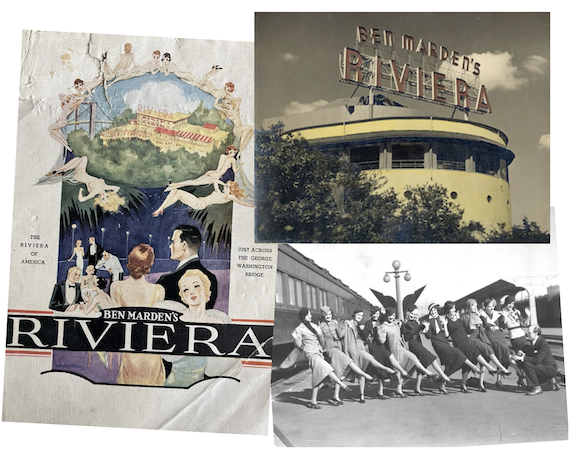
Ben Marden couldn’t wait for the official end of Prohibition when he opened his Riviera Night Club in Fort Lee in 1931. The frequent site of raids until the repeal of the 18th Amendment, the Riviera continued to be a place well known to Bergen County police thanks to clientele that included racketeers and other unsavory types. But to New Yorkers like Long, it was a break from the din of the city to the relative green of the Garden State. Long wrote:
The Riviera closed during the first years of World War II, but it reopened in 1945 after Bill Miller bought it from Marden and apparently cleaned it up. It then attracted the likes of Frank Sinatra, Dean Martin, Jerry Lewis, Martha Rae, Sammy Davis, Jr., and Pearl Bailey until it closed in 1953. It was demolished the following year.
THEY HAD FOOD, TOO…Clockwise, from left, the1936 spring menu cover of Ben Marden’s Riviera featured an illustration of the original Riviera (ringed by nude showgirls), which burned to the ground on Thanksgiving night, 1936; the building that replaced it was called an architectural wonder with its retractable roof, rotating stage, and glass windows that slid down to the floor; Earl Carroll and his “Beauties” performed at the Riviera in 1935–they are pictured here at a train station in Los Angeles, 1934. (ebay.com/patch.com/lapl.org)
Long also stayed in town to visit the Waldorf-Astoria’s Starlight Roof.
WITH THE STARS, UNDER THE STARS…Clockwise, from left, cocktail menu from the Waldorf’s Starlight Roof, 1935; outdoor seating on the Starlight Roof Terrace; special menu for the Gala Opening Dinner and Supper Dance on the Starlight Roof, May 14, 1935. It was a favorite destination of Frank Sinatra, Cole Porter, Katharine Hepburn, and Ella Fitzgerald, among others. (Pinterest)
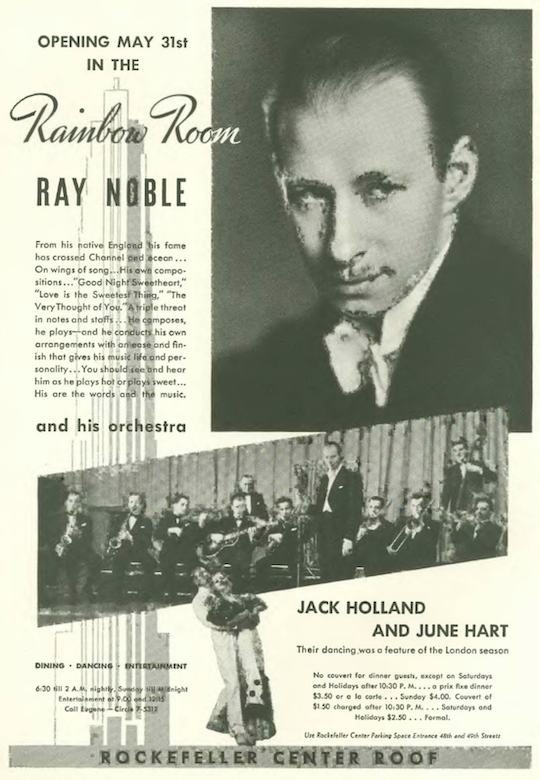
Long also mentioned the appearance of Ray Noble in the Rockefeller Center’s Rainbow Room. This full-page ad appeared in the June 1 issue:
Other summer season attractions were advertised in numerous back-of-the-book, one-column advertisements:
…and at the bottom of page 64…
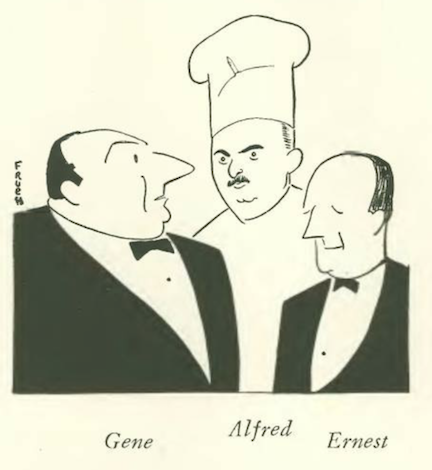
Wining and dining were also the topic of the profile, a two-parter penned by Margaret Case Harriman, who took a look at New York’s famed Colony Restaurant.
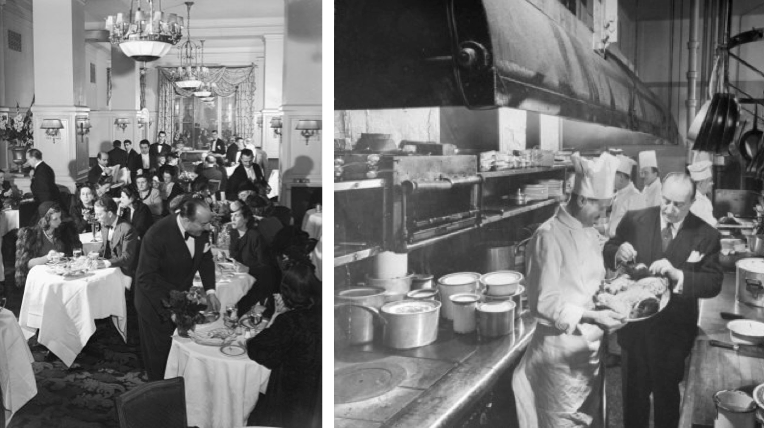
ORIGINAL TRIO…Al Frueh’s caricatures of the Colony’s owners/headwaiters Gene Cavallero and Ernest Cerutti, who flank chef Alfred Hartmann, who was also part owner until he sold his interest to the other two in 1927 and retired to a farm in France. Harriman wrote that Cavallero and Cerutti were “born headwaiters—suave, solicitous, infallible.”A PLACE TO BE SEEN…From the 1920s to the 1960s New York’s café society dined at the Colony. Rian James, in Dining In New York (1930) wrote “the Colony is the restaurant of the cosmopolite and the connoisseur; the rendezvous of the social register; the retreat of the Four Hundred.” Critic George Jean Nathan said the Colony was one of “civilization’s last strongholds in the department of cuisine.” Photo at left of the dining room around 1940; at right, co-owner Eugene Cavallero consults with a chef. (lostpastremembered.blogspot.com)
* * *
The Business of News
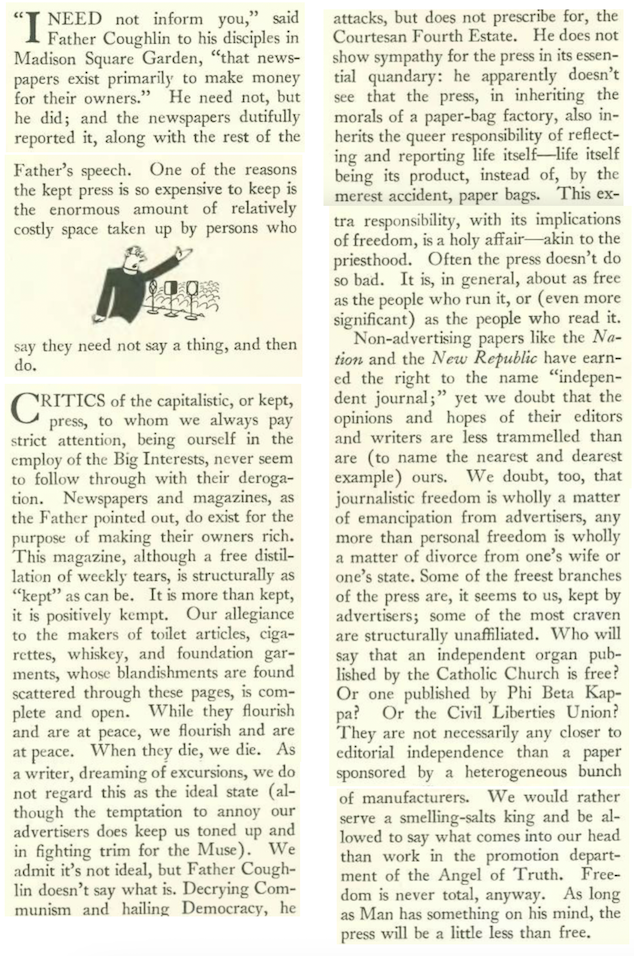
In his “Notes and Comment,” E.B. White contemplated the meaning of a free press, noting that nearly all media was at the mercy of advertisers. That included The New Yorker, which owed allegiance “to the makers of toilet articles, cigarettes, whiskey, and foundation garments.”
* * *
Cat Lady
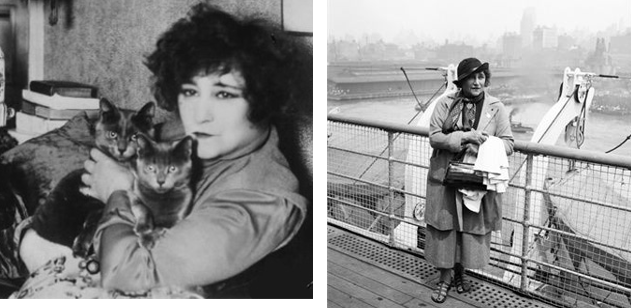
“The Talk of the Town” anticipated the arrival of French writer Colette (1873-1954) aboard the S.S. Normandie. This excerpt makes note of her high standing in society as well as her love of cats.
SHE ONCE OWNED AN OCELOT….Colette with her cats in an undated photo; at right, entering New York Harbor on the S.S. Normandie, 1935. (Pinterest)
* * *
Public Artists
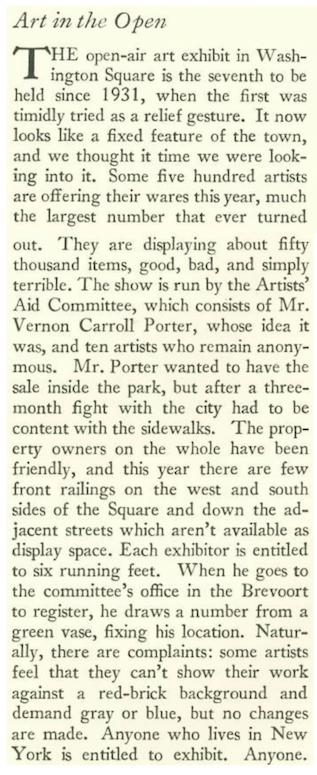
“The Talk of the Town” noted the latest Washington Square Outdoor Art Exhibition…
LENDING THEIR TALENTS…New Yorker cartoonists who helped promote the Outdoor Art Exhibition in Washington Square included James Thurber, Otto Soglow, and William Steig.
* * *
Cutting Remarks
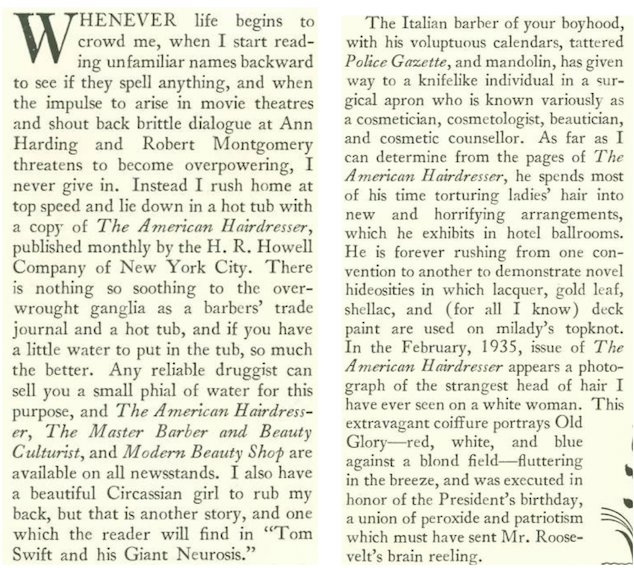
S.J. Perelman offered his thoughts on the decline of the tonsorial arts. In this excerpt, he sees his beloved Italian barber give way to a “knifelike individual in a surgical apron.” Excerpts:
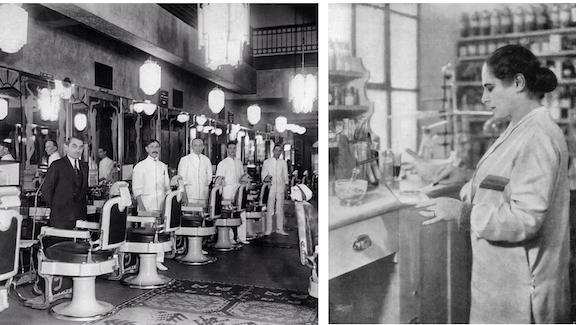
IT’S A SCIENCE NOW, SIDNEY…S.J. Perelman worried about the displacement of Italian barbershops by cosmetologists in “surgical aprons,” such as the one modeled by Helena Rubinstein at right. (Pinterest)
* * *
Even Those Eyes Couldn’t Help
Film critic John Mosher was sad to report that disappointment was in store for moviegoers who enjoyed seeing Bette Davis in Of Human Bondage. Her latest flick, The Girl from 10th Avenue, featured Davis murmuring “gentle nothings of a vaguely noble monotony.”
GET ME OUT OF THIS PICTURE…Left, Bette Davis with Ian Hunter in the uninspired The Girl from 10th Avenue; at right, screen shot of Davis in 1934’s Of Human Bondage, the film that made Davis a star. (thefilmexperience.net)
Other items in the editorial section included a casual by Dorothy Parker’s husband Alan Campbell (titled “Loyalty at Pool-Wah-Met”), and Morris Markey examined the Christian Science movement inspired of Mary Baker Eddy, in “A Reporter at Large” piece titled “But Thinking Makes It So.”
* * *
From Our Advertisers
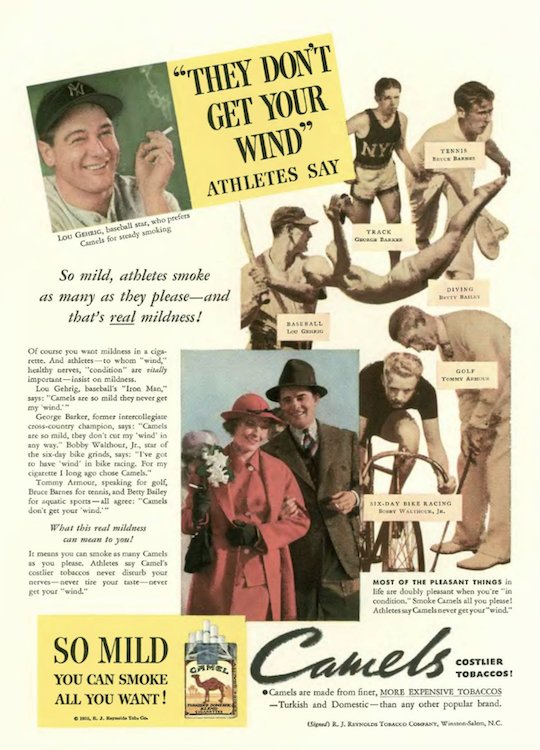
We begin with an advertising theme common through midcentury, namely, that you could smoke certain brands as much as you liked and still be a star athlete (as opposed to a wheezing husk of a human being)…
…not only did these cigarettes “steady your nerves” and preserve your “wind,” they also made for sweet, romantic moments…
…in between puffs you could also enjoy breathing in fumes from leaded gasoline…lead pollution increased by more than 625 times previous levels after leaded fuels were introduced in 1924…
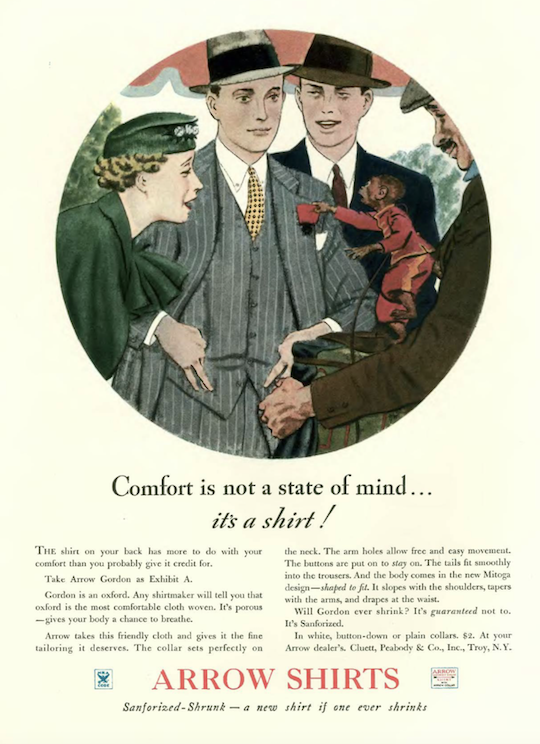
…although they were being outlawed by New York Mayor Fiorello Henry La Guardia, an organ grinder nevertheless made an appearance in an Arrow Shirt ad that offered a lighthearted moment for all involved (except for the dude on ketamine)…
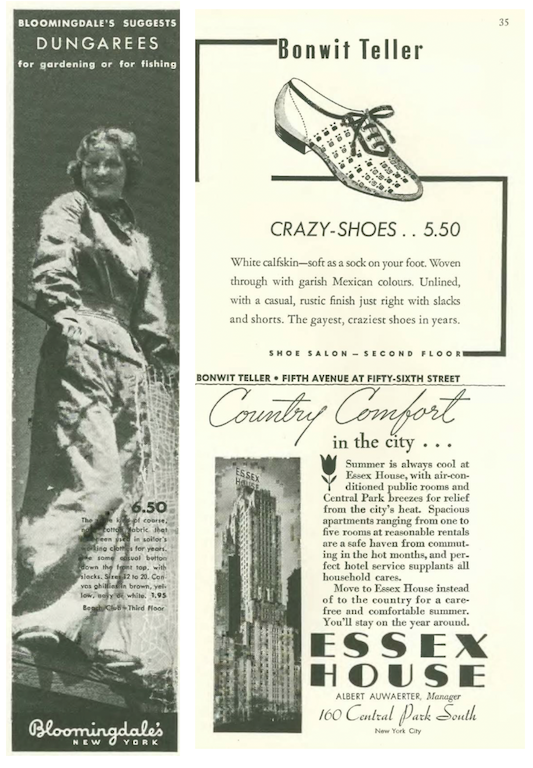
…when jeans were called “dungarees” they were reserved for gardening or fishing…at right you could land a pair of “Crazy Shoes” woven with “garish Mexican colours” for five-and-a-half bucks…
…the makers of White Rock kept it cool with this minimalist ad…
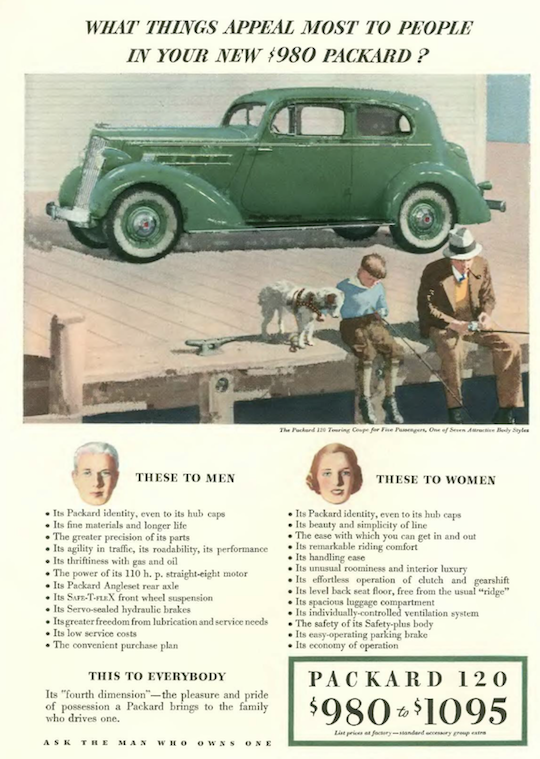
…luxury automaker Packard continued to hang on through the Depression by offering a downscale version…it appears their demographic was middle-aged men and women who still preferred the finer things even if they couldn’t afford them…
…now the property of Hearst, Otto Soglow’s Little King could still appear in The New Yorker via the advertising sections…
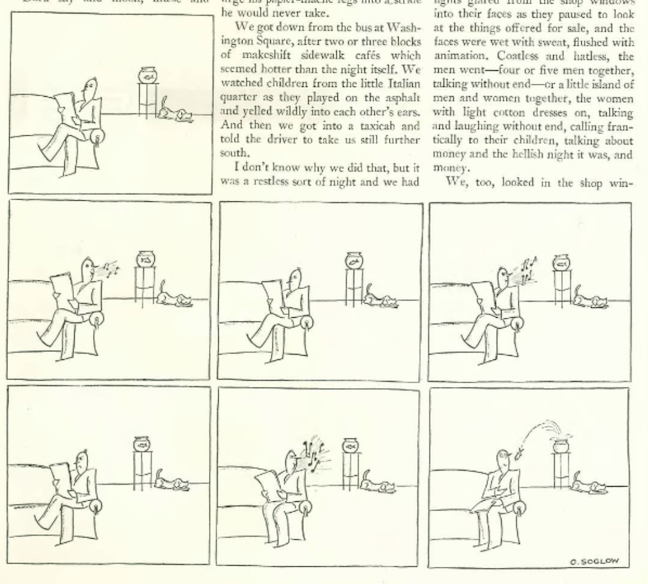
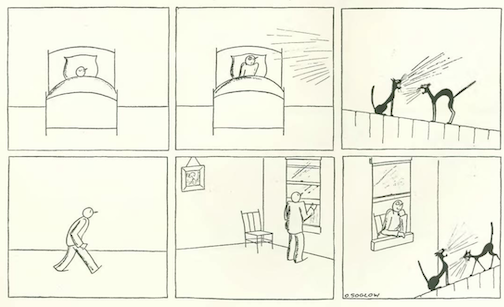
…and Soglow continued his contribution to the magazine’s cartoons with other multi-panel subjects…
…James Thurber kicked off the cartoonists with this tender spot…
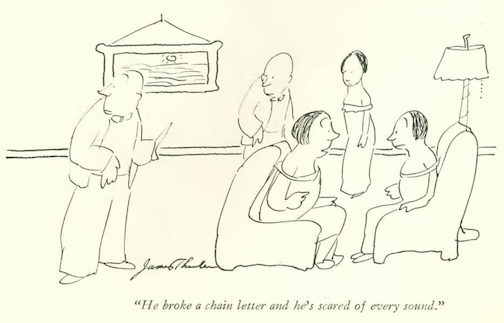
…and contributed this cartoon…
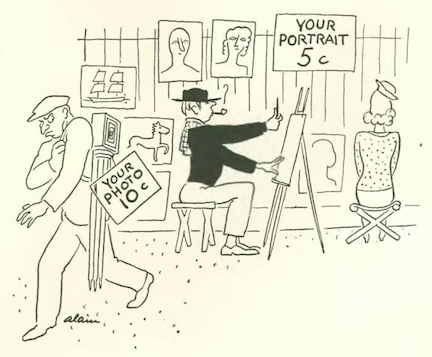
…Alain found competition in the portrait trade…
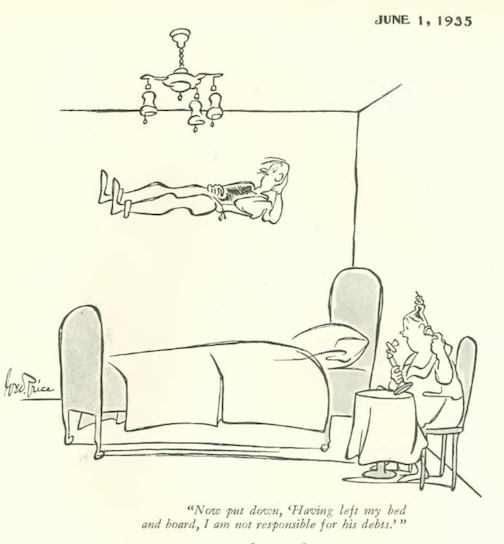
…George Price was still afloat…
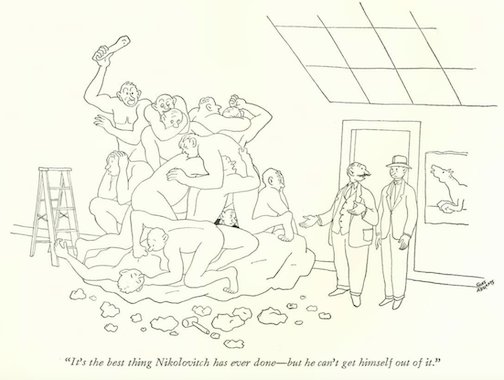
…Charles Addams was tied up with the sculptural arts…
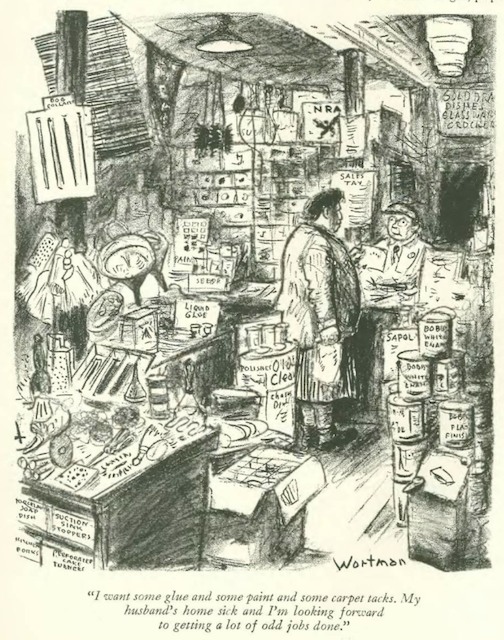
…Denys Wortman shopped for DIY projects…
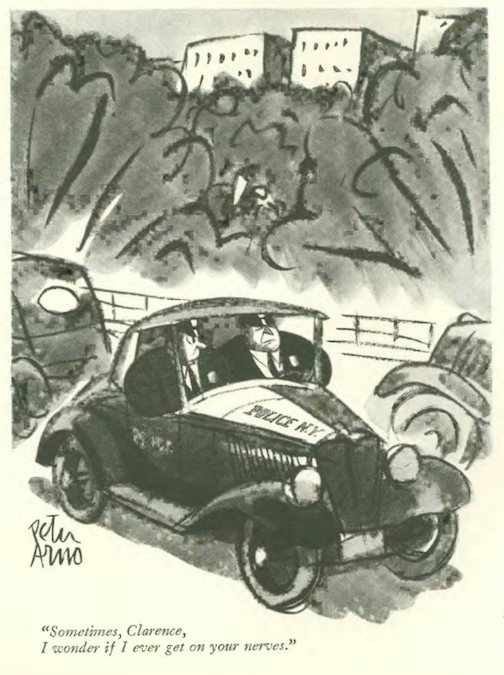
…Peter Arno found a sensitive side in one member of the NYPD…
…Mary Petty made some alterations…
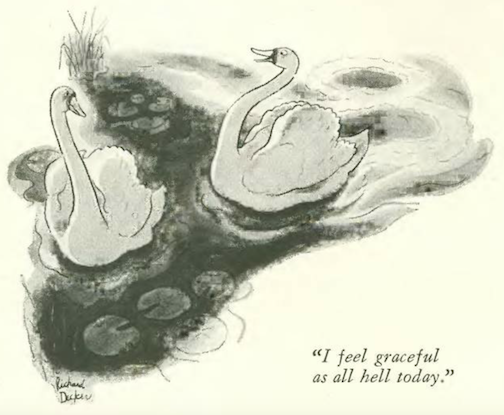
…and we close with this terrific cartoon by Richard Decker…
The New Yorker profiled authors, composers, civic and world leaders and other notables in its early years, but every so often it would turn the spotlight on a member of the working class.
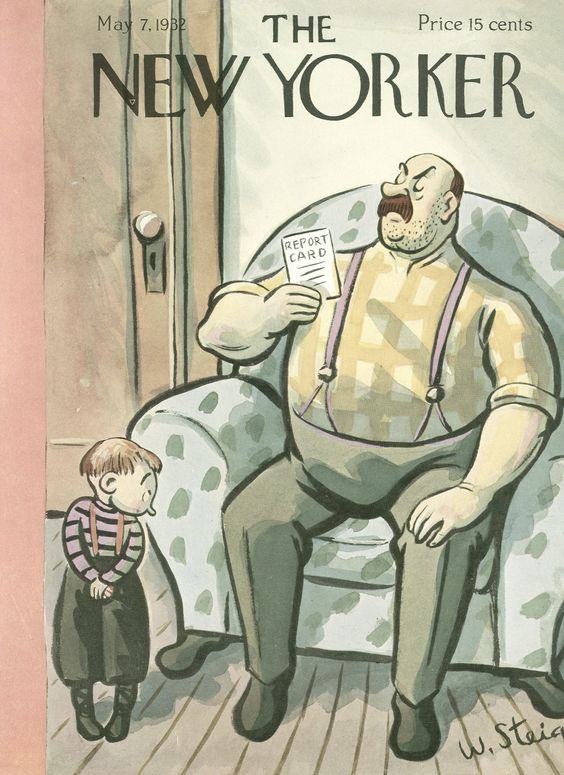
May 7, 1932 cover by William Steig, the first of 117 covers he would contribute to the magazine over his long life and career.
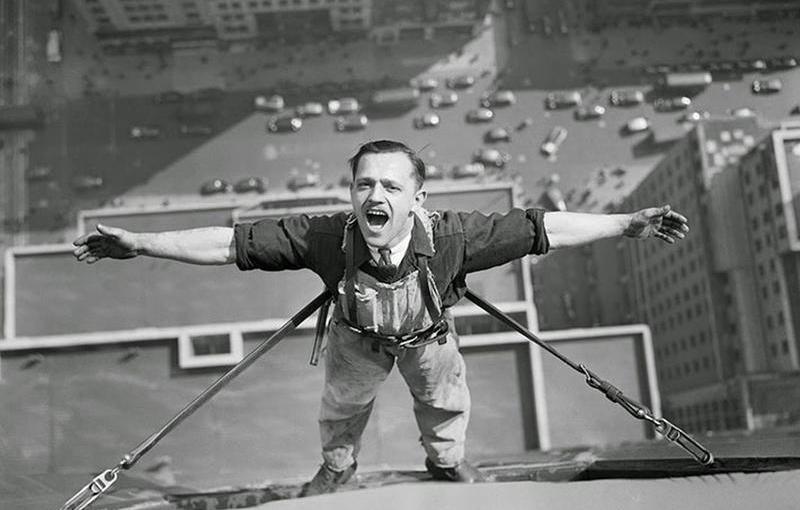
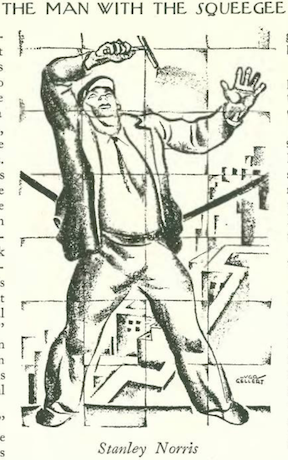
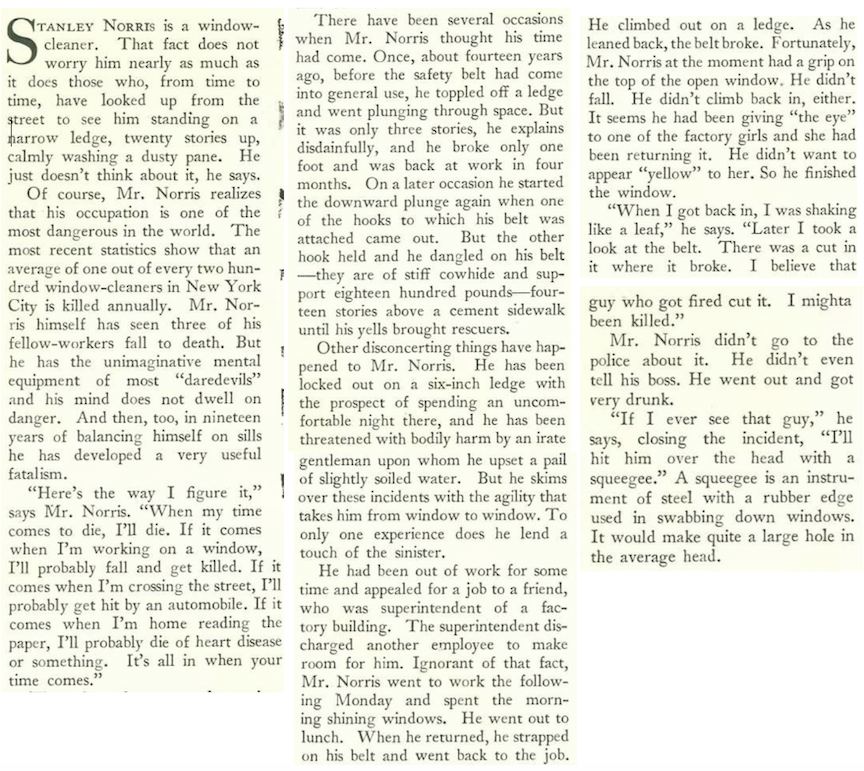
“The Man With The Squeegee,” a profile written by journalist (and later, playwright) Russel Crouse, detailed the life and work of Stanley Norris, a son of Polish immigrants who daily defied death as a window cleaner on Manhattan’s skyscrapers.
Profile illustration by Hugo Gellert
Below is an excerpt that includes a couple of Norris’ harrowing experiences high above the city streets:
LOOK MA, NO HANDS!…Clockwise, from top left…attached to the side of the Empire State Building, just two leather straps separated this brave window washer from oblivion in March 1936; a lone worker confronts his task in 1935; window washers in 1930; window washers on the 34th street side of the building, January 1932. There are 6,400 windows on the Empire State Building, and each worker averaged 76 panes per day. (retronaut.com/cnn/considerable.com/reddit)
During the 1930s one out of every 200 window cleaners in New York City fell to their deaths annually. In the previous decade, more than 80 fell to their deaths. In another excerpt, Norris recalled one of those unfortunate deaths.
* * *
Vintage Whines
E.B. White enjoyed both wine and spirits, but like many of his fellow Americans he was growing sick and tired of Prohibition, and in his “Notes and Comment” looked abroad for a better way to live.
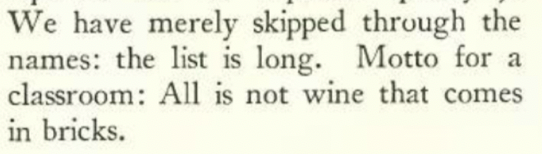
White concluded the entry with this observation…
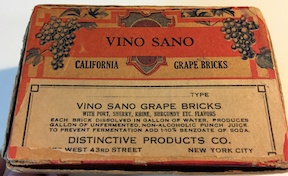
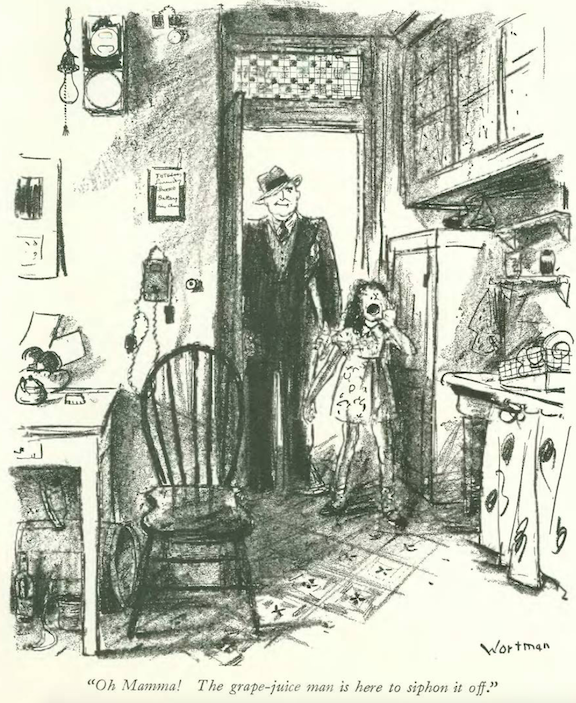
…which referenced the sad grape “bricks” folks could order by mail…
Grape growers sold these bricks with a warning that they were not to be used for fermentation — a warning that kept them within the law. Naturally both seller and consumer understood that the end product would likely be something stronger than grape juice.
(vinepair.com)
Where White did procure his cocktails is revealed later in “Notes” — he tells us of an encounter with a night-club host while out walking with his wife, Katharine White, and toddler Joel.
SOMETIMES E.B. JOINED THEM…Katharine White taking baby Joel for a stroll with the White’s beloved Scotty Daisy in New York City, 1931. (brainpickings.org)
* * *
News Stooges
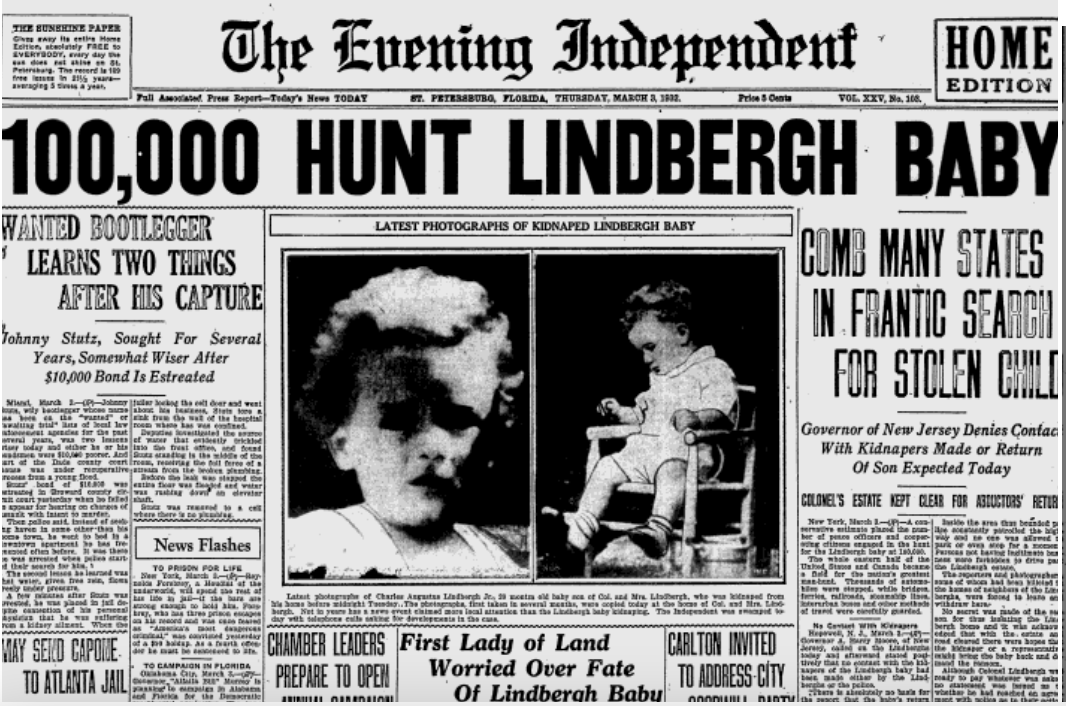
In “The Wayward Press” column, Robert Benchley (writing under the pseudonym Guy Fawkes) took the newspapers to task for their tasteless reporting on the Lindbergh baby kidnapping, and their general sullying of a once proud profession (Benchley himself was an experienced journalist):
TRAGEDY SELLS…The kidnapping of Charles and Ann Lindbergh’s infant son, Charles Jr., dominated headlines across the country in the spring of 1932. This March 3 edition of the St. Petersburg (Fla.) Evening Independent ran this headline just two days after the boy’s disappearance. The body of Charles Jr. was found on May 12, 1932. (Pinterest)
* * *
Rising Stars
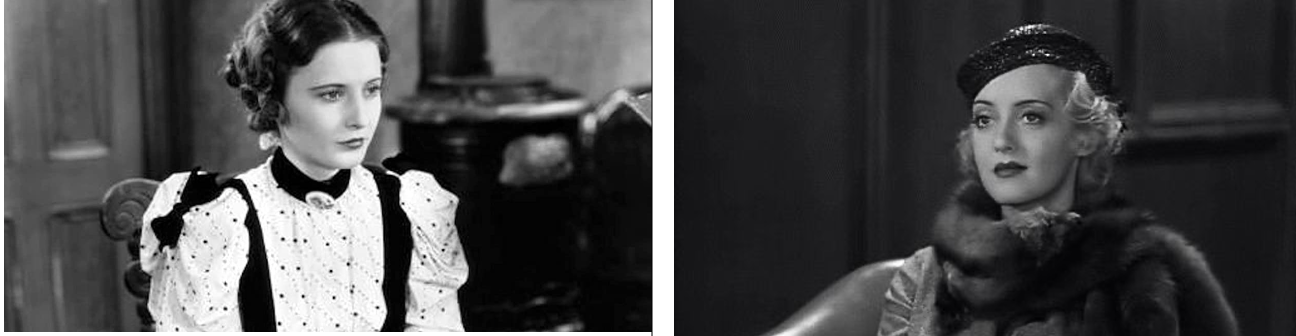
The pre-Code drama So Big!, based on Edna Ferber’s 1924 Pulitzer Prize-winning novel, featured two iconic Hollywood actors, but in 1932 only one of them, Barbara Stanwyck, was a bankable star. The film also featured the soon-to-be-famous Bette Davis, who had a much smaller role but was nevertheless grateful to be cast in a prestigious Barbara Stanwyck film. For critic John Mosher, the film proved to be a breakout role for Stanwyck.
SO BIG!…Barbara Stanwyck (left) was a marquee attraction in 1932, but Bette Davis would soon emerge as another major star in the Warner Brothers universe. (IMDB)
* * *
From Our Advertisers
Clothes spun from cotton have been around for thousands of years, but this B. Altman advertisement suggests they were relatively novel for summer wear, at least among the upper orders. Both men and women wore wool bathing suits up until the 1930s, so perhaps there was something new about this cool, casual material…
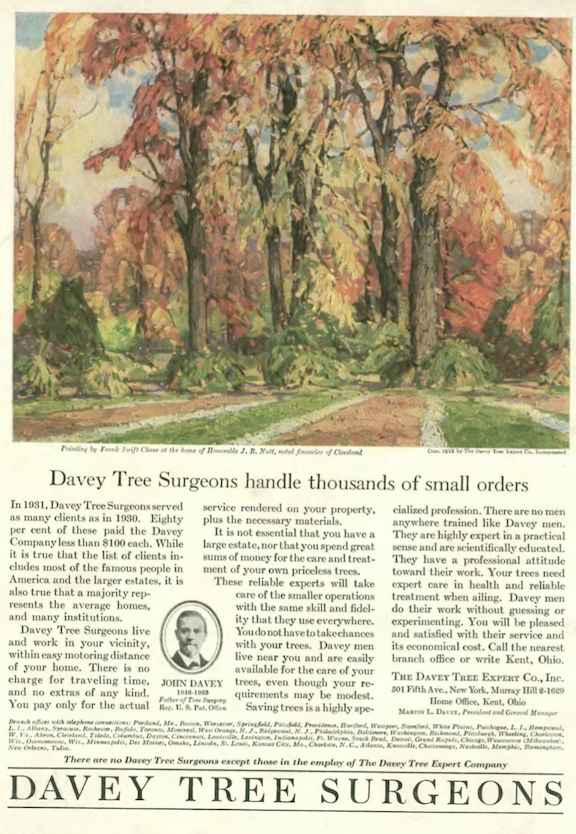
…no doubt the landed gentry helped keep the Davey Tree Surgeons in business during the Depression, but in those lean times it didn’t hurt to reach out to those with modest means…
…they did something right, because this 141-year-old company still thrives today, the ninth-largest employee-owned company in the U.S…
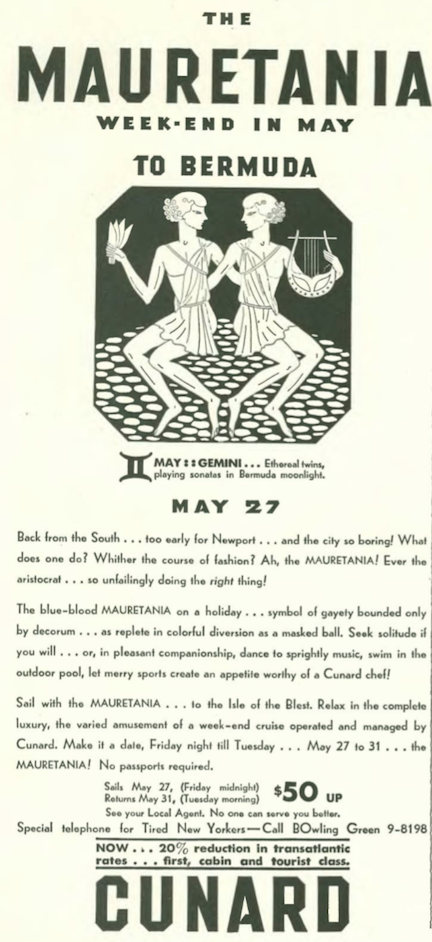
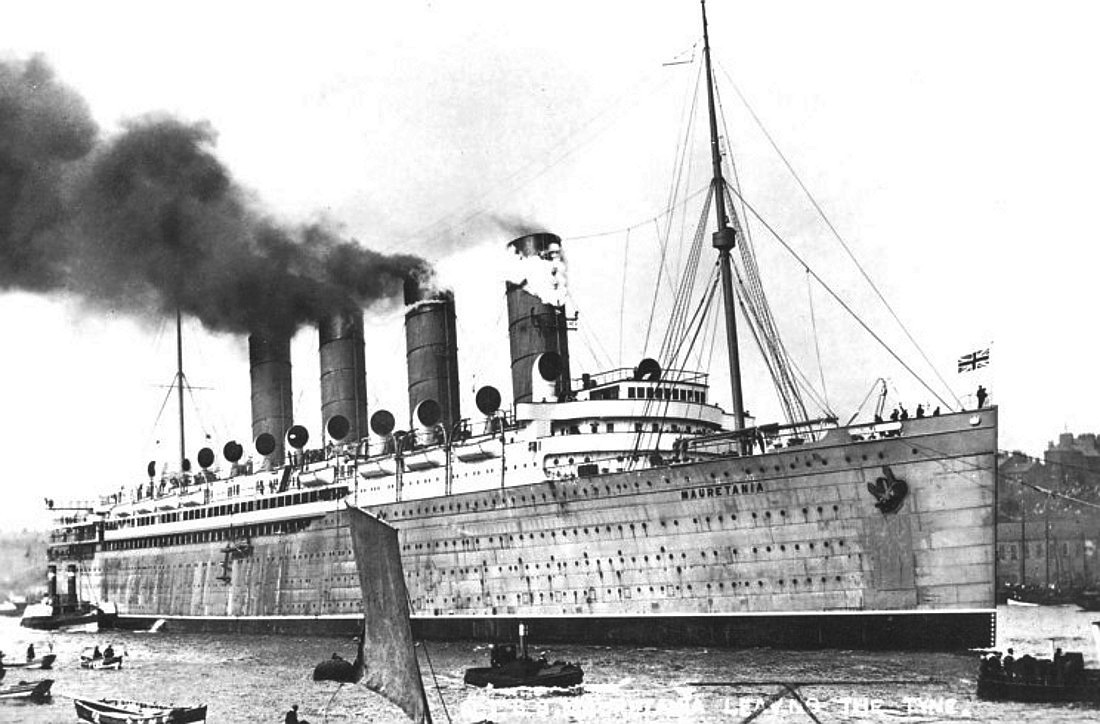
…launched in 1906, the RMS Mauretania was beloved for her Edwardian elegance and style, but as sleeker ships came into service in 1930, the Mauretania was removed from Atlantic crossings and relegated to running shorter cruises from New York to Nova Scotia and Bermuda…
OLD RELIABLE…The RMS Mauretania was the world’s largest and fastest ship after it left the Port of Liverpool in 1906. The liner was scrapped in 1935-37, much to the dismay of many of its former passengers, including President Franklin D. Roosevelt. (Wikipedia)
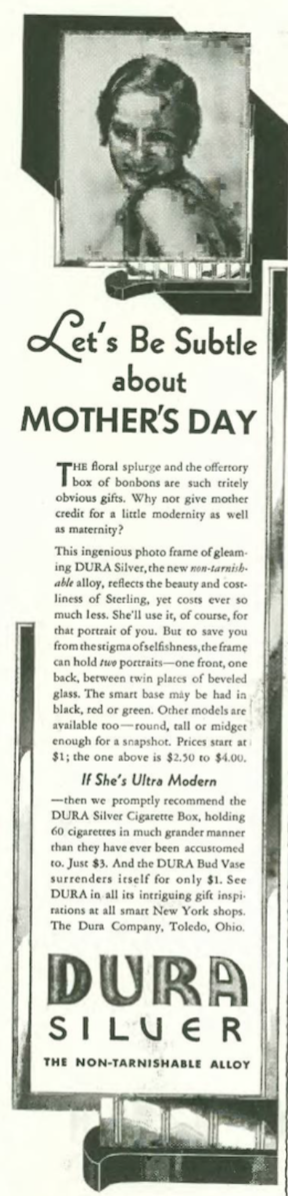
…with Mother’s Day around the corner, one company suggested a silver cigarette box as a suitable gift…
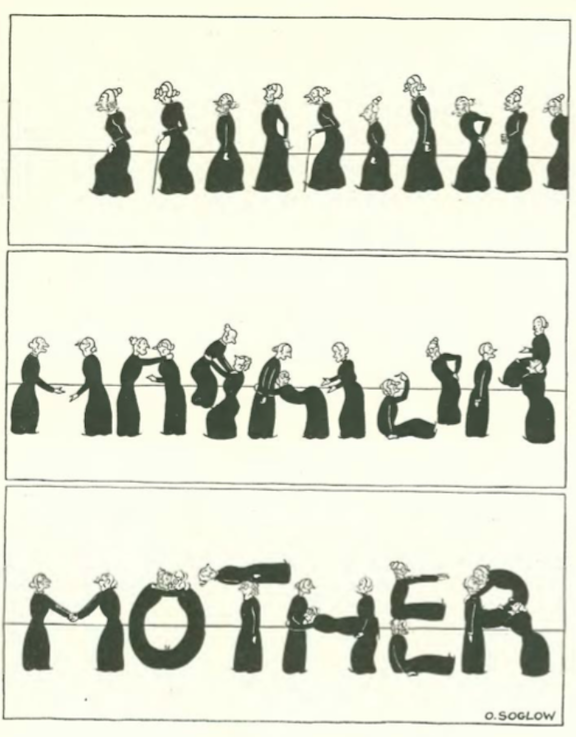
…on to our cartoons, Otto Soglow marked the upcoming holiday with this choreographed group…
…Denys Wortman gave us another side of motherhood…
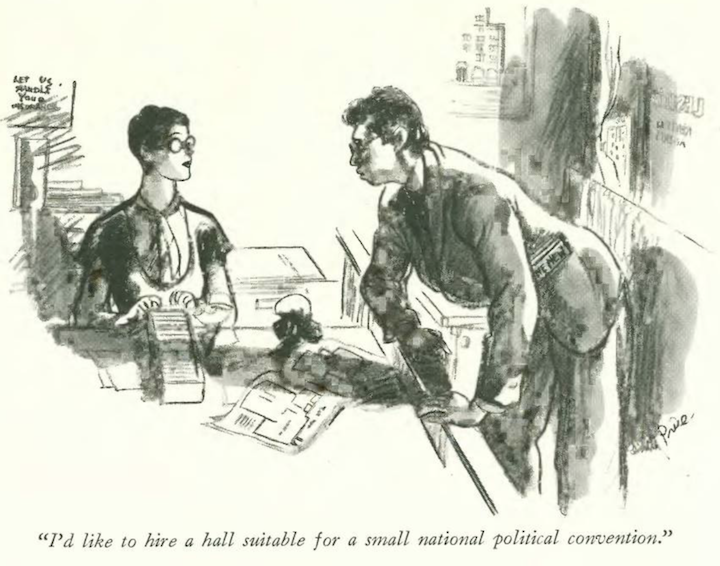
…other women were busy organizing political gatherings, per Garrett Price…
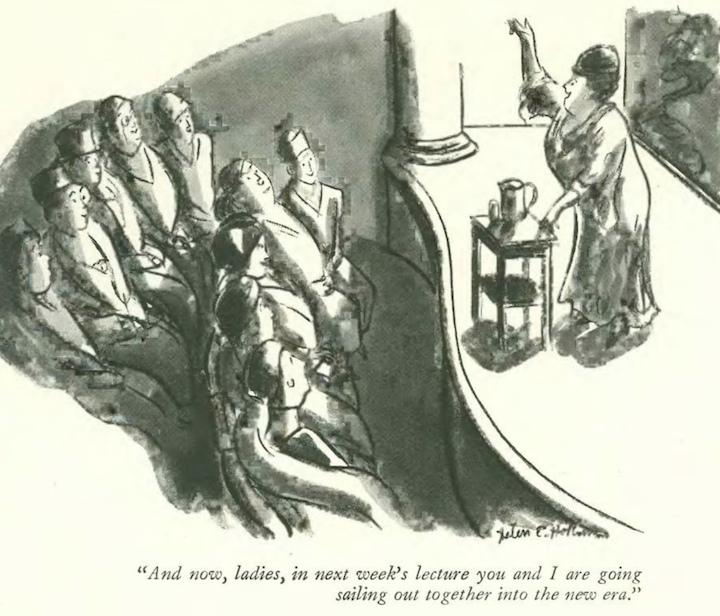
…and Helen Hokinson…
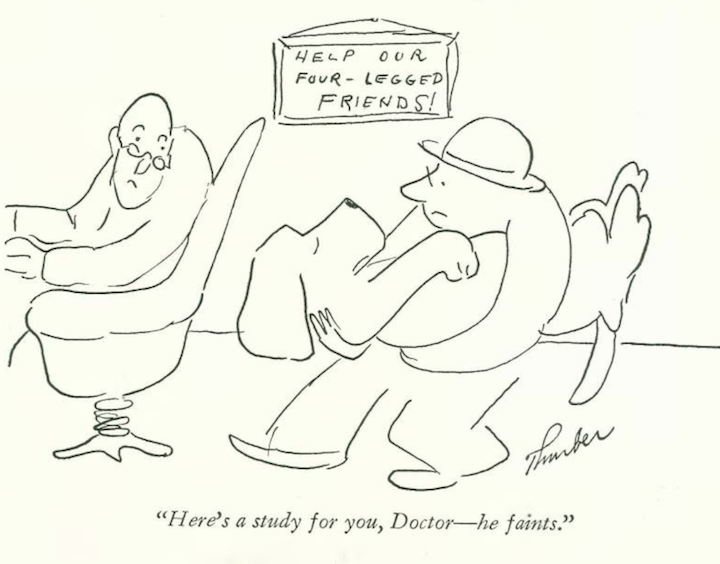
…James Thurber gave us a dog in distress…
…Robert Day illustrated the dilemma of two bootleggers…
Whether or not you could afford a new car in Depression-era New York, you could afford to take your mind off the hard times for a few hours and visit the annual National Automobile Show at Grand Central Palace.
Jan. 16, 1932 cover by S. Liam Dunne.
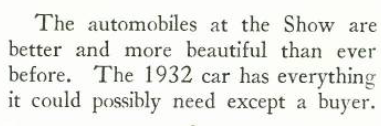
The 1932 exhibition featured many familiar brands, and others that would not survive the decade. Bolstered in part by the largess of General Motors and its downscale LaSalles, Cadillac could offer a pricey edition of the Fleetwood (at $5,542, roughly equivalent to $100K today), but most car makers featured models with reduced prices and/or smaller engines, as well as new technologies and design features they hoped would attract buyers of modest means. Excerpts from The New Yorker’s “Motors” column:
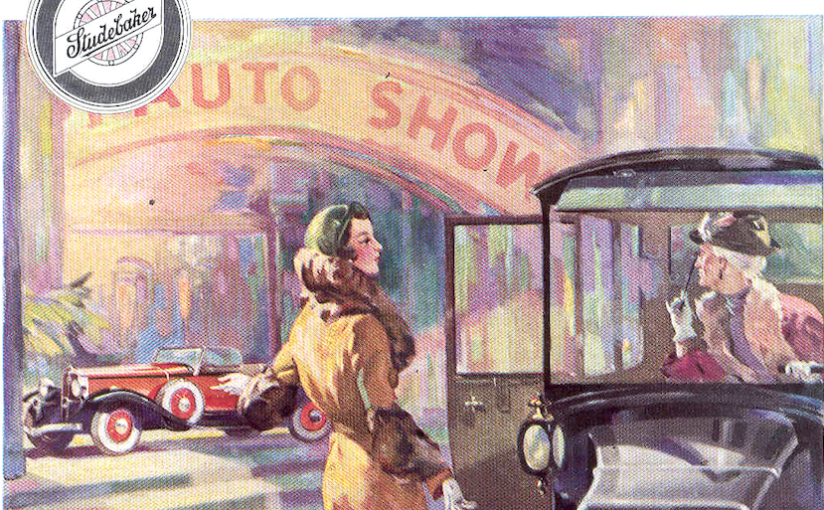
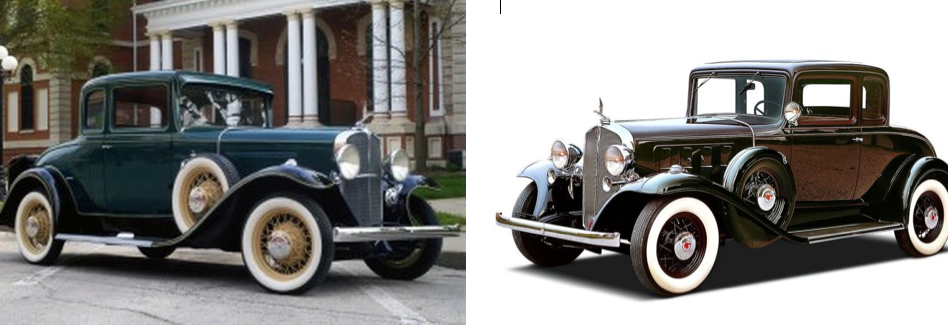
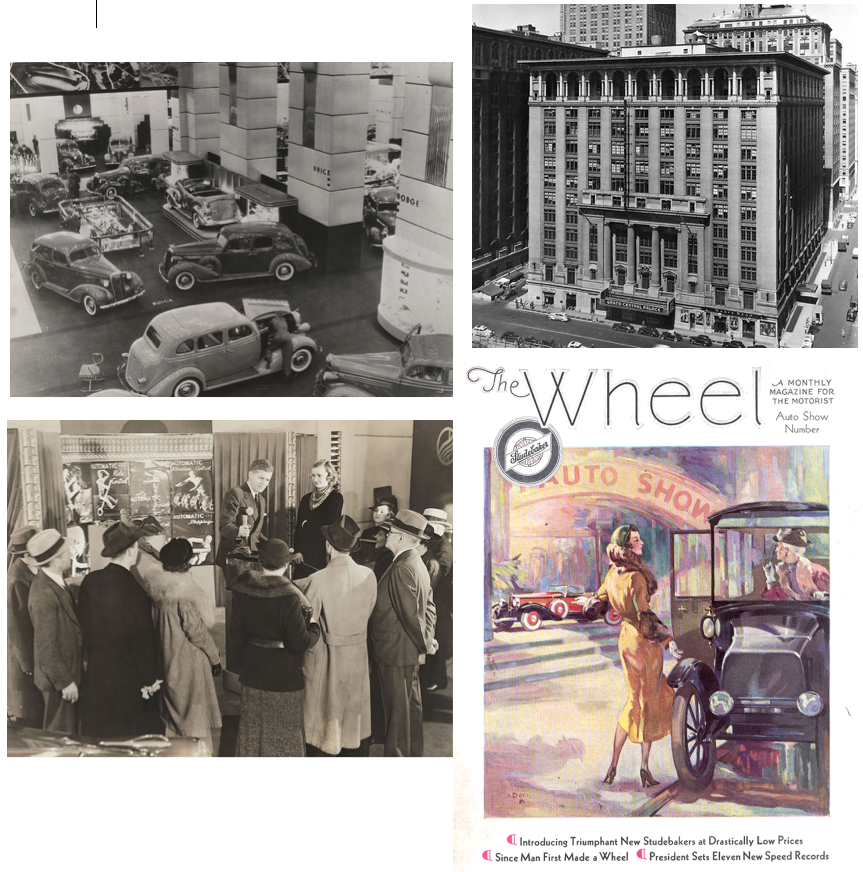
CAN’T TOUCH THIS…The Cadillac V16 Fleetwood sat atop the American car world in 1932. (classicdriver.com)LOOK, BUT DON’T BUY…The New Yorker noted the crowds gathered around the Studebaker –produced “Rockne” at the National Automobile Show. Named for the famed Notre Dame football coach Knute Rockne (who died in a 1931 plane crash), this 1932 model attracted plenty of gawkers at the show but few buyers. It was soon discontinued, and leftover Rocknes were disassembled and sent to Norway, where they were reassembled and sold to Scandinavian buyers. (conceptcarz.com)DOUBLE VISION…The 1932 Oakland Roadster (left) marked the end of the Oakland Motorcar Company, which had been previously acquired by General Motors. That same year Oakland was reborn as the Pontiac division, and the Oakland Roadster was reimagined as the 1932 Pontiac Model 302 (right). (Hemmings/justamericanautomobiles.com)PALACE OF DREAMS…Grand Central Palace (top right) sat at Lexington Ave. between 46th and 47th Streets. A favorite locale for manufacturers to display their latest wares, it was demolished in 1963; at left, images from the 1935 National Automobile Show; bottom right, 1932 copy of The Wheel, produced by Studebaker for distribution at auto shows. (freelibrary.org/chicagology.com)
Whether folks were able to shell out more than $5,000 for a Caddy or a mere $700 for Plymouth, many left the show with nothing more than dreams for better days. Howard Brubaker summed it up thusly in his “Of All Things” column:
* * *
Darling Lily
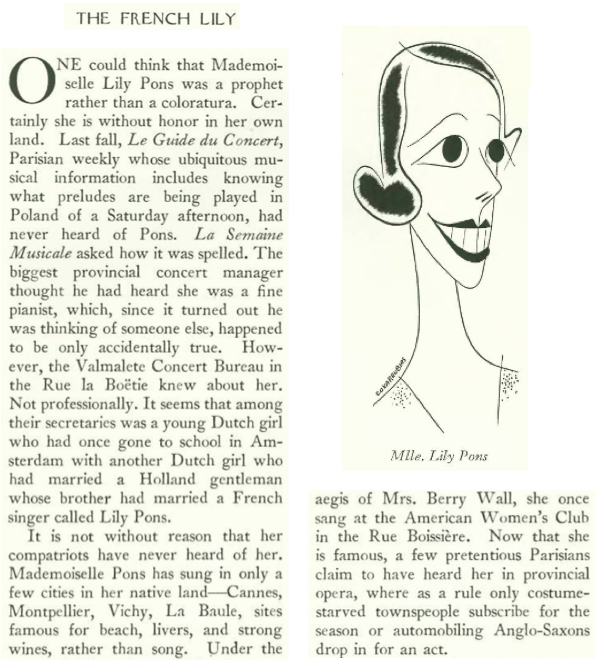
Coloratura soprano Lily Pons (1898–1976) was not well-known in her native France when she took the Metropolitan Opera stage by storm in 1931—she would become the Met’s principal soprano and, in 1940, an American citizen. The singer was profiled by Janet Flanner in the Jan. 16 issue (caricature by Miguel Covarrubias). Excerpts:
FRENCH TOAST OF THE TOWN…Coloratura soprano Lily Pons was particularly associated with the title roles of Lakmé (pictured above, mid-1930s), and Lucia di Lammermoor. Pons was a principal soprano at New York’s Metropolitan Opera for 30 years, appearing 300 times from 1931 until 1960. (Pinterest/YouTube)
If you have a few minutes, check out Lily Pon’s 1935 performance of “The Bell Song” from the film I Dream Too Much, which co-starred Henry Fonda. Although the sound quality is not the greatest, you can still get a pretty good idea why Met audiences adored her.
* * *
Fantasy Bridge
Satirist Ring Lardner found something rotten in the behavior of robber barons and politicians in the midst of the Depression, so he imagined a bridge game that brought together banker J.P. Morgan (Jr), John D. Rockefeller (then the richest person in America and perhaps the world), Sen. Reed Smoot of the Smoot-Hawley Tariff Act (a catalyst for the Depression), and social worker Jane Addams. Excerpts:
DEAL ME OUT…Ring Lardner addressed the wages of greed through a fantasy bridge game. (Dallas Morning News)
* * *
From Our Advertisers
If you were one of J.P. Morgan’s bankers, you might have considered hopping on a United flight instead of taking the train—within 20 years, airlines would make a serious dent into railroad’s corporate travel business…
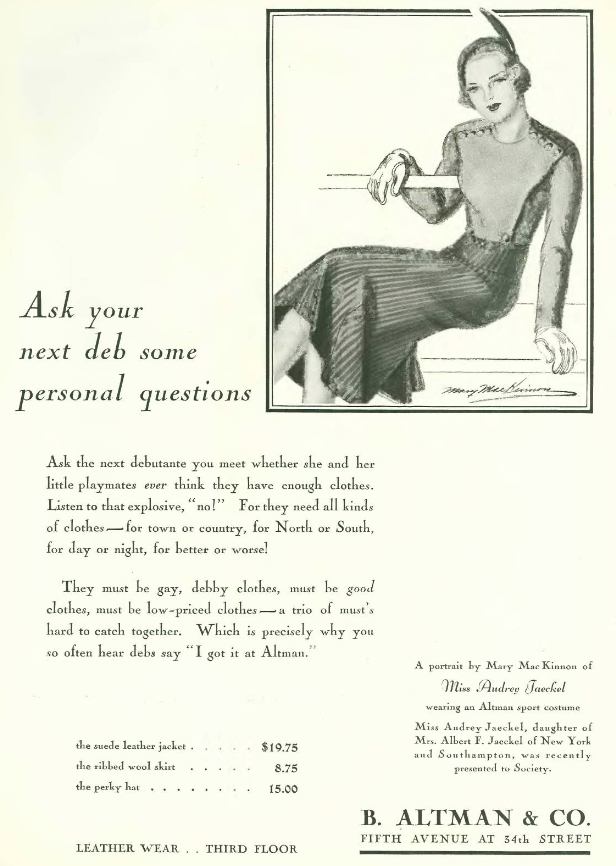
…and if you were a successful banker, your daughter or granddaughter might have been an aspiring deb with some very specific needs…
…the Little King also had some specific fashion needs, as Otto Soglow brings us to the cartoon section…
…with the Auto Show in town, Helen Hokinson got her girls into the conversation…
…the “wizard control” they refer to was Buick’s gimmick to attract more women drivers to their product…here’s an ad from the Feb. 6 issue of the New Yorker:
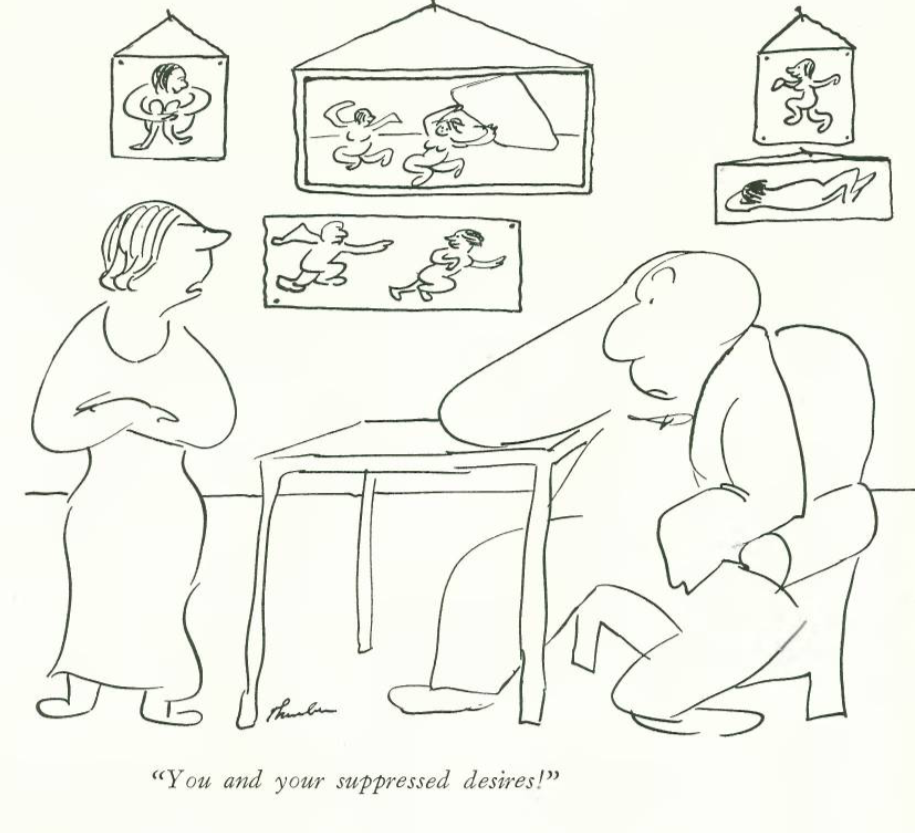
…back to our cartoons with James Thurber, and the “war” that continued to brew between men and women (note artwork on the wall)…
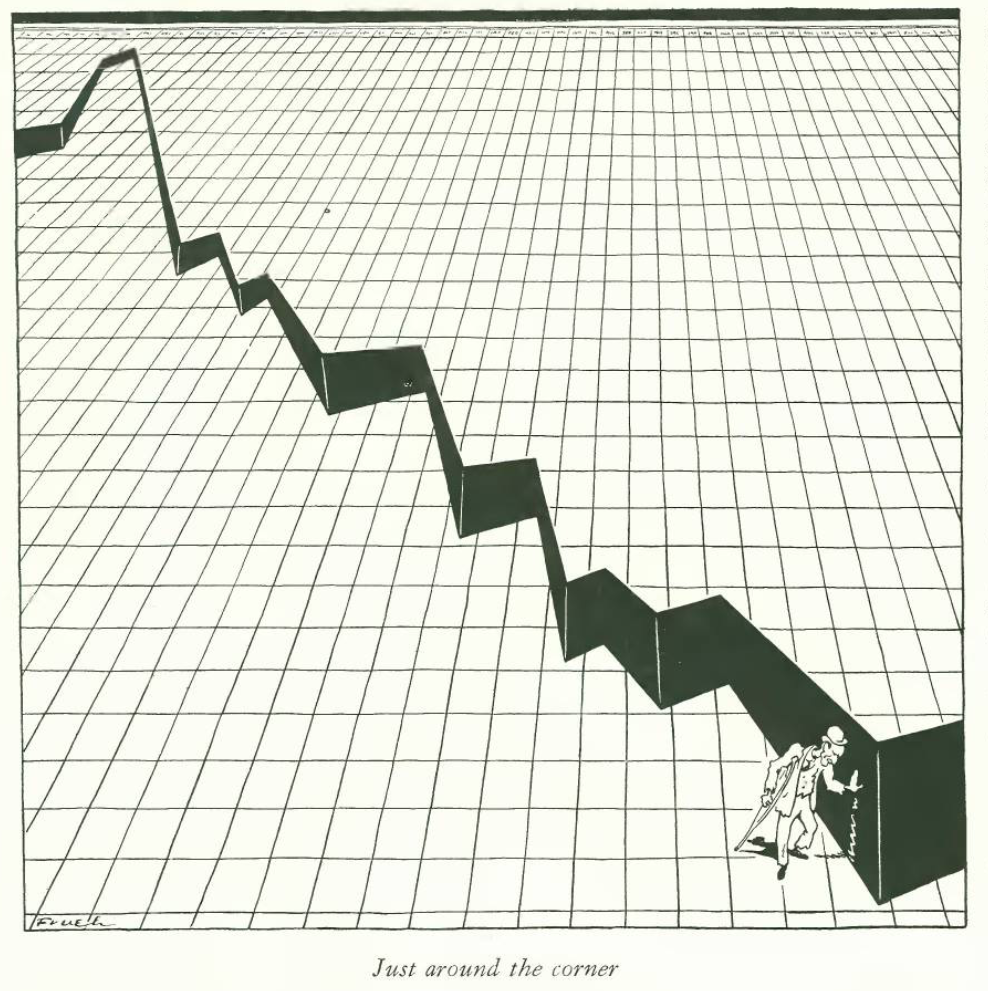
…Al Freuh offered his perspective on meagre predictions for prosperity…
…as did one of William Steig’s precocious children…
…and Helen again with another privileged view of the downtrodden…
…Barbara Shermund showed us one woman’s interpretation of “belonging”…
…and Denys Wortman gave us one salesman who probably dreamed of some solitary drinking…
…on to our Jan. 23, 1932 issue…
Jan. 23, 1932 cover by Rea Irvin.
…and this item in “The Talk of the Town,” which noted the challenges of publishing a book about Adolf Hitler…
…and a few pages later, we are treated to an E.B. White “song” written for delegates to the Conference for the Reduction and Limitation of Armaments which was being convened in Geneva, Switzerland…
Delegates from sixty countries attended the Geneva conference. They were there to consider the German demand that other nations disarm to the same levels that had been imposed on them by the Treaty of Versailles. The conference deadlocked by the summer, and when it was reconvened in February 1933 Hitler had just assumed power in Germany. By fall 1933 Germany withdrew from both the Disarmament Conference and the League of Nations, and the stage was set for another world war.
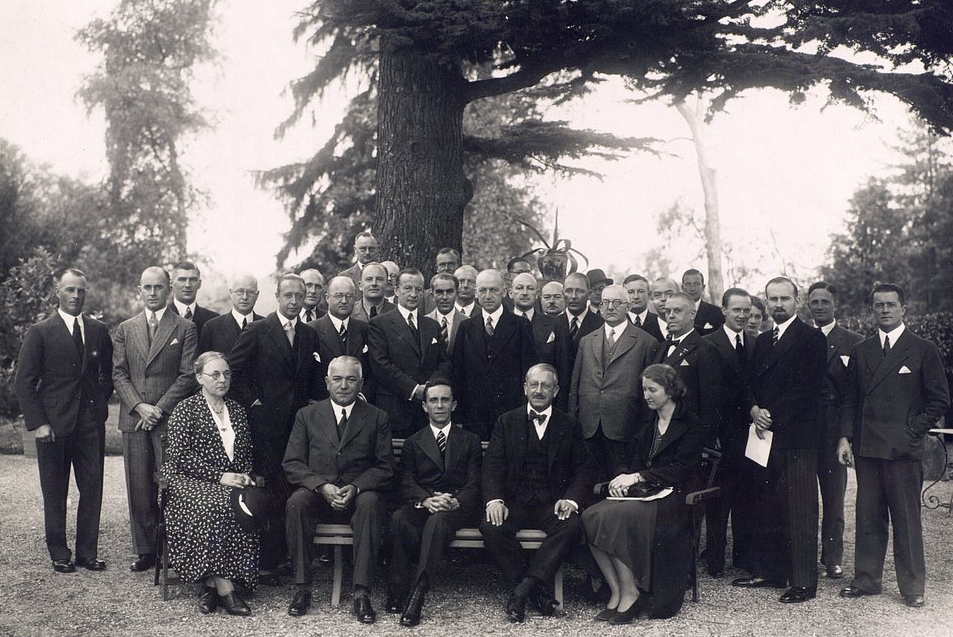
Here is a 1933 photo of the delegates to the Disarmament Conference before things went south:
(wdl.org)
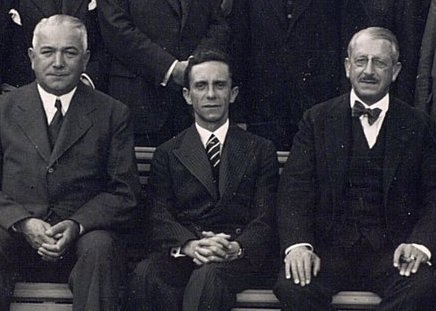
A detail of the photo (below) reveals the identity of the tiny man seated at center: the representative from Germany—Minister of Public Enlightenment and Propaganda Joseph Goebbels. Just twelve years hence Goebbels would find himself trapped with Hitler and Eva Braun in a Berlin bunker as Soviet troops demolished the city above them. Goebbels and his wife, Magda, would poison their six children, and then themselves as the Third Reich crumbled to ashes.
A final note: The delegates weren’t alone in Geneva, as a number of peace organizations sent observers and demonstrators to the conference, many of them women:
APPEALS TO DEAF EARS…Women’s disarmament campaigner in Geneva, c.1932; right, a poster created by Dutch artist Giele Roelofs for the Northern Friends Peace Board and others. (London School of Economics/armingallsides.org.uk)
We’ll give the last word to Howard Brubaker in Jan. 30 “Of All Things” column:
* * *
From Our Advertisers
With the National Automobile Show wrapping up, the Grand Central Palace prepared to welcome exhibitors for the annual Motor Boat Show…
…the woman in this next ad might have been better off in a boat than on the beach…I’m wondering if the artist had any idea that his or her illustration would be used to promote coffee…it’s hard to tell what is going on here…apparently a young woman has almost drowned and is receiving oxygen, or maybe she doesn’t really need it, and the perverted lifeguard and cop just want to ogle the poor beachgoer, who seems bored by the whole predicament…
…there is also something vaguely sexual going on in this ad for Vicks (what is he looking out for in panel four?)…the artist (the cartoon is signed “Len”) seems to be channeling one of Rea Irvin’s series cartoons…
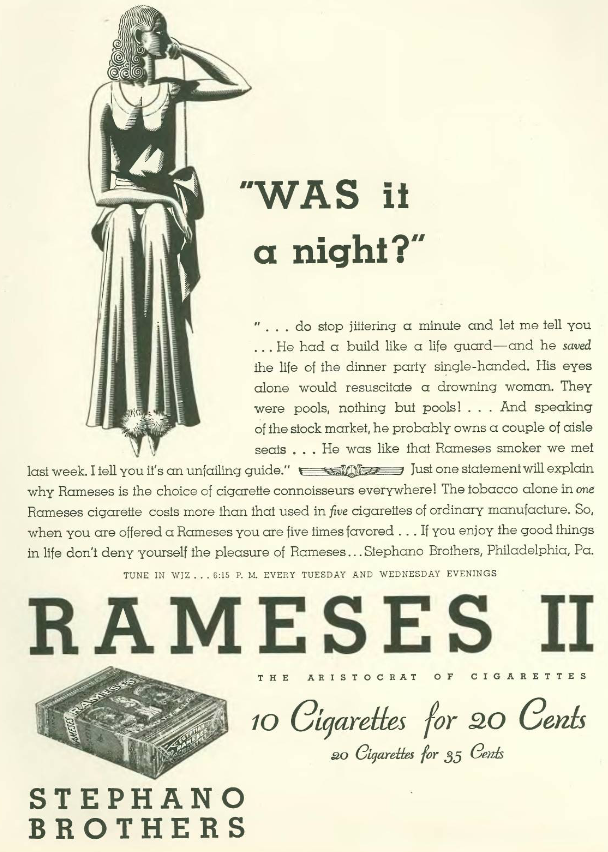
…in the early 20th century it was fashionable to smoke imported luxury Egyptian cigarettes, or counterfeits like Ramses II, produced in the U.S. by the Stephano Brothers…
…the makers of Camel were among the most successful counterfeiters of Egyptian cigarettes — the camel, pyramids and palm tree motifs were no mistake, but by 1932 this established brand (launched in 1913) went less for snob appeal and more for the active, fresh-faced youths whose pink lungs were highly coveted by R.J. Reynolds…
…on to our cartoons, we begin with James Thurber and some more sexual tension…
…Garrett Price found a young hostess eager to to please…
…Perry Barlow introduced us to a young man who (almost) never forgets a face…
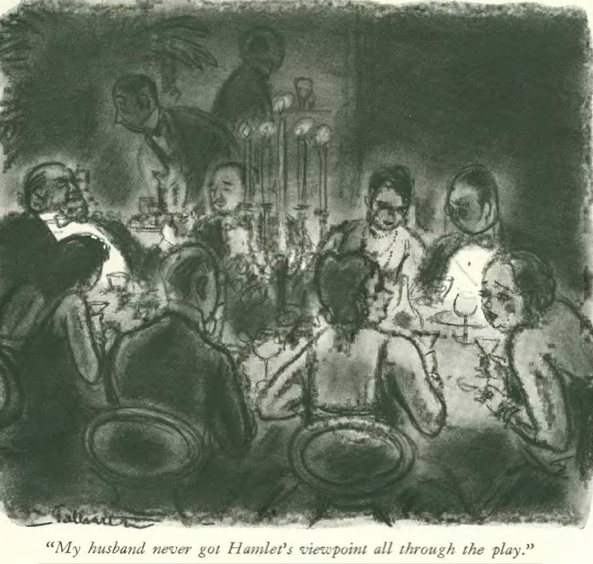
…William Crawford Galbraith dined with the uppers, not necessarily known for their literary sophistication…
…Barbara Shermund gave us a proud collector who managed to evade the Puritans in U.S. Customs…
…William Steig showed us pride of a different sort…
…and another by Steig displayed the antics of one of his “Small Fry”…
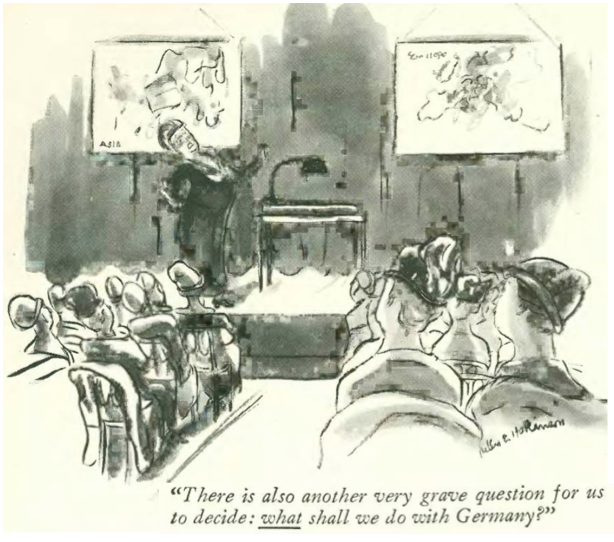
…and we end with Helen Hokinson, who found a local women’s club joining the debate raging far away at the Disarmament Conference in Geneva…
The name of this post comes from one of my favorite television series, Babylon Berlin, a lavishly produced German neo-noir drama that takes place during the final years of the Weimar Republic, or precisely where we are in the timeline of this blog.
Jan. 9, 1932 cover by Theodore Haupt.
The tumultuous Weimar years of the 1920s and early 30s represented Germany’s initial flirtation with democracy, an experimental age at once filled with post-war angst and libertine ways, and this was especially true in Berlin where nearly every vice could be plied along its streets and alleyways and in countless clubs and cabarets. It was the setting for a decade of political turmoil, with communists (rival Bolsheviks and Trotskyites) to the left and national socialists (later Nazis) to the right, and in the middle a fledging democracy that ultimately could not hold the center. Janet Flanner,The New Yorker’s Paris correspondent, paid Berlin a visit just one year before Adolf Hitler would seize dictatorial power.
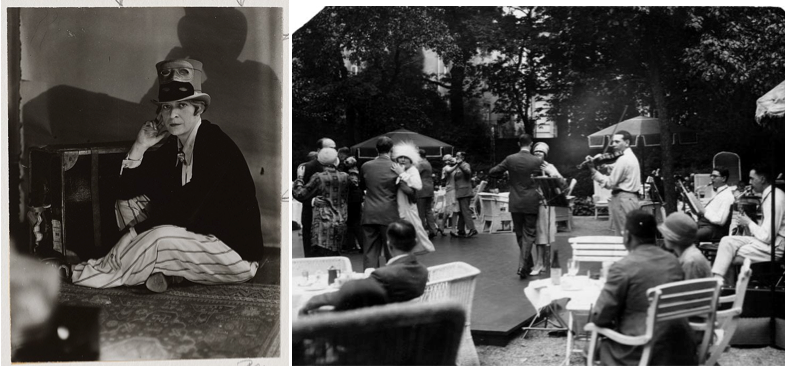
WORLDLY VIEW…Janet Flanner’s account of life in Berlin at the end of 1931 told of economic hardship and hinted at trouble to come, but it mostly depicted life as pictured at right at a Berlin tea dance. This was not a naive perspective, but rather one of a worldly mind not easily shocked by vice and upheaval. As The New Yorker’s longtime Paris correspondent, Flanner’s weekly letters during World War II would also make her a respected war correspondent. At left is an oft-reproduced portrait of Flanner, taken by Berenice Abbott in 1927. At right, a tea dance in the garden of the Hotel Esplanade in Berlin, 1928. (Clark Art Institute/ Süddeutsche Zeitung)
In this excerpt, Flanner saw life continuing at an oddly normal pace despite the hardships and the political tension that boiled behind the façade:
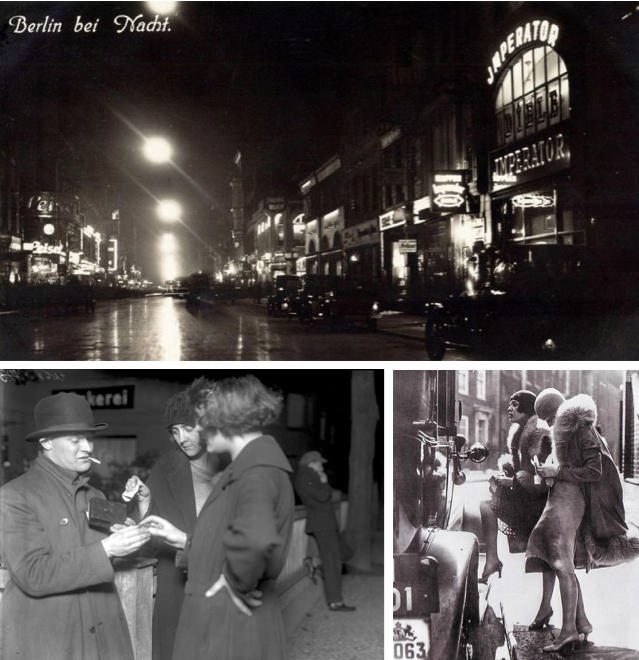
TRUNCATED VISION…Berlin looked to a Modernist future until Adolf Hitler put an end to the “un-German” Bauhaus style in 1933. Despite the economic collapse and political turmoil of 1931 Berlin, the city showcased remarkable technical progress, including a prototype high-speed train (left) that travelled at 230 km per hour (143 mph) from Hamburg to Berlin. At right, Berlin exhibition of Bauhaus-inspired buildings at the 1931 Deutsche Bauausstellung. The cavernous Hall 11, themed as “The Dwelling of Our Time,” was directed by Mies van der Rohe. It mostly displayed the output of his Bauhaus “Werkbund,” including a Mies-designed modern house. (Pinterest/Reichstarifvertrag)THE OTHER BERLIN…at top, the Friedrichstrasse, Berlin’s “street of sin,” in the late 1920s; below right, prostitutes ply their trade in 1920s Berlin; and below left, buy cocaine capsules from a Berlin drug dealer, 1930. (ddr-postkarten-museum.de/Reddit/Wikipedia)ANYTHING GOES…Clockwise, from top left, cabaret performance in Berlin that left little to the imagination; the Jockey bar mentioned by Flanner—it was frequented by A-listers such as Jean Cocteau, Andre Gide, Ernest Hemingway and Marlene Dietrich; the Eldorado gay night club in Berlin, 1932; performance of “A Slide on the Razor” at Berlin’s Haller Revue, 1923; the Europahaus, one of hundreds of cabarets in Weimar Berlin, 1931. (cabaret.berlin/Bundesarchiv/tribe.net/Wikipedia)
Toward the end of her article, Flanner noted that “Berliners are busy making a new race,” which is not a reference to Hitler’s “master race” (that would come later) but rather to a new generation overtaking the old. The final lines of this excerpt, however, suggest there might be trouble ahead…
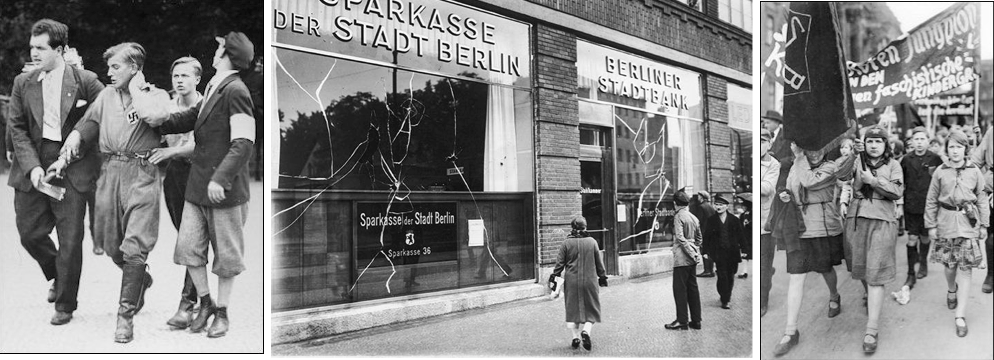
NOT ALL FUN AND GAMES: Weimer Berlin was also a place of political and economic struggle that at times turned violent. From left, a Nazi youth is wounded during Berlin street violence amid Reichstag elections in 1932; a Berlin bank damaged during violent clashes between police and demonstrators in June 1931; Communist youths in Berlin demonstrate on May Day 1931. (Pinterest/Financial Times)
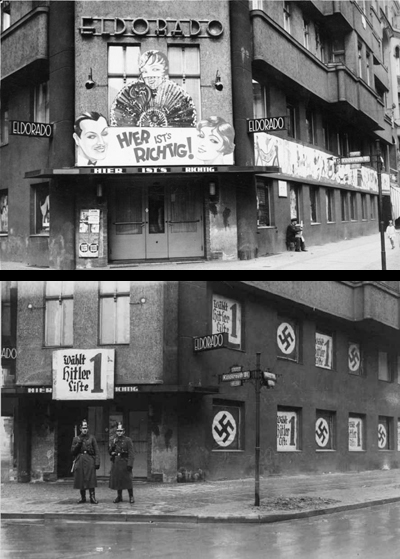
The party abruptly ended with Hitler’s takeover of the government in January 1933. The images below said it all:
NEW THEME, NEW OWNERSHIP…The Eldorado gay night club in Berlin before and after Nazi takeover of the German government. (lonesomereader.com)
* * *
Masses’ Mass Media
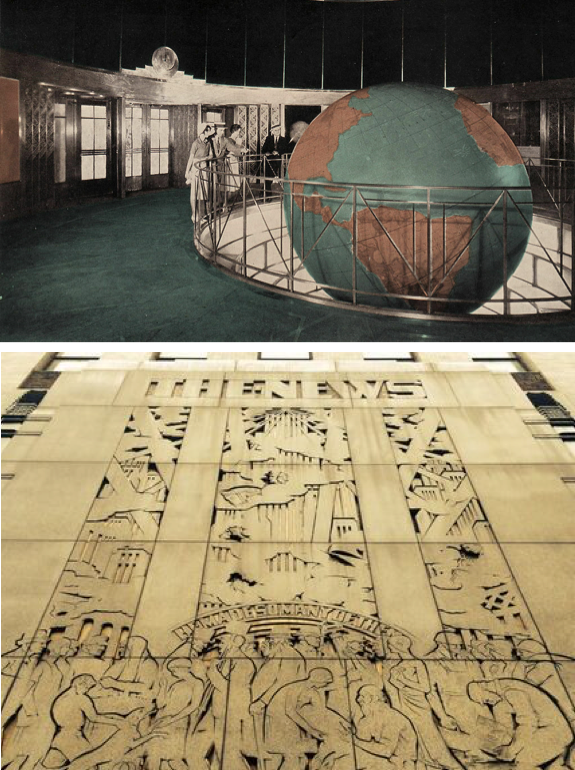
“The Talk of the Town” pondered the symbolism of the Daily News Building—from the inscription above its entrance to the place names on its massive lobby globe—which seemed to celebrate its readership, namely the common people.
CAN YOU FIND HOOTERVILLE?…the massive globe in the Daily News lobby (circa 1941), featured the names of small towns and cities along with major population centers; below, inscription “HE MADE SO MANY OF THEM” above the building’s entrance (atlasobscura.com)
* * *
Dem Bones
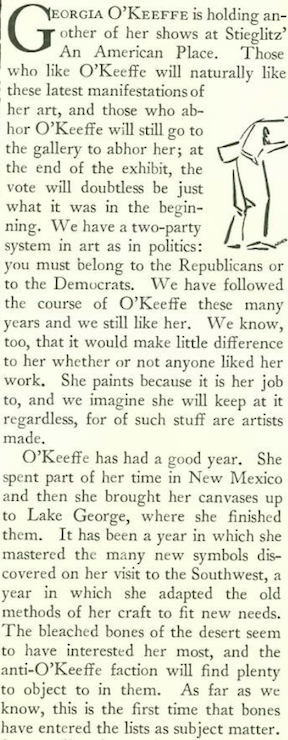
Art critic Murdock Pemberton paid a visit to the Stieglitz Gallery to check out the latest works by Georgia O’Keeffe. He found that her themes were moving from the urban landscape of New York to the bleached simplicity of the Southwestern desert:
CHANGING HER TUNE…Georgia O’Keeffe’sCow’s Skull: Red, White, and Blue (1931); O’Keeffe with one of her skull paintings, 1931. (metmuseum.org/CSU Archives)
* * *
Hyde-bound
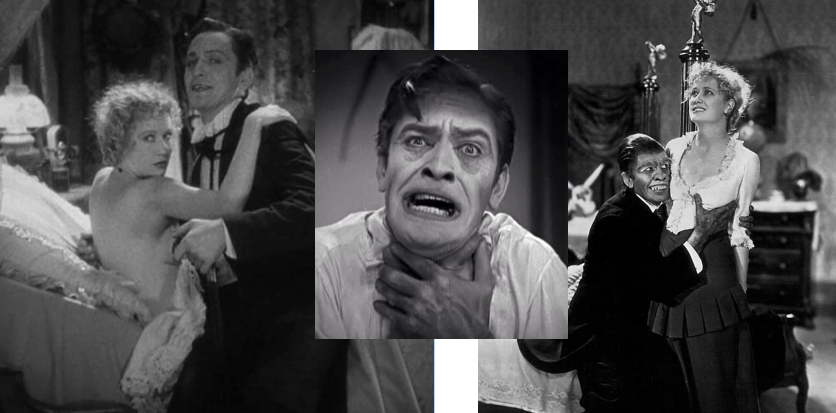
Film critic John Mosher found much to like about Frederic March’s performance in Dr. Jekyll and Mr. Hyde, and so did critics and Academy voters who bestowed a Best Actor award on the actor.
IDENTITY CRISIS…Bar singer Ivy Pierson (Miriam Hopkins) in a state of undress as she tries (unsuccessfully) to seduce Dr. Jekyll (Frederic March); when Jekyll turns into Mr. Hyde, however, the tables are turned, much to Ivy’s distress. (IMDB)
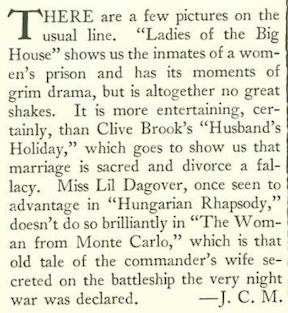
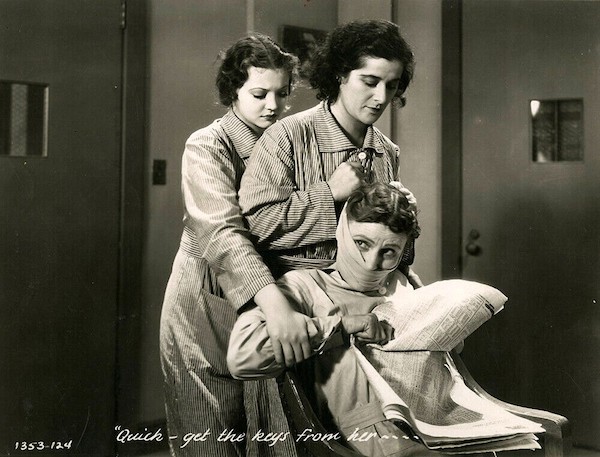
Mosher found, however, that other pictures playing at the time left much to be desired…
BAD GIRLS…From left, Sylvia Sidney, Miriam Goldina and Esther Howard in 1931’s Ladies of the Big House. (IMDB)
* * *
Modern Methods
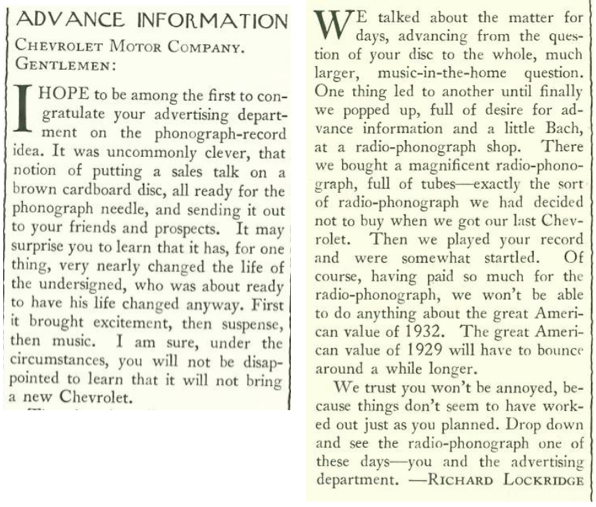
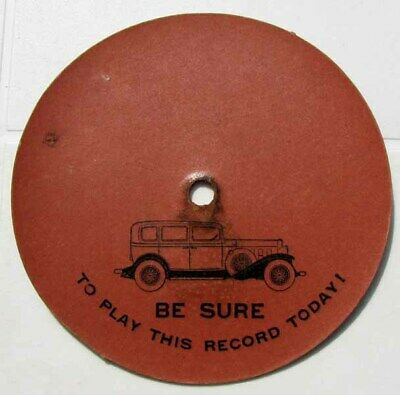
Early in his writing career Richard Lockridge penned a series of comic sketches for The New Yorker, many of them featuring the characters Mr. and Mrs. North, who would inspire a 26-book series of detective novels. The Norths had yet to make an appearance, but here Lockridge had some fun with the makers of Chevrolets, who used a new-fangled method to promote their product. Excerpts:
FREEBIE…Richard Lockridge thanked the folks from Chevrolet for the free phonograph record, but passed on the automobile. (Ebay)
* * *
From Our Advertisers
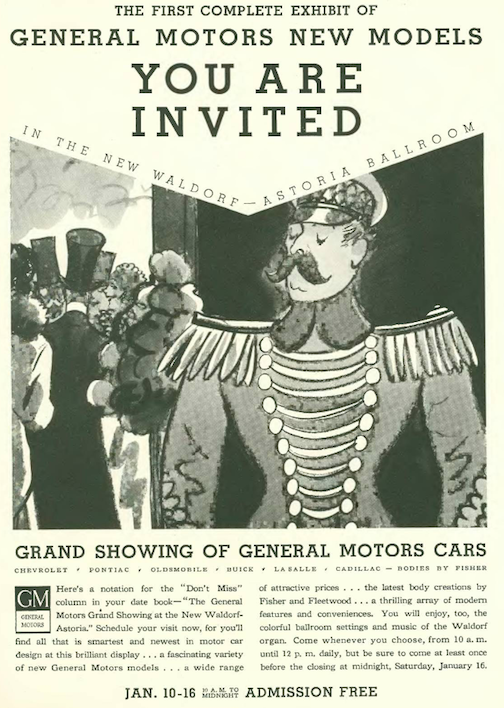
The Annual National Automobile Show at Grand Central Palace kicked off the new year with a stunning lineup of new cars, but General Motors separated itself from the pack by exhibiting its wares at the new Waldorf-Astoria Hotel…I believe this unsigned illustration is by Peter Arno (note “Walrus” in background)…
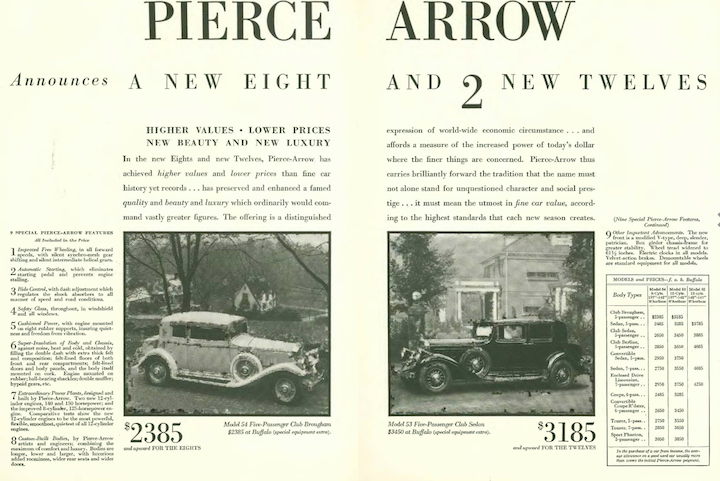
…The New Yorker’s advertising department reaped the benefits of the annual show, the Jan. 9 issue replete with ads from various companies…the makers of the Buffalo-based Pierce Arrow — a top-of-the-line luxury car — added a downscale version with a “New Eight” and deeply discounted their prices (which were still well above economy models offered by others)…
…the Depression would put an end to Pierce Arrow by 1938, but rival Lincoln would manage to hang on thanks to their own new “8” and the largess of parent Ford Motor Company…the Lincolns shown here are actually priced higher than the Pierce Arrows, $4300 for the 12 (vs $3185 for the PA 12) and $2900 for the 8 (vs. $2385 for the PA 8)…
…a bit more down the ladder we have venerable Oldsmobile, alas no longer with us (removed from GM’s lineup in 2014)…
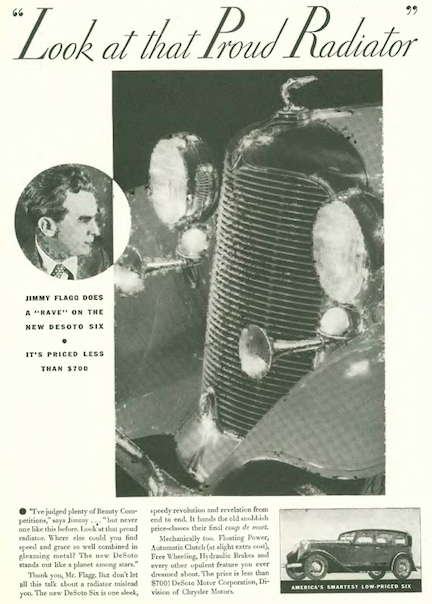
…and a few more rungs down we have the DeSoto (a Chrysler product) and its “sleek” new radiator that was the talk of the auto show, and admired here by “Jimmy Flagg” (aka illustrator James Montgomery Flagg, perhaps best known for his 1917 Uncle Sam poster with the caption “I Want YOU for U.S. Army”)…the DeSoto was a real bargain, priced at under $700…
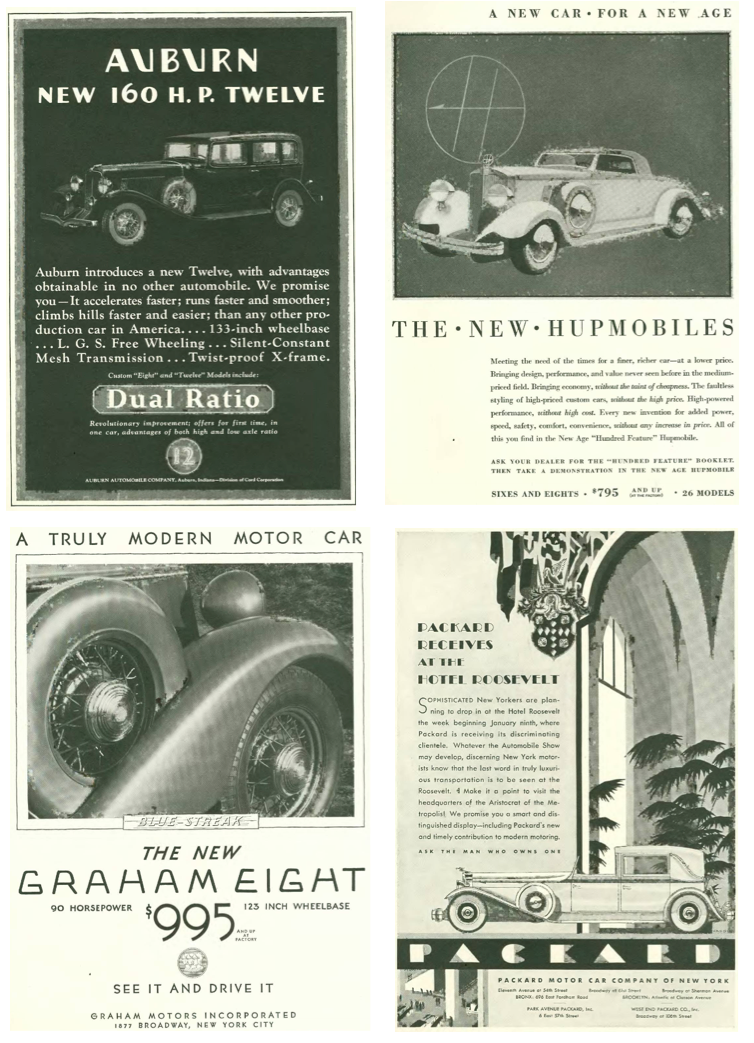
…and here are a few ads from companies long gone…like Pierce Arrow, Auburn (top left) struggled to sell its upscale cars during the Depression…however, the makers of another upscale brand, Packard (bottom right), were able to survive by favoring tried and true designs over gimmicky yearly changes…Hupmobile (top right) was known for its innovations, but a decision to build more expensive cars in the late 1920s put it into a bad position for the Depression-era market, and the company folded by 1939…when Hupmobile was on its last leg, it partnered with the ailing Graham-Paige Motor Company (bottom left), another company known for great designs, but combining two failing companies in this case yielded one larger failing company, and Hup and Graham went down together…
…the clever folks at Buick were way ahead of the others in marketing savvy, emphasizing an attractive, confident woman at the wheel of an unseen car, tapping into a previously untapped market (tobacco companies were busy doing the same)…
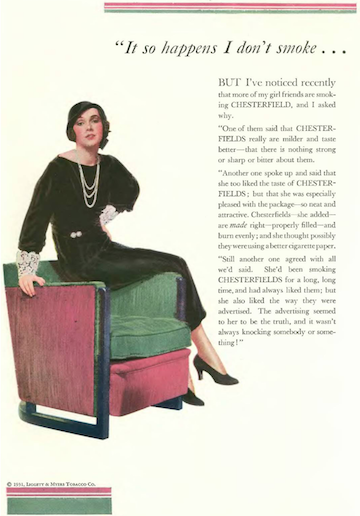
…as we see here from the folks who pushed the Chesterfield brand—in this ad aimed at the growing market of women smokers, you don’t see the carton, but what you do see are people waxing philosophical about smoking, quality smoking, that is, and it’s no mistake that the woman is sitting on the arm of the chair, receiving this “wisdom” from her husband…
…even when a man isn’t present, Chesterfield still perched the woman on the arm of the chair, as seen in this ponderous New Yorker ad from the previous year…
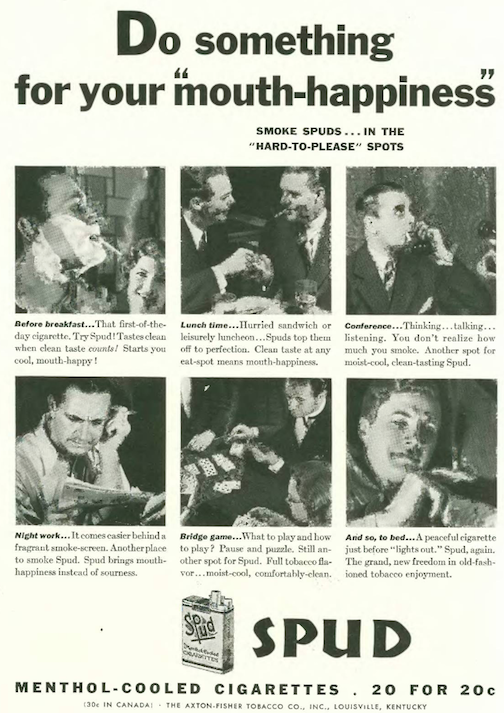
…and then you have Spud—the direct approach—yes dammit, do something, man!…your “mouth happiness” is at stake, so follow a schedule that keeps you puffing every waking minute…
…and we move on to the fashion world, where this new-fangled “Talon Slide Fastener” is keeping women’s corsets zipped up, except the vulgar, slang word “zipper” hasn’t quite made it into the fashion lexicon as of 1932…
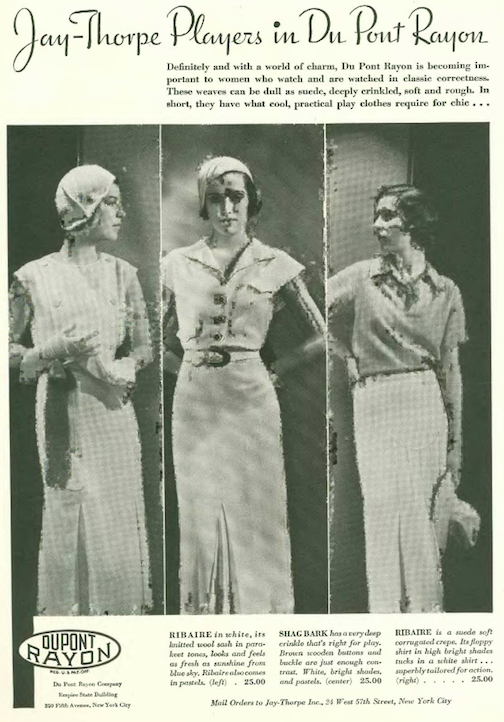
…and this other new invention—”Rayon”—is “becoming important to women who watch and are watched in classic correctness,” but believe me, no old money deb would ever allow anything artificial to touch her delicate hide…
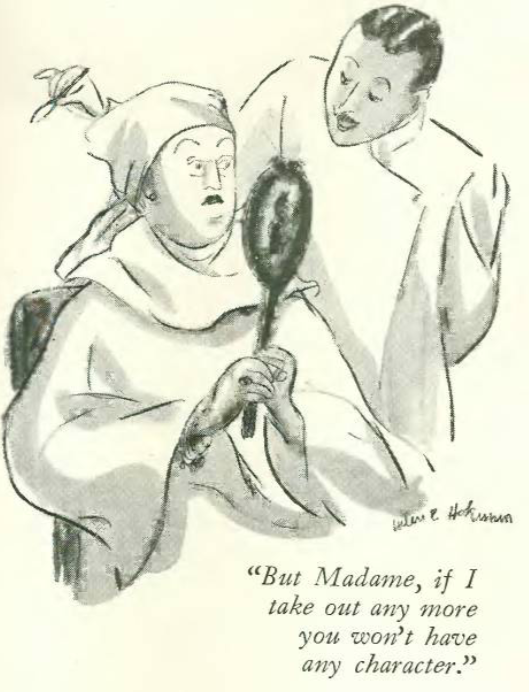
…we continue into the cartoons in the fashion mode with one of Helen Hokinson’s “girls” getting a makeover…
…Mary Petty, on the other hand, is keeping an eye on the younger crowd…
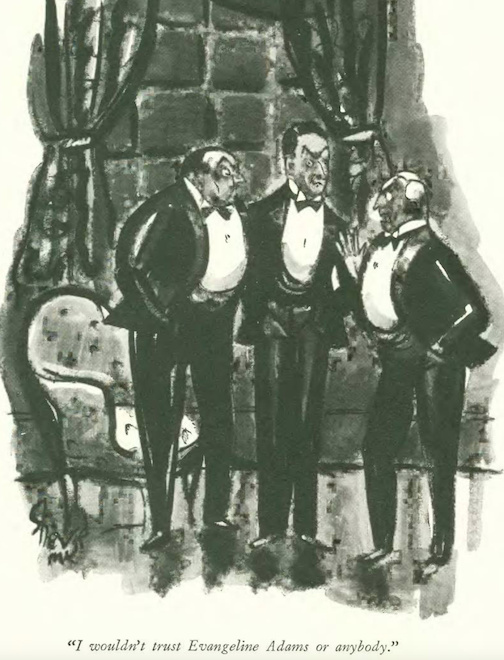
…we move on to Barbara Shermund and the old money gang, wary of astrologer Evangeline Adams‘ thoughts on the ailing stock market…
…one of their fellows was having troubles of his own in those troubled times, per William Steig…
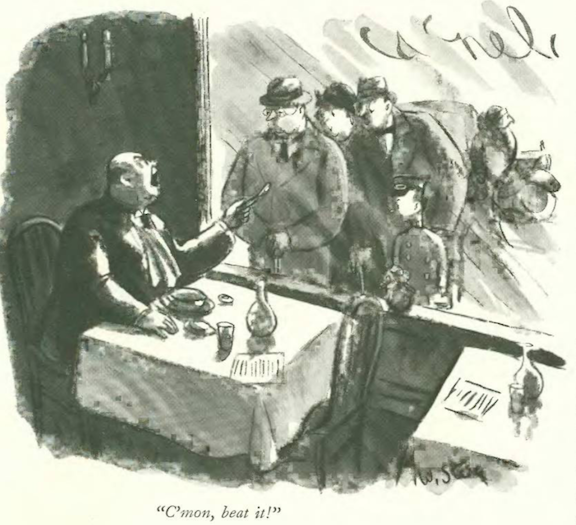
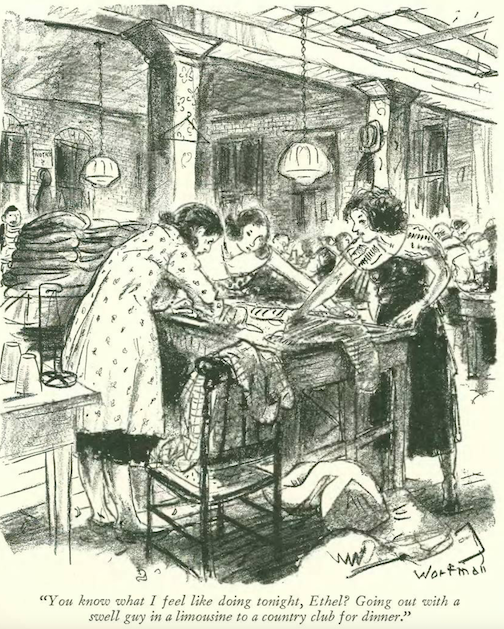
…and Denys Wortman took us to the other side of that window, and the dreams of a better life…
…urban realist Reginald Marsh gave us all a splash of cold water…
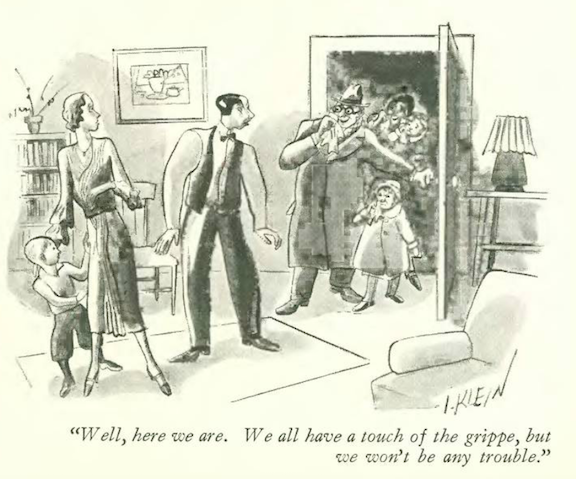
…Isadore Klein, on the other hand, presented a domestic scene with particular relevance these days…
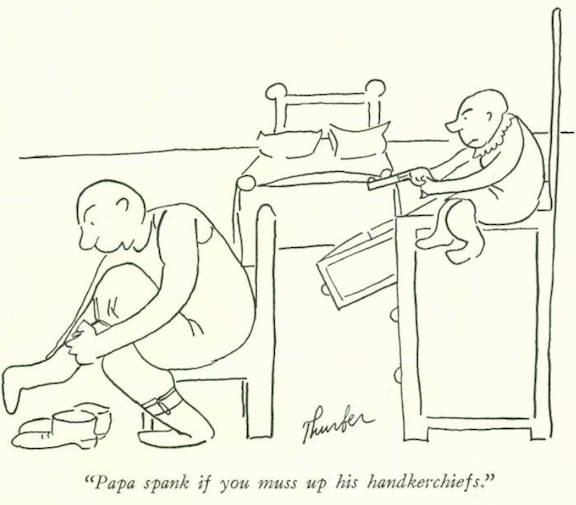
…and another domestic scene from the brilliant James Thurber, in which the pistol once again makes a timely appearance…
We first encountered critic Lewis Mumford in the June 30, 1931 issue of The New Yorker when he roundly excoriated plans for Rockefeller Center. The Nov. 14 issue once again found him in a surly mood, this time regarding the decorative arts and how they had been poorly displayed at the otherwise esteemed Metropolitan Museum.
Nov. 14, 1931 cover by B.H. Jackson.
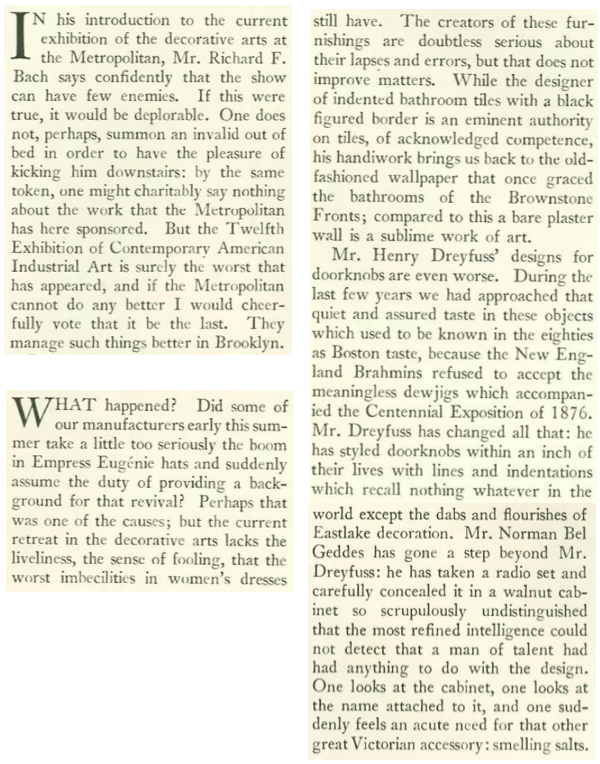
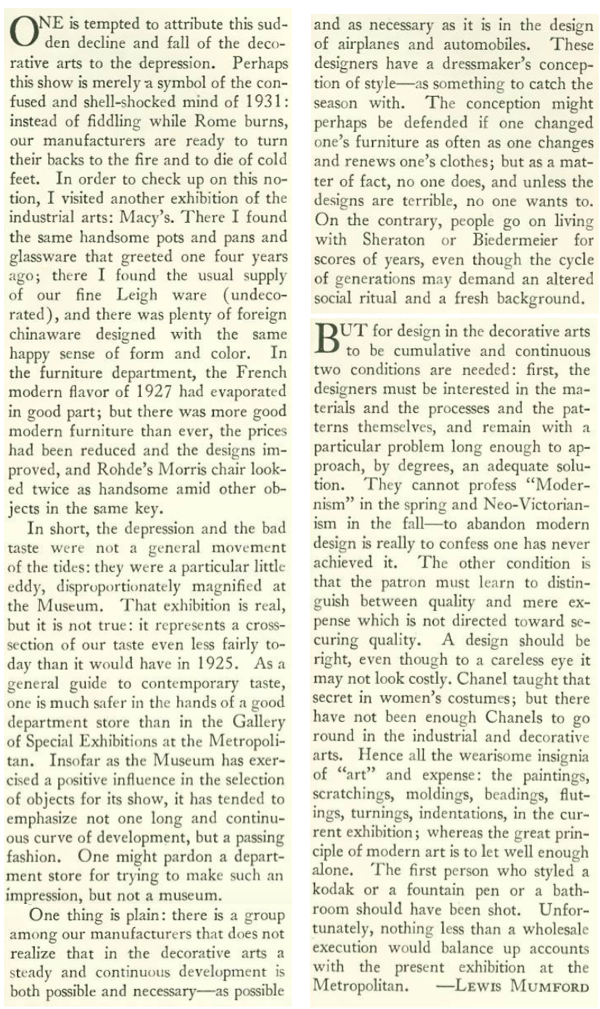
To say that Mumford was displeased with the Met’s decorative arts exhibition would be an understatement:
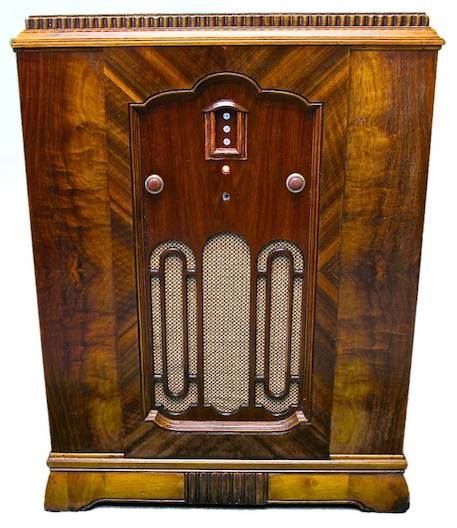
BED, BATH AND BEYOND…Let’s just say Lewis Mumford probably needed a stiff drink after strolling through the Met’s latest displays of the decorative arts. (Library of Congress)PAST IMPERFECT…Norman Bel Geddes was known for his theatrical, futuristic visions of streamlined everything, but the radio he exhibited at the Met was more Queen Victoria’s speed in Mumford’s view. (Pinterest)
Mumford pondered this sudden decline: was it the Depression, or just a streak of bad taste? And what could be done with the purveyors of bad taste, short of shooting them? Let’s read on…
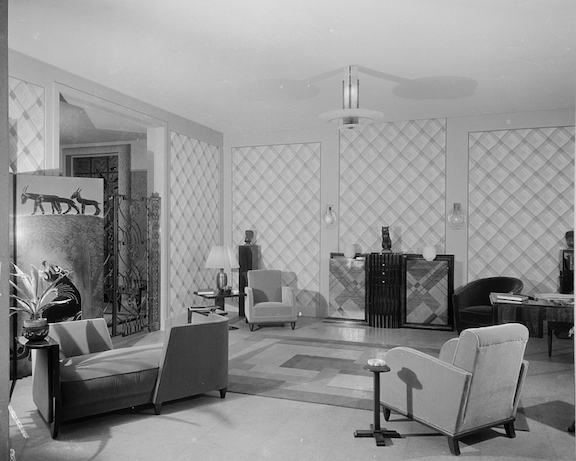
MIRACLE ON 34TH STREET…Mumford suggested that Macy’s International Exposition of Art in Industry in the late 1920’s had more vision than the Met’s 1931 offering. Above, living room furniture designed by Houbert et Petit exhibited in a showroom during the 1928 “International Exposition of Art in Industry” at Macy’s department store. (Library of Congress)LESS THAN A PRETTY FACE?…The streamlined form of Norman Bel Geddes’ “House of Tomorrow” probably wowed a few readers of Ladies Home Journal in April 1931, but critic Lewis Mumford was likely not among them, as he often criticized Bel Geddes for his theatricality at the expense of good taste and functionality (see first excerpt above). Mumford was especially critical of Bel Geddes’ glorification of the automobile and the highway at the expense of livable cities. (Pinterest)
* * *
Peter, We Have Your Back
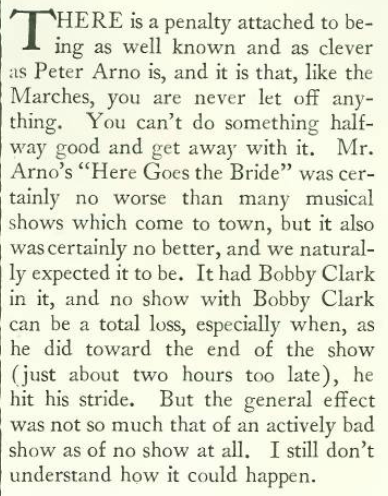
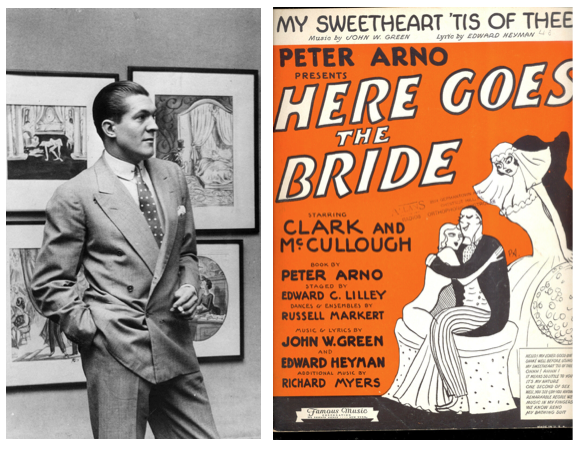
When your colleague has a play made from his book, and it closes after just seven performances, what can you say, especially if you are theater critic for The New Yorker? Well, here is what Robert Benchley did:
THAT’S SHOW BIZ…Here Goes The Bride, based on a Peter Arno book, closed after just seven performances. However, as a cartoonist, Arno was at the top of his game. (Britannica/Ebay)
* * *
From Our Advertisers
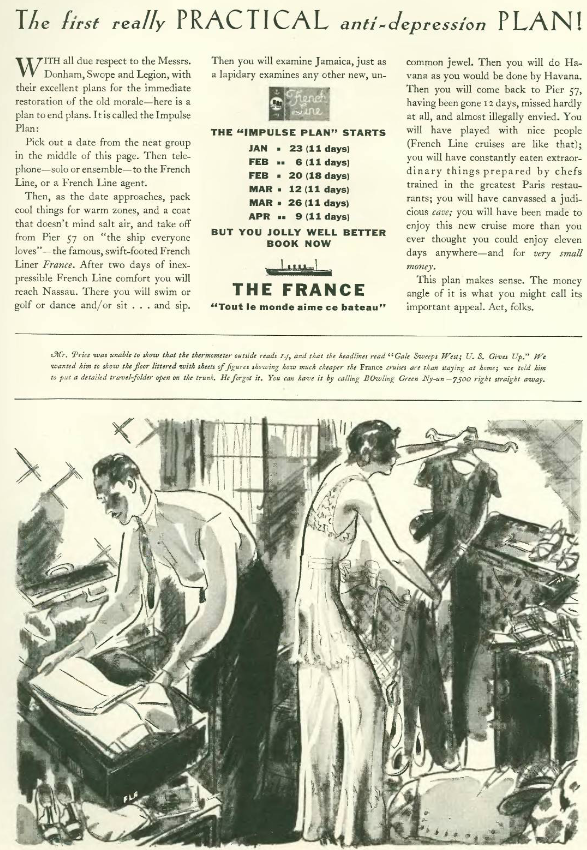
Depression? Who needs it? If you had the means, and didn’t lose your shirt in the 1929 crash, you could get away from it all and book passage to the Bahamas, where you could drink legally, soak up some sun, and forget about those lengthening bread lines you occasionally glanced from the window of your town car…
…well, that bootleg gin was a mind eraser…
…Helen Hokinson continued to offer her cartooning skills to the folks at Frigidaire…
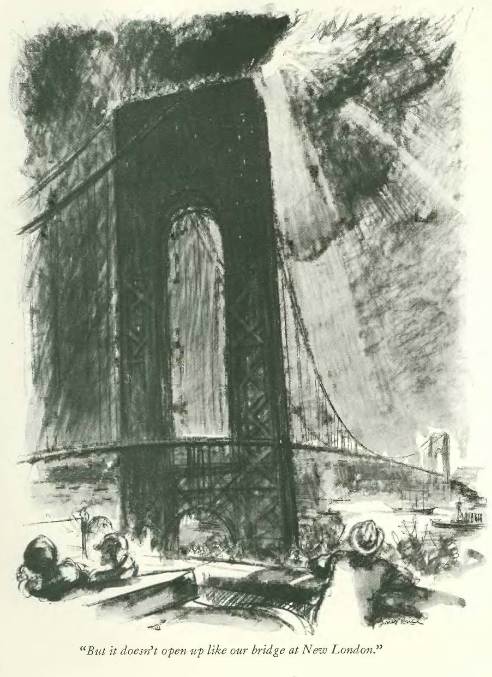
…on to our cartoons, the George Washington Bridge drew the envy of some out-of-towners, as illustrated by Garrett Price…
…nearly 90 years ago folks were almost as nuts about college football as they are now, except for Perry Barlow’s lone dowager, who would rather be sitting in her parlor with a cup of tea…
…Gardner Rea explored the wonders of heredity…
…Otto Soglow’s Little King employed a guard ready for any emergency…
…Barbara Shermund gave us an artist with a god complex…
…James Thurber continued to probe the nuances of the sexes…
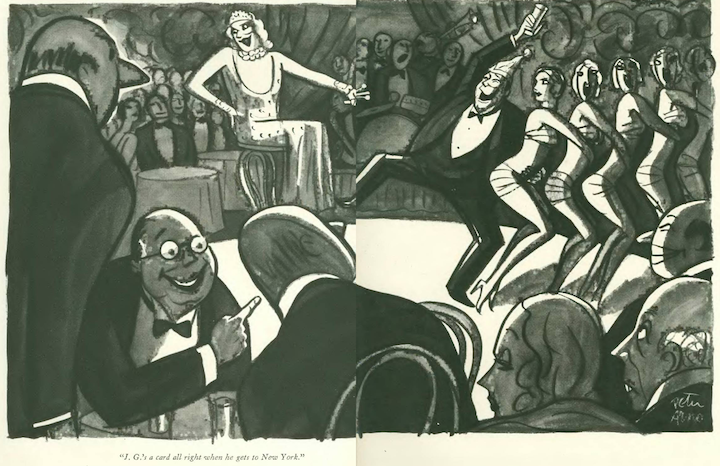
…Peter Arno sketched this two-page spread with the caption: J.G’s a card all right when he gets to New York…
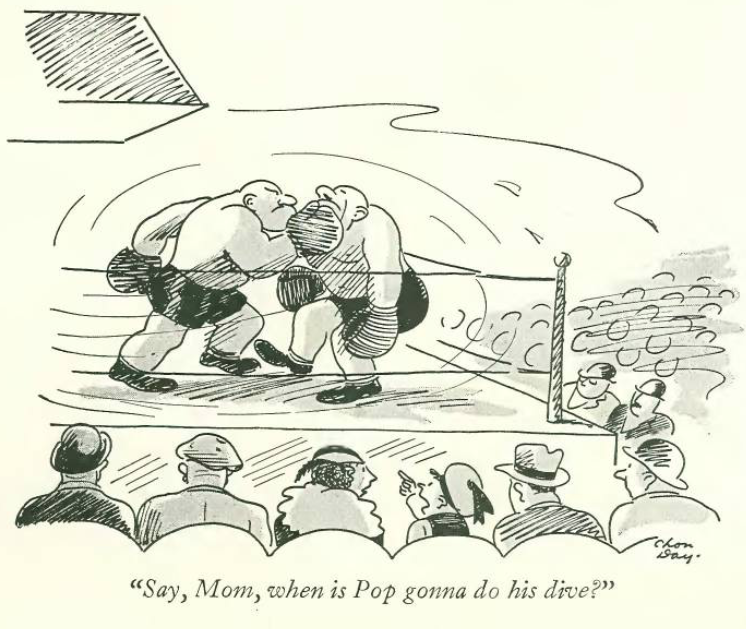
…and from the mouth of babes, we have these observations of the underworld from Chon Day…
…and Denys Wortman…
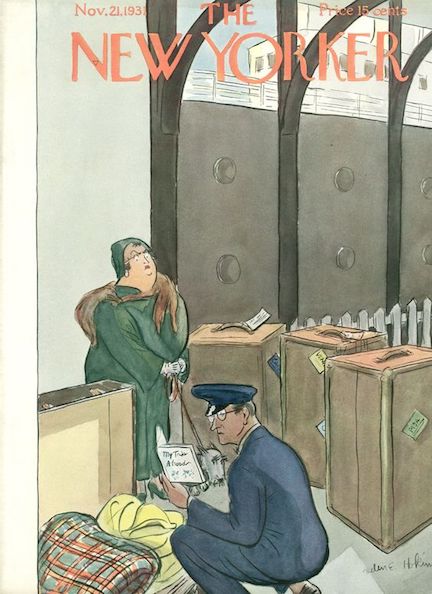
On to the Nov. 21 issue, which featured the last in a series of eleven covers Helen Hokinson contributed to The New Yorker in 1931. The covers featured one of Hokinson’s “Best Girls”—a plump, wealthy, society woman—on an around-the-world cruise, which began with the March 2 issue and ended on Nov. 21 with a stop at the customs office, and a nosy customs officer…
Nov. 21, 1931 cover by Helen Hokinson.
Bread & Circuses
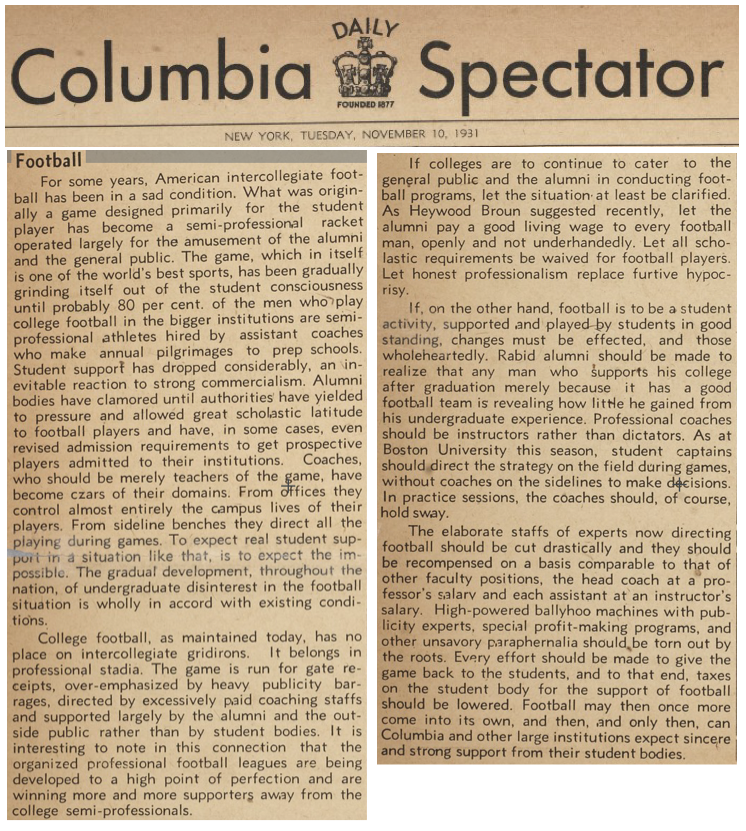
In his “Notes and Comment,” E.B. White reported on a recent editorial in the Columbia Spectator, that university’s student newspaper, which took issue with the professionalization and “furtive hypocrisy” of college football (if only they could see us now). White observed:
In 1931, Columbia was a football power, and the Ivy League was a big-time conference. To the editors of the Spectator, this was not a point of pride, which they made clear in this 89-year-old editorial that could have been written yesterday:
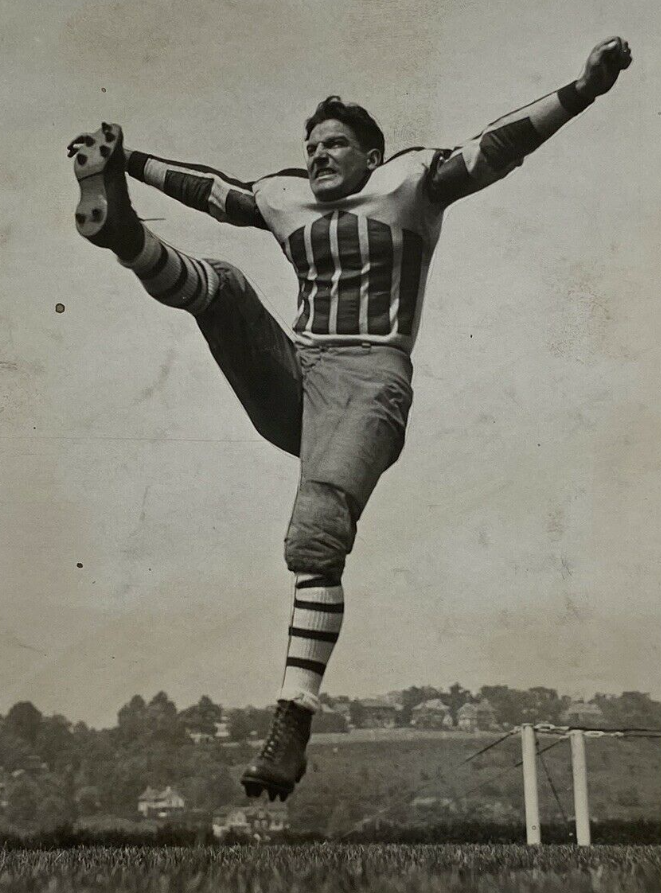
Clippings from Columbia Spectator ArchiveJUST GETTING MY KICKS…1931 press photo of Columbia University football star Ralph Hewitt, who still holds the school record for the longest field goal — a 53-yarder he dropped kicked in a 1930 upset victory over Cornell. Hewitt went on to coach high school sports.
* * *
Sorry, Charlie
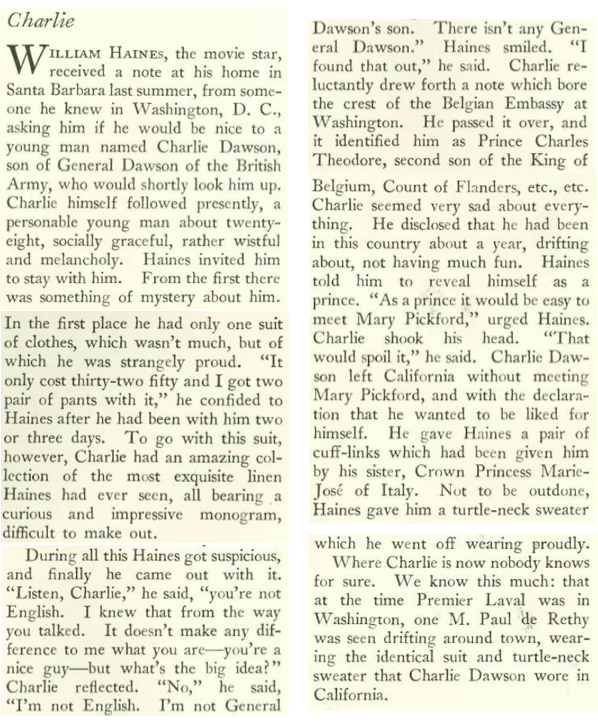
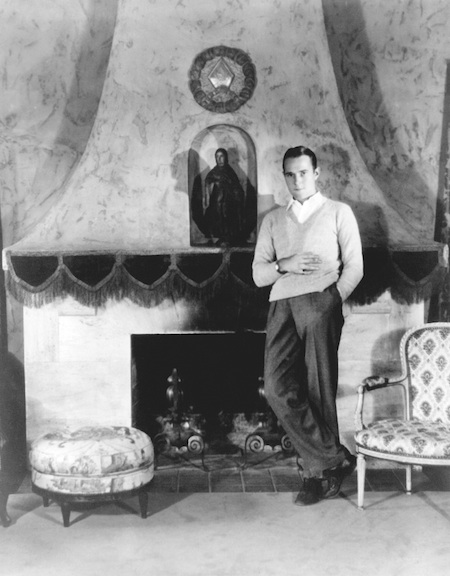
William “Billy” Haines was a top-five box-office star from 1928 to 1932, portraying arrogant but likable characters in a string of pictures that ended abruptly when Haines refused to deny his homosexuality and was cut loose by MGM. “The Talk of the Town” looked in on Haines at his Santa Barbara home, where he entertained a mysterious visitor:
THE INTERIOR LIFE…The actor William Haines in a 1926 publicity shot taken at his Hollywood home. Haines would abandon acting in the 1930s and take up a successful career as an interior designer. (Photofest)
* * *
Coveted Coiffeur
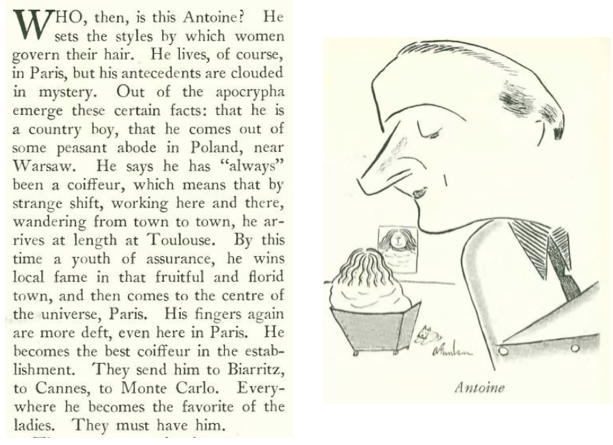
Writer Bessie Breuer wrote an admiring profile of Polish hairdresser Antoine (aka Antoni Cierplikowski), considered the world’s first celebrity hairdresser. The opening paragraph:
A CUT ABOVE…In 1914 famed hairdresser Antoine (aka Antoni Cierplikowski) invented the “shingle cut” (at left, sported by actress Louise Brooks in the 1920s), which was all the rage during the Roaring Twenties. (Pinterest)
* * *
The Look of Relief
In “The Talk of the Town” E.B. White noted that a familiar face was gracing advertisements for President Herbert Hoover’s Unemployment Relief Agency:
I NEVER FORGET A FACE…E.B. White referred to this ad featuring an unnamed woman who had a familiar look about her. (period paper.com)
* * *
More His Style
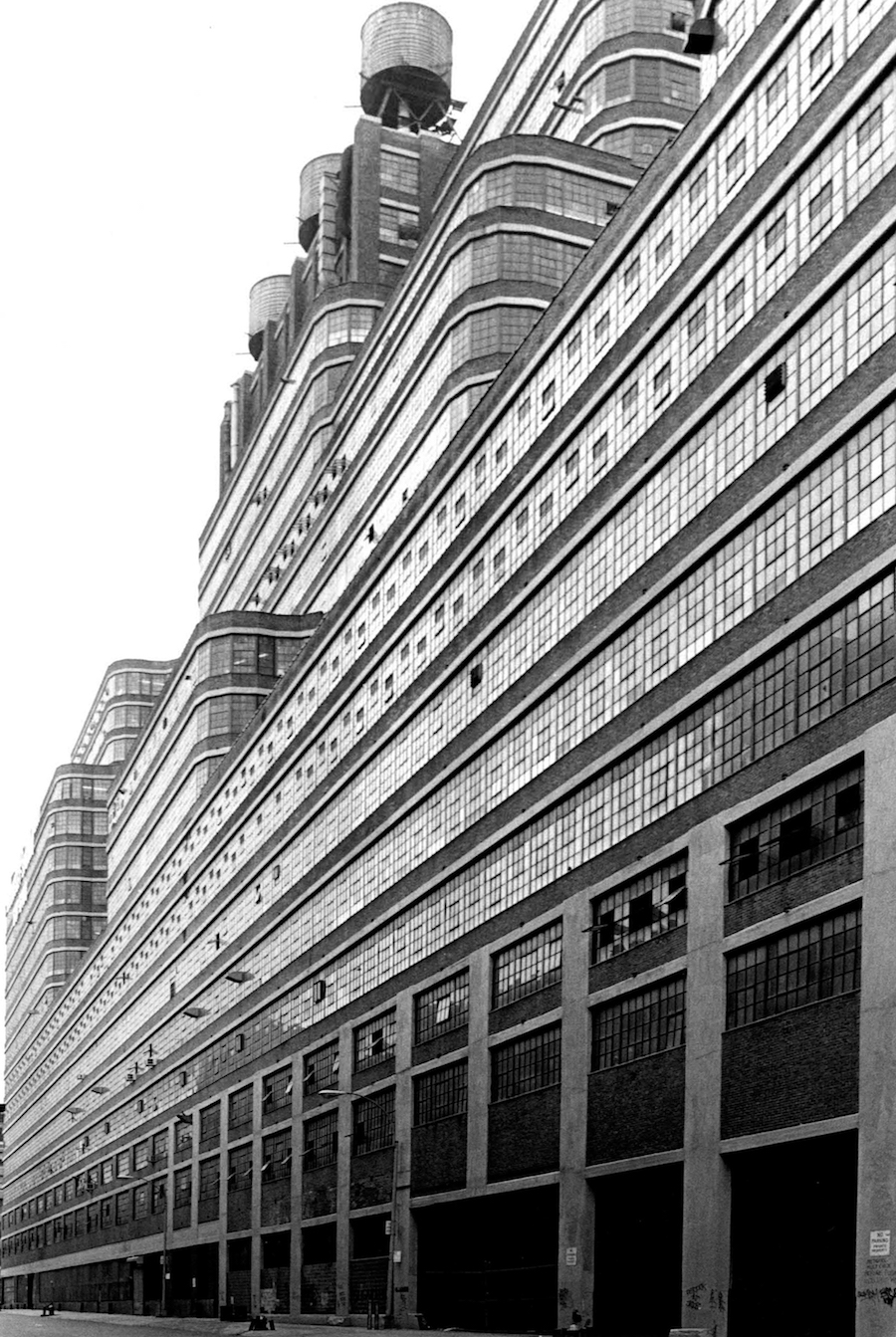
We return again to Lewis Mumford, this time cheered by the sight of the new Starrett-Lehigh Building in Chelsea, designed by Cory & Cory. An excerpt from “The Sky Line” column:
THAT’S MORE LIKE IT…Lewis Mumford praised the striking effect of the Starrett-Lehigh Building’s alternating bands of brick, concrete and steel. (Atlas of Places)
* * *
The Chump
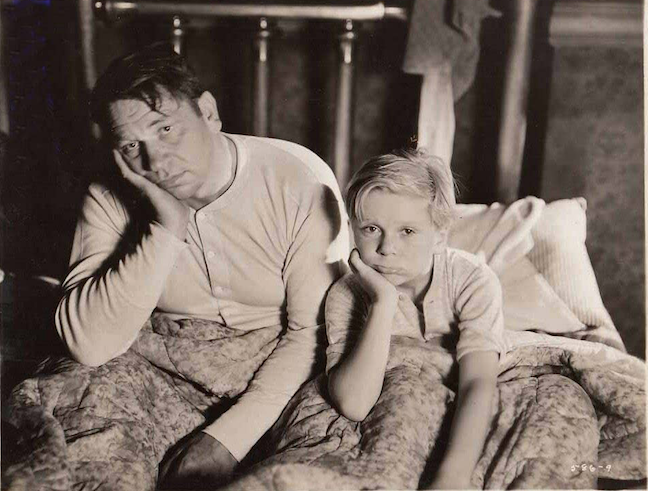
John Mosher was neither moved nor charmed by the appearance of little Jackie Cooper in The Champ, a tearjerker story of an alcoholic ex-boxer (Wallace Beery) struggling to provide for his son. He did, however, appreciate the boy’s ability to carry “on his little shoulders a heavy and tedious and lengthy story.”
BUMMER…John Mosher had little to like about King Vidor’sThe Champ, featuring Wallace Beery and Jackie Cooper. Mosher was no doubt a bit dismayed when Beery received an Academy Award for his performance. (IMDB)
* * *
A Wishful Christmas List
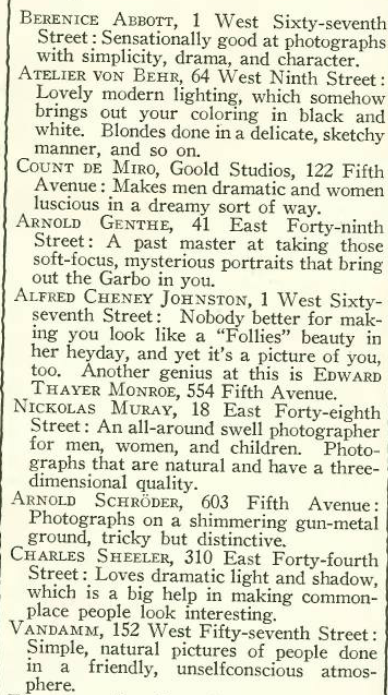
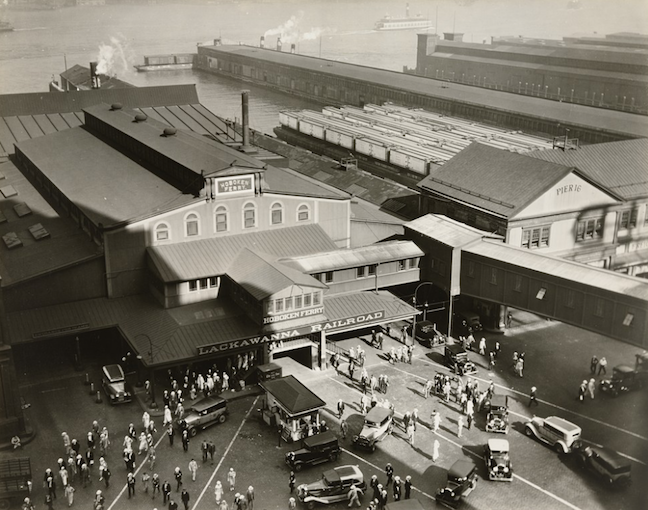
It was that time of the year when the New Yorker began running its lengthy features on possible gifts for Christmas. This excerpt caught my eye for what might have been possible in 1931 — buying a photographic print directly from Berenice Abbott or Nickolas Muray:
NO LUMP OF COAL, THIS…In 1931 it might have been quite possible to buy this print directly from photographer Berenice Abbott.Barclay Street, Hoboken Ferry 1931, is in MoMA’s photography collection.
* * *
From Our Advertisers
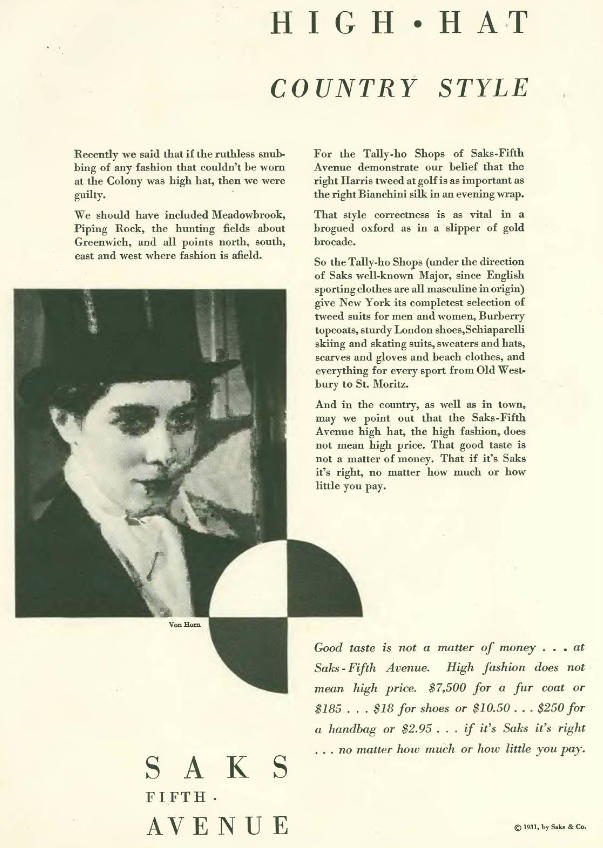
It has been well-established in previous posts that Anglophilia ran rampant among New York’s smart set, and this advertisement from Saks provides everything we need to underscore the point…
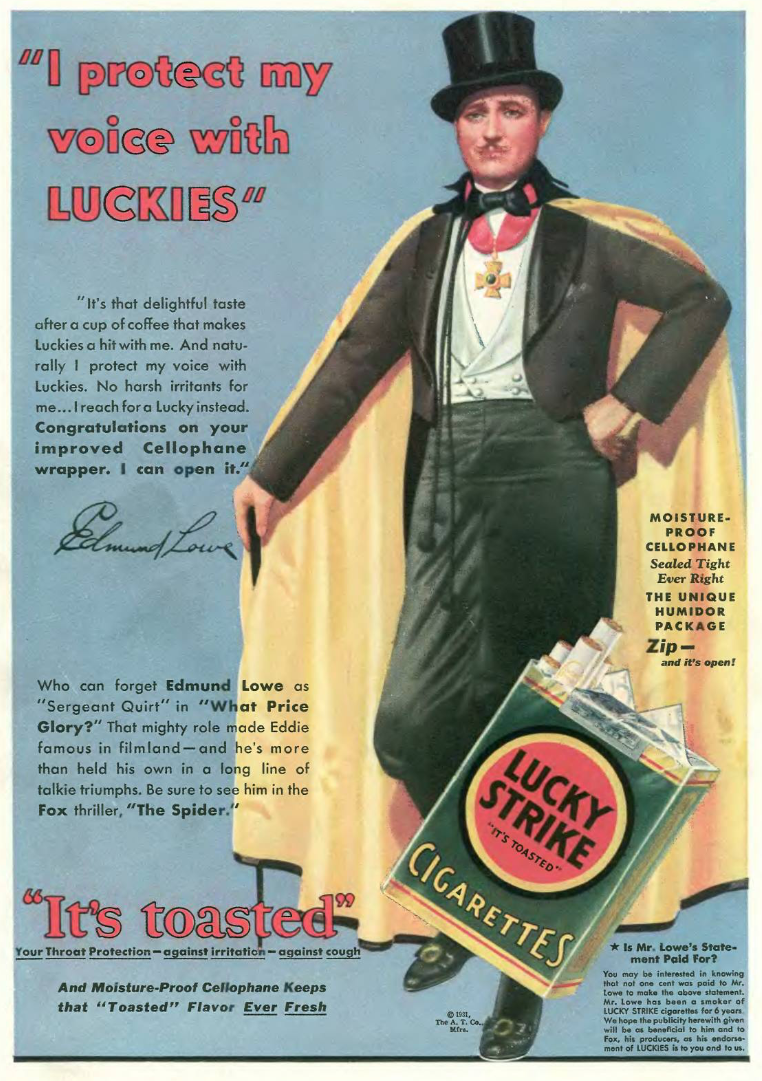
…and the top hat mades another appearance in this spot for Lucky Strike, featuring an endorsement from actor Edmund Lowe...
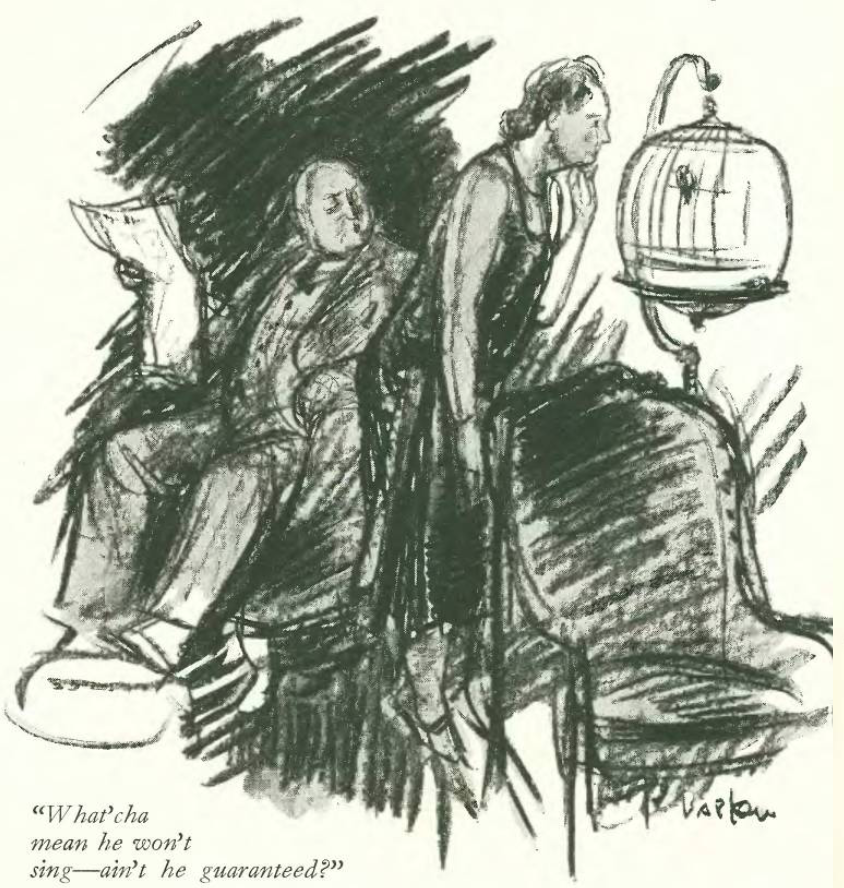
…our cartoons featured a song-less songbird courtesy of Perry Barlow…
…and from James Thurber, another creature with little appetite for song, let alone wine and women…
…William Steig brought us back to the bleachers with another nonconformist…
…Gluyas Williams gave us this sad sack all alone in the crowd…
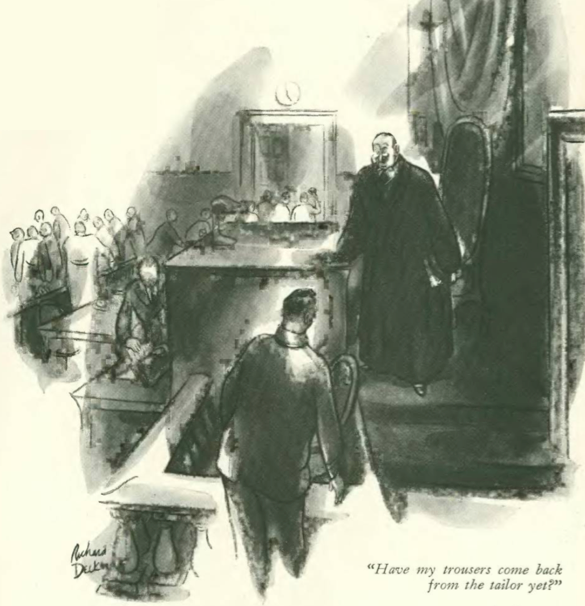
…Richard Decker sought to bring order to this court…
…and we end with Carl Rose, and this two-page cartoon illustrating a dicey parking challenge…
The late film critic Roger Ebert once observed that “if only one of Charles Chaplin’s films could be preserved, City Lights would come the closest to representing all the different notes of his genius.”
Feb. 21, 1931 cover by Rea Irvin, marking the New Yorker’s sixth anniversary.
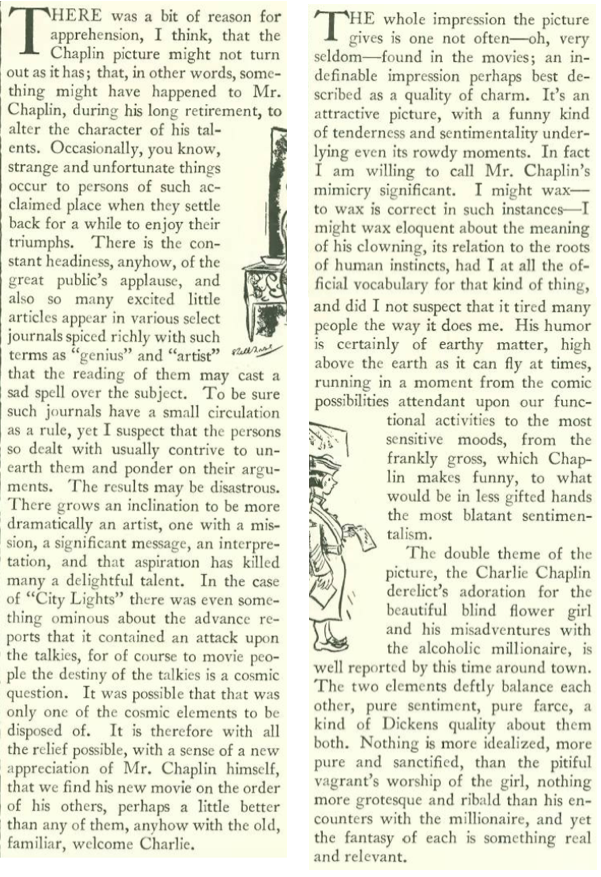
The New Yorker’s film critic in 1931, John Mosher, would have agreed. Before he previewed the picture, however, Mosher feared (along with others) that the great actor and director had seen his best days…
…instead, the film proved a hit with both audiences and critics, and today is regarded as one of the greatest films ever made. It was no doubt a relief to Ebert when the film was selected by the Library of Congress for preservation in the National Film Registry.
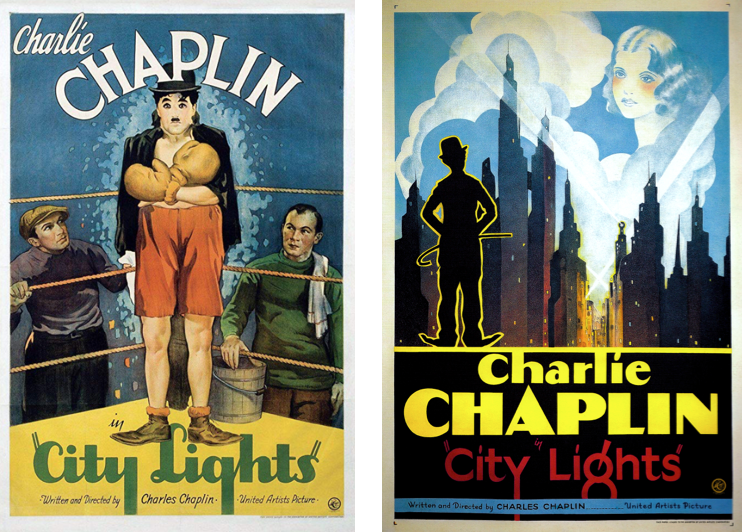
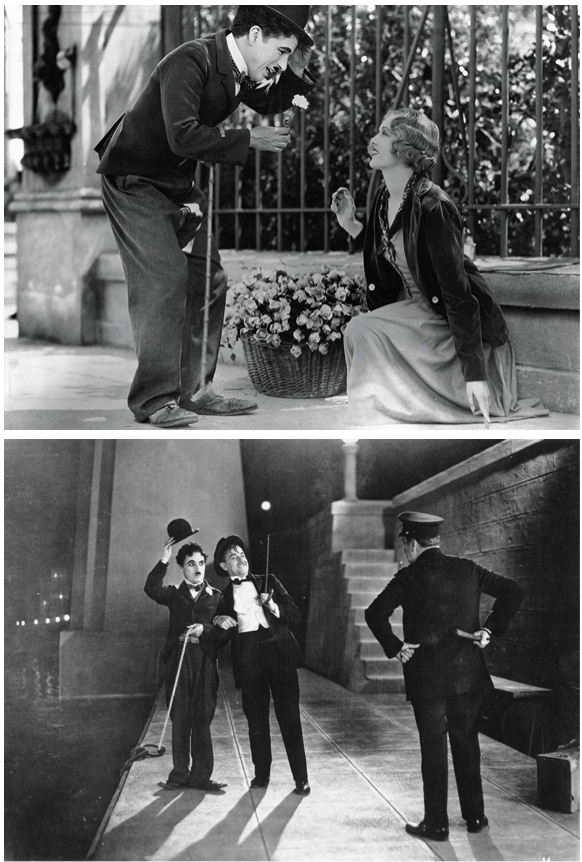
HE DOES IT ALL…United Artists issued several different types of posters to promote the film, including these two. (IMDB)A TENDER FELLOW…The Tramp (Charlie Chaplin) encounters a blind flower girl (Virginia Cherrill) on a street corner and is instantly smitten; later that evening the Tramp saves a drunken millionaire (Harry Myers) from suicide. (IMDB)
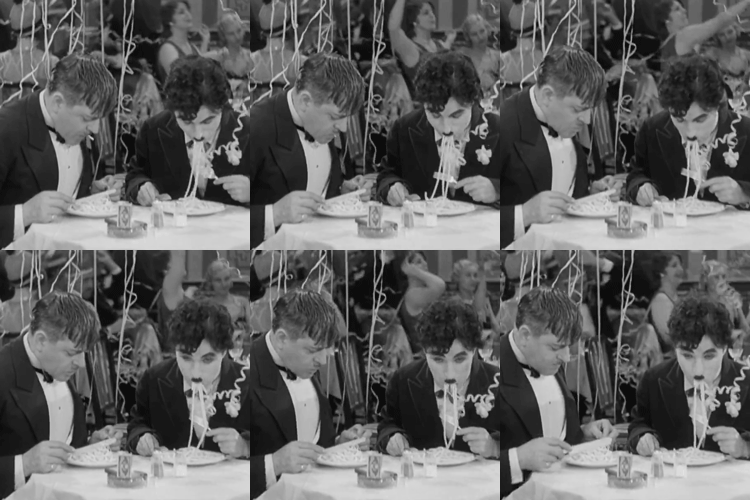
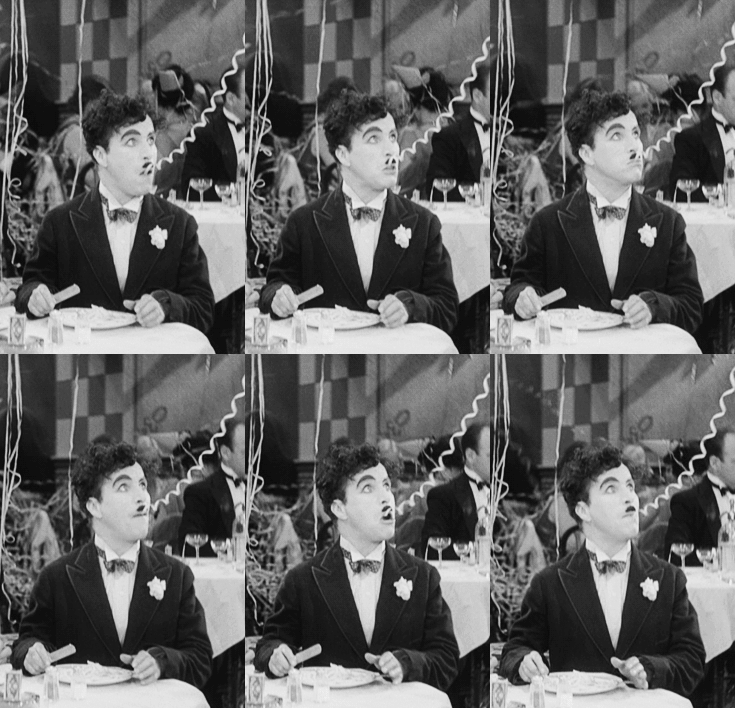
The film has its tender moments, but being a Chaplin production it also had plenty of slapstick, including this famous scene in which the Tramp and his millionaire friend go out on the town and dig into plates of spaghetti…and in the Tramp’s case, some confetti…
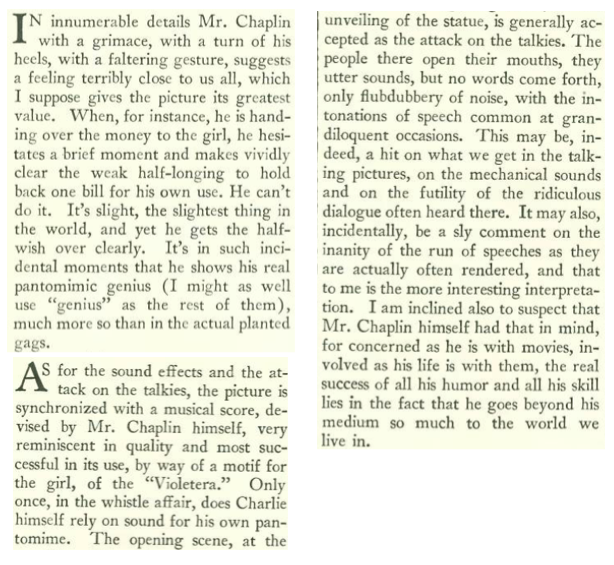
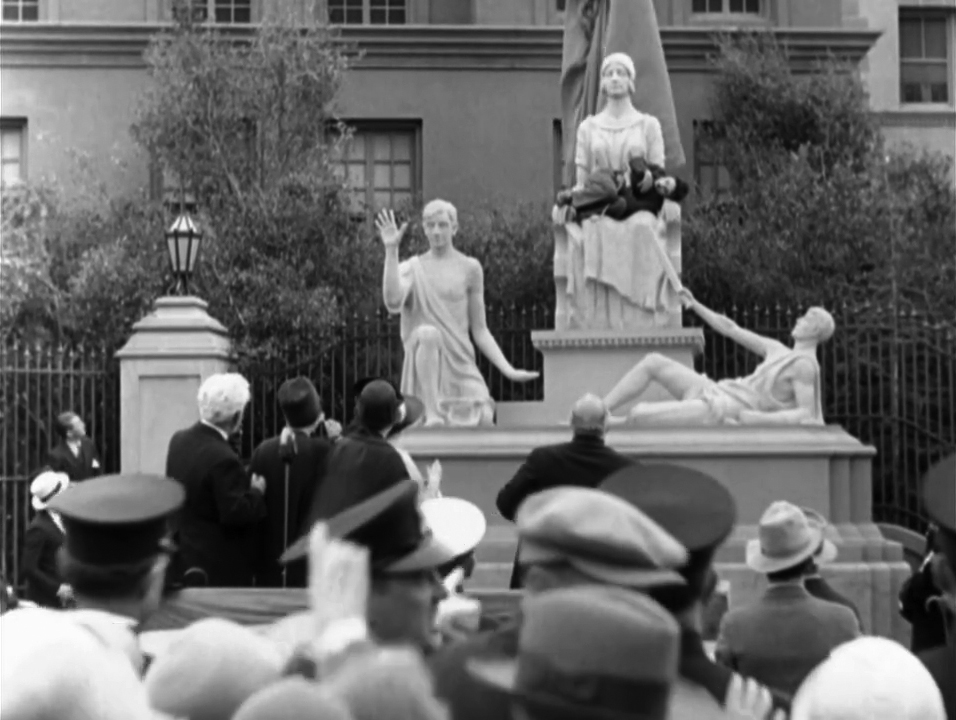
Mosher (and many other critics since) believe the opening scene of the film—in which a statue is unveiled to reveal a sleeping Tramp—was Chaplin’s attack on sound movies:
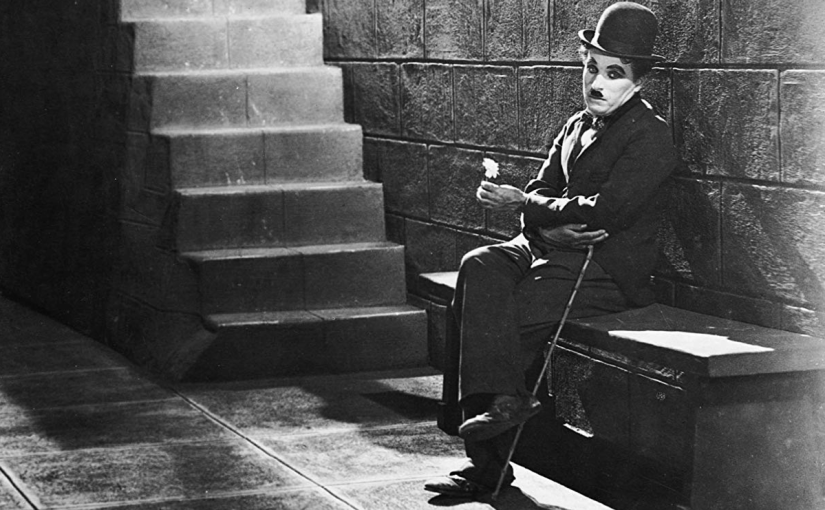
CAUGHT NAPPING…The Tramp is unveiled along with a statue in the opening scene of City Lights. (IMDB)
Although the film had a full musical score and sound effects, there was no spoken dialogue. Rather, Chaplin poked fun of the tinny-sounding talkies of the day by putting not words, but the sounds of a kazoo, into the mouths of speechifying politicians gathered at the statue’s unveiling…
For all its humor, City Lights was a serious work by a serious actor and director who sought something close to perfection. The scene in which the Tramp encounters a blind flower girl on a street corner required three hundred and forty-two takes with actress Virginia Cherrill, who was a newcomer to film.
Writing in The New Yorker, critic Richard Brody (“Chaplin’s Three Hundred and Forty-Two Takes,” Nov. 19, 2013) noted that “Chaplin didn’t have a mental template that he wanted Cherrill to match; he approaches the scene not quite knowing what he wanted.” Brody observed that the perfection Chaplin sought was one of results, and not of conformity to a preconceived schema. “He sought what provoked, in him, the perfect emotion, the perfect aesthetic response — but he wouldn’t know it until he saw it. He started to shoot in the confidence that the thing — whatever it was — would happen.” Chaplin’s technique can be seen in this clip from the Criterion Collection’s 2013 DVD release of the film. Note that this footage was shot by The New Yorker’s Ralph Barton, a close friend of Chaplin’s:
* * *
Chaplin, Part Two
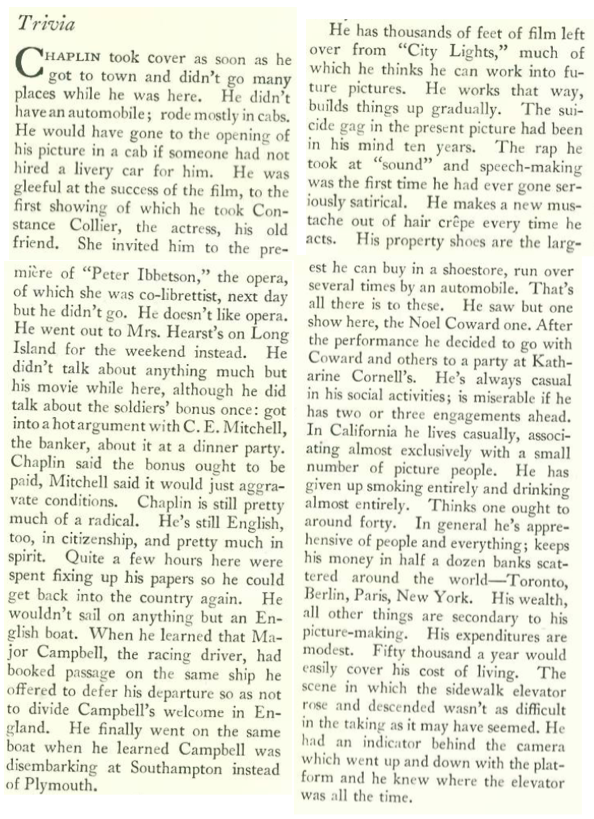
The Chaplin buzz was not confined to the movie section of the magazine, which featured more insights on the star in “The Talk of the Town.”
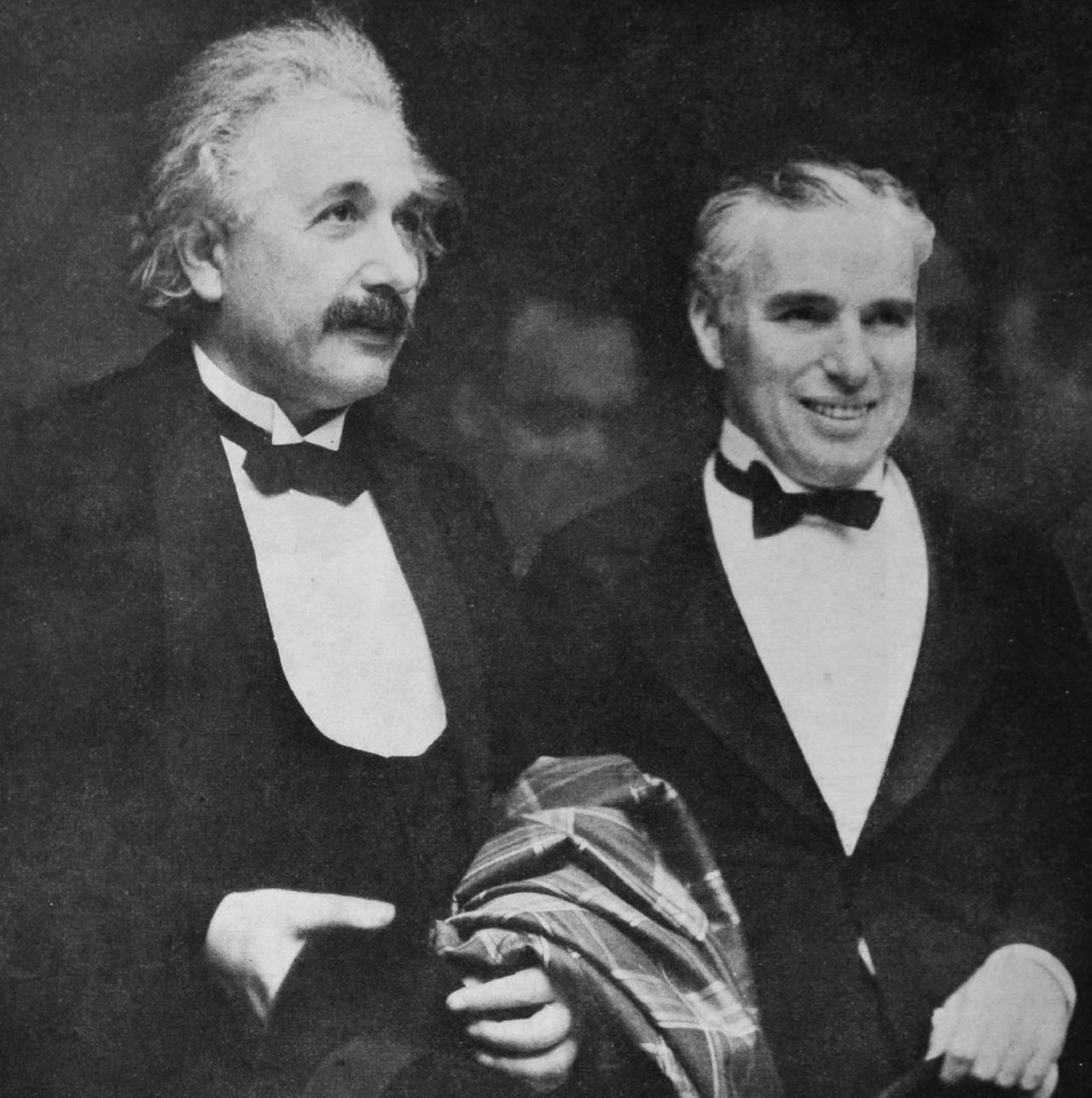
GENIUS LOVES COMPANY…Photo of Albert Einstein and Charlie Chaplin at the Los Angeles premiere of City Lights. Einstein said Chaplin was the only person in Hollywood he wanted to meet. (Wikipedia)
* * *
Funny In a Different Way
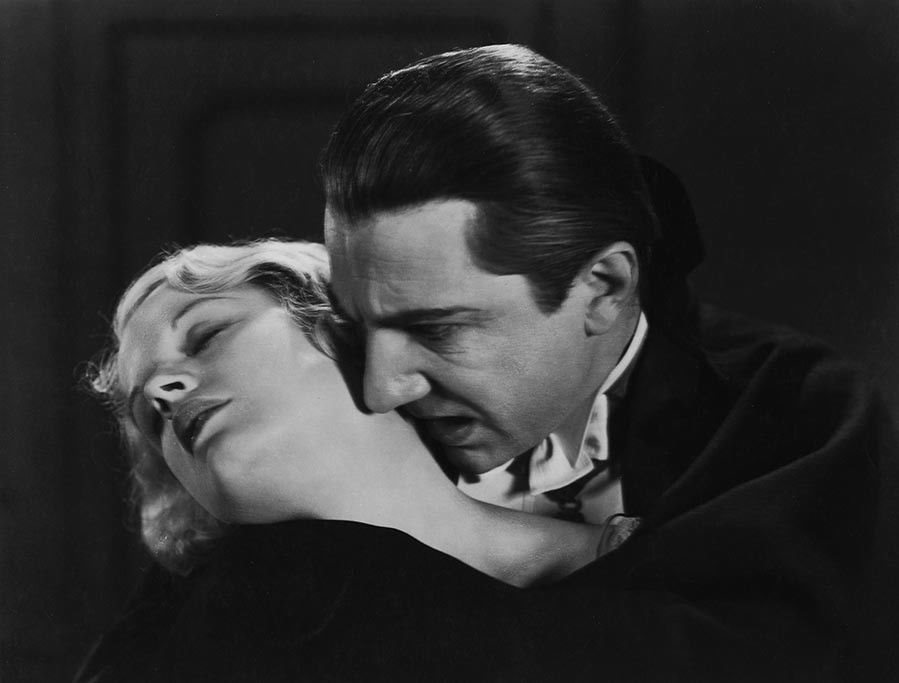
Like City Lights,Tod Browning’sDracula is today considered a classic film. Indeed, Bela Lugosi’s timeless portrayal of the old bloodsucker set a standard for vampire flicks and horror films in general. The New Yorker’s John Mosher, however, would have none of it, dismissing the film in a single paragraph.
PAIN INTHE NECK…Count Dracula (Bela Lugosi) goes for a nibble on the fragile Mina (Helen Chandler) in 1931’s Dracula. (IMDB)
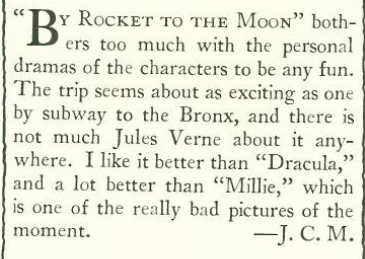
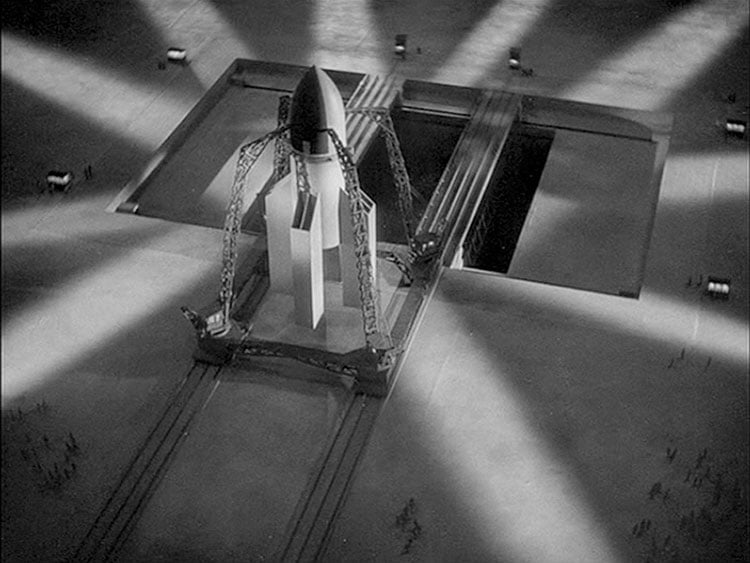
Mosher was also dismissive of Fritz Lang’sBy Rocket to the Moon, originally released in German as Frau Im Mond (Woman in the Moon). The 1929 production is considered one of the first “serious” science fiction movies, anticipating a number of technologies that would actually be used in space travel decades later.
RETRO ROCKET…Fritz Lang’s Woman in the Moon would predict a number of technologies used decades later in actual space flight, including multi-stage rockets. Lang also anticipated the future in the much-acclaimed Metropolis (1927).
* * *
Bored on Broadway
Robert Benchley was visiting friends abroad, so Dorothy Parker did what any pal would do and subbed for his theater column. As it turned out, it was not a happy task, even if she did receive complementary tickets to one of the hottest shows on Broadway:
Having dispatched Katharine Cornell’sBarretts of Wimpole Street, Parker took aim at America’s Sweetheart, based on a book by Herbert Fields with music and lyrics by Richard Rodgers and Lorenz Hart. Parker ended the savaging with a plea to her dear friend and colleague to return home soon:
THEY LAUGHED, THEY CRIED…Katharine Cornell (left) portrayed Elizabeth Barrett in Barretts of Wimpole Street. Dorothy Parker thought Cornell was a first-rate actress, but didn’t think much of her play. As for Inez Courtney (right) in America’s Sweetheart, Parker believed she did what she could, whatever that meant. (Pinterest)
* * *
Lest We Forget
The New Yorker turned six with this issue, and in the life of any magazine, that is something to be celebrated, and especially in hindsight as our beloved publication closes in on its centenary in 2025. Some thoughts from E.B. White:
* * *
From Our Advertisers
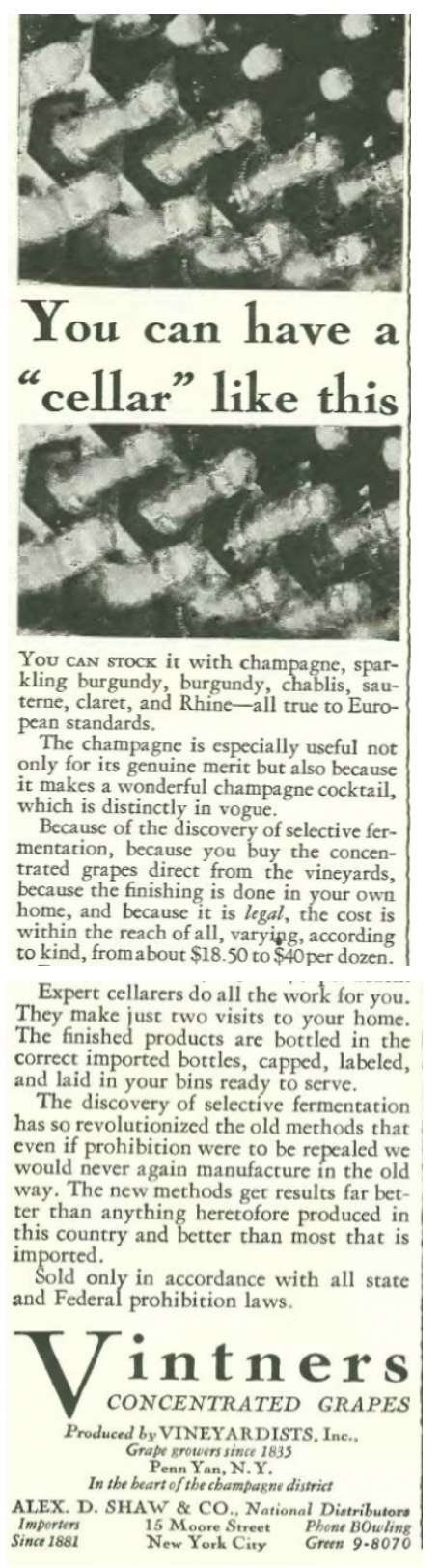
We’ve seen in past ads how Prohibition-era vintners marketed grape juice bricks that could be dissolved in water and fermented in the home. In this ad they took it a step further, sending expert cellarers direct to customers’ homes to help them create their own, perfectly legal, wine cellar…
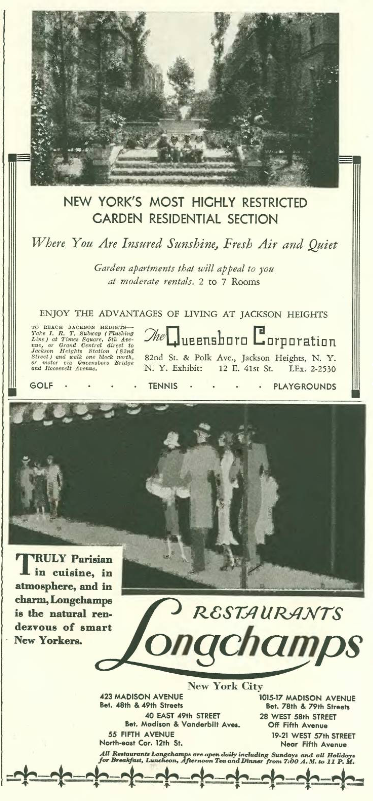
…those with wine cellars might have preferred to live in a “highly restricted” community in Jackson Heights…
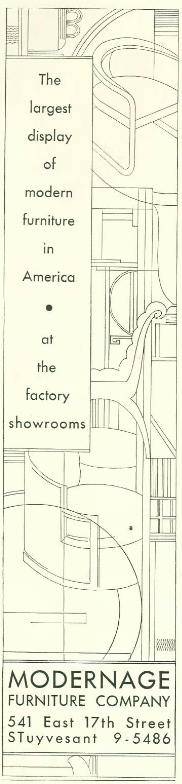
…and furnish their homes with the latest in modern furniture design…
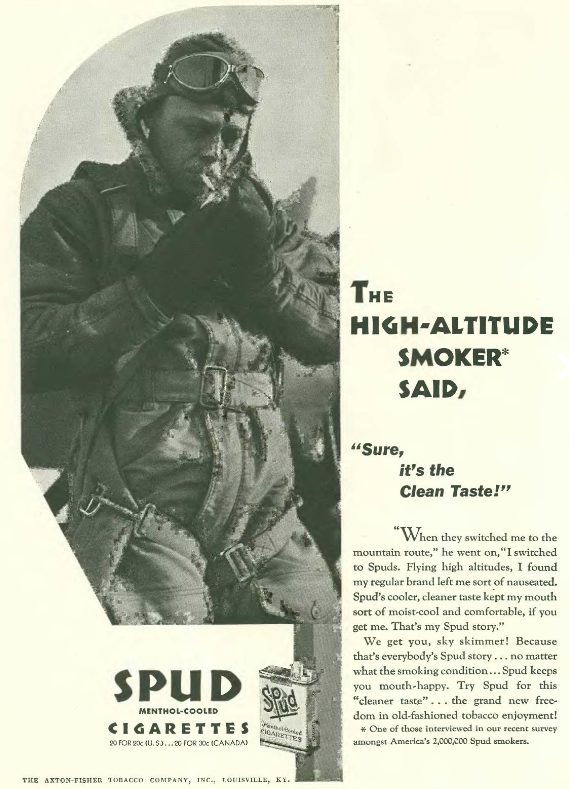
…and here we have an early example of the “macho” smoker, anticipating the arrival of his buddy, the Marlboro Man…
…on to our cartoonists, another theater section entry by one of Charlie Chaplin’s closest friends, Ralph Barton…
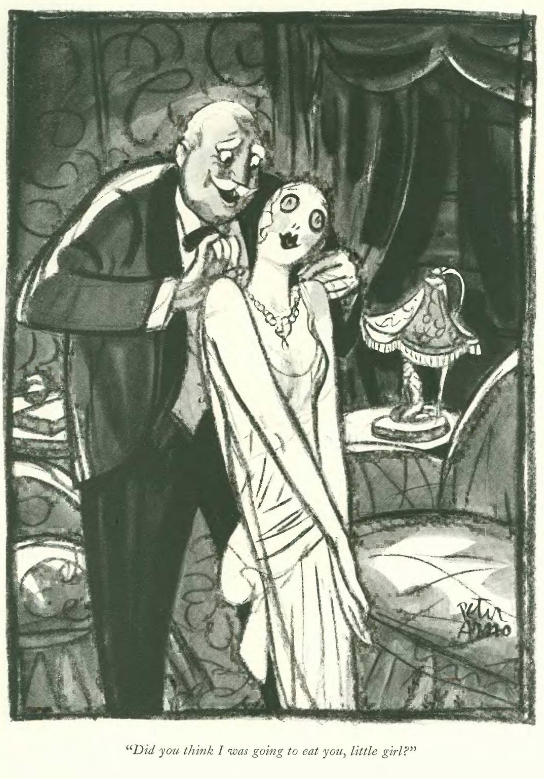
…and cartoons by Peter Arno, who channelled Dracula via his Sugar Daddy…
…Garrett Price, and the burdens of the rich…
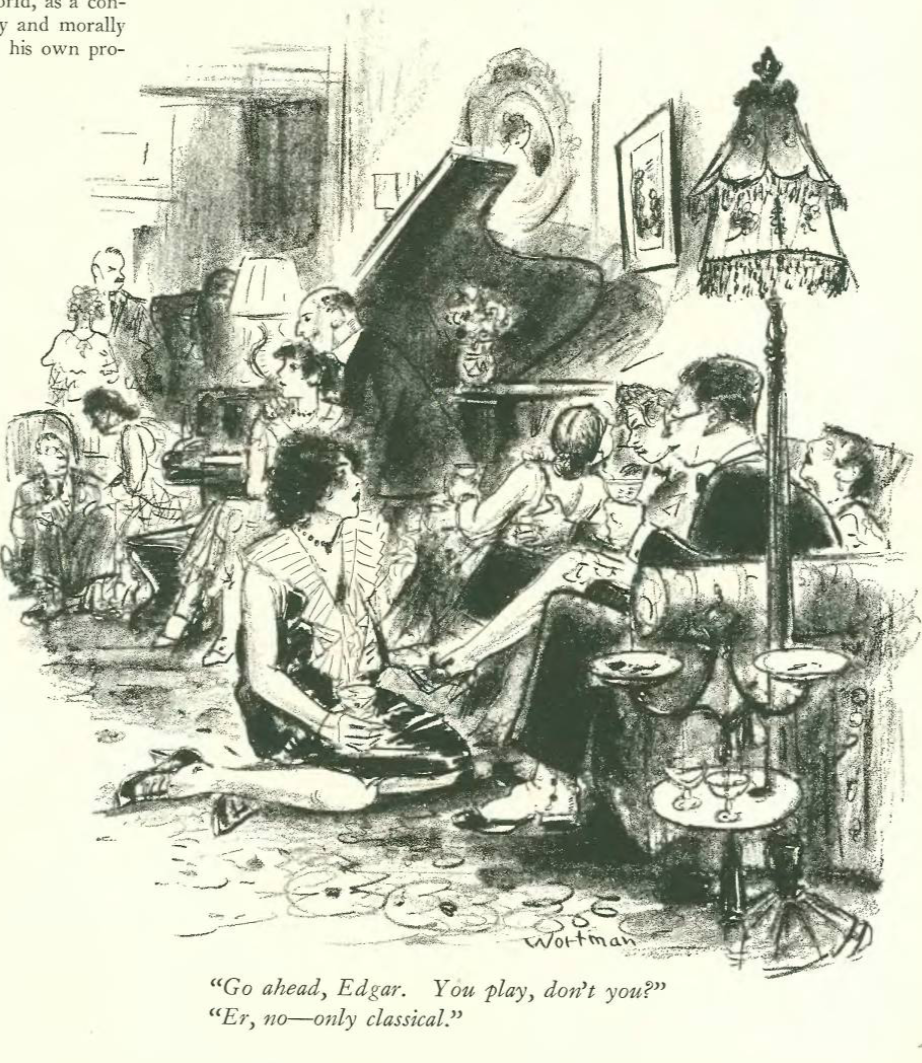
…Denys Wortman examined the follies of youth…
…and we end with dear Helen Hokinson, and the miracle of birth…
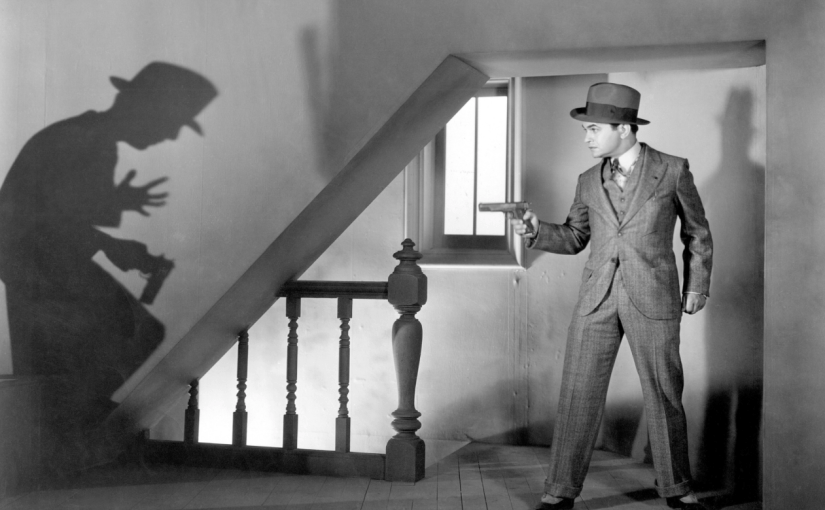
During the early years of the Depression and before censorship guidelines were imposed by the Hays Code, Hollywood cranked out a slew of “Pre-Code” films filled with sex and violence, including 1931’s Little Caesar, the first “talkie” gangster film that defined the genre for decades to come.
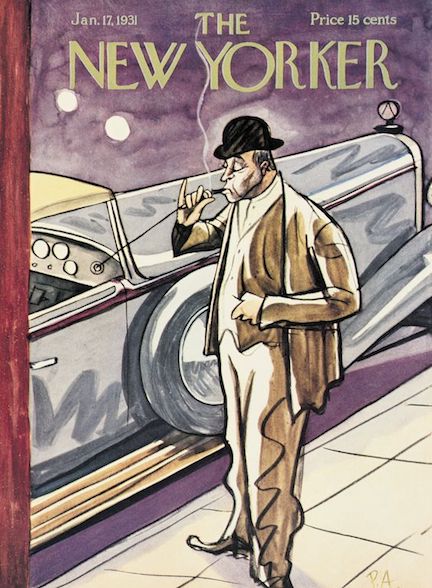
Jan. 17, 1931 cover by Peter Arno.
It also propelled the career of Edward G. Robinson (1893-1973), who portrayed “Little Caesar” Rico Bandello—it was a breakout role for the actor, leading to a 50-year career of playing tough guys among other roles. Although the film today is considered a classic and well-regarded by critics, The New Yorker’sJohn Mosher was not entirely bowled over; he did, however, see the talent potential of the 33-year-old Robinson:
OUCH…Clockwise, from top left, Rico Bandello (Edward G. Robinson) catches some lead from a rival gangster in Little Caesar; Rico has little patience for his partner Joe (Douglas Fairbanks Jr.) and his love interest Olga (Glenda Farrell); Rico and his boys doing a little banking business; Rico up to no good with his sidekick Otero (George E. Stone). (Britannica/moviestillsdb.com/MoMA/IMDB)
Mervyn LeRoy’sLittle Caesar would kick off a series of Warner Brothers gangster films that would help launch the careers of other actors including James Cagney (The Public Enemy, Angels With Dirty Faces) and Humphrey Bogart (The Petrified Forest). Here’s Warner’s trailer for Little Caesar:
* * *
You Dirty Rat
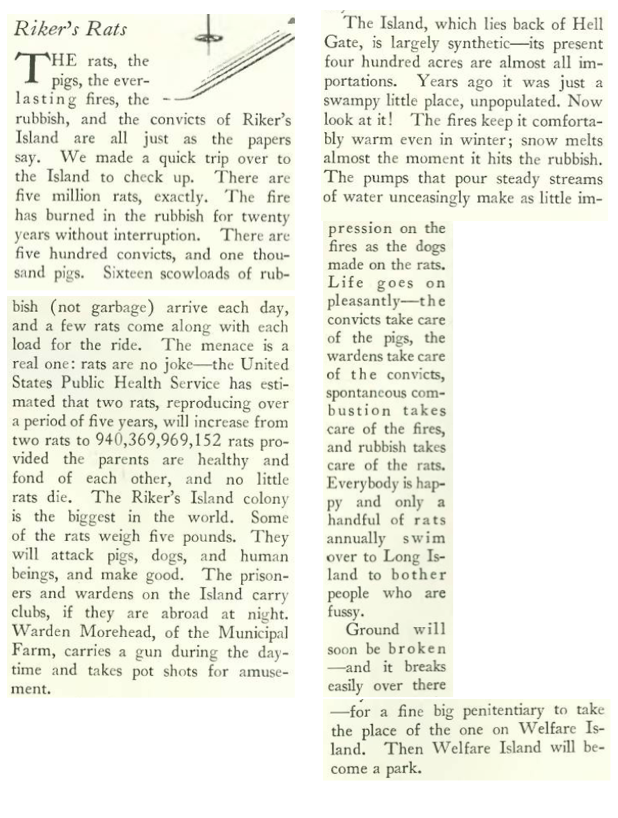
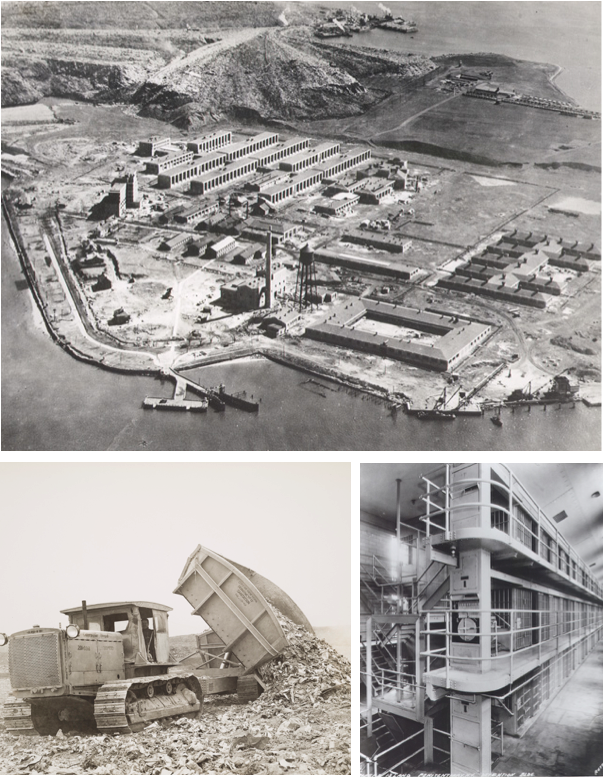
The Jan. 17 “Talk of the Town” looked in on the growing rat infestation at Riker’s Island, a swampy little island that expanded more than four times its original size thanks to the mountains of garbage dumped there in the early 20th century. Much of it was coal ash, which caused the spontaneous fires referred to in the following “Talk” article. Of course the garbage also attracted legions of rats, which officials tried to counter by releasing vicious dogs and pigs on the island. It only seems fitting that such a place would become home to one of America’s most hellish prisons:
RAT TRAP…Clockwise, from top, aerial view of the Riker’s Island Penitentiary, which opened in 1932. Mountains of garbage, some 130 feet high, are visible in the background. The garbage heaps were prone to spontaneous combustion. In 1934 a prison warden described his nighttime view as a “whole hillside lit up with little fires. … It was beautiful”; view of a cellblock; adding to the mountain of garbage in 1937. (correction history.org)
* * *
Sign of the Times
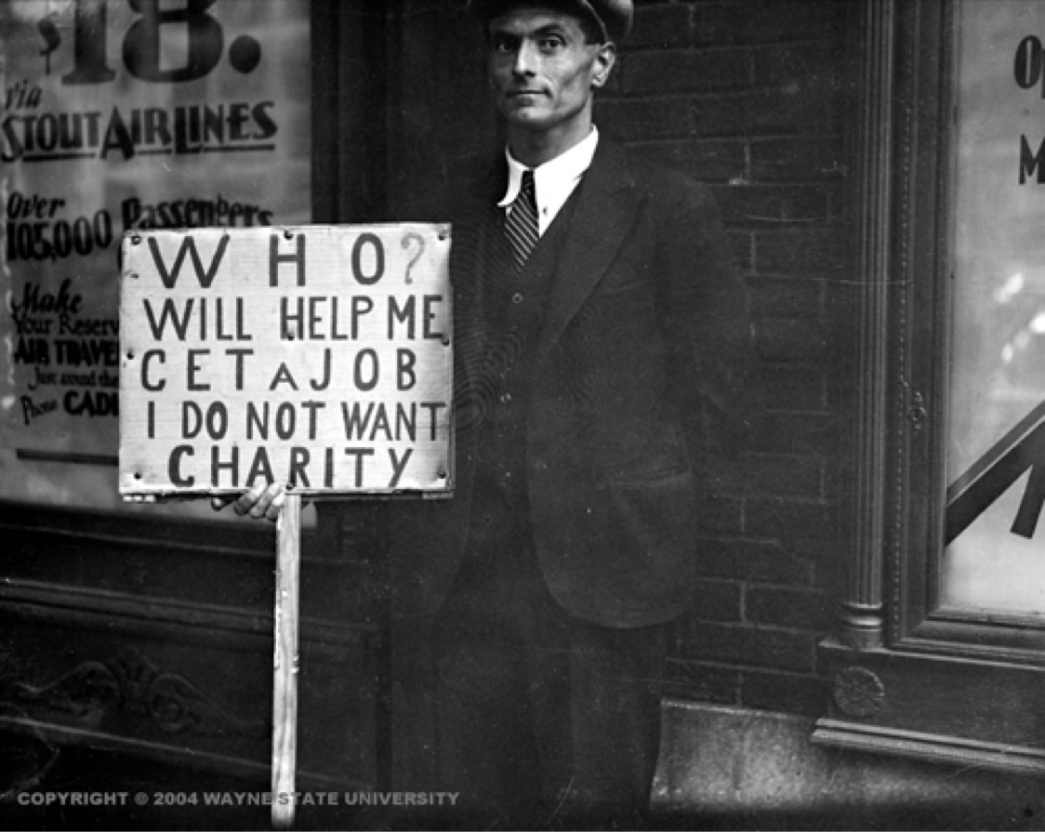
No doubt some of the folks who ended up at Riker’s were desperate souls who were reduced to begging on the streets of Manhattan. Morris Markey, in his “A Reporter at Large” column, looked in on some of the city’s “Vagabonds,” noting that the Depression had added some new faces among the panhandlers, faces “torn by an unaccustomed pain.” An excerpt:
HARD TIMES…An unemployed man seeks work in the 1930s. (Wayne State University)
* * *
Grim for the Reaper
The Depression, it seems, was even hard on the nation’s undertakers, according to E.B. White in “Notes and Comment”…
NEED A LIFT?…A hearse and undertaker in 1930. Business was surprisingly slow in hard times. (my101years.com)
* * *
Work is Fun When You Don’t Need It
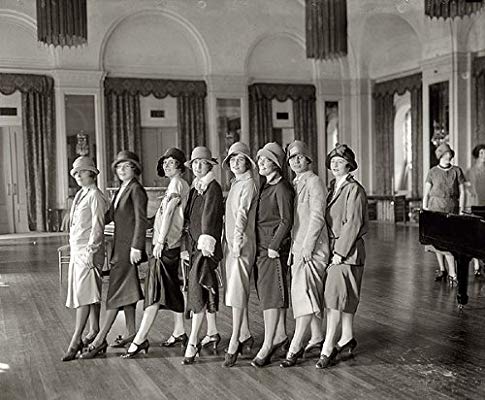
Lois Long filed another installment in her “Doldrums” series, in which she commented on the desires of the city’s debutantes to find some purpose in life…
PUTTING THEIR BEST FEET FORWARD…Debutantes pose in Washington, D.C., circa 1930. (Pinterest)
* * *
Pablo Who?
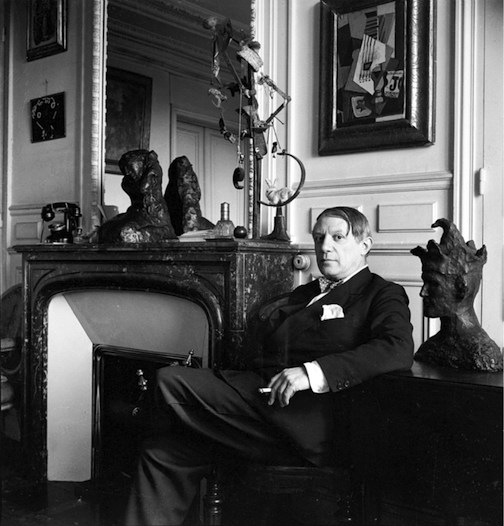
New York’s Valentine Gallery was offering a showing of works by Pablo Picasso, who was famous enough to create as he wished, but not quite ready for canonical consideration…
I’LL DO AS I PLEASE…Pablo Picasso in 1931, in a portrait by Cecil Beaton. (oscarenfotos.com)
* * *
Order Restored
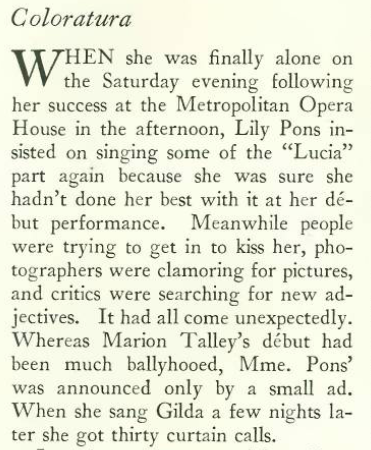
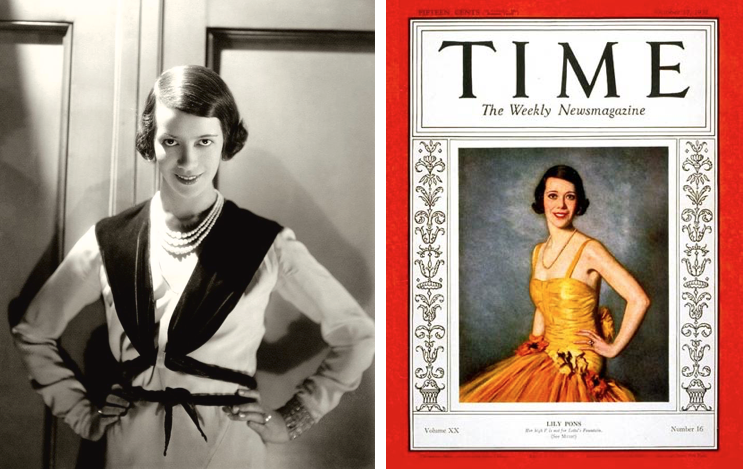
After its Marion Talley debacle, the Metropolitan Opera stage welcomed French soprano Lily Pons (1898-1976) to its stage. “The Talk of Town” noted that although Pons’ debut was far less hyped than Talley’s, her reception by New York audiences was far more enthusiastic. While Talley’s career would sputter and fade, Pons would enjoy a long association with the Metropolitan Opera, where she performed nearly 300 times between 1931 and 1960.
A BREATH OF FRESH AIR…One of the most popular prima donnas of her time, French soprano Lily Pons would grace the Metropolitan Opera stage for 30 years. From right, a 1931 portrait of Pons by Cecil Beaton; on the cover of Time, Oct. 17, 1932. (CondeNast/Time)
* * *
From Our Advertisers
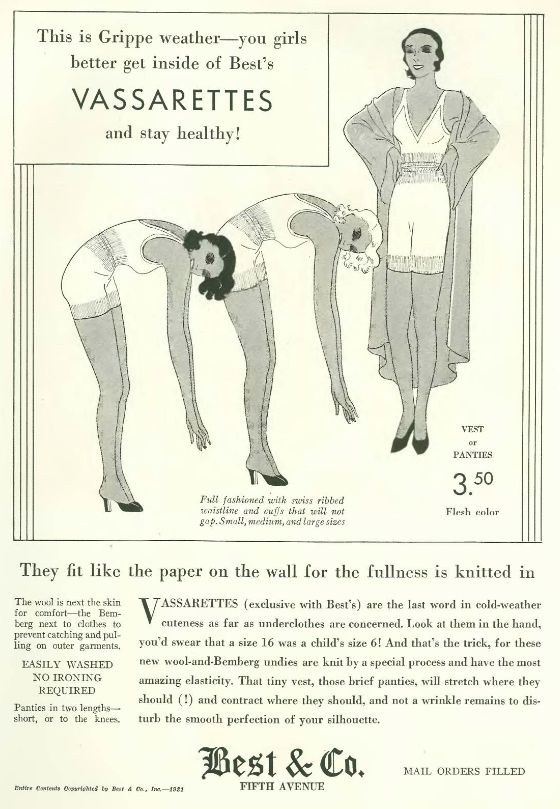
Best & Company looked out for the welfare of New York’s young women by offering a selection of wool “Vassarettes” to stave off the “Grippe” weather…
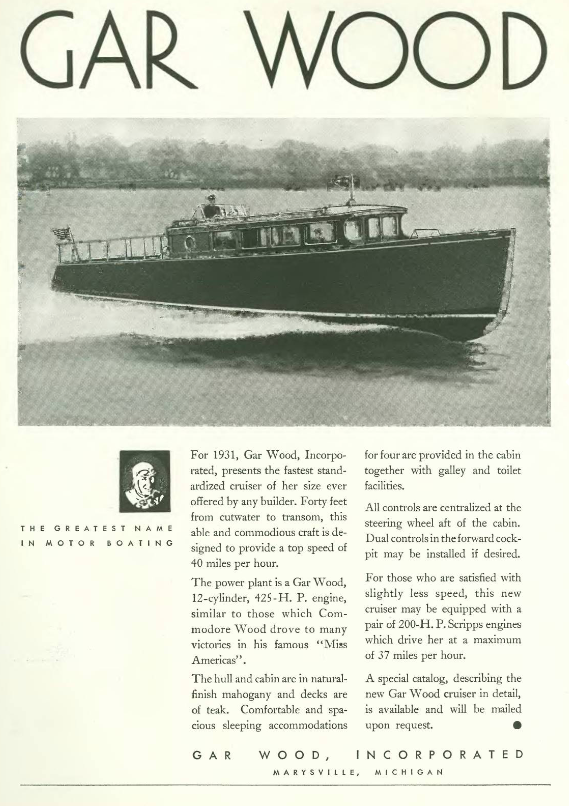
…with the annual Motor Boat Show at the Grand National Palace, several ads called readers’ attention to expensive toys fewer and fewer could afford to own…
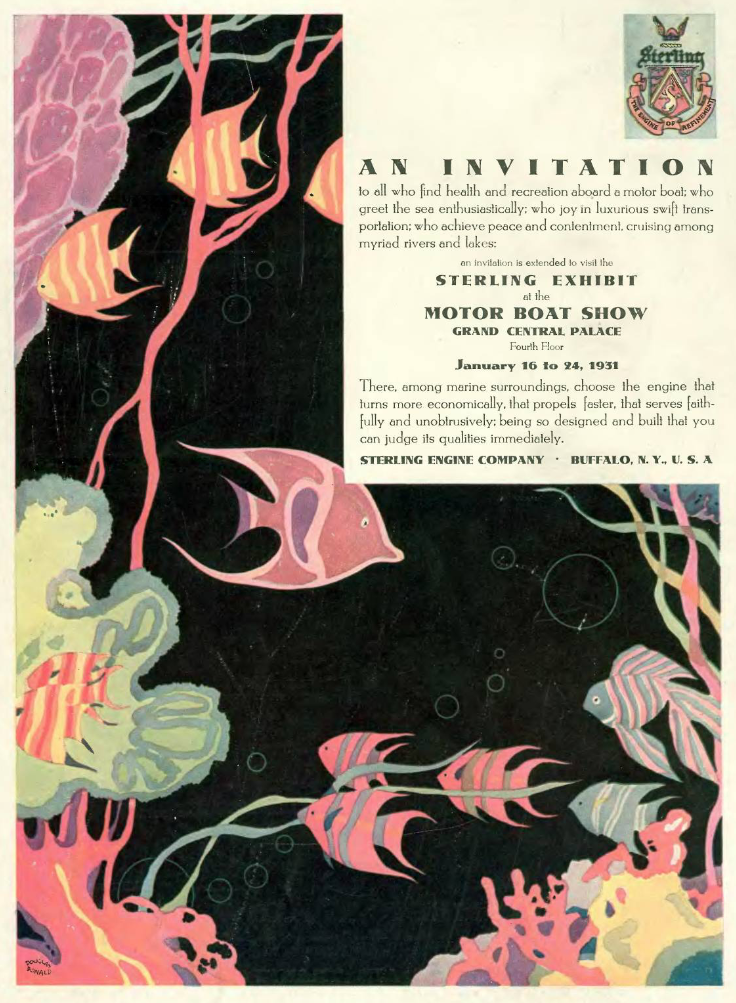
…the makers of Sterling boat motors shelled out the big bucks for this full-color, back-page ad…overall, the number of boat ads were down from previous years…
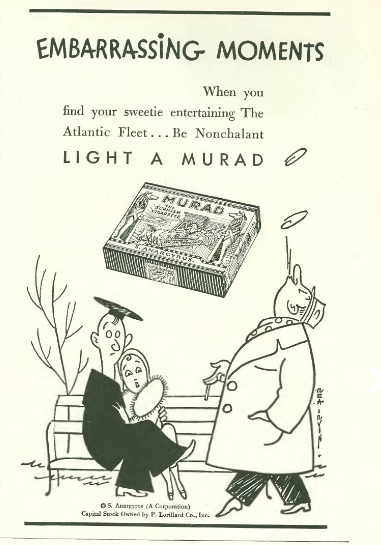
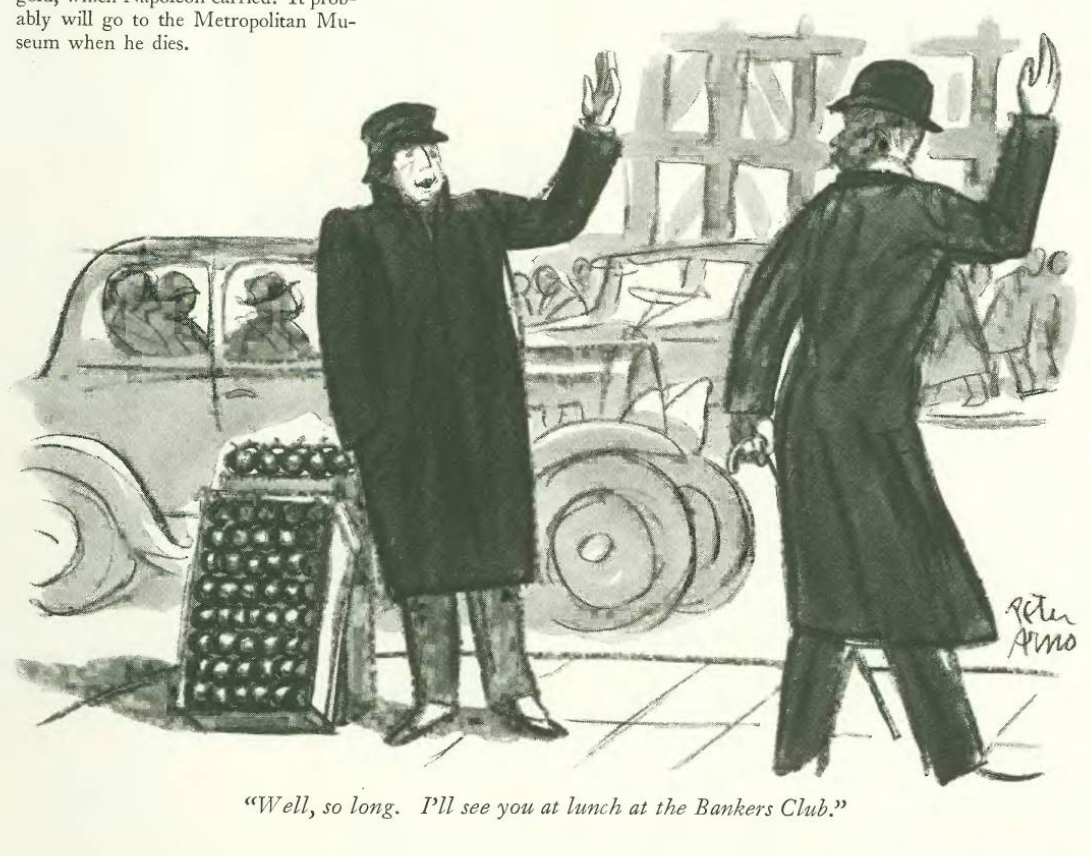
…Rea Irvin continued to pick up some extra income with an ongoing series of cartoons promoting Murad cigarettes…
…on to Irvin’s fellow cartoonists, we have Peter Arno’s look at the new economy…
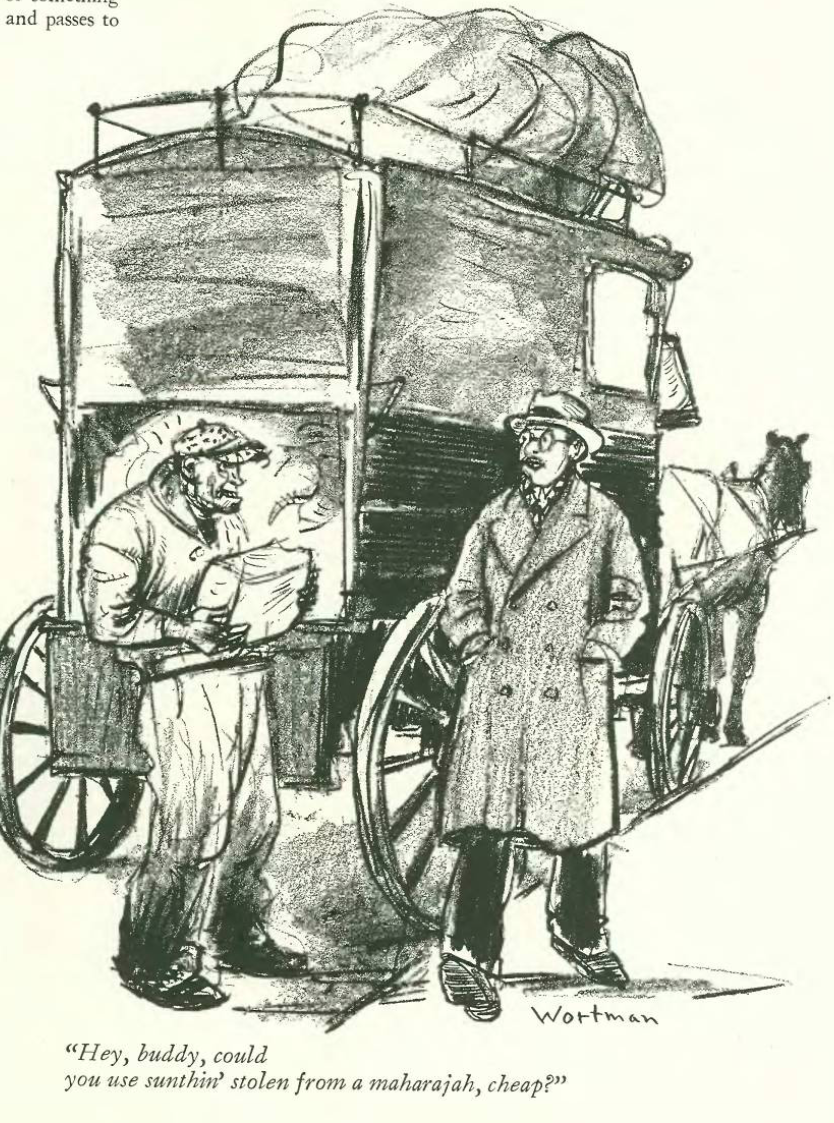
…likewise Denys Wortman…
…and Perry Barlow…
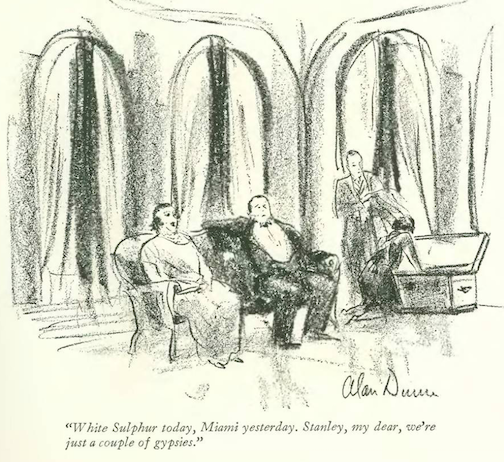
…while Alan Dunn checked in on the challenges of those who still had means…
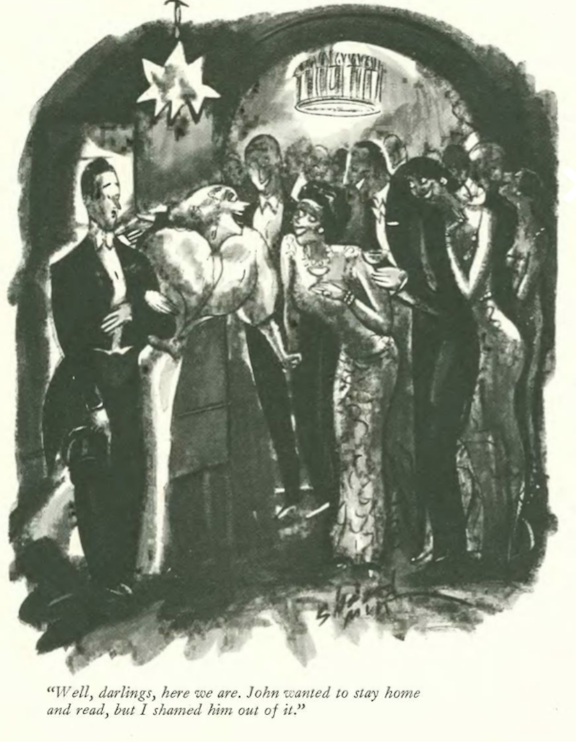
…Barbara Shermund was still the life of the party…
…and William Steig was beginning to establish himself in the stable of cartoon regulars (and offer a preview of his famed “Small Fry”)…
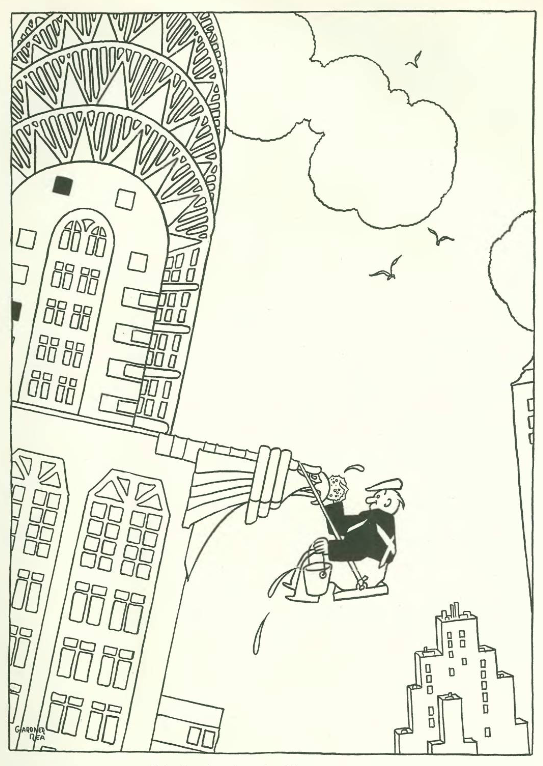
…and finally, a new perspective on the Chrysler Building, from Gardner Rea…



















































































































 A New Yorker State of Mind