Meet Father Divine

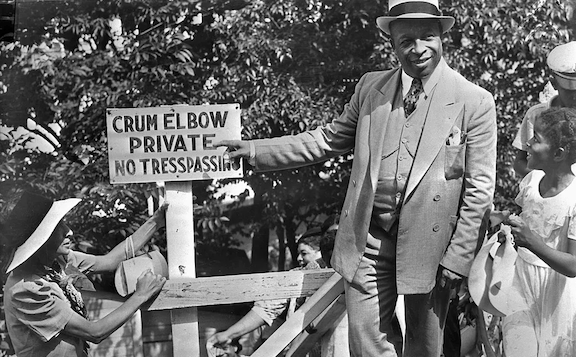
Above: Father Divine points to a Crum Elbow Estate sign (in Highland, NY) in July 1938. His followers purchased the 500-acre spread from anti-New Dealer Howland Spencer...the property was located directly across the Hudson from President Franklin D. Roosevelt's Hyde Park family home. That same summer Father Divine would also buy a fifty-room double dwelling in New York City. These and other locations served as integrated "heavens" for his followers. (Wikimedia Commons)

America has long been fertile ground for various religious denominations, sects and cults. Although the U.S. Religion Census has cataloged more than 370 distinct religious groups and bodies in the U.S., there are tens of thousands of independents scattered across the country.

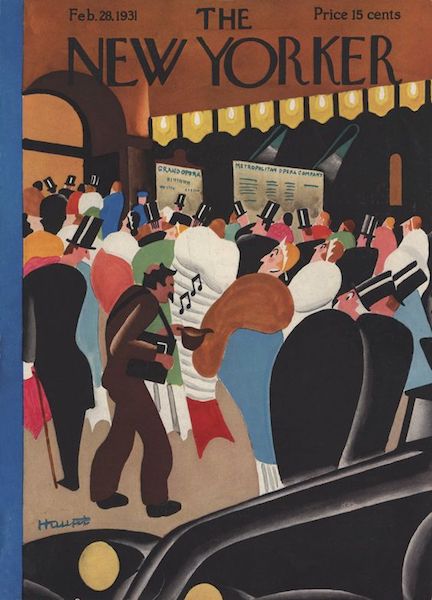
June 13, 1936 cover by Leonard Dove.

Some of these remain small, while others grow into megachurches often organized around a charismatic leader. Such was the case with Father Divine (1876–1965), aka Reverend Major Jealous Divine, aka George Baker.

His life as George Baker of Valdosta, Georgia came to an end in 1907 when he became known as “the Messenger.” He parted ways with the Baptist church, declared himself a god, and was asked to leave Georgia after his 1914 arrest for lunacy. He led his followers to Brooklyn and later to a commune in Sayville, New York (Long Island), where he founded the International Peace Mission movement and came to be known as Father Divine. By the early 1930s his small and predominantly black congregation had grown into a multiracial and international church.

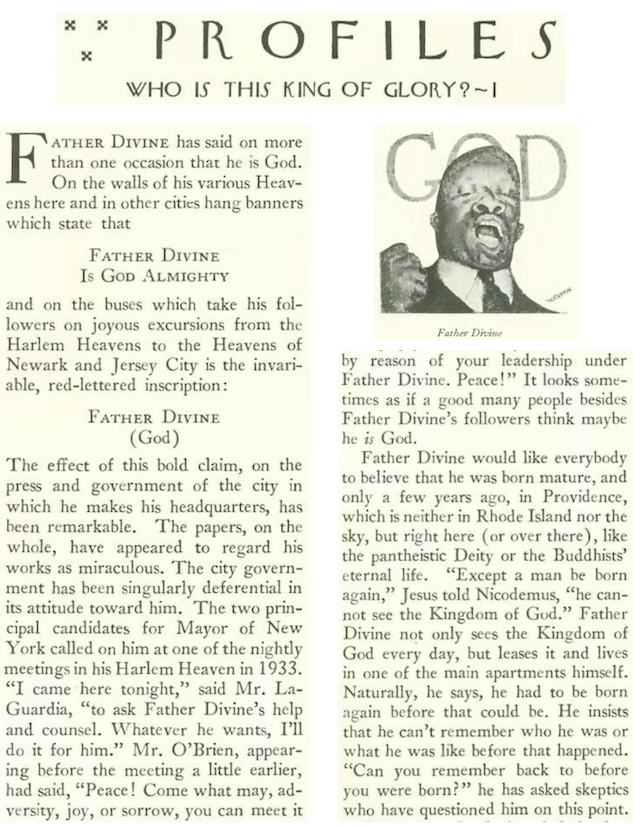
So intriguing was his story that The New Yorker published a lengthy, three-part profile written by St. Clair McKelway and A.J. Liebling. Here are excerpts from Part One (illustration by William Cotton):
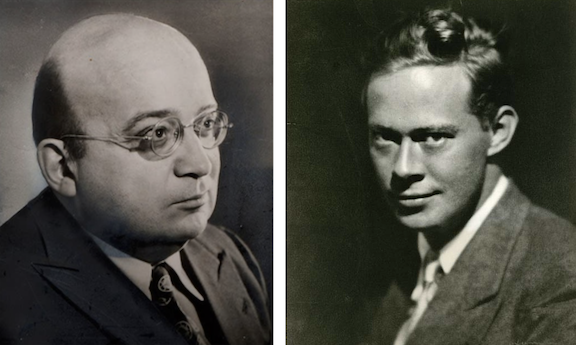
A DEFT DUO…A.J. Liebling (left) and St. Clair McKelway, both acclaimed journalists, co-authored the three-part profile of Father Divine. Liebling (1904–1963) was closely associated with The New Yorker, joining the magazine in 1935 (he was also a well-known gastronome); McKelway (1905–1980) served as The New Yorker’s managing editor for journalistic contributions from 1936 to 1939 and wrote for the magazine for forty-seven years. (Wikipedia/sfgate.com)
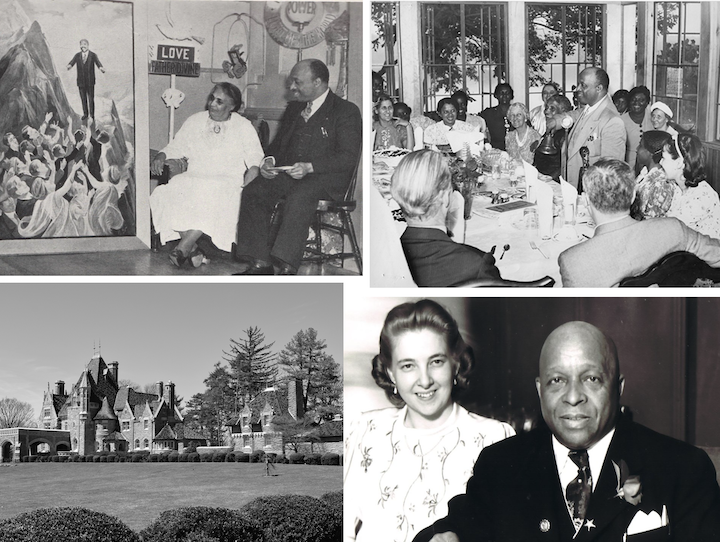
DIVINE’S PATH…Clockwise, from top left: After relocating to Brooklyn in 1914, Father Divine married his first wife, Peninniah—they are shown here admiring his portrait; Father Divine led large gatherings centered on food—here he entertains guests at a summer retreat in upstate New York in 1938; following the death of Peninniah, the 70-year-old Father Divine married 21-year-old Edna Ritchings in 1946—she took the name “Mother Divine, with Father Divine claiming she was the reincarnation of Penninah; in 1953 Father Divine was given a hilltop estate (“Woodmont”) in Gladwyne, Pennsylvania, by follower John Devoute. The estate is the center of the International Peace Mission movement, a shrine to Father Divine’s life, and a meeting place for the few remaining followers. (thecityroot.com/Newark Public Library/hsmcpa.org/Wikipedia)

How did Father Divine come to believe he was a god? This excerpt offers some insights into his early development:
One of the perils of this kind of thinking is that it can lead to the formation of dangerous cults. Jim Jones, the notorious leader of the Peoples Temple, heavily modeled his early church activities and authoritarian structure on Father Divine’s example. Jones even attempted to take over the International Peace Mission after Father Divine’s death—in 1971 he tried to convert the Peace Mission’s followers, claiming he was the reincarnated Father Divine. His takeover attempt was thwarted by Mother Divine, who went to the media and publicly denounced Jones and the Peoples Temple. In 1974 Jones and his followers would relocate to a Guyana commune he called Jonestown. Four years later Jones would lead the mass murder-suicide of 909 Jonestown inhabitants.
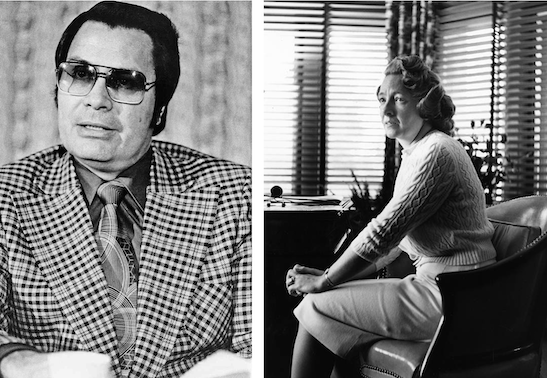
AT ODDS…Jim Jones (left, circa 1970) attempted to take over the International Peace Mission after Father Divine’s death, but was publicly denounced by Mother Divine. At right, Mother Divine giving her first interview following the death of Father Divine in 1965. (Wikipedia/temple.edu)

 * * *

At the Movies

The media has always thrived on crime stories, feeding the public’s insatiable desire to be tantalized; once sated, they often demand swift justice. Take the heavily publicized 1933 case of two San Jose, California men who were accused of kidnapping and murdering a department store heir. Rather than wait for justice to be served, an angry mob broke into the jail and lynched the accused. Fascinated by the story, MGM screenwriter Norman Krasna pitched it as a potential film.

That film would become Fury, German director Fritz Lang’s first American project. Prior to fleeing the Third Reich in 1933, Lang was perhaps best known to Americans for his pioneering 1927 silent sci-fi film Metropolis and the 1931 thriller M. Lang sought to demonstrate how a decent and civilized man could become filled with vengeance and hate. Although critic John Mosher could see how the film had been tampered with by studio execs (and the Hays Code), he was nevertheless impressed by Lang’s direction and by the performances of lead actors Sylvia Sidney and Spencer Tracy.
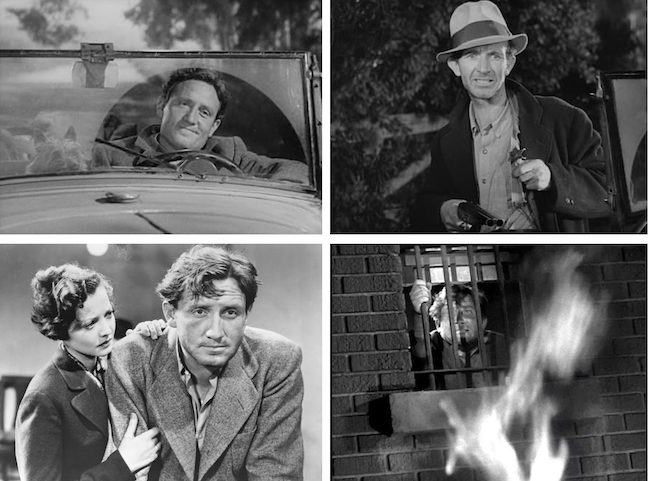
WRONG TURN…Clockwise, from top left: In Fury, Spencer Tracy played gas station owner Joe Wilson, who drives west to reunite with his fiancée—the dog seated to his right is Terry, the same Cairn Terrier who played Toto in The Wizard of Oz; while camping outside a small town, Joe is arrested by a creepy local deputy (Walter Brennan) on suspicion of kidnapping a child; a mob forms and tries to burn Joe in his cell; in the confusion of the fire he escapes and seeks vengeance on the mob, but in the end finds peace with his fiancée (Sylvia Sidney). (imdb.com)

Peter Lorre, who was famously directed by Fritz Lang in the 1931 German thriller M, was starring in Alfred Hitchcock’s Secret Agent, which also featured John Gielgud (already famous as a London stage performer), Madeline Carroll, and Robert Young.
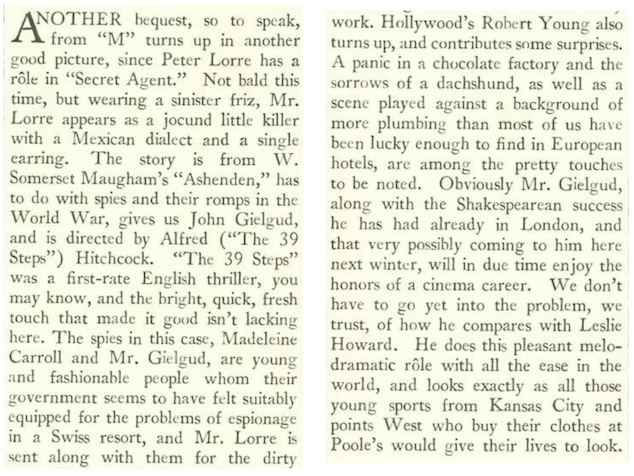
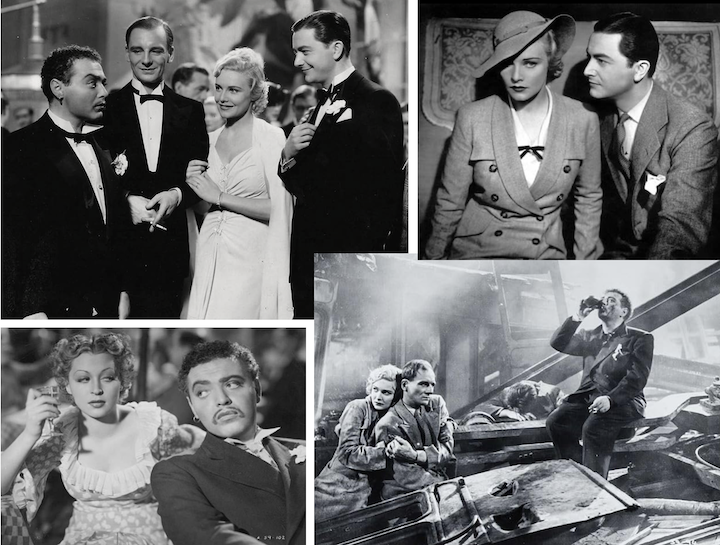
SECRETS AND LIES…Clockwise from top left: Peter Lorre, John Gielgud, Madeline Carroll, and Robert Young in Secret Agent; Carroll with Young, who played a German mole; Carroll, Gielgud and Lorre amid the wreckage of a train; Lorre in a scene with Lilli Palmer. (imdb.com)

Mosher briefly mentioned a new Fred MacMurray/Carole Lombard comedy–mystery, and the return of two silent movie stars.
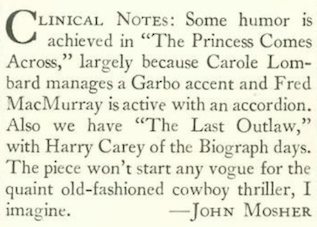
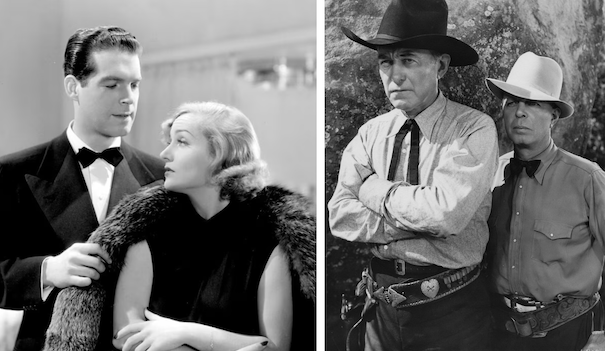
CHOOSE YOUR PARTNER…The second of four films Fred MacMurray made with Carole Lombard between 1935 and 1937, The Princess Comes Across featured Lombard doing a clever take-off on Greta Garbo; silent-film veterans Harry Carey and Hoot Gibson stood for the ideals of the Old West in a culture clash with scientific crime-fighting in The Last Outlaw. The film was a remake of a 1919 silent film originally written and directed by John Ford. (imdb.com/csfd.cz)

* * *

Beer Bottle Battle

E.B. White (in his “Notes and Comment”) seized on the battle between bottle and can manufacturers as an apt metaphor for the jousting of Republicans and Democrats ahead of the November elections.
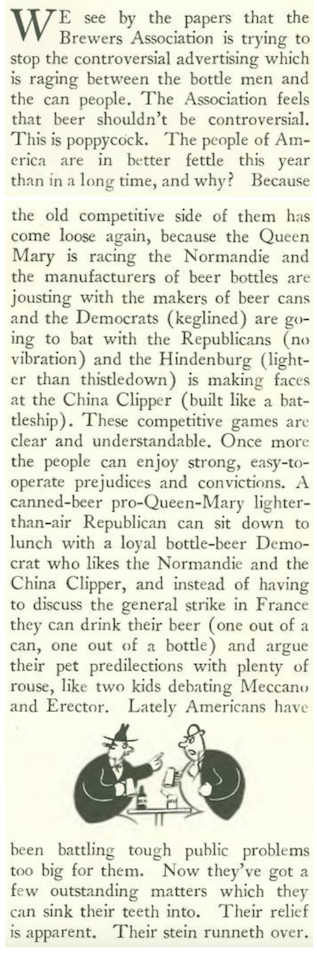
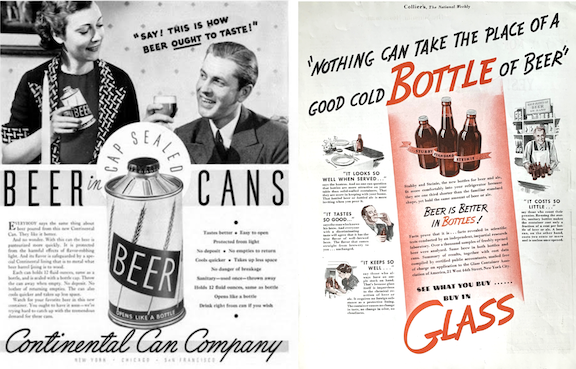
FOAMING AT THE MOUTH…Competing ads from Collier’s magazine circa 1935-36 illustrate the battle between can and bottle manufacturers. Ninety years later, beer drinkers still debate the merits of glass over cans. (boakandbailey.com/ebay.com)

 * * *

From Our Advertisers

In 1936 whisky was still firmly in bottle form, and the makers of Canadian Club—through a series of ads—wanted to let us know you could enjoy their tipple almost anywhere in the world…
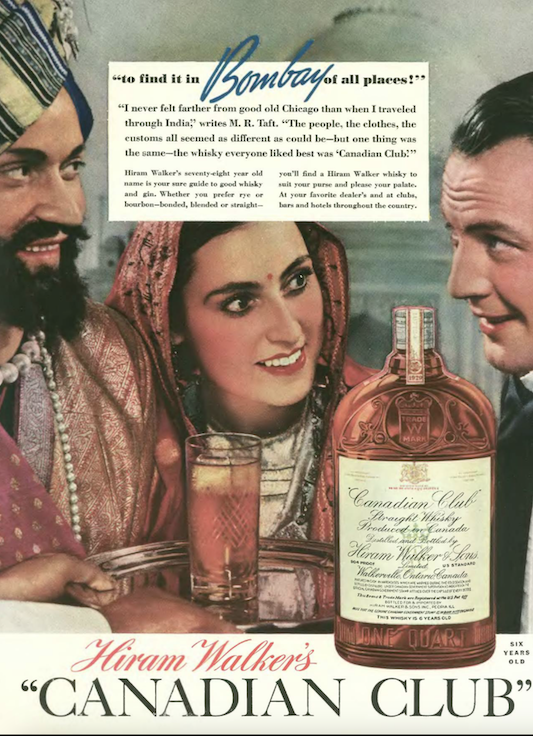
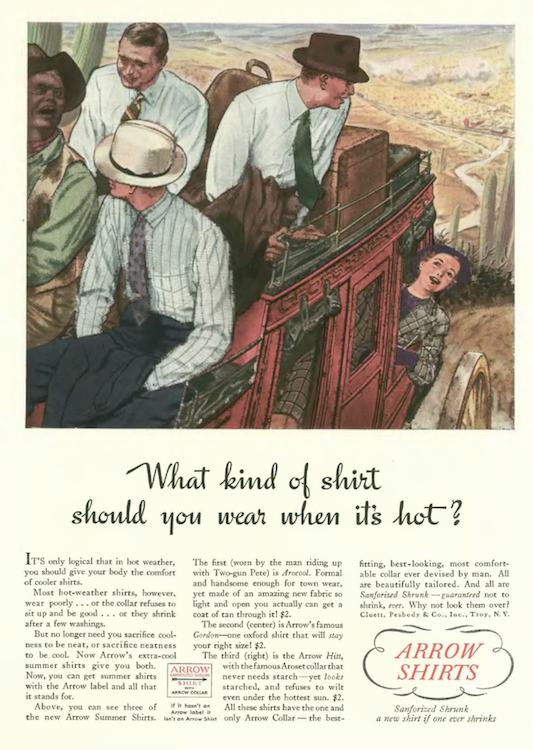
…this woman poses an interesting question, considering the fellas are riding atop a dusty stagecoach in the Arizona heat—in formal attire no less…
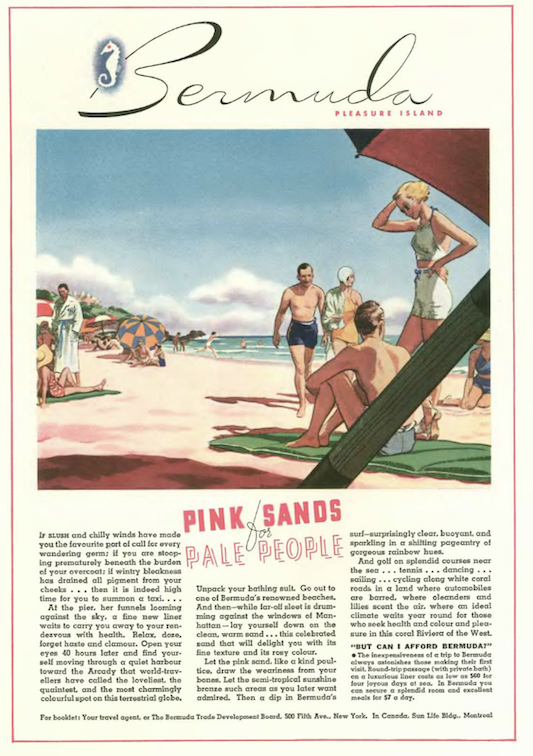
…over the years we’ve seen a lot of Adolph Teidler’s work for the Bermuda Board of Trade…Teidler (1886–1981) was also well known for his Saturday Evening Post covers…
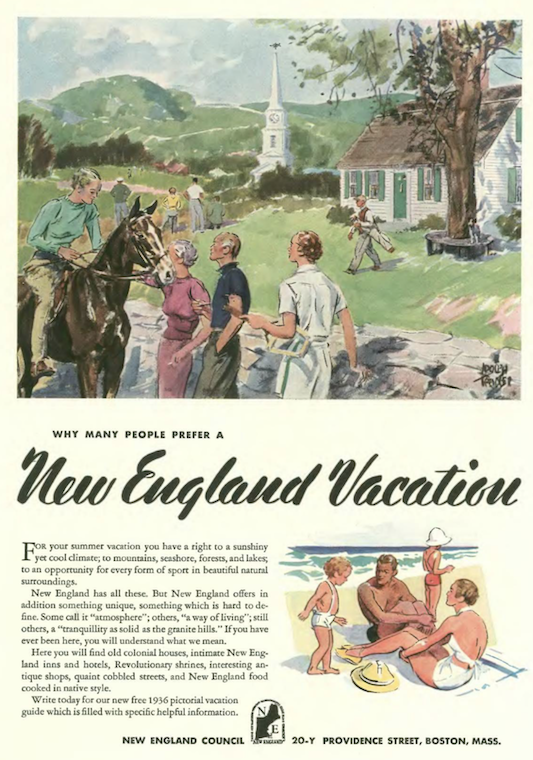
…here’s an example of Teidler’s work for the Bermuda Board of Trade from the Feb. 22, 1936 issue of The New Yorker

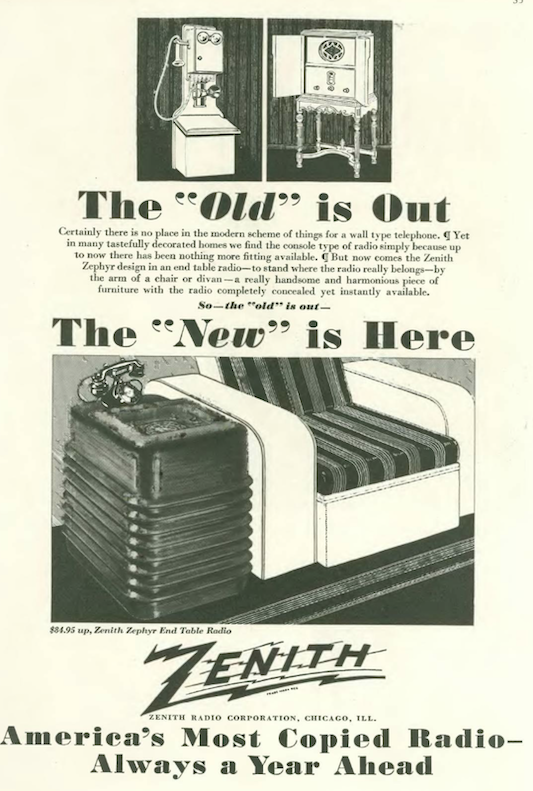
…the Zenith Radio Corporation touted their modern, streamlined “Zephyr” radio by industrial designer Robert Davol Budlong

A restored Zenith 10-S-147 Zephyr chairside radio. (Pete Johnson–Zenith Radios Enthusiasts and Collectors via Facebook.com)

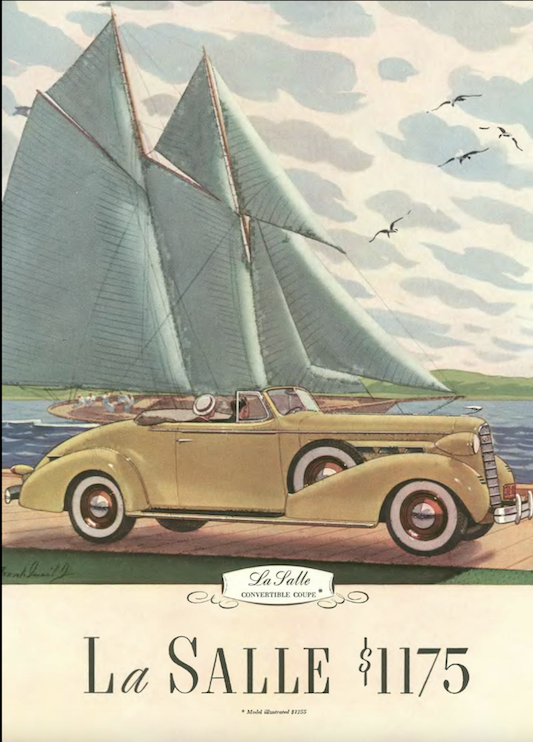
Frank Quail Jr was a prominent automotive illustrator active from the 1920s through the 1930s. He was well-known for his work with luxury automobile brands such as Cadillac, LaSalle and Packard…here he conjures up a breezy seaside image for Cadillac’s more affordable LaSalle model (most of these ads were two-page spreads, with promo copy on the right-hand page)…
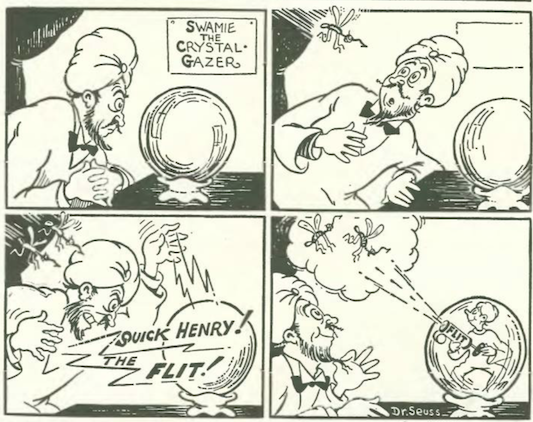
…and more Dr. Seuss on behalf of Flit insecticide…
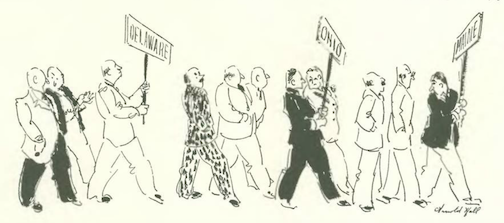
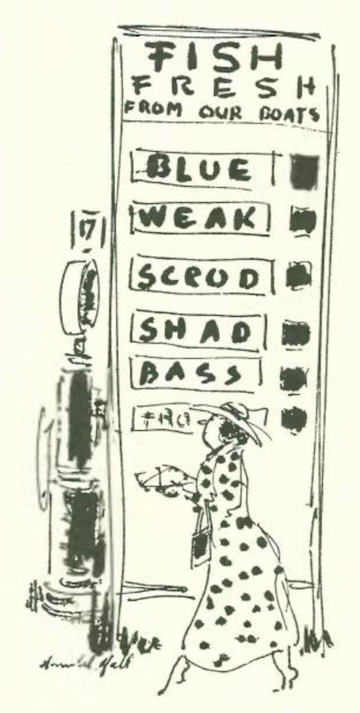
…we begin the cartoon section with some spot art…here are two by Arnold Hall

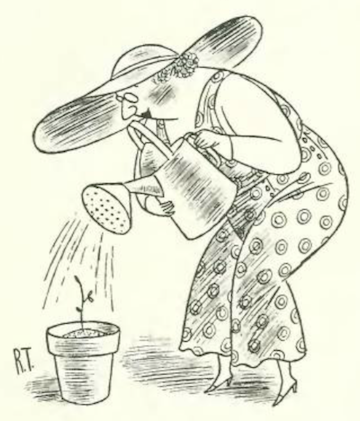
…and one from Richard Taylor

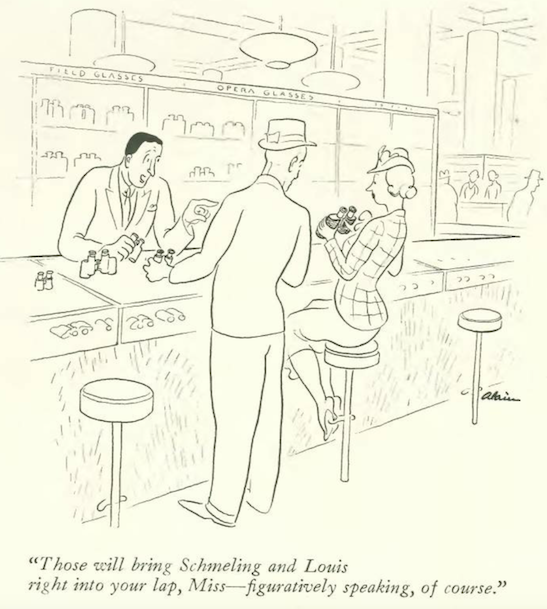
Alain referenced the upcoming heavyweight bout at Yankee Stadium between Max Schmeling and Joe Louis…their two fights in 1936 and 1938 were international sensations…
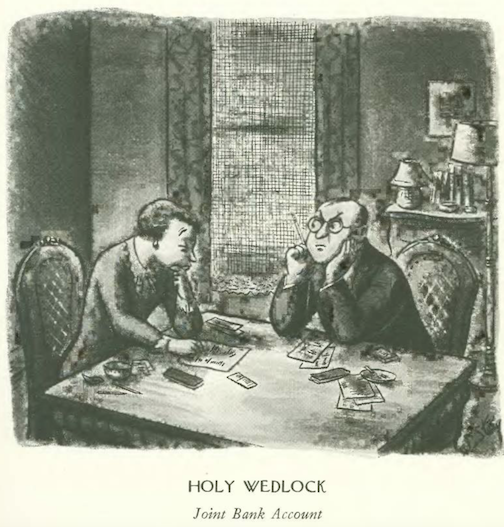
…more glimpses of “Holy Wedlock” from William Steig

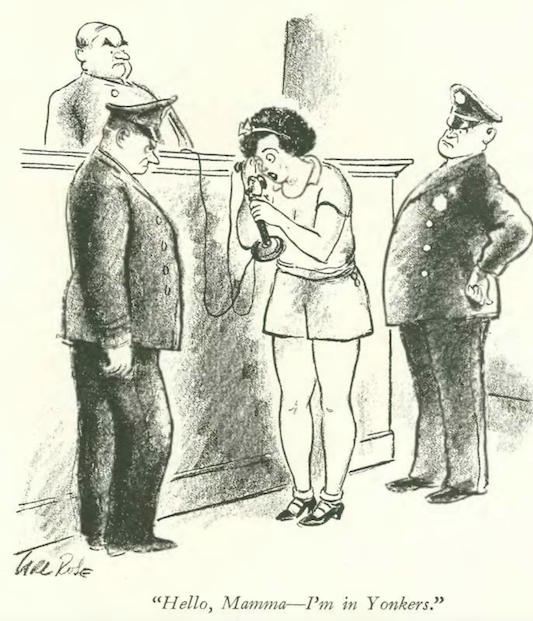
…a bit of trouble in Yonkers, per Carl Rose

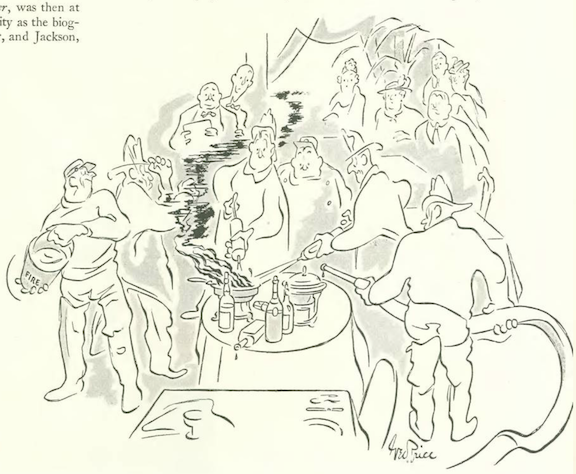
George Price brought out the fire brigade for the Crêpes Suzette

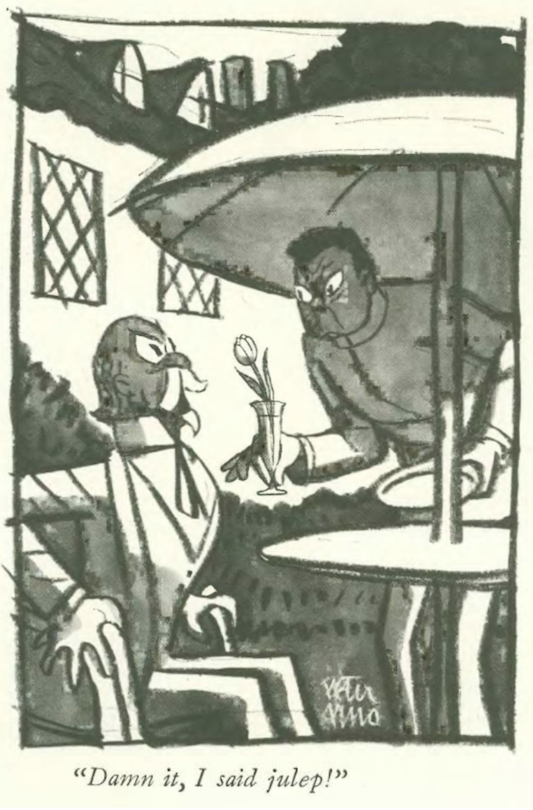
Peter Arno drew up a colonel with a communication issue…
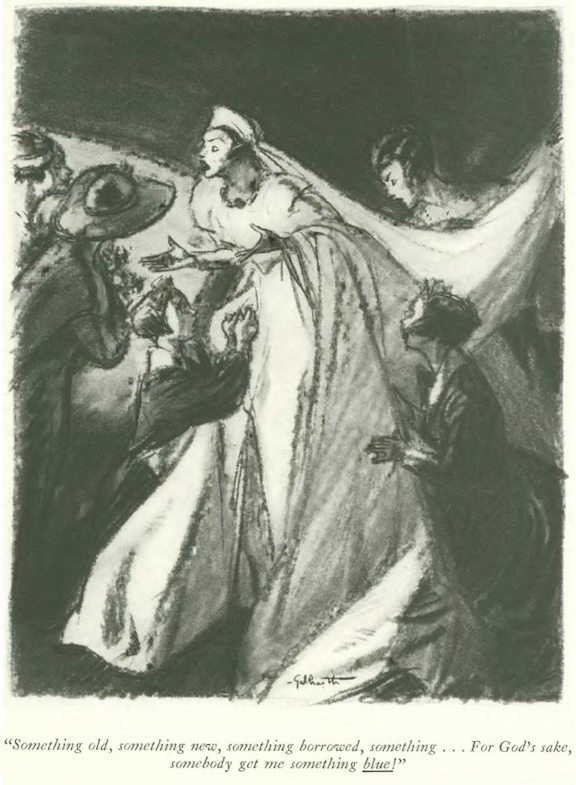
William Crawford Galbraith celebrated the June bride…
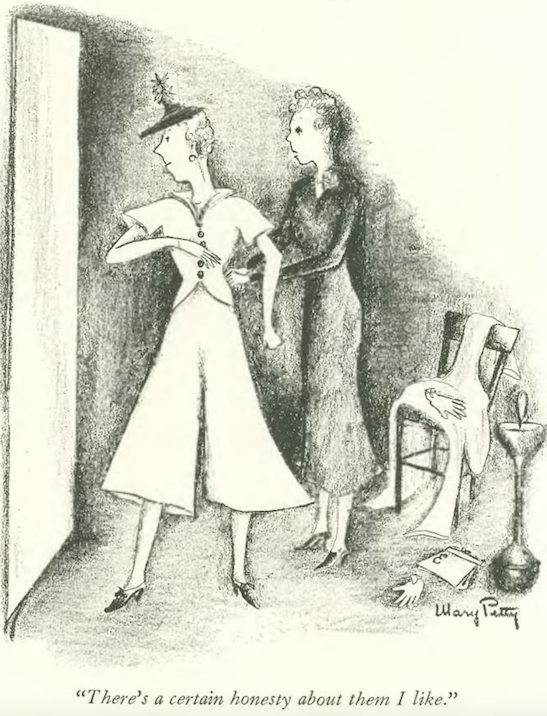
…two by Mary Petty, at the dress shop…
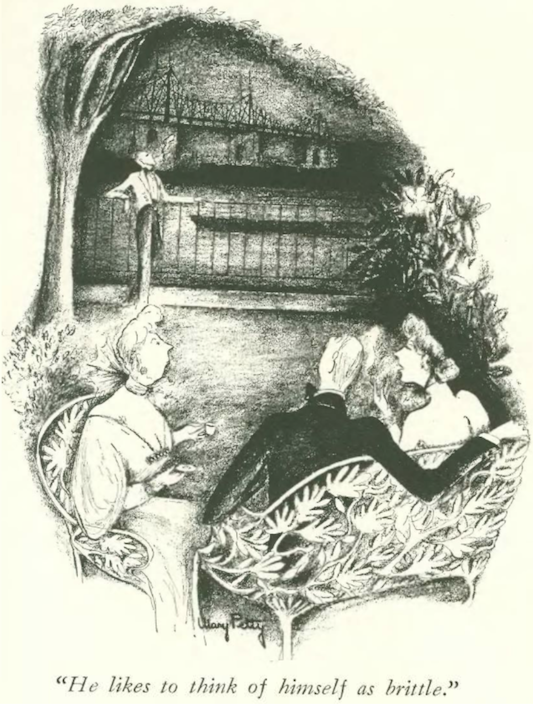
and at the in-laws…
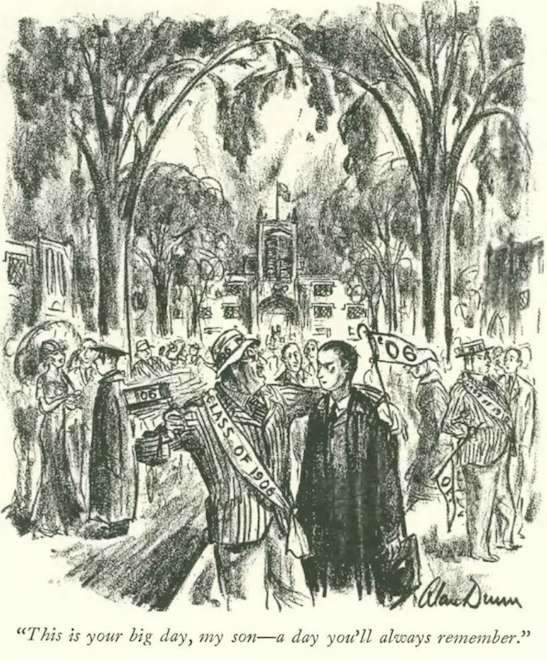
…Petty’s husband Alan Dunn feted the Class of ’36 (and ’06)…
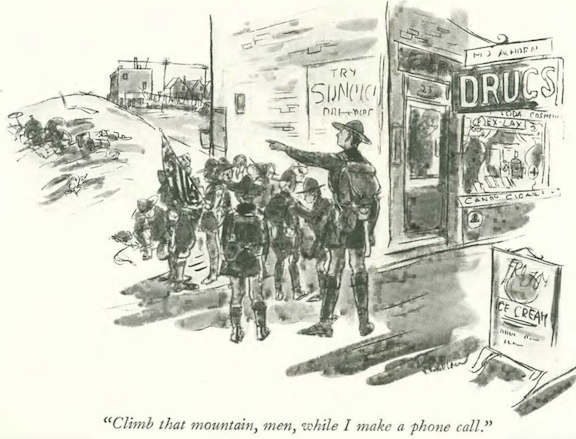
Perry Barlow illustrated a scoutmaster’s leadership skills…
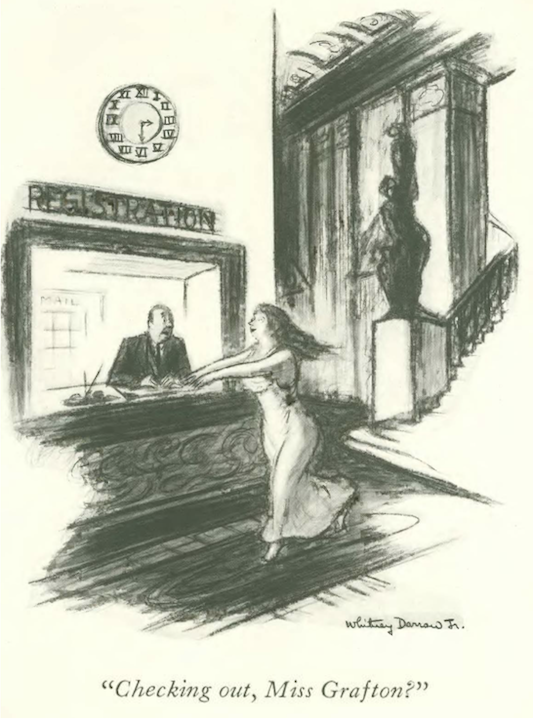
…and we check out with Whitney Darrow Jr

Next Time: An Urban Spectacle…
 

Super Tramp

The late film critic Roger Ebert once observed that “if only one of Charles Chaplin’s films could be preserved, City Lights would come the closest to representing all the different notes of his genius.”

Feb. 21, 1931 cover by Rea Irvin, marking the New Yorker’s sixth anniversary.

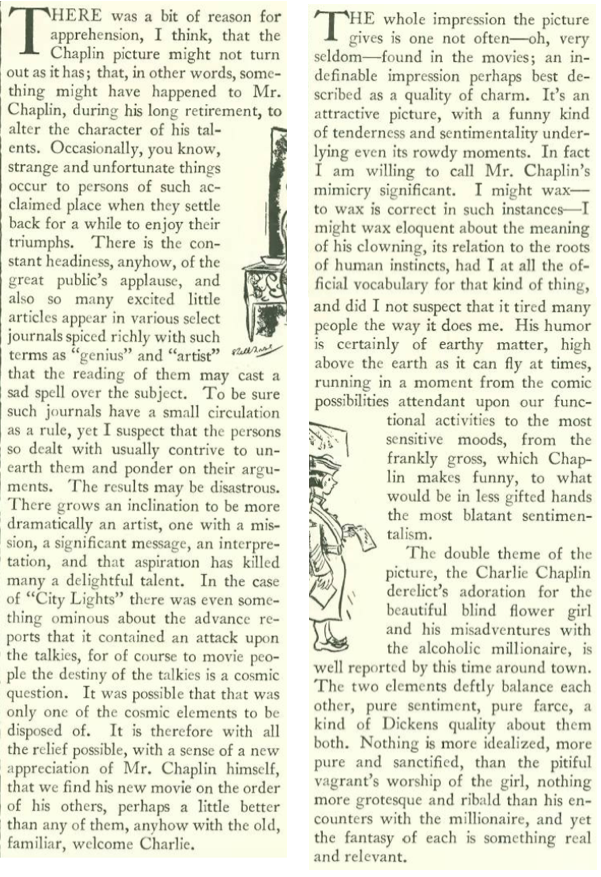
The New Yorker’s film critic in 1931, John Mosher, would have agreed. Before he previewed the picture, however, Mosher feared (along with others) that the great actor and director had seen his best days…

…instead, the film proved a hit with both audiences and critics, and today is regarded as one of the greatest films ever made. It was no doubt a relief to Ebert when the film was selected by the Library of Congress for preservation in the National Film Registry.

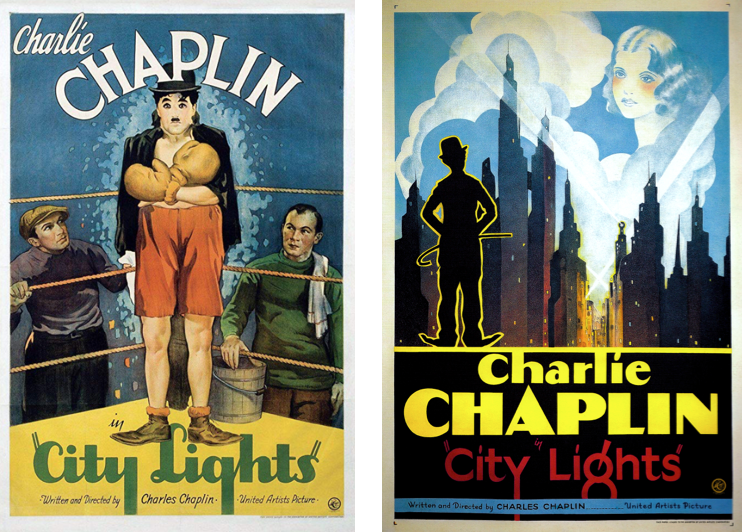
HE DOES IT ALL…United Artists issued several different types of posters to promote the film, including these two. (IMDB)
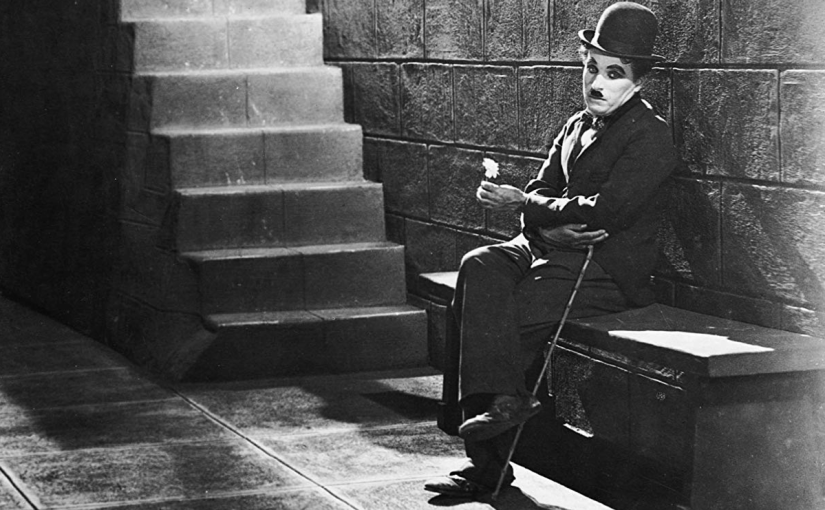
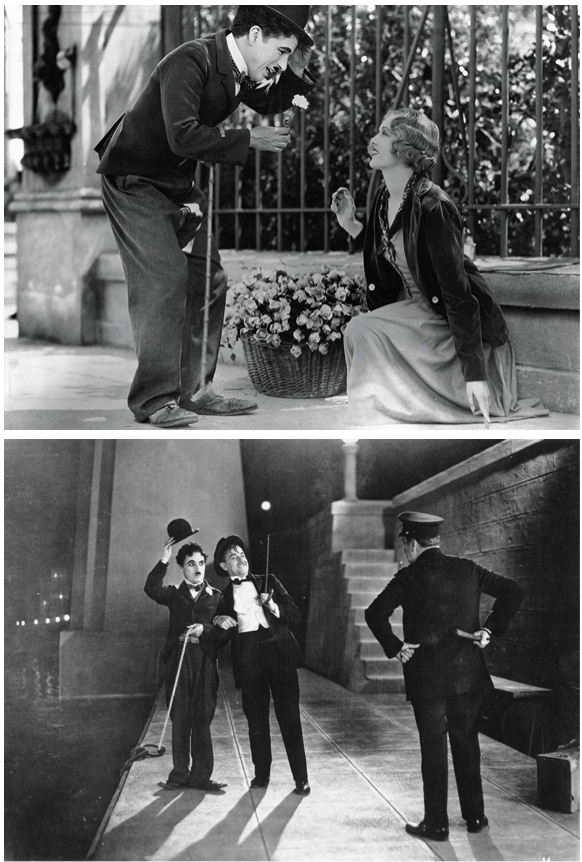
A TENDER FELLOW…The Tramp (Charlie Chaplin) encounters a blind flower girl (Virginia Cherrill) on a street corner and is instantly smitten; later that evening the Tramp saves a drunken millionaire (Harry Myers) from suicide. (IMDB)

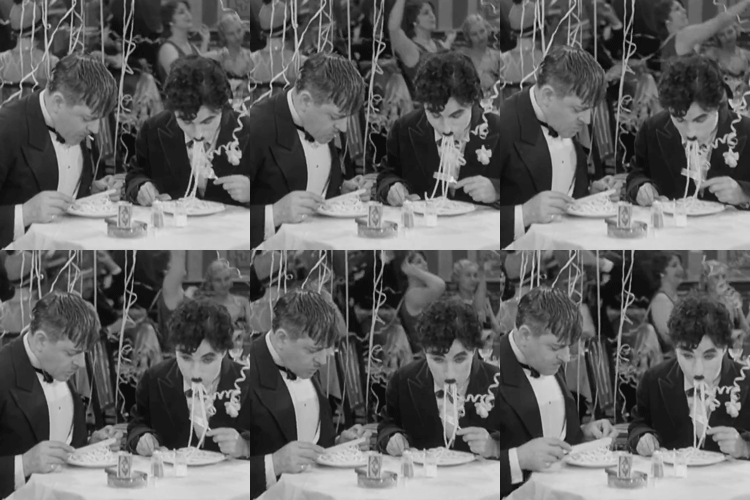
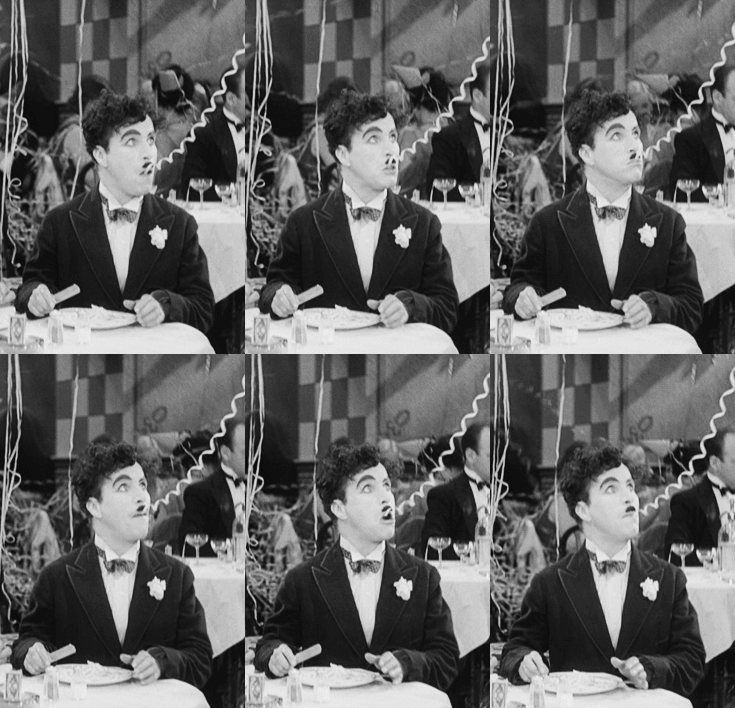
The film has its tender moments, but being a Chaplin production it also had plenty of slapstick, including this famous scene in which the Tramp and his millionaire friend go out on the town and dig into plates of spaghetti…and in the Tramp’s case, some confetti…

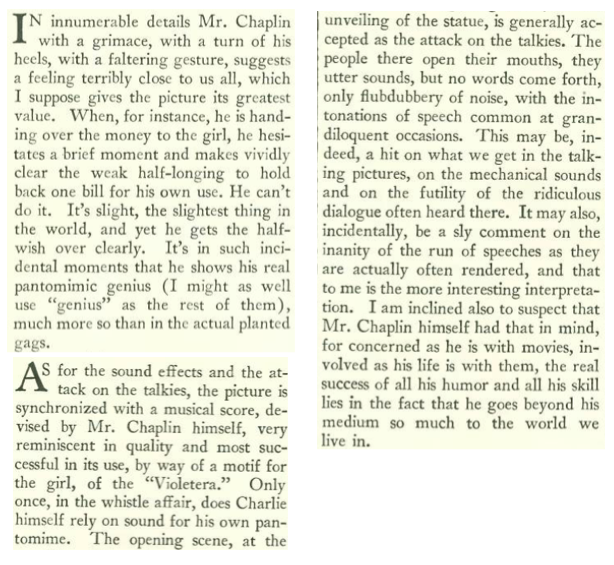
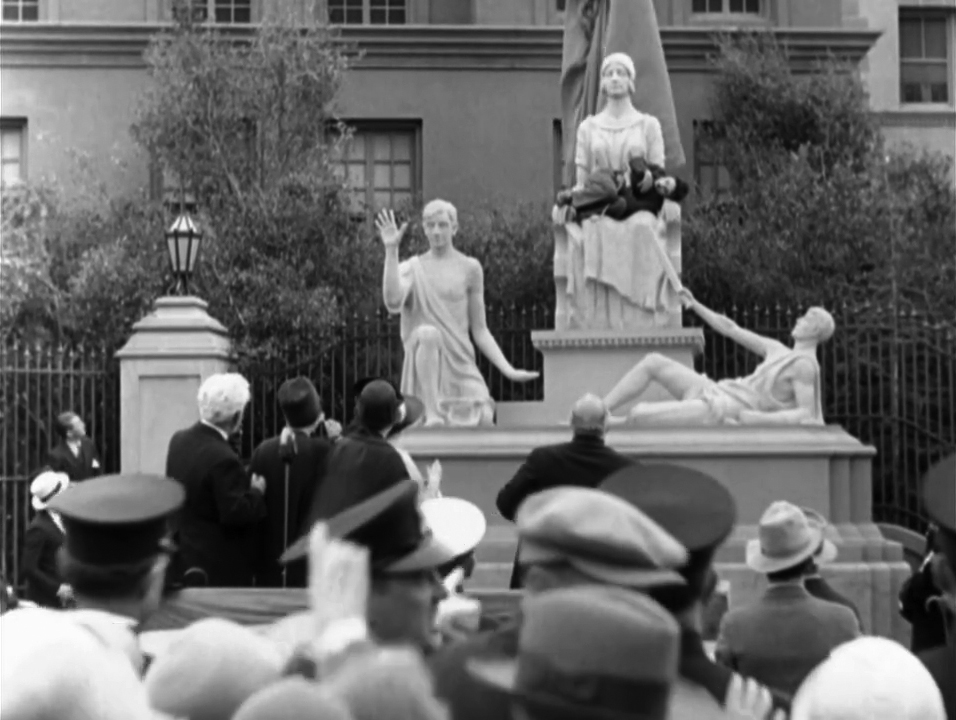
Mosher (and many other critics since) believe the opening scene of the film—in which a statue is unveiled to reveal a sleeping Tramp—was Chaplin’s attack on sound movies:

CAUGHT NAPPING…The Tramp is unveiled along with a statue in the opening scene of City Lights. (IMDB)

Although the film had a full musical score and sound effects, there was no spoken dialogue. Rather, Chaplin poked fun of the tinny-sounding talkies of the day by putting not words, but the sounds of a kazoo, into the mouths of speechifying politicians gathered at the statue’s unveiling…

For all its humor, City Lights was a serious work by a serious actor and director who sought something close to perfection. The scene in which the Tramp encounters a blind flower girl on a street corner required three hundred and forty-two takes with actress Virginia Cherrill, who was a newcomer to film.

Writing in The New Yorker, critic Richard Brody (“Chaplin’s Three Hundred and Forty-Two Takes,” Nov. 19, 2013) noted that “Chaplin didn’t have a mental template that he wanted Cherrill to match; he approaches the scene not quite knowing what he wanted.” Brody observed that the perfection Chaplin sought was one of results, and not of conformity to a preconceived schema. “He sought what provoked, in him, the perfect emotion, the perfect aesthetic response — but he wouldn’t know it until he saw it. He started to shoot in the confidence that the thing — whatever it was — would happen.” Chaplin’s technique can be seen in this clip from the Criterion Collection’s 2013 DVD release of the film. Note that this footage was shot by The New Yorker’s Ralph Barton, a close friend of Chaplin’s:

 *  *  *

Chaplin, Part Two

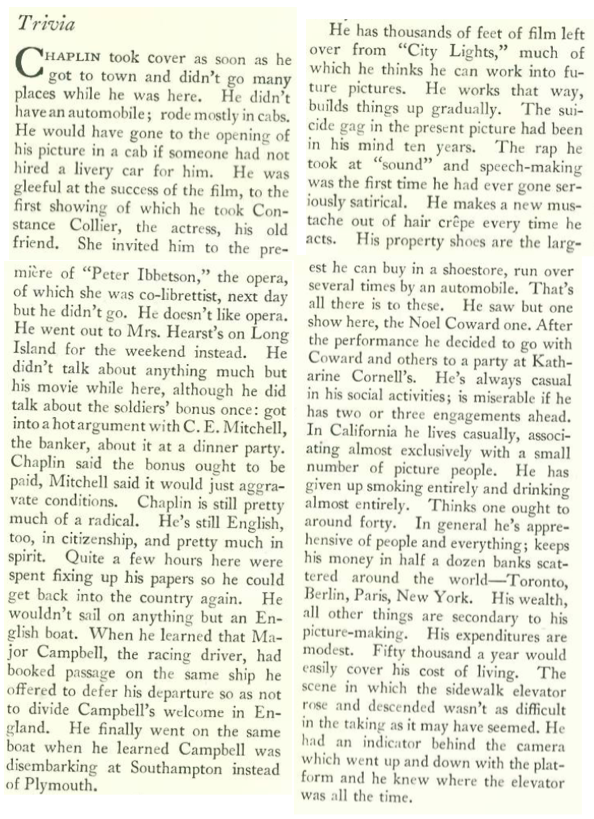
The Chaplin buzz was not confined to the movie section of the magazine, which featured more insights on the star in “The Talk of the Town.”

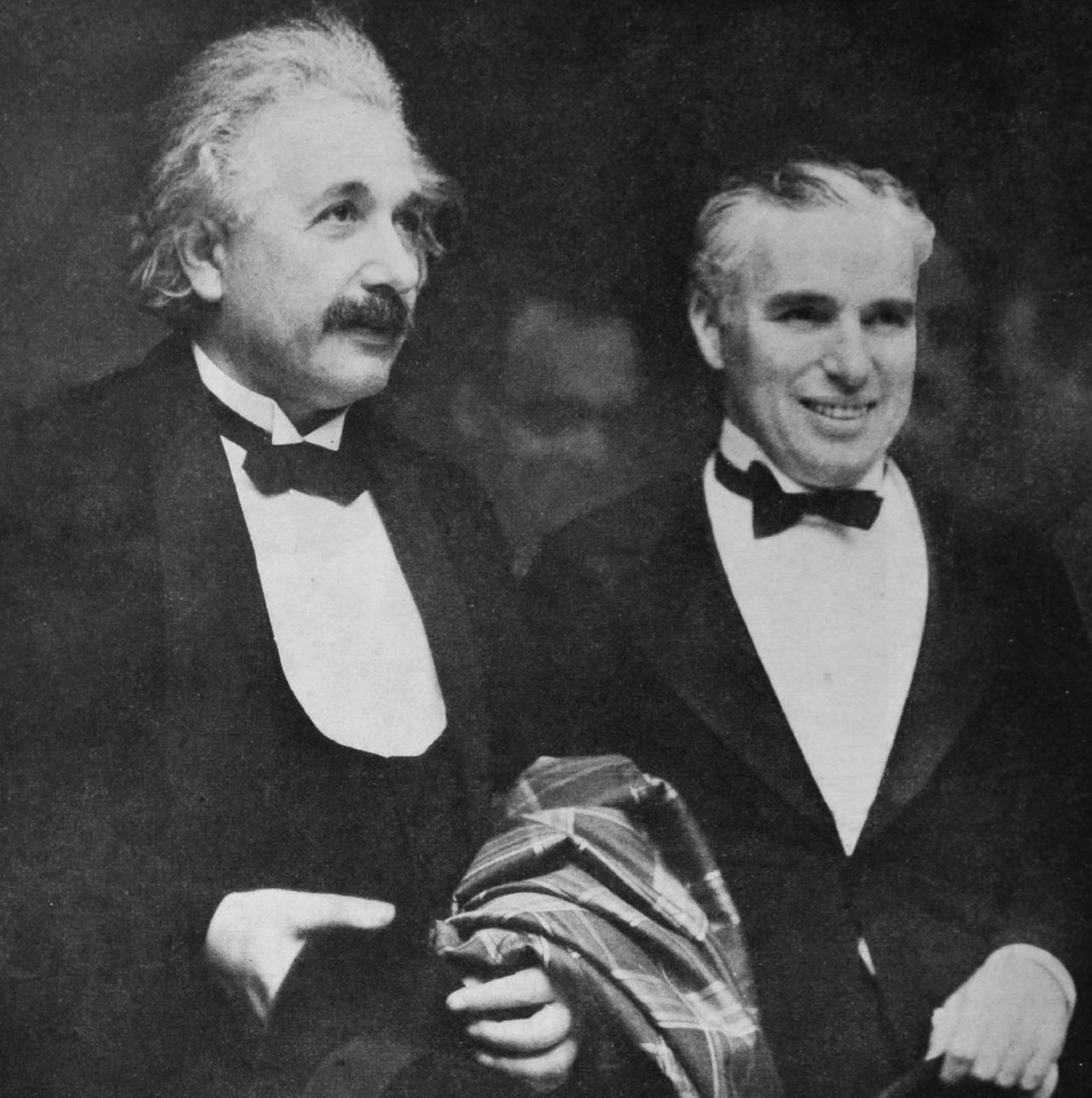
GENIUS LOVES COMPANY…Photo of Albert Einstein and Charlie Chaplin at the Los Angeles premiere of City Lights. Einstein said Chaplin was the only person in Hollywood he wanted to meet. (Wikipedia)

 *  *  *

Funny In a Different Way

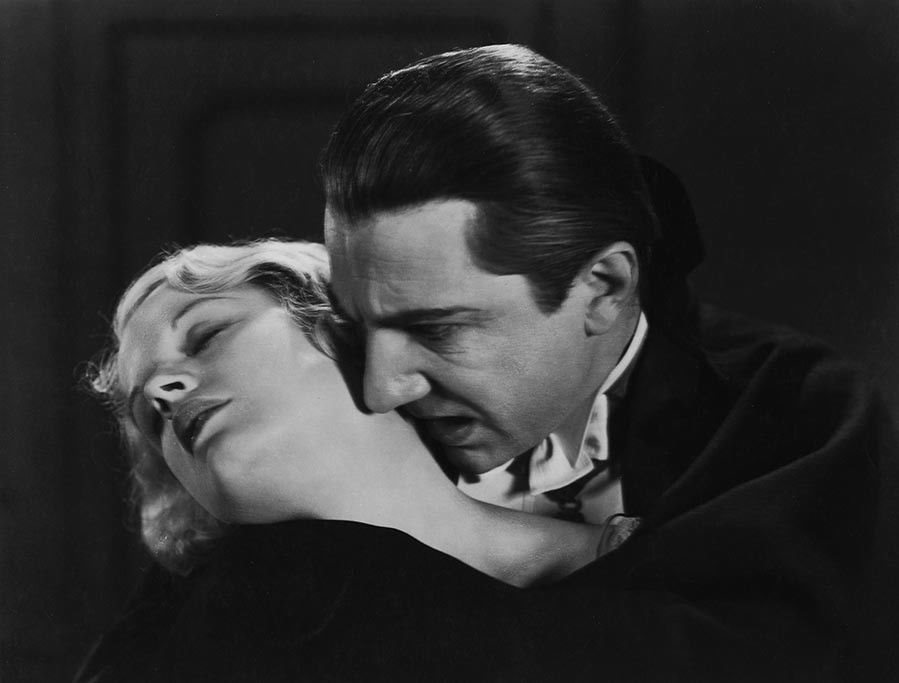
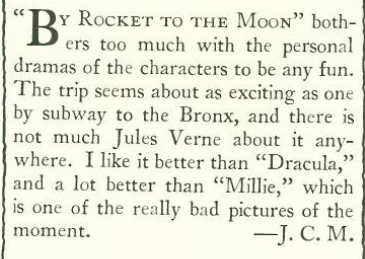
Like City Lights, Tod Browning’s Dracula is today considered a classic film. Indeed, Bela Lugosi’s timeless portrayal of the old bloodsucker set a standard for vampire flicks and horror films in general. The New Yorker’s John Mosher, however, would have none of it, dismissing the film in a single paragraph.

PAIN INTHE NECK…Count Dracula (Bela Lugosi) goes for a nibble on the fragile Mina (Helen Chandler) in 1931’s Dracula. (IMDB)

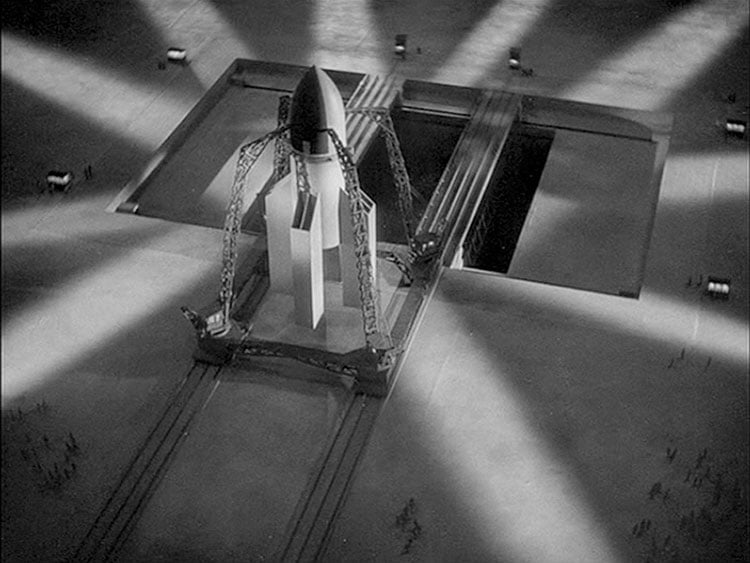
Mosher was also dismissive of Fritz Lang’s By Rocket to the Moon, originally released in German as Frau Im Mond (Woman in the Moon). The 1929 production is considered one of the first “serious” science fiction movies, anticipating a number of technologies that would actually be used in space travel decades later.

RETRO ROCKET…Fritz Lang’s Woman in the Moon would predict a number of technologies used decades later in actual space flight, including multi-stage rockets. Lang also anticipated the future in the much-acclaimed Metropolis (1927).

 *  *  *

Bored on Broadway

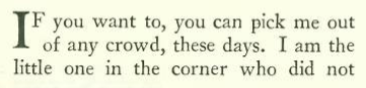
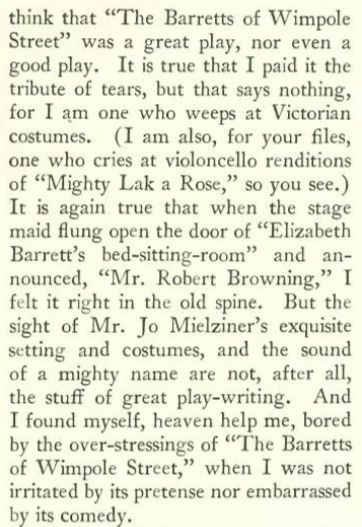
Robert Benchley was visiting friends abroad, so Dorothy Parker did what any pal would do and subbed for his theater column. As it turned out, it was not a happy task, even if she did receive complementary tickets to one of the hottest shows on Broadway:

Having dispatched Katharine Cornell’s Barretts of Wimpole Street, Parker took aim at America’s Sweetheart, based on a book by Herbert Fields with music and lyrics by Richard Rodgers and Lorenz Hart. Parker ended the savaging with a plea to her dear friend and colleague to return home soon:

THEY LAUGHED, THEY CRIED…Katharine Cornell (left) portrayed Elizabeth Barrett in Barretts of Wimpole Street. Dorothy Parker thought Cornell was a first-rate actress, but didn’t think much of her play. As for Inez Courtney (right) in America’s Sweetheart, Parker believed she did what she could, whatever that meant. (Pinterest)

*  *  *

Lest We Forget

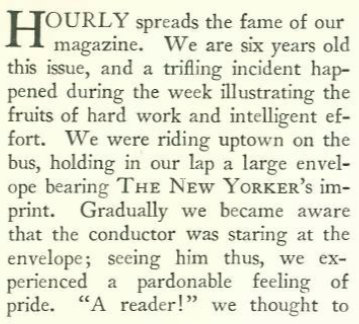
The New Yorker turned six with this issue, and in the life of any magazine, that is something to be celebrated, and especially in hindsight as our beloved publication closes in on its centenary in 2025. Some thoughts from E.B. White:

*  *  *

From Our Advertisers

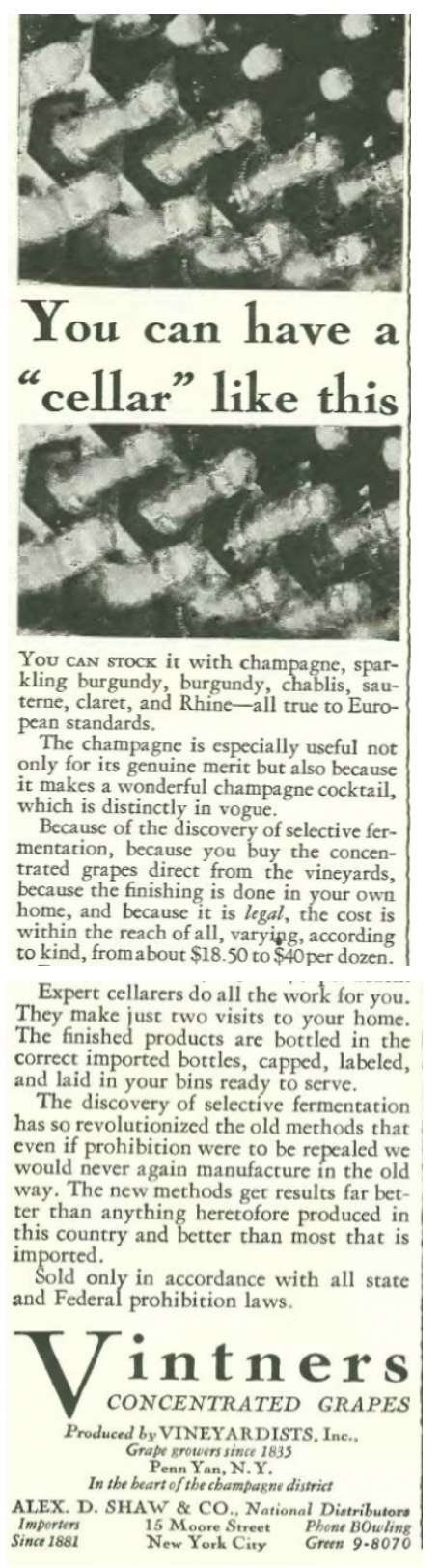
We’ve seen in past ads how Prohibition-era vintners marketed grape juice bricks that could be dissolved in water and fermented in the home. In this ad they took it a step further, sending expert cellarers direct to customers’ homes to help them create their own, perfectly legal, wine cellar…

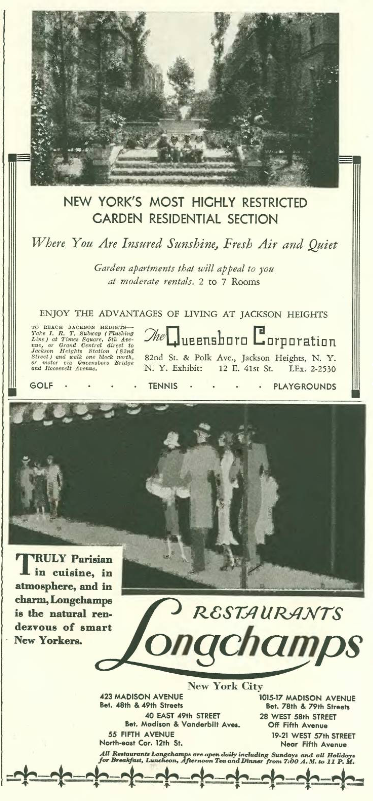
…those with wine cellars might have preferred to live in a “highly restricted” community in Jackson Heights…

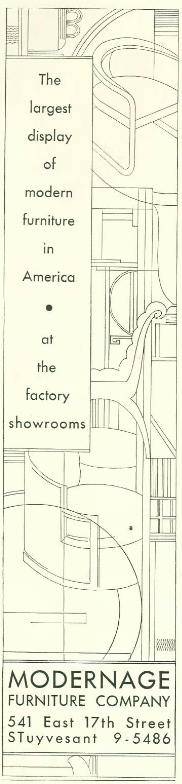
…and furnish their homes with the latest in modern furniture design…

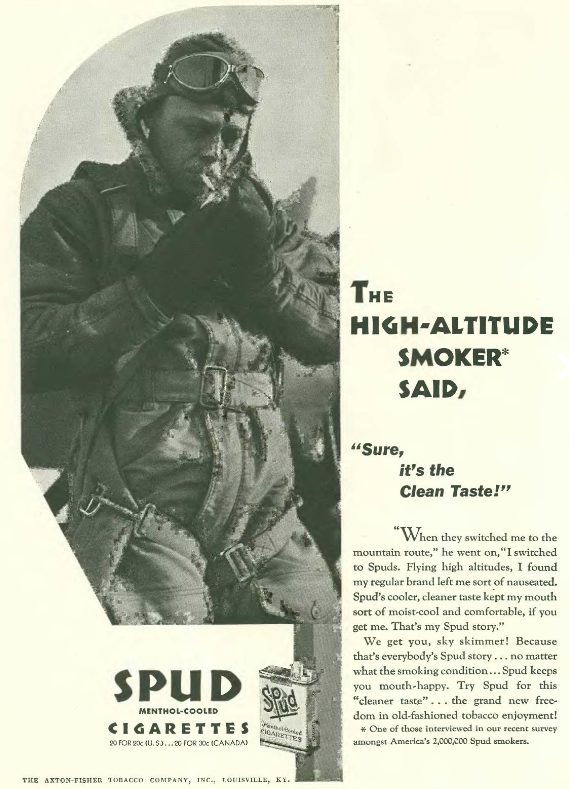
…and here we have an early example of the “macho” smoker, anticipating the arrival of his buddy, the Marlboro Man…

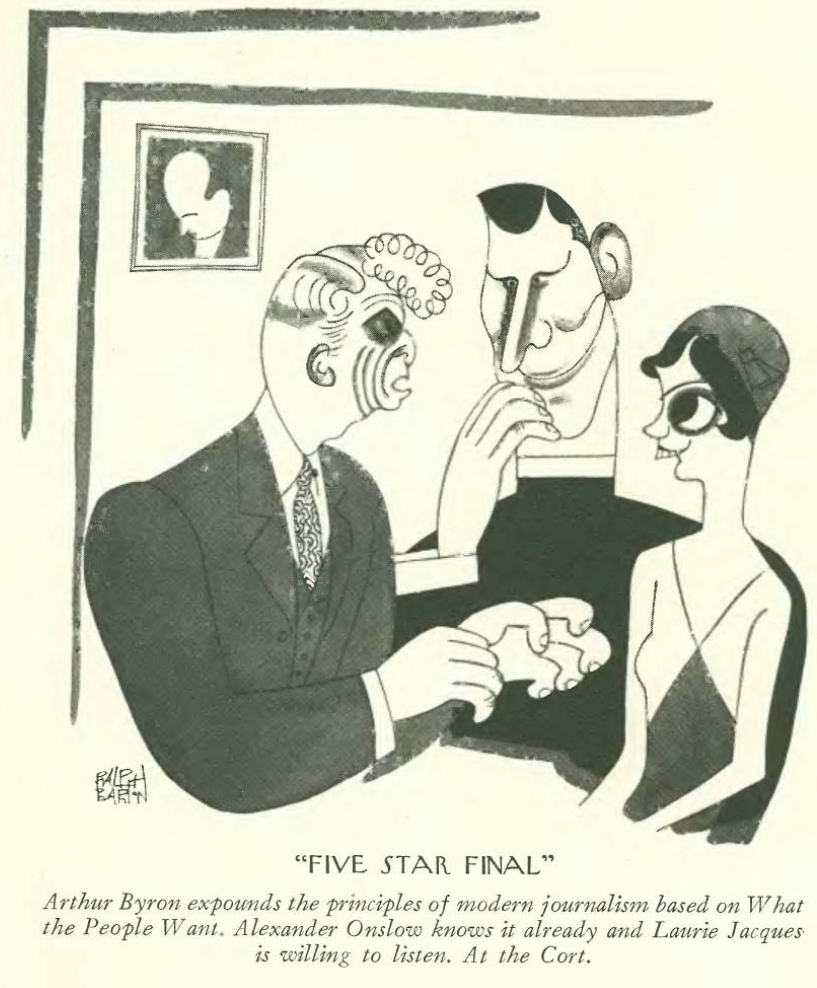
…on to our cartoonists, another theater section entry by one of Charlie Chaplin’s closest friends, Ralph Barton

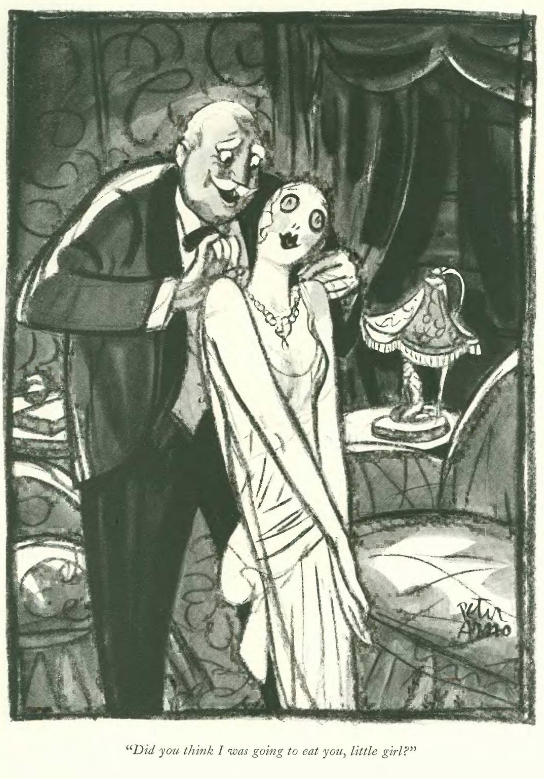
…and cartoons by Peter Arno, who channelled Dracula via his Sugar Daddy…

Garrett Price, and the burdens of the rich…

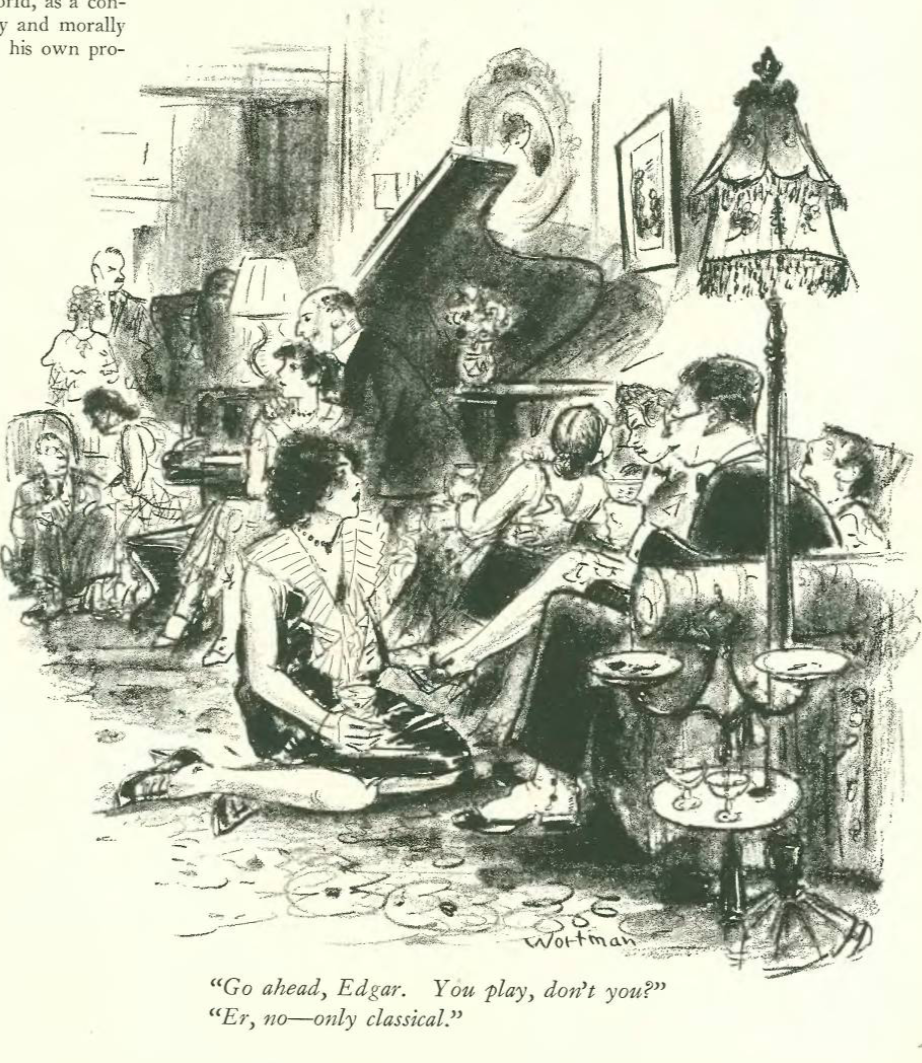
Denys Wortman examined the follies of youth…

…and we end with dear Helen Hokinson, and the miracle of birth…

Next Time: Chaplin of the Jungle…