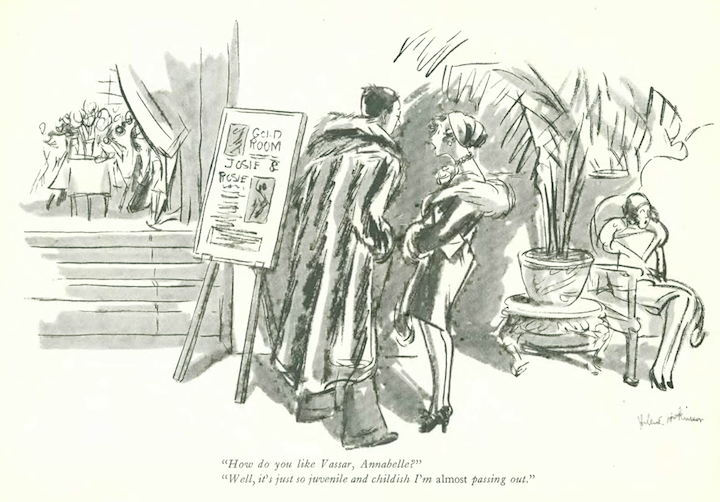
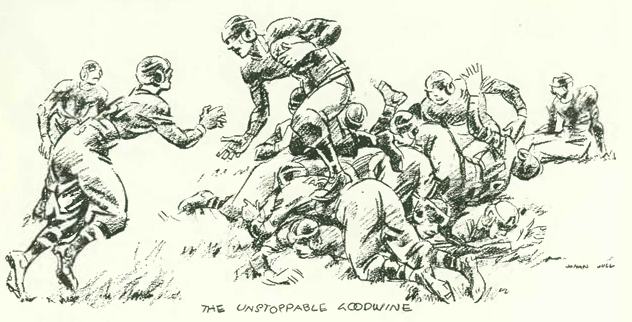
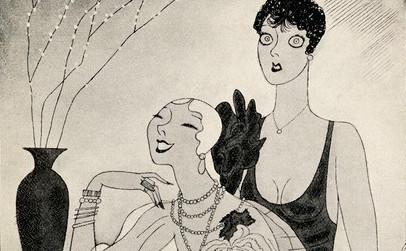
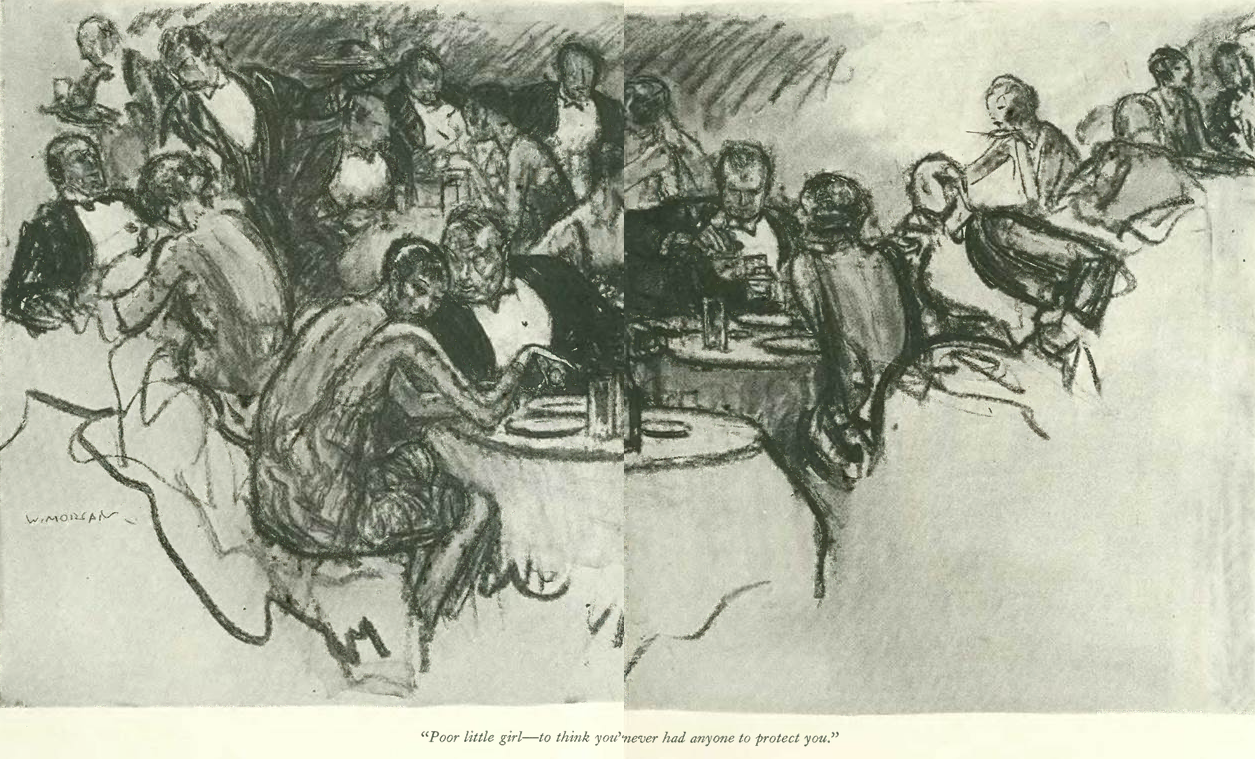
And finally, a cartoon by Rea Irvin exploring the trials of the idle rich:


And finally, a cartoon by Rea Irvin exploring the trials of the idle rich:
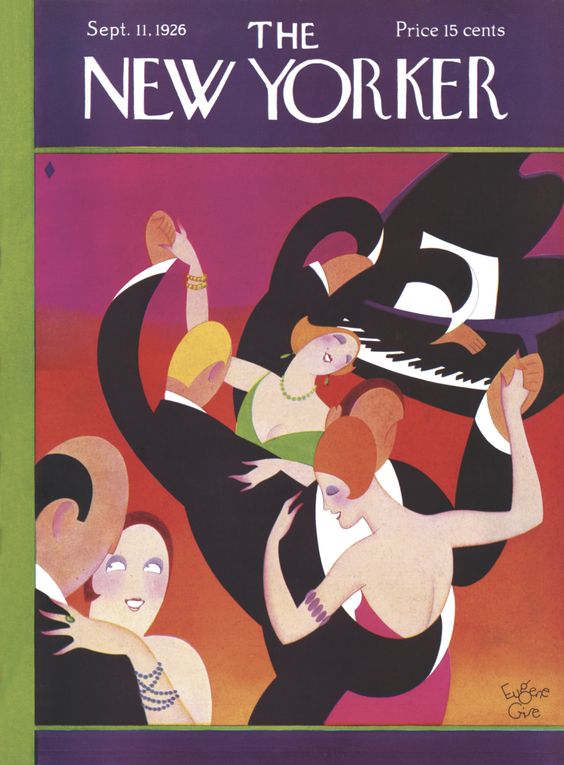
American cinema did little to excite the writers or critics of The New Yorker, who considered European films, and particularly German ones, to be far superior to the glitzy and sentimental fare produced in Hollywood.

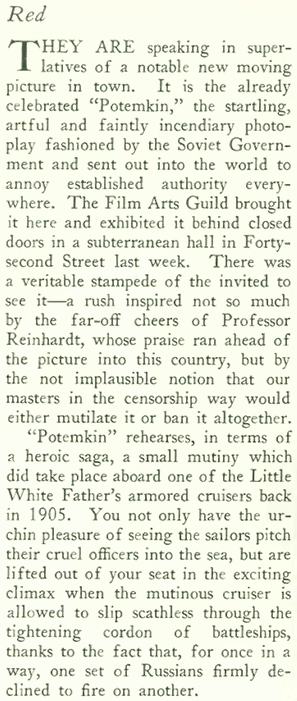
So when it was announced that Russian/Soviet filmmaker Sergei Eisenstein would be releasing Battleship Potemkin in New York City, the magazine’s editors in “The Talk of the Town” expressed both anticipation for the masterpiece as well as worries that American censors would slice the film to bits or even ban it outright.
The magazine’s film critic “OC” also expressed his concerns regarding censors:

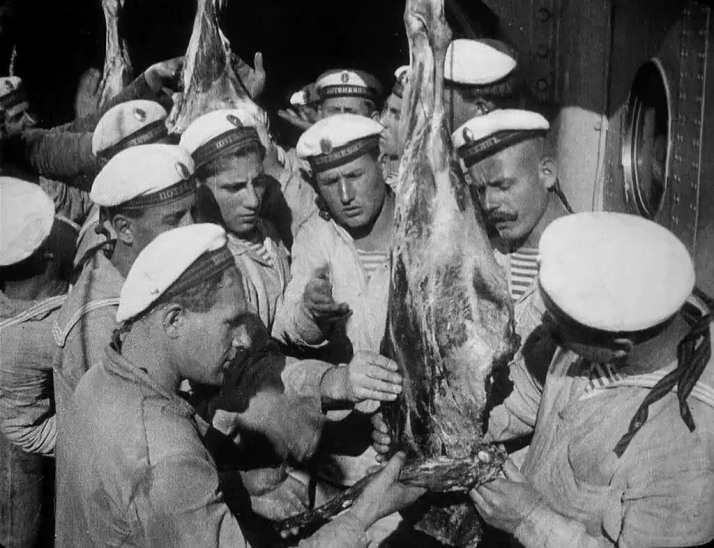
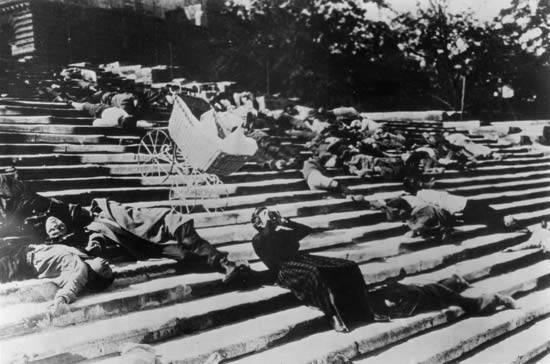
The film was based on an historical event–a mutiny on the battleship Potemkin that occurred after the crew was served rotten meat for dinner. The sailors rebelled, seized the ship, and then attempted to ignite a revolution in their home port of Odessa, which in turn led to a massacre of citizens by Cossack soldiers on the city’s famed Potemkin Stairs.


The film would ultimately be released in December of 1926. Perhaps more on that in a later post.
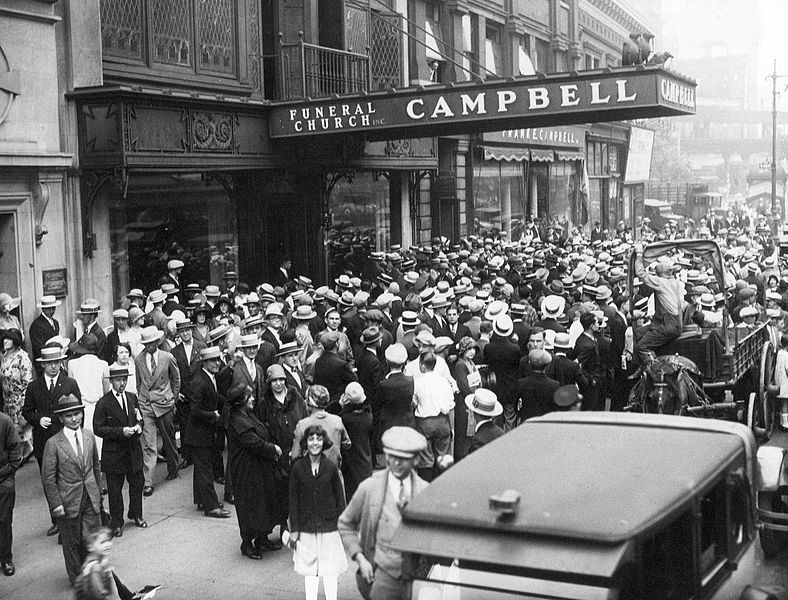
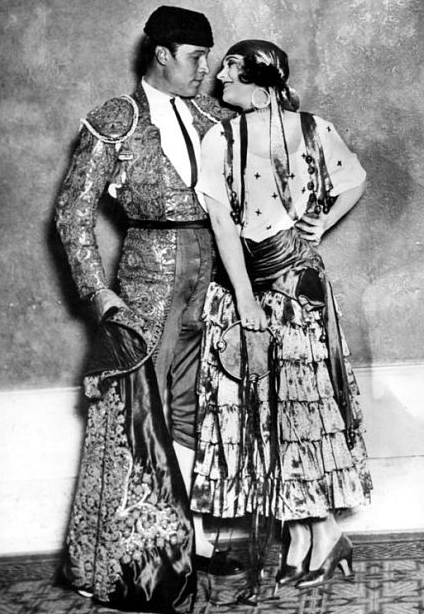
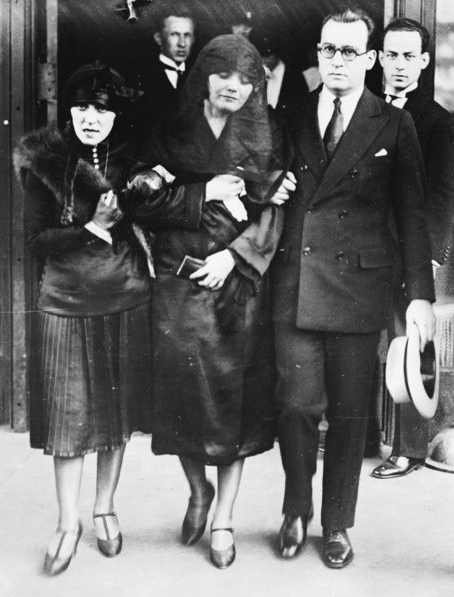
The Sept. 11, 1926 issue also noted the passing of famed silent film star Rudolph Valentino, who died at age 31 of peritonitis and other complications. The “Talk” editors suggested that if anything, it was good for newspaper sales:


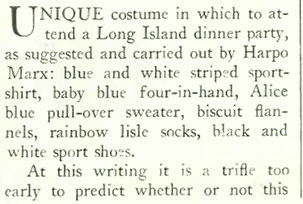
On the lighter side, The New Yorker men’s fashion columnist “Bowler” offered this observation of a new style suggested by Harpo Marx:

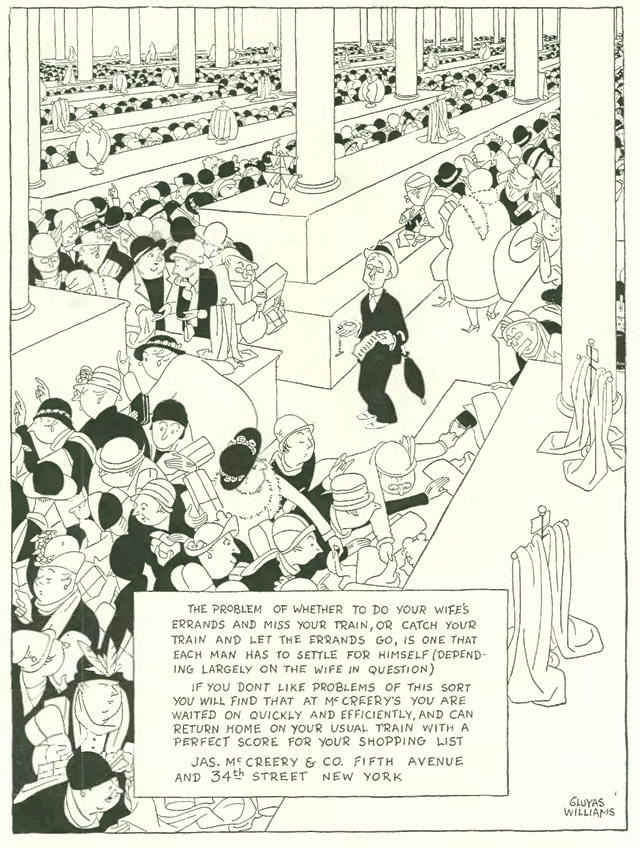
And to close, a couple of advertisements from the Sept. 11 issue…the first is a McCreery & Company ad illustrated by Gluyas Williams. These would become a series, featuring a milquetoast husband facing the daunting task of shopping for his wife, among other challenges…
…and this ad from Park Central Motors, depicting a child who’s all too aware of her standing in society…
Next Time: On the Airwaves…
Since most of us complain about the sad state of air travel these days, it’s nice to get a little historical perspective on this mode of transportation.

Ninety years ago the editors of The New Yorker were enamored with passenger air service, even though it was only available to those who were wealthy and had the stomach to actually fly in one of these things:

In the “Talk of the Town” section, The New Yorker editors marveled at the regular air taxi service available to Manhattanites:
The “huge” Yorktown might look crude to a traveler in 2016, but this was advanced stuff considering the Wright Brothers had made their first flight less than 23 years earlier. Planes like the Yorktown looked less like aircraft we know today and more like a trolley car with wings attached. And that window in the front wasn’t for the pilot. He sat up top in the open air:

But then again, the interiors of these planes were no picnic, either. Imagine sitting in this while crashing through a storm:


Other items from the Sept. 4, 1926 “Talk” section included a bit about the former president and then Supreme Court Justice William Howard Taft, and his rather ordinary life in Murray Bay. An excerpt:

At the movies, The New Yorker gave a lukewarm review of the much-ballyhooed film Beau Geste:

And although Gloria Swanson was one of the biggest stars in the Silent Era, The New Yorker was never a big fan of her films:

And finally, this advertisement from Houbigant, featuring a drawing of an elegant woman with an impossibly long neck. I wouldn’t want her sitting in front of me at the movies…
Another ad (from the Sept. 11 issue) also depicted this ridiculously giraffe-like neckline:
Next Time…Battleship Potemkin…
It was 1926 and another marvel of science—talking pictures—was unveiled to audiences at Broadway’s Warners’ Theatre. It was here that the Warner Brothers launched their ‘Vitaphone’ talkies including The Jazz Singer, which would premiere the following year.

The Vitaphone soundtrack was not printed on the film itself, but rather recorded separately on phonograph record, the sound synchronized by physically coupling the record turntable to the film projection motor.

Don Juan was the first feature-length film to use the Vitaphone system, which was not a continuous soundtrack but rather a sprinkling of sound shorts (the musical score, performed by the New York Philharmonic, and various sound effects) throughout the film. No spoken dialogue was recorded.

Produced at a cost of $789,963 (the largest budget of any Warner film up to that point), the film was critically acclaimed and a box-office success. However, and predictably, The New Yorker was not so impressed with Vitaphone…
…or the acting of John Barrymore…
I have to agree with the critic, identified only as O.C., after viewing this TCM clip of the film on YouTube. Lacking a voice, silent actors had to exaggerate emotions onscreen, but Barrymore here is every bit the ham. This screen grab from the clip says it all:
The object of his gaze, Adriana della Varnese (played here by a young Mary Astor), reacts rather dramatically to his advances…can’t say I blame her…(however, the 44-year-old Barrymore and the 20-year-old Astor were having an affair at the time…)

A couple of interesting ads in the Aug. 14, 1926 issue, including this one featuring a couple of sneaky gents who’ve found a solution to life in dry America…
…and this not-too-subtle message from a swanky shop on Fifth Avenue:
Next Time: Time for a Facelift…
The Roaring Twenties were all about fads and crazes, ranging from flagpole sitting to dances such as “The Shimmy,” “The Charleston,” or “The Black Bottom.” These dances were appropriated from Black culture, with many New Yorkers getting their first exposure in places such as Harlem’s famed Cotton Club.

The June 26, 1926 issue of The New Yorker was all abuzz over the Broadway debut of George White’s eighth annual Scandals. The Scandals were a long-running string of Broadway revues that ran from 1919-1939. Modelled after the Ziegfeld Follies, the Scandals launched the careers of many entertainers, including W.C. Fields, the Three Stooges, Rudy Vallée and Louise Brooks. Composer George Gershwin’s early work also appeared in the earliest editions of the show.

Like Florenz Ziegfeld, White must have been a master at marketing, since tickets for the Scandals opening sold for $55, which today would be the equivalent of about $725:
The editors of “The Talk of the Town” were a bit skeptical of all the hype:
The 1926 Scandals show featured “The Black Bottom,” danced by Ziegfeld Follies star Ann Pennington and Tom Patricola. In this dance-crazed era, “The Black Bottom” became a national phenomenon and even surpassed “The Charleston” in popularity.


“The Black Bottom” was popularized in New York by the 1924 Harlem stage show show Dinaah. Although the dance moves originated in New Orleans in the early 20th century, Jelly Roll Morton gave it a name when he wrote Black Bottom Stomp in 1925, referring to Detroit’s Black Bottom district.
In typical fashion, The New Yorker was less than impressed with the spectacle. In his theatre review column, Charles Brackett made this observation:
On to other things, “The Talk of the Town” also featured this curious note about George Custer’s widow, reminding us that 1926 was a very long time ago. Here are excerpts:

The New Yorker editors continued to remark on the changing face of Fifth Avenue…
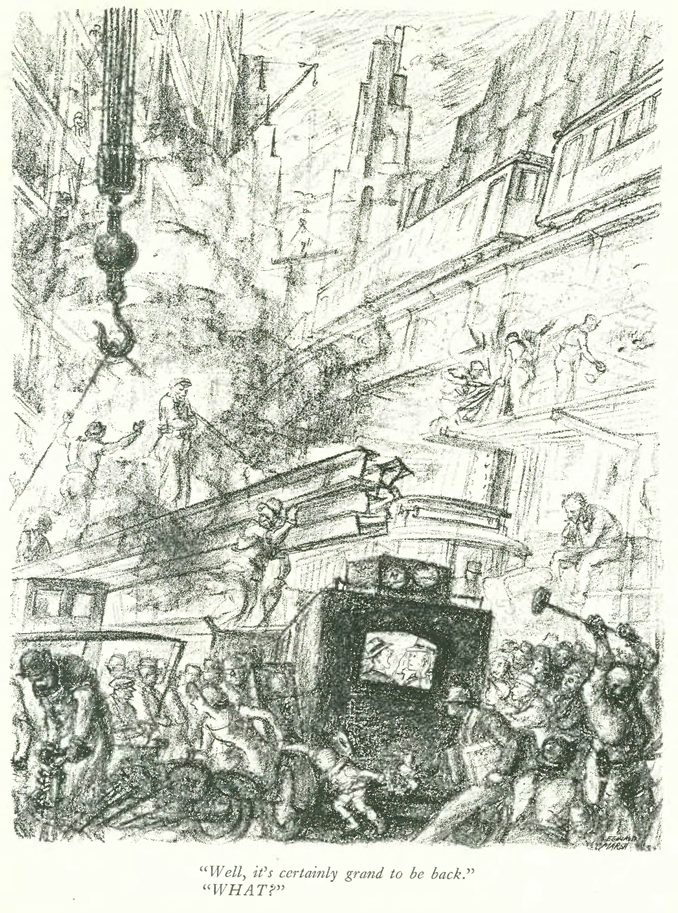
…and on the progress of the city’s infrastructure improvements, as in this excerpt from a humorous piece by the Robert Benchley:

Next Time: Wild & Woolly…
The cover of the May 8, 1926 issue featured this Bauhaus-style rendering of a baseball player by Victor Bobritsky in anticipation of the 1926 season:

After a terrible 1925 season (and Babe Ruth’s infamous stomach ache), in 1926 the New York Yankees would begin to form a batting lineup that would become known as “Murderers’ Row.” They won the AL pennant in 1926 (losing to the St. Louis Cardinals in a seven-game World Series) and in 1927 they would go 110-44 and sweep the Pittsburgh Pirates in the World Series. More on that when we actually get to 1927.
The May 8 issue offered more coverage of Spanish actress-singer Raquel Meller’s first-ever visit to America, which caused quite a sensation:

Meller arrived in New York via the SS Leviathan, on which she apparently attempted to book a deluxe suite for her five Pekingese. After New York she also visited Philadelphia, Chicago, Boston, Baltimore and Los Angeles, where she attracted the attention of Charlie Chaplin. Although Chaplin was unsuccessful in landing Meller as a co-star, he did incorporate the melody of her most famous song, La Violetera, as a major theme in his 1931 film City Lights.

Theodore Shane reviewed the film Brown of Harvard and pondered the accuracy of this portrayal of Harvard student life:

The issue also featured more unique mapmaking by John Held Jr:
And this W.P. Trent cartoon with a common theme of early New Yorker issues: the comic imbalance of rich old men and their young mistresses:
And finally, this advertisement in the May 8 issue caught my eye. Although cars crowded the streets of New York, they were still a recent enough invention to evoke the days of horse-drawn carriages. Even with all of the advances in automobiles in the late 20s, this landau-style Rolls Royce still exposed the driver to the weather, a design feature that signaled class, not practicality.
Next Time: Nize & Not So Nize…