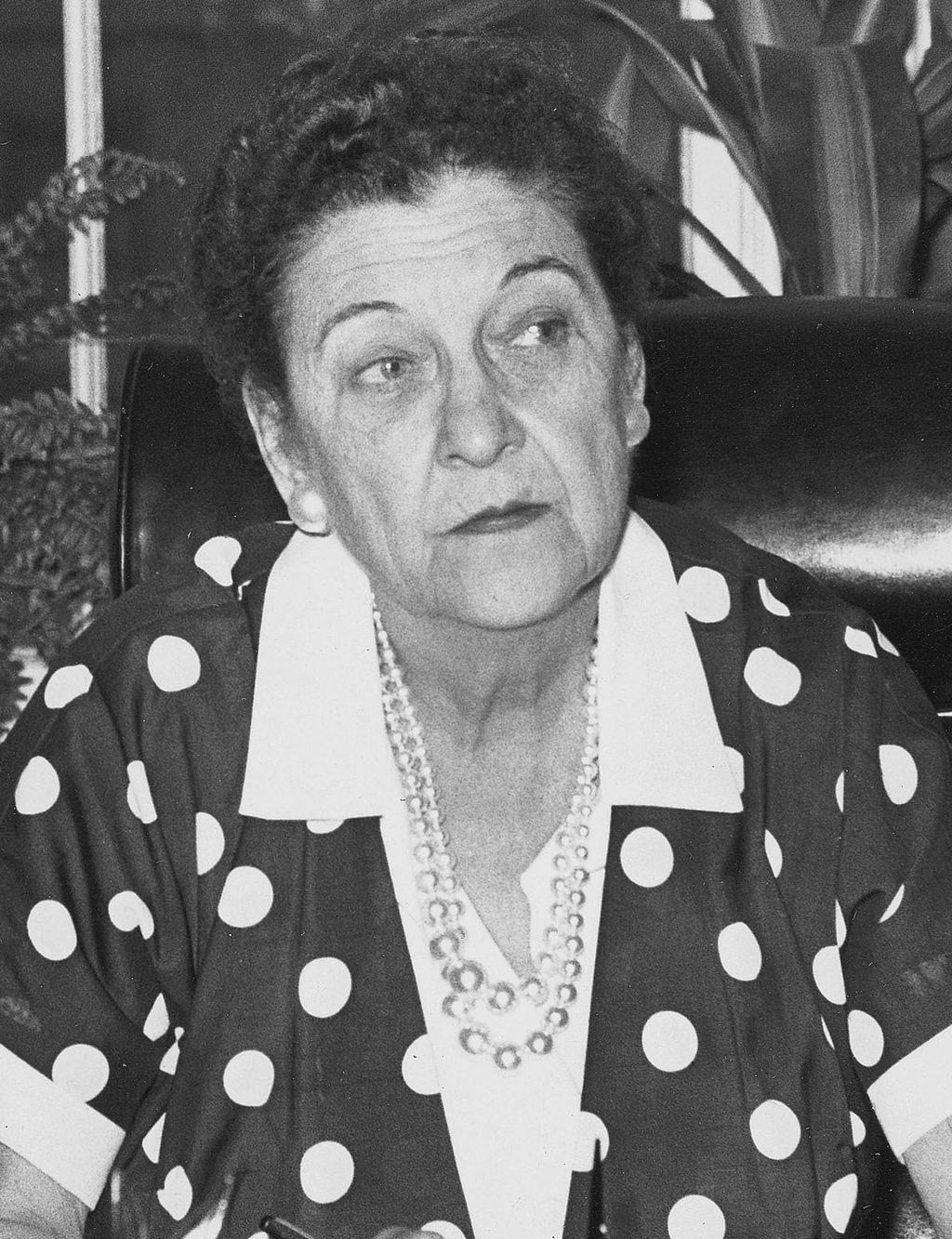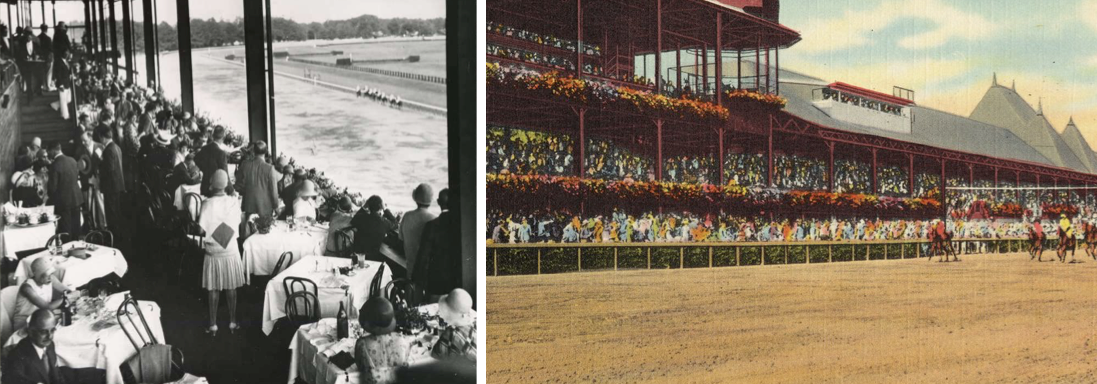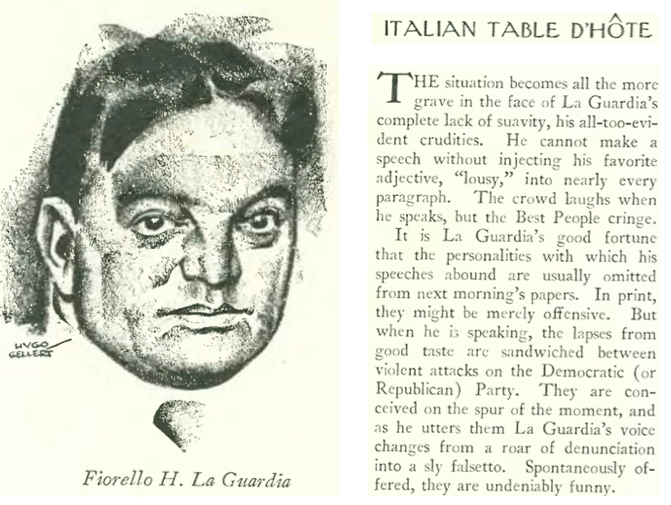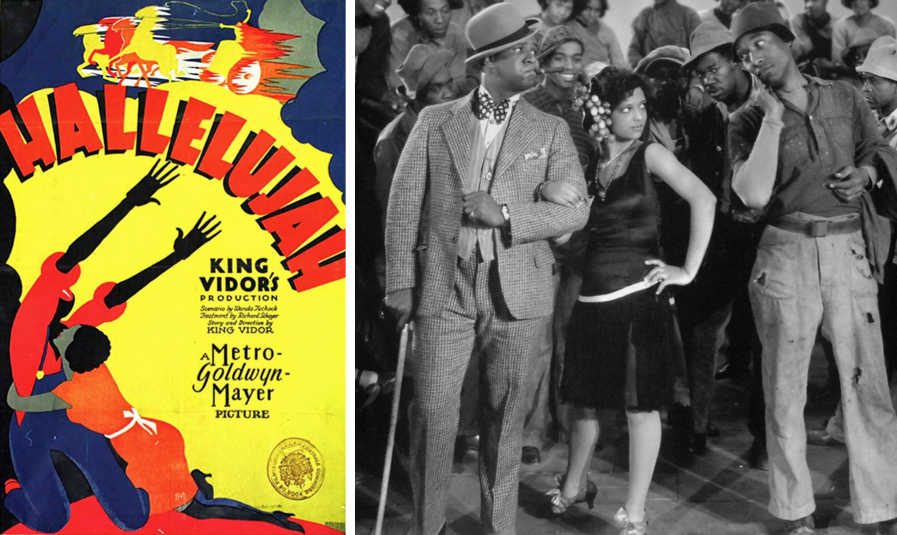
The Circus Comes to Town

If you lived in small town America in the 20th century, it was a big deal when the circus came to town with its entourage of clowns, acrobats and exotic animals from distant lands.

April 19, 1930 cover by Gardner Rea.

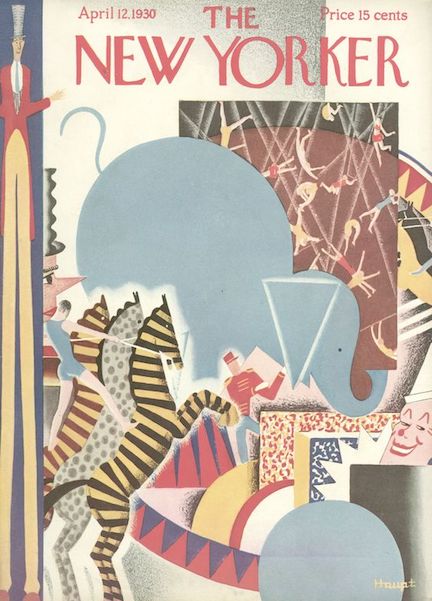
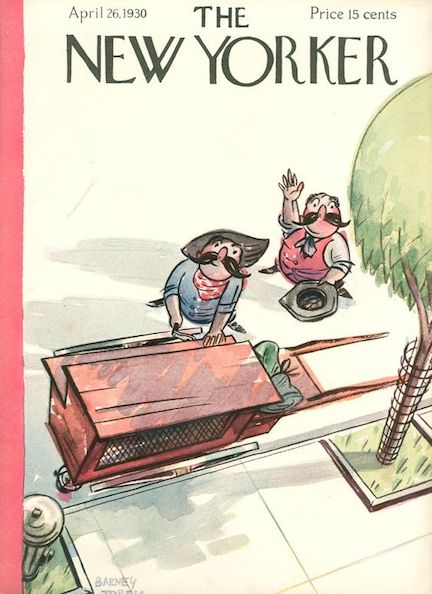
Even New Yorkers, it seems — who could be quite blasé about such things — got a thrill when the Ringling Brothers and Barnum & Bailey Circus rolled into town for its annual spectacle at Madison Square Garden. The New Yorker marked the occasion with its April 12 cover by Theodore Haupt:
For the April 19 issue, E.B. White welcomed the circus on a cautionary note, airing concerns in his “Notes and Comment” column that this old-timey entertainment might be falling under the “base influences” of broadcast radio, Broadway, and Hollywood:

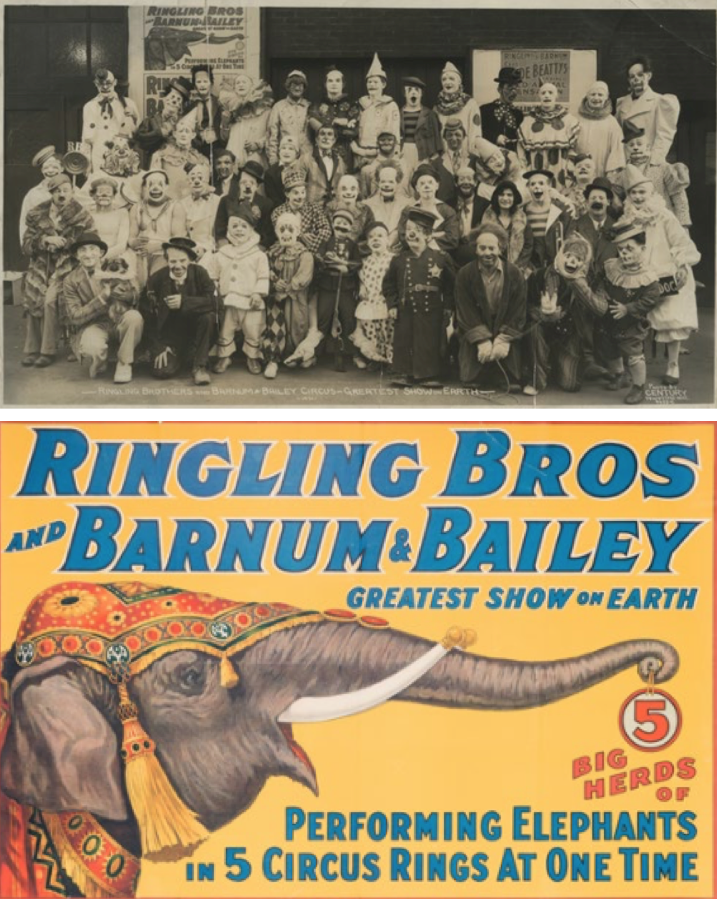
SEND IN THE…YOU KNOW…THOSE GUYS…Top, clowns in town for the 1931 Ringling Brothers and Barnum & Bailey Circus at Madison Square Garden. Below, circus poster announcing the arrival of “The Greatest Show on Earth.”  (potterauctions.com)

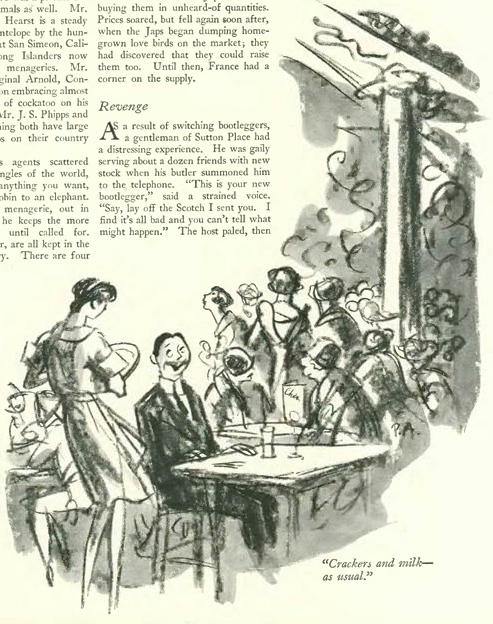
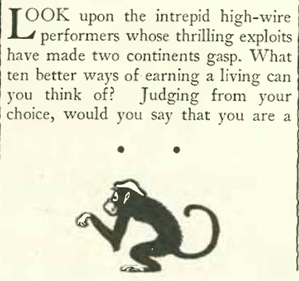
José Schorr, who wrote a number of humorous columns in The New Yorker from 1926 to 1930 on the subject of “how to the pass the time” in various situations, offered this advice on attending the spectacle at Madison Square Garden…

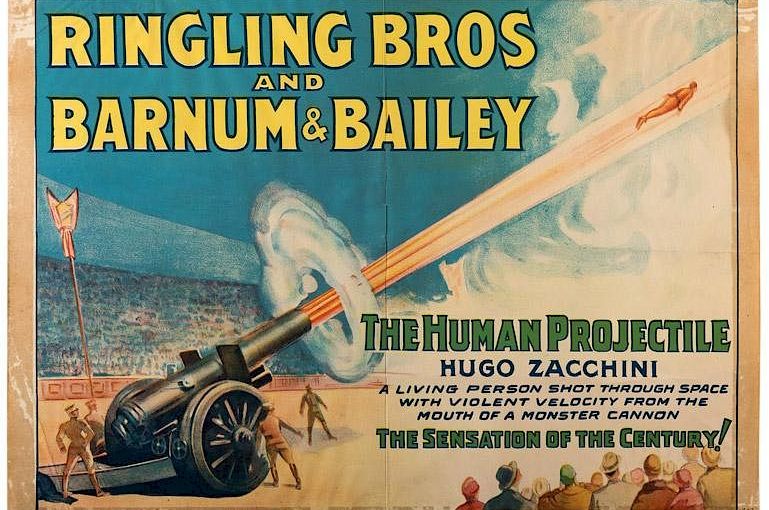
I’D RATHER BE FLYING…1930 poster advertising “The Human Projectile”; 1931 photo of the Ringling Brothers and Barnum & Bailey Circus at Madison Square Garden. (worthpoint.com/bidsquare.com)

…for example, Schorr advised circus-goers to pass the time by considering the inner lives of performers such as “The Human Projectile”…
 *  *  *

Funny Farm

Perhaps you’ve never heard of Joe Cook (1890-1950), but in the 1920s and 30s he was a household name and one of America’s most popular comedic performers. “Talk of the Town” looked in on his antics at his Lake Hopatcong farm, “Sleepless Hollow”…
BATTER UP…Comedian Joe Cook’s residence at Lake Hopatcong, NJ, was known for its celebrity-studded parties. At left, Babe Ruth takes a swing with a giant bat on Cook’s wacky three-hole golf course; at right, Cook relaxing on the steps of his farm. (lakehopatcongnews.com)

 *  *  *

Fun With Balloon Animals

One thing that distinguishes the 1930s from today is that era’s apparent lack of safety standards, or fear of liability. A case in point was Macy’s Thanksgiving Day Parade, which began a tradition in the late 1920s of releasing its giant balloons into the sky at the conclusion of the parade — a $50 reward was offered by Macy’s for their return. “The Talk of the Town” explained:

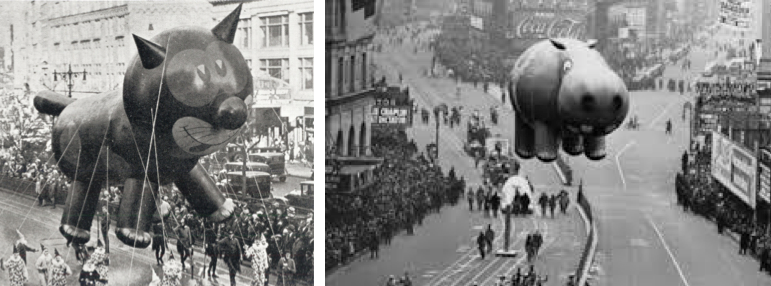
GOING, GOING, GONE…When Felix the Cat (left, in 1927) was released after the Macy’s Thanksgiving Day Parade, it floated into a power line and caught fire; in 1931 the parade’s Big Blue Hippo (right) was apparently spotted floating over the ocean, never to be seen again. (Macy’s/hatchingcatnyc.com)

Perhaps the craziest anecdote attached to the parade’s annual balloon release belonged to Annette Gipson. While flying a biplane at 5,000 feet with her instructor, she spotted the parade’s 60-foot “Tom Cat” balloon rising high above Queens. Looking to have a bit of fun, the 22-year-old Gipson flew the plane directly into the cat. According to the book Macy’s Thanksgiving Day Parade, “Upon impact, the balloon wrapped itself around the left wing. The plane went into a deep tailspin (nearly throwing Gipson from the cockpit) and sped toward the ground out of control.” Fearing the plane would catch fire when it hit the ground, the instructor killed the ignition, and somehow managed to pull the plane out of the spin and land it safely at Roosevelt Field.

KITTY LITTER…Annette Gipson, right, nearly killed herself and her flight instructor after she deliberately crashed her biplane into a Tom Cat balloon (left) that had been released following the 1932 Macy’s Thanksgiving Day Parade. Of her near-death experience, Gipson told reporters, “It was a sensation that I never felt before—the whirling housetops, rushing up to meet me—and the thoughts of a whole lifetime flashed through my mind.” (ephemeralnewyork.wordpress.com)

A footnote: Following Gipson’s brush with death, Macy’s announced it would not give prize money to those who tried to down the balloons with their airplanes. The incident also brought an end to the company’s tradition of releasing the balloons.

 *  *  *

Birth of the Soundtrack

Songs from popular theater productions were first made available to the masses in the mid-19th century via printed sheet music and later through early recordings. Part of this lineage is the movie soundtrack, which has its origins in the early days of sound pictures. According to The New Yorker’s “Popular Records” column, these new recordings would bring the talkies into your home, albeit without the picture…

FROM MAMMY TO MAMMA MIA…Left, a 1930 Brunswick 78 RPM recording of Al Jolson’s “To My Mammy”; at right, soundtrack from the 2008 film Mamma Mia! (popsike.com/amazon.com)

 *  *  *

Cosmo Calvin

Before Helen Gurley Brown came along in the 1960s and sexed it up, Cosmopolitan was known as a somewhat bland literary magazine, and it was certainly bland enough in 1930 to welcome the scribblings of America’s blandest president to its pages. E.B. White mused in his “Notes”…
NOTHING COMES BETWEEN ME AND MY CALVIN…At left, the May 1930 issue of Cosmopolitan featuring columnist and former U.S. President Calvin Coolidge; at right, Kourtney Kardashian on the cover of the October 2016 issue. (Pinterest/Cosmopolitan)

 *  *  *

How Dry I Am

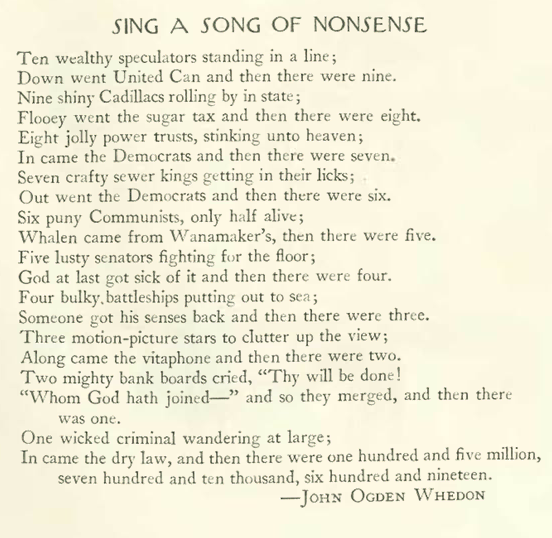
After a decade of living under Prohibition, John Ogden Whedon (1905-1991) put pen to paper and shared his sentiments in a poem for The New Yorker

…Whedon would go on to a successful career as a screenwriter, especially finding acclaim for his television writing on The Donna Reed Show, Leave It to Beaver, The Andy Griffith Show, and The Dick Van Dyke Show, among others. He was also the grandfather of screenwriter and director Joseph “Joss” Whedon and screenwriters Jed Whedon and Zack Whedon.

Another poem in the April 19 issue was contributed by John Held Jr., who was perhaps better known to New Yorker readers for his “woodcut” cartoons…
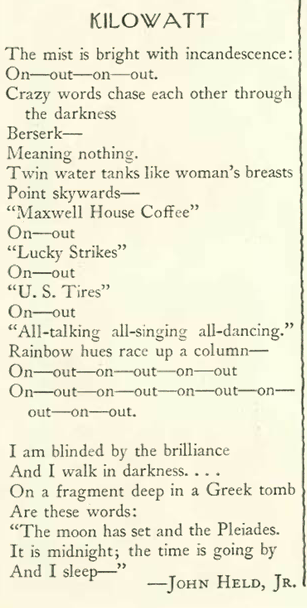
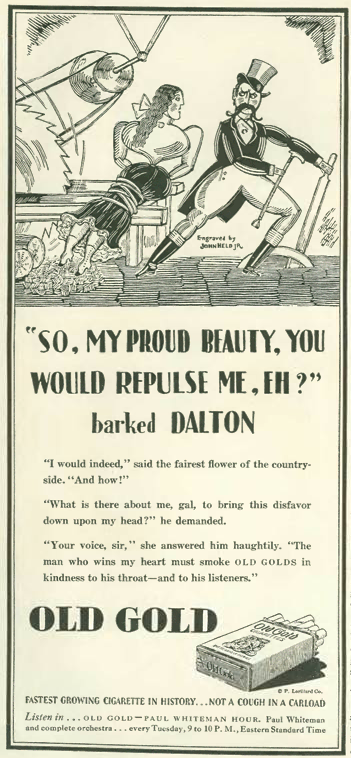
…example of Held’s work from the April 12 issue, featured in an Old Gold advertisement…
…and that provides a segue into our ads for the April 19 issue, beginning with this spot for an early electric dishwasher…
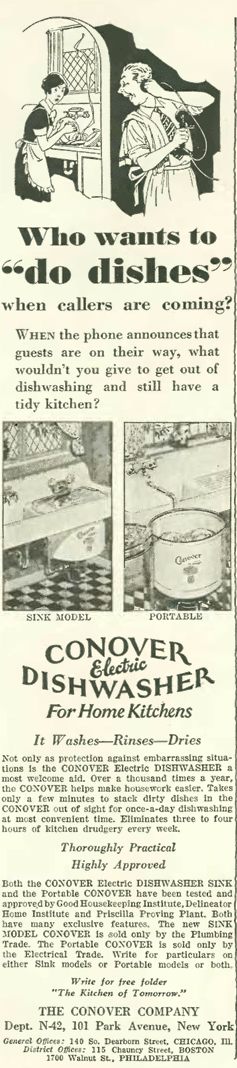

Here’s what that bad boy looks like in color. (automaticwasher.org)

…I couldn’t find a review in The New Yorker for Emily Hahn’s new book, Seductio Ad Absurdum, but her publisher did take out an ad to get the attention of readers. Many years later The New Yorker would call the journalist and author “a forgotten American literary treasure”…

Emily Hahn circa 1930; first edition of Seductio Ad Absurdum. Author of 52 books, her writings played a significant role in opening up Asia to the West. (shanghaitours.canalblog.com/swansfinebooks.com)

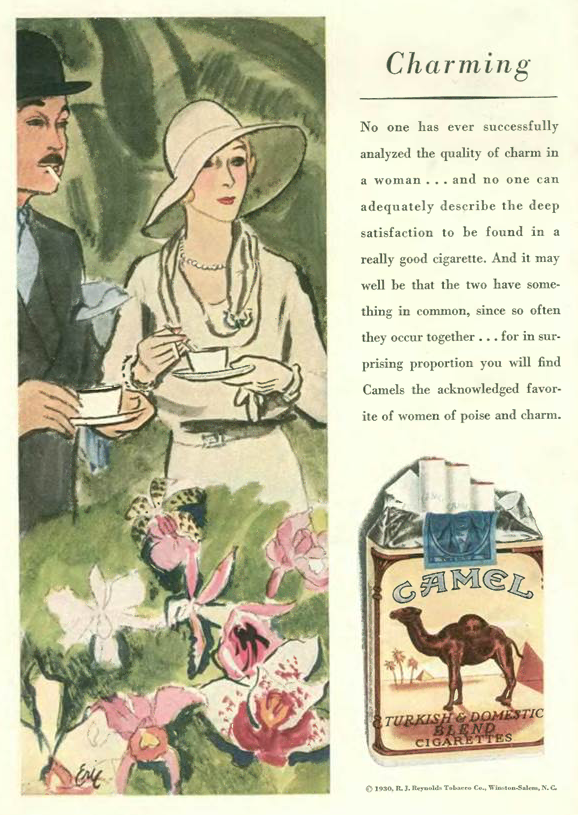
…and here we have another sumptuous ad from illustrator Carl “Eric” Erickson, a far cry from the “Joe Camel” ads that would come along decades later…
…on to our cartoons, Reginald Marsh offered a blue collar perspective on city fashions…

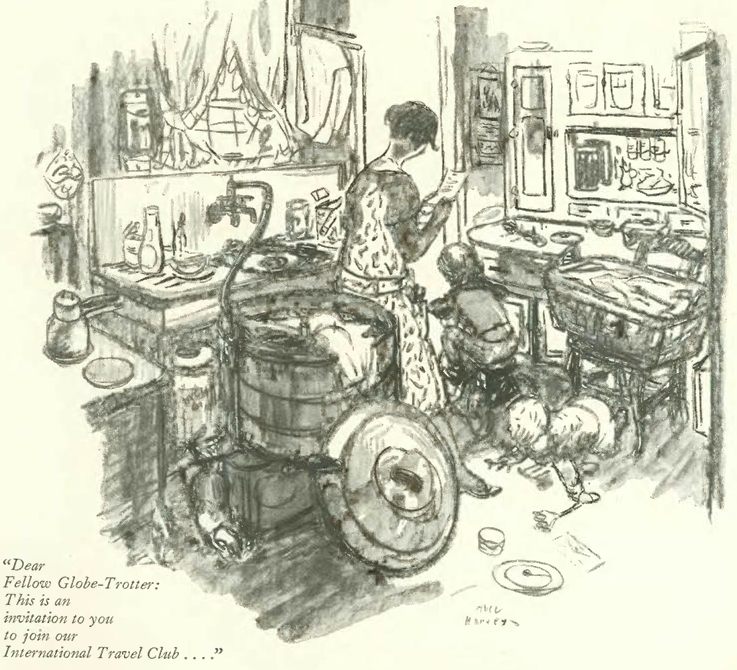
Alice Harvey captured a moment of reflection by an overworked housewife…
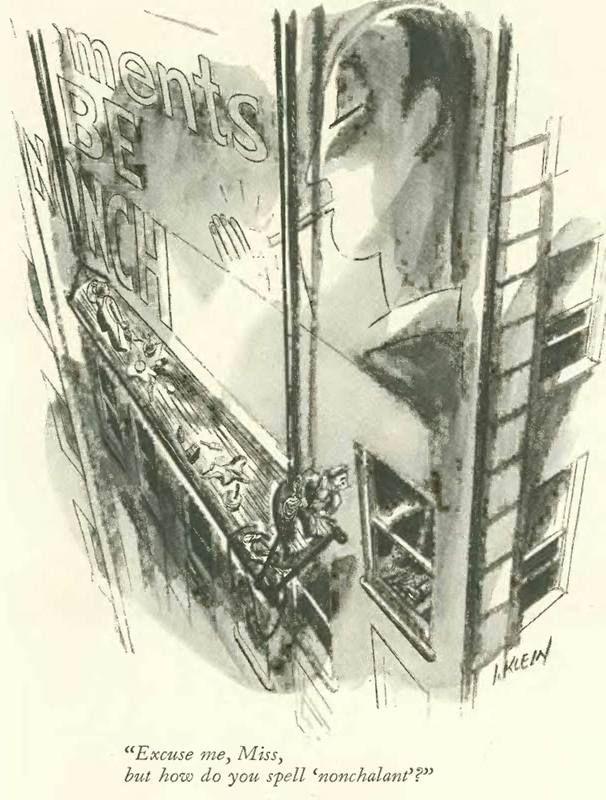
…and Isadore Klein looked in on a couple of working stiffs in need of a dictionary…
…now over to the posh set, with Barbara Shermund

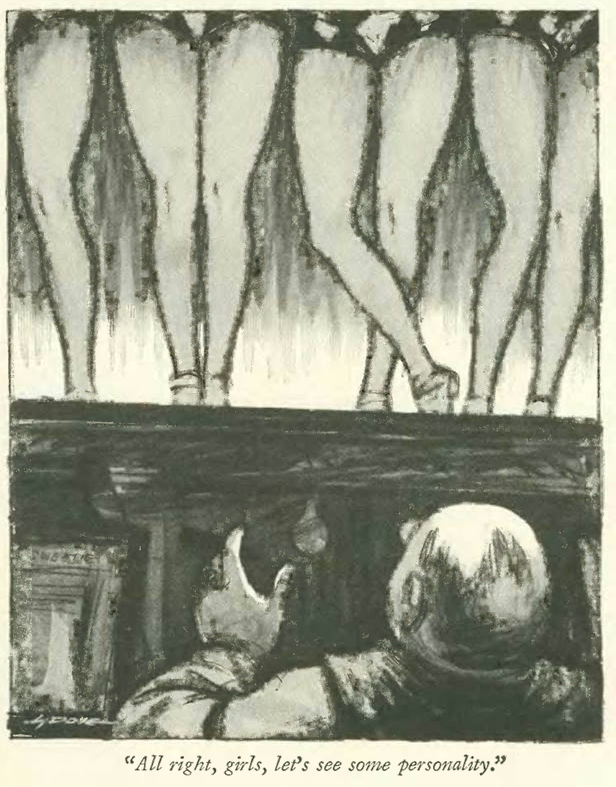
Leonard Dove found humor on the chorus line…
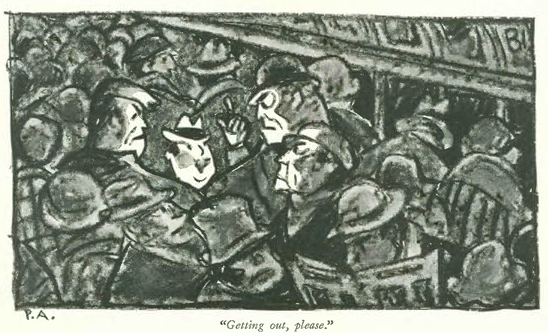
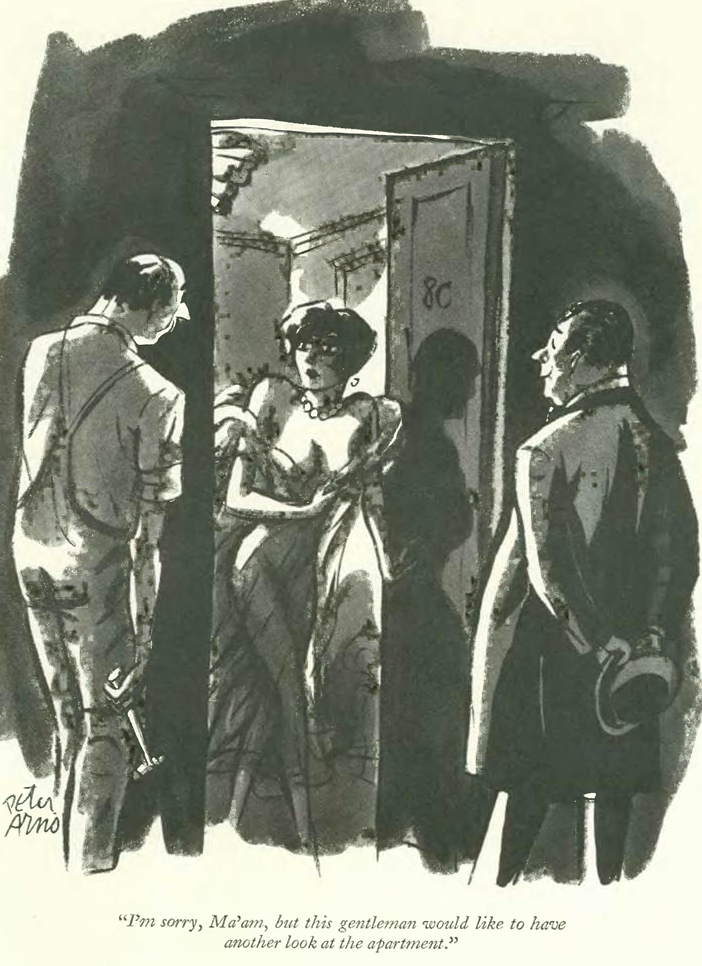
…and we end with this terrific cartoon by Peter Arno, and the perils of apartment life…
Next Time: Paramount on Parade…


Hot Jazz in Stone and Steel

With the Chrysler Building nearing completion and the Empire State Building beginning to rise from the old Waldorf-Astoria site, the New York City skyline was taking on the iconic form most of us now associate with the city.

April 12, 1930 cover by Theodore Haupt.

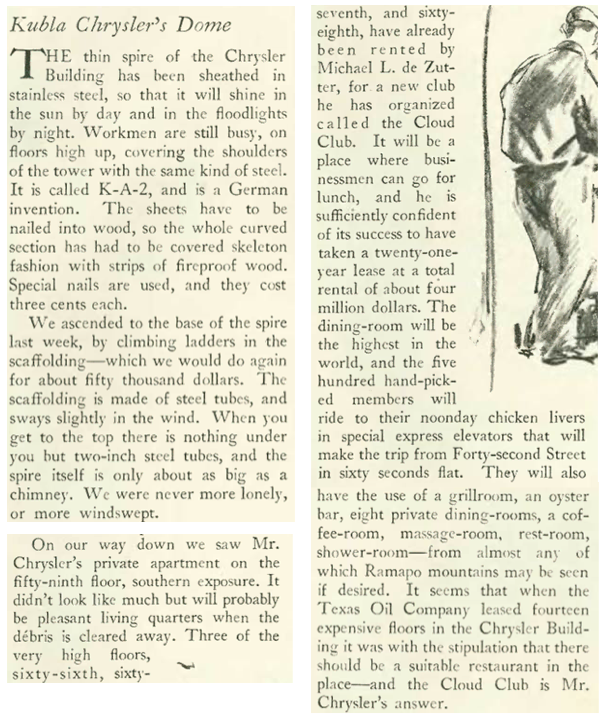
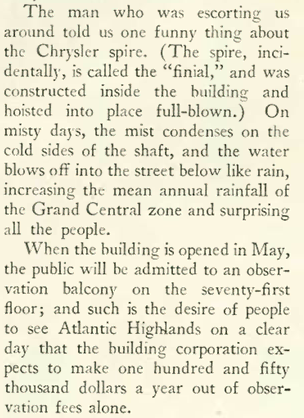
Dubbed “hot jazz in stone and steel” by modernist architect Le Corbusier, the Chrysler Building’s gleaming spire beckoned The New Yorker’s E.B. White and real estate journalist David G. Bareuther (New York Sun) to its summit for a closer look…

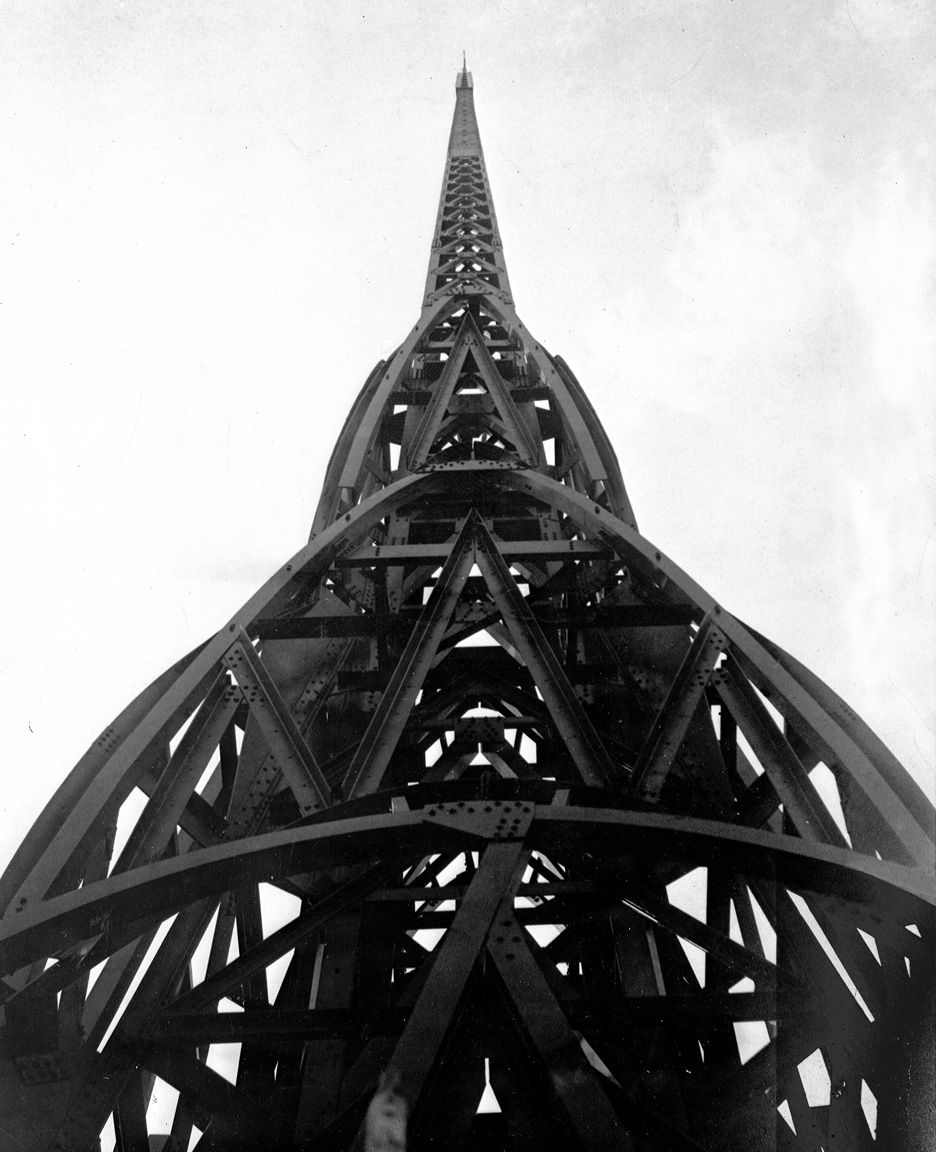
BARE BONES…The spire in place atop the Chrysler building, the dome awaiting its metal skin. (skyscraper.org)
WHAT LIES BENEATH…The stainless steel spire still gleams atop the Chrysler Building; beneath the spire, a maze of scaffolding — navigated by E.B. White and David G. Bareuther for their “Talk of the Town” piece, supports the upper portions of the building’s dome. (yahoo.com/nygeschichte.blogspot.com)
THE HIGH LIFE…The Chrysler Building’s exclusive Cloud Club was located on the 66th, 67th, and 68th floors. At one time it was the highest lunch club in the world. It closed in 1979. (decopix.com)

If you want to get a sense of what E.B. White and David Bareuther experienced during their climb through the Chrysler’s dome, take a look at this video featuring American radio personality “Opie” (Gregg Hughes) and Hidden Cities author Moses Gates…

The article also noted that an “observation balcony” would be available for visitors to the 71st floor (actually an enclosed room inside the dome), but I’m sure the expectations for revenue fell quite short, given the competition it would soon receive from the much larger, higher, open air observation deck of the Empire State Building…

REACHING FOR THE STARS…When the Chrysler Building officially opened in 1931, visitors could go up to the 71st-floor observatory (in the dome) and view the city through its triangular windows. The observatory closed in 1945. (nygeschichte.blogspot.com)

…a bit of a digression, but I couldn’t help but notice the observatory’s resemblance to this set from the 1920 silent film The Cabinet of Dr. Caligari

(silent-volume.blogspot.com)

…and here is a terrific graphic from Popular Science (August 1930) demonstrating how the spire, which was assembled inside the dome, was raised into its final position…

…and finally, some great archival footage documenting the achievement…

 *  *  *

Tragic Theater

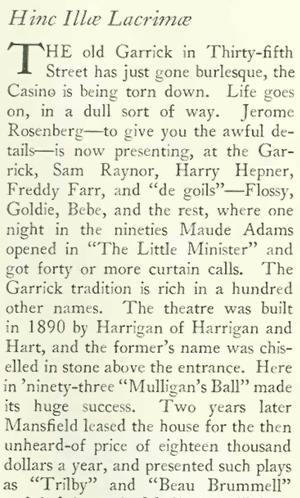
We continue our forays into the built environment of 1930 New York by looking at what was lost, including two beloved Broadway theaters. “The Talk of the Town” lamented the decline of the Garrick…

FINAL CURTAIN…Built in 1890 and originally named Harrigan’s Theatre, The Garrick closed as a playhouse in 1929. After a short run of burlesque, the building was demolished in 1932.

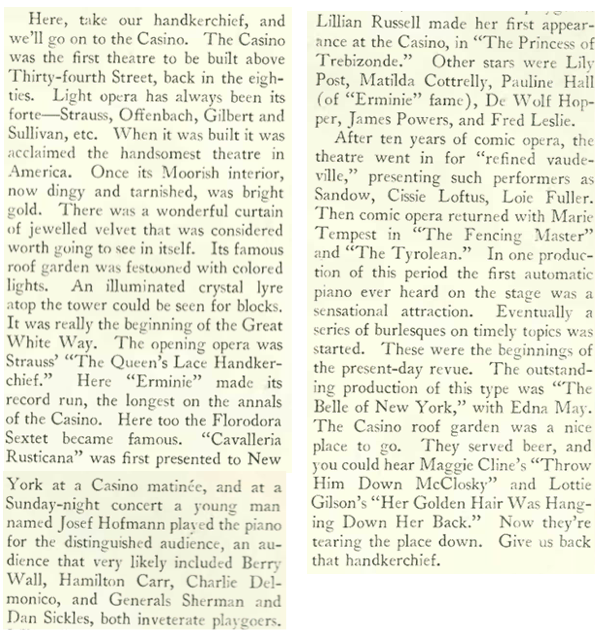
…and the Casino…

You can read more about the Casino at one of my favorite blogs, Daytonian in Manhattan.

HEYDAY…Clockwise, from top left, circa 1910 postcard image of The Casino Theatre at Broadway & 39th; an audience on the Casino’s roof garden glimpses the performance below; interior of the Casino; the British musical comedy Floradora would become one of Broadway’s greatest hits — the New York production opened in 1900 and ran for 552 performances. (Museum of the City of New York )

*  *  *

From Jazz to Gothic

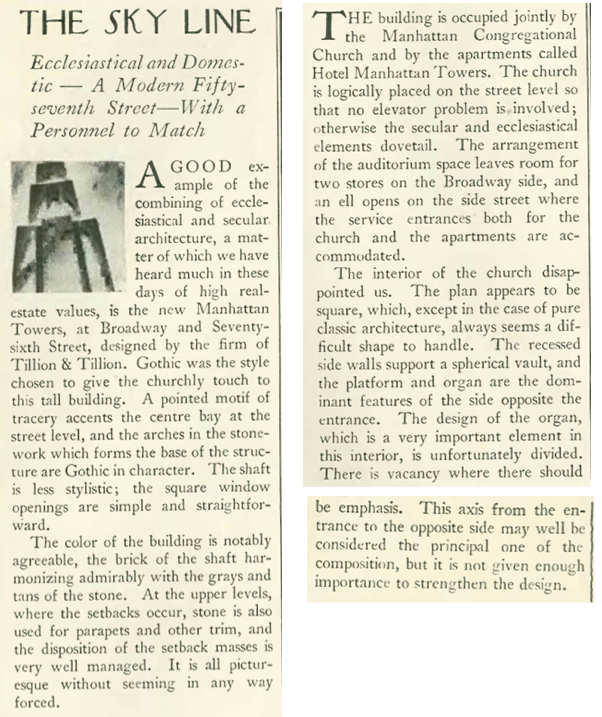
We return our gaze to the skies with three more new buildings reviewed by architecture critic George S. Chappell in his “Sky Line” column. He began with the Manhattan Towers Hotel, which thanks to the Depression would soon fall on hard times, going into foreclosure by October of 1931 and becoming a favorite gangster hideout (read more about the hotel at Daytonian in Manhattan)…

GOD AND MAMMON…Clockwise, from top left, the Manhattan Congregational Church in 1927. The church was torn down in 1928 and replaced by the Manhattan Towers Hotel at Broadway and 76th; the completed hotel, designed to wrap around the three-story Jones Speedometer Building, seen in the lower right of the photo; the first five floors of the building were dedicated to church use; after falling into disrepair, in 1980-83 the 626-room hotel was converted into 113 cooperative apartments. Note that the Speedometer Building still stands, sadly shorn of its ornamentation. (New York Public Library/Daytonian in Manhattan)

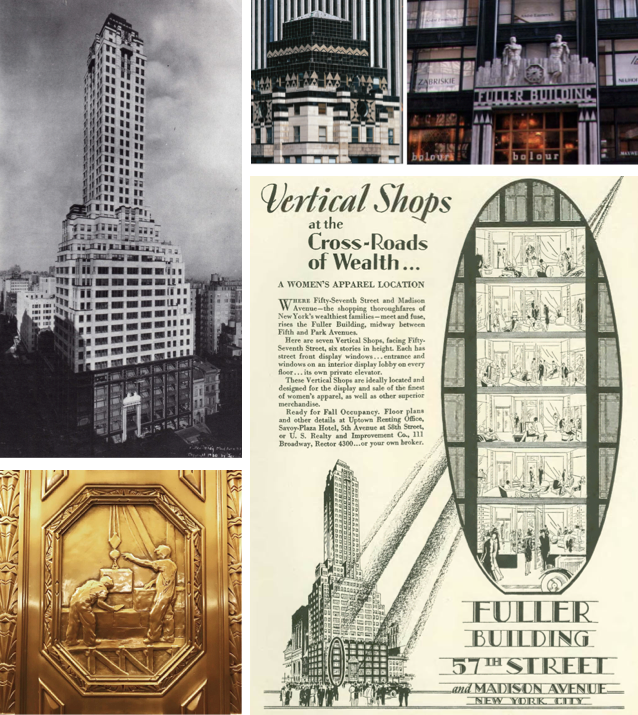
…Chappell also found much to admire in the new Fuller and Squibb buildings…

FULLER HOUSE…Clockwise, from top left, the 1929 Fuller Building was the third home of the George A. Fuller Company (its second home was the 1903 Flatiron Building); detailed views of the building’s tiled pinnacle and unique glass display windows that distinguish the building’s first six stories; an advertisement from the March 2, 1929 New Yorker that touted these gallery spaces for “superior merchandise”; detail of a coffered panel on an elevator door. (deskgram.net/nyc-architecture.com)
Clockwise, from top left, entrance to the Squibb Building, now known as 745 Fifth Avenue; the cool white marble of the building’s base so admired by critic George Chappell; today, the building at dusk, the slender profile of 432 Park Avenue rising in the background. (OzBibliophile/paramount-group.com/landmarkbranding.com)

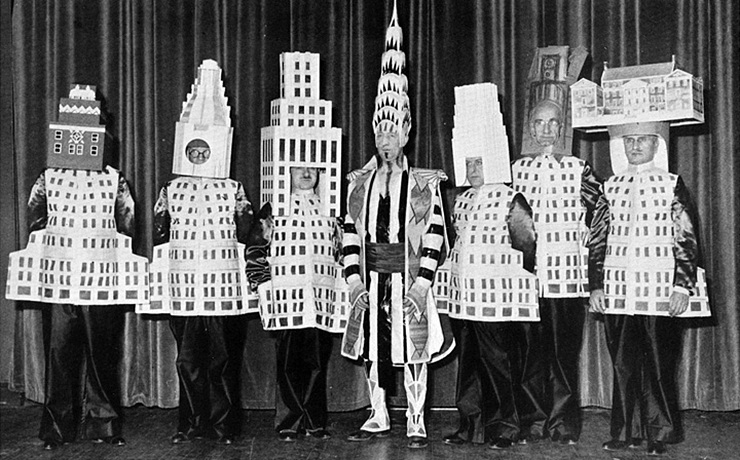
…From the Chrysler Building to the Fuller and Squibb, these new buildings, their architects, and the city’s ever-changing skyline were famously celebrated at the January 1931 Beaux Arts Ball…

HEADS IN THE CLOUDS…the Chrysler Building’s architect, William Van Alen (center), flanked by, from left to right, Stewart Walker (The Fuller Building), Leonard Schultze (The Waldorf-Astoria), Ely Jacques Kahn (The Squibb Building), Ralph Walker (1 Wall Street), D.E. Ward (The Metropolitan Tower), and Joseph H. Freelander (Museum of the City of New York). The New York Times referred to the group as “a tableau vivant of the New York Skyline.” (Van Alen Institute)

 *  *  *

Quiet on the Set

The early days of sound movies created numerous challenges for directors who not only had to adjust the action to accommodate cumbersome microphones, but also to keep out unwanted noises or bad enunciation. “The Talk of the Town” explained…

CLOSETED…In the early days of the talkies, cameras had to be soundproofed in cabinets so their noisy motors would not be picked up by primitive sound equipment. (coloradocollege.edu/Library of Congress)

Peter Arno illustrated the predicament of filming in nature in this cartoon from the April 5, 1930 issue…(caption: “Well, we can’t start till we get that robin out of there.”)…

 *  *  *

One of Ours

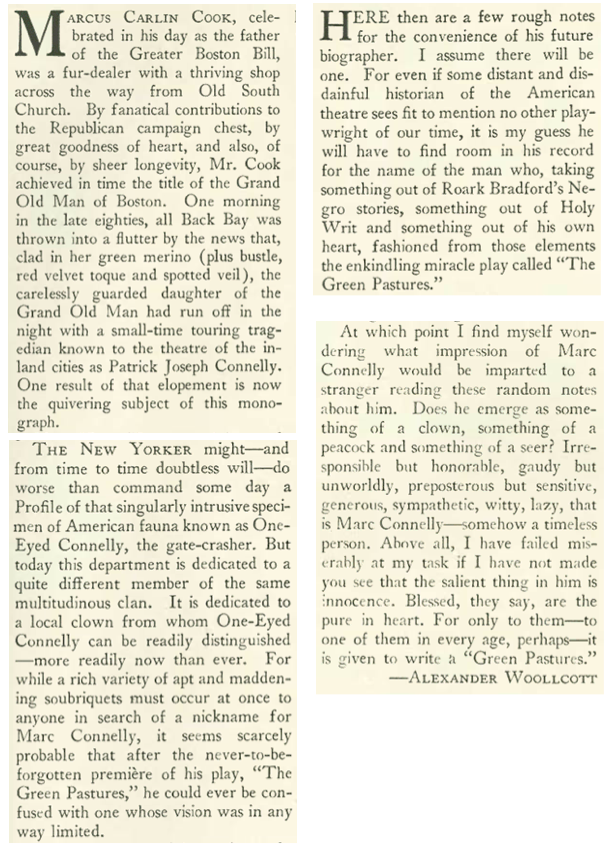
In the story of The New Yorker, Alexander Woollcott and Marc Connelly were there at the beginning as founding members of the Algonquin Round Table and advisory editors to the first issues of the magazine. Basking in the success of his latest play, The Green Pastures (for which he would receive a 1930 Pulitzer Prize for Drama), Connelly was the subject of a April 12, 1930 profile titled “Two-Eyed Connelly,” which was written by Woollcott. Some excerpts, and a caricature by Al Frueh

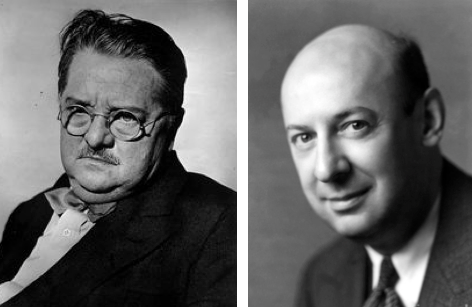
FAMILIAR WITH THE SUBJECT…Alexander Woollcott, left, explored the life of his old friend Marc Connelly in the April 12 profile. (goodreads.com/Fine Art America)

 *  *  *

The Party is Really Over

Lois Long’s column “Tables for Two,” which in the 1920s was a must-read for those interested in Jazz Age night life, appeared intermittently in its last year, and its April 12 installment was not even written by Long, but by a writer who signed the column “F.D.” — I assume this is Fairfax Downey, who tried his best to capture Long’s style…

 *  *  *

From Our Advertisers

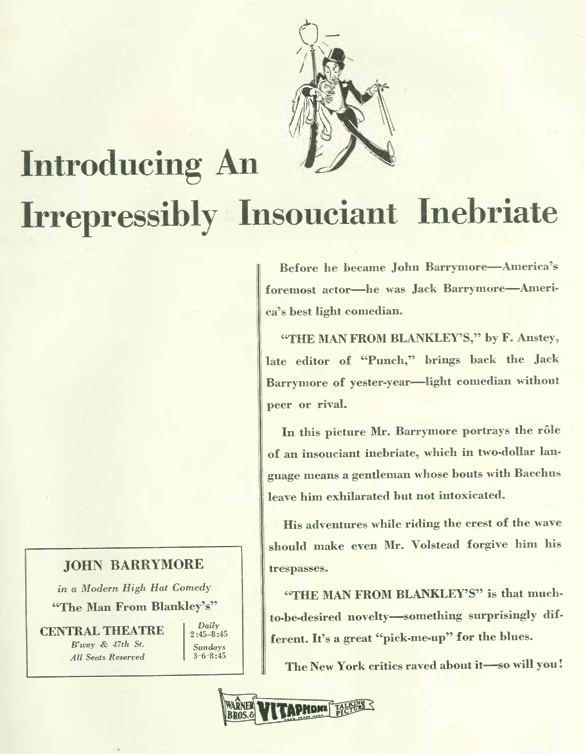
Warner Brothers opened their pocketbooks to publicize John Barrymore’s latest film, The Man From Blankey’s, which the studio described as a “Modern High Hat Comedy”…

WHEN ALCOHOLISM WAS FUNNY…Loretta Young, John Barrymore and Angella Mawby in The Man from Blankley’s. (IMDB)

…Thanks to William Randolph Hearst and his King Features Syndicate, Robert Ripley, the P.T. Barnum of the funny pages, soared to fame in the 1930s with his “Believe It or Not” panel…here he begins his 14-year run on the radio…

HELLO SUCKERS…Robert Ripley in 1930 with a drawing of “the Horned Man of South Africa.” (RIPLEY ENTERTAINMENT INC.)

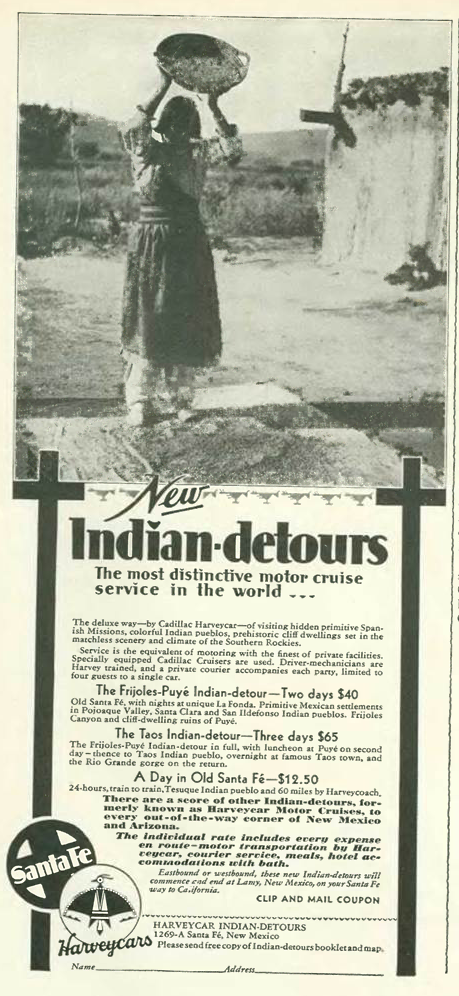
…and here’s an ad for another questionable but very American diversion — Fred Harvey’s “Indian Detours”…

WE’RE NOT IN KANSAS ANYMORE…The Fred Harvey Company was renowned for its chain of eating houses hosted by the famed “Harvey Girls” along the Atchison, Topeka & Santa Fe Railroad between 1876 and 1968. To encourage train travel (and Harvey business) in the Southwest, the Harvey company developed “Indian Detours.” The photo at left is of an “Indian Building” in Albuquerque, which featured displays of art and “live exhibits” that included Native Americans from many tribes around New Mexico. (santafeselection.com)
EASY RIDER…1929 Cadillac Harvey Indian Detour Car outside La Fonda, Santa Fe. (Palace of the Governors photo archive)

…if you preferred to travel abroad, Texaco wanted you to know that you could still gas up with their product, even in distant Singapore…

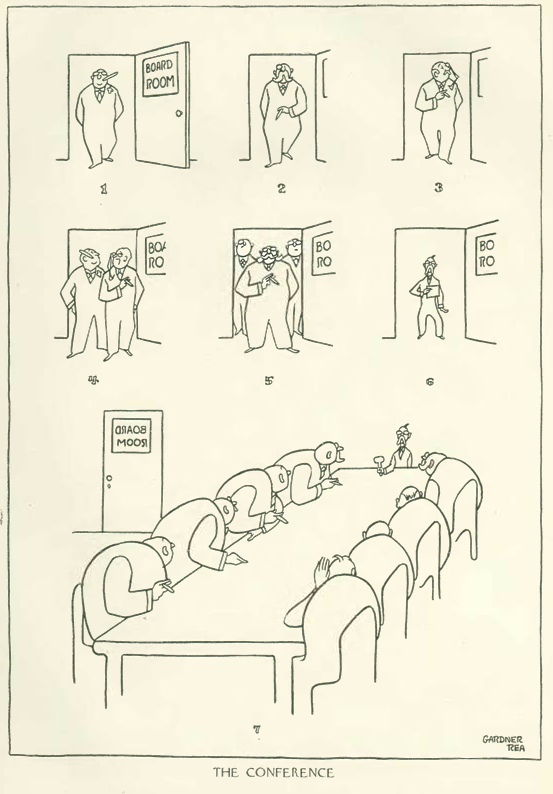
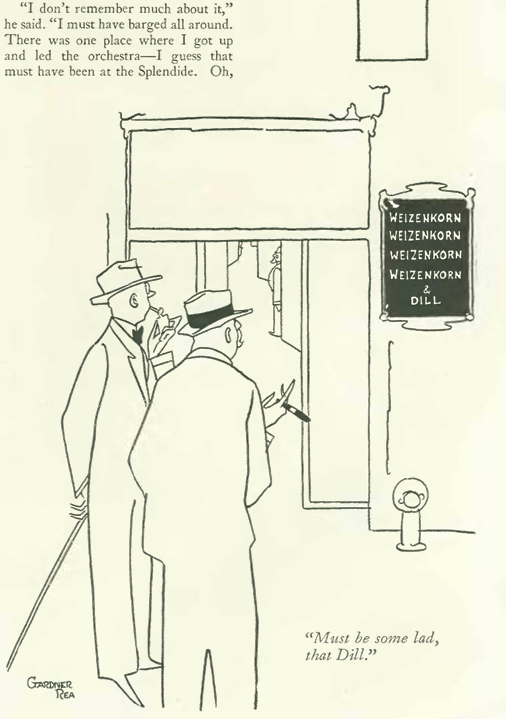
…we begin our cartoons with the spare stylings of Gardner Rea

…and Otto Soglow

…we find one of Helen Hokinson’s ladies on her way to fitness…

William Crawford Galbraith showed us an enterprising young man…

Art Young illustrated the challenges of the lecture circuit…

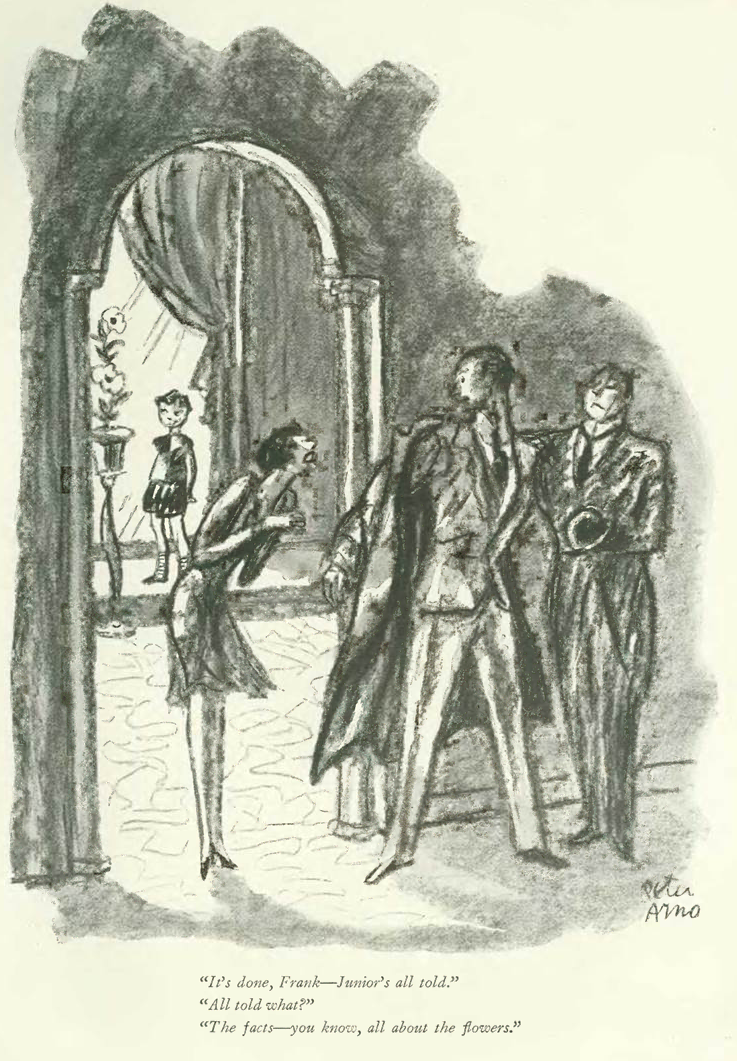
…and one of my all-time favorite Peter Arno cartoons…

Next Time: The Circus Comes to Town…


We Smiled As We Danced

In his 2006 book, Flapper, Joshua Zeitz refers to The New Yorker’s Lois Long as the epitome of the 1920s flapper, an “absolutely a wild woman” who wrote about Jazz Age nightlife “with a wicked sort of sexual sense of humor.”

Feb. 8, 1930 cover by Theodore Haupt (the annual Westminster Kennel Club dog show was in town…)

This Vassar-educated daughter of a Congregational minister began her New Yorker career in the summer of 1925, at age 23. She took over Charles Baskerville’s rather dry column, “When Nights are Bold,” renamed it “Tables for Two,” and using the pen name “Lipstick” plunged into the nightlife scene with considerable brio.

TIMES CHANGE…At left, in a still image from a 1920s home movie, Lois Long relaxes on a beach; at right, Long with newborn daughter Patricia Arno in 1929. (PBS/Patricia Arno)

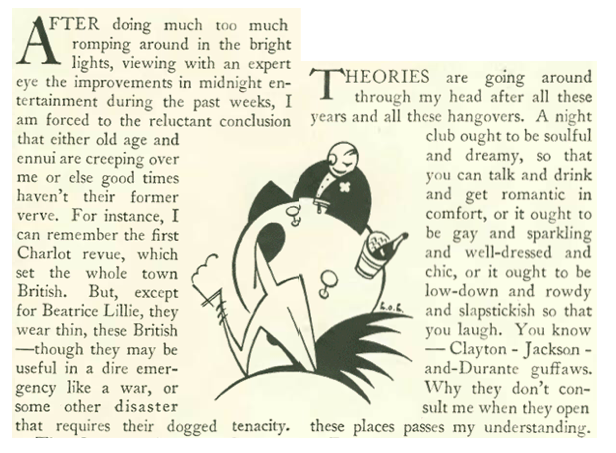
Two years later she would marry cartoonist Peter Arno, and in 1929 would give birth to a daughter, Patricia. During this time the almost weekly “Tables” column would appear infrequently as Long turned her attentions to her family and her fashion column, “On and Off the Avenue.” But as I’ve noted before, Long, along with many of her New Yorker colleagues, had grown weary of the Roaring Twenties many months before they were over. She would put an end (for awhile) to the “Tables” column in June 1930; the good times, as Long noted in her Feb. 8 column, had lost their “verve”…

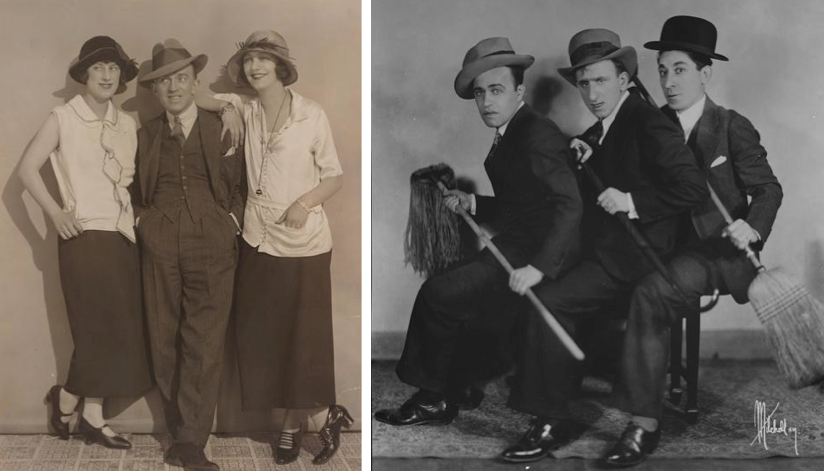
BRITS AND TWITS…Lois Long recalled the nightlife entertainments of the past and present in one of her last “Tables for Two” columns. Photo at left (from left to right), Beatrice Lillie, Nelson Keys, and Gertrude Lawrence in Andre Charlot’s Revue of 1924. At right, the comedy trio Eddie Jackson, Jimmy Durante and Lou Clayton. (Museum of the City of New York/Herbert Mitchell Collection)

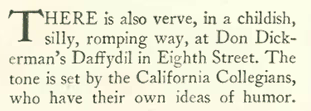
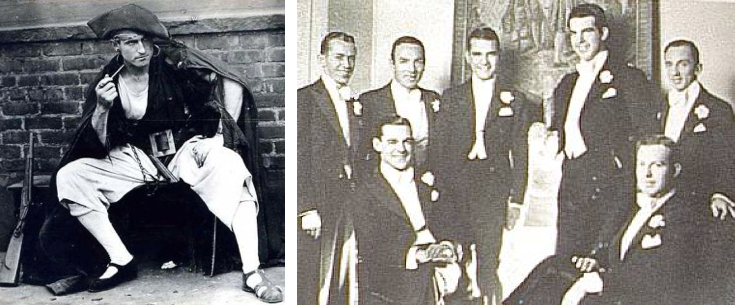
…Long found Don Dickerman’s latest themed restaurant, the Daffydil, to be a mildly amusing distraction…

HE WAS AN ARRRTIST…Greenwich Village personality and pirate aficionado Don Dickerman (left) failed to make a living as an artist, but found success with his various themed restaurants including the Pirate’s Cove, the Blue Horse, the Heigh-Ho (where Rudy Vallee started out), the County Fair and the Daffydil (which was financed by Vallee). At right, singing at the Daffydil were the California Collegians, a group that included actor Fred MacMurray (tallest in the photo). (Restaurant-ing through history)

…and she also looked to Harlem for some nighttime diversions, but the ex-flapper just wasn’t up for a rowdy scene…

FOR THE YOUNG AT HEART…Dancing the Lindy Hop at the Savoy in Harlem, circa 1930. (Pinterest)

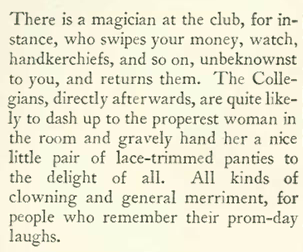
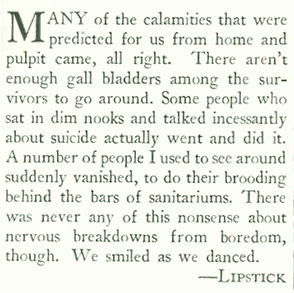
…ten years later, in The New Yorker’s fifteenth anniversary issue (Feb. 17, 1940), the 38-year-old Long would look back to the Roaring Twenties in the column “That Was New York,” reprising her signature “Lipstick” as she recalled the days when “Harlem was a thrill” and “we smiled when we went dancing in 1925 even though there wasn’t a candid camera within miles. In those days people frequently laughed out loud in public.” She concluded the piece with this observation:

 *  *  *

Rise of the Débutantes

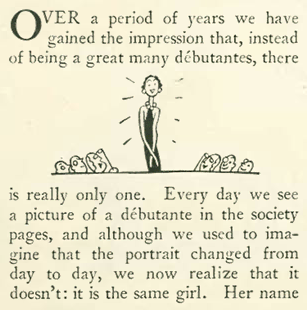
New York’s débutantes and The New Yorker had something of a symbiotic relationship during the magazine’s early days, beginning with a piece written by 22-year-old Ellin Mackay for the Nov. 28, 1925 issue that served as a manifesto of sorts for a new kind of débutante. Mackay’s essay explained why modern women were abandoning the forced social matchmaking of débutante balls in favor of the more egalitarian (and fun) night club scene.

Mackay’s piece provided a huge boost to The New Yorker’s circulation, the magazine barely staying afloat at the time. Nevertheless, its writers couldn’t resist taking occasional shots at the seemingly frivolous existence of debs, including E.B. White, who called out a one Katrinka Suydam in his “Notes and Comment” column for Jan. 4, 1930:

Perhaps White came across Suydam’s name in the Sept. 7, 1929 New York Times:

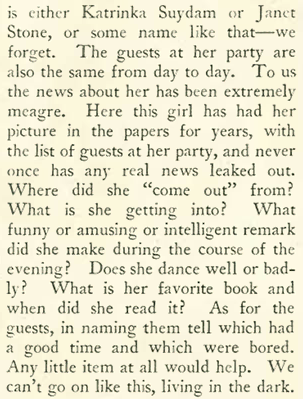
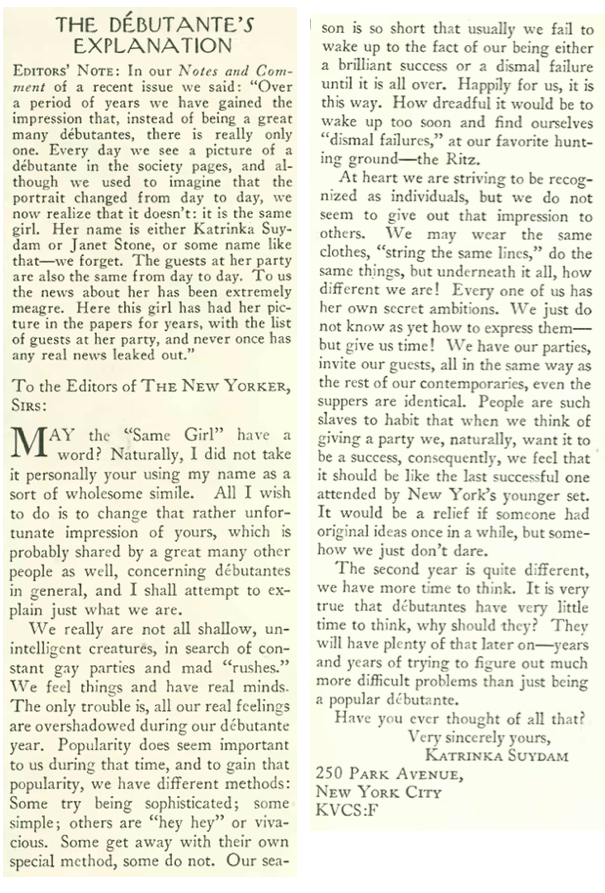
What he probably didn’t expect was a reply from Suydam herself, an act that seemed to impress the magazine’s editors, who printed the proud débutante’s letter in full on page 32:

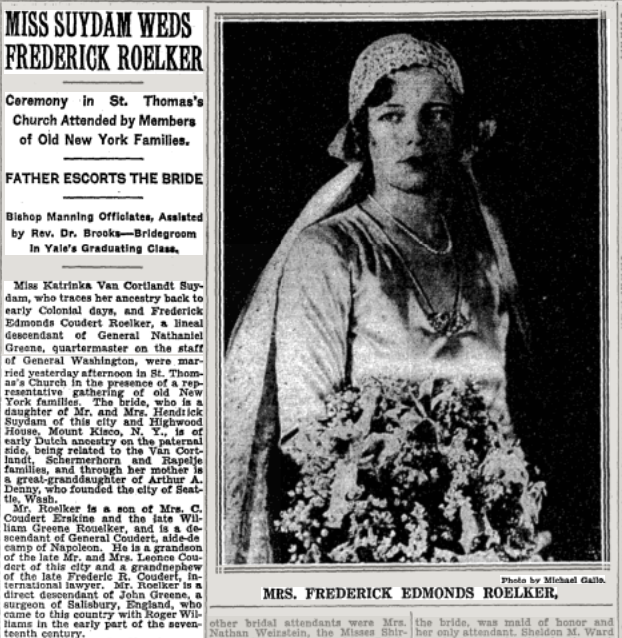
Suydam would go on to marry Frederick Roelker later that June. Note in this excerpted wedding write-up how the couples’ European and colonial pedigrees were carefully detailed in the first paragraphs, distinguishing their union from couplings enjoyed by the unwashed masses…

Katrinka Suydam’s wedding as reported in the June 12, 1930 issue of The New York Times.

 *  *  *

Skirt Stakes

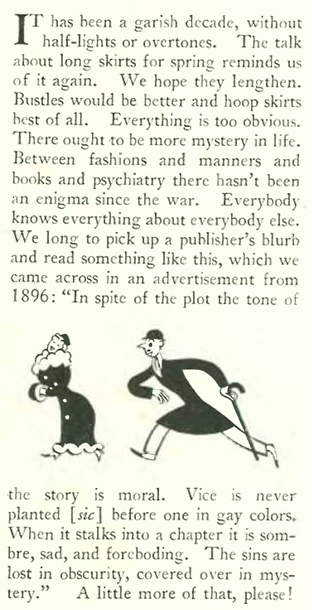
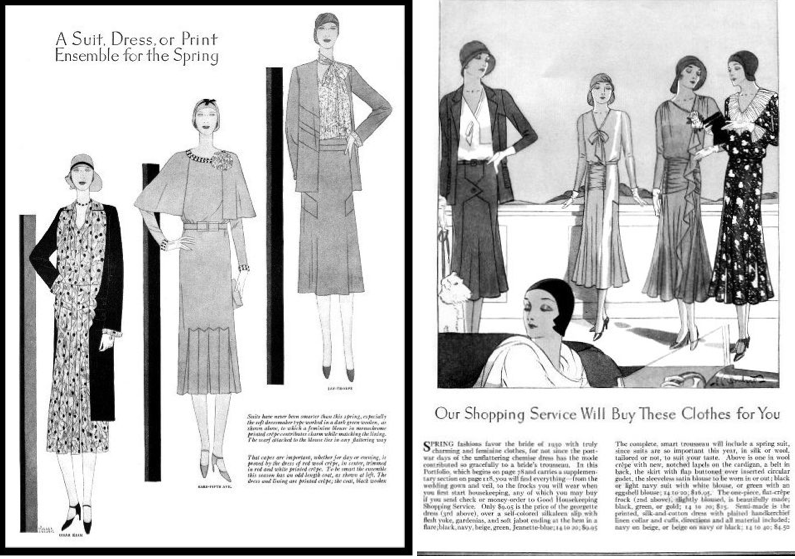
In 1930 hemlines plummeted along with the stock market. E.B. White, in “Notes,” welcomed the return of “mystery” to women’s fashions:

THEY DROPPED WITH THE MARKET…Women’s spring fashions with lowered hemlines on display in the April 1930 issue of Good Housekeeping. (fashion-era.com)

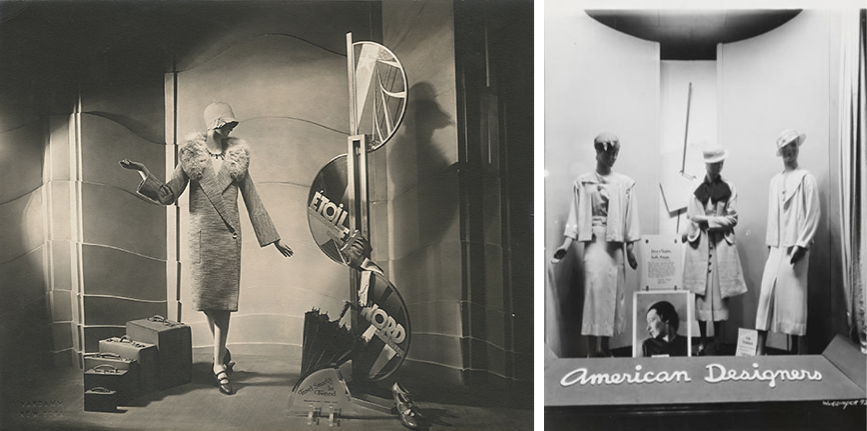
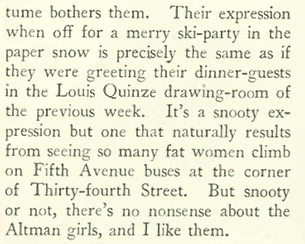
Frederick Lewis Allen, on the other hand, was having difficulty understanding the modern woman, circa 1930, based on what he was seeing in the display windows along Fifth Avenue. Excerpts:

NO NONSENSE WOMEN…Window displays on Fifth Avenue included (left) this “Travel Smartly in Tweed” window display for Franklin Simon (1929-30); and right, a window at Lord & Taylor, 1933. (Harry Ransom Center/Museum of the City of New York)

Allen noted that the “snooty” mannequins on display along Fifth Avenue represented a certain type who wouldn’t be caught dead riding a bus…

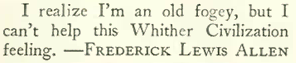
Whether or not he liked the Altman girls, the 39-year-old Allen felt like an “old fogey” in the presence of these “no nonsense” women:

 *  *  *

Get A Room

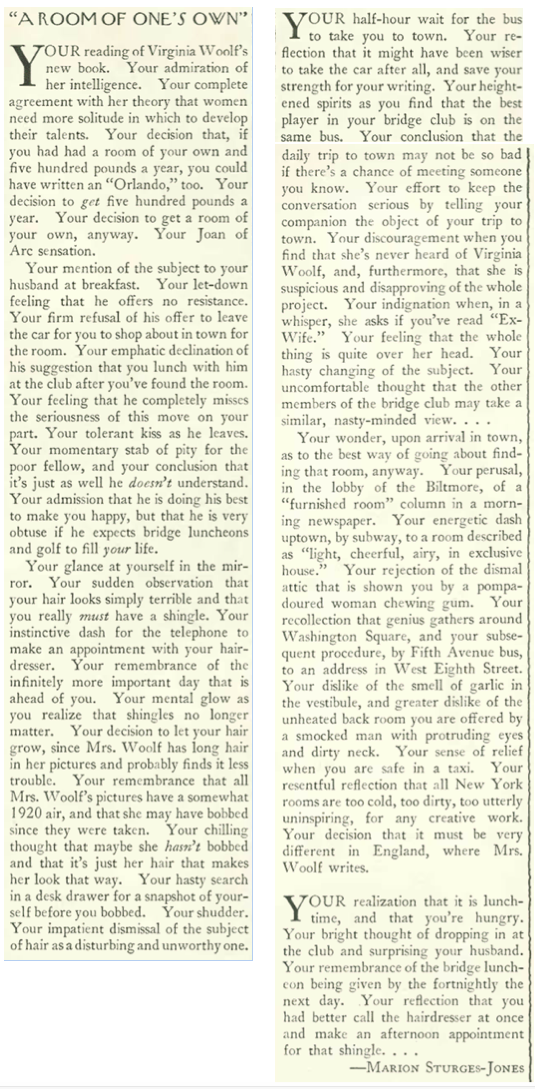
Marion Sturges Jones pondered the life of another kind of modern woman, namely that of Virginia Woolf, who had recently published the extended essay A Room of One’s Own. Jones discovered that finding such a room was easier said than done…

IN HER ROOM…Virginia Woolf at Monk’s House in East Sussex, 1932; dust jacket of the first edition of A Room of One’s Own. (kaykeys.net/Beinecke Library, Yale)

 *  *  *

The Way You Really Look

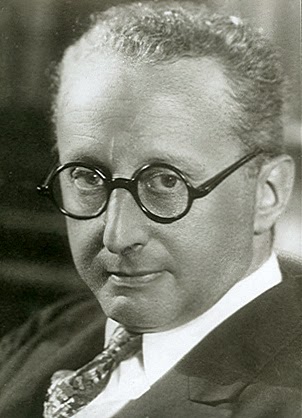
Franklin P. Adams penned a profile of the legendary songwriter and stage producer Jerome Kern, who created dozens of Broadway musicals and Hollywood films and wrote a substantial chunk of the American songbook (more than 700 songs) with such hits as “Ol’ Man River”, “A Fine Romance”, “Smoke Gets in Your Eyes”, and “The Way You Look Tonight.” Peter Arno provided this less-than-flattering caricature of the man…

…and this is how Kern actually looked, circa 1930…

(bloggingtonybennett.com)

 *  *  *

At the Talkies

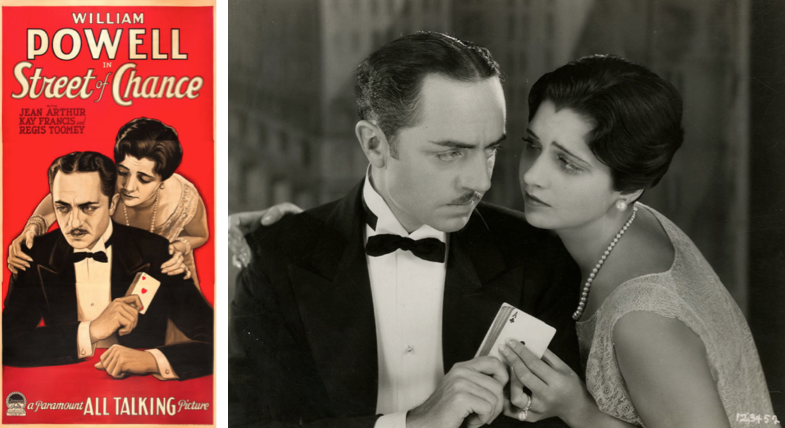
Speaking of showbiz, New Yorker film critic John Mosher offered high praise for William Powell’s latest film, Street of Chance. Although Powell is often linked professionally to actress Myrna Loy thanks to their six Thin Man films (1934 – 1947), from 1930 to 1932 he also appeared with Kay Francis in six films, including Street of Chance. Both Powell and Francis would become major stars of the 1930s, and between 1930 and 1936 Francis would be the number one female star at Warner Brothers and the highest-paid American film actress. Francis was no stranger to wild living — she was a longtime friend of Lois Long’s (see above) and also shared an apartment with her at 381 Park Avenue before Long married Peter Arno. Mosher’s review:

TOUGH ODDS…William Powell and Kay Francis in Street of Chance (1930). Francis was a longtime friend of New Yorker columnist Lois Long. (IMDB)

 *  *  *

From Our Advertisers

We have an advertisement from the aforementioned County Fair, one of the themed restaurants operated by Greenwich village artist and personality Don Dickerman, who illustrated his own ads…

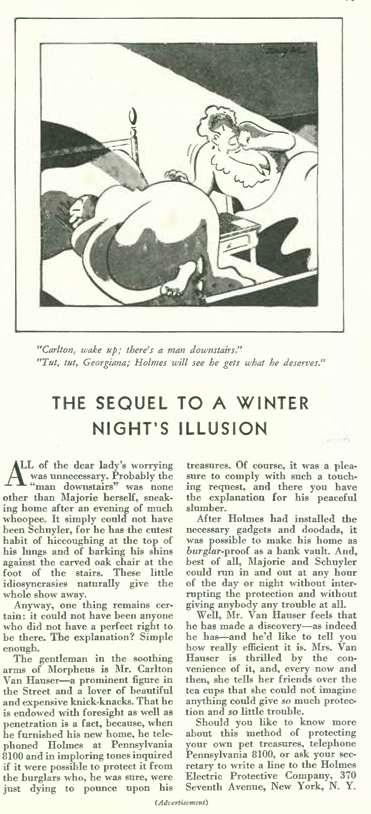
…I’m not sure who drew this Arno-esque illustration below for the Holmes Electric Protective Company, but I can tell you that the name Holmes was synonymous with home security in 1930…in 1857 Edwin Holmes bought a patent for an electric burglar alarm (invented in 1853 by Augustus Pope) and went on to successfully commercialize and popularize the electromagnetic burglar alarm. Holmes is also credited with creating the first large-scale alarm network in the United States…

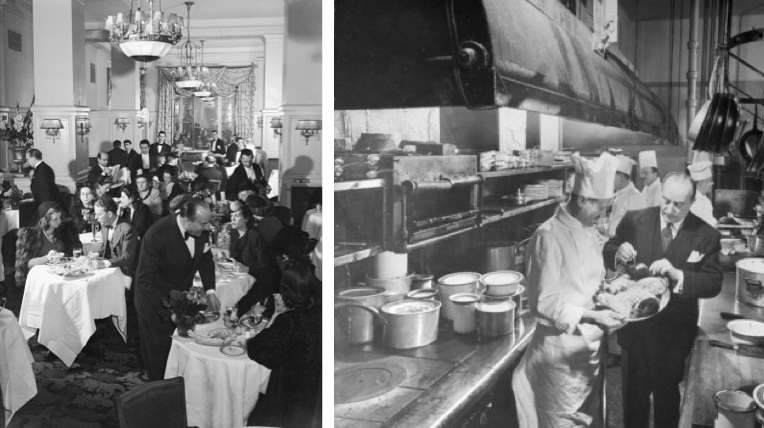
…but I do know that Abe Birnbaum contributed this drawing (in “Talk of the Town”) of the beloved Colony restaurant owner Eugene Cavallero

A PLACE TO SEE AND BE SEEN…From the 1920s to the 1960s New York’s smart set dined at the Colony. Rian James, in Dining In New York (1930) wrote “the Colony is the restaurant of the cosmopolite and the connoisseur; the rendezvous of the social register; the retreat of the Four Hundred.” Critic George Jean Nathan said the Colony was one of “civilization’s last strongholds in the department of cuisine.” Photo at left of the dining room around 1940; at right, owner Eugene Cavallero consults with a chef. (lostpastremembered.blogspot.com)

…on to our cartoons, we have a full page from Al Frueh

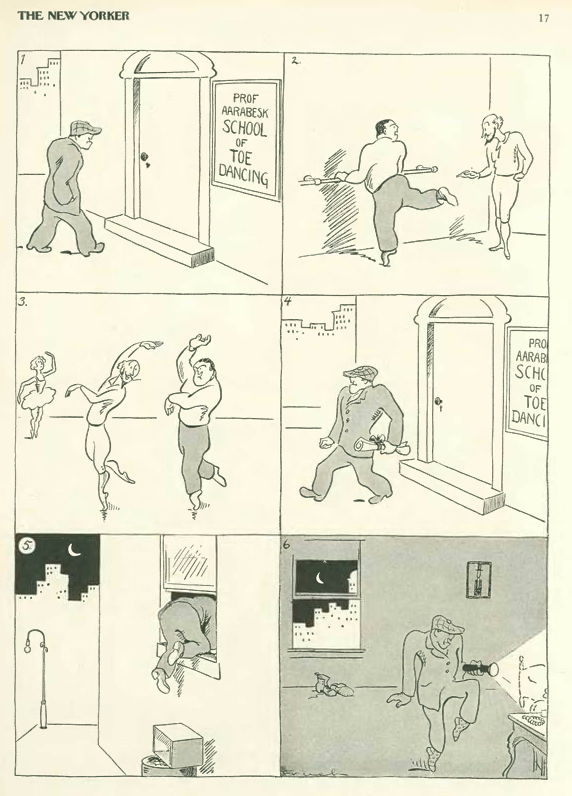
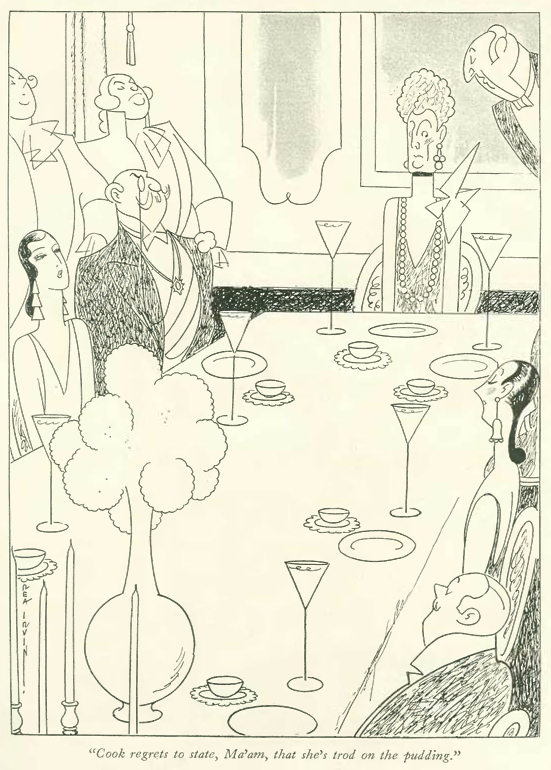
…and another full-page from Rea Irvin

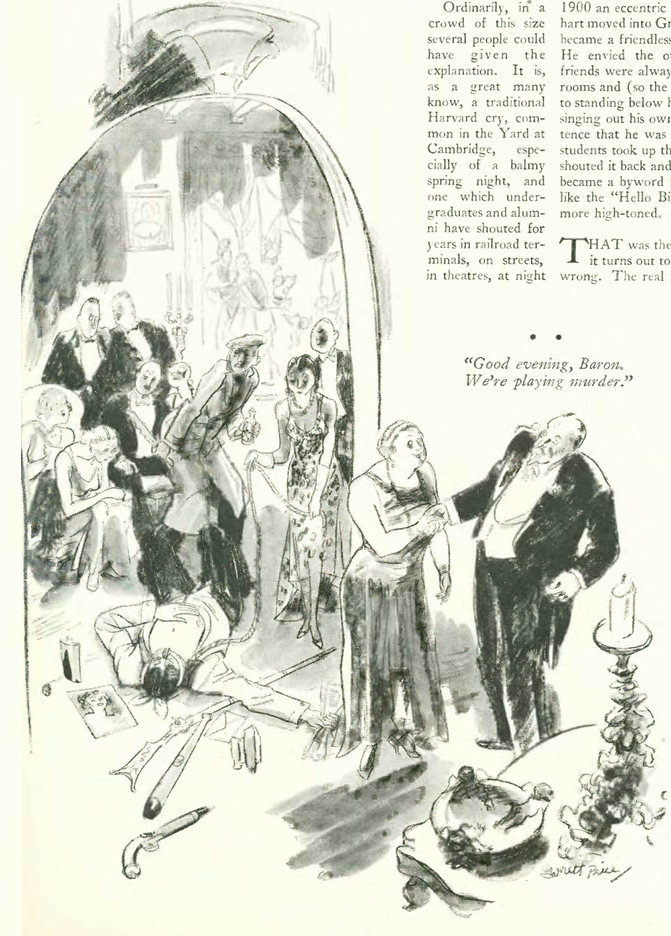
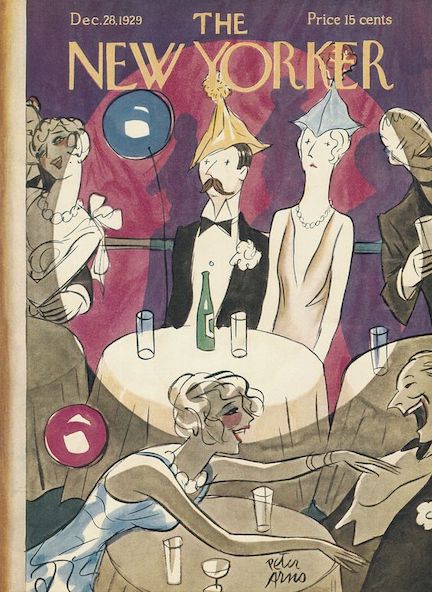
…this terrific party scene courtesy Garrett Price

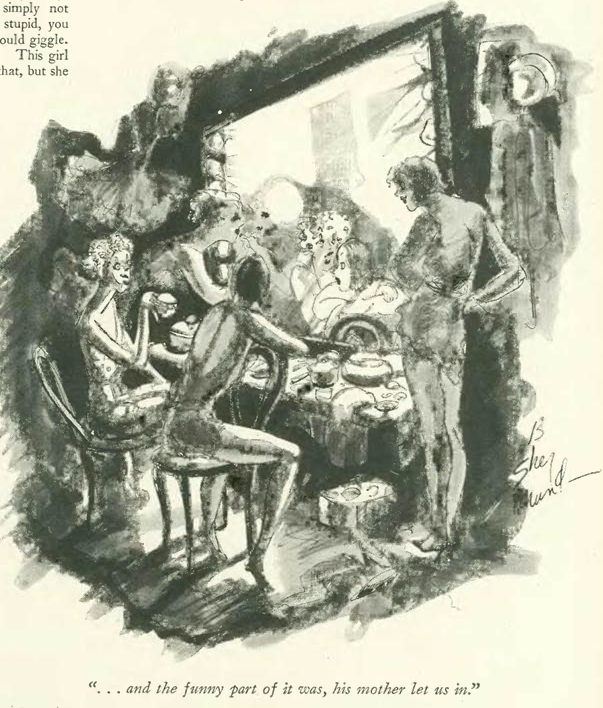
…two by the marvelous Barbara Shermund (check out Michael Maslin’s latest post on Shermund)…

and we sign off with the inimitable Peter Arno

Next Time: Prophet of Doom…


In Search of Yuletide Cheer

Construction workers line up for pay beside the first Rockefeller Center Christmas tree in New York in 1931. (ASSOCIATED PRESS)

E.B. White’s “Notes and Comment” column led off The New Yorker’s “Talk of the Town,” and as such helped set the tone for what was to follow in the magazine.

Dec. 14, 1929 cover by Theodore Haupt. Opening image: Construction workers line up for pay beside the first Rockefeller Center Christmas tree in New York in 1931. (NY Daily News)

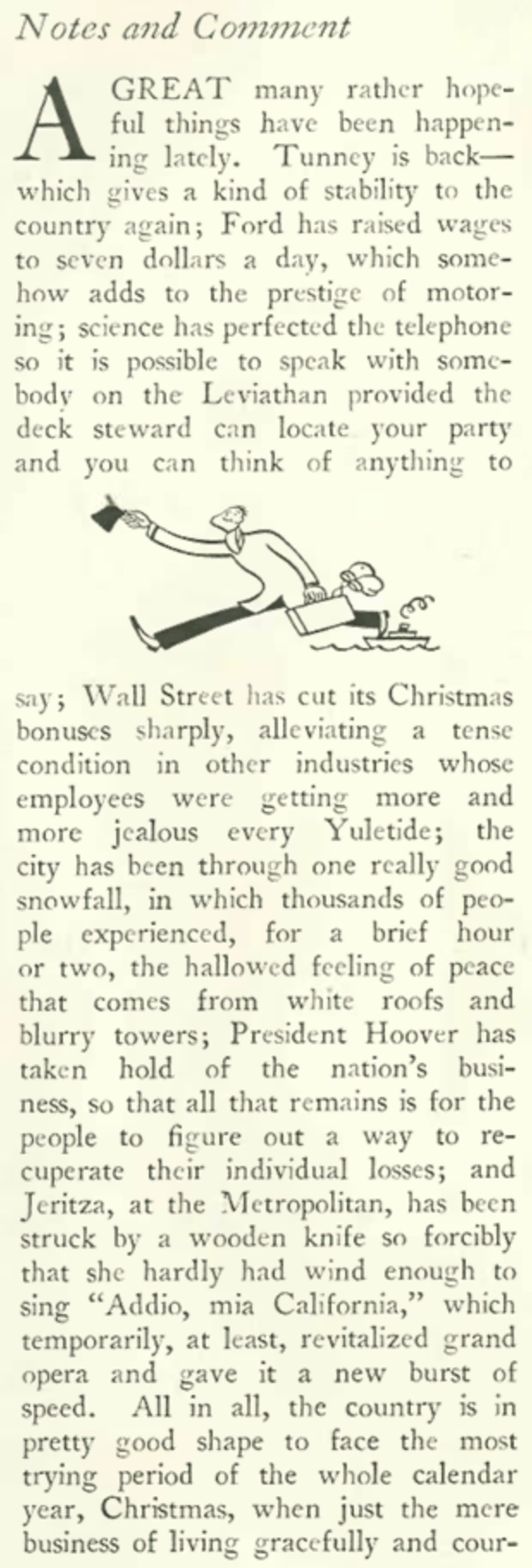
For the Dec. 14 issue White attempted to strike a positive note in the aftermath of the stock market crash, offering a few nuggets of hope for the holiday season:

HEAVYWEIGHTS…Both President Herbert Hoover and retired prizefighter Gene Tunney offered signs of stability to a nation reeling from economic collapse. At right, Gene and Mary Tunney return to New York on the ocean liner Vulcania after 14 months in Europe. (Wikipedia/AP)

Alexander Woollcott, however, described his financial woes in his “Shouts and Murmurs” column, where he parodied newspapers that listed charity cases during the Christmas season:

BOOK-END POOR…Alexander Woollcott, in a 1939 portrait by Carl Van Vechten. (Wikipedia)

Paris correspondent Janet Flanner noted how the ripples of the market crash were being felt in Paris: Americans no longer had wads of cash to lavish on booze, jewelry, antiques and real estate:

DON’T RAIN ON OUR PARADE…The Place de la Nation, Paris, 1930. (thevintagenews.com)

Flanner added that despite the past boorish behavior of American tourists, the level of schaudenfreude among the French was remarkably low…

 *  *  *

Sinful Diversions

For yet another sign that the Roaring Twenties were decidedly over, it appeared that even “Sex” had run its course. Theater critic Robert Benchley noted that Mae West’s scandalous 1926 play inspired a spate of shows that had little new to offer, save for amping up the salacious content: A Primer for Lovers, The Amorous Antic, and Young Sinners. Audiences were unimpressed. A Primer for Lovers closed after just 24 performances, The Amorous Antic after just eight. Only Young Sinners would survive into the spring season.

JUST LOOK WHAT YOU STARTED…”Sex” was panned by critics as vulgar, but Broadway audiences in 1926 loved it. After 375 performances police arrested Mae West on obscenity charges, which landed her in a prison workhouse for ten days. (boweryboyshistory.com)
Actress Phoebe Foster (left) found success on Broadway, but not so much in The Amorous Antic, which closed after just eight performances. Dorothy Appleby (right) had better success with Young Sinners, which ran for 289 performances through August 1930. (IMDB)

 * * *

Final Bows

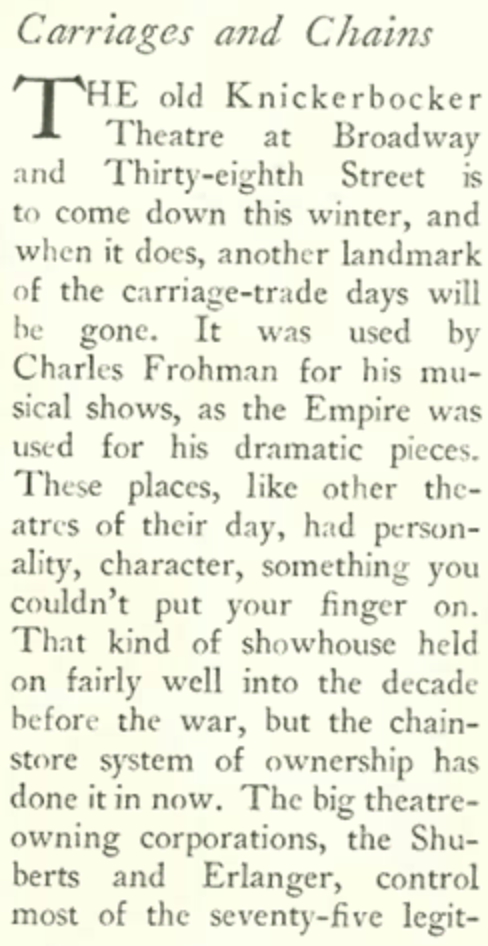
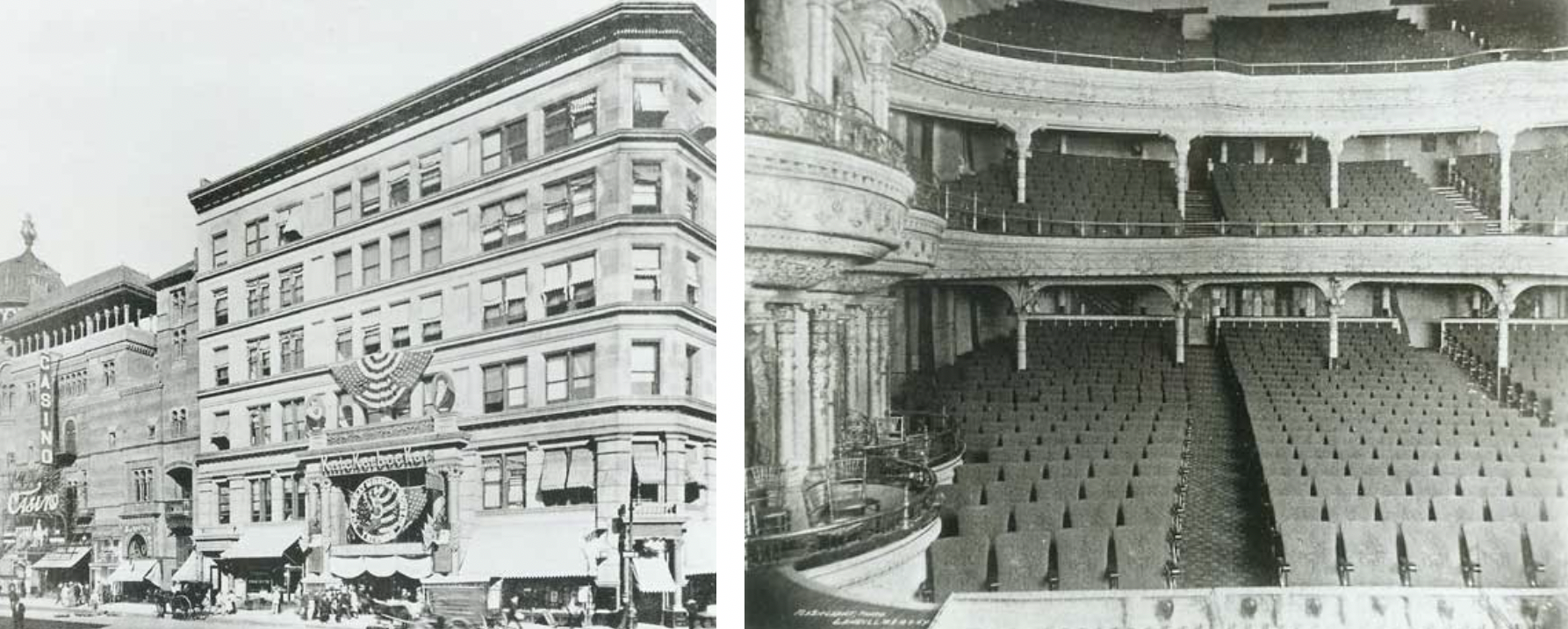
Theater was changing in other ways too. In the late 19th and early 20th century audiences patronized various playhouses based more on their reputation and tradition than on a particular play. E.B. White, in the “Talk of the Town” noted the imminent passing of one such house, the Knickerbocker Theatre, slated for demolition in 1930. The 33-year-old theater was Broadway’s first to display a moving electric sign (1906).

A HOUSE OF GOOD REPUTE…The Knickerbocker Theatre at 1396 Broadway was built in 1896 and demolished in 1930. (Internet Broadway Database)

White noted that smaller venues like the Knickerbocker, with their own distinct character and clientele, were falling victim to big theater-owning corporations that introduced more homogeneity into the play-going scene. In White’s estimation just two old-timers remained:

Both buildings still stand. The New Amsterdam, constructed in 1902–03, is now the oldest theater on Broadway. In the 1910s and 1920s it hosted the Ziegfeld Follies on its main stage and the racier Ziegfeld Midnight Frolics on the building’s rooftop. The Music Box was constructed in 1921 by composer Irving Berlin and producer Sam H. Harris to house Berlin’s Music Box Revues.

DISNEYFIED…The New Amsterdam, constructed in 1902–03, still stands today, now operated by the Disney Company, which signed a 99-year lease with the city in 1993. When it was built it was the largest theater in New York, with a seating capacity of 1,702. (Wikipedia)
IRVING’S PLACE…The Music Box Theatre at 239 West 45th Street was constructed in 1921 by composer Irving Berlin and producer Sam H. Harris to house Berlin’s Music Box Revues. It was later co-owned by Berlin’s estate and the Shubert Organization until Shubert assumed full ownership in 2007. (Wikipedia)

 * * *

Stocks Down, Arno Up

Peter Arno could be found all over the Dec. 14 issue: an ad promoting his new book Peter Arno’s Parade, a blurb in the book section touting the same…this ad for Peck & Peck featuring his handiwork…

…in the cartoons, a full page with the economy as a theme…

…and this submission that was doubtless inspired by Arno’s own home life and his brief, tempestuous marriage to New Yorker colleague Lois Long

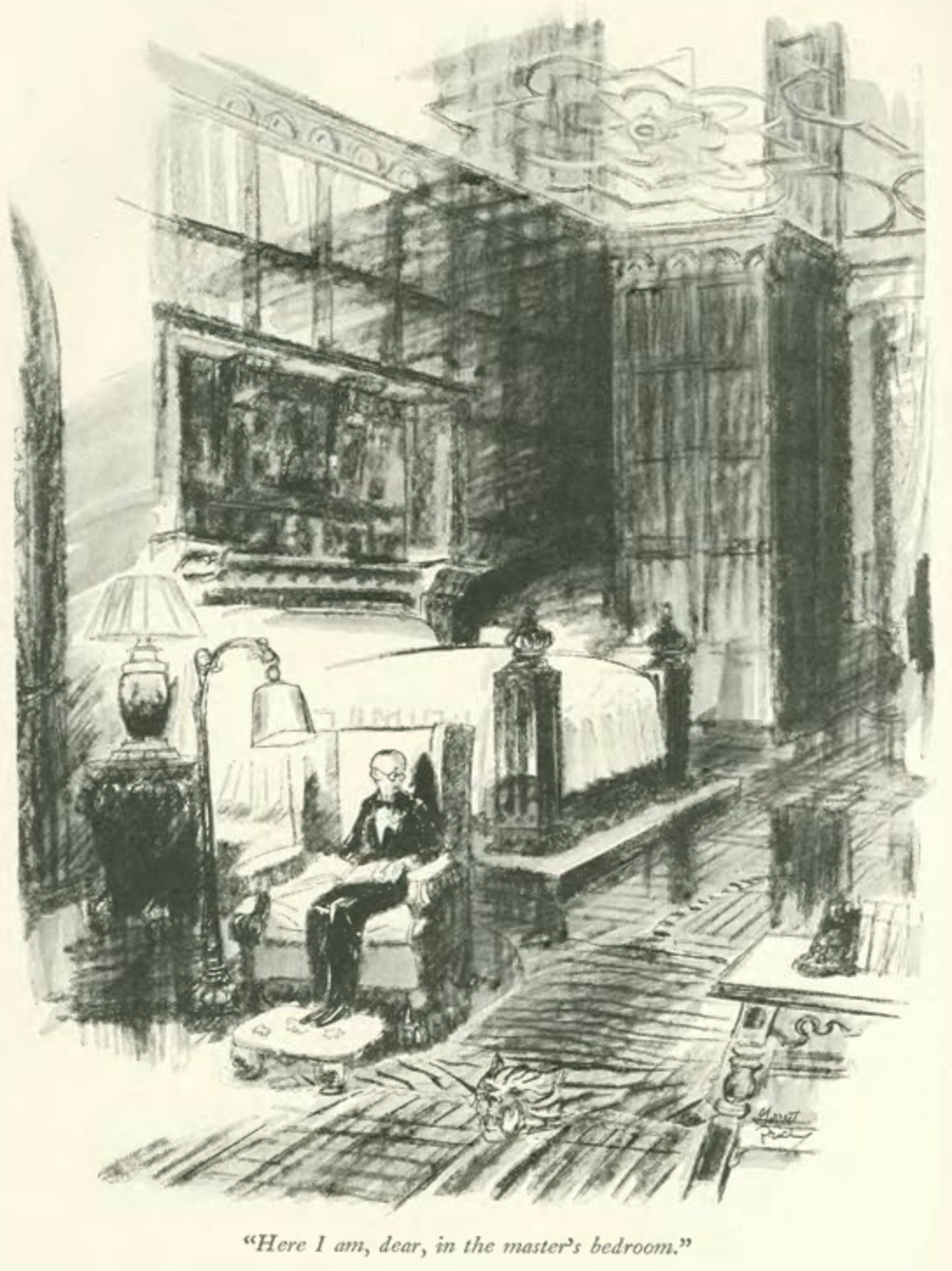
…here’s a couple of comics featuring Milquetoast characters…this one by Garrett Price

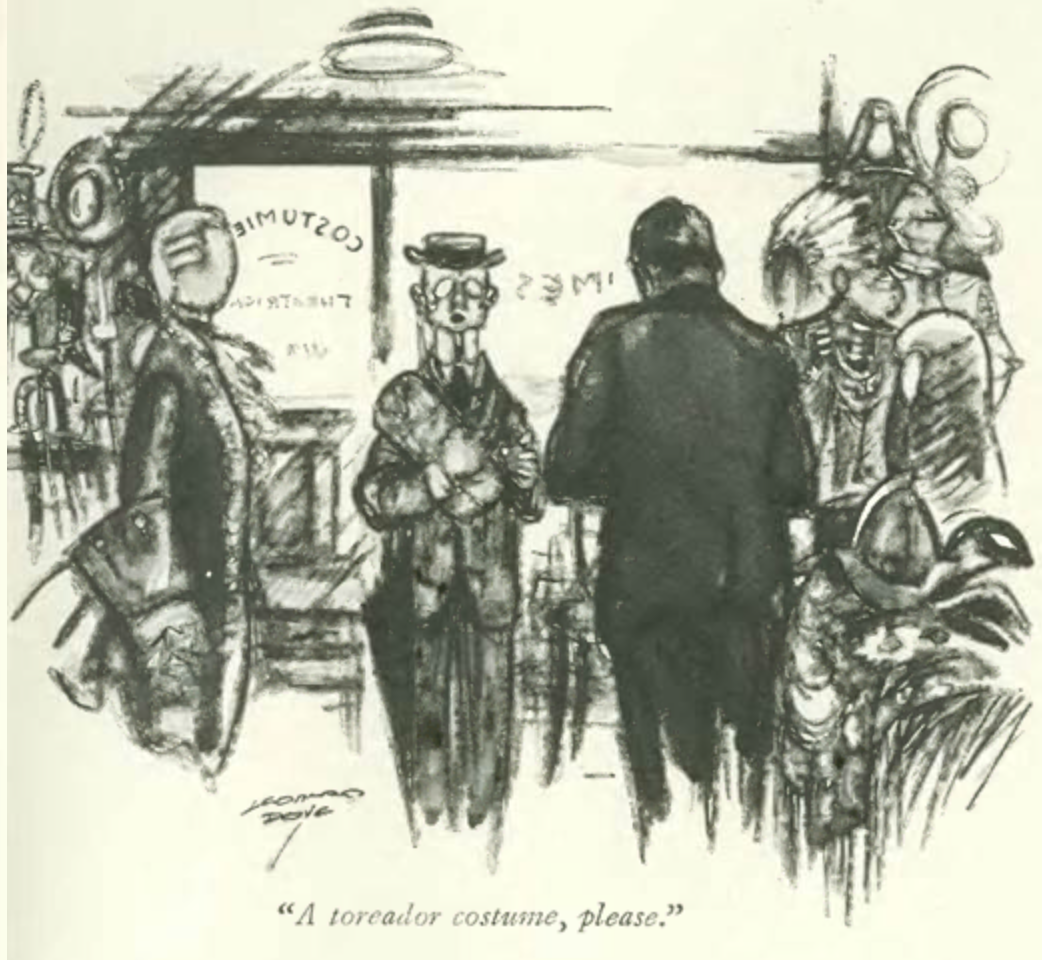
…and another by Leonard Dove

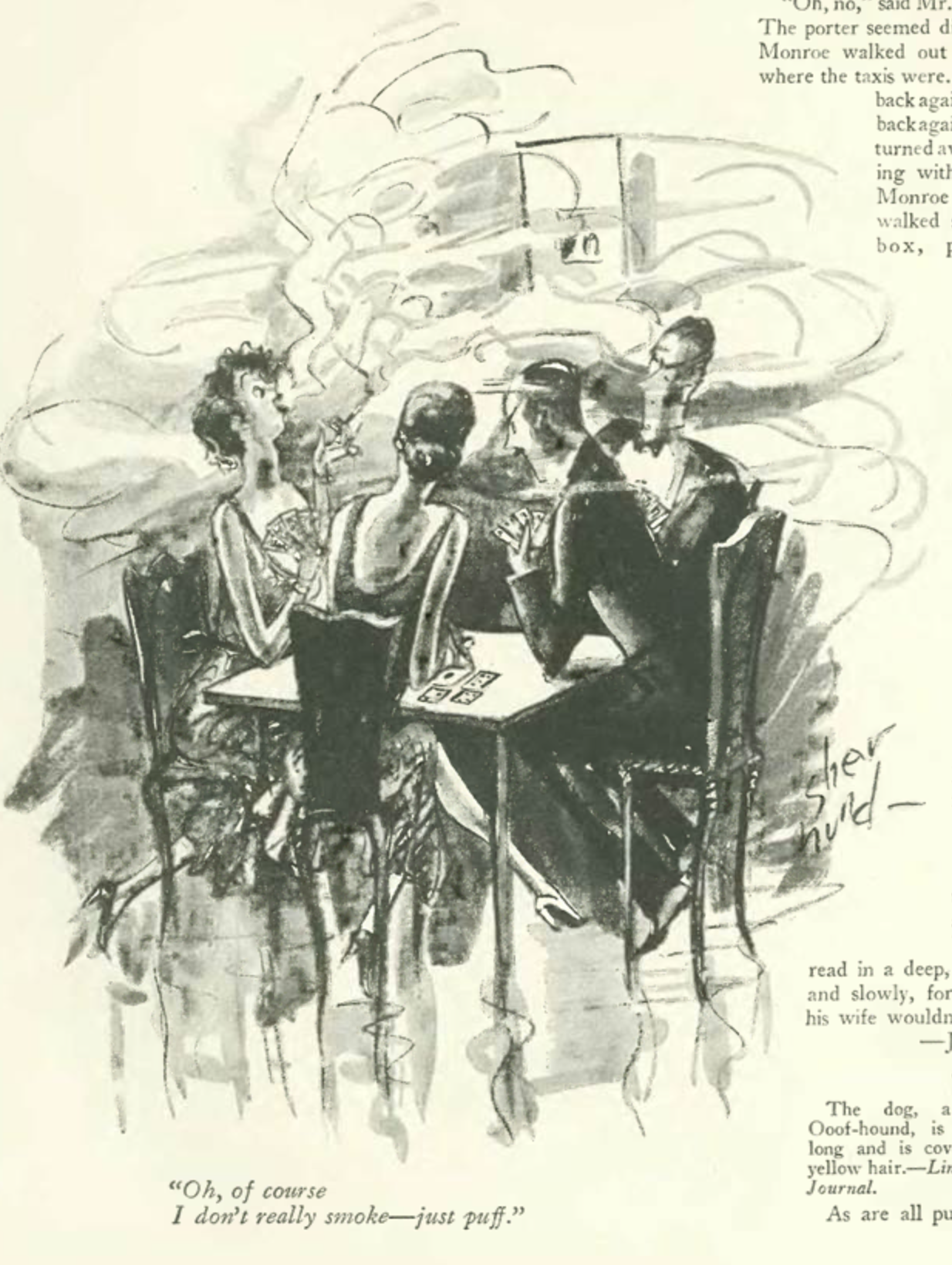
…and two submissions from one of my favorite cartoonists, Barbara Shermund, so ahead of her time…


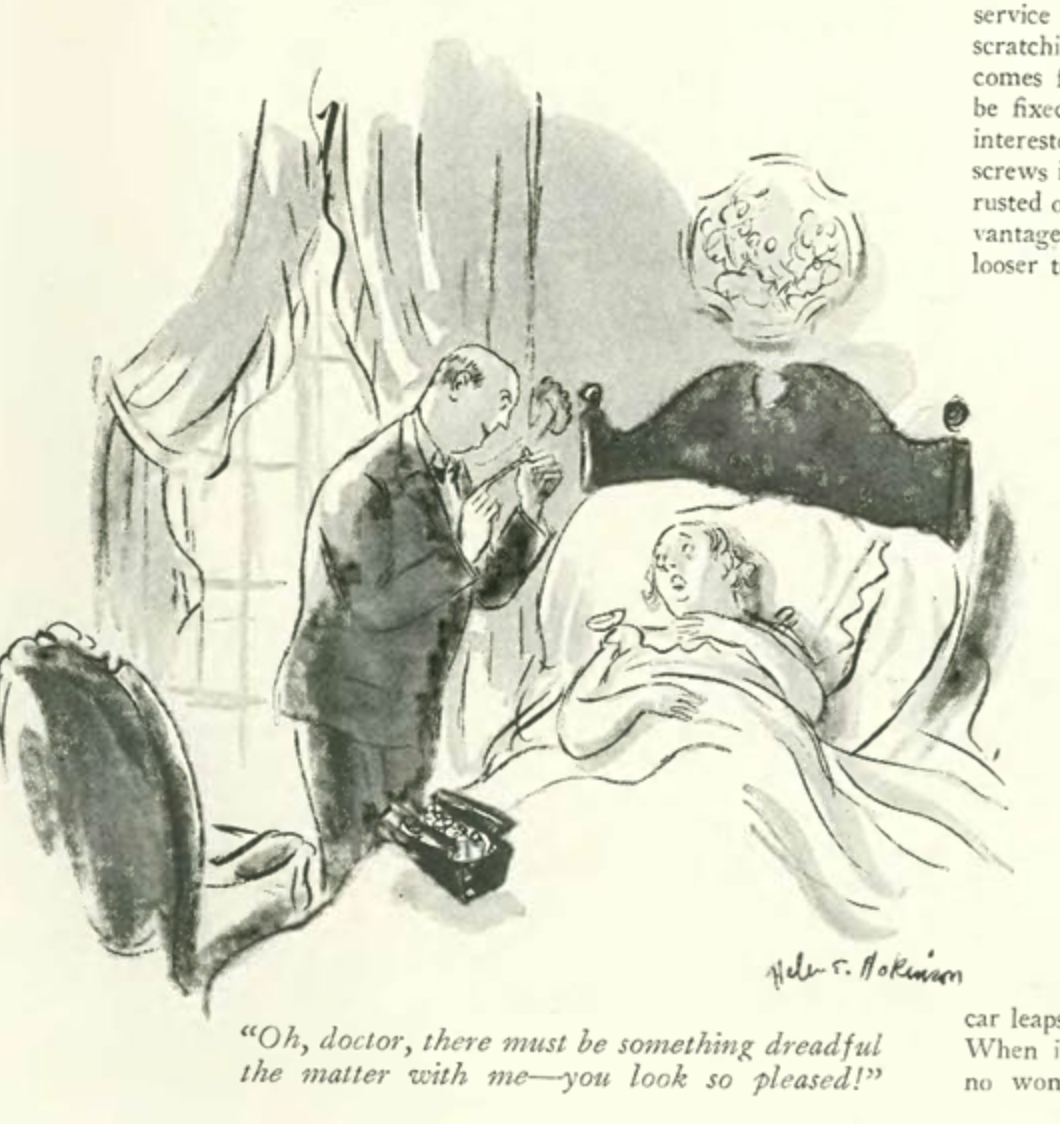
Helen Hokinson examined a physician’s bedside manner…

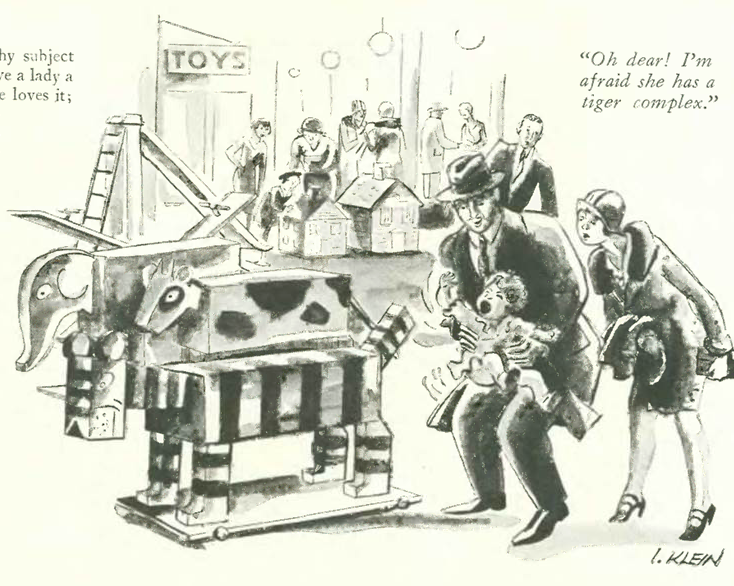
…and I. Klein offered his take on the new economy…

 * * *

We move right along to the Dec. 21, 1929 issue, where things seemed to turn a bit more sour…

Dec. 21, 1929 cover by Rea Irvin.

Elmer Rice’s serialized novel, A Voyage to Purilia, finally concluded in its 11th installment in the New Yorker…and E.B. White took on a more choleric disposition in his “Notes and Comment”…

Lois Long contributed a “Tables for Two” column, a feature that had become infrequent as she turned her full attentions to her fashion column “On and Off the Avenue.” In this installment of “Tables” we get her first mention of the market calamity…

Robert Benchley finally found something to like on Broadway, because Billie Burke was the star attraction…

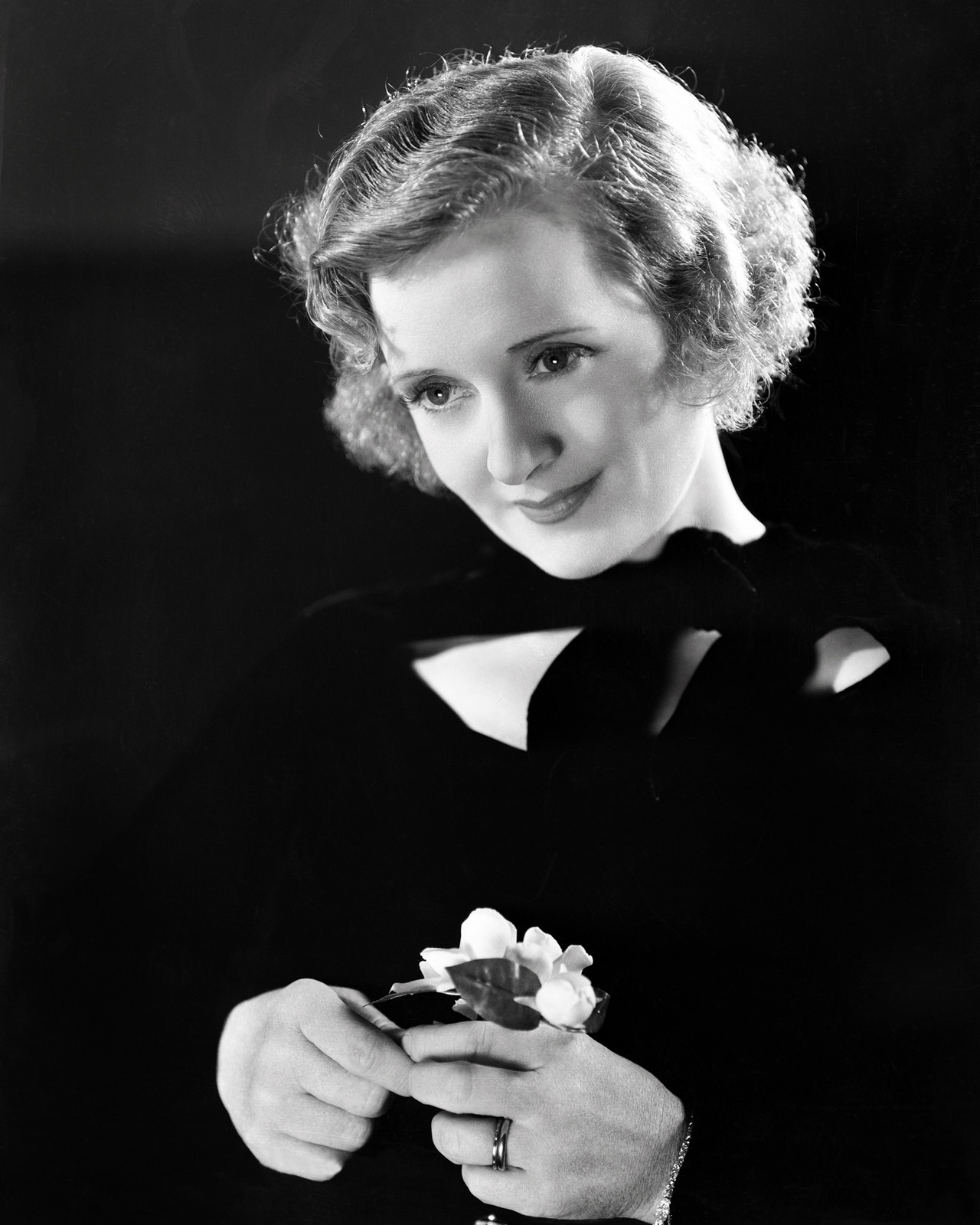
SHE”S THE GOOD ONE…Billie Burke in 1933. Most of us know her today for her performance as Glinda the Good Witch of the North in the 1939 film The Wizard of Oz. (Wikipedia)

 * * *

Violin Prodigy 2.0

The New Yorker raved about the twelve-year-old violinist Yehudi Menuhin when he wowed audiences at the Berlin Philharmonic earlier in the year. So when the ten-year-old Ruggiero Ricci expertly fiddled with the Manhattan Symphony, well…

YEAH, I GOT THIS…Ruggiero Ricci, about 1930, by then a touring professional. At age six Ricci began lessons with Louis Persinger, who also taught another San Francisco prodigy, Yehudi Menuhin. (Text and image, The New York Times)

 * * *

Namesake

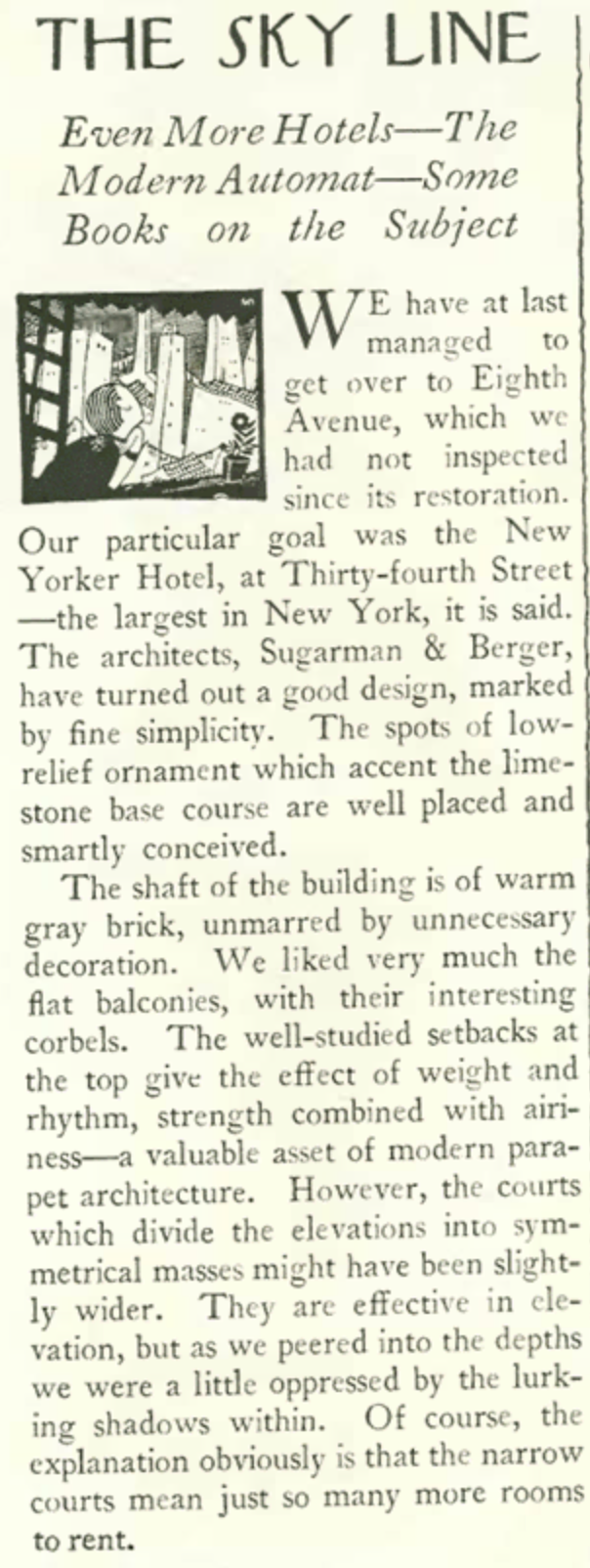
Despite the market crash, the skyline continued to change at a rapid pace, and as we enter the 1930s the city would add some of its most iconic buildings to the skyline. George Chappell, The New Yorker’s architecture critic, had this to say about the magazine’s “namesake”…

ROOMY…The New Yorker Hotel, at 481 Eighth Avenue. When the 43-story Art Deco hotel opened 1930, it contained 2,500 rooms, making it the city’s largest for many years. (Wikipedia)

 * * *

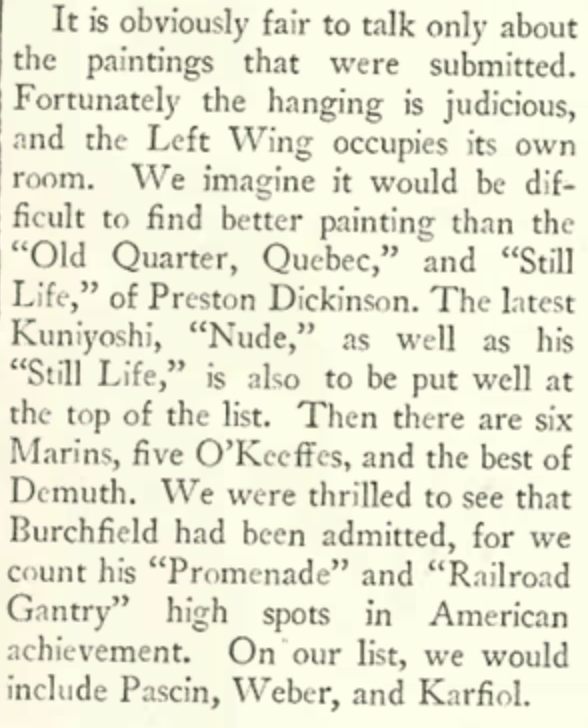
Art critic Murdock Pemberton continued his quest to make sense of the upstart Museum of Modern Art…

…and the American artists showcased there…

…I would add Edward Hopper, John Sloan, Lyonel Feininger, and Rockwell Kent (also displayed at the exhibition) but then again, I have the advantage of hindsight…

 * * *

From Our Advertisers

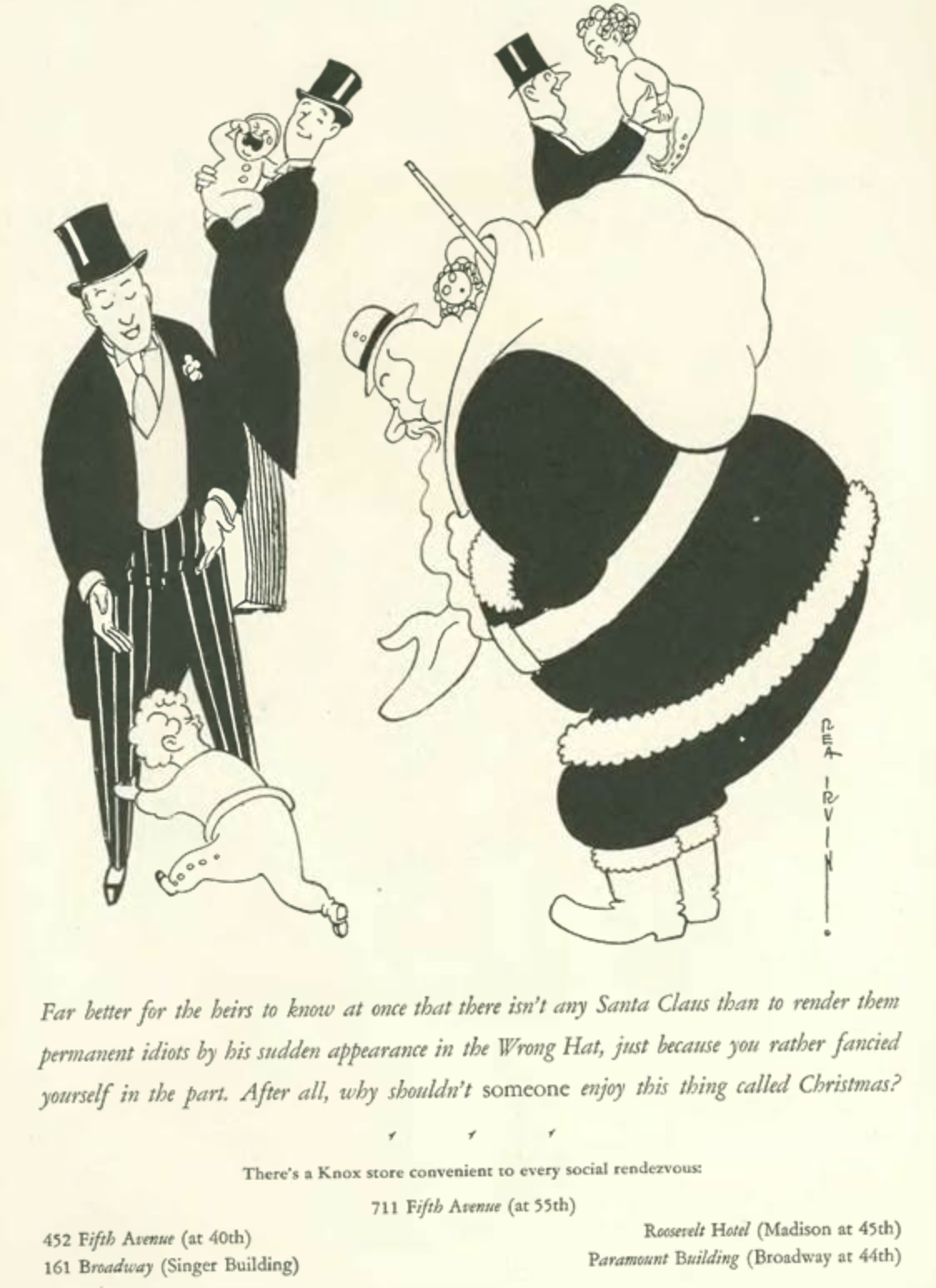
We have more New Yorker cartoonists augmenting their income through advertising, including (once again) Rea Irvin for Knox Hatters…

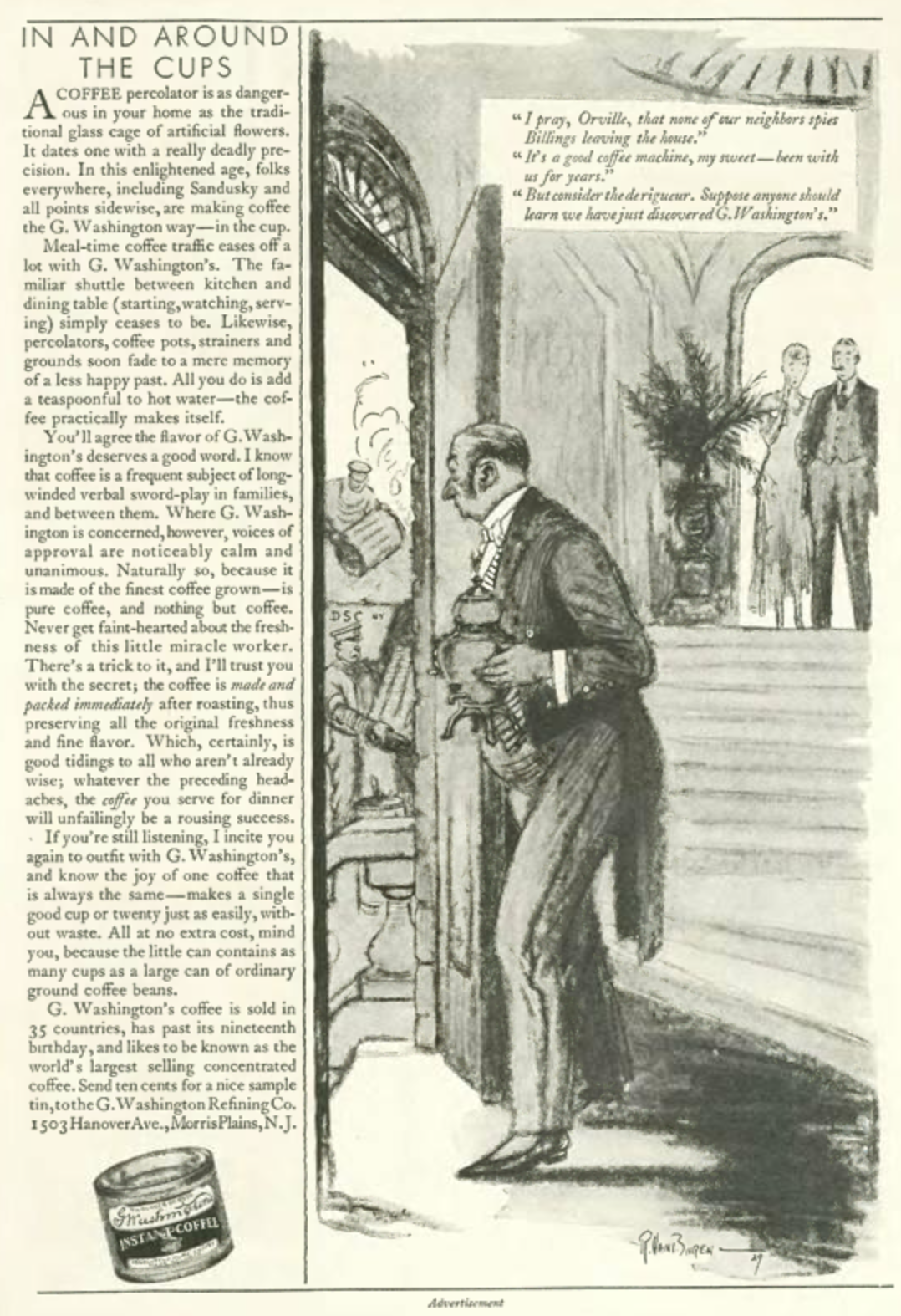
Raeburn Van Buren for G. Washington’s instant coffee (also a client of Helen Hokinson’s)…

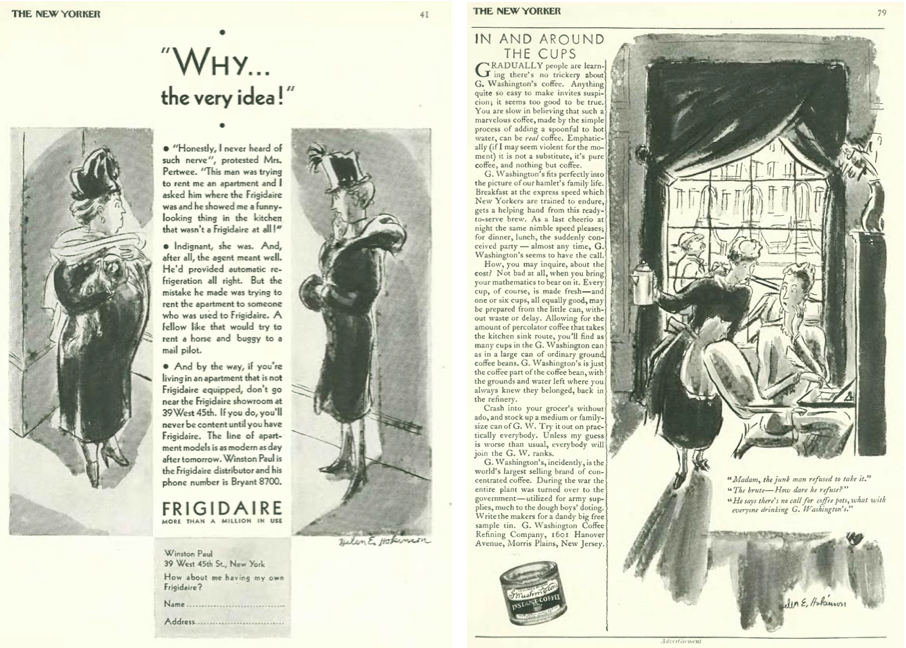
…and Helen Hokinson for Frigidaire…

…and on to cartoons for Dec. 21, Hokinson again…

…and we end with Peter Arno, and another peek into marital bliss…

Next Time: The Curtain Falls…


A Glimpse of the Future

Just nine days after the stock market crash, three women opened a new museum on Fifth Avenue that would play a major role in defining the type of city that would emerge from the other side of the Depression and World War II.

Nov. 23, 1929 cover by Theodore Haupt.

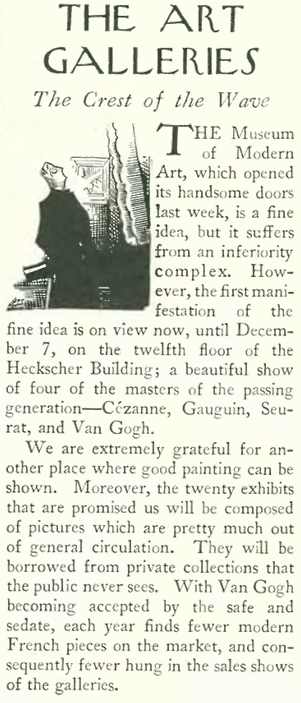
These visionary women would borrow works from modernists of the past century — the post-impressionists —  to stage the first-ever exhibit of the Museum of Modern Art. Abby Aldrich Rockefeller, along with her friends Lillie P. Bliss and Mary Quinn Sullivan, had rented six rooms on the 12th floor of the Heckscher Building, and on Nov. 7, 1929, they opened the doors to the museum’s first exhibition, simply titled Cézanne, Gauguin, Seurat, Van Gogh. The New Yorker’s art critic Murdock Pemberton was on hand for the opening:

THE FOUNDERS…Mary Sullivan, Lillie Bliss and Abby Rockefeller, known socially as “the daring ladies,” founded the Museum of Modern Art in 1929. (virginiafitzgerald.blogspot.com/MoMA)
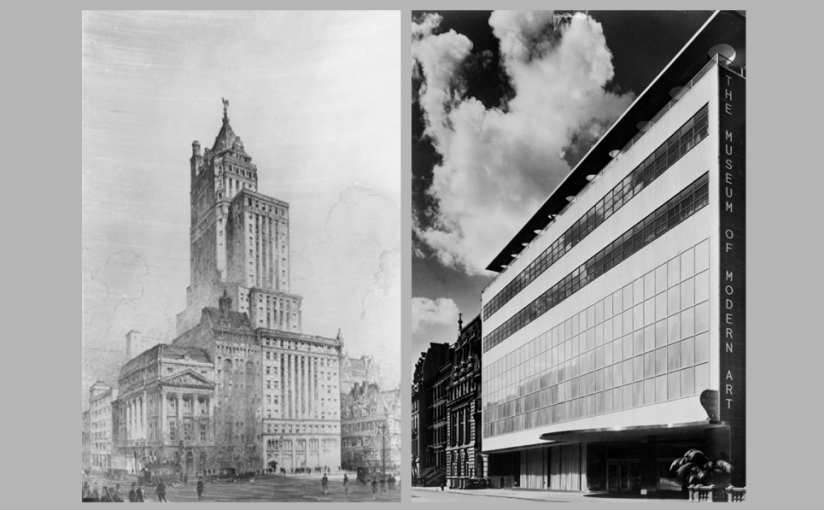
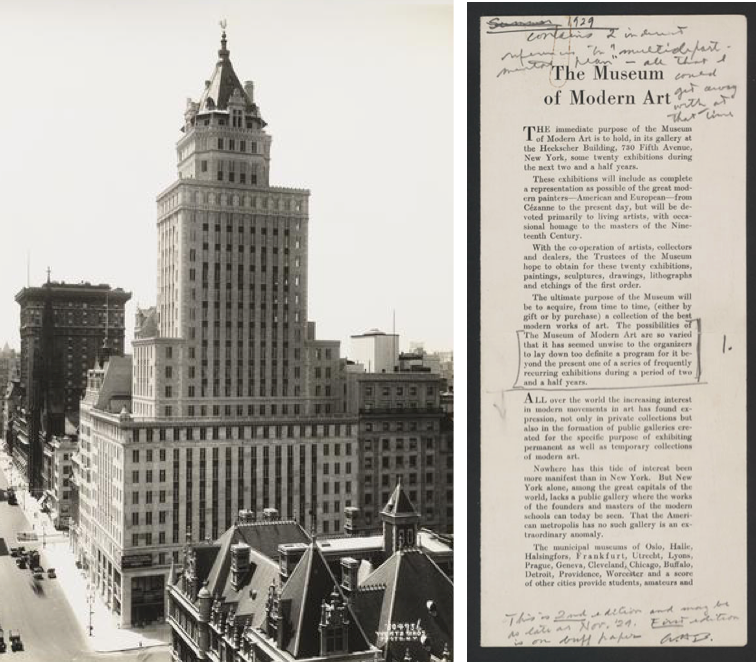
OLD AND NEW…The 12th floor of the Heckscher Building (now called the Crown Building) at Fifth Avenue and 57th Street served as the first location of the Museum of Modern Art. The 1921 building was designed by Warren and Wetmore, the same architects who designed Grand Central Terminal. Note in the foreground the rooftop of the Vanderbilt mansion, demolished in 1926 to make way for the Bergdorf Goodman department store; at right, a page from the new museum’s brochure. (Museum of the City of New York/MoMA)

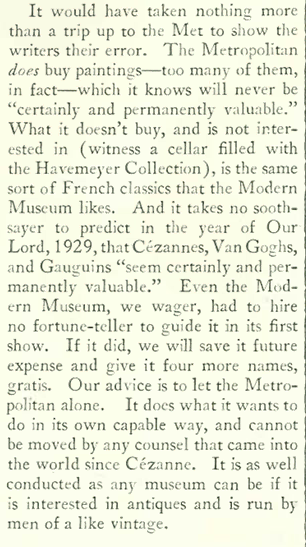
The gallery rooms in the Heckscher were modest — although Abby’s husband was John D. Rockefeller Jr., she had to find funding on her own (he was opposed to the museum, and to modern art). In his review, Pemberton noted the “inferiority complex” that had already set in at the new museum, which took a preemptive swipe at the Met in its pamphlet (pictured above):

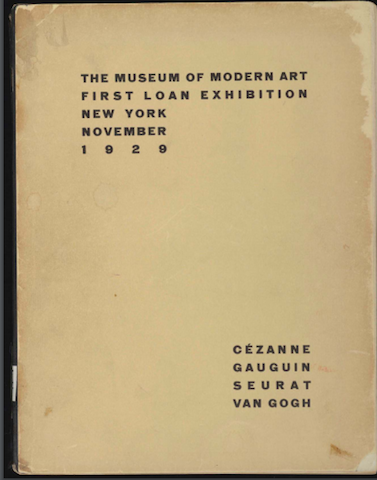
AMBITIOUS…Although the museum was small and had no curatorial departments, MoMA produced a 157-page exhibition catalogue for its first show. (Image and text courtesy MoMA)
MODEST BEGINNINGS…MoMA’s first gallery spaces on the 12th floor of the Heckscher Building were indeed modest, as these photos of the first exhibition attest. (MoMA)
HOW THEY LOOKED IN COLOR…Works featured in MoMA’s first exhibition included The Bedroom (1889) by Vincent Van Gogh, and Pines and Rocks (c. 1897), by Paul Cézanne. (Art Institute of Chicago/MoMA)

Pemberton attempted to set MoMA straight regarding the Met’s reputation:

HOME AT LAST…After moving three times over the course of ten years, the Museum of Modern Art finally found a permanent home in Midtown in 1939. Although Abby Rockefeller’s husband, John D. Rockefeller Jr., was initially opposed to the museum, he eventually came around and donated the land for the 1939 museum (designed by Philip L. Goodwin and Edward Durell Stone) and became one of the museum’s biggest supporters. (MoMA)

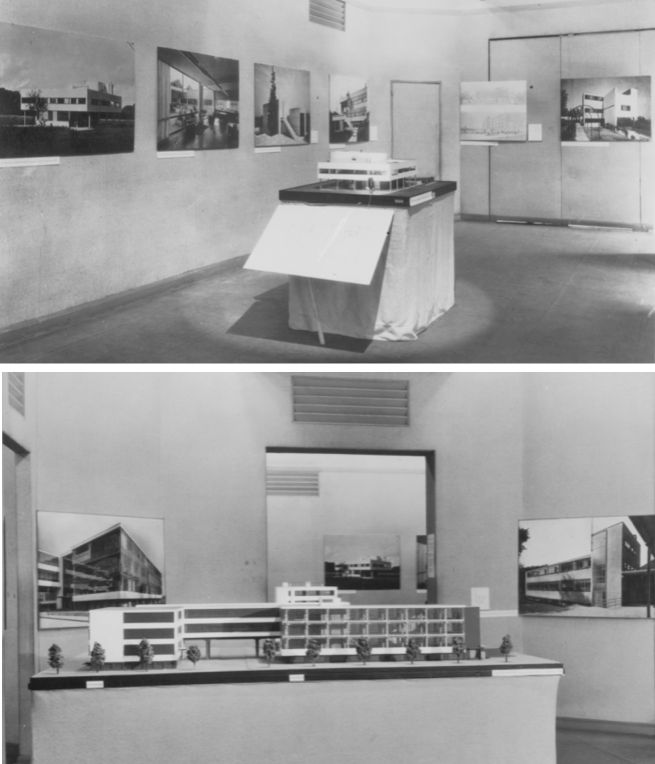
Less than three years later, the museum would point to the world to come in 1932’s Modern Architecture: International Exhibition, curated by Philip Johnson and Henry-Russell Hitchcock. The exhibition showcased an emerging architectural style that would dominate the New York skyline in the postwar years.

Top, model of Le Corbusier’s Villa Savoye from MoMA’s 1932 Modern Architecture: International Exhibition; below, model and photographs of works by Walter Gropius. Both architects would have major influences on the postwar New York skyline. (MoMA)

A footnote: The Museum of Modern Art hosts a remarkable website that features photographs of 4,875 exhibitions (plus images of catalogs and other materials) from 1929 to the present.

*  *  *

That’s Entertainment?

Theater critic Robert Benchley was looking for something to take his mind off the economic collapse, but he wasn’t finding it on Broadway. He found the drama Veneer to be depressing, and apparently so did a lot of other theatergoers; it closed the next month after just 31 performances at the Sam Harris Theatre:

NO LAUGHS HERE, EITHER…Joanna Roos and Osgood Perkins during a 1930 performance of the Chekhov play Uncle Vanya at the Cort Theatre. Roos was also in 1929’s Veneer, and she was singled out for praise by critic Robert Benchley, who otherwise found the play depressing. (New York Public Library)

Benchley also found little cheer in the play Cross Roads, which also closed the next month after just 28 performances at the Morosco Theatre:

FOR CRYING OUT LOUD…Actress Sylvia Sidney bawled out her lines in Cross Roads. (Photoplay, 1932)

Benchley finally found something to laugh about at the Alvin Theatre, which featured the musical comedy Heads Up! Tellingly, it ran much longer than its more somber competition: 144 performances…

CLOWNS…Victor Moore, left, and Ray Bolger delivered comic relief in Heads Up! Both actors provided much-needed levity on the Broadway stage during the Depression. (movie-mine.com/Pinterest)

 *  *  *

Ideas for a Post-Crash Christmas

Creighton Peet (1899-1977) was best known as an author of books for young people with titles ranging from Mike the Cat (1934) to How Things Work (1941). A regular contributor to The New Yorker from 1925 to 1957, in the Nov. 23 issue Peet offered up some suggestions for a post-crash Christmas in a short piece titled “Helpful Hints for Marginaires.” An excerpt:

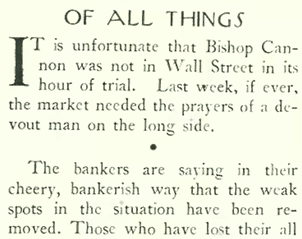
The recent market crash was also on the mind of Howard Brubaker. In his weekly column, “Of All Things,” he looked for divine guidance…

CAN YOU PUT IN A GOOD WORD? James Cannon Jr. was a bishop of the southern Methodist Church and a relentless advocate of Prohibition. (encyclopediavirginia.org)

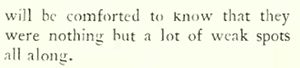
…in the wake of recent elections, Brubaker also made this observation about voting rights in the South…

 *  *  *

Solace of the Silver Screen

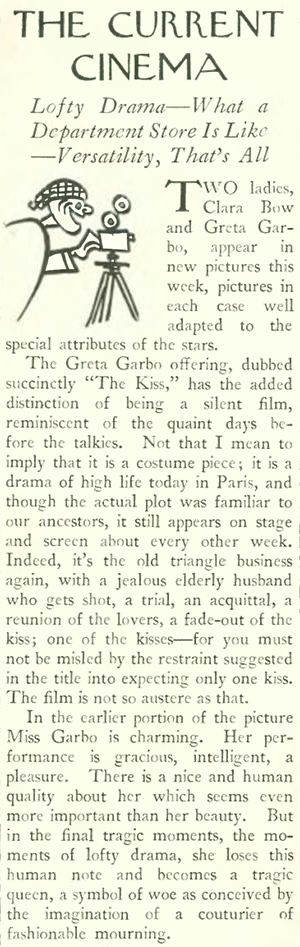
Americans would turn to the movies for a much-needed distraction from their economic woes, and critic John Mosher found a couple of mild diversions starring Greta Garbo and Clara Bow

MUM’S THE WORD…Greta Garbo and Lew Ayres in The Kiss. The film was a rare silent in the new age of the talkies (although it did feature a Movietone orchestral score and sound effects). Audiences would have to wait until 1930’s Anna Christie to hear the voice of Garbo. (IMDB)
PLEASE PASS THE BITTERS, DEAR…Greta Garbo and Anders Randolf trapped in a loveless marriage in The Kiss. (IMDB)

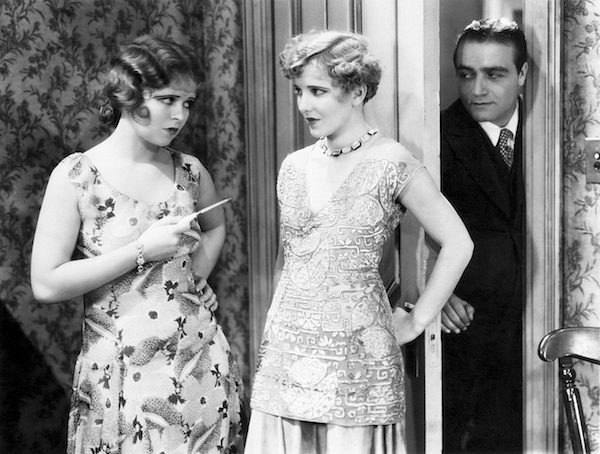
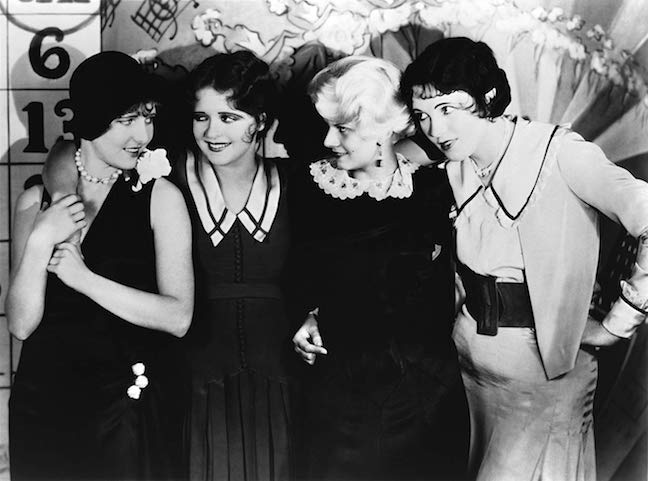
For a few laughs, moviegoers could check out Clara Bow’s second talkie, The Saturday Night Kid. A sex symbol of the Roaring Twenties, Bow’s career began to wane with the advent of the talkies and the onset of the Depression. Her kind would be eclipsed by a new type of sex symbol — the platinum blonde — embodied by the likes of Jean Harlow, who also appeared in The Saturday Night Kid, her first credited role…

SIBLING RIVALRY…Sisters Mayme (Clara Bow) and Janie (Jean Arthur) vie for the affections of next door neighbor William (James Hall) in a scene from The Saturday Night Kid. (doctormacro.com)
SATURDAY NIGHT FEVER…Jean Arthur, Clara Bow, Jean Harlow and Leone Lane in a publicity photo for The Saturday Night Kid. (IMDB)

*  *  *

From Our Advertisers

We begin with a couple of ads featured on back-to-back pages of products that no longer exist — the first promotes the use of Ethyl gasoline to increase performance and eliminate engine knock. Ethyl (tetraethyl lead) — a big contributor to soil, air and water lead pollution — was removed from gasoline beginning in the 1970s…the Marmon Motor Car Company introduced a more affordable (under $1,000) car to New Yorker readers in 1929, but it was too late for the struggling company, which due to the Depression folded in 1933…

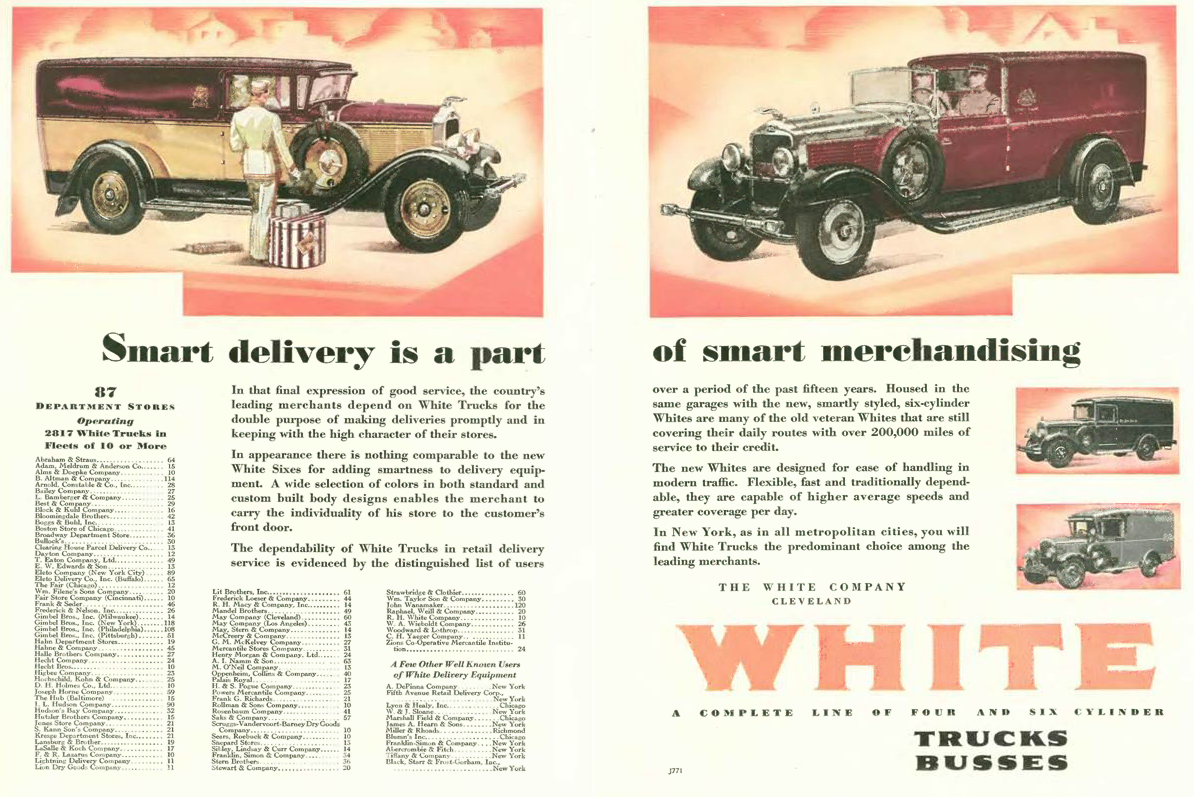
…this seems an unusual ad for the New Yorker, but then again perhaps the White Company hoped to reach well-heeled readers who were also owners of companies in need of such things, although it is doubtful a lot of truck-buying was taking place after the crash…

…the 1920s are considered a golden age for American road-building, but if you wanted to travel across country, the national highway system was limited to just a few, mostly two-lane routes…

…with their frayed nerves, folks were doubtless smoking like chimneys…the makers of Fatima cigarettes acknowledged the pain felt by the market crash, while nevertheless justifying the higher cost of their brand…

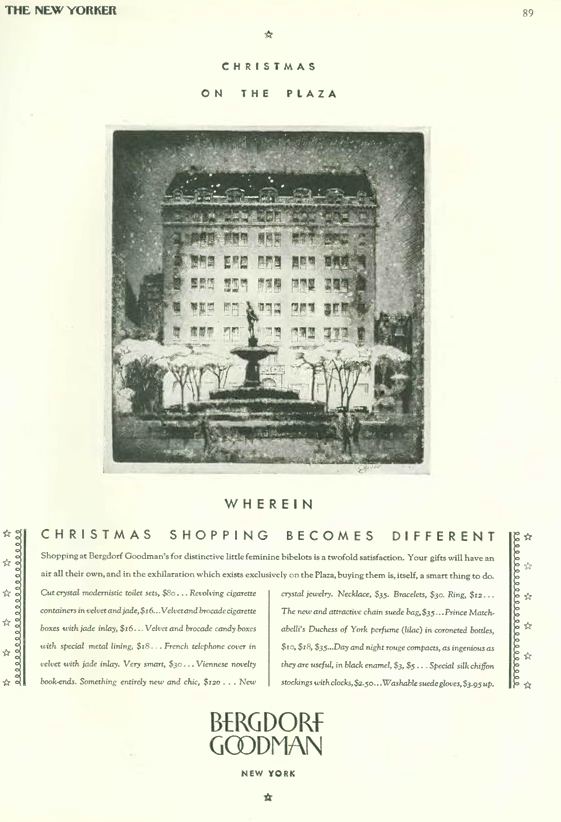
…the holiday season was fast-approaching, and Bergdorf Goodman was ready to set the mood…

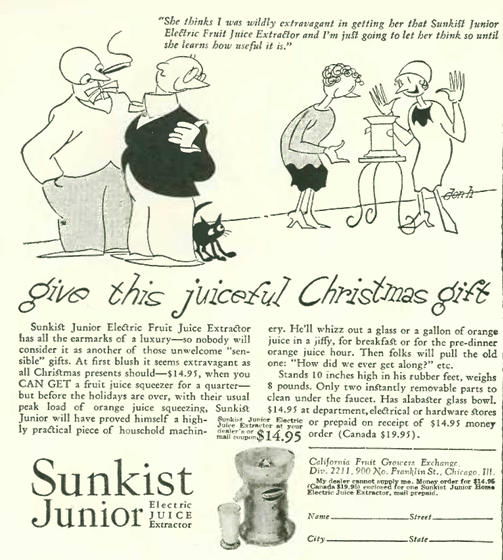
…on the lower end of the scale, the California Fruit Growers offered up this dandy “juice extractor” as the gift to delight a loved one (with illustration by Don Herold)…

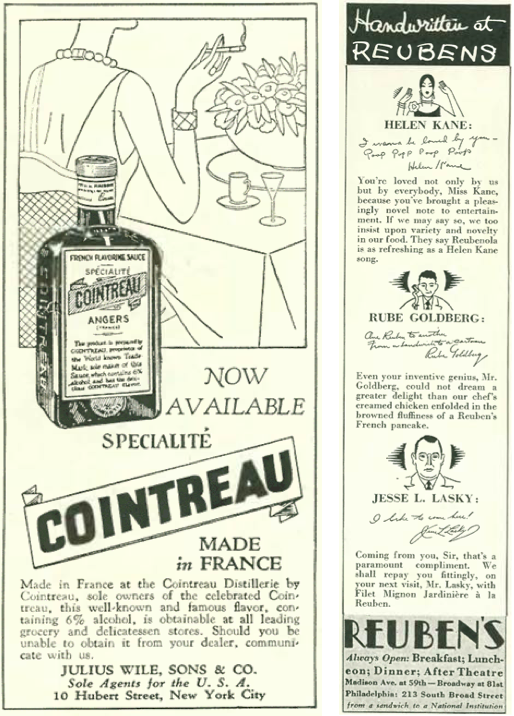
…I suppose given its quasi-medicinal (digestif) qualities, Cointreau was able to sell their product at 6% alcohol content to dry Americans (although the full- strength Cointreau, not legally available to Americans, was rated at 40%)…at right, another back page ad from Reuben’s restaurant, with more handwritten endorsements from stars including singer Helen Kane (Boop-Boop-a-Doop), cartoonist Rube Goldberg, and Paramount Studio co-founder Jesse Lasky

Helen Hokinson’s society women were featured in two separate ads in the Nov. 23 issue…

…and the folks at Frigidare got an extra plug thanks to Leonard Dove

Lois Long’s “On and Off the Avenue” column began to grow in length as the holiday season approached, peppered with spot drawings including these two by Julian De Miskey and Barbara Shermund

…and Isadore Klein offered his own take on the holiday shopping scene…

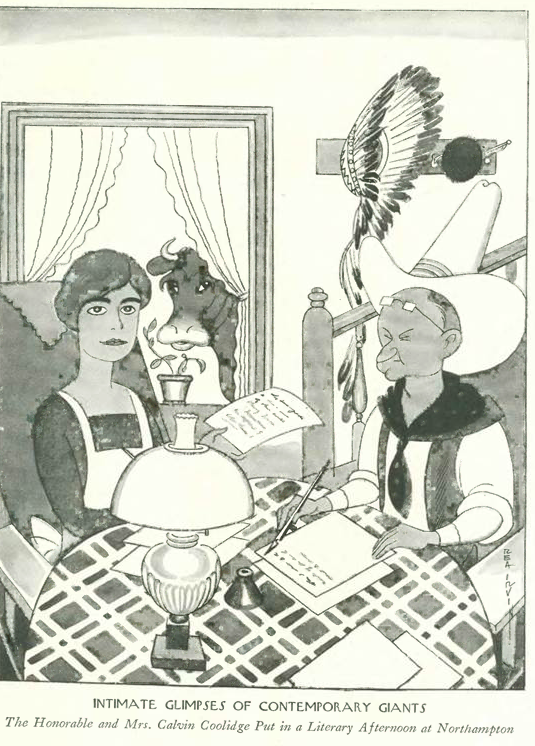
Rea Irvin reprised his folk-satirical approach to life at the Coolidge house…

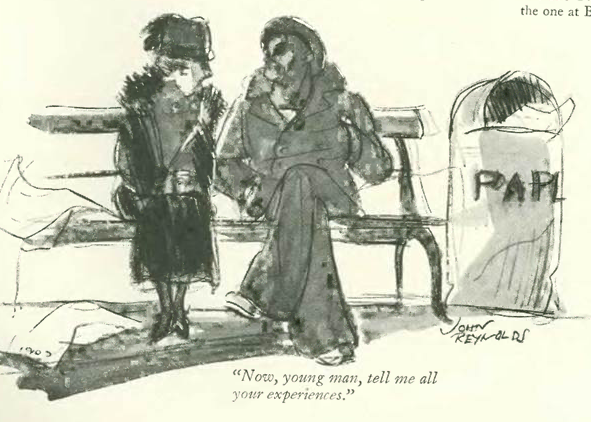
John Reynolds found more humor in the clash of cultures…

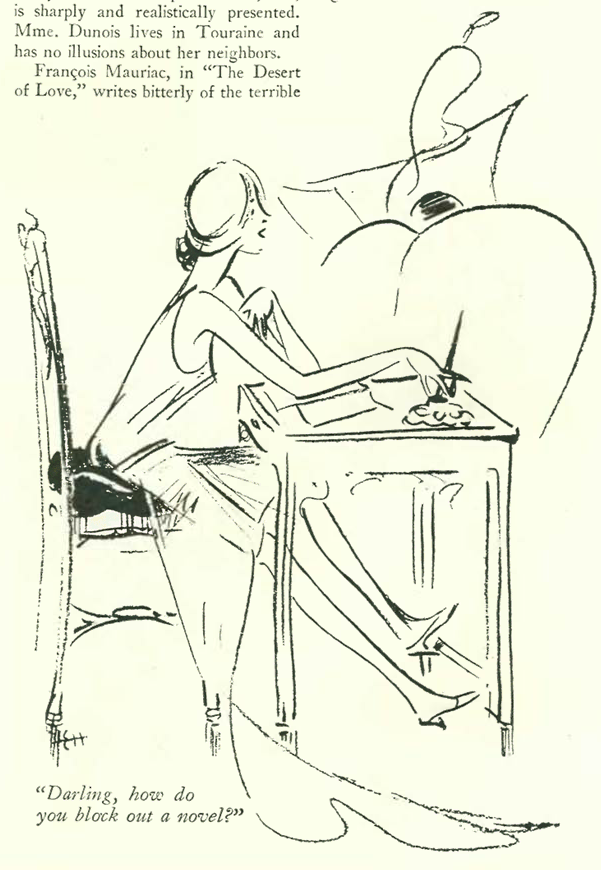
Helen Hokinson contributed this very modern rendering of writer’s block…

…and Peter Arno looked in on the challenges of commuting…

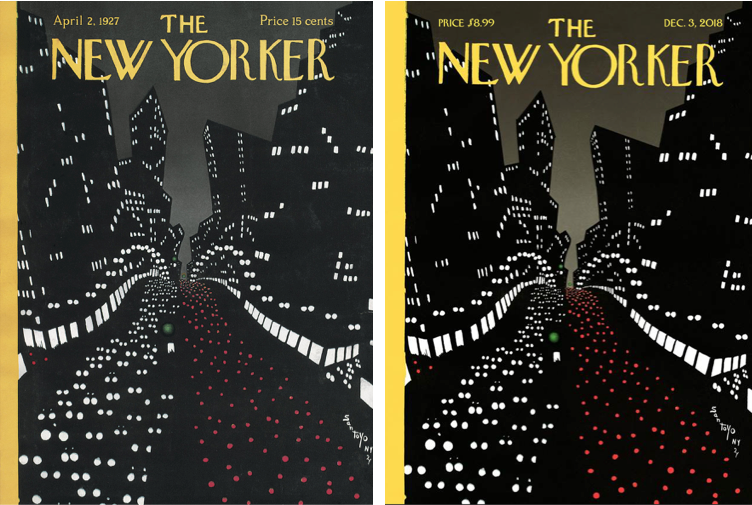
…and a quick note regarding a recent issue of The New Yorker (Dec. 3, 2018)…the cover featured a reprint of a Matias Santoyo cover from April 2, 1927…very cool…

Next Time: Mrs. Parker and the Vicious Writer…


Not Much to Cheer About

The cover of the Nov. 9, 1929 issue belied the mood of New Yorkers still reeling from the stock market crash. But then again, football games and other entertainments would grow in importance as much-needed distractions from the harsh realities that lay ahead.

Nov. 9, 1929 cover by Theodore G. Haupt. The title image is by James Montgomery Flagg, published in Life, November 15, 1929.

The New Yorker editors and writers were as bewildered as anyone in the aftermath of the crash. “The Talk of the Town” only gave it passing mention:

Robert Benchley, writing under the pseudonym “Guy Fawkes,” also looked at the market crash from the angle of the newspapers in “The Wayward Press” column. Naturally, Benchley tried to find humor in the midst of the disaster, noting that the crash provided some relief from tedious election coverage:

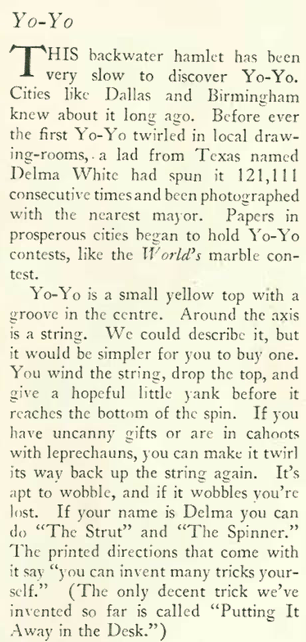
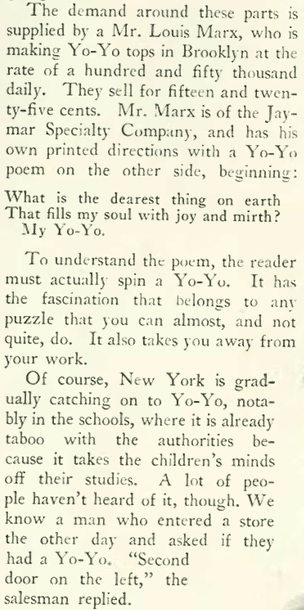
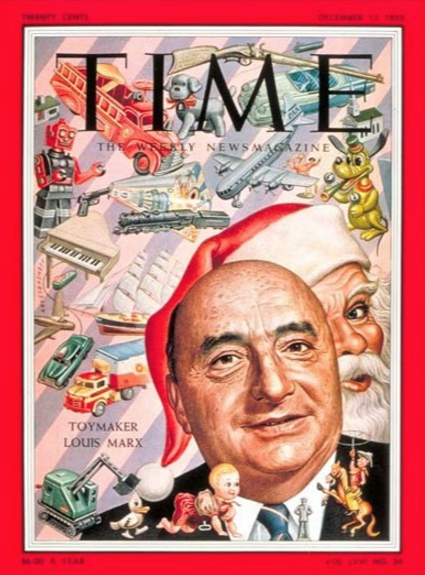
When the Nov. 9 New Yorker went to press, the stock market crash was viewed as a serious setback (in the sixth paragraph Benchley mentioned numerous reports of suicides), but not something that would result in worldwide depression. Indeed, much of the issue was devoted to lighter fare, including a rather lengthy piece in “Talk” about the latest craze among the nation’s youth — the yo-yo:

The Lumar 33, made of tin, was one of the original yo-yos produced by Louis Marx beginning in 1929. Hugely popular, it helped launch the Marx toy company empire. (WorthPoint)

BUT HE’S NO YO-YO…Louis Marx’s version of the yo-yo would help him launch a toy empire and land him on the cover of Time magazine, Dec. 12, 1955. (Time)

 *  *  *

Just Wait Until They Get iPads

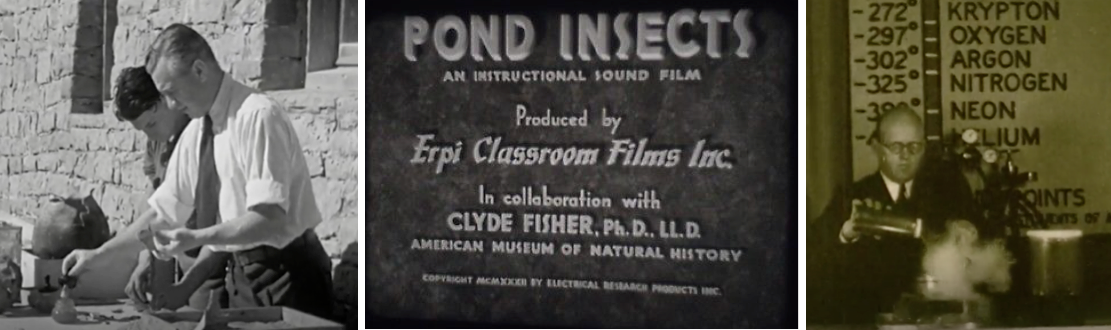
The New Yorker showed less enthusiasm for a plan by Fox studios to introduce talking pictures into schools, hospitals and churches. Writing for “Talk,” E.B. White observed:

TECHNOLOGY INVADES THE CLASSROOM…Left to right, a still from a 1930 educational film showing archeologist Earl Morris gluing together pottery shards at a dig near Mesa Verde National Monument; ca. 1932 title card for a science film; detail from a ca. 1930 educational film demonstrating the wonders of liquid nitrogen. (archive.org)

 *  *  *

And Then There Was Light

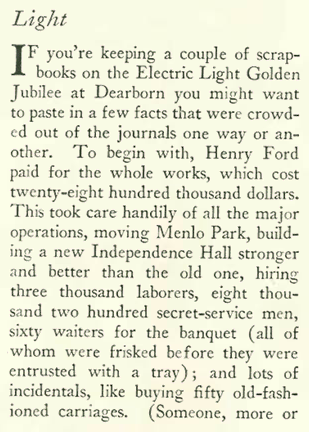
The introduction of talking pictures in the classroom owed something to Thomas Edison (1847-1931), inventor of the incandescent light bulb and a pioneer in the development of motion pictures, among many other things. The invention of the light bulb was commemorated at a “Golden Jubilee” celebration in Dearborn, Michigan, and “The Talk of the Town” offered these observations on the occasion:

GIVING THEIR TWO CENT’S WORTH…Lights were ablaze in Dearborn, Mich., to commemorate the 50th anniversary of the light bulb’s invention. “Light’s Golden Jubilee” was staged by public relations guru Edward Bernays on behalf of General Electric; below, commemorative postage stamp for the occasion. (prmuseum.org/Wikipedia)

The jubilee was the brainchild of Edward Bernays (1891-1995), often referred to as “the father of public relations.” The author of the 1928 book Propaganda, Bernays worked for dozens of corporations, and is known for his efforts in 1929 to promote cigarette smoking among women (branding them “torches of freedom”). Ironically, a man that helped many women develop a habit that led to their early deaths himself lived to the ripe age of 103.

Albert Einstein sent his best wishes from Berlin via transatlantic radio (see below), and special guests at the Jubilee included Henry Ford and Harvey Firestone, seen here talking with the nearly-deaf Thomas Edison about the development of radio in this short “talkie” filmed at the Jubilee on Oct. 21, 1929:

 *  *  *

Please Release Me

Nunnally Johnson (1897-1977) was a journalist and film critic before breaking into the movies himself in the mid-1930s as a writer, producer and director of such films as The Grapes of Wrath (writer, producer) and The Man in the Gray Flannel Suit (writer, producer, director). As a critic Johnson learned what he didn’t like, including Al Jolson’s The Singing Fool, an early talking film that featured Jolson crooning the tear-jerker hit “Sonny Boy” to child actor Davey Lee, who portrayed his dying son. Nunnally responded with this parody titled “Sonny Boy’s Diary.” Some excerpts:

HOLD THE SCHMALTZ, AL…Nunnally Johnson, left, parodied the sentimental scenes Al Jolson shared with child actor Davey Lee in The Singing Fool. Johnson would go on to become a successful screenwriter, producer and director. (in.bookmyshow.com/virtual-history.com)

 *  *  *

Dream Space

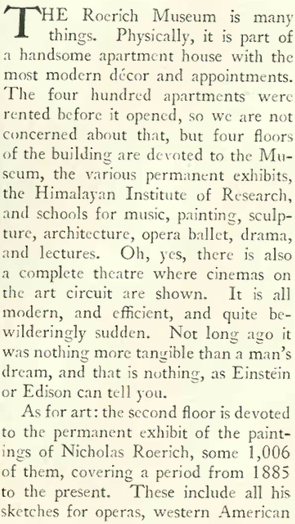
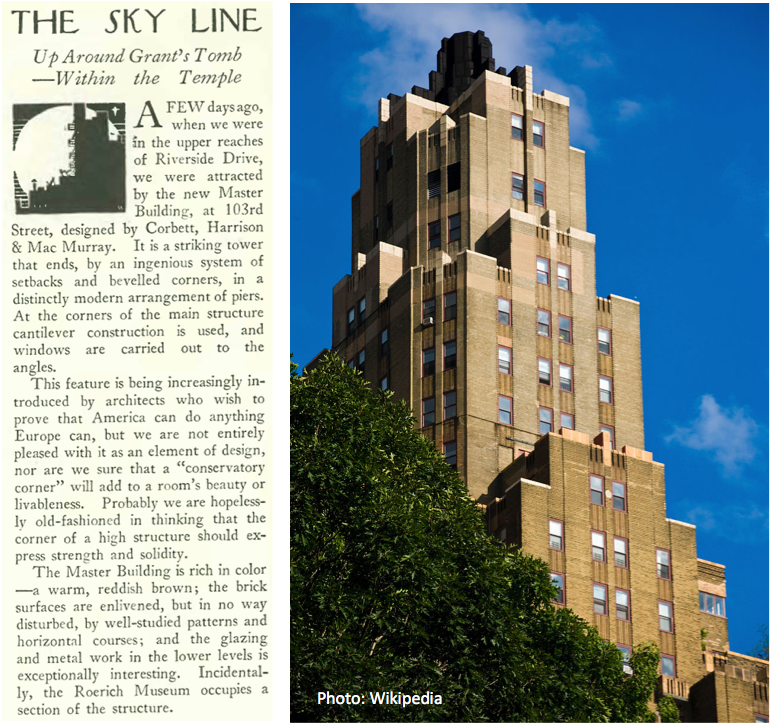
New Yorker art critic Murdock Pemberton hailed the opening of a new museum, the Roerich, on the lower floors of the 27-story art deco Master Apartment Building. The building also housed the Master Institute of United Arts, founded in 1920 by Nicholas and Helena Roerich.

The art deco landmark Master Building on Riverside Drive (left, in 1929) originally housed the Roerich Museum in its lower floors. Today the Roerich is located in this brownstone at 319 West 107th. (Wikipedia)

FOOTNOTES FROM A FULL LIFE…Two of Nicholas Roerich’s paintings from the 1920s: at top, Remember, 1924; below, Drops of Life, 1924. (roerich.org)

 *  *  *

A Tenor for the Times

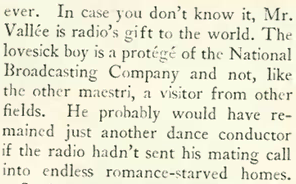
The crooner Rudy Vallée (1901-1986) became an overnight sensation after his Oct. 24, 1929 debut on national radio. Already a popular New York bandleader (and sometime local radio personality), his appearance on NBC’s Fleischmann’s Yeast Radio Hour made him a national sensation, especially among young women. According to Ian Whitcomb in his book, The Coming of the Crooners, Vallée’s thin, wavering tenor was not well-suited to the stage (especially in pre-microphone days when booming voices prevailed) but it worked magic on the radio, soft voices ideal for this more intimate medium (Bing Crosby, Frank Sinatra and other popular crooners would soon follow). The New Yorker’s “On The Air” column (signed “A.S.”) had this to say about Vallée’s return:

BALM FOR WEARY SOULS…Rudy Vallée’s soothing voice and easy-going manner were just what the nation needed days after the stock market crash. According to Anthony Rudel of Old Time Radio, “At 8 pm on the night of October 24th, 1929, just after the ubiquitous Graham McNamee introduced him, Vallée became a national radio star.” It was the debut of NBC’s Fleischmann’s Yeast Radio Hour, which soon came to be known as the Rudy Vallée Show. (Fleischmann was also a major benefactor of the New Yorker). Photo at left, Vallée with McNamee; at right, child actor Dorothy Gray and Vallée in the comedy talkie, The Vagabond Lover (1929). (otrcat.com/IMDB)

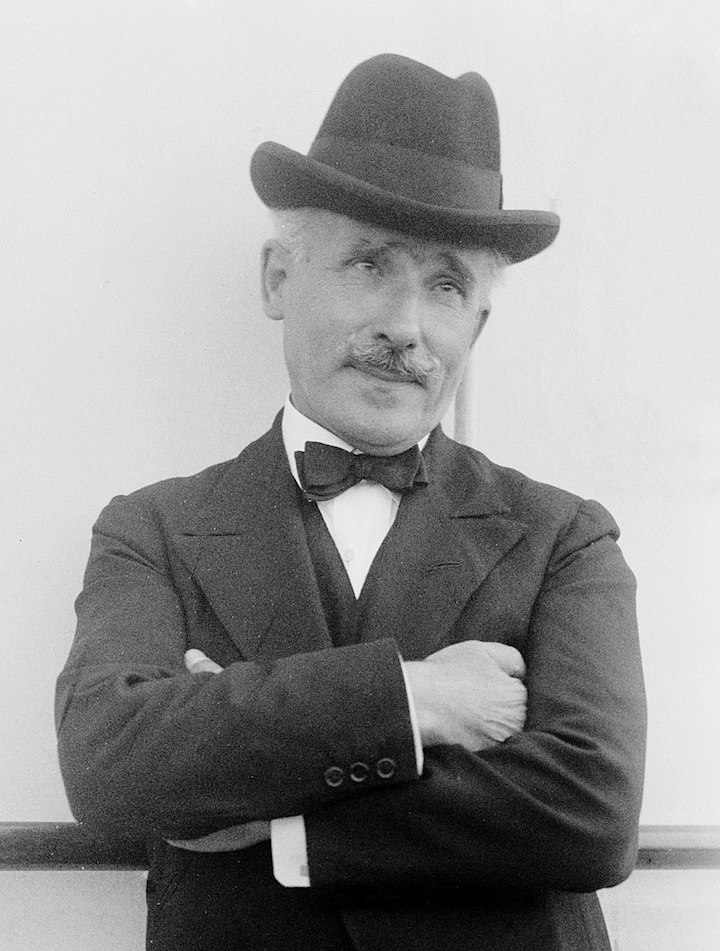
A giant among conductors of the 20th century, Arturo Toscanini (1867-1957) was already well-known to live audiences in New York, having conducted at both the Metropolitan Opera and the New York Philharmonic. Unlike Vallée, the Italian conductor’s radio broadcast was limited to the range of the New York radio station WOR. Toscanini would make his national radio debut in the States in 1937, with the NBC Symphony Orchestra.

THE MAESTRO…Arturo Toscanini, renowned for his intensity and perfectionism, was said to have perfect pitch. After leaving fascist Italy in 1936, he became a household name across the US thanks to the NBC Symphony Orchestra’s presence both on national radio (beginning in 1937) and television (1948-1952). (Library of Congress)

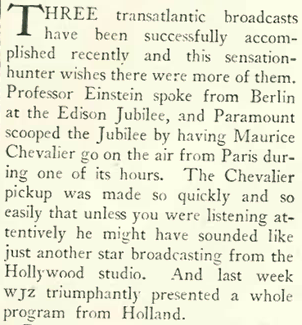
The New Yorker also noted the successful transmission of three transatlantic broadcasts, including remarks spoken by Albert Einstein from Berlin to the Electric Light Golden Jubilee in Dearborn, Michigan:

RELATIVELY SPEAKING…Albert Einstein prepares to congratulate Thomas Edison via transatlantic radio on the 50th anniversary of the incandescent light bulb, Oct. 21, 1929. (UT College of Liberal Arts)

 *  *  *

From Our Advertisers

Now that we are post-market crash, we will be seeing the effects of that crash on New Yorker advertisers. Here are three advertisers from the Nov. 9 issue not long for the world: from left, the high-fashion salon Stewart & Company would file for bankruptcy and go out of business by the spring of 1930; Pierce-Arrow, maker of rolling status symbols for the wealthy, ceased car production in 1933; Hanan & Son, a leader in the mass production of shoes, would go bankrupt and fold by 1935.

Already at this early date advertisers were responding to tightening belts — this appeal from the Cuban Tourism Commission offered “an opportunity to forget business” while traveling on the cheap…

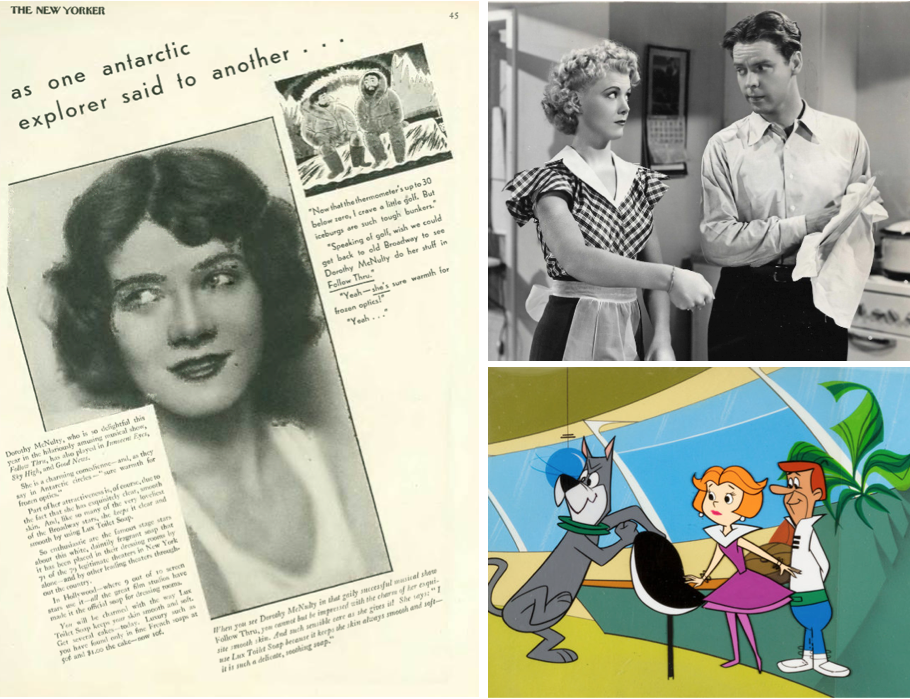
…other ads were the usual fare, this one from Lux Toilet soap featured its latest young celebrity, Dorothy McNulty (1908-2003), who changed her name to Penny Singleton in 1937 before starring in more than two-dozen Blondie-themed comedies (based on the Chic Young comic strip) with co-star Arthur Lake (who portrayed Dagwood Bumstead). She dyed her naturally brunette hair (as seen in the ad) blonde for the first Blondie movie in 1938, and continued to do so for the rest of her long life. A career that truly spanned several generations, she also provided the voice for Jane Jetson in The Jetsons in its original airing in the early 1960s and in later revivals through 1990…

THE MANY FACES OF PENNY SINGLETON…At left, before she was the film star Penny Singleton, Dorothy McNulty was a popular star on Broadway, as this ad from the Nov. 9 New Yorker attests. At top, Singleton with Blondie co-star Arthur Lake in the first installment of that popular 27-film series, 1938; a still from The Jetsons 1962-63, for which Singleton provided the voice of Jane Jetson. (IMDB/Hanna-Barbera)

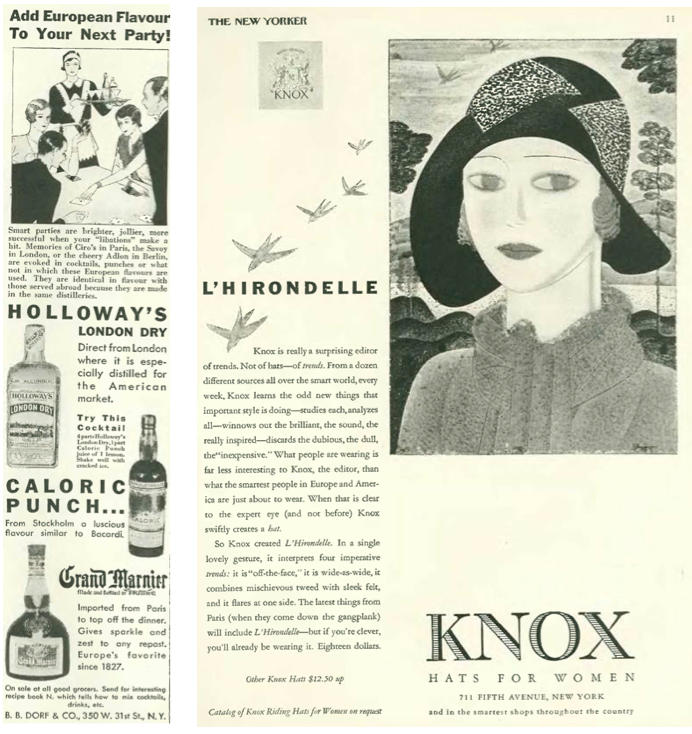
…on to other ads, the one on the left is another sad example of how manufacturers of spirits tried to market non-alcoholic versions of their libations to Prohibition-starved Americans (“especially distilled for the American market”)…at right, an ad from Knox hatters, with a somber rendering of a young woman (maybe she’s headed to the party in the other ad) wearing a fashion that would be popular in the early Thirties…the old flapper hat, along with the Jazz Age, was dead as a doornail…

…oh well, at least you could stay healthy by smoking lots of cigarettes…

…we’ve seen ads illustrated by other New Yorker cartoonists including Peter Arno, Rea Irvin, and Julian De Miskey; Helen Hokinson got in on the action with this ad touting G. Washington instant coffee…the first instant coffee to be produced on a mass scale, G. Washington was so well known it was referred to as a “cup of George.” The brand was discontinued in 1961…

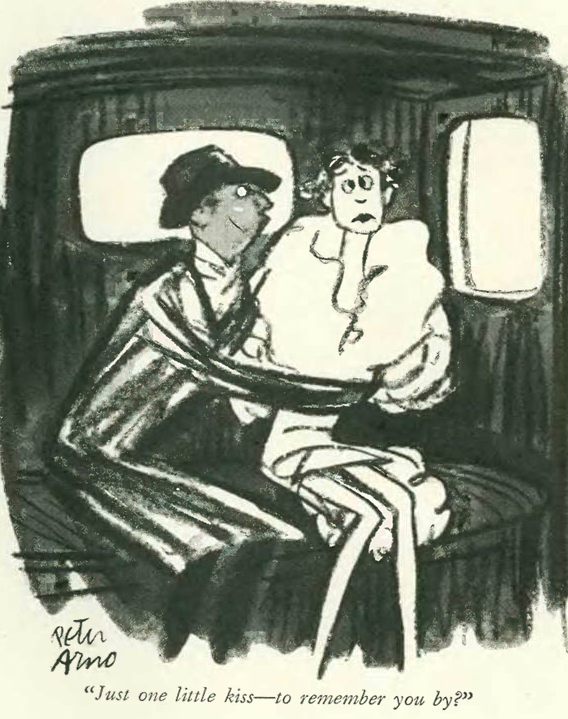
…on to our comics, an awkward moment courtesy Peter Arno

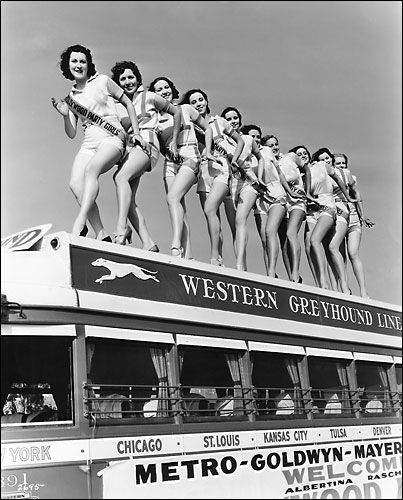
W.P. Trent illustrated a backstage exchange regarding the ado over a popular dance troupe, the Albertina Rasch Girls…

…for reference…

MGM publicity photo from 1929 of the Albertina Rasch Girls, who traveled to Hollywood to appear in the Technicolor finale of the film Hollywood Revue of 1929. (dimitritiomkin.com)

…and John Reynolds explored the clash of the Old World and the New…


Next Time: Back to Business…


Prelude to a Crash

Although two months remained in the decade, The New Yorker of the Roaring Twenties effectively ended with this issue, just days before a massive market crash sent the nation spiraling into the Great Depression.

Oct. 26, 1929 cover by Theodore Haupt. Wonderful rendering of The New York Central Building, with shades of Georgia O’Keeffe.

Not a soul at The New Yorker had an inkling of the bleakness that lay ahead — rampant unemployment, the rise of the Nazi party, the Dust Bowl, Busby Berkeley musicals

E.B. White, in “Notes & Comment,” was concerned with little more than the changing countryside…

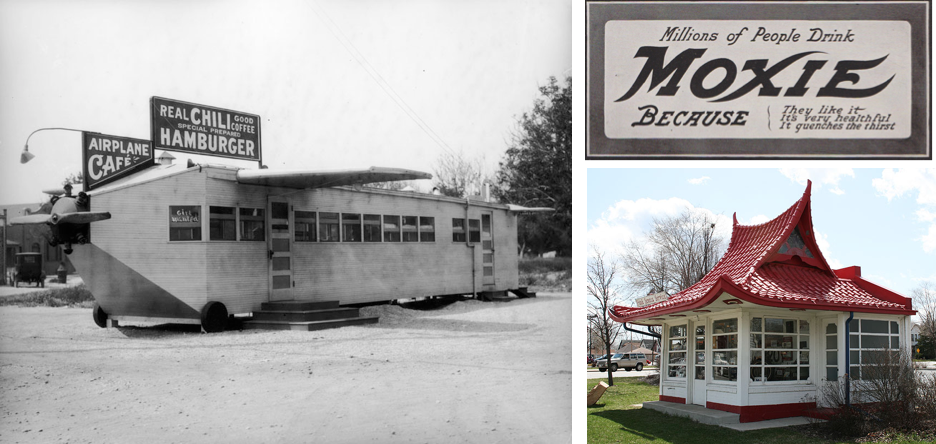
MADE YOU LOOK…Examples of roadside vernacular architecture from the 1920s included the Airplane Cafe in in the San Fernando Valley (1924) and a 1927 Wadham’s gas station in West Allis, Illinois, now on the U.S. National Register of Historic Places. More than 100 of Wadham’s “pagodas” were built, but like much of roadside America, few examples remain. At top, right, a 1920s billboard advertising Moxie soft drinks. (last1onthebus.com/Pinterest/Wikipedia)
THE DUCK STOPS HERE…The Big Duck in Flanders, New York, was built in 1930-31 by Long Island duck farmer Martin Maurer to sell duck and duck eggs to passing motorists. It was listed on the National Register of Historic Places in 2008. (Google Maps)

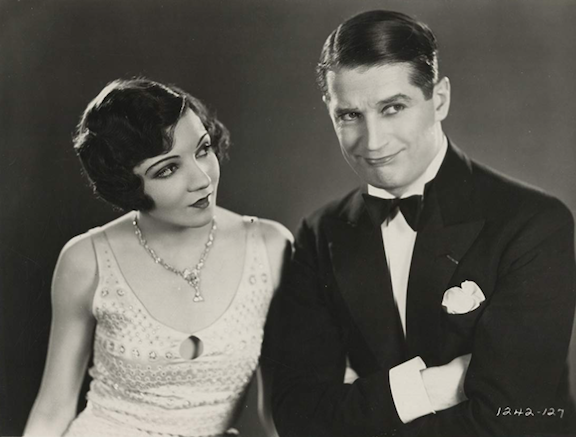
…and further on in “The Talk of the Town,” White shared these observations regarding the popularity of shirts worn by French actor Maurice Chevalier

THAT’S SHA-VAHL-YEY…Claudette Colbert and Maurice Chevalier in 1930’s The Big Pond. (IMDB)

  *  *  *

Born to Be

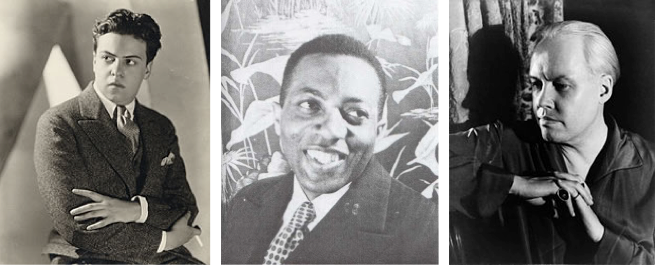
The book review featured an autobiography, Born to Be, written by Taylor Gordon (1893-1971), a famed singer of the Harlem Renaissance, that traced his life journey from Montana to New York. The book included ten full-page illustrations by Mexican artist Miguel Covarrubias, and forwards by Carl Van Vechten and Muriel Draper.

COMBINED TALENTS come together in Taylor Gordon’s Born to Be: Mexican painter, caricaturist, and illustrator Miguel Covarrubias (left, in a 1920s photo by Nickolas Muray) and Harlem Renaissance singer Gordon (center, in a photo by Carl Van Vechten, who is pictured in a self-portrait at right). (Pinterest/minormoderns.blogspot.com/Wikipedia)

FROM MONTANA TO HARLEM…First edition of Taylor Gordon’s Born to Be, and illustrations from the book by Miguel Covarrubias (including cover image). The image at bottom left features patron of the Harlem Renaissance Carl Van Vechten, with Gordon. (qbbooks.com/klinebooks.com/Pinterest)

*  *  *

Little Narcissus

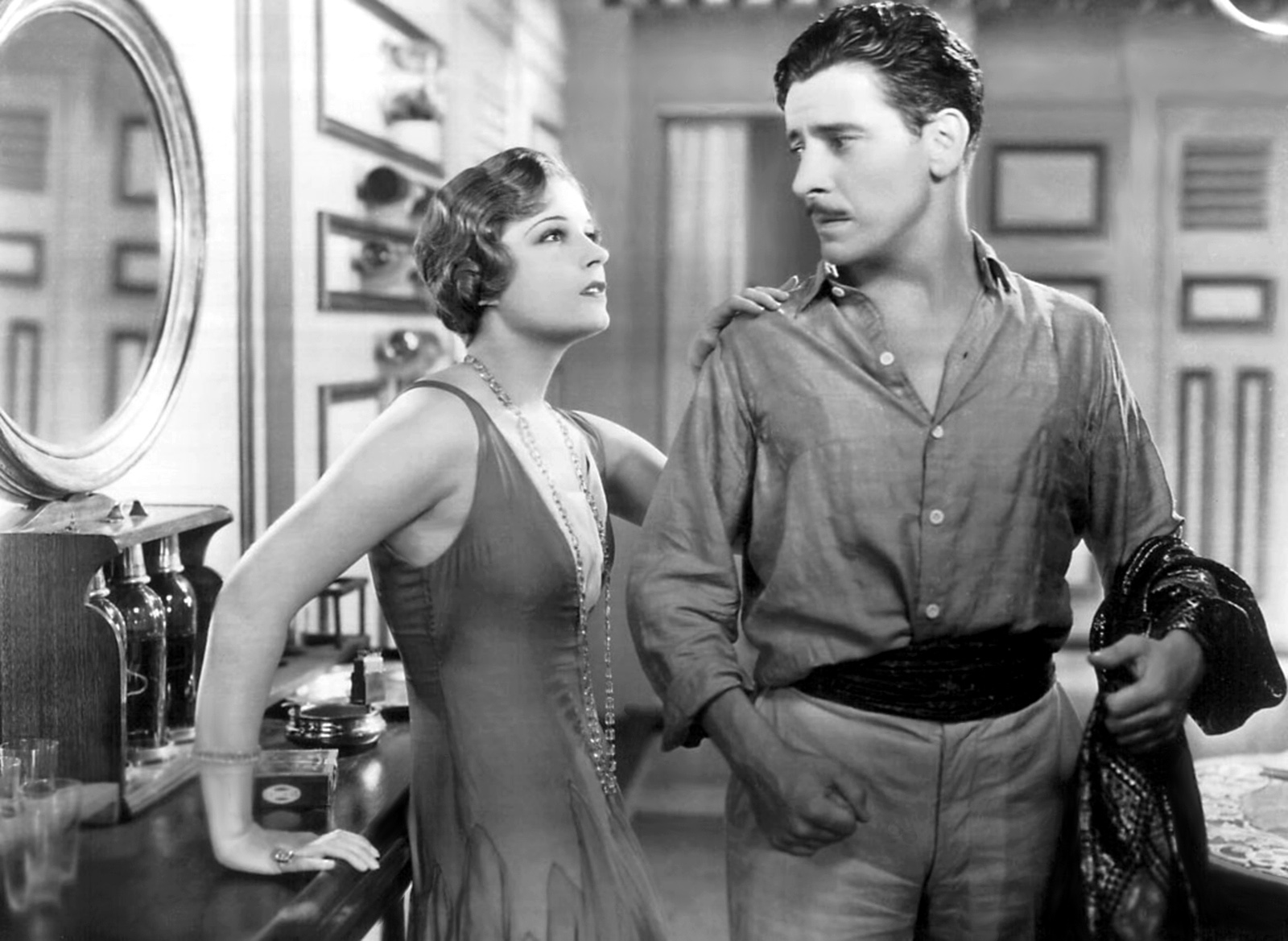
Although today she is known mostly as Errol Flynn’s first wife, the tempestuous French actress Lily Damita (1904-1994) knew how to light up New York and get noticed in Hollywood when she made her American debut in 1929. Henry F. Pringle looked in on Damita’s daily life in the Oct. 26 “Profile.” A brief excerpt:

Lily Damita in a 1931 publicity photo. (Flickr)
DEBUT FILM…Lily Damita and Ronald Coleman in 1929’s The Rescue, Damita’s first Hollywood film. (Dr. Macro)

 *  *  *

A Master Achievement

Architecture critic George Chappell gazed upward in admiration for the new Master Building on Riverside Drive. It was one of the city’s first mixed-use structures and the first New York skyscraper to feature corner windows. The apartment building originally housed a museum, a school of the fine and performing arts, and an international art center on its first three floors. The building fell into decline in the late 1960s, but today it thrives as a housing co-operative. The Master was listed on the National Register of Historic Places in 2016.

…on to our advertisements, we find another art deco landmark, the 1930 Squibb building, designed Ely Jacques Kahn

The Squibb Building at 745 5th Avenue, circa 1930. (Museum of the City of New York)

…Halloween was just around the corner and although it wasn’t a huge holiday as it is today, its presence still permeated the pages of The New Yorker, including a humorous piece by John O’Hara on the challenges of planning a Halloween party…

From left, excerpt from John O’Hara’s piece; an ad from Doubleday featuring a jack-o-lantern; an ad from Breyer’s ice cream that employed the older spelling of the holiday; at bottom, a filler illustration by Julian De Miskey.

…the makers of Marmon autos offered this lovely  autumn scene…

…here is an unusual ad from a milliner named Mercedes who bid adieu to former clients in this hand-written, full-page entry…

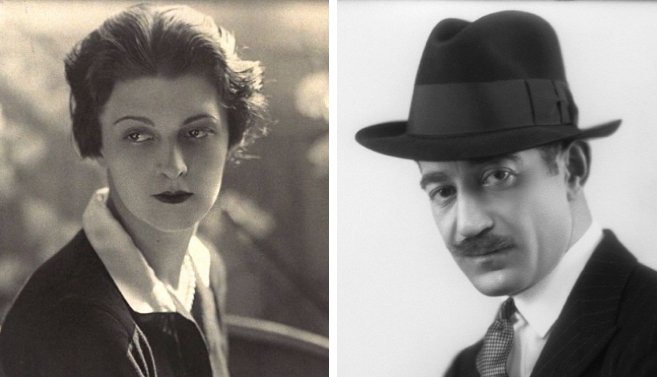
…the name Michael Arlen no doubt caught many a reader’s eye in the Oct. 26 issue. The comings-and-goings of this hugely popular author of thrillers such as The Green Hat (1924) provided much-needed fodder for readers of the first issues of the fledging New Yorker. In this ad, Arlen’s wife, the Countess Atalanta Mercati, shills for Cutex nail polish…

The Countess Atalanta Mercati of Greece and author Michael Arlen were married in France in 1928. (Conde Nast/insiderguide.me)

…and we have more of the torch singer Helen Morgan, this time in an ad for Lux Toilet Soap…

…a couple of back page ads…the now ubiquitous metal folding table (and chairs) was something of a novelty in 1929…the ad on the right from Brunswick Records offers up the latest schmaltz from Al Jolson (I know it’s 1929, but come on Al, really?)…

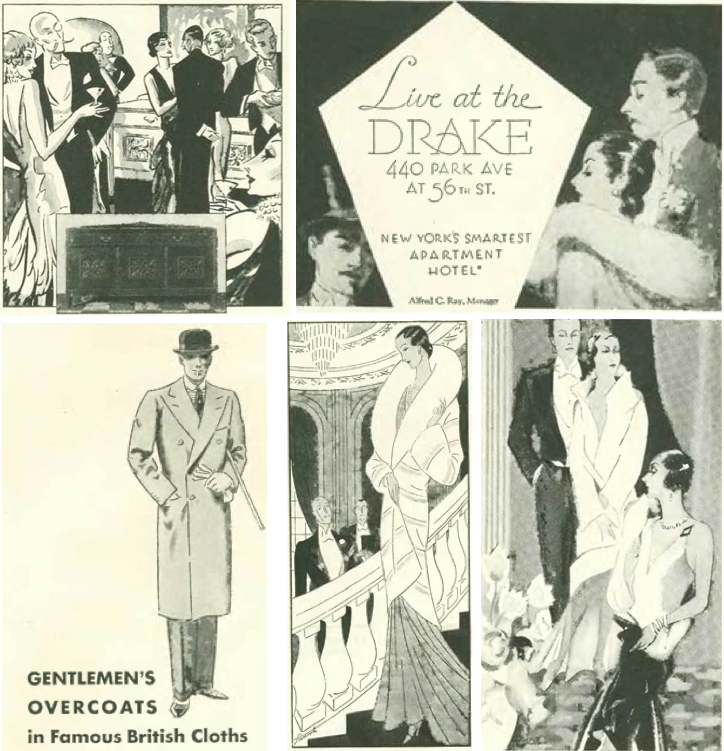
…and since this is the last edition before the big market crash, here’s a collection of images clipped from various ads in the Oct. 26 issue…featuring high-living folks who should appear a bit less smug after they lose their mink coats and boiled shirts to the Depression…

Clockwise, top left, a sampling of illustrations from ads in the Oct. 26 issue: there seemed to be no item too mundane for the posh treatment—an illustration that graced an ad from Frigidaire; superior airs displayed on behalf of the Drake apartments, and below, also on behalf of (sniff) Gotham Gold Stripe stockings; “Arabella” surveys two of her hapless conquests as she descends the stair in an illustration for a Marie Earle salon ad; and an appeal to the city’s rampant Anglophilia from De Pinna of Fifth Avenue.

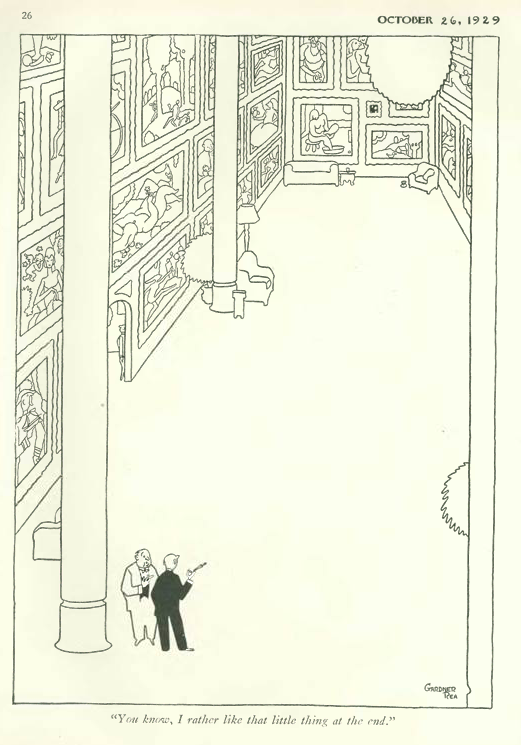
…on to our cartoons, Garner Rea demonstrated his mastery of space in this full-page entry…

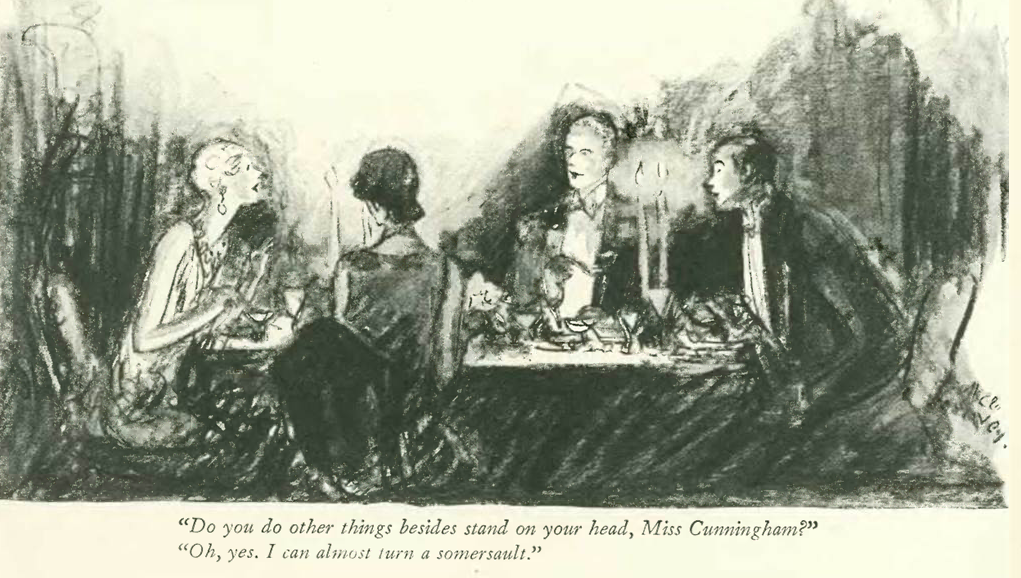
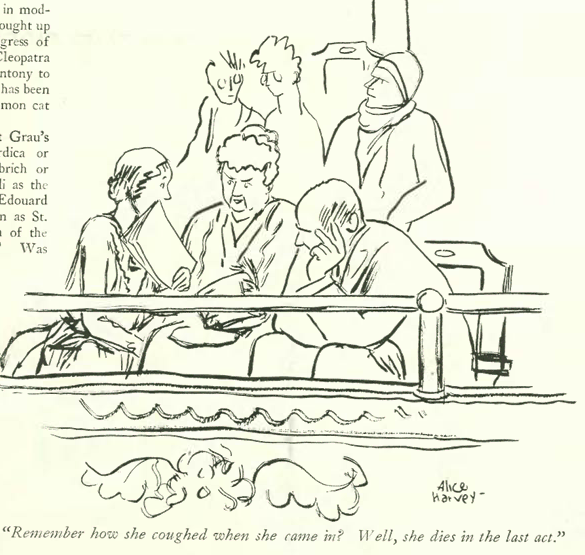
Alice Harvey eavesdropped on the chit-chat of some toffs at dinner…

…and Alice Harvey again in this sparer illustration of a spoiler at the opera…

Peter Arno illustrated unexpected intimacy on a commuter train…

…and from John Reynolds, with a sign of things to come…

Next Time: An Inconvenient Truth…


American Royalty

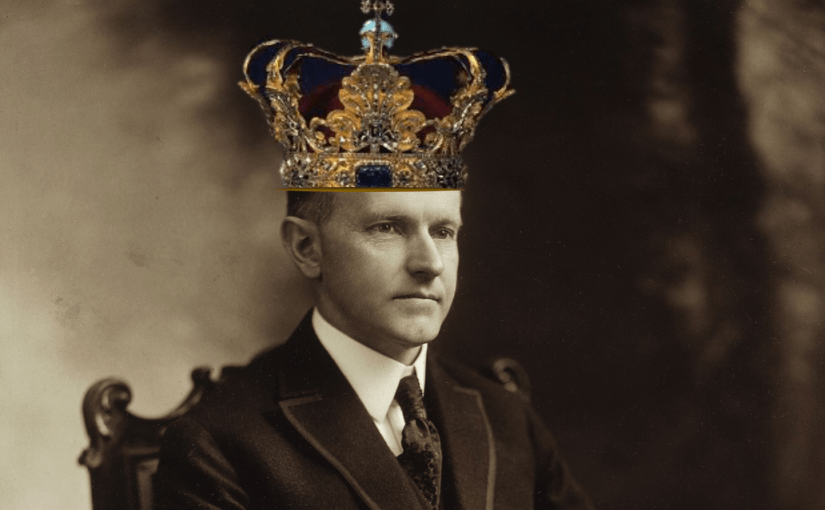
Although the United States declared its independence from British Empire nearly 250 years ago, the royal family and all of its requisite trappings persist in the American imagination like a phantom limb.

Oct. 5, 1929 cover by Theodore G. Haupt.

E.B. White observed as much in the “Notes and Comment” section of the Oct. 5 issue, in which he offered his views regarding the “pother” over the wedding of Calvin Coolidge’s son, John, to Florence Trumbull, the daughter of Connecticut Governor John Harper Trumbull

White could have looked no further than the pages of The New Yorker for further evidence to his claims. The bourgeois yearnings of its readers were reflected in countless advertisements laced with anglophilic pretensions. Here are examples from 1929 issues we have previously examined:

LIVE LIKE A BARON…Ads from The New Yorker of the 1920s often featured illustrations of regal, priggish types such as the couple above, deployed to sell everything from apartments and ginger ale…
…to no-frills automobiles and menthol cigarettes. No product was too pedestrian for the royal treatment.

Writing under the pseudonym “Guy Fawkes,” Robert Benchley commented further on the Coolidge-Trumbull nuptials in the “Wayward Press” column:

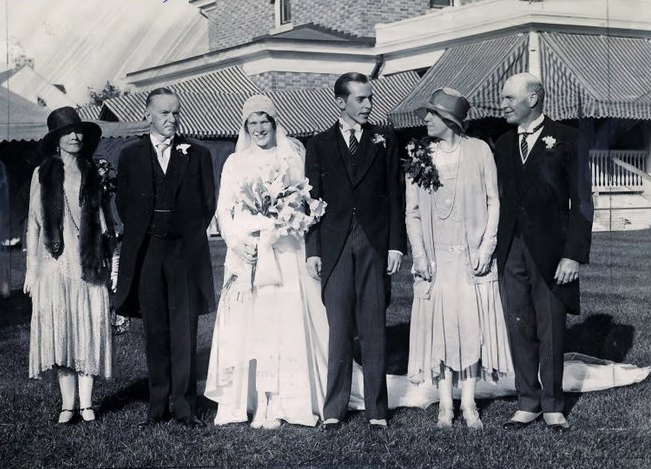
HEY CAL, IT’S A WEDDING, NOT A FUNERAL…The former U.S. President Calvin Coolidge was known as “Silent Cal” for good reason, given his reserved demeanor that rarely produced a smile (although he apparently had a dry wit). He poses here at the wedding of his son, John. Left to right are Grace Goodhue Coolidge, President Coolidge, Florence Trumbull Coolidge, John Coolidge; Maud Pierce Usher Trumbull, and Gov. John Trumbull. (patch.com)
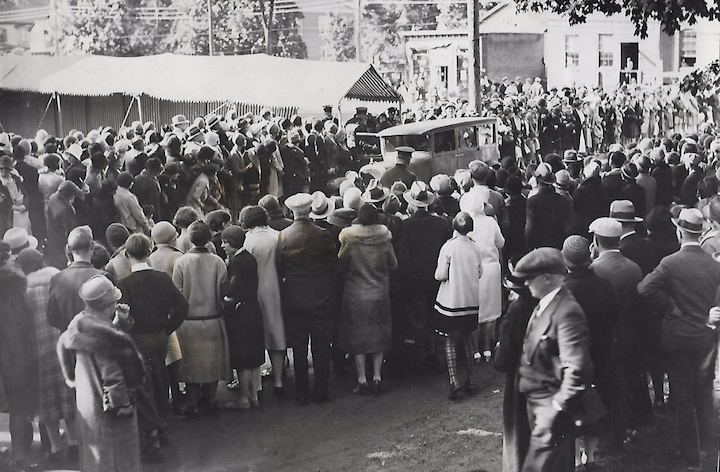
NOT EXACTLY KING’S ROAD…Onlookers line the street near the Congregational church in Plainview, Conn., hoping for a glimpse of the bride and groom, who were united in a simple ceremony. (Associated Press)
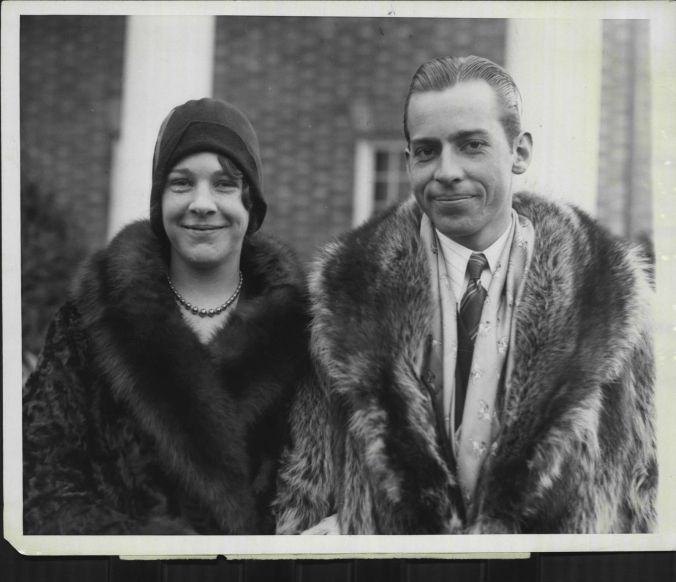
CUTE COUPLE…Florence Trumbull and John Coolidge during their engagement, 1928. (crackerpilgrim.com)

 *  *  *

Modest Mussolini

We go from famous faces to infamous ones, namely the Italian dictator Benito Mussolini, aka Il Duce, who received the adoration of his public while trying to remain inconspicuous at the cinema. “Talk” recounted…

NOW PICTURE HIM UPSIDE DOWN…A 1929 postcard image of the once-revered Italian dictator Benito Mussolini. Sixteen years later he would be shot by his own people and strung up by his feet from the roof of a Milan gas station. (worthpoint.com)

 *  *  *

Going Down

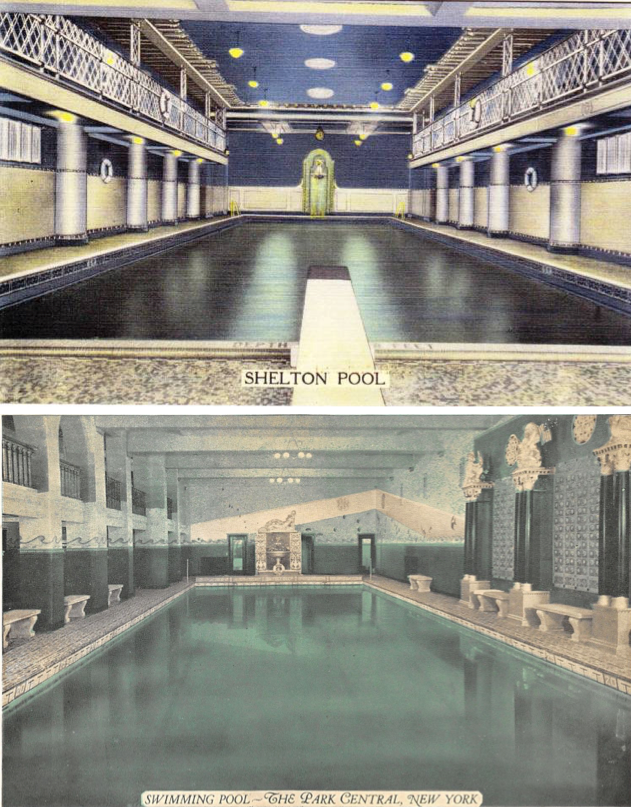
“Talk” also commented on the growing trend for high-rise apartments to provide swimming pools and other amenities below street level:

TAKING THE PLUNGE DOWN UNDER…Few indoor swimming pools were available to New Yorkers during the 1920s. Two of the nicer ones were found underground at the Shelton Hotel (above) and the Park Central. Sadly, both pools no longer exist. In 2007 the Shelton’s pool was removed and the cavernous space was divided into three levels. I’m not sure when Park Central’s disappeared, but it’s fate was doubtless similar to the Shelton’s.(daytoninmanhattan.blogspot.com/hippostcard.com)

 *  *  *

How About a Catch?

As I’ve noted on previous occasions, The New Yorker of the 1920s all but ignored major league baseball. The magazine gave regular coverage to seemingly every sport, from hockey and college football to polo and yacht racing, but regular coverage of baseball was nonexistent, even when the Yankee’s Murderers’ Row (Ruth, Gehrig among others) won back-to-back World Series titles in 1927-28.

Still no coverage in the Oct. 5 issue, but the sport did get a brief mention in Howard Brubaker’s “Of All Things” column…

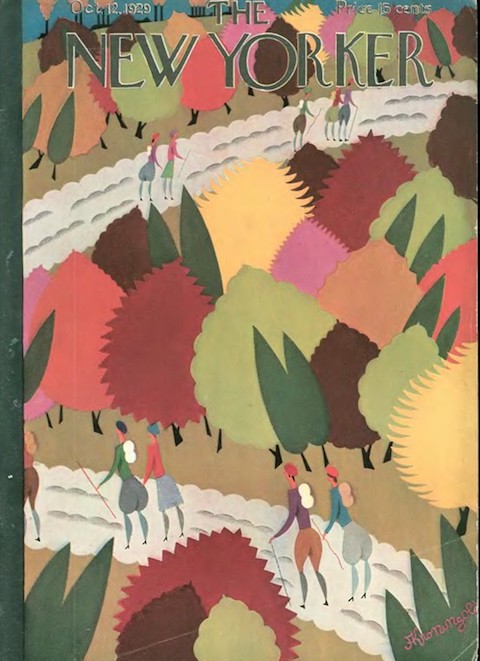
…and the issue was filled with baseball imagery, including the cover…

The Oct. 5 issue was filled with baseball-related items, but no actual coverage of the games. Images from the issue included, from left, the cover by Theodore Haupt; a filler sketch by Constantin Alajalov; and a Johan Bull illustration of umpire Bill Klem for the issue’s “Profile” section.

 *  *  *

In a Sentimental Mood

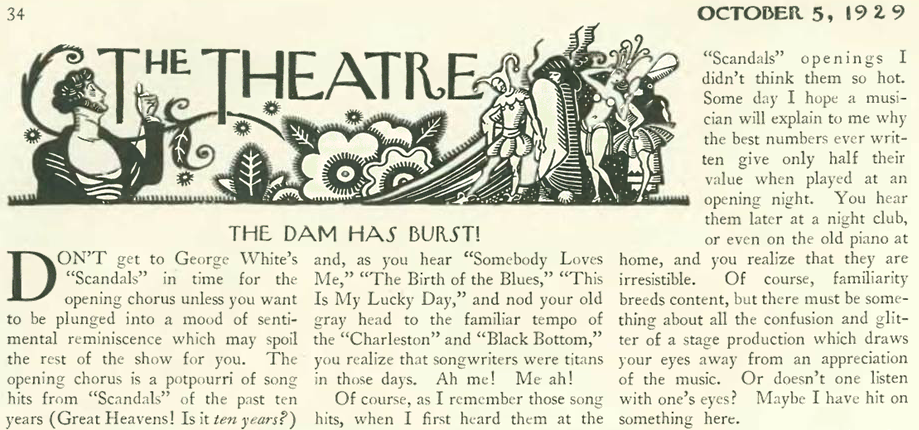
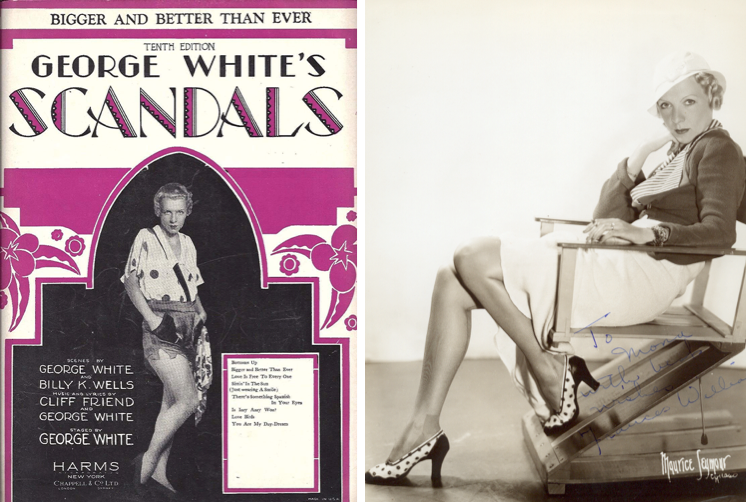
Robert Benchley checked out George White’s latest version of his Scandals revue at the Apollo Theatre, and found the sometimes risqué show to be in a sentimental mood…

BETTER SENTIMENTAL THAN DEPRESSED…The chanteuse Frances Williams (pictured on the show’s sheet music and at right) likely provided the only spark to the 1929 edition of George White’s Scandals. (amazon/psychotronicpaul.blogspot.com)

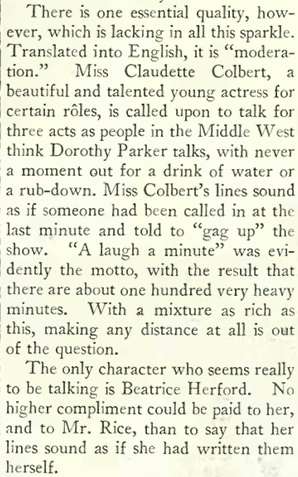
Benchley also looked in on Elmer Rice’s latest, See Naples and Die, featuring veteran English actress Beatrice Herford and the up-and-coming Claudette Colbert

VETERAN AND ROOKIE…Veteran English actress Beatrice Herford and the up-and-coming Claudette Colbert headlined Elmer Rice’s See Naples and Die. Colbert (pictured at right in a 1928 Broadway publicity photo) would go on to massive stardom in the 1930s. (Alchetron/Wikipeda)

Benchley applauded the veteran Herford’s performance, but found the otherwise reliable Colbert miscast as a wisecracking, Dorothy Parker type (Benchley, as we know, was close friends with Parker, so he knew what he was talking about)…

*  *  *

An (Ugly) American in Paris

Off to Paris, we find correspondent Janet Flanner joining with Parisians in deriding the behavior of American tourists, who were on a course to drain every last drop from the ÎledeFrance before departing for the bone-dry USA:

DRINKING IN THE SIGHTS…American tourists at a Parisian café, circa 1920s. (tavbooks.com)

*  *  *

Party Pooper

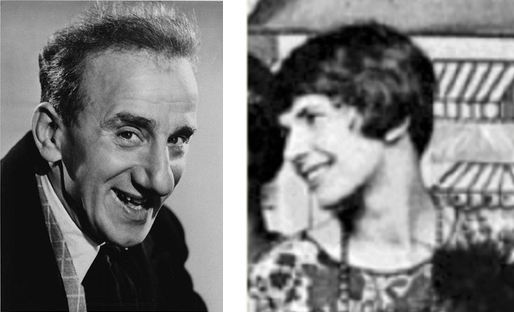
With her infant child (Patricia Arno) at home, it is doubtful Lois Long was seeing as much nightlife as she did during her first weeks at The New Yorker, when “nights were bold.” And indeed, her nightlife column “Tables for Two” would end in June 1930…for awhile anyway. Her Oct. 5 column took a cursory spin through the various nighttime offerings, ending on this note regarding a fan letter and a message from comedian Jimmy Durante:

THE GREAT SCHNOZZOLA Jimmy Durante brought a smile to the face of Lois “Lipstick” Long. 

 * * *

From Our Advertisers

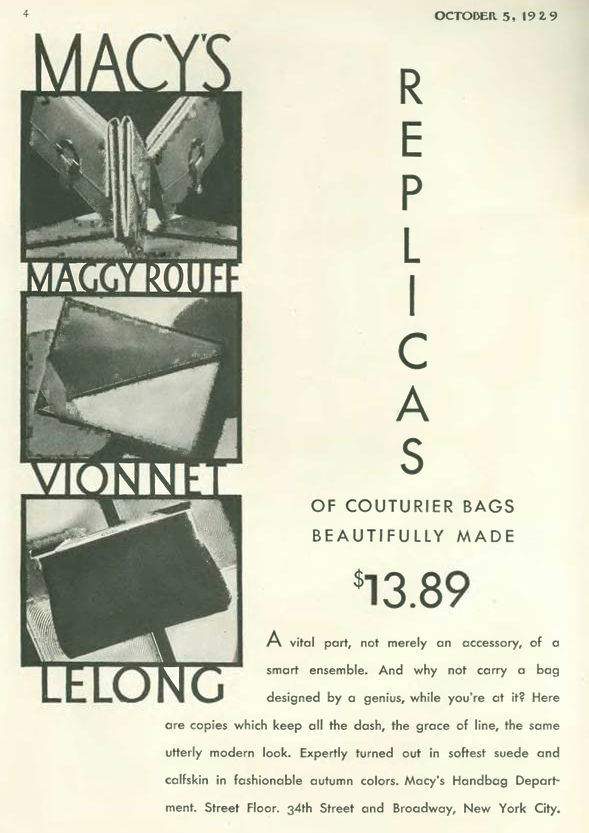
With the latest Paris fashions splattered across newstands all over Manhattan, retailers scrambled to get “replicas” to consumers…Macy’s had “couturier bags”…

…the Hollander Dressmaking Department was ready to make a perfect copy of Patou’s “Quiproquo”…

…and this Chanel frock could be had in misses’ sizes for $145 (roughly equivalent to about $2K today)…

…Philip Morris hadn’t yet discovered the “Marlboro Man,” and were still hawking their cigarettes through a “distinguished handwriting contest.” The latest winner was Edmund Froese

…who would go on to become a popular mid-century landscape painter…

Port of New York, by Edmund Froese (undated)

…another artist in the midst of our ads is Carl “Eric” Erickson, who created these lovely images for R.J. Reynolds that would induce people to take up the habit with a Camel…

…and then we have some rather unlovely ads from the back pages, including these two that would not go over well with today’s readers…

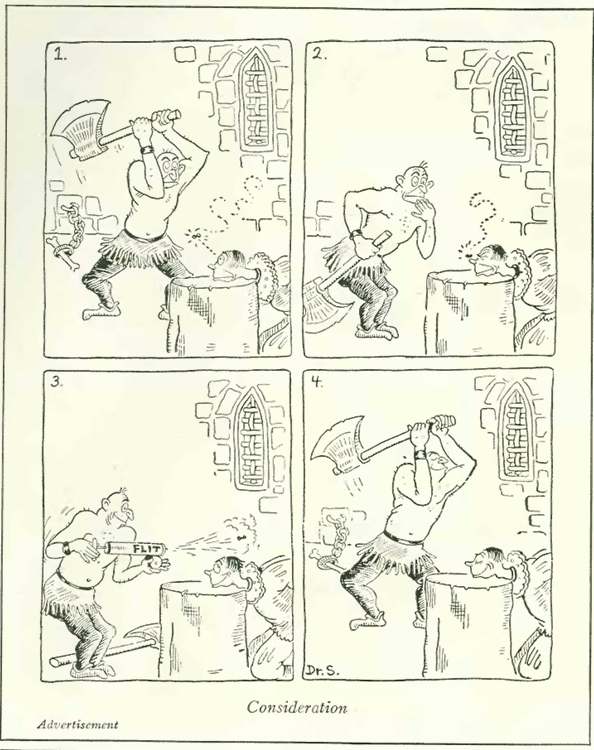
…or this from Dr. Seuss, still sharpening his skills with Flit insecticide…

…or this ad from Abercrombie & Fitch, wrong on so many levels…

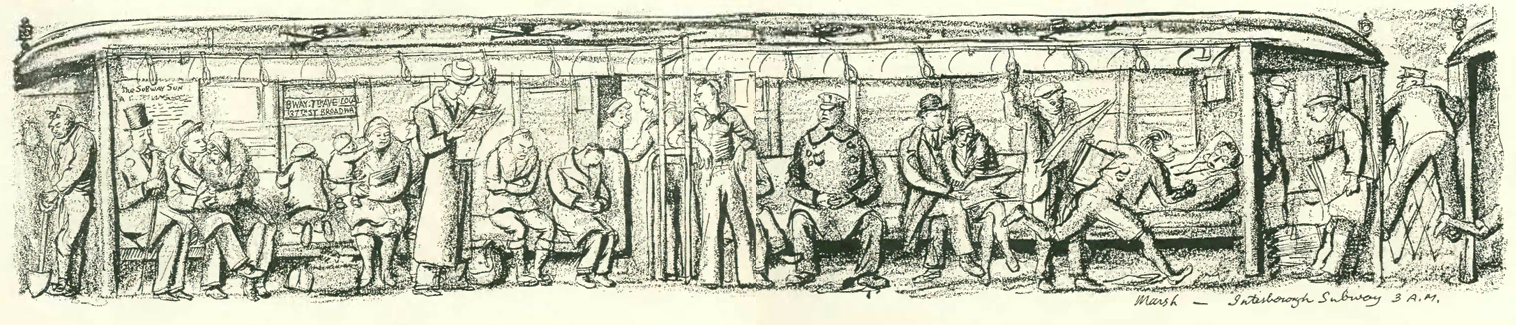
…on to happier things, here’s an illustration by Reginald Marsh that ran along the bottom of “Talk of the Town”…(click to enlarge)

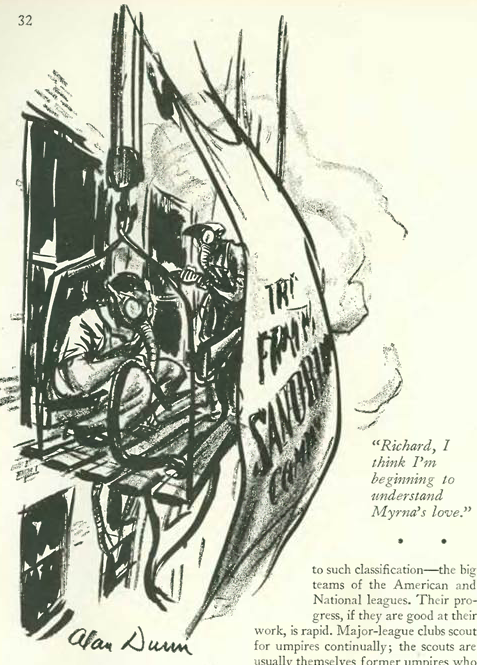
Alan Dunn found love in the air above the streets of Manhattan…

…and Leonard Dove revealed the hazards of apartment rentals…

Next Time: Race to the Sky…

Prophecies of 1929

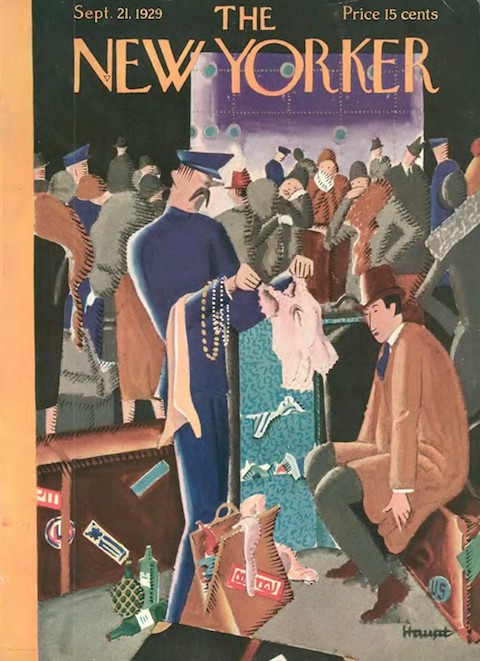
E.B. White gazed 50 years into the future in the Sept. 21, 1929 issue, predicting that New York City would be much the same if not a little worse by the time the calendar turned to 1979.

Sept. 21, 1929 cover by Theodore G. Haupt.

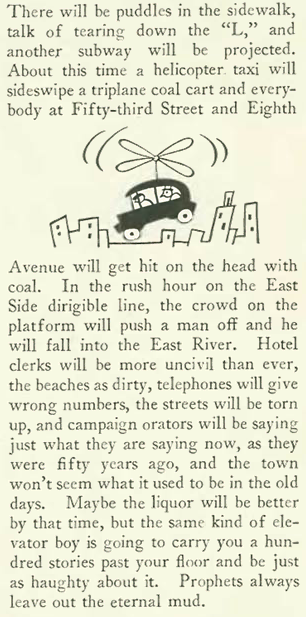
White dismissed the popular notion that the future would be one of push-button happiness and gleaming white cities. And as it turned out, he was mostly right on the mark with his predictions:

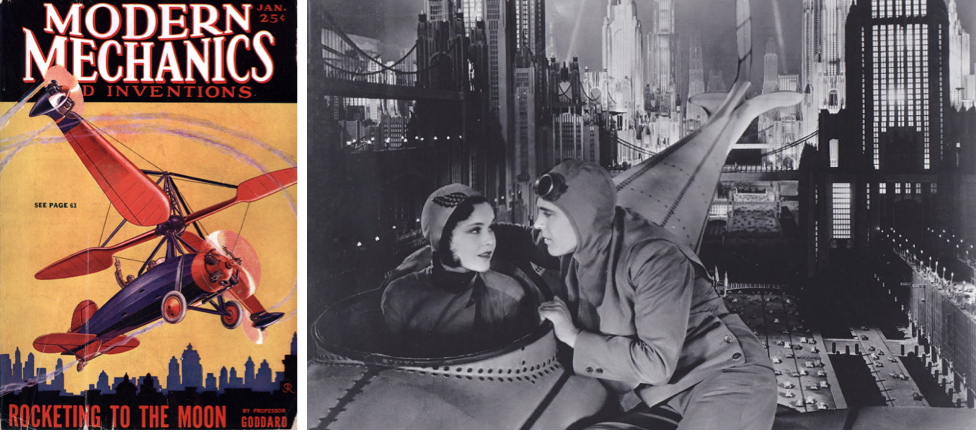
LOVE IS IN THE AIR…Autogyros (as illustrated on a 1930 cover of Modern Mechanics) were often seen as the future of transportation in the 1920s and 30s; Maureen O’Sullivan (as “LN-18”) and John Garrick (“J-21”) glide above 1980 Manhattan in 1930’s Just Imagine. (modernmechanix.com/pre-code.com)

Instead of the antiseptic fantasy world predicted in such movies as 1930’s Just Imagine (a futuristic musical set in 1980), White correctly foresaw a city that, despite technological advances, would still be a gritty rat race. And if you lived in New York City in 1979 (I was but a visitor then, as now), you would have found a city that indeed was quite dirty and crime-ridden (check out the 1979 movie The Warriors to get a sense of how Hollywood perceived the city at that time). As White observed, “Prophets always leave out the eternal mud”…

A LOT OF HOT AIR…In addition to autogyros, futurists in the 1920s and 30s also saw dirigibles as integral to future transportation. At top left is an illustration of a solar-powered aerial landing field atop a dirigible on the cover of Modern Mechanix magazine, October, 1934; top right, Manhattan in 1980 as depicted in the the 1930 film Just Imagine; bottom right, workers dismantling the Third Avenue Elevated line in 1955; bottom left, Times Square in 1979. (airships.net/IMDB/gothamist.com/viewoftheblue.com)

 *  *  *

Cradle of Civilization

Dorothy Parker took aim at ugly Americans abroad in a casual titled “The Cradle of Civilization.” In these excerpts, Parker commented on the pretensions of young New Yorkers in France, including their ridiculous costumes…

…their bad French, and their even worse manners…

WELL, THEY GOT AWAY WITH IT…Actors Leslie Howard and Ingrid Bergman don the look of French fishermen during the filming of Intermezzo: A Love Story, in 1938. Howard and Bergman were supposed to look like a couple visiting the French Riviera, but in reality it was all filmed near Hollywood. The film was Bergman’s Hollywood debut. (Pinterest)

 *   *   *

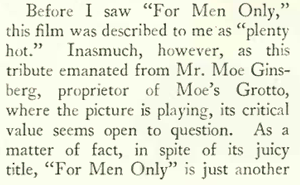
A Penny Saved

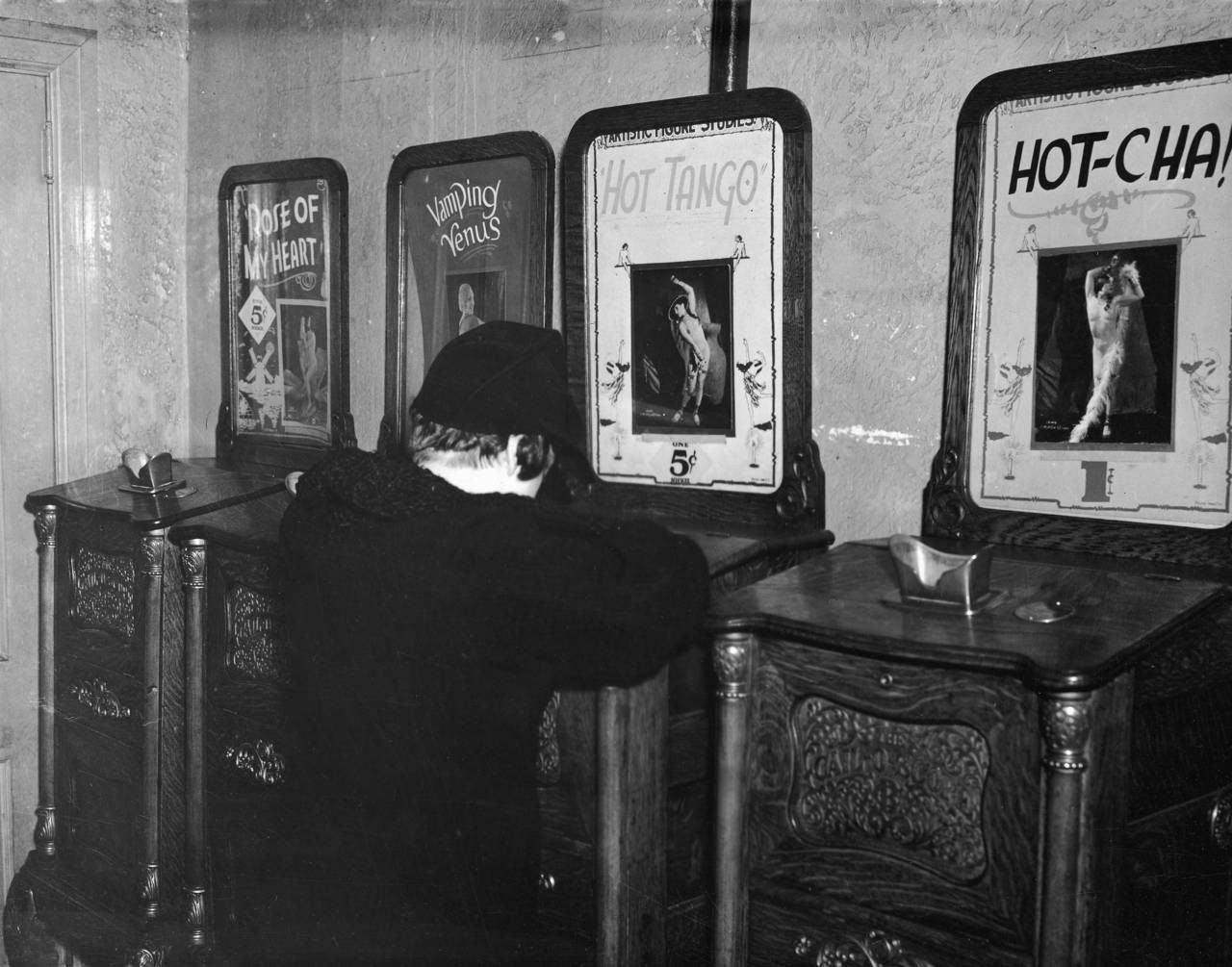
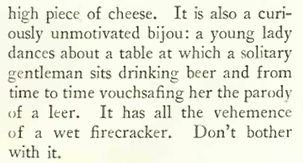
Back stateside, Wolcott Gibbs looked in on the dying art of the penny-arcade peepshow, and expressed his disappointment with the quality of that product in general…

DON’T JUDGE A PEEP BY ITS COVER…A patron checks out “Hot Tango” at a penny peepshow parlor of the 1920s. (Pinterest)

Gibbs seemed particularly miffed by a film with the misleading title “For Men Only”…

 *  *  *

Uncle Jed

Jed Harris (1900-1979) was a wunderkind of Broadway, producing and directing 31 shows between 1925 and 1956. Before he turned 28 he produced a record four consecutive Broadway hits over the course of 18 months (including the 1928 smash hit The Front Page), and so it was time for some rest. “The Talk of the Town” reported…

Although it was rumored Harris would retire at age 30, he would instead return in the spring of 1930 with a production of Anton Chekhov’s Uncle Vanya, and continue producing on Broadway through the 1950s.

WUNDERKIND…A 1928 portrait of Jed Harris that was featured on the Sept. 3, 1928 cover of Time magazine. (Wikipedia)

 *  *  *

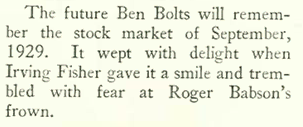
Dueling Cassandras

About a month before the big stock market crash we find this curious little item in Howard Brubaker’s “Of All Things” column…

…Considered the first “celebrity economist,” Irving Fisher stated in September 1929 that the stock market had reached “a permanently high plateau,” while around the same time (Sept. 5, 1929) rival economist Roger Babson warned in a speech that “sooner or later a crash is coming, and it may be terrific.” Note: “Ben Bolts” refers to a character in a popular 1842 poem that became an oft-parodied popular song. Each stanza begins with a variation of “Oh don’t you remember…”

 *  *  *

Parental Advisory

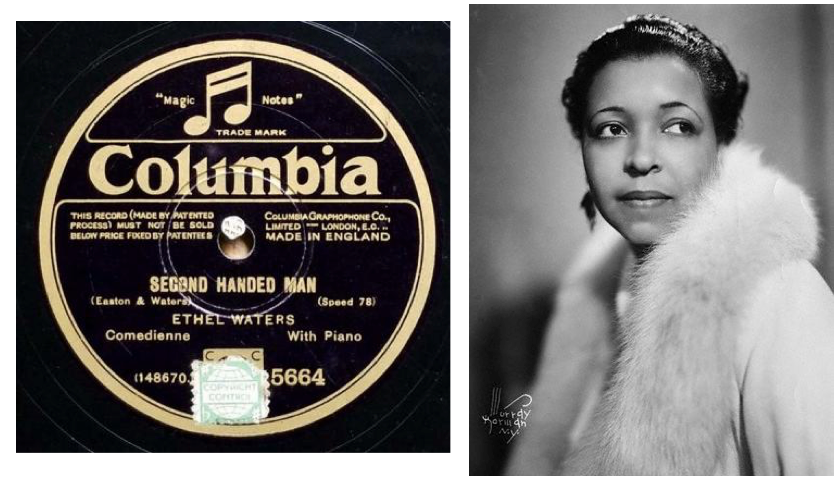
Fifty-five years before Tipper Gore and the Parents Music Resource Center pushed the music industry to place warning labels on records containing explicit lyrics, there was much ado about “lascivious lyrics” uttered on “race records” — the term referred to 78-rpm records marketed to African Americans from the 1920s and 1940s. The Sept. 21 “Popular Records” column looked at the controversy surrounding Ethel Waters’ “Second Handed Man,” and didn’t find any…

MUCH ADO…Ethel Waters (circa 1930) and her recording of “Second Handed Man.” (discogs.com/YouTube)

 *  *  *

New Kids on the Block

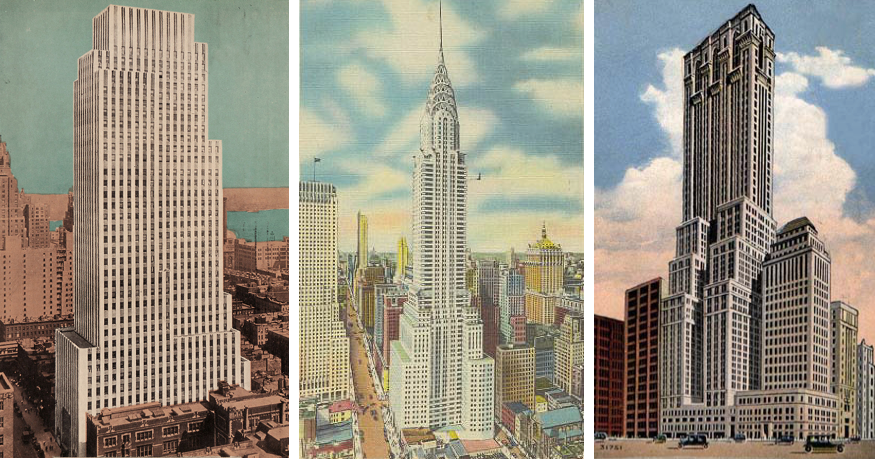
Architecture critic George S. Chappell (aka “T-Square”) concluded his Sept. 21 column with praise for the designs of the yet-to-be-built Daily News and Chrysler buildings, but expressed dismay at the recently completed Lincoln Building…

BAD COMPANY…New Yorker architecture critic George S. Chappell was excited about the designs for the Daily News Building (left) and Chrysler Building (center), but the Lincoln Building left him wanting. No doubt its gothic topper seemed dated in contrast to the sleek lines of the other buildings. (nyc-architecture.com)

 *  *  *

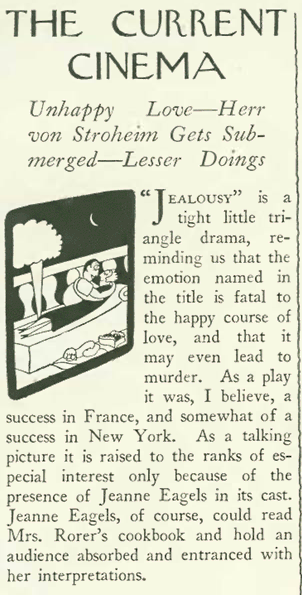
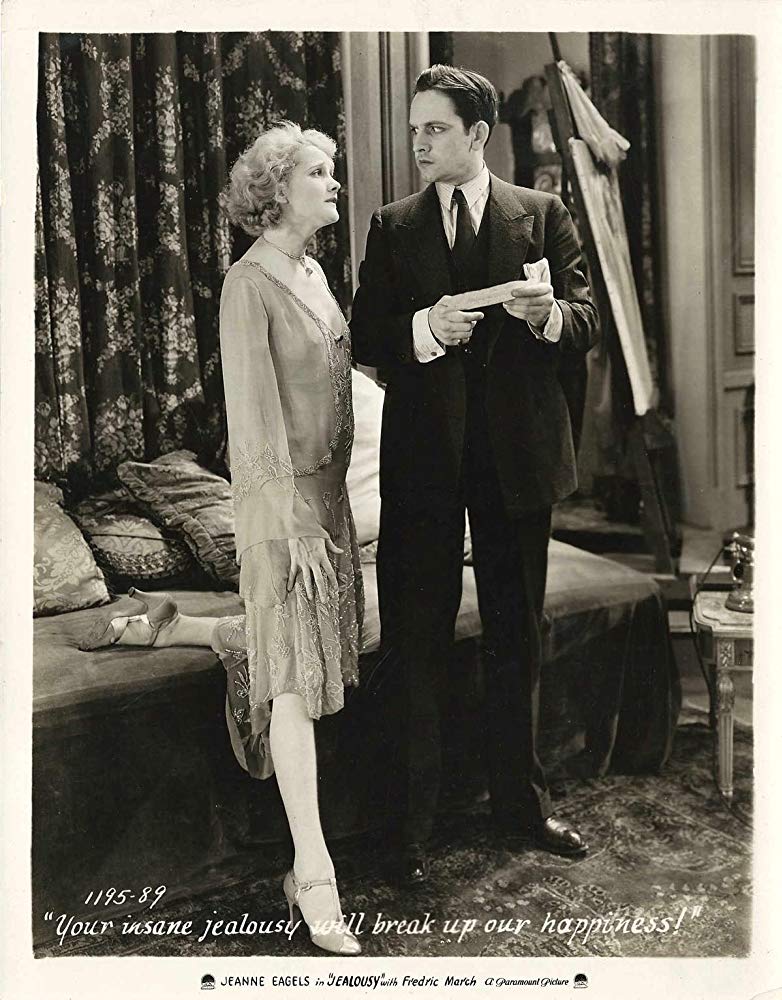
Movie critic John Mosher took in a couple of new films including Paramount’s 1929 pre-Code drama Jealousy…

FINAL CURTAIN…Jeanne Eagels and Fredric March in a publicity photo for Jealousy. Eagels died of a drug overdose on Oct. 3, 1929, just days after Mosher’s review appeared in The New Yorker. (IMDB)

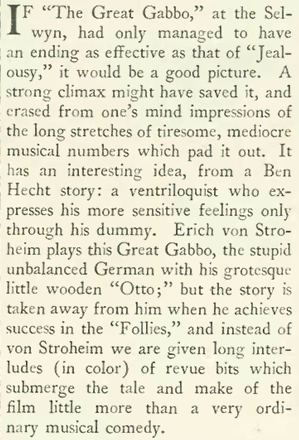
…and Mosher also reviewed the musical drama The Great Gabbo, which was derived from a story by occasional New Yorker contributor Ben Hecht

WHO ARE YOU CALLING DUMMY?…Erich von Stroheim has issues with his co-star in The Great Gabbo. (MoMA)

 *  *  *

From Our Advertisers

What appeared to be an unassuming ad from General Motors was actually a plan for world domination, at least in the area of ground transportation. GM gobbled up a number of car companies in the 1920s (see the ad’s fine print) as well as shares in power plants and home appliances. It would overtake Ford in sales in the late 1920s, and thanks to propaganda efforts including those illustrated in the ad below, it would lead a streetcar removal conspiracy that would destroy intercity train transport systems across the U.S. (and convert them to GM buses, naturally)…

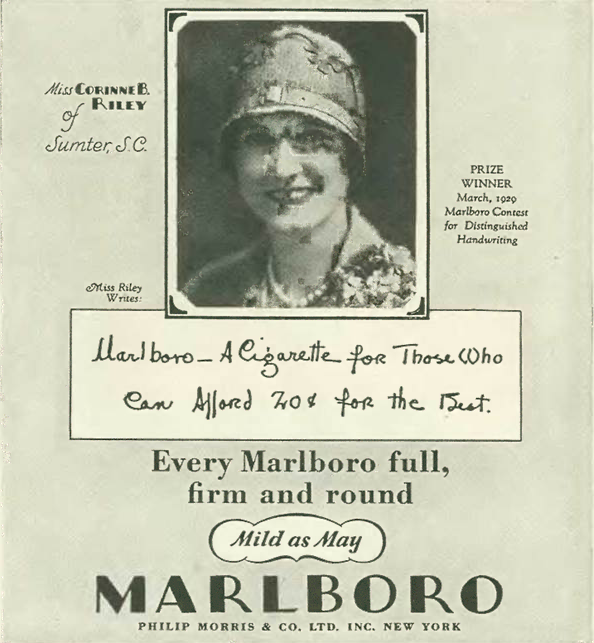
Here we have yet another “distinguished handwriting contest” ad from the makers of Marlboro, this time exploiting the efforts of Corinne B. Riley of Sumter, S.C….

…Riley would win more than a handwriting contest, however. She would be elected as a Democrat to Congress in 1962 to fill a vacancy left by her husband, Congressman John Jacob Riley.

Corrine B. Riley in 1962. (Wikipedia)

On to our illustrators and cartoons, we begin with this two-page drawing by Reginald Marsh that appeared along the the bottom of “Talk of the Town”…

Gardner Rea lent his spare style to this peek into Wall Street…

Peter Arno appeared to be experimenting with yet another style of drawing…

…that in some ways looked similar to Alan Dunn’s

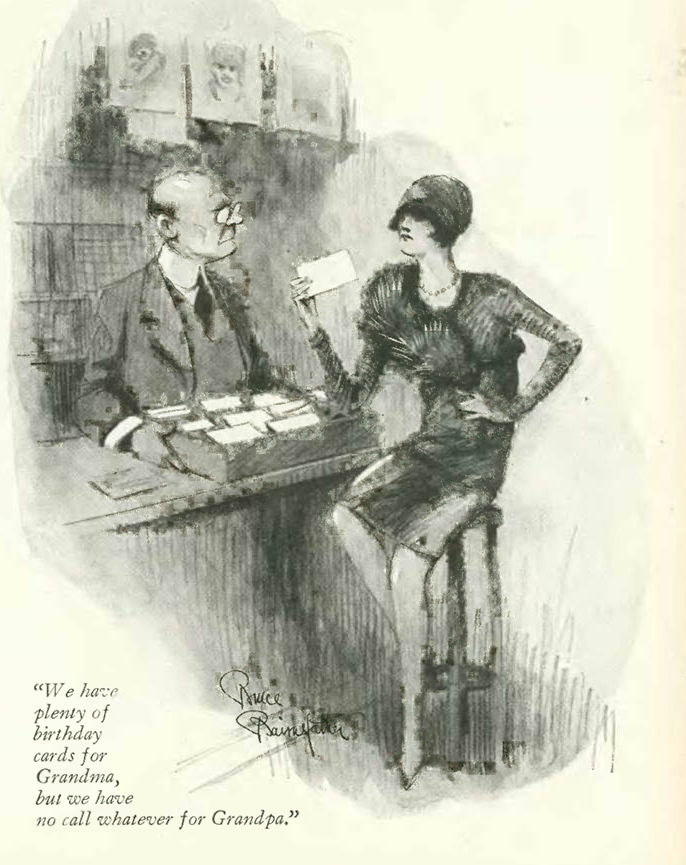
…the British cartoonist Bruce Bairnsfather provided this sumptuous drawing of an exchange at a card shop…

…and Isadore Klein gave a vertiginous perspective to home buying…

Next Time: Frigidity in Men…

A Carnival in the Air

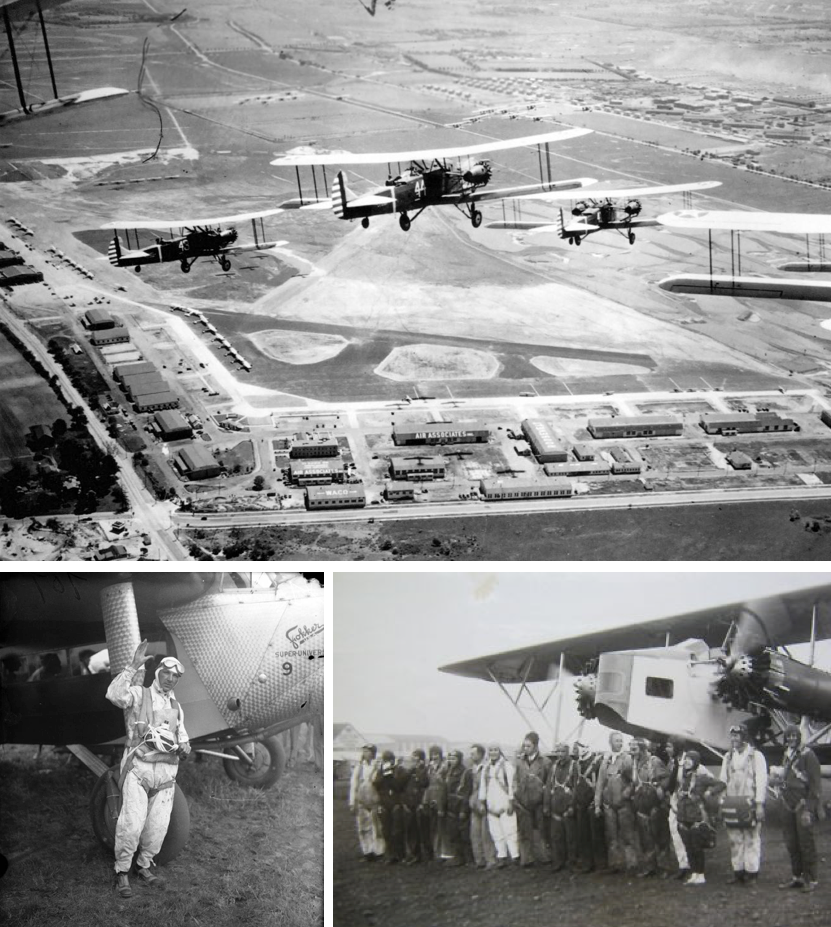
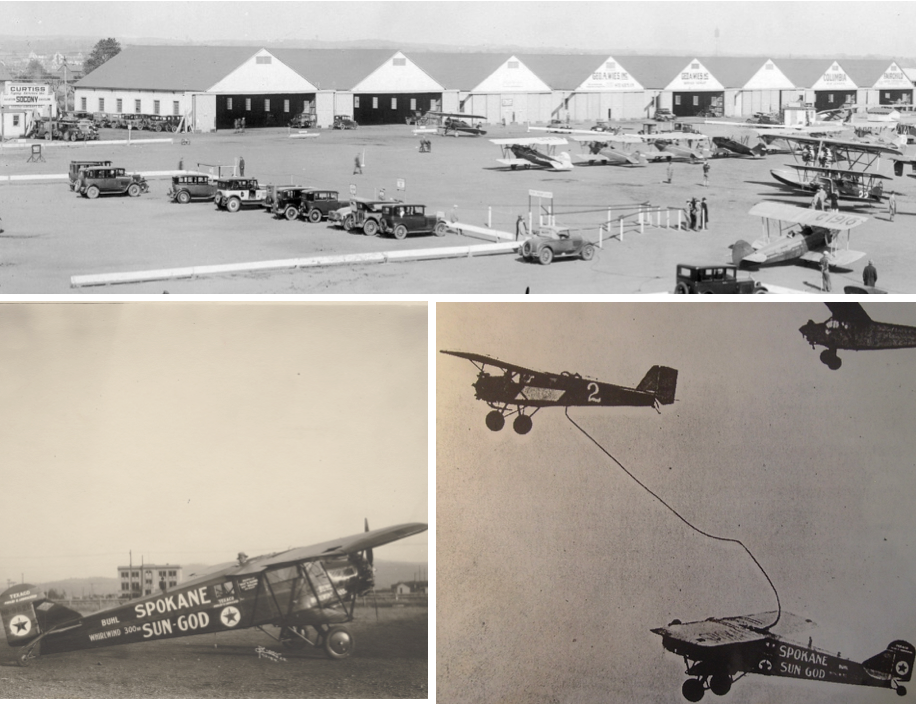
When Charles Lindbergh gunned his Wright Whirlwind engine on Roosevelt Field and took to the skies on his historic flight, he sparked such an interest in flying that just two years later that very same field was hosting huge weekend crowds that came to marvel at the airborne wonders of a new age.

August 31, 1929 cover by Theodore Haupt.

Writing for “The Talk of the Town,” James Thurber was on hand to take in the spectacle, noting how the announcer sold air-mindedness to the mob “in great clamorous phrases and resonant assurances.” Among those taking their first flight was a “Mr. Galleger, aged 101.” Thurber also observed:

AIRBORNE SPECTACLES…Clockwise, from top, a 1931 aerial view looking southeast at a group of Army twin-engine biplane bombers overflying Roosevelt Field; parachute records were broken when 14 men and 2 women leaped from a Sikorsky bombing plane at Roosevelt Field in November 1929 (in the photo they seem to be standing precariously close to the plane’s whirling blades); Jack Cope waved to onlookers in Chicago before he performed a 15,000 foot jump in 1929. (tripod.com/Worthpoint/Chicago Tribune)

Although there were thrills galore up in the sky, Thurber seemed equally impressed by the spectacle on the ground…

THE SUN GOD…Clockwise, from top, a 1928 photo of biplanes lined up by a row of hangars at Roosevelt Field; the spectacle of mid-air refueling was demonstrated above Roosevelt Field by Texaco Oil’s Spokane Sun God. (Tom Heitzman/barnstmr.blogspot.com/Wikipedia)

One of the big attractions was Texaco Oil’s Spokane Sun God, which traveled around the country to demonstrate the art of mid-air refueling. Note in the excerpt below (second paragraph) how the Sun God’s pilot communicated with his ground crew: He tossed some notes—tied to a heavy piece of lead(!)—out of the airplane’s window. It nearly landed in a crowd of onlookers…

AND HOW WAS YOUR DAY?…For some perspective, the first attempt at refueling in mid-air was made in 1921. In the photo above, Wesley May climbs from the lower biplane to the upper while carrying a 5-gallon can of fuel strapped to his back. After lifting himself onto the wing, he worked his way between the wings and into the cockpit. He then poured the fuel into the engine. (Seattle Museum of Flight) 

*  *  *

Falling Short

As I noted in a previous post (The Last Summer), the race to build the tallest building was erroneously reported by The New Yorker as a man against himself (namely, architect William Van Allen). In the Aug. 31 issue, the magazine’s “Talk of the Town” corrected the error, and added another curious note about another plan to build an “airplane lighthouse” taller than the Eiffel Tower…

As noted above, Col. Edward Howland Robinson Green (son of the notorious miser Hetty Green) wanted to build a thousand-foot tower on his estate in Massachusetts. Here is what he settled for instead:

WORK-LIFE BALANCE…Edward Green, radio enthusiast and son of the miserly Hetty Green, erected huge radio towers at his Massachusetts estate in the 1920s to operate an early broadcast station, WMAF. (Wikipedia)

 * * *

When Trains Fly

Cashing in on the enthusiasm over aviation, the City of New York promoted its elevated train system as an “Air Line.” According to “Talk”…

Click on the video below to take a ride on the “L”. Most of the 1929 footage begins at 4:47…

* * *

Haw Haw

One more “Talk” item: a self-referential piece in which The New Yorker pondered its “mission” as a humor magazine…

* * *

Audax Minor

For more than five decades, George Francis Trafford Ryall (1887-1979) wrote the horse racing column for the New Yorker under the pseudonym Audax Minor. He published his first column on July 10, 1926, and his last on Dec. 18, 1978. He was the writer of longest record at the magazine when he died at age 92 in 1979 (52 years, a record that has been shattered by the nearly 98-year-old Roger Angell, who has published in the New Yorker from 1944 to 2018).

According to Ryall’s obituary in the New York Times, he adopted the nom de plume Audax Minor in a nod to Arthur F. B. Portman, who wrote about racing in England under the name of Audax Major. Ryall’s writing was so entertaining that many of his readers had never even been to a racetrack. According to Brendan Gill in his book, Here at the New Yorker, “(Ryall’s) world is a romantic fiction and they (the readers) are grateful when they learn that, with his green tweeds, his binoculars hung smartly athwart his chest, and his jaunty stride, Ryall resembles a character out of some sunny Edwardian novel.” An excerpt of his column from the Aug. 31 issue, with illustrations by Johan Bull:

A DAY AT THE RACES…At left, a crowded second floor dining area in the clubhouse at Saratoga, 1929; a postcard image of the track, with expanded clubhouse at left, circa 1929. (Saratoga Springs Historical Museum/Boston Public Library)

 *  *  *

Shut Out

As I’ve noted before, the New Yorker covered nearly every imaginable sport except baseball. Here is a rare mention of the game in Howard Brubaker’s “Of All Things” column:

The Cubs would win the NL pennant, but they would fall to the Philadelphia Athletics in the 1929 World Series.

Rough and Ready

When Fiorello La Guardia challenged incumbent Jimmy Walker for New York City mayor in 1929, the city’s voters were presented with two colorful candidates who could not have been more different in their styles. Walker, a product of Tammany Hall, was a svelte dandy with a taste for the refined, whereas the reform-minded La Guardia was often coarse and unkempt. If they had anything in common, it was their dislike of Prohibition. La Guardia was featured in the Aug. 31 profile, written by Henry F. Pringle. Some excerpts:

JUST TRY TO STOP ME…Congressman Fiorello La Guardia pouring beer in his office during Prohibition, when he served New York’s 20th district in U.S. House of Representatives. (La Guardia Wagner Archives)

 *  *  *

Praise for the King

The New Yorker’s film critic John Mosher found most of Hollywood’s output to be pedestrian, but occasionally he saw a bright spot, including King Vidor’s latest production, Hallelujah:

William E. Fountaine, Nina Mae McKinney and Daniel Haynes in Hallelujah. The 17-year-old McKinney was the first African-American actress to hold a principal role in a mainstream film, and the first African-American actor to sign a long-term contract with a major studio—MGM. (IMDB)

As for another film, Paramount’s The Sophomore, Mosher probably felt a bit obligated to say something nice, since it was a derived from a story by humorist Corey Ford, an early contributor to The New Yorker and part of the Algonquin Round Table orbit:

BOY MEETS GIRL…Lobby card for The Sophomore. (IMDB)

 *  *  *

A Bright Interval

The New Yorker gave a brief but approving mention of Nancy Hoyt’s latest book, Bright Intervals, in its book review section…

Hoyt was a member of a socially prominent but deeply troubled family that included her recently deceased sister, the poet and writer Elinor Wylie (I wrote about the Hoyt family in my post Generation of Vipers). Characters in Hoyt’s novels often resembled the women in her family.

Nancy Hoyt in an undated photo by Sherril Schell. (Conde Nast/Amazon)

 *  *  *

From Our Advertisers

It was back to college time, and Macy’s had a thrifty new fall lineup ready for the “Junior Deb”…

…and on the less thrifty side, Best & Company offered these new looks for fall…

…note in the above ad that the first model is Virginia Maurice, the very same model we encountered in a recent post (The Last Summer) posing for Chesterfield cigarettes…

Model Virginia Maurice posed for this 1929 Chesterfield ad, illustrated by artist Charles Edward Chambers.

…the other model in the Best & Company ad, Babs Shanton, also wasn’t averse to taking money from the tobacco companies…

Undated newspaper ad for Lucky Strikes featuring Babs Shanton, a sometime performer with the Ziegfeld Follies and a singer with the Lucky Strike Dance Orchestra. (Stanford University)

…the makers of Studebakers tried to add sex appeal in this ad for their President Roadster. The artist was obviously challenged to work all of the necessary elements into the picture—car, swimming pool, diving board—not to mention the block of superfluous text where the steps to this impossibly long diving board should have been located…

…and sex not only sold cars…its also sold printing services…

…instead of sex, the promoters of Tudor City chose strangulation to get their pitch across, equating a man’s daily train commute to death at the gallows (“Danny Deevers” refers to a character in a Rudyard Kipling poem who is hanged for murder)…

…the gawkers at Roosevelt Field weren’t the only folks with their heads in the clouds…an ad for Flit insecticide by Dr. Seuss…

…this ad for Raleigh cigarettes, which appeared on the back cover of the Aug. 31 issue, assumed that folks were so familiar with their mascot that no further explanation was needed…

…here is a 1929 ad from House Beautiful that featured the same mascot with the Van Dyke beard…both ads were rendered by French illustrator Guy Arnoux

…on to our cartoonists…Helen Hokinson contributed this two-page spread on the challenges of visiting an old friend (click to enlarge)

Peter Arno looked in on a cheapskate at a posh restaurant…

Bruce Bairnsfather visited the talkies…

Justin Herman examined the literary life of the street…

Carl Kindl explored an awkward moment from the annals of technological advancements…

…and Isadore Klein illustrated the hazards of the tonsorial trade…
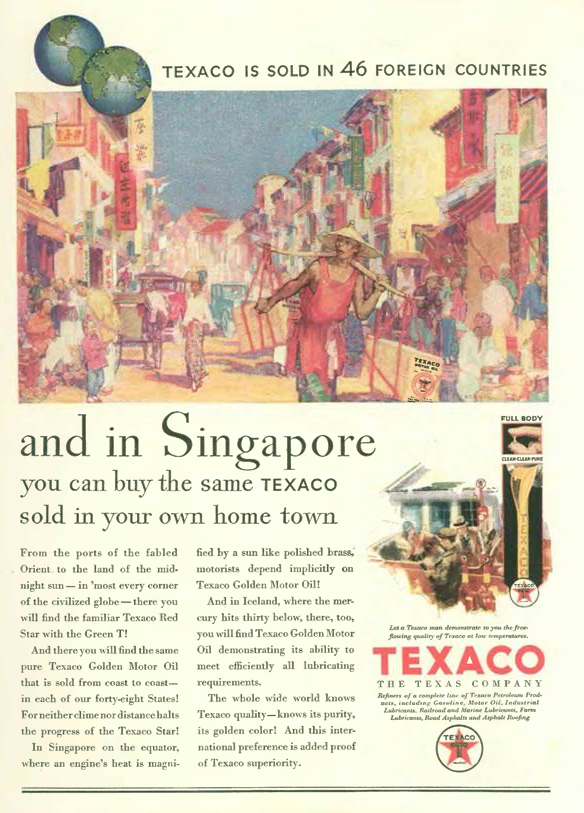
Next Time: The Last Hurrah…