An Immemorial Year

Perhaps it was the end of Prohibition, or the implementation of the New Deal, but throughout the pages of the final New Yorker of 1933 you could sense a lightening of spirit.

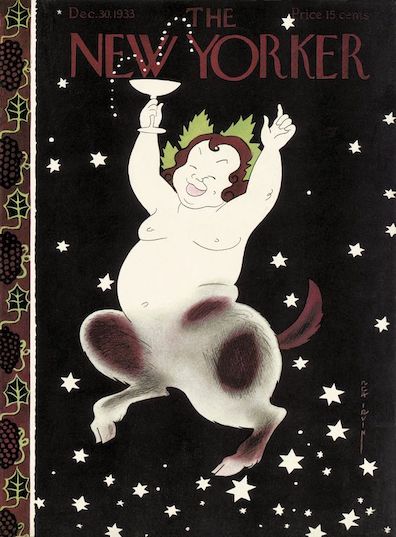
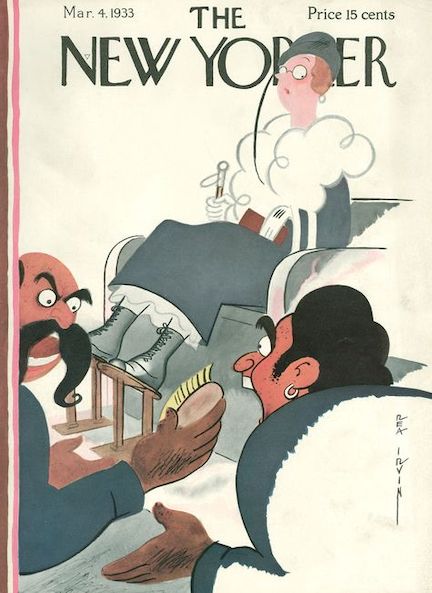
Dec. 30, 1933 cover by Rea Irvin.

By most accounts 1933 was one of the Depression’s worst years, and that is likely why E.B. White chose to remember “only a few scattered moments,” mixing the silly with the salient.

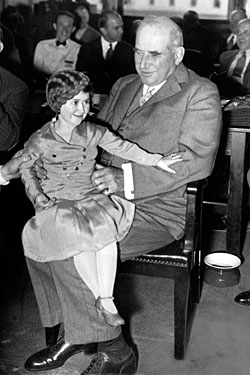
Of the silly, there was the time when the Barnum & Bailey circus dwarf Lya Graf sat on J.P. Morgan’s lap while he was waiting to testify before the Senate Banking Committee…

HE DIDN’T BANK ON THIS…J.P. Morgan was paid a visit by Barnum & Bailey circus dwarf Lya Graf, prior to his testimony before the Senate Banking Committee on June 1, 1933. (New York Magazine)

White also noted the passing of Texas Guinan. Known as “Queen of the Nightclubs,” she was a fixture on the Manhattan speakeasy scene throughout the Roaring Twenties and a reliable source of nightlife headlines. White also recalled George Bernard Shaw’s controversial speech at the crowded Metropolitan Opera House, during which he referred to American financiers as “lunatics” and called the U.S. Constitution a “charter of anarchism.”

YEAR IN A NUTSHELL…Clockwise, from top left: The year 1933 saw the passing of the “Queen of the Nightclubs” Texas Guinan—more than 10,000 showed up for her funeral in November; also that month Thomas G.W. Settle and C.L Fordney ascended to the stratosphere in the Century of Progress balloon; The New York Times (April 12, 1933) published the full text of George Bernard Shaw’s Met speech; Esquire published its first issue in the fall, featuring Ernest Hemingway and John Dos Passos as well as New Yorker cartoonists Constantin Alajalov, William Steig and E. Simms Campbell; according to Vogue, 1933’s breasts were “high and pointed.” (bounddv.medium.com/history.navy.mil/The New York Times/Pinterest)

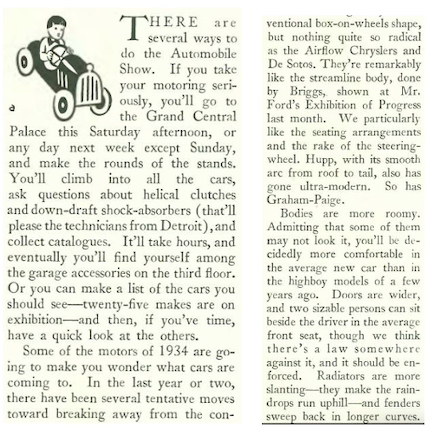
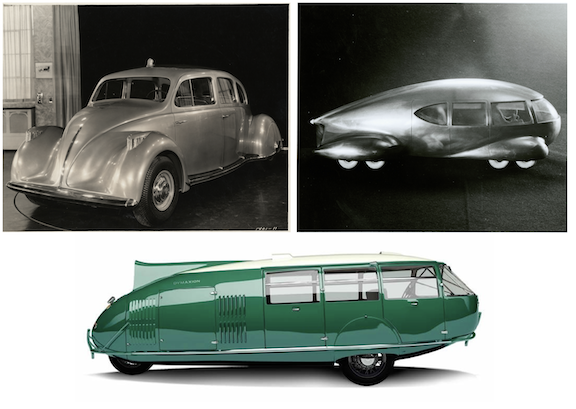
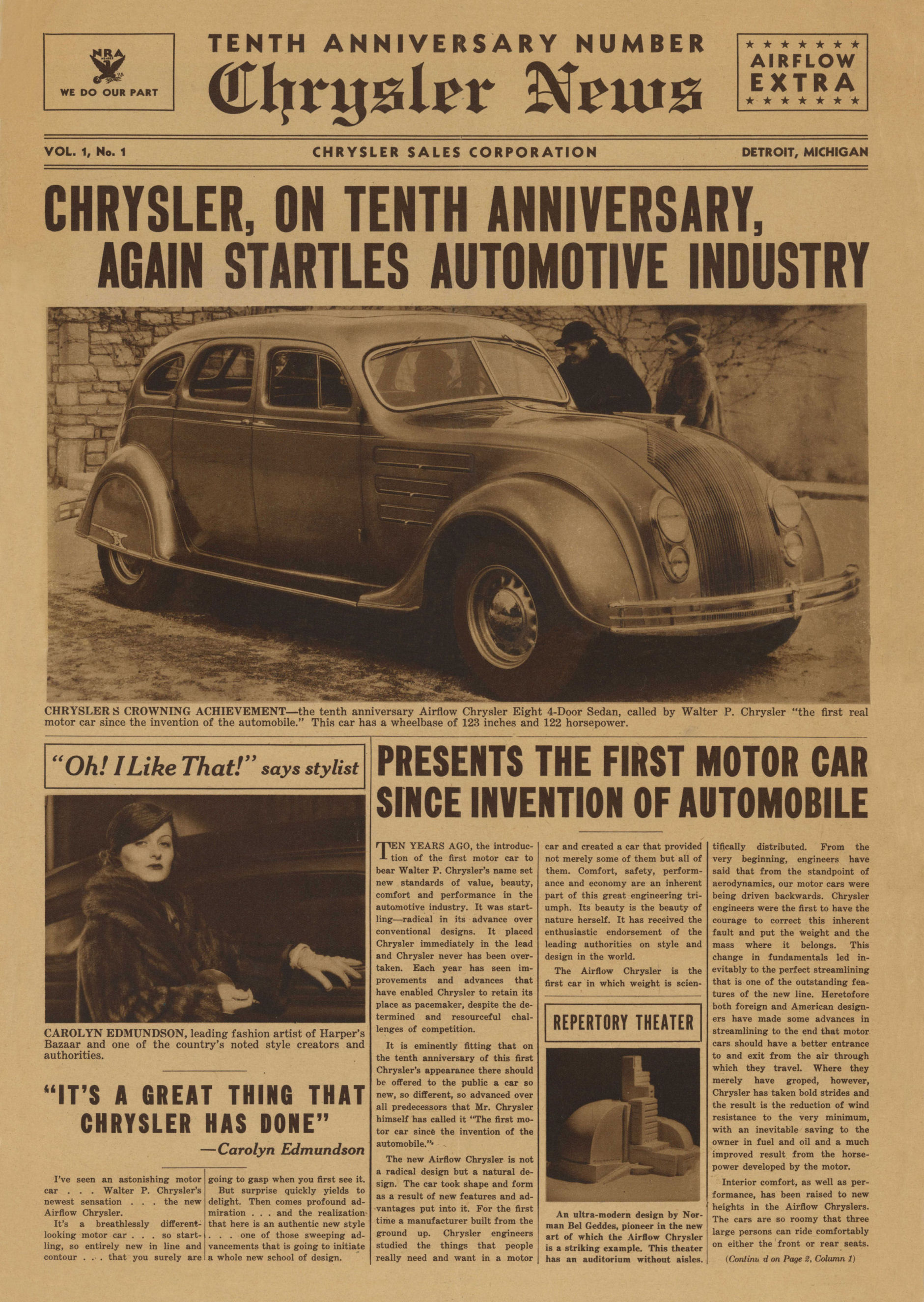
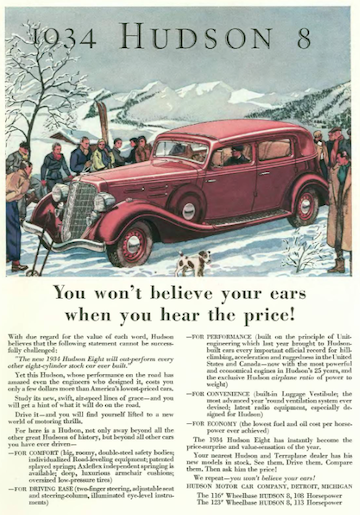
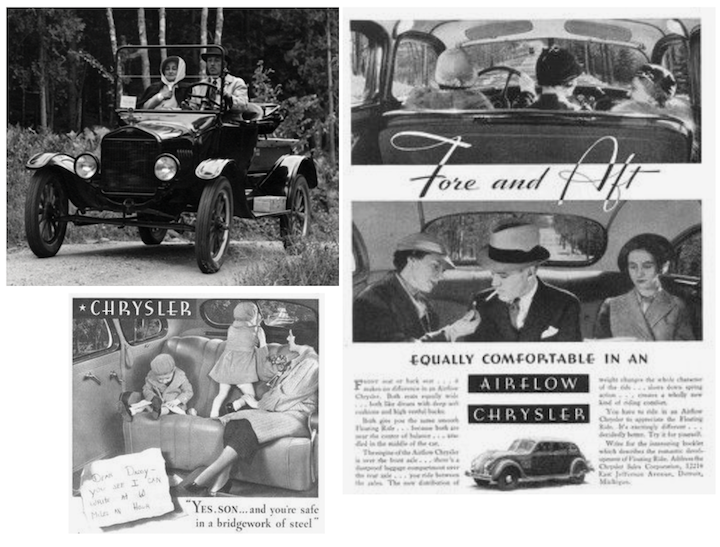
White also had more to say about the streamlining trend in automobiles, led by Chrysler’s new “Airflow.” White preferred the older, boxier models, with plenty of head and hat room.

In 1922 White set off across America in the car of his dreams, a Model T, which had plenty of headroom and, as he later wrote, transformed his view of the land, a vision “shaped, more than by any other instrument, by a Model T Ford…a slow-motion roadster of miraculous design—strong, tremulous, and tireless”…

MERRILY WE ROLL ALONG…Clockwise, from top left: E.B. White and wife Katharine Sergeant take a spin in a Model T in the mid 1930s; despite White’s remonstrations regarding headroom, the makers of the Chrysler Airflow advertised their streamlined car’s interior as practically cavernous. (Goodreads/Pinterest)

 * * *

Crying in His Beer

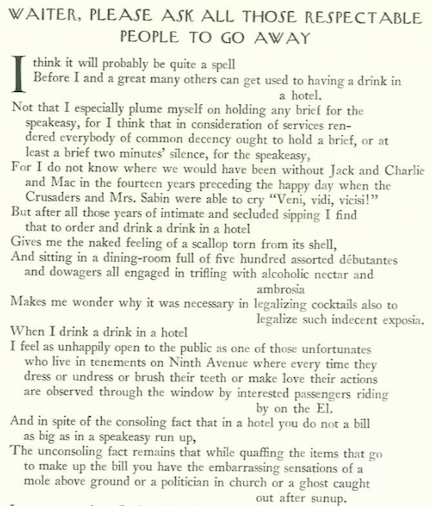
A couple of issues back we saw Lois Long bid a sad farewell to the cosy and secluded atmosphere of the speakeasy…Ogden Nash turned to verse to offer his own lament, feeling naked and exposed in dining rooms “full of 500 assorted debutantes and dowagers”…

FEELING EXPOSED…Ogden Nash (1902–1971) missed the sacrilegious rite of the speakeasy and lamented the “humdrumness” of legal drinking. (vpoeticous.com)

 * * *

Wondering About Alice

Combine horrific character designs with a young adult playing a child and you have the recipe for 1933’s star-studded Alice in Wonderland, a film the Nerdist’s Kyle Anderson calls “a fascinating, unintentionally disturbing take on a classic.” Almost ninety years earlier the New Yorker’s John Mosher found it disturbing in other ways, save for W.C. Field’s portrayal of Humpty Dumpty.

Writing for The Roarbots, Jamie Green notes that Charlotte Henry was 19 when she played Alice: “This version of Alice doesn’t feel like a sweet look at the twists and turns of adolescence; it feels more like a commentary on repressed desire and self-identity.” The film was a flop at the box office.

CHANNELLING HER YOUTH…Clockwise, from top left: 19-year-old Charlotte Henry as Alice in 1933’s Alice in Wonderland; W.C. Fields as Humpty Dumpty; Roscoe Karns as Tweedledee and Jack Oakie as Tweedledum; Alice has a chat with Gryphon (William Austin) and Mock Turtle (Cary Grant). Except for Henry, most of the cast was unrecognizable in their macabre makeup and costumes. (IMDB)

 * * *

From Our Advertisers

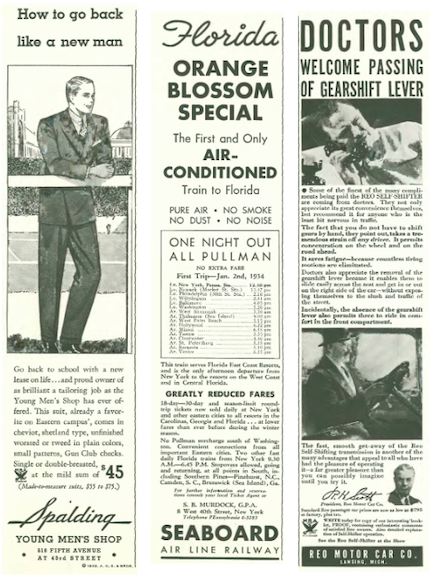
We start with a selection of three one-column ads, featuring, from left, the latest back-to-school look for the collegiate male (apparently attending Columbia); the dustless, noiseless, smokeless, AIR-CONDITIONED railway wonder called the Orange Blossom Special; the automobile arm of the REO Motor Car Company trying to pack everything it could into this narrow little ad (REO would stop producing cars in 1936 in order to focus solely on trucks)…

…the distillers of Holloway’s London Dry Gin warned newly liberated American drinkers about the consequences of imbibing cheap gin…

…the folks at R.J. Reynolds found another member of the gentry to push their Camels onto aspiring young women…

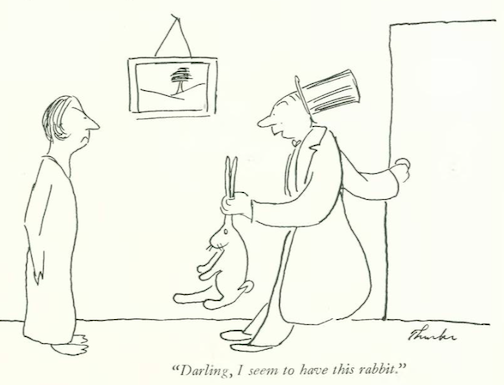
…on to our cartoons, the Dec. 30 issue featured a James Thurber double-header, beginning with this “Talk of the Town” spot illustration…

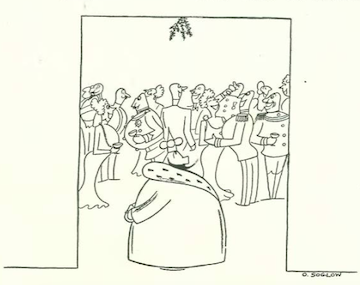
…a rare one-panel Little King from Otto Soglow

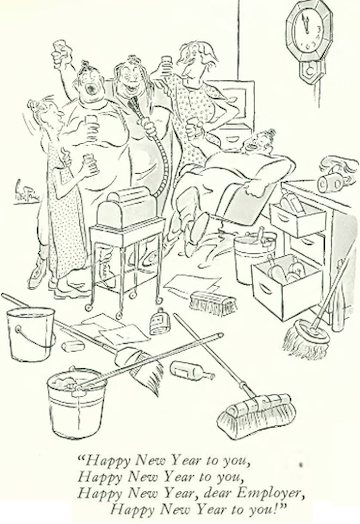
…ringing in the New Year with Syd Hoff

…and George Price

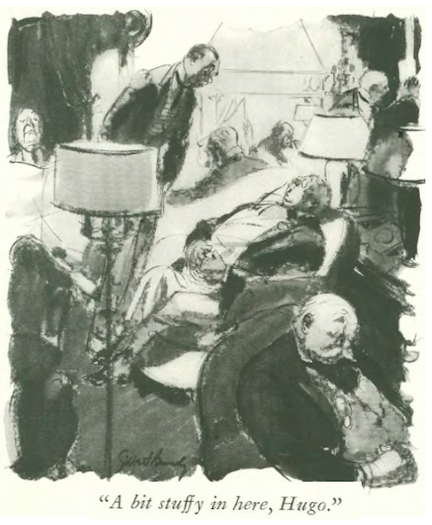
…and we close with Gilbert Bundy, seeking from fresh air…

Next Time: American Love Affair…

Going With the Flow

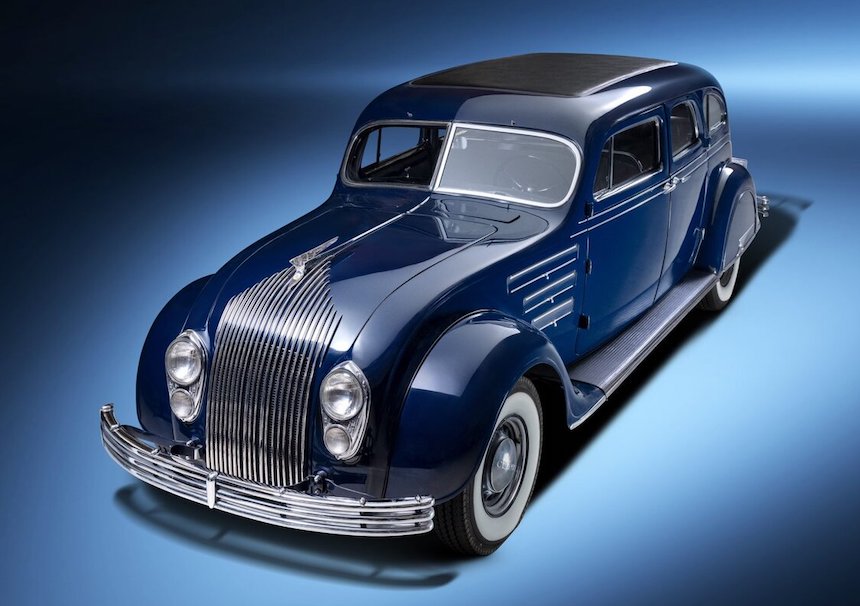
“We had the horse and buggy. We had the automobile. Now we have the first real motor car in history.” — Walter P. Chrysler. (Image: Blair Bunting via hagerty.com)

Classic motorcar collector and aficionado Jay Leno has more than 180 vehicles in his collection, but a pride and joy is a 1934 Chrysler Airflow Imperial CX—one of the only three surviving CXs today.

Dec. 16, 1933 cover by Rea Irvin.

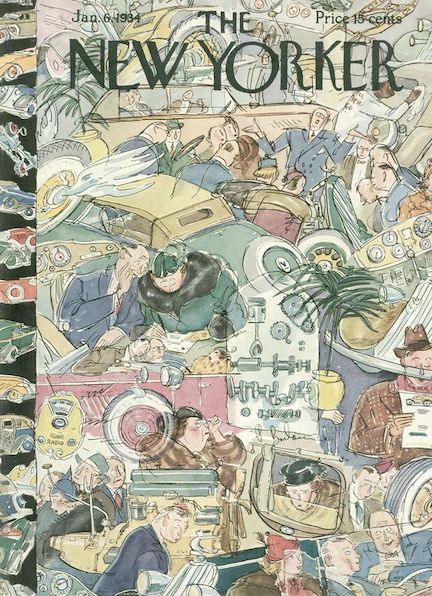
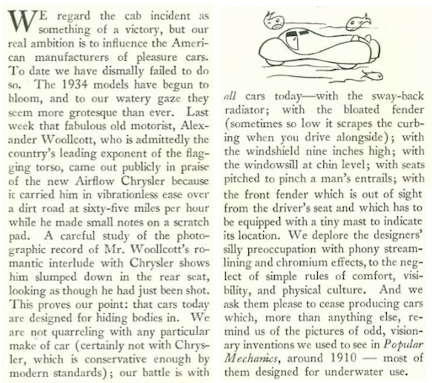
The 1934 Chrysler Airflow was a car of the future that came too early. The Airflow’s advances in engineering—including invention of the modern unibody—still inform car design today. But the streamlined look of the car was probably too advanced for those depressed times, and despite lots of media attention it flopped with consumers. E.B. White was among those who weren’t ready to jump on the Airflow bandwagon, and even poked fun at colleague Alexander Woollcott for posing in the backseat of an Airflow for a Chrysler advertisement:

The Woollcott ad in question, which appeared in the previous issue (Dec. 9):

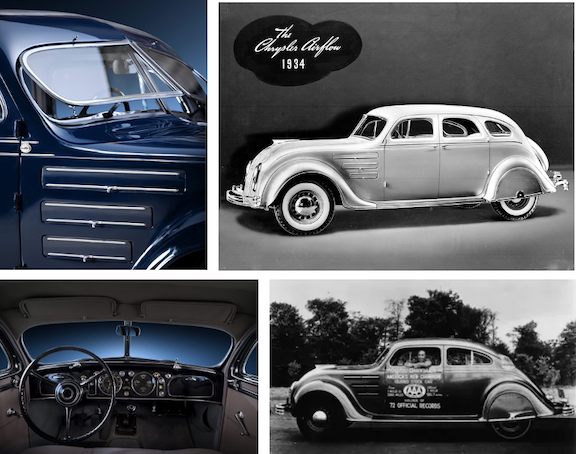
Of the major car companies in the 1930s, Chrysler was perhaps the most revolutionary in terms of technological and design advances. The first car to be wind tunnel-tested, the Airflow’s lightweight, unibody design moved the engine over the front axle and positioned the passengers between the front and rear wheels for a much roomier, smoother ride. Chrysler claimed the unibody also made the car stronger and safer, as this newsreel attests:

Air truly flowed through the car; even the windshield could be cranked open for greater air circulation.

AND THEN THERE WERE THREE…Jay Leno’s Chrysler Airflow Imperial CX, one of only three CX’s known to exist today. Other versions of the Airflow included a model sold under the DeSoto brand name. You can see this car in action on Jay Leno’s Garage. (Blair Bunting)
AIR SUPPLY…Clockwise, from top left: The Chrysler Airflow featured a windshield that could be cranked open; advertising card for the Airflow; Indy veteran Harry Hartz set seventy-two speed and distance records at the Bonneville Salt Flats in an Airflow, driving 97.5 mph over the flying mile; the roomy interior featured a nearly horizontal steering column, which freed up space in the driver’s footwell. Although normal today, it was revolutionary in 1934, when most cars had steering columns sprouting from the floor. (Blair Bunting/macsmotorcitygarage.com)

 * * *

No Fair, Doug

Few Hollywood marriages could ever match the legendary status accorded to that of Mary Pickford and Douglas Fairbanks, darlings of the silent screen who who exchanged vows in 1918. When the couple separated in 1933, even E.B. White couldn’t resist a bit of Tinseltown gossip.

FAIRY TALE FIZZLE…The very public nature of the Mary PickfordDouglas Fairbanks marriage put a big strain on their matrimonial bonds. When both saw their careers fade at the end of the silent era, Fairbanks found escape in overseas travel, and in a romance with Sylvia, Lady Ashley (pictured above, center). Pickford and Fairbanks would divorce in 1936, and that same year Fairbanks and Lady Ashley would marry—just three years later Fairbanks would die from a heart attack, at age 56. Pickford would marry actor-musician Charles “Buddy” Rogers in 1937—they would remain married until her death in 1979. (Huffington Post/npg.org.uk)

  * * *

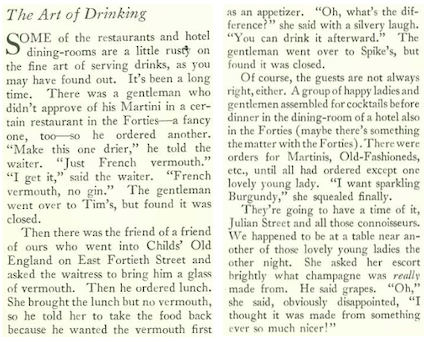
Drinking Problem

“The Talk of the Town” reported on the challenges facing both restaurants and patrons who were becoming reacquainted with legal drinking:

 * * *

Before Mr. Rogers

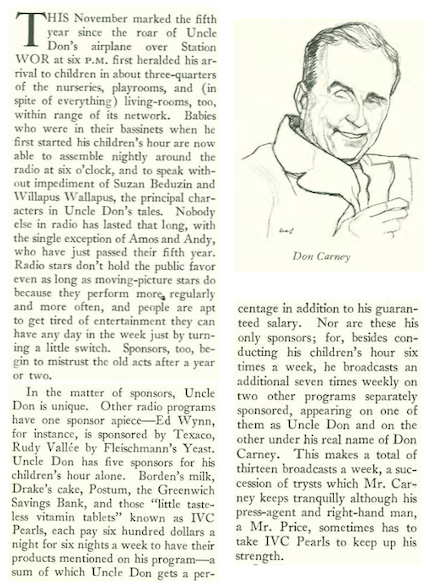
The “Profile” took a childish turn with this account of Don Carney (1896–1954) penned by Margaret Case Harriman. Carney is best remembered as the host of Uncle Don, a hugely popular WOR children’s radio program produced between 1928 and 1947. Excerpts:

MERCH…Don Carney’s popularity in the 1930s is evidenced in the output of merchandise including sheet music (1935), a 1940 activity book, and a 1936 “Strange Adventures” story book. (phantom.fan/ebay)

 * * *

From Our Advertisers

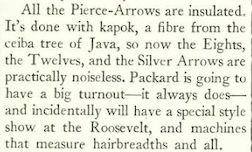
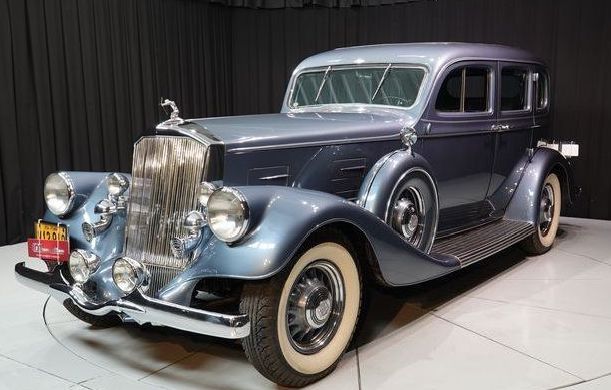
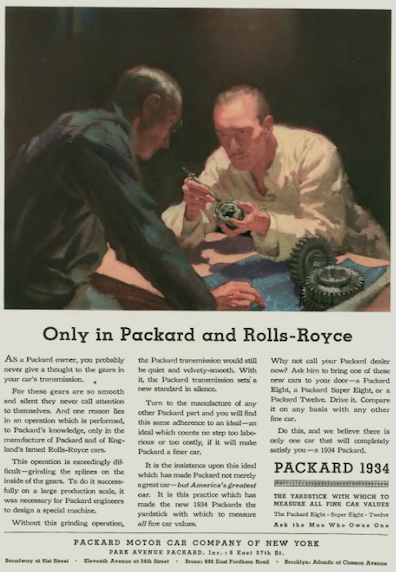
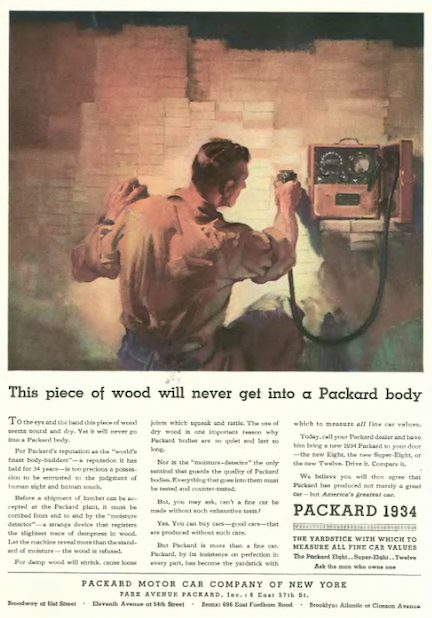
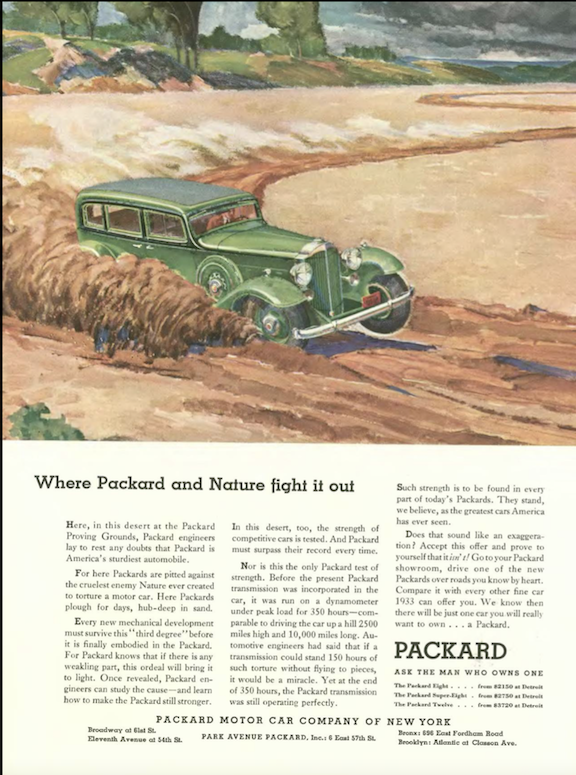
Speaking of fine cars, the folks at Packard pointed out one similarity between their automobile and the product manufactured by Rolls-Royce…owning a Packard in the 1930s was indeed considered prestigious, and like Rolls-Royce it competed in the international luxury car market…

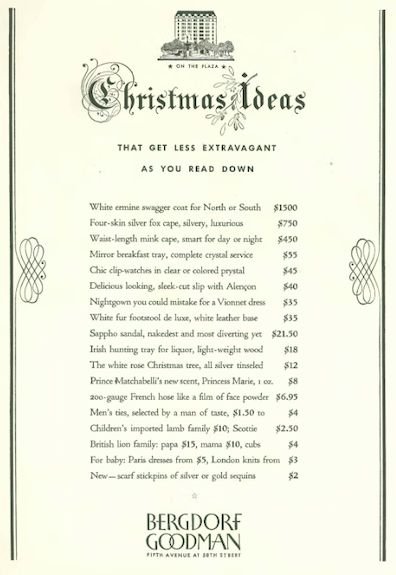
…Bergdorf Goodman placed this helpful ad listing various gift ideas in descending order of price…and extravagance…

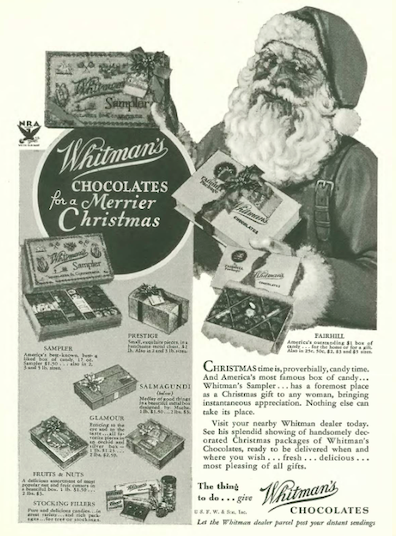
…and it wouldn’t be Christmas without the perennial Whitman’s Santa Claus touting his sweet wares…

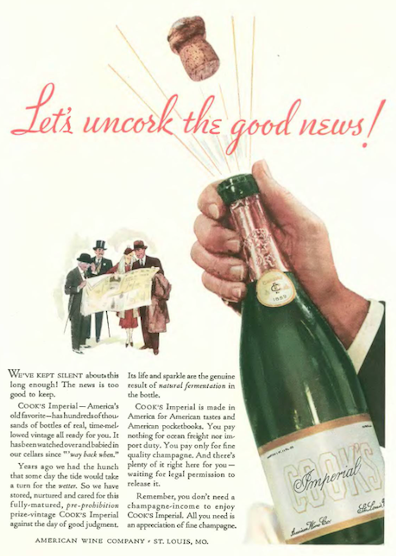
…and New Yorkers were getting ready to celebrate a New Year without Prohibition, and pop some “good news” with Cook’s American “champagne”… 

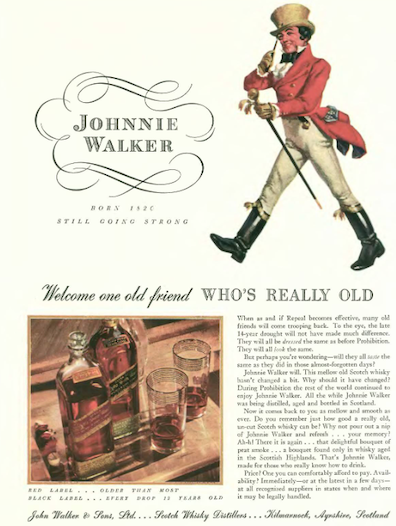
…an “old friend,” Johnnie Walker, strode into the advertising pages of the New Yorker for the very first time…

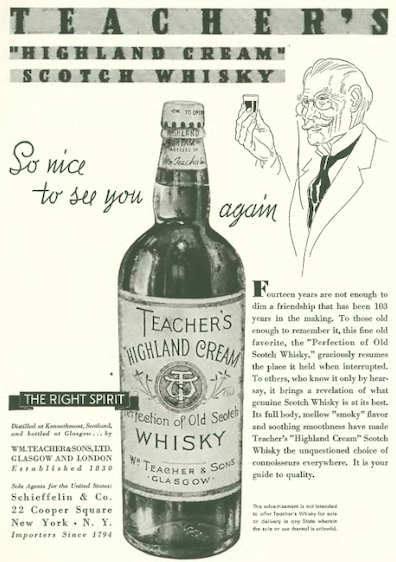
…while another purveyor of Scotch whiskey, Teacher’s, raised a glass to the return of legal liquor in the colonies…

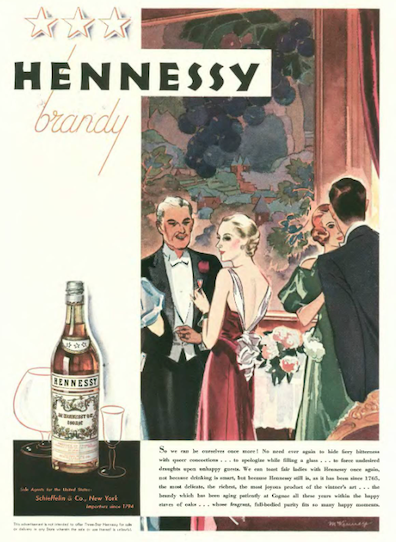
…the makers of Hennessy brandy celebrated the fact that “we can be ourselves once more”…

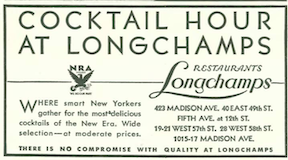
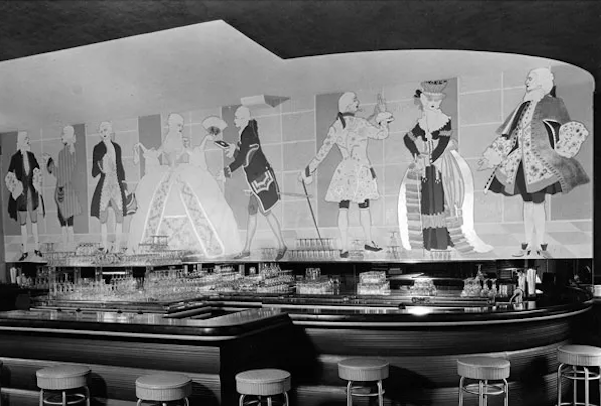
…the end of Prohibition saw the rapid expansion of the chain of Longchamps restaurants in New York City…in the 1930s the company hired top modernist decorators and architects (Winold Reiss and Ely Jacques Kahn, among others) to create some of New York’s most glamorous interiors…

LONGCHAMPS LONG GONE…Winold Reiss’s Louis XV mural behind the Chanin Building’s Longchamps bar, 1935. Hugely popular in mid-century New York, Longchamps all but vanished by 1970. Read more about one of New York’s most stylish restaurants at two wonderful sites, Driving For Deco and Restaurant-ing Through History. (winoldreiss.org)

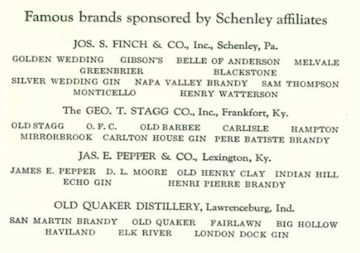
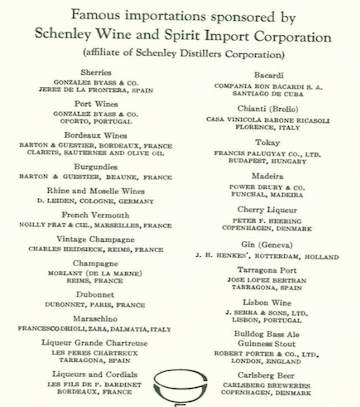
…Schenley was a giant in the spirits industry…headquartered in the Empire State Building, it also had a giant impact in the United States…to assure consumers that quality hadn’t suffered over the thirteen long years of Prohibition, Schenley ran this two-page ad stating: on through the years—famous names, famous brands, secrets, formulae, warehouses, yes—and stocks of precious old liquor have been accumulated and guarded by Schenley for you when the day arrives

…here are some of the brands listed by Schenley in the side column:

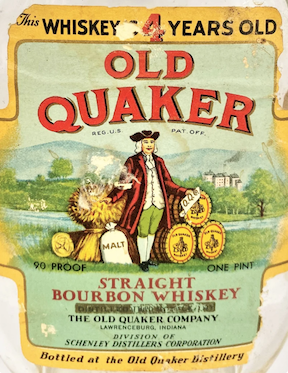
Old Quaker was one of Schenley’s popular whiskey brands in the 1930s.

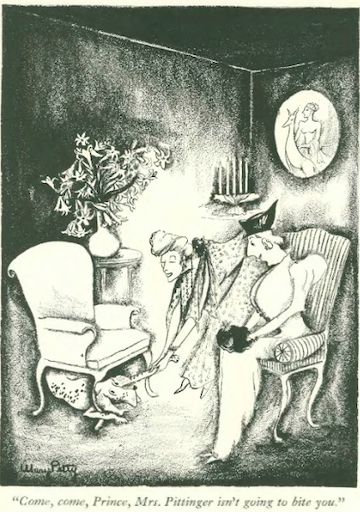
…and we sober up for our cartoonists, beginning with Mary Petty

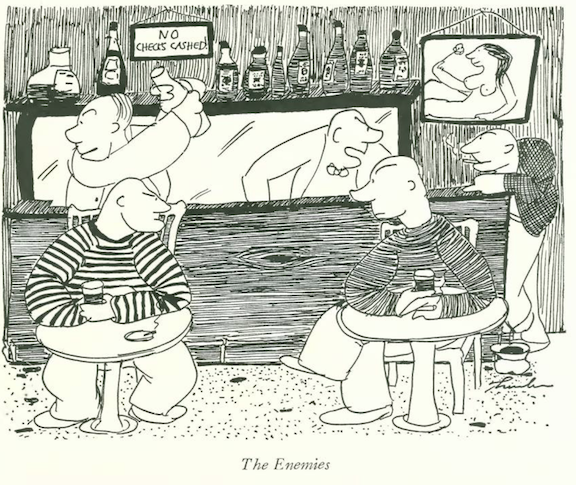
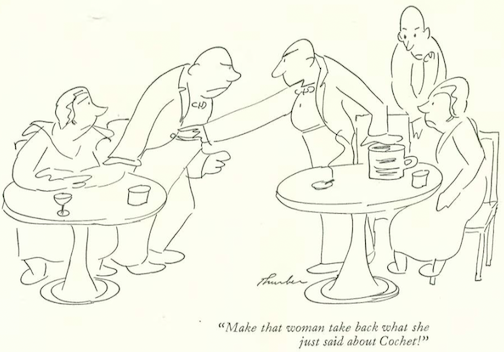
…mixed company was always a recipe for trouble in James Thurber’s world…

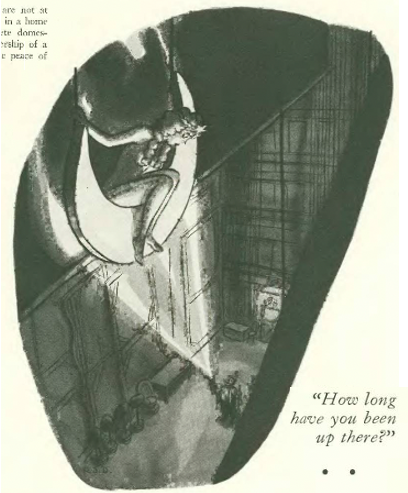
…and we close with George Price, and an unexpected visitor…

Next Time: The Cold Light of Day…


The Bombshell

Much like Marilyn Monroe in the 1950s, Jean Harlow occupied a brief period in Hollywood history, but her star shone long after her untimely death.

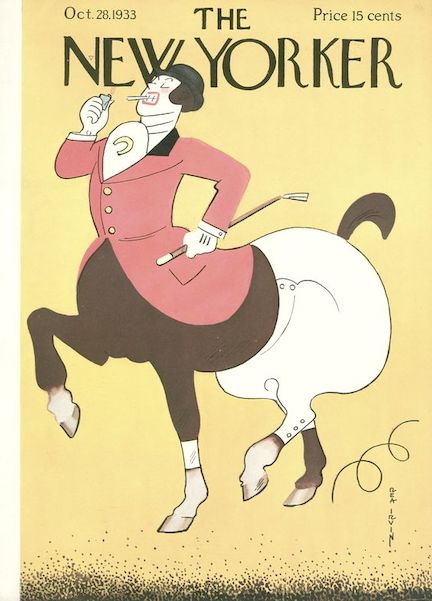
Oct. 28, 1933 cover by Rea Irvin.

Adam Victor’s The Marilyn Encyclopedia draws all sorts of weird parallels between the actresses: both raised by strict Christian Scientists, both married three times, both left school at sixteen to marry their first husbands, both acted opposite Clark Gable in the last film each ever made. Most importantly, Monroe idolized Harlow, so it was no coincidence that she sported her own version of “platinum blonde” hair.

ART IMITATES LIFE…In 1958 Marilyn Monroe posed as Jean Harlow for photographer Richard Avedon in a Life magazine feature. (Flickr)

The term “Bombshell” was affixed to the 22-year-old Harlow after the 1933 film’s release, and was later used to describe Monroe and other sex symbols of the 1950s and early 60s.

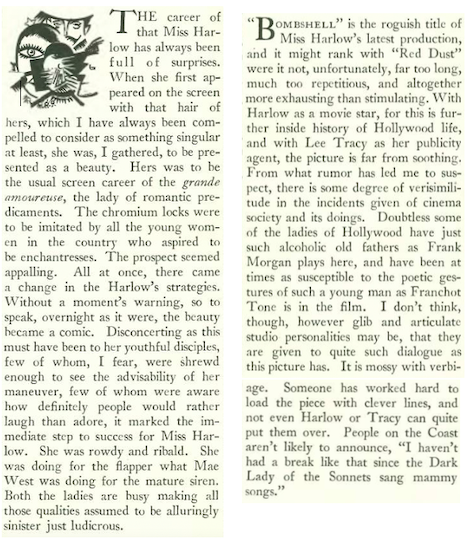
Harlow’s character in Bombshell, Lola Burns, satirized the stardom years of the silent era sex symbol Clara Bow, who was director Victor Fleming’s fiancée in 1926. Although critical reviews were mostly positive, New Yorker critic John Mosher found the film “mossy with verbiage.”

TAKE A BOW, CLARA…Bombshell satirized the stardom years of silent era sex symbol Clara Bow, who was director Victor Fleming’s fiancée in 1926 (photo at left is of the couple on the set of 1926’s Mantrap); in Bombshell Jean Harlow portrayed a sex symbol who, like Bow, wanted to live a normal life. In real life, Bow made her last film in 1933 and retired to a ranch at age 28. (IMDB)

A STAR IS BORED…In Bombshell, movie star Lola Burns (Jean Harlow) dislikes her sexy vamp image and wants to live a normal life, but her studio publicist E. J. “Space” Hanlon (Lee Tracy) insists on feeding the press endless provocative stories about her. Clockwise, from top left: Lee Tracy and Louise Beavers in a scene with Harlow; Harlow and Una Merkel, who portrayed Lola’s assistant, Mac; Harlow in a scene with Mary Forbes, C. Aubrey Smith, and Franchot Tone; Harlow in a scene with Ruth Warren and Frank Morgan—the latter portrayed Lola’s pretentious, drunken father. (IMDB)

Harlow would die at age 26 on June 7, 1937. Her heavy drinking didn’t help, but neither did the misdiagnosis she received as her kidneys were rapidly failing. While filming Saratoga with Clark Gable, Harlow was stricken with what she believed was the flu, and her persistent stomach pain was misdiagnosed as a swollen gallbladder. Just two days before her death another doctor finally diagnosed her kidney disease, but in 1937 nothing could be done—kidney dialysis would not be available for another decade, and transplants would not be an option until the mid-1950s.

 * * *

Second City Sanctimony

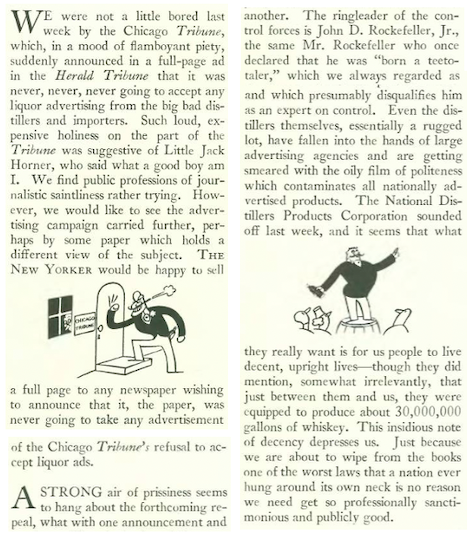
The New Yorker rarely missed an opportunity to take a dig at the square-toed ways of the Second City and its flagship newspaper, the Tribune. In his “Notes and Comment,” E.B. White (who enjoyed gin martinis) found the newspaper’s sanctimonious stance tedious:

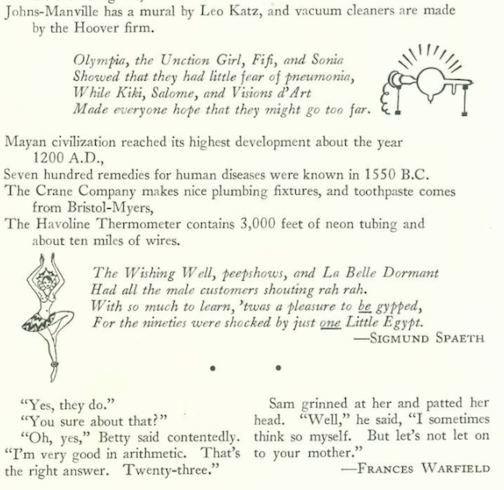
The 1933 Chicago World’s Fair, aka “A Century of Progress,” received scant attention from The New Yorker, unless it provided opportunities for parody. Musicologist Sigmund Spaeth (1885-1965), well-known in the 1930s and 40s for his NBC radio programs, offered this take on the Windy City’s exposition:

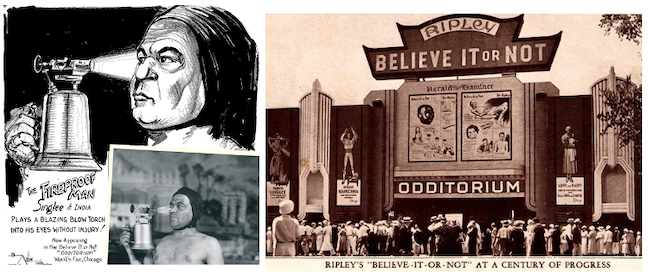
WONDERS NEVER CEASE…In addition to its more high-minded attractions, the Chicago World’s Fair also featured such sideshow attractions as Ripley’s Odditorium, which featured “The Fireproof Man” among other novelties. (pdxhistory.com)

 * * *

Big, Bad Earworm

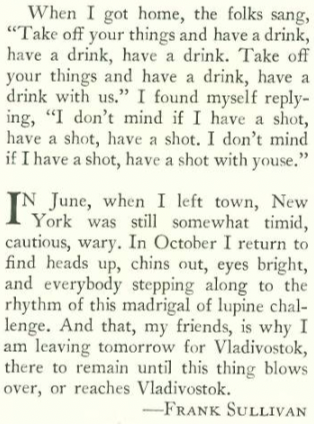
It seems quaint that nearly 90 years ago one of the most popular songs in America was “Who’s Afraid of the Big Bad Wolf?” To Frank Sullivan, there was no escaping “that lilting tune”…

SIMPLER TIMES…”Who’s Afraid of the Big Bad Wolf?” was a huge hit during the second half of 1933. One of the most well-known Disney songs, it was covered by numerous artists and musical groups.

Sullivan concluded that a trip to Vladivostok might be the only way to escape the catchy melody…

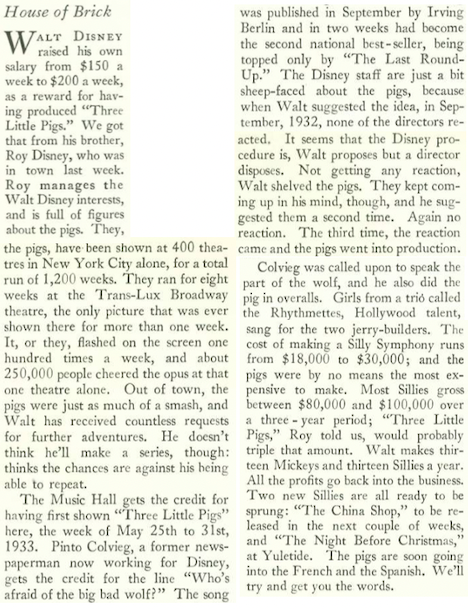
Briefly jumping to the Nov. 4 issue, “The Talk of Town” took a closer look at the song and the 1933 Disney Silly Symphonies cartoon in which it was featured—Three Little Pigs. Written by Frank Churchill and Ann Ronell, the song launched a market for future Disney tunes, with Irving Berlin securing the sheet music rights over Mickey Mouse and the Silly Symphonies. 

WE’RE IN THE MONEY…The 1933 Disney Silly Symphonies cartoon Three Little Pigs helped to launch the Disney juggernaut nearly 90 years ago.

 * * *

Polymath

Le Corbusier, aka Charles-Édouard Jeanneret (1887–1965), was known as a pioneer of modern architecture and design in the early and mid-20th century, but as this review by Lewis Mumford suggested, he was also a talented modernist painter.

WAYS OF SEEING…Le Corbusier’s early paintings followed the ideas of something he called “purism”—at left is an example from 1920, Still Life. Later on his work become more abstract, including Menace, at right, from 1938. The horse head in the painting seems to reference Pablo Picasso’s 1937 painting, Guernica. (Wikipedia/Art Basel)

 * * *

Dear Papa

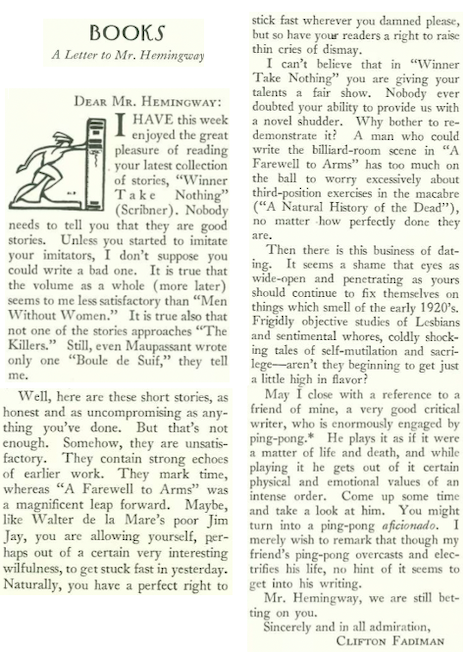
Following the high praise Ernest Hemingway received in 1926 for The Sun Also Rises, Dorothy Parker feared for the novelist’s next book: “You know how it is—as soon as they all start acclaiming a writer, that writer is just about to slip downward.” Seven years later Parker’s colleague Clifton Fadiman detected some slippage, finding Hemingway’s latest output a bit stale. Rather than pen a negative review, Fadiman shared his concerns by way of an open letter:

PHONING IT IN…Clifton Fadiman (right) found Ernest Hemingway’s Winner Take Nothing to be “stuck fast in yesterday.” (AP/Wikipedia/Pinterest)

 * * *

From Our Advertisers

Until the 1920s all car bodies were framed in wood, preferably ash, but by the end of the 1930s all-steel car bodies became the standard…Packard made the switch beginning around 1938…

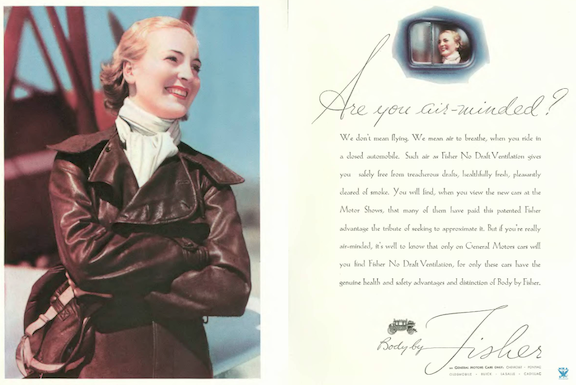
…ah, the good old days when you could smoke in the “rarefied atmosphere” of an airplane, the pilot so close by you could tap him on the shoulder…

…Brooklyn’s Hittleman-Goldenrod Brewery opened in late 1933 promising beer in the finest English tradition…sadly, it closed in 1937…

…the Waldorf-Astoria announced the re-opening of its Empire Room with entertainment by Xavier Cugat and his tango orchestra, featuring the dancer Margo…this was just the sort of “juvenile” entertainment Lois Long detested (see my previous post)…

…according to this ad, “His Lordship” drank a pot of decaf Sanka at midnight “and never winked an eye all night”…it doesn’t mention that he probably also wet the bed…

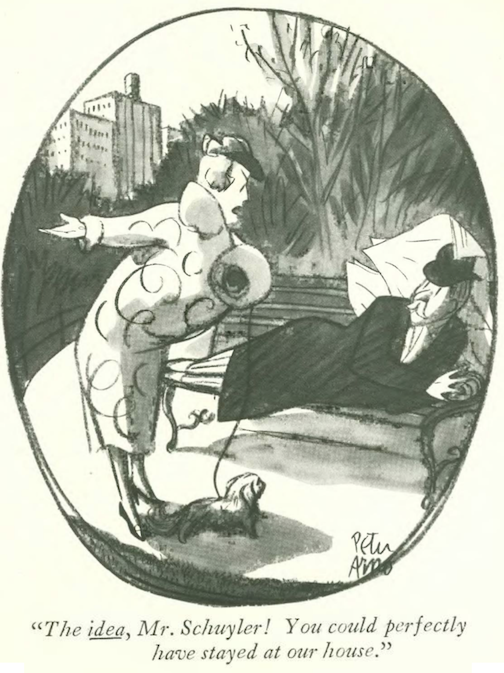
…on to our cartoons, we begin with Peter Arno and the woes of the monied classes…

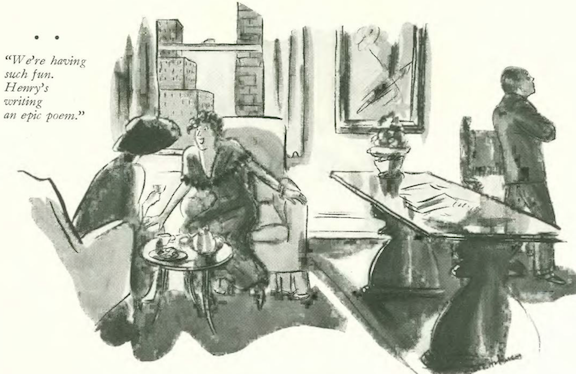
…on to Helen Hokinson, and the charms of the precocious…

Gardner Rea gave us a toff absorbed in historical fiction…

Alain (aka Daniel Brustlein) offered up a flautist who found beauty in his routine life…

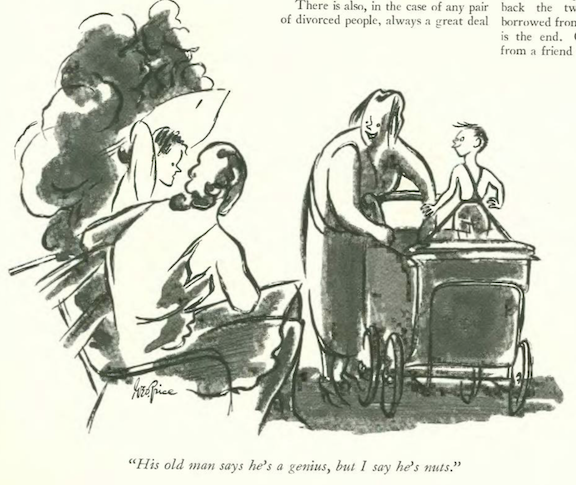
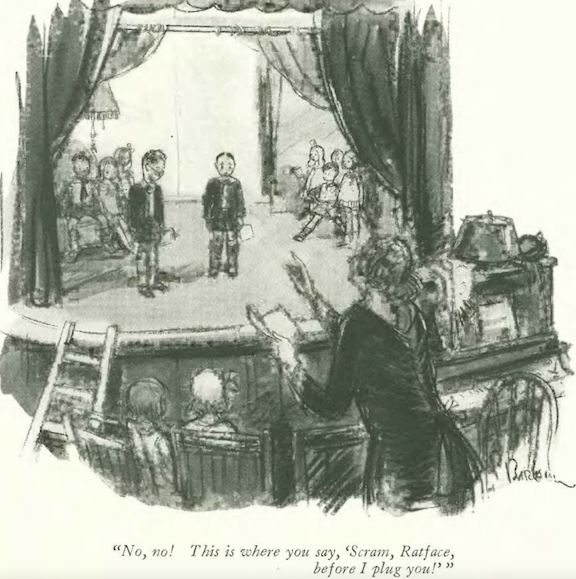
…and we close with Perry Barlow, and motherhood among the smart set…

Next Time: Radio City…


The Wild West

Kino Lorber)

We first encountered Mae West back in 1926 when The New Yorker commented on her risqué Broadway play, Sex. Although the play was the biggest ticket in town, it eventually attracted a police raid that landed West in jail on morals charges. Sentenced to ten days for “corrupting the morals of youth,” she could have paid a fine, but for West a short stint on Welfare Island was worth its weight in publicity gold.

Oct. 14, 1933 cover by Rea Irvin.

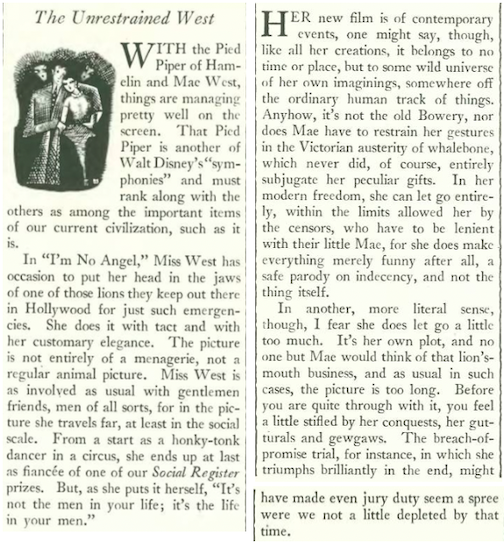
Fast forward seven years, and West is one of the nation’s biggest box office attractions and starring in her third film, I’m No Angel. Depression-era audiences responded enthusiastically to West’s portrayals of a woman from the wrong side of the tracks who in the end gains both fortune and social acceptance. Although puritanical forces continued to be outraged by West’s antics, New Yorker film critic John Mosher found her act to be “a safe parody on indecency.”

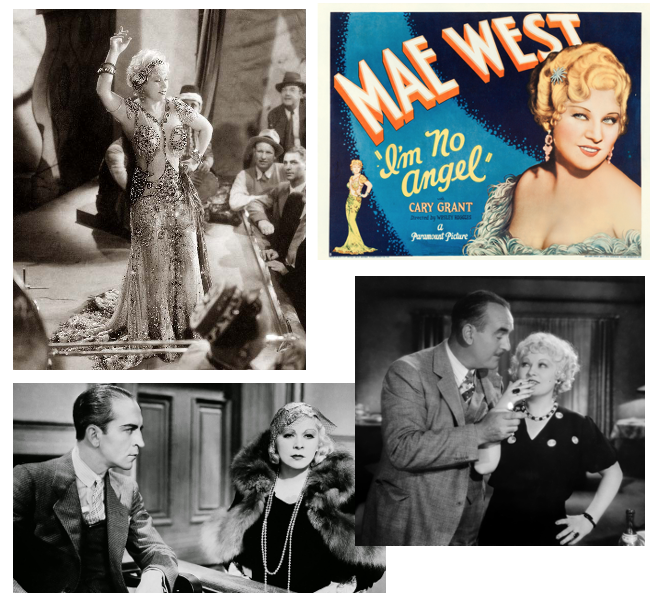
SHIMMY TO SUCCESS…Clockwise, from top left: At the beginning of I’m No Angel, Tira (Mae West) shimmies and sings in a circus sideshow; studio poster for the film— In the early 1930s, West’s films were key in saving Paramount Pictures from bankruptcy; a wealthy sideshow customer (William B. Davidson) arranges a private rendezvous; Tira has her day in court despite attempts by her ex-boyfriend, Slick Wiley (Ralf Harolde), to discredit her. (IMDB)

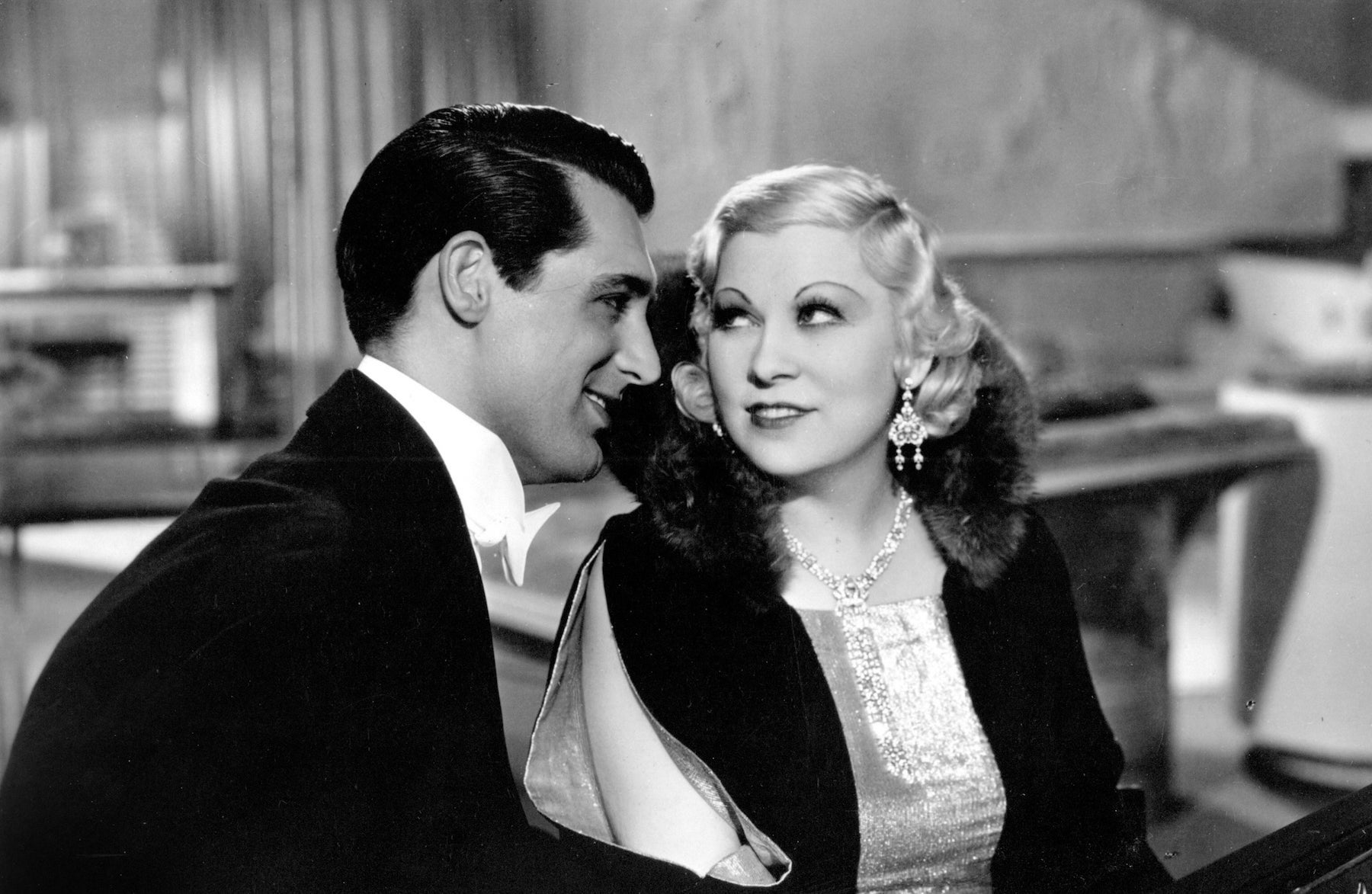
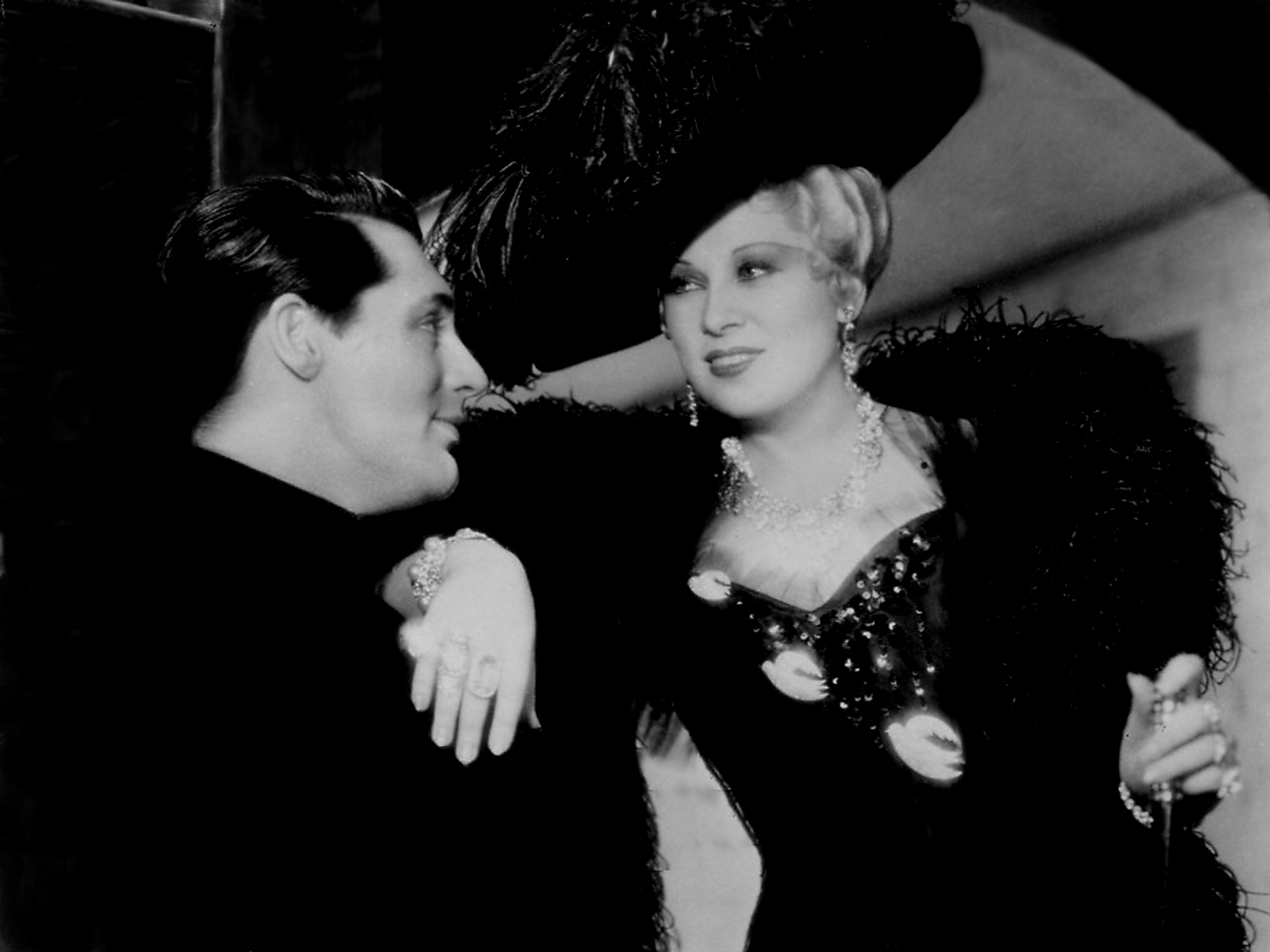
SHE GETS HER MAN…Cary Grant starred opposite Mae West for the second and final time in I’m No Angel. Eleven years junior to West, Grant portrayed Tira’s fiancé, Jack Clayton. (TCM)

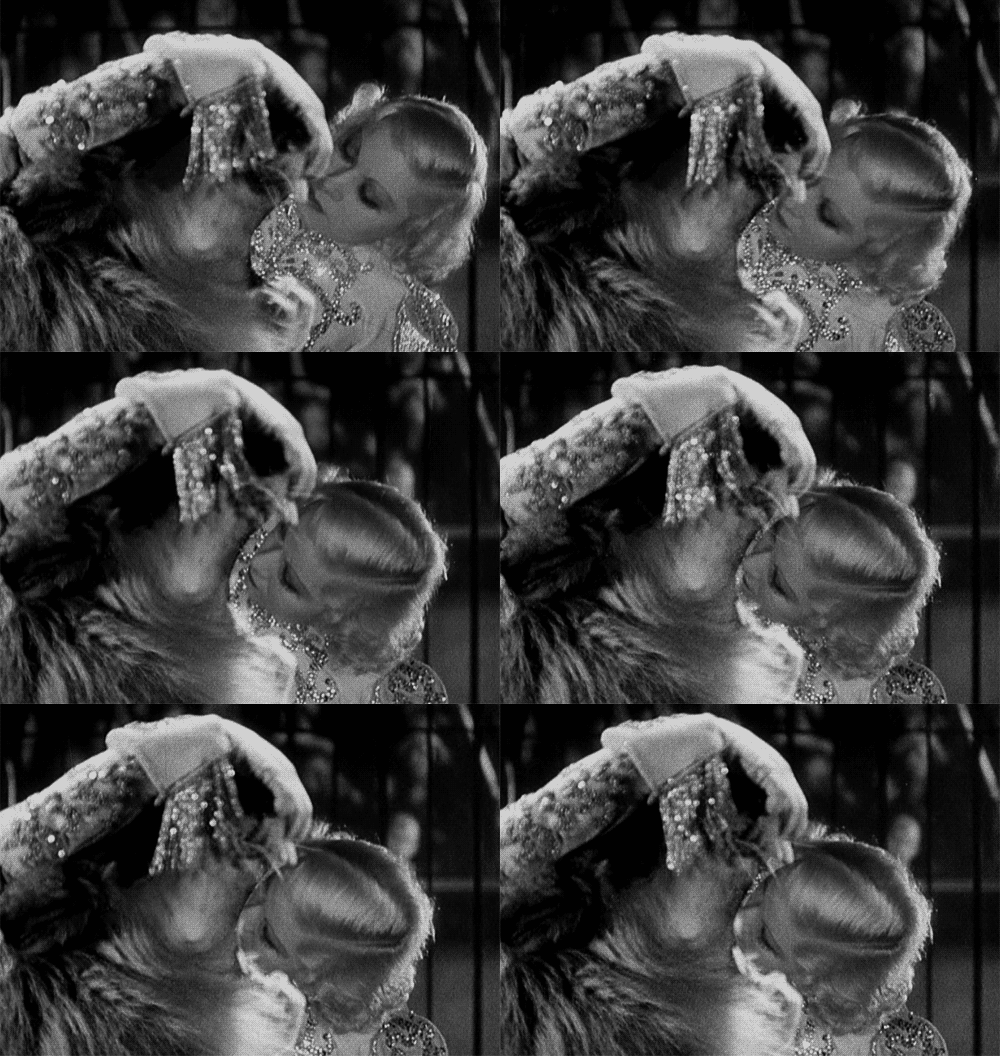
And finally, a much-talked about scene from the movie featured West putting her head (rather sensually) into the mouth of a lion. In reality it appears to be a camera trick: West was actually placing her head to the side of the lion’s mouth. Still, a gutsy move by West. As for the lion, it was no picnic either.

 * * *

Comic Relief

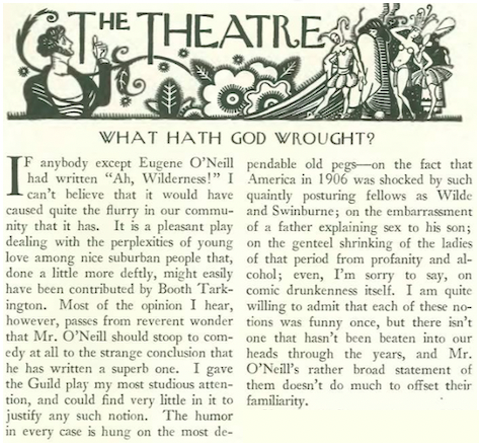
Eugene O’Neill surprised critics and audiences alike when he premiered Ah, Wilderness! at Broadway’s Guild Theatre on October 2, 1933. Among the critics was Wolcott Gibbs, who concluded that O’Neill should stick to his usual themes of disillusion and despair. An excerpt:

PASS THE CORN, PLEASE…Around the table in the original 1933 Broadway production of Ah, Wilderness! are (from left) George M. Cohan (Nat Miller), Eda Heinemann (Lily), Elisha Cook, Jr. (Richard), Gene Lockhart (Sid), Marjorie Marquis (Mrs. Nat Miller), Walter Vonnegut, Jr. (Tommy) and Adelaide Bean (Mildred). (Photograph by Vandamm for Stage magazine, November 1933)

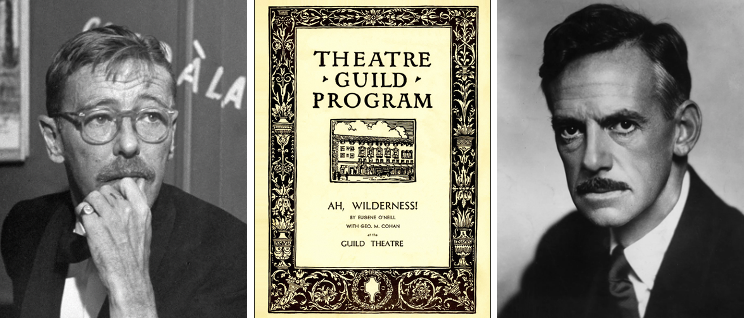
ERRORS OF COMEDY…Wolcott Gibbs (left) found Eugene O’Neill’s attempt at comedy to be nothing more than a recycling of corny old saws. However, Ah, Wilderness! proved successful in its first Broadway production and in the touring company that followed. It remains to this day a staple of community repertory. (The New Yorker/Playbill/Encyclopedia Britannica)

 * * *

Hell in a Handbasket

If Eugene O’Neill couldn’t offer up some woe, then leave it to E.B. White of all people to supply reason for despair. In his 1982 review of a collection of White’s poems and sketches,

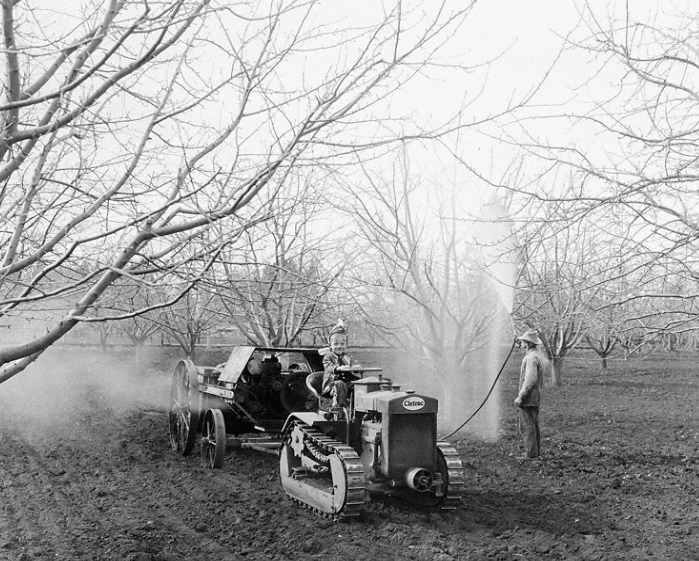
For the Oct. 14 issue White bemoaned the loss of the American elm (of the 77 million elms in North America in 1930, more than 75 percent were lost to Dutch elm disease by 1989), the dangers of pesticide use, and other maladies. Excerpts:

APPLE OF HIS EYE…E.B. White had reason to be concerned about the widespread practice of spraying lead arsenic on fruit trees. This 1930 photograph shows an Oregon orchardist and his child spraying apple trees with the stuff. (oregonhistoryproject.org)

White’s New Yorker colleague John O’Hara raised some concerns of his own, namely the likelihood of another world war in this prescient piece titled “Dynamite is Like a Mill Pond.” Excerpts:

FROM RUSSIA WITH LOVE…John O’Hara pondered the likelihood of another world war and an unlikely bedfellow: Soviet Russia. Photo circa 1938. (AP via loa.org)

 * * *

Pooh-Poohing Mr. Milne

In his review of A.A. Milne’s latest novel, The Red House Mystery, Clifton Fadiman seemed to recall Dorothy Parker’s own revulsion to Milne’s juvenile style (“Tonstant Weader Fwowed Up” Parker once wrote of The House at Pooh Corner). Excerpts:

 * * *

From Our Advertisers

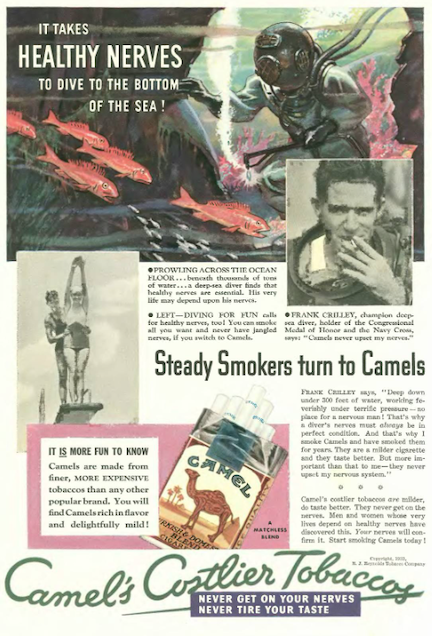
The makers of Camels took to the water to prove how their cigarettes supported “healthy nerves,” whether in the deep sea or on the high dive…

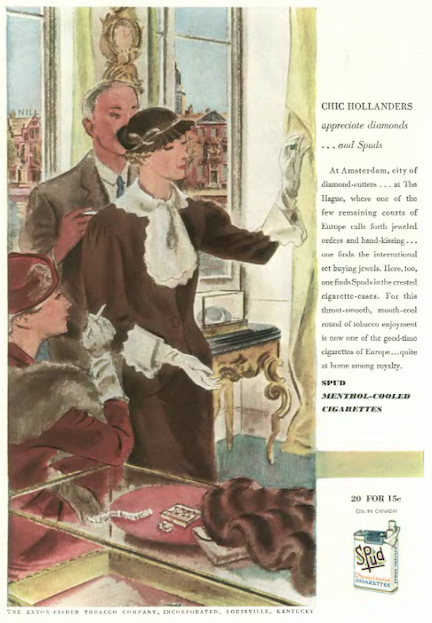
…with a name like “Spud” you really had to stretch to prove you were a choice of the smart set…here they claimed their product was “quite at home among royalty”…

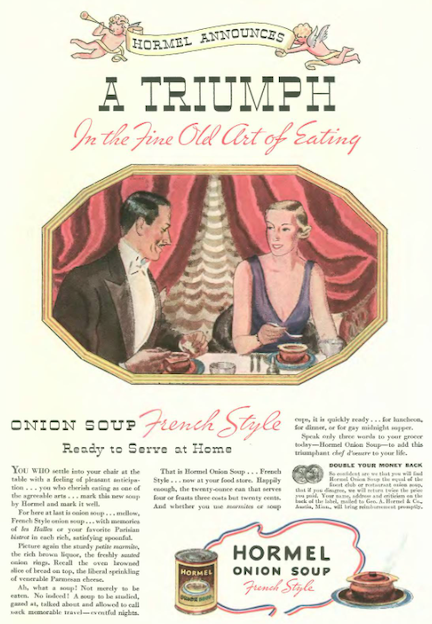
…here’s another great example of class appropriation, a white-tie dinner featuring a couple of toffs eating canned soup…

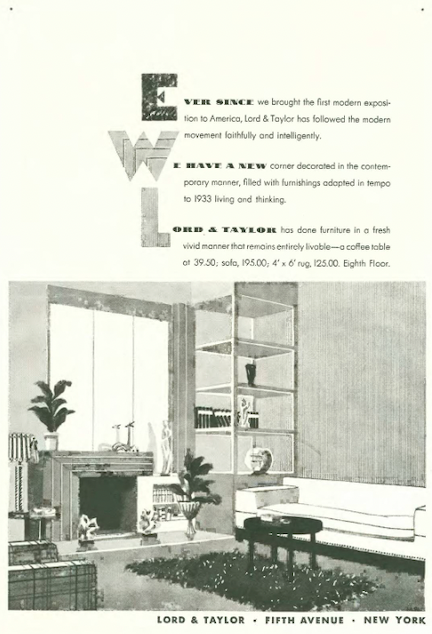
…and we give our eyes a break with a bit of elegance from Lord & Taylor, featuring the art of modern living…

…on to our cartoons, we begin with James Thurber

…curious to know Thurber’s favorite songs?—then check out this Thurber Thursday post from Michael Maslin’s Inkspill...

…we continue with William Steig’s look at a “Lady With Mirror”…

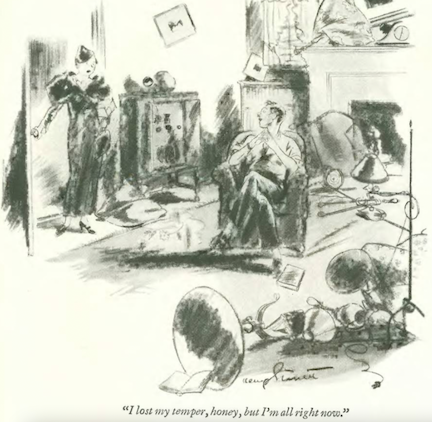
…and discover the calm after a storm in this domestic scene by Kemp Starrett

…visit the Century of Progress World’s Fair in Chicago, with George Price

…for reference, Price’s cartoon depicted the Federal Building at the Century of Progress…

…and is often the case with this blog, we give Peter Arno the last word…

Next Time: As Millions Cheer…

As Thousands Cheer

ABOVE: Broadway's As Thousands Cheer (1933) featured evangelist Aimee Semple McPherson (Helen Broderick) trying to persuade Mahatma Gandhi (Clifton Webb) to end his hunger strike and join her act. (NYPL)

Broadway gave Depression audiences a lift with As Thousands Cheer, a revue featuring satirical sketches that skewered the lives and affairs of the rich and famous and served as a precursor to sketch shows like Saturday Night Live.

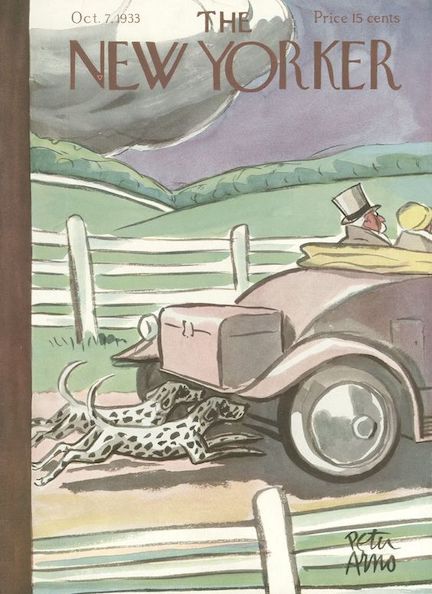
Oct. 7, 1933 cover by Peter Arno.

With a book by Moss Hart and music and lyrics by Irving Berlin, the revue was a big hit, playing for nearly a year on Broadway in its initial run.

TOON TIME…Marilyn Miller led a chorus of cartoon characters in a sketch titled “The Funnies” in As Thousands Cheer; leading the revue were Miller, Clifton Webb and Helen Broderick, here featured on the cover of the Playbill. The production would be Marilyn Miller’s last—one of Broadway’s biggest stars known for playing sunny characters, her personal life was filled with illness and tragedy, and she would go to an early death in 1936. (playbill.com)

Wolcott Gibbs took his turn as Broadway reviewer, and pronounced As Thousands Cheer “the funniest thing in town.”

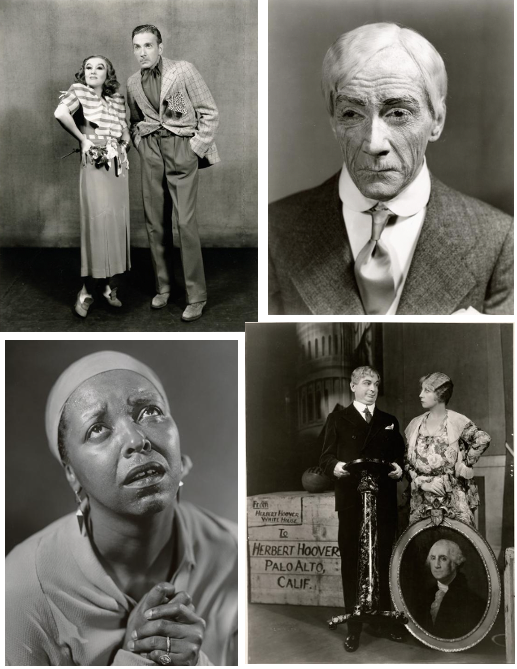
Not everything was roses in As Thousands Cheer: In a poignant star turn, Ethel Waters sang—at Irving Berlin’s request—his famous tune “Supper Time,” a Black woman’s lament for her lynched husband. The revue was the first Broadway show to give an African-American star (Waters) equal billing with whites, however she was segregated from her co-stars and did not appear in any sketches with them. Her co-stars even refused to bow with her at the curtain call until Berlin intervened. According to the James Kaplan biography Irving Berlin, “The show had a successful tryout at Philadelphia’s Forrest Theatre in early September, although opening night was marred by an ugly incident all too in tune with the times: the stars Clifton Webb, Marilyn Miller, and Helen Broderick refused to take a bow with Ethel Waters. To his everlasting credit, Berlin told the three that of course he would respect their feelings—only in that case there needn’t be any bows at all.

“They took their bows with Waters at the next show.”

NEWSMAKERS…Each sketch in As Thousands Cheer was preceded with a newspaper headline. Clockwise, from top left, in the sketch headlined JOAN CRAWFORD TO DIVORCE DOUGLAS FAIRBANKS, JR, Marilyn Miller and Clifton Webb portrayed the stars arguing over publicity rights to their divorce; Webb as 94-year-old John D. Rockefeller; the headline FRANKLIN D. ROOSEVELT INAUGURATED TOMORROW featured Mr. and Mrs. Herbert Hoover on their last day in the White House, portrayed by Leslie Adams and Helen Broderick; Ethel Waters singing Irving Berlin’s “Supper Time.” (New York Public Library)

 * * *

A Final Byline

E.B. White opened his column with a tribute to Ring Lardner, who died at age 48 of a heart attack and other complications. In the months before his death Lardner had contributed a number of comical “Over the Waves” radio reviews.

JOURNALIST AT HEART…Ring Lardner (1885-1933) worked for several newspapers before settling at the Chicago Tribune in 1913—it became the home newspaper for his syndicated column, In the Wake of the News. (Chicago Tribune)

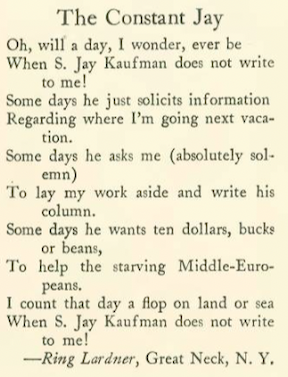
Lardner’s first contribution to The New Yorker came shortly after the magazine’s founding. “The Constant Jay” was published in the April 18, 1925 issue: Readers appreciated his subtle wit, including this oft-quoted gem:

“The race is not always to the swift nor the battle to the strong—but that’s the way to bet.”

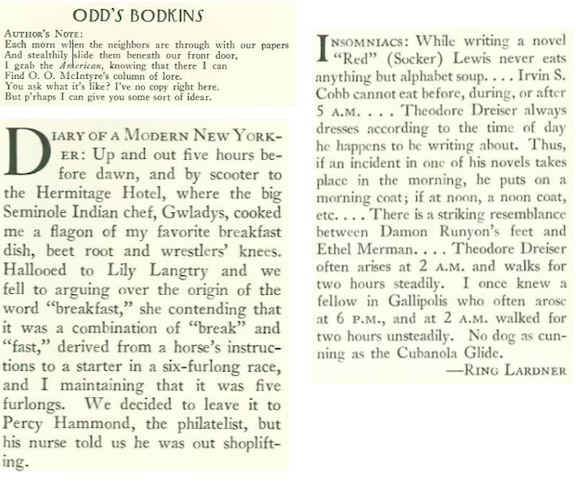
Lardner also liked to poke fun at himself and his aw-shucks view of things. Here are the opening and closing paragraphs of his final New Yorker contribution, “Odd’s Bodkins:”

 * * *

Macy Modernism

As Lewis Mumford observed in his “Skyline” column, Macy’s was the first department store to embrace a modern approach to interior design, but as Marilyn Friedman notes in her book, Making America Modern: Interior Design in the 1930s, Macy’s modernism was a bit toned down to blend into more traditional settings. A case in point was Macy’s 1933 Forward House exhibition, which Mumford described as “a brilliant piece of modern showmanship.”

EASY ON THE EYES…”Living room in the Suburban House of Forward House” at R.H. Macy & Co., New York, 1933, from The Upholsterer and Interior Decorator, October 15, 1933. ​(artdeco.org)

 * * *

Fishing for Commies

Geoffrey Hellman profiled New York House Rep. Hamilton Fish Jr (1888–1991), a staunch anti-communist perhaps best known for establishing the Tomb of the Unknown Soldier at Arlington National Cemetery. I feature this brief excerpt mainly for the great caricature by Abe Birnbaum.

MINDING THE HOME FRONT…Hamilton Fish, Jr making a speech in Los Angeles, 1935. Fish served in the U.S. House of Representatives from 1920 to 1945 and during that time was a prominent opponent of intervention into foreign affairs. (UCLA Special Collections)

 * * *

All Wet

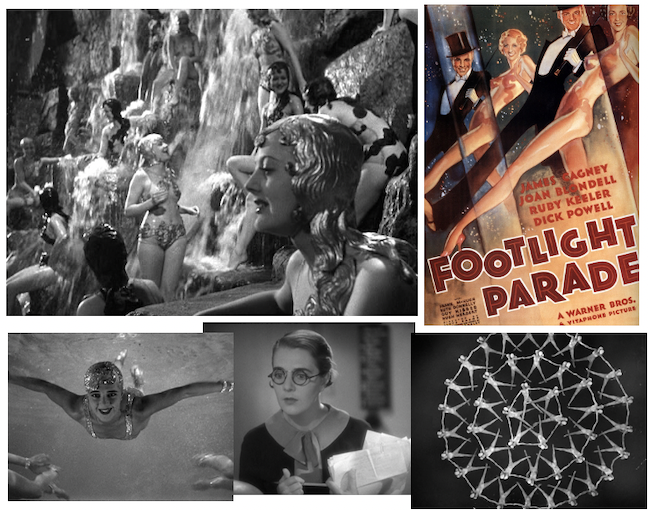
Eleven years before Esther Williams made her first aqua-musical, Ruby Keeler took the dive under Busby Berkeley’s direction in Footlight Parade. E.B. White served as film critic for the Oct. 7 issue, and found Footlight to be a feast for the male gaze, as well as mindless entertainment.

TAKING THE PLUNGE…Clockwise, from top left: According to E.B. White, there was no gainsaying “the general aahhhhh” of the semi-nude waterfall scene in Footlight Parade; promotional poster left no doubt as to what audiences might expect from the film; Busby Berkeley displayed his craft in water-based choreography; Ruby Keeler portrayed a dancer turned secretary who is transformed back into a dancer—just add water. (IMDB)

 * * *

A Dog’s Life

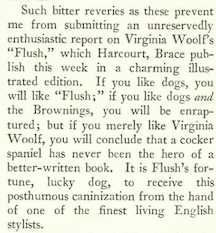
Doubtless drained from writing The Waves, Virginia Woolf followed up with some historical fiction, namely Flush: A Biography, a book about Elizabeth Barrett Browning’s cocker spaniel. Clifton Fadiman had this to say about the unusual biography:

VIRGINIA WOOF…Frontispiece for Flush: A Biography. Virginia Woolf used the tale of a dog to explore social themes ranging from feminism to class conflict. (Heritage Auctions)

 * * *

From Our Advertisers

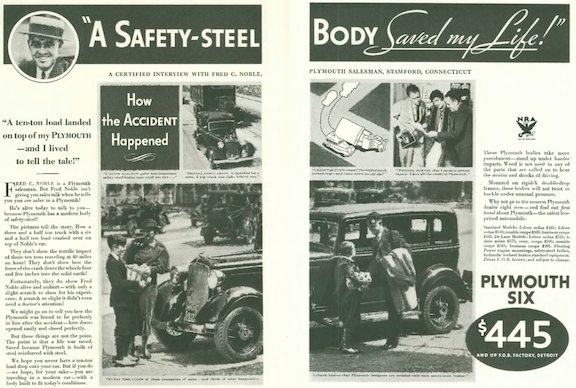
When you market a car for only $445 you aren’t going after the luxury market, but hey, drop a ten-truck truck on this baby and you can live to tell about it…

…with legal beer flooding the market brewers were particularly keen to attract female drinkers of all ages…and apparently social classes…

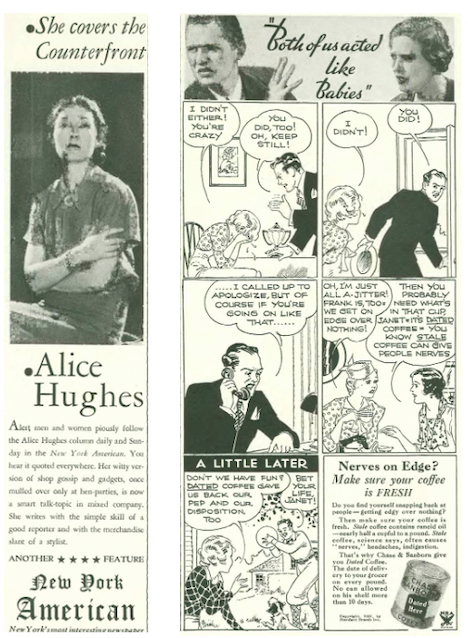
…a couple of ads from the back pages, the first touting the smart-set writing of columnist and foreign correspondent Alice Hughes for the New York American, and the second an advertisement for Chase & Sanborn coffee, which relayed the story of a marriage on the brink due to stale coffee…

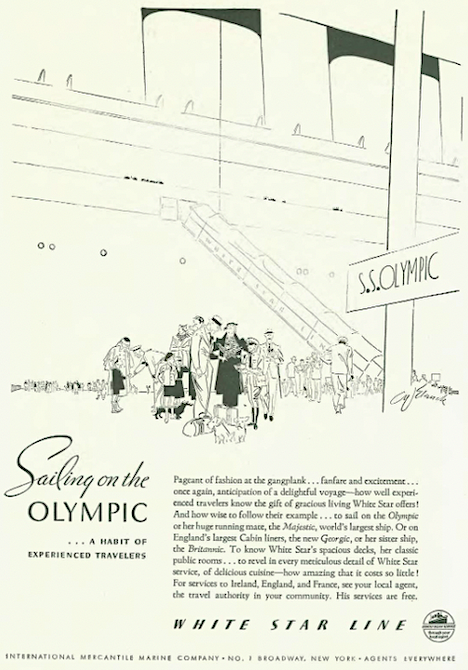
…I include this ad for the heroic scale of the ocean liner, particularly as depicted by the people in the background…

…we bounce on to our cartoons with Otto Soglow’s Little King…

James Thurber continued to explore the unrest among our domestic youth…
…speaking of America’s youth, this gathering (courtesy Gardner Rea) appeared to have trouble finding some…
Helen Hokinson found fun with flounder…
Rea Irvin turned the tables on a life-drawing class…

…and we close with Richard Decker, over the moon with a stranded chorine…

…and in a nod to the approaching holiday, imagery from a 1933 Fleischer Studios animated short film, Betty Boop’s Hallowe’en Party

Next Time: The Wild West…

Keeping Their Cool

The heat came early to New York in June 1933, so folks flocked to air-conditioned cinemas or sought the cooling breezes of rooftop cafes and dance floors. And thanks to FDR, there was legal beer to be quaffed at various beer gardens popping up all over town.

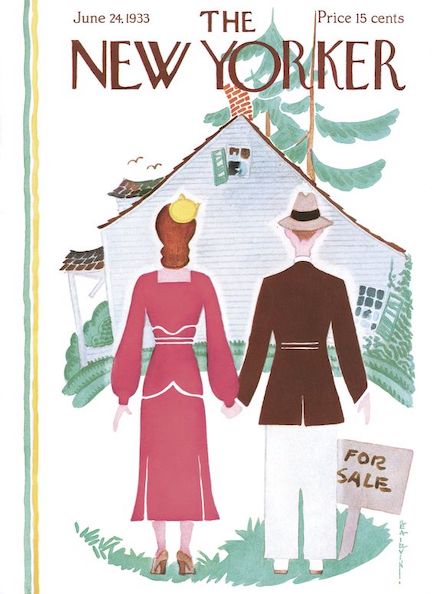
June 24, 1933 cover by Rea Irvin. Providing a bookend to Constantin Alajalov’s June bride cover (May 27), Irvin gave us the newlyweds now contemplating a fixer-upper.

Lois Long kept her cool on the beach or at home with a cold Planters’ Punch, but one gets restless, and Ethel Waters was at the Cotton Club, so Long headed out into the night; an excerpt from her column “Tables for Two”…

STORMY WEATHER AHEAD…Ethel Waters was “tops” during a June 1933 performance at the Cotton Club, according to nightlife correspondent Lois Long. Left, Waters circa 1930. At right, the Cotton Club in the early 1930s. (IMDB/Britannica)

SHOWER THE PEOPLE…Children gather around a center stand sprinkler (connected to a fire hydrant) on a Harlem street in 1933. (stuffnobodycaresabout.com)

POP-UP PLAYGROUND…Play street and street shower alongside the Queensboro Bridge, June 22, 1934. (NYC Municipal Archives)

 * * *

From Our Advertisers

Legal beer and hot summer days combined to bring some much-needed advertising revenue to The New Yorker

…here we have dear old dad telling the young ‘uns (all in formal wear, mind you) about the good old days before Prohibition took away his favorite tipple…

…notable about the magazine’s first beer ads was the target market…this is akin to the cigarette manufacturers, who were also targeting women as a new growth market for their products…curious how this PBR ad is illustrated…is she getting ready to drink the beer, or serve it?…

…also joining the party were the folks who made mixers like White Rock mineral water…note the reference at bottom right to the anticipated repeal of the 18th Amendment…

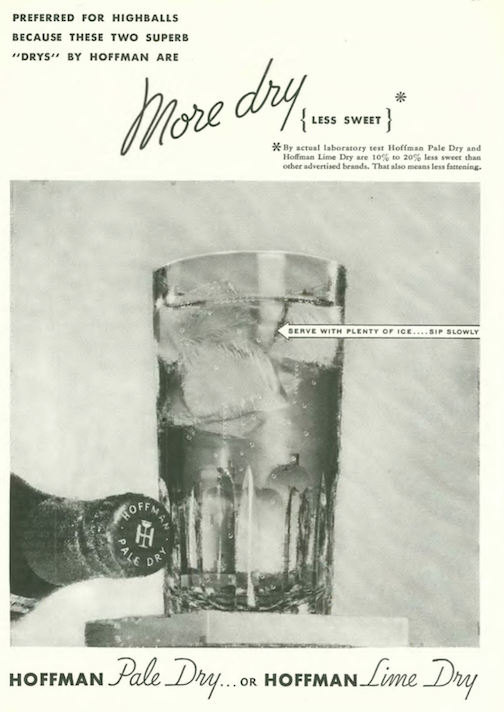
…the purveyors of Hoffman’s ginger ale were less subtle, encouraging drinkers to mix those highballs right now

…you could enjoy that cool one while sitting in front of a Klenzair electric fan, which was probably nothing like riding a dolphin—a strange visual metaphor, but then again perhaps something else is being suggested here besides electric fans…

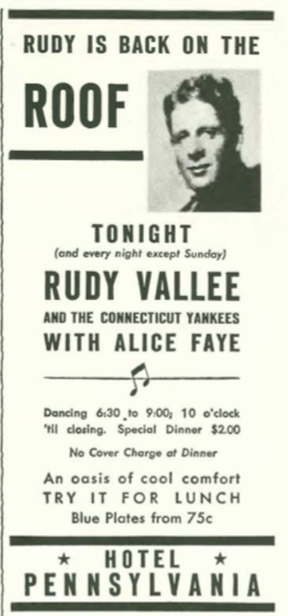
…no doubt Lois Long took in one of these breezy performances on the rooftop of the Hotel Pennsylvania…

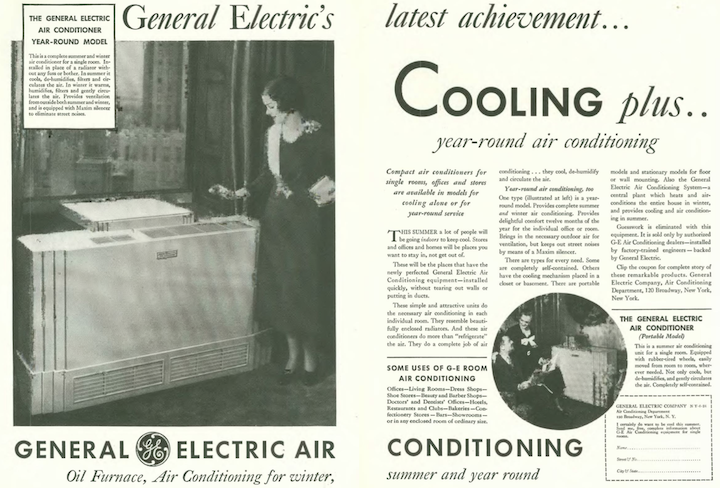
…an evening with Rudy Vallée would have been a lot cheaper than one of these “compact” air conditioners, available to only the very wealthy…

…but you didn’t need to be J.P. Morgan to own a Lektrolite lighter, which was kind of clever…this flameless lighter contained a platinum filament that would glow hot after being lowered into reactive chemicals in the lighter’s base…

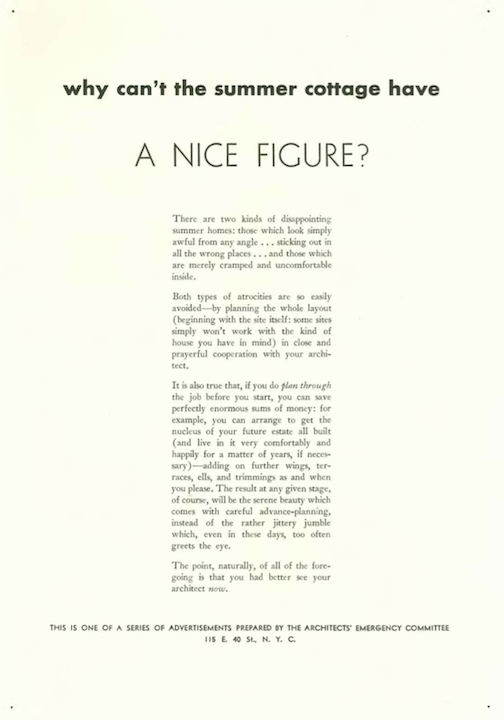
…another ad from the Architects’ Emergency Committee, which looked like something an architect would design…

…our final June 24 ad told readers about the miracle of Sanforizing, which was basically a pre-shrinking technique, like pre-washed jeans…

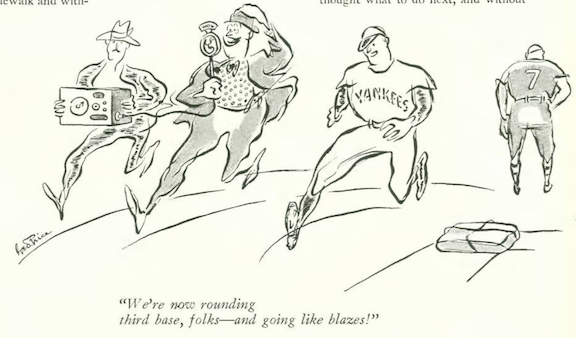
…we kick off our cartoons with George Price at the ball game…

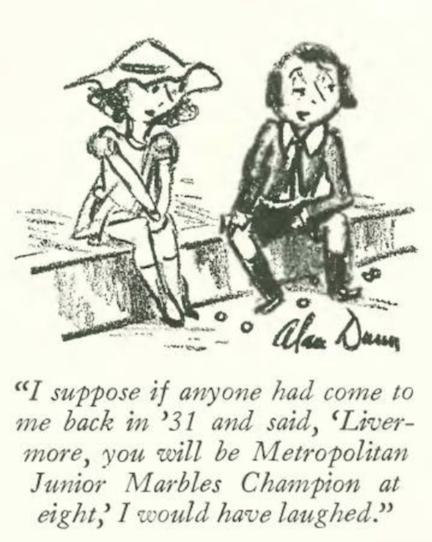
Alan Dunn was in William Steig’s “Small Fry” territory with this precocious pair…

James Thurber brought us back to his delightfully strange world…

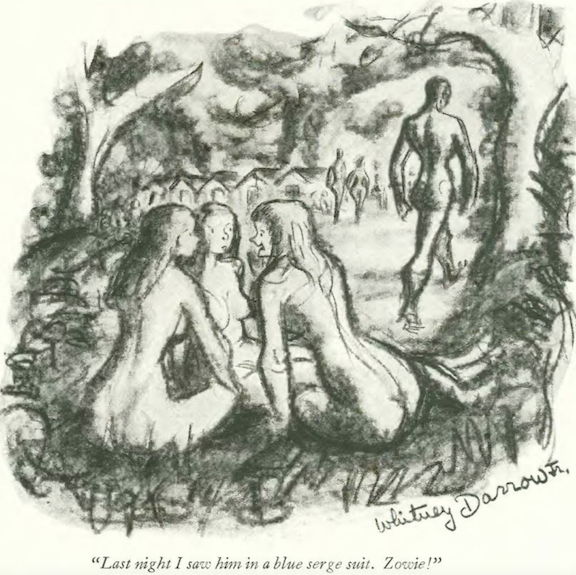
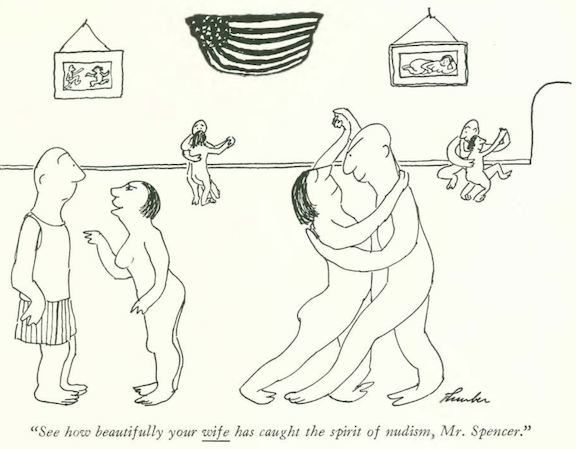
…and Whitney Darrow Jr gave us a trio at a nudist colony dressing a man with their eyes…

…we move along to July 1, 1933…

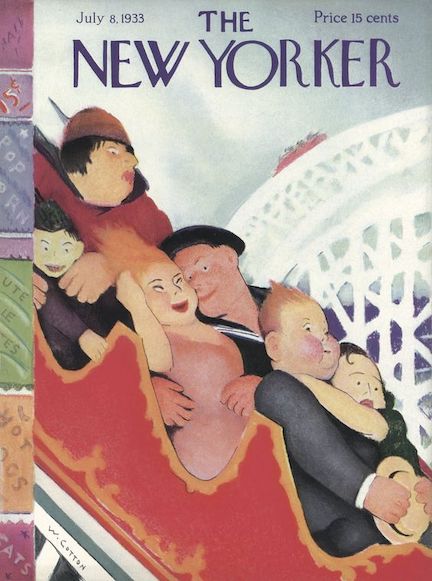
July 1, 1933 cover by Helen Hokinson.

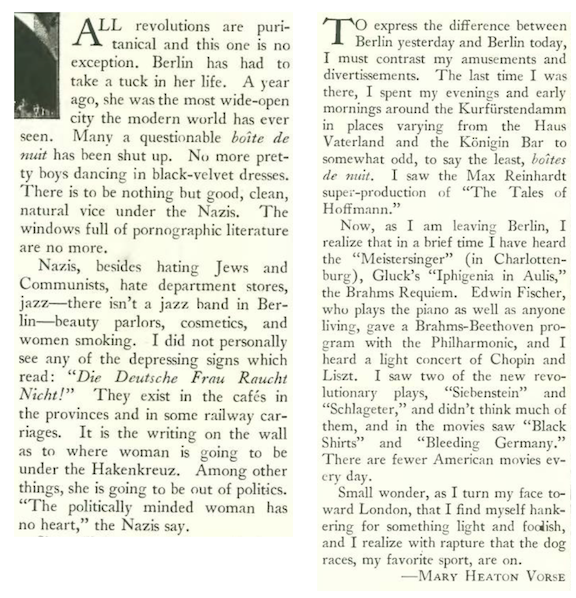
Where in this issue we find the Nazis not keeping their cool. In an article titled “Unter Dem Hakenkreuz” (“Under the Swastika”) American journalist and activist Mary Heaton Vorse commented on the changes taking place in Berlin, where the vice, decadence and other freedoms of the Weimar years had been swept away, including women’s rights…an excerpt:

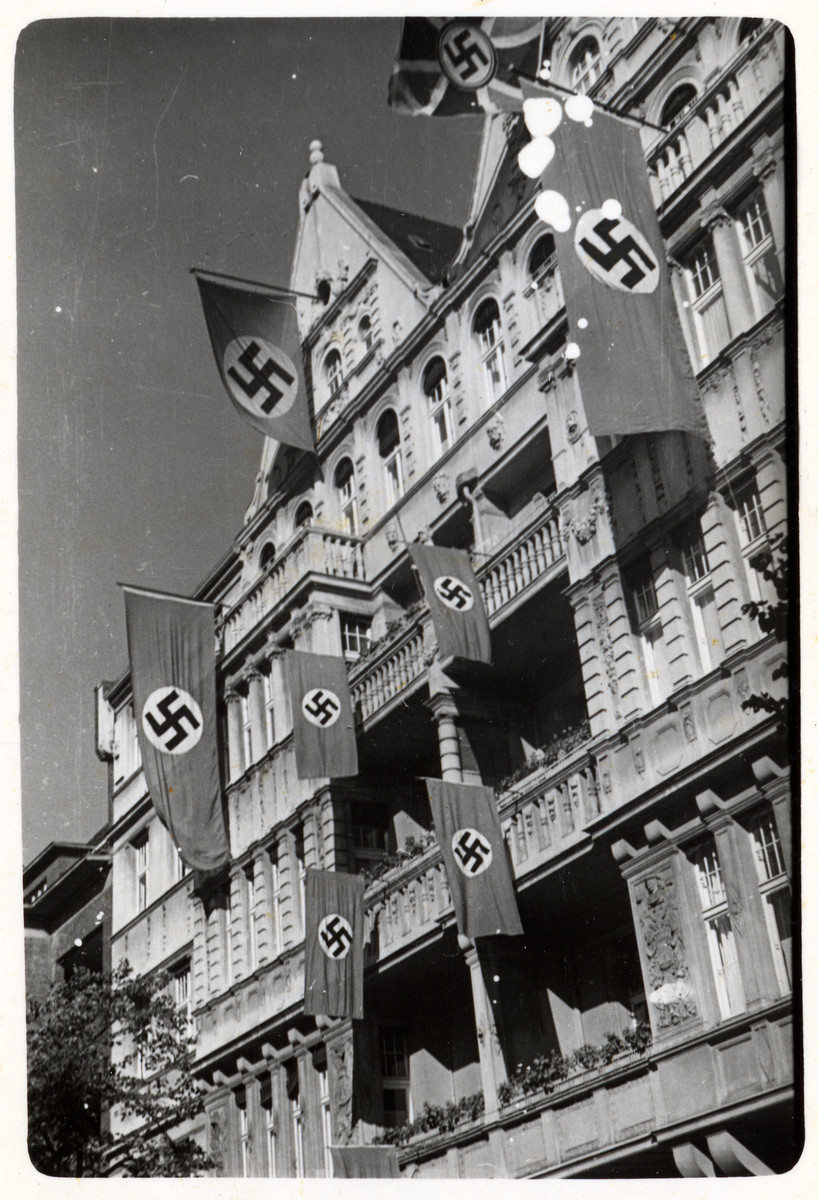
SIT UP STRAIGHT AND PROCREATE…Swastika flags hang from a Berlin building in the 1930s. In Hitler’s Germany, women of child-bearing age were expected to produce lots of babies and not much else. (collections.ushmm.org)

 * * *

Some Strings Attached

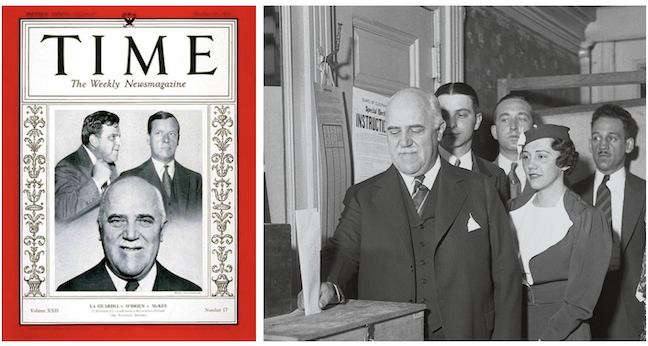
Back in the states, Alvin Johnston published the first installment of a two-part profile on John P. O’Brien (1873–1951) who served as mayor of New York from January to December 1933, the second of two short-term mayors to serve between the disgraced and deposed Jimmy Walker and the reformer Fiorello LaGuardia. Considered the last of the mayoral puppets of Tammany Hall, he was known for his brief, heartless, and clueless reign during one of the worst years of the Depression; while unemployment was at 25 percent, O’Brien was doling out relief funds to Tammany cronies. A brief excerpt (with Abe Birnbaum illustration):

A PIOUS, LABORIOUS DULLARD and “a hack given to malapropisms” is how writer George Lankevich describes John P. O’Brien. According to Lankevich, to a crowd in Harlem O’Brien proudly proclaimed, “I may be white but my heart is as black as yours.” (TIME)

 * * *

That Pepsodent Smile

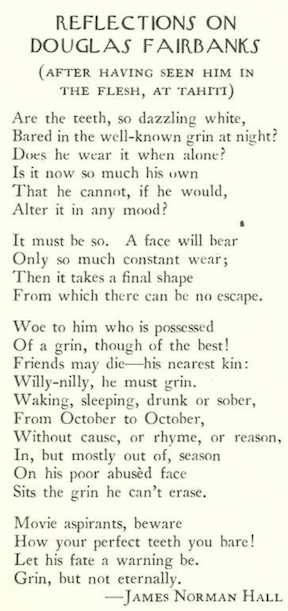
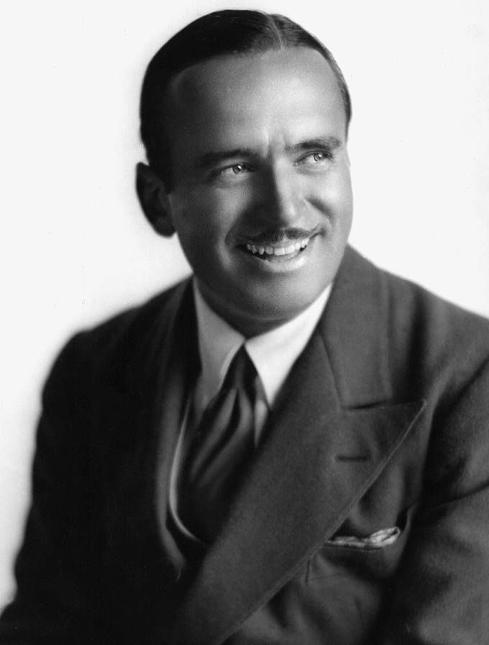
The author James Norman Hall (1887–1951), known for the trilogy of novels that included Mutiny on the Bounty, offered these sobering thoughts about a famed actor he spotted on a South Pacific holiday:

IT ISN’T EASY BEING ME…Fifty-year-old Douglas Fairbanks Sr, teeth and all, was apparently looking worse for the wear when he was spotted by writer James Norman Hall in Tahiti. His glory days of the Silent Era behind him, Fairbanks would die in 1939 at age 56. (fineartamerica.com)

 * * *

More From Our Advertisers

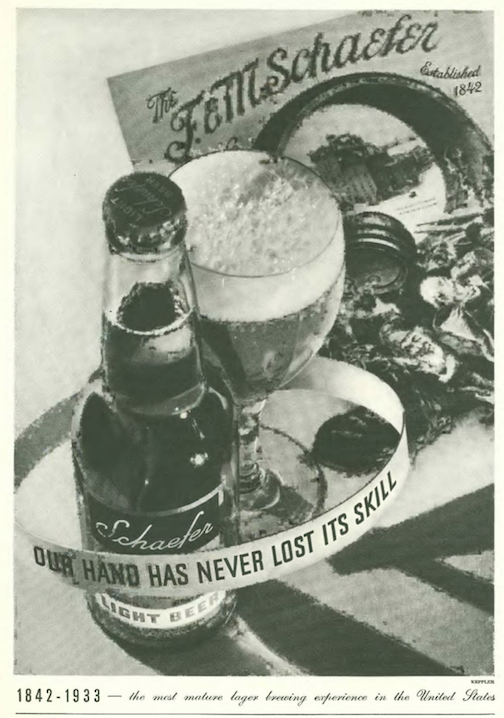
More cool ones for those hot summer days courtesy of Schaefer…

…and Rheingold, here served by a sheepish-looking woman who doubtless wished that the tray supported champagne or cocktail glasses…and leave it to the Dutch to be one of the first countries to get their foot into the import market…when I was in college this was as good as it got, beer-wise…

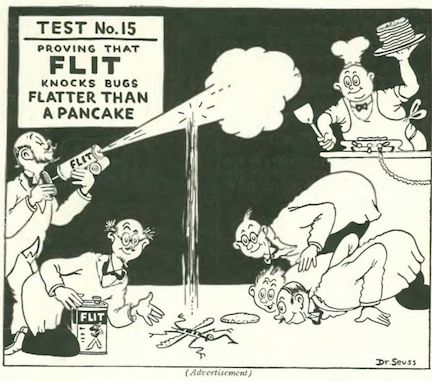
Dr. Seuss again for Flit, and even though this is a cartoon, it demonstrates how in those days no one really cared if you sprayed pesticides near your breakfast, or pets, or kids…

…here’s one of just four cartoons contributed to The New Yorker in the early 1930s by Walter Schmidt

Otto Soglow’s Little King found an opportunity to stop and smell the flowers…

Mary Petty gave us two examples of fashion-conscious women…

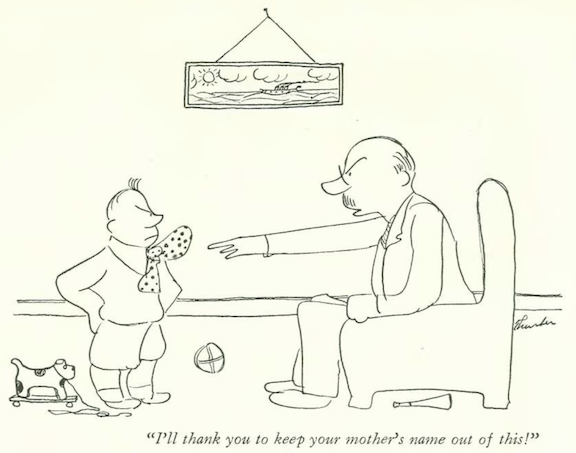
James Thurber explored the nuances of parenting…

…and we close with George Price, master of oddities…

Next Time: The Night the Bed Fell…

Beauty and the Beast

One of Hollywood’s most famous motion pictures was a story about a giant ape that (literally) falls for a beautiful woman.

March 11, 1933 cover by Rea Irvin.

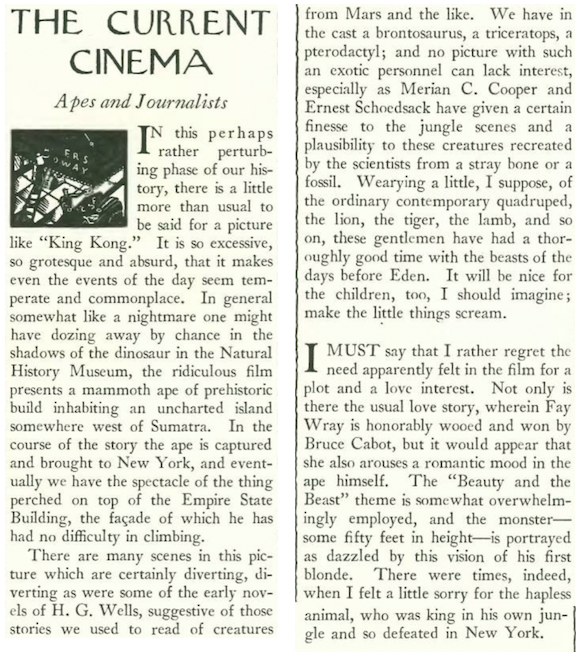
New Yorker film critic John Mosher found the premise of King Kong ridiculous, but he also found many of its scenes diverting, especially those featuring Kong and a number of prehistoric creatures (created by Marcel Delgado), miniature models brought to life through stop-motion animation techniques pioneered by Willis O’Brien and his assistant, Buzz Gibson. Mosher’s review:

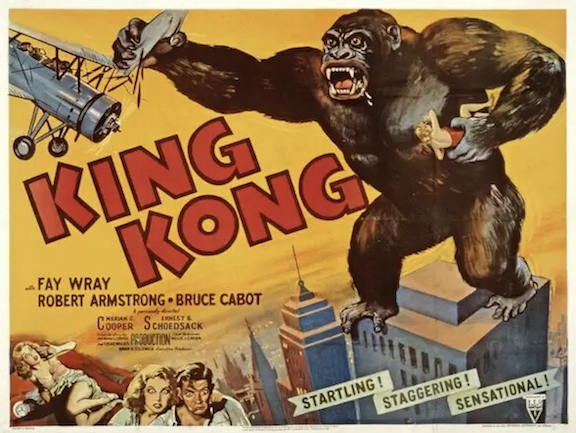
THE TRIALS OF GIANT APEHOOD…King Kong battled nature and man in the eponymous 1933 film that featured a silly love story between actors Bruce Cabot and Fay Wray (lower right, with Robert Armstrong); this being a pre-Code film, Wray had trouble keeping on her blouse, although a scene depicting Kong undressing her and sniffing his fingers was cut, as were some of the more gruesome scenes featuring Kong stomping and chomping his way through Manhattan. (IMDB)

By today’s standards the film’s special effects are quite dated, but they astonished audiences in 1933 and again in a 1952 re-release.

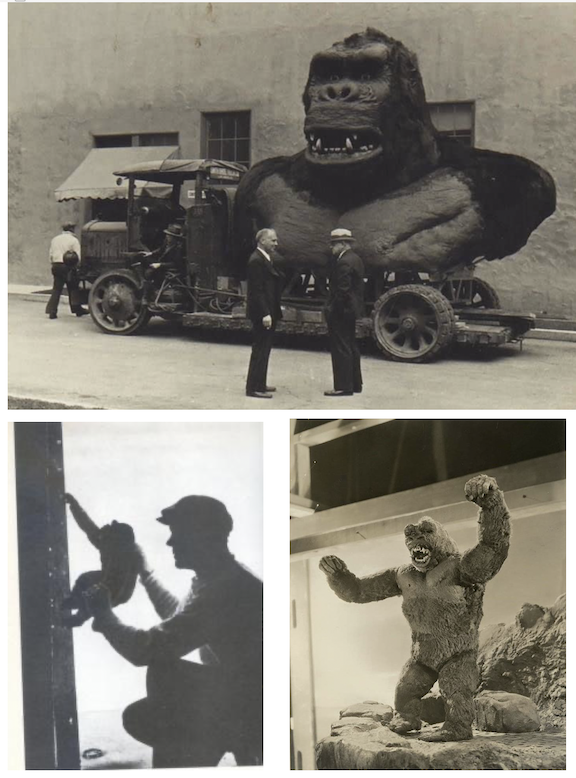
NEW YORK OR BUST…A huge bust of King Kong’s head and torso was fashioned from wood, cloth, rubber and bearskin by Marcel Delgado, Buzz Gibson and Fred Reese. Three operators inside the bust used metal levers, hinges, and an air compressor to manipulate the mouth and facial expressions. In addition, two versions of the ape’s right arm were constructed of steel, rubber and bearskin — one was non-articulated, mounted on a crane, and the other had articulated fingers that allowed Kong to grasp Fay Wray in close-ups (below). A separate non-articulated leg was also mounted on a crane for scenes depicting Kong stomping on villagers. (reddit.com/Pinterest)

 *  *  *

Oh Baby

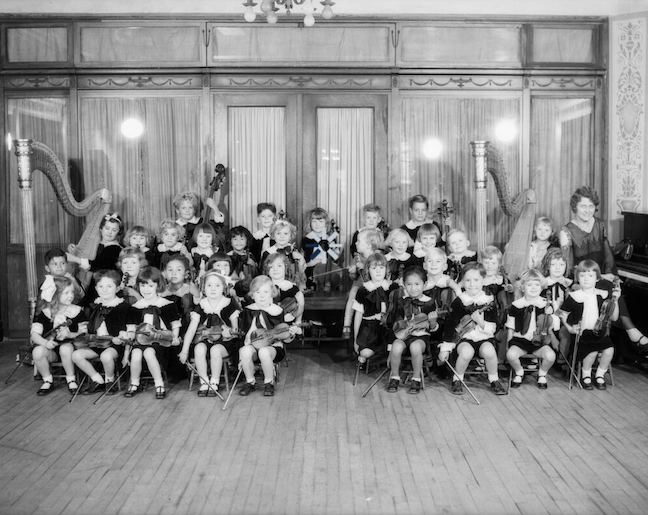
Before child labor laws were finally enforced in the late 1930s, children were routinely exploited for profit, most famously the Dionne quintuplets by Dr. Allan Roy Defoe, not to mention the many child stars fed into the Hollywood meat grinder. For a public seeking novelty as a distraction from the Depression, there were also numerous “baby orchestras” organized by one Karl Moldrem. “The Talk of the Town” commented:

NURSERY SONGS…One of Karl Moldrem’s baby orchestras assembled in Southern California, 1931. (digitallibrary.usc.edu)

 *  *  *

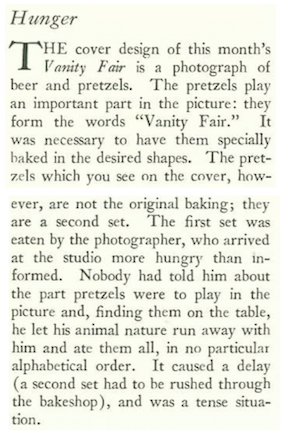
Edible Art

“The Talk of the Town” has always been a source for light anecdotes, including this brief account of a hungry Vanity Fair photographer:

MMM, PRETZEL ART…Vanity Fair’s edible cover, March 1933. (Vanity Fair Archive)

 *  *  *

Lend Me An Ear

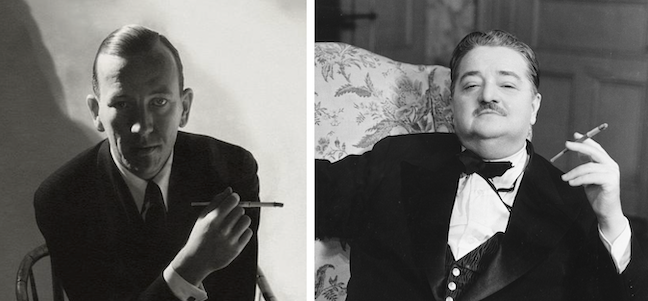
Alexander Woollcott led his “Shouts and Murmurs” column with an account from a recent benefit performance, during which his friend Noël Coward decided to strike up a conversation regarding the survival of the stage in an era of talking films:

TALKING TALKIES… Noël Coward (left) voiced his concerns about the future of stage entertainment with Alexander Woollcott during a benefit performance likely held on behalf of the theatrical world. (npg.org)

 *  *  *

From Our Advertisers

Ah, we begin with signs of spring, glimpsed beyond the gleaming cowl of a 12-cylinder Lincoln…

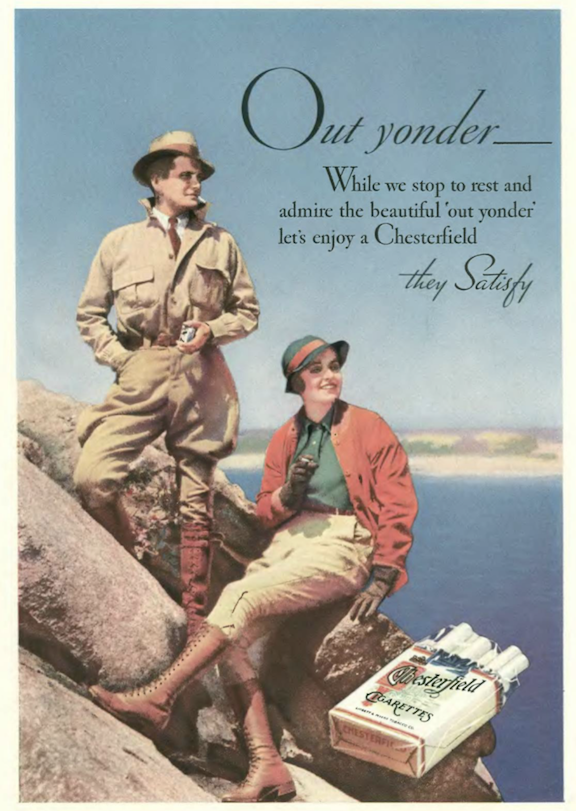
…and catch a whiff of that springtime breeze, savored between puffs of your Chesterfield…

…this guy has some spring in his step thanks to the sparkling water he just splashed into his bootleg gin…

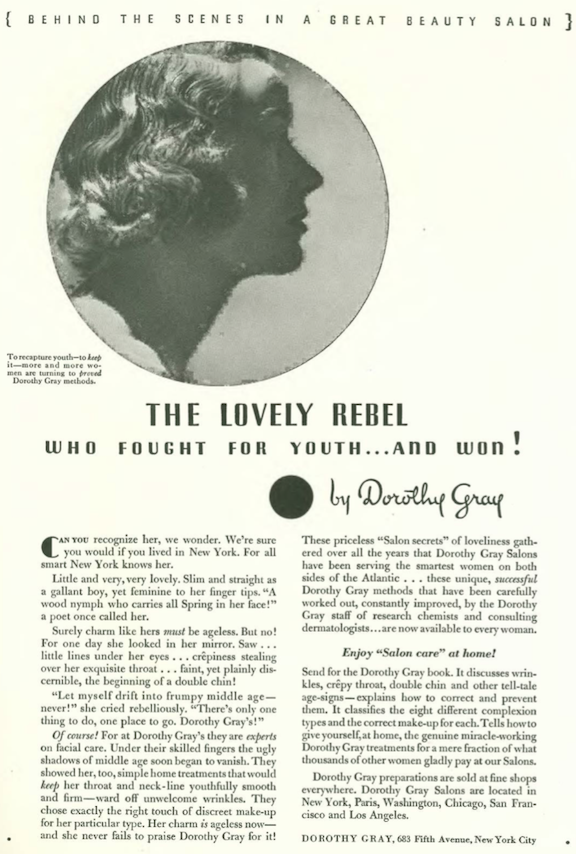
…the folks at Dorothy Gray presented a nameless woman (“slim and straight as a gallant boy, yet feminine to her finger tips”) who was ready to greet spring until she saw those “little lines under her eyes”…the horror indeed…

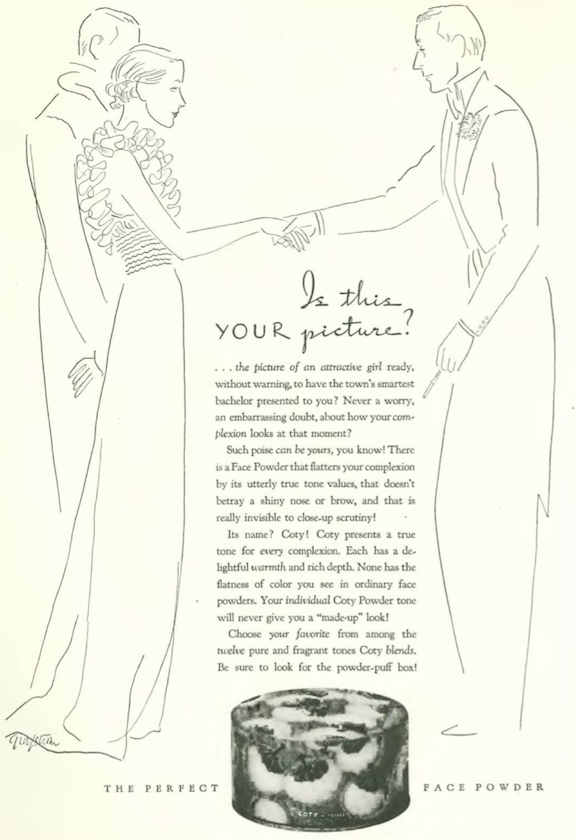
…Coty again presented an attenuated trio in a sexless courtship dance, oozing with anglophilic longing…

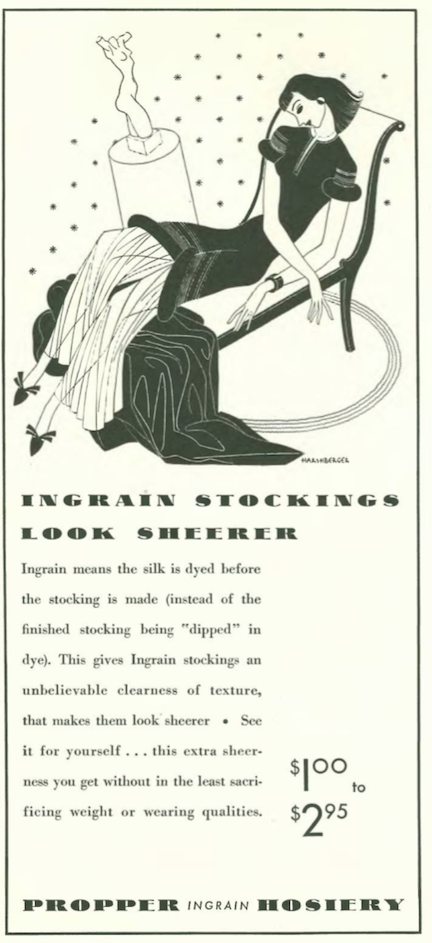
…I include this ad solely for the terrific illustration by Mac Harshberger, famed for his elegant, simplified line…

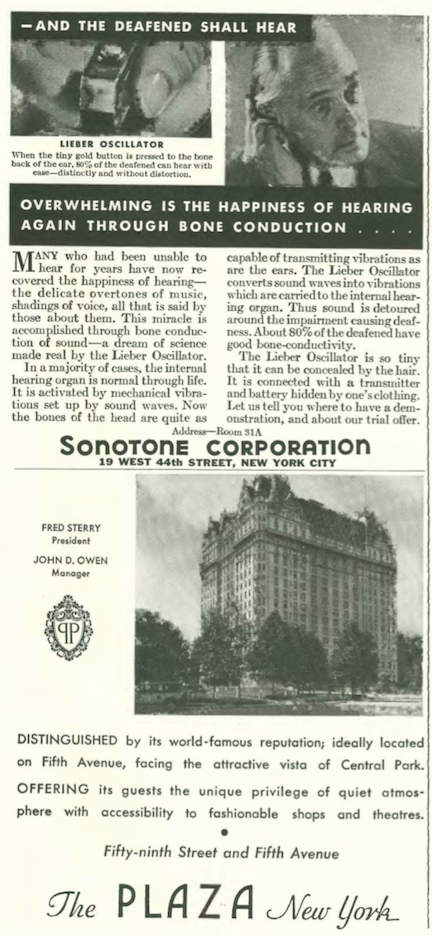
…and a couple of back pagers…thanks to Sonotone, the deafened shall not only hear but will also be stricken by a sudden voiding of the bowels…and below, a surprising ad from the Plaza, one place I never thought would need to advertise…but those were tough times…

…and on to our cartoons, and this spot drawing from Peggy Bacon, whom we haven’t seen in awhile…

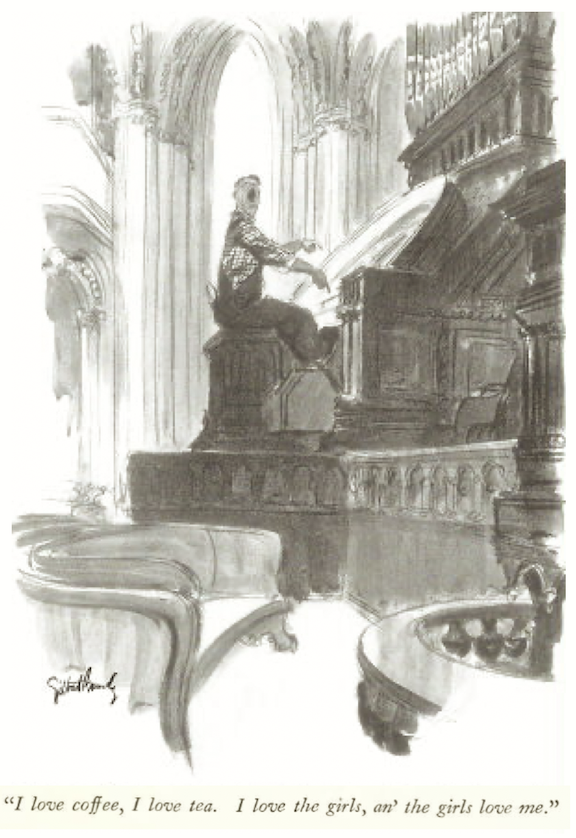
Gilbert Bundy took us to a sanctuary of song…

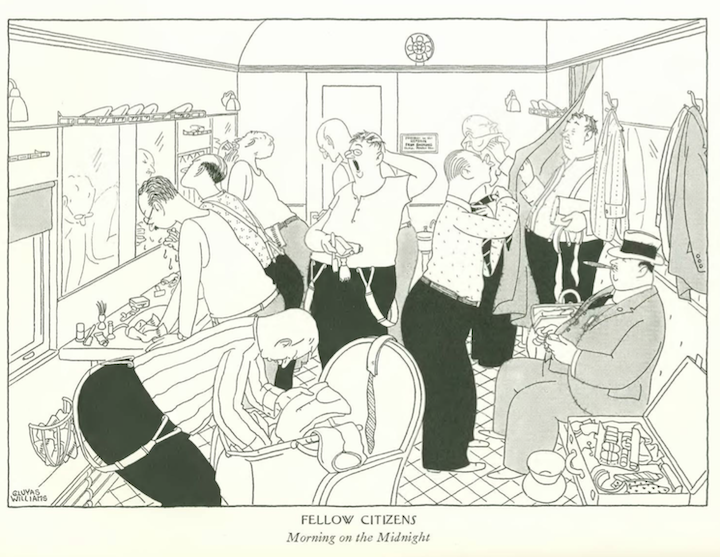
…another day with our fellow citizens, and Gluyas Williams

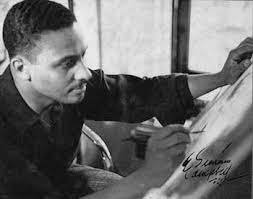
…one from E. Simms Campbell

…who was the first Black cartoonist published in nationally distributed, “slick” magazines…

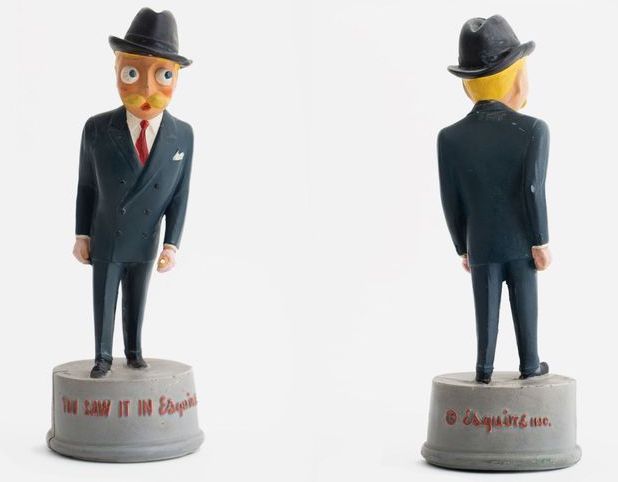
…and also the creator of Esky, the pop-eyed mascot of Esquire magazine…

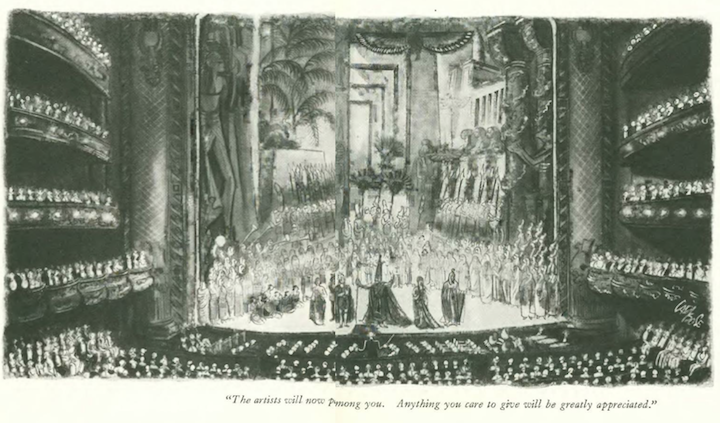
Carl Rose gave us a night at the opera in this two-page cartoon with the Depression-inspired caption: The artists will now pass among you. Anything you can give will be greatly appreciated….

…and James Thurber returned to the nudist colony for another look at the age-old struggle between the sexes…

Next Time: Not Even Funny…

Deskey’s Deco

Above, Donald Deskey's Design for a Sportshack, 1940 (Cooper Hewitt)

If you’ve never heard of Donald Deskey, you’ve most likely seen his work.

Feb. 25, 1933 cover by Rea Irvin.

Cultural critic Gilbert Seldes featured Deskey in the Feb. 25 profile (“The Long Road to Roxy” — with illustration by Al Frueh), noting that his subject had come to his profession as an industrial designer in a rather roundabout fashion. Here is a brief excerpt:

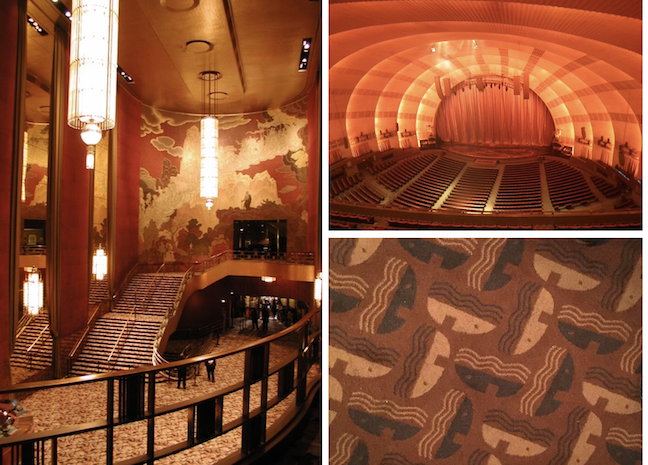
Deskey (1894–1989) was locally known in the late 1920s for his window displays at New York’s Franklin Simon Department Store, but it was his work at Roxy Rothafel’s new Radio City Music Hall that made him a marquee name in the design world. Although known for popularizing the Art Deco style, his interior designs for RCMH were noted for their restraint, signaling a break from the lavish, ornate designs of the city’s earlier performance spaces.

FEAST FOR THE EYES…Donald Deskey designed more than thirty spaces in Radio City Music Hall, including the Grand Foyer (left) and several lounges, each featuring a distinct visual motif. At bottom right, auditorium’s “Singing Woman” carpeting. (archdaily.com/drivingfordeco.com)

Original Deskey creations are highly prized today by collectors and museums…

DESIGN IN MOTION…Clockwise, from top left, Deskey’s “Guest Bedroom for Mrs. John D. Rockefeller, Jr.” (Abby Aldrich Rockefeller), on display at the 1931 American Union of Decorative Artists exhibition; Deskey table lamp, circa 1927; linen panel, circa 1930s; Deskey desk, circa 1930. (brooklynmuseum.org/artic.edu/Pinterest)

…and if that wasn’t enough, Deskey also designed logos for many consumer products in the late 1940s and 1950s…

THE TOTAL PACKAGE…Deskey designed some of the most iconic logos of midcentury America, including, clockwise from top left, Tide laundry detergent (1947); Gleem (1956) and Crest (1955) toothpastes; Cheer laundry detergent (1952); JIF peanut butter (1956) and Joy dishwashing liquid (1950).

*  *  *

From Our Advertisers

It seems appropriate to follow Mr. Deskey with some words and images from our sponsors, including the folks at Cadillac who continued to hammer home the snob appeal of their motorcar while also giving a nod to those hard times by emphasizing the car’s economy

…meanwhile, Studebaker was back with another full page ad—again featuring the admiring giant woman—in a vain attempt to push their fledgling, and unpopular line of Rockne automobiles…

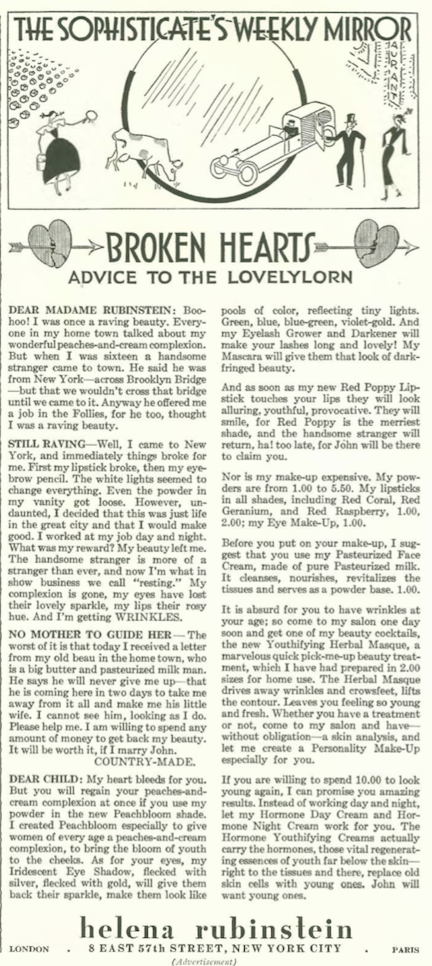
…and Helena Rubenstein continued her series of ads disguised as advice columns…the advice here was to shame women into buying her products…

…after Helena removed your wrinkles you could restore them with GE’s Mazda sunlight lamp…

Otto Soglow, on the brink of becoming a very wealthy man thanks to his Little King cartoons, continued to lay down some ink on behalf of the makers of Sanka decaf…

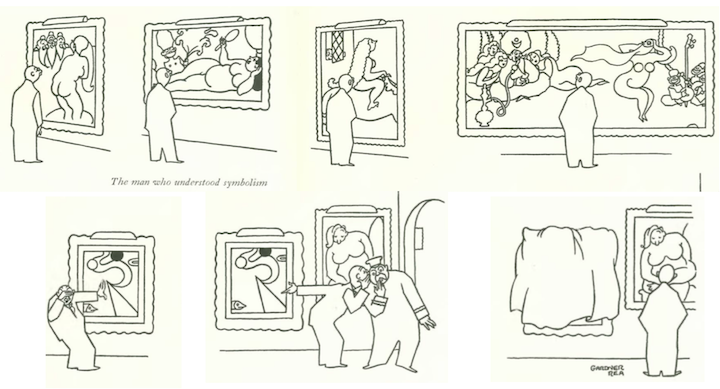
…and we move along to Soglow’s fellow cartoonists, beginning with Gardner Rea and a cartoon sequence spread across pages 24-25…

…here it is again, rearranged for closer inspection…

…and we have another terrific “Fellow Citizens” drawing by Gluyas Williams, which originally ran sideways on a full page…

…I like this James Thurber drawing for its utter disregard of scale—but of course (and thankfully) it wouldn’t be a Thurber if he cared about such things…

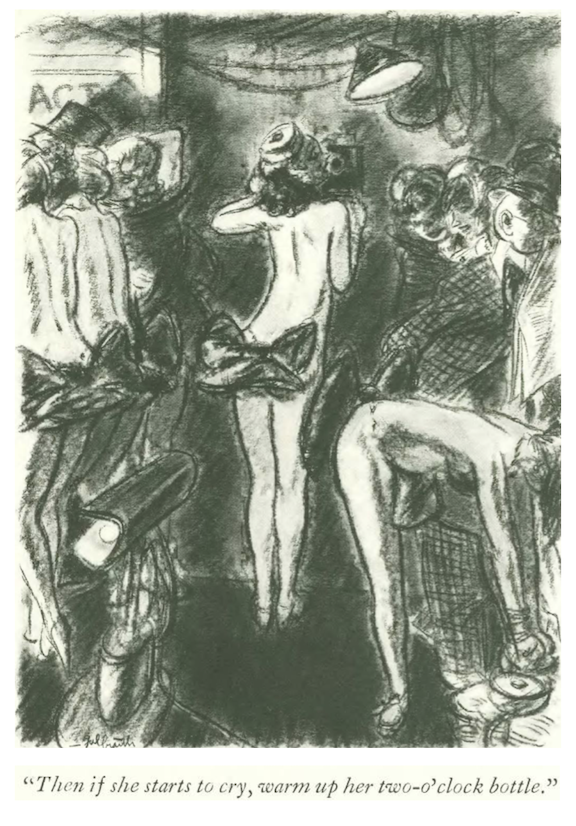
William Crawford Galbraith was still hung up on showgirls and sirens…

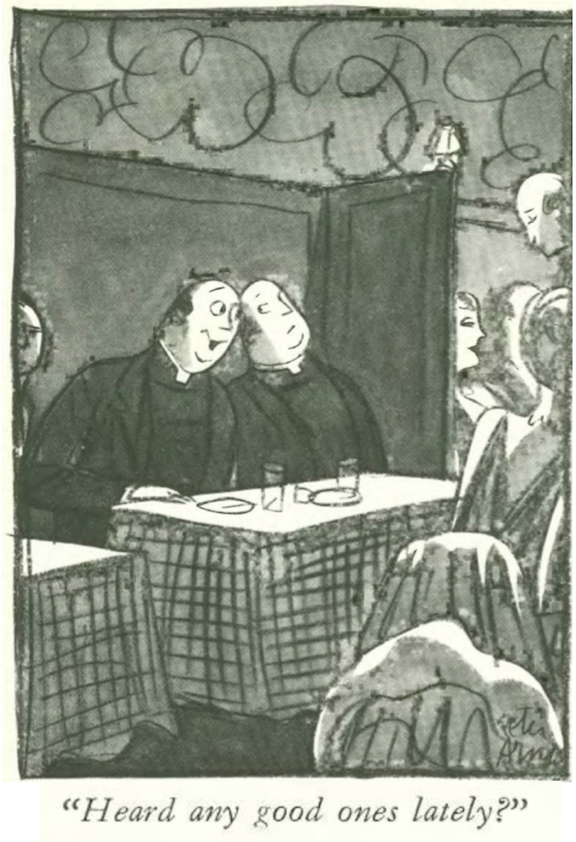
…while Peter Arno explored his spiritual side, as only Arno could…

…and we move along to March 4, 1933…

March 4, 1933 cover by Rea Irvin.

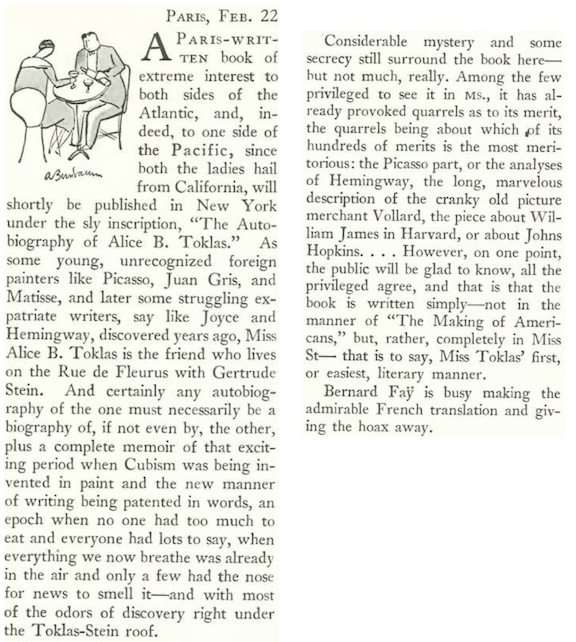
…in which The New Yorker’s Paris correspondent Janet Flanner (“Genêt”) wrote about a new book of “extreme interest to both sides of the Atlantic”…

BOOK OF REVELATION…Alice B. Toklas and Gertrude Stein were well known in the ex-pat community of 1920s Paris, but the publication of the American edition of The Autobiography of Alice B. Toklas (written by Stein) brought them fame in the wider world. Stein claimed she wrote the book — now considered a 20th century classic — in six weeks to amuse herself and to make money. At right, Toklas and Stein at 27 Rue de Fleurus in a portrait by Man Ray, 1922. (Library of Congress)

 *  *  *

Hope Springs Eternal

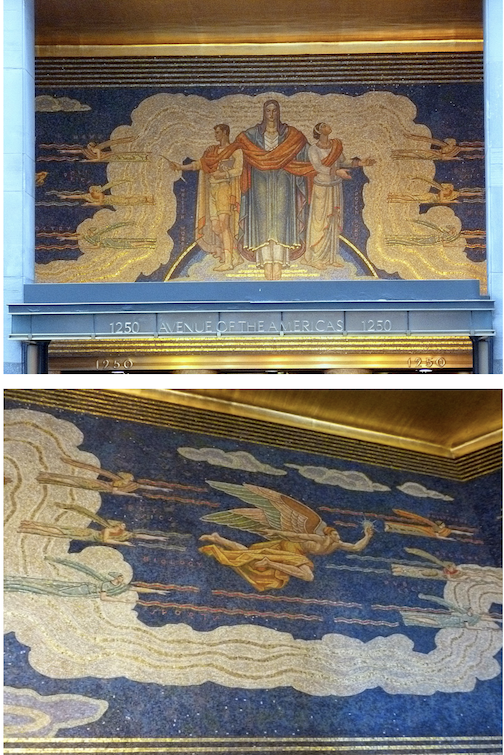
Even in the deepest depths of the Depression signs of hope abounded in works of public art, including a mosaic of one million hand-cut and hand-set glass tiles being prepared for the Sixth Avenue entrance to Rockefeller Center. Intelligence Awakening Mankind, by Barry Faulkner, celebrated the triumph of knowledge over the evil of ignorance. “The Talk of the Town” explained:

GOOD VIBES…Details of Intelligence Awakening Mankind include the central figure of Intelligence (top) sending knowledge into the far corners of the world. (Pinterest)

 *  *  *

From Our Advertisers

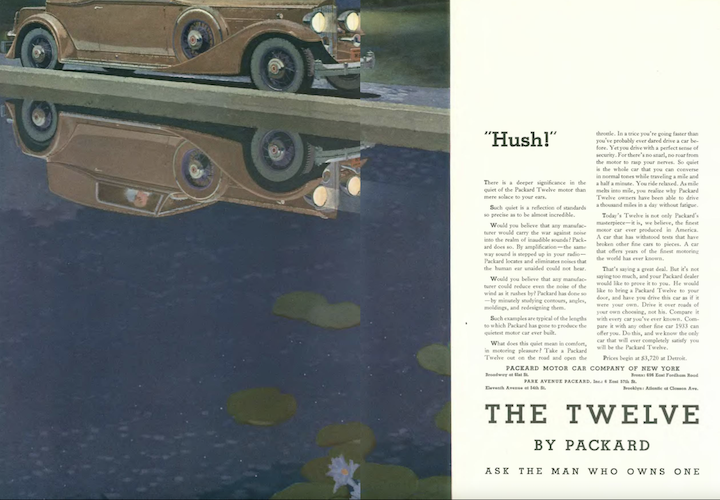
The folks at luxury brand Packard continued to counter their stodgy image with ads that emphasized other qualities including speed, durability, and here, serenity…despite the lengthy text, the ad also suggested modernity, with the sliced-off image and the single word “Hush!” to entice prospective buyers…

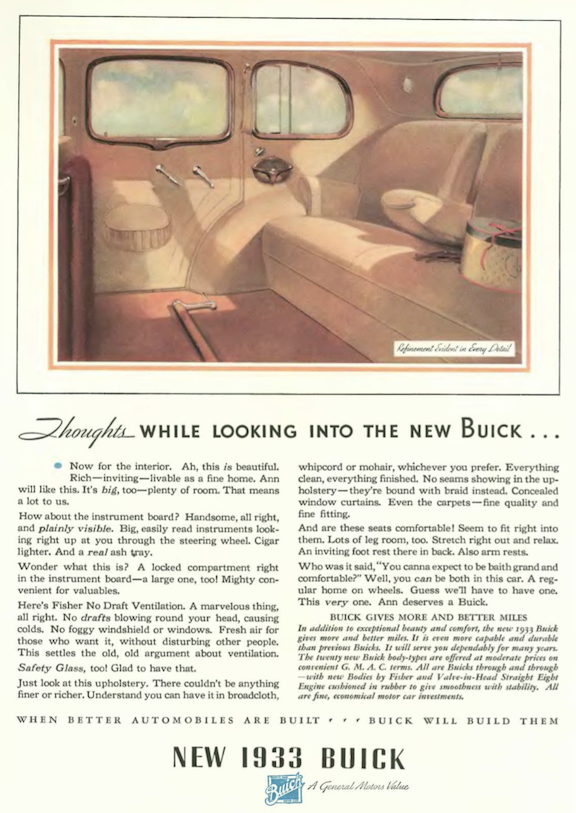
…if you couldn’t afford $3,720 for a 12-cylinder Packard, then you might have considered a Buick, “livable as a fine home” this ad claimed. And look at that back seat — you could comfortably fit three adults and a baby elephant in there…

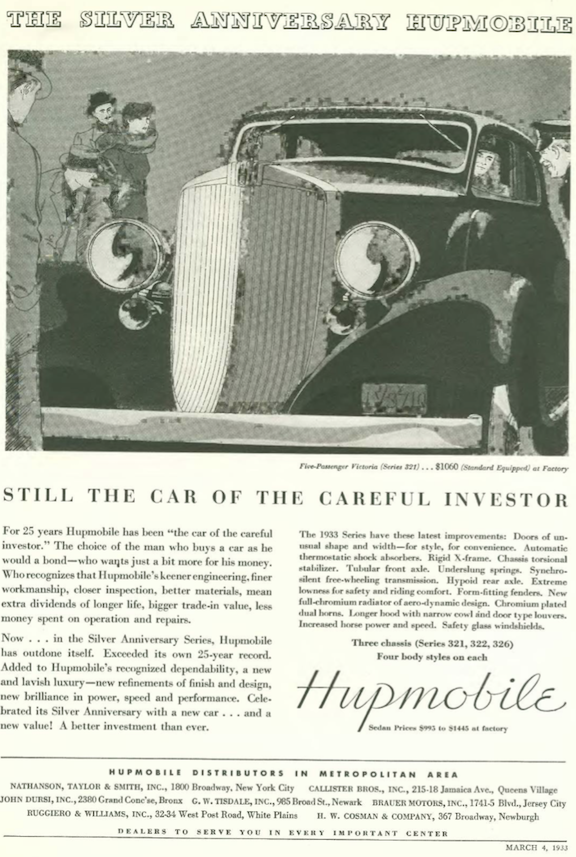
…and then there’s Hupmobile—for the price of a Packard 12 you could have purchased three Hupmobile Victorias (pictured below) with a good chunk of change left over…here the company celebrates its silver anniversary…a couple of odd facts: in 1914 a Minnesota Hupmobile salesman used an unsold vehicle to found Greyhound bus lines…the National Football League also traces its origins to Hupmobile — the league was created in 1920 at a Hupmobile dealership in Canton, Ohio…both Greyhound and the NFL survive Hupmobile, which went belly up in 1939…

…and now we move to the world of fashion, and some cultural appropriation by Lord & Taylor…

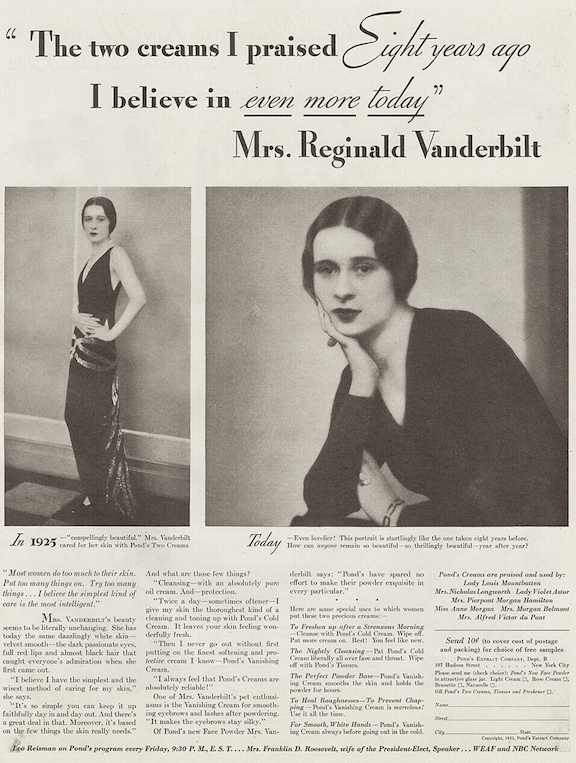
…in 1929 J. Walter Thompson President Stanley Resor observed how people instinctively wanted to be told what to do by authorities they respected. Applying this thinking to the marketing of Pond’s cold cream, Resor’s firm hired famed photographers to create idealized portraits of society women…

…Writing for Indy Week (July 7, 2010) Amy White observes that a 1933 portrait (above) of Mrs. Reginald Vanderbilt, aka Gloria Mercedes Morgan, reveals patrician eyes as “languid jet pools, her lips full and dark, her finely coiffed hair oiled to ebony perfection. However, a bit of backstory might explain the painful and hollow look Mrs. Vanderbilt can barely suppress. In that same year, she was declared by the courts to be unfit as a parent, and her young daughter was placed under the guardianship of her sister, Gertrude.” That young daughter, Gloria Vanderbilt, would later find fame for her designer jeans, her glittering lifestyle, and as mother of newscaster Anderson Cooper. White concludes, “I wonder if somehow, subconsciously, those consumers saw the pain in the eyes of some of those upper-crust spokeswomen, and it was basic humanness and empathy, as well as desire for wealth and beauty, that won them over”…

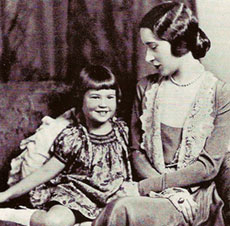
Mrs. Reginald Vanderbilt, aka Gloria Mercedes Morgan, and her daughter, “Little Gloria,” in 1928. (Wikipedia)

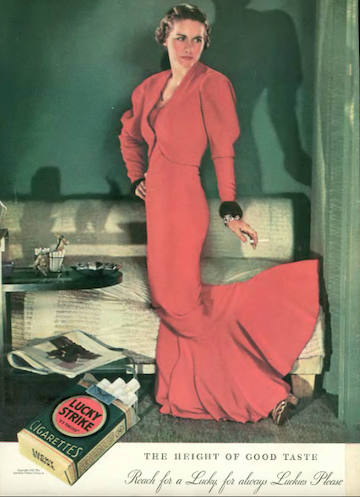
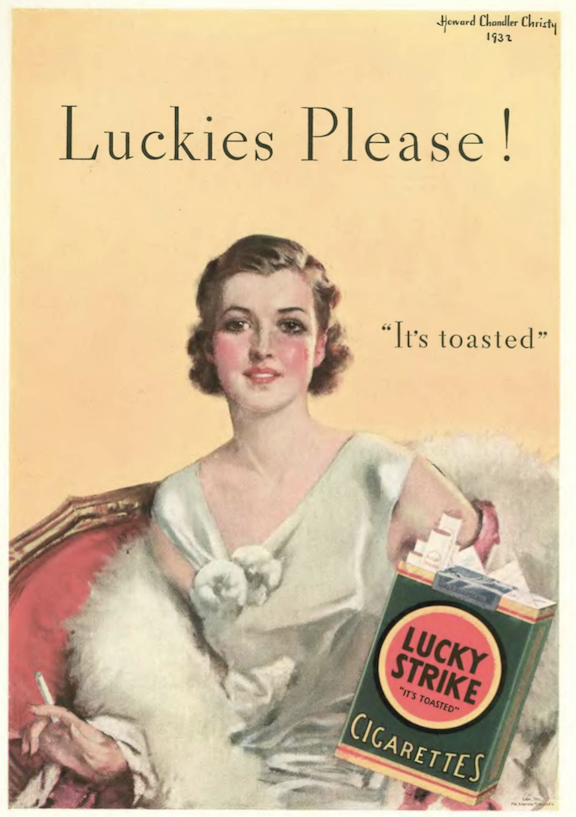
…and we move along to the toasted pleasures of Luckies, and Howard Chandler Christy’s “Christy Girl” looking the picture of health and vitality in this back cover ad…

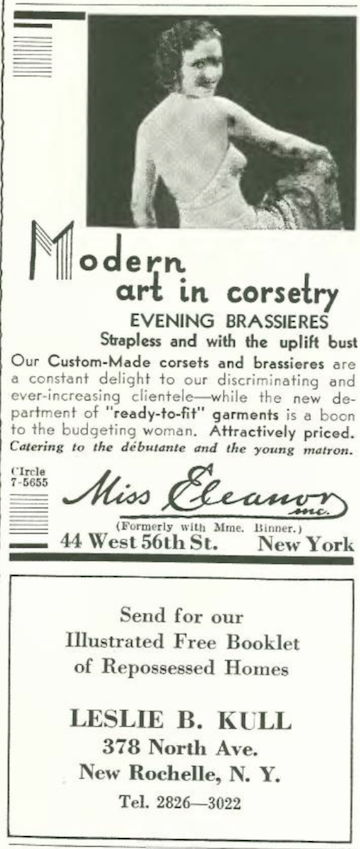
…we make an abrupt switch to the cheaper ads in the magazine’s nether pages…here “Miss Eleanor, formerly with Mme. Binner,” announced her selection of modern corsets for the “debutante and young matron”…and below, in a sign of the times, repossessed homes for sale…

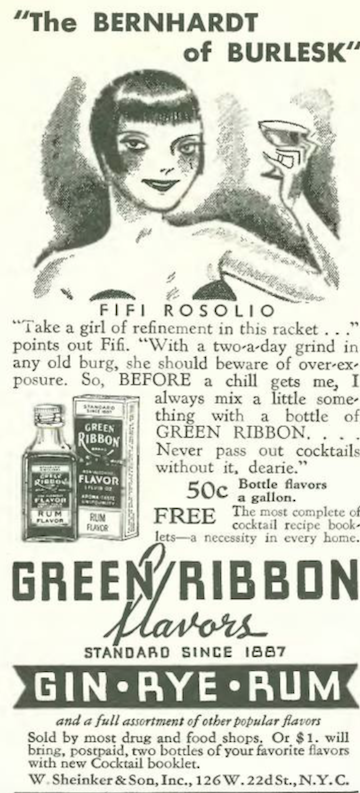
…looks like Fifi had a bit too much of the Green Ribbon-flavored bootleg…

…and if you thought taking probiotics was a new thing…

…the French Line once again featured the art of James Thurber to promote its Mediterranean cruises…

…and Thurber kicks off our cartoons with spot art that headed the “Goings On About Town” section…

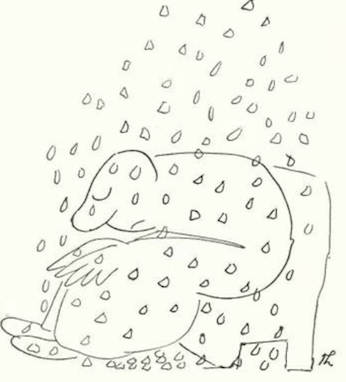
…and this gem with one of Thurber’s beloved dogs…

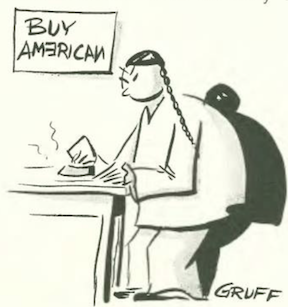
…below is the second New Yorker cartoon by Gruff with the “Buy American” slogan juxtaposed with an ethnic stereotype…I have no idea who this artist is, or if “Gruff” is a pen name — the style looks familiar but I haven’t had any luck chasing this artist down…

…here is the first one from the Feb. 18 issue…

…but we all know Al Frueh, who contributed this delightful bit of art to the theater review section…

Daniel ‘Alain’ Brustlein gave us an enterprising Frenchman offering peeks at exiled New York Mayor Jimmy Walker sunning on a beach at Cannes…

…and we close with Peter Arno, and the first signs of spring…

Next Time: Beauty and the Beast…

One Perfect Night

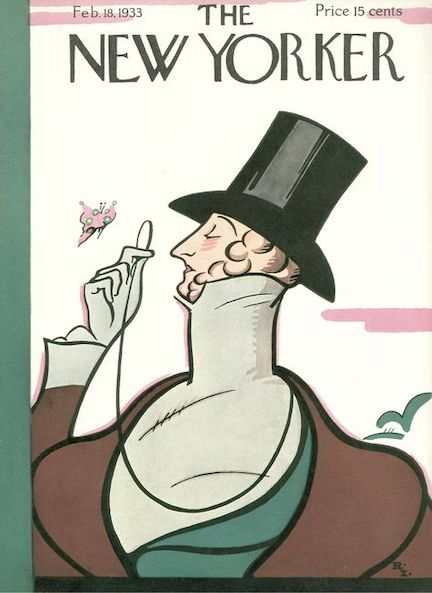
Once again The New Yorker marked its anniversary—the eighth—with a repeat of its very first cover, a tradition that would last until 1993. Unlike previous years, E.B. White made no special mention of the occasion in his “Notes and Comment,” no doubt feeling confident about the magazine’s prospects despite the challenges of the Depression. In 1933 The New Yorker could count on nearly 117,000 readers.

Feb. 18, 1933 cover by Rea Irvin.

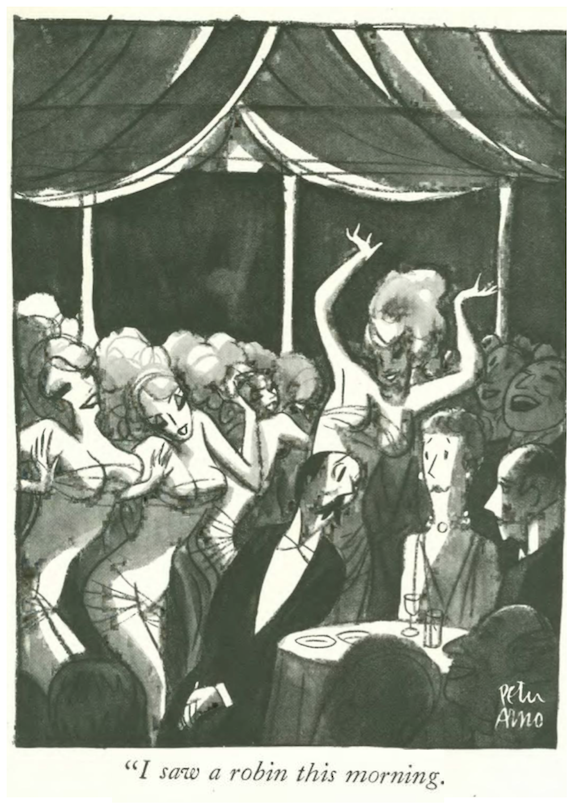
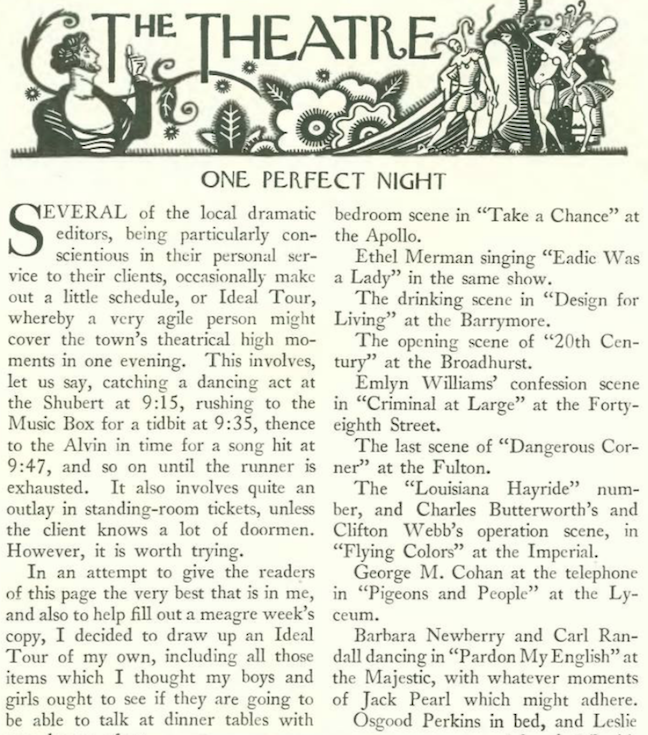
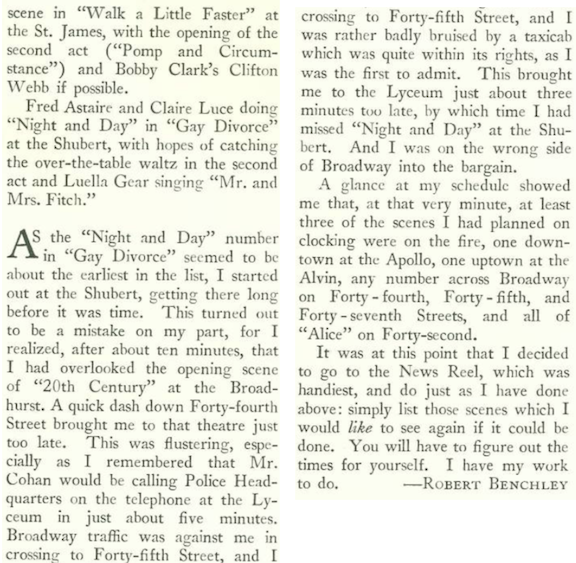
And so we look to another of the magazine’s star contributors, humorist and stage critic Robert Benchley, who was rarely impressed with Broadway’s middlebrow fare. It was in such an environment that Benchley found himself separating the wheat from the chaff, listing a selection of scenes from various plays that together might represent a “perfect night” of entertainment:

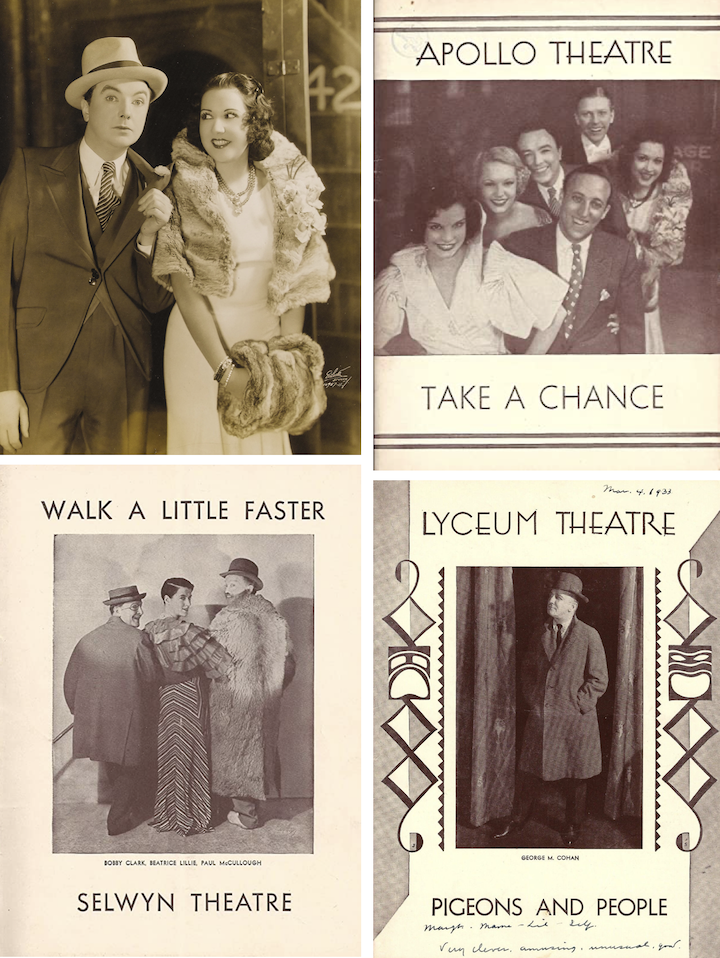
A BROADWAY BUFFET…Clockwise, from top left, Robert Benchley recommended Jack Haley’s bedroom scene and Ethel Merman’s rendition of “Eadie Was a Lady” in Take a Chance as worthy of a look; he also found George M. Cohan’s telephone call to police HQ in Pigeons and People memorable, and Beatrice Lillie was apparently a delight in the dressing room scene from Walk a Little Faster. (playbill.com)

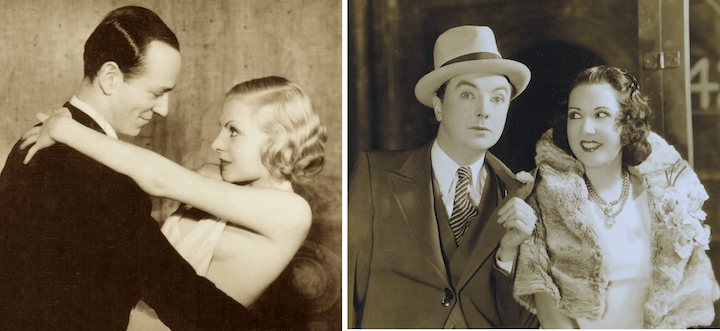
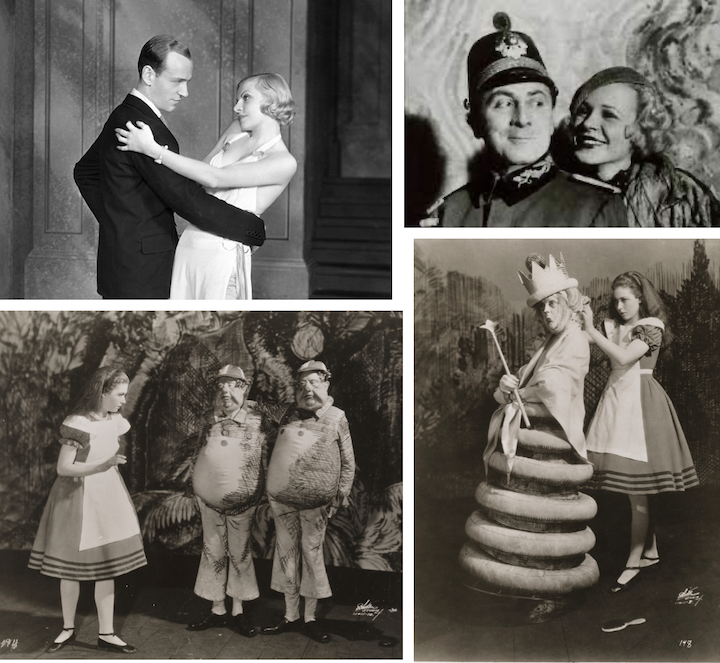
TRIPPING THE LIGHT FANTASTIC in Cole Porter’s musical Gay Divorce were Claire Luce and Fred Astaire, dancing to the hit song “Night and Day.” It was Astaire’s last Broadway show before he headed to Hollywood for even greater stardom; Jack Pearl and Barbara Newberry in Pardon My English; Eva Le Gallienne as the White Queen and Josephine Hutchinson as Alice in the 1932-33 production of Alice in Wonderland at Le Gallienne’s own Civic Repertory Theatre; Alice (Hutchinson) encounters Tweedledee (Burgess Meredith) and Tweedledum (Landon Herrick) in Alice in Wonderland. (Pinterest/gershwin.com/blog.mcny.org)

 *  *  *

Spring Cleaning

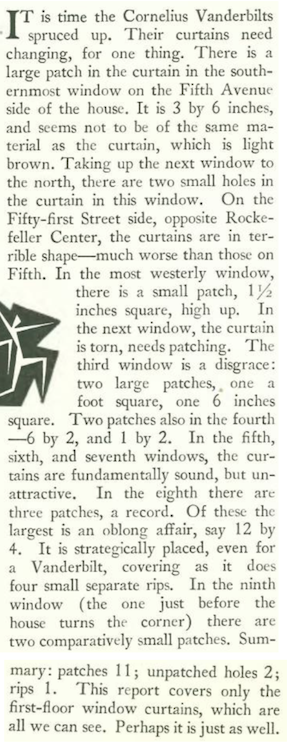
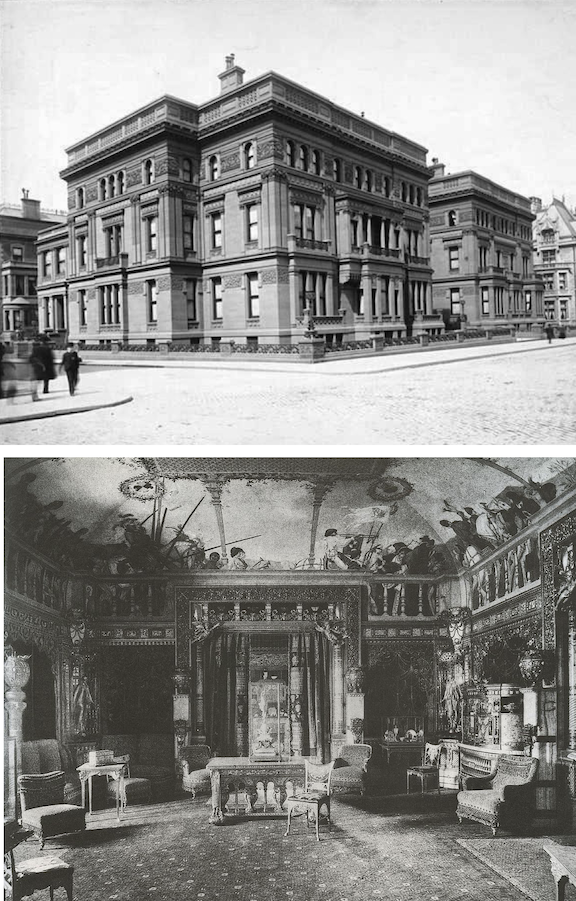
While passing by the Vanderbilts’ “Triple Palace” on 51st and Fifth Avenue, E.B. White (“Notes and Comment”) noted signs of neglect at the famed mansion:

HOME  SWEET HOME…At top, Alva Vanderbilt engaged Richard Morris Hunt to build a “Petite Chateau” on the northwest corner of 52nd Street; below, the drawing room. The Triple Palace was demolished in 1947-49. (mcny.org/Wikimedia Commons)

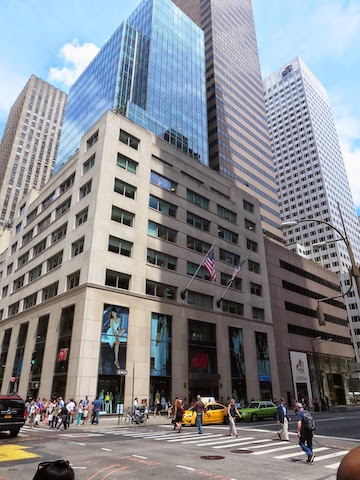
The Triple Palace site today:

(daytoninmanhattan.blogspot.com)

*  *  *

Going Round and Round

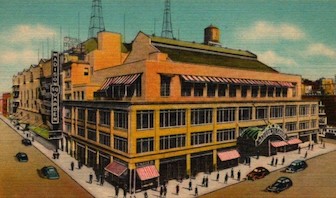
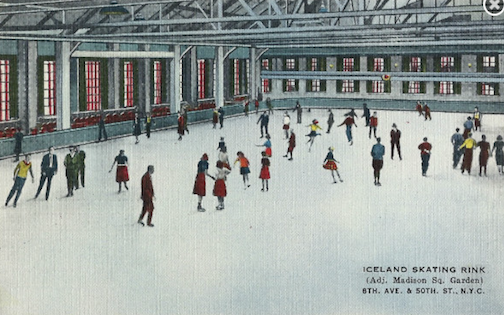
No one was landing quad flips at New York’s Ice House in 1933, but for ice skating enthusiasts it was the place to be for both figure skating competitors as well as for those just interested in a leisurely skate to the strains of a live orchestra. “The Talk of the Town” explains in this excerpt:

CHILLING SIGHT…Top and below, the Ice House was located on the top floor of a four-story building attached to Madison Square Garden. (Pinterest)

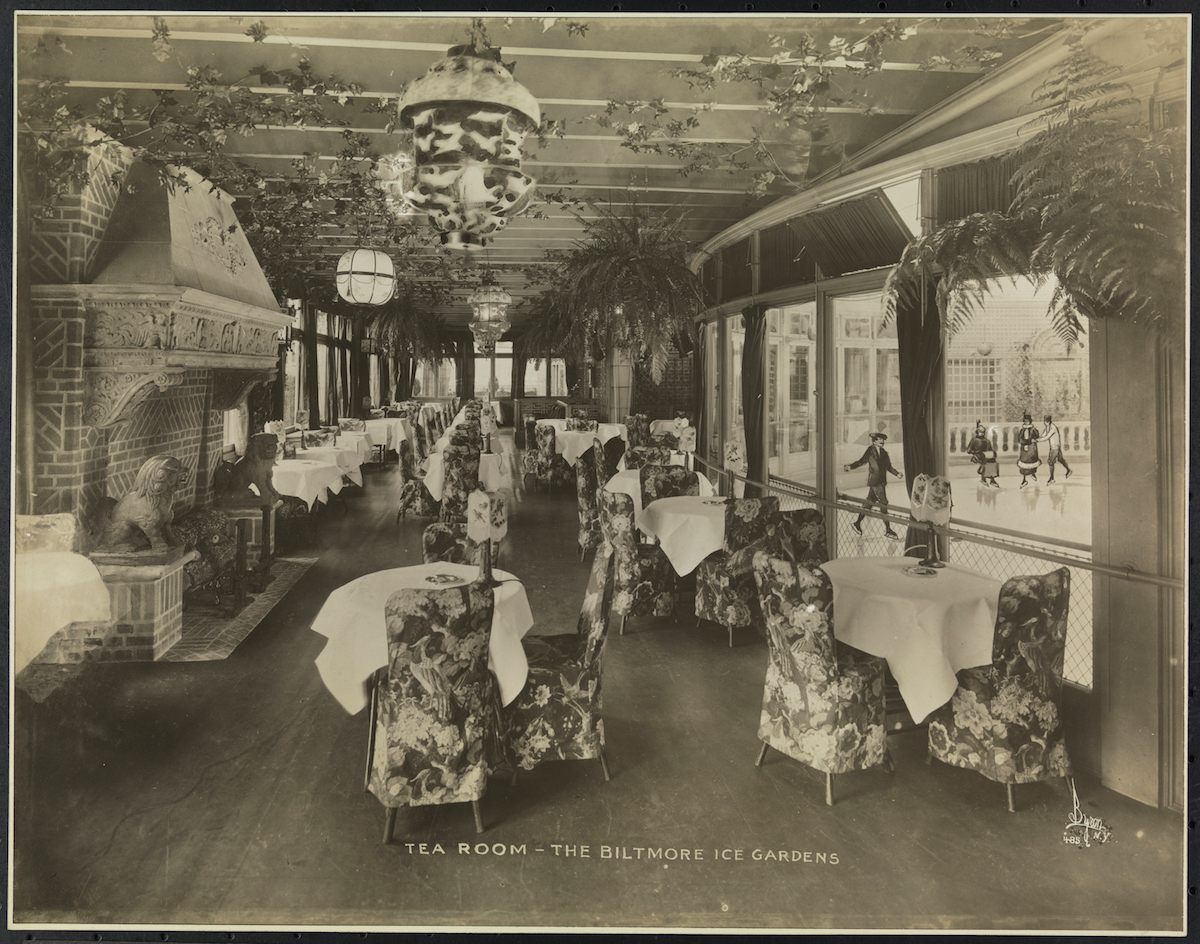
In both Europe and America ice skating in the 19th and early 20th century was something of an elaborate ritual in urban areas; skating rinks included tea rooms as well as places to dance or ice skate to the gentle rhythms of a live orchestra…

TEA COSY…The Biltmore Hotel Ice Gardens offered guests a warm place to watch the cold weather fun of the hotel’s outdoor ice skating rink, circa 1915. (mcny.org)

*  *  *

The Jig Is Up

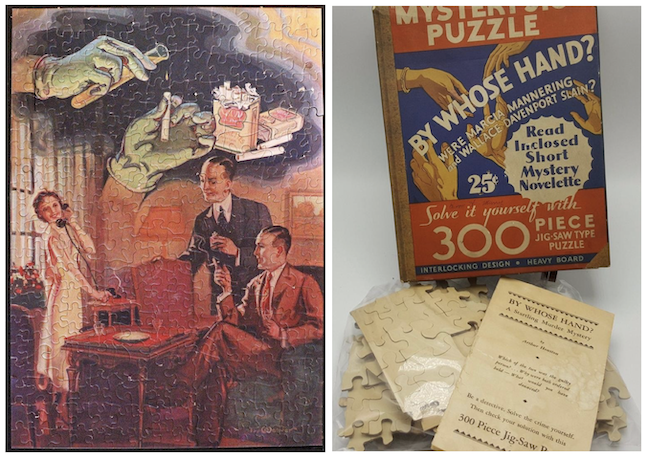
Jigsaw puzzles have been around since the late 1700s (they were handmade then), but their popularity really took off in the 20th century with advancements in manufacturing and especially during the Depression when folks sought affordable forms of entertainment they could enjoy at home. The 1930s also saw jigsaw puzzles become more complex. “The Talk of the Town” observed:

In 1933 the Long Island City-based puzzle manufacturer Einson-Freeman introduced a line of puzzles that included clues to solving mysteries described in an accompanying novelette…

(worthpoint.com)

*  *  *

Small But Deadly

Howard Brubaker’s “Of All Things” column, which ran from 1925 to 1951, was a series of brief, satirical comments on the events of the day, including some that to modern eyes point to the catastrophic events that awaited Brubaker’s world (reader Frank W. notes that “the ‘aged piano-player’ was Ignacy Paderewski, who had served as Prime Minister in the immediate aftermath of WWI, and who was the nearest thing the Poles had to a national-unity figure”):

*  *  *

Her Protégé

When Mae West adapted her 1928 Broadway play Diamond Lil into the 1933 film She Done Him Wrong, the puritanical backers of the Hays Code (which would be enforced in 1934) demanded that the film make no reference to the “scandalous” play. But because it was still the pre-Code era, West’s film featured many double entendres and her famous (and famously misquoted) quip, “Why don’t you come up sometime and see me?” That line was spoken to Cary Grant—whom West would later claim as her discovery even though Grant had drawn considerable attention in the previous year for his work opposite Marlene Dietrich in Blonde Venus. For the record, Grant, who would be paired again with West in 1933’s I’m No Angel, would later credit West, and She Done Him Wrong, for giving his career a major boost. New Yorker critic John Mosher lauded the film for the much-needed laughs it provided to Depression-weary audiences.

SHOWING HIM THE ROPES…The nearly forty-year-old Mae West was 11 years older than Hollywood newcomer Cary Grant when they appeared together in 1933’s She Done Him Wrong. The film was nominated for an Academy Award (Best Picture), and in 1996 was selected for preservation in the National Film Registry by the Library of Congress. (filmreference.com)

*  *  *

From Our Advertisers

The folks at Packard took a new advertising tack by demonstrating the durability of their luxury automobile…

…hopefully the Packard was riding on “Double Eagle” tires by Goodyear…however, this is an odd illustration to emphasize a child’s safety, when the kid’s posh mum seems more concerned about her appearance than anything else…also, does she plan to drive home with the windshield down?…

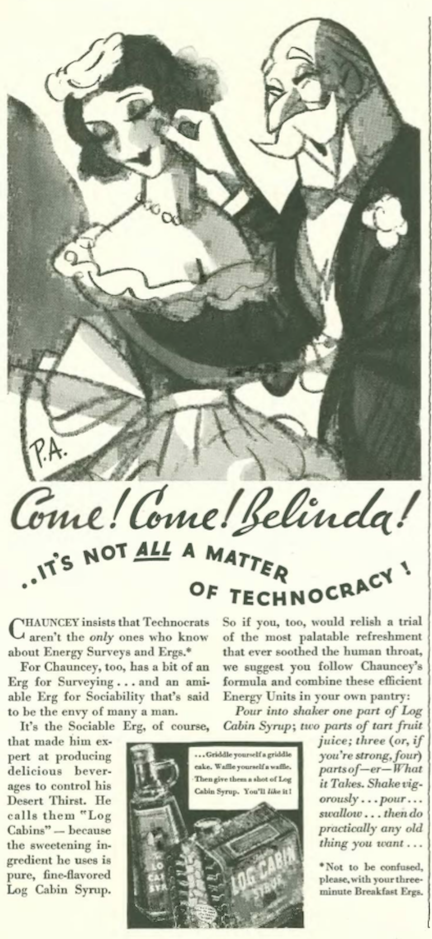
…Log Cabin continued its series of ads featuring New Yorker cartoonists…here Peter Arno lends one of his dirty old walruses to the cause of syrupy waffles and pancakes…

…on to our cartoonists, we have Arno again, keeping up appearances among high society…

Gluyas Willams demonstrated his knack for illustrating the foibles of his fellow citizens…

Helen Hokinson looked in on a man aspiring to become the next T.S. Eliot…

…the growing popularity of the gangster film knew no bounds, according to Perry Barlow

…and we close with James Thurber, and a speakeasy standoff…

Next Time: Deskey’s Deco…

Belle Geste

“Nobody said not to go” was a phrase often used by Emily “Mickey” Hahn when returning from one of her far-flung and often wild adventures.

Feb. 4, 1933 cover by Rea Irvin.

And nobody ever told Hahn (1905–1997) what she could write about, and so she wrote, with brio and authority, on a variety of subjects ranging from feminism, diamond mining, and animal behavior to Chinese history and cooking. The author of 54 books, Hahn also penned a number of biographies including those of Leonardo da Vinci, Chiang Kai-shek, and D. H. Lawrence among others. In the Feb. 4 issue Hahn wrote about spending the night at a New York flophouse, not out of necessity but rather to write about the experience. Excerpts:

NO RITZ, THIS…Entrance to a flophouse in the Bowery, photo by Walker Evans, 1934.

In the following two excerpts, Hahn described her sleepless night, and her exit from the flophouse the following morning…

More on Emily Hahn, who defied convention from the very start of her adult life: before graduating from the University of Wisconsin in 1926 (the first woman to earn a degree in mining engineering there), she drove across the U.S. in a Model T, dressed a man. She wrote about her experiences in letters to her brother-in-law who, unbeknownst to Hahn, shared them with New Yorker editors. This would lead to a longtime relationship with the magazine, to which she would contribute nearly 200 articles (and one poem) between 1929 and 1996. She would also serve as China correspondent from 1935 to 1943.

In 1930 she traveled to the Belgian Congo, where she lived for two years with a pygmy tribe while working for the Red Cross; she later crossed Central Africa alone on foot. In his 2006 memoir, Let Me FinishRoger Angell described Hahn as the magazine’s “Belle Geste,” a woman “deeply, almost domestically, at home in the world. Driven by curiosity and energy, she went there and did that, and then wrote about it without fuss.”

AT HOME IN THE WORLD…Clockwise, from top left, Emily “Mickey” Hahn poses with her pet gibbon, Mr. Mills, in Shanghai, circa 1935; undated photo with more of her furry friends; Hahn as a teenager, circa 1920; cover photo from her 1944 book, China to Me; Hahn in 1944 with her daughter Carola, following their return from occupied China. (Wikipedia/Lilly Library, Indiana U)

 *  *  *

Chief Stooge

Theatrical promoter Alfred Cleveland Blumenthal (1885–1957) was well-known to New Yorkers in the 1920s and 30s as a speakeasy owner, buddy to Mayor Jimmy Walker and husband to actress Peggy Fears. Although “Blumey” is largely forgotten today, in 1933 he merited a two-part profile by Alva Johnston. Here are excerpts from the opening lines:

ONLY THE SHADOW KNOWS…A.C. “Blumey” Blumenthal (at left in the light suit) was often seen shadowing Mayor Jimmy Walker in his role as chief counselor and chief stooge. Here the mayor is escorted by Blumey and New York’s finest during corruption hearings in 1931. At right, Blumey’s wife Peggy Fears (1903–1994) in her most notable film role, 1935’s The Lottery Lover. Their tempestuous marriage lasted from 1927 to 1950. (avenuemagazine.com)

 *  *  *

Coward’s Ménage

Playwright Noel Coward existed in the orbit of the Algonquin Round Table, so it was doubtless challenging for Robert Benchley to critically review his friend’s work. Fortunately, Benchley found Design For Living mostly to his liking. Note how Benchley subtly refers to the play’s gay subtext, and to the fact that it mirrored the real-life relationships of the play’s trio.

THREE’S COMPANY…A studio in Paris. A penthouse in New York. A flat in London. These were the settings for Noël Coward’s play Design for Living at the Ethel Barrymore Theatrewhich starred the wife-husband team Lynn Fontanne and Alfred Lunt and their close friend Coward in a Broadway run of 135 performances from January to May 1933. (Vandamm theatrical photos via wisc.edu)

Benchley did have a few quibbles, but reasoned there was no need to be overly critical when there was such a dearth of quality stage entertainment. Note the great caricatures by Al Frueh (below) that accompanied the review.

Benchley had a different sort of dilemma criticizing Elmer Rice’s earnestly patriotic We, the People, a play about the misfortunes of a working class family in Depression America.

Rice, who won the Pulitzer Prize for Drama in 1929, was an occasional contributor to The New Yorker from 1929 to 1931, including his sci-fi satire on the film industry, Voyage to Purila, which was serialized in eleven installments (with illustrations by Peter Arno) in The New Yorker from Oct. 12 to Dec. 21, 1929.

LET’S MAKE A MOVIE…Elmer Rice (standing) joins theatre producer Joseph P. Bickerton, Jr. (left), and Universal’s Carl Laemmle Jr. to sign a contract for the film version of Rice’s 1931 Broadway play Counsellor at Law. The film proved to a critical success. (Wikipedia)

Meanwhile, film critic John Mosher was trying his best to enjoy the latest Hollywood fare, another Broadway play adapted to the silver screen. Whistling in the Dark…

MURDER MOST AMUSING…The 1933 American pre-Code comedy-mystery film Whistling in the Dark starred Ernest Truex and Una Merkel. (IMDB)

However, Mosher was surprisingly enthused by the rustic charms of Iowa country folk in State Fair…

THE TRIUMPH OF PRIZE PICKLES and other delights awaited viewers of 1933’s State Fair, which gave star billing to Will Rogers and Janet Gaynor. At right, Lew Ayres sweet-talks Gaynor at the fairgrounds. (IMDB)

 *   *   *

Form Follows Function

E.B. White paid close attention to all the little details of daily life, including the advertisements that appeared in The New Yorker. In “The Talk of the Town” he wrote about a Camel ad that inspired a sudden fashion trend:

…here is the Dec. 24, 1932 New Yorker ad to which White referred:

 *   *   *

From Our Advertisers

We keep our cigs lit for our first ad, from Lucky Strike, keeping it simple with their familiar slogan…

…this ad from Powers Reproduction shows us the beach caps that were all the rage in the early ’30s…

…this may look like an old car to modern eyes, but in 1933 these sweeping curves were la dernière mode in the auto world…

…and then there was Hupmobile, trying its best to stay relevant in the Depression…

…the company folded in 1939, but a few reminders live on…

HUP HUP HOORAY…The 1917 Hupmobile dealership at 25th and Farnam in Omaha, NE, was located along the old Lincoln Highway and is the last preserved Hupmobile dealership in the United States. On the National Register since 2014, it now houses apartments. (Flickr)

…Valentine’s Day was just around the corner, so time to buy your sweetheart something special, like this scarf that was all the rage among the Miami snowbirds…

…Greenwich Village restaurateur and personality Don Dickerman took out this two-page ad to trumpet his partnership with puppeteer and illustrator Tony Sarg at the Bohemia restaurant on Broadway…

…the German-American Sarg is also known as the creator, in 1927, of the first giant balloons for Macy’s Thanksgiving Parade…

THE OLD GASBAG…Tony Sarg (upper right hand corner) and assistants painting one of his Macy’s parade balloons. (Fotograms News Photo Service via Pinterest)

…on to our cartoons, and what a big day for The New Yorker…the Feb. 4, 1933 issue featured the first captioned cartoon by Charles Addams

…for the record, Addams’s very first contribution to the magazine was this spot illustration (below) featured on page 65 of the Feb. 6, 1932 issue…

…one of the original contributing artists to The New Yorker, Gardner Rea, continued his skewering of America’s plutocrats…

William Steig took us before the bench to make an honest plea…

James Thurber gave us another skirmish between the sexes…

…and recalling my Jan. 12 post (about the Jan. 7, 1933 issue), in which the puritans got their knickers in a bunch over Robert Laurent’s Goose Girl sculpture in the Radio City Music Hall lobby…

…we end with Helen Hokinson, inspired by Laurent’s work…

Next Time: Role Reversal…