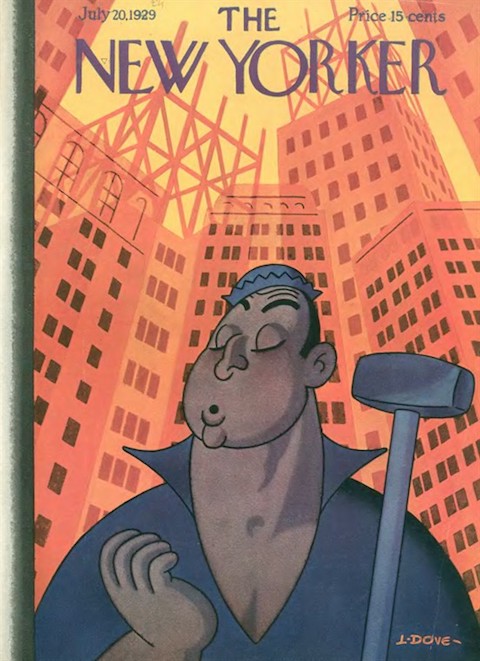
A Glimpse of the Future

Just nine days after the stock market crash, three women opened a new museum on Fifth Avenue that would play a major role in defining the type of city that would emerge from the other side of the Depression and World War II.

Nov. 23, 1929 cover by Theodore Haupt.

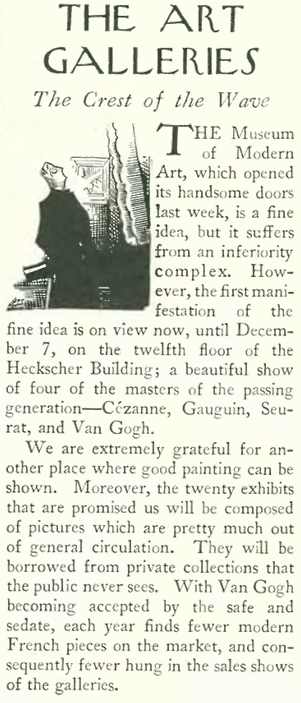
These visionary women would borrow works from modernists of the past century — the post-impressionists —  to stage the first-ever exhibit of the Museum of Modern Art. Abby Aldrich Rockefeller, along with her friends Lillie P. Bliss and Mary Quinn Sullivan, had rented six rooms on the 12th floor of the Heckscher Building, and on Nov. 7, 1929, they opened the doors to the museum’s first exhibition, simply titled Cézanne, Gauguin, Seurat, Van Gogh. The New Yorker’s art critic Murdock Pemberton was on hand for the opening:
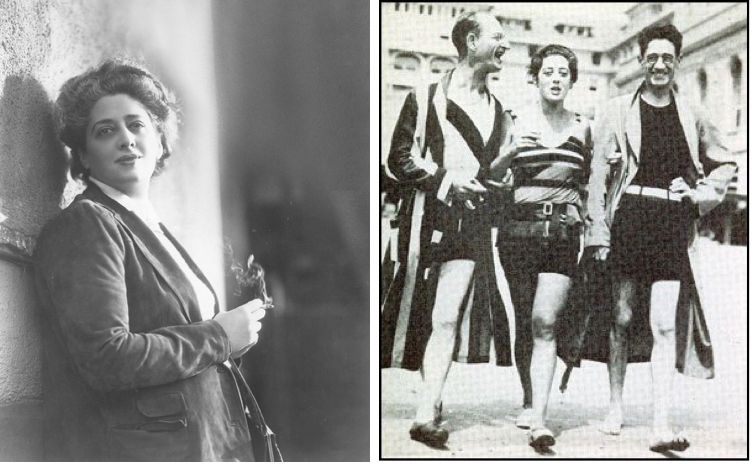
THE FOUNDERS…Mary Sullivan, Lillie Bliss and Abby Rockefeller, known socially as “the daring ladies,” founded the Museum of Modern Art in 1929. (virginiafitzgerald.blogspot.com/MoMA)
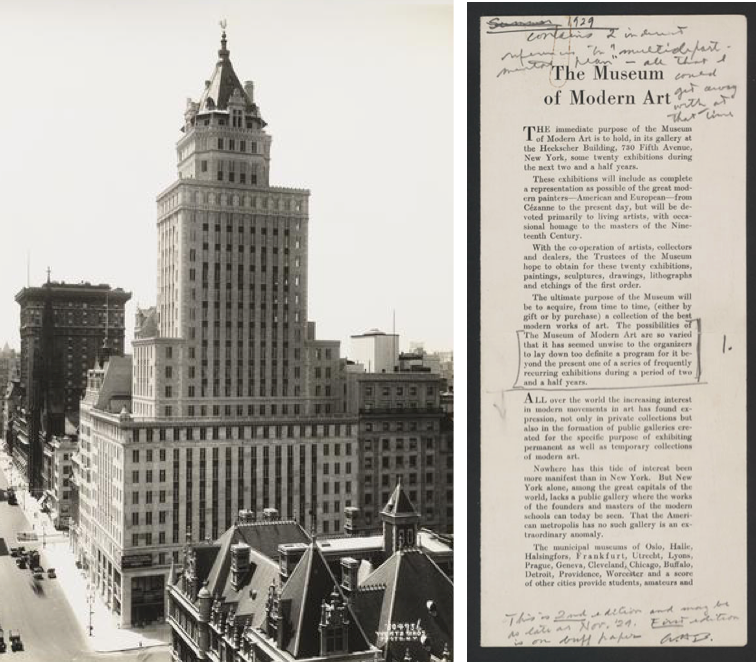
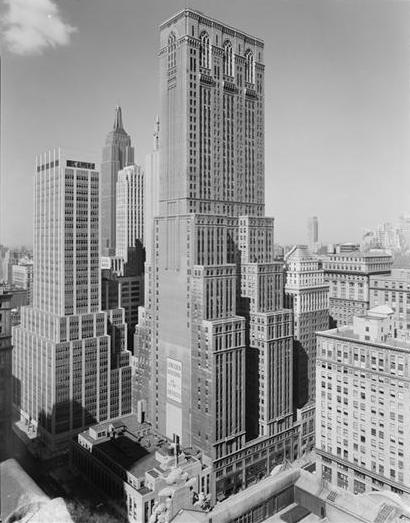
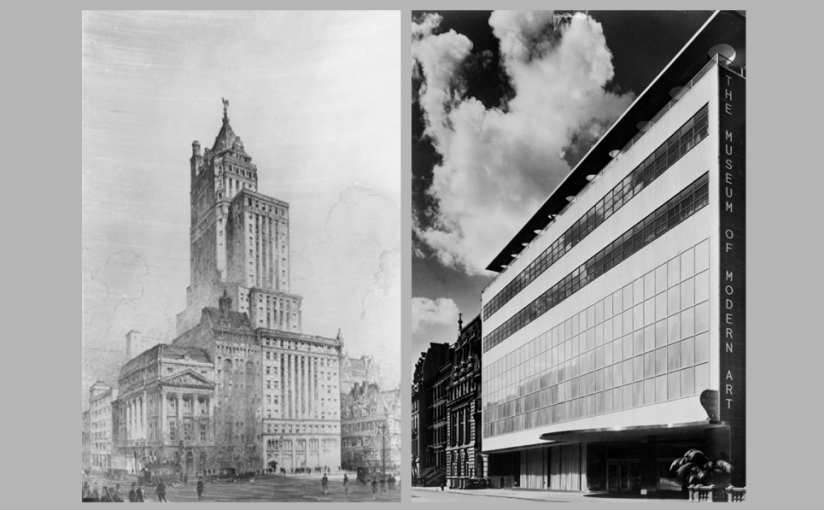
OLD AND NEW…The 12th floor of the Heckscher Building (now called the Crown Building) at Fifth Avenue and 57th Street served as the first location of the Museum of Modern Art. The 1921 building was designed by Warren and Wetmore, the same architects who designed Grand Central Terminal. Note in the foreground the rooftop of the Vanderbilt mansion, demolished in 1926 to make way for the Bergdorf Goodman department store; at right, a page from the new museum’s brochure. (Museum of the City of New York/MoMA)

The gallery rooms in the Heckscher were modest — although Abby’s husband was John D. Rockefeller Jr., she had to find funding on her own (he was opposed to the museum, and to modern art). In his review, Pemberton noted the “inferiority complex” that had already set in at the new museum, which took a preemptive swipe at the Met in its pamphlet (pictured above):

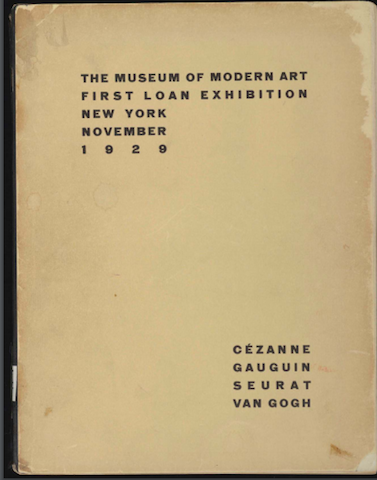
AMBITIOUS…Although the museum was small and had no curatorial departments, MoMA produced a 157-page exhibition catalogue for its first show. (Image and text courtesy MoMA)
MODEST BEGINNINGS…MoMA’s first gallery spaces on the 12th floor of the Heckscher Building were indeed modest, as these photos of the first exhibition attest. (MoMA)
HOW THEY LOOKED IN COLOR…Works featured in MoMA’s first exhibition included The Bedroom (1889) by Vincent Van Gogh, and Pines and Rocks (c. 1897), by Paul Cézanne. (Art Institute of Chicago/MoMA)

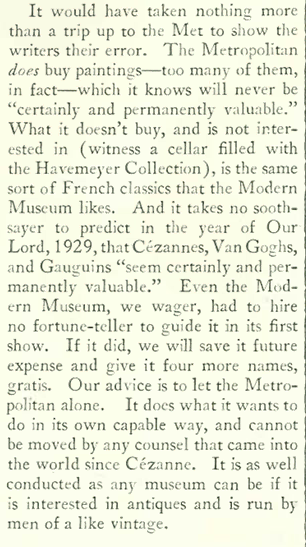
Pemberton attempted to set MoMA straight regarding the Met’s reputation:
HOME AT LAST…After moving three times over the course of ten years, the Museum of Modern Art finally found a permanent home in Midtown in 1939. Although Abby Rockefeller’s husband, John D. Rockefeller Jr., was initially opposed to the museum, he eventually came around and donated the land for the 1939 museum (designed by Philip L. Goodwin and Edward Durell Stone) and became one of the museum’s biggest supporters. (MoMA)

Less than three years later, the museum would point to the world to come in 1932’s Modern Architecture: International Exhibition, curated by Philip Johnson and Henry-Russell Hitchcock. The exhibition showcased an emerging architectural style that would dominate the New York skyline in the postwar years.
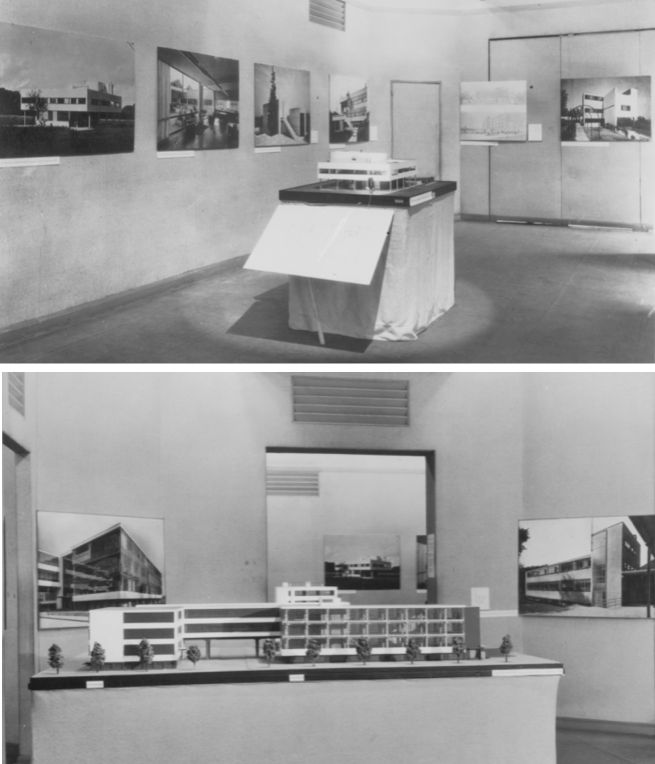
Top, model of Le Corbusier’s Villa Savoye from MoMA’s 1932 Modern Architecture: International Exhibition; below, model and photographs of works by Walter Gropius. Both architects would have major influences on the postwar New York skyline. (MoMA)

A footnote: The Museum of Modern Art hosts a remarkable website that features photographs of 4,875 exhibitions (plus images of catalogs and other materials) from 1929 to the present.

*  *  *

That’s Entertainment?

Theater critic Robert Benchley was looking for something to take his mind off the economic collapse, but he wasn’t finding it on Broadway. He found the drama Veneer to be depressing, and apparently so did a lot of other theatergoers; it closed the next month after just 31 performances at the Sam Harris Theatre:

NO LAUGHS HERE, EITHER…Joanna Roos and Osgood Perkins during a 1930 performance of the Chekhov play Uncle Vanya at the Cort Theatre. Roos was also in 1929’s Veneer, and she was singled out for praise by critic Robert Benchley, who otherwise found the play depressing. (New York Public Library)

Benchley also found little cheer in the play Cross Roads, which also closed the next month after just 28 performances at the Morosco Theatre:

FOR CRYING OUT LOUD…Actress Sylvia Sidney bawled out her lines in Cross Roads. (Photoplay, 1932)

Benchley finally found something to laugh about at the Alvin Theatre, which featured the musical comedy Heads Up! Tellingly, it ran much longer than its more somber competition: 144 performances…

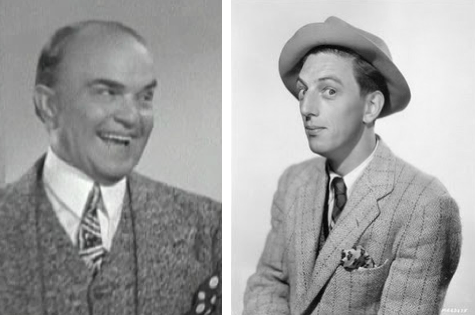
CLOWNS…Victor Moore, left, and Ray Bolger delivered comic relief in Heads Up! Both actors provided much-needed levity on the Broadway stage during the Depression. (movie-mine.com/Pinterest)

 *  *  *

Ideas for a Post-Crash Christmas

Creighton Peet (1899-1977) was best known as an author of books for young people with titles ranging from Mike the Cat (1934) to How Things Work (1941). A regular contributor to The New Yorker from 1925 to 1957, in the Nov. 23 issue Peet offered up some suggestions for a post-crash Christmas in a short piece titled “Helpful Hints for Marginaires.” An excerpt:

The recent market crash was also on the mind of Howard Brubaker. In his weekly column, “Of All Things,” he looked for divine guidance…
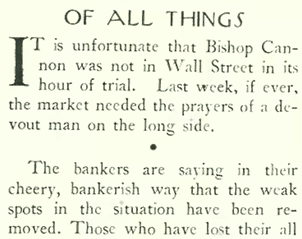
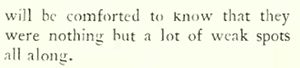
CAN YOU PUT IN A GOOD WORD? James Cannon Jr. was a bishop of the southern Methodist Church and a relentless advocate of Prohibition. (encyclopediavirginia.org)

…in the wake of recent elections, Brubaker also made this observation about voting rights in the South…

 *  *  *

Solace of the Silver Screen

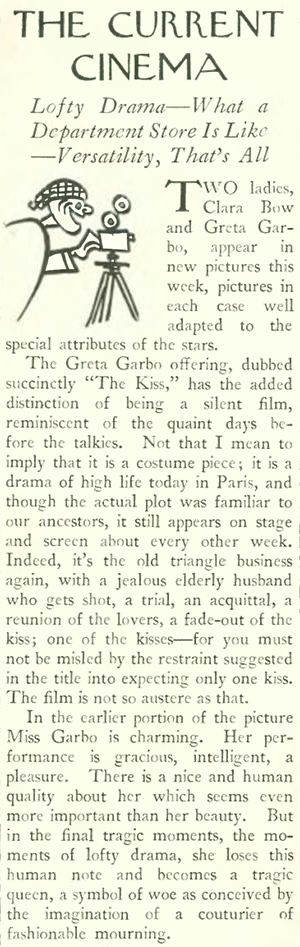
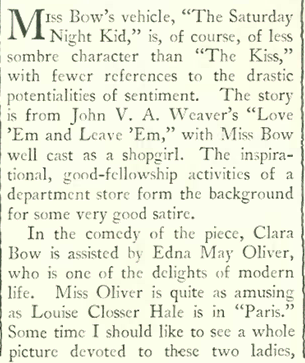
Americans would turn to the movies for a much-needed distraction from their economic woes, and critic John Mosher found a couple of mild diversions starring Greta Garbo and Clara Bow

MUM’S THE WORD…Greta Garbo and Lew Ayres in The Kiss. The film was a rare silent in the new age of the talkies (although it did feature a Movietone orchestral score and sound effects). Audiences would have to wait until 1930’s Anna Christie to hear the voice of Garbo. (IMDB)
PLEASE PASS THE BITTERS, DEAR…Greta Garbo and Anders Randolf trapped in a loveless marriage in The Kiss. (IMDB)

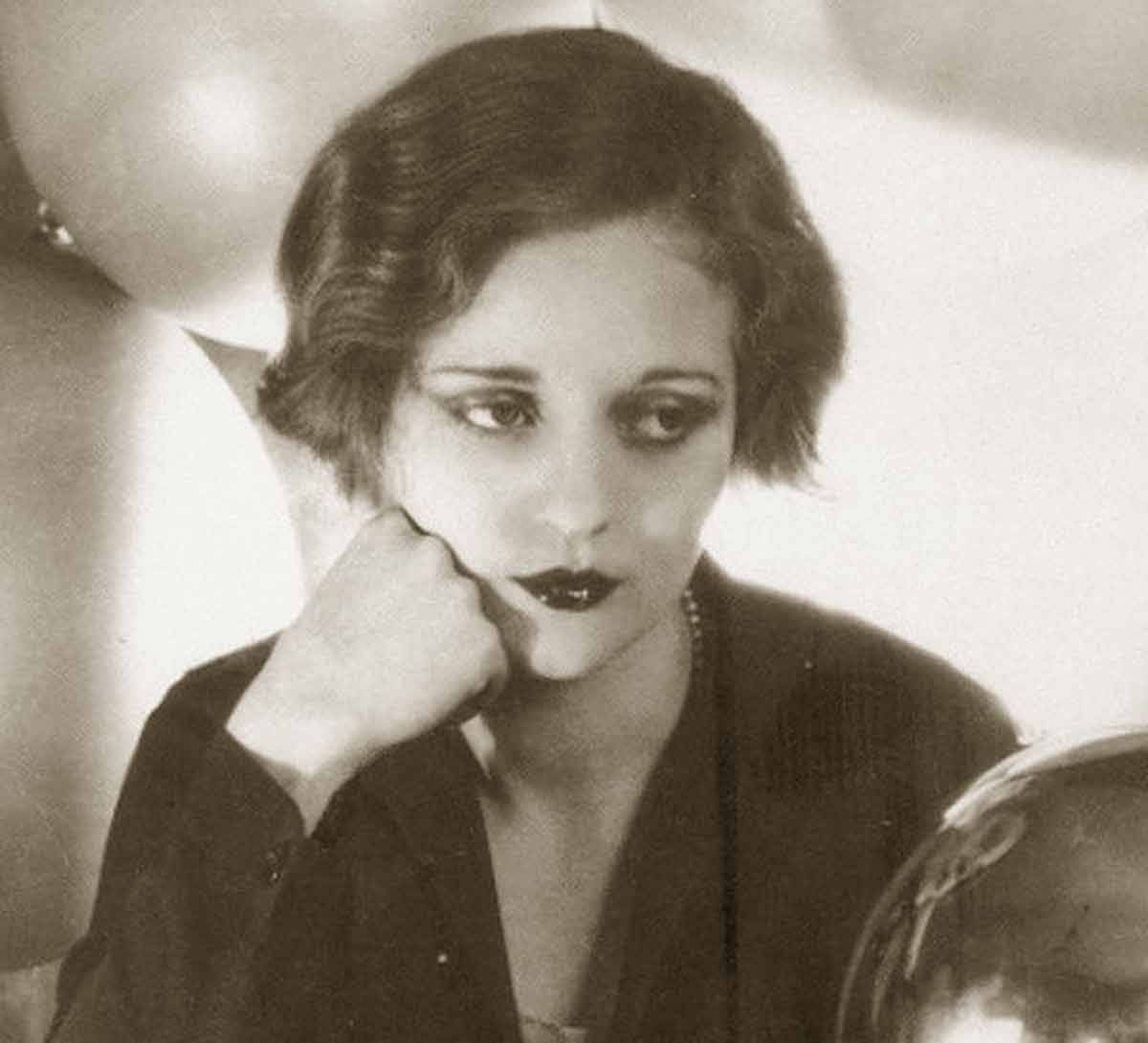
For a few laughs, moviegoers could check out Clara Bow’s second talkie, The Saturday Night Kid. A sex symbol of the Roaring Twenties, Bow’s career began to wane with the advent of the talkies and the onset of the Depression. Her kind would be eclipsed by a new type of sex symbol — the platinum blonde — embodied by the likes of Jean Harlow, who also appeared in The Saturday Night Kid, her first credited role…
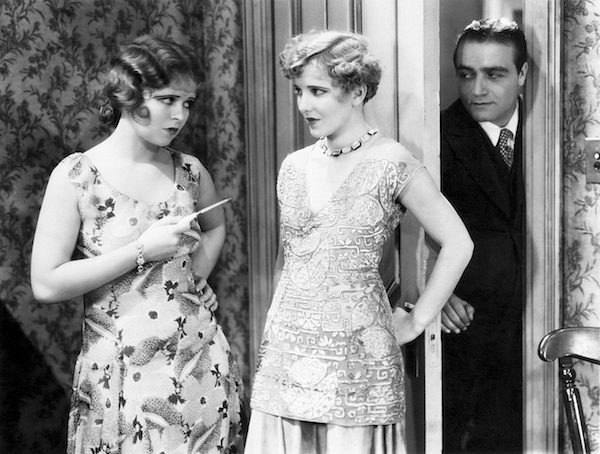
SIBLING RIVALRY…Sisters Mayme (Clara Bow) and Janie (Jean Arthur) vie for the affections of next door neighbor William (James Hall) in a scene from The Saturday Night Kid. (doctormacro.com)
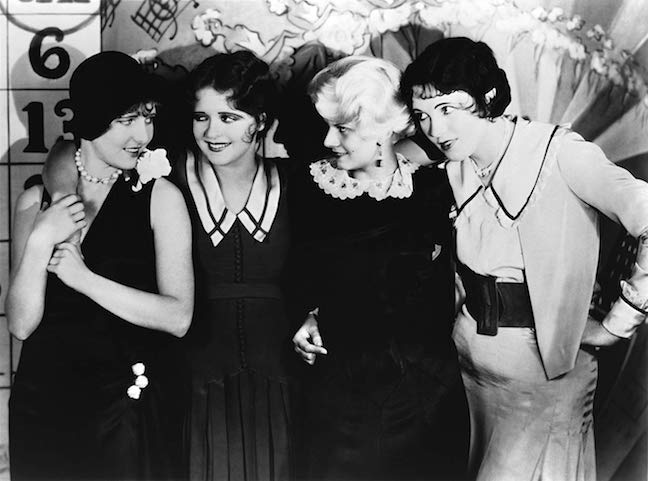
SATURDAY NIGHT FEVER…Jean Arthur, Clara Bow, Jean Harlow and Leone Lane in a publicity photo for The Saturday Night Kid. (IMDB)

*  *  *

From Our Advertisers

We begin with a couple of ads featured on back-to-back pages of products that no longer exist — the first promotes the use of Ethyl gasoline to increase performance and eliminate engine knock. Ethyl (tetraethyl lead) — a big contributor to soil, air and water lead pollution — was removed from gasoline beginning in the 1970s…the Marmon Motor Car Company introduced a more affordable (under $1,000) car to New Yorker readers in 1929, but it was too late for the struggling company, which due to the Depression folded in 1933…

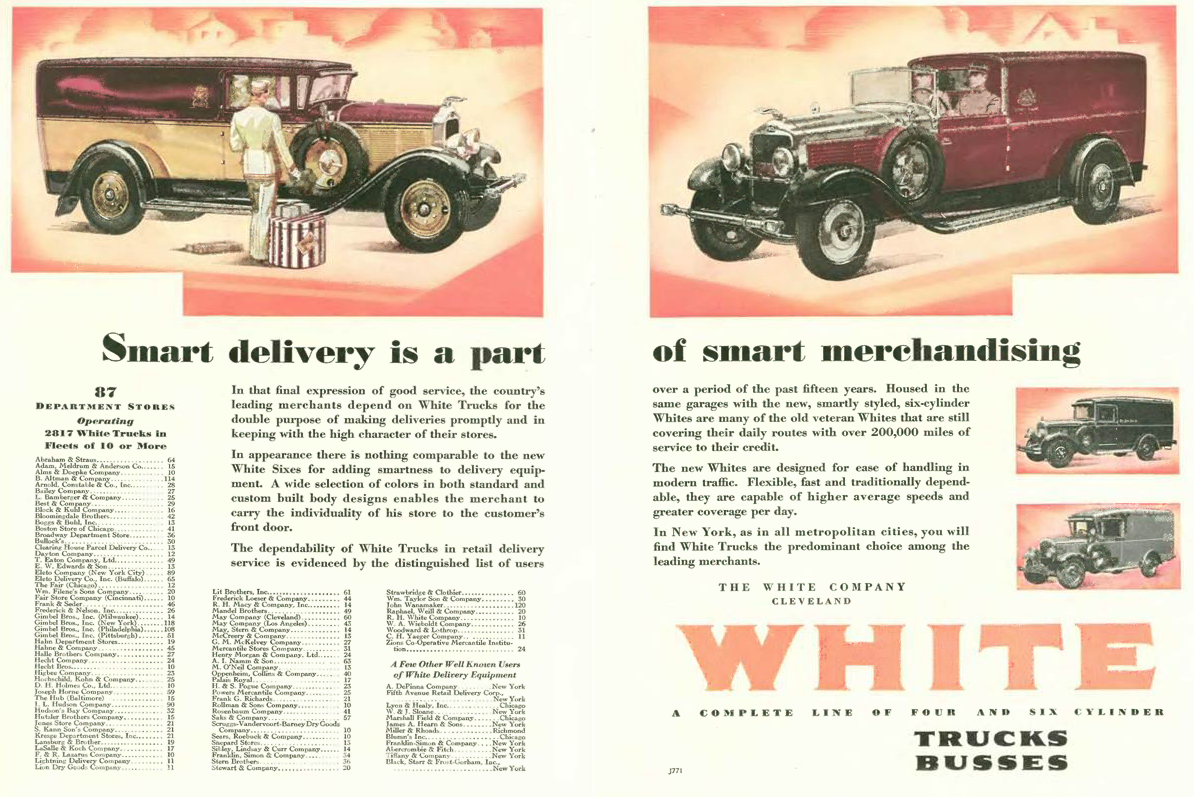
…this seems an unusual ad for the New Yorker, but then again perhaps the White Company hoped to reach well-heeled readers who were also owners of companies in need of such things, although it is doubtful a lot of truck-buying was taking place after the crash…
…the 1920s are considered a golden age for American road-building, but if you wanted to travel across country, the national highway system was limited to just a few, mostly two-lane routes…

…with their frayed nerves, folks were doubtless smoking like chimneys…the makers of Fatima cigarettes acknowledged the pain felt by the market crash, while nevertheless justifying the higher cost of their brand…

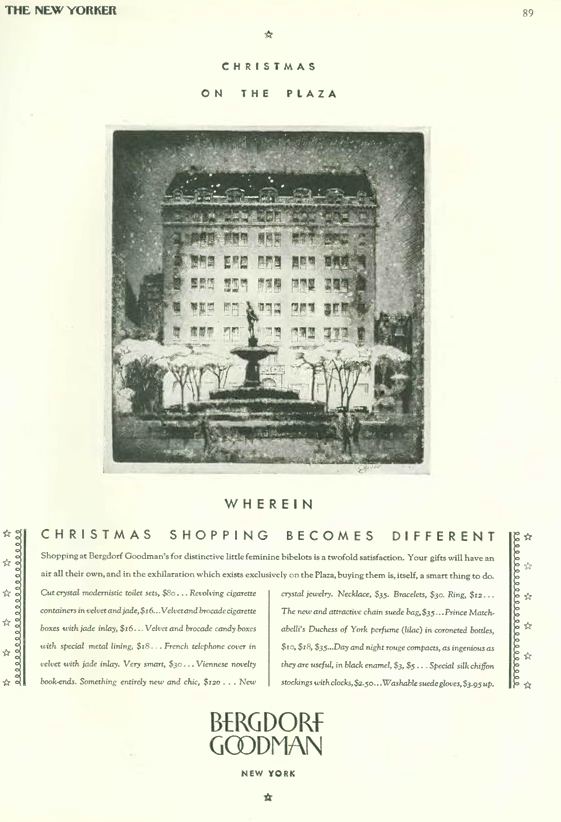
…the holiday season was fast-approaching, and Bergdorf Goodman was ready to set the mood…
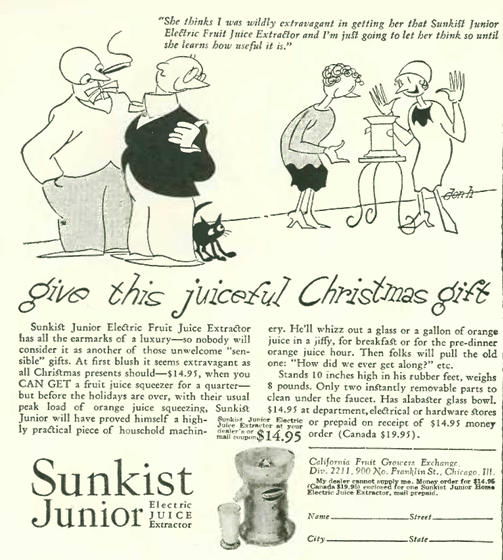
…on the lower end of the scale, the California Fruit Growers offered up this dandy “juice extractor” as the gift to delight a loved one (with illustration by Don Herold)…
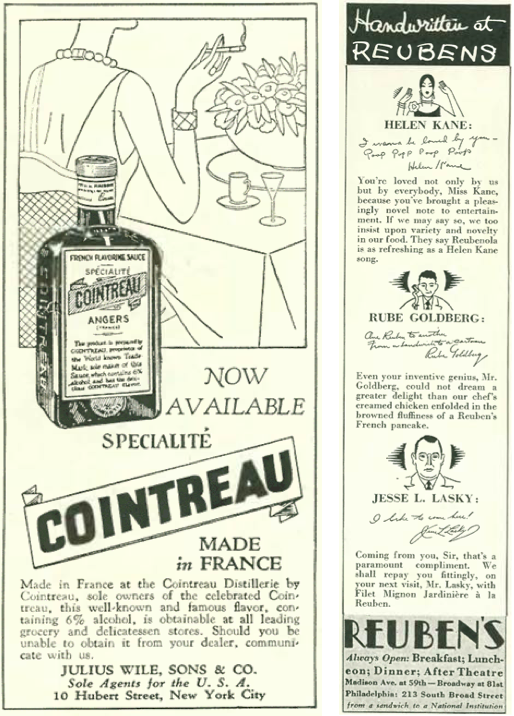
…I suppose given its quasi-medicinal (digestif) qualities, Cointreau was able to sell their product at 6% alcohol content to dry Americans (although the full- strength Cointreau, not legally available to Americans, was rated at 40%)…at right, another back page ad from Reuben’s restaurant, with more handwritten endorsements from stars including singer Helen Kane (Boop-Boop-a-Doop), cartoonist Rube Goldberg, and Paramount Studio co-founder Jesse Lasky

Helen Hokinson’s society women were featured in two separate ads in the Nov. 23 issue…
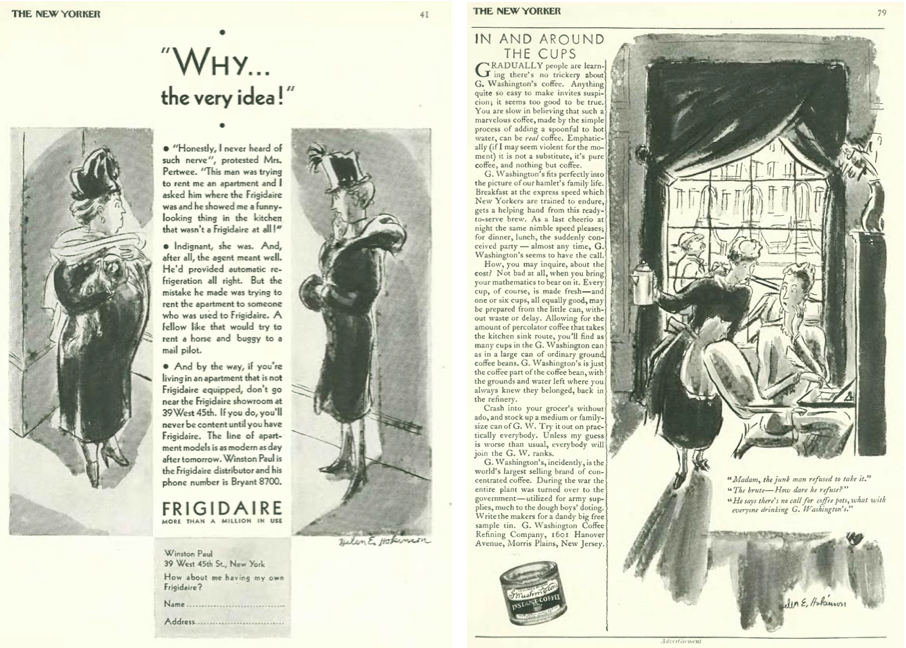
…and the folks at Frigidare got an extra plug thanks to Leonard Dove

Lois Long’s “On and Off the Avenue” column began to grow in length as the holiday season approached, peppered with spot drawings including these two by Julian De Miskey and Barbara Shermund

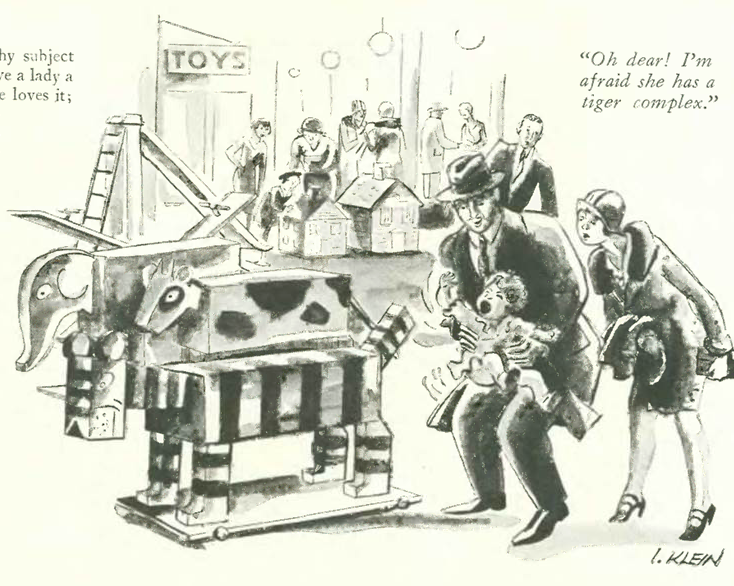
…and Isadore Klein offered his own take on the holiday shopping scene…
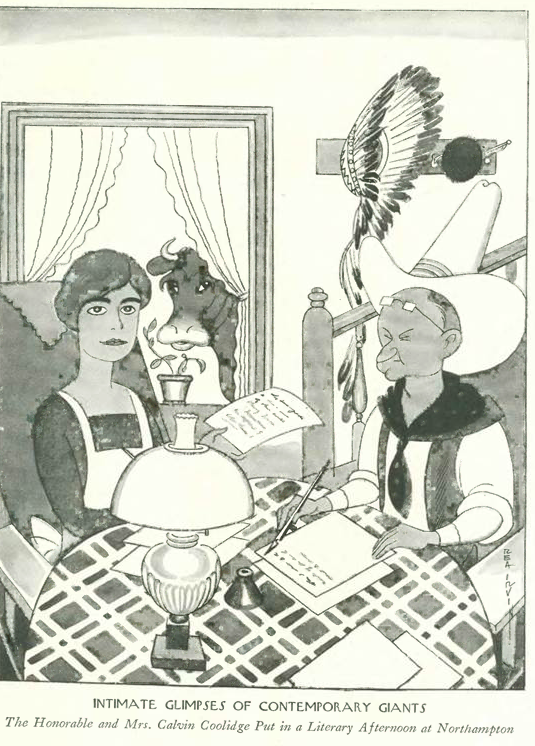
Rea Irvin reprised his folk-satirical approach to life at the Coolidge house…
John Reynolds found more humor in the clash of cultures…

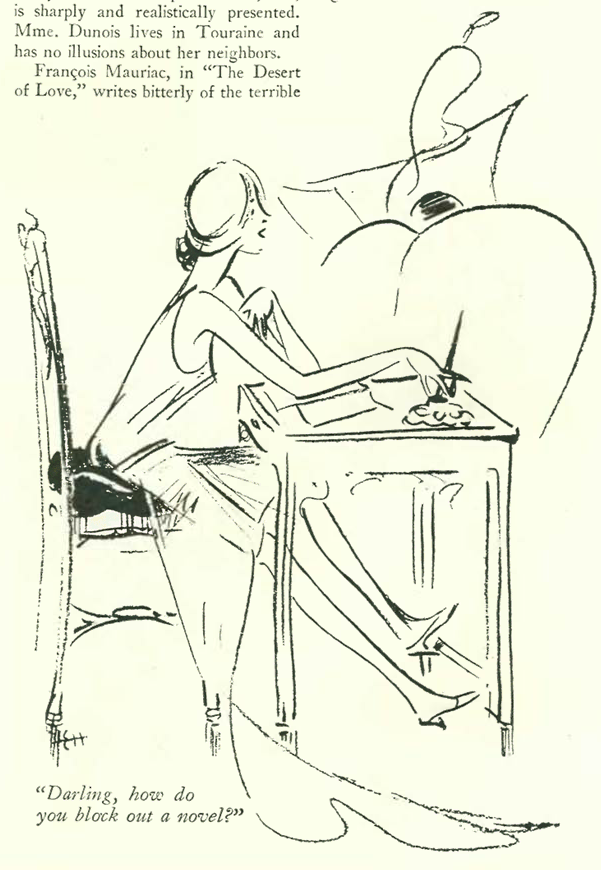
Helen Hokinson contributed this very modern rendering of writer’s block…
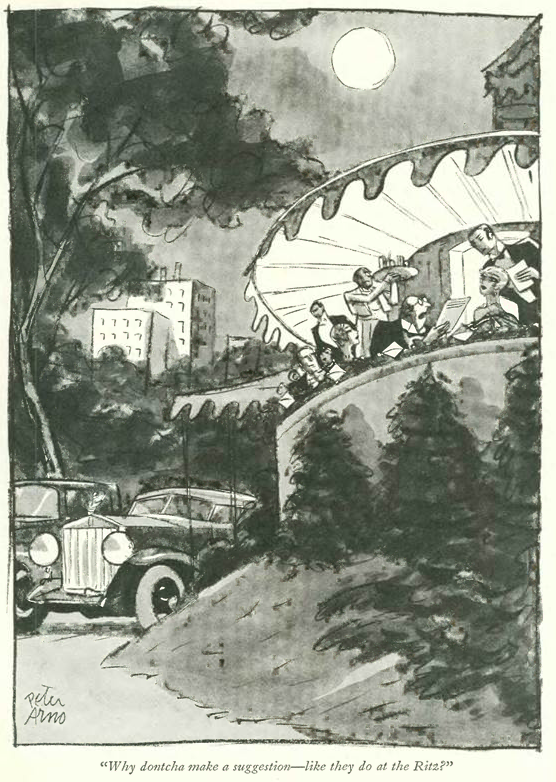
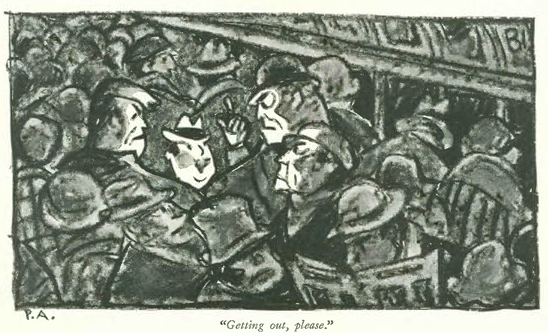
…and Peter Arno looked in on the challenges of commuting…
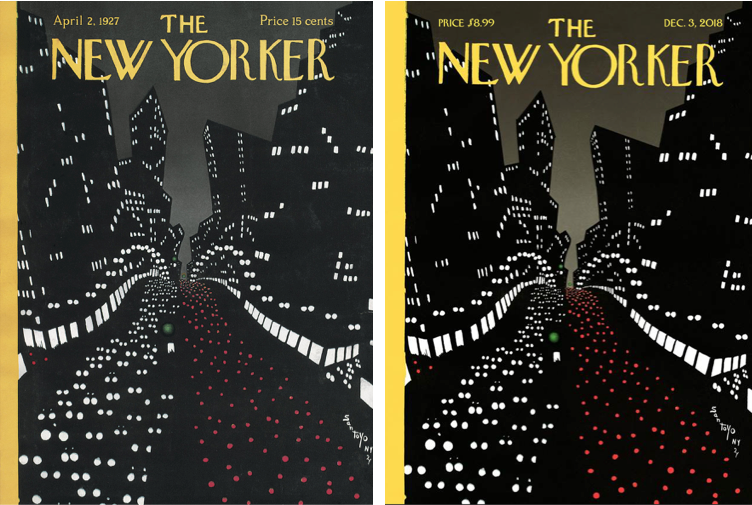
…and a quick note regarding a recent issue of The New Yorker (Dec. 3, 2018)…the cover featured a reprint of a Matias Santoyo cover from April 2, 1927…very cool…
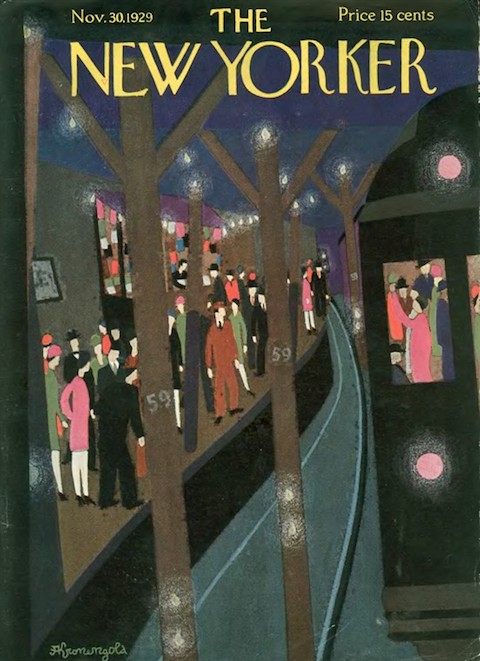
Next Time: Mrs. Parker and the Vicious Writer…


Son of Hammerstein

The Hammerstein name looms large in the history of both stage and screen, an extended family of theater impresarios and composers descended from the German-born Oscar Hammerstein I (1846 – 1919).

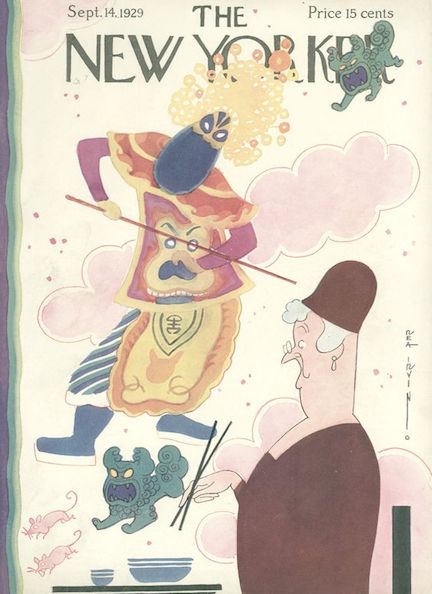
Sept. 14, 1929 cover by Rea Irvin.

It was Oscar’s son, Arthur Hammerstein (1872 – 1955), who would bring the nostalgic musical Sweet Adeline to the Broadway stage, with music by Jerome Kern. Arthur’s nephew, Reginald Hammerstein, directed, and Reginald’s brother, Oscar Hammerstein II, provided the lyrics (and would later collaborate on such Broadway hits as Oklahoma! and The Sound of Music). Sweet Adeline opened on Sept. 3, 1929 at Arthur’s Hammerstein Theatre (known today as Ed Sullivan Theater), and the New Yorker’s Robert Benchley was on hand for opening night…

The title of the musical was a pun on the famous barbershop quartet song first published in 1903 — a time that seemed quaint to Jazz Agers. To get a sense of how rapidly American society had changed in the 1920s, in the paragraph above, Benchley referred to the musical’s setting (1898) as “old-time.” I’m not sure we would refer to 1987 as “old-time,” but who knows? Benchley continued…

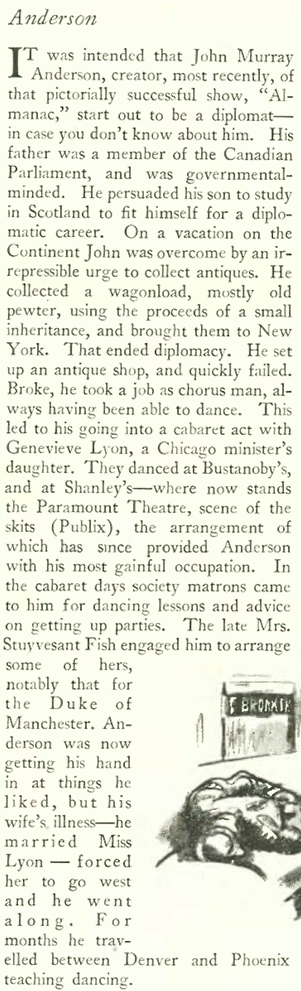
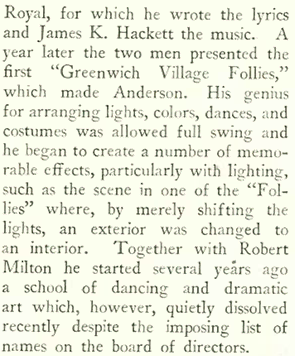
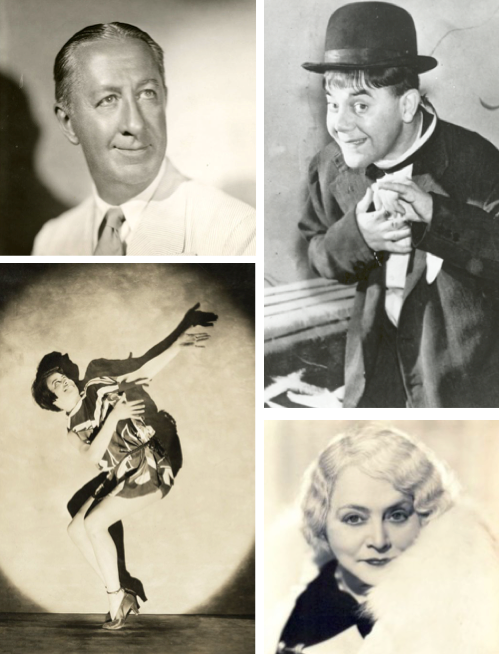
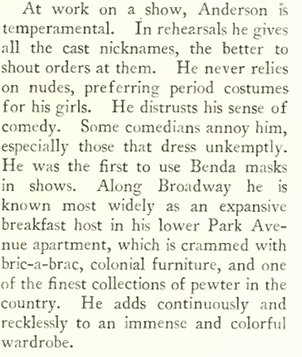
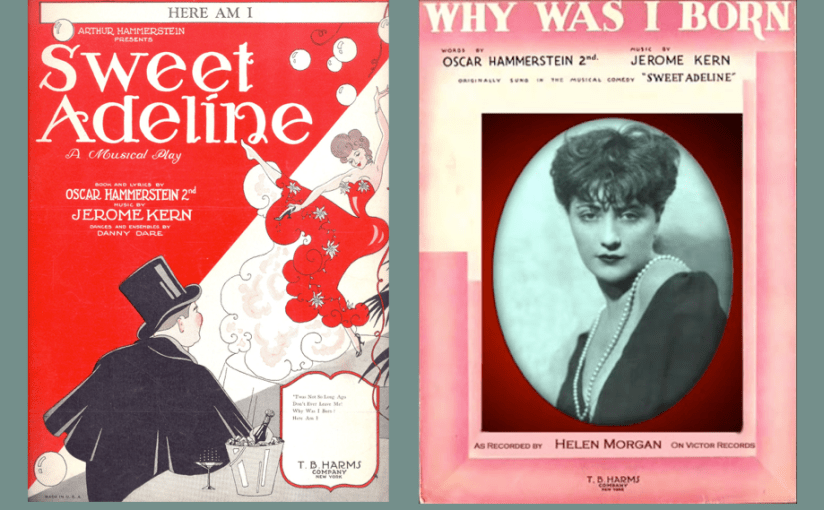
OLD-FASHIONED FUN…Clockwise, from top left, the famed 1920s torch singer Helen Morgan (pictured on sheet music for one of her songs from the musical) starred as “Addie” in 1929’s Sweet Adeline; Arthur Hammerstein in undated photo; stage and screen actress and vaudeville comedian Irene Franklin portrayed a burlesque queen in the musical, while comedic actor Charles Butterworth played the part of a “young rounder.” (YouTube/findagrave.com/Wikipedia/lbarsanti.wordpress.com)

As for the performances by Helen Morgan (who more or less invented the torch singer’s boozy, draped-over-the-piano style), Benchley noted that her personality was “almost oppressively lush at times”…

A note regarding Helen Morgan: She began her career singing in Chicago speakeasies before moving to New York in the mid-1920s, where she continued to sing in nightclubs (including one attached to her name, Chez Morgan) while also performing on Broadway. Morgan became a heavy drinker, and was often drunk during performances (hence Benchley’s comment regarding her “lush personality”). Cirrhosis of the liver would claim Morgan’s life in 1941. The same disease would claim Benchley four years later.

 *  *  *

While we are the topic of Broadway, the Sept. 14 “Talk of the Town” featured a brief profile of John Murray Anderson, (1886 – 1954) who was celebrating the success of his own Broadway musical revue Almanac

HE WORE MANY HATS…John Murray Anderson made his Broadway debut in 1919 as writer, director, and producer of The Greenwich Village Follies, which had a five-year run. At left, a cover for sheet music from a 1920 production. At right, postcard image of the Follies from 1922. (Pinterest)

In this excerpt, “Talk” recounted how Anderson finally hit it big in 1919 with his Greenwich Village Follies. It noted that he had a “genius”…

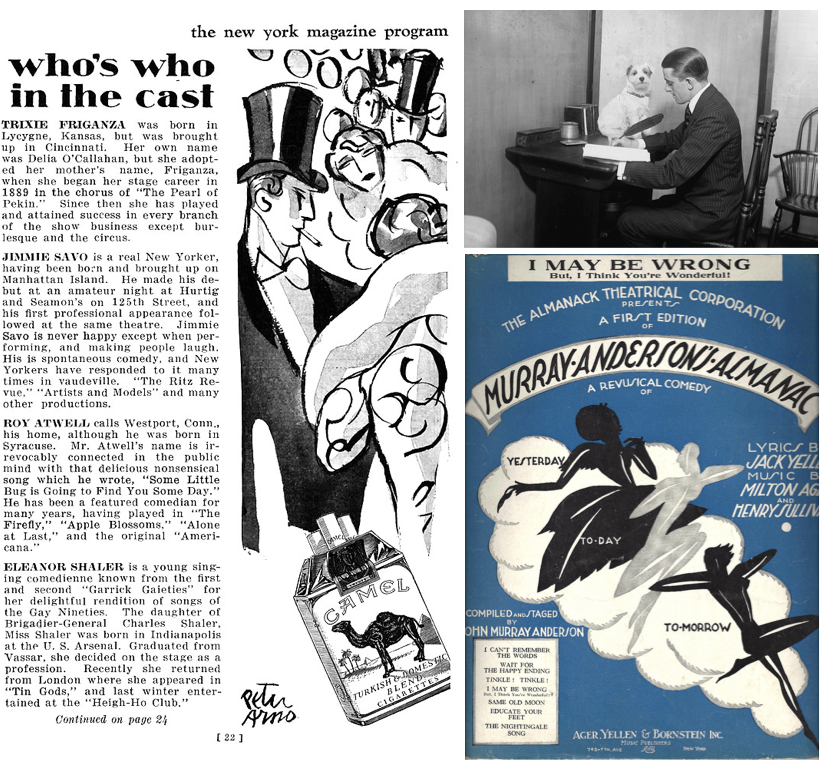
Clockwise from top left, Almanac featured comedians Roy Atwell and Jimmy Savo; singer and comedian Trixie Friganza; and actress Eleanor Shaler. (royatwell.net/American Vaudeville Museum/secondhandsongs.com/Pinterest)

…and a bit more about Anderson…

In Michael Maslin’s terrific book, Peter Arno: The Mad, Mad World of The New Yorker’s Greatest Cartoonist, Maslin notes that Arno “was whisked onto the Manhattan theater scene by Murray Anderson, whose twenty-nine scene Almanac opened to excellent reviews at the two-year-old Erlanger Theater, just off Times Square.” Maslin cites the famed New York columnist O.O. McIntyre, who wrote “Arno was one of several ‘conspirators’ responsible for Broadway backdrops whose ‘exaggerated whimsicalities…in black and white…when unfolded usually get what Variety calls a belly laugh.'”

At left, Peter Arno contributed this advertisement for Camel cigarettes in the Playbill edition for Almanac; top right, John Murray Anderson at work; cover for sheet music from the revue. (attemptedbloggery.blogspot.com / Wikipedia)

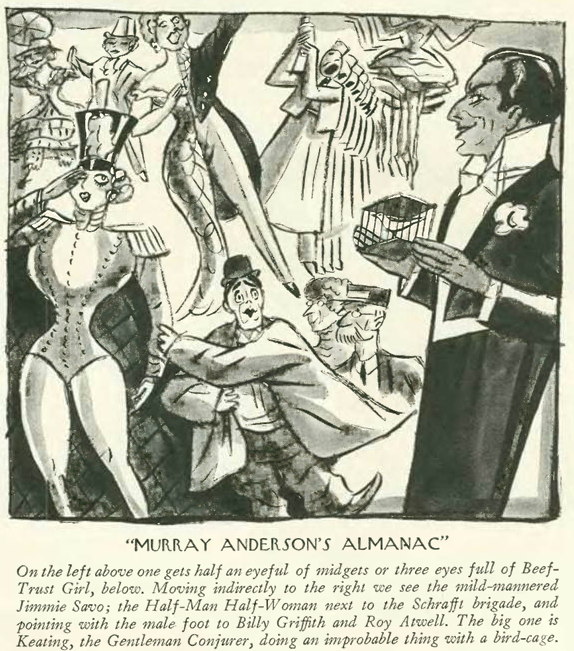
And in the following issue of The New Yorker (Sept. 21), Peter Arno contributed this drawing for the theater review section (it doesn’t entirely look like an Arno, but then again his style at this time seemed to fluctuate almost weekly)…

 *  *  *

Flapper Joan

No stranger to Broadway herself, the young actress Joan Crawford was making a name for herself in Hollywood and garnering consistently positive reviews from the New Yorker’s film critic John Mosher, who found that the 25-year-old actress— who portrayed a fun-loving flapper in Modern Maidens — could shine even in the midst of an average screenplay:

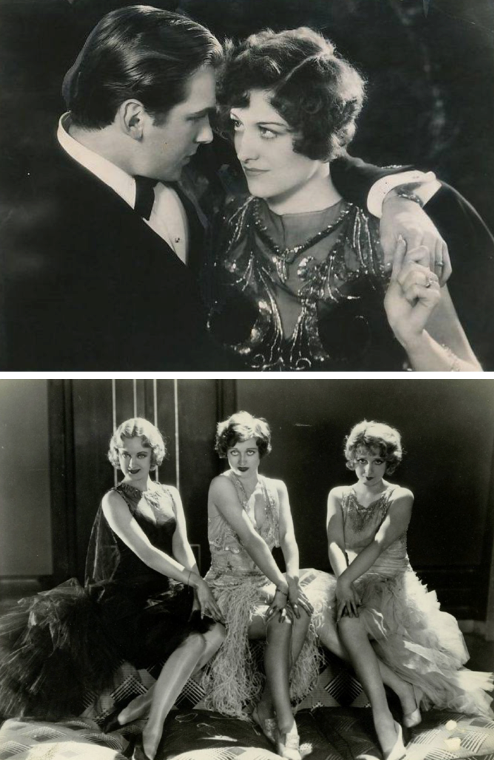
THEY’RE NOT ACTING…At top, Douglas Fairbanks Jr. and Joan Crawford in MGM’s Our Modern Maidens (1929). The film led to a widely publicized romance and marriage between the co-stars; below, publicity photo for the film, with (from left) Josephine Dunn, Crawford, and Anita Page. (IMDB/joancrawfordbest.com)

 *  *  *

Silence is Golden

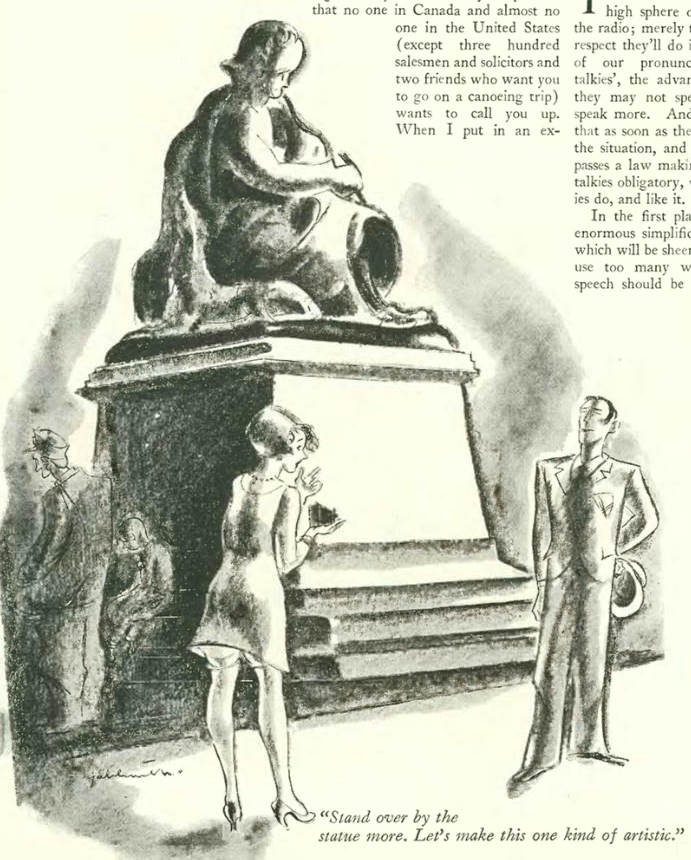
Cultural critic Gilbert Seldes contributed a casual titled “In a Loud Voice With the Tongues of Angels,” joining the chorus of voices at The New Yorker skeptical of (but resigned to) the advent of sound motion pictures. Excerpts:

SOMETHING HAS COME BETWEEN US…a microphone moves in close on Spencer Tracy and Bette Davis in a scene from 1932’s 20,000 Years In Sing Sing. (cinecollage.net)

 * * *

Das Speedboat

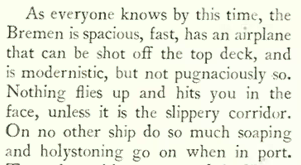
“The Talk of the Town” reported on the fuss created by the German passenger liner Bremen after it completed its maiden voyage to New York. It set a new world record in the process — four days, 17 hours, and 42 minutes later —and captured the westbound “Blue Riband” from the famed Mauretania with an average speed of 27.83 knots (the Blue Riband was an unofficial honor bestowed on the fastest passenger liners crossing the Atlantic)…

LOWRIDER…Top, the low, streamlined profile of the Bremen against the backdrop of the New York skyline. Center and below, among its many unique features, the Bremen had a catapult on the upper deck between the two funnels that launched a small seaplane, which facilitated faster mail service ahead of the ship’s arrival. (YouTube/nnapprentice.com)
(Ebay community post)

 *  *  *

Up In Smoke

Another “Talk” item explored the decline of cigar and pipe smokers thanks to the rise of cigarette advertising (and women smokers) in the 1920s…

…as an aside, it appeared golfer Walter Egan was still a pipe smoker, as this illustration by Johan Bull for the issue’s “Tee and Green” column attested…

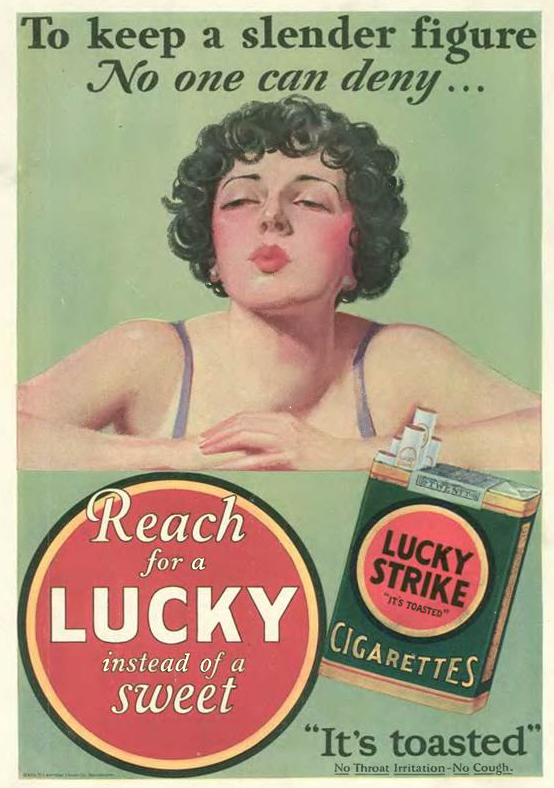
…”Talk” laid the blame (or the credit) on Lucky Strike’s successful ad campaigns that that particularly made a “big impression” on women…

…and to begin our advertising section, a Lucky Strike ad from the same issue:

…the Liggett & Myers tobacco company, on the other hand, promoted their Fatima brand as a higher quality, and slightly more expensive, alternative…

…in this ad for The Shelton Looms we find the elongated style popular in fashion ads of the era…the illustration is by LeBrun, but also evokes the style of Carl “Eric” Erickson, known for his Camel ad illustrations of the same period…

…and now a couple of ads from the back pages: the ad at left promoted a “country style” supper club near Washington Square. I haven’t found a record (yet) for the County Fair, but it was one of the themed restaurants Don Dickerman operated around Greenwich Village before the Depression (Dickerman, an illustrator, also provided the art for the ad)…the ad on the right—for Odorono deodorant— appeared regularly in the back pages of The New Yorker, illustrated by the magazine’s own Julian De Miskey. The ads featured vignettes of unfortunate young women whose B.O. was so bad that it caused all potential suitors to flee…

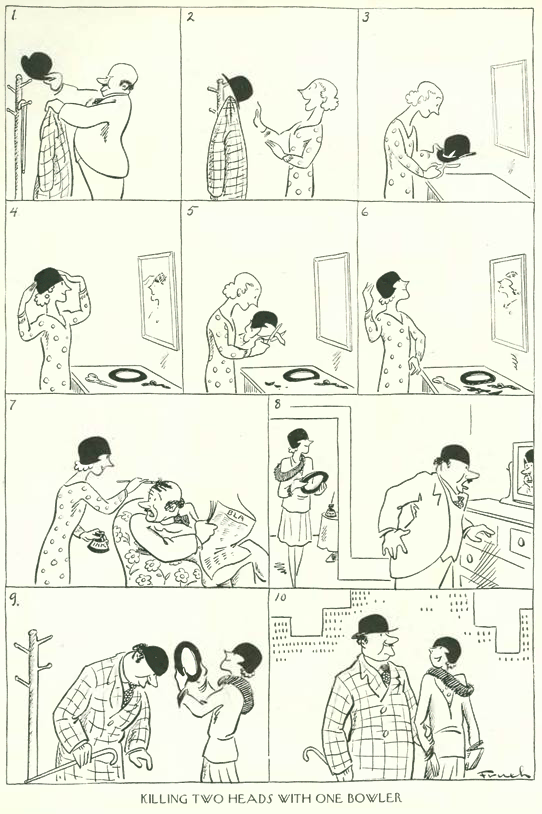
…on to our cartoons, Al Frueh (artist of the first two cartoons in The New Yorker’s first issue)…contributed another of his familiar multi-panel “silent” cartoons…

…I like the modern feel of this cartoon by William Crawford Galbraith

…and we close with a couple of cartoons under the moonlight, by Bruce Bairnsfather…
…and Peter Arno…at the Central Park Casino…

Next Time: Looking Ahead to 1979…


Ride of the Century

Train travel in the U.S. was at the height of its glory in the late 1920s—you could hop on train in New York City and travel to virtually anywhere in the country, even to some of the remotest towns in America’s vast hinterlands.

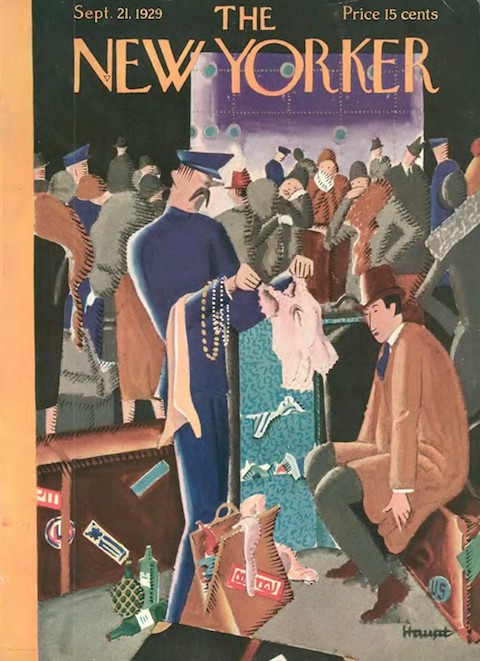
July 27, 1929 cover by Theodore G. Haupt.

The New Yorker’s managing editor, Ralph Ingersoll (1900-1985) writing in “The Talk of Town,” climbed aboard the locomotives of outbound 20th Century and an inbound Empire State trains to survey the latest technology in rail travel. What one gleans from reading this account is how much this mode of travel has declined (in the U.S.) over the past 90 years:

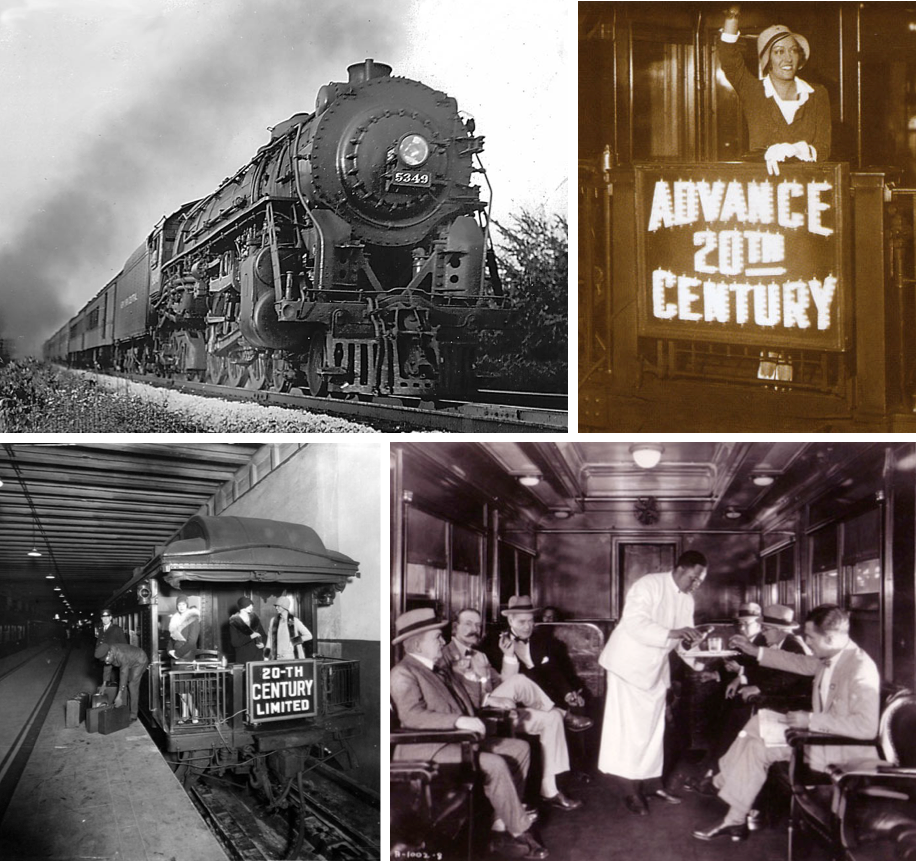
ROMANCE OF THE RAILS…Clockwise, from top left: Hudson locomotives served the Century and Empire State express trains; silent film star Gloria Swanson waves farewell from the observation platform as the 20th Century Limited pulls out of Grand Central during the 1920s; lounge car on the 20th Century during the 1920s; the 20th Century ready to depart Grand Central, circa 1930. (steamlocomotive.com/newyorksocialdiary.com/cruiselinehistory.com)

In terms of speed and safety, it seems little has changed since 1929, and perhaps things have actually gotten worse…

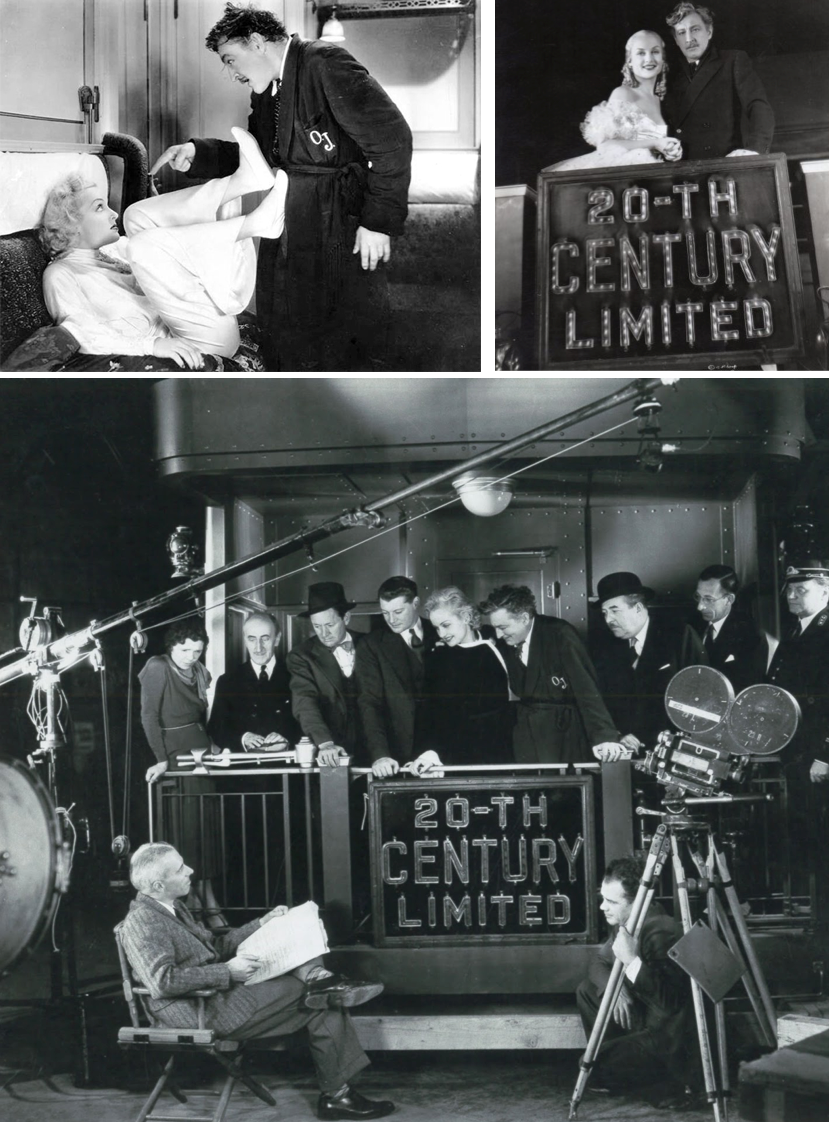
CELEBRATED LINE…The 20th Century was widely celebrated in popular culture through the 1950s. Five years after Ingersoll’s article, Howard Hawks directed the screwball comedy, 20th Century. Clockwise, from top left, the film’s stars, Carole Lombard and John Barrymore in a scene from the film; the stars pose for a publicity shot; with director Hawks along with some of the cast and crew. (austinfilm.org/greenbriarpictureshows.blogspot.com)

* * *

From 1928 until his death in 1950, the journalist Alva Johnston (1888-1950) wrote on a diverse range of topics for The New Yorker, including this “Reporter at Large” piece on the proliferation of barrooms in private residences, hidden from the prying eyes of Prohibition agents and sometimes furnished with the bits and pieces that once graced some of New York’s finest watering holes, including the famed Hoffman House:

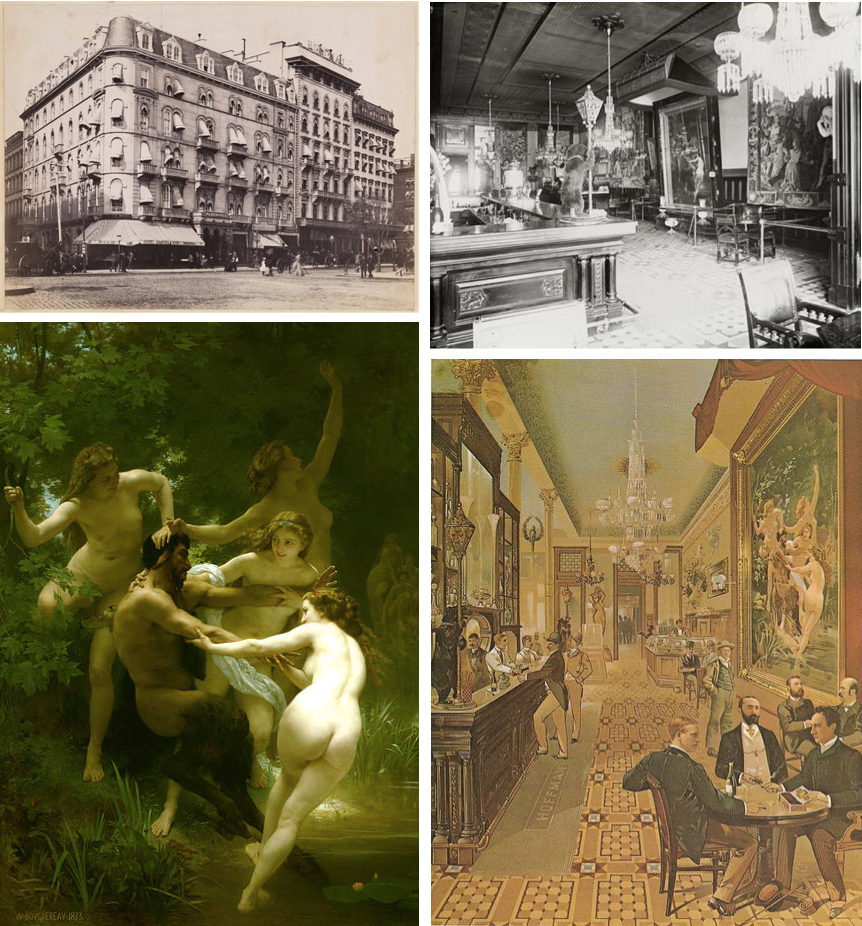
POPULAR WATERING HOLE…Clockwise, from top left: The Hoffman House Hotel at Madison Square in 1885; the Hoffman House bar, which prominently displayed William-Adolphe Bouguereau’s painting Nymphs and Satyr. According to Alva Johnston’s article, the painting was the second-most popular decorative motif in New York’s finer drinking establishments; artist’s rendering of the barroom; and Bouguereau’s Nymphs and Satyr. (Museum of the City of New York/Wikipedia)

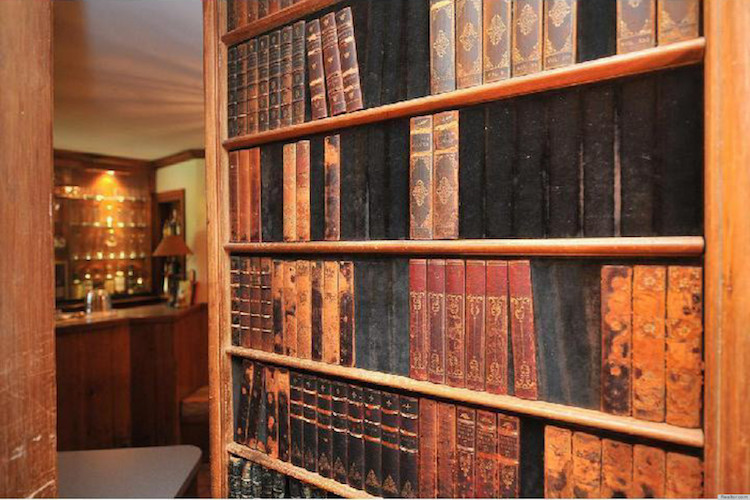
Johnston noted the clever tricks homeowners used to conceal their secret bars:

DON’T JUDGE A BOOK BY ITS COVER…Alva Johnston described how one library’s walls “had literature on one side, gin and rye on the other.” (Huffington Post)

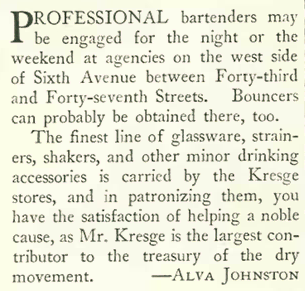
Johnston concluded his piece on an ironic note, pointing out that the finest cocktail sets could be obtained at Kresge department stores, which were owned by one of the biggest supporters of Prohibition, S.S. Kresge:

 *  *  *

The Sound of Peggy Wood

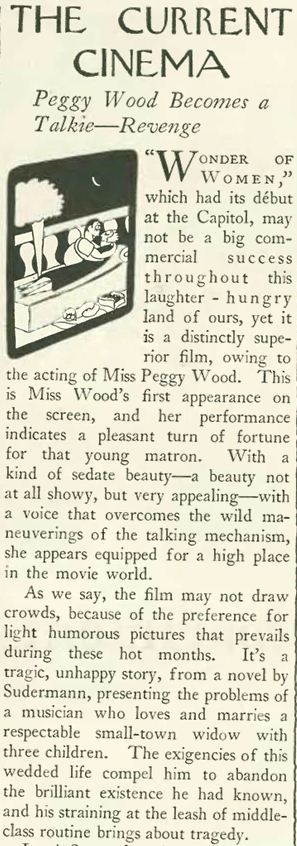
The Brooklyn-born Peggy Wood (1892-1978) made her stage debut in 1910 and was an established Broadway star before she made her first talking picture, Wonder of Women (a film believed to be lost). A member of the Algonquin Round Table, she was well acquainted with the New Yorker crowd. And the magazine in turn was very impressed with her acting talents, even if the picture she was in proved a bit of a downer:

RECOGNIZE HER NOW?…Clockwise, from top left: theatre card for the 1929 film, Wonder of Women; Leila Hyams and Lewis Stone in a tender moment from the film (Stone was romantically paired with much younger women in several films around that time); Peggy Wood in the 1920s; Wood as Mother Abbess in 1965’s The Sound of Music; Stone and Wood in a scene from Wonder of Women, with four-year-old child actor Wally Albright. With his waifish demeanor and curly hair, Albright was highly sought after in films needing a cute kid. He appeared in seven films in 1929 alone. In the 1930s he would appear in several Our Gang/Little Rascal shorts, and would pop up in bit roles through the 1940s and early 50s. Unlike so many other child stars, he seems to have led a normal adult life. He won the Men’s National Track and Ski Championship in 1957, and later started a successful trucking firm. (IMDB/Pinterest)

…the review continued, suggesting that Wood’s acting alone carried the picture…

…if you weren’t into weepers like Wonder of Women, you could have instead checked out The Mysterious Dr. Fu Manchu at the Rialto Theatre…

LIKE A SIDESHOW ACT…New York’s Rialto Theatre donned a masked front and door entry wrappers for the premiere of The Mysterious Dr. Fu Manchu; promotional poster; Jean Arthur and Warner Oland in the film. Oland was not the least bit Asian. A Swedish-American actor, his work in the hit film led to three more Fu Manchu movies. Oland would then go on to play another Asian character, Charlie Chan, in a string of popular movies in the 1930s until his death in 1938. (cinematreasures.org)

 * * *

Just Sad

Yet another note in “Talk of the Town” describing the plight of African Americans in segregated America, without a hint of empathy:

Potters Field on Hart Island, New York, circa 1890. (Wikipedia)

 *  *  *

From Our Advertisers

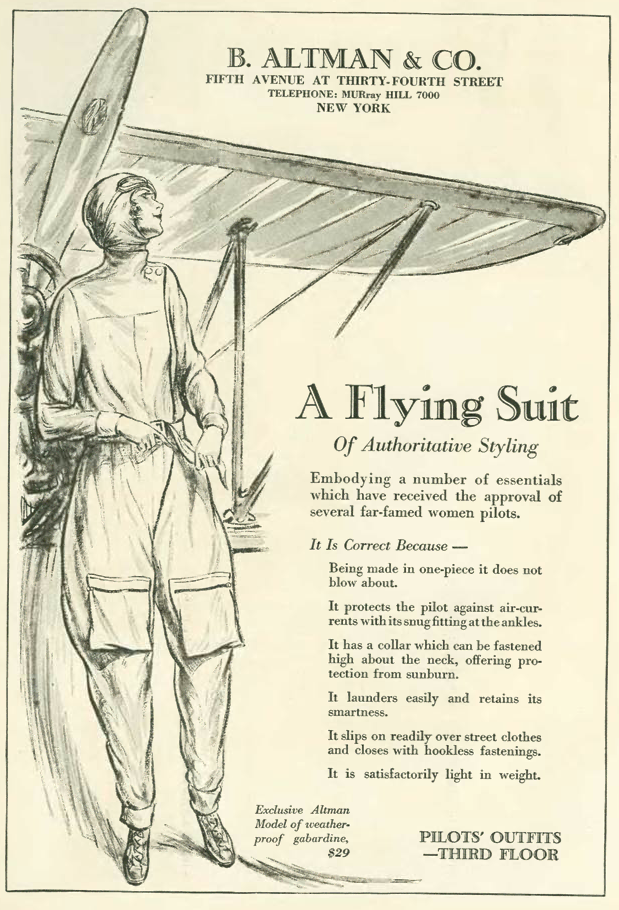
Last week B. Altman offered rugged coats for those brave souls riding in rumble seats. This week Altman rolled out some stylish wear for the enterprising pilot of 1929…

…and while you were up there, you could calm those nerves with a Chesterfield (a two-page ad that appeared regularly in The New Yorker)…

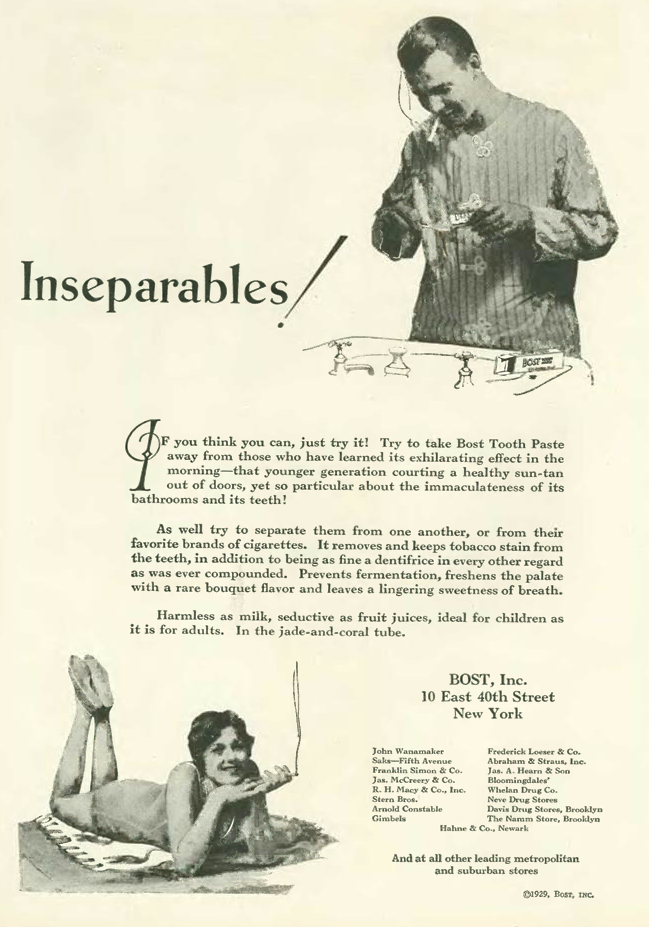
,,,back on the ground, the makers of Most toothpaste reminded readers to brush those tobacco stains off their teeth, apparently even while they’re smoking…

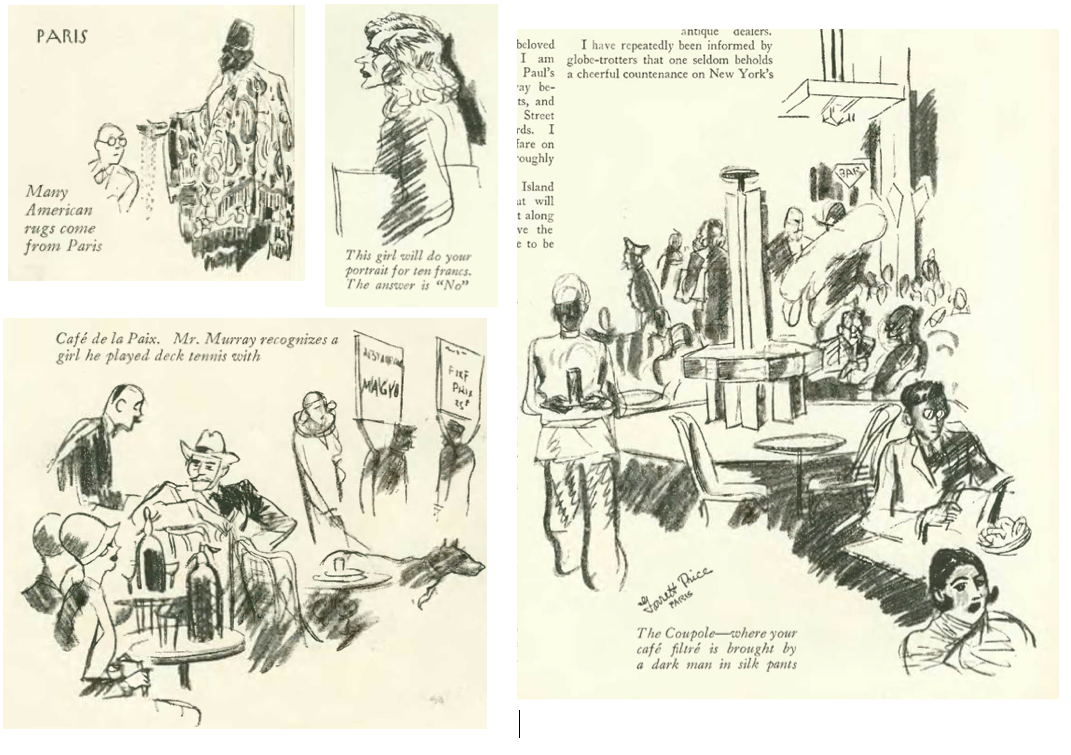
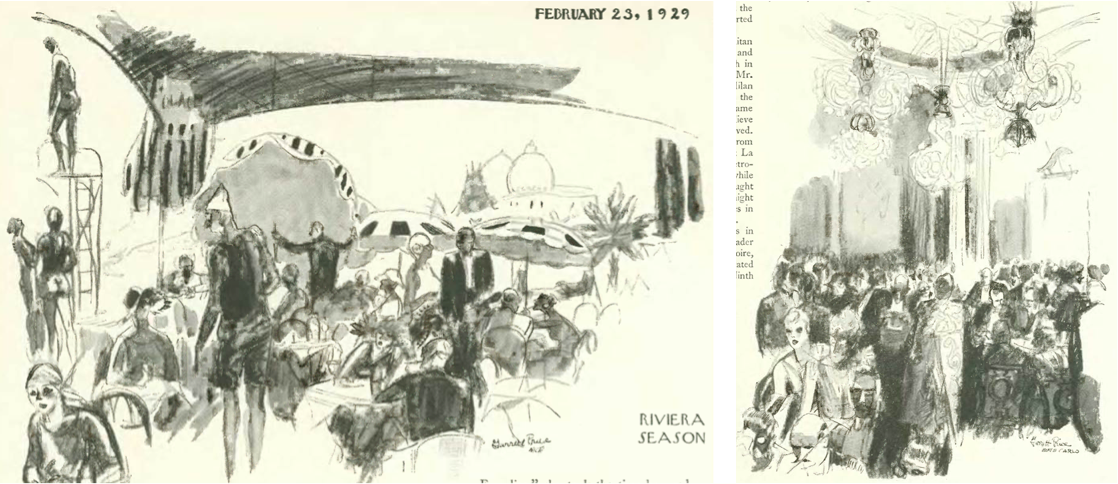
…here is another sampling of drawings by Garrett Price, rendered after a recent trip to Paris…

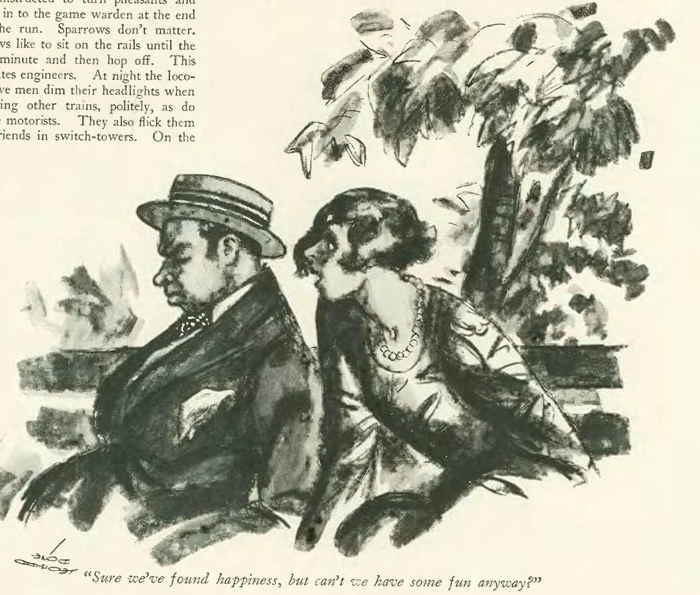
…our cartoons come from Leonard Dove (note the backward signature)…

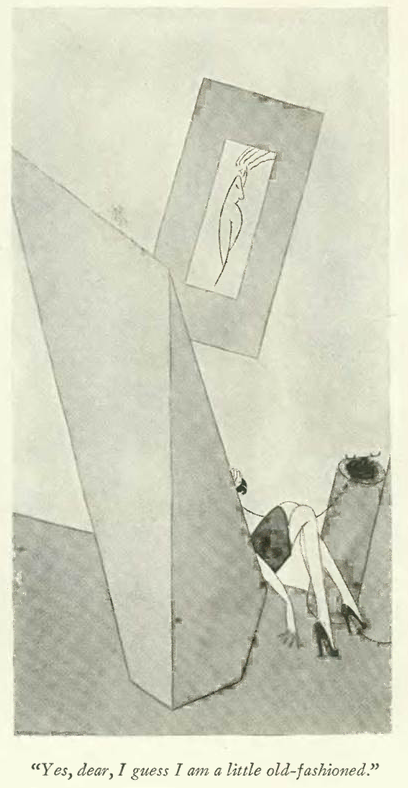
…here we have A. Edwin Macon’s take on modern furniture…

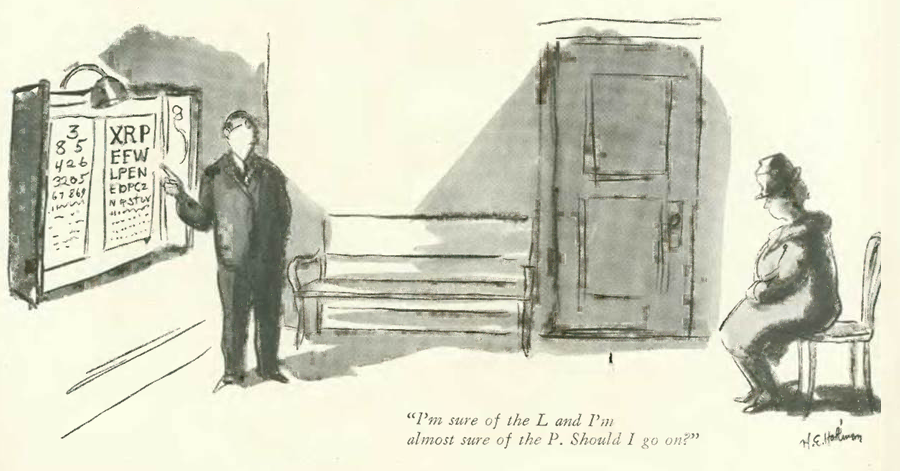
Helen Hokinson looked in on a visit to an eye doctor…

Perry Barlow’s take on the wonders of radio…

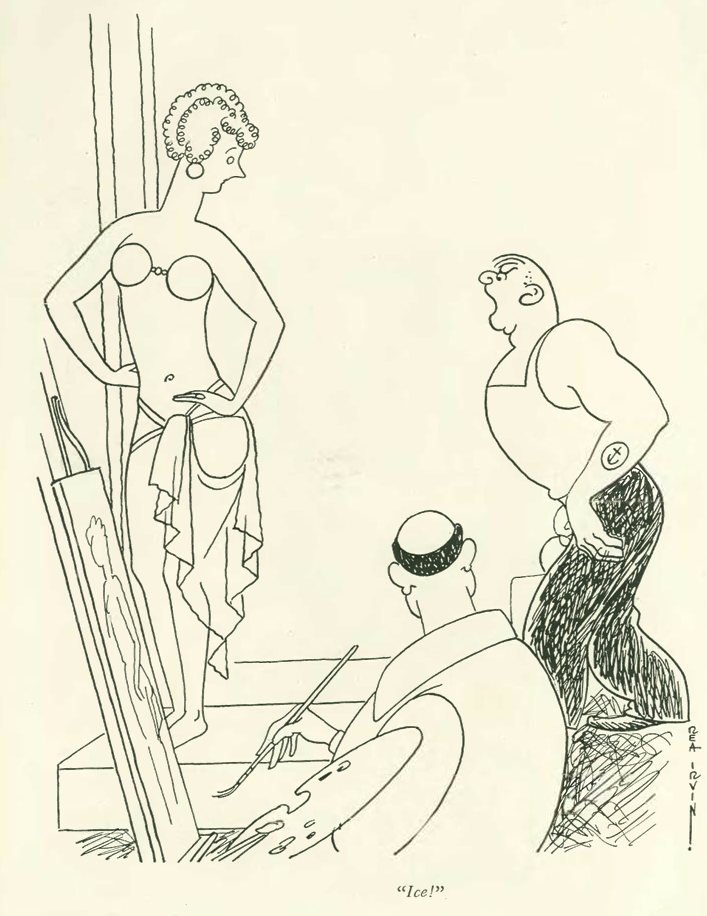
Rea Irvin depicted how timing is everything in an ice delivery…

…and Peter Arno peeked in on habits of the idle rich…

Next Time: The Art of Peace…


Not Your Grandpa’s Tammany Hall

For more than a century, a political organization known as the Tammany Society ruled New York City politics with an iron fist. Founded in 1786 (and named for Tamanend, a chief in the Lenni-Lenape nation), by the mid 19th century it rapidly expanded its political control by earning the loyalty of the city’s fast-growing immigrant population, particularly the Irish.

July 13, 1929 cover by Rea Irvin.

The Tammany Society proved an efficient machine for controlling state Democratic politics as well as New York City elections. Through its use of patronage to reward loyal precinct leaders, it also became a center for big-time graft. Most of us know a bit about Tammany thanks to school history books that focused on the deep corruption of William “Boss” Tweed, who was brought down by the press and by Harper’s Weekly cartoonist Thomas Nast in the 1870s. Tammany Hall would survive the scandal, and in the 1920s would still pull the strings of politicians including Gov. Al Smith and New York City Mayor Jimmy Walker.

Tammany had several homes, but during its most notorious years it was located in a circa 1812 hall (then called a “wigwam”) and later in an 1868 building on 14th Street, between Third and Fourth avenues. The July 13, 1929 “The Talk of the Town” noted the recent demolition of that old hall and the opening of a new headquarters on 17th Street:

POLITICAL BAGGAGE…Top, a stereoscope card featuring the 1868 Tammany Hall; below, Thomas Nast cartoons depicting the corruption of Tammany Hall and the downfall of Boss Tweed. (Wikimedia Commons/Smithsonian)

“Talk” found the new building unimpressive; it seemed to signal that the old political machine was losing some of its luster:

EVOLUTION OF THE WIGWAM, as depicted on a poster circa 1920. (nypdhistory.com)
Top left: The old Tammany Hall, decorated for the 1868 Democratic National Convention. Bottom left, the old hall was located at 141 E 14th Street, between 3rd and 4th Avenues. It was demolished in 1927 to make way for expansion of the Consolidated Edison building (right). (NYPL Digital Gallery/mediahistoryny.files.wordpress.com/Wikipedia)

Indeed, “Talk” found the building to be a somewhat austere, hosed-down affair, far removed from its grander past:

I LIKE YOUR NEW HAT…The 1929 Tammany Hall (top left) is currently undergoing a major renovation. Although the interior is being dramatically altered, including the addition of a glass dome, the landmarked exterior will mostly be preserved. When completed, the building—a mix of office and retail—will be known as 44 Union Square. (bkskarch.com)

For further evidence that the more austere Tammany Hall was nevertheless alive and well in 1929, another “Talk” item noted the organization’s continued influence behind the scenes in local politics:

The 1930s marked the beginning of the end for Tammany Hall, when reform-minded Democrats such as President Franklin Roosevelt and New York’s Republican Mayor Fiorello La Guardia (supported by Roosevelt on a “Fusion” ticket) dismantled Tammany’s system of patronage. The Tammany Society abandoned its headquarters in 1943 when it found it no longer had the funds to maintain the hall. Bought by a local affiliate of the International Ladies Garment Workers Union, it later housed the New York Film Academy and the Union Square Theatre until 2016, when it underwent extensive remodeling to make way for new office and retail space.

 *  *  *

Your Two Cents Worth

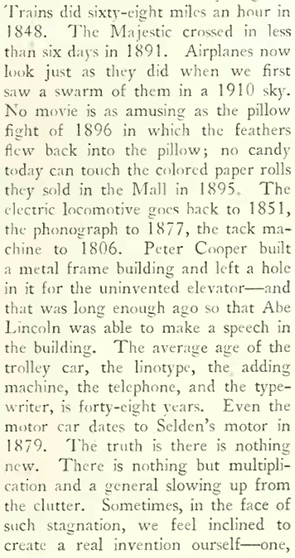
“Talk” also commented on the introduction of a new two-cent stamp that featured an image of Thomas Edison’s Mazda lamp, marking the celebration of fifty years of electric light. The magazine cheekily suggested that in the world of technological progress, there was nothing new under the sun:

(eBay)

 * * *

Americans in Paris

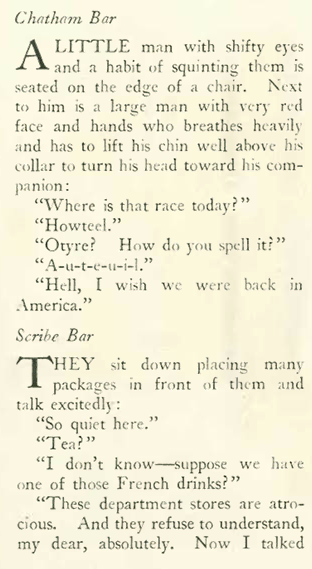
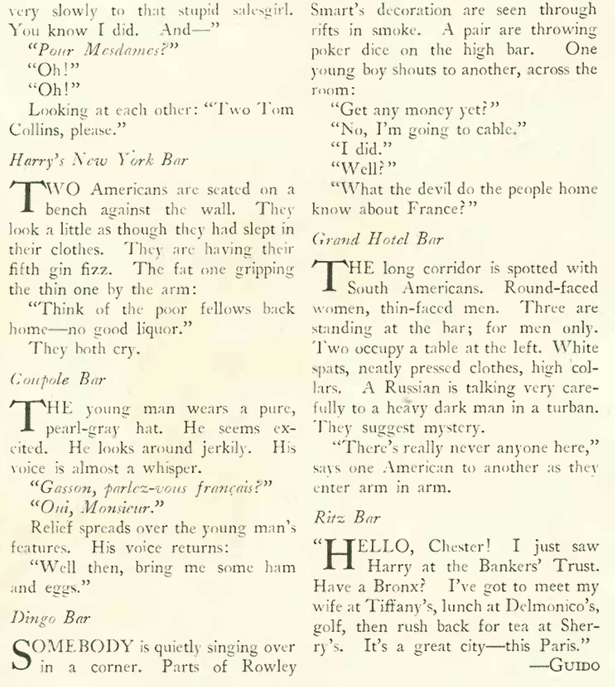
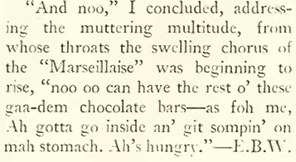
The New Yorker featured this humorous bit by a writer identified as “Guido” (I assume it is one of E.B. White’s many pseudonyms), who looked in on the chatter of various Parisian cafés and bars:

VOLSTEAD CAN’T GET US HERE…Enjoying the good life at a Parisian brasserie, circa 1920s. (National Geographic)

*  *  *

Hit and Miss

The New Yorker generally reveled in the good times Florenz Ziegfeld brought to the stage, but his latest effort, Show Girl, proved a bit of a disappointment (more evidence, in my view, that folks were tiring of the decade-long party known as the Roaring Twenties):

TAP-DANCING ON THE GRAVE OF THE ROARING TWENTIES…Although The New Yorker seemed less than enthused by Flo Ziegfeld’s latest effort, Show Girl, Ruby Keeler (top left) brought her tap shoes and her ‘A’ game to the performance. Clockwise, from top right, Keeler has some fun with the comedy trio Clayton, Jackson and Durante; program cover for Show Girl; the popular Albertina Rasch Girls with Harriet Hoctor in the “An American in Paris” scene of Show Girl, 1929. (Pinterest/jacksonupperco.com/eBay/songbook1.wordpress.com)

*  *  *

One of a Kind

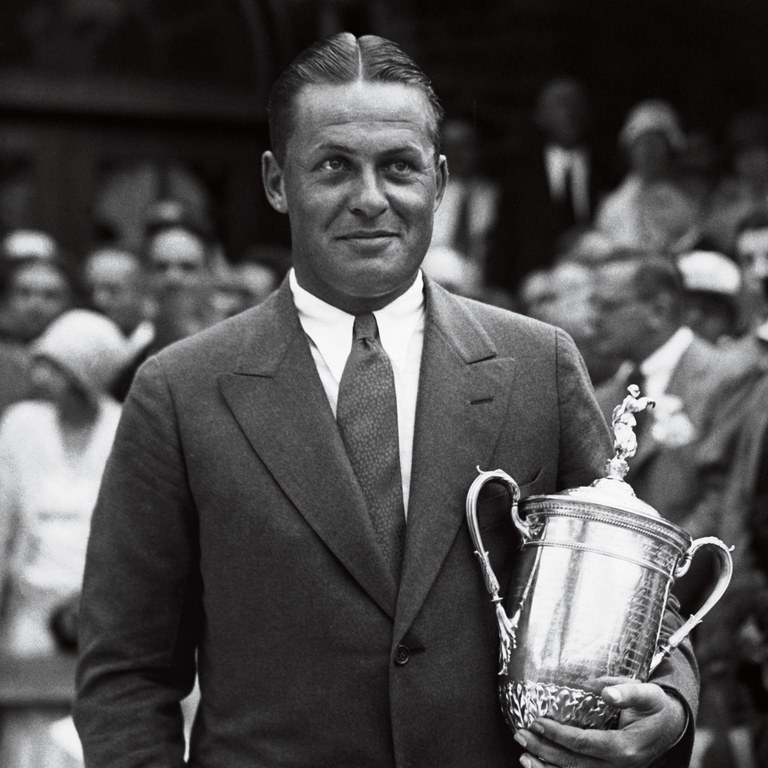
New Yorker sportswriter Niven Busch, Jr. provided a nice write-up on golfer Bobby Jones, the most successful amateur ever to compete in the sport. An attorney by trade, the unassuming Jones had just won his third U.S. Open (he would win again in 1930). In all he would play in 31 majors, winning 13 of them and finishing in the top 10 an incredible 27 times. After retiring at age 28 in 1930 he helped design the Augusta National Golf Club and co-founded the Masters Tournament. An excerpt:

AND HE DID IT WEARING A NECKTIE…Although a lawyer by trade, the amateur golfer Bobby Jones was one of golf’s greatest champions. He pictured here after winning the 1929 U.S.Open in Mamaroneck, New York. (golf digest.com)

 *  *  *

An Odd Bit

Looking around the July 13 issue, let’s see what nighttime diversions were being touted by The New Yorker in their “Going on About Town” section (note the warning on the last item):

*  *  *

From Our Advertisers

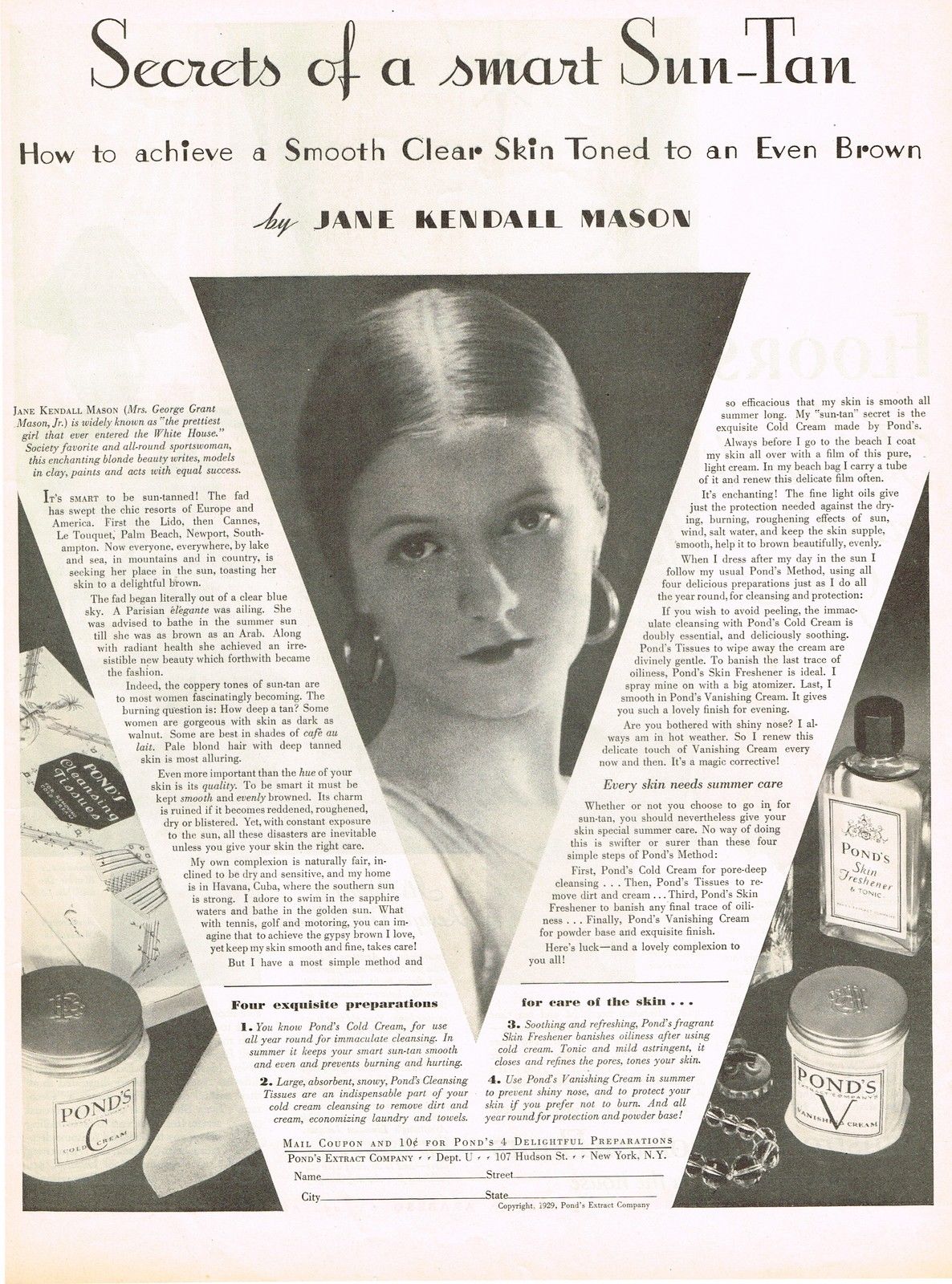
The makers of Pond’s cold cream continued to roll out endorsements from high society with this testimonial from Jane Kendall Mason (1909-1980), the newlywed wife of George Grant Mason, an executive with Pan American Airways in Cuba.

In 1925, the 17-year-old Jane made her formal debut in Washington society. After a visit with Grace Goodhue Coolidge, the first lady famously declared that Jane was “the most beautiful girl ever to enter the White House.”

After their marriage, the Masons became friends with Ernest and Pauline Hemingway, and introduced the Hemingways into Cuban society. Jane could hunt, fish, and hold her liquor, and, according to Ernest Hemingway, she was the most uninhibited person he’d ever met. So naturally they had a torrid, tempestuous, two-month affair that ended with Jane’s attempted suicide (she leapt from a balcony that was not high enough to do the job).

Hemingway supposedly used Jane as a model for the cruel-hearted Margot Macomber in The Short, Happy Life of Francis Macomber, in which the title character—trapped in a sad marriage to a wealthy but spineless American (George?)—accidentally shoots her husband in the head while on safari. She is also considered to be the model for the sex-obsessed Helene Bradley in Hemingway’s novel To Have and Have Not— a character also married to a rich but spineless husband.

Carlos Gutierrez (who served as a boat guide for Ernest Hemingway) and Jane Mason aboard “Sloppy” Joe Russell’s boat Anita in 1933. (Ernest Hemingway Photograph Collection, JFK Presidential Library and Museum, Boston)

…and we segue into our cartoons, featuring a mother and child (drawn by Carl Kindl) probably flying on one of those Sikorskys…

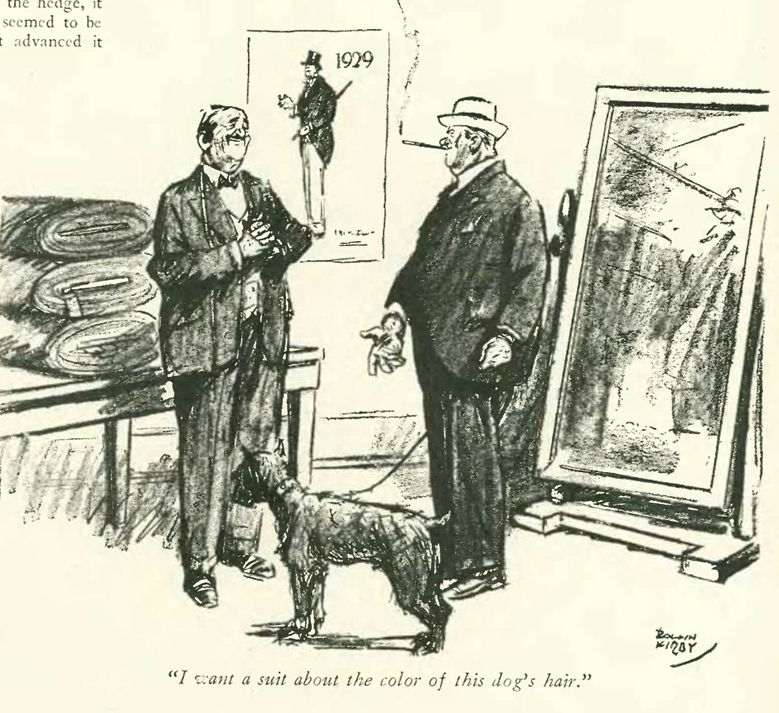
Rollin Kirby looked in on a tailor’s shop (this is one of only two drawings published by Kirby in The New Yorker)…

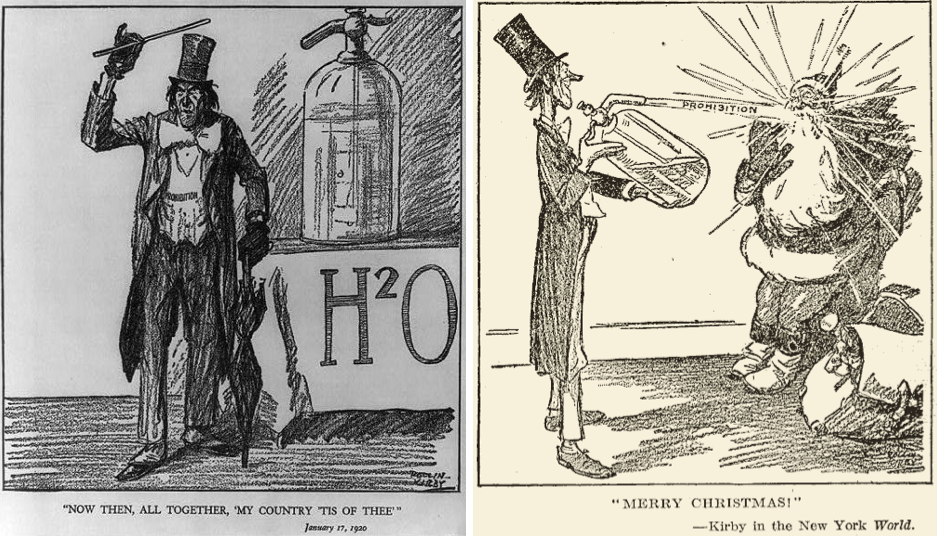
…a note on Kirby, a three-time Pulitzer winner: outraged by the passage of Prohibition laws, Kirby created one of his most famous characters, “Mr. Dry,” which he introduced to readers of the New York World in January 1920…

Rollin Kirby’s miserly, foreboding “Mr. Dry” made his first appearance in the pages of the New York World on Jan. 17, 1920, shortly after Prohibition laws went into effect in the United States. Mr. Dry also made an appearance at the end of 1920, to throw some water on America’s Christmas cheer. (bottlesboozeandbackstories.blogspot.com)

You can read more about Rollin Kirby and Mr. Dry here.

Roland Baum peeked in on a reluctant stargazer…

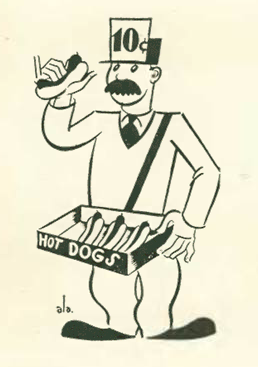
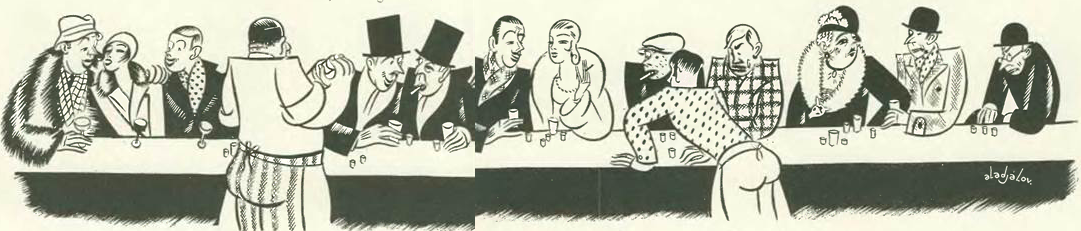
…and to close, this little filler drawing of a hot dog vendor by Constantin Alajalov…

Next Time: On the Flatfoot Beat…

Something Old, Something New

Above: The split image is from a New Yorker video: Eighty Years of New York City, Then and Now.

While the Empire State Building developers were preparing to reduce the old Waldorf-Astoria Hotel to rubble, another venerable relic of the Victorian age, the Murray Hill Hotel, was still clinging to the earth at its prime location next to the Grand Central Depot.

June 15, 1929 cover by Sue Williams.

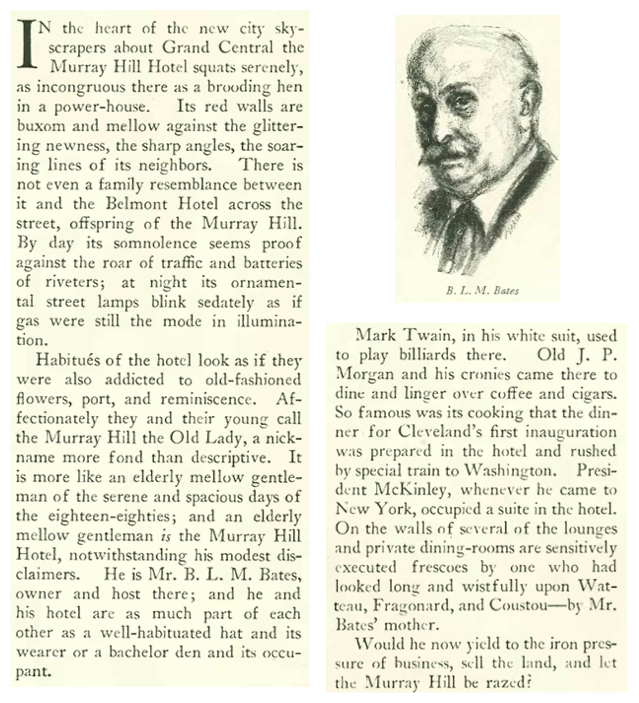
The hotel’s survival was due in part to its owner, Benjamin L. M. Bates (1864-1935), who seemed as much a part of the hotel as its heavy drapes and overstuffed chairs. Bates, who started out at the hotel as assistant night clerk, was profiled in the June 15, 1929 issue by Joseph Gollomb (with portrait by Reginald Marsh) Some excerpts:

The hotel was just 26 years old when Bates bought it in 1910. But by the Roaring Twenties Murray Hill Hotel seemed as ancient as grandmother’s Hepplewhite…

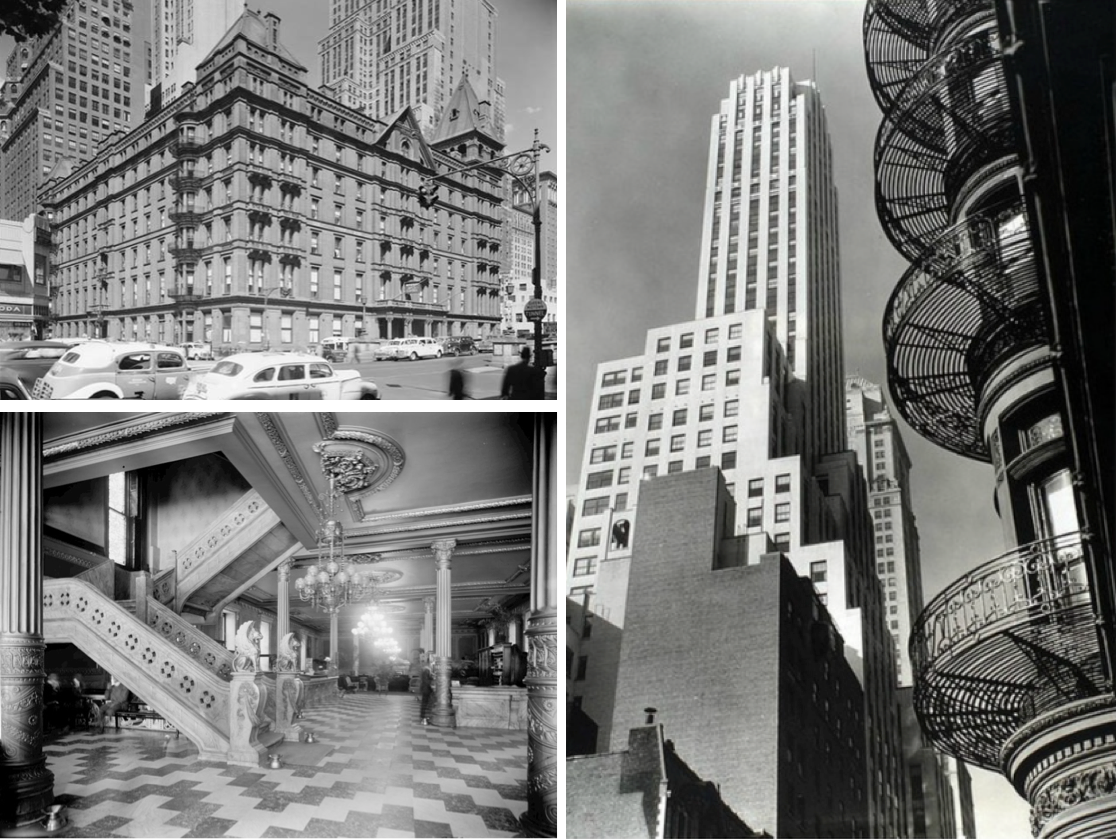
Clockwise, from top, left, The Murray Hill Hotel in September 1946, just months before it was demolished; the hotel’s ornate spiral fire escape, seen at the right in a 1935 photograph of 22 East 40th Street by Berenice Abbott; the hotel’s office and foyer. The hotel featured 600 rooms and two courtyards. (Museum of the City of New York (1 & 2)/Wikipedia)

…but to the very end it continued to be a popular gathering spot for New York notables, including Christopher Morley’s prestigious literary society, the Baker Street Irregulars…

FAMILIAR HAUNT…Three members of the exclusive literary group, the Baker Street Irregulars — Fletcher Pratt, Christopher Morley and Rex Stout —swap stories at the Murray Hill Hotel in 1944. (Wikipedia)

…with the hotel’s prime location near Grand Central Depot (and its replacement, Grand Central Station), the party couldn’t last forever, and the Murray Hill Hotel yielded to the wrecking ball in 1947…

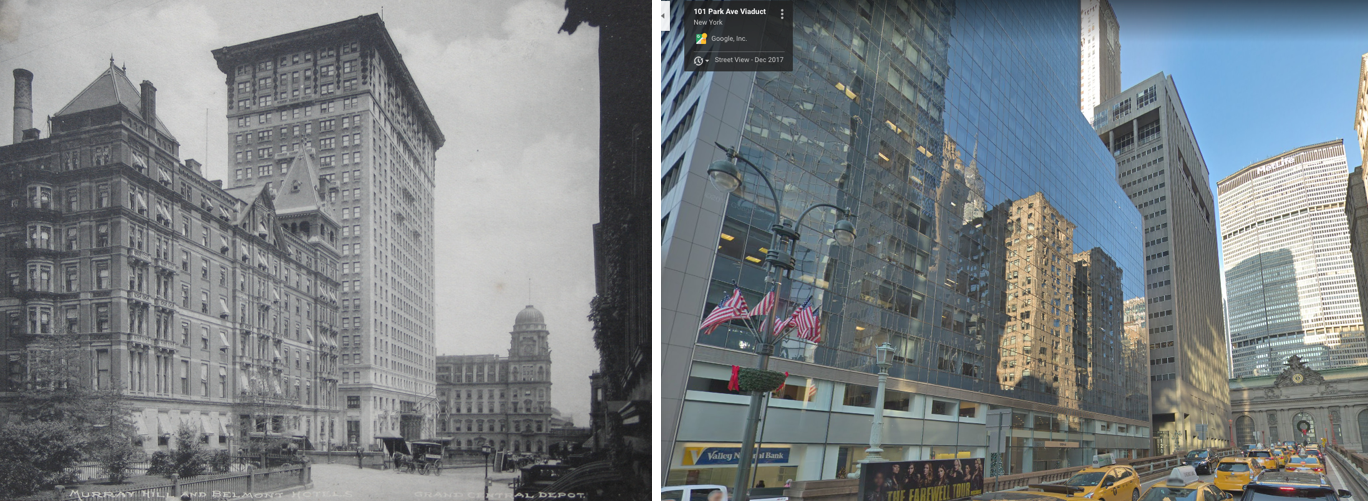
THEN AND NOW, the Murray Hill Hotel, circa 1905. The adjacent 25-story Belmont Hotel, erected in 1904-06 and a skyscraper for its time, would be razed in 1931. Note the old Grand Central Depot in the background, which would be replaced in 1913 by Grand Central Station. At right, a Google Maps view of the same location today.

Some parting notes about the Murray Hill Hotel: In 1905, delegates from 58 colleges and universities gathered at the hotel to address brutality in college football and reform the sport. They formed the Intercollegiate Athletic Association of the United States, which would later become the NCAA.

The hotel was also the site of a massive explosion in 1902, when workers constructing a subway tunnel under Park Avenue accidentally set a dynamite shed ablaze. Every window along Park Avenue and 40th Street was blown out, and the blast opened a pit, 10 feet deep and 30 feet wide, in front of the building. Five people were killed by the blast—three of them at the Murray Hill Hotel.

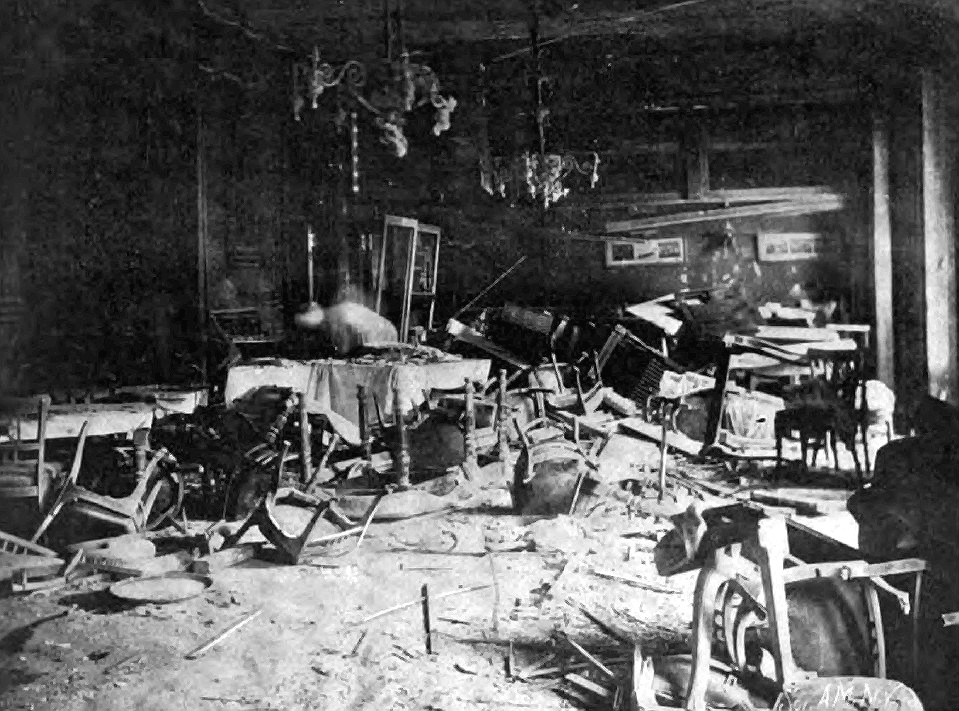
AFTERMATH…The Murray Hill Hotel’s cafe following the 1902 explosion. (Wikimedia Commons)

 *  *  *

Irwin S. Chanin, fresh from erecting his Art Deco masterpiece, the Chanin Building, was now setting his sights on the Century Theatre, barely twenty years old but already obsolete due to its poor acoustics and inconvenient location. “The Talk of the Town” takes it from there…

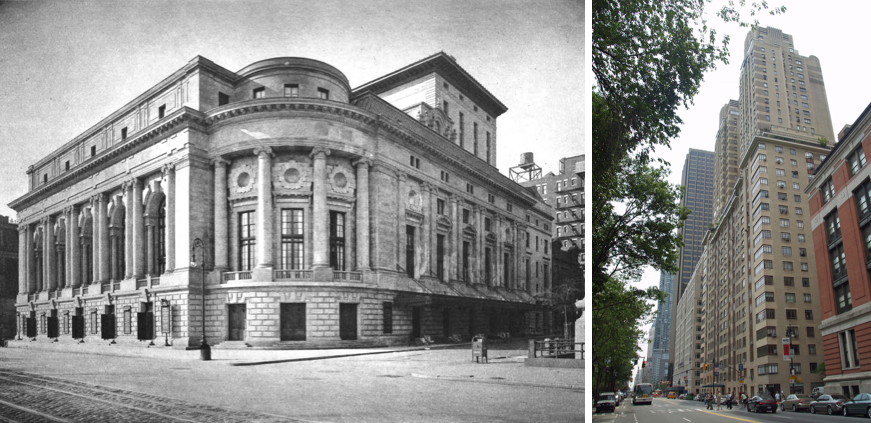
BIGGER PLANS…The Century Theatre, located at 62nd Street and Central Park West, opened on November 6, 1909. Plagued by poor acoustics and an inconvenient location, it was demolished in 1931 and replaced by the Irwin S. Chanin’s Century Apartments building. (The New-York-Architect, November 1909/David Shankbone via Wikipedia)

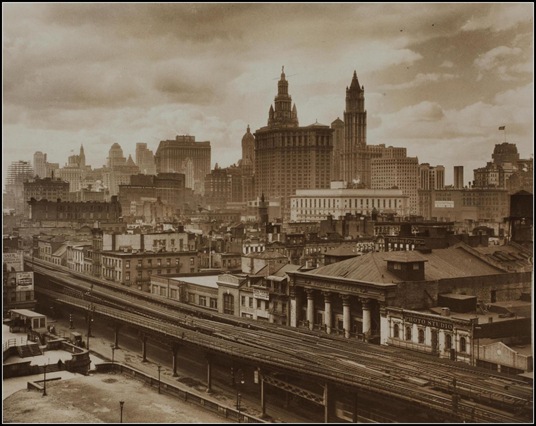
As the Century Theatre marked its last days, an older and more successful theater in the Bowery went up in flames. The Thalia Theatre (also known as “Bowery Theatre” and other names) was a popular entertainment venue for 19th century New Yorkers and for the Bowery’s succession of immigrant groups. A series of buildings (it burned four times in 17 years) housed Irish, German and Yiddish theater and later Italian and Chinese vaudeville. The 1929 fire marked the end of the line. “Talk” noted its passing…

UP IN SMOKE…The Bowery’s Thalia Theatre (building with columns) went up in flames on June 5, 1929. The photo was taken in 1928, one year before the final fire. Note the elevated train tracks in front of the building. (Manhattan Unlocked)

While we are on the subject of the changing skyline, I will toss in this cartoon from the issue by Reginald Marsh…the caption read: “I tell you, Gus, this town ain’t what it used to be.”

 *  *  *

Down for the Count

There was a bit of a sensation in the June newspapers when a European count was arrested for running a bootlegging ring among socially prominent circles. A headline in a June 8, 1929 edition of the New York Times shouted: LIQUOR RING PATRONS FACING SUBPOENAS; Socially Prominent Customers Are Listed in Papers Found in de Polignac Raids. COUNT SAILS FOR PARIS. Goes, After Nearly Losing Bail Bond, Smilingly Calling the Affair ‘Misapprehension.’

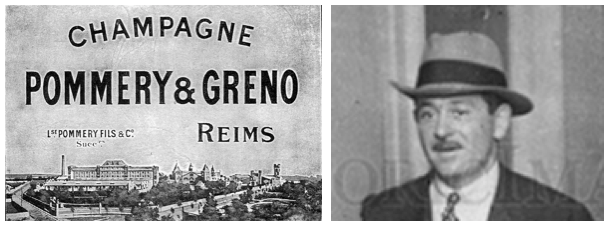
What the Times so breathlessly recounted were the activities of Count Maxence de Polignac (1857–1936), who owned one of France’s most prominent Champagne houses, Pommery & Greno.

The Times reported that an undercover federal agent, William J. Calhoun, led a raid that netted the Count and 34 others in a liquor ring connected to many Park Avenue and Fifth Avenue residents. Calhoun’s agents interrupted the Count’s morning bath (at his suite in the Savoy-Plaza Hotal) to make the arrest. They seized more than “seven cases of champage and liquors” in the suite, which the count said were for his personal use. Denying all charges, de Polignac was nevertheless arrested. Thanks to a guarantee provided by his friends at the Equitable Surety Company, he made the $25,000 bail and quickly set sail for Paris. “Talk” reported…

IT WAS JUST A LITTLE SIDE BUSINESS…Count Maxence de Polignac owned the house of Pommery & Greno, one of the largest Champagnes firms in France. (Wikipedia/tcreims.com)

“Talk” concluded the dispatch with some notes on Calhoun’s character as a federal agent…

…and a final bit of trivia, Count Maxence de Polignac was the father of Prince Pierre of Monaco, Duke of Valentinois, who in turn was the father of Rainier III of Monaco, who famously married the actress Grace Kelly. Grace Kelly, by the way, was born in November 1929, just months after her grandfather-in-law’s run-in with Prohibition authorities.

 *  *  *

Underwhelmed

Once again “Talk” looked in on aviation hero Charles Lindbergh, and his dispassionate approach to matters of fame…

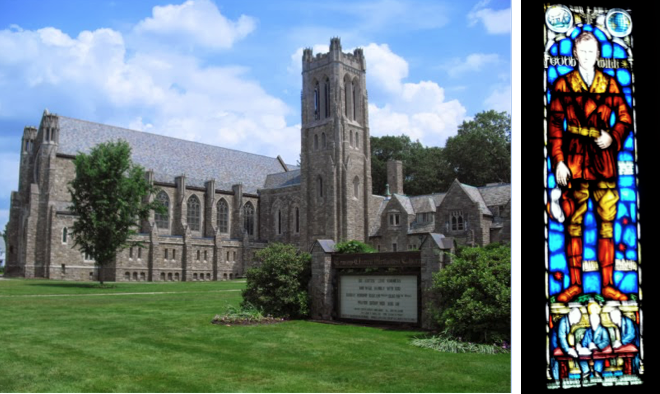
GOODWILL, OR WHATEVER…Trinity Methodist Episcopal Church in Springfield, Mass., features a series of 24 stained-glass windows representing historic personages with the theme, “The Light of Christ in the Life of Civilization.” Charles Lindbergh’s pane represents “Goodwill.” (tm01001.blogspot.com)

 *  *  *

Mr. Monroe Outwits a Bat

James Thurber submitted a humorous piece on a husband and wife at a weekend cabin retreat. The husband encounters a bat, and feigns to dispatch it while his wife remains behind closed doors. A brief clip:

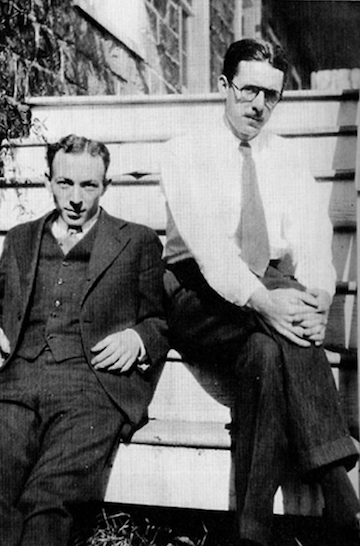
E.B. White and James Thurber, circa late 1920s.

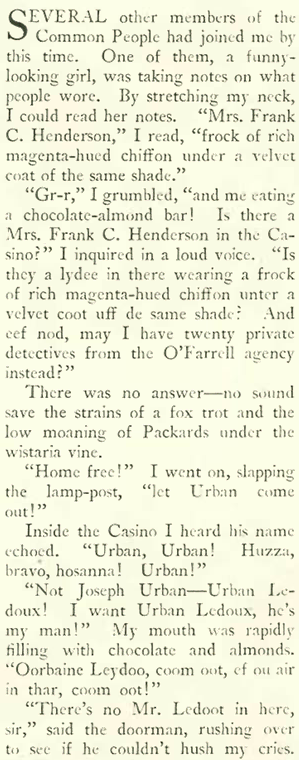
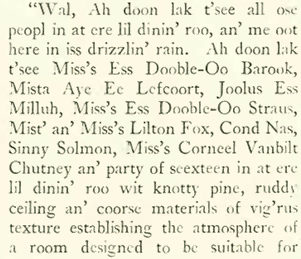
Thurber’s office mate and friend, E.B. White, penned a piece on the opening of the Central Park Casino (“Casino, I Love You”) in which he pretended to be a hobo loitering outside the Casino’s recent grand re-opening. Some excerpts…

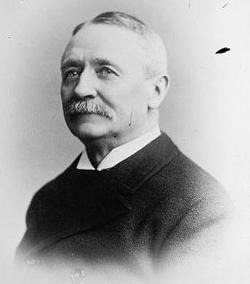
White’s character confuses Urbain Ledoux with Casino designer Joseph Urban. Ledoux was known to New Yorkers as “Mr. Zero,” a local humanitarian who managed breadlines for the poor. White’s character continues to name off the notables present at the event…

*  *  *

From Our Advertisers

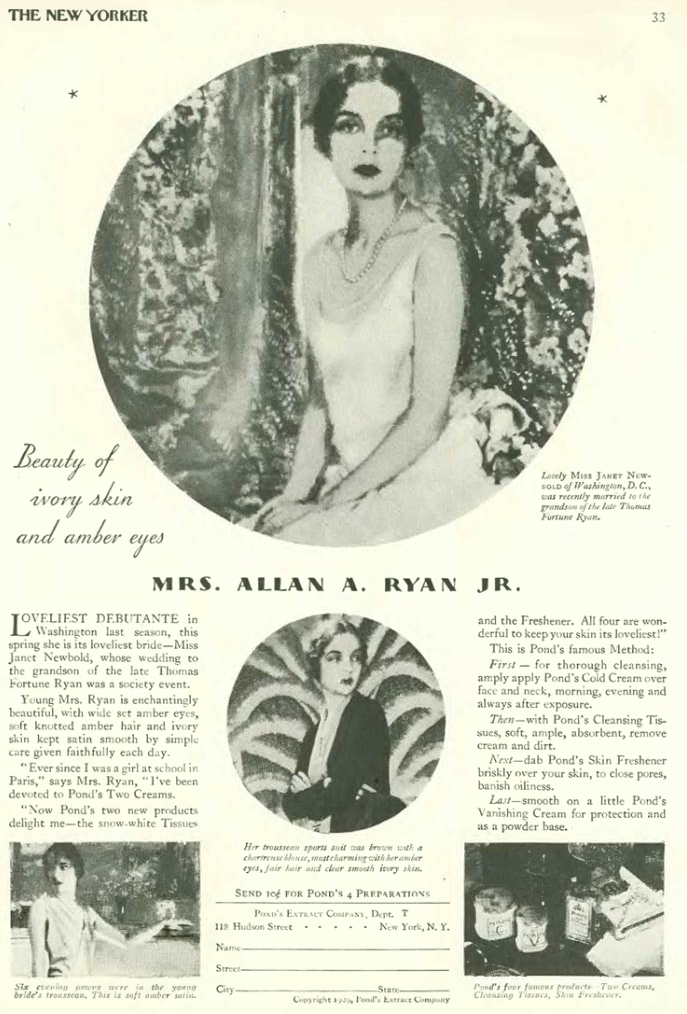
We begin with a Pond’s cold cream ad featuring Janet Newbold (1908-1982), who was known in some circles as “the most beautiful woman in New York”…

MIRROR, MIRROR…Left, an iconic photo of Janet Newbold by Erwin Blumenfeld, “Woman and Mirror,” was published in Harper’s Bazaar in November 1941. “Janet Newbold Wearing A Sari,” photo by John Rawlings, was published in Vogue in 1947. Thrice married, her last marriage (in 1948) was to James S. Bush, uncle of U.S. President George H.W. Bush. (Harper’s Bazaar/Vogue)

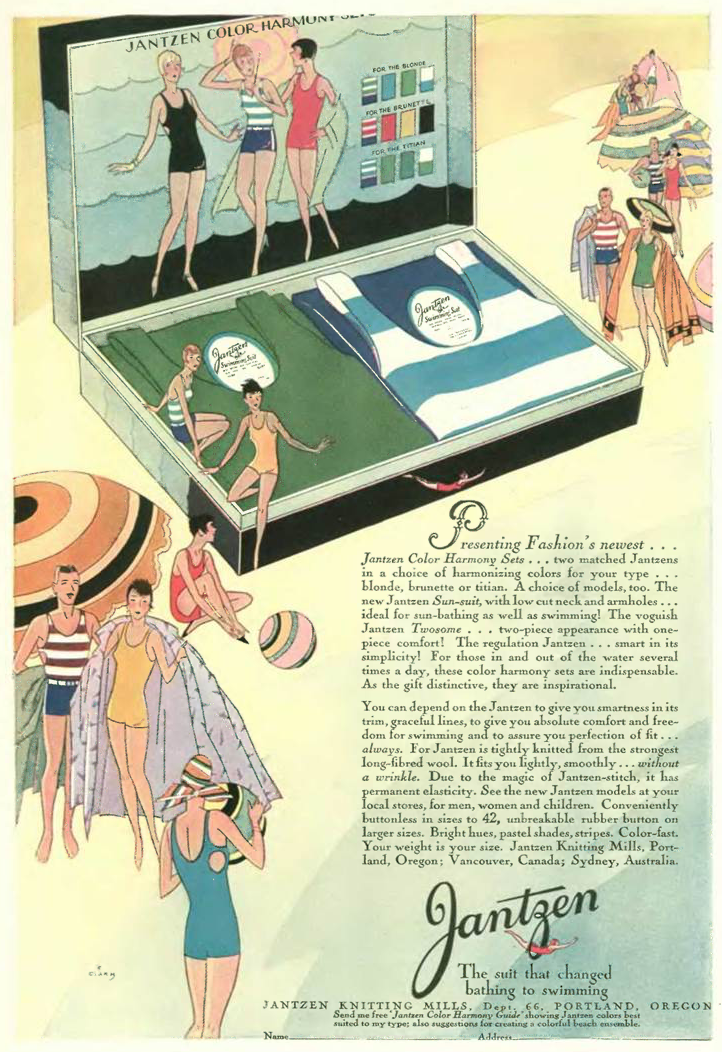
…some of the more colorful ads in the June 15 issue included this entry by Jantzen…

…and this ad for the REO Flying Cloud, a name that suggested speed and lightness, and changed the way cars would be named in the future (e.g. “Mustang” rather than “Model A”)…

…and if you think gimmicky razors are something new, think again…

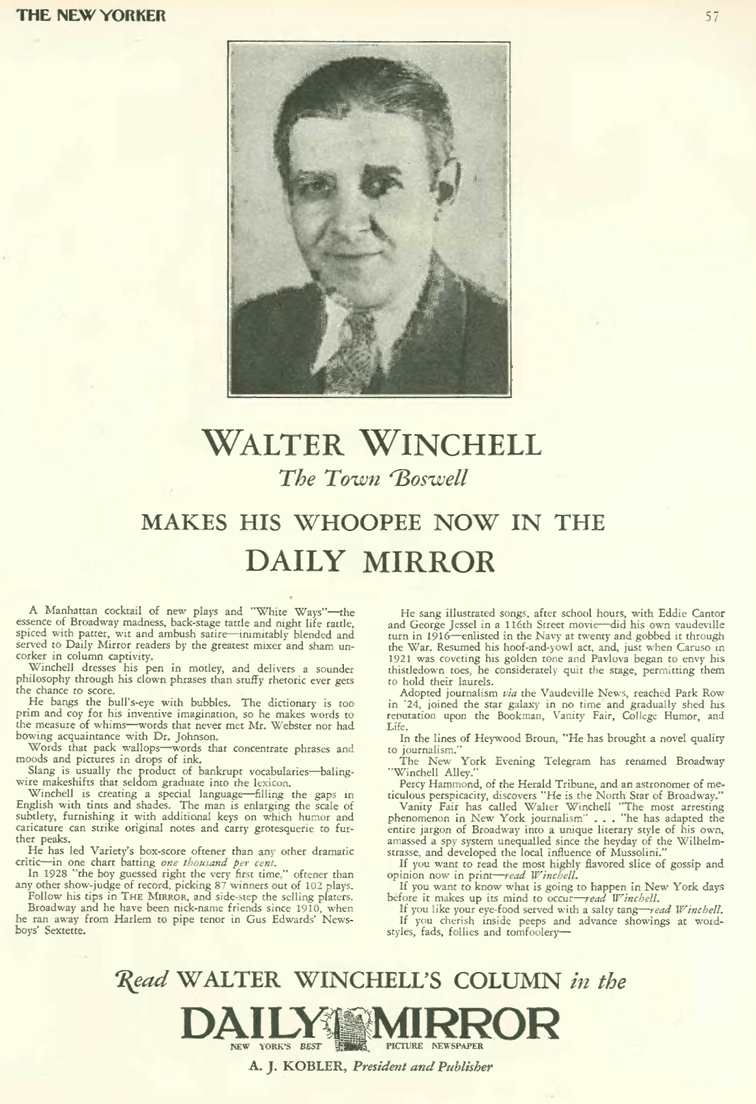
…this ad announcing Walter Winchell’s employment with the New York Daily Mirror is significant in that in marks the beginning of the first syndicated gossip column. Winchell’s column, On-Broadway, was syndicated nationwide by King Features. A year later he would make his radio debut over New York’s WABC…

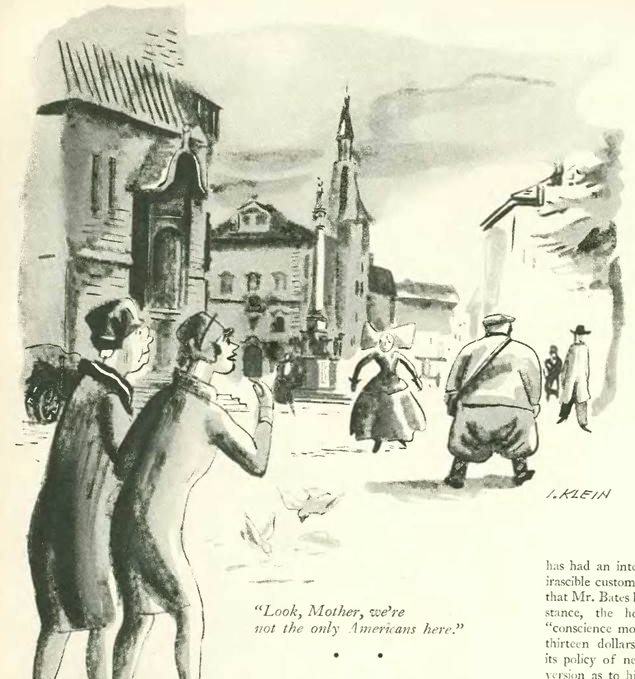
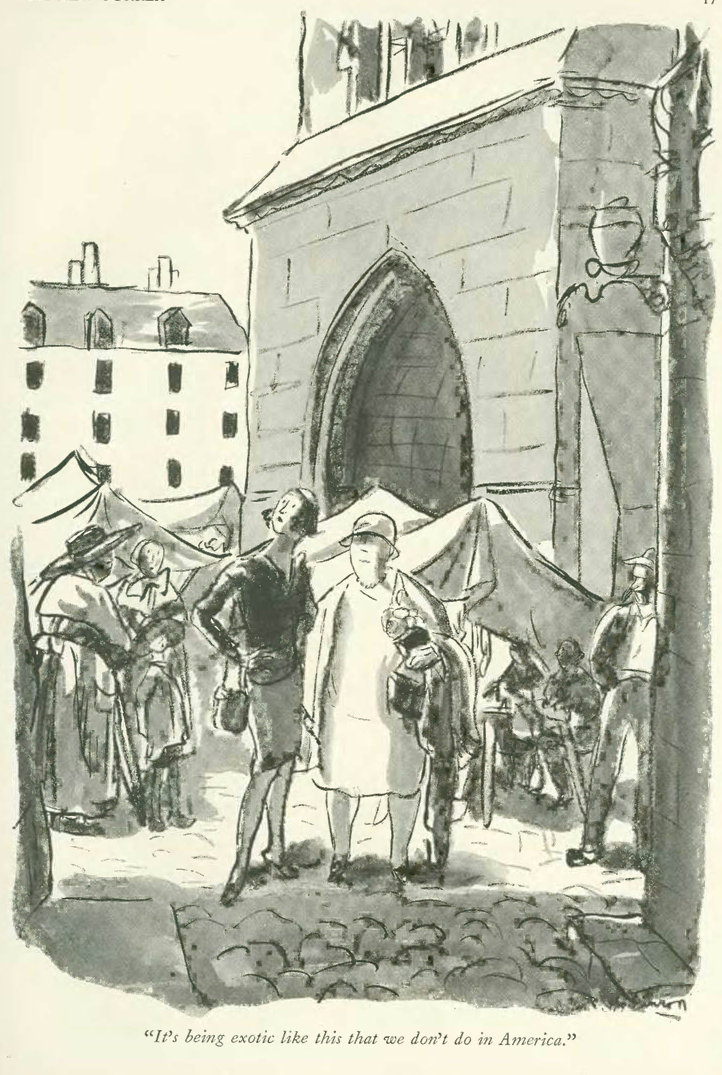
…for our June 15 cartoons, Isadore Klein confirms that stereotypes regarding American tourists haven’t changed much in 90 years…

…a quick footnote on Klein. In his long and colorful career, he would contribute cartoons to the New Yorker and many other publications. He also drew cartoons for silent movies, including Mutt and Jeff and Krazy Kat, and later worked for major animation studios including Screen Gems, Hal Seeger Productions, and Walt Disney. He was a writer and animator for such popular cartoons as Mighty MouseCasper, Little Lulu and Popeye.

Isadore Klein (1897–1986) holding the National Cartoonists Society “Silver T-Square.” He received the honor from his fellow members on April 22, 1974. (michaelspornanimation.com)

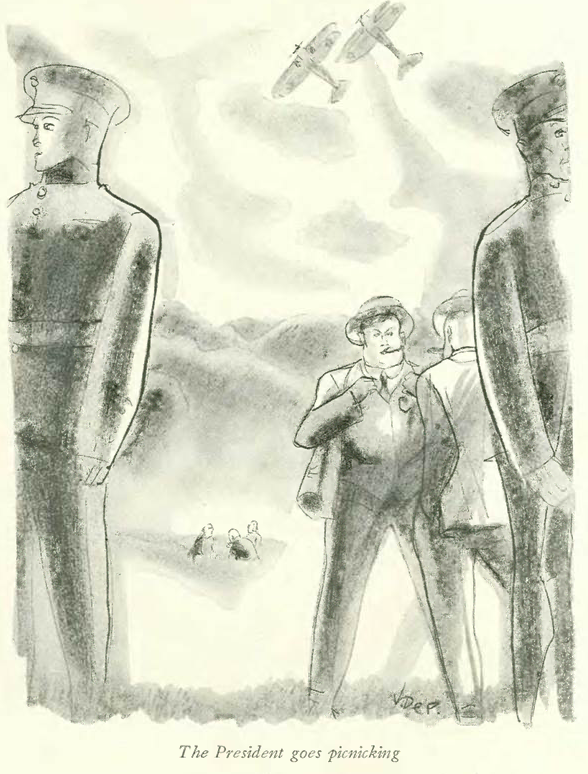
…Belgium-born artist Victor De Pauw depicted President Herbert Hoover picnicking, as viewed through his security detail…

…and a quick note on De Pauw…well known during his lifetime, he illustrated seven covers for The New Yorker and drew many social and political cartoons for magazines such as Vanity Fair, Fortune and Life. He also had a career as a serious painter, and some of his work can be found at the Museum of Modern Art…

Victor de Pauw (1902-1971) and one of his New Yorker covers from Nov. 20, 1943. (Smithsonian/Conde Nast)

Helen Hokinson looked in on two of her society women in need of some uplift…

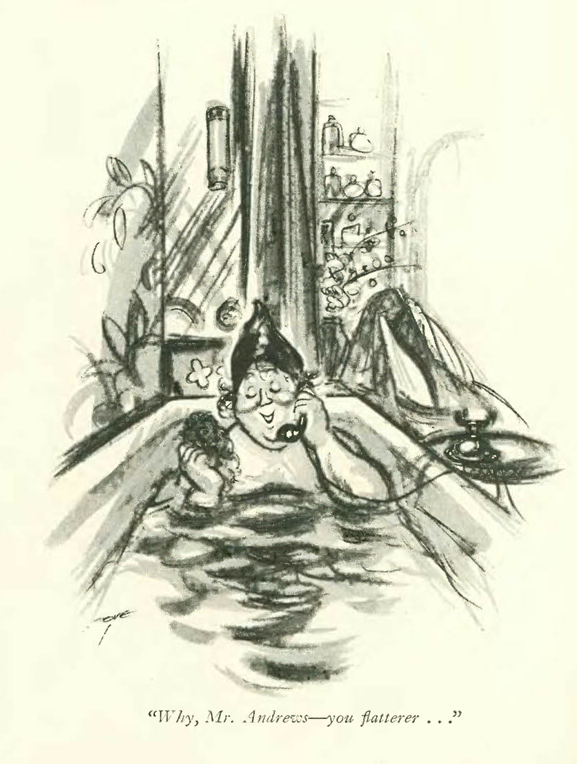
…and Leonard Dove looked in on another enjoying a soak…

Moving along to the June 22, 1929 issue, “The Talk of the Town” offered more news on the city’s changing skyline…

June 22, 1929 cover by Constantin Alajalov.

…and noted that the slender 1906 “Chimney Corner” building at Wall and Broadway had a date with the wrecking ball…

FAILED THE TEST OF TIME…At left, 18-story “Chimney Building” was demolished in 1929 along neighboring properties to make way for the Irving Trust Building (now 1 Wall Street), an Art Deco masterpiece by architect Ralph Walker. Note the scale of the two buildings relative to the church spire. (skyscraper.org/architectsandartisans.com)

 * * *

Apartheid on the Seas

“Talk” also featured this sad account of a theatrical company setting sale for England and discovering that racial discrimination did not end at the docks of New York Harbor. It is also sad that The New Yorker didn’t seem to have any problem with this injustice, and rather saw it as nothing more than fodder for an amusing anecdote…

NOT THE GOOD OLD DAYS…Percy Verwayne, Frank H. Wilson and Evelyn Ellis were part of the cast in the original Broadway production of Porgy in 1927. The play, by Dorothy and DuBose Heyward, was the basis for the libretto in the George Gershwin’s 1935 Porgy and Bess. (Wikipedia)

* * *

The profile for June 22 featured 100-year-old John R. Voorhis (1829-1932), Chairman of New York City’s Board of Elections. A fixture of the Tammany Hall Democratic political machine, in 1931 Tammany members created a special title for the old man—Great Grand Sachem. He died the next year at age 102.

John Voorhies in 1900, when he was a bouncy youth of 71.

 * * *

From Our Advertisers

Another colorful entry from the makers of Jantzen swimwear to celebrate the summer season…

…famed composer George Gershwin urged his fans to light up a Lucky Strike…

…and with help from Rea Irwin, Knox Hatters offered yet another example of the faux pas one might suffer without the proper headgear…
…for our June 22 cartoons, Helen Hokinson caught up with some American tourists…

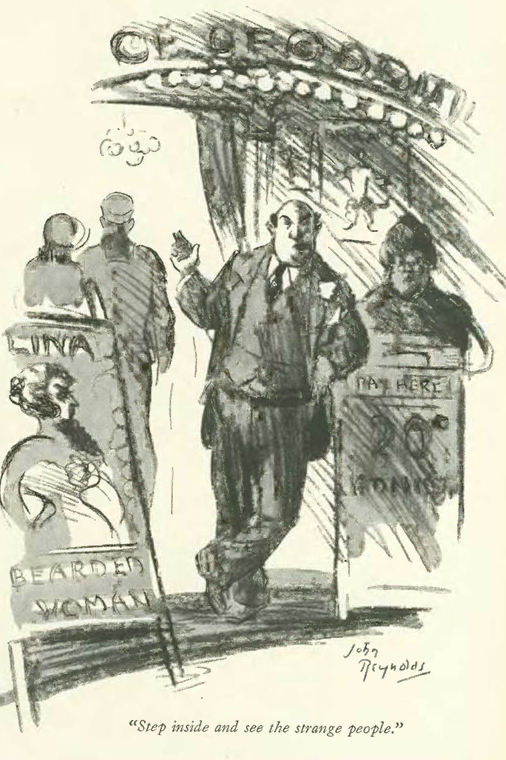
John Reynolds found a bit of irony in one carnival barker’s claim…

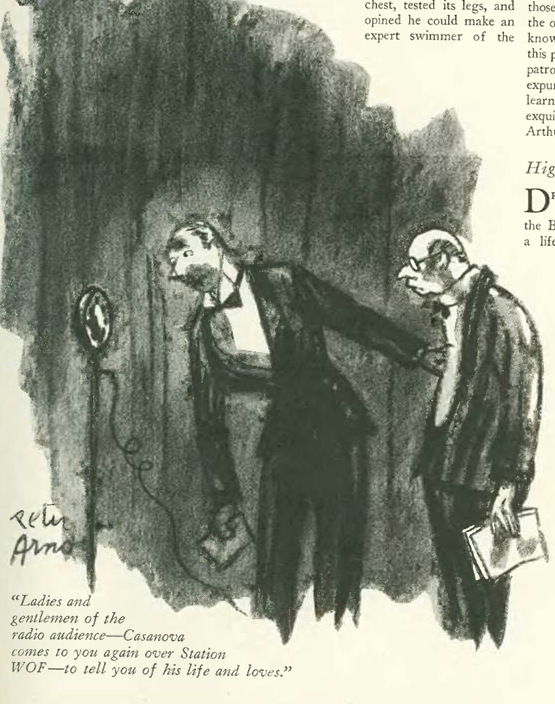
…and Peter Arno revealed a less than glamorous face behind a radio broadcast…

Next Time: New York, 1965…

The Unspeakables

For all its embrace of the modern city and its technological wonders, The New Yorker mostly despaired of the changes wrought by the introduction of sound to motion pictures.

June 1, 1929 cover by Rea Irvin.

Granted, early sound technology was primitive, with directors, actors and crew members adapting on the fly to the demands of a new medium that required absolute silence on film sets and cumbersome microphones that severely limited the movements of actors. Screenwriters, accustomed to writing brief intertitles in silent films, now had to write expository dialogue, and actors had to rely less on exaggerated facial expressions and body movements and more on the spoken word. And it helped if you didn’t have a speech impediment or heavy accent.

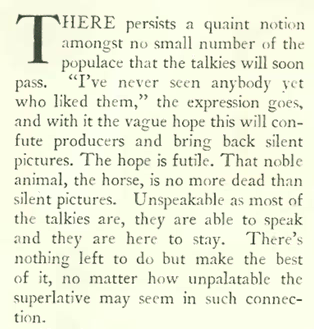
Writing for “The Reporter at Large” column (titled “The Unspeakables”), Hollywood correspondent Jean-Jacques lamented that the talkies were “here to stay”…

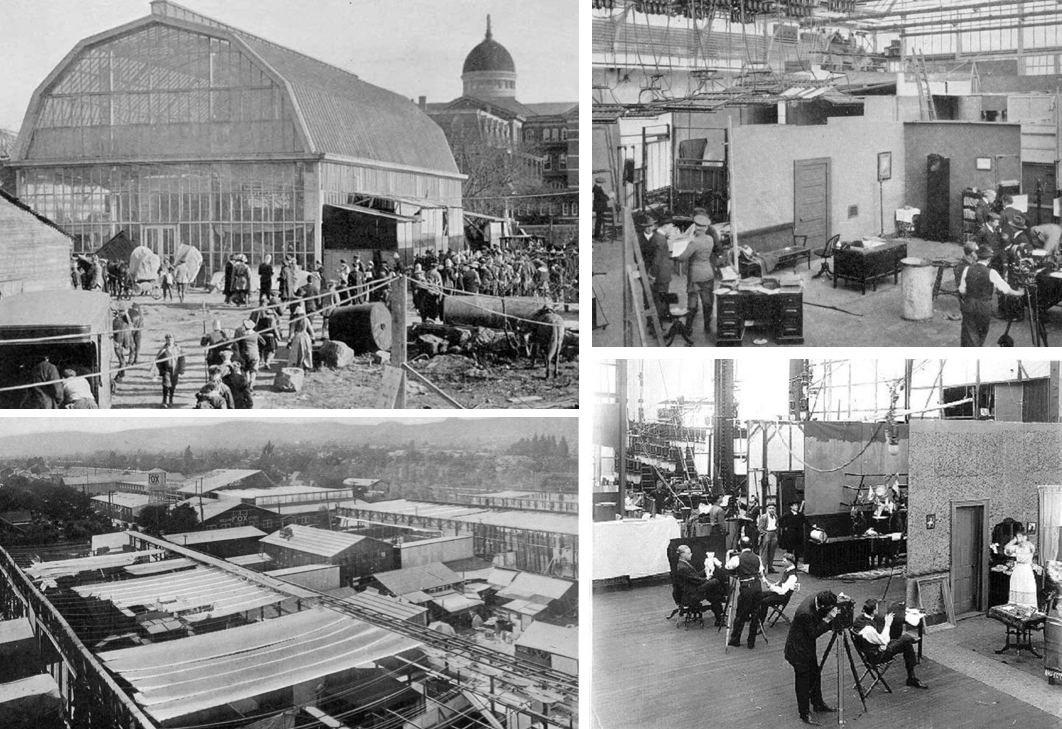
BARNLIKE STAGES were erected on both coasts to produce early silent films. Clockwise, from top left, Fox’s World Paragon Studios in Ft. Lee, NJ, circa 1917; interior of the studio; several films in production, side-by-side, at Edison’s Bronx studio, circa 1915; Fox studios in Los Angeles, 1920s. (moviemice.com/Wikipedia)

Jean-Jacques recalled the professions that would now be lost to the talkies, including the “mood musicians” who played their instruments on silent film sets in order to evoke emotions from the actors…

IN THE MOOD…During the silent era “mood musicians” were hired to play their instruments on film sets in order to evoke emotions from the actors. (Pinterest)
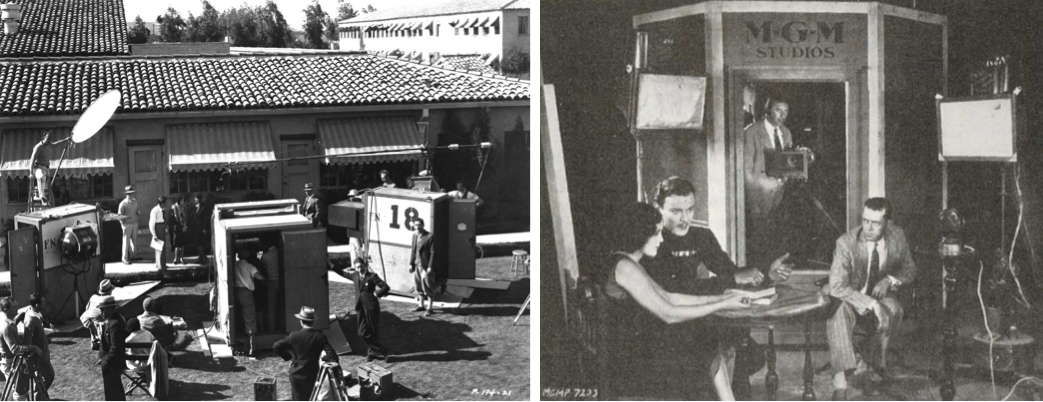
THE SILENCE OF SOUNDS…In the early days of the talkies the entire set had to be silent, and special care had to be taken to ensure loud cameras were housed in soundproof boxes such as those pictured above. Instead of the introduction of sound expanding the capabilities of filmmaking, it was often limited by the bulky gear used to capture that sound. Therefore, many films consisted of “stage” musical numbers that were static shots. (Caption and image at left courtesy Colorado College. Image at right from cinecollage.net)

The writer also noted the challenges that faced “the old scenario writer…hemmed in by a multitude of new rivals…

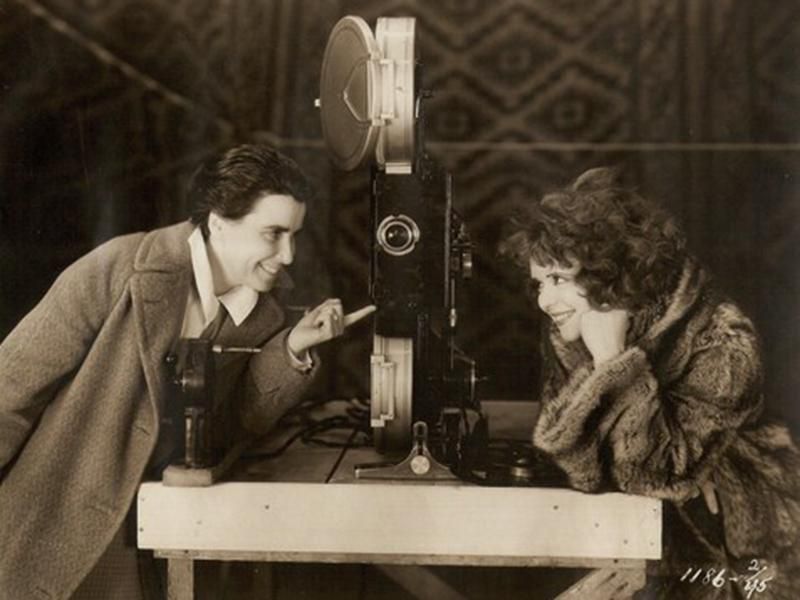
WE HAVE WAYS OF MAKING YOU TALK…Dorothy Arzner (left) poses with “It Girl” Clara Bow in a publicity shot for The Wild Party, Bow’s first talking picture. Bow is famously quoted as saying (in 1930) “I hate talkies. They’re stiff and limiting. You lose a lot of your cuteness, because there’s no chance for action.” Arzner tried to remedy that problem: she is credited with inventing the boom mike, which allowed for greater movement by the actor. (Paramount Pictures/Wikimedia Commons)

Jean-Jacques recounted the frustrations experienced by one old-time actor dealing with the limitations of bulky sound equipment…

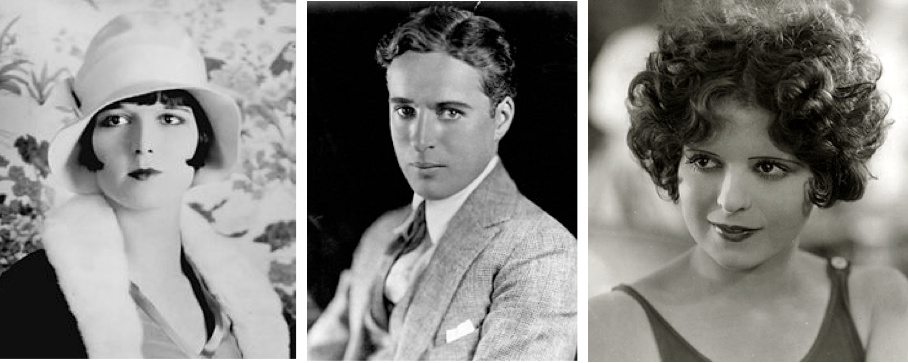
This actor was not alone. A number of major silent film stars including Charlie Chaplin, Louise Brooks, and Clara Bow did not embrace the novelty of sound pictures. Motion Picture Classic magazine (September 1930) quoted Bow as saying, “I hate talkies … they’re stiff and limiting. You lose a lot of your cuteness, because there’s no chance for action, and action is the most important thing to me.” According to the article, a visibly nervous Bow had to do a number of retakes in The Wild Party because her eyes kept wandering up to the microphone overhead.

SILENCE IS GOLDEN…A number of major silent film stars including (from left) Louise Brooks, Charlie Chaplin and Clara Bow did not embrace the novelty of sound pictures. (Wikipedia)

Jean-Jacques signed off his New Yorker piece with the hope that someday pictures and sound would be combined into a worthy new art form…

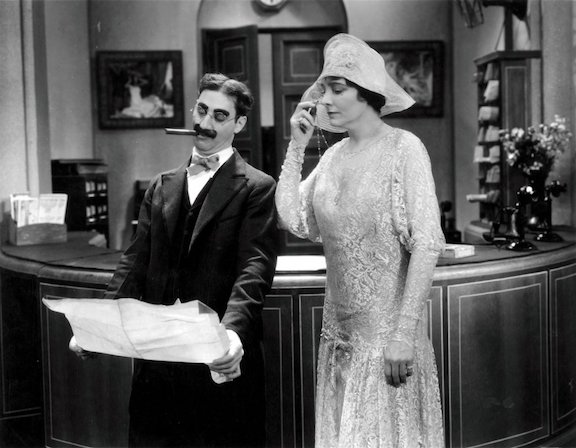
Perhaps he had to look no further than Manhattan’s Rialto Theatre to find that first glimmer of hope, for it was there that the Marx Brothers were tearing up the screen in their first talking picture, The Cocoanuts, reviewed in the magazine’s “The Current Cinema” column…

If The New Yorker was looking for snappy dialogue in motion pictures, there was plenty of it in The Cocoanuts, including this snippet between Groucho Marx, playing Mr. Hammer—an unscrupulous manager of a bankrupt Florida hotel—and wealthy hotel guest Mrs. Potter, played by Margaret Dumont…

Hammer: Do you know that property values have increased since 1929 one thousand per cent? Do you know that this is the biggest development since Sophie Tucker? Do you know that Florida is the show spot of America and Cocoanut Manor the black spot of Florida?

Mrs. Potter:  You told me that yesterday.

Hammer: I know but I left out a comma.

Or this gem…

Hammer, to Mrs. PotterJust think – tonight, tonight when the moon is sneaking around the clouds I’ll be sneaking around you. I’ll meet you tonight under the moon. Oh, I can see it now – you and the moon. Wear a neck-tie so I’ll know you.

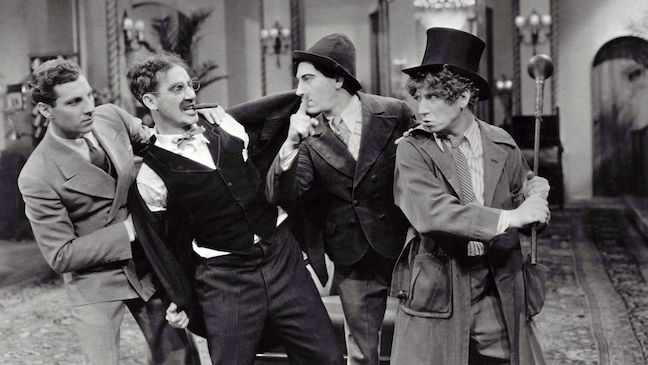
SHOW ‘EM HOW IT’S DONE…Zeppo, Groucho, Chico and Harpo Marx in their first sound movie, The Cocoanuts, 1929. (vitaphonedreamer.wordpress.com)
BAMBOOZLER… Mrs Potter (Margaret Dumont), inspects Mr Hammer’s (Groucho Marx) Florida property “deals” in The Cocoanuts. (British Film Institute)

 *  *  *

For Sentimental Reasons

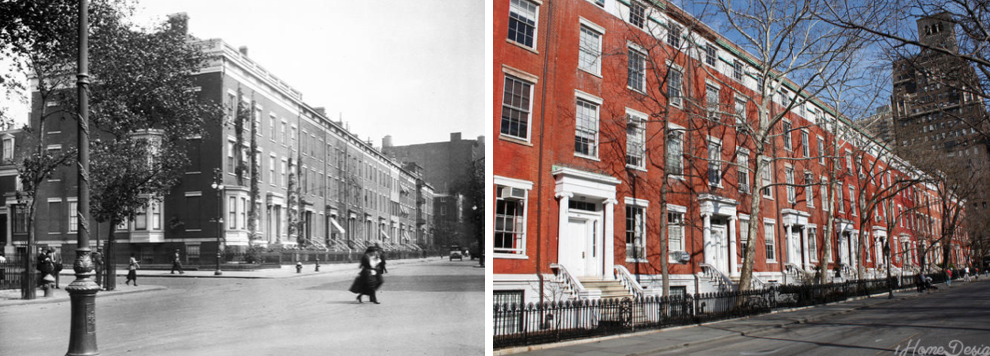
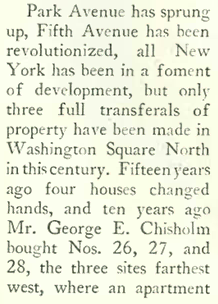
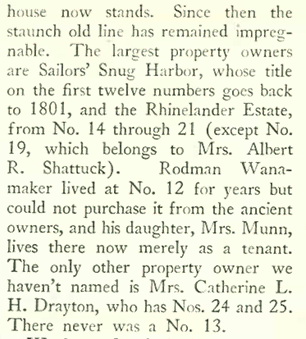
Additional evidence that The New Yorker was not always ready to embrace change came from its many articles, particularly in “The Talk of the Town,” that seemed to favor the preservation of buildings that defined the character of certain neighborhoods, including the early 19th century row houses that lined Washington Square North…

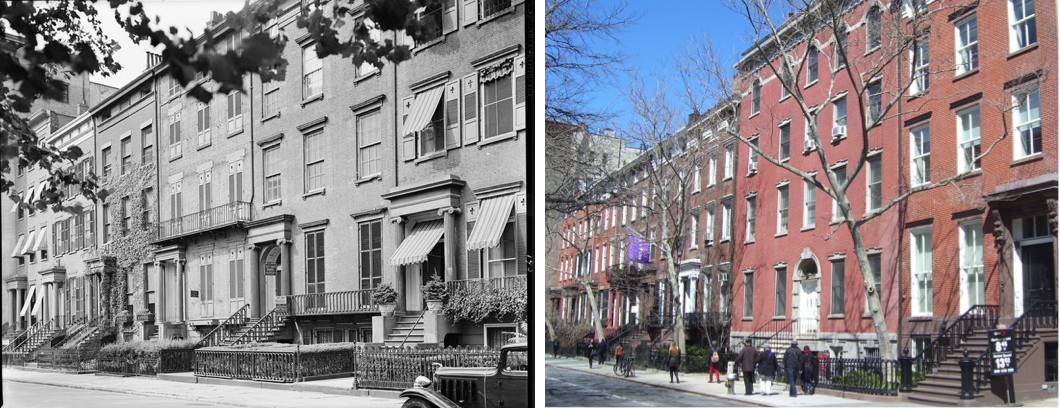
THEN AND NOW…At left, photo dated 1921 of Washington Square, north side of square looking east from 5th Avenue. Corner house in foreground is No. 12. The far end at right shows Nos. 3, 2, 1. At right, roughly the same block today. (Museum of the City of New York/1homedesigns.com)

At left, photo dated 1936 (by Berenice Abbott) of Washington Square North, nos. 21-25, between Fifth Avenue and MacDougal Street. At right, nos. 19-26 today. (Museum of the City of New York/Wikimedia Commons)

 *  *  *

The Wittier Kaufman

Editor and playwright Beatrice Kaufman worked and played within the orbit of the famed wits of the Algonquin Round Table, but was not a regular member like her husband, playwright and director George S. Kaufman. But Beatrice Kaufman didn’t the need the Algonquin to display her wit. Indeed, according to Michael Galchinsky (writing for the Jewish Women’s Archive), she was regarded as one of the wittiest women in New York in the 1930s and 40s. Here is an example of her work in the June 1 issue of The New Yorker:

THE WITTIEST OF THEM ALL…Editor, writer and playwright Beatrice Kaufman (left, in undated photo). At right, comedian Julius Tannen (left) frolics with Beatrice and her husband, Broadway playwright/producer George S. Kaufman in Atlantic City in the 1920s. (thepurplediaries.com/spartacus-educational.com)

 *  *  *

Rags to Riches

The life of Fred F. French was something out of dime novel; born in dire poverty, he became a self-made real estate tycoon and a shrewd builder of some of Manhattan’s biggest land developments. French was the subject of a profile written by Robert M. Coates, an art critic who would be a longtime contributor to The New Yorker. An excerpt, with illustration by Al Frueh:

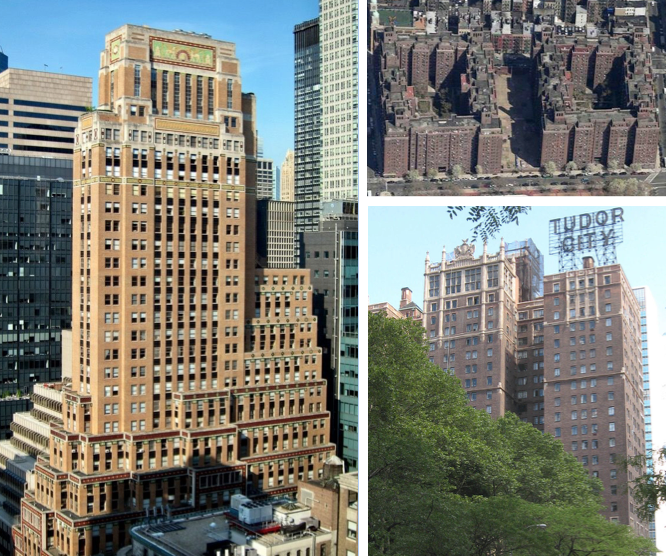
MONUMENTS TO FRED…Fred French’s New York City buildings included, clockwise from left, the 38-story Fred F. French Building (1927) at 45th Street and 551 Fifth Avenue (designated a National Landmark); Knickerbocker Village (1934) on the Lower East Side; and the East Side’s Tudor City apartment complex (1927-1932). (Pinterest/thelodownny.com/Wikipedia)

 *  *  *

From Our Advertisers

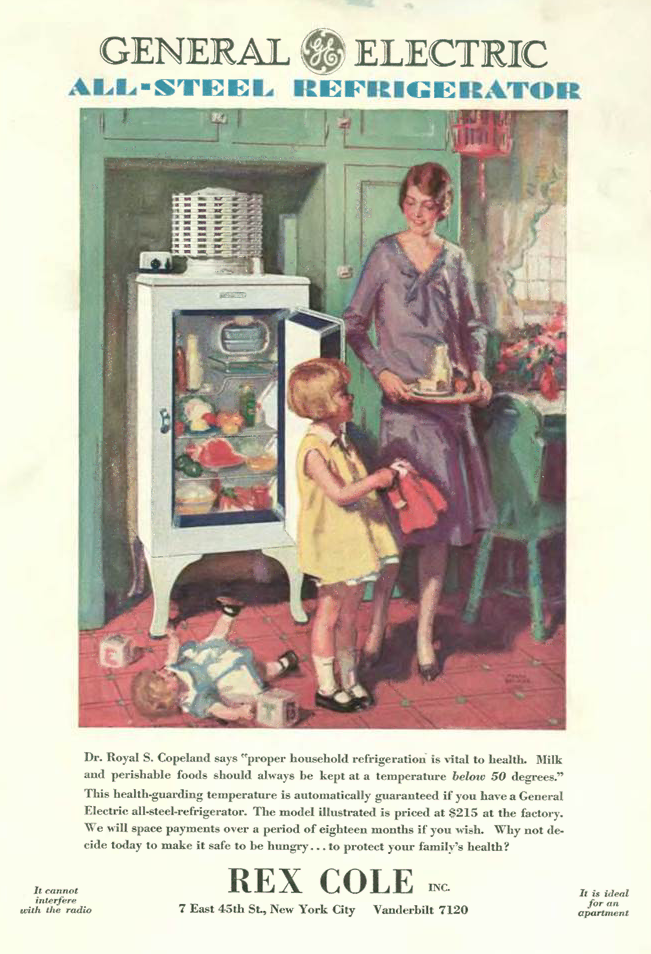
Let’s start with a couple of lovely color ads, which appeared with greater frequency in the magazine…here we have a snatch of the good life, courtesy General Electric…

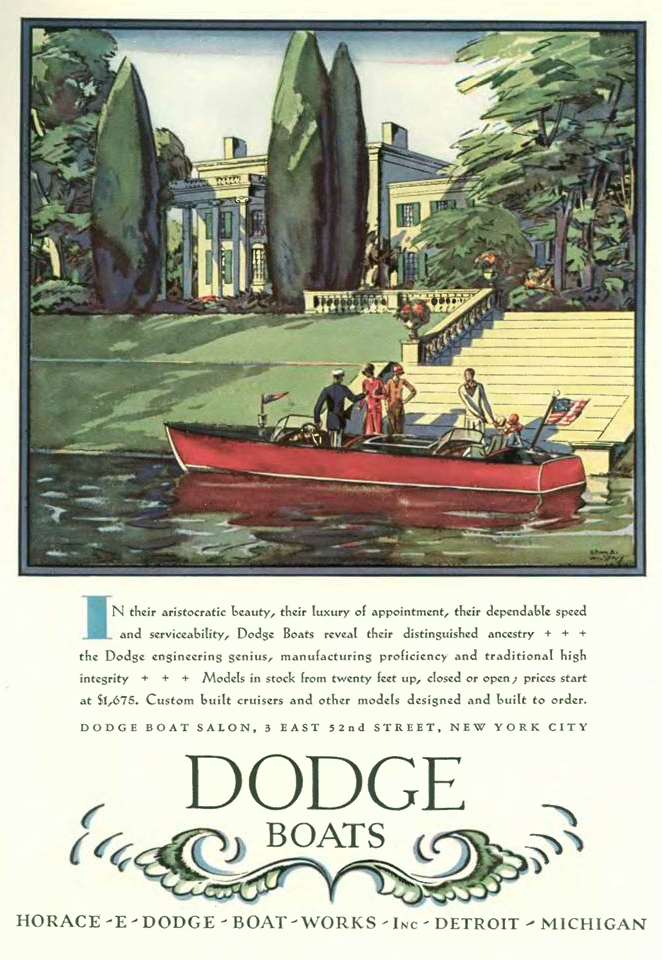
…and perhaps a less homespun image of the good life, from the makers of Dodge boats…

…and here we have another example of the modern world rushing in, this time in the form of instant coffee crystals…

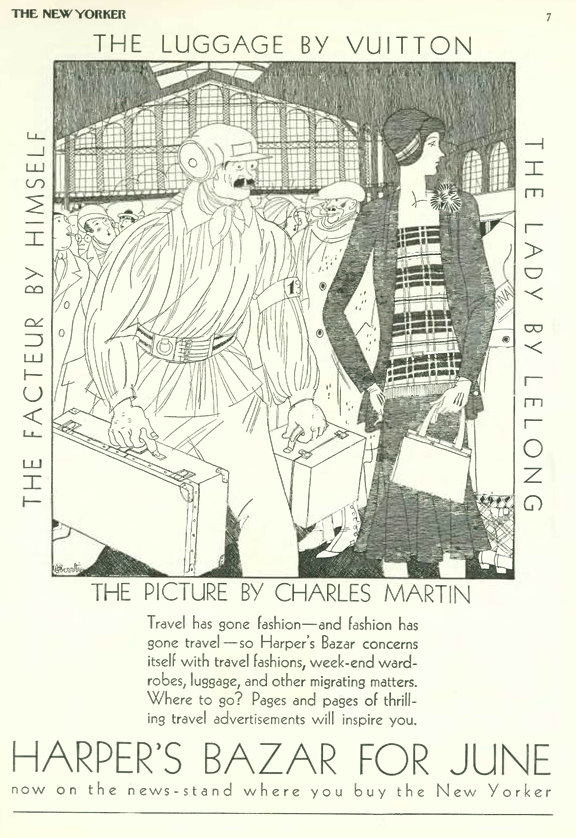
…and another taste of the modern from Harper’s Bazar magazine, featuring an illustration by French artist and illustrator Charles Martin

…and just for kicks, another example of Martin’s work from an earlier time…

Image from Sports et Divertissements by Charles Martin, 1914. (Wikipedia)

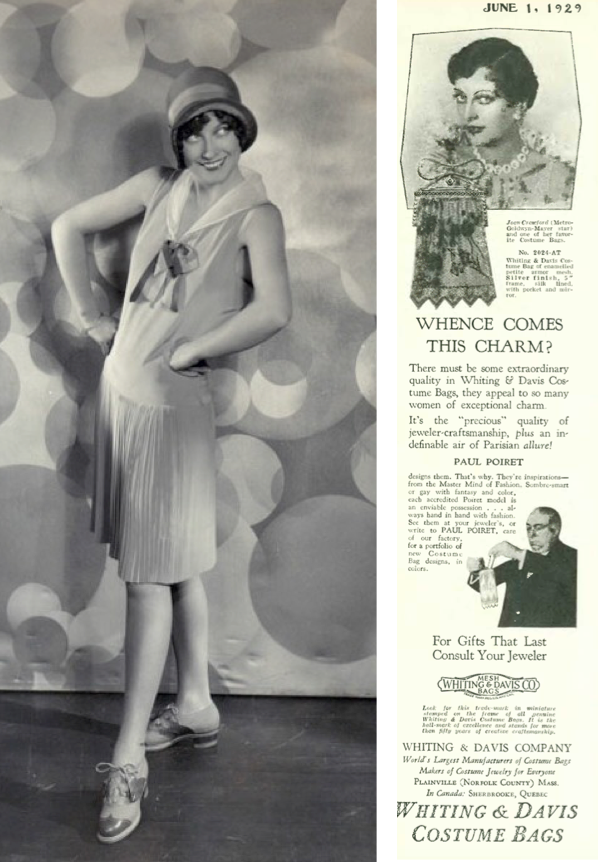
…and here is a back page ad for costume bag maker Whiting & Davis, with an endorsement by Joan Crawford, who was already a pretty big star by 1929. My guess is that Whiting & Davis paid more for the endorsement than they did for the ad…I included a photo of Crawford (at left) from 1929 just to show that she did have a lighter side…

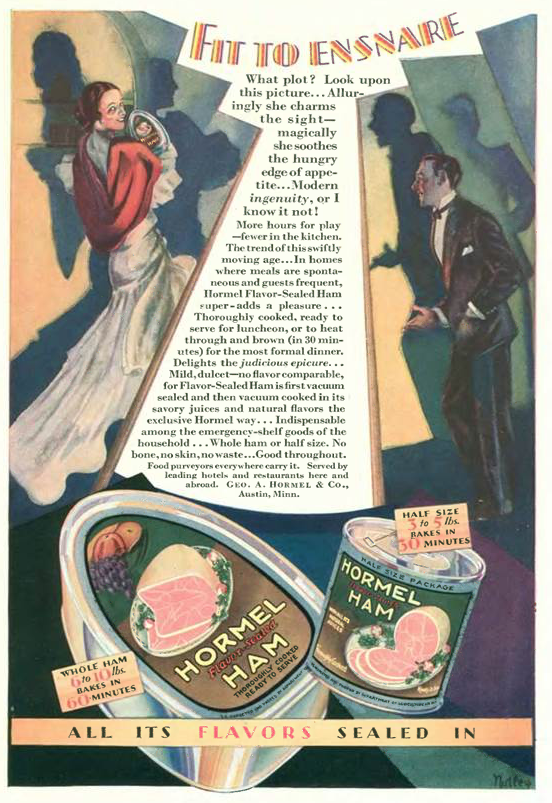
…this ad from the makers of Flit insecticide begs the question: was our beloved Dr. Seuss (aka Theodore Geisel) once a racist? Well…

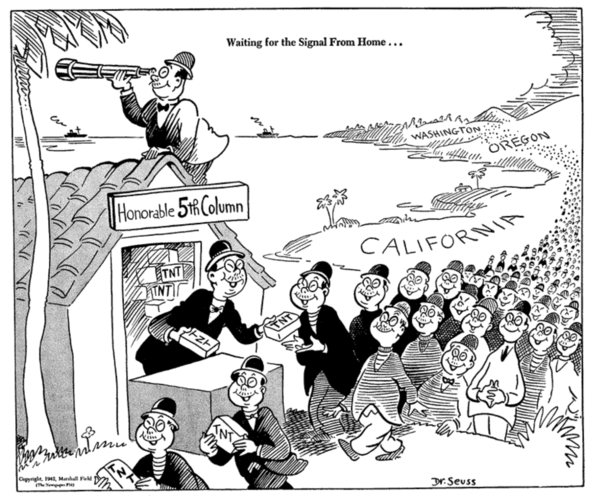
…although Geisel was a liberal Democrat and a supporter of the New Deal, during World War II he also supported the internment of Japanese Americans, as is evident from this unfortunate 1942 cartoon…

Dr. Seuss 1942 cartoon with the caption ‘Waiting for the Signal from Home’ (slideshare.net)

…later in life Geisel became a staunch environmentalist and anti-war protestor. In 1961 he wrote The Sneetches, which promoted racial equality. Perhaps Geisel lived to regret those earlier drawings…

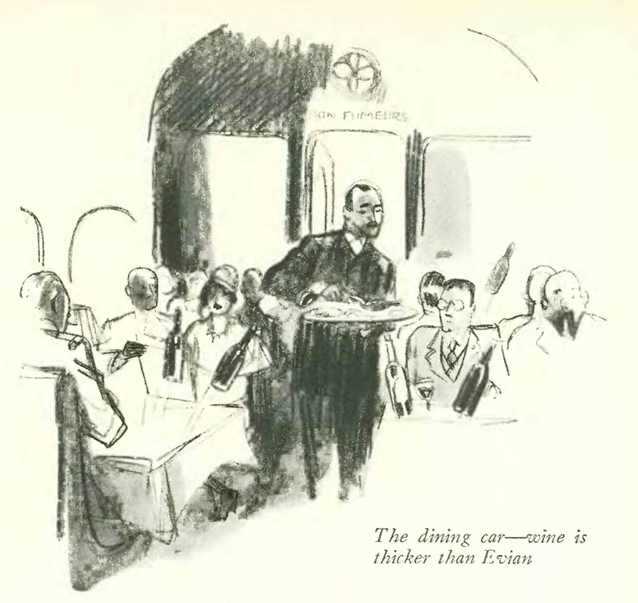
…and on to our illustrators and cartoonists, beginning with this sketch by Garrett Price, apparently inspired from a recent trip to France (it was featured along with several other small sketches in the “Profile” section)…

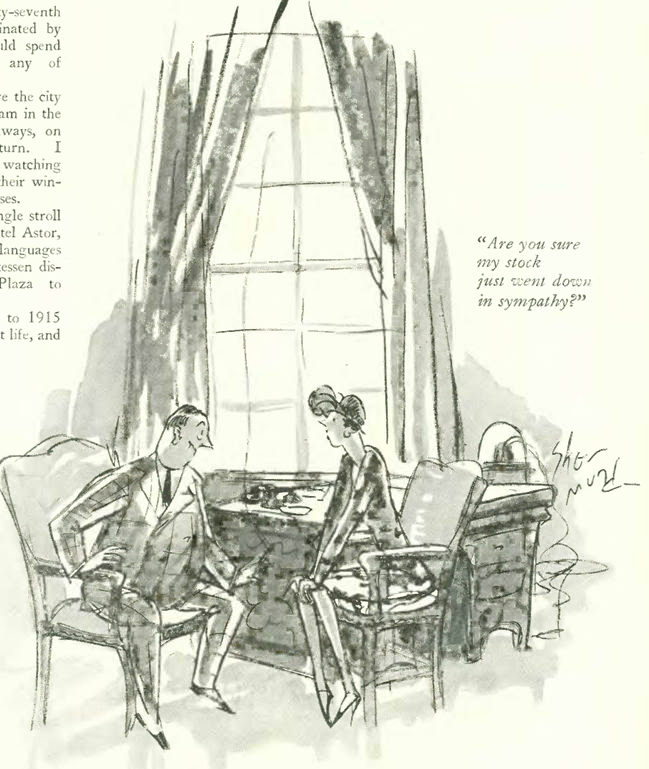
Barbara Shermund had some fun with a double entendre…

…and popped up again with this look at the stock market…

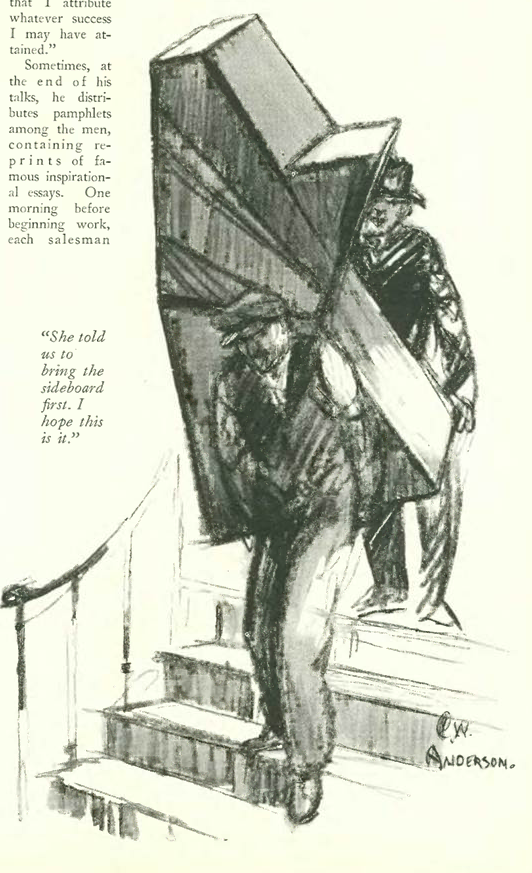
C.W. Anderson found humor in the strange shapes of modernist furniture…

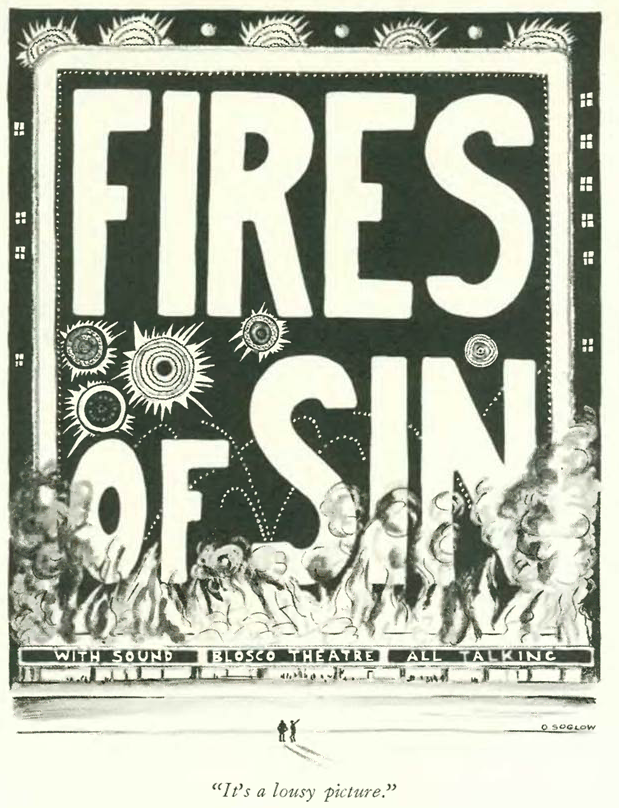
Otto Soglow commented on the glitzy hype of Broadway…

…and cartoonist/humorist Don Herold made his comics debut in The New Yorker with this entry…

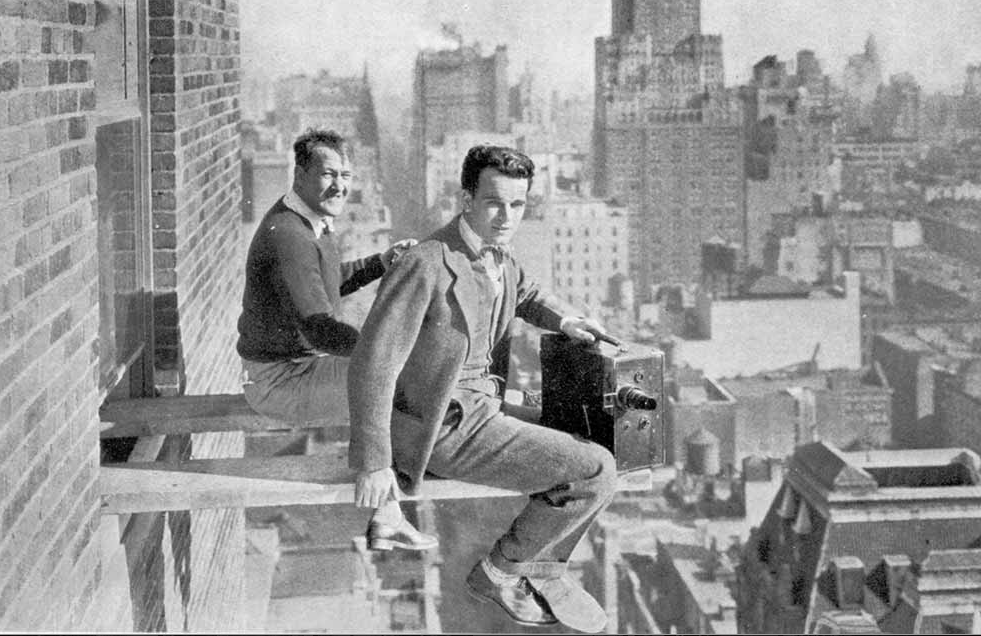
…and finally, a bonus image I came across while researching the advent of sound motion pictures. The photo, from the silent era, shows two cameramen shooting a parade, possibly for a newsreel. Note how their only support consists of two wooden planks wedged into an open window…

(moviemice.com)

Next Time: A Bridge Too Far…

Let Them Eat Cake

The re-opening of New York’s Central Park Casino in 1929 was in many ways the city’s last big party before the economy came crashing down, along with the exhuberance and frivolity of the Jazz Age.

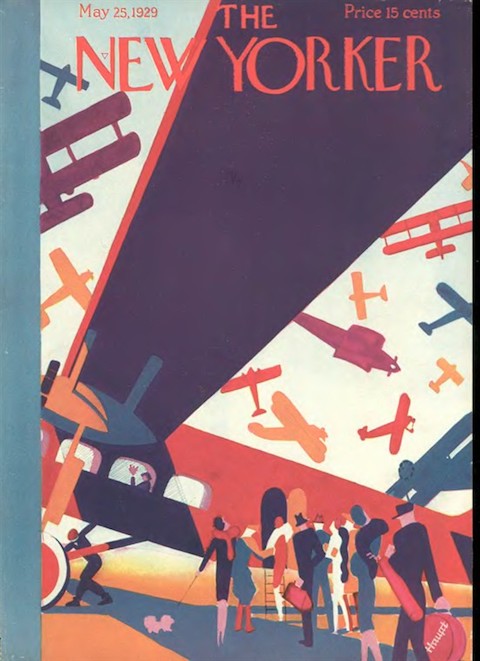
May 25, 1929 cover by Theodore Haupt.

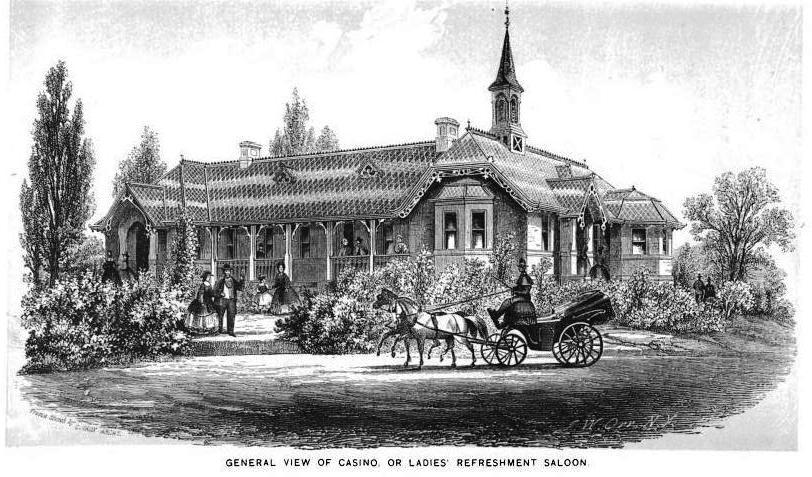
The Casino itself wasn’t new–it opened in 1864 as the Ladies’ Refreshment Salon (sometimes spelled “saloon”), a two-room stone cottage designed by Calvert Vaux. As Susannah Broyles writes in her excellent blog post for the Museum of the City of New York, the Victorian cottage was a place where “unaccompanied ladies could relax during their excursions around the park and enjoy refreshments at decent prices, free of any threat to their propriety.”

Central Park’s Ladies’ Refreshment Saloon opened in 1864. (daytoninmanhattan.blogspot.com)

Broyles writes that by the 1880s the salon had morphed into a far pricier destination, a restaurant called The Casino, open to both sexes. With the rare attraction of outdoor seating, “it was the place to see and be seen.”

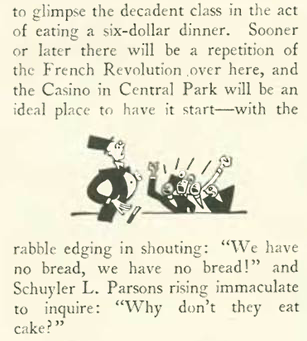
By the 1920s the restaurant had grown a bit shabby. Then along came the city’s flamboyant mayor, Jimmy Walker (1881-1946), who saw the potential of the property as a place where he could hob-nob with wealthy and fashionable New Yorkers and openly flaunt Prohibition laws. There were others, however, who found the idea of an exclusive playground for the rich in a public park distasteful. The New Yorker observed as much in the “Notes and Comment” opening of “The Talk of the Town”…

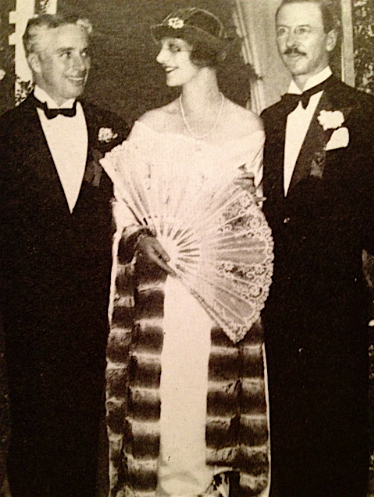
…the “Schuyler L. Parsons” referred to above was a tireless host, prominent decorator, and a society A-lister. He is pictured here (circa 1930) with two of his closest friends, actor Charlie Chaplin and the actress, singer and dancer Gertrude Lawrence

(Tyler Hughes Collections)

The Central Park Casino reopened its doors on June 4, 1929 at an invitation-only event. The following day it would open to the public, but as New York’s newest and most expensive restaurant it would remain closed to all but the wealthiest. As The New Yorker observed, the city was, after all, a “plutarchy,” and the populace passing by the Casino would at least be allowed “to glimpse the decadent class in the act of eating a six-dollar dinner” (nearly $90 today).

This formal announcement of the opening appeared in the May 6, 1929 issue of The New Yorker, including the time of the event—I suppose for the benefit of the 600 who actually had an invitation, or perhaps to tantalize those without such credentials…

The Casino was a playground for the rich by design, conceived in the image of the flamboyant Mayor Walker—himself a product of the Tammany Hall political machine—and executed by hotelier Sidney Solomon, who obtained the building’s lease via some Tammany-style subterfuge. Solomon hired architect and theatrical set designer Joseph Urban to transform the Casino into a glittering showpiece of Jazz Age nightlife.

Clockwise, from top left, the Central Park Casino; architect Joseph Urban; his Casino ballroom design with black-mirrored ceiling; the Casino lobby. (acontinuouslean.com/Columbia University/centralpark.com/drivingfordeco.com)

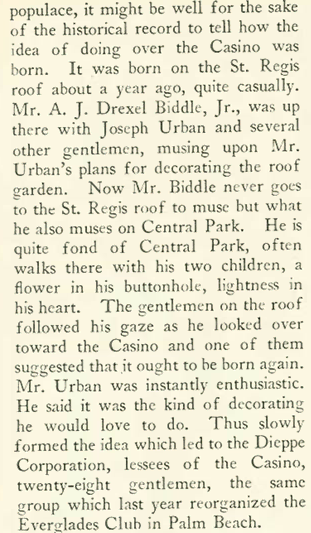
The New Yorker continued its observations on the Casino in another “The Talk of the Town” piece titled “Historical Note,” attributing the inspiration for the Casino not to Walker or Solomon, but to socialite Anthony Joseph Drexel Biddle Jr…

AN EYE FOR THE FINER THINGS…The wealthy socialite A.J. Biddle (pictured here with his first wife, Mary Lillian Duke, in 1924) trained his eye on the Central Park Casino while on the rooftop of the St. Regis Hotel pondering another Joseph Urban project. (voxsartoria.com)
PARTY BOY…New York Mayor Jimmy Walker and his nighttime playground, the Central Park Casino, show here on September 10, 1935. (Britannica/ New York City Department of Parks & Recreation)

Well, as you’ve probably guessed, the party didn’t last forever. After the October 1929 stock market crash, the sight of rich folks stuffing their faces and drinking fine wines in a public park looked even more unseemly. Soon the Casino found itself in the crosshairs of Parks Commissioner Robert Moses, who detested Mayor Walker.

As for Walker himself, a growing financial scandal prompted him to resign from office on Sept. 1, 1932. He promptly fled to Europe with his mistress, Ziegfeld girl Betty Compton, and stayed overseas until the threat of criminal prosecution had passed. For Moses, it wasn’t satisfaction enough to see Walker driven from office. In 1936, despite protests from preservationists, Moses had Urban’s lovely restaurant demolished. It was replaced by a children’s playground the following year.

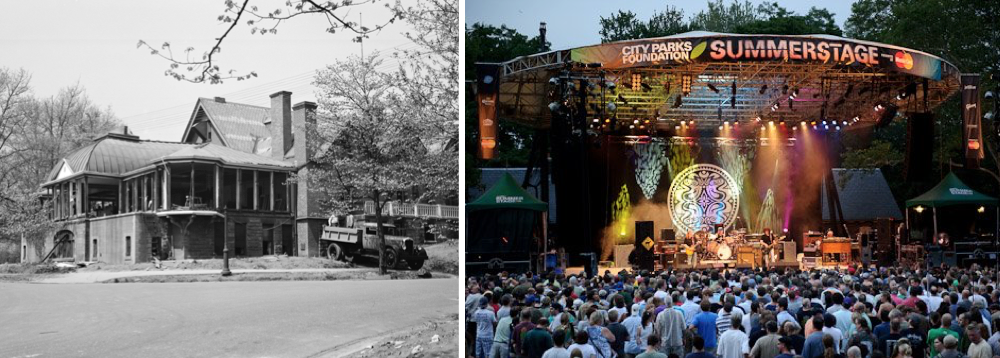
THE PARTY’S OVER…Crews dismantling the Central Park Casino in 1936. In 1937, the Rumsey Playground was built on the site of the Casino, and in the 1980’s the site was razed again and converted into Rumsey Playfield, where the city’s SummerStage events are now held. (Museum of the City of New York/centralpark.com)

*  *  *

A Drinking Life

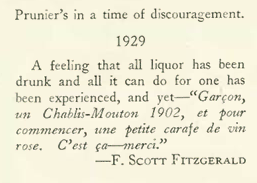
As the Jazz Age was winding down, one of its greatest chroniclers began a brief relationship with The New Yorker. In the March 12, 2017 issue of the magazine, Erin Overbey and Joshua Rothman wrote “There’s a doomed, romantic quality to the relationship between F. Scott Fitzgerald and The New Yorker; they were perfect for each other but never quite got together.” In total, Fitzgerald published just two poems and three humorous shorts for the magazine, beginning with this piece in the May 25, 1929 issue:

Fitzgerald’s last contribution to the New Yorker would appear in the Aug. 21, 1937 issue (“A Book of One’s Own”). Following the author’s death in 1940 the magazine would feature various articles on his life and work, and in 2017—77 years after Fitzgerald’s death—the New Yorker would publish a long lost short story, “The IOU.” A fitting title for an author who sadly did not get his due while he was alive.

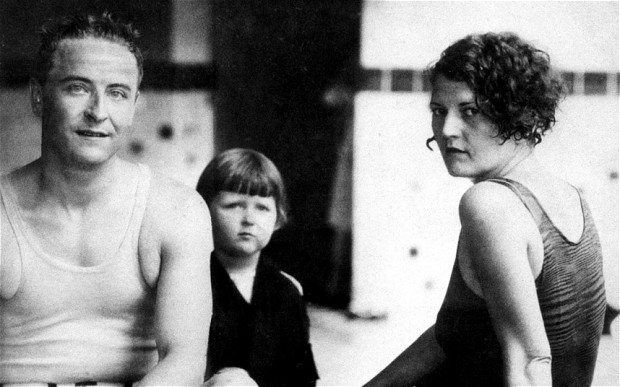
IOU…F. Scott Fitzgerald with daughter “Scottie” and wife Zelda, circa 1927. (The Telegraph)

 *  *  *

One of the Gang

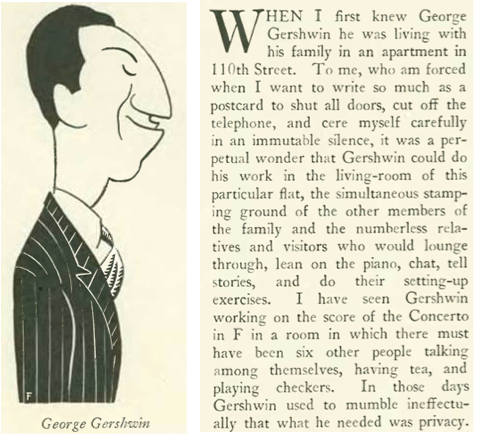
Among the Jazz Age artists and writers who orbited around the Algonquin Round Table (and the Central Park Casino) and chummed with the writers of the New Yorker was musician and composer George Gershwin (1898-1937) who was profiled in the May 25 issue by his friend and longtime New Yorker writer Samuel N. Behrman. The opening paragraph (with caricature by Al Frueh):

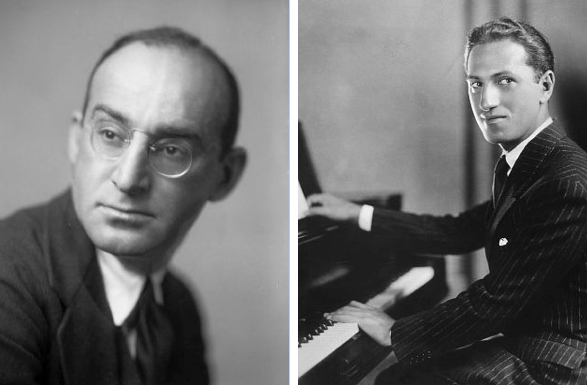
IN THE SAME ORBIT…Samuel Nathaniel Behrman (left), was an American playwright, screenwriter, biographer, and longtime writer for The New Yorker. From the late 1920s through the 1940s, he was considered one of Broadway’s leading authors of “high comedy,”His son is the composer David Behrman. At right, George Gershwin at the piano, 1929. (prabook.com/IMDB)

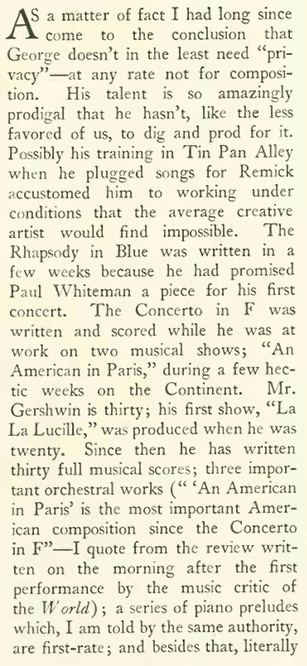
In the profile, Behrman observed that although Gershwin expressed a desire for privacy, he was quite capable of dashing off major works in practically any setting:

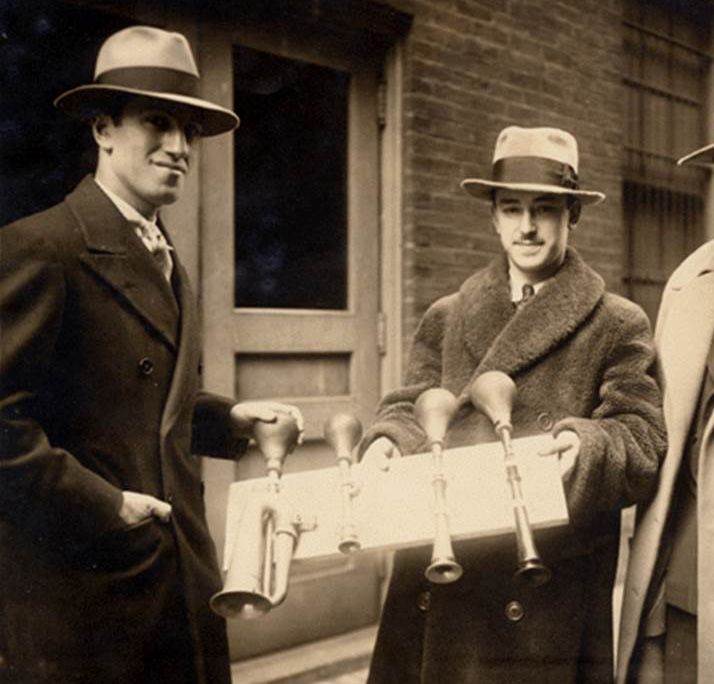
TOOTING HIS OWN HORN…Composer George Gershwin and Cincinnati Symphony Orchestra percussionist James Rosenberg holding four taxi horns used in the orchestra’s performance of An American in Paris, on Feb. 28, 1929. (Photo courtesy of Ira and Leonore Gershwin Trusts)

 *  *  *

Scratching the Surface

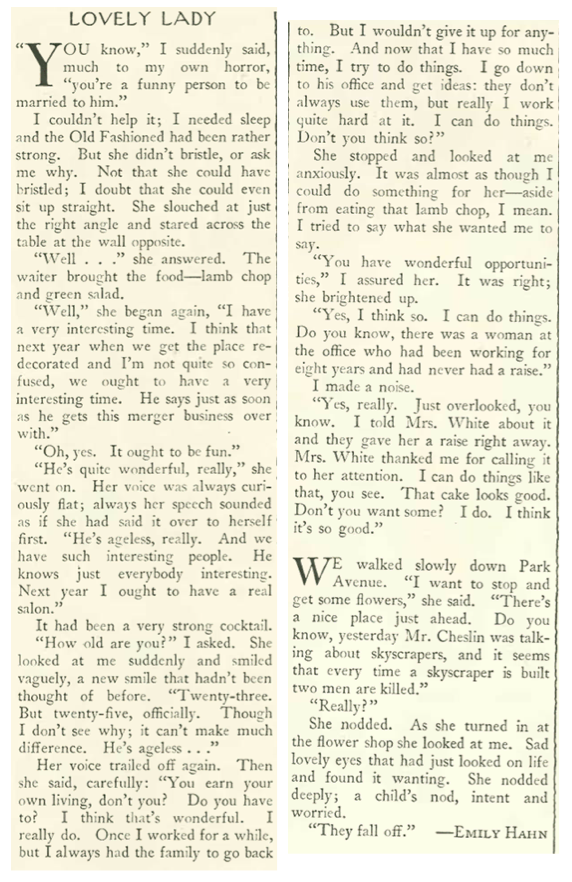
Emily Hahn (1905-1997) was a prolific journalist and author who contributed at least 200 poems, articles and works of fiction to The New Yorker over an astonishing 68-year span—from 1928 to 1996. As the title suggests, I am merely scratching surface, and will devote a post to her in the near future. Here is her contribution to the May 25, 1929 issue:

PROLIFIC…A 1937 portrait of Emily Hahn taken in Shanghai, China, by Sir Victor Sassoon. The author of 54 books, Hahn is credited with playing a significant role in opening up Asia and Africa to the West through her many novels. (DeGolyer Library, SMU)

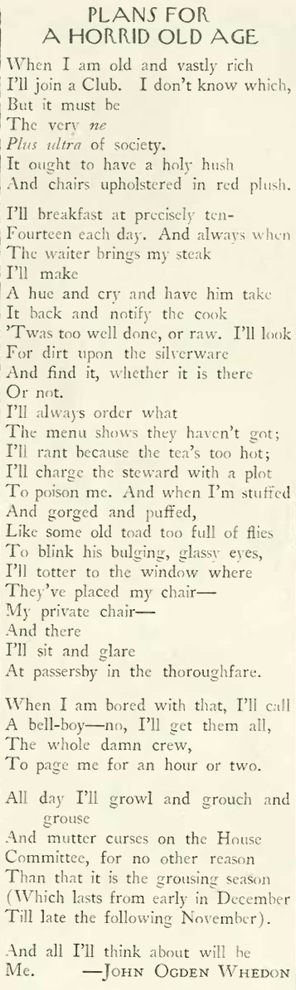
Another frequent contributor to The New Yorker was screenwriter John Ogden Whedon (1905-1991), who offered up mostly shorts from 1928 to 1938. He is best known as a television writer for such shows as The Andy Griffith Show, The Dick Van Dyke Show and Leave It to Beaver. Whedon and his wife, Louise Carroll Angell, were parents and grandparents to a number of screenwriters, including grandson Joss Whedon, creator of Buffy the Vampire Slayer and writer/director of The Avengers (2012) and its sequel Avengers: Age of Ultron (2015). An excerpt of grandpa’s writing from the May 25 issue:

 *  *  *

From Our Advertisers

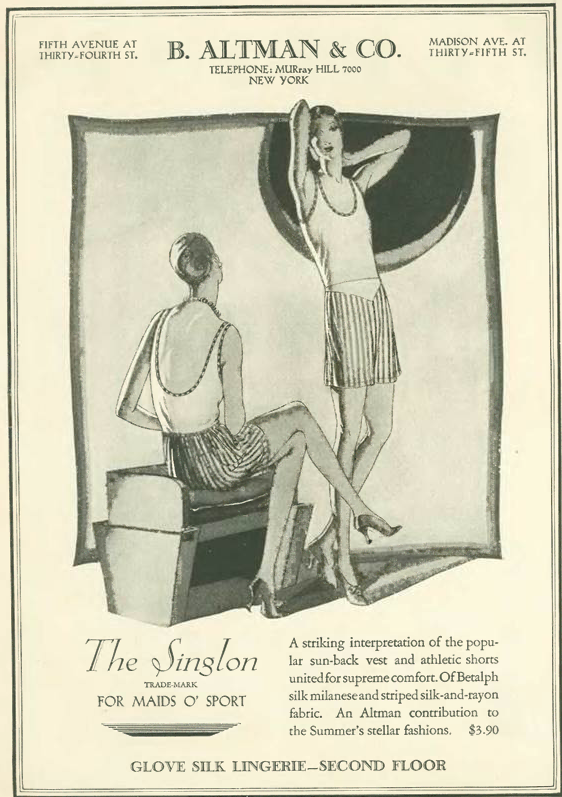
In a recent post (Waldorf’s Salad Days) I noted an ad from Lily of France that proclaimed the straight flapper figure was out, and it was now the “season of curves.” This ad from B. Altman begs to differ…

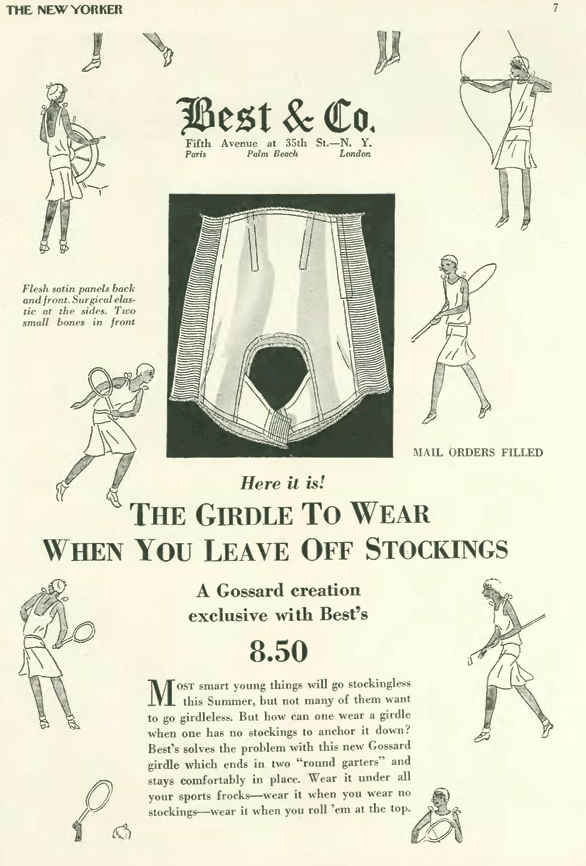
…one way to keep that straight figure was to pull on a girdle, which I’m sure felt great while one played tennis…

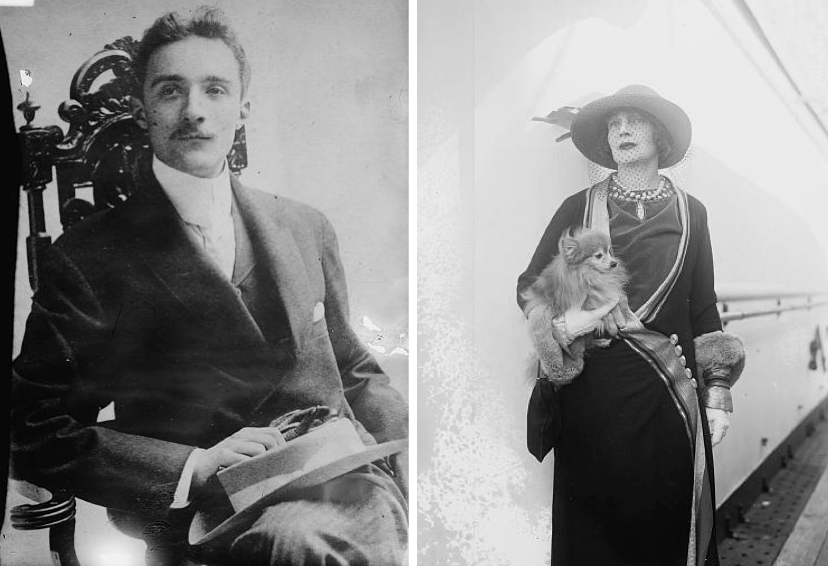
…our latest Lucky Strike endorser is…Mrs. Jerome Napoleon Bonaparte. Never heard of her? Well, “Mrs. Jerome” was actually a one Blanche Pierce (1872-1950) of Rochester, NY. Her second husband, Jerome Napoleon Bonaparte (the great-grandnephew of Emperor Napoleon) was something of a wastrel, having inherited a fortune and never worked at a job or profession. Blanche herself was known as a social climber…

THEY EXISTED…Jerome Napoleon Charles Bonaparte (pictured here circa 1915) was the great-grandnephew of Emperor Napoleon and a man of extreme leisure. His wife, Blanche Pierce Bonaparte (right, in a photo circa 1925), was known as a dog lover, a passion that indirectly led to her second husband’s demise. Jerome died while walking his wife’s dog in Central Park—he apparently stumbled over the dog’s leash and broke his neck. (Library of Congress)

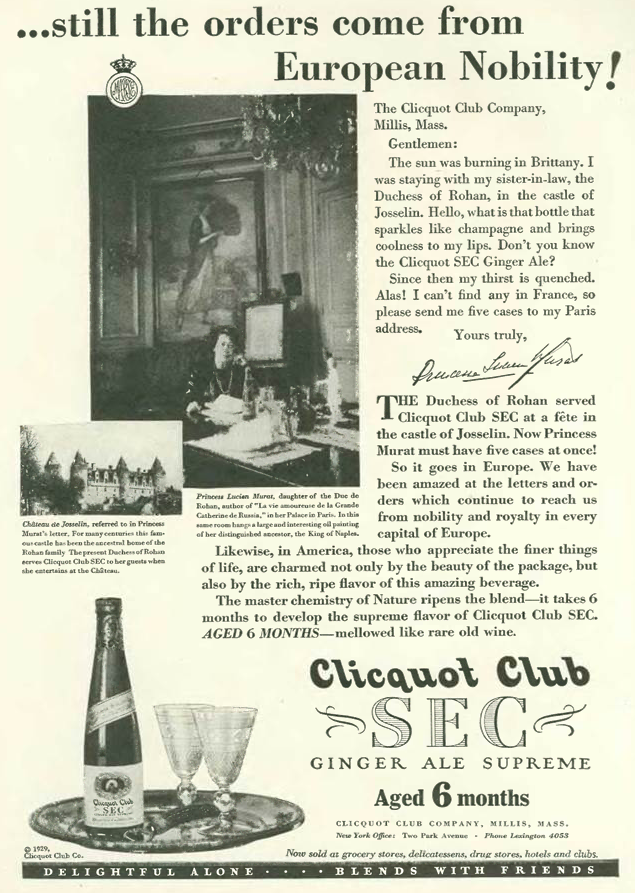
…speaking of European nobility, here is another sad endorsement from a French noble touting the wonders of Clicquot Club ginger ale to Prohibition-strapped Americans…

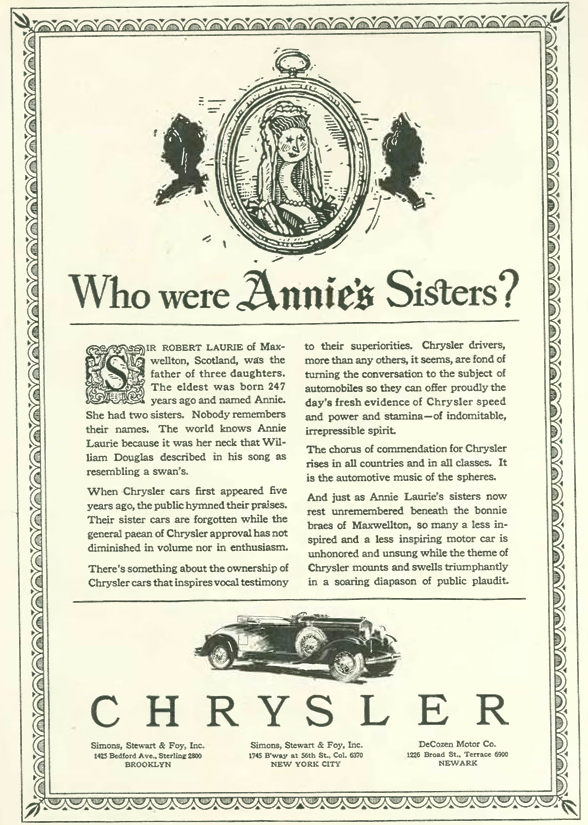
…and then we have this weird “Annie Laurie” analogy used by Chrysler to sell its line of automobiles…

…the manufacturers of Studebaker, on the other hand, opted for a more direct approach, equating its automobiles with the speed and modernity of airplane flight…note how in both ads the cars are pictured with the windshields folded down to emphasize sleekness…

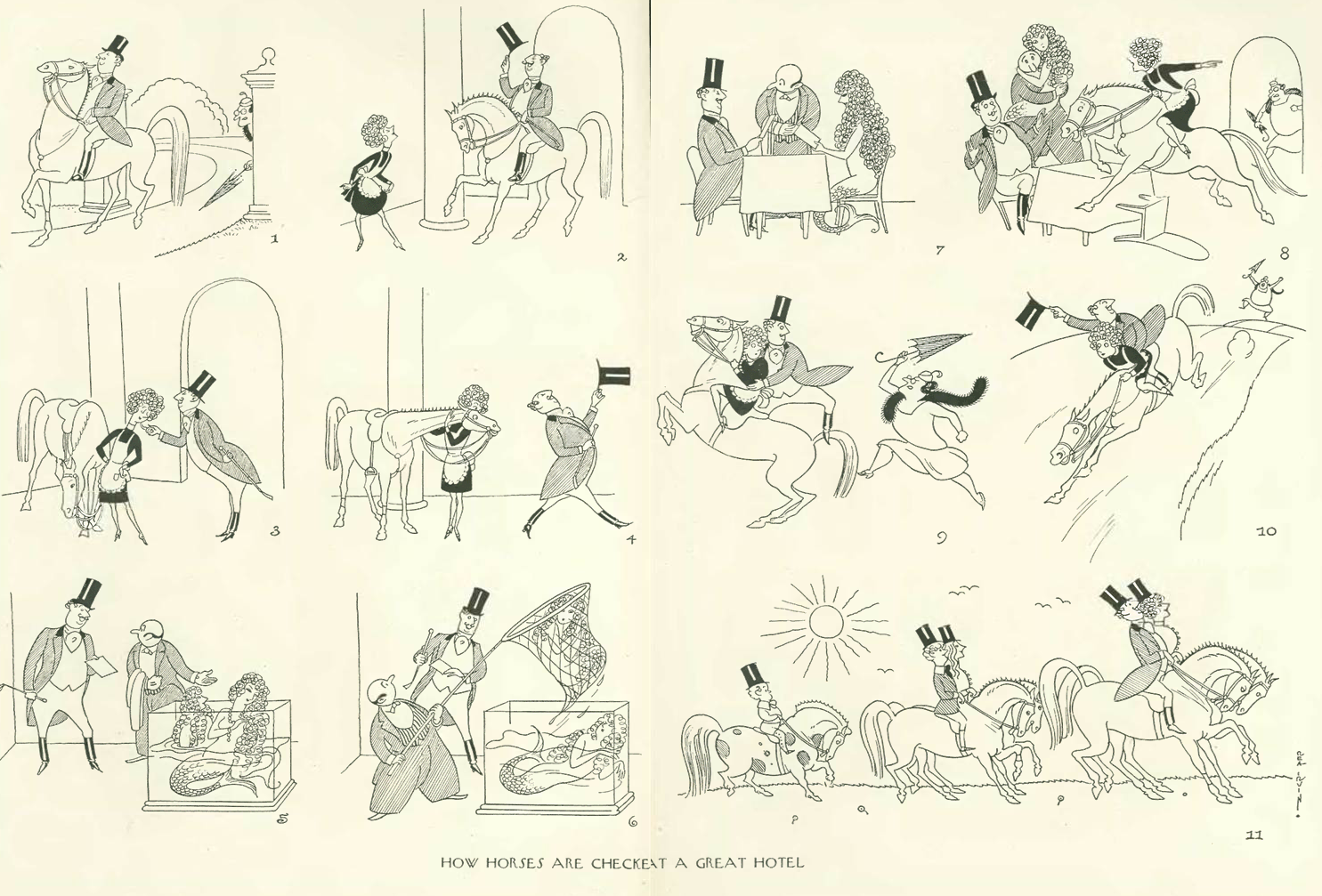
…on to the cartoons: we begin with this two-page entry by Rea Irvin, which makes very little sense…I get the part where the rich old man (stalked by his fearsome wife) finds a mistress (and a new wife) through the process of “checking his horse,” but the whole mermaid thing is lost on me…please click to enlarge—I’d love to have this one explained…

Carl Rose had some fun with newfangled sound effects in the dawning age of the talkies…

Peter Arno sketched up the cynicism of one New York dowager…

Perry Barlow captured two women who might have been driving home from an auction at the old Waldorf-Astoria Hotel…

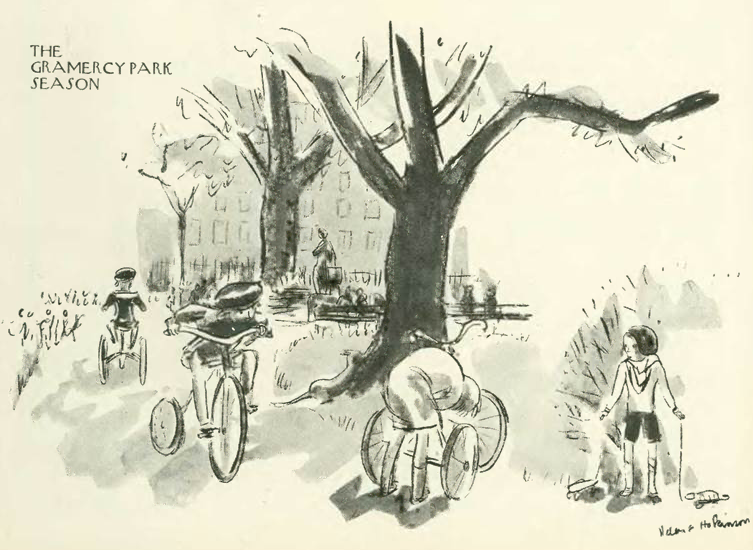
…and finally, a lovely illustration by Helen Hokinson of children at play…

Next Time: The Unspeakables…


How Charles Shaw Felt About Things

Some people really do lead charmed lives: Take for example Charles Green Shaw. Born to wealth, he was a fixture in the glamorous social scene of Jazz Age New York, but was also a key player in its intellectual and artistic life. An accomplished author as well as a poet and illustrator, Shaw turned to painting in his late thirties and became a leading figure in the world of abstract art.

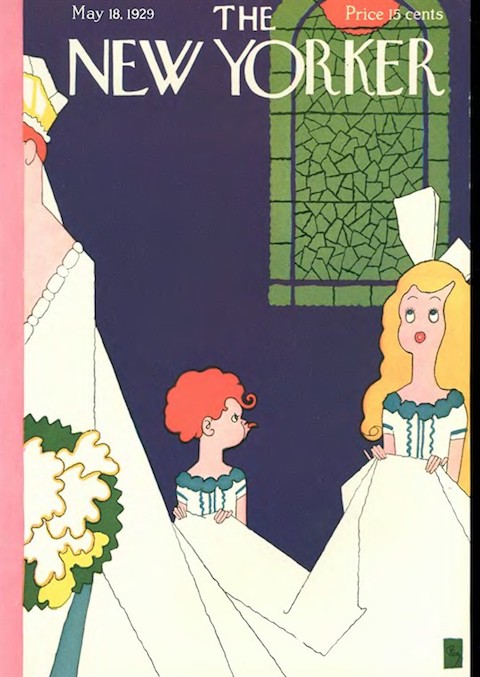
May 18, 1929 cover by Gardner Rea.

Shaw (1892-1974) was an early contributor to The New Yorker, penning more than thirty pieces for the magazine between 1925 and 1932, including three short contributions to the very first issue (Feb. 21, 1925). Here’s one of them:

That short piece anticipated a much longer entry by Shaw four years later—in the May 18, 1929 New Yorker—in a column titled “How I Feel About Things.” An excerpt…

YEAH & MEH…Charles Shaw liked Central Park at dusk; Amsterdam Avenue, not so much. (Time Freeze Photos/NYC Municipal Archives)
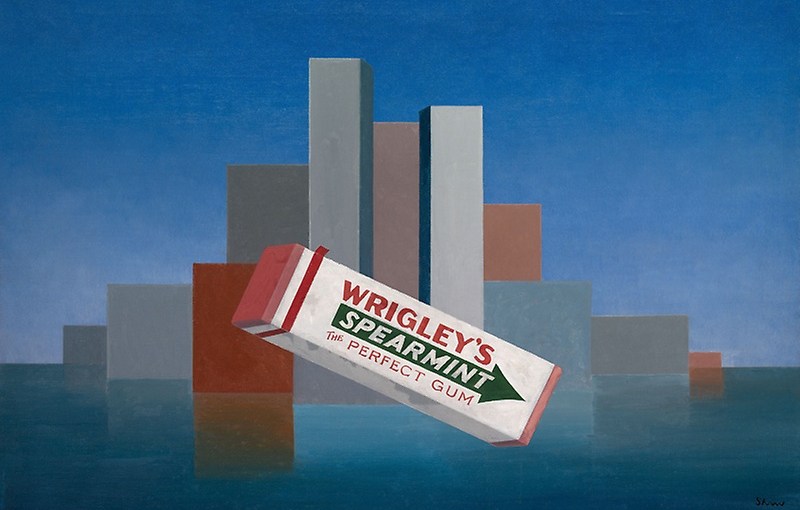
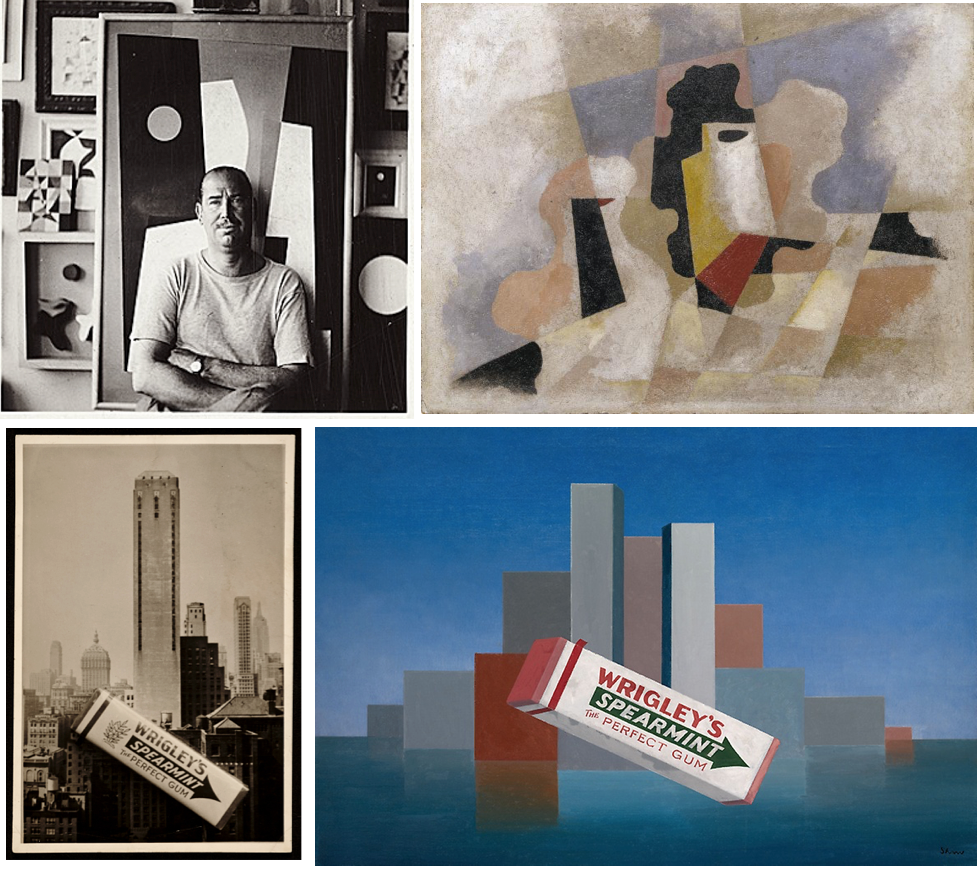
SOMETHING TO CHEW ON…Top left, Charles G. Shaw in 1945. Clockwise, from top right, Untitled Abstraction, 1943, oil on fiberboard; Wrigley’s, 1937, oil on canvas; photo of Wrigley’s gum package on top of a postcard image of New York City. On the back of the photo Shaw had written “idea for montage.” (Wrigley painting courtesy Art Institute of Chicago/other images from Archives of American Art, Smithsonian Institution)

…one more excerpt from the Shaw column…

Shaw would contribute more columns to The New Yorker in this vein: four more titled “How I Feel About Things” (1929-1931) followed by “How I Look at Things in General” (1931), and his final two New Yorker columns (1931-1932), “Things I Have Never Liked.”

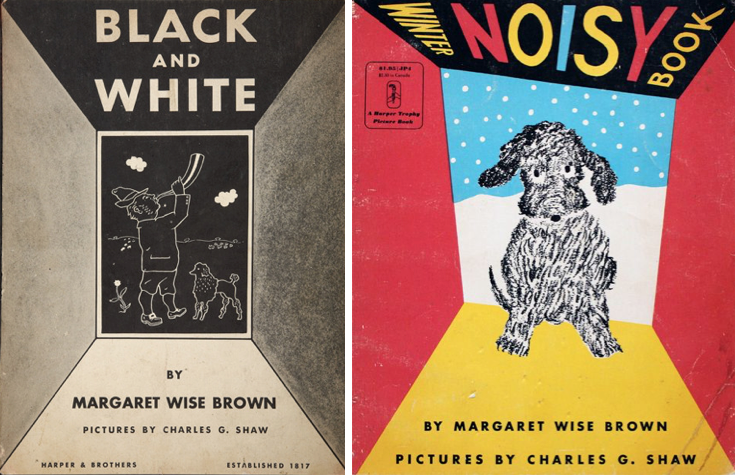
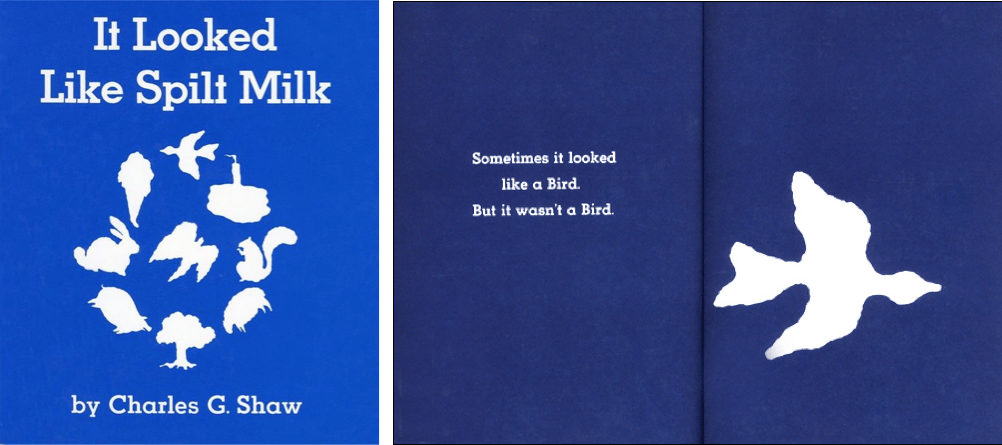
He also illustrated children’s books, including two by Margaret Wise Brown (of Goodnight Moon fame). In 1947, Shaw published It Looked Like Spilt Milk, a book that introduced children to abstract art. It remains in print and popular today.

SOMETHING FOR THE KIDS…Shaw provided illustrations for Margaret Wise Brown’s Black and White (1944) and The Winter Noisy Book (1947). (Harper)
STILL POPULAR…Shaw published It Looked Like Spilt Milk as a children’s introduction to abstract art. (Kinder Books)

 *  *  *

In the “The Talk of the Town,” James Thurber looked at “high-living” trends among occupants atop the city’s newest skyscrapers, including developer Irwin Chanin:

CROWN JEWELS…The Chanin Building at 122 E. 42nd Street sports a distinctive crown that contains a wraparound terrace (now closed) at the 56th floor. A theater on the 50th and 51st floors, just below Irwin S. Chanin’s executive suite, was later converted into office space.(aviewoncities.com/untappedcities.com)
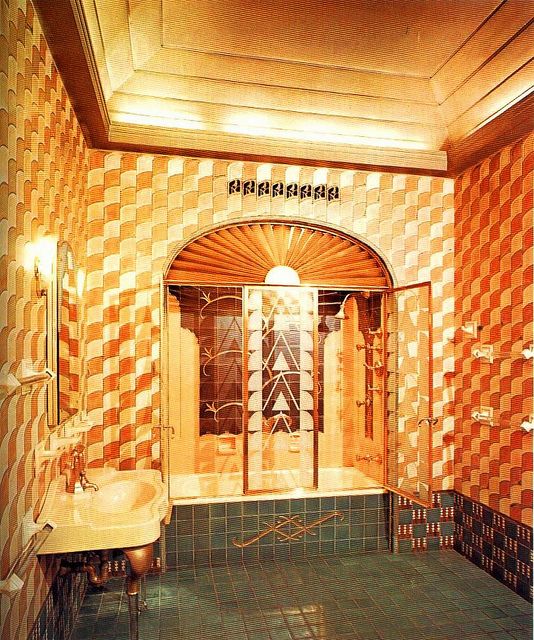
A THRONE IN THE SKY…The art deco bathroom in the 52nd floor executive suite of architect and real estate developer Irwin S. Chanin was designed by Jacques Delamarre. (Pinterest)
AERIAL GYMNASTICS…1930s postcard image of the Lincoln Building at 60 East 42nd. At right, the building’s rooftop gymnasium. (nyc-architecture.com/Tony Hisgett)

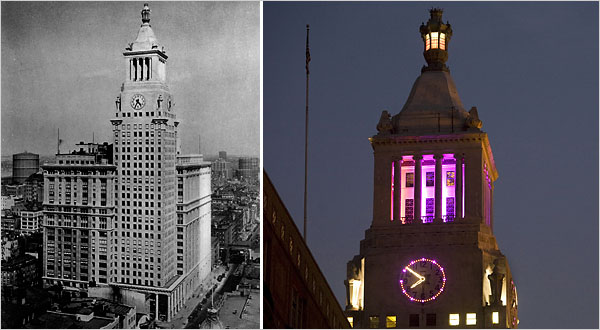
…Thurber continued his survey downtown in the financial district, and noted the proliferation of “lanterns” atop various skyscrapers…

ALL THE RAGE…”Lanterns” of various styles were popular toppers to Jazz Age skyscrapers. Above, the 24-story Consolidated Gas Building (now the Con Edison tower) by day and night. (Architect/Office for Metropolitan History/Michael Falco for The New York Times)
TRY TO TOP THIS…The distinctive lantern of the New York Central Building at 230 Park Avenue, now called the Helmsley Building  (andrewcusack.com/Wikipedia)

*  *  *

Waldorf Adieu, Part Two

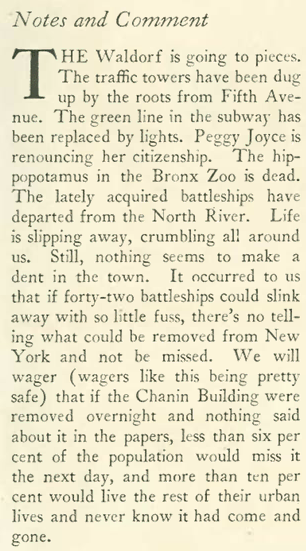
For a second week “The Talk of the Town” led off with an item about the demise of the Waldorf-Astoria hotel, this time attempting to put it into some perspective…

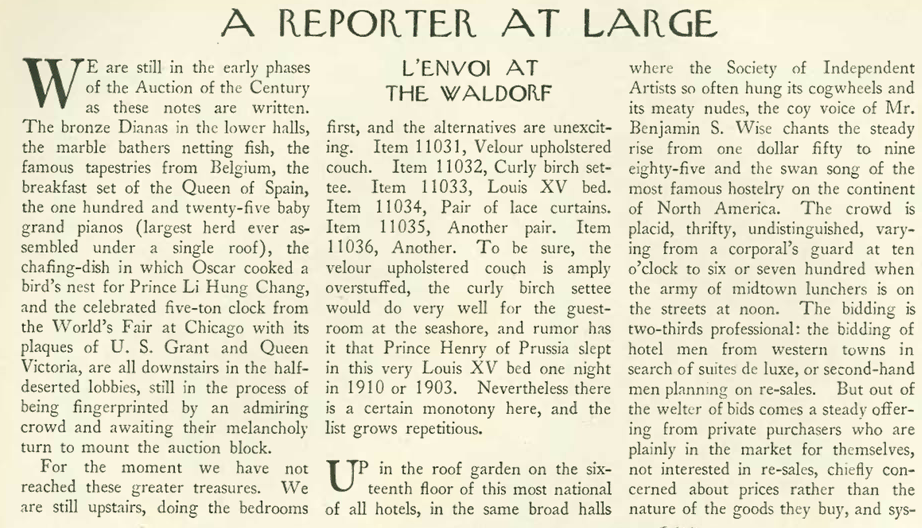
…and Charles Merz offered a lengthy account of the auctions that were already taking place at the hotel as everything from grand pianos (125 in all) to a nine-foot-tall, five-ton, bronze-and-mahogany clock either went on the block or into storage…

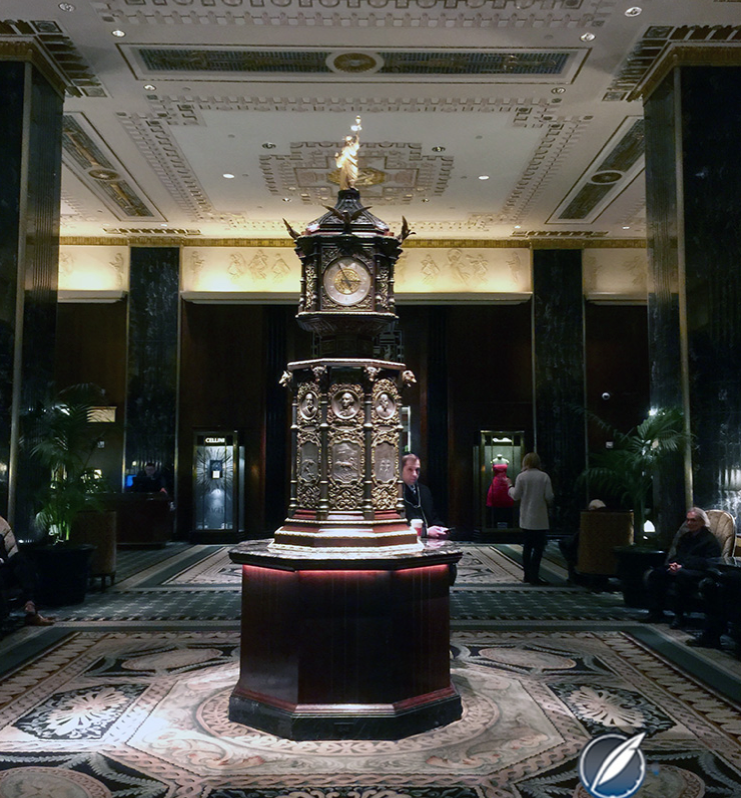
GOING, GOING…Illustration depicting an auction of items from the hotel. At right, the Waldorf’s nine-foot-tall, five-ton clock, shown here on display at the 1893 Chicago World’s Fair. A gift from Queen Victoria, the clock was acquired after the fair by John Jacob Astor IV, builder of the Astoria part of the old Waldorf-Astoria. He had it placed near the old hotel’s Rose Room restaurant. (Museum of the City of New York/Wikimedia)
STILL TICKING…The clock as it appears today in the lobby of the new Waldorf-Astoria, which was completed in 1931. A gilded Statue of Liberty was added to the top of the clock in 1902, a gift from the French government. (Wikimedia/Elizabeth Doerr)

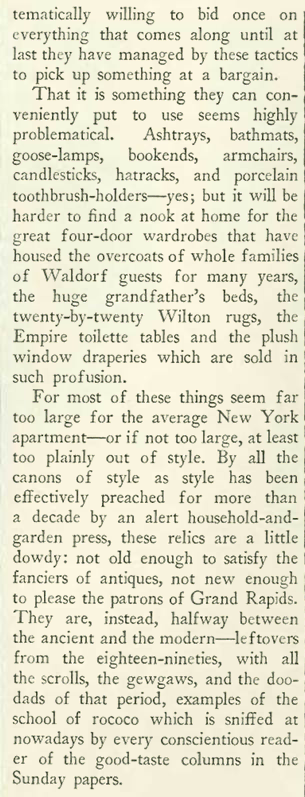
…Merz observed that although lavish tapestries, statuary, heavy furniture and other large items were up for sale, many buyers showed up merely to acquire a small memento…

IF THAT IS YOUR THING…Ornate furnishings (such as this French rococo-style furniture) were likely purchased at the auction by someone who actually had room for them. (Pinterest)

…Merz concluded that in the end, these “lesser treasures” will serve as props that will be handed down to the next generations, along with stories about the great and not-so-great who once slept or dined at the old hotel…

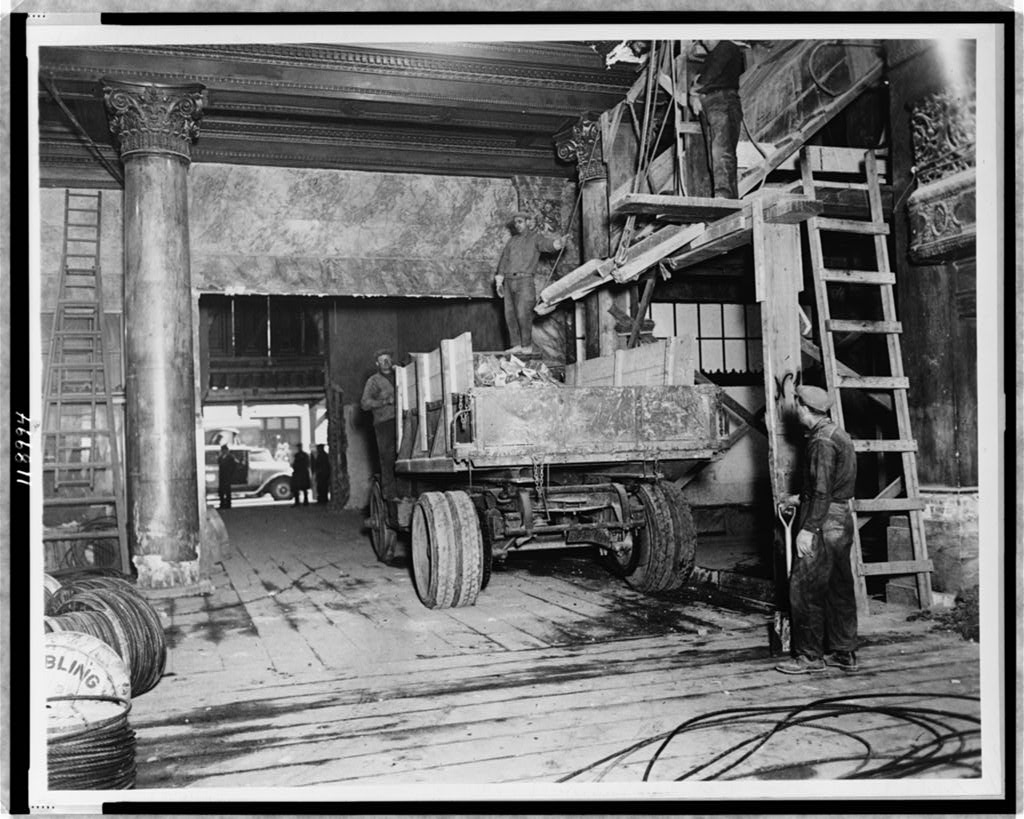
LAST DANCE…Workers emptying the old Waldorf-Astoria ballroom in 1929. (Library of Congress)

The May 18 issue featured yet another item on the Waldorf-Astoria — in “The Wayward Press” column, Robert Benchley (under the pseudonym “Guy Fawkes”) suggested that the story on the hotel’s demise had been milked for all it was worth….

 *  *  *

The Algonquin Wits

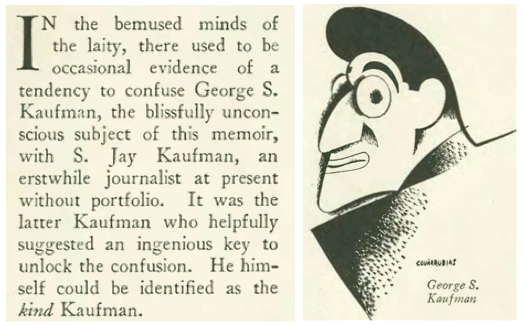
Speaking of milking a story, Alexander Woollcott playfully referenced his own material in the May 18 issue—indeed, quoting a profile he had written in the very same issue. Woollcott penned a humorous piece on friend and fellow Algonquin Round Table wit George S. Kaufman (caricature by Miguel Covarrubias). An excerpt:

…a bit later in the profile, Woollcott observed…

…a few pages later in the same issue, Woollcott offered more observations on his friend in his weekly “Shouts and Murmurs” column…quoting the above paragraph…

Kaufman would have his own say in 1939 with his hit play, The Man Who Came to Dinner (written with Moss Hart). The play’s main character, a cantankerous misanthrope named Sheridan Whiteside, was closely based on Woollcott.

SPARRING PARTNERS…George S. Kaufman and Alexander Woollcott often matched wits around the famed Algonquin Round Table. (Pinterest)
OUT OF SORTS…The cantankerous misanthrope Sheridan Whiteside (a character based on Alexander Woollcott) was portrayed by Monty Woolley in the 1939 hit play, The Man Who Came to Dinner. The play was adapted into a 1942 movie with Woolley (left) reprising his role as Sheridan Whiteside. Playing opposite Woolley are Bette Davis (center) and Ann Sheridan. (oldhollywoodtimes.com)

What did Woollcott think of the treatment? According to an article featured in Story of the Week (Library of America), he loved it: “When the play went on its West Coast tour, he even stepped into the lead role, treating audiences to the sight of a celebrity acting as a satirical version of a character based on his own public persona. At the end of one performance, cheered on by repeated curtain calls, Woollcott riffed off one of his character’s signature lines from the play and announced to the audience that he planned to sue the authors for $150,000.”

Those were the days…

 *  *  *

Distracted Drivers

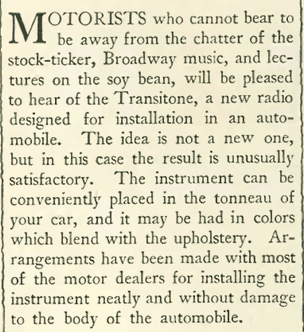
In his “Motors” column, Nicholas Trott described a new gadget that could bring new levels of pleasure (or danger) to the driving experience: the car radio:

The Transitone was probably the first production car radio in the U.S., and looked something like this (left image):

VACUUM TUBES are exposed under the dash of this car (left) outfitted with a Transitone radio. At right, a Crosley car radio from 1931. (radiomuseum.org)

 *  *  *

From Our Advertisers

The makers of Pond’s cold cream continued to land endorsements from the landed gentry, this time from 30-year-old Lady Violet Astor (née Violet Mary Elliot-Murray-Kynynmound, Dame of the Order of St. John), whose hair was described “as ripe as wheat,” her skin “pink and white as a hedge rose.” Okay, I’ll try a jar…

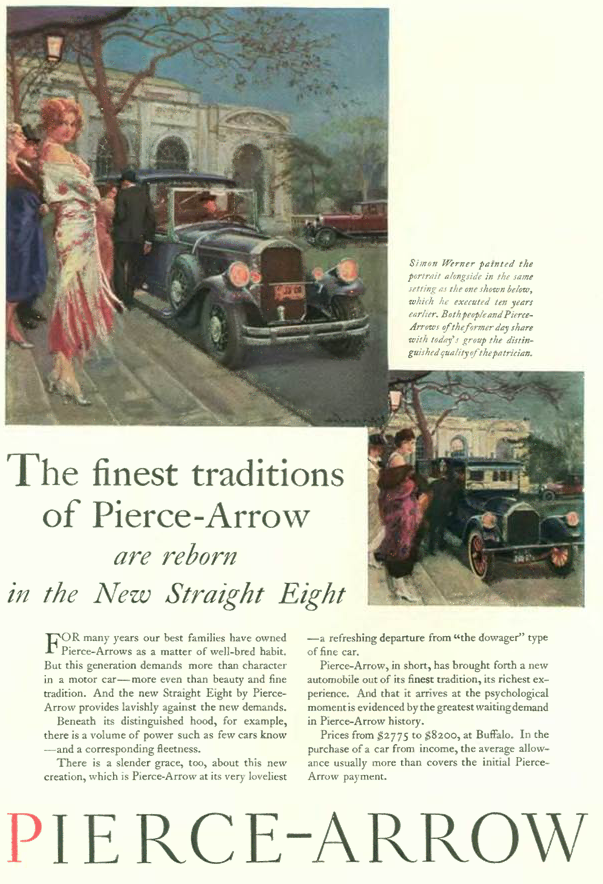
…and for more snob appeal, advertisements from American luxury carmaker Pierce-Arrow often featured messages that linked its cars to a lineage of earlier models, suggesting their automobiles had a well-bred, timeless quality (as opposed to the novelties found in cars driven by the plebeian classes). The caption reads: “Both people and Pierce-Arrows of the former day share with today’s group the distinguished quality of the patrician”…

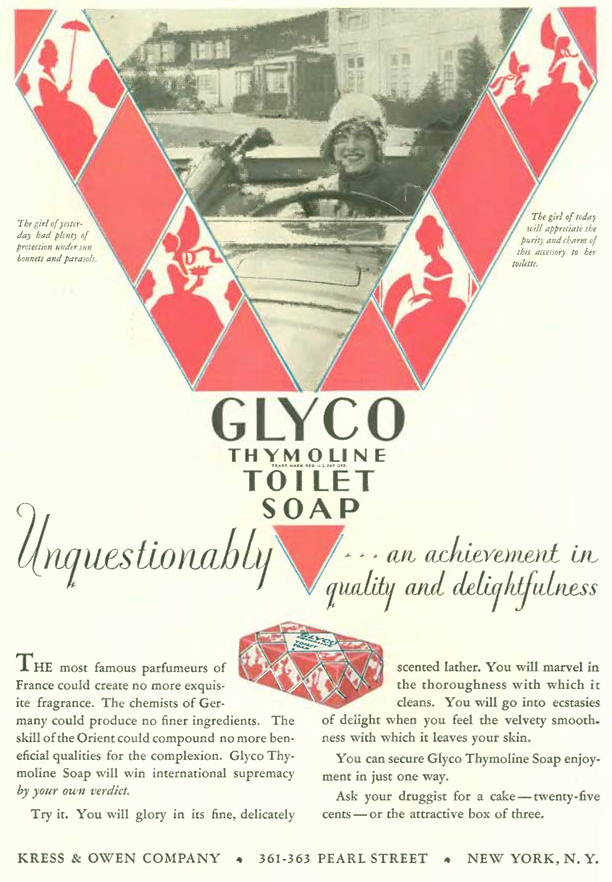
…the makers of Glyco “Thymoline” also drew upon the past to make a point about their soap, stating that “the girl of yesteryear had plenty of protection under sun bonnets and parasols,” whereas today’s young woman boldly races off to play golf without even bothering to put up the windshield. She’ll need Glyco to scrub off the bugs, dust and bits of gravel that will likely kick up into her face…

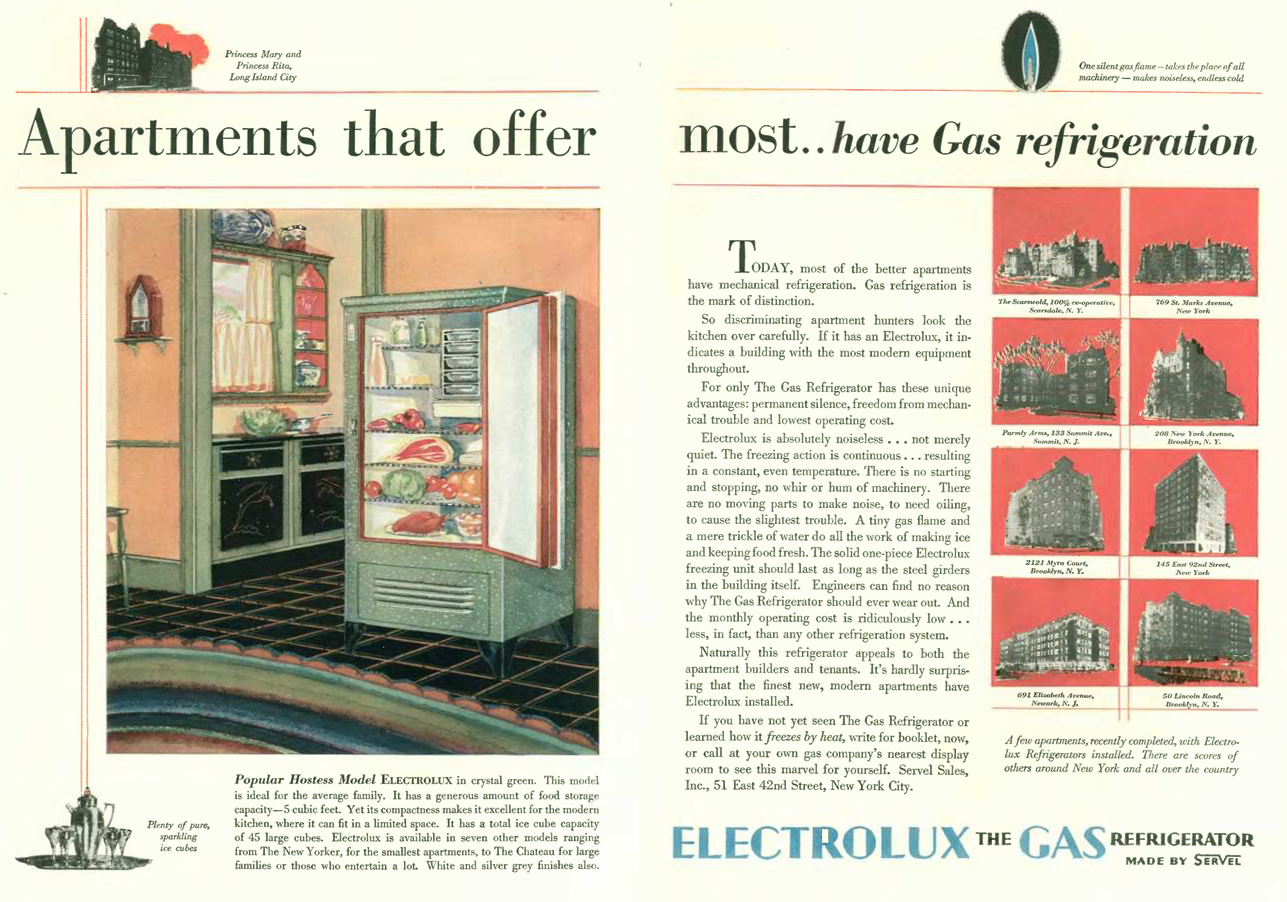
…One thing you notice at the end of the 20’s is the proliferation of color ads in The New Yorker, some quite lavish including this appeal from Electrolux, which depicted all of the new apartments popping up around the city powered by their gas appliances…

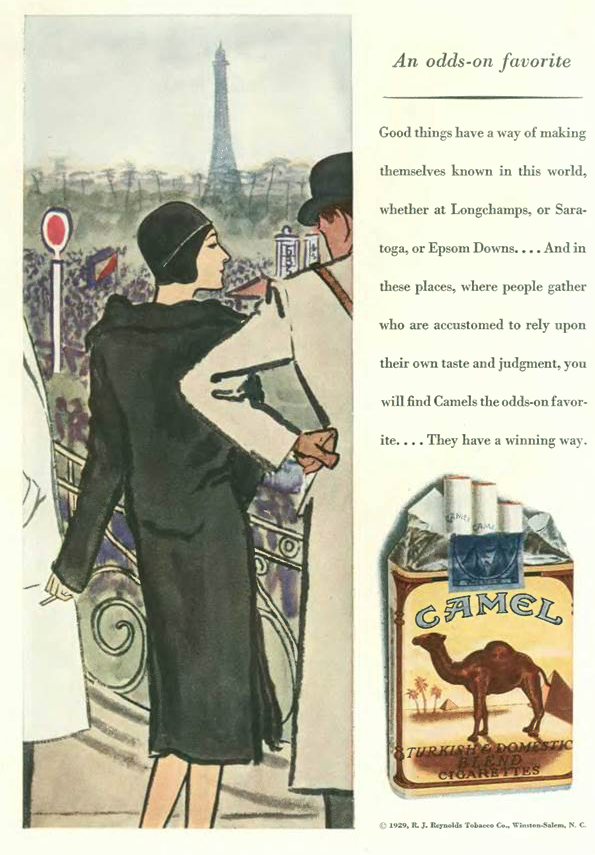
…and we have another lovely rendering by Carl “Eric” Erickson urging readers to smoke Camel cigarettes…

…and this ad caught my eye for its depiction of a house in the future, namely the year 1949 — you land your personal airplane on the roof and relax in your dynamic, angular furniture while a robot butler shakes up cocktails for you and your top-hatted friend…

…the house in the ad somewhat resembles this 1929 drawing by Swiss-American architect William Lescaze

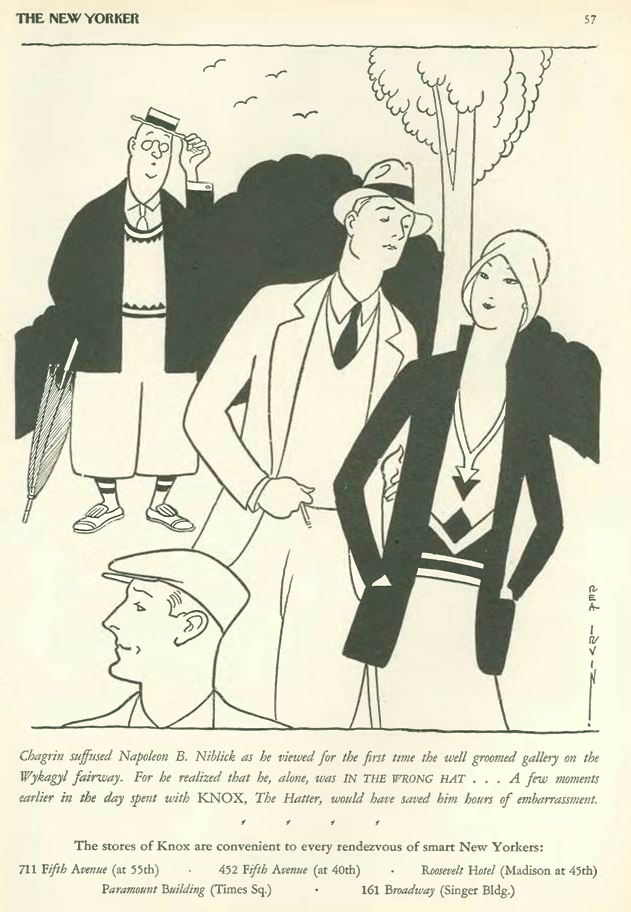
…we have another ad from Knox hatters (drawn by Rea Irvin) that featured an unfashionable, portly man (Napoleon B. Niblick) being snubbed by some Westchester toffs…

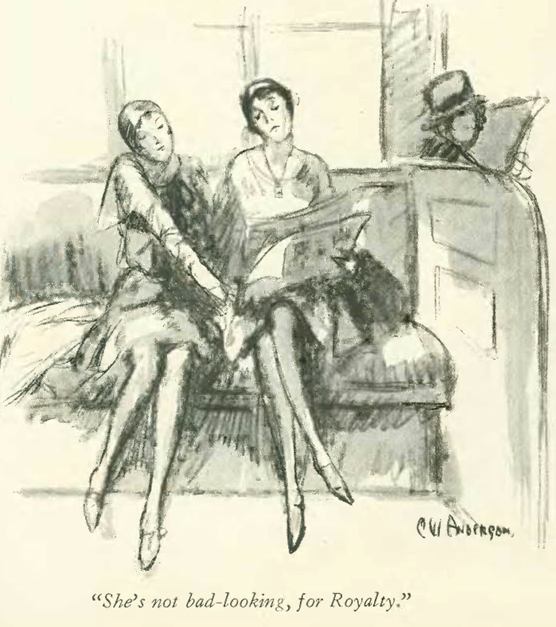
…our comics are provided by C.W. Anderson

…and Peter Arno

Next Time: Let Them Eat Cake…


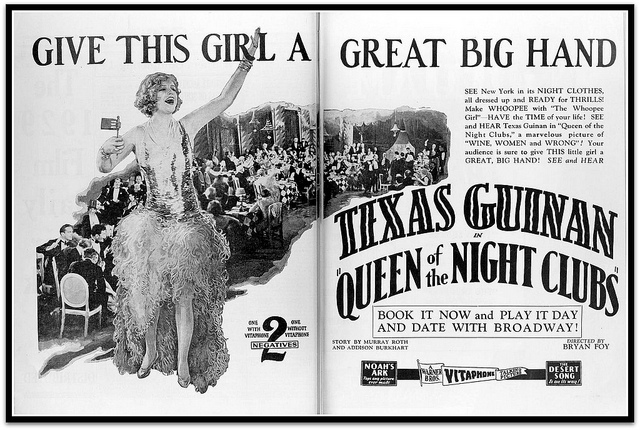
Queen of the Night Clubs

In the Roaring Twenties, Mary Louise Cecilia—aka Texas Guinan—was the undisputed queen of New York’s boozy, bawdy nightclub and speakeasy scene.

March 23, 1929 cover by Gardner Rea.

During the 1920s Guinan operated one of New York’s most famed speakeasies, The El Fey Club, which attracted the likes of Mayor Jimmy Walker, actors George Raft and Peggy Hopkins Joyce, writers including Ring Larder and Damon Runyon, and gossip columnists Walter Winchell, Mark Hellinger, and Ed Sullivan (yep, the same Ed who later hosted TV’s most famous variety show).

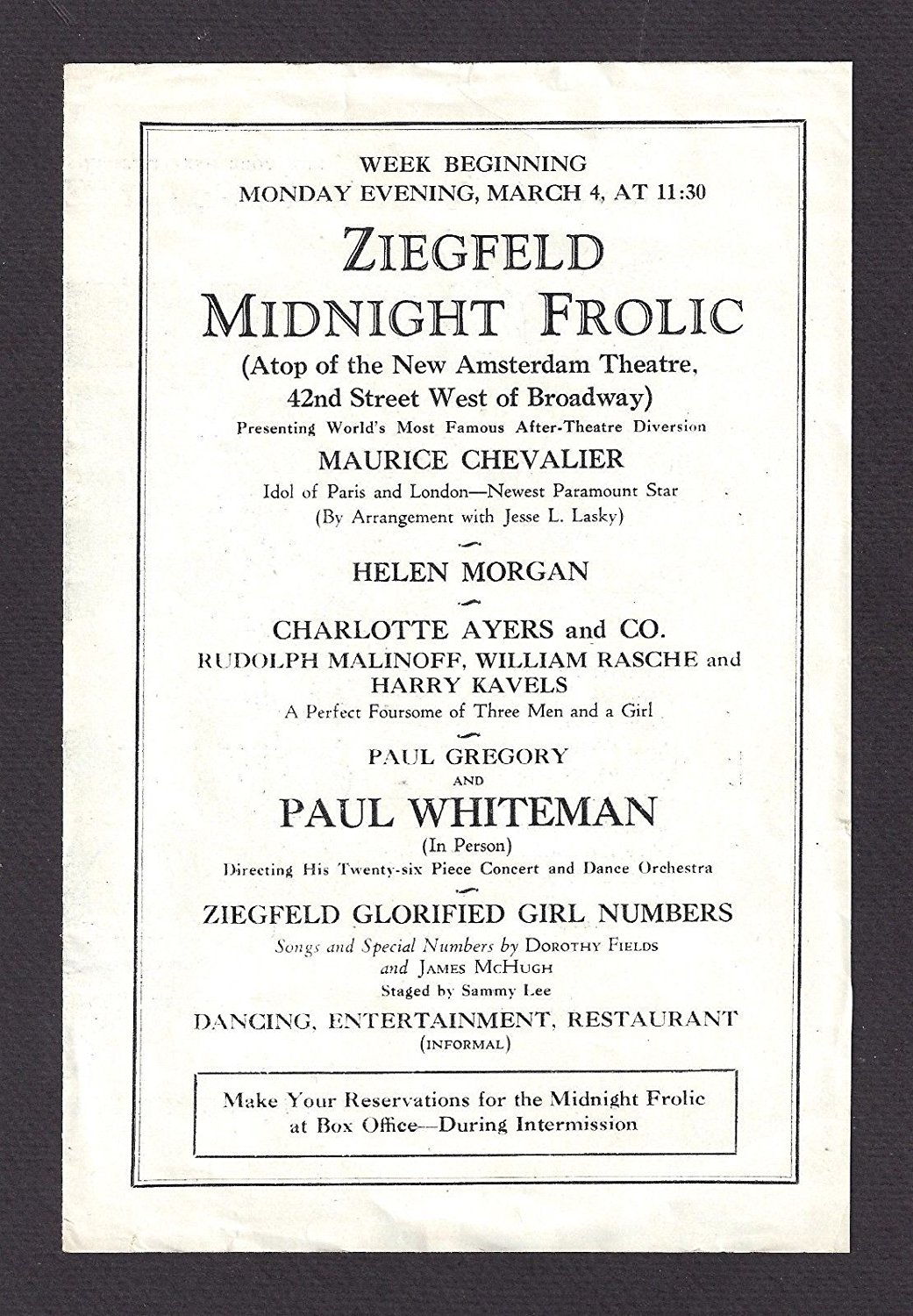
It was still months before the big stock market crash, but in the pages of the New Yorker you could already sense a change in its voice; it was maturing, to be sure, but it also seemed to be growing weary of the party. The magazine’s nightlife correspondent, Lois Long, contributed sporadically to her once-lively “Tables for Two” column (she was now a mother, and would abandon the column altogether in 1930). As for the queen of nightlife, Texas Guinan, New Yorkers were ready for something different.

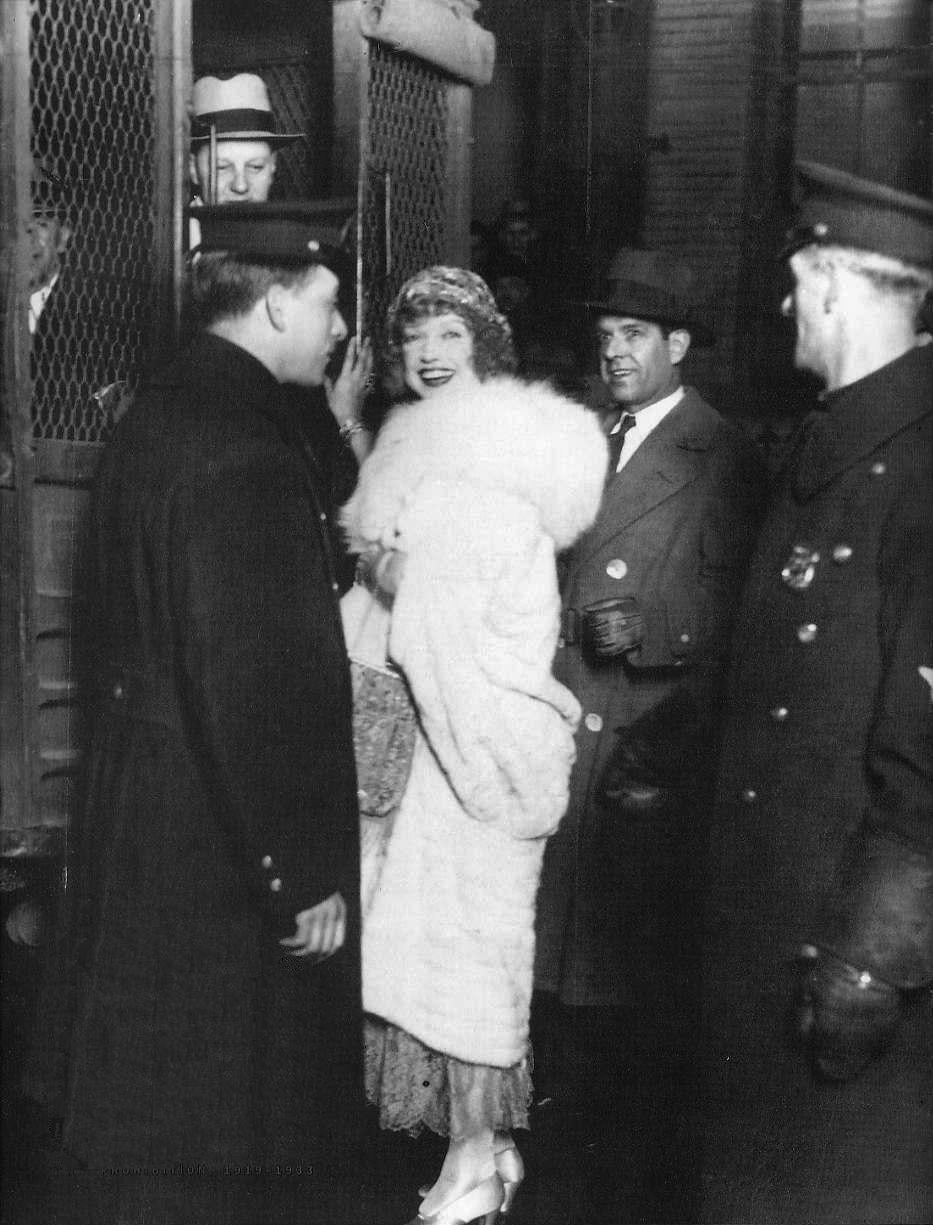
BEATING THE RAP…In June 1928 Texas Guinan and other New York speakeasy operators were arrested and indicted by a federal grand jury. Guinan beat the rap, and was acquitted in April 1929. (ephemeralness york)

In a review of her latest movie, Queen of the Night Clubs, the New Yorker found that Guinan lacked her famed charm and vitality, and that the camera was “not kind to her looks.”

THE FINAL CURTAIN…Clockwise from top left: Texas Guinan in a nightclub scene from Queen of the Night Clubs; trading lines in the film with John Davidson; a 1929 portrait of Guinan by Cecil Beaton; and a scene from the film with co-star Lila Lee (far right). The film is considered lost. (boweryboyshistory.com/texasguinan.blogspot.com)

The film in many ways marked the end of Texas Guinan, not so much because it was a bad film but because she had simply run her course and was going out of style. The market crash later that year was the final straw. She took her show on the road, made an unsuccessful attempt at a European tour, then returned to the States. She made one final film, Broadway Thru A Keyhole, which was based on a story by Guinan acolyte Walter Winchell. Guinan died on Nov. 5, 1933, three days after the film’s release; her death was due to ulcerative colitis brought on by a case of amoebic dysentery contracted during a visit to Chicago. She was 49. One month later, Prohibition would be repealed.

A final note: Queen of the Night Clubs would be Texas Guinan’s final starring role (the film is considered lost), but before she became a night club fixture she was a popular star in dozens of shorts and two-reelers—with mostly Western themes— from 1917 to 1921.

HAPPIER TRAILS…Texas Guinan featured in a movie poster and publicity photo for The Two-Gun Woman, 1918. (Columbia University)

 *  *  *

A Film of Biblical Proportions

The New Yorker’s May 23 film review also sized up the latest epic to come out of Hollywood—Noah’s Ark—a picture with parallel storylines known mostly for its innovations in special effects.

The film premiered in late 1928 as a silent and was re-released in 1929 as a “part-talkie.” It told the story of Noah and the Great Flood, connected to another story featuring cabaret singers, soldiers and espionage during the First World War. Here is the New Yorker’s take on the film:

IDENTITY CRISES…Various promotional posters touted different aspects of the partial-sound film, Noah’s Ark. The one at left promoted the film’s biblical story, while the one at right played up Dolores Costello’s sex appeal. (IMDB)

The New Yorker concluded that the film was worth seeing for the Noah story’s special effects, despite its attachment to a “dreary and banal” war picture.

DUAL ROLES…Dolores Costello (seated, at left) played both a cabaret dancer, Marie, and Noah’s handmaiden Miriam, in Noah’s Ark. Note in the first photo the actress at far left, with her leg propped up on the chair—that’s Myrna Loy, who would become one of Hollywood’s biggest stars in the 30s and 40s. As for Costello, known as “The Goddess of the Silent Screen,” her greatest success was in the silent era. Click image to enlarge. (1stdibs.com, IMDB)
BIG SHOW…Portions of Noah’s Ark were filmed at the famed Iverson Movie Ranch in Chatsworth, California, including the opening shot that featured a massive ark (top, left) beached on the boulders of the movie ranch’s Garden of the Gods. Other scenes from the film included (moving clockwise, from top right) Paul McAllister as Noah, issuing a warning to the heathen as Noah’s son Japheth (George O’Brien) and servant girl Miriam (Dolores Costello) cower at right; the heathen masses desperately clamoring to board the ark as they are engulfed by the flood (600,000 gallons of water was used in the scene—three of the extras actually drowned during the filming); Japheth carries the rescued Miriam into the ark. Click image to enlarge. (IMDB, Wikipedia, dukewayne.com, medium.com)

Notable about these silent epics is the lack of precaution they took with both the actors and the extras. A huge amount of water—600,000 gallons—was used to film the the climactic flood scene. Three extras drowned and many others suffered broken bones and other serious injuries. One extra had to have his leg amputated. As for the stars, Dolores Costello caught a severe case of pneumonia during the filming.

Here’s a clip to give you an idea of what the extras had to deal with:

Some trivia: John Wayne was an extra in the film, and also worked in the prop department. The director of Noah’s Ark, Michael Curtiz, would go on to direct some of the most well-known films of the 20th century, including The Adventures of Robin Hood with Errol Flynn, Angels with Dirty Faces with James Cagney and Humphrey Bogart, Casablanca with Bogart and Ingrid BergmanMildred Pierce with Joan Crawford, and White Christmas with Bing Crosby and Rosemary Clooney. He would also direct an Elvis Presley movie, King Creole, and in his final film would reunite with John Wayne in 1961’s The Comancheros.

 *  *  *

While Americans were enjoying epic filmmaking, Russian audiences were being served up the latest in propaganda, although this was propaganda presented with stunning film innovations and avant-garde sequences. In this item from the March 23 “Talk of the Town” the film is referred to as Through Russia With A Camera, but today it is known as Man with a Movie Camera. This experimental silent film from 1929 supposedly documented ordinary life in Soviet Union (with no signs of the famine that claimed 5 million Soviet citizens in the early 1920s). Directed by Dziga Vertov, the documentary’s famed cinematography was by Mikhail Kaufman. “Talk” observed:

AVANT GARDE…Poster for Man with a Movie Camera rendered in the Constructivist style. At right, cinematographer Mikhail Kaufman risks his life for a unique camera angle. (Wikipedia)
Clockwise, from top left: Cinematographer Mikhail Kaufman prepares to set up for a Black Sea beach sequence near Odessa; images of ordinary life include a woman at a hairdresser and a young woman fastening her bra; the eye through the camera lens, the film’s final image. (ascmag.com)

 *  *  *

From Our Advertisers

A sampling of advertisements from the pages of the March 23 issue include this nearly two-page spread for Pond’s cold cream…no doubt Pond’s was thrilled with this endorsement by “Mrs. Cornelius Vanderbilt Jr,” otherwise known as Mary Weir of Davenport, Iowa. Mary was wife No. 2 of Cornelius Vanderbilt’s seven wives. Mary and Cornelius were married in 1928 and divorced in 1931…

…and then we have this advertisement from Knox hatters, illustrated by the New Yorker’s own Rea Irvin

…this advertisement for the new Lincoln Building played up the building’s dominating form on Madison Avenue…

…a dominance that continues to this day. I know it’s not cool to gaze up at buildings in Manhattan, but if you’re ever in the neighborhood you must look upward at least once and gaze at the canyon that splits the Lincoln Building’s massive facade…

Lincoln Building, circa 1950. (Museum of the City of New York)

…this Remington typewriter was the closest thing to a desktop computer in 1929…I own one of these and I must attest that it isn’t exactly noiseless…

…this next ad caught my eye because it encouraged people to commit negligent homicide by throwing their product out of a high-rise window…it is also interesting because today Crosley is still a big name in radios and record players, although today’s Crosley is similar in name only. The original Crosley Corporation was a major player in early radio broadcasting, and in addition to manufacturing radios Crosley would go on to build refrigerators, a line of inexpensive subcompact cars and trucks (from 1939 to ’52) cars, and even small airplanes (1929-’36). Crosley ceased as a brand name in 1956, but the name was revived in 1984 by Modern Marketing Concepts. Today Crosley is a leading manufacturer of vintage-styled turntables, radios and other electronics…

…speaking of encouraging ridiculous behavior, some clever marketer at Ronson lighters found a great way not only to sell lighters, but also to encourage customers to waste lots of lighter fluid…

…and then we have this, one of the unlikeliest advertisements ever to appear in the New Yorker—at first I thought it was one of E.B. White’s fake newspapers, but it was actually a two-page spread promoting Davey Tree Surgeons of all things…

…just for fun I am tossing in this illustration by Constantin Aladjalov that appeared along the bottom of a two-page spread…

…and finally, our cartoon from Otto Soglow, in which our subject is either referring to a popular board game from 1929, or a particular sequence in a domino game…

Next Time: While You Were Away…


Modern English Usage

The fourth anniversary issue of the New Yorker gave every indication that the magazine had arrived as a cultural force.

Fourth anniversary cover, Feb. 23, 1929, by Rea Irvin.

Rich in content, the issue’s offering’s ranged from the famed humorous short “You Were Perfectly Fine” by Dorothy Parker, a profile of famed maestro Arturo Toscanini, and various accounts on the romance between Charles Lindbergh and Anne Morrow. The issue also featured this “organization chart” drawn by Julian de Miskey:

The little door marked “Tony’s” in the bottom right-hand corner referred to a celebrated speakeasy operated by Tony Soma. It was a second home to many New Yorker staffers, and was patronized by hard-drinking actors and writers including Scott and Zelda Fitzgerald, Dorothy Parker and Robert Benchley, and also a young actor named Humphrey Bogart.

Another notable item in the Feb. 23 issue was this contribution by James Thurber in which he lampooned H.W. Fowler’s Modern English Usage, a handbook that New Yorker Editor-in-Chief Harold Ross considered to be the last word in matters of punctuation and grammar. Thurber would write a dozen entries in this series, including the following (click to enlarge):

The New Yorker could never get enough of Charles Lindbergh, even though his personality was every bit as wooden as that of the former President Calvin Coolidge. The Feb. 23 “Talk of the Town” speculated on “Charlie’s” affections for Anne Morrow, and the woe that would befall anyone who challenged the famed flyboy for those affections:

COME FLY WITH ME…Anne Morrow Lindbergh and Charles Lindbergh shortly after their marriage in May 1929. (Bio.com)
SON-IN-LAW…Charles and Anne visiting Anne’s parents, Elisabeth and Dwight Morrow, in 1931. Charles met Anne during a visit to Mexico when Dwight was served as ambassador to that country. (kaiology.wordpress.com)

A second item in the Feb. 23 “Talk” section took a closer look at Charles’ courtship habits, or lack thereof…

Even Howard Brubaker got in a word regarding the Lindbergh-Morrow courtship in his column, “Of All Things”…

As we know, Brubaker had it wrong. Rather than pining away at home, Anne would become one of the 20th century’s most beloved writers, a leading feminist voice, and an accomplished aviator in her own right.

SORRY CHARLIE…As one for the most beloved writers of the 20th century, Anne Morrow Lindbergh would go on to match and even eclipse her husband’s fame. (PBS)

*  *  *

Little Yehudi

Yehudi Menuhin is known to classical music lovers as one of the greatest violinists of the 20th century. But as this “Talk” item suggests, he was once a little boy, more or less…

STILL IN SHORT PANTS…A young Yehudi Menuhin poses with conductor Bruno Walter in Berlin, 1931. Just two years after this photo was taken, Walter would flee Nazi Germany and eventually settle in the U.S. (Wikipedia)

 *  *  *

More Fun With Lois

Although Lois Long devoted most of her ink to her weekly fashion column, “On and Off the Avenue,” she continued to write her nightlife column, “Tables for Two,” though somewhat sporadically. Which makes sense because around this time Long was also either pregnant (she was married to New Yorker cartoonist Peter Arno) or was now the mother of a daughter, Patricia. The reason I’m not sure is that I have birth dates from both 1928 and 1929 for Patricia, depending on sources. At any rate, Long was taking in the nightlife in a big way, moving from club to club and assessing the quality of their various acts:

At the Lido, Beatrice Lillie sang “for the edification of devoted admirers”…

AT THE LIDO you could see British actress, singer and comedic performer Beatrice Lillie light up the stage. (vintag.es)

…Long also commented on the arrival of French entertainer Maurice Chevalier, who promised to inject some life into the Paul Whitman Orchestra performing at the Ziegfeld Midnight Frolic

Flyer announcing Maurice Chevalier’s upcoming performance at the Ziegfeld Midnight Frolic.
THANK HEAVEN…Maurice Chevalier in a 1929 publicity photo. He is mostly known today for his appearance in the 1958 film Gigi and his rendition of “Thank Heaven for Little Girls.” (thefamouspeople.com)

As for the rest of the New York nightlife, Long hoped that in the end it was all for fun, and that there was no “deep meaning” behind the frivolity:

SHALLOW WATERS…Eddie Jackson, Jimmy Durante, Lou Clayton performing their act in the motion picture Roadhouse Nights, 1930. (digitalcollections.nypl.org)

 *  *  *

Something In the Air

The “On The Air” column noted that NBC had made a brave attempt at rebroadcasting the music of the London Symphony Orchestra from Queen’s Hall and had “succeeded in coaxing a section of Rachmaninoff’s E Minor Symphony across the Atlantic.” It was also reported that the General Electric Company of Schenectady, in its ongoing research into television, had successful sent an image of famed film director D.W. Griffith across the country to California. In a separate item. “The Talk of the Town” also reported on the achievement…

…and advances continued in motion pictures, the “talkies” quickly overtaking the silents and even resorting to such tricks as lip-syncing:

SORRY DEAR, YOU’VE BEEN DUBBED…Betty Compson with Richard Barthelmess in Weary River. While Barthelmess’s character sings and plays the piano throughout the film, Barthelmess himself did not sing or play the piano. Frank Churchill played the piano and Johnny Murray sang into a microphone far away from Barthelmess while he lip-synced and played a piano which had strings deadened with felt. (TCM)

*  *  *

For the anniversary issue, and for old time’s sake, the New Yorker tossed in this little filler joke from its first issue, a joke that was repeated ad nauseam in subsequent issues:

This riddle, told backwards, appeared to be a mistake, but it was most likely an attack on two-liners found in humor magazines of the day like Judge and Punch.

From Our Advertisers

Advertising was booming for the New Yorker in 1929, the magazine recording nearly $2 million in ad sales that year (compared to just $36,000 in their first year, 1925). Now on to the ads…

In a recent post we followed the mostly wealthy New York snowbirds down to Palm Beach, Florida, which during the 1920s grew from a quiet village to a resort for the rich and famous. For those who couldn’t make it, they could install “Vita Glass” and bring Palm Beach to Park Avenue…

…and as spring approached, one could catch a bit of nature’s breezes atop 730 Park Avenue…

…or live like a demi-god above the toiling masses at Fifth Avenue’s Lefcourt National…

…back on terra firma, we find W.C. Fields the latest endorser of Old Golds…

…this has to be the most audacious attempt to add sex appeal to canned ham…

And finally, our illustrators…Garrett Price contributed some fine drawings of Nice and Monte Carlo…

Barbara Shermund looked in on young toffs making idle chat…

…and Rea Irvin, finding everyone perplexed over Einstein’s unified field theory…

Next Time: The Capones at Home…